The Political History of England, Volume I (of 12): From the Earliest Times to the Norman Conquest
Whole book · 39 sections
Transcriber’s Note
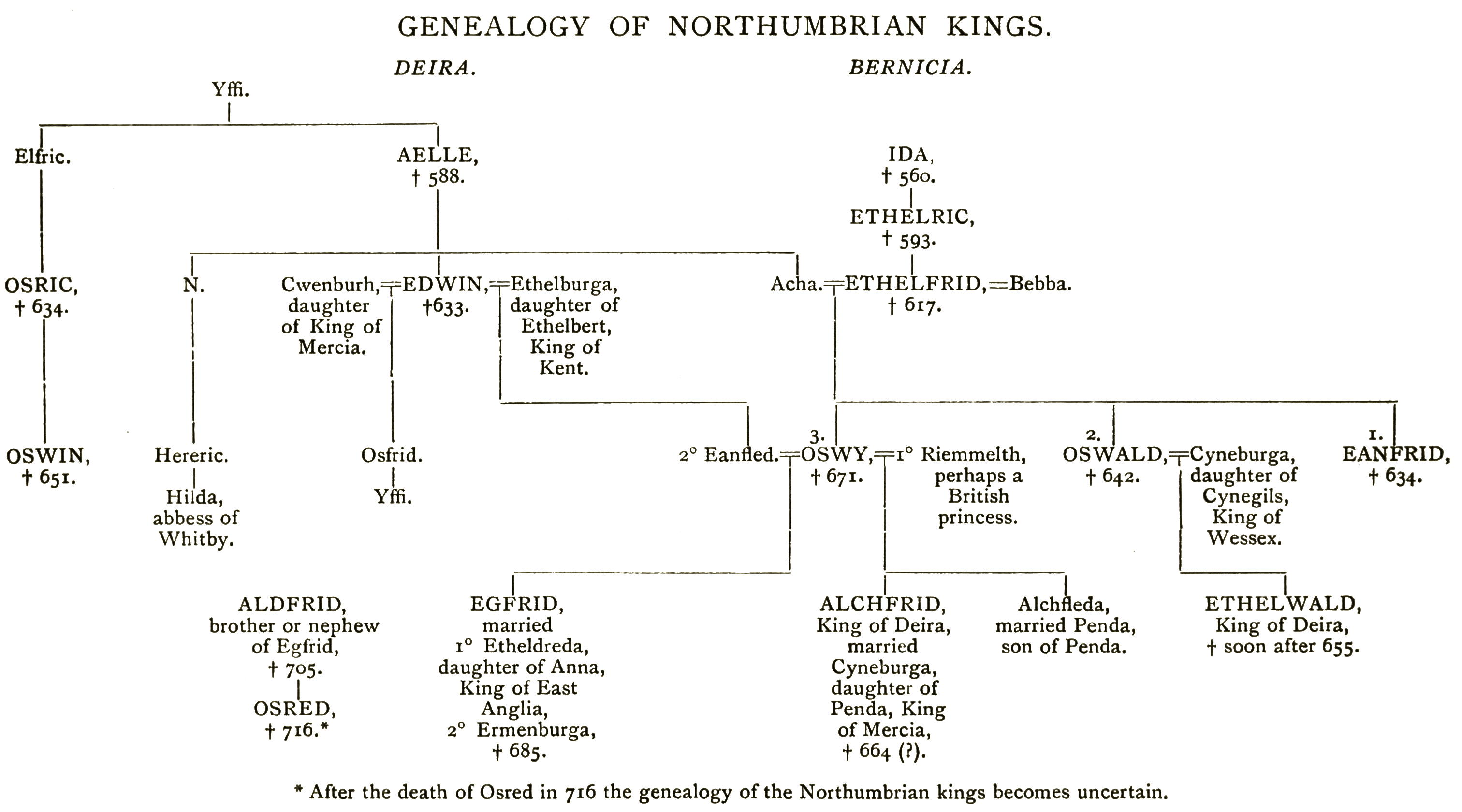
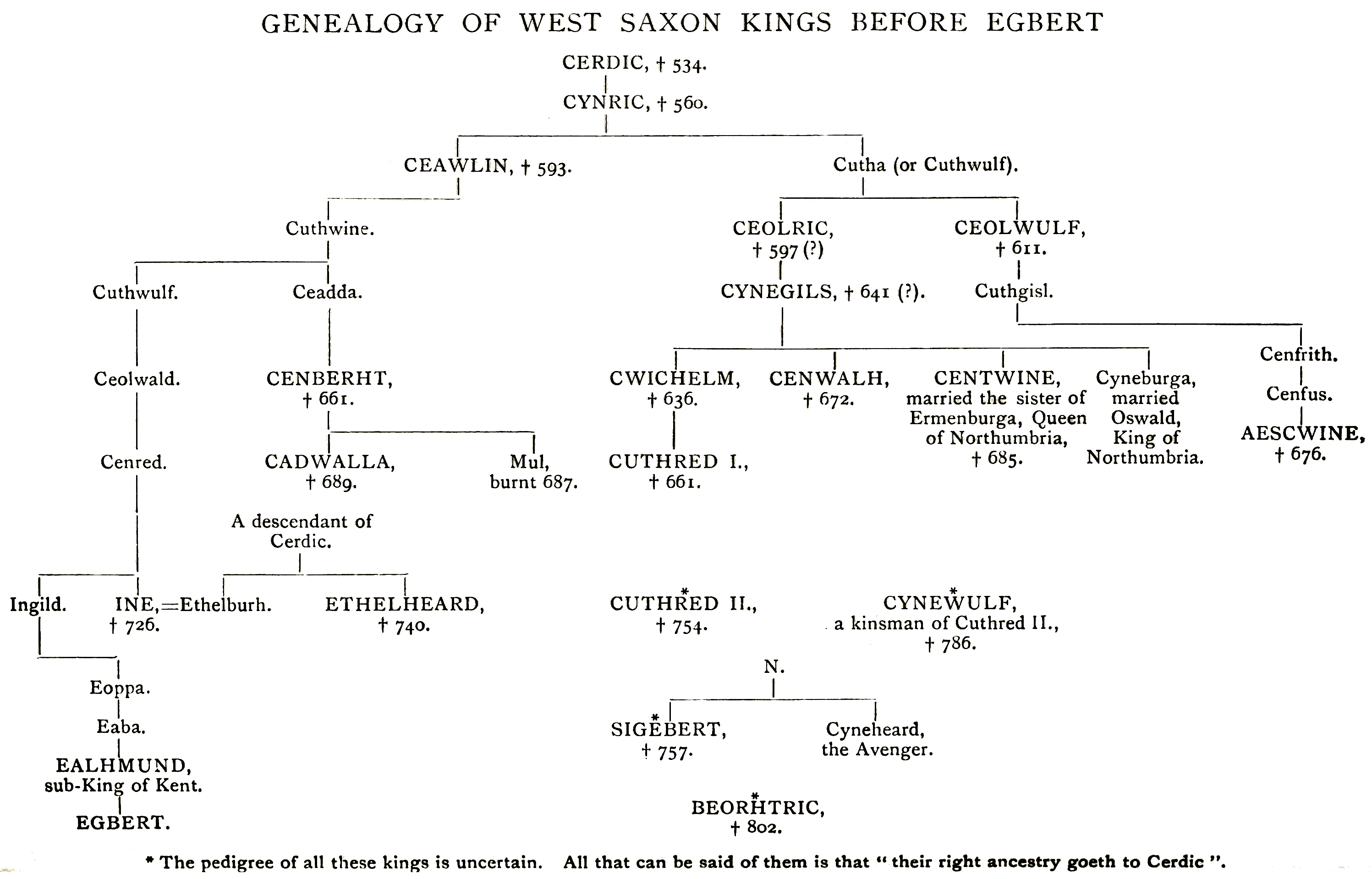
Full-size versions of the genealogy charts may be seen by right-clicking
them and selecting an option to view them separately, or by double-tapping and/or
stretching them.
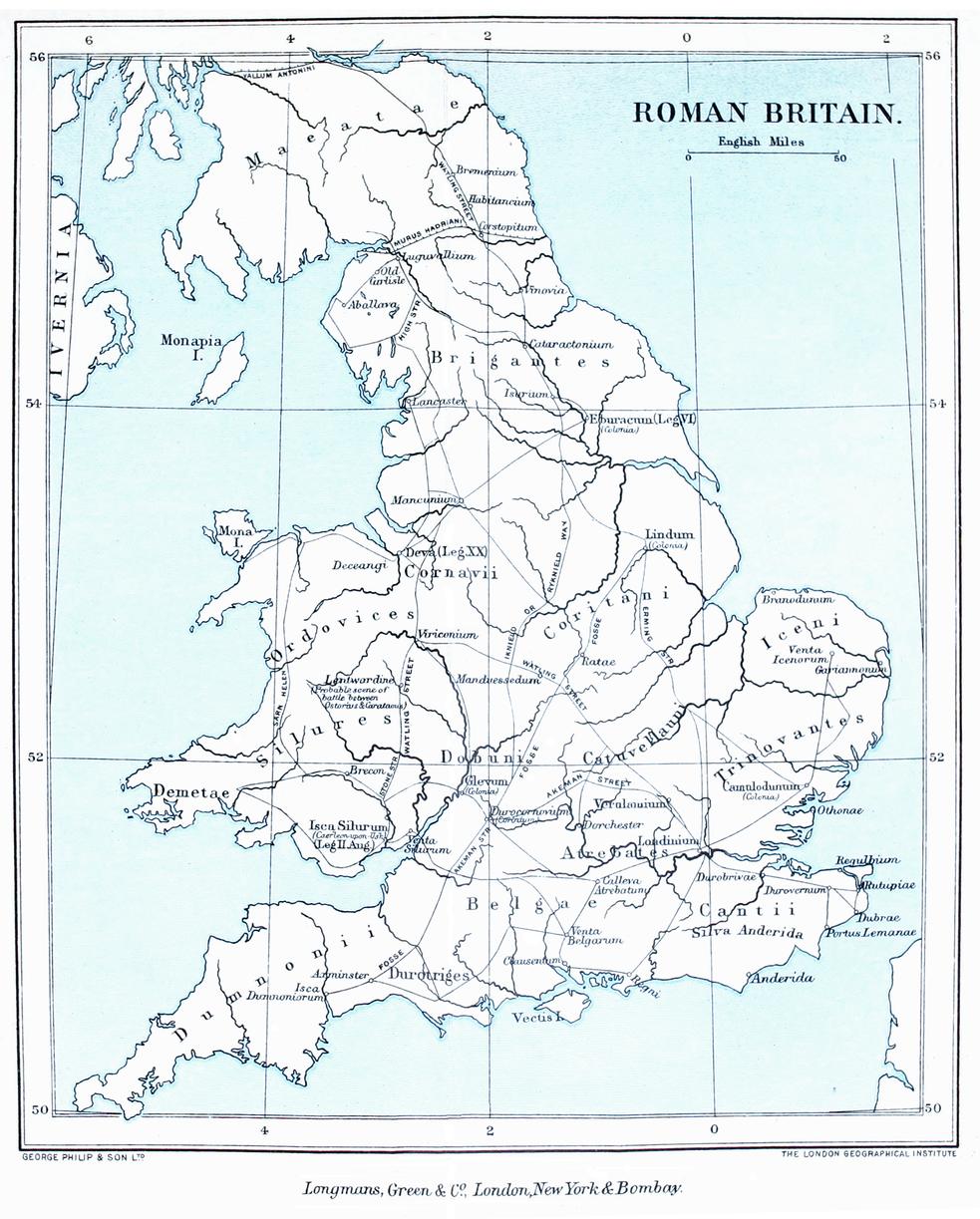
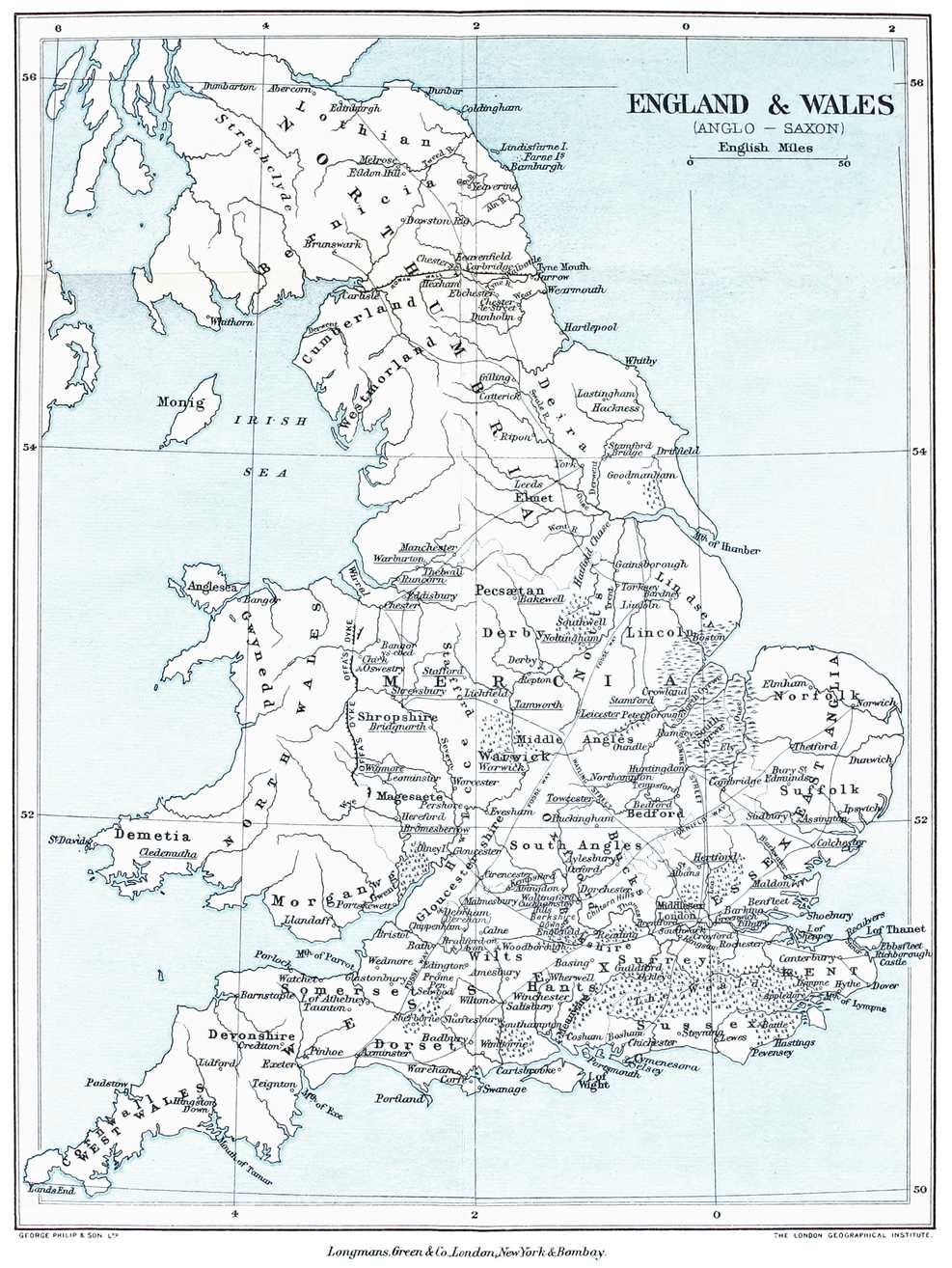
Larger versions of the maps may be seen by right-clicking them
and selecting an option to view them separately, or by double-tapping and/or
stretching them. Select "High Resolution" for more detailed versions of the
maps.
THE POLITICAL HISTORY OF ENGLAND
Seventy-five years have passed since Lingard completed
hisHistory of England, which ends with the Revolution
of 1688. During that period historical study has
made a great advance. Year after year the mass of
materials for a new History of England has increased;
new lights have been thrown on events and characters,
and old errors have been corrected. Many notable
works have been written on various periods of our
history; some of them at such length as to appeal
almost exclusively to professed historical students. It
is believed that the time has come when the advance
which has been made in the knowledge of English
history as a whole should be laid before the public in
a single work of fairly adequate size. Such a book
should be founded on independent thought and research,
but should at the same time be written with a full
knowledge of the works of the best modern historians
and with a desire to take advantage of their teaching
wherever it appears sound.
The vast number of authorities, printed and in
manuscript, on which a History of England should be
based, if it is to represent the existing state of knowledge,
renders co-operation almost necessary and certainly
advisable. The History, of which this volume is an instalment,
is an attempt to set forth in a readable form
the results at present attained by research. It will consist
of twelve volumes by twelve different writers, each
of them chosen as being specially capable of dealing with
the period which he undertakes, and the editors, while
leaving to each author as free a hand as possible, hope
to insure a general similarity in method of treatment, so
that the twelve volumes may in their contents, as well as
in their outward appearance, form one History.
As its title imports, this History will primarily
deal with politics, with the History of England and,
after the date of the union with Scotland, Great Britain,
as a state or body politic; but as the life of a nation is
complex, and its condition at any given time cannot be
understood without taking into account the various forces
acting upon it, notices of religious matters and of intellectual,
social, and economic progress will also find
place in these volumes. The footnotes will, so far as
is possible, be confined to references to authorities, and
references will not be appended to statements which
appear to be matters of common knowledge and do
not call for support. Each volume will have an Appendix
giving some account of the chief authorities,
original and secondary, which the author has used.
This account will be compiled with a view of helping
students rather than of making long lists of books without
any notes as to their contents or value. That the
History will have faults both of its own and such as
will always in some measure attend co-operative work,
must be expected, but no pains have been spared to make
it, so far as may be, not wholly unworthy of the greatness
of its subject.
Each volume, while forming part of a complete
History, will also in itself be a separate and complete
book, will be sold separately, and will have its own
index, and two or more maps.
Vol. I. to 1066. By Thomas Hodgkin, D.C.L., Litt.D., Fellow
of University College, London; Fellow of the British
Academy.
Vol. II. 1066 to 1216. By George Burton Adams, M.A.,
Professor of History in Yale University, New Haven,
Connecticut.
Vol. III. 1216 to 1377. By T. F. Tout, M.A., Professor of
Medieval and Modern History in the Victoria University
of Manchester; formerly Fellow of Pembroke College,
Oxford.
Vol. IV. 1377 to 1485. By C. Oman, M.A., Fellow of All
Souls’ College, and Chichele Professor of Modern History
in the University of Oxford.
Vol. V. 1485 to 1547. By H. A. L. Fisher, M.A., Fellow
and Tutor of New College, Oxford.
Vol. VI. 1547 to 1603. By A. F. Pollard, M.A., Professor of
Constitutional History in University College, London.
Vol. VII. 1603 to 1660. By F. C. Montague, M.A., Professor
of History in University College, London; formerly Fellow
of Oriel College, Oxford.
Vol. VIII. 1660 to 1702. By Richard Lodge, M.A., Professor
of History in the University of Edinburgh; formerly
Fellow of Brasenose College, Oxford.
Vol. IX. 1702 to 1760. By I. S. Leadam, M.A., formerly
Fellow of Brasenose College, Oxford.
Vol. X. 1760 to 1801. By the Rev. William Hunt, M.A.,
D.Litt., Trinity College, Oxford.
Vol. XI. 1801 to 1837. By the Hon. George C. Brodrick,
D.C.L., late Warden of Merton College, Oxford, and
J. K. Fotheringham, M.A., Magdalen College, Oxford,
Lecturer in Classics at King’s College, London.
Vol. XII. 1837 to 1901. By Sidney J. Low, M.A., Balliol
College, Oxford, formerly Lecturer on History at King’s
College, London.
I. THE HISTORY OF ENGLAND FROM THE EARLIEST TIMES TO THE NORMAN CONQUEST
The Political History of England IN TWELVE VOLUMES
Edited by WILLIAM HUNT, D.Litt., and REGINALD L. POOLE, M.A.
THE HISTORY OF ENGLAND
FROM THE EARLIEST TIMES TO
THE NORMAN CONQUEST
BY
THOMAS HODGKIN, D.C.L., Litt.D. FELLOW OF UNIVERSITY COLLEGE, LONDON
FELLOW OF THE BRITISH ACADEMY
LONGMANS, GREEN, AND CO.
39 PATERNOSTER ROW, LONDON
NEW YORK AND BOMBAY
1906
Page 333, line 3, for “North Wales” read “part of South Wales”.
CHAPTER I. THE PREHISTORIC FOREWORLD.
The history of England if we wish to take it in its narrowest
sense begins with the migrations of the Angles, Jutes and Saxons
in the fifth century after Christ. Yet, remembering that we
have dwelling close beside us and mingling their blood with
ours a gallant little people who own no descent from the Anglo-Saxon
invaders, and remembering also how magical was the
effect on all the barbarian races, of contact with the all-transmuting
civilisation of Rome, we cannot surely leave altogether
untold the story of those five centuries during which our country
was known to the rest of Europe not as Anglia but as Britannia.
Can we absolutely stop even there? It is true that the conscious
history of Britain, the history that was written by chroniclers
and enshrined in libraries, begins, as do the histories of all
the nations of Western Europe, with the day when they came
first in contact with the Genius of Rome. But is it possible
to avoid trying to peer a little further into the infinite, dim and
misty ages that lie beyond that great historic landmark? This
is what our teachers of natural science have endeavoured to do
on our behalf, labouring with the spade of the excavator and
the collected specimens of the comparative anatomist to read a
few of those faded pages of the history of Britain which had
already been long illegible when Julius Cæsar landed on our
shores.
And first we listen to the voice of Geology. After toiling
through the all-but eternities of the Primary and Secondary
systems of rock-formation, she seems to heave a sigh of relief
as she enters the vestibule of the Tertiary system. New heavens
and a new earth, an earth not utterly unlike that upon which
we now dwell, seem to lie before her, and she names the four
vast halls through which she leads her disciples “the Dawn of
the New,” “the Less New,” “the More New,” and “the Most
New” (Eocene, Miocene, Pliocene and Pleistocene). In the
last of these halls, which is represented by a mere line on the
geological ground plan, yet which may easily have had a duration
of 200,000 years, we at last find our fellow-countryman, the
first human inhabitant, as far as we know, of the British Isles.
In certain well-known caves on the south coast of Devonshire
(Kent’s Cavern and Brixham) there were found some sixty years
ago flint implements undoubtedly fashioned by human hands,
along with the remains of hyenas and other animals long since
extinct in the British Islands, and these were lying under a
stalagmite floor which must have taken at least 12,000 years,
and may well have taken 100,000 years, for its formation. It
was thus conclusively proved that Palæolithic man whose handiwork
has been found in many other European countries, especially
in the wonderfully interesting caves of Aquitaine, lived also,
how many millenniums ago none can say, in the limestone caves
of Britain. Besides these dwellers in caves and probably of an
even earlier period than they, were the other Palæolithic men
who have left abundant traces of their presence in the spear-heads,
flints, scrapers and other large stone implements which
are often found in the gravel deposits of ancient rivers.
The Old Stone-workers, as this earliest known race of men is
called to distinguish them from Neolithic men, their immeasurably
remote descendants or representatives, knew, of course,
nothing of the use of metals, and generally fashioned their flint
implements or their bone needles in a somewhat rough and unworkmanlike
manner. They knew nothing of the art of the
weaver, and can therefore have had no other clothing than the
skins of beasts. Neither did they ever manufacture anything
in the nature of pottery; so that shells and the skulls of animals
must have been their only drinking cups. But the relics of
their primeval feasts show that they were in all probability not
cannibals, and the very few Palæolithic skulls which have
been preserved show a type decidedly nobler than some of the
backward races of the present day. Curiously enough the men
who had made so little advance in the homely industries of life
had nevertheless a distinct feeling for graphic art. “By far
the most noteworthy objects” in the Palæolithic caves “are the
fragments of bone, horn, ivory and stone, which exhibit outlined
and even shaded sketches of various animals. These engravings
have been made with a sharp-pointed implement, and are often
wonderfully characteristic representations of the creatures they
portray. The figures are sometimes single; in other cases they
are drawn in groups. We find representations of a fish, a seal,
an ox, an ibex, the red-deer, the great Irish elk or deer, the
bison, the horse, the cave-bear, the rein-deer and the mammoth
or woolly elephant.”1
Whatever may have been the precise relation of the Pleistocene
period to the Great Ice Age—a point as to which there
is some difference of opinion—it is admitted that at some time
or other after that when the hyena howled in the Brixham
Cave, and when Palæolithic man left there his rudely worked
flint implements, the conditions of life in Northern Europe
changed. The Arctic zone invaded the larger part of the
Temperate zone, and a great cap of ice covered not only the
Scandinavian countries and the greater part of Russia but Ireland,
Scotland and England, at least as far south as the valley
of the Thames. Now were our chalk hills rounded into smoothness,
now were many of our river beds hollowed out, and untidy
heaps of “terminal moraine” deposited where the glaciers debouched
into the valleys. This dismal change, destructive of
all the higher organic life and continuing possibly over a period
of thousands of years, makes, in our island at any rate, an impassable
barrier between two races of mankind. When the
great ice deluge subsided, when the winter-tyrant returned to his
true Arctic home, when the oak and the pine began again to appear
upon the hills, and flowers like our own bloomed in the
valleys, then the Neolithic man, the “New Stone-worker,” came
upon the scene and scattered abundant evidences of his presence
over the land. From that period—date we cannot call it, for
we have no evidence which would justify us in making the
roughest approximation to a date—man has been continuously
a dweller in this island, Neolithic man at length yielding ground
to the immigrant Celt, the Celt to the Saxon, the Saxon to
the Dane and the Norman.
At this point Ethnology must intervene and take up the
story of the ages which has thus far been told by her sister
Geology. Of what race were the men who after the retreat of
the great desolating glaciers came to inhabit this our island?
We know that on the one hand they were in a decidedly more
advanced state of civilisation than their Palæolithic predecessors.
Instead of the rough unshapely pyramids of flint which the Old
Stone men used for axes and chisels, Neolithic man went on
shaping and polishing his implements till scarcely a fault could
be found in the symmetry of their curves. He continued, of
course, to hunt and fish as his predecessor had done, but he
had also some knowledge of agriculture, he was a breeder of
cattle and he knew how to weave cloth and to bake pottery.
He no longer lived principally in caves, but sometimes in a
fairly constructed house, often, for security, built on the edge of
a lake. But, strange to say, with all these great advances towards
civilisation, he does not seem to have felt any of that
passion for picture-drawing which distinguished his predecessor
“the artistic hunter of the Reindeer period”.2 The physiological
characteristics which differentiate Neolithic man from the
Celt, his conqueror, will be more fully dwelt on when we come
to the next act in the drama; but meanwhile it may be stated
that the race was not a tall one. Professor Rolleston says:
“I have never found the stature to exceed 5 feet 9 inches in
any skeleton from a barrow which was undoubtedly of the
‘stone and bone’ [i.e., Neolithic] period”. There is some reason
to think that they were dark complexioned with black and curly
hair, but it must be admitted that the evidence for this statement
is not very conclusive.
On the whole Ethnology decides that these earliest inhabitants
of our island after the Great Ice Age were a non-Aryan
race, strangers therefore to that great and widely scattered
family to which, as far as language is concerned, all the great
European peoples save the Turks, the Hungarians and the Finns,
ultimately belong. Of course since no vestige of language survives
to indicate their nationality, even this universally accepted
classification, or rather refusal to classify, must be considered as
purely conjectural. In the words of Professor Rolleston: “The
race which used stone and bone implements, may, so far as
the naturalist’s investigations lead him, have spoken either a
Turanian or an Aryan tongue: what he sees in their skulls and
their surroundings impresses him with the notion of an antiquity
which may have given time enough and to spare for the more
or less complete disappearance of more than one unwritten language”.
The important fact to lay hold of is that the whole of
the long period of Stone-workers in this country is pre-Celtic.
Any name which we may for purposes of convenience give to
these aborigines of Britain, whether the now nearly discarded
word Turanians, to mark their exclusion from the Aryan family;
or Iberians, to indicate a possible connexion with the mysterious
Basques of the Pyrenees; or Silurians, in order to show a possible
survival of their type in the countrymen of Caractacus; is
only like an algebraical symbol, a label affixed to a locked box,
denoting our ignorance of its contents.
Perhaps the most important fact known in connexion with
the Neolithic inhabitants of Britain is that recent discoveries
show that they were the builders of Stonehenge. That a race
of men using no implements of iron should have succeeded in
rearing those huge blocks into position on the plain of Wiltshire
is a stupendous marvel, equalling in its way the erection of the
pyramids of Ghizeh, the placing of the great stones in the temple
at Baalbek, or the superposition of the 300-ton block of Istrian
marble on the tomb of Theodoric, at Ravenna. This discovery
seems to throw some doubt on the generally received notion
that Stonehenge was connected with Druidical worship, since
that was probably of Celtic origin. It is possible that Stonehenge
may be the “magnificent circular temple to Apollo”
which, according to Diodorus Siculus, existed in an island which
may be identified with Britain.
* * * * *
To the age of stone succeeded the age of bronze, and to
the age of bronze succeeded that of iron. Both in our island
belong to the domination of the Celts, except in so far as the
age of iron may be said to have lasted through Roman, Saxon
and Norman domination down to our own day. It is admitted
by all that the Celtic immigrants came in two successive
waves, the distinction between which may be seen to this
day, or if not always seen in physical type, at least always
heard in the language of their descendants. The first wave,
which is generally known as the Gaelic, eventually rolled to the
Highlands and islands of Scotland and to the shores of Ireland,
and is represented philologically by the kindred dialects of
Gaelic and Erse. The second wave, popularly known as the
Cymric, overspread the whole east and centre of Britain, the
Gaels being probably forced to retire before their Cymric conquerors.
To this race belong the Welsh and the Bretons of
France; and Cumberland and Cornwall once spoke their language.
Some of our most recent authorities on British ethnology,
believing the term Cymri to be of late origin and the term Gaelic
to have some misleading associations, prefer to speak of Goidels
and Brythons (early national names) instead of Gaels and Cymri;
but the distinction between the two races and the main lines of
their geographical distribution are generally accepted, and are
not affected by this question of nomenclature.
It is probable, then, that at some period whose date cannot
yet be even approximately conjectured, and from some quarter
which we may guess, but can only guess, to have been the north
of Germany, a bronze-using race of warriors and hunters, ancestors
of the modern Highlander and Irishman, crossed the sea
and established themselves in the island of Britain, or, as it was,
perhaps, then called, Albion. Later on, but how many centuries
later none can say, another race, kindred but probably hostile,
invaded our shores, drove the Gaels or Goidels before them,
established themselves in the best parts of the southern portion
of the island, and, being themselves called Brythons, gave to the
whole land the name by which the Romans called it, Britannia.
As we know that iron had been introduced into the country
before the arrival of the Romans, we may conjecture that this
second Celtic wave consisted of the wielders of weapons of iron,
and that this was one cause of their victory over the Goidels.
The Brythons, thus settled in the valley of the Thames and
above the chalk cliffs of Sussex, were the enemies whom Cæsar
encountered when he invaded Britain.
A word may be said as to the relation of these Aryan invaders
to the presumably non-Aryan aborigines, the Neolithic
men to whom allusion was previously made. It used to be
supposed that these aborigines disappeared before the men of
bronze and iron as completely as the aborigines of Tasmania
have disappeared before the Anglo-Saxon immigrant. More
careful investigation has led our recent ethnologists to deny
this conclusion. In the first place, there are features in the rude
polity of the historic Celts which suggest a doubt whether they
really constituted the whole population of the country. Their
chiefs are warlike leaders, their rank and file are themselves
owners of slaves. Everything about them seems to show that
they were, like the Spartans, a comparatively small ruling race
surrounded by a subject population, which they perhaps needed
to keep severely in check. Then the testimony of the tombs—and
it is after all to the tombs that we must chiefly resort for
information as to the fate of these buried peoples—decidedly
confirms the theory of the survival of the aborigines and of
their blending to a considerable extent with their Celtic
conquerors. The stone-using people buried their dead in oblong
mounds technically known as “long barrows” generally some
one hundred to two hundred feet long by forty or fifty feet
wide. The skulls found in these long barrows, lying side by
side with implements of stone, are uniformly of the type
known as Dolicho-cephalic, that is, the width from ear to ear
is very considerably less than the length from the eyes to the
back of the head. With the introduction of bronze we at once
find a noticeable difference both in the shape of the tomb and
the appearance of its occupant. The mound is now circular,
generally from forty to sixty feet in diameter, the “round
barrow” of the archæologist; and the skulls found in it are at
first uniformly of the Brachy-cephalic type, square and strong,
the width generally about four-fifths of the length. The important
point to observe for our present purpose is that as we
pass from the early Celtic to the late Celtic type of barrow—a
transition of which we are assured by the gradual introduction of
iron as well as by other signs known to archæologists—the character
of the skulls undergoes a certain modification towards the
Dolicho-cephalic type. The conclusion arrived at by the greatest
investigator of British barrows, Dr. Greenwell, is that “ultimately
the two races became so mixed up and connected as to form one
people. If this was the case, by a natural process the more numerous
race would in the end absorb the other, until at length, with
some exceptions to be accounted for by well-known laws, the
whole population would become one, not only in the accidents
of civilisation and government, but practically in blood also.”
CHAPTER II. CÆSAR IN BRITAIN. — NOTE ON CÆSAR’S POINTS OF ARRIVAL AND DEPARTURE IN HIS EXPEDITIONS TO BRITAIN.
Down to the middle of the first century before Christ the
British Isles were scarcely more known to the civilised nations of
southern Europe than the North Pole is to the men of our own
day. The trade which had probably long existed in the tin of
Cornish mines had been purposely kept in mysterious darkness
by the Phœnicians who profited thereby, so that Herodotus, the
much inquiring, only mentions the Tin-islands (Cassiterides) to
say that he knows naught concerning them. That trade had
now probably become, save for the short passage of the channel,
an overland one, and enriched the merchants of Marseilles. A
citizen of that busy port, Pytheas by name, who seems to have
been contemporary with Alexander the Great, professed to have
travelled over the greater part of Britain, and afterwards to
have sailed to a great distance along the northern coast of Germany.
It was the fashion of later authors, such as Polybius
and Strabo, to sneer at his alleged voyage of discovery and
to doubt his veracity, but the tendency of modern inquiry is in
some degree to restore the credit of this Marco Polo of pre-Christian
times, to show that in some points he had a more
correct knowledge of geography than his critics, and to deepen
our regret that his work is known to us only in a few passages
selected and perhaps distorted by his hostile reviewers. It
must be admitted that if he reported that the circumference of
Britain was 40,000 stadia (about 5,000 of our miles), and that he
had traversed the whole of it on foot,3 his statement was not
altogether consistent with fact.
Such, however, was all the information that the Greeks and
Romans possessed concerning our island near the middle of
the first century B.C., at the time when Cicero was thundering
against Catiline, and Pompey was forcing his way into the
temple at Jerusalem. Her time, however, for entrance on the
great theatre of the world was near at hand, and it was for her
a fortunate circumstance, and one not inconsistent with the part
which she has played thereon in later ages, that the man who
brought her on to the stage should have been himself the
central figure in the world’s political history—Gaius Julius Cæsar.
Sprung from one of the oldest and proudest families of Rome,
yet nephew by marriage of the peasant-soldier Marius, Cæsar,
the high-born democrat, possessed in his own person that combination
of qualities which has ever been found most dangerous
to the rule of a narrow and selfish oligarchy. The outworn
machine which men still called the Roman republic was obviously
creaking towards an utter breakdown, and must soon,
if the provinces were not to be bled to death by greedy senators,
be replaced by the government of a single man, whether that
man were called king, or general, or dictator. The only question
was who that single man should be. Cæsar felt that he was
the man of destiny, foreordained to stand on that awful eminence.
He flung out of the Roman forum and senate-house,
teeming as they were with squalid intrigues and echoing to the
cries of ignoble factions, and at the age of forty set himself to a
ten years’ apprenticeship to empire on the banks of the Loire and
the Saône, amid the vast forests of Britain or of Gaul. The
French historian, Michelet, has finely said: “I would that I
could have seen that pale countenance, aged before its time by
the revelries of Rome: that delicate and epileptic man, walking at
the head of his legions under the rains of Gaul, swimming across
our rivers or riding on horseback among the litters in which his
secretaries were carried, and dictating five or six letters at once:
agitating Rome from the furthest corners of Belgium: sweeping
two millions of men from his path and in the space of ten years
subduing Gaul, the Rhine and the northern ocean”.
At the end of the first three years of Cæsar’s proconsulship
(58–56 B.C.) having apparently almost completed the conquest
of Gaul, he stood a conqueror on the southern shore of the Straits
of Dover, looked across at the white cliffs of Albion, and dreamed
of bringing that mysterious island within the circle of Roman
dominion. Pretexts for invasion were never lacking to an adventurous
proconsul. There were close ties of affinity between
many of the northern tribes of Gaul and their British neighbours.
Some tribes even bore the same name. The Atrebates of Arras
were reflected in the Atrebates of Berkshire; there were Belgæ
in Somerset and Wiltshire as well as in Belgium; even men
call Parisii were found, strangely enough, in the East Riding of
Yorkshire. Then there was also the connexion, whatever may
have been its value, between the religion of the continental
and the insular Celts. Our information concerning the Druids
(chiefly derived from Cæsar himself) is somewhat vague and
unsatisfactory, but there is no reason to doubt his statement
that the Druidic “discipline” had originated in Britain and had
been carried thence into Gaul, and thus any religious element
that there may have been in the resistance of the Gallic tribes
to Roman domination would look across the channel for sympathy
and inspiration.
There was already a certain amount of commercial intercourse
between Britain and Gaul, and Cæsar endeavoured to ascertain
by questioning the merchants engaged in that trade what was
the size of the island, what were its best harbours, and what the
customs and warlike usages of the natives. On none of these
points, however, could he obtain satisfactory information. The
proconsul therefore sent a lieutenant named Volusenus with a
swift ship to reconnoitre the nearer coast, but he returned in
five days without having ventured to land. Meanwhile, as the
object of the general’s prolonged stay in the territory of the
Morini became more and more evident, messengers from certain
of the British tribes began to cross the channel, charged—so
Cæsar says—with a commission to promise “obedience to the
rule of the Roman people,” and to give hostages as a pledge of
their fidelity. The arrival of the ambassadors and their attempt
to turn the proconsul from his purpose by fair speech and unmeaning
promises we may well believe. How much the Regni
and the Cantii knew about the rule of the Roman people, and
what intention they had of loyally submitting to it, may be
left uncertain. Cæsar, however, availed himself of the opportunity
to send over with these returning envoys a certain Celtic
chieftain named Commius, whom he had himself made king of
the continental Atrebates, and on whose fidelity he thought that
he could rely, to exhort the native tribes peacefully to accept the
dominion of the Roman people, as the representative of whom
Cæsar himself would shortly make his appearance among them.
This mission of Commius proved quite fruitless. As soon as
he landed—so he said—the Britons arrested him and loaded
him with chains, and it was only after the defeat which will
shortly be described that they sent him back to Cæsar. As
we find Commius only four years later taking a leading part in
the insurrection of the tribes in the north of Gaul, and professing
an especial hostility to all who bore the name of Roman,
we may, perhaps, doubt whether, even at this time, his pleas for
subjection were as earnest, or the chains imposed upon him by
the Britons as heavy, as Cæsar’s narrative would seem to imply.
Cæsar had determined to make his exploratory voyage with
two legions, the Seventh and the Tenth. He perhaps hoped that
actual war would not be necessary to bring about the formal
submission of the tribes on the coast, and he therefore did not
take with him more than the 8,000 to 10,000 men, which were
probably the actual muster of two legions, and a body of
cavalry whose precise number is not stated. As fighting, however,
might, after all, prove to be necessary, he took care that
one of the legions which accompanied him should be the famous
Tenth on whose courage and devotion he often relied, not in
vain. To transport the legions he had collected about eighty
cargo ships (naves onerariæ), many of which had been employed
the year before in his naval campaign off the coast of Brittany.
He had also a certain number of galleys (naves longæ) capable of
being rowed much faster than the heavy transport ships could
sail. On these latter his staff of officers, quæstors, legates and
prefects were embarked, and no doubt the proconsul himself
was their companion.
The fleet set sail about midnight on August 26, B.C. 55, or on
some day very near to that date. The port of embarkation was
probably near to Cape Gris Nez and at the narrowest part of the
channel, but almost every sentence of the following narrative
has been the subject of an animated topographical discussion,
and Cæsar himself mentions no names of places that can be
certainly identified.4 Whatever may have been the harbour
from which the legions embarked it was not the same which
had been appointed as a rendezvous for the cavalry. These
latter were to be borne upon a little fleet of eighteen transports
which were detained by a contrary wind at a port eight miles
farther up the channel. As we shall see, their ill fortune in the
matter of weather continued throughout the expedition, and
their consequent inability to co-operate with the legions may
have been the chief cause of the expedition’s failure.
As for the main body of the fleet, it must have made an
extremely slow voyage, for it was not till the fourth hour of the
day (about 8.30 A.M.) that the foremost ships caught sight of
the shores of Britain. The landing was evidently not to be
unopposed: on all the hills armed bodies of the enemy were
drawn up. The word used by Cæsar signifies properly “hills,”
but as he goes on to say that “the sea was commanded by such
steep mountains that a weapon could easily be hurled from the
higher ground to the shore,” we are probably right in understanding
these “hills” to be the well-known chalk cliffs of Kent.
Seeing therefore no suitable place for landing, Cæsar signalled
for his fleet to gather round him, and lay quietly at anchor for
five hours. Summoning his staff he imparted to them such
information concerning the nature of the country as he had been
able to gather from Volusenus, and explained that in maritime
warfare such as that in which they were now engaged, liable to
be affected by rapid changes of the weather and the sea, it was
pre-eminently necessary that they should give prompt obedience
to his orders. At about 3 P.M., apparently, the fleet weighed
anchor, and, wind and tide having become favourable, moved
forward about seven miles and there halted opposite a level and
open shore which seemed well adapted for landing.
The barbarians, however, who were of course watching
Cæsar’s movements, sent forward their chariots and their cavalry,
and following themselves with rapid movements were on the spot
to oppose the Romans’ disembarkation. It seemed for some time
as if their opposition would be effectual. The ships drawing
many feet of water could not approach near to the land, and
the soldiers, with their hands encumbered by the pilum or the
sword and their bodies weighted with the heavy armour of the
Roman legionary, found it no easy matter to jump from the
ships, to stagger through the slippery ooze, to defend themselves
against the attacks of the nimble and lightly armed barbarians.
Seeing this, Cæsar ordered up the galleys, which were rowed
rapidly backwards and forwards between the transports and the
shore, and from the decks of which slings, bows and balistae
freely employed worked havoc among the barbarians, already
disposed to terror by the unwonted sight of the triremes. But
as the soldiers still hesitated, chiefly on account of the depth of
the water into which it was necessary to plunge, the standard-bearer
of the Tenth legion, after a short prayer to the gods for
good luck to his legion, leapt into the sea, shouting with a loud
voice: “Jump! comrades! unless you would see your eagle fall
into the enemy’s hands. I at any rate will do my duty to the
Republic and our general.” His example was contagious.
All the soldiers leapt from the ships and were soon engaged in
a hand-to-hand struggle with the Britons, each man rallying
to the standard that was nearest to him as it was hopeless in
such a mêlée to form regular rank by legions and cohorts. The
barbarians, charging with their horses into deep water, were
sometimes able to surround smaller parties of the invaders or
to harass them from a distance with their darts. Hereupon,
Cæsar filled the boats of the long ships and some of the lighter
skiffs with soldiers, who rowing rapidly backwards and forwards
carried help where it was most needed.
It was probably at this stage of the encounter that an incident
took place which is recorded not by Cæsar himself but by
Valerius Maximus, an anecdote-collector of a later date. He
tells us that a legionary named Scæva with four comrades
rowed to a rock surrounded by the sea and from thence dealt
destruction with their arrows among the Britons. Before long
the ebbing tide made their rock accessible from the shore and
the other soldiers thought it was time to row back to their
ship. Scæva, refusing to accompany them, was soon surrounded
by the barbarians, with whom he fought single-handed. Many
he killed, but he himself suffered fearfully. His thigh was
pierced by an arrow, his face smashed by a stone, his shield
broken. At last he threw himself into the sea and swam to his
vessel. Cæsar and the officers began to applaud him for his
bravery, but he flung himself at the proconsul’s feet and with
tears implored forgiveness for the military crime of the loss of
his shield.
When the great body of the soldiers had at last struggled to
the shore and could fight on firm land, Roman discipline soon
prevailed over barbarian ardour. The Britons took to flight,
but the absence of cavalry, bitterly regretted by Cæsar, checked
pursuit. Next day there came ambassadors from the dispirited
Britons praying for pardon, bringing the liberated Commius and
promising to obey all Cæsar’s orders. After a grave rebuke for
having violated the laws of nations by imprisoning his messengers,
the proconsul granted his forgiveness and ordered the natives to
hand over hostages for their good faith. A few were given, the
rest who were to be sent by the more distant tribes were
promised but never came. The reason of this failure of the
negotiations (if they had ever had a chance of success) was the
catastrophe which befel the lingering squadron with its freight
of cavalry. On the fourth day after Cæsar’s landing, the eighteen
ships with the horsemen on board drew nigh to Britain. Already
they were descried by their comrades on shore when so violent
a storm arose that they were hopelessly beaten off their course.
Some were driven straight back to the harbour which they had
quitted, others with imminent danger of shipwreck drifted down
channel and at last, waterlogged and nearly helpless, regained
some port in Gaul.
On the night which followed this disastrous day, a night of
full moon, the unusually high tide, a marvel and a mystery to
these children of the Mediterranean, surrounded the Roman
ships which had been drawn up, as they hoped, high and dry
on the beach. Cables were broken, anchors lost, some of the
ships probably dashed against one another; it seemed as though
Cæsar would be stranded without ships and without supplies on
the inhospitable shore of Britain. He at once sent out some of
his soldiers to collect supplies from the Kentish harvest fields,
and set others to repair those ships, whose repair was yet possible,
at the expense of their hopelessly ruined companions. He
admits an entire loss of twelve, but leaves us to infer that the
remainder were patched into some sort of seaworthiness. By
this time undoubtedly the one thought of both general and
army was how to get safe back to Gaul; and naturally the one
thought of the Britons, who knew all that had occurred, was
how to prevent that return. The promised hostages of course
never appeared; and a troop of barbarians ambushed in a
neighbouring forest watched for a favourable opportunity of
attacking the Romans. That opportunity came one day when
the soldiers of the Seventh legion were out foraging in the
harvest fields. The sentinels in the Roman camp descried a
cloud of dust rising in the direction whither their comrades had
gone, and brought word to the general, who at once suspected
that the precarious peace was broken and that mischief was
abroad. Sallying forth with four cohorts he found that it was
even so. The barbarians had emerged from their ambush,
had fallen upon the unsuspecting legionaries, quietly engaged
in reaping the British harvest, had slain a few of them and were
harassing the rest with “alarums and excursions” by their
cavalry and their charioteers.
At this point Cæsar interrupts his narrative to describe the
British custom of using chariots in war, a custom which was
evidently strange and disconcerting to the Roman soldiery.
“This,” he says, “is their manner of fighting. First they drive
their horses about in all directions, hurling darts, and by the
very terror of their horses and clashing of their wheels often
throw the ranks [of their enemies] into confusion. Then when
they have insinuated themselves between the squadrons of the
[hostile] cavalry they leap from their chariots and fight on foot.
The charioteers meanwhile gradually draw out of the fray and so
place the cars that if their friends should be overborne by the
multitude of the enemy they may easily take refuge with them.
In this way they combine the rapid movements of cavalry with
the steadiness of infantry, and have acquired such a degree of
dexterity by daily practice that they can hold up their galloping
horses in the steepest descents, check and turn them in a
moment, run along the pole or sit on the yoke, and then as
quickly as possible fly back into the car.” It will be observed
that Cæsar says nothing about the famous scythe-armed chariots
of the Britons which, as has been often suggested, would surely
on a battlefield be as dangerous to friends as to foes.
Cæsar’s arrival rescued his troops from their perilous position,
and he was able to lead them back in safety to the camp.
Many stormy days followed, during which warlike operations
were necessarily suspended on both sides, but the barbarians
employed the interval in beating up recruits from all quarters,
attracted by the hope of plunder and of making an end at one
blow of the army of invasion, whose scanty numbers moved
them to contempt. When fighting was resumed the legions
easily repelled the British attack, and some horsemen who had
been brought by Commius, though only thirty in number, enabled
Cæsar to pursue the flying foe for some distance, to kill many
of them and to lay waste a wide extent of country with fire
and sword. The usual group of penitent ambassadors appeared
the same day in Cæsar’s camp; the usual excuses were offered;
were accepted as a matter of necessity; and twice the number of
hostages was ordered to be surrendered. It did not greatly
matter how many were demanded, for Cæsar had no intention
of awaiting their delivery. Soon after midnight the Roman
fleet set sail, and the whole army returned eventually safe to
Gaul, though two of the ships bearing 300 men drifted down
the coast of Picardy, and the soldiers, attacked by no fewer
than 6,000 of the Morini, had much ado to defend themselves
till the general sent a force of cavalry to their succour.
On the arrival of Cæsar’s despatches in Rome the senate
ordered a solemn supplicatio or thanksgiving to the gods, which
was to last for twenty days. The British expedition had been
a daring and a showy exploit, but no one knew better than
Cæsar himself that it had been an entire failure, and that nothing
had really been done towards bringing a single British tribe
under “the rule of the Roman people”. If this island was to
be conquered, it was plain that a much larger force than two
legions would be needed for the work. This Cæsar recognised,
and accordingly he determined to make another attempt next
year (B.C. 54) with five legions (perhaps about 21,000 men) and
2,000 cavalry. The previous campaign had evidently convinced
the general of the importance of mounted men for this kind of
warfare. He was also determined to have a longer interval before
the autumnal equinox for the conduct of his campaign than he
had allowed himself in the previous year, and accordingly somewhere
about July 23 he set sail from the Portus Itius. He
would, in fact, have started at least three weeks earlier, but the
wind had been blowing persistently from a point a long way
to the north of west. As soon as it shifted to the south-west,
the fleet (which with all its companions consisted of 800
ships) started at sunset. In the night, however, the wind fell
and the tide (which probably neither Cæsar nor any of his
officers understood) carried the ships far out of their course.
When the sun arose they saw that Britain was far behind them,
on their left hand. Dropping their sails, they took to the oars,
and Cæsar has words of well-deserved praise for his sturdy
soldiers, who rowed so well that they made the heavy transport
ships keep up with the lighter galleys which, as before, accompanied
them. By a little after noon they reached the coast of
Britain, apparently at their old landing-place. Their disembarkation
was not now opposed; the Britons having, as it seems, lost
heart when they saw so vast a flotilla approaching their shores.
Notwithstanding his larger armament, Cæsar’s second invasion
was in many respects a mere replica of the first, and it is
hardly worth while to describe it in equal detail. There was
again a violent tempest which swept the fleet from its anchorage,
destroyed forty of the ships, and obliged Cæsar to waste ten
precious days in repairing the remainder. Toilsome as the task
must be, he judged it advisable to draw all his ships up on land
and surround them with a wall of circumvallation. When we
remember that this was the precaution adopted by the Greeks
who warred in Troy, we see how little essential change had
been wrought in naval warfare in the course of 1,000 years.
Meanwhile the Britons had assembled in large numbers in order
to oppose the progress of the invaders, and had entrusted the
national defence to a chief named Cassivellaunus who ruled
over some of the tribes north of the Thames. Hitherto he had
made himself apparently more feared than loved by his dealings
with neighbouring tribes: the Trinobantes, especially, who dwelt
in the district now known as Essex, had seen their king murdered
and their king’s son made a fugitive by his orders; but
now in the supreme hour of danger the hard, unscrupulous soldier
was by general consent chosen as a kind of dictator.
After some preliminary skirmishes in which the heavily
armed Roman legionaries suffered severely from the dashing
onslaught and rapid retreat of the British chariots and cavalry,
Cæsar determined to cross the Thames and beard the lion Cassivellaunus
in his den. He was stationed on the north bank
of the river which was fordable, but defended by sharp stakes
placed in the bed of the stream. It is not quite clear from
Cæsar’s account how this obstacle of the stakes was dealt with
by his soldiers. Possibly they may have been partly removed
by the cavalry whom he says that he sent first into the water.
They were followed by the legionaries, who went, he says,
so swiftly and with such a dash, though only their heads were
out of water, that the enemy, unable to stand before the combined
rush of horsemen and foot soldiers, left their stations on
the bank and scattered in flight.
As was so often the case with these Celtic tribes, domestic
discord in some degree lightened the labours of the invader.
We have seen that Cassivellaunus had obtained by violence
the sovereignty of the Trinobantes of Essex. Mandubracius,
the son of the dead king, had fled to Gaul and cast himself
on the protection of Cæsar, in whose train he returned to Britain.
There was still probably a party in favour of the dethroned
family, and it was not a mere formality when Cæsar ordered
the tribe to accept Mandubracius for their chief, to supply his
troops with corn, and to deliver forty hostages into his hands.
Five other tribes whose unimportant names are given by
Cæsar came in and made their submission; and from them the
general learned that not far distant was the town (oppidum) of
Cassivellaunus, filled with a multitude of men and cattle, and
defended by forests and marshes. “Now the Britons,” says
Cæsar, perhaps with a sneer, “call any place a town” (oppidum)
“when they have chosen a position entangled with forests and
strengthened it with rampart and ditch, so that they may gather
into it for shelter from hostile incursion.” Thither then marched
Cæsar with his legions. He found a place splendidly strong by
nature and art, but he determined to attack it from two sides
at once. After a brief defence, the natives collapsed before the
headlong rush of the Romans, and streamed out of the camp
on the opposite side. Many were slain, many taken prisoners,
and a great number of cattle fell into the hands of the Romans.
In order probably to divert the forces of his enemy from his
own oppidum, the generalissimo Cassivellaunus had sent orders
to the four kings of Kent to collect their forces and make a
sudden attack on the naval camp of the Romans. The attack
was repulsed by a vigorous sortie: many of the Britons were
slain and one of their noblest leaders taken prisoner. Hereupon
Cassivellaunus, recognising that the fortune of war was turning
against him and that his own confederates were falling away,
sent messengers to offer his submission and obtain peace through
the mediation of his friend, perhaps his fellow-tribesman, Commius.
Cæsar, who had his own reasons for desiring a speedy
return to Gaul and who doubtless considered that enough had
been done for his glory, accepted the proffered submission. He
“ordered hostages to be delivered, and fixed the amount of
tribute which was to be yearly paid by Britannia to the Roman
people. He forbade Cassivellaunus to do any injury to Mandubracius
or the Trinobantes,” and with these high-sounding
phrases he departed. As he carried back many captives and not
a few of his ships had perished in the storm, he had to make
two crossings with his fleet, but both were accomplished without
disaster. Of Cassivellaunus himself no further information is
vouchsafed us, nor do we know what was the fate of the abandoned
allies of Rome.
The great general in this instance “had come and had seen”
but had not “conquered”. Most valuable, however, to us is the
information which he has given us concerning our sequestered
island, though in some cases it is evidently inaccurate. We
need not linger over Cæsar’s geographical statements, though
it is curious to see how certain errors of earlier geographers
still lingered on even into the Augustan age of Roman
literature. Thus he thinks that, of the three sides of Britain’s
triangle one looks towards Gaul and the east, another towards
Spain and the west, while the third, which has no land opposite
it, faces north. Besides Ireland, which is half the size of Britain,
there are other islands, apparently on the west, concerning which
certain writers have said that they have continual night during
thirty days of winter. As to this Cæsar was not able to obtain
any definite information, but his own clepsydræ (water clocks)
showed him that the nights in July were shorter in Britain than
on the continent.
“Of all the natives far the most civilised are those who
inhabit the district of Kent, which is all situated on the coast:
nor do these differ greatly in their manners from the inhabitants
of Gaul. Those who live farther inland sow no corn, but live
on milk and flesh, and are clothed in skins. All the Britons
however dye themselves with woad, which gives them a blue
colour and makes them look more terrible in battle. They
wear long hair and shave every part of the body except the
head and the upper lip. Ten or a dozen men have their wives
in common, especially brothers with brothers, fathers with their
sons, the woman’s offspring being reckoned to him who first
cohabited with her.” This ghastly statement is probably a
mere traveller’s tale, utterly untrue of the Celts of Britain or
of any other Aryan tribe. It has been thought that it may
possibly have been derived from an institution something like
the Sclavonic mir, which caused all the descendants of one
married couple for two or three generations to herd together in
a single household. “The interior of Britain is inhabited by
tribes which are, according to their own tradition, aboriginal:
the sea-coast by those which for the sake of plunder have
crossed over from Belgic Gaul, and after carrying on war have
settled there and begun to cultivate the land. It is in consequence
of this that nearly all of them have the same tribal
names as those of the states from which they came. There is
an infinite number of inhabitants, and one constantly meets
with buildings almost like those of Gaul, as well as a great
number of cattle.”
“They use either golden money or thin bars of iron of a
certain weight which pass for money.” Thus (according to the
best reading of a much-disputed passage) does Cæsar speak
as to the numismatic attainments of the Britons. We shall
probably never know more than this as to the iron currency or
quasi-currency of our predecessors; but the statement as to their
gold currency has been entirely confirmed by modern discoveries.
The most curious fact, however, in connexion with the pre-Roman
gold coinage of Britain is that it is evidently an imitation,
though a most barbarous imitation, of the coinage of
Philip II. of Macedon, the father of Alexander the Great. In
the British imitations the fine classical features of the Macedonian
monarch are twisted into the ignoble profile of a savage, while
the curls of the hair and the leaves of the laurel crown, mechanically
repeated and magnified, fill up the greater part of the
coin. The effigy of a charioteer on the reverse of the coin is
attempted to be copied in the same grotesque fashion with
rather less success than the drawing of a child upon its slate.
The charioteer himself is gradually resolved into a cluster of
atoms, and though the likeness of the horse is for some time
preserved, he is furnished with eight legs and gradually dwindles
away into the spectre of a rocking-horse. Yet these queer
pieces of money which occasionally turn up in English soil are
intensely interesting, as showing how the influence of Greek art
penetrated even into our world-forgotten island three centuries
before the birth of Christ, travelling possibly by the same
commercial route between the Euxine and the Baltic by which
the Runes passed up from Thrace to Scandinavia, and the highly
prized amber descended from Stralsund to Odessa.
Cæsar proceeds to inform us that “tin (plumbum album)
is found in the midland parts of the country [as to this he
was of course misinformed]; iron in the maritime regions,
but in small quantities; all the bronze used is imported. There
is timber of all kinds, as in Gaul, save the fir and the beech.
They do not think it right to eat hares, geese or poultry, but
keep these animals as pets. The climate is more temperate
than that of Gaul, the cold less intense.” One regrets to learn
from Strabo, who wrote half a century after Cæsar, that though
“the climate is rainy rather than snowy, even in clear weather
mists prevail so long that through the whole day the sun is
visible only for three or four hours about noon”.
In reviewing the history of Cæsar’s invasions of Britain we
naturally inquire what was his object in fitting out those expeditions,
why did they fail and why did he acquiesce in their
failure. Whatever may have been the motive of the first (which,
according to him, was chiefly the assistance given by the Britons
to the cause of his Gaulish enemies), the second expedition at
any rate, on which from 20,000 to 30,000 men were employed,
cannot have been a mere reconnaissance, undertaken in the interests
of scientific discovery. It was no doubt politic to stimulate
the zeal of his partisans in Rome by voyages and marches
which appeared to be
Beyond the utmost bounds of human thought,
but the general would hardly have spent so much treasure and
risked the lives of so many of his legionaries without some hope
of substantial advantage to himself, his soldiers, or the republic.
Evidently the Britons fought better than he expected. Probably
also, the forests and the marshes of the country made the
movements of his troops exceptionally difficult. We can perceive
also that the country was not so rich as he had hoped to
find it—an important consideration for a general who had to
reward his soldiers by frequent opportunities of “loot”. “We
already know,” wrote Cicero to his brother Quintus, “that there
is not an ounce of silver in that island nor any hope of booty
except slaves, among whom I do not think you will expect to
find any skilled in literature or music.” The only spoil that we
hear of Cæsar’s carrying back from Britain was a breastplate
adorned with precious pearls, which he dedicated in the Temple
of Victory at Rome.
One argument which doubtless influenced Cæsar against
attempting a third expedition was derived from the peculiarly
stormy and baffling character of the sea at the Straits of Dover.
Each of his expeditions had been endangered and all but ruined
by these unaccountable tides, these suddenly rising gales. He
had to learn by bitter experience how different was that strange
chopping sea from the peaceful waters of the Mediterranean.
Had he been able to survey the channel more thoroughly, he
would probably have found it worth while to make his passage
at a broader part of it, like that which now separates Newhaven
from Dieppe; perhaps even to anticipate the Saxon chieftains
of the fifth century, to occupy the Isle of Wight, or to seek for
his fleet the shelter of Southampton Water. After all, however,
a sufficient reason for not renewing the attempt to conquer
Britain was to be found in the precarious state of Roman
dominion in Gaul. Cæsar evidently thought that his work in
that country was practically finished in B.C. 55, when he first
set his face towards Britain. Far otherwise: the hardest part
of that work was yet to come. Five months after Cæsar’s
return from his second expedition he heard the terrible tidings
of the utter destruction of fifteen Roman cohorts by the Eburones.
Then followed the revolt of Vercingetorix, bravest and
most successful of Gaulish champions; the unsuccessful siege
of Gergovia; the siege, successful but terribly hard to accomplish,
of Alesia. Certainly we may say that the two years and a half
which followed his return from Britain were among the most
anxious, and seemed sometimes the most desperate stages in all
that wonderful career which ended when, ten years after he had
sailed away from Britain, he fell pierced by more than twenty
dagger wounds—
E’en at the base of Pompey’s statua,
Which all the while ran blood.
I. As to the point of embarkation from Gaul, the controversy lies
principally between Boulogne and Wissant, Sir George Airy’s suggestion
that Cæsar sailed from the estuary of the Somme being not
easy to reconcile with his own statement that he went to the country
of the Morini, “because thence was the shortest transit to Britain”.
Boulogne, which was called by the Romans first Gesoriacum and
then Bononia, was undoubtedly the regular harbour for passengers to
Britain under the empire, and there would be little doubt that Cæsar
started thence if he had not told us that the second expedition (presumably
also the first) sailed from Portus Itius. It is not clear why
Cæsar should have called Gesoriacum by any other name.
The advocates of Wissant identify the Itian promontory with
Cape Gris Nez, well known to all passengers from Dover to Calais,
and think that its name would be naturally shared with the neighbouring
village of Wissant, which was probably at one time nearer to the
sea than it is now. On the whole, though the arguments on both
sides are pretty evenly balanced, those in favour of Wissant seem
slightly to preponderate.
II. Sailing, then, from some port in Picardy (either Boulogne or
Wissant), Cæsar reached a part of the British coast which from his
description looks like the chalk cliffs west of Dover. So far there is
not much difference between the commentators, but what happened
in the afternoon when, after his long halt, he found the wind and tide
both in his favour, gave the signal to weigh anchor, and “having
advanced (progressus) about eight miles from that place, brought his
ships to a stand at a level and open beach”? Certainly the natural
rendering of these words would seem to be that he went seven English
miles up channel, and so if he had really anchored off Dover he would
reach Deal, and that port would be, as it has been generally supposed
to be, the scene of the world-historical landing of the first Roman
soldiers in Britain. It must be admitted, however, that there are
great difficulties in this hypothesis. The most careful and minute
inquiries that have been made seem to show that on that day (the
fourth before the full moon) and at that hour (3 P.M.), the tide, if it
ebbed and flowed as it does now, would be setting down, not up, the
channel: and accordingly many authors have come to the conclusion
that Cæsar sailed westward for those seven miles and landed either
at Hythe or Lymne (well known afterwards to the Romans as Portus
Lemanis), or possibly at some such place as Appledore, now inland
but then at the head of a very sheltered bay.
The discussion is much complicated by the undoubted fact of
the great changes which have taken place in that part of the coastline,
and Dr. Guest is perhaps entitled to argue that these changes
may have so altered the set of the tides as to allow him to postulate an
eastward flowing tide when Cæsar weighed anchor in the afternoon.
It must, however, remain for the present a disputed question:
Cæsar’s word, “progressus,” on the one side, the present course of
the tides on the other. On the whole it seems to me that the balance
of probability is slightly in favour of Deal.
Among the authors who have written on this question may be
mentioned Airy, Lewin, Appach, in favour of some port west of Dover;
Long, Merivale, Guest, in favour of Deal. Guest’s arguments are
perhaps the most satisfactory, but justice should be done to the
extremely painstaking little treatise of Appach (Caius Julius Cæsar’s
British Expeditions, etc., 1868), who, however, surely attempts
the impossible in his elaborate back-calculations of the winds and
tides of two thousand years ago.
On the question of the point of departure from Gaul, reference
may be made to T. R. Holmes’s Conquest of Gaul (London, 1899)
and to F. Haverfield’s review of that book in English Historical
Review, xviii., 334–6.
CHAPTER III. THE CENTURY OF SUSPENSE.
The second invasion of Britain by Cæsar took place, according
to Roman reckoning, in the year 700 from the foundation of the
City. The next, the successful invasion which was ordered by
his collateral descendant in the fourth generation, the Emperor
Claudius, took place in the year 797 of the same reckoning.
There was thus all but a century between the two events; that
century which more powerfully than any other, before or after,
has influenced the course of human history; yet which for that
very reason, because in our chronology the years change from
B.C. to A.D., the historical student sometimes finds it hard to
recognise in its true perspective.
As far as the work of the literary historian goes, Britain is
almost a blank page during the whole of this century. It may
be said that to the eyes of the Romans, her own mists closed
round her when Cæsar left her shores, B.C. 54, and did not rise
till Aulus Plautius approached them, A.D. 43. But the patient
toil of the numismatist5 has discovered the names of some British
kings and enabled us to say something as to their mutual relations;
a few brief notices of Roman historians have faintly
illumined the scene; and it is now just possible to discern the
actual lineaments of one who is not entirely a creature of romance—the
royal Cymbeline.
As has been already mentioned, a certain Commius, king of
the continental Atrebates, was sent on an unsuccessful mission
to Britain before Cæsar’s first invasion. In the mighty refluent
wave of the Gaulish revolt against Rome, Commius either was
actually swept away from his former fidelity or was suspected
of being thus disloyal. However this might be, a foul attempt
at his assassination, planned by Cæsar’s lieutenant, Labienus,
converted him into an embittered enemy of Rome. He took
part in the great campaigns of Vercingetorix; when they failed
he sought succour from the other side of the Rhine; as captain
of a band of freebooters he preyed on the subjects of Rome.
At length (B.C. 51), seeing that further resistance was hopeless,
he made his submission to Mark Antony, his only stipulation
being that he might be allowed to go and dwell in some land
where he would never again be offended by the sight of a
Roman. With these words he vanishes from the pages of the
historian of the Gallic war. As we find about the same time, or
a little later, a certain Commius coining money in Britain, it is,
at least, a tempting theory that the Roman-hating Gaulish
refugee came to our island and reigned here over his kindred
Atrebates and other tribes besides.
Actual coins of Commius are, it must be admitted, not too
certainly extant, but the large number of coins struck by three
British kings who are proud to proclaim themselves his sons,
clearly attest his existence and justify us in attributing to him
considerable importance. These three British kings were Tincommius,
Verica and Eppillus, and their dominions stretched
from Hampshire to Kent. Their reigns probably occupied the
last thirty years before the Christian era, and their coins exhibit
an increasing tendency towards Roman manners and Roman
art. The old barbaric survivals of the Macedonian effigies
gradually disappear; classical profiles are introduced and the
cornucopiæ, the eagle and the lion sometimes make their appearance.
A British prince who was apparently a contemporary and a
neighbour, possibly a rival of the family of Commius, was named
Dubnovellaunus. The obverse of his coins shows a remarkable
similarity to some of those of the just-mentioned King Eppillus.
But the interesting fact in connexion with this otherwise unknown
British chieftain is that a monument in the heart of
Asia Minor preserves his name and records his dealings with
the Roman Imperator. In the Turkish town of Angora on the
side of a desolate Galatian hill stand the ruins of the marble
temple of Augustus and Rome: and on the walls of the porch
of that temple is a long bilingual inscription, recording in Latin
and Greek the most memorable events of the fifty-eight years’
reign of the fortunate Augustus. Towards the end we find this
passage: “To me fled as suppliant the Kings of the Parthians
Tiridates and afterwards Phraates, Artaxares, son of Phraates,
King of the Medes: the Kings of the Britons Dumnobellaunus
and Tim ...” (the end of the last name being obliterated).
It is not likely that if there had been many similar instances
of British princes imploring the protection of Augustus they
would have been left unrecorded in the monument of Angora;
and it is therefore probably with some little courtly exaggeration
that the contemporary geographer Strabo says: “Certain of
the rulers of that country [Britain] by embassies and flattering
attentions have gained the friendship of Cæsar Augustus and
made votive offerings in the capital and have now rendered
almost the whole island subject to the Romans”. This is certainly
untrue. “The taxes which they bear are in no wise heavy
and are levied on imports and exports between Britain and Gaul.
The articles of this commerce are ivory rings and necklaces,
and amber and vessels of glass and all such trumpery. It is
not therefore desirable to put a garrison in the island, for it
would require at least one legion and some cavalry in order to
ensure the collection of the tribute, and the expense of keeping
up such a force would equal the revenue received, since it would
be necessary to lessen the customs duties if you were also levying
tribute and there would be always a certain amount of
danger attending the employment of force.” A very clear and
sensible statement surely of the reasons which induced the
cautious Augustus finally to abandon his thrice contemplated6
scheme for the conquest of Britain.
The British kings whom we have lately been describing
reigned chiefly south of the Thames. North of that river in Middlesex,
Herts and Essex (the district occupied by Cassivellaunus
at the time of Cæsar’s invasion) there was reigning, probably
from about B.C. 35 to A.D. 5, a chief named Tasciovanus, practically
unknown in literary history but abundantly made known to
us by his coins, which, though still for the most part barbarous,
show some signs of Roman influence. His capital was Verulamium,
the little Hertfordshire town which now bears the name
of the martyred Saint Alban. On his death, which probably
occurred about A.D. 5, he was succeeded by his two sons, one of
whom, Cunobelinus, reigned at Camulodunum (the modern Colchester)
over the Trinobantes and probably other tribes. Of
him not only are the coins numerous and well known, but as
the Cymbeline of Shakespeare’s drama, his name will be in the
mouths of men as long as English literature endures. Of course
the Cymbeline of the play has very little in common with the
faintly outlined Cunobelinus of history. The lovely Imogen, faithful
to her husband unto seeming death; the clownish Cloten, the
wicked queen, the selfish boaster Leonatus; all these are mere creatures
of the poet’s brain, of whom neither the romancer Geoffrey
of Monmouth nor his copyist Holinshed had ever spoken. Yet
in the conception of Cymbeline’s character, as an old king who
rules his family and his court with little wisdom, there is nothing
which clashes with historic truth; and the way in which Shakespeare
has described the attitude of these little British princes
towards the great, distant, dreadful power of Rome is surely
one of the many evidences of his power of realising by instinct
rather than by reason the political condition of a by-gone age.
It may be noted in passing that Geoffrey of Monmouth informs
us, whatever his information may be worth, that Kymbelinus,
as he calls this king, “was a great soldier and had been
brought up by Augustus Cæsar. He had contracted so great a
friendship with the Romans that he freely paid them tribute
when he might very well have refused it. In his days our
Lord Jesus Christ was born.”
A certain Adminius, who seems to have been a son of Cunobelinus,
being expelled by his father, fled to the Roman camp in
Germany with a small band of followers, and their humble supplications
to the Emperor Caligula (37–41) caused that insane
egotist to vaunt himself as the conqueror of Britain. A pompous
epistle conveyed to the Senate the news of this great triumph,
and the bearers thereof were especially charged to enter the
city in a state-chariot and to deliver their important communication
only in the Temple of Mars and to a crowded assembly.
But the buffoonery of the nephew was to be followed by the
serious labour of the uncle. The conquest of Britain was now
nigh at hand.
CHAPTER IV. THE ROMAN CONQUEST OF BRITAIN.
In the year 41 after Christ’s birth the short madness of Caligula’s
dominion over the world was ended by his assassination in one
of the long corridors of the Palatine. His uncle Claudius, the
despised weakling of the imperial family, dragged forth trembling
from his hiding-place behind a curtain, and to his intense surprise
acclaimed as Augustus by the mutinous Prætorians: this was
the man for whom by a strange destiny was reserved the glory
of adding Britain to the Roman Empire. Yet Claudius, for all
his odd ways, his shambling gait, his shaking head, his stammering
speech, was by no means the mere fool whom his relatives,
ashamed of his physical deficiencies, had affected to consider
him. He wrote in countless books the story of his imperial
ancestors and his own; he knew the old Etruscan tongue, a
knowledge, alas! now lost to the world, and translated treatises
written therein; he cleared out the harbour of Ostia; he planted
flourishing colonies; he brought water to Rome from the Æquian
hills by the aqueduct which bears his name. Could the poor
timorous old man have ventured to rely on himself, and to act on
his own initiative, his name had perhaps been revered as that of
one of the best emperors of Rome. It was his reliance on his
wives and his freedmen, the government of the boudoir and
the servants’ hall, which ruined his reputation with posterity.
It was probably in the same year in which Claudius succeeded
to the empire, or it may have been a year later, that
old King Cunobelinus died in Britain and was succeeded by his
two sons, Caratacus7 and Togodumnus. There was, as usual,
an exiled prince (whose name was Bericus) claiming Roman
assistance for his restoration to his country, but whether he
was one of the sons of Cunobelinus or not, neither history nor
the coins inform us. The petition of the exiled Bericus was
granted by Claudius, and an expedition was resolved on, nominally
for his restoration (from this point onwards his name disappears
from history), in reality for the conquest of Britain
(A.D. 43). The command of the expedition was entrusted to
Aulus Plautius, a senator of high rank—he had been consul
fourteen years before with the Emperor Tiberius—and was
possibly a kinsman of Claudius by marriage. Under his orders
marched four legions8:—
The Second: Augusta.
The Ninth: Hispana.
The Fourteenth: Gemina Martia; and
The Twentieth: Valeria Victrix.
All of these but the Ninth were withdrawn from service in
Germany, and that legion came from Pannonia, in modern
language Hungary west of the Danube. The Second and the
Twentieth legions found a permanent home in our island; the
Ninth, a grave; the Fourteenth after a brilliant career was withdrawn
to Italy after about twenty-five years of British service.
We have no exact statement of the number of the army of
Plautius. The legions, if at their full complement, should stand
for 20,000 men: the cavalry and cohorts of the allies should at
least double that number. We are probably not far wrong in
putting the invading force at 50,000, but the difficulty of forming
an exact estimate is shown by the divergence between the calculations
of two such experts as Mommsen and Hübner, the
former of whom reckons the total at 40,000, and the latter at
70,000 men.
Not without great difficulty (says our sole authority, Dion
Cassius) was the army induced to depart from Gaul. The
soldiers grumbled sorely at being called to do military service
“outside of the habitable world,” and Claudius deemed it advisable
to send to them his freedman-minister Narcissus to
overcome their reluctance. The glib-tongued Greek mounted
the general’s rostrum and began to harangue them greatly to
his own satisfaction. But it was too much for the patience of
the veteran legionaries to hear this imperial lackey, this liberated
slave, preaching to them about their military duty. They shouted
him down with a well-concerted cry of Io Saturnalia (Hurrah
for the slaves’ holiday), and then with the curious illogicality of
soldiers they turned to Plautius and said that for his sake they
would willingly follow wherever he led them. All this hesitation
had caused considerable delay, but at last the flotilla bearing
the soldiers embarked in three divisions, in order that the
whole expedition might not be put to the hazard of a single
landing. The soldiers were much disheartened when they found
the winds or the tides apparently drifting them back to the
port from which they had started, but then a meteor flashing
from east to west seemed to indicate that their voyage would
be prosperous and encouraged them to proceed. Their landing,
or, more properly speaking, their three landings, were accomplished
without difficulty, for the Britons, believing that the
expedition was postponed on account of the mutiny, had made
no preparations, and now fled to the forests and the marshes,
hoping that the experience of the great Julius would be repeated
and that this expedition also might soon return empty-handed.
Plautius had therefore hard work to discover his foe, but he
did at last come to close quarters, first with Caratacus and then
with Togodumnus, both of whom he overcame. Either now or in
the following operations, Togodumnus perished, but his brother
survived to be for many years a thorn in the side of the Roman
general. A British tribe named the Boduni, of whose geographical
position we are ignorant, but who were subjects of the Catuvellauni,
came in and offered their submission. Plautius left a
garrison among them and marching forward arrived at the banks
of a river, possibly the Medway, which the barbarians fondly hoped
could not be traversed without a bridge. The Roman general,
however, had in his army many Gaulish soldiers, probably those
dwelling near the mouths of the Rhine and the Waal, who were
accustomed to swim with all their armour on across the swiftest
streams. These men, at the word of command, plunged into
the river, swam across, attacked the dismayed and carelessly
encamped barbarians, and directing their weapons especially
against the horses harnessed to the chariots made the usual
cavalry tactics of the Britons impossible. The young Vespasian
(future emperor, and conqueror of the Jews) and his brother
Sabinus were ordered to lead some more troops across the
stream and complete the victory, which they did, slaying
multitudes of the barbarians. Still the Britons made a stubborn
resistance, till at last an officer named Cnæus Hosidius Geta, a
kind of Roman paladin who had before this done knightly
deeds in fighting against the Moors, almost single-handed and
at the imminent risk of capture, achieved a victory which compelled
them to retire, and for which he received the honours of
a triumph.
Hereupon the Britons withdrew behind the Thames, at that
time and place a broad and shallow stream flowing wide over the
marshes of Essex. The barbarians knew well its deeps and its
shallows, and could find their way across it in safety. Not so the
Romans, who suffered severe loss in attempting to follow them.
As a mere question of strategy Plautius could probably have
marched up the stream and crossed it at some narrower part of
its course. He determined, however, to reserve this achievement
for the emperor who had apparently already arranged to visit
Britain and pluck the laurels planted for him by his general.
Claudius prepared reinforcements, including, we are told, a number
of elephants (not very serviceable, one would have thought,
in the Essex marshes), sailed from his own port of Ostia to
Marseilles, then travelled, chiefly by water, up and down the
great rivers of Gaul, arrived at the camp of Plautius, crossed the
Thames, the proper appliances having no doubt been prepared
by the loyal general, and then marched on Camulodunum, which
he took, making the palace of Cunobelinus his own. The fall
of the powerful kingdom of the Catuvellauni brought with it
the submission, voluntary or forced, of many neighbouring tribes.
Claudius was saluted not once but many times as Imperator
by his soldiers, and returning to Rome after a six months’
absence he was hailed by the Senate with the appellation of
Britannicus, an honour which was also bestowed on his six-year-old
son. He rode in his triumphal chariot up to the capitol, and
he erected some years later in honour of this conquest a triumphal
arch which spanned the Via Lata (now the Corso), and
which was still standing almost perfect till the seventeenth
century, when it was destroyed (1662) by Pope Alexander VII.
Some fine sculptured slabs from this arch are still preserved in
the Villa Borghese at Rome, along with fragments of an inscription
which record that “Tiberius Claudius Augustus,
Germanicus and Pious, tamed the Kings of Britain without any
loss [to the republic], and was the first to bring her barbarous
races under the control of Rome”.
* * * * *
The capture of Camulodunum involved the downfall of the
house of Cymbeline, and the acceptance, at any rate the temporary
acceptance, of Roman domination in all the south-eastern
part of Britain. While Caratacus escaped to South Wales and
there organised a desperate resistance to the Roman arms among
the Silures, most of the smaller British chieftains seem to have
bowed their necks beneath the yoke. An inscribed stone still
standing in Goodwood Park, but originally found at Chichester,
seems to record the building of a temple to Neptune and
Minerva for the safety of the imperial house, at the command
of King Tiberius Claudius Cogidubnus, “legate of Augustus in
Britain”. This inscription is an interesting confirmation of the
statement made by Tacitus that “certain cities were handed over
to King Cogidubnus who remained till our own day most faithful
to the emperor, according to the old and long-established custom
of the Roman people to make even kings the instruments of
their dominion”.9
It was probably about the same time that Prasutagus, King
of the Iceni, who inhabited Norfolk, Suffolk and a part of Cambridgeshire,
became a subject ally of Rome. Farther south the
invaders were making less peaceful progress, if it be true, as we
are told by the biographer of the future Emperor Vespasian,
that he in these early years of the conquest “fought thirty
battles as commander of the Second legion, subdued two
powerful nations, took more than twenty towns and brought
into subjection the Isle of Wight”. We learn from another
source that he was once, when surrounded by the barbarians
and in imminent peril of his life, rescued by his brave son Titus,
and further that it was the elder soldier’s distinguished successes
in this British war which won him the favour of the
Roman people, and led to his being eventually clad in the
imperial purple. An interesting evidence of the rapid development
of this first act of the Roman conquest is afforded by the
fact that a pig of lead mined in the Mendip Hills has been
discovered, bearing the name of Claudius and his son with a date
equivalent to A.D. 49, only six years after the landing of the
legions. In the year 47, Aulus Plautius left Britain to receive
the honour of an ovation, then almost exclusively reserved for
the imperial family, and to find his wife Pomponia (a woman
of gentle nature but touched with sadness) tending towards “a
foreign religion” which, there is good reason to believe, was none
other than Christianity. He probably left the frontier of the
Roman dominion nearly coincident with a line drawn diagonally
from the Bristol Channel to the Wash, though outlying districts
like Cornwall and Devonshire were not yet assimilated by the
new lords of Britain. But even so the fairest and most fertile
half of Brythonic Britain was now apparently won for the
empire.
To the new Roman legatus, Ostorius Scapula, fell the hard
labour of fighting the Goidelic nation of the Silures who occupied
the hills and valleys of South Wales and were nerved to desperate
resistance by the counsels of their willingly adopted
leader Caratacus. Wales must therefore undoubtedly have been
the main objective of the general, but meanwhile even the part
of the country already conquered was not too secure. The lands
of the friendly tribes were being overrun by the still unsubdued
Britons beyond the border, who thought that winter and the
change of commander would both be in their favour. Ostorius,
who knew the importance of first impressions, hurriedly collected
a sufficient number of troops to repel and harass these
marauders, but the stern measures which he took for the defence
of the line between Severn and Trent so angered the
Iceni (proud of their unconquered condition, “the allies not the
subjects” of Rome) that they took up arms, gathered round
them a confederacy of the neighbouring tribes and drew themselves
up in battle array in a position difficult of access and
protected by an embankment, probably of turf. Without much
difficulty, Ostorius stormed this rude fort, using only the
irregular allied troops and without moving the legions from
their quarters. As these irregulars were mostly cavalry and
the Icenian camp was impervious to horsemen, the riders had to
fight on foot, but nevertheless they won. Deeds of great valour
were performed on both sides, and the son of Ostorius won the
civic crown for saving the life of a Roman citizen. With the
Iceni forced back into sullen tranquillity, and with the wavering
tribes round them now siding with the victors, Ostorius was
free to turn his attention to the difficult problem of Wales.
He led his army into the territory of the Decangi,10 who probably
inhabited what is now Flintshire; he ravaged their fields;
he gazed on the sea which separated him from Ireland; he
would perhaps have anticipated the conquest of Anglesey had
not some hostile movements among the Brigantes of Yorkshire,
threatening his communications with the Midlands, warned
him against a further advance. When the Brigantes were
chastised and in a manner reconciled, he turned again to the
work which he probably ought never to have delayed—the
vanquishing of the Silures.
This war against the Silures evidently occupied many years,
and it is almost admitted by the Roman historian that Caratacus
won many victories. Gliding rapidly, however, over this unpleasant
interval, Tacitus brings us to the final battle—decisive
so far as Caratacus was concerned—which, as a result of the
strategy of Caratacus, was fought not in the territory of the
Silures but in that of their northern neighbours the Ordovices.
On the border of three counties, Shropshire, Hereford and
Radnor, is the district in which tradition or the conjecture of
learned men has placed the battlefield. High up soars Caer
Caradoc, commanding a splendid view of the distant Wrekin.
Not far off are the strongly marked lines of Brandon Camp
(possibly the work of the soldiers of Ostorius); the quiet little
village of Leintwardine, encircled by the rapid waters of the
Teme, sleeps at the foot of hills, any one of which may have
been the chosen position of the British king. Tacitus describes
to us the way in which that position, already strong by the steepness
of the hill and the treacherous deeps and shallows of the
river, was further strengthened by a barrier of stones where
approach seemed least difficult. Caratacus flew from rank to
rank, exhorting his countrymen, descendants of the men who
had repulsed the great Julius, to do their utmost on that eventful
day which would decide their freedom or their slavery for
ever. Ostorius, on the other hand, awed by the strength of the
British position, was almost inclined to evade the encounter, but
the legionaries loudly demanded battle and the officers backed
their ardent entreaties. Ostorius thereupon moved forward and
crossed the river without great difficulty. At the stone wall
matters for a time went ill with the Romans and death was
busy in their ranks, but after they had formed a testudo, with
their locked shields held on high, they succeeded under its shelter
in pulling out the stones of the roughly compacted wall. Once
inside the camp, the well-drilled ranks of the Romans soon
pierced the disorderly crowd of the barbarians, who had neither
helmet nor breastplate to protect them from the sword and the
pilum of the legionary, from the rapier and the spear of the
auxiliary cohorts. The victory was a brilliant one, and though
Caratacus himself escaped, his wife, his daughter and his brethren
fell into the hands of the Romans. The liberty of the
fugitive prince was of short duration. Having escaped to the
court of Cartimandua, Queen of the Brigantes, he was by her
basely surrendered, in chains, to the victorious general. This
event which may possibly have taken place some time after the
battle, happened, as Tacitus remarks, in the ninth year after the
commencement of the British war. This probably means A.D.
51 or 52, the same year in which the inscription was engraved
on the triumphal arch of Claudius.
The exhibition of the captive British king who had for so
many years defied the power of Rome, was made the occasion
of a splendid Roman holiday. The prætorian cohorts were
drawn up in the meadows outside their camp (near where now
stands the Villa Torlonia), and through the lane formed by their
glittering spears passed first the train of the followers of Caratacus,
bearing the golden torques, the embossed breastplates and
other ornaments which he himself had won in former wars from
vanquished kings, then his brothers, his wife and his daughter,
and last of all Caratacus himself. He did not crouch or fawn, but
looked boldly in the emperor’s face, and (if the speech recorded
by Tacitus be not a mere rhetorical exercise) with quiet dignity
reminded his conqueror that but for adverse fortune he might
have entered Rome in very different guise as an ally, not as a
captive. “I had horses, men, arms, wealth. Do you wonder
that I was reluctant to lose them? If you wish to lord it over
all the world, must others at once accept slavery? Slay me
if you will, and I shall soon be forgotten. Preserve my life
and I shall be an eternal memorial of your clemency.” The
courageous and manly address touched the not ignoble nature
of Claudius, who granted pardon to the British king and all his
family. He was required, however, to offer thanks for his preservation
to the emperor’s wife, Agrippina, mother of Nero, who
sat haughtily on a tribunal of her own, not far from that of her
husband: “a new and strange sight,” says Tacitus, for Roman
soldiers to behold. Far better known than the speech thus recorded
by Tacitus is the remark of the British king, preserved
by the Greek historian Dion. After his liberation, when he
was taken round through the streets of Rome, and saw all the
wonders of the city, he said: “And yet you who possess all
these things, and many others like them, actually covet the
shanties of Britain”. With the capture and pardon of Caratacus,
the house of Cymbeline disappears from history. It is implied
that he and his family spent the rest of their days in Italy.
* * * * *
For the next seven years (A.D. 52–59), under Didius Gallus
and Veranius, the history of Roman conquest was void of striking
events. Didius was elderly and disinclined to risk his already
great reputation by distant operations against the natives. Veranius,
who was probably younger, certainly more adventurous,
promised his master Nero (who succeeded Claudius in 54) that
in two years the province should be at his feet, but died in his
first year of office, with his high hopes unrealised. However,
these two governors had apparently succeeded in pushing the
Roman frontier northward as far as Chester and Lincoln: they
had checked, though not subdued, the Silures, and had rescued
their ally Cartimandua from the perilous position in which she
had been placed by her indignant subjects, as a punishment for
summarily dismissing her husband and handing herself over to
his armour-bearer. Probably these seven years of rest were
really useful to the cause of the empire. The more civilised
tribes in the south and east were adopting Roman ways, and
some of them, at any rate, were growing fat on Roman commerce,
and if the subordinate officials of the empire would have
used their power with moderation Britain might have become
Roman without more blood-spilling. Unfortunately, these conditions
were not observed, and a day of vengeance was at hand.
In the year 59 Suetonius Paulinus, one of the two greatest
generals that obeyed the orders of Nero (Corbulo, conqueror of
Armenia, being the other), was appointed legatus of Britain, and
began his short but memorable career. Believing that he had
a tranquil and easily governed province behind him, and desiring
to rival the fame of Corbulo, he determined to attempt the conquest
of Anglesey, which was invested with a mysterious awe
as the high place of Druidism. After all, the difficulties of
the enterprise were spiritual rather than material. A flotilla of
flat-bottomed boats transported the legionaries across the Menai
Straits; of the cavalry some swam, and some, we are told, forded
the channel. But there on the other side stood not only a
dense mass of armed men, but women, dressed like Furies with
their hair hanging down and with lighted torches in their hands,
were rushing about through the ranks, and Druid priests, with
their hands upraised to Heaven, in terrible voices called down
vengeance on the foe. At the unaccustomed sight the awed
legionaries hung back; then the cheering speech of the general
and their own reflection—“We must never let ourselves be
frightened by a parcel of women and priests”—revived their
fainting courage. They carried the eagles forward, hewed down
the armed Britons, and used the terrible torches to burn the
hostile camp. A fort and garrison were placed in the island in
order to maintain the conquest, and the woods in which human
sacrifices had been offered and cruel auguries practised with the
bleeding limbs of men, were by Roman axes cleared from the
face of the earth.
All seemed going splendidly for Roman dominion in Britain
when a breathless messenger brought to the tent of Suetonius
(A.D. 60)11 a tale not unlike that with which we were thrilled half a
century ago at the outbreak of the Indian mutiny. The outburst
of the flame of British discontent was in the country of the Iceni,
and the exciting cause was the shameless and heartless greed of
the Roman officials. The capital of the new province at this time
seems to have been Cymbeline’s old city, Camulodunum (the
modern Colchester), which had been turned into a Roman
colony, a place in which the time-expired veterans might spend
their old age, surrounded by their families, and lording it with
no gentle mastership over their British slaves. High in this
town, which took its name from Camulus, the Celtic war-god,
rose the great temple dedicated to Claudius and Rome, a
temple which was almost a fortress; but the town itself was
surrounded by no walls, a piece of improvidence for which
Tacitus justly blames the generals, who were thinking more
of pleasurable ease than of military utility. In the chief house
of the colony resided Catus Decianus, the procurator, who represented
the emperor in all civil and financial matters, as Suetonius,
the legatus, represented him in military affairs. Of all the
grasping and unjust officials who made the name of the empire
hated, this Catus seems to have been one of the worst. While
oppressing the peasants by rigorous exaction of tribute, he demanded
from the chiefs the return of the property (probably
the result of confiscations from their own fellow-countrymen)
which Claudius had bestowed upon them, saying that gifts such
as this, of course, reverted to the giver. The financial distress
of the unhappy province was aggravated, according to Dion, by
the selfish timidity of the philosopher Seneca, Nero’s minister,
who chose this opportunity suddenly and harshly to call in loans
to the amount of 10,000,000 sesterces (about £90,000 sterling),
which he had lent at usurious rates of interest to the natives
or the settlers in Britain.
Thus all was ready in Essex for revolt, when Norfolk and
Suffolk, the country of the Iceni, were the scenes of outrages
which set fire to the gathered fuel. King Prasutagus, the old
and apparently loyal ally of Rome, who had long been famous
for his wealth, died leaving the emperor and his own two
daughters his joint heirs. There were old examples of this
testamentary liberality in Roman history, both Pergamum and
Cyprus having been bequeathed by their kings to the Roman
people. Prasutagus hoped, we are told, by this display of confidence
in the honour of the emperor that he would, at least,
safeguard his kingdom and his family from violence. Bitterly
was this hope disappointed. At the bidding of the legatus,
centurions tramped across his kingdom; at the bidding of the
procurator, clerks of servile condition swept bare the palace of
its treasures, just as if all had been lawful prize of war. Nor
did they even stop there. With incredible stupidity, as well as
wickedness, the governor ordered or permitted the widow of
Prasutagus, herself daughter as well as spouse of kings, to be
beaten with rods, and gave over her two daughters to be violated.
The chiefs of the Icenian nation were banished from their ancestral
homes, and the kinsmen of the royal family were treated
as slaves. At this all the manhood of the nation rose in rebellion;
the widowed queen, who is known to posterity as Boadicea,12 put
herself at the head of the maddened confederates (for the Iceni
were at once joined by the Trinobantes, possibly also by some
of the other neighbouring tribes), and the numbers of the insurgent
army are said to have reached 120,000.
Of the long harangue which Dion represents Boadicea as
having delivered to her army “from a tribunal made after the
Roman fashion of peat-turves,” it is not necessary to quote anything
here, as it is obviously but a literary exercise by a Greek
rhetorician. The most interesting things which it contains are
the description of the grievances endured under the Roman rule,
as the rhetorician imagines her to have painted them, and her
invocation of the Celtic goddess, Andraste,13 whom she seems to
invoke as the special protectress of her nation. The description
which the same author gives of the appearance of the warrior-queen
is life-like, and we must hope that it is trustworthy.
“Tall in stature, hard-visaged and with fiercest eye: with a rough
voice: with an abundance of bright yellow hair reaching down to
her girdle: wearing a great collar of gold: with a tunic of divers
colours drawn close round her bosom and a thick mantle over
it, fastened with a clasp. So she was always dressed, but now
she bore a lance in her hand to make her harangue more
terrible.”
The first onset of the barbarian army was directed against
the hated colony, and thus there were soon a hundred thousand
or more enraged Britons howling round, not the walls, but the
unwalled enclosure of Camulodunum. Help for the defenceless
city there was none or next to none. The four brave
legions were far away: one in quarters at Caerleon upon Usk,
two fighting with Druids in Anglesey or quartered at Chester,
one, the nearest, at Lincoln. The greedy procurator, Catus,
when appealed to for help, sent two hundred imperfectly armed
soldiers to reinforce the scanty garrison, and then began to
arrange for his own speedy flight to Gaul. Within the city
there were treachery and the paralysis of despair. No ditch
was dug nor even the hastiest rampart reared: the non-combatants,
the old men and the women, were not sent away; as
passive as if in profound peace they awaited the approach
of the multitude of the barbarians. The city was stormed at
once: the great temple-citadel, in which the few soldiers were
collected, stood a two days’ siege and then likewise fell. Both
here and in the two Roman cities which were yet to fall, indescribable
horrors of murder, rape, ghastly and insulting mutilations
are reported to have been practised by the barbarians.
The Ninth legion under its commander (Petillius Cerialis),
marching southward to the rescue, was met by the exultant
conquerors, routed and almost destroyed. All the foot soldiers
perished in the battlefield or in the flight; only Cerialis himself
with his cavalry escaped to his former camp and was sheltered
behind its fortifications.
Some part of these dismal tidings must have been brought
to Suetonius on the shore of the Menai Straits. “With marvellous
constancy,” says Tacitus, “he marched through the midst
of enemies to Londinium, a place which is not indeed dignified
with the name of colony, but which is greatly celebrated for the
number of its merchants and the abundance of its supplies.”
This is the first mention of London in history. At this time it
had not apparently attained anything like the dimensions of
which even Roman London could boast in later times. It
formed an oblong which measured probably about 800 yards
from east to west and 500 from north to south, and covered a
little more than 600 acres. The northern boundary was almost
certainly the line of Cheapside and Cornhill, the southern that
of Upper and Lower Thames Street. The eastern and western
frontiers of the city are still obscure, but it is generally admitted
that neither St. Paul’s on the west nor the Tower on the east
would have been included within it. Such was the little busy
city which Suetonius reached at the end of his daring march.
He heard there, if he had not heard before, the terrible news of
the loss of the Ninth legion. He probably also learned at the
same time that the officer in charge of the Second legion, daring
to disobey his general’s orders, was lingering at Caerleon, instead
of marching to join him in the defence of the eastern portion of
the province. The double ill-tidings upset all his plans for the
defence of London. His army, which consisted of the Fourteenth
legion and a detachment of the Twentieth, amounted only
to about 10,000 men; provisions were running short, and the
perpetual raids of the enemy made foraging difficult. It was
too late to save Verulam, once a British capital, now a Roman
municipium, which Boadicea had taken and where the bloody
scenes of Camulodunum had been only too faithfully repeated.
Now, with a heavy heart, notwithstanding the prayers and the
tears of the citizens, Suetonius decided that London also must
be left to its fate; by the loss of that one city all the rest of
the province might haply be saved. Only this much he could
grant, that those of the male inhabitants who could march with
his troops might do so. Those whom the weakness of their sex
or the weariness of age, or even their attachment to their homes,
retained in the city were left, and were soon massacred by the
barbarians, who took no captives and had no desire for ransoms,
feeling that now was their day of vengeance, and foreboding
that that day would be short. The Roman historians compute
the loss of life in the three cities at 70,000 persons, by no means
all Romans, but including many of British, perhaps also of
Gaulish extraction, who in the years of peace had become
peaceable and trade-loving subjects of the empire.
The movements of Suetonius, after he had decided to abandon
Londinium to its fate, are not clearly indicated by Tacitus,
but it seems probable that he retraced his steps northward in
order to effect a junction with the troops which he had left at
Chester and with the wreck of the Ninth legion still bravely
defending itself at Lincoln. Boadicea with her vast horde of
exultant Britons was probably hanging on his rear. Battle was
inevitable, but the Roman general had some power of choosing
the ground, and he chose it in a place protected on each side by
the steep hills of a narrow defile and on the rear by a forest.
The enemy could only move towards him across the open plain
in front and there could be no lurking in ambush. The line
was not too long to prevent the legionary soldiers from being
drawn up in close ranks; on each side of them were the more
lightly armed cohorts of the allies, and the cavalry were massed
upon the wings. In great disorderly squadrons the Britons
prepared to charge, full of fierce exultation at their past successes
and so certain of their impending triumph that they had
brought their wives, in waggons drawn up at the farther side of
the plain, to behold their victory.
The barbarians came on with loud clamour and menacing
war-songs; the Romans awaited them in silence and perfect
order till they were within reach of a javelin’s throw. Then at
the signal given, raising the battle-cry, they hurled the pilum
and rushed at the double against the slow-marching barbarians,
broke their ranks, and pierced through the dense mass like a
wedge. After a desperate hand-to-hand struggle, the barbarians,
whose lack of defensive armour had caused them to suffer terribly
from the arrows and the pila of the Romans, fled in disorder
before them. The fugitives reached and were stopped by the
waggons. The pursuers, maddened probably by the remembrance
of the horrors of the sack of the three Roman cities,
hewed down not only the fugitive combatants but the women,
and even the horses that drew the chariots. So the victory
was won. The Romans admitted a loss of some 800 killed
and wounded, and claimed to have slaughtered a little less than
80,000 Britons. The apparent accuracy of these words, “a
little less,” need not deceive us as to the general untrustworthiness
of such estimates as these, but the victory was undoubtedly
decisive, and, as such things are reckoned, glorious. Boadicea
is said by Tacitus to have ended her life by poison. Dion
Cassius, with less probability, says that she died of disease.
Far away in Monmouthshire there was another suicide, the
result of this great encounter. “Poenius Postumus, prefect of the
camp of the Second legion” (who had presumably held the command
in the temporary absence of the legatus), “when he heard
how well things had gone with the Fourteenth and the Twentieth,
enraged with himself because he had cheated his own
legion of like glory, and had, contrary to military rule, disobeyed
the orders of his superior, pierced himself through with his own
sword.” Possibly he was neither a coward nor a mutineer, but a
man suddenly called to assume a crushing load of responsibility
in a terrible crisis, who had failed to read aright the signs of
the times. The Fourteenth legion, which had borne the greatest
part of the work in the suppression of the rebellion, was called,
when its officers would stimulate its military pride, the “Tamers
of Britain” (Domitores Britanniæ). The renown which it had
acquired caused its services to be eagerly sought for in the great
game of Cæsar-making which followed upon the death of Nero.
It was transferred to Belgic Gaul in A.D. 70, helped to quell the
insurrection of Civilis, and never afterwards returned to Britain.
The tenure of office by Suetonius Paulinus was a very short
one. He had indeed shown himself
A daring pilot in extremity;
but Nero, who with all his viciousness was not destitute of
statesmanlike ability, probably considered that the pilot ought
not to have taken his ship into such dangerous channels. After
replacing the losses of the Ninth legion by the transfer of some
7,000 soldiers from Germany, the emperor sent a certain Julius
Classicianus as successor to the detested procurator Catus. Suetonius
seems to have been in favour of stern repression, laying
waste with fire and sword the territories of all the tribes of doubtful
loyalty. Classicianus, on the other hand, held that the real
foe that had now to be fought was famine, especially since the
insurgents, intent on the plunder of the Roman warehouses, had
neglected the sowing of their spring corn. Differences soon
arose between the merciful procurator and the stern legatus.
To settle the quarrel Nero sent one of his freedmen, named
Polyclitus, who travelled with great pomp and a long train of
attendants, burdensome to the provinces through which he
passed, but calculated to impress the Roman soldiery with a
sense of his importance. The barbarians, on the other hand,
who had heard from what a low and servile condition Polyclitus
had risen, marvelled that so great a general and so brave an
army should tamely submit to the arbitrament of a slave. They
profited, however, by that docility; for Polyclitus, though, as
his after career showed, not averse from plundering on his own
account, made a report to the emperor in favour of the lenient
policy of the procurator, and Suetonius, after an eventful lieutenancy
of not more than two years, was recalled to Rome
(A.D. 61).
In the ten years that followed the recall of Suetonius (A.D.
61–71), years which witnessed the downfall of Nero and the terrible
civil war which shook the empire after his death, no great
commotion disturbed the much-needed repose of the exhausted
province. In the career of Trebellius Maximus, the governor
who held nominal power for the greater part of this time, we
have a typical instance of the bickerings, sometimes between
the civil and military authorities, sometimes, as in this case,
between the chief legatus and his military subordinates, which
varied the monotony of existence in a conquered province.
Tacitus tells us that Trebellius, who was an indolent man, with
no experience of camp life, endeavoured to hold the province by
mere good nature; a policy not altogether impracticable, because
the barbarians had now begun to look more favourably on the
pleasant vices of civilisation. The army, however, despised and
hated the governor for his avarice and meanness, and their discontent
was fomented and forcibly expressed by Roscius Coelius,
the legatus of the Twentieth legion. “It is your fault,” said the
governor to him, “that discipline is relaxed and the troops are
on the verge of mutiny.” “It is yours,” replied Coelius, “that
the soldiers are kept poor and defrauded of their pay.” Soon
not the legionaries only, but the humbler auxiliaries, dared to
hurl their taunts at the governor, who, at last alarmed for his
safety, fled to some obscure hiding-place. Drawn out from
thence, he prolonged, apparently for a little while, the precarious
tenure of his rule; the implied bargain between him and the
army being: “To you licence to do as you please; to me unthreatened
life”. Then the situation again became desperate.
The miserable Trebellius escaped to Germany, took refuge in
the camp of the insurgent Emperor Vitellius, did not share his
transient success, and never returned to Britain.
When the civil war was ended by the triumph of the strong,
sensible, common-place emperor Vespasian, a new impulse was
given to Roman conquest in Britain. Petillius Cerialis, a near
relative of the new emperor, a capable if somewhat rash soldier,
the same who, at the head of the Ninth legion, had vainly sought
to stem the torrent of Boadicea’s rebellion, held office for four
years (A.D. 71–75), during which time he humbled and perhaps
subdued the Brigantes, who ever since Cartimandua’s marital
troubles had been more or less at enmity with the empire.
This conquest, if really made at this time, involved the addition
of Yorkshire to the empire, perhaps the foundation of Eburacum
(York), once the capital of Roman Britain. Julius Frontinus
(A.D. 75–78) followed Cerialis, and completed the long-delayed
subjugation of the Silures in South Wales, who at this time,
twenty-four years after Caratacus had been led in triumph
through the streets of Rome, were still unreconciled to the
Roman dominion. An interesting point in connexion with the
name of Julius Frontinus is the fact that nearly twenty years
after his return from Britain (A.D. 97) he was appointed by the
Emperor Nerva Curator Aquarum, and in that capacity, though
he was already advanced in years, carried great reforms and
corrected many abuses which had grown up in connexion with
the water-supply of the Eternal City. His treatise on the subject
is still the source from which we derive almost all our
information concerning the splendid aqueducts of Rome.
In the year 78, the Emperor Vespasian appointed as his
legatus the most celebrated and probably the greatest of the
governors of Britain, Gnæus Julius Agricola. Verging as he
was upon his fortieth year he was in the very prime of his
matured and disciplined strength. He knew Britain well, having
served when quite a young man as tribune (a rank nearly corresponding
to our lieutenant) under Suetonius Paulinus, and having
probably heard the clamour of the barbarian multitude who
crowded round the chariot of Boadicea. Again, ten years later,
he had been sent over to Britain to confirm the doubtful loyalty
of the Twentieth legion. Since then he had been governor of
the important province of Aquitaine, afterwards consul, and he
was actually holding the distinguished and well-paid office of
Pontifex Maximus when he was appointed to the British command.
What was more important for his future fame and for
our knowledge of the history of Britain, he had given his daughter
in marriage to that master of grave historic style, shot with
indignant epigram, Cornelius Tacitus. When the new governor
landed in Britain, both soldiers and natives thought that, the
summer being now nearly ended, there would be no more fighting
that year. Not so, decided Agricola. The Ordovices,
dwellers in North Wales, had lately almost destroyed an ala
(squadron) of cavalry stationed within their borders. This insolence,
it was felt, must be chastised, and the might of Rome
speedily displayed by the new legatus, who at once marched
against them with a moderate force of legionaries and allies.
The Ordovices refused to descend into the plain and fight
there on equal terms. Agricola having climbed the hills of
Denbighshire at the head of his troops, defeated and all but
destroyed that clan of mountaineers. He looked westwards to
the sacred Isle of Anglesey, once conquered by his old general
Suetonius, but almost immediately abandoned on account of
the terrible tidings from Camulodunum. He had no ships in
which to cross the Menai Straits, but he had among his auxiliary
troops men, probably from the mouths of the Rhine and the
Waal, expert swimmers and skilled in finding possible fords,
and these men laying aside the cumbrous loads which the
Roman soldier was accustomed to carry, dashed into the stream,
appeared on the shore of Mona and received the submission of
the surprised and terrified islanders, who thought that till ships
appeared in the straits they at least were safe from conquest.
Having thus displayed his power, the governor now set himself
to win the hearts of the natives by reforms in the administration,
especially the financial administration, and redress of
grievances. The burdens which rested upon the provincials
of Britain were of two kinds, the tributum and the annona:
the former a payment in money which was, it may be presumed,
remitted by the revenue officers direct to Rome; the latter a
payment in kind of the various stores needed for the sustenance
of the army—fodder, lard, fish, firewood, but pre-eminently corn;
and these things would of course not be sent out of the country
but consumed in the various camps and cities where the soldiers
were quartered. There was some good work to be done by
Agricola in equalising the assessments to tributum, or rendering
them proportionate to the ability of the British town or village
responsible for its payment. But the chief abuses seem to have
arisen in connexion with the annona. Fraudulent revenue officers
would probably contract for the harvest on low terms before it
was reaped, would gather it into the granaries, close the doors
and laugh in the faces of the unhappy natives who were ordered
to furnish so many bushels of corn and could only comply with
the order by buying it from them at their own extortionate price.
Then they would purposely fix the place where the annona had
to be delivered, as far off as possible, in districts traversed by the
poorest of roads. All these various abuses were, we are told, at
once removed or greatly mitigated by the firm hand of Agricola.
It was not enough to remove causes of complaint. He
would also win over the natives to positive affection for the
Roman rule. He was constantly urging all the wealthier Britons
to come into the towns and to take part in building operations.
Everywhere temples, market-places, well-built houses were
rising, reared by British natives, and pledges for their future
loyalty. He gathered round him the sons of the chiefs, had
them instructed in liberal arts, praised their aptness to learn
at the expense of their Gaulish contemporaries, listened before
long to eloquent declamations, delivered, of course, in the Latin
tongue, by young Britons, gracefully clad in the Roman toga.
The bath and the luxurious banquet offered their attractions not
in vain to the late hunter of the forests, and as Tacitus sarcastically
observes “the simple folk called that civilisation (humanitas)
which was really the beginning of slavery”.
The summer of A.D. 79, the second year of Agricola’s command,
seems to have been chiefly occupied in measures for
completing the military occupation of the recently conquered
territory, that is, probably, Yorkshire, Lancashire and Northumberland,
the country of the Brigantes. “He himself chose the
site of the camps; he himself reconnoitred the forests and the
estuaries” (probably of the Tees, the Wear and the Tyne, and
perhaps also Solway Firth), “and meanwhile he gave the enemy
no rest, but was for ever harassing them by sudden excursions,
and when he had terrified them sufficiently, then by holding his
hand he gave them an inducement to desire peace. In consequence
hereof many native states which up to that time had
treated the empire on a footing of equality now gave hostages
and laid aside their animosity. They found themselves surrounded
with forts and garrisons, and all was done with so
much science and system as had never before been applied to
any newly conquered part of Britain.” It is possible that
Eburacum, which at this time, or very soon after, became
the headquarters of the Ninth legion, was one of the strong
places thus founded or fortified by Agricola.
The record of the year 80, the third year of Agricola’s command,
is one of the most interesting to all north-country Englishmen,
but it is unfortunately also one of the most obscure. It
will be well to quote the words of Tacitus as they stand, without
attempting conjectural amplification. “The third year of
expeditions opened up to us new tribes, all the nations up to
the estuary called Tanaus having their lands laid waste. The
enemy cowed by these operations did not dare to harass the
army, though it was buffeted by fierce tempests, and thus a
respite was afforded which was employed in building more
forts. It was observed by military experts that no general ever
showed greater ability in his choice of suitable sites for such
defences. No fort founded by Agricola was ever stormed by
hostile violence, or surrendered, or abandoned by its fugitive
garrison: yet frequent sallies were made from them, for they
were fortified against a tedious siege by a yearly renewed
stock of provisions. This gave the defenders courage for the
winter; each garrison relied on itself for its safety, and the
enemy were driven to despair by the uselessness of their attacks.
For aforetime they had been wont to recoup themselves for
the losses of the summer by the successes of winter, but now
they found themselves repelled in both seasons alike.” We
have here evidently to deal with an extensive system of
fortification; but we are provoked by being unable precisely
to identify the region in which it took place. What is the
meaning of the estuary called Tanaus “up to which Agricola
ravaged the land”? It is certainly not the Tay (which was indicated
by the corrupt reading Taum); it may be the Firth of
Forth; only that estuary is immediately after called Bodotria.
The little Scottish river Tyne near North Berwick has a kind
of estuary, and Mommsen’s conjecture that this is the Tanaus of
Tacitus would have much probability, were it not so near to the
far mightier estuary of the Forth that it is difficult to imagine any
one choosing it as a landmark. The better known Tyne of
Newcastle would be clearly the strongest claimant if the course
of the narrative did not seem to have already carried us to the
north of it. No piece of water would meet the geographical
condition better than the splendid estuary of the Tweed, so
well fitted by nature for a limitary stream, but no other
passage of any author has been found in which any name resembling
Tanaus has been applied to that river. In the next
year (A.D. 81) Agricola undoubtedly reached and fortified the
narrow neck of land between Clyde and Forth (Clota and
Bodotria); but the point practically at issue is this: “May we
understand that we have in this passage of Tacitus a description
of the building by Agricola of some at least of the forts between
Tyne and Solway on the line which was afterwards marked by
the Roman wall?” It has been often suggested, and in the
opinion of the present writer with some probability, that we
may. In that case great additional interest attaches to Chesters,
Housesteads and others of the ruined Roman stations in
Northumberland, when we think that they may have been
planned by the exceptional military genius of Agricola.
With the three remaining campaigns of this general (A.D.
82–84) we have no special concern, as they were all fought beyond
the limits of England. We must not follow him as he
cruises about the Kyles of Bute and the Mull of Cantire, gazes
across to Ireland (an island, Tacitus thinks, with better harbours
and more frequented by merchants than England), nor discuss
his opinion, often expressed to his son-in-law, that with one
legion and a moderate supply of auxiliaries he could have added
Hibernia to the empire. Nor must we linger over Tacitus’
celebrated description of the great fight on the Mons Graupius,14
and the spirited war-speech of the Caledonian hero Galgacus,
which according to Tacitus preceded the encounter. Almost
immediately after this victory—perhaps more dearly bought and
less decisive than would appear on the surface of the Tacitean
narrative—Agricola, whose term of command was already of
exceptional length, was recalled to Rome. The Emperor
Domitian’s jealousy of a soldier whose admiring legions might
insist on proclaiming him as a candidate for the empire, may
have been, as Tacitus suggests, the sole reason for his recall;
but nearer danger was also threatening Rome from the region
of the Danube, and, as Mommsen has pointed out, one of the
British legions was actually recalled for service in Pannonia.
True statesmanship as well as mean personal jealousy may have
prompted the recall of so adventurous a general from the scene
of his triumphs. Agricola made no attempt to resist his supersession,
but returned to Rome, lived there as a private but
harassed citizen, declining the governorship of Syria (which
was offered to him with a hint that it would be dangerous to
accept it), and died at Rome in the fifty-fourth year of his age
on August 23, A.D. 93. The suggestions of foul play and of
poison stealthily administered by order of Domitian are mentioned,
but hardly endorsed, even by the suspicious pen of his
son-in-law. That son-in-law was absent from Rome at the time
of his death, but describes the deathbed scene from the reports
of the bystanders; and his farewell to the departed spirit of
the beloved one, the celebrated peroration of the Life of Agricola,
is one of the most beautiful things in Roman literature.
CHAPTER V. THE ROMAN OCCUPATION.
With the departure of Agricola the literary history of Roman
Britain comes to an end. For three centuries longer the legions
were to remain in our island, and the buildings which they
reared, the altars which they inscribed, the roads which they
constructed, tell us something of the life which they led during
that long space of time, as long as the whole period that has
elapsed from Elizabeth’s days to ours. Archæology has much
to tell us concerning it, but history is almost altogether silent.
A few sections of Dion Cassius, some confused notices in the
Historia Augusta, a page or two of Ammianus Marcellinus, are
practically all that is left to us of the written history of our
country from Agricola to Stilicho. We need not here discuss
the causes of a silence so tantalising and so irremediable; how
far it may have sprung from Roman contempt of a distant and
mist-enveloped island, how far from a decay of courage and
hopefulness in the Romans themselves, symptoms of the impending
ruin of their empire; it is enough that the pages are
for us left blank and can now never be filled.
The greatest monument of Roman power in Britain and that
which has yielded the most fruitful results to archæology is
the Roman Wall between the two estuaries of Tyne and Solway.
Almost all that we know of Roman life in Britain during the
second century centres round this one great work. Towards
the end of the first century a change took place in the organisation
of the defence of the empire on the frontiers. Hitherto
the republic, and after it the empire, had been satisfied to keep a
strong body of troops in all the imperfectly conquered provinces,
and to plant well-garrisoned castles near the river or the range
of mountains on the other side of which were the barbarians of
Europe or Africa, or the hostile monarchies of Asia. Soon after
the death of Nero a different system was adopted, involving the
formation of a definitely marked boundary which when not protected
by very strong natural barriers was guarded by an actual
wall of stone or earth upon which the garrisoned fortresses were
strung, like beads on a chain. Not only in Britain are traces of
these limiting walls to be found, but also in Germany, between
the Lower Rhine and the Danube, and in the Dobrudscha on the
western shore of the Black Sea: and there is reason to believe
that a similar wall of defence shut out the barbarians of Mount
Aures who threatened the provincials of Roman Africa.
“The real authors of the frontier system were the Flavian
and Antonine Emperors, and the period extending from the
accession of Vespasian to the death of Marcus Aurelius, or,
roughly, from 70 A.D. to 180 A.D., witnessed its complete
organisation. The interest of these emperors in the matter was
no doubt quickened by the growing anxiety, an anxiety unknown
to the Augustan age, but perceptible in Tacitus, as to the increasing
pressure from without upon the empire.... It is
well for students of the British frontier to remember that the
emperor with whose name the organisation of the imperial
frontier system is most closely connected is Hadrian.”15
There has been much discussion about this matter. As we
shall see, there is good reason for connecting the name of a later
emperor, Severus, with the building of the wall, but, on the
whole, the testimony of inscriptions and the labours of archæologists
tend to confirm the clear statement of the biographer
Spartianus (writing, it is true, a century and a half after the
event): “Hadrian visited Britain, in which island he corrected
many things that were amiss, and was the first to draw a wall
across for eighty miles, in order to divide the barbarians and the
Romans”. In all the long list of Roman emperors it would be
hard to find a more fascinating figure than that of this great wall-builder.
By no means the best of his class, far surpassed in
moral excellence by Trajan, Antoninus and Marcus, but removed
by an immeasurable distance from the worst, from
such men as Nero, Domitian and Commodus; architect, artist,
author, and, above all things, indefatigable traveller, Publius
Ælius Hadrianus united a truly Greek versatility and brilliancy
of intellect to all the Roman’s strong sense of duty towards the
great Res Publica, and willingness for Rome’s sake to sacrifice
many of the sensual gratifications in which his soul only too
clearly delighted. The traveller who wanders for hours through
the ruins of the vast collection of luxurious palaces which is called
the Villa Hadriani, or who, in sunny Athens, sees the arch
which bears the proud inscription, “On this side the city of
Theseus, on that the city of Hadrian,” can in some measure
realise the self-denial which must have been involved in Hadrian’s
presence with the legions during the setting out of eighty Roman
miles of wall16 across the misty moors of Northumberland and
Cumberland.
It was probably in the year 120, three years after his accession
to the empire, that Hadrian visited Britain. The journey
may have been only part of his pre-arranged tour through the
western portion of his dominions, but it is also possible that it
was the result of some recent and special disaster in Britain to
the Roman arms. Some forty or fifty years afterwards the
orator Fronto alluded to “the great number of soldiers slain by
the Britons during the reign of Hadrian,” and it is allowable at
least as a matter of conjecture to couple these words with the
ominous disappearance of one of the legions stationed in Britain
from the army list of the empire. The unlucky Ninth legion,
once quartered at Lincoln, afterwards at York, had been, as we
have seen, nearly destroyed in the insurrection headed by
Boadicea. It had again suffered most severely, under Agricola,
from a night attack made by the Caledonians before the battle
of Mons Graupius. And now, just about this time, either in
the later years of Trajan or the earlier years of Hadrian, it
vanishes clean out of the lists of the Roman army and is replaced
by the Sixth legion, surnamed the Victorious, which
was brought over to Britain and stationed at Eburacum. There
is some discussion as to the earlier cantonment of the legions,
whether four or three, that had been quartered in Britain, but
as to the general question of their allocation during, at least, the
second and third centuries of our era there can be no doubt.
The Second legion (Augusta) at Isca (Caerleon-upon-Usk); the
Sixth (Victrix) at Eburacum (York), and the Twentieth (Valeria
Victrix) at Deva (Chester), have left abundant tokens of their
long-continued presence.
From all these legions, however, considerable drafts were
taken to assist in the building of the wall from Tyne to Solway,
the existing remains of which must now be described. At the
two ends of its course, where it has had the ill-fortune either to
meet with the fierce industrial energy of the dwellers by the
estuary of the Tyne, or to attract the envious glances of the
farmers of fertile Cumberland, the wall has practically ceased to
exist, though it has seldom passed that way for more than two
or three miles without leaving some traces, however faint, of its
presence to reward the quest of the earnest antiquary. But in
the central part of its course, where it has left the busy haunts of
men and climbed the bleak moorlands and the steep basaltic cliffs
of Western Northumberland and Eastern Cumberland, it still
exists in what its great historian, Dr. Bruce, used to call “an
encouraging state of preservation”. For twenty miles or more
it goes striding over mountain and moor, religiously climbing
every cliff and dipping down into every hollow of the sharply
outlined, serrated, whinstone range. Sometimes we see only
the rough rubble-work which formed the core of the wall, but
more often the well-hewn square blocks which faced its northern
and southern sides are still visible. The height attained by it
is in one or two places as much as nine feet, but its more usual
altitude is four to five feet. It was probably when perfect about
seventeen feet high; and its width, as we know from the existing
remains, varied from six to eight feet. The line of the wall
once fixed, its builders seem to have pursued a nearly uniform
plan, regardless of the help which they might have derived from
natural defences. Thus in one place it crowns the heights of
some steep basaltic cliffs at whose feet lies a small Northumbrian
lake. No desperation of bravery would ever have caused a
Brigantian chief to dash across that lake and climb those pinnacles
of columnar basalt: still even here the wall pursues its
undeviating course, and, so far as we know, retained its undiminished
height. It is possible, however, that in such a case as
this it was meant as a defence, not against barbarians, but against
the weather. Snowstorms sometimes sweep violently across these
bleak moorlands, and it may have been thought desirable to
provide the Roman sentinel, pacing backwards and forwards
between camp and camp, with some shelter from their fury.
Along the line of the wall are situated fortified enclosures
of three kinds which now go by the names of camps, mile-castles
and turrets. The camps, of which there were seventeen, between
Tyne and Solway, and which were probably called by the
Romans Prætenturæ or Stationes, vary in size from three to six
acres. They were destined for the housing of one cohort—a
body of men varying in size from 600 to 1,000—with, no doubt,
a certain number of camp-followers, and in some cases a considerable
troop of horses. Public buildings, known by antiquaries
as the prætorium, the forum and the like, are to be
found generally in the centre of the camp, sometimes on the
side most exposed to the enemy’s attacks: and the quarters of
the officers may generally be distinguished from those of the
common soldiers by the elaborate arrangements for warming
them, known as hypocausts. In these the floor of the room
is supported on ranges of short pillars (generally about eight or
nine inches high), between which the hot air circulated, being
brought by flues from the furnace at a corner of the camp, in
which it is evident that the fuel used was often the coal of
Northumberland. The great number of oyster-shells, the beef-bones
and mutton-bones found near many of the camps give us
an indication of the food supplied to the officers, perhaps also
to some of the privates. Many interesting illustrations of the
immense length of time that the Roman occupation of Britain
endured may be derived from these Prætenturæ. Thus we
have several inscriptions recording the repair of a granary or a
temple ruined by age (vetustate conlapsum): and in the sacred
well of the nymph Coventina, just outside the camp of Procolitia,
there were found 16,000 coins ranging over a period
from A.D. 100 to 300 which had been thrown into the well by
generations of Roman soldiers as votive offerings to the goddess.
Besides the larger camps, there were, as has been said,
also smaller forts, erected at regular intervals of a thousand
Roman paces, which are now known by the designation mile-castles;
and other still smaller enclosures, hardly more than sentry
boxes, about three to the mile, which are called, not very aptly,
turrets, and of which very few specimens still remain.
The soldiers by whom the line of the wall was defended did
not belong to the legions, though legionaries had been employed
in its construction. They belonged to various auxiliary corps
recruited in the outlying provinces of the empire, and they were
theoretically less Roman, less Italian, than their comrades enlisted
in the legions, though this distinction was practically to a
large extent breaking down in the second and third centuries
of the empire. While Britons were being enlisted for service
abroad, Asturians from Spain, Frisians and Batavians from
Holland, Tungrians from Belgium, Lingones from Gaul, even
Dalmatians and Dacians from the distant provinces which bore
their names, were tramping from station to station along the
mighty wall of Hadrian, bathing in the chilly waters of the
Tyne, or hunting the deer on the misty slopes of Cross Fell.
Most gladly would we learn how these detachments of soldiers,
which for something like three centuries guarded the British
Limes Imperii, were recruited; whether fresh drafts came, for
instance, from Spain and from Dalmatia to replace the veterans
who had earned their discharge, or whether the sons of the
barracks kept the barracks full, in which case there would be
probably an ever-increasing strain of British blood in the limitary
garrisons. But on this point we lack definite information, which
may possibly be supplied to us by the spade and the pick-axe
of future excavators.
The total number of actual soldiers on the line of the wall
has been computed at 10,000. In addition to these there would
undoubtedly be a certain number of domestic servants, grooms,
camp-followers of various kinds, besides the wives and concubines
of the soldiers, so that we may probably conjecture the population
of the Limes at not less than 20,000, a much larger number
of persons than is to be found in that beautiful but solitary
region to-day. Not only the numbers but the nationality of
these vanished dwellers by the Tyne and Irthing strike us by
their strange contrast with the present. Besides the Asturian
and Dalmatian soldiers there must have been merchants and
money-lenders and camp-followers of all kinds, speaking many
tongues, upon these wind-swept moorlands. In the museum at
South Shields is a sepulchral monument representing a woman
seated, holding in her right hand a jewel-box, in her left implements
of needlework. Underneath is a bilingual inscription,
telling us in Latin that the figure represents “Regina, freedwoman
and wife of Barate the Palmyrene, herself of the [British]
nation of the Catuallauni, who died at the age of thirty”. In
characters akin to Hebrew the Oriental part of the inscription
says simply, “Regina, the freedwoman of Barate. Alas!” The
blended nationality, the British girl bought, enfranchised, loved
and too soon lost by the Syrian,—merchant perchance or usurer,—who
followed the flight of the eagles of Rome, are all brought
before us by these few roughly carved lines, and they tell a
story of world-wide empire, in which, perhaps, the Britain of
our own day could offer the closest parallel to Rome.
Under the Emperor Antoninus Pius (138–161), the successor
of Hadrian, another wall was built, some fifty or sixty miles
north of the first, between the Firths of Forth and of Clyde.
There were no stones in this wall, which was made of layers of
turf, and, moreover, it has suffered cruelly (from an archæological
point of view) through the operations necessary first for
the cutting of a canal and afterwards for the building of a railroad
between the two seas; but an abundance of inscribed stones
tell us much concerning the names and occupations of the soldiers
by whom it was garrisoned, and abundantly confirm the testimony
of historians who attribute its erection to Antoninus Pius
(138–161), one of the best and noblest of Roman emperors.
Doubtless, at the time of its building, the country between the
two walls (comprising the county of Northumberland and the
whole south of Scotland) was subject to Roman rule. The
precise period when that district was finally lost to the empire
is still unknown to us. The philosopher emperor, Marcus
Aurelius (161–180), was closely occupied with the defence of
the empire against the barbarians of the Middle Danube, and
his name is scarcely mentioned in connexion with the history of
Britain. We are told, however, that “the Britannic war pressed
heavily on his mind,” and that he sent a second Agricola to settle
it. This general of Marcus, Calpurnius Agricola, was not, as far
as we know, descended from his great namesake, the general of
Domitian.
With the accession of Commodus (180–192), son of Marcus,
the long and glorious period of the patriot emperors came to an
end, and the ruin of the empire began. The foolish and headstrong
boy, who was now lord of the Roman world, sacrificed
some of the best generals in his service to his jealous and
cowardly suspicions, and while he was devoting himself to the
bloody pastimes of the amphitheatre, allowed the necessary
work of the defence of the frontier to fall behind. “The tribes
in the island of Britain,” we are told by Dion Cassius, “over-passed
the wall which separated them from the Roman armies,
committed widespread ravages, and cut to pieces a Roman
general with the troops under his command.” Which of the
two walls is here referred to is not easy to say. It may be conjectured,
however, that the wall of Antoninus had been already
broken down in the reign of Marcus, during the “heavily pressing”
Britannic war, and that we have here a description of one of
those barbaric demolitions of which we find such abundant traces
in the wall of Hadrian. To chastise the barbarians and to
restore the broken Limes Commodus sent probably his best
general, the sturdy old soldier, Ulpius Marcellus. If discipline
were relaxed in the legions on the British frontier, here was
certainly the man to restore it. St. Paul himself was not more
resolute to “buffet his body and bring it into subjection” than
this chief of many legions. A scanty sleeper himself, he framed
ingenious plans to keep his centurions and officers at night
harassed and awake. An old man with toothless and tender
gums, he would eat only the stale hard bread which he had
brought from Rome, in order that he might not fall into gluttony
and excess. Such was the man who restored for a time the
honour of the Roman arms, and who chastised the barbarians
so thoroughly that all men marvelled that he was not, on his
return to Rome, condemned to death by the jealous Commodus.
The assassination of Commodus (192), followed in less than
three months by the murder of his excellent successor, Pertinax,
and by the sale of the imperial dignity to the highest bidder,
introduced a dreadful period of civil war in which the whole empire
had nearly fallen asunder in ruin. Of the three candidates
for the purple, Pescennius Niger in Syria, Albinus in Britain, and
Septimius Severus on the Middle Danube, Severus, who had the
advantage of being nearest to the capital and was therefore first
acclaimed as emperor, was also at last the victorious one, but he
had a hard fight, especially with Albinus, who led the three
legions which still composed the army of Britain to a bloody
battle in the plains of Lyons. The confusion of the times and
the absence of the Roman legions were undoubtedly favourable
to the restless barbarians. The wall of Hadrian was broken
through; the Mæatæ, who lived immediately to the north of
it, burst into the province, and the governor, Virius Lupus,
purchased a precarious peace by paying a large sum to the invaders.
It may be easily imagined that the condition of Britain
after such an ignominious conclusion of a campaign, and even
after the return of the disaffected legions of Albinus, was far from
satisfactory, but it was apparently not till 208 that Septimius
Severus set forth from Rome to bring the affairs of the province
into order. He was already more than sixty years of age, his
joints were racked by gout and his heart was sore through the
fierce dissensions of his two sons, Caracalla and Geta, and the
evils which these foreboded for the empire. Yet even these
dissensions urged him the more to undertake the expedition, for
he hoped that common labours and common dangers might in
some degree tend to draw the two hostile brothers together, and
that the necessary hardships of a camp life under our northern
skies might restore some of the moral tone which had been
lost amid the vicious indulgences of Rome. In this hope, it is
true, he was completely disappointed. The hatred of Caracalla,
especially for his brother, waxed fiercer and fiercer, and included
also his father, for whose death he longed with scarcely concealed
eagerness. Borne in his litter, on account of his sufferings from
gout, the brave old soldier traversed the greater part of Caledonia,
hewing down forests and throwing causeways across marshes;
slaying, of course, multitudes of barbarians, but losing also 50,000
of his own troops (so we are told, but the estimate is probably
exaggerated) by hostile ambuscades, severities of weather, even
by the swords of his own soldiers, who often killed their own
comrades to prevent their falling into the hands of the barbarians.
He had a mind, too, to explore the secrets of Nature, and compared
with wonder the all-but perpetual day of midsummer and
the scanty measure of light at midwinter in northern Scotland.
The dates of Severus’ campaign are only obscurely indicated,
but it seems probable that by the year 210 the subjection of the
Caledonians had been apparently completed. Severus, accompanied
by Caracalla and his staff, was riding on horseback,
notwithstanding his physical infirmity, towards a certain place
of meeting which had been appointed for the barbarians, that they
might surrender their swords and swear fidelity to the empire.
Caracalla, riding behind him, drew his sword and made his
horse rear and prance, intending, apparently, to be brought into
collision with his father and thus to kill him by apparent misadventure.
A warning shout from some member of the staff
caused the emperor to look round and the parricidal design was
foiled. Severus said nothing, but rode calmly on, took his place
on the tribunal and went through the ceremony that had been
arranged. He then sent for his son and two of his chief ministers
(one of them the great lawyer Papinian), having ordered
that a naked sword should be placed in the middle of the tent.
He sternly rebuked his son for the impious deed which he had
meditated in the sight of the allies and the enemies of Rome,
and then, changing his tone, said: “If you still desire to slay
me, here is the sword, draw it and destroy me. Or, since I
have associated you with me in the empire, give your orders to
Papinian and let him be my executioner. You are young and
strong: I am old and shall lay me down to rest without a sigh.”
The invitation was not accepted, for Caracalla shrank now from
the guilt of manifest parricide. But the father’s words revealed
too plainly the bitterness of his soul. Many cruelties and much
needless bloodshed had marked his own ascent to power, but
they were surely all avenged by the misery of that day in the
land of the Caledonians.
It was possibly in this same year 210, at any rate during his
stay in Britain, that Severus completed a great and necessary
work—the repair of the wall of Hadrian. So grievously had
this long barrier suffered at the hands of the barbarians that
reconstruction seemed to the soldiers engaged in it like an
actual fresh construction. It is only thus that we can explain
the language of the careless, inaccurate authors of the Historia
Augusta, who, forgetful apparently of the fact that they have
already assigned the credit of the work to Hadrian, now say of
Severus: “The greatest glory of his reign is that he fortified
Britain by a wall drawn across the island and ending on both
sides with the ocean, for which achievement he received the
name of Britannicus”. Attempts have been made to explain
the apparent discrepancy between the two accounts by assigning
part of the fortification to Hadrian and part to Severus—for
instance, the earthen mounds to the former and the stone wall
to the latter; but a careful study of the existing remains does
not favour these theories. It seems better to admit that the
writer was careless and forgetful, and that British affairs and the
story of the Roman wall were of infinitely less importance to
him than they are now to us, dwellers in Britain.
Severus was doomed to discover, like Edward Plantagenet
a thousand years later, how deceptive were victories over the
Northern mountaineers. Next year (211) the Mæatæ were
again up in arms and were joined by the Caledonians. Filled
with wrath he ordered his troops again to invade their land,
repeating often the lines of Homer:—
Let not one of the race escape the steepness of ruin,
None, your avenging hands, not e’en the babe at the bosom.
He was preparing himself once more to set forth in his litter in
the short dark winter days for the northern moorlands, when
sickness attacked him, aided, some men thought, by Caracalla
and the physicians, and on February 4, 211, the old man died
at Eburacum. He had lived sixty-five years and reigned seventeen,
and he was the last Roman emperor of whose doings in our
land we have any detailed description. Scarcely had Severus
died when his sons, renouncing apparently all thoughts of
vengeance on the Caledonians, left the wintry north and returned
to the delights of Rome. The hardly suppressed enmity of the
brothers now broke out into open flame; and after various ineffectual
attempts, always foiled by the younger man’s vigilance,
Caracalla’s centurions slew Geta in his mother’s arms. Wheresoever
the name of his victim occurred on the monuments, it
was erased by order of the murderer. This strange manifestation
of posthumous vindictiveness has left traces in our own
country (for instance on a monument in the abbey-church of
Hexham) as well as on the Arch of Severus in Rome, and in an
inscription near the Second Cataract of the Nile.
Caracalla himself was assassinated in 217, but emperors of his
kindred wore the imperial purple down to the year 235, and thus
the dynasty of Severus may be said to have lasted for more
than forty years. Both in coins and inscriptions the princes of
this house have left an exceptionally full record in the British
province. From 235, the date of the murder of Severus
Alexander (an excellent young emperor, last of his line), down
to 284, a period of almost half a century, the Roman empire
was in a state of absolute disintegration. The barbarians were
pressing fiercely on its frontiers. This was the era of the first
and terrible invasion of the Goths (244–270), an invasion which
after awful losses on both sides, and the death of a Roman
emperor from the pestilence caused by the war, ended in the
abandonment to the barbarians of the great province of Dacia,
won for the empire by the victories of Trajan. It was the era,
too, of a most humiliating defeat by the Persians, and the conversion
of a Roman emperor into a footstool for the Persian
king. But more dangerous, if possible, than the external foes
of the empire, was its internal disorganisation. In these forty-nine
years no fewer than fifteen emperors were recognised at
Rome, besides a multitude of obscure competitors (commonly
known as the thirty tyrants) in the provinces. It is needless to
say that the reigns, which thus lasted on an average little more
than three years, were generally terminated by mutiny and
murder; needless to dilate on the miserable collapse of law
and order which inevitably followed from such continual changes
in the depositary of supreme power in the state. Of this
dismal period there is, naturally enough, no written record
in the annals of Britain. Undoubtedly the wave of Roman
influence ebbed; we can hardly be wrong in thinking that now,
at any rate, if not before, the country between the two walls was
permanently abandoned to the barbarians. The Northumbrian
camps were probably also sacked, and we may, if we will, read
some pages of that long unwritten chapter in the ruined walls
of the camps erected by Hadrian and Severus, in the places
where fire has evidently passed upon the corridors of a Roman
villa, destroying the elaborate bathing arrangements of tribune
or centurion.
For the empire as a whole this interregnum of anarchy came
to an end in the year 284 when Diocletian, the second Augustus,
ascended the throne. This man, of obscure, even of servile
origin, showed statesmanship of a rare order, rescuing the water-logged
and all-but foundering vessel of the state from destruction,
and steering it into a harbour in which it rode safely for a
hundred years. His chief expedient was the division of the
imperial power, in recognition of the fact that the vast fabric of
the empire could no longer be upheld by a single ruler, and that
if the supreme Augustus would not have rivals he must have
partners. Dividing the empire into four great sections called
prefectures, he chose for himself the prefecture of the East, including
Egypt, Syria, Asia Minor and Thrace. His contemporary
and colleague, the stout old soldier Maximian, who, like himself,
bore the title of Augustus, ruled Italy, southern Germany and the
greater part of Roman Africa. After Diocletian had reigned seven
years he associated with himself in addition two junior partners,
not Augusti but merely Cæsars; Galerius who governed the
Illyrian lands, which in the meaning then given to the name
stretched from Cape Matapan to the Danube. To the youngest
of all, Constantius Chlorus, was assigned the prefecture of the
west, stretching from Tangier to Hexham, and including three
great “Dioceses” as the divisions intermediate between prefectures
and provinces were called: Western Africa and Spain,
Gaul and Britain. A noble portion was this, for the junior
partner of the imperial firm, and one which might have satisfied
the ambition even of a Napoleon. But there was one annoying
drawback to the greatness of the western Cæsar. After all the
rest of the empire had been restored to tranquillity the island of
Britain still remained outside the imperial orbit, and what made
this circumstance the more exasperating was the remembrance
that it was due to the treachery of an officer chosen by the emperors
themselves. Desiring to check the piratical expeditions of
the Franks and Saxons who were already beginning to infest both
coasts of the British channel, Maximian, who was at that time
ruling and warring in Gaul, had entrusted the command of a
naval squadron to a certain Carausius, a man of mean extraction,
born either in Flanders or Ireland,17 who had already distinguished
himself by his bravery and his skill in naval warfare. From
his strong place of arms at Gesoriacum (Boulogne), Carausius
soon made his power felt by the barbarians, but before long
Maximian had reason to suspect that the officer of the empire
was himself in secret league with at least some of the pirates
and shared their plunder. He summoned Carausius to appear
before him, but that astute personage, suspecting the motive for
the summons, hastily quitted Boulogne and sailed for Britain,
which in the disorganised condition of Roman affairs he had
not much difficulty in making his own.
Having declared himself emperor and having even constrained
the two legitimate Augusti to recognise him as a
quasi-partner of their dignity, Carausius actually succeeded in
maintaining his position for six years (287–293), perhaps the
only time in the history of our island when there has been a
veritable “Emperor of Britain”. Of the character of his government
we have unfortunately no information except some sentences
of invective from professional rhetoricians; but at least
the numismatist has reason to remember his reign which has
supplied our museums with a multitude of coins. In these,
while the obverse represents the head of the self-made emperor,
a middle-aged common-place man who looks like a self-made
manufacturer, the reverse bears sometimes the well-known
Roman emblems of the wolf and the twins; or a lion with a
thunderbolt in his mouth symbolises the valour of Augustus;
or a female milking a cow the fertility of his kingdom; while
in some of them the association with Jovius and Herculius
(the titles of the two legitimate Augusti) attests his share in
the imperial partnership.
Notwithstanding this interchange of compliments it was felt
at headquarters that it was time that this separatist empire should
come to an end, and it was in fact chiefly to accomplish this that
Constantius had been created Cæsar of the west. The history
of the campaign has to be gathered with difficulty from the
rhetoric of Mamertinus and Eumenius, two professional panegyrists
of the conqueror, but we seem to perceive that Carausius
or his pirate allies still held the harbour of Boulogne, and that it
was necessary to seal up the channel with beams of timber and
cargoes of stone to prevent their exit. Stormy weather then delayed
for some time the operations of Constantius, and meanwhile
Carausius had been assassinated by one of his officers
named Allectus, who at once assumed the purple and struck
coins describing himself as Pious, Fortunate and August.
For nearly three years Allectus reigned. At last, in 296,
Constantius set forth for the overthrow of this new usurper.
“Other emperors,” cries his flatterer, “have received the credit of
victories won under their auspices though they themselves were
tarrying in Rome. You, unconquered Cæsar! put yourself at
the head of your troops; you gave the signal to start, when sea
and sky were alike turbid, notwithstanding the hesitation of the
other leaders. The wind struck obliquely on your sail: you
made your vessel tack. All the soldiers, enraptured, cried: ‘Let
us follow Cæsar wherever he leads us’. Fortune did indeed
favour you. We have heard from the companions of your
voyage how the mists hung low over the back of the sea so that
the hostile fleet stationed in ambush round the Isle of Wight
never saw you pass. As soon as they touched the shore of
Britain your unconquered army set fire to all their ships, urged
surely, by some warning voice of your divinity, to seek their
safety only in fight and victory.” And so, with more of these
pompous periods, the orator describes how the usurper Allectus
fled as soon as he saw the imperial fleet, and fleeing fell into
the hands of the soldiers of Constantius, how half dead with
terror he thus hastened to his death, and by his neglect of all
military precautions handed over an easy victory to the imperial
troops. “Scarcely one Roman was killed while all the hills and
plains around were covered with the ugly bodies of the slain.
Those dresses worn in barbarian fashion, those locks of bright
red hue were now all defiled with dust and gore. That standard
bearer of rebellion himself [Allectus], having in the hope of
concealment stripped off the purple robe which he had degraded
by wearing it, now lay with scarce a rag to cover his nakedness.”18
The orator then goes on to describe in words of turgid obscurity
how some of the soldiers of Constantius, parted from the
main body of the fleet in the fog which had baffled the look-out
of Allectus, wandered to the “oppidum Londiniense,” and there
were fortunate enough to meet and defeat the remains of the
“mercenary multitude” of the usurper’s forces which had taken
refuge in that town. We thank even the bombastic orator for
some slight indication of what was passing in the streets of the
little Roman London at the end of the third century.
It was, as we have seen, in the year 296 that Britain was
recovered for the empire by Constantius. Ten years afterwards
that emperor, in failing health and knowing that he had not
long to live, was looking anxiously eastwards for the arrival of
his favourite son, the offspring of his concubine Helena, the
brave and brilliant soldier Constantine. Diocletian and Maximian
had both abdicated the empire. Constantius Chlorus was now
raised from the rank of Cæsar to the higher rank of Augustus,
but he shared that dignity with a jealous colleague, Galerius, who
had been allowed to name the two new Cæsars. Of those two
junior partners Constantine was not one. Worse than that, he
was retained as a kind of hostage at the Bithynian palace of Galerius,
and it was doubtful whether father and son would ever be
allowed to meet again. But in a moment of irresolution or of alarm
Galerius gave the desired permission, and Constantine, not risking
the chance of its withdrawal, departed from the court without formal
leave-taking and hurried across Europe to Boulogne where his
father was then residing. It was currently reported two centuries
later that in order to prevent the possibility of pursuit he
ordered the post-horses at each imperial mutatio, which he did
not himself require, to be either killed or so mutilated as to
make them unfit for travel. Gibbon derides this “very foolish
story,” but it is not easy to understand why, if untrue, it should
have obtained such general acceptance.
However this may be, it is certain that Constantine arrived
safely at his father’s headquarters at Boulogne, shared with him
the labours of a short campaign against the Picts, and was
present in his chamber, in the Prætorian palace at Eburacum,
when, worn out with toil and disease, Constantius Chlorus
breathed his last (July 25, 306). His own elevation to the imperial
dignity by the soldiers, who enthusiastically hailed him as
Augustus, followed immediately after, and we may fairly suppose
that the same place which had witnessed the death of the father
witnessed also the accession of the son. He speedily quitted
Britain in order to take part in that desperate game of
empire, with partners constantly changing and occasionally putting
one another to death, from which after eighteen years he
finally arose sole emperor. With all this later life of his, with
his adoption of Christianity, with his choice of a new capital by
the Bosphorus, with his convocation of the Nicene council, we
have here no concern; but it is worth while to emphasise the
fact that a reign so immensely important for all the after-history
of Europe and of the world began in our island by the slow,
wide-wandering river Ouse. Thus in a certain sense York is
the mother-city of Constantinople.
We come now to another blank half century in the history
of Roman Britain. Save for an obscure hint of the presence
of the Emperor Constans, son of Constantine, at some time between
337 and 350, we have scarcely any information as to
British affairs from the proclamation of Constantine in 306 to
the despatch of the elder Theodosius to Britain in 367. This
general, father of the more celebrated emperor of the same
name, was sent by the Emperor Valentinian to restore some
degree of order in the unhappy island, which had suffered from
rapacious governors, from accusations of disloyalty cruelly
avenged, and more recently from bloody inroads of the Picts
and Scots with whom were now joined a tribe who are called
“the most valiant nation of the Attacotti,” but who, if we may
believe the extraordinary statement of St. Jerome, were actually
addicted to the practice of cannibalism. In the three years of
Theodosius’ command, the northern invaders were driven back
to their mountains, the inhabitants of “that ancient town which
was formerly called Londinium but which (in the fourth century)
“more often bore the name Augusta” were relieved from their
terrors: a new province, the geographical position of which is
not made known to us, was staked out and received the name
Valentia, in compliment to the emperor. For the time, but
probably not for a long time, the blessings of “the Roman
peace” were restored to Britain. The general who had achieved
this result was shortly after executed at Carthage, a victim to
the cowardly suspicion and jealousy of the Emperor Valens,
brother of Valentinian. Soon, however, the whirligig of Time
brought about a strange revenge. Valens himself perished in
the awful catastrophe of Hadrianople, the battle in which the
Visigoths utterly routed a great Roman army, the battle which
first brought home to the minds of men the possibility of the
collapse of the Roman empire. The nephew of Valens, the
young and generous Gratian, looking round for some man who
as partner of his throne might avert the menaced ruin, found
none more suitable than the son and namesake of the murdered
pacifier of Britain, and accordingly, in the year 379, Theodosius
(whom historians have surnamed the Great) was hailed as
Augustus at Constantinople.
But now did Britain begin to rear that crop of rival emperors
who were the curse of Europe during some of the
dying days of the western empire. In 383 a general named
Maximus, of whom an unfavourable witness, the ecclesiastic
Orosius, testifies that he was “vigorous and honest and would
have been worthy of the diadem if he had not, to obtain it, broken
his oath of loyalty” was almost against his will declared emperor
by the army. He crossed over into Gaul, carrying with him no
doubt the bulk of his army. He skilfully played on the disaffection
of Gratian’s legions, offended at the partiality which
he had showed for his barbarian auxiliaries; a general mutiny
was organised; Gratian fled for his life, was pursued and murdered
near the city of Vienne. For five years Theodosius had
to endure the enforced partnership in the empire of his benefactor’s
murderer: then in 388 the smouldering hatred broke out
into a flame, and after a hard struggle Maximus was defeated
and slain at Aquileia, on the northern shore of the Adriatic (388).
According to traditions current two centuries later, this usurpation
of Maximus and his consequent withdrawal of the British
legions in order to vindicate his claims to the empire, were
most important factors in the overthrow of Roman power in
Britain.
A large army, on paper, still existed in the island. It
was probably about the year 402 that the last edition of the
Notitia Imperii, that edition which has been handed down to
posterity, was issued from the imperial chancery. In this most
valuable document—an army list and official directory of both
the eastern and western portions of the empire—we still find
cohorts of infantry and wings of cavalry stationed per lineam
valli (along the line of the Wall) as they had been for three centuries.
We may, however, doubt whether any Roman soldiers
were actually keeping the line of the Wall so late as 402. It is
remarkable that very few coins have been found in the ruins of
the camps of a later date than the reign of Gratian (375–83).
If there were any such military units still there, they were probably
but the ghosts of their former selves.
To understand the political condition of our island at
this time we must have recourse to the pages of the Notitia,
which elaborately sets forth the various degrees of the civil
and military hierarchy of the empire. On one page we
find:—
The Illustrious Prætorian Prefect of the Gauls.
“Under his disposition are the Vicarii of Spain, of the
Seven Provinces of Gaul and of Britain.”
On a later page:—
“The Spectabilis Vicarius Britanniarum.”
Under his disposition were five (civil) governors:—
The Consularis of
Maxima Cæsariensis.
„
Valentia.
The Præses of
Britannia Prima.
„
Britannia Secunda.
„
Flavia Cæsariensis.
The limits and geographical position of these five districts
(we are not entitled to call them provinces) have not yet been
ascertained, though they have been often conjectured. It may
be hoped that the discovery of further inscriptions may enable
us to fix them decisively.19
Besides these civil officers there were, according to the rearrangement
of offices made by Diocletian, certain military
commandants, called comites and duces, of whom the count
was, contrary to medieval usage, generally of higher rank than
the duke.
The Notitia introduces us to three of these officers:—
1. The Comes Britanniæ.
2. The Comes Litoris Saxonici per Britanniam.
3. The Dux Britanniarum.
As to the first it gives us no information beyond the simple
fact that the Provincia Britannia was “under his disposition”.
The obvious conjecture is that numbers 2 and 3 were subject to
him, but this is not asserted, and it perhaps militates against this
theory that they, like him, belonged to the second grade in the
official hierarchy, the spectabiles. It is possible that his special
duty was the defence of Mid-Britain against the imperfectly subdued
tribes of the Welsh mountains, and that the Second legion
at Caerleon and the Twentieth at Chester were for a time under
his orders for this purpose. The more interesting title for us is
that of “The Count of the Saxon Shore in Britain”. He had
under his command the garrisons of seven fortified places
dotted around the eastern and south-eastern coast of England,
from the Wash to Beachy Head.20 He had also at his bidding
the prefect of the Second “Augustan” legion, which had been
moved from the quarters it had so long occupied at Caerleon-upon-Usk
to Rutupiæ, or Richborough, close to the Isle of Thanet.
The meaning of this arrangement is obvious. Like the Martello
towers, which were reared along the same coasts last
century, these fortresses were raised and garrisoned in order to
defend that part of the projecting coast of Britain which was
most exposed to the attacks of the Saxon pirates, already no
doubt swarming in these seas in the fourth century, and to
become far more formidable in the fifth century. The words,
“per Britanniam,” added to the title of the spectabilis comes,
are used because, as the Notitia informs us, there was another
Saxon shore which needed to be guarded on the other side of
the channel; and, taken in this connexion, there is a special
interest for us in the words of Apollinaris Sidonius, bishop of
Clermont,21 which show that in the succeeding century the
coasts of Gaul, as well as of Britain, were kept in constant
alarm by the Saxon sea-rovers.
3. Of the Duke of the Britains we have only here to remark
that he appears to have had under his disposition the Sixth
legion, stationed at York, and numerous detachments of auxiliary
troops in Yorkshire, Westmorland and Lancashire, and item
per lineam valli (also along the line of the wall) the various
auxiliary cohorts raised in Spain, Gaul and Germany, to whom
reference has already been made, and who are to all students of
the literature of the Roman wall among the most interesting
elements of the army of the empire.
Meanwhile events were rapidly ripening towards the catastrophe
which was to make the solemn Notitia Imperii a
mere hunting-ground for the archæologist. In 395 died the
great Emperor Theodosius, who had for a generation staved off
the ruin which seemed inevitable at the death of Valens. He
was succeeded by his two sons, Arcadius and Honorius, who,
with about equal incapacity, presided over the collapse of the
eastern and the western half of the empire. For the first thirteen
years, however, of the reign of Honorius his incapacity
was somewhat veiled by the courage and ability of the Vandal
soldier Stilicho, whom Theodosius had left as the guardian of
his son. When in the year 400 Alaric, the far-famed King of
the Goths, entered Italy, Stilicho undertook the long and wearisome
campaigns, partly, as it would seem, north of the Alps, but
chiefly in what we now call Piedmont and Lombardy, by which
Alaric’s designs on Rome were foiled, and at last in the year 403
the Goths were driven forth from Italy. But in order to avert
the danger which thus threatened the heart of the empire, it was
necessary seriously to weaken the defence of its extremities.
One of the three Roman legions quartered in Britain (probably
the Twentieth) was recalled to Italy and apparently never returned.
Three years after the repulse of Alaric came in 406 the
great cataclysm of the irruption of barbarian hordes, Vandals,
Sueves, Burgundians and Alans into Gaul, which led, though not
immediately, to the severance of Gaul and Spain from the empire.
The inrush of the barbarians spread terror even into Britain,
and caused the soldiers, weary of the inept government which
was manifestly ruining the empire, to elect an emperor on their
own account, and set up, as it were, a “government of national
defence”. But revolutionary rulers of this kind are more easily
proclaimed than established. First a certain Marcus was proclaimed:
then as they found that “he did not suit their tempers”
he was slain, and a British citizen named Gratian was invested
with the purple, crowned with the diadem and surrounded with
a bodyguard. After four months Gratian also was deposed and
murdered, and thereupon a private soldier of the meanest rank,
named Constantine, who had nothing but that great historic
name to recommend him, was robed in the imperial purple.
He at once crossed over into Gaul, where he maintained himself
with varying fortune for three or four years, being even once,
in 409, for a short time recognised as a legitimate partner in
the empire by Honorius. With his later fortunes, however, and
with the whole story of the fall of the Roman empire in the
west we have no further concern. We have heard of the exit
of the legions, but we never hear of their return, and we are
probably justified in fixing on the date 407, the period of the
usurper Constantine’s departure from our island, as the end of
the Roman occupation of Britain.
Writers and readers must alike lament the extremely jejune
character of the history of that occupation. Since we lost the
guidance of Tacitus, we have had scarcely anything that could
be called a continuous and intelligible narrative of events; nor,
unless some happy fortune could restore to us the lost books of
Ammianus, is such literary assistance now to be expected. We
are thus thrown back on such information as inscriptions, buried
ruins, finds of coins may afford to the patient archæologist.
And these have done something for us, though we may reasonably
hope that the judicious use of the spade and pickaxe,
guided by science and not by mere capricious quest for curiosities,
may do much more.
We may here notice very briefly some of the chief contributions
which archæological research has thus made to history.
1. Of all the marks made by our imperial conquerors in this
island, the most distinct and ineffaceable was that made by them
as road-makers. Often indeed their works survive only as
boundaries between parishes or counties, but sometimes we can
see the track still going straight to its mark over hill and dale,
and we say instinctively, “That must be a Roman road”. It was
certainly not mere unskilfulness or ignorance of the science of
road-making which led the stratores viarum to draw their lines
across the country with this uncompromising directness. The
prime object of the officer charged with the work was essentially
military, and for watching the movements of barbarian
insurgents or preventing the ravages of marauders, the crests of
the hills successively surmounted by the marching legions were
invaluable posts of observation.
The chief highways of the Romans, known to us for the
most part by the names given to them by our Anglo-Saxon
forefathers, converging, as most of them do, towards “the town
anciently named Londinium,” coincide in a remarkable manner
with the main lines of our modern railroad communication.
The Watling Street, running from the neighbourhood of London
to Etocetum (a little north of Birmingham) and thence to Deva
(Chester) and so on into Lancashire, corresponds with the London
and North-Western Railway; while another road which generally
bears the same name and which traverses Yorkshire and Northumberland
is less accurately represented by the North-Eastern.
Erming Street, from London to Doncaster, is often not far from
the line of the Great Northern; and Abona (on the Avon near
Bristol) and Isca Damnoniorum (Exeter) were reached by
roads bearing now no special names, but imitating in their
general course the Great Western and South-Western Railways.
One great artery, the Fosse Way, may be clearly traced
between Axminster (in Devonshire) and the great colony which
now bears the name of Lincoln; but this road has no representative
in our railway system. The imperfect character of the
Roman conquest of the district which we now call Wales is
evidenced by the feeble and fragmentary traces of Roman roads
now to be found in the principality. There was, however, a
road traversing the country from north to south, from Carnarvon
to Carmarthen, and thence by a somewhat circuitous course to
Caerleon-upon-Usk, and part of this road is still known by the
name of Sarn Helen. Is it possible that there is in this name
some vague and inaccurate remembrance of the mother of
Constantine?
2. The sepulchral inscriptions which have been discovered
in large numbers in various parts of the island give us a little
insight into the domestic relations of the Roman garrison, as the
votive altars do into their sentiments concerning religion. The
former class of inscriptions always begin in the usual Roman
style with a dedication to the Dii Manes, the shade-gods, or, as
we should say, the spirit of the departed one, and often add
some endearing epithet to the name, such as “a well-deserving
husband,” “a most religious wife who lived for thirty-three
years an unspotted life”. Where the age is mentioned it is
most frequently that either of a child or a person in middle
life, the numbers between thirty and forty being of frequent
occurrence. This is probably accounted for by the fact that
veterans, whether officers or privates, would generally return
to their native land to spend the last years of their lives. The
religious inscriptions bring before us some interesting phenomena,
but are so far characterised by one memorable omission,
that of the new religion which was destined to supplant the
old. The ordinary Olympian deities, Jupiter, Mars, Bellona,
Neptune, are of course commemorated, though in a somewhat
perfunctory fashion; and the official divinity of the emperors,
living and dead, is duly recognised. But we have also a number
of altars to gods bearing uncouth Celtic names: Belatucader,
Anociticus, Cocidius and the like, plainly showing that the
Roman soldiers, like the Assyrian settlers in Palestine,22 wished
to keep on good terms with the gods of the land. Even more
conspicuous is the devotion of the Roman soldiers to “the unconquered
Mithras”. The strange Oriental cult called Mithraism,
probably a form of sun-worship, spread rapidly through the
Roman empire in the second and third centuries, and seemed
likely at one time to be a successful rival to Christianity. It is
marvellous to see in the palace of the Roman emperors at Ostia
a chapel with all the emblems of Mithraic worship, and then to
find the remains of a similar chapel with precisely similar
emblems, though broken and mutilated, on the bare hillside of
Housesteads in Northumberland. The favourite symbol of this
strange dead religion is a young man, crowned with a tiara, bestriding
a bull, into whose side he is driving deep a short sword
or dagger. Whatever this curious bas-relief may represent—and
some have seen in it a symbol of the sun, the unconquered hero
entering the constellation Taurus—it was no doubt faithfully
reproduced in that little chapel on our northern moorlands, and
it is perfectly figured on a small marble tablet lately discovered
under the pavement of a London street while the workmen were
repairing a sewer.
Thus, of so many strange pagan superstitions we have
abundant vestiges, but of Christianity in Roman Britain we
have singularly few traces. It is true that here and there
among undoubtedly Roman remains the Christian monogram
(X P) or Christian formulæ such as Vivas in Deo or Spes
in Deo have been met with.23 In the recent excavations at
Silchester a small building which is almost certainly a Christian
basilica has also been discovered, but these are slight evidences
for the existence of a faith which was certainly professed by
multitudes ere the legions quitted Britain. As to the actual
date of the introduction of Christianity into our island we must
be contented to confess our ignorance. The story contained
in the book of Papal Lives, which was reproduced by Bede,
that a certain King Lucius of Britain, about the year 180, sent
over to Pope Eleutherus, asking for missionaries to instruct his
people in the Christian faith, must be dismissed as the fable of
a later age; nor can we speak with much certainty concerning
the so-called proto-martyr, St. Alban, who is said to have suffered
for the faith in the persecution of Diocletian. There can
be no doubt, however, that there were some converts to Christianity
in Britain during the second century, and in the third
century it must have become the dominant religion here as
in the rest of the empire. Towards the end of that century
our island, which produced so many rival Cæsars, produced also
one of the most famous of heretics, Pelagius, and, of course, the
existence of his heterodoxy implies also the existence of the
orthodoxy out of which it sprang. Thus, though we cannot help
sometimes relying on the “argument from silence,” the present
condition of our archæological information concerning the existence
of Christianity in Roman Britain shows us how untrustworthy
may sometimes be that very argument.
3. It is, however, partly in reliance on such negative evidence
that we venture to assert that the Roman occupation of Britain
was before all things a military occupation, and that they either
did not attempt, or did not succeed in the attempt, largely to win
over the inhabitants to their own ways and to accustom them to
that civic life which had been the cradle of their own civilisation.
In Italy itself, in Gaul and in most of the provinces of western
Europe we find abundant evidence of the municipalisation of the
conquered tribes. “Decurio” and “Duumvir,” which we may
represent by town councillor and mayor, are indications of rank
which we meet with continually on provincial tombstones in
those countries; but in Britain amid the crowd of inscriptions to
centurions, tribunes and other military officers who served here
we meet with only one here and there to civic dignitaries.
“The highest form of town life known to the Romans was
naturally rare in Britain. The coloniæ and municipia, the privileged
municipalities, with institutions on the Italian model,
which mark the supreme development of Roman political
civilisation in the provinces, were not common in Britain. We
know only of five: Colchester, Lincoln, Gloucester, and York
were coloniæ, Verulam probably a municipium, and despite their
legal rank none of these could count among the greater cities of
the empire. Four of them, indeed, probably owed their existence
not to any development of Britain but to the need of
providing for time-expired soldiers discharged from the army.”24
There was, of course, a certain number of towns such as Londinium
which had sprung out of pre-Roman settlements, some
of which no doubt grew and prospered exceedingly with the
growth of commerce due to the prevalence of “the Roman
peace,” but these towns were apparently not modelled on the
Roman pattern, and what may have been the nature of their
institutions can only be a matter of conjecture.
It seems probable that the prevailing type of social organisation
during the Roman period was the villa or great estate
owned by a Roman proprietor and dotted over with the cottages
of British serfs or slaves, whose labour was directed for his lord’s
benefit by a villicus or farm bailiff, sometimes himself a slave.
Whether or no this system lasted on to any great extent after
the Saxon invasion (the barbarian invader seating himself in the
place of power and claiming all his ousted predecessor’s rights),
and whether it thus passed in the course of centuries into the
feudal manor, is one of the most interesting questions now
debated by our archæologists. Mr. Seebohm is the most conspicuous
advocate of this Roman-villa theory, which cuts right
across the theories of Kemble and Freeman, who held that the
Teutonic invaders brought with them to our island and everywhere
established a system of free but co-operative land-ownership,
resembling that described in the Germania of Tacitus.
The discussion, as has been said, is one of great interest to all
who desire to get below the surface in the history of the past
ages of Britain, but many positions will probably be won and
lost before the battle is finally decided.
The same may be said of the larger question, how far the
influence exerted by our Roman conquerors during the four
centuries of their stay lasted on after the departure of the
legions. That Britain was not assimilated as Gaul was, is admitted
by all, the mere fact that Welsh is not, like French, an
offshoot from Latin, being in itself a sufficient proof of the
difference between the two conquests; but why the Romanisation
of Britain was so much less thorough; how far it did after
all extend; and what influences modified or destroyed it; these
are all questions still unsolved, to which, however, we may, perhaps,
some day get an answer from a more thorough and scientific
study of Celtic literature, and of Romano-British antiquities.
CHAPTER VI. THE ANGLO-SAXON CONQUEST.
With the departure of the Roman legions from Britain we enter
upon a period of even denser darkness than those which we have
been lately traversing, nor is the veil lifted till by the mission
of St. Augustine (596) our island is again brought into the
family of the Christian nations of Europe. The two centuries
during which the voice of authentic history is thus silent, from
407 to 596, were the period of the fall of the Roman empire
in the west and the establishment in its stead of the great
Teutonic kingdoms, Frankish, Burgundian, Visigothic, from
which the states of modern Europe are descended.
Owing to the extremely imperfect character of our information
concerning the Anglo-Saxon conquest, which was for us the
chief event of these two centuries, and the fact that scarcely
any of it is contemporary, some of it obviously legendary and
fabulous, it is impossible to speak with any confidence as to its
details. Almost every date may be challenged: “probably”
or “to the best of our knowledge” are qualifying clauses which
should be prefixed to almost every statement. It may be well,
however, first to set forth in broad outlines the main facts which
are beyond the reach of controversy. No one doubts that about
the middle of the fifth century, if not before, the Romano-Celtic
inhabitants of Britain were invaded by Teutonic tribes from the
shores of the German Ocean and the Baltic. The tribes chiefly
concerned in the invasion were the Saxons and the Angles, but
the smaller nation of the Jutes are said to have been the first to
undertake a definite scheme of conquest, and it is asserted with
much positiveness that they came at first as auxiliaries to help
the Britons against the Picts of Caledonia and the Scots of Ireland,
who were ravaging the undefended land. To the Jutes is
attributed the foundation of the kingdom of Kent and a settlement
in the Isle of Wight. The far more numerous Saxons
who followed them established the two kingdoms of the South
Saxons and East Saxons, which are represented by the modern
counties of Sussex and Essex; and after the lapse of two generations
the West Saxons, invading Hampshire, laid there the
foundation of the great kingdom of Wessex, which gradually
included almost all the country south of the Thames. Their
kings eventually became lords of the whole of Britain, and were
ancestors through females of the sovereign who now sits upon
the throne. The Angles, who were apparently the latest comers
of all, founded the kingdoms of East Anglia (Norfolk and
Suffolk), Mercia (the midland counties), Deira (Yorkshire), and
Bernicia (Durham, Northumberland, and East Scotland as far
as the Firth of Forth).
A few words must be said as to the ethnological relations of
these three tribes. It is not disputed that they all belonged to
the great Low German family of nations, to which the Goths
probably belonged and from which the Dutch and most of the
inhabitants of northern Germany are descended. As to the little
nation of the Jutes we require further information. They were
once said to be identical with the Goths, and more recently they
have been connected with the inhabitants of Jutland. The first
identification is certainly wrong, the second, for philological
reasons, is doubtful.25 It seems that at present the question must
be left in suspense.26
The Saxons were placed by the geographer, Ptolemy (who
wrote early in the second century), in the country now known
as Holstein, but in the fourth century the name seems to have
been applied to a much wider range of people. The Saxons
with whom Charlemagne waged his stubborn wars at the close
of the eighth century, inhabited the whole of Westphalia, Hanover
and Brunswick and other lands beside. From any part of
that country our Saxon ancestors may have come.
Of the Angles, who in the first century after Christ were
living on the right bank of the Elbe, near its mouth, Tacitus
gives us an interesting account. He tells us that they, together
with the kindred tribes between Elbe and Oder, worshipped the
great goddess Nerthus, whose image, ordinarily kept in the
dark recesses of a sacred island, at certain seasons paraded the
lands of her votaries in a chariot drawn by kine. Wherever the
image of the goddess came, mirth reigned and war ceased; but
when her pilgrimage was ended, the image and the chariot, returning
to the dark island, were washed in a sacred lake, beneath
whose waters all the slaves who had taken part in the ceremony
were at once engulfed, in order to ensure their silence as to the
mysteries which they had beheld. A more interesting fact for
us is the close relation which, according to Tacitus, existed between
the Angli and the Longobardi, the tribe by whom, after
long wanderings through central Europe, the conquest of Italy
was at last achieved in 568, possibly at the very time when
some of their old Anglian neighbours were beginning to fit out
their barks for the invasion of England. This ethnological
connexion is confirmed by the similarity of names to be found
among the two nations, a similarity which is but slightly veiled
by the changes which in the course of five centuries turned
the Lombards from a people speaking Low German to one
with a High German language. Thus the Adelperga of the
Lombards corresponds to the Ethelberga of the Anglo-Saxons;
Sisibert to Sigeberht, Alipert to Alberht, Rotopert to Rodberht,
Adelbert to Ethelberht, and Audoin to Edwin. Moreover,
the great historian of the Lombards, Paulus Diaconus,
who wrote towards the end of the eighth century, tells us that
their queen, Theodelinda, adorned her palace at Pavia with
pictures representing the Lombard invaders of Italy in the very
garb which they then wore, and which had become antiquated
in the two centuries that had elapsed before his own time.
“Their garments,” he says, “were loose and for the most part
made of linen, such as the Anglo-Saxons are wont to wear,
adorned with wide borders woven in various colours.” This is
a valuable note of costume, for its own sake, and a striking
confirmation of the close relationship once existing between the
ancestors of two great nations now joined in friendly alliance.
* * * * *
After this sketch of the antecedents of the three new actors
on the stage of British history, it remains for us to examine
the evidence—the slender evidence, as has been already said—as
to their proceedings during the conquest. It will be well to
consider this evidence under three heads:—
(1) The slight notices contained in the works of contemporary
or nearly contemporary Latin authors.
(2) The story of the conquest as given to us by the descendants
of the invaders, that is, especially by Bede and the
authors of the Anglo-Saxon Chronicle.
(3) The same story as told by the descendants of the conquered,
that is, especially by Gildas and Nennius.
1. In the fifth century the writing of history in the Roman
empire had practically dwindled down to the composition of
short books of chronicles, generally by ecclesiastics. As literary
compositions they have no merit: they are generally very short,
giving only three or four lines to each year, and they have no
sense of the proportionate importance of the events which they
record. But they give us for the most part absolutely contemporary
evidence, and the historian, therefore, accepts them
gratefully, with all their defects. One such chronicle, by no
means the best of its kind, is generally known by the name of
Prosper Tiro (a friend and correspondent of St. Augustine),
though it is certain that it was not written by him but by some
ecclesiastic of the period, with semi-Pelagian views. This dull
and second-rate writer gives us the two following precious
entries, the only contemporary evidence that we possess as to
the Saxon invasions: “The fifteenth year of Arcadius and
Honorius [A.D. 409]: at this time the strength of the Romans
was utterly wasted by sickness; and the provinces of Britain
were laid waste by the incursion of the Saxons”. “The
eighteenth year of Theodosius II. [A.D. 441]: the provinces of
Britain which up to this time had been torn by various slaughters
and disasters, are brought under the dominion of the Saxons.”
There are two points in these entries to which the reader’s
attention should be particularly directed: the first, that the
Saxon invasions are represented as beginning in 409, almost
immediately after the departure of the usurper Constantine with
the legions; the second, that the subjugation of Britain by the
Saxons is assigned by the chronicler to 441, not 449, the date
usually current on the authority of Bede. It should be remarked,
in passing, that if the chronicler supposed that the whole of
Roman Britain (which he calls Britanniæ, in the plural) came
under the dominion of the Saxons (or Saxons, Angles, and
Jutes) in that year, he was certainly mistaken. But some important
stage in the conquest, if we may trust this, our only
contemporary authority, was evidently reached in the year 441,
and it was the climax of a series of aggressions which had
apparently been going on for thirty-two years.
It should be mentioned that one other nearly contemporary
authority, the Greek historian Zosimus, alludes to the collapse
of Roman rule in Britain, which he attributes to a revolt of the
natives, following on the departure of the usurper Constantine
with the legions. His language, however, is obscure and even
self-contradictory, and he throws little light on the situation.
The authority which we have next to consider is the Life of
St. Germanus, written by the presbyter Constantius about the
year 480. It will be seen that this document is not strictly
contemporary, the writer being separated by an interval of about
half a century from the chief events recorded by him: and,
moreover, there is throughout the Life a tendency to glorify the
saint by attributing to him various manifestations of a miraculous
or semi-miraculous kind, which does not increase our confidence
in his trustworthiness as a historian. But all students of early
medieval history are accustomed to this kind of document, in
which every remarkable event in the life of the subject of the
biography is invested with a halo of thaumaturgic sanctity,
and though they are not the sort of historic materials which
we prefer, we must accept them (while making our own private
reservations as to the amount of faith which we repose in all
their details) or give up writing the story of the Middle Ages
altogether.
In the case before us, the missionary Germanus, whose adventures
in Britain are related by the biographer, was a great
and well-known historical personage. He had held, under the
empire, the high military dignity of duke of the Armorican
shore (Normandy and Brittany), had been consecrated Bishop of
Auxerre against his will, had thereupon said farewell to the
delights of sportsmanship, and entered earnestly on the duties of
his new calling. He had as a fellow-missionary, Lupus, who many
years after, as Bishop of Troyes, earned great renown by dissuading
the savage warrior, Attila, from an attack on his cathedral
city. It is a striking testimony to the character of both men
that their contemporary, Apollinaris Sidonius, when he wishes
to celebrate the virtues of another eminent prelate, Anianus,
Bishop of Orleans, can find no higher term of praise than this:
“He was equal to Lupus and not unequal to Germanus”. Such
were the two men who in the year 429 were sent at the bidding
of Pope Celestine, and in conformity with the resolutions of a
synod of Gaulish bishops, “to purge the minds of the people of
Britain from the Pelagian heresy and bring them back to the
Catholic faith,” that is, to the Augustinian teaching on free-will
and the Divine grace. Their zealous preaching won over the
multitude to their side, but the Pelagians, who seem to have
been found chiefly among the wealthier Britons, challenged them
to a public discussion, in which their simple earnestness prevailed
over the elaborate rhetoric of the gaily clothed orators on the
other side. A miracle followed: the restoration of sight to a
little girl of ten years old, the daughter of “a certain man of
tribunician rank”. After visiting the tomb of the martyred Saint
Alban and exchanging relics with the keepers of the shrine, they
resumed their journey, but, unfortunately, Germanus was for
several days confined by a sprained ankle to a humble cottage
in the country. The cottage itself and all the little hovels round
it were thatched with reeds from the marsh, and fire having
broken out in the little settlement, the saint’s life seemed to be
in jeopardy, but he refused to stir, and his cottage alone remained
unconsumed.
Then followed the celebrated incident of the Hallelujah
battle which is the chief reason for referring to the mission.
The scene of the encounter is not made known to us, but it
evidently took place in a mountainous country, possibly in
Wales.27 The first sentence of the biographer, describing the
campaign, is so important that it must be translated literally:
“In the meanwhile the Saxons and the Picts, driven into one
camp by the same necessity, with conjoined force undertook war
against the Britons, and, when the latter deemed their strength
unequal to the contest, they sought the aid of the holy bishops,
who, hastening their arrival, brought with them such an accession
of confidence as was equivalent to a mighty host”. The
biographer then describes the baptism of the larger part of the
army on Easter day; their eagerness for battle while they were
still moist with the baptismal water; the choice of the battle-field
by the veteran officer Germanus; that battle-field a valley
surrounded by mountains; the placing of an ambuscade whose
duty it was to signal to him the approach of the foe. At the
signal given the bishops gave the word “Hallelujah,” which
was repeated in a tremendous shout by the multitudes carefully
posted out of sight, and was repeated from peak to peak of
the surrounding mountains. Hereat the terror-stricken foes
imagined not only rocks hurled down upon them, but the very
artillery of heaven let loose for their destruction. Casting away
their arms they fled in all directions, and the larger number of
them were swallowed up in the river which they had just
crossed; the Hallelujah victory was complete, a victory like
that of Gideon over the Midianites, won by moral means alone.
This narrative when we remember its nearly contemporary
character has an important bearing on the history of Britain in
the fifth century. It seems to show that, twenty years after the
withdrawal of the legions, the condition of the Britons was not
absolutely desperate. There were still among them wealthy
men and eloquent ecclesiastics dressed in costly garments, and
the people were not too much engrossed by the mere struggle
for existence to have leisure to listen to the elaborate arguments
about original sin, free will and assisting grace which formed
the staple of the Pelagian controversy. Moreover the union of
the Saxons with the Picts in the hostile army is surely a point
of no small importance. If we connect it with the previously
quoted entry of Tiro, assigning to the year 409 the beginning
of a series of Saxon devastations, we may suspect that the
commonly received story which attributes the Teutonic invasions
entirely to the folly of the Britons who called in the Saxons
to help them against the Picts, is, if not altogether false, at any
rate an exaggeration of one not very important incident in the
contest.
* * * * *
2. For the story told by the invaders, our chief authorities
are Bede and the Anglo-Saxon Chronicle. (a) It must be
confessed that for this part of the history we do not get much
assistance from the monk of Jarrow, the Venerable Bede. He
was probably the most learned man of his time in Europe; his
conception of the duty of a historian is a high and noble one,
and when we reach the seventh century, the golden age of Northumbrian
Christianity, we shall find his assistance invaluable;
but, writing as he did in 731, he was separated by nearly three
centuries from the great Saxon invasions, and it seems clear
that he had little or nothing derived from the genuine traditions
of his race to say concerning them. The first book of his
Ecclesiastical History is therefore little more than a mosaic of
passages from Orosius, Eutropius, and, pre-eminently, the Briton
Gildas (hereafter to be described), from whom he derives almost
the whole history of the Caledonian invasion, and of the calling
in of the Saxons as defenders against the attacks of the Picts.
It is, however, to Bede that we owe the first mention of the
British king Vortigern as well as of the names of Hengest and
Horsa. It must remain an unsolved question from what source
Bede derived the name of Vortigern, the inviter of the Saxons
into Britain. Gildas, who is his main authority for this part of
the story, while hinting at the personality of Vortigern, hides his
name. After describing the three invading nations, the Jutes,
the Saxons and the Angles, Bede continues: “Their generals”
(according to strict grammatical construction this should refer
not to the Jutes but to the Angles) “are said to have been two
brothers, Hengest and Horsa, of whom Horsa was afterwards
slain in war by the Britons. To this day a monument inscribed
by his name exists in the eastern parts of Kent. These two
were sons of Wictgils, the son of Witta, the son of Wecta, the
son of Woden, from whose stock the royal families of many
provinces derived their origin.” Bede then goes on to describe
how the bands of the three nations already named began to pour
into the island, how they made a treaty with the Picts whom
they had previously conquered and driven far away, and how
they then turned their arms against their British allies. From this
point he merely copies Gildas, describing in lamentable tones
the ravage wrought by his countrymen. It is pointed out by
Bede’s latest editor, Plummer, that such information as the
Northumbrian monk possessed concerning Kent would be
naturally derived by him from his Kentish friends, Albinus,
abbot of Canterbury, and Nothelm, priest of the church of
London, to both of whom he expressly refers in his preface.
But apparently even their traditions could not carry him very
far. Save for such information as the conquered race could
supply, Bede’s mind was little more than a blank as to events in
England between the ages of Honorius and Gregory the Great.
The Anglo-Saxon Chronicle is the great historical monument
of our race in its youthful days, and probably owes its
original inception to the wise encouragement of Alfred. As that
great prince ruled in the later years of the ninth century it is
plain that the interval between the historian and the events recorded
is even greater in the case of the Chronicle than in that
of Bede. To a considerable extent the early annals in the
Chronicle are founded upon Bede’s history, and so far we may
safely neglect them since they add nothing to the evidence
already before the court; but there is also a certain amount
of information, especially relating to the kingdom of Wessex,
to which we find nothing that corresponds in Bede; and this
part of the Chronicle—whatever it may be worth—must of
course be treated as a primary authority. What is the real
historical value of the statements which we find in it concerning
yet heathen England? There is evidently in them some admixture
of the fabulous. When we find, as we shall do, a Saxon
chieftain, Port, described as the founder of Portsmouth, the
Portus Magnus of the Romans, and Wihtgar made the name-giver
to the Isle of Wight, which had been known as Vectis
for centuries before he was born, we feel that we are in the
presence of traditions, not genuine but manufactured out of
etymology. Moreover the dates so elaborately given by the
Chronicle seem to have been arranged (as was pointed out by
Lappenberg) on an artificial system with recurring periods of
eight and four years; which looks like the work of men with
slender materials trying to make the bricks of history without
the straw of genuine chronology. There is a good deal of
distrust of the earlier portions of the Chronicle in the minds
of historical students, side by side with a high appreciation
of its general fairness, and gratitude to the scribes who have
preserved for us so much of the records of the past, even
though their narrative is often somewhat arid. On the whole
it seems the wisest, in fact the only possible course, to take
thankfully the information which the Chronicle gives us as to
these two mist-enshrouded centuries, not absolutely maintaining
its accuracy in every particular, but yielding to it a provisional
assent, until either by internal or external evidence it
shall be proved to be legendary or impossible.
It may be as well to state here that there are various manuscripts
of the Chronicle hailing from different ecclesiastical
centres, the divergences of which in the later centuries of Anglo-Saxon
history are sometimes of great importance. For
the present, however, this question does not arise. Save for a
few not very important Northumbrian interpolations, the manuscripts
of the Chronicle may be considered as one, and their
source of origin may be considered to have been Winchester,
the focus of all West Saxon government and culture.
The allusions made in the Chronicle to the departure of the
Romans from Britain are naturally very scanty: “In 409 the
Goths broke up the city of Rome, and never after that did the
Romans rule in Britain”. “In 418 the Romans gathered together
all the gold-hoards that were in Britain and hid some
in the earth, so that no man thenceforth should ever find them,
and some they took with them into Gaul.” Let us proceed therefore
to examine the evidence furnished from this source as to
the foundation of the kingdoms of Kent, Sussex, Wessex, and
Northumbria. As to the early history of East Anglia, Essex
and Mercia the Chronicle is altogether silent.
Kent.—A.D. 449.28 Wyrtgeorn [Vortigern] invites the Angles
to Britain. They come over in three “keels” and land at Heopwines-fleet
[Ebbs-fleet in the Isle of Thanet], and he gives them
lands in the south-east of the country on condition of their
fighting the Picts. This they do successfully, but they send
home for more of their countrymen, telling them of the worthlessness
of the Britons and the goodness of the land. Their
generals were two brothers, Hengest and Horsa, sons of Wictgils
with the pedigree as given by Bede.
A.D. 455. Hengest and Horsa fight with Vortigern at
Aegeles-threp [Aylesford on the Medway]. Horsa is slain.
Hengest assumes the title of king, and associates with himself
his son Aesc.
A.D. 456. Hengest and Aesc fight with the Britons at
Crecgan-ford [Crayford, about six miles south-east of Woolwich],
and slay 4,000 of them. The Britons evacuate Kent and with
much fear flee to London-borough.
A.D. 465. Hengest and Aesc fight with the “Welshmen”
[Britons] near Wippedes-fleote, and there slay twelve Welsh
nobles, themselves losing one thane, whose name was Wipped.
A.D. 473. Hengest and Aesc fight with the “Welshmen,”
and take booty past counting. The Welsh flee “as a man fleeth
fire”.
That is all the information vouchsafed us as to the conquest
of Kent, which was evidently not an easy matter, taking as it did
nearly thirty years to finish. Possibly ere the strife was ended
the invaders somewhat modified their views as to the military
worthlessness of the Britons. London, which is transiently mentioned
here in the annal for 456 is not mentioned again in the
Chronicle till 851. We hear of it, however, in Bede’s Ecclesiastical
History in 604. The history of Kent is a blank from the
year 473 till 565 when Ethelbert, who afterwards embraced
Christianity, began his long reign of fifty-three years.
Sussex.—We know from other sources that, far on into the
Middle Ages, Sussex was divided from Kent by the dense
forest of the Andredesweald or Andredesleag, and accordingly
the conquest of one country by no means necessitated the conquest
of the other, which is assigned to a considerably later
date than that given for the landing of Hengest and Horsa.
A.D. 477. Aelle with three sons and three keels come to
the place called Cymenes ora. He slays many “Welshmen,”
and drives others to take refuge in the wood that is called
Andredesleag.
A.D. 485. He fights with “Welshmen” near Mearcredesburn.
A.D. 491. “Aelle and Cissa begirt Andredesceaster and slay
all who dwell therein, nor was there for that reason one Briton
left alive.”
This wholesale butchery of the British defenders of the
Roman fortress of Anderida, overlooking Pevensey Bay, has
naturally attracted much attention, and is constantly appealed
to by those who maintain that the earlier stages of the Saxon
conquest were an absolute war of extermination. It is to be
observed that Aelle, who founded an exceptionally short-lived
dynasty, is not credited with any long line of ancestors reaching
back to the mythic Woden. Chichester, capital of the South
Saxon kingdom, founded probably on the site of the Roman
city of Regnum, is said to have derived its name from Cissa,
son of Aelle.
Wessex.—As might naturally be expected in a chronicle
having its birth-place in Winchester, the historical details as to
Wessex are much fuller than for the other kingdoms; so full
that it is possible to relinquish the mere annalistic form and to
weave them into a continuous narrative. In 495 (more than
half a century after Tiro’s date of the Saxon conquest) two
chieftains, Cerdic and Cynric his son, came with five ships to a
place called Cerdices ora, and on the very day of their landing
fought a battle with the “Welshmen”. The scene of the landing
was probably somewhere in the noble harbour of Southampton
Water. The two chieftains were not as yet spoken of
as kings, but bore the lower title of ealdormen. Of Cerdic,
however, the Chronicle recites the usual half-legendary pedigree,
reaching back through eight intervening links to Woden,
from whom (of course under later Christian influences) the line
is traced back to Noah and Adam. These pedigrees, or at
least the genuine Teutonic portion of them, may very probably
have been preserved in the songs of minstrels, and obviously
belong to that element of the Chronicle which is independent
of Bede. We may look upon the divine ancestor Woden as
marking the limit of the minstrel’s memory or knowledge, and
we shall therefore probably be justified in concluding that the
West Saxon tribe possessed some sort of continuous historical
tradition reaching back for eight generations behind Cerdic
(himself a middle-aged man in 495), or about to the beginning
of the third century. No wonder that kings whose very flatterers
could not trace back their lineage to an earlier date than
that of the Emperor Severus, felt their dynasties new and
short-lived in presence of the immemorial antiquity of Rome.
In 508, the two chiefs slew a British king named Natanleod
and 5,000 men with him. Evidently by this time they
must have been at the head of a large number of followers.
We are told that “the land”—apparently the scene of the
battle—was named after the slain king; and it is generally
supposed that this gives us the origin of the name Netley, well
known for its ruined abbey and its military hospital. Eleven
years later (in 519) they assumed the title of kings, being no
longer contented with the humbler designation of ealdormen,
and fought the Britons at Cerdicesford, a place identified with
Charford on the Avon, about six miles south of Salisbury.
Meanwhile, however, there had been other Saxon invasions of
the same region. In 501 is placed the visit of the legendary
Port with his two sons to Portsmouth, and the death of a young
Briton of very high birth who vainly tried to defend his land
from their invasion. In 514 certain West Saxon reinforcements
are represented as arriving (perhaps in the Isle of Wight) under
the leadership of another eponymous hero, Wihtgar, and his
brother Stuf, nephews of Cerdic; and, probably with their help,
in 530 Cerdic and Cynric took possession of the Isle of Wight,
after slaying many Britons at Wihtgaræsbyrg or Carisbrooke.
The statements in the Chronicle about the conquest of the Isle
of Wight, obscure and confused in themselves, become yet
more so when we compare them with an earlier passage interpolated
from Bede, in which the Jutes, not the West Saxons,
are represented as the conquerors of the Isle of Wight. Of
course two tides of Teutonic conquest may have passed over
the island, but it is difficult to bring the two lines of tradition
into their proper relation to one another.
In 534, Cerdic, who must now have been an old man, ended
his life and his near forty years of British warfare, and Cynric
his son reigned alone. We may sum up the total of Cerdic’s
achievements by saying that he seems to have completed the
conquest of Hampshire and the Isle of Wight, and that he
probably fixed his royal residence at the Romano-British city of
Venta Belgarum, thereafter to be known as Winchester. The
fact that it required the labour of a lifetime to achieve the conquest
of a moderate-sized English county, sufficiently shows
that the Britons were not the mere Nithings (men of naught)
whom Hengest and some of Hengest’s Teutonic countrymen
have represented them to have been.
Of the reign of Cynric, which, according to the Chronicle,
lasted from 534 to 560, we have but little told us in that work.
We hear of a battle at Old Sarum in 552 and of another four years
later at Beranbyrig which is identified with Barbury in the north
of Wiltshire. Apparently the achievement of his reign was the
addition of the greater part of Wiltshire to the West Saxon kingdom.
We may so far anticipate the evidence of the British writers
as to say that the twenty-six years of Cynric probably coincide
with part of the forty-four years of comparative peace which
they describe as following the British victory of Mount Badon.
Far fuller of decisive events was the memorable reign of
Ceawlin, son of Cynric, which is assigned to the years between
560 and 592. He was the eldest of a gallant band of brothers
whose mutually resembling names, Cutha and Cuthwine and
Ceol and Ceolric, have given no small trouble to the genealogists.
The eighth year of his reign was signalised by an event, unprecedented
as far as we know in the history of Anglo-Saxon
England, namely, war between the invaders themselves. The
object of the West Saxon attack in 568 was Kent, whose young
king Ethelbert, after but three years of kingship, saw his land
invaded by Ceawlin and his brother Cutha. The battle-place
was Wibbandune, possibly Wimbledon in Surrey, and there
two of Ethelbert’s ealdormen were slain and himself put to flight.
What terms he may have made with the victors we know not,
but he was not permanently dethroned, since twenty-eight years
afterwards we find him welcoming to his palace in Canterbury
the missionaries from Rome.
Three years later (571) a vigorous attack was made by Cutha
on the Britons, north of the Thames. A battle was fought at
Bedford in which Cutha himself was slain, but victory crowned
the Saxon arms in the general campaign, and four towns in Oxfordshire
and Bucks (of which Aylesbury alone has retained its
importance till the present day) were added to the kingdom of
Wessex. The year 577 was of immense importance in the history
of the Saxon progress. In that year a great battle was fought
at Deorham, in Gloucestershire, about ten miles east of Bristol.
There were arrayed on the one side Ceawlin and his brother
Cuthwine, on the other three British kings, Coinmail and
Condidan and Farinmail, all of whom were slain. Three great
cities of Roman foundation (“ceastra” as the Chronicle calls
them) were the price of victory: they were Gloucester, Cirencester
and Bathanceaster or Bath. All historians are agreed as
to the importance of this victory, which not only added Gloucester
and (probably) part of Somerset to the West-Saxon kingdom,
but by cutting off the Cymry of “West Wales” (Devon
and Cornwall) from their brethren north of the Bristol Channel
practically ensured their eventual if slow submission.
“In 584 Ceawlin and Cutha fought with the Britons in the
place that is called Fethan-lea,29 and Cutha was slain, and Ceawlin
took many ‘towns’ and innumerable quantities of booty and
departed in anger to his own land.” The chronicler seems to
be here telling us of a Saxon reverse. Though Ceawlin captured
many towns and took vast heaps of spoil he lost his son
in the great battle and departed in wrath, assuredly in effect
defeated, to his own land. After defeat came apparently domestic
treason and civil broils. The entries for 591 to 593
show us the proclamation of a certain Ceolric, brother or nephew
of Ceawlin, and a battle in 592 evidently not with the Britons,
but between Saxon and Saxon, fought at Wodnesbeorge,30 which
resulted in the “driving out” of Ceawlin. Next year (593)
Ceawlin with two others, probably princes of his house, named
Cuichelm and Crida “perished”.31 The wording of the annal
shows pretty plainly that they all died a violent death, whether
on the battlefield or by assassination, whether as friends or foes,
it is impossible to say; but there can be no doubt that the sun
of Ceawlin’s fortunes, which had at one time shone so splendidly,
set in clouds and storms.
In 597 (apparently on the death of Ceolric) Ceolwulf,
nephew of Ceawlin, “began to reign over the West Saxons,
and he fought continually and successfully either with Englishmen
or with Welshmen or with Picts or with Scots”. He was,
however, reigning at the time of Augustine’s mission, and with
that event the historical interest which has been slightly stirred
by the story of the West Saxons’ advance is transferred to
another quarter. Throughout the seventh century Kent and
Mercia and pre-eminently Northumbria claim our attention so
absorbingly that we cannot spare much thought for the obscure
annals of Wessex.
Concerning the two Northumbrian kingdoms, Deira and Bernicia,
we have no information in the Chronicle for the first hundred
years after the landing of Hengest and Horsa. We are then
under the year told that Ida (descended in the ninth generation
from Woden) was the founder of the royal line of Northumbria;
that he built Bebbanburh (Bamburgh) and that this celebrated
fortress was in the first instance surrounded with a fence and
afterwards with a wall. The chronicler then tells us that in
560, on the death of Ida, Aelle (eleventh in descent from
Woden) began to reign over Northumbria and reigned for
[nearly] thirty years. The chronicler here either wilfully or
inadvertently has suppressed something of the truth. From his
language one might have conjectured that Aelle was of the
lineage of Ida, and had succeeded peaceably to his ancestor.
Instead of this peaceable succession, however, we know from
other sources that we have here to deal with two rival kingly
lines, whose feuds and reconciliations make an important chapter
in Northumbrian history. The true situation was this: essentially
the kings of Ida’s line were rulers of Bernicia, while Aelle
and his descendants ruled Deira. That is to say: from their
steep rock-palace of Bamburgh the sons of Ida reigned by ancestral
right over all the eastern portion of the lands between
Tyne and Forth, between the wall of Hadrian and the wall
of Antoninus. Similarly Aelle and his sons, firmly settled in
the great Roman city of Eburacum, governed the country
between Tyne and Humber; but each king ever aspired to
extend his sway over the other kingdom and often succeeded
for a while in doing so. Thus we have constant vicissitudes
but a general tendency towards the union of the two kingdoms
into one Northumbria, which obeys now an “Iding,” now an
“Aelling” ruler. What strifes and commotions may have attended
the transition from one line to another we can only in
part discern. We are only obscurely told that in 588 Aelle’s line
was ousted, and that Ethelric the son, and after him Ethelfrith
the grandson of Ida reigned over all Northumbria.
* * * * *
3. We now come to the British version of the conquest.
Though a nation is naturally reluctant to tell the story of its own
defeat, we might have expected to receive from a comparatively
civilised and Christianised people, such as the Romano-Britons
of the fifth century, some intelligible literary history of so important
an event as the Teutonic conquest of their island.
This expectation, however, is dismally disappointed. We have
practically nothing from the vanquished people, but the lamentations
of the sixth century author Gildas, and the obviously fable-tainted
narratives of the puzzle-headed Nennius of the eighth
century.
Gildas, who obtained from after ages the surname of “the
Wise,” seems to have been a native of Scottish Strathclyde and
was born early in the sixth century; he became a monk and at
the age of forty-four wrote what Bede truly calls “a tearful
discourse concerning the ruin of Britain”. His object in this
discourse was to rebuke the ungodliness of his countrymen and
to remind them of the tokens of the Divine wrath which they
had already received. He is consequently, for our purpose, a
most disappointing writer. We go to him for history and we
get a sermon, but we ought in fairness to remember that he
never proposed to give us anything else. A large part of his
treatise consists of reproductions of the denunciatory passages
of the old Hebrew prophets: a more interesting section, but
one outside our present purpose, consists of fierce invectives
against five wicked, or at least unfriendly, kings of Wales. But
there are a few chapters, the only ones that now concern us, in
which, in pathetic tones, he tells us something as to the circumstances
of the invasion of his country. He harks back to the departure
from Britain of the usurper Maximus (383), to which,
rather than to the later usurpation of Constantine, he traces
her defenceless condition. Stripped of the multitude of brave
young men who followed the fortunes of Maximus and never returned,
and being themselves ignorant of war, the Britons were
“trampled under foot by two savage nations from beyond seas,
namely the Scots from the north-west and the Picts from the
north”. The description of the invaders as coming from beyond
the seas is important. The term “Scots” at this time and for
four centuries afterwards means primarily the inhabitants of the
north of Ireland, and only secondarily the offshoot from that
race who settled in Argyll and the Isles. These invaders, of
course, were as Gildas calls them “transmarini”: but it is possible
that the Picts also, some of whom we know to have been
settled in Wigtonshire, came across the shallow land-girdled
waters of Solway Firth, instead of attacking the yet undemolished
wall, and thus that they too seemed to the dwellers
in North-west Britain to be coming from “beyond the seas”.
According to Gildas the Britons sent an embassy to Rome,
piteously imploring help against the invaders. The Romans
came, drove out the barbarians and exhorted the inhabitants
to build a wall between the two seas, which they accordingly
did, from Forth to Clyde, building it only of turf. A fresh invasion
followed, a second embassy, again utter rout and slaughter
of the enemy, but, alas! there came also a solemn warning from
the Romans that they could not wear out their strength in these
constant expeditions for the deliverance of Britain, and that its
inhabitants must henceforth look to their own right arms for
safety; but nevertheless before they abandoned them they
would help them to build a wall, this time of stone not of turf,
on the line between Tyne and Solway. Moreover, they built
a line of towers along the coast right down to the southern shore
where their ships were wont to be stationed, and then they said
farewell to their allies, as men who expected never to see them
again.
All this part of Gildas’s story is quite untrustworthy. No
one who has carefully studied the architecture of the two walls
and the inscriptions along their course will attribute their origin
or even any important restorations of them, to those troublous
years of dying Rome, the years between 390 and 440. Gildas
is here evidently retailing the legend which had sprung up
among an ignorant and half-barbarised people as to the great
works of the foreigner in their land, and he has not only in this
matter “darkened counsel by words without knowledge,” but he
has grievously misled his worthy follower Bede, who is brought
into hopeless perplexity by his attempt to reconcile his own
more correct information about the Roman walls with the unsound
Welsh traditions or conjectures which he found in Gildas.
The tearful narrative proceeds: There is more misery in Britain:
civil war is added to barbarian invasion, and food, save such as
can be procured by hunting, vanishes out of the land. In 446
the poor remnants of the Britons send their celebrated letter to
that Roman general whose name was at the time most famous
among men: the letter which began, “To Aetius,32 thrice consul,
the groans of the Britons,” and went on to say, “The barbarians
drive us to the sea: the sea drives us back on the barbarians:
we have but a choice between two modes of dying, either to
have our throats cut or to be drowned”. But not even this
piteous request brought help, for Aetius was too busily occupied
with his wars against Attila and the Huns to be able to spare
thought or men for the defence of Britain. However, pressed
by the pangs of hunger, the Britons grew bolder and even
achieved some small measure of success against their enemies.
The impudent Hibernian robbers returned to their homes; the
Picts at their end of the island remained quiet for a time, though
both nations soon began again their plundering forays. But with
success came luxury, drunkenness, envy, quarrelsomeness, falsehood,
all the signs of a demoralised people. And then for the
punishment of the nation came first a pestilence so terrible that
the living scarcely sufficed to bury the dead, and then, direst
plague of all, the fatal resolution to call in foreign aid.
“A rumour was spread that their inveterate enemies were
moving for their utter extermination. A council was called to
consider the best means of repelling their fatal and oft-repeated
invasions and ravages. Then all the councillors, together with
the proud tyrant,33 with blinded souls, devised this defence (say
rather ruin) for their country, that those most ferocious and ill-famed
Saxons—a race hateful to God and man—should be
invited into the island (as one might ‘invite’ a wolf into the
sheepfold) in order to beat back the northern natives. Never
was a step taken more ruinous or more bitter than this. Oh,
the depth of these men’s blindness! Oh, the desperate and
foolish dulness of their minds! ‘Foolish are the princes of Zoan,
giving unto Pharaoh senseless counsel.’34 Then that horde of
cubs burst forth from the den of their mother, the lioness, in
three cyuls (keels), as their language calls them, or as we should
say, ‘long-ships’. They relied on favourable omens and on a
certain prophecy which had been made to them, in which it was
predicted that for 300 years they should occupy the land towards
which their prows were pointed, and for half of that time they
should lay it waste by frequent ravages. Thus, at the bidding
of that unlucky tyrant did they first fix their terrible claws into
the eastern part of the island, pretending that they were going
to fight for the deliverance of the country, but in truth intending
to capture it for themselves. Then the aforesaid mother-lioness,
learning how the first brood had prospered, sent another and
more numerous array of her cubs, who, borne hither in barks,
joined themselves to these treacherous allies.”
Space fails us to repeat in his own words the whole of the
author’s pitiful story. Somewhat condensed it amounts to this:
The strangers claimed that liberal rations should be given them
in consideration of the great dangers which they ran. The
request was granted and “shut the dog’s mouth” for a time.
But soon they began to complain of the insufficiency of these
rations: they invented all sorts of grievances against their hosts,
and used these as a justification for breaking their covenant with
the British king, and roaming with ravage all over the island.
“The flame kindled by that sacrilegious band spread desolation
over nearly all the land till at last its red and savage tongue
licked the coasts of the western sea.” The towns [coloniæ] were
levelled to the ground with battering rams; the farmers [coloni],
with the rulers of the Church, with the priests and people, were
laid low by the flashing swords of the barbarians or perished in
the devouring flames. Coping-stone and battlement, altars and
columns, fragments of corpses covered with clots of gore, were
all piled together in the middle of the ruined towns, as in a
horrible wine-press. Burial there was none, save under the ruins
of the houses or in the maw of some beast of prey or ravenous
bird. Some of the miserable remnant who had escaped to the
mountains were caught there and slain in heaps. Others, pressed
by hunger, submitted and became slaves of the conquerors;
others fled beyond the sea. A very few who had fled to the
mountains, there on the tops of precipitous cliffs or in the
depths of impenetrable forests succeeded in dragging out a life,
precarious truly and full of terrors, but still a life in their
fatherland.
At last the tide turned. Some of the invaders returned to
their own homes, and the unsubdued mountaineers saw the
remnant of their countrymen flocking to them from every
quarter and beseeching them to save them from extermination.
A little band of patriots was thus formed, under the leadership
of Ambrosius Aurelianus, a man of modest temper but of high
descent, and in fact the only Roman sprung from the wearers
of the purple who had survived the storm of the invasion.
Under this leader the patriots dared to challenge the invaders to
a pitched battle, which, by the favour of the Lord, resulted in
their victory. From that time the struggle went on with varying
fortune, now the citizens, now the enemy triumphing, till the
year of the siege of Mount Badon, which was also the year of
the birth of Gildas, and from which forty-four years had elapsed
to the time of his present writing. That was the last and greatest
slaughter of “the scoundrels”. From that time onwards external
war had ceased, and for a space the hearts of all men, delivered
from despair and chastened by adversity, turned to the Lord,
and all men, whether kings or private persons, whether bishops
or simple ecclesiastics, kept their proper ranks and orders in the
state. Of late, however, on the decease of the men of that
generation, morals had again declined, anarchy had begun to
prevail, and owing to the frequent occurrence of civil wars, the
cities were no longer inhabited as securely as of old.
Gildas then proceeds to describe further the demoralisation
of his countrymen, and especially the outrageous vices of the
five contemporary British kings, Constantine, Caninus, Vortipor,
Cuneglas, and Maglocunus (or Maelgwn), upon all of whom he
pours forth the vials of his righteous indignation; but into this
part of his discourse there is no need for us to follow him.
However little to our taste may be the somewhat inflated
rhetoric of this author, it is important always to remember that
he lived about two centuries nearer to the Saxon conquest than
our next authority on the subject, Bede, and we must gratefully
acknowledge that he does give us a few valuable facts of which
we should otherwise be ignorant. His description of the horrors
of the invasion, though highly coloured, is sufficiently paralleled
by the well-attested events of the later Danish conquest to be not
altogether improbable. His mention of Ambrosius Aurelianus,
the modest descendant of emperors (perhaps of Maximus or the
usurper Constantine), and the brave leader of revolt against the invaders,
looks like historical fact, and the story of the British triumph
at Mount Badon is not made a whit less probable by the patriotic
silence of the Chronicle concerning a Saxon disaster. Both
the place and the date of that great battle have been the subjects
of long debate. Mons Badonicus used to be thought to
represent Bath, and after a good deal of discussion this identification
seems again to be coming into favour.
The sentence in which Gildas appears to connect the date of
the battle with his own birth is almost hopelessly obscure and
the text is probably corrupt; but on the whole it seems most
probable that he meant to say, as above suggested: “The battle
of Mount Badon was fought forty-four years ago, and in that
year I was born”. The Annales Cambriæ (a compilation of
the tenth century) give 516 for the year of the battle, a date
which would fix the composition of the tearful discourse to 560.
Mommsen prefers 500 for the date of the birth of Gildas. In
any event there is a strong inducement to connect at least a
part of the long period of comparative peace which, according
to Gildas, followed the battle of Mount Badon with the confessedly
uneventful reign of Cynric, the West Saxon.
* * * * *
We now pass on to the other writer of British origin who
dealt with the history of the Anglo-Saxon conquest—namely,
Nennius. If one has to speak in rather severe terms of the
literary quality of this writer’s work and of the value of his
testimony as a historian, it must be remembered in extenuation
of his many faults that he lived at a time and in a nation in
which literary excellence and the acquisition of accurate knowledge
of the past were made well-nigh impossible by the hard
pressure of daily life, brutalised and barbarised as it was by
perpetual wars both from without and from within. We shall
have again to notice the same phenomenon of the utter decay
of the historical and literary faculty in a highly cultured people
when the Danes ravaged the monasteries of Northumbria, and it
is but justice to these poor stammerers of a vanished age to
remember how much more easily a nation might then be deprived
of its whole literary heritage than can ever now be the
case since the invention of printing.
There have been long and sharp discussions as to the age, the
country, and even the personality of the author who is generally
known as Nennius. The following pages represent the chief
conclusions arrived at by a German student of Celtic literature,
Professor Zimmer, who in his book, Nennius Vindicatus, has
surely vindicated his client’s right to exist, though he admits as
fully as any one that client’s terrible deficiencies as a historian.
We may now, then, venture to assert that Nennius, the author
of the Historia Brittonum, was born about the middle of the
eighth century, that he lived in South-East Wales, probably
near the borders of Brecon and Radnor, that he wrote his book
in or about the year 796, and that it was subjected, about 810,
to a very early revision by a scribe who calls himself Samuel,
and who lived in North Wales. For some reason or other the
book had considerable popularity both in England and on the
continent, especially in Brittany, but it suffered much at the
hands of ignorant transcribers, and a narrative, not originally
very lucid, has in some places been made almost unintelligible,
owing to the transposition of some of the leaves of manuscript
which have fallen out and been replaced in a wrong order.
The restoration of these wrongly sorted chapters to their proper
place in the book is one of Professor Zimmer’s greatest achievements.
The work of an ill-informed and uncritical scribe such
as Nennius evidently was,35 subject also to all these adversities
in the course of its transmission to us, and originally written
three centuries and a half after the events recorded, might be
considered so poor an authority as to be unworthy of our
further notice. But, in the first place, we have practically no
other British authority save Gildas for the events which interest
us so deeply; and, secondly, the author has at one point incorporated
in his work a document much earlier and much
more valuable than his own. This is the so-called “Genealogies
of the Kings,” which occupy sections 57 to 65 of the Historia
Brittonum, and which, though they consist chiefly of strings of
names, the ancestors of Anglian kings, are of a comparatively
early date, since they bring the history down only to 679 (being
thus slightly earlier even than Bede), and have this especial
interest for us that we have here, imbedded in a passionately
Celtic work, information otherwise lacking as to the rulers of
the Anglian kingdoms of Northumbria and Mercia in the sixth
century.
Probably the most valuable piece of information conveyed
to us by Nennius, relating, it is true, rather to the history of
Wales than to that of England, is derived from these same Genealogiæ
Regum. It is to the effect that Maelgwn, King of Gwynedd
(North Wales), was descended in the fifth degree from a certain
Cunedag, who with eight sons marched southward from Manau
Guotodin (which is identified with the district of Lothian), and
drove “the Scots” from the region of Gwynedd, to which they
never returned. This southward march took place, he says, 146
years before Maelgwn reigned. Now, Maelgwn, who was one
of the five kings so fiercely denounced by Gildas, is a historical
personage who certainly reigned in North Wales and whose death
is dated in 547. He is also a link in the chain of Welsh kings
who continued to reign so long as Wales had any independent
rulers. The statement, therefore, amounts to this, that a little
before 400, say in 380, or about the date of the usurpation of
Maximus, a chieftain named Cunedag with his eight sons, and,
doubtless, a large army, marched right across Britain from the
Firth of Forth to the Menai Straits, drove out the “Scots,” that
is the Irish invaders who were in possession of the country,
and established a dynasty which endured for nine centuries
(380–1283), till Llewelyn and David, the last royal descendants
of Cunedag, were slain by the order of Edward Plantagenet.
This is a fact unrelated to any other that has been handed down
to us, but which suggests the reflection how many great movements
of population, all memory of which has perished, may
have been going forward in our island during these mist-covered
fifth and sixth centuries of our era. Moreover, the fact that we
have here apparently an instance of a Pictish king conducting
a campaign of extermination against the “Scots,” though these
Scots were in Wales, throws some doubt on the conventional
theory that all the calamities of undefended Britain were due to
a war in which the Picts and the Scots were acting in concert.
As to the actual events of the Anglo-Saxon conquest Nennius
leads us into a perfect jungle-growth of legend and fable,
but adds very little to our real information. He repeats the
name of the unhappy Vortigern and blackens it with all sorts of
foul crimes, such as murder and incest. He blends his narrative
with alleged scandals, not only untrue but historically impossible,
against the saintly Germanus. He hints that there was rivalry
and discord between Vortigern and Ambrosius; and here we
can neither confirm nor refute his statement, though certainly
the story as told by Gildas does not give us the impression that
they were contemporaries. He tells us that when Hengest sent
for the second draft of his followers they came over in sixteen
keels, and that in one of those keels was “a girl fair of face and
very stately in person, the daughter of Hengest” (the name
Rowena is not mentioned till a much later age). The damsel
serves the king with strong drink. “Satan enters into the
heart of Vortigern, and through an interpreter whose name was
Ceretic [this little detail looks like genuine tradition] he asks for
the maiden in marriage, promising to give half his kingdom in
exchange, and he does in fact give her the district of Kent,
though a prince named Guoyrancgon was then reigning there
and knew not that he was being thus handed over into the
power of the pagans.” Hengest then proceeded to give his new
son-in-law fatherly advice, which he assured him would effectually
secure his kingdom: “I will invite my son and his nephew, for
they are warlike men, that they may fight against the Scots,
and do thou give unto them those regions which are in the
north, next to the wall which is called Guaul”. Obeying this
recommendation, Vortigern invited them and they came, “to
wit Octha and Ebissa with forty keels; but whilst they were
sailing round the Picts they laid waste the Orkney islands, and
came and occupied many countries beyond the Frisian Sea [the
Firth of Forth?] as far as the boundary of the Picts”. A dark
and difficult passage truly; but there is some reason to think
that there may be in it a germ of historical truth, and that there
was really a Jutish settlement in Scotland.
After this the story relapses into mere romance. We hear of
enchanted towers, of a wonder-working child who was afterwards
known as the enchanter Merlin, and who apparently calls up
the spirit of the dead Ambrosius. Then we are introduced to
Vortimer, the brave son of Vortigern, who defeats the barbarians
in four great battles; but, dying soon after, he desires
to be buried on a hill above the place where they had first
landed, since he has a prophetic intimation that they shall not
dwell in the land for ever, but shall one day be driven forth; a
prophecy the fulfilment of which still lingers. Discouraged by
the victories of Vortimer, Hengest now resorts to stratagem,
and calls for a conference to which both Britons and Saxons
are to come unarmed, and at which they shall establish a league
of lasting friendship. Privately, however, he orders his followers
to hide each man a small knife under his foot in the middle
of his boot, and when he calls out “Eu Saxones nimmath tha
saxas” (Ye Saxons grasp the daggers), out flash the deadly
weapons; the 300 senators of Vortigern are slain, and he himself
is taken prisoner and loaded with chains till he consents to give
Hengest Essex and Sussex for his ransom. The story ends with
the death of Vortigern. “Some say that he died a broken-hearted
wanderer, hated by all his people, and others that the
earth opened and swallowed him up on the night on which the
enchanted citadel was burned.”
The traitorous conference and Hengest’s cry to his followers
seem to have about them a slight savour of probability, but it
will probably be the opinion of any one who carefully peruses
the chapters of Nennius of which a slight outline has here been
traced, that they are for the most part of as much historical
value as the Arabian Nights’ Entertainments. But the elements
of which this strange work is composed are of various value.
After a sketch of the life of St. Patrick which is taken from a
well-known source and which need not here detain us, Nennius
gives an important paragraph which seems to be taken from his
earlier Northumbrian authority, and, if so, is entitled to more
respectful attention: “On the death of Hengest, his son Octha
crossed from the northern region of Britain to the kingdom of
Kent. From him are descended the present kings of that
country. Then did Arthur fight against the Saxons in those
days along with the leaders of the Britons, but he himself was
leader in the wars.”36 The author then proceeds to give us the
sites of twelve great battles fought by Arthur. Of the eighth,
he says it was “in the castle of Guinnion, whereat Arthur carried
on his shoulders the image of the holy Mary, ever a Virgin,
and the pagans were turned to flight in that day, and a great
slaughter was made among them by the power of Christ and
his Virgin Mother. The ninth battle was fought in the city of
the legion (Castra Legionis).37... The twelfth was fought at
Mount Badon, at which 960 men fell in one day at one onslaught
by Arthur, and no one felled them but he alone, and in all the
wars he stood forth as conqueror.”
The scenes of the twelve battles fought by Arthur have
been variously identified, some authors placing them in South
Wales and some in the Scottish lowlands. Except as regards
Castra Legionis and Mons Badonis, there is something to be
said for the latter set of identifications, which seem to agree
with the Northumbrian origin of the document quoted by
Nennius.
Is there any historical truth in the personality of Arthur, or
is he a mere creature of romance? The answer to that much-debated
question depends on the degree of credit which, upon a
review of the whole case, we may consider ourselves at liberty to
attach to these few sentences of Nennius. All the rest that has
been said concerning him, whether by pseudo-historians, such as
Geoffrey of Monmouth, by avowed romancers like Sir Thomas
Malory, or by poets like Tennyson, is confessedly but the
product of imagination, some of it very beautiful, some of it
rather foolish; but Nennius, and he alone, can answer for us the
question whether Arthur ever really was.
It is believed that the reader has now been introduced to
all the authentic information which has been handed down to
us concerning the great revolution or rather series of revolutions
which changed Britannia into Engla-land. The chroniclers of
the twelfth century, William of Malmesbury, Henry of Huntingdon,
Florence of Worcester, for the most part honourable and
truth-seeking men, have dealt with these historical materials,
each after his own fashion, seeking to weave them into a connected
and harmonious narrative; but it is generally agreed by
those who have carefully studied their works that they knew no
more than we as to the events of the fifth and sixth centuries,
and that historical science can gain little or nothing, for this
part of the history of England, from a study of their chronicles.
Much less, of course, does it behove us to give any attention to
the mere romances which Geoffrey of Monmouth and the storytellers
of his school imagined about the fictitious kings of England,
from Brut to Lud. Already in the seventeenth century
these sports of fancy were beginning to be appraised at their
true value by scholars like Milton, who rehearsed but evidently
did not believe them. Now, happily, no English historian
thinks it necessary to waste his time and the time of his readers
by proving their utter unreality. Still, no doubt the mind of
every historical student longs for a continuous and rightly co-ordinated
narrative of events, and dislikes to see the evidence
presented in such disjointed fashion as that in which it has been
here submitted to the reader. This however appears to be for
the present a disagreeable necessity. Great danger seems to
attend every attempt to make one plain story out of the various
materials supplied to us by Bede, the Chronicle, Gildas and
Nennius. It may be that the labours of future investigators
may enable them to achieve this result; but the time is not yet.
One or two great landmarks may perhaps be accurately discerned
through the mist. The united testimony of Prosper
Tiro and the biographer of Germanus seems to justify us in
asserting that the Saxon assaults upon Britain were contemporaneous
with those of the Picts, and never really ceased throughout
the first half of the fifth century. The allusion in the
Chronicle to a burial of treasure and flight of the Romans in
418 perhaps refers to some otherwise unrecorded invasion of
the Saxons and to a consequent emigration of the Romanised
Britons to Gaul. That such an emigration on a large scale
must have taken place somewhat early in the century seems to
follow as a necessary consequence from the fact that the Armorican
peninsula received then that name of Britannia, Bretagne
or Brittany which in one shape or other it has ever since
retained, and that already in 469 we find Apollinaris Sidonius
speaking, as a matter of course, of the inhabitants of that region
as Britons.38
There was probably an invasion of Kent in 441 by a Teutonic
tribe, whom we may perhaps call Jutes, and this invasion
was less of a mere piratical raid and more of an abiding conquest
than the previous expeditions. We notice the same
difference three centuries later in the Danish invasions. Vortigern
is probably an historical character, and his marriage with
the daughter of the Teutonic chief was the sort of event which
might well strike the minds of contemporaries and linger long
in the songs of later generations. Probably, however, he was
not a “king”—Roman institutions would hardly have allowed
of the formation so early of a regal dynasty—but a great and
powerful landowner who armed his dependants and wielded
practically something like kingly power. His invocation of
Jutish aid to repel a Pictish invasion may be historically true,
but far too much has doubtless been made of the whole affair
by British fabulists, anxious to excuse the failure of their
countrymen and determined to make the luckless Vortigern
the scapegoat of their nation. “We were betrayed!” is the
natural exclamation of every vanquished people.
Ambrosius Aurelianus, the descendant of Roman wearers of
the purple, is almost certainly a historical personage, though it is
impossible to fix the time and place of his operations. So, too,
with a shade less of probability is Arthur, or Artorius, whom
we may fairly credit with having stayed for a time the torrent
of the Saxon advance by the great victory of the Mons Badonicus
won at some time between 500 and 516. In both these
British champions, however, we ought probably to see not
Cymric kings, but Romano-British generals, wielding a power
like that of the Roman duces and comites, and perhaps even
commanding bodies of men trained in some of the traditions of
the Roman legion. Most important, on this view of the case,
are the words of Nennius himself: “Arthur fought against the
Saxons along with the kings of the Britons, but he himself was
Dux Bellorum”.
The short and business-like entries of the Chronicle as to
the successive victories which marked the extension of the
West Saxon kingdom seem in the main worthy of belief, though
we cannot rely with much confidence on the dates attached to
every entry. It does not surprise us to find no record of the
Saxon defeat at the Mons Badonicus, nor, as has been said, does
such silence lessen the probability of its having actually occurred.
Ceawlin, the hero of the West Saxons, is undoubtedly a real
figure in history, and we may in the main accept with confidence
the history of his battles, especially of his crowning victory at
Deorham, which undid the work of Mount Badon, and, by giving
the command of the Severn Valley and the Bristol Channel to
the Saxons, finally separated “West Wales” from Wales. The
domestic strife which disastrously ended his career and hurled
him from his throne is pretty clearly hinted at in the Chronicle,
and we may be allowed to conjecture that it was the continuance
of this internal discord which prevented for a long while the
further development of Wessex; which made the rising power
of Mercia instead of the West Saxon state the protagonist in
the conflict with Wales; and which struck the annals of the latter
kingdom in the seventh century with barrenness. When Ceawlin
died, in 593, already the great pope who was to reunite Britain
to Christian Europe was presiding over the Roman Church, and
we may be said now at last to see land, the terra firma of
authentic and continuous history.
On reviewing the whole course of the Teutonic conquest of
our island we cannot fail to be struck by the different rates of
speed at which that conquest proceeded at different times. By
about the middle of the sixth century the invaders seem to
have possessed themselves of nearly all the country lying to the
east of a line drawn from Berwick-on-Tweed through Lichfield
to Salisbury. After that period, however, their advance, never
very rapid, becomes extremely slow. Wales the Saxons never
conquered. “West Wales,” as Devon and Cornwall were
called, were not subdued till the ninth century. Cumberland,
which formed part of the Celtic kingdom of Strathclyde, does
not seem to have become English till the close of the seventh
century, and even then was very loosely joined to the Anglian
kingdom of Northumbria. It is to be hoped that we may one day
obtain some clearer light on the reason for this great difference
in the rate of conquest between the eastern and western halves
of the island; how far it may have been due to the different
resisting powers of two Celtic races, the “Brythonic” and “Goidelic”;
whether earlier Saxon settlements along the shore of
the German Ocean facilitated the work of the new invaders; or
whether the flat alluvial lands of the east, more easily overrun
by mounted bands of freebooters than the rough mountainous
country of the west, were the chief factors in the problem.
A question which has been often and fiercely discussed and
on which probably the last word has not yet been said is: “How
far did the great movements of invasion which we have been
discussing amount to an actual replacement of one population
by another?” or, in other words: “Are the Englishmen of to-day
pure Saxons and Angles or partly Celts?” In considering this
question two factors have to be considered: (1) the amount of
new population imported into the country; and (2) the degree
to which the invaders carried the process of extermination of
the older inhabitants. As to the first point we are furnished
with extremely scanty information by all our authorities. The
mythical “three keels” and “five keels,” which the chroniclers
speak of as containing the whole forces of the invaders, point
only to a scanty number of warriors, accompanied probably by
their horses, but certainly not by their wives and children. The
story of the legendary Rowena, on the other hand, suggests—what
is doubtless the truth—that the invaders, once established
in the land, sent speedily for the wives and daughters whom
they had left by the Elbe or the Baltic. One late authority
speaks of the Saxons as inviting over so many of their kith
and kin that an island which they had previously inhabited was
left almost void of people. Undoubtedly every indication of
language and of later social state points to the conclusion that
the invasions were not mere raids of freebooting warriors, but
great national migrations such as were the fashion in the fourth
and fifth centuries after Christ, such as Claudian describes as
headed by Alaric and such as Ennodius paints in his laudation
of Theodoric.
Moreover, even for such a great national displacement we
may find a sufficient cause in the condition of central Europe
between 432 and 452. During all these years the fear of
the mighty Hunnish war-lord Attila lay like a nightmare upon
Europe; not upon the Romanised men of the southern cities
only, but quite as much upon the Teuton in his forests, for the
Teuton loathed the very smell of the Hun, and, when forced to
submit to him for a time, chafed under his yoke and as soon
as possible escaped from his abhorred neighbourhood. Now
when we find it stated by the Roman ambassadors to his court39
that Attila had by the year 448 made “all the islands in the
ocean” subject to him, we who know that the coasts of the Baltic,
of Denmark and the Scandinavian peninsula were all looked
upon as islands by the classical geographers, may not improbably
conjecture that the pressure of the Hun was felt by the
Angle and the Saxon as it had been felt before by his kinsmen
the Goth and the Burgundian. We have every reason therefore
to conjecture, if we cannot hold it for proved, that there was an
immense transference of Teutonic family life from the lands
bordering on the Elbe to the banks of the Thames, the Humber
and the Tyne.
But it is on the second factor of the equation, on the
extent of denudation of the older, the Celtic stratum of the
people, that the controversy chiefly turns. The theory of the
virtual extermination of the Britons from at least the eastern
half of the island is thus stated by its most illustrious champion,
Freeman: “Though the literal extirpation of a nation is an
impossibility, there is every reason to believe that the Celtic
inhabitants of these parts of Britain which had become English
at the end of the sixth century had been as nearly extirpated
as a nation can be”. In support of this theory Freeman appeals
to the absolutely Teutonic type of the language spoken
by Englishmen before the Norman conquest, to the Teutonic
character of their institutions and to the terrible entry in the
Chronicle concerning the capture of Anderida: “491. Now Aella
and Cissa encompassed Andredes-ceaster and slew off all that
dwelt therein: nor was there afterward a single Briton left there.”
It cannot be said that the tendency of recent inquirers is
in favour of so strong an assertion as this of the entire obliteration
of the British element in any part of our island. Physiological
investigations, the measurement of skulls and the
examination of graves, do not confirm the hypothesis of the
absolute disappearance anywhere of the pre-Saxon races. The
study of institutions does not confirm it: the more closely these
are examined the more does the conviction grow that some
Roman or Celtic elements are imbedded in the generally Teutonic
character of the Anglo-Saxon state. And even the celebrated
passage concerning the slaughter at Anderida is not,
perhaps, so conclusive an argument as it appears at first sight.
Nothing is said there which necessarily implies a determination
to destroy a whole people. We may see in it only the cruel
action of assailants maddened by the stubborn defence of a
fortress which may have long held the Saxons at bay; and
even the fact of the emphatic mention in the Chronicle of
this one bloody deed seems to imply that it was not the usual
accompaniment of Saxon conquest.
When we examine carefully the pleadings on both sides we
see that the disputants are not so far apart as they suppose
themselves to be. No one denies that the general framework of
society in Anglo-Saxon Britain, like the language, was Teutonic,
or that the masters of the land were English and looked upon
the Romanised Celts whom they called Wealas as an alien and
inferior race. But, on the other hand, Freeman himself admits,
though reluctantly, that the majority of the British women would
be spared to be the wives or concubines of the invaders, and
nearly all the slaves to be their thralls. This admission is fatal
to the claim of the ordinary Englishman of to-day, after all the
upheavings and down-sinkings of the various social strata, to be
a pure-blooded Teuton. The evidence of language tends in
the same direction. It is certainly surprising—and the advocates
of the extirpation-theory have a right to point triumphantly to the
fact—how small a number of Romano-Celtic words crept into
the language spoken here before the Norman Conquest. But
the words which did thus survive are, for the most part, such
words as women would use in connexion with the affairs of the
household, words like rasher and rug. When we thus review
the circumstances of the Saxon conquest, and especially when
we remember the immense influx of Celtic blood which we
have received in later centuries from the Gael and the Erse
folk, we may perhaps conclude that we should accept and glory
in the term Anglo-Celt, rather than Anglo-Saxon, as the fitting
designation of our race.
CHAPTER VII. THE COMING OF AUGUSTINE.
During the two centuries in which Britain had been forgotten
by the rest of Europe, great events, most of them disastrous
events, had been happening in the world. The imperial city,
Rome, had been four times captured and plundered by barbarian
armies. After the third of these captures (that by Totila in
546), we are told that the mighty city remained for six weeks
absolutely empty of inhabitants, neither man nor beast being
left therein. During these two centuries the vast empire of
Attila the Hun which seemed likely at one time to be a universal
monarchy had risen into greatness and had fallen into
ruin; so, too, had risen and fallen the fair fabric raised in Italy
by the converted barbarian Theodoric; Clovis the Frank had
become, from chief of a petty principality, lord of a mighty
realm, which under his sons had spread over the greater part
of the two countries which we now call France and Germany;
Justinian had framed his imperishable code, and the Bishop of
Rome had become the unquestioned patriarch of the west.
Two references to our island made by the greatest historian
of the period serve to emphasise its utter seclusion from the
world of civilisation and culture. Procopius in his immortal
history of the Gothic siege of Rome,40 tells us that at a certain
period of the blockade (537) when the Gothic leaders began
to despair of taking the city they opened negotiations with
Belisarius, the imperial general, and endeavoured to persuade
him to retire from Italy on condition of receiving a formal cession
of the island of Sicily. The absurdity of the suggestion consisted
in this, that Sicily, which was the natural prize of the
greatest sea power in the Mediterranean, was already hopelessly
lost to the Gothic kingdom; and this fact gave point to
the sarcastic reply of Belisarius: “And we, too, will allow the
Goths to possess the whole island of Britain which is much
larger than Sicily and which once belonged to the Romans, as
Sicily once belonged to you. For when any one has received
a favour it is fitting that he should repay it in kind.” So utterly
had Britain fallen out of the orbit of the empire that a heroic
Roman general could even afford to joke over its disappearance.
Again, towards the end of his history,41 Procopius, who evidently
wishes to follow the example of Herodotus in supplying
his readers with the best information in his power about strange
and savage lands, gives a detailed description of Britain. “It is
divided into two parts by a wall built by ‘the men of old’. On
the eastern side of that wall all is fresh and fair; neither heat
nor cold excessive; fruits, harvests, men abound; a fertile soil
is blessed with abundance of water. But on the western side
things are altogether different, so that no man can live there
even for half an hour. Numberless vipers and serpents and
other venomous beasts abound there, and so pestilent is the air
that the moment a man crosses the wall he dies.” Furthermore,
a strange story was told concerning this island, for the truth of
which Procopius does not vouch, but which he repeats lest he
should be thought to be ignorant of a matter of common
notoriety. “On the shore of the Channel opposite to Britain
are many villages inhabited by fishermen who are exempt from
the usual tribute ‘payable to the Kings of the Franks’ on condition
of their undertaking in rotation the duty of rowing over to
Britain the spirits of the dead. The boatman whose turn it is
to undertake this duty lies down at nightfall to snatch a brief
slumber. At dead of night a knock is heard at the door of his
hut and a muffled voice calls him and his fellows forth to their
duty. They see ships, not their own, anchored in the harbour.
Embarking on these they seize the oars and push off from land;
at once the ships, though apparently empty, are pressed down
to the water’s edge by an unseen cargo. When they reach the
shore of Britain a disembarkation as invisible as the embarkation
takes place. They see no man; only a voice proclaims the
names of the invisible passengers, the offices they held in life,
the husbands of the dead wives, if any such should be among
the number. Quickly do they return to the Gaulish shore, and
now the ship is not sunk deeper than her keel.” Gladly would
we learn in whose interest and at what period of the great
struggle this wild story was put in circulation concerning a
country which had been for at least three centuries in the full
prosaic daylight of Roman civilisation.
It was probably about the year 553 that Procopius of
Cæsarea wrote this strange story, worthy of the age of Orpheus
and the Argonauts, concerning our ghostly island. Some twenty
years later, the celebrated scene between Gregory and the fair-haired
Yorkshire lads was enacted in the Roman forum.42 We
cannot avoid listening once more to the thousand times quoted
words of Bede:—43
“I may not pass by in silence the event which according to
the tradition of the elders was the cause of Gregory’s abiding
interest in the salvation of our people. They say that on a
certain day the news of the arrival of some merchants caused a
concourse of intending purchasers to assemble in the forum
where their goods were displayed. Among the rest came
Gregory who saw there, beside the other market wares, certain
boys set up for sale, with fair skins and beautiful faces, noticeable
for their golden hair and comely shapes. When he beheld
them, he asked from what part of the world they came. The
merchant told him that they came from the island of Britain,
whose inhabitants all presented the same appearance. Again
he asked whether they were Christians, or still involved in the
errors of Paganism. ‘They are Pagans,’ was the reply. Hereupon
he heaved a sigh from his inmost heart, and said: ‘Alas!
the pity of it! that the Prince of Darkness should own as his
subjects men of such shining countenance, and that such grace
of outward form should veil minds destitute of heavenly grace
within’. Again he asked what was the name of that nation.
The merchant answered: ‘They are called Angles’. ‘Well
named,’ said he, ‘for they have angelic faces and ought to be
co-heirs with the angels in heaven. What is the name of that
province from which they have been brought?’ ‘The inhabitants
of that province are called Deiri.’ ‘Well again: rescued de ira
and called out of wrath into the mercy of Christ. How is their
king named?’ ‘Aelle.’ Playing on the name he said: ‘Alleluia.
It must needs be that the praises of God the Creator resound
in those regions.’”
It has been conjectured that the lads who stood on that
fateful morning for sale in the Roman forum had lost their
liberty owing to the wars waged between their lord, Aelle of
Deira, and Ethelfrith of Bernicia. The grave and reverend
ecclesiastic who spoke to them in that historic forum which still
doubtless showed the senate-house and rostra of the republic,
and was overlooked by the palaces of the empire, was a man
who himself was sprung of a senatorial family and had worn the
purple of the prefect of the city. A year or two, however,
before the dialogue in the forum, about 575, he had laid aside
that splendid robe and donned the coarse scapular of a Benedictine
monk. His stately palace on the Cælian he had turned
into a monastery, which still exists and bears his name, though
originally dedicated to St. Andrew. Such was the man who,
intensely Roman at heart as well as Christian, brought Britain
once again within the attraction of Rome.
In the first fervour of his missionary zeal, Gregory himself
started on the northward road, but was recalled by the command
of the pope.44 Then came the years which he spent as papal
nuncio (apocrisiarius) at the splendid but not altogether friendly
court of Constantinople; his return to Rome; his rule as abbot in
his monastery; and lastly his election in 590 by the enthusiastic
and unanimous voices of the people to the office of pope, vacant
by the death of Pelagius II. Still the vision of the conversion
of Britain remained dear to his heart; but in the distracted state
of Italy, living, as he said, “between the swords of the Lombards,”45
he was for some time unable to take any steps towards
its fulfilment. In September, 595, he wrote to the steward of
the papal estates in Gaul, directing him to buy as many English
slaves as he could, of the age of seventeen or eighteen, that they
might be distributed to various monasteries and there taught the
elements of the Christian faith. The terms of this commission
give us a strong impression of the regularity of the export of
slaves from Britain to Gaul. And where such a regular slave-trade
exists we may generally infer the prevalence of a chronic
state of war.
At last, in 596, he sent forth his friend Augustine, prior of
his monastery of St. Andrew’s, with a company of monks, upon
the great enterprise. Augustine himself, a somewhat timorous
and small-souled man, who lacked the great qualities of his
patron, when he had reached the south of Gaul and heard from
the bishops of that province dire stories of Saxon barbarism,
turned faint-hearted, and conversation with his companions
increased rather than allayed his fears. At last they came to
the inglorious conclusion “that it would be safer to return home
than to visit a barbarous, fierce and unbelieving nation, of whose
very language they were ignorant”. Augustine himself started
on the return journey, bearer of the unanimous request that
they might be excused from undertaking so perilous and
laborious a mission, and one of such doubtful issue. Probably
he had not reached Rome when he received a letter (dated
July 23, 596) in which the pope informed the whole company
that it would have been better never to have begun a good
work than to turn back disheartened from its accomplishment.
He exhorted them not to be daunted by the difficulties of the
journey, nor discouraged by the words of evil-speaking men, but
to press on with zeal to finish the work which God had given
them to do; knowing that the greater the labour the richer would
be the eternal recompense of reward. At the same time a letter
of commendation to Etherius, Archbishop of Arles, probably
smoothed their labours and did something to allay their fears.
In truth the mission upon which the trembling monks were
despatched, though of immense importance, was one of no great
danger, and it would probably be safe to say that the missionaries
of all the Christian Churches have in the last two centuries
cheerfully faced greater perils and undergone greater hardships
in the service of the Gospel of Christ, than were the portion of
Augustine and his friends. Ethelbert, the king of Kent, whose
court was the objective of their campaign, was far the most
powerful of the English kings, and in his reign, which had now
lasted more than thirty years, he had, we are told, “stretched the
bounds of his empire as far as the river Humber”.46 His wife,
Bertha, daughter of Charibert, king of the Franks, and grand-daughter
of Clovis, was allowed to worship after the Christian
manner without let or hindrance, having her own private
chaplain, Bishop Liudhard, and we may fairly suppose that the
messengers who came to preach the same faith, bringing introductions
from Frankish kings and prelates as well as from the
great Bishop of Rome, were safe from insult or molestation in
the wide region included in the over-lordship of her husband,
the limits of which they probably never overstepped.
At last after long and leisurely journeyings, visits to the
courts of Frankish kings, and the formation of a staff of interpreters,
Augustine and his companions, forty in number, landed,
apparently in the spring of 597, on the shores of Britain. Their
landing-place was in that extreme north-eastern corner of Kent
which still bears the name of the Isle of Thanet, though it has
lost its insular character. In the seventh century the little stream
of the Stour, which flows round this region and which then
emptied itself into the channel called the Wantsum, was a considerable
river, probably tidal, 600 yards broad and fordable only
in two places. Thus Thanet was then a genuine island, and
here Augustine and his little band took up their temporary
quarters. Sending some of their Frankish interpreters to Ethelbert
they informed him that they had come from Rome, the
bearers of the best of all good news, and that if he would hearken
to their counsels they could without any doubt promise him
eternal happiness in heaven and a future kingdom without end
in the presence of the living and true God. The king replied
with words courteous but cautious: “Remain in that island in
which you now are, while I consider what I shall do with you.
Meanwhile I will supply you with the necessaries of life.” After
certain days Ethelbert crossed the Wantsum and held a conference
with the strangers. The place of meeting was fixed
in the open air, for the old king, notwithstanding his life-long
intercourse with Christians, feared that he should be fascinated
by magical arts if he met the missionaries within doors. Soon
Augustine and his forty companions were seen to approach,
bearing on high a silver cross by way of banner and a painted
picture of the Saviour, and chanting litanies, in which they
prayed the Lord to grant eternal life to themselves and to those
for whose sake they had come from far. At the king’s command
they took their seats, and then one of their number,
probably Augustine himself, through the medium of an interpreter,
set forth to the king “how the mild-hearted Saviour
by His own throes of suffering redeemed this guilty world and
opened the kingdom of heaven to believing men”. The king
replied: “Fair are the words which you speak and the promises
which you make to me, but since they are new and vague I
cannot give my assent to them, nor leave those rites which I,
together with the whole English nation, have so long practised.
But since you have come from so far, and, as I perceive, desire
to share with us that which you hold to be best and truest,
we will not be grievous unto you, but rather receive you with
friendly hospitality and make it our business to supply you with
needful food; nor will we forbid you to attach to yourselves all
whom you can, by your preaching, win over to your faith.”
Herewith, permitting them to leave the Isle of Thanet, he
assigned them quarters in the capital of his kingdom. This was
the once insignificant town of Durovernis, situated at the point
where the Roman road to Richborough diverged from the road
between London and Dover. As the capital of the Jutish
kingdom this roadside station had already attained to some
importance under the name of Cantwaraburh, but showed little
promise of the world-wide fame which it was to achieve under
its more modern name of Canterbury. As the missionary band
approached their destined home they raised aloft the silver
crucifix and the picture, chanting with one accord a litany which
may be thus translated:—
From this city, Lord! we pray
May Thy wrath be turned away.
We have sinned: but let Thy pity
Spare Thy house in yonder city.
Alleluia! Alleluia!
This litany was one which had been sung for more than a
century on Rogation days in the churches of Gaul, and we must
not, therefore, seek in its words for any special application to
the little Saxon city towards which the missionaries were
gazing. As it happened, however, there was already in that city
a Christian church, erected probably in the very last years of the
Roman occupation of Britain,47 and dedicated to St. Martin of
Tours. Here Ethelbert’s queen had since her marriage been
allowed to attend a Christian service, celebrated by her Frankish
chaplain, Liudhard. It was the opinion of Pope Gregory that
the Frankish ecclesiastics of Gaul had been somewhat neglectful
of their duties in reference to their heathen neighbours
of Britain, and probably the court chaplain Liudhard was
not altogether exempt from this reproach. However this
may be, the church of St. Martin, now handed over to the
Roman mission, became a centre of religious activity. The
preaching and the prayers, the vigils and the fasts of the
white-robed strangers, their patient and self-denying life, their
professed willingness to suffer death itself on behalf of the
Christian faith, produced a great impression on the minds of the
men of Kent, rough doubtless and barbarous, but able to appreciate
that which they beheld of noble and godlike. They began
to flock to the church and crave the administration of baptism;
and at last even the king presented himself at the sacred font
and received baptism at the hands of Augustine. From that
day the process of conversion went on rapidly, but we are
assured that no pressure was put by the king on his subjects to
compel them to follow his example, “since he had learned from
his teachers that the service of Christ must be a voluntary
matter and not a thing of compulsion”. He at once, however,
provided the missionaries with a residence in Canterbury suitable
to their dignity, and notwithstanding their life of abstinence and
renunciation he made to them grants of lands in various districts,
thus beginning that series of donations to the Church by Anglo-Saxon
kings which was continued by them for near five centuries
with splendid liberality, and the carefully preserved records of
which constitute one of our most valuable sources of information
on the social condition of England before the Norman conquest.
The mission having thus far met with such marvellous success
Augustine felt that the time was come for him to assume a
regular ecclesiastical position, and accordingly he journeyed to
Arles, where the archbishop of that see, in accordance with
orders received from Gregory, consecrated him as archbishop
of the English nation.48 Divers doubts and questionings having
occurred to the soul of the new metropolitan he despatched,
about 600, two of his brethren, Laurentius and Peter, to lay his
difficulties before his Roman patron. The questions asked
are of an extraordinary kind, and startle us by their strange
juxtaposition of things momentous and things indifferent. Thus
a question whether it is permissible for two brothers to marry
two sisters, to whom they themselves stand in no kind of
relationship, is followed by another, whether a man may be
permitted to many his father’s widow. It is difficult to believe
that the framer of such a question can have even read St.
Paul’s letters to the Christians of Corinth. However, if the
archbishop’s questions seem to us rather surprising, the pope’s
answers are noble and statesmanlike. Especially memorable is
his answer to the inquiry: “The faith being one, what can I say
as to the diverse customs of the Churches, as, for instance, where
the mass is celebrated in one way in the Holy Roman Church
and in another way in the Churches of Gaul?” Pope Gregory
replied, “You, my brother, know well the custom of the Roman
Church in which you were reared. But my pleasure is that you
should anxiously select whatever custom you may find, whether
in the Roman or in the Gaulish or any other Church, which is
pleasing to Almighty God, and teach the customs which you
have thus gathered from many Churches to the Church of the
Angles, which is yet new to the faith. For things are not to be
prized according to the places from which they originate, but
places are to be loved according to the good things to which
they give birth.”
The letter containing these answers was carried, not by the
returning messengers of Augustine, but by a fresh mission from
Rome, consisting of Mellitus, Justus, Paulinus, and Rufinianus.
They brought with them also a woollen pallium for Augustine,
the symbol of his archiepiscopal dignity, many relics of saints
and ornaments for the churches and the precious gift of a large
number of manuscripts. While entrusting Augustine with the
precious pallium, a gift which he was somewhat chary of
bestowing, Pope Gregory at the same time provided for the
erection of an archiepiscopal see at Eburacum. In future, after
Augustine’s own death, the archiepiscopate of the south was
to be placed at Lundonia; and thereafter London and York,
the two archiepiscopal centres of their respective provinces,
were to have equal power, priority of dignity being assigned to
whichever prelate might happen to have been first ordained.
The messengers brought also letters specially directed to the
King and Queen of Kent. In the letter to Ethelbert, Gregory
struck a note which was often heard in his correspondence:
“Moreover, we wish your Glory to know that, as we are assured
in Holy Scripture by the words of Almighty God, the end of
this present world is nigh at hand and the unending reign of
the Saints is about to begin. Before that day comes many
things must come to pass such as have not yet been seen:
changes in the air, terrors in the sky, tempests out of season,
wars, famines, pestilences, earthquakes. All these things, it is
true, will not happen in our own day, but after our days they
will follow.” In the letter to Bertha, the pope, while gently hinting
that one so well grounded in the true faith ought long ago
to have effected the conversion of her husband, praises her for
what she has done in protecting and befriending the missionaries;
exhorts her to use all her influence in order to keep her husband
steadfast in the faith. He assures her that her memory will be
revered like that of Helena who turned her son Constantine to
Christianity, and that the fame of her great work has reached
not only to Rome but even to Constantinople (delightful thought
for the daughter of barbarian kings), and that its completion will
bring joy to the angels in heaven.
In a letter addressed to the messenger Mellitus, containing
some thoughts which had come into the pope’s mind during his
long musings after the departure of his legation, Gregory desires
him to direct Augustine on no account to destroy the temples
of the idols, but to sprinkle them with holy water, construct
altars and enrich them with relics. The old pagan sacrifices
of animals to their false gods are, of course, to cease, but as a
sort of concession to the festive propensities of the converts, on
the day of the dedication of the church or on the birthday of
the martyr whose relics were there deposited, the people were to
be encouraged to make little huts of boughs all round the newly
consecrated church, and therein, after slaying animals for feasting,
not for sacrifice, to express with joy and gladness of heart
their gratitude to the Giver of every good gift. A remembrance
of the Jewish feast of tabernacles seems to cross the mind of the
pontiff as he thus ordains the conversion of pagan sacrifices into
Christian festivities.
The story of the conversion of the English nation to Christianity
is an interesting one, and if at this point of our narrative
religious topics seem to claim too large a share of our attention,
it must be remembered that our chief, almost our only authority
for this period is the Historia Ecclesiastica of Bede, a splendid
piece of historical work, but still one which, by the law of its
being, concerns itself rather with the Church than with the State.
Church affairs, however, sometimes throw an important light on
political changes. We should be in entire ignorance as to the
time and manner of the conquest of London by the invaders
but for Bede’s information that: “Augustine ordained Mellitus
as bishop (604), and sent him to preach in the province of the
East Saxons, who are separated from Kent by the river Thames
and are close to the eastern sea. Their metropolis is the city of
Lundonia, situated on the banks of the aforesaid river and itself
the mart of many nations flocking thither by land and sea: over
which people [the East Saxons] at that time Saberct reigned,
nephew of Ethelbert through his sister Ricula. He was, however,
in a subordinate position to Ethelbert, who, as has been
already said, ruled all the races of the English up to the river
Humber. When, therefore, that province [Essex] had received
the word of truth from the preaching of Mellitus, Ethelbert
built in the city of Lundonia a church to the holy apostle
Paul, in which was fixed the episcopal seat of Mellitus and his
successors.”
At the same time Augustine consecrated Justus, who, as we
have seen, was a colleague of Mellitus in the Roman legation,
Bishop of Dorubrevi, “which from an old chieftain of theirs
named Hrof the English nation calls Hrofaescaestre” (Rochester).
These two bishoprics, Canterbury and Rochester,
both founded in the one kingdom of Kent, seem to represent
a certain political duality in that region,49 as if it were the
normal state of affairs that East and West Kent should have
separate rulers. However this may be, it is well for us to bear
in mind that the title of king was one of rather vague significance.
Besides the great and powerful kings of the eight chief
provinces there was many a cluster of petty princes dignified
with the name of kings, of whom the national history can take
no notice, but whose names figure royally in charters and testamentary
documents.
It was probably soon after the arrival of the messengers from
Rome, and to some extent in compliance with Gregory’s wishes,
that some important but, unhappily, resultless overtures were
made by Augustine to the rulers of the Welsh Church. Using
the powerful advocacy of Ethelbert, he invited the doctors and
bishops of the British province to meet him about the year 602
at a place in the west of England which was known long after as
“Augustine’s oak”. There Augustine addressed the Welsh
ecclesiastics and besought them to enter into the Catholic
peace, and undertake with him a common labour for the conversion
of the heathen. The chief point on which he insisted
was the necessity of their conforming to the Roman practice in
the calculation of Easter, a wearisome matter of debate as to
which we shall hear more than enough in the century of Anglian
history that now lies before us. When argument failed, the
Roman advocate proposed to have recourse to miracle: “Let
some sick man be brought into our midst, and the party whose
prayers avail to heal him shall be deemed to be the advocates
of the cause approved by God”. Unwillingly the Britons consented.
A blind Englishman was introduced into the assembly.
The prayers of the Welshmen failed to restore him to sight, but
the prayers of Augustine, we are told, succeeded. Then, it is
said, the Britons professed to be convinced that the course recommended
by Augustine was the way of righteousness, but
declared that they could not, without the consent of their countrymen,
abandon their ancient customs. They therefore pleaded
for a second conference, which was to be held at some place
which is not named, and was to be attended by a much larger
body of clergy.
To this second conference came seven bishops from Wales,
possibly including some from Cornwall, and a whole troop of
learned doctors, most of whom hailed from the great and noble
monastery of Bangor.50 On their way to the council they turned
aside to ask the advice of a certain holy hermit, whether they
should hold fast their old traditions or accept the teaching of
Augustine. “If he is a man of God,” said he, “of course you
must follow him.” “But how can we prove whether he be
or no?” The answer showed a rare insight into the true spirit
of Christianity: “The Lord said: Take my yoke upon you and
learn of Me, for I am meek and lowly of heart. If, therefore,
this Augustine is meek and lowly of heart, it is probable that
he bears the yoke of Christ himself and offers it to you to
share it with him. But if he is proud and discourteous, he is
not of God and we need not care for his words.... Arrange
therefore, that he shall first reach the place of meeting, and
if, when you draw near, he rises to receive you, be assured
that he is a servant of Christ and listen to him with deference,
but if he despises you and does not choose to rise to you
who are the larger party, then let him be despised by you.”
So it came to pass. The Britons when they arrived found
Augustine seated on a chair of state, and he made no motion to
arise therefrom. His demeanour may have been the result of
shyness or absence of mind, but they set it down to pride, and
being filled with wrath they made a point of contradicting
everything that he said. Soon doubtless the dispute waxed
warm, and cries of “Quarto-deciman,” “The last quarter of the
waning moon,” “The cycle of eighty-four years,” “The cycle
of eighteen years,” “The blessed apostle John,” “The prince of
the apostles, Peter,” with every variety of intonation, from the
sharp notes of the Italian cleric to the gruff voices of the Celtic
mountaineer, resounded through the air. Augustine seems to
have done his best, too late, to calm the ruffled spirits of his
hearers. “Ye do many things,” he said, “contrary to our
custom: nay, contrary to the custom of the universal Church,
but if on three points ye will hearken to me we will patiently
bear your divergence on all others. These three points are, that
ye shall celebrate Easter at its own right time: that ye shall
administer baptism according to the usage of the Apostolical
Roman Church,51 and that ye shall join with us in preaching the
word of the Lord to the English nation.” The Cambrians,
however, refused to comply with any of these conditions or to
accept Augustine as their archbishop, muttering one to another:
“He would not even rise to receive us when we were strangers:
if we once submit ourselves to his authority he will treat us as
the dust under his feet”. Before the disputants parted from
one another, Augustine raised his voice in threatening prophecy:
“If you will not accept peace with your brethren, you will have
to accept war with your enemies: and if you will not preach the
way of life to the English nation, you shall suffer from their
hands the requital of death”. A prophecy which Bede considered
to have afterwards received its fulfilment in the bloody
battle of Chester.
It certainly must raise our opinion of the absolute honesty of
Bede as a historian to find him, whose sympathies are all on the
side of Roman as against British Christianity, thus faithfully describing
a scene in which his hero Augustine certainly plays an
unattractive part. The Welshmen may have erred in attributing
his conduct to pride, but his most ardent champions must admit
that he showed a grievous want of tact in this important interview.
It was a golden opportunity that was offered for the reconciliation
of two great hostile races at the feet of one Saviour,
and that opportunity once lost never returned. The wound
which the Saxon invasions had caused, still comparatively fresh,
might possibly have been then healed by first intention. Unhealed
then, it went festering on for centuries; and more than
once or twice since the days of Augustine, Christianity, which
ought to be the great reconciler of men, has proved itself the
great divider between Celt and Saxon. Soon probably after
this fatal interview, Augustine died (May 26, 605?), and was
succeeded in his archiepiscopal see by his friend Laurentius, a
companion of his labours from the beginning, and the man whom
he had himself in his lifetime ordained to be his successor.
The death of Ethelbert of Kent, which occurred in February
24, 616, about eleven years after that of Augustine, serves as
the occasion to our one most trusted authority for giving us
some valuable information as to the political condition of our
island. It will be well therefore to translate in full a few
sentences from the Ecclesiastical History.
“In the year of our Lord’s Incarnation, 616, Aedilberct
[Ethelbert], King of the Cantwaras, after a glorious reign on
earth of fifty-six years, entered the eternal joys of the heavenly
kingdom. He was the third among the kings of the English
nation who ruled over all their southern provinces which are
separated from the northern ones by the river Humber, and the
boundaries adjoining: but he was the first of all to mount to the
Kingdom of Heaven. [He came, as I have said, third in the other
list.] For the first to wield dominion of this kind was Aelle,
King of the South Saxons; the second Caelin, King of the West
Saxons, who was called Ceawlin in their language; the third,
as we have said, Aedilberct, King of the Cantwaras; the fourth
who possessed it was Redwald, King of the East Angles, who
even in the lifetime of Aedilberct won the leadership for that
same nation of his.” Bede then proceeds to give us the names
of three more leader-kings—names which will figure largely in
the following chapters of this history—Aeduini (Edwin), Oswald
and Oswiu (Oswy), all kings of Northumbria.
The Chronicle when it has to speak of Egbert the West
Saxon and his acquisition of supreme power over the English
people, remarks that “he was the eighth king that was Bretwalda”
(or according to a better attested reading Brytenwealda),
and then repeats the above list as given by Bede,
adding Egbert’s name at its close. On the strength of this
passage historians have concluded, no doubt rightly, that Bretwalda
or some similar word was the title given to these exceptionally
powerful English kings whom we find from time to time
during the period of the so-called Heptarchy wielding practically
the whole power of English Britain, and this idea of a “Britain-wielder”
seems to be now generally accepted as explanatory of
the name. There has been much discussion as to the attributes
of this Bretwalda sovereignty of Britain, but it cannot be said
that any very definite conclusion has yet been arrived at. It
was probably what the Greeks called a “hegemony,” rather
than a formal and constituted sovereignty: a leadership and
preponderating influence such as the King of Prussia possessed
in Germany even before he was formally proclaimed emperor.
It will be observed that during Ethelbert’s reign his nephew,
the East Anglian Redwald, won the leadership from him. Evidently
there were some unrecorded vicissitudes in the life of
Ethelbert.
The death of Ethelbert (who had married a second wife
after the decease of Frankish Bertha) seems to have been shortly
followed by that of his nephew, Saberct the East Saxon. Now
was it too plainly seen how slight a hold the new religion, promoted
as it had been by royal favour and the fashion of a
court, had upon the hearts of the people. The hegemony of
Kent, sapped as it had apparently been in the lifetime of
Ethelbert, entirely disappeared at his death. Moreover his
son Eadbald, who had set his heart on wedding his widowed
stepmother, and who could by no means induce Archbishop
Laurentius to sanction such an incestuous union, openly revolted
from the Church and went back to paganism. In the frequent
fits of insanity by which he was afterwards afflicted, the faithful
saw the work of unclean spirits and the permitted chastisement
of his sin.
Nor did affairs go better for Christianity in the neighbouring
kingdom of Essex. King Saberct had left three sons, joint-successors
to his kingdom, who during their father’s lifetime
had yielded a sort of fitful adherence to Christianity, but had
not submitted to the rite of baptism and remained apparently
pagans at heart. Their quarrel with Mellitus, Bishop of London,
arose out of his refusal to permit them to partake of the communion.
They saw the bishop standing at the altar administering
the eucharist to the people; and “Why,” demanded they
in angry tones, “do you not give us some of that pure white
bread which you used to give to our father, and which we see
you still handing forth to the people?” Mellitus explained that
it was not permitted to give the bread except to those who had
undergone the rite of baptism; but they persisted that they had
no need of baptismal purification, yet meant to have a share of
the consecrated bread. When Mellitus still refused they said:
“If you will not gratify us in so small a matter you shall not
stay in our province,” and drove him forth from their kingdom.
Mellitus, arriving in Kent, conferred with his brethren, Laurentius
and Justus, as to what should be done in the face of the
gathering storm-clouds. They unanimously came to the conclusion
that the better course was to return to their own country,
and there serve God with unharassed minds, rather than abide
in that barbarous land and carry on their fruitless labours among
a population rebellious to the faith. Mellitus and Justus accordingly
left their respective sees and betook themselves to Gaul,
meaning there to abide till the hourly expected end of the
world, of which Gregory had so often warned them, should be
revealed. Shortly after their departure the three arrogant East
Saxon kings who had expelled Mellitus fell in battle against the
Gewissas or men of Wessex. But though the idolatrous rulers
were gone, their influence upon the people remained, and it was
long before the city of London could be persuaded to tolerate
in its midst the votaries of the new faith.
Thus it seemed that the seed sown by Augustine, which had
sprung up so quickly, having no deepness of earth, was about to
wither away as quickly before the parching blasts of persecution.
A dream, or a trance, or a mysterious mental struggle through
which Archbishop Laurentius passed, prevented the utter abandonment
of the great enterprise. In the night before his intended
departure from Britain, having laid him down to rest in
a chamber of the monastery dedicated by Augustine to St.
Peter and St. Paul, Laurentius saw in a vision the Apostle
Peter who indignantly rebuked him for his faint-hearted desertion
of the flock committed to his care. With every sentence
came a blow from the apostolic scourge on the shoulders of the
faint-hearted archbishop, and this chastisement endured through
many hours of the secret and solitary night. In the morning
Laurentius found that his back was covered with wales from
St. Peter’s lash, and going straight to the palace he showed his
wounds to the king. Eadbald asked in wrath who had dared
thus to chastise so eminent a man, and being told that it was
the long dead apostle of Christ, he was stricken with fear,
abandoned his idolatrous rites, put away his forbidden wife,
received baptism, and thenceforward promoted to the utmost of
his power the cause of the new religion.52
Thus then Laurentius did not take his hand from the plough.
His brethren, Mellitus and Justus, were recalled by Eadbald
from Gaul, but the newly converted king, less powerful than his
father, availed not to persuade the stubborn Londoners to
receive Mellitus into their midst. Not long after (February 2,
619) Laurentius himself died, and was succeeded in the archiepiscopal
see by Mellitus. He too died (April 24, 624) after a
five years’ tenure of office, and was succeeded by Justus. Thus,
one after another, Pope Gregory’s missionaries were passing
away, and their bodies were laid in the portico which, like the
great atrium of the church of St. Ambrose at Milan, stood in
front of the slowly reared church of St. Peter and St. Paul.
But the Christianity of the Saxons in the south was still but
a sickly and shallow-rooted plant. It was left for the Angles
of Northumbria to show a genuine, hearty, popular conversion
to the new faith, and to produce that splendid series of saintly
kings, bishops and princesses who have made the seventh century
for ever memorable in the history of English Christianity.
CHAPTER VIII. EDWIN OF DEIRA.
As our attention in dealing with the history of the seventh
century will now be fixed chiefly on Northumbria, that being
the region where Christianity won its most glorious victories and
as it was at this time undoubtedly the predominant state in
Britain, it is necessary at the cost of a little repetition to describe
the course of the English settlements in that northern land.
And first, a word as to its geographical limits. The district
which was popularly called Northhymbraland, and which consisted
politically of the two kingdoms of Beornice (Bernicia) and
Dearnerice (Deira), stretched from the Firth of Forth to the
river Humber. It is important to remember that we have here
no concern with the medieval and modern boundary between
England and Scotland, in which Tweed and Cheviot are the
principal factors. St. Cuthbert, born on the slopes of the
Lammermoor Hills, was no Scot but an Englishman; and
Edinburgh, which is to us the very type and symbol of Scotticism,
was in all probability founded by the English prince
whose name stands at the head of this chapter. Between these
two great natural frontiers, the Forth and the Humber, the
bounding lines ran—as they still do, more than is generally recognised—north
and south rather than east and west. The
western half of the lowlands of Scotland, together with Westmorland
and the greater part of Cumberland, formed the
British kingdom of Strathclyde, and was—with the exception
of some intervals of subjection to its Anglian neighbours—under
the rule of kings of Celtic race, whose capital was the strong rock-fortress
of Alclyde or Dumbarton. South of the kingdom of
Strathclyde the high land which now sunders Yorkshire from
Lancashire probably formed for some generations the boundary
between the Angles and the Britons; yet not even up to that
boundary was the Anglian dominion pushed in the first invasion,
for we hear indistinctly of a British kingdom of Elmet, otherwise
called Loidis, which probably included at any rate the upper
part of the valleys of the Wharfe, the Aire and the Calder, all
Yorkshire streams. As to the boundary between the two Anglian
kingdoms of Bernicia and Deira we cannot speak with absolute
certainty, but we are told on trustworthy authority53 that it was
the River Tees. The fact that both kingdoms were so often
united under one sovereign perhaps made the assignment of
precise boundaries less needful. Thus, to recapitulate these
facts in terms of modern geography, Bernicia included probably
all the three Lothians, the counties of Berwick, Peebles and
Roxburgh, the eastern half of Northumberland and the county
of Durham; while Deira claimed the North and East Ridings
of Yorkshire.
Surveying the ethnological condition of this region during
the fifth and sixth centuries we can dimly discern a few important
changes. There are some indications of a settlement
of Frisians in that which we now call the Border country, and
it is thought that they gave their name to the town of Dumfries.
The time of their migration, however, is altogether uncertain,
and as they were a Low German tribe, nearly allied in blood to
both Angles and Saxons, we may conjecture that in the course of
generations they so melted into the great Anglian population by
which Bernicia was overrun as to be indistinguishable therefrom.
Another national movement, about which we have more certain
information, was that migration of the Pictic chief Cunedag
from Lothian to Anglesey, about 380, to which attention has
already been called, and which gave to Wales a line of sovereigns
that endured for nine centuries. Then followed, about
the middle of the fifth century, that settlement of the Jutes on
the east coast of Scotland to which reference was made in our
sixth chapter, and of which Hengest’s son and nephew, Octha
and Ebissa, were leaders. This settlement is mentioned only
by Nennius, but as we meet with it in that part of his history
which is borrowed from an earlier Northumbrian annalist, we
may probably accept it as historic fact that the Jutes thus bore
a part in the migrations which Teutonised the eastern half of
Caledonia as well as Britannia. Octha is spoken of in a later
chapter of Nennius as having passed over from the northern
part of Britain into Kent on the death of his father Hengest,
and become the ancestor of the kings of Kent who were reigning
in the historian’s lifetime.
In the shadowy traditions of the Welsh bards we hear of a
certain Ossa Cyllelawr or Ossa the Knife-man, who is spoken
of as a great antagonist of Arthur, and who appears to be a
genuine progenitor of the Bernician kings. It is apparently his
son Eobba who bears the terrible title, “The Great Burner of
Towns,” which is generally given to the next link in the pedigree,
Ida, King of Bernicia. Here, at last, we are on firmer
historical ground, for this is that Ida of whom we read in the
Chronicle (here quoting Bede) that “he began to reign in 547,
and that from him sprang the royal line of Northumbria,” that
“he reigned twelve years, and that he built Bebbanburh [Bamburgh],
which was at first surrounded by a hedge and thereafter
with a wall”.54 Notwithstanding the comparative shortness of his
reign, Bernician Ida from his rock-fortress of Bamburgh evidently
wielded a mighty power, and we are probably right in attributing
to him the first great extension and consolidation of the Anglian
power between the Tees and the Firth of Forth. He had
twelve sons, six of whom followed him in rather quick succession
during the last half of the sixth century. We have no
hint of civil war or domestic treason, and it is therefore reasonable
to suppose that many of these warlike kings fell in battle with
their Celtic neighbours in the west. This is indeed hinted by
the scanty notices in Nennius’s history.
We appear to be justified in speaking of Ida as king of
Northumbria, though that may not have been the title given
to him by his contemporaries, for it seems to be the outcome of
the very confused notices in Nennius’s Historia Brittonum that
Deira as well as Bernicia was subject to his sway. But on the
death of Ida (560), if we may trust the Chronicle, a prince of
another line claiming descent from Woden through eleven
generations of mortal men, Aelle or Ella, began to reign over the
southern kingdom, Deira, and reigned for twenty-eight years.
Were the relations between the two dissevered kingdoms friendly
or hostile? It is impossible to say. The presence of the Deiran
slave boys in the Roman forum suggests the latter hypothesis;
the fact that Acha, the daughter of Aelle, was married to
Ethelfrid of Bernicia suggests the former. Possibly a war
between the two Anglian kingdoms had been followed by
peace and a matrimonial alliance. However this may be, on
the death of Aelle in 588, Ethelric of Bernicia, son of Ida, succeeded—assuredly
not peaceably—to the throne of Deira, which,
after five years of reigning, he handed on together with his
ancestral kingdom to his son Ethelfrid.
The reign of Ethelfrid which lasted for twenty-four years, from
593 to 617, was undoubtedly an important period in the history
of Northumbria. We are apt to think of him only in connexion
with that relentless persecution of his young brother-in-law,
Edwin, which we shall soon have to consider; but he was certainly
a powerful ruler, this fierce pagan sovereign of Northumbria.
Read what Bede the Northumbrian, who had often
heard his name mentioned with reluctant admiration in the
cloisters of Jarrow and Wearmouth, says concerning him: “In
these days the kingdom of the Northumbrians was governed
by Ethelfrid, a most valiant king and most covetous of glory,
who, more than all the chiefs of the Angles, harassed the nation
of the Britons, so that it would seem fitting to compare him to
Saul, King of Israel, except for this one point that he was
ignorant of the Divine religion. For no ealdorman or king
made wider tracts of land, after destroying or subduing their
inhabitants, either tributary to the English nation or open to
their occupation, than this king. So that the blessing which
the patriarch, anticipating the deeds of Saul, bestowed on his
own son might fittingly be applied to Ethelfrid: ‘Benjamin
shall ravin as a wolf. In the morning he shall devour the prey:
in the evening he shall divide the spoils.’”
In the year 603, when Ethelfrid had been ten years on the
throne, “Aidan, King of the Scots who inhabit Britain,”55 resenting
the Anglian king’s encroachments, prepared to invade Bernicia.
Here at last we have the word Scots clearly used not of our
western but of our northern neighbours. For these are the
Scots who crossed over the straits between Ulster and Cantyre
and founded in Argyll and the Isles that kingdom of Dalriada
which was one day to give a monarch, Kenneth MacAlpine, to
the whole of North Britain and impose on Caledonia the name
of Scotland. It is important also to observe that by this time
all the dwellers in what we now call Scotland professed the
Christian faith, the great mission of St. Columba to the Northern
Picts and his settlement in Iona having taken place in 565, thirty-eight
years before the events with which we are now concerned.
The invasion of King Aidan, the friend and in a certain sense
the nominee of St. Columba, though made by him at the head
of a huge host, proved unsuccessful. He was met (says the
patriotic Englishman Bede) by Ethelfrid with but few men.
The two armies joined battle at Degsastan, probably the high
moorland which forms the watershed between Liddesdale and
Upper Tynedale, and which by one little stream, the Dawston
Burn, still preserves the name of that old battlefield of the
nations. Ethelfrid’s brother, Theodbald, with all the division
of the army which he commanded, fell before the Scottish
onslaught, but in another part of the field Aidan suffered so
severe a defeat that he was forced to fly ignominiously from
the bleak moorland, covered with the corpses of his followers.
The battle of Dawston Rig seems to have been in truth the
Flodden of the seventh century. Bede, writing 128 years afterwards,
says: “Never from that day to this, hath any king of
the Scots dared to join battle in Britain with the nation of the
Angles”.
Some years after this victory over the Scots, Ethelfrid won
another of equal importance over the Cambrian Britons (613?).
The Archbishop Augustine, as we have seen, in his last conference
with the Welsh ecclesiastics, warned them that if they
were unwilling to preach the way of life to the English nation
they should suffer a bloody requital at their hands.56 And now
Ethelfrid, having all the hosts of Deira and Bernicia at his disposal,
collecting a large army, marched, probably by a branch of
the Watling Street,57 from York across Yorkshire to Manchester,
and appeared full of the menace of battle before the walls of the
city on the Dee, which, once known as Deva, now, 200 years
after the last Roman soldiers had quitted Britain, still bore the
name of the Camp of the Legions. In later times this name—Caerlegion
in Welsh, Legacaestir in the English tongue—has
been shortened to Chester, and thus this picturesque old city,
which still keeps its medieval walls and is crowded with interesting
relics both of Roman and of Norman domination, claims
not unworthily the right to be the Chester among all the many
Chesters in our land, the representative of all the cities which
have arisen on the site of the camps of the legions.
On the eve of the battle, Ethelfrid descried a number of
men clad in priestly garb who occupied what they deemed to
be a place of safe shelter at a little distance from the British
army. They were in fact a large deputation from the monastery
of Bangor (which contained not fewer than 2,100 inmates), and
they had come, sanctified by a three days’ fast, to aid the British
king Brochmail by their prayers. “Who are those men?” cried
Ethelfrid, “and what do they there?” Learning the reason
of their presence, he exclaimed, “If they are calling on their
God against us, they also are fighting against us, though it be
not with arms but with curses,” and he directed the first movements
of his army against them. This unexpected opening of
the game seems to have confounded Brochmail, who is accused
by Bede of having in cowardly panic forsaken the holy men
whom he was especially bound to protect. However this may
be, 1,200 of the Bangor monks were slain and only fifty escaped.
The British king and his men fled in disgraceful rout; Ethelfrid’s
victory was complete; the city of the legions was taken and sacked
and remained apparently “a waste Chester” for near 300 years.
Thus for more than twenty years had Ethelfrid of Bamburgh
marched from victory to victory. Meanwhile his foe and
brother-in-law, Edwin, son of Ella, the rightful heir of Deira,
was leading the life of a hunted fugitive, “an ascender of the
stairs of other men,” hearing perchance of the victories of the
enemy of his house, as Charles Stuart in his places of refuge
in Holland or France heard of the triumphant campaigns of
Cromwell. There is, indeed, a tradition that Edwin, when a boy,
had sought shelter at the court of Cadvan, the British king of
North-West Wales, and that this was the cause of Ethelfrid’s
vigorous assault on the British confederacy; but this story seems
hardly consistent with the pagan character of Edwin’s upbringing.
For some time he seems to have sought shelter with a sovereign
of the new and rising state of Mercia, whose daughter he
married; but probably on her death he wandered forth again
into exile. And thus after long and various experiences of the
sad life of a fugitive in different kingdoms of the land, he found
his way to the court of Redwald, King of the East Angles, and
received a promise of protection from that powerful monarch.
When Ethelfrid, however, heard that his hated rival was harboured
at the East Anglian court, he sent messenger upon
messenger to Redwald, offering him large bribes to take the life
of his youthful guest. Long did Redwald refuse to do anything
that would bring so dark a stain upon his kingly honour, but at
last the third messenger, who brought not only more magnificent
bribes, but the threat of war in the event of refusal, prevailed.
In the first watch of the night an East Anglian noble, friendly
to Edwin, entered the fugitive’s bedroom, called him forth outside
the palace, told him his danger, counselled him to flee, and
promised to lead him to a safe hiding-place, where neither Redwald
nor Ethelfrid would be able to find him. Edwin thanked
him for his warning, but refused to be the first to break covenant
with his host by showing a doubt of his protection, and wearily
exclaimed: “If I must die let me die here, rather than begin
again that life of a fugitive which I have already led for so many
years in every province of Britain”. His friend left him and he
remained alone with his sad thoughts in the darkening night.
Suddenly a man whose face and garb were alike unknown
to him, stood before him and asked him why he sat there so
mournfully on his seat of stone, while all within the palace were
wrapped in sleep. “What is it to thee,” said the weary exile,
“where I choose to spend the night?” “But I know,” answered
the stranger, “both why thou art here, and why thou art so sad
and what thou fearest. Now what wouldst thou give to any
one who should free thee from thy anxieties and persuade Redwald
not to deliver thee into the hands of thy enemies?” “All
that I possess,” said Edwin. “And what if he assured thee
that thou shouldst overcome thine enemies and become a king
greater than any English king before thee?” “I would give the
gratitude which he deserved to any one who could confer on
me such benefits.” “And how, if he could point out to thee a
new way of life and salvation better than any that thy fathers
have known? Wouldst thou hearken to his voice and obey his
counsels?” “Assuredly I would,” said Edwin. The stranger
put his hand upon his head and said: “When next thou shalt
receive this sign, remember what thou hast promised and fulfil
it.” With that the stranger, whether he were living man or
spirit, zealous missionary or martyred apostle, vanished into the
darkness. A little cheered by the vision but still melancholy
and anxious, Edwin was sitting yet before the palace when lo!
his friend the courtier returned to him with joy in his countenance
and said: “Arise, dismiss thy cares, go to thy couch and
slumber with a quiet mind. The danger is past. The queen, to
whom in secret Redwald disclosed his purpose, persuaded him
not for any of Ethelfrid’s gold to sell his far more precious
kingly honour, or sacrifice the friend who had sought his protection
in extremity.” When day dawned it was seen that Edwin’s
friend had spoken truly. The king dismissed Ethelfrid’s messengers
with a final refusal, and knowing now that he would
have to face that king’s anger, resolved to anticipate the blow
and to restore the fugitive to his kingdom. Hastily collecting
his army he came upon the surprised and imperfectly prepared
Ethelfrid on the banks of the Idle, a little river of Nottinghamshire,
and there won a decisive victory. It was true that
Redwald’s own son, Regenheri, perished in the fight, but Ethelfrid
himself was also slain, and the power of Bernicia for a season
annihilated. It was a memorable day for the dwellers in the
fens by the Humber, and six centuries later the historian, Henry
of Huntingdon, still heard the proverb: “As when the Idle river
grew foul with Anglian blood.”
This great battle which for the time overthrew the Bernician
dynasty and gave the dominion of all Northumbria to Edwin of
Deira was fought probably in the year 617. Edwin, who was
born in 585, and whose life since he was a child of three years
old had been passed in exile, was therefore a man thirty-two
years of age when he thus recovered his father’s kingdom.
The sons of Ethelfrid fled to the Celts of Scotland, and at least
one of them sought the friendly shelter of Iona. Edwin no
doubt fixed his capital at York, that great and important city
which under its Anglian name of Eoforwac carried on the traditions
of Roman Eburacum. The fact that the Roman name
subsisted still with so little change in the language of the conquerors
makes it probable that there was here no such utter
destruction and desolation as at Anderida and Chester, but that
there was a continuous civic life from the departure of the last
Roman soldier to the enthronement of the first Anglian king.
How gladly would we exchange much of the scanty knowledge
of the invasion that we do possess for the details of the capture
of the Roman capital of the north;58 but over this conquest, as
well as over that of the sister city of Londinium, there hangs a
pall of impenetrable darkness. The lines of the Roman city
may still be traced with considerable precision; the noble ruin
of the multangular tower clearly marks its western corner, but
we have not yet recovered, possibly shall never recover, the site
of the once stately edifice where the Roman Dux Britanniarum
dwelt aforetime, and where in all probability the Anglian kings
of Deira held their court. There, however, we may safely imagine
Edwin enthroned; from thence his armies marched forth along
one or other of the great network of Roman roads which centred
at Eburacum. One of his earliest conquests was probably that
of the British kingdom of Elmet or Loidis which still lingered
on in the dales of the West Riding, but seems to have come to
an end about this time. Having consolidated his power over
Northumbria, Edwin became the mightiest of all the English
kings. The title of Bretwalda was recognised as rightfully belonging
to him, and all the other kings of Britain, Anglian,
Saxon, Celtic, for a time at least acknowledged him as in a
certain sense their superior. Even the islands of Man and
Anglesey were added by him to his dominions, the latter island
probably deriving from this conquest by the Angles the name
which it still bears. Only Jutish Kent still maintained its independence,
and with its king Edwin before long formed a close
tie of alliance. An unexplained phenomenon in these first ten
years of Edwin’s reign, during which, still heathen, he seems to
have been pursuing a career of unbroken success, is the disappearance
of East Anglia from the scene. It was the might of
Redwald the East Anglian which broke the power of Ethelfrid
on the great day of the battle at the river Idle, and yet we
hear of Edwin, still apparently in the lifetime of his benefactor,
establishing his supremacy over all the kings of the Angles
and Britons, including therefore among his subject allies even
Redwald himself.
It was probably about the year 624 when Edwin was in full
middle life, and his sons, by his first Mercian wife, were growing
up towards manhood, that he made proposals of marriage to the
Kentish princess, Ethelburga. She, like himself, must have
been middle-aged. Her father, Ethelbert, had been for some
years dead, and her brother, Eadbald, had the disposal of her
hand. Mindful of the stripes and the warnings of Laurentius,
Eadbald was now loyal in his adherence to Christianity, and
replied to Edwin’s messengers “that it was not lawful to give a
Christian maiden in marriage to a pagan, lest the faith and
sacrament of the heavenly King should be profaned by intercourse
with an earthly king who was ignorant of the worship of
the true God”. To this objection (a remarkable one as coming
from the offspring of the union between the Christian Bertha
and the pagan Ethelbert) Edwin replied that he would do
nothing contrary to the Christian faith of the princess if she
became his bride; that she might bring with her as many
ministers of that faith as she pleased, whether male or female,
and should have full liberty of worship along with them; and,
moreover, he held out hopes that he himself might become a
convert to Christianity if on examination by the wise men of
his kingdom it should be found more holy and worthier of the
Most High than the religion which it offered to supersede.
After this reassuring statement, Eadbald’s objections were
withdrawn. Ethelburga was sent northwards to meet her
bridegroom, and in her train came Paulinus, who was now
consecrated on July 21, 625, by Archbishop Justus, bishop
of York, which was virtually equivalent to bishop of Northumbria.
Paulinus, who is certainly the noblest figure in the Roman
mission to England, was constant in preaching the Christian
faith in season and out of season to the men of Northumbria.
He met at first with but little success, but a year after his arrival,
in April 20, 626, a foully attempted crime brought him in a
strange way nearer to his goal. The history of Wessex for some
generations after the dethronement of Ceawlin in 592 is obscure
and inglorious. Her once powerful kings seem to have accepted
without a murmur the supremacy first of Kent and then of
East Anglia, and if now they resented the rapidly extended
dominion of Northumbria they sought to overthrow it not in
fair fight but by the dastardly hand of the conspirator. The
kings of the West Saxons at this time were Cynegils and
Cwichelm, the latter of whom, perhaps in concert with his colleague,
sent an assassin named Eomer, armed with a poisoned
dagger, to the court of Edwin. The king was then dwelling
in a royal villa near the Yorkshire Derwent (one of the many
English rivers bearing that name), and there Eomer presented
himself with a pretended message from his master. While
Edwin listened intently to his words he drew the deadly weapon
from its sheath and made a sudden onslaught upon the king.
A faithful thegn named Lilia, who dearly loved his lord,
having no shield ready to hand, rushed in between and broke
the force of the blow, but not even the sacrifice of his life saved
the monarch from a wound; and before Eomer was hewn down
by the swords of the surrounding soldiers he had succeeded in
stabbing one of them named Fordheri with his fatal weapon.
That very night—it was the night of Easter Sunday, 626—Edwin’s
queen was delivered of a daughter, to whom was given
the name of Eanfled. Touched by the mingled congratulations
and exhortations of Paulinus, Edwin gladly consented that his
infant daughter, along with eleven members of his household,
should receive baptism on the eve of the following Whitsunday.
For himself, though he was inclined to listen to the advice of
Paulinus, all other matters had to be postponed to the great
campaign of vengeance which, as soon as he had recovered
from his wound, he undertook against the vile West Saxon
murderers. In this campaign he was completely successful.
Having slain five kings and much people, and returned victorious
from the war, he at once abandoned the worship of idols
and began seriously to consider the question of making a formal
profession of Christianity.
It was apparently during this religious interregnum that the
King and Queen of Northumbria received each a letter from
Pope Boniface V. The letters, verbose and unpersuasive in
style, can hardly have had much influence on the fresh and
vigorous intellect of the Northumbrian king, but no doubt the
fact that they should have been written at all by the father of
western Christendom was felt as a compliment to Edwin’s greatness.
Still, however, the king hesitated before making a final
breach with the traditions of his fathers and accepting Christ
instead of his ancestral Woden. Unable to dismiss the subject
from his thoughts he sat much apart in solitary places and
there mused upon the parting of the ways. While he thus sat
one day, Paulinus came unbidden into his presence, laid his
hand upon his head and said: “Rememberest thou this sign?”
With that the scene outside the East Anglian palace came back
vividly into Edwin’s memory. He was about to fall at the feet
of Paulinus, but the bishop lifting him up said in a gentle voice:
“Behold thou hast escaped by the Divine favour the snares of
thine enemies: thou hast received the kingdom which was
promised thee: delay not to stretch out thy hand and grasp
the third blessing, even eternal life”.59
Thus admonished Edwin determined to delay no longer his
profession of Christianity, but wisely resolved to associate as
many as possible of his counsellors with him, and to make the
great change the act of the nation rather than of the king alone.
Then followed the memorable and well-known scene in the
Witenagemot, or meeting of the wise men, perhaps at York,
perhaps at the royal villa by the Derwent. When the subject
of the proposed change of faith was mooted in the assembly of
the elders, its first and most strenuous advocate was found to be
the chief priest Coifi, who complained that his past years spent
in zealous service of the gods had brought him no proportionate
share of the royal favour. To this sordid calculator of the
worldly advantages to be derived from this or that form of faith,
succeeded an unnamed ealdorman who, in words as well fitted
to the twentieth century as to the seventh, painted the short,
perplexing and precarious life of man “like a sparrow flitting
through your hall, O king! when we are seated round the fire
at supper-time, while the winds are howling and the snow is
drifting without. It passes swiftly in at one door and out at
another, feeling for the moment the warmth and shelter of your
palace, but it flies from winter to winter and swiftly escapes from
our sight. Even such is our life here, and if any one can tell us
certainly what lies beyond it, we shall do wisely to follow his
teaching.” Moved by these and similar arguments the elders
and counsellors of the king, unanimously as it would seem, voted
for the proposed religious revolution.
After Paulinus had expounded to the assembly the doctrines
of Christianity, Coifi exclaimed: “Long ago had I suspected
that the things which we were worshipping were naught, for the
more earnestly I sought for truth in that worship the less did I
find it. Now I openly profess that in this new preaching alone
is the way of eternal life to be found. O king! let us at once
give over to the flames the temples and altars which we have
consecrated so vainly.” The king gladly consented, but asked
who should deal the death-blow. “I,” said Coifi. “Who more
fitting than I to destroy, in the new wisdom which is given me,
the idols which I worshipped in my folly?” He besought the
king to give him arms and a war-horse, and though the multitude,
who knew that it was forbidden to one of their priests to bear
arms or to ride on anything but a mare, deemed him to be insane,
he mounted the charger, rode to a great temple in the neighbourhood,
hurled his lance into its sacred precincts and called upon
his companions to give to the flames the shrine itself and all
the enclosures by which it was surrounded from the gaze of the
multitude. A hundred years afterwards men still showed at
Goodmanham on the Derwent, east of York, the ruins of this
great iconoclasm.
The overthrow of the old faith was followed by the visible
triumph of the new. On Easter eve, 627, just a year after his
escape from the dagger of the man of Wessex, Edwin was baptised
by Paulinus in the new wooden church of St. Peter at
York, a church which he was shortly to replace by a more
elaborate edifice in stone. His sons by the Mercian princess
before long followed his example: his young children, the offspring
of Ethelburga, and even a little grandson Yffi, son of
Osfrid, together with a great number of the nobles of the court,
were all solemnly received into the Christian Church. The
preaching of Paulinus, so long resultless, now seemed to be
bearing abundant fruit. Up in remote Bernicia, where the royal
villa of Yeavering nestled under a hill, an outlying sentinel of
the Cheviots which still bears the name of Yeavering Bell,
Paulinus was engaged for twenty-six consecutive days catechising
and baptising in the river Glen the multitudes who flocked to him.
Returning to Deira, to the Roman station of Cataractonium, he
there baptised many converts in the river Swale, no church or
oratory having yet been erected for Christian worship. In his
zeal he overpassed the strict limits of Northumbria: he crossed
the Humber, preached the Gospel in Lindsey, converted the
“prefect” of the city of Lincoln, and baptised a multitude of
people at noon-day in the river Trent, King Edwin himself
honouring the ceremony by his presence. One of the many
converts who went down on that day into the river with Paulinus
described the scene to a youth who when an abbot, in his reverend
old age, passed the tradition on to Bede, telling him
that the great missionary was a man of tall stature, slightly
stooping, with black hair, thin face, aquiline but slender nose, in
his general aspect at once venerable and awe-inspiring. His
constant attendant was a certain deacon James, a courageous
and energetic man, who also lived to be a contemporary of the
historian.
In after years of turbulence and discord men looked back on
the reign of Edwin as a sort of golden age. They said that
then a woman with her new-born babe might cross Britain from
sea to sea unharmed by any man. In many a place where he
saw a clear fountain bubbling up beside the public way he
would order stakes to be erected, upon which brazen pots were
hung, and none dared to touch them save the thirsty travellers
for whose use they were designed. His state was indeed kingly.
Not only in war was his standard displayed; but in peace also,
as he was journeying from villa to villa and from province to
province, attended by a long and brilliant train of servants, a
banner with a tuft of feathers, called by the Romans tufa and
by the English thuuf and hinting perhaps at something like
imperial dignity, was borne before the mighty king of Northumbria.
But this splendour of regal power was early overshadowed.
It was not, after all, from Eburacum that the word of power
was to go forth which was to bind the various Teutonic races
of England into one nation. The Anglian power was not
thoroughly established over Wales, and already the destined
rival of Northumbria, the Mercian kingdom, was rising into
baleful pre-eminence. Singularly enough, it was from these two
powers which are said to have sheltered Edwin in the time of his
evil fortunes that his ruin came. Cadwallon, King of Gwynedd,
descended from that Maelgwn whom Gildas vituperated under
the name of “The Great Dragon of the Island,” was son of Cadvan,
at whose court, it is said, Edwin had passed his boyhood.
Doubtless Cadwallon keenly resented the position of inferiority
to which his nation had been reduced by Ethelfrid’s great
victory of Chester, which shut them off from Strathclyde, as
Ceawlin’s victory of Deorham had shut them off from Devon and
Cornwall. When Edwin, once Cadvan’s humble guest, had become
the mightiest prince in Britain, Cadwallon, unwilling to
accept his yoke, had taken refuge—so say the Welsh annals—in
Ireland. He had now returned and was determined to strike one
more blow for independence and for liberty of passage to Strathclyde.
With this intent he formed an alliance with the ruler of
Mercia, Penda, who became king in 626, a year before Edwin’s
baptism; who was still pagan; and who in his dull ferocity was
as typical a specimen of the old faith as Edwin of the new.
The alliance of the Welsh Christian and the English pagan for
the overthrow of the newly born Christianity of Northumbria
was scarcely felt to be unnatural, so intense was the bitterness
engendered by the Paschal controversy and the varying fashions
of ecclesiastical tonsure.
The armies met at Heathfield, which is identified with Hatfield
Chase on the north-east of Doncaster, on October 12,
633. We have no details of the encounter: we only know
that Edwin was defeated, that he and his eldest son Osfrid
were slain, and that Cadwallon and his ally roamed in savage
wrath over the plains of Yorkshire and Northumberland. The
Christian, even more ferocious than the pagan, spared neither
sex nor age, recognised no claim to mercy drawn from the profession
of one common faith, and vowed (this surely when out
of hearing of his ally) that he would root out the whole brood
of Angles from the land of Britain.60
Edwin’s second son fled for refuge to the court of the Mercian
king, and was afterwards slain by him, in violation of his sworn
promise of protection. The widowed Ethelburga fled to the
court of her brother, the King of Kent, under the escort of
Paulinus. The royal infants—such was the terror of the times—were
separated from their mother, and it was left for a brave
soldier named Bass, one of Edwin’s thegns, to bring to the
Kentish court the girl Eanfled, her brother Wuscfrea, and their
little nephew Yffi, the orphaned son of Osfrid. The widowed
queen afterwards sent the boys to the court of her cousin,
Frankish Dagobert, that they might be safe from the new rulers
of Bernicia, but both died in infancy in that foreign land. As
for Paulinus he seems to have bowed his head to the storm of
the recrudescent paganism of Northumbria. He vacated his
Yorkish see, and was appointed Bishop of Rochester, in succession
to Romanus, who had been drowned in the Mediterranean
when sent on a mission to Rome. He died in 644. The
ill-starred union of Mercian paganism and British fanaticism
seemed to have accomplished its purpose. Northumberland was
a wilderness and Northumbrian Christianity a vanished dream.
CHAPTER IX. OSWALD OF BERNICIA.
When the cause of Christianity and, as connected with it, the
hope of eventually building in the new England a civilised and
well-ordered state seemed at its darkest, light arose from an
island in the Hebrides; it spread to a rough storm-beaten rock
on the Northumbrian coast; it illumined one of the noblest and
loveliest pages in the history of our nation, the reign of Oswald
of Bernicia.
The conversion of the southern Picts to Christianity is believed
to have taken place more than two centuries before the date
that we have now reached. Near the close of the fourth century
when the Roman empire had already begun to crumble into
ruin, St. Ninian, a Briton educated at Rome, filled with veneration
for the soldier-saint, Martin of Tours, came to the region
between the Roman Wall and the Grampians, preached Christianity
with much success to the Picts who dwelt in that country,
and built a monastic church dedicated to St. Martin, on
one of the promontories of Galloway which project south into
the Irish sea. This church, built of stone, and thereby differing
from the humbler wooden churches of the period, was called
Candida Casa (a name represented in its modern successor
Whithern), and it is said to have been still in course of erection
when Ninian heard of the death of the holy man in whose name
he dedicated his beautiful “white house”. Nearly two centuries
passed away. There was much intercourse of various kinds
between the dwellers in the Hebrides and their neighbours the
Scots of Ireland. The Dalriadic kingdom, Scottish (that is
Erse) by race and Christian by religious profession, was set up
in Argyll and the adjacent islands; but the Picts north of the
Grampians whose relations to Dalriada were generally hostile,
remained obstinately heathen. All this was changed by an
event which took place about the year 563—the arrival of St.
Columba from Ireland. Whatever accretions of superstitious
legend may have grown up around the name of this saint, the
historic importance of the great apostle of the Picts cannot be
denied, and can hardly be over-stated.
Born in Donegal, in the year 521, a scion of the princely clan
of the Hy Neill, descended from Irish kings both on his father’s
and his mother’s side, the young Irishman in his boyish days
showed such zeal in his attendance at church that his baptismal
name of Colum was changed to Colum-cille or Columba
of the church. He was ordained priest, but the bent of his
religious temper like that of most of his Irish contemporaries
was all towards the monastic profession. During his early
middle life he was busily engaged in founding monasteries,
the first in point of date being that of Derry, and the most
famous that of Durrow in the diocese of Meath. But in his
fortieth year, 561, he became entangled in one of the ever-recurring
civil wars of his distressful country. A great battle
was fought at Cuildremhne, in Connaught, near the boundary between
that province and Ulster. Columba’s kinsfolk, the northern
Hy Neill, prevailed and the King of Ireland, commanding the
clans of the southern Hy Neill, was defeated. Though his friends’
cause triumphed, the battle appears in some unexplained manner
to have injured Columba’s religious position in his native country.
He seems to have been excommunicated by some of his
brethren, possibly on account of his alleged responsibility for
the strife. At any rate he now resolved to quit his country and,
perhaps as a penance for his sins, to take up his abode in
some place from which he could not even see the shores of his
beloved Ireland. Such a place, after some wandering, he found
in the then little known island of Hy, famous to after ages
under the name of Iona; where, as tradition tells, he ascended
a hill which still bears the name of Cul-ri-Erin (back turned to
Erin), and when he found that no line of the Irish coast, however
dimly seen, could thence be discerned on the horizon, amid
all the cluster of surrounding islands, he determined to make
that little spot his dwelling-place. Iona is separated from the
much larger island of Mull by a channel about one mile broad.
It is only three miles long, and from a mile to a mile and a
half in breadth; yet in this little space there is considerable
variety of scenery; hills, the highest of which attains to an
elevation of 320 feet, “retired dells, long reaches of sand on
shores indented with quiet bays, little coves between bare and
striking rocks, and on the west wild barren cliffs and high rocky
islets opposed to the sweep of the Atlantic”.61 As Bede says:
“it is not large but computed as containing five families according
to English reckoning”. (The word “families” is rendered
“hides” in the English Chronicle, and this is an important passage
as showing what were the average dimensions of a “hide of land”
in early Saxon times.) The ruins now visible on the island are
those of a Benedictine abbey of the thirteenth century. No
traces remain of the buildings, probably wooden, raised by St.
Columba, but there are many interesting natural features which
may be recognised in the nearly contemporary life of the saint
written by the ninth abbot of Iona, Adamnan.
The objects which Columba set before himself after his
migration to Iona were political as well as religious. His kinsmen,
the Scots of Dalriada, were harassed and oppressed by the
pagan Picts in the east of the island, whose king, Brude, had
in the year 560 inflicted a crushing defeat on the Scottish king,
Gabhran. Columba would fain convert the Pictish conqueror
to Christianity, and at the same time obtain more generous
treatment for his beaten countrymen; and by the magic of his
personality he achieved a striking success in both directions.
King Brude in 565 embraced Christianity, and relations of
peace and friendship were established between him and the man
whom, in 574, Columba succeeded in placing on the throne of
Dalriada, Aidan, Prince of Strathclyde. The thirty-four years
of Columba’s life, after his great migration, were spent in establishing
monasteries in the land of the northern Picts, in
the Hebrides and in his native Ireland, to which he paid several
visits, and where the once excommunicated partisan was
now an honoured, almost worshipped guest. These Columban
monasteries, “the family of Iona” as they were called, were of
a distinctly different type from that of the monasteries of the
Benedictine rule. Like all the Irish monastic establishments
they partook largely of the tribal character. The tribe gave
the land, contributed to the support of the monks, had a right
to receive, apparently without special charge, their religious
ministrations, and in certain circumstances had also a right to
nominate one of its members as abbot, though the first claim
upon this coveted office resided in the family of the founder.
It was thus that the first nine abbots of Iona were all descended
from the same family, the northern Hy Neill, from
which St. Columba himself had sprung. This tribal character
of the monasteries suited the genius of the Celtic populations,
and was one reason of the success of the missionaries in converting
them to Christianity. It has been truly said62 that “these
large monasteries, as in their external aspect they appeared to
be, were in reality Christian colonies into which converts, after
being tonsured, were brought under the name of monks”.
The large part thus played by the monasteries in the work
of conversion impressed in its turn a peculiar character on the
churches of Ireland and Hebridean Scotland, rendering them
more exclusively monastic and less purely episcopal than the
churches of Italy and Gaul. This divergence resulted in part
from the nature of things, and was due to the differences of place
and time in which the conversion of the several countries was
respectively effected. The Bishops of Lyons and Vienne, of
Toledo and Seville began their work while the Roman Empire
was still standing, were to some extent moulded by its form,
shared the prosperity and the influence of its great towns and
were essentially magnates of cities. Columba, his comrades and
his pupils, came into a much ruder and more primitive state of
society. The rough tribal rulers whom they converted had
scarcely any cities worthy of the name. The new missionaries
planted their monasteries in such rural places as promised them
the supply of their simple wants, or even only safety from
the attacks of a midnight foe—often on an island in a lake or
surrounded by the ocean—and there, not so much by eloquent
preaching as by mere rightness and simplicity of living, succeeded
in converting whole populations to the religion of Christ. The
conversions thus obtained seem to have been for the most part
more genuine and more durable than those which were first
effected in the large cities of the old Roman world and from
thence radiated outwards into the country.
It has seemed necessary to emphasise this distinction between
the two types of ecclesiastical organisation (the fourth
century Gaulish and the sixth century Irish Churches) because
the difference reappears in our own history. The Roman mission
under Augustine and his successors, and especially under Paulinus
in Northumbria, seems to have gone on the old urban and episcopal
lines, while the far more successful mission from Iona, with
which we have now to deal, was monastic, many-centred and
rural. In the year 597, the very year of Augustine’s arrival in
England, St. Columba died. He is one of the most vividly
seen personalities of the early Middle Ages: a man of somewhat
hot temper in youth, softened and controlled in later life,
with a stately beauty of feature which seemed to correspond
with his princely descent, and with a kind of magnetic power of
attracting to himself the devotion of his followers, a lover of
animals and beloved by them. One of his natural gifts was an
extraordinarily strong and resonant voice which, when he sang
the psalms of the church, could be heard distinctly for more
than a mile. A great open-air preacher, an organiser and a
poet—he eagerly championed the cause of his brother bards
before an Irish synod—he might, perhaps, not unfittingly, be
called the John Wesley of the sixth century.
In 615, about eighteen years after the death of Columba,
when his fellow-tribesman Fergna was ruling, fourth in the
series of abbots, at Iona, a party of refugees from the south
crossed the little channel and landed on the shore of the island,
craving shelter and sanctuary. They were some of the attendants
of Ethelfrid, the late King of Bernicia, who had been
slain “when the river Idle ran foul with Anglian blood,” and
they brought, besides other noble youths, Oswald, that king’s
second son, and implored the brethren to protect him from the
avenging might of Edwin. There was no shadow of a claim
for this young Anglian, son of an obstinate pagan, on the
hospitality of the Irish monks, but the request was willingly
granted. Oswald and the young nobles his companions were
kindly received, were soon baptised, and instructed in the
doctrines of Christianity, and growing up to manhood on the
sequestered Hebridean isle, probably looked forward to no
other sort of life than that which was led by the simple-hearted
monks their entertainers.
All this was changed, in 633, by the great and unlooked-for
catastrophe of Heathfield. The two Northumbrian kingdoms,
united under the strong rule of Ethelfrid and Edwin, fell once
more apart. Osric, cousin of Edwin, son of his uncle Elfric,
ruled in Deira, and Eanfrid, eldest son of Ethelfrid, in Bernicia.
These two young princes, each of whom had made profession of
the Christian faith, both apostatised and returned to paganism.
Possibly the sordid calculations by which Coifi had justified his
renunciation of the faith of his fathers weighed with them now
in the opposite scale, and they felt themselves justified in deserting
the Christians’ God, who had abandoned their land to the
tender mercies of Penda and Cadwallon. But the triumph of
paganism was short. Osric, who with inadequate forces besieged
Cadwallon while holding the “municipium” of York, was killed
and his whole army cut to pieces by a sudden sally of the Welsh
king. This happened in the summer of the year which followed
the battle of Heathfield, and, apparently in the following
autumn, Bernician Eanfrid, coming with twelve chosen warriors
to treat of peace with Cadwallon, was treacherously slain by his
orders. So full of gloomy memories was this year, 634, that
the monkish chroniclers, who afterwards drew up a scheme of
Anglian chronology, decided that it should not come into the
number of the years, and silently included it in the glorious
reign of him who succeeded the apostates.
This successor was Oswald, who came from Iona evidently
determined to play the part of a Christian hero-king, and who
endured to his life’s end steadfast in that decision. By one
bold stroke he delivered his nation, Bernicia, from the Cambrian
ravagers. “When he arrived after the death of his
brother Eanfrid with a small army, and fortified by the faith of
Christ, the wicked general of the Britons with the immense
forces which, as he boasted, nothing could resist, was slain by
him at the place which is called in the English tongue Denisesburn,’
that is, the stream of Denis.” So runs the first simple
statement of Bede as to this important encounter which for ever
settled the question whether the Celt or the Teuton was to be
supreme in Northern Britain. From Bede himself, as a kind of
afterthought, and from Adamnan, the biographer of St. Columba,
we get some additional particulars which enable us to see more
clearly if not the strategic features of the battle at least what
was passing in the minds of the combatants. It seems that the
battle itself was fought not at “Denisesburn” but at Heavenfield,
a little on the north of the Roman wall, which probably
was an important element in the problem that the Anglian
king, with his great inferiority of forces, had to solve.63 The
great Roman work, striding across the country in its uncompromising
way, here traverses a high moorland which separates
the main stream of the Tyne from its northern affluent, and
in this portion of its career it is from 700 to 800 feet above
the level of the sea. Though none of its stones are here remaining,
we can yet trace the high mounds and deep fosses of
its companion, the line of fortification on the south, which is
known by the name of the vallum. Between these two lines,
that of stone and that of earth, ran the Roman road, still probably
in Edwin’s day capable of being traversed, notwithstanding
230 years of neglect. Along this road Cadwallon may have
marched, and by it he may have encamped for the night, while
somewhere, behind either wall or vallum, Oswald may have placed
in ambush his father’s veterans. He himself was in a mood of
religious and patriotic exaltation. On the day before the battle
he had in his sleep a vision of the blessed Columba, whom he
had never seen with the eyes of the flesh. The saint’s beautiful
face shone with angelic brightness: his figure rose majestic till
it seemed to touch the clouds: he spread his mantle over the
Anglian camp. Addressing Oswald in the words which Moses
spake to Joshua he told him to be strong and of a good courage,
for the Lord would be with him. Let him march out on the
following night to battle: his foes should be all scattered in
flight, and the Welsh king should be delivered into his hands.
Awaking, Oswald assembled his council, told them his dream
and received the unanimous promise of the army that if they won
the victory they would make profession of the Christian faith.
He then caused a large wooden cross to be prepared and a hole
to be dug, in which it was firmly planted, he himself holding it
erect with both hands while his soldiers filled in the soil. When
this was done he cried to the host with a loud voice: “Let us
all bend our knees and together call upon God Almighty, the
Living and the True, that He in His pity will defend us from
our proud and cruel foe: for He knoweth that this is a just war
that we have undertaken for the deliverance of our people”.
All obeyed his command and prayed to the God of the Christians.
That night, just before dawn, they moved out of camp, attacked
the probably unsuspecting Britons, and inflicted upon them a
crushing defeat. Many of the enemy must have perished on
the wide moorland; some who probably fled southwards with
Cadwallon, their king, were whelmed in the deep waters of the
Tyne. Cadwallon himself met his death (how we know not) on
the banks of the little Rowley Burn, some five miles south of the
Tyne and ten miles from the field of battle. Such was the
event which ruined the British hopes of a reconquest of the
island, which confirmed the endangered work of Ethelfrid,
ratified the victory of Chester, cut off the Britons of the south
from their kinsmen in Strathclyde, and confined the former
to that mountainous rectangle of territory which we know as
Wales. The son of the slain king, “Cadwallader the Blessed,”
perhaps strove for a time to maintain the high, almost imperial
pretensions of his father, but his long reign seems to have been
on the whole disastrous, and when he died a pilgrim at Rome in
the year 681, the Welsh chronicler himself admits that “thenceforth
the Britons lost the crown of the kingdom and the Saxons
gained it”.64 The two centuries which followed the battle of
Heavenfield are the darkest and dreariest in the history of
Wales.
Returning in triumph, as Columba in vision had promised
him, Oswald proceeded to his father’s wooden palace at Bamburgh,
and from thence, apparently with little difficulty, extended
his rule over all Northumbria. In Bernicia he would, of course,
as the son of Ethelfrid, find many loyal hearts ready to greet
him; and even Deira, now that Edwin and his progeny were
off the stage, had possibly a welcome for the man who was not
only the deliverer from British oppression, but also on his mother’s
side descended from the old line. For it will be remembered
that Acha, wife of Ethelfrid, was daughter of Aelle of Deira.
Thus, then, did Bamburgh, which is now a lonely village by
the German Ocean, become “the royal city,” the most strongly
fortified abode of the most powerful king in Britain,65 the centre
of a realm which stretched from the Humber to the Firth of
Forth, and apparently, through the rest of the seventh century,
the destined capital of England, if England should ever attain
to unity. The traveller who now visits this dethroned queen of
Northumbria will see much that, however noble and picturesque,
must be eliminated by an effort of the imagination if he would
picture to himself the Bamburgh of King Oswald. The massive
keep that “stands four-square to every wind that blows,” dates
from the reign of Henry II.; the great hall of the castle now
ingeniously restored by a modern architect, was originally of the
time of Edward I.; some of the still existing buildings were
reared by a benevolent ecclesiastic in the reign of George III.;
but the natural features of the place are unchangeable and unchanged,
and in looking upon them we know that we behold the
same scenes that met the eye of the conqueror of Cadwallon.
Such is the rock itself, an upheaved mass of basalt upon whose
black sides the tooth of time seems to gnaw in vain; such are the
long sandy dunes which gather round its base; such the Inner
and Outer Farne Islands, fragments of basalt rising out of the
ocean at distances ranging from three to six miles from the castle;
such the far-off peninsula, which when the tide flows, becomes
Holy Island; such the long range of Cheviot on the western
horizon, snow-covered for many months of the year. Such, we
might almost say, is the fierce wind which, from one quarter or
another, seems for ever attacking the lonely fortress, and which
assuredly battered the “timbered” palace of Oswald as it now
batters the time-worn fortress of the Plantagenet.
Scarcely had Oswald seated himself on the Northumbrian
throne when he began to labour for the conversion of his new
subjects to Christianity, a Christianity, however, not altogether
after the fashion which Paulinus had taught to Edwin of Deira,
but rather according to that which he himself had learned of his
friends, the monks of Iona. The abbot Seghine paid him a visit,
probably soon after his accession, and heard from his own lips
the marvellous story of his vision of Columba and the victory of
Heavenfield; and one of his monastic family was despatched to
teach the Northumbrians the religion of Christ. This missionary
was a man of narrow intellect and austere temper, who soon returned
to Iona with the unwelcome tidings that it was but lost
labour to try to teach a nation so barbarous and untamable.
At the council whereat this report was rendered sat a man,
probably in early middle life, the monk Aidan. “It seems to
me, my brother,” said he, “that thou hast been somewhat too
hard on these poor unlearned folk, and hast scarcely remembered
the apostolic precept to give milk to babes till such time as they
may be able to understand and to keep the more sublime commands
of God.” The eyes of all in the council were turned upon
the speaker who had so opportunely spoken words of wisdom.
“Aidan shall be bishop,” “Aidan shall be ordained to preach to
the Northumbrians,” was the unanimous decision of the assembly.
He accordingly went southward, and for the next sixteen years
(635–51) was the great missionary bishop of Northumbria.
It must have seemed to Aidan when he visited the palace
of the king, his patron, as if it was a special act of Providence
that had fixed that palace where he found it. For here on the
storm-beaten Northumbrian coast, within six miles from the
royal dwelling, lay an island whereupon he could establish his
monastery, and wherein he could be out of the world yet within
reach of the world like his prototype Columba in Iona. This
island which was given him by the king for his possession, bore
then and has borne intermittently ever since the name of Lindisfarne;
but even at this day for once that its legal designation
of Lindisfarne is mentioned, you shall hear it a thousand times
called by the endearing appellation of Holy Island, given to it
probably twelve centuries ago when it first received the imprint
of Aidan’s sandals. The island is but a small one, only about
1,000 acres in extent, with three fair-sized farms, and a population
of about 800 persons, chiefly engaged in fishing, and in
winter often hard pressed for subsistence. The beautiful ruins
of the Benedictine abbey, the parish church, the castle, built in
the Commonwealth period, all belong to ages long posterior to
the time when it first became “Holy Island”; but here, as at
Bamburgh, the natural features of the landscape are so unchanged
that it requires but little effort of the imagination to enable the
beholder to travel backward through the centuries to see Cuthbert
praying among the sea-gulls, or Aidan slowly pacing the long spit
of sand which lay between him and the palace of the king. It
will be seen that it is spoken of as an island, and such for all
practical purposes it has ever been; for though on the north it
stretches out a long sandy arm to the mainland, and at dead
low water travellers may reach it from thence all-but dry shod,
still their path, traversing three miles of wet sand and leading
them through the waste of waters on either hand, seems to sever
them from the mainland rather than to unite them thereto, and
the inhabitants are at this day islanders in heart and feeling.
Here then dwelt the Celtic apostle of Northumbria, and
from hence did he diffuse that influence which accomplished the
lasting conversion of the northern Angles to Christianity. In
this work he was powerfully aided by King Oswald. In all the
history of Christian Church and state during eighteen centuries
there are few fairer chapters than that which deals with the
intercourse between Oswald and Aidan. There was evidently
something in the character of the Celtic bishop which won for
him more than the veneration, the love, of the Anglian king.
Aidan was a man of absolute simplicity of character, intent on
one purpose alone, that of spreading the Christian faith in the
kingdom of Northumbria, utterly indifferent to wealth, and fame,
and power, and yet without that harshness and austerity which
the men of one idea so often display, and which made many of
the noblest of medieval saints unloveable. Herein, and in his
genuine, not feigned, contempt of riches we trace a certain
resemblance between the saint of Lindisfarne and the saint of
Assisi. Bede describes the character of Aidan with an enthusiasm
all the more trustworthy, because he regretfully observes
that “his zeal for God was not according to knowledge, since he
kept the day of the Lord’s Pascha according to the manner of
his race, that is from the fourteenth day to the twentieth”. He
says of him, however, that “herein did he chiefly commend his
doctrine to others in that he taught none otherwise than as he
lived among his friends”; words which remind us of Chaucer’s
often quoted description of the “Poure Persoun of a Toun”:—
But Criste’s loore and his Apostles twelve
He taughte, but first he folwed it hymselve.
It was a strange, but, as Bede says, a most beautiful sight,
when the missionary who as yet had not fully mastered our
English tongue would preach to the people; when Oswald,
whose boyhood passed at Iona had made him master of the
difficult Gaelic tongue, stood forth as interpreter, and translated
to his own grim warriors and to the servants of his palace “the
words of the heavenly life” as they fell from the lips of Aidan.
Occasionally, but not too often, for he dreaded the fascinations
of a court, Aidan would accept the royal invitation and appear
with one or two of his clergy in the great hall at Bamburgh.
Even then after a short and hurried repast he would go forth
speedily with his friends to read the Scriptures, to chant the
Psalter, or to pray. But the scene enacted at one such courtly
festival lingered for generations in the memory of men. It was
Easter day (the heterodox Easter, as it may be feared), and the
king and the bishop had just sat down to the mid-day meal.
The bishop was on the point of stretching forth his hand to
bless the royal dainties which were served in a splendid silver
dish, when the king’s almoner abruptly entered and told his
master that a multitude of poor persons gathered from all quarters
had arrived, and were sitting in the streets and in the courtyard
of the palace, plaintively demanding alms from the king.
Thereupon Oswald at once ordered the victuals to be distributed
among the beggars, and the dish itself to be broken up
into fragments, one of which should be given to each of them.
Aidan, who was himself a most generous benefactor of the poor,
was so delighted with the deed that he clasped the king’s right
hand and exclaimed, “May this hand never see corruption!”
Devoted as Oswald was to the Christianisation of his people
he was no pious roi fainéant, but a strong and successful
monarch who made his power felt at least from the Firth of
Forth to the Bristol Channel. Bede tells us, perhaps with some
unconscious exaggeration of the glory of his native Northumbria,
that “he received under his sway all the nations and provinces
of Britain, which are divided into four languages, those of the
Britons, the Picts, the Scots, and the Angles”. As he evidently
here uses “Angles” as equivalent to Angles and Saxons, this
sentence represents Oswald as accomplishing more than Egbert
was to achieve two centuries later, and as practically the lord of
our whole island. Consistently herewith he represents him as
the sixth of the Bretwaldas; and Adamnan, who at first calls
him merely “regnator Saxonicus,” says that after the victory of
Heavenfield he was “ordained by God emperor of the whole
of Britain”. But all these statements must be taken with considerable
reservation. Oswald wielded evidently during the
seven years of his reign the predominant power in the island,
but we are not to think of him as interfering with any of the
details of administration in Wessex or East Anglia, still less
in Wales or among the Scots of Dalriada. With Wessex,
indeed, we are expressly told that he formed ties both of relationship
and of religion. When Cynegils, King of the West
Saxons, who had been converted to Christianity by the preaching
of Birinus, was baptised, his godfather, the man who,
according to ecclesiastical phrase, “received him emerging from
the sacred laver,” was Oswald of Bernicia, who also became his
son-in-law, accepting from the old West Saxon king the hand of
his daughter in marriage.
From the character of our one chief authority, Bede’s
Ecclesiastical History, it naturally but unfortunately follows that
we are left in almost total ignorance of the political events in
Oswald’s reign. Gladly would we know, for instance, whether
the fierce Mercian, Penda, bowed his head even for a time under
the yoke of Northumbrian supremacy, but on this point we are
left without information. There are hints of earlier wars and
fightings between the two states, but all that we can certainly
say is that on August 5, 642, Oswald and Penda met in battle
at a place called Maserfield,66 and that though Penda’s brother
fell in the fight the Mercian king “was victorious by diabolic
art,” and Oswald lay dead on the battlefield. He died praying:
when he saw himself girt round by the Mercian host and knew
that his death was inevitable, he cried aloud: “Lord, have mercy
on the souls of my army,” and the remembrance of this prayer
passed into a proverb: “‘Lord, pity their souls,’ as Oswald said
when he was falling to the ground”.
Oswald was in his thirty-eighth year when he died, the
second Northumbrian prince in the prime and vigour of his
days, who had fallen before the elderly barbarian, Penda. The
brutal heathen had his head and hands severed from the body
and fixed on stakes; but before long, at a turn of the wheel of
fortune, these relics, now deemed to be endowed with miraculous
power, were carried to distant sites where they met with more
honourable treatment. The head was deposited in the monastery
at Holy Island, and in after years shared the migrations of
the relics of St. Cuthbert: the hand, “the uncorrupted hand”
which Aidan had blessed, was enshrined at Bamburgh: the
body, by the order of Oswald’s niece, Osthryd, now Queen of
the Mercians, was reverently laid in the monastery of Bardney
in the centre of Lincolnshire. In his lifetime Oswald had, with
some display of force, extended his dominion over this South-Humbrian
land, mindful of which fact the patriotic monks were
loth to receive the body of their conqueror, but a pillar of fire
hovering at night over the coffin showed them that the corpse
to which they were refusing admittance would be a precious and
wonder-working relic, and turned their aversion into eagerness
for its possession. Numerous in fact were the miracles alleged
to be wrought by the dissevered fragments of the kingly body,
and even by the dust of the battlefield on which he had fallen.
The day of his martyrdom, August 5, was appropriated to the
cult of Saint Oswald, and the fame of the new saint and his
wonder-working relics spread rapidly not only in England but
in Ireland and on the Continent.
CHAPTER X. OSWY AND PENDA.
The Mercian victory of the Maserfield was doubtless followed
by a ravaging expedition into Northumbria. When the waters
of the flood subside we find that country again split into the
two kingdoms of Bernicia and Deira. In the former reigned
Oswy (or Oswiu), brother of the martyred Oswald; in the latter,
Oswin, son of that Osric, Edwin’s cousin, whose one year’s
reign preceded the accession of Oswald. For seven years (644–651)
these two kings reigned side by side in the northern land,
but before their further career is described it is necessary to
turn back and consider more closely the history of that midland
kingdom which was running so even a race with Northumbria
for the supremacy in Britain.
The causes and the stages of the development of the Mercian
power, and even the origin of the Mercian state, are alike hidden
from us. All that can be said is that in the early part of the
seventh century we find the Mercians, an Anglian tribe, manifesting
themselves in force in Staffordshire and Shropshire
along the Welsh March from which they perhaps derived
their name. As the century proceeds, they conquer or ally with
themselves the Middle Anglians, who seem to have inhabited
Leicestershire and some of the country adjacent thereto; as
well as the South Angles in Buckinghamshire, Bedfordshire, and
Hertfordshire, who sooner or later became incorporated in the
new state. The agent in these great changes was probably
Penda himself, the strong-willed pagan who, in 626, at the age of
fifty, ascended the Mercian throne, which he occupied for nearly
thirty years. Of his alliance with Cadwallon of Wales, and his
successful wars with the Northumbrian kings, Edwin and Oswald,
enough has already been said in previous chapters; but his dealings
with Wessex and East Anglia require some further notice.
In the year 628, as we learn from the Chronicle, Cynegils
and Cwichelm fought with Penda at Cirencester and made a
treaty there. These are the two Kings of Wessex, apparently
reigning together as father and son, who sent the assassin to
deal that murderous blow at the life of Edwin which was foiled
only by the self-devotion of the loyal thegn, Lilla. That event
and the retaliatory campaign of Edwin against Wessex no doubt
preceded by some years this war of 628 between Wessex and
Mercia. Of the details of the treaty by which the war was
ended we know nothing, but it has been conjectured with some
probability67 that it included a cession of the north-western conquests
of Ceawlin to Mercia, and the acceptance by Wessex of
the line of the Thames as her northern boundary.68
Penda’s next intervention in the affairs of his southern neighbours
took place in 645, three years after his overthrow of
Oswald. Wessex had in the meantime become Christian, chiefly
through the preaching of a certain Birinus, who had received his
commission from Pope Honorius on his assurance “that he would
scatter the seeds of the holy faith in the innermost parts of England
whither no teacher had preceded him”. The orthodoxy
of Pope Honorius has been sorely attacked on account of his
unfortunate vacillations on the subject of the Monothelete heresy,
but his evident interest in the conversion of our remote island
should be allowed to plead on his behalf as at least one who was
zealous for the Christian faith. Birinus discharged the commission
entrusted to him with energy and success. We have
but little authentic information as to his life, but it seems clear
that in respect of the conversion of the kingdoms he held the
same relation towards Wessex that Augustine had held to Kent,
Paulinus to Deira, and Aidan to Bernicia. The influence of
Northumbrian Christianity aided the zealous missionary, and, as
we have seen, Oswald of Bernicia stood sponsor for his future
father-in-law when in the year 635 Cynegils, the aged King
of Wessex, received the sign of baptism. Cwichelm, son of
Cynegils and partner of his throne, the chief actor apparently
in the murderous attempt upon Edwin of Deira, followed his
father’s example in the following year, but died soon after, and
when old Cynegils died (641) five years later, he was succeeded
by another son, named Cenwalh, who still persisted in heathenism.
Soon, however, as Bede remarks, he who refused the offer of
the heavenly kingdom, lost his earthly crown. Growing tired of
his wife, who was a daughter of Penda, he divorced her, and this
repudiation naturally brought upon him the wrath of the Mercian
king. Expelled from his kingdom (645) by the victorious
arms of Penda, Cenwalh took refuge in East Anglia, at that
time the most enthusiastically Christian of all the English kingdoms,
with the possible exception of Kent. The persuasions of
the East Anglian king, Anna, induced him to make profession of
Christianity, and when, after three years’ exile (648), he succeeded
in recovering his ancestral kingdom, Cenwalh continued faithful
to his new creed, and for the remaining twenty-eight years of
his reign he ruled as a Christian king. Thus Wessex, before
the seventh century was half way through, accepted the faith of
Christ.
The place which witnessed the baptisms of these West Saxon
kings, and in which Birinus fixed his episcopal seat, deserves
a passing notice. The Dorchester of Oxfordshire (which must
on no account be confounded with the county-town of Dorset) is
now a pleasant but obscure village on the left bank of the Thames
about twelve miles south-east of Oxford. It is in a country full
of archæological interest. High on a hill to the west rises what
has been truly called “the mighty camp of Sinodun,” a relic
apparently of pre-Roman times; and nearer may be traced the
so-called “dykes” of the Thames, the work probably of Roman
engineers. In the village itself is a fine old abbey church with
architecture of various ages, a church which might yet serve on
occasion as a cathedral. There is also a great charm in the
antique appearance of the place with its picturesque houses,
some of them dating from the seventeenth century. Brought
thus in contact with the spirit of the past, and freed from the
importunate clamours of the industrial present, the traveller finds
it not hard to re-create the scenes of the yet more distant past,
to imagine Birinus preaching in his little wooden church, or
Cynegils and his thegns riding through the swollen river. But
for all this, it is hard to bring home to oneself the truth that
this village was an ecclesiastical, and almost a literary centre,
while Oxford, if it existed at all, was an obscure cluster of
cottages; that she was the ecclesiastical metropolis, first of
Wessex and then of Mercia, and that royal Winchester and
stately Lincoln are both in a certain sense the daughters of
Dorchester.
The shelter which King Anna gave to the fugitive Cenwalh
was an act of generous courage in the ruler of a country which
had already suffered much and was to suffer more at the hands
of the terrible Penda. It will be remembered that Redwald,
King of East Anglia, who had shown hospitality to Edwin, died
a heathen, though more than tolerant of Christianity; but his
successor, Earpwald (617–28), yielding to the persuasions of
the Northumbrian king, allowed himself to be baptised. After
a short reign Earpwald was assassinated by a worshipper of the
old gods.69 Heathenism and anarchy then prevailed in East
Anglia for three years, at the end of which time Sigebert the
Learned, brother or half-brother of Earpwald, returned from
Gaul, in which country he had spent some years, having incurred
for some reason the hatred of Redwald. In Gaul he had become
a Christian and had pursued those studies which had
procured for him his surname “the Learned”. When raised to
the East Anglian throne, he successfully attempted the reconversion
of the country to Christianity, from which it never
afterwards relapsed. He also—a noteworthy fact—“established
a school in which boys might be instructed in letters,” following
herein the example set him by the King of Kent, and bringing his
school teachers from Canterbury. In all his works, scholastic
and religious, he was zealously aided by Felix, a missionary-bishop
from Burgundy, who had fixed the seat of his episcopate
at Dunwich, a city on the coast of Suffolk, long since swallowed
up by the ocean. While the trained ecclesiastic, Felix, supplied
the organising and educating influences needed by the infant
Church of East Anglia, an enthusiastic energy was imparted
to it by an Irish monk named Fursa, a man of vivid imagination,
full of his marvellous revelations of the world of spirits, one
whom, when we read the story of his visions as it is told us by
Bede, we are almost persuaded to call the unlettered Dante of
the seventh century. As men in Florence said when they saw
the poet pass, “That man has been in hell,” so the awe-struck
Angles of Norfolk and Suffolk noted on the cheek and shoulder
of Fursa the scars of the burning inflicted upon him for a slight
offence by the foul fiends whom he had seen in one of his visions;
and they remembered how in the depths of winter, and though
he was thinly clad, the sweat streamed down his face while he
rehearsed the terrible story.
Thus then, in the fourth decade of the seventh century, East
Anglia became Christian: and already in her history was manifested
that extraordinary desire of men in high places to save
their own souls at the cost of leaving their duties to their fellows
unfulfilled, which was, it may be said, the glory and the shame of
Anglo-Saxon Christianity. After two or three years of reigning,
Sigebert abdicated in 634, received the tonsure, and retired
to a monastery. He was succeeded by his cousin Egric, but
ere the new king had been long on the throne, the terrible
Penda (probably crossing the fens which separated the two
kingdoms) invaded East Anglia (637?). Some remembrance
of Sigebert’s capacity and valour in war seems to have dwelt in
the minds of his late subjects, who saw themselves out-numbered
by the Mercian hosts. They surrounded the monastery, and
when their clamorous cries for Sigebert failed to draw him from
his retirement, they pulled him out by main force and compelled
him to place himself at their head. But he, mindful of his vow,
refused to arm himself with any other weapon than a rod, and
remained passive through all the tumult of the battle. He was
slain and Egric with him; the East Anglian army was cut to
pieces, and Penda, as usual, triumphed.
It will be observed, however, that in these inter-Anglian contests
annexation scarcely ever follows victory. The conquered
people choose another king, over whom the conqueror no doubt
asserts some sort of supremacy, and all goes on as before. So
was it now. Anna, the son of Eni, of the royal East Anglian
stock, but how nearly related to Sigebert we are not informed,
succeeded his kinsman and reigned for some seventeen or eighteen
years (637–654). During this time, as we have seen, he gave
shelter to the fugitive King of Wessex, Cenwalh, and converted
him to Christianity. He is chiefly noted for his “saintly progeny”
of daughters and granddaughters, some of whom married
into the royal houses of Kent and Mercia, carrying thither their
enthusiastic zeal for the propagation of the Christian faith, and
nearly all of whom became eventually abbesses in Britain or
Gaul. The reign of this excellent king came to an end about
654. It is scarcely necessary to state the cause of his death.
He was slain, probably slain in battle, by the nearly octogenarian
Penda. Thus had three kings of East Anglia as well as two
kings of Northumbria fallen before the all-conquering Mercian.
But the tale of his victories was well-nigh told. Let us turn
back to consider what had been happening in Northumbria
during the twelve years that had elapsed since the death of
Oswald.
Two kings, as has been said, with perplexingly similar
names, had been, perhaps by some tumultuary vote of their
countrymen, raised to the two now separate Northumbrian
thrones: Oswy, son of Ethelfrid, to reign in his great grandfather
Ida’s palace at Bamburgh, as king of Bernicia; Oswin,
collateral descendant of Aelle and Edwin, to reign at York
over Deira. Soon after his accession Oswy, who though only
about thirty years of age, was a widower with at least two nearly
grown-up children, sent a priest named Utta, “a man of much
gravity and truth, and for that reason held in high honour even
by princes,” to solicit from the king of Kent the hand of his
niece Eanfled, the exiled daughter of Edwin of Deira. It was
arranged that Utta should travel to Kent by land, but—perhaps
from fear of robbers—he was to return with the maiden by sea.
Before his departure the priest sought Aidan’s blessing and
prayers for his safe journey. The saint foretold that he would
meet with contrary winds, rising to a tempest, but gave him a
bottle of holy oil to cast upon the raging waters. All happened
as Aidan had foretold. The ship in which Utta and his precious
charge were embarked was assailed by a tremendous storm:
no anchors would hold; the sailors, finding the ship beginning
to fill with water from the waves that swept over her, gave
themselves up for lost. Then the priest, remembering Aidan’s
gift, poured oil from his flask upon the waters and the sea ceased
from its raging. Probably the violence of the storm has been
somewhat exaggerated by the narrators; but it is interesting to
note that modern seamanship does not disdain to use an expedient
which in the seventh century was deemed miraculous.
One object in Oswy’s matrimonial alliance was doubtless that
of strengthening his claim on the men of Deira by his union
with Edwin’s daughter. Another result which he perhaps did
not foresee was the revival in an acuter form of the strife
between the Roman and Celtic Churches for the possession of
Northumbria, since Eanfled represented the Roman Christianity
of Augustine and Paulinus, while Oswy, like Oswald, had
learned in his youth the Christianity of the Hebrides which
was represented by his friend the saintly Aidan.
It was probably more or less the aim of every Northumbrian
king to reunite the two kingdoms over which Edwin
and Oswald had ruled as one realm. Thus Oswy may from the
beginning have seen with impatience the rival power of Oswin
of Deira. The latter was a man dear alike to martial thane
and to devout Churchman: “fair of face, tall of stature, pleasant
of speech, courteous in manner, and open-handed both to the
noble and to the base-born. This truly royal dignity of his,
displayed both in his looks and in his actions, won for him
the love of all, so that from nearly all the [other] provinces [of
the land] men of noblest birth flocked to do him service.”
To this kingly soul was conjoined the virtue, rare in kings,
of humility, to illustrate which Bede tells a well-known story.
It appears that Aidan, from his island home in Lindisfarne,
now often extended his missionary journeys far and wide
through Deira, and, though he made a point of travelling on
foot, had accepted from Oswin the present of a horse to enable
him to cross the manifold rivers of Yorkshire. Meeting
one day a poor man who asked of him an alms, and having
apparently no money in his scrip, he gave to the astonished
beggar the horse with all its royal trappings, “for he was very
pitiful, a nourisher of the poor and, so to speak, a father of
the miserable”. When the king heard this he very naturally
asked the bishop the reason of his strange procedure. “I had
specially chosen that horse for your use, and if it was a question
of giving horses to beggars at all, I had others, much cheaper
ones, in my stable which would have served your purpose as
well.” Hardly with justice Aidan answered: “What art thou
saying, O King? Is my steed, the offspring of a mare, dearer
to thee than that poor man, a son of God?” And thereupon
they went into the palace to dine. The bishop sat apart
in his own place; the king who had just come in from hunting
stood at the fire with his courtiers warming himself. Suddenly
the reproving words of the bishop darted into his soul. He
ungirded himself of his sword, which he handed to a courtier,
and hastening to the bishop fell at his feet and asked forgiveness,
“for never henceforward will I cavil at any act of thine in
giving from my treasures what thou wilt to the children of God”.
The bishop assured him of his forgiveness and bade him sit
down joyfully to the feast. Oswin obeyed, and his merry laugh
soon resounded through the hall, but the mantle of his late sadness
fell upon Aidan who began to weep. “Why these tears, my
father?” said a priestly companion in the Celtic speech which the
men of Deira could not understand. “I know,” answered the
bishop, “that this king will not live long. I never saw so humble
a prince, and this people is not worthy to have such a ruler.”
Too soon were Aidan’s forebodings justified. In the seventh
year of Oswin’s reign the disputes between the two Northumbrian
kingdoms reached a head, and their armies met in the field near
Catterick, in Yorkshire. Finding himself hopelessly out-numbered,
Oswin dismissed his soldiers to their homes and fled to
the house of one of his followers named Hunwald whom he
believed to be a loyal friend. Unfortunately Hunwald betrayed
him to Oswy, whose officer Ethelwin was admitted into the house
by the treacherous host and slew Oswin, together with his faithful
henchman, Tondheri, who had shared his flight. This deed,
which was evidently considered no fair act of war, but a foul
and detestable murder, took place at Gilling (near Richmond
in Yorkshire), on August 20, 651. At the request of Queen
Eanfled, Oswin’s near kinswoman, a monastery was erected
on the spot by Oswy as a sort of expiation of his crime.
Prayers in that monastery were daily offered for the souls of the
two kings, the murderer and the murdered, but the blot on
Oswy’s memory remained. Twelve days after the death of his
royal friend and disciple (Aug. 31, 651), Aidan also died after
having for seventeen years held the see of Lindisfarne. The
shortness of the interval after Oswin’s death, and the close connexion
with that event in which it is mentioned by Bede, seem
to authorise the conjecture that grief at this treacherous murder
of a Christian prince by his professed brother in the faith may
have hastened the death of the toil-worn prelate. He died, not
at Lindisfarne, but at a certain villa regia “not far from the city,”
says Bede, “of which I have already spoken”. It is generally
assumed, perhaps too hastily, that this royal villa was on the site
of the modern village of Bamburgh, close to the foot of the rock
on the top of which stood undoubtedly both the palace and the
town of Bebbanburh. A tent was spread for the dying saint
contiguous to the church on its western side. He died leaning
against a buttress of the church, and the lovers of miracles
noticed that when the village and the church were wrapped in
flames in the course of one of Penda’s ravaging expeditions, this
buttress against which the dying saint had leaned his head was
the only part of the fabric which survived the conflagration.
The Northumbrian ravages of Penda may possibly have
been of frequent occurrence. Besides that just mentioned there
was at least one more in the lifetime of the saint, possibly soon
after the death of Oswald. In this expedition also he sought
by the aid of fire to achieve the conquest of the fortress which,
in fact, remained impregnable till the invention of gunpowder.
Destroying all the hamlets in the immediate neighbourhood of
the royal city, he collected their ruins together, an immense
mass of wooden beams, brushwood, straw-thatch and other
inflammable materials, and piling them up against the lowest
end of the cliff, waited for a favourable breeze to kindle his
fire. It happened that at this time Aidan had retired from
monastic Lindisfarne to the yet more solitary Farne Islands,
where, but for the myriads of sea-fowl which resort thither in
the breeding season, he could be alone with his Creator. Looking
across the two miles of sea which separated him from
Bamburgh, the saint saw clouds of smoke arising and balls
of fire flying high over the castle walls. With hands
and eyes uplifted towards heaven he cried: “See, O Lord,
what ills Penda worketh”. Thereat, says the legend, the wind
changed, the flames beaten back from the fortress were driven
upon the besiegers, who, with some of their number badly
burned and all utterly affrighted, at once desisted from the siege
of the city.
But there must have been peaceful intervals in the long duel
between Mercia and Northumbria. In one of these intervals,
Alchfrid, Oswy’s son, sought and obtained the hand of Penda’s
daughter, Cyneburga, in marriage. This led to a similar request
from Penda’s son, Peada, King of the Middle Angles, for the
hand of Alchfleda, daughter of Oswy. He was told that the
only terms on which his suit could be successful were that he
and all his people should receive the Christian faith. His
brother-in-law, Alchfrid, strongly urged him to the same conclusion,
and he consented to listen to the teaching of the Christian
priests. When he heard of the promise of a heavenly
kingdom, the hope of a resurrection and of future immortality,
he declared that he would gladly accept such a religion as that,
even though no virgin-bride was to be the prize of his conversion.
He came in 653 with a long train of thegns, soldiers and
servants, and was baptised by Finan, Aidan’s successor, at a royal
villa called Ad Murum, close to the Roman wall, and twelve
miles from the sea. The conversion of Peada was followed
by the mission of four priests to the Middle Angles, that is
the inhabitants of Leicestershire. The preaching of these men,
seconded by the royal influence, was most successful, and practically
the whole of that tribe came over to the new faith. Mercia,
properly so called, on the west of the country of the Middle
Angles, was still heathen, but even there Penda did not prohibit
the preaching of Christianity. He does not seem to have had
any deep-rooted objection to the doctrine of the Nazarene,
though it was not for him, the descendant of Woden, to worship
a deity so unlike the gods of his fathers. He did not, however,
conceal his hatred and contempt of those men who, professing
the faith of Christ, did not bring forth works according thereto,
saying that they were poor and despicable wretches who did
not obey the God in whom they professed to believe.
At last when the old king was close upon his eightieth year,
the ever-smouldering quarrel with Northumbria broke out again
into flame. Oswy felt that the repeated raids of Penda must
by some means be brought to an end. He offered quantities of
costly royal ornaments as the price of peace, but in vain. Penda
would give no promise to cease from ravaging. “Then,” said
he, “if the barbarian will not be mollified by our gifts, let us
offer them to the Lord God as the price of victory.” His
daughter dedicated to sacred virginity; twelve estates given for
the foundation of as many monasteries; these were his vows to
the Most High, and having made these promises he moved forward
with confidence to the war, though his army was much
smaller than that of the enemy; though his young son, Egfrid,
was a hostage in Penda’s hands; though his nephew, Ethelwald,
Oswald’s son, who had been elected King of Deira, was apparently
on the side of the enemy; and though Ethelhere,
brother of the martyred Anna, now marched to battle in the
host of the terrible pagan who had bound East Anglia to his
chariot-wheels.70 Alchfrid, son of Oswy, fought by his father’s
side, notwithstanding his affinity with Penda. If we may
trust the fitful light of Nennius’s history, Penda was again in this
attack on Northumbria allied with the Britons, and Catgabail,
King of Gwyneth, went with him to the war, but by a stealthy
night march evaded the necessity of fighting.
The armies met on the banks of the Winwaed, possibly the
Went, a stream in the West Riding of Yorkshire. The exaggerated
traditions of a later day assigned to the Mercian king
thirty regiments, each as large as the little army of Oswy, under
the command of as many noble generals. Evidently, however,
there was no little treachery in Penda’s camp. The Welsh king,
as we have seen, deserted on the night before the action. Ethelwald,
in the hour of conflict, drew off his troops, and from a
safe distance watched the event of the battle. Possibly there
were others in the Mercian army who at heart sympathised with
the Christian king. At any rate, Oswy won a signal victory
(November 15, 655). Nearly all the thirty Mercian generals,
including the East Anglian Ethelhere, were killed. Multitudes
of fugitives were drowned in the waters of the Winwaed, swollen
with autumnal rain. Most important of all, the octogenarian
Penda, the slayer of five kings, perished in the fight, and with
him fell the last hopes of English heathendom.
CHAPTER XI. TERRITORIAL CHANGES—THE CONFERENCE AT WHITBY—THE GREAT PLAGUE.
The victory by the Winwaed left Oswy undoubtedly the mightiest
king in Britain. It may be convenient to enumerate here
the chief territorial changes during the latter half of the seventh
century which can be discerned between the succession of bishops
and the miracles of saints that form naturally the chief subject of
Bede’s Ecclesiastical History.
1. Northumbria, at any rate after Oswy’s victory, may have
stretched along the eastern coast from Aberdeen or the Cromarty
Firth nearly to the Wash. We are distinctly told that “he subdued
the nation of the Picts or at least the largest part of them
to the Anglian kingdom,” and it is generally agreed that this
must refer to the Picts north of the Firth of Forth, which was
at this time the ordinary Anglian boundary. Southward, the
dominions of which Oswy was overlord probably now included
the whole of Yorkshire. It seems, however, to have been an
accepted principle that when the overlord was king in Bernicia
there must be an under-king in Deira. For seven years, as we
have seen, the comely and gracious Oswin, either as equal colleague
or as such under-king, reigned in Deira (644–51). After
his murder and the consequent extinction of the direct male line of
the descendants of Aelle, Oswald’s son, Ethelwald, ruled over the
southern kingdom. Did his dubious conduct on the battle-plain
of the Winwaed fail to secure for him the favour of his victorious
uncle? We cannot say, but it is an ominous circumstance
that soon after that event he vanishes from the scene
and is replaced by Alchfrid, son of Oswy by his first marriage.
We have heard of this prince as assisting in the conversion of
his brother-in-law, Peada, to Christianity; we have seen him
fighting by his father’s side against his father-in-law, Penda; we
shall find him taking a leading part in the discussions about the
date of Easter and generally befriending the Roman party; but
besides these facts we hear also of some action on his part,
possibly in the way of overt rebellion, whereby he added to the
“labours” of his father. Whatever the date of this rebellion, if
such it were, after 664 we hear no more of Alchfrid.
The mystery, however, that hangs over the life and death
of Alchfrid almost heightens the interest which is attached to a
monument raised to his memory, the celebrated Bewcastle Cross.
There in the midst of a wide and desolate moor, as desolate,
perhaps, now as it was twelve hundred years ago, rises an obelisk
fourteen and a half feet high, once surmounted by a cross which
has now disappeared, bearing in Runic letters the sacred name
“Gessus Christus” (so must our Anglian ancestors have spoken of
the Saviour), and an inscription which, though not yet deciphered
beyond dispute, certainly says that the stone was raised as a
memorial of “Alchfrith, son of Oswy, and aforetime King”.
Other runes give us the names of Alchfrid’s wife, Cyneburga,
of her sister (?) Cyneswitha, and of her brother Wulfhere,
King of Mercia. An inscription seems to record that it was
reared in the first year of his brother Egfrid, that is in 670.
This date gives additional interest to the quaint but not ungraceful
specimens of Anglian art with which the obelisk is
enriched, to the flowing tracery of vine-leaves and grape-clusters,
the birds and dogs, the figures of John the Baptist
and our Lord, and (in the lowest compartment of all) the standing
figure of a man with a bird on his wrist, perhaps King
Alchfrid himself with his falcon. Even should the reading of
one line of the inscription, “Pray for his soul’s great sin,”
prove too fanciful to be accepted by future students, we have in
the other utterances of this monument enough to invest with
a peculiar interest the name of Oswy’s son and Penda’s son-in-law.
After the death of this prince, two younger sons of Oswy are
spoken of on somewhat doubtful authority as successively holding
the position of Deiran under-kings. It seems clear that
there was in the two provinces, Bernicia and Deira, a certain
reluctance to coalesce, an unwillingness of each to submit to the
king chosen by the other, which it is not difficult to understand.
Whatever may have been its cause, this tendency to estrangement
between its two great provinces had doubtless something
to do with the early downfall of Northumbria.
The southern boundary of Oswy’s kingdom was at this time
a somewhat uncertain one. In the first place, what is now the
county of Lincoln, or, as it was then called, Lindissi, was for
generations the regular prize of war between Northumbria and
Mercia. It was added to his dominions by the victorious Edwin,
and if lost through his defeat by Penda, it was recovered by
Oswald, but, as we have seen, so little was his yoke beloved that
the monks of Bardney in Lincolnshire at first refused to give
shelter to his bones. Under Penda it was doubtless again annexed
to Mercia, and probably shared the fortunes of that
middle kingdom until, between 671 and 675, it was recovered
from Wulfhere, son of Penda, by Oswy’s son and successor,
Egfrid. It was once more regained for Mercia by Ethelred,
probably about the year 679, and apparently never after owned
the sway of a Northumbrian king.
2. After the victory of the Winwaed, Oswy seems to have
been virtually master of Mercia. He continued his son-in-law,
Peada, as under-king of Southern Mercia, that is the part of
the kingdom south of the river Trent, but he apparently kept
Northern Mercia in his own hands. In the spring of the following
year, however, at the very time when the newly converted
nation was celebrating the Easter festival, Peada was murdered,
and dark suspicions prevailed that his young Christian wife was
an accomplice in the crime. It is not hinted that Oswy himself
had instigated the deed, but doubtless the horror of it added to
the dislike with which the people of Mercia viewed the Northumbrian
rule. Three years after old Penda’s death, three of his
veteran generals successfully conspired against the Northerner,
brought out of his hiding-place a young son of their late master,
named Wulfhere, whom they had till then successfully concealed,
expelled Oswy’s thanes, and restored the independence
of the Mercian kingdom, apparently with its old boundaries.
The new king Wulfhere was a zealous Christian—as indeed,
strange to say, were all the children of Penda—and reigned for
seventeen years well and gloriously (659–675). We hear of no
attempt by Oswy to recover his supremacy over Mercia, although,
as we have seen, his son did recover that shuttle-cock
of battle, Lindsey. Wulfhere’s chief wars seem to have been
with the Kings of Wessex, over whom he won several victories.
The extent of his power is most clearly shown by the fact that
having formed a friendship with Ethelwalh, King of the South
Saxons, and persuaded him to be baptised, he handed over to him
the Isle of Wight and the district occupied by the Meonwaras in
the east of Hampshire, which he had wrested from the King
of Wessex. The son of Penda officiated as godfather to the
new convert, whose example in accepting the Christian faith
was followed by many of his thanes and soldiers, but not as
yet by the bulk of the South Saxon people.
3. Of political events in the kingdom of the East Angles
in the period now under review, we find scarcely a trace. Shut
off from the rest of England by the great fen-lands, which
covered almost the whole of the modern counties of Cambridge
and Huntingdon, East Anglia seems to have generally kept the
even tenour of her own solitary way, which was at this time the
way of holiness. If we may judge of the people from their
rulers, we should be inclined to conjecture that, under the influence
of the preaching of Felix and Fursa, this isolated district
of England was passing through a phase of religious fervour like
that which made its counties the stronghold of Lollardy in the
fourteenth, and of Puritanism in the seventeenth centuries,
sending at the latter period so many stern enthusiasts to fight
in the new-modelled army of Cromwell. Of course, in the
seventh century religious zeal took a direction which would
have brought it into fierce collision with the Ironsides of Naseby
and Marston Moor. All the fairest fruits of Christianity at this
time were ripened in the cloister, and a monastic life seems to
have had irresistible attractions for the ladies of the royal East
Anglian race. King Anna, who, as we have seen, fell in battle
against Penda in the year 654, left three daughters, two of whom
were the wives of kings, but all of whom ended their lives as
abbesses in a convent, and in the next generation two daughters
of one of these saintly ladies (one of them also a queen consort)
followed their mother’s example.
4. Very different at one time was the religious history of
the kingdom of the East Saxons, represented by the two modern
counties of Essex and Middlesex. When we last heard of the
affairs of this little kingdom Mellitus had been contemptuously
driven forth from his episcopal seat in London because he
refused to administer the white bread of the communion to the
heathen sons of King Saberct (617?). Since that time a generation
had passed away, and Essex was still heathen. The king
now reigning in London—one of the many Sigeberts who
about this time perplex the student of Anglo-Saxon pedigrees—was,
we are told, a friend and a frequent visitor to Oswy of
Northumbria. In the halls of Bamburgh and Ad Murum the
conversation often turned on religious subjects; and “How,”
said the Northumbrian king, “can you think that these things
are gods, which are made by the hands of men? You take a
piece of wood or stone, and what is not needed for the purpose
of idol-making you either burn in the fire or shape into some
common household utensil which, when it is done with, is pitched
out of doors and trodden under foot of men. How can these
things be divine? We must think of the true God as incomprehensible,
unseen, omnipotent, eternal, the righteous ruler of
the world, who does not dwell in perishable substances but has
His eternal seat on high. We can understand, too, that the beings
whom He has created, if they will learn His will and do it, shall
receive from Him eternal rewards.” Many dialogues of this
kind at last produced an effect. The East Saxon king was
baptised by Finan of Lindisfarne, Aidan’s successor, at the
same royal villa of Ad Murum which had witnessed the baptism
of Peada, the Mercian. Returning to his own kingdom he sought
to bring his subjects over to his new faith and sent to Oswy for
a missionary (653). Hereupon Cedd, one of a family of zealous
Northumbrian converts who had been preaching Christianity in
Mercia, was recalled from his work in the Midlands and sent to
Essex, where he carried on a most successful mission, was consecrated
as bishop, and, apparently for the first time, founded
the church of London on a secure basis. Sigebert, however,
was slain after a reign of some years by two noblemen of his
kindred who were offended by his meek submission to the
counsels of the bishop, and after one intervening reign,71 two kings
named Sighere and Sebbi reigned over the East Saxons jointly,
but always in subjection to the overlordship of Wulfhere, King
of Mercia, whose “sphere of influence” evidently included all the
south of England with the doubtful exception of Wessex.
The accession of these two kings probably took place soon
after 660, but dates as well as accurate pedigrees are grievously
wanting for all this portion of history. In 664 a terrible pestilence,
which ravaged Essex as well as all the rest of England,
shook the newly-born faith of the people and divided their
rulers. Sighere and all his subjects openly apostatised from the
faith of Christ, sought out the old half-ruined heathen fanes, and
began once more to worship the idols replaced therein. Sebbi, on
the other hand, and the men under his sway remained steadfast
in their profession of Christianity. Nor does the relapse into
heathenism of the other half of the kingdom seem to have been
of long continuance. The zeal of the overlord Wulfhere soon
remedied that error. He sent his Mercian bishop, Jaruman, on
a mission to the East Saxons, the third which had been despatched
to that wavering people, and Jaruman, backed by the
authority of his sovereign, without much difficulty overturned
once more the idol-altars and brought back the recalcitrant
East Saxons within the embraces of the Church. From this
time onwards London, its bishops and its commerce become
of ever-increasing importance in the pages of the historians.
5. The political history of Kent during this period offers
little of interest. The king whose name figures most largely in
the pages of Bede is Erconbert (640–64). He married Sexburh,
daughter of Anna, one of the devout East Anglian family, and,
partly perhaps owing to her influence, Church and State were
more closely welded together in this than in any of the other
kingdoms. “He was the first of all the English kings who by
his princely authority ordered the idols throughout his kingdom
to be abandoned and destroyed, and the fast of the forty days
[of Lent] to be observed. And in order that these commands
might be despised by none, he proclaimed fit and proper punishments
against the transgressors.” Thus in Kent we have
reached the second stage in the establishment of Christianity,
which is now no longer merely tolerated or approved by the
sovereign but dominant and in a certain sense persecuting.
6. The obscure history of the South Saxon kingdom has
been already touched upon in connexion with that of Mercia.
Suffice it to remind the reader that under the protecting hand
of the great Midland king, who evidently wished to make of
this kingdom a counterpoise to the power of Wessex, it included
not only the modern county of Sussex but also the
Isle of Wight and a good deal of the east of Hampshire; and
that though its royal family were Christian the bulk of the
people remained idolators. This religious isolation of the South
Saxon people is generally attributed to the fact already alluded
to, that they were separated from the rest of England by the
mighty forest of the Andredeswald, that “dark impenetrable
wood” which yielded in later ages to the axes of the charcoal-burners
of Sussex and Kent, so that the country which we
call the Weald is now left comparatively bare and treeless.
It is hard for us who now know the chief town of the coast of
Sussex as virtually a suburb of London, to imagine the time
when Sussex, isolated in its heathen barbarism, remained virtually
another world to the inhabitants of Essex and Middlesex.
7. The history of the West Saxon kingdom, for which
such a brilliant future was reserved in the coming generations,
is for the seventh century obscure and uninteresting. Partly,
of course, this may be accounted for by the fact that our one
transcendent authority for this period, Bede, is himself a most
patriotic Northumbrian, and cares little for distant Wessex.
But even after making allowance for this weighting of one of
the scales, it is impossible not to recognise the fact that in the
West Saxon line during the greater part of the seventh century
we meet with no such powerful personalities as Edwin, Oswald,
and Oswy, nor do we find there any symptoms which would
have warranted a beholder in looking for the eventual appearance
of the splendid figures of Alfred, Edward, and Athelstan.
As we have seen, the fortunes of Wessex in her conflict
with Mercia were at this time generally unprosperous. In 628
there was the disastrous war with Mercia. Then came the
preaching of Birinus, the baptism and death of Cynegils and
his son, the accession of the still heathen Cenwalh and his expulsion
by his enraged brother-in-law of Mercia. He returned,
perhaps, on the invitation of his kinsman Cuthred, to whom he
made an enormous grant of property (3,000 “lands” or hides)
at Ashdown in Berkshire. Having embraced Christianity in
his exile, he completed the conversion of Wessex to the new
faith. Unsuccessful as he seems generally to have been in his
wars with Mercia, he met with better fortune in his campaigns
against the southern Britons. In 652 we are told that he fought—assuredly
with the “Walas,” though this is not expressly
stated—at Bradford-upon-Avon. He thus apparently completed
the conquest of Wiltshire, and it may well have been within
a generation after Cenwalh’s victory that Aldhelm, Abbot of
Malmesbury, built that quaint little church, dedicated to St.
Lawrence, which still stands overlooking the south-country Bradford,
and which is nearly the best surviving monument of true
Saxon architecture. Six years later (658) Cenwalh again
fought with the Welsh at Peonnum (or the Pens, generally
identified with Pensel Wood on the south-eastern border of
Somerset), and this time we are distinctly told that he drove
them as far as the river Parret. The larger half of the county
of Somerset thus became definitively West Saxon, and the far-famed
sanctuary of Glastonbury and the poetic valley of Avalon
now owned the sway of a king who, though a Saxon, was also
a Christian.
An important acquisition certainly: yet the very fact that it
had still to be made, illustrates the extremely gradual character
of the Saxon conquest of Britain. Two hundred years have
now elapsed since the accepted date of the landing of Hengest,
one hundred and seventy since Cerdic, one of the latest of the
invaders, set foot on the shore of Southampton Water, and yet
the West Saxons have only just crossed the Mendip Hills;
nearly half of Somerset and the whole of Devonshire and Cornwall
have yet to be won. The other records of the reign of
Cenwalh relate to his battles, generally unsuccessful, with the
Mercian kings. His fellow-Christian, young Wulfhere, ravaged
what was left of West Saxon territory north of the Thames, as
far as Ashdown. While the territory of Wessex had been in
some degree growing towards the west, it was, as we have
already seen, curtailed towards the east by the loss of the
district of the Meonwaras and the Isle of Wight which were
handed over by Wulfhere to Sussex. Altogether there was
little in the fortunes of the West Saxon dynasty under Cenwalh,
or under the obscure rulers who followed him, to betoken
that the hegemony would one day be theirs. When towards
the end of the century Caedwalla and Ine appear upon the
scene, the prospect somewhat brightens, but the victories of
the first and the laws of the second must be dealt with in a
later chapter.
From this brief review of the relations of the various English
kingdoms to one another towards the close of the seventh
century, it will be abundantly evident how far we yet were from
anything like national unity. There does not even seem to be
any dawning feeling of fellowship of race. Angle wages with
Angle and Saxon with Saxon a long and embittered warfare;
and more than once a Mercian or West Saxon king avails
himself of British help to win the victory over his kinsfolk.
If Anglo-Saxon unity was at length obtained, and we know
that it was not till far on in the tenth century that it was even
approximately realised, this result was due undoubtedly to two
great causes: the influence of the national Christian Church
and the necessity of self-defence against the Scandinavian invaders.
With the first of these causes alone we have here to
deal. It cannot be doubted that zeal for their new-born Christian
faith was already in some measure drawing the English kings
together. When Oswald of Bernicia stood sponsor for West
Saxon Cynegils, when his brother Oswy persuaded East Saxon
Sigebert to forsake the follies of idolatry, a moral bond of
union was formed, which might be developed into a political
relationship. The consciousness of common interest in the
Civitas Dei might well become, and eventually did become, a
consciousness of fellow-citizenship in one great country.
In order however that the Church might exert this unifying
influence on English politics it was essential that she should be
of one mind herself; but at this time the unfortunate division
between the Roman and the Celtic Churches on the utterly unimportant
questions of the shape of the tonsure and the right
calculation of Easter did much to prevent so desirable a consummation.
Utterly unimportant they seem to us, and probably
few ecclesiastics of any school of thought would now deny their
triviality; but there is a well-known law of theological dynamics
that the bitterness of feeling between rival Churches is in inverse
proportion to the magnitude of the issues between them; and
so it proved at this crisis. Owing to the different quarters from
which the different English kingdoms had received their Christianity,
the religious map of England was divided in the following
manner. Kent and East Anglia were firm in their following
of Rome. Wessex also, which had been won for Christianity
by Birinus, was steadily, though perhaps not enthusiastically,
Roman. Bernicia, till late in the reign of Oswy, clung firmly
to the teachings of Iona. Deira seems to have been generally
on the same side, though the remembrance of the teaching of
Paulinus, kept alive, as it was, by the teaching of his follower
James the Deacon, had probably modified the strength of its
Celticism; and Alchfrid the king, influenced by the persuasions
of his friend Cenwalh, King of Wessex, had embraced
with fervour the party of Rome. Mercia and Essex, both of
which had been evangelised by Northumbrian missionaries,
seem to have been somewhat half-hearted in their adherence
to the Celtic traditions.
Such being the condition of things, Oswy, in conjunction
with his son and colleague, Alchfrid, convoked in the year 664
a synod at Streanæshalch to discuss the thorny question of the
difference between the Churches. The place was well fitted
to be the scene of a memorable meeting. Its Saxon name,
which, according to Bede, signified lighthouse-bay, well indicates
that conspicuous cliff on the Yorkshire coast which we
now know so well by the more common-place name of Whitby,
given to it some three centuries later by its Danish destroyers
and rebuilders. Hither, to this wind-beaten rock, had the holy
Hilda, great-niece of Edwin of Deira, removed her convent from
the more northern Hartlepool; and here she dwelt, ruling her
double monastery of monks and nuns in all gentleness and purity,
while the little Elfleda, Oswy’s youngest daughter, whom he
had vowed to God on the eve of his great battle with Penda,
was growing up under her tuition into all the virtues of a
perfect nun, and preparing to take her place one day as abbess
of the convent. To the student of English literature Whitby
monastery is for ever memorable as the home of the first English
poet, Caedmon, who there, while sitting in the cow-byre,
received the command from a heavenly visitor to sing “the
beginning of things, the going forth out of Egypt, the suffering
and the resurrection of the Lord”.
At this place, then, all that was eminent for holiness in the
infant Church of Northumbria came together to discuss the
then all-important question of the true date for the keeping of
Easter. However uninteresting from a religious point of view
this question may now appear, the practical inconvenience of its
unsettled condition was clearly seen in the household of King
Oswy. Here was he, following the Celtic usage, celebrating his
Easter feast on the fourteenth day of the lunar month which
included the vernal equinox, while his wife, Eanfled, daughter
of Edwin and granddaughter of Ethelbert of Kent, refused to
recognise as a possible Easter any Sunday earlier than the
fifteenth of the same month. Hence it might possibly happen,
nay, in the very next year after the council it actually would
have happened, that in the very same palace the king would be
celebrating Easter Sunday with all the feasting and the gladness
which were considered the suitable accompaniments of the day
of the Lord’s resurrection, while the queen and all the holy men
and women of her party would be sitting in the sadness of Lent
preparing to follow in imagination the Dolorous Way by which
on the successive days of Passion week the Saviour would be
led up to the crowning grief of Calvary. The difference, as the
fair-minded Bede is careful to explain, was not the same as that
which separated the so-called Quarto-decimans from the Western
Church, and which was finally condemned at the Council of
Nicæa. That party, adhering strictly to the Jewish usage, celebrated
Easter at the same time as the old Passover on “the
fourteenth day of the first month,” on whatever day of the
week that day might happen to fall. Not so, however, with the
sons of Iona. Columba, Aidan and all the saints of the old
Celtic Church remembered the Crucifixion on a Friday and
the Resurrection on a Sunday, whether those days fell on the
fourteenth or sixteenth of the lunar month or not. Thus the
correct date for the Christian seasons for both parties had to be
arrived at by a compromise between the week reckoning and
the month reckoning; the only question at issue being the form
of that compromise and the limits of permitted deviation. The
Celt contended that the pendulum must swing between the
fourteenth and the twentieth days of the moon’s age; while
the Roman ecclesiastic allowed it to swing only between the
fifteenth and the twenty-first. A small difference truly to
cause such long and heated arguments, yet, as we have seen,
where a house was divided against itself on this question, it
might occasion no little practical inconvenience.
There was much that was illogical and unscientific in the
arguments on both sides of the controversy. The fathers from
Iona were fond of appealing to the authority of the beloved
Apostle John, which, so far as it proved anything, proved not
their contention but that of the old, universally condemned
Quarto-decimans. The supporters of the Roman usage loudly
asserted the necessity of following St. Peter, who certainly
cannot be proved, nor can with much probability be even conjectured,
to have ever expressed an opinion on the point at
issue between the Churches. Much stress did they also lay on
the unchanging custom of the Roman Church, whereas that
Church had in fact shown its good sense by modifying its
calendar in some important particulars in deference to the
calculations of the more scientific fathers of Alexandria.
Doubtless the real arguments, appealing to the heart rather
than to the head, were on the one side the remembrance of
saintly Christian lives, such as those of Columba and Aidan,
producing a natural reluctance to admit that such men had
lived and died in grievous error; and on the other side a feeling
of impatience that the inhabitants of a few rocky islands
in the wild Atlantic should set their judgment against the
richly endowed and stately Churches of Paris, Arles and
Vienne, of Milan and of Rome.
On the Celtic side of the controversy were ranged the
saintly Hilda herself, and Colman, Bishop of Lindisfarne, who,
after the short intervening episcopate of Finan, had succeeded to
the dignity held by the universally venerated Aidan. It was
probably hoped, too, that King Oswy would be a stout defender
of the usages which he and his brothers had learned in their
long boyish banishment at Iona. On the other side, eager for
union with Canterbury and Rome, stood Eanfled, the queen,
and her step-son, Alchfrid of Deira. There, too, was James
the Deacon, the follower of Paulinus, who for thirty-one years
had maintained the cause of Roman Christianity in Deira.
Highest in ecclesiastical rank on this side was Agilbert the
Frank, Bishop of Dorchester, a learned man who had studied
for some years in Ireland—then a great centre of theological
study—but had apparently not cared to add the knowledge of
Anglo-Saxon to his other accomplishments, for we are told
that Cenwalh, King of Wessex, once his friend and admirer,
growing weary at length of his “barbarous” way of talking,
planted down at Winchester a rival bishop who could talk with
him in Saxon. This gave Agilbert such offence that he resigned
his diminished see of Dorchester, and returned to Gaul,
where he was appointed Bishop of Paris. That migration was,
however, yet in the future, and it was still as Bishop of the
West Saxons, though possibly of the divided see, that Agilbert
appeared to support his sovereign’s friend, Alchfrid, in the
great controversy. The hint about Agilbert’s “barbarous”
Frankish language is especially interesting to the philologer as
showing how widely the language of the Franks, probably from
its admixture with degenerate Latin, was beginning to diverge
from the kindred Anglo-Saxon. Two generations previously
at the court of Ethelbert, the Kentish courtiers seem to have
conversed without difficulty with the companions of their
Frankish queen.
When all were seated, King Oswy arose and made a speech
on the need for unity of practice between men who were all
seeking the same heavenly kingdom. Let them inquire which
was the true rule for the calculation of Easter, and all follow
that. He then called on his own bishop, Colman, to set forth
the reason for his rule. Colman replied with the usual reference
to the holiness of his predecessors and to the authority of
the beloved Apostle John. Bishop Agilbert being called upon
to reply, acutely conscious of his inability to speak in the
English tongue, prayed that the task of replying might be
assigned to one of his disciples, named Wilfrid the presbyter,
who fully shared all his opinions and could clearly set them
forth in the king’s own language without the intervention of an
interpreter.
Herewith there stepped on to the stage of English history
an actor who was never to be long absent thence through more
than forty troublous years. Wilfrid, who was now about thirty
years of age, was the son of a Northumbrian thegn, a youth
brought up in the rude luxury of a rich Anglian’s hall, with
horses, armour and goodly raiment at his disposal; but at the
age of fourteen a harsh step-mother in his home, and some
instinct of aspiration after a holier life, sent him to Lindisfarne,
where he learned much, but gradually became dissatisfied with
the Celtic position of isolation from Rome. Queen Eanfled,
encouraging his disaffection, assisted him to visit the court of
her cousin, Erconbert of Kent, from whence in his twentieth
year he set out for Rome. On his way through Gaul the
bright and handsome Northumbrian had offers of worldly preferment
and a rich marriage from the Archbishop of Lyons, but
refusing all such worldly advantages, he pressed on to “the
tombs of the apostles”. Though to the reader of the pontifical
annals, Rome in the middle of the seventh century, with its
Monotheletic controversy and its Lombard wars, may not seem
a very inspiring theme, it is clear that the great world-city,
with its stately ruins and statelier church-organisation, exerted a
powerful fascination over the mind of the young Northumbrian,
and during all the rest of his life we find him, like another
Loyola, staunch in his resolve to live or die for the defence of
the Holy See. He learned from a certain Archdeacon Boniface
“the daily lessons from the four gospels, the reasonable
mode of calculating Easter, and many other things relating to
the discipline of the Church of which he had been ignorant in
his own country,” and then returning through Gaul he again
visited his friend, the Archbishop of Lyons, and received from
him the monastic tonsure. The archbishop was still minded
to make him his heir, and apparently with some such expectation
Wilfrid remained for three years in attendance upon him.
By one of those reverses of fortune to which the courtier-prelates
of Merovingian Gaul were frequently subject, Wilfrid’s
patron lost both office and life, and Wilfrid himself narrowly,
and only on account of his foreign origin, escaped sharing his
doom.72 Returning at last (in 658), after long wanderings, to
his native Deira, he there found Alchfrid reigning, a man
like-minded with himself in his preference of Rome to Iona.
He settled eventually in a monastery at Ripon, from which
Eata, friend and pupil of Aidan, had been expelled on account
of his adherence to the Celtic usages by the hotly partisan king.
Here Wilfrid, a year before the convocation of the synod, had
been ordained as priest by Bishop Agilbert and installed as
abbot of the monastery, which seems to have been to the end
of his days the most dearly loved of his homes.
Such was the man, already well versed in the Paschal
controversy, and deeply tinged with the Roman and Gaulish
contempt for the religion of the Hebrides, to whom the grateful
task was assigned of demolishing the arguments of Colman.
“The Easter which we observe,” said he, “is that which I
myself have seen celebrated at Rome, home and burial-place
of the two great apostles. Wheresoever I journeyed, intent
on learning and on prayer, throughout Italy and Gaul I found
this feast celebrated. This feast, Africa, Asia, Egypt, Greece,
nay, and the whole Christian world through all its various
nations and languages do observe, save only these two obstinate
nations, the Picts and the Britons (inhabitants of the two
furthest isles in the ocean and of only a part even of them),
who do with stupid energy strive against the opinion of the
whole world.” So spoke the haughty, foreign-fashioned ecclesiastic;
and when we have heard this first tactless utterance of
his, we are the better able to understand why all the forty
years of his episcopate were more or less passed in strife.
Colman plaintively asked if Wilfrid would call the blessed
apostle John stupid. Wilfrid replied that St. John like St.
Paul might do many things to conciliate Jewish prejudice, and
that after all, his usage being that of the earlier Quarto-decimans,
did not coincide with the Celtic Easter which must
always fall on a Sunday. “No,” he ended, “you who shut
out the 21st day of the moon from your calculation, agree
neither with John nor with Peter, neither with the Law nor
with the Gospel.”
The debate then drifted off into a discussion of “the cycle
of Anatolius,”73 and an appeal by Colman to the virtues of
Columba and his successors who had kept the Celtic Easter.
“Surely,” he pleaded, “the miracles which they had wrought
showed that their teaching was acceptable in the sight of God.”
“I do not deny,” answered Wilfrid, “that these men of whom
you thus speak were God’s servants. I think that if any
Catholic calculator had come to them and taught them the
better way, they would have obeyed his monitions. And however
holy your, or I would rather say our, Columba may have
been, however mighty in signs and wonders, can you prefer
his authority to that of the blessed Prince of the Apostles, to
whom the Lord said, ‘Thou art Peter, and on this rock I will
build My Church, and the gates of hell shall not prevail against
it, and I will give thee the keys of the kingdom of heaven’?”
As Wilfrid made this closing quotation the king turned to
Colman and said: “Is it true that these words were spoken by
the Lord to Peter?” “It is true, O king!” was the answer.
“Can you produce any instance of a similar power conferred on
your Columba?” “We have none,” answered Colman. Said
the king: “Do both parties agree without controversy on this
point, that these words were spoken pre-eminently to Peter and
that to him the keys of heaven were granted by the Lord?”
Both answered: “We do”. Thereupon the king thus announced
his conclusion: “Then I say to you that this is the door-keeper
whom I am loth to contradict, and whose ordinances I desire to
obey to the utmost of my power, lest haply when I arrive at the
doors of the kingdom there shall be none to open them unto me
if I have lost the favour of him who keeps the keys thereof”.
The Bernician king evidently conceived of heaven as of a
Northumbrian palace hall: and not unnaturally he, who knew
his hands to be stained with the blood of his gracious kinsman
Oswin, desired to enlist the sympathies of the most
powerful patron possible on his side against the day when he
should have to plead for entrance therein. Oswy’s decision
was, of course, final. All over Northumberland the Roman
customs as to Easter and the tonsure now prevailed. Bishop
Colman, who could not reconcile himself to the new ways, abdicated
his see and returned to Iona, accompanied by all the
Irish monks from Lindisfarne and by thirty Anglian brethren
who shared their opinions. From Iona he afterwards went to
Ireland and founded a monastery on an island off the coast of
Mayo, which had not a very successful career. Cedd, bishop
of the East Saxons, who had acted as interpreter and to some
extent as mediator between the two parties, accepted the decision
of the synod, and returned to enforce it in London and
the rest of his diocese. Everywhere now throughout Teutonic
Britain unity with Rome was established, and little more than
a century elapsed before all the Celtic communities in Iona,
in Ireland, even in sturdy recalcitrant Wales, had adopted the
Roman Easter and the coronal tonsure.74
The change was one which probably ought upon the whole
to be considered beneficial. Unity was the thing now most
needed, both politically and ecclesiastically, and unity had to
be achieved by the State through the Church. It was, therefore,
well that this pebble, which broke the full flow of the
stream towards unity, should be removed out of the way by
the synod of Whitby. It was well, also, that there should be
no hindrance to free and full intercourse between the ecclesiastics
of England and those of the continent. True, the civilisation
of Italy and Gaul in the seventh century was nothing to
boast of. To Cicero or to Marcus Aurelius it would have
seemed like barbarism: but it was superior to the barbarism
of the Saxon, perhaps in some respects superior even to the
undoubtedly high civilisation, at this time, of Celtic Tara and
Armagh. Still it was not all gain that resulted from the decision
of the synod of Whitby and the rupture of the spiritual
bond that had bound Lindisfarne to Iona. Even Bede, with
all his loyalty to Rome and abhorrence of the Celtic Easter,
seems to feel this fact; else why does he introduce just at this
point an eloquent panegyric on the simple life of Colman and
his predecessors, their genuine poverty and the faithfulness
with which they at once handed to the poor any money which
they received from the rich? “At that time the religious habit
was held in great veneration, so that wheresoever cleric or monk
appeared, he was joyfully welcomed by all as the servant of
God; those who met him on the road with bent necks rejoiced
to receive the blessing of his lips or of his extended hand: they
listened eagerly to his words of exhortation. The priests and
clerics of that day had no care for anything else but preaching,
baptising, visiting the sick—in a word, for the salvation of souls.
So utterly were they delivered from the poison of avarice, that
no one of them would receive land or presents even for the
building of monasteries, unless absolutely compelled to do so by
secular rulers.” In these and similar sentences Bede hints at
the degeneracy of his own times and seems to mourn that more
of the spirit of Iona had not lingered in the Anglian Church.
In Columba, Aidan, Colman and their disciples, as has been
already said, we seem to see something of that absolute indifference
to wealth, that kinship with Nature and her children, that
almost passionate love for Poverty and the Poor which, six centuries
later, was to shed a halo round the head of Francis of
Assisi. These men were zealous missionaries, “humble and holy
men of heart”: the men who were about to replace them in the
organised and regularly affiliated Church, though by no means
devoid of missionary zeal, nor of the spirit of self-denial, were
before all, great ecclesiastics and lordly rulers of the Church.
The year 664 which witnessed the assembling of the synod
at Whitby was, for other reasons, a sadly memorable one to
the English nation. In that year, on May 1, there was a
total eclipse of the sun, and this, to the unscientific minds of
our ancestors, seemed to be in some mysterious way connected
with a terrible visitation of pestilence which, apparently in the
summer and autumn, swept over our island, beginning at the
southern shore and from thence passing northward till it reached
Northumbria, and crossed over into Ireland; everywhere carrying
off multitudes of people. On July 14, Erconbert, King of
Kent, and Deusdedit, archbishop, both died within a few hours
of each other, apparently smitten by the pestilence. Later on,
probably in the same year, Tuda, the new Bishop of Lindisfarne,
and Cedd, the interpreter-bishop of the Whitby synod,
fell victims to the same wide-wasting enemy. We have already
had occasion to notice the effect which this terrible calamity
had in causing many of the East Saxons to relapse for a time
into idolatry. The stories concerning the plague with which
Bede crowds his pages are generally of the edifying death-bed
sayings uttered by its victims and the visions of supernal bliss
vouchsafed to them before their departure. Intent on these
spiritual aspects of the visitation, and not sparing his readers
one of the miracles which he had heard of as marking its course,
Bede has not recorded any of its physical symptoms as Thucydides
has done in his memorable description of the Plague of
Athens. We learn, however, from other sources75 that it was
intensely infectious, that one of the symptoms was inflamed
swellings, and that the faces of the patients were tinged with a
ghastly yellow colour. Probably, therefore, it belonged to the
same type of disease as the yellow fever which is now so
suddenly fatal in tropical countries. We perceive from Bede’s
narrative that its force was not expended by the visitation of
664, but that it returned at intervals during the next twenty
years, and that there was one outbreak of especial violence in
the year 686 from which Bede’s own monastery of Jarrow
suffered severely. The coadjutor-abbot Eosterwine of the
sister convent of Wearmouth died of the plague in his thirty-seventh
year; and at Jarrow the pestilence carried off all the
monks who could read or preach or sing the antiphons, save
only the abbot Ceolfrid and one little boy whom he had trained.
The old man and the child kept up an abridged form of the
daily service without the antiphons for one week. Then, as
the tears of Ceolfrid had almost prevented him from taking
part in this mutilated service, they summoned up courage to
sing the whole psalter through, antiphons and all, till at last a
full choir had been trained to help them to bear the burden.
It is generally believed, though it cannot be proved, that the
little boy who thus officiated with Ceolfrid was Bede.
In reading Bede’s Ecclesiastical History it is impossible not to
be struck with the especial severity wherewith the plague raged
in the monasteries both of men and women. At Lindisfarne,
at Ely, at Wearmouth and Jarrow, at Carlisle, at Barking and
at Lastingham in the East Riding of Yorkshire, the plague
committed great ravages, often carrying off nearly all the
inmates. The manager of a modern school or hospital will
not be surprised at this, when he remembers that the monastic
rule enjoined the use of woollen garments and prohibited linen;
that the more ascetically disposed monks or nuns washed
themselves only three or four times in the year; and that the
monks lay down to rest in the same woollen garments and with
the same unloosed shoes which they had worn and in which
they had worked throughout the day. This self-denial, especially
in the sons and daughters of princely houses, sprang from
a noble motive: it had been perhaps originally ordained as a
protest against the luxurious life of the young Roman nobility
for whom
The Bath and Wine and Women made up life.
But it was none the less a calamity for Europe that an unnatural
and unneeded divorce should have been made between
Christianity and cleanliness. Sanitary science, during the long
medieval centuries and even for some time after they had ended,
had little chance of making its way in the world. Exactly one
thousand years after the pestilence of 664 were felt the first
foreboding symptoms of the Great Plague of London.
* * * * *
There is little else to record as to the reign of Oswy of
Bernicia after the departure of the ecclesiastics from Whitby.
In consequence of the death of Archbishop Deusdedit, the two
Kings of Northumbria and Kent took counsel “concerning the
state of the English Church” (this joint action of North and
South in an ecclesiastical matter was itself an important event),
and decided to send one of the late archbishop’s clergy named
Wighard to Rome that he might there be consecrated as his
successor. This step was taken probably in the year 667, and
though at the time unsuccessful, for Wighard and nearly all
his companions died of pestilence soon after their arrival in
Rome, it led to important results.
Towards the end of his reign Oswy suffered from declining
health. Like so many other kings and ecclesiastics of Anglo-Saxon
stock, he desired to go to Rome and, if it might be, end
his days there, and he would fain have had Wilfrid, now a consecrated
bishop, as guide of his journey. With this view he
offered large moneys to the young ecclesiastic—the very offer
seems to show the difference between Wilfrid’s character and
Aidan’s—but apparently the disease made too rapid progress
for the fulfilment of his design. The journey to Rome had to
be abandoned; Oswy died on February 15, 671,76 and Egfrid
his son, son of Eanfled and grandson of Edwin of Deira, reigned
in his stead.
CHAPTER XII. KING EGFRID AND THREE GREAT CHURCHMEN: WILFRID THEODORE, CUTHBERT.
The purely political events of the reign of Egfrid, as far as we
know them, are soon told. Coming to the throne, as we have
seen, in the year 671, he reigned for fourteen years. At the
very beginning of his reign he gained (says Wilfrid’s biographer)
a great victory over “the bestial hordes of the Picts
who, chafing at their subjection to the Saxons and hoping
to throw off the yoke of servitude,” mustered “like a swarm
of ants under the leadership of an audacious chieftain named
Bernhaeth, but were attacked by Egfrid at the head of his
cavalry and utterly routed. So great was the slaughter that
two rivers were filled with the corpses of the slain, and the
victorious Northumbrians passed dry-shod over them in pursuit
of the foe.” About four years later, apparently, Egfrid fought
Wulfhere, King of the Mercians, defeated him and put him to
flight, and thus won back that debatable land, the province of
Lindsey. In 679 he fought a great battle on the banks of the
Trent with Ethelred, Wulfhere’s brother and successor, who
had married his sister Osthryd. The victory in this battle
perhaps remained doubtful, but it brought sore distress in its
train, for in it fell Egfrid’s brother Alfwin, under-king of Deira,
a youth eighteen years of age, who was, we are told, “much
beloved by both provinces”. It seemed as though this calamity
would cause the flame of war to burn more fiercely than ever
between the Northumbrian and the Mercian kings, but the
Archbishop Theodore interposed his peaceful counsels. The
amount of wergeld to be paid as compensation for the death
of Alfwin was arranged by him. Lindsey was probably handed
back to Mercia, and a treaty of peace, which remained unbroken
for many years, was concluded between the two kingdoms.
In the year 684, against the advice of St. Cuthbert and all
his best counsellors, King Egfrid, for reasons which we can
only conjecture, sent an army to Ireland and “miserably wasted
that harmless nation which hath ever been most friendly to the
nation of the English; so that not even churches and monasteries
were spared by the hostile band”. The Irish defended themselves
to the best of their ability, but had at last to take refuge
in curses and prayers to heaven for vengeance, the answer to
which, in the opinion of the English historian, was not long in
coming. For in the next year Egfrid, again refusing to listen
to Cuthbert’s counsels, rashly ventured on an expedition against
the Picts dwelling north of the Firth of Forth. The enemy,
feigning flight, drew him into the recesses of the mountainous
country, then turned and fell upon him, cutting the greater part
of his army to pieces and slaying the king himself. The scene
of this battle, which was fought on May 20th, 685, is not mentioned
by Bede, but is given by other authorities as Nechtansmere
or Nechtan’s Fort (Dûin Nechtan), and is identified with
Dunnichen, about five miles east of Forfar.
By the battle of Nechtansmere Northumbria’s fair prospects
of permanently holding the hegemony of the English states
were for ever destroyed. “From that time,” says Bede, “the
hopes and the manhood of the Anglian [Northumbrian] kingdom
began to dissolve and to fall into ruin. For the Picts recovered
the lands once possessed by them, which the Angles had held;
also the Scots [men of Dalriada] who were in Britain, and a
considerable part of the Britons recovered their freedom. Many
of the English nation were slain with the sword, or bound to
slavery or else escaped by flight from the land of the Picts.”
Among the latter was Trumwine, the Northumbrian Bishop of
Abercorn on the Forth, who fled from his see and had to beg
for an asylum for himself and his followers from the monks of
Whitby. Apparently the result of this battle was the loss by
Northumbria of all the territory north of the Cheviots and the
Solway as well as of the southern part of the kingdom of Strathclyde.
The Northumbrian kingdom survived indeed for some
centuries and even recovered for a short time some part of its
lost territories, but it survived for the most part in a maimed
and enfeebled condition like the Athenian state after the battle
of Aegospotami. The prestige of the kingdom was gone; no
more did any great Bretwalda issue his commands to subject
princes from his rock-built palace at Bamburgh; and soon
anarchy and intestine feuds completed the ruin which had been
begun on the fatal day of Nechtansmere.
Such, as has been here indicated, is the short and disastrous
political history of Egfrid’s reign; but to understand its true
significance we must devote some attention to the biography of
three great churchmen whose lives were closely intertwined with
that of the Northumbrian king. They are:—
Wilfrid, who lived from 634 to 709; Theodore, who lived
from 602 to 690; and Cuthbert, who lived from 630 to 687.
After Bishop Colman, disheartened by the defeat of his
party in the synod of Whitby, had left Northumbria and returned
to Iona, an Irishman named Tuda, an advocate for the
Roman Easter, was consecrated as his successor, but, as has
been said, died almost immediately afterwards, a victim to the
plague which was ravaging England. On his death there was a
discussion between the Northumbrian kings and the Wise Men
of the kingdoms who should be elected to the vacant see.
The choice naturally fell on Wilfrid, the champion of the
Roman cause, young, noble and victorious. At the same time
it seems to have been generally agreed that the seat of the
episcopate should be removed from sea-girdled Lindisfarne,
too full perhaps of the memories of Iona, to York, the capital
of Deira, the city whose walls and palaces, even in their ruin,
testified to the greatness of that Rome with whom Northumbria
was now entering into such full and perfect fellowship. Objecting,
however, that it was difficult to find in Britain bishops to
perform the act of consecration, who were not more or less
tainted with what he called the heresy of the Quarto-decimans,
Wilfrid begged that he might be sent to Gaul to receive consecration
there from bishops in undoubted communion with the
Roman see. The kings consented: a ship, a retinue of attendants
and a large store of money were placed at Wilfrid’s disposal
that so the new bishop (whose preference through life was
always strongly marked for the gorgeous and the stately)
“might arrive in very honourable style in the region of Gaul”.
The journey was successfully performed: a great assembly of
twelve bishops was convened at Compiègne (664); among them
Agilbert, late bishop of Dorchester, now of Paris, Wilfrid’s ally
at the Whitby synod, doubtless now rejoicing at finding himself
once more among men to whom his speech was not strange.
These men received Wilfrid in the presence of all the people
with demonstrations of high honour: they made him sit on a
golden chair which was then, according to their usual custom,
lifted on high and borne by the hands of bishops alone into the
oratory, while hymns and canticles sounded through the choir.
Were the stately ceremonies and the well-furnished episcopal
dwellings of Merovingian Gaul too attractive to the æsthetic soul
of Wilfrid, and was he loth to return to the rude wooden
churches and the rough untrained psalmody of his fatherland?
This can only be conjectured, but it seems certain that he committed
one of the great errors of his life by lingering too long,
certainly for more than a year, in Gaul, instead of returning at
once to Northumbria and there beginning his episcopal career.
At last, in the year 666, he set sail for England, accompanied,
says his biographer, by 120 armed retainers besides his clerical
followers. The clergy sang loud their psalms, to cheer the arms
of the rowers, but in the midst of their psalmody a mighty
tempest arose and drove them on the coast of Sussex. The
inhabitants, still heathen and barbarous, flocked to the stranded
vessel and began to strip it of its treasures and to divide its
passengers among them as their slaves. Wilfrid offered them
money and spoke words of peace and conciliation, but the
natives proudly answered, “All is ours that the sea throws up
on the shore”. Meanwhile, a priest of the Saxon idolatry,
standing on a high mound near the shore, ceased not to curse
the Christian strangers and sought by his magic arts to render
vain their efforts for deliverance. At last one of Wilfrid’s
companions flung a stone—“a stone,” says his biographer,
“blessed by all the people of God”—which hit the high priest
on the head and wounded him to the death. His fall discouraged
the South Saxons; the 120 soldiers fought bravely with
the much larger forces of their foes; Wilfrid and his clergy
prayed like Moses, Aaron and Hur upon the mountain; the
Saxons were thrice repulsed, and at length victory, cheaply
earned by the loss of five of Wilfrid’s followers, crowned the
exertions and the prayers of the Northumbrians. A miraculously
early tide floated the vessel off the shore and she reached
Sandwich without further misadventure.
But when at last Wilfrid reached his diocese, he found unpleasant
tidings awaiting him there. Weary of his long delay,
King Oswy had appointed Bishop Ceadda (famous in English
hagiology as St. Chad) to the bishopric of York. The act was
certainly irregular, and Wilfrid had good cause to complain,
but with more meekness than might have been looked for, he
accepted the rebuff and retired to his dearly loved monastery
of Ripon, a place which more than all others, except perhaps
Hexham, was enriched by his labours and preserves his memory.
Moreover, at the request of Wulfhere of Mercia and Egbert of
Kent he undertook some volunteer episcopal work in those two
kingdoms, travelling about with his band of singers, masons,
and teachers of every kind of art, and everywhere founding
monasteries or reforming them according to the strict rule of
St. Benedict which he had minutely studied at Canterbury.
After three years this parenthesis in Wilfrid’s life came
to an end, owing to the intervention of the new archbishop,
Theodore, to whose history we now turn. We have seen that
the Kings of Northumbria and Kent, taking counsel together
after the death of Archbishop Deusdedit, sent Wighard to
Rome as the bearer of their request that he might be consecrated
archbishop, and that after their arrival in Rome
Wighard and nearly all of his companions fell victims to the
pestilence then raging in the Eternal City. Thereupon the Pope,
Vitalian, whose courage and skill had already been displayed
on the occasion of the unwelcome visit of the Emperor Constans
to Rome, deliberated anxiously with his council on the
question whom he should send as archbishop to Canterbury in
place of the dead Englishman. After some hesitation and two
refusals of the dignity, his choice fell upon Theodore, a learned
Greek monk, who was at that time living in Rome and who
had possibly come over to Italy in the train of the Emperor
Constans. Theodore, who was, like the apostle Paul, a native
of Tarsus in Cilicia, was now sixty-six years of age, and dreaded
not so much the duties of the office as the hardships of the long
journey to a remote and chilly island. However, the abbot,
Hadrian, an African, who had himself refused the offered dignity
and had recommended Theodore to the Pope, volunteered to
accompany his friend, having already twice made the journey
through Gaul; and Vitalian, who seems to have entertained
some groundless fear as to the perfect orthodoxy of this Greek
monk on the great question of the Monothelete controversy,
gladly consented to this arrangement. But however free Theodore
might be from Greek errors of doctrine, the fashion of his
tonsure, which professed to be after the example of St. Paul,
and which consisted in the shaving of the whole head, declared
but too plainly to the world his Greek origin. He had therefore,
after being ordained sub-deacon, to wait four months till
his hair had grown sufficiently to enable him to receive the
Roman tonsure, which made a crown of baldness on the top of
the head. He was then consecrated archbishop by Vitalian,
and set forth on May 27, 668, with his friend Hadrian for his
distant diocese. His journey through Gaul seems to have been
performed in a very leisurely manner, and we are expressly told
that he tarried for a long time with Agilbert, by whom he was
cordially received, and with whom he doubtless had much conversation
concerning affairs on the other side of the channel.
Meanwhile Egbert, King of Kent, being informed of the events
which had happened at Rome, sent his “prefect” Radfrid to
escort Theodore into his kingdom. But notwithstanding this
special embassy, we are told—and the information throws a
curious light on the European politics of the time—that Ebroin,
the all-powerful mayor of the palace, would not permit Hadrian
to accompany his friend, because he suspected that he was the
bearer of some message from the Emperor to the kings of
Britain, which might be adverse to the interests of the Frankish
kingdom. It is with some surprise that we learn that a statesman
of the seventh century contemplated the possibility of a
combination of England and Constantinople against France.
After a time Ebroin, having satisfied himself that no secret
embassy such as he feared had ever formed part of Hadrian’s
instructions, permitted him to follow Theodore, by whom he
was made abbot of the great monastery of St. Peter and St.
Paul at Canterbury, the Westminster Abbey of the Kentish
kingdom.
Theodore of Tarsus arrived at Canterbury and was enthroned
there on May 27, 669, thus commencing a memorable
career, which lasted for more than twenty-one years. “Soon,”
says Bede, “having traversed the whole island wherever the
tribes of the English abode, and being heartily welcomed and
listened to by all, he spread abroad the right way of living and
the canonical rule for the celebration of Easter; Hadrian everywhere
appearing as his companion and helper. For he was the
first of the archbishops to whom the whole Church of the
English agreed to give the hand of fellowship.” We see at
once how great a step towards national unity, at least as far
as the English people was concerned, was taken under the
guidance of this Oriental stranger, who came from under the
shadow of Mount Taurus. Unfortunately there is no evidence
that he did anything to break down the middle wall of partition
which the arrogance of Augustine had raised between the English
and the Welsh Churches; while, to the yet unreconciled
Celts of Ireland and the Hebrides his very appointment was in
the nature of a challenge.
Bede proceeds to describe to us how Theodore’s copious
stores of learning, both sacred and secular, were made available
for the people. He tells us of the multitude of disciples who
flocked to his daily lectures and those of his friend Hadrian; of
the knowledge “of the metrical art, of astronomy and of ecclesiastical
arithmetic,” which, along with the sacred Scriptures, they
imparted to their hearers. “A proof hereof is,” says he, “that
to this day there survive some of their disciples, who know the
Latin and Greek tongues as well as that wherein they were
born. Nor in fact were there ever happier times since the days
when the English first landed in Britain, since now, under the
leadership of most valiant and Christian kings, they were a
terror to all the barbarous nations; the desires of men were
strongly directed towards the new-found joys of the heavenly
kingdom; and all who desired to be instructed in the sacred
Scriptures had teachers near at hand, who could impart to
them that knowledge.” There can be no doubt that Theodore
possessed a genius for organisation such as had not been displayed
by Augustine or any of the subsequent prelates, and
that to him more than to any other single person is due the
structure of the Anglo-Saxon Church, such as it remained till
the Norman conquest. One change which he perceived to be
necessary for the good of the Church, but which also inevitably
tended towards the augmentation of his own power, was an
increase in the number of bishoprics. Hitherto the tendency
had been to have one bishopric only for each of the English
kingdoms, an arrangement quite unlike that which had generally
prevailed throughout the Roman empire, in some parts of
which almost every town that was above the rank of a village had
its own episcopal ruler. Such great unwieldy bishoprics as Northumbria,
Mercia or Wessex, were not likely to be administered
efficiently by a single bishop, while, on the other hand, their very
magnitude suggested dangerous thoughts of rivalry with a primate
whose immediate sway extended only over a part of Kent. Thus
Theodore was impelled by every motive, public and private, to
strive to break up the existing bishoprics into smaller portions.
In that process the wise but masterful old man certainly did
not show himself to any undue extent a respecter of persons.
One of the first cases in which Theodore had to exert his
archiepiscopal authority was that of the bishopric of York.
However aggrieved both king and people might have been
by Wilfrid’s long-delayed return, there was no doubt that
the intrusion of another bishop into a see already filled was
entirely contrary to the canons; and, moreover, from the strict
Roman point of view Ceadda’s consecration to the episcopate
was not safe from attack, inasmuch as two “Quarto-deciman”
bishops had taken part therein. When all these various
objections were stated by Theodore to Ceadda, the simple-minded
and unambitious old man at once declared his willingness
at Theodore’s call to resign a dignity of which he had
never deemed himself worthy. “No: not the episcopate,” was
Theodore’s answer. “To that I will reordain you with all due
formalities; but stand aside for the present from this see, which
of right belongs to Wilfrid.” Thus Wilfrid, after three years of
suspension, was once again bishop of the great diocese of York,
extending from the Humber to the Firth of Forth, or even
beyond. For Ceadda meanwhile a place was quickly found,
the scarcely less important bishopric of Mercia; and Theodore’s
regard for the saintly old man was shown by ordering him no
longer to perform his long episcopal journeys on foot, but to ride
through his diocese. When Ceadda hesitated, mindful of his
beloved Aidan’s example, Theodore insisted, possibly himself
provided him with a steed, at any rate with his own archiepiscopal
hands lifted him into the saddle. Ceadda’s tenure of
the Mercian episcopate was short, as he fell a victim to the
plague in 672. He died, however, not only in the odour of
sanctity, but, what is better, surrounded by the unfeigned love
of his monastic brethren, and able to speak even of the Angel
of the Pestilence as “that lovable guest who hath been wont of
late to visit our brotherhood”.
All the ecclesiastical events which have been described in
this chapter, save the last, took place in the reign of Oswy.
In the year 671, as we have seen, a new monarch, Egfrid,
ascended the Northumbrian throne. He had already been for
some years the nominal husband of one of the saintly members
of the East Anglian family, Etheldreda, a daughter of King
Anna, but she, though Egfrid was her second husband, was at
heart a devoted nun and insisted through life on keeping her
virginity unstained. Here was already cause for trouble in the
Northumbrian palace, trouble which was aggravated by the
interference of Wilfrid, who, in defiance of apostolic precept and
the Church’s law, made himself the champion of the cause of
the disobedient wife, and at last (probably in the first or second
year of Egfrid’s reign) with the hardly won consent of her husband
arrayed her in the veil of a “sanctimonialis femina”. She
retired first to the monastery of Coldingham, then ruled by
Ebba, the aunt of Egfrid. After a year’s residence therein she
became abbess of the great convent which she had herself
founded in the Isle of Ely on lands devised to her by her first
husband. There, after bearing rule for seven years, she died.
The signal triumph of religious zeal over worldly ambition and
luxury which her life displayed was celebrated in enthusiastic
and acrostic verse by her admirer Bede. She was undoubtedly
one of the most popular saints of the Anglo-Saxon epoch, and
her name in the abbreviated form of Audrey still possesses a
certain attraction for Englishmen.
The place which Etheldreda had vacated by the side of
Egfrid was at once filled by a second wife named Ermenburga,
who was persistently hostile to Wilfrid, and is accordingly
likened to Jezebel by his enthusiastic biographer. There was,
however, much in Wilfrid’s position at this, the most glorious
period of his career, which might well rouse the jealousy of the
secular rulers of the nation. Between 671 and 678 he was
probably the foremost man in all Northumbria. He built great
basilicas, the marvels of the age, at Hexham77 and at Ripon.78
At the dedication of the basilica at Ripon, Wilfrid stood before
the altar, which was draped in purple and marvellously enriched
with gold and silver, and there rehearsed, in the presence of the
Northumbrian kings, the great gifts of landed property which
the royal house had bestowed upon the Church, and also
enumerated the places which had belonged in old time to the
British Church and to which, though then desolate, it was
evident that the English Church meant to assert her claim.
When his sermon was ended a great feast was spread, to which
the kings and all their followers were invited, and which lasted
amid great rejoicings for three days and nights.
Of Wilfrid’s wonderful churches no trace now remains above
ground. We are told that the church of Hexham was “supported
by various columns” (perhaps taken from Roman
temples) “and many porches, adorned with walls of wondrous
length and height, and with variously winding passages, leading
now up, now down, by stately staircases”. Both at Ripon
and Hexham the crypt “carried deep down into the earth with
marvellously smoothed stones” still remains; and at Hexham
inscriptions, bas-reliefs and the shape of the stones employed
show us all too plainly that the Roman camps along the line of
the wall were the quarry from whence Wilfrid’s marvellously
smoothed stones were obtained. But the great bishop was not
giving all his time to his architectural labours. He rode from
end to end of his diocese, ordaining priests and deacons in
great numbers, and attracting to himself the love and devotion
of the powerful abbots and abbesses, who very generally, either
by present transfer or by testamentary disposition, arranged
that he should become lord of the lands of their monasteries.
Many Anglian nobles also sent their sons to be brought up in
the bishop’s house, in order that they might either by his introduction
enter the life of religion, or if they preferred the profession
of arms, might by him be recommended to the king.
In everything that Wilfrid touched the same note of sumptuous
magnificence might be discerned. Thus, on the day of the
dedication of the church at Ripon, he presented to it “the four
illuminated Gospels traced in purest gold on purple parchment,
which he had caused to be transcribed for the welfare of his
soul, also a bookcase for these books, all made of the purest
gold and adorned with the most precious jewels”. But all this
pomp and splendour (though coupled with personal abstinence
and the practice of monastic austerities) was rearing up for
Wilfrid a host of lifelong enemies; at their head Queen Ermenburga,
who ceased not to remind her husband of “all the worldly
pomp of Bishop Wilfrid, his riches, the multitude of his abbeys,
the grandeur of his buildings, and the numberless host of his
followers adorned with royal raiment and equipped with arms”.
The jealousy which the royal pair felt at the greatness of
the Bishop of York was powerfully aided by their alliance
with Archbishop Theodore. For the formation of this alliance
it is quite unnecessary to accept the biographer’s story of bribes
out of ecclesiastical property offered by the king and accepted
by the archbishop. On the contrary, it might almost have been
foretold by any one who was acquainted with the two men,
Wilfrid and Theodore, that they must necessarily sooner or
later come into collision. They were both men of great intellectual
stature, both devoted to the Roman obedience and
intent on bringing the English Church fully into that obedience,
but they would do it in different ways. Theodore, as Metropolitan
of the whole land, would enforce Church order, subdivide
the unwieldy dioceses, and make his strong hand felt by every
bishop and abbot in every corner of the English kingdoms.
Wilfrid had no thought of resigning any part of his power
over his vast diocese, in which he was virtually independent.
Nay more, faint as are the traces of such a scheme in history,
it is difficult not to suppose that Wilfrid was cognisant of
Gregory’s original plan for the establishment of two independent
archbishoprics in Britain, one at London and the other at
York, and hoped to convert—as was actually done half a
century later—his bishopric into an archbishopric. Such an
arrangement would be far more in accordance with ecclesiastical
precedent throughout the Roman empire than that which
actually prevailed, since the general usage had been to place
the Metropolitan in the chief city of the province. All the
venerable associations which now cluster round the name of
Canterbury should not cause us to forget the fact that it is
merely owing to a series of accidents (foremost among them the
relapse of the East Saxons into idolatry) that the chief pastor
of the English Church now bears the title of Archbishop of
Canterbury. Either Londinium or Eburacum, pre-eminently
the latter, had better right to give an archbishop to England
than the little insignificant city of Durovernis.
Intent on his schemes of Church reform and full of the
paramount authority symbolised by his archiepiscopal pallium,
Theodore visited Northumbria and found there in the royal
palace a ready acquiescence in his grand project for the division
of the diocese. He at once, in Wilfrid’s absence, ordained
three new bishops who were to divide among themselves a
large part of his diocese, leaving him probably the city of York
and a certain part of Deira as his portion.79 It was a strong
measure to adopt, certainly, not courteous nor perhaps canonically
correct in the absence of the bishop whose diocese was
thus invaded; and it is no wonder that Wilfrid sought an interview
with the king and archbishop, and demanded by what
right they, without any cause of offence alleged against him,
thus defrauded him in robber-fashion of property given him by
the king for God’s service. They answered, says his biographer,
in the presence of all the people with the memorable words:
“No accusation is made against thee of having done injury to
any man, but the decision which we have come to in thy case
we will not change”. Hereat Wilfrid signified his intention
of appealing to Rome (678) against this unjust act of spoliation.
The flatterers who surrounded the king laughed aloud at his
words, but he turned round and rebuked them sternly, saying:
“You laugh now, evidently rejoicing at my condemnation, but
on the anniversary of this day bitterly shall ye weep to your
own confusion”. And in fact men noted with awe that it was
on the exact anniversary of Wilfrid’s interview with the king
that the body of the beloved under-king, Alfwin, was brought
back to York from the battlefield on the banks of the Trent,
and was received by all the people with tears and rent garments
and passionate lamentations.
And now began that long duel between prelate and king,
with visits to Rome, confiscations, imprisonments, reconciliations,
repentances, which lasted with some intermissions and
some changes in the person of the royal disputant, for nearly
thirty years, and which in some of its vicissitudes reminds us of
the contention between Henry Plantagenet and Thomas Becket.
It is a history with much intrinsic interest, and rendered additionally
interesting to us by the fact that the Life of Wilfrid
by Eddius, in which it is recorded, was written some years before
the Ecclesiastical History of Bede, and is probably the earliest
extant piece of Latin writing that has proceeded from an Anglo-Saxon
pen. Skilfully escaping from the toils of his enemies
(whose emissaries by a laughable mistake attacked and plundered
a harmless bishop named Winfrid instead of him), Wilfrid
landed in Friesland, made friends with the king of the Frisians,
and began that career of missionary enterprise in Germany
which was continued by his disciple, Willibrord, and in later
years by the West Saxon, Boniface, with vast results on European
history. He then travelled through Gaul, visiting King
Dagobert II., whom, when an exile in Ireland, he had sped on
his way to France, and thus had helped to recover his father’s
throne. Dagobert’s gratitude now showed itself by assisting
Wilfrid on his journey to Rome. In Italy he was befriended
in a similar way by the Lombard King Perctarit, who had
himself once led the life of a hunted fugitive, and refused to
surrender him to his foes. Arriving at Rome, where he spent
the winter of 679–80, he laid his complaint before the recently
consecrated Pope, Agatho the Sicilian, and claimed his protection.
A council was held in the Lateran basilica, where
Theodore’s representative, a monk named Coenred, stated the
case for Canterbury. Wilfrid’s petition was read, setting forth
that he did not refuse to consent to the division of his bishopric,
but claiming that he should be consulted as to the persons
intruded upon him as colleagues; and the synod having listened
to the representations of “the most holy Archbishop Theodore”
and “the God-beloved Bishop Wilfrid” decided in favour of
the latter.
Armed with this papal decree, and not doubting of the
triumph which it would procure for him, Wilfrid presented
himself at the Northumbrian court, but was at once accused
of having obtained the decree by bribery, thrown into prison
and despoiled of his personal possessions. One of the most
precious of these, a reliquary, was appropriated by Ermenburga
to her own use, and always carried about by her, whether she
abode in her bedchamber or rode abroad in her chariot. Wilfrid’s
first place of imprisonment was the royal city of Bromnis.80
On the refusal of the governor, whose wife had fallen dangerously
ill, to act any longer as jailer of so holy a man, Egfrid
sent him to another of his cities named Dynbaer (Dunbar),
another proof, if any were needed, how far northward at this
time stretched the kingdom of Northumbria. At last after he
had undergone a rigorous imprisonment for nine months, the
dangerous illness of Ermenburga (which seemed to take the
form of demoniac possession), and the entreaties and warnings
of the saintly Ebba, brought about Wilfrid’s liberation from
the dungeon, but not his restoration to his bishopric. He went
forth as an exile into Mercia, where he was favourably entertained
by a nephew of King Ethelred and received land for
the foundation of a monastery. But as Ethelred was Egfrid’s
brother-in-law, he soon ordered Wilfrid to quit his kingdom.
He turned his steps to Wessex and there for a little space had
rest, but soon was expelled thence also, King Centwine having
married Ermenburga’s sister. It is easy to see how hard the
lot of a fugitive from one of the English courts might be made
by the matrimonial alliances that were so frequent between
them.
Thus expelled from Christian England the hunted fugitive
turned his thoughts to the land of the South Saxons: “a heathen
province of our race” (says the biographer) “which for the
multitude of its rocks and the density of its woods remained
impregnable by all the other provinces”. Here Ethelwalh,
himself a Christian, as we have seen,81 was reigning over a still
heathen people, and to him Wilfrid confided the whole story of
his wrongs. The king made with him a covenant of peace so
strong that, as he declared, no terror of the sword of any hostile
warrior and no gifts however costly should avail to move him
from the troth then plighted. In this inaccessible corner of the
land which we now name Sussex, Wilfrid remained for five
years, preaching the story of the creation of the world, its redemption,
the day of judgment, the rewards and punishments
to come, with such eloquence and fervour that he achieved the
conversion of the entire people, thus ending in the year 686 the
long spiritual campaign for the conversion of England which
was begun in 597 by the arrival of Augustine. King Ethelwalh
gave him his own villa of Selsey for his episcopal seat, adding
to it a gift of land amounting to eighty-seven hides.
During Wilfrid’s sojourn in Sussex his unreconciled enemy
King Egfrid died. The story of his death brings us into close
relation with our third great churchman, Cuthbert, to whose
life we now turn. Born somewhere about 630 in the region of
the Lammermoor Hills, the young Cuthbert, when he was tending
sheep by the River Leader, saw one night in a vision angels
carrying a holy soul into heaven. He found afterwards that it
was on the same night, August 31, 651, that the venerable saint,
Aidan, had died. He waited not, however, for this confirmation
of his faith, but at once transferred the sheep to their owners
and descended into the valley of the Tweed to seek admission
into the recently founded monastery of Melrose. After some
years’ residence there, he went in the train of the Abbot Eata
to Ripon; but on the arrival of Wilfrid at that place fresh from
Rome, and with a grant from King Alchfrid in his hand, the
whole party of Celtic-trained monks, Cuthbert among them,
were forced to leave the pleasant valley of the Nidd and return
to Melrose on the Tweed. There, however, ended his antagonism
to the new teaching. Whether actually present or not at the
synod of Whitby, he certainly accepted its decisions, and after
some years was sent by his friend, Eata, to govern as prior the
monastery at Lindisfarne. It was not altogether an easy task
to rule the monks on Holy Island after the revolution which
the decrees of the synod had caused, but more by gentleness
than by sternness Cuthbert succeeded in enforcing discipline,
all the more readily perhaps as in food, in vigils, in dress, he set
an example of rigorous austerity. But after all, neither as prior
nor afterwards as bishop did he ever care for the possession of
power. In character he much more closely resembled Aidan
than either Theodore or Wilfrid. He loved to be alone with
Nature and with God, and was ever moving about among the
country folk and “stirring them up” by his conversation rather
than by set sermons “to seek after the heavenly crown”.
There is still shown in a cleft of the basaltic range of low hills
on the mainland overlooking the winding shore of Holy Island
a cave, affording bare shelter from the rain and none from the
wind, where the saint is said to have passed some months of
his life. “Cuddy’s Hole” is to this day the name given to it
by the neighbouring farmers.
Often, too, he seems to have retired to the little island which
still bears his name and which lies at a short distance from the
ruined abbey on Holy Island, being like Lindisfarne itself
island or peninsula according to the state of the tide. There,
while apparently still holding the office of prior, he “began to
learn the rudiments of a solitary life,” and when his education
was completed and his spirit braced for the great renunciation,
he gave up his office of prior (676) and withdrew to the more
utter seclusion which was afforded by one of the little group of
Farne Islands, about five miles from Holy Island and two or
three miles from the rock of Bamburgh. These rocky islets,
some thirty or forty in number, are now furnished with two
lighthouses; and the memory of Grace Darling, the courageous
daughter of an old lighthouse keeper, rivals but does not
eclipse the fame of St. Cuthbert. Countless flocks of sea-birds
make these rocks their breeding place; and there are seen the
eider ducks, bold in their gentleness, which calmly hatch their
young within a few feet of the intruding wayfarer, and whose
tameness, attributed to the miraculous working of the saint, has
procured for them the name of “Saint Cuthbert’s Chickens”.
Was it the loneliness of these weather-beaten rocks or the sad
cry of the sea-birds that procured for them the evil reputation
of being “unfit for human habitation by reason of the
number of malign spirits by whom they were haunted”?
Howsoever that may be, it is admitted that at the approach of
the man of God the evil spirits departed and the place at his
prayer became completely habitable. Here then Cuthbert built
for himself a little round cell made of large unwrought stones
and turf, and so constructed that he could see from it nothing
of earth or sea, but was forced to keep his eyes ever fixed on
the heaven above him. Here, after dismissing the few brethren
who had helped him in his labours, Cuthbert lived absolutely
alone for eight years, enjoying the heavenly visions, but also
wrestling with the awful spiritual terrors, which have ever been
the portion of the anchorite.
At length in 684, Tunberct, Bishop of Hexham, one of
Theodore’s intruding prelates, having been for some reason
deposed from his see, a synod was held at “Twyford” on the
Alne (probably the modern Alnmouth) to consider the question
of the appointment of his successor. In this synod, at which
Theodore himself presided, the name of Cuthbert was suggested
and received with unanimous approval. It was, however, no
easy matter to induce the anchorite thus to return to the common
abodes of men. At last a deputation of nobles and
ecclesiastics, headed by King Egfrid himself and by Trumwine,
Bishop of Pictland, accomplished the difficult task, and on
March 26, 685, Cuthbert received at York the episcopal charge
at the hands of Theodore and six other bishops. He still, however,
remained so far faithful to the wind-swept shores of the
North Sea that he chose Holy Island for his episcopal seat,
persuading his old friend Eata to migrate from thence to the
busier diocese of Hexham.
It must have been during the long negotiations which preceded
the consecration of St. Cuthbert that he pressed upon
the unwilling king his vain dissuasions against the barbarous
Irish expedition. Equally vain, as we have seen, was his attempt
to dissuade Egfrid from that disastrous expedition against
the Picts, which was undertaken in the very first months of
Cuthbert’s episcopate. At the time of Egfrid’s invasion of Scotland
Cuthbert was abiding at the Roman city of Luguvallium
(Carlisle), which had been bestowed upon him by the king at
his consecration. There also was dwelling the queen, Ermenburga,
Wilfrid’s enemy, who had gone for shelter during this
warlike time to a convent ruled by her sister. While Cuthbert
was going round the walls of the city on the afternoon of
Saturday, May 20, escorted by the king’s reeve, Paga, and by
a multitude of the citizens, he suddenly stood still, leaning on
his staff. With downcast face he gazed upon the ground, then
looked up at the darkening sky and said with a deep groan:
“Perhaps even now the conflict is decided”. He would not
more plainly impart his fears, even to his own clerical companions,
but hastening to the convent warned the queen to be
ready to depart on the Monday for York “lest haply the king
should have fallen”. On Sunday he preached a sermon which
hinted at some coming trouble. On Monday came the tidings
of the fatal field of Nechtansmere, fought on the very day and
hour when Cuthbert had his telepathic warning of the disaster.
Egfrid’s widow, Ermenburga, according to her enemy
Eddius, “after the slaughter of the king, from a she-wolf
became one of God’s lambs and was changed into a perfect
abbess and a most excellent mother of her [monastic] family”.
Apparently there was no issue of her marriage with Egfrid, who
was succeeded by his half-brother or nephew Aldfrid, either a
son or grandson of King Oswy. He had been for some years
an exile in Ireland and the Hebrides, and had acquired a considerable
store of learning in the Celtic monasteries, so that he
was generally known as Aldfrid the Learned. The twenty
years’ reign of Aldfrid (685–705) was marked by few striking
events. Northumbria, as we have seen, was now shorn of her
greatness and was no longer the leading power in Britain. It
was probably as much as Aldfrid could do to preserve his
weakened and diminished kingdom from conquest by its Pictish
and Mercian neighbours. It will suffice briefly to indicate the
further fortunes of the three great Churchmen whose lives had
been of late so closely intertwined with that of Egfrid.
The newly consecrated bishop Cuthbert did not long sustain
the weight of the uncongenial mitre. In 686 he made another
journey to Carlisle, on which occasion he gave the nun’s veil to
the widowed Ermenburga. Here also he received a visit from
an old friend of his named Herbert, who like him led the life
of an island-hermit but amid far different scenes from the
stormy Farnes. Herbert dwelt on an island of “that very large
lake from which the young waters of the Derwent issue forth”—in
other words, on St. Herbert’s Isle in Derwent-water—and
had been accustomed to pay a yearly visit to Cuthbert and to
hear from him counsels concerning the life eternal. He now
besought his friend, whose whole soul was filled with thoughts
of his coming end, to pray that they might both die at the same
time, a longing which was in fact fulfilled. Soon after Christmas
Cuthbert returned to his lonely dwelling on the Farnes: at the
end of February he was seized by his last illness. The monks
of Holy Island prayed to be allowed to minister to him in his
extreme weakness, but it was not till near the very end
that he suffered them to enter his cell. In the morning of
March 20, 687, after many faintly uttered words of advice and
farewell, the great anchorite passed away. There was no
English saint, till Thomas Becket was slain before the altar in
Canterbury, who filled half as large a space in the memories of
the English people, at any rate in the North of England, as
Cuthbert of Lindisfarne. The strange migrations of his corpse
in later centuries, the magnificence of its final resting-place,
the wide domains and princely revenues of the Bishops of
Durham, whose chief claim to lordship was derived from the
fact that they were the guardians of his tomb—all these things
fixed deep in the mind of the medieval Englishman the greatness
and the glory of the shepherd of the Lammermoors. Eight
centuries after his death we find the soldiers of “the bishopric”
rejoicing over the fall of James IV. on the field of Flodden,
and tracing therein the manifest workings of the anger of the
saint, whom he had offended by the demolition of his castles
at Ford and Norham.
We pass from the hermit to the archbishop. Of Theodore of
Tarsus there is little more which need be related here save that
soon after Egfrid’s death he became reconciled to Wilfrid;
asked him to come to London to meet him, and (according to
Eddius) made him a full apology for all the injustices which
he had committed towards him, even expressing a desire that
Wilfrid might succeed him in his archbishopric. He died on
September 19, 690, in the eighty-eighth year of his age after
an archiepiscopate of twenty-two years, and was laid to rest in
the abbey of St. Peter and St. Paul, along with many other
primates and princes of Kent.
The long exiled Bishop Wilfrid was at last, soon after the
death of Egfrid, permitted to return home and restored to some
portion of his lost grandeur (686–87). The death of the hostile
king, interpreted by Wilfrid’s partisans as the judgment of heaven
on his despoiler, had probably something to do with this change
of policy, to which also his reconciliation with the archbishop
largely contributed. His restoration was not, however, by any
means to all his old dignities, though he was once again in
possession of his favourite abbeys of Hexham and Ripon.
And even this restoration was only for a time. After five
years of peace the eternal dispute broke out again on Wilfrid’s
refusal to acknowledge the lawfulness of some of the
acts of Theodore. He was banished from Northumbria and
took refuge in Mercia, where he dwelt for ten years (692–702).
Then came one more journey to Rome, undertaken by the
brave old man in the sixty-ninth year of his age. His appeal
succeeded, but, as before, the decree in his favour failed to
change the purpose of the Northumbrian king. Aldfrid was
still immutably fixed in his determination to modify nothing in
that decision “which formerly the kings, my predecessors, and
the archbishop with their councillors did form, and which afterwards
we, with the archbishop sent us from the apostolic see
and with almost all the [spiritual] rulers of our race in Britain,
confirmed. That decision,” said he to Wilfrid’s messengers,
“so long as I live I will never change for the writings which, as
you say, you have received from the apostolic see.” Scarcely
had this answer been returned when the Northumbrian king
was stricken with mortal sickness, an event in which the partisans
of Wilfrid not unnaturally thought that they could trace the
vengeance of Heaven for his audacious contempt of the papal
mandate. It was believed that on his death-bed he repented of
his behaviour towards Wilfrid and expressed his intention of
being reconciled with him in the event of his recovery, but he
died in 705 after lying speechless for many days, and was unable
to give effect to his intentions if such intentions ever existed.
On the death of Aldfrid a certain Eadulf, of whose relationship
to the royal family nothing is known, usurped the throne.
Aldfrid’s son Osred was a boy of eight years old, but the faithful
friends of his father, headed by Berthfrid, who is described as
“a noble next in dignity to the king,” gathered round him in
the fortress-city of Bamburgh. To quote Berthfrid’s words, as
related to us by Wilfrid’s biographer who, of course, views all
events in relation to the fortunes of his hero: “When we were
besieged in the city which is called Bebbanburg and everywhere
girt round by the forces of the enemy, having only that narrow
rock on which to dwell, we came to the conclusion amongst
ourselves that if God would grant to our royal boy the kingdom
of his father, we would promise God to fulfil those things which
the apostolic authority had ordained concerning Bishop Wilfrid.
No sooner had we made this vow than the hearts of our enemies
were changed: with quickened steps they turned towards us
swearing to be our friends; the doors were opened; we were
freed from that narrow dwelling; our enemies fled and we
recovered the kingdom.”
This is all the information that we possess concerning a
domestic revolution which, probably on account of its extremely
short duration, is unnoticed by Bede. It seems to be clear that
during the two months of his usurped reign Eadulf absolutely
refused to redress the grievances of Wilfrid, but that in the
early months of Osred’s reign a great synod was held near the
river Nidd in Yorkshire to settle finally the wearisome business.
The boy-king presided: Bertwald of Canterbury was there
with all the bishops and abbots in his obedience. There, too,
was Elfleda, the daughter long ago vowed by Oswy to the
service of God, now and for many years past sitting in the
seat of the venerated Hilda as abbess of Whitby: “a most
wise virgin,” says the biographer, “ever the best consoler and
counsellor of the whole province”. She was a great friend of
Cuthbert, and had probably at one time shared the general
Northumbrian or, at least, Bernician dislike to the all-grasping
Bishop of York; but the letter which the aged Theodore had
written, almost from his death-bed, beseeching her to become
reconciled to Wilfrid had perhaps changed her mind towards
him, and she now strongly pressed his claims and vouched
for the fact that her step-brother Aldfrid on his death-bed
declared his intention of complying with all the demands made
on his behalf by the apostolic see. The result of the deliberation
which followed was that the king, his nobles and all the
bishops swore to maintain peace and concord with Wilfrid,
and on that same day gave him the kiss of peace and broke
the bread of communion with him. At the same time the
abbeys of Ripon and Hexham, with all their revenues, were
restored to him, and the thirty years’ war was at an end.
This result was after all a compromise, and, as has been well
pointed out by Dr. Bright, a compromise less favourable to
Wilfrid than that which had been made before. He had lost
the bishopric of York and had to be content with the less important
bishopric of Hexham, but he recovered possession of
all his domains and monasteries in Northumbria and Mercia.
Wilfrid had now four years of peace at the end of his stormy
life. Not long before his death he “invited two abbots and
certain very faithful brethren, to the number of eight in all, to
meet him at Ripon, and commanded the key-bearer to open his
treasury, and to set forth in their sight all the gold and silver
with the precious stones, and then ordered them to be divided
into four parts according to his judgment”. He explained
that it had been his intention to make yet another journey
to Rome and offer one of these four portions at the shrines
of the Virgin and the saints. Should death prevent him from
carrying this design into effect, he charged them to send messengers
to offer the gifts in his stead. Of the remaining portions
one was to be given to the poor for the redemption of his soul;
another was to be divided between the rulers of his two beloved
abbeys Hexham and Ripon, “that they may be able by their
gifts to win the friendship of kings and bishops”; the last was
to be distributed among the friends and companions of his exile
to whom he had not yet given landed possessions. From the
minute account which the biographer gives of the whole scene,
it seems probable that he was one of the six faithful brethren
permitted to gaze on the opened treasury, and one of the
companions of the exile who received a share in the bequest.
After some further arrangements about the future government
of the abbey of Ripon, Wilfrid journeyed into Mercia, on an
invitation from King Ceolred, reached the monastery of Oundle
in Northamptonshire, and there, in 709, after a short sickness,
ended his days, in the seventy-sixth year of his age. In the
forty-six years of his episcopate he had dedicated churches and
ordained bishops, priests and deacons past counting. His body
was taken to Ripon and there interred with great solemnity.
The abbots of his two chief monasteries believed that they had
secured in the departed saint a heavenly intercessor of equal
power with their apostolic patrons St. Peter and St. Andrew,
and their faith was confirmed when, at a great meeting on the
anniversary of his death, they beheld at night a white circle in
the heavens reaching all round the sky and seeming to encompass
the monastery of St. Peter at Ripon with its protecting
glory.
The life of Wilfrid with all its strange vicissitudes of triumph
and disgrace is confessedly one of the most difficult problems
in early Anglo-Saxon history. The enthusiastic panegyric of
Eddius, the conventional praise and strange reticence of Bede,
leave us still greatly in the dark as to the real cause of the
hostility of the leading men of Northumbria, both in Church
and State, towards one who seemed made to be a victorious
leader of men. The vast blanks in the history can now be
supplied only by conjecture, and any such conjectural emendation
would probably be unjust to one or other of the disputants,
to Wilfrid, to Theodore or to Egfrid. Only this much may with
confidence be asserted, that the dispute, bitter as it was, turned
on no question of doctrine or of morals; hardly in the end
on any question of Church government. It is the possession of
the great monastic properties, both in Northumbria and Mercia,
which seems to be the real bone of contention between Wilfrid
and his foes, and when we read of the large possessions wherewith
these were endowed, ten “families” to one monastery and
thirty to another (domains probably equivalent to at least 1,200
and 3,400 acres), and when we see the well-filled treasury blazing
with gold and jewels, which after all his reverses gladdens the
aged eyes of Wilfrid at the close of his career, we are, perhaps,
enabled to understand a little more clearly what was the unexpressed
grievance in the mind of the Northumbrian kings
and bishops against their greatest ecclesiastic. With justice he
exclaimed again and again, “What are the crimes of which you
accuse me?” They had, it would seem, no crimes to allege
against him, but the king felt that the vast wealth which he had
accumulated made him a dangerous subject, and the bishops
thought that he had abused the great position which he had
achieved by his victory at Whitby, to secure for himself an
unfair share of the new riches of the Church. Whatever view
may be taken of the struggle, the very fact of its existence and
of the somewhat sordid interests at stake shows us how far we
have already travelled in less than two generations from the
days of Oswald and Aidan. The victory of the Roman Easter
was not all pure gain to the churches of northern Britain.
CHAPTER XIII. THE LEGISLATION OF KING INE. — NOTE ON ANGLO-SAXON MONEY.
We have now nearly reached the end of the seventh century
of our era, and we may well take note of the fact that it
was, not for England only, a century of great religious change.
The world-famous Hegira of Mohammed happened in 622,
when Edwin was reigning in Deira. Throughout the reigns
of the great kings at Bamburgh the invincible armies of Islam
were sweeping over Syria and Egypt, overthrowing the ancient
kingdom of Persia and for seven long years laying siege, all-but
successful siege, to Constantinople. It may be well for us
children of the Saxon to be reminded that our profession of
Christianity is not older than the Mussulman’s allegiance to the
faith of the Prophet. Our ancestors were idolators at the same
time as the ancestors of our Mohammedan fellow-subjects in
the east; the same century saw both our own forefathers and
theirs converted from polytheism to monotheism, from chaotic
Nature-worships to “the religion of a book”.
A very noticeable figure in the south of England at the
close of this century was Cadwalla, King of the West Saxons.
The kingdom of Wessex had fallen after the death of Cenwalh
in 672 into dire confusion and disorder. Cadwalla, who was descended
in the fourth generation from the great fighter Ceawlin,
was one of the many claimants for the throne. His first victories,
however, were not won over any rival competitors for the West
Saxon crown, but over his South Saxon neighbours. Between
Wessex and Sussex there seems to have existed in these early
centuries an enduring blood-feud. The enmity was not likely to
be lessened by remembrance of the fact, already mentioned, that
in 661 Wulfhere, King of Mercia, had wrested the Isle of Wight
and part of Hampshire from the West Saxons and handed them
over to his convert and godson, Ethelwalh of Sussex. Against
Sussex, therefore, Cadwalla, “that most strenuous young man
of the royal race of the Gewissas,” while still an exile, about
685, directed the arms of the followers whom he had gathered
round him in the forests of Chiltern. He was at first successful,
slaying King Ethelwalh and laying waste the land of Sussex
with cruel and depopulating slaughter, but was repulsed by two
ealdormen who acted as regents after the death of the king.
Just at this time, however, Cadwalla seems to have made good
his claim to the crown of Wessex, and with the forces of the
whole West Saxon kingdom now at his back, he set himself to
recover the lost provinces of Wight and the Meonwaras, and at
the same time to extirpate the idolatry which still lingered in
that conservative Jutish population. Herein he seems to have
been abetted by the zealous Wilfrid, who notwithstanding his
friendship for Ethelwalh was willing to work for the good of
the Church with Ethelwalh’s destroyer, and who received from
him as the reward of his co-operation one fourth of the 1,200
hides into which the Isle of Wight was divided.
King Cadwalla, though an apostle of Christianity, reflected,
of course, some of the barbarism of his age. There were two lads
of royal blood (brothers of the last king of Wight) who had
escaped to the mainland, but whose hiding-place was unfortunately
discovered. Cadwalla, who had been wounded in the wars
and was resting for a time at a house not far distant, ordered
that the youths should be slain; but a certain Cyniberct, abbot
of the monastery of Redbridge, came to Cadwalla’s bedside
and made earnest intercession, not for the lives of the hapless
lads, but that before their execution “they might be imbued
with the sacraments of the Christian faith”. The request was
granted. The two young princes were converted and baptised,
and when the executioner made his appearance “they joyfully
submitted to the temporal death by which they doubted not that
they should pass over into the everlasting life of the soul”.
The war of Wessex with Sussex continued and soon brought
in Kent also, which came to the help of its southern neighbour.
After two years’ ravaging of Kent, the king’s brother Mul, by
some sudden turn of fortune, fell into the hands of the men of
that land (687), and they in their rage and exasperation burned
him and twelve of his followers alive, a savage deed, which
was like to have made a truceless war between the West Saxons
and the men of Kent. Strange to say, however, this work of revenge
was not long engaged in by the brother of the victim. In
the year 688, after little more than two years of bloody reign,
Cadwalla, stricken with satiety or remorse, went on pilgrimage
to Rome. He had two great desires: “to be baptised at the
threshold of the apostles and to be speedily freed from the flesh
that he might pass into eternal joy”. Both desires were granted.
The devout Syrian Pope, Sergius I., baptised him by the name
of Peter on April 10, 689, and on the 20th, while yet wearing
the white robes of a catechumen, he died of Roman fever.
He was buried in the great church of St. Peter, and a Latin
epitaph in twelve elegiacs was carved over his tomb. The
meteoric career of “the most strenuous Cadwalla” who reigns
and ravages for two years and a half, and at thirty dies “in
Christ’s garments” at Rome, and is buried at St. Peter’s, forms
one of the strangest pages in Anglo-Saxon history.
Cadwalla’s successor, a remote kinsman named Ine, descended
from Cerdic, but not from Ceawlin, reigned for thirty-seven
years (688–726) over the West Saxons. In the sixth
year of his kingship the blood-feud with Kent was ended by a
treaty under which the men of Kent bound themselves to pay
30,000 coins of some kind (the denomination is not clearly stated)
for the murder of Mul. The West Saxon king seems to have
had but little difficulty in holding down Sussex, which before
the end of the eighth century altogether disappears from the
list of the kingdoms. He probably established some sort of
protectorate over Essex, since (apparently about 693) he calls
Erconwald, Bishop of London, “my bishop”. In 715 he fought
with Ceolred, King of Mercia, at Wodensburh.82 As the result
of the battle is not stated we may, perhaps, infer that the victory
was doubtful. The chief operations of the West Saxon king
seem, however, to have been on his Western borders which were
notably extended by him. In 710 he and his kinsman Nun,
king of the South Saxons, fought against Geraint, king of the
West Welshmen, and it was probably to mark and to secure
the increase of territory thus won that Ine built the fortress of
Taunton in the valley of the Tone.
On the other hand there were, as so often happened in the
disorganised West Saxon house, troubles with the king’s own
kinsfolk. In 721 it is said “Ine slew Cynewulf the Etheling”.
In the next year, Ine’s own queen, Ethelburga, appears as the
demolisher of the newly raised fortress of Taunton. Apparently,
however, she was warring for, not against her husband,
and we may, perhaps, safely connect this entry with those
which immediately follow it: “Ealdbert went into banishment
into Surrey and Sussex, and Ine fought with the South Saxons,”
and (725) “Ine fought with the South Saxons and there slew
Ealdbert the Etheling whom he had before expelled from his
kingdom”. If we are not erroneously combining these scanty
notices, Ealdbert an Etheling of the royal house rebelled against
his kinsman, seized the new fort of Taunton, was besieged
therein by the martial consort of Ine, and on the storming of
that stronghold fled into Sussex, where, three years after, he
was defeated and slain by the West Saxon king.
In 726, sated apparently with rule and strife and victory,
the elderly Ine followed the example of his predecessor, resigned
the crown to a kinsman—apparently a remote kinsman—named
Ethelheard, and performed the great pilgrimage to
Rome, “desiring in this life to wander round the neighbourhood
of the holy places, that he might win a kinder reception
from the holy ones in heaven”. According to William of
Malmesbury83 the king’s wavering and procrastinating temper
was definitely turned towards the Roman pilgrimage by the
exhortations of his wife Ethelburga who acted the following
parable in order to give weight to her words. It happened
upon a day that the king and his court left a certain tun in
which they had been dwelling with a profusion of regal luxury.
By Ethelburga’s orders the steward filled the rooms of the
royal abode with rubbish, allowed cattle to wander through it,
defiling its floors, and placed a sow which had just littered, in
the royal couch. Persuading the king, on some pretext or
other, to go back to the tun, she turned his natural surprise at the
hideous change into an argument for relinquishing the world.
“Where, lord husband, are now the pomps and delights of
yesterday? Like a river hastening to the sea is all the glory
of man. As hath been the delight of our life here so shall
be our torments hereafter.” With these words and with the
sight of the squalid habitation, she persuaded him at once to
perform the great renunciation for which she had so long vainly
laboured. The death of Ine was apparently not so sudden or so
dramatic as that of his predecessor, but there can be no doubt
that he died in Rome and never returned to his native land.
The especial interest, for us, of the reign of Ine lies in the
fact that he was the first King of Wessex who published written
laws for the guidance of his subjects. Till his time such legislative
activity as existed among our ancestors had been confined
to the kingdom of Kent, where it had evidently been called
into being by the organising and civilising influence of the
Roman ecclesiastics. “These are the dooms which Ethelbert
the king gave forth in Augustine’s days”: so runs the title of
the document which now stands first in the collection of Anglo-Saxon
laws. This document is little more than a schedule of
the fines to be paid for various offences committed. Though
later legislators are a little less dry and curt in their utterances,
the general character of their work is not greatly different. As
with most of the barbarian codes the repression of crime and
the redress of injuries is their first care. They say little about
rights, much about wrongs. The rules which guided the devolution
of property, and the various customs which made up
“folkright” were, no doubt, deeply engraved on the minds and
hearts of the people, and it is not from any formal enactment
of a royal legislator, only from casual allusions to them, that
we have to learn their nature and their history.
After the death of Ethelbert, law-making activity seems to
have slumbered for two generations. Then about the year 680,
Hlothere and Eadric, who were apparently joint kings of Kent,
put forth a small collection of “dooms” adding some items to
Ethelbert’s list of offences and penalties. Eadric’s son, Wihtred,
in the year 696, issued another set of laws, dealing more with
offences against morality and religion—with adultery, Sabbath-breaking,
the worship of devils, the eating of flesh in Lent,
and so forth. The strong ecclesiastical influence under which
Wihtred’s laws were framed is evidenced by the preface which
is to this effect: “When Wihtred the most gracious king of
Kent was ruling, in the fifth year of his reign (696), ... the
6th day of October, in the place which is called Berkhamstead,
there was gathered together for counsel an assembly of great
men. There was Berwald, archbishop of the Britons, also
Gybmund, bishop of Rochester: and every rank of the churches
of the land spake in concord with the obedient people. Then
did the great men with the consent of all men ‘find’ these
dooms and added them to the law-customs of Kent, as is hereafter
said and spoken.”
The expressions used in this and many similar prefaces in
the collection of Anglo-Saxon laws indicate that which is probably
incapable of definition, the sort of share which the leading
men of Church and State had in the royal legislation. Laws
are passed in the name and by the authority of the king, but
he is no uncontrolled autocrat, and for any important change
in the “law-customs” of the people, the great men of the realm
must share the responsibility.
We may now turn from the rather obscure and elliptical
“dooms” of the Kentish kings to the much fuller and more
interesting laws of Ine of Wessex which seem to have been promulgated
about 693, a year or two before those of Wihtred. Like
the latter they were framed “with the counsel and consent of
my two bishops, Hedde of Winchester and Erconwald of
London, and of all mine ealdormen and the oldest witan of
my people and also of a great assembly of the servants of
God”. “My father Cenred” is also named among the royal
advisers, thereby raising a difficult question as to Ine’s accession
to the throne while his father was still living. The preface
ends, “And let no ealdorman nor any of our subjects after this
seek to turn aside any of these our dooms”.
As it is impossible to give here anything like a complete
digest of the Anglo-Saxon laws, we may leave unnoticed the
ordinances for the repression of crime—especially the crime of
theft—which constitute the larger part of the document before
us, and may confine our attention to those paragraphs which
deal with the tenure of land and with the ranks and orders in
the West Saxon state.
In all the earlier stages of a nation’s life, before the people
have begun to flock into great cities, there is no subject of more
vital importance than the relation of the Folk to the Land. In
the seventh century in England this was doubtless governed
chiefly by old unwritten customs which needed not to be formally
enunciated because they were universally understood. Two
precious sentences, however, in Ine’s laws give us a glimpse of
the agricultural life of that day, and, combined with information
drawn from other sources, enable us in some measure to reconstruct
the rural community as it then existed. “A ceorl’s homestead84
should be fenced in, winter and summer. If he be
unfenced and his neighbour’s beast rush in by the opening
which he has left, he shall receive nothing on account of [the
damage done by] that beast, but must drive it out and bear the
loss” (§ 40). “If ceorls have a common meadow85 or other
divided land86 to fence, and some have fenced their portion,
others not, and [stray beasts87] eat their common arable or
pasture, then those who are responsible for the opening shall
pay the others who have fenced their portion for the injury
that is done and take such compensation as is due from the
[owners of the intruding] cattle” (§ 42).
This law shows clearly that we are here in presence of an
institution, the existence of which is proved by sentences of
Tacitus, by charters of Anglo-Saxon kings, by manor-rolls of
many succeeding generations down to the very last century, the
so-called Open Field System. This system was not socialistic
nor what we understand by the word communistic, and yet it
may truly be described in terms drawn from the life of to-day
as a system which formed “a community of shareholders”.88
Such a community was settled, by what means, peaceful or
warlike, we need not inquire, on some land cleared, perhaps,
from the forest where they founded what we should call a
village, but what they called a tun or a ham,89 to which they
gave the name of their own little tribe or kinship. The memory
of the Yslings may have quite died out from suburban Islington,
and Birmingham is no longer the little Mercian ham where once
the Beormings clustered, but there seems no sufficient reason
to doubt that from some such settlements as these sprang the
numerous tons and hams which dot the map of England and
have given their names to a stalwart progeny in America and
at the Antipodes.90
In the village settlements thus formed, of course, the main
business of the inhabitants was agriculture, and this appears to
have been conducted mainly on the Three Field System in
which the land that was not reserved for pasture was put one
year under wheat sown in the winter, the next year under oats
or barley sown in the spring, and the third year lay fallow.
Now the peculiarity of the Open Field System is this, that
instead of each owner having his own bit of land separate from
the rest, in which he could practise this rotation of crops by
himself, the community as a whole had three large districts
undergoing that rotation, and in each of these districts the ceorl
(as the Anglo-Saxon village shareholder was called) had a
number of separate strips of land, as a rule not adjacent to
one another, assigned to him, and in the cultivation of these
strips he was probably for ever helping or being helped by
the owners of the strips adjoining. The system appears to
us inconceivably complicated and absurd: it can hardly be
even understood without reference to a map91 in which we see
the strips of varying width, but generally a furlong in length,
lying side by side for a while, and then in another group starting
off at right angles to their former direction, but always preserving
this strip-like formation. Looking on such a map we
can better understand what King Ine meant when he talked
of the gedal-land or divided land which it was the duty of the
ceorl owner to fence; since, obviously, if the end of his strip
abutted on the forest or on the pasture in which the cows of the
community were feeding, his carelessness in leaving it unfenced
would work annoyance and loss to many others besides himself.
The causes and the origin of this remarkable system are
lost in prehistoric darkness. It has been well said92 that “it
is the more remarkable, because with all its inconveniences of
communication, all its backwardness in regard to improvements,
all its trammels on individual enterprise and thrift, all its awkward
dependence of the individual on the behaviour of his
neighbours, it repeats itself over and over again for centuries,
not only over the whole of England but over a great part of
Europe”. One thinks that some idea of future repartitions, some
desire to prevent any one individual or family from getting too
strong a grip of the land, must have been at work here as with
the Germans in the first Christian century, of whom Tacitus
wrote: “They change their fields year by year, and there is still
land left over”.93 To continue the previous quotation: “the
system was particularly adapted to the requirements of a community
of shareholders who were closely joined together in
the performance of their work, the assertion of their rights,
the fulfilment of their duties and the payment of their dues”.
If we now inquire what was the extent of the land thus
strangely divided which was generally owned in the seventh
century by the Anglo-Saxon ceorl, we shall find that the
determining factor is his ability to grapple with the necessary
cultivation of the soil; or, in other words, the size of
his estate is expressed in terms of his ploughing power.
The normal English plough-team consisted of eight oxen
yoked two and two together; and the land which it was possible
to plough by such an ox-team was called in English a hide, in
the Latin of the later lawyers a carucate.94 The extent of a
hide was not always precisely the same even in the earliest
times,95 and in later times there are puzzling differences in its
dimensions, but as a rule it seems safe to estimate it at 120
acres.
If a husbandman had only two oxen (in which case he
would generally have to rely on co-operation with his neighbours
to get his land tilled) he could only hope to cultivate the fourth
part of a hide. This was called a yard-land in Old English, or
a virgate96 in legal Latin. An even smaller division was the
ox-gang or bovate (the eighth of a hide), which belonged to the
husbandman who had but one ox to contribute to the common
ploughing.97
The question now arises, “What was the ordinary holding
of the Anglo-Saxon ceorl during the first ages after his settlement
in the land, and what was his social position?” The
answer, of course, must be mainly conjectural, but especially
when we consider the language of Bede, and his Anglo-Saxon
translators, who use “family” as the equivalent of “hide,” it seems
probable that the hide, whatever its dimensions may have been,
was the normal holding of the ceorl in his day, and all the indications
derived from the history of the seventh century seem to
point to the conclusion that the ceorl was a free man, proprietor
of the land which he cultivated, liable to service in the fyrd or
national army, and to certain ecclesiastical payments, but in
every other relation independent. Metaphors are dangerous
things, but we may probably with safety characterise the numerous
and sturdy class of ceorls as the backbone of the Anglo-Saxon
community.
On the other hand, whatever the normal property of the
ceorl might be, it is certain that in the course of time holdings
would be split up and the size of proprietorships would vary.
While some ceorls—as we shall see later on—might become
owners of as many as five hides and thus “attain unto thegn-right,”
many more would see their holdings dwindle into
virgates and bovates; perhaps even98 the virgate or yard-land
would become the typical holding of the descendant of the
original ceorl-settlers. The owner of 15 acres or even of 30
acres in those days when “intensive” cultivation was unknown,
would not be able to do much more than provide food for himself
and his family, and in a rough, undemocratic age would be
deemed a person of little account in comparison with the great
thegn or the abbot of a wealthy monastery who sat in the
king’s council and affixed his cross to the king’s charters. Thus
we can easily understand how the status of some, by no means
of all the ceorls might already towards the close of the seventh
century be slowly changing from absolute independence into ill-defined
subjection or payment of rent to some great neighbouring
land-owner whom he was learning to call his hlaford, or lord.99
Owing to the peculiar mode of its division the arable land
of the tun has attracted the largest share of our attention. It
is not to be forgotten, however, that surrounding the three great
open fields which at one time or another came under the plough,
there was also a large meadow in which there was “common of
pasture” for the cattle belonging to the members of the tun.
Surrounding this, again, and disparting one tun or ham from
its neighbour, there would generally be found a belt of forest-land,
as to which we have some interesting utterances from the
mouth of the West Saxon legislator. The great economic use
of the forest, in addition to the provision of fuel, was its supply
of “mast” for the swine, whose flesh was an important part of
the food of the people. In the forty-fourth of Ine’s laws it is
ordained that if any one cut down a tree under which thirty
swine could take shelter he shall pay a fine of thirty shillings.
In the twentieth law we are introduced to “a foreigner or
other stranger”—probably in most cases a Welshman—pushing
towards us through a trackless forest. “Comest thou peaceably?”
is evidently the question that rises to the lips of the
Saxon ceorl as he sees the figure in outlandish garb dimly
moving through the trees. If the stranger would dispel suspicion
he must either wind his horn or shout at frequent intervals;
otherwise the West Saxon may assume that he is a thief and
either slay him or capture and hold him to ransom. In the
former alternative, however, he must at once make the matter
known and swear that he took the dead man for a thief; otherwise
he will be liable to judicial process at the hands of the dead
man’s kinsmen. Again,100 if a man burns a single tree in a forest,
and is afterwards convicted, he shall pay the full fine of sixty
shillings, for “Fire,” says the law-giver, “is a thief,” a secret,
furtive creature that may do much mischief. But if a man
goes boldly into the forest and cuts down trees for his own use,
he shall be fined thirty shillings for the first tree so felled and
so on up to ninety shillings, but no more, however extensive
may have been his depredations, for “The axe is a tell-tale”.
He could not have wielded it so long in the forest without a
ringing sound which should have arrested the attention of the
forester.
Of course there was an exception to the general law of the
mutability of holdings in the case of the house of the ceorl with
the little bit of land surrounding it. This, which we should
call a homestead, was called in Anglo-Saxon a weorthig, and
the fortieth law (already quoted) warned the ceorl that this
must be kept always well fenced winter and summer, and that
if any gaps were left in the hedge surrounding it he would
have no claim against a neighbour for any damage that might
be done by that neighbour’s beast rushing in through the
opening.
The whole of the labour on the land of a ceorl who had the
normal holding of a hide would certainly not be performed by
himself and his family. We have frequent references in the
laws to a servile class, generally known as theows, but sometimes—chiefly
in the laws of the Kentish kings—as esnes. We may
conjecture that this class was originally formed for the most
part out of vanquished Britons spared by their conquerors; probably
also from among the descendants of yet earlier strata of
population, enslaved by the Britons themselves. It was certainly
recruited by the so-called wite-theows, men probably originally
of the class of ceorls, who having committed some crime and
being unable to pay the pecuniary penalty for their offence were
condemned to penal servitude, and in such a case generally
forfeited the freedom of their descendants as well as their own.
Probably the larger number of theows were in bondage to land-owners
of higher rank than the ceorl, but one of the laws of
Ethelbert of Kent101 shows that at any rate the possession of a
slave by a ceorl was not a thing altogether unknown. Our
information as to this servile class is, however, very imperfect,
and relates chiefly to the floggings to which they may be
subjected for various offences.102
Though the position of the great body of the ceorls, if it
has been rightly stated here, was that of partners in a free and
independent agricultural community, it must be admitted, as
previously said, that we have already in the laws of Ine traces
of another, probably an increasing class of gafol gelders or rent-payers.
Land in these cases was held by free men under a
lord, to whom payments had to be made in kind whenever the
lord visited the tenant. In Saxon Britain, as in Frankish Gaul,
the king and his chief nobles lived on the produce of their
estates, not by drawing half-yearly rents and converting them
into money, to be spent in their own distant palaces, but by
moving about from tun to tun, from vill to vill, and calling
upon their tenants for supplies of food which were consumed
upon the spot by themselves and their retainers, doubtless with
much wassail and jollity. From an estate of ten hides the lord
was entitled to claim ten vessels of honey, three hundred loaves,
twelve ambers of Welsh ale, thirty ambers of clear ale, two full-grown
oxen or ten rams, ten geese, twenty hens, ten cheeses,
a full amber of butter, five salmon, twenty pounds weight of
fodder, and a hundred eels.103
From the consideration of the middle and lower classes of
Anglo-Saxon society we ascend to consider the rather difficult
questions connected with the higher ranks of that society, the
thegns, the eorls, the ealdormen, about whom the Laws and the
Chronicles inform us. In this examination we should be left
in almost hopeless darkness were it not for two institutions
both well known in all the collections of primitive Teutonic
law, and both very repugnant to our modern ideas of justice,
wergild and (so-called) compurgation.
The essential principle of the wergild was compensation
in money to the kindred of a murdered man, in order to induce
them to abstain from righting or avenging themselves by force.
Far back in the dimmest ages of the Teutonic foreworld the historical
student discerns a period when all wrongs were avenged
by the stroke of the broad-sword. The right, and more than the
right, the sacred duty, of vengeance was handed on from father
to son, and the circle widened from kinsman to kinsman, till
the terrible blood-feud was like to destroy a tribe or even a
nation. Then at some period far back in the ages, the idea
was conceived of exorcising the spirit of revenge by the wand
of pecuniary compensation. Let the relatives of a murdered
man receive a wer, a payment in money, proportioned to his
rank and position in the tribe, and, the family honour being
thus satisfied, let them forego the right to revenge. If the
injury were something less than death—if it were maiming,
mutilation, the abduction of a wife, unprovoked words of insult—a
proportionate payment in the nature of wer was
made to the sufferer himself. The wer was purposely fixed
high according to the value of money in those days, and
if the offender were unable to pay it, he and sometimes his
family with him became the bondslaves of the injured party.
There was thus an element of prevention as well as of compensation
in the punishment inflicted. But in all this we
do not find any thought of punishment inflicted by the state
to avenge the injured majesty of the law; nothing of that
feeling which now makes the murder of the most degraded
outcast a matter which must be inquired into with the utmost
diligence by the police and punished by the hands of the executioner.
This thought was indeed in some degree expressed
by the wite or fine for murder, breach of the peace and so on,
which was paid to the king or to one of his officers, but this fine
was generally less in amount and always less in importance than
the venerable wergild payable to the kindred.
The amount of wergild was elaborately proportioned to the
station in society of the injured party—twice as high for the
nobleman as for the squire, three times as high for the squire
as for the yeoman (if one may be permitted to use as a very
rough approximation the terms current in modern society); but
it is important to remember that obligation in this system of
law went hand in hand with privilege. If the wer for an injured
thegn was high, it was on the level of that wer that he would
have to atone to the king for offences committed by him against
the law of the land.104 The wergild tariff, however, though
frequently referred to, is not regularly set forth in the laws
either of Ethelbert or of Ine, an omission common to it with
many of the other Teutonic codes, especially that of the Lombards.
Probably the amount of wer payable in each case was
so well known through long usage that the legislator deemed it
needless to set it forth anew, but it is possible also that there
was a variable element left, in some cases, to be the subject of
bargaining between the two kins of the injurer and the injured.
Some broad lines of demarcation, however, may be clearly traced.
We know that the ceorl was called a twy-hynd man, because the
ordinary compensation for his violent death was 200 shillings.
A Welshman, however, who owned that single hide of land
which seems to have been the normal property of the well-to-do
ceorl, was entitled to a wergild of only 120 shillings, but
if he so prospered as to become the owner of five hides of
English soil then his wergild rose to the proportionate amount
of 600 shillings.
The class next above the ceorl, the class corresponding with
the gentry of modern times, the large land-holders who do not
happen to hold any official position at the king’s court, were in
the ninth century spoken of as thegns; and that word may, for
convenience, be used here, though it is perhaps doubtful whether
it was yet used as the simple designation of a class. In the
word thegn the thought of soldiership and of service to the
king seem almost inseparably blended. In the poem of Beowulf
thegns seems to be equivalent to warriors.; while in the charters
of Anglo-Saxon kings the Latin equivalent of thegn is
almost invariably minister. In the laws of Ine these men seem
to be generally spoken of as gesithcund, men who by birth were
entitled to be comrades and attendants of the king; and it is
almost certain that they are identical with the twelf-hyndemen,
their wergild being fixed at 1,200 shillings. Higher than this
these laws do not enable us to go, but the tenor of later legislation
supports the conjecture that the wergild for an ealdorman
or for a bishop was 4,800 shillings, for an archbishop or etheling
(member of the royal house), 9,000 shillings, and for the king
himself, 18,000 shillings.105
It will be seen that the Ealdorman is here put on a level
with the Bishop. At the point of West Saxon history which
we have now reached, there seems to have been one ealdorman
to every shire. He commanded the fyrd of his shire in
battle, he presided along with the bishop and the reeve in the
shire-gemot, of which later laws than Ine’s inform us: and
altogether his position may perhaps be best imagined by comparing
it with that of a modern lord-lieutenant of a county.
* * * * *
Some further light on the ranks and orders in the Anglo-Saxon
kingdoms is shown by the rather copious ordinances on
the subject of that judicial process which is generally called
compurgation. This name is not technically correct, as it is of
ecclesiastical origin and belongs to later times than those with
which we are now dealing; but we have not yet naturalised
“oath-helping” as the Germans have naturalised eid-hilfe, and
the word ath-fultum, occasionally used in the Anglo-Saxon
laws, has not yet attained the same degree of currency as wergild.
With the word “compurgation,” therefore, we must for
the present rest satisfied.
We first meet with this custom in the fourteenth law of
King Ine, who says, “If any one be accused of brigandage
he shall clear himself by 120 hides or pay accordingly”. We
naturally inquire what is meant by “clearing oneself by 14,400
acres,” and we receive further light on the question when we
come to law 19 which tells us that “a king’s retainer (geneat) if
his wer is 1,200 shillings may swear for 60 hides if he be a
communicant,” on which the later Latin translator adds the
gloss, “for 60 hides, that is for six men”.
We now see more plainly the meaning of “swearing by 120
hides”. A man accused of such a grave crime against society
as brigandage must, in order to prove his innocence, procure
the attestation of at least two king’s tenants (each presumably
holding sixty hides of land) or twelve land-owners (each owner
of ten hides), and they must swear that they believe him innocent.
This is “oath-helping” or “compurgation”. This
swearing process is, as has been often pointed out, not in the
least like our modern examination of sworn witnesses to fact,
nor does it contain the promise of our modern trial by jury.
It is much more akin to the privilege allowed to the defendant
of “calling witnesses to character,” a privilege which, where
the evidence is only circumstantial, often has an important
influence on the verdict. It must be admitted that even with
us the force of such evidence frequently depends in some measure
on the social status of the witness-bearers, but we should
shrink from making the bald statement that a man accused of
murder must produce two persons paying income-tax on £10,000
a year, or twenty persons at £1,000 a year, to declare their belief
in his innocence.
The amount of “swearing power,” if it may be so called,
belonging to each class of men is not very clearly stated. From
the passage quoted above, with its Latin gloss, one is inclined to
suppose that the ordinary ceorl swore for ten hides. It has been
recently argued106 that he swore only for five or perhaps six
hides. There is, however, evidently something factitious in the
ownership of land thus theoretically assigned to him. We may
say, certainly, that the ordinary ceorl did not possess five, much
less ten hides of land; nor were all thegns, who had probably
the same swearing power as the king’s geneat, possessed of sixty
hides, say 7,200 acres. We may therefore rather look upon the
number of hides for which ceorl, thegn and king’s thegn were
entitled to swear as a conventional mode of stating for the
guidance of the judge, the weight that was to be attached to
their testimony when they gave it on behalf of a man accused
of crime. Perhaps also there was in this curious tariff of credibility
an attempt to ascertain the extent to which the belief of
the vicinage could be relied on in the prisoner’s behalf. The
ordinary ceorl, cultivating perhaps only one hide, but mingling
with a certain number of his fellow ceorls in the exercise of
his daily toil, might vouch for the opinion of the owners of ten
hides; while the king’s retainer, from his wider field of observation,
could vouch for the belief of a district six times as large.
From a consideration of the laws of Ine and other nearly
contemporary sources, we may, perhaps, safely arrive at the
following general conclusions as to the nature of the social
edifice in the eighth century. At the summit of that edifice
we find, of course, the king. He is king as yet of only a few
English shires, a monarch of far less importance than the
Frankish kings before they sank into inefficiency, yet a much
greater man than many who had borne the same title in preceding
centuries. In the early history and charters of the
Anglo-Saxons we are struck with the large number of persons
who bear the title of cyning or rex. Edwin slays five kings
when fighting against the Saxons. Four kings were reigning
at the same time in Sussex, three in Essex. There were kings
of the Hwiccas (Worcestershire and Warwickshire) and a
separate kingdom of the Middle Angles and of Lindsey, all of
which vanished leaving no trace in the so-called “Heptarchy”
of later historians.107
All this, though partly accounted for by the tendency to
treat the kingdom as a family estate and to divide it up at the
king’s death among his surviving sons, shows also that there
must have been a strong movement in the opposite direction, a
tendency towards unity and consolidation to produce the three
comparatively large and powerful kingdoms of Mercia, Wessex
and Northumbria, which are practically all that are of historic
importance in the eighth century.
It may have been partly on account of the increasing majesty
of the royal name that the nobility (if we may thus speak of the
classes reaching from the throne down to the lowest stratum of
thegn-hood) became, what perhaps they had not been originally,
a class of ministri and milites, servants to the king in peace and
in war. Writers on the early constitution of the Germanic states
are accustomed to dwell on the distinction between the primeval
“nobility by birth” and its successor, “nobility by service”.
Without denying the probability that nobles of the first kind existed
among the invaders of England, we must admit that in
the Anglo-Saxon kingdoms as we know them it is the second
species, “nobility by service,” in the king’s court with which we
find ourselves chiefly brought in contact. When the king takes
counsel with his witan it is with the archbishop and bishops,
with the ealdormen, the king’s thegns and the “exalted councillors”
(gethungenan witan) in their various degrees that he
deliberates, with their concurrence that he makes laws for the
welfare of the realm, and by their cross-made signatures that
his charters granting land are attested. We do not appear to
have any accurate information as to the time of meeting of the
witan (witenagemot). Nor was the place of meeting by any
means always the same even for each Saxon kingdom, though
Winchester, Kingston, and in later times London, were frequent
homes of the West Saxon witenagemot.
The functions of this great council of the wise men of the
realm, the degree to which they shared or controlled the royal
power in matters of legislation, of finance, of the defence of the
country, are better learned by watching the course of national
history than from any attempt to frame a definition of that
which was essentially vague, fluctuating and incoherent. The
relation between the witenagemot and the medieval parliaments
of the Plantagenets must be felt to be only one of rather faint
analogy. In some respects the contemporary ecclesiastical
councils of Visigothic Spain, at any rate in their later phases,
present a much closer correspondence of type. It certainly
seems, from the language of the Chronicle, that the English
witan, like those councils, had a powerful voice in the election
of the king, though, unlike the Spanish councillors, the Wise
Men of Wessex were, in their choice, for the greater part of the
time confined to one royal line, the men “whose descent goeth
unto Cerdic”.108
To understand properly the information about wergilds supplied
to us by the Anglo-Saxon laws, we must devote a little attention to
the Anglo-Saxon currency. Our ancestors a thousand years ago used
for the most part the same pecuniary language that we use to-day.
They generally spoke of pounds, shillings and pence; and the clerkly
ecclesiastics who had to translate these words into Latin employed
the Libra, Solidus and Denarius, which have given us the well-known
symbols £ s. d. This translation, however, into the terms of Roman
currency has done nothing but confuse our own monetary history.
Libra as the translation of pound is unobjectionable, but solidus—the
only coin of that name that obtained wide currency, the solidus
aureus of Constantinople—was a gold coin of which 72 went to the
pound of gold, and was in intrinsic value equal to about thirteen
shillings of our present money. No scilling that any Anglo-Saxon
legislator ever dealt with had any such intrinsic value as this. Similarly
the denarius, the true denarius of the republic and of the early
empire, was a silver coin intrinsically worth about eightpence of
our present currency. No penny in any Anglo-Saxon coinage ever
approached this value; and the translation of denarius by penny has
introduced confusion even into some well-known passages of the
English Bible. Let us, therefore, for the sake of clearness, wholly
disregard the pretended Roman equivalents, and confine our attention
to the true, long-enduring Saxon denominations, the pund, the
scilling and the penig.
1. The pund meant a pound’s weight of silver. It was purely a
“money of account,” as no coin representing this value was ever
struck by any Anglo-Saxon king. According to the present value of
metals, it would be worth intrinsically somewhat less than £2 sterling.
2. The scilling was also only a money of account, represented by
no actual coin. Its derivation (from scylan, to divide) seems to point
to the fact that it was originally a portion of a silver ornament, probably
a torque or an armlet broken off and cast into the scale, for
payment by weight of the trader’s demand. Even so, as we may
remember, St. Oswald ordered his beautiful silver dish to be broken
up and distributed to the starving crowd, who would take these
scyllingas into the market and exchange them there for the needed
food. At a later time the scilling acquired a definite value, which,
however, varied much in the different English kingdoms. The
Kentish scilling was one-twelfth of a pound; the Wessex scilling,
one-forty-eighth; and the Mercian, one-sixtieth.
3. But however much the scilling might vary, the penny (pending,
pening or penig) seems in all the English kingdoms to have ever borne
the same proportion to the pound which it bears at present, namely,
as 1 to 240. This enables us to state the varying values of the
scilling in the following manner:—
Here at last, in this lowest and humblest denomination, we get something
which is not a mere “money of account”. The silver pennies
of the Anglo-Saxon kings, which reach from the middle of the eighth
century right down to the Norman conquest, and whose successors
formed practically the only money of the country until the reign of
Edward III., are the glory of the numismatic collector, but suggest
strange thoughts as to the stage of civilisation reached by a country
whose only coin was a little bit of silver, one-twentieth of an ounce
in weight.
A few words must be said (1) as to the intrinsic value, and (2)
as to the purchasing power of these moneys.
(1) As to the first question we are met by the practical difficulty
of deciding what is the present value of silver. Not thirty years ago
silver was worth fully 4s. 6d. an ounce, or £2 14s. a pound; now it
fetches about half that price. But if we take, for convenience, the
larger quotation, representing the old-fashioned ratio between gold
and silver of 15½ to 1, we get roughly the following results:—
The pund = £2 14s. in intrinsic value.
Scilling of
Kent
=
1/12
of a pound
=
4s. 6d.
in intrinsic value.
Do.
Wessex
=
1/48
„
=
1s. 1½d.
„
Do.
Mercia
=
1/60
„
=
10⅘ pence
„
The penig = about two pence and three farthings
„
(2) The “purchasing power” of money in those days is of course
a different and a far more difficult question. As every one knows,
since the discovery of America and the opening up of enormous fresh
sources of supply of the precious metals, prices have been altogether
revolutionised, and the “purchasing power” of an ounce of gold or
silver has been enormously lessened.
The following are a few indications given us by the laws of Ine
and some of his successors as to the prices prevalent in his time:—
1. An ewe with one lamb, 1 scilling (= 1s. 1½d.).
Present value, £2 10s. Ratio 1 to 44.
2. Maintenance of a peasant’s child, 6 scillings (6s. 9d.) per
annum plus a cow in summer and an ox in winter.
Equivalent to our time to about £6. Ratio 1 to 17.
3. A peasant’s blouse was worth 6 peningas (1s. 4d.).
This was probably a rather elaborate affair, and if hand-worked
might be worth at the present time £1 10s. Ratio 1 to 22.
4. A sheep’s fleece, 2 peningas (5½d.).
Present price, 7s. Ratio 1 to 15.
From the laws of Athelstan:—
5. A good horse, 24 scillings (£1 7s.).
Present price, £40. Ratio 1 to 30 nearly.
6. A sheep, 1 scilling (1s. 1½d.).
Present price, £2. Ratio 1 to 35.
From the law concerning the Dunsaete (Welsh mountaineers) (tenth
century):—
7. A mare, 20 scillings (£1 2s. 6d.).
Present price, £25. Ratio 1 to 22.
8. A “swine,” 1⅗ scilling (1s. 10d.).
Present price, £1 10s. Ratio 1 to 16.
9. A sheep, 1 scilling (1s. 1½d.).
Present price, £2. Ratio 1 to 35.
10. A goat, ⅖ of a scilling (5½d.).
Present price, 15s. Ratio 1 to 33.
It will be seen from the above rough calculations how impossible
it is to get any fixed proportion between the purchasing power of
money in Anglo-Saxon times and in our own. As to one very important
element, the price of grain, we have no satisfactory information;
but from the records of later centuries (from the thirteenth
onwards) it seems probable that, with frequent and violent fluctuations,
it generally ruled relatively higher than the price of cattle.
On the whole, for historical purposes, if the reader mentally
translates the scilling of Wessex into the pound sterling of our own
day he will probably not go far wrong.
It may be well to add a few other monetary terms belonging
chiefly to the later centuries of Anglo-Saxon history.
1. The Mancus was one-eighth of a pund: or 30 penings. The
name is said to be derived from the Arabic. The Mancus in the
time of Athelstan was the standard price of an ox.
2. The Thrymsa of Mercia was originally a gold coin (derived
from the Roman tremissis), but afterwards the word was used to
denote a unit of value, the equivalent of 3 penings.
3. The Sceatt was very nearly equivalent to the pening; but 250
not 240 went to the pund.
4. The Mark, a Danish word, denotes the equivalent of half a
pound.
5. The Ora was the eighth part of a mark. It was held to be
equivalent to 2½ scillings of Wessex, but there is some difficulty in
the equation of these Danish and Saxon currencies. According to
Domesday Book the Ore contained 20 pence, and accordingly the
Mark would be equal not to 120 but to 160 pence. On the other
hand, Ethelred’s laws, iv., 9, say that the pound contained 15 ores.
This would make the Mark if it was half a pound equivalent to 7½ ores.
(See Chadwick, l.c., chapter i., for a discussion of this perplexing
question.)
CHAPTER XIV. THE EIGHTH CENTURY.
The eighth century was in many ways a memorable one for
Europe and Asia. In the east it was the period of the greatest
splendour of the Caliphs of Baghdad; at Constantinople
it saw the rule of the strong, stern iconoclastic emperors who
set the spiritual authority of the popes at defiance; in Italy it
beheld the downfall of Lombard rule, in Spain the subjection
of nine-tenths of the country to the domination of the Moors.
Even more important than any of these events were the
changes which were going forward in the wide regions subject
to the dominion of the Franks. Here the star of the great
Austrasian house, which was represented by Charles Martel,
Pippin and Charlemagne, was steadily rising. In this century
they shouldered aside the last feeble representative of the Merovingian
race, and seated themselves visibly on that Frankish
throne behind which they and their sires had stood so long as
mayors of the palace; and in the end, aspiring yet higher, at
the very end of the century the greatest of the race received
the imperial crown and was hailed as Carolus Augustus by the
people of Rome in the city of the Cæsars.
In this last series of events, as it happened, Englishmen
self-exiled from their country took a prominent part. Willibrord,
the apostle of the Frisians, baptised Pippin and foretold
the exaltation of his house. Wynfrith, otherwise known
as Boniface, following in his footsteps, persuaded or compelled
Frisians, Thuringians and Hessians to embrace that religion
which his own forefathers had accepted only three generations
before, and with the religion induced them to accept also
the ecclesiastical discipline of Rome. In his later missionary
operations, gentle or forcible, he was strongly supported by the
Austrasian Pippin, whom he repaid for that support by crowning
him King of the Franks just half-way through the century.
Moreover, it was another Englishman, the Northumbrian
Alcuin, head of the great school for ecclesiastics attached
to the church of York, who towards the close of the century
accepted Charlemagne’s invitation to take up his abode at the
Frankish court; became, so to speak, his literary prime minister,
and being full himself of the memories of classical Rome, had
no inconsiderable share in persuading his patron to revive the
glories of the great world-empire, to pass from the condition of
a mere King of the Franks into that of Roman Emperor.
Thus, in this eighth century the Anglo-Saxon race was in
various ways making its mark on Europe; and in our own island
its literary history during this period is not without interest;
but politically the century is one of the most sterile in all
our annals. It was an age of little men, of decaying faith,
of slumberous inaction, or else of sanguinary and chaotic strife.
Northumbria especially, during this period, was falling fast and
far from her former high estate. Mercia and Wessex were
engaged in perpetual objectless war, not ennobled by any great
names or chivalrous deeds. Yet possibly even this dreary time
was looked back upon in the next century as a golden age, for
it was, almost till its close, unmarked by foreign invasion. In
the year 793 a new and more disastrous chapter was opened
by the appearance on the horizon of the ships of the Vikings.
The unsatisfactory character of this portion of English history
is no doubt partly due to the fact that at an early stage we
lose the guidance of that great writer to whom we are indebted
for almost all that gives freshness and life to the preceding narratives.
Bede, the father of English history, finished his great
work in 731, and died four years later, in 735. Hitherto he
has been speaking to us about the lives of other men; it is now
time to listen to what his disciples have told us concerning his
own. Born about the year 672, soon after the death of Oswy,
Bede was taken as a child of seven years old to the newly
founded monastery of Monkwearmouth, and there or in the
sister monastery of Jarrow he passed the rest of his life. He
was thus not only the child of the convent but in a pre-eminent
degree the spiritual heir of Benedict Biscop, the nobly born
and cultured Northumbrian, who had founded these two
monasteries, had built in their precincts two stately stone
churches “after the manner of the Romans which he always
loved” (far superior doubtless to the uncouth wooden churches
which satisfied most of the Anglo-Saxon builders), had enriched
their libraries with precious manuscripts and pictures—the trophies
of five journeys to Rome—and had imported artisans
from Gaul to teach the Anglo-Saxon the hitherto unknown
mystery of the manufacture of glass. It is an interesting fact
that of both these two foundations of Benedict Biscop some
vestiges still remain, almost unique specimens of early Anglo-Saxon
art. In the porch of the parish church of Monkwearmouth
are some cylindrical “baluster-shafts,” and some slabs
covered with beautiful Anglo-Saxon knot-work. In the parish
church of Jarrow, surrounded as it now is by smoking furnaces
and clanging steam-hammers, there are portions of a wall
undoubtedly anterior to the Norman conquest, and possibly
belonging to the very fabric which, as an inscription tells us,
was dedicated in the fifteenth year of king Egfrid and the
fourth year of abbot Ceolfrid (probably 685). Under this abbot,
who ruled Wearmouth as well as Jarrow, Bede spent more
than thirty years of his life, the years of boyhood, youth and
early middle age. With him, according to the pathetic story
already related, he probably sustained as a boy of fourteen the
whole burden of chanting the antiphones, when all the rest of
the choir were laid low by the terrible pestilence. By him
doubtless his studies were directed in later life, when as a
studious youth he entered the convent library and began to
pore over the manuscripts, sacred and profane, the splendid
copies of the Vulgate, the treatises of the Fathers, the poems
of Lucretius, Horace, Ovid and Virgil, wherewith the literary
enthusiasm of Benedict had enriched his monastery.
In 716 the abbot Ceolfrid, in the seventy-fifth year of his
age, resigned his office and started on a pilgrimage to Rome.
He travelled slowly, and had only reached the city of Langres
in Champagne, when the weakness of age conquered him, and
he lay down and died. His attempted pilgrimage has, however,
a special interest for us, since it has recently been discovered
that one of the manuscripts which he took with him on his
journey as an offering to the Holy Father was none other
than the celebrated Codex Amiatinus, now preserved in the
Laurentian Library, at Florence and, by the admission of all
scholars, the chief authority for the text of Jerome’s great
translation of the Scriptures.
Bede survived his old preceptor nearly twenty years, following
up with patient industry the literary career upon which
Ceolfrid had started him. In 731 he completed the great work
on The Ecclesiastical History of the English Nation, which has
made his name immortal; but besides this he wrote a vast number
of treatises: on The Interpretation of Scripture, on The Nature
of Things, on Grammar and on Astronomy, and two chronological
works entitled De Temporibus and De Temporum Ratione.
His books show an especial interest in the computation of time,
the natural result of his study of the great Easter controversy,
the echoes of which must have been still resounding in the
days of his childhood. He was unquestionably the most learned
man of his age, perhaps one might safely say the most learned
man of the early Middle Ages. He was—what even the great
Pope Gregory was not—a Greek scholar; and his Latin style,
formed doubtless on a careful study of the classical authors in
the library of the convent, is eminently pure, and free from
turgidity and affectation. His history, in fact, comes as a
delightful surprise to the student who has had to struggle with
the barbarous Latinity of papal epistles, or the astounding
grammatical blunders of Bede’s Frankish counterpart, Gregory
of Tours. All this intellectual attainment on the part of the
monk of Jarrow is the more surprising when we remember
how short was the interval which separated him from actual
barbarism. Bede’s father possibly, his grandfather almost
certainly, were rude illiterate pagans; yet we find their near
descendant writing Latin which might almost have passed
muster at the court of Augustus, and by his saintly life and
happy death illustrating the noblest qualities of the Christian
character.
Bede’s life ended on May 9, 735. Though the story of
his death is one of the best known in English history, it may
hardly be omitted here. For some months before the end
he had suffered much from difficulty of breathing. The long
and weary night watches were gladdened with psalmody; sometimes
with the repetition of his own Anglo-Saxon verses, one of
which may be thus translated:—
Let not man take thought too deeply
Ere his last and lonely journey.
Ponder as he may, he knows not
What of good and what of evil
Shall befall his parting spirit.
He wept with his weeping disciples; then he changed to rejoicing
and gave thanks to God for all, even for his chastisements.
“As Ambrose said, so can I say, too, ‘I have not so lived that
I need be ashamed to abide longer with you; yet neither do I
fear to die, for we have a good Lord’.” In the intervals of
sacred song he continued his literary labours, dictating to a
youth by his bedside a translation of the early chapters of
John’s gospel, together with some extracts from a treatise by
Isidore of Seville. This latter was probably one of the Spanish
bishop’s scientific works, for Bede said: “I do not want my
lads to read that which is false, nor that after my death
they should spend fruitless labour on this thing”. The
amanuensis said, “There is yet one chapter of the book which
thou art dictating, but I think it too hard work for thee”; but
Bede answered, “No, it is easy; take thy pen and write
speedily”. When the dictation was all-but ended, he distributed
his little treasures, spices, napkins and incense, among
his friends in the monastery. Then said the scribe, “There is
yet one more sentence not written down”. This was dictated.
The scribe said, “It is done”. “Thou hast said truly,” answered
Bede. “It is finished. Help me to sit in yonder place where
I have been wont to pray, that sitting there I may call upon the
name of the Father.” And thus, seated on the pavement of
his cell and chanting with laboured breath the Gloria Patri,
the father of English history passed away.
In connexion with the name of Bede, allusion must be
made to one or two of his contemporaries who made this
period illustrious in the history of English literature. The
herdsman-poet Caedmon has already been mentioned in connexion
with the conference at Whitby. The date of his death
is not recorded, but it probably occurred before the close of the
seventh century. Though recent criticism has thrown some
doubt on his authorship of the poems which were formerly
attributed to him, there can be no doubt that his was a great
name in the young literature of the Anglo-Saxon race, and
if Bede, though writing in Latin, may be considered as standing
by the fountain-head of English prose, Caedmon must
be allowed to hold the same place in relation to English
poetry.
Aldhelm, abbot of Malmesbury and first bishop of Sherborne,
was probably considered by his contemporaries the
greatest scholar of his age. Like so many of the great ecclesiastics
of this period, Aldhelm was of noble birth, a kinsman,
said some, of King Ine himself. Trained in the monastic school
of Hadrian at Canterbury he imbibed from his Italian instructors
a large amount of classical learning, but not that purity of taste
which caused his younger contemporary Bede to use his learning
with discretion. Whatever may have been his literary failings,
there was a fascination about his personal presence and an
earnestness in his religious character which won for him a
large number of loyal disciples, enabled him to develop the
little community gathered by an Irish saint into the famous
monastery of Malmesbury, and made him the literary apostle
of Wessex. According to his great panegyrist, William of
Malmesbury, he combined in his style the excellencies of
various nations. Some fastidious readers in the twelfth century
found his works heavy reading. “Unreasonable judges are
they,” said William, “who do not know that every nation has
its own different style of writing. For the Greeks write in an
involved style, the Latins in a guarded one, the Gauls write
with splendour, the English with pomp.... But if you will
carefully read Aldhelm’s writings you will think him a Greek
by the acuteness of his intellect, a Roman by his brilliancy, and
an Englishman by his pomp.” The “pomposity,” or in other
words, the turgidity of his style has been found quite intolerable
by later scholars, but was probably considered an enviable gift
by his countrymen, only just emerged from barbarism. At
any rate even to the pompous and somewhat pedantic churchman
much may be pardoned in consideration of the charming
anecdote, related on the authority of King Alfred, that Aldhelm
in his younger days seeing the “semi-barbarous” people
accustomed, as soon as Mass was finished, to stream away to
their houses without listening to the words of the preacher,
took his station on the bridge by which they needs must pass
and there sang merry ballads of his own composition, till he
had gained the ear of the hurrying crowd, after which he
changed his tune, gradually interwove with his song the words
of Scripture, began to speak to them of serious things, and,
in short, won back to sanity and devotion the citizens whom
he might vainly have endeavoured to coerce by the terrors of
excommunication. Aldhelm was chosen Bishop of Sherborne
in 705 and died in 709.
The names just mentioned are those of men of a somewhat
earlier generation than Bede, and belong, in fact, rather to the
seventh century than to the eighth. Not so with the last upon
our list, Cynewulf, who was born not many years before the death
of Bede and whose literary activity was displayed in the latter
half of the eighth century. We have in this poet a remarkable
instance of a man whose very existence had been forgotten by
his countrymen, and whose name, till a few years ago, was absent
from the most carefully written histories of our literature. In
the year 1857, however, a German professor110 discovered Cynewulf’s
name in a charade prefixed to a collection of Anglo-Saxon
riddles. The clue thus followed led to other discoveries, and
now by the general consent of scholars many poems formerly
attributed to Caedmon are reclaimed for his fellow-Northumbrian
Cynewulf. The Riddles which are sometimes attributed to this
poet are considered by those who have studied them to show,
amid much misplaced ingenuity, considerable sensitiveness to
the beauties of Nature, and some power of description of the
battle and the banquet. It is interesting to observe how rapidly
in these early Middle Ages a literary fashion spread from
country to country over the whole west of Europe. Almost at
the same time when the Northumbrian poet was composing
his curious poetical riddles, Paul the Lombard and Peter of Pisa
were discharging at one another acrostic riddles and enigmatic
charades at the court of Charlemagne.
The most important of all the poems which have been conjecturally
assigned to this author is the beautiful “Vision of the
Holy Rood,” some lines of which are carved upon the Ruthwell
Cross still existing in Dumfriesshire. In this poem the author
describes the appearance to him in a dream of the holy wood
which had once been a tree in the forest, and was then cut down
and fashioned into a cross for the punishment of criminals, but
received with awe upon its arms the sacred body of the Lord
of mankind. The Rood speaks:—
Then the young hero, who was mightiest God,
Strong and with steadfast mind,
Up to the cross with steps unfaltering trod
There to redeem mankind.
I trembled, but I durst not fail,
I on my shoulders bare the glorious King.
They pierce my sides with many a darksome nail,
And on us both their cruel curses fling.
The death, the burial and the resurrection of the Lord are
related in a similar strain of reverent compassion for the
Almighty Sufferer, and the Rood finally charges the poet to
reveal the vision to all men, inasmuch as the day is coming
when Christ will ask who there is that for His name will taste
of bitter death as He did on the cross.
There is something which must needs move our sympathy
when we see the passion of pitying love with which these
simple-hearted sons of warriors received the story of the suffering
Saviour. But, as has been already said, the tide of
religious emotion which had flowed so freely in the seventh
was already beginning to ebb in the eighth century. This
decay of religious life in England, or at any rate in Northumbria,
is vouched for in the memorable letter which Bede wrote
shortly before his death to his friend Egbert, who had just been
consecrated bishop and was shortly to become Archbishop of
York. The letter itself is a model of wise exhortation, boldly
but respectfully tendered by an aged saint to a man, his junior
in years but his superior in ecclesiastical rank. Bede is evidently
sure of the goodness of his pupil’s intentions, but anxious
lest he should not have sufficient force of character to make
head against the corruption of the times. Ever since the death
of King Aldfrid, which happened thirty years before (705), the
decline in morals had gone on at a rapid pace. He holds the
bishops largely responsible for this degeneracy. They have
insisted on retaining dioceses larger than any one man could
possibly administer. They have, for filthy lucre, given their
consent to all sorts of grants which should never have been
made. They and their clergy have clutched eagerly at the
shepherd’s hire, leaving the flock unfed. “There are, as we
hear, many farms and villages on lonely mountains or in
brambly wildernesses, in which for many years the face of a
priest has never been seen, and neither baptisms nor confirmations
are ever performed, and yet not one of the dwellers in
such places is ever allowed to escape from the payment of
church-dues.”
But the greatest scandal of all in Bede’s day seems to
have been the foundation of pseudo-monasteries by noble and
wealthy laymen, who intended anything rather than the leading
of a life of religious austerity. Intent apparently on securing
the creature-comforts which a well-endowed monastery afforded;
intent also on escaping under the pretence of a religious life
the duties of military service for their king and country, these
pseudo-abbots would obtain a large grant of land from the
king, and would there rear their unholy convents, in which, freed
from all laws, human or divine, they would live their lives of
licentious ease, waited on by troops of menial monks, who had
generally been themselves expelled from genuine monasteries,
by reason of their irregular lives. Nay, sometimes these impostors
would go even further, and persuade a foolish king to
grant them a piece of land adjoining the first donation, and
would there erect a nunnery in which their wives might, without
taking any regular vows, pretend to be the guides and rulers
of maidens vowed to Christ.
These abuses had gone so far that the service of the state
was seriously impaired thereby. The lavish grants of land,
both to the genuine and the sham monasteries, had so impoverished
the king that he had no reserve land, from which
to reward the sons of his thegns or poor soldiers who had served
him well in war. Hence these young men either sped across
the seas to countries which held out the hope of a better career,
or, being unable to marry, abandoned themselves to illicit love
and sank down into the lowest depths of sloth and immorality.
Bede’s recommendation was that as there were so many of
these places which were profitable neither to God nor man,
with no true service to God performed in them, and quite
useless for the defence of the realm, they, or at any rate one
of them, should be seized and converted into the seat of a new
and much-needed bishopric. Such a deed, far from being
blamable as sacrilege, would deserve the praise due to a most
virtuous action. Subjection of all monasteries to some external
supervision and control; the suppression of as many as possible
of those nests of hypocrisy and vice, the sham monasteries; and
the formation of many new bishoprics—these were the remedial
measures which lay nearest to the heart of Bede. Whether
Archbishop Egbert, a noble and pure-minded man, friend of
one king (Ceolwulf) and brother of another (Eadbert), was able
to carry into effect any of Bede’s reforms it is impossible to
say; but the subsequent course of Anglo-Saxon history seems
to point to a negative conclusion. It was, perhaps, partly in
these paradises of sin, in the pseudo-monasteries of England,
that the virility of the nation was sapped and the way prepared
for so many a miserable surrender to the Danish invaders.
In the general decline of morals during the eighth century
Northumbria was especially conspicuous, if we may draw
any conclusion from its political history. In the course of that
century fifteen kings swayed the sceptre, and of these, five
were deposed, five murdered, two voluntarily abdicated the
throne. It is no wonder that Northumbria, once so glorious,
now became the basest of the kingdoms; that Charlemagne, on
hearing of one of these murders, called the Northumbrian
Angles “a perfidious and perverse nation, worse than the
pagans, murderers of their lords”; or that the northern kingdom
was found utterly unable to cope with the storm of Danish
invasion when it beat upon its shores. It would serve no good
purpose to give the names and dates of accession of all these
kings, most of whom are to us mere names in an arid chronicle,
but we may single out for special notice two who reigned in
the first half of the century, Ceolwulf and Eadbert.
Ceolwulf, a descendant of Ida but not of Oswald’s line, in
the words of William of Malmesbury “mounted the trembling
summit of the kingdom” in the year 729. He is memorable
for us as the friend of Bede and the sovereign to whom he
showed and dedicated his Ecclesiastical History; and for his
liberality to the Church he was looked upon with much favour
by ecclesiastics. But the throne did not cease to tremble when
he ascended it. In 731 he was taken prisoner, no doubt, by
some of his rebellious subjects, was forcibly tonsured and consigned
to a monastery. He was, however, soon restored to his
kingdom and reigned, it would seem, with comparative tranquillity
for six years, during which time he must have received
and may have read the Ecclesiastical History. In 737 “thinking
it contrary to the gravity of the Christian character to be
immersed in worldly affairs,” he abdicated the kingdom and became
a monk at Lindisfarne. The abdication and the monastic
profession were this time probably voluntary. The rare sanctity
which he displayed in the convent procured for him the honour
of burial near the tomb of St. Cuthbert and miracles were
believed to be wrought at his grave.
The chosen successor of Ceolwulf was his cousin Eadbert
(737–58), a strong and strenuous ruler who once more pushed
the Northumbrian border far into Scotland, adding a part of
Ayrshire to his dominions, and so impressing the surrounding
states with the terror of his name that the Angles of Mercia,
the Picts, the Scots and the Britons of Strathclyde, all remained
at peace with him during the greater part of his reign and delighted
to do him honour. By a combination of circumstances,
probably unique in English history, the brother of this powerful
king was Egbert, archbishop of York (734–66), the prelate
to whom Bede addressed the letter of counsel just quoted.
Egbert’s tenure of the see was in itself memorable. He was
the first occupant of that see after Paulinus to hold the rank of
archbishop and to receive his pallium from the pope. He did
for the church library at York what Benedict had done for
Jarrow and Wearmouth, obtaining for it large stores of precious
manuscripts and laying the foundation of that great ecclesiastical
school the glory of which culminated in Alcuin. As for
his brother, King Eadbert, his fame spread far and wide, and in
him the glory of Oswald and of Oswy seemed about to be revived.
But towards the close of his reign his fortune changed.
In the year 756, when he had been nineteen years on the
throne, he, in alliance with the King of the Picts, led an
army against the strong city of Alclyde, the modern Dumbarton,
which was the capital of the kingdom of Strathclyde.
The allied operations were at first successful. Alcuith surrendered
on August 1, but only nine days later almost the whole
of Eadbert’s army perished in its march through Perthshire.
We have no hint of the cause of the disaster, but we may, if
we like, imagine a well-planned ambuscade in some Perthshire
glen, an anticipation by nearly a thousand years of the battle
of Killiecrankie.
Was it depression of spirits at this lamentable change in
his fortunes, or was it merely that weariness of reigning which
overcame so many Anglian kings, that drove Eadbert into the
monastery? In the twenty-first year of his reign, notwithstanding
the earnest dissuasion of his neighbour-kings, some
of whom, we are told, offered to add part of their realms to
his if he would continue to reign, Eadbert, “for the love of
God, and desiring to take the heavenly country by storm,
received on his head St. Peter’s tonsure,” and handed over his
kingdom to his son Oswulf. He continued in his religious
seclusion for ten years till his death in 768, and was buried at
York in the same porticus of the church which held his brother,
the archbishop, who had died two years before him. There
is some reason to suppose that after the unfortunate issue of
Eadbert’s campaign in 756, the border of Bernicia being withdrawn
a long way to the south, the capital of that kingdom
was transferred from Bamburgh to Corbridge in the valley of
the Tyne, some seventy miles south-west of Bamburgh. Corbridge
was the Corstopitum of the Romans, a station on the
northern Watling Street, and still shows some interesting relics
of Roman occupation. About the same time we find indications
that Cataractonium, now Catterick, the most northerly
Roman station within the limits of Yorkshire, became a royal
residence, perhaps as a supplemental palace to that at Eburacum.
Thus we see that even four centuries after the departure
of the legions the charm of Roman civilisation still lingered
round the places where they had dwelt, though these are represented
in our own day by villages whose very names are
obscure except to antiquaries.
In the latter half of the century the lawful line of Northumbrian
kings, the sons of Ida, was frequently broken by
usurpers of unknown lineage, chief among whom were a certain
Ethelwald Moll and his son Ethelred. The latter, an impiissimus
rex, in the language of the chronicler, reigned from 774 to
779, was expelled in the latter year, and returned in 790 to
wreak vengeance on the princes of the lawful line. The two
sons of his predecessor, when apparently little more than
children, were lured from their sanctuary in the cathedral at
York by promises of safety and protection, and were drowned
in Windermere by order of the usurper. Their cousin Osred,
who had for a short time worn the crown, was similarly enticed
from the Isle of Man, captured and slain. Ethelred sought to
strengthen himself by an alliance with Offa, the powerful King
of Mercia, whose daughter Elfleda he married at Catterick in
792, the year of Osred’s murder. But for all his precautions
he could not escape the usual fate of Northumbrian kings. In
796 he was slain “by his own people” at Corbridge.
The man who sat upon “the trembling throne” at the end
of the century was a certain ealdorman named Eardulf, who
six years before his accession had had a narrow and, as some
men thought, miraculous escape from death. The tyrant Ethelred,
whose anger he had somehow incurred, ordered him to
be executed outside the gates of the monastery of Ripon. The
monks with solemn chants bore his body to the church for
burial and left it for the night at the lych-gate. There soon
after midnight some faithful follower found him still alive and
helped him to escape. His resurrection seems to have been
concealed from Ethelred, and, as has been said, the year 800
found him reigning as king over Northumbria.
* * * * *
From Northumbria we turn to the central kingdom of
Mercia. The eighth century was the time of the greatest
glory of that kingdom, and for many years it seemed as if
from that quarter rather than from Wessex would come the
needed consolidation of England; as if Lichfield, rather than
Winchester or even London, might be the destined capital of
the country. It was chiefly under two kings, Ethelbald and
Offa, whose united reigns occupied eighty years (from 716 to
796), that Mercia attained this high position. Penda’s grandson,
Ceolred, King of Mercia, died insane in 716, being thus punished,
according to St. Boniface, for the sins which he had committed
in defrauding the Church of her possessions and making
the vowed virgins of her convents minister to his lusts. He was
succeeded by a remote relation, Ethelbald, who was not a lineal
descendant of Penda, and whom, jealous of his great qualities,
Ceolred had driven forth from his court. In his fugitive wanderings
Ethelbald had visited more than once the far-famed
sanctuary of Crowland,111 where amidst the vast fens of Lincoln
and Cambridgeshire, dotted over with desolate forest-islands,
the holy man Guthlac, the Cuthbert of Mercia, had made for
himself a hermit’s retreat, and, with only two servants for his
companions in that infinite loneliness, had practised austerities
surpassing those of the hermits of the Thebaid. Guthlac had
the usual experiences of the fever-stricken solitary, being assailed
at night by demons with great heads, hideous faces, long horse-like
teeth and horrible harsh voices, which croaked forth temptation,
in the language not of the Angle but of the Briton. This
sorely buffeted but eminently holy man, who died in 714 at
the age of forty-one, and whose life in the wilderness lasted
only fifteen years, had during that term acquired great renown
as a saint. His fame spread far and wide through Mercia, and
people of all ranks flocked to him for healing or for counsel.
Among these was the outcast Ethelbald, to whom Guthlac predicted
that he should soon without strife possess the Mercian
throne, a prophecy which was shortly fulfilled when his cousin
and enemy was stricken with madness, while sitting at the
banquet with his gesiths all round him.
Ethelbald swayed the sceptre of Mercia for forty-one years
(716–57). He was evidently a strong and strenuous, if somewhat
unscrupulous ruler. In the early part of his reign he had
so completely cowed Wessex and conquered the other four
southern kingdoms, that Bede, writing the concluding paragraphs
of his history in 731, could say: “All the southern provinces up
to the boundary of the Humber, with their respective kings, are
subject to Ethelbald, King of the Mercians”. In 733 we find
him capturing Somerton, the chief town of the Sumorsaetas;
in 740 he turns his arms northwards and takes advantage of
Eadbert’s absence on his Pictish campaign to ravage Northumbria.
But in his last years fortune frowned upon him. In
750 Cuthred II., King of Wessex, apparently an active and
valiant man, rose in rebellion, and in 752 won a great victory
over Ethelbald at Burford on the slopes of the Cotswolds,
putting him to ignominious flight. Never apparently did Mercia
recover the supremacy over Wessex which she lost on that
battlefield, and in 757 Ethelbald, who must have been an unpopular
master of his household, perished by a night attack of
his own guards. Notwithstanding his early friendship for St.
Guthlac, Ethelbald was not a pious nor even a moral king.
There is preserved a remarkable letter addressed to him by St.
Boniface,112 in which the apostle of Germany, while praising the
vigour and justice of his government, rebukes him for his
outrageous profligacy, and expresses his fear that some great
national judgment, like the Moorish conquest of Spain, will fall
upon the kings and peoples of England for their luxury and
immorality—a remarkable prophecy, as it must have seemed to
later generations, of the Danish ravages.
After a short interval of unrest the Mercian throne was
filled by Offa, a distant relation of Ethelbald, who reigned for
nearly forty years (757–96), and who in some ways seems to
deserve the title of the greatest of Mercian kings. The everlasting
contest with Wessex was renewed, and Offa’s victory at
Bensington in Oxfordshire (779) did something towards obliterating
the disgrace of Burford and probably gave what is now
the county of Oxford to the middle kingdom. From various
causes Offa had now acquired so great a predominance that
he was able to carry into effect a change in the ecclesiastical
geography of England which was little less than a revolution.
This was the creation of a new archbishopric for the Midlands.
We may imagine that he reasoned in this wise: “Northumbria
has now its archbishopric at York. The archbishop of Canterbury
is too much overshadowed by the greatness of my rival
of Wessex. Why should not I, the most powerful king in
Britain, have an archbishop of my own here in Mercia?” This
reasoning prevailed. In 787 a synod, ever after known as “the
contentious synod,” was held at Chelsea, and thereat, we are
told, seven out of the twelve dioceses of the southern province
were placed under the archbishop of Lichfield, being rent away
from their dependence on Canterbury. The meaning of this
change is obvious. There were now three great English
kingdoms: Northumbria, Wessex and Mercia, and three corresponding
archbishoprics, York, Lichfield and Canterbury.
The Thames was the boundary between the central and
southern provinces, except that Essex with Middlesex was included
in the latter. East Anglia was evidently, in ecclesiastical
matters as well as in things political, subject to Mercia, a fact
which accounts for the abrupt entry in the Chronicle for 792113
(794): “Offa, King of the Mercians, ordered the head of Ethelbert,
King [of the East Angles], to be struck off”. The new
ecclesiastical arrangement lasted for only sixteen years. In
803 Offa’s successor Cenwulf voluntarily restored all the metropolitan
rights of the see of Canterbury.
There is one still existing memorial by which the name of
Offa yet survives in the mouths of men. This is Offa’s Dyke
(called by the Welsh Clawdd Offa), a great earthen rampart
flanked by a ditch, which ran from the mouth of the Dee to the
mouth of the Wye, a distance of some 130 miles, and divided
the territories of the Mercians from those of the Welsh. For
a considerable portion of its course this rampart is still visible,
in some places only as a low bank but in others showing a
height of 30 feet to the summit of the mound from the bottom
of the ditch on its western side. It nearly corresponds with
the present boundary between England and Wales, except that
it cuts off from England a portion of Hereford and the whole
of Monmouth. In part of its course it is duplicated by another
embankment called Wat’s Dyke, about three miles to the east
of it, and this work also, in the belief of some antiquaries, belongs
to the age of Offa. Though we are distinctly told, on good
authority, that the object of this huge work was military defence,
it is probable that, like the Vallum in Northumberland and the
Pfahlgraben in Germany, it was also a geographical boundary,
and served a useful purpose in time of peace, as marking the
limit of two rival jurisdictions and clearly indicating to which
of them pertained the duty of punishing robbery or murder
committed on either side of the border. This dyke probably
commemorates the result of the “Devastation of the southern
Britons wrought by Offa” which is noted by the Cambrian
Annals under the years 778 and 784; and the effect of these
campaigns seems to have been to push back the Welsh frontier
from the Severn to the Wye—no unimportant augmentation of
the Mercian kingdom.
The diplomatic correspondence of the period shows us how
large loomed the figure of Offa in the eyes of his contemporaries.
Pope Hadrian I. in writing to Charlemagne calls him absolutely
“rex Anglorum,” and at the same time earnestly expresses his
disbelief in a rumour which had reached his ears that the two
kings of the Franks and the Angles were plotting his own
deposition from the papacy, and the appointment of a Frankish
ecclesiastic in his place. This, however, was probably an idle
rumour, set afloat by some of Hadrian’s enemies in order to
work upon the fears of the elderly pontiff. Offa, himself, seems
to have received the legates of the Holy See with reverence
and to have availed himself of their help in regulating the affairs
of his new archbishopric. Moreover, he ordained, probably as
a thank-offering for the papal assistance in this matter, that his
kingdom should send a yearly offering of 365 mancuses (about
£130), one for each day in the year, to the holy see.
There were, however, some difficulties connected with the
frequent English pilgrimages to Rome; too frequent according
to Alcuin for the good repute of the Anglo-Saxon dames who
engaged in them; and too frequent, as the tax collectors of
Charles the Great considered, by reason of the number of merchants
who, under the guise of holiness, transacted a profitable
business in the transport of specie and merchandise. These
difficulties were, however, set right by a friendly letter from
Charles to the effect that true pilgrims should receive all due
protection from him, but that merchants masquerading as pilgrims
must pay the regular customs dues. This letter, written
in 796, was accompanied by the present of a belt, a Hunnish
sword and two silken vestments, part of the huge spoil taken
in the previous year from the robber hold of the Avars. It
seems to have healed an old estrangement between the two
kings dating from 789, the result of the failure of matrimonial
negotiations between them. Charles had solicited the hand
of Offa’s daughter for his son and namesake, and Offa had
been willing to consent, on condition that Charles’s daughter,
Bertha, should become the bride of his son, Ecgferth. On this
point, however, the negotiations broke down, owing to Charles’s
well-known reluctance to part with any of his daughters. For
a short time the relations between the two kingdoms were
sorely strained, and decrees forbidding the entrance of merchants
were issued by either angry sovereign, but gradually the
dispute died down, perhaps partly owing to the mediation of
Alcuin, who was English by birth and loyal to his English
friends, but Frank by adoption and a true subject to Charles.
At last, as we have seen, all wounds were healed by the application
of an Avar baldric, a sword and two mantles.
Offa died in 796, and his son and successor Ecgferth followed
him to the grave in four months. This untimely death
of a young and hopeful prince was, according to monastic writers,
a punishment for the many crimes of his father, especially for
the execution of the East Anglian Ethelbert. Cenwulf, who succeeded
to the Mercian throne, was not of Offa’s line, though
like him a collateral descendant of Penda. Of his reign, which
lasted well on into the ninth century (796–821), nothing need
here be said, save that in its third year he invaded Kent, which
had revolted from his rule and set up a rival king named Edbert
Pren, possibly a descendant of the old Kentish line. Edbert
was defeated and taken prisoner by the soldiers of Offa, who,
after cutting out his tongue and chopping off his hands, sent
him as a prisoner into Mercia. With all its vaunted prosperity,
the central kingdom does not seem to have made great progress
in civilisation since the days of Penda.
* * * * *
Save for some conflicts with Wales, in which the Cymri
appear generally to have been worsted, the history of the
West Saxon kingdom in the eighth century consisted chiefly
of that protracted struggle with Mercia which has been briefly
sketched in the foregoing pages. But the story of the death
of Cynewulf in 786 is told in the Chronicle with such vividness
and in such detail that an attempt must be made to reproduce
it here. Cynewulf, a kinsman of the victorious Cuthred,
had expelled that king’s successor, Sigebert, and driven him
into exile. After thirty years of reigning, Cynewulf had to
meet the face of the avenger, Sigebert’s brother, Cyneheard,
who is called in the Chronicle “the Etheling”. Learning that
the king, slenderly guarded, was visiting a woman at Merton,
Cyneheard with a band of his gesiths surrounded the house and
rode through the gate of the great courtyard to the door of the
lady’s bower. Surprised and unable to summon his guards, the
king rushed to the door, and in the narrow entrance defended
himself bravely and with success till he caught sight of the
Etheling. Then with a sudden burst of rage he dashed forward,
sorely wounded his enemy, but was himself surrounded and
slain by Cyneheard’s men. Meantime the lady’s cries aroused
the king’s thegns who were in the great hall, ignorant of what
had happened, and they hastened to the scene of tumult, each
running as fast as he could. The Etheling, who had no quarrel
with them, offered them quarter and money in return for peace,
but they refused his terms and continued fighting, outnumbered
as they were, till they were all slain but one man, “and he,”
says the chronicler apologetically, “was [only] a Welshman, a
hostage and already sorely wounded”.
Next morning, when the main body of the king’s thegns,
whom he had left behind when he rode to Merton, heard what
had happened, they galloped to the house, headed by the
Ealdorman Osric, but found the Etheling in possession and the
gate of the courtyard closed against them. A parley was called,
and Cyneheard offered the new-comers their own terms in money
and land if they would join his party and win for him the
kingdom, adding with uncomprehended irony: “There are
kinsmen of yours now with me in the house, and they, I know,
will never leave me”. “No kinsman,” answered the thegns,
“can be dearer to us than our lord, and we will never follow his
murderer.” The offer of quarter which they in turn made to
the Etheling’s gesiths was rejected with equal scorn. “We care
no more for your offer,” said they, “than did your comrades for
ours, and they”—now at last the truth came out—“were all
slain with the king.” Then followed fierce fighting round the
gates, till at last the king’s thegns, who were the stronger party,
forced their way in and slew the Etheling and all the men with
him, save one who had already received many wounds and was
godson to Ealdorman Osric by whom his life was preserved.
Once again we note the unshakable fidelity of the “comrades”
to their lord.
On the death of Cynewulf, Beorhtric (786–802), a distant
kinsman, succeeded to the West Saxon throne. Royal genealogies
were by this time in much confusion, and all that the
chronicler could say concerning his descent was that “his right
father’s kin goeth unto Cerdic”. Beorhtric’s reign, in itself unimportant,
is chiefly interesting to us by reason of a certain competitor,
for the time an unsuccessful competitor, for the crown.
This was none other than a young man named Egbert, who, it
was said, could trace his line back through a brother of King
Ine to Ceawlin and so to Cerdic. His father, Ealhmund, had
been under-king of Kent, whether under Mercia or Wessex it
would be difficult to say; indeed the whole of Egbert’s early
career is veiled in obscurity. All that seems to be certain is
that he had pretensions of some kind to the kingship of Wessex,
which made him obnoxious to Beorhtric and forced him to seek
shelter at the Mercian court. Thence, however, he was driven
in 789 when Beorhtric obtained in marriage the hand of Offa’s
daughter, Eadburh. Ethelred of Northumbria having soon after
married another daughter of the same house, there was evidently
no safe resting-place in England for the fugitive prince, who
betook himself to the court of Charles the Great and there
abode for thirteen years till the death of his rival. In 802,
Beorhtric died, and Egbert, returning to England, seems to
have been without opposition raised to the West Saxon throne.
According to Asser, the biographer of Alfred the Great, the
death of Beorhtric was due to his wife. That daughter of
Offa, if Asser may be trusted, as soon as she had established
her influence in the West Saxon palace, “began in her father’s
manner to act tyrannically”. She undermined to the utmost
of her power the king’s best counsellors by slandering them to
her husband, and those whom she could not thus displace she
removed by poison. A draught of poison which she had thus
prepared for a young man greatly beloved by Beorhtric was
inadvertently tasted by the king and caused his death, which of
course involved Eadburh’s downfall. Carrying with her great
hoards of treasure, she sought the Frankish court where her
husband’s rival, Egbert, had so lately been sheltered. As she
stood in the hall of audience and offered rich presents to the
emperor, Charles said to her, perhaps in jest: “Choose, Eadburh,
which you will have, me or my son who stands here with
me under the dais”. She thoughtlessly answered: “If I may
really have my choice, I choose your son, inasmuch as he is the
younger of the two”. Whereupon Charles answered with a
smile: “If you had chosen me, you should have had my son,
but now since you have chosen him you shall have neither”.
An improbable story truly, but one which shows the sort of
legend which already ere the end of the ninth century was
springing up around the name of Charlemagne. Eadburh, however,
received from the emperor the gift of a great abbey which
she ruled for some time. Then, being convicted of unchastity,
she was expelled from the convent, wandered over Europe,
begging her daily bread, and died at last in misery at Pavia.
Such was the end of the daughter of the mighty Offa. So
detestable, says Asser, was the memory of Eadburh’s crimes
that for generations the West Saxons would not allow the wife
of one of their kings to be called queen, but would only allow
her the title of consort.
CHAPTER XV. EARLY DANISH INVASIONS—EGBERT AND ETHELWULF.
Two entries which strictly belong to the eighth century have
been reserved for this place, because they are rather foreshadowings
of what was to befal in the years after 800, than characteristic
of what was happening in the years preceding it. At some
unnamed date in the reign of Beorhtric, King of Wessex, but
probably about the year 790, the Chronicle tells us that “first
came three ships of Northmen.114 And then the reeve rode
thereto and would fain drive them to the king’s vill, for he
knew not what [manner of men] they were and there they slew
him. These were the first ships of Danish men that sought the
land of the English race.” This short but ominous entry is
a tocsin ringing in 300 years of strife. The words of the
Chronicle and of its copyist Ethelweard seem to suggest that
the ships’ crews came with peaceful intent; that the king’s
reeve—a man whose office was something like that of steward
or bailiff—tried to exact some payment from them, and for that
purpose to force them to enter some royal settlement, but
found to his cost that these were no sheep that would stand
quiet for his shearing, but fierce war-wolves, capable of turning
upon him with hungry teeth and rending him in pieces.
This first affray with the Danes evidently took place in
Wessex; and, if we may believe the historian Ethelweard, the
royal vill where the reeve resided was Dorchester. But the
Scandinavians having seen, as the Saxons did before them,
“the nothingness of the natives,” of course came again, and
this time (793) to Northumbria. Dire presentiments had
already cowed the hearts of the people; hurricanes blew and
lightnings flashed, and (if we like to trust the chronicler) fiery
flying serpents hurtled through the air. Then came a great
famine, and then (June 8) “the heathen men” [Danes] “miserably
destroyed God’s church at Lindisfarne with rapine and
slaughter”. The desecration of so holy a place shed horror
through western Christendom. “It is now,” wrote Alcuin to
the Northumbrian King Ethelred, “about 350 years that we
and our fathers have dwelt in this most beautiful country, and
never before has such a terrible thing befallen Britain as that
which we have now suffered from the pagans. Nor was it, in
fact, thought possible that a voyage of that kind could ever
have been made”—a strange illustration of the lost seamanship
of the Anglo-Saxons. “Lo now the church of St. Cuthbert is
stained with the blood of the priests of God. It is despoiled
of all its ornaments. The most venerable place in Britain has
been given to pagan nations for a prey.”
The ninth century, upon which we now enter, too truly
verified the forebodings of the prophets of evil. It began indeed
in glory, with Charles the Frank acclaimed at Rome as
Augustus, and meditating the revival of the old Roman empire
in all its splendour, the protection of the widow and the fatherless,
the humbling of all lawless power, the foundation of St.
Augustine’s City of God. But the new empire had scarcely
been founded when it began to crumble; all through the middle
years of the century it sank lower and lower into the morass.
With the deposition of Charles the Fat in 887 and his death in
888 the last Carolingian emperor vanished from the scene.
Saracen pirates ravaged the shores of the Mediterranean, besieged
Rome (846), rifled the tombs of the apostles and hurled
their lances at the mosaic picture of Christ in the apse of St.
Peter’s. Ere the century was ended, Hungarian Arpad was
renewing in Central Europe the ravages of Attila. Everywhere
there was “distress of nations with perplexity”—perplexity
made all the more terrible by the fact that the popes themselves,
the men to whom Europe looked for counsel and for cheer,
were throughout this century for the most part men of poor
and feeble character. It was the age which saw the posthumous
condemnation of Pope Formosus, the age in which the malevolent
credulity of a later generation placed the fable of Pope
Joan.
But greater than all the other calamities which befel Europe
during this period was unquestionably the misery caused by the
raids of Scandinavian free-booters. A well-known story describes
how Charles the Great saw the ships of the Northmen
approaching the city in Provence where he then dwelt. As
soon as the pirates perceived that they would have to deal with
the great emperor himself, they sheered off in well-advised
caution, but Charles stood at the eastern window of his palace
gazing at their departing sails, and as he gazed he wept. None
of his courtiers durst ask him the reason of his tears, but he
himself deigned thus to explain them: “I weep for sorrow that
they should have dared in my lifetime to approach this coast,
and because I foresee how much misery they will cause to those
who come after me”. Whatever may be the truth of this story,
there is no doubt that Charles’s alleged prophecy was fatally
verified. Engrossed as we generally are by the story of Danish
ravages in England, we are apt to forget that, at least in the
ninth century, France and Germany suffered nearly as much
from the same calamity. All round the coast from Denmark to
Spain, wherever a broad estuary invited their presence, there
the Danish pirates entered and ravaged. The Elbe, the Rhine,
the Seine, the Loire and the Garonne were all furrowed by
their keels. Hamburg, Paris, Rouen, Bordeaux, Marseilles and
countless other cities were sacked by them; some, especially
Paris, more than once.
A student of Scandinavian history may well inquire, not
why the raids of the Northmen were terrible in the ninth and
two following centuries, but why they had not begun long
before. Here was a poor and hardy population, inhabiting a
country so deeply indented by the sea that it was impossible
for its sons to be mere landsmen; in fact a population which
for more than a thousand years has been more enthusiastically
seafaring than any other in the world. Within a few days’ sail
of their homes were the shores of Britain and of Gaul, countries
peopled by races which had lost their old love of the sea, and
were for the most part sunk in swinish pleasures; rich countries,
too, according to the estimate of that day, everywhere studded
with convents in which pious women or unwarlike men were
hoarding up gold and silver and jewels for the glory of the
White Christ. There was yet no settled order in any of the
Northmen’s own lands. The history of Denmark, Sweden and
Norway in the seventh and eighth centuries is mere chaos. The
title of king was easily earned and easily lost. In the sagas of
the Heimskringla piracy is treated as the normal occupation of
every young Northman of noble birth. “Eric’s sons warred
much in the eastern lands, but sometimes they harried in
Norway.” “There harried Olaf and slew many men, and
burned some out of house and home, and took much wealth.”
Entries such as these (though of a rather later date than we
have yet reached) occur on almost every other page of the great
Icelandic epic, and give us the impression that the young
Scandinavian gathered ships together and “harried” the Baltic
lands or the shores of the German or Atlantic Ocean, in the
same way in which the young Englishman went the grand tour
in the eighteenth century, or in the nineteenth became owner
of a ranch.
The ships of the vikings, if we may judge from the few
specimens preserved in the museums of Denmark and Norway,
though well built of their kind, were not much better than large
open boats, undecked, averaging about seventy feet long, and
drawing not more than four feet of water. They had only one
mast with a square sail, and they trusted rather to rowing than
to sailing for their progress. Except on the largest ships, about
fifteen or sixteen men at a time, with a like number relieving
them, and sixty or seventy fighting men, or a hundred in all,
may have been the complement of a viking ship. There was
no difference between prow and stern, and the vessel could be
worked in either direction, the steering being managed by an
oar at the side. The high-pointed prow at either end was often
fashioned into the likeness of some animal, generally a dragon or
a serpent. It is evident that such a craft as these, however well
adapted for navigation in the long sheltered fiords of Norway,
would not be very safe in an Atlantic storm.115 It is probable,
therefore, that the Northmen would be careful observers of the
weather, and would generally choose a season of calm weather
for slipping across the German Ocean. Once arrived at the
English or Irish coast, they would choose some island near to the
mainland and make it their lair, from whence they might issue
forth to plunder and destroy. Especially convenient for their
purpose, as for that of their Saxon predecessors, were such islands
as Sheppey and Thanet, separated from fertile Kent only by
narrow channels in which the dragon-ships could lie sheltered
from winds and waves. Dear also to the heart of the Northman
buccaneer were the estuaries of great rivers, Humber,
Severn, Thames, Seine and Loire. Here they could collect
their ships, scattered perchance in the course of their passage
over the ocean, could watch the movements of the militia
gathering for the defence of the country, and then at the right
moment could row rapidly up the broad stream, capture and
sack some unsuspecting city, and gather great store of gold and
jewels from some rich cathedral. This, the collection of treasures
from the more civilised lands of the south, was, after all,
the chief incentive to the early vikings in their wild sea-rovings.
Herein they were like the first generation of Elizabethan adventurers
in the Spanish main, to whom the plunder of the
Plate-fleet seemed the supreme object of desire, though with
the viking, as with the buccaneer, thoughts of settlement and
of conquest came later, and they who had come to ravage remained
to rule.
The Here,116 the great Danish armament which appears and
reappears so often in the pages of the Chronicle—one imagines
the studious monk in his scriptorium trembling as he writes the
very word—seems to have been generally composed of foot
soldiers hewing with swords or wielding their great two-handed
battle-axes, armed with strong round shields and with byrnies
or coats-of-mail, and beginning the fight by sending a cloud of
javelins at their foes. Gradually, however, they learned the
advantage of possessing a force of cavalry; and one of their
first exploits on landing was to scour the country for horses,
by means of which they could ravage the land far and wide
where their ships could not carry them. They were, however,
in strictness mounted infantry rather than cavalry. Their
horses bore them swiftly to the battle-field. When they had
reached it they dismounted and fought on foot.
Not even the Icelandic Sagas with all their poetic fire can
win us to unmixed admiration of the lives of these freebooters.
They had some noble qualities, but notwithstanding these they
were still barbarians. They were ancestors of the most chivalrous
nations of Europe, and they possessed some of the qualities
inherent in chivalry, such as courage, endurance, loyalty, honour
to the women of their tribe. But on the other hand—if any
reliance is to be placed on the statements of the Chronicle—they
would often swear most solemnly to a treaty and then
ride away and break it. They often tortured their captives;
their hands were heavy on the weak, on little children and on
women. This is the less to be wondered at, since owing to the
poverty of their country they often left their own new-born
children to perish. Their blows fell with especial ferocity on
the churches and monasteries of Britain: a fact which may
probably be accounted for by the fact that these were the chief
treasure-houses of the invaded lands.
The assaults of the Danes upon the Saxons, like those of the
Saxons upon the Romanised Britons, fall naturally into three
periods,117 the first of robbery, the second of settlement, and
the third of conquest. The chronological limits of these three
periods may be approximately fixed as follows: pillage, from
790 to 851; settlement, from 851 to 897; conquest (after a
pause of nearly a century), from 980 to 1016.
Terrible as were the ravages of the Scandinavian invaders,
it is generally admitted that on the whole the benefit which
resulted therefrom was greater than the suffering. That benefit
was the consolidation of Anglo-Saxon England into one kingdom.
In the thirty-seven years of the reign of Egbert of
Wessex he attained, by steps which we are about to trace, to a
supremacy which was probably wider than that of any of the
Bretwaldas who had preceded him, and which in some degree
justifies the popular conception of his position as founder of
the English monarchy, though the unity of England was not
in truth realised till a century later. But other Bretwaldas had
been nearly as powerful as Egbert, and their overlordship in
the hands of feeble descendants had melted away, while the
“particularism” of the several lesser kingdoms had again successfully
asserted itself. It may be doubted whether Egbert’s
supremacy would not have gone the way of all the previous
supremacies, but for that terrible series of Scandinavian invasions
which seemed at the time to threaten not merely the
prosperity but the very life of Anglo-Saxon peoples. For
a century the terrible struggle continued and then ended for
a time, to be renewed indeed with almost equal fury after an
interval of rest; but the effect of that first fierce discipline was
greatly to weaken if not altogether to destroy the spirit of
particularism in the Anglo-Saxon states. After Athelstan’s
death in 940 there was scarcely any serious thought of reestablishing
Mercia or Northumbria as a separate kingdom
from Wessex. Hard and cruel were the blows stricken by the
hammer of Thor, but they had the effect of welding Angles,
Saxons and Jutes into one people.
The upward career of Egbert of Wessex (802–839) must
now be briefly described. As has been said, he returned from
exile on the death of his foe, Beorhtric, and apparently without
a contest was raised to the West Saxon throne. On the
very day of his accession there was a great fight between the
Mercians, commanded by the Ealdorman of the Hwiccas and
the West Saxons under the generalship of the Ealdorman of
Wilts. Both Ealdormen were slain, but victory is said to have
rested with the men of Wiltshire. With this exception, the first
thirteen years of Egbert’s reign passed in peace. Cenwulf of
Mercia, whose dominions, including, as they did, Kent, Sussex,
Surrey and Essex, wrapped Wessex all round to the east, was
too powerful to be lightly assailed. When Egbert’s old patron,
Charlemagne, died in 814, there was nothing to betoken that
the exile whom he had befriended would achieve anything more
than a petty and precarious West Saxon royalty. In the following
year, however, the long-interrupted movement westward
was once more resumed. Egbert “harried West Wales from
east to west”; in other words, he overran Cornwall from the
Tamar to the Land’s End. Though the process of subjugation
was not yet complete, this was the beginning of the end of
Cornish independence.
In 821 Cenwulf, the powerful King of Mercia, died, and
there were troubles in the palace at Lichfield. After the
murder of his son, a child of seven years old, and the deposition
of his brother, an usurper named Beornwulf obtained the
crown. The discords thus caused gave Egbert the opportunity
for which he had probably long waited. He declared war on
Beornwulf, met him in battle at Ellandune, probably in the
north of Wiltshire, and after a most bloody fight completely
defeated him. Intent on gathering at once the most important
fruits of victory, Egbert sent his son Ethelwulf to the region
of Kent, where his own father had once held sway. Baldred,
King of Kent, the vassal of Mercia, was expelled; the three
south-eastern counties and Essex, which included the city of
London, gladly accepted the rule of Egbert, who was represented
by his son Ethelwulf as under-king, and the long
struggle between Mercia and Wessex for the possession of
that corner of England was at an end. East Anglia, with
her bitter memories of Mercian perfidy, to which her King
Ethelbert had fallen a victim thirty years before, now rose in
rebellion, relying on the protection of Egbert, and succeeded
in defeating and slaying the Mercian king (826?). After
Beornwulf’s death Mercia could no longer offer any effectual
resistance. Egbert was soon acknowledged as overlord, and
thus by about the year 829 he had brought under his supremacy,
though not under his personal rule, the whole of England
south of the Humber, and acquired the mysterious title
of Bretwalda, which (if the Saxon Chronicle may be trusted)
had been borne by no other sovereign since the death of Oswy,
a century and a half before.
The conqueror next moved against Northumbria, whose
king Eanred did not dare to accept the offer of battle. At
Dore, among the hills of North Derbyshire, not far from Sheffield,
“the Northumbrians met him and offered him obedience
and peace, and with that they separated the one from the
other”. This transaction undoubtedly meant the acceptance
of Egbert as overlord, and his supremacy was thus at last
assured over the whole English portion of the island. Nor
did he rest content herewith, for in the next year “he led an
army against the men of North Wales and reduced them to
humble” (though not permanent) “obedience”.
The last four years of Egbert’s life were disturbed by the
raids of the Danish invaders. For forty-one years after the
raids in which the Northumbrian sanctuaries were pillaged, the
Northmen seem to have left England unmolested, but during
this time they had been sailing round the north of Scotland,
occupying the Hebrides and grievously harrying, all but conquering,
Ireland. Now in 835 Egbert, already a man advanced
in years, heard the grievous tidings that “heathen men were
ravaging the Isle of Sheppey”. Thus the Danes, like the Jutes
four centuries earlier, began their hostile operations with one
of those curious semi-islands which clustered round the coast
of Kent. Sheppey, however, was higher up the estuary of the
Thames than Hengest’s Isle of Thanet. Next year the Danes
appeared on the coast of West Dorset. The crews of thirty-five
ships appeared off Charmouth, not far from Lyme Regis.
Egbert himself led his men to battle; there was a terrible
slaughter, in which two bishops and two ealdormen fell, and—ominous
confession of the West Saxon chronicler—“the Danes
held the place of slaughter”. Still, however, we have no hint
of permanent occupation.
Two years later, in 838, there was a perilous combination
of Northman and Celt. “A mighty fleet” [evidently Danish]
“came to West Wales and they” [Danes and Cornishmen]
“made an alliance to fight against Egbert. When he heard that,
he went forth and fought with them at Hengestdune, and there
he put to flight both Welshmen [Cornishmen] and Danes.” At
Hingston Down, a high moorland overlooking the Tamar, about
four miles north of the place where the great Saltash bridge
now spans the creek, this important victory was won. It was
the last piece of work that the old warrior accomplished. In
839 he “fared forth,” surely not without some dark forebodings
of the hard struggle that lay before his descendants; and
Ethelwulf his son reigned in his stead. The new king
seems to have ruled in person only over the ancestral Wessex,
forming the recently acquired kingdoms in the south-east of
the island into a dependency, of which his brother Athelstan
was made under-king.
The teacher to whom the education of Ethelwulf when a
boy had been entrusted by his father, and who retained considerable
influence over him in manhood, was an ecclesiastic of
noble birth named Swithun, who is chiefly now remembered on
account of the meteorological phenomena connected with the
day devoted to him in the calendar (July 15, 971).118 The gentle
and devout character of Ethelwulf seems to have retained
through life the impress of the teaching of the unworldly St.
Swithun, but he had also another counsellor by whom he was
often braced to the performance of the difficult work of reigning.
This was Ealhstan, a stirring warrior-prelate, who in 848 won a
great and bloody victory over the Danes, at the mouth of the
Parret, in Bridgwater Bay, fighting side by side with the ealdormen
of Somerset and Dorset. Ealhstan was bishop of the great
diocese of Sherborne (including the counties of Somerset and
Devon), while Swithun in 852, towards the end of Ethelwulf’s
reign, was enthroned in the more dignified see of Winchester.
The influence, in some respects the diverging influence, of
these two counsellors of the king is probably described with
truth by the twelfth century historian, William of Malmesbury.
“These two eminent bishops, seeing the king to be of somewhat
dull and lethargic temperament, stirred him up by frequent
admonitions to the performance of his kingly duties.
Swithun, who looked on worldly things with disgust, moulded
the mind of his lord to the love of things heavenly. Ealhstan,
who thought that secular matters also should not be neglected,
animated him to the war against the Danes, himself often furnishing
money to the royal treasury, himself setting the battle
in array. Any one who reads our annals will find that many
such affairs were resolutely begun and gloriously ended by him.”
The historian, however, remarks that he cannot give Ealhstan
the unmingled praise which he would willingly offer, because
of his unjust encroachments on the rights of the monastery of
Malmesbury.
Almost every year of Ethelwulf’s reign has its annal in the
Chronicle, telling of Danish ravages. The storm beat most
persistently on Wessex. Southampton (840), Portland (840),
Charmouth (843), the mouth of the Parret (848), Wembury (?)
(854), were all scenes of battle with the Danes, generally, but
not always, disastrous for the English. The other parts of the
country did not escape unharmed. In 841 Lindsey, East Anglia
and Kent saw widespread slaughter. In 844 Redwulf, King of
Northumbria, met his death at the hands of the invaders. In
851, three hundred and fifty ships came to the mouth of the
Thames; their crews took Canterbury and London by storm,
and put to flight the king of the Mercians who had advanced
to meet them. There, however, their success ended. Crossing
the Thames into Surrey, they were met by Ethelwulf and his
eldest son Ethelbald leading the West Saxon fyrd. Battle was
joined at Ockley, on the edge of the chalk downs which look
into the adjoining county of Sussex, and there the West Saxon
king in the words of the Chronicle, “made the greatest slaughter
among the heathen army that we have heard of till this present
day, and there gained the victory”.
However complete the victory of Ockley might be, its importance
is much diminished by the entry which precedes it in
the Chronicle: “And the heathen men for the first time took up
their quarters over winter in Thanet”. We thus enter on the
second of the above-mentioned periods—the stage of settlement,
that in which the Danes came to England, not merely to
plunder and then depart, but to fix their abode permanently in
the country. This choice of Thanet as their winter quarters
must, to the men of Kent who knew anything of the history of
their ancestors, have seemed an ominous recurrence to the
strategy of Hengest and Horsa four centuries previously. There
was trouble also from an older enemy. The men of Wales were
now governed by one of the greatest of their early kings,
Rhodri Mawr (Roderick the Great, 844–77); and it seems that
the distress of the Saxons under the Danish attacks gave the
Welsh courage to rise against the traditional enemies of their
race. In 853 Burhred, King of Mercia, acting by the advice of
his witan, made formal application to Ethelwulf for help against
“the men of North Wales”. The very fact that such an application
was needed, and that it came from the king and council
of the Mercian realm, shows how far England was from having
yet attained to that complete unity which has been incorrectly
associated with the name of Egbert. However, the expedition
which Ethelwulf now undertook against the Cymri, in alliance
with Mercia, seems to have been successful, and the marriage
of Burhred to Ethelwulf’s daughter, celebrated at Easter-tide,
doubtless cemented the alliance and may have been a step
towards federation.
Again in this year 853 there was fighting both by land
and sea against the heathen in Thanet. Many men on both
sides were slain and drowned. The two ealdormen who led the
forces of Kent and Surrey were at first victorious, but—as often
happened—let victory slip from their unskilful hands, and both
fell on the field of battle. This and many similar entries bring
vividly before us the typical Saxon ealdorman, leading the fyrd
or militia of his shire to battle, displaying plenty of courage and
risking his life freely in the service of his country, but showing
little skill in organising a campaign or even in grasping its
fruits when they fell into his lap. On the other side we see
the men of the Scandinavian islands and long fiords, children
of the sea, equally ready to fight on it or on the land—artful,
ruthless, courageous, and with a splendid ignorance of defeat.
Such were the ravens who were now fixing their talons deep in
our exhausted England. Our next entry is: “In this year”
[855] “heathen men first remained over winter in Sheppey”.
It might have been supposed that the West Saxon king
would need all his energies to put his kingdom in an adequate
state of defence and to organise all round the coast an efficient
system of resistance to the all-penetrating Northmen. Instead
of this we find him, with some surprise, in this very year 855,
“going to Rome with much pomp,” remaining there for a twelve-month,
visiting the Frankish court on his way back, and returning,
elderly widower that he was, with a bride thirteen years old.
This strange episode of the pilgrimage was the fulfilment of a
long-cherished design, and may have been partly due to the
pious counsels of St. Swithun, but certainly does not raise our
opinion of the king’s wisdom, while the marriage adventure
looks like mere fatuity. Before Ethelwulf’s departure he made
that celebrated donation to the Church which used to be considered
as the introduction of the tithe-system into England,
but which was really “the devotion of a tenth part of his private
property to ecclesiastical purposes”.119 He took with him his
youngest and favourite son Alfred, who though still but a little
child had already, two years before, made the same pilgrimage.
Travelling through France he was received with royal honours
by Charles the Bald, king of that country, and escorted by
him to the boundary of his kingdom. He perhaps arrived
in Rome in time to see the pontiff Leo IV., who on Alfred’s
previous visit had laid his hands in benediction on the head
of the child. On July 17, however (855), the old pope died,
and Ethelwulf and his boy must have witnessed the tumultuous
proceedings which followed, and the state of practical civil
war between the Lateran and St. Peter’s which filled the streets
of Rome with clamour, till at last about the end of September
the iconoclast anti-pope Anastasius was finally overthrown and
Benedict III. took his seat on the chair of St. Peter. It is a
curious fact, but probably a mere coincidence, that precisely at
this point of papal history the romancing chroniclers of the
Middle Ages have inserted the fable of “Pope Joan,” the
learned and eloquent Englishwoman who, as they averred,
came to Rome in male attire, habited as an ecclesiastic, was
unanimously chosen pope and wore the tiara for some months
or even years, till her sex was unfortunately disclosed in the
midst of a public procession. If any further proof were needed
of the absurdity of this story (which is no Protestant invention
but passed current through many medieval centuries), it might
be furnished by the absolute silence of the English chroniclers,
some of whom may well have conversed with members of the
retinue of the West Saxon king.
Ethelwulf’s devout liberality is recorded by the contemporary
papal biographer, though his Italian ear has failed to catch
or to retain his barbarous name: “At this time a king of the
Saxons named ... leaving his goods and his own kingdom,
came for prayer with a multitude of followers to the thresholds
of the Apostles Peter and Paul in Rome. And he gave to St.
Peter a crown of pure gold weighing four pounds; vessels of pure
gold weighing two pounds; a sword bound with pure gold; two
smaller images of pure gold; a paten of silver gilt, Saxon work,
four pounds; a vestment of purple with a golden border; a white
surplice all of silk, embroidered and gold bordered; two large
curtains of gold tapestry.120 Then the Saxon king, on Pope
Benedict’s request that he would employ the gold and silver
[which he had brought with him] in giving largesse to the people
in St. Peter’s church, dispensed gold to the bishops, presbyters,
deacons and all the rest of the clergy and chief men of Rome,
but he gave small silver coins to the common people.”121
A more obviously useful exercise of Ethelwulf’s liberality
was connected with the Schola Saxonum, which is said to have
been founded by his predecessor, Ine, or by the Mercian Offa.
In this schola (something probably between a convent and an academic
hostel) young Anglo-Saxons destined for the ecclesiastical
profession probably dwelt for months or years, learning the
Latin of the missal and the tones of Gregorian plain-song. Its
memory even yet lingers in Rome, for the Church of the Holy
Spirit in “the Leonine city” having been placed near the
school of the Saxons still bears the name of “San Spirito in
Sassia”. The schola had, however, been unfortunately destroyed
by fire in the year before Ethelwulf’s visit, and patriotism
as well as piety prompted him to spend on its restoration
some part of the treasure which he had brought from England.122
After a year’s residence in Rome, Ethelwulf returned to
England, visiting on the way the court of his much younger
contemporary, Charles the Bald,123 whose daughter Judith, a
young girl of thirteen, he brought home with him as his wife,
much to the astonishment, doubtless, of his subjects and to
the annoyance of his sons by his first marriage. Though it is
nowhere distinctly so stated, it seems probable that this extraordinary
second marriage of Ethelwulf had some connexion with
an event which clouded the last years of his life, the rebellion
of his eldest son Ethelbald. This young man had probably
exercised some of the functions of a regent during his father’s
absence, and now stood arrayed in arms to repel him from his
kingdom. The fact that he was abetted by the energetic Bishop
Ealhstan and by the ealdorman of Somerset, who had helped
Ealhstan to win his great victory over the Danes in Bridgwater
Bay, suggests the possibility that this rebellion may not have
been due merely to the ambition of an undutiful son, but may
have been prompted by a patriotic desire to wrest the helm of
the state from the hands of an inefficient pilot. Happily, though
Ethelwulf had many partisans, shocked by what they deemed
the unnatural conduct of Ethelbald, civil war was avoided.
The gentle old man agreed without much difficulty to an
arrangement whereby the western portion of the kingdom, the
richer and fairer part, was handed over to his son, he himself
retaining the eastern portion. The young Queen Judith, who
had been crowned before her departure from France, now took
her place on the royal throne side by side with her husband,
notwithstanding the “infamous custom” of Wessex which, as
has been said, on account of the evil example of the daughter
of Offa, forbade the consorts of West Saxon kings to sit on the
throne or to bear the name of queen.
Less than two years after his return from Rome, on January
13, 858, Ethelwulf died. His will was much talked of and was
considered by his biographers a model for all future generations.
After directing how his kingdom and his property should be
divided between his sons, he ordained that throughout his
dominions one man in ten, whether a native or a foreigner,
should be supplied with meat, drink and clothing by his successors
until the Day of Judgment, always supposing “that
there should still be men and cattle in the land and that the
country should not have become quite desolate,” a striking
evidence of the anxieties caused by the Danish invasions.
True to the last to his affection for Rome, he left a hundred
mancuses (twelve and a half pounds of silver) to buy oil for the
lights of St. Peter’s, the same sum for the lights of St. Paul’s
(outside the city), and another hundred for the apostolic pontiff’s
own private use. It does not seem possible to accept the theories
of some recent writers who would fain represent Ethelwulf as a
wise and capable statesman, the deviser of large continental
alliances for defence against the Northmen. On the contrary,
he was probably a man of slender intellect and feeble will, but
devout, unworldly and affectionate, by no means the least lovable
of Anglo-Saxon sovereigns.
CHAPTER XVI. ETHELWULF’S SONS—DANISH INVASIONS TO THE BAPTISM OF GUTHRUM.
During the twenty years which followed the death of Ethelwulf
four of his sons successively filled the West Saxon throne,
namely, Ethelbald, Ethelbert, Ethelred, and Alfred. As the
last named is to us incomparably the most interesting figure, it
will be well to insert here some particulars relating to his childhood
which were purposely omitted from the preceding chapter.
For these particulars, as for almost all that makes the great
king a living reality to us, we are indebted to the little book
De Rebus Gestis Aelfredi, written by the Welsh ecclesiastic,
Asser.124
The question of the date of Alfred’s birth is beset with some
difficulty, but on the whole it seems safest to assign it to the
year 848. The place of his birth was undoubtedly Wantage in
Berkshire, about twenty-five miles from Reading. Throughout
his life his chief exploits had reference to the valley of the
middle Thames, and if any one county more than another may
claim an interest in his glory, it is that county which, as Asser
says, “has its name from the wood of Berroc, where the boxtree
grows most plentifully”. The mother of Alfred was Osburga,
whom Asser describes as “a very religious woman, noble of
intellect and noble by birth, daughter of Oslac, the renowned
butler of King Ethelwulf, and descended from the old Jutish
kings of the Isle of Wight”.
In 853, when Alfred was only four or five years old, he was
sent by his father to Rome “with an honourable train of nobles
and others”. The Chronicle says that Pope Leo “anointed
him as king and adopted him as his godson”. The pope himself,
in a still extant letter to Ethelwulf, tells the king that he
has “invested his son with the girdle, insignia and robes of the
consulate after the manner of Roman consuls”. It is difficult
to suppose that Ethelwulf, who had four strong sons older than
Alfred, can have wished the little five-year-old child, much as
he loved him, to be anointed as king. It has been suggested
as a possible explanation of the ceremony that some of the
West Saxon retinue, who saw the child invested in the splendid
trabea of the consul, and were told that these were the robes
once worn by the men who wielded kingly power in Rome,
attached to the ceremony a political importance greater than
was its due. Two years later the boy again went to Rome,
accompanying his father on the visit already described. He
returned with him through France, and doubtless witnessed
the marriage ceremony which gave him a step-mother six years
older than himself.
It is probably to the interval between his first and second
visits to Rome that we must refer the episode of the ballad-book
prize, the best-known story of Alfred’s childhood. That story
must be told in Asser’s own words:—
“His father and mother loved him greatly, more than all
his brethren; and so, too, did all men in his father’s court,
in which he was ever nourished. As infancy grew into boyhood,
he appeared more comely than all his brethren and
pleasanter in countenance, in speech and in manners. From
his very cradle, notwithstanding the practical bent of his disposition,
his intellect, noble as his birth, inspired him with
an earnest desire for wisdom, but, sad to say, through the
shameful neglect of his parents and guardians, he remained
unlettered till the twelfth year of his age or even later. He
was, however, both by night and day an earnest and frequent
listener to the recitation of Saxon poems, and being an apt
pupil he easily retained them in his memory....
“Now one day his mother showed to him and his brothers
a certain Saxon book of poetry which she had in her hand, and
said: ‘Whoever shall soonest learn this codex to him will I give
it,’ at which word he, being urged by some Divine inspiration,
and also attracted by the beauty of an initial letter in the book,
anticipating his brothers (older than he in years but not in grace)
answered his mother thus: ‘Will you really give that book to
him who shall soonest understand and repeat it to you?’ ‘Yes,
I will,’ said she with a happy smile. Hereupon he at once took
the book from her hand, went to a master and read it,125 and
having read it he took it back to his mother and recited it to
her.” It is probable that Asser here intended only to describe
the quickness of the child’s apprehension and the strength of
his memory. The story has nothing really to do with Alfred’s
learning to read, which, as we are told, did not take place till his
twelfth year or even later. He took the book to his master,
learned the contents from him and repeated them accurately to
his mother. The words “and read it,” which are the sole stumbling-block
to those who would thus understand the narrative,
are possibly due to some slip of the copyist126 or to the confused
way in which Asser tells his tale.
From the story of Alfred’s childhood we return to the main
stream of Anglo-Saxon history. As has been said, Ethelwulf
died in the beginning of 858. His second son, Ethelbert,
probably succeeded him in the eastern half of his kingdom, while
Ethelbald, the eldest, and possibly the over-lord, reigned in
the west. The only notable fact, and that a disgraceful one, in
Ethelbald’s reign was his marriage to his father’s young widow,
Judith of France. Though the first marriage was perhaps one
only in name, the unlawful union excited the disapprobation
of all Western Europe, and the premature death of Ethelbald
in 860 was probably regarded as a Divine judgment on the sinner.
Soon after her second husband’s death Judith returned to
France, and having after two years eloped with her father’s
handsome forester, Baldwin, obtained with difficulty the paternal
forgiveness, and permission to contract lawful wedlock with her
lover. Baldwin, who received a grant of the borderland of
Flanders with the title of count or marquis, was the ancestor by
Judith of a long line of Baldwins, who gave to their dominions
the name of Baldwinsland, and one of whom in 1204 donned the
imperial buskins and was crowned by his fellow-crusaders at
Constantinople Emperor of Rome. From the same romantic
union of Baldwin and Judith sprang also in the seventh generation
Matilda, the wife of William the Conqueror.
Ethelbert, the second son of Ethelwulf, who succeeded to
the throne and reigned for six years (860–66), probably added
the western half of the kingdom to the eastern, and thus ruled
over the whole country south of the Thames. He held it, says
the chronicler, “in good agreement and much peacefulness,” but
already upon his reign was cast the shadow of coming calamity.
“In his days,” says the Chronicle, “there came a great fleet to
land and broke down Winchester.” It is true that the invaders
were afterwards defeated and put to flight by the ealdormen of
Hampshire and Berkshire, but it is alarming to see the facility
with which they gained possession of the capital of Wessex.
No doubt this was owing to the fact that the English had made
no systematic attempt to keep up the great fortresses which
they had inherited from the Romans and which they themselves
in their earlier invasion had laid in ruins.127 All this was to be
altered ere the end of the century by the fortifying hand of
Alfred.
On the death of Ethelbert the third brother, Ethelred,
mounted the menaced throne and reigned for five troublous
years (866–71). He was assisted in the labour of governing
and fighting by his brother Alfred, who bore the title, unique
in Anglo-Saxon history, of Secundarius. Apparently he and
Alfred were fonder of one another than any others of the royal
brethren, and had it not been for his early death he had perhaps
achieved renown as enduring as that of his successor. The
West Saxon was indeed a menaced throne. Already a year
before the death of Ethelbert the fiercest of all the Scandinavian
storm-winds had begun to blow. The Danes were now bent
upon settlement, not merely on pillage. In 865 “the heathen
army encamped in Thanet and made peace with the men of
Kent, who promised them money therefor, and under cover of
the peace and the promised money, the army stole away by
night up country and harried all Kent eastwards”. Thus was
set the fatal precedent of the payment of ransom. We hear
with no surprise that next year there came a mighty heathen
army to England and took up their winter quarters in East
Anglia. There the sailors supplied themselves with horses and
made peace—such peace as it was—with the inhabitants.
Next year (867) the heathen host moved northwards, crossed
the Humber and made for York. The affairs of Northumbria
were in their usual confusion. Osbert, the lawful king, had
been driven out, and another king of non-royal blood named
Ella had grasped the reins of power. This is that Ella to
whom, in sagas, is assigned the possession of the pit full of
serpents into which was thrown the viking Ragnar Lodbrog.
Late in the year the two rivals agreed to join their powers and
march against “the army”. Having mustered a large force,
they marched to York, already occupied by the Danes, and
took the city by storm. Some of the Northumbrians, too confident
of victory, entered the city. The walls which were still
standing severed their army in twain. A terrible slaughter
was made of them, “some within and some without”. Both
the rival kings were slain and the miserable Northumbrian
remnant made peace with “the army”. In the next year,
868, the Danes, who had now no thought of returning
home, invaded Mercia and took up their winter quarters
at Nottingham. Burhred, King of Mercia, by the advice of
his witan called on his West Saxon brothers-in-law for help.
They marched with the fyrd of Wessex to Nottingham, but
finding the Danes strongly entrenched durst not attack them.
“There was no serious fighting there”; the men of Mercia
had to make their own peace, and the West Saxon fyrd returned
inglorious to their homes.
In 869 “the army” remained quartered in York, doubtless
strengthening their hold on Deira, which was rapidly becoming
a mere Danish province. But next year (870) witnessed an
event, one of the most memorable in the whole story of Scandinavian
invasion, an event which led to the canonisation of an
English prince, and called into existence the stateliest but one of
English monasteries. The king of East Anglia at this time
was a young man named Edmund, of pure and noble character.
The legends of later centuries have been busy with the story of
his boyhood, representing him as a native of Nuremberg, chosen
as his heir by an East Anglian king as he went on pilgrimage
to Jerusalem, sent to England, and after many romantic adventures,
obtaining the kingdom of his patron. Though this
traditional history be set aside as altogether untrustworthy, it
is difficult to resist the conclusion that there was some strain of
foreign blood in King Edmund’s ancestry, regal though it seems
to have been.128 However this may be, all the authorities agree
in fixing his accession to the throne at a very early period of
his life, and it is probable that, though he had already reigned
for about sixteen years, he was not much past the thirtieth year
of his age when in 870 the Danes, under the command of two
brothers named Inguar and Ubba, leaving Mercia, invaded East
Anglia and took up their winter quarters at Thetford. Battle
was joined on November 20, and the invaders won a decisive
victory, of which they made use to spread themselves over the
country and destroy all the monasteries which abounded in
that pious land.
Both the Chronicle and Asser seem to imply that King
Edmund, “fighting fiercely,” was slain on the field of battle;
but it is hardly possible altogether to reject another widely
credited version of the story, according to which the young
king was taken prisoner on the battle-field; was offered his life
by Inguar on condition of renouncing his faith and accepting
the heathens as his over-lords; steadfastly refused in any way
to compromise his profession of Christianity; was tied to a tree
and made a target for the Northmen’s arrows; till at last the
Danish leaders took pity on his sufferings and ordered the
executioner to strike off his head. This story, which is said to
have been often told by Dunstan, who had it from Edmund’s
armour-bearer, was universally believed two generations after
his death, and procured for the East Anglian king the title of
saint and the crown of martyrdom.
The battle in which St. Edmund was defeated was fought
at Hoxne, about twenty miles east of Thetford. The martyr’s
body, according to the legend, was found miraculously guarded
by a wolf, and after an interval of thirty-three years was transferred
to the town of Beadoricesworth, about ten miles south
of Thetford, where, in the course of time, the magnificent abbey
of Bury St. Edmund’s rose above the relics of the saint.
Strange to say, the Danish King Canute was the most enthusiastic
of the earlier benefactors of this monastery and ever
professed an especial reverence for the memory of the martyred
king. St. Edmund soon became one of the most popular of
English saints, a popularity sufficiently attested by the ancient
churches, between fifty and sixty in number, distributed throughout
more than half the counties of England from Durham to
Devonshire, which are still dedicated to his memory.129
In the course of the same campaign, Inguar and Ubba came
to Peterborough, then called Medeshamstede; and, as a monk of
that abbey pathetically relates, “they burned and brake, slew
abbot and monks, and so dealt with what they found there,
which was erewhile full rich that they brought it to nothing”.
And thus ended the year 870.
The year 871, a famous date in English history, “the year
of battles,” the date of Alfred’s accession, now dawned upon
the distracted land.130 Berkshire was the great battle-ground
which was invaded in January by a Danish host fresh from the
slaughter of St. Edmund and his East Anglians. They came
to “the royal town which is called Reading,” situated on the
southern bank of the Thames, took it and entrenched a camp
on its southward side between Thames and Kennet. A party
of plunderers headed by two jarls131 rode westwards as far as the
little village of Englefield, about six miles from Reading, where
they were stopped by Ethelwulf, ealdorman of Berkshire, who
had taken up a position on a hill overlooking the valley of the
Pang. In the encounter which followed, the Danes were defeated,
one of the jarls named Sidroc was slain, and the scanty
remnant of his troops crept back to the Danish camp at
Reading. Four days after this engagement, the royal brothers
Ethelred and Alfred, having mustered the troops of Wessex,
came to Reading, cut off many of the straggling plunderers,
and tried to storm the Danish camp. But the heathen made a
fierce sally; the Christians were repulsed; the brave ealdorman
Ethelwulf was slain, and the enemy held the field of slaughter.
Emboldened by this victory the Danes again sped westward,
possibly intending to harry Somerset and Wiltshire, and occupied
Aescesdune, which Asser translates “the hill of the
ash,”132 and which has been generally identified with what are
now known as the Downs or as Ashdown Hills. These are a chalk
ridge some 600 or 700 feet in height, which runs for about ten
miles east and west through the northern part of Berkshire and
divides the valley of the Thames from that of the Kennet. The
Saxons marched after the enemy in haste and both nations
arrayed themselves for battle. The Danes held the higher
ground: the centre of their army being commanded by their
two kings, Halfdene, brother of Inguar, and Bagseg; while the
wings were under the command of the numerous jarls who
followed their standard. On the Saxon side it was arranged
that Ethelred should encounter the kings and Alfred the jarls.
But when the heathens began to march down the hill, and the
Saxons should have received the word to spring forward to
meet them, that signal was not given from the royal tent.
There knelt Ethelred, listening to Mass, and refusing to stir
till the rite was ended. “He would not,” he said, “abandon
the service of God for that of men.” On Alfred, therefore,
rested the responsibility of assuming the chief command and
leading the whole army to battle. It is probable, though not
distinctly so stated by Asser, that Ethelred, against whose
personal courage no imputation is made, soon emerged from
his tent and hastened after his fighting “fyrd” men. A single
stunted thorn-tree, still standing apparently when Asser wrote,
marked the spot where the clash of the opposing armies was
deadliest and where the battle-shouts were heard the loudest.
Long and desperate was the encounter, but at last, near night-fall,
the Saxons prevailed and the heathens fled in utter confusion,
leaving dead on the field Bagseg, the king, five jarls and
many thousands of the rank and file, whose bodies covered the
whole broad ridge of Ashdown.
It was a great victory, certainly, but like so many other
battles in this strange campaign it was utterly indecisive. The
Danes who had succeeded in reaching their stronghold, now
marched southward, apparently threatening Winchester: Ethelred
and Alfred followed them, and after another tough fight were
defeated at Basing, near to the site of that far-famed “Loyalty
House” which eight centuries later was held so gallantly and
so long by the Marquis of Winchester for Charles I. against
the army of the Parliament. The Danish victory at Basing,
however, was, as we are expressly told, “a victory without
spoils”. The invaders seem to have renounced their intended
attack on Winchester and turned back to their entrenched
camp at Reading. Two months pass, during which some of
the nameless battles that bring the tale of this year’s conflicts
up to nine, may have been fought. When the veil again lifts
we find the Danes apparently attempting to turn the English
left, marching the whole length of Berkshire to Hungerford, and
seeking to penetrate into Wiltshire. The next battle was fought
on the edge of Savernake Forest; Ethelred and Alfred each
put their enemies to flight, “and far into the day they had the
victory,” but after many had fallen on either side, the Danes
held the field of slaughter. The chronicler’s entry is extremely
enigmatical, and we are perhaps allowed to conjecture that in
the moment of victory Ethelred received a mortal wound which
changed the fortunes of the day, for our next entry is as follows:
“And the Easter after King Ethelred died, having reigned five
years, and his body lieth at Wimborne”. As we are told at the
same time that “a mickle summer army came to Reading,” we
may consider that two events stand out clearly in these April
days of 871, the arrival from over-seas of a great fresh body
of troops, who had not wintered in England, to reinforce their
countrymen at Reading; and the death of King Ethelred, whose
body was not taken to be buried in his own city of Winchester,
but, probably owing to the disturbed state of the country, had to
be interred in the nearer minster of Wimborne in Dorsetshire.
There his epitaph (not contemporary) records that he died “by
the hands of the pagans”.
The accession of Alfred to the throne, in 871, on his
brother’s death, seems to have passed almost unnoticed in the
deadly earnestness of the great encounter. There were battles
at Reading and at Wilton, in which, as usual, the Saxons
seemed to be on the point of winning when the Danes, turning
at the right moment on their disorderly pursuers, changed
defeat into victory, and kept possession of the battle-field.
They were, however, by this time as much wearied and
wasted by the events of this awful year as the Saxons themselves,
with whom they now made peace, a peace which, as
the historian remarks with surprise, they kept for four years
unbroken.
During these years, however, from 872 to 875, they were
greatly strengthening their hold on the northern kingdoms.
After besieging London and putting it to a heavy ransom,
they marched through Mercia, occupied successively Torksey
on the Trent and Repton in Derbyshire, dethroned Alfred’s
brother-in-law, Burhred (874), and set up in his stead “a foolish
thegn named Ceolwulf,” who bound himself by oaths and hostages
to hand Mercia back to his new lords whenever they should
demand it. Burhred, heart-weary of the strife and the toil of
his twenty-two years of reigning, went to the paradise of Anglo-Saxons,
Rome, died there and was buried in the new church of
St. Mary which Pope Leo IV. had built in the precincts of the
Saxon school.
In the next year, 875, while part of the Danish force
went to Cambridge and took up their quarters there, a
vigorous detachment, headed by the fierce Halfdene, crossed
the Tyne and invaded Bernicia, whose inhabitants had driven
out a puppet-king named Egbert, reigning there as vassal of
the Danes. This spasmodic stroke for liberty was cruelly
avenged by the ravage of the till then unharried province. It
was probably at this time that the Christian civilisation of
Northumbria, such as we find it in the pages of Bede, received
its death-stroke. Under the leadership of Halfdene, as Symeon
of Durham informs us, the Danish army indulged in a wild
revel of cruelty, first mocking and then slaying the servants
and handmaidens of God, and in short spreading murder and
conflagration from the eastern to the western sea. The devastation
was not confined to the Anglian kingdom; the Picts
on the north and the Britons of Strathclyde on the north-west
shared in the general ruin.
This invasion of Halfdene’s set in motion a pilgrimage
which was full of significance for the ecclesiastical history of
Northumbria, the memorable migration of the body of Saint
Cuthbert. Now, at last, under the terror of the pagan hosts,
the little isle of Lindisfarne, which for 240 years had been the
spiritual capital of Bernicia, relapsed into its pristine loneliness.
Seeing the widespread ravage wrought by the heathen men,
bishop Eardulf resolved on flight, but could not bear to leave behind
the uncorrupted body of the patron saint. He called into
council Edred, abbot of St. Cuthbert’s monastery at Carlisle,
who reminded him of the saint’s own words: “Dig ye up my
bones and find a home elsewhere as God may direct you, rather
than consent to the iniquity of the schismatics”. St. Cuthbert’s
forebodings perhaps pointed to a recrudescence of the Easter
controversy, but the churchmen rightly held that they were
applicable to the far more terrible invasion of the Danes.
Accordingly they took up the body of the saint (still incorrupt,
according to the legend): they took also its companion relics,
the head of St. Oswald, some bones of St. Aidan and of the three
bishops who followed him; and provided with these precious
talismans they set forth on their first great pilgrimage. For
eight years they wandered: at first like sheep over the moors of
Northumbria; then they came down to the western coast at
Workington, and were on the point of setting sail for Ireland
when a wind which sprang up, as if by miracle, drove them
back upon the shore. In the hurry of the abortive embarkation
they dropped into the sea the precious and beautifully
illuminated Lindisfarne Gospels, but miraculously recovered the
treasure after many days. This manuscript is still preserved
in the British Museum, showing stains as if of sea-water on
its pages.
At last, in 883, five years after the peace which will mark
the conclusion of this chapter, the uncorrupted body and its
weary guardians found rest at the old Roman station of Chester-le-Street,
eight miles south of Newcastle, under the shelter of
the rule of a converted Dane, Guthred, son of Harthacnut.
“He gave them,” says the chronicler, “all the land between
Wear and Tyne for a perpetual possession, and ordained that
the church which they were about to build should be constituted
a sanctuary, that whosoever for any cause should flee to the
saint’s body should have respite for thirty-seven days from his
pursuers.” Such were the magnificent possessions and privileges
bestowed on the minster which now rose at Chester-le-Street
by the old Roman highway, and which, after a little more
than a century, were to be transferred in 995 to the more famous
sanctuary at Durham.
The year 876 marked the end of the truce and the renewal
of the Danish attacks on Wessex. Three Danish kings, one
of whom was the famous Guthrum, after wintering in Cambridge,
stole past the West Saxon fyrd, and apparently by
a series of night marches succeeded in reaching Wareham.
Here, surrounded by the rivers Piddle and Frome, they could
feel themselves as secure as in the islands of Thanet or Sheppey.
Worsted, however, by blockade rather than by battle, the Danish
kings came to terms with Alfred. They gave hostages once
more of their most honourable men and swore upon a certain
sacred armlet—an oath, says the chronicler, which they had
never given to any other people—that they would truly depart
out of the kingdom. Not all of “the army,” however, kept
this solemn compact. Hostages and oath notwithstanding, the
mounted men rode off to Exeter and entrenched themselves
there. King Alfred’s pursuit with the infantry of the fyrd
was vain. Fortunately, however, the fleet which should have
co-operated with the Danes was overtaken by a fierce storm, and
120 ships filled with warriors were dashed to pieces on the
rocks of Purbeck. Disheartened by this calamity, the Northmen
at Exeter once more swore great oaths, gave hostages and
marched forth from Wessex to their own now vassal kingdom
of Mercia.
This happened in the autumn of 877. Soon after Twelfth
night, at the beginning of 878, another gang of plunderers came
suddenly to the “royal villa” of Chippenham, probably hoping
to capture the king himself. With a small band of followers
Alfred escaped to the woods and morasses of Athelney in
Somerset; but though they thus missed their chief prize, this
invasion of Wessex, for some reason unknown to us, came nearer
to success than any which had preceded it. From Chippenham
as a centre the Danes harried the country far and wide; they
drove many of the inhabitants across the sea; those who remained
had to accept them as their lords; it seemed as if
Wessex would have to follow the example of Mercia and
Northumbria, and bow its neck to the Danish yoke. Meanwhile
Alfred, in the little island of Athelney—an island then,
because surrounded on all sides by marshes, but an island now
no longer—was gathering his faithful followers round him and
quietly preparing for the recovery of his throne.133 The little
band of his followers wrought at the construction of a rude
fortress, which was finished by Easter, and which proved impregnable
by the heathen assailants. Behind this earthwork
the West Saxon king “greatly stood at bay,” and from hence
he and the men of the Somerset fyrd, who gathered round him
under their ealdorman Ethelnoth, made several successful sallies
against the enemy.
Ere long there came to cheer them the tidings of a great
victory gained by the men of Devon, near Bideford Bay, over
a Danish army which seems to have been commanded by Ubba,
the murderer of St. Edmund. After wintering in South Wales,
Ubba had crossed the Bristol Channel, landed in Devonshire
and besieged the soldiers of the fyrd in a poorly fortified stronghold
which they had constructed and which was called Cynuit.134
The fort had no spring of water near it, and the victory of the
invaders seemed assured, but despair gave courage to the besieged,
who sallied forth at dawn, took the besiegers by surprise,
and slew of them eight hundred. Only a scanty remnant escaped
to their ships; the great raven standard, the flapping of whose
wings betokened victory, was taken, and Ubba himself was
among the slain. The death of the royal martyr of East Anglia
was thus at length avenged.
At last, close upon Whitsuntide, Alfred emerged from the
forest of Selwood, which seems to have hitherto served him as
cover, collected round him at “Egbert’s Stone” the men of
three counties, Somerset, Wilts and Hants (who, as the chronicler
beautifully says, “were fain of their recovered king”), and
by two days’ marches came up with the Danish army at Ethandune.135
Here he won a crushing victory. The Danes fled to
their fortified camp, probably at Chippenham; Alfred pursued
them, shut them up in their stronghold and besieged it for
a fortnight. Then came offers of submission, and a promise
to withdraw from Wessex. Hostages and oaths were again
offered to the conqueror, and—what was more significant—“the
army promised that their king, Guthrum, should receive
the rite of baptism”.
Alfred returned to the neighbourhood of Athelney, and
there waited for the pagan chief’s fulfilment of his promise.
He was not disappointed; Guthrum came with thirty of his
chiefs to Aller, near Athelney, was baptised and received in
rising from the font the Saxon name of Athelstan. It is probable,
though not expressly stated, that his thirty warriors were
baptised with him. The two kings then went together to
Wedmore, a royal vill under the Mendips, where Alfred for
twelve nights gave the new convert hospitable entertainment.
Guthrum-Athelstan laid aside the white robes of the catechumen
at the end of a week, and departed laden with gifts by his
spiritual father. “The army” cleared out of Wessex and marched
to Cirencester. The most dangerous of Alfred’s wars with the
Danes was ended, and the land had rest for fourteen years.
CHAPTER XVII. ALFRED AT PEACE.
The fourteen years which followed the Peace of Wedmore (878
to 892) were, as has been said, in the main years of peace, and
may be considered to justify the heading of this chapter; yet
that peace was not all unbroken, nor was Alfred’s Danish godson
always a placid and peaceful Christian. There were still
some slight heavings of the barbarian sea, which must be shortly
described before we turn to the much more interesting subject
of Alfred’s peaceful labours. The main condition of the Peace
of Wedmore was that the Danes should evacuate Wessex. The
agreement that the Watling Street should be the boundary
between the two nations cannot be stated to have been one of
the conditions of the peace now concluded. We have, in fact,
no accurate information as to the territorial arrangements of
878. The extremely interesting document called Aelfredes and
Guthrumes Frith (the peace of Alfred and Guthrum) must
belong to some later year than the meeting at Wedmore, and
the course of the history seems to justify us in assigning it to
the year 885 or thereabouts.136
After Guthrum and his men had lingered for some time in
the neighbourhood of Cirencester, they marched across England
to East Anglia (879), and made a permanent settlement there,
“occupying and dividing the land”. This probably means
that they exchanged the destructive excitement of the life of
the viking for the peaceful existence of the husbandman. But
when, five years later, in 884, a division of “the army” which
had been ravaging Gaul came to Kent and besieged Rochester,
the sight of their fellow-countrymen, harrying on the other side
of the Thames estuary, seems to have been too much for Danish
self-control. Guthrum “broke peace with King Alfred,” and
probably sent some of his men to help in the siege. Alfred,
however, set to work to besiege the besiegers, who had “wrought
another fastness round themselves,” and in the end forced them
to abandon their enterprise, leave their horses as the prize of
victory, and depart over seas. He then proceeded to chastise
the East Anglian Danes for their breach of faith, sending a fleet
against them from Kent which won a signal victory. Notwithstanding
a subsequent defeat, his operations must have been on
the whole successful, for he rescued London from the Danish
yoke and concluded, probably in 885, that treaty with Guthrum
which as before said is still extant, bearing the title of Alfred’s
and Guthrum’s frith.
If the provisions of Wedmore had made the Watling Street
the boundary between the two nationalities, which is doubtful, the
treaty now concluded was certainly more favourable to the English.
It went from the Thames northwards “up the Lea to its source,
then straight on to Bedford, and then up along the Ouse to the
Watling Street,” which throughout a large part of its further
course became practically the boundary of the two nations. This
line gave to the English king London, previously abandoned to
the Danes, and with London the region round it north of the
Thames and west of the Lea, which had previously formed part
of the kingdom of Essex, but which now, perhaps, received a
special organisation of its own, and the name that it has since
borne for ten centuries, Middlesex. It also gave to Alfred the
larger and fairer half of Mercia, being in fact all that portion of
the midland counties which lies south and west of the London
and North Western Railway,137 together with half of Hertfordshire
and two-thirds of Bedfordshire. But then, on the other hand,
it is true that the rest of Mercia, East Anglia, Essex (mutilated)
and Northumbria were practically handed over to the Danes,
either as personal rulers or as over-lords. This surrender has
often been treated as a wise and politic act of self-sacrifice on
Alfred’s part, a view which was the natural result of the historical
teaching which spoke of Egbert and his descendants as
unquestioned monarchs of all Anglo-Saxon Britain. Now,
however, that we see what a precarious and shadowy thing was
the supremacy of the ninth century Kings of Wessex over
northern and midland England, a supremacy which under a
feeble king like Ethelwulf perhaps almost vanished into nothingness,
we can see that the settlement which generally (though
incorrectly) goes by the name of the Peace of Wedmore was
not so great a sacrifice on Alfred’s part as we used to imagine.
Bitter doubtless it was to Alfred as to every patriotic heart
among the “Angel-cyn” to see the Dane so firmly rooted in
the north and east of England, but that was the actual position
of affairs, and he, as a statesman, was bound to recognise it.
On the other hand, the larger half of Mercia now came under
Alfred’s personal rule and was irrevocably joined to his realm,
and this great new kingdom was now preparing to enter the
lists against the Scandinavian invaders with a fairer prospect of
success than could ever have been entertained by the disunited,
mutually suspicious states of the “Heptarchy”. As has been
already pointed out, the Dane was the real though involuntary
creator of a united England.
It is worth our while to notice the language of the great
frith which thus settled the boundary of the two races. It professes
to be concluded “between Alfred, king, and Guthrum,
king, and all the witan of the English kinship, and all the folk
that is in East Anglia, for themselves and for their offspring”.
“If any man be slain, as we hold all equally dear, both Englishmen
and Danes, the penalty shall be eight half-marks of pure
gold,138 but if he be a ceorl or freed-man on gafol [rented] land,
the penalty shall be 200 scillings.” “And we all agreed on this
day when men swore their [mutual] oaths that neither bond
nor free shall fare unto the [Danish] army without leave, nor
shall any one of them come to us. Should it happen that one
of them wishes to have business with us, or one of us with
them, in respect of land or cattle, that is to be permitted only
on condition of his giving hostages for the observance of the
peace and as a testimony that he has a clean back,” in other
words, that his past record is that of a peaceable neighbour.
Evidently the continuance of friendly relations between the
two races, parted only by two small streams and the old Roman
road, was felt to be precarious, and both rulers agreed that the
less they mingled with one another the better.
* * * * *
It is pleasant to turn from the monotonous story of the
conflict with the Danes to the subject of Alfred’s family life.
In 868, three years before “the year of battles” and his own
accession to the throne, he married a noble Mercian lady named
Ealhswith, daughter of Ethelred, ealdorman of the Gaini(?),
and descended on her mother’s side from the royal family of
Mercia. By this lady (who survived him three years) Alfred
had five children who grew up. The eldest, Ethelfled, when
little more than a child, was given in marriage to Ethelred,
ealdorman of the Mercians, and became, after her father’s
death, a personage of great importance, ruling her mother’s
country with spirit and success under the proud title of “Lady
of the Mercians”. The next child, Edward, who was eventually
his father’s successor, had for his especial companion his
sister Elfrida. “When he was not hunting or engaged in
other manly exercises, he was with her learning the psalter
or books of Saxon poetry, showing affability and gentleness
towards all, both natives and foreigners, and ever in complete
subjection to his father.” In after life the two playmates were
widely separated. The boy became Edward the Elder, one of
the greatest of English kings; the girl was sent across the seas
to become the wife of Baldwin II. of Flanders, son of Judith
of France, and her husband the handsome forester. After more
than two centuries the brother and sister playmates were once
more to meet in the persons of their progeny, when Elfrida’s
descendant Henry Beauclerk, son of Matilda of Flanders,
married Matilda of Scotland, descended in the seventh degree
from Edward the Elder. Of the two other children of Alfred,
we know only that Ethelgiva was early dedicated to the monastic
life, becoming Abbess of Shaftesbury; and that Ethelweard,
the youngest of the family, was a pupil in a court school
founded by his father, probably in imitation of the similar
institutions founded by Charlemagne, in which the sons of the nobility
and some others were taught to read books both Latin and
Anglo-Saxon, and also learned to write. Ethelweard (who must
not be confounded with his kinsman of the same name, author
of a chronicle) seems to have specially profited by this training,
and was probably the most learned member of his family.
An obscure statement of Asser’s with reference to Alfred’s
marriage reveals to us the fact that the great king’s life was
in some mysterious way one long battle with disease. From
early boyhood he suffered from some malady which caused him
grievous pain. In his twentieth year, just about the time of his
marriage, this malady left him, but was succeeded by another
which caused him at intervals yet sharper pain, and always kept
him in terror of its recurrence. This affliction endured from
his twentieth till his forty-fifth year, if not longer.139 These
hints, obscure as they are, heighten our admiration of the
heroic spirit with which Alfred, often suffering from acute
bodily pain, with the ever-present fear of attacks either by
disease or by the Danes, set himself to fulfil his duties towards
his subjects in the wide and comprehensive sense in which he
understood them. Of his wisely planned and efficient schemes
for the defence of his realm from hostile invasion something
will be said in the next chapter. We are now concerned with
his earnest endeavours to dispel the intellectual darkness which
brooded over his country, yet of which only the king himself
and a few chosen friends were fully conscious.
It is clear that in the course of the century which elapsed
between the death of Bede and the birth of Alfred, the intellect
of England had suffered a terrible relapse into ignorance and
barbarism. It was not the inroads of the Northmen alone
which had brought about this result, though, of course, the ruin
of so many Northumbrian monasteries and the destruction of
so many manuscripts were influences unfavourable to the cause
of learning. But independently of Scandinavian ravages, England
herself was becoming barbarised. In Northumbria the
beacon light of Christianity and culture, which had once shone
so brightly, was quenched in the blood of her kings, murdered
and murderers. In Mercia there was a little more interest in
literary pursuits, but apparently there only; East Anglia and
Wessex were intellectually dead. As Alfred himself says, in the
preface to his translation of Pope Gregory’s Regula Pastoralis:
“Even before all this burning and ravaging [by the Danes in
the reigns of Ethelwulf and his sons], when the churches were
still filled with books and sacred vessels, and God’s servants
abounded, yet they knew very little of the contents of their
books, because they were not written in their own idiom”.
“Formerly men came from beyond our borders, seeking wisdom
in our own land; now, if we are to have it at all, we must
look for it abroad. So great was the decay of learning among
Englishmen that there were very few on this side Humber, and
I ween not many north of it, who could understand the ritual
[of Mass] or translate a letter from Latin into English. No,
I cannot remember one such, south of the Thames, when I
came to the throne.”
To help him in the arduous task of once more bringing the
English race under the influence of literary culture, nay, rather
to teach him who yearned to be the teacher of his people, Alfred
sought the aid of learned ecclesiastics beyond his own borders.
With much earnestness he invited the Welshman Asser, his
future biographer, to repair to his court. From Mercia he
imported Plegmund, who became in 890 archbishop of Canterbury,
and Werferth, who eventually returned to the midlands
as bishop of Worcester. From St. Omer came Grimbald, who
was consecrated abbot of the new minster founded by Alfred
at Winchester; and from the lands near the mouth of the Elbe
came John the Old Saxon, whose ancestors had probably fought
hard for heathenism against Charlemagne, but who was himself
a learned ecclesiastic. He helped Alfred much in his
literary work, and was made by him abbot of his monastery at
Athelney; an uneasy post, for two of his monks contrived a
villainous plot against his life and his reputation, but were foiled
by the vigorous resistance made by the stalwart Old Saxon,
who had been a warrior in his youth, when the would-be murderers
set upon him by night in the lonely convent church.
These were the chief of Alfred’s literary assistants, and
with their help he enriched his people with translations of some
of the most highly prized works which the dying Roman world
had bequeathed to Teutonic Europe.
1. The passage quoted above concerning the decay of learning
in England comes from the king’s translation of Pope
Gregory’s Regula Pastoralis, or as Alfred calls it his Herd-book.
In this book the great pope to whom England was so largely
indebted for her Christianity, gave many excellent hints as to
the character, duties and special temptations of the Christian
pastor. In his preface, King Alfred explained the reasons
which had moved him to undertake the work of a translator.
He marvelled that none of the good and wise men who had
been in England before him had anticipated him in the work,
but concluded that this was because they expected that learning
would flourish yet more instead of decaying, and that another
generation would be so familiar with Latin as to need no translations.
Then on the other hand he remembered how the Old
Testament itself had been translated from the Hebrew, first
into Greek and then into Latin, and from thence, at any rate in
part, into the languages of the other Christian nations of Europe;
and on this precedent he resolved to act. “For it seems to me
desirable,” he said, “that we should turn some of the books
which all men ought to know into that language which we can
all understand, and so bring it to pass (as we certainly may do
if we only have rest from our enemies) that all the free youth
of England, sons of men of substance, shall devote themselves
to learning in their early years before they are fit for other
occupations; that they shall first learn to read English writing,
and then if they are still willing to continue as pupils and desire
to rise to the higher ranks of the state, that they shall be taught
the Latin language.”
The king then proceeds to describe his mode of translation:
“sometimes word for word and sometimes meaning for meaning;
as I learned the sense from Plegmund, mine archbishop,
and Asser, my bishop, and Grimbald and John my mass-priests”.
He describes the measures which he has taken to supply every
see in his kingdom with a copy of the book, enriched with an
aestel (clasp or book-marker?) worth 300 scillings, and commands
in God’s name that no man shall take the aestel from
the book or the book from the minster. “Thank God! we
have now abundance of learned bishops, but we know not how
long this may continue; and I therefore ordain that each book
be always kept in the place to which now I send it, unless the
bishop himself desire to borrow it, or give a written order for
its loan to another.”
2. In order that his subjects might have some knowledge
of the history of that great and splendid Roman past which lay
in ruins behind them, Alfred, always with the help of his
ecclesiastic friends, translated the seven books of the History of
Paulus Orosius against the Pagans. The selection was in many
respects an excellent one, for Orosius, a Spanish ecclesiastic of
the fifth century and a friend of St. Augustine, has here set
forth, in a concise manner and fairly interesting style, all that
his contemporaries knew of the history of the world from the
building of Babylon to Alaric’s capture of Rome. He was
credulous and inaccurate, and his work, except for the events
of his own age, has no scientific value, but as a manual of
ancient history for the young Anglo-Saxon nobleman it could
hardly have been surpassed. Both Alfred, however, and his
readers must have been somewhat unnecessarily depressed by
its perusal; for as the book had a polemical bearing, adversus
Paganos, and was intended to show that the calamities which
were befalling the Roman empire in the fifth century were not
due to its adoption of the Christian faith, its author was naturally
led to exaggerate the misery of the world in preceding ages.
While enumerating, therefore, all the murders, pestilences and
earthquakes of which he could find mention in the 5,617 years
that had elapsed since the creation of the world, he omits to
notice the long interspaces of quiet happiness which there had
been in some ages and some countries of the world, and he has
no praise for the progress which Humanity had made in some
departments of life from Sardanapalus to Constantine.
King Alfred and his teachers were evidently sometimes at
a loss to understand the meaning of their author, and it is
amusing to see the ingenious arts by which in such cases they
evaded the difficulty. They decided, no doubt wisely, that the
unabridged history would be too long for their Saxon students,
and therefore practised severe compression. Unfortunately for
us this compression applies much more to the later portions of
the history, where Orosius’s testimony is valuable, and where his
translators might have added something of importance, than to
the earlier books where neither he nor they have anything to
say that we care to hear. The long account of Cæsar’s campaign
in Gaul is reduced within the limits of a single sentence,
and even the story of his British campaigns is shortened, though
here we derive from the translation the fact that in Alfred’s
opinion the site of Cæsar’s third battle was “near the river that
is called Thames, near the ford that is called Wallingford”.
Incomparably the most interesting, however, of Alfred’s
interpolations is made at the very beginning of the history, in
the long geographical description which Orosius thought it his
duty to prefix to his work. In translating this chapter the
king has allowed himself very great freedom and sometimes
has not improved upon his author; as when he volunteers a
statement, borrowed doubtless from some classical geographer,
that Scotland (by which, of course, he means Ireland) lies over
against the Wendel Sea (or Mediterranean) at its western end.
But when he comes to speak of the Teutonic and Scandinavian
lands, he breaks quite away from Orosius and gives us
a detailed ethnological description of Northern Europe, which,
though in some of its details not easy of interpretation, is far
more valuable than the meagre Orosian sentences for which it
is exchanged. And then, suddenly, without any pretence of
following his author’s guidance, he introduces the weather-beaten
forms of two Norwegian pilots, Ohthere and Wulfstan, and
imparts to his subjects and to posterity the information which
they had given him as to their voyages in the North Sea and
the Baltic.
Of these two men Ohthere, “who dwelt northmost of all the
Northmen,” was the most adventurous. He told how he had
sailed northward as far as any of the whale-hunters go, keeping
the waste land on his right and the wide sea on his left hand.
Then, leaving even the whalers behind, he had sailed northward
for three days more, at the end of which time he found the
coast turning suddenly to the east and then to the south. After
this he had anchored his ship at the mouth of a great river.
In other words, this bold seaman had doubled the North Cape,
entered the White Sea, and probably cast anchor at the mouth
of the river Dwina, somewhere near the site of the modern
Archangel. The conversation of this old salt concerning the
whales and walruses of the Polar Sea, the Fins and their reindeer,
their accumulated skins of martens and bears, and feathers
of sea-birds, which constituted the sole wealth of those desolate
regions, evidently made a deep impression on the mind of “his
lord King Alfred”. Though we may be inclined to smile at
the naïve literary device which introduced all these details into
the history of a Spanish presbyter who lived some five centuries
earlier, we must be grateful to the king who preserved
for us this record of the exploits of the Franklins and the
Nansens of that long-vanished age.
3. It was not, however, only the history of the Biblical and
classical ages which Alfred desired to render accessible to his
people. He knew that the deeds of their own forefathers
since they had entered the land of Britain, were worthy of
their remembrance, and he rightly judged that the great
struggle with the Danes, in which he was himself engaged,
would soon be History, as memorable as anything that was
recorded in the pages of Orosius. With this view, as Geoffrey
Gaimar, a historian of the twelfth century, says, “He caused to
be written an English book of adventures and of laws of the
land and of the kings who made war”. In other words, Alfred’s
orders brought into being the Saxon Chronicle. As its latest
editor140 says: “The popular answer is in this case the right one.
The Chronicle is the work of Alfred the Great. The idea of a
national chronicle, as opposed to merely local annals, was his,
and that this idea was realised under his direction and supervision,
I most firmly believe. And we may, I think, safely
place in the forefront of the Chronicle the inscription which
encircles Alfred’s jewel [found at Athelney in 1693 and now
in the Ashmolean Museum at Oxford], AELFRED MEC
HEHT GEWYRCAN, ‘Alfred ordered me to be made’.”
4. In further pursuance of the same plan a translation of
Bede’s Ecclesiastical History from Latin into Anglo-Saxon was
made, as we have reason to believe, either by Alfred’s own
hand or under his immediate supervision. As this book had
become a kind of classic among churchmen, Alfred allowed
himself here less liberty than in some of his other translations.
Some letters, epitaphs and similar documents are omitted, and
there is an almost complete erasure of the chapters relating to
the wearisome Paschal controversy. In other respects the king’s
translation seems to be a fairly accurate reproduction of the
original work.
5. Last, and in some ways most interesting of all the literary
labours of Alfred, comes his translation of the Consolation of
Philosophy by Boethius. This is a book which, after enjoying
during the early Middle Ages a popularity perhaps somewhat
greater than its merits, has fallen since the revival of learning
into much less deserved oblivion. In it Boethius, a Roman
nobleman who was cast into prison and eventually executed by
order of the Gothic king Theodoric, sets forth the comfort
which came to him in his wearisome imprisonment by meditations
on Divine Philosophy. The problem which perplexed him
and which Philosophy, the spiritual companion of his solitude,
sought to solve, was the world-old one, “Why do the wicked
flourish and why are the righteous afflicted?” Strange to say,
though Boethius was a Christian, and was even in a certain
sense a martyr for the Catholic faith, the Christian solution of
the problem is kept almost entirely out of sight, and the answers
suggested are such as might have been given by Socrates or
Epictetus. Boethius believes in a Divine Ruler of the universe,
and the general tendency of the book is towards the strengthening
of belief, but it is belief rather of a theistic than of a
definitely Christian type. However with all its defects and all
its strange silences, the book was one which had a great attraction
for many of the noblest minds of a bewildered Europe,
and not least for the great West Saxon king, who, struggling
against the depressing influences of disease, and ever dreading
a fresh outburst of the Danish volcano, felt that he, too, like the
author, had much need of “the Consolation of Philosophy”.
In his other translations he had been working for his people;
in this, which was probably executed towards the close of his
reign, he was, perhaps, working rather for himself, for the solace
and fortification of his own troubled spirit.
We have seen that Alfred did not take a slavish view of
the duties of a translator; and in his Boethius he is more lordly
than ever, omitting, adding, altering with a sublime contempt
for mere verbal accuracy. It is, however, these very changes
which make the book so precious to a student of Alfred’s own
character. We see therein what were the thoughts which were
most akin to his nature; we learn something of the secret
springs of his actions; we can almost listen to the conversations
which he held with his bishops and thegns in the great wooden
palace at Winchester.
In the first place, he gives to the whole inquiry a more
religious turn than he found in the original. For “Nature”
he substitutes “God”; he sometimes introduces the name of
Christ; he speaks of the Judgment-day, and his language has
throughout that distinctly religious tone which is so strangely
absent from the meditations of Boethius. He takes us into
his royal council and tells us the principles upon which he has
sought to administer the state, using for his instruments three
sorts of ministers, men of prayer, men of war, and men of work,
for all of whom suitable maintenance must be found out of the
land. He expands a slight sentence of Boethius in praise of
friendship into a noble passage, in which he declares that true
friendship is not an earthly but a heavenly blessing; that all
other objects of desire in this world are sought after in obedience
to some selfish motive, but a true friend we love for love’s
own sake and because of our trust in his truth, hoping for no
other return. “Nature joins friends together and unites them
with an inseparable love, whereas by our worldly goods and the
wealth of this life we more often make foes than friends.”141
Boethius puts into the mouth of Philosophy some words
deprecatory of too great regard for noble birth; but Alfred says
boldly on his own account that “true high birth is that of the
mind not of the flesh,” a memorable utterance in the mouth of
the man whose lineage “went unto Cerdic” and who according
to the songs of Saxon bards was descended from Woden.
There are also in this most interesting translation many passages
which show Alfred’s keen perception of the beauties of Nature,
his unfailing interest in geography, and his knowledge of Saxon
folk-lore (as illustrated by his allusion to the bones of Weland
the Smith), besides some which reveal his naïve ignorance of
well-known facts of ancient history, as when he describes the
sella curulis as a kind of carriage, or when he tells us that
Cassius was another name for Brutus. One sees with pleasure
that the wise king had a certain gift of humour, and that he
could at times be even sarcastic. He alone, not his author, is
responsible for the following remark attributed to Philosophy:
“Two things honour and power can do, if they fall into the
hands of a fool: they can cause him to be respected and even
revered by other fools”. Whosoever would get at the heart of
this great man, the true founder of the English kingdom, and
discover his inmost thoughts, should carefully study Alfred’s
translation of Boethius, and observe where he neglects and
where he reinforces from his own experience the maxims and
arguments of the Roman statesman.
To the interval of comparative peace with which we are
now dealing we may probably assign the reorganisation of the
royal household. Apparently service in the palace was conducted
on parallel lines with service in the army, being performed
in both cases by men who had houses of their own to
govern and lands of their own to cultivate. The king, therefore,
ordained that the household should be divided into three
portions, each of which should take palace-duty (“night and
day,” says the biographer) for one month, and then, being
relieved by another detachment, return home for two months’
furlough. The same principle of threefold division prevailed
partially in the simple budget of Alfred’s exchequer. He
divided, says Asser, all the revenue which was yearly collected
by his officers into two parts, one of which was devoted to
secular and the other to religious uses. Of the secular portion
one-third was paid to the household, according to their respective
dignities and special services; one-third to the workmen of
various nationalities whom he had gathered about him for his
great works of building and restoration; and one-third to the
foreigners—probably for the most part scholars or professors
of some liberal art—who flocked in great numbers to his court.
Of the religious half of his revenue, one-quarter went to the
poor, one-quarter to the two new monasteries founded by him
at Winchester and Athelney, one-quarter to the court school,
and the remainder promiscuously to the various monasteries in
Wessex and Mercia, and the needy churches in Britain and
even in Gaul and Ireland.
One of the most extraordinary of the king’s benefactions,
one which we might well have doubted had it not been vouched
for by the contemporary evidence of the Chronicle, is thus described
therein: “And that same year [883 for 882] Sighelm
and Athelstan carried to Rome the alms which he had vowed
to send thither when he was fighting the [Danish] army at
London: and also to India to St. Thomas and St. Bartholomew”.
Of the campaign before London in the course of which
this vow was made we have no more definite information. The
sending of alms to Rome is easily understood, but the mission
of West Saxon almoners to “St. Thomas’s Christians” in India
is indeed a marvellous fact if true. Unfortunately the tendency
of modern criticism is somewhat unfavourable to the genuineness
of the entry.142
* * * * *
Though we know not the exact year when Alfred’s Dooms
were compiled, this will be the best place for a brief statement
of the legislative work of the great king.
“These are the dooms which Alfred the king chose, in order
that no man should deem them otherwise than according to his
will.” Such is the opening sentence of the laws. Then follows
an elaborate table of contents including Ine’s laws as well as his
own; and then, strangely enough, we have almost the whole of
four chapters of the book of Exodus (xx.-xxiii.), containing the
Ten Commandments and the Mosaic code of civil law in all
its archaic simplicity and with all its Draconian sternness: the
principle of “an eye for an eye and a tooth for a tooth”; “whosoever
doeth this or that he shall surely die,” the keynote of
the whole. Then, however, comes a reference to the mission
of “the Lord’s Son, our God, who is Jesus Christ, who came
into the world, not to destroy the law but to fulfil it, and to
increase it with all good things. With mild-heartedness and
humility did He teach.”
Thereupon follows a description of the Council of Jerusalem
as given in the fifteenth chapter of the Acts of the Apostles, and
a rehearsal of its decrees about “abstaining from fornication,
from things offered in sacrifice to idols, from things strangled
and from blood”. The acts of this council end with the Golden
Rule (omitted from the manuscripts on which the Received
Text of the New Testament is founded, but inserted in Codex
Bezae and several early authorities), “And that which ye will
that other men should not do to you, do not ye to other men”.
“On this one doom,” says the king, “let each man meditate
that he may judge each one rightly; nor needs he any other
law-book. Let him seek for no other doom upon his neighbour
than he would be willing to have pronounced upon himself.”
But, as Alfred proceeds to show, since the conversion of
many nations to Christianity, synods have been held at which
bishops and other distinguished witan have been present, and
these assemblies, for the sake of the “mild-heartedness” which
Christ taught, have commuted the death-penalty for the offences
named in the Mosaic law to money payments on the scale set
forth by them; and such payments may, therefore, without sin
be taken by the secular lords to whom they are made payable.
Only, there is one crime for which no money payment must be
suffered to atone; and that is treason against a man’s rightful
lord, because Almighty God ordained no remission of punishment
to those who despised Himself, nor could His Son give
any such remission to the traitor who delivered Him to death;
and He ordered that a man should love his lord even as himself.
These passages give us an interesting glimpse of the mental
process which governed the compilation of Alfred’s law-book.
In the same spirit in which he translated Orosius and Gregory
for his subjects’ benefit, he sets before them what he considers
the source of all legislation, the divine ordinances given amidst
the thunders of Sinai. He then shows how that law was
modified by the teaching of Christ; he rehearses the several
points of the decree of the Council of Jerusalem, and thence
glides by an easy transition to that tariff of compensations
and fines (payment of wergild and wite) by which, in his day,
atonement might be made for all offences, with the one exception
here so emphatically insisted on, the crime of treason
against a man’s natural lord. Of course, modern historical
science cannot concede to Church synods the credit of this great
change, which we believe to have been wrought possibly through
long ages in the forests of Germany—namely, the change by
which the blood feud slowly gave place to the exacted wer:
but doubtless Christian ecclesiastics accepted the principle,
perhaps in many instances regulated its application; and King
Alfred was so far right in claiming the authority of the Church
for the practice of money compensation instead of the relentless
severity of some of the ordinances of Exodus. The conclusion
of Alfred’s Prologue is important as indicating what was the
legislative competence of the king and how he shared it with
the witan.
“I then, King Alfred, gathered these laws together and
caused them to be written down, selecting many which pleased
me from among those ordained by my predecessors. And
many of those which I liked not I abrogated by the counsel of
my Witan, ordaining some different way for the future. For
I did not dare to set down in writing many of my own suggestions,
not knowing how they would be liked by those who should
come after. But whenever I found in the laws passed in the
days of my kinsman Ine, or of Offa, King of Mercia, or of
Ethelbert, the first English convert to Christianity, anything
that seemed to me to be most justly decided, such laws I
gathered in and the others I left out.”
Generally speaking, Alfred’s laws differ from those of Ine,
and still more from those of Kentish Ethelbert, in the direction
of greater leniency, the amount of fine payable for injuries to
the person being almost always considerably reduced. This
tendency, when we compare Alfred’s and Ethelbert’s laws, is
at first sight obscured by the fact that the fines imposed by the
latter are expressed in terms of the Kentish scilling, which was
worth four times as much as that of Wessex, but when we have
made the necessary correction for this difference, it comes out
very clearly. Thus the fine for cutting off the thumb was in
Ethelbert’s code the equivalent of 80 shillings of Wessex, while
under Alfred it was only 30. For the like injury to the middle
finger it was respectively 32 and 15 shillings; for the “gold”
or ring finger, 24 and 17.
This remarkable diminution in the scale of pecuniary punishments
was probably due, not simply to “mild-heartedness”
on the part of the king and his witan, but also to the economic
effect of the Danish ravages. So much of the portable wealth
of the country had been carried off from hall and monastery to
the homesteads of Scandinavia, that the value of gold and silver
remaining in the land was sensibly increased, and a fine which
was reasonable at the beginning of the eighth century became
exorbitant at the close of the ninth. This abatement of pecuniary
penalty is modified in a singular way in the case of
forest trespass. It may be remembered that by the laws of
Ine, a man going into a forest and felling timber for his own
use was liable to a fine of 30 scillings for each tree so felled, up
to three, but that 90 scillings was the maximum penalty. Now,
by the laws of Alfred the penalty for each tree so felled was
only 5 scillings, but there was no maximum. A forest-thief,
therefore, who cut down twenty trees would fare worse under
the new law than under the old. One would like to know what
were the developments in English forestry which led to this
singular modification of the law.
Our attention begins to be directed to the public assemblies
for the transaction of business, the local moots which, as we
know from other sources, had judicial as well as administrative
duties to discharge, arranging the levy of men for the
fyrd and raising money for the equipment of ships, as well
as settling important questions of inheritance and disputes
about property. It was important that such meetings should
not be disturbed by the brawls of unruly partisans of the
litigants, and accordingly we find it enacted that “if any man
fight before the king’s ealdorman in the gemot (meeting), he
shall pay his wer and wite as the law ordains for any assault
that he may have committed, and in addition shall pay a fine
(wite) of 120 scillings to the ealdorman”.
Law 42 in Alfred’s code illustrates in an interesting manner
that gradual transition from the blood-feud to the law-suit which
was perhaps the most important conquest of Teutonic civilisation.
By the various sections of this law it is provided that no
man who has a grievance against another shall fight his foe
until he has first demanded justice of him. That done, however,
and justice denied, he may, if he have a sufficiently strong
body of friends to back him, besiege the defendant for seven
days. Should that blockade bring about a surrender and a
disarmament, he must keep his adversary in custody for thirty
days, sending word to his kinship that they may come and
pay the mulct for which the prisoner is liable. What is to
happen if the surrender does not take place at the end of the
seven days, or the payment at the end of the thirty, we are
not informed, but it seems to be implied that the claimant
may then fight and even slay his enemy without guilt. If the
plaintiff have not sufficient power to besiege his foe, he must
ride to the ealdorman and demand his aid. Failing that, he
must seek redress of the king, before he takes it upon himself
to fight his foe. Moreover, a man might always fight for
his lord or his kinsman without incurring the penalties of blood-guiltiness,
and so too he could wage “lawful war” with the
seducer of his wife, his sister, or his mother. We see that the
ideas of the old blood-feud and of the so-called “Fist-right”
still lingered in the mind even of so wise and religious a legislator
as Alfred. Redress of wrongs by the action of courts of
law might be the ideal, but in the actual Saxon world private
warfare must still be allowed, and all that the king could hope
to accomplish was to confine it within narrow bounds and regulate
its procedure.
On the condition of the servile class, the theows and esnes,
in the time of Alfred, not much light is thrown by Alfred’s
Doom-book. We learn, however, that there was already a large
class of free-men working for wages, for whose holidays, amounting
in all to about thirty-six days in the year, the forty-third of
Alfred’s laws made provision. From this enactment the theows
and esnes are expressly excluded, but it is provided that all
men in servile condition shall have the four Wednesdays in the
Ember-weeks, on which days they are graciously permitted to
make a present of their labour to any one who may have helped
them in God’s name, or even to work for themselves. There is
also a curious provision (law 20) exempting from liability the
lord of a monk who has received money on deposit which he
has failed to restore. This passage coincides with some others
which seem to indicate that owing to the ruin of the monasteries
wrought by the Danes, many of the monks, in order to keep
body and soul together, accepted a servile position on the estate
or in the house of some great landowner.
There are other indications that during the two centuries
which had elapsed since the legislation of Ine, the tendency
which was even then observable, towards the formation of large
landed estates and the lessening of the number of free and independent
ceorls, had been going forward. One cause which
probably contributed to this result was the conversion of Folkland
into Bookland: two terms which, after puzzling a whole
generation of English historians, have at last, it may be hoped,
yielded up their secret to the patient research of a foreign student
of our institutions.143 Folkland, it seems now safe to say, was
“family land held by common right and without written evidence”.144
Bookland was, as it is called by a Latin interpreter,145terra testamentalis, land over which the owner had full power of
disposition by will, and his right to which rested on some “book”
or written document, not on folk-right and immemorial custom.
A striking illustration of the difference between the two kinds
of property is afforded by the will of a certain ealdorman Alfred
who was a contemporary of his great namesake the king.146 This
nobleman leaves the bulk of his large property, which is expressly
stated to be bookland, to his widow and “our common
bairn” Aldryth: but there is also a son, probably not born in
wedlock, for whom he wishes to make provision. After leaving
him a certain small “bookland” property, he adds: “If the
king will let him have the folkland in addition to this bookland,
then let him have and enjoy it”; if not, the widow is to convey
to him certain other bookland estates. It is argued with much
force that here we have the case of a nobleman owning large
properties which have been conveyed to him by perhaps recent
“books,” written instruments of purchase and sale, royal donations
and the like. But he has inherited also another, probably
smaller, property which has been in his family from time immemorial,
is his by folk-right, and is called folkland. But this
property is held subject to certain customary laws of inheritance,
and is perhaps liable to reversion to other members of the kinship
in default of male heirs. The ealdorman hopes for the king’s
intervention on behalf of his son should any difficulty be made
about his succession to the folkland, and, failing that, desires
that the loss shall be made up to him out of the bookland estate,
over which his disposing power is incontestable.
If, as there is reason to believe, the cases of conversion
of folkland into bookland were frequent throughout the later
Saxon centuries, if the slumbering rights of succession of distant
members of the kinship were being barred by “books”
granting the land to members of the royal household, to convents
and churches, or simply confirming ordinary commercial
transactions of sale and exchange, it is easy to see that the
class of “twy-hind” ceorls would be sensibly diminished and
the possessions of the “twelf-hynd” man, the thegn or the king’s
retainer visibly increased. All these causes would augment
the number of poor and struggling freemen who, especially
in times of war and invasion during “the clash of mighty
opposites,” were glad to sacrifice some part of their precarious
independence by “commending” themselves to the protection
of some powerful landowner.
CHAPTER XVIII. ALFRED’S LAST DAYS. — NOTE. ON THE EXTENT OF THE DANELAW.
From the peaceful labours which had occupied him for the last
seven years, Alfred was recalled to the weary work of war by
tidings of the return of the dreaded here to the English coast.
During those seven years the chronicler had been nervously noting
the deeds of “the army” beyond seas. They had been fighting
chiefly in the north of Gaul, pressing up the rivers Somme,
Seine and Marne, and even laying close siege for ten months
(November, 885, to September, 886) to the city of Paris itself,
a siege which the Emperor Charles the Fat had raised, not by
arms but by the ignominious payment of tribute. It is easy to
trace a connexion between these vehement attacks on Frankish
territory and the resistance which, in our own country, from
Athelney onwards, had been so valiantly offered by Alfred.
But now the process was reversed, and the Northmen, severely
handled by a Frankish king, were thrown back upon England.
In the year 887 Charles the Fat, who had disgusted his subjects
by his ignominious treaty with the Danes, was deposed from his
imperial dignity, and Arnulf, his nephew, was chosen king by
the Franks east of the Rhine, by whose aid he won for himself,
nine years after, the grander title of emperor. In 891 he won
a great victory over the Danes near the modern city of Louvain.
Hereupon the Scandinavians, recognising that “Francia” was
for the present closed against them by the might of this new
German king, decided to try their fortune once more on the
other side of the channel.
The operations of the five years that followed (892–896147) are
described by the Chronicle in great detail and with unusual
vividness and vigour. A recent editor148 calls the six or seven
pages devoted to these campaigns “the most remarkable piece
of writing in the whole series of chronicles”. It is allowable to
conjecture that such a narrative, if not from Alfred’s own pen,
comes from some person in the immediate neighbourhood of
the king. Fresh and vivid, however, as the narrative is, it is
not easy to discover therefrom the precise sequence of events.
Different bands of Danes are seen to be operating in different
parts of the kingdom, and the difficulty which they probably
felt in combining their efforts meets also the historian who
seeks to combine their narratives. Here it will be sufficient to
indicate some of the principal stages of the contest.
The invasion of 892 seems to have been made by two bodies
of Danes, acting to some extent independently of each other.
“The great army” which had been defeated by Arnulf at
Louvain, went westwards from Flanders to Boulogne, embarked
from the latter port “with horses and all” in a fleet of 250 ships,
and sailed across to the Kentish coast. According to their
usual custom they made use of a river channel to penetrate into
the interior; but the river up which they fared and which probably
entered the sea at Lymne, has long since disappeared in
that region of silted-up streams. Up the river they towed their
ships for four miles, and there they found a “work” half finished
and defended by a few rustics. Their capture of this work well
illustrates a remark of Asser’s that “of the many forts which
Alfred ordered to be built, some were never begun and others,
begun too late, were not finished when the enemy broke in upon
them by land and sea,” causing tardy repentance and shame on
the part of the disobedient builders. The Danish army then
constructed for themselves a “work” at Appledore, some twenty
miles west of Hythe. The nature of these “works,” of which
we hear so much at this point of the history, is explained to us
by the Frankish chronicler who describes the Emperor Arnulf’s
victory in 891, and who tells us that the Northmen “had according
to their usual manner fortified themselves with wood and
heaped-up earth”.149 The description points to a mound crowned
with a palisading, such as the Romans had used to protect
their encampments.
Meanwhile another horde, not so large as the first, and fleeing,
not so much from the conquering sword of Arnulf, as from the
famine which waited upon their own destructive footsteps, having
crossed the channel with eighty ships, had entered the Thames
and made a “work” in Kent near the Isle of Sheppey. The
leader of this band was the far-famed Haesten or Hasting, a
pirate who had sailed up the Loire to ravage Central Gaul in
the year 866, and in the twenty-six years which followed had
not often rested from the work of devastation. Between these
two invading armies Alfred took up a position (893) in the great
Andredesweald which stretched along the whole length of Kent
and Sussex dividing the two counties, and from thence or from
the burhs or fortresses which he had erected, forays were constantly
made with some success on the unwelcome visitors. So
things seem to have remained through the winter. At Easter
the larger host, having broken up from Appledore, wandered
through Hants and Berks, ravaging as they went. The young
“Etheling” Edward, son of Alfred, being informed of their
movements, and having collected his troops, pursued the spoil-laden
plunderers and came up with them at Farnham. He fought
them and gained a complete victory; the booty was all recovered
and the robbers in their desperation swam the Thames without
waiting to find a ford, and made their way up the little stream
of the Hertfordshire Colne to the river island of Thorney.
There apparently Edward was forced to leave them, for the fyrd
was divided into two parts, each bound to serve for six months
only. The time for relieving guard had now arrived, and while
one half was marching “thitherward” (to the front) and the
other half homeward, the favourable moment passed away for
pursuing the Danes, whose king had been wounded in the late
encounter. Some of the enemy penetrated to the coast, collected
a hundred ships and sailed westward to make a raid on
Devonshire, whither Alfred was forced to follow them.
Leaving “the great army” for a time, we turn to follow the
fortunes of Hasting. It seems that he had pretended to imitate
the example of Guthrum (who had died three years before,
at peace with Alfred), and had expressed his willingness to become
a Christian. He gave hostages, swore oaths of peace and
friendship, and was probably baptised along with his two sons,
the godfathers being Alfred and his son-in-law Ethelred of
Mercia, his stout ally in all these campaigns. But some turn in
the fortunes of war, perhaps the disloyal attitude of the Danes
of Northumbria and Mercia, who were hungering for war, sent
Hasting again into armed opposition. He made a “work” at
Benfleet in the south-east corner of Essex, and as soon as it
was finished he began, as the chronicler says with indignation,
to harry that realm of Mercia which Ethelred, his godfather,
was bound to defend. Alfred, who had been summoned to
Exeter by the tidings of another Danish raid, now returned
rapidly to London where a strong burh had been built, a stout-hearted
body of citizens having been sworn to defend it. Marching
forth with these and with his own troops, he assailed the
“work” at Benfleet and carried it by storm. Great spoil was
found there as well as many women and children—a sure token
that the Northmen had come to settle in the land. All the
treasure was gathered within the safe shelter of London-burh,
but Alfred, recognising the obligations of spiritual kindred,
though Hasting had so soon forgotten them, restored to the old
pirate his wife and her two sons. After this the two Danish
armies seem to have united and to have made a great “work”
at Shoebury in Essex, not far from the abandoned Benfleet.
Hasting henceforward fades out of the narrative, possibly unwilling
to continue to fight against his generous foe.150
The avowed union of all the men of the “Danelaw” (as
the district settled by the Danes was now called), both in East
Anglia and Northumbria, gave a new character to the war.
It was no longer a mere descent of sea-rovers on Kent or
Devonshire; it was a terrible internal struggle, and all along
the Watling Street, the boundary between the two kingdoms,
the shuttle of war flew swiftly. Leaving their camp at Shoebury,
the Danes marched up the valley of the Thames and
across the country to the Severn. But now the whole forces of
the kingdom were collected for the contest. Not only Ethelred
of Mercia but “the Ealdormen of Wilts and Somerset and such
of the king’s thegns as were then at home at the works, gathered
together from every town east of the Parret, from both sides of
Selwood, from the north of the Thames and the west of the
Severn, and with them came also”—a memorable addition—“some
part of the North Welsh race”. Evidently the Welshmen
had learned by experience that there were worse enemies than
the Saxons, and probably also the righteous rule of Alfred had
won their confidence. The army thus collected marched after
the Danes and came up with them at a place called Buttington
on the Severn. For many weeks the two armies sat watching
each other, the river flowing between them. At last, after the
Danes had eaten most of their horses, they sallied forth and
crossed the river to fight. The battle which followed was a
bloody one, many of the king’s thegns falling; but the slaughter
on the Danish side was greater, and victory remained with the
English. Back into Essex fled the beaten remnant of the
army, but having ere winter gathered to them many helpers
from the Danelaw, and having entrusted ships and wives and
property to the care of the East Angles, they once more followed
the Watling Street into Cheshire, which for some reason or
other (possibly connected with the Danish conquest of Ireland)
they persistently made the objective of their campaign. Day
and night they marched, till they came to the estuary of the
Dee. Here, still surrounded by its grass-grown walls, lay the
silent and ruined city which had for near four centuries resounded
to the shouts of the twentieth legion, “Valerian and
Victorious”. In its desolation it yet bore the name of “the camp
of the legions” (lega-ceaster), but it was “a waste Chester”.
A Chester it is still, by its picturesque medieval architecture
pre-eminent above all others of its kind, but happily no longer
waste. The fyrd hastened with all speed after the here, but
failed to overtake them ere they had taken refuge in the
ghostly city. They had, therefore, to be satisfied with destroying
all the cattle and corn in the neighbourhood, slaying some
straggling Danes and leaving nought but a hungry wilderness
round the survivors. The blockade of Chester (894) was
not a strict one; before long the Danes, urged by famine,
broke out of the city, and escaping into the friendly Danelaw
marched across the country to the island of Mersea at the
mouth of the Blackwater, not far from their old winter quarters
in Essex. At the same time the invaders who had been troubling
Devonshire sailed homeward, but on their way harried the
west of Sussex, until the burg-ware (townsfolk) of Chichester
issued forth to battle, routed them, slew many hundreds, and
captured some of their ships. Throughout this second Danish
war, the martial ardour of the inhabitants of the burhs built or
refortified by the king is very conspicuous.
It was now apparently 895, the fourth year since the great
scip-here had appeared off the coast of Kent. The Danes who
had wintered in Mersea, still hankering doubtless after the spoil
of London, sailed round to the estuary of the Thames and
towed their ships up the sluggish waters of the Lea, which now
forms the boundary between Essex and Middlesex. Here,
about twenty miles above London—that is, probably in the
neighbourhood of Bishop Stortford—they wrought a “work,”
and remained encamped for six months. When summer came
a multitude of the burg-ware of London marched forth to storm
the Danish work. This time, unfortunately, civic valour did
not triumph. The burg-ware were put to flight, and four of the
king’s thegns, who had been acting as their leaders, were slain.
Autumn was now approaching and it was important that
the men of Essex should not be attacked while they were
gathering in their harvest. Accordingly Alfred encamped in
the neighbourhood of London. One day he rode up the Lea
to reconnoitre the Danish position, and something in the course
of the river suggested to his mind, fertile in expedients and
enriched by the study of ancient historians, that it might be
possible so to obstruct it as to hinder the escape of the Danes.
The scheme ripened; he set two bodies of troops to erect
works above and below the station of the ships. Ere the
works were finished the Danes saw that their position was
being made untenable; they abandoned the ships—probably by
night—and marched off, still no doubt through the friendly
Danelaw, till they came to Bridgnorth on the Severn, where
they again wrought a work and fixed their winter quarters.
While the fyrd rode after them towards the north, the men of
London-burh came out and captured the ships, some of which
they broke up and others, the more serviceable, they towed
down stream to London. Such was the strange campaign of
the Lea. Any one who knows the Lea in its present conditions,
who has seen the sleepy bargemen gliding along from lock to
lock, the anglers sitting all day on the banks which Izaak
Walton has made classic ground, all the indescribable restfulness
and tranquillity of the scene, will feel the contrast between this
peaceful Present and the days when Alfred’s men were toiling
at their noisy labours and when the heathens howled forth their
execrations on finding their passage barred by the Saxons.
In the following summer (896) “the here went some to East
Anglia, some to Northumbria, and those who were moneyless
got them ships and fared over sea to the Seine. Thus had the
army,” says the chronicler, “not utterly broken all the English
race. But they were more fearfully broken during those three
years by pestilence both of cattle and of men, especially because
the most eminent of the king’s thegns died in those three years.”
The chronicler then gives the name and rank of the chief victims
of the plague: the bishops of Rochester and Dorchester, the
ealdormen of Kent, Essex and Hants, a king’s thegn of Sussex,
the town-reeve of Winchester, a grand constable (king’s horse-thegn)
and many others.
Though the great land invasion was thus defeated, the king
had still to deal with a harassing swarm of sea-pirates, whose
long ships named “ashes,” built of the wood of the ill-omened
ash tree, were constantly appearing off the southern coast, often
manned by insurgent Danes from East Anglia and Northumbria.
In order to grapple with these pestilent enemies
Alfred turned shipbuilder. He may have already taken some
steps towards this end, but the following entry in the Chronicle
for the year 897 (= 896) is the earliest definite information that
we receive as to the beginnings of England’s navy: “Then King
Alfred bade build long ships against the ashes; they were full
nigh twice as long as the others. Some had sixty oars, some
more. They were both swifter and steadier and eke higher
than the others. They were not built on Frisian nor yet on
Danish lines, but as he himself thought that they might be
most serviceable.”
An engagement of no great importance, which is, however,
described in great detail by the chronicler, took place between
the pirates and nine of the new ships which had been despatched
by Alfred to stop their depredations, and had sealed them up
in some estuary or land-locked bay (such as Brading harbour)
in the Isle of Wight. While the tide was high the crews of the
big English ships captured and slew to their hearts’ content, but
when the tide ebbed they were left aground, as the chronicler
says, “very inconveniently” half on one side of the estuary
and half on the other, with the Danish ashes, also aground,
between them. At dead low water the shore was firm enough
for the Danish pirates to climb down out of their ship, paddle
across the sands and challenge a fight with the crews of the
three English ships nearest to them. For such small contending
forces the battle seems to have been a bloody one. One
hundred and twenty Danes fell and sixty-two English, but
among these latter were many men of high rank, a king’s
reeve and a king’s companion (geneat), and also many of the
Frisian captains and sailors whom Alfred, knowing their nautical
skill, had attracted to his service. When the battle was ended,
in came the flowing tide, on which the Danish ships could float
out to sea while the larger ships of the new navy were still lying
“very inconveniently aground”. So the three pirate ships escaped
for the time, but they were sorely strained and damaged,
so that they could not all sail round the coast of Sussex. Two
were wrecked on that coast, and their crews being brought to
Winchester and led into the king’s presence, were ordered by
him to be hanged. This order was not like the usual clemency
of the king, but he probably felt that it was necessary to
repress with a strong hand movements which were now no
longer warfare but mere brigandage. The third ship escaped
both the winds and the English pursuers, and landed her crew,
a troop of sore-wounded and weary men, on the East Anglian
coast.
Not more than four years of rest seem to have been granted
to Alfred after the repulse of this last invasion before death
ended his labours. There can be little doubt that some part at
least of that plentiful literary harvest which was described in
the preceding chapter belongs to these closing years. Especially
interesting is it to note that, according to the judgment of the
most careful modern inquirers, the king’s metrical translation
of Boethius should be referred to this period. The proem to
that translation alludes to “the manifold worldly cares that oft
troubled him both in mind and body” when he was turning it
from Latin into English prose, and then again to the cares,
apparently the yet heavier cares, “that in his days came upon
the kingdom to which he had succeeded,” but which did not
prevent him—so high was his value for the great Consolatio—from
“working it up once more into verse” as the reader may
now behold it. All these cares were now at an end, and ended,
too, all his noble toil for the defence, the enlightenment and the
guidance of his people. He died on October 26, 900,151 in the
fifty-third year of his age, and was buried in St. Swithun’s
monastery at Winchester. In 903, however (according to the
legend told by William of Malmesbury), as “the delirious
fancies of the canons” declared that the king’s ghost, resuming
possession of his corpse, wandered at night through their cells,
the royal remains were transferred to the New Minster, founded
by his son in fulfilment of a plan which Alfred himself had
formed and had confided to his friend and spiritual adviser,
Grimbald the Frank. In the reign of Henry I. the monks of
New Minster migrated from their narrow domain within the
city to a large and convenient site called Hyde Mead, on its
northern side, and in their migration they took with them the
body of the king. At the suppression of the monasteries
Hyde Abbey fell into decay, and near the close of the eighteenth
century the Hampshire magistrates purchased the site
for the purpose of erecting thereon a county jail. The tombs
were ruthlessly opened, the stone coffins were turned into horse
troughs, the lead which covered a coffin, presumably Alfred’s,
was sold for two guineas, and apparently the dust of the great
king himself was scattered to the winds. No leader of the
Danish army could have shown greater zest in the work of
desecration. This New Minster at Winchester was consecrated
by one of Alfred’s friends, Archbishop Plegmund, and numbered
another of his friends, Grimbald, as first on its list of abbots.
Its records, known as the Liber Monasterii de Hyda, furnish us
with some valuable information concerning the reigns of Alfred
and his sons.
As for the great king himself, several of the chroniclers,
especially his kinsman, Ethelweard, and Florence of Worcester,
have celebrated his praises in fitting terms, but his best epitaph
is contained in three simple words of an unknown scribe of the
twelfth century, “Alfred, England’s Darling”. His fame and
the glory of his noble character have grown brighter as the
centuries have rolled by, and at this day he is really nearer to
the hearts of Englishmen than all, save one, of his successors.
The political boundaries of the Danish state recognised after the
Peace of Wedmore have been sufficiently indicated by historians, and
it may be said that for all practical purposes they nearly coincide
with the old Roman road called the Watling Street, the sphere of
Danish influence lying to the north and east, that of Saxon influence
and rule to the south and west of that line, which, as previously remarked,
coincides very nearly with the line of the London and
North Western Railway. There is, however, another question both
interesting and important: “To what extent did the Danish population
fill up the district thus assigned to them?” In other words,
“How far did the ethnological coincide with the political boundary?”
This is a question which we have not as yet sufficient materials to
answer fully or accurately. Much study and much patient research
on the part of our local antiquaries, study of dialects and research in
sepulchral tumuli, will probably be needed before we can say with
certainty: “Here the old Anglian population remained preponderant,
and here the Danish or Norwegian immigrants so filled the land as
to make it practically a Scandinavian district”. But in the meantime
some help is gained from a consideration of the place-names in the
several districts of England; only we must beware of looking at the
conclusions thus arrived at as final and irreversible.
Broadly, however, we may say with some confidence that place-names
ending in ton, ham, yard and worth are Saxon or Anglian;
those ending in by, thorpe and toft are Danish; in thwaite, garth,
beck, haugh, and fell, Norwegian; in borough, probably Anglian; in
wick or wich, if inland, Saxon, if near the sea-coast, Danish. Applying
these tests we find evidence of considerable Danish settlements,
but no Danish preponderance, in Norfolk and Suffolk. The great
fen district round Peterborough seems to have been an impassable
barrier, and we find no Danish names to the west of it; on the other
hand, the Humber and the Wash must have been constantly visited
by the ships of the vikings, for their shores swarm with Danish names.
As has been said by Mr. Isaac Taylor,152 “A district in Lincolnshire,
about nine miles by twelve, between Tattersall, New Bolingbroke,
Horncastle and Spilsby, would appear to have been more exclusively
Danish than any other in the kingdom. In this small space there
are some forty unmistakably Danish village names, such as Kirby,
Moorby, Enderby, etc., all denoting the fixed residence of a Danish
population.” “The Danish local names radiate from the Wash.153 In
Leicestershire, Rutland, Northamptonshire and Yorkshire the Danish
names preponderate over those of the Anglo-Saxon type; while
Cambridgeshire, Huntingdonshire, Bedfordshire and the adjacent
counties, protected by the fens, present scarcely a single Danish
name.” There can be no more striking proof of the absolute preponderance
of the Danish element in the north-east corner of Yorkshire
(where probably the influence of the invaders radiated from
the estuary of the Tees) than the fact that Streanæshalc itself, the
Anglian sanctuary, home of St. Hilda and meeting-place of the great
Paschal Synod, meekly bowed its head to the alien yoke and accepted
the Danish name of Whitby.
In the midland counties the most striking proof of the numerical
superiority of the Danes was exhibited by the powerful confederation
of the five boroughs, Leicester, Lincoln, Nottingham, Stamford and
Derby. It is true that only one of these bore an unmistakably
Danish name, but the part which they played politically, their strong
offensive and defensive alliance, seems to confirm the generally
accepted conclusion that the five boroughs were essentially a Danish
confederation. Going further north we find very slight indications of
Danish settlement in Durham and Northumberland. This part of
Northumbria the invaders seem to have visited only for ravage, not
for settlement, being satisfied to leave it under the rule of some
subservient earl, who might or might not be of their own race.
Further north still, across the Scottish border, Danish names die out
altogether; but when we go far enough we find abundant traces of
the other great stream of Scandinavian invasion, the Norwegian, and
about this a few words must be said in reference, not to Scotland
(Shetland, Orkney, Hebrides, etc.), but to the western coast of
England.
The place-names of Cumberland and Westmorland must always
have arrested the attention of careful philologists. While the names of
mountains and rivers, such as Helvellyn, Blencathra, Glaramara, Derwent,
are for the most part of Celtic origin, we find a great number
of names of villages and some also of hills and streams which evidently
are Scandinavian rather than Celtic. Such are all the multitudinous
thwaites and ghylls, the garths and haughs, and the frequently recurring
beck for a stream, and fell for a high hill. Mr. Robert
Ferguson called attention to the fact that this multitude of non-Celtic
terminations—so remarkable in a country which actually bears
the name of the Cymri—pointed to a large immigration of Scandinavians,
not, however, of the Danish but of the Norwegian type.
Of such immigration we have scarcely a hint in the chroniclers, but
the philological evidence adduced by Mr. Ferguson154 is so strong
that his conclusion has been generally accepted by ethnologists.
As to the date of this migration, his theory is that after the Saxon
king Edmund in 945 had overrun the district of Cumbria and had
left it wasted and bare of people, the Norwegians from their stronghold
in the Isle of Man, discerning their advantage, covered the
Solway with their ships, and pouring into that land of mountains
and lakes and long stream-watered valleys—a land so like their
fatherland—settled there and made it their own. This migration he
would therefore place in the latter part of the tenth century, between
the just mentioned Cumbrian campaign of Edmund (945) and the
similar campaign of Ethelred (1000) which was undertaken, Henry of
Huntingdon says, against “the Danes” yet involved the ravaging of
Cumberland.
However this question of the date may hereafter be settled, there
can be little doubt that the race which peoples these two most picturesque
counties of England is pre-eminently of Norwegian origin.
There seems to have been two other settlements of Scandinavians
which deserve remark. One was in that curious peninsula of Cheshire,
called the Wirral, between the estuaries of Dee and Mersey, a
region which teems with Norse names; and the other, an exceptional
instance of a Norse settlement south of the Watling Street, was in the
promontory of Pembrokeshire, where a number of towns and villages,
of which the best known is the watering-place of Tenby, attest by their
names their Danish origin.
CHAPTER XIX. EDWARD AND HIS SONS.
With the death of Alfred and the accession of his son Edward
(called in later times “the Elder,” to distinguish him from his
descendants, “the Martyr” and “the Confessor”) we enter
upon a new century. Like its predecessor, the tenth century
was for Europe generally a time of gloom, dismay and depression.
The break-up of the empire of Charlemagne went
on with increasing rapidity, the imperial title itself becoming
the prize of obscure Italian princes until, about the middle of
the century, the great Otto I. of Saxony (962–73) did something
to restore its lustre and to bring back the Italian peninsula
within the sphere of the imperial unity. In some measure,
too, he succeeded in rehabilitating the office of the papacy,
cruelly discredited by the intrigues of two profligate women,
Theodora and Marozia, who had placed their lovers, their husbands
and their young and licentious sons on the most venerated
throne in Christendom. In France the Carolingian line was
yielding to the same process of decay which had destroyed its
Merovingian predecessor; and thirteen years before the end of
the century Hugh Capet followed the example of Pippin and,
thrusting the descendants of Charlemagne into the background,
became the acknowledged king of the diminished territory of
France; a position in which he was somewhat overshadowed by
the greatness of his nominal vassals, the Norman dukes descended
from Rollo. For France and Germany it is true that
the invasions of the Northmen had practically ceased, but the
ravages of the Hungarians during the first half of the century
were a terror to Europe. In England, however, this age was
not nearly so dark a time as many of its predecessors. In fact
the tenth century saw the Anglo-Saxon monarchy attain its
highest point of power and prosperity, though it also before its
close saw it sink to the lowest depths of misery and degradation.
The first five years of Edward’s reign155 were disturbed by
the rebellion of his cousin Ethelwald, son of Ethelred. According
to the theories of strict hereditary succession which
have since prevailed, Ethelwald’s title as representative of an
elder son was incontestable, and in fact Alfred himself according
to these theories was but a usurper, yet it need hardly be said
that these theories had no place in the Anglo-Saxon polity.
The son, if a minor, or for any other reason unsuitable, had no
indefeasible right to wear his dead father’s crown. Among the
Saxons, as with most of the other Teutonic nations, the two principles
of inheritance and election were closely, we are inclined
to say illogically, blended. The new king must be of the royal
race; in the case of Wessex his line must “go unto Cerdic”; but
he must also be “chosen and raised to be king” by the witan,
the wise men or senators of the kingdom. This ceremony had
been duly complied with at Edward’s accession, and therefore
he was rightful king though sprung from a younger branch of
the royal house. Moreover it was a matter of reproach against
Ethelwald that he had “without the king’s leave and against
the bishop’s ordinance married or cohabited with a woman who
had before been hallowed as a nun”. Yet for all this he did
not lack adherents, some of whom probably held that he was
wrongfully excluded from the throne.
Ethelwald’s rebellion was announced to the world by his
occupation of a royal vill at Badbury in Dorsetshire, near his
father’s sepulchre at Wimborne. Thither rode the new king
with a portion of the local fyrd, but found all the approaches
to the place blocked by order of the insurgent Etheling. It
was rumoured that Ethelwald had said to his followers, “Here
will I die or here will I lie”: nevertheless his heart failed him
when it came to the pinch, and he stole away by night to
Northumbria, vainly pursued by the men of King Edward.
The Danish army in the northern realm accepted him for their
king; the men of East Anglia joined them, and after three
years all marched through Mercia, ravaging as they went, as
far as Cricklade in Wiltshire. At the approach of Edward with
his fyrd, the insurgents moved rapidly northwards with the
spoil which they had gathered. Edward pursued, and ravaged
all their land between the Cambridgeshire dykes and the river
Ouse, as far northward as the fens. He then sounded a retreat,
but the men of Kent, eager for the fight, though seven times
ordered to withdraw, continued to face the enemy. The battle
which ensued was evidently a defeat of the Saxons, and cost the
lives of two ealdormen and many distinguished nobles of Kent.
Practically however it was as good as a victory, since Ethelwald,
“who enticed the Danes to that breach of the peace,” lay dead
upon the field. Peace seems naturally to have followed upon
his death, and thus was ended in 905 what might have been a
dangerous civil war.
The chief work of Edward’s reign was the conquest of the
new Danish kingdoms of East Anglia, Essex and the remainder
of Mercia. The settlement which followed the Peace of Wedmore,
a wise and statesmanlike compromise at the time, had
ceased to be applicable to the existing state of affairs. At
every serious crisis of the West Saxon state the Danes beyond
Watling Street at once broke the frith, and their dreaded
“army” crossed the Saxon border. It was time that this intolerable
state of things should be brought to an end, and to
its termination Edward, himself “a man of war from his youth,”
and with an army of Saxon veterans at his back, now successfully
devoted himself. We hear of him in 910 beating the
Danes at Tettenhall in Staffordshire; in 911, at some place
unnamed, winning a great victory over the Northumbrian
Danes—a victory in which two kings, many jarls and holds
(earls and chief captains) and thousands of soldiers of meaner
rank were slain. Then, in 912, he “took possession of London
and Oxford, and all the lands thereto belonging”. This however
was apparently no fresh conquest, but only a peaceful resumption
of territories previously appertaining to Mercia. In 913
he fortified Hertford, encamped at Maldon in Essex, and received
the submission of the greater part of that kingdom. In
914 and 915 the chief victories seem to have been won not by
the king in person, but by the warlike energies of the local
militia. In the former year they defeated a plundering host
of Northamptonshire and Leicestershire Danes at Leighton
Buzzard, and stripped them of their accumulated spoil. In the
latter, operations after a long interval were begun anew by
marauders from beyond sea. A scip-here, or naval armament,
from the coast of Brittany, made its unwelcome appearance at
the mouth of the Severn and captured a Welsh bishop whom
Edward ransomed for forty pounds (of silver); and then the
men of Hereford, of Gloucester and of all the nearest burhs
came out against them, slew one of the two jarls who commanded
them and the brother of his colleague, and drove them
into a “park” or enclosed space, which the men of the fyrd
beset so closely that the Danes were forced to give hostages for
their peaceable departure from the country. Apparently, however,
they broke their promises, stole away by night and made
two hostile descents on the coast of Somerset, one at Watchet
and one at Porlock, both of which were successfully repulsed.
After betaking themselves to the two islands of Flatholme
and Steepholme, in the middle of the Bristol Channel, and
seeing many of their number die of sheer starvation on those
desolate islands, the remnant departed, first to South Wales and
then to Ireland, and were heard of no more.
The largest share of the credit for the conquest of Danish
Mercia must be given to Edward’s manlike sister, Ethelfled,
“lady of the Mercians”. Daughter herself of a Mercian princess
and married to a husband (Ethelred) who was probably related
to the royal line of Offa, she seems after her husband’s death
in 911 to have still commanded, to an extraordinary degree,
the love and loyalty of the Mercian people, and to have wielded
the warlike resources of the Midland kingdom with wonderful
energy and success. Each year she struck a heavy blow either
at the men of the Danelaw, on her right, or at the Welsh of
Gwynedd—now no longer friendly to the Saxon—on her left.
With her, as with her brother, the plan of campaign, generally
centred round some burh which the English ruler built in the
hostile territory and defended against all comers. After Chester
had been repaired, probably by Ethelred, the chief fortresses
built and defended by his widow were Bromesberrow, near
Ledbury in Herefordshire, Shrewsbury, Bridgnorth, Stafford,
Eddisbury in the forest of Delamere, Warwick, Chirk in Denbighshire,
Warburton and Runcorn in the south of Lancashire.
While some of these forts were within, most of them were
decidedly beyond the Watling Street line, and their erection
betokened the recovery for the English of an important portion
of the Danelaw. The Denbighshire fort is evidence of the
determination of the high-hearted “lady of the Mercians” to
reduce her Welsh neighbours to obedience; a determination
which was shown still more plainly when in June 19, 916, she
sent the Mercian fyrd into South Wales, took Brecon by storm
and captured the wife of the Welsh king with thirty-four other
persons, probably nobles of his court.
By this time, however, the conquering career of Ethelfled
was drawing to a close. Towards the end of July, 917, she
“with the aid of God obtained the burh which is called Derby,
with all pertaining thereto”. The victory, however, was not
bloodless. “There were slain within the gates four of her
thegns, of those who were dearest unto her.” The next year
by the same Divine aid “she gained peaceable possession of
the burh of Leicester and subdued to herself the largest part
of the here that owned allegiance thereto. Also the men of
York promised obedience, and some gave bail, while others
confirmed with oaths their covenant to be under her rule.”
Apparently the Lady of Mercia was destined to become also
Lady of Northumbria. Not so, however. “Very swiftly after
this covenant was made, twelve nights before midsummer (918)
she died at Tamworth, in the eighth year that she had held
power with right lordship over the Mercians. And her body
lieth at Gloucester in the east porch of St. Peter’s Church.”
From this entry it appears probable that Tamworth was the
favourite residence of the Lady of the Mercians as it had been
of her royal predecessors.156 What was the precise nature of the
political relation between Ethelfled and her royal brother, it is
perhaps impossible to discover. Clearly the status of Ethelred
and his wife was not kingly. He is correctly spoken of as
ealdorman and as hlaford (lord), while she is described as
hlæfdige (lady); yet in all her actions, in her military movements,
her sieges and her treaties, she seems to act as independently
as Penda or Offa. Probably the term which is
sometimes used in the Chronicle, mund-bora (protector), most
fittingly expresses the relation which during Ethelfled’s lifetime
Edward held toward his sister. She is not absolutely independent,
yet she governs her subjects, marches her armies about,
and promotes her well-beloved thegns to honour, as seems meet
to her. She is a subject-ally, most faithful and most valiant
of all allies, and he, should she ever need to call upon him for
help, will not fail as her “protector”.
Whatever may have been the precise nature of the peculiar
relation between Wessex and Mercia, it came to an end soon
after the death of Ethelfled. She left, indeed, a daughter
named Elfwyn, who seems for about eighteen months to have
wielded her mother’s authority, but in 919, “three weeks before
mid-winter,” she was deprived of all power over the Mercians
and led away into Wessex. There are some slight indications
in the Chronicle that this obliteration of Mercia as a semi-independent
state was not altogether acceptable to the people
of the middle kingdom. However this may have been, Edward,
now sending forth into the field the united armies of Wessex
and Mercia, carried forward with irresistible might the process
of the unification of the kingdom. The burhs which he erected
between 913 and 924 rounded off the work of Ethelfled. These
were Hertford, Bedford, Huntingdon and Towcester in the
East Midlands, Maldon and Colchester in Essex, Stamford in
Lincolnshire, Nottingham and Bakewell in the country of the
Peak, Thelwall in Cheshire, and Manchester, the last being
expressly stated to have been “in Northumbria”. The work
of subduing and over-aweing the Welsh was not forgotten. In
921 Edward built a burh at Wigmore in Herefordshire, in
sight of the long range of Radnor Forest, and another at the
mouth of the Cleddau in Pembrokeshire, a proof that his arms
had penetrated as far as to Milford Haven.
Round all these newly built burhs the tide of battle fiercely
ebbed and flowed ere the people whom they were meant to
hold down patiently submitted to their domination. Thus we
hear of an unsuccessful assault by “the army” of East Anglia
and Mercia on the burh at Wigmore; of “the army” breaking
the frith and marching against Towcester. “And they fought
against it all day and thought to carry it by storm, but the
folk that were therein defended it till help came, whereupon
they departed ravaging as they went.” In consequence of this
attack, unsuccessful as it was, Edward surrounded Towcester
with a stone wall which it had not previously possessed. The
enemy vainly endeavoured to imitate Edward’s castle-building
policy. The Danes of Huntingdon and East Anglia built a
great fort at Tempsford on the river Ouse (a little south of St.
Neots), “and thought that they should therefrom with battle
and un-peace win back to themselves more of this land”. But
they were disappointed, for the people from the nearest burhs
having gathered themselves together, fought against Tempsford
and overthrew it, slaying the Danish king and two of his jarls,
and all who were found fighting therein.
The year which is marked in the chief manuscript of the
Chronicle as 921 but which probably was in truth 918, saw the
full tide of English successes, and in consequence we now hear
of the complete submission of East Anglia and Essex to the
rule of Edward. “To him submitted much folk both of the
East Angles and the East Saxons, who had been erewhile under
the Danish power, and all the ‘army’ in East Anglia swore to
oneness with him, that they would all will that which he willed,
and be at peace with those with whom he was at peace, whether
by sea or land. And the here that belonged to Cambridge
chose him specially for lord and protector (mund-bora) and
confirmed this by oaths as he commanded them.” In 919, the
year after the death of Ethelfled, three kings of North Wales
and all the North Welsh kin sought Edward to be their lord.
His conquest of Nottingham followed, and here we observe with
interest that he garrisoned the newly captured fort with Danes
as well as with Englishmen; also that all the folk that were
in Mercia submitted to his rule, whether they were Danes or
Englishmen.
Thus then we now have Edward not wielding the shadowy
power of a Bretwalda, but actual king, personally ruling over
all the lands south of the Humber, acknowledged as over-lord
by North Wales, probably also by Northumbria. Did his overlordship
extend yet farther north? Did Scotland recognise
him as supreme king? That question seems to be answered
decisively in the affirmative by the celebrated entry in the
Chronicle for the year 924 which probably should be corrected
to 921. After describing Edward’s operations in the midlands,
his building a bridge over the Trent between the two burhs
of Nottingham, his going from thence into the Peak country
and ordering a burh to be built as near as possible to Bakewell,
the chronicler thus proceeds: “Him chose as father and
lord the Scottish king and all the Scottish people; and Raegnald,
Eadulf’s son [king of Northumbria], and all the dwellers
in Northumbria whether they were Englishmen or Danes or
Northmen or any others, and eke the king of the Welsh of
Strathclyde and all his people [did the like]”. The facts here
related, as far as they concern the men of Strathclyde and Northumbria,
are not seriously disputed, though one may note in
passing the distinction now first met with between “Danes”
and “Northmen” or Norwegians. But how as to Edward’s
over-lordship of Scotland, which seems to be vouched for by the
beginning of the sentence, and which was made, four centuries
later by his namesake, Edward Plantagenet, the basis of a claim
to exercise the rights of lord paramount? The answer to that
question has involved historians on both sides of the Border in
fierce debate. It is, of course, impossible here to do more than
sketch the bare outline of the controversy, but so much as this
must be attempted.
The champions of the English claim to supremacy over
Scotland157 maintain that “in 921 Edward received—what no
West Saxon king had ever before received—the submission of
the Scots and the Strathclyde Welsh.... In the Latin phrase
they commended themselves to him; they promised him fidelity
and put themselves under his protection.” “There was nothing
strange or degrading in this relation; it was the relation
in which in theory all other princes stood to the Emperor.”158
“From this time to the fourteenth century the vassalage of
Scotland was an essential part of the public law of the isle of
Britain. No doubt many attempts were made to cast off the
dependent relation which had been voluntarily incurred; but
when a king of the English had once been chosen ‘to father
and to lord,’ his successors never willingly gave up the position
which had thus been bestowed upon them.”159 On the other
side, Scottish historians160 naturally point to the fact that it is
a Saxon chronicler who makes the statement from which such
mighty consequences are deduced. The law does not allow a
suitor to make evidence for himself; but here is an alleged
“commendation” of which we have no hint in the records of
the king and the nation by whom it is alleged to have been
made; only in the chronicles of the pretended receiver. They
further throw doubt on the genuineness of the passage and
suggest that it may be a late interpolation. One argument
against its genuineness is that it seems to represent the “commendation”
as taking place in the heart of Derbyshire, whereas
such a transaction would naturally have been performed on the
boundary of the two kingdoms. Another and more serious
objection is that Raegnald of Northumbria is here named as
taking part in the “commendation” in the year 924, whereas
“in the Irish annals, at this period most accurate and trustworthy
authorities for all that relates to the family of Raegnald,”161 the
death of this chieftain is assigned to a date three years earlier,
921.
The question at issue, now merely academic but once of
vital importance to the two countries, has been much complicated
by subsequent transactions, alleged cessions of Lothian and
Strathclyde on terms of feudal dependence, homage rendered
by Scottish kings for possessions in England and so forth.
The allegation of fact made by the English chronicler seems
entirely worthy of credit. Doubtless for polemical purposes
such a statement if made by a Scottish authority would have
been more valuable; but the writer of the Chronicle was a contemporary;
his work though not very luminous and often careless
of strict chronological accuracy, certainly impresses one’s mind
with a general feeling of its honesty and good faith; there is
no trace of interpolation in the manuscripts (which are all long
antecedent to the reign of Edward I.); nor is there any very
obvious reason why a monastic scribe writing at Winchester or
Canterbury should have invented the transactions here detailed
if they never happened. When the entry is carefully examined
and compared with similar passages in the same Chronicle, it
is seen that the writer is not committed to the statement that
the interview took place at Bakewell. Nor will the objection
drawn from the date of Raegnald’s death appear formidable to
any one who knows how loose is the chronology of the Chronicle
everywhere, but especially in this part of it, in which, for reasons
quite unconnected with this controversy, its latest editor considers
that all the events are post-dated by three years.
If then we accept as probably true the statement that “the
Scottish king [Constantine II.] and all the Scottish people
chose Edward as father and as lord,” what does that statement
imply? It is perhaps a mistake to introduce the word “commendation,”
though that word may pretty nearly describe the
nature of the transaction. But the word itself, though known
to the Franks and occurring in the Bavarian law-book, does not
seem to have been ever used by our Anglo-Saxon ancestors.
The Teutonic word mund-byrd (protection), which most nearly
corresponds to it, is not used of the transactions of 921, though
it is used shortly before concerning the men of Huntingdon
who “bowed to King Edward and sought his frith (peace)
and his mund-byrd”. In such a difficult and obscure discussion,
it is surely better to keep quite close to the original
words of the historian, avoiding all mention of “commendation”
and far more of “vassalage,” which last term, as all agree, does
not correctly represent any relation established in Britain early
in the tenth century. Let us repeat simply that the King of
Scots “chose Edward as father and as lord”.
What then was the meaning of that choice? Did it make
“the vassalage of Scotland an essential part of the public law
of the isle of Britain”? The word “vassalage” no one would
insist upon; but may we not also demur to the expression “the
public law of the isle of Britain” at this period of its history?
Where is there a trace in that age of such a refined juristic
conception? Is not everything in the relation between the
races and kingdoms of Britain vague, ill-defined, anarchic?
The Danes make a frith and break it; the West Saxons
establish some kind of supremacy over the Mercians; Edward’s
personal rule is advanced as far as the Humber; he becomes
thereby undoubtedly the most powerful man in Britain; Scots,
Northumbrians and Britons of Strathclyde take note of the fact
and desire to become allies—we may safely say subject-allies—of
so mighty a prince, whom they accordingly take “as father
and as lord”. That is all that has yet happened. There was
something here which on the one hand, as the current of the age
swept on towards feudalism, might have been developed into
lordship and vassalage, or, on the other, might have utterly disappeared.
In the next reign the very districts which have thus
acknowledged the superiority of Edward are found fighting
against his son. Under such a weak king as Ethelred the germ
involved in the transaction of 921 must have disappeared altogether.
No one can suppose that the Redeless King, who could
not defend his own throne against the attacks of the Danes, was
in any sense “father and lord” of Scotland. Thus the question,
which is academic to us now, was or should have been equally
academic in the thirteenth century. Whatever other grounds
Edward I. might have for claiming high-lordship over Scotland,
the dead and buried rights or duties or courtesies of 921 ought
not to have been imported into the controversy.
Shortly after the events last described, at the end of 924
or the beginning of 925, King Edward died at Farndon162 in
Mercia. Only sixteen days after his death his son Elfweard died
also, and father and son were both buried in the New Minster
at Winchester. Edward, though one of the noblest of his race,
was a man much less richly endowed with intellectual gifts than
his father. We cease to hear of works undertaken for the instruction
of his subjects, and the great Chronicle begins to languish
in his reign. His character also seems to lack some of
the beauty of his father’s; one can hardly imagine Alfred dealing
with Ethelwald or with Elfwyn exactly in the same manner as
his son. But he was essentially a soldier, probably a strict
disciplinarian, and he, with the help of that Amazon, his sister,
carried strongly and steadily forward the great work which their
father had begun, the recovery of England for the English.
* * * * *
Athelstan, who now succeeded to the throne, and who
reigned, probably, from 924 to 940, was much the eldest of the
remaining sons of Edward. The others were but children, while
he was thirty years of age at his father’s death. Although he
cannot have been more than six years old when Alfred died,
we are told that his comely face and winning ways so endeared
him to his grandfather that the latter made him “a premature
soldier,” robing him in a scarlet mantle and girding him with a
little sword, golden-scabbarded, and hung round his neck by a
jewelled baldric. Moreover, Alfred is said to have prayed that
the royal child might one day have a prosperous reign. It is
not very easy to reconcile these stories with the fact, alleged by
William of Malmesbury, that the stain of illegitimacy rested on
his birth. The same authority tells us that he was the son of
Egwinna, a noble lady, and then in another place describes
her as the daughter of a shepherd, marked out by a dream for
high destiny, and introduced to Edward by his old nurse, at
whose cottage he was visiting. It is difficult entirely to reject
the statement that there was something irregular about Athelstan’s
birth which caused difficulties about his accession even in
that age, not fastidious about the strict principles of legitimacy.
There is also something slightly suspicious about the emphasis
which the chroniclers lay on the premature death of his half-brother,
Elfweard, as if, had that event not occurred, he would
have been at least a partner in the throne, if not its sole occupant.
We need not, perhaps, greatly concern ourselves with
William of Malmesbury’s story of a certain Alfred, the rival
of Athelstan, who opposed his elevation to the throne on the
ground of his illegitimacy, went to Rome to state his case
before the Pope and died in the act of taking an oath, presumably
a false oath, in its support. All this, though it raises
a suspicion that for some reason or other the accession of Athelstan
was not wholly unopposed, is too doubtful and legendary
to be made the ground-work of serious history. We can only
say that Athelstan’s day was a glorious one, if there were some
clouds which hung round its sunrise. It should, perhaps, also
be mentioned that Athelstan when a boy had been entrusted
by his grandfather to the care of Ethelred and Ethelfled, and
seems before his accession to the West Saxon throne to have
been specially connected with Mercia.
The coronation of Athelstan took place at Kingston-on-Thames,
which for the rest of this century was the chief crowning
place of English kings. In the new king, whatever may
have been the clouds overhanging his birth, or the difficulties
attending his accession, we have a more splendid type of English
royalty than has yet been displayed even by the great
kings of Northumbria. By his family alliances, by the renown
which he inherited from his father, and by that which he
achieved for himself as the successful champion of his people, he
obtained a commanding position among the rulers of western
Europe, and he early assumed and not doubtfully vindicated
for himself the proud title of “lord of the whole of Britain”.
By the marriages of his half-sisters, the daughters of Edward,
Athelstan was brought into close connexion with the
most powerful rulers of France and Germany. Not powerful
it is true, though highly placed, was his brother-in-law, the unfortunate
Charles the Simple, King of France (893–929), who
married Edgiva, was dethroned and died in a dungeon; but
his son, Louis IV. (“d’outre mer”), after having been smuggled
out of Laon in a truss of straw, was brought to England by his
devoted mother; was reared at the court of Athelstan; recalled
to his native country and played the part of the king of France
not altogether unsuccessfully for eighteen years (936–54). A too
powerful subject of these Carolingian kings, one whose greatness
overshadowed their throne and whose son eventually succeeded
in winning it for himself, was Hugh the Great, Duke of France.
This nobleman sought another of Athelstan’s sisters in marriage,
even the Lady Eadhilda, in whom as a chronicler says “all the
elements of beauty which other women have in part, naturally
flowed together in one”. The messenger who came to urge
this suit, and who was himself Athelstan’s first cousin,163 brought
with him gorgeous gifts, precious relics, consecrated swords,
lances and banners. Among the presents may be specially
noted an onyx vase (surely of antique workmanship) so skilfully
carved that on it you seemed to see the corn waving, the
vines putting forth their shoots, the figures of men moving, and
swift horses prancing in their golden trappings. The pleadings
of the ambassador or the splendour of the gifts prevailed. The
lovely Eadhilda became the wife of Hugh the Great, though
not for her but for a successor was reserved the honour of being
the mother of the new line of kings of France. When German
Otto, the future Roman emperor, wished to wed one of the
same royal sisterhood, he seems not to have proffered so humble
a request, but in lordly fashion to have signified his pleasure
that a princess should be sent unto him. Thereupon, Athelstan
sent two of his sisters, Edgitha and Elfgiva, that Otto might
choose between them. He chose Edgitha, whose marriage
seems to have been a happy one, and who was much loved by
the German people. Elfgiva, who remained on the continent,
had to be satisfied with the humbler position of wife of a
sub-Alpine prince.
A striking feature of Athelstan’s policy was his friendship
for the Scandinavian powers. He probably saw that notwithstanding
all that England had suffered at the hands of the
Danes, the Northmen were tending towards the condition of an
organised state, and that it would be wise for “the lord of all
Britain” to cultivate their friendship. His reign coincided
with the last years of the long reign of Harold the Fair-haired,
the first king of Norway, and the legend of the dealings of the
two kings with one another, though probably untrue in the
letter, may well illustrate the relations between the two kings
as remembered by the people.
“One day a messenger of Athelstan appeared at the court
of Haarfager (the Fair-haired one) bearing a sword whose hilt
was enwrought with gold and silver and set with most precious
gems. The messenger said: ‘Here is a sword which King
Athelstan sendeth thee, bidding thee take it withal’. Harold
grasped the sword, and the envoy completed his message thus:
‘Now hast thou taken the sword according to our king’s bidding.
Henceforth thou must needs be his thegn.’ Harold dissembled
his vexation and next year sent a ship to England under the
command of his favourite champion, Hawk High-breech, into
whose keeping he gave the little Hakon, the son of his old age
by his bondwoman, Thora. Norseman Hawk was hospitably
entertained by the king and bidden to a right worthy feast in
the city of London. After due greetings interchanged, the old
captain took the boy and set him on Athelstan’s knee. ‘Why
dost thou do that?’ said the king. ‘Because King Harold
thus ordereth thee to foster the child of his bondwoman,’ was
the reply. The king was angry and began to feel for his sword,
but the messenger said: ‘Thou hast set him on thy knee, and
now thou mayest murder him if thou wilt, but not so wilt thou
make an end of the sons of King Harold’.”164 These sons were
in truth an almost countless throng, and the wars and tumults
of them, their sons and grandsons, kept Norway in an uproar
for a century. The little lad, however, who sat on Athelstan’s
knee at the great London banquet was actually reared at the
English court and grew up to be King of Norway, being known
as Hakon the Good, and endeavouring with no great success
to convert his people to Christianity.
The determination of Athelstan to be “lord of all Britain”
naturally urged him northwards, since all the region south of
the Humber was, or seemed to be, securely resting under the
dominion of Wessex. Into the extremely difficult and obscure
history of the Kings of Northumbria after the death of Guthred,
the friend of the monks of St. Cuthbert, it is not necessary
here to enter. A variety of Sihtrics, Anlafs and Godfreys flit
across the scene, and the confusion is increased by the fact that
there are generally two contemporaneous princes bearing the
same name. It may be remarked in passing, however, that this
is the period of Danish pre-eminence in Ireland (whose capital,
Dublin, is a memorial of Danish rule), and that the fortunes of
the two sets of invaders in Northumbria and in Ireland were
almost inextricably intertwined. Also that we have traces of
an Anglian dynasty still existing at Bamburgh, though probably
owning the overlordship of Danish kings.
Almost immediately after his father’s death, Athelstan had
an interview at the Mercian capital, Tamworth, with Sihtric the
Dane, King of the Northumbrians. Sihtric received Athelstan’s
sister (his only sister of the full blood) in marriage, and probably
agreed, as part of the compact, to embrace Christianity. Next
year, however, he died, after having, according to some of the
chroniclers, repudiated both his new wife and his new religion.
Hereupon Athelstan marched northward (probably in 926), expelled
Sihtric’s successor, Guthfred, and his son, Anlaf, from
the country, and “assumed the kingdom of the Northumbrians,”
thus for a time—it was only a short time—governing directly
and not as overlord the whole of what is now England except
Strathclyde.165 The Chronicle adds that he subjugated all the
kings who were in this island—Howel, King of the West Welsh
(Cornishmen); Constantine, King of Scots; Owen, King of
Gwent (North Wales); and Ealdred, son of Eardulf of Bamburgh.
One of the conditions of the peace which was ratified
(probably at Emmet in Holderness) on July 12, 926, was that
all idolatry should be strictly forbidden. Possibly we have
here a combination of the Christian powers in Britain; Saxon,
Anglian and Celtic against the heathen Danes.
If such a combination were formed, it did not long endure,
for eight years later, in 934, we find Athelstan again moving
northward to fight against the kings of Scotland and Strathclyde.
The monk of Durham who records this fact takes care
to mention that on his journey Athelstan presented the church
of St. Cuthbert at Chester-le-Street with many costly ornaments
and no fewer than twelve vills, and that he charged his brother,
Edmund, in the event of his falling in battle, to bring his body
back to St. Cuthbert’s minster and bury it there. “Having
defeated the two kings both by sea and land, he subdued
Scotland to himself,” says the same chronicler. This was
certainly a most precarious subjugation if it ever took place,
for after the lapse of three years, in 937, Athelstan had to
face the mightiest combination of his foes that any English
king had yet had to encounter; and the very soul and centre
of that combination was the hoary Scottish king, Constantine,
who had chosen Edward “to father and to lord,” and whom in
this entry he is represented as having utterly subdued.
The chief factors in this combination were besides Constantine,
his son-in-law, Anlaf (son of the Northumbrian Sihtric),
king of the Danes settled in Ireland; another Anlaf, cousin of
the former, and also king of the Irish Danes; and Eugenius,
king of Strathclyde. Such a formidable combination between
two pagan and two Christian kings is in itself a proof of the
fear inspired by the growing power of Athelstan. King Anlaf
is said166 to have owned 615 ships with which he sailed to join
his allies of Scotland and Cumberland.167
The great battle of Brunanburh, in which Athelstan defeated
the confederate army, has been celebrated in a war-song which
is in some respects the most interesting relic that has been preserved
of Anglo-Saxon literature. Unfortunately a tantalising
obscurity rests upon the site of the battle. Numerous identifications
have been suggested, but without discussing or criticising
these it may be allowable here to mention one, of which it may
at least be said that it has not been proved to be impossible.
On the coast of Dumfriesshire in Scotland rises a range of
mountains which look across the sandy Solway to the mountains
in Cumberland, and according to popular tradition have strange
weather-sympathy with their Cumbrian brethren. Here is the
high hill of Criffel, which whenever Skiddaw is wrapped in cloud,
wears his cloud-cap likewise, and here is the long, flat-topped,
altar-shaped hill of Burnswark which overlooks Annandale and
once dominated the old Roman road, the northern continuation
of the Watling Street. This road led in the second century
from the wall of Hadrian to the wall of Antoninus, from Carlisle
to the neighbourhood of Glasgow. The multitude of Roman
camps which skirt this hill or are to be found in its near vicinity,
show that it was once a most important military position, and
such in some measure it may well have continued to be far on
into Anglo-Saxon times; the Roman roads still, after the lapse
of so many centuries, being the best, often the only, roads available
for the march of armies.
One of these Roman camps bears, and apparently has always
borne since the Anglian occupation, the name of Birrens,
which is evidently connected with the name Birrenswork or
Burnswark given to the altar-shaped hill above it. Now the
scene of the great battle was evidently close to some great hill-fortress.
This is testified by the varying forms of the name,
which is called by Ethelweard Brunandune, by Florence of
Worcester Brunanburgh, by Symeon of Durham Weondune or
Etbrunnanwerc or Brunanbyrig, and by Geoffrey Gaimar (a
twelfth century writer, but one who often gives us curious little
scraps of valuable information) Bruneswerce or Burneweste.
It is evident that in these last forms the name approaches very
near to the local form, Burnswark, which has finally prevailed.
It seems probable that Athelstan, marching rapidly northward
to meet the confederate hostile armies, met them in the great
north-western road in Annandale, near the point where Anlaf
Sihtricson had just landed his troops; that the battle raged, as
the ballad tells us, ymbe Brunnanburh, all round the camp-scarred
hill of Burnswark, and that when Anlaf fled “over the yellow
sea” (on fealene flod) it was the sand-laden waters of the shallow
Solway Firth that witnessed his ignominious flight.
The ballad which is here inserted in the Chronicle, lightening
up its dull pages with a gleam of Homeric brilliance, is familiar
to every English student,168 and it will therefore not be necessary
to do more than to gather up the information—not very copious
or minute—which is vouchsafed to us by the minstrel in his
rushing career of song. The two chief English heroes were
King Athelstan himself, “liberal bestower of bracelets,” and his
half-brother Edmund Atheling, a youth about seventeen years
old. Under their guidance the men of Wessex and Mercia
broke down the stubborn shield-wall of the confederate army.
The battle began at sunrise and lasted as long as the daylight.
Five young kings put asleep by the sword-stroke,
Seven strong earls of the army of Anlaf
Fell on the war-field, numberless numbers
Shipmen and Scotsmen.
The Danish leader was hard pressed by the victorious army;
with few followers he escaped to his warship and saved his life by
a scurrying voyage “over the fallow flood”. Especially does the
minstrel triumph over the humiliation of the old Scottish king,
Constantine, the same who thirteen years before had chosen
Athelstan’s sire “to father and to lord”.
Also the crafty one, Constantinus,
Crept to his North again, hoar-headed hero.
Slender reason had he to be glad of
The clash of the war-glaive—
Traitor and trickster and spurner of treaties,—
He nor had Anlaf
With armies so broken a reason for bragging
That they had the better in perils of battle
On places of slaughter,—
The struggle of standards, the rush of the javelins,
The crash of the chargers, the wielding of weapons,
The play that they played with the children of Edward.
* * * * *
Never had huger slaughter of heroes
Slain by the sword-edge, such as old writers
Have writ of in histories,
Happed in this isle, since up from the East hither
Saxon and Angle from over the broad billow
Broke into Britain with haughty war-workers who
Harried the Welshman, when Earls that were lured by the
Hunger of glory gat hold of the land.
The Anglo-Saxon Tyrtaeus in this shrill song of triumph
naturally makes no mention of the losses on his own side, but
we learn from another source169 that two of Athelstan’s cousins,
Elwin and Ethelwin, fell “in the war against Anlaf,” which
probably means at Brunanburh. However, one-sided as all our
information is about the great battle, it cannot be doubted that
it was a real and important victory for the English.
The campaigns in Northumbria were apparently the most
memorable events in the reign of Athelstan, but we hear also
of his forcing the king of Wales to pay him tribute, of his
visiting Cornwall, probably in hostile guise, of his expelling the
“West Welsh” from Exeter and turning it into a purely Saxon
city. He thus fixed the Tamar as the limit against the old
British population in the south of England, as the Wye had
been fixed further north.170 It is clear that he came somewhat
nearer than any of his predecessors to the position which would
have been described in feudal times as lord paramount over the
whole island. It is not only that he is generally described in the
charters, which he granted with lavish hand to the monasteries,
as rex totius Britanniæ, sometimes substituting for Britannia
the half-mythical word Albion, which he must have learned from
his ecclesiastical friends. Nor is it only that he first uses of
himself the Greek word Basileus, which was regarded with
awe throughout Western Europe as expressing the mysterious
majesty of the Cæsars at Constantinople. These titles might
be regarded as only the ornaments of style affected by the
clerks of this period, or as the pompous assumptions of regal
vanity; but when we find the meetings of the witan attended,
and Athelstan’s charters signed, by Welsh kings (Howel, Juthwal
and Morcant) who are styled sub-reguli; when we find, even at
a meeting of the witan held as far south as Buckingham (in
934), the attesting signature of “Ego Constantinus subregulus,”
and when we know that this is Constantine II., King of Scots
(900–43), we feel that there was something real in Athelstan’s
claim to be lord of all Britain; and the story of Constantine’s
commendation of himself to Edward the Elder becomes decidedly
more probable, even though “that old deceiver” did
afterwards break his frith and stand in arms against his patron
on the field of Brunanburh.
Athelstan does not seem to have ever married, and we may
perhaps conjecture that he purposely abstained from leaving
issue who might contest the claims of the legitimate descendants
of his father. With one doubtful exception his relations with
all his half-brothers and sisters seem to have been not only
friendly but affectionate. That exception relates to his half-brother
Edwin, as to whom the Chronicle for the year 933
simply asserts: “Now the Etheling Edwin was drowned in the
sea”. Symeon of Durham, however, or rather the Cuthbertine
annalist from whom he quotes,171 has this ugly entry under the
same date: “King Athelstan ordered his brother Edwin to be
drowned in the sea”. This annal grew by the time of William
of Malmesbury into a long and fanciful narrative, which William
himself only half believed, and which connected the death of
Edwin with some opposition to Athelstan at the time of his
accession to the throne, on the ground of his illegitimacy. This
evidently legendary story need not weigh greatly with us, and
is at least balanced by the statement of Henry of Huntingdon,
that Athelstan “was moved to tears by the news of the drowning
of his brother, a youth of great vigour and of fine disposition”.172
The person and character of Athelstan are painted in bright
colours by later historians; his manly stature, his yellow hair
interwoven with threads of gold, his free and easy manner of
joking with laymen, while meek and reverent towards ecclesiastics,
his majestic deportment towards the nobles of his realm,
and his condescension to the poor; qualities all of which so
endeared him to his subjects that we should probably not err
in calling him the most popular of all the West Saxon kings.
He was a most generous giver to the Church, and his martial
piety, as displayed in the curious document173 called the Prayer
of Athelstan, breathes a spirit not unworthy of a David or a
Joshua. He died in the prime and vigour of his life, in the
forty-seventh year of his age, October 27, 940, three years
after the battle of Brunanburh, and he was succeeded by his
half-brother Edmund. He was buried in the abbey of Malmesbury,
where, by his order, the bodies of his two young cousins
who fell at Brunanburh had already been laid.
Athelstan was succeeded by Edmund, who reigned from
940 to 946, and he by Edred, who reigned from 946 to 955.
The reigns of these two young kings, sons of Edward the Elder,
will be best considered together, as they make but one act in
the drama, the struggle with Danish revolts in the northern
kingdoms. The personal history of the two brothers, as far as
we know it, is soon told. Edmund, “the dear deed-doer” of
Anglo-Saxon minstrelsy, who had already fought well at Brunanburh,
was eighteen years old when he came to the throne. He
was twice married: his first wife, Elgiva, who after her death
was recognised as a saint, bore him two sons, Edwy and Edgar,
both of whom reigned after him. His second marriage was
childless. Edmund was evidently a man of much force of
character, and if his policy in some respects differed from that
of his predecessor—the Heimskringla, contrasting him with
Athelstan, says that “he could not away with Northmen”—still,
had his reign been prolonged for the thirty or forty years which
might reasonably have been expected, he might have rivalled
the glories of Edward or of Athelstan. In fact, however, it
was prematurely cut short by a felon stroke, the story of which
gives us a strange picture of life in the West Saxon court. It
was the feast of St. Augustine, May 26, 946; the king and his
thegns were banqueting at the royal vill at Pucklechurch in
Gloucestershire. A robber named Liofa, who six years before
had been banished for his crimes, entered the hall, and striding
up to an ealdorman to whom the king had just sent a dish
from the royal table, sat himself down beside him. The guests,
deeply drinking, did not notice the intrusion, but the king’s dish-thegn
bade him begone and was at once assaulted by the robber.
Enraged at the man’s insolence the king leaped up from his
seat, grasped Liofa by the hair and hurled him to the ground.
Hereupon the robber unsheathed a dagger and drove it with all
his force into the king’s heart. The royal servants rushed upon
him, and after receiving many wounds, succeeded in tearing him
limb from limb. But the robber had dealt a mortal stroke.
The valiant deed-doer, Edmund, in the twenty-fifth year of his
age, was laid in the tomb at Glastonbury, near the flowering
thorn of St. Joseph of Arimathea, and Edred, his brother,
reigned in his stead.
Edred, who was probably about twenty-three when he
was solemnly crowned at Kingston-on-Thames, suffered from
chronic dyspepsia and died when but little over thirty. Thus
his reign, like that of his great ancestor, Alfred, was one long
battle with disease, but he seems to have followed that ancestor’s
example and not to have neglected his kingly duties
for all his sufferings. He came much under the influence of
the rising churchman Dunstan, and was also in some measure
guided by the counsels of his mother, the widowed Edgiva.
Faint as are the colours of Edred’s portrait, he seems to have
been not the least deserving of the princes of his line. The
attitude of these two brothers towards the other rulers of Britain
is somewhat less lordly than that of Athelstan. The proud
claim to be “King of all Britain” disappears almost entirely
from their charters, and is generally replaced by the more
modest title “King of the English,” to which, however, is often
added “governor and ruler of the other nations round about”.
Thus the claim to predominance in Britain is not wholly dropped,
but it is put in a somewhat less offensive form than by the
victor of Brunanburh. The Greek word “Basileus,” doubtless
attractive by reason of its very strangeness, still sometimes makes
its appearance; but Edmund’s favourite epithet for himself is
“Industrious,” probably a translation of the Saxon “daed-fruma”
(deed-doer), by which the minstrels of the people sang his praises.
In a world which had seen, not long before, the degenerate race
of the fainéant kings of France, deed-doer was an epithet full
of meaning.
Let us pass to the history of Danish revolts and their suppression.
From the short and often obscure statements of the
chroniclers, it is hard to discover what amount of permanent
success resulted from the victories of even the most prosperous
kings. It certainly seemed as if Athelstan had made himself
undisputed King of Mercia and overlord of Northumbria, yet,
if we may trust Symeon of Durham, Edmund at the very outset
of his reign had once more to accept the Watling Street as the
boundary between himself and a Danish ruler, that ruler being
apparently Anlaf Sihtricson who had been defeated at Brunanburh,
but who now reappeared in Northumbria and fixed his
capital at York. In the next year (942) a fragment of ballad
assigns to “the dear deed-doer” the deliverance of the Five
Boroughs (Leicester, Lincoln, Nottingham, Stamford and Derby)
from Danish thraldom. But these very five boroughs, though
undoubtedly containing a large Danish population, were expressly
or by implication included in the conquests of Edward
and Ethelfled. Evidently much is left unwritten of this portion
of English history. It seems probable that at the coming of
Anlaf there had been a general rising of the Danelaw, and
that the suppression of this revolt, being more complete than
the earlier conquest, took a stronger hold on the popular imagination.
Hence it was that the poet chronicler of Edmund’s reign
attributes to him, not to his predecessors, the deliverance of the
native population:—
Under the Northmen need-constrained
In heathen bondage long time chained.
The result of Edmund’s Mercian campaign seems to have
been a treaty of peace, negotiated by the two archbishops Oda
and Wulfstan on the lines of the peace between Alfred and
Guthrum. Anlaf and his brother-king Raegnald were baptised,
Edmund acting as their sponsor; and the Watling Street was
again made the boundary between Englishman and Dane. The
peace thus concluded lasted but a year. In 943 Anlaf and his
Danes were again in Mercia, and—ominous conjunction—Wulfstan,
Archbishop of York, was abetting the invaders. They
stormed Tamworth, they took much spoil and great was the
slaughter, but on Edmund’s approach they retired to Leicester
where they were besieged by the king. Notwithstanding the
escape of Anlaf and the rebel archbishop, Edmund was victorious,
and next year (944) he invaded Northumbria and drove out his
two rebellious god-sons, who appear no more upon the scene.
In the following year, 945, Edmund ravaged all “Cumbraland,”
a region which probably included all that was left of the
old kingdom of Strathclyde south of the Solway, the northern
portion having been gradually appropriated by the Scottish
kings. We now come to another of the great academic battlefields
between English and Scottish historians. We are told by
the chronicler that having ravaged Cumberland, “he let it all to
Malcolm, King of Scotland, on condition that he should be his
fellow-worker both on sea and land”. What was the relation
thus established between Edmund and Malcolm I. who had
succeeded “the hoary old deceiver” Constantine? Of course
a feudal lawyer of the twelfth century pondering these words
would discover in them a regular case of the relation of lord
and vassal. But they do not in themselves seem to imply
more than friendship and alliance, and it is admitted that the
fully developed feudal theory was not yet known in England.
As with the “commendation” of 921, we may probably conclude
that the transaction would mean anything or nothing
according to the after course of events, and the shifting of the
centre of gravity between the two contracting parties. In itself
this “cession of Cumberland” was probably a politic measure,
as it enlisted the sympathies of the Scottish “fellow-worker”
on the English side and interposed a barrier between the vikings
of Dublin and their Northumbrian fellow-countrymen.
On the assassination of Edmund in 946, Edred seems to have
taken up the endless task and laboured at it successfully. “He
took to the kingdom and soon subdued all Northumbria to his
power, and the Scots swore to him oaths that they would do all
his will.” Wulfstan, the turbulent or patriotic archbishop of
York, plays a prominent and singular part in Northumbrian
politics during the reign of Edred; and princes of the royal
houses of Norway and Denmark also bear a hand in the perplexing
game. One such was Eric Blood-axe, son of fair-haired
Harold of Norway, who when driven forth from his
kingdom by Hakon the Good, Athelstan’s foster-son, sailed for
the Orkneys, ravaged Scotland and the northern parts of England,
but on receiving a message from Athelstan, who reminded
him of the old friendship between himself and his father, made
peace, consented to be baptised along with his wife and children,
and became for a time the peaceful under-king of Northumbria.
This settlement had endured during the life of Athelstan,
but on Edmund’s accession, Eric, knowing that he was not
beloved of the new king, and hearing a rumour that he would
set another king over Northumberland, renounced his allegiance
to Winchester, resumed his viking life, gathered together a new
“scip-here,” chiefly from among the Irish Danes, harried Wales
and all the southern coasts of England, but ere long fell in battle
against the English.
Another Eric, the son of another Harold, then appeared
upon the scene. This was the son of Harold Blue-Tooth, King
of Denmark. In 948 the witan of Northumbria, headed by
Archbishop Wulfstan, chose this Danish prince for their king,
though but a year before they had solemnly plighted faith to
Edred. Enraged hereat the Saxon king marched northwards
and “harried over all Northumberland”. So ruthless or so
careless was the work of destruction that even Wilfrid’s famous
minster at Ripon perished in the flames. During Edred’s
homeward march the Danish garrison of York sallied forth, and
overtaking the rear of his army at Chesterford174 inflicted upon
it grievous slaughter. Exasperated by the defeat, Edred, whose
weak health perhaps made him exceptionally irritable, meditated
a second ravage of Northumbria, but consented to forego his
revenge when the witan of the northern kingdom expelled Eric
and paid compensation for the injury which had been inflicted
by their countrymen. We need not follow minutely the fortunes
of King Eric. Expelled and restored twice, if not thrice, in
the anarchy of Northumbria, he is said to have perished in 954,
“deceitfully slain” (according to Roger of Wendover) “with
his son and his brother in a lonely place which is called Stainmoor,
by the treasonable contrivance of Earl Oswulf”. This
event is memorable as finally closing the book of Northumbrian
royalty. Oswulf of Bamburgh succeeds to the chief place in
the northern province with the title of earl, and henceforth we
hear no more of kings in Northumbria.
The strange career of the rebel archbishop, Wulfstan, came
speedily to an end. In 952 Edred ordered him to be imprisoned
in a fortress “because he had been often accused to
the king,” or according to William of Malmesbury, “because he
meditated desertion to his countrymen”. Probably the phrase
“his countrymen” means merely the men of Northumbria. It
is, however, possible that Wulfstan may have been of Danish
descent. We have clearer information as to the Danish descent
of his contemporary Oda, Archbishop of Canterbury. It certainly
throws a strange light on the relation of the two races, as
well as on the ecclesiastical history of the period, that the first
and possibly the second of the highest places in the English
Church should have been filled by scions of that still barely
Christianised stock. In 954, the year of the extinction of the
Northumbrian kingdom, Edred thought himself safe in giving
to Wulfstan the Mercian bishopric of Dorchester, where, three
years after, he died. The only other noteworthy event in the
reign of Edred was “a great slaughter” which in his usual
passionate way he ordered to be made among the inhabitants,
probably the Danish inhabitants, of Thetford in East Anglia
in revenge for their murder of the abbot Eadhelm (952). Three
years after this, on Nov. 23, 955, Edred died at Frome in
Somerset and was buried in the old monastery at Winchester.
No nightly appearances in his case, as in that of his great ancestor,
seem to have troubled the repose of the dwellers in
the convent.
CHAPTER XX. EDGAR AND DUNSTAN.
“On the death of Edred, Eadwig [or Edwy] succeeded to the
kingdom. Two years afterwards, his younger brother Edgar
succeeded to the kingdom of the Mercians.”
“In 958, Oda, Archbishop of Canterbury, separated King
Edwy from his wife Elfgyfu, because they were too near akin.”
“In 959, King Edwy died on the 1st of October, and
Edgar his brother succeeded to the kingdom as well of the
West Saxons as of the Northumbrians and Mercians, being
then about sixteen years old.”
Such is the only information (with one important exception)
vouchsafed us in the Chronicle concerning the short reign of the
unfortunate Edwy, who when about fifteen years of age succeeded
his father Edmund. These sentences suggest much—internal
discord, fraternal rivalry, a matrimonial union condemned by
the Church, the early death of a broken-hearted husband—but
they tell us nothing as to the causes of these events. Later
historians have believed that they found the clue to the mystery
in the one sentence which has not yet been quoted. “And in
the same year [957] Abbot Dunstan was driven away over sea.”
However this may be, the story of Edwy’s reign is so inextricably
intertwined with the life of this man, the most famous English
saint between Cuthbert and Becket, that for a little space history
must give place to biography.
Dunstan was born about the year 925, near the commencement
of the reign of Athelstan. His birthplace was in the
immediate neighbourhood of the great Abbey of Glastonbury;
his parents must have belonged to the higher ranks of Anglo-Saxon
society, since he numbered two bishops and certain
members of the royal household among his near kinsmen and
was in some way related to a niece of Athelstan’s. Glastonbury
was probably the only great sanctuary in which the religious
life of the Celt had flowed on without interruption into a
Teutonic channel; and it may have been on account of its
old British traditions that it became the resort of “certain
Irish pilgrims who looked on that place with great affection,
especially on account of their reverence for the younger Patrick,
who is said to be there resting in the Lord”.175 Taught by these
men, the boy early acquired great familiarity with Scripture; he
received the tonsure and performed some of an acolyte’s duties
in the church of the Virgin, but was not as yet definitely vowed
to a religious life. He seems to have been admitted as a lad to
some place about the court of King Athelstan, who probably
often visited the royal estate of his own great ancestor at Wedmore,
a few miles from Glastonbury. But the future archbishop’s
experience of court life was not a pleasant one. He was evidently
a lad of quick intelligence with a nervous and sensitive
frame, a soul much exercised by the joys and the terrors of the
world of spirits. He had already seen some visions, and in
the delirium of fever had climbed to the roof of the church
at Glastonbury, his safe descent wherefrom was accounted a
miracle. His young kinsmen, the pages of the court, with
their rough and fleshly natures, could not tolerate this pale and
pious playfellow, and they treated him as bullying schoolboys
in later generations have often treated an unpopular comrade.
At last, by an accusation of extracting from Latin books a
knowledge of unholy arts, they obtained an order for his expulsion
from court, which they emphasised in their own brutal
way by throwing him into a marshy pool, and then trampling
him down into the stinking mud. The poor victim escaped to
the neighbouring house of one of his friends, but on arriving
there was set upon by the dogs, who in his besmirched figure
scarcely recognised a human being, much less one of their
master’s friends. When they heard his voice, however, they at
once gave him a warm canine greeting, whereupon the young
saint wept at the contrast between the friendliness of the dog
and the cruel animosity of man.
At this point Dunstan had come to the parting of the ways.
“The ancient enemy of mankind,” says his biographer, “sorely
tempted him with suggestions of the delightfulness of family
life, and the love of woman,” but, on the other hand, his kinsman,
Elphege, Bishop of Winchester, strongly urged him to
become a monk, and to this advice he yielded after a sharp
attack of some sickness, in the nature of bubonic plague, from
which he was like to have died. It was no doubt the great
monastery of Glastonbury in which he made his profession.
Near to that monastery was the dwelling of an elderly lady
named Ethelfled, a relative and patroness of Dunstan. The
saint in his old age sometimes told the story of the barrel of
mead which in answer to Ethelfled’s prayers was miraculously
replenished, when a sudden visit from her uncle Athelstan
found her without sufficient provision of liquor for all his
thirsty courtiers. He told too of the white dove which he saw
alighting on the roof of the blessed matron’s house when she
lay a-dying, and of the converse which on his entering her room
he found her holding with an invisible heavenly visitor.
In Dunstan’s monastic life, both now and later on when he
had attained to high office in the Church, there was always
room left for other occupations besides prayer and psalmody.
We are told that “in the intervals of his study of sacred
literature, he diligently cultivated his talent for playing on the
harp, as well as for painting, and that he became a skilful judge
of all articles used in the household”. At the request of a
devout lady who was his friend, he sketched out for her a design
for a stole with various kinds of patterns, which she could
afterwards embroider with gold and gems. A bell was long
preserved at Canterbury fashioned by the saint’s own fingers;
and late in life he presented to Malmesbury Abbey an organ,
bells and stoup for holy water, all of his own manufacture.
After the accession of Edmund, Dunstan, who was still but
a youth, was recalled to court, and probably on account of his
literary qualifications “was numbered among the royal chiefs and
princes of the palace”. What precise official rank these words
betoken it would be difficult to say; but whatever it may have
been, he soon lost it through the machinations of his enemies, who
probably again whispered in Edmund’s ear the old accusation,
“Dunstan traffics with the powers of darkness”. Bowing his
head to the storm, Dunstan prepared to quit the realm, and
taking advantage of the presence at court of certain messengers
from “the eastern kingdom,” he begged them to procure him
an asylum in that land. What is the meaning of these words
“the eastern kingdom” is by no means clear. Germany has
been suggested, but on the whole it is perhaps slightly more
probable that the biographer—not a very accurate writer—means
by these words to describe East Anglia. That region,
though not strictly a kingdom, was still bound by a somewhat
loose tie to Wessex, and was at this time ruled by a great noble
named Athelstan, who, though properly speaking he was only
an ealdorman, was known in the common speech of men as
“the half-king”.
Whatever may have been the exact name of Dunstan’s
intended place of refuge, it was not, in fact, necessary for him
to betake himself thither. The court was at this time staying
at Cheddar, that well-known and beautiful village at the foot
of the Mendips, where steep cliffs and stalactite caves attest the
wonder-working presence of the limestone formation. One day
Edmund, while hunting, became separated from his companions,
and found himself following the hounds and the stag alone. In
its desperation the hunted animal made for the cliffs, leaped
from the top and was dashed to pieces. The hounds followed,
and the king followed also, pulling in vain at the bridle of a
hard-mouthed horse, and seeing a terrible death immediately
before him. In that moment Edmund reviewed his past life,
and thought with satisfaction: “I do not remember to have
ever wittingly injured any man”. But then Dunstan’s name
came into his mind. “Too true! I have injured Dunstan. O
God, if Thou wilt preserve my life, I will be reconciled to Thy
servant.” The horse stopped, on the very edge of the precipice,
and the king’s life was saved.
Meanwhile, however, the first act of the delivered king
was to send for Dunstan, provide him with a horse and ride
with him to Glastonbury. After offering prayer, the king took
the monk’s right hand, gave him the kiss of peace, led him up
to the abbot’s chair and seated him thereon, saying: “Be thou
occupant of this seat and a faithful abbot of this church. Whatever
may be lacking for the performance of divine service and
the due observance of your holy rule, I will supply it from my
royal bounty.” Thus was Dunstan, still in very early manhood,
installed as abbot in the great historic house of Glastonbury.
The Benedictine rule, if it had been adopted in this monastery,
had become much relaxed, but Dunstan at once set to work
to restore the discipline of the brotherhood. He enlarged the
buildings, and collected round him a crowd of young followers,
whom he instructed in Holy Scripture, so that from this monastery,
as from a school of the prophets, many deans, abbots,
bishops, even some archbishops went forth to guide and govern
the English Church. At this point of the story we hear much
of Dunstan’s conflicts with the Powers of Darkness, conflicts
which were believed to endure throughout his monastic life.
Now the Evil One appeared to him in the form of a bear, now
as a dog, now as a fox, shaking his tail in terror and shrinking
from the keen glance of the holy man. All these appearances
and others like them, which later ages delighted to record and
to magnify, belong to the intellectual pathology of the cloister
and are not to be specially attributed to the spiritual discernment
or the cerebral excitability of this particular recluse,
though we may be permitted to observe that they occupy a
more prominent place and are of a more grotesque character
in the authentic Lives of Dunstan than in the pages of Bede.
Unfortunately they have, by their frequent repetition, somewhat
obscured the real greatness of the alleged devil-fighter, both as
ecclesiastic and as statesman.176
After the death of Edmund (of which the saint is said to
have had supernatural warnings) his successor Edred took Dunstan
into high favour and committed to him the charge of his
treasure and of many of the deeds relating to his various estates,
besides the precious things accumulated by the old kings his predecessors.
All these were deposited at Glastonbury. Moreover,
Edred desired to make his friend bishop of Crediton, but
Dunstan refused, nor could even the entreaties of the king’s
mother, Edgiva, though she had great influence with him,
prevail upon him to consent to take the nominal charge of so
distant a diocese. When Edred’s long struggle with disease
was nearing its end, he ordered Dunstan to bring to him
the treasures committed to his charge that he might make a
death-bed division of them among his kinsfolk. The saint
complied with the order, visited Glastonbury and had gone
several stages on the return journey, when he heard a voice
from heaven saying: “Behold! now King Edred has departed
in peace”. A yet greater marvel! his horse, hearing the same
voice and “being unable to bear the presence of the angelic
sublimity,” fell down and died on the road. When Dunstan
reached the palace he found that his patron’s death had taken
place at the very same hour at which he had received the
heavenly communication.
We have now reached the same point in Dunstan’s life at
which we had already arrived in the history of the kingdom.
Edred dead, and the boy-king Edwy seated on the throne (955),
we come to the well-known scene at the coronation banquet.
Dunstan’s biographer tells us that after the great ceremony
had been performed, when according to the unanimous choice
of all the English nobles, Edwy had been anointed and hallowed
as king, he suddenly leaped up and left the merry
banquet and the company of his own nobles, whom he forsook
for the companionship of two high-born dames, Ethelgiva
and her daughter Elfgiva. These ladies were of royal descent,
Edwy’s near relations; and it is a plausible conjecture, though
only a conjecture, that the elder lady may have acted as foster-mother
to the king, who had lost his own mother in childhood.
It was natural, if not politic, for the boy-king (still scarcely
fifteen years of age) to leave the company of the grim warriors
and hoary churchmen who composed his witan, and to refresh
himself with the livelier talk of his child-sweetheart and her
mother. But the nobles of the witan felt themselves insulted
by the king’s departure, and Oda, the Archbishop of Canterbury,
who had Danish blood in his veins, in a loud and angry
voice gave utterance to the general discontent. “Let some
one,” he said, “be chosen who shall bring back the king to take
his place, as is fitting, at our merry banquet.” All others refused,
not liking to face the women’s wrath, but at last Abbot
Dunstan and his relative Kinsige, Bishop of Lichfield, were
chosen for the disagreeable task. When they entered the
royal apartment they found the crown cast carelessly on the
ground and the king seated on a couch between the two ladies.
“We are sent,” said they, “by the nobles to beg you to return
at once to your fitting place at the board and not to disdain
to mingle in the joyous feast of your thegns.” The boy at first
refused and the women scolded, but Dunstan raised the king
from the couch, put his crown becomingly on his head and led
him back, an obviously reluctant banqueter, to the company of
his nobles. Such was the scene, natural and intelligible enough
and worth studying for the sake of the light thrown by it on
the habits of our forefathers in the tenth century, but by no
means justifying either the praise or the blame which have been
bestowed on the chief actors therein, especially the foul imputations
which the monkish biographer has cast upon the
characters of “the two she-wolves,” as he terms them, the ladies
Ethelgiva and Elfgiva.177
Dunstan’s intervention at such a time was not likely to recommend
him to royal favour, and it is with no surprise that
we read the Chronicle’s entry for the year 957: “In this year
abbot Dunstan was driven away over sea”. Even his own
friends were partially alienated from him, for his biographer
lays the blame of his banishment and the confiscation of his
goods not only on “the impudent virago, that Jezebel,” Ethelgiva,
but also on “the secret machinations of his own disciples,
whom he himself had nurtured in their tender years with the
nectareous sweetness of his teaching”. This is one of several
indications that the struggle, a very obscure one and difficult to
understand, which took place during Edwy’s short reign, was
not, as was formerly supposed, a struggle between the boy-king
on the one hand and an arrogant and united Church-party on
the other. There were ecclesiastics on both sides, and Edwy,
at any rate, was no declared enemy of the Anglo-Saxon Church.
There are in the Saxon Cartulary copies of grants made by him
to Glastonbury, to Bath, to Worcester, to Abingdon and many
other monasteries. But there are also grants made by him in
surprising numbers to the thegns of his court, and this lavish
generosity looks like a sign of weakness and may have had
something to do with the revolt against his authority.178
Notwithstanding the uproar at Edwy’s coronation, the lady
Elfgiva, who was one of the persons blamed for his absence from
the feast, became soon afterwards his wife. To one document
which is assigned to the year 956 the names of Elfgiva, “king’s
wife,” and Ethelgiva, “king’s wife’s mother,” are attached as
witnesses. It was not till two years after this time that, according
to the Chronicle, “Oda, Archbishop of Canterbury, separated
King Edwy from his wife Elfgiva because they were too near
akin” (958). At this point Edwy’s wife and her mother disappear
from authentic history. Writers of little judgment, the
earliest of whom lived a century and a half after the event, tell
us distressing stories of the branding of Elfgiva’s face with a
hot iron, of her or her mother’s flight into Ireland, return and
miserable death under the cruel operation of ham-stringing.
The authority for these tales is poor, their style legendary, the
confusion which they make between Ethelgiva and Elfgiva an
additional reason for distrust. On the whole, though a painful
suspicion may rest on our minds that there was some basis of
fact underlying these ghastly traditions, we are not bound to
accept them as history. In any case no one has a right to impute
these cruelties, if ever committed, to Dunstan, who was almost
certainly still in exile at the alleged date of their infliction.
The cartularies further show us that under the reign of Edwy
his venerable grandmother Edgiva, widow of Edward the Elder,
was deprived of some portion of her property, which she recovered
after the accession of Edgar. It is evident, from this
and other indications, that many personal and political questions
were involved in the revolution which has next to be described;
and it is probable that the great ecclesiastical controversy which
sounded so loud through the next twenty years had no connexion
therewith. Of that revolution itself we have most scanty
details. The chiefs of the realm, we are told, dissatisfied with
Edwy’s government, proclaimed as king his brother Edgar, a
boy of some thirteen years old. We hear of no battles. A
compromise was soon arranged, by the terms of which Edgar
reigned in the lands north of the Thames, and Edwy south of
that boundary. We may probably trace here some remains of
the old jealousy between the kingdoms. Edwy retained the
allegiance of loyal Wessex, while Mercia, glad of any pretext
for recovering her lost independence, rallied round the standard
of his brother and was joined by East Anglia, under whose
“half-king” Athelstan and his wife Elfwen, Edgar had been
reared from infancy. This compromise was arranged in 957,
and in the following year, or in 959, Edwy died and Edgar
reigned alone over the whole kingdom. There is no suggestion
of foul play, but it is natural to conjecture that Edwy’s early
death was caused by worry and disappointment at the unfortunate
turn which his affairs had taken both in his household
and in his kingdom.
The accession of Edgar to the Mercian throne was speedily
followed by the recall of Dunstan from exile.179 When the young
abbot was sent away “over-sea” by the offended Edwy, he
sought shelter in Flanders, then ruled by a grandson of Alfred
the Great, Count Arnulf the Old. His temporary home was
the great monastery of St. Peter’s at Ghent, and his observation
of the strict discipline there maintained by the abbot
doubtless stirred his emulation to begin similar reforms in the
monasteries of England. On his return from banishment he
was promoted to the office of bishop of the Mercian see of
Worcester. To Worcester in 959 the see of London was added,
a strange instance of plurality but probably a temporary expedient
resulting from the determination of the old queen
Edgiva and the other advisers of Edgar that the highest place
in the English Church should eventually be filled by the great
reformer. The old Danish archbishop Oda died, probably in
958. His immediate successor, Elfsige, of whom it was related
that he spake vaunting and contemptuous words of the late
archbishop, striking with a staff insultingly on his grave, was
soon punished for his irreverence. On his way to Rome to
receive the pallium, he caught so severe a chill in the snows of
St. Bernard that he died in the land of the stranger. A second
successor, Beorhthelm, was appointed in 959, immediately before
Edwy’s death, but was unceremoniously deposed by Edgar in
the following year to make room for Dunstan. This great
saint, who had now reached the zenith of his orbit, ruled the
Church of England with eminent wisdom and success for
twenty-eight years, from 960 to 988, but evidently his sphere
of action was not confined to the Church. It is probable that
much of the success of the undoubtedly successful reign of
Edgar was due to the advice of Dunstan, and if the saint’s
biographers would but have retrenched one half of the miracles
which they have recorded in his honour, and would have described
some of the affairs of state which he guided to a right
issue, they would have conferred a great benefit on history, and
they would probably have placed their favourite’s name high
beyond the reach of doubt among the Christian statesmen of
England. At present that reputation, great as it is and much
as it has grown of recent years, is rather a matter of highly
probable inference than of actual proof.
Politically the reign of Edgar the Peaceful, as we know it,
is somewhat barren of events and seems to have been characterised
by almost unbroken tranquillity. Save for the facts that
in 966 “Thored son of Gunner harried Westmorland,” and
that three years later “King Edgar commanded the land of
Thanet to be ravaged,” no military operations are recorded in
the Chronicle; and so great is the obscurity that we do not even
know whether the first operation was undertaken in obedience
to, or in defiance of, the orders of the king. Nor can we tell
whether the ravage of the Isle of Thanet was a penalty for some
movement of revolt or a precaution against its occupation by
the Danes. On the whole, the latter hypothesis is perhaps
somewhat the more probable.
But by far the most memorable event in Edgar’s reign, and
the event with which his name and Dunstan’s are chiefly connected,
was of an ecclesiastical kind, the famous monastic
reform. This movement was not, as it used sometimes to be
considered, primarily a struggle like Hildebrand’s on behalf of
the celibacy of the clergy: it was essentially a struggle for the
reform of the relaxed discipline of the convents, and the restoration
to monks, strictly so called, of houses and lands which
had been gradually filched from them by the hybrid order of
canonici. These men may be considered as occupying a
half-way position between the parish priest and the professed
monk. Following the canon, the rule framed by Chrodegang,
Bishop of Metz, in the latter part of the eighth century, these
canonici, priests leading a collegiate life, were bound to chastity
and obedience but not to the renunciation of all private property.
Thus their standard was in some respects lower than that of
the regular monks, and if their rivals are to be trusted—which
is perhaps doubtful—they fell far below even that lowered
standard. The staid and decorous William of Malmesbury
laments that his beloved monastery had been turned into “a
stable of clerics”. Florence of Worcester says that Edgar
“cast out from the convents the impostures of clerics,” and
many similar passages might be quoted, in which the monks
speak with the utmost bitterness of their canonical rivals.
The great reform, however, with which the names of Edgar
and Dunstan are associated, consisted not merely in the casting
forth of the canons and the restoration of Benedictine regulars
to their homes. It was also part of a great general movement
for the purification of conventual life and the uplifting of the
standard of morals in the whole Christian community; a movement
which began in Eastern France, spread thence over
Flanders, Germany and Italy, and will be for ever associated
with the venerable name of the monastery of Cluny, founded in
910 by William, Duke of Aquitaine. In the monastery of
Cluny and the religious houses which followed its example,
the rule of St. Benedict was restored in more than its old
strictness. The chanting of the whole Psalter every twenty-four
hours; silence so nearly total that the monks almost lost
the habit of speech; the entire prohibition of the flesh of four-footed
animals for food; coarse clothing of a dun colour;
absolute obedience to the ecclesiastical superior, and the entire
prohibition of private property; these were the chief points of
the restored monastic discipline which Dunstan brought back
with him from the Continent.
Three other ecclesiastics besides Dunstan threw their weight
into the reforming scale. The first was the venerable archbishop,
Oda the Dane, who, however, died in 958 or 959 while the movement
was still in its infancy. His nephew Oswald, who was consecrated
bishop of Worcester in 961, and who eleven years later
received in addition to that dignity the archiepiscopal mitre of
York, was after Dunstan the most eminent churchman of the
age, and zealously seconded the efforts of his brother of Canterbury.
The most active, however, as well as the harshest and
most unpitying of the reformers, was Ethelwold, Bishop of
Winchester, who was, like his teacher Dunstan, of noble birth
and had served as a lad in Athelstan’s palace. He was also
like Dunstan skilful with his hands, and left behind him bells
and other implements of religious service, the products of his
own cunning handicraft. After ruling the monastery of Abingdon
he was, in 963, consecrated to the see of Winchester, where
he carried out the work of reform with a high hand. Both
the Old and New Minsters at Winchester had been filled with
canonici many of whom were married. To all Ethelwold offered
but one choice: “Assume the monastic habit or depart hence”.
All but three departed, and Chertsey and Milton Abbas in
Dorsetshire were then similarly purged. The last monastery
was situated without the bounds of Ethelwold’s diocese, but
he seems to have held from the king a kind of roving commission
to rebuild and reform monasteries wherever he would.
In pursuance of this commission Ethelwold next visited the
great monasteries of the fen country, Ely and Medeshamstede
(now known as Peterborough). In their most flourishing time
these monasteries must have worn a somewhat desolate appearance,
standing as they did in the midst of the waste of waters
which then covered half Cambridgeshire. Of Peterborough
the chronicler expressly tells us that owing to its having been
“fore-done by heathen folk, Ethelwold found nothing but old
walls and wild woods”. Here then no extrusion was necessary;
all that the reformer had to do was to rebuild the fabrics
and once more to instal in the restored abbeys the industrious
monks, who would again make these oases in the fen lands to
blossom as the rose.
The Abingdon chronicler tells us of these good deeds of Ethelwold,
naturally magnifying the glory of his convent’s most famous
abbot. Strangely enough we do not hear of any actual foundation
of a new monastery at Canterbury, or expulsion of canonici
from the precincts of the old one, by Dunstan himself, though
we know that he was heart and soul with the new movement.
In fact, Dunstan’s tolerance of the canons, even at Canterbury,
and his abstention from deeds of violence in furtherance of the
reform, are singularly at variance with the character for persecuting
harshness which he has somehow acquired in English
history. So, too, his fellow archbishop, Oswald, far gentler
than Ethelwold, if a little more energetic than Dunstan, seems
always to have preferred persuasion to force. At Worcester,
instead of expelling the canons from the cathedral church of
SS. Mary and Peter, he founded a new monastery which he
attached to a new cathedral, and these younger institutions
gradually supplanted the old in popular favour.
* * * * *
Next to ecclesiastical affairs the pageants of the peaceful
king’s reign seem most to have attracted the attention of his
contemporaries. When he had been already reigning as sole
king for more than thirteen years and had attained the thirtieth
year of his age, he was solemnly “hallowed” as king on Whitsunday
in the old Roman city of Bath (973). The reason for
this long delay in the king’s coronation is not obvious, but
possibly, as the words of the coronation service seem to have
expressly hailed him as “King of the Saxons, Mercians and
Northumbrians,”180 the ceremony may have been postponed till
some unrecorded transactions, peaceful or warlike, with the
chiefs of the Danelaw secured their presence at the pageant
and showed that the words of the coronation service were not
an idle vaunt. “And straightway after the hallowing,” says the
Chronicle, “the king led all his naval force to Laegeceaster
[Chester], and there came unto him six kings to meet him, and
all plighted faith with him that they would be his fellow-workers
on sea and on land.” This is that celebrated meeting of Edgar
with his British under-kings of which later chroniclers are so
proud. Both Florence of Worcester and William of Malmesbury,
writing in the early part of the twelfth century, record that
eight kings were constrained by Edgar to come to his Witenagemot,
to bind themselves to him by an oath of perpetual
fidelity, and then to row him in solemn pomp upon the river
Dee, while he sat in the barge’s prow in regal magnificence.
“He is reported to have said that now at last his successors
might boast that they were truly kings of the English since
they would inherit the honourable precedence which was thus
accorded him.” The two historians give us the names of
these eight kings: Kenneth of Scotland, Malcolm of Cumberland,
Maccus, “the archpirate” (that is, the Viking), “king of
many islands” (possibly Man and the Hebrides), and five Welsh
kings whose names need not here be recorded, especially as
one at least of them is incorrectly reported. It is interesting,
however, to find this act of vassalage admitted by a Welsh
annalist, though the scene of it is transferred, with much probability,
from Chester to Caerleon-upon-Usk—much nearer than
the former city to the scene of Edgar’s coronation. “And five
kings from Cymry,” says the Brut-y-Tywysogion, “Edgar compelled
to come to his court, and in Kaerllion-ar-Wyse he commanded
them to row him in a bark while he himself sat at
its prow.” Upon the whole, this celebrated water procession
seems to be attested upon sufficient and trustworthy authority.181
In this connexion a romantic legend may be related which
meets us in the pages of William of Malmesbury. He tells us
that Edgar, though strong and wiry, was of small stature, and
that this caused Kenneth of Scotland to remark that he marvelled
why such great territories should be willing to be subject
to such a pigmy of a king. The saying was carried by tale-bearers
to Edgar, who sent for Kenneth as if he were about to
consult him on some most important secret of state. He drew
him apart into a lonely wood, offered him his choice of two
swords which he had brought with him, and called upon him to
prove his strength in a hand-to-hand encounter. “For it is a
base thing for a king to babble at a banquet and not be willing
to prove his words in fight.” Hereupon Kenneth fell at Edgar’s
feet and implored his forgiveness for words which, as he protested,
had only been spoken in jest.
From the same source—one, it must be admitted, of secondary
authority—we derive the well-known story of the yearly
tribute of 300 wolves’ heads which he imposed on the Welsh
king, Juthwal, a tribute which is said to have been paid for three
years and then of necessity discontinued because the breed of
wolves was exterminated. Magnifying in similar fashion the
resources and the renown of the peaceful king, Florence of
Worcester tells us that he collected a fleet of 3,600 strong
ships, one-third of which, when Easter was past, were ordered
to muster in the north of the island and sail to the Straits of
Dover, one-third on the east for a voyage to the Land’s End,
and one-third on the west which sailed to Cape Wrath. Thus
was the whole island circumnavigated and safeguarded against
invasion by a foreign foe. There is probably some historic
fact at the bottom of this story, but no one need accept the
enormous numbers vouched for by Florence.
The chief characteristic of Edgar’s reign was the peace
which he maintained in the land and which contrasted so
painfully with the troubled reign of his son. Hence, doubtless,
was derived the surname of the Peaceful, which is that
by which he is known in the pages of Florence of Worcester
There was something brilliant and attractive in his personality,
and the staunch support which he gave to the victorious
party in the Church was sufficient guarantee that his good deeds
would not be forgotten. Yet even the monastic chronicler, as
an honest man, could not dissemble the fact that the bright
and comely little king was no saint. He quotes from a poem
which after praising the piety of Edgar and magnifying his
power “before whom mighty kings and earls gladly bowed”
concludes thus:—
But one misdeed he did, aye all too oft,
The evil customs of strange folk he loved,
And heathen manners into this our land
Too fast he brought,
And hither introduced outlandish men
And hurtful people drew unto the realm.
But God’s grace grant him that his well-done deeds
Weigh heavier in the balance than his sins,
And guard his soul upon the longsome road.
It will be seen that the poet speaks of introducing foreign
vices and hurtful heathenish customs, but does not distinctly
charge Edgar with personal immorality. Later historians, more
out-spoken, tell a story, which seems to have some foundation
in fact, about his seduction of a novice named Wulfthryth, whom
he is said to have carried off from the abbey of Wilton, and by
whom he had a daughter named Edith, who took the vows of a
nun and died an abbess. The long delay of Edgar’s coronation
(which happened, as we have seen, in the fourteenth year of his
reign) has been connected by later writers with this intrigue,
and with an alleged penance inflicted on the king by Dunstan,
who is said to have forbidden him to wear his crown for seven
years. Chronological arguments, however, prove the untruth of
this theory.182 Edgar’s first wedded wife was apparently Ethelfled
the Fair, who was known also by the epithet of “the Duck”.
She was the daughter of a certain Ordmaer whom Edgar seems
to have ennobled by bestowing upon him forty hides of land
at Hatfield, thus giving him the appanage of an earl, though
his birth would appear to have been insufficient to qualify
him for exalted office.183 By this lady Edgar was the father
of a son known in English history as Edward the Martyr.
The married life of the beautiful Ethelfled, however terminated,
whether by her death or divorce, must have been a short
one, for in 964 Edgar married another woman celebrated for
her beauty, Elfthryth or Elfrida, daughter of the Earl Ordgar,
who became ealdorman of Devon and possibly of the two adjoining
counties of Somerset and Dorset.184 Elfrida, however,
had been previously married, her first husband being Ethelwold,
ealdorman of East Anglia and son of “the half-king” Athelstan.
Elfrida exercised undoubtedly a baneful influence on English
history throughout the closing years of the tenth century; and
arguing perhaps from these known tendencies of her character
and from Edgar’s evil record for sexual immorality, later writers,
especially the poetical historian, Geoffrey Gaimar, have constructed
a long and unsavoury romance, according to which
Ethelwold, having first deceived his master as to Elfrida’s beauty
and thus secured her for himself, was afterwards murdered like
Uriah the Hittite in order to make way for his royal rival.
This story, also, though long accepted by historians, vanishes at
the touch of criticism which clearly shows that Elfrida’s first
husband died at least two years before her marriage with Edgar.185
But however innocent may have been the story of the peaceful
king’s courtship of his second wife, there can be no doubt
that when she was once seated in the palace her influence on
the lives of its inmates was disastrous.
Edgar survived his coronation but two years. He died in
the thirty-third year of his age, July 8, 975, and was buried in
the Abbey of Glastonbury, which he and his father had so
highly favoured.
CHAPTER XXI. EDWARD THE MARTYR—OLD AGE OF DUNSTAN—NORMANS AND NORTHMEN.
Of the two sons left by Edgar, one, Edward, son of “Ethelfled
the Duck,” was about thirteen years old, and the other,
Elfrida’s son, Ethelred, was but seven at the death of their
father. This being so, it is surprising that there should have
been any debate as to which son should succeed to the vacant
throne. Possibly the kinsfolk of Elfrida, a powerful clan, may
have raised doubts as to the regularity of Edgar’s marriage to
Ethelfled, or they may have insisted on the superior position of
the child Ethelred as the son of a queen, for Elfrida, first of
all royal consorts since Judith, wife of Ethelwulf, had been
permitted to bear that envied name.186 The debate was, however,
decided, apparently by the united influence of the two
archbishops, Dunstan and Oswald, in favour of Edward, upon
whose head the crown of England was placed by the kindly
hands of the Archbishop of Canterbury.
The politics of the short reign of Edward, which lasted
barely four years, are as obscure and difficult to trace as the
cause of its premature close. It is clear, however, that immediately
on the death of Edgar there was a certain reaction
against that king’s monastic policy. It was in Mercia that this
reaction was most powerful, and the leader in the movement
was the ealdorman Elfhere, “enemy of the monks,” as the
Chronicle calls him; “most wicked of consuls,” as he is styled
by the classically minded Henry of Huntingdon. There was
a certain Oslac, earl of Northumbria, who was driven into
banishment by Elfhere, and from the way in which his name
is mentioned we are led to conjecture that he was a partisan of
the monks.
Then was in Mercia’s land, as I have heard,
Widely and everywhere the Maker’s praise
Laid low on earth; then many were out-driven,
God’s learned ministers. Then much must mourn
The man who in his breast bore burning love
To God who made him. Then the Glorious King,
The Lord of Victories, Who the heavens doth rule,
Was too much scorned, and shattered were His rights,
Then forth was driven the hero bold of mood,
Oslac, the hoary-headed veteran,
The wise, the eloquent. He forth must fare,
Forth from the land, over the billow’s roll,
Over the gannet’s bath, the whale’s domain.
Yea, o’er the water’s throng, bereft of home.
Then too was seen, high in the firmament,
That star appearing, which brave men of old,
Men wise of soul and skilled interpreters,
Widely denoted by the comet’s name;
Thus through the nations was the Ruler’s wrath
Broadly proclaimed and Famine marked its path.
Thus sings the monk of Winchester. He of Peterborough,
after also deviating into verse, adds in quiet prose: “In this
year (975) there were great disturbances throughout England;
and Elfhere the ealdorman ordered the demolition of many
monasteries which king Edgar had erewhile ordered the holy
bishop Ethelwold to establish. And at the same time the great
earl Oslac was banished from England.”
There are hints, especially in the life of St. Oswald of York,
that Elfhere’s anti-monastic policy was connected with a certain
amount of spoliation of the abbey lands, which were probably in
some measure distributed among his followers. On the other
hand, we hear that Ethelwin, Ealdorman of East Anglia, son of
“half-king” Athelstan and brother-in-law of Elfrida, zealously
opposed Elfhere’s policy and championed the cause of the
monks. A yet more strenuous defender of the order was his
brother, Alfwold, who slew a certain man accused by him of
fraudulently obtaining some of the abbey lands of Peterborough.
Desiring to obtain absolution for the deed he went to Winchester
to beg it of bishop Ethelwold. In his penitence and
remorse, Alfwold in his hostel unloosed his shoes and went,
humble and barefooted, to meet the great bishop. But Ethelwold,
knowing in whose cause he had stricken the blow, would
have none of such needless humiliation. He went forth clad in
full vestments, with holy water, cross and thurible to meet
“the general and defender of the Church”. Prayers were
offered, the acolytes replaced the shoes on the feet of the
Church’s champion, and the rest of the day was spent in
rejoicings. “Thus did the pious chieftain of the East Angles
defend all the possessions of the monasteries with great honour,
wherefore he was called the Friend of God.”
Concerning the actual cause of the struggle we are very
imperfectly informed. The East Anglian chiefs were joined
by Brihtnoth, ealdorman of Essex, brother-in-law of “the half-king,”
and for some time it seemed as if the dispute would
have to be settled by force of arms. Happily this was averted,
and in three meetings of the witan, held probably in three successive
years, 977, 978 and 979 (the last after the death of
Edward), it was perhaps arranged that the two parties should
compromise on the basis of uti possidetis, the monasteries in
East Anglia and Essex not being disturbed, but those in
Mercia not being restored to the monks, at any rate during the
lifetime of Elfhere.
At the first of these Witenagemots, which was held at
Kirtlington, in Oxfordshire, Sideman, the aged Bishop of Crediton,
who had been the young King Edward’s teacher and
guide, suddenly expired. At the second, which was held in an
upper chamber at Calne, in Wiltshire, the floor suddenly gave
way and “all the chief witan of the English race” were precipitated
into the room below. Some were killed and many
suffered grievous bodily harm. Apparently almost the only
one who escaped quite unhurt was the Archbishop Dunstan,
“who stood up upon a beam”. Naturally, so remarkable an
escape brightened the halo which shone round the archbishop’s
name. In later legends the accident was magnified into a kind
of heavenly judgment between the monks and their opponents;
while some modern historians, remembering Dunstan’s great
mechanical skill, have seen in it a cunning device for ridding
himself of his enemies. Happily we are not constrained to
adopt either hypothesis, and the last suggestion is certainly inadmissible.
It would probably tax the ingenuity of the ablest
engineer of modern times to contrive such an apparent accident
so as to kill part of the assembly. Miracle and fraud may
therefore both disappear from the discussion. The event, which
undoubtedly happened, is only one of several indications of the
unsoundness of Anglo-Saxon building. There seems reason to
suspect that in the tenth century the political and the domestic
architecture of England were both equally insecure, and that
the apparent glory of the reign of Edgar the Peaceful rested on
many rotten timbers which made easy the collapse of the kingdom
under Ethelred the Unready. Perhaps, also, we may
conjecture that the deaths of so many of England’s chief men
and wisest counsellors left the field open for meaner, weaker,
more treacherous statesmen.
In the same year (978) Edward’s short reign came to a bloody
end. The circumstances of his death are somewhat obscure,
though there can be no doubt that he was foully murdered on
March 18 at Corfe in Dorsetshire. We have no contemporary
evidence directly connecting his step-mother with the crime, but
this silence, as all chroniclers for the next thirty years would be
somewhat in fear of Elfrida and her son, cannot be counted
strong evidence in her favour. On the other hand, there is
some evidence that Corfe, the scene of the murder, was the
place where Elfrida was at the time dwelling with her boy, and
all the later historians speak unhesitatingly as to the quarter
from which the blow came, though, unfortunately (as we so
often find to be the case), the further removed they are from
the date of the event, the more they profess to know about its
details. Thus the biographer of St. Oswald, who wrote about
thirty years after the murder, tells us that a conspiracy was
formed against the king by Ethelred’s thegns, and carried
into effect when the young king, “desiring the consolation of
fraternal love,” paid an evening visit to the house where his
brother was residing with the queen. The partisans of Ethelred
gathered round Edward, who was alone and unguarded. The
butler came forward “ready to serve in his lowly office”; one
of the thegns seized the king’s right hand as if to kiss it;
another grasped his left hand and inflicted on him a mortal
wound. The king called out in a loud voice: “What are you
doing, breaking my hand,” and then fell dead from his horse,
which was also mortally wounded by the conspirators. “No
chant was raised; no proper rites of burial performed; the
renowned king of the whole country lay covered with a cheap
garment, awaiting the resurrection day. After the lapse of
a twelvemonth, the glorious duke Elfhere [of Mercia] came to
Wareham, found the body lying there naked but incorrupt,
and transferred it to Shaftesbury, where it received honourable
burial.” This account looks a little more like a political conspiracy
and less like a mere private assassination than the story
told in the twelfth century by William of Malmesbury, according
to which the kingly boy returning from the chase, tired and
thirsty, called at his step-mother’s abode, asked for wine, and
while drinking the stirrup-cup was treacherously stabbed by
one of Elfrida’s henchmen; fell from his horse, and with one
foot in the stirrup was dragged along by the frightened steed,
a long track through the forest being marked by the blood of
the dying king. This, which is in some respects the more
romantic version of the story, is that which has found its way
into the received text of English history. The feelings of the
people concerning this tragedy may be gathered from the ballad
which was embodied in the Chronicle.
Never was worse deed done by Englishmen
Than this, since first they sought the British land.
Men murdered him, but God him magnified.
In life Eadward was an earthly king;
Now after death he is a saint in heaven.
His earthly kinsmen durst not him avenge,
But grievous vengeance wrought his Heavenly Sire.
On earth his foes his memory would efface,
But the Supreme Avenger spread abroad
In earth and heaven remembrance of that crime.
They who in life refused him reverence,
Now bow on bended knee before his bones.
Thus may we see how wisdom of mankind,
Their clever counsels, their persuasive words,
Are but as nothing ’gainst the thought of God.
Here we can perceive, deep in the heart of the writer, a
smouldering fire of indignation against some persons highly
placed and beyond the reach of man’s revenge, by whom the
deed of wickedness was wrought. The misery which fell upon
the nation in the long and dreary reign of Elfrida’s son is
heaven’s answer to the cry of the innocent blood. Without
the Church’s sanction, without any strict warrant for the epithet,
the instinct of the people gave to the victim of Corfe the name
which he has ever since borne in history, “Edward the Martyr”.
The new king, Ethelred, a boy of ten years old, was
crowned at Kingston-on-Thames a fortnight after Easter,
the two archbishops and ten bishops taking part in the ceremony.
Dunstan addressed to him, as he had done to his father
before him, a sermon on the duties of his kingship, and is
said, but on somewhat doubtful authority, to have uttered at
the same time foreboding words as to the calamities coming
upon the kingdom, in punishment for the crime which had given
Ethelred the crown. It seems clear that he withdrew more and
more from a share in the civil, perhaps even in the ecclesiastical,
government of the realm, and spent the ten years of life which
yet remained to him chiefly in religious retirement; in preaching
to the crowd of unlearned persons, lay and clerical, male
and female, who gathered round him “to be fortified day and
night with the heavenly salt”; in practising those mechanical
arts which he had loved from boyhood; and in sitting on a
bench in the scriptorium correcting some of the manuscripts
which formed part of the treasure of Canterbury.
In the year 986, however, Dunstan was roused from his
meditations by the extraordinary conduct of young Ethelred,
who “on account of certain dissensions besieged Rochester, and
being unable to take it, invaded and laid waste the patrimony
of St. Andrew”. Some light is thrown on this remarkable entry
by a document187 issued twelve years later, in which Ethelred
laments that his youthful simplicity was imposed upon by a certain
Ethelsin, an enemy of God and man, and that by his advice
he violently abstracted from the church of Rochester a rural property
at Bromley, which he now restores. Dunstan, we are told,
warned the king of the punishment which waited on such crimes,
and eventually induced him by a ransom of 100 pounds of
silver to raise the siege of Rochester. Hereupon he prophesied
that “such a king who preferred money to God, silver to the
apostle, the gratification of his avarice to the earnestly expressed
desire of his spiritual father, would draw down on himself and
on his kingdom such calamities as the English nation had never
yet experienced. But he himself, as he had been told by the
mouth of the Lord, should not live to see this righteous retribution.”
And so it proved. Two years later, on May 19, 988,
Dunstan expired, probably in the sixty-fourth year of his age.
That Dunstan was a great saint and a great statesman
cannot be doubted. No small man could have produced the
impression which he produced on his own and on later generations.
But what were his own actual achievements in Church
and State it is not easy to discover through the veil of turgid
obscurity woven by his biographers, who are more intent on
recording childish miracles than on painting for us a truthful
and vivid portraiture of the great archbishop. Doubtless the
alleged miracles of the saint were not all the accumulation of
later ages. Partly on account of his mechanical skill and partly
from the peculiarities of his own temperament, a certain thaumaturgic
atmosphere seems to have surrounded Dunstan even
in his lifetime. With this we can now dispense; but while we
closely study his life, some of the old misconceptions as to his
character fall away. He was evidently not the grim and crafty
ecclesiastic whom in our childish days we used to fancy him.
On the contrary, with all his enthusiasm for monkhood, his
influence was in fact a moderating one on the party of monastic
reform. Far from being of a cruel nature, he seems, from such
indications as are furnished us, to have been a man of genial
and lovable disposition. He is now generally regarded as a
great administrator, and a man of wide and statesmanlike
views; though, as was before remarked, strict proof of this has
hardly yet been adduced. But he seems also to have been
through life a man of nervous, perhaps even of hysterical, temperament,
renowned and envied for his power of shedding
copious floods of tears; a man who saw visions and dreamed
dreams; and, above all, a man who believed himself to be
engaged in a perpetual personal encounter with the Prince of
Darkness, who was to him as real and familiar a presence as
the ealdorman of Mercia or the canonici of Glastonbury.
* * * * *
Before entering on that dreary period of Danish desolation
which now lies before us it will be well to say something as to
certain events which had been happening in France, Denmark
and Norway, and which were about to exercise an enormous
influence on the next stages of development of the English
nation. The dukes of Normandy, the French kings of the
race of Capet, the Angevin ancestors of our Plantagenet monarchs,
all date their origin, or at least their greatness, from the
tenth century, from the period between the death of Alfred
and the accession of Ethelred. It is necessary also to take
note of the immediate ancestors of the Danish kings who were
about to make themselves actual sovereigns of England.
The Scandinavian invasions, which tended indirectly towards
the consolidation of England, wrought powerfully towards
the disintegration of the Frankish empire. The ignominious
treaty which the last emperor of the direct line of Charlemagne,
his great grandson Charles the Fat, made with the
Danes to induce them to desist from the siege of Paris, and
which had to be paid for by a large ransom, was one of the
causes which led to his deposition from the imperial throne
(887). A younger branch of the Carolingian house continued
for just a century longer to wear the title of Kings of Francia,
but their personal domain became gradually restricted to a
little tract of territory surrounding the city of Laon, and they
were ever more overshadowed by the greatness of the family of
Robert, rightly called the Strong, who, though himself a Saxon
alien of somewhat obscure origin, had shown conspicuous valour
in the Danish wars, and whose two sons, Odo and Robert, both
crowned as Kings of France, were the heroes of the mighty
siege of Paris. For thirty-three years (923–56) Hugh the Great,
son of this second Robert and grandson of the first, was far
the most powerful man in France: Duke of Francia, Burgundy
and Aquitaine, Count of Paris and Orleans, Lay Abbot of St.
Martin of Tours. But though a kingmaker, son and nephew
of kings, he always refused to be king himself. His son, Hugh
Capet, more ambitious or less scrupulous, in 987 pushed aside
the last powerless descendant of Charlemagne, and ascended
that glorious throne which was uninterruptedly occupied by his
descendants, Valois, Plantagenet, Bourbon, till the awful day
of August, 1792, when the Swiss Guards fell fighting in front
of the Tuilleries.
The Norman dukes, who also in this tenth century climbed
up into all but regal state, bore an important part in this revolution.
The hitherto received story of the settlement of the
Northmen under their leader Rolf or Rollo in the fair province
to which they gave their name has been subjected of late to
much adverse criticism,188 and has been so seriously shaken that
hardly anything but the bare fact survives indubitable, that
there was such a settlement in the early part of the tenth
century; that either in 911 or, as is rather more probable, in
921, Rolf “commended” himself to the French king Charles
the Simple; and that he became his “man” in return for the
cession of a large district on the Lower Seine. This transaction
resembled in some respects the arrangement made a
generation before, between Alfred and Guthrum. It was the
surrender of part of the kingdom to ensure the safety of the
remainder, the change of a pertinacious enemy into a fairly
faithful friend. The cession of Normandy to Rolf was, however,
in some ways a more signal success than Alfred’s cession
of East Anglia to Guthrum. Though the Frankish historians
persisted for generations in calling Rolf’s people pirates, the
new-comers soon assimilated all and more than all the civilisation
of their Frankish neighbours; and Norman literature,
Norman chivalry, Norman architecture became the envy of
Europe.
On Rolf’s death or abdication in 927 his son, William
Longsword, became duke and reigned for fifteen years. He
was a man of keen and polished intellect, with many noble,
even with some holy, aspirations, but with a strange duality in
his nature, perhaps the result of the mingled strain of Viking
and Romanised Frank that was in his blood, for his mother is
said to have been a Frankish lady of noble birth. A conflict
had begun between two sections of his subjects, between the
men of Rouen and its neighbourhood, who were fast becoming
Frenchmen, and the men of the district round Bayeux, who
remained obstinate Danes; and in this conflict William veered
first to one side, then to the other. Moreover in the confused
welter of French politics he played an eminently inconsistent
and unwise part, showing that amidst the intriguing, grasping
but adroit counts of Northern Gaul he never felt himself completely
at home, but was uneasily conscious that he was still
looked upon by them as dux piratarum. He would fain have
been faithful to the royal line, to which his father owed his
legalised position in the country; and in 936 he heartily co-operated
with Hugh the Great in bringing back Athelstan’s nephew,
Louis IV. d’Outremer, from his English exile and crowning
him king; but, changeable as a weather-cock, he was almost as
often found among the enemies of Louis IV. as in the ranks
of his friends. Unfaithfulness begat unfaithfulness; the man
who had been on each side in every quarrel made himself
enemies all round, and in 942, having been treacherously invited
to a conference on an island in the Somme, he was there
foully murdered by a band of noble conspirators, among whom
we regret to find Arnulf of Flanders, grandson of our own Alfred,
first and foremost.
On the death of William Longsword, his little son Richard,
though not born in lawful wedlock—this was almost the rule in
the Norman line—was unanimously accepted as his successor.
The boy, only ten years old, was soon plunged into a whirlpool
of troubles, from which even his father’s old and faithful counsellors
could hardly have extricated him, had he not himself
shown that cool, patient, self-sustained courage which earned for
him his historical surname, “the Fearless”. Though the Norman
historians may have somewhat embroidered the romantic
history of his captivity and escape, there can be little doubt that
two dangerous neighbours, King Louis IV. and Count Hugh the
Great, coveted the orphan boy’s inheritance; nor that, but for
the loyalty of the Norman warriors to the son of their dead
chieftain, and the astute management of two or three of his
father’s old friends, they would have succeeded in making it
their own. Soon after the death of William Longsword King
Louis came to Rouen, ostensibly as the friend and protector of
the little duke. He seems, however, to have practically taken
the government of the country into his own hands, while the
boy Richard, who was transferred to the court of Laon “that
he might be there educated as beseemed a Christian prince,”
found the school of knighthood every day becoming more like
a prison. However, Richard’s faithful guardian, Osmund, succeeded
in smuggling him out of the castle, according to the
legend, “in a truss of hay”. The Normans, tired of the financial
exactions of the ministers of Louis, rose in open revolt
and gathered round their just recovered prince; the invasion
of Louis with a formidable army was neutralised by that of
Harold, a chieftain from Scandinavia, who, in 945, on the urgent
appeal of Richard came to the help of his brother-Northmen.
A battle followed, the battle of the Dive, in which Louis was
utterly defeated, and he was soon after taken prisoner. Thus
were the tables now turned, Louis who was of late the jailer
being now the captive; nor did he regain his liberty till he had
surrendered the rock fortress of Laon, almost his last remaining
possession, to the omnivorous Count Hugh the Great, and had—so
say the Norman writers—formally released Duke Richard
from all ties of feudal dependence. Whether this be literally
true or not, there is no doubt that Richard “commended”
himself to the count of Paris. Thus even before Hugh Capet
became King of France, the duke of Normandy was already
his most powerful vassal. This fact, coupled with the steady
and effectual help which Richard gave to the younger Hugh in
his patient upward progress to the throne, deserves to be remembered
when in later ages we have to deal with the relations,
more often hostile than friendly, between the Norman-English
vassal and the French lord paramount.
At the period which we have reached in English history,
the date of the death of Dunstan (988), Richard the Fearless
was a middle-aged man of fifty-five years. He had been
reigning for forty-five years, and was the father of a numerous
progeny—not born in wedlock—by a Danish woman named
Gunnor, whom he married after the death of his lawful wife
Emma, sister of Hugh Capet. His marriage with Emma was
childless. In the year 996 he died and was succeeded by his
son Richard the Good.
* * * * *
The origin of the house, which in after ages bore the name
of Plantagenet and which held in the tenth century the countship
of Anjou, is hidden in clouds of legend; but the legend
itself does not dare to say that their forebears were always noble,
nor to assign to them, as to so many of their princely contemporaries,
a descent from the great Emperor Charles. The
legendary ancestor of the Counts of Anjou is a certain Tortulf
or Tertullus, a Breton forester to whom a doubtful Carolingian
king, probably Charles the Bald, is said to have assigned a
woodland district known as the Blackbird’s Nest (Nid de Merle),
on condition of repelling the Danish attacks on the valley of
the Loire. The special interest attaching to the history of the
Angevin counts, in addition to the fact that they were the
ancestors of so many of our English sovereigns, lies in the
tenacity of purpose with which they pursued their policy of
aggrandisement, gradually converting their little marchland on
the east of Brittany, a small and precarious possession, into an
extensive and powerful state in one of the fairest regions of
France. With their Breton neighbours on the west, with Maine
and Normandy on the north, they were frequently at war, but
their most bitter and enduring conflicts were with the Counts of
Blois on the east, and it was at their expense that the most
important of the Angevin conquests was effected. This is a
fact which it will be well to bear in mind when we find Henry
of Anjou and Stephen of Blois, heirs of a feud which had
already lasted in France for two centuries, contending on English
soil for the crown of England.
* * * * *
The history of Denmark during the first century and a half
of the Viking raids is involved in great obscurity; but about
the time when Edward the Elder was reigning in England we
emerge into clearer light, and find a king named Gorm the
Old reigning over a united Denmark, with, however, some
obligations of vassalage towards the German king, Henry the
Saxon. On his death or abdication towards the middle of the
tenth century began the long and prosperous reign of Harold
Blaatand (Blue-Tooth), which lasted for about fifty years and
was the great period of consolidation for the Danish kingdom.
In 977 Harold, in conjunction with two Norwegian allies, made
an expedition to Norway by which he obtained possession of a
considerable part of that country and acquired a sort of feudal
supremacy over the whole. In his relations with the German
emperors Harold was less fortunate. He was apparently compelled
to submit to Otto I., and as one of the conditions of
peace, he and his son Sweyn were forced to receive Christian
baptism. The conversion of the son at any rate was not sincere,
and dissensions broke out between him and his father. The old
king was defeated and fled the country. He was restored for
a short time, again attacked by Sweyn, and died of his wounds
received in battle.
Thus, in the fourteenth year of Ethelred’s reign, the throne
of Denmark was occupied by the stern pagan Swegen or Sweyn.
No tenderness will he show to Christian churches or monasteries
in any land that he may invade; and any king or people that
shall do him wrong may expect to receive terrible retribution.
The early, doubtless in large measure legendary, history of
Norway, as told in the Heimskringla Saga, is full of romantic
interest, but is beside our present purpose. The great unifier
of the Norwegian kingdom was Harold Fair-hair, whose long
reign ended before the middle of the tenth century. In the
eleventh year of his age he found himself lord of a small
kingdom between Lake Wener and the Dovrefield Mountains.
When he came to manhood he wooed the fair Gytha for his
wife, but the damsel declared that she would marry no man
who did not rule the whole of Norway, as Gorm ruled all
Denmark and Eric the whole of Sweden. Hereupon Harold,
having vowed not to cut his hair till he had accomplished
the prescribed task, began a series of expeditions northwards,
which did in the course of years make him master of the
whole of what we now call Norway. He married Gytha, but
she was only one of many wives and concubines by whom
he begat countless children, whose wars and alliances, whose
rivalries and reconciliations, fill Norwegian history in the tenth
century as English history in the fifteenth is filled by the broils
of the Plantagenets. This is that Harold who sent the infant
Hakon to be educated at the court of Athelstan; and Hakon,
as has been said, having been educated by his great foster-father
in the Christian religion and trained in all arts that became a
Saxon Etheling, went back to his fatherland, reigned there after
his father’s death as Hakon the Good, and vainly endeavoured
to Christianise his people. Another Harold and another Hakon
followed in quick succession, sometimes owning, sometimes rejecting,
the over-lordship of Denmark. At the period which
we have now reached, the rising star is that of Olaf Tryggvason,
great-grandson of Fair-hair, not yet king of Norway but a great
and popular Viking, whose name will be heard with terror in
Essex and in Kent, in Sussex and in Hampshire.
CHAPTER XXII. ETHELRED THE REDELESS.
The story of the long reign of Ethelred consists of little else
than the details of Danish invasions, large payments of ransom
to the raiders, and the king’s dealings with the Dukes of Normandy,
at whose court he was at last obliged to take refuge.
Though many historical verdicts have been reversed in our
day, Ethelred the Redeless, the man devoid of counsel—this
rather than “the Unready” is the best translation of his distinguishing
epithet—still remains unchampioned under the
stigma of incompetence as great as was ever displayed by any
occupant of the English throne. When we read the record of
his disastrous reign, when we see how systematically he left
undone the things which he ought to have done, and did, with
fitful and foolish energy, the things which he ought not to have
done, we are inclined to ask, “Was this man bereft of reason?”
If he had been absolutely insane we should probably have had
a distinct statement to that effect in the Chronicle, but it may,
perhaps, be suggested that there was some hereditary weakness
in his family which in his case affected the fibre of his brain.
Royal families not renewed by any admixture of plebeian blood
have sometimes shown a tendency to become worn out. We
must remember that the descendants of Cerdic had now been
reigning for five hundred years. As compared with the young
and parvenus dynasties which were coming up into power from
the ranks of sailors and huntsmen and tillers of the soil; as
compared with the Norman dukes, the Capetians and the Angevins,
the Kings of Wessex were an old and apparently a
weakening stock. There was certainly brain-power enough in
an Alfred, an Edward and an Athelstan, but perhaps even with
them physical hardly kept pace with mental energy. Alfred
the Great was a life-long sufferer from disease. If he and his son
completed each his half century of life, that was more than was
attained by most of their immediate descendants. Athelstan
lived but to the age of forty-six; Edred, a chronic invalid, died
at thirty; Edwy probably under twenty; even Edgar, whose
reign seemed a long one, at thirty-two. Edmund and Edward
the Martyr died violent deaths, and therefore they do not come
into this calculation. Ethelred himself, though he lived long
enough to inflict untold misfortunes on his country, died at
the age of forty-eight. All this looks like a decay of physical
power in the house of Cerdic, which may in some degree account
for the fatal “redelessness” of Ethelred. It is true that there
was a revival of the old heroic energy in his son Edmund Ironside,
but even that is coupled with a very short life (we cannot
be sure that his death was due to foul play); and in his half-brother,
Edward the Confessor, though he lived to the age of
sixty-two, there is a sort of anæmic saintliness which marks him
out as the fitting son, intellectually though not morally, of his
“redeless” father.
The story of the reign of Ethelred is given us in the
Chronicle with a minuteness of detail such as we have not
found there since the days of Alfred. It is evidently the
work of a contemporary, of one who saw and groaned over the
calamities of his people, and who was moved to passionate indignation
by the mingled folly and wickedness of the rulers of
the land. This part of the Chronicle is then a document of
the highest value for the historian, and yet it is one which
requires to be used with some caution on account of the motive
by which it is unconsciously inspired. That motive is the strong
tendency which always leads a beaten army or a beaten nation
to argue that the enemy did not fight fairly, or that “the pass
was sold” to them by some traitor in the camp. It is quite
possible that all the accusations brought by the chronicler are
true, especially that the inexplicable treasons of Elfric and Edric
were as monstrous as he describes them; but it is also possible
that they may have been magnified by a patriotic scribe,
looking round for some scapegoat to bear his people’s sins;
and in any event what we have to remember is that we are
here reading what are virtually the articles of an opposition
journalist. It is just possible, therefore, though hardly probable,
that in some cases Ethelred’s ministers and generals, or
even Ethelred himself, if they could be heard in their own
defence, might somewhat mitigate the severity of the sentence
passed upon them. A few of these criticisms are here inserted,
but even these will hardly give a sufficient idea of the tone of
condemnation which pervades the whole long reign of Ethelred
in the pages of the Chronicle.189
998. “The Danes came to the mouth of the Frome and
ravaged Dorset at their will. The fyrd was often gathered
together against them, but as soon as they should have all got
together, then ever for some cause was flight determined on,
and so the Danes in the end always got the victory. So they
quartered themselves for the second time in the Isle of Wight,
drawing their provisions from Hampshire and Sussex.”
999. “The army again came round into the Thames and
moved thence up the Medway to Rochester. Then came the
Kentish fyrd against them and there were they firmly locked
in fight. But, alas! the Kentish men too quickly gave way and
fled, because they were not supported as they ought to have
been. Thus the Danes held the place of slaughter, and took
horse and rode far and wide as they chose, and ravaged well-nigh
the whole of West Kent. Then the king took counsel with his
witan, and decided that they must go against the enemy with
ship-fyrd and also with land-fyrd. But when the ships were
ready, then some one delayed from day to day and harassed
the poor folk who were on board the ships, and ever, when
things should have been forwarder they were later, from one
time to another, and so they let the army of their enemies grow,
and they were always retiring from the sea and the Danes were
ever following hard after them. Thus at the end the great
ship-fyrd accomplished nothing but oppression of the people
and waste of money and the emboldening of their foes.”
1006. “The Danish fleet came to Sandwich, and the crews
did as they had ever done, harrying, burning, murdering wheresoever
they went. Then the king called out all the people of
Wessex and Mercia, and they lay out all the autumn, arrayed
against the enemy, but all availed nothing as so often before;
for in spite of all this the Danish army marched just where they
pleased, and the fyrd itself did the country folk every harm,
while neither the home army (inn-here) nor the foreign army
(ut-here) did them any good. As soon as the weather grew
wintry, the fyrd went home, and the Danish army after Martinmas,
November 11, came to their resting-place in the Isle of
Wight and helped themselves to all that they wanted from
every quarter. Then in mid-winter they sallied forth through
Hants and Berks to their comfortable quarters at Reading,
and there did as they pleased, kindling their beacons [blazing
villages] wherever they went. Thus fared they to Wallingford
which they burned down, and they then went along Ashdown
to Cwichelms-law,190 and there abode, out of pure bravado, because
it had been often said that if once they got to Cwichelms-law
they would never get back to the sea. They then went home by
another way. The fyrd was assembled at Cynete (?), and they
there joined battle, but soon was that [English] army put to
flight, and afterwards they carried their booty down to the sea.
Then might the people of Winchester see the invading army,
insolent and fearless, marching past their gates to the sea; and
they spread over fifty miles from the sea, gathering food and
treasure.”
It would be tedious to follow the chronicler’s example and
relate in detail all the events of these successive raids, which
recur with melancholy monotony through thirty years. The
reader is therefore referred to the accompanying table for the
list of the districts successively ravaged by the invaders.
Year.
982
Portland, by three ships’ crews landing in Dorsetshire. (London burnt; possibly an accidental fire.)
988
Watchet in Somerset. Goda, a Devonshire thegn slain.
991
Ipswich ravaged. Battle of Maldon. Brihtnoth slain. First payment of gafol (tribute) to the Danes.
993
Bamburgh stormed. Great booty taken. Both banks of the Humber ravaged.
994
Brave defence of London, attacked by Olaf and Sweyn. Essex, Kent, Sussex, Hampshire. Second payment of gafol.
Mouth of the Frome, Dorset, Isle of Wight. Sussex and Hants forced to supply provisions.
999
Rochester: Kent.
1001
Battle at Alton in Hampshire. Devonshire. Taunton burnt. Exmouth defended. Penhoe and Clist (in Devon). Bishops Waltham in Hampshire burnt.
1002
Marriage of Ethelred with Emma of Normandy. Massacre of St. Brice’s Day. Third payment of gafol.
1003
Exeter stormed and looted. Wilton, Sarum.
1004
Norwich, Thetford. Brave defence of Norfolk by Ulfkytel.
1005
Great famine throughout England.
1006
Sandwich, Isle of Wight, Reading, Wallingford, Cwichelms-law.
1007
Fourth payment of gafol.
1008
Ships ordered to be built all over England.
1009
Failure of the new navy. Canterbury, Isle of Wight, Sussex, Hants, Berks, both banks of the Thames, Oxford. London vainly attacked. Local payment of gafol by East Kent.
1010
Ipswich, Thetford, Cambridge, Oxfordshire, Bucks, Bedford, Tempsford (in Bedfordshire), Northampton, Canning Marsh (in Somerset).
1011
Canterbury.
1012
Martyrdom of Archbishop Alphege. Fifth payment of gafol.
1013
Mouth of the Humber, Gainsborough. King Sweyn at Sandwich. Northumbria and all the country north of Watling Street submit to him. Oxford, Winchester, Wallingford, Bath, Devon and London submit to Sweyn. Flight of Ethelred and his family to Normandy.
1014
Death of Sweyn (Feb. 3), Ethelred recalled. Canute, son of Sweyn, King of the Danes, occupies Lindsey. Mutilation of Northumbrian hostages by Canute. Sixth payment of gafol.
1015
Dorset, Wilts, Somerset ravaged.
1016
Warwickshire, Buckinghamshire, Bedfordshire, Huntingdonshire; along the fens to Stamford. Lincolnshire, Nottinghamshire, York, submission of Northumbria, London repeatedly attacked. Death of Ethelred (April 23). Edmund Ironside king. Battle of Assandune. The kingdom divided between Canute and Edmund. Death of Edmund Ironside (Nov. 30). Canute sole king.
Dreary and depressing as is the general course of the narrative
of these successive invasions, we have in the early years
of the war, not from the chronicler but from an unknown contemporary
poet, a graphic account of a battle in which the
Northmen were valiantly met and all but defeated. The hero
of the battle was Brihtnoth, ealdorman of Essex, brother-in-law
of the half-king Athelstan, and champion of the monks
against Elfhere of Mercia. The scene was laid at Maldon in
Essex, where the dark stream of the Blackwater begins to
discharge itself into its broad tidal estuary. The date was 991,
the thirteenth year of Ethelred. The poet brings before us
the ealdorman Brihtnoth arraying his men-at-arms on the shore
of the Blackwater. He rides up and down their ranks, bidding
them hold their shields with firm grasp and fear naught. He
alights from his horse and stands beside “his friends, his own
hearth-warriors,” of whose staunch service he has often made
proof. While he is standing on the bank a Viking herald
shouts forth his threatful message: “The bold sailors have
sent me to thee to say that thou must forthwith send to them
a ransom of golden rings. It will be for your profit by this
payment to forego the flight of spears; and you shall then
have peace with the men of the sea.” At this Earl Brihtnoth
gripped tight his shield and shook his slender ashen spear
and poured forth his words of wrath: “The tribute we will
give you is naught but flying spears, the edge of deadly iron,
the old and trusted sword. Go back and tell the folk who
sent thee, that here stands an earl with his warriors who will
defend this country, the land of noble Ethelred, to the uttermost.
Now that you have visited our land you shall not depart
all softly to your homes bearing no marks of battle on your
bodies. Rather shall point and edge settle our differences:
grim will be the sword-play ere we pay you tribute.”
After this interchange of defiances, the troops on either side
were drawn up in battle array, but it was some hours before
they could close in conflict. The estuary of the Blackwater
was still filled by the flowing tide, and one bridge over the
narrower part of the stream, by which the enemy might have
crossed, was valiantly defended by three Saxons. “Finding
these bridge warders all too bitter,” the Northmen moved up
stream to find a ford. The earl, in the pride of his soul, allowed
many of the hateful people to come to land, shouting aloud:
“Listen, warriors! Free space is now granted you to come
quickly to us. Come as warriors to the war. God only knows
who shall hold the field of slaughter.” “The wolves of rapine”
tramped through the water, holding high their shields over their
heads, and found, when they reached the shore, Earl Brihtnoth
waiting to receive them. He had bidden his men “to weave
the war-hedge with their shields” (that is to make the shield-wall)
and hold it firmly against the foe. Then rose high the
war of battle, the ravens gathered together at the sound, and
with them came the eagle, greedy for his prey.
With true Homeric fervour the poet describes the incidents
of the battle that followed. Brihtnoth was wounded early in
the fight by the spear of a Viking, but succeeded in giving his
antagonist a death-wound by his javelin.
Blithe was then the chieftain,
Laughed the moody man: “I thank Thee, Lord of heaven,
For this glorious day’s work Thou to me hast given”.
Soon, however, he received another more deadly wound from a
Norse arrow, and though for a little space he still fought on,
ere long “to earth fell the golden-hilted sword, nor might he
longer hold the hard knife or wield the well-loved weapon”.
But still the hoary warrior bade the youths fight on and show
a bold front to the foe, and as he lay he looked toward heaven
and said:—
Thankful I remember, Lord of Nations,
All the joys I in this world have tasted.
Now this one thing do I crave in dying
From Thy hands, O merciful Creator!—
That Thy grace be on my parting spirit,
That my soul in peace to Thee may journey,
To Thy presence, O Thou Lord of Angels,
And that of the Hell-crew none may harm her.
Uttering these words he died, and his corpse was barbarously
hacked by the bands of the heathen. Soon were his two squires,
Elfnoth and Wulfmaer, lying dead beside him, having freely
given their lives for their lord. And now was seen the difference
between the brave men and the infamous (nithings). Now fled
from the battle those who loved it not. First in flight was
Godric, to whom his good lord had in past days given many a
noble steed, but who now leapt on his master’s horse and fled
fast from the battle, spreading panic among the soldiers, who
thought when they saw the well-known steed that it was Brihtnoth
himself who was thus fleeing from the encounter. Offa, a
thegn of Brihtnoth, upon whom the command of the remnant
of the army seems now to have devolved, had said only the day
before when they were holding gemot (whereat Godric had probably
been speaking loud and boastful words):—
Many speak valiant words in council hall,
Who in the time of need from honour fall.
And now Godric’s cowardice made vain his words. Then did
a young warrior named Elfwine, grandson of an ealdorman of
Mercia, speak heart-cheering words to his fellows, reminding
them of all the brave old times that they had shared together
in Brihtnoth’s banquet-hall, drinking mead and talking of hard-won
victories.
Now shall not the brave thegns, my countrymen, upbraid me,
That I from this day’s fighting have shamefully departed,
And sought my home unwounded, when there my chieftain lieth,
Hacked by the hostile broadswords. That were my worst disaster.
Alas! that there my kinsman, my dead lord, lies before me.
Then many of the sailor host Offa laid low in battle,
But all too soon the chieftain brave himself received his death-blow,
Redeeming thus the promise he to his lord had given,
“Either we twain to castle triumphant ride together
Safe to our homes, or elsewise we both in battle perish,
Sore wounded, life out-bleeding upon the field of slaughter”.
So lay the noble Offa all thegn-like by his master.
The poem both begins and ends abruptly, and is evidently
a fragment, but we know from the Chronicle that the valour of
Brihtnoth’s henchmen was vain to restore the battle, and that
Maldon was a Northmen’s victory. The chief interest of the
poem lies in the fact that it so vividly brings before us the
devotion of the thegns to their “dear lord” (wine drihten), reminding
us forcibly of the words of Tacitus concerning the
ancestors of these men nine centuries before. “The man is
disgraced for the rest of his life who leaves the battle-field
having survived his chief. The chiefs fight for victory, the
‘companions’ for their chief.” Also, unfortunately, the poet
reveals to us the existence of treachery and cowardice in the
Saxon host. We shall soon come upon notorious instances of
men who imitated the panic-breeding flight of the base Godric
rather than the noble stand of Brihtnoth and his henchmen.
We may gather from the lay of Brihtnoth some notions of
the manner of fighting in use among the Saxons. The battle
was evidently fought on foot, horses being merely used to convey
some of the warriors to the field of battle. The chief weapon
seems to be the spear (gar or franca), and next to it the dart
(dareth), though of course the sword (sweord) and dagger or
knife (mece) are also used. The use of the bow and arrow
(boga and flan) seems still to be rather exceptional, at any
rate on the Saxon side. The chief arms of defence are the
byrne or ringed coat of mail and the bord or shield made of
linden wood. To “weave the war-hedge” (wyrcan thone wighagan)
with closely interlocked shields is the first duty of an
army on the defensive; to break the shield-wall (brecan thone
bordweall) is the highest act of assailant valour.
* * * * *
At the outset of the battle of Maldon we heard the messenger
of “the sea men” suggesting the terms on which they
were ready to sell an ignominious immunity from ravage. It
was in 991, the very year of that battle, that the first payment
of what is generally called Danegeld was made.191 “And in that
year,” says the chronicler, “it was first decided that men should
pay gafol to the Danish men on account of the many terrible
things which they wrought on the sea coast. That was at first
10,000 pounds. This was the counsel of Archbishop Siric”
(Sigeric of Canterbury, 990–94).192 Of course this easy and ignominious
remedy for the miseries inflicted by the invaders was
only a palliative, not a cure, and the short breathing-time purchased
by the payment not having been utilised as it was by
Alfred to put the country in a better state of defence, when
the importunate beggars came again, they had to be bought
off at a higher figure. The following table shows the dates and
amounts of the successive payments of gafol:—
991
First
payment
10,000 pounds (of silver)
994
Second
„
16,000
1002
Third
„
24,000
1007
Fourth
„
36,000 (in two MSS. 30,000)
1009
Local
payment, East Kent
3,000
1012
Fifth
„
48,000
1014
Sixth
„
21,000
158,000 pounds of silver.
This sum, if we take the pound weight of silver at fifty-four
shillings, would be equivalent in intrinsic value to £426,600
sterling, or if we take the “purchasing power” of money in the
tenth century at twenty times its present amount, it would be
equivalent to a drain of £8,532,000 from a thinly peopled and
exhausted country. Probably, as the drain went on, the purchasing
power of the silver that remained would be enormously
increased and the above estimate may therefore be too small.
The chronicler in most cases simply records the fact that the
king and his witan promised gafol to the army (sometimes
gafol and food) on condition that they should cease from evil;
but under the year 1011, after enumerating the districts of
England, equivalent to sixteen of our present counties, all of
which they had ravaged in that one year, he adds: “All these
misfortunes befel us through evil counsel (un-raed) because
people did not choose either to pay them gafol in time or else
to fight with them; but when they had done about as much
evil as they could possibly do, then people made truce and
peace with them.... And nevertheless for all this truce and
peace and payment of gafol, they went everywhere in bands and
harried the country and captured and slew our poor people.”
In order to meet these terrible demands upon the treasury,
Ethelred imposed the tax called Danegeld, which was possibly
the first tax paid in money and not in kind. The amount of
this tax in Saxon times does not seem to be clearly stated.
Abolished by Edward the Confessor in 1052, it was revived
and made much more oppressive by the Conqueror long after
all fear of Danish invasion had ceased, and though its discontinuance
was frequently talked of, it does not finally disappear
from the treasury rolls till the year 1163.193 So persistent is
the clutch of the tax-gatherer when he has once fastened his
claws upon his victim.
* * * * *
In 992 we have the first of the long series of “inexplicable
treasons”194 of Elfric, ealdorman of Hampshire and Berkshire.
The king and all his witan had decided that all the ships that
were of any value should be collected in London. The command
of this naval armament was entrusted to Ealdorman
Elfric, with three colleagues, two of whom were bishops, and
they were ordered to intercept the invading host while still
upon the high seas. But Elfric gave private warning to the
Danish leaders, and on the evening before the day on which
the battle was to have been fought, he stole away by himself
from the fyrd, to his great disgrace. The result was that the
Danish fleet escaped, all save one ship, the crew of which was
slain; and the Danes in their turn caught the ships of East
Anglia and London at a disadvantage, and wrought a mighty
slaughter among them, capturing the very ship, all armed
and equipped, in which Elfric had been. As a punishment
apparently either for this or for yet another treason, his son
Elfgar was next year blinded by order of the king. And yet
ten years later (1003), when a great fyrd had been collected
out of Wiltshire and Hampshire, Ealdorman Elfric was again
placed in command of it. “But,” says the chronicler, “he was
again at his old tricks. As soon as the two armies were so near
together that they could look into one another’s faces, he feigned
himself sick and began retching and spewing, and called out that
he was suddenly taken ill. Thus did he betray the folk that
he should have led to battle. For when the general is cowardly,
then is all the army terribly hindered.” This is the last time
that Elfric is mentioned as in command of an army; but we
hear of him (or another ealdorman of the same name) thirteen
years later (1016) falling at the battle of Assandune. We may,
perhaps, doubt whether he was really a deep-dyed traitor or
only a man of weakly and nervous constitution, unable to face
“the flight of spears” and quite unfit to be put in command of
the smallest detachment of soldiers.
In 994 a united effort for the conquest of England was
made by a Norwegian and a Danish chieftain. The Norwegian
was Olaf Tryggvason, great grandson of Harold Fair-hair, hero
of a hundred romantic stories, “fairest and strongest of all men
and in prowess surpassing all men talked of by the Northmen”.
He had already visited England as a foe and had borne a chief
part in the battle of Maldon. The Dane was Sweyn, son of
Harold Blue-tooth, whose early career has been already described.
In the autumn of 994 the two comrades with ninety-four
ships sailed up the Thames and fiercely attacked the city
of London on September 8, the Feast of the Nativity of the
Virgin Mary, thinking to set it on fire. “But there,” says the
Chronicle, “God be thanked, they experienced more harm and
mischief than they ever thought that any citizens should do
unto them. For the holy mother of God showed her mild-heartedness
unto those burghers and delivered them from their
enemies.” The marauding bands then departed and “wrought
the most ill that any man could do in burnings and harryings
and man-slayings by the sea coast of Essex, in Kent, in Sussex
and in Hampshire,” and after “they had worked indescribable
evil,” the king and his witan decided to make the second great
gafol payment of £16,000, and “the army” after once mustering
at Southampton, was billeted through the whole land of Wessex
while the silver was being collected. The terms of peace
being thus settled, Ethelred sent a solemn embassage to Olaf,
consisting of Elfheah and Ethelweard. Both these were in
their different ways men worthy of note. Elfheah or Alphege,
who was at this time bishop of Winchester, became twelve years
later archbishop of Canterbury, and as we shall see suffered
cruel martyrdom at the hands of the Danes. Ethelweard, an
ealdorman of Wessex, seems to be clearly identified with the
chronicler generally known as Ethelweard, who was of royal
blood (being descended from Alfred’s elder brother, Ethelred
I.), and whose turgid and obscure narrative occasionally sheds
a glimmer of light on the dark places of Anglo-Saxon history.
The English ambassadors conducted Olaf to Andover; and
there he was led “with much worship” into the presence of
Ethelred, who bestowed upon him kingly gifts and received
him from the bishop’s hands, when the baptismal rite had been
performed. Under the spell of these new religious influences,
Olaf promised that “he would never again come against the
English race in unfriendly guise,” a promise which, as the
chronicler says, he well fulfilled. Next year (995) he made
himself master of the Norwegian kingdom, and succeeded in
inducing all the Norwegian chiefs, north and south, to become
converts to Christianity. After a reign of five years full of
romantic adventures,195 the Norwegian hero fell in a great sea-fight
against the combined forces of his former ally, Sweyn of
Denmark, and his namesake, Olaf of Sweden. For fourteen
years (1000–14) Norway lay under the yoke of the confederate
kings. The increase of power thus obtained by Denmark may
have had something to do with the success of Sweyn’s schemes
for the conquest of England.
* * * * *
Powerless as Ethelred was to defend our island from her
foes, he could at least imitate their ravages in that portion of
it which was not under his immediate rule. “In the year 1000
he marched into Cumberland and harried very nearly the whole
of it.” Even here, however, his unrivalled genius for failure
showed itself. His ships—the remnant probably of those collected
in the previous year—were to have met him at Chester
and co-operated in his campaign. This they failed to do, but
“they sailed to the Isle of Man and ravaged there”. These
last words throw a little light on what is otherwise not only
an obscure but an utterly purposeless proceeding. We know
from other sources that Man was an island stronghold of the
Norse pirates, and there are, as we have seen, indications that
from thence a stream of Scandinavian settlers passed into Cumberland
towards the close of the tenth century. It is true that
Norse rather than Danish seems to have been the character
of the settlement in the Isle of Man, but as the Scandinavian
sea-rovers were still acting generally in concert against the
English, this fact need not prevent us from seeing in this Cumbrian
raid an act of energy on Ethelred’s part against the Danish
invaders.
* * * * *
Two strangely contrasted events, a marriage and a massacre,
fill up the record for 1002. There had been apparently some
desultory warfare between Ethelred and Richard the Good, son
of Richard the Fearless, duke of Normandy. An expedition
against the Cotentin, the western horn of Normandy, had proved,
like many of Ethelred’s undertakings, unsuccessful, and now the
English king, his first wife being dead, in order to strengthen
himself by a foreign alliance, sued for and obtained the hand
of Richard’s sister Emma in marriage. The bride was brought
over to England with much pomp in the spring of 1002 by the
magnates of the realm who had been sent to escort her. An
attempt was made to change her name to the Saxon Aelfgyfu
(Elgiva), but the Norman “Emma” is that by which she has
ever been known in history. She bore to Ethelred two sons,
Alfred and Edward (the Confessor). Queen Emma, who was
known as the “gemma Normannorum,” was probably beautiful
after the fair type of her Scandinavian ancestors, but her character
is not an attractive one, and indirectly her connexion with
the royal family of Wessex wrought much harm to England.
Henry of Huntingdon (writing of course after the Norman
conquest) makes the extraordinary statement that “from this
union of an English king with the daughter of a Norman
duke, the Normans justly, according to the law of nations,
challenged and obtained possession of the English land”. He
goes on to say, however, that a certain man of God had
prophesied that because of the enormous crimes of the English
people, their addiction to murder, treason, drunkenness, and
neglect of the house of the Lord, “an unlooked-for dominion
should come upon them from France, and even the nation of
the Scots, whom they held most vile, should also rule over them
to their deserved confusion”.
After narrating the payment of the third gafol to the Danes
(24,000 pounds), the chronicler proceeds: “In that year the
king ordered all the Danish men who were in England to be
slain on St. Bricius’ Day, November 13, because the king
was informed that they wished to plot against his life and
afterwards against the lives of all his witan, and so to have the
kingdom easily for themselves”. A most extraordinary statement
is this, describing an event even more unintelligible than
the other events in this inexplicable reign. The alleged murder
of all Danish men reminds us of the Sicilian Vespers, but the
historical parallel may be deceptive. The Chronicle speaks
only of the murder of “Danish men”; the statements of later
Chronicles extending the massacre to women and children are
probably oratorical amplifications. Henry of Huntingdon gives
us an interesting personal touch when he says: “In our boyhood
we heard from some very ancient men that the aforesaid
king sent letters to each city, according to which the English
on the same day and hour, either hewed down the unsuspecting
Danes with their swords or, having suddenly arrested them,
burned them with fire”. Notwithstanding statements like this,
it may be safely asserted that all the thousands of Danish men
who were scattered over England, in the Danelaw and elsewhere,
did not perish on St. Brice’s Day. Nor is this probably
the Chronicle’s meaning. We learn from another version
of the Chronicle that in the previous year (1001) Pallig, whom
we know to have been a Danish jarl and brother-in-law of
King Sweyn, “fell off from Ethelred, contrary to all the assurances
that he had given him, although the king had well gifted
him with villages and gold and silver”; and that he had joined
the Danes who were invading Devonshire. On the somewhat
doubtful authority of William of Malmesbury we are assured
that this Pallig, his wife and child were killed in the massacre.
This may suggest to us that the real character of the event of
St. Brice’s Day was a kind of coup d’état; the summary and
treacherous execution of all the Danes who of recent years had
flocked into Wessex and taken service in the court and camp
of Ethelred. Even so, the deed was sufficiently atrocious, but
not impossible, as the murder of all the Danes on English soil
would certainly have been.
* * * * *
Passing over some important events, among them the brave
defence of East Anglia by its ealdorman Ulfcytel (“No worse
hand-play did the Danes ever meet with from Englishmen than
that which Ulfcytel gave them”), we come to the year 1008,
for which the Chronicle gives us the following important but
perplexing entry: “Now the king bade that through all England
men should regularly build ships, that is for 300 hides ...
and for 10 hides a skiff, and for 8 hides a helmet and coat of
mail”.
There is evidently something omitted in this sentence, and it
is generally agreed that the “Worcester” version of the Chronicle
which fills up the lacuna with the words “one great ship” has
much to recommend it, though the scribe himself may not have
understood correctly the meaning of the passage. We may
perhaps draw from it this conclusion, that in each county every
unit of three hundred hides was called upon to furnish one large
warship; the owner of ten hides (1,200 acres?) a light skiff not
much bigger than a boat, the owner of eight hides (960 acres?)
a helmet and a coat of mail. Whatever difficulty there may be
in this obscure passage, it is interesting to note that we have
here the origin of “ship-money”. The great case of Rex v.
Hampden in the Exchequer Chamber was connected by a distinct
chain of causation with the Danish sea-rovers’ movements in
the early years of the eleventh century. As usual, these large preparations
came to nothing, although (says the chronicler) “as the
books tell us, never in no king’s day were so many ships seen
in England as were now gathered together at Sandwich”. But
domestic dissension and one man’s treachery ruined all (1009).
The new traitor who now emerges from obscurity, and for
the next ten years exercises a malign influence on England’s
fortunes, is Edric Streona, who was in 1007 set over Mercia as
ealdorman. Florence of Worcester ascribes to him the murder
of Elfhelm, ealdorman of Northumbria, in a forest near Shrewsbury,
and thus draws his general character: “The aforesaid
Edric, son of Ethelric, was a man of low origin, whose tongue
had procured for him riches and rank, clever in wit, pleasant
in speech, but one who surpassed all the men of his time in
envy, faithlessness and cruelty”. We have here a more dangerous
type of man than his predecessor Elfric; a man who will
not be afraid to lead armies to battle, though it may be
to their deliberately planned ruin; a man who will have
the courage to plot and execute crimes which would have
been too much for the delicate digestion of Elfric. Edric
had a large band of brothers, who no doubt shared the
profits and the enmities which attended his sudden elevation.
One of these named Brihtric accused a nobleman named
Child Wulfnoth to the king, evidently hoping to profit by the
forfeiture of his estates. Thus driven into rebellion, Wulfnoth
took to piracy, persuaded twenty ships’ crews out of the king’s
fleet to join him, and ravaged the southern coast like a Dane.
Brihtric with eighty ships went forth against him, boasting
that he would bring back Wulfnoth, alive or dead, but he was
overtaken by a terrible storm which battered and thrashed
the ships and drove many of them on shore. These Brihtric
burned; the others were with difficulty conveyed up the Thames
to London. Thus, through the intrigues of one man, Edric’s
brother, did the great naval force waste its energies on an inglorious
civil war, “and we had not,” says the chronicler, “the
happiness nor the honour that we hoped to derive from an
efficient navy any more than in previous years”. Of course
now, when “the immense hostile army came to Sandwich, there
were no ships to meet it”. The Danes landed in Kent, besieged
Canterbury, were bought off by a special local gafol of
3,000 pounds, and marched on into Berkshire, harrying and burning.
For once Ethelred showed some energy, made a levy en
masse of his people, outmarched the Danes and was on the point
of cutting off their retreat to their ships. The English peasant
soldiers of the fyrd were keen to attack them and avenge the
burning of their homesteads and the slaughter of their brethren,
“but it was all hindered, now as ever, by Edric the ealdorman”.
In November the invaders took up their winter quarters in Kent,
drawing their supplies from the counties on both sides of the
Thames, “and many a time they attacked the town of London.
But God be thanked, she yet stands sound and well, and they
have ever fared ill before her walls.”
* * * * *
The years 1011 and 1012 were made sadly memorable by
the successful siege of Canterbury and the murder of its archbishop.
The siege lasted from September 8 to 29, and it is
hinted that it would not so soon have ended but for the treason
of Elfmaer, Abbot of St. Augustine’s, whose life had once been
saved by the archbishop whom he now betrayed. This archbishop
was Elfheah or Alphege, whom we met with seventeen
years before when he was sent, as bishop of Winchester, to
negotiate with Olaf Tryggvason. He had been for six years
archbishop of Canterbury, when he had to witness the capture
of the hitherto inviolate city of St. Augustine by the
pagans. Besides the archbishop, other great persons, a king’s
reeve, a bishop and an abbess were taken prisoners, but
these latter seem to have been allowed to ransom themselves.
“Abbot Elfmaer”—significant entry—“was suffered to depart.”
The Danes searched the city through and through; and the
spoil collected and the ransoms paid doubtless made this raid
one of the most profitable of their speculations. The archbishop,
however, was a perplexing prize. His captors had formed extravagant
ideas of what an archbishop’s ransom ought to be, and
when they named their price, the archbishop would not hear of
his flock being subjected for his sake to such a terrible exaction;
and not only would do nothing himself, but positively forbade
all the faithful to take any steps towards procuring his ransom.
Seven months was the venerable captive kept in the Danish
camp, while the fruitless negotiations went on. At last on April
19, 1012, when the Danes were all excited by the arrival of
the largest gafol that Ethelred had yet paid them, a gafol
amounting to 48,000 pounds weight of silver; and when their
hearts were also merry with wine brought from the shores of
the Mediterranean, the archbishop was brought forth from his
prison. The rude tribunal before which he was brought bore a
name long afterwards well known in England: it was called
“the hustings”. The time was Saturday evening, the eve of the
first Sunday after Easter; the scene strangely dissonant with the
many peaceful vespers of the archbishop’s past. The drunken
barbarians, singing perchance some of their fathers’ rude war-songs,
began to pelt the aged prisoner with the bones left over
from their banquet, with the skulls of the oxen which they had
slaughtered. Even so in Valhalla, according to the Viking
mythology, had the gods amused themselves by pelting the
invulnerable Balder with stones and other missiles, until the
blind Hoder, inspired by mischief-working Loki, hurled the
fatal mistletoe, which alone had power to deprive him of life.
The brutal game went on and the air was filled with the drunken
laughter of the barbarians at the old man’s misery. At last one
of their number named Thrum, who had been confirmed by the
archbishop only the day before, with kind cruelty clave his head
with a battle-axe. “He fell down dead with the blow and his
holy blood was spilled upon the earth, but his saintly soul went
forth into God’s kingdom.” The martyrdom, for such in truth
it was, took place at Greenwich. Next day the barbarians
suffered the saint’s body to be removed to London, where it
was received with all reverence by the bishop and burghers
of the city, as well as by the bishop of Dorchester, and by
them deposited in St. Paul’s cathedral. “And there,” says
the Chronicle, “does God now show forth the wonder-working
power of the holy martyr.” The translation of the remains to
Canterbury will be described in a future chapter. Under the
altered form of Saint Alphege, the name of the murdered archbishop
still appears in the calendar of the English Church, which
commemorates the day of his martyrdom, April the 19th.
* * * * *
Up to this point the Danish invasions of this period have
been mere plundering and blackmailing raids, apparently with
no thought of permanent conquest. Had that been the aim
of the sea-rovers, all this cruel burning and slaughtering would
have been beside the mark: for why should a conqueror utterly
ruin a land which he meant to rule? In 1013, however, a
change came over the character of the invasions. They became
part of a regular scheme of conquest; and the old Danish king
who brought with him Canute,196 his son, determined to make
the country his own. Sweyn landed in the estuary of the
Humber: Northumbria, Lindsey and the Five Boroughs submitted
to him and gave him hostages, whom he sent to the
ships to be kept under his son’s guardianship. He ordered the
inhabitants to feed and mount his soldiers; he restored the full
Danish dominion over all the country beyond the Watling Street
as it existed in the darkest years of the ninth century. He
then crossed the Watling Street, harrying the midland counties.
Oxford submitted, so did Winchester. He marched against
London, losing many of his foolhardy soldiers in crossing the
Thames. London as usual made a brave defence. Ethelred
was there, and with Ethelred a strange ally, none other than
Thurkill the Dane who had commanded the invading army in
1009. It was Thurkill’s men who had captured Canterbury
and murderously pelted the holy Elfheah; but according to
one contemporary authority Thurkill himself had tried to
save him, offering the murderers all his treasures, “except only
his ship,” if they would but be merciful. Possibly the remembrance
of that scene, or some lessons in Christianity which
he may have learned from the captive archbishop, induced him
now to lower the Raven-banner and take service under Ethelred.
Possibly, too, it was this notable defection which caused Sweyn
to come over in person and pluck the ripe fruit, lest it should fall
into the hands of one of his subjects.
The Danish king next moved westward to Bath, and received
the submission of that ancient city and of all the western
thegns, each one of whom had to give hostages, who were sent
like the others to the Humber to be kept under Canute’s
guardianship. Even the brave citizens of London saw that it
was useless further to prolong the contest. They submitted,
gave hostages and joined with the rest of England in acknowledging
Sweyn as “full king”. There are indications that this
great revolution was prompted not merely by the desire to end
in any manner the dreadful period of Danish ravagings, but
also by utter disgust at the character of Ethelred, who seems
to have been not merely incapable but also lustful and cruel.
In the years which we have been traversing, there are some
strange entries in the Chronicle recording executions, blindings,
confiscations, no doubt inflicted at the command of Ethelred;
and William of Malmesbury, in quoting a letter from Thurkill
to Sweyn, makes him thus describe the condition of England
and her king. “The land is a fair land and a rich, but the
king snores. Devoted to women and wine, he thinks of everything
rather than war, and this makes him hateful to his subjects
and ridiculous to foreigners. The generals are all jealous of
one another: the country-folk are weak, and fly from the field at
the first crash of battle.” This letter is probably not authentic,
but its words show what was the traditional character of “the
redeless king”.
Recognising that his sceptre was broken, Ethelred sent the
Lady Emma and her two sons across the sea to her brother
in Normandy. He himself lingered for a while, first on shipboard
in the Thames; then in the Isle of Wight, where he
seems to have spent his Christmas; and then he too escaped
to “Richard’s Land,” as the chroniclers call the duchy of Normandy.
Thus then had Sweyn, the heathen and the parricide,
king of Denmark by inheritance and of England by conquest,
reached the summit of his earthly ambition: and having
reached it, he was speedily removed by death. According to
the legend related by Symeon of Durham, his death was a
punishment for his contemptuous behaviour towards St. Edmund
of East Anglia. Often had he spoken in a disrespectful
manner of this martyred king, declaring that his saintship was
an idle tale; and, what was more serious, he had announced to
the monks of St. Edmundsbury that unless by a certain day a
heavy tax which he had laid upon their monastery was paid, he
would march thither with his men, give the sanctuary to the
flames and put its inmates to death with a variety of torments.
On the very day before his threatened expedition he was sitting
on his horse at Gainsborough surrounded by the armed assembly
of his warriors. Suddenly he cried out, “Help me, comrades!
help! yonder is Saint Edmund who is coming to slay me”.
While he was thus speaking, an unseen hand transfixed him
with a spear: he fell from his war-horse and died at nightfall
in great agony. Such is the legend. The Chronicle records
only the simple fact that “at Candlemas on February 3, 1014,
Sweyn ended his days, and all the fleet chose Cnut for their
king”. The dead monarch seems to have reigned as “full
king” over England for barely a month after the flight of
Ethelred. His death led to a sudden shifting of the scene.
* * * * *
“Then all the witan, lay and clerical, resolved that they
would send for King Ethelred, and they said that no lord
should be dearer to them than their natural born lord, if only
he would govern more righteously than he had done aforetime.
Then the king sent hither his son Edward with his messengers,
and bade greeting to all his people, and said that he would be
to them a gracious lord and would amend all the things of
which they complained, and that everything which they had
done or said against him should be forgiven, on condition that
they would all firmly and loyally adhere to him. Thus was
full friendship made fast between them with word and pledge
on either side; and they pronounced every Danish king outlawed
from England for ever. Then came King Ethelred in
spring-tide home to his own people, and gladly was he received
by all of them.”
It was an easy matter for the witan to declare every Danish
king an outlaw; to expel the young and vigorous Canute from
the kingdom was a very different affair. At this time the
Dane’s strongest position was in Lincolnshire, his naval base
of operations being still doubtless the estuary of the Humber.
The men of Lindsey had resorted to him at Gainsborough, and
had undertaken to supply him with horses and to go forth
together with him and harry. But now when Ethelred with
“a full fyrd” appeared in Lincolnshire, Canute who was not
ready for fight, stole away to his ships and sailed forth from
the Humber, leaving “the poor folk whom he had deceived”
to their king’s vengeance. Ethelred then “harried and burned
and slew every man who could be got at”. Evidently the
long years of war had thoroughly brutalised both the combatants.
Canute, enraged probably by the proceedings of the
witan, sailed round to Sandwich, and there landed the luckless
hostages who had been delivered to his father by the
northern shires in 1013. He chopped off their hands and noses
and then, apparently, let them return to their homes. This
savage mutilation is the greatest piece of barbarity that stands
recorded against him. Meanwhile the portion of the fleet
which Thurkill commanded lay at Greenwich, and from thence,
though professing to support the cause of Ethelred, ravaged the
country as much as they pleased. Thus for the unhappy peasants
there was little to choose between Thurkill and Canute.
In the following year, 1015, there was a great meeting of
the witan at Oxford, and here Edric, of whose treasons we
have lately heard but little, distinguished himself by a characteristic
piece of villainy. There were two thegns, probably
brothers, named Sigeferth and Morcar, men with large estates
and holding highest rank in the Five, or as they were now
called, the Seven Boroughs (York and Chester were perhaps
the two new additions to the old group). These men Edric,
when he met them at the witenagemot, invited into his
chamber and there he treacherously slew them. According to
the somewhat doubtful story of William of Malmesbury, he
had first made their henchmen drunk, and then when they,
too late, sought to avenge their lords, Edric’s followers overpowered
them, chased them into the church of St. Frideswide
and slew them there. The king was evidently consenting to the
death of these men, and purposed to bestow their broad lands
on their murderer. But now came a strange overturn. Sigeferth’s
widow had been by royal order conveyed to Malmesbury,
probably with the intention of immuring her in the convent.
Thither also, after a short interval, went the king’s son, the
Etheling Edmund Ironside, whom we now hear of for the
first time, but who was to be the protagonist in the next two
years’ combat. He wooed the widow of Sigeferth; he perhaps
promised to take vengeance on her husband’s murderers;
he married her, contrary to the king’s command, and then early
in September he marched to the Seven Boroughs, presented
himself as the avenger of the murdered thegns and the heir of
one of them, made himself master of all their domains and received
the submission of their people.
The king was now lying at Cosham,197 stricken with mortal
sickness, and could exercise little influence on the course of
events. The hopes of the nation must have all rested on
Edmund, who certainly showed in these two years courage and
activity, though he may have inherited some of his father’s
incapacity for reading the characters of men. Thus, notwithstanding
the breach between them, which he should have known
to be deadly, he accepted the offered help of Edric Streona
who repaired to his standard in the north, only to exercise his
usual paralysing influence on the army, and then deserted to
Canute, inducing the crews of the forty ships at Greenwich to
follow his example.
England was now, in 1016, divided in a fashion not seen
before. All Wessex was submissive to Canute and gave him
horses and hostages, while the district of the Seven Boroughs
and probably the whole of Northumbria went with Edmund,
heir by marriage of the influence of Sigeferth. He summoned
the Mercian fyrd to his standard, but the men replied, curiously
enough, that “it did not please them to go forth, unless the king
were with them, and they had the support of the burgesses of
London”. Apparently the Etheling Edmund was more than
half suspected of being a rebel against his father, and in the
strange confusion of the strife the approval of the brave citizens
of London was the only irrefragable sign and seal of rightful
lordship. With some difficulty the sick king was brought from
London, where he then abode, to the northern fyrd, but being
alarmed by rumours of a conspiracy against his life, he quitted
the camp and returned to London. “Thus the summoning of
the fyrd availed nothing more than it had ever done before.”
The junction of Edmund’s forces with those of Uhtred,
earl of Northumbria, might seem to promise more effectual
resistance to the foreigner. Practically, however, it resulted
in nothing more than a series of harryings in Shropshire, Staffordshire
and Cheshire, from which Uhtred was suddenly recalled
by the tidings that Canute had marched northwards and
was already nearing York. Uhtred abandoned his harrying and
hastened to meet the enemy, but in presence of Canute’s superior
force was obliged to submit, acknowledge the Dane as his king,
and give hostages. The submission availed him naught. After
this surrender he and another powerful Northumbrian named
Thurcytel were put to death by Canute. This crime also was
attributed to the malign influence of Edric Streona. The struggle
now centred round London. There was the sick king; thither
his son Edmund went to meet him. Thither was Canute sailing
with his ships, but ere he arrived, an enemy stronger than he
had found entrance. On April 23, 1016, King Ethelred died,
and this dreariest of all English reigns came to an end. Old
as Ethelred seems to us by reason of the evils which he had so
long inflicted on his country, he was still only in the forty-ninth
year of his age.
* * * * *
“After the death of Ethelred, all the witan that were in
London and the citizens chose Edmund for king, and he boldly
defended his kingdom while his time was,” which was only for
seven months. Canute, who was obstinately set on the conquest
of London, made a canal on the south side of the Thames and
passed his ships through it, so as to bring them into the main
stream above the strongly defended bridge. After two battles
in Somerset and Wilts the English king came to the help of the
citizens and defeated the Danes at Brentford. His army, however,
was somewhat lacking in discipline, for “many English
folk were drowned in the river through their own carelessness,
pushing on beyond the main body of the fyrd in the hope of
taking booty”. In the battles which followed on the Orwell,
in Mercia, in the island of Sheppey, Edmund was generally
victorious; but all such success was counterbalanced by the
disastrous return of Edric to the English army and by Edmund’s
acceptance of his help. “Never was worse counsel
adopted than that.” The last and greatest of the long series
of battles was fought at Assandune, in the flats of Essex between
the Thames and the estuary of the Crouch. Here, after
a long and fierce encounter, victory fell to the Danes, it is said
through the treachery of Edric, who was the first to take flight
and who spread panic through the English ranks by displaying a
severed head, which, he shouted, was the head of Edmund Ironside.
In this battle fell the old traitor Elfric and a very different
man, the brave East Anglian Ulfcytel, besides many other thegns.
There, in fact, fell the flower of the English manhood.
It seemed clear that neither of the opposing forces could
utterly crush the other. By the mediation of Edric a meeting
was arranged between the two kings at Olney, an island in the
Severn not far from Gloucester. A payment, we are not told
of what amount, was made to the Danish army, and the kingdom
was divided between the combatants, Wessex to Edmund,
Mercia and Northumbria to Canute. London, faithfully following
the house of Cerdic, was included in the peace, and the
now reconciled Danish mariners were allowed to take up their
winter quarters in the city by the Thames. A peculiar relation,
somewhat embellished by the fancy of later historians,
seems to have been established between the two young partners
in the kingdom. Brotherhood in arms was perhaps sworn to
between them; it is alleged that the survivor of the twain was
assured of the inheritance of his partner. Whatever may have
been the precise nature of the tie, it was soon dissolved. On
November 30, 1016, Edmund Ironside “fared forth,” and was
buried by the side of his grandfather, Edgar, at Glastonbury.
He was only about twenty-three years of age. A death so
opportune for the purposes of Canute and his followers naturally
arouses suspicion. Later historians had no hesitation in making
Edric the murderer. There is also something in the after-life
of Canute which looks like remorse for some great crime committed
against his brother-king. On the other hand it is but
justice to say that there is no hint of foul play in any contemporary
authority; and the death of the young king may
perhaps be accounted for by the fearful labours and anxieties
of his last two years of warring and reigning.
The period which we have lately traversed is one of those
dreary times which a patriotic historian would gladly blot out
from the annals of England, and one is half inclined to resent
the exceptional fulness of detail with which it is treated in the
Saxon Chronicle. Yet it is a time which the student of our
social history cannot afford to overlook. If the thirty years’
war in the seventeenth century left deep scars on the face of
Germany, which were still visible after the lapse of two hundred
years, we must surely believe that the wounds inflicted by the
incessant ravages and harryings of the Danes for more than
thirty years were also deep and long lasting. The utter demoralisation
of king and people, the apparent rottenness of
the body politic, as manifested in the course of the struggle,
abate much of our first feeling of patriotic regret for the
Norman conquest, suggesting as they do the reflection that
these Saxons, if left to themselves, would never have made a
strong and stable nation. Much as we condemn the conduct
of Ethelred, we may be inclined to conjecture that all the mischief
was not wrought in his reign. We should perhaps do
wisely in mistrusting a good deal that is told us about the glory
and the greatness of the reign of Edgar. After all, it was in
that king’s days that traitors such as Elfric and Edric were
growing up into maturity. Had Edgar left the country a really
strong, well-organised state, it could hardly have gone down so
speedily before the assaults of the sea-rovers. Probably the
new and nobler life breathed into the Saxon people by the
great Alfred lasted during the reigns of Edward and Athelstan
and not much longer.
CHAPTER XXIII. CANUTE AND HIS SONS.
When in 1016 Edmund Ironside died, there could be little
question that Canute must be sole King of England. It was
true that Edmund had left two sons, Edmund and Edward, but
they were mere babes and it was no time for a protracted regency.
In the older generation, of the numerous progeny of the redeless
Ethelred (nine sons and six daughters), there were still left only
three whose claims could deserve consideration. These were
Edwy, the son of his first marriage, and two boys, Alfred and
Edward, sons of Emma. These latter, however, besides the disadvantage
of their youth—they cannot have been more than
twelve years of age—were still absent from England, at the court
of their uncle Richard, Duke of Normandy. They seem therefore
to have been left altogether out of the reckoning at this
juncture, though one of them a generation later was to ascend
the throne of England, and to be known under the name of
Edward the Confessor. There remained, therefore, as claimant,
of the immediate family of Ethelred, only his elder son, Edwy,
who was probably in his twentieth year, or thereabouts, but who
seems to have borne a high character for wisdom and prudence.
But there was another shadowy competitor for the crown who
also bore the name of Edwy, with the strange epithet, “King
of the Churls”. In our complete ignorance of this man’s previous
history we can only guess from whence he emerged.
One such guess is that he claimed to be descended from his
namesake, the brother of Edgar, and that, having put himself
forward as champion of the free tillers of the soil (a class doubtless
sorely suffering from thirty years of anarchy), he was called
in derision “King of the Ceorls”. However this may be, neither
Edwy could stand for a moment against the might of the young
Dane, already the acknowledged sovereign of all England north
of the Thames, and with the terrible “army” at his back,
ready at the giving of a signal to break loose from their winter
quarters and resume their terrible harryings of the land. Canute
had apparently no difficulty in decreeing that both the Edwys
should be banished the realm, nor shortly after in putting the
son of Ethelred to death.
The two infant sons of Edmund Ironside were sent by
Canute to the King of Sweden, it is said with a request that
they might be quietly put out of the way. The Swedish king,
however, declined to make himself the Dane’s executioner, and
passed the children on to the King of Hungary. Forty years
after our present date, one of them having returned to England
became, not indeed himself a king, but father of a Scottish
queen, and ancestor, through her, of many generations of English
sovereigns. As to the manner in which Canute acquired
the power of dealing thus summarily with the descendants of
Cerdic, there is some uncertainty. One version of the Chronicle
says that he was “chosen to be King of all England,” and
so far confirms the elaborate account of Florence of Worcester.
This author says that there was a great meeting of
the witan in London, and that Canute interrogated them as to
the nature of the agreement made between him and Edmund
Ironside at Olney, whereof they had all been witnesses. “Was
anything then said about the right of brothers or sons to
succeed Edmund in Wessex, if he should die in Canute’s lifetime?”
Thus interrogated, they said that they knew for certain
that Edmund destined no portion of his kingdom for his
brothers, either in his lifetime or after his death, but that he
looked to Canute as the future helper and protector of his sons
till they should reach the age of kingship. “But herein they
called God to witness of a lie,” hoping to win the king’s favour
thereby. According to this story, Canute’s election to the throne
by the witan of London was the result of hard swearing; but
the Scandinavian authorities assert, and some modern historians
believe, that the exclusion of Edmund’s brothers from the succession
was really part of the compact of Olney. The question
must probably be left unsettled. What is not doubtful is the
full and undisputed power which the young Danish conqueror
ever thereafter wielded in England, and the peace and comparative
prosperity which for near twenty years she enjoyed
under his sway. Wisely distrustful of his own ability to direct
personally the details of government throughout the whole kingdom,
Canute at once divided it into five districts, four of which
he placed under rulers with delegated power. East Anglia he
placed under the government of Thurkill the Dane, once the
ally of Ethelred, but now his own henchman. What was once
Deira was assigned to Yric or Eric, also a Dane, who seems,
as before, to have made York his capital. In old Bernicia
English lords of the family of Uhtred still held sway. Mercia
was handed over to the notorious Edric Streona, while Wessex,
the heart and centre of Anglo-Saxon monarchy, was reserved
for Canute’s own especial rule. Here, and not in any of the
Scandinavian lands across the sea, he resolved to make his
home for the remainder of his life. All these great lords-lieutenant
(as we should call them) were probably called earls, a
title copied from the Danish jarl which was now gradually
supplanting the old English ealdorman.
Two of these newly appointed earls did not long enjoy their
dignities. In 1017 the old traitor Edric Streona was put to
death by Canute: “most justly,” says the latest recension of
the Chronicles. Florence of Worcester asserts that “Canute
ordered him to be killed within the palace, because he feared
that he might one day be circumvented by his plots, as had
often been the fate of his former lords, Ethelred and Edmund”.
He may have been, as he is depicted in the Chronicle, one of
the vilest of men, or he may have been merely a great opportunist,
the Talleyrand or the Sunderland of a shifting and difficult
period; but even so, it is hard for a man of that stamp to convince
his new employer that he has really changed front for the
last time. Thurkill of East Anglia fell into disgrace in 1021
and was banished. After two years he was restored to favour,
yet not brought back to England, but entrusted with the
regency of Denmark. There is some evidence that he, like
Edric, had married a daughter of Ethelred; and there is reason
to suppose that not only the sons, but even the sons-in-law, of
the late king were viewed with suspicion by Canute.198
In the first year of his reign, on July 31, 1017, the young
Danish king, now about twenty-two years of age, took to wife
Emma of Normandy, widow of Ethelred, and probably thirteen
years his senior. As to the motives for this somewhat surprising
marriage we have no sufficient information. It may have been
due to a politic desire to secure the friendship of Normandy; it
may have been Canute’s wish to present to his English subjects
an appearance of continuity in the domestic life of the palace of
Winchester; or there may have been—who knows?—a romantic
passion engendered when the future bride and bridegroom met
during the negotiations after the siege of London.199 The new
queen certainly seems to have faithfully complied with the
spirit of the Scriptural precept about the bride’s forgetting of
former ties, but need she also have forgotten the children of
her former marriage? The son whom she bore to Canute, and
who was named Harthacnut, was the object of her fondest affection.
Canute evidently ousted the memory of the inglorious
Ethelred, whose sons Alfred and Edward lingered on at their
uncle’s court, apparently forgotten by their mother, and with no
effort on her part to bring about their return from exile.
It was perhaps only a coincidence, though an unfortunate
one, that the second marriage of Emma, like her first, was
accompanied, if not by a massacre, by a considerable sacrifice
of human life. In 1017 Canute ordered the execution not only
of Edwy, of the seed royal, and of Edric the traitor, but of
“Northman, son of Leofwine the ealdorman, and Ethelweard,
son of Ethelmaer the Fat, and Brihtric, son of Elfheah in
Devonshire”. The last name is for us meaningless: Ethelweard
is interesting as denoting the grandson of Ethelweard
the Chronicler, the “Patrician,” as he calls himself; the man of
royal descent and of pompous diction. The name of Northman,
son of Leofwine, deserves further notice as being our first introduction
to a family which was to play an important part in the
next half-century of English history. For five generations,
since the very beginning of the eighth century, the family of
Leofwine had borne a high place in the kingdom of Mercia.
This Leofwine himself in 997 signed charters as dux, that is
ealdorman, of the province of the Hwiccas. It was his son
Northman who now, we know not on what pretext or under
what cloud of suspicion, was put to death by Canute. The
king’s wrath seems not to have extended to the other members
of Northman’s family; for his father Leofwine at once received
the earldom of Mercia, vacated by the death of Edric, and
there are some indications that his son Leofric received a minor
earldom, possibly that of Chester, which may have been previously
held by the slain Northman.200
About the same time as the family of Leofwine, a rival
family, one which was to engrave its name yet more deeply on
the pages of English history, begins to make its appearance,
not yet indeed in the Chronicles, but in those invaluable charters
which show us by the names of the attesting witnesses
who at any given period were the most prominent personages
in the English court. Godwine, son of Wulfnoth, is a man over
whose ancestry there hangs a cloud of mystery, the result partly
of the poverty of Anglo-Saxon nomenclature, which makes it
often difficult to identify the particular Wulfnoth or Edric
or Ethelweard of whom we are in quest. There are stories
about him of a romantic kind, according to which he, as a cowherd’s
son, had the good fortune to meet a king or an earl who
had lost his way after one of the battles between Canute and
Edmund; gave him a night’s shelter, and was rewarded by
patronage which enabled the future Earl Godwine to get his
foot planted on the first rung of the official ladder. For these
stories, which we find chiefly in chroniclers of a much later age,
there appears to be no sufficient foundation. On the whole it
seems probable that he was the offspring neither of a thegn nor
of a theow, but sprang from some middle stratum of Anglo-Saxon
society. Whatever his origin may have been, he was
evidently a man of energy and capacity, and he rose rapidly in
the favour of Canute, who was perhaps glad to obtain the
services of new men, neither suspected of too strong an attachment
to their former master, Ethelred, nor branded with
the shame of his betrayal. Already, in 1018, he had the rank
of earl, of what district we are not informed. He is said to have
accompanied Canute in 1019 on a visit which he paid to Denmark;
and to have distinguished himself in a war against the
Wends, probably in Pomerania, and on his return to England he
was raised to the high and novel position of Earl of the West
Saxons. Up to this time the kings of Cerdic’s line, while ruling
other parts of England by ealdormen or earls, had kept Wessex,
the cradle of their dynasty, under their own personal control:
and their example was followed by Canute himself at the beginning
of his reign. He had now, however, by the death of
his obscure and contemptible brother Harold (1016), become
the wearer of the Danish crown; and possibly cherishing visions
of other and more widely reaching Scandinavian conquests, he
determined to keep his hands free from the mere routine of
government even in royal Wessex, and therefore handed that
province over to the administration of his young and loyal
henchman, Godwine. About the same time he further secured
the new earl’s attachment to the Danish dynasty by marrying
him to Gytha, daughter of his cousin, Thurgils Sprakalegg, and
sister of his own brother-in-law, Ulf the Jarl. Such a connexion
brought the new man, Godwine, very close to Danish royalty.
It is possible201 that, during all the earlier part of his career, Earl
Godwine seemed to the English people almost more of a Dane
than a Saxon.
The country was now so tranquilly settling down under
Canute’s rule that he felt himself able to dispense with the
presence of “the army”. To him, as the chosen and anointed
ruler of England, the marches and counter-marches, the harryings
and the burnings of these fierce “sea-people” would be as
little agreeable as to Alfred or Ethelred. One last and fearfully
heavy gafol, no less than 72,000 pounds of silver, the equivalent
probably of £1,500,000 sterling in our day, had to be raised
and paid them, besides a further sum of 10,500 pounds, paid
by the citizens of London alone. The army then, in 1018, returned
to Denmark, only forty ships and their crews remaining
with their peacefully triumphant king. Everything showed
Canute’s desire to banish the memories of rapine and bloodshed
which for so many years had been gathering round his
father’s name and his own. He is said by one writer to have
erected churches on all his battle-fields: he certainly did so
(in 1020) on the bloodiest of them all, on Assandune. Earl
Thurkill (not yet fallen into disgrace) with the archbishop of
York, and many bishops, abbots and monks, joined in hallowing
the minster there erected, a ceremony in which some have
seen not only a commemoration of Canute’s “crowning mercy”
but also an act of reparation for some share, direct or indirect,
in the death of his Iron-sided rival. Another object of his
devotion was East Anglian Edmund, who had been so barbarously
done to death by Ingwar and Hubba. To this saint,
it may be remembered, old Sweyn was said to have had a particular
aversion, and from his ghostly apparition he was believed
to have received his death-stroke. To appease the spirit of this
royal martyr was now one of Canute’s most cherished desires.
He reverenced his memory with a devotion as especial as his
father’s hatred, and he, apparently, first gave to the great
monastery of St. Edmundsbury that character of magnificence
which distinguished it for so many centuries and gave it a place
in the foremost rank of English sanctuaries.
In the seventh year of the new reign, 1023, Canute made
the greatest of all reparations, that to the memory of the good
archbishop whom drunken Danish seamen had brutally slain.
The body of St. Alphege had been for some eleven years
resting in St. Paul’s Church at London. It was more fitting
that it should be laid in his own metropolitan church of Canterbury,
and thither accordingly it was translated by the king’s
orders. The delight with which Englishmen saw this tardy
reparation to their dead countryman’s memory, rendered by
a Danish king, shines forth in the enthusiastic pages of the
Chronicle. The writer describes how “by full leave” of the
king, archbishop Ethelnoth and Bryhtwine, bishop of Sherborne,
took up the body from the tomb; how “the glorious
king and the archbishop and suffragan bishops and earls and a
great multitude, clerical and lay, carried on a ship St. Alphege’s
holy body over the Thames to Southwark, and committed the
holy martyr to the care of Ethelnoth and his companions, who
then with a goodly band and with winsome joy bare him to
Rochester. Then on the third day came the Lady Emma
with her kingly bairn Harthacnut [aged five], and they all with
great pomp and gladness and singing of psalms bare the holy
archbishop into Canterbury.” The whole proceedings occupied
seven days, and on June 15, 1023, the martyr’s body was finally
deposited on the north side of the altar in Christ Church.
In like manner as Canute had honoured the memory of St.
Edmund of East Anglia and St. Alphege of Canterbury, is he
said to have dealt with the sepulchre of Edmund Ironside at
Glastonbury. Towards the end of his reign he determined (says
William of Malmesbury in his classical style) “to visit the Manes
of him whom he was wont to call his brother Edmund. Having
offered up his prayers, he placed upon the tomb a pallium
inwoven with divers colours, representing figures of peacocks,
which may still be seen there.” By his side stood Ethelnoth,
archbishop of Canterbury, the seventh monk who had gone forth
from Glastonbury to preside over the English Church. Before
leaving the venerable minster in which rested the bones of so
many of his predecessors, Canute gave a charter confirming to
the church of the Virgin Mary in Glastonbury all its previous
privileges. This charter was said to be given “by the advice of
Ethelnoth, the bishops and my nobles, for love of the heavenly
kingdom, for the pardon of my crimes and the forgiveness of
the sins of my brother King Edmund”.
With the description of these expiatory rites our information
as to the internal history of England under Canute comes to
an end. This part of the Chronicle is extremely meagre, but
probably its very sterility is partly an illustration of the proverb,
“Happy is the nation that has no annals”. After all the agonies
of the Danish invasions, now that a wise and masterful Dane sat
upon the English throne, the land had rest for twenty years.
In external affairs Canute played an important part, which we
shall have to consider in relation to (1) Scotland, (2) the Empire
and the Papacy, and (3) Norway.
(1) Events of great and lasting significance took place on the
Scottish border in the reign of Canute, but to understand them
we must go back into the reign of his predecessor, and take up
for the last time the story of the wanderings of the incorruptible
body of St. Cuthbert. For 112 years that precious relic had
reposed at Chester-le-Street, but in 995 Bishop Aldhun, who
had for five years presided over the diocese which still bore the
name of deserted Lindisfarne, filled with fear of Danish invasions
and “forewarned by a heavenly oracle,” carried the body
farther inland, to the abbey of Ripon. After four months it
was considered safe to re-transport it to its former home; but
when the bearers reached a certain place on the banks of the
Wear, called Wrdelau, the holy body became immovable as a
mountain and refused to be carried an inch farther. It was
revealed to a monk named Eadmer that the neighbouring hill
of Dunhelm, splendidly and strongly placed in the midst of a
fruitful land, and overlooking the windings of a beautiful river,
was meant to be the saint’s next and final resting-place. Thither
accordingly, with joy and gladness, the holy body was carried.
The little wattled church which was erected over it was the predecessor
of a noble cathedral, the grandest specimen of Norman
architecture that our country can boast: and Bishop Aldhun,
who lived for twenty-four years after the translation, was the
first of the long line of bishops of Durham.
Almost at once we find the prelates of this see important
factors in Northumbrian politics. Aldhun gave his daughter,
Ecgfrida (born no doubt before he became an ecclesiastic), in
marriage to “a youth of great energy and skilled in military
affairs,” named Uhtred, who was practically taking the management
of affairs out of the hands of his father, Earl Waltheof, as
that aged man, self-immured in Bamburgh, was doing naught
for the defence of his country. Thus, when in 1006 Malcolm
II., King of Scots, taking advantage, doubtless, of the distracted
state of England during the Danish invasions, collected the
whole army of Scotland, entered Northumbria, laid it waste with
fire and sword, and then besieged the new city of Durham, it
was Uhtred who gathered troops together and went to the help
of the bishop, his father-in-law. As old Waltheof still continued
inactive he, on his own responsibility, summoned the fyrd of
Northumberland, joined it to that of the citizens of York, and
with the large army thus collected fell on the Scottish besiegers
of Durham and won a complete victory. King Malcolm only
escaped with difficulty, and a multitude of his followers were
slain. The anonymous chronicler202 who relates these events,
tells us that “the daintier heads of the slain, with their hair inwoven
according to the then prevalent fashion, were by Uhtred’s
orders carried to Durham, fixed on stakes, and placed at intervals
round the circuit of the walls, having first been washed by four
women, to each of whom he gave a cow as the reward of her
labours”. That little detail concerning the women’s payment
for their ghastly toil looks like a bit of genuine tradition.
Such was the great English victory of 1006. Now for its
fatal reversal twelve years later. The victorious Uhtred, who
had become in the meantime Earl of Northumbria and son-in-law
of Ethelred, was, as we have seen,203 put to death by order of
Canute, or rather perhaps assassinated at his instigation by a
private enemy, just as the struggle between the Danish and
English kings was coming to a crisis. The Danish earl, Eric,
whom Canute had set over Deira, and the Englishman, Eadwulf
Cutel, who had succeeded to some portion of his brother
Uhtred’s power over Bernicia, were probably known by Malcolm
to be inefficient men, not likely to combine for the common
defence. In 1018, having made his preparations and formed an
alliance with Eugenius the Bald, King of the Cymri of Strathclyde,
Malcolm crossed the Firth of Forth and marched through
Bernicia as far as the Tweed. The men of Northumbria were
already disheartened by the appearance of a comet which for
thirty nights had been hanging, ominous, in the midnight sky;
and too truly were their forebodings justified. At Carham, a
place on the southern bank of the Tweed, a little above Coldstream,
almost within sight of the future battlefield of Flodden,
the two armies met in fight. “Then were the whole people”
(says Symeon of Durham) “from Tees to Tweed on one side,
and there was an infinite multitude of Scots on the other.”
Malcolm’s victory on this occasion was far more decisive than
his defeat had been twelve years earlier. “Almost the whole
English force with its leaders perished.” To Aldhun, the aged
Bishop of Durham, the tidings of this defeat—all the more bitter
because sustained at a place which for three centuries had formed
part of the patrimony of St. Cuthbert—came as an actual death-stroke.
“Me miserable!” said he, “that I should have lived so
long, to behold this lamentable slaughter of St. Cuthbert’s men.
Now, O Confessor! beloved of the Lord, if I have ever done aught
pleasing in thy sight, repay me, I pray thee, by not suffering me
any longer to survive thy people.” His prayer was granted.
After a few days he died: the first but not the last Bishop of
Durham to have his life made burdensome by the incursions of
the Scots.
This battle of Carham, fought in the second year of Canute’s
reign, deserves more attention than it has generally received from
English historians. It was more important than Brunanburh,
we might perhaps say only a little less important than Hastings,
for by it the Border between England and Scotland, which had
fluctuated through many centuries, was finally fixed at its present
limitary streams and mountains. Edinburgh, it is true, seems to
have been lost to the Scots some sixty years before the time
that we have now reached,204 but the rich and beautiful country of
the Lothians was only now finally abandoned by the English,
“surrendered” (says the anonymous chronicler) “by the very
base and cowardly Eadwulf, who feared lest the Scots should
revenge upon him the death of all the men of their nation who
had fallen in battle against his brother. Thus was Lothian
added to the kingdom of the Scots.” It was for us English a
loss disastrous and irretrievable. Our only compensation is to
be found in the fact that the large Anglian population thus
transferred to the northern kingdom so leavened its speech,
its institutions, its national character, that the Scotland of the
Middle Ages was Anglian rather than Gaelic in its dominating
tendencies.205
Towards the end of his reign—in 1031 according to the
authority, here somewhat doubtful, of the Saxon Chronicle—“Canute
went to Scotland, and the Scots’ king Malcolm submitted
to him and became his man, but that held only a little
while. Also two other kings, Maelbaethe and Jehmarc.” Of
the last of these two kings we know nothing. Maelbaethe seems
to be the same person as the Macbeth of Shakespeare’s tragedy.206
He was not yet a king, but obtained the Scottish crown in the
year 1040 by slaying the young king Duncan, grandson and
successor of Malcolm II. It will be seen that the chronicler
says nothing about fighting on Canute’s part. Malcolm II.
seems to have bowed to the inevitable and quietly acknowledged
the claim of Canute as English king to the homage of his Scottish
neighbour, a claim which might mean anything or nothing
according to the characters of him who demanded that homage
and him who rendered it. It is interesting to observe that the
author of the Heimskringla, in his account of the negotiations
between Canute and St. Olaf, King of Norway, puts into the
mouth of the latter these words: “And now it has come to this,
that Cnut rules over Denmark and over England, and moreover
has broken a mickle deal of Scotland under his sway”. The
parleyings here described are supposed to have taken place five
or six years before 1031, the actual date of Canute’s Scottish
expedition, but from traditional history such as this is, minute
accuracy as to dates is not to be looked for.
(2) Towards the end of the year 1026207 Canute made his
memorable pilgrimage to Rome, a journey which certainly was
an important event in itself, and is almost unique in the history
of English royalty. It is true that Ceadwalla, Ine and Ethelwulf
had made the same pilgrimage, but after Canute the next
crowned English king to visit Rome was His now reigning
Majesty, Edward VII. We have, unfortunately, no details of
Canute’s journey, but we know from foreign sources that he was
present at a ceremony of high political importance, the crowning
of the “Roman” Emperor Conrad II. and his Empress
Gisela on Easter day, 1027.
The line of Saxon emperors, made memorable by the great
deeds of the three Ottos, came to an end in 1024 on the death
of the ascetic emperor, St. Henry II. The dukes, counts and
bishops of the empire, assembled under the open sky on the
meadows of Kamba, after some debate chose as his successor
Conrad the Salic, a nobleman of Franconia, that beautiful land
watered by the Main which now forms the northern half of the
kingdom of Bavaria. The dynasty inaugurated by his election
lasted for another century (1024–1125), and then gave place to
the nearly allied Hohenstauffens of Swabia. This Franconian
dynasty it was which, under three emperors bearing the name of
Henry, fought with the Papacy the stubborn fight of the Investitures,
which “went to Canossa” and warred with Hildebrand.
Conrad, the new emperor, was a strong, masterful, knightly man.
The pope who crowned him and before whom Canute kneeled
in reverence, was John XIX., one of the series of cadets of the
house of Tusculum whom the counts of that little hill-fortress
intruded for half a century on the chair of St. Peter. But though
this pope’s elevation was sudden and irregular—the same day
saw him a layman, prefect of the city, and pope—he seems to
have borne a respectable character, quite unlike that of his nephew
and successor, the dissolute lad who took the name of Benedict
IX. (1033–1046). No doubt the aristocratic count-pope bore
himself with becoming dignity in the solemn ceremony of the
emperor’s coronation, which was graced by the presence of two
sovereign princes, our own Canute (the splendour of whose
retinue and the liberality of whose almsgiving excited general
admiration) and Rudolf III., descendant of Charlemagne and
last king of Burgundy. There were, however, troubles and disorders
in the somewhat anarchic capital of Christendom. The
archbishops of Milan and Ravenna had a dispute about precedence,
which ended in a street-brawl between their followers and
in the flight of him of Ravenna. Worse still, the German soldiers
of the emperor had a fight with the people of Rome, in which
many lives were lost, and by which Conrad’s wrath was so fiercely
kindled that it could only be appeased by the appearance of the
Roman citizens barefooted and disarmed before the German
Augustus, abjectly entreating his forgiveness. All this Canute
must have witnessed, but nothing seems to have weakened the
impression of awe and reverence for the apostolic city, made
by his residence in Rome.
In a letter to his people, written from Rome and preserved
for us by two of the twelfth century historians, William and
Florence, Canute sends greeting to the two archbishops, the
bishops and nobles, and all the English people, gentle and
simple. He informs them that his long-cherished desire to
visit Rome, there to pray for the forgiveness of his sins and
the welfare of his people, has at length been gratified. He has
visited the sepulchres of Peter and Paul and every other sanctuary
within or without the city. At the great Easter festival he
has met not only Pope John and the Emperor Conrad, but all
“the princes of the nations,” from Mount Garganus (in Apulia)
to the Tyrrhene Sea, and has received gifts from all, especially
from the emperor; vessels of silver and gold, mantles and robes
exceeding precious. Further, from the emperor and from King
Rudolf, he has obtained an assurance that none of his subjects,
whether English or Dane, shall any longer be harassed with the
heavy payments at the mountain passes or the exorbitant customs-duties
with which they have been hitherto afflicted. Nor shall
future archbishops, visiting Rome in quest of the pallium, pay
the immense sums which have heretofore been demanded of
them. Finally, the king assures his loving subjects of his desire
to administer equal justice to all. Let no shire-reeve or bailiff
think to curry favour with him by the oppression of his subjects.
“I have no need that money be accumulated for me
by unjust exactions.” “But let all the debts which according
to ancient custom are due from you [to the Church] be regularly
paid; the penny for every carucate ploughed; the tithe of the
increase of your flocks and your herds; the penny for St. Peter
at Rome; the tithe of corn in the middle of August, and the
Church-scot at the feast of St. Martin. If all these dues are not
regularly paid, I shall on my return to England execute unpitying
justice on the defaulter.”
The new emperor was evidently struck by the statesmanlike
character of the Anglo-Danish king, and thought it good policy
to draw closer the relations between them. Canute’s daughter,
Gunhild, was betrothed to Conrad’s eldest son, and in 1036, when
she had attained a suitable age, the marriage was consummated.
She died, however, after two years of wedlock, leaving an infant
daughter who afterwards became Abbess of Quedlinburg. A
year after her death her husband ascended the imperial throne
under the title of Henry III. Conrad the Salic also ceded to
Canute such rights—perhaps even then vague and ill-defined—as
the empire claimed to possess over the frontier province of
Sleswick, thus making the river Eider the acknowledged boundary
between Germany and Denmark. Hence, and from the later
union between the provinces of Sleswick and Holstein, sprang
in the course of ages that bitter controversy which was cruelly
solved in our own day (1864) by the cannonade of Düppel.
(3) The pilgrimage to Rome came midway between two
expeditions to Norway, one, a failure, in 1025–1026, the other,
in 1028, triumphantly successful.
The most renowned King of Norway in Canute’s time, and
the great champion of her newly recovered independence, was
that strangely compounded man who was known by his contemporaries
as Olaf the Thick, but whom after ages have reverenced
as Saint Olaf (1015–1031). “In stature scarce of the middle
height, but very thick-set and strong of limb: with light-red
hair, broad-faced, bright and ruddy of countenance, fair-eyed
and swift-eyed, so that it was terrible to look him in the face
when he was angry,” this energetic descendant of Harold Fair-hair,
after many reverses, succeeded in establishing himself on
the throne of Norway, and at once set to work to destroy the
lingering remains of heathenism in the north of his kingdom,
smashing idols, making diligent inquiry into the secret “blood-offerings”
of horses and oxen, slaying, banishing, fining all who
still persisted in idolatrous practices. To strengthen himself
against the inevitable revival of the Danish claim of sovereignty,
Olaf wooed the elder, and married the younger daughter of his
namesake the King of Sweden, and formed a fairly stable alliance
with that neighbour state. In the early years of his reign,
according to the story of the Heimskringla (in which much
fiction is, doubtless, blended with fact), Canute the Rich sent an
embassy to Olaf, calling upon him peacefully to submit to his
claims, to become his man, and thus save him the necessity of
coming with war-shield to assert his right. To this demand
Olaf sent an indignant negative. “Gorm the Old thought himself
a mighty king, ruling over Denmark alone. Why cannot
his descendant be satisfied with Denmark, England and a mickle
deal of Scotland? Is he minded to rule alone over all the Northlands,
or does he mean, he alone, to eat all the kale in England?”
For the time Canute had to be satisfied with this bold reply;
but in 1025 he set forth with a great naval armament from England.
A great battle followed, at the mouth of the Holy River,
at the extreme south of what is now Sweden.208 Here, by a clever
manœuvre of the allied Kings of Norway and Sweden, Canute’s
great ship, The Dragon, was caught in mid-stream and well-nigh
sunk by an avalanche of suddenly unloosed floating timbers.
He was delivered by the timely appearance of Jarl Ulf with his
squadron of ships, but the battle was lost. “There fell many
men,” says the Chronicle, “on the side of King Canute, both
Danes and Englishmen. And the Danes held the place of
slaughter.”
Soon after this unsuccessful expedition came the event which
has left perhaps the deepest of all the stains on the memory of
Canute, the murder of his brother-in-law and deliverer, Jarl
Ulf, “the mightiest man in Denmark after the king”. At a
noble banquet which Ulf had prepared for his kinsman, the
king sat scowling gloomily. To lighten his mood Ulf suggested
a game of chess, in the course of which one of the king’s knights
was placed in jeopardy. “Take back your move,” said Canute,
“and play something else.” Indignant at this style of playing,
Ulf knocked over the chess-board and rose to leave the room.
“Ha!” said the king, “runnest thou away now, Ulf the Craven?”
He turned round in the doorway and said: “Craven thou didst
not call me when I came to thy help at the Holy River, when
the Swedes were barking round thee like hounds”. Night fell:
both slept: but next morning Canute said to his page: “Go to
Jarl Ulf and slay him”. The page went, but returned with
bloodless sword, saying that the Jarl had taken refuge in the
church of St. Lucius. Another man, less scrupulous, slew him
in the church-choir and came back to boast of the deed. After
this desecration the monks would fain have closed their church,
but Canute insisted on their singing the Hours of divine service
there, as if nothing had happened. As usual, his penitence took
the form of liberality. So great were the estates with which
he endowed the church, that far and wide over the country-side
spread the fame of St. Lucius.
When Canute recommenced operations in 1028 after his
pilgrimage to Rome, not war but internal revolution gave him
the victory. He seems to have had a superiority in naval
forces over both the allied kings. The Swedes, being home-sick,
scattered back to their own dwellings. Olaf fled to Russia,
and a Thing, summoned by Canute at Trondhjem, proclaimed
him king over all the land of Norway. It is evident that Olaf’s
forceful, sometimes even tyrannical, proceedings had alienated
many of his subjects; but moreover Canute the Rich had, we
are told, for years been lavishing gifts on the Norwegian nobles.
“For it was indeed the truth to say of King Cnut that whenever
he met with a man who seemed likely to do him useful
service, such a man received from him handfuls of gold, and
therefore was he greatly beloved. His bounty was greatest to
foreigners, and especially to those who came from furthest off.”
This description, given us in the Heimskringla, of Canute’s
practisings with the subjects of St. Olaf, suggests the question
whether similar arguments had not been used with Edric Streona,
and whether the decision of the Saxon Witenagemot in Canute’s
favour may not have been bought in the same manner as that of
the Norwegian Thing.
We must not further follow in detail the fortunes of the
dethroned King of Norway. Two years after Olaf’s expulsion
from the kingdom he returned (1030), but fell in battle with his
own hostile countrymen. When the inevitable reaction in favour
of his memory set in, his body was carried to Trondhjem and
buried under the high altar of the cathedral church. Miracles
soon began to be wrought by his relics: there was a tide of pity
and remorse for their fallen hero in the hearts of his people,
who found themselves harshly dealt with by their Danish rulers.
Before long Norway recovered her independence, and then Olaf
was universally recognised as not only patriot but saint. The
Church gave her sanction to the popular verdict, and St. Olaf,
or St. Olave, as he was generally called in England, was accepted
as one of the legitimate saints in her calendar, July 29 being set
apart for his honour. Though not to be compared for holiness
of character with our own St. Oswald, or even with Edwin of
Deira, he soon became an exceedingly popular saint, especially
with his old Danish antagonists. More than a dozen churches
were dedicated in his name in England, chiefly in the district
where Danes predominated. The most celebrated of these was
St. Olave’s in Southwark, which gave its name, corrupted and
transformed, to the “Tooley Street” of inglorious memory.
Of the closing years of the reign of Canute little is recorded.
There are stories, uncertain and mutually contradictory, of hostilities
between England and Normandy, arising out of Duke
Robert’s championship of the claims of the English Ethelings,
sons of his aunt Emma. Whatever truth there may be in these
narratives, they must be referred to the latter part of Canute’s
reign, as Duke Robert did not come into possession of the duchy
till 1028. We may, if we please, assign to the same period the
well-known story of his vain command to the sea to retire, a
story which is told us for the first time by Henry of Huntingdon,
about 120 years after the death of Canute. As Henry tells it, the
courtiers, the blasphemous flatterers of the monarch, disappear
from the scene, and it almost seems as if Canute himself, in one
of those attacks of megalomania to which successful monarchs
are liable, really thought that he could command Nature as if
she were one of his own thegns. Learning better doctrine from
the voice of the sea, he thenceforth abjured the vain ensigns of
royalty and hung his crown on the cross of the Redeemer. To
the same peaceful years we may assign the equally well-known
incident of Canute being rowed in his barge over the fens in the
cold days of early February, and hearing the song of the monks
of Ely as they celebrated the Purification of the Virgin Mary:—
Cheerly sang the monks of Ely
As Cnut the king was passing by.
“Row to the shore, knights!” said the king,
“And let us hear these churchmen sing,”
—an interesting ditty for us, as showing that the word “knights”
still kept that meaning of “servants” or “retainers” which it
had when the New Testament was translated into Anglo-Saxon.
In the Gospels the disciples of Christ are always called His
“leorning-cnichtas”.
King Canute died at Shaftesbury on November 12, 1035,
and was buried at Winchester in the Old Minster where rested
so many of the descendants of Cerdic. Owing to his early appearance
on the scene and the various parts which he had played,
we unconsciously attribute to him a greater age than he actually
attained. He was probably little, if at all, over forty years of
age when he died. The transformation of character which he
underwent, from the hard, unscrupulous robber chieftain to the
wise, just and statesmanlike king, is one of the most marvellous
things in history. Perhaps the nearest approach to it is to be
found in the change wrought in the character of Octavian. Both
Canute and Augustus were among the rare examples of men
improved by success.
He left four children, Sweyn and Harold Harefoot by a wife
or concubine named Elgiva of Northampton; Harthacnut and
Gunhild by Emma of Normandy. The gossip of the day alleged
that Sweyn and Harold were not really Elgiva’s children,
but the sons of ignoble parents foisted by her on her credulous
husband. This tale, however, though echoed by the Chronicle,
may have been an invention of the partisans of their rivals.
What is certain is that both Elgiva and Emma survived Canute.
Either, therefore, the former was no legally married wife, or else
she was divorced to make room for the Norman “Lady”. But
the marriages of these Scandinavian princes, Norse and Norman,
were regular only in their irregularity.
Whatever may have been the testamentary intentions of the
dying Canute, the practical result of his death was to divide his
great empire in the following manner: Norway to Sweyn (who
died a few months after his father), Denmark to Harthacnut,
and England to Harold Harefoot. Of the latter, the Peterborough
text of the Chronicle says: “Some men said that
Harold was son of King Canute and Elgiva, daughter of Ealdorman
Elfhelm; but this seemed very incredible to many men”.
Of the two surviving sons of Canute who now for a few years
fill the chief place in English history, it must be said that
they represent only the first and worst phase of their father’s
character, displaying none of the nobler, statesmanlike qualities
of his later years. We sometimes see in modern life a man
who has struggled upwards from the lowest ranks of society,
acquiring a refinement and a culture which he fails to transmit
to a wealthy but coarse-fibred son. So was it with the sons of
Canute, two dissolute young barbarians who degraded by their
vices the ancient throne which they were permitted to occupy.
The events which immediately followed the death of Canute,
obscure in themselves, are variously stated by our different
authorities; but it seems clear that the old division between
Mercia and Wessex again made itself manifest and was connected
with another division, that between the two great houses
of Godwine and of Leofwine. An assembly of the witan was
held at Oxford, at which “Earl Leofric (son of Leofwine) and
nearly all the thegns north of the Thames and the sailors in
London, chose Harold as king over all England,” leaving to Harthacnut
the rule over Denmark, in which country he was then
living and reigning. There was apparently no talk of a reversion
to the old line, to the sons of Ethelred or Edmund. The dynasty
of Canute represented peace with the Danes, a respite from the
terrible ravages of the previous generation; and it was probably
valued and clung to for this reason, even as, 500 years later,
English parliaments clung to the house of Tudor, notwithstanding
all the flaws in their title, as a security against the revival
of the Wars of the Roses.
This conclusion, however, was not unanimous. The witan
at Oxford had to reckon with the opposition of Wessex, under
its powerful earl Godwine, with that of “the Lady” Emma,
surrounded by a strong body of her dead husband’s house-carls
or body guards (an organisation of which the Chronicle now first
makes mention); and with such force as the lad Harthacnut
from distant Denmark might be able to bring to bear for the
vindication of his claims. A compromise was arranged, which
amounted in substance, though perhaps not in form, to a division
of the kingdom. “It was decided that Emma, Harthacnut’s
mother, should sit at Winchester with the house-carls of the
king, her son, and hold all Wessex under his authority, and
Earl Godwine was her most devoted servant.”
This arrangement had in it no element of permanence and
might at any moment be upset by the arrival of Harthacnut.
He was, however, but a lad of eighteen, much involved apparently
in the cares of his Danish kingdom. To Harold Harefoot, the
Norman exiles, sons of Ethelred and Emma, full-grown men,
with a hope of possible support from their cousin, the great
Duke of Normandy, might well seem the most dangerous competitors
for his crown. In order to entice these rivals into his
power, Harold is said to have caused a letter to be forged, purporting
to come from “Queen Emma, a queen only in name,”
and complaining of the daily growing strength of the usurper,
“who is incessantly touring about among the cities and villages,
and by threats and prayers making for himself friends among
the nobles”. “But they would much rather,” said the letter,
“that one of you reigned over them, than he to whom they yield
enforced obedience. Wherefore I pray that one of you will come
to me swiftly and secretly to receive wholesome counsel from
me, and to learn in what way the thing upon which I have set
my heart can be accomplished.”209 On the receipt of this message
Alfred, the younger of the two brothers, betook himself to the
friendly coast of Flanders and thence to England, accompanied
by a small band of followers, recruited from among the inhabitants
of Boulogne, instead of the large body of troops which
Baldwin of Flanders offered him. Finding one part of the coast
occupied by a hostile force, he sailed to another, probably nearer
to Winchester; and set forth to meet his mother, thinking that
he had now escaped from all danger. He had not reckoned,
however, with the astute Earl Godwine, who was now no longer
the zealous adherent of the queen-dowager, but was prepared to
make his peace with Harold by the sacrifice of her son.210 He
met the young Etheling, swore to become his “man,” guided
him to Guildford, billeted his followers about in various inns,
caused them to be supplied with meat and drink—especially
the latter—in great abundance, and so left them, promising to
return on the morrow.
That night, while they were all sleeping the deep sleep of
well-plied banqueters, the men of Harold came upon them,
stealthily removed their arms, and soon had them all fast in
handcuffs and fetters. The cruel vengeance which followed,
taken upon disarmed and helpless prisoners, excited the deep
indignation of Englishmen, and found vent in a ballad, some
lines of which have made their way into that manuscript of the
Chronicle which is attributed to Abingdon:—
Some they blinded; some they maimed;
Some they scalped, some bound with chain;
Some were sold to grievous thraldom;
Many were with tortures slain,
Never was a bloodier deed done
Since to England came the Dane.
There is a persistently repeated story that a cruel parody of
the Roman decimation was inflicted on these unfortunates.
By that old custom lots were cast, and every tenth man so
selected was handed over to the executioner. Now nine out of
ten were slain and only the tenth survived, nor was even he certain
of life; for after the massacre it seemed to the tyrant’s
agents that too many still survived and the sword devoured
anew. As for the unhappy Etheling himself, he was taken round
by sea to the Isle of Ely and there imprisoned. An order
having been received for his blinding, he was held down by four
men while the cruel deed was done. He seems to have survived
for some weeks or months, and moved about, a saddening figure,
among the once cheery monks of Ely; but ere long he died,
either from the shock of the operation, or, as one author hints,
from insufficiency of food. It seems clear that these cruelties
were not perpetrated by Godwine himself, who judiciously disappeared
as soon as he had left the slenderly guarded prince at
his supper table at Guildford; but neither the judgment of his
contemporaries nor that of posterity, with one eminent exception,211
has acquitted the great Earl of Wessex of complicity in
the crime.
The abortive expedition of Alfred, and the defection of Earl
Godwine, left the dowager-queen in a precarious position. Moreover,
the hearts of Englishmen had begun to turn away from
Harthacnut who, as they thought, tarried too long in Denmark,
and towards Harold, who was, after all, the son of a Saxon
mother (whether gentle or base born), and who, notwithstanding
the cruelty and craft which he had shown in the affair of the
Etheling Alfred, had qualities of physical strength and fleetness
which gained for him a sort of rude popularity with his subjects.
Thus it came to pass that in 1037 “Queen Emma was driven
out of the country,” as the chronicler laments, “without any
tenderness of heart, against the raging winter”. She went to the
court of the hospitable Baldwin, her nephew by marriage, who
assigned to her a dwelling in the city of Bruges and a princely
maintenance. Of this, however, she took only a small part, sufficient
for her absolute needs, and gratefully refused the rest, saying
that she could do without it. So says the Flemish priest,
who doubtlessly met her about this time, and who, in gratitude
for favours received, composed the Encomium Emmæ, on which,
in the absence of better sources, we have to rely for many details
of her history.
The election of Harold as king of the whole of England,
which now took place, did not pass without some opposition,
especially from the archbishop of Canterbury, Ethelnoth. When
ordered to perform the ceremony of consecration, he flatly refused,
declaring that at Canute’s command he had vowed to
recognise only Emma’s son as his lawful successor. He would
not presume to keep, in defiance of the king, the crown and
sceptre, which had been committed to his charge, but, laying
them on the altar he left them to Harold to deal with as he
would, only declaring that none of his suffragan bishops should
presume, on pain of excommunication, to crown this king or
to grant him episcopal benediction. How the dispute ended
Emma’s partisan does not inform us. Probably Harold, like
Napoleon, crowned himself; but we are told that the refusal
of the episcopal benediction so rankled in the young king’s
breast that he relapsed into something like paganism. When
others in Christian fashion were silently gliding into church
for Divine worship, he (the swift-footed hunter) would be surrounding
the woods with his dogs and cheering them on to
the chase, or sometimes indulging in less innocent occupations.
Clearly, here was a monarch who had little love for the Church,
and whose character may therefore have been painted a little
too darkly by ecclesiastical chroniclers.
After making an ineffectual appeal for help to Edward, her
surviving son by Ethelred, Emma at last succeeded in inducing
Harthacnut to leave his beloved Denmark and attempt the invasion
of England. He arrived at Bruges, probably towards the
end of 1039, with sixty-two ships, and having no doubt made
other large preparations for a hostile expedition, but none of these
were needed. Harold Harefoot died on March 17, 1040, and was
buried at Westminster. On his death a deputation was sent to
Bruges to invite Harthacnut to assume the crown, “and men
deemed that they did well in doing so”. Sore, says the encomiast,
was the lamentation of the widows and orphans of Bruges,
who deemed that by the departure of the Lady Emma they
were losing their best friend; but she of course accompanied
her son.
Too soon the men of both nations found that they had not
done so well as they supposed, in inviting the lad from Denmark
to reign over them. The crews of his ships were clamouring for
money, and to appease them the new king laid upon his subjects
a heavier Danegeld than had been exacted all through the
reigns of Canute and Harold. Then the Danegeld had been
for sixteen ships, at the rate of eight marks for each rower; now
Harthacnut claimed the same rate of pay for his whole fleet of
sixty-two ships. It was indeed “a stern geld,” and the attempt
to levy it caused violent popular commotions. A terrible hurricane
had blown the previous year, probably injuring the harvest,
and the high price of corn resulting therefrom caused the gafol
to be felt the more bitterly. “Thus all men that had before
yearned after Harthacnut became unfriendly to him. He devised
no kingly deed during all his reign, and he caused the
dead body of Harold to be taken up and shot into the marsh.”
Worse than this, he took a cruel revenge on the whole of
Worcestershire for the murder of two of his house-carls whom
he had sent to exact the “stern geld” from the citizens of
Worcester. An insurrection had broken out; the house-carls
had taken refuge in a turret of the minster, but had been discovered,
dragged forth and slain. Hereupon, the enraged king
ordered Godwine, Leofric and all the great earls, to assemble
their forces; and sent them, six months after the murder, with
orders to harry both city and shire. The inhabitants, forewarned,
took refuge on an island in the Severn, and made so
vigorous a defence that their lives were of necessity spared; but
the minster was burnt, the country was laid waste and the
house-carls of the king, with the followers of the earls, returned
laden with booty to their homes.
Now at last, during the short reign of Harthacnut, a brighter
day dawned for the banished son of Ethelred. Edward was
invited over from Normandy and was “sworn in as king”; that
is, probably, associated in some way with Harthacnut as ruler of
the land, and recognised as his destined successor in the event
of his early death, which seems to have been considered not
improbable. The only other event recorded of the reign of
Harthacnut, “the king who devised nothing kingly,” is his complicity
in the murder of Eadwulf,212 earl of Bernicia, who had
possibly made himself conspicuous as one of Harold’s partisans.
He seems to have been invited to court that he might
be formally reconciled to the new king, but on his way he was
murdered by his nephew, Siward the Strong, who was already
earl of Deira, and now, receiving as the reward of his crime his
victim’s earldom of Bernicia, ruled once again as the kings of
Northumbria had ruled aforetime, over the whole wide region
from Humber to Tweed.
Harthacnut’s end was worthy of his life. On a day of June,
1042, a great feast was given by a Danish nobleman, Osgod
Clapa, in honour of the marriage of his daughter. To this banquet
the king was, of course, invited, and “as he stood at his
drink he suddenly fell to the ground and was seized with dreadful
convulsions. Those who were near took him up, but he
never after spake a word. He died on the 8th of June, and all
the people accepted Edward as their king, as was his right.”
Harthacnut died in the twenty-fifth year of his age, having not
quite completed the second year of his reign. Like the old
Saxon kings, and like Canute his father, he was buried in the
Old Minster at Winchester.
CHAPTER XXIV. LEGISLATION OF THE LATER KINGS.
In the period which followed the Norman Conquest “the laws
of good King Edward” was a phrase often on the lips of
Englishmen; yet it was but a phrase, for Edward the Confessor,
on the threshold of whose reign we are now standing,
added, as far as can be ascertained, no laws to the Anglo-Saxon
collection. Danish Canute, on the other hand, holds
an honourable place in our legal history; for his Dooms, which
fill one hundred pages in Liebermann’s volume, show somewhat
of the instinct of a codifier as well as a genuine desire
to deal equal justice to the Danish and the English inhabitants
of the land.
From the death of Alfred—the last king whose laws have
been specially dealt with—till the death of Canute, an interval
elapsed of more than 130 years or about four generations, and
in almost every reign some fresh Dooms received the sanction
of the reigning king and his witan. It will be well for us
briefly to survey the course of this legislation and to see what
light it throws on the social condition of the country, and what
changes it reveals in political institutions. When we consider
the laws of this period from a social and economic point of
view, one fact stands out at once in strong relief. The immense
majority of these laws relate to one crime, theft, and to
one form of that crime, the theft of cattle. We have before us
a population of herdsmen and sheep-masters whose chief concern
it is to guard their live stock from the sly, roving cattle-lifter,
and to recover them when thus purloined. Herein these
tenth-century laws bear a striking resemblance to the border
laws,213 the code according to which, in the fourteenth, fifteenth,
and sixteenth centuries, rough justice was administered between
cattle owners and cattle raiders on both sides of the
Scottish border.214 Sometimes, too, the grievances which we hear
of in these laws and the rough redress of those grievances which
they contemplate, seem to carry us into the same world of which
we have read in stories of the Wild West of America only one
generation ago. It seems probable that the immense importance
thus assigned to the possession and the theft of cattle is
partly due to the fact that, owing to the settlement of Danes
on the north-east of the Watling Street, a large part of England
had now become like Northumberland and Roxburgh, a
“border country,” and was subject to all the insecurity of that
position.
In order to give greater assistance to the owner of cattle,
Edward the Elder ordained that every landowner should have
men in readiness on his land to guide those who were seeking
to recover their lost property; and these men were straitly
warned not for any bribe to divert the owner from his quest,
nor give shelter to any convicted thief. Athelstan directed
that if any one claimed a beast as his rightful property, he should
get one out of five persons nominated by the judge to swear
“that it is by folk-right his”; and the defendant must get
two out of ten persons similarly nominated, to swear the contrary.
But, perhaps, the most interesting of all this class of
ordinances is that contained in the Judicia Civitatis Lundoniæ,
framed by the chief officers of Church and State, the bishops
and reeves (or representatives of the king), not without the
consent of all the citizens. We have in these ordinances, under
the sanction of Anglo-Saxon royalty, some wonderfully modern
devices for the interposition of the community, to lessen the
loss inflicted by robbery on the individual.
The document begins: “This is the decision which the
bishops and the reeves who belong to London, have made
and secured with pledges in our peace-guild, whether of
nobles or of commonalty” (eorlisce or ceorlisce), “to supplement
the enactments made at various meetings of the witan”.
The first chapter ordains that the punishment of death shall
be inexorably inflicted on any thief over twelve years of age
stealing goods to the value of more than twelve pennies, and
that any one endeavouring by force of arms to rescue a thief
shall pay a fine of 120 shillings to the king.
The second chapter introduces us to a curious arrangement
between the citizens, in the nature partly of a Trade Protection
Society and partly of a Society for Mutual Insurance against
Theft. “Each one of us shall pay four pennies to a common
stock within twelve months, in order to indemnify the owner for
any animal which may have been stolen after that time, and we
will all join in the quest after the stolen animal. Every one who
has a beast worth thirty pennies shall pay his shilling, except poor
widows who have no patron or land.” It may be said, Why is
the prescribed payment four pennies at the beginning of the
law and a shilling at the end? The answer no doubt is that
London still adhered to the currency of Mercia, in which only
fourpence went to the shilling. The contributors were to be
arranged in ten groups of ten each, the oldest of whom was
to serve notices and keep the accounts; and these ten seniors
with “an eleventh man” whom they were to choose, were to
form a sort of governing board, keeping the money and deciding
as to contributions into, and payments out of, the common
fund. Every man who heard the summons must join in the
quest after the stolen animal so long as the trace remained.
The quest was to be continued either on the northern or
southern march till every member of the guild who had a
horse was riding it. He who had no horse of his own must
go and work for a lord who should ride in the quest instead
of him. Then comes the question at what rate were the stolen
beasts to be valued. The ordinary tariff of compensation is as
follows:—
For a horse
10
shillings.
„ an ox
30
pennies
or
7½
„
„ a sheep
5
„
or
1¼
„
„ a stolen slave (theow), half a pound
=
30
shillings.
Apparently if the thief was captured and compelled by a court
of law to refund a higher price than any of the above, if, for
instance, he was made to pay for a valuable ox ten shillings
instead of seven shillings and a half, the surplus was divided
among the members of the guild, the owner receiving only the
sum to which he was entitled under the tariff.
The ordinance continues: “Whosoever takes up that which
is the common cause of all of us shall be our friend. We will
all be one, in friendship and in enmity. The first man to strike
down a thief shall receive twelve pennies from the common
purse for having made so good a beginning. The owner of a
stolen animal is not to relax his diligence” (because of the insurance),
“but must pursue it to the end, and he shall be reimbursed
for the expenses of his journey out of the common fund....
We will meet once a month if we have leisure ... with
filling of casks and everything else that is suitable, and we must
then see which of our decisions have been complied with, and the
twelve men shall have their food together, and eat as much as
seems good to themselves and dispose of the food that is left
[to the poor] according to the will of God.”
The state of society here presented to us is one of peculiar
interest. We seem to see these cattle-owning citizens of London,
whose flocks and herds were grazing outside the walls of the
city in Smithfield or Moorfields. They follow the track of their
stolen beasts across the wilds of Middlesex or Surrey (“the
Northern and the Southern March”). When the cattle are
caught, fierce vengeance is taken on the depredator. If the
pursuit fails, the luckless owner can, after all, console himself
with the tariff price which he receives from the guild treasury.
And then once a month they meet to settle the affairs of their
guild, “with filling of casks and everything else that is suitable,”
and so a vista is opened, at the end of which after the
lapse of centuries, we behold the stately banquets of the Guild-hall
of London.
It is possible that to this need of grappling with agrarian
crime we owe the institution of the Hundred which was a
prominent feature in the organisation of medieval England, after
as well as before the Conquest, and exists, though now little
more than a survival, even in our own day. It is at least
worthy of notice that the first clear mention of the Hundred-court,
which is in the reign of Edgar, occurs in close connexion
with the theft of cattle, and we might almost be justified in
saying that this is the main business which in those beginnings
of its existence was thought likely to come before it.
There has been much discussion as to the kind of unit, five-score
of which made up the Anglo-Saxon Hundred, but on
the whole the prevailing opinion seems to be that it was
composed, in theory at least if not invariably in practice, of
a hundred hides or households.215 The charter, if we may so
call it, of the Hundred-court is furnished us by a document
which is believed to date from the reign of Edgar and which
begins: “This is the arrangement, how men shall hold the
Hundred. First, that they always gather themselves together
once in four weeks: and that each man shall do right to the
rest. Second, that they set forth to ride after thieves. If
occasion arise, let a man [whose beast has been stolen] give
notice to the Hundreds-man, and he then to the Tithing-men,
and let them all fare forth as God shall point the way, that they
may arrive there [at the place where the beast is hidden]. Let
them do justice on the thief as was before ordained by [King]
Edmund, and hand over the price to him who owns the animal
and divide the rest [of the fine] half to the Hundred and half
to the lord.”
We observe that we have here a regular local court, armed
with very summary powers and able to inflict fines, probably
heavy fines, after it has restored the value of the stolen property
to the rightful owner. Of these fines, however, the
Hundred-court may retain for itself only half, the other half
going to “the lord”. The assumption that there will be in
every case a lord, who will thus share in the profits of the
criminal jurisdiction exercised by his neighbours of the Hundred,
seems to mark a step towards the manorial jurisdiction
of later centuries and strikes a somewhat different note from
that sounded in the laws of Ine. It would seem that there
was a tendency among powerful and lawless men to treat the
Hundred-court with contempt and ignore its jurisdiction. “If
any one shall put difficulties in the way and refuse to obey
the decision of the Hundred and this is afterwards proved
against him, he shall pay 30 pennies to the Hundred: and for
a second offence 60 pennies, half to the Hundred and half to
the lord. If he do it the third time he shall pay half a pound
(120 pennies), and for the fourth offence he shall forfeit all that
he has and be outlawed, unless the king allow him to remain in
the land.” By the time that Canute took the matter in hand216
sharper remedies had been found to be necessary. He who
refused the judgment of the Hundred was fined—apparently
for the first offence—30 shillings, not pennies. For a similar
contempt of the Earl’s court he had to pay a fine of 60 shillings,
and twice that amount for despising the judgment of the king.
Before passing from the subject of the Hundred, it should
be observed that the corresponding institution in most of the
Danish counties of England was called the wapentake, a name
which is said to be derived from that clashing together of their
weapons whereby the Scandinavians, like their Teutonic predecessors
in the days of Tacitus, were wont to signify their assent
to the propositions laid before them by the masters of their
assemblies. The counties in which the Wapentake generally
took the place of the Hundred were York, Lincoln, Nottingham,
Derby, Leicester and Rutland.217
“And let men seek the Hundred-gemôt in such manner as
was arranged aforetime, and three times in the year let them
hold the Burh-gemôt and twice the Shire-gemôt, and there let
the bishop of the shire and the ealdorman be present, and there
let both of them expound God’s law and the world’s law.” By
these words of King Edgar218 we are brought into contact not
only with the Hundred, but also with two other organisations
still very prominent in the political life of England, the Borough
and the Shire.
The Burh or Burg, in the sense of a fortified town, first
comes into notice about the beginning of the tenth century and
is evidently the offspring of the Danish invasions. Not that
the word was not before that time in familiar use among the
Anglo-Saxons,219 but that it seems rather to have denoted the
walled enclosure round the dwelling of a great landowner, than
the close-packed streets of a medieval borough. The breaking
of such a burh (burh-bryce), the forcible entry into the precincts
of a dwelling, was punished by the laws of Ine and Alfred
with fines carefully graduated according to the rank of the
owner. “A king’s burh-bryce is 120 shillings; an archbishop’s,
90; another bishop’s or an ealdorman’s, 60; a twelf-hynd man’s,
30; a six-hynd man’s, 15 shillings. The breaking down of a
ceorl’s hedge (edor-bryce) is 5 shillings.”220 The meaning of the
law evidently is, that “the man whose wer is 600 shillings will
probably have some stockade, some rude rampart round his
house; he will have a burh, whereas the ceorl whose wer is
200 shillings will not have a burh, but will only have a hedge
round his house”.221
It was into a country full of unwalled tuns or villages, and
scattered country houses calling themselves burhs, but poorly
protected by moat and stockade, that the Danes came pouring
in the reigns of Egbert, Ethelwulf and Alfred. Winchester
itself, as we have seen, was “broken down” by them. York
and London were taken, and apparently in this, the first stage
of their invasion, no town which they seriously attacked was
able to resist their onslaught. But then the invaders gave
their victims a lesson in self-defence. As soon as they had
taken up a position in town or country they fortified themselves
by erecting a strong “work” (the word is of constant occurrence
in these pages of the Chronicle), and the hardest part of Alfred’s
task was often the capturing of these hastily reared Danish
fortifications. In the years of peace between the invasions of
Guthrum and of Hasting, Alfred, imitating his opponents,
reared many burhs which he filled with armed men. The
establishment of these forts which stood up as islands out of
the hostile sea, had evidently much to do with the deliverance
of the land from the flood of Danish invasion in the terrible
years between 892 and 896. The entry of the Chronicle for
the year 894 tells us how a portion of the invading army was
attacked “by bands of Englishmen, almost every day and
night, both from the fyrd and also from the burhs; for the
king had divided his fyrd into two parts so that they were
always half at home and half out, except the men whose duty
it was to hold the burhs”. And a little farther on we hear of
the valorous deeds of the burh-ware of Chester and of London,
which had an important influence on the successful issue of the
war.
We have seen, in a previous chapter, how the stalwart
brother and sister, Edward and Ethelfled, reconquered central
England for the English, and how they secured their conquests
by the great line of forts which they planted everywhere along
and sometimes far within the frontier which had divided the
two nations. Chester, Shrewsbury, Bridgnorth, Stafford, Warwick,
Bedford, Huntingdon, Manchester and many more, were
burhs which owed their foundation or renewal to the stout-hearted
Lady of the Mercians and her brother. It must not be
forgotten, however, that the bulk of the population around, and
even in some of these burhs, must have remained Danish.
Leicester, Stamford and Nottingham are included in the list of
forts founded by Edward and his sister, yet they with Lincoln
and Derby made up that Danish confederation of the Five
Boroughs with which Edmund had to fight in 942 and which
went over so readily to Sweyn in 1013.
In the main, however, we may no doubt consider these new,
strongly fortified burhs or, as we may now venture to call them,
“boroughs” as the homes of loyal Englishmen, keen for resistance
to an invading foe, but also keen for commercial enterprise.
Very early the kings perceived the importance of insisting on
internal peace and orderly life within the limits of the borough.
Thus Edmund claims for it the same right of inviolate sanctuary
as for the church itself. “If any man seek refuge in a church
or in my burh and any one thereafter assault him or treat him
ill, he who does this shall be liable to the same punishment as
is aforesaid.” Where security was thus provided for, against
external enemies by thick walls and deep ditches, against internal
strife and anarchy by the proclamation of the king’s
peace, wealth was sure to accumulate. Markets were fixed in
boroughs, and in order to guard against the ever-dreaded theft
of cattle it was ordained with increasing stringency that purchases
and sales should take place within their limits. By a law of
Edgar222 it was directed that in every [large] borough thirty-three
men should be chosen as “witnesses”; in the smaller boroughs
and the hundreds twelve would suffice; and from these we
must suppose a smaller number were chosen to attest the
validity of every sale by which cattle changed hands. Judging
from the example of Londonburh, the greatest of all the
boroughs, we may conclude that in these trading, fighting,
debating communities much of the most vigorous life of England
was to be found in the tenth and eleventh centuries.
We have to note in passing that the obligation to assist in
the maintenance and repair of these national defences was one
of those which pressed upon all free Englishmen. Fyrd-fare,
burh-bote and bridge-bote, the duty of serving in the national
army, the duty of building or repairing fortresses, and the like
duty in respect of bridges, constituted the triple obligation, the
often-mentioned trinoda necessitas, from which no estate of thegn
or of ceorl, with whatever other immunities it might be favoured,
was ever, except in very rare cases, allowed to be exempt.
* * * * *
Returning to the consideration of King Edgar’s law about
local government we observe that it ordains that the shire-gemôt
shall be held twice a year under the presidency of the bishop
of the shire and the ealdorman. The question of the origin of
the existing forty counties into which England is divided is an
extremely interesting one, but it can hardly yet be said to have
received its final solution. We can see at a glance that some
of our counties such as Kent, Essex, Middlesex, Sussex, Surrey,
represent old kingdoms or sub-kingdoms of the early “Heptarchic”
period. Norfolk and Suffolk are but the two divisions of
East Anglia. Yorkshire and Northumberland may stand fairly
well for Deira and Bernicia, the generous endowment of St.
Cuthbert’s tomb being interposed between them in the shape
of the county of Durham. The formation of the three counties
of Cumberland, Westmorland and Lancashire out of Celtic
Strathclyde and its adjoining territory is a late and somewhat
obscure piece of history; while on the other hand the emergence
of Cornwall, Devon, and perhaps we may add Somerset, out of
the former kingdom of West Wales, is pretty easily understood
by what the Chronicle tells us of the successive victories of
West Saxon kings. Wessex itself, as we see from the Chronicle,
must have been at an early period, at any rate in the course of
the eighth century, divided into its four often-mentioned shires,
Hampshire, Berkshire, Wiltshire and Dorset. When, however,
all these older counties have been dealt with, there yet remains
before us an interesting question as to the formation of the
counties which are still known colloquially as “the shires,”
the score of counties which lie between the Thames and the
Humber, between Wales and East Anglia, and which evidently
represent pretty fairly the old kingdom of Mercia. These, as
a rule, cluster each one round some borough which has given
its name to the county. One half of these are called after
strong places which, as we are distinctly told, owed their
foundation or their renewal to Edward and Ethelfled;
these ten being Cheshire, Shropshire,223 Staffordshire, Nottinghamshire,
Leicestershire, Huntingdonshire, Bedfordshire,
Hertfordshire, Warwickshire and Herefordshire, and we may
reasonably conjecture that the remaining shires were carved
out nearly at the same time and on a similar plan. There
is a great and obvious distinction between all these midland
shires named after one central burh, and counties which recall
the name of a tribe such as the Sumorsaetan or the South
Saxons. The reason for that distinction is evidently that the
Mercian shires were made as part of a definite political organisation,
after the repulse of the Danish invaders by whom
many of the old landmarks had been overthrown.224 It is
probable that many territorial divisions which would have
become counties, had Mercia kept the peaceful tenor of her
way through the ninth and tenth centuries, districts such as
those of the Pecsaetan in the county of the Peak and the
Gyrwas in the county of the Fens, may have disappeared from
the map of central England owing to the ravages of the Danes.
That map is in fact, as remarked by Maitland, a palimpsest,
under whose broad black county-names many erased characters
lie hidden.225
We have seen that a law of King Edgar’s ordains that the
ealdorman shall sit by the side of the bishop at the meeting of
the shire, and shall expound worldly law while the bishop gives
utterance to the divine. In the early period of the West Saxon
monarchy, when there was an ealdorman to every shire, this
enactment causes no difficulty; but it is clear that during the
course of the ninth century there was a constant tendency to
lessen the number of ealdormen and increase the size of their
dominions, and we can then no longer say that every shire had
its own ealdorman. Some men like Ethelred, brother-in-law
of Edward the Elder, ealdorman of Mercia; like Athelstan the
half-king of East Anglia; and like all the later Northumbrian
earls, ruled over territories as large as the old Anglo-Saxon
kingdoms. In the reign of Canute we have seen that three
earls—as the ealdormen were now called—ruled over three-fourths
of England. If the law of Edgar still continued in
force, we must imagine these great officials travelling from
shire to shire, and holding the gemôt in each. It is a probable
suggestion, however, that when the power of the ealdorman
was thus widely extended, new officers, the shire-reeves, from
whom our modern sheriffs derive their title, were called into
being, in order to administer the counties under the ealdorman.
This suggestion can hardly, however, be yet spoken of as more
than a conjecture.226
The ealdorman, as was just now remarked, changed his
title in the eleventh century for that of earl. There can be
no doubt that this change was due to Danish influence and
was an imitation of the word jarl, by which the chiefs of the
Danish host were often designated. Eorl was, however, also a
word known to the Anglo-Saxons, and by its use in the laws
of Ine and elsewhere it seems to have been very nearly
equivalent to thegn. In the laws of Ethelred of Kent, of
Alfred and of Athelstan, it is frequently used as the antithesis
to ceorl, “no man whether eorl or ceorl” being used in the
same way that “gentle or simple” was used in the middle
ages. Between this generic use of the word, however, and
the title of powerful rulers like Leofric and Godwine there
was a wide and important difference; and to avoid confusion
it seems better to use the word earl only in its later signification,
in which it replaces the term ealdorman and is equivalent to
the Danish jarl and the Latin comes. One important point
to notice is that never before the Norman Conquest does the
title of earl become absolutely hereditary, though there are
certain great families which seem to have had practically an
overwhelming claim to share the earldoms among them. No
earl, however, even in the latest days of the Anglo-Saxon kingdom,
seems to have had a recognised right of transmitting his
earldom to his son.227
We have several incidental evidences of the social changes
wrought by the two unquiet centuries between Egbert and
Canute. The tendency of all those marches and counter-marches,
those harryings and hardly held “places of slaughter,”
to depress the peaceful cultivator and raise the mere fighting
man, is shown by a curious document called “The Northern
People’s Laws” (North-leoda laga) and supposed to date from
the tenth century. In this document we have the most complete
table of wergilds that is anywhere to be found in Anglo-Saxon
law.228 In the following table they are, for convenience
of comparison, converted into West Saxon shillings of five
penings each:—
The Wergild for the king is
18,000
shillings.
Archbishop and Etheling
9,000
„
Bishop and ealdorman
4,800
„
Hold and king’s high-reeve
2,400
„
Mass-thegn (priest) and secular thegn
1,200
„
Ceorl
160
„
Here we see that the ceorl, the free agriculturist, has sunk
in the social scale. He was a two hundred, he is now only a
hundred and sixty man. The wergilds in the upper ranks of
society are, perhaps, unaltered, but, as before remarked, we
have very imperfect information about these till we come to
this very document. The important thing to observe is the
position of the hold. This is a Danish word and signifies
properly a fighting man. Here, however, this simple Danish
warrior, possibly without any large landed possessions, has
only by his sword carved his way up into a position in which
he boasts a wergild fifteen times as great as that of the honest
Saxon ceorl. He is half as big a man as a bishop or ealdorman,
and twice as big as an ordinary thegn.229
* * * * *
Another interesting document which dates probably from
the reign of Canute is that which is called the Rectitudines
singularum personarum,230 and is a compendium of the whole
duty of man, or at least of the services which he is bound to
render to those above him in the social order. The thegn
has his obligations—in the language of a much later age, “property
has its duties as well as its rights”—he must be “worthy
of his book-right,” that is, observe the conditions of his charter
and do three things on account of his land, serving with the
fyrd, burh-building and bridge-work. Also on many estates
other obligations accrue at the king’s behest: such as making
the fence for the game on the king’s demesne; the equipment
of a war-ship; keeping watch on the coast, at the royal headquarters
or in the fyrd; alms-giving; Church-scot, and many
other payments of various kinds.
The Geneat seems to have belonged to a class dependent
on a lord, but in a certain sense superior. He had “to pay
rent (land-gafol) in money or in kind, to ride and guide, lead
loads, reap and mow, cut the deer-hedge and keep it in repair,
build and fence round the fortress, make new roads to the tun,
keep ward and go errands far and near just as one may order
him about”. It is evidently supposed, however, that he has
a horse, probably several horses of his own, although he has
to be thus submissive to the bidding of a lord. We may, perhaps,
see in these geneats the descendants of ceorls who, under
the pressure of the times, have lost their absolutely independent
position and have been fain to “commend” themselves
to the protection of some great thegn or religious
house.231
The cottager (cotsetla) is personally free and does not pay
rent, but he has to render a certain amount of service to his lord
in return for his holding, the normal size of which is five acres.
The amount of service varies according to the custom of different
estates; but a very usual arrangement is that he shall work
every Monday throughout the year for his lord and three days
every week in harvest time.
“The Gebur’s duties,” says the document, “are various; in
some places they are heavy, in others they are quite moderate.”
He seems, however, to have somewhat less of personal freedom
than the men belonging to either of the two previous classes.
His minimum of work is for two days in the week; he has to
put in three days, not only in harvest time, but from the beginning
of February to Easter; and all the time from Martinmas
(Nov. 11) till Easter he may be called upon, in rotation with his
fellows, to lie out at night beside his lord’s fold keeping watch
over the sheep. On some lands the gebur pays gafol of honey,
on some of meat and on some of ale. The lord provides him
with implements for his work and utensils for his house, but
then, per contra, when his time has come to take the journey
(of death) his lord takes all that he leaves behind. Evidently
the gebur is, if not yet actually a serf, in a condition much
nearer serfdom than either the geneat or the cotsetla.
After this follow descriptions of the duties of the bee-keeper,
the pork-butcher, the swine-herd, the sower, the shepherd, the
wood-ward and many other agricultural labourers; the whole
forming a most interesting picture of a large and well-managed
English estate in the eleventh century.
* * * * *
In studying the laws of Alfred’s successors throughout the
tenth century, we are struck by the evident desire of the royal
legislators to draw tighter the reins of government and to combat
the tendencies towards disintegration and anarchy which
they found in the body politic. Under Edward the Elder the
great pact between Alfred and Guthrum was the corner-stone
of the social fabric and to deal out equal justice between Englishman
and Dane was the chief aim of a righteous ruler, but,
unfortunately, the king found that he had much cause to complain
of timid, corrupt and inefficient servants. The offence
of oferhyrnesse, contempt of the royal word and commandment,
is one which is now first mentioned, and of which we often hear
afterwards from Edward and his descendants. Of this offence,
punishable by a fine of 120 shillings, any gerefa (“reeve” or
magistrate) was guilty who failed to administer justice according
to the testimony of the sworn witnesses, or to hold his
gemot once in every four weeks for the administration of justice.
Oferhyrnesse was also the offence of any person who presumed
“to cheapen except in a port,” that is, to conduct any process
of bargain and sale except within the limits of a market town
and in the presence of a port reeve, to whose testimony he
could afterwards appeal to prove that he was not dealing in
stolen goods.
Strong and vigorous ruler as Athelstan was, he needed to
put forth all his powers in order to repress the growing tendency
to anarchy and injustice. “If any of my gerefan,” says
he, “disobey this edict or be more slack concerning this matter
than I have ordained, he shall pay the penalty of his oferhyrnesse,
and I will find some one else who will attend to what I
say.... I have learned that our peace is worse held than I like,
and my witan say that I have borne it too long. I have therefore
ordered that all such peace-breakers shall get out of my
kingdom with wives and children, and all that they have, and
shall go whither I direct. If they return to this realm they
shall be treated like thieves caught in the act.” King Athelstan’s
influence, however, was not always exerted on the side
of increased severity. The citizens of London record that he
conveyed to the archbishop his opinion, that it was a lamentable
thing that so young a man as one between the ages of twelve
and fifteen should be put to death for any offence, or any man
for stealing a chattel of less value than twelve pennies, and that
he altered the law accordingly, raising the limit of age and of
value in both cases.
In order to make the punishment of crime, especially of the
one most common crime, cattle-stealing, more certain, it was
ordered by Edward the Elder232 that every man should have
his geteama, a person doubtless of known character and position,
who would act as his advocate or guarantor in any transactions
of purchase and sale. It was probably a development of the
same idea when Edgar ordained as follows: “This then is
what I will, that every man shall be under a borh whether he
be within boroughs or without them and that witnesses be appointed
in every borough and in every hundred”.233 The law
was repeated and strengthened by Canute who thus announced
his decision: “And we will that every free man if he be over
the age of twelve years shall be included in a hundred and a
tithing, that he may have right to clear himself from accusation
and right to receive wer if any one assail him. Otherwise he
shall have none of the rights of a free man be he householder
(heorth-faeste) or follower. Let every one then be brought
into the hundred and have a borh, and let the borh hold him
and bring him at all times to judgment. Many a powerful
man wishes by hook or crook to protect his man and thinks
that he can easily do it, whether he be free or theow. But we
will not tolerate this injustice.”234
Of this institution of the tithing, whereby the poorer class
of free men were grouped together in clusters of ten, we heard
among the citizens of London in the reign of Athelstan. That
grouping was for purposes of mutual protection; this seems
rather to be in order to enforce mutual responsibility. It is
not to be wondered that organisms, so low down in the social
system, have not made much mark in the Anglo-Saxon law-book;
but it seems to be generally agreed that from them was
derived that institution of frank-pledge which, under the Norman
kings, was so efficient a machine for the repression of disorder.
* * * * *
In the laws of the later Anglo-Saxon kings we seem to
hear less about oath-helping and much more about ordeals than
we heard in the laws of their predecessors. Does this change
betoken the growth of superstition or a decay of honesty and
public spirit and a diminished confidence in the veracity of the
oath-helpers? The chief modes of ordeal among the Anglo-Saxons
were three, and an accused person seems to have had
his right of choosing between them. In all there was a direct
appeal to the Almighty to show by the ordeal the innocence
or guilt of the accused; and the Church by solemn services,
prayers and fastings gave her sanction to the appeal. (1) If
the ordeal was by cold water, the accused person was hurled
into a vessel of water, after a prayer had been uttered that
“the creature, water” might reject this person if he were guilty
or receive him if innocent, according to the course of nature,
into her bosom. In this ordeal to float was fatal, to sink was
salvation. (2) In the ordeal of fire the accused must carry a
mass of red-hot iron weighing one pound a distance of nine
feet, or must plunge his hand up to the wrist into a vessel of
boiling water to pick out of it a stone. After either of these
trials the hand was bandaged and sealed up. If, after the
lapse of three days, when the bandages were removed, there
was raw flesh visible, the man was guilty, if the hand showed
clean skin he was innocent. If the crime laid to his charge
were that of conspiring against the king’s life, then the ordeal
must be of threefold severity; the mass of hot iron must
weigh three pounds, or the arm of the accused must be plunged
in up to the elbow. (3) The ordeal of the test-morsel (corsnaed)
was chiefly practised upon ecclesiastics and consisted in the
obligation to swallow a piece of bread or cheese upon which a
solemn anathema had been pronounced for any but an innocent
partaker. As Ethelred said in one of his laws:235 “If an accusation
is laid against a servant of the altar who has no friends
and who cannot call upon any oath-helper, let him go to the
corsnaed and there fare as God shall will”.
* * * * *
The judicial processes even in the ordinary courts of the
realm certainly seem to us sufficiently blundering and barbarous;
but at the end of the period which we are now considering,
other courts of private jurisdiction were coming into
being, and whether they administered better or worse justice
who shall say? In the reign of Canute we first find a clear
case of a grant of sake and soke to the Archbishop of Canterbury,
a kind of grant which was given with lavish hand by the
king whose reign lies next before us, Edward the Confessor.236
Without entering upon the question whether the Danish king
was really the first to bestow this special privilege upon his
courtiers, lay or ecclesiastical, we may safely assert that, at
any rate in the eleventh century, our kings were freely attaching
judicial functions to the ownership of lands. For this is, undoubtedly,
what is meant by these words sake and soke, or sac
and soc. The first probably means a “matter” or “cause”;237
the second, “a seeking out” or “inquiry”. The meaning in
any case is clear. The abbot or wealthy thegn who “had sake
and soke” had, merely in right of the king’s grant, and generally
as appurtenant to the land which the king had given him,
the right to try causes of dispute arising in his district. Apparently
that right included both what we should call civil and
criminal causes; and, of course, the right must have carried with
it power to enforce his decisions, and also—no unimportant
matter—the right to receive the fines and other profits arising
from the administration of justice.
What may have been the limits of this jurisdiction—for
there must surely have been some causes too grave for any
mere holder of sake and soke to meddle with—and how it may
have impinged upon the sphere in which shire-mot and burh-mot
exercised their powers, are questions the answer to which
is not yet before us. It is evident, however, that we have here
judicial tribunals which might very easily grow into the manorial
courts which flourished under the Norman and Plantagenet
kings and the survivals of which exist among us to this day.
And altogether the whole effect produced on our minds by a
comparison of the laws of these later kings with the laws of
the heptarchic kings is, that during the three centuries which
elapsed from Ine to Canute the distinction between classes had
been growing broader, that the eorl was mightier and the ceorl
much weaker than in that older stratum of society; that, though
certainly feudalism was not yet materialised in England, the
spirit which prompted it was in the air; and that, possibly, even
without any Norman Conquest, something like the Feudal System
might have come, by spontaneous generation, in our land.
CHAPTER XXV. EDWARD THE CONFESSOR. (1042–1066.)
Edward, son of Ethelred, last visible scion of the old royal
West Saxon stock, seems to have succeeded, on Harthacnut’s
death, without opposition, to the throne of his forefathers. If the
most powerful man in the kingdom, Earl Godwine, had any
reason to fear the accession of the brother of the murdered
Alfred, he determined to run all risks, and by actively co-operating
in the new king’s election to establish a claim on his gratitude
which might outweigh the remembrance of the deeds done
by the zealous adherent of Harold Harefoot. The large influence
of Godwine in the king’s counsels did not imply, as it
would have done some years before, the continuance in power of
the king’s mother. On the contrary, in the very next year after
Edward’s accession, and seven months after his coronation at
Winchester, the king, with his three most powerful subjects,
Godwine, Leofric and Siward, rode from Gloucester to Winchester
(November 16, 1043), and coming suddenly upon “the
Lady” Emma, deprived her of all the vast treasures that
she had accumulated, “her lands, her gold, her silver and her
precious things untellable,” and ordained that she should live
thereafter, unimprisoned indeed, but deprived of all her ancient
state, in the royal city of Winchester. Thus she lived on for
eight years longer, till her death on March 14, 1052; but in all
the stirring scenes which preceded that event the busy, managing
“Old Lady”238 seems to have taken no part. Her party, if
she had one, struck down by that hasty ride of the king and his
three nobles, never after raised its head. The reason assigned
by the chronicler for this harsh procedure toward the widow
and mother of two kings, seems to bear the stamp of truth.
“This was done,” he says, “because she was, before, very hard
on the king her son, and she did less for him than he would,
both before he was king and afterward,” meaning no doubt
both before and after his association with Harthacnut. In other
words, the queen-dowager, who evidently disliked her first husband
and gave all her pent-up love to her second, had become
so complete a Dane at heart that she would not lift a finger to
help the surviving son of Ethelred, and for this unfriendliness
she was sorely punished when he had power to avenge his wrongs.
Soon after Emma’s downfall, the place of “Lady” in the
palace of Winchester was again filled, by the marriage of Edward
to Edith, daughter of Earl Godwine (January 23, 1045).
It was a marriage only in name; for the king, to the admiration
of his monastic biographers, retained through life the virgin
purity of his saintliness; but the daughter of Godwine undoubtedly
exercised some influence on the counsels of her royal
spouse, though in what direction that influence was exerted is
one of the not fully solved riddles of this difficult reign. The
reign is difficult, chiefly because of the singular nullity of the
sovereign’s character. Religious and kindly natured, Edward
(who received after his death the half canonisation conveyed in
the title of “Confessor”) seems to have had scarcely a will or
mind of his own. He is always under the dominion of some
stronger nature, Saxon earl, or Norman bishop, or wedded
queen: and it is rarely possible to discover what were his own
true sympathies and antipathies. We have constantly to guess
to which of his councillors we must attribute the praise or the
blame of the actions which were nominally his own.
To avoid confusion, it will be well to describe the events of
this reign under four heads: foreign relations; internal troubles;
wars with the Scots; and wars with the Welsh.
To us, who judge after the event, the dissolution of the
splendid Anglo-Scandinavian Empire of Canute seems a natural
and inevitable consequence of the death of its founder; but in
all likelihood it was not so regarded by contemporary observers.
Both Magnus of Norway and Sweyn of Denmark may well
have aspired to rule England as heirs or quasi-heirs of Canute
the Rich, and in order to guard against their attacks, the new
King of England was compelled to keep a large fleet in readiness,
which was generally assembled at Sandwich.
Magnus of Norway was a bastard son of St. Olaf’s, whose
very name bore witness to the irritable temper of his father.
His mother, Alfhild, when in travail, was brought nigh unto
death, and when the child was born the by-standers were for
long in doubt whether it were alive. But the king was asleep,
had given strict orders that he should never be roused from
his slumbers, and none, not even his favourite minstrel Sigvat,
dared to disobey. Fearing lest the child, dying unbaptised,
should become “the devil’s man,” a priest hastily baptised it, the
minstrel standing god-father, and giving it the name Magnus
in honour of Carolus Magnus, “the king whom he knew to be
the best man in all the world”. (And this was full two centuries
after the death of Charlemagne.) The anger of the awakened
king, when he learned what had happened during his slumbers,
was charmed away by the smooth-tongued Sigvat. Thus did
the name Magnus enter not only into the dynastic lists, but
into the common family nomenclature of Norway and Iceland.
The child Magnus, grown to man’s estate and succeeding to
his father’s kingdom, vindicated the unconscious prophecy of
his name, and was for a time the greatest monarch of the North.
Whereas in the previous generation, Denmark had conquered
Norway, it now seemed probable that Norway would conquer
Denmark, so hard was the king of the latter country pressed
by Magnus. This Danish king was Sweyn, not, of course, the
son of Canute, who had died some years before, but Sweyn
Estrithson, son of the murdered Ulf (of the overthrown chess-board)
and of Canute’s sister, Estrith. As Ulf’s sister was
Gytha, wife of Earl Godwine, Godwine’s many sons and daughters
were of course first cousins to the King of Denmark.
In the year 1047 Sweyn Estrithson, vigorously attacked by
Magnus, sent an earnest petition to England that fifty ships might
be despatched to his succour. “But this seemed an ill counsel
to all people, because Magnus had great sea-power, nor was it
adopted.” Unhelped, Sweyn was expelled from his kingdom.
The Danes had to pay money to their conquerors—a new and
bitter experience for them—and to own Magnus for their king.
There, however, the career of Norwegian conquest stopped. In
that very year, Magnus, when riding through the forest, was
thrown violently by his shying steed against the trunk of a tree
and received an injury from which he died. His uncle, Harold
Hardrada, who succeeded him, and who will be heard of again
in the history of England, could not prevent Denmark from
reverting to its former ruler, Sweyn Estrithson, who founded
there a dynasty which endured for 300 years.
Though schemes of conquest, such as are attributed to
Magnus, died with him, there was some renewal of the old
piratical raids. In 1048 two Norse buccaneers came with
twenty-five ships to Sandwich, were repelled from Thanet, but
successfully raided Essex, and sailing thence to “Baldwin’s
land” (Flanders), found there a ready market for the fruits of
their cruel industry. The shelter given by Flanders to these
and other depredators, induced Edward to acquiesce the more
willingly in a proposal made to him by his kinsman, the Emperor
Henry III., that he should help to guard the narrow seas against
Baldwin, who had broken out into rebellion against the empire,
had demolished the palace reared by Charlemagne at Nimeguen,
and had done many other ill turns to his sovereign lord. To
punish these despites Henry had gathered a large army, and
Edward helped him by keeping guard with a fleet at Sandwich.
No naval engagement followed, but the pressure thus effected
by land and sea was effectual, and before long “the emperor
had of Baldwin all that he would”.
The Emperor Henry III., who thus drew Edward into the
circle of European politics, was chiefly memorable for the beneficial
influence which he exerted on the papal court, procuring
the election of bishops of high character, generally Germans,
instead of the dissolute lads who had been too often of late
intruded into the papacy. One of the best of Henry’s German
popes was Bruno of Toul, who ruled as Leo IX. from 1048
to 1054. To him in the year 1049 Edward, by the advice of
his witan, sent as ambassadors the Bishops of Sherborne and
Worcester, to pray for absolution from a vow of pilgrimage to
the Holy Land, which he had made in his years of poverty and
apparently hopeless exile. The Witenagemot represented to
him with good reason that the fulfilment of such a vow would
now be inconsistent with his higher duties to his country and
his subjects; and the aid of the pope was sought to cut the
casuistic knot. In the following year the two bishops returned,
bringing the papal absolution from the vow of pilgrimage,
coupled, it is said, with an injunction to build or restore a
monastery in honour of St. Peter, and fill it with monks who
should spend their days in prayer and psalmody. The condition
was one in itself delightful to the heart of the pious king.
From the unfulfilled vow of pilgrimage, from the journey of the
two bishops to Rome, and from the reply of the venerable Leo,
sprang that noble sanctuary, the name of which will endure as
long as men speak the English language, the great Abbey of
Westminster.
* * * * *
The internal history of England during the twenty-two
years of Edward’s reign is chiefly a record of the struggles of
two or three great nobles for supremacy in his councils. It is
true that some measures were taken for lightening the burdens of
the people. “In the year 1049,” says the Abingdon chronicler,
“King Edward paid off nine ships and they went away with
their ships and all: and five ships remained, and the king
promised them twelve months’ pay. In the next year he paid
off all the shipmen.” The result is told us by his brother
chronicler: “In 1052 [1051] King Edward took off the army
tax (here-gyld) which King Ethelred formerly instituted. It
was thirty-nine years since he began it: and this gyld oppressed
the English people during all that time. This tax ever
claimed priority over all the other gylds by which the people
were in various ways oppressed.” As has been pointed out,239
the tax here spoken of is not the Danegeld, a levy of money
to be paid as blackmail to foreign invaders, but it is here-gyld,
“army tax,” or rather, in strictness, “navy tax,” a levy of money
to be paid to the naval defenders of the country, an imposition
therefore which may be fittingly compared to the ship money
of the Middle Ages. But the previously quoted entry concerning
the exactions in the reign of Harthacnut shows how easily
the here-gyld might be increased till it became an intolerable
burden, and we can thus the better understand the joy of the
nation at its removal.
The position of Edward appears during the whole of his
reign to have been not unlike that of the later kings of the two
first Frankish dynasties. If he were not a mere roi fainéant,
a puppet in the hands of an all-powerful Mayor of the Palace,
he was at any rate like a Carolingian Louis or Lothair, with
large theoretical claims, with little real power, and quite overshadowed
by a few great earls, who had not indeed yet made
their offices hereditary; who were still in theory removable
officers of the crown; but who ruled wide provinces, raised considerable
armies among their own house-carls, and above all,
possessed wealth probably much exceeding any that could be
found in the treasure-house of the king. One of these great
French nobles, Hugh the Great, had so played his cards as to
prepare the way for the elevation of his own son to the actual
seat of royalty, when the time should come for its relinquishment
by the descendants of Charlemagne. It seems not improbable
that the example of Hugh the Great was much before the eyes
of Godwine, and that through life he kept steadily in view the
possibility that sons issuing from his loins might one day sit
upon the English throne, now after five centuries about to be
left vacant by the dying dynasty of Cerdic.
Godwine, Leofric and Siward: these were the three greatest
names in the English Witan when Edward came to the throne,
and all three should be still memorable to Englishmen; Godwine,
by reason of his great place in history, and the other two
by reason of their renown in English poetry; Leofric being
commemorated in the Godiva of Tennyson, and Siward in the
Macbeth of Shakespeare.
The kingdom of England, imperfectly welded together by
Egbert and Alfred, and since then modified by the large
infusion of Scandinavian blood into its northern and eastern
districts, showed throughout this period a strong tendency to
split up again into its three old divisions, Northumbria, Mercia
and Wessex. Northumbria, as we have seen, was reconstituted
as one earldom by the bloody deed of Siward the
Strong, who slew his uncle Eadwulf, and so joined Bernicia to
Deira. A strong, stern, unscrupulous Dane, whose martial
character is attested by the well-known story of his death
(hereafter to be related), he nevertheless seems to have ruled
well his great province and was apparently a loyal subject of
King Edward.240
Leofric, son of Leofwine, was sprung, as has been said, from
a family which for more than two centuries had been eminent
in Mercia, and it is probable that he and his offspring bore with
unconcealed dislike the overshadowing competition of the great
upstart house of Godwine. He is often spoken of as Earl of
Mercia, and perhaps had some sort of pre-eminence over other
earls in that district, but his immediate jurisdiction seems to
have been confined to the three counties of Cheshire, Shropshire
and Staffordshire. Godwine’s nephew by marriage, Beorn, son of
Ulf and Estrith, was quartered on his eastern flank in Derby,
Nottingham, Leicester and Lincoln. Sweyn, Godwine’s eldest
son, ruled the Mercian counties of Hereford, Gloucester and
Oxford, besides a part of Wessex. Well might the proud
Mercian noble feel that his title was but a mockery, while such
large slices of Mercia were given to his rivals. Both Leofric
and his wife Godiva were munificent benefactors to the Church.
Whatever may be the foundation for the beautiful legend of
Godiva’s absolute surrender of herself for the lightening of her
people’s burdens, we certainly should not, from his record in
history, have inferred that her husband Leofric was an avaricious
or close-fisted lord.
We turn to the earldoms which throughout the greater part
of Edward’s reign were subject to the family of Godwine. He
himself held, of course, that great and enriching office, the earldom
of Wessex, which had been long ago conferred upon him
by Canute, and which practically included all the lands south
of the Thames; excepting that Somerset and Berkshire appear
to have been carved out of them, to form what in later times
would have been called an appanage for his eldest son, Sweyn,
in addition to the three Mercian counties which, as we have
already seen, were included in his earldom. His second son,
Harold, called Earl of the East Angles, ruled not only the
two strictly East Anglian shires, but also Huntingdon, Cambridge
and Essex, which probably included Middlesex.241 The
three sons who came next in order, Tostig, Gyrth and Leofwine,
were but boys at the time of Edward’s accession and were as
yet unprovided with earldoms; but even so, it is evident if we
look at the map, that more than half, and that the fairest half,
of England was subject to Earl Godwine and his family.
Of the character of this man, certainly the most powerful
and probably the ablest Englishman of his time, very varying
judgments were formed, even in his lifetime; and after his
death the antipathy of the Norman and the regretful sympathy
of the Saxon writers, naturally led to very divergent estimates
concerning it. Nor is the controversy even yet ended; for the
enthusiastic championship of the great historian of the Norman
Conquest has not unnaturally provoked an equally vigorous
storm of censure. To the present writer he does not appear a
high-minded patriot, nor yet, considering the age in which he
lived, a detestable villain. Hard, grasping, capable, remorseless,
intent on the aggrandisement of his family, and by no means
successful in forming their characters, he nevertheless may be
credited with a certain amount of love for his country, and for
the Anglo-Danish race which now peopled it. Himself English
by birth and Danish by marriage and by all his early official
training, he was determined that, if he could help it, no third
element should be imported by the Norman sympathies of the
king, to oppress the common people and to snatch away the
prizes of government from the nobles. It is when he risks life
and dearly loved treasure in maintaining this contention, that
he seems to us almost a patriot.
The first shock to the stately edifice of Godwine’s power
was given by the disordered passions of his eldest son. In
1046, after a successful campaign in Wales, “when Sweyn was
on his homeward journey, he ordered that the Abbess of Leominster
[named Edgiva] should be fetched unto him, and he
had her as long as he pleased and afterwards let her go home”.
Such is the short dry record by the chronicler, of a deed which
shocked the not too sensitive conscience of the eleventh century,
and which appears to have led to the dissolution of the nunnery
of Leominster, the outlawry of Sweyn and the allotment of his
earldom to others. It seems, however, from later allusions to
the matter, that it was not the forcible abduction but the
lascivious seduction of a consecrated virgin of which the son
of Godwine was guilty. Sweyn betook himself in 1047 to that
refuge of all English outlaws, “Baldwin’s land,” and from thence
after a time went to Denmark, where by some crime or immorality
of the nature of which we are not informed, he “ruined
himself with the Danes”. In 1049 he returned to England, and
began to hover about the coasts of Kent and Sussex, off which
the king was lying with a fleet, operating against Baldwin of
Flanders and watching the proceedings of another outlaw,
Osgod Clapa. This man, who had once been in high favour
at the English court, had held the office of Staller or Chamberlain,
and had been honoured by the presence, the ill-omened
presence, of Harthacnut, at his daughter’s marriage feast, but
had now fallen into disgrace, and led for some years the life of
a buccaneer, imitating the ravages of the old Vikings and requiring
the manœuvres of a royal fleet to keep him at bay. The
Chronicle has much to tell us about Osgod Clapa’s and his
wife’s movements, but he possesses for us no political significance,
and we have only to note his death which happened
“suddenly in his bed,” as the chronicler tells us, in the year
1054.
Returning to the tempestuous career of the outlawed Sweyn,
we find that his petition for forgiveness was at first rejected by
the king, influenced as it was supposed by the criminal’s brother
and cousin, Harold and Beorn, who were averse to surrendering
his forfeited earldom. Then some change seems to have come
over the more generous Beorn, who, on Sweyn’s entreaty that
he would intercede for him to the king, consented to do so, and
set off with him to march along the Sussex shore, making for the
king’s station at Sandwich (1049). Many were the oaths which
Sweyn had sworn to him, and “he thought that for his kinship’s
sake he would not deceive him.” Thus beguiled he fared forward,
putting himself ever more completely in the outlaw’s
power; and even when his cousin proposed that instead of
journeying eastwards to Sandwich, they should go westwards
to the little town of Bosham, a favourite haunt of the Godwine
tribe, off which his ships were lying at anchor, the unsuspecting
earl consented. “For my sailors,” said Sweyn, “will desert me,
unless I show myself speedily among them.” But when they
had reached the place and Sweyn proposed that they should go
together on board of his ship, Beorn, whose suspicions were by
this time aroused, stoutly refused to do so. Resistance was
now too late. Sweyn’s sailors forcibly laid hold of Beorn, threw
him into the boat, and tightly bound him. They then rowed
him to the ship, spread sail, and ran before the wind to Exmouth,
where the prisoner was slain and buried in a deep grave,
from which his friends afterwards lifted his body, that they
might carry him to Winchester and bury him beside his uncle,
King Canute. After such an atrocious and dastardly crime,
one would have expected that Sweyn, if he could not be laid
hold of and brought to justice, would at least have been
banished from the society of all honourable men. And for the
moment, though he escaped as usual to Baldwin’s land and
dwelt at Bruges, he was solemnly proclaimed a nithing or vile
person (the most ignominious term in the Teutonic vocabulary)
by the whole host, with the king, his brother-in-law, at their
head. Yet with that fatuous facility in wrong-doing which
seems to mark the conduct of all leading Englishmen in this
bewildering century, by the mediation of Ealdred, Bishop of
Worcester (afterwards Archbishop of York, and by no means
the worst of the ecclesiastics of the period), Sweyn was
brought back from his exile in 1050, his outlawry reversed, and
his old earldom, which involved the rule over five counties,
restored once more to his own keeping. The only thing that
can be said in his favour is that he does seem to have felt some
remorse for his many crimes. When next year he shared the
general downfall of his house and was once more driven into
banishment, instead of scheming for his return and restoration
to power, he went on pilgrimage to Jerusalem, visited the sacred
shrines, and died on his homeward journey at Constantinople
(Michaelmas, 1052).
The history of the Godwine family is now modified by
events at King Edward’s court, which gave them the opportunity
of assuming the character of national champions against the
dominion of foreigners. We hear a good deal about the Norman
favourites who flocked to Edward’s court, but it is not easy to
ascertain how numerous these were, or how far a king, all whose
nearest relations were Normans, and who had spent the best years
of his life in a foreign land, exceeded the limits of moderation
and good policy in bestowing lands and offices on his friends of
foreign birth. Among these were the kinsfolk of his own sister,
Godiva, whom it would be hard to blame him for having invited
to his court, though one of them, her second husband, Eustace,
Count of Boulogne, when he came sorely offended the Saxons
by his insolent demeanour. Another, Ralph, sometimes called
Ralph the Timid, Godiva’s son by her first husband, was entrusted
by his uncle with the earldom of the Magasaetas, corresponding
to the modern county of Hereford. A feebly arrogant
man, he too probably added not a little to Edward’s unpopularity,
and he appears to have gathered round him a number of his
countrymen, whom the Chronicle calls sometimes Frenchmen
(Frencysce) and sometimes Welshmen.242 These men seem to
have been already anticipating the baronial oppressions of a
later century, and building their strongholds to overawe the
common folk. Of one such fortress the patriotic chronicler
writes that the foreigners had erected a castle in Herefordshire
in the district of Earl Sweyn, and there wrought all the harm
and disgrace that they could do to the king’s men.
The ecclesiastically minded Edward, however, seems to
have chosen his chief friends from among the Franco-Norman
churchmen whom he had known in his youth. Chief among
these was Robert Champart, formerly Abbot of Jumièges on the
Lower Seine, whom Edward made Bishop of London near the
beginning of his reign, and who, according to an often-quoted
story, obtained such an ascendency over the feeble mind of his
patron that “if he said that a black crow was white, the king
would rather trust his mouth than his own eyes”. Owing to
the feeble health of the Archbishop of Canterbury, Robert of
London probably had from the first a controlling voice in the
affairs of the southern province, and when at last, in October,
1050, the aged Eadsige was gathered to his fathers, Edward
desired to make his favourite ecclesiastic archbishop. There
was, however, an undercurrent of opposition; the chapter met
in haste without the royal mandate and elected one of their
number, Aelfric, archbishop. The monastic candidate was a
relation of Earl Godwine’s, who put forth all his influence to procure
the confirmation of his election, but in vain. The Norman’s
power over the king was too great; at the Witenagemot held
in London at Midlent, 1051, Robert Champart was appointed
Archbishop of Canterbury. He went speedily to Rome and
returned with the indispensable pallium. This rebuff to Earl
Godwine was perhaps the first indication of the precarious tenure
of his power. At any rate from this time onward, if not before,
the influence of the king’s clerical master was thrown heavily
into the scale against him.
Such apparently was the state of affairs at the English court,
and such the smouldering fires of jealousy and distrust, when in
the summer of 1051 Eustace of Boulogne came on a visit to his
brother-in-law. The visit paid, he and his retinue took the
homeward road through Kent, and after baiting at Canterbury,
made for Dover as their resting-place for the night. When the
little troop were still some miles short of Dover, he and his men
dismounted, put on their coats of mail and thus rode on, martial
and menacing. When they reached Dover they showed at once
their intention to take up their quarters wherever it pleased them.
They were probably not without some legal justification for
what seems to us a somewhat high-handed procedure, for Count
Eustace was son-in-law and brother-in-law of English kings, and
royal personages in the west of Europe seem to have possessed
in the eleventh century some rights of compulsory hospitality
similar to those of which we hear so much in later centuries
under the name of “purveyance”. It was therefore probably
not so much the claim itself as the insolent manner in which it
was urged by armed foreigners, which exasperated the citizens
of Dover. A quarrel arose between one of the Frenchmen and
the householder upon whom he was quartered. The householder
received a wound which he repaid by a mortal blow. Thereupon
the count and his men mounted their horses, and attacked
the householder, whom they slew on his own hearthstone. A
general mêlée followed, the result of which was that twenty of
the citizens were slain, and nineteen of the strangers, many of
whom were also wounded. Count Eustace, with the survivors
of his train, made his way back to the king, and in angry tones,
concealing his own followers’ misconduct, called for vengeance
on the men of Dover. Hereupon Earl Godwine was summoned
to the royal presence and ordered to execute the king’s wrath
against the citizens. This command he absolutely refused to
obey. The men of Dover belonged to the county which he
had longest ruled and with which he was most closely connected,243
and he would have nothing to do with that which he
considered to be their unjust chastisement. It was then decided
(apparently under the Norman archbishop’s influence) that
a Witenagemot should be held at Gloucester, at which the old
charge of complicity in the death of the Etheling Alfred was
to be brought against Godwine. The great earl, moreover, had
at this time on foot an expedition against the “Wealas” (that
is Frenchmen), who were distressing the inhabitants of Herefordshire,
from the castle which they had there erected. That
matter, and the counter-accusations brought by the “Wealas”
against Godwine, were apparently to be also discussed at the
Gloucester meeting of the witan.
Things seemed to be gathering up towards a civil war, in
which Godwine and his sons would have had against them, not
only the king and his French favourites, men like Robert of
Jumièges and Ralph the Timid, but also Siward of Northumberland
and Leofric of Mercia, who were hastening with their
armies to the help of the king. This last fact seems to show that
the tyrannical conduct of Edward’s Norman kinsmen was not
the sole question at issue in this summer of 1051. Jealousy
and dread of the overmastering power of the house of Godwine
also had their share in the great debate, nor perhaps were the
old rivalries between the one southern and the two northern kingdoms
altogether absent. It seemed as though a collision between
the fyrds of Northumbria and Mercia, and those of Wessex and
East Anglia was inevitable; but even at the eleventh hour wiser
counsels prevailed. To some of the leaders on the king’s side
the thought occurred, that the impending battle would be a
grievous mistake, “inasmuch as almost all that England had of
noblest was in the two armies, and a battle between them would
but bring one common ruin and leave the land open to invasion
by the enemies of both”. On Godwine’s side also there was
great unwillingness “to be compelled to stand against their
royal lord”. Thus a peace—as it proved only a precarious
peace—was patched up, and all subjects in dispute were referred
to a great national meeting of the witan, which was
to be held in London at Michaelmas.
By consenting to this delay, and by changing the venue from
Gloucester to London, the Godwine party seem to have thrown
away their chances. The earl and his sons came to his dwelling
at Southwark with a great multitude of West Saxons, “but his
army ever waned, and all the more the longer he stayed”. The
magic of the king’s name was still too mighty to be resisted.
The thegns who were in subjection to Harold were told to transfer
their allegiance to the king himself; Sweyn the seducer was
once more outlawed; the negotiations soon became a mere desperate
appeal from the Godwine party for hostages and safe
conduct, and at last they received the royal ultimatum: “Five
days in which to clear out of the country, or judgment against
you,” probably on the old charge of complicity in the murder of
Alfred, combined with new charges of treachery against the king.
Hereupon the whole family took their departure. Godwine
with his wife and three of his sons, Sweyn, Tostig and Gyrth,
went to the patrimonial Bosham, “shoved out their ships, betook
them beyond sea, and sought the protection of Baldwin, with
whom they abode the whole winter”. There was especial fitness
in those exiles seeking shelter in “Baldwin’s land,” for immediately
before the downfall of the Godwine family Tostig had
become the bridegroom of Judith, sister of Baldwin V., the
reigning Count of Flanders. The other two sons, Harold and
Leofwine, rode hard to Bristol, vainly pursued by Ealdred, Bishop
of Worcester, whom the king had ordered to capture them.
Much buffeted by storms, they beat out from Avonmouth, and
at last arrived on the coast of Ireland, where they spent the
winter as guests of Diarmid, King of Leinster. To complete
the ruin of the family, Godwine’s daughter Edith, “who had
been hallowed to Edward as queen, was forsaken by him; all
her property in land, in gold, in silver and in all things was
taken from her,” and she was committed to the care of her husband’s
half-sister, the Abbess of Wherwell in Hampshire. Well
may the chronicler who records these events say: “It must
have seemed a wonderful thing to any man that was in England,
if any man had said beforehand that so it should happen, inasmuch
as he was so high uplifted that he ruled the king and all
England, and his sons were earls and the king’s darlings, and
his daughter [now sent to a nunnery] was wedded and married
to the king”.
Soon after the expulsion of Godwine and his sons a memorable
event occurred: the landing in England of William the
Norman, who came on a visit to the king in 1051. In 1035,
the year of the death of Canute, Robert Duke of Normandy,
King Edward’s first cousin, had died at Nicæa in Bithynia on
his way home from the Holy Land. Before starting on this
pilgrimage he had presented to the nobles of Normandy his
illegitimate son, William, child of Herleva, the daughter of a
tanner of Falaise, and called upon them to recognise him as
his successor. The child was only about seven years old, but
as his father said, “He is little but he will grow, and if God
please he will mend”. Moreover, his lord paramount, the King
of France, had promised to maintain him in his duchy. The
nobles were loath to accept as their future ruler one whose
illegitimacy for various reasons was considered more disgraceful
than that which tarnished the shield of many of his ancestors,
but being in some degree constrained, perhaps surprised, by
the sudden action of their masterful duke, they consented
and acknowledged themselves the “men” of the little bastard.
When the tidings of Duke Robert’s death in the distant Orient
arrived, no rival candidate was set up, and the plighted faith
of the Norman nobles was not formally violated, but there
seems to have been a general relapse into anarchy. Private
wars between noble and noble were waged continually. Three
guardians of the boy-duke were slain, one after another, and
two attempts were made to kidnap, perhaps to murder him.
But out of this welter of warring ambitions and treasons sometimes
fomented by the liege-lord in Paris who had sworn to protect
him, the young duke gradually grew up a bold, athletic,
soldierly man; chaste and clean-living, though himself the
child of illicit love; devout, though when occasion arose he
could defy the thunders of the Church; beyond everything
self-centred and capable of holding on through long years to
an ambitious project once formed with infinite patience, and
of carrying it into bloody effect without a shadow of remorse.
Four years before his visit to England, in 1047, William, with the
help of his liege-lord, Henry of France, had defeated the rebellious
nobles of his duchy in the great battle of Val-es-dunes,
a few miles east of Caen. In 1048 he took the two strong
castles of Domfront and Alençon on the frontier between Normandy
and Maine, thus preparing the way for the conquest of
the latter country which followed six years later (1054), and
which made him without question the most powerful of all the
vassals of the French king.
Even as it was, however, he was already a mighty prince
when he came, probably in the autumn of 1051, to visit his
elderly cousin, a man in all respects as utterly unlike himself
as it is possible to imagine. A fateful visit indeed was that,
though its details are passed over in provoking silence by all
the chroniclers and biographers both of host and guest. When
we remember that the man who thus came as a visitor to
our land was he from whose loins have sprung all the sovereigns
who have ruled over us for eight centuries, how gladly
would we have heard some circumstances of this peaceful invasion:
of his first sight of the white cliffs of Dover; his
voyage up the Thames; his intercourse haply with some of
the merchants of the rising city of London; his talks with his
temporarily widowed cousin in his palace in the west of London,
near the island of Thorney; but for all this we have only imagination
to draw upon. The strangest thing is that though
during this visit some promise was almost certainly made, or
some expectation held out by Edward, that William should be
the heir of his kingdom, even this though constantly alluded to
by the Norman writers is never by them definitely connected
with this visit. Of one thing we may be tolerably sure that
the visit indicates the high-water mark of Norman influence at
Edward’s court. Robert of Jumièges, the all-powerful archbishop
of Canterbury; William, the king’s chaplain, bishop of
London; Ulf, another chaplain, and a scandal to his profession,
bishop of the vast diocese of Dorchester—all these were Normans,
while Godwine, the Englishman, and his progeny of
earls were all absent from the kingdom. Are we wrong in
conjecturing that but for that absence the visit had never been
paid? However, after a stay probably of a few weeks, William
returned to his own land, and shortly after another member of
his house, that one to whom all his claims to interfere in English
politics were indirectly due, set forth on a longer journey. “On
March 14, 1052, died, the Old Lady, mother of King Edward
and Harthacnut, named Imme [Emma], and her body lies in
the Old Minster [Winchester] with King Canute.”
There can be no doubt that dislike of the arrogance of
Edward’s Norman favourites was one cause, though possibly not
the sole cause, of the remarkable revolution which took place in
the year 1052. All through the winter of 1051–52 Godwine in
“Baldwin’s land” and Harold in Ireland were preparing their
forces, in order to compel a reversal of the decree of exile against
them. Edward’s counsellors were also on the alert, and prepared
at Sandwich a fleet of such strength that when Godwine with
his ships issued forth at midsummer from the neighbourhood of
Ostend he found the royal armament too strong for him and
declined battle. Then followed three months of indecisive action,
in which, curiously enough, the chief events recorded are the
raiding expeditions against certain districts of England, made
by the men who professed to come as her deliverers. “Earl
Godwine hoisted sail with all his fleet and went westwards right
on to Wight and harried the country there so long until the
people paid them as much as they ordered them to pay.” This
sounds more like Vikings extorting gafol than like the patriot
statesman coming to deliver his country from foreign oppression.
“Then did Harold return from Ireland with nine ships and
landed at Porlock, and much folk was there gathered against
him, but he did not shrink from procuring him food. He landed
and slew a good lot of people244 and helped himself to cattle and
men and property as it came handy,” and then sailing round
the Land’s End, joined his father at the Isle of Wight, and so
they sailed together to Pevensey. Meantime the royal fleet was
weakened by continual desertion. The old Kentish loyalty to
Earl Godwine revived in full force, and “all the butse-carlas
(common sailors) of Hastings and all along by that coast, all
the east end of Sussex and Surrey and much else thereabouts
came over to Godwine’s side and declared that they would live
and die with him.”
Thus Godwine’s fleet rounded Kent, reached the northern
mouth of the Stour and sailed up towards London; some of
the ships, however, improving the occasion by sailing inside
the Isle of Sheppey and burning the town of King’s Milton.
On September 14 Godwine was at his old home at Southwark,
his troops drawn up in array on the Surrey bank of the
Thames, his ships waiting for a favourable tide to pass through
the bridge and encompass the king’s dwindling fleet. Battle,
however, between Englishmen and Englishmen, now as in the
previous year, was felt to be a terrible thing. The men of
London were decidedly favourable to the cause of the banished
earls, and when their humble petition to the king for the renewal
of his favour to them met with stern refusal, it was all
that Godwine could do to prevent the popular discontent from
breaking out into some sudden act of mutiny. This state of
tension did not last long. The foreign favourites saw that their
cause was lost; they scattered, some to the west, some to the
north; Robert of Canterbury and Ulf of Dorchester rode out of
the eastern gate of the city, and after slaying and otherwise maltreating
many young men (who probably sought to stay their
flight) reached the Naze in Essex and there got on board a
crazy ship, which crazy as it was, seems to have borne them
in safety over to Normandy. “Thus,” says the chronicler, “did
he, according to the will of God, leave his pallium here in this
land, and that archiepiscopal dignity which not according to
God’s will he had here obtained.”
The Frenchmen gone, peace was easily negotiated between
the cipher-king and his powerful ministers. To Earl Godwine,
his wife, his sons and his daughter, full restitution was made
of all the offices and all the property of which they had been
deprived. “The Lady” was fetched back from her convent
and again installed in the palace. “Friendship was made
fast between Godwine’s family and the king; and to all men
good laws were promised, and outlawed were all the Frenchmen
who before perverted law and justice,245 and counselled ill-will
against this land, save those (few) persons whom the king liked
to keep about him, because they were loyal to him and to his
people.” At a great meeting of the witan, held outside of
London, Earl Godwine appeared and made his defence, clearing
himself, we are told, before his lord King Edward and
before all the people of the land, of all the things that were
laid to his charge and to that of his sons.
The chief agent in these negotiations was Stigand, Bishop of
Winchester, a very noticeable figure in the ecclesiastical history
of the times, a busy, diplomatising person who had been a keen
partisan of the Lady Emma’s; had shared her downfall and
had afterwards been appointed to the bishopric of Winchester,
which he now exchanged for the archiepiscopal see of Canterbury,
practically, though not canonically, vacant by the flight
of Robert of Jumièges. His position, which was already in the
eyes of strict churchmen a doubtful one so long as his predecessor
lived, was not improved by his tardy journey to Rome
in the year 1058 in quest of his pallium, for he had the misfortune
to receive it from the hands of a Pope, Benedict X.,
who, though apparently chosen in a regular manner, did not
second Hildebrand’s reforms, and being deposed in favour of
Nicholas II., bishop of Florence, figures in ecclesiastical history
as an anti-pope. A pallium conferred by such hands was
held to bring with it no blessing; on the contrary, by committing
the English metropolitan to the losing party, which
opposed the famous Gregory VII., it had a very important influence
on subsequent events, and gave to the buccaneering
expedition of William the Bastard something of the character
of a religious crusade.
To the great earl himself the revolution of 1052 brought no
long enjoyment of power. Godwine fell sick soon after his landing
in England, and though he recovered for a time, his health
was evidently much shaken. In the following year, when King
Edward was keeping Easter at Winchester with Godwine, Harold
and Tostig for his guests, as they sat at meat, the earl “suddenly
sank down by the king’s footstool, bereft of speech and strength.
They carried him into the king’s bower, hoping that the attack
would pass off, but it was not so. He continued so, speechless
and powerless, from Easter Monday till the following Thursday
[April 15, 1053], when he died. He lieth there within the Old
Minster; and his son Harold took to his earldom (Wessex), resigning
that which he had hitherto held (East Anglia), which
was given to Elfgar,” son of Leofric and Godiva. In the face of
this perfectly straightforward and circumstantial account given
by the Saxon chronicler, of the death of an elderly statesman,
after a hard and laborious life, from a stroke of apoplexy or
paralysis, it is unnecessary to reproduce the idle legends of
Norman historians two generations later, who represented that
death as the fulfilment of a blasphemous imprecation of the
divine vengeance on himself if he had had part or lot in the
murder of the Etheling Alfred.
Earl Harold succeeded not only to the earldom but also to
the political predominance of his father, and for the remaining
thirteen years of Edward’s reign we may safely consider him as
the real ruler of the kingdom. Only it must be observed that
though Harold was the king’s efficient man of business, the
chosen companion of his sports and of his leisure was another
brother, Tostig, who in the year 1055 received the earldom of
Northumbria. This peculiar position of favour in the palace and
absenteeism from his province led to complications which will
be related hereafter. For the present our notice of the internal
affairs of the kingdom may close with the fact that in the year
1057 the Etheling Edward, son of Edmund Ironside, came to
England accompanied by his wife, Agatha, a kinswoman of
the Emperor Henry III., and by what a Saxon ballad-maker
quaintly calls “a goodly team of bairns”. Probably it was the
intention of the older Edward that his namesake should succeed
him on the throne, though he may have at times vacillated between
the more remote but known kinsman in Normandy and
the nearer stranger from Hungary. But whatever the king’s
intentions may have been, they were foiled by sickness or some
less innocent agency. “We know not,” says the chronicler, “for
what cause that was done that he might not see his kinsman,
King Edward. Woe was that wretched mishap, and harmful
to all this people that he ended his life so soon after he came
to England, for the unhappiness of this poor folk.” There is a
mystery in all this which it is vain now to try to penetrate.
Only one cannot help again remarking the lack of virility in
these latest scions of the house of Cerdic. Assuredly neither
William the Bastard nor Harold Godwineson, would have been
content to linger out forty years of life in exile, nor when returned
to their native land would have been so easily snuffed
out of existence as was this prince, the descendant of fifteen
generations of West Saxon kings.
* * * * *
We pass from the internal affairs of England to the notices,
scanty, but possessing for us a peculiar interest, concerning wars
with Scotland in the reign of Edward. We have seen that in
1018 the Scottish king, Malcolm II., by his victory at Carham
wrested from Northumbria all its territory north of the
Tweed. This king died in 1034, the year before the death of
Canute. His own death seems to have been a violent one,
but he had certainly murdered the man who, according to the
complicated law of succession then prevailing, had the best
right to succeed him on the throne, and had thus secured the
succession for his grandson, a lad named Duncan. The short
reign of this young man—it lasted only six years—was marked
by some exciting events. In the year 1035 he led “an immense
army” across the Border and laid siege to the new city
of Durham. The siege lasted a long time, but in a successful
sally of the besiegers the greater part of the Scottish cavalry
was destroyed, and in the disordered flight of the army the
infantry were also cut to pieces, and their heads being collected
and brought within the walls were stuck upon stakes to adorn
the market place of the city of St. Cuthbert. Then followed
war, on the whole unsuccessful war, between Duncan and his
cousin Thorfinn, the Scandinavian earl of Orkney and Caithness.
Duncan was driven southward, and in August, 1040, he
was murdered by the general who had hitherto been fighting
his battles, Macbeth, Mormaer or Earl of Moray. There was
nothing in this event to take it out of the ordinary category of
royal murders in Scotland at this time. It took place not under
Macbeth’s own roof but on neutral ground, at a place called
Bothgowanan or the Smith’s bothie; the victim was not the
venerable greybeard whom Tragedy brings before us, but a
young man still “of immature age,” whose grandfather had not
many years before killed the brother of Macbeth’s wife and
ousted her family from the royal succession. In fact, we may
almost say, looking to the vicissitudes of the two families who
at this time alternately ruled Scotland, that it was Duncan’s
turn to be murdered. Macbeth, who reigned from 1040 to 1058,
seems to have been on the whole a good king, though reigning
by a more than doubtful title. It is possible that he imitated
his contemporary Canute by going on pilgrimage, as a
chronicler tells us that in the year 1050 Macbeth, king of Scotland,
scattered silver broadcast among the poor of Rome.
Such was the man against whom, in 1054, Siward the
Strong, earl of Northumbria, moved with a large army accompanied
by a fleet. Siward being himself brother-in-law of the
murdered Duncan was uncle of the young Malcolm Canmore, who
was now seeking to recover his father’s throne. We have also
a hint from a later historian that there were Normans in the
Scottish army. It is suggested, on rather slender evidence,
that these were some of Edward’s favourites, displaced by the
revolution of 1052, who had taken refuge at the court of Macbeth;
and it is possible that their presence there may have had something
to do with Siward’s expedition. However this may be, it
is clear that a battle was fought on July 27, in which the Northumbrian
earl was victorious, but at a heavy cost. His own son,
Osbeorn, was slain (“with all his wounds in front,” as his father
rejoiced to hear), and his sister’s son, Siward, as well as many
of his own and the king’s house-carls. Some of these house-carls,
we are expressly told, were Danes as well as Englishmen.
There was a great and unprecedented capture of booty, but
Macbeth himself escaped. He reigned, though probably with
broken power, for four years longer, till 1058, in which year he
was finally defeated and slain by Malcolm III. This prince,
who is generally known by his epithet of Canmore (the Large-headed),
is he who by his marriage with Margaret, daughter
of the Etheling Edward, brought the blood of the old Saxon
kings into the veins of the royal family of Scotland and indirectly
into that of England also. Matilda, wife of Henry
Beauclerk, daughter of Malcolm Canmore and Margaret, is the
link which connects the Saxon with the Norman dynasty,
Alfred with Victoria.
The year after his invasion of Scotland (1055) old Siward
the Strong died of dysentery. Of him is told the well-known
story that when he found his death drawing nigh, he said:
“What a shame it is that I, who could not find my death in so
many battles, should now be reserved for an inglorious death
like that of a cow. At least arm me with coat of mail, sword
and helmet: place my shield on my left arm, my gilded battle-axe
in my right hand, that I, who was strongest among soldiers,
may die a soldier’s death.” His command was obeyed, and
thus honourably clad in armour he breathed out his soul. The
great earldom of Northumbria, made vacant by the death of
Siward, was bestowed on the king’s favourite brother-in-law,
Tostig, who, however, held it not for long. Siward’s son, Waltheof,
seems to have been little more than a child at his father’s
death, but, though now passed over in the distribution of earldoms,
he received, ten years after, the earldom of two southern
counties, Northampton and Huntingdon, which had once formed
an outlying portion of his father’s dominions, and he had a
great share in the events which followed the Norman Conquest.
* * * * *
The affairs of Wales, during the reign of Edward the Confessor,
centred chiefly round the person of Griffith ap Llewelyn,
“the head and shield and defender of the Britons,” as he is called
by a Welsh chronicler; a terrible thorn in the side of England,
as he must have appeared to his Saxon contemporaries. This
man, whose father, Llewelyn, died in 1021, soon after achieving
the supremacy in Wales, had been for sixteen years throneless and
probably an exile. In 1039 Griffith slew the King of Gwynedd
(North Wales), and being himself of a North Welsh house became
practically supreme over all the Britons. And not over
the Britons only did he win victories. “During his whole reign,”
says the Chronicle of the Princes, “he pursued the Saxons and
the pagan nations and killed and destroyed them and overcame
them in a multitude of battles.” The life of a Welsh king at this
time was necessarily one of continual turmoil. There was the
ever-present rivalry between Gwynedd and Dyved (North and
South Wales), barely held in check from time to time by the
strong hand of such an one as Griffith. There were “the
pagans,” the Danes of Dublin and Wexford, always ready to
cross the narrow seas and harry the Welsh coast. Apparently
the Christian Irish must sometimes have shared in these raids,
for “the Scots” (which doubtless still means the Irish) are frequently
alluded to as enemies of Griffith. In addition to this
there was the long feud with Mercia, which had lasted for so
many centuries, but which was now occasionally interrupted
when it served the purpose of both Wales and Mercia to combine
against Wessex.
In 1039, in the first year of Griffith’s reign, he won a great
victory over the Mercians at “the Ford of the Cross” by the river
Severn, slaying Leofric’s brother, Edwin, “and many good men
besides,” as the Saxon chronicler admits. Then there was a
check to Griffith’s career of victory. In 1042 he was taken
prisoner by the pagans of Dublin, but two years later we find
him at the head of his forces, defeating the Danish invaders
with great slaughter. A namesake and rival, Griffith, son of
Rhyddarch, whose father had reigned in South Wales, stirred
up rebellion against him in 1046, but he was defeated by a
joint expedition of Griffith, son of Llewelyn, and Earl Sweyn,
son of Godwine. This co-operation of Wales and Mercia is
memorable for more reasons than one, since it was on his return
from this expedition that Sweyn Godwineson sinned that
great sin with the Abbess of Leominster which ruined his career
and, for a time at least, blighted the fortunes of his father.
There were some smaller skirmishes between Welshmen and
Englishmen, but, omitting these, we pass on to the year 1055,
when a war broke out which was partly caused by the discords
and rivalries of English nobles. Godwine was now dead, and
Harold was all-powerful. Leofric of Mercia, Godiva’s husband,
still lived, but must have been an old man, since we find his
grandsons, only ten years later, men in the vigour of manhood.
For some reason or other—it is difficult not to see the hand
of the great rival family in the affair—a charge of treason was
brought against Leofric’s son, Elfgar, who had, we may remember,
received the earldom of East Anglia when it was resigned
by Harold on succeeding to Wessex. A general Witenagemot
was now summoned to London, before which “Earl Elfgar
was charged with being a traitor to the king and to all the
people of the land, and he confessed this before all who were
gathered there, though the words shot forth from him against his
will”. So says the Peterborough chronicler, a strong partisan of
the Godwine family. The Abingdon chronicler, who disliked
them, says that “The Witenagemot in London outlawed Earl
Elfgar without any guilt on his part”. The Worcester chronicler
vacillates and says, “almost without guilt of his”. It is hopeless
now, after the lapse of eight centuries and a half, to retry a cause
which excited such differences of opinion among contemporaries.
What is undoubted is that Elfgar’s earldom was given to Tostig
Godwineson, who had just received the great earldom of Northumberland,
and that the outlawed Elfgar betook himself to
Ireland, raised there a fleet of eighteen ships and sailed across
to Wales, where he threw himself on the hospitality and help of
Griffith ap Llewelyn. With a great force of Irishmen and Welshmen
Griffith marched against Ralph, the timid Earl of Hereford.
This man, the king’s nephew, had collected a large number of
the militia, but, in order probably that he might follow the French
fashion of fighting, had mounted them on horses, the consequence
of which was that “ere a single spear had been thrown, the English
people fled, forasmuch as they had horses, and a good lot of
them were slain, about four or five hundred, and not one on the
other side”. Thus was Hereford laid at the mercy of the invaders,
among whom there were probably some of the “pagans”.
They carried the city by storm, burned both it and the minster,
thereby breaking the heart of the good Bishop Athelstan, its
builder; slew the priests in the minster and many others besides,
and carried off all the treasures.
A proclamation went throughout almost the whole of England
for the gathering of a fyrd at Gloucester, and Harold took the
command. But then “people began to speak about peace”: a
conference was held at Billingsley in Shropshire; and, as the Worcester
chronicler sarcastically remarks, “when the enemy had done
all the harm that was possible, then people took counsel that
Earl Elfgar should be inlawed again and receive once more his
earldom”. But though peace and friendship were supposed to
have been “fastened” at Billingsley, war with Wales broke out
again next year (1056), apparently in part owing to the martial
ardour of Harold’s mass-priest, Leofgar, who succeeded the good
old Athelstan as Bishop of Hereford. This extraordinary person,
to the amazement of the chronicler, had worn his moustaches
all through his priesthood until he was bishop;246 and now “he
abandoned his chrism and his rood, his ghostly weapons, and
took to his spear and his sword after he had become bishop and
so joined the army against the Welsh king, and was there slain
and his priests with him; Elfnoth the sheriff also and many other
good men; and the others fled away” (June 13, 1056). A dreary
campaign followed, with much waste of horses and men, but at
last old Leofric, with Harold and the universal pacificator,
Bishop Ealdred, succeeded in making a peace, one of the conditions
of which was Griffith’s oath that he would be King
Edward’s loving and loyal under-king. Two years after, however,
Elfgar, now Earl of Mercia and the head of his family
(old Leofric having died the year before), was again expelled
and again restored by the help of his Welsh friend, co-operating
apparently with a certain Magnus, who brought ships from Norway,
but about whom our information is very unsatisfactory.
It was probably about this time that the union between Wales
and Mercia was made yet closer by the marriage of Griffith to
Aldgyth, the beautiful daughter of Elfgar. His career, however,
was drawing to a close. Successful as his expeditions had
generally been, his people seem to have grown tired of the constant
fever of strife with their neighbours. In 1063 war again
broke out, and this time Harold was determined to deal a crushing
blow. A sudden march to Griffith’s castle at Rhuddlan, on
the north coast of Wales, failed to accomplish the arrest of the
king, but was marked by the burning of the town and all the
ships in the harbour with their tackle. In May, Harold sailed
from Bristol all round Wales, receiving hostages and promises
of obedience from the people; and Tostig meanwhile operated
with a land force in the interior of the country. On August 5
Griffith was slain by some of his own followers, “because of
the war which he waged against Earl Harold,” and his head,
with the prow of his ship and the ornament thereon, was brought
as a trophy to the conqueror. Thus, as a Welsh chronicler says,
“The man who had been hitherto invincible was now left in the
glens of desolation, after taking immense spoils and after innumerable
victories and taking countless treasures of gold and
silver and jewels and purple vestures”.
The kingdom was handed over to two brothers of Griffith
on the usual conditions of oaths of fealty, hostages and tribute:
but how little such promises availed in the disordered condition
of the country, was seen two years after when a hunting lodge,
which Harold, hoping to have the king there as his guest, began
to build at Portskewet in Monmouthshire, was destroyed (August
24, 1065) by Caradoc, son of another Griffith, who was ruling
in South Wales. Nearly all the men who were engaged on
the work were slain, and the ample stores there collected were
carried away. “We do not know who first counselled this piece
of folly” (the building of a hunting-lodge in an enemy’s country)
is the dry remark of the Worcester Chronicle.
* * * * *
From these border wars we must now return to watch the
course of events at Edward’s court during the closing years of
his reign. The year 1064, which is an absolute blank in the
Saxon Chronicles, is generally chosen for an event, undated,
perplexing and mysterious, namely, Harold’s visit to the court
of William the Norman, and his oath of fealty to that prince.
About this oath, his subsequent breach of which figured so
largely in the indictment preferred against him on the battlefield
of Hastings, Norman writers have much to say, Saxon writers
nothing, nor does the witness even of the Normans always agree
together. It is impossible to doubt the truth of the main outlines
of the story, but unfortunately it is equally impossible to fill in
the details. Did Harold go to Normandy with express purpose
to assure William of his nomination by Edward as the successor
to his throne? Did he go thither in order to obtain the liberation
of two of his kinsmen, hostages once given to the English
king and transferred to the keeping of the Norman duke? Or
was his visit to Rouen involuntary and accidental, the result of
shipwreck and felonious detention by a lawless count? All of
these versions of the story have been given, and though the
last is the one which is generally received and on the whole the
most probable, to speak with any certainty on the question
seems impossible. All that will be attempted here will be to
describe some of the chief scenes of the fatal journey as they
are depicted in that all-but contemporary record, the Tapestry
of Bayeux.
We see Harold taking leave of the aged king who, white-bearded,
and adorned with crown and sceptre, is seated on his
throne. With hawk on hand, preceded by his dogs and followed
by his squire, Harold rides to the family property at Bosham
and enters the church at that place to worship. He embarks,
and crosses the channel with a favouring breeze filling his sails.
There is no suggestion in the pictures of storm or shipwreck,
though these seem to be almost required by the course of events.
Whatever the cause may have been, Harold, when he lands in
the territory of Guy, Count of Ponthieu, is arrested by the
count’s orders, and is conducted, still with the hawk on his
hand, but with dejected countenance and with spurless heels, to
Beaurain, where he is imprisoned. Parleys (no doubt as to the
amount of ransom demanded) follow with his captor: but at
this point William of Normandy’s messengers arrive, who vigorously
plead the cause of Harold and press for his liberation. The
result of the negotiations and of the payment by the Norman
duke of a heavy ransom (as to this the Tapestry is silent) is
that Guy conducts his prisoner to William, who receives him
in his palace as an honoured guest. William and Harold undertake
together a campaign in Brittany under the shadow of Mont
St. Michel. The soldiers are seen crossing the river Couesnon
(the boundary between Normandy and Brittany), and holding
high their shields above their heads as they wade the water
breast-high. Some of the men are in danger of being swallowed
up by the quicksands, from which they are drawn by the strong
arm of the tall-statured Harold. At the close of this campaign
Harold is knighted by Duke William, who with one hand places
the helmet on his head, and with the other fastens the straps of
his coat of mail.
Then follows at Bayeux the fateful scene of the oath-taking.
The duke, attended by his courtiers (a full assembled parliament
according to the poet Wace), sits on his throne, and Harold
stands before him between two great coffers, which (as we know
from other sources) were filled with the bones of some of the
greatest saints in Normandy. He puts a hand on each coffer-lid
and swears; but what is the purport of the oath? The
Tapestry itself simply says that he makes his oath to Duke
William. Of the Norman writers some represent him as swearing
that he will marry William’s daughter, Adela (a little damsel not
half his age); others, as becoming in the fullest sense of the word
William’s vassal; others as undertaking to hand over to him the
Castle of Dover; but almost all give us the impression that in
some way or other Harold was cognisant of William’s determination
to assert his claim as heir to his cousin of England, and
promised to aid him therein when the occasion should arise.
What burden an oath thus exacted under duress should have
laid upon the conscience of the swearer, and how the contract
was affected by the undoubted fact that the consent of the witan
was necessary for any disposal of the crown either by Edward
or by Harold, are questions of casuistry on which much has been
said, but which need not be discussed here. We note, however,
that the Tapestry gives no support to the often-repeated story
that Harold was beguiled into taking the oath on relics of greater
and more awful sanctity than he was aware of. Whether the
whole episode were mere misadventure or the failure of some
cunningly devised scheme on Harold’s part, one cannot but marvel
at the lightness of heart with which he threw himself into
the power of the most dangerous of all his rivals, at a time when
he needed all his vigilance and all his ability in order to secure
the splendid prize for which he had so long been labouring.247
The year following that usually assigned to Harold’s visit
to Normandy (1065) witnessed another revolution in the fortunes
of one member of the Godwine family. Tostig, Earl of Northumbria,
was, as has been said, an especial favourite at court, and
seems to have been the best beloved brother of the royal “Lady,”
Edith. He was, not, however, by any means equally popular
with the men of his own Northumbrian earldom, who seem to
have complained both of his frequent absences and of the stern,
almost bloodthirsty, character of his government when he did
appear among them. There was a general rising of all the
thegns in Yorkshire and Northumberland; they decreed in some
tumultuous assembly the outlawry of their earl, then hunting in
Wiltshire with the king; they massacred all the men of his
household, whether English or Danes, upon whom they could lay
their hands, and seized his weapons stored up in the arsenal at
York, his gold, his silver and all his money about which they
could obtain information. These massacres and robberies seem
to have taken place both at York and Lincoln; and the insurgent
thegns then proceeded to elect a new earl to reign over
them. This was the young Morkere, grandson of Leofric.
Elfgar, the twice-banished Earl of Mercia, was now dead; his
eldest son, Edwin, had succeeded him in Mercia, and to
Edwin’s younger brother, Morkere, was given the splendid but
difficult office which had been wrested from Tostig. In support
of their rebellious acts—for they were nothing less—the
northern thegns marched to Northampton, where Morkere was
joined by his brother, Edwin, at the head of the Mercian fyrd
and—ominous conjunction—-of many Welsh auxiliaries. Once
more civil war seemed inevitable, but the good offices of Harold
were sought for as mediator between the insurgents and the
king. He failed, however, to reconcile the Northerners and his
brother; and after two gemots held at Northampton and at
Oxford the negotiations ended in an entire surrender to all the
demands of the rebels (October 28, 1065). The outlawed Tostig
went over sea with his wife and followers to his brother-in-law,
Count Baldwin; the grant of his earldom was confirmed
to Morkere, and the insurgent army at last returned northward,
not, however, till they had so wasted Northamptonshire
with fire and sword and carried off such quantities of cattle
that it was years before that county recovered from their
ravages.
What was the precise part taken by Harold in this revolution,
which implied in some degree the depression of the house
of Godwine and the elevation of the rival house of Leofric, it is
very difficult now to discover. Everything that he did may be
fully accounted for and justified by a patriotic abhorrence of
civil war, a recognition of the fact that his brother’s government
had been arbitrary and unpopular, and a noble willingness to
place the welfare of England before the private advantage of
his own family. On the other hand, there are curious traditions
as to an enmity subsisting from boyhood between the two
brothers, Harold and Tostig, and some even of their contemporaries
averred that the whole revolution was planned by
Harold for the overthrow of his brother. This suggestion
seems most improbable, but it is evident that, whether as a
cause or consequence of the disgrace of Tostig, Harold does
from this time forward unite himself more closely to the house
of Leofric, whose granddaughter, Aldgyth, widow of the Welsh
king, Griffith, and sister of Edwin and Morkere, he seems to
have married about this time. This marriage, which rendered
it impossible for him to fulfil one at least of the articles of his
covenant with William of Normandy, may have been the first
intimation to his great rival that Harold regarded the promise
made to him as of none effect.
Whatever may have been Harold’s feelings as to his brother’s
disgrace, there can be no doubt that it cut King Edward to the
heart, and probably, as one of his biographers hints, hastened his
end. He was now apparently a little over sixty years of age, a
man of moderate stature, with milk-white hair and beard, with
broad and rosy face, white and slender hands and a certain
royalty of aspect. Already perhaps that belief in the healing
efficacy of his touch had begun to spread among the multitude,
which engendered the mass of miracles wherewith his memory
was afterwards loaded. These miracles being strangely supposed
to be in some way specially connected with the royal
office, led to the practice of “touching for the King’s evil,”
which was continued till the reign of the last Stuart.
Through all these later years of his reign he had been
intently watching the progress of his great church in the Island
of Thorney by the Thames. Its foundations of large square
blocks of greystone, its apsidal end, its central tower and two
towers at the west end with their beautiful bells, and the long
rows of its columns with their richly adorned bases and capitals,
are enthusiastically described by his biographer. He came to
Westminster on December 21, 1065, “and caused the minster
to be hallowed which he had himself built to the glory of
God and St. Peter and all God’s saints, and the hallowing of
this church was on Childmass day” (December 28), but he
was not himself present at the hallowing, and his death took
place on Twelfth night (January 5, 1066).
The death-bed sayings of the old king, as reported by his
biographer, are perhaps best known in Tennyson’s poetical version
of them, but have, even unparaphrased, a poetical beauty
of their own. After describing the vengeance of God which
was coming upon England for her sins, and his pitiful prayer to
the Most High that this punishment might not endure for ever,
he repeats the words which he has heard from the saints whom
he has seen in vision: “The green tree which springs from the
trunk, when it has been severed thence and removed to a distance
of three acres, shall return to its original trunk and shall join
itself to its root whence first it sprang. Then shall the head
again be green and bear fruit after its flower; and then may
you certainly hope for better times.” Most of the bystanders
listened with awe and wonder to the dying king’s prophecy, but
Archbishop Stigand, with his hard worldly wisdom, said: “The
old man is in his dotage”.
But Edward not only uttered this perplexing prophecy; he
also, there can be little doubt, uttered some words which
amounted to a bequest of his crown, as far as he had power
to bequeath it, not to William but to Harold. There seems no
reason why we should reject the story told in the quaint verses
of the Chronicle—
Nathless, that wisest man, Dying made fast the realm
To a high-risen man, Even to Harold’s self,
Who was a noble earl: He did at every tide
Follow with loyal love All of his lord’s behests,
Both in his words and deeds: Naught did he e’er neglect
Whate’er of right belonged Unto the people’s king.
“And now was Harold hallowed as king, but little stillness did
he there enjoy, the while that he wielded the kingdom.”
CHAPTER XXVI. STAMFORD BRIDGE AND HASTINGS.
Upon the death of Edward the Confessor the election and coronation
of Harold, son of Godwine, followed with the briefest
possible interval. No serious notice seems to have been taken,
at the time, of any claim to the crown which might be made
on behalf of Edgar the Etheling, grandson of Edmund Ironside,
the undoubted heir, on what we call legitimist principles, of the
house of Cerdic. Though the year of Edgar’s birth is doubtful,
he was certainly little more than a boy at his great-uncle’s death,
and it is probable that the ascertained weakness of his character
made the Wise Men of the kingdom unwilling to entrust even
the nominal government of England at such a critical time
to his nerveless hands.
The election of Harold was undoubtedly contrary to all the
traditions of West Saxon royalty, but there are some considerations
which may have made it seem a less revolutionary proceeding,
and the new king somewhat less of an upstart, than they have
appeared to later ages. Let the cloud which rests over Godwine’s
birth and parentage be admitted, but it must be remembered that
Harold was on his mother’s side a near kinsman of Canute, that
in his veins flowed the blood of Gorm the Old and Harold Bluetooth,
kings of Denmark in the preceding century, and that the
then reigning King of Denmark was his own first cousin. As
has been already said, Godwine and his tribe must have always
appeared half-Danish to the Saxon people, and though the
claims of the house of Cerdic were disregarded by his election
they had been equally disregarded by the elections of Canute,
Harold and Harthacnut of whom Harold Godwineson may have
seemed in some sort the natural successor.
But that this view of the case would not be accepted in
Normandy, all men knew full well, and none better than the
new king himself. The Bayeux Tapestry, almost immediately
after its picture of Harold enthroned, represents “an English
ship coming to the land of Duke William”. Whatever this
may mean, whether the flight of some Norman favourite to his
native land, or a desperate attempt at self-exculpation and reconciliation
on the part of Harold, it is followed with ominous
rapidity by the picture, “Here William orders ships to be built,”
in which the axes of the woodmen are felling the trees of the
forest; that again by a picture, “Here they drag the ships to
the sea,” and that by a lively scene, “These men carry arms to
the ships and here they drag a cart with wine and arms”.
After this in a scene which is not pictorially represented and
at a date of which we are not accurately informed, William
assembled his barons at Lillebonne and endeavoured to obtain
from them a vote in favour of an expedition for the assertion of
his rights to the throne of England. The expedition, however,
appeared to the Norman nobles too dangerous, the naval power
of England too great to give a hope of success, and notwithstanding
the eloquent pleadings of William’s trusty henchman,
William Fitz Osbern (son of one of the murdered guardians of
his childhood), the assembly broke up in confusion without giving
the desired promise of support. The assent, however, which he
had been unable to obtain from the united baronage of the duchy,
he succeeded in winning by entreaties and promises from the
barons singly in private conference. The contingents of men,
the numbers of ships which each baron undertook to furnish,
were all set down in a book, in which were found the names
not only of William’s own subjects but of volunteers from the
neighbouring provinces of Brittany, Maine and Anjou. It was,
so to speak, the memorandum of a great Joint Stock Company
of conquest, which was entered in that “Domesday Book of the
Conquerors,”248 and though the precise rate of dividend was not
there set down, it is evident that the lordships and estates in
the doomed land, which William promised to his shareholders,
bore some definite relation to the size of their contributions.
It remained only, according to medieval ideas, to get the
blessing of heaven’s representative on the great spoliation.
William had himself in his earlier days all-but brought an interdict
on his realm by his marriage with Matilda of Flanders
who, for some reason not very clearly explained, was held to be
canonically unfitted to be his wife. But that breach with the
Holy See had been healed through the mediation of the great
churchman Lanfranc, Prior of the Abbey of Bec; and Lanfranc’s
influence may probably now have been employed to obtain from
Pope Alexander II. a formal approval of the invasion of England.
The oath of Harold, so solemnly taken and so flagrantly
broken, and his marriage to Aldgyth, after having promised
to marry William’s daughter Adela, may possibly have been
pressed against him at the court of Rome and may have helped
towards the composition of the bull which was now issued
denouncing Harold as a usurper and proclaiming William as
Edward’s rightful heir. It is probable, however, that in the
mind of Hildebrand, the master-spirit of the papal court, though
not yet actually Pope, the independent attitude which the English
Church had sometimes assumed, and notably the unfortunate
fact that Archbishop Stigand had, during the lifetime of his
own predecessor, received his pallium from the anti-pope Benedict
X., were the chief reasons for the Church’s enthusiastic partisanship
on the Norman side. The word Crusade was not yet heard in
the Christian world, nor was it to be heard till near thirty years
later, when Peter the Hermit at the Council of Clermont was
to utter his fiery declamation against the misbelievers; but a
virtual crusade was preached against Harold and his adherents,
and all Europe knew that whenever William’s shipbuilding should
be ended and he should be ready to sail, his troops would march
to battle under the protection of a banner consecrated by the
successor of St. Peter.
The Norman preparations, begun in the early months of 1066,
lasted on through the summer and almost up to the autumnal
equinox. Meanwhile, a portent in the heavens and the attacks
of another foe were depressing the spirits of Englishmen. Soon
after Easter “the comet star which some men call the hairy
star,” which had for some time been creeping nearer to the sun,
unnoticed in the early morning hours, began to blaze forth in the
north-west in the evening sky. From April 24 till May 1 was
the period of its greatest brilliancy, and it probably disappeared
early in June. In the Tapestry we see six men pointing fearful
fingers towards a star which trails a rudely drawn streamer of
light behind it, and we are informed that “These men are
marvelling at the star”. The comet here depicted is now known
to be one which regularly returns to our firmament at intervals
of some seventy-five or seventy-six years. Its return in 1758
verified the prediction of the astronomer Halley, then no longer
living, and it is expected that once more in the year 1910 Englishmen
will be gazing upwards, and with less fearful hearts than
of old, will “wonder at the star”.
The less shadowy terror of the spring of that year came from
the king’s banished brother Tostig, who now by right or wrong
was determined to win back his lost earldom. He had gathered
a considerable force of ships and men, no doubt chiefly in
“Baldwin’s land,” among the subjects of his brother-in-law; and
he had probably already made overtures of alliance to the Duke
of Normandy and the King of Norway. He came, however,
unaccompanied by allies “from beyond sea into Wight with as
large a fleet as he could procure and there people paid him both
money and provisions; and he went thence and did all the harm
that he could along the sea-coast until he came to Sandwich”.
The naval armament which Harold had collected in anticipation
of the Norman attack availed to keep the southern coasts clear
from further ravages by Tostig, who took on board a large number
of butse-carlas, some willingly and some unwillingly, and
steering northwards entered the Humber, and began to ravage
Lincolnshire. The two northern earls, Edwin and Morkere,
however, having summoned the fyrd succeeded in driving him
out of the country. Most of his butse-carlas took the opportunity
to desert, and with a dwindled force of twelve smacks
he sailed for the Forth. The Scottish King, Malcolm Canmore,
took him under his protection and helped him with provisions,
and there he abode all summer.
The delay of these summer months, during which invasion
was impending from two quarters at once, was disastrous for
England. When Harold had collected his fleet and army, “such
a land force both by land and sea as no king of the land had
ever gathered before,” he went to the Isle of Wight and there lay
at anchor all the summer, keeping the land force always close
beside him on the coast. Had William made his invasion then,
it may fairly be conjectured that he would never have sat on
the throne of England. But when the day of the Nativity of
St. Mary (September 8) was come, the men’s provisions were
exhausted, and it was impossible to keep them longer under
the standards. They were accordingly allowed to go home,
and the king rode up to London, while his fleet sailed round
to the Thames, and meeting unfortunately with bad weather,
many of the ships perished ere they reached their haven.
If Harold thought that peril from either of his foes was over
for that year he was terribly mistaken. Even while the fleet
and army were scattering from the Isle of Wight, the whole
aspect of affairs in the north was being changed by the sudden
and unexpected arrival off the northern coast of Harold, King
of Norway, with an immense fleet of more than three hundred
ships. This Harold, surnamed Hardrada (the man of hard
counsel), was, even if we may not believe all that the saga-men
told concerning him, one of the most romantic figures of the
time. A half-brother of the sainted Olaf, by whose side he
fought when but fifteen years old at the fatal battle of Stiklestadt,
he appears, after some four or five years of a fugitive existence,
as one of the chiefs of the Varangian soldiery at the court of
Constantinople. The tall statured Scandinavian—his height is
said to have been nearly seven feet—rose rapidly in the Byzantine
service, and it was hinted that the inflammable Empress
Zoe would have gladly welcomed him as one of her numerous
husbands or lovers. The life of a soldier was, however, more to
his taste than the dissipations of a luxurious court. He wrought
great deeds in the eastern waters and shared with the veteran
Byzantine general, George Maniaces, the glory of a temporary
re-conquest of Sicily. Even then, however, that element of keen
egotism in his character which won for him his title of Hardrada
made itself visible; and his country’s skalds delighted to tell
of the clever but dishonourable stratagem by which he out-witted
his brother general when they were casting lots for
choice of quarters. Strange to say, one of the most interesting
memorials of this Norwegian chief is still to be seen amid the
lagunes of Venice. There, in front of the noble gateway of the
arsenal, sit two great marble lions, brought by the Venetian
general Morosini from the Piraeus, trophies of that fatally
memorable expedition in which he converted the Parthenon
into a ruin. On the flanks of one of these lions is a nearly
effaced Runic inscription, recording the conquest of the port of
Piraeus by three chieftains with Scandinavian names. “These
men,” says the inscription, “and Harold the Tall, laid considerable
fines on the citizens because of the insurrection of the Greek
people.” With difficulty Harold escaped from the prison in
which he was confined by the jealous caprice of Zoe, and after
charging over the great chain which was stretched across the
Bosphorus, sailed out into the Euxine and thence up one of the
great rivers into the heart of Russia. The king of Novgorod
gave him his daughter Elizabeth to wife, and in the year 1045
Harold reappeared laden with treasure in his native Norway.
He was sometimes the ally, sometimes the foe of his nephew
Magnus the Good, on whose premature death in 1047 he succeeded
peaceably to his throne. For fifteen years he waged
almost incessant, generally successful, war with the King of
Denmark, but in 1062 he concluded a treaty with that prince,
which left him free to attempt the larger and more daring enterprise
to which he was tempted by the example of Canute
and the overtures of Tostig, even the conquest of England.
Harold made first for the Orkneys, then under the rule
of the sons of the Norseman, Earl Thorfinn. From thence he
sailed along the coast of Scotland, till, either in the Forth or the
Tyne, he met his promised ally, Tostig, who “bowed to him
and became his man”. They went both together, landed in
Cleveland, which they harried; set fire to Scarborough; and
at last reaching the mouth of the Humber, sailed with all their
enormous fleet up that river and the Ouse, and landed near
York. The Earls Edwin and Morkere came forth to meet
them with as large a force as they could muster, but were
utterly defeated in a great battle fought at Fulford, two miles
from York, on September 20, 1066. The two earls escaped
alive from the field, but were unable to make any further opposition
to the invaders, who entered York in triumph and
received the submission of the city. “Then after the fight
came Harold and Tostig into York with as many people as
to them seemed good, and they took hostages from the city
and also received provisions, and so went thence to their ships,
having agreed to full peace, that they [the people of York]
might all go south with them and conquer this land.” It was
to be an expedition of Northumbrians, Scots and men of Orkney,
as well as Norsemen, under the command of Harold Hardrada,
against Harold Godwineson and the men of Mercia and Wessex.
The invaders had in this instance reckoned without their
host. They thought they had only the young and somewhat
inefficient sons of Elfgar to deal with, whereas the namesake of
Hardrada, “Harold our king” (as one of the chroniclers calls
him), had heard the unwelcome news of their presence in his
kingdom, and with almost Napoleonic swiftness of decision, was
bearing down upon them. It was only on September 8 that he
had dismissed his fleet and army in Hampshire. His journey
to London may have occupied a day or two, and we know not
how soon the tidings of the invasion reached him; but already
on September 24, with all the fyrd that he could assemble in
the south, he was at Tadcaster, and on the following day he
marched through York. Hardrada and Tostig, whom he had
perhaps hoped to surprise cooped up within the city, had marched
eastwards some seven or eight miles to Stamford Bridge, on the
river Derwent, where they expected to receive the hostages
whom Yorkshire was to offer for her fidelity. Against them
marched the English Harold, so suddenly, and with such successful
precautions against their obtaining information of his
movements, that at first when Hardrada saw afar off the steam
of the horses and thereunder fair shields and white byrnies
(coats of mail), he asked Tostig what host that might be.
Tostig answered that they might be some of his kinsmen coming
in to seek the king’s friendship, but that he feared it meant
“unpeace,” and so it proved. The host drew nearer and nearer,
and like the flashing of the sunlight reflected from a glacier was
the gleam of their weapons.249
There was a short parley ere the armies closed. English
Harold sent to offer his brother a third of his kingdom, that
there might be peace between them. “’Tis pity,” said Tostig,
“that this offer was not made last winter. Many a good man
had then been living who now is dead, and better had it been
for the whole realm of England; but if I accept these terms,
what shall Harold of Norway have in return for his labour?”
Then came the celebrated answer (and it is worthy of note that
the Norse story-teller has preserved it): “Seven foot’s room, or
so much more as he may need, seeing that he is taller than other
men”. Tostig honourably refused to make any peace by the
sacrifice of his ally; and the battle was joined, a terrible battle
which lasted all day long and wrought great slaughter. The
English at last succeeded in breaking the invaders’ shield-wall,
and, surrounding them on all sides, poured their missiles upon
them with deadly effect. Mad at this breach in his ranks, Hardrada
leapt in front of his men and made a clear space round
him, hewing with both his hands, but he was at last wounded
in the throat by an arrow and fell dead upon the field. There
was a little lull in the conflict, and Harold Godwineson offered
peace to Tostig and the surviving Northmen, but they all
whooped out with one voice that they would rather fall each
one across the other than take peace of the Englishmen. Tostig
seems to have fallen in this second battle. Then another pause,
and a host of men, well-armed but breathless, came rushing up
from the Norwegian ships in the river. They wrought great
havoc in the English ranks, and had well-nigh turned the fortune
of the day; but it was not to be. The new-comers were so
spent with their march, that at last they threw away their
“byrnies” and so fell an easier prey to the English axes.
So ran the story of the fight of Stamford Bridge as told by
the descendants of the Norsemen. The English chronicler, with
much less detail, describes Harold Godwineson’s unlooked-for
attack upon the Scandinavians. According to him, the bridge
itself was the key of the position and victory was impossible
for the English until it was crossed. In its narrow entrance
one Norwegian long held the English host at bay: an arrow
availed not to dislodge him, but at length one of Harold’s men
crept under the bridge and pierced him through the corselet.
Then the king of the Englishmen came over the bridge and
the victory was won. Great slaughter was made both of the
Norsemen and Flemings, but Olaf, the son of Harold Hardrada,
was left alive. With him, with a certain bishop who accompanied
him, and with the Earl of Orkney, the English Harold
made terms. “They all went up to our king,” says the
chronicler, “and swore oaths that they would ever keep peace
and friendship with this land; and the king let them depart
with twenty-four ships. These two folk-fights [Fulford and
Stamford Bridge] were both fought within five days” (September
20 to 25, 1066).
Short time had Harold for rest at the great northern capital,
York. It was probably in the earliest days of October that news
was brought to him that on September 28 William of Normandy
had landed at Pevensey. Let us hear the story of what
happened from that day to the fatal October 14 in the few
simple words which are all that the only Saxon chronicler (he
of Worcester) can bring himself to devote to the subject.
“Then came William, Earl of Normandy, into Pevensey, on
the eve of St. Michael (Sept. 28), and as soon as his men
were fit [a possible allusion to sea-sickness which they had
endured], they wrought a castle at Hastings-port. Tidings of
this were brought to King Harold, and he gathered then the
great host and came towards him at the Hoar Apple Tree, and
William came against him at unawares ere his people were
mustered. But the king nevertheless withstood him very
bravely with the men who would follow him, and there was
a mighty slaughter wrought on both sides. There was slain
King Harold and his brothers, the Earls Leofwine and Gyrth,
and many good men, and the Frenchmen held the place of
slaughter.”
“He dies and makes no sign.” This is all that the Saxon
chroniclers, whose guidance we have followed through six centuries,
or any native English historians have to tell us of the
death of the Saxon monarchy. One is half disposed to leave
the matter there, and not to repeat the stories, many of them,
as we may suspect, falsely coloured or absolutely untrue, and
often quite inconsistent with one another, with which the Norman
chroniclers and poets have enriched their jubilations over
England’s downfall. But as this can hardly be, an attempt will
be made to present only the broad outlines of the story, omitting
all reference to recitals obviously fictitious, and for brevity’s sake
declining to enter into any of the controversies which have been
fiercely waged round certain parts of the narrative.
By about the middle of August William’s preparations were
completed, and his fleet, collected near Caen at the mouth of
the river Dive, was ready to sail. For a whole month the wind
was contrary to them—a fateful month during which, as we
know, but as William possibly did not know, Harold’s crews
were being paid off and his army disbanded. A slight westward
veering of the wind enabled the ships to creep a hundred
miles up the Norman coast to St. Valery, at the mouth of the
Somme. Some vessels seem to have been lost by storm, but at
last, after a fortnight’s further detention at St. Valery, a favourable
breeze blew—men said as the result of the exhibition of
the relics of the saint and prayers for his intercession—and
on the night of September 27 the fleet set forth on the
great expedition. Though one chronicler puts the number of
ships as high as 3,000, we are informed on what seems to be
good authority250 that they were 696. William’s own ship, named
the Mora, the fastest of the fleet, had a lantern at the mast-head
to serve as a signal to her consorts, a vane above the
lantern to show the direction of the wind, and on the prow a
bronze figure of a child with bow and arrow aiming for England.
When dawn was breaking the Mora found herself alone, having
outsailed all the others. A sailor sent to the mast-head reported
that he saw nothing but sky and sea. The duke cast anchor,
told his companions not to lose heart, and cheered them and
himself with a mighty breakfast, accompanied with copious
draughts of wine. On a second journey to the mast-head the
sailor reported that he saw three or four ships; on a third, that
the whole fleet were in sight and approaching rapidly. By nine
o’clock in the morning, September 28, 1066, the fleet was all
assembled off the coast of Sussex, a few miles north-east of
Beachy Head, and the landing, absolutely unopposed, was
effected without difficulty on the long flat shore of Pevensey, in
sight of the ruins of Roman Anderida.
The most notable incident of the landing, if true, is the
well-known story of William’s fall. It is said that he, being
first to spring to land, stumbled and fell with both his hands on
the shore, that all round him raised a cry: “A bad omen is that,”
but he with a loud voice said: “Lords, by the splendour of God,
I have taken seizin of this land with my two hands. No property
was ever let go without a challenge. Now all that is here is ours.”
From Pevensey the army marched eastward to Hastings (a
distance of about fifteen miles), and there entrenched themselves
in a strong camp with high earthen ramparts, fosse and
palisades. They also began to ravage the country for some
miles round Hastings, a fact which is attested both by the
entries in Domesday Book and by a picture in the Bayeux
Tapestry, “Here a house is being burnt”. The tidings of
William’s landing, however swiftly carried to York, can hardly
have reached Harold before October 1. They, of course,
necessitated another forced march back to London, so rapidly
had the shuttle to fly backwards and forwards in the loom of
war. Harold reached London probably about October 6, and
waited there for a short week, expecting the arrival of the troops
whom he summoned from all quarters for the defence of the
country. This summons seems to have been well responded
to from the home counties and East Anglia; and some fighters
came, we are told, from Lincoln and Yorkshire. But Edwin
and Morkere, the Earls of Mercia and Northumbria, are accused
of not having rallied as they should have done to the support of
the king, who had saved them from utter destruction at the
hands of Hardrada. The accusation which comes to us on
the authority of so well-informed and generally so impartial an
historian as Florence of Worcester, is one which cannot be
passed over in silence. At the same time it is but fair to
observe that the troops of the two northern earls had suffered
severely at Fulford, and that there was very little time to collect
new levies and bring them into the field from Northumberland
and Cheshire before October 14. The impression left on one’s
mind by the conduct of these two young earls, is rather one of
inefficiency than of deliberate treachery. At the same time it
must be admitted that when Harold broke with Tostig, perhaps
also with his sister Edith, and allied himself with the house
of Leofric, he adopted a policy which brought him little help
abroad or happiness at home.
On October 12—after a hasty visit to Waltham where he
had built a great minster in honour of the Holy Rood—Harold
marched southward and took up a position on the last spur of
a low range of Sussex hills, about seven miles to the north-west
of Hastings. He is said to have been earnestly entreated
by his younger brother, Gyrth, Earl of East Anglia, to
adopt a more cautious line of policy, to anticipate William’s
ravages of Sussex and Surrey by ravaging them himself, and
to force the Norman to advance through a wasted land and
attack him in the strong position of London. The advice
would seem to have been wise; and surely a fortnight’s delay
would have given Harold a better fighting instrument than
the hasty levies which reinforced the war-wearied and march-wearied
men of Stamford Bridge. But Harold was exasperated
by the ravages which William had already begun in the country
round Sussex. He patriotically refused to imitate those ravages
in counties which had ever shown a special affection for him and
for his father’s house. There are also some slight indications
that he somewhat under-rated the strength of William’s army,
and hoped by a sudden stroke like that at Stamford Bridge to
sweep it into the sea.
However this may be, on the morning of Saturday, October
14, Harold’s army was drawn up in line on the ridge
now crowned by the abbey and town of Battle, and William’s
army, having marched forth that morning from Hastings, confronted
them on the hill which now bears the name of Telham.
As for the battlefield itself, the chronicler, as we have seen, calls
it “the Hoar Apple Tree”; one Norman historian, Orderic,
calls it Senlac or Epiton, but it will probably always be best
known by the name which is, of course, only approximately
correct, the battlefield of Hastings. There is no evidence that
there was even a village there when the battle was fought.
The position of Harold’s army was on a hill of moderate height,
260 feet above the sea level, so surrounded by narrow valleys,
which might almost be called ravines, as to make it singularly
difficult of approach by cavalry. In order to render it yet more
secure against such an attack, Harold had, according to one
writer,251 strengthened it by a fence or palisade as well as by a
fosse drawn, perhaps somewhat lower down, right across the
field.
As to the numbers engaged on each side we have no information
that is worth anything, only absurd and exaggerated
estimates, especially on the part of the Norman writers concerning
the size of the English army. As a mere conjecture, founded
on the dimensions of the battlefield, there is something plausible
in the suggestion252 of 10,000 to 15,000 as the number of William’s
soldiers, and the same or a little less for those of Harold. There
cannot be much doubt that the quality of the invading troops
was superior to that of the defenders. William’s men were
Normans, trained and seasoned by twenty years of fighting,
supplemented by brave adventurers, with whom war was probably
a regular profession, drawn from all parts of France. The
backbone of Harold’s army was doubtless his bodyguard of
house-carls, terribly thinned by the fierce fight at Stamford
Bridge, and these were reinforced by the peasants of the fyrd,
brave men but little used to arms and hastily summoned from
the neighbouring counties. Still they had the advantage, such
as it was, of standing on the defensive in a position which had
evidently been chosen with considerable military skill.
The chief weapon of the Normans was the sword, of the
English the great two-handed battle-axe, the use of which was
borrowed from their Danish antagonists. Both sides seem to
have been armed with lances, and the best troops in both
armies were clothed in long coats of mail, which were wanting,
however, to the peasants of the English fyrd. The long kite-shaped
shield, covering the greater part of the person, was
carried by both nations, but the English were perhaps superior
in the defensive tactics of the shield-wall, formed by men standing
close together, shoulder to shoulder, and locking their shields
into what the classically educated Norman writers called a testudo.
On the other hand, William was evidently much the
stronger in archers and in cavalry, and it was this superiority
which eventually won for him the victory. The Normans
fought of course under the standard blessed by the Pope, the
Saxons under the well-known Dragon-banner of Wessex, and
another which was perhaps of Harold’s own devising and which
bore the likeness of a full-armed fighting man. On the English
side we hear of no leaders besides Harold and his two brothers,
Gyrth, Earl of East Anglia, and Leofwine, Earl of Essex and
Kent, both of whom seem to have fallen early in the battle.
The lack of a strong lieutenant, who could have taken the direction
of the defence when the king fell, had probably something
to do with the issue of the fight. On the Norman side, as we
might expect, the names of many leaders are given us, but we
need only notice here William’s half-brother, Odo, Bishop of
Bayeux (son of the tanner’s daughter), who salved his episcopal
conscience by fighting with a heavy mace instead of with a
sword, thus hoping to avoid the actual shedding of blood;
Count Eustace of Boulogne, the hero of the flight from Dover;
and William Fitz-Osbern, the faithful friend of the Norman
duke as his father had been before him.
We may pass over the account of the messages which are
said to have been exchanged between the two rival chiefs, including
a proposition by Duke William that, to save the effusion
of Christian blood, they should settle their differences by single
combat; and we may also pass over the story of the diverse
ways in which the two armies spent the night before the battle,
the English in song and revelry, crying “Wassail” and “Drink
to me”; the Normans in confessing their sins and receiving
absolution from the numerous priests who accompanied the
army. Thus we come to the morning of Saturday, October 14,
at nine A.M., when, as before said, the two armies stood
fronting one another in battle array. As to the positions of
the various divisions of the English army, we have no sufficient
indication, except that we are told that the men of Kent
claimed the right to march in the van, and strike the first blow
in the battle, and that the Londoners made a similar claim to
guard the person of the king, being grouped round his standard
which was planted in the centre of the ridge. As to William’s
army, we are told that he put in his first line his archers (apparently
light armed), in his second his mail-clad infantry, and
in a third, behind them all, he ranged his cavalry. Moreover,
there was in each of these lines another threefold division according
to nationalities: the Normans in the centre, the Bretons on
the left, and the Frenchmen (the men from the central regions
of France) on the right.
The prelude to the battle was a romantic incident which
showed that the day of chivalry had dawned. A minstrel—or
as one narrator calls him, an actor—named Taillefer craved of
Duke William the boon of striking the first blow. He had
sung on the march some staves of the great Song of Roland,
describing the death of that hero and of Olivier in the gorge of
Roncesvalles, and now he pranced forth before the duke—
On the rough edge of battle ere it joined.
He took his lance by the butt-end as if it had been a truncheon,
threw it in the air and caught it by the head. Three times
he did this and then he hurled it into the hostile ranks and
wounded an Englishman. Then, after repeating this performance
with his sword, while the amazed English looked on as at a
feat of conjuring, he set spurs to his horse and galloped fiercely
towards the ranks of the foe. One Englishman he sorely wounded
and one he slew, and then a cloud of darts and javelins was
hurled at him and the bold minstrel fell down dead.
For six hours the battle which was now joined raged with
nearly equal fortune on both sides. No doubt the first rank of
light-armed archers discharged their missiles, and the mailed
foot-soldiers pressed forward to take advantage of any impression
which they may have made on the hostile ranks; but also
(if we may trust the Tapestry) even at this early period of the
battle the cavalry were charging (uphill, of course) and dashing
themselves against the English shield-wall. So far, on the whole,
they dashed themselves in vain, though already thus early in
the fight Gyrth and Leofwine seem to have fallen. At length
the Norman horsemen, recoiling from a fruitless charge, tumbled
into a fosse, ever after known as the Malfosse, which they had
scarcely noticed in their advance, and rolled over and over in
dire confusion, hundreds of them lying a crushed and helpless
mass on the plain. Some of the English who were pursuing
shared the same fate; and one of the most spirited pictures in
the Tapestry shows how “Here the English and French fell
together”. This disaster had very nearly proved the ruin of the
invading army, for the large body of varlets or camp followers
stationed in the rear to guard the harness, or stores and baggage
of the troops, seeing what had befallen their masters, were about
to quit the field in headlong flight, and such a movement might
well have spread panic through the ranks of the army. But then
Bishop Odo of Bayeux, wielding his big mace, and with a coat
of mail over his alb, shouted out words of encouragement and
reproof, and stayed the panic of the varlets. About the same
time apparently, and under the influence of the same panic-fear,
a rumour spread through the ranks that William himself was
slain. He had indeed three horses killed under him in the
long and dreadful struggle, but, as far as we know, he received
no wound at any time, and now lifting up the nose-piece of his
helmet he showed his full face to his followers whose confidence
was at once restored.
As has been said, for six hours the battle hung doubtful.
From three o’clock onwards victory began to incline to the
Norman side, chiefly owing to two manœuvres, the credit of
both of which is assigned to William personally. In the first
place, finding himself otherwise unable to break the terrible
shield-wall, he took a hint from the disaster of the Malfosse
itself, and ordered his followers to feign flight. After men have
long stood on the defensive, galled by missiles from afar, the
temptation to believe that the victory is won and that they
may charge a flying foe is doubtless immense. At any rate
Harold’s troops yielded to it, apparently more than once, and
each time when pursuers and pursued had reached the plain,
the Normans turned and their cavalry encircled and destroyed
numbers of the English. The other manœuvre was, we are
told, an order given to the archers to shoot high up into the
sky, so that their arrows might fall from on high on some unshielded
part of their enemies’ persons. Perhaps we have here
another illustration of the fact that, for a conflict with missile
weapons, it is not all gain to occupy a position on a hill. This
is what the Scots learned to their cost in 1402 at Homildon
Hill and the English in 1881 at Majuba. At any rate it seems
to have been by this change of tactics that the decisive blow
was struck. It was by an arrow falling from on high that
Harold’s right eye was pierced. The wound was mortal and
the king fell to the ground. Whatever life may have been left
in him was extinguished by four Norman knights (one of them
the hateful Eustace of Boulogne) who not only slew but mutilated
their fallen foe.
The English seem still to have fought on for some time after
the death of their king, but without purpose or discipline. The
Normans were not disposed to give quarter, and apparently the
greater number of the mail-clad house-carls fell where they had
been fighting. The lighter-armed men of the fyrd fled, and,
according to one account, their pursuers followed them into a
part of the field where, from the broken nature of the ground
and the abundance of ditches, their own ranks—they were evidently
mounted warriors—fell into some confusion, and seeing
this the fugitives made a rally. Owing probably to the fading
light William and his comrades believed this to be a movement
of fresh troops brought up against them. They halted, and
Eustace of Boulogne counselled retreat, but a blow between the
shoulders dealt suddenly from behind caused him to fall to the
ground, while William pressed on undaunted and found that the
victory was indeed his, and in the old Saxon phrase the Normans
“held the place of slaughter”. The Norman duke caused his
Pope-blessed standard to be planted on the brow of the hill in
the same place where Harold’s banner had floated. After
rendering thanks to God for his great victory, he ordered his
supper to be prepared on the battlefield in the midst of the
thousands of corpses of both armies, whom the survivors all
through the following Sunday were busily engaged in burying,
or in removing from the field that they might be carried to
their homes for burial.
The body of Harold himself, grievously disfigured, but recognised,
according to a well-known story, by his lady-love,
“Edith with the swan’s neck,” is said to have been given by
the Conqueror to William Malet, a nobleman half Norman and
half English, and a kinsman of the house of Leofric, with instructions
that it should be buried under a great cairn on the
coast of that Sussex which he had vainly professed to guard.
According to one story, Gytha, Godwine’s widow, vainly offered
to buy her son’s body back from his foe at the price of his
weight in gold; but it is probable that William before long
relented and allowed the body of his fallen rival to be disinterred
and buried with befitting solemnity in the great minster
of the Holy Rood at Waltham.
William himself, in fulfilment of a vow made on the eve of
the contest, founded on the field of slaughter a stately abbey
which bore the name of Battle, and in which masses were long
said for the repose of the souls of those who had fallen in the
fight, whether conquerors or conquered. The building of the
abbey with all its dependencies must have done much to alter
the face of the battlefield; and now for near four centuries the
abbey itself has been hidden and changed by the manor house
reared within its precincts, in Tudor style, by the family to
whom it was granted on the suppression of the monasteries.
Change upon change has since befallen the noble dwelling-house
which still bears the name of Battle Abbey; and its gardens
and groves, its tall yew hedges and terraced lawns, though all
most beautiful, make it hard to reconstruct with the mind’s eye
the eleventh century aspect of “the place of slaughter”. Only
the well-ascertained site of the high altar of the Abbey Church
on the crest of the hill enables us to say with certainty, in the
language of the Bayeux Tapestry—
Hic Harold Rex Interfectus Est.
With the battle of Hastings ends the story of England as
ruled by Anglo-Saxon kings. The causes of the change, so full
of meaning for all future years, which transferred the English
crown from the race of Cerdic to the race of Rollo, cannot be
dwelt upon here: perhaps some of them have been sufficiently
indicated in the course of the preceding narrative. It is enough
to say that a great and grievous transformation had come over
the Anglo-Saxon character since the days of Oswald and even
since the days of Alfred. The splendid dawn of English and
especially of Northumbrian Christianity in the seventh century
had been early obscured. The nation had lost some of the
virtues of heathendom and had not retained all that it had acquired
of the virtues of Christianity. Of its political incapacity
the whole course of its history during the last century before the
conquest is sufficient evidence; and it is probably a symptom
of the same general decay that for two centuries after the death
of Alfred no writer or thinker of any eminence, with the doubtful
exceptions of Dunstan and Elfric, appears among his countrymen.
A tendency to swinish self-indulgence, and the sins of
the flesh in some of their most degrading forms, had marred
the national character. There was still in it much good metal,
but if the Anglo-Saxon was to do anything worth doing in
the world, it was necessary that it should be passed through
the fire and hammered on the anvil. The fire, the anvil and the
hammer were about to be supplied with unsparing hand by the
Norman conquerors.
APPENDIX I. AUTHORITIES.
All that portion of archæological science which deals with prehistoric
man is of recent origin, and the conclusions arrived at as to
our own island, even by the most careful inquirers, must be accepted
provisionally, as liable to much modification by the labours of future
students. Meanwhile the results generally accepted by scholars
may be found well stated by Professor Boyd Dawkins (Early Man
in Britain, 1880), by Dr. John Beddoe (The Races of Britain,
1885), and by the Rev. Canon Greenwell and Geo. Rolleston
(British Barrows, 1877). All these authors deal chiefly with the
results of excavation in the caves and sepulchral barrows of Britain.
The measurement of the skulls disinterred from thence and the
character of the vessels found in proximity to the bodies, are the
chief criteria by which they decide on the racial character of the occupants.
Professor John Rhys (The Early Ethnology of the British
Isles, 1890, and Celtic Britain, 2nd edit., 1884) approaches the subject
of British ethnology rather from the side of early traditions and the
evidence, somewhat meagre and unsatisfactory, of Celtic annalists,
but with much help from philology.
Passing from the consideration of prehistoric man to the notices
of Britain furnished by the writers of classical antiquity we come first
to the Greek and Roman geographers. The chief Greek writers are
Strabo and Ptolemy. Strabo, who was a native of Asia Minor, lived
at the Christian era, and may be considered a slightly younger contemporary
of Augustus. His colossal work on geography was written
in his old age, and was probably finished about A.D. 19. Though he
was an extensive traveller, he never visited Britain: his knowledge
of our island seems to be chiefly derived from Cæsar, and he is
altogether wrong as to its geographical position, believing it to lie
alongside of the coast of Gaul from the Pyrenees to the mouths of
the Rhine. He imagined Ireland to be entirely north of Britain.
Ptolemy, who was a native of Egypt, was a contemporary of the
Antonine emperors, and probably wrote about A.D. 150. He was
essentially an astronomical geographer, whose object was to fix the
latitude and longitude of every place of which he took note. His
industry was extraordinary, and his scientific conceptions were somewhat
in advance of his age; but owing to the inaccurate information
upon which he had often to rely, his results are sometimes very far
from correct. Thus, though he gets England and Ireland almost
into their true position, correcting the errors of Strabo concerning
them, he pulls Scotland so far round to the east that it is at right
angles to England, and its northernmost point almost touches
Denmark.
Pliny, who was born in A.D. 23 and perished in the great eruption
of Vesuvius in A.D. 79, is the only Latin geographer who tells us much
about Britain, and his descriptions do not add much to our knowledge,
but relate chiefly to natural history and to the cultivation of
the soil.
For the Roman conquest of Britain our chief authorities are, of
course, Cæsar and Tacitus. The former, in the fourth and fifth
books of his history of the Gallic War, describes in a few brief, soldier-like
sentences the incidents of his two invasions, hardly attempting
to conceal their ill-success. The latter, in the fourteenth book of his
Annals, gives us the story of the insurrection of the Britons under
Boudicca and its suppression by Suetonius Paulinus. An earlier book
in the same series undoubtedly gave the history of the conquest of
Britain under Claudius, but this is unfortunately lost. He gives us,
however, in his Life of Agricola, a pretty full account of the events
which signalised the command of his father-in-law, Julius Agricola
(A.D. 78–84), and a slight notice of some events which occurred
under his predecessors. Unfortunately Tacitus, superb as he is in
delineation of character and scornful summaries of palace intrigues,
fails grievously as a military historian, which happens to be his chief
function when he is concerned with the history of Britain.
Mommsen (bk. viii., chap. 5) says: “A worse narrative than that
of Tacitus concerning this war (Paulinus against Boudicca) is hardly
to be found even in this most unmilitary of authors”.
To make up for the loss of the earlier books of Tacitus’s Annals
we have the history of Dion Cassius, a Greek rhetorician who wrote
his Roman History about A.D. 222. Though a useful compiler, Dion
is, of course, no contemporary authority for the conquest of Britain
under Claudius. Such as he is, however, we have to depend on
him almost entirely for our knowledge of that event.
After we lose the guidance of Tacitus, our information as to Roman
Britain becomes excessively meagre. Even the work of Dion Cassius
after A.D. 54 is lost in the original, and only exists for us in an epitome—a
tolerably full one, it must be admitted—made in the twelfth
century by Xiphilinus, an ignorant and careless monk of Constantinople.
In addition to this, however, we receive a feeble and flickering
light from the collection of memoirs called the Historia Augusta.
This book, the result of the joint labours of some five or six authors
whose very names are a subject of controversy, relates in clumsy and
uncritical fashion the chief events in the lives of the Roman emperors
during the second and third centuries. Poor as is the performance
of these authors, and though they were probably separated by an interval
of one or two centuries from the events which they record, we
have reason to be grateful to them for the information which they
supply to us, especially as to our two most illustrious conquerors,
Hadrian and Severus. For the reign of the latter emperor we may
also glean a few facts from the work of the Greek historian Herodian.
The story of the imperial pretenders, Carausius and Allectus, and of
the suppression of their independent royalty, is told in a certain fashion
by two panegyrists, called Mamertinus and Eumenius, in their orations
before the triumphant emperors; but it is hard to extract solid
history out of their windy rhetoric.
A historian to whom we owe much, and should doubtless owe far
more if a perverse literary fate had not deprived us of nearly half of his
work, is the life-guardsman Ammianus Marcellinus, who lived in the
latter half of the fourth century and wrote the history of the Roman empire
from A.D. 99 to 378. As it is, possessing only those books which
tell of the years from 353 to 378, we derive from him some valuable
information as to the British campaigns of the elder Theodosius. If
we possessed the earlier books of his history, we should almost certainly
know much more than we do as to the appearance of Roman Britain
in the second century and the mode of life of its native inhabitants,
for Ammianus is fond of showing off his geographical knowledge, and
resembles Herodotus in the interest which he takes in the manners
and customs of half-civilised races. His Latin style—he was a Syrian
Greek by birth—is extraordinarily affected and often obscure, but for
all that, few literary events could be more gratifying to the historical
student than the recovery of the lost books of Ammianus.
For the social, military and religious life of the Romans in Britain
an invaluable source of information is contained in the inscriptions
which are collected in the seventh volume of the Corpus Inscriptionum
Latinarum (Berlin, 1873). Many of the most important will be found
in the Lapidarium Septentrionale, edited by Dr. Bruce (Newcastle-on-Tyne,
1875). Inscriptions discovered more recently must be looked
for in the volumes of the Ephemeris Epigraphica, published by the
Academie der Wissenschaften at Berlin, or in the Archæological Journal
and the proceedings of local antiquarian societies.
Orosius, a disciple of St. Augustine, has done something to lighten
the darkness which hangs over the end of Roman rule in Britain. In
the last book of his Histories, which were meant to show that the
calamities of the empire were not due to the introduction of Christianity,
he tells us with some little detail the story of the military revolt
of the year 406, of which we also learn some details from the Greek
historian Zosimus. A chronicler who generally bears the name of
another friend of St. Augustine’s, Prosper Tiro, but who was evidently
a theological opponent of that saint, and whose personality is
really unknown, inserts in his Chronicle two all-important dates for
the Roman evacuation of Britain and for the Saxon invasions. The
contemporary poet, Claudian, writing in 403, also gives us in a few
lines some important information as to the former event. This is
practically the last trustworthy notice as to our island that we find in
the works of any classical writer. Henceforth our history for many
centuries is written for us entirely by ecclesiastics, and this must
be the modern historian’s excuse for the strongly ecclesiastical
colour which he is obliged to give even to a political narrative.
One such ecclesiastical authority is The Life of Germanus by the
presbyter Constantius, as has been previously said. This Life has
suffered much from later interpolations. See an elaborate analysis
of it by Levison in the Neues Archiv, vol. xxix.
The next writer who lifts any portion of the pall which hides the
history of our island in the fifth and sixth centuries is Gildas, the
author of the Liber Querulus “concerning the ruin of Britain”.
Rightly is the book called querulous, for it is one long drawn out
lamentation over the barbarities of the Saxon invaders and the irreligion
of the Britons which had brought this ruin upon them. If
Gildas, who wrote probably between 540 and 560, had chosen to tell
us simply all that he had seen or heard from men of the preceding
generation concerning Saxon raids and Cymric resistance, his work
would have been one of the corner-stones of English history. As it
is, we have to be thankful for the few facts that he imparts to us
between sob and sob over the wickedness of the world. A critical
edition of this author by Mommsen will be found in vol. xiii. of
the Auctores Antiquissimi in the Monumenta Germaniæ Historica.
An excellent edition with notes by the Rev. Hugh Williams, Professor
of Church History at the Theological College, Bala, is now in course
of publication for the Hon. Society of Cymmrodorion.
More perplexing, but fuller of matter, good, bad and indifferent,
is the work of the much later Welsh ecclesiastic, Nennius, who lived
about two centuries and a half after Gildas. This author exhibits a
degree of ignorance and puzzle-headedness which gives one a very unfavourable
idea of the intellectual condition of a Welsh monastery
about the year 800. His chronology is wildly incorrect, and he intermingles
with solemn history stories of dragons and enchanters worthy
of the Arabian Nights; but he has inserted into the middle of his
book extracts from the work of a much earlier author (probably a
Northumbrian Celt living under Anglian rule) who described the
contests of English and Welsh between 547 and 679. This part of
the book (to be found in chapters 57 to 65 of Nennius) has probably
a real historic value. It is important to note that it is in this portion
that the name of King Arthur is found. As already mentioned (p. 100)
we are much indebted to the labours of Prof. Zimmer (Nennius Vindicatus)
with reference to this important but most provoking
writer.
Turning from the Welsh to the English authorities we come to
the illustrious name of Bede, the greatest scholar of his age and the
best historian whom any European country produced in the early
Middle Ages. His main work, the Historia Ecclesiastica, was finished
in the year 731, about four years before his death. There is an
excellent edition of this book and of some of the smaller historical
works of Bede by the Rev. Charles Plummer (2 vols.: Oxford, 1896).
The historical importance of this work begins with its account of the
conversion of England to Christianity; and, for all the events of the
seventh century and the early part of the eighth, it is priceless. As
to the events which marked the Roman occupation of Britain, Bede
probably had no other sources of information than those which
we also possess. For the two centuries of darkness between the
departure of the last Roman soldier and the arrival of the first
Roman missionary he had evidently very scanty sources to draw
from, and in fact he springs, almost at one bound, from the year 450
to 596.
For the closing years of the seventh century we have another
valuable authority in the Life of Wilfrid, written by his contemporary,
Eddius (Historians of the Church of York, edited by J. Raine, Rolls
Series): and this is the more important as, for some reason or other,
Bede shows sometimes a curious reticence as to Wilfrid’s career.
There is a very careful comparison of the two narratives, that of Bede
and that of Eddius, by Mr. B. W. Wells in the sixth volume of the
English Historical Review (1891), pp. 535–50. His conclusions are
not favourable to Eddius’s veracity.
In the eighth century, after we have lost the invaluable guidance
of Bede, we may derive some help from the letters of two great Churchmen,
Boniface and Alcuin, both published in Monumenta Germaniæ
Historica (Epistolae, vols. iii. and iv., 1892 and 1895).
For the whole period from the Saxon invasion onwards we
rely with increasing confidence on the great historical document,
or collection of documents, which is sometimes called the Anglo-Saxon
Chronicle, but which, following Freeman’s example, we
generally designate by the simple but sufficient name of The
Chronicle (Plummer, 2 vols., 1892). The reason for introducing
the notice of it here is that, according to the opinion of its latest
editor, we arrive, in the ninth century, at the time of the first compilation
of this work, so all-important for the students of our national
history. If he is right in thinking that the impulse toward the commencement
of this great undertaking was given by King Alfred—a
belief which seems to be shared by Mr. Stevenson, the editor of
Asser—it cannot have begun to assume its present shape till near
the year 900. Some materials, however, for the building of such
an edifice must have been gradually accumulating for at least two
centuries; in what shape, of what kind, of what degree of historical
trustworthiness, we shall, perhaps, never be able to determine. There
were probably rhythmical pedigrees of the kings and some stories
of their exploits handed down through generations of minstrels;
and, at any rate since the introduction of Christianity, some simple
annals such as that to which Bede alludes when he says that 634,
the year of the reign of two apostate Northumbrian kings, was,
“by those who compute the times of kings,” taken away from them
and included in the reign of their pious successor Oswald. This
hypothesis, however, will not help us much when we come to consider
how Alfred’s literary friends could recover accurate dates and details
of events during the preceding 150 years of darkness, and we must
probably admit that for that period there may have been a good deal
of imaginative chronology of the kind suggested by Lappenberg, as
already stated on p. 87. Thus all this earlier portion of the Chronicle
has to be used with caution, and we dare not lay any great stress upon
the historical character of its statements; only let not its authority be
unduly decried, seeing that for a good part of the road it is the only
light that we have.
Even after we emerge into the fuller light of the seventh century,
and when we have no reason to doubt the truly historical character of
the Chronicle, we cannot award it the praise of minute accuracy in
matters of chronology. Continually historians have found it necessary
to correct its dates by one, two, or three years; and even the foundation
date of Egbert’s accession, which used to be given on the authority
of the Chronicle to 800, has had to be shifted to 802.
The Chronicle, if begun under the influence of Alfred (probably
at Winchester), was continued in various monasteries on somewhat
independent lines, and thus, as its latest editor points out, “instead of
saying that the Anglo-Saxon Chronicle is contained in seven MSS.,
it would be truer to say that those MSS. contain four Anglo-Saxon
Chronicles”. These are represented by the four chief MSS. which
are now known to scholars by the four letters A, C, D, E. The first
of these MSS. is at Corpus Christi College, Cambridge, the second
and third in the British Museum, and the fourth in the Bodleian
Library at Oxford. Very briefly stated, the distinguishing characteristics
of these four MSS. are as follows:—
A (sometimes marked by an Anglo-Saxon letter in order to distinguish
it from a later and unimportant manuscript to which also
that initial has been given) is also called, from its former owner, Archbishop
Parker’s manuscript, or the Winchester Chronicle. There
can be little doubt that this manuscript was originally a native of
Winchester, and began to be compiled there in Alfred’s reign. A
Winchester book it continued till the year 1001, after which it seems
to have been transferred to Christ Church, Canterbury, where it was
probably lying at the time of the suppression of the monasteries. This
manuscript, in many respects the most valuable of all, ends with the
year 1070.
C is associated on good authority with the monastery of Abingdon.
“Its language [says Professor Earle] is of the most ripe and polished
kind, marking the culmination of Saxon literature.” It closes in 1066,
but a short postscript has been added in the Northumbrian dialect.
One important feature in this manuscript is its inclusion of what is
called “The Mercian Register,” describing the great deeds of the
Lady of Mercia from 902 to 924. In the next century it is distinguished
by the hostile tone which it adopts towards Earl Godwine
and his family.
D, which is generally called the Worcester Chronicle, but which
seems to have a closer connexion with Evesham, is, in its present
shape, a late compilation, none of it probably being of earlier date
than 1100. It seems to be closely allied to C, but differs from that
manuscript by its friendlier attitude towards Godwine. It is the only
version which gives us any account of the battle of Hastings. It ends
thirteen years after the Conquest.
E, the Laud manuscript or Peterborough Chronicle, is of great importance,
inasmuch as it alone continues the history down to so late a
date as 1154, and its great variety of style makes it a leading authority
for the history of the English language. In its present shape it is
emphatically a book of the Abbey of Peterborough, and loses no
opportunity of glorifying that religious house. It probably owes its
origin to a disastrous fire which happened at Peterborough in 1116,
in which all the muniments of the abbey perished. A manuscript
akin to D seems to have been then brought thither from some other
monastery, and this copy of it, with sundry interpolations, has been
made to replace the perished Chronicle. A and E are the two
Chronicles which Plummer and his predecessor Earle have chosen
as the corner-stones of their editions of the Anglo-Saxon Chronicles,
but passages are inserted from C and D where these authorities
give us important variations.
For the personal history of Alfred the Great and some information
as to the events of his reign, we have the very important
treatise by his contemporary, Asser, De Rebus Gestis Aelfredi
(Stevenson, 1904). Asser was a Welsh ecclesiastic, belonging to the
diocese of St. Davids, who came about the year 880 to the court
of King Alfred, seeking protection from the tyranny of his native
sovereigns, sons of Rhodri Mawr. That protection was freely accorded,
and the king, perceiving Asser to be a learned man, stipulated
that he should spend at least half of every year in the land of the
Saxons. Eventually he became bishop of Sherborne, and no doubt
ceased altogether to reside in Wales. He died apparently in 910,
about ten years after his patron. Asser’s Life of King Alfred
which ends practically with the year 887, giving no account of
the last thirteen years of his reign, is a very inartistic work, containing
annalistic notices, taken apparently from the Chronicle,
strangely jumbled up with those interesting personal details as to
the character and habits of the great king which give it in our
eyes all its value. It has been singularly unfortunate in its transmission,
since the only copy of which we have any certain knowledge
perished in the great fire at the Cottonian Library in
1731. Happily, it had been already printed three times, but unfortunately
those three editions all contained several large interpolations
made by its first editor, Archbishop Parker, from a mistaken
desire to round off its information by extracts from other authors.
Partly owing to these interpolations, its genuineness has been subjected
to severe attacks, which have sometimes seemed likely to be
successful. Its character, however, has been triumphantly vindicated
by its latest editor, Mr. W. H. Stevenson, who has succeeded in
separating the original text of the Life from the interpolations of its
editors, and thus presenting it with all its naïve charm, often also,
it must be admitted, with all its provoking verbiage and obscurity,
to the lovers of the greatest Anglo-Saxon king. In the same volume
Mr. Stevenson has printed the Annals of St. Neot’s, which were
formerly, without justification, ascribed to Asser, and from which
some of the worst interpolations into his real work were derived. It
is an important testimony to the authentic character of Asser’s work
that large extracts have been made from it by so judicious a compiler
as Florence of Worcester.
For the reconstruction of English history in the tenth century our
materials are very unsatisfactory. The impulse given by Alfred to
the composition of the Chronicle seems to have soon exhausted itself,
and for fifty years after the death of his son (925 to 975) it is, as
Earle has said, “wonderfully meagre: a charge which is often unreasonably
alleged against these Chronicles in the most undiscriminating
manner, but which may be justified here by a comparison
with the historical literature of two earlier generations”. Its aridity
is in some degree atoned for by the ballads, such as that on the
battle of Brunanburh, which are inserted at intervals in its pages;
but with all the poetic interest attaching to these pieces they can
hardly be considered a satisfactory substitute for history. In these
circumstances we have to be thankful for such help as can be derived
from biographies of the saints; especially from the nearly contemporary
Life of Dunstan, by an anonymous Saxon priest who is known only
by his initial B. (Memorials of St. Dunstan, edited by Stubbs,
Rolls Series), and the similar anonymous but contemporary Life of
Oswald, Archbishop of York (Historians of the Church of York,
edited by J. Raine, Rolls Series). The later lives of Dunstan, by
Adelard, Osbern and Eadmer (all included in Stubbs’s Memorials of
St. Dunstan), soon fade off into legend, and must be used with
caution.
We ought to have been greatly helped at this period by the work
of Ethelweard the historian (Monumenta Historica Britannica,
Petrie, 1848), who was of royal descent, was apparently for a time
Ealdorman of Wessex, and wrote near the end of the tenth century.
Unfortunately the basis of his work seems to have been the Chronicle
itself, and when he has any additional facts to communicate, his style
is so pompously obscure that it is difficult to make out what he
means. In default, therefore, of adequate contemporary authorities,
the historian is obliged to lean more than he has yet done on the
compiling historians who wrote in the century which followed the
Norman Conquest. Of these, happily, there is a goodly number,
and they are on the whole very favourable specimens of their class.
(1) Florence of Worcester (edited by B. Thorpe, English
Historical Society, 1848–49), a monk of whom we know nothing save
that he died in 1118, having earned a high reputation for acuteness
and industry, took as the staple of his narrative the work of an Irish
monk named Marianus Scotus, who was settled at Mainz and composed
a World-Chronicle reaching down to the year 1082. With
the material thus furnished him Florence interwove extracts specially
relating to English history from Bede, Asser and the Chroniclers,
bringing down his recital to 1117, the year preceding his death.
His work was almost entirely that of a compiler, but it was conscientiously
and thoroughly done, and its chief value for us is that
though his story approaches most nearly to that told in the Worcester
Chronicle (D), it is not a mere transcript of that work, and he evidently
had access to some manuscript of the Chronicle which is now lost.
The important position which he holds in relation to Asser has already
been described.
(2) Some important facts concerning Northumbrian history may
be gleaned from the ill-arranged pages of Symeon of Durham (edited
by T. Arnold, Rolls Series, 2 vols., 1882–85). This author, who was
born a few years before the Conquest, became a monk at Durham
about the year 1085, and spent probably the rest of his life by the tomb
of St. Cuthbert. Soon after 1104 he wrote a History of the Church of
Durham, which supplies some valuable information not to be found
elsewhere, as to the history of events in the north of England during
the thirty years following the Danish invasion of 875. In his old age
Symeon began, but apparently did not finish, a History of the Kings,
which in its present state is a piece of patchwork put together from
various sources, and in its chaotic condition corresponds only too
closely with the reality of Northumbrian history during that dismal
period. Its chief value for the historian is that it incorporates an
old Northumbrian Chronicle by an anonymous writer (perhaps called
Gesta veterum Northanhymbrorum) describing the chief events which
happened in that part of the country from the end of Bede’s history
to the accession of Egbert (731–802). For a full discussion of the
materials used by Symeon in this work the reader is referred to Mr.
Arnold’s preface and to Stubbs’s preface to Roger Hoveden. It
cannot be said that even his explanations make the matter very clear.
An interesting tract, De Obsessione Dunelmi, which has been attributed
on insufficient evidence to this author, is bound up with his works.
(3) Henry of Huntingdon (edited by T. Arnold, Rolls Series,
1879) was born about eighteen years after the Conquest and died soon
after the accession of Henry II. He was an archdeacon in the diocese
of Lincoln, and composed at the request of his bishop a History of
the English, of which various editions were published in his lifetime,
the first probably about 1130, and the last soon after 1154. Henry
relies chiefly on the Peterborough Chronicle, but he seems also to
have possessed some other manuscript, of which he occasionally gives
indications. Unfortunately he relies not only on manuscripts and
Chronicles, but also to a large extent on his own imagination. From
materials not much ampler than those which we possess, he is fond
of constructing a rhetorical narrative with many details, for which it
is almost certain that he had no authority. Occasionally there seems
reason to believe that he is repeating popular traditions or fragments
of popular songs, but upon the whole it is safer not to rely greatly on
his facts, where these are not corroborated by other historians.
(4) A much greater historian than Henry was his slightly younger
contemporary, William of Malmesbury (edited by Stubbs, Rolls
Series, 2 vols., 1887–89), who was probably born about 1095 and died,
or at any rate discontinued his literary labours, soon after 1142. For
an elaborate discussion of these dates see Bishop Stubbs’s preface. As
he remarks, William “deliberately set himself forward as the successor
of the Venerable Bede: and it is seldom that an aspirant of this sort
came so near as he did to the realisation of his pretensions”. His
most important work for our purpose is the Gesta Regum, but from
his Gesta Pontificum (Hamilton, Rolls Series, 1870) some facts relating
to civil history may be gleaned. He is especially minute in all
points connected with his own monastery of Malmesbury and with
that of Glastonbury, in which he seems to have been for some time a
guest. He has a wide outlook over continental affairs, and though
he has been convicted of many inaccuracies and is unfortunately not
sufficiently careful as to the authenticity of the documents quoted by
him, we must admit his claim to be considered a really great historian.
The Gesta Regum became at once a popular and standard history,
and was the source from which a crowd of followers made abundant
quotations.
(5) A great patron of learned men, and especially of historians, was
Robert, Earl of Gloucester, natural son of Henry I. To him William
of Malmesbury dedicated his chief historical works, and it was from
materials contained in his library that Geoffrey Gaimar (edited by
Hardy and Martin, Rolls Series, 2 vols., 1888–89) wrote his Estorie
des Engles. Scarcely anything is known about the author, except that
he wrote before 1147, the date of the Earl of Gloucester’s death, and
that he was probably an ecclesiastic and a Norman. His history is a
rhymed chronicle in early French, and is to a large extent based on
the English Chronicle; a proof that he understood Anglo-Saxon,
though it was not his native tongue. He evidently, however, had
access to other sources of information now closed to us, and this gives
his Estorie a certain value, notwithstanding the author’s occasional
tendency to glide off into unhistorical romance, as for instance in the
long and legendary story which he tells about Edgar’s marriage with
Elgiva. His geographical indications are sometimes worthy of special
notice.
For sixty years after 982 the fortunes of England were so closely
intertwined with those of Denmark and Norway that it is impossible
wholly to overlook the contributions which Scandinavian authors
have made to our national history. These consist chiefly of the great
collection of Icelandic Sagas popularly known as the Heimskringla,
and formerly made accessible to the English reader only by Laing’sSea-Kings of Norway, now in much completer form in the Saga
Library of Morris and Magnusson. Three volumes of the
Heimskringla have been published: the fourth is still to appear.
For a full and exhaustive account, however, of the rich Dano-Icelandic
literature of which the so-called Heimskringla is only
a portion, we must turn to the noble work of Vigfusson and
Powell, the Corpus Poeticum Boreale (two vols., Oxford, 1883),
and to Vigfusson’s Prolegomena to the Sturlunga Saga (Oxford,
1879). It is shown by these authors that while the name of Snorri
Sturlason is rightly venerated as that of the chief literary preserver of
these sagas, an earlier Icelandic scholar named Ari, born in the year
after the Norman Conquest, was the first to bring them into some
sort of relation with exact chronological history. The narratives
seem to be wonderfully true in feeling but often false in fact. Probably
a good deal of rather tedious critical work has yet to be done before
the Heimskringla can be definitely and safely correlated with the
Saxon Chronicle, but we may safely go to that collection of sagas and
to the literature of which it forms part, the true Iliad and Odyssey
of the Scandinavian peoples, for a picture of the manner of life, the
characters and the ideals of those Danish and Norwegian sea-rovers
who were the terror of Angle and Saxon, but from whom we ourselves
are largely descended.
For the reign of Canute and his sons we are sometimes placed
under obligation by the author of the Encomium Emmæ (Monumenta
Germaniæ Historica, vol. xix., 1866), a panegyric on the widow of
Ethelred and Canute, written apparently by an ecclesiastic of Bruges,
who had shared her bounty when she was living in exile. The author
sometimes deviates in the most extraordinary way from historic truth,
but he seems to have been well acquainted with the facts, though he
dishonestly concealed them to please his patroness.
With the extinction of the Danish dynasty and the revival of
West Saxon royalty we enter upon a new period, in which our historical
literature assumes a controversial character which it has not
hitherto possessed. In previous centuries there has been no practical
danger in speaking of The Chronicle, the amount of matter common to
the various copies being so large and the divergencies between them
so comparatively unimportant. Now, however, it is necessary to speak
of The Chronicles in the plural, since they often give us absolutely
different versions of the same event. The Abingdon Chronicle, as
before remarked, is hostile to Godwine, while Worcester (or Evesham)
and Peterborough generally favour his cause. Winchester is almost
silent for this period. There is a nearly contemporary Life of Edward
the Confessor in Latin by an unknown author (printed at the end of
the volume, Lives of Edward the Confessor, in the Rolls Series, 1858),
from which some noteworthy facts may be collected, but the value of
the work is lessened by the writer’s evident determination to praise
to the uttermost Godwine and all his family, in order to recommend
himself to Edward’s widow Edith, daughter of Godwine, to whom
this Vita Edwardi Regis is dedicated. In comparison with his wife’s
family the king himself comes off rather poorly.
The life of the Confessor was soon caught up into the region of
hagiological romance, and loses historical value accordingly. It does
not seem possible to build any solid conclusions on the Vita Edwardi
Regis by Aelred, itself borrowed from the twelfth-century biographer
Osbert, still less on the curious and interesting Estoire de Seint
Ædward le Rei, a French poem written about 1245 and dedicated
to Eleanor, queen of Henry III. (Lives of Edward the Confessor).
* * * * *
The Norman historians, who now of course become of first-rate
importance for the history, are fully described in the second volume.
It will be sufficient here to mention the names of the most important:
William of Poitiers, William of Jumièges (both contemporaries
of the Conqueror), Ordericus Vitalis (a generation later) and
William Wace, author of two French metrical Chronicles, the
Roman de Brut and the Roman de Rou. The latter poem describes
with much detail and some poetic power the events of the Norman
invasion of England, but its author wrote about a century after the
event, and the degree of reliance which may be placed on his statements,
where not supported by more strictly contemporary authority,
is still a subject of debate among historians. Editions by Pluquet
(1826) and Andresen (1877–79) are mentioned with commendation,
but the most convenient edition for an English student is that prepared
by Sir Alexander Malet with a tolerably close translation of
Pluquet’s text into English rhyme (London, 1860).
The other all-important document for the story of the Conquest,
the Bayeux Tapestry, has been reproduced in facsimile, with a
valuable illustrative commentary, by F. R. Fowke (London, 1875,
reprinted in abridged form in the Ex Libris Series, 1898). Discussing
the date and origin of this celebrated work, he rejects the
traditional connexion of the Tapestry with Queen Matilda, but
believes it to be strictly contemporary with the Conquest, having been
“probably ordered for his cathedral by Bishop Odo and made by
Norman work-people at Bayeux”. Refer also to Freeman’s Norman
Conquest, vol. iii., note A, for a discussion of the authority of the
Tapestry.
* * * * *
Of the Welsh authorities for this period contained in this volume
the present writer cannot speak with confidence. The chief appear
to be (1) the Annales Cambriæ, supposed to have been compiled in
the year 954 and afterwards continued to 1288.
(2) The Brut y Tywysogion, or Chronicle of the Princes, which
begins in 680 and ends with 1282. It is thought to be based on a
Latin chronicle written in the middle of the twelfth century by a
Pembrokeshire monk named Caradog of Llancarvan.
(3) The Brut y Saesson, or Chronicle of the Saxons (800–1382),
seems to be chiefly founded on the last-named work, but with some
additions from English sources; of no great value, at any rate for
pre-Conquest history.
It is to be wished that some scholar would carefully sift the Welsh
chronicles and poems, and tell us what are the solid historical facts
that may be gathered from their pages.
* * * * *
Without attempting to give a list, however imperfect, of modern
books dealing with the early history of England, it may be permitted
to mention a few of the chief land-marks.
The history of Roman Britain has yet to be written. Every year
excavations, inscriptions, coins add a little to our knowledge of these
tantalisingly obscure centuries. Perhaps the best short sketches to
which the student can be referred are the chapter on Britain in
Mommsen’sProvinces of the Roman Empire (translated by Dickson:
London, 1886), and a similar chapter in Emil Hübner’sRömische Herrschaft in West Europa (Berlin, 1890). Both these
scholars are complete masters of all that epigraphy has to tell concerning
the Roman occupation of Britain. In the early chapters of
various volumes of the Victoria County History of England, Mr. F.
Haverfield is bringing the Roman archæology of the counties there
described thoroughly up to date. It is to be hoped that these may
all before long be combined by him into one great work on Britannia
Romana.
For Anglo-Saxon history perhaps Lappenberg’sGeschichte von
England (translated by B. Thorpe: London, 1881) is still the most
trustworthy guide; but the Making of England and the Conquest of
England by John Richard Green have all the characteristic charm
of that author’s historical work; perhaps also it should be said, his
characteristic tendency to translate a brilliant hypothesis into historical
fact. The truly monumental history of The Norman Conquest
by E. A. Freeman will assuredly always remain the great quarry from
which all later builders will hew their blocks for building. Even
those who differ most strongly from his conclusions must bear witness
to his unwearied industry and single-minded desire for historical
accuracy, whether he always compassed it or not. One of Freeman’s
antagonists, C. H. Pearson, offers some useful suggestions in his
History of England during the Early and Middle Ages; and the
same author’s Historical Maps of England during the First Thirteen
Centuries contain an immense amount of carefully collected geographical
material, and deserve to be more widely known than they
are at the present time. Another doughty combatant, J. H. Round,
in Feudal England (London, 1895), has set himself to demolish
Professor Freeman’s theories as to the battle of Hastings and some
other matters.
Sir James Ramsay’sFoundations of England (1898) is an extremely
careful digest of all the authorities bearing on the subject.
W. Bright’sEarly English Church History, C. F. Keary’sVikings in Western Christendom and C. Plummer’sLife and Times
of Alfred the Great are all helpful books.
Where English and Scottish history touch one another the works
of E. W. Robertson, Scotland under Her Early Kings and Historical
Essays; W. F. Skene, Celtic Scotland, and Andrew Lang, History
of Scotland, will be found useful, and should be consulted in
order to see the arguments of the champions of Scottish independence.
For the history of institutions reference should be made to Bishop
Stubbs (Constitutional History); F. W. Maitland (Domesday Book
and Beyond); H. M. Chadwick (Studies on Anglo-Saxon Institutions);
J. M. Kemble (The Saxons in England); F. Palgrave
(The Rise and Progress of the English Commonwealth); H. C. Coote
(The Romans of Britain—worth studying, with distrust, as an extreme
statement of the survival of Roman customs in Britain); F. Seebohm
(The English Village Community); and P. Vinogradoff (Villainage
in England, The Growth of the Manor and an essay on “Folkland”
in the English Historical Review for 1893, which has been generally
accepted as containing the true explanation of that much-discussed
term of Anglo-Saxon law).
A good edition of the Anglo-Saxon Laws was prepared in 1840
by Benjamin Thorpe and published by the Record Commission.
A more complete edition, with full commentary, was made by Reinhold
Schmid and published in Leipzig in 1858. Even this is now
being surpassed by the work of Felix Liebermann (Halle, 1898–1903),
who has published an excellent text, but whose commentary
on the laws has yet to appear. For the charters and other similar
documents of the Anglo-Saxon kings we may refer to Kemble’sCodex Diplomaticus (6 vols., 1839–48); Birch’sCartularium Saxonicum
(3 vols., 1885–93), and Haddan and Stubbs’sCouncils (3 vols.,
1869–78), which are splendid collections of this kind of material for
the historical student. As convenient manuals, Diplomatarium
Anglicum Aevi Saxonici by Benjamin Thorpe (1845); Stubbs’sSelect Charters (1895), and Earle’sHandbook to the Land Charters,
will be found useful.
For a much more detailed list of authorities than can here be
given the reader is referred to the excellent manual on The Sources
and Literature of English History by Dr. Charles Gross of Harvard
University (1900).
APPENDIX II. GENEALOGY OF NORTHUMBRIAN KINGS.
DEIRA.BERNICIA.
Yffi.
|
+------------+---------------+
| |
Elfric. AELLE, IDA,
| †588. †560.
| | |
| | ETHELRIC,
| +-----------------+-----------------------+ †593.
| | | | |
OSRIC, N. Cwenburh,==EDWIN,==Ethelburga, Acha.==ETHELFRID,=Bebba.
†634. | daughter | †633. | daughter of | †617.
| | of King of | | Ethelbert, |
| | Mercia. | | King of Kent. |
| | | +------------+ +----------------------+---------------------+
| | | | 3.| 2.| 1.|
OSWIN, Hereric. Osfrid. 2° Eanfled.==OSWY,==1° Riemmelth, OSWALD,==Cyneburga, EANFRID,
†651. | | | †671.| perhaps a †642. | daughter of †634.
Hilda, Yffi. | | British | Cynegils,
abbess of | | princess. | King of
Whitby. +---------------------------+ | | Wessex.
| +--------------+ |
| | | |
ALDFRID, EGFRID, ALCHFRID, Alchfleda, ETHELWALD,
brother or nephew married King of Deira, married Penda, King of Deira,
of Egfrid, 1° Etheldreda, married son of Penda. †soon after 655.
†705. daughter of Anna, Cyneburga,
| King of East daughter of
OSRED, Anglia, Penda, King
†716.253 2° Ermenburga, of Mercia,
†685. †664 (?).
APPENDIX III. GENEALOGY OF WEST SAXON KINGS BEFORE EGBERT
                          CERDIC, †534.
                            |
                          CYNRIC, †560.
                  +---------+------------------------+
                  |                                  |
              CEAWLIN,  †593.                      Cutha (or Cuthwulf).
                  |                           +------+-------------------------------------------+
                  |                           |                                                  |
              Cuthwine.                    CEOLRIC,                                           CEOLWULF,
    +-------------+                         †597(?)                                             †611.
    |             |                           |                                                   |
Cuthwulf.      Ceadda.                    CYNEGILS, †641(?).                                  Cuthgisl.
    |             |                   +-------+--+-------------+------------------+               |
    |             |                   |          |             |                  |               |
Ceolwald.     CENBERHT,           CWICHELM,   CENWALH,     CENTWINE,           Cyneburga,     Cenfrith.
    |           †661.              †636.       †672.   married the sister of    married           |
    |             +--------+         |                   Ermenburga, Queen      Oswald,        Cenfus.
    |             |        |         |                   of Northumbria,        King of           |
 Cenred.     CADWALLA,    Mul,    CUTHRED I.,                †685.            Northumbria.    AESCWINE,
    |          †689.   burnt 687.  †661.                                                        †676.
    |
    |
    |       A descendant of
  +-+----+     Cerdic.
  |      |        +------------+
  |      |        |            |
Ingild. INE,==Ethelburh.   ETHELHEARD,     254CUTHRED II.,         254CYNEWULF,
  |    †726.                 †740.               †754.        a kinsman of Cuthred II.,
  |                                                                    †786.
Eoppa.                                              N.
  |                                     +-----------+-----------+
Eaba.                                   |                       |
  |                                254SIGEBERT,             Cyneheard,
EALHMUND,                              †757.               the Avenger.
sub-King of Kent.
  |
EGBERT.                                      254BEORHTRIC,
                                                 †802.
3 Bunbury (History of Ancient Geography, i., 591) disputes this translation,
and contends that Pytheas only said that he travelled (not necessarily on
foot) over such parts of the island as were accessible.
5 Pre-eminently of Sir John Evans, on whose great work on ancient British
coins this chapter is founded.
6 In B.C. 34, 27 and 25 (Dion Cassius, xlix., 38; liii., 22 and 25).
7 The popular form of this prince’s name, Caractacus, is not justified by the
MSS., but one would not think it necessary to restore the true form by the omission
of one letter, were it not that the correct spelling brings us nearer to the Welsh
equivalent, Caradoc.
8 That these four legions took part in the Plautian conquest of Britain is
undoubted. It may perhaps, however, be questioned whether all sailed with
Aulus Plautius at the very outset of the expedition. The fact that the army was
divided for the purpose of the crossing into three portions looks rather as if
it consisted of three legions: and the fourth might form the nucleus of the
reinforcements which came with the Emperor Claudius.
11 For the reasons in favour of the date 60 instead of 61 (given by Tacitus),
see Henderson, Life and Principate of Emperor Nero, p. 477.
12 Her name seems to have been really Boudicca, meaning the Victorious.
The form Boadicea rests on no authority and conveys no meaning, but it is now
too late to change it.
13 Several names of British gods begin like Andraste. A little farther on
Dion speaks of the sacred grove of Andate or Victory; and we find dedications to
Ancasta, Anociticus, and Antenociticus.
14 From a misreading of this name is derived the modern Grampian.
15 These sentences are quoted from Prof. Pelham’s paper on “The Roman
Frontier System” (Transactions of Cumberland and Westmorland Antiquarian
Society, xiv., 170–84), in which the reader will find an admirable statement of the
object of the Roman frontier defences and the manner of their construction.
16 Equivalent to seventy-three and a half English miles: the distance from
Wallsend to Bowness.
17 The term “Menapian” may apply to either country.
18 Notwithstanding the positive statement of the panegyrist that the victory
over Allectus was won by Constantius in person, the merit of it is assigned by
some of the historians to the Prætorian Prefect Asclepiodotus. It is, perhaps,
impossible to frame a satisfactory narrative out of the very fragmentary materials
at our disposal.
19 It has been shown by Mr. Haverfield that Britannia Prima included
Cirencester (Arch. Oxon., p. 220).
20 They were Branodunum (Brancaster in Norfolk), Gariannonum (Caistor,
near Yarmouth), Othona (at the mouth of the Blackwater in Essex?), Regulbium
(Reculver in Essex), Rutupiæ (Richborough), Dubræ (Dover), Lemannæ
(Lymne), Anderida (close to Beachy Head), Portus Adurni (not yet identified).
23 See English Historical Review, xi., 420, for a list of these evidences of
Christianity in Britain, drawn up by Mr. Haverfield.
24 Quotation from Haverfield, Victoria History of Norfolk, i., 282.
25 See Stevenson’s Asser, p. 166, for reasons against it.
26 Possibly their name may be connected with that of the Eudoces, a tribe
mentioned by Tacitus as neighbours of the Angli. But that identification, if
confirmed, would not add much to our knowledge.
27 It is conjectured, but only conjectured, that it took place at Maes Garmon
(the field of Germanus?), near Mold in Flintshire.
28 It will be observed that this date is eight years later than that given by
Tiro. It is probably derived from Bede (i., 15), who, however, does not seem to
have had any definite information as to the exact year of the first invasion,
though he certainly places it in the reigns of the Emperors Marcian and Valentinian
III., that is (according to his inaccurate reckoning) somewhere between 449 and
455.
29 The site of Fethan-lea is not ascertained. Dr. Guest’s identification of it
with Faddiley in Cheshire, and the large consequences thence deduced by him
(Origines Celticæ, ii., 287–309), can hardly survive the strenuous attack made on
them by Mr. Stevenson in the Eng. Hist. Rev., xvii., 637.
35 Nennius makes such a muddle of his chronology that he virtually asserts
that Christ was born A.D. 183; and he accepts the idle tales about Brutus, ancestor
of the Britons, and descendant of Aeneas, which had been apparently
fabricated by Irish students of Virgil two centuries before he wrote.
38 Ep. i., 7. This is a very important passage, as showing at what an early
date British refugees were settled near the mouth of the Loire in such numbers
as to be an important element in Gaulish politics. Arvandus, once Prætorian
prefect of Gaul, was accused before the Emperor of high treason because he had
corresponded with the King of the Visigoths, inviting him to attack “the Britons
situated on the Loire,” who were evidently loyal to the empire. In another letter
of the same writer (Ep. iii., 9) we find him pleading with his friend Riothamus,
a Breton chief (or king), for the restoration of some slaves who have been coaxed
away from a friend of his by “Britannis clam sollicitantibus”. This same
Riothamus, described by Jordanes as “rex Brittonum,” fought with Euric, King
of the Visigoths, on behalf of the empire (Jord. de rebus Geticis, xlv.).
42 Between 575 and 578, or possibly between 585 and 590.
43 This story is told in similar but by no means identical words in an early
life of Pope Gregory, probably written by a monk of Whitby who was a contemporary
of Bede’s, and discovered by Paul Ewald: Hist. Aufsätze an G.
Waitz gewidmet. It has been suggested that Bede copied from this biography.
To me it seems more probable that Bede and the biographer, independently of one
another, repeated the common traditio majorum.
44 Benedict I., if the earlier date is correct; otherwise Pelagius II. On the
fourth day of Gregory’s journey a grasshopper alighted on the page of the Bible
which he was reading during the noontide halt. “Ecce locusta,” he said, and
interpreted the sign as meaning Loco sta, “Stay where you are”. In that hour
arrived the papal emissary commanding him to return to Rome.
45 “Inter Langobardorum gladios”: a favourite expression of Gregory’s.
46 Bede, Hist. Eccl., i., 25. Evidently the defeat sustained (according to the
Chronicle) in 568 at the hands of Ceawlin, king of Wessex, had been more than
made good.
47 This follows from the date of St. Martin’s death, which was about 402.
48 Archiepiscopus genti Anglorum ordinatus est (Hist. Eccl., i., 27). Observe
that Bede without hesitation uses the word Angli to denote the whole Anglo-Saxon-Jutish
nationality.
50 In the county of Flint about ten miles south of Chester: not to be confounded
with Bangor on the Menai Straits or with the Irish monastery of
Bangor in County Down.
51 See H. A. Wilson in Mason’s Mission of St. Augustine, pp. 248–52.
52 As in the case of the stigmata of St. Francis, modern science has shown
that it is possible to accept the historic truth of this narrative without admitting
the hypothesis, either of miracle or of fraud.
53 That of Richard of Hexham (circa 1141. Prologue to his History). Simeon
of Durham (circa 1104) says that “all the country between Tees and Tyne was
then [in the seventh century] a waste wilderness, the habitation of wild animals,
and therefore subject to no man’s sway” (Vita Oswaldi, cap. i.).
54 “Ond rixode twelf gear, ond he timbrode Bebbanburh, seo waes aerost mid
hegge betyned, ond aefter mid wealle.” Mr. Bates, whose History of Northumberland
is a most helpful guide to this part of our history, reminds us that this
“hackneyed passage is an interpolation of a Kentish scribe in the eleventh
century”. Still, though we may not quote it as a first-rate authority, there
seems no reason for rejecting it altogether.
56 Or as the Saxon chronicler quaintly puts it, “that if Welshmen would not
be kith and kin (sibbe) with us they should by Saxon hands perish”.
57 We may probably conjecture that the rapid far-reaching campaigns of early
English kings, such as Ethelfrid, were rendered possible by the still solid condition
of the great Roman roads, which in the Middle Ages fell grievously into decay.
Thus even the civilisation of the Roman empire fought for the barbarians.
59 In telling this story Bede hints that Paulinus received by supernatural
means the particulars of an earlier supernatural appearance; but he does not put
forward this theory very confidently, and we may, perhaps, sufficiently account
for the incident if we suppose that Paulinus himself, unknown at that time to
Edwin, was the chief actor in the first scene, the memory of which he revived
at an opportune time to strengthen the wavering faith of the king.
60 It must be remembered that this is the Anglian version of the story, possibly
unjust to Cadwallon, and that the Britons had the wrongs of two centuries
to avenge.
63 Nennius (Hist. Brit., § 64) says “in bello Catscaul”. Cat is an old English
word for battle; caul is probably corrupted from guaul, the word elsewhere
used by Nennius for the Roman wall (cf. §§ 23 and 38).
68 Except parts of Oxfordshire and Buckinghamshire surrounding Dorchester.
69 “A viro gentili nomine Ricberto” (Bede, Hist. Ecc., ii., 15).
70 In some way which is not explained, Ethelhere was himself “the author
of the war”. Possibly as suggested by Mr. Bates (Archæologia Aeliana, xix.,
182–91), his marriage with a great niece of Edwin gave him some claim to the
throne of Deira.
72 The whole of this story about the so-called Dalfinus, Archbishop of Lyons,
as related by Wilfrid’s biographer is encompassed with historical difficulties.
See Bright’s Early English Church History, pp. 218 ff. (3rd ed.).
73 An attempt to arrange the recurrences of Easter in a cycle of 19 years.
74 The southern Irish conformed in 634; the northern Irish in 692; the
northern Picts, 710; the monks of Iona, 716; the Britons in Wales, 768.
75 Chiefly Celtic. See Bright’s Early English Church History, p. 237, n. 2.
76 For the reasons for dating Oswy’s death in 671 rather than a year earlier
according to the text of Bede, see Plummer’s note on H. E., iv., 5.
79 This is Eddius’ account of the transaction. According to Bede a dispute
arose between Egfrid and Wilfrid. The latter was deposed and then his diocese
was divided.
89 The nature of the difference between the tun and the ham has perhaps yet
to be discovered. For brevity’s sake the former word only will be used in the
following discussion. Neither “town” nor “township” is a quite satisfactory
translation.
90 The theory that place-names containing the element ing necessarily points
to a settlement by a community, though generally accepted, is contested by
Prof. Earle and Mr. Stevenson, who consider that ing is sometimes merely the
equivalent of the genitive singular (Eng. Hist. Rev., iv., 356).
94 From caruca, a plough. There is a general correspondence between the
two terms hide and carucate, but it would not be safe to treat them as always
precisely equivalent to one another.
95 The size of a hide might partly depend on the nature of the soil. Obviously
in some soils a team of six oxen would accomplish a much larger day’s
work than in others. Kemble, The Saxons in England, i., 101, argues for a
hide of about 33 acres.
97 For convenience of reference the following table is appended, but it must
be remembered that these are rather average results than scientifically exact
formulæ. See Vinogradoff, Villainage in England, p. 239, for varying sizes of
Hides, Virgates and Bovates.
1 Bovate or Ox-gang = 15 acres.
2 Bovates = 1 Virgate or Yard-land = 30 acres.
8 Bovates or 4 Virgates = 1 Carucate or Hide = 120 acres.
101 Law 16. Ceorles birele evidently means a ceorl’s female slave.
102 Vinogradoff (Growth of the Manor, 202) minimises the element of personal
slavery in the early Anglo-Saxon community: “Even in the earliest stage of
English life it could not be said that English society was a slave-holding one....
Slavery turns out not to be a fit economic and social basis for a primitive,
half-agricultural, half-pastural society: the slaves are difficult to keep and awkward
to deal with.... They are mostly provided with small households of their
own and used as coloni.”
103 Ine, 70. The amber is said to have contained four bushels, but Maitland
(Domesday Book, etc., p. 440, n. 6) doubts its having been so large.
113 It is now recognised that the dates in the Chronicle from 754 to 851 are
two, or in some cases three years behind the true dates.
114 The words from Haerethaland which follow in the text are thought by
Steenstrup (Normannerne, ii., 15–20) to be an interpolation. In the following
chapters the example of the Chronicle will generally be followed, in calling the
Scandinavian invaders Danes, without entering on the debated question which
of them came from Denmark proper and which from Norway.
115 See Keary, The Vikings in Western Christendom, pp. 139–42.
116Here is simply the Anglo-Saxon equivalent for army; but in the Chronicle
it almost invariably means the Danish army, while fyrd is the word used for
the English troops, which were in the nature of a militia.
117 This fact has been especially emphasised by Freeman, Norman Conquest,
i., 43–45.
118 This date, as will be seen, is not that of his original burial, which probably
took place near the beginning of July, 862, but the date of the “translation” of
his remains to the cathedral, which was accomplished more than a century later.
122 This restoration of the Schola Saxonum rests only on the authority of
William of Malmesbury, and is doubted, but hardly disproved, by Mr. Stevenson
in his edition of Asser, pp. 245–46. Notwithstanding the high authority of Monseigneur
Duchesne, quoted by Mr. Stevenson, it does not seem to me probable
that the scholæ peregrinorum were essentially military establishments, though
they may have assumed somewhat of that character under the stress of the
Saracen invasions in the ninth century.
123 Charles the Bald was at this time thirty-two years of age. Ethelwulf
cannot have been less than fifty and may have been considerably older.
124 The reader is referred to the Appendix for an account of the controversies
which have arisen respecting this book. It is enough to say here that we seem
to be justified in accepting it as a contemporary, and in the main a truthful
account of the life of the great king. It ends, however, with the year 887.
125 Tunc ille statim tollens librum de manu sua magistrum adiit et legit. Quo
lecto matri retulit et recitavit.—Asser, De Rebus Gestis Aelfredi, § 23.
126 As Mr. Stevenson suggests, if et be a copyist’s mistake for qui (both represented
by contractions), the difficulty would vanish.
127 This is pointed out by Mr. Oman in “Collected Essays” in Alfred
the Great.
128 Florence of Worcester’s words (borrowed from St. Edmund’s earliest biographer
Abbo), “Ex antiquorum Saxonum prosapia oriundus,” seem, according
to the usage of the time, to refer to the Old Saxons of the continent. If he had
meant merely to say “from an old Saxon family,” he would probably have said
“antiqua” rather than “antiquorum”.
129Studies in Church Dedications (ii., 327), by Miss Arnold-Forster.
130 In describing the events of this year the writer follows the guidance of the
late Mr. W. H. Simcox, who personally identified most of the battle-sites, and
the results of whose investigations are contained in an excellent paper in the
English Historical Review, i., 218–34.
131 The title of the Danish battle leaders, next in rank to the king.
132 On philological grounds Mr. Stevenson disputes the propriety of this translation
and asserts that Aesc must be the name of a person. The present appearance
of Ashdown Hills seems, however, to correspond admirably with Asser’s
description. It is better not to complicate the discussion by an argument derived
from the strange figure of a White Horse (so-called) cut upon their northern
side, as that figure, with all its picturesque interest, is not a safe guide to a
historical identification.
133 At this point the Chronicle of St. Neots, a late and untrustworthy authority
written perhaps early in the twelfth century, inserts the well-known story of the
burning of the cakes, which does not form part of the genuine text of Asser’s Life.
134 The site of this fortress has been much discussed but is not yet satisfactorily
settled. See Stevenson’s Asser, p. 262.
135 Edington in Wiltshire, a little east of Westbury. Near this place is another
White Horse, at Bratton Castle, but we have not sufficient evidence to connect
this with Alfred’s victory.
136 This was pointed out half a century ago by Dr. Reinhold Schmid, the
accurate German editor of the Anglo-Saxon laws.
137 It is interesting to note that the Watling Street is still the chief boundary
between the counties of Warwick and Leicester. Through a large part of its
course the London and North Western Railway so nearly coincides with this
old Roman road that the traveller faring northwards may consider himself to
be looking forth from the right-hand window over the “Danelaw” and from
the left over “Saxony”.
138 The value of the mark of pure gold is not yet clearly ascertained. Mr.
Chadwick (Studies in Anglo-Saxon Institutions, p. 50) argues from this passage
that a single mark of gold = 300 scillings, and that the fine hereby imposed was
1,200 scillings, equal to the wergild of a West Saxon noble. But in that case
one would have expected to have some more distinct indication of rank than is
contained in the words “gif man ofslagen weorthe”.
139 For some valuable suggestions on the mysterious subject of Alfred’s diseases
see Plummer’s Life and Times of Alfred the Great, pp. 28, 214.
141 Quotations are given from Mr. Sedgefield’s translation, which has the
great merit of distinguishing Alfred’s interpolations by a different type from the
original text.
142 Against the genuineness of the passage are its omission from Ã, the earliest
and best MS. of the Chronicle, from Asser, and from the original text of Florence
of Worcester. See Stevenson, Asser, pp. 287–90.
143 Professor Vinogradoff in his essay on Folkland contributed to the English
Historical Review, vol. viii.; further illustrated by his Growth of the Manor.
144 “Terra popularis, communi jure et sine scripto possessa.” This was Spelman’s
definition (1626), and Vinogradoff shows good ground for reverting to it
with a slight modification, instead of adopting Allen’s theory that the folkland
was land owned by the nation like the ager publicus of Rome.
150 In Eng. Hist. Rev. (1898), xiii., 444, Mr. W. C. Abbott argues that Hasting
is possibly identical with Hásteinn, one of the first settlers of Iceland.
151 Probably; but the Chronicle gives the date 901, and Mr. Stevenson, Eng.
Hist. Rev. (1898), xiii., 71, argues strongly for 899.
154The Northmen in Cumberland and Westmorland (1856).
155 Edward’s reign probably lasted from 900 to 924, but owing to discrepancies
between the MSS. of the Chronicles no date in the reign can be stated with
certainty, the differences varying from one to three years.
156 Offa calls it his palatium regale in one of his charters (Birch, Cart. Sax.,
240).
157 Especially Freeman, whose words are quoted in the rest of this paragraph.
But see also for a later vindication of the correctness of the chronicler’s statement,
Plummer, Saxon Chronicles, ii., 131.
161 Robertson, Scotland under her Early Kings, ii., 397.
162 It was pointed out in the Athenæum for Nov. 4, 1905, that this place rather
than Farringdon, in Berkshire, corresponds with the Farndune of the Chronicle.
165 It was probably at this time that Athelstan, as we learn from William of
Malmesbury, rased to the ground the fortress which the Danes had aforetime built
in York, “that there might be no place in which these perfidious ones could take
refuge,” and generously divided among his men the vast booty which he found
there.
166 By Symeon of Durham, not by the Chronicle, which here is singularly
barren of information except such as is contained in the “Lay of Brunanburh”.
167 The twelfth century chronicler, Florence of Worcester, says that with
these ships he entered the Humber; and this statement has been frequently
copied by later historians. It is not, however, to be found in any contemporary
or nearly contemporary record, and it is now generally regarded with suspicion,
for the obvious reason that an invader, coming from Ireland with the intention
of co-operating with the Kings of Cumberland and Scotland, would be more
likely to land on the western than on the eastern coast of Britain.
168 Especially since it was turned into spirited yet closely literal English verse
by Tennyson, from whose poem a few passages are here quoted.
175Life of Dunstan, by B. (a Saxon monk, nearly contemporary).
176 The celebrated story of the Devil and the hot tongs is not told by any contemporary
of Dunstan’s, but by the much-romancing Osbern about 130 years
after his death. The identical pair of tongs with which the saint is said to have
seized the Devil’s nose is still shown at the priory of Mayfield in Sussex.
177 An excellent summing up of the whole case will be found in E. W. Robertson’s
Historical Essays, p. 192.
178 The short reign of Edwy furnishes 150 pages to the Cartularium Saxonicum.
179 The Chronicle and the biographers agree in postponing Dunstan’s return
till after Edgar’s accession to the undivided realm, but his signatures to charters
seem to require an earlier date.
181 As pointed out by Mr. W. H. Stevenson in the English Historical Review
(1898), xiii., 506, an important attestation to the meeting of the kings (though
not to the water procession) is furnished by the ecclesiastical author Elfric, himself
a contemporary of Edgar and a pupil and friend of bishop Ethelwold. In
his poetical Life of St. Swithin, written about 996, he contrasts the happy days
of Edgar with the disastrous reign of his son, and says: “All the kings of this
island of Cymri and of Scots, eight kings, came to Edgar once upon a time
on one day and they all bowed to Edgar’s government”.
185 See Freeman’s Historical Essays, first series, 15–25, for a refutation of the
legend of Elfrida’s marriage.
186 See Robertson’s Historical Essays, pp. 166–71. There is no evidence that
Elfrida shared her husband’s coronation, but she is the first king’s wife after
Judith to sign charters as Regina.
188 Especially by Sir H. Howorth, Archæologia, xlv., 235–50.
189 The following passages are almost all taken from the Peterborough version
of the Chronicle which was based for this part of the narrative on a Canterbury
Chronicle. Hence, doubtless, the fulness of the entries relating to Kent.
190 Now corrupted into Skutchamfly Barrow, eight and a half miles from the
White Horse in Berkshire.
191 The term Danegeld seems to be properly applicable to the tax imposed on
the king’s subjects in order to provide for the payment to the Danes. The
payment itself is generally called gafol in the Chronicle.
192 It is stated in Ethelred’s Treaty with Olaf (Liebermann, i., 220–228) that
the sum promised to the invaders was “22,000 pounds of gold and silver”. The
document is, on other grounds, an interesting one, as it seems to show a serious
effort to secure permanent peace between the two nations.
195 Admirably told to English-speaking readers in Longfellow’s “Saga of
King Olaf,” which is, in fact, a paraphrase of this part of the Heimskringla.
196 The name of this well-known historical personage was undoubtedly Knut
or Cnut. It is so written both in the Scandinavian Sagas and in the English
Chronicle. But the Latinised form Canutus preserves the remembrance of a
helping vowel which may have been often used, even by contemporaries, at
least in England. At this day the Danish name Knothe is always pronounced
Kinnoté in Northumberland. The important point is to remember that the
accent is on the last syllable: Canúte, not Cánute.
204 In the reign of Indulph (954–962) according to a Pictish chronicle quoted
by Skene, Celtic Scotland, i., 365.
205 It does not appear necessary to discuss the previous question of the alleged
“cession of Lothian” by Edgar, the evidence for which is very slender.
206 As to this identification, see Skene, Celtic Scotland, i., 397, 405–6.
207 Certainly not 1031, as stated in the Chronicle. Canute’s presence at
Conrad’s coronation makes this date impossible. So considerable an error
throws doubt on the chronological accuracy of, at any rate, this part of the
Chronicle.
209 This story of the forged letter is taken from the author of the Encomium
Emmæ, who, as a contemporary, and as one who actually conversed with Queen
Emma, seems to be entitled to credence, notwithstanding some strange misstatements,
due, perhaps, rather to insincerity than to ignorance.
210 Mr. Plummer (Saxon Chronicles, ii., 210–15) argues that Godwine’s hostile
action towards the Etheling was taken in the interest not of Harold but of
Harthacnut.
211 Freeman, Norman Conquest, i., 489–501 and 779–87.
213 Or Leges Mar chiarum, a digest of which was published in 1705 by William
Nicolson, Bishop of Carlisle (a later edition in 1747).
214 It is perhaps not a mere coincidence that some even of the special terms
of the Leges Marchiarum are also to be found in the laws of Edgar and Ethelred.
Such are foul or ful for “guilty,” and trod for the track of a stolen beast.
215 Compare Vinogradoff, The Growth of the Manor, p. 144; Chadwick, Anglo-Saxon
Institutions, 239–48, and the remarkable article by Mr. W. J. Corbett
in vol. xiv. of Transactions of the Royal Historical Society, N.S., on the
“Tribal Hidage”.
219Burg is, of course, one of the best-known words of the common Teutonic
stock. It is enshrined in Luther’s hymn “Ein’ feste Burg ist unser Gott,” and
in hunting for the traces of Roman encampments in Hesse and Nassau, I have
found that the name by which they are best known in the countryside is “Die
alte Burg”.
220 Ine, 45 (Liebermann, i., 108); Alfred, 40 (ibid., 72).
223 If Ethelfled’s fortress of Scergeat may be identified with Shrewsbury.
224 As Freeman puts it: “I believe the cause of this distinction [between
Somerset and Northamptonshire] to be that West Saxon England was made
only once, while Mercian England had to be made twice” (“The Shire and the
Gâ” in English Towns and Districts, p. 124).
225 Some of these names are probably contained in that curious document, the
Tribal Hidage, on which Mr. Corbett has commented in Transactions of the
Royal Historical Society, vol. xiv., N.S.
227 If any exception is to be made to this statement it will be with reference to
the half-independent earls of Bamburgh.
228 The wers are calculated in the Scandinavian or, perhaps, Northumbrian
money, the thrymsas, each equivalent to three penings.
229 See Vinogradoff (The Growth of the Manor, p. 131) on this illustration of
“the arrogant superiority of the Danish conquerors”. He remarks on the
growth of the pretensions of the invaders since the treaty between Alfred and
Guthrum which put the Northmen warriors only on the same level as the twelf-hyndmen,
or ordinary thegns.
233 Edgar, iv., 3 (Liebermann, i., 210). This law is important as it helps us
clearly to distinguish between burh, a borough, and borh, an association for
mutual defence and for the enforcement of mutual responsibility.
236 See Maitland, Domesday Book, etc., p. 260. He thinks it probable that
many grants of similar privileges of an earlier date have perished.
237 The German sache, preserved in our expression “for God’s sake,” and
the like (Maitland, Domesday Book, etc., p. 84).
238Sco ealde Hlaefdige is the term used in the Chronicle to describe the queen-dowager.
It will be remembered that there was in Wessex a peculiar distaste
to the title “Queen”.
239 By Freeman, Norman Conquest, ii., 124–25 and 615.
240 For some years the county of Huntingdon was strangely added to Northumbria
as a portion of his earldom. For the complicated question of the limits
of the earldoms under Edward, see Freeman, Norman Conquest, vol. ii., note G.
242Welisce menn.—Of course the word Wealas and its derivations meant
simply non-Teutonic and had no necessary connexion with the British population
of what we now call Wales.
243 Some doubt has been thrown on the early connexion of Godwine with Kent.
244 “Mycelne ende thes folces,” says the Peterborough chronicler; “thirty good
thegns,” say the Abingdon and Worcester chroniclers, “besides other folk.”
245 Literally “had raised up un-law and deemed un-dooms”.
246 This is Mr. Plummer’s excellent suggestion for the interpretation of a
passage in the Chronicle which had previously baffled the commentators.
247 It must always be remembered that we have nothing but bare conjecture
to go upon for the date of Harold’s visit to Normandy. There are some reasons
for placing it much earlier than 1064.
249 The following description of this battle is taken for the most part from the
Saga of Harold Hardrada in the Heimskringla, and has no doubt a good deal of
the character of fiction.
250 Wace (ed. Malet, p. 60), who gives the number on his father’s report.
251 Wace, author of the Roman de Rou. The question of the existence of this
“palisade” has been discussed at great length by Mr. Round who denies, and
by Mr. Archer and Miss Norgate who affirm, its existence (see English Historical
Review, vol. ix., 1894). The question remains full of difficulty, the doubt being
whether to attach most weight to the obscure utterance of one writer or to the
silence of many. The conclusion to which the present writer is disposed to
come is that there was some sort of hastily constructed fence, meant as a protection
against cavalry, but that in the actual battle, which was waged chiefly
between opposing bodies of infantry, it played an unimportant part and may have
been soon thrust out of the way, as much by the defenders as by the assailants
of the position.
252 Made by Baring, Eng. Hist. Rev., vol. xx., 1905.
253 After the death of Osred in 716 the genealogy of the Northumbrian kings becomes uncertain.
254 The pedigree of all these kings is uncertain. All that can be said of them is that “their right ancestry goeth to Cerdic”.
Inconsistencies in hyphenation and
spelling were not changed, except in a few
cases where an Index entry was made consistent
with the text on the page it referenced.
Simple typographical errors were corrected.
The index was not checked for proper alphabetization
or correct page references.
In the Genealogy charts, the dagger † apparently
indicates the last year of the King’s reign.
Footnotes, originally at the bottoms of pages, have been collected,
resequenced, and positioned just before the Index.
Page 68: A possibly unbalanced quotation mark has not been remedied.
Page 87: For consistency with the text preceded by
“(a)” on page 85, the text beginning with
“The _Anglo-Saxon Chronicle_” on page 87 perhaps
should be preceded by “(b)”.