THE POLAR WORLD: A POPULAR DESCRIPTION OF MAN AND NATURE IN THE ARCTIC AND ANTARCTIC REGIONS OF THE GLOBE.
Transcriber’s Note
Transcriber added text to the existing Cover; the
result has been placed in the Public Domain.
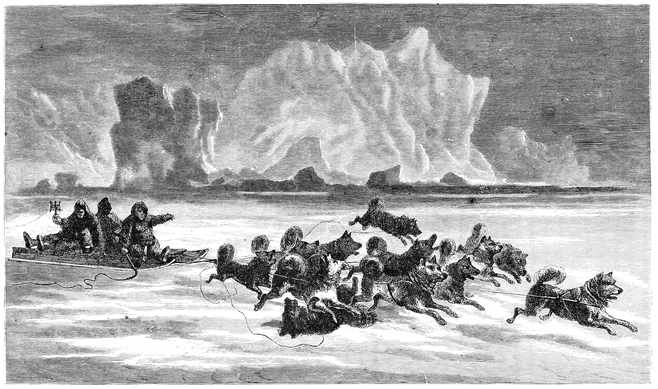
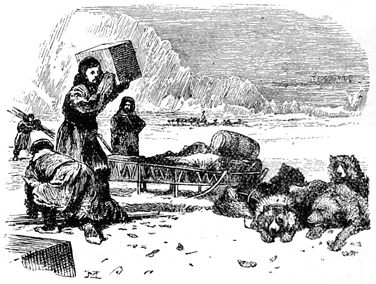
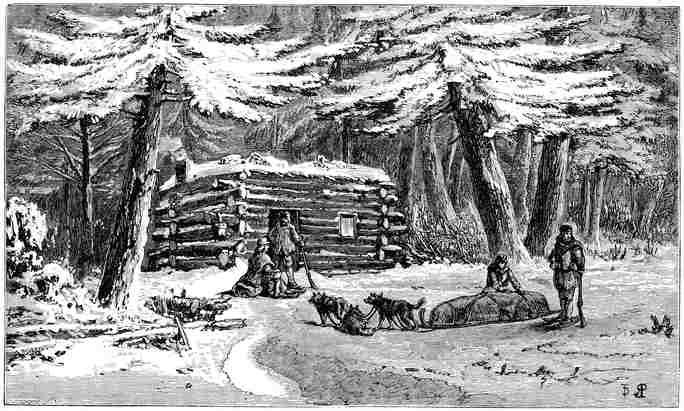
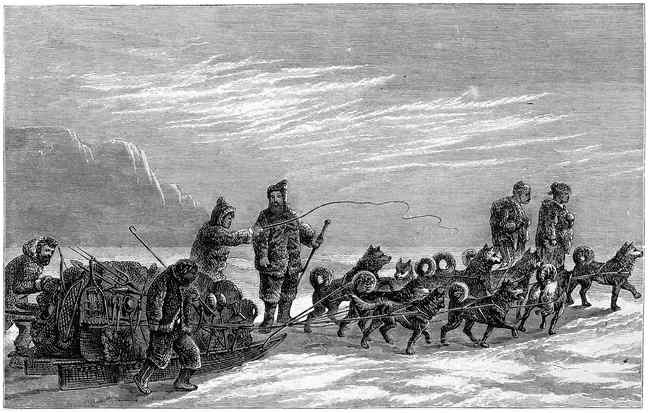
1. ESQUIMAUX DOG-TEAM.
By Dr. G. HARTWIG,
AUTHOR OF “THE SEA AND ITS LIVING WONDERS,” “THE HARMONIES OF NATURE,”
AND “THE TROPICAL WORLD.”
WITH ADDITIONAL CHAPTERS AND ONE HUNDRED AND SIXTY-THREE
ILLUSTRATIONS.
NEW YORK: HARPER & BROTHERS, PUBLISHERS, FRANKLIN SQUARE.
1869.
Entered, according to Act of Congress, in the year 1869, by
HARPER & BROTHERS,
In the Clerk’s Office of the District Court of the United States for the Southern
District of New York.
PREFACE.
The object of the following pages is to describe the Polar World in its
principal natural features, to point out the influence of its long winter-night
and fleeting summer on the development of vegetable and animal existence,
and finally to picture man waging the battle of life against the dreadful
climate of the high latitudes of our globe either as the inhabitant of
their gloomy solitudes, or as the bold investigator of their mysteries.
The table of contents shows the great variety of interesting subjects embraced
within a comparatively narrow compass; and as my constant aim has
been to convey solid instruction under an entertaining form, I venture to
hope that the public will grant this new work the favorable reception given
to my previous writings.
G. Hartwig.
NOTE BY THE AMERICAN EDITOR.
I have made no alterations in the text of Dr. Hartwig’s book beyond
changing the orthography of a few geographical and ethnological terms
so that they shall conform to the mode of representation usual in our maps
and books of travel. For example, I substitute Nova Zembla for “Novaya
Zemla”, and Samoïedes for “Samojedes.” Here and there throughout the
work I have added a sentence or a paragraph. The two chapters on
“Alaska” and “The Innuits” have been supplied by me; and for them
Dr. Hartwig is in no way responsible.
The Illustrations have been wholly selected and arranged by me. I found
at my disposal an immense number of illustrations which seemed to me better
to elucidate the text than those introduced by Dr. Hartwig. In the List
of Illustrations the names of the authors to whom I am indebted are supplied.
The following gives the names of the authors, and the titles of
the works from which the illustrations have been taken:
Atkinson, Thomas Witlam: “Travels in the Regions of the Upper Amoor;” and “Oriental
and Western Siberia.”
Browne, J. Ross: “The Land of Thor.”
Dufferin, Lord: “Letters from High Latitudes.”
Hall, Charles Francis: “Arctic Researches, and Life among the Esquimaux.”
Harper’s Magazine: The Illustrations credited to this periodical have been furnished during
many years by more than a score of travellers and voyagers. They are in every case authentic.
Lamont, James: “Seasons with the Sea-Horses; or, Sporting Adventures in the Northern Seas.”
Milton, Viscount: “North-west Passage by Land.”
Whymper, Frederick: “Alaska, and British America.”
Wood, Rev. J. G.: “Natural History;” and “Homes without Hands.”
I trust that I have throughout wrought in the spirit of the author; and
that my labors will enhance the value of his admirable book.
The barren Grounds or Tundri.—Abundance of animal Life on the Tundri in Summer.—Their Silence and Desolation in Winter.—Protection afforded to Vegetation by the Snow.—Flower-growth in the highest Latitudes.—Character of Tundra Vegetation.—Southern Boundary-line of the barren Grounds.—Their Extent.—The forest Zone.—Arctic Trees.—Slowness of their Growth.—Monotony of the Northern Forests.—Mosquitoes.—The various Causes which determine the Severity of an Arctic Climate.—Insular and Continental Position.—Currents.—Winds.—Extremes of Cold observed by Sir E. Belcher and Dr. Kane.—How is Man able to support the Rigors of an Arctic Winter?—Proofs of a milder Climate having once reigned in the Arctic Regions.—Its Cause according to Dr. Oswald Heer.—Peculiar Beauties of the Arctic Regions.—Sunset.—Long lunar Nights.—The Aurora.
The Reindeer.—Structure of its Foot.—Clattering Noise when walking.—Antlers.—Extraordinary olfactory Powers.—The Icelandic Moss.—Present and Former Range of the Reindeer.—Its invaluable Qualities as an Arctic domestic Animal.—Revolts against Oppression.—Enemies of the Reindeer.—The Wolf.—The Glutton or Wolverine.—Gad-flies.—The Elk or Moose-deer.—The Musk-ox.—The Wild Sheep of the Rocky Mountains.—The Siberian Argali.—The Arctic Fox.—Its Burrows.—The Lemmings.—Their Migrations and Enemies.—Arctic Anatidæ.—The Snow-bunting.—The Lapland Bunting.—The Sea-eagle.—Drowned by a Dolphin.
Dangers peculiar to the Arctic Sea.—Ice-fields.—Hummocks.—Collision of Ice-fields.—Icebergs.—Their Origin.—Their Size.—The Glaciers which give them Birth.—Their Beauty.—Sometimes useful Auxiliaries to the Mariner.—Dangers of anchoring to a Berg.—A crumbling Berg.—The Ice-blink.—Fogs.—Transparency of the Atmosphere.—Phenomena of Reflection and Refraction.—Causes which prevent the Accumulation of Polar Ice.—Tides.—Currents.—Ice a bad Conductor of Heat.—Wise Provisions of Nature.
Populousness of the Arctic Seas.—The Greenland Whale.—The Fin Whales.—The Narwhal.—The Beluga, or White Dolphin.—The Black Dolphin.—His wholesale Massacre on the Faeroe Islands.—The Orc, or Grampus.—The Seals.—The Walrus.—Its acute Smell.—History of a young Walrus.—Parental Affection.—The Polar Bear.—His Sagacity.—Hibernation of the She-bear.—Sea-birds.
Volcanic Origin of the Island.—The Klofa Jökul.—Lava-streams.—The Burning Mountains of Krisuvik.—The Mud-caldrons of Reykjahlid.—The Tungo-hver at Reykholt.—The Great Geysir.—The Strokkr.—Crystal Pools.—The Almanuagja.—The Surts-hellir.—Beautiful Ice-cave.—The Gotha Foss.—The Detti Foss.—Climate.—Vegetation.—Cattle.—Barbarous Mode of Sheep-sheering.—Reindeer.—Polar Bears.—Birds.—The Eider-duck.—Videy.—Vigr.—The Wild Swan.—The Raven.—The Jerfalcon.—The Giant auk, or Geirfugl.—Fish.—Fishing Season.—The White Shark.—Mineral Kingdom.—Sulphur.—Peat.—Drift-wood.
Discovery of the Island by Naddodr in 861.—Gardar.—Floki of the Ravens.—Ingolfr and Leif.—Ulfliot the Lawgiver.—The Althing.—Thingvalla.—Introduction of Christianity into the Island.—Frederick the Saxon and Thorwold the Traveller.—Thangbrand.—Golden Age of Icelandic Literature.—Snorri Sturleson.—The Island submits to Hakon, King of Norway, in 1254.—Long Series of Calamities.—Great Eruption of the Skapta Jökul in 1783.—Commercial Monopoly.—Better Times in Prospect.
Skalholt.—Reykjavik.—The Fair.—The Peasant and the Merchant.—A Clergyman in his Cups.—Hay-making.—The Icelander’s Hut.—Churches.—Poverty of the Clergy.—Jon Thorlaksen.—The Seminary of Reykjavik.—Beneficial Influence of the Clergy.—Home Education.—The Icelander’s Winter’s Evening.—Taste for Literature.—The Language.—The Public Library at Reykjavik.—The Icelandic Literary Society.—Icelandic Newspapers.—Longevity.—Leprosy.—Travelling in Iceland.—Fording the Rivers.—Crossing of the Skeidara by Mr. Holland.—A Night’s Bivouac.
The Westmans.—Their extreme Difficulty of Access.—How they became peopled.—Heimaey.—Kaufstathir and Ofanleyte.—Sheep-hoisting.—Egg-gathering.—Dreadful Mortality among the Children.—The Ginklofi.—Gentleman John.—The Algerine Pirates.—Dreadful Sufferings of the Islanders.
Mild Climate of the Norwegian Coast.—Its Causes.—The Norwegian Peasant.—Norwegian Constitution.—Romantic coast Scenery.—Drontheim.—Greiffenfeld Holme and Väre.—The Sea-eagle.—The Herring-fisheries.—The Lofoten Islands.—The Cod-fisheries.—Wretched Condition of the Fishermen.—Tromsö.—Altenfiord.—The Copper Mines.—Hammerfest the most northern Town in the World.—The North Cape.
The west Coast of Spitzbergen.—Ascension of a Mountain by Dr. Scoresby.—His Excursion along the Coast.—A stranded Whale.—Magdalena Bay.—Multitudes of Sea-birds.—Animal Life.—Midnight Silence.—Glaciers.—A dangerous Neighborhood.—Interior Plateau.—Flora of Spitzbergen.—Its Similarity with that of the Alps above the Snow-line.—Reindeer.—The hyperborean Ptarmigan.—Fishes.—Coal.—Drift-wood.—Discovery of Spitzbergen by Barentz, Heemskerk, and Ryp.—Brilliant Period of the Whale-fishery.—Coffins.—Eight English Sailors winter in Spitzbergen, 1630.—Melancholy Death of some Dutch Volunteers.—Russian Hunters.—Their Mode of wintering in Spitzbergen.—Scharostin.—Walrus-ships from Hammerfest and Tromsö.—Bear or Cherie Island.—Bennet.—Enormous Slaughter of Walruses.—Mildness of its Climate.—Mount Misery.—Adventurous Boat-voyage of some Norwegian Sailors.—Jan Meyen.—Beerenberg.
The Sea of Kara.—Loschkin.—Rosmysslow.—Lütke.—Krotow.—Pachtussow.—Sails along the eastern Coast of the Southern Island to Matoschkin Schar.—His second Voyage and Death.—Meteorological Observations of Ziwolka.—The cold Summer of Nova Zembla.—Von Baer’s scientific Voyage to Nova Zembla.—His Adventures in Matoschkin Schar.—Storm in Kostin Schar.—Sea Bath and votive Cross.—Botanical Observations.—A natural Garden.—Solitude and Silence.—A Bird Bazar.—Hunting Expeditions of the Russians to Nova Zembla.
Their ancient History and Conversion to Christianity.—Self-denial and Poverty of the Lapland Clergy.—Their singular Mode of Preaching.—Gross Superstition of the Lapps.—The Evil Spirit of the Woods.—The Lapland Witches.—Physical Constitution of the Lapps.—Their Dress.—The Fjälllappars.—Their Dwellings.—Store-houses.—Reindeer Pens.—Milking the Reindeer.—Migration.—The Lapland Dog.—Skiders, or Skates.—The Sledge, or Pulka.—Natural Beauties of Lapland.—Attachment of the Lapps to their Country.—Bear-hunting.—Wolf-hunting.—Mode of Living of the wealthy Lapps.—How they kill the Reindeer.—Visiting the Fair.—Mammon Worship.—Treasure-hiding.—“Tabak, or Braende.”—Affectionate Disposition of the Lapps.—The Skogslapp.—The Fisherlapp.
His Birthplace and first Studies.—Journey in Lapland, 1838.—The Iwalojoki.—The Lake of Enara.—The Pastor of Utzjoki.—From Rowaniémi to Kemi.—Second Voyage, 1841–44.—Storm on the White Sea.—Return to Archangel.—The Tundras of the European Samoïedes.—Mesen.—Universal Drunkenness.—Sledge Journey to Pustosersk.—A Samoïede Teacher.—Tundra Storms.—Abandoned and alone in the Wilderness.—Pustosersk.—Our Traveller’s Persecutions at Ustsylmsk and Ishemsk.—The Uusa.—Crossing the Ural.—Obdorsk.—Second Siberian Journey, 1845–48.—Overflowing of the Obi.—Surgut.—Krasnojarsk.—Agreeable Surprise.—Turuchansk.—Voyage down the Jenissei.—Castrén’s Study at Plachina.—From Dudinka to Tolstoi Noss.—Frozen Feet.—Return Voyage to the South.—Frozen fast on the Jenissei.—Wonderful Preservation.—Journey across the Chinese Frontiers, and to Transbaikalia.—Return to Finland.—Professorship at Helsingfors.—Death of Castrén, 1855.
Their Barbarism.—Num, or Jilibeambaertje.—Shamanism.—Samoïede Idols.—Sjadæi.—Hahe.—The Tadebtsios, or Spirits.—The Tadibes, or Sorcerers.—Their Dress.—Their Invocations.—Their conjuring Tricks.—Reverence paid to the Dead.—A Samoïede Oath.—Appearance of the Samoïedes.—Their Dress.—A Samoïede Belle.—Character of the Samoïedes.—Their decreasing Numbers.—Traditions of ancient Heroes.
What is the Obi?—Inundations.—An Ostiak summer Yourt.—Poverty of the Ostiak Fishermen.—A winter Yourt.—Attachment of the Ostiaks to their ancient Customs.—An Ostiak Prince.—Archery.—Appearance and Character of the Ostiaks.—The Fair of Obdorsk.
CONQUEST OF SIBERIA BY THE RUSSIANS—THEIR VOYAGES OF DISCOVERY ALONG THE SHORES OF THE POLAR SEA.
Ivan the Terrible.—Strogonoff.—Yermak, the Robber and Conqueror.—His Expeditions to Siberia.—Battle of Tobolsk.—Yermak’s Death.—Progress of the Russians to Ochotsk.—Semen Deshnew.—Condition of the Siberian Natives under the Russian Yoke.—Voyages of Discovery in the Reign of the Empress Anna.—Prontschischtschew.—Chariton and Demetrius Laptew.—An Arctic Heroine.—Schalaurow.—Discoveries in the Sea of Bering and in the Pacific Ocean.—The Lächow Islands.—Fossil Ivory.—New Siberia.—The wooden Mountains.—The past Ages of Siberia.
Siberia.—Its immense Extent and Capabilities.—The Exiles.—Mentschikoff.—Dolgorouky.—Münich.—The Criminals.—The free Siberian Peasant.—Extremes of Heat and Cold.—Fur-bearing Animals.—The Sable.—The Ermine.—The Siberian Weasel.—The Sea-otter.—The black Fox.—The Lynx.—The Squirrel.—The varying Hare.—The Suslik.—Importance of the Fur-trade for the Northern Provinces of the Russian Empire.—The Gold-diggings of Eastern Siberia.—The Taiga.—Expenses and Difficulties of searching Expeditions.—Costs of Produce, and enormous Profits of successful Speculators.—Their senseless Extravagance.—First Discovery of Gold in the Ural Mountains.—Jakowlew and Demidow.—Nishne-Tagilsk.
For what Purpose was Middendorff’s Voyage to Taimurland undertaken?—Difficulties and Obstacles.—Expedition down the Taimur River to the Polar Sea.—Storm on Taimur Lake.—Loss of the Boat.—Middendorff ill and alone in 75° N. Lat.—Saved by a grateful Samoïede.—Climate and Vegetation of Taimurland.
Their energetic Nationality.—Their Descent.—Their gloomy Character.—Summer and Winter Dwellings.—The Jakut Horse.—Incredible Powers of Endurance of the Jakuts.—Their Sharpness of Vision.—Surprising local Memory.—Their manual Dexterity.—Leather, Poniards, Carpets.—Jakut Gluttons.—Superstitious Fear of the Mountain-spirit Ljeschei.—Offerings of Horse-hair.—Improvised Songs.—The River Jakut.
His distinguished Services as an Arctic Explorer.—From Petersburg to Jakutsk in 1820.—Trade of Jakutsk.—From Jakutsk to Nishne-Kolymsk.—The Badarany.—Dreadful Climate of Nishne-Kolymsk.—Summer Plagues.—Vegetation.—Animal Life.—Reindeer-hunting.—Famine.—Inundations.—The Siberian Dog.—First Journeys over the Ice of the Polar Sea, and Exploration of the Coast beyond Cape Shelagskoi in 1821.—Dreadful Dangers and Hardships.—Matiuschkin’s Sledge-journey over the Polar Sea in 1822.—Last Adventures on the Polar Sea.—A Run for Life.—Return to St. Petersburg.
Their Relationship to the Mantchou.—Dreadful Condition of the outcast Nomads.—Character of the Tungusi.—Their Outfit for the Chase.—Bear-hunting.—Dwellings.—Diet.—A Night’s Halt with Tungusi in the Forest.—Ochotsk.
His Birth.—Enters the Russian Service.—Scientific Journey to Kamchatka.—Accompanies Bering on his second Voyage of Discovery.—Lands on the Island of Kaiak.—Shameful Conduct of Bering.—Shipwreck on Bering Island.—Bering’s Death.—Return to Kamchatka.—Loss of Property.—Persecutions of the Siberian Authorities.—Frozen to Death at Tjumen.
Climate.—Fertility.—Luxuriant Vegetation.—Fish.—Sea-birds.—Kamchatkan Bird-catchers.—The Bay of Avatscha.—Petropavlosk.—The Kamchatkans.—Their physical and moral Qualities.—The Fritillaria Sarrana.—The Muchamor.—Bears.—Dogs.
The Land of the Tchuktchi.—Their independent Spirit and commercial Enterprise.—Perpetual Migrations.—The Fair of Ostrownoje.—Visit in a Tchuktch Polog.—Races.—Tchuktch Bayaderes.—The Tennygk, or Reindeer Tchuktchi.—The Onkilon, or Sedentary Tchuktchi.—Their Mode of Life.
Purchase of Alaska by the United States.—The Russian American Telegraph Scheme.—Whymper’s Trip up the Yukon.—Dogs.—The Start.—Extempore Water-filter.—Snow-shoes.—The Frozen Yukon.—Under-ground Houses.—Life at Nulato.—Cold Weather.—Auroras.—Approach of Summer.—Breaking-up of the Ice.—Fort Yukon.—Furs.—Descent of the Yukon.—Value of Goods.—Arctic and Tropical Life.—Moose-hunting.—Deer-corrals.—Lip Ornaments.—Canoes.—Four-post Coffin.—The Kenaian Indians.—The Aleuts.—Value of Alaska.
Their wide Extension.—Climate of the Regions they inhabit.—Their physical Appearance.—Their Dress.—Snow Huts.—The Kayak, or the Baidar.—Hunting Apparatus and Weapons.—Enmity between the Esquimaux and the Red Indian.—The “Bloody Falls.”—Chase of the Reindeer.—Bird-catching.—Whale-hunting.—Various Stratagems employed to catch the Seal.—The “Keep-kuttuk.”—Bear-hunting.—Walrus-hunting.—Awaklok and Myouk.—The Esquimaux Dog.—Games and Sports.—Angekoks.—Moral Character.—Self-reliance.—Intelligence.—Iligliuk.—Commercial Eagerness of the Esquimaux.—Their Voracity.—Seasons of Distress.
The Coureur des Bois.—The Voyageur.—The Birch-bark Canoe.—The Canadian Fur-trade in the last Century.—The Hudson’s Bay Company.—Bloody Feuds between the North-west Company of Canada and the Hudson’s Bay Company.—Their Amalgamation into a new Company in 1821.—Reconstruction of the Hudson’s Bay Company in 1863.—Forts or Houses.—The Attihawmeg.—Influence of the Company on its savage Dependents.—The Black Bear, or Baribal.—The Brown Bear.—The Grizzly Bear.—The Raccoon.—The American Glutton.—The Pine Marten.—The Pekan, or Wood-shock.—The Chinga.—The Mink.—The Canadian Fish-otter.—The Crossed Fox.—The Black or Silvery Fox.—The Canadian Lynx, or Pishu.—The Ice-hare.—The Beaver.—The Musquash.
The various Tribes of the Crees.—Their Conquests and subsequent Defeat.—Their Wars with the Blackfeet.—Their Character.—Tattooing.—Their Dress.—Fondness for their Children.—The Cree Cradle.—Vapor Baths.—Games.—Their religious Ideas.—The Cree Tartarus and Elysium.
The various Tribes of the Tinné Indians.—The Dog-ribs.—Clothing.—The Hare Indians.—Degraded State of the Women.—Practical Socialists.—Character.—Cruelty to the Aged and Infirm.
The Countries they inhabit.—Their Appearance and Dress.—Their Love of Finery.—Condition of the Women.—Strange Customs.—Character.—Feuds with the Esquimaux.—Their suspicious and timorous Lives.—Pounds for catching Reindeer.—Their Lodges.
ARCTIC VOYAGES OF DISCOVERY, FROM THE CABOTS TO BAFFIN.
First Scandinavian Discoverer of America.—The Cabots.—Willoughby and Chancellor (1553–1554).—Stephen Burrough (1556).—Frobisher (1576–1578).—Davis (1585–1587).—Barentz, Cornelis, and Brant (1594).—Wintering of the Dutch Navigators in Nova Zembla (1596–1597).—John Knight (1606).—Murdered by the Esquimaux.—Henry Hudson (1607–1609).—Baffin (1616).
ARCTIC VOYAGES OF DISCOVERY, FROM BAFFIN TO M’CLINTOCK.
Buchan and Franklin.—Ross and Parry (1818).—Discovery of Melville Island.—Winter Harbor (1819–1820).—Franklin’s first land Journey.—Dreadful Sufferings.—Parry’s second Voyage (1821–1823).—Iligliuk.—Lyon (1824).—Parry’s third Voyage (1824).—Franklin’s second land Journey to the Shores of the Polar Sea.—Beechey.—Parry’s sledge Journey towards the Pole.—Sir John Ross’s second Journey.—Five Years in the Arctic Ocean.—Back’s Discovery of Great Fish River.—Dease and Simpson (1837–1839).—Franklin and Crozier’s last Voyage (1845).—Searching Expeditions.—Richardson and Rae.—Sir James Ross.—Austin.—Penny.—De Haven.—Franklin’s first Winter-quarters discovered by Ommaney.—Kennedy and Bellot.—Inglefield.—Sir E. Belcher.—Kellett.—M’Clure’s Discovery of the North-west Passage.—Collinson.—Bellot’s Death.—Dr. Rae learns the Death of the Crews of the “Erebus” and “Terror.”—Sir Leopold M’Clintock.
Kane sails up Smith’s Sound in the “Advance” (1853).—Winters in Rensselaer Bay.—Sledge Journey along the Coast of Greenland.—The Three-brother Turrets.—Tennyson’s Monument.—The Great Humboldt Glacier.—Dr. Hayes crosses Kennedy Channel.—Morton’s Discovery of Washington Land.—Mount Parry.—Kane resolves upon a second Wintering in Rensselaer Bay.—Departure and Return of Part of the Crew.—Sufferings of the Winter.—The Ship abandoned.—Boat Journey to Upernavik.—Kane’s Death in the Havana (1857).—Dr. Hayes’s Voyage in 1860.—He winters at Port Foulke.—Crosses Kennedy Channel.—Reaches Cape Union, the most northern known Land upon the Globe.—Koldewey.—Plans for future Voyages to the North Pole.
Its desolate Aspect.—Forests.—Marshes.—Barrens.—Ponds.—Fur-bearing Animals.—Severity of Climate.—St. John’s.—Discovery of Newfoundland by the Scandinavians.—Sir Humphrey Gilbert.—Rivalry of the English and French.—Importance of the Fisheries.—The Banks of Newfoundland.—Mode of Fishing.—Throaters, Headers, Splitters, Salters, and Packers.—Fogs and Storms.—Seal-catching.
A mysterious Region.—Ancient Scandinavian Colonists.—Their Decline and Fall.—Hans Egede.—His Trials and Success.—Foundation of Godthaab.—Herrenhuth Missionaries.—Lindenow.—The Scoresbys.—Clavering.—The Danish Settlements in Greenland.—The Greenland Esquimaux.—Seal-catching.—The White Dolphin.—The Narwhal.—Shark-fishery.—Fiskernasset.—Birds.—Reindeer-hunting.—Indigenous Plants.—Drift-wood.—Mineral Kingdom.—Mode of Life of the Greenland Esquimaux.—The Danes in Greenland.—Beautiful Scenery.—Ice Caves.
Comparative View of the Antarctic and Arctic Regions.—Inferiority of Climate of the former.—Its Causes.—The New Shetland Islands.—South Georgia.—The Peruvian Stream.—Sea-birds.—The Giant Petrel.—The Albatross.—The Penguin.—The Austral Whale.—The Hunchback.—The Fin-back.—The Grampus.—Battle with a Whale.—The Sea-elephant.—The Southern Sea-bear.—The Sea-leopard.—Antarctic Fishes.
Cook’s Discoveries in the Antarctic Ocean.—Bellinghausen.—Weddell.—Biscoe.—Balleny.—Dumont d’Urville.—Wilkes.—Sir James Ross crosses the Antarctic Circle on New Year’s Day, 1841.—Discovers Victoria Land.—Dangerous Landing on Franklin Island.—An Eruption of Mount Erebus.—The Great Ice Barrier.—Providential Escape.—Dreadful Gale.—Collision.—Hazardous Passage between two Icebergs.—Termination of the Voyage.
Description of the Strait.—Western Entrance.—Point Dungeness.—The Narrows.—Saint Philip’s Bay.—Cape Froward.—Grand Scenery.—Port Famine.—The Sedger River.—Darwin’s Ascent of Mount Tarn.—The Bachelor River.—English Reach.—Sea Reach.—South Desolation.—Harbor of Mercy.—Williwaws.—Discovery of the Strait by Magellan (October 20, 1521).—Drake.—Sarmiento.—Cavendish.—Schouten and Le Maire.—Byron.—Bougainville.—Wallis and Carteret.—King and Fitzroy.—Settlement at Punta Arenas.—Increasing Passage through the Strait.—A future Highway of Commerce.
Difference of Climate between East and West Patagonia.—Extraordinary Aridity of East Patagonia.—Zoology.—The Guanaco.—The Tucutuco.—The Patagonian Agouti.—Vultures.—The Turkey-buzzard.—The Carrancha.—The Chimango.—Darwin’s Ostrich.—The Patagonians.—Exaggerated Accounts of their Stature.—Their Physiognomy and Dress.—Religious Ideas.—Superstitions.—Astronomical Knowledge.—Division into Tribes.—The Tent, or Toldo.—Trading Routes.—The great Cacique.—Introduction of the Horse.—Industry.—Amusements.—Character.
Their miserable Condition.—Degradation of Body and Mind.—Powers of Mimicry.—Notions of Barter.—Causes of their low State of Cultivation.—Their Food.—Limpets.—Cyttaria Darwini.—Constant Migrations.—The Fuegian Wigwam.—Weapons.—Their probable Origin.—Their Number, and various Tribes.—Constant Feuds.—Cannibalism.—Language.—Adventures of Fuegia Basket, Jemmy Button, and York Minster.—Missionary Labors.—Captain Gardiner.—His lamentable End.
Hall’s Expedition.—His early Life.—His reading of Arctic Adventure.—His Resolve.—His Arctic Outfit.—Sets sail on the “George Henry.”—The Voyage.—Kudlago.—Holsteinborg, Greenland.—Population of Greenland.—Sails for Davis’s Strait.—Character of the Innuits.—Wreck of the “Rescue.”—Ebierbing and Tookoolito.—Their Visit to England.—Hall’s first Exploration.—European and Innuit Life in the Arctic Regions.—Building an Igloo.—Almost Starved.—Fight for Food with Dogs.—Ebierbing arrives with a Seal.—How he caught it.—A Seal-feast.—The Innuits and Seals.—The Polar Bear.—How he teaches the Innuits to catch Seals.—At a Seal-hole.—Dogs as Seal-hunters.—Dogs and Bears.—Dogs and Reindeers.—Innuits and Walruses.—More about Igloos.—Innuit Implements.—Uses of the Reindeer.—Innuit Improvidence.—A Deer-feast.—A frozen Delicacy.—Whale-skin as Food.—Whale-gum.—How to eat Whale Ligament.—Raw Meat.—The Dress of the Innuits.—A pretty Style.—Religious Ideas of the Innuits.—Their kindly Character.—Treatment of the Aged and Infirm.—A Woman abandoned to die.—Hall’s Attempt to rescue her.—The Innuit Nomads, without any form of Government.—Their Numbers diminishing.—A Sailor wanders away.—Hall’s Search for him.—Finds him frozen to death.—The Ship free from Ice.—Preparations to return.—Reset in the Ice-pack.—Another Arctic Winter.—Breaking up of the Ice.—Departure for Home.—Tookoolito and her Child “Butterfly.”—Death of “Butterfly.”—Arrival at Home.—Results of Hall’s Expedition.—Innuit Traditions.—Discovery of Frobisher Relics.—Hall undertakes a second Expedition.—His Statement of its Object and Prospects.—Last Tidings of Hall.
The barren Grounds or Tundri.—Abundance of animal Life on the Tundri in Summer.—Their Silence
and Desolation in Winter.—Protection afforded to Vegetation by the Snow.—Flower-growth in
the highest Latitudes.—Character of Tundra Vegetation.—Southern Boundary-line of the barren
Grounds.—Their Extent.—The forest Zone.—Arctic Trees.—Slowness of their Growth.—Monotony
of the Northern Forests.—Mosquitoes.—The various Causes which determine the Severity of an
Arctic Climate.—Insular and Continental Position.—Currents.—Winds.—Extremes of Cold observed
by Sir E. Belcher and Dr. Kane.—How is Man able to support the Rigors of an Arctic Winter?—Proofs
of a milder Climate having once reigned in the Arctic Regions.—Its Cause according to
Dr. Oswald Heer.—Peculiar Beauties of the Arctic Regions.—Sunset.—Long lunar Nights.—The
Aurora.
A glance at a map of the Arctic regions shows us that many of the
rivers belonging to the three continents—Europe, Asia, America—discharge
their waters into the Polar Ocean or its tributary bays. The territories
drained by these streams, some of which (such as the Mackenzie, the
Yukon, the Lena, the Yenisei, and the Obi) rank among the giant rivers of
the earth, form, along with the islands within or near the Arctic circle, the
vast region over which the frost-king reigns supreme.
Man styles himself the lord of the earth, and may with some justice lay
claim to the title in more genial lands where, armed with the plough, he compels
the soil to yield him a variety of fruits; but in those desolate tracts
which are winter-bound during the greater part of the year, he is generally a
mere wanderer over its surface—a hunter, a fisherman, or a herdsman—and
but few small settlements, separated from each other by immense deserts,
give proof of his having made some weak attempts to establish a footing.
It is difficult to determine with precision the limits of the Arctic lands, since
many countries situated as low as latitude 60° or even 50°, such as South
Greenland, Labrador, Alaska, Kamchatka, or the country about Lake Baikal,
have in their climate and productions a decidedly Arctic character, while others
of a far more northern position, such as the coast of Norway, enjoy even in
winter a remarkably mild temperature. But they are naturally divided into
two principal and well-marked zones—that of the forests, and that of the treeless
wastes.
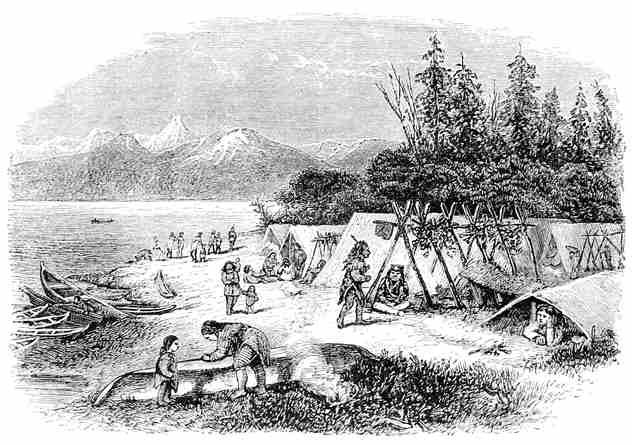
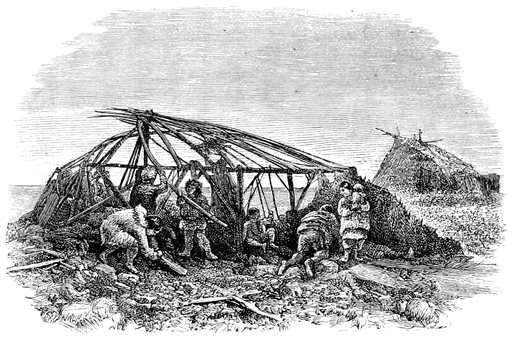
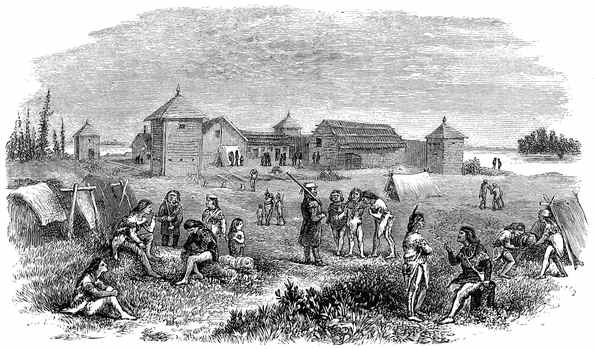
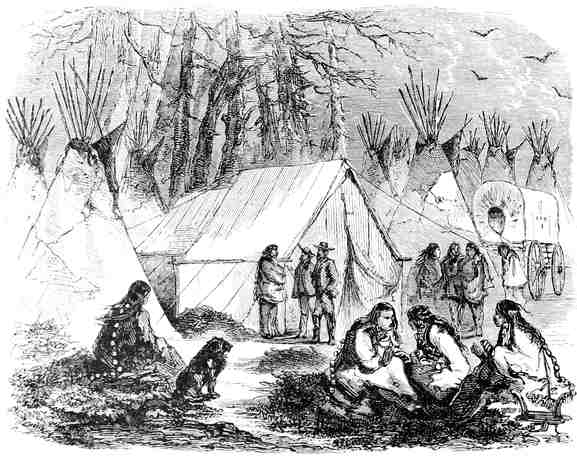
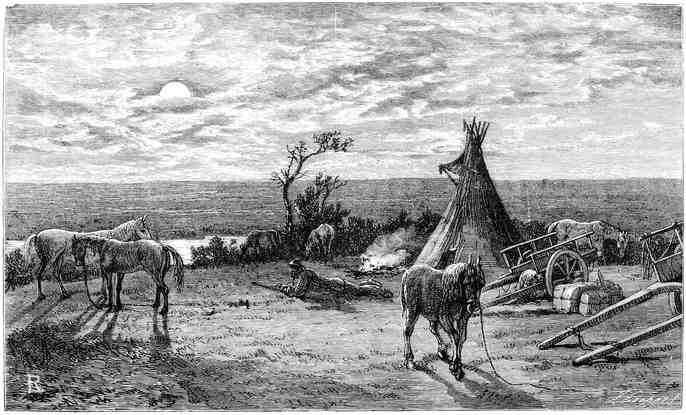
3. INDIAN SUMMER ENCAMPMENT, ALASKA.
The latter, comprising the islands within the Arctic Circle, form a belt, more
or less broad, bounded by the continental shores of the North Polar seas, and
gradually merging toward the south into the forest-region, which encircles
them with a garland of evergreen coniferæ. This treeless zone bears the
name of the “barren grounds,” or the “barrens,” in North America, and of
“tundri” in Siberia and European Russia. Its want of trees is caused not
so much by its high northern latitude as by the cold sea-winds which sweep
unchecked over the islands or the flat coast-lands of the Polar Ocean, and
for miles and miles compel even the hardiest plant to crouch before the blast
and creep along the ground.
Nothing can be more melancholy than the aspect of the boundless morasses
or arid wastes of the tundri. Dingy mosses and gray lichens form the chief
vegetation, and a few scanty grasses or dwarfish flowers that may have found
a refuge in some more sheltered spot are unable to relieve the dull monotony
of the scene.
In winter, when animal life has mostly retreated to the south or sought a
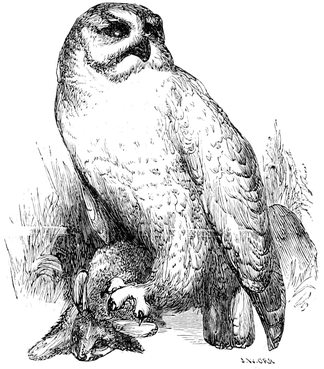
refuge in burrows or in caves, an awful silence, interrupted only by the hooting
of a snow-owl or the yelping of a fox, reigns over their vast expanse; but in
spring, when the brown earth reappears from under the melted snow and the
swamps begin to thaw, enormous flights of wild birds appear upon the scene
and enliven it for a few months. An admirable instinct leads their winged
legions from distant climes to the Arctic wildernesses, where in the morasses
or lakes, on the banks of the rivers, on the flat strands, or along the fish-teeming
coasts, they find an abundance of food, and where at the same time they
can with greater security build their nests and rear their young. Some remain
on the skirts of the forest-region; others, flying farther northward, lay
their eggs upon the naked tundra. Eagles and hawks follow the traces of the
natatorial and strand birds; troops of ptarmigans roam among the stunted
bushes; and when the sun shines, the finch or the snow-bunting warbles his
merry note.
While thus the warmth of summer attracts hosts of migratory birds to the
Arctic wildernesses, shoals of salmon and sturgeons enter the rivers in obedience
to the instinct that forces them to quit the seas and to swim stream
upward, for the purpose of depositing their spawn in the tranquil sweet waters
of the stream or lake. About this time also the reindeer leaves the
forests to feed on the herbs and lichens of the tundra, and to seek along the
shores fanned by the cooled sea-breeze some protection against the attacks of
the stinging flies that rise in myriads from the swamps. Thus during several
months the tundra presents an animated scene, in which man also plays his
part. The birds of the air, the fishes of the water, the beasts of the earth, are
all obliged to pay their tribute to his various wants, to appease his hunger, to
clothe his body, or to gratify his greed of gain.
But as soon as the first frosts of September announce the approach of winter,
all animals, with but few exceptions, hasten to leave a region where the
sources of life must soon fail. The geese, ducks, and swans return in dense
flocks to the south; the strand-birds seek in some lower latitude a softer soil
which allows their sharp beak to seize a burrowing prey; the water-fowl forsake
the bays and channels that will soon be blocked up with ice; the reindeer
once more return to the forest, and in a short time nothing is left that can induce
man to prolong his stay in the treeless plain. Soon a thick mantle of
snow covers the hardened earth, the frozen lake, the ice-bound river, and conceals
them all—seven, eight, nine months long—under its monotonous pall,
except where the furious north-east wind sweeps it away and lays bare the
naked rock.
This snow, which after it has once fallen persists until the long summer’s
day has effectually thawed it, protects in an admirable manner the vegetation
of the higher latitudes against the cold of the long winter season. For snow
is so bad a conductor of heat, that in mid-winter in the high latitude of 78°
50° (Rensselaer Bay), while the surface temperature was as low as -30°, Kane
found at two feet deep a temperature of -8°, at four feet +2°, and at eight
feet +26°, or no more than six degrees below the freezing-point of water.
Thus covered by a warm crystal snow-mantle, the northern plants pass the long
winter in a comparatively mild temperature, high enough to maintain their life,
while, without, icy blasts—capable of converting mercury into a solid body—howl
over the naked wilderness; and as the first snow-falls are more cellular
and less condensed than the nearly impalpable powder of winter, Kane justly
observes that no “eider-down in the cradle of an infant is tucked in more
kindly than the sleeping-dress of winter about the feeble plant-life of the Arctic
zone.” Thanks to this protection, and to the influence of a sun which for
months circles above the horizon, and in favorable localities calls forth the powers
of vegetation in an incredibly short time, even Washington, Grinnell Land,
and Spitzbergen are able to boast of flowers. Morton plucked a crucifer at
Cape Constitution (80° 45’ N. lat.), and, on the banks of Mary Minturn River
(78° 52’), Kane came across a flower-growth which, though drearily Arctic in
its type, was rich in variety and coloring. Amid festuca and other tufted
grasses twinkled the purple lychnis and the white star of the chickweed; and,
not without its pleasing associations, he recognized a solitary hesperis—the
Arctic representative of the wall-flowers of home.
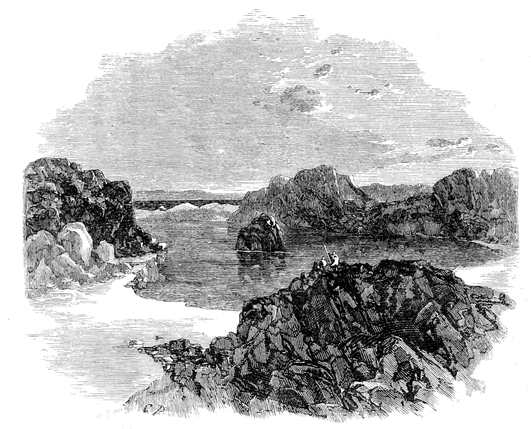
4. ROCKS AND ICE.
Next to the lichens and mosses, which form the chief vegetation of the
treeless zone, the cruciferæ, the grasses, the saxifragas, the caryophyllæ, and
the compositæ are the families of plants most largely represented, in the barren
grounds or tundri. Though vegetation becomes more and more uniform on
advancing to the north, yet the number of individual plants does not decrease.
When the soil is moderately dry, the surface is covered by a dense carpet of
lichens (Corniculariæ), mixed in damper spots with Icelandic moss. In more
tenacious soils, other plants flourish, not however to the exclusion of lichens, except
in tracts of meadow ground, which occur in sheltered situations, or in the
alluvial inundated flats where tall reed-grasses or dwarf willows frequently
grow as closely as they can stand.
5. COAST OF LABRADOR.
It may easily be supposed that the boundary-line which separates the tundri
from the forest zone is both indistinct and irregular. In some parts where
the cold sea-winds have a wider range, the barren grounds encroach considerably
upon the limits of the forests; in others, where the configuration of the
land prevents their action, the woods advance farther to the north.
6. COAST OF NORWAY.
Thus the barren grounds attain their most southerly limit in Labrador,
where they descend to latitude 57°, and this is sufficiently explained by the
position of that bleak peninsula, bounded on three sides by icy seas, and washed
by cold currents from the north. On the opposite coasts of Hudson’s Bay
they begin about 60°, and thence gradually rise toward the mouth of the
Mackenzie, where the forests advance as high as 68°, or even still farther to the
north along the low banks of that river. From the Mackenzie the barrens
again descend until they reach Bering’s Sea in 65° N. On the opposite or
Asiatic shore, in the land of the Tchuktchi, they begin again more to the south,
in 63°, thence continually rise as far as the Lena, where Anjou found trees in
71° N., and then fall again toward the Obi, where the forests do not even reach
the Arctic circle. From the Obi the tundri retreat farther and farther to the
north, until finally, on the coasts of Norway, in latitude 70°, they terminate
with the land itself.
Hence we see that the treeless zone of Europe, Asia, and America occupies
a space larger than the whole of Europe. Even the African Sahara, or the
Pampas of South America, are inferior in extent to the Siberian tundri. But
the possession of a few hundred square miles of fruitful territory on the south-western
frontiers of his vast empire would be of greater value to the Czar than
that of those boundless wastes, which are tenanted only by a few wretched
pastoral tribes, or some equally wretched fishermen.
7. ARCTIC FOREST.
The Arctic forest-regions are of a still greater extent than the vast treeless
plains which they encircle. When we consider that they form an almost continuous
belt, stretching through three parts of the world, in a breadth of from
15° to 20°, even the woods of the Amazon, which cover a surface fifteen times
greater than that of the United Kingdom, shrink into comparative insignificance.
Unlike the tropical forests, which are characterized by an immense
variety of trees, these northern woods are almost entirely composed of coniferæ,
and one single kind of fir or pine often covers an immense extent of
ground. The European and Asiatic species differ, however, from those which
grow in America.
8. VERGE OF FOREST REGION.
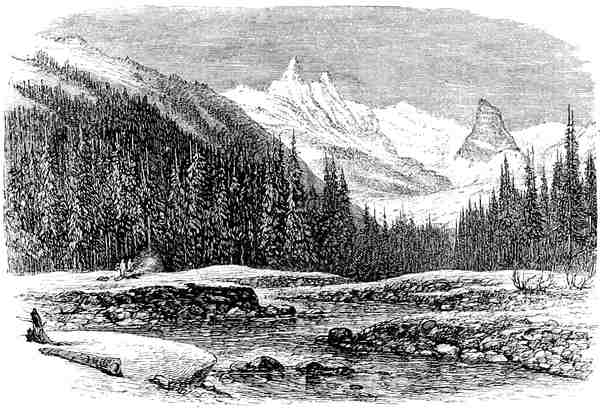
Thus in the Russian empire and Scandinavia we find the Scotch fir (Pinus
sylvestris), the Siberian fir and larch (Abies sibirica, Larix sibirica), the Picea
obovata, and the Pinus cembra; while in the Hudson’s Bay territories the
woods principally consist of the white and black spruce (Abies alba and
nigra), the Canadian larch (Larix canadensis), and the gray pine (Pinus
banksiana). In both continents birch-trees grow farther to the north than
the coniferæ, and the dwarf willows form dense thickets on the shores of every
river and lake. Various species of the service-tree, the ash, and the elder are
also met with in the Arctic forests; and both under the shelter of the woods
and beyond their limits, nature, as if to compensate for the want of fruit-trees,
produces in favorable localities an abundance of bilberries, bogberries, cranberries,
etc. (Empetrum, Vaccinium), whose fruit is a great boon to man and
beast. When congealed by the autumnal frosts, the berries frequently remain
hanging on the bushes until the snow melts in the following June, and are
then a considerable resource to the flocks of water-fowl migrating to their
northern breeding-places, or to the bear awakening from his winter sleep.
Another distinctive character of the forests of the high latitudes is their
apparent youth, so that generally the traveller would hardly suppose them to
be more than fifty years, or at most a century old. Their juvenile appearance
increases on advancing northward, until suddenly their decrepit age is revealed
by the thick bushes of lichens which clothe or hang down from their
shrivelled boughs. Farther to the south, large trees are found scattered here
and there, but not so numerous as to modify the general appearance of the
forest, and even these are mere dwarfs when compared with the gigantic firs
of more temperate climates. This phenomenon is sufficiently explained by the
shortness of the summer, which, though able to bring forth new shoots, does
not last long enough for the formation of wood. Hence the growth of trees
becomes slower and slower on advancing to the north; so that on the banks
of the Great Bear Lake, for instance, 400 years are necessary for the formation
of a trunk not thicker than a man’s waist. Toward the confines of the tundra,
the woods are reduced to stunted stems, covered with blighted buds that have
been unable to develop themselves into branches, and which prove by their
numbers how frequently and how vainly they have striven against the wind,
until finally the last remnants of arboreal vegetation, vanquished by the blasts
of winter, seek refuge under a carpet of lichens and mosses, from which their
annual shoots hardly venture to peep forth.
A third peculiarity which distinguishes the forests of the north from those
of the tropical world is what may be called their harmless character. There
the traveller finds none of those noxious plants whose juices contain a deadly
poison, and even thorns and prickles are of rare occurrence. No venomous
snake glides through the thicket; no crocodile lurks in the swamp; and the
northern beasts of prey—the bear, the lynx, the wolf—are far less dangerous
and blood-thirsty than the large felidæ of the torrid zone.
The comparatively small number of animals living in the Arctic forests
corresponds with the monotony of their vegetation. Here we should seek in
vain for that immense variety of insects, or those troops of gaudy birds which
in the Brazilian woods excite the admiration, and not unfrequently cause the
despair of the wanderer; here we should in vain expect to hear the clamorous
voices that resound in the tropical thickets. No noisy monkeys or quarrelsome
parrots settle on the branches of the trees; no shrill cicadæ or melancholy
goat-suckers interrupt the solemn stillness of the night; the howl of the
hungry wolf, or the hoarse screech of some solitary bird of prey, are almost
the only sounds that ever disturb the repose of these awful solitudes. When
the tropical hurricane sweeps over the virgin forests, it awakens a thousand
voices of alarm; but the Arctic storm, however furiously it may blow, scarcely
calls forth an echo from the dismal shades of the pine-woods of the north.
In one respect only the forests and swamps of the northern regions vie in
abundance of animal life with those of the equatorial zone, for the legions of
gnats which the short polar summer calls forth from the Arctic morasses are a
no less intolerable plague than the mosquitoes of the tropical marshes.
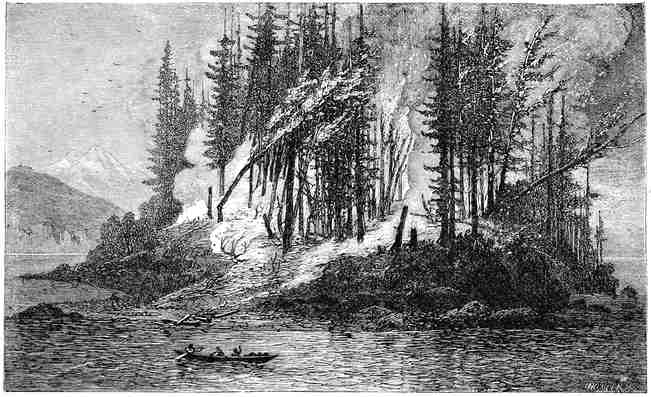
9. FOREST CONFLAGRATION.
Though agriculture encroaches but little upon the Arctic woods, yet the
agency of man is gradually working a change in their aspect. Large tracts of
forest are continually wasted by extensive fires, kindled accidentally or intentionally,
which spread with rapidity over a wide extent of country, and continue
to burn until they are extinguished by a heavy rain. Sooner or later a
new growth of timber springs up, but the soil, being generally enriched and
saturated with alkali, now no longer brings forth its aboriginal firs, but gives
birth to a thicket of beeches (Betula alba) in Asia, or of aspens in America.
The line of perpetual snow may naturally be expected to descend lower and
lower on advancing to the pole, and hence many mountainous regions or elevated
plateaux, such as the interior of Spitzbergen, of Greenland, of Nova
Zembla, etc., which in a more temperate clime would be verdant with woods
or meadows, are here covered with vast fields of ice, from which frequently
glaciers descend down to the verge of the sea. But even in the highest northern
latitudes, no land has yet been found covered as far as the water’s edge
with eternal snow, or where winter has entirely subdued the powers of vegetation.
The reindeer of Spitzbergen find near 80° N. lichens or grasses to feed
upon; in favorable seasons the snow melts by the end of June on the plains of
Melville Island, and numerous lemmings, requiring vegetable food for their subsistence,
inhabit the deserts of New Siberia. As far as man has reached to the
north, vegetation, when fostered by a sheltered situation and the refraction of
solar heat from the rocks, has everywhere been found to rise to a considerable
altitude above the level of the sea; and should there be land at the North Pole,
there is every reason to believe that it is destitute neither of animal nor vegetable
life. It would be equally erroneous to suppose that the cold of winter invariably
increases as we near the pole, as the temperature of a land is influenced
by many other causes besides its latitude. Even in the most northern
regions hitherto visited by man, the influence of the sea, particularly when favored
by warm currents, is found to mitigate the severity of the winter, while
at the same time it diminishes the warmth of summer. On the other hand,
the large continental tracts of Asia or America that shelve toward the pole
have a more intense winter cold and a far greater summer’s heat than many
coast-lands or islands situated far nearer to the pole. Thus, to cite but a few
examples, the western shores of Nova Zembla, fronting a wide expanse of sea,
have an average winter temperature of only -4°, and a mean summer temperature
but little above the freezing-point of water (+36½°), while Jakutsk, situated
in the heart of Siberia, and 20° nearer to the Equator, has a winter of
-36° 6’, and a summer of +66° 6’.
The influence of the winds is likewise of considerable importance in determining
the greater or lesser severity of an Arctic climate. Thus the northerly
winds which prevail in Baffin’s Bay and Davis’s Straits during the summer
months, and fill the straits of the American north-eastern Archipelago with
ice, are probably the main cause of the abnormal depression of temperature in
that quarter; while, on the contrary, the southerly winds that prevail during
summer in the valley of the Mackenzie tend greatly to extend the forest of
that favored region nearly down to the shores of the Arctic Sea. Even in the
depth of a Siberian winter, a sudden change of wind is able to raise the thermometer
from a mercury-congealing cold to a temperature above the
freezing-point
of water, and a warm wind has been known to cause rain to fall in Spitzbergen
in the month of January.
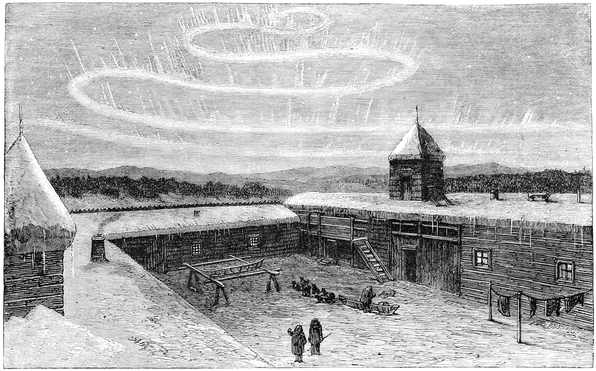
The voyages of Kane and Belcher have made us acquainted with the lowest
temperatures ever felt by man. On Feb. 5, 1854, while the former was
wintering in Smith’s Sound (78° 37’ N. lat.), the mean of his best spirit-thermometer
showed the unexampled temperature of -68° or 100° below the
freezing-point of water. Then chloric ether became solid, and carefully prepared
chloroform exhibited a granular pellicle on its surface. The exhalations
from the skin invested the exposed or partially clad parts with a wreath of
vapor. The air had a perceptible pungency upon inspiration, and every one,
as it were involuntarily, breathed guardedly with compressed lips. About the
same time (February 9 and 10, 1854), Sir E. Belcher experienced a cold of
-55° in Wellington Channel (75° 31’ N.), and the still lower temperature of
-62° on January 13, 1853, in Northumberland Sound (76° 52’ N.). Whymper,
on December 6, 1866, experienced -58° at Nulatto, Alaska (64° 42’ N.).
Whether the temperature of the air descends still lower on advancing toward
the pole, or whether these extreme degrees of cold are not sometimes
surpassed in those mountainous regions of the north which, though seen, have
never yet been explored, is of course an undecided question: so much is certain,
that the observations hitherto made during the winter of the Arctic regions
have been limited to too short a time, and are too few in number, to enable
us to determine with any degree of certainty those points where the
greatest cold prevails. All we know is, that beyond the Arctic Circle, and
eight or ten degrees farther to the south in the interior of the continents of
Asia and America, the average temperature of the winter generally ranges from
-20° to -30°, or even lower, and for a great part of the year is able to convert
mercury into a solid body.
It may well be asked how man is able to bear the excessively low temperature
of an Arctic winter, which must appear truly appalling to an inhabitant
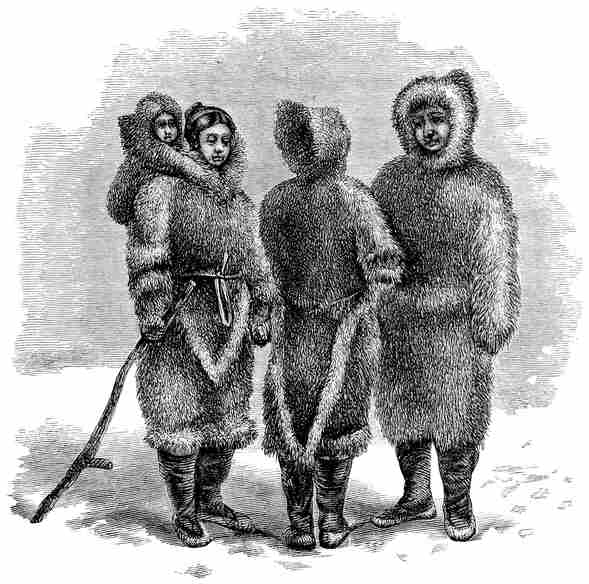
of the temperate zone. A thick fur clothing; a hut small and low, where the
warmth of a fire, or simply of a train-oil lamp, is husbanded in a narrow space,
and, above all, the wonderful power of the human constitution to accommodate
itself to every change of climate, go far to counteract the rigor of the cold.
After a very few days the body develops an increasing warmth as the thermometer
descends; for the air being condensed by the cold, the lungs inhale
at every breath a greater quantity of oxygen, which of course accelerates the
internal process of combustion, while at the same time an increasing appetite,
gratified with a copious supply of animal food, of flesh and fat, enriches the
blood and enables it to circulate more vigorously. Thus not only the hardy
native of the north, but even the healthy traveller soon gets accustomed to
bear without injury the rigors of an Arctic winter.
“The mysterious compensations,” says Kane, “by which we adapt ourselves
to climate are more striking here than in the tropics. In the Polar zone
the assault is immediate and sudden, and, unlike the insidious fatality of hot
countries, produces its results rapidly. It requires hardly a single winter to
tell who are to be the heat-making and acclimatized men. Petersen, for instance,
who has resided for two years at Upernavik, seldom enters a room with
a fire. Another of our party, George Riley, with a vigorous constitution, established
habits of free exposure, and active cheerful temperament, has so
inured himself to the cold, that he sleeps on our sledge journeys without a
blanket or any other covering than his walking suit, while the outside temperature
is -30°.”
10. ARCTIC CLOTHING.
There are many proofs that a milder climate once reigned in the northern
regions of the globe. Fossil pieces of wood, petrified acorns and
fir-cones
have been found in the interior of Banks’s Land by M’Clure’s
sledging-parties.
At Anakerdluk, in North Greenland (70° N.), a large forest lies buried on a
mountain surrounded by glaciers, 1080 feet above the level of the sea. Not
only the trunks and branches, but even the leaves, fruit-cones, and seeds have
been preserved in the soil, and enable the botanist to determine the species of
the plants to which they belong. They show that, besides firs and sequoias,
oaks, plantains, elms, magnolias, and even laurels, indicating a climate such as
that of Lausanne or Geneva, flourished during the miocene period in a country
where now even the willow is compelled to creep along the ground. During
the same epoch of the earth’s history Spitzbergen was likewise covered
with stately forests. The same poplars and the same swamp-cypress (Taxodium
dubium) which then flourished in North Greenland have been found in
a fossilized state at Bell Sound (76° N.) by the Swedish naturalists, who also
discovered a plantain and a linden as high as 78° and 79° in King’s Bay—a
proof that in those times the climate of Spitzbergen can not have been colder
than that which now reigns in Southern Sweden and Norway, eighteen degrees
nearer to the line.
We know that at present the fir, the poplar, and the beech grow fifteen degrees
farther to the north than the plantain—and the miocene period no doubt
exhibited the same proportion. Thus the poplars and firs which then grew
in Spitzbergen along with plantains and lindens must have ranged as far as
the pole itself, supposing that point to be dry land.
In the miocene times the Arctic zone evidently presented a very different
aspect from that which it wears at present. Now, during the greater part of
the year, an immense glacial desert, which through its floating bergs and drift-ice
depresses the temperature of countries situated far to the south, it then
consisted of verdant lands covered with luxuriant forests and bathed by an
open sea.
What may have been the cause of these amazing changes of climate? The
readiest answer seems to be—a different distribution of sea and land; but
there is no reason to believe that in the miocene times there was less land in
the Arctic zone than at present, nor can any possible combination of water and
dry land be imagined sufficient to account for the growth of laurels in Greenland
or of plantains in Spitzbergen. Dr. Oswald Heer is inclined to seek for
an explanation of the phenomenon, not in mere local terrestrial changes, but in
a difference of the earth’s position in the heavens.
11. ARCTIC MOONLIGHT.
We now know that our sun, with his attendant planets and satellites, performs
a vast circle, embracing perhaps hundreds of thousands of years, round
another star, and that we are constantly entering new regions of space untravelled
by our earth before. We come from the unknown, and plunge into the
unknown; but so much is certain, that our solar system rolls at present through
a space but thinly peopled with stars, and there is no reason to doubt that it
may once have wandered through one of those celestial provinces where, as
the telescope shows us, constellations are far more densely clustered. But,
as every star is a blazing sun, the greater or lesser number of these heavenly
bodies must evidently have a proportionate influence upon the temperature of
space; and thus we may suppose that during the miocene period our earth,
being at that time in a populous sidereal region, enjoyed the benefit of a
higher temperature, which clothed even its poles with verdure. In the course
of ages the sun conducted his herd of planets into more solitary and colder
regions, which caused the warm miocene times to be followed by the glacial
period, during which the Swiss flat lands bore an Arctic character, and finally
the sun emerged into a space of an intermediate character, which determines
the present condition of the climates of our globe.
12. AURORA SEEN IN NORWAY.
Though Nature generally wears a more stern and forbidding aspect on advancing
toward the pole, yet the high latitudes have many beauties of their
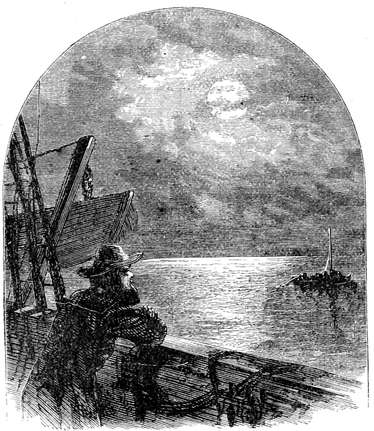
own. Nothing can exceed the magnificence of an Arctic sunset, clothing the
snow-clad mountains and the skies with all the glories of color, or be more
serenely beautiful than the clear star-light night, illumined by the brilliant
moon, which for days continually circles around the horizon, never setting until
she has run her long course of brightness. The uniform whiteness of the landscape
and the general transparency of the atmosphere add to the lustre of her
beams, which serve the natives to guide their nomadic life, and to lead them
to their hunting-grounds.
13. AURORA SEEN IN GREENLAND.
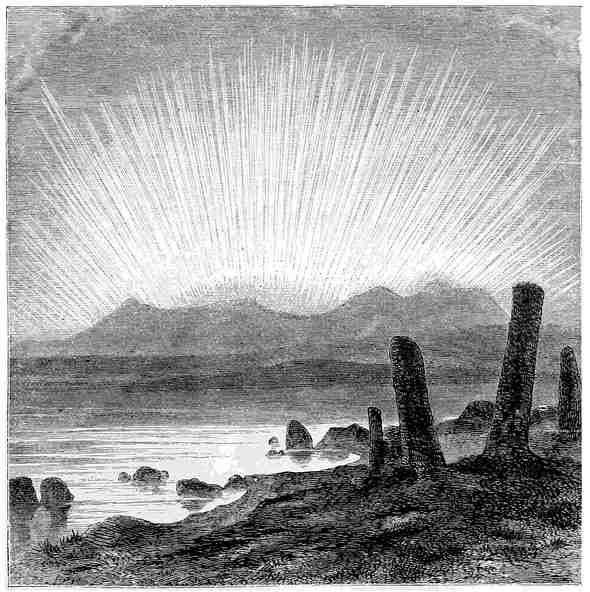
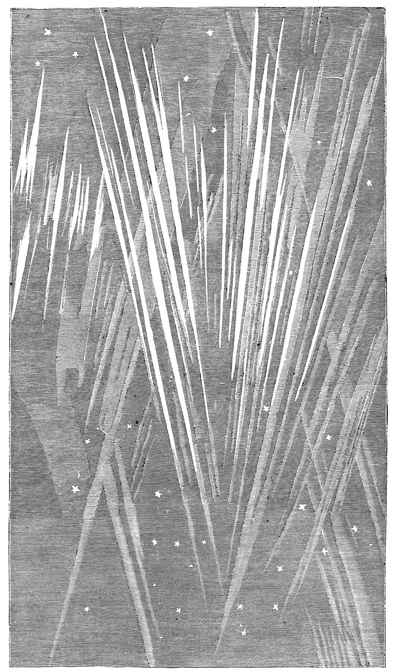
But of all the magnificent spectacles that relieve the monotonous gloom of
the Arctic winter, there is none to equal the magical beauty of the Aurora.
Night covers the snow-clad earth; the stars glimmer feebly through the haze
which so frequently dims their brilliancy in the high latitudes, when suddenly
a broad and clear bow of light spans the horizon in the direction where it is
traversed by the magnetic meridian. This bow sometimes remains for several
hours, heaving or waving to and fro, before it sends forth streams of light
ascending to the zenith. Sometimes these flashes proceed from the bow of
light alone; at others they simultaneously shoot forth from many opposite
parts of the horizon, and form a vast sea of fire whose brilliant waves are continually
changing their position. Finally they all unite in a magnificent crown
or copula of light, with the appearance of which the phenomenon attains its
highest degree of splendor. The brilliancy of the streams, which are commonly
red at their base, green in the middle, and light yellow toward the
zenith, increases, while at the same time they dart with greater vivacity through
the skies. The colors are wonderfully transparent, the red approaching to a
clear blood-red, the green to a pale emerald tint. On turning from the flaming
firmament to the earth, this also is seen to glow with a magical light. The
dark sea, black as jet, forms a striking contrast to the white snow-plain or the
distant ice-mountain; all the outlines tremble as if they belonged to the
unreal world of dreams. The imposing silence of the night heightens the
charms of the magnificent spectacle.
But gradually the crown fades, the bow of light dissolves, the streams become
shorter, less frequent, and less vivid; and finally the gloom of winter
once more descends upon the northern desert.
CHAPTER II. ARCTIC LAND QUADRUPEDS AND BIRDS.
The Reindeer.—Structure of its Foot.—Clattering Noise when
walking.—Antlers.—Extraordinary
olfactory Powers.—The Icelandic Moss.—Present and Former Range of the Reindeer.—Its invaluable
Qualities as an Arctic domestic Animal.—Revolts against
Oppression.—Enemies of the Reindeer.—The
Wolf.—The Glutton or Wolverine.—Gad-flies.—The Elk or
Moose-deer.—The Musk-ox.—The
Wild Sheep of the Rocky Mountains.—The Siberian Argali.—The Arctic Fox.—Its Burrows.—The
Lemmings.—Their Migrations and Enemies.—Arctic Anatidæ.—The
Snow-bunting.—The
Lapland Bunting.—The Sea-eagle.—Drowned by a Dolphin.
The reindeer may well be called the camel of the northern wastes, for it is
a no less valuable companion to the Laplander or to the Samojede than the
“ship of the desert” to the wandering Bedouin. It is the only member of the
numerous deer family that has been domesticated by man; but though undoubtedly
the most useful, it is by no means the most comely of its race. Its
clear, dark eye has, indeed, a beautiful expression, but it has neither the noble
proportions of the stag nor the grace of the roebuck, and its thick square-formed
body is far from being a model of elegance. Its legs are short and thick,
its feet broad, but extremely well adapted for walking over the snow or on a
swampy ground. The front hoofs, which are capable of great lateral expansion,
curve upward, while the two secondary ones behind (which are but slightly
developed in the fallow deer and other members of the family) are considerably
prolonged: a structure which, by giving the animal a broader base to stand
upon, prevents it from sinking too deeply into the snow or the morass. Had
the foot of the reindeer been formed like that of our stag, it would have been
as unable to drag the Laplander’s sledge with such velocity over the yielding
snow-fields as the camel would be to perform his long marches through the
desert without the broad elastic sole-pad on which he firmly paces the unstable
sands.
The short legs and broad feet of the reindeer likewise enable it to swim with
greater ease—a power of no small importance in countries abounding in rivers
and lakes, and where the scarcity of food renders perpetual migrations necessary.
When the reindeer walks or merely moves, a remarkable clattering sound
is heard to some distance, about the cause of which naturalists and travellers
by no means agree. Most probably it results from the great length of the two
digits of the cloven hoof, which when the animal sets its foot upon the ground
separate widely, and when it again raises its hoof suddenly clap against each
other.
A long mane of a dirty white color hangs from the neck of the reindeer. In
summer the body is brown above and white beneath; in winter,
long-haired
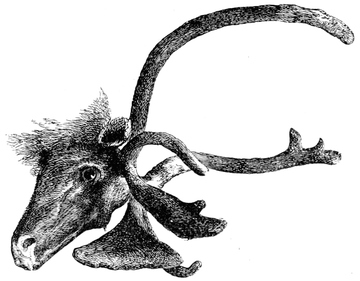
and white. Its antlers are very different from those of the stag, having broad
palmated summits, and branching back to the length of three or four feet.
Their weight is frequently very considerable—twenty or twenty-five pounds;
and it is remarkable that both sexes have horns, while in all other members of
the deer race the males alone are in possession of this ornament or weapon.
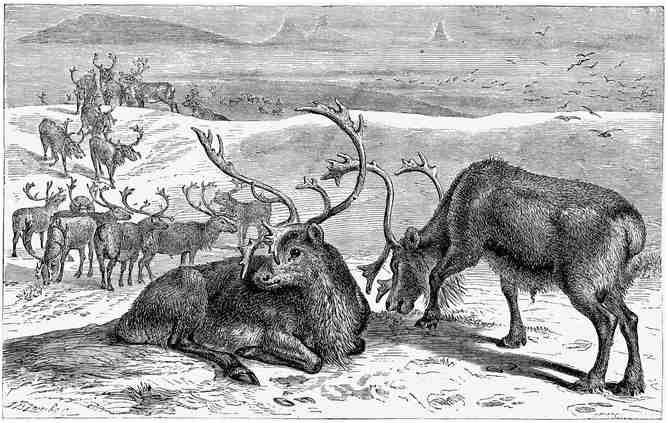
14. GROUP OF REINDEER.
The female brings forth in May a single calf, rarely two. This is small and
weak, but after a few days it follows the mother, who suckles her young but a
short time, as it is soon able to seek and to find its food. The reindeer gives
very little milk—at the very utmost, after the young has been weaned, a bottleful
daily; but the quality is excellent, for it is uncommonly thick and nutritious.
It consists almost entirely of cream, so that a great deal of water can be added
before it becomes inferior to the best cow-milk. Its taste is excellent, but the
butter made from it is rancid, and hardly to be eaten, while the cheese is very
good.
The only food of the reindeer during winter consists of moss, and the most
surprising circumstance in his history is the instinct, or the extraordinary olfactory
powers, whereby he is enabled to discover it when hidden beneath the
snow. However deep the Lichen rangiferinus may be buried, the animal is
aware of its presence the moment he comes to the spot, and this kind of food
is never so agreeable to him as when he digs for it himself. In his manner of
doing this he is remarkably adroit. Having first ascertained, by thrusting his
muzzle into the snow, whether the moss lies below or not, he begins making a
hole with his fore feet, and continues working until at length he uncovers the
lichen. No instance has ever occurred of a reindeer making such a cavity without
discovering the moss he seeks. In summer their food is of a different nature;
they are then pastured upon green herbs or the leaves of trees. Judging
from the lichen’s appearance in the hot months, when it is dry and brittle,
one might easily wonder that so large a quadruped as the reindeer should
make it his favorite food and fatten upon it; but toward the month of September
the lichen becomes soft, tender, and damp, with a taste like wheat-bran. In
this state its luxuriant and flowery ramifications somewhat resemble the leaves
of endive, and are as white as snow.
Though domesticated since time immemorial, the reindeer has only partly
been brought under the yoke of man, and wanders in large wild herds both in
the North American wastes, where it has never yet been reduced to servitude,
and in the forests and tundras of the Old World.
In America, where it is called “caribou,” it extends from Labrador to Melville
Island and Washington Land; in Europe and Asia it is found from Lapland
and Norway, and from the mountains of Mongolia and the banks of the
Ufa, as far as Nova Zembla and Spitzbergen. Many centuries ago—probably
during the glacial period—its range was still more extensive, as reindeer bones
are frequently found in French and German caves, and bear testimony to the
severity of the climate which at that time reigned in Central Europe; for the
reindeer is a cold-loving animal, and will not thrive under a milder sky. All
attempts to prolong its life in our zoological gardens have failed, and even in
the royal park at Stockholm Hogguer saw some of these animals, which were
quite languid and emaciated during the summer, although care had been
taken to provide them with a cool grotto to which they could retire during the
warmer hours of the day. In summer the reindeer can enjoy health only in the
fresh mountain air or along the bracing sea-shore, and has as great a longing for
a low temperature as man for the genial warmth of his fireside in winter.
The reindeer is easily tamed, and soon gets accustomed to its master, whose
society it loves, attracted as it were by a kind of innate sympathy; for, unlike
all other domestic animals, it is by no means dependent on man for its subsistence,
but finds its nourishment alone, and wanders about freely in summer and
in winter without ever being inclosed in a stable. These qualities are inestimable
in countries where it would be utterly impossible to keep any domestic
animal requiring shelter and stores of provisions during the long winter months,
and make the reindeer the fit companion of the northern nomad, whose simple
wants it almost wholly supplies. During his wanderings, it carries his tent and
scanty household furniture, or drags his sledge over the snow. On account of the
weakness of its back-bone, it is less fit for riding, and requires to be mounted with
care, as a violent shock easily dislocates its vertebral column; the saddle is placed
on the haunches. You would hardly suppose the reindeer to be the same animal
when languidly creeping along under a rider’s weight, as when, unencumbered
by a load, it vaults with the lightness of a bird over the obstacles in its way to
obey the call of its master. The reindeer can be easily trained to drag a sledge,
but great care must be taken not to beat or otherwise ill-treat it, as it then becomes
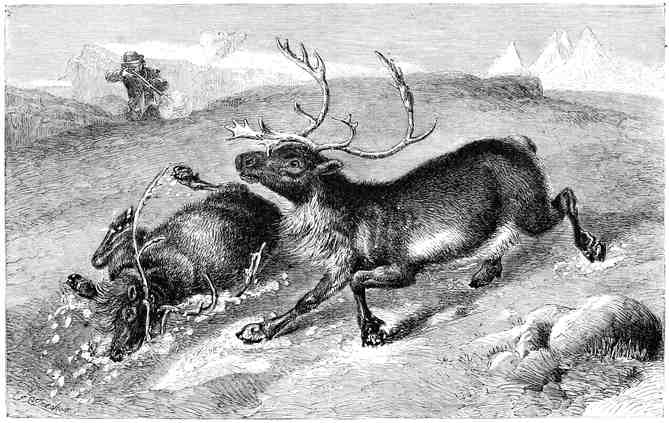
obstinate, and quite unmanageable. When forced to drag too heavy a
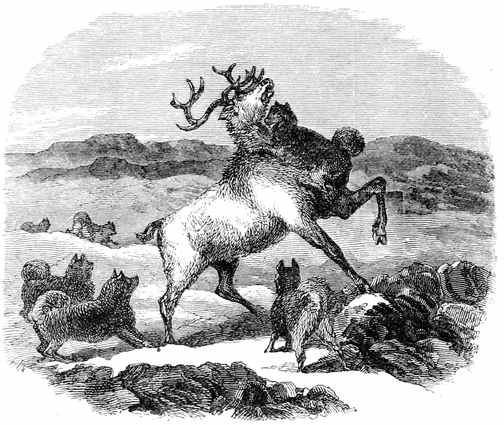
load, or taxed in any way above its strength, it not seldom turns round upon
its tyrant, and attacks him with its horns and fore feet. To save himself from
its fury, he is then obliged to overturn his sledge, and to seek a refuge under
its bottom until the rage of the animal has abated.
After the death of the reindeer, it may truly be said that every part of its
body is put to some use. The flesh is very good, and the tongue and marrow
are considered a great delicacy. The blood, of which not a drop is allowed to
be lost, is either drunk warm or made up into a kind of black pudding. The
skin furnishes not only clothing impervious to the cold, but tents and bedding;
and spoons, knife-handles, and other household utensils are made out of the
bones and horns; the latter serve also, like the claws, for the preparation of an
excellent glue, which the Chinese, who buy them for this purpose of the Russians,
use as a nutritious jelly. In Tornea the skins of new-born reindeer are
prepared and sent to St. Petersburg to be manufactured into gloves, which are
extremely soft, but very dear.
Thus the cocoa-nut palm, the tree of a hundred uses, hardly renders a
greater variety of services to the islanders of the Indian Ocean than the reindeer
to the Laplander or the Samojede; and, to the honor of these barbarians
be it mentioned, they treat their invaluable friend and companion with a grateful
affection which might serve as an example to far more civilized nations.
The reindeer attains an age of from twenty to twenty-five years, but in its
domesticated state it is generally killed when from six to ten years old. Its
most dangerous enemies are the wolf, and the glutton or wolverine (Gulo borealis
or arcticus), which belongs to the bloodthirsty marten and weasel family,
and is said to be of uncommon fierceness and strength. It is about the size
of a large badger, between which animal and the pole-cat it seems to be intermediate,
nearly resembling the former in its general figure and aspect, and
agreeing with the latter as to its dentition. No dog is capable of mastering
a glutton, and even the wolf is hardly able to scare it from its prey. Its feet
are very short, so that it can not run swiftly, but it climbs with great facility
upon trees, or ascends even almost perpendicular rock-walls, where it also seeks
a refuge when pursued.
When it perceives a herd of reindeer browsing near a wood or a precipice,
it generally lies in wait upon a branch or some high cliff, and springs down
upon the first animal that comes within its reach. Sometimes also it steals
unawares upon its prey, and suddenly bounding upon its back, kills it by a single
bite in the neck. Many fables worthy of Münchausen have been told about its
voracity; for instance, that it is able to devour two reindeer at one meal, and
that, when its stomach is exorbitantly distended with food, it will press itself
between two trees or stones to make room for a new repast. It will, indeed,
kill in one night six or eight reindeer, but it contents itself with sucking their
blood, as the weasel does with fowls, and eats no more at one meal than any
other carnivorous animal of its own size.
Besides the attacks of its mightier enemies, the reindeer is subject to the
persecutions of two species of gad-fly, which torment it exceedingly. The
one (Œstrus tarandi), called Hurbma by the Laplanders, deposits its glutinous
eggs upon the animal’s back. The larvæ, on creeping out, immediately bore
themselves into the skin, where by their motion and suction they cause so
many small swellings or boils, which gradually grow to the size of an inch or
more in diameter, with an opening at the top of each, through which the larvæ
may be seen imbedded in a purulent fluid. Frequently the whole back of the
animal is covered with these boils, which, by draining its fluids, produce emaciation
and disease. As if aware of this danger, the reindeer runs wild and furious
as soon as it hears the buzzing of the ’fly, and seeks a refuge in the nearest
water. The other species of gad-fly (Œstrus nasalis) lays its eggs in the nostrils
of the reindeer; and the larvæ, boring themselves into the fauces and beneath the
tongue of the poor animal, are a great source of annoyance, as is shown by its
frequent sniffling and shaking of the head.
A pestilential disorder like the rinderpest will sometimes sweep away whole
herds. Thus in a few weeks a rich Laplander or Samojede may be reduced to
poverty, and the proud possessor of several thousands of reindeer be compelled
to seek the precarious livelihood of the northern fisherman.
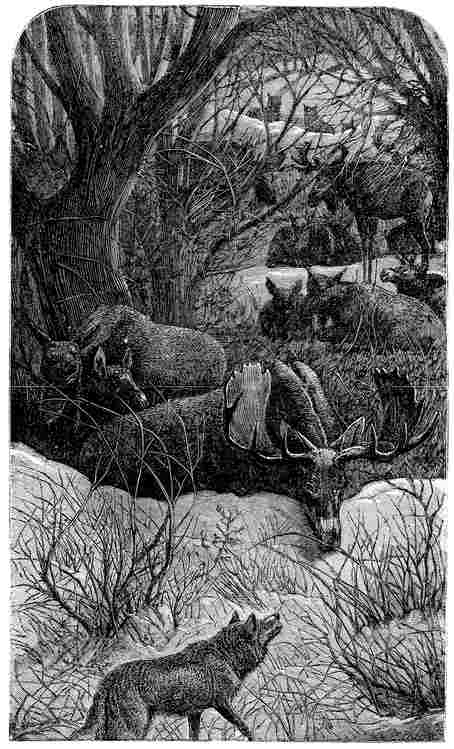
The elk or moose-deer (Cervus alces) is another member of the cervine race
peculiar to the forests of the north. In size it is far superior to the stag, but it
can not boast of an elegant shape, the head being disproportionately large, the
neck short and thick, and its immense horns, which sometimes weigh near fifty
pounds, each dilating almost immediately from the base into a broad palmated
form; while its long legs, high shoulders, and heavy upper lip hanging very
much over the lower, give it an uncouth appearance. The color of the elk is a
dark grayish-brown, but much paler on the legs and beneath the tail.
15. ELKS
We owe the first description of this gigantic deer to Julius Cæsar, in whose
time it was still a common inhabitant of the German forests. But the conqueror
of Gaul can hardly have seen it himself, or he would not have ascribed to it
a single horn, placed in the middle of the forehead, or said that both sexes are
perfectly alike, for the female is smaller and has no antlers. At present the
elk is still found in the swampy forests of East Prussia, Lithuania, and Poland,
but it chiefly resides in the more northern woods of Russia, Siberia,
and America. It is a mild and harmless animal, principally supporting itself
by browsing the boughs of willows, asps, service-trees, and other soft species
of wood. It does not, like the reindeer, seek a refuge against the attacks
of the gad-flies, by wandering to the coasts of the sea, or retreating to
the bare mountains, where it would soon perish for the want of adequate food,
but plunges up to the nose into the next river, where it finds, moreover, a species
of water-grass (Festuca fluitans) which it likes to feed upon. Though
naturally mild and harmless, it displays a high degree of courage, and even ferocity
when suddenly attacked; defending itself with great vigor, not only with
its horns, but also by striking violently with its fore feet, in the use of which
it is particularly dexterous. It is generally caught in traps, as it is extremely
shy and watchful, and finds an easy retreat in the swamp or the forest. The
only time of the year when it can be easily chased is in the spring, when the
softened snow gets covered during the night with a thin crust of ice which is
too weak to bear the animal’s weight.
Though not ranging so far north as the reindeer or the elk, we find in the
Old World the red-deer (Cervus elaphus), in the vicinity of Drontheim, in Norway,
and along with the roebuck beyond Lake Baikal, in Siberia, while in
America the large-eared deer (Cervus macrotis), and the Wapiti, or Canada stag
(Cervus strongylo-ceras), extend their excursions beyond 55° of northern latitude.
The latter is much larger and of a stronger make than the European
red-deer, frequently growing to the height of our tallest oxen, and possessing
great activity as well as strength. The flesh is little prized, but the hide, when
made into leather after the Indian fashion, is said not to turn hard in drying
after being wet—a quality which justly entitles it to a preference over almost
every other kind of leather.
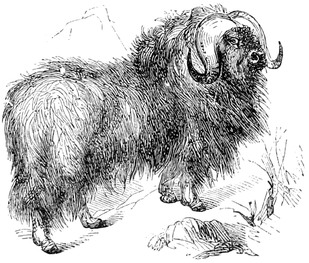
16. THE MUSK-OX.
One of the most remarkable quadrupeds of the high northern regions is the
musk-ox (Ovibos moschatus), which
by some naturalists has been considered
as intermediate between the
sheep and the ox. It is about the
height of a deer, but of much stouter
proportions. The horns are very
broad at the base, almost meeting
on the forehead, and curving downward
between the eye and ears until
about the level of the mouth,
when they turn upward. Its long
thick brown or black hair hanging
down below the middle of the leg,
and covering on all parts of the animal
a fine kind of soft ash-colored
wool, which is of the finest description, and capable of forming the most beautiful
fabrics manufactured, enables it to remain even during the winter beyond
70° of northern latitude. In spring it wanders over the ice as far as Melville
Island, or even Smith’s Sound, where a number of its bones were found by
Dr. Kane. In September it withdraws more to the south, and spends the
coldest months on the verge of the forest region. Like the reindeer, it subsists
chiefly on lichens and grasses. It runs nimbly, and climbs hills and rocks
with great ease. Its fossil remains, or those of a very analogous species, have
been discovered in Siberia: at present it is exclusively confined to the New
World.
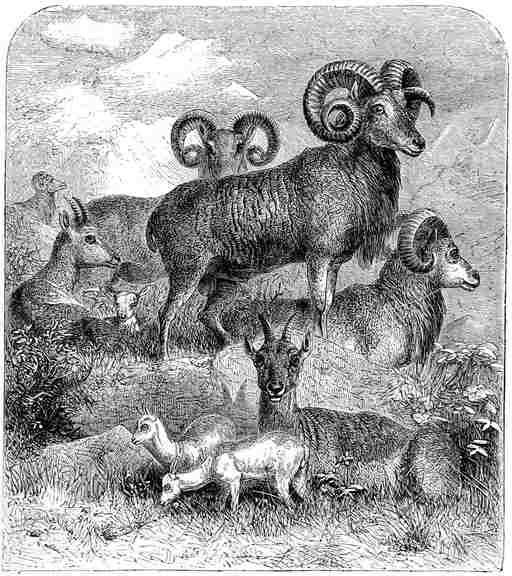
In the Rocky Mountains, from the Mexican Cordillera plateaux as far as 68°
N. lat., dwells the wild sheep (Ovis montana), distinguished by the almost circular
bend of its large, triangular, transversely striped horns, from its relative
the Siberian argali (Ovis argali), which is supposed to be the parent of our domestic
sheep, and far surpasses it in size and delicacy of flesh. Both the American
and the Asiatic wild sheep are in the highest degree active and vigorous,
ascending abrupt precipices with great agility, and, like the wild goat, going
over the narrowest and most dangerous passes with perfect safety.
Among the carnivorous quadrupeds of the northern regions, many, like the
lynx, the wolf, the bear, the glutton, and other members of the weasel tribe,
have their head-quarters in the forests, and only occasionally roam over the tundras;
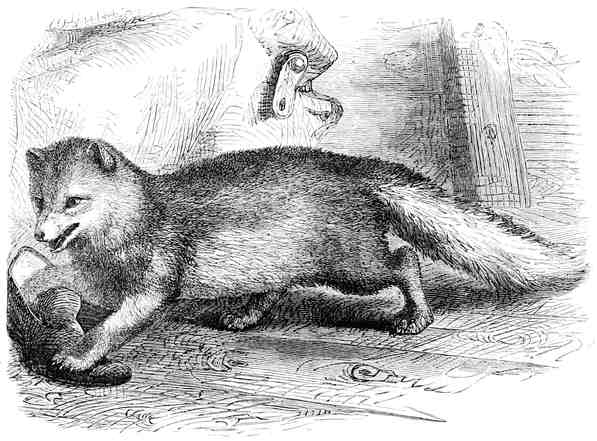
but the Arctic fox (Canis lagopus) almost exclusively inhabits the treeless
wastes that fringe the Polar Ocean, and is found on almost all the islands that lie
buried in its bosom. This pretty little creature, which in winter grows perfectly
white, knows how to protect itself against the most intense cold, either by
seeking a refuge in the clefts of rocks, or by burrowing to a considerable depth
in a sandy soil. It principally preys upon lemmings, stoats, polar hares, as
well as upon all kinds of water-fowl and their eggs; but when pinched by
hunger, it does not disdain the carcasses of fish, or the molluscs and crustaceans
it may chance to pick up on the shore. Its enemies are the glutton, the snowy
owl, and man, who, from the Equator to the poles, leaves no creature unmolested
that can in any way satisfy his wants.
17. ARGALI.
The lemmings, of which there are many species, are small rodents, peculiar
to the Arctic regions, both in the New and in the Old World, where they are
found as far to the north as vegetation extends. They live on grass, roots, the
shoots of the willow, and the dwarf birch, but chiefly on lichens. They do not
gather hoards of provisions for the winter, but live upon what they find beneath
the snow. They seldom prove injurious to man, as the regions they inhabit
are generally situated beyond the limits of agriculture. From the voles,
to whom they are closely allied, they are distinguished by having the foot-sole
covered with stiff hairs, and by the strong crooked claws with which their fore
feet are armed. The best known species is the Norwegian lemming (Lemmus
norwegicus), which is found on the high mountains of the Dovrefjeld, and
farther to the north on the dry parts of the tundra, where it inhabits small
burrows under stones or in the moss. Its long and thick hair is of a tawny
color, and prettily marked with black spots. The migrations of the lemming
have been grossly exaggerated by Olaus Magnus and Pontoppidan, to whom
the natural history of the North owes so many fables. As they breed several
times in the year, producing five or six at a birth, they of course multiply very
fast under favorable circumstances, and are then forced to leave the district
which is no longer able to afford them food. But this takes place very seldom,
for when Mr. Brehm visited Scandinavia, the people on the Dovrefjeld
knew nothing about the migrations of the lemming, and his inquiries on the
subject proved equally fruitless in Lapland and in Finland. At all events, it is
a fortunate circumstance that the lemmings have so many enemies, as their
rapid multiplication might else endanger the balance of existence in the northern
regions. The inclemencies of the climate are a chief means for keeping them
in check. A wet summer, an early cold and snowless autumn destroy them
by millions, and then of course years are necessary to recruit their numbers.
With the exception of the bear and the hedgehog, they are pursued by all the
northern carnivora. The wolf, the fox, the glutton, the marten, the ermine
devour them with avidity, and a good lemming season is a time of unusual
plenty for the hungry Laplander’s dog. The snowy owl, whose dense plumage
enables it to be a constant resident on the tundra, almost exclusively frequents
those places where lemmings, its favorite food, are to be found; the buzzards
are constantly active in their destruction; the crow feeds its young with lemmings;
and even the poor Lap, when pressed by hunger, seizes a stick, and,
for want of better game, goes out lemming-hunting, and rejoices when he can
kill a sufficient number for his dinner.
18. THE SNOWY OWL.
Several birds, such as the snowy owl and the ptarmigan (Lagopus albus),
which can easily procure its food under the snow, winter in the highest latitudes;
but by far the greater number are merely summer visitants of the Arctic
regions. After the little bunting, the first arrivals in spring are the snow-geese,
who likewise are the first to leave the dreary regions of the north on
their southerly migration. The common and king eider-duck, the Brent geese,
the great northern black and red throated divers, are the next to make their
appearance, followed by the pintail and longtail ducks (Anas caudacuta and
glacialis), the latest visitors of the season. These birds generally take their
departure in the same order as they arrive. The period of their stay is but
short, but their presence imparts a wonderfully cheerful aspect to regions at
other times so deserted and dreary. As soon as the young are sufficiently
fledged, they again betake themselves to the southward; the character of the
season much influencing the period of their departure.
As far as man has penetrated, on the most northern islets of Spitzbergen,
or on the ice-blocked shores of Kennedy Channel, the eider-duck and others
of the Arctic anatidæ build their nests; and there is no reason to doubt that
if the pole has breeding-places for them, it re-echoes with their cries. Nor
need they fear to plunge into the very heart of the Arctic zone, for the flight
of a goose being forty or fifty miles an hour, these birds may breed in the remotest
northern solitude, and in a few hours, on a fall of deep autumn snow,
convey themselves by their swiftness of wing to better feeding-grounds.
One of the most interesting of the Arctic birds is the snow-bunting (Plectrophanes
nivalis), which may properly be called the polar singing-bird, as it
breeds in the most northern isles, such as Spitzbergen and Novaja Zemlya, or
on the highest mountains of the Dovrefjeld, in Scandinavia, where it enlivens
the fugitive summer with its short but agreeable notes, sounding doubly sweet
from the treeless wastes in which they are heard. It invariably builds its
nest, which it lines with feathers and down,
in the fissures of mountain rocks or under
large stones, and the entrance is generally
so narrow as merely to allow the parent
birds to pass. The remarkably dense winter
plumage of the snow-bunting especially
qualifies it for a northern residence, and
when in captivity it will rather bear the
severest cold than even a moderate degree
of warmth. In its breeding-places it lives
almost exclusively on insects, particularly
gnats: during the winter it feeds on all
sorts of seeds, and then famine frequently compels it to wander to a less rigorous
climate.
19. BERNIDE GOOSE.
The Lapland bunting (Centrophanes lapponicus), whose white and black
plumage is agreeably diversified with red, is likewise an inhabitant of the
higher latitudes, where it is frequently seen in the barren grounds and tundras.
Both these birds are distinguished by the very long claw of their hind toe, a
structure which enables them to run about with ease upon the snow.
20. THE SEA-EAGLE.
Among the raptorial birds of the Arctic regions, the sea-eagle (Haliatus
albicilla) holds a conspicuous rank. At his approach the gull and the auk
conceal themselves in the fissures of the rocks, but are frequently dragged
forth by their relentless enemy. The divers are, according to Wahlengren,
more imperilled from his attacks than those sea-birds which do not plunge, for
the latter rise into the air as soon as their piercing eye espies the universally
dreaded tyrant, and thus escape; while the former, blindly trusting to the element
in which they are capable of finding a temporary refuge, allow him to
approach, and then suddenly diving, fancy
themselves in safety, while the eagle is only
waiting for the moment of their re-appearance
to repeat his attack. Twice or thrice
they may possibly escape his claws by a rapid
plunge, but when for the fourth time they
dive out of the water, and remain but one
instant above the surface, that instant seals
their doom. The sea-eagle is equally formidable
to the denizens of the ocean, but
sometimes too great a confidence in his
strength leads to his destruction, for Kittlitz
was informed by the inhabitants of Kamschatka
that, pouncing upon a dolphin, he is
not seldom dragged down into the water by the diving cetacean in whose skin
his talons remain fixed.
CHAPTER III. THE ARCTIC SEAS.
21. ARCTIC NAVIGATION.
Dangers peculiar to the Arctic Sea.—Ice-fields.—Hummocks.—Collision of Ice-fields.—Icebergs.—Their
Origin.—Their Size.—The Glaciers which give them Birth.—Their Beauty.—Sometimes useful
Auxiliaries to the Mariner.—Dangers of anchoring to a Berg.—A crumbling Berg.—The Ice-blink.—Fogs.—Transparency
of the Atmosphere.—Phenomena of Reflection and Refraction.—Causes
which prevent the Accumulation of Polar Ice.—Tides.—Currents.—Ice a bad Conductor of Heat.—Wise
Provisions of Nature.
The heart of the first navigator, says Horace, must have been shielded with
threefold brass—and yet the poet knew but the sunny Mediterranean, with
its tepid floods and smiling shores: how, then, would he have found words to
express his astonishment at the intrepid seamen who, to open new vistas to
science or new roads to commerce, first ventured to face the unknown terrors
of the Arctic main?
In every part of the ocean the mariner has to guard against the perils of
hidden shoals and sunken cliffs, but the high northern waters are doubly and
trebly dangerous; for here, besides those rocks which are firmly rooted to the
ground, there are others which, freely floating about, threaten to crush his vessel
to pieces, or to force it along with them in helpless bondage.
The Arctic navigators have given various names to these movable shoals,
which are the cause of so much delay and danger. They are icebergs when they
tower to a considerable height above the waters, and ice-fields when they have a
vast horizontal extension. A floe is a detached portion of a field; pack-ice, a
large area of floes or smaller fragments closely driven together so as to oppose a
firm barrier to the progress of a ship; and drift-ice, loose ice in motion, but not
so firmly packed as to prevent a vessel from making her way through its yielding
masses.
22. AMONG HUMMOCKS.
The large ice-fields which the whaler encounters in Baffin’s Bay, or on the
seas between Spitzbergen and Greenland, constitute one of the marvels of the
deep. There is a solemn grandeur in the slow majestic motion with which
they are drifted by the currents to the south; and their enormous masses, as
mile after mile comes floating by, impress the spectator with the idea of a
boundless extent and an irresistible power. But, vast and mighty as they are,
they are unable to withstand the elements combined for their destruction, and
their apparently triumphal march leads them only to their ruin.
23. DRIFTING IN THE ICE.
When they first descend from their northern strongholds, the ice of which
they are composed is of the average thickness of from ten to fifteen feet, and
their surface is sometimes tolerably smooth and even, but in general it is covered
with numberless ice-blocks or hummocks piled upon each other in wild confusion
to a height of forty or fifty feet, the result of repeated collisions before
flakes and floes were soldered into fields. Before the end of June they are covered
with snow, sometimes six feet deep, which melting during the summer
forms small ponds or lakes upon their surface.
24. FORMS OF ICEBERGS.
Not seldom ice-fields are whirled about in rotatory motion, which causes
their circumference to gyrate with a velocity of several miles per hour. When
a field thus sweeping through the waters comes into collision with another
which may possibly be revolving with equal rapidity in an opposite direction—when
masses not seldom twenty or thirty miles in diameter, and each weighing
many millions of tons, clash together,
imagination can hardly conceive
a more appalling scene. The
whalers at all times require unremitting
vigilance to secure their safety,
but scarcely in any situation so much
as when navigating amidst these
fields, which are more particularly
dangerous in foggy weather, as their
motions can not then be distinctly observed.
No wonder that since the
establishment of the fishery numbers
of vessels have been crushed to pieces
between two fields in motion, for the
strongest ship ever built must needs
be utterly unable to resist their power. Some have been uplifted and thrown
upon the ice; some have had their hulls completely torn open; and others
have been overrun by the ice, and buried beneath the fragments piled upon
their wreck.
25. FORMS OF ICEBERGS.
26. FORMS OF ICEBERGS.
The icebergs, which, as their name
indicates, rise above the water to a
much more considerable height than
the ice-fields, have a very different origin,
as they are not formed in the
sea itself, but by the glaciers of the
northern highlands. As our rivers
are continually pouring their streams
into the ocean, so many of the glaciers
or ice-rivers of the Arctic zone,
descending to the water-edge, are
slowly but constantly forcing themselves
farther and farther into the
sea. In the summer season, when
the ice is particularly fragile, the
force of cohesion is often overcome
by the weight of the prodigious masses
that overhang the sea or have been
undermined by its waters; and in the
winter, when the air is probably 40°
or 50° below zero and the sea from
28° to 30° above, the unequal expansion
of those parts of the mass exposed
to so great a difference of temperature can not fail to produce the separation
of large portions.
Most of these swimming glacier-fragments, or icebergs, which are met with
by the whaler in the Northern Atlantic, are formed on the mountainous west
coast of Greenland by the large glaciers which discharge themselves into the
fiords from Smith’s Sound to Disco Bay, as here the sea is sufficiently deep to
float them away, in spite of the enormous magnitude they frequently attain.
As they drift along down Baffin’s Bay and Davis’s Strait, they not seldom run
aground on some shallow shore, where, bidding defiance to the short summer,
they frequently remain for many a year.
27. ICEBERGS AGROUND.
Dr. Hayes measured an immense iceberg which had stranded off the little
harbor of Tessuissak, to the north of Melville Bay. The square wall which
faced toward his base of measurement was 315 feet high, and a fraction over
three-quarters of a mile long. Being almost square-sided above the sea, the
same shape must have extended beneath it; and since, by measurements made
two days before, Hayes had discovered that fresh-water ice floating in salt water
has above the surface to below it the proportion of one to seven, this crystallized
mountain must have gone aground in a depth of nearly half a mile. A
rude estimate of its size, made on the spot, gave in cubical contents about 27,000
millions of feet, and in weight something like 2000 millions of tons!
Captain Ross in his first voyage mentions another of these wrecked bergs,
which was found to be 4169 yards long, 3689 yards broad, and 51 feet high
above the level of the sea. It was aground in 61 fathoms, and its weight was
estimated by an officer of the “Alexander” at 1,292,397,673 tons. On ascending
the flat top of this iceberg, it was found occupied by a huge white bear,
who justly deeming “discretion the best part of valor,” sprang into the sea before
he could be fired at.
The vast dimensions of the icebergs appear less astonishing when we consider
that many of the glaciers or ice-rivers from which they are dislodged are
equal in size or volume to the largest streams of continental Europe.
Thus one of the eight glaciers existing in the district of Omenak, in Greenland,
is no less than an English mile broad, and forms an ice-wall rising 160
feet above the sea. Further to the north, Melville Bay and Whale Sound are
the seat of vast ice-rivers. Here Tyndall glacier forms a coast-line of ice over
two miles long, almost burying its face in the sea, and carrying the eye along a
broad and winding valley, up steps of ice of giant height, until at length the
slope loses itself in the unknown ice-desert beyond. But grand above all is the
magnificent Humboldt glacier, which, connecting Greenland and Washington
Land, forms a solid glassy wall 300 feet above the water-level, with an unknown
depth below it, while its curved face extends full sixty miles in length from
Cape Agassiz to Cape Forbes. In the temperate zone it would be one of the
mightiest rivers of the earth; here, in the frozen solitudes of the North, it slowly
drops its vast fragments into the waters, making the solitudes around re-echo
with their fall.
As the Polar shores of continental America and Siberia are generally flat,
and below the snow-line, they are consequently deprived both of glaciers and
of the huge floating masses to which these give birth.
In a high sea the waves beat against an iceberg as against a rock; and in
calm weather where there is a swell, the noise made by their rising and falling
is tremendous. Their usual form is that of a high vertical wall, gradually
sloping down to the opposite side, which is very low; but frequently they exhibit
the most fantastic shapes, particularly after they have been a long time
exposed to the corroding power of the waves, or of warm rains pelting them
from above.
A number of icebergs floating in the sea is one of the most magnificent
spectacles of nature, but the wonderful beauty of these crystal cliffs never appears
to greater advantage than when clothed by the midnight sun with all the
splendid colors of twilight.
28. ICEBERGS AND GLACIER, FROBISHER BAY.
“The bergs,” says Dr. Hayes, describing one of these enchanting nights,
“had wholly lost their chilly aspect, and glittering in the blaze of the brilliant
heavens, seemed in the distance like masses of burnished metal or solid flame.
Nearer at hand they were huge blocks of Parian marble inlaid with mammoth
gems of pearl and opal. One in particular exhibited the perfection of the
grand. Its form was not unlike that of the Colosseum, and it lay so far away
that half its height was buried beneath the line of blood-red waters. The sun,
slowly rolling along the horizon, passed behind it, and it seemed as if the
old Roman ruins had suddenly taken fire. In the shadow of the bergs the
water was a rich green, and nothing could be more soft and tender than the
gradations of color made by the sea shoaling on the sloping tongue of a berg
close beside us. The tint increased in intensity where the ice overhung the
water, and a deep cavern near by exhibited the solid color of the malachite mingled
with the transparency of the emerald, while in strange contrast a broad
streak of cobalt blue ran diagonally through its body. The bewitching character
of the scene was heightened by a thousand little cascades which leaped into
the sea from these floating masses, the water being discharged from lakes of melted
snow and ice which reposed in quietude far up in the valleys separating the
high icy hills of their upper surface. From other bergs large pieces were now
and then detached, plunging down into the water with deafening noise, while
the slow moving swell of the ocean resounded through their broken archways.”
29. GLACIER, BUTE INLET.
A similar gorgeous spectacle was witnessed by Dr. Kane in Melville Bay.
The midnight sun came out over a great berg, kindling variously-colored fires
on every part of its surface, and making the ice around the ship one great resplendency
of gemwork, blazing carbuncles and rubies, and molten gold.
In the night the icebergs are readily distinguished even at a distance by
their natural effulgence, and in foggy weather by a peculiar blackness in the
atmosphere. As they are not unfrequently drifted by the Greenland stream
considerably to the south of Newfoundland, sometimes even as far as the fortieth
or thirty-ninth degree of latitude (May, 1841, June, 1842), ships sailing
through the north-western Atlantic require to be always on their guard against
them. The ill-fated “President,” one of our first ocean-steamers, which was
lost on its way to New York, without leaving a trace behind, is supposed to
have been sunk by a collision with an iceberg, and no doubt many a gallant
bark has either foundered in the night, or been hurled by the storm against
these floating rocks.
But though often dangerous neighbors, the bergs occasionally prove useful
auxiliaries to the mariner. From their greater bulk lying below the water-line,
they are either drifted along by the under-current against the wind, or,
from their vast dimensions, are not perceptibly influenced even by the strongest
gale, but, on the contrary, have the appearance of moving to windward, because
every other kind of ice is drifted rapidly past them. Thus in strong adverse
winds, their broad masses, fronting the storm like bulwarks, not seldom afford
protection to ships mooring under their lee.
Anchoring to a berg is, however, not always unattended with danger, particularly
when the summer is far advanced, or in a lower latitude, as all ice becomes
exceedingly fragile when acted on by the sun or by a temperate atmosphere.
The blow of an axe then sometimes suffices to rend an iceberg asunder,
and to bury the careless seaman beneath its ruins, or to hurl him into the yawning
chasm.
30. SCALING AN ICEBERG.
Thus Scoresby relates the adventure of two sailors who were attempting to
fix an anchor to a berg. They began to hew a hole into the ice, but scarcely
had the first blow been struck, when suddenly the immense mass split from top
to bottom and fell asunder, the two halves falling in contrary directions with a
prodigious crash. One of the sailors, who was possessed of great presence of
mind, immediately scaled the huge fragment on which he was standing, and
remained rocking to and fro on its summit until its equilibrium was restored;
but his companion, falling between the masses, would most likely have been
crushed to pieces if the current caused by their motion had not swept him
within reach of the boat that was waiting for them.
Frequently large pieces detach themselves spontaneously from an iceberg
and fall into the sea with a tremendous noise. When this circumstance, called
“calving,” takes place, the iceberg loses its equilibrium, sometimes turns on
one side, and is occasionally inverted.
Dr. Hayes witnessed the crumbling of an immense berg, resembling in its
general appearance the British House of Parliament. First one lofty tower
came tumbling into the water, starting from its surface an immense flock of
gulls; then another followed; and at length, after five hours of rolling and
crashing, there remained of this splendid mass of congelation not a fragment
that rose fifty feet above the water.
One of the most remarkable phenomena of the Polar Sea is the ice-blink, or
reflection of the ice against the sky. A stripe of light, similar to the early
dawn of morning, but without its redness, appears above the horizon, and traces
a complete aërial map of the ice to a distance of many miles beyond the ordinary
reach of vision. To the experienced navigator the “blink” is frequently
of the greatest use, as it not only points out the vicinity of the drift-ice, but
indicates its nature, whether compact or loose, continuous or open. Thus
Scoresby relates that on the 7th of June, 1821, he saw so distinct an ice-blink,
that as far as twenty or thirty miles all round the horizon he was able to ascertain
the figure and probable extent of each ice-field. The packed ice was distinguished
from the larger fields by a more obscure and yellow color; while
each water-lane or open passage was indicated by a deep blue stripe or patch.
By this means he was enabled to find his way out of the vast masses of ice in
which he had been detained for several days, and to emerge into the open sea.
The tendency of the pack-ice to separate in calm weather, so that one might
almost be tempted to believe in a mutual repulsive power of the individual
blocks, is likewise favorable to the Arctic navigator. The perpetual daylight
of summer is another advantage, but unfortunately the sun is too often veiled
by dense mists, which frequently obscure the air for weeks together, particularly
in July. These fogs, which are a great impediment to the whaler’s operations,
have a very depressing influence upon the spirits; and as they are attended
with a low temperature, which even at noon does not rise much above
freezing-point, the damp cold is also physically extremely unpleasant.
At other times the sun sweeps two or three times round the pole without
being for a moment obscured by a cloud, and then the transparency of the air
is such that objects the most remote may be seen perfectly distinct and clear.
A ship’s top-gallant mast, at the distance of five or six leagues, may be discerned
when just appearing above the horizon with a common perspective-glass,
and the summits of mountains are visible at the distance of from sixty to a
hundred miles.
On such sunny days, the strong contrasts of light and shade between the
glistening snow and the dark protruding rocks produce a remarkable deception
in the apparent distance of the land, along a steep mountainous coast. When
at the distance of twenty miles from Spitzbergen, for instance, it would be easy
to induce even a judicious stranger to undertake a passage in a boat to the
shore, from a belief that he was within a league of the land. At this distance
the portions of rock and patches of snow, as well as the contour of the different
hills, are as distinctly marked as similar objects in many other countries, not
having snow about them, would be at a fourth or a fifth part of the distance.
Nothing can be more wonderful than the phenomena of the atmosphere dependent
on reflection and refraction, which are frequently observed in the Arctic
seas, particularly at the commencement or approach of easterly winds. They
are probably occasioned by the commixture, near the surface of the land or sea,
of two streams of air of different temperatures, so as to occasion an irregular
deposition of imperfectly condensed vapor, which when passing the verge of the
horizon apparently raises the objects there situated to a considerable distance
above it, or extends their height beyond their natural dimensions. Ice, land,
ships, boats, and other objects, when thus enlarged and elevated, are said to
loom. The lower part of looming objects are sometimes connected with the
horizon by an apparent fibrous or columnar extension of their parts; at other
times they appear to be quite lifted into the air, a void space being seen between
them and the horizon.
A most remarkable delusion of this kind was observed by Scoresby while
sailing through the open ice, far from land. Suddenly an immense amphitheatre
inclosed by high walls of basaltic ice, so like natural rock as to deceive one of
his most experienced officers, rose around the ship. Sometimes the refraction
produced on all sides a similar effect, but still more frequently remarkable contrasts.
Single ice-blocks expanded into architectural figures of an extraordinary
height, and sometimes the distant, deeply indented ice-border looked like a
number of towers or minarets, or like a dense forest of naked trees. Scarcely
had an object acquired a distinct form, when it began to dissolve into another.
It is well known that similar causes produce similar effects in the warmer
regions of the earth. In the midst of the tropical ocean, the mariner sees verdant
islands rise from the waters, and in the treeless desert fantastic palm-groves
wave their fronds, as if in mockery of the thirsty caravan.
When we consider the intense cold which reigns during the greatest part of
the year in the Arctic regions, we might naturally, expect to find the whole of
the Polar Sea covered, during the winter at least, with one solid unbroken sheet
of ice. But experience teaches us that this is by no means the case; for the
currents, the tides, the winds, and the swell of a turbulent ocean are mighty
causes of disruption, or strong impediments to congelation. Both Lieutenant
de Haven and Sir Francis M’Clintock1 were helplessly carried along, in the
depth of winter, by the pack-ice in Lancaster Sound and Baffin’s Bay. A
berg impelled by a strong under-current rips open an ice-field as if it were a
thin sheet of glass; and in channels, or on coasts where the tides rise to a considerable
height, their flux and reflux is continually opening crevices and lanes
in the ice which covers the waters. That even in the highest latitudes the sea
does not close except when at rest, was fully experienced by Dr. Hayes during
his wintering at Port Foulke; for at all times, even when the temperature of
the air was below the freezing-point of mercury, he could hear from the deck
of his schooner the roar of the beating waves. From all these causes there
has at no point within the Arctic Circle been found a firm ice-belt extending,
either in winter or in summer, more than from fifty to a hundred miles from
land. And even in the narrow channels separating the islands of the Parry
Archipelago, or at the mouth of Smith Sound, the waters will not freeze over,
except when sheltered by the land, or when an ice-pack, accumulated by long
continuance of winds from one quarter, affords the same protection.
31. AN ARCTIC CHANNEL.
But the constant motion of the Polar Sea, wherever it expands to a considerable
breadth, would be insufficient to prevent its total congelation, if it were
not assisted by other physical causes. A magnificent system of currents is
continually displacing the waters of the ocean, and forcing the warm floods of
the tropical regions to wander to the pole, while the cold streams of the frigid
zone are as constantly migrating toward the Equator. Thus we see the Gulf
Stream flowing through the broad gateway east of Spitzbergen, and forcing
out a return current of cold water to the west of Spitzbergen, and through
Davis’s Strait.
32. OPEN WATER.
The comparatively warm floods which, in consequence of this great law of
circulation, come pouring into the Arctic seas, naturally require some time
before they are sufficiently chilled to be converted into ice; and as sea-water
has its maximum of density, or, in other words, is heaviest a few degrees above
the freezing-point of water, and then necessarily sinks, the whole depth of the
sea must of course be cooled down to that temperature before freezing can
take place. Ice being a bad conductor of heat, likewise limits the process of
congelation; for after attaining a thickness of ten or fifteen feet, its growth is
very slow, and probably even ceases altogether; for when floating fields, or
floes, are found of a greater thickness, this increase is due to the snow that
falls upon their surface, or to the accumulation of hummocks caused by their
collision.
Thus, by the combined influence of these various physical agencies, bounds
have been set to the congelation of the Polar waters. Were it otherwise, the
Arctic lands would have been mere uninhabitable wastes; for the existence of
the seals, the walrus, and the whale depends upon their finding some open water
at every season of the year; and deprived of this resource, all the Esquimaux,
whose various tribes fringe the coasts in the highest latitudes hitherto
discovered, would perish in a single winter.
If the Arctic glaciers did not discharge their bergs into the sea, or if no
currents conveyed the ice-floes of the north into lower latitudes, ice would be
constantly accumulating in the Polar world, and, destroying the balance of nature,
would ultimately endanger the existence of man over the whole surface
of the globe.
33. GLACIER DISCHARGING.
CHAPTER IV. ARCTIC MARINE ANIMALS
Populousness of the Arctic Seas.—The Greenland Whale.—The Fin Whales.—The Narwhal.—The
Beluga, or White Dolphin.—The Black Dolphin.—His wholesale Massacre on the Faeroe Islands.—The
Orc, or Grampus.—The Seals.—The Walrus.—Its acute Smell.—History of a young
Walrus.—Parental Affection.—The Polar Bear.—His Sagacity.—Hibernation of the She-bear.—Sea-birds.
The vast multitudes of animated beings which people the Polar Seas form
a remarkable contrast to the nakedness of their bleak and desolate shores.
The colder surface-waters almost perpetually exposed to a chilly air, and frequently
covered, even in summer, with floating ice, are indeed unfavorable to
the development of organic life; but this adverse influence is modified by the
higher temperature which constantly prevails at a greater depth; for, contrary
to what takes place in the equatorial seas, we find in the Polar Ocean an increase
of temperature from the surface downward, in consequence of the
warmer under-currents, flowing from the south northward, and passing beneath
the cold waters of the superficial Arctic current.
Thus the severity of the Polar winter remains unfelt at a greater depth of
the sea, where myriads of creatures find a secure retreat against the frost, and
whence they emerge during the long summer’s day, either to line the shores or
to ascend the broad rivers of the Arctic world. Between the parallels of 74°
and 80° Scoresby observed that the color of the Greenland sea varies from the
purest ultramarine to olive green, and from crystalline transparency to striking
opacity—appearances which are not transitory, but permanent. This green
semi-opaque water, whose position varies with the currents, often forming isolated
stripes, and sometimes spreading over two or three degrees of latitude,
mainly owes its singular aspect to small medusæ and nudibranchiate molluscs.
It is calculated to form one-fourth part of the surface of the sea between the
above-mentioned parallels, so that many thousands of square miles are absolutely
teeming with life.
On the coast of Greenland, where the waters are so exceedingly clear that
the bottom and every object upon it are plainly visible even at a depth of
eighty fathoms, the ground is seen covered with gigantic tangles, which, together
with the animal world circulating among their fronds, remind the spectator
of the coral-reefs of the tropical ocean. Nullipores, mussels, alcyonians, sertularians,
ascidians, and a variety of other sessile animals, incrust every stone or
fill every hollow or crevice of the rocky ground. A dead seal or fish thrown
into the sea is soon converted into a skeleton by the myriads of small crustaceans
which infest these northern waters, and, like the ants in the equatorial forests,
perform the part of scavengers of the deep.
Thus we find an exuberance of life, in its smaller and smallest forms, peopling
the Arctic waters, and affording nourishment to a variety of strange and
bulky creatures—cetaceans, walruses, and seals—which annually attract thousands
of adventurous seamen to the icy ocean.
Of these sea-mammalians, the most important to civilized man is undoubtedly
the Greenland whale (Balæna mysticetus), or smooth-back, thus called from
its having no dorsal fin. Formerly these whales were harpooned in considerable
numbers in the Icelandic waters, or in the fiords of Spitzbergen and Danish
Greenland; then Davis’s Straits became the favorite fishing-grounds; and more
recently the inlets and various channels to the east of Baffin’s Bay have been
invaded; while, on the opposite side of America, several hundreds of whalers
penetrate every year through Bering’s Straits into the icy sea beyond, where
previously they lived and multiplied, unmolested except by the Esquimaux.
34. THE WHALE.
More fortunate than the smooth-back, the rorquals, or fin-whales (Balænoptera
boops, musculus, physalis, and rostratus), still remain in their ancient seats,
from which they are not likely to be dislodged, as the agility of their movements
makes their capture more difficult and dangerous; while at the same time
the small quantity of their fat and the shortness of their baleen render it far less
remunerative. They are of a more slender form of body, and with a more
pointed muzzle than the Greenland whale; and while the latter attains a length
of only sixty feet, the Balænoptera boops grows to the vast length of 100 feet
and more. There is also a difference in their food, for the Greenland whale
chiefly feeds upon the minute animals that crowd the olive-colored waters above
described, or on the hosts of little pteropods that are found in many parts of
the Arctic seas, while the rorquals frequently accompany the herring-shoals, and
carry death and destruction into their ranks.
The seas of Novaja Zemlya, Spitzbergen, and Greenland are the domain of
the narwhal, or sea-unicorn, a cetacean quite as strange, but not so fabulous as
the terrestrial animal which figures in the arms of England. The use of the
enormous spirally wound tusk projecting from its upper jaw, and from which
it derives its popular name, has not yet been clearly ascertained, some holding
it to be an instrument of defense, while others suppose it to be only an ornament
or mark of the superior dignity of the sex to which it has been awarded.
35. THE NARWHAL.
Among the numerous dolphins which people the Arctic and Subarctic seas,
the beluga (Delphinus leucas), improperly called the white whale, is one of the
most interesting. When young it has a brown color, which gradually changes
into a perfect white. It attains a length of from twelve to twenty feet, has no
dorsal fin, a strong tail three feet broad, and a round head with a broad truncated
snout. Beyond 56° of latitude it is frequently seen in large shoals, particularly
near the estuaries of the large Siberian and North American rivers,
which it often ascends to a considerable distance in pursuit of the salmon. A
troop of belugas diving out of the dark waves of the Arctic Sea is said to afford
a magnificent spectacle. Their white color appears dazzling, from the contrast
of the sombre background, as they dart about with arrow-like velocity.
The black dolphin (Globicephalus globiceps) is likewise very common in
the Arctic seas, both beyond Bering’s Straits and between Greenland and Spitzbergen,
whence it frequently makes excursions to the south. It grows to the
length of twenty-four feet, and is about ten feet in circumference. The skin,
like that of the dolphin tribe in general, is smooth, resembling oiled silk; the
color a bluish-black on the back, and generally whitish on the belly; the blubber
is three or four inches thick.
The full-grown have generally twenty-two or twenty-four teeth in each jaw;
and when the mouth is shut, the teeth lock between one another, like the teeth
of a trap. The dorsal fin is about fifteen inches high, the tail five feet broad;
the pectoral fins are as many, long and comparatively narrow; so that, armed
with such excellent paddles, the black dolphin is inferior to none of his relatives
in swiftness. Of an eminently social disposition, these dolphins sometimes congregate
in herds of many hundreds, under the guidance of several old experienced
males, whom the rest follow like a flock of sheep—a property from which
the animal is called in Shetland the “ca’ing whale.” No cetacean strands more
frequently than the black dolphin, and occasionally large herds have been driven
on the shores of Iceland, Norway, and the Orkney, Shetland and Faeroe islands,
where their capture is hailed as a godsend. The intelligence that a shoal of
ca’ing whales or grinds has been seen approaching the coast, creates great excitement
among the otherwise phlegmatic inhabitants of the Faeroe Islands.
The whole neighborhood, old and young, is instantly in motion, and soon numerous
boats shoot off from shore to intercept the retreat of the dolphins. Slowly
and steadily they are driven toward the coast; the phalanx of their enemies
draws closer and closer together; terrified by stones and blows, they run ashore,
and lie gasping as the flood recedes. Then begins the work of death, amid the
loud shouts of the executioners and the furious splashings of the victims. In
this manner more than 800 grinds were massacred on August 16, 1776; and
during the four summer months that Langbye sojourned on the island in 1817,
623 were driven on shore, and served to pay one-half of the imported corn.
But, on the other hand, many years frequently pass without yielding one single
black whale to the tender mercies of the islanders.
The ferocious orc, or grampus (Delphinus orca), is the tiger of the Arctic
seas. Black above, white beneath, it is distinguished by its large dorsal fin,
which curves backward toward the tail, and rises to the height of two feet or
more. Measuring no less than twenty-five feet in length and twelve or thirteen
in girth, of a courage equal to its strength, and armed with formidable teeth,
thirty in each jaw, the grampus is the dread of the seals, whom it overtakes in
spite of their rapid flight; and the whale himself would consider it as his most
formidable enemy, were it not for the persecutions of man. The grampus generally
ploughs the seas in small troops of four or five, following each other in
close single file, and alternately disappearing and rising so as to resemble the
undulatory motions of one large serpentiform animal.
The family of the seals has also numerous and mighty representatives in the
Arctic waters. In the sea of Bering we meet with the formidable sea-lion and
the valuable sea-bear, while the harp-seal, the bearded seal, and the hispid seals
(Phoca grœnlandica, barbata, hispida), spreading from the Parry Islands to
Novaja Zemlya, yield the tribute of their flesh to numerous wild tribes, and
that of their skins to the European hunter.
Few Arctic animals are more valuable to man, or more frequently mentioned
in Polar voyages than the walrus or morse (Trichechus rosmarus), which,
though allied to the seals, differs greatly from them by the development of the
canines of the upper jaw, which form two enormous tusks projecting downward
to the length of two feet. The morse is one of the largest quadrupeds existing,
as it attains a length of twenty feet, and a weight of from fifteen hundred
to two thousand pounds. In uncouthness of form it surpasses even the ungainly
hippopotamus. It has a small head with a remarkably thick upper lip, covered
with large pellucid whiskers or bristles; the neck is thick and short; the
naked gray or red-brown skin hangs loosely on the ponderous and elongated
trunk; and the short feet terminate in broad fin-like paddles, resembling large
ill-fashioned flaps of leather. Its movements on land are extremely slow and
awkward, resembling those of a huge caterpillar, but in the water it has all the
activity of the seals, or even surpasses them in speed.
36. WALRUSES ON THE ICE.
Gregarious, like the seals and many of the dolphins, the walruses love to lie
on the ice or on the sand-banks, closely huddled together. On the spot where
a walrus lands, others are sure to follow; and when the first comers block the
shore, those which arrive later, instead of landing on a free spot farther on,
prefer giving their friends who are in the way a gentle push with their tusks
so as to induce them to make room.
Timorous and almost helpless on land, where, in spite of its formidable
tusks, it falls an easy prey to the attacks of man, the walrus evinces a greater
degree of courage in the water, where it is able to make a better use of the
strength and weapons bestowed upon it by nature. Many instances are known
where walruses, which never attack but when provoked, have turned upon their
assailants, or have even assembled from a distance to assist a wounded comrade.
Like the seals, the walrus is easily tamed, and of a most affectionate temper.
This was shown in a remarkable manner by a young walrus brought alive from
Archangel to St. Petersburg in 1829. Its keeper, Madame Dennebecq, having
tended it with the greatest care, the grateful animal expressed its pleasure
whenever she came near it by an affectionate grunt. It not only followed her
with its eyes, but was never happier than when allowed to lay its head in her
lap. The tenderness was reciprocal, and Madame Dennebecq used to talk of
her walrus with the same warmth of affection as if it had been a pet lapdog.
That parental love should be highly developed in animals thus susceptible
of friendship may easily be imagined. Mr. Lamont, an English gentleman
whom the love of sport led a few years since to Spitzbergen, relates the case of
a wounded walrus who held a very young calf under her right arm. Whenever
the harpoon was raised against it, the mother carefully shielded it with
her own body. The countenance of this poor animal was never to be forgotten:
that of the calf expressive of abject terror, and yet of such a boundless
confidence in its mother’s power of protecting it, as it swam along under her
wing, and the old cow’s face showing such reckless defiance for all that could
be done to herself, and yet such terrible anxiety as to the safety of her calf.
This parental affection is shamefully misused by man, for it is a common
artifice of the walrus-hunters to catch a young animal and make it grunt, in
order to attract a herd.
The walrus is confined to the coasts of the Arctic regions, unless when drift-ice,
or some other accident, carries it away into the open sea. Its chief resorts
are Spitzbergen, Nova Zembla, North Greenland, the shores of Hudson’s and
Baffin’s bays; and on the opposite side of the Polar Ocean, the coasts of Bering’s
Sea, and to the north of Bering’s Straits, the American and Asiatic shores
from Point Barrow to Cape North. It has nowhere been found on the coasts
of Siberia from the mouth of the Jenisei to the last-mentioned promontory,
and on those of America from Point Barrow to Lancaster Sound; so that it
inhabits two distinct regions, separated from each other by vast extents of
coast. Its food seems to consist principally of marine plants and shell-fish,
though Scoresby relates that he found the remains of fishes, or even of seals, in
its stomach.
As the Polar bear is frequently found above a hundred miles from the nearest
land, upon loose ice steadily drifting into the sea, it seems but fair to assign
him a place among the marine animals of the Arctic zone. He hunts by scent,
and is constantly running across and against the wind, which prevails from the
northward, so that the same instinct which directs his search for prey also
serves the important purpose of guiding him in the direction of the land and
more solid ice. His favorite food is the seal, which he surprises crouching
down with his fore paws doubled underneath, and pushing himself noiselessly
forward with his hinder legs until within a few yards, when he springs upon
his victim, whether in the water or upon the ice. He can swim at the rate of
three miles an hour, and can dive to a considerable distance. Though he attacks
man when hungry, wounded, or provoked, he will not injure him when
food more to his liking is at hand. Sir Francis M’Clintock relates an anecdote
of a native of Upernavik who was out one dark winter’s day visiting his seal-nets.
He found a seal entangled, and whilst kneeling down over it upon the
ice to get it clear, he received a slap on the back—from his companion as he
supposed; but a second and heavier blow made him look smartly round. He
was horror-stricken to see a peculiarly grim old bear instead of his comrade.
Without taking further notice of the man, Bruin tore the seal out of the net,
and began his supper. He was not interrupted, nor did the man wait to see
the meal finished, fearing, no doubt, that his uninvited and unceremonious guest
might keep a corner for him.
Many instances have been observed of the peculiar sagacity of the Polar
bear. Scoresby relates that the captain of a whaler, being anxious to procure
a bear without wounding the skin, made trial of the stratagem of laying the
noose of a rope in the snow, and placing a piece of kreng, or whale’s carcass,
within it. A bear, ranging the neighboring ice, was soon enticed to the spot.
Approaching the bait, he seized it in his mouth; but his foot, at the same
moment, by a jerk of the rope, being entangled in the noose, he pushed it off
with the adjoining paw, and deliberately retired. After having eaten the piece
he carried away with him, he returned. The noose, with another piece of
kreng, being then replaced, he pushed the rope aside, and again walked triumphantly
off with the kreng. A third time the noose was laid, and this time
the rope was buried in the snow, and the bait laid in a deep hole dug in the
centre. But Bruin, after snuffing about the place for a few minutes, scraped
the snow away with his paw, threw the rope aside, and escaped unhurt with
his prize.
The she-bear is taught by a wonderful instinct to shelter her young under
the snow. Towards the month of December she retreats to the side of a rock,
where, by dint of scraping and allowing the snow to fall upon her, she forms a
cell in which to reside during the winter. There is no fear that she should be
stifled for want of air, for the warmth of her breath always keeps a small passage
open, and the snow, instead of forming a thick uniform sheet, is broken
by a little hole, round which is collected a mass of glittering hoar-frost, caused
by the congelation of the breath. Within this strange nursery she produces
her young, and remains with them beneath the snow until the month of March,
when she emerges into the open air with her baby bears. As the time passes
on, the breath of the family, together with the warmth exhaled from their
bodies, serves to enlarge the cell, so that with their increasing dimensions the
accommodation is increased to suit them. As the only use of the snow-burrow
is to shelter the young, the male bears do not hibernate like the females, but
roam freely about during the winter months. Before retiring under the snow,
the bear eats enormously, and, driven by an unfailing instinct, resorts to the
most nutritious diet, so that she becomes prodigiously fat, thus laying in an internal
store of alimentary matter which enables her not only to support her
own life, but to suckle her young during her long seclusion, without taking a
morsel of food. By an admirable provision of nature, the young are of wonderfully
small dimensions when compared with the parent; and as their growth,
as long as they remain confined in their crystal nursery, is remarkably slow,
they consequently need but little food and space.
37. HOME OF THE POLAR BEAR.
The Polar bear is armed with formidable weapons, and a proportionate
power to use them. His claws are two inches in length, and his canine teeth,
exclusive of the part in the jaw, about an inch and a half. Thus the hoards
of provisions which are frequently deposited by Arctic voyagers to provide for
some future want, have no greater enemy than the Polar bear. “The final
cache,” says Kane, “which I relied so much upon, was entirely destroyed. It
had been built with extreme care, of rocks which had been assembled by very
heavy labor, and adjusted with much aid, often, from capstan-bars as levers.
The entire construction was, so far as our means permitted, most effective and
resisting. Yet these tigers of the ice seemed hardly to have encountered an
obstacle. Not a morsel of pemmican remained, except in the iron cases, which
being round, with conical ends, defied both claws and teeth. They had rolled
and pawed them in every direction, tossing them about like footballs, although
over eighty pounds in weight. An alcohol can, strongly iron-bound, was
dashed into small fragments, and a tin can of liquor smashed and twisted
almost into a ball. The claws of the beast had perforated the metal and torn
it up as with a chisel. They were too dainty for salt meats; ground coffee
they had an evident relish for; old canvas was a favorite, for some reason or
other; even our flag, which had been reared ‘to take possession’ of the
waste, was gnawed down to the very staff. They had made a regular frolic of
it; rolling our bread-barrels over the ice; and, unable to masticate our heavy
India-rubber cloth, they had tied it up in unimaginable hard knots.”
38. THE GULL.
Numbers of sea-birds are found breeding along the Arctic shores as far as
man has hitherto penetrated; some even keep the sea in the high latitudes all
the winter, wherever open water exists. On the most northern rocks the razorbill
rears its young, and the fulmar and Ross’s gull have been seen in lanes of
water beyond 82° lat. As the sun gains in power, enormous troops of puffins,
looms, dovekies, rotges, skuas, burgermasters, Sabine’s gulls, kittiwakes, ivory
gulls, and Arctic terns, return to the north. There they enjoy the long summer
day, and revel in the abundance of the fish-teeming waters, bringing life
and animation into solitudes seldom or perhaps never disturbed by the presence
of man, and mingling their wild screams with the hoarse-resounding surge or
the howling of the storm. In many localities they breed in such abundance,
that it may be said, almost without exaggeration, that they darken the sun
when they fly, and hide the waters when they swim.
CHAPTER V. ICELAND.
39. LAVA-FIELDS.
Volcanic Origin of the Island.—The Klofa Jökul.—Lava-streams.—The Burning Mountains of Krisuvik.—The
Mud-caldrons of Reykjahlid.—The Tungo-hver at Reykholt.—The Great Geysir.—The
Strokkr.—Crystal Pools.—The Almannagja.—The Surts-hellir.—Beautiful Ice-cave.—The Gotha
Foss.—The Detti Foss.—Climate.—Vegetation.—Cattle.—Barbarous Mode of Sheep-shearing.—Reindeer.—Polar
Bears.—Birds.—The Eider-duck.—Videy.—Vigr.—The Wild Swan.—The Raven.—The
Jerfalcon.—The Giant auk, or Geirfugl.—Fish.—Fishing Season.—The White Shark.—Mineral
Kingdom.—Sulphur.—Peat.—Drift-wood.
Iceland might as well be called Fireland, for all its 40,000 square miles
have originally been upheaved from the depths of the waters by volcanic
power. First, at some immeasurably distant period of the world’s history, the
small nucleus of the future island began to struggle into existence against the
superincumbent weight of the ocean; then, in the course of ages, cone rose
after cone, crater was formed after crater, eruption followed on eruption, and
lava-stream on lava-stream, until finally the Iceland of the present day was
piled up with her gigantic “jökuls,” or ice-mountains, and her vast promontories,
stretching like huge buttresses far out into the sea.
In winter, when an almost perpetual night covers the wastes of this fire-born
land, and the waves of a stormy ocean thunder against its shores, imagination
can hardly picture a more desolate scene; but in summer the rugged nature
of Iceland invests itself with many a charm. Then the eye reposes with delight
on green valleys and crystal lakes, on the purple hills or snow-capped
mountains rising in Alpine grandeur above the distant horizon, and the stranger
might almost be tempted to exclaim with her patriotic sons, “Iceland is the
best land under the sun.” That it is one of the most interesting—through its
history, its inhabitants, and, above all, its natural curiosities—no one can doubt.
It has all that can please and fascinate the poet, the artist, the geologist, or the
historian; the prosaic utilitarian alone, accustomed to value a country merely
by its productions, might turn with some contempt from a land without corn,
without forests, without mineral riches, and covered for about two-thirds of its
surface with bogs, lava-wastes, and glaciers.
The curse of sterility rests chiefly on the south-eastern and central parts of
the island. Here nothing is to be seen but deserts of volcanic stone or immense
ice-fields, the largest of which—the Klofa Jökul—alone extends over
more than 4000 square miles. The interior of this vast region of névè and
glacier is totally unknown. The highest peaks, the most dreadful volcanoes of
the island, rise on the southern and south-western borders of this hitherto inaccessible
waste; the Oraefa looking down from a height of 6000 feet upon all
its rivals—the Skaptar, a name of dreadful significance in the annals of Iceland,
and farther on, like the advanced guards of this host of slumbering fires, the
Katla, the Myrdal, the Eyjafjalla, and the Hecla, the most renowned, though
not the most terrible, of all the volcanoes of Iceland.
As the ice-fields of this northern island far surpass in magnitude those of
the Alps, so also the lava-streams of Ætna or Vesuvius are insignificant when
compared with the enormous masses of molten stone which at various periods
have issued from the craters of Iceland. From Mount Skjaldebreith, on both
sides of the lake of Thingvalla as far as Cape Reykjanes, the traveller sees an
uninterrupted lava-field more than sixty miles long, and frequently from twelve
to fifteen broad; and lava-streams of still more gigantic proportions exist in
many other parts of the island, particularly in the interior. In general, these
lava-streams have cooled down into the most fantastic forms imaginable. “It
is hardly possible,” says Mr. Holland, “to give any idea of the general appearance
of these once molten masses. Here a great crag has toppled over into
some deep crevasse, there a huge mass has been upheaved above the fiery
stream which has seethed and boiled around its base. Here is every shape
and figure that sculpture could design or imagination picture, jumbled together
in grotesque confusion, whilst everywhere myriads of horrid spikes and
sharp shapeless irregularities bristle amidst them.”
By the eruptions of the Icelandic volcanoes many a fair meadow-land has
been converted into a stony wilderness; but if the subterranean fires have frequently
brought ruin and desolation over the island, they have also endowed it
with many natural wonders.
In the “burning mountains” of Krisuvik, on the south-western coast, a
whole hill-slope, with a deep narrow gorge at its foot, is covered with innumerable
boiling springs and fumaroles, whose dense exhalations, spreading an intolerable
stench, issue out of the earth with a hissing noise, and completely hide
the view.
40. EFFIGY IN LAVA.
The Námar, or boiling mud-caldrons of Reykjahlid, situated among a range
of mountains near the Myvatn (Gnat-Lake), in one of the most solitary spots in
the north of the island, on the border of enormous lava-fields and of a vast unknown
wilderness, exhibit volcanic power on a still more gigantic scale. There
are no less than twelve of these seething pits, all filled with a disgusting thick
slimy gray or black liquid, boiling or simmering with greater or less vehemence,
and emitting dense volumes of steam strongly impregnated with sulphurous
gases. Some sputter furiously, scattering their contents on every side, while in
others the muddy soup appears too thick to boil, and after remaining quiescent
for about half a minute, rises up a few inches in the centre of the basin, emits
a puff of steam, and then subsides into its former state. The diameter of the
largest of all the pits can not be less than fifteen feet; and it is a sort of mud
Geysir, for at intervals a column of its black liquid contents, accompanied with
a violent rush of steam, is thrown up to the height of six or eight feet. Professor
Sartorius von Waltershausen, one of the few travellers who have visited
this remarkable spot, says that the witches in Macbeth could not possibly have
desired a more fitting place for the preparation of their infernal gruel than the
mud-caldrons of Reykjahlid.
Among the hot or boiling springs of Iceland, which in hundreds of places
gush forth at the foot of the mountains, some are of a gentle and even flow, and
can be used for bathing, washing, or boiling, while others of an intermittent nature
are mere objects of curiosity or wonder. One of the most remarkable of
the latter is the Tungo-hver, at Reykholt, in the “valley of smoke,” thus named
from the columns of vapor emitted by the thermal springs which are here scattered
about with a lavish hand. It consists of two fountains within a yard of
each other—the larger one vomiting a column of boiling water ten feet high for
the space of about four minutes, when it entirely subsides, and then the smaller
one operates for about three minutes, ejecting a column of about five feet.
The alternation is perfectly regular in time and force, and there are authentic accounts
of its unfailing exactitude for the last hundred years.
But of all the springs and fountains of Iceland there is none to equal, either
in grandeur or renown, the Great Geysir, which is not merely one of the curiosities
of the country, but one of the wonders of the earth, as there is nothing
to compare to it in any other part of the world.
At the foot of the Laugafjall hill, in a green plain, through which several
rivers meander like threads of silver, and where chains of dark-colored mountains,
overtopped here and there by distant snow-peaks, form a grand but melancholy
panorama, dense volumes of steam indicate from afar the site of a
whole system of thermal springs congregated on a small piece of ground which
does not exceed twelve acres. In any other spot, the smallest of these boiling
fountains would arrest the traveller’s attention, but here his whole mind is absorbed
by the Great Geysir. In the course of countless ages this monarch of
springs has formed, out of the silica it deposits, a mound which rises to about
thirty feet above the general surface of the plain, and slopes on all sides to the
distance of a hundred feet or thereabouts from the border of a large circular
basin situated in its centre, and measuring about fifty-six feet in the greatest
diameter and fifty-two feet in the narrowest. In the middle of this basin,
forming as it were a gigantic funnel, there is a pipe or tube, which at its opening
in the basin is eighteen or sixteen feet in diameter, but narrows considerably
at a little distance from the mouth, and then appears to be not more than
ten or twelve feet in diameter. It has been probed to a depth of seventy feet,
but it is more than probable that hidden channels ramify farther into the bowels
of the earth. The sides of the tube are smoothly polished, and so hard that
it is not possible to strike off a piece of it with a hammer.
Generally the whole basin is found filled up to the brim with sea-green water
as pure as crystal, and of a temperature of from 180° to 190°. Astonished
at the placid tranquillity of the pool, the traveller can hardly believe that he is
really standing on the brink of the far-famed Geysir; but suddenly a subterranean
thunder is heard, the ground trembles under his feet, the water in the basin
begins to simmer, and large bubbles of steam rise from the tube and burst
on reaching the surface, throwing up small jets of spray to the height of several
feet. Every instant he expects to witness the grand spectacle which has
chiefly induced him to visit this northern land, but soon the basin becomes tranquil
as before, and the dense vapors produced by the ebullition are wafted away
by the breeze. These smaller eruptions are regularly repeated every eighty or
ninety minutes, but frequently the traveller is obliged to wait a whole day, or
even longer, before he sees the whole power of the Geysir. A detonation louder
than usual precedes one of these grand eruptions; the water in the basin is
violently agitated; the tube boils vehemently; and suddenly a magnificent column
of water, clothed in vapor of a dazzling whiteness, shoots up into the
air with immense impetuosity and noise to the height of seventy or eighty
feet, and, radiating at its apex, showers water and steam in every direction. A
second eruption and a third rapidly follow, and after a few minutes the fairy
spectacle has passed away like a fantastic vision. The basin is now completely
dried up, and on looking down into the shaft, one is astonished to see the water
about six feet from the rim, and as tranquil as in an ordinary well. After
about thirty or forty minutes it again begins to rise, and after a few hours
reaches the brim of the basin, whence it flows down the slope of the mound
into the Hvita, or White River. Soon the subterraneous thunder, the shaking of
the ground, the simmering above the tube, and the other phenomena which attend
each minor eruption, begin again, to be followed by a new period of rest,
and thus this wonderful play of nature goes on day after day, year after year,
and century after century. The mound of the Geysir bears witness to its immense
antiquity, as its water contains but a minute portion of silica.
41. THE STROKKR.
After the Geysir, the most remarkable fountain of these Phlegræan fields is
the great Strokkr, situated about four hundred feet from the former. Its tube,
the margin of which is almost even with the general surface, the small mound
and basin being hardly discernible, is funnel-shaped, or resembling the flower of
a convolvulus, having a depth of forty-eight feet, and a diameter of six feet at
the mouth, but contracting, at twenty-two feet from the bottom, to only eleven
inches. The water stands from nine to twelve feet under the brim, and is generally
in violent ebullition. A short time before the beginning of the eruptions,
which are more frequent than those of the Great Geysir, an enormous
mass of steam rushes from the tube, and is followed by a rapid succession of jets,
sometimes rising to the height of 120 or 150 feet, and dissolving into silvery
mist. A peculiarity of the Strokkr is that it can at any time be provoked to an
eruption by throwing into the orifice large masses of peat or turf; thus choking
the shaft, and preventing the free escape of the steam. After the lapse of
about ten minutes, the boiling fluid, as if indignant at this attempt upon its
liberty, heaves up a column of mud and water, with fragments of peat, as black
as ink.
About 150 paces from the Great Geysir are several pools of the most beautifully
clear water, tinting with every shade of the purest green and blue the
fantastical forms of the silicious travertin which clothes their sides. The slightest
motion communicated to the surface quivers down to the bottom of these
crystal grottoes, and imparts what might be called a sympathetic tremor of the
water to every delicate incrustation and plant-like efflorescence. “Aladdin’s
Cave could not be more beautiful,” says Preyer; and Mr. Holland remarks that
neither description nor drawing is capable of giving a sufficient idea of the singularity
and loveliness of this spot. In many places it is dangerous to approach
within several feet of the margin, as the earth overhangs the water, and is hollow
underneath, supported only by incrustations scarcely a foot thick. A
plunge into waters of about 200° would be paying rather too dearly for the
contemplation of their fairy-like beauty.
42. ENTRANCE TO THE ALMANNAGJA.
The gigantic chasm of the Almannagja is another of the volcanic wonders
of Iceland. After a long and tedious ride over the vast lava-plain which extends
between the Skalafell and the lake of Thingvalla, the traveller suddenly finds
himself arrested in his path by an apparently insurmountable obstacle, for the
enormous Almannagja, or Allman’s Rift, suddenly gapes beneath his feet—a
colossal rent extending above a mile in length, and inclosed on both sides by
abrupt walls of black lava, frequently upward of a hundred feet high, and separated
from about fifty to seventy feet from each other.
43. THE ALMANNAGJA.
A corresponding chasm, but of inferior dimensions, the Hrafnagja, or Raven’s
Rift, opens its black rampart to the east, about eight miles farther on;
and both form the boundaries of the verdant plain of Thingvalla, which by a
grand convulsion of nature has itself been shattered into innumerable small
parallel crevices and fissures fifty or sixty feet deep.
44. THE HRAFNAGJA.
Of the Hrafnagja Mr. Ross Browne says: “A toilsome ride of eight miles
brought us to the edge of the Pass, which in point of rugged grandeur far
surpasses the Almannagja, though it lacks the extent and symmetry which give
the latter such a remarkable effect. Here was a tremendous gap in the earth,
over a hundred feet deep, hacked and shivered into a thousand fantastic shapes;
the sides a succession of the wildest accidents; the bottom a chaos of broken
lava, all tossed about in the most terrific confusion. It is not, however, the extraordinary
desolation of the scene that constitutes its principal interest. The
resistless power which had rent the great lava-bed asunder, as if touched with
pity at the ruin, had also flung from the tottering cliffs a causeway across the
gap, which now forms the only means of passing over the great Hrafnagja.
No human hands could have created such a colossal work as this; the imagination
is lost in its massive grandeur; and when we reflect that miles of an
almost impassable country would otherwise have to be traversed in order to
reach the opposite side of the gap, the conclusion is irresistible that in the battle
of the elements Nature still had a kindly remembrance of man.
45. THE TINTRON ROCK.
“Five or six miles beyond the Hrafnagja, near the summit of a dividing
ridge, we came upon a very singular volcanic formation, called the Tintron.
It stands, a little to the right of the trail, on a rise of scoria and burnt earth,
from which it juts up in rugged relief to the height of twenty or thirty feet.
This is, strictly speaking, a huge clinker, not unlike what comes out of a grate—hard,
glassy in spots, and scraggy all over. The top part is shaped like a
shell; in the centre is a hole about three feet in diameter, which opens into a
vast subterranean cavity of unknown depth. Whether the Tintron is an extinct
crater, through which fires shot out of the earth in by-gone times, or an
isolated mass of lava, whirled through the air out of some distant volcano, is
a question that geologists must determine. The probability is that it is one
of those natural curiosities so common in Iceland which defy research. The
whole country is full of anomalies—bogs where one would expect to find dry
land, and parched deserts where it would not seem strange to see bogs; fire
where water ought to be, and water in the place of fire.”
46. FALL OF THE OXERAA.
46. FALL OF THE OXERAA.
“Ages ago,” says Lord Dufferin, “some vast commotion shook the foundations
of the island; and bubbling up from sources far away amid the inland
hills, a fiery deluge must have rushed down between their ridges, until, escaping
from the narrower gorges, it found space to spread itself into one broad
sheet of molten stone over an entire district of country, reducing its varied
surface to one vast blackened level. One of two things then occurred: either,
the vitrified mass contracting as it
cooled, the centre area of fifty square
miles (the present plain of Thingvalla)
burst asunder at either side from the
adjoining plateau, and sinking down to
its present level, left two parallel gjas,
or chasms, which form its lateral boundaries,
to mark the limits of the disruption; or else, while the pith or marrow of
the lava was still in a fluid state, its upper surface became solid, and formed a
roof, beneath which the molten stream flowed on to lower levels, leaving a vast
cavern into which the upper crust subsequently plumped down.” In the lapse
of years, the bottom of the Almannagja has become gradually filled up to an
even surface, covered with the most beautiful turf, except where the river
Oxeraa, bounding in a magnificent cataract from the higher plateau over the
precipice, flows for a certain distance between its walls. At the foot of the
fall the waters linger for a moment in a dark, deep, brimming pool, hemmed
in by a circle of ruined rocks, in which anciently all women convicted of
capital crimes were immediately drowned. Many a poor crone, accused of
witchcraft, has thus ended her days in the Almannagja. As may easily be imagined,
it is rather a nerve-trying task to descend into the chasm over a rugged
lava-slope, where the least false step may prove fatal; but the Icelandic horses
are so sure-footed that they can safely be trusted. From the bottom it is
easy to distinguish on the one face marks and formations exactly corresponding,
though at a different level, with those on the face opposite, and evidently
showing that they once had dovetailed into each other, before the igneous
mass was rent asunder.
Two leagues from Kalmanstunga, in an immense lava-field, which probably
originated in the Bald Jökul, are situated the renowned Surts-hellir, or caves
of Surtur, the prince of darkness and fire of the ancient Scandinavian mythology.
The principal entrance to the caves is an extensive chasm formed by the
falling in of a part of the lava-roof; so that, on descending into it, the visitor
finds himself right in the mouth of the main cavern, which runs in an almost
straight line, and is nearly a mile in length. Its average height is about forty,
and its breadth fifty feet. The lava-crust which forms its roof is about twelve
feet thick, and has the appearance of being stratified and columnar, like basaltic
pillars, in its formation. Many of the blocks of lava thus formed have become
detached and fallen into the cavern, where they lie piled up in great heaps, and
heavily tax the patience of the traveller, who has to scramble over the rugged
stones, and can hardly avoid slipping and stumbling into the holes between
them, varied by pools of water and masses of snow. But after having toiled
and plodded to the extremity of this dismal cavern, his perseverance is amply
rewarded by the sight of an ice-grotto, whose fairy beauty appears still more
charming, in contrast with its gloomy vestibule. From the crystal floor rises
group after group of transparent pillars tapering to a point, while from the
roof brilliant icy pendants hang down to meet them. Columns and arches of
ice are ranged along the crystalline walls, and the light of the candles is reflected
back a hundred-fold from every side, till the whole cavern shines with astonishing
lustre. Mr. Holland, the latest visitor of the Surts-hellir, declares he
never saw a more brilliant spectacle; and the German naturalist, Preyer, pronounces
it one of the most magnificent sights in nature, reminding him of the
fairy grottoes of the Arabian Nights’ Tales.
From the mountains and the vast plateau which occupies the centre of the
island, numerous rivers descend on all sides, which, fed in summer by the melting
glaciers, pour enormous quantities of turbid water into the sea, or convert
large alluvial flats into morasses. Though of a considerable breadth, their
course is frequently very short, particularly along the southern coast, where
the jokuls from which they derive their birth are only separated from the
sea by a narrow foreland. In their impetuous flow, they not seldom bear huge
blocks of stone along with them, and cut off all communication between the
inhabitants of their opposite banks.
The chief rivers of Iceland are, in the south, the Thiorsa and the Hvita,
which are not inferior in width to the Rhine in the middle part of its course;
in the north, the Skjalfandafljot and the Jökulsa and the Jökulsa i Axarfirdi,
large and rapid streams above a hundred miles long; and in the east the Lagarfliot.
As may be expected in a mountainous country, containing many
glacier-fed rivers, Iceland has numerous cascades, many of them rivalling or
surpassing in beauty the far-famed falls of Switzerland.
One of the most celebrated of these gems of nature is the Goda-foss, in the
northern part of the island, formed by the deep and rapid Skjalfandafljot, as it
rushes with a deafening roar over rocks fifty feet high into the caldron below;
but it is far surpassed in magnificence by the Dettifoss, a fall of the Jökulsa i
Axarfirdi.
“In some of old earth’s convulsions,” says its discoverer, Mr. Gould,—for
from its remote situation, deep in the northern wilds of Iceland, it had escaped
the curious eye of previous travellers—“the crust of rock has been rent, and a
frightful fissure formed in the basalt, about 200 feet deep, with the sides columnar
and perpendicular. The gash terminates abruptly at an acute angle,
and at this spot the great river rolls in. The wreaths of water sweeping
down; the frenzy of the confined streams where they meet, shooting into each
other from either side at the apex of an angle; the wild rebound when they
strike a head of rock, lurching out half way down; the fitful gleam of battling
torrents, obtained through a veil of eddying vapor; the Geysir-spouts which
blow up about seventy feet from holes whence basaltic columns have been shot
by the force of the descending water; the blasts of spray which rush upward
and burst into fierce showers on the brink, feeding rills which plunge over the
edge as soon as they are born; the white writhing vortex below, with now and
then an ice-green wave tearing through the foam to lash against the walls; the
thunder and bellowing of the water, which make the rock shudder under foot,
are all stamped on my mind with a vividness which it will take years to efface.
The Almannagja is nothing to this chasm, and Schaffhausen is dwarfed by
Dettifoss.”
The ocean-currents which wash the coasts of Iceland from opposite directions
have a considerable influence on its climate. The south and west coasts,
fronting the Atlantic, and exposed to the Gulf Stream, remain ice-free even in
winter, and enjoy a comparatively mild temperature, while the cold Polar current,
flowing in a south-western direction from Spitzbergen to Jan Mayen and
Iceland, conveys almost every year to the eastern and northern shores of the
island large masses of drift-ice, which sometimes do not disappear before July
or even August. According to Dr. Thorstensen, the mean annual temperature
of the air at Reykjavik is +40°, and that of the sea +42°, while according to
Herr von Scheele the mean annual temperature at Akureyre, on the north coast,
is only +33°, though even this shows a comparatively mild climate in so high
a latitude. But if Iceland, thanks to its insular position and to the influence
of the Gulf Stream, remains free from the excessive winter cold of the Arctic
continents, its summer, on the other hand, is inferior in warmth to that which
reigns in the interior of Siberia, or of the Hudson’s Bay territories.
The mean summer temperature at Reykjavik is not above +54°; during
many years the thermometer never rises a single time above +80°; sometimes
even its maximum is not higher than +59°; and, on the northern coast, snow
not seldom falls even in the middle of summer. Under such circumstances, the
cultivation of the cereals is of course impossible; and when the drift-ice remains
longer than usual on the northern coasts, it prevents even the growth of
the grass, and want and famine are the consequence.
The Icelandic summer is characterized by constant changes in the weather,
rain continually alternating with sunshine, as with us in April. The air is but
seldom tranquil, and storms of terrific violence are of frequent occurrence.
Towards the end of September winter begins, preceded by mists, which finally
descend in thick masses of snow. Travelling over the mountain-tracks is at
this time particularly dangerous, although cairns or piles of stone serve to
point out the way, and here and there, as over the passes of the Alps, small huts
have been erected to serve as a refuge for the traveller.
In former times Iceland could boast of forests, so that houses and even ships
used to be built of indigenous timber; at present it is almost entirely destitute
of trees, for the dwarf shrubberies here and there met with, where the birch
hardly attains the height of twenty feet, are not to be dignified with the name
of woods. A service-tree (Sorbus ancuparia) fourteen feet high, and measuring
three inches in diameter at the foot, is the boast of the governor’s garden
at Reykjavik; it is, however, surpassed by another at Akureyre, which spreads
a full crown twenty feet from the ground, but never sees its clusters of berries
ripen into scarlet.
The damp and cool Icelandic summer, though it prevents the successful cultivation
of corn, is favorable to the growth of grasses, so that in some of the
better farms the pasture-grounds are hardly inferior to the finest meadows in
England. About one-third of the surface of the country is covered with vegetation
of some sort or other fit for the nourishment of cattle; but, as yet, art
has done little for its improvement—ploughing, sowing, drainage, and levelling
being things undreamt of. With the exception of the grasses, which are of
paramount importance, and the trees, which, in spite of their stunted proportions,
are of great value, as they supply the islanders with the charcoal needed
for shoeing their horses, few of the indigenous plants of Iceland are of any use
to man. The Angelica archangelica is eaten raw with butter; the matted
roots or stems of the Menyanthes trifoliata serve to protect the backs of the
horses against the rubbing of the saddle; and the Icelandic moss, which is frequently
boiled in milk, is likewise an article of exportation. The want of better
grain frequently compels the poor islanders to bake a kind of bread from
the seeds of the sand-reed (Elymus arenarius), which on our dunes are merely
picked by the birds of passage; and the oarweed or tangle (Laminaria saccharina)
is prized as a vegetable in a land where potatoes and turnips are but
rarely cultivated.
When the first settlers came to Iceland, they found but two indigenous
land-quadrupeds: a species of field-vole (Arvicola œconomus) and the Arctic
fox; but the seas and shores were no doubt tenanted by a larger number of
whales, dolphins, and seals than at the present day.
The ox, the sheep, and the horse which accompanied the Norse colonists to
their new home, form the staple wealth of their descendants; for the number
of those who live by breeding cattle is as three to one, compared with those
who chiefly depend on the sea for their subsistence. Milk and whey are almost
the only beverages of the Icelanders. Without butter they will eat no fish;
and curdled milk, which they eat fresh in summer and preserve in a sour state
during the winter, is their favorite repast. Thus they set the highest value on
their cattle, and tend them with the greatest care. In the preservation of their
sheep, they are much hampered by the badness of the climate, by the scantiness
of winter food, and by the attacks of the eagles, the ravens, and the foxes, more
particularly at the lambing season, when vast numbers of the young animals
are carried off by all of them. The wool is not sheared off, but torn from the
animal’s back, and woven by the peasantry, during the long winter evenings, into
a kind of coarse cloth, or knit into gloves and stockings, which form one of the
chief articles of export.
“While at breakfast,” says Mr. Shepherd, “we witnessed the Icelandic method
of sheep-shearing. Three or four powerful young women seized, and easily
threw on their backs the struggling victims. The legs were then tied, and the
wool pulled off by main force. It seemed, from the contortions of some of the
wretched animals, to be a cruel method; but we were told that there is a period
in the year when the young wool, beginning to grow, pushes the old out before
it, so that the old coat is easily pulled out.” The number of heads of cattle in
the island is about 40,000, that of the sheep 500,000.
The horses, which number from 50,000 to 60,000, though small, are very robust
and hardy. There being no wheel carriages on the island, they are merely
used for riding and as beasts of burden. Their services are indispensable,
as without them the Icelanders would not have the means of travelling and carrying
their produce to the fishing villages or ports at which the annual supplies
arrive from Copenhagen. In winter the poor animals must find their own food,
and are consequently mere skeletons in spring; they, however, soon recover in
summer, though even then they have nothing whatever but the grass and small
plants which they can pick up on the hills.
The dogs are very similar to those of Lapland and Greenland. Like them,
they have long hair, forming a kind of collar round the neck, a pointed nose,
pointed ears, and an elevated curled tail, with a temper which may be characterized
as restless and irritable. Their general color is white.
In the year 1770 thirteen reindeer were brought from Norway. Ten of
them died during the passage, but the three that survived have multiplied so
fast that large herds now roam over the uninhabited wastes. During the winter,
when hunger drives them into the lower districts, they are frequently shot;
but no attempts have been made to tame them: for, though indispensable to the
Laplander, they are quite superfluous in Iceland, which is too rugged and too
much intersected by streams to admit of sledging. They are, in fact, generally
considered as a nuisance, as they eat away the Icelandic moss, which the islanders
would willingly keep for their own use.
47. ICELANDIC HORSES.
The Polar bear is but a casual visitor in Iceland. About a dozen come
drifting every year with the ice from Jan Mayen, or Spitzbergen, to the northern
shores. Ravenous with hunger, they immediately attack the first herds
they meet with; but their ravages do not last long, for the neighborhood, arising
in arms, soon puts an end to their existence.
In Iceland the ornithologist finds a rich field for his favorite study, as there
are no less than eighty-two different species of indigenous birds, besides twenty-one
that are only casual visitors, and six that have been introduced by man.
The swampy grounds in the interior of the country are peopled with legions
of golden and king plovers, of snipes and red-shanks; the lakes abound with
swans, ducks, and geese of various kinds; the snow-bunting enlivens the solitude
of the rocky wilderness with his lively note, and, wherever grass grows,
the common pipit (Anthus pratensis) builds its neat little nest, well lined with
horsehair. Like the lark, he rises singing from the ground, and frequently
surprises the traveller with his melodious warbling, which sounds doubly sweet
in the lifeless waste.
48. SHOOTING REINDEER.
The eider-duck holds the first rank among the useful birds of Iceland. Its
chief breeding-places are small flat islands on various parts of the coast, where
it is safe from the attacks of the Arctic fox, such as Akurey, Flatey, and Videy,
which, from its vicinity to Reykjavik, is frequently visited by travellers. All
these breeding-places are private property, and several have been for centuries
in the possession of the same families, which, thanks to the birds, are among the
wealthiest of the land. It may easily be imagined that the eider-ducks are
guarded with the most sedulous care. Whoever kills one is obliged to pay a
fine of thirty dollars; and the secreting of
an egg, or the pocketing of a few downs, is
punished with all the rigor of the law. The
chief occupation of Mr. Stephenson, the aged
proprietor of Videy, who dwells alone on the
islet, is to examine through his telescope all
the boats that approach, so as to be sure that
there are no guns on board. During the
breeding season no one is allowed to land
without his special permission, and all noise,
shouting, or loud speaking is strictly prohibited.
But, in spite of these precautions, we
are informed by recent travellers that latterly the greater part of the ducks of
Videy have been tempted to leave their old quarters for the neighboring Engey,
whose proprietor hit upon the plan of laying hay upon the strand, so as to afford
them greater facilities for nest-building. The eider-down is easily collected, as the
birds are quite tame. The female having laid five or six pale greenish-olive eggs,
in a nest thickly lined with her beautiful down, the collectors, after carefully removing
the bird, rob the nest of its contents, after which they replace her. She
then begins to lay afresh, though this time only three or four eggs, and again
has recourse to the down on her body. But her greedy persecutors once more
rifle her nest, and oblige her to line it for the third time. Now, however, her
own stock of down is exhausted, and with a plaintive voice she calls her mate to
her assistance, who willingly plucks the soft feathers from his breast to supply
the deficiency. If the cruel robbery be again repeated, which in former times
was frequently the case, the poor eider-duck abandons the spot, never to return,
and seeks for a new home where she may indulge her maternal instinct undisturbed.
49. EIDER-DUCK.
Mr. Shepherd thus describes his visit to Vigr, in the Isafjardardjup, one of
the head-quarters of the eider-duck in the north of Iceland: “As the island
was approached, we could see flocks upon flocks of the sacred birds, and could
hear their cooings at a great distance. We landed on a rocky wave-worn shore,
against which the waters scarcely rippled, and set off to investigate the island.
The shore was the most wonderful ornithological sight conceivable. The ducks
and their nests were everywhere in a manner that was quite alarming. Great
brown ducks sat upon their nests in masses, and at every step started up from
under our feet. It was with difficulty that we avoided treading on some of
the nests. The island being but three-quarters of a mile in width, the opposite
shore was soon reached. On the coast was a wall built of large stones,
just above the high-water level, about three feet in height, and of considerable
thickness. At the bottom, on both sides of it, alternate stones had been left
out, so as to form a series of square compartments for the ducks to make their
nests in. Almost every compartment was occupied; and, as we walked along
the shore, a long line of ducks flew out one after another. The surface of the
water also was perfectly white with drakes, who welcomed their brown wives
with loud and clamorous cooing. When we arrived at the farmhouse we were
cordially welcomed by its mistress. The house itself was a great marvel.
The earthern wall that surrounded it and the window embrasures were occupied
by ducks. On the ground, the house was fringed with ducks. On the
turf slopes of the roof we could see ducks; and a duck sat in the scraper.
“A grassy bank close by had been cut into square patches like a chessboard
(a square of turf of about eighteen inches being removed, and a hollow
made), and all were filled with ducks. A windmill was infested, and so were
all the outhouses, mounds, rocks, and crevices. The ducks were everywhere.
Many of them were so tame that we could stroke them on their nests; and the
good lady told us that there was scarcely a duck on the island which would
not allow her to take its eggs without flight or fear. When she first became
possessor of the island, the produce of down from the ducks was not more
than fifteen pounds’ weight in the year, but, under her careful nurture of twenty
years, it had risen to nearly one hundred pounds annually. It requires about
one pound and a half to make a coverlet for a single bed, and the down is
worth from twelve to fifteen shillings per pound. Most of the eggs are taken
and pickled for winter consumption, one or two only being left to hatch.”
Though not so important as the eider, the other members of the duck
family which during the summer season enliven the lakes and swamps of Iceland
are very serviceable. On the Myvatn, or Gnat Lake, one of their chief
places of resort, the eggs of the long-tailed duck, the wild duck, the scoter, the
common goosander, the red-breasted merganser, the scaup-duck, etc., and other
anserines are carefully gathered and preserved in enormous quantities for the
winter, closely packed in a fine gray volcanic sand.
The wild swan is frequently shot or caught for his feathers, which bring in
many a dollar to the fortunate huntsman. This noble bird frequents both the
salt and brackish waters along the coast and the inland lakes and rivers, where
it is seen either in single pairs or congregated in large flocks. To build its
nest, which is said to resemble closely that of the flamingo, being a large
mound, composed of mud, rushes, grass, and stones, with a cavity at top lined
with soft down, it retires to some solitary, uninhabited spot. Much has been
said in ancient times of the singing of the swan, and the beauty of its dying
notes; but, in truth, the voice of the swan is very loud, shrill, and harsh, though
when high in the air, and modulated by the winds, the note or whoop of an
assemblage of them is not unpleasant to the ear. It has a peculiar charm in
the unfrequented wastes of Iceland, where it agreeably interrupts the profound
silence that reigns around.
The raven, one of the commonest land-birds in Iceland, is an object of aversion
to the islanders, as it not only seizes on their young lambs and eider-ducks,
but also commits great depredations among the fishes laid out to dry upon the
shore. Poles to which dead ravens are attached, to serve as a warning to the
living, are frequently seen in the meadows; and the Icelander is never so happy
as when he has succeeded in shooting a raven. This, however, is no easy
task, as no bird is more cautious, and its eyes are as sharp as those of the eagle.
Of all Icelandic birds, the raven breeds the earliest, laying about the middle of
March its five or six pale-green eggs, spotted with brown, in the inaccessible
crevices of rocks. Towards the end of June, Preyer saw many young ravens
grown to a good size, and but little inferior to the old ones in cunning.
In the gloomy Scandinavian mythology the raven occupies a rank equal to
that of the eagle in the more cheerful fables of ancient Greece. It was dedicated
to Odin, who, as the traditional history of Iceland informs us, had two
ravens, which were let loose every morning to gather tidings of what was going
on in the world, and which on returning in the evening perched upon Odin’s
shoulders to whisper the news in his ear; the name of one was Hugin, or
spirit; of the other, Mumin, or memory. Even now many superstitious notions
remain attached to the raven; for the Icelanders believe this bird to be
not only acquainted with what is going on at a distance, but also with what is
to happen in future, and are convinced that it foretells when any of the family
is about to die, by perching on the roof of the house, or wheeling round in the
air with a continual cry, varying its voice in a singular and melodious manner.
The white-tailed sea-eagle is not uncommon in Iceland, where he stands in
evil repute as a kidnapper of lambs and eider-ducks. He is sometimes found
dead in the nets of the fishermen; for, pouncing upon a haddock or salmon, he
gets entangled in the meshes, and is unable to extricate himself. The skins of
the bird, which seems to attain a larger size than in Great Britain, most likely
from being less disturbed by man, are sold at Reykjavik and Akureyre for from
three to six rix-dollars.
50. THE JYRFALCON.
The jyrfalcon (Falco gyrfalco), generally
considered as the boldest and most beautiful
of the falcon tribe, has its head-quarters
in Iceland. As long as the noble sport of
falconry was in fashion, for which it was
highly esteemed, the trade in falcons was
worth from 2000 to 3000 rix-dollars annually
to the islanders, and even now high prices
are paid for it by English amateurs.
The rarest bird of Iceland, if not entirely
extinct, is the Giant-auk, or Geirfugl. The
last pair was caught about seventeen years
ago near the Geirfuglaskers, a group of solitary
rocks to the south of the Westman
Isles, its only known habitat besides some
similar cliffs on the north-eastern coast.
Since that time it is said to have been seen
by some fishermen; but this testimony is extremely doubtful, and the question
of its existence can only be solved by a visit to the Geirfuglaskers themselves—an
undertaking which, if practicable at all, is attended with extreme difficulty
and danger, as these rocks are completely isolated in the sea, which even in
calm weather breaks with such violence against their abrupt declivities that
for years it must be absolutely impossible to approach them.
In 1858 two English naturalists determined at least to make the attempt,
and settled for a season in a small hamlet on the neighboring coast, eager to
seize the first opportunity for storming the Geirfugl’s stronghold. They waited
for several months, but in vain, the stormy summer being more than usually
unfavorable for their undertaking; and they were equally unsuccessful in the
north, whither they had sent an Icelandic student specially instructed for the
purpose. The giant-auk is three feet high, and has a black bill four inches and
a quarter long, both mandibles being crossed obliquely with several ridges and
furrows. Its wings are mere stumps, like those of the Antarctic penguins.
Thirty pounds have been paid for its egg, which is larger than that of any
other European bird; and there is no knowing the price the Zoological Society
would pay for a live bird, if this truly “rara avis” could still be found.
51. THE GIANT-AUK.
The waters of Iceland abound with excellent fish, which not only supply the
islanders with a great part of their food and furnish them with one of their
chief articles of exportation, but also attract a number of foreign seamen.
Thus about 300 French, Dutch, and Belgian fishing-sloops, manned with crews
amounting in all to 7000 men, annually make their appearance on the southern
and western coasts of Iceland, particularly those of the Guldbringe Syssel, or
gold-bringing country: thus named, not from any evidence of the precious
metal, but from the golden cod-harvests reaped on its shores. Between thirty
and forty English fishing-smacks yearly visit the northern coast. When they
have obtained a good cargo they run to Shetland to discharge it, and return
again for more.
The Icelandic fishing-season, which begins in February and ends in June,
occupies one-half of the male inhabitants of the island, who come flocking to
the west, even from the remotest districts of the north and east, to partake of
the rich harvest of the seas. Many thus travel for more than 200 miles in the
midst of winter, while the storm howls over the naked waste, and the pale sun
scarcely dispels for a few hours the darkness of the night. In every hut where
they tarry on the road they are welcome, and have but rarely to pay for their
entertainment, for hospitality is still reckoned a duty in Iceland. On reaching
the fishing-station, an agreement is soon made with the proprietor of a boat.
They usually engage to assist in fishing from February 12 to May 12, and receive
in return a share of the fish which they help to catch, besides forty
pounds of flour and a daily allowance of sour curds, or “skier.”
All the men belonging to a boat generally live in the same damp and narrow
hut. At daybreak they launch forth, to brave for many hours the inclemencies
of the weather and the sea, and while engaged in their hard day’s work
their sole refreshment is the chewing of tobacco or a mouthful of skier. On
returning to their comfortless hut, their supper consists of the fishes of inferior
quality they may have caught, or of the heads of the cod or ling, which are too
valuable for their own consumption. These are split open and hung upon lines,
or exposed on the shore to the cold wind and the hot sun; this renders them
perfectly hard, and they keep good for years. In this dried state the cod is
called stockfish. About the middle of May the migratory fishermen return to
their homes, leaving their fish which are not yet quite dry to the care of the
fishermen dwelling on the spot. Towards the middle of June, when the horses
have so far recovered from their long winter’s fast as to be able to bear a load,
they come back to fetch their stockfish, which they convey either to their own
homes for the consumption of their own families, or to the nearest port for the
purpose of bartering it against other articles. Haddocks, flatfish, and herrings
are also very abundant in the Icelandic seas; and along the northern and north-western
coasts the basking shark is largely fished for all the summer. Strong
hooks baited with mussels or pieces of fish, and attached to chains anchored at
a short distance from the shore, serve for the capture of this monster, which is
scarcely, if at all, inferior in size to the white shark, though not nearly so formidable,
as it rarely attacks man. The skin serves for making sandals; the
coarse flesh is eaten by the islanders, whom necessity has taught not to be over-nice
in their food; and the liver, the most valuable part, is stewed for the sake
of its oil.
“We had observed,” says Mr. Shepherd, “that the horrible smell which infested
Jsa-fjordr varied in intensity as we approached or receded from a certain
black-looking building at the northern end of the town. On investigating
this building, we discovered that the seat of the smell was to be found in a
mass of putrid sharks’ livers, part of which were undergoing a process of stewing
in a huge copper. It was a noisome green mass, fearful to contemplate.
The place was endurable only for a few seconds; yet dirty-looking men stirred
up the mass with long poles, and seemed to enjoy the reeking vapors.”
The salmon of Iceland, which formerly remained undisturbed by the phlegmatic
inhabitants, are now caught in large numbers for the British market. A
small river bearing the significant name of Laxaa, or Salmon River, has been
rented for the trifling sum of £100 a year by an English company, which sends
every spring its agents to the spot well provided with the best fishing apparatus.
The captured fish are immediately boiled, and hermetically packed in tin
boxes, so that they can be eaten in London almost as fresh as if they had just
been caught.
The mineral kingdom contributes but little to the prosperity of Iceland. It
affords neither metals, nor precious stones, nor rock-salt, nor coal; for the seams
of “surturbrand”, or “lignite”, found here and there, are too unimportant to
be worked. The solfataras of Krisuvik and Husavik, though extremely interesting
to the geologist, likewise furnish sulphur in too impure a condition or
too thinly scattered to afford any prospect of being worked with success, not
to mention the vast expense of transport over the almost impassable lava-tracks
that separate them from the nearest ports. In 1839–40, when, in consequence
of the monopoly granted by the Neapolitan Government to a French company,
sulphur had risen to more than three times its usual price, Mr. Knudsen, an enterprising
Danish merchant, undertook to work the mines of Krisuvik, but even
then it would not answer.
In 1859, a London company, founded by Mr. Bushby,—who having explored
the sulphur districts, had raised great expectations on what he considered their
dormant wealth,—renewed the attempt, but after a year’s trial it was abandoned
as perfectly hopeless. The “solfataras of Iceland”, says Professor Sartorius
of Waltershausen, “can not compete with those of Sicily, where more
sulphur is wantonly wasted and trodden under foot than all Iceland possesses.
While the “Namars” of the north, which are far richer than those of Krisuvik,
annually furnish scarcely more than ten tons, the sulphur mines of Sicily produce
at least 50,000, and, if necessary, could easily export double the quantity.”
As coal is too expensive a fuel for any but the rich in the small sea-port
towns, and peat, though no doubt abundantly scattered over the island, is dug
only in a few places, the majority of the people make use of singular substitutes.
The commonest is dried cow’s and sheep’s dung; but many a poor
fisherman lacks even this “spicy” material, and is fain to use the bones of
animals, the skeletons of fishes or dried sea-birds, which, with a stoical contempt
for his olfactory organs, he burns, feathers and all. There is, however,
no want of fuel in those privileged spots where drift-wood is found, and here
the lava hearth of the islander cheerfully blazes either with the pine conveyed
to him by the kindly Polar currents from the Siberian forests, or with some
tropical trunk, wafted by the Gulf Stream over the Atlantic to his northern
home.
CHAPTER VI. HISTORY OF ICELAND.
52. CATHEDRAL AT REYKJAVIK.
Discovery of the Island by Naddodr in 861.—Gardar.—Floki of the Ravens.—Ingolfr and Leif.—Ulfliot
the Lawgiver.—The Althing.—Thingvalla.—Introduction of Christianity into the Island.—Frederick
the Saxon and Thorwold the Traveller.—Thangbrand.—Golden Age of Icelandic Literature.—Snorri
Sturleson.—The Island submits to Hakon, King of Norway, in 1254.—Long Series of Calamities.—Great
Eruption of the Skapta Jökul in 1783.—Commercial Monopoly.—Better Times in Prospect.
The Norse vikings were, as is well known, the boldest of navigators. They
possessed neither the sextant nor the compass; they had neither charts
nor chronometers to guide them; but trusting solely to fortune, and to their
own indomitable courage, they fearlessly launched forth into the vast ocean.
Many of these intrepid corsairs were no doubt lost on their adventurous expeditions,
but frequently a favorable chance rewarded their temerity, either with
some rich booty or some more glorious discovery.
Thus in the year 861, Naddodr, a Norwegian pirate, while sailing from his
native coast to the Faeroe Islands, was drifted by contrary winds far to the
north. For several days no land was visible—nothing but an interminable
waste of waters; when suddenly the snow-clad mountains of Iceland were seen
to rise above the mists of the ocean. Soon after Naddodr landed with part of
his crew, but discovered no traces of man in the desert country. The viking
tarried but a short time on this unpromising coast, on which he bestowed the
appropriate name of Snowland.
Three years later, Gardar, another northern freebooter, while sailing to the
Hebrides, was likewise driven by stormy weather to Iceland. He was the first
circumnavigator of the island, which he called, after himself, Gardar’s holm, or
the island of Gardar. On his return to his native port, he gave his countrymen
so flattering an account of the newly-discovered land, that Floki, a famous viking,
resolved to settle there. Trusting to the augury of birds, Floki took with
him three ravens to direct him on his way. Having sailed a certain distance
beyond the Faeroe Islands, he gave liberty to one of them, which immediately
returned to the land. Proceeding onward, he loosed the second, which, after
circling for a few minutes round the ship, again settled on its cage, as if terrified
by the boundless expanse of the sea. The third bird, on obtaining his liberty
a few days later, proved at length a faithful pilot, and flying direct to the
north, conducted Floki to Iceland. As the sea-king entered the broad bay
which is bounded on the left by the huge Snäfells Jökul, and on the right by
the bold promontory of the Guldbringe Syssel, Faxa, one of his companions, remarked
that a land with such noble features must needs be of considerable extent.
To reward him for this remark, which flattered the vanity or the ambition
of his leader, the bay was immediately named Faxa Fiord, as it is still called
to the present day. The new colonists, attracted by the abundance of fish
they found in the bay, built their huts on the borders of a small outlet, still
bearing the name of Rafna Fiord, or the Raven’s Frith; but as they neglected
to make hay for the winter, the horses and cattle they had brought with them
died of want. Disappointed in his expectations, Floki returned home in the second
year, and, as might naturally have been expected from an unsuccessful settler,
gave his countrymen but a dismal account of Iceland, as he definitely named it.
Yet, in spite of his forbidding description, the political disturbances which
took place about this time in Norway led to the final colonization of the island.
Harold Haarfager, or the Fair-haired, a Scandinavian yarl, having by violence
and a successful policy reduced all his brother-yarls to subjection, first consolidated
their independent domains into one realm, and made himself absolute master
of the whole country. Many of his former equals submitted to his yoke;
but others, animated by that unconquerable love of liberty innate in men who
for many generations have known no superior, preferred seeking a new home
across the ocean to an ignominious vassalage under the detested Harold. Ingolfr
and his cousin Leif were the first of these high-minded nobles that emigrated
(869–870) to Iceland.
On approaching the southern coast, Ingolfr cast the sacred pillars belonging
to his former dwelling into the water, and vowed to establish himself on the
spot to which they should be wafted by the waves. His pious intentions were
for the time frustrated, as a sudden squall separated him from his penates, and
forced him to locate himself on a neighboring promontory, which to this day
bears the name of Ingolfrshofde. Here he sojourned three years, until the followers
he had sent out in quest of the missing pillars at length brought him the
joyful news that they had been found on the beach of the present site of Reykjavik,
whither, in obedience to what he supposed to be the divine summons, he
instantly removed. Ingolfr’s friend and relative Leif was shortly after assassinated
by some Irish slaves whom he had captured in a predatory descent on
the Hibernian coast. The surviving chieftain deplored the loss of his kinsman,
lamenting “that so valiant a man should fall by such villains,” but found consolation
by killing the murderers and annexing the lands of their victim. When,
in course of time, he himself felt his end approaching, he requested to be buried
on a hill overlooking the fiord, that from that elevated site his spirit might
have a better view of the land of which he was the first inhabitant.
Such are the chronicles related in the “Landnama Bok,” or “Book of Occupation,”
one of the earliest records of Icelandic history.
Ingolfr and his companions were soon followed by other emigrants desirous
of escaping from the tyranny of Harold Haarfager, who at first favored a movement
that removed far beyond the sea so many of his turbulent opponents, but
subsequently, alarmed at the drain of population, or desirous of profiting by the
exodus, levied a fine of four ounces of silver on all who left his dominions to
settle in Iceland. Yet such were the attractions which the island at that time
presented, that, in spite of all obstacles, not half a century elapsed before all its
inhabitable parts were occupied, not only by Norwegians, but also by settlers
from Denmark and Sweden, Scotland and Ireland.
The Norwegians brought with them their language and idolatry, their customs
and historical records, which the other colonists, but few in numbers, were
compelled to adopt. At first the udal, or free land-hold system of their own
country, was in vigor, but every leader of a band of emigrants being chosen, by
force of circumstances, as the acknowledged chief of the district occupied by
himself and companions, speedily paved the way for a demi-feudal system of
vassalage and subservience. As the arrival of new settlers rendered the possession
of the land more valuable, endless contests between these petty chiefs
arose for the better pastures and fisheries. To put an end to this state of anarchy,
so injurious to the common weal, Ulfliot the Wise was commissioned to
frame a code of laws, which the Icelanders, by a single simultaneous and peaceful
effort, accepted as their future constitution.
The island was now divided into four provinces and twelve districts. Each
district had its own judge, and its own popular “Thing,” or assembly; but the
national will was embodied and represented by the “Althing,” or supreme
parliament of Iceland, which annually met at Thingvalla, under an elective president,
or “Logmathurman,” the chief magistrate of this northern republic.
On the banks of the river Oxeraa, where the rapid stream, after forming a
magnificent cascade, rushes into the lake of Thingvalla, lies the spot where, for
many a century, freemen met to debate, while despotic barbarians still reigned
over the milder regions of Europe. Isolated on all sides by deep volcanic
chasms, which some great revolution of nature has rent in the vast lava-field
around, and embosomed in a wide circle of black precipitous hills, the situation
of Thingvalla is extremely romantic, but the naked dark-colored rocks, and the
traces of subterranean fire visible on every side, impart a stern melancholy to
the scene. The lake, the largest sheet of water in the island, is about thirty
miles in circumference; its boundaries have undergone many changes, especially
during the earthquakes of the past century, when its northern margin collapsed,
while the opposite one was raised. The depth of its crystal waters is
very great, and in its centre rise two small crater-islands, the result of some unknown
eruption. The mountains on its south bank have a picturesque appearance,
and large volumes of steam issuing from several hot sources on their
sides prove that, though all be tranquil now, the volcanic fires are not extinct.
Only a few traces of the ancient Althing are left—three small mounds, where
sat in state the chiefs and judges of the land—for as the assembly used to pitch
their tents on the borders of the stream, and the deliberations were held in the
open air, there are no imposing ruins to bear witness to a glorious past. But
though all architectural pomp be absent, the scene hallowed by the recollections
of a thousand years is one of deep interest to the traveller. The great features
of nature are the same as when the freemen of Iceland assembled to settle the
affairs of their little world; but the raven now croaks where the orator appealed
to the reason or the passions of his audience, and the sheep of the neighboring
pastor crop undisturbed the grass of desecrated Thingvalla.
53. THINGVALLA, LÖGBERG, AND ALMANNAGJA.
Mr. Ross Browne thus describes the scene: “After a slight repast I walked
out to take a look at the Lögberg, or Rock of Laws, which is situated about
half a mile from the church. This is, perhaps, of all the objects of historical
association in Iceland, the most interesting. It was here the judges tried criminals,
pronounced judgments, and executed their stern decrees. On a small plateau
of lava, separated from the general mass by a profound abyss on every
side, save a narrow neck barely wide enough for a foothold, the famous “Thing”
assembled once a year, and, secured from intrusion in their deliberations by the
terrible chasm around, passed laws for the weal or woe of the people. It was
only necessary to guard the causeway by which they entered; all other sides
were well protected by the encircling moat, which varies from thirty to forty
feet in width, and is half filled with water. The total depth to the bottom,
which is distinctly visible through the crystal pool, must be sixty or seventy
feet. Into this yawning abyss the unhappy criminals were cast, with stones
around their necks, and many a long day did they lie beneath the water, a
ghastly spectacle for the crowd that peered at them over the precipice.
All was now as silent as the grave. Eight centuries had passed, and yet
the strange scenes that had taken place here were vividly before me. I
could imagine the gathering crowds, the rising hum of voices; the pause,
the shriek, and plunge; the low murmur of horror, and then the stern warning
of the lawgivers and the gradual dispersing of the multitude. The dimensions
of the plateau are four or five hundred feet in length by an average
of sixty or eighty in width. The surface is now covered with a fine
coating of sod and grass, and furnishes good pasturage for the sheep belonging
to the pastor.”
Christianity was first preached in Iceland about the year 981, by Friedrich, a
Saxon bishop, to whom Thorwald the traveller, an Icelander, acted as interpreter.
Thorwald having been treated with great severity by his father, Kodran,
had fled to Denmark, where he had been converted by Friedrich. He
returned with the pious bishop to his paternal home, where the solemn service
of the Christians made some impression on Kodran, but still the obstinate pagan
could not be prevailed upon to renounce his ancient gods. “He must believe,”
said he, “the word of his own priest, who was wont to give him excellent
advice.” “Well, then,” replied Thorwald, “this venerable man whom I
have brought to thy dwelling is weak and infirm, while thy well-fed priest is
full of vigor. Wilt thou believe in the power of our God if the bishop drives
him hence?” Friedrich now cast a few drops of holy water on the priest, which
immediately burnt deep holes into his skin, so that he fled, uttering dreadful
curses. After this convincing proof, Kodran adopted the Christian faith. But
persuasion and miracles acted too slowly for the fiery Thorwald, who would
willingly have converted all Iceland at once with fire and sword. His sermons
were imprecations, and the least contradiction roused him to fury. Unable to
bear so irascible an associate, the good bishop Friedrich, giving up his missionary
labors, returned to Saxony. As to Thorwald, his restless disposition led
him to far-distant lands. He visited Greece and Syria, Jerusalem and Constantinople,
and ultimately founded a convent in Russia, where he died in the odor
of sanctity.
Soon after Thangbrand was sent by the Norwegian king, Olaf Truggeson, as
missionary to Iceland. His method of conversion appears to have been very
like that of his erratic predecessor; for while he held the cross in one hand, he
grasped the sword with the other. “Thangbrand,” says an ancient chronicler,
“was a passionate, ungovernable person, and a great manslayer, but a good
scholar and clever. He was two years in Iceland, and was the death of three
men before he left it.”
Other missionaries of a more evangelical character took his place, and proved
by their success that mild reasoning is frequently a far more effectual means of
persuasion than brutal violence. They made a great number of proselytes, and
the whole island was now divided into two factions ready to appeal to the
sword for the triumph of Christ or of Odin. But before coming to this dreadful
extremity, the voice of reason was heard, and the contending parties agreed
to submit the question to the decision of the Althing.
The assembly met, and the momentous debate was proceeding, when suddenly
a loud crash of subterranean thunder was heard, and the earth shook under
their feet. “Listen!” exclaimed a follower of Odin, “and beware of the
anger of our gods: they will consume us with their fires, if we venture to question
their authority.” The Christian party hesitated; but their confidence was
soon restored by the presence of mind of their chief orator, Thorgeir, who,
pointing to the lava-fields around, asked with whom the gods were angry when
these rocks were melted: a burst of eloquence which at once decided the question
in favor of the Cross.
The new faith brought with it a new spirit of intellectual development, which
attained its highest splendor in the twelfth century. Classical studies were
pursued with the utmost zeal, and learned Icelanders travelled to Germany and
France to extend their knowledge in the schools of Paris or Cologne. The
Icelandic bards, or scalds, were renowned throughout all Scandinavia; they frequented
the courts of Sweden, Denmark, and Norway, and were everywhere
received with the highest honors.
The historians, or sagamen, of Iceland were no less renowned than its scalds.
They became the annalists of the whole Scandinavian world, and the simplicity
and truth by which their works are distinguished fully justify their high reputation.
Among the many remarkable men who at that time graced the literature
of the Arctic isle, Sämund Frode, the learned author of the “Voluspa”
(a work on the ancient Icelandic mythology) and the “Havamal” (a general
chronicle of events from the beginning of the world); Are Thorgilson, whose
“Landnama Bok” relates with the utmost accuracy the annals of his native
land; and Gissur, who about the year 1180 described his voyages to the distant
Orient, deserve to be particularly mentioned; but great above all in genius and
fame was Snorri Sturleson, the Herodotus of the North, whose eventful life and
tragic end would well deserve to be recounted at greater length.
Gifted with the rarest talents, and chief of the most powerful family of the
island, Snorri was elected in 1215 to the high office of Logmathurman; but disgusting
his sturdy countrymen by his excessive haughtiness, he was obliged to
retire to the court of Hakon, king of Norway. During this exile he collected
the materials for his justly celebrated “Heimskringla,” or Chronicle of the
Kings of Norway. Returning home in 1221, he was again named Logmathurman;
but as he endeavored to pave the way for the annexation of his native
country to the Norwegian realm, his foreign intrigues caused a rising against
his authority, and he was once more compelled to take refuge in Norway.
Here he remained several years, until the triumph of his own faction allowed
him to return to his family estate at Reikholt, where he was murdered on a
dark September night in the year 1241. Thus perished the most remarkable
man Iceland ever has produced. The republic itself did not long survive his
fall; for, weary of the interminable feuds of their chiefs, the people voluntarily
submitted to Hakon in 1254, and the middle of the thirteenth century was
signalized by the transfer of the island to the Norwegian crown, after three
hundred and forty years of a turbulent but glorious independence.
From that time the political history of the Icelanders offers but little interest.
With their annexation to a European monarchy perished the vigor, restlessness,
and activity which had characterized their forefathers; and though
the Althing still met at Thingvalla, the national spirit had fled. It was still
further subdued by a long chain of calamities—plagues, famines, volcanic eruptions,
and piratical invasions—which, following each other in rapid succession,
devastated the land and decimated its unfortunate inhabitants.
In 1402 that terrible plague, the memory of which is still preserved under
the name of the “Black Death,” carried off nearly two-thirds of the whole population,
and was followed by such an inclement winter that nine-tenths of the
cattle in the island died. The miseries of a people suffering from pestilence
and famine were aggravated by the English fishermen, who, in spite of the remonstrances
of the Danish government, frequented the defenseless coast in considerable
numbers, and were in fact little better than the old sea-robbers who
first colonized the island, plundering and burning on the main, and holding the
wealthy inhabitants to ransom. Their predatory incursions were frequently repeated
during the seventeenth century, and even the distant Mediterranean sent
its Algerine pirates to add to the calamities of Iceland.
The eighteenth century was ushered in by the small-pox, which carried off
sixteen thousand of the inhabitants. In the middle of the century—severe winters
following in rapid succession—vast numbers of cattle died, inducing a famine
that again swept away ten thousand inhabitants.
Since the first colonization of Iceland, its numerous volcanoes had frequently
brought ruin upon whole districts—twenty-five times had Hecla, eleven times
Kötlugiá, six times Trölladyngja, five times Oraefa, vomited forth their torrents
of molten stone, without counting a number of submarine volcanic explosions,
or where the plain was suddenly rent and flames and ashes burst out of
the earth; but the eruption of Skaptar Jökul in 1783 was the most frightful
visitation ever known to have desolated the island. The preceding winter and
spring had been unusually mild, and the islanders looked forward to a prosperous
summer; but in the beginning of June repeated tremblings of the earth,
increasing in violence from day to day, announced that the subterranean powers
that had long been slumbering under the icy mantle of the Skaptar were ready
to awake. All the neighboring peasants abandoned their huts and erected
tents in the open field, anxiously awaiting the result of these terrific warnings.
On the 9th, immense pillars of smoke collected over the hill country toward the
north, and, rolling down in a southerly direction, covered the whole district of
Sitha with darkness. Loud subterranean thunders followed in rapid succession,
and innumerable fire-spouts were seen leaping and flaring through the dense
canopy of smoke and ashes that enveloped the land. The heat raging in the
interior of the volcano melted enormous masses of ice and snow, which caused
the river Skapta to rise to a prodigious height; but on the 11th torrents of
fire usurped the place of water, for a vast lava-stream breaking forth from the
mountains, flowed down in a southerly direction, until reaching the river, a tremendous
conflict arose between the two hostile elements. Though the channel
was six hundred feet deep and two hundred feet wide, the lava-flood pouring
down one fiery wave after another into the yawning abyss, ultimately gained
the victory, and, blocking up the stream, overflowed its banks. Crossing the
low country of Medalland, it poured into a great lake, which after a few days
was likewise completely filled up, and having divided into two streams, the unexhausted
torrent again poured on, overflowing in one direction some ancient
lava-fields, and in another re-entering the channel of the Skapta and leaping
down the lofty cataract of Stapafoss. But this was not all, for while one lava-flood
had chosen the Skapta for its bed, another, descending in a different direction,
was working similar ruin along the banks of the Hverfisfliot. Whether
the same crater gave birth to both, it is impossible to say, as even the extent
of the lava-flow can only be measured from the spot where it entered the inhabited
districts. The stream which followed the direction of Skapta is calculated
to have been about fifty miles in length by twelve or fifteen at its greatest
breadth; that which rolled down the Hverfisfliot, at forty miles in length
by seven in breadth.
Where it was inclosed between the precipitous banks of the Skapta, the
lava is five or six hundred feet thick, but as soon as it spread out into the plain
its depth never exceeded one hundred feet. The eruption of sand, ashes,
pumice, and lava continued till the end of August, when at length the vast subterranean
tumult subsided.
But its direful effects were felt for a long time after, not only in its immediate
vicinity, but over the whole of Iceland, and added many a mournful page
to her long annals of sorrow. For a whole year a dun canopy of cinder-laden
clouds hung over the unhappy island. Sand and ashes, carried to an enormous
height into the atmosphere, spread far and wide, and overwhelmed thousands
of acres of fertile pasturage. The Faeroes, the Shetlands, and the Orkneys
were deluged with volcanic dust which perceptibly contaminated even the skies
of England and Holland. Mephitic vapors obscured the rays of the sun, and
the sulphurous exhalations tainted both the grass of the field and the waters
of the lake, the river, and the sea, so that not only the cattle died by thousands,
but the fish also perished in their poisoned element. The unhealthy air, and
the want of food—for hunger at last drove them to have recourse to untanned
hides and old leather—gave rise to a disease resembling scurvy among the unfortunate
Icelanders. The head and limbs began to swell, the bones seemed
to be distending. Dreadful cramps forced the patient to strange contortions.
The gums loosened, the decomposed blood oozed from the mouth and the ulcerous
skin, and a few days of torment and prostration were followed by death.
In many a secluded vale whole families were swept away, and those that escaped
the scourge had hardly strength sufficient to bury the dead.
So great was the ruin caused by this one eruption that in the short space of
two years no less than 9336 men, 28,000 horses, 11,461 cattle, and 190,000
sheep—a large proportion of the wealth and population of the island—were
swept away.
After this dreadful catastrophe followed a long period of volcanic rest, for
the next eruption of the Eyjafialla did not take place before 1821. A twelfth
eruption of Kötlugja occurred in 1823, the twenty-sixth of Hecla in 1845–46;
and ultimately the thirteenth of Kötlugja in 1860. Since then there has been
repose; but who knows what future disasters may be preparing beneath those
icy ridges and fields of snow of Skapta and his frowning compeers, where no
human foot has ever wandered, or how soon they may awaken their dormant
thunders?
Besides the sufferings caused by the elements, the curse of monopoly
weighed for many a long year upon the miserable Icelanders. The Danish
kings, to whom on the amalgamation of the three Scandinavian monarchies the
allegiance of the people of Iceland was passively transferred, considered their
poor dependency as a private domain, to be farmed out to the highest bidder.
In the 16th century the Hanseatic Towns purchased the exclusive privilege of
trading with Iceland; and in 1594 a Danish company was favored with the
monopoly, for which it had to pay the paltry sum of 16 rix-dollars for each of
the ports of the island.
In the year 1862 a new company paid 4000 dollars for the Icelandic monopoly;
but at the expiration of the contract, each of the ports were farmed out
to the highest bidder—a financial improvement which raised the revenue to
16,000 dollars a year, and ultimately to 22,000. The incalculable misery produced
by the eruption of the Skapta had at least the beneficial consequence
that it somewhat loosened the bonds of monopoly, as it now became free to
every Danish merchant to trade with the island; but it is only since April, 1855,
that the last restrictions have fallen and the ports of Iceland been opened to
the merchants of all nations. It is to be hoped that the beneficial effects of
free trade will gradually heal the wounds caused by centuries of neglect and
misfortune; but great progress must be made before Iceland can attain the degree
of prosperity which she enjoyed in the times of her independence.
Then she had above a hundred thousand inhabitants, now she has scarcely
half that number; then she had many rich and powerful families, now mediocrity
or poverty is the universal lot; then she was renowned all over the North
as the seat of learning and the cradle of literature, now, were it not for her remarkable
physical features, no traveller would ever think of landing on her
rugged shores.
CHAPTER VII. THE ICELANDERS.
54. REYKJAVIK, THE CAPITAL OF ICELAND.
54. REYKJAVIK, THE CAPITAL OF ICELAND.
Skalholt.—Reykjavik.—The Fair.—The Peasant
and the Merchant.—A Clergyman in his Cups.—Hay-making.—The
Icelander’s Hut.—Churches.—Poverty
of the Clergy.—Jon Thorlaksen.—The
Seminary of Reykjavik.—Beneficial Influence
of the Clergy.—Home Education.—The Icelander’s
Winter’s Evening.—Taste for Literature.—The
Language.—The Public Library at Reykjavik.—The
Icelandic Literary Society.—Icelandic Newspapers.—Longevity.—Leprosy.—Travelling
in Iceland.—Fording the Rivers.—Crossing of the Skeidara by Mr. Holland.—A Night’s Bivouac.
Next to Thingvalla, there is no place in Iceland so replete with historical
interest as Skalholt, its ancient capital. Here in the eleventh century was
founded the first school in the island; here was the seat of its first bishops;
here flourished a succession of great orators, historians, and poets; Isleif, the
oldest chronicler of the North; Gissur, who in the beginning of the twelfth
century had visited all the countries of Europe and spoke all their languages;
the philologian Thorlak, and Finnur Johnson, the learned author of the “Ecclesiastical
History of Iceland.” The Cathedral of Skalholt was renowned far
and wide for its size, and in the year 1100, Latin, poetry, music, and rhetoric,
the four liberal arts, were taught in its school, more than they were at that time
in many of the large European cities. As a proof how early the study of the
ancients flourished in Skalholt, we find it recorded that in the twelfth century
a bishop once caught a scholar reading Ovid’s “Art of Love;” and as the story
relates that the venerable pastor flew into a violent passion at the sight of the
unholy book, we may without injustice conclude that he must have read it himself
in some of his leisure hours, to know its character so well.
Of all its past glories, Skalholt has retained nothing but its name. The
school and the bishopric have been removed, the old church has disappeared,
and been replaced by a small wooden building, in which divine service is held
once a month; three cottages contain all the inhabitants of the once celebrated
city, and the extensive churchyard is the only memorial of its former importance.
Close by are the ruins of the old school-house, and on the spot where the
bishop resided a peasant has erected his miserable hovel.
But the ever-changing tide of human affairs has not bereft the now lonely
place of its natural charms, for the meadow-lands of Skalholt are beautifully imbedded
in an undulating range of hills, overlooking the junction of the Bruara
and Huita, and backed by a magnificent theatre of mountains, among which
Hecla and the Eyjafialla are the most prominent.
Reykjavik, the present capital of the island, has risen into importance at the
expense both of Skalholt and Thingvalla. At the beginning of the present century
the courts of justice were transferred from the ancient seat of legislature
to the new metropolis, and in 1797 the bishoprics of Hoolum and Skalholt,
united into one, had their seats likewise transferred to Reykjavik. The ancient
school of Skalholt, after having first migrated to Bessestadt, has also been
obliged to follow the centralizing tendency, so powerful in our times, and now
contributes to the rising fortunes of the small sea-port town.
But in spite of all these accessions, the first aspect of Reykjavik by no means
corresponds to our ideas of a capital. “The town,” says Lord Dufferin, “consists
of a collection of wooden sheds, one story high—rising here and there into
a gable end of greater pretensions—built along the lava-track, and flanked at
either end by a suburb of turf huts. On every side of it extends a desolate
plain of lava that once must have boiled up red-hot from some distant gateway
of hell, and fallen hissing into the sea. No tree or bush relieves the dreariness
of the landscape, and the mountains are too distant to serve as a background to
the buildings; but before the door of each merchant’s house facing the sea
there flies a gay little pennon; and as you walk along the silent streets, whose
dust no carriage-wheel has ever desecrated, the rows of flower-pots that peep out
of the windows, between curtains of white muslin, at once convince you that,
notwithstanding their unpretending appearance, within each dwelling reign the
elegance and comfort of a woman-tended home.”
55. GOVERNOR’S RESIDENCE, REYKJAVIK.
Twenty years since, Reykjavik was no better than a wretched fishing-village,
now it already numbers 1400 inhabitants, and free-trade promises it a still
greater increase for the future. It owes its prosperity chiefly to its excellent
port, and to the abundance of fish-banks in its neighborhood, which have induced
the Danish merchants to make it their principal settlement. Most of them, however,
merely visit it in summer like birds of passage, arriving in May with small
cargoes of foreign goods, and leaving it again in August, after having disposed
of their wares. Thus Reykjavik must be lonely and dreary enough in winter,
when no trade animates its port, and no traveller stays at its solitary inn; but
the joy of the inhabitants is all the greater when the return of spring re-opens
their intercourse with the rest of the world, and the delight may be imagined
with which they hail the first ship that brings them the long-expected news from
Europe, and perhaps some wealthy tourist, eager to admire the wonders of the
Geysirs.
The most busy time of the town is, however, the beginning of July, when the
annual fair attracts a great number of fishermen and peasants within its walls.
From a distance of forty and fifty leagues around, they come with long trains
of pack-horses; their stock-fish slung freely across the animals’ backs, their
more damageable articles close pressed and packed in boxes or skin bags.
The greater part of the trade in this and other small sea-ports—such as
Akreyri, Hafnafjord, Eyrarbacki, Berufjord, Vapnafjord, Isafjord, Grafaros, Budenstadt,
which, taken all together, do not equal Reykjavik in traffic and population—is
carried on by barter.2
Sometimes the Icelander desires to be paid in specie for part of his produce,
but then he is obliged to bargain for a long time with the merchant, who of
course derives a double profit by an exchange of goods, and is loth to part with
his hard cash. The dollars thus acquired are either melted down, and worked
into silver massive girdles, which in point of execution as well as design are said,
on good authority,3 to be equal to any thing of the kind fashioned by English
jewellers, or else deposited in a strong-box, as taxes and wages are all paid in
produce, and no Icelander ever thinks of investing his money in stocks, shares,
or debentures.
He is, however, by no means so ignorant of mercantile affairs as to strike at
once a bargain with the Danish traders. Pitching his tent before the town, he
first pays a visit to all the merchants of the place. After carefully noting their
several offers (for as each of them invariably treats him to a dram, he with
some justice mistrusts his memory), he returns to his caravan and makes his
calculations as well as his somewhat confused brain allows him. If he is accompanied
by his wife, her opinion of course is decisive, and the following
morning he repairs with all his goods to the merchant who has succeeded in
gaining his confidence.
After the business has been concluded, the peasant empties one glass to the
merchant’s health, another to a happy meeting next year, a third to the king, a
fourth because three have been drunk already. At length, after many embraces
and protestations of eternal friendship, he takes his leave of the merchant. Fortunately
there is no thief to be found in all Iceland; but in consequence of these
repeated libations, one parcel has not been well packed, another negligently attached
to the horse, and thus it happens that the poor peasant’s track is not unfrequently
marked with sugar, coffee-beans, salt, or flour, and that when he
reaches home, he finds some valuable article or other missing.
It would, however, be doing the Icelanders an injustice to regard them as
generally intemperate; for though within the last twelve years the population
has increased only ten per cent., and the importation of brandy thirty, yet the
whole quantity of spirits consumed in the island amounts to less than three bottles
per annum for each individual, and, of this allowance, the people of Reykjavik
and of the other small sea-ports have more than their share, while many of
the clergy and peasantry in the remoter districts hardly ever taste spirituous
liquors. Dr. Hooker mentions the extraordinary effect which a small portion
of rum produced on the good old incumbent of Middalr, whose stomach had
been accustomed only to a milk-diet and a little coffee. “He begged me,”
says the doctor,4 “to give him some rum to bathe his wife’s breast; but having
applied a portion of it to that purpose, he drank the rest without being at
all aware of its strength, which, however, had no other effect than in causing
this clerical blacksmith,5 with his lame hip, to dance in the most ridiculous manner
in front of the house. The scene afforded a great source of merriment to
all his family except his old wife, who was very desirous of getting him to bed,
while he was no less anxious that she should join him in the dance.”
Dr. Hooker justly remarks that this very circumstance is a convincing proof
how unaccustomed this priest was to spirituous liquors, as the quantity taken
could not have exceeded a wine-glass full.
After his visit to the fair, the peasant sets about hay-making, which is to him
the great business of the year, for he is most anxious to secure winter fodder for
his cattle, on which his whole prosperity depends. The few potatoes and turnips
about the size of marbles, or the cabbage and parsley, which he may chance
to cultivate, are not worth mentioning; grass is the chief, nay, the only produce
of his farm, and that Heaven may grant clear sunshiny days for hay-making is
now his daily prayer.
Every person capable of wielding a scythe or rake is pressed into the work.
The best hay is cut from the “tún,” a sort of paddock comprising the lands adjoining
the farm-house, and the only part of his grounds on which the peasant
bestows any attention, for, in spite of the paramount importance of his pasture-land,
he does but little for its improvement, and a meadow is rarely seen, where
the useless or less nutritious herbs are not at least as abundant as those of a
better quality. The “tún” is encircled by a turf or stone wall, and is seldom
more than ten acres in extent, and generally not more than two or three. Its
surface is usually a series of closely-packed mounds, like graves, most unpleasant
to walk over, the gutter, in some places, being two feet in depth between the
mounds. After having finished with the “tún,” the farmer subjects to a process
of cutting all the broken hillsides and boggy undrained swamps that lie
near his dwelling. The blades of the scythes are very short. It would be impossible
to use a long-bladed scythe, owing to the unevenness of the ground.
The cutting and making of hay is carried on, when the weather will permit,
through all the twenty-four hours of the day. When the hay is made it is tied
in bundles by cords and thongs, and carried away by ponies to the earthen
houses prepared for it, which are similar to and adjoin those in which the cattle
are stalled. “It is a very curious sight,” says Mr. Shepherd, “to see a string
of hay-laden ponies returning home. Each pony’s halter is made fast to the
tail of the preceding one, and the little animals are so enveloped in their burdens
that nothing but their hoofs and the connecting ropes are visible, and they
look as though a dozen huge haycocks, feeling themselves sufficiently made,
were crawling off to their resting-places.”
When the harvest is finished the farmer treats his family and laborers to a
substantial supper, consisting of mutton, and a soup of milk and flour; and
although the serious and taciturn Icelander has perhaps of all men the least
taste for music and dancing, yet these simple feasts are distinguished by a placid
serenity, no less pleasing than the more boisterous mirth displayed at a
southern vintage.
Almost all labor out-of-doors now ceases for the rest of the year. A thick
mantle of snow soon covers mountain and vale, meadow and moor; with every
returning day, the sun pays the cold earth a decreasing visit, until, finally, he
hardly appears above the horizon at noon; the wintry storm howls over the
waste, and for months the life of the Icelander is confined to his hut, which
frequently is but a few degrees better than that of the filthy Lap.
Its lower part is built of rude stones to about the height of four feet, and
between each row layers of turf are placed with great regularity, to serve instead
of mortar, and keep out the wind. A roof of such wood as can be procured
rests upon these walls, and is covered with turf and sods. On one side
(generally facing the south) are several gable ends and doors, each surmounted
with a weather-cock. These are the entrances to the dwelling-house proper, to
the smithy, store-room, cow-shed, etc. A long narrow passage, dark as pitch,
and redolent of unsavory odors, leads to the several apartments, which are separated
from each other by thick walls of turf, each having also its own roof, so
that the peasant’s dwelling is in fact a conglomeration of low huts, which sometimes
receive their light through small windows in the front, but more frequently
through holes in the roof, covered with a piece of glass or skin. The floors
are of stamped earth; the hearth is made of a few stones clumsily piled together;
a cask or barrel, with the two ends knocked out, answers the purpose of a
chimney, or else the smoke is allowed to escape through a mere hole in the roof.
56. ICELANDIC HOUSES.
The thick turf walls, the dirty floor, the personal uncleanliness of the inhabitants,
all contribute to the pollution of the atmosphere. No piece of furniture
seems ever to have been cleaned since it was first put into use; all is disorder
and confusion. Ventilation is utterly impossible, and the whole family, frequently
consisting of twenty persons or more, sleep in the same dormitory, as
well as any strangers who may happen to drop in. On either side of this
apartment are bunks three or four feet in width, on which the sleepers range
themselves.
Such are in general the dwellings of the farmers and clergy, for but very
few of the more wealthy inhabitants live in any way according to our notions of
comfort, while the cots of the poor fisherman are so wretched that one can
hardly believe them to be tenanted by human beings.
The farm-houses are frequently isolated, and, on account of their grass-covered
roofs and their low construction, are not easily distinguished from the neighboring
pasture-grounds; where four or five of them are congregated in a grassy
plain, they are dignified with the name of a village, and become the residence
of a Hrepstior, or parish constable.
Then also a church is seldom wanting, which however is distinguished from
the low huts around merely by the cross planted on its roof. An Icelandic
house of prayer is generally from eight to ten feet wide, and from eighteen to
twenty-four long; but of this about eight feet are devoted to the altar, which is
divided off by a partition stretching across the church, and against which stands
the pulpit. A small wooden chest or cupboard, placed at the end of the building,
between two very small square windows not larger than a common-sized
pane of glass, constitutes the communion-table, over which is generally a miserable
representation of the Lord’s Supper painted on wood. The height of the
walls, which are wainscoted, is about six feet, and from them large wooden
beams stretch across from side to side. On these beams are placed in great
disorder a quantity of old Bibles, psalters, and fragments of dirty manuscripts.
The interior of the roof, the rafters of which rest on the walls, is also lined with
wood. On the right of the door, under which one is obliged to stoop considerably
on entering, is suspended a bell, large enough to make an intolerable noise
in so small a space. A few benches on each side the aisle, so crowded together
as almost to touch one another, and affording accommodation to thirty or forty
persons when squeezed very tight, leave room for a narrow passage.
These churches, besides their proper use, are also made to answer the purpose
of the caravanseras of the East, by affording a night’s lodging to foreign
tourists. They are indeed neither free from dirt, nor from bad smells; but
the stranger is still far better off than in the intolerable atmosphere of a peasant’s
hut.
Mr. Ross Browne thus describes the church and parsonage at Thingvalla;
“The church is of modern construction, and, like all I saw in the interior, is
made of wood, painted a dark color, and roofed with boards covered with sheets
of tarred canvas. It is a very primitive little affair, only one story high, and
not more than fifteen by twenty feet in dimensions. From the date on the
weather-cock it appears to have been built in 1858. The congregation is supplied
by the few sheep-ranches in the neighborhood, consisting at most of half
a dozen families. These unpretending little churches are to be seen in the
vicinity of every settlement throughout the whole island. Simple and homely
as they are, they speak well for the pious character of the people.
“The pastor of Thingvalla and his family reside in a group of sod-covered
huts close by the church. These cheerless little hovels are really a curiosity,
none of them being over ten or fifteen feet high, and all huddled together without
the slightest regard to latitude or longitude, like a parcel of sheep in a
storm. Some have windows in the roof, and some have chimneys; grass and
weeds grow all over them, and crooked by-ways and dark alleys run among
them and through them. At the base they are walled up with big lumps of
lava, and two of them have board fronts, painted black, while the remainder are
patched up with turf and rubbish of all sorts, very much in the style of a stork’s
nest. A low stone wall encircles the premises, but seems to be of little use as a
barrier against the encroachments of live-stock, being broken up in gaps every
few yards. In front of the group some attempt has been made at a pavement,
which, however, must have been abandoned soon after the work was commenced.
It is now littered all over with old tubs, pots, dish-cloths, and other
articles of domestic use.
57. CHURCH AT THINGVALLA.
“The interior of this strange abode is even more complicated than one
would be led to expect from the exterior. Passing through a dilapidated doorway
in one of the smaller cabins, which you would hardly suppose to be the
main entrance, you find yourself in a long dark passage-way, built of rough
stone, and roofed with wooden rafters and brushwood covered with sod. The
sides are ornamented with pegs stuck in the crevices between the stones, upon
which hang saddles, bridles, horse-shoes, bunches of herbs, dried fish, and various
articles of cast-off clothing, including old shoes and sheepskins. Wide or narrow,
straight or crooked, to suit the sinuosities of the different cabins into
which it forms the entrance, it seems to have been originally located upon the
track of a blind boa-constrictor. The best room, or rather house—for every
room is a house—is set apart for the accommodation of travellers. Another
cabin is occupied by some members of the pastor’s family, who bundle about
like a lot of rabbits. The kitchen is also the dog-kennel, and occasionally the
sheep-house. A pile of stones in one corner of it, upon which a few twigs or
scraps of sheep-manure serve to make the fire, constitute the cooking apartment.
The floor consists of the original lava-bed, and artificial puddles composed of
slops and offal of diverse unctuous kinds. Smoke fills all the cavities in the air
not already occupied by foul odors, and the beams, and posts, and rickety old
bits of furniture are dyed to the core with the dense and variegated atmosphere
around them. This is a fair specimen of the whole establishment, with the exception
of the travellers’ room. The beds in these cabins are the chief articles
of luxury.”
The poverty of the clergy corresponds with the meanness of their churches.
The best living in the island is that of Breide’-Bolstadr, where the nominal
stipend amounts to 180 specie dollars, or about £40 a year; and Mr. Holland
states that the average livings do not amount to more than £10 for each
parish in the island. The clergymen must therefore depend almost entirely
for subsistence on their glebe land, and a small pittance to which they are
entitled for the few baptisms, marriages, and funerals that occur among their
parishioners. The bishop himself has only 2000 rix-dollars, or £200, a year,
a miserable pittance to make a decent appearance, and to exercise hospitality
to the clergy who visit Reykjavik from distant parts.
58. THE PASTOR’S HOUSE, THINGVALLA.
It can not be wondered at that pastors thus miserably paid are generally
obliged to perform the hardest work of day laborers to preserve their families
from starving, and that their external appearance corresponds less with the dignity
of their office than with their penury. Besides hay-making and tending the
cattle, they may be frequently seen leading a train of pack-horses from a fishing-station
to their distant hut. They are all blacksmiths also from necessity, and
the best shoers of horses on the island. The feet of an Iceland horse would be
cut to pieces over the sharp rock and lava, if not well shod. The great resort
of the peasantry is the church; and should any of the numerous horses have lost
a shoe, or be likely to do so, the priest puts on his apron, lights his little charcoal
fire in his smithy (one of which is always attached to every parsonage),
and sets the animal on his legs again. The task of getting the necessary charcoal
is not the least of his labors, for
whatever the distance may be to the
nearest thicket of dwarf-birch, he must
go thither to burn the wood, and to
bring it home when charred across his
horse’s back. His hut is scarcely better
than that of the meanest fisherman;
a bed, a rickety table, a few chairs, and
a chest or two, are all his furniture.
This is, as long as he lives, the condition
of the Icelandic clergyman, and
learning, virtue, and even genius are
but too frequently buried under this
squalid poverty.
But few of my readers have probably
ever heard of the poet Jon Thorlakson,
but who can withhold the tribute
of his admiration from the poor
priest of Backa, who with a fixed income
of less than £6 a year, and condemned
to all the drudgery which I
have described, finished at seventy
years of age a translation of Milton’s
“Paradise Lost,” having previously
translated Pope’s “Essay on Man.”
59. THE PASTOR OF THINGVALLA.
Three of the first books only of the “Paradise Lost” were printed by the
Icelandic Literary Society, when it was dissolved in 1796, and to print the rest
at his own expense was of course impossible. In a few Icelandic verses, Thorlakson
touchingly alludes to his penury:—“Ever since I came into this world
I have been wedded to Poverty, who has now hugged me to her bosom these
seventy winters, all but two; and whether we shall ever be separated here below
is only known to Him who joined us together.”
As if Providence had intended to teach the old man that we must hope to
the last, he soon after received the unexpected visit of Mr. Henderson, an agent
of the British and Foreign Bible Society, who thus relates his interview:
“Like most of his brethren at this season of the year, we found him in the
meadow assisting his people in hay-making. On hearing of our arrival, he
made all the haste home which his age and infirmity would allow, and bidding
us welcome to his lowly abode, ushered us into the humble apartment where he
translated my countrymen into Icelandic. The door is not quite four feet in
height, and the room may be about eight feet in length by six in breadth. At
the inner end is the poet’s bed, and close to the door, over against a small window,
not exceeding two feet square, is a table where he commits to paper the
effusions of his Muse. On my telling him that my countrymen would not have
forgiven me, nor could I have forgiven myself, had I passed through this part
of the island without paying him a visit, he replied that the translation of Milton
had yielded him many a pleasant hour, and often given him occasion to
think of England.”
This visit was followed by agreeable consequences for the venerable bard.
The Literary Fund soon afterwards sent him a present of £30, a modest sum
according to our ideas, but a mine of wealth in the eyes of the poor Icelandic
priest. His life, however, was now near its close, as it is stated in a short
view “Of the Origin, Progress, and Operations of the Society,” dated March
3d, 1821, that “the poet of Iceland is now in his grave; but it is satisfactory
to know that the attention, in this instance, of a foreign and remote society to
his gains and his fortunes was highly gratifying to his feelings, and contributed
not immaterially to the comfort of his concluding days.”
He wrote a letter in very elegant Latin, expressing his heartfelt gratitude
for the kindness and generosity of the Society, so accordant with the character
of the British nation, and accompanied it with a MS. copy of his translation.
The latter was first printed in Iceland in 1828, but his own original poems did
not appear before 1842.
The school where most of the Icelandic clergymen, so poor and yet generally
so respectable in their poverty, are educated, is that of Reykjavik, as few
only enjoy stipends which enable them to study at Copenhagen. There they
live several years under a milder sky, they become acquainted with the splendor
of a large capital, and thus it might be supposed that the idea of returning
to the dreary wastes of their own land must be intolerable. Yet this is their
ardent desire, and, like banished exiles, they long for their beloved Iceland,
where privation and penury await them.
In no Christian country, perhaps with the sole exception of Lapland, are the
clergy so poor as in Iceland, but in none do they exert a more beneficial influence.
Though the island has but the one public school at Reykjavik, yet perhaps
in no country is elementary education more generally diffused. Every mother
teaches her children to read and write, and a peasant, after providing for the
wants of his family by the labor of his hands, loses no opportunity, in his leisure
hours, of inculcating a sound morality. In these praiseworthy efforts the
parents are supported by the pastor.
He who, judging from the sordid condition of an Icelandic hut, might imagine
its inhabitants to be no better than savages, would soon change his opinion
were he introduced on a winter evening into the low, ill-ventilated room
where the family of a peasant or a small landholder is assembled. Vainly
would he seek a single idler in the whole company. The women and girls
spin or knit; the men and boys are all busy mending their agricultural implements
and household utensils, or else chiselling or cutting with admirable skill
ornaments or snuff-boxes in silver, ivory, or wood. By the dubious light of a
tallow lamp, just making obscurity visible, sits one of the family, who reads
with a loud voice an old “saga” or chronicle, or maybe the newest number of
the “Northurfari,” an Iceland literary almanac, published during the last few
years by Mr. Gisle Brinjulfsson. Sometimes poems or whole sagas are repeated
from memory, and there are even itinerant story-tellers, who, like the troubadours
and trouvères of the Middle Ages, wander from one farm to another, and
thus gain a scanty livelihood. In this manner the deeds of the ancient Icelanders
remain fixed in the memory of their descendants, and Snorre Sturleson,
Sämund, Frodi, and Eric Rauda are unforgotten. Nine centuries have elapsed;
but every Icelander still knows the names of the proud yarls who first peopled
the fiords of the island; and the exploits of the brave vikings who spread terror
and desolation along all the coasts of Europe still fill the hearts of the
peaceful islanders of our days with a glow of patriotic pride.
Where education is so general, one may naturally expect to find a high degree
of intellectual cultivation among the clergy, the public functionaries, and
the wealthier part of the population. Their classical knowledge is one of the
first things that strike the stranger with astonishment. He sees men whose
appearance too frequently denotes an abject poverty conversant with the great
authors of antiquity, and keenly alive to their beauties. Travelling to the Geysirs,
he is not seldom accosted in Latin by his guide, and stopping at a farm,
his host greets him in the same language.
I have specially named Jon Thorlakson, but Iceland has produced and still
produces many other men who, without the hope of any other reward but that
which proceeds from the pure love of literature, devote their days and nights
to laborious studies, and live with Virgil and Homer under the sunny skies of
Italy and Greece. In the study of the modern languages, the Icelanders are
as far advanced as can be expected from their limited intercourse with the rest
of the world.
The English language, in which they find so many words of their own and
so many borrowed from the Latin, is cultivated by many of the clergy. The
German they find still more easy; and as all the Scandinavian languages proceed
from the same root, they have no difficulty in understanding the Danish
and the Norwegian tongues. Of all the modern languages or dialects which
have sprung from the ancient Norse, spoken a thousand years ago all over
Denmark, Sweden, and Norway, none has undergone fewer changes than the Icelandic.
In the sea-ports it is mixed up with many Danish words and phrases,
but in the interior of the island it is still spoken as it was in the times of Ingolfr
and Eric the Red, and in the whole island there is no fisherman or day
laborer who does not perfectly understand the oldest writings.
It may easily be imagined that among a people so fond of literature, books
must be in great request. Too poor to be constantly increasing their small collections
of modern publications, or of old “sagas” or chronicles, by new acquisitions,
one assists the other. When the peasant goes on Sundays to church,
he takes a few volumes with him, ready to lend his treasures to his neighbors,
and, on his part, selects from among those which they have brought for the
same purpose. When he is particularly pleased with a work, he has it copied
at home, and it may be here remarked that the Icelanders are frequently most
excellent calligraphists.
The foundation of a public library at Reykjavik in 1821, at the instigation
of the learned Professor Rafn of Copenhagen, was a great boon to the people.
It is said to contain about 12,000 volumes, which are kept under the roof of the
cathedral. Books are freely lent for months, or even for a whole year, to the
inhabitants of remote districts. This liberality is, of course, attended with
some inconvenience, but it has the inestimable advantage of rendering a number
of good works accessible to numerous families too poor to purchase them.
Another excellent institution is the New Icelandic Literary Society, founded
in 1816. It has two seats, one in Copenhagen, the other in Reykjavik, and its
chief object is the publication of useful works in the language of the country.
Besides an annual grant of 100 specie dollars (£24) awarded to it by the
Danish Government, its income is confined to the yearly contributions of its
members,6 and with this scanty means it has already published many excellent
works.
Though remote from the busy scenes of the world, Iceland has three newspapers,
the Thyodtholfr and the Islendingur, which appear at Reykjavik, and
the Northri, which is published at Akreyri, on the borders of the Polar Ocean.
The Islendingur is said to contain many excellent articles, but it would sorely
task the patience of those who are accustomed to the regular enjoyment of the
“Times” at breakfast; as it sometimes appears but once in three weeks, and then
again, as if to make up for lost time, twice in eight days.
In spite of their ill-ventilated dwellings and the hardships entailed upon
them by the severity of the climate, the Icelanders frequently attain a good old
age. Of the 2019 persons who died in 1858, 25 had passed the age of ninety,
and of these 20 belonged to the fair sex. The mortality among the children is,
however, very considerable; 993, or nearly one-half of the entire number having
died before the age of five in the year above-mentioned. Cutaneous affections
are very common among Icelanders, as may easily be supposed from their
sordid woollen apparel and the uncleanliness of their huts; and the northern
leprosy, or “likthra,” is constantly seeking out its victims among them. This
dreadful disease, which is also found among the fishermen in Norway, in Greenland,
in the Faeroes, in Lapland, and, in short, wherever the same mode of life
exists, begins with a swelling of the hands and feet. The hair falls off; the
senses become obtuse. Tumors appear on the arms and legs, and on the face,
which soon loses the semblance of humanity. Severe pains shoot through the
joints, an eruption covers the whole body, and finally changes into open sores,
ending with death. He whom the leprosy has once attacked is doomed, for it
mocks all the efforts of medical art. Fortunately the victims of this shocking
complaint are rather objects of pity than of disgust, and as it is not supposed
to be contagious, they are not so cruelly forsaken by their relations as their fellow-sufferers
in the East. In the hut of the priest of Thingvalla, Marmier saw
a leper busy grinding corn. Some of the poorest and most helpless of these
unfortunate creatures find a refuge in four small hospitals, where they are provided
for at the public expense.
Since a regular steam-boat communication has been opened between Iceland,
Denmark, and Scotland, the number of tourists desirous of viewing the
matchless natural wonders of the island has considerably increased. But travelling
in the island itself is still attended with considerable difficulties and no
trifling expense, to say nothing of the want of all comforts; so that most of its
visitors are content with a trip to Thingvalla and the Geysir, which are but a
couple of days’ journey from Reykjavik, and very few, like Mr. Holland, make
the entire circuit of the island, or, like Mr. Shepherd, plunge into the terra incognita
of its north-western peninsula. The only mode of travelling is on
horseback, as there are no roads, and therefore no carriages in Iceland. The
distances between the places are too great, the rivers are too furious, and the
bogs too extensive to allow of a walking tour being made. Even the tourist
with the most modest pretensions requires at least two riding horses for himself,
two for his guide, and two packhorses; and when a larger company travels,
it always forms a cavalcade of from twenty to thirty horses, tied head to tail,
the chief guide mounted on the first and leading the string, the other accelerating
its motions by gesticulation, sundry oaths, and the timely application of
the whip. The way, or the path, lies either over beds of lava, so rugged that
the horses are allowed to pick their way, or over boggy ground, where it is
equally necessary to avoid those places into which the animals might sink up
to their belly, but which, when left to themselves, they are remarkably skillful
in detecting. With the solitary exception of a few planks thrown across the
Bruera, and a kind of swing bridge, or kláfr, contrived for passing the rapid
Jökulsa, there are no bridges over the rivers, so that the only way to get across
is to ride through them—a feat which, considering the usual velocity of their
current, is not seldom attended with considerable danger, as will be seen by the
following account of the crossing of the Skeidara by Mr. Holland.
60. BRIDGE RIVER, ICELAND.
“Our guide,” says this intrepid traveller, “urged on his horse through the
stream, and led the way towards the mid-channel. We followed in his wake,
and soon were all stemming the impetuous and swollen torrent. In the course
of our journey we had before this crossed a good many rivers more or less
deep, but all of them had been mere child’s play compared to that which we
were now fording. The angry water rose high against our horses’ sides, at
times almost coming over the tops of their shoulders. The spray from their
broken crests was dashed up into our faces. The stream was so swift that it
was impossible to follow the individual waves as they rushed past us, and it
almost made us dizzy to look down at it. Now, if ever, is the time for firm
hand or rein, sure seat, and steady eye; not only is the stream so strong, but
the bottom is full of large stones, that the horse can not see through the murky
waters; if he should fall, the torrent will sweep you down to the sea—its white
breakers are plainly visible as they run along the shore at scarcely a mile’s distance,
and they lap the beach as if they waited for their prey. Happily, they
will be disappointed. Swimming would be of no use, but an Icelandic water-horse
seldom makes a blunder or a false step. Not the least of the risks we
ran in crossing the Skeidara was from the masses of ice carried down by the
stream from the Jökul, many of them being large enough to knock a horse
over.
“Fortunately we found much less ice in the centre and swiftest part of the
river, where we where able to see and avoid it, than in the side channels. How
the horses were able to stand against such a stream was marvellous; they
could not do so unless they were constantly in the habit of crossing swift
rivers. The Icelanders who live in this part of the island keep horses known
for their qualities in fording difficult rivers, and they never venture to cross a
dangerous stream unless mounted on a tried water-horse. The action of the
Icelandic horses when crossing a swift river is very peculiar. They lean all
their weight against the stream, so as to resist it as much as possible, and
move onward with a peculiar side-step. This motion is not agreeable. It
feels as if your horse were marking time without gaining ground, and the progress
made being really very slow, the shore from which you started seems to
recede from you, whilst that for which you are making appears as far as ever.
“When we reached the middle of the stream, the roar of the waters was so
great that we could scarcely make our voices audible to one another; they
were overpowered by the crunching sound of the ice, and the bumping of large
stones against the bottom. Up to this point a diagonal line, rather down
stream, had been cautiously followed; but when we came to the middle, we
turned our horses’ heads a little against the stream. As we thus altered our
course, the long line of baggage-horses appeared to be swung round altogether,
as if swept off their legs. None of them, however, broke away, and they continued
their advance without accident, and at length we all reached the shore
in safety.”
61. ICELANDIC BOG.
After a day’s journey in Iceland, rest, as may well be supposed, is highly
acceptable. Instead of passing the night in the peasant’s hut, the traveller,
when no church is at hand, generally prefers pitching his tent near a running
stream on a grassy plain; but sometimes, in consequence of the great distance
from one habitable place to another, he is obliged to encamp in the midst of a
bog where the poor horses find either bad herbs, scarcely fit to satisfy their
hunger, or no food at all. After they have been unloaded, their fore legs are
bound together above their hoofs, so as to prevent them straying too far,
while their masters arrange themselves in the tent as comfortably as they can.
CHAPTER VIII. THE WESTMAN ISLANDS.
62. COAST OF ICELAND.
The Westmans.—Their extreme Difficulty of Access.—How they became peopled.—Heimaey.—Kaufstathir
and Ofanleyte.—Sheep-hoisting.—Egg-gathering.—Dreadful Mortality among the
Children.—The Ginklofi.—Gentleman John.—The Algerine Pirates.—Dreadful Sufferings of the
Islanders.
Rising abruptly from the sea to a height of 916 feet, the small Westman
Islands are no less picturesque than difficult of access. Many a traveller
while sailing along the south coast of Iceland has admired their towering rock-walls,
but no modern tourist has ever landed there. For so stormy a sea rolls
between them and the mainland, and so violent are the currents, which the
slightest wind brings forth in the narrow channels of the archipelago, that a
landing can be effected only when the weather is perfectly calm. The Drifanda
foss, a cascade on the opposite mainland, rushing from the brow of the Eyafyalla
range in a column of some 800 or 900 feet in height, is a sort of barometer,
which decides whether a boat can put off with a prospect of gaining the Westmans.
In stormy weather the wind eddying among the cliffs converts the fall,
though considerable, into a cloud of spray, which is dissipated in the atmosphere,
so that no cascade is visible from the beach. In calm weather the
column is intact, and if it remains so two days in succession, then the sea is
usually calm enough to allow boats to land, and they venture out. As the Icelanders,
through stormy weather, are frequently cut off from Europe, so the inhabitants
of the Westmans are still more frequently cut off from Iceland, and
it is seldom more than once a year that the mails are landed direct. The few
letters from Denmark (for the correspondence is in all probability not very
active) are landed in Iceland at Reykjavik, and thence forwarded to the islands
by boat, as chance may offer, for, during the whole winter and the greater part
of the summer, communication is impossible. It will now be understood why
tourists are so little inclined to visit the Westmans, despite the magnificence
of their coast scenery, for who has the patience to tarry in a miserable hut on
the opposite mainland till the cascade informs him that they are accessible, or
is inclined to run the risk of being detained by a sudden change of the weather
for weeks or even months on these solitary rocks?
Mr. Ross Browne thus describes the general aspect of the coast of Iceland:
“Nothing could surpass the desolate grandeur of the coast as we approached
the point of Reykjaness. It was of an almost infernal blackness. The whole
country seemed uptorn, rifted, shattered, and scattered about in a vast chaos
of ruin. Huge cliffs of lava split down to their bases toppled over the surf.
Rocks of every conceivable shape, scorched and blasted with fire, wrested
from the main and hurled into the sea, battled with the waves, their black
scraggy points piercing the mist like giant hands upthrown to smite or sink in
a fierce death-struggle. The wild havoc wrought in the conflict of elements
was appalling. Birds screamed over the fearful wreck of matter. The surf
from the inrolling waves broke against the charred and shattered desert of ruin
with a terrific roar. Columns of spray shot up over the blackened fragments
of lava, while in every opening the lashed waters, discolored by the collision,
seethed and surged as in a huge caldron.”
63. WESTMAN ISLES.
Of the Westman Islands, he says: “Towards noon we made the Westman
Isles, a small rocky group some ten miles distant from the main island.
A fishing and trading establishment, owned by a company of Danes, is located
on one of these islands. The Arcturus touches twice a year to deliver and receive
a mail. On the occasion of our visit, a boat came out with a hardy-looking
crew of Danes to receive the mail-bag. It was doubtless a matter of great
rejoicing to them to obtain news from home. I had barely time to make a
rough outline of the islands as we lay off the settlement. The chief interest attached
to the Westman group is, that it is supposed to have been visited by
Columbus in 1477, fifteen years prior to his voyage of discovery to the shores
of America.”
The puffin, or the screeching sea-mew, seem the only inhabitants for which
nature has fitted the Westmans, and yet they have a history which leads us
back to the times when Iceland itself first became known to man.
About 875, a few years after Ingolfr followed his household gods to Reykjavik,
a Norwegian pirate, perchance one of the associates of that historical
personage, landed on the coast of Ireland, attacked with fire and sword the defenseless
population, captured forty or fifty persons, men, women, and children,
and carried them off as slaves. The passage must have been any thing but
pleasant, for it gave the Hibernians such a foretaste of the wretchedness that
awaited them in Iceland, their future abode, that, taking courage from despair,
they rose on their captors, threw them overboard, and went ashore on the first
land they met with.
A day of rare serenity must have witnessed their arrival on the Westmans,
a spot which of all others seemed most unlikely to become their home. Why
they remained there, is a secret of the past; most likely they had no other alternative,
and freedom on a rock was, at all events, better than slavery under a
cruel viking.
Thus these weather-beaten islets were first peopled by men from the west,
whence they derive their name, and it is supposed that the present inhabitants
are the descendants of those children of Erin. No one will be inclined to envy
them the heritage bequeathed to them by their fathers.
The Westmans are fourteen in number; but of these only one, called Heimaey,
or Home Island, is inhabited. It is fifteen miles from the coast of Iceland,
and forty-five from Hecla. Though larger than all the others put together, its
entire surface is not more than ten square miles. It is almost surrounded with
high basaltic cliffs, and an otherwise iron-bound shore; its interior is covered
with black ashy-looking cones, bearing undoubted evidence of volcanic action;
in fact, the harbor, which lies on its north-east side, and is only accessible to
small craft, is formed out of an old crater, into which the sea has worn an entrance.
The inhabitants are located in two villages; Kaufstathir, on a little
grassy knoll near the landing-place, and Ofanleyte, on the grassy platform of the
island. Only three of the other islets produce any vegetation or pasturage, and
it is said that on one of these the sheep are hoisted with a rope out of the
boats by an islander, who, at the risk of his neck, has climbed to the top of the
precipitous rock. The others are mere naked cliffs or basaltic pillars, the abode
of innumerable sea-birds, which, when accessible, are a precious resource to the
islanders. For, as may well be supposed, the scanty grass lands afford nourishment
but to a few cows and sheep; and as the unruly waters too often prevent
their fishing-boats from putting to sea, they depend in a great measure for
their subsistence upon the sea-birds, in whose capture they exhibit wonderful
courage and skill. In the egg-season they go to the top of the cliff, and, putting
a rope round a man’s waist, let him down the side of the perpendicular
rock, one, two, or three hundred feet; on arriving at the long, narrow, horizontal
shelves, he proceeds to fill a large bag with the brittle treasures deposited
by the birds. When his bag is full, he and his eggs are drawn to the top
by his companions. If the rope breaks, or is cut off by the sharp corners of
the rock, which, however, happens but seldom, nothing can save the luckless
fowler, who is either precipitated into the sea, or dashed to pieces on the
rocks below.
64. HOME OF SEA-BIRDS.
At a later period in the season they go and get the young birds, and then
they have often desperate battles with the old ones, who will not give up fighting
for their offspring till their necks are broken, or their brains knocked out
with a club. Where the cliffs are not accessible from the top, they go round
the bottom in boats, and show a wonderful agility and daring in scaling the
most terrible precipices.
In summer they get the eggs and the fresh meat of the young birds, which
they also salt for the winter. The feathers form their chief article of export,
besides dried and salted codfish, and with these they procure their few necessaries
and luxuries, consisting principally of clothing, tobacco and snuff, spirits,
fish-hooks and lines, and salt. As there is no peat on these islands, nor
dried fish-bones in sufficient quantity, they also make use of the tough old
sea-birds as fuel. For this purpose they split them open, and dry them on the
rocks.
The Westmans form a separate Syssel, or county, and they have a church,
and usually two clergymen. Their church was rebuilt of stone, at the expense
of the Danish Government, in 1774, and is said to be one of the best in Iceland.
Unfortunately the two clergymen to whom the spiritual care of the islanders is
confided seem to have but a very indifferent flock, for their neighbors on the
mainland give rather a bad character to the inhabitants of Heimaey, describing
them as great sluggards and drunkards.
The population, which was formerly more considerable, amounts to about
200 souls, but even this is more than might be expected from the dreadful mortality
which reigns among the children. The eggs and the oily flesh of sea-birds
furnish a miserable food for infants, particularly when weaned, as is here customary,
at a very early age; but the poor islanders have nothing else to give
them, except some fish, and a very insufficient quantity of cow’s or sheep’s milk.
This unhealthy diet, along with the boisterous air, gives rise to an incurable infantile
disease, called Ginklofi (tetanus). Its first symptoms are squinting and
rolling of the eyes, the muscles of the back are seized with incipient cramps and
become stiff. After a day or two lock-jaw takes place, the back is bent like a
bow, either backward or forward. The lock-jaw prevents swallowing, and the
cramps become more frequent and prolonged until death closes the scene. The
same disease is said to decimate the children on St. Kilda in consequence of a
similar mode of life.
The only means of preserving the infants of Heimaey from the Ginklofi, is to
send them as soon as possible to the mainland to be reared, and thus a long continuance
of bad weather is a death-warrant to many.
Who would suppose that the Westman Islanders, doubly guarded by their
poverty and almost inaccessible cliffs, could ever have become the prey of freebooters?
and yet they have been twice attacked and pillaged, and well-nigh exterminated
by sea-rovers.
I have already mentioned, in a previous chapter, that before the discovery of
the banks of Newfoundland, the English cod-fishers used to resort in great numbers
to the coasts of Iceland, where some of them—now and then—appeared
also in the more questionable character of corsairs. One of these worthies, who,
like Paul Clifford, or Captain Macheath, so effectually united the suaviter in
modo with the fortiter in re, as to have merited the name of “Gentleman John,”
came to the Westmans in 1614 and set the church on fire, after having previously
removed the little that was worth taking. After this exploit he returned to
Great Britain, but King James I. had him hung, and ordered the church ornaments
which he had robbed to be restored to the poor islanders. It was, however,
written in the book of fate that they were not to enjoy them long, for in
1627, a vessel of Algerine pirates, after plundering several places on the eastern
and southern coasts of Iceland, fell like a thunderbolt on Heimaey. These miscreants,
compared with whom John was a “gentleman” indeed, cut down every
man who ventured to oppose them, plundered and burnt the new-built church,
and every hovel of the place, and carried away about 400 prisoners—men,
women, and children. One of the two clergymen of the island, Jon Torsteinson,
was murdered at the time. This learned and pious man had translated the
Psalms of David and the Book of Genesis into Icelandic verse, and is spoken
of as the “martyr” in the history of the land. The other clergyman, Olaf Egilson,
with his wife and children, and the rest of the prisoners, was sold into
slavery in Algiers. The account of his sufferings and privations, which he
wrote in the Icelandic language, was afterwards translated and published in
Danish.
It was not until 1636, nine years after their capture, that the unfortunate
Heimaeyers were released, and then only by being ransomed by the King of
Denmark. Such was the misery they had endured from their barbarous taskmasters,
that only thirty-seven of the whole number survived, and of these but
thirteen lived to return to their native island.
CHAPTER IX. FROM DRONTHEIM TO THE NORTH CAPE.
65. FISHING IN NORWAY.
Mild Climate of the Norwegian Coast.—Its Causes.—The Norwegian Peasant.—Norwegian Constitution.—Romantic
coast Scenery.—Drontheim.—Greiffenfeld Holme and Väre.— The Sea-eagle.—The Herring-fisheries.—The
Lofoten Islands.—The Cod-fisheries.—Wretched Condition of the Fishermen.—Tromsö—Altenfiord.—The
Copper Mines.—Hammerfest the most northern Town in the World.—The North
Cape.
Of all the lands situated either within or near the Arctic Circle none enjoys
a more temperate climate than the Norwegian coast. Here, and nowhere
else throughout the northern world, the birch and the fir-tree climb the mountain-slopes
to a height of 700 or 800 feet above the level of the sea, as far as the
70th degree of latitude; here we still find a flourishing agriculture in the interior
of the Malanger Fjord in 69°. On the opposite side of the Polar Ocean
extends the inaccessible ice belt of East Greenland; Spitzbergen and Nova
Zembla are not 400 miles distant from Talvig and Hammerfest, and yet these
ports are never blocked with ice, and even in the depth of winter remain constantly
open to navigation. What are the causes which in this favored region
banish the usual rigors of the Arctic zone? How comes it that the winter even
at the North Cape (mean temperature +22°) is much less severe than at Quebec
(mean temperature +14°), which is situated 25° of latitude nearer to the
equator?
The high mountain chains which separate Norway from Sweden and Finland,
and keep off the eastern gales issuing from the Siberian wastes, while its
coasts lie open to the mild south-westerly winds of the Atlantic, no doubt account
in some measure for the comparative mildness of its climate; but the
main cause of this phenomenon must no doubt be sought for in the sea. Flowing
into the Atlantic Ocean between Florida and Cuba, the warm Gulf Stream
traverses the sea from west to east, and although about the middle of its course
it partly turns to the south, yet a considerable portion of its waters flows onward
to the north-east, and streaming through the wide portal between Iceland
and Great Britain, eventually reaches the coasts of Norway. Of course its
warmth diminishes as it advances to the north, but this is imparted to the
winds that sweep over it, and thus it not merely brings the seeds of tropical
plants from Equatorial America to the coasts of Norway, but also the far more
important advantages of a milder temperature.
The soil of Norway is generally rocky and sterile, but the sea amply makes
up for the deficiencies of the land, and with the produce of their fisheries, of
their forests, and their mines, the inhabitants are able to purchase the few foreign
articles which they require. Though poor, and not seldom obliged to reap
the gifts of nature amidst a thousand hardships and dangers, they envy no other
nation upon earth.
The Norwegian peasant is a free man on the scanty bit of ground which he
has inherited from his fathers, and he has all the virtues of a freeman—an open
character, a mind clear of every falsehood, a hospitable heart for the stranger.
His religious feelings are deep and sincere, and the Bible is to be found in every
hut. He is said to be indolent and phlegmatic, but when necessity urges he sets
vigorously to work, and never ceases till his task is done. His courage and his
patriotism are abundantly proved by a history of a thousand years.
Norway owes her present prosperity chiefly to her liberal constitution. The
press is completely free, and the power of the king extremely limited. All
privileges and hereditary titles are abolished. The Parliament, or the “Storthing,”
which assembles every three years, consists of the “Odelthing,” or Upper
House, and of the “Logthing,” or Legislative Assembly. Every new law requires
the royal sanction; but if the Storthing has voted it in three successive
sittings, it is definitively adopted in spite of the royal veto. Public education
is admirably cared for. There is an elementary school in every village, and
where the population is too thinly scattered, the schoolmaster may truly be said
to be abroad, as he wanders from farm to farm, so that the most distant families
have the benefit of his instruction. Every town has its public library, and
in many districts the peasants annually contribute a dollar towards a collection
of books, which, under the care of the priest, is lent out to all subscribers. No
Norwegian is confirmed who does not know how to read, and no Norwegian is
allowed to marry who has not been confirmed. He who attains his twentieth
year without having been confirmed has to fear the House of Correction. Thus
ignorance is punished as a crime in Norway, an excellent example for far richer
and more powerful nations.
The population of Norway amounts to about 1,350,000, but these are very
unequally distributed; for while the southern province of Aggerhuus has 513,000
inhabitants on a surface of 35,200 square miles, Nordland has only 59,000 on
16,325, and Finmark, the most northern province of the land, but 38,000 on
29,925, or hardly more than one inhabitant to every square mile. But even this
scanty population is immense when compared with that of Eastern Siberia or
of the Hudson’s Bay territories, and entirely owes its existence to the mildness
of the climate and the open sea, which at all seasons affords its produce to the
fisherman.
66. NORWEGIAN FARM.
It is difficult to imagine a more secluded, solitary life than that of the “bonders,”
or peasant proprietors, along the northern coasts of Norway. The farms,
confined to the small patches of more fruitful ground scattered along the fjords,
at the foot or on the sides of the naked mountains, are frequently many miles
distant from their neighbors, and the stormy winter cuts off all communication
between them. Thus every family, reduced to its own resources, forms as it were
a small commonwealth, which has but little to do with the external world, and
is obliged to rely for its happiness on internal harmony, and a moderate competency.
Strangers seldom invade their solitude, for they are far from the ordinary
tracks of the tourist, and yet a journey from Drontheim to Hammerfest
and the North Cape affords many objects of interest well worthy of a visit.
The only mode of communication is by sea, for the land is everywhere intersected
by deep fjords, bounded by one continuous chain of precipitous cliffs and
rocks, varying from one thousand to four thousand feet in height. Formerly,
even the sea-voyage was attended with considerable difficulties, for the miserable
“yoegt,” or Scandinavian sloop, the only means of conveyance at the disposal
of the traveller, required at the best of times at least a month to perform
the voyage from Drontheim to Hammerfest, and in case of stormy weather, or
contrary wind, had often to wait for weeks in some intermediate port. Now,
however, a steamer leaves the port of Drontheim every week, and conveys the
traveller in five or six days to the remote northern terminus of his journey.
67. STEAMING ALONG THE COAST.
Innumerable isles of every size, from a few yards in diameter to as many
miles, stud the line of coast, and between these and the mainland the steamer
ploughs its way. Sometimes the channel is as narrow as the bed of a river, at
others it expands into a mighty lake, and the ever-varying forms of the isles, of
the fjords, and of the mountains, constantly open new and magnificent prospects
to the view. One grand colossal picture follows upon another, but unfortunately
few or none show the presence of man. From time to time only some
fishing-boat makes its appearance on the sea, or some wooden farm-house rises
on the solitary beach. On advancing farther to the north, the aspect of nature
becomes more and more stern, vegetation diminishes, man is more rarely seen,
and the traveller feels as if he were on the point of entering the gloomy regions
of perpetual death.
With the sole exception of Archangel, Drontheim is the most populous and
important town situated in so high a latitude as 63° 24´. Although the cradle
of ancient Scandinavian history, and the residence of a long line of kings, it looks
as if it had been built but yesterday, as its wooden houses have frequently been
destroyed by fire. The choir of its magnificent cathedral, built in the eleventh
century, and once the resort of innumerable pilgrims who came flocking to the
shrine of St. Olave from all Scandinavia, is the only remaining memorial of the
old Tronyem of the Norse annalists and scalds. The modern town has a most
pleasing and agreeable appearance, and the lively colors with which the houses
are painted harmonize with the prosperity of its inhabitants, which is due in a
great measure to its thriving fisheries, and to the rich iron and copper mines in
its neighborhood. The tall chimneys of many smelting-huts, iron foundries,
and other manufactories, bear evidence that modern industry has found its way
to the ancient capital of Norway. In point of picturesque beauty, the bay, on a
peninsula of which the town is situated, does not yield to that of Naples. Up
and down, in every direction, appear the villas of the merchant, and ships of
all burden riding at anchor in the bay, and boats passing and repassing. In a
small island of the bay, fronting the town, is the celebrated castle of Munkholm,
where in former times many a prisoner of state has bewailed the loss of his
liberty. Here, among others, Greiffenfeld, who had risen from obscurity to the
rank of an all-powerful minister, was incarcerated for eighteen years (1680–98).
68. THE PUFFIN.
At Hildringen, where the potato is still cultivated with success, and barley
ripens every four or five years, begins the province of Nordland, which extends
from 65° to 69° 30´ N. lat. The mostly uninhabited isles along the coast are
called “Holme,” when rising like steep rocks out of the water, and “Väre”
when flat and but little elevated above the level of the sea. The latter are the
breeding-places of numberless sea-fowls, whose
eggs yield a welcome harvest to the inhabitants
of the neighboring mainland or of the larger
islands. A well-stocked egg-vär is a valuable
addition to a farm, and descends from father
to son, along with the pasture-grounds and the
herds of the paternal land. When the proprietor
comes to plunder the nests, the birds remain
quiet, for they know by experience that
only the superfluous eggs are to be removed.
But not unfrequently strangers land, and leave
not a single egg behind. Then all the birds,
several thousands at once, rise from their nests
and fill the air with their doleful cries. If such
disasters occur repeatedly they lose courage, and, abandoning the scene of their
misfortunes, retire to another vär. Most of these birds are sea-gulls (Maasfugl,
or Maage), their eggs are large, and of a not disagreeable taste. The island of
Lovunnen is the favorite breeding-place of the puffin, which is highly esteemed
on account of its feathers. This silly bird is very easily caught. The fowler
lets down an iron hook, or sends a dog trained on purpose into the narrow
clefts or holes of the rock, where the puffins sit crowded together. The first
bird being pulled out, the next one bites and lays hold of his tail, and thus in
succession, till the whole family, clinging together like a chain, is dragged to
light.
This rocky coast is also much frequented by the sea-eagle, who is very much
feared over the whole province, as he not only carries away lambs and other
small animals, but even assails and not seldom overpowers the Norwegian oxen.
His mode of attack is so singular that if Von Buch had not heard it so positively
and so circumstantially related in various places, situated at great distances
from each other, he would willingly have doubted its truth. The eagle
darts down into the waves, and then rolls about with his wet plumage on the
beach until his wings are quite covered with sand. Then he once more rises
into the air and hovers over his intended victim. Swooping down close to him,
he claps his wings, flings the sand into the eyes of the unfortunate brute, and
thoroughly scares it by repeated blows of his pinions. The blinded ox rushes
away to avoid the eagle’s attacks, until he is completely exhausted or tumbles
down some precipitous cliff.
The sea-coast from Alsten to Rodoë, which is crossed by the Arctic Circle,
is particularly rich in herrings, as it furnishes more than one-half of the fish exported
to Bergen.
In respect of the capital invested, the cod-fishery must be regarded as the
most important of the Norwegian deep-sea fisheries, but in the number of
hands employed, the herring-fishery takes precedence. The number of men
actually engaged in the latter is not less than 60,000, and considerably more
than double that number are directly or indirectly interested in the result of
their operations. The herrings taken in 1866 filled 750,000 barrels, each weighing
224 lbs., the largest catch ever taken on the Norwegian coast, at least in
recent years. As the movements of the fish are extremely erratic, large shoals
being found one year in a part of the coast where none will be seen the year
following, the fishermen are forced to move from place to place, and formerly
the herrings frequently escaped altogether for want of hands to capture them.
Now this difficulty is in a great measure removed. Telegraph stations are
erected at different places on the coast, from which the movements of the
shoals are carefully watched; and field telegraphs are kept in readiness to be
joined on to the main line, so as to summon the fishermen from every part of
the country on the first appearance of the fish at any new point. The best
time for the herring-fishery is from January to March, and in 1866, 200,000
barrels, or more than one-fourth of the total catch, were caught between February
11th and 14th.
At the northern extremity of the province of Nordland, between 68° and
69° N. lat., are situated the Lofoten Islands, or Vesteraalen Oerne, which are
separated from the mainland by the Vestfjord. This broad arm of the sea is
remarkable both for its violent currents and whirlpools, among which the Maelstrom
has attained a world-wide celebrity, and also from its being the most
northerly limit where the oyster has been found. But it is chiefly as the resort
of the cod that the Vestfjord is of the highest importance, not only to
Nordland, but to the whole of Norway. No less than 6000 boats from all
parts of the coast, manned probably by more than half of the whole adult male
population of Nordland, annually assemble at Vaage, on the island of Ost Vaagoe,
and besides these, more than 300 yoegts, or larger fishing-sloops, from
Bergen, Christiansand, and Molde, appear upon the scene. The banks of Newfoundland
hardly occupy more hands than the fishing-grounds of the Vestfjord,
which, after the lapse of a thousand years, continue as prolific as ever;7
nor is there an instance known of its having ever disappointed the fisherman’s
hopes. In Harold Haarfagr’s times, Vaage was already renowned for its fisheries,
and several yarls had settled in this northern district, to reap the rich
harvest of the seas. At a later period, under the reign of Saint Olave (1020),
the annual Parliament of Nordland was held at Vaage, and, in 1120, the benevolent
King Eystein, brother of Sigurd the Crusader, caused a church to be
erected here in honor of his saintly predecessor, along with a number of huts,
to serve as a shelter to the poor fishermen, a deed which he himself prized
more highly than all his chivalrous brother’s warlike exploits in the East, for
“these men,” said he, “will still remember in distant times that a King Eystein
once lived in Norway.”
The reason why the fish never cease visiting this part of the coast is that
the Lofoten Isles inclose, as it were, an inland or mediterranean sea, which only
communicates with the ocean by several narrow channels between the islands,
and where the fish find the necessary protection against stormy weather. They
assemble on three or four banks well known to the fishermen, seldom arriving
before the middle of January, and rarely later than towards the end of February.
They remain in the sheltered fjord no longer than is necessary for spawning,
and in April have all retired to the deeper waters, so that the whole of
the fishing season does not last longer than a couple of months. The fish are
either caught by hooks and lines, or more frequently in large nets about twenty
fathoms long and seven or eight feet broad, buoyed with pieces of light
wood, and lested with stones, so as to maintain a vertical position when let
down in the water. The fish, swimming with impetuous speed, darts into the
meshes, which effectually bar his retreat. The nets are always spread in the
evening, and hauled up in the morning; for as long as it is daylight, the fish
sees and avoids them, even at a depth of sixty or eighty fathoms. A single
haul of the net frequently fills half the boat, and the heavy fish would undoubtedly
tear the meshes if they were not immediately struck with iron hooks, and
flung into the boat as soon as they are dragged to the surface.
Claus Niels Sliningen, a merchant of Borgund, first introduced the use of
these nets in the year 1685, an innovation which more than doubled the total
produce of the fisheries. But (as with all useful inventions) loud complaints
were raised against him in Norway, and as late as 1762 no nets were allowed
at Drontheim, “to prevent the ruin of the poor people who had not the capital
to provide themselves with them.”
69. THE DOVREFJELD.
The life of a fisherman is everywhere full of privations and dangers, but nowhere
more so than at the Lofoten Islands. Here, after toiling on the stormy
sea for many hours, he has nothing but the miserable shelter of a damp, filthy,
over-crowded hut, which affords him neither the rest nor the warmth needed
after his fatiguing day’s work. Even the iron-framed sons of the North are
frequently unable to resist such continuous hardships, and bring home with
them the seeds of contagion and death. Malignant fevers have frequently decimated
the population of Norway, and their origin may generally be traced to
the fishing-grounds. “The Arab and the Persian,” says Leopold von Buch,
“build caravanseras for the wayfarers through the desert; the inhabitants of
the Alps have founded ‘hospices’ on the summits of the mountain passes; and
the Norwegian has erected houses of refuge on Dovrefjeld, but none for the
fishermen of Lofoten. Near Rodoë there is a large hospital for the sick of
Nordland; would it not be as well to build houses in Lofoten, so as not to
crowd the hospitals and churchyards?” This was written at the beginning of
the present century, but the poor fishermen are still as neglected as ever, for a
more recent traveller, Marmier, beheld with pity the wretched huts in which
they spend three winter months far from their families.
In the channel between Hvalö and the mainland lies, in 69° 45´ N. lat., the
small island of Tromsö, where about fifty years since only a few fishermen resided,
whose huts have gradually expanded into a thriving little town of about
3000 inhabitants, along the shore opposite the mainland. Its staple exports
are dried and salted cod, and train-oil. The livers of the cod are put in open
barrels and placed in the sun, and the melted portion which rises to the surface
is skimmed off, being the purest oil. The coarse refuse is boiled in great
iron pots by the side of the sea, and yields the common “train-oil.” The muscular
matter which remains is collected into barrels and exported as a powerful
manure; some of it is sent to England.
The town consists mainly of one long straggling street, following the windings
of the shore, and has a picturesque appearance from the harbor. The
houses are all of wood painted with lively colors, and the roofs, mostly covered
with grass, diversified with bright clusters of yellow and white flowers, look
pretty in summer. Tromsö has a Latin school, and even boasts of a newspaper,
the Tromsö Tidende et Blan for Nordland og Finmarken (“The
Tromsö Gazette, a paper for Nordland and Finmark”). This paper is published
twice a week; and as only one mail arrives at Tromsö every three weeks,
the foreign news is given by instalments, spreading over six successive numbers,
until a fresh dispatch arrives.
The island of Tromsö is beautifully situated, being on all sides environed
by mountains, so that it seems to lie in the midst of a huge salt lake. Its surface
rises in gentle slopes to a tolerable elevation, and no other Arctic isle contains
richer pasturage, or dwarf plantations of greater luxuriance. Many
meadows are yellow with buttercups and picturesque underwood, and the
heathy hills are covered with shrubs, bearing bright berries of many hues.
The pride of the Tromsöites in their island and town, and their profound attachment
to it, are remarkable. No Swiss can be more enthusiastically bound
to his mountains and vales, than they are to their circumscribed domain.
To the north of Tromsö lies the broad and deep Altenfjord, whose borders
are studded with numerous dwellings, and where the botanist meets with a
vegetation that may well raise his astonishment in so high a latitude. Here
the common birch-tree grows 1450 feet, and the Vaccinium myrtillus 2030
feet above the level of the sea; the dwarf birch (Betula nana) still vegetates
at a height of 2740 feet, and the Arctic willow is even found as high as 3500
feet, up to the limits of perennial snow.
Alten is moreover celebrated through its copper-mines. A piece of ore having
been found by a Lap-woman in the year 1825, accidentally fell into the hands
of Mr. Crowe, an English merchant in Hammerfest. This gentleman immediately
took measures for obtaining a privilege from Government for the working of
the mines, and all preliminaries being arranged, set off for London, where he
founded a company, with a capital of £75,000. When Marmier visited the Altenfjord
in 1842, more than 1100 workmen were employed in these most northerly
mining-works of the world, and not seldom more than ten English vessels
at a time were busy unloading coals at Kaafjord for the smelting of the ores.
New copper-works had recently been opened on the opposite side of the bay at
Raipass, and since then the establishment has considerably increased.
Hammerfest, the capital of Finmark, situated on the west side of the island
of Hvalö, in 70° 39´ 15´´, is the most northern town in the world. Half a century
since, it had but 44 inhabitants; at present its population amounts to 1200.
As at Tromsö, very many of the houses, forming one long street winding round
the shore, have grass sown on their roofs, which gives the latter the appearance
of little plots of meadows. With us the expression, “he sleeps with grass above
his head,” is equivalent to saying “he is in his grave;” but here it may only
mean that he sleeps beneath the verdant roof of his daily home. Many large
warehouses are built on piles projecting into the water, with landing-quays before
them; and numerous ranges of open sheds are filled with reindeer skins,
wolf and bear skins, walrus tusks, reindeer horns, train-oil, and dried fish, ready
for exportation. The chief home traffic of Hammerfest consists in barter with
the Laps, who exchange their reindeer skins for brandy, tobacco, hardware, and
cloth. Some enterprising merchants annually fit out vessels for walrus and
seal hunting at Spitzbergen and Bear Island, but the principal trade is with
Archangel, and is carried on entirely in “lodjes,” or White Sea ships, with three
single upright masts, each hoisting a huge try-sail. These vessels supply Hammerfest
with Russian rye, meal, candles, etc., and receive stock-fish and train-oil
in exchange. Sometimes, also, an English ship arrives with a supply of coals.
The fishing-grounds off the coast of Finmark, whose produce forms the staple
article of the merchants of Hammerfest, are scarcely inferior in importance to
those of Lofoten, the number of cod taken here in 1866 amounting to 15,000,000.
A great part of the fish is purchased by the Russians as it comes out of the
water. Of the prepared cod, Spain takes the largest quantity, as in 1865 upwards
of 44,000,000 lbs. of clip-fish (nearly the whole yield for the year) was
consigned to that country. Of the dried variety, 10,000,000 lbs. were exported
to the Mediterranean, and upwards of 4,000,000 lbs. more to Italy. Sweden
and Holland come next in order, the supply in each case being over 5,000,000
lbs. Great Britain takes scarcely any stock-fish, but 1,500,000 lbs. of clip-fish,
and the large export to the West Indies is almost entirely composed of the latter
article.
The winter, though long and dark, has no terrors for the jolly Hammerfesters,
for all the traders and shopkeepers form a united aristocracy, and rarely a
night passes without a feast, a dance, and a drinking-bout. The day when the
sun re-appears is one of general rejoicing; the first who sees the great luminary
proclaims it with a loud voice, and every body rushes into the street to exchange
congratulations with his neighbors. The island of Hvalö has a most dreary, sterile
aspect, and considerable masses of snow fill the ravines even in summer.
The birch, however, is still found growing 620 feet above the sea, but the fir
has disappeared.
It may well be supposed that no stranger has ever sojourned in this interesting
place, the farthest outpost of civilization towards the Pole, without visiting,
or at least attempting to visit, the far-famed North Cape, situated about sixty
miles from Hammerfest, on the island of Magerö, where a few Norwegians live
in earthen huts, and still manage to rear a few heads of cattle. The voyage to
this magnificent headland, which fronts the sea with a steep rock-wall nearly a
thousand feet high, is frequently difficult and precarious, nor can it be scaled
without considerable fatigue; but the view from the summit amply rewards
the trouble, and it is no small satisfaction to stand on the brink of the most
northern promontory of Europe.
“It is impossible,” says Mr. W. Hurton, “adequately to describe the emotion
experienced by me as I stepped up to the dizzy verge. I only know that I
devoutly returned thanks to the Almighty for thus permitting me to realize one
darling dream of my boyhood. Despite the wind, which here blew violently
and bitterly cold, I sat down, and wrapping my cloak around me, long contemplated
the spectacle of Nature in one of her sublimest aspects. I was truly
alone. Not a living object was in sight; beneath my feet was the boundless
expanse of ocean, with a sail or two on its bosom at an immense distance;
above me was the canopy of heaven, flecked with fleecy cloudlets; the sun was
luridly gleaming over a broad belt of blood-red mist; the only sounds were the
whistling of the wandering winds and the occasional plaintive scream of the
hovering sea-fowl. The only living creature which came near me was a bee,
which hummed merrily by. What did the busy insect seek there? Not a
blade of grass grew, and the only vegetable matter on this point was a cluster
of withered moss at the very edge of the awful precipice, and this I gathered, at
considerable risk, as a memorial of the visit.”
CHAPTER X. SPITZBERGEN—BEAR ISLAND—JAN MEYEN.
70. MIDNIGHT SUN OFF SPITZBERGEN.
The west Coast of Spitzbergen.—Ascension of a Mountain by Dr. Scoresby.—His Excursion along the
Coast.—A stranded Whale.—Magdalena Bay.—Multitudes of Sea-birds.—Animal Life.—Midnight
Silence.—Glaciers.—A dangerous Neighborhood.—Interior Plateau.—Flora of Spitzbergen.—Its
Similarity with that of the Alps above the Snow-line.—Reindeer.—The hyperborean Ptarmigan.—Fishes.—Coal.—Drift-wood.—Discovery
of Spitzbergen by Barentz, Heemskerk, and Ryp.—Brilliant
Period of the Whale-fishery.—Coffins.—Eight English Sailors winter in Spitzbergen, 1630.—Melancholy
Death of some Dutch Volunteers.—Russian Hunters.—Their Mode of wintering in Spitzbergen.—Scharostin.—Walrus-ships
from Hammerfest and Tromsö.—Bear or Cherie Island.—Bennet.—Enormous
Slaughter of Walruses.—Mildness of its Climate.—Mount Misery.—Adventurous Boat-voyage
of some Norwegian Sailors.—Jan Meyen.—Beerenberg.
The archipelago of Spitzbergen consists of five large islands: West Spitzbergen,
North-east Land, Stans Foreland, Barentz Land, Prince Charles
Foreland; and of a vast number of smaller ones, scattered around their coasts.
Its surface is about equal to that of two-thirds of Scotland; its most southern
point (76° 30´ N. lat.) lies nearer to the Pole than Melville Island; and Ross
Islet, at its northern extremity (80° 49´ N. lat.), looks out upon the unknown
ocean, which perhaps extends without interruption as far as the Straits of
Bering.
Of all the Arctic countries that have hitherto been discovered, Grinnell
Land and Washington alone lie nearer to the Pole; but while these ice-blocked
regions can only be reached with the utmost difficulty, the western and
north-western coasts of Spitzbergen, exposed to the mild south-westerly winds,
and to the influence of the Gulf Stream, are frequently visited, not only by
walrus-hunters and Arctic explorers, but by amateur travellers and sportsmen.
The eastern coasts are far less accessible, and in parts have never yet been
accurately explored. As far as they are known, they are not so bold and indented
as the western and north-western coasts, which, projecting in mighty
capes or opening a passage to deep fjords, have been gnawed into every variety
of fantastic form by the corroding power of an eternal winter, and justify,
by their endless succession of jagged spikes and break-neck acclivities, the
name of Spitzbergen, which its first Dutch discoverers gave to this land of
“serrated peaks.”
The mountains on the west coast are very steep, many of them inaccessible,
and most of them dangerous to climb, either from the smooth hard snow with
which they are encrusted even in summer, or from the looseness of the disintegrated
stones which cover the parts denuded by the sun, and give way under
the slightest pressure of the foot.
More than one daring seaman has paid dearly for his temerity in venturing
to scale these treacherous heights. The supercargo, or owner, of the very first
Dutch whaler that visited Spitzbergen (1612) broke his neck in attempting to
climb a steep mountain in Prince Charles Foreland, and Barentz very nearly
lost several of his men under similar circumstances. Dr. Scoresby, who in the
course of his whaling expeditions touched at Spitzbergen no less than seventeen
times, was more successful in scaling a mountain 3000 feet high, near
Mitre Cape, though the approach to the summit was by a ridge so narrow that
he could only advance by sitting astride upon its edge. But the panorama
which he beheld, after having attained his object, amply repaid him for the
danger and fatigue of clambering for several hours over loose stones, which at
every step rolled with fearful rapidity into the abyss beneath.
“The prospect,” says the distinguished naturalist, “was most extensive and
grand. A fine sheltered bay was seen to the east of us; an arm of the same
on the north-east; and the sea, whose glassy surface was unruffled by a breeze,
formed an immense expanse on the west; the icebergs, rearing their proud crests
almost to the tops of the mountains between which they were lodged, and defying
the power of the solar beams, were scattered in various directions about
the sea-coast and in the adjoining bays. Beds of snow and ice, filling extensive
hollows and giving an enamelled coat to adjoining valleys, one of which, commencing
at the foot of the mountain where we stood, extended in a continued
line towards the north as far as the eye could reach; mountain rising above
mountain, until by distance they dwindled into insignificance; the whole contrasted
by a cloudless canopy of deepest azure, and enlightened by the rays of
a blazing sun, and the effect aided by a feeling of danger—seated, as we were,
on the pinnacle of a rock, almost surrounded by tremendous precipices; all
united to constitute a picture singularly sublime.
“Our descent we found really a very hazardous, and in some instances a
painful undertaking. Every movement was a work of deliberation. Having,
by much care and with some anxiety, made good our descent to the top of the
secondary hills, we took our way down one of the steepest banks, and slid forward
with great facility in a sitting posture. Towards the foot of the hill an
expanse of snow stretched across the line of descent. This being loose and
soft, we entered upon it without fear, but on reaching the middle of it, we
came to a surface of solid ice, perhaps a hundred yards across, over which we
launched with astonishing velocity, but happily escaped without injury. The
men, whom we left below, viewed this latter movement with astonishment and
fear.”
After this perilous descent, Scoresby continued his excursion on the flat land
next the sea, where he found scattered here and there many skulls and other
bones of sea-horses, whales, narwhals, foxes, and seals. Two Russian lodges,
formed of logs of pine, with a third in ruins, were also seen; the former, from
a quantity of fresh chips about them and other appearances, gave evidence of
having been recently inhabited. These huts were built upon a ridge of shingle
adjoining the sea. Among the boulders heaped upon the shore, numerous sea-birds
had built their nests or laid their eggs, which they defended with loud
cries and determined courage against the attacks of gulls. The only insect he
perceived was a small green fly, but the water along the coast was filled with
medusæ and shrimps. The strong north-west winds had covered the strand
with large heaps of Fucus vesiculosus and Laminaria saccharina, the same
which the storms also cast out upon our shores.
The view of this high northern life was extremely interesting, but Dr.
Scoresby was still further rewarded by the discovery of a dead whale, found
stranded on the beach, which, though much swollen and not a little putrid,
proved a prize worth at least £400. By a harpoon found in its body, it appeared
to have been struck by some of the fishers on the Elbe, and having escaped
from them, it had probably stranded itself on the spot where it was found.
When the first incision was made, the oil gushed forth like a fountain. It was
a slow and laborious work to transport the blubber to the ship, which on account
of the dangerous nature of the coast was obliged to remain two miles
off at sea. After five boat-loads had safely been brought on board, the wind
suddenly changed, so that the ship was driven far out to sea, and the boat
reached her with great difficulty.
Of the numerous fjords of Spitzbergen, once the busy resort of whole fleets
of whalers, and now but rarely visited by man, none has been more accurately
described by modern Arctic voyagers than the magnificent harbor of Magdalena
Bay. Here the Dorothea and the Trent anchored in 1818, on their way
to the North Pole; here also the French naturalists, who had been sent out in
the corvette La Recherche (1835–36) to explore the high northern latitudes,
sojourned for several weeks.
The number of the sea-birds is truly astonishing. On the ledges of a high
rock at the head of the bay Beechey saw the little auks (Arctica alle) extend
in an uninterrupted line full three miles in length, and so closely congregated
that about thirty fell at a single shot. He estimated their numbers at about
4,000,000. When they took flight they darkened the air; and at the distance
of four miles their chorus could distinctly be heard.
71. MAGDALENA BAY, SPITZBERGEN.
On a fine summer’s day, the bellowing of the walruses and the hoarse bark
of the seals are mingled with the shrill notes of the auks, divers, and gulls.
Although all these tones produce a by no means harmonious concert, yet they
have a pleasing effect, as denoting the happy feelings of so many creatures.
When the sun verges to the pole, every animal becomes mute, and a silence
broken only by the bursting of a glacier reigns over the whole bay—a remarkable
contrast to the tropical regions, where Nature enjoys her repose during
the noonday heat, and it is only after sunset that life awakens in the forest
and the field.
Four glaciers reach down this noble inlet: one, called the Wagon Way, is
7000 feet across at its terminal cliff, which is 300 feet high, presenting a magnificent
wall of ice. But the whole scene is constructed on so colossal a scale
that it is only on a near approach that the glaciers of Magdalena Bay appear
in all their imposing grandeur. In clear weather the joint effect of the ice under
the water, and the reflection of the glacier-wall above, causes a remarkable
optical delusion. The water assumes a milk-white color, the seals appear to
gambol in a thick cream-like liquid, and the error only becomes apparent when,
on leaning over the side of the boat, the spectator looks down into the transparent
depth below.
It is extremely dangerous to approach these cliffs of ice, as every now and
then large blocks detach themselves from the mass, and frequently even a concussion
of the air is enough to make them fall.
During the busy period of Spitzbergen history, when its bay used to be frequented
by whalers who anchored under the glacier-walls, these ice-avalanches
often had disastrous consequences. Thus, in the year 1619, an English ship
was driven by a storm into Bell Sound. While it was passing under a precipice
of ice, a prodigious mass came thundering down upon it, broke the masts,
and threw the ship so violently upon one side that the captain and part of the
crew were swept into the sea. The captain escaped unhurt, but two sailors
were killed and several others wounded.
One day a gun was fired from a boat of the Trent when about half a mile
from one of the glaciers of Magdalena Bay. Immediately after the report of
the musket, a noise resembling thunder was heard in the direction of the ice-stream,
and in a few seconds more an enormous mass detached itself from its
front, and fell into the sea. The men in the boat, supposing themselves to be
beyond the reach of its influence, were tranquilly contemplating the magnificent
sight, when suddenly a large wave came sweeping over the bay, and cast their
little shallop to a distance of ninety-six feet upon the beach.
Another time, when Franklin and Beechey had approached one of these ice-walls,
a huge fragment suddenly slid from its side, and fell with a crash into
the sea. At first the detached mass entirely disappeared under the waters, casting
up clouds of spray, but soon after it shot up again at least 100 feet above
the surface, and then kept rocking several minutes to and fro. When at length
the tumult subsided, the block was found to measure no less than 1500 feet in
circumference; it projected 60 feet above the water, and its weight was calculated
at more than 400,000 tons.
Besides the glaciers of Magdalena Bay, Spitzbergen has many others that
protrude their crystal walls down to the water’s edge; and yet but few icebergs,
and the largest not to be compared with the productions of Baffin’s Bay,
are drifted from the shores of Spitzbergen into the open sea. The reason is
that the glaciers usually terminate where the sea is shallow, so that no very
large mass if dislodged can float away, and they are at the same time so frequently
dismembered by heavy swells that they can not attain any great size.
The interior of Spitzbergen has never been explored. According to the
Swedish naturalists,8 who climbed many of the highest mountains in various
parts of the coast, all the central regions of the archipelago form a level ice-plateau,
interrupted only here and there by denuded rocks, projecting like islands
from the crystal sea in which they are imbedded. The height of this plateau
above the level of the ocean is in general from 1500 to 2000 feet, and from its
frozen solitudes descend the various glaciers above described. During the summer
months, the radiation of the sun at Spitzbergen is always very intense, the
thermometer in some sheltered situations not seldom rising at noon to 62°, 67°,
or even 73°. Even at midnight, at the very peak of the high mountain ascended
by Scoresby, the power of the sun produced a temperature several degrees
above the freezing-point, and occasioned the discharge of streams of water from
the snow-capped summit. Hence, though even in the three warmest months the
temperature of Spitzbergen does not average more that 34½°, yet in the more
southern aspects, and particularly where the warmth of the sun is absorbed and
radiated by black rock-walls, the mountains are not seldom bared at an elevation
nearly equal to that of the snow-line of Norway, and various Alpine plants
and grasses frequently flourish, not only in sheltered situations at the foot of
the hills, but even to a considerable height, wherever the disintegrated rocks
lodge and form a tolerably good soil.
The Flora of Spitzbergen consists of about ninety-three species of flowering
or phenogamous plants, which generally grow in isolated tufts or patches; but
the mosses which carpet the moist lowlands, and the still more hardy lichens,
which invest the rocks with their thin crusts or scurfs as far as the last limits
of vegetation, are much more numerous. Some of the plants of Spitzbergen
are also found on the Alps beyond the snow-line, at elevations of from 9000 to
10,000 feet above the level of the sea. According to Mr. Martins, nothing can
give a better idea of Spitzbergen than the vast circus of névé, in the centre of
which rises the triangular rock known to the visitors of Chamonny as the Jardin
or the Courtil. Let the tourist, placed on this spot at a time when the sun
rises but little above the horizon, or better still, when wreaths of mist hang
over the neighboring mountains, fancy the sea bathing the foot of the amphitheatre
of which he occupies the centre, and he has a complete Spitzbergen
prospect before him. Supposing him to be a botanist, the sight of the Ranunculus
glacialis, Cerastium alpinum, Arenaria biflora, and Erigeron uniflorus
will still further increase the illusion.
The only esculent plant of Spitzbergen is the Cochlearia fenestrata, which
here loses its acrid principles, and can be eaten as a salad. The grasses which
Keilhau found growing near some Russian huts in Stans Foreland are during
the summer a precious resource for the reindeer, which, though extremely shy,
make their appearance from time to time in every part of the land from the
Seven Islands to South Cape, and are more abundant than could have been expected.
The Polar bears are probably their only native enemies on these islands,
and their fleetness furnishes them with ample means of escape from a
pursuer so clumsy on land. Lord Mulgrave’s crew killed fifty deer on Vogelsang,
a noted hunting-place, and on Sir Edward Parry’s polar expedition about
seventy deer were shot in Treurenberg Bay by inexperienced deer-stalkers, and
without the aid of dogs. During the winter these large herbivora live on the
Icelandic moss which they scent under the snow, but it may well be asked where
they find shelter in a naked wilderness without a single tree. In May and
June they are so thin as scarcely to be eatable, but in July they begin to get
fat, and then their flesh would everywhere be reckoned a delicacy.
Besides the reindeer, the only land-quadrupeds of Spitzbergen are the Polar
bear, the Arctic fox, and a small field-mouse, which in summer has a mottled,
and in winter a white fur.
Of the birds, the hyperborean ptarmigan (Lagopus hyperborea), which
easily procures its food under the snow, undoubtedly winters in Spitzbergen,
and probably also the lesser red-pole, which perhaps finds grass seeds enough
for its subsistence during the long polar nights, while the snow-bunting (Plectrophanes
nivalis), and the twenty species of water-fowl and waders that frequent
the shores of the high northern archipelago during the summer, all migrate
southward when the long summer’s day verges to its end.
Until very lately the Spitzbergen waters were supposed to be poor in fishes,
though the numerous finbacks, which towards the end of summer frequent the
southern and south-western coasts, and, unlike the large smooth-back whales,
chiefly live on herrings, as well as the troops of salmon-loving white dolphin
seen about the estuaries of the rivers, sufficiently proved the contrary, not to
mention the herds of seals, and the hosts of ichthyophagous sea-birds that breed
on every rocky ledge of the archipelago. Phipps and Scoresby mention only
three or four species of fishes occurring in the seas of Spitzbergen, while the
Swedish naturalist Malmgren, the first who seems to have paid real attention to
this interesting branch of zoology, collected no less than twenty-three species in
1861 and 1864. The northern shark (Scymnus microcephalus) is so abundant
that of late its fishery has proved highly remunerative. The first ship which
was fitted out for this purpose in 1863 by Hilbert Pettersen, of Tromsö, returned
from Bell and Ice Sounds with a full cargo of sharks’ livers, and in 1865 the
same enterprising merchant sent out no less than five shark-ships to Spitzbergen.
The cod, the common herring, the shell-fish, the halibut have likewise been
caught in the waters of the archipelago, and there is every reason to believe
that their fishery, which has hitherto been entirely neglected, might be pursued
with great success.
The mineral riches of Spitzbergen are, of course, but little known. Coal of
an excellent quality, which might easily be worked, as it nearly crops out on
the surface at a short distance from the sea, has, however, been discovered
lately by Mr. Blomstrand in King’s Bay, and similar strata exist in various parts
of Bell Sound and Ice Sound. Large quantities of drift-wood, probably from
the large Siberian rivers, are deposited by the currents, particularly on the
north coasts of North-east Land, and on the southern coasts of Stans Foreland.
In English Bay Lord Dufferin saw innumerable logs of unhewn timber,
mingled with which lay pieces of broken spars, an oar, a boat’s flagstaff,
and a few shattered fragments of some long-lost vessel’s planking.
Most probably the Norwegians had their attention directed at a very early
period to the existence of a land lying to the north of Finmarken by the troops
of migratory birds which they saw flying northward in spring, and by the
casual visits of sea-bears, which the drift-ice carried to the south. There can
be no doubt that they were the first discoverers of Spitzbergen, but their history
contains no positive records of the fact, and it was not before the sixteenth
century that Europe first became acquainted with that desolate archipelago.
Sir Hugh Willoughby may possibly have seen it in 1559, but it is certain that
on June 19, 1596, Barentz, Heemskerke, and Ryp, who had sailed in two ships
from Amsterdam to discover the north-eastern passage to India, landed on its
western coast, and gave it the name it bears to the present day. In the year
1607 it was visited by the unfortunate Henry Hudson, and four years later the
first English whalers were fitted out by the Russia Company in London to fish
in the bays of Spitzbergen, or East Greenland, as it was at that time called,
being supposed to be the eastern prolongation of that vast island. Here our
countrymen met with Dutchmen, Norwegians, and Biscayans from Bayonne
and the ports of Northern Spain, and commercial rivalry soon led to the usual
quarrels. In the year 1613 James I. granted the Russia Company a patent,
giving them the exclusive right to fish in the Spitzbergen waters, and seven
ships of war were sent out to enforce their pretensions. The Dutch, the Norwegians,
and the Biscayans were driven away; a cross with the name of the
King of England was erected on the shore, and Spitzbergen received the name
of “King James his Newland.” This triumph, however, was but of short duration,
and after a struggle, in which none of the combatants gained any decisive
advantage, all parties came at last to an amicable agreement. The English
received for their share the best stations on the south-western coast, along with
English Bay and Magdalena Bay. The Dutch were obliged to retreat to the
north, and chose Amsterdam Island, with Smeerenberg Bay, as the seat of their
operations. The Danes or Norwegians established their head-quarters on
Dane’s Island; the Hamburgers, who also came in for their share, in Hamburg
Bay; and the French or Biscayans on the north coast, in Red Bay. At
present a right or smooth-backed whale rarely shows itself in the Spitzbergen
waters, but at that time it was so abundant that frequently no less than forty
whalers used to anchor in a single bay, and send out their boats to kill these
cetaceans, who came there for the purpose of casting their young in the sheltered
friths and channels. The fat of the captured whales was immediately
boiled in large kettles on the shore, and the bays of Spitzbergen presented a
most animated spectacle during the summer season.
Numerous coffins—an underground burial being impossible in this frost-hardened
earth—still bear witness to those busy times, and also to the great
mortality among the fishermen, caused doubtless by their intemperate habits.
They are particularly abundant at Smeerenberg, where Admiral Beechey saw
upwards of one thousand of them; boards with English inscriptions were
erected over a few, but the greater number were Dutch, and had been deposited
in the eighteenth century. Some coffins having been opened, the corpses were
found in a state of perfect preservation, and even the woollen caps and stockings
of the mariners, who might perhaps have rested for more than a century
on this cold earth, were still apparently as new as if they had been but recently
put on.
72. BURIAL IN SPITZBERGEN.
In the seventeenth century the English and the Dutch made several attempts
to establish permanent settlements in Spitzbergen. The Russia Company
tried to engage volunteers by the promise of a liberal pay, and as none
came forward, a free pardon was offered to criminals who would undertake to
winter in Bell Sound. A few wretches, tired of confinement, accepted the proposal,
but when the fleet was about to depart, and they saw the gloomy hills,
and felt the howling north-eastern gales, their hearts failed them, and they entreated
the captain who had charge of them to take them back to London and
let them be hanged. Their request to be taken back was complied with, but
the company generously interceded for them, and obtained their pardon.
Some time after, in the year 1630, an English whaler landed eight men in
Bell Sound to hunt reindeer. They remained on shore during the night, but
meanwhile a storm had arisen, and on the following morning their ship had
vanished out of sight. It was towards the end of August, and they had no hope
of rescue at this advanced period of the year.
Their despair may be imagined, but they soon recovered their courage, and
wisely determined to make preparations for the impending winter, instead of
losing time in useless lamentations. Their first care was to lay in a stock of
food, and in a short time they had killed nineteen reindeer and four bears.
Fortunately they found in Bell Sound the necessary materials for the erection
of a hut. A large shed fifty feet long and thirty-eight broad had been built
as a workshop for the men of the Russia Company, and they very judiciously
constructed their small hut of stones and thick planks within this inclosed
space. They thus gained a better protection against the icy wind and room
for exercise during stormy weather, one of the best preservatives against the
scurvy. They made their beds and winter dresses of the skins of the animals
they had killed, sewing them together with needles made of bone splinters, and
using disentangled rope-ends as thread.
73. ARCTIC FOX.
Their hut was ready by September 12, and to preserve their supply of meat
as long as possible, they lived four days of the week on the offal of whales’ fat
which lay scattered about in great plenty. From October 26 to February 15
they saw no sun, and from the 13th to the 31st of December no twilight. The
new year began with excessive cold: every piece of metal they touched stuck
to their fingers like glue, and their skin became blistered when exposed to the
air. The re-appearance of the sun was as a resurrection from death. To increase
their joy, they saw two bears on the ice, one of which they killed, but
they found, what has since been frequently experienced by others, that the
liver of the animal has poisonous qualities, or is at least very unwholesome, for,
after eating it, they were all attacked with a kind of eruptive fever, and their
skin peeled off. Towards the middle of March their provisions were well-nigh
exhausted, but the Polar bears appearing more frequently, replenished their
stock. Soon also the migratory birds arrived from the south, the foxes crept
out of their burrows, and many were caught in traps. On June 5 the ice began
to break up, and on the following morning one-half of the bay was open.
A gale forced them to seek the shelter of their hut. There, seated round the
fire, they spoke of their approaching delivery, when suddenly a loud halloo
was heard. They immediately rushed out into the open air, and hardly believed
their eyesight, for they were greeted by their comrades of the previous
summer, and saw their own well-known ship at anchor in the bay. Thus
were these brave-hearted men rescued after a ten months’ exile in the latitude
of 77°.
The possibility of wintering in Spitzbergen having thus been proved, some
volunteers belonging to the Dutch fleet were induced by certain emoluments
to attempt the same enterprise on Amsterdam Island; but, less fortunate than
their predecessors, they all fell victims to the scurvy. A diary which they
left behind recorded the touching history of their sufferings. “Four of us,”
these were its last words, “are still alive, stretched out flat upon the floor, and
might still be able to eat if one of us had but the strength to rise and fetch
some food and fuel, but we are all so weak, and every movement is so painful,
that we are incapable of stirring. We constantly pray to God soon to release
us from our sufferings, and truly we can not live much longer without food
and warmth. None of us is able to help the others, and each must bear his
burden as well as he can.”
Since that time both the English and the Dutch have given up the idea of
forming permanent settlements in Spitzbergen, but scarcely a year passes that
some Russians and Norwegians do not winter in that high northern land. As
far back as the seventeenth century, the former used to send out their clumsy
but strongly-built “lodjes” of from 60 to 160 tons from the ports of Archangel,
Mesen, Onega, Kola, and other places bordering the White Sea, to chase
the various animals of Spitzbergen, the reindeer, the seal, the beluga, but chiefly
the walrus, the most valuable of all. These vessels leave home in July, or
as soon as the navigation of the White Sea opens, and as the shortness of the
season hardly allows them to return in the same year, they pass the winter in
some sheltered bay. Their first care on landing is to erect a large cross on the
shore, a ceremony they repeat on leaving, and such is their religious faith that
under the protection of that holy symbol they mock all the terrors of the Arctic
winter. Near the place where their vessels are laid up, they build a large
hut from twenty to twenty-five feet square, which is used as a station and magazine;
but the huts used by the men who go in quest of skins, and which are
erected at distances of from ten to fifty versts along the shore, are only seven or
eight feet square. The smaller huts are usually occupied by two or three men,
who take care to provide themselves from the store-house with the necessary
provisions for the winter. Scoresby visited several of these huts, some constructed
of logs, others of deal two inches in thickness. They are of the same
kind as those used by the peasants in Russia, and, being taken out in pieces,
are erected with but little trouble in the most convenient situation. The stoves
are built with bricks, or with clay found in the country. During the stay of
the hunters, they employ themselves in killing seals or walruses in the water,
and bears, foxes, deer, or whatever else they meet with on land. Each ship is
furnished with provisions for eighteen months, consisting of rye flour for bread,
oatmeal, barley-meal, peas, salt beef, salt cod, and salt halibut, together with
curdled milk, honey, and linseed oil; besides which, they enjoy the flesh of the
animals which they kill. Their drink consists chiefly of quas, a national beverage
made from rye flour and water; malt or spirituous liquors being entirely
forbidden, to prevent drunkenness, as, when they were allowed it, they drank
so immoderately that their work was often altogether neglected. Their fuel
for the most part is brought with them from Russia, and drift-wood is used
for the same purpose.
The hunters, seldom travelling far in winter, make their short excursions on
foot on snow-skates, and draw their food after them on hand-sledges. Not seldom
they are overtaken by terrific snowstorms, which force them to throw
themselves flat upon the ground, and sometimes even cost them their lives.
Their best preservation against the scurvy is bodily exercise; they also use the
Cochlearia fenestrata, which grows wild in the country, either eating it without
any preparation, or drinking the liquor prepared from it by infusion in water.
Yet, in spite of all their precautions, they often fall a prey to this terrible
scourge. In the year 1771, Mr. Steward, of Whitby, landed in King’s Bay to
gather drift-wood, and found a Russian hut. After having vainly called for admittance,
they opened it, and found a corpse stretched out on the ground, its
face covered with green mould. Most likely the unfortunate man, having buried
all his comrades, had, as the last survivor, found no one to perform the same
kind office for himself. Generally the Russian hunters, after spending the winter
in Spitzbergen, return home in the following August or September; but
their stop is often prolonged during several years; and Scharostin, a venerable
Russian, who died in 1826 in Ice Sound, is deservedly remarkable for having
spent no less than thirty-two winters of his long life in that high northern land,
where he once remained during fifteen consecutive years. Surely this man
ought to have been crowned king of Spitzbergen—
On a throne of rocks, in a robe of clouds, With a diadem of snow!
Every year, at the beginning of summer, about a dozen vessels leave the ports
of Hammerfest and Tromsö for Spitzbergen. Formerly it was a very common
thing for them to procure three cargoes of walrus and seals in a season, and less
than two full cargoes was considered very bad luck indeed; now, however, it is
a rare thing to get more than one cargo in a season, and many vessels return
home after four months’ absence only half full. Yet, in spite of this diminution,
the numbers of walruses still existing in that country are very considerable, particularly
on the northern banks and skerries, which are only accessible in open
seasons, or perhaps once in every three or four summers, when the persecuted
animals get a little time to breed and replenish their numbers.
74. CHASE OF THE WALRUS.
About midway between Hammerfest and Spitzbergen lies Bear Island, originally
discovered by Barentz on June 9, 1596. Seven years later, Stephen Bennet,
a shipmaster in the service of the Muscovy Company, while on a voyage of
discovery in a north-easterly direction, likewise saw Bear Island on August 16.
Ignorant of its previous discovery by Barentz, he called it Cherie Island, after
Sir Francis Cherie, a member of the company, and to this day both names are
used.
Bennet found some walruses on its desert shores, and returned in the following
year with a vessel fitted out by a merchant of the name of Welden, to wage
war with these sea-monsters. His first operations were not very successful.
Of a herd of at least a thousand walruses, he killed no more than fifteen, and a
later attack upon an equally enormous troop raised the entire number of his
victims to no more than fifty. Their tusks alone were brought away, and along
with some loose ones collected on the beach formed the chief produce of the expedition.
At first the unwieldy creatures were fired at, but as the bullets made
no great impression on their thick hides, grapeshot was now discharged into
their eyes, and the blinded animals were finally killed with axes.
In the following year Welden himself proceeded to Bear Island, and the art
of walrus-killing gradually improving by practice, this second expedition
proved far more profitable than the first. Care had also been taken to provide
large kettles and the necessary fuel to boil their fat on the spot, so that besides
the tusks a quantity of oil was gained. In 1606 Bennet again appeared on the
field of action, and the dexterity of the walrus-hunters had now become so great
that in less than six hours they killed more than 700, which yielded twenty-two
tons of oil. During the following voyage, Welden, who seems to have acted in
partnership with Bennet, each taking his turn, killed no less than 1000 walruses
in seven hours. Thus Bear Island proved a mine of wealth to these enterprising
men, and though the walruses are not now so abundant as in the good old
times, yet they are still sufficiently numerous to attract the attention of speculators.
Every year several expeditions proceed to its shores from the Russian
and Norwegian ports, and generally some men pass the winter in huts erected
on its northern and south-eastern coasts.
Considering its high northern latitude of 75°, the climate of Bear Island is uncommonly
mild. According to the reports of some Norwegian walrus-hunters,
who remained there from 1824 to 1826, the cold was so moderate during the
first winter that, until the middle of November, the snow which fell in the night
melted during the daytime. It rained at Christmas, and seventy walruses were
killed during Christmas week by the light of the moon and that of the Aurora.
Even in February the weather was so mild that the men were able to work in
the open air under the same latitude as Melville Island, where mercury is a solid
body during five months of the year. The cold did not become intense before
March, and attained its maximum in April, when the sea froze fast round
the island, and the white bears appeared which had been absent during the
whole winter. The second winter was more severe than the first, but even then
the sea remained open until the middle of November—evidently in consequence
of the prevailing south-westerly winds. The greater part of Bear Island is a
desolate plateau raised about 100 or 200 feet above the sea. Along its western
shores rises a group of three mountains, supposed to be about 200 feet high,
and towards the south it terminates in a solitary hill to which the first discoverers
gave the appropriate name of Mount Misery. At the northern foot of
this terrace-shaped elevation the plateau is considerably depressed, and forms
a kind of oasis, where grass (Poa pratensis), enlivened with violet cardamines
and white polygonums and saxifragas, grows to half a yard in height. The
general character of the small island is, however, a monotony of stone and morass,
with here and there a patch of snow, while the coasts have been worn by
the action of the waves into a variety of fantastic shapes, bordered in some parts
by a flat narrow strand, the favorite resort of the walrus, and in others affording
convenient breeding-places to hosts of sea-birds. In Coal Bay, four parallel
seams of coal, about equidistant from each other, are visible on the vertical rock-walls,
but they are too thin to be of any practical use.
75. A GLIMPSE OF JAN MEYEN’S ISLAND.
Bear Island has no harbors, and is consequently a rather dangerous place to
visit. During the first expedition sent out from Hammerfest, it happened that
some of the men who had been landed were abandoned by their ship, which was
to have cruised along the coast while they were hunting on shore. But the
current, the wind, and a dense fog so confused the ignorant captain that, leaving
them to their fate, he at once returned to Hammerfest. When the men became
aware of their dreadful situation, they determined to leave the island in their
boat, and taking with them a quantity of young walrus flesh, they luckily reached
Northkyn after a voyage of eight days. It seems almost incredible that
these same people immediately after revisited Bear Island in the same ship, and
were again obliged to return to Norway in the same boat. The ship had anchored
in the open bay of North Haven, and having taken in its cargo, consisting
of 180 walruses, which had all been killed in a few days, was about to leave,
when a storm arose, which cast her ashore and broke her to pieces. The Russians
had built some huts in the neighborhood, and the provisions might probably
have been saved, but rather than winter in the island the crew resolved to venture
home again in the boat. This was so small that one-half of them were
obliged to lie down on the bottom while the others rowed; the autumn was already
far advanced, and they encountered so savage a storm that an English
ship they fell in with at the North Cape vainly endeavored to take them on
board. After a ten days’ voyage, however, they safely arrived at Magerö, thus
proving the truth of the old saying that “Fortune favors the bold.” The distance
from Bear Island to North Cape is about sixty nautical miles.
* * * * *
In a straight line between Spitzbergen and Iceland lies Jan Meyen, which,
exposed to the cold Greenland current, almost perpetually veiled with mists, and
surrounded by drift ice, would scarcely ever be disturbed in its dreary solitude
but for the numerous walrus and seal herds that frequent its shores. The ice-bears
and the wild sea-birds are its only inhabitants; once some Dutchmen attempted
to winter there, but the scurvy swept them all away. Its most remarkable
features are the volcano Esk and the huge mountain Beerenberg, towering
to the height of 6870 feet, with seven enormous glaciers sweeping down its
sides into the sea.
CHAPTER XI. NOVA ZEMBLA.
The Sea of Kara.—Loschkin.—Rosmysslow.—Lütke.—Krotow.—Pachtussow.—Sails along the eastern
Coast of the Southern Island to Matoschkin Schar.—His second Voyage and Death.—Meteorological
Observations of Ziwolka.—The cold Summer of Nova Zembla.—Von Baer’s scientific Voyage
to Nova Zembla.—His Adventures in Matoschkin Schar.—Storm in Kostin Schar.—Sea Bath and
votive Cross.—Botanical Observations.—A natural Garden.—Solitude and Silence.—A Bird Bazar.—Hunting
Expeditions of the Russians to Nova Zembla.
The sea of Kara, bounded on the west by Nova Zembla, and on the east by
the vast peninsula of Tajmurland, is one of the most inhospitable parts of
the inhospitable Polar Ocean. For all the ice which the east-westerly marine
currents drift during the summer along the Siberian coasts accumulates in that
immense land-locked bay, and almost constantly blocks the gate of Kara, as
the straits have been named that separate Nova Zembla from the island of
Waigatz.
The rivers Jenissei and Obi, which remain frozen over until late in June,
likewise discharge their vast masses of ice into the gulf of Kara, so that we
can not wonder that the eastern coast of Nova Zembla, fronting a sea which
opposes almost insuperable obstacles to the Arctic navigator, has remained almost
totally unknown until 1833, while the western coast, exposed to the Gulf
Stream, and bathed, in summer at least, by a vast open ocean, has long been
traced in all its chief outlines on the map.
The walrus-hunter Loschkin is indeed said to have sailed along the whole
eastern coast of Nova Zembla in the last century, but we have no authentic
records of his voyage, and at a later period Rosmysslow, who, penetrating
through Mathew’s Straits, or Matoschkin Schar, found Nova Zembla to consist
of two large islands, investigated but a small part of those unknown shores.
From 1819 to 1824 the Russian Government sent out no less than five expeditions
to the sea of Kara; the famous circumnavigator Admiral Lütke endeavored
no less than four times to advance along the eastern coast of Nova
Zembla, but all these efforts proved fruitless against the superior power of a
stormy and ice-blocked sea. Yet in spite of these repeated failures, two enterprising
men—Klokow, a chief inspector of forests, and Brandt, a rich merchant
of Archangel—fitted out three ships in 1832 for the purpose of solving the
mysteries of the sea of Kara.
One of these vessels, commanded by Lieutenant Krotow, was to penetrate
through Mathew’s Straits, and, having reached their eastern outlet, to sail thence
across the sea to the mouth of the Obi and the Jenissei; but nothing more
was heard of the ill-fated ship after her first separation from her companions at
Kanin Nos.
The second ship, which was to sail along the western coast of Nova Zembla,
and, if possible, to round its northern extremity, was more fortunate, for
though it never reached that point, it returned home with a rich cargo of walrus-teeth.
The third ship, finally, under Pachtussow’s command, was to penetrate
through the gate of Kara, and from thence to proceed along the eastern coast.
When Pachtussow, according to his instructions, had reached the straits, all
his efforts to effect a passage proved ineffectual. It was in vain he more than
once steered to the east; the stormy weather and large masses of drift ice constantly
threw him back, the short summer approached its end, and thus he was
obliged to put off all further attempts to the next year, and to settle for the
winter in Rocky Bay within the gate of Kara. A small hut was built out of
the drift-wood found on the spot, and joined by means of a gallery of sail-cloth
to a bathing-room, that indispensable comfort of a Russian. The laying of
traps, in which many Arctic foxes were caught, and the carrying of the wood,
which had sometimes to be fetched from a distance of ten versts, occupied the
crew during fair weather. In April a party under Pachtussow’s command
set out for the purpose of exploring the western coast. On this expedition
they were overtaken on the twenty-fourth day of the month by a terrible snowstorm,
which obliged them to throw themselves flat upon the ground to avoid
being swept away by the wind. They remained three days without food under
the snow, as it was impossible for them to reach the dépôt of provisions buried
a few versts off.
On June 24 the gate of Kara was at length open, and Pachtussow would
gladly have sailed through the passage, but his ship was fast in the ice. He
therefore resolved, in order to make the best use of his time, to examine the
eastern coast in a boat, and reached in this manner the small Sawina River,
where he found a wooden cross with the date of 1742. Most likely it had
been placed there by Loschkin, his predecessor on the path of discovery. He
now returned with his boat to the ship, which, after an imprisonment of 297
days, was at length, July 11, able to leave the bay.
On Stadolski Island, near Cape Menschikoff, they found a wretched hut,
which proved that they were not the first to penetrate into these deserts. But
the hut was tenantless, and a number of human bones were strewn over the
ground. One of Pachtussow’s companions now related that in 1822 a Samojede,
named Mawei, had gone with his wife and children to Nova Zembla, and
had never returned. On gathering the bones, they were found to compose the
skeletons of two children and of a woman, but no remains could be discovered
of the man. Most likely the unfortunate savage had been surprised by a snowstorm,
or had fallen a prey to a hungry ice-bear, on one of his excursions, and
his family, deprived of their support, had died of hunger in the hut.
On July 19 they reached the river Stawinen, and on the 21st Lütke’s Bay,
where a number of white dolphins and seals of an unknown species were found.
Here contrary winds arrested the progress of the navigators during eighteen
days. On August 13 Pachtussow entered Matoschkin Schar, and reached its
western mouth on the 19th. Thus he succeeded at least in circumnavigating
the southern island, which no one had achieved before him, and as his exhausted
provisions did not allow him to spend a second winter in Nova Zembla, he
resolved to return at once to Archangel. But contrary winds drove him to
the island of Kolgujew, and thence to the mouth of the Petschora, where, on
September 3, a dreadful storm at length shattered his crazy vessel. The crew
found refuge in a hut, but this also was filled by the water; so that they had
to wade several versts before they could reach the dry land.
Pachtussow now travelled by way of Archangel and Onega to St. Petersburg,
where he communicated the results of his journey to the Minister of
Marine, who gave him a most flattering reception, well merited by his ability
and courage. The success he had already obtained encouraged the hope that
a second expedition would be able to complete the undertaking, and consequently,
by an imperial order, the schooner Krotow and a transport were fitted out,
with which Pachtussow once more sailed from the port of Archangel on
August 5. His instructions were to winter in Mathew’s Straits, and thence to
attempt in the following summer the exploration of the eastern coast of the
northern island. The winter hut he built at the western entrance of the straits
was ready for his reception by October 20. It was of stately dimensions, for a
Nova Zembla residence—25 feet long, 21 broad, 8 feet high in the centre, 5 at
the sides, and consisted of two compartments, one for the officers and the other
for the crew. They found the cold very endurable, but were rather incommoded
by the smoke, which did not always find a ready passage through the
opening in the roof. Sometimes the snow accumulated in such masses, or the
storm raged so furiously round the hut, that they could not leave it for eight
days running, and frequently the hole in the roof had to serve them for a door.
Eleven white bears were killed about the hut during the winter; one on the
roof, another in the passage. Pachtussow, well aware that occupation is the
best remedy against melancholy, kept his crew in constant activity. They
were obliged to fetch wood from distances of ten or eleven versts, not seldom
during a cold of -36°, which, thanks to their thick fur dresses, they bore remarkably
well, particularly as a temperature lower than -25° never occurred,
unless during perfectly calm weather. He also made them lay fox-traps at
considerable distances from the hut, and amused them with shooting at a mark
and gymnastic exercises. By this means he succeeded in preserving their
health, and warding off the attacks of the scurvy.
As early as April the indefatigable Pachtussow fitted out two sledge-parties,
for the exploration of the eastern coast. The one, consisting of seven men, he
commanded in person; the other was led by the steersman Ziwolka. Both
parties travelled in company as far as the eastern entrance of the straits, where
one of the huts in which Rosmysslow had wintered seventy years before was
still found in a good condition.
Pachtussow now returned for the purpose of accurately surveying the straits,
while Ziwolka proceeded along the east coast, with a small tent and provisions
for a month. All his men had Samojede dresses, but they were already so
hardened that they did not wear the upper coat with the hood even during the
night, although snow-storms not seldom occurred. Once their boots were
frozen so hard that they could not pull them off before they had been previously
thawed, and as drift-wood was nowhere to be found, they were obliged to
burn the poles of their tent, and to keep their feet over the fire until the leather
became soft. On May 18, the thirty-fourth day of his journey, Ziwolka returned
to his commander, after having explored the east coast northward to a
distance of 150 versts.
Meanwhile Pachtussow had been busy building a boat eighteen feet long,
with which he intended to proceed along the western coast to the northern extremity
of the island, and, the elements permitting, to return to the straits
along its eastern shores. About the beginning of June the migratory birds
made their appearance, and introduced a very agreeable change in the monotonous
fare of the navigators, who, a few weeks later, enjoyed the sight of blooming
flowers, and gathered antiscorbutic herbs in large quantities.
Thus the high northern land had assumed its most friendly aspect, and looked
as cheerfully as it possibly could, when, on July 11, Pachtussow and Ziwolka
set out for the north with the boat and the transport, the schooner being left
behind in the straits with the surgeon and a few invalids. At first the wind
and weather favored their course, but on July 21 the boat was smashed between
two pieces of ice, so that they had hardly time to escape upon the land
with the nautical instruments, a sack of flour, and some butter.
In this unpleasant situation they were obliged to remain for thirteen days,
until at last a walrus-hunter appeared, who took the shipwrecked explorers
on board, and brought them safely back to their winter-quarters on August 22.
Thus this first attempt ended in complete disappointment, and the season was
already too far advanced to permit of its renewal. Yet Pachtussow, resolving
with praiseworthy zeal to make the most of the last days of the short summer,
set out again on August 26 for the eastern entrance of the straits, and proceeded
along the coast, until he was stopped by the ice at some distance beyond the
small islands which bear his name.
Convinced of the fruitlessness of all further efforts, Pachtussow bade adieu
with a sorrowful heart to the coast, which still stretched out before him in undiscovered
mystery, and sailed back again to Archangel on September 20. Soon
after his return he fell ill, and four weeks later his mourning friends carried him
to his grave.
The Arctic Ocean is so capricious that in the following year the walrus-hunter
Issakow, of Kem, who had no discoveries in view, was able to round
without difficulty the north-eastern extremity of Nova Zembla, but, fearful of
encountering the dangers of that dreadful coast, he almost immediately returned.
During the two winters he spent in Nova Zembla, the steersman Ziwolka
had daily consulted the thermometer, and the result of his observations gave
to the western entrance of Mathew’s Straits a mean annual temperature
of +17°.
Thus Nova Zembla is colder than the west coast of Spitzbergen, which, although
still farther to the north, is more favorably situated with regard to the
winds and currents, and from five to ten degrees warmer than the high northern
parts of Siberia and continental America, which sustain a comparatively
numerous population, while Nova Zembla is uninhabited. Hence this want,
and the circumstance that the vegetation of these islands scarcely rises a span
above the ground, while the forest region still penetrates far within the confines
of the colder continental regions above mentioned, are to be ascribed not
to the low mean annual temperature of Nova Zembla, but to the unfavorable
distribution of warmth over the various seasons of the year. For although
high Northern Siberia and America have a far colder winter, they enjoy a considerably
warmer summer, and this it is which in the higher latitudes determines
the existence or the development of life on the dry land. During the winter
the organic world is partly sheltered under the snow, or else it migrates, or it
produces within itself sufficient warmth to defy the cold—and thus a few degrees
more or less at that time of the year are of no material consequence, while
the warmth of summer is absolutely indispensable to awaken life and determine
its development.
The comparatively mild winter of Nova Zembla (no less than thirty-three degrees
warmer than that of Jakutsk) is therefore of but little benefit to vegetable
life, which on the other hand suffers considerably from a summer inferior even
to that of Melville Island and Boothia Felix. A coast where the sun, in spite of
a day of several months’ continuance, generates so small a quantity of heat, and
where yet some vegetation is able to flourish, must necessarily be well worthy
the attention of botanists, or rather of all those who take an interest in the
geographical distribution of plants. For if in the primitive forests of Brazil
the naturalist admires the effects of a tropical sun and an excessive humidity in
producing the utmost exuberance of vegetation, it is no less interesting for him
to observe how Flora under the most adverse circumstances still wages a successful
war against death and destruction.
Thus a few years after Pachtussow’s expedition, the desire to explore a land
so remarkable in a botanical point of view, and to gather new fruits for science
in the wilderness, induced Herr von Baer, though already advanced in years, to
undertake the journey to Nova Zembla.
Accompanied by two younger naturalists, Mr. Lehmann and Mr. Röder, the
celebrated Petersburg academician arrived on July 29, 1837, at the western entrance
of Mathew’s Straits, sailed through them the next day in a boat, and
reached the sea of Kara, where he admired a prodigious number of jelly-fishes
(Pleurobrachia pileus) swimming about in the ice-cold waters, and displaying
a marvellous beauty of coloring in their ciliated ribs. This excursion might,
however, have had very disagreeable consequences, for a dreadful storm, blowing
from the west, prevented their boat from returning, and forced them to pass
the night with some walrus-hunters, whom they had the good-fortune to meet
with. On the following day the storm abated, so that the return could be attempted;
they were, however, obliged to land on a small island in the Beluga
Bay, where, wet to the skin, and their limbs shaking with cold, they fortunately
found a refuge in the ruins of a hut in which Rosmysslow had wintered in 1767.
Meanwhile the wind had veered to the east, accompanied by a very disagreeable
cold rain, which on the mountains took the form of snow; they were now, however,
able to make use of their sail, and arrived late at night at the spot where
their ship lay at anchor, completely wet, but in good health and spirits.
“We could esteem ourselves happy,” says Von Baer, “in having paid so
slight a penalty for neglecting the precaution, so necessary to all travellers in
Nova Zembla, of providing for a week when you set out for a day’s excursion.”
On August 4, after a thorough botanical examination of the straits, the party
proceeded along the west coast. The wind, blowing from the north, brought
them to the Kostin Schar, a maze of passages between numerous islets, where
the walrus-hunters in Nova Zembla chiefly assemble.
On August 9 an excursion was made up the river Nechwatowa, where they
rested in a hut which had been erected by some fisherman employed in catching
“golzi,” or Arctic salmon. On returning to the ship, a dreadful storm arose from
the north-east, which lasted nine days, and, very fortunately for the botanists,
caught them in the Kostin Schar, and not on the high sea. Although they were
anchored in a sheltered bay, the waves frequently swept over the deck of their
vessel, and compelled them to remain all the time in their small, low cabin.
Only once they made an attempt to land, but the wind was so strong that they
could hardly stand. Their situation was rendered still more terrible and anxious,
as part of the crew which had been sent out hunting before the storm began
had not yet returned.
When at last the storm ceased, winter seemed about to begin in good earnest.
Every night ice formed in the river, and the land was covered with snow,
which had surprised the scanty vegetation in its full bloom. At length the
hunters returned, after having endured terrible hardships, and now preparations
were made for a definitive departure. A general bath was taken, without which
no anchorage in Nova Zembla is ever left, and, according to ancient custom, a
votive cross was likewise erected on the strand, as a memorial of the expedition.
On August 28 the anchors were weighed, but they were soon dropped again
in the Schar, to examine on a small island the vegetable and animal products of
the land and of the shore. The former offered but few objects of interest, but
they were astonished at the exuberance of marine life. After having been detained
by a thick fog in this place for several days, they at length sailed towards
the White Sea, where they were obliged by contrary winds to run into Tri Ostrowa.
Dreary and desolate as the tundras at this extreme point of Lapland
had appeared to them on their journey outward, they were now charmed with
their green slopes, a sight of which they had been deprived in Nova Zembla.
On September 11 they at length reached the port of Archangel, with the
agreeable prospect of passing the winter in a comfortable study at St. Petersburg
instead of spending it, like Barentz and his associates, as might easily have
happened, in a wretched hut beyond the 70th degree of northern latitude.
Having thus briefly sketched Von Baer’s adventures, I will now notice some
of the most interesting scientific results of his journey.
The rocky west coast of Nova Zembla has about the same appearance as the
analogous part of Spitzbergen, for here also the mountains, particularly in the
northern island, rise abruptly to a height of three or four thousand feet from
the sea, while the eastern coast is generally flat. In both countries, angular
blocks of stone, precipitated from the summits, cover the sides of the hills, and
frequently make it impossible to ascend them. In fact, no rock, however hard
or finely grained, is able to withstand the effects of a climate where the summer
is so wet and the winter so severe. Nowhere in Nova Zembla is a grass-covered
spot to be found deserving the name of a meadow. Even the foliaceous
lichens, which grow so luxuriantly in Lapland, have here a stunted appearance;
but, as Von Baer remarks, this is owing less to the climate than to
the nature of the soil, as plants of this description thrive best on chalky ground.
The crustaceous lichens, however, cover the blocks of augite and porphyry with
a motley vesture, and the dingy carpet with which Dryas octopetala invests
here and there the dry slopes, formed of rocky detritus, reminds one of the
tundras of Lapland.
The scanty vegetable covering which this only true social plant of Nova
Zembla affords is, however, but an inch thick, and can easily be detached like
a cap from the rock beneath.
On a clayey ground in moist and low situations, the mosses afford a protection
to the polar willow (Salix polaris), which raises but two leaves and a
catkin over the surface of its covering.
Even the most sparing sheet of humus has great difficulty to form in Nova
Zembla, as in a great number of the plants which grow there the discolored
leaf dries on the stalk, and is then swept away by the winds, so that the land
would appear still more naked if many plants, such as the snow ranunculus
(Ranunculus nivalis), were not so extremely abstemious as to require no humus
at all, but merely a rocky crevice or some loose gravel capable of retaining
moisture in its interstices.
But even in Nova Zembla there are some more favored spots. Thus when
Von Baer landed at the foot of a high slate mountain fronting the south-west,
and reflecting the rays of the sun, he was astonished and delighted to see a gay
mixture of purple silenes, golden ranunculuses, peach-colored parryas, white
cerastias, and blue palemones, and was particularly pleased at finding the well-known
forget-me-not among the ornaments of this Arctic pasture. Between
these various flowers the soil was everywhere visible, for the dicotyledonous
plants of the high latitudes produce no more foliage than is necessary to set
off the colors of the blossoms, and have generally more flowers than leaves.
The entire vegetation of the island is confined to the superficial layer of the
soil and to the lower stratum of the air. Even those plants which in warm
climates have a descending or vertical root have here a horizontal one, and
none, whether grasses or shrubs, grow higher than a span above the ground.
In the polar willow, a single pair of leaves sits on a stem about as thick as
a straw, although the whole plant forms an extensive shrub with numerous ramifications.
Another species of willow (Salix lanata) attains the considerable
height of a span, and is a perfect giant among the Nova Zembla plants, for the
thick subterranean trunk sometimes measures two inches in diameter, and can
be laid bare for a length of ten or twelve feet without finding the end. Thus
in this country the forests are more in than above the earth.
This horizontal development of vegetation is caused by the sun principally
heating the superficial sheet of earth, which imparts its warmth to the stratum
of air immediately above it, and thus confines the plants within the narrow
limits which best suit their growth. Hence also the influence of position on
vegetation is so great that, while a plain open to the winds is a complete desert,
a gentle mountain slope not seldom resembles a garden.
The absence of all trees or shrubs, or even of all vigorous herbage, imparts
a character of the deepest solitude to the Nova Zembla landscape, and inspires
even the rough sailor with a kind of religious awe. “It is,” says Von Baer,
“as if the dawn of creation had but just begun, and life were still to be called
into existence.” The universal silence is but rarely broken by the noise of an
animal. But neither the cry of the sea-mew, wheeling in the air, nor the rustling
of the lemming in the stunted herbage are able to animate the scene. No
voice is heard in calm weather. The rare land-birds are silent as well as the
insects, which are comparatively still fewer in number. This tranquillity of
nature, particularly during serene days, reminds the spectator of the quiet of
the grave; and the lemmings seem like phantoms as they glide noiselessly
from burrow to burrow. In our fields even a slight motion of the air becomes
visible in the foliage of the trees or in the waving of the corn; here the low
plants are so stiff and immovable that one might suppose them to be painted.
The rare sand-bee (Andrena), which on sunny days and in warm places flies
about with languid wings, has scarcely the spirit to hum, and the flies and
gnats, though more frequent, are equally feeble and inoffensive.
As a proof of the rarity of insects in Nova Zembla, Von Baer mentions that
not a single larva was to be found in a dead walrus which had been lying at
least fourteen days on the shore. The hackneyed phrase of our funeral sermons
can not therefore be applied to these high latitudes, where even above
the earth the decay of bodies is extremely slow.
However poor the vegetation of Nova Zembla may be, it still suffices to
nourish a number of lemmings, which live on leaves, stems, and buds, but not
on roots. The slopes of the mountains are often undermined in all directions
by their burrows. Next to these lemmings, the Arctic foxes are the most numerous
quadrupeds, as they find plenty of food in the above-mentioned little
rodents, as well as in the young birds, and in the bodies of the marine animals
which are cast ashore by the tides. White bears are scarcely ever seen during
the summer, and the reindeer seems to have decreased in numbers, at least on
the west coast, where they are frequently shot by the Russian morse-hunters.
The hosts of sea-birds in some parts of the coast prove that the waters are
far more prolific than the land. The foolish guillemots (Uria troile), closely
congregated in rows, one above the other, on the narrow ledges of vertical
rock-walls, make the black stone appear striped with white. Such a breeding-place
is called by the Russians a bazar. On the summit of isolated cliffs, and
suffering no other bird in his vicinity, nestles the large gray sea-mew (Larus
glaucus), to whom the Dutch whale-catchers have given the name of “burghermaster.”
While the ice-bear is monarch of the land animals, this gull appears
as the sovereign lord of all the sea-birds around, and no guillemot would venture
to dispute the possession of a dainty morsel claimed by the imperious
burghermaster.
This abundance of the sea has also attracted man to the desert shores of
Nova Zembla. Long before Barentz made Western Europe acquainted with
the existence of Nova Zembla (1594–96), the land was known to the Russians
as a valuable hunting or fishing ground; for the Dutch discoverer met with a
large number of their vessels on its coast. Burrough, who visited the port of
Kola in 1556, in search of the unfortunate Willoughby, and thence sailed as
far as the mouth of the Petschora, likewise saw in the gulf of Kola no less than
thirty lodjes, all destined for walrus-hunting in Nova Zembla.
Whether, before the Russians, the adventurous Norsemen ever visited these
desolate islands, is unknown, but so much is certain, that ever since the times
of Barentz the expeditions of the Muscovites to its western coast have been
uninterruptedly continued. As is the case with all fishing speculations, their
success very much depends upon chance. The year 1834 was very lucrative,
so that in the following season about eighty ships, with at least 1000 men on
board, sailed for Nova Zembla from the ports of the White Sea, but this time
the results were so unsatisfactory that in 1836 scarce half the number were
fitted out. In 1837 no more than twenty vessels were employed, and Von
Baer relates that but one of them which penetrated into the sea of Kara made
a considerable profit, while all the rest, with but few exceptions, did not pay
one-half of their expenses.
The most valuable animals are the walrus and the white dolphin, or beluga.
Among the seals, the Phoca albigena of Pallas distinguishes itself by its size,
the thickness of its skin, and its quantity of fat; Phoca grœnlandica and Phoca
hispida rank next in estimation. The Greenland whale never extends his excursions
to the waters of Nova Zembla, but the fin-back and the grampus are
frequently seen.
The Alpine salmon (Salmo alpinus), which towards autumn ascends into
the mountain-lakes, is caught in incredible numbers; and, finally, the bean-goose
(Anser segetum) breeds so frequently, at least upon the southern island,
that the gathering of its quill-feathers is an object of some importance.
CHAPTER XII. THE LAPPS.
Their ancient History and Conversion to Christianity.—Self-denial and Poverty of the Lapland Clergy.—Their
singular Mode of Preaching.—Gross Superstition of the Lapps.—The Evil Spirit of the
Woods.—The Lapland Witches.—Physical Constitution of the Lapps.—Their Dress.—The Fjälllappars.—Their
Dwellings.—Store-houses.—Reindeer Pens.—Milking the Reindeer.—Migration.—The
Lapland Dog.—Skiders, or Skates.—The Sledge, or Pulka.—Natural Beauties of Lapland.—Attachment
of the Lapps to their Country.—Bear-hunting.—Wolf-hunting.—Mode of Living of the
wealthy Lapps.—How they kill the Reindeer.—Visiting the Fair.—Mammon Worship.—Treasure-hiding.—“Tabak,
or Braende.”—Affectionate Disposition of the Lapps.—The Skogslapp.—The
Fisherlapp.
The nation of the Lapps spreads over the northern parts of Scandinavia
and Finland from about the 63d degree of latitude to the confines of
the Polar Ocean; but their number, hardly amounting to more than twenty
thousand, bears no proportion to the extent of the vast regions in which they
are found. Although now subject to the crowns of Russia, Sweden, and Norway,
they anciently possessed the whole Scandinavian peninsula, until the sons
of Odin drove them farther and farther to the north, and, taking possession of
the coasts and valleys, left them nothing but the bleak mountain and the desolate
tundra. In the thirteenth century, under the reign of Magnus Ladislas,
King of Sweden, their subjugation was completed by the Birkarls, a race
dwelling on the borders of the Bothnian Gulf. These Birkarls had to pay the
crown a slight tribute, which they wrung more than a hundred-fold from the
Lapps, until at length Gustavus I. granted the persecuted savages the protection
of more equitable laws, and sent missionaries among them to relieve them
at the same time from the yoke of their ancient superstitions. In 1600 Charles
IX. ordered churches to be built in their country, and, some years after, his son
and successor, the celebrated Gustavus Adolphus, founded a school for the
Lapps at Pitea, and ordered several elementary works to be translated into
their language. In the year 1602, Christian IV., King of Denmark and Norway,
while on a visit to the province of Finmark, was so incensed at the gross
idolatry of the Lapps that he ordered their priests or sorcerers to be persecuted
with bloody severity. A worthy clergyman, Eric Bredal, of Drontheim, used
means more consonant with the spirit of the Gospel, and, having instructed
several young Lapps, sent them back again as missionaries to their families.
These interpreters of a purer faith were, however, received as apostates and
traitors by their suspicious countrymen, and cruelly murdered, most likely at
the instigation of the sorcerers. In 1707 Frederic IV. founded the Finmark
mission, and in 1716 Thomas Westen, a man of rare zeal and perseverance,
preached the Gospel in the wildest districts of the province. Other missionaries
and teachers followed his example, and at length succeeded in converting
the Lapps, and in some measure conquering their ancient barbarism. Nothing
can be more admirable than the self-denial and heroic fortitude of these ministers
of Christ, for to renounce all that is precious in the eyes of the world to
follow nomads little better than savages through the wilds of an Arctic country
surely requires a courage not inferior to that of the soldier
Who seeks preferment at the cannon’s mouth.
The Lapland schoolmaster enjoys an annual salary of twenty-five dollars,
and receives besides half a dollar for every child instructed. But the priest
is not much better off, as his stipend amounts to no more than thirty dollars
in money, and to about 150 dollars in produce. Among this miserably paid
clergy there are, as in Iceland, men worthy of a better lot. The famous Löstadius
was priest at Karesuando, seventy-five leagues from Tromsö, the nearest
town, and a hundred leagues from Tornea. His family lived upon rye bread
and fishes, and but rarely tasted reindeer flesh. Chamisso mentions another
Lapland priest who had spent seven years in his parish, which lay beyond the
limits of the forest region. In the summer he was completely isolated, as then
the Lapps wandered with their herds to the cool shores of the icy sea; and in
the winter, when the moon afforded light, he travelled about in his sledge, frequently
bivouacking at the temperature of freezing mercury, to visit his Lapps.
During all that time his solitude had been but twice broken by civilized man;
a brother had come to see him, and a botanist had strayed to his dwelling. He
well knew how to appreciate the pleasure of such meetings, but neither this
pleasure nor any other, he said, was equal to that of seeing the sun rise again
above the horizon after the long winter’s night.
It is a singular custom that the pastors preaching to the Lapps deliver their
harangues in a tone of voice as elevated as if their audience, instead of being
assembled in a small chapel, were stationed upon the top of a distant mountain,
and labor as if they were going to burst a bloodvessel. Dr. Clarke, who
listened to one of these sermons, which lasted one hour and twenty minutes,
ventured to ask the reason of the very loud tone of voice used in preaching.
The minister said he was aware that it must appear extraordinary to a
stranger, but that, if he were to address the Laplanders in a lower key, they
would consider him as a feeble and impotent missionary, wholly unfit for his
office, and would never come to church; that the merit and abilities of the
preacher, like that of many a popular politician, are always estimated by the
strength and power of his lungs.
Though the Lapps (thanks to the efforts of their spiritual guides) hardly
even remember by name the gods of their fathers—Aija, Akka, Tuona—they
still pay a secret homage to the Saidas, or idols of wood or stone, to whom they
were accustomed to sacrifice the bones and horns of the reindeer. They are in
fact an extremely superstitious race, faithfully believing in ghosts, witchcraft,
and above all in Stallo, or Troller, the evil spirit of the woods.
Many of them, when about to go hunting, throw a stick into the air, and
then take their way in the direction to which it points. The appearance of
the Aurora borealis fills them with terror, as they believe it to be a sign of
divine wrath, and generally shout and howl during the whole duration of
the grand phenomenon, which their ignorance connects with their own petty existence.
The pretended gift of being able to predict future events is common among
the Laplanders. The sorcerers fall into a magic sleep, during which their soul
wanders. In this state, like the somnambules of more polished nations, they reveal
things to come or see what passes at a distance. Men and women affect
the power of fortune-telling by the common trick of palmistry, or by the inspection
of a cup of liquor; and this, to insure the greatest possible certainty, must
be a cup of brandy, which at once explains the whole business of the prophecy.
The Lapland witches pretended, or perhaps still pretend, to the power of stilling
the wind or causing the rain to cease, and such was their reputation that
English seamen trading to Archangel made it a point to land and buy a wind
from these poor creatures.
The Lapps are a dwarfish race. On an average, the men do not exceed five
feet in height, many not even reaching four, and the women are considerably
less. Most of them are, however, very robust, the circumference of their chest
nearly equalling their height. Their complexion is more or less tawny and
copper-colored, their hair dark, straight, and lank, its dangling masses adding
much to the wildness of their aspect. They have very little beard, and as its
want is considered a beauty, the young men carefully eradicate the scanty supply
given them by nature.
Their dark piercing eyes are generally deep sunk in their heads, widely separated
from each other, and, like those of the Tartars or Chinese, obliquely slit
towards the temples. The cheek-bones are high, the mouth pinched close, but
wide, the nose flat. The eyes are generally sore, either in consequence of the
biting smoke of their huts or of the refraction from the snow, so that a Lapp
seldom attains a high age without becoming blind. Their countenances generally
present a repulsive combination of stolidity, low cunning, and obstinacy.
Hogguer, who dwelt several months among them, and saw during this time at
least 800 Lapps, found not twenty who were not decidedly ugly; and Dr. Clarke
says that many of them, when more advanced in years, might, if exhibited in a
menagerie of wild beasts, be considered as the long-lost link between man and
ape.
Their legs are extremely thick and clumsy, but their hands are as small and
finely shaped as those of any aristocrat. The reason for this is that from generation
to generation they never perform any manual labor, and the very trifling
work which they do is necessarily of the lightest kind. Their limbs are singularly
flexible, easily falling into any posture, like all the Oriental nations, and their
hands are constantly occupied in the beginning of conversation with filling a
short tobacco-pipe, the head being turned over one shoulder to the person addressed.
Such are the traits by which the whole tribe is distinguished from
the other inhabitants of Europe, and in which they differ from the other natives
of the land in which they live.
The summer garb of the men consists of the “poesk,” a sort of tunic, generally
made of a very coarse light-colored woollen cloth, reaching to the knees, and
fastened round the waist with a belt or girdle. Their woollen caps are shaped
precisely like a night-cap, or a Turkish fez, with a red tassel and red worsted
band round the rim, for they are fond of lively hues strongly contrasted.
Their boots or shoes are made of the raw skin of the reindeer, with the hair
outward, and have a peaked shape. Though these shoes are very thin, and the
Lapp wears no stockings, yet he is never annoyed by the cold or by striking
against stones, as he stuffs them with the broad leaves of the Carex vesicaria,
or cyperus grass, which he cuts in summer and dries. This he first combs and
rubs in his hands, and then places it in such a manner that it covers not only
his feet but his legs also, and, being thus guarded, he is quite secure against
the intense cold. With this grass, which is an admirable non-conductor of heat,
he likewise stuffs his gloves in order to preserve his hands. But as it wards
off the cold in winter, so in summer it keeps the feet cool, and is consequently
used at all seasons. The women’s apparel differs very little from that of the
other sex, but their girdles are more ornamented with rings and chains. In
winter both sexes are so packed up in skins as to look more like bears than
human beings, and, when squatting according to the fashion of their country,
exhibit a mound of furs, with the head resting upon the top of it.
According to their different mode of life, the Lapps may be aptly subdivided
into Fjälllappars, or Mountain Lapps; Skogslappars, or Wood Lapps; and
Fisherlapps.
The Fjälllappars, who form the greater and most characteristic part of the
nation, lead an exclusively pastoral life, and are constantly wandering with their
herds of reindeer from place to place, for the lichen which forms the chief food
of these animals during the greater part of the year is soon cropped from the
niggard soil, and requires years for its reproduction. For this reason, also, this
people do not herd together, and never more than three or four families pitch
their huts, or tuguria, upon the same spot. Of course the dwelling of the nomad
Lapp harmonizes with his vagrant habits; a rude tent, which can easily
be taken to pieces, and as easily erected, is all he requires to shelter his family
and chattels. It consists of flexible stems of trees, placed together in a conical
form, like a stack of poles for hops, and covered in the summer with a coarse
cloth, in winter with additional skins, to be better fenced against the inclemencies
of the climate. To form the entrance, a part of the hanging, about eighteen
inches wide at the bottom, and terminating upward in a point, is made to turn
back as upon hinges. The hearth, consisting of several large stones, is in the
centre, and in the roof immediately above it is a square opening for the escape
of smoke and the admission of rain, snow, and air. All the light which the den
receives when the door is closed comes from this hole. The diameter of one
of these conical huts generally measures at its base no more than six feet; its
whole circumference, of course, does not exceed eighteen feet, and its extreme
height may be about ten feet. The floor is very nearly covered with reindeer
skins, on which the inmates squat during the day and sleep at nights, contracting
their limbs together and huddling round their hearth, so that each individual
of this pigmy race occupies scarcely more space than a dog. On the side of
the tent are suspended a number of pots, wooden bowls, and other household
utensils; and a small chest contains the holiday apparel of the family. Such
are the dwellings of those among the Laplanders who are called wealthy, and
who sometimes possess very considerable property.
Near the tent is the dairy or store-house of the establishment. It consists of
nothing more than a shelf or platform, raised between two trees, so as to be
out of the reach of the dogs or wolves. The means of ascent to this treasury
of curds, cheese, and dried reindeer flesh, is simply a tree stripped of its
branches, but presenting at every foot or so knobs, which serve the same purpose
as staves on a ladder, the tree being obliquely reared against the platform.
Another characteristic feature of a Lapp encampment is found in the inclosures
in which the reindeer are penned during the night or for the purpose of
milking. These are circus-like open places, each of a diameter of about one
hundred and fifty feet, and are formed by stumps of trees and poles set upright
on the ground, and linked together by horizontal poles. Against the latter are
reared birch poles and branches of trees, varying from six to ten feet in height,
without the slightest attempt at neatness, the whole being as rude as well can
be—a sufficient security against the wolves being all that its builders desire.
The milking of a herd of reindeer presents a most animated scene. When
they have been driven within the inclosure, and all outlets are secured, a Lapp,
selecting a long thong or cord, takes a turn of both ends round his left hand,
and then gathers what sailors call the bight in loose folds, held in his right. He
now singles out a reindeer, and throws the bight with unerring aim over the
antlers of the victim. Sometimes the latter makes no resistance, but in general
the moment it feels the touch of the thong it breaks away from the spot, and
is only secured by the most strenuous exertions. Every minute may be seen
an unusually powerful deer furiously dragging a Lapp round and round the inclosure,
and sometimes it fairly overcomes the restraint of the thong, and leaves
its antagonist prostrate on the sod. This part of the scene is highly exciting,
and it is impossible not to admire the trained skill evinced by all the Lapps,
women as well as men. The resistance of the deer being overcome, the Lapp
takes a dexterous hitch of the thong round his muzzle and head, and then fastens
him to the trunk of a prostrate tree, many of which have been brought within
the level inclosure for that especial purpose. Men and women are indiscriminately
engaged both in singling out milch reins and in milking them. Every
one is fully occupied, for even the little children are practising the throwing of
the lasso, in which they evince great dexterity, although their strength is insufficient
to hold the smallest doe.
When the pasture in the neighborhood is fully exhausted, which generally
takes place in about a fortnight, the encampment is broken up, to be erected
again on some other spot. In less than half an hour the tent is taken to pieces,
and packed with all the household furniture upon the backs of reindeer, who by
long training acquire the capacity of serving as beasts of burden. On the
journey they are bound together, five and five, with thongs of leather, and led
by the women over the mountains, while the father of the family precedes the
march to select a proper place for the new encampment, and his sons or servants
follow with the remainder of the herd.
Towards the end of spring the Lapps descend from the mountains to the
sea. When they approach its borders, the reindeer, sniffing the sea air from a
distance, rush tumultuously to the fjord, where they take long draughts of the
salted water. This, as the Lapps believe, is essential to their health. As the
summer advances, and the snow melts, they ascend higher and higher into the
mountains. At the approach of winter they retreat into the woods, where,
with the assistance of their dogs and servants, they have enough to do to keep
off the attacks of the wolves. The reindeer dog is about the size of a Scotch
terrier, but his head bears a wonderful resemblance to that of the lynx. His
color varies considerably, but the hair is always long and shaggy. Invaluable
as are his services, he is nevertheless treated with great cruelty.
For their winter journeys the Lapps use sledges or skates. One of their
skates, or “skiders,” is usually as long as the person who wears it; the other is
about a foot shorter. The feet stand in the middle, and to them the skates
are fastened by thongs or withes. The skiders are made of fir-wood, and covered
with the skins of young reindeer, which obstruct a retrograde movement
by acting like bristles against the snow—the roots pointing towards the fore
part of the skate, and thus preventing their slipping back. With these skiders,
the Lapp flies like a bird over the snow, now scaling the mountains by a tortuous
ascent, and now darting down into the valley:
Ocior cervis et agente nimbos Ocior Euro.
Such is the rapidity of his course that he will overtake the swiftest wild
beasts; and so violent the exercise that, during the most rigorous season of the
year, when earnestly engaged in the chase, he will divest himself of his furs.
A long pole with a round ball of wood near the end, to prevent its piercing too
deep in the snow, serves to stop the skater’s course when he wishes to rest.
The Laplander is no less expert in the use of the sledge, or “pulka,” which is
made in the form of a small boat with a convex bottom, that it may slide all
the more easily over the snow; the prow is sharp and pointed, but the sledge is
flat behind. The traveller is swathed in this carriage like an infant in a cradle,
with a stick in his hand to steer the vessel, and disengage it from the stones or
stumps of trees which it may chance to encounter in the route. He must also
balance the sledge with his body, to avoid the danger of being overturned.
The traces by which this carriage is fastened to the reindeer are fixed to a collar
about the animal’s neck, and run down over the breast between the fore and
hind legs, to be connected with the prow of the sledge; the reins managed by
the traveller are tied to the horns, and the trappings are furnished with little
bells, the sound of which the animal likes. With this draught at his tail, the
reindeer will travel sixty or seventy English miles in a day; often persevering
fifty miles without intermission, and without taking any refreshment, except
occasionally moistening his mouth with the snow. His Lapland driver knows
how to find his way through the wilderness with a surprising certainty; here a
rock, there a fir-tree, is impressed as a landmark on his faithful memory, and
thus, like the best pilot, he steers his sledge to the distant end of his journey.
Frequently the Aurora lights him on his way, illumining the snow-covered
landscape with a magic brilliancy, and investing every object with a dream-like,
supernatural beauty.
But even without the aid of this mysterious coruscation, Lapland is rich in
grand and picturesque features, and has all the romance of the mountain and
the forest. In summer countless rivulets meander through valleys of alpine
verdure, and broad pellucid rivers rush down the slopes in thundering cataracts,
embracing islands clothed with pine-trees of incomparable dignity and grace.
Whoever has grown up in scenes like these, and been accustomed from infancy
to the uncontrolled freedom of the nomad state, receives impressions never to
be erased; and thus we can not wonder that the wild Laplander believes his
country to be a terrestrial paradise, and feels nowhere happy but at home.
In the year 1819 a Scotch gentleman attempted to acclimatize the reindeer
in Scotland, and induced two young Laplanders to accompany the herd which
he had bought for that purpose. The reindeer soon perished, and the Laplanders
would have died of nostalgia if they had not been sent home by the first
opportunity. Prince Jablonowsky, a Polish nobleman, who travelled about
thirty years since through a part of Russian Lapland, took a Lapp girl with
him to St. Petersburg. He gave her a superior education, and she was well
treated in every respect. She made rapid progress, and seemed to be perfectly
reconciled to her new home. About two years after her arrival, it happened
that a Russian gentleman, who possessed extensive estates near the capital,
bought a small herd of reindeer, which arrived under the guidance of a Lapp
family. As it was winter-time, and these people had brought with them their
tents, their sledges, and their snow-shoes, they soon became objects of curiosity,
and crowds of fashionable visitors flocked to their encampment; among others,
the good-natured prince, who imprudently conducted his pupil, the young Lapland
girl, to see her countrymen, an interview which he supposed would give
her great pleasure. But from that moment she became an altered being; she
lost her spirits and her appetite, and, in spite of every care and attention, her
health declined from day to day. One morning she disappeared, and it was
found on inquiry that she had returned to her family, where she remained ever
after.
Another very remarkable instance of the Laplanders’ love of their country
is related by Hogström. During the war of Gustavus III. with Russia, a
young Laplander enlisted in a regiment which was passing through Tornea.
He served in several campaigns as a common soldier, was made a sergeant in
consequence of his good conduct and courage; and having given himself the
greatest trouble to improve his education and acquire military knowledge, at
length, after twenty years of service, attained the rank of captain in the Swedish
army. After this long time spent in the civilized world, and having become accustomed
to all its enjoyments and comforts, he felt a strong desire to revisit
his family and his country. Scarcely had he seen his native mountains, and
spent a few days among his countrymen and the reindeer, than he at once quitted
the service, and resumed the nomad life of his youth.
The Laplander’s chief desire is for peace and tranquillity. Exposed to all
the privations of a vagrant life, and to every inclemency of weather, he endures
the greatest hardships with equanimity, desiring only not to be disturbed in the
enjoyment of the little that is his—not to be interfered with in his old customs
and habits.
Yet this same peaceful Laplander, who has so easily submitted to a foreign
yoke, is one of the boldest hunters, and not only pursues the elk or the wild
reindeer, but engages in single combat with the bear. Like all the other Arctic
nations of Russia and Siberia, he has strange notions about this animal, which
in his opinion is the most cunning and gifted of all created beings. Thus he
supposes that the bear knows and hears all that is said about him, and for this
reason he takes good care never to speak of him disrespectfully. It may seem
strange that he should venture to slay an animal which ranks so high in his esteem;
but the temptation is too strong, as its flesh has an excellent flavor, and
its fur, though not near so valuable as that of the American black bear, is still
worth from fifteen to twenty dollars.
At the beginning of winter, the bear, as is well known, retires either into a
rocky cave, or under a cover of branches, leaves, and moss, and remains there
without food, and plunged in sleep until the next spring recalls him to a more
active existence. After the first fall of snow, the Lapp hunters go into the forest
and look out for traces of the bear. Having found them, they carefully
mark the spot, and returning after a few weeks disturb the slumbering brute,
and excite him to an attack. It is not considered honorable to shoot him
while sleeping; and in many parts of Lapland the hunter who would kill a bear
with any other weapon but a lance would be universally despised. Hogguer
accompanied two Lapps, well-armed with axes and stout lances with barbed
points, on one of these bear-hunts. When about a hundred paces from the
lair the company halted, while one of the Lapps advanced shouting, telling his
comrades to make as much noise as they could. When about twenty paces
from the cavern, he stood still and flung several stones into it. For some time
all was quiet, so that Hogguer began to fear that the lair was deserted, when
suddenly an angry growl was heard. The hunters now redoubled their clamor,
until slowly, like an honest citizen disturbed in his noonday slumbers, the bear
came out of his cavern. But this tranquillity did not last long, for the brute, as
soon as he perceived his nearest enemy, uttered a short roar and rushed upon
him. The Lapp coolly awaited the onset with his lance in rest, until the bear,
coming quite near, raised himself on his haunches and began to strike at him
with his fore paws. The hunter bent down to avoid the strokes, and then suddenly
rising, with a sure eye and with all his might, plunged his lance into the
heart of the bear. During this short conflict the Lapp had received a slight
wound on the hand, but the marks of the bear’s teeth were found deeply impressed
upon the iron of the lance. According to an ancient custom, the wives
of the hunters assemble in the hut of one of them; and as soon as they hear the
returning sportsmen, begin chanting or howling a song in praise of the bear.
When the men, laden with the skin and flesh of the animal, approach, they are received
by the women with opprobrious epithets, and forbidden ingress through
the door; so that they are obliged to make a hole in the wall, through which
they enter with their spoils. This comedy, which is meant to pacify the manes
of the victim, is still acted, though not so frequently as formerly; but the custom
of begging the bear’s pardon with many tears is completely out of date.
The animal’s interment, however, still takes place with all the ancient honors
and ceremonies. After having been skinned, and its flesh cut off, the body is
buried in anatomical order—the head first, then the neck, the fore paw, etc. This
is done from a belief in the resurrection of the bear, who having been decently
buried, will, it is hoped, allow himself to be killed a second time by the same
Lapp; while a neglect of the honors due to him would exasperate the whole
race of bears, and cause them to wreak a bloody vengeance on the disrespectful
hunter.
The wolf is treated with much less ceremony. Many a wealthy Lapp, the
owner of a thousand reindeer, has been reduced to poverty by the ravages of this
savage beast, which is constantly prowling about the herds. Hence one of the
first questions they put to each other when they meet is, “Lekor rauhe?” “Is
it peace?”—which means nothing more than, “Have the wolves molested you?”
Such is their detestation of these animals that they believe them to be creatures
of the devil, contaminating all that touches them while alive. Thus they will
never shoot a wolf, as the gun that killed him would ever after be accursed.
At the first alarm that wolves have appeared, the neighbors assemble, and
the chase begins. For miles they pursue him over hills and valleys on their
“skiders,” and kill him with clubs, which they afterwards burn. They will not
even defile themselves with skinning him, but leave his hide to the Finnish or
Russian colonists, who, being less scrupulous or superstitious, make a warm
cloak of it, or sell it for a few dollars at the fair.
Among the Fjall Lapps there are many rich owners of 1000 or 1500 reindeer,
300 of which fully suffice for the maintenance of a family. In this case
the owner is able to kill as many as are necessary for providing his household
with food and raiment, while the sale of the superfluous skins and horns enables
him to purchase cloth, flour, hardware, and other necessary articles—not to forget
the tobacco or the brandy in which he delights. The price of the entire
carcass of a reindeer, skin and all, varies from one to three dollars Norsk (four
shillings and sixpence to thirteen shillings and sixpence). A fine skin will always
sell for one dollar in any part of the North. It will thus be seen that a
Lapp possessing a herd of 500 or 1000 deer is virtually a capitalist in every
sense of the word, far richer than the vast majority of his Norwegian, Swedish,
or Russian fellow-subjects, although they all affect to look upon him with supreme
contempt.
The daily food of the mountain Laplanders consists of the fattest reindeer
venison, which they boil, and eat with the broth in which it has been cooked.
Their summer diet consists of cheese and reindeer-milk. The rich also eat
bread baked upon hot iron plates.
Their mode of killing the reindeer is the method used by the butchers in the
South of Italy—the most ancient and best method of slaying cattle, because it
is attended with the least pain to the animal, and the greatest profit to its possessor.
They thrust a sharp-pointed knife into the back part of the head between
the horns, so as to divide the spinal marrow from the brain. The beast
instantly drops, and dies without a groan or struggle. As soon as it falls, and
appears to be dead, the Laplander plunges the knife dexterously behind the off-shoulder
into the heart; then opening the animal, its blood is found in the stomach,
and ladled out into a pot. Boiled with fat and flour, it is a favorite dish.
An important epoch in the life of the Fjall Lapp is his annual visit to one
of the winter fairs held in the chief towns or villages which the more industrious Swedes,
Norwegians, or Fins have founded on the coasts here and there, or
in the well-watered valleys of his fatherland, and which he attends frequently
from an immense distance. After a slight duty to Government has been paid,
business begins; but as every bargain is ratified with a full glass of brandy, his
thoughts get confused before the day is half over—a circumstance which the
cunning merchant does not fail to turn to account. On awaking the next morning,
the vexation of the nomad at his bad bargains is so much the greater, as no
people are more avowed mammon-worshippers than the Lapps, or more inclined
to sing, with our Burns:—
O wae on the siller, it is sae prevailin’!
Their sole object seems to be the amassing of treasure for the sole purpose of
hoarding it. The avarice of a Lapp is gratified in collecting a number of silver
vessels or pieces of silver coin; and being unable to carry this treasure with
him on his journeys, he buries the whole, not even making his wife acquainted
with the secret of its deposit, so that when he dies the members of his family
are often unable to discover where he has hidden it. Some of the Lapps possess
a hundred-weight of silver, and those who own 1500 or 1000 reindeer have
much more; in short, an astonishing quantity of specie is dispersed among
them. Silver plate, when offered to them for sale, must be in a polished state,
or they will not buy it; for such is their ignorance, that when the metal, by
being kept buried, becomes tarnished, they conceive that its value is impaired,
and exchange it for other silver, which being repolished, they believe to be
new. The merchants derive great benefit from this traffic.
Brandy and tobacco are the chief luxuries of the Lapps. The tobacco-pipe
is never laid aside except during meals; it is even used by the women, who
also swallow spirits as greedily as the men; in fact, both sexes will almost part
with life itself for the gratification of dram-drinking. If you walk up to a
Lapp, uncouthly squatted before his tent, his very first salutation is made by
stretching forth a tawny hand and demanding, in a whining tone, “Tabak” or
“Braendi.” Dr. Clarke relates an amusing instance of their propensity for
spirituous liquors. On his very first visit to one of their tents, he gave the father
of the family about a pint of brandy, thinking he would husband it with
great care, as he had seen him place it behind him upon his bed near the skirting
of the tent. The daughter now entered, and begged for a taste of the
brandy, as she had lost her share by being absent. The old man made no answer,
but when the request was repeated, he slyly crept round the outside of the
tent until he came to the spot where the brandy was, when, thrusting his arm
beneath the skirting, he drew it out, and swallowed the whole contents of the
bottle at a draught.
The practice of dram-drinking is so general that mothers pour the horrid
dose down the throats of their infants. Their christenings and funerals become
mere pretexts for indulging in brandy. But their mild and pacific disposition
shows itself in their drunkenness, which is manifested only in howling,
jumping, and laughing, and in a craving for more drams with hysteric screams
until they fall senseless on the ground—while at the same time they will suffer
kicks, cuffs, blows, and provocations of any kind without the smallest irascibility.
When sober they are as gentle as lambs, and the softness of their language,
added to their effeminate shrill tone of voice, remarkably corresponds
with their placable disposition. An amiable trait in the character of the Lapp
is the warmth of his affection towards his wife, his children, and his dependents.
Nothing can exceed the cordiality of their mutual greetings after separations,
and it is to be feared that but few married men in England could
match the Lapp husband who assured Castrén that during thirty years of wedlock
no worse word had passed between himself and his wife than “Loddad-sham,”
or “My little bird.”
In spite of his fatiguing life, and the insufficient shelter afforded him by his
hut, the Fjall Lapp is generally vigorous and healthy, and not seldom lives to
a hundred years age. Continual exercise in the open air braces his constitution,
his warm clothing protects him against the cold of winter, and his generous
meat diet maintains his strength. To prevent the scurvy, he eats the
berries of the Empetrum nigrum or Rubus chamæmorus, and mixes the stems
of the Angelica among his food. But his chief remedy against this and every
other bodily evil is warm reindeer-blood, which he drinks with delight as a
universal panacea.
The Skogs Lapp, or Forest Lapp, occupies an intermediate grade between
the Fjall Lapp and the Fisher Lapp, as fishing is his summer occupation, and
hunting and the tending of his reindeer that of the winter months. His herds
not being so numerous as those of the Fjall Lapp, he is not driven to constant
migration to procure them food; but they require more care than his divided
pursuits allow him to bestow upon them, and hence he inevitably descends to
the condition of the Fisher Lapp. Lästadius describes his life as one of the
happiest on earth—as a constant change between the agreeable pastime of fishing
and the noble amusement of the chase. He is not, like the Mountain Lapp,
exposed to all the severity of the Arctic winter, nor so poor as the Fisher
Lapp. He is often heard to sing under the green canopy of the firs.
The villages of the Fisher Lapps—as they are found, for instance, on the
banks of Lake Enara—afford a by no means pleasing spectacle.
About the miserable huts, which are shapeless masses of mingled earth,
stones, and branches of trees, and scarcely equal to the dwellings of the
wretched Fuegians, heaps of stinking fish and other offal taint the air with
their pestilential odors. When a stranger approaches, the inmates come pouring
out of their narrow doorway so covered with dirt and vermin as to make
him recoil with disgust. Not in the least ashamed, however, of their appearance,
they approach the stranger and shake his hand according to the code of
Lapp politeness. After this preliminary, he may expect the following questions:
“Is peace in the land? How is the emperor, the bishop, and the captain
of the district?” The more inquisitive of the filthy troop then ask after
the home of the stranger, and being told that it is beyond the mountains, they
further inquire if he comes from the land where tobacco grows. For as our
imagination loves to wander to the sunny regions,
Where the citron and olive are fairest of fruit, And the voice of the nightingale never is mute;
so the fancy of the Lapp conceives no greater paradise than that which produces
the weed that, along with the brandy-bottle, affords him his highest
luxury.
CHAPTER XIII. MATTHIAS ALEXANDER CASTRÉN.
His Birthplace and first Studies.—Journey in Lapland, 1838.—The Iwalojoki.—The Lake of Enara.—The
Pastor of Utzjoki.—From Rowaniémi to Kemi.—Second Voyage, 1841–44.—Storm on the
White Sea.—Return to Archangel.—The Tundras of the European Samojedes.—Mesen.—Universal
Drunkenness.—Sledge Journey to Pustosersk.—A Samojede Teacher.—Tundra Storms.—Abandoned
and alone in the Wilderness.—Pustosersk.—Our Traveller’s Persecutions at Ustsylmsk and Ishemsk.—The
Uusa.—Crossing the Ural.—Obdorsk.—Second Siberian Journey, 1845–48.—Overflowing
of the Obi.—Surgut.—Krasnojarsk.—Agreeable Surprise.—Turuchansk.—Voyage down the
Jenissei.—Castrén’s Study at Plachina.—From Dudinka to Tolstoi Noss.—Frozen Feet.—Return
Voyage to the South.—Frozen fast on the Jenissei.—Wonderful Preservation.—Journey across the
Chinese Frontiers, and to Transbaikalia.—Return to Finland.—Professorship at Helsingfors.—Death
of Castrén, 1855.
Matthias Alexander Castrén, whose interesting journeys form
the subject of the present chapter, was born in the year 1813, at Rowanièmi,
a Finland village situated about forty miles from the head of the Gulf of
Bothnia, immediately under the Arctic Circle; so that, of all men who have
attained celebrity, probably none can boast of a more northern birthplace.
While still a scholar at the Alexander’s College of Helsingfors, he resolved to
devote his life to the study of the nations of Finnish origin (Fins, Laplanders,
Samojedes, Ostjaks, etc.); and as books gave but an insufficient account of
them, each passing year strengthened his desire to visit these tribes in their
own haunts, and to learn from themselves their languages, their habits, and
their history.
We may imagine, therefore, the joy of the enthusiastic student, whom poverty
alone had hitherto prevented from carrying out the schemes of his youth,
when Dr. Ehrström, a friend and medical fellow-student, proposed to take him
as a companion, free of expense, on a tour in Lapland. No artist that ever
crossed the Alps on his way to sunny Italy could feel happier than Castrén at
the prospect of plunging into the wildernesses of the Arctic zone.
On June 25, 1838, the friends set out, and arrived on the 30th at the small
town of Muonioniska, where they remained six weeks—a delay which Castrén
put to good account in learning the Lapp language from a native catechist.
At length the decreasing sun warned the travellers that it was high time to
continue their journey, if they wished to see more of Lapland before the winter
set in; and after having, with great difficulty, crossed the mountain ridge
which forms the water-shed between the Gulf of Bothnia and the Polar Sea,
they embarked on the romantic Iwalojoki, where for three days and nights the
rushing waters roared around them. In spite of these dangerous rapids, they
were obliged to trust themselves to the stream, which every now and then
threatened to dash their frail boat to pieces against the rocks. Armed with
long oars, they were continually at work during the daytime to guard against
this peril; the nights were spent near a large fire kindled in the open air, without
any shelter against the rain and wind.
The Iwalo River is, during the greater part of its course, encased between
high rocks; but a few miles before it discharges itself into the large Lake of
Enara, its valley improves into a fine grassy plain. Small islands covered with
trees divide the waters, which now flow more tranquilly; soon also traces of
culture appear, and the astonished traveller finds in the village of Kyrö, not
wretched Lapland huts, but well-built houses of Finnish settlers, with green
meadows and cornfields.
The beautiful Lake of Enara, sixty miles long and forty miles broad, is so
thickly studded with islands that they have never yet been counted. After the
travellers had spent a few days among the Fisher Lapps who sojourn on its
borders, they proceeded northward to Utzjoki, the limit of their expedition, and
one of the centres of Lapland civilization, as it boasts of a church, which is
served by a man of high character and of no little ability. On accepting his
charge, this self-denying priest had performed the journey from Tornea in the
depth of winter, accompanied by a young wife and a female relation of the latter,
fifteen years of age. He had found the parsonage, vacated by his predecessor,
a wretched building, distant some fifteen miles from the nearest Lapp habitation.
After establishing himself and his family in this dreary tenement, he
had returned from a pastoral excursion to find his home destroyed by a fire, from
which its inmates had escaped with the loss of all that they possessed. A miserable
hut, built for the temporary shelter of the Lapps who resorted thither for
divine service, afforded the family a refuge for the winter. He had since contrived
to build himself another dwelling, in which our party found him, after
five years’ residence, the father of a family, and the chief of a happy household.
Gladly would the travellers have remained some time longer under his hospitable
roof, but the birds of passage were moving to the south, warning them to
follow their example.
Thus they set out, on August 15, for their homeward voyage, which proved
no less difficult and laborious than the former. At length, after wandering
through deserts and swamps—frequently wet to the skin, and often without
food for many hours—they arrived at Rowanièmi, where they embarked on the
Kemi River.
“With conflicting feelings,” says Castrén, “I descended its stream; for every
cataract was not only well-known to me from the days of my earliest childhood,
but the cataracts were even the only acquaintances which death had left me in
the place of my birth. Along with the mournful impressions which the loss of
beloved relations made upon my mind, it was delightful to renew my intercourse
with the rapid stream and its waterfalls—those boisterous playfellows,
which had often brought me into peril when a boy. Now, as before, it
was a pleasant sport to me to be hurried along by their tumultuous waters,
and to be wetted by their spray. The boatmen often tried to persuade
me to land before passing the most dangerous waterfalls, and declared that
they could not be answerable for my safety. But, in spite of all their remonstrances,
I remained in the boat, nor had I reason to repent of my boldness, for
He who is the steersman of all boats granted us a safe arrival at Kemi, where
our Lapland journey terminated.”9
In 1841 Castrén published a metrical translation, into the Swedish language,
of the “Kalewala,” a cycle of the oldest poems of the Fins; and at the end of
the same year proceeded on his first great journey to the land of the European
Samoïedes, and from thence across the northern Ural Mountains to Siberia. In
the famous convent of Solovetskoi, situated on a small island in the White Sea,
he hoped to find a friendly teacher of the Samoïede language in the Archimandrite
Wenjamin, who had labored as a missionary among that savage people,
but the churlish dignitary jealously refused him all assistance; and as the tundras
of the Samoïedes are only accessible during the winter, he resolved to turn
the interval to account by a journey among the Terski Lapps, who inhabit the
western shores of the White Sea. With this view, in an evil hour of the 27th
June, 1842, though suffering at this time from illness severe enough to have detained
any less persevering traveller, he embarked at Archangel in a large corn-laden
vessel, with a reasonable prospect of being landed at Tri Ostrowa in some
twenty-four hours; but a dead calm detained him eight days, during which he
had no choice but to endure the horrible stench of Russian sea-stores in the
cabin or the scorching sun on deck. At length a favorable wind arose, and
after a few hours’ sailing nothing was to be seen but water and sky. Soon the
Terski coast came in view, with its white ice-capped shore, and Castrén hoped
soon to be released from his floating prison, when suddenly the wind changed,
and, increasing to a storm, threatened to dash them on the cliffs of the Solovetskoi
Islands.
“Both the captain and the ship’s company began to despair of their lives;
and prayers having been resorted to in vain, to conjure the danger, general
drunkenness was the next resource. The captain, finding his own brandy too
weak to procure the stupefaction he desired, left me no peace till I had given
him a bottle of rum. After having by degrees emptied its contents, he at length
obtained his end, and fell asleep in the cabin. The crew, following his example,
dropped down one by one into their cribs, and the ship was left without guidance
to the mercy of the winds and waves. I alone remained on deck, and gloomily
awaited the decisive moment. But I soon discovered that the wind was veering
to the east, and, awaking the captain from his drunken lethargy, sent him on
deck, and took possession of his bed. Exhausted by the dreadful scenes of the
day, I soon fell into a deep slumber; and when I awoke the following morning,
I found myself again on the eastern coast of the White Sea, at the foot of a
high sheltering rock-wall.”
Continued bad weather and increasing illness now forced Castrén to give up
his projected visit to the Lapps, and when he returned to Archangel, both his
health and his purse were in a sad condition. He had but fifteen roubles in his
pocket, but fortunately found some Samoïede beggars still poorer than himself,
one of whom, for the reward of an occasional glass of brandy, consented to become
at once his host, his servant, and his private tutor in the Samoïede language.
In the hut and society of this savage he passed the remainder of the
summer, his health improved, and soon also his finances changed wonderfully
for the better—the Government of Finland having granted him a thousand silver
roubles for the prosecution of his travels. With a light heart he continued
his linguistic studies until the end of November, when he started with renewed
enthusiasm for the land of the European Samoïedes. These immense tundras
extend from the White Sea to the Ural Mountains, and are bounded on the
north by the Polar Sea, and on the south by the region of forests, which here
reaches as high as the latitudes of 66° and 67°.
The large river Petschora divides these dreary wastes into two unequal
halves, whose scanty population, as may easily be imagined, is sunk in the deepest
barbarism. It consists of nomadic Samoïedes, and of a few Russians, who
inhabit some miserable settlements along the great stream and its tributary
rivers.
To bury himself for a whole year in these melancholy deserts, Castrén left
Archangel in November, 1842. As far as Mesen, 345 versts north of Archangel,
the scanty population is Russ and Christian. At Mesen civilization ceases,
and farther north the Samoïede retains for the most part, with his primitive
habits and language, his heathen faith—having, in fact, borrowed nothing from
occasional intercourse with civilized man but the means and practice of drunkenness.
Castrén’s first care, on his arrival at Mesen, was to look for a Samoïede
interpreter and teacher; but he was as unsuccessful here as at Somsha, a village
some forty versts farther on, where drunkenness was the order of the day. He
took the most temperate person he could find in all Somsha into his service,
but even this moderate man would, according to our ideas, have been accounted
a perfect drunkard. He now resolved to try the fair sex, and engaged a female
teacher, but she also could not remain sober. At length a man was introduced
to him as the most learned person of the tundra, and at first it seemed as if he
had at length found what he wanted; but after a few hours the Samoïede began
to get tired of his numerous questions, and declared himself ill. He threw
himself upon the floor, wailed and lamented, and begged Castrén to have pity
on him, until at length the incensed philologist turned him out-of-doors. Soon
after he found him lying dead drunk in the snow before the “Elephant and
Castle” of the place.
Thus obliged to look for instruction elsewhere, Castrén resolved to travel, in
the middle of winter, to the Russian village of Pustosersk, at the mouth of the
Petschora, where the fair annually attracts a number of Samoïedes. During
this sledge-journey of 700 versts, he had to rest sometimes in the open air on the
storm-beaten tundra, and sometimes in the rickety tent of the Samoïede, or in
the scarcely less wretched hut of the Russian colonist—where the snow penetrated
through the crevices of the wall, where the flame of the light flickered in
the wind, and a thick cloak of wolf-skin afforded the only protection against the
piercing cold of the Arctic winter.
For this arduous tour, two sledges, with four reindeer attached to each, were
employed—the traveller’s sledge, which was covered, being attached to an uncovered
one occupied by the guide. The Kanin Tundra stretched out before
them, as they flew along, almost as naked as the sea, of which they saw the
margin in the east; and had not the wind here and there driven away the snow
which Heaven in its mercy strews over this gloomy land, they might have been
in doubt on which element they were travelling. Daily, from time to time, some
dwarf firs made their appearance, or clumps of low willows, which generally denote
the presence of some little brook slowly winding through the flat tundra.
The village of Ness, on the north coast, was the first halting-place, and here
Castrén flattered himself he had at length found what his heart desired, in the
person of a Samoïede teacher who knew Russian, and was gifted with a clearer
head than is usually possessed by his race.
“The man was conscious of his superiority, and while acting as a professor
looked down with contempt upon his weaker brethren. Once, some other Samoïedes
venturing to correct one of his translations, he commanded them to be silent,
telling them they were not learned. I tried by all possible means to secure
the services of this Samoïede phenomenon. I spoke kindly with him, I
paid him well, gave him every day his allowance of brandy, and never once forbade
him to get drunk when he felt inclined to do so. Yet, in spite of all my
endeavors to please, he felt unhappy, and sighed for the liberty of the tundra.
‘Thou art kind, and I love thee,’ said he one day to me, ‘but I can not endure
confinement. Be therefore merciful, and give me my freedom.’
“I now increased his daily pay and his rations of brandy, sent for his wife
and child, treated his wife also with brandy, and did all I could to dispel the
melancholy of the Samoïede. By these means I induced him to remain a few
days longer with me.
“While I was constantly occupying him, the wife was busy sewing Samoïede
dresses, and sometimes assisted her husband in his translations. I often heard
her sighing deeply, and having asked for the reason, she burst into tears, and
answered that she grieved for her husband, who was thus imprisoned in a room.
‘Thy husband,’ was my reply, ‘is not worse off than thyself. Tell me, what
do you think of your own position?’ ‘I do not think of myself—I am sorrowful
for my husband,’ was her ingenuous reply. At length both the husband
and the wife begged me so earnestly to set them at liberty that I allowed them
to depart.”
On the way from Pjoscha to Pustosersk, after Castrén had once more vainly
endeavored to discover that rara avis, a Samoïede teacher, he became thoroughly
acquainted with the January snow-storms of the tundra: “The wind arose
about noon, and blew so violently that we could not see the reindeer before our
sledges. The roof of my vehicle, which at first had afforded me some protection,
was soon carried away by the gale. Anxious about my fate, I questioned
my guides, whenever they stopped to brush off the snow which had accumulated
upon me, and received the invariable answer, ‘We do not know where we are,
and see nothing.’ We proceeded step by step, now following one direction,
now another, until at length we reached a river well known to the guides. The
leader of the first sledge hurried his reindeer down the precipitous bank, and
drove away upon the ice to seek a more convenient descent; but as he did not
return, the other guide likewise left me to look after his companion, and thus I
was kept waiting for several hours on the tundra, without knowing where my
guides had gone to.
“At first I did not even know that they had left me, and when I became
aware of the fact, I thought that they had abandoned me to my fate. I will
not attempt to describe my sensations; but my bodily condition was such, that
when the cold increased with the approach of night, I was seized with a violent
fever. I thought my last hour was come, and prepared for my journey to another
world.”
The re-appearance of the guides relieved Castrén of his anxiety, and when the
little party reached some Samoïede huts, the eldest of the guides knelt down at
the side of our traveller’s sledge and expressed his joy in a prayer to God, begging
Castrén to join him in his thanksgivings, “for He, and not I, has this night
saved thee.”
The next morning, as the weather seemed to improve, and the road (along
the Indiga River) to the next Russian settlement was easy to find, Castrén resolved
to pursue his journey. “But the storm once more arose, and became so
dreadfully violent that I could neither breathe nor keep my eyes open against
the wind. The roaring of the gale stupefied my senses. The moist snow
wetted me during the day, and the night converted it into ice. Half frozen, I
arrived after midnight at the settlement. The fatigues of the journey had been
such that I could scarcely stand; I had almost lost my consciousness, and my
sight had suffered so much from the wind that I repeatedly ran with my forehead
against the wall. The roaring of the storm continually resounded in my
ears for many hours after.”
A few days later Castrén arrived at Pustosersk, undoubtedly one of the
dreariest places in the world. With scarcely a trace of arboreal vegetation, the
eye, during the greater part of the year, rests on an interminable waste of snow,
where the cold winds are almost perpetually raging. The storms are so violent
as not seldom to carry away the roofs of the huts, and to prevent the wretched
inhabitants from fetching water and fuel. In this Northern Eden our indefatigable
ethnologist tarried several months, as it afforded him an excellent opportunity
for continuing his studies of the language, manners, and religion of the
Samoïedes, who come to the fair of Pustosersk during the winter, to barter their
reindeer skins for flour and other commodities, and at the same time to indulge
in their favorite beverage—brandy. At length the Samoïedes retired, the busy
season of the place was evidently at an end, and Castrén, having no further inducement
to remain at Pustosersk, left it for the village of Ustsylmsk, situated
150 versts higher up the Petschora, where he hoped still to find some straggling
Samoïedes. The road to Ustsylmsk leads through so desolate a region, that,
according to the priests of the neighborhood, it can not have been originally
created by God with the rest of the world, but must have been formed after
the Deluge. Near Ustsylmsk (65° 30´ N. lat.) the country improves, as most of
the northern trees grow about the place; but, unfortunately, a similar praise
can not be awarded to its inhabitants, whom Castrén found to be the most
brutal and obstinate Raskolniks (or sectarians) he had ever seen. Without in
the least caring for the Ten Commandments, and indulging in every vice, these
absurd fanatics fancied themselves better than the rest of mankind, because they
made the sign of the cross with the thumb and the two last fingers, and stood
for hours together before an image in stupid contemplation. Our homeless
traveller soon became the object of their persecutions; they called him “wizard,”
“a poisoner of rivers and wells,” and insulted him during his walks. At
length they even attempted to take his life, so that he thought best to retreat
to Ishemsk, on the Ishma, a hundred versts farther to the south. But, unfortunately,
his bad reputation had preceded him, and although the Isprawnik
(or parish official) and his wife warmly took his part, the people continued to
regard him with suspicion.
Towards the end of June Castrén ascended the Petschora and its chief tributary,
the Uusa, as far as the village of Kolwa, where he spent the remainder of
the summer, deeply buried as usual in Samoïede studies. Beyond Kolwa, which
he left on September 16 for Obdorsk, there is not a single settlement along the
Uusa and its tributaries.
As he ascended the river, the meadows on its low banks appeared colored
with the gray tints of autumn. Sometimes a wild animal started from its lair,
but no vestige of man was to be seen. Countless flocks of wild ducks and
geese passed over the traveller’s head, on their way southward.
After many a tedious delay, caused by storms and contrary winds, Castrén
reached (on September 27) a wretched hut, about forty versts from the Ural,
where he was obliged to wait a whole month, with fourteen other persons,
until the snow-track over the mountains became practicable for sledges.
The total want of every comfort, the bad company, the perpetual rain, and
the dreary aspect of the country, made his prolonged stay in this miserable tenement
almost unbearable. At length, on October 25, he was able to depart, and
on November 3 he saw the Ural Mountains raising their snow-capped summits
to the skies. “The weather is mild,” said his Samoïede driver, “and thou art
fortunate, but the Ural can be very different.” He then described the dreadful
storms that rage over the boundary-chain which separates Europe from Asia,
and how they precipitate stones and rocks from the mountain-tops.
This time the dreaded pass was crossed in safety, and on November 9, 1843,
Castrén arrived at Obdorsk, on the Obi, exhausted in strength and shattered in
health, but yet delighted to find himself in Asia, the land of his early dreams.
Obdorsk—the most northerly colony in Western Siberia, and, as may easily
be imagined, utterly deficient in all that can be interesting to an ordinary
traveller—was as much as a university to the zealous student, for several
thousands of Samoïedes and Ostiaks congregate to its fair from hundreds of
versts around.
No better place could possibly be found for the prosecution of his researches;
but the deplorable condition of his health did not allow him to remain as
long as he would have desired at this fountain-head of knowledge. He was thus
obliged to leave for Tobolsk, and to return in March, 1844, by the shortest road
to Finland.
In the following summer (1845) we again find him on the banks of the
Irtysch and the Obi, plunged in Ostiak studies with renewed energy and enthusiasm.
After having sojourned for several weeks at Toropkowa, a small island
at the confluence of these two mighty streams, he ascended the Obi in July as
far as Surgut, where he arrived in the beginning of August.
In consequence of the overflowing of its waters, the river had spread into a
boundless lake, whose monotony was only relieved, from time to time, by some
small wooded island or some inundated village. The rising of the stream had
spread misery far and wide, for many Ostiak families had been obliged to abandon
their huts, and to seek a refuge in the forests. Those who had horses
and cows had the greatest difficulty to keep them alive; and as all the meadows
were under water, and the autumn, with its night-frosts, was already approaching,
there was scarcely any hope of making hay for the winter.
As Castrén proceeded on his journey, the low banks of the river rose above
the waters, and appeared in all their wild and gloomy desolation. The number
of inhabitants along the Obi is utterly insignificant when compared with the
wide extent of the country; and as hunting and fishing are their chief occupations,
nothing is done to subdue the wilderness. The weary eye sees but a dull
succession of moors, willow bushes, dry heaths, and firs on the higher grounds.
Near every flourishing tree stands another bearing the marks of decay. The
young grass is hemmed in its growth by that of the previous year, which even
in July gives the meadow a dull ash-gray color. Cranes, wild ducks, and geese
are almost the only living creatures to be seen. From Siljarski to Surgut, a
distance of 200 versts, there are but three Russian villages; and the Ostiaks,
who form the main part of the population, generally live along the tributary
rivers, or erect their summer huts on the smaller arms of the Obi, where they
can make a better use of their very imperfect fishing implements than on the
principal stream.
Surgut, once a fortress, and the chief town of the Cossack conquerors of Siberia,
is now reduced to a few miserable huts, scattered among the ruins of repeated
conflagrations.
Here Castrén remained till September 24, occupied with the study of the various
dialects of the neighboring Ostiak tribes, and then ascended the Obi as far
as Narym, a distance of 800 versts. Most of the fishermen had already retired
from the banks of the river, and a death-like stillness, rarely interrupted by an
Ostiak boat rapidly shooting through the stream, reigned over its waters.
Fortunately the weather was fine, at least during the first days of the journey;
and the green river-banks, the birds singing in the trees, and the sunbeams
glancing over the wide mirror of the Obi, somewhat enlivened the monotony
of the scene.
After having enjoyed at Narym a remarkably mild Siberian winter, as no
crows had been frozen to death, and having increased his knowledge of the Ostiak
dialects, Castrén proceeded in the following spring, by way of Tomsk, to
Krasnojarsk, on the Jenissei, where he arrived in April, 1846, and was welcomed
in a most agreeable and unexpected manner. It will be remembered that during
his stay at Ishemsk, in the tundra of the Samoïedes, he found warm-hearted
friends and protectors against the insane bigotry of the Raskolniks in the Isprawnik
and his young and amiable wife. Of the latter it might truly be said
that she was like a flower born to blush unseen in the desert. Remarkably eloquent,
she was no less talented in expressing her thoughts by writing; and yet
she was only the daughter of a serf who had been exiled to Krasnojarsk, and
had spent a great part of a small property, acquired by industry and economy,
in the education of his gifted daughter. The Isprawnik, a young Pole of insinuating
manners, having gained her affections, she had accompanied him to Ishemsk
as his wife.
From what Castrén had told her three years since about his future plans, she
knew that he would probably arrive about this time at Krasnojarsk, and had
written a letter, which reached its destination only a few hours before him. It
was to her father, earnestly begging him to pay every attention to the homeless
stranger. The feelings of Castrén may easily be imagined when the old man
knocked at his door, and brought him these friendly greetings from a distance
of 6000 versts.10
But his stay at Krasnojarsk was not of long duration, for he was impatient
to proceed northward, for the purpose of becoming acquainted with the tribes
dwelling along the Jenissei, after having studied their brethren of the Obi. From
June till the end of July, his literary pursuits detained him at Turuchansk,
where, in the vicinity of the Arctic Circle, he had much to suffer from the heat
and the mosquitoes. In the beginning of August the signs of approaching
winter made their appearance, the cold north wind swept away the leaves from
the trees, the fishermen retired to the woods, and the ducks and geese prepared
to migrate to the south. And now Castrén also took leave of Turuchansk—not
however, like the birds, for a more sunny region, but to bury himself still deeper
in the northern wilds of the Jenissei. Below Turuchansk the river begins to
flow so languidly, that when the wind is contrary, the boat must be dragged
along by dogs, and advances no more than from five to ten versts during a
whole day. Thus the traveller has full time to notice the willows on the left
bank, and the firs on the right; the ice-blocks, surviving memorials of the last
winter, which the spring inundations have left here and there on the banks of
the vast stream; and the countless troops of wild birds that fly with loud
clamor over his head.
About 365 versts below Turuchansk is situated Plachina, the fishing-station
of a small tribe of Samoïedes, among whom Castrén tarried three weeks. He
had taken possession of the best of the three huts of which the place consisted,
but even this would have been perfectly intolerable to any one but our zealous
ethnologist. Into his study the daylight penetrated so sparingly through a
small hole in the wall, that he was often obliged to write by the light of a resinous
torch in the middle of the day.
The flame flickering in the wind, which blew through a thousand crevices, affected
his eyes no less severely than the smoke, which at the same time rendered
respiration difficult. Although the roof had been repaired, yet during every
strong rain—and it rained almost perpetually—he was obliged to pack up his
papers, and to protect himself from the wet as if he had been in the open air.
From this delightful residence, Castrén, still pursuing his study of the Samoïede
dialects, proceeded down the river to Dudinka, and finally, in November, to
Tolstoi Noss, whose pleasant climate may be judged of by the fact that it is situated
in the latitude of 71°. This last voyage was performed in a “balok,” or
close sledge, covered with reindeer skins. The tediousness of being conveyed
like a corpse in a dark and narrow box, induced him to exchange the “balok”
for an open sledge; but the freezing of his feet, of his fingers, and of part of his
face, soon caused him to repent of his temerity. As soon as this accident was
discovered at the next station, Castrén crept back again into his prison, and was
heartily glad when, after a nine days’ confinement, he at length arrived at Tolstoi
Noss, which he found to consist of four wretched huts. Here again he spent
several weeks studying by torchlight, for the sun had made his last appearance
in November, and the day was reduced to a faint glimmering at noon. In January
we find him on his return-voyage to Turuchansk, a place which, though not
very charming in itself, appeared delightful to Castrén after a six months’ residence
in the tundras beyond the Arctic Circle.
Turuchansk can boast at least of seeing some daylight at all seasons of the
year, and this may be enjoyed even within-doors, for Turuchansk possesses no
less than four houses with glass windows. Longing to reach this comparatively
sunny place, Castrén, against his usual custom, resolved to travel day and
night without stopping, but his impatience well-nigh proved fatal to him. His
Samoïede guide had not perceived in the dark that the waters of the Jenissei,
over which they were travelling, had oozed through fissures in the ice, and inundated
the surface of the river far and wide. Thus he drove into the water,
which of course was rapidly congealing; the reindeer were unable to drag the
sledge back again upon the land, and Castrén stuck fast on the river, with the
agreeable prospect of being frozen to death. From this imminent danger he
was rescued by a wonderful circumstance. Letters having arrived from the
Imperial Academy of St. Petersburg, a courier had been dispatched from Turuchansk
to convey them to Castrén. This courier fortunately reached him while
he was in this perilous situation, helped him on land, and conducted him to a
Samoïede hut, where he was able to warm his stiffened limbs.
After such a journey, we can not wonder that, on arriving at Turuchansk,
he was so tormented with rheumatism and toothache as to be obliged to rest
there several days. With sore joints and an aching body, he slowly proceeded
to Jeniseisk, where he arrived on April 3, 1847, in a wretched state of health,
which however had not interrupted his Ostiak studies on the way. I rapidly
glance over his subsequent travels, as they are but a repetition of the same
privations and the same hardships, all cheerfully sustained for the love of knowledge.
Having somewhat recruited his strength at Jeniseisk, he crossed the
Sajan Mountains to visit some Samoïedes beyond the Russian frontier—a journey
which, besides the usual fatigues, involved the additional risk of being arrested
as a spy by the Chinese authorities; and the year after he visited Transbaikalia,
to make inquiries among the Buriat priests about the ancient history
of Siberia.
Having thus accomplished his task, and thoroughly investigated the wild nations
of the Finnish race from the confines of the Arctic Sea to the Altai—a task
which cost him his health, and the best part of his energies—he longed to
breathe the air of his native country. But neither the pleasures of home, nor
a professorship at the University of Helsingfors, richly earned by almost super-human
exertions, were able to arrest the germs of disease, which journeys such
as these could scarcely fail to plant even in his originally robust constitution.
After lingering some years, he died in 1855, universally lamented by his countrymen,
who justly mourned his early death as a national loss.
CHAPTER XIV. THE SAMOÏEDES.
76. A SAMOÏEDE PRIEST.
Their Barbarism.—Num, or Jilibeambaertje.—Shamanism.—Samoïede Idols.—Sjadæi.—Hahe.—The Tadebtsios,
or Spirits.—The Tadibes, or Sorcerers.—Their Dress.—Their Invocations.—Their conjuring
Tricks.—Reverence paid to the Dead.—A Samoïede Oath.—Appearance of the Samoïedes.—Their
Dress.—A Samoïede Belle.—Character of the Samoïedes.—Their decreasing Numbers.—Traditions of
ancient Heroes.
The Samoïedes, the neighbors of the Laplanders, are still farther removed
from civilized society, and plunged in even deeper barbarism. The wildest
tundras and woods of Northern Russia and Western Siberia are the home of
the Samoïede. With his reindeer herds he wanders over the naked wastes,
from the eastern coast of the White Sea to the banks of the Chatanga, or hunts
in the boundless forests between the Obi and the Jenissei. His intercourse with
the Russians is confined to his annual visit at the fairs of such miserable settlements
as Obdorsk and Pustosersk, where, far from improving by their company,
he but too often becomes the prey of their avarice, and learns to know them
merely as cheats and oppressors. Protestant missionaries have long since
brought instruction to the Laplander’s hut, but the majority of the less fortunate
Samoïedes still adhere to the gross superstitions of their fathers. They
believe in a Supreme Being—Num, or Jilibeambaertje—who resides in the air,
and, like the Jupiter of old, sends down thunder and lightning, rain and snow;
and as a proof that something of a poetic fancy is to be found even among the
most savage nations, they call the rainbow “the hem of his garment.” As this
deity, however, is too far removed from them to leave them any hope of gaining
his favor, they never think of offering him either prayer or sacrifice. But,
besides Num, there are a great many inferior spirits, or idols, who directly interfere
in human concerns—capricious beings, who allow themselves to be influenced
by offerings, or yield to magical incantations; and to these, therefore,
the Samoïede has recourse when he feels the necessity of invoking the aid or
averting the wrath of a higher Power.
The chief of all Samoïede idols is in the island of Waygatz—a cold and melancholy
Delos—where it was already found by old Barentz. This idol is a mere
block of stone, with its head tapering to a point. It has thus been fashioned,
not by a mortal artist, but by a play of nature. After this original the Samoïedes
have formed many idols of stone or wood of various sizes, which they call
“Sjadæi,” from their possessing a human physiognomy (sja). These idols they
dress in reindeer skins, and ornament them with all sorts of colored rags. But
a resemblance to the human form is not the necessary attribute of a Samoïede
idol; any irregularly-shaped stone or tree may be thus distinguished. If the
object is small, the savage carries it every where about with him, carefully wrapped
up; if too cumbersome to be transported, it is reserved as a kind of national
deity. As with the Ostiaks, each Samoïede tribe has in its train a peculiar
sledge—the Hahengan—in which the household idols (or Hahe) are placed.
One of these Penates protects the reindeer, another watches over the health of
his worshippers, a third is the guardian of their connubial happiness, a fourth
takes care to fill their nets with fish. Whenever his services are required, the
Hahe is taken from his repository, and erected in the tent or on the pasture-ground,
in the wood or on the river’s bank. His mouth is then smeared with
oil or blood, and a dish with fish or flesh is set before him, in the full expectation
that his good offices will amply repay the savory repast. When his aid
is no longer necessary, he is put aside without any further ceremony, and as little
noticed as the Madonna of the Neapolitan fisherman after the storm has
ceased.
The Hahe, or idols, are very convenient objects of reverence to the Samoïede,
as he can consult them, or ask their assistance, without being initiated in the
secrets of magic; while the Tadebtsios, or invisible spirits, which everywhere
hover about in the air, and are more inclined to injure than to benefit man, can
only be invoked by a Tadibe, or sorcerer, who, like the Cumæan Sibyl, works
himself into a state of ecstatic frenzy. When his services are required, the
first care of the Tadibe is to invest himself with his magical mantle—a kind of
shirt made of reindeer leather, and hemmed with red cloth. The seams are
covered in a similar manner, and the shoulders are decorated with epaulettes of
the same gaudy material. A piece of red cloth veils the eyes and face—for the
Tadibe requires no external organs of sight to penetrate into the world of spirits—and
a plate of polished metal shines upon his breast.
Thus accoutred, the Tadibe seizes his magical drum, whose sounds summon
the spirits to his will. Its form is round, it has but one bottom, made of reindeer
skin, and is more or less decorated with brass rings and other ornaments,
according to the wealth or poverty of its possessor. During the ceremony of
invocation, the Tadibe is generally assisted by a disciple, more or less initiated
in the magic art. They either sit down, or walk about in a circle. The chief
sorcerer beats the drum, at first slowly, then with increasing violence, singing at
the same time a few words to a mystic melody. The disciple immediately falls
in, and both repeat the same monotonous chant.
At length the spirits appear, and the consultation is supposed to begin; the
Tadibe from time to time remaining silent, as if listening to their answers, and
but gently beating his drum, while the assistant continues to sing. Finally, this
mute conversation ceases, the song changes into a wild howling, the drum is
violently struck, the eye of the Tadibe glows with a strange fire, foam issues
from his lips—when suddenly the uproar ceases, and the oracular sentence is
pronounced. The Tadibes are consulted not only for the purpose of recovering
a strange reindeer, or to preserve the herd from a contagious disorder, or to
obtain success in fishing; the Samoïede, when a prey to illness, seeks no other
medical advice; and the sorcerer’s drum either scares away the malevolent
spirits that cause the malady, or summons others to the assistance of his patient.
The office of Tadibe is generally hereditary, but individuals gifted by nature
with excitable nerves and an ardent imagination not seldom desire to be initiated
in these supernatural communications. No one can teach the candidate.
His morbid fancy is worked upon by solitude, the contemplation of the gloomy
aspect of nature, long vigils, fasts, the use of narcotics and stimulants, until he
becomes persuaded that he too has seen the apparitions which he has heard of
from his boyhood. He is then received as a Tadibe with many ceremonies,
which are held in the silence of the night, and invested with the magic drum.
Thus the Tadibe partly believes in the visions and fancies of his own overheated
brain. Besides dealing with the invisible world, he does not neglect the usual
arts of an expert conjuror, and knows by this means to increase his influence
over his simple-minded countrymen. One of his commonest tricks is similar to
that which has been practised with so much success by the Brothers Davenport.
He sits down, with his hands and feet bound, on a reindeer skin stretched
out upon the floor, and, the light being removed, begins to summon the ministering
spirits to his aid. Strange unearthly noises now begin to be heard—bears
growl, snakes hiss, squirrels rustle about the hut. At length the tumult
ceases, the audience anxiously awaits the end of the spectacle, when suddenly
the Tadibe, freed from his bonds, steps into the hut—no one doubting that the
spirits have set him free.
As barbarous as the poor wretches who submit to his guidance, the Tadibe
is incapable of improving their moral condition, and has no wish to do so.
Under various names—Schamans among the Tungusi, Angekoks among the
Esquimaux, medicine-men among the Crees and Chepewyans, etc.—we find similar
magicians or impostors assuming a spiritual dictatorship over all the Arctic
nations of the Old and the New World, wherever their authority has not
been broken by Christianity or Buddhism; and this dreary faith still extends
its influence over at least half a million of souls, from the White Sea to the extremity
of Asia, and from the Pacific to Hudson’s Bay.
Like the Ostiaks and other Siberian tribes, the Samoïedes honor the memory
of the dead by sacrifices and other ceremonies. They believe that their deceased
friends have still the same wants, and pursue the same occupations, as
when in the land of the living; and thus they place in or about their graves a
sledge, a spear, a cooking-pot, a knife, an axe, etc., to assist them in procuring
and preparing their food. At the funeral, and for several years afterwards, the
relations sacrifice reindeer over the grave. When a person of note, a prince, a
Starschina, the proprietor of numerous herds of reindeer, dies (for even among
the miserable Samoïedes we find the social distinctions of rich and poor), the
nearest relations make an image, which is placed in the tent of the deceased,
and enjoys the respect paid to him during his lifetime. At every meal the image
is placed in his former seat, and every evening it is undressed and laid
down in his bed. During three years the image is thus honored, and then
buried; for by this time the body is supposed to be decayed, and to have lost
all sensation of the past. The souls of the Tadibes, and of those who have died
a violent death, alone enjoy the privilege of immortality, and after their terrestrial
life hover about in the air as unsubstantial spirits.
Yet in spite of this privilege, and of the savory morsels that fall to their
share at every sacrificial feast, or of the presents received for their services, the
Tadibes are very unhappy beings. The ecstatic condition into which they so
frequently work themselves shatters their nerves and darkens their mind. Wild
looks, bloodshot eyes, an uncertain gait, and a shy manner, are among the effects
of this periodical excitement.
Like the Ostiaks, the Samoïedes consider the taking of an oath as an action
of the highest religious importance. When a crime has been secretly committed
against a Samoïede, he has the right to demand an oath from the suspected
person.
If no wooden or stone Hahe is at hand, he manufactures one of earth or
snow, leads his opponent to the image, sacrifices a dog, breaks the image, and
then addresses him with the following words:—“If thou hast committed this
crime, then must thou perish like this dog.” The ill consequences of perjury
are so much dreaded by the Samoïedes—who, though they have but very faint
ideas of a future state, firmly believe that crime will be punished in this life,
murder with violent death, or robbery by losses of reindeer—that the true
criminal, when called upon to swear, hardly ever submits to the ceremony, but
rather at once confesses his guilt and pays the penalty.
The most effectual security for an oath is that it should be solemnized over
the snout of a bear—an animal which is highly revered by all the Siberian tribes,
from the Kamchatkans to the Samoïedes, as well as by the Laplanders. Like
the Laplanders, they believe that the bear conceals under his shaggy coat a human
shape with more than human wisdom, and speak of him in terms of the
highest reverence. Like the Lapps also, when occasion offers, they will drive
an arrow or a bullet through his skin; but they preface the attack with so
many compliments that they feel sure of disarming his anger.
The appearance of the Samoïedes is as wild as the country which they inhabit.
The dwarfish stature of the Ostiak, or the Lapp, thick lips, small eyes,
a low forehead, a broad nose so much flattened that the end is nearly upon a
level with the bone of the upper jaw (which is strong and greatly elevated),
raven-black shaggy hair, a thin beard, and a yellow-brown complexion, are their
characteristic features, and in general they do nothing to improve a form which
has but little natural beauty to boast of. The Samoïede is satisfied if his heavy
reindeer dress affords him protection against the cold and rain, and cares little
if it be dirty or ill-cut; some dandies, however, wear furs trimmed with cloth
of a gaudy color. The women, as long as they are unmarried, take some pains
with their persons; and when a Samoïede girl, with her small and lively black
eyes, appears in her reindeer jacket tightly fitting round the waist, and trimmed
with dog-skin, in her scarlet moccasins, and her long black tresses ornamented
with pieces of brass or tin, she may well tempt some rich admirer to
offer a whole herd of reindeer for her hand. For among the Samoïedes no
father ever thinks of bestowing a portion on his daughter: on the contrary, he
expects from the bridegroom an equivalent for the services which he is about
to lose by her marriage. The consequence of this degrading custom is that the
husband treats his consort like a slave, or as an inferior being. A Samoïede,
who had murdered his wife, was quite surprised at being summoned before a
court of justice for what he considered a trifling offense; “he had honestly
paid for her,” he said, “and could surely do what he liked with his own.”
The senses and faculties of the Samoïedes correspond to their mode of life
as nomads and hunters. They have a piercing eye, delicate hearing, and a
steady hand: they shoot an arrow with great accuracy, and are swift runners.
On the other hand, they have a gross taste, generally consuming their fish or
their reindeer flesh raw; and their smell is so weak that they appear quite insensible
to the putrefying odors arising from the scrapings of skins, stinking
fish, and other offal which is allowed to accumulate in and about their huts.
The Samoïede is good-natured, melancholy, and phlegmatic. He has, indeed,
but indistinct notions of right and wrong, of good and evil; but he possesses
a grateful heart, and is ready to divide his last morsel with his friend.
Cruelty, revenge, the darker crimes that pollute so many of the savage tribes
of the tropical zone, are foreign to his character. Constantly at war with a
dreadful climate, a prey to ignorance and poverty, he regards most of the
things of this life with supreme indifference. A good meal is of course a
matter of importance in his eyes; but even the want of a meal he will bear
with stoical apathy, when it can only be gained by exertion, for he sets a still
higher value on repose and sleep.
A common trait in the character of all Samoïedes is the gloomy view which
they take of life and its concerns; their internal world is as cheerless as that
which surrounds them. True men of ice and snow, they relinquish, without a
murmur, a life which they can hardly love, as it imposes upon them many
privations, and affords them but few pleasures in return.
They are suspicious, like all oppressed nations that have much to suffer from
their more crafty or energetic neighbors. Obstinately attached to their old
customs, they are opposed to all innovations; and they have been so often deceived
by the Russians, that they may well be pardoned if they look with a
mistrustful eye upon all benefits coming from that source.
The wealth of the Samoïedes consists in the possession of herds of reindeer,
and P. von Krusenstern, in 1845, calculated the number owned by the Samoïedes
of the Lower Petschora, near Pustosersk, at 40,000 head—a much smaller
number than what they formerly had, owing to a succession of misfortunes.
The Russian settlers along that immense stream and its tributaries gradually
obtain possession of their best pasture-grounds, and force them to recede within
narrower and narrower limits. Thus many have been reduced to the wretched
condition of the Arctic fisherman, or have been compelled to exchange their
ancient independence for a life of submission to the will of an imperious master.
The entire number of the European and Asiatic Samoïedes is estimated at
no more than about 10,000, and this number, small as it is when compared to
the vast territory over which they roam, is still decreasing from year to year.
Before their subjugation by the Russians, the Samoïedes were frequently at war
with their neighbors, the Ostiaks, the Woguls, and the Tartars, and the rude
poems which celebrate the deeds of the heroes of old are still sung in the tents
of their peaceful descendants. The minstrel, or troubadour—if I may be allowed
to use these names while speaking of the rudest of mankind—is seated
in the centre of the hut, while the audience squat around. His gesticulations
endeavor to express his sympathy with his hero. His body trembles, his voice
quivers, and during the more pathetic parts of his story, tears start to his eyes,
and he covers his face with his left hand, while the right, holding an arrow, directs
its point to the ground. The audience generally keep silence, but their
groans accompany the hero’s death; or when he soars upon an eagle to the
clouds, and thus escapes the malice of his enemies, they express their delight
by a triumphant shout.
CHAPTER XV. THE OSTIAKS.
77. BANKS OF THE IRTYSCH.
What is the Obi?—Inundations.—An Ostiak summer Yourt.—Poverty of the Ostiak Fishermen.—A
winter Yourt.—Attachment of the Ostiaks to their ancient Customs.—An Ostiak Prince.—Archery.—Appearance
and Character of the Ostiaks.—The Fair of Obdorsk.
What is the Obi?—“One of the most melancholy rivers on earth,” say
the few European travellers who have ever seen it roll its turbid waters
through the wilderness, “its monotonous banks a dreary succession of swamps
and dismal pine-forests, and hardly a living creature to be seen, but cranes,
wild ducks, and geese.” If you address the same question to one of the few
Russians who have settled on its banks, he answers, with a devout mien, “Obi
is our mother;” but if you ask the Ostiak, he bursts forth, in a laconic but energetic
phrase, “Obi is the god whom we honor above all our other gods.”
To him the Obi is a source of life. With its salmon and sturgeon he pays
his taxes and debts, and buys his few luxuries; while the fishes of inferior
quality which get entangled in his net he keeps for his own consumption and
that of his faithful dog, eating them mostly raw, so that the perch not seldom
feels his teeth as soon as it is pulled out of the water. In spring, when the
Obi and its tributaries burst their bonds of ice, and the floods sweep over the
plains, the Ostiak is frequently driven into the woods, where he finds but little
to appease his hunger; at length, however, the waters subside, the flat banks
of the river appear above their surface, and the savage erects his summer hut
close to its stream. This hovel has generally a quadrangular form, low walls,
and a high pointed roof, made of willow-branches covered with large pieces of
bark. These, having first been softened by boiling, are sewn together, so as to
form large mats or carpets, easily rolled up and transported. The hearth, a
mere hole inclosed by a few stones, is in the centre, and the smoke escapes
through an aperture at the top. Close to the hut there is also, generally, a
small store-house erected on high poles, as in Lapland; for the provisions must
be secured against the attacks of the glutton, the wolf, or the owner’s dogs.
Although the Obi and its tributaries—the Irtysch, the Wach, the Wasjugan—abundantly
provide for the wants of the Ostiaks, yet those who are exclusively
fishermen vegetate in a state of the greatest poverty, in indolence,
drunkenness, and vice. The wily Russian settlers have got them completely
in their power, by advancing them goods on credit, and thus securing the produce
of their fisheries from year to year. During the whole summer Russian
speculators from Obdorsk, Beresow, and Tobolsk sail about on the Obi, to receive
from their Ostiak debtors the salmon and sturgeon which they have
caught, or to fish on their own account, which, as having better nets and more
assistance, they do with much greater success than the poor savages.
The Russian Government has, indeed, confirmed the Ostiaks in the possession
of almost all the land and water in the territories of the Lower Obi and
Irtysch, but the Russian traders find means to monopolize the best part of the
fisheries; for ignorance and stupidity, in spite of all laws in their favor, are
nowhere a match for mercantile cunning.
At the beginning of winter the Ostiaks retire into the woods, where they
find at least some protection against the Arctic blasts, and are busy hunting
the sable or the squirrel; but as fishing affords them at all times their chief
food, they take care to establish their winter huts on some eminence above the
reach of the spring inundations, near some small river, which, through holes
made in the ice, affords their nets and anglers a precarious supply. Their
winter yourt is somewhat more solidly constructed than their summer residence,
as it is not removed every year. It is low and small, and its walls are
plastered with clay. Light is admitted through a piece of ice inserted in the
wall or on the roof. In the better sort of huts, the space along one or several
of the walls is hung with mats made of sedges, and here the family sits or
sleeps. Sometimes a small antechamber serves to hang up the clothes, or is
used as a repository for household utensils. Besides those who live solely upon
fishes and birds of passage, there are other Ostiaks who possess reindeer herds,
and wander in summer to the border of the Polar sea, where they also catch
seals and fish. When winter approaches, they slowly return to the woods.
Finally, in the more southerly districts, there are some Ostiaks who, having
entirely adopted the Russian mode of life, cultivate the soil, keep cattle, or earn
their livelihood as carriers.
In general, however, the Ostiak, like the Samoïede, obstinately withstands
all innovations, and remains true to the customs of his forefathers. He has
been so often deceived by the Russians that he is loth to receive the gifts of
civilization from their hands. He fears that if his children learn to read and
write, they will no longer be satisfied to live like their parents, and that the
school will deprive him of the support of his age. He is no less obstinately attached
to the religion of his fathers, which in all essential points is identical
with that of the Samoïedes. In some of the southern districts, along the Irtysch,
at Surgut, he has indeed been baptized, and hangs up the image of a
saint in his hut, as his Russian pope or priest has instructed him to do; but
his Christianity extends no farther. Along the tributaries of the Obi, and below
Obdorsk, he is still plunged in Schamanism.
Like the Samoïedes, the Ostiaks, whose entire number amounts to about
25,000, are subdivided into tribes, reminding one of the Highland clans. Each
tribe consists of a number of families, of a common descent, and sometimes
comprising many hundred individuals, who, however distantly related, consider
it a duty to assist each other in distress. The fortunate fisherman divides
the spoils of the day with his less fortunate clansman, who hardly thanks
him for a gift which he considers as his due. In cases of dispute the Starschina,
or elder, acts as a judge; if, however, the parties are not satisfied with
his verdict, they appeal to the higher authority of the hereditary chieftain or
prince—a title which has been conferred by the Empress Catherine II. on the
Ostiak magnates, who, from time immemorial, have been considered as the
heads of their tribes. These princes are, of course, subordinate to the Russian
officials, and bound to appear, with the Starschinas, at the fairs of Beresow or
Obdorsk, as they are answerable for the quantity and quality of the various
sorts of furs which the Ostiaks are obliged to pay as a tribute to Government.
Their dignity is hereditary, and, in default of male descendants, passes to the
nearest male relation. It must, however, not be supposed that these princes
are distinguished from the other Ostiaks by their riches or a more splendid
appearance; for their mode of life differs in no way from that of their inferiors
in rank, and, like them, they are obliged to fish or to hunt for their daily subsistence.
On entering the hut of one of these dignitaries, Castrén found him in a
ragged jacket, while the princess had no other robe of state but a shirt. The
prince, having liberally helped himself from the brandy-bottle which the traveller
offered him, became very communicative, and complained of the sufferings
and cares of the past winter. He had exerted himself to the utmost, but
without success. Far from giving way to indolence in his turf-hut, he had been
out hunting in the forest, after the first snow-fall, but rarely pitching his bark-tent,
and frequently sleeping in the open air. Yet, in spite of all his exertions,
he had often not been able to shoot a single ptarmigan. His stores of meal
and frozen fishes were soon exhausted, and sometimes the princely family had
been reduced to eat the flesh of wolves.
The Ostiaks are excellent archers, and, like all the other hunting tribes of
Siberia, use variously constructed arrows for the different objects of their chase.
Smaller shafts, with a knob of wood at the end, are destined for the squirrels
and other small animals whose fur it is desirable not to injure; while large arrows,
with strong triangular iron points, bring down the wolf, the bear, and
sometimes the fugitive exile. For, to prevent the escape of criminals sentenced
to banishment in Siberia, the Russian Government allows the Ostiaks to shoot
any unknown person, not belonging to their race, whom they may meet with on
their territory. Although well aware of this danger, several exiles have attempted
to escape to Archangel along the border of the Arctic sea; but they
either died of hunger, or were devoured by wild beasts, or shot by the Ostiaks.
There is but one instance known of an exile who, after spending a whole year
on the journey, at length reached the abodes of civilized man, and he was pardoned
in consideration of the dreadful sufferings he had undergone.
The Ostiaks are generally of a small stature, and most of them are dark-complexioned,
with raven-black hair like the Samoïedes; some of them, however,
have a fairer skin and light-colored hair. They have neither the oblique eyes
nor the broad projecting cheek-bones of the Mongols and Tungus, but bear a
greater resemblance to the Finnish, Samoïede, and Turkish cast of countenance.
They are a good-natured, indolent, honest race; and though they are extremely
dirty, yet their smoky huts are not more filthy than those of the Norwegian or
Icelandic fisherman. As among the Samoïedes, the women are in a very degraded
condition, the father always giving his daughter in marriage to the
highest bidder. The price is very different, and rises or falls according to the
circumstances of the parent; for while the rich man asks fifty reindeer for his
child, the poor fisherman is glad to part with his daughter for a few squirrel-skins
and dried sturgeon.
78. GROUP OF KIRGHIS.
Before taking leave of the Ostiaks, we will still tarry a moment at the small
town of Obdorsk, which may be considered as the capital of their country, and
entirely owes its existence to the trade carried on between them and the Russians.
Formerly the merchants from Beresow and Tobolsk used merely to visit
the spot, but the difficulties of the journey soon compelled them to establish
permanent dwellings in that dreary region. A certain number of exiles serves
to increase the scanty population, which consists of a strange medley of various
nations, among whom Castrén found a Calmuck, a Kirghis, and a Polish cook,
who bitterly complained that he had but few opportunities of showing his skill
in a town where people lived à la Ostiak. In fact, most of the Russian inhabitants
of the place have in so far adopted the Ostiak mode of life, as to
deem the cooking of their victuals superfluous. When Castrén, on his arrival
at Obdorsk, paid a visit to a Tobolsk merchant, who had been for some time
settled in the place, he found the whole family lying on the floor, regaling on
raw fish, and the most civilized person he met with told him that he had tasted
neither boiled nor roast flesh or fish for half a year. Yet fine shawls and
dresses, and now no doubt the crinoline and the chignon, are found amidst all
this barbarism. Edifices with the least pretensions to architectural beauty it
would of course be vain to look for in Obdorsk. The houses of the better sort
of Russian settlers are two-storied, or consisting of a ground-floor and garrets;
but as they are built of wood, and are by no means wind-tight, the half-famished
Ostiaks, who have settled in the town, are probably more comfortably
housed in their low turf-huts than the prosperous Russian inhabitants of
the place. The latter make it their chief occupation to cheat the Ostiaks in
every possible way; some of them, however, add to this profitable, if not
praiseworthy occupation, the keeping of reindeer herds, or even of cows and
sheep.
The fair lasts from the beginning of winter to February, and during this
time the Ostiaks who assemble at Obdorsk pitch their bark-tents about the
town. With their arrival a new life begins to stir in the wretched place.
Groups of the wild sons and daughters of the tundra, clothed in heavy skins,
make their appearance, and stroll slowly through the streets, admiring the high
wooden houses, which to them seem palaces. But nothing is to be seen of the
animation and activity which usually characterize a fair. Concealing some costly
fur under his wide skin mantle, the savage pays his cautious visit to the trader,
and makes his bargain amidst copious libations of brandy. He is well aware
that this underhand way of dealing is detrimental to his interests; that his timorous
disposition shrinks from public sales, and frequently he is not even in the
situation to profit by competition; for among the thousands that flock to the
fair, there are but very few who do not owe to the traders of Obdorsk much
more than they possess, or can ever hope to repay. Woe to the poor Ostiak
whose creditor should find him dealing with some other trader!—for the seizure
of all his movable property, of his tent and household utensils, would be the
least punishment which the wretch turned adrift into the naked desert would
have to expect. The fair is not opened before Government has received the
furs which are due to it, or at least a guarantee for the amount from the merchants
of the place. Then the magazines of the traders gradually fill with furs—with
clothes of reindeer skin ready made, with feathers, reindeer flesh, frozen
sturgeon, mammoth tusks, etc. For these goods the Ostiaks receive flour,
baked bread, tobacco, pots, kettles, knives, needles, brass buttons and rings, glass
pearls, and other trifling articles. An open trade in spirits is not allowed; but
brandy may be sold as a medicine, and thus many an Ostiak takes advantage of
the fair for undergoing a cure the reverse of that which is recommended by hydropathic
doctors.
Towards the end of February, when the Ostiaks have retired into the woods—where
they hunt or tend their reindeer herds until the opening of the fishing-season
recalls them to the Obi—the trader prepares for his journey to Irbit,
where he hopes to dispose of his furs at an enormous profit, and Obdorsk is
once more left until the following winter to its death-like solitude.
CHAPTER XVI. CONQUEST OF SIBERIA BY THE RUSSIANS—THEIR VOYAGES OF DISCOVERY ALONG THE SHORES OF THE POLAR SEA.
79. TAGILSK.
Ivan the Terrible.—Strogonoff.—Yermak, the Robber and Conqueror.—His Expeditions to Siberia.—Battle
of Tobolsk.—Yermak’s Death.—Progress of the Russians to Ochotsk.—Semen Deshnew.—Condition
of the Siberian Natives under the Russian Yoke.—Voyages of Discovery in the Reign of
the Empress Anna.—Prontschischtschew.—Chariton and Demetrius Laptew.—An Arctic Heroine.—Schalaurow.—Discoveries
in the Sea of Bering and in the Pacific Ocean.—The Lächow Islands.—Fossil
Ivory.—New Siberia.—The wooden Mountains.—The past Ages of Siberia.
In the beginning of the thirteenth century, the now huge Empire of Russia
was confined to part of her present European possessions, and divided into
several independent principalities, the scene of disunion and almost perpetual
warfare. Thus when the country was invaded, in 1236, by the Tartars, under
Baaty Khan, a grandson of the famous Gengis Khan, it fell an easy prey to its
conquerors. The miseries of a foreign yoke, aggravated by intestine discord,
lasted about 250 years, until Ivan Wasiljewitsch I. (1462–1505) became the
deliverer of his country, and laid the foundations of her future greatness. This
able prince subdued, in 1470, the Great Novgorod, a city until then so powerful
as to have maintained its independence, both against the Russian grand princes
and the Tartar khans; and, ten years later, he not only threw off the yoke of the
Khans of Khipsack, but destroyed their empire. The conquest of Constantinople
by the Turks placed the spiritual diadem of the ancient Cæsars on his
head, and caused him, as chief of the Greek orthodox Church, to exchange his
old title of Grand Prince for the more significant and imposing one of Czar.
His grandson, Ivan Wasiljewitsch II., a cruel but energetic monarch, conquered
Kasan in 1552, and thus completely and permanently overthrew the dominion
of the Tartars. Two years later he subdued Astrakhan, and planted the
Greek cross on the borders of the Caspian Sea, where until then only the Crescent
had been seen.
In spite of the inhuman cruelty that disgraced his character, and earned for
him the name of Terrible, Ivan sought, like his illustrious successor, Peter the
Great, to introduce the arts and sciences of Western Europe into his barbarous
realm, and to improve the Russian manufactures by encouraging German artists
and mechanics to settle in the country. It was in his reign that Chancellor discovered
the passage from England to the White Sea, and Ivan gladly seized
the opportunity thus afforded. Soon after this the port of Archangel was built,
and thus a new seat was opened to civilization at the northern extremity of
Europe.
After the conquest of Kasan, several Russians settled in that province; among
others, a merchant of the name of Strogonoff, who established some salt-works
on the banks of the Kama, and opened a trade with the natives. Among these
he noticed some strangers, and having heard that they came from a country
ruled by a Tartar Khan, who resided in a capital called Sibir, he sent some of
his people into their land. These agents returned with the finest sable skins,
which they had purchased for a trifling sum; and Strogonoff, not so covetous
as to wish to keep all the advantage of his discovery to himself, immediately informed
the Government of the new trade he had opened. He was rewarded
with the gift of considerable estates at the confluence of the Kama and Tschinsova,
and his descendants, the Counts Strogonoff, are, as is well known, reckoned
among the richest of the Russian nobility.
Soon after Ivan sent some troops to Siberia, whose prince, Jediger, acknowledged
his supremacy, and promised to pay him an annual tribute of a thousand
sable skins. But this connection was not of long duration, for a few years after
Jediger was defeated by another Tartar prince, named Kutchum Khan; and
thus, after Russian influence had taken the first step to establish itself beyond the
Ural, it once more became doubtful whether Northern Asia was to be Christian
or Mohammedan. The question was soon after decided by a fugitive robber.
The conquests of Ivan on the Caspian Sea had called into life a considerable
trade with Bokhara and Persia, which, however, was greatly disturbed by the
depredations of the Don Cossacks, who made it their practice to plunder the
caravans. But Ivan, not the man to be trifled with by a horde of freebooters,
immediately sent out a body of troops against the Don Cossacks, who, not venturing
to meet them, sought their safety in flight. At the head of the fugitives,
whose number amounted to no less than 6000 men, was Yermak Timodajeff,
a man who, like Cortez or Pizarro, was destined to lay a new empire at the feet
of his master. But while the troops of the Czar were following his track, Yermak
was not yet dreaming of future conquests; his only aim was to escape the
executioner; and he considered himself extremely fortunate when, leaving his
pursuers far behind, he at length arrived on the estates of Strogonoff. Here he
was well received—better, no doubt, than if he had come single-handed and defenseless;
and Strogonoff having made him acquainted with Siberian affairs,
he at once resolved to try his fortunes on this new scene of action. As the tyranny
of Kutchum Khan had rendered him odious to his subjects, he hoped it
would be an easy task to overthrow his power; the prospect of a rich booty of
sable skins was also extremely attractive; and, finally, there could be no doubt
that the greatest dangers were in his rear, and that any choice was better than
to fall into the hands of Ivan the Terrible. Strogonoff, on his part, had excellent
reasons for encouraging the adventure. If it succeeded, a considerable
part of the profits was likely to fall to his share; if not, he at least was rid of
his unbidden guest.
Thus Yermak, in the summer of 1578, advanced with his Cossacks along the
banks of the Tschinsova into Siberia. But, either from a want of knowledge
of the country, or from not having taken the necessary precautions, he was
overtaken by winter before he could make any progress; and when spring appeared,
famine compelled him to return to his old quarters, where, as may easily
be imagined, his reception was none of the most cordial. But, far from losing
courage from this first disappointment, Yermak was firmly resolved to persevere.
He had gained experience—his self-confidence was steeled by adversity;
and when Strogonoff attempted to refuse him further assistance, he pointed to
his Cossacks with the air of a man who has the means of enforcing obedience
to his orders. This time Yermak took better measures for insuring success;
he compelled Strogonoff to furnish him with an ample supply of provisions and
ammunition, and in the June of the following year we again find him, with
his faithful Cossacks, on the march to Siberia. But such were the impediments
which the pathless swamps and forests, the severity of the climate, and the hostility
of the natives opposed to his progress, that towards the end of 1580 his
force (now reduced to 1500 men) had reached no farther than the banks of the
Tara. The subsequent advance of this little band was a constant succession
of hardships and skirmishes, which caused it to melt away like snow in the
sunshine; so that scarcely 500 remained when, at the confluence of the Tobol
and the Irtysch, they at length reached the camp of Kutchum Khan, whose overwhelming
numbers seemed to mock their audacity.
But Yermak felt as little fear at sight of the innumerable tents of the Tartar
host, as the wolf when meeting a herd of sheep. He knew that his Cossacks,
armed with their matchlocks, had long since disdained to count their enemies,
and, fully determined to conquer or to die, he gave the order to attack. A
dreadful battle ensued, for though the Tartars only fought with their bows and
arrows, yet they were no less brave than their adversaries, and their vast superiority
of numbers made up for the inferior quality of their weapons. The
struggle was long doubtful—the Tartars repeating attack upon attack like the
waves of a storm-tide, and the Cossacks receiving their assaults as firmly and
immovably as rocks; until, finally, the hordes of Kutchum Khan gave way to
their stubborn obstinacy, and his camp and all its treasures fell into the hands
of the conquerors.
The subsequent conduct of Yermak proved that he had all the qualities of
a general and a statesman, and that his talents were not unequal to his fortunes.
Without losing a single moment, he, immediately after this decisive battle, sent
part of his small band to occupy the capital of the vanquished Kutchum, for he
well knew that a victory is but half gained if one delays to reap its fruits.
The Cossacks found the place evacuated, and soon after Yermak made his triumphal
entry into Sibir. His weakness now became a source of strength, for,
daunted by the wonderful success of this handful of strangers, the people far
and wide came to render him homage. The Ostiaks of the Soswa freely consented
to yield an annual tribute of 280 sable skins, and other tribes of the same
nation, who were more backward in their submission, were compelled by his
menaces to pay him a tax, or jassak, of eleven skins for every archer.
It was not without reason that Yermak thus sought to collect as many of
these valuable furs as he possibly could, for his aim was to obtain from Ivan a
pardon of his former delinquencies, by presenting him with the richest spoils
of his victories, and he well knew that it would be impossible for him to maintain
his conquests without further assistance from the Czar. Great was Ivan’s
astonishment when an envoy of the fugitive robber brought him the welcome
gift of 2400 sable skins, and informed him that Yermak had added a new province
to his realm. He at once comprehended that the hero who with small
means had achieved such great successes, was the fittest man to consolidate or
enlarge his acquisitions; he consequently not only pardoned all his former offenses,
but confirmed him in the dignity of governor and commander-in-chief
in the countries which he had subdued. Thus Yermak’s envoy, having been
received with the greatest distinction at Moscow, returned to his fortunate master
with a robe of honor which had been worn by the Czar himself, and the
still more welcome intelligence that re-enforcements were on the march to join
him.
Meanwhile Yermak had continued to advance into the valley of the Obi beyond
its confluence with the Irtysch; and when at length his force was augmented
by the arrival of 500 Russians, he pursued his expeditions with increasing
audacity. On his return from one of these forays, he encamped on a small
island in the Irtysch. The night was dark and rainy, and the Russians, fatigued
by their march, relied too much upon the badness of the weather or the terror
of their name. But Kutchum Khan, having been informed by his spies of their
want of vigilance, crossed a ford in the river, and falling upon the unsuspecting
Russians, killed them all except one single soldier, who brought the fatal intelligence
to Sibir. Yermak, when he saw his warriors fall around him like grass
before the scythe, without losing his presence of mind for a moment, cut his
way through the Tartars, and endeavored to save himself in a boat. But in
the medley he fell into the water and was drowned.
By the orders of Kutchum, the body of the hero was exposed to every indignity
which the rage of a barbarian can think of; but after this first explosion
of impotent fury, his followers, feeling ashamed of the ignoble conduct of their
chief, buried his remains with princely pomp, and ascribed miraculous powers
to the grave in which they were deposited. The Russians have also erected a
monument to Yermak in the town of Tobolsk, which was built on the very spot
where he gained his first decisive victory over Kutchum. It is inscribed with
the dates of that memorable event, and of the unfortunate day when he found
his death in the floods of the Irtysch. His real monument, however, is all Siberia
from the Ural to the Pacific; for as long as the Russian nation continues
to exist, it will remember the name of Yermak Timodajeff. The value of the
man became at once apparent after his death, for scarcely had the news of the
disaster arrived, when the Russians immediately evacuated Sibir, and left the
country. But they well knew that this retreat was to be but temporary, and
that the present ebb of their fortunes would soon be followed by a fresh tide
of success. After a few years they once more returned, as the definitive masters
of the country. Their first settlement was Tjumen, on the Tara, and before
the end of 1587 Tobolsk was founded. They had, indeed, still many a conflict
with the Woguls and Tartars, but every effort of the natives to shake off the
yoke proved fruitless.
As gold had been the all-powerful magnet which led the Spaniards from Hispaniola
to Mexico and Peru, so a small fur-bearing animal (the sable) attracted
the Cossacks farther and farther to the east; and although the possession of
fire-arms gave them an immense advantage over the wild inhabitants of Siberia,
yet it is as astonishing with what trifling means they subdued whole nations,
and perhaps history affords no other example of such a vast extent of territory
having been conquered by so small a number of adventurers.
As they advanced, small wooden forts (or ostrogs) were built in suitable
places, and became in their turn the starting-posts for new expeditions. The
following dates give the best proof of the uncommon rapidity with which the
tide of conquest rolled onward to the east. Tomsk was founded in 1604; and
the ostrog Jeniseisk, where the neighboring nomads brought their sable skins
to market, in 1621. The snow-shoes of the Tunguse, which they sometimes
saw ornamented with this costly fur, induced the Cossacks to follow their
hordes, of which many had come from the middle and inferior Tunguska, and
thus, in 1630, Wassiljew reached the banks of the Lena. In 1636 Jelissei Busa
was commissioned to ascend that mighty river, and to impose jassak on all the
natives of those quarters. He reached the western mouth of the Lena, and
after navigating the sea for twenty-four hours came to the Olekma, which he
ascended. In 1638 he discovered the Tana, on whose banks he spent another
winter; and in 1639, resuming his voyage eastward by sea, he reached the
Tchendoma, and wintering for two years among the Jukahirs, made them also
tributary to Russia.
In that same year another party of Cossacks crossed the Altai Mountains,
and, traversing forests and swamps, arrived at the coasts of the inhospitable
Sea of Ochotsk; while a third expedition discovered the Amoor, and built a
strong ostrog, called Albasin, on its left bank. The report soon spread that the
river rolled over gold-sand, and colonists came flocking to the spot, both to collect
these treasures, and to enjoy the fruits of a milder climate and of a more
fruitful soil. But the Chinese destroyed the fort in 1680, and carried the garrison
prisoners to Peking.
Albasin was soon after rebuilt; but as Russia at that time had no inclination
to engage in constant quarrels with the Celestial Empire about the possession
of a remote desert, all its pretensions to the Amoor were given up by the
treaty of Nertschinsk (1689). This agreement, however, like so many others,
was doomed to last no longer than it pleased the more powerful of the contracting
parties to keep it, and came to nothing as soon as the possession of the
Amoor territory became an object of importance, and the increasing weakness
of China was no longer able to dispute its possession. Thus, when Count
Nicholas Mourawieff was appointed Governor-general of Eastern Siberia in
1847, one of his first cares was to appropriate or annex the Amoor. He immediately
sent a surveying expedition to the mouth of the river, where, in 1851,
regardless of the remonstrances of the Chinese Government, he ordered the stations
of Nicolayevsk and Mariinsk to be built; and in 1854 he himself sailed
down the Amoor, with a numerous flotilla of boats and rafts, for the purpose
of personally opening this new channel of intercourse with the Pacific. Other
expeditions soon followed, and the Chinese, finding resistance hopeless, ceded to
Russia in the year 1858, by the treaty of Aigun, the left bank of the Amoor as
far as the influx of the Ussuri, and both its banks below the latter river. Thus
the Czar found some consolation for the losses of the Crimean campaign in the
acquisition of a vast territory in the distant East, which, though at present a
mere wilderness, may in time become a flourishing colony.
80. THE BEACH AT NICOLAYEVSK.
In 1644, a few years after the discovery of the Amoor, the Cossack Michael
Staduchin formed a winter establishment on the delta of the Kolyma, which has
expanded into the town of Nishnei-Kolymsk, and afterwards navigated the sea
eastward to Cape Schelagskoi, which may be considered as the north-eastern
cape of Siberia.
81. ON THE AMOOR.
In 1648 Semen Deschnew sailed from the Kolyma with the intention of
reaching the Anadyr by sea, and by this remarkable voyage—which no one else,
either before or after him, has ever performed—discovered and passed through
the strait, which properly should bear his name, instead of Bering’s, who, sailing
from Kamchatka northward in 1728, did not go beyond East Cape, being satisfied
with the westerly trending of the cape beyond the promontory. Some
of Deschnew’s companions subsequently reached Kamchatka, and were put to
death by the people of that peninsula, which was conquered, in 1699, by Atlassoff,
a Cossack officer who came from Jakutsk.
After having thus rapidly glanced at the progress of the Russian dominion
from the Ural to the Sea of Ochotsk, it may not be uninteresting to inquire
whether the natives had reason to bless the arrival of their new masters, or to
curse the day when they were first made to understand the meaning of the
word jassak, or tribute. Unfortunately, history tells us that, while the conquerors
of Siberia were fully as bold and persevering as the companions of
Cortez and Pizarro, they also equalled them in avarice and cruelty. Under their
iron yoke whole nations, such as the Schelagi, Aniujili, and Omoki, melted away;
others, as the Woguls, Jukahires, Koriaks, and Itälmenes, were reduced to a
scanty remnant.
The history of the subjugation of the Itälmenes, or natives of Kamchatka,
as described by Steller, may suffice to show how the Cossacks made and how
they abused their conquests.
82. VILLAGE ON THE AMOOR.
When Atlassoff, with only sixteen men, came to the river of Kamchatka,
the Itälmene chieftain inquired, through a Koriak interpreter, what they wanted,
and whence they came; and received for answer that the powerful sovereign,
to whom the whole land belonged, had sent them to levy the tribute which
they owed him as his subjects. The chieftain was naturally astonished at this
information, and offering the strangers a present of costly furs, he requested
them to leave the country, and not to repeat their visit. But the Cossacks
thought proper to remain, and built a small wooden fort, Verchnei Ostrog,
whence they fell on the neighboring villages, robbing or destroying all they
could lay hands upon. Exasperated by these acts, the Itälmenes resolved to
attack the fort; but as the wary Cossacks had kept up a friendly intercourse
with some of them, and had moreover ingratiated themselves with the women,
the plans of their enemies were always revealed to them in proper time, and
led to a still greater tyranny. At length the savages appeared before the ostrog
in such overwhelming numbers that the Cossacks began to lose courage;
yet by their superior tactics they finally managed to gain a complete victory,
and those who escaped their bullets were either drowned or taken prisoners,
and then put to death in the most cruel manner.
83. KORIAK YOURT.
Convinced that a lasting security was impossible as long as the natives retained
their numbers, the Cossacks lost no opportunity of goading them to revolt,
and then butchering as many of them as they could. Thus, in less than
forty years, the Kamchatkans were reduced to a twelfth part of their original
numbers; and the Cossacks, having made a solitude, called it peace.
In former times the nomads of the North used freely to wander with their
reindeer herds over the tundra, but after the conquest they were loaded with
taxes, and confined to certain districts. The consequence was that their reindeer
gradually perished, and that a great number of wandering herdsmen were
now compelled to adopt a fisherman’s life—a change fatal to many.
It would, however, be unjust to accuse the Russian Government of having
willfully sought the ruin of the aboriginal tribes; on the contrary, it has constantly
endeavored to protect them against the exactions of the Cossacks, and
in order to secure their existence, has even granted them the exclusive possession
of the districts assigned to them. Thus the Ostiaks and Samoïedes, the
Koriaks and the Jakuts, have their own land, their own rivers, forests, and tundri.
But if it is a common saying in European Russia “that heaven is high,
and the Czar distant,” it may easily be imagined that beyond the Ural the weak
indigenous tribes found the law but a very inefficient barrier against the rapacity
of their conquerors.
Thus, in spite of the Government, the jassak was not unfrequently raised,
under various pretenses, to six or ten times its original amount; and the natives
were, besides, obliged to bring the best of their produce, from considerable distances,
to the ostrog.
Nor could the Government prevent the accumulation of usurious debts, nor
the leasing of the best pasturages or fishing-stations for a trifling sum quite out
of proportion to their value; so that the natives no longer had the means of
feeding their herds, and sank deeper and deeper into poverty.
And if we consider, finally, of what elements Yermak’s band was originally
composed, we can easily conceive that, under such masters, the lot of the Siberian
natives was by no means to be envied.
* * * * *
The year 1734 opens a new epoch in the history of Siberian discoveries.
Until then they had been merely undertaken for purposes of traffic; bold Cossacks
and Promyschlenniki (or fur-hunters) had gradually extended their excursions
to the Sea of Bering; but now, for the first time, scientific expeditions
were sent out, for the more accurate investigation of the northern coasts of
Siberia.
Prontschischtschew, who sailed westward from the Lena to circumnavigate
the icy capes of Taimurland, was accompanied by his youthful wife, who wintered
with him at the Olenek, in 72° 54´ of latitude, and in the following summer
took part in his fruitless endeavors to double those most northerly points
of Asia. He died in consequence of the fatigues he had to undergo, and a few
days after she followed him to the grave. A similar example of female devotion
is not to be met with in the annals of Arctic discovery.
After Prontschischtschew’s death, Lieutenant Chariton Laptew was appointed
to carry out the project in which the former had failed. Having been
repulsed by the drift-ice, he was obliged to winter on the Chatanga (1739–40);
but renewed the attempt in the following summer, which however exposed him
to still severer trials. The vessel was wrecked in the ice; the crew reached
the shore with difficulty, and many of them perished from fatigue and famine
before the rivers were sufficiently frozen to enable the feeble survivors to return
to their former winter-station at Chatanga. Notwithstanding the hardships
which he and his party had endured, Laptew prosecuted the survey of the
promontory in the following spring.
Setting out with a sledge-party across the Tundra on April 24, 1741, he
reached Taimur Lake on the 30th; and following the Taimur River, as it flows
from the lake, ascertained its mouth to be situated in lat. 75° 36´ N. On August
29 he safely returned to Jeniseisk, after one of the most difficult voyages
ever performed by man. The resolution with which he overcame difficulties,
and his perseverance amid the severest distresses, entitle him to a high rank
among Arctic discoverers.
While Chariton Laptew was thus gaining distinction in the wilds of Taimurland,
his brother, Dimitri Laptew, was busy extending geographical knowledge
to the east of the Lena. He doubled the Sviatoi-noss, wintered on the
banks of the Indigirka, surveyed the Bear Islands, passed a second winter on
the borders of the Kolyma, and in a fourth season extended his survey of the
coast to the Baranow Rock, which he vainly endeavored to double during two
successive summers. After having passed seven years on the coasts of the
Polar Ocean, he returned to Jakutsk in 1743.
Fourteen years later, Schalaurow, a merchant of Jakutsk, who sailed from
the Jana in a vessel built at his own expense, at length succeeded in doubling
the Baranow Rock, and proceeded eastward as far as Cape Schelagskoi, which
prevented his farther progress. After twice wintering on the dreary Kolyma,
he resolved, with admirable perseverance, to make a third attempt, but his crew
would no longer follow him. From a second sea-journey, which he undertook
in 1764 to that cape, he did not return. “His unfortunate death is the more to
be lamented,” says Wrangell, “as he sacrificed his property and life to a disinterested
aim, and united intelligence and energy in a remarkable degree.” On
his map, the whole coast from the Jana to Cape Schelagskoi is marked, with
an accuracy which does him the greatest honor. In 1785 Billings and Sarytchew
were equally unsuccessful in the endeavor to sail round the cape
which had defeated all Schalaurow’s endeavors; nor has the voyage been accomplished
to the present day.
84. KAMCHATKA SABLES
As the sable had gradually led the Russian fur-hunters to Kamchatka, so
the still more valuable sea-otter gave the chief impulse to the discovery of
the Aleutic chain and the opposite continent
of America. When Atlassow
and his band arrived at Kamchatka by
the end of the seventeenth century,
they found the sea-otter abounding on
its coasts; but the fur-hunters chased
it so eagerly that, before the middle of
the eighteenth century, they had entirely
extirpated it in that country. On
Bering’s second voyage of discovery
(1741–42), it was again found in considerable
numbers. Tschirigow is said
to have brought back 900 skins, and
on Bering’s Island 700 sea-otters—whose
skins, according to present prices,
would be worth about £20,000—were killed almost without trouble. These
facts, of course, encouraged the merchants of Jakutsk and Irkutsk to undertake
new expeditions.
Generally, several of them formed an association, which fitted out some
hardly seaworthy vessel at Ochotsk, where also the captain and the crew, consisting
of fur-hunters and other adventurers, were hired. The expenses of such
an expedition amounted to the considerable sum of about 30,000 roubles, as
pack-horses had to transport a great part of the necessary outfit all the distance
from Jakutsk, and the vessel generally remained four or five years on the
voyage. Passing through one of the Kurile Straits, these expeditions sailed at
first along the east coast of Kamchatka, bartering sables and sea-otters for reindeer
skins and other articles; and as the precious furs became more rare, ventured
out farther into the Eastern Ocean. Thus Michael Nowodsikoff discovered
the Western Aleuts in 1745; Paikoff the Fox Islands in 1759; Adrian Tolstych
almost all the islands of the central group, which still bear his name, in 1760;
Stephen Glottoff the island of Kadiak in 1763, and Krenitzin the peninsula of
Aljaska in 1768. When we consider the scanty resources of these Russian
navigators, the bad condition of their miserable barks, their own imperfect nautical
knowledge, and the inhospitable nature of the seas which they traversed,
we can not but admire their intrepidity.
In the Polar Sea there are neither sables nor otters, and thus the islands lying
to the north of Siberia might have remained unknown till the present day,
if the search after mammoth-teeth had not, in a similar manner, led to their discovery.
In March, 1770, while a merchant of the name of Lächow was busy collecting
fossil ivory about Cape Sviatoinoss, he saw a large herd of deer coming over
the ice from the north. Resolute and courageous, he at once resolved to follow
their tracks, and after a sledge-journey of seventy versts, he came to an island,
and twenty versts farther reached a second island, at which, owing to the roughness
of the ice, his excursion terminated. He saw enough, however, of the richness
of the two islands in mammoth-teeth, to show him that another visit would
be a valuable speculation; and on making his report to the Russian Government,
he obtained an exclusive privilege to dig for mammoth-bones on the islands
which he had discovered, and to which his name had been given. In the
summer of 1773 he consequently returned, and ascertained the existence of a
third island, much larger than the others, mountainous, and having its coasts
covered with drift-wood. He then went back to the first island, wintered there,
and returned to Ustjansk in spring with a valuable cargo of mammoth-tusks.
There hardly exists a more remarkable article of commerce than these remains
of an extinct animal. In North Siberia, along the Obi, the Jenissei, the
Lena, and their tributaries, from lat. 58° to 70°, or along the shores of the Polar
Ocean as far as the American side of Bering Strait, the remains of a species of
elephant are found imbedded in the frozen soil, or become exposed, by the annual
thawing and crumbling of the river-banks. Dozens of tusks are frequently
found together, but the most astonishing deposit of mammoth-bones occurs in
the Lächow Islands, where, in some localities, they are accumulated in such
quantities as to form the chief substance of the soil. Year after year the tusk-hunters
work every summer at the cliffs, without producing any sensible diminution
of the stock. The solidly-frozen matrix in which the bones lie thaws
to a certain extent annually, allowing the tusks to drop out or to be quarried.
In 1821, 20,000 lbs. of the fossil ivory were procured from the island of New
Siberia.
The ice in which the mammoth remains are imbedded sometimes preserves
their entire bodies, in spite of the countless ages which must have elapsed since
they walked on earth. In 1799 the carcass of a mammoth was discovered so
fresh that the dogs ate the flesh for two summers. The skeleton is preserved
at St. Petersburg, and specimens of the woolly hair—proving that the climate
of Siberia, though then no doubt much milder than at present, still required
the protection of a warm and shaggy coat—were presented to the chief museums
of Europe.
The remains of a rhinoceros, very similar to the Indian species, are likewise
found in great numbers along the shores, or on the steep and sandy river-banks
of Northern Siberia, along with those of fossil species of the horse, the musk-ox,
and the bison, which have now totally forsaken the Arctic wilds.
The Archipelago of New Siberia, situated to the north of the Lächow Islands,
was discovered by Sirowatsky in 1806, and since then scientifically explored
by Hedenström in 1808, and Anjou in 1823. These islands are remarkable
no less for the numerous bones of horses, buffaloes, oxen, and sheep scattered
over their desolate shores, than for the vast quantities of fossil-wood imbedded
in their soil. The hills, which rise to a considerable altitude, consist
of horizontal beds of sandstone, alternating with bituminous beams or trunks
of trees. On ascending them, fossilized charcoal is everywhere met with, incrusted
with an ash-colored matter, which is so hard that it can scarcely be
scraped off with a knife. On the summit there is a long row of beams resembling
the former, but fixed perpendicularly in the sandstone. The ends, which
project from seven to ten inches, are for the most part broken, and the whole
has the appearance of a ruinous dike. Thus a robust forest vegetation once
flourished where now only hardy lichens can be seen; and many herbivorous
animals feasted on grasses where now the reindeer finds but a scanty supply of
moss, and the polar bear is the sole lord of the dreary waste.
CHAPTER XVII. SIBERIA—FUR-TRADE AND GOLD-DIGGINGS.
85. TARTAR ENCAMPMENT.
Siberia.—Its immense Extent and Capabilities.—The Exiles.—Mentschikoff.—Dolgorouky.—Münich.—The
Criminals.—The free Siberian Peasant.—Extremes of Heat and Cold.—Fur-bearing Animals.—The
Sable.—The Ermine.—The Siberian Weasel.—The Sea-otter.—The black Fox.—The Lynx.—The
Squirrel.—The varying Hare.—The Suslik.—Importance of the Fur-trade for the Northern
Provinces of the Russian Empire.—The Gold-diggings of Eastern Siberia.—The Taiga.—Expenses
and Difficulties of searching Expeditions.—Costs of Produce, and enormous Profits of successful
Speculators.—Their senseless Extravagance.—First Discovery of Gold in the Ural Mountains.—Jakowlew
and Demidow.—Nishne-Tagilsk.
Siberia is at least thirty times more extensive than Great Britain and Ireland,
but its scanty population forms a miserable contrast to its enormous
size. Containing scarcely three millions of inhabitants, it is comparatively
three hundred times less peopled than the British Islands. This small population
is, moreover, very unequally distributed, consisting chiefly of Russians and
Tartars, who have settled in the south or in the milder west, along the rivers
and the principal thoroughfares which lead from the territory of one large
stream to the other. In the northern and eastern districts, as far as they are
occupied, the settlements are likewise almost entirely confined to the river-banks;
and thus the greater part of the enormous forest-lands, and of the interminable
tundras, are either entirely uninhabited by man, or visited only by
the huntsman, the gold-digger, or the migratory savage.
And yet Siberia has not been so niggardly treated by Nature as not to be
able to sustain a far more considerable population. In the south there are
thousands of square miles fit for cultivation; the numbers of the herds and
flocks might be increased a hundred-fold, and even the climate would become
milder after the labor of man had subdued the chilling influences of the forest
and the swamp. But it is easier to express than to realize the wish to see Siberia
more populous, for its reputation is hardly such as to tempt the free colonists
to settle within its limits; and thus the Russian Government, which
would willingly see its more temperate regions covered with flourishing towns
and villages, can only expect an increase of population from the slow growth
of time, aided by the annual influx of the involuntary emigrants which it sends
across the Ural to the East.
Many a celebrated personage has already been doomed to trace this melancholy
path, particularly during the last century, when the all-powerful favorite
of one period was not seldom doomed to exile by the next palace revolution.
This fate befell, among others, the famous Prince Mentschikoff. In a
covered cart, and in the dress of a peasant, the confidential minister of Peter
the Great, the man who for years had ruled the vast Russian Empire, was conveyed
into perpetual banishment. His dwelling was now a simple hut, and
the spade of the laborer replaced the pen of the statesman. Domestic misfortunes
aggravated his cruel lot. His wife died from the fatigues of the journey;
one of his daughters soon after fell a victim to the smallpox; his two
other children, who were attacked by the same malady, recovered. He himself
died in the year 1729, and was buried near his daughter at Beresow, the
seat of his exile. Like Cardinal Wolsey, after his fall he remembered God,
whom he had forgotten during the swelling tide of his prosperity. He considered
his punishment as a blessing, which showed him the way to everlasting
happiness. He built a chapel, assisting in its erection with his own hands,
and after the services gave instruction to the congregation. The inhabitants
of Beresow still honor his memory, and revere him as a saint. They were
confirmed in this belief by the circumstance that his body, having been disinterred
in 1821, was found in a state of perfect preservation, after a lapse of
ninety-two years.
One day, as his daughter walked through the village, she was accosted by
a peasant from the window of a hut. This peasant was Prince Dolgorouky,
her father’s enemy—the man who had caused his banishment, and was now, in
his turn, doomed to taste the bitterness of exile. Soon after the princess and
her brother were pardoned by the Empress Anna, and Dolgorouky took possession
of their hut. Young Mentschikoff was finally reinstated in all the honors
and riches of his father, and from him descends, in a direct line, the famous
defender of Sebastopol.
Marshal Münich, the favorite of the Empress Anna, was doomed, in his sixtieth
year, to a Siberian exile, when Elizabeth ascended the throne. His prison
consisted of three rooms—one for his guards or jailers, the second for their
kitchen, the third for his own use. A wall twenty feet high prevented him
from enjoying the view even of the sky. The man who had once governed
Russia had but half a rouble daily to spend; but the love of his wife—who,
although fifty-five years old, had the courage and the self-denial to accompany
him in his banishment—alleviated the sorrows of his exile. The venerable
couple spent twenty-one years in Siberia, and on their return from exile, fifty-two
children, grandchildren, and great-grandchildren, were assembled to meet
them at Moscow. The revolution which placed Catherine the Second on the
throne had nearly once more doomed the octogenarian statesman to banishment,
but he fortunately weathered the storm, and died as governor of St.
Petersburg.
In this century, also, many an unfortunate exile, guiltless at least of ignoble
crimes, has been doomed to wander to Siberia. There many a soldier of the
grande armée has ended his life; there still lives many a patriotic Pole, banished
for having loved his country “not wisely but too well;” there also the
conspirators who marked with so bloody an episode the accession of Nicholas,
have had time to reflect on the dangers of plotting against the Czar.
Most of the Siberian exiles are, however, common criminals—such as in our
country would be hung or transported, or sentenced to the treadmill: the assassin,
the robber—to Siberia; the smuggler on the frontier, whose free-trade
principles injure the imperial exchequer—to Siberia; even the vagabond who
is caught roaming, and can give no satisfactory account of his doings and intentions,
receives a fresh passport—to Siberia.
Thus the annual number of the exiles amounts to about 12,000, who, according
to the gravity of their offenses, are sent farther and farther eastward.
On an average, every week sees a transport of about 300 of these “unfortunates,”
as they are termed by popular compassion, pass through Tobolsk.
About one-sixth are immediately pardoned, and the others sorted. Murderers
and burglars are sent to the mines of Nertschinsk, after having been treated in
Russia, before they set out on their travels, with fifty lashes of the knout. In
former times their nostrils used to be torn off, a barbarity which is now no
longer practised.
According to Sir George Simpson’s “Narrative of a Journey Round the
World” (1847), Siberia is the best penitentiary in the world. Every exile who
is not considered bad enough for the mines—those black abysses, at whose entrance,
as at that of Dante’s hell, all hope must be left behind—receives a piece
of land, a hut, a horse, two cows, the necessary agricultural implements, and
provisions for a year. The first three years he has no taxes to pay, and, during
the following ten, only the half of the usual assessment. Thus, if he choose
to exert himself, he has every reason to hope for an improvement in his condition,
and at the same time fear contributes to keep him in the right path; for
he well knows that his first trespass would infallibly conduct him to the mines,
a by no means agreeable prospect. Under the influence of these stimulants,
many an exile attains a degree of prosperity which would have been quite beyond
his reach had he remained in European Russia.
Hofmann gives a less favorable account of the Siberian exiles. In his opinion,
the prosperity and civilization of the country has no greater obstacle than
the mass of criminals sent to swell its population. In the province of Tomsk,
which seems to be richly stocked with culprits of the worst description, all the
wagoners belong to this class. They endeavored to excite his compassion by
hypocrisy. “It was the will of God!” is their standing phrase, to which they
tried to give a greater emphasis by turning up the whites of their eyes. But,
in spite of this pious resignation to the Divine will, Hofmann never met with a
worse set of drunkards, liars, and thieves.
86. SIBERIAN PEASANT.
As to the free Siberian peasant, who is generally of exile extraction, all
travellers are agreed in his praise. “As soon as one crosses the Ural,” says
Wrangell, “one is surprised by the extreme friendliness and good-nature of
the inhabitants, as much as by the rich vegetation, the well-cultivated fields,
and the excellent state of the roads in the southern part of the government of
Tobolsk. Our luggage could be left without a guard in the open air. ‘Ne-boss!’
‘Fear not!’ was the answer when we expressed some apprehension;
‘there are no thieves among us.’ This may appear strange, but it must be remembered
that the Tomsk wagoners, described above, are located far more to
the east, and that every exiled criminal has his prescribed circuit, the bounds
of which he may not pass without incurring the penalty of being sent to the
mines.
According to Professor Hansteen, the Siberian peasants are the finest men
of all Russia, with constitutions of iron. With a sheepskin over their shirt,
and their thin linen trowsers, they bid defiance to a cold of 30° and more. They
have nothing of the dirty avarice of the European Russian boor; they have as
much land as they choose for cultivation, and the soil furnishes all they require
for their nourishment and clothing. Their cleanliness is exemplary. Within
the last thirty years the gold-diggings have somewhat spoilt this state of primitive
simplicity, yet even Hofmann allows that the West-Siberian peasant has
retained much of the honesty and hospitality for which he was justly celebrated.
Besides agriculture, mining, fishing, and hunting, the carriage of merchandise
is one of the chief occupations of the Siberians, and probably, in proportion
to the population, no other country employs so large a number of wagoners
and carriers. The enormous masses of copper, lead, iron, and silver produced
by the Altai and the Nertschinsk mountains, have to be conveyed from
an immense distance to the Russian markets. The gold from the East-Siberian
diggings is indeed easier to transport, but the provisions required by the thousands
of workmen employed during the summer in working the auriferous
sands, have to be brought to them, frequently from a distance of many hundred
versts.
The millions of furs, from the squirrel to the bear, likewise require considerable
means of transport; and, finally, the highly important caravan-trade with
China conveys thousands of bales of tea from Kiachta to Irbit. Siberia has indeed
many navigable rivers, but a glance at the map shows us at once that they
are so situated as to afford far less facilities to commerce than would be the
case in a more temperate climate. They all flow northward into an inhospitable
sea, which is forever closed to navigation, and are themselves ice-bound during
the greater part of the year. Enormous distances separate them from each
other, and there are no navigable canals to unite them.
On some of the larger rivers steam-boats have indeed been introduced, and
railroads are talked of; but there can be no doubt that, for many a year to
come, the cart and the sledge will continue to be the chief means of transport
in a country which, in consequence of its peculiar geographical position, is even
in its more southern parts exposed to all the rigors of an Arctic winter.
Thus at Jakutsk (62° N. lat.), which is situated but six degrees farther to
the north than Edinburgh (55° 58´), the mean temperature of the coldest month
is -40°, and mercury a solid body during one-sixth part of the year; while at
Irkutsk (52° 16´ N. lat.), situated but little farther to the north than Oxford
(51° 46´), the thermometer frequently falls to -30°, or even -40°; temperatures
which are of course quite unheard of on the banks of the Isis. For these
dreadful winters in the heart of Siberia, and under comparatively low degrees
of latitude, there are various causes. The land is, in the first place, an immense
plain slanting to the north; moreover, it is situated at such a distance from the
Atlantic, that beyond the Ural the western sea-winds, which bring warmth to
our winters, assume the character of
cold land-winds; and, finally, it merges
in the south into the high Mongolian
plateau, which, situated 4000 feet
above the level of the sea, has of
course but little warmth to impart
to it in winter; so that, from whatever
side the wind may blow at that
season, it constantly conveys cold.
But in summer the scene undergoes
a total change. Under the influence
of the sun circling for months round
the North Pole, floods of warmth are
poured into Central Siberia, and rapidly
cause the thermometer to rise;
no neighboring sea refreshes the air
with a cooling breeze; whether the
wind come from the heated Mongolian
deserts, or sweep over the Siberian
plains, it imbibes warmth on every
side. Thus the terrible winter of Jakutsk
is followed by an equally immoderate
summer (58° 3´), so that rye
and barley are able to ripen on a soil
which a few feet below the surface is
perpetually frozen.
87. IRKUTSK.
The boundless woods of Siberia
harbor a number of fur-bearing animals
whose skins form one of the
chief products of the country. Among
these persecuted denizens of the forest,
the sable (Martes zibellina), which
closely resembles the pine-marten
(Martes abietum) in shape and size,
deserves to be particularly noticed,
both for the beauty of its pelt, and its
importance in the fur-trade. Sleeping
by day, the sable hunts his prey by
night; but though he chiefly relishes
animal food, such as hares, young
birds, mice, and eggs, he also feeds on
berries, and the tasteful seeds of the Pinus cembra. His favorite abode is near
the banks of some river, in holes of the earth, or beneath the roots of trees. Incessant
persecution has gradually driven him into the most inaccessible forests;
the days are no more when the Tunguse hunter willingly gave for a copper
kettle as many sable skins as it would hold, or when the Kamchatkan trapper,
could easily catch seventy or eighty sables in one winter; but Von Baer still estimates
the annual produce of all Siberia at 45,000 skins. The finest are caught
in the forests between the Lena and the Eastern Sea, but Kamchatka furnishes the
greater number. A skin of the finest quality is worth about forty roubles on
the spot, and at least twice as much in St. Petersburg or Moscow, particularly
when the hair is long, close, and of a deep blackish-brown, with a thick brown
underwool. Skins with long dark hair tipped with white are highly esteemed,
but still more so those which are entirely black—a color to which the Russians
give the preference, while the Chinese have no objection to reddish tints. In
consequence of this difference of taste, the sables from the Obi, which are generally
larger but of a lighter color, are sent to Kiachta, while the darker skins,
from Eastern Siberia, are directed to St. Petersburg and Leipsic.
The chase of the sable is attended with many hardships and dangers. The
skins are in the highest perfection at the commencement of the winter; accordingly,
towards the end of October, the hunters assemble in small companies, and
proceed along the rivers in boats, or travel in sledges to the place of rendezvous—taking
with them provisions for three or four months. In the deep and
solitary forest they erect their huts, made of branches of trees, and bank up the
snow round them, as a further protection against the piercing wind. They now
roam and seek everywhere for the traces of the sable, and lay traps or snares
for his destruction. These are generally pitfalls, with loose boards placed over
them, baited with fish or flesh; fire-arms or cross-bows are more rarely used, as
they damage the skins. The traps must be frequently visited, and even then
the hunter often finds that a fox has preceded him, and left but a few worthless
remnants of the sable in the snare. Or sometimes a snow-storm overtakes
him, and then his care must be to save his own life. Thus sable-hunting
is a continual chain of disappointments and perils, and at the end of the
season it is frequently found that the expenses are hardly paid. Until now
the sable has been but rarely tamed. One kept in the palace of the Arch-bishop
of Tobolsk was so perfectly domesticated, that it was allowed to stroll
about the town as it liked. It was an arch-enemy of cats, raising itself furiously
on its hind-legs as soon as it saw one, and showing the greatest desire
to fight it.
In former times the ermine (Mustela erminea) ranked next to the sable as
the most valuable fur-bearing animal of the Siberian woods; at present the skin
is worth no more than from five to eight silver kopeks at Tobolsk, so that the
whole produce of its chase hardly amounts to 200,000 roubles. This little animal
resembles in its general appearance the weasel, but is considerably larger,
as it attains a length of from twelve to fourteen inches. Its color, which is reddish-brown
in summer, becomes milk-white during the winter in the northern
regions, with the exception of the tip of the tail, which always remains black.
Its habits likewise greatly resemble those of the weasel; it is equally alert in
all its movements, and equally courageous in defending itself when attacked.
It lives on birds, poultry, rats, rabbits, leverets, and all kinds of smaller animals,
and will not hesitate to attack a prey of much greater size than itself. Although
various species of ermine are distributed over the whole forest region of the
north, yet Siberia produces the finest skins. The largest come from the Kolyma,
or are brought to the fair of Ostrownoje by the Tchutchi, who obtain them
from the coldest regions of America.
The Siberian weasel (Viverra siberica), which is much smaller than the ermine,
is likewise hunted for its soft and perfectly snow-white winter dress—the
tip of the tail not being black, as in the latter.
The sea-otter, or kalan (Enhydris lutris), the most valuable of all the Russian
fur-bearing animals, as 110 silver roubles is the average price of a single
skin, is nearly related to the weasel tribe. The enormous value set upon the
glossy, jet-black, soft, and thick fur of the kalan sufficiently explains how the
Russian hunters have followed his traces from Kamchatka to America, and
almost entirely extirpated him on many of the coasts and islands of Bering’s
Sea and the Northern Pacific, where he formerly abounded. His habits very
much resemble those of the seal; he haunts sea-washed rocks, lives mostly in
the water, and loves to bask in the sun. His hind feet have a membrane skirting
the outside of the exterior toe, like that of a goose, and the elongated form
of his flexible body enables him to swim with the greatest celerity. The love
of the sea-otters for their young is so great that they reckon their own lives as
nothing to protect them from danger; and Steller, who had more opportunities
than any other naturalist for observing their habits, affirms that, when deprived
of their offspring, their grief is so strong that in less than a fortnight they waste
away to skeletons. On their flight they carry their young in their mouths, or
drive them along before them. If they succeed in reaching the sea, they begin
to mock their baffled pursuer, and express their joy by a variety of antics.
Sometimes they raise themselves upright in the water, rising and falling with
the waves, or holding a fore paw over their eyes, as if to look sharply at him;
or they throw themselves on their back, rubbing their breast with their fore
paws; or cast their young into the water, and catch them again, like a mother
playing with her infant. The sea-otter not only surpasses the fish-otter by the
beauty of his fur, but also in size, as he attains a length of from three to four
feet, exclusive of the tail. His food consists of small fishes, molluscs, and crustaceous
animals, whose hard calcareous covering his broad grinders are well
adapted to crush.
Next to the sea-otter, the black fox, whose skin is of a rich and shining
black or deep brown color, with the longer or exterior hairs of a silvery-white,
furnishes the most costly of all the Siberian furs. The average price of a single
skin amounts to 60 or 70 silver roubles, and rich amateurs will willingly
pay 300 roubles, or even more, for those of first-rate quality. The skin of the
Siberian red fox, which ranks next in value, is worth no more than 20 roubles;
the steel-gray winter dress of the Siberian crossed fox (thus named from the
black cross on his shoulders), from 10 to 12 roubles; and that of the Arctic
fox, though very warm and close, no more than 6 or 8.
The bear family likewise furnishes many skins to the Siberian furrier. That
of the young brown bear (Ursus arctos) is highly esteemed for the trimming
of pelisses; but that of the older animal has little value, and is used, like that
of the polar bear, as a rug or a foot-cloth in sledges.
The lynx is highly prized for its very thick, soft, rust-colored winter dress,
striped with darker brown. It attains the size of the wolf, and is distinguished
from all other members of the cat tribe, by the pencils of long black hair which
tip its erect and pointed ears. It loves to lie in ambush for the passing reindeer
or elk, on some thick branch at a considerable distance from the ground.
With one prodigious bound it leaps upon the back of its victim, strikes its talons
into its flesh, and opens with its sharp teeth the arteries of its neck.
Though singly of but little value, as a thousand of its skins are worth no
more than one sea-otter, the squirrel plays in reality a far more important part
in the Siberian fur-trade than any of the before-mentioned animals, as the total
value of the gray peltry which it furnishes to trade is at least seven times
greater than that of the sable. Four millions of gray squirrel skins are, on an
average, annually exported to China, from two to three millions to Europe,
and the home consumption of the Russian Empire is beyond all doubt still
more considerable, as it is the fur most commonly used by the middle classes.
The European squirrels are of inferior value, as the hair of their winter dress
is still a mixture of red and gray; in the territory of the Petschora, the gray
first becomes predominant, and increases in beauty on advancing towards the
east. The squirrels are caught in snares or traps, or shot with blunted arrows.
Among the fur-bearing animals of Siberia, we have further to notice the varying
hare, whose winter dress is entirely white, except the tips of the ears,
which are black; the Baikal hare; the ground-squirrel, whose fur has fine
longitudinal dark-brown stripes, alternating with four light-yellow ones; and
the suslik, a species of marmot, whose brown fur, with white spots and stripes,
fetches a high price in China. It occurs over all Siberia as far as Kamchatka.
Its burrows are frequently nine feet deep; this, however, does not prevent its
being dug out by the hunters, who likewise entrap it in spring when it awakes
from its winter sleep.
Summing together the total amount of the Russian fur-trade, Von Baer estimates
the value of the skins annually brought to the market by the Russian
American Fur Company at half a million of silver roubles, the produce of European
Russia at a million and a half, and that of Siberia at three millions. As
agriculture decreases on advancing to the north, the chase of the fur-bearing
animals increases in importance. Thus, in the most northern governments of
European Russia—Wjatka, Wologda, Olonez, and Archangel—it is one of the
chief occupations of the inhabitants. In Olonez about four hundred bears are
killed every year, and the immense forests of Wologda furnish from one hundred
to two hundred black foxes, three hundred bears, and three millions of
squirrels.
Although the sable and the sea-otter are not so numerous as in former times,
yet, upon the whole, the Russian fur-trade is in a very flourishing condition;
nor is there any fear of its decreasing, as the less valuable skins—such as those
of the squirrels and hares, which from their numbers weigh most heavily in
the balance of trade—are furnished by rodents, which multiply very rapidly,
and find an inexhaustible supply of food in the forests and pasture-grounds of
Siberia.
The chase of the fur-bearing animals affords the North-Siberian nomads—such
as the Ostiaks, Jakuts, Tungusi, and Samoïedes—the only means of procuring
the foreign articles they require; hence it taxes all their ingenuity, and
takes up a great deal of their time. On the river-banks and in the forests
they lay innumerable snares and traps, all so nicely adapted to the size, strength,
and peculiar habits of the various creatures they are intended to capture, that
it would be almost impossible to improve them. An industrious Jakut will
lay about five hundred various traps as soon as the first snow has fallen; these
he visits about five or six times in the course of the winter, and generally finds
some animal or other in every eighth or tenth snare.
The produce of his chase he brings to the nearest fair, where the tax-gatherer
is waiting for the jassak, which is now generally paid in money (five paper
roubles = four shillings). With the remainder of his gains he purchases
iron kettles, red cloth for hemming his garments, powder and shot, rye-meal,
glass pearls, tobacco, and brandy—which, though forbidden to be sold publicly,
is richly supplied to him in private—and then retires to his native wilds.
From the smaller fairs, the furs are sent by the Russian merchants to the
larger staple places, such as Jakutsk, Nertschinsk, Tobolsk, Kiachta, Irbit,
Nishne-Novgorod, and finally St. Petersburg and Moscow; for by repeatedly
sorting and matching the size and color of the skins, their value is increased.
About thirty years ago firs were still the chief export article of Siberia—to
China, European Russia, and Western Europe—but since then the discovery
of its rich auriferous deposits has made gold its most important produce. The
precious metal is found on the western slopes of the Ural chain and in West
Siberia; but the most productive diggings are situated in East Siberia, where
they give occupation to many thousands of workmen, and riches to a few successful
speculators.
The vast territory drained by the Upper Jenissei and its tributaries, the Superior
and the Middle Tunguska, consists for the greater part of a dismal and
swampy primeval forest, which scarcely thirty years since was almost totally
unknown. A few wretched nomads and fur-hunters were the only inhabitants
of the Taiga—as those sylvan deserts are called—and squirrel skins seemed all
they were ever likely to produce. A journey through the Taiga is said to be
one of the most fatiguing and tedious tours which it is possible to make. Up-hill
and down-hill, a narrow path leads over a swampy ground, into which the
horses sink up to their knees. The rider is scarcely less harassed than the
patient animal which carries him over this unstable soil. No bird enlivens the
solitary forest with its song; the moaning of the wind in the crowns of the
trees alone interrupts the gloomy silence. The eternal sameness of the scene—day
after day one constant succession of everlasting larches and fir-trees—is
as wearying to the mind as the almost impassable road to the body.
But suddenly the sound of the axe or the creaking of the water-wheel is
heard; the forest opens, a long row of huts extends along the banks of a rivulet,
and hundreds of workmen are seen moving about as industrious as a hive
of bees. What is the cause of all this activity—of this sudden change from a
death-like quiet to a feverish life? These are the gold-fields; the sands of
these swampy grounds are mixed, like those of the Pactolus, with gold, and
their fortunate possessors would not exchange them for the finest meadows,
cornfields, or vineyards.
Fedor Popow, a hunter of the province of Tomsk, is said to have been
the first discoverer of gold in Siberia; and Government having granted permission
to private persons to search for the precious metal, a few enterprising
men directed their attention to the wild spurs of the Sajan Mountains. A brilliant
success rewarded their endeavors. In the year 1836 an exploring-party,
sent out by a merchant named Jakin Resanow, discovered a rich deposit of
auriferous sand near the banks of the Great Birussa; and in 1839–40, similar
deposits were found along several of the tributaries of the Upper Tunguska,
and still farther to the north, on the Oktolyk, a rivulet that flows into the Pit.
The expenses of a searching-party amount, on an average, to 3000 silver
roubles (£600); and as very often no gold whatever is found, these hazardous
explorations not seldom put both the purse and the perseverance of their undertakers
to a severe trial. Thus Nikita Maesnikow had spent no less than 260,000
silver roubles (£52,000) in fruitless researches, when he at length discovered the
rich gold-field on the Peskin, which, as we shall presently see, amply remunerated
him for his previous losses.
Of the difficulties which await the gold-searchers, a faint idea may be formed,
on considering that the whole of the auriferous region, which far surpasses in
size most of the European kingdoms, consists of one vast forest like that above
described. Patches of grass-land on which horses can feed are of very rare occurrence,
and damp moss is the only bed the Taiga affords. As the gold-searchers
are very often at work some hundreds of versts from the nearest village, they
are obliged to carry all their provisions along with them. Their clothes are
almost constantly wet, from their sleeping in the damp forest, from the frequent
rains to which they are exposed, and from their toiling in the swampy ground.
Scarcely have they dug a few feet deep when the pit fills with water, which
they are obliged to pump out as fast as it gathers, and thus standing up to their
knees in the mud, they work on until they reach the solid rock, for then only
can they be certain that no auriferous layer has been neglected in their search.
When we consider, moreover, that all this labor is very often totally useless,
their perseverance can not but be admired; nor is it to be wondered at that
exploring-parties have sometimes encamped on the site of rich gold-deposits
without examining the spot, their patience having been exhausted by repeated
failures in the vicinity. When the winter, with its deep snowfalls, suddenly
breaks in upon the searchers, their hardships become dreadful. The frost and
want of food kill their horses, their utensils have to be left behind; and dragging
their most indispensable provisions along with them on small sledges, they
are not seldom obliged to wade for weeks through the deep snow before they
reach some inhabited place.
But even the severity of a Siberian winter does not prevent the sending out
of exploring-parties. Such winter explorations are only fitted out for the more
accurate examination of very swampy auriferous grounds that have been discovered
in the previous year, and where it is less difficult to work in the frozen
soil than to contend with the water in summer. A winter-party travels without
horses, the workmen themselves transporting all that they require on light
sledges. They are obliged to break up the obdurate soil with pickaxes, and the
sand thus loosened has to be thawed and washed in warm water. After their
day’s work, they spend the night in huts made of the branches of trees, where
they sleep on the hard ground. It requires the iron constitution of a Siberian
to bear such hardships, to which many fall a prey, in spite of their vigorous
health.
A gold-deposit having been found, the fortunate discoverer obtains the grant
of a lot of ground, 100 sashens (600 feet) broad, and 2500 sashens (or 5 versts)
long. Two adjoining lots are never granted to the same person, but a subsequent
purchase or amalgamation is permitted. At first Government was satisfied
with a moderate tax of 15 per cent. of the produce; subsequently, however,
this was doubled, until within the last few years, when, the gold production
having been found to decrease, the primitive impost was returned to, or even
reduced to 5 per cent. for the less productive mines. Besides this tax, from four
to eight gold roubles per pound of gold, according to the richness of the diggings,
have to be paid for police expenses. Only a twelve years’ lease is granted,
after which the digging reverts to the crown, and a new lease has to be purchased.
As the severe climate of the Taiga limits the working-time to four
months (from May to September), the period of the concession is thus in reality
not more than four years.
The first care of the lessee is, of course, to collect the necessary provisions
and working apparatus. The distant steppe of the Kirghese furnishes him
with dried or salted meat; his iron utensils he purchases in the factories of the
Ural; the fairs of Irbit and Nishne-Novgorod supply him with every other article;
and rye-meal and fishes he easily obtains from the Siberian peasants or
traders. By water and by land, all these various stores have to be transported
in summer to the residence or establishment of the gold-digger on the border
of the Taiga. The transport through the Taiga itself takes place during the
winter, on sledges, at a very great cost; and the expense is still more increased
if time has been lost through inattention, as then all that may still be wanting
has to be conveyed to the spot on the backs of horses.
Most of the men that are hired for working in the diggings are exiles—the
remainder generally free peasants, who have been reduced in their circumstances
by misfortunes or misconduct. The procuring of the necessary workmen
is an affair of no small trouble and expense. Before every summer campaign
the agents of the gold-diggers travel about the country like recruiting-sergeants,
and after giving many fair words and some hand-money, they take
the passport of the man engaged as a security for his appearance. But although
a passport is an indispensable document in Siberia, yet it not seldom happens
that the workman finds means to obtain a new one under some other name,
and, engaging himself to a new master, defrauds the first of his hand-money.
It may be easily imagined that, as the workmen only consist of the refuse
of society, the greatest discipline is necessary to keep them in order. The system
of a secret police, so cherished by all arbitrary governments, is here extended
to its utmost limits; scarcely has a suspicious word fallen among the
workmen, when the director is immediately informed of it, and takes his measures
accordingly. Every man knows that he is watched, and is himself a spy
upon his companions.
Hofmann relates an instance of a plot singularly nipped in the bud. In one
of the gold-diggings on the Noiba, the workmen, at the instigation of an under-overseer,
had refused to perform a task assigned to them. It was to be feared
that the spirit of insubordination would gain ground, and extend over all the
neighboring diggings. The director, consequently, sent at once for military assistance;
this, however, proved to be unnecessary, for when the Cossacks arrived
at the Noiba, a thunder-storm arose, and at the very moment they came riding
up to the digging a flash of lightning killed the ringleader in the midst of the
mutineers. As soon as the men recovered from the first shock of their surprise
and terror, they all exclaimed, “This is the judgment of God!” and, without
any further hesitation, at once returned to their duty.
Besides free rations, the ordinary wages of a common workman are 15 roubles
banco, or 12 shillings a month, but more experienced hands receive 50 or
even 60 roubles. The pay dates from the day when the workman makes his
appearance at the residence, and thenceforward, also, his rations are served out
to him. They consist of a pound of fresh or salt meat, or an equivalent portion
of fish on fasting-days, cabbage and groats for soup, besides fresh rye-bread
and quas (the favorite national beverage) ad libitum. The whole number of
workmen employed in a gold-digging subdivide themselves into separate societies,
or artells. Each of these elects a chief, or head-man, to whom the provisions
for his artell are weighed out, and to whom all the other common interests
are intrusted. The sale of spirituous liquor is strictly forbidden, for its use would
render it impossible to maintain order; and, according to law, no gin-shop is
allowed to be opened within 60 versts of a digging.
The pay and the liberal rations received would alone be insufficient to allure
workmen to the diggings, for, as we have seen, the voyage there and back is
extremely irksome, and the labor very fatiguing. An excellent plan has consequently
been devised for their encouragement. The contract of each workman
distinctly specifies the quantity of his daily work, consisting of a certain number
of wheelbarrows of sand—from 100 to 120, according to the distance from the
spot where it is dug to the place where it is washed out—each reckoned at three
pouds,11 which one party has to fill, another to convey to the wash-stands, and
a third to wash.
The task is generally completed by noon, or early in the afternoon. For the
labor they perform during the rest of the day, or on Sundays and holidays,
they receive an extra pay of two or three roubles for every solotnik of gold
they wash. Every evening the workmen come with the produce of their free
labor to the office, the gold is weighed in their presence, and the artell credited
for the amount of its share. This free-work is as advantageous for the masters
as the laborers. The former enjoy a net profit of eight or ten roubles per
solotnik, and all the working expenses are of course put to the charge of the
contract labor; and the latter earn a great deal of money, according to their industry
or good-luck, for when fortune favors an artell, its share may amount to
a considerable sum. During Hofmann’s stay at the Birussa, each workman of
a certain artell earned in one afternoon 72 roubles, and the Sunday’s work of
another of these associations gave to each of its members 105 roubles, or £4.
The artisans—who, though employed in a gold-mine, are not engaged in digging
or washing the auriferous sand—are also rewarded from time to time
by a day’s free-labor in places which are known to be rich. On one of these
occasions a Cossack on the Oktolyk received 300 roubles for his share of the
gold that was washed out of 49 wheelbarrows of sand. These of course are
extraordinary cases, but they show how much a workman may gain; and being
of course exaggerated by report, are the chief inducements which attract
the workmen, and keep them to their duty.
If the free-labor is unproductive, many of the workmen desert or give up
free-labor altogether, and in both cases the master is a loser. To prevent this,
it is customary, in many of the diggings, to pay the workmen a fixed sum for
their extra work.
At the end of the season the workmen are paid off, and receive provisions
for their home-journey. Generally, the produce of their summer’s labor is
spent, in the first villages they reach, in drinking and gambling; so that, to be
able to return to their families, they are obliged to bind themselves anew for
the next season, and to receive hand-money from the agent, who, knowing their
weakness, is generally on the spot to take advantage of it. After spending a
long winter full of want and privations, they return to the Taiga in spring, and
thus, through their own folly, their life is spent in constant misery and hard
labor.
During the winter the digging is deserted, except by an under-overseer and
a few workmen, who make the necessary preparations for the next campaign,
receive and warehouse the provisions as they arrive, and guard the property
against thieves or wanton destruction. The upper-overseer or director, meanwhile,
is fully occupied at the residence in forwarding the provisions and stores
that have arrived there during the summer to the mine, in making the necessary
purchases for the next year, in sending his agents about the country to
engage new workmen; and thus the winter is, in fact, his busiest time. With
the last sledge transport he returns to the digging, to receive the workmen as
they arrive, and to see that all is ready for the summer. As his situation is
one of great trust and responsibility, he enjoys a considerable salary. Maesnikow,
for instance, paid his chief director 40,000 roubles a year; and 6000 or
8000 roubles, besides free station, and a percentage of the gold produced, is
the ordinary emolument.
It is thus evident that the expenses of a Siberian gold-mine are enormous,
but when fortune favors the undertaker he is amply rewarded for his outlay;
an annual produce of 10, 15, or 20 pouds of gold is by no means uncommon.
In the year 1845, 458 workmen employed in the gold-mine of Mariinsk, belonging
to Messrs. Golubdow and Kusnezow, produced 81 pouds 19⅓ lbs. of
the much-coveted metal; in the year 1843 the mine of Olginsk, belonging to
Lieutenant Malewinsky, yielded 82 pouds 37¼ lbs.; and in 1844, the labor of
1014 workmen, employed in the mine of Kresdowosdwishensk, belonging to
Messrs. Kusnezow and Schtschegolow, produced no less than 87 pouds 14 lbs.
of gold. But even Kresdowosdwishensk has been distanced by the mine of
Spasky, situated near the sources of the Peskin, which, in the year 1842,
yielded its fortunate possessor, the above-mentioned Counsellor Nikita Maesnikow
(one of the few men who were already extremely rich before the Siberian
auriferous deposits were discovered), the enormous quantity of 100 pouds
of gold! From 1840 to 1845, Maesnikow extracted from this mine no less
than 348 pouds 6 lbs. of gold, worth 4,135,174 silver roubles, or about £640,000.
Still more recently, in 1860, the Gawrilow mine, belonging to the house of Rjasanow,
produced 102½ pouds of pure gold.
But in Siberia, as elsewhere, mining operations are frequently doomed to
end in disappointment, particularly if the space destined to be worked in the
following summer has not been carefully examined beforehand, as the ore is
often very unequally distributed. A speculator, having discovered a gold-mine,
examined four or five samples of the sand, which gave a highly satisfactory result.
Delighted with his good-fortune, he made his arrangements on a grand
scale, and collected provisions for 500 workmen; but when operations began,
it was found that he had, unfortunately, hit upon a small patch of auriferous
sand, the vicinity of which was totally void of gold, so that his 500 workmen
produced no more than a few pounds of ore, and he lost at least £10,000 by
his adventure.
The entire gold produce of East Siberia amounted, in 1845, to 848 pouds
36 lbs., and in 1856 to about 1100 pouds; but latterly, in consequence of the
increasing wages and dearness of provisions, which has caused many of the
less productive mines to be abandoned, it has somewhat diminished. In 1860,
31,796 men, 919 women, and 8751 horses and oxen, were employed in the Siberian
gold-mines.
As may easily be imagined, the discovery of these sources of wealth in the
desert has caused a great revolution in the social state of Siberia. The riches
so suddenly acquired by a few favorites of fortune, have raised luxury to an
unexampled height, and encouraged a senseless prodigality. Some sterlets12
having been offered for 300 roubles to a miner suddenly raised from penury
to wealth, “Fool!” said the upstart, with the superb mien of a conquering
hero, to the fish-dealer, “wilt thou sell me these excellent sterlets so cheap?
Here are a thousand roubles; go, and say that thou hast dealt with me!”
The small town of Krasnojarsk, romantically situated on the Jenissei, is the
chief seat of the rich miners. Here may be seen the choicest toilettes, the
most showy equipages, and champagne (which in Siberia costs at least £1 a
bottle) is the daily beverage of the gold aristocracy. Unfortunately, Krasnojarsk
had, until very recently, not a single bookseller’s shop to boast of; and
while thousands were lavished on vanity and sensual enjoyments, not a rouble
was devoted to the improvement of the mind.
Less rich in gold than the province of Jeniseisk, but richer in copper and
iron, and above all in platina, is the Ural, where mining industry was first introduced
by Peter the Great, in the last years of the seventeenth century, and has
since acquired a colossal development. Though gold was discovered in the Uralian
province of Permia as early as 1745, yet its production on a large scale is of
more modern date. In the year 1816 the whole quantity of gold furnished by
the Ural amounted only to 5 pouds 35 lbs., while in 1834 it had increased to
405 pouds.
The discovery of the precious metals on the estates of the large mine-proprietors
of the Ural, who already before that time were among the wealthiest men
of the empire, has increased their riches to an enormous extent, and given a
European celebrity to the names of Jakowlew and Demidoff. Werch Issetsk
and Werchne Tagilsk, in the province of Permia, belonging to the Jakowlew
family, have an extent of more than three millions of acres, with a population
of 11,000 souls. Besides iron and copper, their chief produce, these estates
yielded, in 1834, 58 pouds of gold.
Nishne-Tagilsk, belonging, since 1725, to the Demidoffs, is a still more magnificent
possession; for it may truly be said, that perhaps nowhere in the world
are greater mineral riches congregated in one spot than here, where, besides
vast quantities of iron and copper, the washing of the sands produced, in 1834
no less than 29 pouds of gold, and 113 pouds 3 lbs. of platina. The estate extends
over four millions of acres, and its population, in 1834, amounted to
20,000 souls.
The town of Nishne-Tagilsk has about 15,000 inhabitants, and Helmersen
(“Travels in the Ural”) praises the Demidoffs for their zeal in carrying the
civilization of Europe to the wilds of the Ural. In an excellent elementary
school, 150 boys are clothed, fed, and educated at their expense. Those pupils
who distinguish themselves by their abilities are then sent to a higher school,
such as the Demidoff Lyceum in Jaroslaw, or the University of Moscow, and
after the termination of their studies obtain a situation on the estates of the
family. The palace of the Demidoffs has a fine collection of paintings by the
first Italian masters; but it is seldom if ever inhabited by the proprietors, who
prefer Florence and Paris to the Ural. The founder of the family was an eminent
gunsmith of the town of Tula, whose abilities gained him the favor of
Peter the Great, and the gift of the mines on which the colossal fortune of his
descendants has been raised.
CHAPTER XVIII. MIDDENDORFF’S ADVENTURES IN TAIMURLAND.
For what Purpose was Middendorff’s Voyage to Taimurland undertaken?—Difficulties and Obstacles.—Expedition
down the Taimur River to the Polar Sea.—Storm on Taimur Lake.—Loss of the Boat.—Middendorff
ill and alone in 75° N. Lat.—Saved by a grateful Samoïede.—Climate and Vegetation of
Taimurland.
On following the contours of the Siberian coast, we find to the east of Nova
Zembla a vast tract of territory projecting towards the Pole, and extending
its promontories far into the icy sea. This country—which, from its principal
river, may be called Taimurland—is the most northern, and, I need hardly
add, the most inhospitable part of the Old World. The last huts of the Russian
fishermen are situated about the mouth of the Jenissei, but the whole territory
of the Taimur River, and the regions traversed by the lower course of the
Chatanga and the Päsina, are completely uninhabited.
Even along the upper course of these two last-named rivers, the population
is exceedingly scanty and scattered; and the few Samoïedes who migrate during
the summer to the banks of the Taimur, gladly leave them at the approach
of winter, the cold of which no thermometer has ever measured. As may easily
be imagined, Taimurland has but few attractions for the trader or the fur-hunter,
but for the naturalist it is by no means without interest.
We have seen in a former chapter how Von Baer, prompted by the disinterested
love of science, travelled to Nova Zembla to examine the productions of
a cold insular summer beyond the 70th degree of latitude. The instructive results
of his journey rendered it doubly desirable to obtain information about
the effects of summer in a continental climate, situated if possible still farther
to the north; and as no region could be better suited to this purpose than the
interior of the broad mass of Taimurland, the Academy of Sciences of St. Petersburg
resolved to send thither a scientific expedition. Fortunately for the success
of the undertaking, Von Middendorff, the eminent naturalist, whose offer
of service was gladly accepted, was in every respect the right man in the right
place; for to the most untiring scientific zeal, and an unwavering determination,
he joined a physical strength and a manual dexterity rarely found united with
learning. In the Lapland moors he had learned to bivouac for nights together,
while chasing the waterfowl, and on foot he was able to tire the best-trained
walrus-hunter. He understood how to construct a boat, and to steer it with his
own hand, and every beast or bird was doomed that came within reach of his
unerring ball. In one word, no traveller ever plunged into the Arctic wilds
more independent of baggage, followers, or the means of transport.
On April 4 we find Middendorff, accompanied by Mr. Brandt, a Danish forester,
and a single servant, on the ice of the Jenissei between Turuchansk and
Dudino. Here his companions were attacked by measles; but as it was high
time to reach the Chatanga before the melting of the snow, the patients were
carefully packed up in boxes lined with skins, and the whole party—whose numbers,
meanwhile, had been increased by the addition of a topographer and of
three Cossacks—emerged from the region of forests on April 13, having to face
a cold of -36°, and a storm that almost overturned their sledges. With
Tunguse guides they traversed the tundra in a north-easterly direction as far as
the Päsina, and thence passing on from one Samoïede horde to another, at length
reached Koronnoie Filippowskoi (71° 5´ lat.) on the Boganida, an affluent of the
Cheta, which is itself a tributary of the Chatanga. Here a halt was made,
partly because all the party except Middendorff were by this time attacked with
the reigning epidemic, and partly to wait for the Samoïedes, whom they intended
to join on their summer migration to the north. During this interval Middendorff
made an excursion to the Chatanga, for the purpose of gathering information
about the voyage down that river, and to make the necessary preparations.
In the village of Chatangsk, however, he found nearly all the inhabitants
suffering from the measles; and as no assistance was to be expected from them,
he resolved to alter his route, and to proceed as soon as possible to the River
Taimur, which would in all probability afford him the best means for penetrating
to the extreme confines of continental Asia. As this most northerly river
of the Old World lies far beyond the boundaries of arboreal growth, a boat-frame
of twelve feet on the keel had to be made at Koronnoie before setting out.
Brandt was left behind with part of the company, to make a prolonged series
of meteorological observations, and to gather as complete a collection as possible
of the animals and plants of the country, while Middendorff started on his adventurous
tour (May 19) with sixty-eight reindeer, under the guidance of a few
Samoïedes on their progress to the north, and accompanied only by the topographer,
an interpreter, and two Cossacks. The difficulties of this journey, since
a boat-frame, fuel, provisions, physical instruments, apparatuses for the preservation
of objects of natural history, forming altogether a load for many sledges,
had to be transported along with the travellers, would have been great at all
times, but were now considerably increased by the epidemic having also seized
the tribe of Samoïedes which Middendorff expected to find near the small River
Nowaia, and which was to guide him farther on to the Taimur. At length,
after a search of three days, he found the remnant of the horde, which had been
decimated and reduced to a deplorable condition by the epidemic. In vain he
sought for the well-known faces of the chief personages of the horde, with whom
he had negotiated on the Boganida—“they were all dead.” Of thirty-five persons,
one only was completely healthy; a second could hardly crawl about; but
the others lay prostrate in their tents, coughing and groaning under their skin
coverings. Leaving seven corpses on the road, they had advanced by slow journeys
to join Middendorff, until they broke down, so that instead of receiving
aid at their hands, he was now obliged to help them in their distress—an assistance
which they amply repaid, as we shall see in the sequel.
Unfortunately the illness had prevented the Samoïede women from sewing
together, as they had promised, the skins that were necessary to complete the
covering of the travellers’ tent, so that they had much to suffer during a violent
snow-storm, which raged from May 27 to 30. Thus after another long delay
and an irreparable loss of time, considering the extreme shortness of the summer,
Middendorff was not able to start from the Nowaia before May 31. The
softening of the snow rendered the advance of the sledges extremely difficult,
so that it was not before June 14 that he reached the Taimur at a considerable
distance above the point where the river discharges its waters into the lake.
Encamping on a steep declivity of its bank, Middendorff now set about building
his boat. On June 30 the ice on the river began to break up, and on July
5 the navigation of the stream was free. By the light of the midnight sun the
boat was launched, and christened “The Tundra,” to commemorate the difficulties
of its construction in the deserts of 74° N. lat. Constant north winds
retarded the voyage down the river and over the lake, beyond which the Taimur,
traversing a hilly country, is inclosed within steep and picturesque rocks. The
increasing rapidity of the stream now favored the travellers, and the storms
were less troublesome between the mighty rock-walls; but unfortunately Middendorff,
instead of being able, as he had expected, to fill his nets with fish as
he advanced, and to establish dépôts for his return journey, found himself
obliged to consume the provisions he had taken with him in the boat. On August
6 the first night-frost took place, and from that time was regularly repeated.
Yet in spite of these warnings, Middendorff continued his journey down
the river, and reached the sea on August 24, in 76° N. lat. But now it was
high time to return.
“The fear of leaving my undertaking half unfinished,” says Middendorff,
“had hitherto encouraged me to persevere. The great distance from any human
habitation, the rapid stream, against which we had now to contend, and the
advanced season, with its approaching dark nights and frosts, made our return
an imperative necessity, and I could have but little reliance on our remaining
strength. The insufficient food and the fatigues of our journey, often prolonged
to extreme exhaustion, had reduced our vigor, and we all began to feel the
effects of our frequent wading through cold water, when, as often happened,
our boat had grounded upon a shallow, or when the flat mud-banks of the river
gave us no other alternative for reaching the dry land. It was now also the
second month since we had not slept under a tent, having all the time passed
the nights behind a screen erected on the oars of the boat, as a shelter against
the wind. Provided with a good load of drift-wood, collected on the shore of
the Polar Ocean, we began our return voyage on August 26. The borders of
the river were already incrusted with ice. Wading became extremely irksome,
the river having meanwhile fallen above six feet, and the shallows frequently
forcing us to step into the water and pull the boat along.
“Fortunately the wind remained favorable, and thus by rowing to the utmost
of our strength, and with the assistance of the broad sails of our ‘Tundra,’ we
surmounted two rapids which, encased between abrupt rocks, seemed to defy
our utmost efforts.
“On the 31st, a malicious gust of wind, bursting out of a narrow gorge,
threw our boat against the rocks and broke the rudder. The frost and wet,
together with the shortness of our provisions, tried us sorely. Not a day passed
without sleet and snow.
“On September 5, while endeavoring to double during a violent storm a
rocky island at the northern extremity of Lake Taimur, one wave after another
dashed into the boat, which I could only save by letting her run upon a sand-bank.
The violent wind, with a temperature of only +27° at noon, covered
our clothes with solid ice-crusts. We were obliged to halt four days till the
storm ceased; our nets and my double-barrelled gun proved daily more and
more unsuccessful, so that hunger combined with cold to render our situation
almost intolerable. On the 8th, while on the lookout for ptarmigan, I saw
through my telescope a long stripe of silver stretching over the lake, and, returning
to my comrades, informed them that we must absolutely set off again
the next morning, regardless of wind and weather.
“On the following day the ominous indications of the telescope rendered it
necessary to approach the more open west side of the lake; which I followed
until stopped by the ice, along whose borders I then sailed in order to reach the
river, which must still be open. Meanwhile the wind had completely fallen, and,
to our astonishment, we saw the water in our wake cover itself with a thin
crust of ice as soon as we passed. The danger of freezing fast in the middle
of the lake was evident.”
Unfortunately, while endeavoring to reach the river, the boat was crushed
between two ice floes, and was with great difficulty dragged on shore. The
only chance of rescue now was to meet with some Samoïedes on the upper
course of the river, for these nomads never wander northward beyond the southern
extremity of the lake, and from this our travellers were still at a great
distance.
“We made a large hand-sledge,” continues Middendorff, “and set off without
loss of time on the 10th, in spite of the rainy weather, which had completely
dissolved the sparing snow upon the hills. The sharp stones cut into our
sledge-runners like knives, and after having scarcely made three versts, the vehicle
fell to pieces. The bad weather forced us to stop for the night. The fatigues
of our boat-journey, the want of proper food, and mental anxiety, had
for several weeks been undermining my health: a total want of sleep destroyed
the remainder of my strength, so that, early on the 11th, I felt myself quite
unable to proceed.”
In this extremity Middendorff adopted with heroic self-denial the best and
only means for his own preservation and that of his comrades. If, by departing
without loss of time, they were fortunate enough to reach the Samoïedes
before these nomads had left the Taimur country for the south, he also might
be rescued; if they found them very late, they at least might expect to save
their lives; if the Samoïedes could not be found, then of course the whole party
was doomed. Thus Middendorff resolved to separate at once from his comrades.
A remnant of flesh extract, reserved for extreme cases, was divided into
five equal portions; the naturalist’s dog, the faithful companion of all his previous
journeys, was killed, though reduced to a mere skeleton, and his scanty
flesh similarly distributed among the party. The blood and a soup made of the
bones served for the parting repast. Thus of his own free-will, the winter having
already set in, Middendorff, ill and exhausted, remained quite alone in the
icy desert, behind a sheltering rock, in 75° N. lat., several hundred versts from
all human dwellings, almost without fuel, and with a miserable supply of food.
The three first days he was still able to move. He saw the lake cover itself completely
with ice, and the last birds depart for the south. Then his strength utterly
failed him, and for the next three days he was unable to stir. When he was
again able to move, he felt an excessive thirst. He crawled to the lake, broke
the ice, and the water refreshed him. But he was not yet free from disease, and
this was fortunate, as want of appetite did not make him feel the necessity of
food. Now followed a succession of terrible snow-storms, which completely
imprisoned the solitary traveller, but at the same time afforded him a better
shelter against the wind.
“My companions,” he writes in a letter to a relation, “had now left me
twelve days; human assistance could no longer be expected; I was convinced
that I had only myself to rely upon, that I was doomed, and as good as numbered
with, the dead. And yet my courage did not forsake me. Like our squirrels,
I turned myself according to the changes of the wind. During the long
sleepless nights fancy opened her domains, and I forgot even hunger and thirst.
Then Boreas broke roaring out of the gullies as if he intended to sweep me
away into the skies, and in a short time I was covered with a comfortable snow-mantle.
Thus I lay three days, thinking of wretches who had been immured
alive, and grown mad in their dreadful prison. An overwhelming fear of insanity
befell me—it oppressed my heart—it became insupportable. In vain I
attempted to cast it off—my weakened brain could grasp no other idea. And
now suddenly—like a ray of light from heaven—the saving thought flashed
upon me.
“My last pieces of wood were quickly lighted—some water was thawed and
warmed—I poured into it the spirits from a flask containing a specimen of natural
history, and drank. A new life seemed to awaken in me; my thoughts returned
again to my family, to the happy days I had spent with the friends of
my youth. Soon I fell into a profound sleep—how long it lasted I know not—but
on awakening I felt like another man, and my breast was filled with gratitude.
Appetite returned with recovery, and I was reduced to eat leather and
birch-bark, when a ptarmigan fortunately came within reach of my gun. Having
thus obtained some food for the journey, I resolved, although still very feeble,
to set out and seek the provisions we had buried. Packing some articles of
dress, my gun and ammunition, my journal, etc., on my small hand-sledge, I proceeded
slowly, and frequently resting. At noon I saw, on a well-known declivity
of the hills, three black spots which I had not previously noticed, and as they
changed their position, I at once altered my route to join them. We approached
each other—and, judge of my delight, it was Trischun, the Samoïede chieftain,
whom I had previously assisted in the prevailing epidemic, and who now,
guided by one of my companions, had set out with three sledges to seek me.
Eager to serve his benefactor, the grateful savage had made his reindeer wander
without food over a space of 150 versts where no moss grew.
“I now heard that my companions had fortunately reached the Samoïedes
four days after our separation; but the dreadful snow-storms had prevented the
nomads from coming sooner to my assistance, and had even forced them twice
to retrace their steps.
“On September 30 the Samoïedes brought me to my tent, and on October
9 we bade the Taimur an eternal farewell. After five months we hailed with
delight, on October 20, the verge of the forest, and on the following day we
reached the smoky hut on the Boganida, where we had left our friends.”
Having thus accompanied Middendorff on his adventurous wanderings
through Taimuria, I will now give a brief account of his observations on the
climate and natural productions of this northern land.
The remark of Saussure that the difference of temperature between light and
shade is greatest in summer, and in the high latitudes, was fully confirmed by
Middendorff. While the thermometer marked -37° in the shade, the hillsides
exposed to the sun were dripping with wet, and towards the end of June, though
the mean temperature of the air was still below the freezing-point of water, the
snow had already entirely disappeared on the sunny side of the Taimur River.
Torrents came brawling down the hills; the swollen rivers rose forty or sixty
feet above their winter level, and carried their icy covering along with them to
the sea.
On August 3, in the very middle of the short Taimurian summer, in 74° 15´
of latitude, Middendorff hunted butterflies under the shelter of a hill, bare-footed
and in light under-clothes. The thermometer rose in the sun to +68°, and
close to the ground to +86°, while at a short distance on a spot exposed to the
north-eastern air-current it fell at once to +27°.
The moisture of the air was very remarkable. In May thick snow-fogs almost
perpetually obscured the atmosphere, so that it was impossible to ascertain
the position of the sun. It appeared only in the evening, or about midnight,
and then regularly a perpendicular column of luminous whiteness descended from
its orb to the earth, and, widening as it approached the horizon, took the form
and the appearance of a colossal lamp-flame, such as the latter appears when
seen through the mists of a vapor bath. From the same cause parhelia and
halos were very frequent.
During the daytime the snow-fogs, in perpetual motion, either entirely veiled
the nearest objects, or magnified their size, or exhibited them in a dancing
motion. In June the snow-fog became a vapor-fog, which daily from time to
time precipitated its surplus of moisture in form of a light rain, but even then
the nights, particularly after eleven o’clock, were mostly serene.
Experience proved, contrary to Arago’s opinion, that thunder-storms take
place within the Arctic zone. The perpetual motion of the air was very remarkable.
The sun had merely to disappear behind a cloud to produce at once
a gust of wind. Towards the end of August, the southern and the northern air-currents,
like two contending giants, began to strive for the mastery, until finally
the storms raged with extreme violence. But in these treeless deserts their fury
finds nothing to destroy.
It is impossible to form any thing like a correct estimate of the quantity of
snow which annually falls in the highest latitudes. So much is certain that it
can not be small, to judge by the violence and swelling of the rivers in spring.
The summits of the hills, and the declivities exposed to the reigning winds, are
constantly deprived of snow, which, however, fills up the bottom of the valleys
to a considerable height. Great was Middendorff’s astonishment, while travelling
over the tundra at the end of winter, to find it covered with no more than
two inches, or at the very utmost half a foot, of snow; the dried stems of the
Arctic plants everywhere peeping forth above its surface. This was the natural
consequence of the north-easterly storms, which, sweeping over the naked
plain, carry the snow along with them, and form the snow-waves, the compass of
the northern nomads.
It is extremely probable that, on advancing towards the pole, the fall of snow
gradually diminishes, as in the Alps, where its quantity likewise decreases on
ascending above a certain height.
On measuring the thickness of the ice, Middendorff was very much surprised
to find it nowhere, both in the lakes and on the river, thicker than eight feet, and
sometimes only four and a half; its thickness being constantly proportionate to
the quantity of snow with which it was covered. At first he could hardly believe
that this simple covering could afford so efficacious a protection against the
extreme cold of winter in the 74th degree of latitude, but the fact is well known
to the Samoïedes, who, whenever they require water, always make the hole
where the snow lies deepest.
The tundras of Taimuria were found to consist principally of arid plateaux
and undulating heights, where the vegetation can not conceal the boulders and
the sand of which the crust of the earth is formed.
The withered tips of the grasses scarcely differ in color from the dirty yellow-brown
moss, and the green of the lower part of the stalks appears as through
a veil. Nothing can be of a more dreary monotony than this vegetation when
spread over a wide surface; but in the hardly perceptible depressions of the
plains where the spring water is able to collect, a fresher green gains the upper
hand, the stalks are not only longer, but stand closer together, and the grass,
growing to a height of three or even four inches, usurps the place of the moss.
Here and there small patches of Dryas octopetala, or Cassiope tetragona, and
much more rarely a dwarf ranunculus, diversify the dingy carpet, yet without
being able to relieve its wearisome character. But very different, and indeed
truly surprising, is the aspect of the slopes which, facing the Taimur lake or
river, are protected against the late and early frosts. Here considerable patches
of ground are covered with a lively green, intermingled with gayly-colored flowers,
such as the brilliant yellow Sieversia, the elegant Oxytropis, the blue and
white Saxifragas, the red Armeria alpina, and a beautiful new species of Delphinium.
All these various flowers are not dwarfs of stunted growth, for Polemones,
Sisymbrias, Polygonums, and Papavers above a foot high decorate the
slopes, and Middendorff found an islet in the Taimur covered like a field with a
Senecio, of which some of the most conspicuous specimens were more than a foot
and a half high, and bore no less than forty flowers above an inch in diameter.
The progress of vegetation is uncommonly rapid, so that, as Middendorff remarks,
if any one wishes to see the grass grow, he must travel to the Taimur.
Scarcely do the first leaves peep forth when the blossoms also appear, as if, conscious
of the early approach of autumn, they felt the necessity of bringing their
seeds to a rapid maturity under this wintry sky.
With regard to the animal creation, the general law of polar uniformity was
fully confirmed in Taimurland. The same lemmings were found which people
the whole north of Asia and America, and as high as 75° N. lat. they found
the traces of the snow-hare, which inhabits the complete circle of the Arctic regions
of the globe. The Arctic fox, everywhere at home in the treeless wastes,
is here also pursued by the northern glutton; and following the herds of the
reindeer, the wolves, and the Samoïedes, roams up and down the tundra. The
ptarmigan, which in Scandinavia and on Melville Island feeds on berries and
buds, appears also as a summer visitor at the mouth of the Taimur in 75° 4´ N.
lat., and the ivory gull of the northern European seas likewise builds its nest
on the rocks of that distant shore.
The more vigorous vegetation on the sheltered declivities of the Taimur provides
food for a comparatively greater number of insects than is found on the
coasts of Nova Zembla. Bees, hornets, and three different species of butterflies,
buzzed or hovered round the flowers, and caterpillars could be gathered by
dozens on the tundra, but their mortal enemies had pursued them even here;
and ichneumon flies crept out of most of them. Two spiders, several flies,
gnats, and tipulæ, a curculio, and half a dozen carabi completed Middendorff’s
entomological list, to which, no doubt, further researches would have considerably
added.
Thus, at the northern extremity of Asia, as in every other part of the world,
the naturalist finds the confirmation of the general law that, where the means
of life are given, life is sure to come forth.
CHAPTER XIX. THE JAKUTS.
Their energetic Nationality.—Their Descent.—Their gloomy Character.—Summer and Winter Dwellings.—The
Jakut Horse.—Incredible Powers of Endurance of the Jakuts.—Their Sharpness of Vision.—Surprising
local Memory.—Their manual Dexterity.—Leather, Poniards, Carpets.—Jakut
Gluttons.—Superstitious Fear of the Mountain-spirit Ljeschei.—Offerings of Horse-hair.—Improvised
Songs.—The River Jakut.
The Jakuts are a remarkably energetic race, for though subject to the Muscovite
yoke, they not only successfully maintain their language and manners,
but even impose their own tongue and customs upon the Russians who
have settled in their country. Thus in Jakutsk, or the “capital of the Jakuts,”
as with not a little of national pride and self-complacency they style that dreary
city, their language is much more frequently spoken than the Russian, for almost
all the artisans are Jakuts, and even the rich fur-merchant has not seldom
a Jakut wife, as no Russian now disdains an alliance with one of that nation.
At Amginskoie, an originally Russian settlement, Middendorff found the
greatest difficulty in procuring a guide able to speak the Russian language, and
all the Tunguse whom he met with between Jakutsk and Ochotsk understood
and spoke Jakut, which is thus the dominant language from the basin of the
Lena to the extreme eastern confines of Siberia. In truth, no Russian workman
can compete with the Jakuts, whose cunning and effrontery would make it difficult
even for a Jew to prosper among them.
Though of a Mongolian physiognomy, their language, which is said to be
intelligible at Constantinople, distinctly points to a Turk extraction, and their
traditions speak of their original seats as situated on the Baikal and Angora,
whence, retreating before more powerful hordes, they advanced to the Lena,
where in their turn they dispossessed the weaker tribes which they found in
possession of the country. At present their chief abode is along the banks of
that immense river, which they occupy at least as far southward as the Aldan.
Eastward they are found on the Kolyma, and westward as far as the Jenissei.
Their total number amounts to about 200,000, and they form the chief part of
the population of the vast but almost desert province of Jakutsk.
They are essentially a pastoral people, and their chief wealth consists in
horses and cattle, though the northern portion of their nation is reduced to the
reindeer and the dog. Besides the breeding of horses, the Russian fur-trade
has developed an industrial form of the hunter’s state, so that among the
Jakuts property accumulates, and we have a higher civilization than will be
found elsewhere in the same latitude, Iceland, Finland, and Norway alone excepted.
Of an unsocial and reserved disposition, they prefer a solitary settlement,
but at the same time they are very hospitable, and give the stranger who
claims their assistance a friendly welcome. Villages consisting of several huts,
or yourts, are rare, and found only between Jakutsk and the Aldan, where the
population is somewhat denser. Beyond the Werchojansk ridge the solitary
huts are frequently several hundred versts apart, so that the nearest neighbors
sometimes do not see each other for years.
In summer the Jakut herdsmen live in urossy, light conical tents fixed on
poles and covered with birch rind, and during the whole season they are perpetually
employed in making hay for the long winter.
In 62° N. lat., and in a climate of an almost unparalleled severity, the rearing
of their cattle causes them far more trouble than is the case with any other pastoral
people. Their supply of hay is frequently exhausted before the end of
the winter, and from March to May their oxen must generally be content with
willow and birch twigs or saplings.
88. A JAKUT VILLAGE.
At the beginning of the cold season the Jackut exchanges his summer tent
for his warm winter residence, or yourt, a hut built of beams or logs, in the
form of a truncated pyramid, and thickly covered with turf and clay. Plates
of ice serve as windows, and are replaced by fish-bladders or paper steeped in
oil, as soon as the thaw begins. The earthen floor, for it is but rarely boarded,
is generally sunk two or three feet below the surface of the ground. The seats
and sleeping berths are ranged along the sides, and the centre is occupied by
the tschuwal, or hearth, the smoke of which finds its exit through an aperture in
the roof. Clothes and arms are suspended from the walls, and the whole premises
exhibit a sad picture of disorder and filth. Near the yourt are stables for
the cows, but when the cold is very severe, these useful animals are received
into the family room. As for the horses, they remain night and day without
a shelter, at a temperature when mercury freezes, and are obliged to feed on
the withered autumnal grass which they find under the snow. These creatures,
whose powers of endurance are almost incredible, change their hair in summer
like the other quadrupeds of the Arctic regions. They keep their strength,
though travelling perhaps for months through the wilderness without any other
food than the parched, half-rotten grass met with on the way. They retain
their teeth to old age, and remain young much longer than our horses. “He
who thinks of improving the Jakut horse,” says Von Middendorff, “aims at
something like perfection. Fancy the worst conceivable roads, and for nourishment
the bark of the larch and willow, with hard grass-stalks instead of oats;
or merely travel on the post-road to Jakutsk, and see the horses that have
just run forty versts without stopping, and are covered with perspiration and
foam, eating their hay in the open air without the slightest covering, at a temperature
of -40°.”
But the Jakut himself is no less hardened against the cold than his faithful
horse. “On December 9,” says Wrangell, “we bivouacked round a fire, at a
temperature of -28°, on an open pasture-ground, which afforded no shelter
against the northern blast. Here I had an excellent opportunity for admiring
the unparalleled powers of endurance of our Jakut attendants. On the longest
winter journey they take neither tents nor extra covering along with them,
not even one of the larger fur-dresses. While travelling, the Jakut contents
himself with his usual dress; in this he generally sleeps in the open air; a
horse rug stretched out upon the snow is his bed, a wooden saddle his pillow.
With the same fur jacket, which serves him by daytime as a dress, and which
he pulls off when he lies down for the night, he decks his back and shoulders,
while the front part of his body is turned towards the fire almost without any
covering. He then stops his nose and ears with small pieces of skin, and covers
his face so as to leave but a small opening for breathing—these are all the
precautions he takes against the severest cold. Even in Siberia the Jakuts are
called ‘men of iron.’ Often have I seen them sleeping at a temperature of
-4° in the open air, near an extinguished bivouac fire, and with a thick ice-rind
covering their almost unprotected body.”
Most of the Jakuts have an incredible sharpness of vision. One of them
told Lieutenant Anjou, pointing to the planet Jupiter, that he had often seen
yonder blue star devour a smaller one, and then after a time cast it out again.13
Their local memory is no less astonishing; a pool of water, a large stone, a
solitary bush imprints itself deeply into their remembrance, and guides them
after a lapse of years through the boundless wilderness. In manual dexterity
they surpass all other Siberian nations, and some of their articles, such as their
poniards and their leather, might figure with credit in any European exhibition.
Long before the Russian conquest they made use of the iron ore on the
Wilui to manufacture their own knives and axes, which, either from the excellence
of the material or of the workmanship, rarely break, even in the severest
cold—a perfection which the best Sheffield ware does not attain. Since time
immemorial they have been acquainted with the art of striking fire with flint
and steel, an invention unknown even to the ancient Greeks and Romans.
Their leather is perfectly water-tight, and the women make carpets of white
and colored skins, which are even exported to Europe. It is almost superfluous
to mention that a people so capable of bearing hardships, so sharp-witted,
and so eager for gain as the Jakuts must needs pursue the fur-bearing animals
with which their forests abound with untiring zeal and a wonderful dexterity.
The horse renders the Jakut services not less important than those of the
reindeer to the Samoïede or the Lapp. Besides using it for carrying or riding,
the Jakut makes articles of dress out of its skin, and fishing-nets of its hair;
boiled horse-meat is his favorite food, and sour mare’s milk, or kumyss, his
chief beverage. Of the latter he also makes a thick porridge, or salamat, by
mixing it with rye-flour, or the inner rind of the larch or fir tree, to which he
frequently adds dried fish and berries, and, to render it perfect, a quantity of
rancid fat, of which he is immoderately fond. He is in fact a gross feeder,
and some professional gluttons are capable of consuming such astonishing masses
as to shame the appetite even of an Esquimaux. During his stay at Jakutsk,
Sir George Simpson put the abilities of two distinguished artists to the
test, by setting two pouds of boiled beef and a poud of melted butter before
them. Each of them got a poud of meat for his share; the butter they were
allowed to ladle out and drink ad libitum. The one was old and experienced,
the other young and full of zeal. At first the latter had the advantage. “His
teeth are good,” said the elder champion, “but with the assistance of my saint
(crossing himself), I will soon come up to him.”
When about half of their task was finished, Sir George left his noble guests
to the care and inspection of his secretary, but when he returned a few hours
after, he was informed that all was consumed, while the champions, stretched
out on the floor, confirmed the secretary’s report, and expressed their thanks
for the exorbitant meal they had enjoyed by respectfully kissing the ground.
After one of these disgusting feats, the gorged gluttons generally remain for
three or four days plunged in a torpid state like boa snakes, without eating or
drinking, and are frequently rolled about on the ground to promote digestion.
It may also be noticed, as a proof of the low state of intellectual culture among
the Jakuts, that at every wedding among the richer class two professed virtuosi
in the art of gormandizing are regularly invited for the entertainment of the
guests. One of them is treated at the bridegroom’s expense, the other at that
of the bride, and the party whose champion gains the victory considers it as a
good omen for the future.
The Jakuts, besides being a pre-eminently pastoral people, are also the universal
carriers to the east of the Lena. For beyond Jakutsk, the only roads are
narrow paths leading through swamps, dense forests, or tangled bushes, so
that the horse affords the only means of reaching the more even and lower
countries where reindeer or dogs can be attached to sledges. Without the
Jakut and his horse, the Russian would never have been able to penetrate to
the Sea of Ochotsk, and from thence to the Aleutian chain; but for him, they
never would have settled on the Kolyma, nor have opened a commercial intercourse
with the Tchuktchi and the western Esquimaux.
Before the possession of the Amoor had opened a new road to commerce,
thousands of pack-horses used annually to cross the Stanowoi hills on the way
to Ochotsk; and when we consider the dreadful hardships of the journey, we
can not wonder that the road was more thickly strewn with the skeletons of
fallen horses than the caravan routes through the desert with the bones of famished
camels. But the Jakut fears neither the icy cold of the bivouac nor the
pangs of hunger, which, in spite of his wolfish voracity, he is able to support
with stoical fortitude. He fears neither the storm on the naked hill, nor the
gloom of the forest, nor the depth of the morass; and, bidding defiance to
every thing else, fears only the invisible power of “Ljeschei,” the spirit of the
mountain and the wood. The traveller wonders when he sees on an eminence
crowned with firs an old tree from whose branches hang bunches of horse-hair.
The Jakut who leads the caravan soon explains the mystery. He dismounts,
and plucking a few hairs from the mane of his horse, attaches them with a great
show of respect to a branch, as an offering to propitiate the favor of Ljeschei
on the journey. Even those Jakuts who pass for Christians still pay this mark
of respect to the dethroned divinity of their fathers; and there can be no
doubt that they still retain the old belief in Schamanism, and an abject fear of
all sorts of evil spirits.
While travelling they sing almost perpetually melancholy tunes, corresponding
with the habitual gloom of their national character. The text has more
variety and poetry, and generally celebrates the beauties of nature, the stately
growth of the pine, the murmuring of the brook, or the grandeur of the mountain.
The singers are mostly improvisatores, and to conciliate the favor of Ljeschei,
they praise the desert through which they pass as if it were a paradise.
Like the impoverished Samoïede or Lapp, the indigent Jakut, who possesses
neither cattle nor horses, settles near some stream. His only domestic animal
is his dog, who carries the fish on a light sledge from the river-bank to his
hut, or follows him into the woods on his hunting expeditions. With the skins
of fur-bearing animals he pays his jassak, and is glad if the surplus allows him
to indulge from time to time in the luxury of a pipe of Circassian tobacco.
CHAPTER XX. WRANGELL.
His distinguished Services as an Arctic Explorer.—From Petersburg to Jakutsk in 1820.—Trade of
Jakutsk.—From Jakutsk to Nishne-Kolymsk.—The Badarany.—Dreadful Climate of Nishne-Kolymsk.—Summer
Plagues.—Vegetation.—Animal Life.—Reindeer-hunting.—Famine.—Inundations.—The
Siberian Dog.—First Journeys over the Ice of the Polar Sea, and Exploration of the Coast
beyond Cape Shelagskoi in 1821.—Dreadful Dangers and Hardships.—Matiuschkin’s Sledge-journey
over the Polar Sea in 1822.—Last Adventures on the Polar Sea.—A Run for Life.—Return to St.
Petersburg.
The expeditions which had been sent out during the reign of the Empress
Anna for the exploration of the Arctic shores of Eastern Siberia, had performed
their task so badly as to leave them still almost totally unknown. To
fill up this blank in geography, the Emperor Alexander ordered two new expeditions
to be fitted out in 1820 for the purpose of accurately ascertaining
the limits of these extreme frontiers of his immense empire. Of the one which,
under Lieutenant Anjou, commenced its operations from the mouth of the
Jana, and comprised within its range New Siberia and the other islands of the
Lächow group, but little has been communicated to the public, all his papers
having been accidentally burned; but the travels of Lieutenant von Wrangell,
the commander of the second expedition, have obtained a world-wide celebrity.
Starting from the mouths of the Kolyma, he not only rectified the errors of the
coast-line of Siberia, from the Indigirka in the west to Koliutschin Island in
the east, but more than once ventured in a sledge upon the Polar Ocean, in
the hopes of discovering a large country supposed to be situated to the northward
of Kotelnoi and New Siberia.
Wrangell left St. Petersburg on March 23, 1820, and experiencing in his
journey of 3500 miles repeated alternations of spring and winter, arrived at
Irkutsk, where the gardens were in full flower, on May 20.
After a month’s rest, a short journey brought him to the banks of the Lena,
on which he embarked on June 27, to descend to Jakutsk, which he reached
on July 27. This small town of 4000 inhabitants bears the gloomy stamp of
the frigid north, for though it has a few good houses, its dwellings chiefly consist
of the winter yourts of the Jakuts, with turf-covered roofs, doors of skins,
and windows of talc or ice. The only “sight” of this dreary place is the old
ruinous ostrog or wooden fort built by the Cossacks, the conquerors of the
country, in 1647. Jakutsk is the centre of the interior trade of Siberia. To
this place are brought, in enormous quantities, furs of all kinds, walrus-teeth,
and mammoth-tusks, from distances of many thousand versts, to an amount of
half a million pounds.
The commercial sphere of the Jakutsk merchants is of an immense extent.
During a cold of ten and twenty degrees they set out for the Lächow Isles, for
the fair of Ostrownoje, for Ochotsk, or Kjachta. Jakutsk merchants were the
first who ventured in crazy ships across the Sea of Kamchatka, and discovered
the island of Kadjiak, eighty degrees of longitude from their home.
On September 12 Wrangell left Jakutsk, where regular travelling ends, as
from thence to Kolymsk, and generally throughout Northern Siberia, there are
no beaten roads. The utmost that can be looked for are foot or horse tracks
leading through morasses or tangled forests, and over rocks and mountains.
Travellers proceed on horseback through the hilly country, and, on reaching
the plains, use sledges drawn either by reindeer or dogs.
In this manner Wrangell crossed from the basin of the Lena to that of the
Yana, never experiencing a higher temperature than +2°, and frequently enduring
a cold of more than -12°, during the journey over the intervening
hills, and then turning eastward, traversed the Badarany, a completely uninhabited
desert, chiefly consisting of swamps. These Badarany never entirely
dry up, even after the longest summer-drought. At that time a solid crust is
formed, through which the horses frequently break, but they are preserved
from totally sinking in the mire by the perpetually frozen underground. Nothing
can be more dismal and dreary than the Badarany. As far as the eye
reaches, nothing is to be seen but a covering of dingy moss, relieved here and
there on some more elevated spots by wretched specimens of dwarf-larches.
The winter is the only season for traversing this treacherous waste, but woe to
the traveller should he be overtaken by a snow-storm, as for miles and miles
there is no shelter to be found but that of some ruinous powarni, or post-station.
At length, fifty-two days after leaving Jakutsk, Wrangell arrived on November
2 at Nishne-Kolymsk, the appointed head-quarters of the expedition,
where he was welcomed with a cold of -40°, or 72° below the freezing-point
of water.
Even in Siberia the climate of this place is ill-reputed for its severity, which
is as much due to its unfavorable position as to its high latitude (68° N.).
The town stands on a low swampy island of the Kolyma, having on the west
the barren tundra, and on the north the Arctic Ocean, so that the almost constant
north-west winds have full scope for their violence, and cause frequent
snow-storms even in summer.
The mean temperature of the whole year is only +14°. The river at Nishne-Kolymsk
freezes early in September, but lower down, where the current is less
rapid, loaded horses can sometimes cross on the ice as early as August 20, nor
does the ice ever melt before June.
Although the sun remains fifty-two days above the horizon, the light, obscured
by almost perpetual mists, is accompanied with little heat, and the solar
disc, compressed by refraction into an elliptical form, may be looked at with
the naked eye without inconvenience. In spite of the constant light, the common
order of the parts of the day is plainly discernible. When the sun sinks
down to the horizon, all nature is mute; but when, after a few hours, it rises
in the skies, every thing awakens, the few little birds break out in feeble twitter,
and the shrivelled flowers venture to open their petals.
Although winter and summer are in reality the only seasons, yet the inhabitants
fancy they have spring when about noon the rays of the sun begin to
make themselves felt, which generally takes place about the middle of March,
but this so-called spring has frequent night-frosts of twenty degrees. Their
autumn is reckoned from the time when the rivers begin to freeze over, that is,
from the first days of September, when a cold of thirty degrees is already by
no means uncommon. As may easily be supposed in a climate like this, the
vegetation of summer is scarcely more than a struggle for existence.
In the latter end of May the stunted willow-bushes put out little wrinkled
leaves, and those banks which slope towards the south become clothed with a
semi-verdant hue; in June the temperature at noon attains 72°; the flowers
show themselves, and the berry-bearing plants blossom, when sometimes an icy
blast from the sea destroys the bloom. The air is clearest in July, and the
temperature is usually mild, but then a new plague arises for the torment of
man. Millions and millions of mosquitoes issue from the swamps of the tundra,
and compel the inhabitants to seek refuge in the dense and pungent smoke
of the “dymokury,” or large heaps of fallen leaves and damp wood, which are
kindled near the dwellings and on the pasture-grounds, as the only means of
keeping off those abominable insects.
These tormentors, however, are not without use, for they compel the reindeer
to migrate from the forests to the sea-shore and the ice, thus exposing
them to the attack of the hunters, and they also prevent the horses from straying
in the plains, and wandering beyond the protection of the smoke.
Scarcely is the mosquito plague at an end, when the dense autumn fogs rising
from the sea spoil the enjoyment of the last mild hours which precede the nine
months’ winter. In January the cold increases to -45°; breathing then becomes
difficult; the wild reindeer, the indigenous inhabitant of the Polar region,
withdraws to the thickest part of the forest, and stands there motionless, as if
deprived of life.
With the 22d November begins a night of thirty-eight days, relieved in some
degree by the strong refraction and the white of the snow, as well as by the
moon and the aurora. On the 28th December the first pale glimmering of dawn
appears, which even at noon does not obscure the stars. With the re-appearance
of the sun the cold increases, and is most intense in February and March
at the rising of the sun. Even in winter completely clear days are very rare,
as the cold sea-wind covers the land with mists and fogs.
The character of the vegetation corresponds with that of the climate. Moss,
stunted grass, dwarfish willow-shrubs, are all that the place produces. The
neighboring valleys of the Aniuj, protected by mountains against the sea-wind,
have a somewhat richer flora, for here grow berry-bearing plants, the birch, the
poplar, absinthe, thyme, and the low-creeping cedar. This poverty, however,
of the vegetable world is strongly contrasted with the profusion of animal life
over these shores and on the Polar Sea. Reindeer, elks, bears, foxes, sables,
and gray squirrels fill the upland forests, while stone-foxes burrow in the low
grounds. Enormous flights of swans, geese, and ducks arrive in spring, and
seek deserts where they may moult and build their nests in safety. Eagles,
owls, and gulls pursue their prey along the sea-coast; ptarmigan run in troops
among the bushes; little snipes are busy among the brooks. In the morasses
the crows gather round the huts of the natives; and when the sun shines in
spring, the traveller may even sometimes hear the note of the finch, and in autumn
that of the thrush. But the landscape remains dreary and dead; all denotes
that here the limits of the habitable earth are passed, and one asks with
astonishment what could induce human beings to take up their abode in so
comfortless a region?
In the district of Kolymsk, which surpasses in size many a European kingdom,
the population, at the time of Wrangell’s visit, consisted of 325 Russians,
1034 Jakuts, and 1139 Jukahires of the male sex, of whom 2173 had to pay the
jassak, consisting of 803 fox and 28 sable skins, worth 6704 roubles, besides
which they were taxed to the amount of 10,847 roubles in money. Thus the
Russian double-eagle made, and no doubt still makes, the poor people of Kolymsk
pay rather dear for the honor of living under the protection of its talons.
The Cossacks, in virtue of their descent from the original conquerors of
the country, enjoy the enviable privilege of being tax free; they are, however,
obliged to render military service when required. They form the small garrison
of Nishne-Kolymsk, and every year twenty-five of them repair to the fair
of Ostrownoje, to keep the wild Tchuktchi in check. The Russians are chiefly
the descendants of fur-hunters or of exiles; and though they have adopted the
native clothing and mode of life, they are still distinguishable by their more
muscular frame. The women, who are somewhat better-looking than the female
Jakuts and Jukahires, are fond of music, and their traditional songs
dwell on the beauties of nature—the rustling brook, the flowery mead, the
nightingale’s note—all things belonging to a world of which they have no idea.
The dwellings of the Russians are hardly to be distinguished from the yourts
of the native tribes. They are made of drift-wood, and, as may easily be imagined,
are very small and low. The interstices are carefully stopped up with
moss, and the outside is covered with a thick layer of clay. An external mud
wall rises to the height of the roof to keep off the wind. In a hut like this
Wrangell spent many a winter month, but when the cold was very intense, he
was not able to lay aside any part of his fur clothing, though sitting close to a
large fire. When he wanted to write he had to keep the inkstand in hot water;
and at night, when the fire was allowed to go out for a short time, his bedclothes
were always covered with a thick snow-like rime.
The existence of the people of Kolymsk depends upon fishing and hunting,
in which they are assisted by their dogs. These faithful, but cruelly-treated
animals, are said to resemble the wolf, having long, pointed, projecting noses,
sharp and upright ears, and long bushy tails. Their color is black, brown,
reddish-brown, white, and spotted, their howling that of a wolf. In summer
they dig holes in the ground for coolness, or lie in the water to escape the mosquitoes;
in winter they burrow in the snow, and lie curled up, with their noses
covered with their bushy tails. The preparation of these animals for a journey
must be carefully attended to; for a fortnight at least they should be put on a
small allowance of hard food, to convert their superfluous fat into firm flesh;
they must also be driven from ten to twenty miles daily, after which they have
been known to travel a hundred miles a day without being injured by it. A
team consists commonly of twelve dogs, and it is of importance that they should
be accustomed to draw together. The quick and steady going of the team,
as well as the safety of the traveller, mainly depends on the docility and sagacity
of the foremost dog or leader. No pains are therefore spared in his education,
so that he may understand and obey his master’s orders, and prevent the
rest from starting off in pursuit of the stone-foxes or other animals that may
chance to cross their path. Their usual food is frozen fish, and ten good herrings
are said to be a proper daily allowance for each dog while on duty.
When not actively employed, they are obliged to content themselves with offal,
and towards spring, when the winter’s provisions are generally exhausted, they
suffer the keenest hunger.
This season is also a hard time for the wandering tribes of the neighborhood.
Then they flock to Nishne-Kolymsk, and to the other Russian settlements
on the Kolyma, but here also famine stares them in the face. There is,
indeed, a public corn magazine, but the price of flour is raised by the cost of
transport to such an exorbitant height, as to be completely beyond the reach of
the majority of the people. Three such dreadful springs did Wrangell pass at
Kolymsk, witnessing scenes of misery never to be forgotten.
But when the distress of the people has reached its highest point, relief is
generally at hand. Troops of migratory birds come from the south, and furnish
some food for the despairing population. The supply is increased in June,
when the ice breaks on the Kolyma, for in spite of the faultiness of the nets
and the want of skill of the fishermen, the river is the principal source of plenty
during the summer, and supplies, moreover, the chief provisions for the following
winter. But with these gifts the Kolyma brings the plague of inundations,
so that during the summer of 1822 Wrangell was obliged to spend a whole
week on the flat roof of his hut.
The chief resource of the Jukahires of the River Aniuj is the reindeer chase,
the success of which mainly decides whether famine or some degree of comfort
is to be their lot during the coming winter. The passage of the reindeer takes
place twice a year; in spring, when the mosquitoes compel them to seek the
sea-shore, where they feed on the moss of the tundra, and in autumn, when the
increasing cold forces them to retire from the coast. The spring migration,
which begins about the middle of May, is not very profitable, partly because
the animals are meagre, and their furs in bad condition, and partly because it
is more difficult to kill them as they pass the frozen rivers. The chief hunting
is in August and September, when the herds, consisting each of several thousand
deer, return to the forests. They invariably cross the river at a particular
spot, where a flat sandy bank makes their landing easier; and here they press
more closely together, under the guidance of the strongest animals of the herd.
The passage takes place after some hesitation, and in a few minutes the
river is covered with swimming reindeer. The hunters, hidden in creeks or
behind stones and bushes, now shoot forth in their small boats and wound as
many as they can. While they are thus busy, they run some risk of being overturned
in the turmoil, for the bucks defend themselves with their horns, their
teeth, and their hind legs, while the roes generally attempt to spring with their
fore feet upon the edge of the boat. When the hunter is thus overset, his only
chance of safety is to cling to a strong animal, which safely brings him to the
shore. But the dexterity of the hunters renders such accidents rare. A good
hunter will kill a hundred reindeer and more in half an hour. In the mean
time the other boats seize the killed animals, which become their property,
while those that are merely wounded and swim ashore belong to the hunters,
who, in the midst of the tumult, where all their energies are taxed to the utmost,
direct their strokes in such a manner as only severely to wound the larger
animals. The noise of the horns striking against each other, the waters tinged
with blood, the cries of the hunters, the snorting of the affrighted animals, form
a scene not to be described.
The people of the Aniuj were already suffering great distress when, on
September 12, 1821, the eagerly-expected reindeer herds made their appearance
on the right bank of the river. Never had such a multitude been seen;
they covered the hills, and their horns might have been mistaken at a distance
for a moving forest. In a short time numbers of the Siberian tribes had assembled,
ready to destroy them. But the wary animals, alarmed by some circumstance
or other, took another road, and, leaving the banks of the river, vanished
on the mountains. The despair of the people may be imagined; some
lamented aloud and wrung their hands, others threw themselves upon the
ground and scratched up the snow, others stood motionless like statues—a
dreadful image of the universal misery. The later fishing-season likewise failed
in this deplorable year, and many hundreds died in the following winter.
While the men of Kolymsk are busily employed during the short summer
in hunting, fishing, and hay-making, the women wander over the country, particularly
in the mountains, to gather edible roots, aromatic herbs, and berries
of various kinds, which latter, however, do not every year arrive at maturity.
The berry-gathering here, like the vintage elsewhere, is a time of merriment.
The younger women and girls go together in large parties, passing whole days
and nights in the open air. When the berries are collected, cold water is
poured over them, and they are preserved in a frozen state for a winter treat.
Social parties are not unknown at Kolymsk, and are perhaps not less entertaining
than in more refined communities. Floods of weak tea (for the aromatic
leaves “which cheer, but not inebriate,” are very dear at Kolymsk) form the
staple of the entertainment; and as sugar is also an expensive article, every
guest takes a lump of candy in his mouth, lets the tea which he sips flow by,
and then replaces it upon the saucer. It would be considered very unmannerly
were he to consume the whole piece, which thus is able to do duty at more
than one soirée. Next to tea, brandy is a chief requisite of a Kolymsk party.
The busiest time at Kolymsk is in February, when the caravan from Jakutsk
arrives on its way to the fair of Ostrownoje. It consists of about twenty
merchants, each of whom leads from ten to forty sumpter horses. This is
the time not only for sale and purchase, but also for hearing the last news from
the provincial capital Jakutsk, and receiving intelligence six months old from
Moscow and St. Petersburg.
From this short account of Kolymsk life it may well be imagined what a
sensation it must have made in so secluded a place when Wrangell arrived
there in November, and informed the people that he was come to spend the
better part of the next three years among them.
The winter was passed in preparation for the next spring expeditions, for
during the long Arctic night the darkness prevents travelling, and the snow
acquires a peculiar hardness or sharpness from the extreme cold, so that then
four times the number of dogs would be needed. But as in summer the thawing
is likewise a hindrance, Wrangell had in reality only about ten weeks every
year, from March till the end of May, for the accomplishment of his task.
As may easily be supposed, it was no easy matter to make the necessary
arrangements for an expedition requiring some hundreds of dogs, and provisions
for several weeks; but such was the energy displayed by Wrangell and
his colleagues, that on February 19, 1821, they were able to start on their first
journey over the ice of the Polar Sea, which they reached on the 25th. Nine
sledges, with the usual team of twelve dogs to each, were provided for the
present excursion, six of which were to carry provisions and stores, to be distributed
in different dépôts, and then to return. The provisions for the dogs
consisted of 2400 fresh herrings, and as much “jukola” as was equivalent to
8150 dried herrings. The increasing cold and the violence of the wind made
travelling very difficult. To guard the dogs from being frozen, the drivers
were obliged to put clothing on their bodies, and a kind of boots on their
feet, which greatly impeded their running. At times the frost was so intense
that the mercury congealed while Wrangell was making his observations. He
thus describes the manner in which he passed the nights on the Polar Sea in
his tent:—
“Between tea and supper the sledge-drivers went out to attend and feed
their dogs, which were always tied up for the night, lest they should be tempted
away by the scent of some wild animal. Meanwhile, we were engaged in
comparing our observations, and in laying down on the map the ground which
we had gone over in the course of the day; the severe cold, and the smoke
which usually filled the tent, sometimes made this no easy task. Supper always
consisted of a single dish of fish or meat soup, which was boiled for us all in
the same kettle, out of which it was eaten. Soon after we had finished our
meal, the whole party lay down to sleep. On account of the cold we could
not lay aside any part of our travelling-dress, but we regularly changed our
boots and stockings every evening, and hung those we had taken off, with our
fur caps and gloves, on the tent-poles to dry. This is an essential precaution,
particularly in respect to stockings, for with damp clothing there is the greatest
risk of the part being frozen. We always spread the bear-skins between
the frozen ground and ourselves, and the fur coverings over us, and, being well
tired, we usually slept very soundly. As long as all the sledge-drivers continued
with us, we were so crowded that we had to place ourselves like the spokes
of a wheel, with our feet towards the fire and our heads against the tent wall.
In the morning we generally rose at six, lit the fire, and washed ourselves before
it with fresh snow; we then took tea, and immediately afterwards dinner
(which was similar to the supper of the night before). The tent was then
struck, and every thing packed and stowed on the sledges, and at nine we usually
took our departure.”
The chief impediments to journeying on the ice were found to be the hummocks,
often eighty feet high, which lie in ridges at certain distances, parallel
perhaps to the shore. Along the line or lines where the ice is periodically
broken, it is forced by pressure and the tossing of a tempestuous sea into those
irregular ridges through which Wrangell had sometimes to make a way with
crowbars for half a mile. The “polinyas,” or spaces of open water in the
midst of the ice, offered less hindrance, as they might be avoided; but in this
neighborhood, and sometimes even where no hole in the ice was visible, layers
of salt were met with, which cut the dogs’ feet, and at the same time increased
the labor of the draft, the sledges moving over the salt with as much difficulty
as they would over gravel.
In spite of all these hindrances, Wrangell extended his exploration of the
coast fifty versts beyond Cape Shelagskoi, where the want of fuel and provisions
compelled him to return. The dépôts which he had made as he advanced,
were found partly devoured by the stone-foxes and gluttons, so that
the party was compelled to fast during the two last days of the journey. After
an absence of three weeks Nishne-Kolymsk appeared like a second Capua
to Wrangell, but time being precious he allowed himself but a few days’ rest,
and started afresh, on March 26, for Cape Shelagskoi, with the intention of penetrating
as far as possible to the north on the ice of the Polar Sea. The caravan
consisted of twenty-two sledges, laden with fuel and provisions for thirty
days, including food for 240 dogs. So imposing a train had certainly never
been seen before in these desolate regions, for the part of the coast between
the Kolyma and Cape Shelagskoi is wholly uninhabited; on one side the occasional
excursions of the Russians terminate at the Baranow rocks, and on
the other the Tchuktchi do not cross the larger Baranow River. The intervening
eighty versts of coast are never visited by either party, but considered as
neutral ground. On April 1 Wrangell reached the borders of the Polar Sea,
and proceeding northward to 71° 31´, found the thickness of the ice, which he
measured by means of a hole, to be about a foot, very rotten, and full of salt;
the soundings, twelve fathoms, with a bottom of soft green mud. The wind
increasing in violence, he heard the sound of the water beneath, and felt the
undulatory motion of the thin crust of ice.
“Our position,” says the bold explorer, “was at least an anxious one; the
more so as we could take no step to avoid the impending danger. I believe
few of our party slept, except the dogs, who alone were unconscious of the
great probability of the ice being broken up by the force of the waves. Next
day, the wind having fallen, I had two of the best sledges emptied, and placed
in them provisions for twenty-four hours, with the boat and oars, some poles
and boards, and proceeded northward to examine the state of the ice; directing
M. von Matiuschkin, in case of danger, to retire with the whole party as far as
might be needful, without awaiting my return. After driving through the
thick brine with much difficulty for seven versts, we came to a number of large
fissures, which we passed with some trouble by the aid of the boards which we
had brought with us. At last the fissures became so numerous and so wide
that it was hard to say whether the sea beneath us was really still covered by
a connected coat of ice, or only by a number of detached floating fragments,
having everywhere two or more feet of water between them. A single gust
of wind would have been sufficient to drive these fragments against each other,
and being already thoroughly saturated with water, they would have sunk in
a few minutes, leaving nothing but sea on the spot where we were standing.
It was manifestly useless to attempt going farther; we hastened to rejoin our
companions, and to seek with them a place of greater security. Our most
northern latitude was 71° 43´ at a distance of 215 versts in a straight line from
the lesser Baranow rock.” After rejoining his companions, and while still on
the frozen sea, so thick a snow-storm came on that those in the hindmost
sledge could not see the leading ones. Unable either to pitch their tent or to
light a fire, they were exposed during the night to the whole fury of the storm,
with a temperature of +7°, without tea or soup, and with nothing to quench
their thirst or satisfy their hunger but a few mouthfuls of snow, a little rye
biscuit, and a half-spoilt fish. On April 28 they arrived at Nishne-Kolymsk,
after an absence of thirty-six days, during which they had travelled above 800
miles with the same dogs, men and animals having equally suffered from cold,
hunger, and fatigue.
Neither discomfort, however, nor danger prevented Wrangell from undertaking
a third excursion in the following spring. He had great difficulty in
procuring the necessary dogs, a disease which raged among them during the
winter having carried off more than four-fifths of these useful animals. At
length his wants were supplied by the people of the Indigirka, where the sickness
had not extended, and on March 14, 1822, he again set out for the borders
of the Polar Sea. During this expedition a large extent of coast was accurately
surveyed by Wrangell, who sent out his worthy assistant Matiuschkin,
with two companions, in an unloaded sledge, to see if any farther advance
could be made to the north. Having accomplished ten versts, Matiuschkin
was stopped by the breaking up of the ice. Enormous masses, raised by the
waves into an almost vertical position, were driven against each other with a
dreadful crash, and pressed downward by the force of the billows to re-appear
again on the surface covered with the torn-up green mud which here forms the
bottom of the sea. It would tire the reader were I to relate all the miseries of
their return voyage; suffice it to say that, worn out with hunger and fatigue,
they reached Nishne-Kolymsk on May 5, after an absence of fifty-seven days.
Such sufferings and perils might have excused all further attempts to discover
the supposed land in the Polar Sea, but nothing daunted by his repeated failures,
Wrangell determined on a fourth expedition in 1823, on which he resolved
to start from a more easterly point. On reaching the coast, the obstacles were
found still greater than on his previous visits to that fearful sea. The weather
was tempestuous, the ice thin and broken. It was necessary at times to cross
wide lanes of water on pieces of ice; at times the thin ice bent beneath the
weight of the sledges, which were then saved only by the sagacity of the dogs,
who, aware of the danger, ran at their greatest speed until they found a solid
footing. At length, about sixty miles from shore, they arrived at the edge
of an immense break in the ice, extending east and west farther than the eye
could reach.
“We climbed one of the loftiest hummocks,” says Wrangell, “whence we
obtained an extensive view towards the north, and whence we beheld the wide
ocean spread before our gaze. It was a fearful and magnificent, but to us a
melancholy spectacle! Fragments of ice of enormous size floated on the surface
of the water, and were thrown by the waves with awful violence against
the edge of the ice-field on the farther side of the channel before us. The collisions
were so tremendous that large masses were every instant broken away,
and it was evident that the portion of ice which still divided the channel from
the open ocean would soon be completely destroyed. Had we attempted to
ferry ourselves across upon one of the floating pieces of ice, we should not have
found firm footing upon our arrival. Even on our own side fresh lines of water
were continually forming, and extending in every direction in the field of ice
behind us. We could go no farther. With a painful feeling of the impossibility
of overcoming the obstacles which nature opposed to us, our last hope
vanished of discovering the land, which we yet believed to exist. We saw
ourselves compelled to renounce the object for which we had striven through
three years of hardships, toil, and danger. We had done what honor and duty
demanded; further attempts would have been absolutely hopeless, and I decided
to return.”
They turned, but already the track of their advance was scarcely discernible,
as new lanes of water had been formed, and fresh hummocks raised by the sea.
To add to their distress, a storm arose, which threatened every moment to
swallow up the ice island, on which they hoped to cross a wide space of water
which separated them from a firmer ground.
“We had been three long hours in this position, and still the mass of ice
beneath us held together, when suddenly it was caught by the storm, and hurled
against a large field of ice; the crash was terrific, and the mass beneath us
was shattered into fragments. At that dreadful moment, when escape seemed
impossible, the impulse of self-preservation, implanted in every living being,
saved us. Instinctively we all sprang at once on the sledges, and urged the
dogs to their full speed. They flew across the yielding fragments to the field
on which we had been stranded, and safely reached a part of it of firmer character,
on which were several hummocks, where the dogs immediately ceased running,
conscious, apparently, that the danger was past. We were saved! We
joyfully embraced each other, and united in thanks to God for our preservation
from such imminent peril.”
But their misfortunes did not end here; they were cut off from the deposit
of their provisions; they were 360 versts from their nearest magazines, and the
food for the dogs was now barely sufficient for three days. Their joy may be
imagined when, after a few versts’ travelling, they fell in with Matiuschkin and
his party, bringing with them an abundant supply of provisions of all kinds.
To leave nothing undone which could possibly be effected, Wrangell advanced
to the eastward along the coast, past Cape North, seen in Cook’s last
voyage, and proceeded as far as Koliutschin Island, where he found some Tchuktchi,
who had come over from Bering’s Straits to trade.
With this journey terminated Wrangell’s labors on the coasts, or on the surface
of the Polar Sea, and, at the beginning of the following winter, we find
him taking a final leave of Nishne-Kolymsk. On January 10, 1824, he arrived
at Jakutsk, and a few months later at Petersburg. If we consider the difficulties
he had to encounter, and his untiring zeal and courage in the midst of
privations and dangers, it is only fair to admit that his name deserves to be
ranked among the most distinguished explorers of the Arctic world.
CHAPTER XXI. THE TUNGUSI.
Their Relationship to the Mantchou.—Dreadful Condition of the outcast Nomads.—Character of
the Tungusi.—Their Outfit for the Chase.—Bear-hunting.—Dwellings.—Diet.—A Night’s Halt with
Tungusi in the Forest.—Ochotsk.
Though both belonging to the same stock, the fate of the Tungusi and
Mantchou has been very different; for at the same time when the latter
conquered the vast Chinese Empire, the former, after having spread over the
greatest part of East Siberia, and driven before them the Jakuts, the Jukahiri,
the Tchuktchi, and many other aboriginal tribes, were in their turn subjugated
by the mightier Russians. In the year 1640 the Cossacks first encountered
the Tungusi, and in 1644 the first Mantchou emperor mounted the Chinese
throne. The same race which here imposes its yoke upon millions of subjects,
there falls a prey to a small number of adventurers. However strange the
fact, it is, however, easily explained, for the Chinese were worse armed and less
disciplined than the Mantchou, while the Tungusi had nothing but bows and
arrows to oppose to the Cossack fire-arms; and history (from Alexander the
Great to Sadowa) teaches us that victory constantly sides with the best
weapons.
In their intellectual development we find the same difference as in their
fortunes between the Mantchou and the Siberian Tungusi. Two hundred and
fifty years ago the former were still nomads, like their northern kinsfolk, and
could neither read nor write, and already they have a rich literature, and their
language is spoken at the court of Peking; while the Tungusi, oppressed and
sunk in poverty, are still as ignorant as when they first encountered the Cossacks.
According to their occupations, and the various domestic animals employed
by them, they are distinguished by the names of Reindeer, Horse, Dog, Forest,
and River Tungusi; but although they are found from the basins of the
Upper, Middle, and Lower Tunguska to the western shores of the Sea of
Ochotsk, and from the Chinese frontiers and the Baikal to the Polar Ocean,
their whole number does not amount to more than 30,000, and diminishes from
year to year, in consequence of the ravages of the small-pox and other epidemic
disorders transmitted to them by the Russians. Only a few rear horses and
cattle, the reindeer being generally their domestic animal; and the impoverished
Tunguse, who has been deprived of his herd by some contagious disorder
or the ravages of the wolves, lives as a fisherman on the borders of a river,
assisted by his dog, or retires into the forests as a promyschlenik, or hunter.
Of the miseries which here await him, Wrangell relates a melancholy instance.
In a solitary hut in one of the dreariest wildernesses imaginable, he found a
Tunguse and his daughter. While the father, with his long snow-shoes, was
pursuing a reindeer for several days together, this unfortunate girl remained
alone and helpless in the hut—which even in summer afforded but an imperfect
shelter against the rain and wind—exposed to the cold, and frequently to hunger,
and without the least occupation. No wonder that the impoverished
Tungusi not seldom sink into cannibalism. Neither the reindeer nor the dogs,
nor the wives and children of their more fortunate countrymen, are secure from
the attacks and voracity of these outcasts, who, in their turn, are treated like
wild beasts, and destroyed without mercy. A bartering trade is, however,
carried on with them, but only at a distance, and by signs; each party depositing
its goods, and following every motion of the other with a suspicious eye.
The Russian Government, anxious to relieve the misery of the impoverished
nomads, has given orders to settle them along the river-banks, and to provide
them with the necessary fishing implements; but only extreme wretchedness
can induce the Tunguse to relinquish the free life of the forest. His careless
temper, his ready wit, and sprightly manner, distinguish him from the other
Siberian tribes—the gloomy Samoïede, the uncouth Ostiak, the reserved Jakut—but
he is said to be full of deceit and malice. His vanity shows itself in the
quantity of glass beads with which he decorates his dress of reindeer leather,
from his small Tartar cap to the tips of his shoes. When chasing or travelling
on his reindeer through the woods, he of course lays aside most of his finery,
and puts on large water-tight boots, or sari, well greased with fat, to keep off
the wet of the morass. His hunting apparatus is extremely simple. A small
axe, a kettle, a leathern bag containing some dried fish, a dog, a short gun, or
merely a bow and a sling, is all he requires for his expeditions into the forest.
With the assistance of his long and narrow snow-shoes, he flies over the dazzling
plain, and protects his eyes, like the Jakut, with a net made of black
horse-hair. He never hesitates to attack the bear single-handed, and generally
masters him. The nomad Tunguse naturally requires a movable dwelling.
His tent is covered with leather, or large pieces of pliable bark, which are easily
rolled up and transported from place to place. The yourt of the sedentary
Tunguse resembles that of the Jakut, and is so small that it can be very
quickly and thoroughly warmed by a fire kindled on the stone hearth in the
centre. In his food the Tunguse is by no means dainty. One of his favorite
dishes consists of the contents of a reindeer’s stomach mixed with wild berries,
and spread out in thin cakes on the rind of trees, to be dried in the air or in
the sun. Those who have settled on the Wiluj and in the neighborhood of
Nertschinsk, likewise consume large quantities of brick tea, which they boil
with fat and berries into a thick porridge, and this unwholesome food adds no
doubt to the yellowness of their complexion.
But few of the Tungusi have been converted to Christianity, the majority
being still addicted to Shamanism. They do not like to bury their dead, but
place them, in their holiday dresses, in large chests, which they hang up between
two trees. The hunting apparatus of the deceased is buried beneath
the chest. No ceremonies are used on the occasion, except when a Shaman
happens to be in the neighborhood, when a reindeer is sacrificed, on whose
flesh the sorcerer and the relations regale themselves, while the spirits to
whom the animal is supposed to be offered are obliged to content themselves
with the smell of the burnt fat. As among the Samoïedes or the Ostiaks,
woman is a marketable ware among the Tungusi. The father gives his daughter
in marriage for twenty or a hundred reindeer, or the bridegroom is obliged
to earn her hand by a long period of service.
In East Siberia the Tungusi divide with the Jakuts the task of conveying
goods or travellers through the forests, and afford the stranger frequent opportunities
for admiring their agility and good-humor. On halting after a
day’s journey, the reindeer are unpacked in an instant, the saddles and the
goods ranged orderly on the ground, and the bridles collected and hung on
branches of trees. The hungry animals soon disappear in the thicket, where
they are left to provide for themselves. The men, who meanwhile have been
busy with their axes, drag a larch-tree or two to the place of encampment.
The smaller branches are lopped off and collected to serve as beds or seats
upon the snow, while the resinous wood of the larger trunks is soon kindled
into a lively fire. The kettle, filled with snow, is suspended from a strong
forked branch placed obliquely in the ground over the fire, and in a few minutes
the tea is ready—for the Tungusi proceed every evening according to the
same method, and are consequently as expert as long and invariable practice
can make them. Comfortably seated on his reindeer saddle, the traveller may
now amuse himself with the dances, which the Tungusi accompany with an
agreeable song; or if he choose to witness their agility in athletic exercises, it
only costs him a word of encouragement, and a small donation of brandy. Two
of the Tungusi hold a rope, and swing it with all their might, so that it does
not touch the ground. Meanwhile a third Tunguse skips over the rope, picks
up a bow and arrow, spans the bow and shoots the arrow, without once touching
the rope. Some particularly bold and expert Tungusi will dance over a
sword which a person lying on his back on the ground is swinging about
with the greatest rapidity. Should our traveller be a friend of chess, the Tungusi
are equally at his service, as they are passionately fond of this noblest of
games, especially in the Kolymsk district. Like all other Siberian nomads,
they visit at least once a year the various fairs which are held in the small
towns scattered here and there over their immense territory—such as Kirensk,
Olekminsk, Bargusin, Tschita, and Ochotsk, which, before the opening of the
Amoor to trade, was the chief port of East Siberia.
Ochotsk is one of the dreariest places imaginable; at least no traveller who
ever visited it has a word to say in its favor. Not a single tree grows for
miles and miles around, and the wretched huts of which the town is composed
lie in the midst of a swamp, which in summer is a fruitful source of malaria
and pestilence. The River Ochota, at whose mouth Ochotsk is situated, does
not break up before the end of May, and the ice-masses continue to pass the
town till the 15th or 20th of June. Soon after begins the most unpleasant time
of all the year, or “buss” of the Siberians, characterized by thick fog and a perpetual
drizzling rain. The weather clears up in July, but as early as August
the night-frosts cover the earth with rime. Salmon, of which no less than
fourteen different species live in the Sea of Ochotsk, are the only food which the
neighborhood affords; all other necessaries of life come from Jakutsk, and are
of course enormously dear. Meat appears only from time to time on the tables
of the wealthier merchants, and bread is an article of luxury. No wonder
that the scurvy ravages every winter a place so ill-provisioned, and that
at the time when the first caravan of pack-horses is expected to cross the Aldan
Mountains, the people of Ochotsk, unable to restrain their impatience, go
out a long way to meet it. As the former trade of the place has now no doubt
been transferred to the settlements on the Amoor, it may well be supposed
that Ochotsk has lost most of its former inhabitants, who can only be congratulated
on their change of residence.
CHAPTER XXII. GEORGE WILLIAM STELLER.
89. BERING’S MONUMENT AT PETROPAULOVSK.
His Birth.—Enters the Russian Service.—Scientific Journey to Kamchatka.—Accompanies Bering on his
second Voyage of Discovery.—Lands on the Island of Kaiak.—Shameful Conduct of Bering.—Shipwreck
on Bering Island.—Bering’s Death.—Return to Kamchatka.—Loss of Property.—Persecutions
of the Siberian Authorities.—Frozen to Death at Tjumen.
George William Steller, one of the most distinguished naturalists
of the past century, was born at Winsheim, a small town in Franconia,
in the year 1709. After completing his studies at the universities of
Wittenberg and Halle, he turned his thoughts to Russia, which, since the reforms
of Czar Peter the Great, and the protection which that monarch and his
successors afforded to German learning, had become the land of promise for
all adventurous spirits.
Having been appointed surgeon in the Russian army, which at that time was
besieging Danzig, he went with a transport of wounded soldiers, after the surrender
of that town, to St. Petersburg, where he arrived in 1734. Here his
talents were soon appreciated; after a few years he was named a member of
the Imperial Academy of Sciences, and sent by Government, in 1738, to examine
the natural productions of Kamchatka. The ability and zeal with which
he fulfilled this mission is proved by the valuable collections which he sent to
the Academy, and by his numerous memoirs, which are still read with interest
in the present day.
In 1741 he accompanied Bering on his second voyage of discovery, the object
of which was to determine the distance of America from Kamchatka, and
to ascertain the separation or the junction of both continents in a higher
latitude—a question which his first voyage had left undecided. Nothing
could be more agreeable to a man like Steller, than the prospects held out
to him by an expedition to unknown regions; and we can easily imagine the
delight with which the naturalist embarked on board of the “Saint Peter,”
commanded by Bering in person. Accompanied by the “Saint Paul,” under
Tschirigow, they sailed on June 4 from the Bay of Avatscha.
The expedition had cost ten years of preparation, and brought misery and
ruin upon many of the wild Siberian tribes, for all that was necessary for the
outfit had to be conveyed by compulsory labor from the interior of the continent
over mountains and rivers, through dense forests and pathless wilds, and
it seemed from the very beginning of the voyage as if the curses of the unfortunate
natives clung to it. Much valuable time had been lost, for the ships
ought to have sailed at least a month earlier, and Bering, who from illness constantly
kept to his cabin, was by no means a fit commander for a scientific expedition.
After a few days a dense fog separated the vessels, which were never to meet
again; and as the “St. Peter” held her course too much to the south, the Aleutic
chain remained undiscovered, and the first land was only sighted after four
weeks in the neighborhood of Bering’s Bay. During the whole of this passage
Steller had to endure all the vexations which arrogant stupidity could inflict
upon a man anxious to do his duty. It was in vain that he repeatedly pointed
out the signs which indicated the presence of land not far to the north, in vain
that he entreated the commander to steer but one day in that direction. At
last, on July 15, the high mountains of America were seen to rise above the
horizon, and the vessel anchored on the 19th near to the small island of Kaiak.
On the following day a boat was sent out to fetch some fresh water, but it
was with the utmost difficulty that Steller could obtain permission to join the
party. All assistance was obstinately denied him, and accompanied by his
only servant, a Cossack, he landed on the unknown shore, eager to make the
most of the short time allotted him for his researches. He immediately directed
his steps towards the interior, and had scarcely walked a mile when
he discovered the hollowed trunk of a tree, in which, a few hours before,
the savages had boiled their meat with red-hot stones. He also found several
pots filled with esculent herbs, and a wooden instrument for making fire, like
those which are used by the inhabitants of Kamchatka. Hence he conjectured
that the aborigines of this part of the American coast must be of the same origin
as the Kamchatkans, and that both countries must necessarily approach
each other towards the north, as the inhabitants could not possibly traverse
such vast extents of ocean in their rudely-constructed boats.
Pursuing his way, Steller now came to a path which led into a dense and
shady forest. Before entering, he strictly forbade his Cossack to act without
commands, in case of a hostile encounter. The Cossack had a gun, with a knife
and hatchet; Steller himself only a Jakut poniard, which he had taken with
him to dig out plants or stones. After half an hour’s walking, they came to a
place strewn with grass. This was immediately removed, and a roof or platform
discovered, consisting of strips of bark laid upon poles and covered with
stones. This platform opened into a cellar containing a large quantity of
smoked fishes, and a few bundles of the inner bark of the larch or fir tree,
which, in case of necessity, serves as food throughout all Siberia. There were
also some arrows, dyed black and smoothed, of a size far superior to those
used in Kamchatka.
After Steller, in spite of the danger of being surprised by the savages, had
accurately examined the contents of the cellar, he sent his Cossack back again
to the place where the boatmen were watering. He gave him specimens of
the various articles which he had found, ordering him to take them to Captain
Bering, and to request that two or three men might be sent to him for
further assistance. In the mean time, though quite alone, he continued his
investigations of the strange land, and having reached the summit of a hill,
he saw smoke rising from a forest at some distance. Overjoyed at the sight,
for he now could hope to meet with the natives and to complete his knowledge
of the island, he instantly returned to the landing-place with all the
eagerness of a man who has something important to communicate; and as
the boat was just about to leave, told the sailors to inform the captain of his
discovery, and to beg that the small pinnace, with a detachment of armed
men, might be sent out to him.
Meanwhile, exhausted with fatigue, he sat down on the beach, where he
described in his pocket-book some of the more delicate plants he had collected,
which he feared might speedily wither, and regaled himself with the excellent
water. After waiting for about an hour, he at length received an answer
from Bering, telling him to return immediately on board, unless he chose
to be left behind; and we can easily imagine the indignation of the disappointed
naturalist at this shameful command.
On the morning of July 21, Bering, contrary to his custom, appeared on
deck, ordered the anchors to be weighed, and gave directions to sail back
again on the same course. The continent he had discovered was not even
honored with a single visit, so that Steller could not help telling the Russians
they had merely come thus far for the purpose of carrying American water to
Asia. Any conscientious commander would have continued to sail along the
unknown shore, or, considering that the season was already far advanced, would
have determined to winter there, and to pursue his discoveries next spring;
but, unfortunately for Bering and his companions, the course he adopted
proved as disastrous as it was dishonorable.
Three months long the ship was tossed about by contrary winds and
storms; the islands of the Aleutic chain, though frequently seen through the
mists, were but seldom visited; the scurvy broke out among the dispirited,
ill-fed crew, their misery increased from day to day, and their joy may be imagined
when at length, on November 5, a land was seen which they firmly
believed to be Kamchatka—though in reality it was merely the desert of
Bering’s Island, situated a hundred miles from that peninsula. Even those
who were nearly half dead crept upon deck to enjoy the welcome sight; every
one thanked God, and the ignorant officer, convinced that they were at the
entrance of the Bay of Avatscha, even named the several mountains; but
their mistake soon became apparent when, on rounding a small promontory,
some well-known islets were missed. As they had no doubt, however, that
the land was really Kamchatka, and the bad weather and the small number
of hands fit to do duty rendering it difficult to reach the Gulf of Avatscha,
it was resolved to run into the bay that lay before them, and to send notice
from thence to Nishne-Kamchatsk of their safe arrival.
Steller was among the first to land, and probably the very first of the
party who discovered the mistake of the excellent navigators to whom the
expedition had been intrusted. Sea-otters came swimming to him from the
land, and he well knew that these much-persecuted animals had long since
disappeared from the coast of Kamchatka. The number of Arctic foxes, too,
who showed no fear at his approach, and the sea-cows gambolling in the
water, were sure signs that the foot of man had not often trodden this shore.
Steller was also the first to set the good example of making the best of a
bad situation, instead of uselessly bewailing his misfortunes. He began to
erect a hut for the following winter, and formed an association with several
of the crew, who, whatever might await them, promised to stand by each
other.
During the following days the sick were gradually conveyed on shore.
Some of them died on board as soon as they were brought into the open air,
others in the boat, others as soon as they were landed. “On all sides,” says
Steller, in his interesting account of this ill-fated voyage, “nothing was to be
seen but misery. Before the dead could be buried, they were mangled by the
foxes, who even ventured to approach the helpless invalids who were lying
without cover on the beach. Some of these wretched sufferers bitterly complained
of the cold, others of hunger and thirst—for many had their gums so
swollen and ulcerated with the scurvy as to be unable to eat.”
“On November 13,” continues the naturalist, “I went out hunting for the
first time with Messieurs Plenisner and Betge; we killed four sea-otters, and
did not return before night. We ate their flesh thankfully, and prayed to
God that He might continue to provide us with this excellent food. The
costly skins, on the other hand, were of no value in our eyes; the only objects
which we now esteemed were knives, needles, thread, ropes, etc., on
which before we had not bestowed a thought. We all saw that rank, science,
and other social distinctions were now of no avail, and could not in any
way contribute to our preservation: we therefore resolved, before we were
forced to do so by necessity, to set to work at once. We introduced among
us five a community of goods, and regulated our housekeeping in such a manner
as not to be in want before the winter was over. Our three Cossacks
were obliged to obey our orders, when we had decided upon something in
common; but we began to treat them with greater politeness, calling them
by their names and surnames, and we soon found that Peter Maximowitsch
served us with more alacrity than formerly Petrucha (a diminutive of Peter).
“Nov. 14.—The whole ship’s company was formed into three parties. The
one had to convey the sick and provisions from the ship; the second brought
wood; the third, consisting of a lame sailor and myself, remained at home—the
former busy making a sledge, while I acted as cook. As our party was
the first to organize a household, I also performed the duty of bringing warm
soup to some of our sick, until they had so far recovered as to be able to help
themselves.
“The barracks being this day ready to receive the sick, many of them
were transported under roof; but for want of room, they lay everywhere on
the ground, covered with rags and clothes. No one could assist the other,
and nothing was heard but lamentations and curses—the whole affording so
wretched a sight, as to make even the stoutest heart lose courage. On
November 15 all the sick were at length landed. We took one of them,
named Boris Sänd, into our hut, and by God’s help he recovered within three
months.
“The following days added to our misery, as the messengers we had sent
out brought us the intelligence that we were on a desert island, without any
communication with Kamchatka. We were also in constant fear that the
stormy weather might drive our ship out to sea, and along with it all our
provisions, and every hope of ever returning to our homes. Sometimes it was
impossible to get to the vessel for several days together, so boisterous was
the surge; and about ten or twelve men, who had hitherto been able to work,
now also fell ill. Want, nakedness, frost, rain, illness, impatience, and despair,
were our daily companions.”
Fortunately the stormy sea drove the ship upon the strand, better than it
could probably have been done by human efforts. Successively many of the
scorbutic patients died, and on December 8 the unfortunate commander of
the expedition paid his debt to nature.
Titus Bering, by birth a Dane, had served thirty-six years with distinction
in the Russian navy, but age and infirmities had completely damped his
energies, and his death is a warning to all who enter upon undertakings
above their strength.
In the mean time the whole ship’s company had established itself for the
winter in five subterranean dwellings; the general health was visibly improving,
merely by means of the excellent water, and by the fresh meat furnished
by sea-otters, seals, and manatees; and the only care now was to gain
sufficient strength to be able to undertake the work of deliverance in spring.
In April the shipwrecked mariners began to build a smaller ship out of the
timbers of the “St. Peter,” and, such was the alacrity with which all hands
set to work, that on August 13 they were able to set out.
“When we were all embarked,” says Steller, “we first perceived how
much we should be inconvenienced for want of room; the water-casks, provisions,
and baggage taking up so much space, that our forty-two men (the
three ship’s officers and myself were somewhat better off in the cabin) could
hardly creep between them and the deck. A great quantity of the bedding
and clothing had to be thrown overboard. Meanwhile we saw the foxes
sporting about our deserted huts, and greedily devouring remnants of fat
and meat.
“On the 14th, in the morning, we weighed anchor, and steered out of the
bay. The weather being beautiful, and the wind favorable, we were all in
good spirits, and, as we sailed along the island, pointed out to each other the
well-known mountains and valleys which we had frequently visited in quest
of game or for the purpose of reconnoitring. Towards evening we were opposite
the farthest point of the island, and on the 15th, the wind continuing
favorable, we steered direct towards the Bay of Avatscha. About midnight,
however, we perceived, to our great dismay, that the vessel began to fill with
water from an unknown leak, which, in consequence of the crowded and
overloaded state of the vessel, it was extremely difficult to find out. The
pumps were soon choked by the shavings left in the hold, and the danger
rapidly increased, as the wind was strong and the vessel badly built. The
sails were immediately taken in; some of the men removed the baggage to
look for the leak, others kept continually pouring out the water with kettles,
while others again cast all superfluous articles overboard. At length, after
the lightening of the ship, the carpenter succeeded in stopping the leak, and
thus we were once more saved from imminent danger.... On the 17th we
sighted Kamchatka, but as the wind was contrary, we did not enter the harbor
before the evening of the 27th.
“In spite of the joy we all felt at our deliverance, yet the news we heard
on our arrival awakened in us a host of conflicting emotions. We had been
given up for lost, and all our property had passed into other hands, and been
mostly carried away beyond hope of recovery. Hence joy and sorrow alternated
within a few moments in our minds, though we were all so accustomed
to privation and misery, as hardly to feel the extent of our losses.”
In the year 1744 Steller was ordered to return to St. Petersburg; but his
candor had made him powerful enemies. Having reached Novgorod, and rejoicing
in the idea of once more mixing with the civilized world, he was suddenly
ordered to appear before the imperial court of justice at Irkutsk, on the
charge of having treacherously sold powder to the enemies of Russia. Thus
obliged to return once more into the depths of Siberia, he was at length dismissed
by his judges, after waiting a whole year for their verdict.
Once more on his way to St. Petersburg, he had already reached Moscow,
when he was again summoned to appear without delay before the court of
Irkutsk. A journey to Siberia is, under all circumstances, an arduous undertaking;
what, then, must have been Steller’s feelings when, instead of enjoying
the repose he had so well merited, he saw himself obliged to retrace his
steps for the fourth time, for the purpose of vindicating his conduct before a
rascally tribunal? On a very cold day his Cossack guards stopped to refresh
themselves with some brandy at an inn by the road-side, and Steller,
who remained in the sledge waiting for their return, fell asleep, and was
frozen to death.
He lies buried near the town of Tjumen, and no monument apprises the
naturalist, whom the love of knowledge may lead into the Siberian wilds, that
his unfortunate predecessor was thus basely requited after years of exertion
in the interests of science.
CHAPTER XXIII. KAMCHATKA.
90. CHURCH AT PETROPAVLOSK.
Climate.—Fertility.—Luxuriant Vegetation.—Fish.—Sea-birds.—Kamchatkan Bird-catchers.—The Bay
of Avatscha.—Petropavlosk.—The Kamchatkans.—Their physical and moral Qualities.—The Fritillaria
Sarrana.—The Muchamor.—Bears.—Dogs.
The peninsula of Kamchatka, though numbering no more than 6000 or 7000
inhabitants, on a surface equalling Great Britain in extent, has so many
natural resources that it could easily maintain a far greater number. The climate
is much more temperate and uniform than that of the interior of Siberia,
being neither so excessively cold in winter, nor so intensely hot in summer;
and though the late and early night-frosts, with the frequent fogs and rains,
prevent the cultivation of corn, the humid air produces a very luxuriant herbaceous
vegetation. Not only along the banks of the rivers and lakes, but in the
forest glades, the grass grows to a height of more than twelve feet, and many
of the Compositæ and Umbelliferæ attain a size so colossal that the Heraclium
dulce and the Senecio cannabifolius not seldom overtop the rider on horseback.
The pasture-grounds are so excellent that the grass can generally be cut thrice
during the short summer, and thus a comparatively small extent of land affords
the winter supply for all the cattle of a hamlet. Though the cold winds prevent
the growth of trees along the coast, the more inland mountain slopes and
valleys are clothed with woods richly stocked with sables and squirrels.
No country in the world has a greater abundance of excellent fisheries. In
spring the salmon ascend the rivers in such amazing numbers, that on plunging
a dart into the stream one is almost sure to strike a fish; and Steller affirms
that the bears and dogs of Kamchatka catch on the banks more fish with their
paws and mouths than man in other countries, with all his cunning devices of
net or angle. As the various birds of passage do not all wander at the same
time to the north, so also the various kinds of fishes migrate, some sooner,
others later, and consequently profusion reigns during the whole of the summer.
Ermann was astonished at this incalculable abundance of the Kamchatkan rivers,
for in one of them, when the water was only six inches deep, he saw multitudes
of Chaekos (Slagocephalus) as long as his arm partly stranded on the
banks, partly still endeavoring to ascend the shallow stream. As the waters
contain such an incredible multitude of fishes, we can not wonder that the
rocky coasts of the peninsula swarm with sea-fowl, whose breeding and roosting
places are as densely peopled as any others in the world. At the entrance of the
Avatscha Bay lies a remarkable labyrinth of rocks, separated from each other
by narrow channels of water, like the intricate streets of an old-fashioned city.
The flood has everywhere scooped out picturesque cavities and passages in
these stupendous masses of stone, and the slightest wind causes the waves to
beat with terrific violence against their feet. Every ledge, platform, and projection,
every niche, hollow, and crevice is peopled with sea-birds of strange
and various forms. In the capture of these birds the Kamchatkans display an
intrepidity equal to that of the islanders of St. Kilda or Feroe, and trust solely
to their astonishing agility in climbing. Barefooted, without ropes or any
other assistance, they venture down the steepest declivities, which are frequently
only accessible from the top, as the foaming breakers cut off all access from
below. The left arm clasps a basket, which they fill with eggs as they advance,
while the right hand grasps a short stick with an iron hook to drag the birds
from the crevices of the rock. When a bird is caught, a dexterous grip wrings
its neck, and it is then attached to the girdle of the fowler. In this manner an
expert climber will kill in one day from seventy to eighty birds, and gather
above a hundred eggs.
Thus the population of Kamchatka is quite out of proportion to the riches
of its pastures and waters. Its scanty inhabitants are moreover concentrated
on a few spots along the chief rivers and bays, so that almost the whole peninsula
is nothing but an uninhabited wilderness.
Before the conquest of the country by the Russians it had at least twenty
times its present population, but the cruelty of the Cossacks and the ravages of
the small-pox caused it to melt away almost as rapidly as that of Cuba or Hayti
after the arrival of the Spaniards. At that time the sable and the sea-otter
were considered of far greater importance than man; and unfortunately Russia
has too many deserts to people, before she can think of repairing past errors
and sparing inhabitants for this remotest corner of her vast Asiatic empire.
As the peninsula is too distant from the highways of the world to attract
the tide of emigration, it is also seldom visited by travellers. The few strangers,
however, who have sailed along the coasts, or made excursions into the interior
of the country, speak with enthusiasm of the boldness of its rocky promontories,
the magnificence of its bays and mountains, and only regret that
during the greater part of the year an Arctic winter veils the beauties of the
landscape under mists and snow.
Throughout its whole length Kamchatka is traversed by an Alpine chain
rising in some of its peaks to a height of 14,000 or 16,500 feet, and numbering
no less than 28 active volcanoes along with many others whose fires are extinct.
A land thus undermined with subterranean fires must be possessed of many
mineral riches, but as yet no one has ever thought of seeking for them or putting
them to use.
Owing to the great humidity of the climate and the quantities of rain attracted
by the mountains, Kamchatka abounds in springs. In the lowlands
they gush forth in such numbers as to render it very difficult to travel any distance
on foot or horseback, even in winter, as they prevent the rivers from
freezing. No doubt many a mineral spring—cold, tepid, or warm—that would
make the fortune of a German spa, here flows unnoticed into the sea.
Kamchatka has many excellent harbors, and the magnificent Bay of Avatscha
would alone be able to afford room to all the navies of the world. Its steep
rocky shores are almost everywhere clothed with a species of beech (Betula
Ermanni), intermingled with luxuriant grasses and herbs, and the higher slopes
are generally covered with a dense underwood of evergreens and shrubs of deciduous
foliage, whose changes of color in autumn tinge the landscape with yellow,
red, and brown tints. But the chief beauty of the Bay of Avatscha is the
prospect of the distant mountains, forming a splendid panorama of fantastic
peaks and volcanic cones, among which the Streloshnaja Sopka towers pre-eminent
to the height of 14,000 feet. Close to this giant, but somewhat nearer to
the coast, rises the active volcano of Avatscha, which frequently covers the
whole country with ashes.
The vast Bay of Avatscha forms several minor creeks: among others the haven
of St. Peter and Paul, one of the finest natural harbors in the world, where
the Russians have established the seat of their government in the small town of
Petropavlosk, which hardly numbers 500 inhabitants, but has acquired some
celebrity from the unsuccessful attack of the English and French forces in 1854.
Mr. Knox thus describes Petropavlosk: “To make a counterfeit Petropavlosk,
take a log village in the backwoods of a western state in America,
and place it near a little harbor, where the ground slopes gently to the water.
Arrange most of the houses along a single unpaved street, and drop the rest in
a higgledy-piggledy fashion on the sloping hillside. All buildings must be but
one story high, and those of the poorer sort thatched with grass. The better
class may have iron or board roofs painted for preservation. The houses of the
officials and the foreign merchants may be commodious, and built of hewn timber,
but the doors of all must be low, and heavily constructed, to exclude the
winter cold. Every dwelling must contain a brick stove that presents a side to
each of two or three rooms. In winter this stove will maintain a temperature
of about 68 degrees in all the rooms it is intended to warm.”
91. PETROPAVLOSK.
Besides some Jakut immigrants, the chief stock of the scanty population of
the country consists of the descendants of the primitive Kamchatkans, who, in
spite of frequent intermarriages with their conquerors the Cossacks, have still
retained many of their ancient manners. They are of a small stature, but broad-shouldered,
their cheek-bones are prominent, their jaws uncommonly broad and
projecting, their noses small, their lips very full, their hair black. The color of
the men is dark brown, or sometimes yellow; the women have fairer complexions,
which they endeavor to preserve by means of bears’ guts, stuck upon their
faces in spring with fresh lime, so as not to be burned by the sun. They also
paint their cheeks with a sea-weed, which, when rubbed upon them with fat,
gives them a beautiful red color.
The Kamchatkans are a remarkably healthy race. Many of them attain an
age of seventy or eighty years, and are able to walk and to work until their
death. Their hair seldom turns gray before their sixtieth year, and even the
oldest men have a firm and elastic step. The weight of their body is greater
than that of the Jakuts, though the latter live on milk and flesh, while fish is
the almost exclusive food of the Kamchatkans. The round tubercles of the
Fritillaria sarrana, a species of lily with a dark purple flower, likewise play
an important part in their diet, and serve them instead of bread and meal.
“If the fruits of the bread-fruit tree,” says Kittlitz—who has seen both plants
in the places of their growth—“are pre-eminent among all others, as affording
man a perfect substitute for bread, the roots of the Sarrana, which are very
similar in taste, rank perhaps immediately after them. The collecting of these
tubers in the meadows is an important summer occupation of the women, and
one which is rather troublesome, as the plant never grows gregariously, so that
each root has to be sought and dug out separately with a knife. Fortunately
the wonderful activity of the Siberian field-vole facilitates the labor of gathering
the tubers. These remarkable animals burrow extensive winter nests, with
five or six store-houses, which they fill with various roots, but chiefly with those
of the Sarrana. To find these subterranean treasures, the Kamchatkans use
sticks with iron points, which they strike into the earth. The contents of three
of these nests are as much as a man can carry on his back. A species of fungus,
called muchamor, affords a favorite stimulant. It is dried and eaten raw.
Besides its exhilarating effects, it is said to produce, like the Peruvian Coca, a
remarkable increase of strength, which lasts for a considerable time.
Fishing and hunting supply all the wants of the Kamchatkans, for they have
not yet learned to profit in any degree worth mentioning by the luxuriance of
their meadow-lands. They pay their taxes and purchase their foreign luxuries—meal
and tea, tobacco and brandy—with furs. The chase of the costly sea-otter
(which from excessive persecution had at one time almost become extinct)
has latterly improved. Besides the fur animals, they also hunt the reindeer, the
argali, the wolf, and the bear, whose skins supply them with clothing.
Bears abound in Kamchatka, as they find a never-failing supply of fishes
and berries, and Ermann assures us that they would long since have extirpated
the inhabitants, if (most probably on account of the plenty in which they live)
they were not of a more gentle disposition than any others in the world. In
spring they descend from the mountains to the mouths of the rivers, to levy
their tribute on the migratory troops of the fishes, frequently eating only the
heads. Toward autumn they follow the fishes into the interior of the country
as they ascend the streams.
92. DOGS FISHING.
The most valuable domestic animal in Kamchatka is the dog, who has the
usual characters of the Esquimaux race. He lives exclusively on fish, which he
catches very dexterously. From spring to autumn he is allowed to roam at liberty,
no one troubling himself about him; but in October, every proprietor collects
his dogs, binds them to a post, and lets them fast for a time, so as to deprive
them of their superfluous fat, and to render them more fit for running.
During the winter they are fed with dried fish every morning and evening, but
while travelling they get nothing to eat, even though they run for hours. Their
strength is wonderful. Generally no more than five of them are harnessed to a
sledge, and will drag with ease three full-grown persons, and sixty pounds’
weight of luggage. When lightly laden, such a sledge will travel from 30 to
40 versts in a day over bad roads and through the deep snow; on even roads,
from 80 to 140. The horse can never be used for sledging, on account of the
deep snow, into which it would sink, and of the numerous rivers and sources,
which are either never frozen, or merely covered with a thin sheet of ice, unable
to bear the weight of so large an animal.
93. DOG-TEAM.
Travelling with dogs is, however, both dangerous and difficult. Instead of
the whip, the Kamchatkans use a crooked stick with iron rings, which, by
their jingling, give the leader of the team the necessary signals. When the
dogs do not sufficiently exert themselves, the stick is cast among them to rouse
them to greater speed; but then the traveller must be dexterous enough to
pick it up again while the sledge shoots along. During a snow-storm the dogs
keep their master warm, and will lie quietly near him for hours, so that he has
merely to prevent the snow from covering him too deeply and suffocating him.
The dogs are also excellent weather prophets, for when, while resting, they dig
holes in the snow, a storm may with certainty be expected.
94. DOGS TOWING BOATS.
The sledge-dogs are trained to their future service at a very early period.
Soon after birth they are placed with their mother in a deep pit, so as to see
neither man nor beast, and, after having been weaned, they are again condemned
to solitary confinement in a pit. After six months they are attached to a
sledge with other older dogs, and, being extremely shy, they run as fast as
they can. On returning home, they are again confined in their pit, where they
remain until they are perfectly trained, and able to perform a long journey.
Then, but not before, they are allowed their summer liberty. This severe education
completely sours their temper, and they constantly remain gloomy, shy,
quarrelsome, and suspicious.
To return to the Kamchatkans: travellers praise their good-nature, their
hospitality, and their natural wit. Of a sanguine disposition, they are happy
and content in their poverty, and have no cares for the morrow. Being extremely
indolent, they never work unless when compelled. They readily adopt
strange manners, and no doubt education might produce valuable results in so
pliable and sharp-witted a race. Unfortunately the Russians and Cossacks
who have settled among them do not afford them the best examples. They
have long since been converted to the Greek Church, but it is supposed that baptism
has not fully effaced all traces of Shamanism. Formerly they had many
gods, the chief of whom was Kutka, the creator of heaven and earth. But far
from honoring Kutka, they continually ridiculed him, and made him the constant
butt of their satire. Kutka, however, had a wife, Chachy, who was endowed
with all the intelligence in which her spouse was supposed to be deficient,
and who, as is the case in many mortal housekeepings, was constantly exerting
her ingenuity in repairing the blunders of her lord and master.
CHAPTER XXIV. THE TCHUKTCHI.
95. FRAME-WORK OF TCHUKTCHI HOUSE.
The Land of the Tchuktchi.—Their independent Spirit and commercial Enterprise.—Perpetual Migrations.—The
Fair of Ostrownoje.—Visit in a Tchuktch Polog.—Races.—Tchuktch Bayaderes.—The
Tennygk, or Reindeer Tchuktchi.—The Onkilon, or Sedentary Tchuktchi.—Their Mode of Life.
At the extreme north-eastern point of Asia, bounded by the Polar Ocean
on one side and the Sea of Bering on the other, lies the land of the
Tchuktchi. The few travellers who have ever visited that bleak promontory
describe it as one of the dreariest regions of the earth. The climate is dreadfully
cold, as may be expected in a country confined between icy seas. Before
July 20th there is no appearance of summer, and winter already sets in about
August 20th. The lower grounds shelving to the north are intersected with
numerous streams, which, however, enjoy their liberty but a short time of the
year; the valleys are mostly swampy and filled with small lakes or ponds;
while on the bleak hill-slopes the Vaccinium and the dwarf birch or willow
sparingly vegetate under a carpet of mosses and lichens. The eastern, north-eastern,
and partly also the southern coasts abound with walruses, sea-lions,
and seals, while the reindeer, the argali, the wolf, and the Arctic fox occupy
the land. During the short summer, geese, swans, ducks, and wading-birds
frequent the marshy grounds; but in winter the snow-owl and the raven alone
remain, and constantly follow the path of the nomadic inhabitants. In this
desolate nook of the Old World lives the only aboriginal people of North Asia
which has known how to maintain its liberty to the present day, and which,
proud of its independence, looks down with sovereign contempt upon its relations,
the Korjaks, who, without offering any resistance, have yielded to the
authority of Russia.
The rulers of Siberia have indeed confined the Tchuktchi within narrow
limits, but here at least they obey no foreign ruler, and wander, unmolested
by the stranger, with their numerous reindeer herds, over the naked tundras.
A natural distrust of their powerful neighbors has rendered them long unwilling
to enter into any commercial intercourse with the Russians, and to meet
them at the fair of Ostrownoje, a small town, situated not far from their frontiers,
on a small island of the Aniuj, in 68° N. lat.
96. TCHUKTCHI CANOE.
This remotest trading-place of the Old World is not so unimportant as
might be supposed, from the sterile nature of the country, for the Tchuktchi
are not satisfied, like the indolent Lapps or Samoïedes, with the produce of
their reindeer herds, but strive to increase their enjoyments or their property
by an active trade. From the East Cape of Asia, where, crossing Bering’s
Straits in boats covered with skins, they barter furs and walrus-teeth from the
natives of America, the Tchuktchi come with their goods and tents drawn on
sledges to the fair of Ostrownoje. Other sledges laden with lichens, the food
of the reindeer, follow in their train, as in their wanderings, however circuitous,
they not seldom pass through regions so stony and desert as not even to afford
these frugal animals the slightest repast. Thus regulating their movements
by the wants of their herds, they require five or six months for a journey
which, in a direct line, would not be much longer than a thousand versts, and
are almost constantly wandering from place to place, though, as they always
carry their dwellings along with them, they at the same time never leave home.
One of these snail-like caravans generally consists of fifty or sixty families, and
one fair is scarcely at an end when they set off to make their arrangements for
the next.
Tobacco is the primum mobile of the trade which centres in Ostrownoje.
Their pipes are of a peculiar character, larger at the stem than the bowl, which
holds a very small quantity of tobacco. In smoking, they swallow the fumes
of the tobacco, and often, after six or eight whiffs, fall back completely intoxicated
for the time. The desire to procure a few of its narcotic leaves induces
the American Esquimaux, from the Icy Cape to Bristol Bay, to send their produce
from hand to hand as far as the Gwosdew Islands in Bering’s Straits,
where it is bartered for the tobacco of the Tchuktchi, and these again principally
resort to the fair of Ostrownoje to purchase tobacco from the Russians.
Generally the Tchuktchi receive from the Americans as many skins for half a
poud, or eighteen pounds, of tobacco-leaves as they afterwards sell to the Russians
for two pouds of tobacco of the same quality. These cost the Russian
merchant about 160 roubles at the very utmost, while the skins which he obtains
in barter are worth at least 260 at Jakutsk, and are more than double that sum
at St. Petersburg.
97. TCHUKTCHI PIPE.
The furs of the Tchuktchi principally consist of black and silver-gray foxes,
stone-foxes, gluttons, lynxes, otters, beavers, and a fine species of marten which
does not occur in Siberia, and approaches the sable in value. They also bring
to the fair bear-skins, walrus-thongs and teeth, sledge-runners of whale-ribs, and
ready-made clothes of reindeer skin. The American furs are generally packed
in sacks of seal skin, which are made in an ingenious manner by extracting the
bones and flesh through a small opening made in the abdomen.
The Russian traders on their part bring to the fair, besides tobacco, ironware—particularly
kettles and knives—for the Tchuktchi, and tea, sugar, and
various stuffs for their countrymen who have settled along the Kolyma.
But Ostrownoje attracts not only Tchuktchi and Russians; a great number
of the Siberian tribes from a vast circuit of 1000 or 1500 versts—Jukahires,
Lamutes, Tungusi, Tschuwanzi, Koriaks—also come flocking in their
sledges, drawn partly by dogs, partly by horses, for the purpose of bartering
their commodities against the goods of the Tchuktchi. Fancy this barbarous
assembly meeting every year during the intense cold and short days of the beginning
of March. Picture to yourself the fantastic illumination of their red
watch-fires blazing under the starry firmament, or mingling their ruddy glare
with the Aurora flickering through the skies, and add to the strange sight the
hollow sound of the Shaman’s drum, and the howling of several hundreds of
hungry dogs, and you will surely confess that no fair has a more original character
than that of Ostrownoje. A government commissary, assisted by some
Cossacks, superintends the fair, and receives the inconsiderable market-tax
which the Tchuktchi pay to the Emperor.
All preliminaries having been arranged, the orthodox Russians repair to
the chapel for the purpose of hearing a solemn mass, after which, the hoisting
of a flag on the tower of the ostrog announces the opening of the market.
At this welcome sign, the Tchuktchi, completely armed with spears, bows, and
arrows, advance with their sledges, and form a wide semicircle round the
fort, while the Russians, and the other visitors of the fair, ranged opposite to
them, await in breathless silence the tolling of the bell, which is to begin the
active business of the day. At the very first sound, each trader, grotesquely
laden with packages of tobacco, kettles, knives, or whatever else he supposes
best able to supply some want, or to strike some fancy of the Tchuktchi, rushes
as fast as he can towards the sledges, and in the jumble not seldom knocks
down a competitor, or is himself stretched at full length on the snow. But,
unmindful of the loss of cap and gloves, which he does not give himself time
to pick up, he starts afresh, to make up for the delay by redoubled activity.
Before he reaches the first Tchuktch, his eloquence breaks forth in an interminable
flow, and in a strange jargon of Russian, Tchuktch, and Jakute, he
praises the excellence of his tobacco or the solidity of his kettles. The imperturbable
gravity of the Tchuktch forms a remarkable contrast with the greedy
eagerness of the Russian trader; without replying to his harangue, he merely
shakes his head if the other offers him too little for his goods, and never for
an instant loses his self-possession: while the Russian, in his hurry, not seldom
hands over two pouds of tobacco for one, or pockets a red fox instead of
a black one. Although the Tchuktch have no scales with them, it is not easy
to deceive them in the weight, for they know exactly by the feeling of the
hand whether a quarter of a pound is wanting to the poud. The whole fair
seldom lasts longer than three days, and Ostrownoje, which must have but very
few stationary inhabitants indeed (as it is not even mentioned in statistical accounts,
which cite towns of seventeen souls), is soon after abandoned for many
months to its ultra-Siberian solitude.
But before we allow the Tchuktchi to retire to their deserts, we may learn
something more of their habits by accompanying Mr. Matiuschkin—Wrangell’s
companion—on a visit to the ladies of one of their first chiefs. “We enter the
outer tent, or ‘namet,’ consisting of tanned reindeer skins supported on a slender
frame-work. An opening at the top to let out the smoke, and a kettle in
the centre, announce that antechamber and kitchen are here harmoniously blended
into one. But where are the inmates? Most probably in that large sack
made of the finest skins of reindeer calves, which occupies, near the kettle, the
centre of the ‘namet.’ To penetrate into this ‘sanctum sanctorum’ of the
Tchuktch household, we raise the loose flap which serves as a door, creep on all
fours through the opening, cautiously re-fasten the flap by tucking it under the
floor-skin, and find ourselves in the reception or withdrawing room—the ‘polog.’
A snug box no doubt for a cold climate, but rather low, as we can not stand upright
in it, and not quite so well ventilated as a sanitary commissioner would
approve of, as it has positively no opening for light or air. A suffocating
smoke meets us on entering, we rub our eyes, and when they have at length got
accustomed to the biting atmosphere, we perceive, by the gloomy light of a
train-oil lamp, the worthy family squatting on the floor in a state of almost
complete nudity. Without being in the least embarrassed, Madame Leütt and
her daughter receive us in their primitive costume: but to show us that the
Tchuktchi know how to receive company, and to do honor to their guests, they
immediately insert strings of glass beads in their greasy hair. Their hospitality
equals their politeness; for, instead of a cold reception, a hot dish of boiled
reindeer-flesh, copiously irrigated with rancid train-oil by the experienced hand
of the mistress of the household, is soon after smoking before us. Unfortunately
our effeminate taste is not up to the haut goût of her culinary art, and while
Mr. Leütt does ample justice to the artistic talent of his spouse, by rapidly bolting
down pieces as large as a fist, we are hardly able to swallow a morsel.”
During his visit at Ostrownoje, Matiuschkin had a favorable opportunity of
becoming acquainted with the sports of the Tchuktchi, the chieftain, Makomol,
having set out prizes for a race. These consisted of a valuable silver fox, a
first-rate beaver skin, and two fine walrus-teeth. Nothing can be more admirable
than the fleetness of the reindeer or the dexterity of their drivers;
and the agility displayed in the foot-race by the Tchuktchi, running at full
speed, in their heavy winter dresses, over a distance of fifteen versts, gives a
high idea of their muscular powers. After the races, the spectators are treated
to a grand choregraphic display. The Arctic bayaderes, muffled from head
to foot in their stiff skin garments, form a narrow circle, slowly moving their
feet backward and forward, and fiercely gesticulating with their hands, whilst
their faces are distorted into a thousand horrible grimaces. The singing that
accompanies the ballet has no doubt its charm for native ears, but to strangers
it seems no better than a kind of grunt. The representation is closed by three
first-rate artistes executing a particularly favorite dance. The faces of their
countrymen express the same intense admiration with which a European dilettante
follows the graceful pirouettes of a Taglioni, while the Russian guests
see only three greasy monsters alternately rushing towards each other and
starting back, until at length they stop from sheer exhaustion. As a token of
their satisfaction, the Russians regale the fair performers with a cup of brandy
and a roll of tobacco, and both parties take leave of each other with mutual
protestations of satisfaction and friendship.
Though most of the Reindeer or nomadic Tchuktchi have been baptized, yet
Wrangell supposes the ceremony to have been a mere financial speculation on
their part, and is convinced that the power of the Shamans is still as great as
ever. An epidemic had carried off a great number of persons, and also whole
herds of reindeer. In vain the Shamans had recourse to their usual conjurations,
the plague continued. They consulted together, and directed that one of
their most respected chiefs, named Kotschen, must be sacrificed, to appease the
irritated spirits. Kotschen was willing to submit to the sentence, but none
could be found to execute it, until his own son, prevailed on by his father’s exhortations,
and terrified by his threatened curse, plunged a knife into his heart,
and gave his body to the Shamans.
Polygamy is general among the Tchuktchi, and they change their wives as
often as they please. Still, though the women are certainly slaves, they are allowed
more influence, and are subjected to less labor than among many savages.
Among other heathenish and detestable customs, is that of killing all
deformed children, and all old people as soon as they become unfit for the
hardships and fatigues of a nomad life. Two years before Wrangell’s arrival
at Kolyma there was an instance of this in the case of one of their richest
chiefs. Waletka’s father became infirm and tired of life, and was put to death
at his own express desire by some of his nearest relations.
Besides the wandering, or Reindeer Tchuktchi, who call themselves Tennygk,
there are others, dwelling in fixed habitations along the borders of the sea at
Bering’s Straits and the Gulf of Anadyr, who differ considerably from the
former in appearance and language. These Onkilon, or stationary Tchuktchi,
belong to the wide-spread Esquimaux family, and, like most of their race, subsist
by hunting the whale, the walrus, and the seal. They live in a state of
abject dependence on the nomad Tchuktchi, and are poor, like all fishermen,
while some of the Tennygk chieftains possess several thousands of reindeer,
and are continually adding to their wealth by trade. Of course there is an
active exchange of commodities between the two; the Onkilon furnishing
thongs of walrus hide, walrus-teeth, train-oil, etc., and receiving reindeer skins,
or ready-made clothes of the same material, in return.
They live in small settlements or villages spread along the coast; their huts,
raised on frame-works of whale-rib and covered with skins, resemble a large
irregular cone reposing on its side, with the apex directed to the north, and
the base shelving abruptly to the south. Here is the small opening, closed by
a flap of loose skin, which serves as a door, while the smoke escapes and the
light enters through a round hole in the roof. At the farther or northern end
of this structure is a second low square tent, covered with double reindeer
skins, the polog, which in winter serves both as the dining and bed room of
the family.
The Onkilon catch seals in a kind of net made of leather straps, which they
spread out under the ice, and in which the animal entangles itself with the
head or flippers. When the walrus, which is particularly abundant about
Koliutschin Island, creeps on shore, they steal upon it unawares, cut off its retreat,
and kill it with their spears. Like the Esquimaux, they use dogs to drag
their sledges.
The number of the Tchuktchi is greater than one might expect to find in
so sterile a country. According to the Russian missionaries, there were, some
years back, 52 ulusses or villages of the Onkilon, with 1568 tents, and 10,000
inhabitants; and Wrangell tells us that the Tennygk are at least twice as numerous,
so that the entire population of the land of the Tchuktchi may possibly
amount to 30,000.
Bering Sea.—Unalaska.—The Pribilow Islands.—St. Matthew.—St. Laurence.—Bering’s Straits.—The
Russian Fur Company.—The Aleuts.—Their Character.—Their Skill and Intrepidity in hunting the
Sea-otter.—The Sea-bear.—Whale-chasing.—Walrus-slaughter.—The Sea-lion.
Bering Sea is extremely interesting in a geographical point of view, as
the temperature of its coasts and islands exhibits so striking a contrast
with that part of the Arctic Ocean which extends between Greenland, Iceland,
Norway, and Spitzbergen, and affords us the most convincing proof of the
benefits we owe to the Gulf Stream, and to the mild south-westerly winds
which sweep across the Atlantic. While through the sea between Iceland
and Scotland, a part of the warmth generated in the tropical zone penetrates
by means of marine and aërial currents as far as Spitzbergen and the western
coast of Nova Zembla, the Sea of Bering is completely deprived of this advantage.
The long chain of mountainous islands which bounds it on the south
serves as a barrier against the mild influence of the Pacific, and instead of
warm streams mixing with its waters, many considerable rivers and deep bays
yearly discharge into it enormous masses of ice. Thus as soon as the navigator
enters Bering Sea he perceives at once a considerable fall in the temperature,
and finds himself suddenly transferred from a temperate oceanic region
to one of a decidedly Arctic character. In spite, therefore, of their comparatively
southerly position (for the Straits of Bering do not even reach the Arctic
Circle, and the Andrianow Islands are ten degrees farther to the south than
the Feroës), those frigid waters are, with regard to climate, far less favorably
situated than the seas of Spitzbergen.
The same gradual differences of temperature and vegetation which we
find in Unalaska, the Pribilow Islands, St. Laurence, and the Straits of Bering,
within 10° of latitude, occur in the Shetland Islands, Iceland, Bear Island,
and Spitzbergen at distances of almost 20°; so that in the Sea of Bering the
increase of cold on advancing to the north is about twice as rapid as in the
waters between North Europe and North America.
The long and narrow peninsula of Aliaska, which forms the south-eastern
boundary of this inhospitable sea, shows us its influence in a very marked degree,
for while the climate of the northern side of that far-projecting land-tongue
has a decidedly Arctic character, its southern coasts fronting the Pacific
enjoy a temperate climate. The mountain-chain which, rising to a height
of five or six thousand feet, forms the backbone of the peninsula, serves as the
boundary of two distinct worlds, for while the northern slopes are bleak and
treeless like Iceland, the southern shores are covered from the water’s edge
with magnificent forests. While on the northern side the walrus extends his
excursions down to 56° 30´ N. lat., on the southern exposure the hummingbird
is seen to flit from flower to flower as high as 61°, the most northerly
point it is known to attain.
The Feroë Islands (64° N. lat.) have undoubtedly a no very agreeable climate
to boast of, but they may almost be said to enjoy Italian skies when
compared with Unalaska (54° N. lat.), the best known of the Aleutian chain.
The Scandinavian archipelago is frequently obscured with fogs, but here
they are perpetual from April to the middle of July. From this time till the
end of September the weather improves, as then the southerly winds drive the
foggy region more to the north, and enable the sun to shine during a few serene
days upon the bleak shores of Unalaska. But soon the Polar air-streams
regain the supremacy, and a dismal veil once more shrouds the melancholy island.
Of Sitka, the chief town of Aliaska, Mr. Whymper says: “It enjoys the
unenviable position of being about the most rainy place in the world. Rain
ceases only when there is a good prospect of snow.” Snow generally begins
to fall early in October, and snow-storms occur to the very end of May. There
are years in which it rains continually during the whole winter. In the Feroës
some service-trees are to be seen twelve feet high or more, while nothing like
a tree ever grew in Unalaska. The difference between the temperatures of the
summer and winter, which in the Feroës is confined to very narrow limits, is
much more considerable in Unalaska, though here also the moderating influence
of the sea makes itself felt. Thus in summer the thermometer rarely
rises above 66°, but on the other hand in winter it still more rarely falls below -2°.
Of course no corn of any kind can possibly ripen in a climate like this, but
the damp and cool temperature favors the growth of herbs. In the moist lowlands
the stunted willow-bushes are stifled by the luxuriant grasses; and even
on the hills, the vegetation, which is of a decidedly Alpine character, covers
the earth up to the line of perpetual snow; while several social plants, such
as the Lupinus nootkeanus and the Rhododendron kamtschadalicum, decorate
these dismal regions with their brilliant color. The lively green of the meadows
reminds one of the valley of Urseren, so well known to all Alpine tourists.
The mosses and lichens begin already at Unalaska to assume that predominance
in the Flora which characterizes the frigid zone.
99. SITKA.
A few degrees to the north of the Aleutian chain, which extends in a long
line from the promontory of Aliaska to Kamchatka, are situated the Pribilow
Islands, St. George and St. Paul, which are celebrated in the history of the fur-trade,
the former as the chief breeding-place of the sea-bear, the latter as that
of the sea-lion. Chamisso was struck with their wintry aspect, for here no
sheltered valleys and lowlands promote, as at Unalaska, a more vigorous vegetation.
The rounded backs of the hills and the scattered rocks are covered
with black and gray lichens; and where the melting snows afford a sufficient
moisture, sphagnum, mosses, and a few weeds occupy the marshy ground. The
frozen earth has no springs, and yet these desolate islands have a more southerly
situation than the Orkneys, where barley grows to ripeness. Before
these islands were discovered by the Russians they had been for ages the undisturbed
home of the sea-birds and the large cetacean seals. Under Russian
superintendence, some Aleuts have now been settled on both of them. The
innumerable herds of sea-lions, which cover the naked shores of St. George
as far as the eye can reach, present a strange sight. The guillemots have
taken possession of the places unoccupied by their families and fly fearlessly
among them, or nestle in the crevices of the wave-worn rock-walls, or between
the large boulders which form a bank along the strand.
Still farther to the north lies the uninhabited island of St. Matthew (62°
N. lat.). A settlement was once attempted; but as the animals which had
been reckoned upon for the winter supply of food departed, the unfortunate
colonists all died of hunger.
Fogs are so frequent about the island of St. Laurence that navigators have
often passed close by it (65° N. lat.) without seeing it. Chamisso was surprised
at the beauty and the numbers of its dwarfish flowering herbs, which
reminded him of the highlands of Switzerland, while the neighboring St.
Laurence Bay, in the land of the Tchuktchi, was the image of wintry desolation.
In July the lowlands were covered with snow-fields, and the few plants
bore the Alpine character in the most marked degree. Under this inclement
sky, the mountains, unprotected by vegetation, rapidly fall into decay. Every
winter splits the rocks, and the summer torrents carry the fragments down to
their feet. The ground is everywhere covered with blocks of stone, unless
where the sphagnum, by the accumulation of its decomposed remains, has
formed masses of peat in the swampy lowlands.
On sailing through Bering’s Straits, the traveller may see, in clear weather,
both the Old and the New World. On both sides rise high mountains, precipitously
from the water’s edge in Asia, but separated from the sea by a
broad alluvial belt on the American side. The sea is deepest on the Asiatic
border, where the current, flowing from the south with considerable rapidity,
has also the greatest force. Here also whales may be often seen, and large
herds of walruses.
In former times the baidar of the Esquimaux was the only boat ever seen
in the straits, and since Semen Deshnew, who first sailed round the eastern
point of Asia, European navigators had but rarely passed them to explore the
seas beyond; but recently this remotest part of the world has become the
scene of an active whale-fishery.
100. A BAIDAR.
The shores of Bering Sea are naked and bleak, and the numerous volcanoes
of the Aleutian chain pour out their lava-streams over unknown wildernesses.
But the waters of the sea are teeming with life. Gigantic algæ, such
as are never seen in the torrid zone, form, round the rocky coasts, vast submarine
forests. A host of fishes, whales, walruses, and seals, fill the sea and
its shores, and innumerable sea-birds occupy the cliffs. But these treasures
of the ocean, which for ages furnished the Aleuts and other wild tribes with
the means of existence, have also been the cause of their servitude. Had the
sea-otter not existed, the wild children of the soil might possibly still be in
possession of their ancient freedom; and but for the sea-bear and the walrus,
the whale and the seal, the banners of the Czar would scarcely have met the
flag of England on the continent of America.
As the whole fur-trade of the Hudson’s Bay Territory is concentrated in
the hands of one mighty company, thus also one powerful association enjoys
the exclusive commerce of the eastern possession of Russia. The regions under
the authority of the Russian Fur Company14 occupy an immense space, as
they comprise not only all the islands of Bering Sea, but also the American
coasts down to 55° N. lat. The extreme points of this vast territory are situated
at a greater distance from each other than London from Tobolsk, but the
importance of its trade bears no proportion to its extent.
The company, which was founded in the year 1799, under the Emperor
Paul, had, in 1839, thirty-six hunting settlements on its own territory (the
Kurile Islands, the Aleutic chain, Aliaska, Bristol Bay, Cook’s Inlet, Norton
Sound, etc.), besides a chain of agencies from Ochotsk to St. Petersburg. Its
chief seat is New Archangel, on Sitka, one of the many islands of King
George III.’s Archipelago, first accurately explored by Vancouver. The magnificent
Bay of Norfolk, at the head of which the small town is situated,
greatly resembles a Norwegian fjord, as we here find the same steep rock-walls
bathing their precipitous sides in the emerald waters, and clothed with
dense pine forests wherever a tree can grow.
A number of islets scattered over the surface of the bay add to the beauty
of the scene. The furs collected by the company are chiefly those of sea-bears,
sea-otters, foxes, beavers, bears, lynxes, American martens, etc., and are
partly furnished by the subjects of its own territory (Aleuts, Kadjacks, Kenaïzes,
Tchugatchi, Aliaskans), who are compelled to hunt on its account, and
partly obtained by barter from the independent tribes of the mainland, or
from the Hudson’s Bay Company. The greater part is sent to Ochotsk or
the Amoor, and from thence through Siberia to St. Petersburg; the rest to the
Chinese ports, where the skins of the young sea-bear always find a ready
market.
Of all the aboriginal tribes which inhabit the vast territory of Russian
America, the most worthy of notice is that of the Aleuts. Less fortunate
than their independent relatives, the Esquimaux of the north—who in the
midst of privations maintain an imperturbable gayety of temper—these islanders
have been effectually spirit-broken under a foreign yoke. In 1817
the cruel treatment of their masters had reduced them to about a thousand;
since that time their number has somewhat increased, the company having at
length discovered that man is, after all, the most valuable production of a
land, and that if depopulation increased still further, they would soon have
no more hunters to supply them with furs.
Every Aleut is bound, after his eighteenth year, to serve the company
three years; and this forced labor-tax does not seem at first sight immoderate,
but if we consider that the islanders, to whom every foreign article is
supplied from the warehouses of the company, are invariably its debtors, we
can not doubt that as long as the Aleut is able to hunt, he is obliged to do so
for the wages of a slave. The Bishop Ivan Weniaminow, who resided ten
years at Unalaska, draws a picture of this people which exhibits evident
marks of a long servitude. They never quarrel among each other, and their
patience is exemplary. Nothing can surpass the fortitude with which they
endure pain. On the other hand, they never show excessive joy; it seems
impossible to raise their feelings to the pitch of delight. Even after a long
fast, a child never grasps with eagerness the proffered morsel, nor does it on
any occasion exhibit the mirth so natural to its age.
In hunting the marine animals, the Aleuts exhibit a wonderful skill and intrepidity.
To catch the sea-otter, they assemble in April or May at an appointed
spot, in their light skin boats, or baidars, and choose one of their most
respected chiefs for the leader of the expedition, which generally numbers
from fifty to a hundred boats. Such hunting-parties are annually organized
from the Kurile Islands to Kadjack, and consequently extend their operations
over a line of 3000 miles. On the first fine day the expedition sets out and
proceeds to a distance of about forty versts from the coast, when the baidars
form into a long line, leaving an interval of about 250 fathoms from boat to
boat, as far as a sea-otter diving out of the water can be seen, so that a row
of thirty baidars occupies a space of from ten to twelve versts. When the
number of the boats is greater, the intervals are reduced. Every man now
looks upon the sea with great attention. Nothing escapes the eye of the
Aleut; in the smallest black spot appearing but one moment over the surface
of the waters, he at once recognizes a sea-otter. The baidar which first sees
the animal rows rapidly towards the spot where the creature dived, and now
the Aleut, holding his oar straight up in the air, remains motionless on the
spot. Immediately the whole squadron is on the move, and the long, straight
line changes into a wide circle, the centre of which is occupied by the baidar
with the raised oar. The otter, not being able to remain long under water, reappears,
and the nearest Aleut immediately greets him with an arrow. This
first attack is seldom mortal; very often the missile does not even reach its
mark, and the sea-otter instantly disappears. Again the oar rises from the
next baidar; again the circle forms, but this time narrower than at first; the
fatigued otter is obliged to come oftener to the surface, arrows fly from all
sides, and finally the animal, killed by a mortal shot, or exhausted by repeated
wounds, falls to the share of the archer who has hit it nearest to the head.
If several otters appear at the same time, the boats form as many rings, provided
their number be sufficiently great.
The boldest of all hunters, the Aleuts of the Fox Islands, pursue the sea-otter
also in winter. If, during the summer chase, the rapidity and regularity
with which all the movements are performed, and the sure eye and aim of the
archers command the spectator’s admiration, this winter chase gives him occasion
to wonder at their courage. During the severest winter-storms the otter
shelters himself on the shore of some small uninhabited island or on a solitary
rock, and after having carefully ascertained that no enemy is near, coils himself
up and falls asleep. While the storm still rages, two Aleuts approach the rock
in two single baidars from the leeward. The hunter in the foremost baidar
stands upright, a gun or a club in his hand, and waits in this position till a
wave brings him near to the summit of the rock. He now springs on land,
and while his companion takes care of the baidar, approaches the sleeping otter
and shoots it or kills it with his club. With the assistance of his companion
who has remained on the water, he springs back into his baidar as soon as the
crest of a wave brings it within his reach.
The sea-bear is nearly as valuable as the sea-otter to the fur company, as the
woolly skin of the young animal is the only one of the whole seal tribe which
is reckoned among the finer peltry. The sea-bears are chiefly killed on the
Commodore and Pribilow islands, particularly on St. Paul, where they are
hunted by a certain number of Aleuts located there under Russian superintendence.
The chase begins in the latter part of September, on a cold, foggy
day, when the wind blows from the side where the animals are assembled on
the rocky shore. The boldest huntsmen open the way, then follow the older
people and the children, and the chief personage of the band comes last, to be
the better able to direct and survey the movements of his men, who are all
armed with clubs. The main object is to cut off the herd as quickly as possible
from the sea. All the grown-up males and females are spared and allowed
to escape, but most of the young animals are sentenced to death. Those
which are only four months old (their furs being most highly prized) are
doomed without exception; while of the others that have attained an age of
one, two, or three years, only the males are killed. For several days after the
massacre, the mothers swim about the island, seeking and loudly wailing for
their young.
From October 5 St. Paul is gradually deserted by the sea-bears, who then
migrate to the south and re-appear towards the end of April, the males arriving
first. Each seeks the same spot on the shore which he occupied during the
preceding year, and lies down among the large stone blocks with which the flat
beach is covered. About the middle of May the far more numerous females
begin to make their appearance, and the sea-bear families take full possession
of the strand. Each male is the sultan of a herd of females, varying in number
according to his size and strength; the weaker brethren contenting themselves
with half a dozen, while some of the sturdier and fiercer fellows preside over
harems 200 strong. Jealousy and intrusion frequently give rise to terrible battles.
The full-grown male sea-bear, who is about four or five times larger than
the female, grows to the length of eight feet, and owes his name to his shaggy
blackish fur, and not to his disposition, which is far from being cruel or savage.
Armed with a short spear, a single Aleut does not hesitate to attack the colossal
whale. Approaching cautiously from behind in his baidar until he reaches
the head, he plunges his weapon into the animal’s flank under the fore fin,
and then retreats as fast as his oar can carry him. If the spear has penetrated
into the flesh, the whale is doomed; it dies within the next two or three days,
and the currents and the waves drift the carcass to the next shore. Each
spear has its peculiar mark by which the owner is recognized. Sometimes the
baidar does not escape in time, and the whale, maddened by pain, furiously
lashes the water with his tail, and throws the baidar high up into the air, or
sinks it deep into the sea. The whale-fishers are highly esteemed among the
Aleuts, and their intrepidity and skill well deserve the general admiration. Of
course many of the whales are lost. In the summer of 1831, 118 whales were
wounded near Kadjack, of which only forty-three were found. The others
may have been wafted far out into the sea to regale the sharks and sea-birds,
or driven to more distant shores, whose inhabitants no doubt gladly welcomed
their landing. Wrangell informs us that since 1833 the Russians have introduced
the use of the harpoon, and engaged some English harpooners to teach
the Aleuts a more profitable method of whale-catching, but we are not told
how the experiment has succeeded.
The company, besides purchasing a great quantity of walrus-teeth from the
Tchuktchi of the Bering’s Straits and Bristol Bay, send every year a detachment
of Aleuts to the north coast of Aliaska, where generally a large number
of young walruses, probably driven away by the older ones, who prefer the vicinity
of the polar ice, spend the summer months.
The walruses herd on the lowest edge of the coast which is within reach of
the spring tides. When the Aleuts prepare to attack the animals, they take
leave of each other as if they were going to face death, being no less afraid of
the tusks of the walruses than of the awkwardness of their own companions.
Armed with lances and heavy axes, they stealthily approach the walruses, and
having disposed their ranks, suddenly fall upon them with loud shouts, and endeavor
to drive them from the sea, taking care that none of them escape into
the water, as in that case the rest would irresistibly follow and precipitate the
huntsmen along with them. As soon as the walruses have been driven far
enough up the strand, the Aleuts attack them with their lances, striking at
them in places where the hide is not so thick, and then pressing with all their
might against the spear, to render the wound deep and deadly. The slaughtered
animals tumble one over the other and form large heaps, whilst the huntsmen,
uttering furious shouts and intoxicated with carnage, wade through the
bloody mire. They then cleave the jaws and extract the tusks, which are the
chief objects of the slaughter of several thousand walruses, since neither their
flesh nor their fat is made use of in the colony. The carcasses are left on the
shore to be washed away by the spring tides, which soon efface the mark of the
massacre, and in the following year the inexhaustible north sends new victims
to the coast.
Sir George Simpson, in his “Overland Journey round the World,” relates
that the bales of fur sent to Kiachta are covered with walrus hide; it is then
made to protect the tea-chests which find their way to Moscow, and after all
these wanderings, the far-travelled skin returns again to New Archangel, where,
cut into small pieces and stamped with the company’s mark, it serves as a medium
of exchange.
The skin of the sea-lion (Otaria Stelleri) has but little value in the fur-trade,
as its hair is short and coarse, but in many other respects the unwieldy
animal is of considerable use to the Aleut. Its hide serves to cover his baidar;
with the entrails he makes his water-tight kamleika, a wide, long shirt
which he puts on over his dress to protect himself against the rain or the
spray; the thick webs of its flippers furnish excellent soles for his boots, and
the bristles of its lip figure as ornaments in his head-dress.
CHAPTER XXVI. ALASKA.
101. FORT ST. MICHAEL.
Purchase of Alaska by the United States.—The Russian American Telegraph Scheme.—Whymper’s
Trip up the Yukon.—Dogs.—The Start.—Extempore Water-filter.—Snow-shoes.—The Frozen Yukon.—Under-ground
Houses.—Life at Nulato.—Cold Weather.—Auroras.—Approach of Summer.—Breaking-up
of the Ice.—Fort Yukon.—Furs.—Descent of the Yukon.—Value of Goods.—Arctic
and Tropical Life.—Moose-hunting.—Deer-corrals.—Lip Ornaments.—Canoes.—Four-post Coffin.—The
Kenaian Indians.—The Aleuts.—Value of Alaska.
In 1867 the Russian Government sold to the United States all of its possessions
in America, comprising an area of more than 500,000 square miles, equal
in extent to France, Germany, and Great Britain, stretching from 54° 40´ north
latitude to the Arctic Ocean. The sum paid was about seven and a quarter
millions of dollars. In this purchase is included Mount St. Elias, the highest
peak in North America, rising to a height of more than 18,000 feet, and one of
the loftiest single peaks on the globe. The real value of this new acquisition
was quite unknown to both buyer and seller. In the southern part, and on the
islands, there is considerable vegetation and forests of large trees; and it is
said that there is some mineral wealth. But the greater part of the territory
is essentially Arctic. It now bears the designation of the Territory of Alaska,
an abbreviation of Aliaska, the name of the peninsula stretching into the North
Pacific Ocean.
Little information has as yet been gained of this region. The most important
is the result of a journey up the River Yukon, performed in 1866 by Mr.
Frederick Whymper, an artist connected with the Telegraph Expedition. This
telegraph enterprise was undertaken in the confident expectation that the cables
laid directly across the Atlantic would fail, and that telegraphic communications
between London and New York must be mainly by land. The proposed
line, starting from the mouth of the Amoor, to which point it was already constructed,
should bend around the head of the Sea of Okotsch, thence run eastward
and northward through Kamchatka to the 63d degree of north latitude,
then cross the narrow Strait of Bering, and run southward through what
was then Russian America, British Columbia, Washington Territory, and Oregon,
to San Francisco; thence across the American continent to New York.
A dispatch from London to New York by this route would travel something
more than 25,000 miles, while the distance in a straight line across the Atlantic
was about 3000 miles. The company undertaking this enterprise had surveyed
a considerable part of the distance, and expended some millions of dollars,
when it was announced that the Atlantic cable was a success, and the work was
abandoned.
In the mean while Mr. Whymper undertook a trip up the great River Yukon.
This is essentially an Arctic river, though its mouth is far southward of
the Arctic Circle. It is probably the greatest of the Arctic rivers, and in length
and volume of water is exceeded by not more than six rivers of the globe.
The party of which Mr. Whymper was one consisted of six Europeans and
three Indians. In October, 1865, they started from Unalachleet, on Norton
Sound. A trip of 200 miles would bring them to Nulato, a Russian trading-post
700 miles from the mouth of the river, which here runs almost parallel
with the coast.
They were to travel on foot over frozen rivers and through deep snow. To
convey their supplies they had four sledges, each drawn by five dogs. Such a
team will draw about 350 pounds. The dogs of this region are not of a good
class. Mr. Whymper thinks they have in them quite as much of the wolf as of
the dog. Their usual food is fish; their regular daily allowance in winter is a
dried salmon a day: in summer they are expected to fish for themselves. They
will, however, eat almost any thing, and, if they can get enough, will grow fat
upon it. They even took kindly to beans, provided they were boiled soft—a
thing which Kane could never induce his Esquimaux dogs to undertake.
They set out on the 27th of October at 11 o’clock—that is, just after sunrise—the
thermometer standing at 30° below freezing-point. Their trip was
begun a little too early, for the deep snow had not become packed hard, and a
bit of thaw would transform it into slush; and the streams which they had to
cross were not all frozen over. Fortunately, they had a light skin boat, which
not only stood them in good stead now, but served them afterwards for more
than a thousand miles of winter travel. Whenever they came to a frozen
stream, the Indians would break a hole through the ice to get a draught of
water. They always filled up the hole with loose snow, through which they
sucked the water. This they said was to filter out the little red worms with
which they said the water was infested.
The travellers wore snow-shoes; the use of which, although indispensable in
going over the soft snow, is very fatiguing, obliging the wearers to lift a dozen
pounds of snow at every step. Sometimes they had to break a path for the
sledges. The men would go on ahead for a space, then return and start on
again, thus traversing the distance three times. Often they could not accomplish
more than ten miles a day.
102. THE FROZEN YUKON.
At noon on the 11th of November, a fortnight after starting, they caught
in the distance a glimpse of a faint bluish streak, varying the white monotony
of the scene. This they knew marked the course of the great river towards
which they were tending. Pushing eagerly on, at sunset they broke out of the
woods, shot down a steep bank, and stood on an immense plain of snow-covered
ice. It was the Yukon, frozen solidly over as far as the eye could reach, except
that here and there was a faint streak of open water. From bank to bank the
distance was more than a mile, and this they afterwards found was the normal
breadth of the river for seven hundred miles below, and a thousand miles above.
Not unfrequently it spread out into broad lagoons four or five miles wide. The
Yukon is one of the great rivers of the globe. In length and volume of water
it is exceeded only by the Amazon, the Mississippi, and perhaps the Plata. It
exceeds the Nile, the Ganges, the Volga, the Amoor, and has affluents to which
the Rhine and Rhone are but brooks. It rises far within the British Possessions,
and its head-waters almost interlock with those of the Mackenzie, which
empties into the Arctic Ocean. A portage of only eighty miles intervenes between
these rivers at points where each is navigable for boats forty feet long,
and drawing two feet of water. Over this portage the Hudson’s Bay Company
transport upon men’s backs the goods for trading with the Indians on the Upper
Yukon. Mr. Whymper thinks that a flat-bottomed stern-wheel steamer,
like those used on the Upper Mississippi, could ascend the Yukon for eighteen
hundred miles, and tap the whole fur-bearing region. But as the river is frozen
solid for eight months out of the twelve, the steamer could hardly make more
than one trip a year.
103. UNDER-GROUND HOUSE.
The travellers stopped two days at the Indian winter village of Coltog. The
houses were built mainly under-ground. First, a little shanty is put up, under
which a hole like a well is dug; thence a branch like a sewer runs some yards,
along which one must crawl on hands and knees to reach the proper dwelling,
which is a square hole in the earth, over which is raised a low dome-shaped
roof, with a hole in the top to let out the smoke of the fire, which is built directly
underneath. When the fire gets low the smoke-hole is covered with a
skin, which keeps in not only the heat but the manifold scents engendered by
the crowded occupancy. The slight heat from below makes the roof a favorite
trysting-place for the dogs, and every now and then one comes tumbling down
through the smoke-hole upon the fire below, adding the odor of singed hair to
those arising from stale fish, old skin garments, and other unnamable abominations.
Coltog is a rather favorable sample of an Indian winter village in Alaska.
From Coltog the travellers proceeded up the river two days’ journey to Nulato,
the most northern and most inland of the Russian Company’s fur-posts.
It stands in latitude 65°, and longitude 158°, upon a level slip of land bounded
on two sides by the great river and one of its main branches. Notwithstanding
the high latitude, trees of considerable size grow there, and during the brief
summer the grass is luxuriant, and berries abound. The post is a little fortress,
surrounded by a picket, which is closed at night to exclude the Indians, who
camp around in large numbers. The house appropriated to the travellers was
built of logs, forming one side of the little square. The windows were of seal-gut
instead of glass; and as there is during the winter only two or three hours
of daylight, the light was never any of the best. By caulking the floor with
moss, and carpeting it with skins, the main room was kept comfortably warm,
except near the floor. If one hung a damp garment from the rafters it would
steam at the top, while frozen stiff at the bottom. The temperature at the
roof was sometimes 65°, while near the floor it was 4°. Water for daily use
was hauled on a sledge from the river. To get at it, they were obliged to
break through solid ice four feet thick. Nevertheless, the Indians contrive to
catch immense quantities of fish by constructing a weir of wicket-work, and
keeping holes open in the ice.
104. FISH-TRAPS ON THE YUKON.
Winter fairly set in soon after the party had taken up their abode at Nulato.
On the 2d of November the thermometer indicated the moderate temperature of
2° above zero. It suddenly fell to 20° below zero, and kept on steadily falling
until the 5th of December, when it sunk to 58° below zero, that is, ninety degrees
below the freezing-point of water. This was the coldest day, but there
were during December and January eleven days when the thermometer sunk
below the freezing-point of mercury. It is to be noted that after a certain
point the human system seems to take little additional note of the temperature
as indicated by the thermometer. When the mercury froze, 72° below the
freezing-point of water, it did not seem very cold, provided there was no wind;
while one day when the thermometer was 44° higher, we find this note: “A
north wind blew, and made us feel the cold very decidedly. It is wonderful
how searching the wind is in this northern climate; each little seam, slit, or
tear in your fur or woollen clothing makes you aware of its existence, and
one’s nose, ears, and angles generally are the special sufferers.” One day when
the thermometer stood at 10°, an expedition started off for the coast: and once
when it was at 32°, a half-clad Indian came to the post with his child, no better
clad, bringing some game; he did not seem to think the day remarkably cold.
The shortest day of the winter was December 21, when the sun was an hour
and fifty minutes above the horizon.
105. AURORA AT NULATO.
During the winter Mr. Whymper made many capital sketches out-of-doors,
while the temperature was sixty degrees below freezing-point. Among these
is a remarkable aurora borealis on the 21st of December. It was not the conventional
arch, but a graceful, undulating, ever-changing snake of pale electric
light; evanescent colors, pale as those of a lunar rainbow, ever and again flitting
through it, and long streamers and scintillations moving upward to the
bright stars, which shone distinctly through its hazy ethereal form. The night
was beautifully calm and clear; cold, but not intensely so, the thermometer
standing at +16°.
So passed the long winter months. Early in April there came signs of summer—for
in the Arctic regions there is properly no spring or autumn. On the
9th flies made their appearance. Next day the willows were seen budding.
But for another fortnight the weather was variable. On the 28th the first
goose put in his appearance. But for another fortnight the ice in the river remained
unbroken. The first sign of breaking up was on the 12th of May.
That day mosquitoes showed themselves. Next day came swallows and wild
geese in abundance. Still another fortnight, during which a steady stream of
broken ice came down, bearing with it whole trees torn up from the banks.
On the 24th of May the river was tolerably clear of ice.
106. BREAKING UP OF THE ICE.
The Russians had already got ready for a trading-excursion up the Yukon
to an Indian trading-place 240 miles above, the farthest point ever visited by
them. They had a huge skin boat, fitted with mast and sail, manned by eight
men, carrying, besides men and provisions, two tons of goods. The Americans
went with them, though meaning to go far beyond. They had their own little
boat, laden with six or seven hundred pounds of stores of all kinds. The river
was still full of ice and drift-wood. A large tree would sometimes pass under
the bow of the Russian boat, and fairly lift it out of the water. These skin
boats seem to be the best of all for this kind of navigation. They give way
without harm to a blow which would break through a bark canoe.
One can scarcely conceive the rapidity with which summer comes on in
these regions. On the 27th of May the river was yet full of ice. Ten days
after they had to lie by during the noontide heat, the thermometer standing at
80° in the shade.
The Americans reached Fort Yukon on the 9th of June, having, in twenty-nine
days, rowed and tracked six hundred miles. A few weeks later, with the
current in their favor, they descended the same space in seven days. Fort Yukon
lies a little within what was formerly Russian America, and the Hudson’s
Bay Company paid a small sum for the privilege of its occupancy. Here the
Americans remained a month, being hospitably entertained. The fort had
quite a civilized look. There were freshly-plastered walls, glazed windows,
open fireplaces, magazines, store-houses, and a great fur-room. Camped
around were Indians of many tribes, locally designated as “Foolish Folks,”
“Wood Folks,” “Birch-bark Folks,” “Rat Folks,” “Hill Folks,” and the like.
Some wore their native costumes; others were tricked out in the odds and
ends of civilized attire. The fur-room was a rare sight. From the beams
hung marten-skins by the thousand, while the cheaper sorts were lying in huge
heaps on the floor. Skins are here the regular currency. The beaver is the
unit, estimated at about half a dollar. Two martens count as one beaver, and
so on by a recognized scale. Fox-skins are numerous. The most valuable is
that of the black fox, worth twenty times more than any other. There is a story
that an unlucky employé of the company once bought the skin of a white fox,
which the Indian seller had cunningly dyed black, paying for it more pounds
than he should have paid shillings. The overplus was deducted from his salary.
107. FORT YUKON.
On the 8th of July the travellers started on their return journey, under a
salute from their hospitable hosts. They canoed down the river day and night,
only stopping two or three times a day to prepare their tea and cook their fish.
It was a holiday excursion, the current sweeping them along at the rate of four
miles an hour. Once, by aid of rowing, they made forty-five miles in seven
hours. They followed the river clear to its mouth. For the seven hundred
miles below Nulato, near where they had struck the river on their upward
journey, the region is comparatively poor. It lies out of the way of traders;
fish are plenty and cheap enough. Five needles were considered a fair price
for a thirty-pound salmon; and, says Mr. Whymper, “tobacco went farther
than we had ever known it to do before.” On the 23d of July they reached
the mouth of the river, whence two days’ sailing up the coast brought them to
St. Michael’s. The whole voyage of 1300 miles between Fort Yukon and St.
Michael’s had taken fifteen and a half days. At St. Michael’s they were told
that the telegraphic enterprise had been abandoned, and that all employed in it
were to return to California.
108. A DEER CORRAL.
The result of this expedition adds considerably to our knowledge of the
Arctic regions. It confirms what has been told us by Richardson, Kane, Hall,
and all other Arctic explorers as to the superabundance of animal life existing
in certain seasons in the northern regions. Strange as it may seem, tropical
and semi-tropical countries are almost bare of living creatures. Strain and his
party wandered for weeks through the thick forests of Central America, never
seeing an animal, and rarely a bird, and the river appeared to be almost destitute
of fish. But life abounds in the Arctic regions. The rivers swarm with fish
almost begging to be caught. The Kamchatdales have reindeer by the thousand.
Whymper and his friends, during their brief stay at Nulato, bought
the skins of eight hundred white hares with which to cover their blankets; the
Indians had used the flesh for food. Moose-meat, varied by beaver, is the
standing food of those who have got tired of salmon. The delicacies are a
moose’s nose and a beaver’s tail. So abundant are the moose on the Yukon
that the natives think it hardly worth while to waste powder and shot in killing
them. When an Indian in his canoe comes upon a moose swimming in
the water, he gives chase until the creature is fatigued, and then stabs it to the
heart with his knife. They have also an ingenious way of corralling deer.
They build a long elliptical inclosure of stakes upon a trail made by the deer.
Between each pair of stakes is a slip-noose. A herd of deer is driven into this
inclosure; they try to run out between
the stakes, get caught by the
nooses, and so fall a ready prey to the
guns of the hunters.
109. LIP ORNAMENTS.
The native population of Alaska
is estimated at about 60,000. From
the southern boundary up to Mount
St. Elias and on the islands live the
Koloschians, estimated at 20,000.
They are of middling stature, of
copper-colored complexion, with round
faces, thick lips, and black hair. The
men wear various ornaments in their
ears and noses; the women, when
young, insert a piece of ivory in a slit
made in the under lip, increasing it in
size from year to year, until at last the
ornament gets to be four inches wide,
projecting six inches from the side of
the face. The baidars or canoes of
the Koloschians are dug out of a single tree, and will carry from twelve to
fifty persons. They are usually propelled by paddles, though upon long voyages
they are rigged with two or more masts and sails of matting or canvas.
They, and indeed all of the tribes, do not bury their dead, but deposit their
remains in an oblong box raised upon posts, with the canoe and other possessions
of the deceased over the box.
110. A BAIDAR.
Next northward of the Koloschians come the Kenaians, who stretch almost
across the continent to Hudson’s Bay. Those living upon the Yukon call them
Co-yukons, that is, People of the Great River, “Yukon” in their language signifying
river. They are much feared by the surrounding tribes, and have often
given no little trouble to their Russian masters. Many of these wear a bone
ornament stuck through the septum of the nose.
111. FOUR-POST COFFIN.
The Aleuts, who inhabit the Aleutian Islands are, to a considerable extent, of
mixed blood, Russian and Koloschian. They have advanced in civilization far
beyond any other of the Esquimaux race. Not a few of them have received a
fair education, and among the priests of the Greek Church there are not a few
who go through the service of the church in the Greek language, with a full
understanding of the words of the service.
112. TANANA INDIAN.
Quite nine-tenths of the whole territory of Alaska is purely Arctic, and is
not only uninhabited but uninhabitable. The other tenth is now sparsely inhabited,
and there is little reason to suppose that the population will ever be
greatly beyond its present number. Except in special cases, the possible population
of a country is measured by its agricultural capacity. Leaving out of
view the extreme northern parts of Alaska, the best accounts as yet accessible
show that at St. Michael’s lettuce, parsnips, and turnips can be raised by sowing
them in beds. At Fort Yukon potatoes not much larger than cherries can be
raised. At Sitka potatoes will grow a little larger. On some of the islands
the inhabitants can even venture upon barley. The forest-trees, which flourish
in isolated parts, will soon be exhausted, as far as any profitable use of them is
concerned. Fish and furs constitute almost the sole value of Alaska. The
fisheries are among the most valuable in the world. The furs will soon be exhausted,
unless prompt measures are taken to prevent the capture of fur-bearing
animals in the breeding season.
CHAPTER XXVII. THE ESQUIMAUX.
Their wide Extension.—Climate of the Regions they inhabit.—Their physical Appearance.—Their
Dress.—Snow Huts.—The Kayak, or the Baidar.—Hunting Apparatus and Weapons.—Enmity between
the Esquimaux and the Red Indian.—The “Bloody Falls.”—Chase of the Reindeer.—Bird-catching.—Whale-hunting.—Various
Stratagems employed to catch the Seal.—The “Keep-kuttuk.”—Bear-hunting.—Walrus-hunting.—Awaklok
and Myouk.—The Esquimaux Dog.—Games and
Sports.—Angekoks.—Moral Character.—Self-reliance.—Intelligence.—Iligliuk.—Commercial Eagerness
of the Esquimaux.—Their Voracity.—Seasons of Distress.
Of all the uncivilized nations of the globe none range over a wider space
than the Esquimaux, whose various tribes extend from Greenland and
Labrador, over all the coasts of Arctic America, to the Aleutic chain and the extreme
north-eastern point of Asia. Many are independent, others subject to
the Russian, Danish, or British rule. In Baffin’s Bay and Lancaster Sound they
accost the whale-fisher; they meet him in the Icy Sea beyond Bering’s Straits;
and while their most southerly tribes dwell as low as the latitude of Vienna,
others sojourn as high as the 80th degree of northern latitude, and probably
roam even still higher on the still undiscovered coasts beyond—a nearness to
the pole no other race is known to reach.
The old Scandinavian settlers in Greenland expressed their dislike for them
in the contemptuous name of Skraelingers (screamers or wretches); the seamen
of the Hudson’s Bay ships, who trade annually with the natives of Northern Labrador
and the Savage Islands, have long called them “Seymos” or “Suckemos,”
names evidently derived from the cries of “Seymo,” or “Teymo,” with
which they greet the arrival of the ships; they speak of themselves simply as
“Inuit,” or men.
With few exceptions the whole of the vast region they inhabit lies beyond
the extremest limits of forest growth, in the most desolate and inhospitable
countries of the globe. The rough winds of the Polar Sea almost perpetually
blow over their bleak domains, and thus only a few plants of the hardest nature—lichens
and mosses, grasses, saxifragas, and willows—are able to subsist
there, and to afford a scanty supply of food to a few land animals and birds.
Ill indeed would it fare with the Esquimaux, if they were reduced to live upon
the niggardly produce of the soil; but the sea, with its cetaceans and fishes,
amply provides for their wants. Thus they are never found at any considerable
distance from the ocean, and they line a considerable part of the coasts
of the Arctic seas without ever visiting the interior.
It may easily be supposed that a race whose eastern branches have for several
centuries been under the influence of the Danes and English, while in the
extreme west it has long been forced to submit to Russian tyranny, and whose
central and northern tribes rarely come into contact with Europeans, must
show some variety in its manners and mode of life, and that the same description
is not applicable in all points to the disciples of the Moravian brothers in
Labrador or Greenland, to the Greek-Catholic Aleuts, and to the far more numerous
heathen Esquimaux of continental America, or of the vast archipelago
beyond its northern shores. Upon the whole, however, it is curious to observe
how exactly, amidst all diversity of time and place, these people have preserved
unaltered their habits and manners. The broad, flat face, widest just below the
eyes, the forehead generally narrow and tapering upward; the eyes narrow and
more or less oblique; all indicate a Mongol or Tartar type, differing greatly
from the features of the conterminous Red Indian tribes. Their complexion,
when relieved from smoke and dirt, also approaches more nearly to white than
that of their copper-colored neighbors. Most of the men are rather under the
medium English size, but they can not be said to be a dwarfish race. Thus
Simpson saw in Camden Bay three Esquimaux who measured from five feet
ten inches to six feet; and among the natives of Smith Strait, Kane, a rather
short man, met with one a foot taller than himself. The females, however, are
all comparatively short. The Esquimaux are all remarkably broad-shouldered,
and though their muscles are not so firm as those of the European seamen, yet
they surpass in bodily strength all the other natives of America. In both sexes
the hands and feet are remarkably small and well-formed. From exercise in
hunting the seal and walrus, the muscles of the arms and back are much developed
in the men, who are moreover powerful wrestlers. When young, the Esquimaux
looks cheerful and good-humored, and the females exhibit, when laughing,
a set of very white teeth. Could they be induced to wash their faces,
many of these savage beauties would be found to possess a complexion scarcely
a shade darker than that of a deep brunette; but though disinclined to ablutions,
for which the severity of their climate may serve as an excuse, they are
far from neglecting the arts of the toilette.
Unlike the Hare Indian and Dog-Rib females, in whom the hard rule of their
lords and masters has obliterated every trace of female vanity, the Esquimaux
women tastefully plait their straight, black, and glossy hair; and hence we may
infer that greater deference is paid to them by the men. They also generally
tattoo their chin, forehead, and cheeks, not, however, as in the South Sea Islands,
with elaborate patterns, but with a few simple lines, which have a not unpleasing
effect.
From Bering’s Straits eastward as far as the Mackenzie, the males pierce
the lower lip near each angle of the mouth, and fill the apertures with labrets
of blue or green quartz, or of ivory resembling buttons. Many also pierce the
septum of the nose, and insert a dentalium shell or ivory needle. Like the Red
Indians, they are fond of beads, but their most common ornament consists in
strings of teeth of the fox, wolf, or musk-ox—sometimes many hundreds in
number—which are either attached to the lower part of the jacket, or fastened
as a belt round the waist.
Their dress is admirably adapted to the severity of their climate. With
their two pair of breeches made of reindeer or seal skin, the outer one having
the hair outside and the inner one next the body, and their two jackets—of
which the upper one is provided with a great hood—with their water-tight
seal-skin boots, lined with the downy skins of birds, and their enormous gloves,
they bid defiance to the severest cold, and even in the hardest weather pursue
their occupations in the open air whenever the moon is in the sky, or during
the doubtful meridian twilight. The women are perfect in the art of making
water-tight shirts, or “kamleikas,” of the entrails of the seal or walrus, which
in summer serve to replace their heavy skin jackets. They also sew their boots
so tight that not the slightest wet can penetrate, and with a neatness of
which the best shoemaker in Europe might be proud. The dress of the two
sexes is much alike, the outer jacket having a pointed skirt before and behind,
but that of the females is a little longer. The women also wear larger hoods,
in which they carry their children; and sometimes (as in Labrador) the inner
boot has in front a long, pointed flap, to answer the same purpose.
The Esquimaux are equally expert in the construction of their huts. As
soon as the lengthening days induce the tribes about Cape Bathurst and the
mouth of the Mackenzie to move seaward on the ice to the seal-hunt, a marvellous
system of architecture comes into use, unknown among any other American
nations. The fine pure snow has by that time acquired, under the action
of the winds and frosts, sufficient coherence to form an admirable light building
material, which the Esquimaux skillfully employ for the erection of most
comfortable dome-shaped houses. A circle is first traced on the smooth surface
of the snow, and slabs for raising the walls cut from within, so as to clear
a space down to the ice, which is to form the floor of the dwelling, and whose
evenness was previously ascertained by probing. The slabs for the dome are
cut from some neighboring spot. The crevices between the slabs are plugged
up, and the seams closed, by throwing a few shovelfuls of loose snow over the
fabric. Two men generally work together, and when the dome is completed
the one within cuts a low door and creeps out. The walls being only three or
four inches thick, admit a very agreeable light, which serves for ordinary purposes;
if more is required, a window of transparent ice is introduced. The
proper thickness of the walls is of some importance; one of a few inches excludes
the wind, yet keeps down the damp so as to prevent dripping from the
interior. The furniture of this crystal hut is also formed of snow (the seats,
the table, the sleeping-places), and, when covered with skins, is very comfortable.
By means of antechambers and porches, with the opening turned to leeward,
warmth is insured, and social intercourse facilitated by contiguous building,
doors of communication, and covered passages. By constant practice the
Esquimaux can raise such huts almost as quickly as we could pitch a tent.
When M’Clintock for a few nails hired four Esquimaux to build a hut for his
party, they completed it in an hour, though it was eight feet in diameter and
five and a half feet high.
In spite of its fragile materials, this snow-house is durable, for the wind has
little effect on its dome-like form, and it resists the thaw until the sun acquires
a very considerable power. Of course a strong fire could not possibly be made
within, but such is not needed by the Esquimaux. The train-oil lamp suffices
to dry his wet clothes and boots when he returns from hunting; and the crowding
of the inmates engenders a sufficiently high temperature to keep him
warm. Having also a decided predilection for raw flesh and fat, he requires
no great expenditure of fuel to cook his dinner. The lower part of his dwelling
being under the surface of the snow, likewise promotes its warmth.
But of whatever materials the hut of the Esquimaux may be constructed—of
snow, as I have just described, or, as is frequently the case, of stones, or
earth, or drift-wood—everywhere, from Bering’s Straits to Smith Sound, it is
equally well adapted to the climate and to circumstances. Thus when Dr.
Scoresby landed in 1822 on the eastern coast of Greenland, he discovered some
deserted Esquimaux huts, which gave proof both of the severity of the climate,
and of the ingenuity evinced in counteracting its rigors. A horizontal
tunnel about fifteen feet long, and so low as to render it necessary to creep
through on hands and feet, opens with one end to the south, and leads through
the other into the interior of the hut. This rises but little above the surface
of the earth, and, as it is generally overgrown with moss or grass, is scarcely
to be distinguished from the neighboring soil. The floor of the tunnel is frequently
on a level with that of the hut, but often also it is made to slant downward
and upward, so that the colder, and consequently heavier, air without is
still more effectually kept off from the warmer air within; and thus the Esquimaux,
without ever having studied physics, make a practical use of one of its
fundamental laws. But their most ingenious invention is unquestionably that
of the one-seated boat, the “kayak,” or the “baidar.” A light, long, and narrow
frame of wood, or seal or walrus bone, is covered water-tight with seal-skin,
leaving but one circular hole in the middle. In this the Esquimaux sits
with outstretched legs, and binds a sack (which is formed of the intestines of
the whale, or of the skins of young seals, and fits in the opening) so tightly
round his middle, that even in a heavy sea not a drop of water can penetrate
into the boat. Striking with his light oar (which is paddled at each extremity)
alternately to the right and to the left, his spear or harpoon before him,
and maintaining his equilibrium with all the dexterity of a rope-dancer, he flies
like an arrow over the water; and should a wave upset him, he knows how to
right himself by the action of the paddle. The “oomiak,” or women’s boat,
likewise consists of a frame-work covered with seal-skins, and is roomy enough
to hold ten or twelve people, with benches for the women who row or paddle.
The mast supports a triangular sail made of the entrails of seals, and easily
distended by the wind. The men would consider it beneath their dignity to
row in one of these omnibus boats; they leave this labor entirely to the women,
who, to the tact of a monotonous song, slowly propel the oomiak through the
water. Judging of foreign customs by their own, the Esquimaux between the
Mackenzie and Coppermine rivers made the strange mistake, as Sir John Richardson
relates, of supposing that the English sailors whom they saw rowing in
company were women. One of them even asked whether all white females had
beards.
The weapons of the Esquimaux, and their various fishing and hunting implements,
likewise show great ingenuity and skill. Their oars are tastefully
inlaid with walrus-teeth; they have several kinds of spears or darts, adapted to
the size of the various animals which they hunt; and their elastic bows,
strongly bound with strings of seal-gut, drive a six-foot arrow with unerring
certainty to a distant mark. To bring down a larger animal, the shaft is
armed with a sharp flint or a pointed bone; if intended to strike a bird, it is
smaller, and blunted.
The harpoons and lances used in killing whales or seals have long shafts of
wood or of the narwhal’s tooth, and the barbed point is so constructed that,
when the blow takes effect, it is left sticking in the body of the animal, while
the shaft attached to it by a string is disengaged from the socket, and becomes
a buoy of wood. Seal-skins, blown up like bladders, are likewise used as buoys
for the whale-spears, being adroitly stripped from the animal so that all the natural
apertures are easily made air-tight.
With equal industry and skill the Esquimaux put to use almost every part
of the land and marine animals which they chase. Knives, spear-points, and
fish-hooks are made of the horns and bones of the deer. The ribs of the whale
are used in roofing huts or in the construction of sledges, where drift-timber is
scarce. Strong cord is made from strips of seal-skin hide, and the sinews of
musk-oxen and deer furnish bow-strings, or cord to make nets or snares. In
default of drift-wood, the bones of the whale are employed for the construction
of their sledges, in pieces fitted to each other with neatness, and firmly sewed
together.
During the long confinement to their huts or “igloos” in the dark winter
months, the men execute some very fair figures in bone, and in walrus or fossil
ivory, besides making fish-hooks, knife-handles, and other instruments neatly of
these materials, or of metal or wood.
Thus in all these respects the Esquimaux are as superior to the Red Indians
as they are in strength and personal courage; and yet no Norwegian can more
utterly despise the filthy Lapp, and no orthodox Mussulman look down with
greater contempt upon a “giaour,” than the Loucheux or Cheppewayan upon
the Esquimaux, who in his eyes is no better than a brute, and whom he approaches
only to kill.
In his “Voyage to the Coppermine River” Hearne relates a dreadful instance
of this bloodthirsty hatred. The Indians who accompanied him having heard
that some Esquimaux had erected their summer huts near the mouth of that
river, were at once seized with a tiger-like fury. Hearne, the only European of
the party, had not the power to restrain them, and he might as well have attempted
to touch the heart of an ice-bear as to move the murderous band to
pity. As craftily and noiselessly as serpents they drew nigh, and, when the
midnight sun verged on the horizon, with a dreadful yell they burst on the huts
of their unsuspecting victims. Not one of them escaped, and the monsters delighted
to prolong the misery of their death-struggle by repeated wounds. An
old woman had both her eyes torn out before she received the mortal blow. A
young girl fled to Hearne for protection, who used every effort to save her,
but in vain. In 1821 some human skulls lying on the spot still bore testimony
to this cruel slaughter, and the name of the “Bloody Falls,” given by Hearne to
the scene of the massacre, will convey its memory to distant ages. No wonder
that the hate of the Esquimaux is no less intense, and that they also pursue the
Indians, wherever they can, with their spears and arrows, like wild beasts.
“Year after year,” says Sir John Richardson, “sees the Esquimaux on the
Polar coast of America occupied in a uniform circle of pursuits. When the
rivers open in spring, they proceed to the rapids and falls to spear the salmon,
which at that season come swimming stream upward. At the same time, or
earlier in more southern localities, they hunt the reindeer, which drop their
young on the coasts and islands while the snow is only partially melted. Where
the open country affords the huntsman no opportunity of approaching his game
unperceived, deep pits are dug in the snowy ravines, and superficially covered
with snow-tablets. The wind soon effaces the traces of the human hand, and
thus many reindeer are snared.”
In summer the reindeer are killed partly by driving them from islands or
narrow necks of land into the sea, and then spearing them from their kayaks,
and partly by shooting them from behind heaps of stones raised for the purpose
of watching them, and imitating their peculiar bellow or grunt. Among the
various artifices which they employ for this purpose, one of the most ingenious
consists in two men walking directly from the deer they wish to kill, when the
animal almost always follows them. As soon as they arrive at a large stone,
one of the men hides behind it with his bow, while the other, continuing to
walk on, soon leads the deer within range of his companion’s arrows.
The multitudes of swans, ducks, and geese resorting to the morasses of the
northern coasts to breed, likewise aid in supplying the Esquimaux with food
during their short but busy summer of two months. For their destruction a
very ingenious instrument has been invented. Six or eight small balls made of
walrus-tooth and pierced in the middle are separately attached to as many
thongs of animal sinew, which are tied together at the opposite end. When
cast into the air the diverging balls describe circles—like the spokes of a wheel—and
woe to the unfortunate bird that comes within their reach.
On the coasts frequented by whales, the month of August is devoted to the
pursuit of these animals; a successful chase insuring a comfortable winter to
a whole community. Their capture requires an association of labor; hence
along the coasts of the Polar Sea the Esquimaux unite their huts into villages,
for whose site a bold point of coast is generally chosen, where the water is
deep enough to float a whale.
When one of these huge creatures is seen lying on the water, a dozen kayaks
or more cautiously paddle up astern of him, till a single canoe, preceding
the rest, comes close to him on one quarter, so as to enable the men to drive
the spear into the animal with all the force of both arms. This spear has a
long line of thong and an inflated seal-skin attached to it. The stricken whale
immediately dives; but when he re-appears after some time, all the canoes again
paddle towards him, some warning being given by the seal-skin buoy floating
on the surface. Each man being furnished like the first, they repeat the blow
as often as they find an opportunity, till perhaps every line has been thus employed.
After chasing him in this manner sometimes for half a day, he is at
length so wearied by the resistance of the buoys and exhausted by loss of
blood as to be obliged to rise more and more often to the surface, and is finally
killed and towed ashore.
Though in many parts seals are caught at every season of the year, yet the
great hunt takes place in spring, when they play in the open lanes near the
coasts, or come out on the ice to bask in the sun. In spite of their wariness,
they are no match for the Esquimaux, who have carefully studied all their
habits from infancy. Sometimes the hunter approaches them by imitating
their forms and motions so perfectly that the poor animals are not undeceived
until one of them is struck with his lance; or else, by means of a white screen
pushed forward on a sledge, the hunter comes within range and picks out the
best-conditioned of the band. As the season draws near midsummer, the seals
are more approachable; their eyes being so congested by the glare of the sun
that they are sometimes nearly blind. In winter they are assaulted while
working at their breathing-holes or when coming up for respiration.
If an Esquimaux has any reason to suppose that a seal is busy gnawing beneath
the ice, he immediately attaches himself to the place, and seldom leaves
it, even in the severest frost, till he has succeeded in killing the animal. For
this purpose he first builds a snow-wall about four feet in height, to shelter him
from the wind, and seating himself under the lee of it, deposits his spears, lines,
and other implements upon several little forked sticks inserted into the snow,
in order to prevent the smallest noise being made in moving them when wanted.
But the most curious precaution consists in tying his own knees together
with a thong so securely as to prevent any rustling of his clothes, which might
otherwise alarm the animal. In this situation a man will sit quietly sometimes
for hours together, attentively listening to any noise made by the seal, and
sometimes using the “keep-kuttuk” in order to ascertain whether the animal
is still at work below. This simple little instrument—which affords another
striking proof of Esquimaux ingenuity—is merely a slender rod of bone (as
delicate as a fine wire, that the seal may not see it), nicely rounded, and having
a point at one end and a knob at the other. It is inserted into the ice, and
the knob remaining above the surface, informs the fisherman by its motion
whether the seal is employed in making his hole; if not, it remains undisturbed,
and the attempt is given up in that place. When the hunter supposes
the hole to be nearly completed, he cautiously lifts his spear (to which the line
has been previously attached), and as soon as the blowing of the seal is distinctly
heard—and the ice consequently very thin—he drives it into him with the force of
both arms, and then cuts away with his “panna,” or well-sharpened knife, the
remaining crust of ice, to enable him to repeat the wounds and get him out.
The “neituk” (Phoca hispida), being the smallest seal, is held, while struggling,
either simply by hand, or by putting the line round a spear with the point stuck
into the ice. For the “oguke” (Phoca barbata), the line is passed round the
man’s leg or arm; and for a walrus, round his body, his feet being at the same
time firmly set against a hummock of ice, in which position these people can,
from habit, hold against a very heavy strain. A boy of fifteen is equal to the
killing of a “neituk,” but it requires a full-grown person to master either of the
larger animals. This sport is not without the danger which adds to the excitement
of success, particularly if the creature struck by the hunter be a large
seal or walrus; for woe betide him if he does not instantly plant his feet firmly
in the ice, and throw himself in such a position that the strain on the line is as
nearly as possible brought into the direction of the length of the spine of his
back and axis of his lower limbs. A transverse pull from one of these powerful
animals would double him up across the air-hole, and perhaps break his back;
or if the opening be large, as it often is when the spring is advanced, he
would be dragged under water and drowned.
As the Polar bear is as great a seal-hunter as the Esquimaux, one of the
usual methods employed by the latter to catch these bears is to imitate the motions
of the seal by lying flat on the ice until the bear approaches sufficiently
near to insure a good aim; but a gun is necessary to practise this stratagem
with success. Seeman (“Voyage of the Herald”) mentions another ingenious
mode of capturing the bear by taking advantage of the well-known voracity of
the animal, which generally swallows its food without much mastication. A
thick and strong piece of whalebone, about four inches broad and two feet long,
is rolled up into a small compass, and carefully enveloped in blubber, forming
a round ball. It is then placed in the open air at a low temperature, where it
soon becomes hard and frozen. The natives, armed with their knives, bows, and
arrows, together with this frozen bait, proceed in quest of the bear. As soon
as the animal is seen, one of the natives discharges an arrow at it; the monster,
smarting from this assault, chases the party, then in full retreat, until, meeting
with the frozen blubber dropped in his path, he greedily swallows it, and continues
the pursuit—doubtless fancying that there must be more where that
came from. The natural heat of the body soon causes the blubber to thaw,
when the whalebone, thus freed, springs back, and frightfully lacerates the
stomach. The writhing brute falls down in helpless agony, and the Esquimaux,
hurrying to the spot, soon put an end to his sufferings.
The Esquimaux of Smith Sound hunt the bear with the assistance of their
dogs, which are carefully trained not to engage in contest with the bear, but to
retard his flight. While one engrosses his attention ahead, a second attacks
him in the rear, always alert, and each protecting the other; and thus it rarely
happens that they are seriously injured, or that they fail to delay the animal until
their masters come up. If there be two hunters, the bear is killed easily;
for one makes a feint of thrusting a spear at the right side, and as the animal
turns with his arms towards the threatened attack, the left is unprotected, and
receives the death-wound. But if the hunter is alone, he grasps the lance firmly
in his hands, and provokes the animal to pursue him by moving rapidly
across its path, and then running as if to escape. But hardly is its long, unwieldy
body extended for the chase, than, with a rapid jump, the hunter doubles
on his track, and runs back towards his first position. The bear is in the act
of turning after him again, when the lance is plunged into the left side below
the shoulder. So dexterously has this thrust to be made, that an unpractised
hunter has often to leave his spear in the side of his prey and run for his life;
but even then, if well-aided by the dogs, a cool, skillful man seldom fails to kill
his adversary.
While the seal, narwhal, and white whale furnish the staple food of the
more southern Greenlander, the walrus is the chief resource of the Smith
Sound Esquimaux. The manner of hunting this animal depends much on the
season of the year. In spring, or the breeding-season, when the walrus is in
his glory, he is taken in two ways. Sometimes he has risen by the side of an
iceberg, where the currents have worn away the floe, or through a tide crack,
and, enjoying the sunshine too long, finds his retreat cut off by the freezing up
of the opening; for like the seal, the walrus can only work from below at his
breathing-hole. When thus caught, the Esquimaux, who with keen hunter-craft
are scouring the floes, scent him out by their dogs and spear him. Frequently
the female and her calf, accompanied by the grim-visaged father, are
seen surging, in loving trios, from crack to crack, and sporting in the openings.
While thus on their tour, they invite their vigilant enemies to the second method
of capture. This also is by the lance and harpoon; but it often becomes a
regular battle, the male gallantly fronting the assault, and charging the hunters
with furious bravery. In the fall, when the pack is but partially closed, the
walrus are found in numbers, hanging around the neutral region of mixed ice
and water, and, as this becomes solid with the advance of winter, following it
more and more to the south.
The Esquimaux at this season approach them over the young ice, and assail
them in cracks and holes with harpoon and line. This fishery, as the season
grows colder, darker, and more tempestuous, is fearfully hazardous. Kane
relates how, during a time of famine, two of his Esquimaux friends, Awaklok
and Myouk, determined to seek the walrus on the open ice. They succeeded in
killing a large male, and were returning to their village, when a north wind
broke up the ice, and they found themselves afloat. The impulse of a European
would have been to seek the land; but they knew that the drift was always
most dangerous on the coast, and urged their dogs towards the nearest
iceberg. They reached it after a struggle, and, by great efforts, made good
their landing, with their dogs and the half-butchered carcass of the walrus. It
was at the close of the last moonlight of December, and a complete darkness
settled around them. They tied the dogs down to knobs of ice, to prevent
their losing their foothold, and prostrated themselves, to escape being blown
off by the violence of the wind. At first the sea broke over them, but they
gained a higher level, and built a sort of screen of ice. On the fifth night afterwards,
so far as they could judge, one of Myouk’s feet was frozen, and
Awaklok lost his great toe by frost bite. But they did not lose courage, and
ate their walrus-meat as they floated slowly to the south. It was towards the
close of the second moonlight, after a month’s imprisonment, such as only
these iron men could endure, that they found the berg had grounded. They
liberated their dogs as soon as the young ice could bear their weight, and attaching
long lines to them, which they cut from the hide of the dead walrus,
they succeeded in hauling themselves through the water-space which always
surrounds an iceberg, and reaching safe ice. They returned to their village
like men raised from the dead, to meet a welcome, but to meet famine along
with it.
In the form of their bodies, their short pricked ears, thick furry coat, and
bushy tail, the dogs of the Esquimaux so nearly resemble the wolf of these
regions, that when of a light or brindled color, they may easily at a little distance
be mistaken for that animal; but an eye accustomed to both, perceives
that the wolf always keeps his head down and his tail between his legs in running,
whereas the dogs almost always carry their tails handsomely curled over
the back. Their hair in the winter is from three to four inches long; but besides
this nature furnishes them during this rigorous season with a thick under-coating
of close, soft wool, which enables them to brave the most inclement
weather. They do not bark, but have a long melancholy howl, like that of the
wolf. When drawing a sledge, they have a simple harness of deer or seal skin
going round the neck by one bight, and another for each of the fore legs, with
a single thong leading over the back, and attached to the sledge as a trace.
Though they appear at first sight to be huddled together without regard to
regularity, considerable attention is really paid to their arrangement, particularly
in the selection of a dog of peculiar spirit and sagacity, who is allowed by a
longer trace to precede the rest as leader, and to whom, in turning to the right
or left, the driver usually addresses himself, using certain words as the carters
do with us. To these a good leader attends with admirable precision (especially
if his own name be repeated at the same time), looking behind over his
shoulder with great earnestness, as if listening to the directions of the driver,
who sits quite low on the fore part of the sledge, his whip in hand, and his feet
overhanging the snow on one side.
On rough ground, as among hummocks of ice, the sledge would be frequently
overturned if the driver did not repeatedly get off, and, by lifting or drawing
it to one side, steer it clear of those obstacles. At all times, indeed, except
on a smooth and well-made road, he is pretty constantly employed thus with
his feet, and this, together with his never-ceasing vociferations and frequent
use of the whip, renders the driving of one of these vehicles by no means a
pleasant or easy task.
“The whip,” says Kane, who from assiduous practice at length attained a considerable
proficiency in its use, “is six yards long, and the handle but sixteen
inches—a short lever to throw out such a length of seal-hide. Learn to do it,
however, with a masterly sweep, or else make up your mind to forego driving
sledges; for the dogs are guided solely by the lash, and you must be able to
hit not only any particular dog of a team of twelve, but to accompany the
feat also with a resounding crack. After this you find that, to get your lash
back, involves another difficulty; for it is apt to entangle itself among the dogs
and lines, or to fasten itself cunningly round bits of ice, so as to drag you head
over heels into the snow. The secret by which this complicated set of requirements
is fulfilled consists in properly describing an arc from the shoulder with
a stiff elbow, giving the jerk to the whip-handle from the hand and wrist alone.
The lash trails behind as you travel, and when thrown forward is allowed to
extend itself without an effort to bring it back. You wait patiently, after giving
the projectile impulse, until it unwinds its slow length, reaches the end of its
tether, and cracks to tell you that it is at its journey’s end. Such a crack on
the ear or fore foot of an unfortunate dog is signalized by a howl quite unmistakable
in its import.”
The mere labor of using this whip is such that the Esquimaux travel in
couples, one sledge after the other. The hinder dogs follow mechanically, and
thus require no whip; and the drivers change about so as to rest each other.
In the summer, when the absence of snow prevents the use of sledges, the
dogs are still made useful, on journeys and hunting excursions, by being employed
to carry burdens in a kind of saddle-bags laid across their shoulders.
A stout dog thus accoutred will accompany his master laden with a weight
of about twenty or twenty-five pounds.
The scent of the Esquimaux dog is excellent, and this property is turned to
account in finding the seal-holes, which they will discover entirely by the smell
at a very great distance. The track of a single deer upon the snow will in
like manner set them off at full gallop at least a quarter of a mile before they
arrive at it, and with the same alacrity they pursue the bear or the musk-ox.
Indeed, the only animal which they are not eager to chase is the wolf, of which
they seem to have an instinctive dread, giving notice at night of their approach
to the huts by a loud and continued howl.
In spite of their invaluable services, they are treated with great severity by
their masters, who never caress them, and, indeed, scarcely ever take any notice
of them except to punish them. But notwithstanding this rough treatment,
the attachment of the dogs to their masters is very great, and this they display,
after a short absence, by jumping up and licking their faces all over with
extreme delight.
It may be supposed that among so cheerful a people as the Esquimaux there
are many games or sports practised. One of their exhibitions consists in making
hideous faces by drawing both lips into the mouth, poking forward the chin,
squinting frightfully, occasionally shutting one eye, and moving the head from
side to side as if the neck had been dislocated.
Another performance consists in repeating certain words with a guttural
tone resembling ventriloquism, staring at the same time in such a manner as
to make their eyes appear ready to burst out of their sockets with the exertion.
Two or more will sometimes stand up face to face, and, with great quickness
and regularity, respond to each other, keeping such exact time that the sound
appears to come from one throat instead of several. They are fond of music,
both vocal and instrumental, but their singing is not much better than a howl.
The Esquimaux have neither magistrates nor laws, yet they are orderly in
their conduct towards each other. The constitution of their society is patriarchal,
but there is no recognition of mastership except such as may be claimed
by superior prowess. The rule of the head of a family lasts only as long as he
has vigor enough to secure success in hunting. When his powers of mind
and body are impaired by age, he at once sinks in the social scale, associates
with the women, and takes his seat in the oomiak. They rarely quarrel among
themselves, and settle their disputes either by boxing, the parties sitting down
and striking blows alternately until one of them gives in, or before a court of
honor, where, after the accuser and the accused have richly abused and ridiculed
each other, the case is decided by the priests or “angekoks.” These
wonder-workers, who enjoy a great reputation as sorcerers, soothsayers, or medicine-men,
employ ventriloquism, swallow knives, extract stones from various
parts of their bodies, and use other deceptions to impress their dupes with a
high opinion of their supernatural powers. Like the members of the learned
professions elsewhere, they have a certain language or jargon of their own, in
which they communicate with each other. The heathen Esquimaux do not
appear to have any idea of the existence of one Supreme Being, but believe in
a number of spirits, with whom on certain occasions the angekoks pretend to
hold mysterious intercourse. Even in Old Greenland the influence and teachings
of the missionaries have not entirely obliterated the old superstitions, and
the mysteries of the angekok, though not openly recognized near the Danish
settlements, still hold their secret power over many a native who is professedly
a Christian.
Captain Hall highly praises the good-nature of the Esquimaux; but in their
behavior to the old and infirm they betray the insensibility, or rather inhumanity,
commonly found among savage nations, frequently abandoning them
to their fate on their journeys, and allowing them to perish in the wilderness.
Among themselves “Tiglikpok” (he is a thief) is a term of reproach, but
they steal without scruple from strangers, and are not ashamed when detected,
nor do they blush when reproved. Parry taxes them with want of gratitude;
and though they have no doubt rendered good services to many of our
Arctic navigators, yet sometimes, when they fancied themselves the stronger
party, they have not hesitated to attack or to murder the strangers, and their
good behavior can only be relied upon as long as there is the power of enforcing
it.
One of the most amiable traits of their character is the kindness with which
they treat their children, whose gentleness and docility are such as to occasion
their parents little trouble, and to render severity towards them quite unnecessary.
Even from their earliest infancy they possess that quiet disposition, gentleness
of demeanor, and uncommon evenness of temper for which, in mature
age, they are for the most part distinguished. “They are just as fond of play,”
says Parry, “as any other young people, and of the same kind, only that while
an English child draws a cart of wood, an Esquimaux of the same age has a
sledge of whalebone; and for the superb baby-house of the former, the latter
builds a miniature hut of snow, and begs a lighted wick from her mother’s
lamp to illuminate the little dwelling.”
When not more than eight years old, the boys are taken by their fathers
on their sealing excursions, where they begin to learn their future business;
and even at that early age they are occasionally intrusted to bring home a
sledge and dogs from a distance of several miles over the ice. At the age of
eleven we see a boy with his water-tight boots, a spear in his hand, and a small
coil of line at his back, accompanying the men to the fishery under every circumstance;
and from this time his services daily increase in value to the whole
tribe.
In intelligence and susceptibility of civilization the Esquimaux are far superior
to the neighboring Indians. They have such a good idea of the hydrography
and bearings of the sea-coasts which they frequent as to draw accurate
charts of them. Thus Parry, in his second voyage, was guided in his operations
by the sketches of the talented Iligliuk; and while Beechey was at Kotzebue
Sound, the natives constructed a chart of the coast upon the sand, first
marking out the coast-line with a stick, and regulating the distance by the day’s
journey. The hills and ranges of mountains were next shown by elevations of
sand or stone, and the islands represented by heaps of pebbles, their proportions
being duly attended to. When the mountains and islands were erected,
the villages and fishing-stations were marked by a number of sticks placed upright,
in imitation of those which are put up on the coast wherever these people
fix their abode. In this manner a complete hydrographical plan was drawn
from Cape Derby to Cape Krusenstern.
The Esquimaux have a decided predilection for commercial pursuits, and
undertake long voyages for the purposes of trade. Thus on the continental
line of coast west of the Mackenzie, the Point Barrow Esquimaux proceed
every summer, with sledges laden with whale or seal oil, whalebone, walrus-tusks,
thongs of walrus hide, and seal-skins, to the Colville River, where they
meet the Esquimaux from Kotzebue Sound, who offer them in exchange articles
procured from the Tchuktchi in the previous summer, such as iron and
copper kettles, knives, tobacco, beads, and tin for making pipes. About ten
days are spent in bartering, dancing, and revelry, on the flat ground between
the tents of each party, pitched a bow-shot apart. The time is one of pleasant
excitement, and is passed nearly without sleep. About July 20 this friendly
meeting is at an end: the Kotzebue Sound Esquimaux ascend the Colville on
their way homeward, while those from Point Barrow descend to the sea, to
pursue their voyage eastward to Barter Reef, where they obtain in traffic from
the eastern Esquimaux various skins, stone lamps, English knives, small white
beads, and, lately, guns and ammunition, which in the year following they exchange
for the Kotzebue Sound articles at the Colville, along with the produce
of their own sea-hunts.
In this manner, articles of Russian manufacture, originally purchased at the
fair of Ostrownoje by the Tchuktchi, or from the factors of the Russian Fur
Company on Sledge Island, in Bering’s Straits, find their way from tribe to
tribe along the American coast as far as Repulse Bay, and compete among the
tribes of the Mackenzie with articles from Sheffield or Birmingham.
A hunter’s life is always precarious—a constant alternation between abundance
and want; and though the Esquimaux strikes many a seal, white-fish, or
walrus in the course of the year, yet these animals do not abound at all seasons,
and there are other causes, besides improvidence, which soon exhaust the
stores laid by in times of abundance. Active exercise and constant exposure
to cold are remarkable promoters of atomic change in the human body, and a
very large supply of food is absolutely necessary to counterbalance the effects
of a rapid organic combustion. As a matter of curiosity, Parry once tried
how much an Esquimaux lad would, if freely supplied, consume in the course
of a day. The following articles were weighed before being given to him:
he was twenty hours in getting through them, and certainly did not consider
the quantity extraordinary.
lbs.
oz.
Sea-horse flesh, hard frozen
4
4
””boiled
4
4
Bread and bread-dust
1
12
Total of solids
10
4
The fluids were in fair proportion, viz., rich gravy soup, 1¼ pint; raw spirits, 3 wine-glasses; strong
grog, 1 tumbler; water, 1 gallon 1 pint.15
Kane averages the Esquimaux ration in a season of plenty at eight or ten
pounds a day, with soup and water to the extent of half a gallon, and finds in
this excessive consumption—which is rather a necessity of their peculiar life
and organization than the result of gluttony—the true explanation of the scarcity
from which they frequently suffer. In times of abundance they hunt indomitably
without the loss of a day, and stow away large quantities of meat.
An excavation is made either on the mainland—or, what is preferred, on an island
inaccessible to foxes—and the flesh is stacked inside and covered with
heavy stones. One such cache which Kane met on a small island contained
the flesh of ten walruses, and he knew of others equally large. But by their ancient
custom, all share with all; and as they migrate in numbers as their necessities
prompt, the tax on each particular settlement is not seldom so excessive
that even considerable stores are unable to withstand the drain, and soon make
way for pinching hunger, and even famine.
CHAPTER XXVIII. THE FUR-TRADE OF THE HUDSON’S BAY TERRITORIES.
The Coureur des Bois.—The Voyageur.—The Birch-bark Canoe.—The Canadian Fur-trade in the last
Century.—The Hudson’s Bay Company.—Bloody Feuds between the North-west Company of Canada
and the Hudson’s Bay Company.—Their Amalgamation into a new Company in 1821.—Reconstruction
of the Hudson’s Bay Company in 1863.—Forts or Houses.—The Attihawmeg.—Influence
of the Company on its savage Dependents.—The Black Bear, or Baribal.—The Brown Bear.—The
Grizzly Bear.—The Raccoon.—The American Glutton.—The Pine Marten.—The Pekan, or Woodshock.—The
Chinga.—The Mink.—The Canadian Fish-otter.—The Crossed Fox.—The Black or
Silvery Fox.—The Canadian Lynx, or Pishu.—The Ice-hare.—The Beaver.—The Musquash.
As the desire to reach India by the shortest road first made the civilized
world acquainted with the eastern coast of North America, so the extension
of the fur-trade has been the chief, or rather the only, motive which originally
led the footsteps of the white man from the Canadian Lakes and the borders
of Hudson’s Bay into the remote interior of that vast continent.
The first European fur-traders in North America were French Canadians—coureurs
des bois—a fitting surname for men habituated to an Indian forest-life.
Three or four of these “irregular spirits” agreeing to make an expedition
into the backwoods would set out in their birch-bark canoe, laden with
goods received on trust from a merchant, for a voyage of great danger and
hardship, it might be of several years, into the wilderness.
On their return the merchant who had given them credit of course received
the lion’s share of the skins gathered among the Hurons or the Iroquois; the
small portion left as a recompense for their own labor was soon spent, as sailors
spend their hard-earned wages on their arrival in port; and then they started
on some new adventure, until finally old age, infirmities, or death prevented
their revisiting the forest.
The modern “voyageur,” who has usurped the place of the old “coureurs,”
is so like them in manners and mode of life, that to know the one is to become
acquainted with the other. In short, the voyageur is merely a coureur subject
to strict law and serving for a fixed pay; while the coureur was a voyageur
trading at his own risk and peril, and acknowledging no control when once
beyond the pale of European colonization.
The camel is frequently called the “ship of the desert,” and with equal justice
the birch-bark canoe might be named the “camel of the North American
wilds.” For if we consider the rivers which, covering the land like a net-work,
are the only arteries of communication; the frequent rapids and cataracts; the
shallow waters flowing over a stony ground whose sharp angles would infallibly
cut to pieces any boat made of wood; and finally the surrounding deserts,
where, in case of an accident, the traveller is left to his own resources, we must
come to the conclusion that in such a country no intercourse could possibly be
carried on without a boat made of materials at once flexible and tough, and capable
moreover of being easily repaired without the aid of hammer and nails,
of saw and plane. This invaluable material is supplied by the rind of the paper-birch,
a tree whose uses in the Hudson’s Bay territories are almost as manifold
as those of the palm-trees of the tropical zone. Where the skins of animals
are rare, the pliant bark, peeled off in large pieces, serves to cover the Indian’s
tent. Carefully sewn together, and ornamented with the quills of the porcupine,
it is made into baskets, sacks, dishes, plates, and drinking-cups, and in fact is, in
one word, the chief material of which the household articles of the Crees are
formed. The wood serves for the manufacture of oars, snow-shoes, and sledges;
and in spring the sap of the tree furnishes an agreeable beverage, which, by
boiling, may be inspissated into a sweet syrup. Beyond the Arctic Circle the
paper-birch is a rare and crooked tree, but it is met with as a shrub as far as
69° N. lat. It grows to perfection on the northern shores of Lake Superior,
near Fort William, where the canoes of the Hudson’s Bay Company are chiefly
manufactured.
A birch-bark canoe is between thirty and forty feet long, and the rinds of
which it is built are sewn together with filaments of the root of the Canadian
fir. In case of a hole being knocked into it during the journey, it can be patched
like an old coat, and is then as good as new. As it has a flat bottom, it does
not sink deep into the water; and the river must be almost dried up which
could not carry such a boat. The cargo is divided into bales or parcels of from
90 to 100 pounds; and although it frequently amounts to more than four tons,
yet the canoe itself is so light that the crew can easily transport it upon their
shoulders. This crew generally consists of eight or ten men, two of whom
must be experienced boatmen, who receive double pay, and are placed one at
the helm, the other at the poop. When the wind is fair, a sail is unfurled, and
serves to lighten the toil.
The Canadian voyageur combines the light-heartedness of the Frenchman
with the apathy of the Indian, and his dress is also a mixture of that of the
Red-skins and of the European colonists. Frequently he is himself a mixture
of Gallic and Indian blood—a so-called “bois-brûlé,” and in this case doubly
light-hearted and unruly. With his woollen blanket as a surcoat, his shirt of
striped cotton, his pantaloons of cloth, or his Indian stockings of leather, his
moccasins of deer-skin, and his sash of gaudily-dyed wool, in which his
knife, his tobacco-bag, and various other utensils are stuck, he stands high in
his own esteem. His language is a French jargon, richly interlarded with
Indian and English words—a jumble fit to drive a grammarian mad, but
which he thinks so euphonious that his tongue is scarcely ever at rest. His
supply of songs and anecdotes is inexhaustible, and he is always ready for
a dance. His politeness is exemplary: he never calls his comrades otherwise
than “mon frère,” and “mon cousin.” It is hardly necessary to remark that
he is able to handle his boat with the same ease as an expert rider manages
his horse.
When after a hard day’s work they rest for the night, the axe is immediately
at work in the nearest forest, and in less than ten minutes the tent is erected
and the kettle simmering on the fire. “While the passengers—perhaps some
chief trader on a voyage to some distant fort, or a Back or a Richardson on his
way to the Polar Ocean—are warming or drying themselves, the indefatigable
“voyageurs” drag the unloaded canoe ashore, turn it over, and examine it carefully,
either to fasten again some loose stitches, or to paint over some damaged
part with fresh resin. Under the cover of their boat, which they turn against
the wind, and with a flaming fire in the foreground, they then bid defiance to
the weather. At one o’clock in the morning “Lève! lève! lève!” is called;
in half an hour the encampment is broken up, and the boat reladen and launched.
At eight in the morning a halt is made for breakfast, for which three-quarters
of an hour are allowed. About two in the afternoon half an hour’s rest suffices
for a cold dinner. Eighteen hours’ work and six hours’ rest make out the day.
The labor is incredible; yet the “voyageur” not only supports it without a
murmur, but with the utmost cheerfulness. Such a life requires, of course, an
iron constitution. In rowing, the arms and breast of the “voyageur” are exerted
to the utmost; and in shallow places he drags the boat after him, wading
up to the knees and thighs in the water. Where he is obliged to force his way
against a rapid, the drag-rope must be pulled over rocks and stumps of trees,
through swamps and thickets; and at the portages the cargo and the boat
have to be carried over execrable roads to the next navigable water. Then
the “voyageur” takes upon his back two packages, each weighing 90 pounds,
and attached by a leathern belt running over the forehead, that his hands may
be free to clear the way; and such portages sometimes occur ten or eleven
times in one day.
For these toils of his wandering life he has many compensations, in the
keen appetite, the genial sensation of muscular strength, and the flow of spirits
engendered by labor in the pure and bracing air. Surely many would rather
breathe with the “voyageur” the fragrance of the pine forest, or share his rest
upon the borders of the stream, than lead the monotonous life of an artisan,
pent up in the impure atmosphere of a city.
During the first period of the American fur-trade the “coureurs des bois”
used to set out on their adventurous expeditions from the village “La Chine,”
one of the oldest and most famous settlements in Canada, whose name points
to a time when the St. Lawrence was still supposed to be the nearest way to
China. How far some of them may have penetrated into the interior of the
continent is unknown; but so much is certain, that their regular expeditions
extended as far as the Saskatchewan, 2500 miles beyond the remotest European
settlements. Several factories or forts protected their interests on the banks
of that noble river; and the French would no doubt have extended their dominion
to the Rocky Mountains or to the Pacific if the conquest of Canada by
England, in 1761, had not completely revolutionized the fur-trade. The change
of dominion laid it prostrate for several years, but our enterprising countrymen
soon opened a profitable intercourse with the Indian tribes of the west, as their
predecessors had done before them. Now, however, the adventurous “coureur
des bois,” who had entered the wilds as a semi-independent trader, was obliged
to serve in the pay of the British merchant, and to follow him, as his “voyageur,”
deeper and deeper into the wilderness, until finally they reached on the
Athabasca and the Churchill River the Indian hunters who used to sell their
skins in the settlements of the Hudson’s Bay Company.
This company was founded in the year 1670 by a body of adventurers and
merchants under the patronage of Prince Rupert, second cousin of Charles II.
The charter obtained from the Crown was wonderfully liberal, comprising not
only the grant of the exclusive trade, but also of full territorial possession to
all perpetuity of the vast lands within the watershed of Hudson’s Bay. The
Company at once established some forts along the shores of the great inland
sea from which it derived its name, and opened a very lucrative trade with the
Indians, so that it never ceased paying rich dividends to the fortunate shareholders
until towards the close of the last century, when, as I have already mentioned,
its prosperity began to be seriously affected by the energetic competition
of the Canadian fur-traders.
In spite of the flourishing state of its affairs, or rather because the monopoly
which it enjoyed allowed it to prosper without exertion, the Company, as
long as Canada remained in French hands, had conducted its affairs in a very
indolent manner, waiting for the Indians to bring the produce of their chase to
the Hudson’s Bay settlements, instead of following them into the interior and
stimulating them by offering greater facilities for exchange.
For eighty years after its foundation the Company possessed no more than
four small forts on the shores of Hudson’s Bay; and only when the encroachments
of the Canadians at length roused it from its torpor, did it resolve likewise
to advance into the interior, and to establish a fort on the eastern shore
of Sturgeon Lake, in the year 1774. Up to this time, with the exception of
the voyage of discovery which Hearne (1770–71) made under its auspices to
the mouth of the Coppermine River, it had done but little for the promotion
of geographical discovery in its vast territory.
Meanwhile the Canadian fur-traders had become so hateful to the Indians
that these savages formed a conspiracy for their total extirpation.
Fortunately for the white men, the small-pox broke out about this time
among the Redskins, and swept them away as the fire consumes the parched
grass of the prairies. Their unburied corpses were torn by the wolves and
wild dogs, and the survivors were too weak and dispirited to be able to undertake
any thing against the foreign intruders. The Canadian fur-traders now
also saw the necessity of combining their efforts for their mutual benefit, instead
of ruining each other by an insane competition; and consequently formed, in
1783, a society which, under the name of the North-west Company of Canada,
at first consisted of sixteen, later of twenty partners or shareholders, some of
whom lived in Canada, while the others were scattered among the various
stations in the interior. The whole Canadian fur-trade was now greatly developed;
for while previously each of the associates had blindly striven to do
as much harm as possible to his present partners, and thus indirectly damaged
his own interests, they now all vigorously united to beat the rival Hudson’s
Bay Company out of the field. The agents of this North-west Company, in
defiance of their charter, were indefatigable in exploring the lakes and woods,
the plains and the mountains, for the purpose of establishing new trading-stations
at all convenient points.
The most celebrated of these pioneers of commerce, Alexander Mackenzie,
reached, in the year 1789, the mouth of the great river which bears his name,
and saw the white dolphins gambol about in the Arctic Sea. In a second voyage
he crossed the Rocky Mountains, and followed the course of the Fraser
River until it discharges its waters into the Georgian Gulf opposite to Vancouver’s
Island. Here he wrote with perishable vermilion the following inscription
on a rock-wall fronting the gulf:—
A. Mackenzie
arrived from Canada by land,
22 July, 1792.
The words were soon effaced by wind and weather, but the fame of the explorer
will last as long as the English language is spoken in America.
The energetic North-west Company thus ruled over the whole continent
from the Canadian Lakes to the Rocky Mountains, and in 1806 it even crossed
that barrier and established its forts on the northern tributaries of the Columbia
River. To the north it likewise extended its operations, encroaching more
and more upon the privileges of the Hudson’s Bay Company, which, roused to
energy, now also pushed on its posts farther and farther into the interior, and
established in 1812 a colony on the Red River to the south of Winipeg Lake,
thus driving, as it were, a sharp thorn into the side of its rival. But a power
like the North-west Company, which had no less than 50 agents, 70 interpreters,
and 1120 voyageurs in its pay, and whose chief managers used to appear
at their annual meetings at Fort William, on the banks of Lake Superior, with
all the pomp and pride of feudal barons, was not inclined to tolerate this encroachment;
and thus, after many quarrels, a regular war broke out between
the two parties, which, after two years’ duration, led to the expulsion of the
Red River colonists and the murder of their governor, Semple. This event
took place in the year 1816, and is but one episode of the bloody feuds which
continued to reign between the two rival companies until 1821. At first sight
it may seem strange that such acts of violence should take place between
British subjects and on British soil, but then we must consider that at that
time European law had little power in the American wilderness.
The dissensions of the fur-traders had most deplorable consequences for
the Redskins; for both companies, to swell the number of their adherents,
lavishly distributed spirituous liquors—a temptation which no Indian can resist.
The whole of the hunting-grounds of the Saskatchewan and Athabasca
were but one scene of revelry and bloodshed. Already decimated by the
small-pox, the Indians now became the victims of drunkenness and discord,
and it was to be feared that if the war and its consequent demoralization continued,
the most important tribes would soon be utterly swept away.
113. WINTER HUT OF HUNTERS.
The finances of the belligerent companies were in an equally deplorable
state; the produce of the chase diminished from year to year with the increase
of their expenditure; and thus the Hudson’s Bay Company, which used
to gratify its shareholders with dividends of 50 and 25 per cent., was unable,
from 1808 to 1814, to distribute a single shilling among them. At length wisdom
prevailed over passion, and the enemies came to a resolution which, if
taken from the very beginning, would have saved them both a great deal of
treasure and many crimes. Instead of continuing to swing the tomahawk,
they now smoked the calumet, and amalgamated in 1821, under the name of
the “Hudson’s Bay Company,” and under the wing of the charter. The British
Government, as a dowry to the impoverished couple, presented them with a
license of exclusive trade throughout the whole of that territory which, under
the name of the Hudson’s Bay and North-west territories, extends from Labrador
to the Pacific, and from the Red River to the Polar Ocean. This license
was terminable in 21 years, but in 1838 it was renewed again for the same period.
The good effects of peace and union soon became apparent, for after a
few years the Company was enabled to pay half-yearly dividends of five per
cent., and the Indians, to whom brandy was now no longer supplied unless as a
medicine, enjoyed the advantages of a more sober life.
About 1848 the Imperial Government, fearing that Vancouver’s Island
might be annexed by the United States, resolved to place it under the management
of the Hudson’s Bay Company. This was accordingly done in 1849. A
license of exclusive trade and management was granted for ten years, terminable
therefore in 1859 (the time of expiration of the similar license over the
Indian territory).
These were the palmy days of the Hudson’s Bay Company. They held
Rupert’s Land by the royal charter, which was perpetual; they held Vancouver’s
Island and the whole Indian territory to the Pacific by exclusive licenses,
terminable in 1859; and thus maintained under their sole sway about 4,000,000
square miles—a realm larger than the whole of Europe.
For the ten years ending May 31, 1862, the average net annual profits of the
Company amounted to £81,000 on a paid-up capital of £400,000, but a portion
only of this income was distributed as dividend.
In 1863 the Company was reconstructed, with a capital of £2,000,000, for the
purpose of enlarging its operations—such as opening the southern and more
fruitful districts of the Saskatchewan or the Winipeg to European colonization;
but the northern, and by far the larger portion of the vast domains over
which, after the dismemberment of British Columbia and the Stikine territory,
it still holds sway, have too severe a climate ever to be cultivated, and, unless
their mineral wealth be made available, must ever be what they are now—a
fur-bearing region of gloomy pine-forests, naked barren-grounds, lakes, and
morasses.
Over this vast extent of desert the Company has established about 150 trading-posts,
called “houses,” or “forts,” which, however, consist merely of a few
magazines and dwelling-houses, protected by a simple wall, stockade, or palisade
sufficiently strong to resist any sudden attack of the Indians. Among the tribes,
with whom a friendly intercourse has long subsisted, and whose fidelity may
implicitly be trusted, no guard is ever kept, and it is only in forts more recently
built in remote parts that precautions are taken.
114. FORT EDMONTON, NORTH SASKATCHEWAN.
These forts are always situated on the borders of a lake or river, both for facility
of transport and for the purpose of catching fish, particularly the species
of Coregonus, or white-fish, which, from its importance to all the natives of
Rupert’s Land between the great Canada lakes and the Arctic Sea, the Crees
call Attihawmeg, or the “reindeer of the waters.” In many of the trading-posts
it forms the chief food of the white residents; and it is asserted that
though deprived of bread and vegetables, a man may live upon it for months or
even years without tiring. According to Sir John Richardson, no fish in any
country or sea excels the white-fish in flavor and wholesomeness, and it is the
most beneficial article of diet to the Red Indians near the Arctic Circle, being
obtained with more certainty than the reindeer, and with less change of abode
in summer and winter.
Each of the principal forts is the seat of a chief factor, or general administrator
of a district, and of a chief trader, who transacts the business with the
Indians.
Besides these principal functionaries—out of whom the governor is chosen—the
Company employed, in 1860, 5 surgeons, 87 clerks, 67 postmasters, 1200
permanent servants, and 500 voyageurs, besides temporary employés of different
ranks, so that the total number of persons in its pay was at least 3000.
Besides this little army of immediate dependents, the whole male Indian population
of its vast territory, amounting to about 100,000 hunters and trappers,
may be considered as actively employed in the service of the Company. Armed
vessels, both sailing and steam, are employed on the north-west coast to carry
on the fur-trade with the warlike natives of that distant region. More than
twenty years ago this trade alone gave employment to about 1000 men, occupying
21 permanent establishments, or engaged in navigating five armed sailing
vessels and one armed steamer, varying from 100 to 300 tons in burden.
115. TRADER’S CAMP.
The influence of the Company over its savage dependents may justly be
called beneficial. Both from motives of humanity and self-interest, every effort
is made to civilize them. No expense is spared to preserve them from the
want into which their improvidence too often plunges them; and the example
of an inflexible straightforwardness serves to gain their confidence. This moral
preponderance, and the admiration of the Indian for the superior knowledge
and arts of the Europeans, explain how a mere handful of white men, scattered
over an enormous territory, not only lead a life of perfect security, but exercise
an almost absolute power over a native population outnumbering them at least
several hundred times. The Indians have in course of time acquired many new
wants, and have thus become more and more dependent on the white traders.
The savage hunter is no longer the free, self-dependent man, who, without any
foreign assistance, was able to make and manufacture, with his own hands, all
the weapons and articles needed for his maintenance. Without English firearms
and fishing-gear, without iron-ware and woollen blankets, he could no longer
exist, and the unfortunate tribe on which the Company should close its stores
would soon perish for want. “History,” says Professor Hind, “does not furnish
another example of an association of private individuals exerting a powerful
influence over so large an extent of the earth’s surface, and administering
their affairs with such consummate skill and unwavering devotion to the original
objects of their incorporation.”
The standard of exchange in all mercantile transactions with the natives is a
beaver skin, the relative value of which, as originally established by the traders,
differs considerably from the present worth of the articles represented by it;
but the Indians are averse to change. They receive their principal outfit of
clothing and ammunition on credit in the autumn, to be repaid by their winter
hunts; the amount intrusted to each of the hunters varying with their reputations
for industry and skill.
The furs which, in the course of the year, are accumulated in the various
forts or trading-stations, are transported in the short time during which the
rivers and lakes are navigable, and in the manner described at the beginning of
the chapter, to York Factory, or Moose Factory, on Hudson’s Bay, to Montreal
or Vancouver, and shipped from thence mostly to London. From the more
distant posts in the interior, the transport often requires several seasons; for
travelling is necessarily very slow when rapids and portages continually interrupt
navigation, and the long winter puts a stop to all intercourse whatever.
The goods from Europe, consisting (besides those mentioned above) of
printed cotton or silk handkerchiefs, or neck-cloths, of beads, and the universal
favorite tobacco, require at least as much time to find their way into the distant
interior; and thus the Company is not seldom obliged to wait for four, five,
or six years before it receives its returns for the articles sent from London.
It must, however, be confessed, that it amply repays itself for the tediousness
of delay, for Dr. Armstrong was told by the Esquimaux of Cape Bathurst—a
tribe in the habit of trading with the Indians from the Mackenzie, who are in
direct communication with the Hudson’s Bay Company’s agents—that for three
silver-fox skins—which sometimes fetch as high a price as twenty-five or thirty
guineas apiece at the annual sale of the Company—they had got from the traders
cooking utensils which might be worth eight shillings and sixpence!
The value of the skins annually imported into England by the Company
amounts to about £150,000 or £200,000. Besides, many of its furs are bartered
for Russian-American peltry, and a large quantity is exported direct to China.
116. SWAMP FORMED BY DESERTED BEAVER-DAM.
After this brief account of one of the most remarkable mercantile associations
of any age, some remark on the chief fur-bearing animals of the Hudson’s
Bay territory may not be without interest. Among these, the black bear,
muskwa, or baribal (Ursus americanus), is one of the most valuable, as his long
hair—unlike that of the brown or the white bear—is beautifully smooth and
glossy. He inhabits the forest regions of North America, but migrates according
to the seasons. In spring he seeks his food in the thickets along the banks
of the rivers or lakes; in summer he retreats into the forests; in winter he
either wanders farther to the south, or hollows out a kind of lair beneath the
root of an overthrown tree, where, as the cold is more or less severe, he either
finds a retreat after his excursions, or hibernates buried in the snow. He feeds
chiefly on berries, grain, acorns, roots, eggs, and honey; though, when pressed
by hunger, he will attack other quadrupeds. He climbs upon trees or rocks
with great agility, and, being very watchful, is not easily got at in summer.
Sometimes, however, his caution brings about his destruction; for, from fear
of some possible danger, or at the slightest noise, he rises on his hind legs to
look over the bushes under which he lies concealed, and thus offers a mark to
the bullet of the hunter. In the winter, when the snow betrays his traces, he
is more easily shot, and his skin and flesh are then also in the best condition.
In spite of his apparent clumsiness and stolidity, the muskwa is more alert
than the brown bear, whom he nearly approaches in size; he runs so fast that no
man can overtake him, and is an excellent swimmer and climber. When attacked,
he generally retreats as fast as possible into the forest; but if escape is impossible,
he turns furiously upon his pursuers, and becomes exceedingly dangerous.
Dogs alone are incapable of mastering him, as he is always ready to receive
them with a stroke of his fore paw; but they are very useful in driving
him up a tree, and thus giving the hunter an opportunity of hitting him in the
right spot. When in a state of captivity, the baribal, in his mild and good-humored
disposition, is distinguished, from the brown and white bear. His
fur is also much more valuable than that of the brown bear.
It is not yet fully ascertained whether the American brown bear is identical
with that of Europe; the resemblance, however, is close. In summer he wanders
to the shores of the Polar Sea, and indulges more frequently in animal
food than the baribal. He is even said to attack man when pressed by hunger;
but all those whom Sir John Richardson met with ran away as soon as they
saw him.
As the grizzly bear (Ursus ferox) is found on the Rocky Mountains up to
the latitude of 61°, he undoubtedly deserves a place among the sub-arctic animals.
The skin of this most formidable of the ursine race, who is about nine
feet long, and is said to attain the weight of eight hundred pounds, is but little
prized in the fur-trade. He is the undoubted monarch of his native wilds, for
even the savage bison flies at his approach.
Although the raccoon (Procyon lotor) is more commonly found in Canada
and the United States, yet he is also an inhabitant of the Hudson’s Bay territories,
where he is met with up to 56° N. lat. This interesting little animal,
which, like the bears, applies the sole of its foot to the ground in walking, has
an average length of two feet from the nose to the tail, which is about ten inches
long. Its color is grayish-brown, with a dusky line running from the top of
the head down the middle of the face, and ending below the eyes. The tail is
very thickly covered with hair, and is annulated with several black bars on a
yellowish-white ground. Its face is very like that of the fox, whom it equals
in cunning, while its active and playful habits resemble those of the monkey.
Its favorite haunts are the woods, near streams or lakes, for one of its most
marked peculiarities, from which it has received its specific name of lotor, or the
washer, is its habit of plunging its dry food into water before eating it. The
raccoon devours almost any thing that comes in his way—fruits and grain of all
sorts, birds’ nests, mice, grasshoppers, beetles: while the waters yield him fishes,
crabs, and oysters, which he is very expert in opening. His fur forms no inconsiderable
article of commerce, and is very fashionable in Russia. In 1841,
111,316 raccoon skins were imported into St. Petersburg, and more than half a
million were stapled in Leipzig, intended, no doubt, for smuggling across the
frontier.
The fur of the American glutton, or wolverine, is much used for muffs and
linings; yet, from its being a notorious robber of their traps, the animal is as
much hated by the Indian hunters as the dog-fish by the northern fishermen.
The Hudson’s Bay territories can not boast of the sable, but the American
pine marten (Martes abietum) is not much inferior in value, as its dark-brown
fur is remarkably fine, thick, and glossy. It frequents the woody districts,
where it preys on birds, and all the smaller quadrupeds from the hare to the
mouse. Even the squirrel is incapable of escaping the pine marten, and after
having vaulted and climbed from tree to tree, sinks at last exhausted into its
gripe.
The pekan, or woodshock (Martes canadensis), the largest of the marten family,
is also the one which most richly supplies the fur-market. It is found over
the whole of North America, and generally lives in burrows near the banks of
rivers, as it principally feeds on the small quadrupeds that frequent the water.
Several species of ermine inhabit the Hudson’s Bay territories, but their
skins are of no great importance in the fur-trade. Like many other species of
the marten family, they eject, when irritated or alarmed, a fluid of a fetid odor;
but in this respect they are far surpassed by the chinga (Mephitis chinga),
whose secretion has so intolerable a smell that the least quantity suffices to produce
nausea and a sense of suffocation. This animal is frequently found near
Hudson’s Bay, whence it extends farther to the north. In spite of the formidable
means of defense with which it has been armed by nature, it is of use to
man, for its black and white striped fur (which, as may easily be supposed,
never appears in the European market) provides the Indians with coverings
or tobacco-pouches. Before seizing the chinga, they irritate it with a long
switch until it has repeatedly emptied the glands from which the noxious vapor
issues; then suddenly springing upon it, they hold it up by the tail and
dispatch it.
The mink (Vison americanus), another member of the weasel family, is one
of the most important fur-bearing animals of the Hudson’s Bay territories. It
resembles the small European fish-otter (Vison lutreola), but its skin is far more
valuable—the brown hair with which it is covered being much softer and thicker.
As its toes are connected by a small web, it is an excellent swimmer, and
as formidable to the salmon or trout in the water as to the hare on land.
The Canadian fish-otter (Lutra canadensis) far surpasses the European species,
both in size and in the beauty of its glossy brown skin. It occurs as far
northward as 66° or 67° lat., and is generally taken by sinking a steel trap
near the mouth of its burrow. It has the habit of sliding or climbing to the
top of a ridge of snow in winter, or of a sloping moist bank in summer, where,
lying on the belly, with the fore feet bent backward, it gives itself with the
hind legs an impulse which sends it swiftly down the eminence. This schoolboy
sport it continues for a long time.
The red fox (Vulpes fulvus), which is found throughout the Hudson’s Bay
territories, has likewise a much finer fur than our common fox. It is of a bright
ferruginous red on the head, back, and sides; beneath the chin it is white,
while the throat and neck are of a dark gray, and the under parts of the body,
toward the tail, are of a very pale red. The crossed fox (Canis decussatus),
thus named from the black cross on its shoulders, is still more valuable; its
skin—the color of which is a sort of gray, resulting from the mixture of black
and white hair—being worth four or five guineas. Peltry still more costly is
furnished by the black or silvery fox (Canis argentatus), whose copious and
beautiful fur is of a rich and shining black or deep brown color, with the longer
or exterior hairs of a silvery white. Unfortunately it is of such rare occurrence
that not more than four or five are annually brought to a trading-post.
The Canada lynx, or pishu (Lynx canadensis), is smaller than the European
species, but has a finer fur, those skins being most valued which approach to a
pale or whitish color, and on which the spots are most distinct. It chiefly feeds
on the hare (Lepus americanus), which is not much larger than a rabbit, and
is found on the banks of the Mackenzie as far north as 68° or 69°.
Still nearer to the Pole, the ice-hare (Lepus glacialis) ranges as far as the
Parry Islands (75° N. lat.), where it feeds on the arctic willow, and other high
northern plants. Its favorite resorts are the stony districts, where it easily
finds a refuge; in winter it burrows in the snow. In summer its back is grayish
white, but as the cold increases, it becomes white, with the exception of the
tips of the ears, which remain constantly black.
Formerly the beaver (Castor fiber) was the most important of the fur-bearing
animals of the Hudson’s Bay territories. In the year 1743, 127,000 beaver
skins were exported from Montreal to La Rochelle, and 26,700 by the Hudson’s
Bay Company to London. At present, the exportation hardly amounts to one-third
of this quantity. As the beaver chiefly lives on the barks of the willow,
the beech, and the poplar, it is not found beyond the forest region; but along
the banks of the Mackenzie it reaches a very high latitude.
The musk-rat, ondatra or musquash (Fiber zibethicus)—which is about the
size of a small rabbit, and of a reddish-brown color—is called by the Indians
the younger brother of the beaver, as it has similar instincts. Essentially a
bank-haunting animal, it is never to be seen at any great distance from the
water, where it swims and dives with consummate ease, aided greatly by the
webs which connect the hinder toes. It drives a large series of tunnels into
the bank, branching out in various directions, and having several entrances, all
of which open under the surface of the water. If the animal happens to live
upon a marshy and uniformly wet soil, it becomes a builder, and lives in curiously-constructed
huts, from three to four feet in height, plastered with great
neatness in the inside, and strengthened externally with a kind of basket-work
of rushes, carefully interlaced together. The judgment of the animal shows
itself in the selection of the site, invariably choosing some ground above the
reach of inundation, or else raising its hut on an artificial foundation; for,
though obliged to reside near flat, submerged banks, where the soft soil is full
of nourishing roots, it requires a dry home to rest in.
In winter the musquash villages—for the huts are sometimes built in such
numbers together as to deserve that name—are generally covered with thick
snow, under which this rodent is able to procure water, or to reach the provisions
laid up in its storehouse. Thus it lives in ease and plenty, for the marten
is too averse to the water, and the otter too bulky to penetrate into its tunnels.
But when the snow melts, and the huts of the musquash appear above the
ground, the Indian, taking in his hand a large four-barbed spear, steals up to
the house, and driving his weapon through the walls, is sure to pierce the animals
inside. Holding the spear firmly with one hand, he takes his tomahawk
from his belt, dashes the house to pieces, and secures the inmates. Another
method employed by the Indians to capture the musquash is to block up the
different entrances to their tunnels, and then to intercept the animals as they
try to escape. Sometimes the gun is used, but not very frequently, as the musquash
is so wary that it dives at the least alarm, and darts into one of its holes.
The trap, however, is the ordinary means of destruction. The soft and glossy
fur of the musquash, though worth no more than from 6d. to 9d., is still a not
inconsiderable article of trade, as no less than half a million skins are annually
imported into England for hat-making; nor is there any fear of the musquash
being extirpated, in spite of its many enemies, as it multiplies very fast, and is
found near every swamp or lake with grassy banks as far as the confines of the
Polar Sea.
CHAPTER XXIX. THE CREE INDIANS, OR EYTHINYUWUK.
117. HUNTING BISON IN THE SNOW.
The various Tribes of the Crees.—Their Conquests and subsequent Defeat.—Their Wars with the Blackfeet.—Their
Character.—Tattooing.—Their Dress.—Fondness for their Children.—The Cree Cradle.—Vapor
Baths.—Games.—Their religious Ideas.—The Cree Tartarus and Elysium.
The various tribes of the Crees, or Eythinyuwuk, range from the Rocky
Mountains and the plains of the Saskatchewan to the swampy shores of
Hudson’s Bay. Towards the west and north they border on the Tinné, towards
the east and south, on the Ojibbeway or Sauteurs, who belong like them to the
great family of the Lenni-lenape Indians, and inhabit the lands between Lake
Winipeg and Lake Superior.
About sixty years since, at the time when Napoleon was deluging Europe
with blood, the Crees likewise played the part of conquerors, and subdued even
more extensive, though less valuable domains.
Provided with fire-arms, which at that time were unknown to their northern
and western neighbors, they advanced as far as the Arctic Circle, imposing
tribute on the various tribes of the Tinné. But their triumphs were not more
durable than those of the great European conqueror.
The small-pox broke out among them and swept them away by thousands.
Meanwhile the Tinné tribes had remained untouched by this terrible scourge;
and as the agents of the Hudson’s Bay Company, advancing farther and farther
to the west and north, had likewise made them acquainted with the use of fire-arms,
they in their turn became the aggressors, and drove the Crees before them.
Their former conquerors now partly migrated to the south, and leaving the
forest region, where they had hunted the reindeer and the elk, spread over the
prairies of the Saskatchewan, where they now pursued the herds of bison,
sometimes driving them over a precipice, or chasing them on foot through the
snow. But in their new abodes they became engaged in constant feuds with
their new neighbors the Assiniboins and Blackfeet, who of course resented
their intrusion.
The romance in which the manners and character of the Indians are portrayed
might lead us to attribute to these people a loftiness of soul for which
it would be vain to look in the present day, and which without much skepticism
we may assert they never really possessed. Actions prompted only by the caprice
of a barbarous people have been considered as the results of refined sentiment;
and savage cunning, seen through the false medium of prejudice, assumed
the nobler proportions of a far-sighted policy. But though the history
of the wars of the Indians among themselves and with the Europeans affords
but few instances of heroism, it abounds in traits of revolting cruelty, and in
pictures of indescribable wretchedness.
118. A HERD OF BISON.
A large party of Blackfeet once made a successful foray in the territory of
the Crees. But meanwhile the latter surprised the camp where the aggressors
had left their wives and children; and thus, when the Blackfeet returned to
their tents, they found desolation and death where they looked for a joyful welcome.
In their despair they cast away their arms and their booty, and retired
to the mountains, where for three days and nights they wailed and mourned.
119. DRIVING BISON OVER A PRECIPICE.
119. DRIVING BISON OVER A PRECIPICE.
In the year 1840 a bloody war broke
out between the Crees and the Blackfeet,
arising as in general from a very
trifling cause. Peace was at length concluded,
but while the two nations were
celebrating this fortunate event with
games and races, a Cree stole a ragged
blanket, and a new fight immediately
began. Returning home, the Blackfeet
met a Cree chieftain, with two of his
warriors, and killed them after a short
altercation. Soon after the Crees surprised
and murdered some of the Blackfeet,
and thus the war raged more furiously than ever. Sir George Simpson,
who was travelling through the country at the time, visited the hut of a Cree
who had been wounded in the conflict at the peace meeting. As in his flight
he bent over his horse’s neck, a ball had struck him on the right side, and remained
sticking near the articulation of the left shoulder. In this condition he
had already lain for three-and-thirty days, his left arm frightfully swollen, and
the rest of his body emaciated to a skeleton. Near the dying savage, whose
glassy eye and contracted features spoke of the dreadful pain of which he disdained
to speak, lay his child, reduced to skin and bones, and expressing by a
perpetual moaning the pangs of illness and hunger, while most to be pitied
perhaps of this wretched family was the wife and mother, who seemed to
be sinking under the double load of care and fatigue. During the night the
“medicine-man” was busy beating his magic drum and driving away the evil
spirits from the hut.
Although the Crees show great fortitude in enduring hunger and the other
evils incident to a hunter’s life, yet any unusual accident dispirits them at once,
and they seldom venture to meet their enemies in open warfare, or even to surprise
them, unless they have a great advantage in point of numbers. Instances
of personal bravery like that of the Esquimaux are rare indeed among them.
Superior in personal appearance to the Tinné, they are less honest, and though
perhaps not so much given to falsehood as the Tinné, are more turbulent and
more prompt to invade the rights of their countrymen, as well as of neighboring
nations.
Tattooing is almost universal among them. The women are in general content
with having one or two lines drawn from the corners of the mouth towards
the angles of the lower jaw, but some of the men have their bodies covered
with lines and figures. It seems to be considered by most rather as a proof of
courage than an ornament, as the operation is both painful and tedious. The
lines on the face are formed by dexterously running an awl under the cuticle,
and then drawing a cord, dipped in charcoal and water, through the canal thus
formed. The punctures on the body are made by needles of various sizes, set
in a frame. A number of hawk-bells attached to this frame serve, by their noise,
to cover the groans of the sufferer, and probably for the same reason the process
is accompanied with singing. An indelible stain is produced by rubbing a little
finely-powdered willow-charcoal into the puncture. A half-breed, whose arm
was amputated by Sir John Richardson, declared that tatooing was not only
the more painful operation of the two, but rendered infinitely more difficult to
bear by its tediousness, having lasted, in his case, three days.
The Crees are also fond of painting their faces with vermilion and charcoal.
In general the dress of the male consists of a blanket thrown over the shoulders,
a leathern shirt or jacket, and a piece of cloth tied round the middle. The
women have in addition a long petticoat, and both sexes wear a kind of wide
hose, which, reaching from the ankle to the middle of the thigh, are suspended
by strings to the girdle. These hose, or “Indian stockings,” are commonly ornamented
with beads or ribands, and from their convenience have been universally
adopted by the white residents, as an essential part of their winter-clothing.
Their shoes, or rather soft boots (for they tie round the ankle), are made
of dressed moose-skins; and during the winter they wrap several pieces of
blanket round their feet. They are fond of European articles of dress, such as
great-coats, shawls, and calicoes, which, however showy they may be at first, are
soon reduced to a very filthy condition by their custom of greasing the face and
hair with soft fat or marrow. This practice they say preserves the skin soft, and
protects it from cold in the winter and the mosquitoes in summer; but it renders
their presence disagreeable to Europeans who may chance to be seated
near them in a close tent and near a hot fire.
120. WATCHING FOR CREES.
The Cree women are not in general treated harshly by their husbands: a
great part of the labor, however, falls to the lot of the wife. She makes the
hut, cooks, dresses the skins, and for the most part carries the heaviest load;
but when she is unable to perform her task, the husband does not consider it
beneath his dignity to assist her.
The Crees are extremely indulgent to their children. The father never
chastises them; and the mother, though more hasty in her temper, seldom bestows
a blow on a troublesome child.
The cradle in use among them is well adapted to their mode of life, and is
one of their neatest articles of furniture, being generally ornamented with beads
and bits of scarlet cloth, but it bears a very strong resemblance in its form to a
mummy-case. The infant is placed in this bag, having its lower extremities
wrapped up in soft sphagnum, or bog-moss, and may be hung up in the tent or
to the branch of a tree, without the least danger of tumbling out; or, in a journey
may be suspended on the mother’s back by a band which crosses the forehead
so as to leave her hands free. The sphagnum forms a soft elastic bed,
which absorbs moisture very readily, and affords such a protection from the
winter cold that its place would be ill supplied by any other material.
121. A CREE VILLAGE.
The ordinary wigwams, skin tents, or “lodges” of the Tinné and Crees are
exactly alike in form, being extended on poles set up in a conical manner; but
as a general rule the tents of the latter are more commodious and more frequently
supplied with a fresh lining of the spray of the balsam-fir. They also
occasionally erect a larger dwelling of lattice-work, covered with birch-bark, in
which forty men or more can assemble for feasting, debating, or performing
some of their religious ceremonies. The entire nation of the Eythinyuwuk cultivate
oratory more than their northern neighbors, who express themselves more
simply and far less fluently.
Vapor baths are in common use with the Crees, and form one of the chief
remedies of their medicine-men. The operator shuts himself up with his patient
in the small sweating-house—in which red-hot stones besprinkled with water,
and having a few leaves of a species of prunus strewed around them, produce
a damp atmosphere of a stifling heat—and shampoos him, singing all the time a
kind of hymn. As long as the medicine-man can hold out, so long must the
patient endure the intense heat of the bath, and then, if the invalid be able to
move, they both plunge into the river. If the patient does not recover, he is at
least more speedily released from his sufferings by this powerful remedy.
The Crees are a vain, fickle, improvident, indolent, and ludicrously boastful
race. They are also great gamblers, but, instead of cards or dice, they play
with the stones of a species of prunus. The difficulty lies in guessing the number
of stones which are tossed out of a small wooden dish, and the hunters
will spend whole nights at this destructive sport, staking their most valuable
articles. They have, however, a much more manly amusement, termed the
“cross,” although they do not engage even in it without depositing considerable
stakes. An extensive meadow is chosen for this sport, and the articles
staked are tied to a post, or deposited in the custody of two old men. The combatants
being stripped and painted, and each provided with a kind of racket,
in shape resembling the letter P, with a handle about two feet long, and a head
loosely wrought with net-work, so as to form a shallow bag, range themselves
on different sides. A ball being now tossed up in the middle, each party endeavors
to drive it to their respective goals, and much dexterity and agility is
displayed in the contest. When a nimble runner gets the ball in his cross, he
sets off towards the goal with the utmost speed, and is followed by the rest, who
endeavor to jostle him and shake it out, but, if hard pressed, he discharges it
with a jerk, to be forwarded by his own party or bandied back by their opponents
until the victory is decided by its passing the goal.
Neither the Esquimaux nor the Tinné have any visible objects of worship,
but the Crees carry with them small wooden figures rudely carved, or merely
the tops of a few willow-bushes tied together, as the representatives of a malicious,
or at least capricious being, called Kepoochikann. Their most common
petition to this being is for plenty of food, but as they do not trust entirely to
his favor, they endeavor at the same time to propitiate the animal, an imaginary
representative of the whole race of larger quadrupeds that are objects of the
chase.
Though often referring to the Kitche-manito, the “Great Spirit,” or “Master
of Life,” they do not believe that he cares for his creatures, and consequently
never think of praying to him. They have no legend about the creation, but
they speak of a deluge caused by an attempt of the fish to drown Woesack-ootchacht,
a kind of demi-god, with whom they had quarrelled. Having constructed
a raft, this being embarked with his family and all kinds of birds and beasts.
After the flood had continued for some time, he ordered several waterfowl to
dive to the bottom. They were all drowned; but a musk-rat, dispatched on
the same errand, returned with a mouthful of mud, out of which Woesack-ootchacht,
imitating the mode in which the rats construct their houses, formed
a new earth. First a small conical hill of mud appeared above the water; by-and-by,
its base gradually spreading out, it became an extensive bank, which
the rays of the sun at length hardened into firm land. Notwithstanding the
power that Woesack-ootchacht here displayed, his person is held in very little
reverence by the Indians, who do not think it worth while to make any effort
to avert his wrath.
Like the Tinné, the Crees also have a Tartarus and an Elysium. The souls
of the departed are obliged to scramble with great labor up the sides of a steep
mountain, upon attaining the summit of which they are rewarded with the
prospect of an extensive plain abounding in all sorts of game, and interspersed
here and there with new tents pitched in pleasant situations. While they are
absorbed in the contemplation of this delightful scene, they are descried by the
inhabitants of the happy land, who, clothed in new skin dresses, approach and
welcome, with every demonstration of kindness, those Indians who have led
good lives, but the bad Indians are told to return from whence they came, and
without more ceremony are hurled down the precipice.
As yet Christianity has made but little progress among the Indians of British
North America, its benefits being hitherto confined to the Ojibbeways of
Lake Huron, and to a small number of the Crees of the Hudson’s Bay territory.
The well-fed Sauteurs of the Winipeg are as disinclined to be converted as the
buffalo-hunters of the prairies.
CHAPTER XXX. THE TINNÉ INDIANS.
The various Tribes of the Tinné Indians.—The Dog-ribs.—Clothing.—The Hare Indians.—Degraded
State of the Women.—Practical Socialists.—Character.—Cruelty to the Aged and Infirm.
The Tinné Indians, whose various tribes range from the Lower Mackenzie
to the Upper Saskatchewan, and from New Caledonia to the head of Chesterfield
Inlet, occupy a considerable part of the territories of the Hudson’s Bay
Company. To their race belong the Strongbows of the Rocky Mountains; the
Beaver Indians, between Peace River and the west branch of the Mackenzie;
the Red-knives, thus named from the copper knives of which their native
ores furnish the materials, and who roam between the Great Fish River and the
Coppermine; the Hare Indians, who inhabit the thickly wooded district of the
Mackenzie from Slave Lake downward; the Dog-ribs, who occupy the inland
country on the east from Martin Lake to the Coppermine; the Athabascans,
who frequent the Elk and Slave Rivers, and many other tribes of inferior note.
The Tinné, in general, have more regular features than the Esquimaux, and,
taken on the whole, exhibit all the characteristics of the red races dwelling
farther south; but their utter disregard of cleanliness and their abject behavior
(for when in the company of white people they exhibit the whine and
air of inveterate mendicants) give them a wretched appearance. Mackenzie,
the first European who became acquainted with the Dog-ribs, describes them
as an ugly emaciated tribe, covered with dirt and besmeared with grease from
head to foot. More than sixty years have passed since Mackenzie’s journey,
but his account of them is true to the present day. The women are even
uglier and more filthy than the men, for the latter at least paint their unwashed
faces and wear trinkets on festive occasions, while the females leave even their
hair without any other dressing than wiping their greasy hands on the matted
locks, when they have been rubbing their bodies with marrow. The clothing
of the men in summer consists of reindeer leather dressed like shammy, which,
when newly made, is beautifully white and soft. “A shirt of this material,”
says Sir John Richardson, to whom we are indebted for the best account of the
various nations inhabiting the Hudson’s Bay territory, “cut evenly below,
reaches to the middle; the ends of a piece of cloth secured to a waist-band
hang down before and behind; the hose, or Indian stockings, descend from the
top of the thigh to the ankle, and a pair of moccasins or shoes of the same soft
leather with tops which fold round the ankle, complete the costume. When
the hunter is equipped for the chase he wears, in addition, a stripe of white
hare-skin, or of the belly part of a deer-skin, in a bandana round the head, with
his lank, black elf-locks streaming from beneath; a shot-pouch suspended by
an embroidered belt, a fire-bag or tobacco-pouch tucked into the girdle, and a
long fowling-piece thrown carelessly across the arm, or balanced on the back of
the neck. The several articles here enumerated are ornamented at the seams
and hems with leather thongs wound round with porcupine quills, or more or
less embroidered with bead-work, according to the industry of the wife or
wives. One of the young men, even of the slovenly Dog-ribs, when newly
equipped, and tripping jauntily over the mossy ground with an elastic step, displays
his slim and not ungraceful figure to advantage. But this fine dress once
donned is neither laid aside nor cleaned while it lasts, and soon acquires a dingy
look, and an odor which betrays its owner at some distance. In the camp a
greasy blanket of English manufacture is worn over the shoulders by day, and
forms with the clothes the bedding by night.”
In winter they clothe themselves with moose or reindeer skins, retaining the
hair, while a large robe of the same material is thrown over the shoulders, and
hangs down to the feet in place of the blanket. The women’s dress resembles
the men’s, but the skirt is somewhat longer, and generally accompanied by a
petticoat which reaches nearly to the knee. The form of dress here described
is common to the whole Tinné nation, and also to the Crees, but the material
varies with the district. Thus moose-deer, red-deer, and bison leather are in
use among the more southern and western tribes, and the Hare Indians make
their skirts of the skins of the animal from which they derive their surname.
As this, however, is too tender to be used in the ordinary way, it is torn into
narrow strips, twisted slightly, and plaited or worked into the required shape.
Such is the closeness and fineness of the fur that these hare-skin dresses are
exceedingly warm, notwithstanding the closeness of their texture.
The Hare Indian and Dog-rib women are certainly at the bottom of the
scale of humanity in North America. Not that they are treated with cruelty,
but that they are looked upon as inferior beings, and in this belief they themselves
acquiesce. In early infancy the boy discovers that he may show any
amount of arrogance towards his sisters, who, as soon as they can walk, are
harnessed to a sledge, while the tiny hunter struts in his snow-shoes after the
men and apes their contempt of the women. All the work, except hunting and
fishing, falls to their share; yet they are in general not discontented with their
lot.
It would be vain to look among the Dog-ribs for the stoicism popularly
attributed to the Indians, for they shrink from pain, shed tears readily, and are
very timorous; but all, young and old, enjoy a joke heartily, and when young
are lively and cheerful. When bands of their nation meet each other after a
long absence, they perform a kind of dance. A piece of ground is cleared for
the purpose, and the dance frequently lasts for two or three days, the parties
relieving each other as they get tired. The two bands commence the dance
with their backs turned to each other, the individuals following one another in
Indian file, and holding the bow in the left hand and an arrow in the right.
They approach obliquely after many turns, and when the two bands are closely
back to back, they feign to see each other for the first time, and the bow is instantly
transferred to the right hand and the arrow to the left, signifying that
it is not their intention to use them against their friends. Their dancing, which
they accompany by a chorus of groans, compared by Sir John Richardson to
the deep sigh of a pavior as he brings his rammer down upon the pavement, has
not the least pretensions to grace; their knees and body are half bent, and, from
their heavy stamping, they appear as if desirous of sinking into the ground.
The Dog-ribs are practical socialists, and their wretched condition results
in a great measure from this cause. All may avail themselves of the produce
of a hunter’s energy or skill, and do not even leave him the distribution of his
own game. When it becomes known in a camp that deer have been killed, the
old men and women of each family sally forth with their sledges and divide the
quarry, leaving the owner nothing but the ribs and tongue—all he can claim of
right. Unable to restrain their appetite, all the community feast in times of
abundance, however little many of the men (and there are not a few idle ones)
may have contributed to the common good. Taught by frequent sufferings,
the more active hunters frequently withdraw from the worthless drones, leaving
them at some fishing-station, where, with proper industry, they may subsist
comfortably. Fish-diet is, however, not agreeable to their taste, and as soon as
reports of a successful chase arrive, a general movement to the hunting-ground
ensues. If on their march the craving multitude discover a hoard of meat, it is
devoured on the spot; but they are not always so fortunate. The deer and the
hunters may have gone off, and then they are obliged to retrace their steps,
many perishing by the way.
The Dog-ribs are not conspicuous for hospitality. When a stranger enters
a tent he receives no welcome and proffer of food, though he may help himself
from a piece of meat hanging on the wall or join the repast. Though great
liars, they do not steal the white man’s property like the Esquimaux and Crees,
and when visiting a fort, they may be trusted in any of the rooms. As to their
religious belief, the majority of the nation recognize a Great Spirit, while others
doubt his existence, assigning as a reason their miserable condition. They are
in great fear of evil spirits, which, as they imagine, assume the forms of the
bear, wolf, and wolverine, and in the woods, waters, and desert places they fancy
they hear them howling in the winds or moaning by the graves of the dead.
They never make offerings to the Great Spirit, but deprecate the wrath of an
evil being by the promise of a sacrifice, or by scattering a handful of deer-hair
or a few feathers. They believe in a state of future happiness or torment.
The soul, after death, crosses a broad river in a boat, and thus endeavors to
reach the opposite shore, which is adorned with all the beauties of paradise. If
laden with crime, the boat sinks under the weight, and the unfortunate soul, immersed
in water, strives in vain to reach the blissful abode from which it is forever
banished.
Formerly when a Tinné warrior died, it was customary for the family to
abandon every article they possessed, and betake themselves, in a perfectly destitute
condition, to the nearest body of their own people or trading-post. The
advice of traders is gradually breaking down this absurd practice, which would
alone suffice to keep this people in a state of perpetual poverty. In other respects
also, European influence begins to make itself felt. Since 1846 Roman
Catholic missionaries are at work among the Chepewyans, and have taught many
of their converts to read and write. The Athabascans had formerly but a small
breed of dogs, now a stouter race has, in some respects, ameliorated the condition
of the females, and the introduction of the horse, which has more recently
taken place, holds out prospects of a still greater improvement. The Tinné are
as giddy and thoughtless as children. When accompanied by a white man
they will perform a long journey carefully, but can not be depended upon to
carry letters, however high the reward may be that has been promised them on
reaching their destination, as the least whim suffices to make them forget their
commission.
They are generally content with one wife at a time, and none but the chiefs
have more than two. The successful wrestler takes the wife of his weaker
countryman, who consoles himself for his loss by endeavoring to find one weaker
than himself.
Tender and affectionate parents, the Tinné are totally indifferent to the sorrows
of helpless age. During the stay of Sir George Back at Fort Reliance,
an old woman arrived there on Easter Sunday, clothed in ragged reindeer skins,
worn down to a skeleton, and grasping with both her hands a stick to support
her body, bent double by age and want. The story of the poor creature was
soon told. She had become a burden to her family; her former services had
all been forgotten, and she had been told “that though she still seemed to live,
she was in reality dead, and must be abandoned to her fate. In the new fort
she might find assistance, for the white strangers were powerful medicine-men.”
This had happened a month before, and all this time she had slowly crept along,
appeasing her hunger with the berries she found here and there on the way.
When she reached the fort it was too late; she died a few days after her
arrival.
CHAPTER XXXI. THE LOUCHEUX, OR KUTCHIN INDIANS.
The Countries they inhabit.—Their Appearance and Dress.—Their Love of Finery.—Condition of the
Women.—Strange Customs.—Character.—Feuds with the Esquimaux.—Their suspicious and timorous
Lives.—Pounds for catching Reindeer.—Their Lodges.
On the banks of the Lower Mackenzie, to the west of Great Bear Lake, in
the territories drained by the Peel River and by the Upper Yukon,
dwell the Loucheux, or Kutchin Indians, whose language is totally different
from that of the other North American tribes, and whose customs and manners
also vary considerably from those of all their neighbors, both Red-skins and
Esquimaux.
They are an athletic and fine-looking people, with regular features and a
complexion of a lighter copper color than that of the other Red Indians, so that
many of their women would be reckoned handsome in any country. The females
tattoo their chins and use a black pigment when they paint their faces,
while the men employ both red and black on all occasions of ceremony, and always
to be ready, each carries a small bag with red clay and black lead suspended
to his neck. Most commonly the eyes are encircled with black, a stripe of
the same runs down the middle of the nose, and a blotch is daubed on the upper
part of each cheek. The forehead is crossed by many narrow red stripes, and
the skin is streaked alternately with red and black.
The outer shirt of the Kutchin is made of the skins of fawn reindeer, dressed
with the hair on after the manner of the Hare, Dog-rib, and other Chepewyan
tribes, but resembles in form the analogous garment of the Esquimaux,
being furnished with peaked skirts, though of smaller size. The men wear
these skirts before and behind; the women have larger back skirts, but none in
front. In winter shirts of hare-skin are worn, and the pantaloons of deer-skin
have the fur next the skin.
None of the neighboring nations pay so much attention to personal cleanliness,
or are so studious in adorning their persons. A broad band of beads is
worn across the shoulders and breast of the shirt, and the hinder part of the
dress is fringed with tassels wound round with dyed porcupine quills and strung
with the silvery fruit of the oleaster (Elæagnus argentea); a stripe of beads,
strung in alternate red and white squares, ornament the seams of the trowsers,
and bands of beads encircle the ankles. The poorer sort, or the less fortunate
hunters, who are unable to procure these costly trinkets in the same enviable
abundance as the rich, strive to wear at least a string of beads, and look down
with contemptuous pity upon the still more needy class, which is reduced to
adorn itself with porcupine quills only.
In consequence of this passionate fondness for beads, these ornaments serve
as a medium of exchange among the Kutchin, and Sir John Richardson remarks
that no such near approach to money has been invented by the nations
to the eastward of the Rocky Mountains. The standard bead, and one of the
most value, is a large one of white enamel, manufactured in Italy only, and is
with difficulty procured in sufficient quantity to satisfy the demand, as beads
are more prized than English cloth and blankets.
Another article very much in request among the Kutchin is the large ribbed
dentalium shell which is collected in the archipelago between Oregon and Cape
Fairweather, and passes by trade from tribe to tribe until it finds its way at
length to the Yukon. With this shell they adorn their mittens, and even attach
it to their guns, which have been lately introduced, and are in great demand.
All men carry powder and ball, whether they own a gun or not, and
obtain for it a share of the game.
The tribes on the Yukon tie their hair behind in a cue, or “chignon,” and
daub it with grease, and the down of geese and ducks, until, by the repetition
of the process continued from infancy, it swells to an enormous thickness,
so that the weight of the accumulated load of hair, dirt, and ornaments causes
the wearer to stoop forward habitually. The tail-feathers of the eagle and
fishing-hawk are stuck into the hair on the back of the head, and are removed
only when the owner retires to sleep, or when he wishes to wave them to and
fro in a dance.
The principal men have two or three wives each, while the bad hunters are
obliged to remain bachelors. A good wrestler, however, even though poor, can
always obtain a wife.
The women do all the drudgery in winter except cooking, and do not eat
till the husband is satisfied. In summer they labor little, except in drying
meat or fish for its preservation. The men alone paddle while the women sit
as passengers, and husbands even carry their wives to the shore on their arms,
that they may not wet their feet—an instance of gallantry almost unparalleled in
savage life. The Esquimaux women row their own “oomiaks,” and the Chepewyan
women assist the men in paddling their canoes. On the whole, the social
condition of the Kutchin women is far superior to that of the Tinné women,
but scarcely equal to that of the Esquimaux dames.
They do not carry their children in their hoods or boots like the Esquimaux,
nor do they stuff them into a bag with moss like the Tinné and Crees, but they
place them in a seat of birch-bark, with a back and sides like those of an armchair,
and a pommel in front resembling the peak of a Spanish saddle, by which
they hang it from their back. The child’s feet are bandaged to prevent them
growing, small feet being thought handsome, and consequently short unshapely
feet are characteristic of the people of both sexes. A more ridiculous or insane
custom can hardly be imagined among a nation of hunters.
The Kutchin are a lively, cheerful people, fond of dancing and singing, in
which they excel all other Indians; leaping, wrestling, and other athletic exercises
are likewise favorite amusements. They are inveterate talkers. Every
new-comer arriving at a trading-post makes a long speech, which must not be
interrupted. The belief in Shamanism is still in full vigor among them.
Though a treacherous people, they have never yet imbrued their hands in
European blood, but there are frequent feuds among their various tribes, by
which one-half of the population of the banks of the Yukon has been cut off
within the last twenty years. From a constant dread of ambuscade, they do
not travel except in large parties; and thus a perpetual feeling of insecurity
embitters their lives, which are already rendered sufficiently hard by the severity
of an Arctic climate. The agents of the Hudson’s Bay Company have endeavored
by good advice, and the distribution of large presents, to establish
peace, but have only met with partial success.
Like the Tinné, the Kutchin are in a state of perpetual warfare with the Esquimaux;
and though they always charge the latter with treachery, yet there
can be no doubt that the accusation might, with full justice, be retorted upon
themselves. One of the hostile encounters, mentioned by Sir J. Richardson, deserves
notice, on account of its resemblance in some particulars to the meeting
of Joab and Abner, recorded in the Second Book of Samuel. A party of each of
the two nations having met on the banks of a river, the young men of both
parties rose up as if for a friendly dance. The stream glides peacefully along,
the setting sun gilds the pine forest and sparkles in the waters; all nature
breathes peace. But the Esquimaux having, according to their custom, concealed
their long knives in the sleeves of their deer-skin shirts, suddenly draw
them in one of the evolutions of the dance and plunge them into their opponents.
A general conflict ensues, in which the Kutchin, thanks to their guns,
ultimately prove victorious. “Another incident,” says Sir John Richardson,
“which occurred on the banks of the Yukon in 1845, gives us a farther insight
into the suspicious and timorous lives of these people. One night four strangers
from the lower part of the river arrived at the tent of an old man who was
sick, and who had with him only two sons, one of them a mere boy. The newcomers
entered in a friendly manner, and when the hour of repose came, lay
down; but as they did not sleep, the sons, suspecting from their conduct that
they meditated evil, feigned a desire of visiting their moose-deer snares. They
intimated their purpose aloud to their father and went out, taking with them
their bows and arrows. Instead, however, of continuing their way into the
wood, they stole back quietly to the tent, and listening on the outside, discovered,
as they fancied, from the conversation of the strangers, that their father’s
life was in danger. Knowing the exact position of the inmates, they thereupon
shot their arrows through the skin covering of the tent and killed two of the
strange Indians; and the other two, in endeavoring to make their escape by the
door, shared the fate of their companions. This is spoken of in the tribe as an
exceedingly brave action.”
During the summer the Yukon Kutchin dry, for their winter use, the white-fish
(Coregonus albus), which they catch by planting stakes across the smaller
rivers and narrow parts of the lakes and closing the openings with wicker-baskets.
They take the moose-deer in snares, and towards spring mostly resort to
the mountains to hunt reindeer and lay in a stock of dried venison. On the
open pasture-grounds frequented by this animal they construct large pounds.
Two rows of posts firmly planted in the ground, and united by the addition of
strong horizontal bars into a regular fence, extend their arms for nearly the
length of a mile in the form of a Roman V. The extremity of the avenue is
closed by stakes with sharp points sloping towards the entrance, on which the
reindeer, driven together and hotly pursued by the Indians, may impale themselves
in their desperate flight. The structure is erected with great labor, as
the timber has to be transported into the open country from a considerable distance.
Some of these may be a century old, and they are the hereditary possession
of the families or tribes by whom they were originally constructed.
But in spite of all their contrivances and the use of fire-arms, the Kutchin,
whose numbers on the banks of the Yukon are estimated at about a thousand
men and boys able to hunt, are frequently reduced to great distress. Hence
the old and infirm are mercilessly left to their fate when game is scarce, and
famine makes itself felt. Attempts have been vainly made to better the condition
of the northern Indians by inducing them to tame the reindeer. Their
superstition is one of the obstacles against this useful innovation, for they fear
that were they to make some of the reindeer their captives, the remainder would
immediately leave the country. “And why,” they add, “should we follow like
slaves a herd of tame animals, when the forest and the barren ground provide
us with the elk, the wild reindeer, and the musk-ox, and our rivers and lakes are
filled with fishes that cost us nothing but the trouble of catching them?”
Each family possesses a deer-skin tent or lodge, which in summer, when in
quest of game, is rarely erected. The winter encampment is usually in a grove
of spruce-firs; the ground being cleared of snow, the skins, which are prepared
with the hair, are extended over flexible willow poles which take a semicircular
form. This hemispherical shape of lodges is not altogether unknown among
the Chepewyans and Crees, being that generally adapted for their vapor baths,
framed of willow poles, but their dwelling-places are conical, as stiff poles are
used for their construction.
When the tent is erected the snow is packed on outside to half its height,
and it is lined equally high within with the young spray of the spruce-fir, that
the bodies of the inmates may not rest against the cold wall. The doorway is
filled up by a double fold of skin, and the apartment has the closeness and
warmth but not the elegance of the Esquimaux snow hut, which it resembles
in shape. Though only a very small fire is kept in the centre of the lodge, yet
the warmth is as great as in a log-house. The provisions are stored on the
outside under fir branches and snow, and further protected from the dogs by
sledges being placed on top.
CHAPTER XXXII. ARCTIC VOYAGES OF DISCOVERY, FROM THE CABOTS TO BAFFIN.
First Scandinavian Discoverer of America.—The Cabots.—Willoughby and Chancellor (1553–1554).—Stephen
Burrough (1556).—Frobisher (1576–1578).—Davis (1585–1587).—Barentz, Cornelis, and
Brant (1594).—Wintering of the Dutch Navigators in Nova Zembla (1596–1597).—John Knight
(1606).—Murdered by the Esquimaux.—Henry Hudson (1607–1609).—Baffin (1616).
Long before Columbus sailed from the port of Palos (1492) on that ever-memorable
voyage which changed the geography of the world, the Scandinavians
had already found the way to North America. From Greenland,
which was known to them as early as the ninth century, and which they began
to colonize in the year 985, they sailed farther to the west, and gradually extended
their discoveries from the coasts of Labrador, Nova Scotia, and Newfoundland,
to those of the present State of Rhode Island, which, from the wild vines
they there found growing in abundance, they called the “good Vinland.”
But a long series of disasters destroyed their Greenland colonies about the
end of the fourteenth century, and as Scandinavia itself had at that time but
very little intercourse with the more civilized nations of Southern Europe, it is
not to be wondered at that, despite the discoveries of Günnbjorn and Eric the
Red, the great western continent remained unknown to the world in general.
One of the first consequences of the achievements of Columbus was the rediscovery
of the northern part of America, for the English merchants longed
to have a share of the commerce of India; and as the Pope had assigned the
eastern route to the Portuguese and the western one to the Spaniards, they resolved
to ascertain whether a third and shorter way to the Spice Islands, or to
the fabulous golden regions of the east, might not be found by steering to the
north-west. In pursuance of these views John and Sebastian Cabot sailed in
1497 from Bristol, at that time our first commercial port, and discovered the
whole American coast from Labrador to Virginia. They failed indeed in the
object of their mission, but they laid the first foundations of the future colonial
greatness of England.
A second voyage, in 1498, by Sebastian Cabot alone, without the companionship
of his father, had no important results, but in a third voyage which he
undertook in search of a north-west passage, at Henry VIII.’s expense, in 1516
or 1517, it is tolerably certain that that great navigator discovered the two
straits which now bear the names of Davis and Hudson.
The French expeditions of Verazzani (1523) and Jacques Cartier (1524),
however memorable in other respects, having been as unsuccessful as those of
Cortereal (1500) or Gomez (1524) in discovering the desired north-western passage,
Sebastian Cabot, who in 1549 was created Grand Pilot of England, started
in his old age another idea, which has become almost equally momentous in
the history of Arctic discovery—the search for a north-eastern route to China.
Accordingly, in the year 1553, a squadron of three small vessels, under the
command of Sir Hugh Willoughby, Chancellor, and Durfoorth, set sail from
Ratcliffe, with the vain hope of reaching India by sailing round North Asia,
the formation and vast extent of which were at that time totally unknown.
Off Senjan, an island on the Norwegian coast in lat. 69½°, the ships parted
company in a stormy night, never to meet again. Willoughby and Durfoorth
reached the coast of Nova Zembla, and ultimately sought a harbor in Lapland
on the west side of the entrance into the White Sea, where the captain-general,
officers, and crews of both ships were miserably frozen to death, as some
Russian fishermen ascertained in the following spring. How long they sustained
the severity of the weather is not known, but the journals and a will
found on board the “Admiral” proved that Sir Hugh Willoughby and most
of that ship’s company were alive in January, 1554. They died the victims of
inexperience; for had they, as Sir John Richardson remarks, been skilled in
hunting and clothing themselves, and taken the precaution moreover of laying
in at the beginning of the winter a stock of mossy turf such as the country
produces for fuel, and above all had they secured a few of the very many seals
and belugæ which abounded in the sea around them, they might have preserved
their lives and passed an endurable winter.
Chancellor was either more fortunate or more skillful, for after having long
been buffeted about by stormy weather, he eventually reached St. Nicholas, in
the White Sea. From thence he proceeded overland to Moscow, and delivered
his credentials to the Czar, Ivan Vasilovitch, from whom he obtained many
privileges for the company of merchants who had fitted out the expedition. In
1554 he returned to England, and shortly afterwards was sent back to Russia
by Queen Mary for the purpose of negotiating a treaty of commerce between
the two nations. Having satisfactorily accomplished his mission, he once more
set sail from the White Sea, accompanied by a Muscovite ambassador. But
this time the return voyage was extremely unfortunate, for Chancellor, after
losing two of his vessels off the coast of Norway, was carried by a violent tempest
into the Bay of Pitsligo, in Scotland, where his ship was wrecked. He endeavored
to save the ambassador and himself in a boat, but the small pinnace
was upset; and although the Russian safely reached the strand, the Englishman,
after having escaped so many dangers in the Arctic Ocean, was drowned
within sight of his native shores.
In 1556 the Muscovy Company fitted out the Serchthrift pinnace, under the
command of Stephen Burrough, for discovery towards the River Obi and farther
search for a north-east passage. This small vessel reached the strait between
Nova Zembla and Vaigats, called by the Russians the Kara Gate, but the
enormous masses of ice that came floating through the channel compelled it to
return.
In spite of these repeated disappointments, the desire to discover a northern
route to India was too great to allow an enterprising nation like the English to
abandon the scheme as hopeless.
Thus in the days of Elizabeth the question of the north-west passage was
again revived, and Martin Frobisher, who had solicited merchants and nobles
during fifteen years for means to undertake “the only great thing left undone in
the world,” sailed in the year 1576 with three small vessels of 35, 30, and 10 tons,
on no less an errand than the circumnavigation of Northern America. The
reader may smile at the ignorance which encouraged such efforts, but he can
not fail to admire the iron-hearted man who ventured in such wretched nutshells
to face the Arctic seas. The expedition safely reached the coasts of Greenland
and Labrador, and brought home some glittering stones, the lustre of which
was erroneously attributed to gold. This belief so inflamed the zeal for new
expeditions to “Meta Incognita,” as Frobisher had named the coasts he had
discovered, that he found no difficulty in equipping three ships of a much larger
size, that they might be able to hold more of the anticipated treasure. At the
entrance of the straits which still bear his name, he was prevented by the gales
and drift-ice from forcing a passage to the sea beyond, but having secured about
200 tons of the supposed golden ore, the expedition was considered eminently
successful. A large squadron of fifteen vessels was consequently fitted out in
1578 for a third voyage, and commissioned not only to bring back an untold
amount of treasure, but also to take out materials and men to establish a colony
on those desolate shores. But this grand expedition, which sailed with such
extravagant hopes, was to end in disappointment. One of the largest vessels
was crushed by an iceberg at the entrance of the strait, and the others were so
beaten about by storms and obstructed by fogs that they were at length glad
to return to England without having done any thing for the advancement of
geographical knowledge. The utter worthlessness of the glittering stones
having meanwhile been discovered, Frobisher relinquished all further attempts
to push his fortunes in the northern regions, and sought new laurels in a sunnier
clime. He accompanied Drake to the West Indies, commanded subsequently
one of the largest vessels opposed to the Spanish Armada, and ended his heroic
life while attacking a small French fort in behalf of Henry IV. during the war
with the League.
The discovery of the North-western Passage was, however, still the great
enterprise of the day, and thus sundry London merchants again “cast in their
adventure,” and sent out John Davis, in 1585, with his two ships, “Sunshine”
and “Moonshine,” carrying, besides their more necessary equipments, a band
of music “to cheer and recreate the spirits of the natives.” Davis arrived in
sight of the south-western coast of Greenland, where he saw a high mountain
(Sukkertoppen) towering like a cone of silver over the fog which veiled the
dismal shore. The voyagers were glad to turn from the gloomy scene, and to
steer through the open water to the north-west, where, on August 6, they discovered
land in latitude 66° 40´ altogether free from “the pesters of ice, and
ankered in a very fair rode.” A friendly understanding was established with
the Esquimaux, and a lively traffic opened, the natives eagerly giving their
skins and furs for beads and knives, until a brisk wind separated the strange
visitants from their simple-minded friends. The remainder of the season was
spent in exploring Cumberland Sound and the entrance to Frobisher’s and
Hudson’s Straits.
In the following year Davis undertook a second voyage to the north-west,
for which the “Sunshine” and “Moonshine” were again engaged, with two
other vessels. On June 29, 1586, he landed on the coast of Greenland, in latitude
64°, and soon after steered to the west. The enormous ice-floes which, as
is well known, come drifting from Baffin’s Bay until the season is far advanced,
opposed his progress. For some days he coasted these floating islands, when a
fog came on, during which ropes, sails, and cordage were alike fast frozen, and
the seamen, hopeless of accomplishing the passage, warned their commander
that “by his over-boldness he might cause their widows and fatherless children
to give him bitter curses.”
Touched by this appeal, Davis ordered two of his ships to return home, and
pushing on in the “Moonshine” with the boldest of his followers, he reached
the American shore, which he coasted from 67° to 57° of latitude. Off the
coast of Labrador two of his sailors were killed by the natives, and September
being ushered in by violent gales, he gave up further attempts for the year, and
returned to England.
On June 16, 1587, we once more find him on the coast of Greenland, in his
old tried bark the “Sunshine,” in company with the “Elizabeth” and a pinnace.
The supplies for this third voyage being furnished under the express
condition that the expenses should be lightened as much as possible by fishing
at all suitable times, the two larger ships were stationed for the purpose near
the part of the coast which they had formerly visited, while Davis steered forward
in the small and ill-conditioned vessel which alone remained at his disposal.
He first sailed along the Greenland coast as far as 72° lat., where, having
fairly entered Baffin’s Bay, he named the point at which he touched Sanderson’s
Hope, in honor of his chief patron, and then steered to the west, until he
once more fell in with the ice-barrier which had prevented his progress the
year before. Time and perseverance, however, overcame all obstacles, and by
July 19 he had crossed to the opposite side of the strait which bears his name.
He then sailed for two days up Cumberland Strait—which, it will be remembered,
he discovered on his first expedition—but believing this passage to be
an inclosed gulf, he returned, and again passing the entrance to Hudson’s Bay
without an effort to investigate it, repaired to the rendezvous appointed for the
two whaling-vessels to meet him on their way to England. But who can
paint his astonishment and consternation when he found that his companions
had sailed away, leaving him to find his way home in his miserable pinnace,
which, however, landed him safely on his native shores? This was the last of
the Arctic voyages of that great navigator, for the spirit of the nation was
chilled by his three successive disappointments; and all the zeal with which he
pleaded for a fourth expedition proved fruitless.
He subsequently made five voyages to the East Indies, and was killed on
December 27, 1605, on the coast of Malacca, in a fight with the Malays.
Seven years after Davis’s last Arctic voyage the Dutch made their first appearance
on the scene of northern discovery. This persevering people had just
then succeeded in casting off the Spanish yoke, and was now striving to gain,
by the development of his maritime trade, a position among the neighboring
states, which the smallness of its territory seemed to deny to it. All the
known avenues to the treasures of the south were at that time too well guarded
by the fleets of Portugal and Spain to admit of any rivalry; but if fortune
favored them in finding the yet unexplored northern passage to India, they
might still hope to secure a lion’s share in that most lucrative of trades.
Animated by this laudable spirit of enterprise, the merchants of Amsterdam,
Enkhuizen, and Middelburg fitted out in 1594 an expedition in quest of
the north-eastern passage, which they intrusted to the command of Cornelius
Corneliszoon, Brant Ysbrantzoon, and William Barentz, one of the most experienced
seamen of the day. The three vessels sailed from the Texel on June
6, and having reached the coast of Lapland, separated into two divisions;
Barentz choosing the bolder course of coasting the west side of Nova Zembla
as far as the islands of Orange, the most northerly points of the archipelago;
while his less adventurous comrades were contented to sail along the
Russian coast until they reached a strait, to which they gave the very appropriate
name of Vaigats, or “Wind-hole.” Forcing their way through the ice,
which almost constantly blocks up the entrance to the Kara Sea, they saw, on
rounding a promontory at the other end of the strait, a clear expanse of blue
open sea, stretching onward as far as the eye could reach, while the continent
trended away rapidly towards the south-east. They now no longer doubted
that they had sailed round the famous Cape Tabin—a fabulous headland, which,
according to Pliny (an indisputable authority in those times of geographical
ignorance), formed the northern extremity of Asia, from whence the voyage
was supposed to be easy to its eastern and southern shores. Little did Brant
and Cornelius dream that within the Arctic Circle the Asiatic coast still
stretched 120° to the east; and fully trusting their erroneous impressions, they
started in full sail for Holland, eager to bring to their countrymen the news of
their imaginary success. Off Russian Lapland they fell in with Barentz, who,
having arrived at the northern extremity of Nova Zembla—a higher latitude
than any navigator is recorded to have reached before—had turned back before
strong opposing winds and floating ice, and the three vessels returned together
to Texel.
Such were the hopes raised by the discovery of the imaginary Cape Tabin
that, losing sight of their habitual caution, the merchants of Middelburg, Enkhuizen,
Rotterdam, and Amsterdam immediately fitted out a fleet of six ships,
laden with all sorts of merchandise fit for the Indian market. A little yacht
was added, which was to accompany the fleet as far as that promontory, and
thence to return with the good news that the squadron had been left steering
with a favorable wind right off to India. But, as may well be supposed, these
sanguine hopes, built on the unsubstantial fabric of a vision, were doomed to a
woful disappointment, for the “Wind-hole Strait,” doing full justice to its
name, did not allow the vessels to pass; and after fruitless efforts to force
their way through the ice-blocks which obstructed that inhospitable channel,
they returned crestfallen to the port whence they had sailed a few months before
with such brilliant expectations.
Although great disappointment was felt at this failure, the scheme of sailing
round Cape Tabin to India was, however, not abandoned by the persevering
Amsterdamers; and, on May 16, 1596, Heemskerk, Barentz, and Cornelis Ryp
once more started for the north-east. Bear Island and Spitzbergen were discovered,
whereupon the ships separated, Cornelis and Heemskerk returning
to Holland, while Barentz, slowly making his way through the fog and ice, advanced
to the most northern point of Nova Zembla, the crew being encouraged
by the tidings that from the high cliffs of Orange Island clear open water had
been seen to the south-east. The effort to reach this inviting channel was frustrated
by the ice, which gathered about the ship as it lay near shore, and gradually
collecting under and around it, raised it far above the level of the sea.
All hope of return before the next summer now vanished, but these brave
sailors submitted with resignation to their fate, “though much grieved,” says
Gerrit de Veer, who was himself an eye-witness of all the incidents he relates,
“to live there all that cold winter, which we knew would fall out to be extremely
bitter.” Fortunately a quantity of drift-wood was found on the strand,
which served the Dutchmen both for the construction of a small hut and for
fuel.
As early as September the ground was frozen so hard that they tried in
vain to dig a grave for a dead comrade, and their cramped fingers could hardly
build the hut, which was the more necessary, as the vessel, cracking under the
pressure of the ice, gave signs of speedily breaking up altogether. By the middle
of October the rude dwelling was completed, and though its accommodation was
scanty, they were glad to take up their abode in it at once. The best place by
the central fire was assigned to a sick comrade, while all the rest arranged
their beds as best they could on shelves which had been built round the walls.
An examination into the state of their provisions showed the necessity of reducing
their daily rations of bread, cheese, and wine, but by setting traps they
caught a good many Arctic foxes, which gave them an occasional supply of
fresh food. The sun had now entirely taken his departure, and the long winter
night of the 75° 43´ of latitude set in, during which snowdrifts and impetuous
winds confined them to their miserable hut.
“We looked pitifully one upon the other,” says De Veer, “being in great
fear that if the extremity of the cold grew to be more and more, we should all
die there of cold, for that what fire soever we made would not warm us.”
The ice was now two inches thick upon the walls, and even on the sides of
their sleeping cots and the very clothes they wore were whitened with frost.
Yet in the midst of all their sufferings these brave men maintained cheerful
hearts; and so great was their elasticity of spirit that, remembering January 5
was Twelfth Eve, they resolved to celebrate it as best they might. “And then,”
says the old chronicler, “we prayed our Maister that we might be merry that
night, and said that we were content to spend some of the wine that night
which we had spared, and which was our share (one glass) every second day,
and whereof for certaine days we had not dranke, and so that night we made
merry and drew for king. And therewith we had two pounds of meal, whereof
we made pancakes with oyle, and every man had a white biscuit which we
sopt in the wine. And so supposing that we were in our owne country and
amongst our friends, it comforted us well as if we had made a great banquet
in our owne house. And we also made trinkets, and our gunner was king of
Novaya Zemlya, which is at least 800 miles long and lyeth between two seas.”
On January 24 the edge of the sun appeared above the horizon, and the
sight was a joyful one indeed. Now also the furious snow-storm ceased, and
though the severity of the cold continued unabated, they were better able to
brave the outer air and to recruit their strength by exercise. With the return
of daylight the bears came again about the house, and some being shot, afforded
a very seasonable supply of grease, so that they were able to burn lamps
and pass the time in reading.
When summer returned it was found impossible to disengage the ice-bound
vessel, and the only hopes of escaping from this dreary prison now rested on
two small boats, in which they finally quitted the scene of so much suffering
on June 14, 1596. On the fourth day of their voyage their barks became
surrounded by enormous masses of floating ice, which so crushed and injured
them that the crews, giving up all hope, took a solemn leave of each other.
But in this desperate crisis they owed their preservation to the presence of
mind and agility of De Veer, who, with a well-secured rope, leaped from one
ice-block to another till he reached a larger floe, on which first the sick, then
the stores, the crews, and finally the boats themselves were fairly landed. Here
they were obliged to remain while the boats underwent the necessary repairs,
and during this detention upon a floating ice raft the gallant Barentz closed the
eventful voyage of his life. He died as he had lived, calmly and bravely, thinking
less of himself than of the welfare of his fellow-sufferers, for his last words
were directions as to the course in which they were to steer. His death was
bitterly mourned by the rough men under his command, and even the prospect
of a return to their homes could not console them for the loss of their beloved
leader. After a most tedious passage (for by July 28 they had only reached
the southern extremity of Nova Zembla) they at length, at the end of August,
arrived at Kola, in Russian Lapland, where, to their glad surprise, they found
their old comrade, John Cornelison Ryp, with whom they returned to Amsterdam.
Meanwhile the spirit of discovery had once more recovered in England from
the chill thrown upon it by so many previous disappointments. In 1602, Weymouth,
while attempting to sail up the promising inlet, now so well-known as
the entrance to Hudson’s Bay, was repulsed by a violent storm, and in 1606 a
melancholy issue awaited the next expedition to the north-west, which sailed
under the command of John Knight, a brave and experienced sailor. Driven
by stormy weather among the drift-ice on the coast of Labrador, Knight was
fain to take shelter in the first cove that presented itself, and lost no time in ordering
his damaged ship of forty tons to be drawn high up on the dry sand beyond
the tide mark, where she might undergo the necessary repairs.
This position, however, not proving satisfactory, he manned his boat next
day, and while the rest of the crew were busy at work, sailed across to the
other side of the inlet to seek for some more convenient anchorage. Leaving
two men in charge of the boat, he landed with his mate and three of his men to
explore the strange coast. They climbed the steep acclivity of the shore, lingered
for a moment on the summit of the cliffs, and before disappearing on the
other side exchanged greetings of farewell with their messmates in the boat,
who little imagined that it was a parting forever. Evening came on, and then
darkened into night; muskets were fired and trumpets sounded, but no answer
was made, and eleven o’clock arriving without any sign or signal of the missing
party, the men who had tarried on shore mournfully returned to the ship with
the dismal tidings of the loss of their brave commander and his comrades.
During this melancholy night, passed in alternate lamentations and plans for
search and rescue, the ice had so accumulated in the channel which the unfortunate
Knight crossed the day before, that though the boat was speedily rigged
for the expedition, and the party who occupied it were one and all uncontrollably
eager to start, the morning light convinced the most sanguine of the utter
impossibility of forcing their way across the gulf. Thus passed two wretched
days of uncertainty, rendered doubly miserable by the inactivity to which they
were condemned, when on the night of the second day the little encampment
was attacked by a large party of natives, whose hostility left no doubt about
the fate which had befallen their missing friends. A volley of musketry soon
dispersed the savages, but fearing future attacks, the crew, now only eight in
number, at once resolved to put to sea in their crazy bark, which, though deprived
of its rudder, and so leaky that the pumps were obliged to be constantly
at work, safely carried them to Newfoundland.
In the year 1607 Henry Hudson made the first attempt to sail across the
North Pole, a plan started in 1527 by Robert Thorne, but not yet acted upon
by any one during the eighty years that had since passed. He reached the east
coast of Greenland in 73° of latitude, and then proceeded to the northern extremity
of Spitzbergen, but all his efforts to launch forth into the unknown
ocean beyond were baffled by the ice-fields that opposed his progress.
In his next voyage (1608) he vainly tried for the north-east passage, but his
third voyage (1609), which he performed in the service of the Dutch, led to the
discovery of the magnificent river which still bears his name, and at whose
mouth the “Empire City” of the great American republic has arisen.
In April, 1610, we find him setting sail on the last and most celebrated of
his voyages. In all but its commander, this expedition was miserably inadequate
to the object of its mission, for it consisted only of one vessel of fifty-five
tons provisioned for six months, and manned by a crew who speedily proved
themselves to be utterly unworthy of their leader. On entering Hudson’s
Straits, the large masses of ice which encumbered the surface of the water and
the thickness of the constant fogs made them lose all courage, and they earnestly
begged their commander to return at once to England. But Hudson pressed
on until at last his little bark emerged into a vast open water rippling and
sparkling in the morning sunshine. Hudson’s Bay expanded before him, and
the enraptured discoverer was fully convinced that the north-western route to
India now lay open to the mariners of England.
It was the beginning of August, and the dastardly crew considering the passage
effected, urged an immediate return; but Hudson was determined on
completing the adventure, and wintering, if possible, on the sunny shores of
India. For three months he continued tracking the south coasts of that vast
northern Mediterranean, but all his hopes of finding a new channel opening to
the south proved vain, until at length the ship was frozen in on November 10
in the south-east corner of James’s Bay. A dreary winter awaited the ice-bound
seamen, with almost exhausted provisions, and unfortunately without that
heroic patience and concord which had sustained the courage of Barentz and
his companions under trials far more severe. But spring came at last, and
revived the spirits of their leader. His ship was once more afloat, once more
his fancy indulged in visions of the sunny East, when, as he stepped on deck on
the morning of June 21, his arms were suddenly pinioned, and he found himself
in the power of three of his men.
Inquiry, remonstrance, entreaty, command, all failed to draw a word from
the stubborn mutineers, and Hudson resigned himself bravely to his fate, and,
with the quiet dignity of a noble nature, looked on calmly at the ominous preparations
going forward. A small open boat was in waiting, and into this
Hudson—his hands being previously tied behind his back—was lowered; some
powder and shot and the carpenter’s box came next, followed by the carpenter
himself, John King, whose name ought to be held in honorable remembrance,
as he alone among the crew remained true to his master. Six invalids were
also forced into the boat, which was then cut adrift, and the vessel sailed onward
on its homeward course. Nothing more was ever heard of Hudson;
but the ringleaders of that dark conspiracy soon paid a terrible penalty. Some
fell in a fight with the Esquimaux, and others died on the homeward voyage,
during which they suffered from the extremest famine.
The account of the great expanse of sea which had been reached gave new
vigor to the spirit of discovery, and new expeditions sallied forth (Sir Thomas
Button, 1612, Gibbons, 1614, Bylot, 1615), to seek along the western shores of
Hudson’s Bay the passage which was to open the way to India. All efforts in
this direction were of course doomed to disappointment, but Baffin, who sailed
in 1616, with directions to try his fortune beyond Davis’s Straits, enriched
geography with a new and important conquest by sailing round the enormous
bay which still bears his name. During this voyage he discovered the entrances
of Smith’s, Jones’s, and Lancaster Sounds, without attempting to investigate
these broad highways to fields of later exploration. He believed them
to be mere inclosed gulfs, and this belief became so firmly grounded in the
public mind that two full centuries elapsed before any new attempt was made
to seek for a western passage in this direction, while Jens Munk, a Dane, sent
out in 1619 with two good vessels, under the patronage of his king, Christian
IV.; Fox and James (1631–1632), Knight and Barlow (1719), Middleton (1741),
Moor and Smith (1746), confined their efforts to Hudson’s Bay, and, by their
repeated disappointments, made all expeditions in quest of a north-western
passage appear well-nigh as chimerical as those of the knight-errants of
romance.
CHAPTER XXXIII. ARCTIC VOYAGES OF DISCOVERY, FROM BAFFIN TO M’CLINTOCK.
Buchan and Franklin.—Ross and Parry (1818).—Discovery of Melville Island.—Winter Harbor (1819–1820).—Franklin’s
first land Journey.—Dreadful Sufferings.—Parry’s second Voyage (1821–1823).—Higliuk.—Lyon
(1824).—Parry’s third Voyage (1824).—Franklin’s second land Journey to the
Shores of the Polar Sea.—Beechey.—Parry’s sledge Journey towards the Pole.—Sir John Ross’s
second Journey.—Five Years in the Arctic Ocean.—Back’s Discovery of Great Fish River.—Dease
and Simpson (1837–1839).—Franklin and Crozier’s last Voyage (1845).—Searching Expeditions.—Richardson
and Rae.—Sir James Ross.—Austin.—Penny.—De Haven.—Franklin’s first Winter-quarters
discovered by Ommaney.—Kennedy and Bellot.—Inglefield.—Sir E. Belcher.—Kellett.—M’Clure’s
Discovery of the North-west Passage.—Collinson.—Bellot’s Death.—Dr. Rae learns the
Death of the Crews of the “Erebus” and “Terror.”—Sir Leopold M’Clintock.
The failure of Captain Phipps (afterwards Lord Mulgrave) in the Spitzbergen
seas (1773), and that of the illustrious Cook (1776), in his attempt to
circumnavigate the northern shores of America or Asia by way of the Straits of
Bering, entirely damped, for the next forty years, the spirit of Arctic discovery;
but hope revived when it became known that Captain Scoresby, on a whaling
expedition in the Greenland seas (1806), had attained 81° 30´ N. lat., and
thus approached the pole to within 540 miles. No previous navigator had
ever reached so far to the north; an open sea lay temptingly before him, and
the absence of the ice-blink proved that for miles beyond the visible horizon no
ice-field or snow-covered land opposed his onward course; but as the object of
Scoresby’s voyage was strictly commercial, and he himself answerable to the
owners of his vessel, he felt obliged to sacrifice his inclinations to his duty, and
to steer again to the south.
During the Continental war, indeed, England had but little leisure to prosecute
discoveries in the Arctic Ocean; but not long after the conclusion of peace,
four stout vessels (1818) were sent out on that mission by Government. Two
of these, the “Dorothea,” Captain Buchan, and the “Trent,” Commander Lieutenant
John Franklin, were destined to proceed northward by way of Spitzbergen,
and to endeavor to cross the Polar Sea. After unnumbered difficulties, the
expedition was battling with the ice to the north-west of that wintry archipelago,
when, on July 30, a sudden gale compelled the commander, as the only
chance of safety, to “take the ice”—that is, to thrust the ships into an opening
among the moving masses that could be perceived. In this very hazardous operation,
the “Dorothea”—having received so much injury that she was in danger
of sinking—was therefore turned homeward as soon as the storm subsided,
and the “Trent” of necessity accompanied her.
The other two ships, which sailed in the same year, the “Isabella,” commanded
by Captain John Ross, and the “Alexander,” by Lieutenant William Edward
Parry, had been ordered to proceed up the middle of Davis’s Strait to a
high northern latitude, and then to stretch across to the westward, in the hope
of being able to pass the northern extremity of America, and reach Bering’s
Strait by that route. As respects the purposes for which it was sent out, this
expedition likewise ended in disappointment; for though Ross defined more
clearly the Greenland coast to the north of the Danish possessions between
Cape Melville and Smith’s Sound, he was satisfied with making a very cursory
examination of all the great channels leading from Baffin’s Bay into the Polar
Sea. After sailing for some little distance up Lancaster Sound, he was arrested
by the atmospheric deception of a range of mountains, extending right
across the passage, and concluding it useless to persevere, he at once—to the
great astonishment and mortification of his officers—abandoned a course which
was to render his successor illustrious. As may easily be imagined, the manner
in which Ross had conducted this expedition failed to satisfy the authorities
at home; and thus, in the following year, the “Hecla” and “Griper” were
commissioned for the purpose of exploring the sound, whose entrance only had
been seen by Baffin and Ross. The former ship was placed under the Command
of Parry, and the latter under that of Lieutenant Matthew Liddon.
With this brilliant voyage, the epoch of modern discoveries in the Arctic
Ocean may properly be said to begin. Sailing right through Lancaster Sound,
over the site of Ross’s imaginary Croker Mountains, Parry passed Barrow’s
Strait, and after exploring Prince Regent Inlet, whence the ice compelled
him to return to the main channel, he discovered Wellington Channel (August
22), and soon after had the satisfaction of announcing to his men that, having
reached 110° W. long., they were entitled to the king’s bounty of £5000, secured
by order of council to “such of His Majesty’s subjects as might succeed
in penetrating thus far to the west within the Arctic Circle.” After passing and
naming Melville Island, a little progress was still made westward; but the ice
was now rapidly gathering, the vessels were soon beset, and, after getting free
with great difficulty, Parry was only too glad to turn back and settle down in
Winter Harbor. It was no easy task to attain this dreary port, as a canal, two
miles and a third in length, had first to be cut through solid ice of seven inches
average thickness; yet such was the energy of the men that the herculean
labor was executed in three days. The two vessels were immediately unrigged,
the decks housed over, a heating apparatus arranged, and every thing made as
comfortable as possible. To relieve the monotony of the long winter’s night,
plays were acted every fortnight, a school established, and a newspaper set on
foot—certainly the first periodical ever issued in so high a latitude. During
the day the men were employed for exercise in banking up the ships with snow
or making excursions within a certain distance; and when the weather forbade
their leaving shelter, they were obliged to run round the decks to the tune of a
barrel-organ.
In January the cold became more and more intense. On the 12th it was
51° below zero in the open air, and on the 14th the thermometer fell to 54°.
On February 24 a fire broke out in a small house which had been built near
the ships, to serve as an observatory for Captain Sabine, who accompanied the
expedition as astronomer. All hands rushed to the spot to endeavor to subdue
the flames, but having only snow to throw on it, it was found impossible to
extinguish it. The snow, however, covered the astronomical instruments, and
secured them from the fire. The thermometer was at the time 44° below zero,
and the faces of nearly the whole party grew white and frost-bitten after five
minutes’ exposure, so that the surgeon and two or three assistants were busily
employed in rubbing the faces of their comrades with snow, while the latter
were working might and main to extinguish the flames. One poor fellow, in
his anxiety to save the dipping-needle, carried it out without putting on his
gloves; his hands were so benumbed in consequence, that when plunged into a
basin of cold water it instantly froze, from the intense coldness imparted to it,
and it was found necessary to resort, some time after, to the amputation of a
part of four fingers on one hand and three on the other.
February 3 was a memorable day—the sun being visible from the maintop
of the “Hecla,” from whence it was last seen on November 11. The weather
got considerably milder in March; on the 6th the thermometer rose to zero,
for the first time since December 17, and on April 30 it stood at the freezing-point,
which it had not done since September 12.
At length May appeared, bringing the long summer’s day of the high northern
latitudes; but as many a week must still pass before the vessels could move
out of their ice-bound harbor, Parry started on June 1 to explore the interior
of the island, which at this early period of the season still wore a very dreary
aspect. But such was the rapidity of vegetation, that by the end of the month
the land, now completely clear of snow, was covered with the purple-colored
saxifrage in blossom, with mosses, and with sorrel, and the grass was from two
to three inches long. The pasturage appeared to be excellent in the valleys,
and, to judge by the numerous tracks of musk-oxen and reindeer, there was no
lack of animals to enjoy its abundance.
It was not before August 1 that the ships were released from their ten
months’ blockade in Winter Harbor, when Parry once more stood boldly for
the west; but no amount of skill or patience could penetrate the obstinate masses
of ice that blocked the passage, or insure the safety of the vessels under the
repeated shocks sustained from them. Finding the barriers insuperable, he
gave way, and steering homeward, reached London on November 3, 1820,
where, as may well be imagined, his reception was most enthusiastic.
While Parry was engaged on this wonderful voyage, Lieutenant Franklin
and Dr. Richardson, accompanied by two midshipmen, George Back and Robert
Hood, and a sailor, John Hepburn, to whom were added during the course of
the journey a troop of Canadians and Indians, were penetrating by land to the
mouth of the Coppermine River for the purpose of examining the unexplored
shores of the Polar Sea to the east. An idea of the difficulties of this undertaking
may be formed, when I mention that the travellers started from Fort
York, Hudson’s Bay, on August 30, 1819, and after a boat voyage of 700 miles
up the Saskatchewan arrived before winter at Fort Cumberland. The next
winter found them 700 miles farther on their journey, established during the
extreme cold at Fort Enterprise, as they called a log-house built by them on
Winter Lake, where they spent ten months, depending upon fishing and the
success of their Indian hunters. During the summer of 1821 they accomplished
the remaining 334 miles to the mouth of the Coppermine, and on July
21 Franklin and his party embarked in two birch-bark canoes on their voyage
of exploration. In these frail shallops they skirted the desolate coast of the
American continent 555 miles to the east of the Coppermine as far as Point
Turnagain, when the rapid decrease of their provisions and the shattered state
of the canoes imperatively compelled their return (August 22). And now
began a dreadful land-journey of two months, accompanied by all the horrors
of cold, famine, and fatigue. An esculent lichen (tripe de roche), with an occasional
ptarmigan, formed their scanty food, but on very many days even this
poor supply could not be obtained, and their appetites became ravenous. Sometimes
they had the good-fortune to pick up pieces of skin, and a few bones of
deer which had been devoured by the wolves in the previous spring. The bones
were rendered friable by burning, and now and then their old shoes were added
to the repast. On reaching the Coppermine, a raft had to be framed, a task
accomplished with the utmost difficulty by the exhausted party. One or two
of the Canadians had already fallen behind, and never rejoined their comrades,
and now Hood and three or four more of the party broke down and could
proceed no farther, Dr. Richardson kindly volunteering to remain with them,
while Back, with the most vigorous of the men, pushed on to send succor
from Fort Enterprise, and Franklin followed more slowly with the others.
On reaching the log house this last party found that wretched tenement desolate,
with no deposit of provisions and no trace of the Indians whom they had expected
to meet there. “It would be impossible,” says Franklin, “to describe
our sensations after entering this miserable abode and discovering how we had
been neglected; the whole party shed tears, not so much for our own fate as
for that of our friends in the rear, whose lives depended entirely on our sending
immediate relief from this place.” Their only consolation was a gleam of hope
afforded them by a note from Back, stating that he had reached the deserted
hut two days before, and was going in search of the Indians. The fortunate
discovery of some cast-off deer-skins and of a heap of acrid bones, a provision
worthy of the place, sustained their flickering life-flame, and after eighteen miserable
days they were joined by Dr. Richardson and Hepburn, the sole survivors
of their party, Lieutenant Hood, a young officer of great promise, having been
murdered by a treacherous Canadian, whom Richardson was afterwards obliged
to shoot through the head in self-defense.
“Upon entering the desolate dwelling,” says Richardson, “we had the satisfaction
of embracing Captain Franklin, but no words can convey an idea of the
filth and wretchedness that met our eyes on looking around. Our own misery
had stolen upon us by degrees, and we were accustomed to the contemplation
of each other’s emaciated figures; but the ghastly countenances, dilated eyeballs,
and sepulchral voices of Captain Franklin and those with him were more
than we could at first bear.” At length, on November 7, when the few survivors
of the ill-fated expedition (for most of the voyagers died from sheer exhaustion)
were on the point of sinking under their sufferings, three Indians
sent by Back, whose exertions to procure them relief had been beyond all praise,
brought them the succor they had so long been waiting for. The eagerness
with which they feasted on dried meat and excellent tongues may well be imagined;
but severe pains in the stomach soon warned them that after so long
an abstinence they must be exceedingly careful in the quantity of food taken.
In a fortnight’s time they had sufficiently recruited their strength to be able to
join Back at Moose Deer Island, and in the following year they returned to
England.
Parry’s second voyage of discovery (1821–1823) was undertaken for the
purpose of ascertaining whether a communication might be found between Regent’s
Inlet and Rowe’s Welcome, or through Repulse Bay and thence to the
north-western shores of America. The first summer (1821) was spent in the
vain attempt of forcing a way through Frozen Strait, Repulse Bay, the large
masses of ice in these waters holding the ships helplessly in their grasp, and
often carrying them back in a few days to the very spot which they had left a
month before. Owing to these rebuffs, the season came to an end while their
enterprise was yet scarcely begun, and the ships took up their quarters in an
open roadstead at Winter Island to the south of Melville Peninsula. Besides
the winter amusements and occupations of the first voyage, the monotony of
the winter was pleasantly broken during February by friendly visits from a
party of Esquimaux. Among these a young woman, Higliuk, distinguished herself
by her talents. Her love for music amounted to a passion, and her quickness
of comprehension was such that she soon became an established interpreter
between her own people and the English. The nature of a map having
been explained to her, she readily sketched with chalk upon the deck the outlines
of the adjoining coast, and continuing it farther, delineated the whole
eastern shore of Melville Peninsula, rounding its northern extremity by a large
island and a strait of sufficient magnitude to afford a safe passage for the ships.
This information greatly encouraged the whole party, whose sanguine anticipations
already fancied the worst part of their voyage overcome, and its truth
was eagerly tested as soon as the ships could once more be set afloat, which
was not till July 2.
After running the greatest dangers from the ice, they at length reached the
small island of Igloolik, near the entrance of the channel, the situation of which
had been accurately laid down by the Esquimaux woman. But all their efforts
to force a passage through the narrow strait proved vain, for after struggling
sixty-five days to get forward, they had only in that time reached forty miles
to the westward of Igloolik. The vessels were therefore again placed in winter-quarters
in a channel between Igloolik and the land; but having ascertained
by boat excursions the termination of the strait, Parry thought it so promising
for the ensuing summer that he at once named it the “Hecla and Fury Strait.”
But his hopes were once more doomed to disappointment by the ice-obstructed
channel, and he found it utterly impossible to pass through it with his ships.
His return to England with his crews in health, after two winters in the high
latitudes, was another triumph of judgment and discipline.
In the following year two new expeditions set sail for Polar America. Captain
Lyon was sent out in the “Griper,” with orders to land at Wager River
off Repulse Bay, and thence to cross Melville Peninsula, and proceed overland
to Point Turnagain, where Franklin’s journey ended. But a succession of
dreadful storms so crippled the “Griper,” while endeavoring to proceed onward
up Rowe’s Welcome, that it became necessary to return at once to England.
Such was the esteem and affection Parry had acquired among the companions
of his two former voyages, that when he took the command of a third expedition,
with the intention of seeking a passage through Prince Regent’s Inlet,
they all volunteered to accompany him. From the middle of July till nearly
the middle of September (1824), the “Hecla” and the “Fury” had to contend
with the enormous ice-masses of Baffin’s Bay, which would infallibly have
crushed vessels less stoutly ribbed; and thus it was not before September 10
that they entered Lancaster Sound, which they found clear of ice, except here
and there a solitary berg. But new ice now began to form, which, increasing
daily in thickness, beset the ship, and carried them once more back again into
Baffin’s Bay. By perseverance, however, and the aid of a strong easterly breeze,
Parry regained the lost ground, and on September 27 reached the entrance of
Port Bowen, on the eastern shore of Prince Regent’s Inlet, where he passed the
winter. By July 19 the vessels were again free, and Parry now sailed across
the inlet to examine the coast of North Somerset; but the floating ice so injured
the “Fury” that it was found necessary to abandon her. Her crew and
valuables were therefore received on board the “Hecla;” the provisions, stores,
and boats were landed, and safely housed on Fury Point, off North Somerset,
for the relief of any wandering Esquimaux, or future Arctic explorers who
might chance to visit the spot, and the crippled ship was given up to the mercy
of the relentless ice, while her companion made the best of her way to England.
In spite of the dreadful sufferings of Franklin, Richardson, and Back during
their first land journey, we find these heroes once more setting forth in 1825,
determined to resume the survey of the Arctic coasts of the American continent.
A far more adequate preparation was made for the necessities of their
journey than before; and before they settled down for the winter at “Fort
Franklin,” on the shores of Great Bear Lake, a journey of investigation down
the Mackenzie River to the sea had been brought to a successful end. As soon
as the ice broke in the following summer, they set out in four boats, and separated
at the point where the river divides into two main branches, Franklin and
Back proposing to survey the coast-line to the westward, while Richardson set
out in an easterly direction to the mouth of the Coppermine River. Franklin
arrived at the mouth of the Mackenzie on July 7, where a large tribe of Esquimaux
pillaged his boats, and it was only by great prudence and forbearance
that the whole party were not massacred. A full month was now spent in the
tedious survey of 374 miles of coast, as far as Return Reef, more than 1000 miles
distant from their winter-quarters on Great Bear Lake. The return journey
to Fort Franklin was safely accomplished, and they arrived at their house on
September 21, where they had the pleasure of finding Dr. Richardson and Lieutenant
Kendall, who, on their part, had reached the Coppermine, thus connecting
Sir John Franklin’s former discoveries to the eastward in Coronation Gulf
with those made by him on this occasion to the westward of the Mackenzie.
The cold during the second winter at Fort Franklin was intense, the thermometer
standing at one time at 58° below zero; but the comfort they now enjoyed
formed a most pleasing contrast to the squalid misery of Fort Enterprise.
When Franklin left England to proceed on this expedition, his first wife was
then lying at the point of death, and indeed expired the day after his departure.
But with heroic fortitude she urged him to set out on the very day appointed,
entreating him, as he valued her peace and his own glory, not to delay
a moment on her account. His feelings may be imagined when he raised on
Garry Island a silk flag which she had made and given him as a parting gift,
with the instruction that he was only to hoist it on reaching the Polar Sea.
While Parry and Franklin were thus severally employed in searching for a
western passage, a sea expedition under the command of Captain Beechey had
been sent to Bering’s Straits to co-operate with them, so as to furnish provisions
to the former and a conveyance home to the latter—a task more easily
planned than executed; and thus we can not wonder that when the “Blossom”
reached the appointed place of rendezvous at Chamisso Island, in Kotzebue
Sound (July 25, 1826), she found neither Parry (who had long since returned
to England) nor Franklin. Yet the barge of the “Blossom”—which was dispatched
to the eastward under charge of Mr. Elson—narrowly missed meeting
the latter; for when she was stopped by the ice at Point Barrow, she was only
about 150 miles from Return Reef, the limit of his discoveries to the westward
of the Mackenzie.
In the year 1827 the indefatigable Parry undertook one of the most extraordinary
voyages ever performed by man; being no less than an attempt to
reach the North Pole by boat and sledge travelling over the ice. His hopes of
success were founded on Crosby’s authority, who reports having seen ice-fields
so free from either fissure or hummock, that had they not been covered with
snow, a coach might have been driven many leagues over them in a direct line;
but when Parry reached the ice-fields to the north of Spitzbergen, he found them
of a very different nature, composed of loose, rugged masses, intermixed with
pools of water, which rendered travelling over them extremely arduous and slow.
The strong flat-bottomed boats, specially prepared for an amphibious journey,
with a runner attached to each side of the keel, so as to adapt them for sledging,
had thus frequently to be laden and unladen, in order to be raised over the
hummocks, and repeated journeys backward and forward over the same ground
were the necessary consequence. Frequently the crew had to go on hands and
knees to secure a footing. Heavy showers of rain often rendered the surface
of the ice a mass of slush, and in some places the ice took the form of sharp-pointed
crystals, which cut the boots like penknives. But in spite of all these
obstacles, they toiled cheerfully on, until at length, after thirty-five days of incessant
drudgery, the discovery was made that, while they were apparently advancing
towards the pole, the ice-field on which they were travelling was drifting
to the south, and thus rendering all their exertions fruitless. Yet, though
disappointed in his hope of planting his country’s standard on the northern
axis of the globe, Parry had the glory of reaching the highest authenticated
latitude ever yet attained (82° 40´ 30´´). On their return to the “Hecla,” which
awaited them under Captain Forester in Treurenberg Bay, on the northern
coast of Spitzbergen, the boats encountered a dreadful storm on the open sea,
which obliged them to bear up for Walden Island—one of the most northerly
rocks of the archipelago—where, fortunately, a reserve supply of provisions had
been deposited. “Every thing belonging to us,” says Sir Edward Parry, “was
now completely drenched by the spray and snow; we had been fifty-six hours
without rest, and forty-eight at work in the boats, so that by the time they were
unloaded we had barely strength to haul them up on the rocks. However, by
dint of great exertion, we managed to get the boats above the surf, after which,
a hot supper, a blazing fire of drift-wood, and a few hours’ quiet rest restored
us.” He who laments over the degeneracy of the human race, and supposes it
to have been more vigorous or endowed with greater powers of endurance in
ancient times, may perhaps come to a different opinion when reading of Parry
and his companions.
Thus ended the last of this great navigator’s Arctic voyages. Born in the
year 1790, of a family of seamen, Parry at an early age devoted himself, heart
and soul, to the profession in which his father had grown old. In his twenty-eighth
year he discovered Melville Island, and his subsequent expedition confirmed
the excellent reputation he had acquired by his first brilliant success.
From the years 1829 to 1834 we find him in New South Wales, as Resident
Commissioner of the Australian Agricultural Company. In the year 1837 he
was appointed to organize the mail-packet service, then transferred to the Admiralty,
and after filling the post of Captain Superintendent of the Royal Naval
Hospital at Haslar, was finally appointed Governor of Greenwich Hospital. He
died in the summer of 1855 at Ems.
Ten years had elapsed since Captain John Ross’s first unsuccessful voyage,
when the veteran seaman, anxious to obliterate the reproach of former failure
by some worthy achievement, was enabled, through the munificence of Sir Felix
Booth, to accomplish his wishes. A small Liverpool steamer, bearing the rather
presumptuous name of the “Victory,” was purchased for the voyage, a rather
unfortunate selection, for surely nothing can be more unpractical than paddle-boxes
among ice-blocks; but to make amends for this error, the commander of
the expedition was fortunate in being accompanied by his nephew, Commander
James Ross, who, with every quality of the seaman, united the zeal of an able
naturalist. He it was who, by his well-executed sledge journeys, made the
chief discoveries of the expedition; but the voyage of the “Victory” is far less
remarkable for successes achieved than for its unexampled protraction during
a period of five years.
The first season ended well. On August 10, 1829, the “Victory” entered
Prince Regent’s Inlet, and reached on the 13th the spot where Parry, on his
third voyage, had been obliged to abandon the “Fury.” The ship itself had
been swept away; but all her sails, stores, and provisions on land were found
untouched. The hermetically sealed tin canisters in which the flour, meat, bread,
wine, spirits, sugar, etc., were packed had preserved them from the attacks of
the white bears, and they were found as good after four years as they had been
on the day when the “Fury” started on her voyage. It was to this discovery
that the crew of the “Victory” owed their subsequent preservation, for how
else could they have passed four winters in the Arctic wastes?
On August 15 Cape Garry was attained, the most southern point of the inlet
which Parry had reached on his third voyage. Fogs and drift-ice greatly retarded
the progress of the expedition, but Ross moved on, though slowly, so
that about the middle of September the map of the northern regions was enriched
by some 500 miles of newly-discovered coast. But now, at the beginning
of winter, the “Victory” was obliged to take refuge in Felix Harbor,
where the useless steam-engine was thrown overboard as a nuisance, and the
usual preparations made for spending the cold season as pleasantly as possible.
The following spring (from May 17 to June 13) was employed by James
Ross on a sledge journey, which led to the discovery of King William’s Sound
and King William’s Land, and during which that courageous mariner penetrated
so far to the west that he had only ten days’ provisions—scantily measured
out—for a return voyage of 200 miles through an empty wilderness.
After twelve months’ imprisonment, the “Victory” was released from the
ice on September 17, and proceeded once more on her discoveries. But the
period of her liberty was short, for, after advancing three miles in one continual
battle against the currents and the drift-ice, she again froze fast on the 27th of
the same month.
In the following spring we again see the indefatigable James Ross extending
the circle of his sledge excursions, and planting the British flag on the site
of the Northern Magnetic Pole—which, however, is not invariably fixed to one
spot, as was then believed, but moves from place to place within the glacial
zone.
On August 28, 1831, the “Victory”—after a second imprisonment of eleven
months—was warped into open water; but after spending a whole month to
advance four miles, she was encompassed by the ice on September 27, and once
more fettered in the dreary wilderness.
As there seemed no prospect of extricating her next summer, they resolved
to abandon her and travel over the ice to Fury Beach, there to avail themselves
of the boats, provisions, and stores, which would assist them in reaching Davis’s
Straits. Accordingly, on May 29, 1832, the colors of the “Victory” were hoisted
and nailed to the mast, and after drinking a parting glass to the ship with the
crew, and having seen every man out in the evening, the captain took his own
leave of her. “It was the first vessel,” says Ross, “that I had ever been obliged
to abandon, after having served in thirty-six, during a period of forty-two years.
It was like the last parting with an old friend, and I did not pass the point
where she ceased to be visible without stopping to take a sketch of this melancholy
desert, rendered more melancholy by the solitary, abandoned, helpless
home of our past years, fixed in immovable ice, till time should perform on her
his usual work.”
After having, with incredible difficulty, reached Fury Beach, where, thanks
to the forethought of Sir Edward Parry, they fortunately found a sufficient number
of boats left for their purpose, and all the provisions in good condition,
they set out on August 1—a considerable extent of open sea being visible—and
after much buffeting among the ice, reached the north of the inlet by the
end of the month. But here they were doomed to disappointment, for, after
several fruitless attempts to run along Barrow’s Strait, the ice obliged them to
haul their boats on shore and pitch their tents. Day after day they lingered
till the third week in September, but the strait continuing one impenetrable
mass of ice, it was unanimously agreed that their only resource was to fall back
again on the stores at Fury Beach, and there spend a fourth long winter within
the Arctic Circle. They were only able to get half the distance in the boats,
which were hauled on shore in Batty Bay on September 24, and performed the
rest of their journey on foot, the provisions being dragged in sledges. On October
7 they once more reached the canvas hut, dignified with the name of
“Somerset House,” which they had erected in July on the scene of the
“Fury’s” wreck, and which they had vainly hoped never to see again.
They now set about building a snow-wall four feet thick round their dwelling,
and strengthening the roof with spars, for the purpose of covering it with
snow, and by means of this shelter, and an additional stove, made themselves
tolerably comfortable, until the increasing severity of the cold and the furious
gales confined them within-doors, and sorely tried their patience. Scurvy now
began to appear, and several of the men fell victims to the scourge. At the
same time, cares for the future darkened the gloom of their situation; for, should
they be disappointed in their hopes of escaping in the ensuing summer, their
failing strength and diminishing stores gave them but little hope of surviving
another year.
It may easily be imagined how anxiously the movements of the ice were
watched when the next season opened, and with what beating hearts they embarked
at Batty Bay on August 15. Making their way slowly among the masses
of ice with which the inlet was encumbered, they to their great joy found,
on the 17th, the wide expanse of Barrow’s Strait open to navigation.
Pushing on with renewed spirits, Cape York soon lay behind them, and, alternately
rowing and sailing, on the night of the 25th they rested in a good
harbor on the eastern shore of Navy Board Inlet. At 4 o’clock on the following
morning they were roused from their slumber by the joyful intelligence
of a ship being in sight, and never did men more hurriedly and energetically
set out; but the elements were against them, and the ship disappeared in the
distant haze.
After a few hours’ suspense, the sight of another vessel lying to in a calm
relieved their despair. This time their exertions were successful, and, strange
to say, the ship which took them on board was the same “Isabella”—now reduced
to the rank of a private whaler—in which Ross had made his first voyage
to the Arctic Seas.
The seamen of the “Isabella” told him of his own death—of which all England
was persuaded—and could hardly believe that it was really he and his
party who now stood before them. But when all doubts were cleared away, the
rigging was instantly manned to do them honor, and thundering cheers welcomed
Ross and his gallant band on board! The scene that now followed can
not be better told than in Ross’s own words.
“Though we had not been supported by our names and characters, we should
not the less have claimed from charity the attentions that we received; for never
was seen a more miserable set of wretches. Unshaven since I know not when,
dirty, dressed in rags of wild beasts, and starved to the very bones, our gaunt and
grim looks, when contrasted with those of the well-dressed and well-fed men
around us, made us all feel (I believe for the first time) what we really were, as
well as what we seemed to others. But the ludicrous soon took the place of
all other feelings; in such a crowd and such confusion, all serious thought was
impossible, while the new buoyancy of our spirits made us abundantly willing
to be amused by the scene which now opened. Every man was hungry, and
was to be fed; all were ragged, and were to be clothed; there was not one to
whom washing was not indispensable, nor one whom his beard did not deprive
of all human semblance. All, every thing too, was to be done at once: it was
washing, dressing, shaving, eating, all intermingled: it was all the materials of
each jumbled together, while in the midst of all there were interminable questions
to be asked and answered on both sides; the adventures of the ‘Victory,’
our own escapes, the politics of England, and the news, which was now four
years old. But all subsided into peace at last. The sick were accommodated,
the seamen disposed of, and all was done for us which care and kindness could
perform. Night at length brought quiet and serious thoughts, and I trust there
was not a man among us who did not then express where it was due his gratitude
for that interposition which had raised us all from a despair which none
could now forget, and had brought us from the borders of a most distant grave
to life, and friends, and civilization. Long accustomed, however, to a cold bed
on the hard snow or the bare rocks, few could sleep amidst the comfort of our
new accommodations. I was myself compelled to leave the bed which had been
kindly assigned me, and take my abode in a chair for the night; nor did it fare
much better with the rest. It was for time to reconcile us to this sudden and
violent change, to break through what had become habit, and to inure us once
more to the usages of our former days.”
The “Isabella” remained some time longer in Baffin’s Bay to prosecute the
fishery, and thus our Arctic voyagers did not return to England before October
15, 1833, when they were received as men risen from the grave. Wherever Ross
appeared, he was met and escorted by a crowd of sympathizers; orders, medals,
and diplomas from foreign states and learned societies rained down upon him.
London, Liverpool, Bristol, and Hull presented him with the freedom of their respective
cities; he received the honor of knighthood; and, though last, not
least, Parliament granted him £5000 as a remuneration for his pecuniary outlay
and privations.
It may easily be imagined that his long-protracted absence had not been allowed
to pass without awakening a strong desire to bring him aid and assistance.
Thus, when Captain (afterwards Rear-admiral Sir George) Back, that
noble Paladin of Arctic research, volunteered to lead a land expedition in quest
of Ross to the northern shore of America, £4000 were immediately raised by
public subscription to defray expenses. While deep in the American wilds,
Back was gratified with the intelligence that the object of his search had safely
arrived in England; but, instead of returning home, the indefatigable explorer
resolved to trace the unknown course of the Thlu-it-scho, or Great Fish River,
down to the distant outlet where it pours its waters into the Polar Seas.
It would take a volume to relate his adventures in this expedition, the numberless
falls, cascades, and rapids that obstructed his progress; the storms and
snow-drifts, the horrors of the deserts through which he forced his way, until he
finally (July 28) reached the mouth of the Thlu-it-scho, or, rather, the broad estuary
through which it disembogues itself into the Polar Sea. His intention
was to proceed to Point Turnagain, but the obstacles were insurmountable, even
by him. For ten days the exploring party had a continuation of wet, chilly,
foggy weather, and the only vegetation (fern and moss) was so damp that it
would not burn; being thus without fuel, they had only during this time one
hot meal. Almost without water, without any means of warmth, and sinking
knee-deep as they proceeded on land, in the soft slush and snow, no wonder
that some of the best men, benumbed in their limbs, and dispirited by the prospect
before them, broke out for a moment in murmuring at the hardness of their
duty.
On August 15, seeing the impossibility of proceeding even a single mile farther,
Back assembled the men around him, and unfurling the British flag, which
was saluted with three cheers, he announced to them his determination to return.
The difficulties of the river were of course doubled in the ascent, from
having to go against the stream. All the obstacles of rocks, rapids, sand-banks,
and long portages had to be faced. They found, as they went on, that many
of the deposits of provisions, on which they relied, had been destroyed by
wolves. After thus toiling on for six weeks, they were ultimately stopped by
one most formidable perpendicular fall, which obliged them to abandon their
boat; and proceeding on foot—each laden with a pack of about 75 lbs. weight—they
ultimately arrived at their old habitation, Fort Reliance, after an absence
of nearly four months, exhausted and worn out, but justly proud of having
accomplished so difficult and dangerous a voyage.
The Fish River has since been named Back’s River, in honor of its discoverer;
and surely no geographical distinction has ever been more justly merited.
This indefatigable explorer had scarcely returned to England (Sept. 8, 1835),
when he once more set out on his way to the Arctic regions; but his ship, the
“Terror,” was so disabled by the ice that she was scarcely able to accomplish
the return voyage across the Atlantic, without allowing her to make any new
discoveries.
The land expedition sent out by the Hudson’s Bay Company (1837–39), under
the direction of Peter Warren Dease, one of their chief factors, and Mr. Thomas
Simpson, proved far more successful. Descending the Mackenzie to the sea,
they surveyed, in July, 1837, that part of the northern coast of America which
had been left unexamined by Franklin and Elson in 1825, from Return Reef to
Cape Barrow.
Although it was the height of summer, the ground was found frozen several
inches below the surface, and the spray froze on the oars and rigging of their
boats, which the drift-ice along the shore ultimately obliged them to leave
behind.
As they went onward on foot, heavily laden, the frequent necessity of wading
up to the middle in the ice-cold water of the inlets, together with the constant
fogs and the sharp north wind, tried their powers of endurance to the utmost;
but Simpson, the hero of the expedition, was not to be deterred by any thing
short of absolute impossibility; nor did he stop till he had reached Point
Barrow. Indeed, no man could be more fit than he to lead an expedition like
this, for he had once before travelled 2000 miles on foot in the middle of
winter from York Factory to Athabasca, walking sometimes not less than
fifty miles in one day, and without any protection against the cold but an ordinary
cloth mantle.
After wintering at Fort Confidence, on Great Bear Lake, the next season
was profitably employed in descending the Coppermine River, and tracing nearly
140 miles of new coast beyond Cape Turnagain, the limit of Franklin’s survey
in 1821. The third season (1839) was still more favored by fortune, for Simpson
succeeded in discovering the whole coast beyond Cape Turnagain as far as
Castor and Pollux River (August 20, 1839), on the eastern side of the vast arm
of the sea which receives the waters of the Great Fish River. On his return
voyage, he traced sixty miles of the south coast of King William’s Island, and
a considerable part of the high, bold shores of Victoria Land, and reached Fort
Confidence on September 24, after one of the longest and most successful boat
voyages ever performed in the Polar waters, having traversed more than 1600
miles of sea.
Unfortunately he was not destined to reap the rewards of his labor, for in
the following year, while travelling from the Red River to the Mississippi,
where he intended to embark for England, he was assassinated by his Indian
guides; and thus died, in the thirty-sixth year of his age, one of the best men
that have ever served the cause of science in the frozen north.
On May 26, 1845, Sir John Franklin, now in the sixtieth year of his age, and
Captain Crozier, sailed from England, to make a new attempt at the north-west
passage. Never did stouter vessels than the “Erebus” and “Terror,” well-tried
in the Antarctic Seas, carry a finer or more ably commanded crew; never
before had human foresight so strained all her resources to insure success; and
thus, when the commander’s last dispatches from the Whalefish Islands, Baffin’s
Bay (July 12), previous to his sailing to Lancaster Sound, arrived in England
no one doubted but that he was about to add a new and brilliant chapter
to the history of Arctic discovery.
His return was confidently expected towards the end of 1847; but when
the winter passed and still no tidings came, the anxiety at his prolonged absence
became general, and the early part of 1848 witnessed the beginning of a series
of searching expeditions fitted out at the public cost or by private munificence,
on a scale exceeding all former examples. The “Plover” and the “Herald”
(1848) were sent to Bering’s Straits to meet Franklin with supplies, should he
succeed in getting thither. In spring Sir John Richardson hurried to the shores
of the Polar Sea, anxious to find the traces of his lost friend. He was accompanied
by Dr. Rae, who had just returned from the memorable land expedition
(1846–47), during which, after crossing the isthmus which joins Melville
Peninsula to the mainland, he traced the shores of Committee Bay and the east
coast of Boothia as far as the Lord Mayor’s Bay of Sir John Ross, thus proving
that desolate land to be likewise a vast peninsula.
But in vain did Rae and Richardson explore all the coasts between the
Mackenzie and the Coppermine. The desert remained mute; and Sir James
Ross (“Enterprise”) and Captain Bird (“Investigator”), who set sail in June,
1848, three months after Dr. Richardson’s departure, and minutely examined all
the shores near Barrow Strait, proved equally unsuccessful.
Three years had now passed since Franklin had been expected home, and
even the most sanguine began to despair; but to remove all doubts, it was resolved
to explore once more all the gulfs and channels of the Polar Sea. Thus
in the year 1850 no less than twelve ships sailed forth, some to Bering’s Straits,
some to the sounds leading from Baffin’s Bay.16 Other expeditions followed
in 1852 and 1853, and though none of them succeeded in the object of their
search, yet they enriched the geography of the Arctic World with many interesting
discoveries, the most important of which I will now briefly mention.
Overcoming the ice of Baffin’s Bay by the aid of their powerful steam-tugs,
Austin, Ommaney, and Penny reached the entrance of Lancaster Sound. Here
they separated, and while the “Resolute” remained behind to examine the
neighborhood of Pond’s Bay, Ommaney found at Cape Riley (North Devon)
the first traces of the lost expedition. He was soon joined by Ross, Austin,
Penny, and the Americans, and a minute investigation soon proved that Cape
Spencer and Beechey Island, at the entrance of Wellington Channel, had been
the site of Franklin’s first winter-quarters, distinctly marked by the remains of
a large storehouse, staves of casks, empty pemmican-tins, and, most touching
relic of all, a little garden shaped into a neat oval by some flower-loving sailor,
and filled with the few hardy plants which that bleak clime can nourish. Meanwhile
winter approached, and little more could be done that season; so all the
vessels which had entered Barrow’s Strait now took up their winter-quarters at
the southern extremity of Cornwallis Land; with the exception of the “Prince
Albert,” which set sail for England before winter set in, and of the Americans,
who, perceiving the impolicy of so many ships pressing to the westward on one
parallel, turned back, but were soon shut up in the pack-ice, which for eight long
months kept them prisoners. The “Rescue” and “Advance” were drifted
backward and forward in Wellington Channel until in December a terrific
storm drove them into Barrow’s Strait, and still farther on into Lancaster Sound.
Several times during this dreadful passage they were in danger from the ice
opening round them and closing suddenly again, and only escaped being “nipped”
by their small size and strong build, which enabled them to rise above
the opposing edges instead of being crushed between them. Even on their arrival
in Baffin’s Bay the ice did not release them from its hold, and it was not
till June 9, 1851, that they reached the Danish settlement at Disco. After recruiting
his exhausted crew, the gallant De Haven determined to return and
prosecute the search during the remainder of the season; but the discouraging
reports of the whalers induced him to change his purpose, and the ships and
crews reached New York at the beginning of October, having passed through
perils such as few have endured and still fewer have lived to recount.
Meanwhile the English searching expeditions had not remained inactive.
As soon as spring came, well-organized sledge expeditions were dispatched in
all directions, but they all returned with the same invariable tale of disappointment.
As soon as Wellington Channel opened, Penny boldly entered the ice-lanes
with a boat, and, after a series of adventures and difficulties, penetrated up
Queen’s Channel as far as Baring Island and Cape Beecher, where, most reluctantly,
he was compelled to turn back.
A fine open sea stretched invitingly away to the north, but his fragile boat
was ill-equipped for a voyage of discovery. Fully persuaded that Franklin must
have followed this route, he failed, however, in convincing Captain Austin of the
truth of his theory, and as, without that officer’s co-operation, nothing could be
effected, he was compelled to follow the course pointed out by the Admiralty
squadron, which, after two ineffectual attempts to enter Smith’s and Jones’s
Sounds, returned to England.
The “Prince Albert” having brought home in 1850 the intelligence of the
discoveries at Beechey Island, it was resolved to prosecute the search during
the next season, and no time was lost to refit the little vessel and send her once
more on her noble errand, under the command of William Kennedy (1851–52),
to examine Prince Regent’s Inlet, on the coast of North Somerset. Finding the
passage obstructed by a barrier of ice, Kennedy was obliged to take a temporary
refuge in Port Bowen, on the eastern shore of the inlet. As it was very
undesirable, however, to winter on the opposite coast to that along which lay
their line of search, Kennedy, with four of his men, crossed to Port Leopold,
amid masses of ice, to ascertain whether any documents had been left at this
point by previous searching parties. None having been found, they prepared
to return; but to their dismay they now found the inlet so blocked with ice as
to render it absolutely impossible to reach the vessel either by boat or on foot.
Darkness was fast closing round them, the ice-floe on which they stood threatened
every instant to be shivered in fragments by the contending ice-blocks which
crashed furiously against it: unless they instantly returned to shore, any moment
might prove their last. A bitter cold night (September 10, 1851), with
no shelter but their boat, under which each man in turn took an hour’s rest—the
others, fatigued as they were, seeking safety in brisk exercise—was spent on
this inhospitable shore, and on the following morning they discovered that the
ship had disappeared. The drift-ice had carried her away, leaving Kennedy
and his companions to brave the winter as well as they could, and to endeavor
in the spring to rejoin their vessel, which must have drifted down the inlet, and
was most likely by this time imprisoned by the ice. Fortunately a dépôt of
provisions, left by Sir James Ross at Whaler Point, was tolerably near, and
finding all in good preservation, they began to fit up a launch, which had been
left at the same place as the stores, for a temporary abode. Here they sat, on
October 17, round a cheerful fire, manufacturing winter garments and completely
resigned to their lot, when suddenly, to their inexpressible joy, they heard the
sound of well-known voices, and Lieutenant Bellot, the second in command of
the “Prince Albert,” appeared with a party of seven men. Twice before had
this gallant French volunteer made unavailing attempts to reach the deserted
party, who soon forgot their past misery as they accompanied their friends back
to the ship. In the following spring Kennedy and Bellot explored North
Somerset and Prince of Wales’ Land, traversing with their sledge 1100 miles
of desert, but without discovering the least traces of Franklin or his comrades.
Yet in spite of these frequent disappointments the searching expeditions were
not given over, and as Wellington Channel and the sounds to the north of Baffin’s
Bay appeared to offer the best chances, the spring of 1852 witnessed the
departure of Sir Edward Belcher and Captain Inglefield17 for those still unknown
regions.
The voyage of the latter proved one of the most successful in the annals of
Arctic navigation. Boldly pushing up Smith’s Sound, which had hitherto baffled
every research, Inglefield examined this noble channel as far as 78° 30´; N. lat.,
when stormy weather drove him back. He next attempted Jones’s Sound, and
entered it sufficiently to see it expand into a wide channel to the northward.
The squadron which sailed under the command of Sir Edward Belcher was
charged with the double mission of prosecuting the discoveries in Wellington
Channel, and of affording assistance to Collinson and M’Clure, who, it will be
remembered, had sailed in 1850 to Bering’s Straits.
At Beechey Island, where the “North Star” was stationed as dépôt-ship, the
squadron separated, Belcher proceeding with the “Assistance” and the “Pioneer”
up Wellington Channel, while Kellett, with the “Resolute” and “Intrepid,”
steered to the west. Scarcely had the latter reached his winter-quarters
(September 7, 1852) at Dealy Island, on the south coast of Melville Island, when
parties were sent out to deposit provisions at various points of the coast, for the
sledge parties in the ensuing spring.
The difficulties of transport over the broken surface of the desert when denuded
of snow may be estimated from the fact, that though the distance from
the north to the south coast of Melville Island is no more than thirty-six miles
in a direct line, Lieutenant M’Clintock required no less than nineteen days to
reach the Hecla and Griper Gulf. Similar difficulties awaited Lieutenant
Mecham on his way to Liddon Gulf, but he was amply rewarded by finding at
Winter Harbor dispatches from M’Clure, showing that, in April, 1851, the “Investigator”
was lying in Mercy Bay, on the opposite side of Banks’s Strait, and
that consequently the north-west passage, the object of so many heroic efforts,
was at last discovered.
On March 9, 1853, the “Resolute” opened her spring campaign with Lieutenant
Pym’s sledge journey to Mercy Bay, to bring assistance to M’Clure, or
to follow his traces in case he should no longer be there.
A month later three other sledge expeditions left the ship. The one under
M’Clintock proceeded from the Hecla and Griper Gulf to the west, and returned
after one hundred and six days, having explored 1200 miles of coast—a
sledge journey without a parallel in the history of Arctic research, though nearly
equalled by the second party under Lieutenant Mecham, which likewise started
to the west from Liddon Gulf, and travelled over a thousand miles in ninety-three
days. The third party, under Lieutenant Hamilton, which proceeded
to the north-east towards the rendezvous appointed by Sir Edward Belcher the
preceding summer, was the first that returned to the ship, but before its arrival
another party had found its way to the “Resolute”—pale, worn, emaciated
figures, slowly creeping along over the uneven ice. A stranger might have
been surprised at the thundering hurrahs which hailed the ragged troop from
a distance, or at the warm and cordial greetings which welcomed them on deck,
but no wonder that M’Clure and his heroic crew were thus received by their
fellow-seamen after a three years’ imprisonment in the ice of the Polar Sea.
On August 1, 1850, the “Investigator,” long since separated from her consort,
the “Enterprise,” had met the “Herald” and “Plover”18 at Cape Lisburne,
beyond Bering’s Straits, and now plunged alone into the unknown wildernesses
of the Arctic Ocean. She reached the coast of Banks’s Land on September 6,
discovered Prince Albert Land on the 9th, and then sailed up Prince of Wales’
Strait, where, on October 9, she froze in for the winter. In the same month,
however, a sledge expedition was sent to the northern extremity of the strait,
which established the fact of its communication with Parry Sound and Barrow’s
Strait. In the following July the “Investigator,” though set free, was prevented
from penetrating into the sound by impassable barriers of ice. Nothing
now remained but to return to the southern extremity of the strait, and then to
advance along the west coast of Banks’s Land to the north. This course was followed
with tolerable ease till August 20, when the ship was driven between the
ice and the beach a little north of Prince Albert Cape. Here she lay in comparative
safety till the 29th, when the immense floe to which she was attached was
raised edgeways out of the water, from the pressure of surrounding ice, and
lifted perpendicularly some twenty-five feet. The slightest additional pressure
would have thrown the delicately-poised vessel entirely over, but fortunately a
large piece from underneath was rent away, and after one or two frightful oscillations
the floe righted itself and drifted onward, bearing the ship unharmed
upon its course.
During the succeeding month, every day brought its perils. Now forced
ashore by the pressure of the ice, now hurried along amidst its inclosing masses,
the adventurers, slowly working their way along the north coast of Banks’s
Land, at length found refuge in a harbor to which the appropriate name of
Mercy Bay was thankfully given. Here they spent two winters—the intervening
summer having failed to release the ship. In the spring of 1853 Lieutenant
Pym brought them the joyful news that the “Resolute” was not far off.
Such had been the adventures of M’Clure up to the moment when Kellett welcomed
him on board.
Meanwhile neither the sledge parties of the “Resolute,” nor those which Sir
Edward Belcher had sent out in all directions from his first winter-quarters in
Northumberland Sound (76° 52´ N. lat.), on the west side of Grinnell Peninsula,
had been able to discover the least traces of Franklin. The winter (1853–54)
passed, and in the following April Lieutenant Mecham found in Prince of Wales’
Strait, and later on Ramsay Island, at its southern outlet, documents from Collinson,
bearing date August 27, 1852, and giving full intelligence of his proceedings
since his separation from the “Investigator.” While M’Clure was
achieving in 1850 the discovery of the north-west passage, Collinson, having
arrived in Bering’s Straits later in the season, was unable to double Point Barrow.
In 1851, however, he succeeded in getting round that projection, and pursuing
the continental channel as easily as his precursor had done, followed him
through Prince of Wales’ Strait; but, though he penetrated a few miles farther
into Melville Sound, he found no passage, and returning to the south end of the
strait passed the winter of 1851–52 in Walker Bay. Next summer he carried
his ship through Dolphin and Union Straits and Dease Strait to Cambridge
Bay, where he spent his second winter (1852–53). His sledge parties explored
the west side of Victoria Strait, but a deficiency of coals compelled him to return
the way he came, instead of attempting to force a passage through the
channel. He did not, however, get round Barrow Point on his return without
passing a third winter on the northern coast of America.
On returning to the “Resolute,” Lieutenant Mecham found all hands busy
preparing to leave the ship, Sir E. Belcher having given orders to abandon her,
as well as the “Assistance,” “Pioneer,” and “Intrepid,” which had now been
blocked up above a year in the ice, and had no chance of escaping.
Thus the summer of 1854 witnessed the return to England of the “North
Star,” with all those brave crews which had spent so many unavailing efforts,
and in numerous boat and sledge excursions had explored so many known
and unknown coasts in search of Franklin; and thus also M’Clure and his comrades,
abandoning the “Investigator” in Mercy Bay, returned home through
Davis’s Straits, after having entered the Polar Ocean at the Strait of Bering.
He had, however, been preceded by Lieutenant Cresswell and Mr. Wynniat,
who, on an excursion to Beechey Island in the summer of 1858, had there met
with and joined the “Phœnix,” Captain Inglefield, who, accompanied by his
friend Lieutenant Bellot, had conveyed provisions to Sir E. Belcher’s squadron,
and was about to return to England. During this expedition Bellot, whose
many excellent qualities had made him a universal favorite, was unfortunately
drowned by a fall into an ice-crevice during a sledge excursion. A stone monument
erected before Greenwich Hospital reminds England of the gallant volunteer
whose name is gloriously linked with that of Franklin in Arctic history.
Years had thus passed without bringing any tidings of the “Erebus” and
“Terror” since the discovery of their first winter-quarters, until at last, in the
spring of 1854, Dr. Rae, of the Hudson’s Bay Company, while engaged in the
survey of the Boothian isthmus, fell in with a party of Esquimaux, who informed
him that in the spring of 1850 some of their countrymen on King William’s
Island had seen a party of white men making their way to the mainland. None
of them could speak the Esquimaux language intelligibly, but by signs they
gave them to understand that their ships had been crushed by ice, and that
they were now going to where they expected to find deer to shoot. At a
later date of the same season, but before the breaking up of the ice, the bodies
of some thirty men were discovered on the continent a day’s journey from
Back’s Great Fish River, and five on an island near it. Some of the bodies
had been buried (probably those of the first victims of famine), some were in a
tent, others under the boat which had been turned over to form a shelter, and
several lay scattered about in different directions. Of those found on the island,
one was supposed to have been an officer, as he had a telescope strapped over
his shoulder, and his double-barrelled gun lay underneath him. The mutilated
condition of several of the corpses and the contents of the kettles left no doubt
that our wretched countrymen had been driven to the last resource of cannibalism,
as a means of prolonging existence. Some silver spoons and forks, a
round silver plate, engraved “Sir John Franklin, K.C.B.,” a star or order, with
the motto, “Nec aspera terrent,” which Dr. Rae purchased of the Esquimaux,
corroborated the truth of their narrative.
Thus it was now known how part of the unfortunate mariners had perished,
but the fate of the expedition was still enveloped in mystery. What had become
of the ships and of the greater part of their crews? And was Franklin
one of the party seen by the Esquimaux, or had an earlier death shortened his
sufferings?
To solve at least this mournful secret—for every hope that he might still
be alive had long since vanished—his noble widow resolved to spend all her
available means—since Government would no longer prosecute the search—and
with the assistance of her friends, but mostly at her own expense, fitted
out a small screw steamer, the “Fox,” which the gallant M’Clintock, already
distinguished in perilous Polar voyages, volunteered to command. Another
Arctic officer, Lieutenant Hobson, likewise came forward to serve without pay.
At first it seemed as if all the elements had conspired against the success of
this work of piety, for in the summer of 1857 the floating ice off Melville Bay,
on the coast of Greenland, seized the “Fox,” and after a dreary winter, various
narrow escapes, and eight months of imprisonment, carried her back nearly
1200 geographical miles, even to 63½° N. lat. in the Atlantic.
At length, on April 25, 1858, the “Fox” got free, and, having availed herself
of the scanty stores and provisions which the small Danish settlement of
Holstenburg afforded, sailed into Barrow Strait. Finding Franklin Channel
obstructed with ice, she then turned back, and steaming up Prince Regent’s
Inlet, arrived at the eastern opening of Bellot’s Strait. Here the passage to
the west was again found blocked with ice, and after five ineffectual attempts
to pass, the “Fox” at length took up her winter-quarters in Port Kennedy, on
the northern side of the strait.
On his first sledge excursion in the following spring, M’Clintock met at
Cape Victoria, on the south-west coast of Boothia, with a party of Esquimaux,
who informed him that some years back a large ship had been crushed by the
ice out in the sea to the west of King William’s Island, but that all the people
landed safely.
Meeting with the same Esquimaux on April 20, he learned, after much anxious
inquiry, that besides the ship which had been seen to sink in deep water,
a second one had been forced on shore by the ice, where they supposed it still
remained, but much broken. They added that it was in the fall of the year—that
is, August or September—when the ships were destroyed; that all the
white people went away to the Great Fish River, taking a boat or boats with
them, and that in the following winter their bones were found there.
These first indications of the fate of Franklin’s expedition were soon followed
by others. On May 7 M’Clintock heard from an old Esquimaux woman
on King William’s Island that many of the white men dropped by the way as
they went to the Great River; that some were buried, and some were not.
They did not themselves witness this, but discovered their bodies during the
winter following.
Visiting the shore along which the retreating crews must have marched, he
came, shortly after midnight of May 25, when slowly walking along a gravel
ridge near the beach, which the winds kept partially bare of snow, upon a human
skeleton, partly exposed, with here and there a few fragments of clothing
appearing through the snow.
“A most careful examination of the spot,” says M’Clintock, “was of course
made, the snow removed, and every scrap of clothing gathered up. A pocket-book,
which being frozen hard could not be examined on the spot, afforded
strong grounds for hope that some information might be subsequently obtained
respecting the owner, and the march of the lost crews. The victim was a
young man, slightly built, and perhaps above the common height; the dress
appeared to be that of a steward. The poor man seems to have selected the
bare ridge top, as affording the least tiresome walking, and to have fallen upon
his face in the position in which we found him. It was a melancholy truth
that the old woman spake when she said, ‘They fell down and died as they
walked along.’”
Meanwhile Lieutenant Hobson, who was exploring with another sledge party
the north-western coast of King William’s Land, had made the still more
important discovery of a record giving a laconic account of the Franklin expedition
up to the time when the ships were lost and abandoned. It was found
on May 6 in a large cairn at Point Victory. It stated briefly that in 1845 the
“Erebus” and “Terror” had ascended Wellington Channel to lat. 77°, and returned
by the west side of Cornwallis Island to Beechey Island, where they
spent the first winter. In 1846 they proceeded to the south-west, through Peel
Sound and Franklin Sound, and eventually reached within twelve miles of the
north extremity of King William’s Land, when their progress was arrested by
the ice. Sir John Franklin died on June 11, 1847, having completed—two
months before his death—the sixty-first year of an active, eventful, and honorable
life. On April 22, 1848, the ships were deserted, having been beset since
September 12, 1846. The officers and crew, consisting of 105 souls, under the
command of Captain Crozier, landed with the intention of starting for Back’s
Fish River, which, as we have seen, they were never destined to reach.
Quantities of clothing and articles of all kinds were found lying about the
cairn, as if these men, aware that they were retreating for their lives, had then
abandoned every thing which they considered superfluous.
Thus all doubts about Sir John Franklin’s fate were at length removed. He
at least had died on board his ship, and been spared the miserable end of his
comrades as they fell one by one in the dreary wilderness.
The two wrecks have disappeared without leaving a trace behind. A single
document, some coins and pieces of plate—this is all that remains of the
gallant ships which so hopefully sailed forth under one of the noblest seamen
that ever served in the navy of Great Britain.
It is a curious circumstance that Franklin’s ships perished within sight of
the headlands named Cape Franklin and Cape Jane Franklin by their discoverer,
Sir James Ross, eighteen years before.
CHAPTER XXXIV. KANE AND HAYES.
Kane sails up Smith’s Sound in the “Advance” (1853).—Winters in Rensselaer Bay.—Sledge Journey
along the Coast of Greenland.—The Three-brother Turrets.—Tennyson’s Monument.—The Great
Humboldt Glacier.—Dr. Hayes crosses Kennedy Channel.—Morton’s Discovery of Washington
Land.—Mount Parry.—Kane resolves upon a second Wintering in Rensselaer Bay.—Departure and
Return of Part of the Crew.—Sufferings of the Winter.—The Ship abandoned.—Boat Journey to
Upernavik.—Kane’s Death in the Havana (1857).—Dr. Hayes’s Voyage in 1860.—He winters at
Port Foulke.—Crosses Kennedy Channel.—Reaches Cape Union, the most northern known Land
upon the Globe.—Koldewey.—Plans for future Voyages to the North Pole.
In point of dramatic interest, few of the Arctic expeditions can rival the second
and last voyage of Dr. Kane, which, to avoid interrupting the narrative
of the discovery of Franklin’s fate by Dr. Rae and Sir James M’Clintock, I
have refrained from mentioning in chronological order.
Weak in body, but great in mind, this remarkable man, who had accompanied
the first Grinnell expedition in the capacity of surgeon, sailed from Boston
in 1853, as commander of the “Advance,” with a crew of 17 officers and men,
to which two Greenlanders were subsequently added. His plan was to pass up
Baffin’s Bay to its most northern attainable point, and thence pressing on
towards the pole as far as boats or sledges could reach, to examine the coast-lines
for vestiges of Franklin.
Battling with storms and icebergs, he passed, on August 7, 1853, the rocky
portals of Smith’s Sound, Cape Isabella and Cape Alexander, which had been
discovered the year before by Inglefield; left Cape Hatherton—the extreme
point attained by that navigator—behind, and after many narrow escapes from
shipwreck, secured the “Advance” in Rensselaer Bay, from which she Avas destined
never to emerge. His diary gives us a vivid account of the first winter
he spent in this haven, in lat. 78° 38´, almost as far to the north as the most
northern extremity of Spitzbergen, and in a far more rigorous climate.
“Sept. 10, +14° F.—The birds have left. The sea-swallows, which abounded
when we first reached here, and even the young burgomasters that lingered
after them, have all taken their departure for the south. The long “night in
which no man can work” is close at hand; in another month we shall lose the
sun. Astronomically, he should disappear on October 24, if our horizon were
free; but it is obstructed by a mountain ridge; and, making all allowance for
refraction, we can not count on seeing him after the 10th.
“Sept. 11.—The long staring day, which has clung to us for more than two
months, to the exclusion of the stars, has begun to intermit its brightness.
Even Aldebaran, the red eye of the bull, flared out into familiar recollection
as early as ten o’clock; and the heavens, though still somewhat reddened by the
gaudy tints of midnight, gave us Capella and Arcturus, and even that lesser
light of home memories, the polar star. Stretching my neck to look uncomfortably
at the indication of our extreme northernness, it was hard to realize
that he was not directly overhead; and it made me sigh as I measured the few
degrees of distance that separated our zenith from the pole over which he hung.
“Oct. 28.—The moon has reached her greatest northern declination of about
25° 35´. She is a glorious object; sweeping around the heavens, at the lowest
part of her curve, she is still 14° above the horizon. For eight days she has
been making her circuit with nearly unvarying brightness. It is one of those
sparkling nights that bring back the memory of sleigh-bells and songs, and
glad communings of hearts in lands that are far away.
“Nov. 7.—The darkness is coming on with insidious steadiness, and its advances
can only be perceived by comparing one day with its fellow of some
time back. We still read the thermometer at noonday without a light, and the
black masses of the hills are plain for about five hours, with their glaring patches
of snow; but all the rest is darkness. The stars of the sixth magnitude
shine out at noonday. Except upon the island of Spitzbergen, which has the
advantages of an insular climate, and tempered by ocean currents, no Christians
have wintered in so high a latitude as this.19 They are Russian sailors
who made the encounter there—men inured to hardships and cold. Our darkness
has ninety days to run before we shall get back again even to the contested
twilight of to-day. Altogether our winter will have been sunless for one
hundred and forty days.
“Nov. 9.—Wishing to get the altitude of the cliffs on the south-west cape
of our bay before the darkness set in thoroughly, I started in time to reach
them with my Newfoundlanders at noonday, the thermometer indicating 23°
below zero. Fireside astronomers can hardly realize the difficulties in the way
of observations at such low temperatures. The breath, and even the warmth
of the face and body, cloud the sextant-arc and glasses with a fine hoar-frost.
It is, moreover, an unusual feat to measure a base-line in the snow at 55° below
freezing.
“Nov. 21.—We have schemes innumerable to cheat the monotonous solitude
of our winter—a fancy ball; a newspaper,’The Ice Blink;’ a fox-chase
round the decks.
“Dec. 15.—We have lost the last vestige of our midday twilight. We can
not see print, and hardly paper; the fingers can not be counted a foot from
the eyes. Noonday and midnight are alike; and, except a vague glimmer in
the sky that seems to define the hill outlines to the south, we have nothing to
tell us that this Arctic world of ours has a sun. In the darkness, and consequent
inaction, it is almost in vain that we seek to create topics of thought, and, by a
forced excitement, to ward off the encroachments of disease.
“Jan. 21.—First traces of returning light, the southern horizon having for
a short time a distinct orange tinge.
“Feb. 21.—We have had the sun for some days silvering the ice between
the headlands of the bay, and to-day, towards noon, I started out to be the
first of my party to welcome him back. It was the longest walk and toughest
climb that I have had since our imprisonment, and scurvy and general debility have
made me ‘short o’ wind.’ But I managed to attain my object. I saw him
once more, and upon a projecting crag nestled in the sunshine. It was like bathing
in perfumed water.”
Thus this terrible winter night drew to its end, and the time came for undertaking
the sledge journeys, on which the success of the expedition mainly
depended. Unfortunately, of the nine magnificent Newfoundlanders and the
thirty-five Esquimaux dogs originally possessed by Kane, only six had survived
an epizootic malady which raged among them during the winter: their number
was, however, increased by some new purchases from the Esquimaux who
visited the ship at the beginning of April.
Thus scantily provided with the means of transport, Kane, though in a very
weak condition, set out on April 25, 1854, to force his way to the north. He
found the Greenland coast beyond Rensselaer Bay extremely picturesque, the
cliffs rising boldly from the shore-line to a height of sometimes more than a
thousand feet, and exhibiting every freak and caprice of architectural ruin. In
one spot the sloping rubbish at the foot of the coast-wall led up, like an artificial
causeway, to a gorge that was streaming at noonday with the southern sun,
while everywhere else the rock stood out in the blackest shadow. Just at the
edge of this bright opening rose the dreamy semblance of a castle, flanked with
triple towers, completely isolated and defined. These were called the “Three-brother
Turrets.”
“Farther on, to the north of latitude 79°, a single cliff of greenstone rears
itself from a crumbled base of sandstone, like the boldly-chiselled rampart of an
ancient city. At its northern extremity, at the brink of a deep ravine which
has worn its way among the ruins, there stands a solitary column or minaret
tower, as sharply finished as if it had been cast for the Place Vendôme. Yet
the length of the shaft alone is 480 feet, and it rises on a pedestal, itself 280
feet high. I remember well the emotions of my party, as it first broke upon
our view. Cold and sick as I was, I brought back a sketch of it which may
have interest for the reader, though it scarcely suggests the imposing dignity
of this magnificent landmark. Those who are happily familiar with the writings
of Tennyson, and have communed with his spirit in the solitudes of a
wilderness, will apprehend the impulse that inscribed the scene with his
name.”
But no rock formation, however striking or impressive, equalled in grandeur
the magnificent glacier to which Kane has given the name of Humboldt. Its
solid glassy wall, diminishing to a well-pointed wedge in the perspective, rises
300 feet above the water-level, with an unknown, unfathomable depth below it
and its curved face sixty miles in length—from Cape Agassiz to Cape Forbes—vanishes
into unknown space at not more than a single day’s railroad travel
from the pole.
In spite of the snow, which had so accumulated in drifts that the travellers
were forced to unload their sledges and carry forward the cargo on their backs,
beating a path for the dogs to follow in, Kane came in sight of the Great Glacier
on May 4; but this progress was dearly earned, as it cost him the last
remnant of his strength.
“I was seized with a sudden pain,” says the intrepid explorer, “and fainted.
My limbs became rigid, and certain obscure tetanoid symptoms of our winter
enemy, the scurvy, disclosed themselves. I was strapped upon the sledge, and
the march continued as usual, but my powers diminished so rapidly that I could
not resist the otherwise comfortable temperature of 5° below zero. My left
foot becoming frozen caused a vexatious delay, and the same night it became
evident that the immovability of my limbs was due to dropsical effusion. On
the 5th, becoming delirious and fainting every time that I was taken from the
tent to the sledge, I succumbed entirely. My comrades would kindly persuade
me that, even had I continued sound, we could not have proceeded on our journey.
The snows were very heavy, and increasing as we went; some of the
drifts perfectly impassable, and the level floes often four feet deep in yielding
snow.
“The scurvy had already broken out among the men, with symptoms like
my own, and Morton, our strongest man, was beginning to give way. It is the
reverse of comfort to me that they shared my weakness. All that I should remember
with pleasurable feeling is that to my brave companions, themselves
scarcely able to travel, I owe my preservation.
“They carried me back by forced marches. I was taken into the brig on
the 14th, where for a week I lay fluctuating between life and death. Dr. Hayes
regards my attack as one of scurvy, complicated by typhoid fever.”
Fortunately summer was now fast approaching, with his cheering sunbeams
and his genial warmth. The seals began to appear on the coast in large numbers,
and there was now no want of fresh meat, the chief panacea against the
scurvy. The snow-buntings returned to the ice-crusted rocks, and the gulls and
eider-ducks came winging their way to their northern breeding-places.
Vegetation likewise sprang into life with marvellous rapidity, and the green
sloping banks not only refreshed the eye, but yielded juicy, anti-scorbutic herbs.
Kane’s health slowly but steadily improved. He was, however, obliged to
give up all further sledge excursions for the season, and to leave the execution
of his plans to his more able-bodied companions.
Thus Dr. Hayes, crossing the sound in a north-easterly direction, reached
the opposite coast of Grinnell Land, which he surveyed as far as Cape Frazer
in lat. 70° 45´.
This journey was rendered uncommonly slow and tedious by the excessively
broken and rugged character of the ice. Deep cavities filled with snow intervened
between lines of hummocks frequently exceeding twenty or thirty feet in
height. Over these the sledge had to be lifted by main strength, and it required
the most painful efforts of the whole party to liberate it from the snow
between them. Dr. Hayes returned on June 1, and a few days later Morton
left the brig, to survey the Greenland coast beyond the Great Glacier. The
difficulties were great, for, besides the usual impediments of hummocks, the
lateness of the season had in many places rendered the ice extremely unsafe, or
even entirely destroyed the ice-ledge along the shore. Thus for the last days of
his onward journey he was obliged to toil over the rocks and along the beach of a
sea which, like the familiar waters of the south, dashed in waves at his feet.
Morton and his companion Hans, the Esquimaux, reached on June 26, 1854,
Cape Constitution, a bold headland, where the surf rolled furiously against high
overhanging cliffs, which it was found impossible to pass. Climbing from rock
to rock, in hopes of doubling the promontory, Morton stood at this termination
of his journey, and from a height of 300 feet looked out upon a great waste of
waters, stretching to the unknown north. Numerous birds—sea-swallows, kittiwakes,
brent-geese—mixed their discordant notes with the novel music of dashing
waves; and among the flowering plants growing on the rocks was found
a crucifer (Hesperis pygmæa), the dried pods of which, still containing seed,
had survived the wear and tear of winter. From Cape Constitution the coast
of Washington Land trended to the east, but far to the north-west, beyond the
open waters of the channel, a peak, terminating a range of mountains similar in
their features to those of Spitzbergen, was seen towering to a height of from
2500 to 3000 feet. This peak, the most remote northern land at that time
known upon our globe, received the name of Mount Parry.
Meanwhile the short summer was wearing on, and, as far as the eye could
reach, the ice remained inflexibly solid. It was evident that many days must
still elapse before the vessel could possibly be liberated—but then most likely
winter would almost have returned—a dismal prospect for men who knew by
experience the long fearful night of the 79° of latitude, and who, broken in
health and with very insufficient supplies of provisions and fuel, were but ill
armed for a second encounter. No wonder that many of Kane’s companions
thought it better to abandon the vessel than to tarry any longer in those frozen
solitudes.
But though it was horrible to look another winter in the face, the resolution
of Kane could not be shaken. On August 24, when the last hope of seeing the
vessel once more afloat had vanished, he called the officers and crew together,
and explained to them frankly the considerations which determined him to
remain. To abandon the vessel earlier would have been unseemly, and to reach
Upernavik so late in the season was next to impossible. To such of them,
however, as were desirous of making the attempt, he freely gave his permission
so to do, assuring them of a brother’s welcome should they be driven back. He
then directed the roll to be called, and each man to answer for himself. In
result, eight out of the seventeen survivors of the party resolved to stand by the
brig. The others left on the 28th, with every appliance which the narrow
circumstances of the brig could furnish to speed and guard them. When they
disappeared among the hummocks, the stern realities of their condition pressed
themselves with double force on those whom they left behind.
The reduced numbers of the party, the helplessness of many, the waning
efficiency of all, the impending winter, with its cold, dark nights, the penury
of their resources, the dreary sense of increased isolation—all combined to
depress them. But their energetic leader, leaving them no time for these
gloomy thoughts, set them actively to work to make the best possible preparations
they could for the long cold night to come.
He had carefully studied the Esquimaux, and determined that their form of
habitations and their mode of diet, without their unthrift and filth, were the
safest and best that could be adopted. The deck was well padded with moss
and turf, so as to form a nearly cold-proof covering, and, down below, a space
some eighteen feet square—the apartment of all uses—was inclosed and packed
from floor to ceiling with inner walls of the same non-conducting material. The
floor itself, after having been carefully caulked, was covered with Manilla oakum
a couple of inches deep and a canvas carpet. The entrance was from the hold,
by a low moss-lined tunnel, with as many doors and curtains to close it up as
ingenuity could devise. Large banks of snow were also thrown up along the
brig’s sides to keep off the cold wind.
All these labors in the open air wonderfully improved the health of the exiles,
and their strength increased from day to day. A friendly intercourse was
opened with the Esquimaux of the winter settlements of Etah and Anoatok,
distant some thirty and seventy miles from the ship, who, for presents of needles,
pins, and knives, engaged to furnish walrus and fresh seal meat, and to
show the white men where to find the game. Common hunting-parties were
organized, visits of courtesy and necessity paid, and even some personal attachments
established deserving of the name. As long as the Americans remained
prisoners of the ice, they were indebted to their savage friends for invaluable
counsel in relation to their hunting expeditions, and in the joint hunt they
shared alike.
The Esquimaux gave them supplies of meat at critical periods, and they
were able to do as much for them. In one word, without the natives, Kane
and his companions would most likely have succumbed to the winter, and the
Esquimaux on their part learned to look on the strangers as benefactors, and
mourned their departure bitterly.
On December 12 the party which had abandoned the ship returned, having
been unable to penetrate to the south, and was received, as had been promised,
with a brotherly welcome. They had suffered bitterly from the cold,
want of food, and the fatigues of their march among the hummocks.
“The thermometer,” says Kane, “was at -50°; they were covered with
rime and snow, and were fainting with hunger. It was necessary to use caution
in taking them below; for, after an exposure of such fearful intensity and
duration as they had gone through, the warmth of the cabin would have prostrated
them completely. They had journeyed three hundred and fifty miles;
and their last run from the bay near Etah, some seventy miles in a right line,
was through the hummocks at this appalling temperature. One by one they
all came in and were housed. Poor fellows! as they threw open their Esquimaux
garments by the stove, how they relished the scanty luxuries which we
had to offer them! The coffee, and the meat-biscuit soup, and the molasses,
and the wheat bread, even the salt pork, which our scurvy forbade the rest of
us to touch—how they relished it all! For more than two months they had
lived on frozen seal and walrus meat.”
Thus Kane, by his determination not to abandon the ship, proved the saviour
of all his comrades; for what would have become of them had he been less firm
in his resolution, or if his courage had failed him during the trials of that
dreadful winter?
“February closes,” says the heroic explorer; “thank God for the lapse of
its twenty-eight days! Should the thirty-one of the coming March not drag
us farther downward, we may hope for a successful close to this dreary drama.
By April 10 we should have seals; and when they come, if we remain to welcome
them, we can call ourselves saved. But a fair review of our prospects
tells me that I must look the lion in the face. The scurvy is steadily gaining
on us. I do my best to sustain the more desperate cases, but as fast as I partially
build up one, another is stricken down. Of the six workers of our party,
as I counted them a month ago, two are unable to do out-door work, and the
remaining four divide the duty of the ship among them. Hans musters his remaining
energies to conduct the hunt. Petersen is his disheartened, moping
assistant. The other two, Bonsall and myself, have all the daily offices of
household and hospital. We chop five large sacks of ice, cut six fathoms of
eight-inch hawser into junks of a foot each, serve out the meat when we have
it, hack at the molasses, and hew out with crowbar and axe the pork and dried
apples; pass up the foul slop and cleansings of our dormitory, and, in a word,
cook, scullionize, and attend the sick. Added to this, for five nights running
I have kept watch from 8 P.M. to 4 A.M., catching such naps as I could in the
day without changing my clothes, but carefully waking every hour to note
thermometers.”
With March came an increase of sufferings. Every man on board was
tainted with scurvy, and there were seldom more than three who could assist
in caring for the rest. The greater number were in their bunks, absolutely unable
to stir. Had Kane’s health given way, the whole party, deprived of its
leading spirit, must inevitably have perished.
To abandon the ship was now an absolute necessity, for a third winter in
Rensselaer Bay would have been certain death to all; but before the boats
could be transported to the open water, many preparations had to be made,
and most of the party were still too weak to move. The interval was employed
by Kane in an excursion with his faithful Esquimaux to the Great Glacier.
At length on May 20, 1855, the entire ship’s company bade farewell to the
“Advance,” and set out slowly on their homeward journey. It was in the soft,
subdued light of a Sunday evening, June 17, that after hauling their boats with
much hard labor through the hummocks, they stood beside the open sea-way.
But fifty-six days had still to pass before they could reach the port of Upernavik.
Neither storms nor drift-ice rendered this long boat-journey dangerous,
but they had to contend with famine, when they at length reached the
open bay, and found themselves in the full line of the great ice-drift to the Atlantic,
in boats so unseaworthy as to require constant bailing to keep them
afloat. Their strength had decreased to an alarming degree; they breathed
heavily; their feet were so swollen that they were obliged to cut open their
canvas boots; they were utterly unable to sleep, and the rowing and bailing became
hourly more difficult.
It was at this crisis of their fortunes that they saw a large seal floating—as
is the custom of these animals—on a small patch of ice, and seemingly asleep.
“Trembling with anxiety,” says Kane, “we prepared to crawl down upon him.
Petersen, with a large English rifle, was stationed in the bow, and stockings
were drawn over the oars as mufflers. As we neared the animal, our excitement
became so intense that the men could hardly keep stroke. He was not
asleep, for he reared his head when we were almost within rifle-shot; and to
this day I can remember the hard, careworn, almost despairing expression of
the men’s thin faces as they saw him move; their lives depended on his capture.
I depressed my hand nervously, as a signal for Petersen to fire. M’Gary
hung upon his oar, and the boat slowly, but noiselessly surging ahead, seemed
to me within certain range. Looking at Petersen, I saw that the poor fellow
was paralyzed by his anxiety, trying vainly to obtain a rest for his gun against
the cut-water of the boat. The seal rose on his fore flippers, gazed at us for a
moment with frightened curiosity, and coiled himself for a plunge. At that instant,
simultaneously with the crack of our rifle, he relaxed his long length on
the ice, and, at the very brink of the water, his head fell helpless to one side.
I would have ordered another shot, but no discipline could have controlled the
men. With a wild yell, each vociferating according to his own impulse, they
urged their boats upon the floes. A crowd of hands seized the seal and bore
him up to safer ice. The men seemed half crazy. I had not realized how
much we were reduced by absolute famine. They ran over the floe, crying
and laughing, and brandishing their knives. It was not five minutes before
every man was sucking his bloody fingers, or mouthing long strips of raw
blubber. Not an ounce of this seal was lost.”
Within a day or two another seal was shot, and from that time forward
they had a full supply of food.
When Kane, after an absence of thirty months, returned on October 11,
1855, to New York, he was enthusiastically received. Well-deserved honors of
all sorts awaited him on both sides of the Atlantic; but his health, originally
weak, was completely broken by the trials of his journey, and on February 16,
1857, he died at the Havana, in the thirty-seventh year of his age. In him the
United States lost one of her noblest sons, a true hero, whose name will ever
shine among the most famous navigators of all times and of all nations.
In 1860, Dr. Hayes, who had accompanied Kane on his journey, once more
sailed from America for the purpose of completing the survey of Kennedy’s
Channel, and, if possible, of pushing on to the pole itself. After several narrow
escapes from ice-fields and icebergs, his schooner, the “United States,” was at
length compelled to take up her winter-quarters at Port Foulke, on the Greenland
coast, about twenty miles in latitude to the south of Rensselaer Harbor.
Thanks to an abundant supply of fresh meat (for the neighborhood abounded
with reindeer), and also no doubt to the inexhaustible fund of good-humor
which prevailed in the ship’s company, they passed the winter without suffering
from the scurvy; but most of the dogs on which Dr. Hayes relied for his
sledge expeditions in the ensuing spring were destroyed by the same epidemic
which had been so fatal to the teams of Dr. Kane. Fortunately some fresh
dogs could be purchased and borrowed of the friendly Esquimaux, and thus,
early in April, 1861, Dr. Hayes left the schooner, to plunge into the icy wilderness.
Having previously ascertained that an advance along the Greenland
shore was utterly impossible, he resolved to cross the sound, and to try his
fortunes along the coast of Grinnell Land. Of the difficulties which he had to
encounter his own words will give the best idea.
“By winding to the right and left, and by occasionally retracing our steps
when we had selected an impracticable route, we managed to get over the first
few miles without much embarrassment, but farther on the tract was rough past
description. I can compare it to nothing but a promiscuous accumulation of
rocks closely packed together and piled up over a vast plain in great heaps and
endless ridges, leaving scarcely a foot of level surface. The interstices between
these closely accumulated ice-masses are filled up, to some extent, with
drifted snow. The reader will readily imagine the rest. He will see the
sledges winding through the tangled wilderness of broken ice-tables, the
men and dogs pulling and pushing up their respective loads. He will see
them clambering over the very summit of lofty ridges, through which there is
no opening, and again descending on the other side, the sledge often plunging
over a precipice, sometimes capsizing and frequently breaking. Again he will see
the party baffled in their attempt to cross or find a pass, breaking a track with
shovel and handspike, or again, unable even with these appliances to accomplish
their end, they retreat to seek a better track; and they may be lucky
enough to find a sort of gap or gateway, upon the winding and uneven surface
of which they will make a mile or so with comparative ease. The snow-drifts
are sometimes a help, and sometimes a hinderance. Their surface is uniformly
hard, but not always firm to the foot. The crust frequently gives way, and in a
most tiresome and provoking manner. It will not quite bear the weight, and
the foot sinks at the very moment when the other is lifted. But, worse than
this, the chasms between the hummocks are frequently bridged over with snow
in such a manner as to leave a considerable space at the bottom quite unfilled;
and at the very moment when all looks promising, down sinks one man to his middle,
another to the neck, another is buried out of sight; the sledge gives way,
and to extricate the whole from this unhappy predicament is probably the labor
of hours. It would be difficult to imagine any kind of labor more disheartening,
or which would sooner sap the energies of both men and animals. The strength
gave way gradually; and when, as often happened after a long and hard day’s
work, we could look back from our eminence and almost fire a rifle-ball into our
last snow-hut, it was truly discouraging.”
No wonder that after thus toiling on for twenty-five days they had not yet
reached half-way across the sound, and that they were all broken down. But
their bold leader was fully determined not to abandon his enterprise while still
the faintest hope of success remained, and, sending the main party back to the
schooner, he continued to plunge into the hummocks with three picked companions—Jensen,
M’Donald, Knorr—and fourteen dogs. After fourteen days of almost
superhuman exertion the sound was at length crossed, and now began a
scarcely less harassing journey along the coast. On the fifth day Jensen, the
strongest man of the party, completely broke down, and leaving him to the
charge of M’Donald, Dr. Hayes now pushed on with Knorr alone, until, on May
18, he reached the border of a deep bay, where farther progress to the north
was stopped by rotten ice and cracks. Right before him, on the opposite side
of the frith, rose Mount Parry, the lofty peak first seen by Morton in 1854 from
the shores of Washington Land; and farther on, a noble headland, Cape Union—the
most northern known land upon the globe—stood in faint outline against
the dark sky of the open sea. Thus Dr. Hayes divides the honor of extreme
northern travel with Parry.
On July 12 the “United States” was released from her icy trammels, and
Dr. Hayes once more attempted to reach the opposite coast and continue his
discoveries in Grinnell Land, but the schooner was in too crippled a state to
force her way through the pack-ice which lay in her course, and compelled her
commander to return to Boston.
Thus ended this remarkable voyage; but having done so much, Dr. Hayes
is eager, and resolved, to do still more. Fully convinced by his own experience
that men may subsist in Smith’s Sound independent of support from home, he
proposes to establish a self-sustaining colony at Port Foulke, which may be made
the basis of an extended exploration. Without any second party in the field to
co-operate with him, and under the most adverse circumstances, he, by dint of
indomitable perseverance, pushed his discoveries a hundred miles farther to the
north and west than his predecessors; and it is surely not over-sanguine to expect
that a party better provided with the means of travel may be able to traverse
the 480 miles at least which intervene between Mount Parry and the pole.
The open sea which both Morton and himself found beyond Kennedy Channel
gives fair promise of success to a strong vessel that may reach it after having
forced the ice-blocked passage of Smith’s Sound, or, should this be impracticable,
to a boat transported across the sound and then launched upon its waters.
Captain Sherard Osborne, who is likewise a warm partisan of this route, has
been endeavoring to interest Government in its favor; but in the opinion of
other scientific authorities an easier passage seems open to the navigator who
may attempt to reach the pole by way of Spitzbergen. To the east of this
archipelago the Gulf Stream rolls its volume of comparatively warm water far
on to the north-east, and possibly sweeps round the pole itself. It was to the
north of Spitzbergen that Parry reached the latitude of 82° 45´; and in 1837
the “Truelove,” of Hull,20 sailed through a perfectly open sea in 82° 30´ N., 15°
E., and, had she continued her course, might possibly have reached the pole as
easily as the high latitude which she had already attained.
The distinguished geographer, Dr. Augustus Petermann, who warmly advocates
the route between Spitzbergen and Greenland, has, by dint of perseverance,
succeeded in collecting among his countrymen the necessary funds for a reconnoitring
voyage in this direction. Thanks to his exertions, May 24, 1868, witnessed
the departure of a small ship of eighty tons, the “Germania,” Captain
Koldewey, from the port of Bergen, for Shannon Island (75° 14´ N. lat.), the
highest point on the east coast of Greenland attained by Sabine in 1823. Here
the attempt to explore the unknown Arctic seas beyond was to begin; but,
meeting with enormous masses of drift-ice on her repeated endeavors to penetrate
to the north-east, the “Germania” has been obliged to return, after reaching
the high latitude of 81° 5´, and accurately surveying a small part of the
Greenland coast hitherto but imperfectly explored. An expedition on a more
extensive scale is to renew the attempt in 1869.
A third route to the pole is no less strenuously recommended by M. Gustave
Lambert, a French hydrographer, who, having sailed through Bering’s Strait in
a whaler in 1865, is persuaded that this is the right way to reach the problematical
open North Sea, which, once attained, promises a free passage to the navigator.
Liberal subscriptions have been raised in Paris for the accomplishment
of his plan, and an expedition under his command will most probably set out
in 1869.
Thus, after so many illustrious navigators have vainly endeavored to reach
the pole, sanguine projectors are still as eager as ever to attain the goal; nor is
it probable that man will ever rest in his efforts until every attainable region
of the Arctic Ocean shall have been fully explored.
CHAPTER XXXV. NEWFOUNDLAND.
Its desolate Aspect.—Forests.—Marshes.—Barrens.—Ponds.—Fur-bearing Animals.—Severity of Climate.—St.
John’s.—Discovery of Newfoundland by the Scandinavians.—Sir Humphrey Gilbert.—Rivalry
of the English and French.—Importance of the Fisheries.—The Banks of Newfoundland.—Mode
of Fishing.—Throaters, Headers, Splitters, Salters, and Packers.—Fogs and Storms.—Seal-catching.
Generally veiled with mists, Newfoundland appears at first sight
gloomy and repulsive. Abrupt cliffs, showing here and there traces of a
scanty vegetation, rise steep and bare from the sea, and for miles and miles
the eye sees nothing but brown hills or higher mountains, desolate and wild as
they appeared in the eleventh century to the bold Norwegian navigators who
first landed on its desert shore. The waves of the ocean have everywhere corroded
the rocky coast into fantastic pinnacles or excavated deep grottoes in its
flanks. In one of these cavities the action of the surge has produced a remarkable
phenomenon, known under the name of “The Spout.” In stormy weather
the waves penetrate into the hollow and force their way with a dreadful noise
from an aperture in the rock as a gigantic fountain visible at a distance of
several miles.21
The interior of the country corresponds with the forbidding appearance of
the coasts, and offers nothing but a succession of forests, marshes, and barrens.
The forests, if they may thus be called, generally grow on the declivities of the
hills or on the sides of the valleys, where the superfluous waters find a natural
drain. The trees consist for the most part of fir, spruce, birch, pine, and juniper
or larch; and in certain districts the wych-hazel, the mountain-ash, the elder,
the aspen, and some others are found. The character of the timber varies
greatly according to the nature of the subsoil and the situation. In some parts,
more especially where the woods have been undisturbed by the axe, trees of
fair height and girth may be found; but most of the wood is of stunted
growth, consisting chiefly of fir-trees about twenty or thirty feet high, and
not more than three or four inches in diameter. These commonly grow so
closely together that their twigs and branches interlace from top to bottom,
while among them may be seen innumerable old and rotten stumps and branches,
or newly-fallen trees, which, with the young shoots and brushwood, form a
tangled and often impenetrable thicket. The trees are often covered with lichens,
and tufts of white dry moss are entangled about the branches. Other
green and softer mosses spread over the ground, concealing alike the twisted
roots of the standing trees and the pointed stumps of those which have fallen,
the sharp edges or slippery surface of the numerous rocks and boulders, and the
holes and pitfalls between them. Every step through these woods is consequently
a matter of great toil and anxiety. In the heat of summer, while the
woods are so thick as to shut out every breath of air, they are at the same
time too low and too thinly leaved at top to exclude the rays of the sun, the atmosphere
being further rendered close and stifling by the smell of the turpentine
which exudes from the trees.
Inclosed in these gloomy woods, large open tracts, called marshes, are found
covering the valleys and lower lands, and frequently also at a considerable
height above the sea on the undulating backs of the mountains. These tracts
are covered to a depth sometimes of several feet with a green, soft, and spongy
moss, bound together by straggling grass and various marsh-plants. The surface
abounds in hillocks and holes, the tops of the hillocks having often dry
crisp moss like that on the trees. A boulder or small crag of rock occasionally
protrudes, covered with red or white lichens, and here and there is a bank on
which the moss has become dry and yellow. The contrast of these colors with
the dark velvety green of the wet moss frequently gives a peculiarly rich appearance
to the marshes, so that when seen from a little distance they might easily
be mistaken for luxuriant meadow-grounds, but a closer inspection soon destroys
the illusion, and shows, instead of nutritious grass and aromatic flowers, nothing
but a carpet of useless cryptogamic plants. Except in long-continued droughts
or hard frosts, these marshes are so wet as to be unable to bear the weight of a
person walking over them. A march of three miles, sinking at every step into
the moss, sometimes knee-deep, and always as far as the ankle, is, it may well
be supposed, toilsome and fatiguing, especially when, as must always be the
case in attempting to penetrate the country, a heavy load is carried on the
shoulders. This thick coating of moss is precisely like a great sponge spread
over the country, and becomes at the melting of the snow in the spring thoroughly
saturated with water, which it long retains, and which every shower of
rain continually renews.
The “barrens” of Newfoundland are those districts which occupy the summits
of the hills and ridges, and other elevated and exposed tracts. They are
covered with a thin and scrubby vegetation, consisting of berry-bearing plants
and dwarf bushes of various species, resembling the moorlands of the north of
England, and differing only in the kind of vegetation and its scantier quantity.
Bare patches of gravel and boulders and crumbling fragments of rock are frequently
met with upon the barrens, and they are generally altogether destitute
of vegetable soil. But only on the barrens is it possible to explore the interior
of the country with any kind of ease or expedition. These different tracts are
none of them of any great extent; woods, marshes, and barrens frequently alternating
with each other in the course of a day’s journey.
Another remarkable feature of Newfoundland is the almost incredible number
of lakes of all sizes, all of which are indiscriminately called ponds. They
are scattered over the whole country, not only in the valleys but on the higher
lands; and even in the hollows of the summits of the ridges and the very tops
of the hills. They vary in size from pools of fifty yards in diameter to lakes upward
of thirty miles long and four or five miles across. The number of those
which exceed a couple of miles in extent must on the whole amount to several
hundreds, while those of a smaller size are absolutely countless. It is supposed
that a full third of the surface of the island is covered by fresh water, and this
reckoning is rather below than above the mark. In a country so abundantly
provided with lakes or ponds, it seems strange to find no navigable rivers.
The undulating surface of the land, with its abrupt hills and deep gullies, is,
without all doubt, one cause of this absence of larger streams.
Each pond or small set of ponds communicates with a valley of its own,
down which it sends an insignificant brook, which takes the nearest course to
the sea. The chief cause, however, both of the vast abundance of ponds and
the comparative scantiness of the brooks, is to be found in the great coating of
moss which spreads over the country, and retains the water like a sponge, allowing
it to drain off but slowly and gradually.
The wilds of Newfoundland are tenanted by numerous fur-bearing animals,
affording a great source of gain to some of the fishermen, who in winter turn
furriers. Arctic foxes are here in all their variety. Beavers, once nearly extirpated,
but now unmolested owing to the low value of their fur, are increasing
in numbers. Brown bears are pretty numerous, and Polar bears sometimes find
their way to the northern promontory of the island upon the ice which comes
drifting down in spring from Davis’s Straits. By way of contrast, in hot summers
the tropical humming-bird has been known to visit the southern shores
of Newfoundland. Reindeer are abundant, but unfortunately their enemies
the wolves have likewise increased in number, since the reward given by the
Colonial Government for their destruction has ceased to be paid.
Although in the same latitude as Central France and the south of Germany,
Newfoundland has a long and severe winter, owing to the two vast streams of
Arctic water, the Davis’s Straits and East Greenland currents, which combine
and run by its shores; and the summer, though sometimes intensely hot, is so
short and so frequently obscured by fogs that, even were the soil less sterile, agriculture
must necessarily be confined to narrow limits. The little wheat and
barley, cultivated on the inside lands far above the sea-shore, is often cut green,
and carrots, turnips, potatoes, and cabbages are nearly all the esculent vegetables
which the land has been proved capable of producing.
Hence we can not wonder that the whole island, which is considerably larger
than Scotland, has only about 90,000 inhabitants, and even these would have
had no inducement to settle on so unpromising a soil if the riches of the sea
did not amply compensate for the deficiencies of the land. Fish is the staple
produce of Newfoundland, and the bulk of its population consists of poor fishermen,
who have established themselves along the deep bays by which the coast
is indented, and catch near the coast vast quantities of cod, which they bring
in and cure at their leisure, in order to have it ready for the ships when they
arrive. With the outer world they have little communication, and a visit to
St. John’s, the capital of the island, forms an epoch in their solitary lives.
This town lies at the head of a wide and secure bay, and consists of a main
street fronting the water, from which narrow, dirty lanes and alleys branch out
towards the land. The dingy, unpainted houses are built of wood, the Government
edifices only being constructed of brick or stone. The long rows of
fish-stages along the shore attract the stranger’s attention, but he is still more
astonished at the countless gin and beer shops, which at once tell him he is
in a place where thirsty sailors and fishermen form the mass of the population.
In the winter St. John’s is comparatively deserted, as it then has no more
than about 10,000 inhabitants, but their number is doubled or trebled during
the fishing-season.
The island of Newfoundland, first seen and visited in the eleventh century
by the Norse colonists of Greenland, and then utterly forgotten, was rediscovered
in 1497 or 1498 by John and Sebastian Cabot.
The richness of its cod-fisheries soon attracted attention, and fishermen from
Spain, France, Portugal, and England annually visited its banks. The best harbors
along the coast were occupied by the first comers in spring—a circumstance
which gave rise to frequent quarrels. To obviate this lawless state of
affairs, Sir Humphrey Gilbert was sent out by Queen Elizabeth in 1583 to take
possession of the land. He divided the coast about St. John’s into districts,
and the British settlers willingly agreed to pay a tax to Government in the expectation
of seeing their interests better protected. The new arrangement had
a beneficial effect on the trade of Newfoundland, for in 1615 more than 250
English vessels visited St. John’s, and gradually the whole of the eastern coast
of the island was occupied by English fishermen.
The French on their part colonized the north and south sides of the island,
and founded the town of Placentia, once a very considerable place, but now reduced
to insignificance. The rivalry of the French was naturally a great source
of jealousy to a nation ill-accustomed to brook any foreign intrusion into its
commercial interests. Thus, after the war of the Spanish succession, Great
Britain demanded and obtained by the Treaty of Utrecht the sole possession
of Newfoundland; and Louis XIV., anxious for peace on any terms, willingly
acceded to this sacrifice, merely reserving for his subjects the right to dry on
the shores of the island the fish they had caught on the banks. By the subsequent
treaties of Paris the French were restricted to the small islands of St.
Pierre and Miquelon, but not allowed to erect fortifications of any kind.
Besides the English and the French, the Americans also have the right to
fish on the banks of Newfoundland; for when England acknowledged the independence
of the United States, a formal article of the treaty of peace secured
to the latter the fishing privileges which they had previously enjoyed as colonies.
The value of the dry codfish alone exported every year from Newfoundland
is on an average about £400,000, while the total value of the exported productions
in fish, oil, and skins is upward of £700,000. This, from a population
of 80,000 or 90,000, proves that the people of the island ought to be happy and
prosperous; but unfortunately a system of credit renders the bulk of the fishermen
entirely dependent on the merchants, and want of education is a further
source of evil.
Though vast quantities of cod are taken along the shores of Newfoundland,
yet the most important fishery is carried on on the banks at some distance
from the island.
The Great Bank lies twenty leagues from the nearest point of land from latitude
41° to 49°, and extends 300 miles in length and 75 in breadth. To the
east of this lies the False Bank; the next is styled the Green Bank, about 240
miles long and 120 broad; then Banquero, about the same size, with several
other shoals of less note, all abounding with fish, but chiefly with cod, the
great magnet which sets whole fleets in motion. In winter the cod retire to
the deeper waters, but they re-appear in March and April, when their pursuers
hasten to the spot, not only from the bays and coves of Newfoundland, but
from Great Britain, the United States, and France.
While fishing, each man has a space three feet and a half wide allotted to
him on deck, so as not to interfere with his neighbor. The lines are from thirty
to forty fathoms long—for the cod generally swims at that depth. The chief
baits used are the squid, a species of cuttle-fish, and the capelin, a small salmon
abounding on the North American coasts. The herring and the launce, and
a shell-fish called clam, which is found in the belly of the cod, are likewise used.
In spring particularly the cod rushes so eagerly upon the bait, that in the
course of a single day a good fisherman is able to haul up four hundred, one
after another. This is no easy task, considering the size of the fish, which on
an average weighs fourteen pounds, but has been taken four feet three inches
long, and forty-six pounds in weight. When a large fish, too heavy for the
line, has been caught, the fisherman calls on his neighbor, who strikes a hook
attached to a long pole into the fish, and then safely hauls it on board.
Mindful of the proverb which recommends us all to strike while the iron is
hot, the fishermen continue to catch cod for hours, until so many are heaped on
the deck that to make room it becomes necessary to “dress them down.” This
is done on long planks made to rest with both ends on two casks, and thus
forming a narrow table. First, each man cuts out the tongues of the fish he
has caught, as his wages are reckoned by their number, and then the whole
crew divide themselves into throaters, headers, splitters, salters, and packers.
The throater begins the operation of “dressing” by drawing his knife across
the throat of the cod to the bone and ripping open the bowels. He then passes
it to the header, who with a strong wrench pulls off the head and tears out the
entrails, which he casts overboard, passing the fish at the same time to the
splitter, who with one cut lays it open from head to tail, and almost in the
twinkling of an eye with another cut takes out the backbone. After separating
the sounds, which are placed with the tongues and packed in barrels as a delicacy,
the backbone follows the entrails overboard, while the fish at the same
moment is passed with the other hand to the salter. Such is the amazing
quickness of the operations of heading and splitting, that a good workman will
often decapitate and take out the entrails and backbone of six fish in a minute.
Every fisherman is supposed to know something of each of these operations, and
no rivals at cricket ever entered with more ardor into their work than do some
athletic champions for the palm of “dressing down” after a “day’s catch.”
Generally the fog is so dense that one ship does not see the other, although
both may be so near that the crews distinctly hear each other’s voices. Frequently
one is hardly able to see to the distance of a few feet, and the large drops
of the condensed mist fall like rain from the yards. During calm weather the
aspect of the sea is so dismal that it requires all the buoyant spirits of a seaman
to resist its depressing influence. For days the calm remains unbroken, and
no sound is heard but that of a fish darting out of the water, or the screech of
a sea-bird flitting over the sea. But sometimes a storm breaks this awful
silence of nature. At such times the fishing-ships, hidden in mists, run the
greatest danger of striking against each other, although signal-lanterns and
alarm-trumpets are used to give warning. A tremendous wave bursting on
the deck often strikes them with such force as to sink them or dash them to
pieces against the rocky coast. Thus many a widow and orphan has a mournful
tale to relate of the dangers of the cod-fishery on the banks of Newfoundland.
In some parts of the coast where the water is sufficiently shallow the codfish
are now caught in sieves or nets. This operation requires more capital to
commence with than the mere boat and hooks and lines of the common fishermen,
and, like all improvements, met at first with much opposition, on the plea
that it must interfere with the interests of the poorer class. It is obvious, however,
that the use of the net is advantageous to the trade at large, for shoals, or,
as they are termed, “schools,” of fish may sometimes be seen sweeping along
shore, which but for the net would escape altogether. Besides, there seems
such an incalculable abundance of the fish that there will always be enough to
hook, enough to jig, enough to net, and more than enough to go away.
“One calm July evening,” says Mr. Jukes,22 “I was in a boat just outside St.
John’s harbor, when the sea was pretty still, and the fish were ‘breaching,’ as it
is termed. For several miles around us the calm sea was alive with fish. They
were sporting on the surface of the water, flirting their tails occasionally into
the air, and as far as could be seen the water was rippled and broken by their
movements. Looking down into its clear depths, codfish under codfish of all
sizes appeared swimming about as if in sport. Some boats were fishing, but not
a bite could they get, the fish being already gorged with food. Had the ground
been shallow enough to use nets, the harbor might have been filled with fish.”
Besides the cod-fishery, seal-catching is also carried on with considerable success
on the eastern coast, which intercepts many immense fields and islands of
ice as they move southward in the spring from the Arctic Sea. The interior
parts of these drifting shoals, with the lakes or openings interspersed, remain
unbroken, and on them myriads of seals maybe found. In the month of March
or April, as soon as the ice-fields descend with the currents from Davis’s Straits,
many small ships, not only from the harbors of the east coast of Newfoundland,
but even from the distant Scotch ports, particularly Aberdeen, put out to sea,
and boldly plunge into all the openings of the ice-fields to make war upon the
seals. Armed with firelocks and heavy bludgeons, the crews surprise the animals
on the ice. In this way thousands are killed yearly from the north, but
their numbers have latterly decreased, and the seal-catchers pay the penalty of
their heedless and indiscriminate slaughter.
CHAPTER XXXVI. GREENLAND.
A mysterious Region.—Ancient Scandinavian Colonists.—Their Decline and Fall.—Hans Egede.—His
Trials and Success.—Foundation of Godthaab.—Herrenhuth Missionaries.—Lindenow.—The Scoresbys.—Clavering.—The
Danish Settlements in Greenland.—The Greenland Esquimaux.—Seal-catching.—The
White Dolphin.—The Narwhal.—Shark-fishery.—Fiskernasset.—Birds.—Reindeer-hunting.—Indigenous
Plants.—Drift-wood.—Mineral Kingdom.—Mode of Life of the Greenland Esquimaux.—The
Danes in Greenland.—Beautiful Scenery.—Ice Caves.
In many respects Greenland is one of the most remarkable countries of the
Arctic zone. The whole of the northern coast of continental America
from Cape Lisburne to Belle Isle Straits is known; the borders of Siberia fronting
the icy ocean have been thoroughly explored by water and by land; the
distance of Spitzbergen and Nova Zembla from the pole has long since been
determined; but how far Greenland may reach to the north we know not—though
nearly a thousand years have passed since the Icelander Günnbjorn
(970 A.D.) first saw its high mountain coast, and in spite of all the attempts
made since that time to circumnavigate it. The interior of the island—or continent
as it may perhaps more justly be called, for it has a surface of at least
750,000 square miles, and is probably larger than Australia—is also unknown;
for of this vast extent of territory only the narrow shores of the coast-line
seemed to be inhabitable, or even accessible to man. On penetrating into the
deeper fjords, all the valleys are found blocked with glaciers, which, on climbing
the heights, are seen to pass into a monotonous plateau of ice, or névé, which
seems to cover and conceal the whole interior. Thus, from its physical configuration,
Greenland may well be called a mysterious region; and, strange to say,
the history of the decline and fall of its first colonists is as little known as its
geography.
We have seen in a previous chapter that Iceland, so peaceful in the present
day, was peopled in the ninth century with a highly turbulent race of jarls and
vikings. One of these worthies, called Erik Rauda, or the Red, having twice
dyed his hands with blood, was banished by the Althing (982) for a term of
years, and resolved to pass the time of his compulsory absence in exploring the
land discovered by Günnbjorn. After spending three years on its western
coasts, he returned to Iceland, and made so favorable a report of the new country,
which—knowing the advantages of a good name—he called Greenland, that
in 986 he induced a large body of colonists to sail with him and settle there.
Other emigrants followed, and in a few years all the habitable places of Southern
Greenland were occupied.
The colony, which soon after its foundation adopted the Christian religion,
was divided into two districts, or “bygds” (from the Icelandic “byggia,” to
inhabit), by an intervening tract of land named Ubygd, the “uninhabitable” or
“uninhabited.” The West Bygd reached from lat. 66° down to 62°, and contained,
in its best days, ninety farms and four churches. South of it lay the
desert, “Ubygd,” of seventy geographical miles, terminated by the East Bygd,
consisting of 190 farms, and having two towns, Gardar and Alba, one cathedral,
and eleven churches. The whole population may probably have amounted to
6000 souls. The country was governed by Icelandic laws, and the first of its
eighteen bishops, Arnold, was elected in 1121, the last being Endride Andreason,
who was consecrated in 1406. In spite of its poverty and distance, Greenland
was obliged to contribute its mite to the revenues of the Papal chair, for
we read in the ancient annalists that in 1326 its tribute, consisting of walrus-teeth,
was sold by the Pope’s agent, Bertram of Ortolis, to a merchant of Flanders
for the sum of twelve livres and fourteen sous.
The time, however, was now fast approaching when the Greenland colony
was not only to cease paying tithes and Peter’s pence, but to be swept away.
During the course of the fourteenth century it was visited by one misfortune
after another. The black death, which carried off twenty-five millions of Europeans,
did not spare its distant fjords (1348–9); the Esquimaux harassed the
survivors with repeated attacks, killing some, and carrying away others captive.
A hostile fleet, suspected to be English, laid waste the country in 1418; and,
finally, the revolutions and wars which broke out in Scandinavia after the death
of Queen Margaret of Waldemar caused Greenland to be entirely neglected and
forgotten. The last colonists either retreated to Iceland, or were destroyed by
the Esquimaux, and many years elapsed before Greenland was again thought of
as a place where Scandinavians had once been living. At length King Frederick
II. of Denmark sent out Mogens Heineson, a famous “sea-cock,” as the chroniclers
style him, to the south-eastern coast of Greenland (1581), to see if men of
a Norse origin still dwelt along those ice-bound fjords. Heineson reached the
coast, but the great transparency of the air, which in the Polar regions frequently
causes strange optical delusions, led him into a singular error. After having
sailed for many hours in the same direction, and still seeing the mountains which
seemed quite near recede as he advanced, he fancied himself fettered by an invisible
power, and thus the famous “sea-cock” returned home with the report
that, detained by a magnetic rock, he had not been able to reach the land.
In 1605 King Christian IV. of Denmark sent out a new Greenland expedition,
consisting of three ships, under the command of Godske Lindenow, and
the guidance of James Hall, an English pilot. This time no magnetic rocks intervened;
but the ships having separated, Hall landed on the west coast, which
had already been rediscovered and visited by Davis, Hudson, Baffin, and other
Arctic navigators; while Lindenow, anchoring off Cape Farewell, kidnapped two
Esquimaux, who afterwards died of nostalgia in Denmark. But neither Lindenow,
who the year after again made his appearance on the western coast of
Greenland, nor two later expeditions under Carsten Richardson and Dannell, were
able to effect a landing on any part of the eastern coast. It was in sight, but
the drift-ice made it inaccessible. They were equally unsuccessful in finding
any traces of the lost colony, which came at length to be regarded as a mere
Scandinavian myth. But while no one else cared about its existence, the ardent
Hans Egede (born in Norway, January 31, 1686), pastor of Vaage, in the Lofoten
Islands, still continued to cherish its memory. He had read in the ancient
chronicles about the old Christian communities in Greenland, and could not believe
in their total extinction. He felt the deepest concern in the fate of their
descendants, and the thought that after so long a separation from the mother-country
they must needs be plunged in barbarism and heathen darkness, left
him no rest by night or day. At length he resolved to devote his life to their
spiritual welfare, and to become the apostle of rediscovered or regenerated
Greenland. His zeal and perseverance overcame a thousand difficulties. Neither
the public ridicule, nor the coldness of the authorities to whom he vainly
applied for assistance, nor the exhortations of his friends, could damp his ardor.
At length, after years of fruitless endeavors, after having given up his living
and sacrificed his little fortune in the prosecution of his plans, he succeeded in
forming a Greenland Company, with a capital of 9000 dollars, and in obtaining an
annual stipend from the Danish Missionary Fund of 300 dollars, to which King
Frederic IV. added a gift of 200 dollars. With three ships, the largest of
which “The Hope,” had forty colonists on board, Egede, accompanied by his
wife and four children, set sail from the port of Bergen on May 12, 1721, and
reached Greenland on July 3, after a long and tedious passage. The winds had
driven him to the western coast, in latitude 64°, and here he resolved at once
to begin his evangelical labors with the Esquimaux. A wooden chapel was
speedily erected, which formed the first nucleus of the still existing settlement
of Godthaab.
But if the life of worthy Egede had for many a year been full of trouble before
he went to Greenland, trials still more severe awaited him during his apostolical
career. He had not merely the suspicions of the Esquimaux, the enmity
of their medicine-men, the severity of the climate, and not seldom even famine
to contend with. His own countrymen, disappointed in their hopes of carrying
on a lucrative trade with the Greenlanders, resolved to abandon it altogether,
and, after ten laborious years, the Government not only withdrew all further assistance
from the mission, but even ordered the colony to be broken up. All
his companions, with the exception of a few volunteers who engaged to share
his fortunes, now returned to Denmark; but Egede, though his health had been
so shattered by almost superhuman exertions that he had long since been obliged
to leave all active duties to his son, resolved, like a faithful soldier, to die at his
post. In 1733 his perseverance was at length rewarded by the grateful news
that the king, at the entreaty of Count Zinzendorf, the founder of Herrenhuth,
had consented to bestow an annual grant of 2000 dollars on the Greenland mission,
and that three Moravian brothers had arrived to assist him in his work.
Thus he could at length (1735) return with a quiet heart to his native country,
where he died, universally regretted, in 1758, at the age of seventy-two.
It may easily be supposed that, during his long stay in Greenland, he anxiously
sought the traces of his lost countrymen, for the desire to help them had
first led him to that Arctic country. Nothing in the physiognomy of the Esquimaux
or in their language pointed in any way to a European origin, and
even their traditions said not a word of the old Norse settlers who had once
inhabited the land. The ruins of some churches, and other buildings scattered
here and there along the west coast, alone attested their existence, and formed
a link between the past and the present. Thus if Greenland still had inhabitants
of Scandinavian origin, they must necessarily be confined to the eastern
coast beyond Cape Farewell. But Egede was as little able as his predecessors
to penetrate through the ice-belt which, both by land and sea, completely separated
it from the rest of the world.
For many years after his death it remained unknown and inaccessible; and
Löwenorn, who was sent out in 1786–87 to renew the attempts of Heineson
and Lindenow, had no better success. No doubt many a whaler may have admired
its distant mountain peaks glowing in the evening sun, or may have been
driven by the storm against its shores, but the Scoresbys were the first to determine
accurately the position of part of its well-fenced coast. In the year
1817, Captain Scoresby the elder, deviating from the usual course of the whalers,
steered through the western ice, and reached the east coast of Greenland beyond
70°. He could easily have landed; the coast which had so frequently
baffled the attempts of previous navigators lay invitingly before him, but he
could not sacrifice his duty as the commander of a whaler to curiosity or renown.
And thus, without having set his foot on shore, he sailed back into the
open sea. On a later visit, however, he landed in the sound which bears his
name. In the year 1822 Scoresby the younger succeeded in more closely examining
the land. Leaving the usual track of the whalers, he had steered to
the west, and threaded his way through the drift-ice until, between 70° 33´ and
71° 12´ N. lat., the coast of Greenland lay before him. No coast that he had
ever seen before had so majestic a character. The mountains, on which he bestowed
the name of Roscoe, consisted of numberless jagged stones or pyramids,
rising in individual peaks to a height of 3000 feet, and a chaos of sharp needles
covered their rough declivities.
On July 24 he landed on a rocky promontory, which he named Cape Lister
(70° 30´), and, climbing its summit, continued his excursion along its back, which
was between three and four hundred feet high. Here and there between the
stones, which were either naked or thinly clothed with lichens, bloomed Andromeda
tetragona, a Saxifraga oppositifolia, a Papaver nudicanle, or a Ranunculus
nivalis. At Cape Swainson he again descended to the shore, which here
formed a flat strand about 600 feet broad. Some deserted Esquimaux huts soon
arrested his attention. Charred drift-wood and a quantity of ashes lay scattered
about the hearths, and proved that these dwellings had not been long forsaken.
Scarcely a bird was to be seen on land, but countless auks and divers animated
the waters. A great number of winged insects—butterflies, bees, mosquitoes—flew
or buzzed about, particularly on the hillocks between the stones. On
July 25 he once more landed on Cape Hope, where he again found traces of inhabitants.
Bones of hares and fragments of reindeer horns lay scattered about
on the ground. The skull of a dog was planted on a small mound of earth,
for it is a belief of the Greenland Esquimaux that the dog, who finds his way
everywhere, must necessarily be the best guide of the innocent children to the
land of souls. The heat, which soon put an end to this excursion, was so great
that many of the plants had shed their seeds, and some were already completely
dried up and shrivelled.
The part of the coast of East Greenland discovered by Scoresby, and that
which was visited the year after by Clavering, lay, however, too far to the north
to afford any clue about the extinct Scandinavian settlements, even supposing
them, as was then still believed, to have been partly situated to the east of Cape
Farewell. At length in the year 1829, Captain Graah, who had been sent out
by King Frederick VI. of Denmark, succeeded in exploring the south-eastern
coast of Greenland, from its southern extremity to the latitude of 65° 18´,
beyond which no colony could ever have existed; and as he nowhere found
either the most insignificant ruins or the least traces of an ancient Christian
settlement in the language and customs of the natives, it was now fully proved
that the east bygd of the old chroniclers was, in reality, situated on the south-western
coast of Greenland, in the present districts of Julianshaab and Lichtenau,
a coast which, in comparison with the more northern colonies of Frederikshaab
and Fiskernäs, distinctly trends to the east.
The present Danish settlements, which are confined to the more sheltered
fjords of its western coast, are divided into a north and south inspectorate, the
former extending from lat. 67° to 72°, and comprising the districts of Upernavik,
Omenak, Jakobshavn, Christianshaab, Egedesminde, and Godhavn, on Disco
Island; while the latter contains the districts of Holsteensborg, Sukkertoppen,
Godthaab, Fiskernasset, Frederikshaab, and Julianshaab.
In the year 1855 the population of the South Inspectorate consisted of 6128
aboriginal Greenlanders, or Esquimaux, and 120 Europeans; that of the North
Inspectorate, of 3516 of the former, and 128 of the latter; a very small number
if we consider that it is scattered over a space of 12° of latitude. In a country
like this, such towns as Godhavn, with 150 inhabitants, or Godthaab, the most
populous of all, with 330, pass for considerable cities.
But, in spite of its scanty population, Greenland is a valuable possession of
the Danish crown, or rather of the Danish company, which entirely monopolizes
the trade, and manages its affairs so well that the Greenlander receives for his
produce only about the sixth part of its price at Copenhagen. According to
the average of six years (1850–1855), the total value of the exports from
Greenland amounted to 378,588 rix-dollars; that of the importations from
Denmark, to 164,215; but in the latter sum was included not only the price
paid to the Greenlanders for their goods, but all the stores and provisions
necessary for the agents and servants of the company, the missionaries, and the
administration of the colony. The trifling amount which, after all deductions
and charges, the poor Greenlander receives for his seal-skins or his blubber,
he generally spends in tobacco, candy-sugar, coffee, and sea-biscuits, for his real
wants are amply supplied by his own country, and he has not yet learned to
invest his gains more profitably. Like all other Esquimaux, he depends chiefly
upon the sea for his subsistence. Of the various species of Phocæ found in
the Greenland waters the most valuable is the hispid seal (Phoca hispida),
both from its numbers and from its frequenting the fjords during the whole
year; while the larger Greenland seal (Phoca grœnlandica) is not stationary
like the former, but leaves the coast from March to May, and from July to
September. The Cystophora cristata, or hooded seal, remarkable for a globular
sac, capable of inflation, on the head of the male, appears in the fjords only
from April till June. It is the most pugnacious of all the seals. In the southern
districts, where the seal-hunting must be chiefly carried on in open water,
the Greenlander relies upon his boat, the kayak. When the animal is struck,
the barbed point of the harpoon detaches itself, by an ingenious mechanism,
from the shaft, which otherwise would be broken by its violent contortions;
and as the line is attached to a bladder, it can easily be recovered.
Among the cetaceans, the white dolphin (Delphinopterus leucas) and the
narwhal (Monodon monoceros) are the most valuable to the Greenlanders of
the North Inspectorate, from 500 to 600 of these huge animals being annually
caught. The former makes its appearance a short time after the breaking up
of the ice, and again in autumn; in summer it seeks the open sea. Sometimes
large herds of the white dolphins are cut off from the sea by the closing in of
the ice in the neighborhood of the land, so that several hundred may be killed
in the course of a few days. The narwhal is caught only in the Omenak fjord,
which it visits regularly in November. As its chase is both difficult and dangerous,
the Greenlanders generally hunt it in company, so that after a narwhal
has been struck with the first harpoon or lance, others are ready to follow up
the advantage. The larger whales are now seldom caught, but the dead body
of a fin-back is not seldom cast ashore, and affords a rich harvest to the neighborhood.
Sometimes masses of oil, evidently proceeding from dead whales,
are found floating in the fjords. In 1854 ninety-five tons of this matter were
collected near Holsteinburg.
The fishes likewise amply contribute to supply the Greenlander’s wants.
The shark-fishery (Scymnus microcephalus) is of considerable importance.
The entrails of seals and other offal are placed in the openings of the ice to attract
these sharks to the spot, where they are caught in various ways, particularly
by torch-light, which brings them to the surface. The fishermen, watching
the moment, strike them with a sharp hook, and then drag them upon the
ice. They are also caught with strong iron angles attached to chains. They
are captured for the sake of their livers, which yield a good deal of oil. It has
very recently been ascertained that a valuable substance resembling spermaceti
may be expressed from the carcass which was formerly wasted, and for this
purpose powerful screw presses are now employed. About 30,000 of these
gluttonous animals are caught every year, and the fishery may be greatly extended,
as the bottom of the ice-fjords absolutely swarms with them. Their
capture is attended with far less trouble and danger than in Iceland, where
they are pursued in boats, and in a capricious and tempestuous sea. Improving
upon the old Esquimaux methods of fishing or hunting, the Danish residents
set nets for the white whale or the seal; for the former, they are attached
to the shore, and extend off at right angles, so as to intercept them in their
autumnal southern migration, when they swim close along the rocks to avoid
the grampus. When the white whale is stopped by the net, it often appears
at first to be unconscious of the fact, and continues to swim against it, and
then allows the boat to approach it from behind. If entangled in the net, it is
soon drowned, as, like all the whale tribe, it is obliged to come to the surface
to breathe.
A large quantity of cod are caught in various parts of the South Inspectorate,
particularly at Fiskernasset, which, being less subject to fogs and more
exposed to the sea-wind, offers peculiar advantages for the drying of the fish.
The capelin (Mallotus villosus), which in May and June visits the coasts of
Greenland in great numbers, is eaten both fresh or laid upon the rocks to dry
for the winter. The sea-wolf, the lump-fish, the bull-head, the Norway haddock,
the salmon-trout, are likewise important articles of food. The halibut
grows to a huge size, and a smaller species (Hippoglossus pinguis) is fished for
at the depth of 180 or even 380 fathoms. The banks frequented by this fish
are most valuable to the neighboring Greenlanders. Many are no doubt still
undiscovered, others may be known by the dead fish floating on the surface, or
by the seals diving out of the water with a flat fish in their mouth. Long-tailed
crabs are easily caught in many parts, and the common mussel may be
gathered almost everywhere at ebb tide.
Crowds of birds nestle during the summer on the rocky shores, particularly
at Upernavik, where the largest breeding-places are found. They are generally
killed with small blunted arrows. In the ice-fjord of Jacobshavn the gulls
are caught ingeniously by floating traps on which something brilliant or resembling
a fish is fixed. The eggs of the sea-birds are gathered in vast numbers,
and the feathers and skins of the eider-duck and auk are both exported
and used for the lining of boots.
Compared with the wealth of the seas, the land is very poor. The chase of
the reindeer is, however, important, as its skin affords both a warmer and a
softer clothing than that of the seal, and serves moreover as a bed-cover or a
sledge-carpet. Reindeer-hunting is a favorite summer occupation of the Greenlanders,
who annually kill from 10,000 to 20,000, and export about one-half of
the skins. Only a few cows, sheep, and goats are kept at Julianshaab. For
want of hay they are fed with fish during the winter. In South Greenland the
potato is cultivated by the European residents as a luxury. The plant never
flowers, and even buds are rare. Turnips, cabbages, salad, and spinach likewise
grow in South Greenland, but barley sown in the gardens scarcely ever
comes to ear. In summer the windows of the houses are gay with geraniums
and fuchsias and other flowers of a more temperate zone.
Among the indigenous plants, the berries of the Empetrum nigrum, Vaccinium
uliginosum, and Vaccinium vitis idæa furnish the Greenlanders with
their only vegetable food. While the coasts exposed to the bleak sea-winds
afford scanty traces of vegetation, the valleys and hill slopes of the more
sheltered fjords are green during the summer, and justify the name bestowed
by Erick on the land of his adoption. Forests are of course out of the question
in Greenland, though in some places the birch attains a not inconsiderable
size. Thus in a dell at the upper end of Lichtenau Fjord a thicket of these
trees, fifteen feet high, surrounds a little lake fed by a waterfall, the largest
hitherto known in Greenland. More generally, however, the trees, such as the
beech, the willow, the elder, etc., merely creep along the ground, where the
dense matting of their roots and branches, mingled with bushes of the empetrum,
or with mosses, lichens, and fallen leaves, forms a kind of turf which is
used as fuel by the Danes.
In some measure the sea makes up for the want of timber by casting on the
shore a quantity of drift-wood, the origin of which is still a matter of doubt,
some tracing it to the North American rivers, others to those of Siberia. It
consists mostly of the uprooted trunks of coniferous trees. Sometimes also
large pieces of bark, such as those of which the Indians make their canoes, and
sewn together with threads of hair, and drifted into the fjords.
The mineral kingdom, though it has within the last few years attracted the
attention of speculators, will hardly ever realize their hopes. Several attempts
to work the lead and copper ores at Nanursoak and in the Arksak fjord have
miserably failed. The cost of transport is immense, and the difficulty of obtaining
the necessary workmen presents an insuperable obstacle to all mining
operations in Greenland.
Though the Greenlanders have now been for more than a century under the
influence of Christian teachers, yet their mode of life is still much the same as
that of their relatives the wild Esquimaux on the opposite continent of North
America. Like them, they use the “kayak,” the “oomiak,” and the sledge;
like them, they live in small winter huts of stone (the snow-house is unknown
to them) or in summer tents hung with skins, and they are equally improvident
in times of abundance. Their constant intercourse with Europeans has,
however, taught them the use of many luxuries unknown to the wild Esquimaux,
and they are now great consumers of coffee. They are fond of instruction,
but the immense space over which the population is scattered, and their
vagrant life during a great part of the year, are great hinderances to their improvement.
They are also very good-natured, and live on the best terms with
the Danes who reside among them. The latter, who, with the exception of the
Moravian missionaries, are all in the service of the Company, soon get attached
to the country, and leave it with regret; sometimes even returning to close
their days in Greenland.
The climate, though severe, is very healthy, and the lover of sport finds ample
opportunities for gratifying his favorite passion. In September, or at the
beginning of October, the last ships leave for Europe; and then, till the next
April or May—when the first English whalers appear in the ports of Godhavn
or Upernavik—all communication with the civilized world is totally cut off.
Towards the end of January or the beginning of February, when the days begin
rapidly to lengthen, frequent sledge-parties keep up a constant interchange of
visits between the various settlements. This mode of travelling over the lakes
and inclosed fjords is very agreeable in May, as then the sun is pleasantly
warm at noon; and though he hardly disappears below the horizon, the nights
are sufficiently cold to convert the melted snow into ice hard enough to bear
the weight of a sledge. This is the best time for visiting many interesting
spots inaccessible at other seasons of the year, and for enjoying many a scene
unsurpassed in Switzerland itself. Here, as on the Alps, the glacier and the
snow-clad peak appear in all their grandeur; here also, in the valleys, the summer
brooks flow between well-clothed banks, and the Helvetian lakes are worthily
rivalled by the magnificent fjords of Greenland.
In many parts, the waves, beating against the steep coasts of the islands
and fjords, render access difficult, if not impossible during the summer, but in
winter or spring they may easily be visited across the ice. The surf has worn
many caves in these precipitous rock-walls, which are no less remarkable for
their picturesque basaltic forms than for the huge masses of ice on their sides,
which, in their tints and grouping, far surpass the stalactites of the most renowned
European grottoes.
CHAPTER XXXVII. THE ANTARCTIC OCEAN.
Comparative View of the Antarctic and Arctic Regions.—Inferiority of Climate of the former.—Its
Causes.—The New Shetland Islands.—South Georgia.—The Peruvian Stream.—Sea-birds.—The Giant
Petrel.—The Albatross.—The Penguin.—The Austral Whale.—The Hunchback.—The Fin-back.—The
Grampus.—Battle with a Whale.—The Sea-elephant.—The Southern Sea-bear.—The Sea-leopard.—Antarctic
Fishes.
The Antarctic regions are far more desolate and barren than the Arctic.
Here we have no energetic hunters, like the Esquimaux, chasing the seal
or the walrus; no herdsmen following, like the Samoïedes or the Lapps, their
reindeer to the brink of the icy ocean; but all is one dreary, uninhabitable
waste. While within the Arctic Circle the musk-ox enjoys an abundance of
food, and the lemming is still found thriving on the bleakest islands, not a single
land quadruped exists beyond 56° of southern latitude.
Summer flowers gladden the sight of the Arctic navigator in the most northern
lands yet reached; but no plant of any description—not even a moss or a
lichen—has been observed beyond Cockburn Island in 64° 12´ S. lat.; and while
even in Spitzbergen vegetation ascends the mountain slopes to a height of 3000
feet the snow-line descends to the water’s edge in every land within or near the
Antarctic Circle.
An open sea, extending towards the northern pole as far as the eye can reach,
points out the path to future discovery; but the Antarctic navigators, with one
single exception, have invariably seen their progress arrested by barriers of ice,
and none have ever penetrated beyond the comparatively low latitude of
78° 10´.
Even in Spitzbergen and East Greenland, Scoresby sometimes found the
heat of summer very great; but the annals of Antarctic navigation invariably
speak of a frigid temperature. In 1773, when Captain Phipps visited Spitzbergen,
the thermometer once rose to +58½°; and on July 15, 1820, when the
“Hecla” left her winter-quarters in Melville Island (74° 47´ N.), she enjoyed a
warmth of +56°. But during the summer months spent by Sir James Ross
in the Antarctic Polar area, the temperature of the air never once exceeded
+41° 5´. In Northumberland Sound (76° 42´ N.), probably the coldest spot
hitherto visited in the north, the mean of the three summer months was found
to be +30° 8´, while within the Antarctic Circle it only amounted to +27° 3´.
The reader may possibly wonder why the climate of the southern polar regions
is so much more severe than that of the high northern latitudes; or why
coasts and valleys, at equal distances from the equator, should in one case be
found green with vegetation, and in another mere wastes of snow and ice; but
the predominance of land in the north, and of sea in the south, fully answers
the question. Within the Arctic Circle we see vast continental masses projecting
far to the north, so as to form an almost continuous belt round the icy
sea; while in the southern hemisphere, the continents taper down in a vast extent
of open ocean. In the north, the plains of Siberia and of the Hudson’s
Bay territories, warmed by the sunbeams of summer, become at that season
centres of radiating heat, so that in many parts the growth of forests, or even
the culture of the cereals, advances as high as 70° of latitude; while the Antarctic
lands are of a comparatively small extent, and isolated in the midst of
frigid waters, whose temperature scarcely varies from +29° 2´ even in the
height of summer. Mostly situated within the Antarctic Circle, and constantly
chilled by cold sea-winds, they act at every season as refrigerators of the atmosphere.
In the north, the formation of icebergs is confined to a few mountainous
countries, such as the west coast of Greenland or Spitzbergen; but the Antarctic
coast-lands generally tower to a considerable height above the level of the
sea, and the vast fragments which are constantly detaching themselves from
their glaciers keep up the low temperature of the seas.
In the north, the cold currents of the Polar Ocean, with their drift-ice and
bergs, have but the two wide gates of the Greenland Sea and Davis’s Strait
through which they can emerge to the south, so that their influence is confined
within comparatively narrow limits, while the gelid streams of the Antarctic
seas branch out freely on all sides, and convey their floating ice-masses far and
wide within the temperate seas. It is only to the west of Newfoundland that
single icebergs have ever been known to descend as low as 39° of latitude; but
in the southern hemisphere they have been met with in the vicinity of the Cape
of Good Hope (35° S. lat.), near Tristan d’Acunha, opposite to the mouth of the
Rio de la Plata, and within a hundred leagues of Tasmania. In the north, finally,
we find the Gulf Stream conveying warmth even to the shores of Spitzbergen
and Nova Zembla; while in the opposite regions of the globe, no traces of warm
currents have been observed beyond 55° of latitude.
Thus the predominance of vast tracts of flat land in the boreal hemisphere,
and of an immense expanse of ocean in the Antarctic regions, sufficiently accounts
for the æstival warmth of the former, and the comparatively low summer
temperature of the latter.
It is unnecessary to describe in detail each of the desolate lands which modern
navigators have discovered among the Antarctic ice-fields, but it may not
be uninteresting to compare one or two of these dreary wastes with the lands
of the north, situated in analogous latitudes.
The New Shetland Islands, situated between 61° and 63° of Southern latitude,
were originally discovered by Dirck Gheritz, a Dutch navigator, who, in
attempting to round Cape Horn, was carried by tempestuous weather within
sight of their mountainous coasts. Long forgotten, they were re-discovered in
1819 by Mr. Smith, a master in the royal navy—whom a storm had likewise
carried thither—and in the following year more accurately examined by Edward
Bransfield, whose name survives in the strait which separates them from D’Urville’s
Louis Philippe Land.
In 1829, the “Chanticleer,” Captain Forster, was sent to New Shetland for
the purpose of making magnetic and other physical observations, and remained
for several months at Deception Island, which was selected as a station from its
affording the best harbor in South Shetland.
Though these islands are situated at about the same distance from the pole
as the Faroe Islands which boast of numerous flocks of sheep, and where the
sea never freezes, yet, when the “Chanticleer” approached Deception Island, on
January 5 (a month corresponding to our July), so many icebergs were scattered
about, that Forster counted at one time no fewer than eighty-one. A gale
having arisen, accompanied by a thick fog, great care was needed to avoid running
foul of these floating cliffs. After entering the harbor—a work of no
slight difficulty, from the violence of the wind—the fogs were so frequent that,
for the first ten days, neither sun nor stars were seen; and it was withal so raw
and cold, that Lieutenant Kendal, to whom we owe a short narrative of the expedition,
did not recollect having suffered more at any time in the Arctic regions,
even at the lowest range of the thermometer. In this desolate land, frozen water
becomes an integral portion of the soil; for this volcanic island is composed
chiefly of alternate layers of ashes and ice, as if the snow of each winter, during
a series of years, had been prevented from melting in the following summer, by
the ejection of cinders and ashes from some part where volcanic action still goes
on. Early in March (the September of the north) the freezing over of the cove
in which the ship was secured gave warning that it was high time for her to
quit this desolate port. With much difficulty and severe labor, from the fury
of the gales, they managed to get away, and we may fully credit Lieutenant
Kendal’s assertion, that it was a day of rejoicing to all on board when the
shores of Deception faded from their view.
In 1775 Cook, on his second voyage, discovered the large island of South
Georgia, situated in latitude 54° and 55°, a situation corresponding to that
of Scarborough or Durham. But what a difference in the climate, for “we saw
not a river or stream of water,” says the great navigator, “on all the coast of
Georgia. The head of the bay, as well as two places on each side, was terminated
by perpendicular icebergs of considerable height. Pieces were continually
breaking off and floating out to sea, and a great fall happened while we
were in the bay, which made a noise like a cannon. The inner parts of the
country were not less savage and horrible. The wild rocks raised their lofty
summits till they were lost in the clouds, and the valley lay covered with everlasting
snow. Not a tree was to be seen, not a shrub even big enough to make
a toothpick. The only vegetation was a coarse strong-bladed grass growing
in tufts, wild burnet, and a plant like moss, which sprang from the rocks. The
lands, or rather rocks, bordering on the sea-coast were not covered with snow
like the inland parts, but all the vegetation we could see on the clear places was
the grass above mentioned.” To find scenes of a similar wintry desolation, we
must travel in the north as far as Nova Zembla or Spitzbergen, which are 20°
or 24° nearer to the pole!
Thus the influence of the cold Antarctic waters extends far within the temperate
zone. We can trace their chilling effects in Kerguelen Land (50° S.
lat.), which when visited by Cook in the height of summer was found covered
with snow, and where only five plants in flower were collected; in Tierra del
Fuego (53° S. lat.), where the mean summer temperature is fully 9½° lower than
that of Dublin (53° 21´ N. lat.); in the Falkland Islands (51° 30´), which, though
flat and low and near Patagonia, have, according to Mr. Darwin, a climate similar
to that which is experienced at the height of between one and two thousand
feet on the mountains of North Wales, with less sunshine and less frost, but
more wind and rain; and finally along the south-west coast of America, where
the Peruvian current and the cold sea-winds so considerably depress the snow-line,
that while in Europe the most southern glacier which comes down to the
sea is met with, according to Von Buch, on the coast of Norway in lat. 67°;
the “Beagle” found a glacier fifteen miles long and in one part seven miles
broad descending to the sea-coast in the gulf of Penas, in a latitude (46° 50´)
nearly corresponding with that of the Lake of Geneva.
“The position of this glacier,” says Mr. Darwin, “may be put even in a
more striking point of view, for it descends to the sea-coast within less than 9°
from where palms grow; within 4½° of a region where the jaguar and puma
range over the plains, less than 2½° from arborescent grasses, and (looking to
the westward in the same hemisphere) less than 2° from orchideous parasites,
and within a single degree of tree-ferns!” As the influence of the tropical gulf
stream reaches as far as Spitzbergen, so that of the cold Peruvian stream, which
issues from the Antarctic Seas, extends even to the equator, and not seldom reduces
the temperature of the waters about the Galapagos to less than +58½°,
so that reef-building corals, which require a minimum warmth of +60°, are
unable to grow near islands situated directly under the line.
Though the Antarctic lands are so bleak and inclement that not a single
quadruped is to be found within 60° of latitude, yet they are the resort of innumerable
sea-birds which, belonging to the same families as those of the north,
generally form distinct genera or species, for with rare exceptions no bird is
found to inhabit both the Arctic and the Antarctic regions.
Thus in the petrel family we find the fulmar (Procellaria glacialis) and the
glacial petrel (P. gelida) of the high north represented in the Antarctic Seas
by the giant petrel (Procellaria gigantea), which extends its flight from Patagonia
to the ice-banks of the south, where the Antarctic and the snowy petrels
(P. antarctica et nivea) first appear, cold-loving birds which never leave those
dreary waters, and are often seen in vast flocks floating upon the drift-ice.
The giant petrel, which has received from the Spaniards the significant appellation
of “quebranta huesos,” or “break-bones,” is a more powerful bird than
the fulmar. It is larger than a goose, with a strong beak 4½ inches long. Its
color is a dirty black, white below, and with white spots on the neck and back.
In its habits and manner of flight it closely resembles the albatross, and, as with
the albatross, a spectator may watch it for hours together without seeing on
what it feeds. Like the fulmar it feasts upon fishes, or the carcasses of seals and
cetaceans, but it also chases other birds. At Port Saint Antonio it was seen by
some of the officers of the “Beagle” pursuing a diver, which tried to escape by
diving and flying, but was continually struck down, and at last killed by a blow
on its head. Such is its voracity that it does not even spare its own kind, for
a gigantic petrel having been badly wounded by a shot from the “Terror,”
and falling at too great a distance for a boat to be sent after it, was immediately
attacked by two others of the same kind and torn to pieces. It is a common
bird both in the open sea and in the inland channels of Tierra del Fuego, and
the south-west coast of America.
The wandering albatross (Diomedea exulans), closely allied to the petrels,
and rivalling the condor in size and strength of wing, may truly be ranked among
the Antarctic birds, as it is seldom seen in a lower latitude than 36°, and increases
in numbers towards the south. Freyssinet saw it most frequently between
55° and 59° S. lat., and it probably knows no other limits than those of
the Polar ice. It is found in every meridian of this enormous zone, but the
regions of storms—the Cape of Good Hope and Cape Horn—are its favorite
resorts. Here it may frequently be seen in the full majesty of its flight.
The auks of the northern hemisphere are represented, in the austral regions,
by the penguins, who, as Buffon remarks, are the least bird-like of all birds.
Their small wing-stumps, covered with short rigid scale-like feathers, are altogether
incapable of raising the body in the air, but serve as admirable paddles
in the water, and on land as fore feet, with whose help they so alertly scale the
grassy cliffs that they might easily be mistaken for quadrupeds. Their feet,
like those of the auks, are placed so far back that the body is quite upright
when the bird is standing on the ground, a position which renders their gait
uncommonly slow and awkward, but greatly facilitates their movements in the
water. When at sea and fishing, the penguin comes to the surface for the purpose
of breathing with such a spring, and dives again so instantaneously, that at
first sight no one can be sure that it is not a fish leaping for sport. Other sea-birds
generally keep a considerable part of their body out of the water while
swimming, but this is not the case with the penguin, whose head alone appears
above the surface, and thus rowing at the same time with its wings and feet, it
swims so quickly that many fishes would fail to keep up with it. Sir James
Ross once saw two penguins paddling away a thousand miles from the nearest
land. Protected against the cold by a thick layer of fat and a warm great-coat
of feathers, it remains for months on the high seas, and seeks land only in the
summer for the purpose of breeding. At this time it is found in vast numbers
on the Falkland Islands, Kerguelen’s Land, New Shetland, or wherever in the
Antarctic Seas, perhaps even to the pole itself, a convenient coast invites its
stay. On Possession Island, for instance, a desolate rock, discovered by Sir
James Ross in lat. 71° 56´, myriads of penguins covered the whole surface of
the land, along the ledges of the precipices, and even to the summit of the hills.
Undaunted by the presence of beings whom they had never seen before, the
birds vigorously attacked the British seamen as they waded through their
ranks, and pecked at them with their sharp beaks, a reception which, together
with their loud coarse notes, and the insupportable stench of their guano, made
our countrymen but too happy to depart, after having loaded their boat with
geological specimens and penguins. There are several species of this singular
bird. The largest and rarest (Aptenodytes Forsteri) is generally found singly,
while the smaller species always associate in vast numbers. Several were
caught in lat. 77° by Sir James Ross and brought on board alive; indeed it
was a very difficult and a cruel operation to kill them, until hydrocyanic acid
was resorted to, of which a tablespoonful effectually accomplished the purpose
in less than a minute. These enormous birds varied in weight from sixty to
seventy-five pounds. They are remarkably stupid, and allow a man to approach
them so near as to strike them on the head with a bludgeon, and sometimes,
if knocked off the ice into the water, they will almost immediately leap
upon it again as if eager for a fight, though without the smallest means either
of offense or defense. They were first discovered during Captain Cook’s voyage
to the Antarctic regions, but Sir James Ross was fortunate in bringing the first
perfect specimens to England, some of which were preserved entire in casks of
strong pickle, that the physiologist and comparative anatomist might have an
opportunity of thoroughly examining their structure. The principal food of the
great penguin consists of various species of crustaceous animals, and in its
stomach are frequently found from two to ten pounds’ weight of pebbles, swallowed
no doubt to promote digestion. “Its capture,” says Sir James Ross,
“afforded great amusement to our people, for when alarmed and endeavoring
to escape, it makes its way over deep snow faster than they could follow it: by
lying down on its belly and impelling itself by its powerful feet, it slides along
upon the surface of the snow at a great pace, steadying itself by extending its
fin-like wings, which alternately touch the ground on the side opposite to the
propelling leg.”
122. THE ALBATROSS.
Though the Antarctic Seas possess neither the narwhal nor the morse, they
abound, perhaps even more than the Arctic waters, in whales, dolphins, and
seals, at least in the higher latitudes.
The austral smooth-backed whale (Balæna australis) differs from his Greenland
relative in many respects: the head is comparatively smaller, being only
about one-fourth of the total length, the mouth is broader, the baleen shorter,
the pectoral fins are larger and pointed, and the color is almost totally black,
the white on the lower surface being confined to a small part of the abdomen.
The skull is also differently formed; and while the Greenland whale has only
thirteen pairs of ribs, the austral smooth-back has fifteen.
According to Mr. Bennett, the austral smooth-back seldom attains a greater
length than fifty feet; but as it yields on an average from eighty to ninety
barrels of oil, its capture amply rewards the whaler’s trouble. Though met
with in the highest latitudes, and roaming over the whole extent of the Antarctic
Seas, it resorts in spring to the sheltered bays of New Zealand, Australia,
Kerguelen’s Land, Chili, the Falkland Islands, Algoa Bay, etc., for the purpose
of bringing forth its young. This of course makes its capture easier, but must
at the same time lead to its extirpation, or drive it to the most inaccessible regions
of the Polar Ocean. Even now the whale-fishery of the southern seas,
which twenty or thirty years ago employed hundreds of vessels, has much diminished
in importance: it is chiefly carried on by the Americans, the French,
and our Australian colonies, which have the advantage of being more conveniently
situated than the mother-country.
In the higher latitudes of the Antarctic zone the hunch-back and fin-back
whales abound; but as the former is meagre and hardly worth the boiling, and
the latter, like the rorquals of the north, dives with such rapidity that he snaps
the harpoon-line or drags the boat along with him into the water, they are seldom
hunted. Hence they will most likely continue to prosper in their native
seas, unless the improved missiles recently introduced in the whale-fishery can
be made to conquer them. The hunch-back is distinguished by the great
length of his pectoral fins, which extend to full eighteen feet, while these organs
are comparatively small in the fin-back. A kind of broad-nosed whale likewise
makes its appearance in the Antarctic Seas, but it is not yet determined whether
all these fin-backed whales of the south are distinct species from those of the
Arctic waters. A circumstance which seems to speak for their identity is that
fin-backs are met with in the intervening temperate and tropical seas, so that
no limits appear to have been set to their excursions.
The sperm whale, or cachalot, though partial to the equinoctial ocean, is also
found in the cold Antarctic waters. It was met with by Sir James Ross among
the icebergs in 63° 20´ S. lat.; and near Possession Island (71° 50´ S. lat.), where
the hunch-backs were so abundant that thirty were counted at one time in various
directions, and during the whole day wherever the eyes turned their blasts
were to be seen. A few sperm whales were also distinguished among them by
their peculiar manner of blowing or spouting.
Among the dolphins of the Antarctic Ocean we find a species of grampus
no less formidable and voracious than that of the northern seas. On January
20, 1840, the American ship “Peacock,” while cruising in the Antarctic waters,
witnessed a conflict between one of them and a whale. The sea was perfectly
smooth, so that the whole combat could be distinctly seen. At first the whale
was perceived at some distance from the ship lashing the water into foam, and
apparently making desperate efforts to shake off some invisible enemy. On
approaching, they found that an enormous grampus had seized it with its jaws.
The whale vainly turned and twisted itself in every direction, and its blood
tinged the water far around. The grampus had evidently the advantage, and
the other whales, of which there were many in sight, instead of assisting their
comrade, seemed only intent on their own safety. The grampus had a brown
back, a white abdomen, and a large fin on its back. The speed at which the
monstrous animals shot through the water prevented the Americans from witnessing
the issue of the fight. The classical dolphin of the ancients has been
seen near the Cape of Good Hope, and most likely wanders far to the south, as
he is proverbial for his arrow-like rapidity, and can easily traverse a couple of
hundred miles in a single day. In the Strait of Magellan and about Cape Horn
are frequently seen the Delphinus superciliosus, whose turned-up mouth-corners
give his countenance a peculiarly benevolent and friendly expression, belied
by his ravenous propensities, and the Delphinus leucoramphus, who, like the
bjeluga of the north, has no dorsal fin, and by the liveliness of his movements
emulates the classical dolphin of the Mediterranean.
The seal family plays a no less important part in the zoology of the Antarctic
Seas than in that of the northern waters. Here we find the monstrous sea-elephant
(Macrorhinus elephantinus), so called not only from his size attaining
a length of twenty-five feet, and a girth at the largest part of the body of from
fifteen to eighteen, but also from the singular structure of his elongated nostrils,
which hang down when he is in a state of repose, but swell out to a proboscis a
foot long when he is enraged. This gives the animal a very formidable appearance,
which, along with his bellowing and his widely-gaping jaws armed with
tusk-like canines, might strike terror into the boldest heart. But in reality the
sea-elephant is a most defenseless creature, for on land it moves its unwieldy
carcass with the utmost difficulty, and a single blow upon the snout with a club
suffices to stretch it lifeless on the ground. It used to be met with in considerable
numbers on all the flat shores or islands between 35° and 62° S. lat., but
as it yields a large quantity of excellent oil, and as its skin, though merely covered
with thick short bristles, is of some value from its great strength and
thickness, incessant persecution has greatly thinned its ranks, and in some parts
extirpated it. Thus Sir James Ross relates that the sea-elephant and several
other species of seals, which were formerly in great abundance at Kerguelen’s
Land, annually drew a number of fishing-vessels to its shores. But at the time
of his visit (1840), after so many years of slaughter, they had quite deserted
the place. The flesh of the sea-elephant is black, and of an oily taste, but Anson
and his companions, after having been tossed about for several months on a
tempestuous sea and reduced to great distress by scurvy, relished it at Juan
Fernandez. The tongue is said to be a great delicacy.
As the soft jet-black fur of the young southern sea-bear (Arctocephalus falclandicus)
is no less valuable than that of its northern relative, the eagerness
with which it is pursued may easily be imagined. Formerly vast herds of sea-bears
used to resort every summer to the New Shetland Islands, but soon after
the rediscovery of the group the American and English sealers made their appearance
on its desolate shores, and in the short time of four years extirpated
the ursine seals, thus destroying by wasteful destruction what might have been
a permanent source of profit.
The southern sea-lion (Otaria jubata) is a larger animal than his northern
namesake; and while the latter is furnished only with an erect and curly hair-tuft
at the neck, a complete mane flows round his breast. The remainder of
the tawny body is covered with short smooth hairs or bristles. The sea-lioness,
who is much smaller than her mate, has no mane; and as she is of a darker
color and has a differently shaped head, is frequently mistaken for another
species, and called wolf, or lobo, by the inhabitants of the south-western coast
of America. The fore flippers of the sea-lion have the appearance of large
pieces of black tough leather, showing, instead of nails, slight horny elevations;
the hind fins, which are likewise black, have a closer resemblance to feet, and the
five toes are furnished with small nails. It is a formidable-looking beast, particularly
when full grown to a length of ten feet and more. The sea-leopard
(Leptonyx Weddelli), which owes its name to its spotted skin, is peculiar to the
southern seas. This large seal is from eight to nine feet long; the hind feet
have no nails, and greatly resemble the tail of a fish.
The Antarctic seals, dolphins, and petrels chiefly prey upon a genus of fish
discovered at Kerguelen’s Land, and named Notothenia by Dr. Richardson.
These fish, which are of an elongated eel-like shape, conceal themselves from
the persecutions of their enemies in the small cracks and cavities of the pack-ice,
and were frequently noticed by Sir James Ross when driven from shelter
by the ship as it struck and passed over their protecting pieces of ice. They
in their turn live upon the smaller cancri and limacinæ, and these again upon
creatures of a still more diminutive size, until finally the chain of created
beings terminates in the diatoms,23 which are found filling these seas with the
minutest forms of organic life.
CHAPTER XXXVIII. ANTARCTIC VOYAGES OF DISCOVERY.
Cook’s Discoveries in the Antarctic Ocean.—Bellinghausen.—Weddell.—Biscoe.—Balleny.—Dumont
d’Urville.—Wilkes.—Sir James Ross crosses the Antarctic Circle on New Year’s Day, 1841.—Discovers
Victoria Land.—Dangerous Landing on Franklin Island.—An Eruption of Mount Erebus.—The
Great Ice Barrier.—Providential Escape.—Dreadful Gale.—Collision.—Hazardous Passage between
two Icebergs.—Termination of the Voyage.
Before Cook, no navigator had left Europe with the clear design of penetrating
into the Antarctic regions. Dirk Gheritz indeed had been driven
by a furious storm far to the south of Cape Horn, and became the involuntary
discoverer of the New Shetland Islands in 1600; but his voyage was soon
forgotten, and in an age when the love of gold or the desire of conquest were
the sole promoters of maritime enterprise, no mariner felt inclined to follow on
his track, and to plunge into a sea where most probably he would find nothing
but ice-fields and icebergs to reward his efforts. Nearly two centuries later a
more scientific age directed its attention to the unknown regions of the distant
south, and Cook sailed forth to probe the secrets of the Antarctic Seas. This
dangerous task he executed with an intrepidity unparalleled in the annals of
navigation. Beyond 60° of southern latitude, he cruised over a space of more
than 100° of longitude, and on January 30, 1774, penetrated as far as 71° of
southern latitude, where he was stopped by impenetrable masses of ice. Such
were the difficulties encountered from dense fogs, snow-storms, intense cold,
and every thing that can render navigation dangerous, that in his opinion the
lands situated to the southward of his discoveries must forever remain unknown.
Again for many a year no one attempted to enter a field where the most
celebrated of modern mariners had found but a few desert islands (South
Georgia, Sandwich’s Land, Southern Thule) until Smith’s casual rediscovery of
New South Shetland in 1819 once more turned the current of maritime exploration
to the Antarctic Seas.
Soon afterwards a Russian expedition under Lazareff and Bellinghausen
discovered (January, 1821), in 69° 3´ S. lat., the islands Paul the First and
Alexander, the most southern lands that had ever been visited by man.
The year after Captain Weddell, a sealer, penetrated into the icy ocean as
far as 74° 15´ S. lat., 3° nearer to the pole than had been attained by Cook.
The sea lay invitingly open, but as the season was far advanced, and Weddell
apprehended the dangers of the return voyage, he steered again to the north.
In 1831 Biscoe discovered Enderby Land, and soon afterwards Graham’s
Land, to which the gratitude of geographers has since given the discoverer’s
name. In 1839 Balleny revealed the existence of the group of islands called
after him, and of Sabrina Land (69° S. lat.). About the same time three considerable
expeditions, fitted out by the governments of France, the United
States, and England, made their appearance in the Antarctic Seas.
Dumont d’Urville discovered Terre Louis Philippe (63° 31´ S. lat.) in February,
1838, and Terre Adélie (66° 67´ S. lat.) on January 21, 1840. Almost
on the same day, Wilkes, the commander of the United States Exploring Expedition,
reached an ice-bound coast, which he followed for a length of 1500
miles, and which has been called Wilkes’s Land, to commemorate the discoverer’s
name.
But of all the explorers of the southern frozen ocean, the palm unquestionably
belongs to Sir James Ross who penetrated farther towards the pole than
any other navigator before or after, and made the only discoveries of extensive
land within the area bounded by the Antarctic Circle.
On New Year’s Day, 1841, the “Erebus,” Captain James Clark Ross, and
the “Terror,” commanded by Francis Crozier, who died with Franklin in the
Arctic Sea, crossed the Antarctic Circle, and after sustaining many severe
shocks in breaking through the pack-ice, emerged on January 9 into a clear sea
of great extent; but the fog and snow-showers were so thick that the navigators
could seldom see more than half a mile before them. On the following
day the fog began to disperse, and on the 11th, Victoria Land, rising in lofty
peaks entirely covered with perennial snow, was seen at a distance of more
than one hundred miles. On steering towards Mount Sabine, the highest
mountain of the range, new chains of hills were seen extending to the right
and left. After sailing for a few days to the south along the ice-bound coast,
a gale forced the ships to stand out to sea; but on the morning of January 15,
the weather becoming beautifully clear, allowed a full view of a magnificent
chain of mountains stretching far away to the southward. Ross was most
anxious to find a harbor in which to secure the ships, but every indentation of
the coast was found filled with snow drifted from the mountains, and forming
a mass of ice several hundred feet thick. It was thus impossible to enter any
of the valleys or breaks in the coast where harbors in other lands usually occur.
Yet these inhospitable shores (72° 73´ S. lat.) are situated but one or two
degrees nearer to the pole than Hammerfest, the seat of an active commerce
on the Norwegian coast.
Favored by northerly winds and an open sea, the ships reached on January
22 a higher southern latitude (74° 20´ S.) than that which had been attained
by Weddell. Pursuing their way to the southward along the edge of the
pack-ice, which now compelled them to keep at a considerable distance from
the coast, they came on the 27th within two or three miles of a small island
connected by a vast ice-field with the extreme point of the mainland. Eager
to set his foot on the most southerly soil (76° 8´ S.) he had as yet discovered,
Ross left the “Erebus,” accompanied by several officers, and, followed by Crozier
and a party from the “Terror,” pulled towards the shore. A high southerly
swell broke so heavily against the cliffs and on the only piece of beach
which they could see as they rowed from one end of the island to the other, as
almost to forbid their landing.
By great skill and management Ross succeeded in jumping on to the rocks.
By means of a rope some of the officers landed somewhat more easily, but not
without getting thoroughly wetted, and one of them nearly lost his life in this
difficult affair. The thermometer being at 22°, every part of the rocks washed
by the waves was covered with a coating of ice, so that in jumping from the
boat he slipped from them into the water between her stern and the almost
perpendicular rock on which his companions had landed. But for the promptitude
of the men in the boat in instantly pulling off, he must have been crushed
between it and the rock. He was taken into the boat without having suffered
any other injury than being benumbed by the cold.
The island, which received the name of Franklin, bore not the smallest trace
of vegetation, not even a lichen or piece of sea-weed growing on the rocks; but
the white petrel and the skua-gull had their nests on the ledges of the cliffs, and
seals were seen sporting in the water.
The following day was memorable for the discovery of the southernmost
known land of the globe, a magnificent mountain chain, to which the name of
Parry was given, in grateful remembrance of the honor which that illustrious
navigator had conferred on Ross, by calling the most northern land at that
time known by his name. It is not often that men are able to reciprocate such
compliments as these! The most conspicuous object of the chain was Mount
Erebus (77° 5´ S.), an active volcano, of which Ross had the good-fortune to
witness a magnificent eruption. The enormous columns of flame and smoke
rising two thousand feet above the mouth of the crater, which is elevated
12,400 feet above the level of the sea, combined with the snow-white mountain
chain and the deep-blue ocean to form a magnificent scene. An extinct volcano
to the eastward of Mount Erebus, and a little inferior in height, being by measurement
10,900 feet high, was called “Mount Terror.” A brilliant mantle of
snow swept down the sides of both these giants of the south, and projected a
perpendicular icy cliff several miles into the sea.
Gladly would Ross have penetrated still farther to the south, but all his
efforts were baffled by a vast barrier of ice, forming an uninterrupted wall,
450 miles in length, and rising in some parts to a height of 180 feet above the
sea-level. While sailing along this barrier, the ships were frequently obliged
by the wind and the closely-packed ice to keep at a considerable distance; but
on February 9, having entered the only indentation which they had perceived
throughout its whole extent, they had an excellent opportunity of getting quite
close to it, though at no little hazard. This bay was formed by a projecting
peninsula of ice, terminated by a cape 170 feet high; but at the narrow isthmus
which connected it with the great barrier it was not more than fifty feet high,
affording Ross the only opportunity he had of seeing its upper surface from
the mast-head. It appeared to be quite smooth, and conveyed to the mind the
idea of an immense plain of frosted silver. Gigantic icicles depended from
every projecting point of its perpendicular cliffs, proving that it sometimes
thawed, which otherwise could not have been believed; for at a season of the
year equivalent to August in England, the thermometer at noon did not rise
above 14°, and the young ice formed so quickly in the sheltered bay as to warn
them of the necessity of a speedy retreat. Favored by the breeze, and by dint
of great exertion, they ultimately emerged from their dangerous position, but
scarcely had they escaped when the wind came directly against them, so that
had they lingered but half an hour longer near the barrier they would certainly
have been frozen up.
On February 13 the approach of winter convinced Ross that it was high
time to relinquish the further examination of the barrier to the eastward; and
as no place of security where it was possible to winter could be found upon
any part of the land hitherto discovered, he reluctantly resolved to recross the
Antarctic Circle, and postpone all attempts to reach the pole to the next season.
The return voyage was difficult and dangerous. On March 7, the ships, while
endeavoring to find a way through the pack-ice in lat. 65°, had a narrow escape
from imminent destruction. The wind having ceased, they found themselves
at the mercy of a heavy easterly swell, which was driving them down upon the
pack, in which were counted from the mast-head eighty-four large bergs, and
some hundreds of smaller size. As they rapidly approached this formidable
chain, no opening could be discovered through which the ships could pass; the
waves were beating violently against the bergs, and dashing huge masses of
pack-ice against their precipitous faces, now lifting them nearly to their summit,
then forcing them again far beneath their water-line, and sometimes rending
them in a multitude of brilliant fragments against their projecting points.
“Sublime and magnificent,” says Ross, “as such a scene must have appeared
under different circumstances, to us it was awful, if not appalling. For eight
hours we had been gradually drifting towards what to human eyes appeared
inevitable destruction; the high waves and deep rolling of our ships rendered
towing with the boats impossible, and our situation the more painful and embarrassing
from our inability to make any effort to avoid the dreadful calamity
that seemed to await us.... We were now within half a mile of the
range of bergs. The roar of the surf, which extended each way as far as we
could see, and the crashing of the ice, fell upon the ear with fearful distinctness,
whilst the frequently averted eye as immediately returned to contemplate the
awful destruction that threatened in one short hour to close the world, and all
its hopes, and joys, and sorrows upon us forever. In this our deep distress
‘we called upon the Lord, and He heard our voices out of His temple, and our
cry came before Him.’ A gentle air of wind filled our sails; hope again revived,
and the greatest activity prevailed to make the best use of the feeble
breeze; as it gradually freshened, our heavy ships began to feel its influence,
slowly at first, but more rapidly afterwards, and before dark we found ourselves
far removed from every danger.”
After passing the winter at Hobarton, the capital of Tasmania, Sir James
Ross, in the following year, once more crossed the Antarctic Circle to examine
the icy barrier which in his previous voyage had blocked his progress to the
south, and to renew his attempts to pass round or through it. But there were
new dangers to be encountered. On January 17, 1842, a fearful storm came on
as the “Erebus” and “Terror” were making their way through the pack-ice,
which was this time met with in a more northern latitude than the year before.
The sea broke all the hawsers which held them to a large piece of floe, and
drove them helplessly along into the heavy pack. They were now involved in
an ocean of rolling fragments of ice, which were dashed against them by the
waves with so much violence that their masts quivered as if they would fall at
every successive blow. The loud crashing noise of the straining and working
of the timbers and decks, as they were driven against some of the heavier
pieces, might well appall the stoutest heart, and thus hour passed away after
hour. During this terrible scene the ships were at one time so close together
that when the “Terror” rose to the top of one wave, the “Erebus” was on the
top of the wave next to leeward of her, the deep chasm between them being filled
with heavy rolling masses; and as the ships descended into the hollow between
the waves, the maintopsail-yard of each could be seen, just level with the
crest of the intervening wave, from the deck of the other. The night, which
now began to draw in, rendered their condition, if possible, more hopeless and
helpless than before; but at midnight the snow, which had been falling thickly
for several hours, cleared away, as the wind suddenly shifted to the westward;
the swell began to subside, and the shocks which the ships still sustained, though
strong enough to shatter any vessel less strongly ribbed, were feeble compared
with those to which they had been exposed. On the following day, the wind
having moderated to a fresh breeze, the crippled ships, whose rudders had been
sorely shattered, were securely moored to a large floe-piece in the now almost
motionless pack, where, by dint of unceasing labor, the damages were repaired
in the course of a week, and the vessels once more fitted to fight their way to
the south.
On February 22 the great barrier was seen from the mast-head, just before
midnight, and the following day, the wind blowing directly on to its cliffs, they
approached it within a mile and a half, in lat. 78° 11´, the highest ever attained
in the southern hemisphere. From this point, situated about 5° of longitude
farther to the east than the indentation where the ships had so narrowly escaped
being frozen fast in the preceding year, the barrier trended considerably to the
northward of east, so that Ross was obliged to give up all hope of rounding it,
and extending his explorations towards the pole, as the season was already considerably
advanced. On his return voyage to the Falklands, where he intended
to pass the winter, he had already reached the latitude of 60°, and thought himself
out of danger of meeting with bergs, when, in the afternoon of March 12,
the southerly wind changed to a strong north-westerly breeze. In the evening
the wind increased so much, and the snow-showers became so incessant, that he
was obliged to proceed under more moderate sail. Small pieces of ice were
also met with, warning him of the presence of bergs, concealed by the thickly-falling
snow, so that before midnight he directed the topsails of the “Erebus”
to be close-reefed, and every arrangement made for rounding to until daylight,
deeming it too hazardous to run any longer. “Our people,” says the gallant
explorer, “had hardly completed these operations, when a large berg was seen
ahead and quite close; the ship was immediately hauled to the wind on the
port tack, with the expectation of being able to weather it; but just at this moment
the ‘Terror’ was observed running down upon us, under her topsail and
foresail; and as it was impossible for her to clear both the berg and the ‘Erebus,’
collision was inevitable. We instantly hove all aback to diminish the violence
of the shock; but the concussion when she struck us was such as to
throw almost every one off his feet; our bowsprit, foretopmast, and other smaller
spars, were carried away, and the ships hanging together entangled by their
rigging, and dashing against each other with fearful violence, were falling down
upon the weather face of the lofty berg under our lee, against which the waves
were breaking and foaming to near the summit of its perpendicular cliffs.
Sometimes the ‘Terror’ rose high above us, almost exposing her keel to view,
and again descended, as we in our turn rose to the top of the wave, threatening
to bury her beneath us, whilst the crashing of the breaking upper-works and
boats increased the horror of the scene. Providentially the ships gradually
separated before we drifted down amongst the foaming breakers, and we
had the gratification of seeing the ‘Terror’ clear the end of the berg, and of
feeling that she was safe. But she left us completely disabled; the wreck of
the spars so encumbered the lower yard that we were unable to make sail so
as to get headway on the ship; nor had we room to wear round, being by this
time so close to the berg that the waves, when they struck against it, threw
back their spray into the ship. The only way left to us to extricate ourselves
from this awful and appalling situation was by resorting to the hazardous expedient
of a stern board, which nothing could justify during such a gale but to
avert the danger which every moment threatened us of being dashed to pieces.
The heavy rolling of the vessel, and the probability of the masts giving away
each time the lower yard-arms struck against the cliffs, which were towering
high above our mast-heads, rendered it a service of extreme danger to loose
the mainsail; but no sooner was the order given, than the daring spirit of the
British seaman manifested itself—the men ran up the rigging with as much
alacrity as on any ordinary occasion; and, although more than once driven off
the yard, they after a short time succeeded in loosing the sail. Amidst the roar
of the wind and sea, it was difficult both to hear and to execute the orders that
were given, so that it was three-quarters of an hour before we could get the
yards braced by; and the main tack hauled on board sharp aback—an expedient
that perhaps had never before been resorted to by seamen in such weather;
but it had the desired effect; the ship gathered sternway, plunging her stern
into the sea, and with her lower yard-arms scraping the rugged face of the
berg, we in a few minutes reached its western termination; the ‘under-tow,’ as
it is called, or the reaction of the water from its vertical cliffs, alone preventing
us being driven to atoms against it. No sooner had we cleared it than another
was seen directly astern of us, against which we were running; and the difficulty
now was to get the ship’s head turned round and pointed fairly through
between the two bergs, the breadth of the intervening space not exceeding three
times her own breadth. This, however, we happily accomplished; and in a few
minutes, after getting before the wind, she dashed through the narrow channel
between two perpendicular walls of ice, and the foaming breakers which stretched
across it, and the next moment we were in smooth water under its lee. The
‘Terror’s’ light was immediately seen and answered; she had rounded to, waiting
for us..., and, as soon as day broke, we had the gratification of learning
that she had not suffered any serious damage.”
On December 17 Sir James Ross sailed from the Falkland Islands, with the
intention of following the track of Weddell, as, from the account of that daring
navigator, he had every reason to expect to find a clear sea, which would enable
him considerably to extend the limits of geographical knowledge towards the
pole. He was disappointed, for though he discovered some new land (63°-64°
30´ S. lat., 55°-57° W. long.) to the south of D’Urville’s Terre Louis Philippe,
yet the pack-ice so blocked his progress that the farthest point he could
attain was in lat. 71° 30´ S., long. 14° 51´ W. On March 1 he recrossed the Antarctic
Circle, and on the 28th of the same month dropped his anchors at the
Cape. Thus ended this most remarkable voyage, so honorable to all engaged
in it, for, as Sir John Richardson justly remarks, “the perseverance, daring,
and coolness of the commanding officer, of the other officers, and of the crews
of the ‘Erebus’ and ‘Terror,’ was never surpassed, and have been rarely, if ever,
equalled by seamen of any nation.”
Since then the “Pagoda,” which had been sent out by the Admiralty for the
purpose of observing magnetic phenomena in a quarter of the Antarctic Seas
that had not been visited by Sir James Ross, attained the 73d parallel, but no
more recent expedition has been fitted out to prosecute his discoveries, and no
man after him has seen Mount Erebus vomiting forth its torrents of flame, or
traced the stupendous barrier which stopped his progress to the pole.
CHAPTER XXXIX. THE STRAIT OF MAGELLAN.
123. STRAIT OF MAGELLAN.
Description of the Strait.—Western Entrance.—Point Dungeness.—The Narrows.—Saint Philip’s Bay.—Cape
Froward.—Grand Scenery.—Port Famine.—The Sedger River.—Darwin’s Ascent of Mount
Tarn.—The Bachelor River.—English Reach.—Sea Reach.—South Desolation.—Harbor of Mercy.—Williwaws.—Discovery
of the Strait by Magellan (October 20, 1521).—Drake.—Sarmiento.—Cavendish.—Schouten
and Le Maire.—Byron.—Bougainville.—Wallis and Carteret.—King and Fitzroy.—Settlement
at Punta Arenas.—Increasing Passage through the Strait.—A future Highway of
Commerce.
The celebrated strait which bears the name of Magellan is generally pictured
as the scene of a wild and dreary desolation; but though its climate
is far from being genial, and its skies are often veiled with mists and rain, yet
nature can smile even here.
A glance at the map shows us the extreme irregularity of its formation, as
it is constantly changing in width and direction; now swelling almost to the
magnitude of a Mediterranean Sea, and then again contracting to a narrow
passage; sometimes taking a rapid turn to the north, and at others as suddenly
deviating to the south. Islands and islets of every form—some mere naked
rocks, others clothed with umbrageous woods—are scattered over its surface;
promontories without number, from the Patagonian mainland or the Fuegian
archipelago, protrude their bold fronts into its bosom, as if with the intention
of closing it altogether; and countless bays and havens are scooped into its
rocky shores, as if the sea in a thousand different places had striven to open
a new passage to her waters.
The western entrance of this remarkable strait is formed by Queen Catherine’s
Foreland (Cape Virgins) and Point Dungeness, the latter having been
thus named from its resemblance to the well-known Kentish promontory at the
eastern mouth of the channel. Although it rises at most nine feet above low-water
mark, the snow-white breakers which the tides are constantly dashing
over its sides render it visible from a great distance. It is generally the resort
of a number of sea-lions. When the wind comes blowing from the north-east,
the passing mariner—who, from the shallow nature of the shore, is obliged to
keep at some distance from the Ness—hears their hoarse bellowing, which harmonizes
well with the wild and desolate character of the scene. Albatrosses
and petrels hover about them, while rows of grave-looking penguins seem to
contemplate their doings with philosophic indifference.
Beyond these promontories the strait widens into Possession Bay, which at
Punta Delgada and Cape Orange contracts to a narrow passage. This leads
into a wide basin, to which the Spaniards have given the name of Saint Philip’s
Bay, and which again terminates in a second narrow passage or channel, a
formation resembling on a small scale the Sea of Marmora, which, as we all
know, has likewise the semblance of a lake, receiving and discharging its waters
through the Dardanelles and the Strait of Constantinople. During the
rising of the flood, a strong current flows through all these bays and narrows
from the west, so as to allow ships an easy passage, even against the wind;
but during ebb tide the current turns to the east, so that at this time a vessel,
even when favored by the wind, makes but little progress, or is even
obliged to anchor to avoid losing ground. When Magellan, after sailing round
Cape Virgins, penetrated into the strait, this circumstance at once convinced
that great navigator that he was not in an inclosed bay, but in an open channel,
which would lead him into another ocean. Thus far the country on both
sides of the strait consists of nearly level plains, like those of Patagonia; but
beyond the second Narrows the land begins to assume the more bold and picturesque
appearance which is characteristic of Tierra del Fuego. Mountains
rise above mountains with deep intervening valleys, all covered by one thick,
dusky mass of forest; while farther to the east scarcely a bush clothes the
naked soil. The trees reach to an elevation of between 1000 and 1500 feet,
and are succeeded by a band of peat, with minute Alpine plants, and this again
is succeeded by the line of perpetual snow, which, according to Captain King,
descends to between 3000 and 4000 feet.
The finest scenery about the Strait of Magellan is undoubtedly to the east
of Cape Froward, the most southerly point of the mainland of South America.
This promontory, which consists of a steep mass of rock about 800 feet high,
abutting from a mountain chain of about 2000 or 3000 feet in height, forms
the boundary between two very different climates, for to the east the weather
is finer and more agreeable than to the west, where wind and rain are almost
perpetual.
On the Patagonian plains, the drought and the want of protection against
the piercing winds almost entirely impede vegetation; but the country between
Cape Negro—a little within the second Narrows—and Cape Froward, or the
eastern shore of Brunswick Peninsula, is shielded by its situation against the
almost perpetual storms from the west, and enjoys, moreover, a sufficiency of
rain, and now and then serene weather. As, moreover, the soil in this central
part of the strait consists of disintegrated clay-slate, which is most favorable to
the growth of trees, the forests, from all these causes, are finer here than anywhere
else.
The country about Port Famine is particularly distinguished for the richness
of its vegetation; and both for this reason, and from its central situation,
this harbor has become a kind of chief station for the ships that pass through
the strait. Several unfortunate attempts at colonization have been made at
Port Famine; here many a naturalist has tarried, and thus no part of the
strait has been oftener described or more accurately observed.
“The anchorage,” says Dumont d’Urville, who, in December, 1837, spent
several days at Port Famine, “is excellent, and landing everywhere easy. A
fine rivulet gives us excellent water, and the neighboring forests might furnish
whole fleets with the necessary fuel. The cliffs along the shore are literally
covered with mussels, limpets, and whelks, which afford a delicious variety of
fare to a crew tired of salt beef and peas. Among the plants I noticed with
pleasure a species of celery, which, with another herb resembling our corn
flower in form and taste, gives promise of an excellent salad.
“I made use of my first leisure to visit the romantic banks of the Sedger
River, which discharges its waters on the western side of the port. At its
mouth the swampy strand is completely covered with enormous trees heaped
upon the ground. These naked giants, stripped of their branches, afford a remarkable
spectacle: they might be taken for huge bones bleached by time.
No doubt they are transported from the neighboring forest by the waters of
the river, which, when it overflows its banks, after a deluge of rain, tears
along with it the trees it meets with in its course. Arrested by the bar at the
mouth of the stream, they are cast out upon its banks, where they remain
when the waters sink to their usual level.
“Having crossed the river, I entered the large and fine forest with which it
is bordered. The chief tree is the Antarctic beech (Fagus betuloides), which is
often from sixty to ninety feet high, and about three feet in diameter. Along
with this are two other trees, the winter’s bark (Winteria aromatica), and a
species of berberis, with a very solid wood; but they are much less abundant,
and of a much smaller size. With the exception of mosses, lichens, and other
plants of this order, these forests afford but little that is interesting to the
naturalist—no quadrupeds, no reptiles, no land-snails; a few insects and some
birds are the only specimens to be gained after a long search. After collecting
a good supply of mosses and lichens, I returned to the boat for the purpose
of rowing up the river. Although the current was tolerably rapid, we advanced
about two miles, admiring the beauty of its umbrageous banks. On
my return I shot two geese that were crossing the river over our heads, and
whose excellent meat amply supplied my table for several days. This, together
with the little gobies which were abundantly caught with hand-lines, the large
mussels we detached from the rocks, and the celery-salad, gave me dinners fit
for an alderman. How often since have I regretted the plenty of Port Famine!”
In the month of February (1834), in the height of the Antarctic summer,
Mr. Darwin ascended Mount Tarn, which is 2600 feet high, and the most elevated
point in the vicinity of Port Famine. “The forest,” says our great naturalist,
“commences at the line of high-water mark, and during the first two
hours I gave over all hopes of reaching the summit. So thick was the wood
that it was necessary to have constant recourse to the compass, for every landmark,
though in a mountainous country, was completely shut out. In the deep
ravines the death-like scene of desolation exceeded all description; outside it
was blowing a gale, but in these hollows not even a breath of wind stirred the
leaves of the tallest trees. So gloomy, cold, and wet was every part, that not
even the fungi, mosses, or ferns could flourish. In the valleys it was scarcely
possible to crawl along, they were so completely barricaded by great mouldering
trunks, which had fallen down in every direction. When passing over
these natural bridges, one’s course was often arrested by sinking knee-deep
into the rotten wood; at other times, when attempting to lean against a tree,
one was startled by finding a mass of decayed matter, ready to fall at the
slightest touch. We at last found ourselves among the stunted trees, and then
soon reached the bare ridge, which conducted us to the summit. Here was a
view characteristic of Tierra del Fuego; irregular chains of hills, mottled with
patches of snow, deep yellowish-green valleys, and arms of the sea intersecting
the land in many directions. The strong wind was piercingly cold, and the
atmosphere rather hazy, so that we did not stay long on the top of the mountain.
Our descent was not quite so laborious as our ascent; for the weight
of the body forced a passage, and all the slips and falls were in the right direction.”
To the west of Cape Froward the strait extends in a north-westerly, almost
rectilinear direction, until it finally opens into the Pacific, between Cape Pillar
and Cape Victory. Here a day rarely passes without rain, hail, or snow.
Where the dreadful power of the prevailing winds has free play, the mountain
sides are naked and bare, but in every sheltered nook the damp climate produces
a luxuriant vegetation. The trees, however, do not attain any great height, and
at Port Gallant the beech is already decidedly stunted in its growth. This is no
doubt caused by the excessive humidity of the soil, which in all lower situations
is converted by the continual rains into a deep morass. The trunks and the
branches are covered with a thick layer of moss, and the tree becomes rotten in
its youth. But many shrubs, herbs, and mosses thrive under the perpetual deluge;
the latter particularly, covering large patches of ground with a spongy carpet.
It may easily be imagined how difficult, or rather impossible it must be to
penetrate into the interior of such a country. Yet even these wild inhospitable
regions can boast of many a romantic scene. Thus the English Reach, which
extends from Cape Froward to Carlos Island, is bounded on both sides by lofty
mountains, their cones or jagged peaks covered with eternal snow. Its southern
bank, formed by Clarence Island, is intersected with bays and channels, two
of which, Magdalena Sound and Barbara Channel, lead through a maze of islands
into the open sea. Several glaciers descend in a winding course from the
upper great expanse of snow to the sea-coast, and many a cascade comes dashing
down from rock to rock. Skogman24 draws an enthusiastic picture of the
beauty of York Roads near the mouth of the small Bachelor River. To the
south, behind Carlos Island, mountains rise above mountains, and snow-fields
above snow-fields; to the north lies the jagged colossus, which from its solitary
grandeur has been called Bachelor Peak, and at whose foot the crystal river now
hides itself beneath a shady wood, and now rolls its crystal waters through a
green lawn, decorated with clumps of fuchsias. But in spite of its romantic
beauty, the want of life gives a melancholy character to this solitary vale. Beyond
Carlos Island in Long Reach, the banks of the strait become yet more bare
and desolate. Vegetation descends lower and lower into the valleys, and even
here the trees are misshapen and dwarfish. But the mountain scenery has still
all the majesty which snow-fields and glaciers of a beryl-like blue impart to an
Alpine landscape. As Sea Reach shows itself, vegetation is almost totally extinct,
and on approaching the mouth of the strait, the mountains become lower,
their forms are less picturesque, and instead of the stern grandeur which marks
the middle part of the strait, low, rounded, barren hills make their appearance,
which completely justify the name of South Desolation, which Sir James Narborough
gave to this coast, “because it was so desolate a land to behold.”
It may easily be imagined that the prevailing winds beyond Cape Froward
are extremely troublesome to ships sailing to the western mouth of the strait,
and that if not entirely beaten back, they can frequently only force the passage
after many efforts. Fortunately, the deeply indented coasts possess a number
of small havens which may serve the mariner as stations during his gradual advance.
Thus, close to the mouth of the strait, where, between Cape Victory
and Cape Pillar, the sea during and after storms is so boisterous that even
steamers require their utmost strength not to be dashed against the rocks, a secure
port, appropriately called “Harbor of Mercy,” allows the vessels to watch
for more tranquil weather, and to seize the first favorable opportunity for
emerging into the open sea. But even these harbors and bays are subject to
peculiar dangers from sudden gusts of wind that come sweeping down from the
mountains, and are known among the seal-catchers who frequent these dangerous
waters under the name of williwaws, or hurricane squalls. For when the
wild south-west storms come rushing against the mountain-masses of Tierra
del Fuego, the compressed air precipitates itself with redoubled violence over
the rock-walls, and then suddenly expanding, flows down the valleys or gullies,
tearing up trees by the roots, and hurling rocks into the abyss. Where such a
gust of wind touches the surface of the water, the sea surges in mighty waves,
and volumes of spray are whirled away to a vast distance. If a ship comes under
its influence, its safety depends mainly upon the strength of its anchor ropes.
Some situations are particularly subject to williwaws, and then the total want
of vegetation and the evident marks of ruin along the mountain slopes warn the
mariner to avoid the neighborhood. In Gabriel Channel Captain King saw a
spot where the williwaws, bursting over the mountains on the south side, had
swept down the declivities, and then rushing against the foot of the opposite
hills, had again dashed upward with such fury as to carry away with them every
thing that could possibly be attached from the bare rock.
It was a memorable day in the annals of maritime discovery (October 20,
1521) when Magellan reached the eastern entrance of the strait that was to lead
him, first of all European navigators, from the broad basin of the Atlantic into
the still wider expanse of the Pacific Ocean. It was the day dedicated in the
Catholic calendar to St. Ursula and her eleven thousand virgins, and he consequently
named the promontory which first struck his view “Cabo de las Virgines.”
The flood tide, streaming violently to the west, convinced him that he
was at the mouth of an open channel, but he had scarcely provisions for three
months—a short allowance for venturing into an unknown world, and thus before
he attempted the passage he convoked a council of all his officers. Some
were for an immediate return to Europe, but the majority voted for the continuation
of the voyage, and Magellan declared that should they even be reduced
to eat the leather of their shoes he would persevere to the last, and with
God’s assistance execute the commands of his imperial master Charles V. He
then at once gave orders to enter the strait full sail, and on pain of death forbade
any one to say a word more about a return or the want of provisions.
Fortunately the winds were in his favor, for had the usual inclemencies of
this stormy region opposed him, there is no doubt that with such crazy vessels,
and such discontented crews, all his heroism would have failed to insure
success. It was the spring of the southern hemisphere, and the strait showed
itself in one of its rare aspects of calm. Many fish were caught, and, as Pigafetti,
the historian of the voyage, relates, the aromatic winter’s bark which
served them for fuel “wonderfully refreshed and invigorated their spirits.”
The fires kindled by the savages on the southern side during the night induced
Magellan to give that part of the country the name of Tierra del Fuego,
or Fireland; while from their high stature and bulky frames, he called the inhabitants
of the opposite mainland Patagonians (patagon being the Spanish
augmentative of pata, foot). Although several days were lost in exploring
some of the numerous passages and bays of the straits, its eastern mouth was
reached on November 28, and Magellan saw the wide Pacific expand before
him.
In 1525 Charles V. sent out a new expedition of six vessels, under Garcia
de Loaisa, to circumnavigate the globe. The vice-admiral of the squadron was
Sebastian el Cano, who, after the death of Magellan, had brought the illustrious
navigator’s ship safely back to Europe, and as a reward had been ennobled
with the globe in his coat of arms, and the motto,“Primus circumdedisti me.”
Loaisa entered the strait on January 26, 1526, but he was beaten back by
storms as far as the River Santa Cruz. On April 8 he once more attempted the
passage, and emerged into the Pacific on May 25. Simon de Alcazaba, who in
1534 attempted to pass the Magellans with a number of emigrants for Peru,
was less successful, but in 1539, Alfonso de Camargo, having lost two vessels
in the strait, passed it with the third, and reached the port of Callao.
Until now the Spanish flag had alone been seen in these remote and solitary
waters, but the time was come when they were to open a passage to its most
inveterate foes. On August 20, 1579, Francis Drake, commissioned by Queen
Elizabeth to plunder and destroy the Spanish settlements on the west coast of
America, ran into the strait, and on December 6 sallied forth into the Pacific.
To meet this formidable enemy, the Viceroy of Peru sent out in the same
year two ships under Pedro Sarmiento de Gamboa. His orders were to intercept
Drake’s passage through the strait and then to sail on to Spain. Though
he failed in the object of his mission, yet Sarmiento displayed in the navigation
of the intricate and dangerous passages along the south-west coast of
America, the courage and skill of a consummate seaman, and he gave the first
exact and detailed account of the land and waters of Fuegia. His voyage, according
to the weighty testimony of Captain King, deserves to be noted as one
of the most useful of the age in which it was performed.
On his arrival in Spain, Sarmiento strongly pointed out the necessity of establishing
a colony and erecting a fort in the strait (at that time the only known
passage to the Pacific), so as effectually to prevent the recurrence of a future
hostile expedition like that of Drake. Commissioned by Philip II. to carry
his plans into execution, he founded a colony, to which he gave the name of
Ciudad de San Felipe, but a series of disasters entirely destroyed it; and when,
a few years later, Cavendish, who had fitted out three ships at his own expense
to imitate the example of Drake, appeared in the strait, he found but three survivors
of many hundreds, and gave the scene of their misery the appropriate
name of Port Famine, which it has retained to the present day.
After Cavendish and Hawkins (1594), the Dutch navigators De Cordes
(1599), Oliver Van Noort (1599), and Spilberg (1615), attempted, with more or
less success, to sail through the strait with the intention of harassing and plundering
the Spaniards on the coast of the Pacific.
Strange to say, no attempt had been made since Magellan to discover a passage
farther to the south, so universal and firmly established was the belief that
Fuegia extended without interruption to the regions of eternal ice, until at
length, in 1616, the Dutchmen Schouten and Le Maire discovered the passage
round Cape Horn. Two years later Garcia de Nodales sailed through the
Strait of Le Maire, and, returning through the Magellans into the Atlantic, was
thus the first circumnavigator of Fuegia. In 1669, Sir John Narborough having
been sent out by King Charles II. to explore the Magellanic regions, furnished
a good general chart of the strait, and many plans of the anchorage
within it.
More than sixty years now elapsed before any expedition of historical renown
made its appearance in the strait. The dangers and hardships which had assailed
the previous navigators discouraged their successors, who all preferred
the circuitous way round Cape Horn to the shorter but, as it was at that time
considered, more perilous route through the strait. After this long pause, Byron
(December, 1764) and Bougainville (February, 1765) once more attempted
the Magellans. The difficulties encountered by them were surpassed by those
of Wallis and Carteret. The former spent nearly four months (from December
17, 1766, to April 11, 1767) in a perpetual conflict with stormy weather
while slowly creeping through the strait; and the latter required eighty-four
days for his passage from Port Famine to Cape Pillar. No wonder that the
next circumnavigators, Lütke, Krusenstern, Kotzebue, preferred sailing round
Cape Horn, and that adventurous seal-hunters became for a long time the
sole visitors of these ill-famed waters. At length the British Government came
to a resolution worthy of England, and resolved to have the Magellanic regions
carefully surveyed, and to conquer them, as it were, anew for geographical
science. Under the command of Captain King, the “Adventure” and the
“Beagle” were engaged in this arduous task from 1826 to 1830: but such
were the dangers they had to encounter, that Captain Stokes, the second in
command, after contending for four months with the storms and currents which
frequently threatened to dash his vessel against the cliffs, became so shattered
in mind and body, that after his return to Port Famine he committed suicide in
a fit of melancholy.
From 1831 to 1834 Captain Fitzroy was engaged in completing the survey
of Patagonia and Tierra del Fuego, and the result of all these labors was a collection
of charts and plans which have rendered navigation in those parts as
safe as can be expected in the most tempestuous region of the globe.
While formerly the passage round Cape Horn was universally preferred, the
more accurate knowledge of the Strait of Magellan, for which navigation is indebted
to the labors of King and Fitzroy, has since then turned the scale in
favor of the latter.
For a trading-vessel, with only the ordinary number of hands on board, the
passage through the strait from east to west is indeed very difficult, and even
dangerous; but in the opposite direction, the almost constant westerly winds
render it commodious and easy particularly during the summer months, in
which they are most prevalent.
For small vessels—clippers, schooners, cutters—the passage in both directions
is, according to the excellent authority of Captain King, much to be preferred.
Such vessels have far more reason for fearing the heavy seas about Cape Horn;
they can more easily cross against the west winds, as their manœuvres are generally
very skillful, and they find in the Sound itself a great number of anchoring-places,
which are inaccessible to larger vessels.
For steamers the advantage is entirely on the side of the Strait, and they
consequently now invariably prefer this route. Here they find plenty of wood,
which enables them to save their coals; and moreover, from Cape Tamar as far
as the Gulf of Penas, an easy navigation for about 360 sea miles through the
channels along the west coast of America.
As the trade of the Pacific is continually increasing, and the Strait of Magellan
more frequented from year to year, we can not wonder that the old project
of settling a colony on its shores should have been revived in our days. About
the year 1840 the Government of Chili established a penal colony at Punta Arenas
and Port Famine, which miserably failed in consequence of a mutiny; but
in 1853 about one hundred and fifty German emigrants were settled at Punta
Arenas, and when the “Novara” visited the strait in 1858, they were found in a
thriving condition. Should the project of stationing steam-tugs in the strait,
and of erecting lighthouses at Cape Virgins and at the entrance of Smyth Channel
be executed, the Magellans would become one of the high-roads of commerce,
and the dangers which proved so dreadful to the navigators of former
days a mere tale of the past.
124. A HIGHWAY OF COMMERCE.
CHAPTER XL. PATAGONIA AND THE PATAGONIANS.
125. PATAGONIANS.
Difference of Climate between East and West Patagonia.—Extraordinary Aridity of East Patagonia.—Zoology.—The
Guanaco.—The Tucutuco.—The Patagonian Agouti.—Vultures.—The Turkey-buzzard.—The
Carrancha.—The Chimango.—Darwin’s Ostrich.—The Patagonians.—Exaggerated Accounts
of their Stature.—Their Physiognomy and Dress.—Religious Ideas.—Superstitions.—Astronomical
Knowledge.—Division into Tribes.—The Tent, or Toldo.—Trading Routes.—The great
Cacique.—Introduction of the Horse.—Industry.—Amusements.—Character.
Patagonia, the southern extremity of the American continent, is divided
by the ridge of the Andes into two parts of a totally different character.
Its western coast-lands, washed by the cold Antarctic current and exposed to
the humid gales of a restless ocean, are almost constantly obscured with clouds
and drenched with rain. Dense forests, dripping with moisture, clothe the
steep hill-sides; and, from the coldness of the summer, the snow-line is so low
that for 650 miles northward of Tierra del Fuego almost every arm of the
sea which penetrates to the interior higher chain is terminated by huge glaciers
descending to the water’s edge.
East Patagonia, on the contrary, a vast plain rising in successive terraces
from the Atlantic to the foot of the Cordillera, is one of the most arid regions
of the globe. The extreme dryness of the prevailing westerly winds, which
have been totally deprived of their humidity before crossing the Andes, and
the well-rounded shingles which compose the soil, have entailed the curse of
sterility on the land. Monotonous warm tints of brown, yellow, or light red
everywhere fatigue the eye, which vainly seeks for rest in the dark blue sky,
and finds refreshing green only on some river-banks.
Many broad flat vales transsect the plains, and in these the vegetation is
somewhat better. The streams of former ages have no doubt hollowed them
out, for the rivers of the present day are utterly inadequate to the task. On
account of the dryness of the atmosphere, the traveller may journey for days
in these Patagonian plains without finding a drop of water. Springs are rare,
and even when found are generally brackish and unrefreshing. While the
“Beagle” was anchoring in the spacious harbor of Port St. Julian, a party one
day accompanied Captain Fitzroy on a long walk round the head of the harbor.
They were eleven hours without tasting any water, and some of the party were
quite exhausted. From the summit of a hill, to which the appropriate name
of “Thirsty Hill” was given, a fine lake was spied, and two of the party proceeded,
with concerted signals, to show whether it was fresh water. The disappointment
may be imagined when the supposed lake was found to be a
snow-white expanse of salt, crystallized in great cubes.
The extreme dryness of the air, which imparts so sterile a character to the
country, favors the formation of guano deposits on the naked islands along
the coast, which are frequented by sea-birds. Protracted droughts are essential
to the accumulation of this manure, for repeated showers of rain would
wash it into the sea, and for this reason no guano deposits are found on the
populous bird-mountains of the north. A similar dryness of the atmosphere
favors the deposit at Ichaboe on the African coast, at the Kooria Nooria Islands
in the Indian Ocean, and at the Chincha Islands on the Peruvian coast;
and this kind of climate appears also to be particularly agreeable to the sea-birds.
Considering the excessive aridity of Patagonia, it seems surprising that the
country should be traversed from west to east by such considerable rivers as
the Rio Negro, the Gallegos, and the Santa Cruz; but all these have their
sources in the Andes, and are fed by mountain torrents, which no doubt derive
their waters from the atmospherical precipitations of the Pacific.
The zoology of Patagonia is as limited as its flora, and greatly resembles in
its character that of the mountain regions of Chili, or of the Puna or high table-land
of the tropical Andes of Peru and Bolivia, the height of which varies
from 10,000 to 14,000 feet above the level of the sea.
In all these countries, situated in such different latitudes, the explorer is astonished
to find not only the same genera, but even animals of the same species.
The forest-loving race of monkeys is nowhere to be found in treeless Patagonia.
None of the quadrumana ventures farther south than 29° lat., but on the
borders of the Rio Negro, the northern boundary of Patagonia, some small bats
are seen fluttering about in the twilight.
The dark-brown yellow-headed Galictis vittata, an animal allied to the Civets
and Genets, is likewise found there, but much more frequently its relation the
Zorilla, which ranges from 30° lat. to the Strait of Magellan, and, like the skunk
of the north, has the power of discharging a fluid of an intolerably fetid odor.
The guanaco is the characteristic quadruped of the plains of Patagonia,
where it is no less useful to man than the wild reindeer to the savage hunters
of the north. It ranges from the Cordillera of Peru as far south as the islands
near Cape Horn, but it appears to be more frequent on the plains of South
Patagonia than anywhere else. It is of greater size than the llama, and resembles
it so much that it was supposed to be the wild variety, until Tschudi,
in his “Fauna Peruana,” pointed out the specific difference between both.
The guanaco is a more elegant animal, with a long, slender neck and fine legs;
its fleece is shorter and less fine; its color is brown, the under parts being
whitish. It generally lives in small herds of from half a dozen to thirty in each;
but on the banks of the Santa Cruz Mr. Darwin saw one herd which contained at
least five hundred. Though extremely shy and wary, it is no match for the
cunning of the savage; and, before the horse was introduced into Patagonia,
man most probably could not have existed in those arid plains without the
guanaco. It easily takes to the water, and this accounts for its presence on the
eastern islands of Fuegia, where it has been followed by the puma, or American
lion, who likewise pursues it on the plateaus of the Cordillera, 12,000 feet
above the level of the sea.
The Brazilian fox (Canis Azaræ) is also met with as far as the strait. It
is somewhat smaller than our fox, but more robustly built. In Patagonia it
preys chiefly upon the small rodents, with which the land, in spite of its sterility,
is perhaps more richly stocked than any other country in the world. Among
these the tucutuco (Ctenomys magellanica), which may briefly be described as
a gnawer with the habits of a mole, is one of the most remarkable. It abounds
near the strait, where the sandy plain is one vast burrow of these creatures.
This curious animal makes, when beneath the ground, a very peculiar noise, consisting
of a short nasal grunt, monotonously repeated about four times in quick
succession, the name tucutuco being given in imitation of the sound. Where
the animal is abundant, it may be heard at all times of the day, and sometimes
directly beneath one’s feet. The tucutuco is nocturnal in its habits; its food
consists chiefly of roots, the search after which seems to be the cause of its burrowing.
Among the indigenous quadrupeds of Patagonia we find, moreover, a species
of agouti (Dasyprocta patagonica), which in some measure represents our
hare, but is about twice the size, and has only three toes on its hind feet; the
elegant long-eared mara (Dolichotis patagonicus), which, unlike most burrowing
animals, wanders, commonly two or three together, for miles from its home; the
Didelphis Azaræ, a species of opossum; and the pichy (Dasypus minutus), a
small armadillo, which extends as far south as 50° lat.
It would be vain to seek among the Patagonian birds for the splendid
plumage of the tropical feathered tribes; their colors are simple and monotonous,
as those of the naked plains which are their home. Many birds of prey
of the warmer regions of America likewise frequent the arid wastes of Patagonia.
When a horse chances to perish from fatigue or thirst, the turkey-buzzard
(Vultur aura?) begins to feast upon its carcass, and then the carrancha
(Polyborus brasiliensis) and the chimango (Polyborus chimango) pick its bones
clean. Though these birds, which well supply the place of our carrion-crows,
magpies, and ravens, generally feed in common, they are by no means on a
friendly footing. When the carrancha is quietly seated on the branch of
a tree or on the ground, the chimango often continues for a long time flying
backward and forward, up and down, in a semicircle, trying each time, at the
bottom of the curve, to strike its larger relative, which takes little notice except
by bobbing its head. The carrancha, which is common in the dry and
open countries, and likewise on the arid shores of the Pacific, is also found inhabiting
the forests of West Patagonia and Tierra del Fuego. The chimango
is much smaller than the carrancha. Of all the carrion feeders, it is generally
the last which leaves the skeleton of a dead animal, and may frequently be seen
within the ribs of a horse, like a prisoner behind a grating. It is frequently
found on the sea-coast, where it lives on small fishes.
The condor may likewise be reckoned among the Patagonian birds, as it
follows its prey, the guanaco, across the Strait of Magellan as far as the eastern
lowlands of Tierra del Fuego. In the winter especially, when the cold forces
vast numbers of geese and ducks to quit the Antarctic islands in the higher
latitudes, all these birds of prey, to which the crowned falcon (Circætes coronatus),
the three-colored buzzard (Buteo tricolor), the Aguia eagle (Haliatus
aguia), and several others must be added, live in luxury. Most of them
are likewise migratory birds, and disappear in summer, with the defenseless
tribes on which they prey. The Magellanic thrush (Turdus magellanicus)
leaves in winter the stormy banks of the strait, and retires to the milder skies
of the Rio Negro, where it meets the tuneful Patagonian warbler (Orpheus
patagonicus), the nimble troglodyte (Troglodytes pallida), and the inconstant
fly-catcher (Muscicape parvulus).
A peculiar species of ostrich, the nandu (Rhea Darwini), roams over the
plains of Southern Patagonia as far as the Strait of Magellan. It is smaller than
the South American ostrich (Rhea americana), which inhabits the country of
La Plata as far as a little south of the Rio Negro; but it is more beautiful,
as its white feathers are tipped with black at the extremity, and its black ones
in like manner terminate in white.
In the same high latitude one is surprised to meet with a member of the
parrot tribe (Psittacus patagonicus) feeding on the seeds of the winter’s bark,
and to see humming-birds (Trochilus forficatus) flitting about during the snowstorms
in the forests of Tierra del Fuego.
The plains of Patagonia are inhabited by a race of Indians supposed to be
gigantic, but the descriptions of modern travellers have dispelled the idea.
Thus Pigafetti, the companion of Magellan, relates that the Europeans only
reach to the waist of the Patagonians; Simon de Weert tells us that they are
from ten to eleven feet high; Byron, who visited them in the last century,
reduces them to seven feet, and Captain King finally, who accurately measured
them, found the medium height of the males about five feet eleven inches. As
the Patagonians have most likely not degenerated within the last few centuries,
we may infer from these various accounts that the travellers of the present day
are less prone to exaggeration than those of more ancient times. So much is
certain, that the Patagonians are a fine athletic race of men, with remarkably
broad shoulders and thick muscular limbs. The head is long, broad, and flat,
and the forehead low, with the hair growing within an inch of the eyebrows,
which are bare; the eyes are often placed obliquely, and have but little expression;
the forehead and the large lips are prominent, so that if a perpendicular
line were drawn between the two, the thick flat nose would hardly reach it, and
but seldom project beyond it. In spite of these coarse features the physiognomy
of the young girls is by no means unpleasant, as it has an amiable, lively expression.
All of them have small hands and feet, and D’Orbigny says that
they have the finest shapes of all the savages he saw. Though they have a
wide mouth and thick lips, this fault is redeemed by their beautiful white teeth,
which never fall out even in old age.
The color of the Patagonians is much darker than that of the Pampas Indians
and others farther to the north, and most closely resembles that of the
mulatto; a fact totally at variance with the common belief that the darkness
of the human skin increases on approaching the equator.
The chief garment is the manuhé, a wide, square mantle—eight feet long and
nearly as broad—which they wear after the fashion of the ancient Greeks and
Romans, with one end hanging down to the earth. It generally consists of
guanaco skins neatly sewn together with ostrich sinews. In cold weather the
manuhé, which serves also as a blanket, is worn with the hair inside; the even
surface is therefore ornamented with red drawings. Sometimes they wear
boots of horse-leather, like the Gauchos, from whom they have learned to make
them; formerly sandals of guanaco skin were alone in use. Their long black
hair is tied behind with a thong of leather or a piece of ribbon; the women
plait and adorn it with a number of ornaments of glass and copper. The face
is generally painted red, white, and black, and a Patagonian is never seen without
the little pouch in which he carries the necessary colors. A remarkable
custom, common to all the Indian tribes as far as Bolivia, is that of eradicating
the hairs of the beard, and the men may frequently be seen plucking them out
with a pair of pincers.
The religious ideas of the Patagonians greatly resemble those of their neighbors
the Aucas and the Puelches. The divine Achekenat Kanet is reverenced
as the genius of both good and evil; but beside this chief deity they have a
number of inferior spirits, generally of a malignant nature, which can be held
in check only by the arts of their magicians. Like the shamans, or medicine-men
of the north, these impostors work themselves into an ecstatic state, in
which they predict things to come, or announce the will of the unseen gods;
but their trade does not seem to be very lucrative if we may judge from the
bad condition of their mantles. They also act as physicians, for all diseases
are invariably ascribed to the agency of evil spirits.
The Patagonians are quite as superstitious as the Indians of the high northern
latitudes. They seldom cut their hair, but when they do, they cast it into
the river or carefully burn it, so that it may not fall into the hands of some malignant
magician, who might use it to the hurt of its quondam owner. When,
on journeying along a river, they see some trunks of trees descending with the
current, they take them for evil spirits, and address them with a loud voice. If
by chance the trees are swept by less rapidly or are driven round in a whirlpool,
they believe that this takes place for the purpose of hearing them. They
then make them liberal promises, which they faithfully keep. They cast their
weapons, their ornaments, sometimes even their horses with bound feet, into
the water, fully persuaded that by this sacrifice they have averted the misfortunes
that otherwise would have befallen them. Like many other savage nations,
they believe in a future paradise, where they expect to find again all that
they prized on earth. For this reason they immolate over the graves of their
friends all the animals that belonged to them, and inter with them all they possessed.
The astronomical knowledge of the Patagonians is surprising in a people
ranking so low in the scale of civilization. Continually migrating over their arid
land, they soon felt the necessity of directing their movements during the day
by the position of the sun, during the night by the stars; and thus they gradually
learned to observe the march of the constellations, and to note the times of
their appearance and disappearance, giving them names, so as to be able to communicate
their observations to each other. Their lively fancy traces in the
starry firmament the picture of the Indian’s hunting expedition. The Milky
Way is the path on which he follows the ostrich; the “Three Kings” are the
bolas, or balls, with which he strikes the bird whose feet form the Southern
Cross; and the Magellanic clouds are heaps of its feathers that have been collected
by its pursuer.
When the Patagonians speak of the direction they intend to follow, from
north to south or from east to west, they always indicate the constellations; so
that in these South American plains, as in those of Chaldea, a similar necessity
has led man to lay the first foundations of astronomical knowledge.
The Patagonians are divided into a number of small migratory tribes, each
consisting of, at the utmost, thirty or forty families. As they live exclusively
by the chase, it is evident that a few days would suffice to destroy or to drive
away the game of a great extent of territory were they to assemble in larger
numbers. Not to perish of want, they are thus compelled to wander from
place to place in small companies, and to carry along with them their leathern
toldos, or tents. The toldo reposes on a frame of poles stuck into the earth, and
is scarcely higher than six feet in its centre, so that one can hardly imagine how
a family of tall Patagonians can live in so small a space. The door is invariably
to the east, so that early in the morning the chief of the family may sprinkle
before it a few drops of water as an offering to the rising sun, for were this sacrifice
to be neglected, the evil spirits would infallibly wreak their vengeance
upon the inmates of the tent. Horse-hides, or guanaco skins coarsely sewn together,
cover the frame, and afford but a scanty protection against the rain and
the much more frequent wind. At the top, as in the Laplander’s hut, an opening
is left to let out the smoke. The hearth is in the middle, and close by lie
some earthen vases, and large volute shells which serve as drinking-horns. The
inmates lie on skins, or sit in a corner cross-legged, after the Oriental fashion.
The excessive filth of these wretched tenements makes their poverty appear still
more squalid than it really is. Thirty or forty toldos form a migratory village,
or tolderia. Though the dreadful small-pox epidemic from 1809 to 1812 destroyed
whole tribes of Patagonians, their present number may still be estimated
at from eight to ten thousand; a small one, when compared with the size of the
country, yet large enough when we consider the sterile nature of its soil and the
vast space of desert needed to feed a sufficient number of guanacos and horses
for the wants of even a scanty population. Each tolderia appears to have its
territory limited by the hunting-grounds of its neighbors, but commercial transactions
take place between the various tribes, and occasion longer journeys.
One of the chief trading routes runs along the eastern foot of the Andes from
the Strait of Magellan to the Rio Negro, as water is here everywhere found;
another, leading parallel with the coast from the Rio Negro to Port St. Julian
and Port Desire, is only frequented in the rainy season, and even then there are
wide spaces without any sweet water, and where it is necessary to travel night
and day so as to avoid the danger of dying of thirst.
Every year the various Patagonian tribes wander to the sources of the Rio
Negro, where they provide themselves with araucaria seeds, which serve them
as food, or with apples, which have multiplied on the eastern spurs of the Andes
in the same astonishing manner as the peach-trees near the mouths of the La
Plata. The apple-tree was introduced by the first Spaniards who inhabited the
Chilian Andes soon after the conquest; and when later the intruders were expelled
by the victorious Araucanians, the natives found their country enriched
by this valuable acquisition.
One of the chief bartering rendezvous is the island Cholechel, which is formed
by two arms of the Rio Negro, about eighty leagues from the mouth of the
river. Here the Patagonian exchanges his guanaco skins for the articles which
the Puelches, his northern neighbors, either fabricate themselves or procure in
a more easy manner by stealing them from the white settlers in their neighborhood.
This bartering trade is very ancient, and has always existed excepting in
times of war. In this manner the Patagonians were provided with horses soon
after the introduction of this valuable animal into the New World, and thus
also articles of Spanish manufacture soon found their way as far as the Strait
of Magellan.
At present there seems to be peace among all the Patagonian tribes, which
consider themselves as brothers, though frequently separated several hundred
leagues from each other.
Their system of government is very simple. The whole nation has a chief,
or great cacique, whom they call carasken, and whose authority is very limited.
In war he presides in the assembly of the minor chiefs, and has the supreme
command in battle. In peace his sway is confined to his own tribe. He is as
poor as his subjects, and, far from enjoying a copious civil list, is obliged to
hunt for his subsistence like every other Patagonian; the only advantage he
owes to his exalted station being a somewhat larger share of the products of
the chase; and this he is obliged to distribute among the more needy of his followers,
to maintain his influence. The dignity of carasken is not always hereditary.
To succeed his father, the son must first prove by his eloquence, his
courage, and his liberality that he is worthy to succeed him; and if he is found
wanting, the Indian most distinguished by his moral and intellectual qualities
is elected in his place.
The Patagonians are very awkward fishermen; they merely catch what
chance throws into their hands, and are unacquainted with nets or any other
piscatorial artifice. In this respect they are totally different from the Fuegians,
who derive their chief subsistence from the sea. They have ever been a nation
of hunters, and before the introduction of the horse, they pursued their game
on foot, using their bolas with great dexterity for the destruction of the guanaco
and the ostrich. Their dogs afforded them a valuable assistance, and since they
have become accomplished horsemen, their fleet coursers enable them to overtake
with ease all the animals of the wilderness. In times of scarcity they
dig for a small root, which is either eaten fresh or preserved dry. Horse-flesh
is their favorite food.
The Patagonian toldos and their weapons are very rudely made, but their
skin mantles are not untastefully ornamented with rectilinear figures. In their
war-dress they have a very hideous appearance, and it would be difficult to imagine
a more diabolical figure than that of a tall Patagonian ready for a fight,
his broad face painted scarlet, with black or blue stripes under the eyes, and
his coarse features distorted with fury. Their arms are bows and arrows, with
points of flint loosely attached with sinews, so as to remain sticking in the
wound. They are excellent archers, and use with skill the sling, the javelin,
and above all their formidable bolas, which serve them both for bringing the
guanaco to the ground or for breaking the skull of an enemy. When not engaged
in war or in the chase, the men, like most savages, pass their time in absolute
idleness, leaving all the household work to the women. Amusements
they have but few. The use of dice they have learned from the Spaniards.
They are said to be a false and deceitful people, but their hospitality and good-nature
have been frequently extolled by travellers.
CHAPTER XLI. THE FUEGIANS.
126. COAST OF FUEGIA.
Their miserable Condition.—Degradation of Body and Mind.—Powers of Mimicry.—Notions of Barter.—Causes
of their low State of Cultivation.—Their Food.—Limpets.—Cyttaria Darwini.—Constant
Migrations.—The Fuegian Wigwam.—Weapons.—Their probable Origin.—Their Number, and
various Tribes.—Constant Feuds.—Cannibalism.—Language.—Adventures of Fuegia Basket, Jemmy
Button, and York Minster.—Missionary Labors.—Captain Gardiner.—His lamentable End.
The wilds of Tierra del Fuego are inhabited by a race of men generally supposed
to occupy the lowest grade in the scale of humanity. In a far more
rigorous climate, the Esquimaux, their northern antipodes, exhibit skill in their
snow huts, their kayaks, their weapons, and their dress; but the wretched Fuegians
are ignorant of every useful art that could better their condition, and
contrive scarcely any defense against either rain or wind.
But even among the Fuegians there are various grades of civilization—or
rather barbarism. The eastern tribes, which inhabit the extensive plains of
King Charles’s South Land, seem closely allied to the Patagonians, and are
a very different race from the undersized wretches farther westward. A mantle
of guanaco skin, with the wool outside—the usual Patagonian garment—loosely
thrown over their shoulders, and leaving their persons as often exposed
as covered, affords them some protection against the piercing wind. The condition
of the central tribes inhabiting the south-western bays and inlets of this
dreary country is much more miserable. Those farther to the west possess
seal-skins, but here the men are satisfied with an otter skin or some other covering
scarcely larger than a pocket-handkerchief. It is laced across the breast
by strings, and according as the wind blows it is shifted from side to side.
But all have not even this wretched garment, for near Wollaston Island Mr.
Darwin saw a canoe with six Fuegians, one of whom was a woman, naked. It
was raining heavily, and the fresh water, together with the spray, trickled down
their bodies. In another harbor not far distant, a woman, who was suckling
a recently-born child, came one day alongside the vessel, and remained there
out of mere curiosity, whilst the sleet fell and thawed on her naked bosom
and on the skin of her naked baby! These poor wretches were stunted in
their growth, their faces bedaubed with white paint, their skins filthy, their hair
entangled, their voices discordant, and their gestures violent.
The Fuegians whom Cook met with in Christmas Sound were equally
wretched. Their canoes were made of the bark of trees stretched over a framework
of sticks, and the paddles which served to propel these miserable boats
were small, and of an equally miserable workmanship. In each canoe sat from
five to eight persons; but instead of greeting the strangers with the joyful
shouts of the South Sea Islanders, they rowed along in perfect silence; and
even when quite close to the vessel, they only uttered from time to time the
word “Pescheräh!” After repeated invitations some of these savages came
on board, but without exhibiting the least sign of astonishment or curiosity.
None were above five feet four inches high; they had large heads, broad
faces, with prominent cheek-bones, flat noses, small and lack-lustre eyes; and
their black hair, smeared with fat, hung in matted locks over their shoulders.
Instead of a beard, their chin exhibited a few straggling bristles, and their
whole appearance afforded a striking picture of abject misery. Their shoulders
and breast were broad and strongly built, but the extremities of the body
so meagre and shrivelled that one could hardly realize the fact that they belonged
to the upper part. The legs were crooked, the knees disproportionately
thick. Their sole garment consisted of a small piece of seal-skin, attached to
the neck by means of a cord, otherwise they were quite naked; but even these
miserable creatures had made an attempt to decorate their olive-brown skin
with some stripes of ochre. The women were as ugly as the men. Their food
consisted of raw, half-putrid seal’s flesh, which made them smell so horribly,
that it was impossible to remain long near them. Their intelligence was on a
par with the filth of their bodies. The most expressive signs were here of no
avail. Gestures which the most dull-headed native of any South Sea island immediately
understood, these savages either did not, or would not give themselves
the trouble to comprehend. Of the superiority of the Europeans they
appeared to have no idea, never expressing by the slightest sign any astonishment
at the sight of the ship and the various objects on board. It would however
be doing the Fuegians injustice to suppose them all on a level with these
wretches. According to Forster, they were most likely outcasts from the
neighboring tribes.
Mr. Darwin, as well as Sir James Ross, describes the Fuegians whom they
met with in the Bay of Good Success and on Hermit Island as excellent
mimics. “As often as we coughed or yawned,” says the former, “or made any
odd motion, they immediately imitated us. Some of our party began to squint
and look awry, but one of the young Fuegians (whose whole face was painted
black, excepting a white band across his eyes) succeeded in making far more
hideous grimaces. They could repeat with perfect correctness each word in
any sentence we addressed them, and they remembered such words for some
time. Yet we all know how difficult it is to distinguish apart the sounds in a
foreign language.”
Close to the junction of Ponsonby Sound with the Beagle Channel, where
Mr. Darwin and his party spent the night, a small family of Fuegians soon
joined the strangers round a blazing fire. They seemed well pleased, and all
joined in the chorus of the seamen’s songs. During the night the news had
spread, and early in the morning other Fuegians arrived. Several of these had
run so fast that their noses were bleeding, and their mouths frothed from the
rapidity with which they talked; and with their naked bodies all bedaubed with
black, white, and red, they looked like so many demons.
127. FUEGIAN TRADERS.
These people plainly showed that they had a fair notion of barter. Mr. Darwin
gave one man a large nail (a most valuable present) without making any
signs for a return; but he immediately picked out two fish, and handed them
up on the point of his spear. Here at least we see signs of a mental activity
favorably contrasting with the stolid indifference of the Fuegians seen by Forster
at Christmas Harbor; and Mr. Darwin is even of opinion that in general
these people rise above the Australians in mental power, although their actual
acquirements may be less.
The reason why the Fuegians are so little advanced in the arts of life,
are partly to be sought for in the nature of the land, and partly in their political
state. The perfect equality among the individuals in each tribe must retard
their civilization; and until some chief shall arise with power sufficient to secure
any acquired advantage, such as the domesticated animals, it seems scarcely
possible that their condition can improve. But the chief causes of their
wretchedness are doubtless the barrenness of their country and their constant
forced migrations.
With the exception of the eastern part, the habitable land is reduced to
the stones on the beach. In search of food they are compelled to wander from
spot to spot; and so steep is the coast that they can only move about in their
canoes. Whenever it is low water, winter or summer, night or day, they must
rise to pick limpets from the rock; and the women either dive to collect sea-eggs,
or sit patiently in their boats, and with a baited hair-line, without any
hook, jerk out little fish. If a seal is killed, or the floating carcass of a putrid
whale discovered, it is a feast; and such miserable food is assisted by a few
tasteless berries, chiefly of a dwarf arbutus, or by a globular bright yellow fungus
(Cyttaria Darwini), which grows in vast numbers on the beech-trees.
When young, it is elastic, with a smooth surface; but, when mature, it shrinks,
becomes tougher, and has its entire surface deeply pitted or honey-combed.
In this mature state it is collected in large quantities by the women and children,
and is eaten uncooked. It has a mucilaginous, slightly sweet taste, with
a faint smell like that of a mushroom.
The necessity of protecting themselves against the extremity of cold, and of
obtaining their food from the sea, or by the chase of the reindeer or the white
bear, forces the Esquimaux to exert all their faculties, and thus they have
raised themselves considerably higher in the scale of civilization than the Fuegians,
whose mode of life requires far less exertion of the mind. To knock a
limpet from the rock or to collect a fungus does not even call cunning into exercise.
Living chiefly upon shell-fish, they are obliged constantly to change
their abode, and thus they hardly bestow any thought on their dwellings, which
are more like the dens of wild beasts than the habitations of human beings.
The Fuegian wigwam consists of a few branches stuck in the ground, and very
imperfectly thatched on one side with a few tufts of grass and rushes. The
whole can not be the work of an hour, and it is only used for a few days. At
intervals, however, the inhabitants of these wretched huts return to the same
spot, as is evident from the piles of old shells, often amounting to several tons
in weight. These heaps can be distinguished at a distance by the bright green
color of certain plants, such as the wild celery and scurvy grass, which invariably
grow on them.
The only articles in the manufacture of which the Fuegians show some
signs of ability are a few ornaments and their weapons, which again are far
inferior to those of the Esquimaux. Their bows are small and badly shaped,
their arrows, which are between two and three feet long, feathered at one end
and blunted at the other. The points are only attached when the arrow is
about to be used, and for this purpose the archer carries them about with him
in a leathern pouch. The shaft of their larger spears is about ten feet long,
and equally thick at both ends. At one of the extremities is a fissure, into which
a pointed bone with a barbed hook is inserted and tightly bound with a thread.
With this weapon they most probably attack the seals; they also use it to detach
the shell-fish from the rocks below the surface of the water. A second
spear, longer and lighter than the first, with a barbed point, serves most likely
as a weapon of war; and a third one, much shorter and comparatively thin,
may perhaps be destined for the birds. The females know how to make
pretty necklaces of colored shells and baskets of grass stalks. Here, as with
all other races of mankind, we find the germs of improvement, which only
require for their development the external impulse of more favorable circumstances.
128. A FUEGIAN AND HIS FOOD.
If it be asked whether they feel themselves as miserable as their wretched
appearance would lead us to believe them, it must be replied that most travellers
describe them as a cheerful, good-humored, contented people; and as Mr.
Darwin finely remarks, “Nature, by making habit omnipotent and its effects
hereditary, has fitted the Fuegian to the climate and the productions of his
country.”
The number of these savages is no doubt very small, as seldom more than
thirty or forty individuals are seen together. The interior of the mountainous
islands, which is as little known as the interior of Spitzbergen, is no doubt completely
uninhabited; as the coasts alone, with the exception of the eastern and
more level part of the country, where the guanaco finds pasture, are able to
furnish the means of subsistence. The various tribes, separated from each
other by a deserted neutral territory, are nevertheless engaged in constant
feuds, as quarrels are perpetually arising about the possession of some limpet-bank
or fishing-station. When at war they are cannibals; and it is equally certain
that when pressed in winter by hunger they kill and devour their old women
before they kill their dogs, alleging as an excuse that their dogs catch otters,
and old women do not.
It has not been ascertained whether they have any distinct belief in a future
life. They sometimes bury their dead in caves, and sometimes in the mountain
forests. Each family or tribe has a wizard, or conjuring doctor. Their language,
of which there are several distinct dialects, is likewise little known; it
is, however, far inferior to the copious and expressive vocabulary of the Esquimaux.
In 1830, while Captain Fitzroy was surveying the coasts of Fuegia, he seized
on a party of natives as hostages for the loss of a boat which had been stolen,
and some of these natives, as well as a child belonging to another tribe, whom
he bought for a pearl button, he took with him to England, determining to
educate them at his own expense. One of them afterwards died of the smallpox;
but a young girl, Fuegia Basket, and two boys, Jemmy Button (thus
named from his purchase-money) and York Minster (so called from the great
rugged mountain of York Minster, near Christmas Sound), were placed in a
school at Walthamstow, and moreover had the honor of being presented to
King William and Queen Adelaide. Three years Jemmy and his companions
remained in England, at the end of which time Captain Fitzroy was again sent
out to continue the survey, and took with him these three Fuegians, intending
to return them to the place whence they had come. In this, however, he was
disappointed; but at their own request York and Fuegia were, with Jemmy,
deposited at Woollya, a pleasant looking spot in Ponsonby Sound, belonging
to Jemmy’s tribe. His family, consisting of his mother and three brothers,
was absent at the time, but they arrived the following morning. Jemmy recognized
the stentorian voice of one of his brothers at a prodigious distance, but
the meeting, as Mr. Darwin, who witnessed the scene, relates, was less interesting
than that between a horse turned out into a field and an old companion.
There was no demonstration of affection; they simply stared for a short time
at each other. Three large wigwams were built for them, gardens planted, and
an abundant supply of every thing landed for their use. Jemmy, who had become
quite a favorite on board, was short and fat, but vain of his personal appearance;
he used always to wear gloves, his hair was neatly cut, and he was
distressed if his well-polished shoes were dirtied. York was somewhat coarse
and less intelligent, though in some things he could be quick. He became attached
to Fuegia, and as both were of the same tribe, they became man and
wife after their return to Tierra del Fuego. She was the most intelligent of
the three, and quick in learning any thing, especially languages.
Thus these semi-civilized savages were left among their barbarous countrymen,
with the hope that they might become the means of improving their whole
tribe; but when Captain Fitzroy returned to the spot twelve months after,
he found the wigwams deserted and the gardens trampled under foot. Jemmy
came paddling up in his canoe, but the dandy who had been left plump, clean,
and well-dressed, was now turned into a thin, haggard savage, with long, disordered
hair, and naked, except a bit of a blanket round his waist. He could still
speak English, and said that he had enough to eat, that he was not cold, and
that his relations were very good people. He had a wife besides, who was decidedly
the best-looking female in the company. With his usual good feeling,
he brought two beautiful otter skins for two of his best friends, and some spearheads
and arrows made with his own hands for the captain. He had lost all
his property. York Minster had built a large canoe, and with his wife Fuegia
had, several months since, gone to his own country, and had taken farewell by
an act of consummate villainy. He persuaded Jemmy and his mother to come
with him, and then on the way deserted them by night, stealing every article
of their property. It was the opinion of all on board that the cunning rogue had
planned all this long before, and that with this end in view he had desired so
earnestly to remain with Jemmy’s tribe rather than be landed on his own country.
Eight years after an English vessel put into a bay in the Magellans for
water, and there was found a woman, without doubt Fuegia Basket, who said,
“How do? I have been to Plymouth and London.” York Minster was also
seen in 1851. From Captain Snow, commander of the mission yacht “Allen
Gardiner,” we have the last accounts of Jemmy Button in 1855. Twenty-three
years had not obliterated his knowledge of the English language, but he was as
wild and shaggy as his untaught countrymen. In spite of his superior knowledge,
he was treated as a very inferior personage by the members of his tribe;
yet he declared that though he loved England, he loved his country still better;
that nothing should induce him to leave it, and that he would never allow any
of his children to quit their native soil.
Other efforts have been made to civilize the Fuegians. A Spanish vessel
having been shipwrecked on the eastern coast in 1767, its crew was hospitably
treated by the natives, who even assisted in saving the cargo. Out of gratitude,
the Governor of Buenos Ayres sent out some missionaries, who, however, totally
failed to make any impression on the savages.
A no less unsuccessful attempt was made about the year 1835 by English missionaries;
and the expedition of Captain Gardiner, who, accompanied by a surgeon,
a catechist, and four Cornish fishermen, sailed to Fuegia in 1851, with the
intention of converting the natives, proved equally fruitless, and had a far more
tragic end. His measures for securing the necessary supplies of food were so
ill calculated that the whole party died of hunger in Spaniards’ Harbor, on the
southern coast. Captain Morshead, of the “Dido,” had received orders on his
way to Valparaiso to visit the scene of the mission, and afford Captain Gardiner
any aid he might require, but, on arriving at the cove, he found it deserted.
After a few days’ search the bodies were discovered, and fragments of a journal
written by Captain Gardiner gave proof of the sufferings which they had
endured before death relieved them from their misery. The spot has received
the name of Starvation Beach.
129. STARVATION BEACH.
CHAPTER XLII. CHARLES FRANCIS HALL AND THE INNUITS.
130. SURVEYING IN GREENLAND.
Hall’s Expedition.—His early Life.—His reading of Arctic Adventure.—His Resolve.—His Arctic Outfit.—Sets
Sail on the “George Henry.”—The Voyage.—Kudlago.—Holsteinborg, Greenland.—Population
of Greenland.—Sails for Davis’s Strait.—Character of the Innuits.—Wreck of the “Rescue.”—Ebierbing
and Tookoolito.—Their Visit to England.—Hall’s first Exploration.—European and Innuit
Life in the Arctic Regions.—Building an Igloo.—Almost Starved.—Fight for Food with Dogs.—Ebierbing
arrives with a Seal.—How he caught it.—A Seal-feast.—The Innuits and Seals.—The
Polar Bear.—How he teaches the Innuits to catch Seals.—At a Seal-hole.—Dogs as Seal-hunters.—Dogs
and Bears.—Dogs and Reindeers.—Innuits and Walruses.—More about Igloos.—Innuit Implements.—Uses
of the Reindeer.—Innuit Improvidence.—A Deer-feast.—A frozen Delicacy.—Whale-skin
as Food.—Whale-gum.—How to eat Whale Ligament.—Raw Meat.—The Dress of the Innuits.—A
pretty Style.—Religious Ideas of the Innuits.—Their kindly Character.—Treatment of the
Aged and Infirm.—A Woman abandoned to die.—Hall’s Attempt to rescue her.—The Innuit Nomads,
without any form of Government.—Their Numbers diminishing.—A Sailor wanders away.—Hall’s
Search for him.—Finds him frozen to death.—The Ship free from Ice.—Preparations to return.—Reset
in the Ice-pack.—Another Arctic Winter.—Breaking up of the Ice.—Departure for Home.—Tookoolito
and her Child “Butterfly.”—Death of “Butterfly.”—Arrival at Home.—Results of Hall’s
Expedition.—Innuit Traditions.—Discovery of Frobisher Relics.—Hall undertakes a second Expedition.—His
Statement of its Object and Prospects.—Last Tidings of Hall.
Among the most remarkable expeditions ever undertaken in the Polar world
is that of Charles Francis Hall, performed during the years 1860, 1861, and
1862. Its primary object was to discover the survivors of Sir John Franklin’s
party; for at this time there was good reason to believe that out of the 105 who
were known to be living on the 25th of April, 1848, some were still surviving.
Towards the main purpose of the undertaking nothing was indeed accomplished.
Hall came upon no traces of Franklin and his men; but he acquired a more accurate
knowledge of the Esquimaux—or rather as they call themselves, and as
we shall call them, the Innuits—a word meaning simply “men” or “people”—and
their mode of life than was ever before, or is likely to be hereafter, gained
by any other white man capable of telling what he saw, and a part of which he
was. The remarkable book in which Mr. Hall describes his expedition25 seems
not to have come under the notice of Dr. Hartweg. It is proposed in this chapter
to supplement the account of the Innuits from this work of Mr. Hall.
131. HALL AND COMPANIONS, IN INNUIT COSTUME.
Up to middle life Hall had resided in the inland city of Cincinnati. He had
eagerly read every thing that he could find on record of the searches made for
Franklin. Large ships and small ships had been sent out. Brave hearts and
stout hands had been enlisted in the search, but with no tangible result beyond
ascertaining the spot where the surviving 105 were when they abandoned their
ships and took to the shore, hoping to make their way to their homes. Only
two of these men were proven to have died; and it was more than probable
that of the 105 known to have been living in 1848, some would yet be alive in
1860, for not a few of these men, if living, would be still of middle age.
Hall had read the story of the sufferings of Kane’s party during the long
months of the Arctic winter, but he had come to the conclusion that most of
these resulted from the mode of life adopted by them. The Innuits, he knew,
lived to a good old age through a succession of such winters, and he believed
that a civilized man could live where a savage could. This conviction was confirmed
by one of Kane’s companions, who told him, “When we lived like the
Esquimaux, we immediately recovered, and enjoyed our usual health. If Providence
had so ordered it that we should cast our lot with the Esquimaux, I
have no doubt that we would have lived quite as long, and in quite as good
health as in the United States or England. White men can live where Esquimaux
can, and frequently when and where they can not.”
So Hall grew into the conviction that some of these lost ones could yet be
found; and he writes, “It seemed to me as if I had been called, if I may so
speak, to try and do the work. My heart felt sore at the thought of so great a
mystery in connection with any of our fellow-creatures, especially akin to ourselves,
yet remaining unsolved.” How should he obey this call? His own
means, beyond a stout frame and strong will, were of the smallest. He broached
the project at the West, where it was received with favor. Then he came
East, and was met with like consideration. Funds were raised, and the expedition
which Hall contemplated was fitted out.
This expedition consisted simply of Hall himself. The cash contributed for
the outfit was just $980, of which more than a third was contributed by Henry
Grinnell, of New York. In addition to this was about a quarter as much in
the way of presents. “These,” says Hall, “constituted all the means and material
I had to carry out the great undertaking my mind had led me to embark
in.” Hall’s list of the articles on his outfit for a three years’ residence and exploration
is worthy of record. It shows in what way his $980 in cash was expended.
“My outfit,” he writes, “for the voyage and the whole of my expedition,
consisted of:—a boat, length twenty-eight feet, beam seven feet, depth twenty-nine
and one-half inches, drawing eight inches of water when loaded with stores
and a crew of six persons; one sledge; one half-ton of pemmican; two hundred
pounds of Borden’s meat biscuit; twenty pounds pork scrap; one pound
preserved quince; one pound preserved peaches; two hundred and fifty pounds
powder; a quantity of ball, shot, and percussion caps; one rifle, six double-barrelled
guns; one Colt’s revolver; beads, needles, etc., for presents; two dozen
pocket-knives; some tin ware; one axe, two picks, files, etc.; tobacco and pipes;
wearing apparel for self, and red shirts for natives; stationery and journal-books;
watch, opera-glass, spy-glass; sextant, pocket sextant, artificial horizon,
azimuth compass, common compass, two pocket compasses; three ordinary and
two self-registering thermometers. Some navigation-books and several Arctic
works, with my Bible and a few other volumes, formed my library.” The boat
and fixtures cost one hundred and twenty-five dollars; meat, biscuit, pemmican,
etc., about two hundred and fifty dollars; astronomical instruments, about one
hundred dollars; guns and accoutrements, about two hundred and twenty-five
dollars; clothing, fifty dollars; pipes and tobacco, twenty dollars; travelling expenses
and express payments, seventy-five dollars; dog-team, bought in Greenland,
fifty dollars. The other items making up the nine hundred and eighty
dollars are all duly given. It will be seen that the balance left for minor, but
necessary, expenditures was very small.
New London, Connecticut, is the port from which vessels mainly sail for the
Arctic whale-fishery. Here was the place of business. Williams and Haven
largely engaged in that enterprise. They relieved Hall of a great load of
anxiety by a brief note, in which they said: “As a testimony of our personal
regard, and the interest we feel in the proposed expedition, we will convey
it and its required outfit, boats, sledges, provisions, instruments, etc., free of
charge, on the barque ‘George Henry,’ to Northumberland Inlet; and, whenever
desired, we will give the same free passage home in any of our vessels.”
On the 29th of May, 1860, the “George Henry” set sail, with a crew, officers
and men, of twenty-nine souls. Accompanying as tender was a schooner, which
had a history. She was now known as the “Amaret;” but under the name of
the “Rescue” she had won fame in Arctic research, for in her Kane had made
his first Arctic voyage. Hall always calls her by her old name, and the account
of her loss forms a striking episode in his narrative.
132. KUDLAGO.
We have said that Hall’s expedition consisted of himself alone. But when
he started he had with him a companion, who he hoped would greatly aid him.
This was Kudlago, an Innuit, who had
acquired some knowledge of our language
in Greenland from whalers, had
come to the United States on a whaling-vessel,
and was now anxious to return
to Greenland. But he fell sick on
the voyage, and died on the 1st of July.
His last words were, “Do you see the
ice?” for he knew that the appearance
of ice at this season would show that he
was near his home. He died three hundred
miles at sea, and was committed
to the ocean, Hall reading the funeral
service. A great iceberg—the slender
one represented on page 48 of this volume—was
drifting close by, and Hall named it “Kudlago’s Monument.”
On the 7th of July they reached Holsteinborg, the capital of the Danish colony
of Greenland, a town consisting of twenty-four houses. The entire population
of Greenland is estimated at about 2450, of whom 2300 are Innuits, and the
remainder Europeans. Of the Innuits, 1700 live by sealing, and 400 by fishing;
the others being mainly mechanics and sailors, besides twenty native catechists.
Of the Europeans, thirty-one are “First and Second Governors;” twenty-four
missionaries and priests; thirty-six clerks; the others mechanics and sailors.
The forty-four native and European missionaries receive, in all, 13,600 Danish
paper dollars, equal to about $8500 in specie. The head-schoolmaster has one
hundred and twenty-five paper dollars; three others receive one hundred dollars
each; three, twenty-five dollars; two, six dollars. Of these last, one teaches his
own two children, who are the only ones in his district. There are also four
women, who get a dollar a year each for teaching children their letters. The sixteen
Government employés get from forty to ninety dollars a year, besides provisions
for themselves and their families. Bread is baked for them every
fortnight. The currency of the colony is paper, the “six-skilling” note being
worth about three cents.
133. GREENLAND CURRENCY.
The native Greenlanders are by no means deficient in intelligence. Mr. Hall
gives a fac-simile of a wood-cut representing a woman and child drawn and
engraved by one of them who had received no instruction in art, and no education
of any sort beyond that of the majority of his countrymen. The great
festival of Greenland is the birthday of the King of Denmark, in which all the
population, native and European, who can be assembled, take part, his Majesty
furnishing the cheer. Hall gives a view of this celebration, taken from a drawing
made by a native. The original drawing was full of character.
The “Rescue” having rejoined her consort, the “George Henry,” from whom
she had been separated on the voyage, the captain proposed to set sail for his
proposed whaling-ground on the west side of Davis’s Strait. They sailed on the
24th of July, Hall accompanying. Three days after, they encountered a violent
snow-storm, and were beset by icebergs. On the 8th of August they anchored
in a bay in latitude 63° 20´, called by the natives Ookoolear, but by Hall named
Cornelius Grinnell Bay. Here and hereabouts the whalers went to work, and
Hall began his acquaintance with the Esquimaux at home.
134. WOMAN AND CHILD. (Drawn and Engraved by AN INNUIT.)
135. FESTIVAL OF THE BIRTHDAY OF THE KING OF DENMARK.
Among these was Kookerjabin, the widow of Kudlago, and of three others.
“The Innuits,” writes Hall, “are a happy people. As they crowded our decks,
I one day noticed about a dozen women seated, and busily engaged at their work.
Two were mending one of the boat’s sails, some were chewing seal-skins for
boot-soles, others were sewing, while one was tending a cross baby. It is rare
to find an Innuit child who is not very quiet, but this little fellow had eaten a
piece of raw blubber, which had disordered him. Some of the amusing tricks
played by these Esquimaux women are especially deserving of notice. The variety
of games performed by a string tied at the ends, similar to a ‘cat’s cradle,’
completely throws into the shade our adepts at home. I never before witnessed
such a number of intricate ways in which a simple string could be used.
One arrangement represented a deer; another, a whale; a third, the walrus; a
fourth, the seal; and so on without end.”
136. PREPARING BOOT-SOLES.
The short Arctic summer soon came to a close. On the morning of the
26th of September came light winds from the north-west; by noon it began to
snow, the wind increasing to a gale. The whaling-boats all came in, and preparations
were made for bad weather. During the night the storm grew hourly
fiercer. The “Rescue” dragged her anchor, and was dashed upon the rocks an
utter wreck. Hall’s little boat, upon which he had so much relied, was torn
from its moorings and lost, “dooming me,” says Hall, “to a wreck of disappointment
in the hopes I had cherished concerning her. The ‘George Henry’
was also in imminent peril, but outrode the tempest; but on her next
voyage, eighteen months later, was lost at a point hardly a hundred miles distant.”
The “George Henry” was soon after laid up in winter-quarters, fairly blocked
in by ice. Hall in the mean time had made himself acquainted with the Esquimaux
of the region. Prominent among these were a couple—husband and
wife—whose history is worthy of record.
137. WRECK OF THE RESCUE.
One day—it was November 2—while Hall was writing in his cabin, he heard
a low, sweet voice saying, “Good-morning, Sir.” Looking up, he saw a comely
woman, dressed in very good imitation of civilized costume. He had heard of
her before. Her name was Tookoolito. She was the wife of Ebierbing, a
rather famous seal-hunter and pilot. Seven years before a British whaler had
taken them to England, where they were received as the lions of the day.
They dined with Prince Albert, and were introduced to the Queen. Ebierbing
thought that the Queen was “very pretty;” indeed she bore no very distant
likeness to his own wife. Tookoolito thought Prince Albert was a “very kind,
good man.” Both agreed that the Queen had “a very fine place.” Tookoolito,
as many thousands in the United States afterwards had occasion to know,
spoke English almost perfectly. Her husband was less fluent, but still quite intelligible.
This pair became Hall’s constant companions in the Arctic regions;
came with him upon his return to the States, remained there with him for two
years, and went back with him upon his second expedition, which now (September,
1869) is not completed.
138. THE GEORGE HENRY LAID UP FOR THE WINTER.
Early in January Hall resolved to make an exploring expedition with the
dog-team which he had bought at Holsteinborg. The party consisted of himself,
Ebierbing, Tookoolito, and another Esquimaux, named Koodloo. The
sledge was drawn by ten dogs—five of which belonged to Hall, and five to
Ebierbing. They relied for food mainly upon the proceeds of their hunting,
taking with them only a pound and a half of preserved mutton, three
pounds of salt pork, fifteen pounds of sea-bread, three pounds of pork scraps
for soup, and a little coffee, pepper, and molasses. The trip lasted nearly a
month and a half, during which time Hall learned to live like the Esquimaux
in their snow cabins, and subsisted mainly upon raw seal flesh. When he returned
to the ship it was hard for him to accustom himself to the change from
the pure atmosphere of a snow-house to the confined air of a small cabin.
139. STORM-BOUND.
Had Kane but known how to pass an Arctic winter, the world would never
have had occasion to read one of the most pathetic accounts ever written of
suffering. Buddington, the captain of the “George Henry,” had learned the lesson
by dear experience. Five years before, when in command of another vessel,
he had lost thirteen of his men by scurvy. “But,” said he, “I am not now
afraid of losing any more men by scurvy while I have command over them.
Whenever there are appearances of it on board, I will have every pork and beef
barrel—salt provisions of every kind—headed up at once, and every man shall
live upon bread and fresh provision, such as whale, walrus, seal, deer, bear, ptarmigan,
duck, and the like. It is not a little remarkable that persons afflicted
with scurvy seem madly inclined to salt provisions, which they know to be in
their case absolute poisons. They will go any length to obtain salt pork, even
when they have fresh food in abundance.”
Hall’s first night in an igloo may stand as a sample of many more. We
cite, with much abridgment, from his journal:
“We encamped at 5 P.M., having found good material for building a snow-house.
Ebierbing and Koodloo at once commenced sawing out snow-blocks,
while I carried them to a suitable spot for erecting the igloo, which took us
one hour to make. As soon as it was completed Tookoolito entered, and commenced
placing the stone lamp in its proper position. It was trimmed, and
soon a kettle of snow was over it, making water for coffee and soup. She then
placed several pieces of board, which we had brought with us, on the snow platform
where our beds were to be made. Upon these were placed canvas and
deer-skins, and our sleeping accommodations were complete. The drying of
any thing that has become wet during the day falls to the lot of the woman.
She places them in a net hung over the
lamp and attends to them through the
night, meanwhile mending all articles
of clothing that need repairs. Presently
our evening meal was ready. It consisted
of Cincinnati ‘crackling’ soup,
a bit of raw salt pork, half a biscuit for
each, and coffee.”
140. INNUIT STONE LAMP.
A snow-house, built in an hour, is
abandoned when the use for it is over.
The dogs are suffered to enter, and appropriate
any thing that is left which
suits their taste. Nothing comes amiss to them. On the third night Hall had
his hair cut by Tookoolito, and the clippings were left on the floor. The dogs
swallowed these, among other things. Stormy weather soon came on. There
was no hunting or sealing, and the party had nothing to eat except some bits of
raw, frozen whale’s-skin which they found in a cache, which a party from the
ship had made a few weeks before. Not far off was an igloo belonging to an
Innuit named Ugarng, whom they knew. Hall went to it hoping to find something
to eat. Ugarng had just come in, having spent two whole days and a
night in watching over a seal-hole without success. He had heard the seal
blow, and that was all. He bore his disappointment coolly. “Away I go tomorrow
again,” he said. He went next day, remained all night over the seal-hole,
and came back with nothing. “This was very bad for the whole of us,”
says Hall. How bad it was for the poor wife of Ugarng and her children may
be inferred from her own words. They were without food or light; her infant
was restless from hunger. She said simply, “Me got no milk, meat all gone,
blubber too; nothing to eat, no heat; must wait till get seal.”
Hall was about as near starvation as were the Innuits. All he had to eat
was a bit of the “black skin” of a whale, and this he relished; he could have
eaten any thing which would have gone to keep up internal heat, and make bone
and flesh. Ebierbing was away hunting. At length Tookoolito managed to
extemporize a warm dinner. From the black skin she tried out enough oil to
fill the lamp and heat some snow-water. This was thickened with a couple of
ounces left of a quart of meal which formed a part of the stores with which
they set out. The pair shared the “pudding,” and thought it excellent. The
cold was severe. Within the dark igloo the thermometer stood at about zero;
outside, 25° to 52° below zero. Under these circumstances Hall kept at his journal,
sitting wrapped in furs to keep from freezing. So passed ten days. Ebierbing
had gone back to the vessel in order to bring back some food. Day by day
Hall went to the top of a hill, straining his eyes over the snowy waste in hope
of seeing the approach of the messenger. On the evening of the 24th of January,
fourteen days after their starting upon the expedition, they were reduced
to their last ration of food, which was a piece of black skin two inches long, an
inch and a half wide, and three-quarters of an inch thick.
At midnight footsteps were heard approaching; Hall sprang from his bed
and opened the snow-block door. There was “Jack,” an Innuit, who had gone
out on a hunt, with his spear strung with strips of seal-blubber. Hall’s favorite
dog had been allowed to sleep in the igloo. The half-starved creature
scented the blubber, gave a desperate leap, and grasped a portion of the food,
and in spite of all the efforts of Hall and the others swallowed it. Before the
door could be closed all the other dogs outside were aroused, and fighting for a
share. Among them they got nearly the whole. Next morning Hall went out,
and gazing in the direction from which the approach of Ebierbing was hoped
for, saw something black moving over the snow. It was Ebierbing with dogs
and a sledge, loaded with provisions from the ship, and also with a seal which
he had caught that morning. A great seal-feast took place at once, which Hall
thus describes:
141. FIGHTING FOR FOOD.
“According to Innuit custom, an immediate invitation was given by the successful
hunter’s family for every one to attend a seal-feast. Our igloo was soon
crowded. My station was on the dais, or bed-place, so that I could watch
what was going on. The first thing done was to consecrate the blubber by
sprinkling water over it. Then our host proceeded to separate the blubber
and skin from the meat and skeleton of the seal. The body was then opened,
and the blood scooped out. The blood is considered very precious. The liver
came next, cut into pieces and eaten raw, I getting a share. Then followed distributing
the ribs, for social picking, also eaten raw, I doing my duty, and becoming
quite an Innuit in all except in the quantity eaten. This I might challenge
any white man to do. No human stomach but an Innuit’s could possibly
hold what I saw these men and women devour. When the feast was ended,
the company dispersed. Tookoolito then sent around bountiful gifts of seal-blubber
for fire-lamps, also some seal-meat and blood. This is the usual custom
among the Innuits. They share each other’s success, and bear each other’s
wants. Generally if it is found that one is short of provisions, it may be
known that all are so.”
142. THROUGH THE SNOW.
The manner in which Ebierbing secured that precious seal is a striking example
of Innuit patience. On his way to the ship the dogs discovered a seal-hole.
He marked the spot by making a small pile of snow close by, and squirting
a mouthful of tobacco-juice upon it by way of mark. On his return he
found the hole, and determined to try to secure the animal. So wrapping his
feet and legs in furs taken from the sledge, he took his position, spear in hand,
over the seal-hole. It was buried two feet deep under the snow. He thrust
his spear through the snow again and again until he found the little aperture
leading through the ice; then in the dark night he seated himself close by,
waiting to hear the blowing of the seal. Towards morning the welcome sound
was heard. One well-aimed thrust of the spear secured the prize. Ebierbing
was nearly frozen, his nose being frostbitten; but he suffered more from thirst
than from cold. There was indeed snow all around, but in that intense cold
the mouth does not retain sufficient caloric to melt a piece of snow placed in it.
His first call when he reached the igloo was for water. To watch all night at
a seal-hole would seem to be a sufficient trial of patience and endurance; but
Hall notes another time when Ebierbing passed two whole days and nights
without food by a hole, and then failed to secure the seal.
To the Innuit the seal is, in the broadest sense, the staff of life. It is to
them all that flocks and herds, grain-fields, forests, coal mines, and petroleum
wells are to dwellers in more favored lands. It furnishes to them food, fuel,
and clothing. The seal is the most wary and suspicious of creatures; to capture
him demands a patience and dexterity which throws into the shade all the
exploits of deer-stalkers and lion-hunters. “Nutchook,” for so the Innuits name
the seal, has good reason for wariness, for his chief enemy, “Ninoo,” the bear,
against whom he has to keep constant watch, is a keen hunter. The Innuits
acknowledge that “Ninoo” has taught them how to catch “Nutchook,”
the common seal, and his big cousin “Oookgook,” the great seal. Hall, no contemptible
sportsman, acknowledges that he was never able to get within rifle-shot
of a seal when basking upon the ice; yet Ninoo catches them with his
own paws; and the Innuits, taught by him, come within the distance of a
spear’s cast.
143. WAITING BY A SEAL-HOLE.
The way Ninoo goes to work at seal-hunting upon the ice, according to Innuit
accounts, is this: He sees far away upon the ice a black spot, which he
knows to be a seal resting at the edge of his hole, and taking a succession of
“cat naps,” hardly ten seconds long, lifting up his head between times, and narrowly
surveying the whole horizon. Ninoo flings himself upon his side, and
creeps along when the seal’s head is down. The moment the seal’s head is
raised the bear stops short, and begins “talking” to the seal. The sound
which he utters is quite distinct from his ordinary voice. The seal is charmed,
suspects no harm, and down goes his head for another nap. Forward goes
Ninoo, and so on for a long time, until he gets within leaping distance; then
one spring, and it is all over with Nutchook. The Innuits say that if they
could only talk to Nutchook as cleverly as Ninoo does, they would catch more
seals. The Innuit imitates Ninoo.
144. LOOKING FOR SEALS.
Hall describes one of these hunts, the main actor being an Innuit named
Koojesse: “Koojesse had ‘talk’ with seals, and it was with great interest that
I watched him. He lay down on one side, and crawled by hitches or jerks towards
his victim; then as the seal raised its head Koojesse would stop, and
commenced pawing with his right hand and foot, while he uttered his ‘seal-talk.’
On this the seal would feel a charm, raise and shake its flippers both
fore and aft, and roll over on its side and back as if perfectly delighted; after
this it would drop its head to sleep. Then Koojesse would hitch along till the
seal’s head would pop up again, which usually occurred every few moments.”
In this particular case the seal escaped, for the Innuit had approached too near,
and had thus broken the charm.
145. INNUIT STRATEGY TO CAPTURE A SEAL.
In the winter, when the seal lives under the ice, its capture requires great
skill and perseverance. She, for somehow
the male seal seems now not to be
noticed, has a breathing-hole through
the ice, to which she must come now
and then for air. Upon the surface of
the solid ice, which is covered with
snow, the prospective mother constructs
an igloo for her progeny. She scrapes
off the snow until she has formed a
dome, carrying away the snow down
through the hole in the ice. Upon the
shelf of ice surrounding the hole the
young one is born, and there it is regularly
visited by the mother. None but
very keen-scented animals, such as the
bear, fox, and dog, can discover such
an igloo. The dog sometimes captures
a seal. Hall describes such an event:
“Ebierbing had one day been out with
dogs and sledge where the ice was still
firm, when suddenly a seal was noticed
ahead. In an instant the dogs were off towards the prey, drawing the sledge
after them at a marvellous rate. The seal for a moment acted as if frightened,
and kept on the ice a second or two too long, for just as he plunged, Smile,
the best seal and bear dog I ever saw, caught him by the tail and flippers. The
seal struggled violently, and so did
Smile; but in a moment more the other
dogs laid hold, and aided in dragging
the seal out of his hole, when Smile
took it in charge. The prize was secured
wholly by the dogs.”
146. SEAL-HOLE AND IGLOO.
147. WAITING FOR A BLOW.
Dogs seem to hunt the seal only
upon their master’s account; but the
fox and the bear capture him for themselves.
How the fox contrives to get
into a seal igloo we are not told; but
as they manage to break open the best
packed provision-cases, we may assume
that they know how to commit burglary
upon the igloo of a poor seal. If
the Innuits are to be believed, the way
the bear goes to work is this: When
he has scented out the precise position
of an igloo he goes back a little distance,
so as to get a good run; and
then, giving a high leap, comes down
with all his weight upon the roof of the dome, crushes it in, and with his paw
seizes the young seal, who was quietly asleep upon the ice-shelf. The cunning
bear is not always satisfied with the little infant seal, but uses it as a bait to
catch its mother. Having caught the young one, and holding it fast by the
hind flippers, the bear scrapes away all the snow, and lets the young seal paddle
about in the water; its cries draw the mother to the hole, and within reach
of the bear’s paw, when one grab is given, and the anxious mother is secured.
At all events the Innuits practise this sort of strategy with the seal, and they
declare that they have learned it from the bear.
The bear is to the Innuits the embodiment of all wisdom. They tell stories
of his sagacity which are hard to believe. Thus they say that when he
sees a walrus basking upon the ice at the foot of a high cliff, he mounts to the
summit of the cliff, and picking up a big stone flings it down with perfect aim
upon the head of the walrus and crushes its thick skull. If it should happen
that the walrus is only stunned, the bear crawls down the cliff, picks up a stone,
and with it hammers away at the head of the walrus until the skull is broken.
This story of the Innuits needs confirmation, though Hall seems to credit it.
148. DOG AND SEAL.
The dog is essential to the existence of the Innuits. As they have never
domesticated the reindeer, without the dog they could not travel from place to
place, which they are obliged to do in order to follow the migrations of the seal
and walrus, upon which they mainly subsist. Without him they could never
find out the holes in the ice through which the seal comes up to breathe in the
winter. Their dogs seem to be much more intelligent and docile than those of
any other of the Polar tribes. When one is found to be more than usually intelligent
he is carefully trained as a seal-dog. When the dog scents a seal-hole,
which he does though it is covered deep under the snow, he unerringly
follows the scent to the very spot.
149. SPEARING THROUGH THE SNOW.
The Innuit proceeds to “prospect” by driving the slender spear through
the snow until he finds the small opening in the ice which leads to the main
hole. He then withdraws the spear, taking the utmost care not to disturb the
snow, and seats himself close by to await the coming of the seal. He watches
for hours, and sometimes for days, before he hears the welcome “blow.” At
the second or third puff, he knows that the nose of the seal is at the bottom of
the breathing-hole, perhaps two yards below the spot where he is standing.
The spear must be thrust with perfect accuracy; for an error of a quarter of an
inch on either side would miss the hole, and the spear-point would strike the
solid ice, and the seal would be away in an instant. If the blow is well-aimed
and at the right instant, it pierces the head of the unseen seal, who instantly
dives, and runs out the eight or ten fathoms of line which, fastened to the harpoon,
is tied around the waist of the Innuit. The snow is then dug away, the
breathing-hole enlarged, so as to permit the seal to be drawn through.
150. DOGS AND BEAR.
The dogs also take special delight in hunting the bear. When a team scent
a bear it is impossible to restrain them. Once when Hall was on a journey a
bear with her cub was seen on the ice at the foot of a high mountain. When
within two hundred yards, the leading dog was cut loose, and he made straight
for the bear; one by one the others were set free from the sledge, and all were
in hot pursuit. One dog set upon the cub, and finally separated it from its
mother; another caught the dam; and both rolled down a precipice, up which
the bear scrambled again and escaped, for it was so steep that the dogs could
not follow. All the dogs, eleven in number, now set upon the cub. Hall coming
up, the young brute made at him; he ran it through with his spear. He
expected that the Innuits would applaud his courage and dexterity; but they
shook their heads and said nothing at the time. They soon showed the utmost
determination to leave the neighborhood, and explained by saying that the old
bear would come back at night, smell the blood of the cub, and become enraged,
and kill them all. The Innuits avoid killing a young bear until they
have dispatched the old one, for they say that knowing the death of her young
makes her a hundred times more terrible. Although the liver of the seal is
held to be a great delicacy, the Innuits never eat that or the head of the bear;
nor, if they can prevent it, will they suffer their dogs to do so.
151. BARBEKARK AND THE REINDEER.
The Innuit dogs also sometimes hunt the reindeer. Hall’s dogs one day
gave chase to a deer, and one of them, Barbekark, sprung at its throat, and bit
through skin, windpipe, jugular, and tongue, taking out the piece as clearly as
though it had been cut with a knife. Barbekark was brought to the United
States by Mr. Hall, and died there. His stuffed skin showed him to be a noble
beast of unusual size.
152. HEAD OF REINDEER.
The walrus enters largely into the supplies of the Innuits. They manifest
much courage and skill in harpooning these ungainly beasts. The hunter goes
out armed with a lance and a peculiar harpoon made for that purpose. A long
hide-rope is attached to the
head of the harpoon, and coiled
around the neck of the
hunter, who crawls along until
he comes within striking
distance of the walrus, who
lies basking upon the ice. The
walrus dives at once; the hunter
slips the coil off from his
neck, and fastens the end of it
to a spear driven into the ice;
thus tethering the animal. As
soon as the walrus comes up
he is dispatched with a long
lance. Should the Innuit fail to slip off the coil in time, he would infallibly be
drawn into the water, and almost certainly lose his life; but as Hall records no
instance of such a catastrophe, we infer that these rarely happen.
153. SPEARING THE WALRUS.
The Innuits show remarkable ingenuity in availing themselves of every facility
afforded by their inhospitable country. Of their igloos or snow-houses
we have already spoken. In half an hour a couple of men will build one of
these, which answers very well for a temporary shelter. When one is to be
built for a longer residence, more care is taken in the construction. A site is
chosen where the snow is hard—if possible, over a running stream, so that they
can obtain water without the labor
of melting the ice. A circle
is marked out for the ground
plan. Blocks of snow are cut
with a large knife or saw. These
blocks are three feet long, eighteen
inches wide, and six inches
thick, shaped rounding, so that
each block forms the segment of
a circle of the proposed diameter ·
of the igloo. The blocks are slightly
tapered off on the inner side,
and are laid spirally, one man
building from within, while the
other brings the blocks from without. The courses grow smaller and smaller
as the dome rises, until there is only a narrow open circle, into which a block
of snow is dropped by way of keystone, binding the whole dome firmly together.
The man within now carefully examines every part, and if there are any openings
left they are stopped up with snow. A hole for a door is then cut; and
through this are passed the snow-blocks to build the divan, which forms the
seats and bed. A tunnel-like passage is then dug and covered over. This is so
low and narrow that one must crawl on all fours to pass through it. The outer
door of the passage consists of a block of ice or hard snow fitting closely to
the opening and turning upon a sort of pivot. The usual diameter of a family
igloo is twelve or sixteen feet, and its height about eight. It will accommodate
ten or a dozen people.
154. INNUIT IGLOOS.
When newly built, an igloo is one of the most beautiful structures conceivable.
The blocks are more transparent than the clearest alabaster and whiter
than the purest marble, but they soon become defaced by the smoke and the
filth of all kinds which rapidly accumulates. Apart from the divan, almost the
only article of furniture is the stone lamp, which serves the purpose both of
lamp and furnace. It reminds one of an implement common among civilized
people, and known as an “Etna.”
155. WALRUS SKULL AND TUSKS.
The Innuits show great dexterity in the construction of their implements
and in the fabrication of their clothing. Their canoes have been the admiration
of every voyager in the Arctic regions, and they are wonderfully dexterous
in the management of them. Their sledges have the runners made of bits of
bone ingeniously tied together with the sinews of the deer. When they wish
them to run very smoothly they shoe them with
ice, by simply squirting from their mouths a
thin stream of water upon the runner, where it
congeals in an instant. The “oodloo,” or woman’s
knife, is shaped like our common meat-chopper.
It is made of bone, merely edged with iron; but
in the hands of an Innuit woman it takes the
place of the knife, hatchet, scraper, and shears of
her civilized sisters. The different kinds of spears and harpoons used in capturing
the seal, walrus, and whale are admirably adapted for their purpose. We
doubt whether we could improve upon the design, and, with all our facilities in
the way of material, very much in the way of execution. The Innuits have
clearly given their whole minds to the fabrication of these weapons. They have
the bow and arrow, and are quite clever in its employment; but for them it is
of little use except in the shooting of birds, for a seal or walrus would not even
feel an arrow shot from the strongest bow.
156. THE WOMAN’S KNIFE.
Although the Innuits have never domesticated the reindeer, it yet plays a
great part in their economy. Their clothing and bedding is composed almost
wholly of deer-skin, which is one of the best non-conductors of heat known.
Even when the thermometer marks 70 degrees below the freezing-point, they
never use but one for bedding; and Mr. Hall says that he has slept under a
dozen of the best woollen blankets and been almost frozen, while a single slender
skin kept him abundantly warm. During the summer the deer furnishes a
great part of the food of the people. The grass and mosses upon which the
deer live are very abundant. Nowhere, except on the prairies of the West, had
Hall ever seen such luxuriant pasturage, and the deer in August were so plentiful
that they were killed merely for the sake of their hides and tallow, which is
a great luxury, fully equal, in Hall’s opinion, to the finest butter. If the Innuits
would only store up their provisions in the season of plenty, they need never
suffer from famine; but they never do this, and the consequence is that from
November till May they are almost always on the verge of starvation, while
during the rest of the year they revel in plenty.
157. INNUIT IMPLEMENTS.
As a pendant to Mr. Hall’s account of a seal-feast, we give his description of
a reindeer-feast. The date is December, the season of scarcity. “Four months
before, they had more deer-meat than they could eat—and the quantity that an
Innuit and his dog can consume is something almost incredible. But one day a
man came in from a hunting excursion bearing with him a portion of the carcasses
of two deer, frozen as hard as a rock. A general invitation for a feast
was of course given out; and the entire population, about thirty in all, rushed
in. Sampson, the giver of the feast, acted as master of ceremonies. He first
made the ladies on the bed give away, so as to clear a space whereon he might
do the carving. Then he placed a huge seal-skin on this spot, by way of tablecloth,
upon which the frozen carcass was laid. This he began to carve with a
hatchet. Slabs of its side were chopped and peeled off; chips of ice flew here
and there into the faces of the guests at each stroke of the axe. As fast as the
fragments of venison rolled off, other men took the pieces, and by means of a
saw and seal-knives reduced them to a size adapted for handling. Then Sampson
distributed these bits, one to each, till every mill had its grist to grind.
Thus for half an hour Sampson carved; then his hatchet-handle broke off close
up to the head. Another axe was sent for, and meanwhile, with the half of a
saw, the two saddles were divided into the proper number of pieces, ready for
distribution. The carcass was then once more attacked, and the shell was
broken, split, and sawed to pieces. In it was the ‘kernel,’ to which all looked
with anxious eyes; this was at last divided into as many pieces as there were
pieces of saddle, and then one of each was given to every guest. I received
my share with gratitude, and, with a piece in each hand, began eating. I bit
off a mouthful of the saddle-piece; it was good. I took a morsel of the other;
it was delightful: its flavor was a kind of sorrel acid; it had an ambrosial taste;
it fairly melted in my mouth. When nearly through, I had the curiosity to
crowd my way to a light to see what this delicious frozen food was, for where I
sat I was shaded by large forms between me and the firelight. I looked at it,
rolled it over, and looked again. Behold, it was the contents of a reindeer’s
paunch! On this discovery I stopped feasting for that night.”
Mr. Hall passes judgment upon various other articles of Innuit food. Seal’s
blood, smoking hot, is excellent. The skin of the whale, three-quarters of an
inch thick, looking like India-rubber, even when raw, is good eating; but when
boiled and soused in vinegar, is most excellent. The “gum” of the whale, that
is, the substance in which whalebone is set, is a special Innuit delicacy; it looks
like cocoa-nut meat, and tastes like unripe chestnuts. Hall could not fully appreciate
this; but he adds savingly, “If the struggle was for life, and its preservation
depended upon the act, I would undoubtedly eat whale’s gum until I
got something better to my liking.” Once a substance which looked like a
choice bit from a turkey’s breast was handed to him. He thought he had
stumbled upon a delicacy, but after vainly trying to masticate it for half an
hour, he found it as solid as when he began. This substance was the ligament
lying between the vertebræ of the whale. He had made a mistake in the way
of disposing of it. The Innuit mode is to take a huge piece into the mouth,
lubricate it thoroughly, and then bolt it whole, as the boa-constrictor swallows
a deer. Hall thinks well of the Innuit practice of eating their meat raw, in a
sanitary point of view; but he never quite liked it. He never fully came up to
the opinion of Mansfield Parkyns, the Abyssinian traveller, who assures us that
no man knows what a good beef-steak is until he has eaten it raw, before it has
had time to get cold.
The costume of the Innuits is admirably adapted to the climate. The winter
dress, commencing with the feet, is thus composed: Long stockings of reindeer
skin, with the hairy side next to the person; socks of eider-duck skin, with
the feathers on both sides, and of seal-skin with the hair outside; boots, the
legs of reindeer skin with the hair outside, the soles of seal-skin. The jacket
is of reindeer skin, fitting rather loosely; those of the women have long tails
reaching almost to the ground. The ornamentation of the female dress depends
on the means and taste of the wearer. One “very pretty style,” mentioned
by Mr. Hall, had a fringe of colored beads across the neck, bowls of
Britannic-metal tea-spoons down the front flap, and a double row of copper
cents, surmounted by a small bell, down the tail, which was bordered by a
beading of leaden shot. The jacket has no opening before or behind, but is
slipped on over the head. The women’s jacket has a hood which serves a
variety of purposes, among others, that of carrying the children. The breeches
reach below the knee, and are fastened by a string drawn about the waist.
Finger-rings and a head-band of bright brass, complete the fashionable costume.
The religious ideas of the Innuits are very vague. They believe that there
is one Supreme Being who created the earth, sea, and stars; and also a secondary
divinity, his daughter, who created all things having life, whether animal
or vegetable. She is the tutelary deity of the Innuits. They believe in a heaven
and a hell, but have no very well defined ideas about them. According to
Tookoolito, heaven was upward; it is light there all the time, and there are no
ice or storms. Hell is downward; no sun there, but storms and snows all the
while; it is cold, and there is a great deal of ice there. Any one who has been
killed by accident goes straight to heaven. They have a kind of priests, or
rather conjurers, called Angekos, whose business is to charm away sickness,
and secure good hunting-seasons, with an abundance of seals, walrus, and deer,
and an early disappearance of the ice. When his services are called for, he is
always, like a wise man, careful to get his pay in advance, and it is generally
understood that the success of his incantations depends greatly upon the
amount of his fee.
158. FINDING THE DEAD.
Upon the whole, the Innuits must be regarded as an amiable and kindly
people. They are exceedingly tender parents, and not unaffectionate husbands
and wives. The main exception to their general kindness is their treatment of
the aged and infirm. When one, especially a woman, is hopelessly sick or infirm,
she is not unfrequently abandoned. Mr. Hall relates several incidents of
this kind which came within his own knowledge. In one case the husband,
when he found that his wife was hopelessly sick of consumption, abandoned
her, and took another while the poor creature was still alive. The deserted
woman lingered several weeks, supplied with food by the neighbors. In another
case a sick woman, in the depth of winter, was left behind in an igloo, with
a small quantity of provisions. Hall, learning of this, made an attempt to go
to her rescue. But in the mean time a heavy snow-storm had come on, and
the igloo was entirely buried, so that no traces of it could be found. A few
days after, Hall, accompanied by Ebierbing, made another attempt. The spot
was finally found, though the snow lay level above the ice-hut, the position of
which could be ascertained only by exploring with their spears. They broke
through the roof, and, looking down, saw the woman frozen as solid as a marble
statue. She had been dead for days, and the indications showed that she
had perished from cold very soon after being abandoned. There were supplies
of whale-skin for food, and blubber to keep up the fire, but she was too feeble
to rise from the bed and replenish the lamp.
159. INNUIT SUMMER VILLAGE.
The Innuits of the present day are a purely nomadic race, roaming from
place to place, following the seal, walrus, and deer. But their wanderings appear
to be confined to the region of the coast, never extending far into the interior.
Their dwellings are therefore constructed for mere temporary occupation,
being snow-huts (igloos) for winter, and tents (tupics) for summer. But
there are indications in the form of trenches and excavations which show that
they formerly led a more settled life, and constructed more permanent habitations.
Their numbers have been gradually diminishing ever since they have
come into contact with the whites. How this comes to pass is a mystery.
There is nothing to show that the climate has become more rigorous, or that
the animals which constitute their food have grown scarcer or less easy of capture.
The Indians of America have been destroyed by the occupation of their
hunting-grounds, by whisky, and the small-pox, introduced by the whites. The
natives of the South Sea Islands have been eaten up by nameless diseases, contracted
from their licentious white visitors. There is scarcely a trace of either
drunkenness or licentiousness among the Innuits. Consumption is the great
destroyer among them; but we can see no reason why this should be more
prevalent now than it was generations ago.
160. RETURNING TO THE SHIP.
It seems that in former times there were chiefs among the Innuits, but at
the present time there is no trace of any thing like government among them.
In each community there is usually some one who, from age, personal prowess
as a hunter, or native shrewdness, is looked up to with respect, and his opinions
are regarded with deference; but he has no sort of authority except that which
each person voluntarily concedes to him.
161. OVER THE ICE.
We left Mr. Hall near the close of January, 1861, when he was just returning
to the ship after his first overland expedition. We do not propose to follow
him through the course of his personal narrative, although it abounds with
striking incidents and details of hardship and peril. Thus, one day in March,
John Brown, one of the ship’s crew, in company with two Innuits, started off
from an igloo a few miles distant to rejoin the ship. Somehow he got separated
from his companions, but the next morning he had not arrived. The night
had been intensely cold, the thermometer marking 57 degrees below freezing-point.
A party of a dozen set off in the attempt to find him. In two hours
they came upon the tracks of the wanderer, but only Hall and four others
could hold out; the others, one by one, fell back. They kept on, following the
tracks, which now began to grow faint, being partly filled up with snow. For
a time the tracks went straight for the ship; then they began to waver, now in
one direction, and then in another, showing that the man had lost his way.
They followed the tracks, in the intense cold, 60 degrees below freezing-point.
They were tormented by thirst, which they attempted to allay by the use of
ice. The first fragment which Hall put into his mouth froze it fast. He
managed to reduce the temperature of the ice by holding the fragments in his
mittened hand, so that he could place them in his mouth. After six hours, Hall’s
companions said they could go no farther and must return; for they had
brought along no snow-knife, with which they could build an igloo for the night;
and if a storm should spring up, they must all be inevitably lost. Hall went on
alone. One of the crew named Johnston soon overtook him, saying, “Brown
was my shipmate, and I loved him. I will go on with you. If I were to go
back now, I shall always regret it.” They followed the tracks, which now began
to run in circles, interlocking one another. There were twelve of these
within less than two miles. Every little while they came upon places where
the wanderer had lain down to rest. At five o’clock, nine hours after setting
out, they were overtaken by Captain Buddington, with two sailors and two Innuits,
accompanied by a dog-team. They all pressed on with renewed vigor,
and in a few minutes came upon poor Brown, frozen dead. They could not convey
the corpse to the ship, fully ten miles away, and so buried him in the snow
upon the spot where he was found.
162. THE FROZEN SAILOR.
It was the middle of July before the ship was released from her icy prison.
The whalers went to work, and Hall made several important expeditions by
land and water, living nearly all the while with the Innuits. Towards the
middle of October the captain began to prepare for returning home. But he
was a few days too late. The ship was beset in the ice-pack, with no hope of
escape. There was nothing left but to make up their minds to spend another
winter in the ice.
We must pass wholly over the incidents and adventures of this second winter.
It is the old tale of suffering and privation. On the 12th of January the
thermometer fell to 72 degrees below the freezing point. One of the men who
had left to visit an Innuit encampment came back, saying that he thought he
had frozen his toe. Upon pulling off his boots both feet were found to be
frozen stiff, and as hard as ice. The usual attempts to save the members were
made in vain; mortification began, and, to save the man’s life, the captain was
obliged to amputate portions of both his feet.
This year, 1862, the ice held on unusually late; but on the 8th of August it
was found that the pack had broken up. The way home was apparently open;
and all hands were summoned on board. The vessel spread her canvas and
sailed off, the Innuits surrounding her in their canoes, and shouting farewell.
Tookoolito and Ebierbing resolved to accompany Hall to the States, taking
with them Tukeliketa (“Butterfly”), their infant, a year old. The child died a
few months after their arrival in the States, and lies buried in the graveyard at
Groton, Connecticut. “I never saw,” says Hall, “a more animated, sweet-tempered,
and engaging child.” For days the mother was delirious; then she
longed to die, that she might be with her lost Butterfly. Upon his grave were
laid, according to the custom of his people, all his childish playthings. They
were sacred to the dead. The mother went to the grave one day, and found
that one article, a gayly-painted little tin pail, had been taken away. She was
inconsolable. “Poor little Butterfly,” she said, “how he will miss his beautiful
pail!”
The homeward voyage was speedy and prosperous. On the 13th of September
the “George Henry” dropped anchor at New London, whence she had
sailed two years and three and a half months before.
The net results of Hall’s expedition were these: Many new discoveries were
made in Arctic geography; much information was gathered in relation to the
inhabitants; and experience acquired of immense value to all future Arctic explorers.
Mr. Hall also made a very interesting discovery in regard to the fate
of the expedition of Martin Frobisher, undertaken almost three centuries ago.
He found a tradition among the natives that many years ago white men in ships
had visited a place still called “White Man’s Island.” Hall compared these traditions
with the accounts extant in books respecting this voyage, and was struck
with their remarkable coincidence. He visited the place designated as the
white man’s encampment, and found many things which had evidently been left
by Europeans. Among these was a heap of coal amounting to several tons, a
large fragment of iron, and some bricks. Every thing was covered over with
moss whose thick growth showed that they must have remained there undisturbed
for ages.
The bearing of this upon the possibility of revealing the whole mystery of
the fate of Franklin is evident. If the Innuits have preserved tolerably accurate
traditions of what took place three centuries ago, it is not to be doubted
that they still have information of what took place within a single generation.
It is now past hoping that any members of Franklin’s expedition are yet living;
but there must be Innuits who can tell how and where they died.
To further this investigation Hall resolved upon a second expedition. He
spent nearly two years in preparing his book for publication, and in making preparations
for this enterprise. Abundant facilities were now placed at his disposal;
and on the 30th of July, 1864, he again set sail. In the preface to his
book, written on board the vessel, he says:
“I am persuaded that among the Innuits may be sought, by one competent,
with every chance of complete success, the sad history of Sir John Franklin’s
men. To make myself competent for this more interesting and important research,
I patiently acquired the language and familiarized myself with the habits
of the Esquimaux. I now return to their country able to speak with them, to
live among them, to support my life in the same manner that they do theirs; to
migrate with them from place to place, and to traverse and patiently explore all
the region in which it is reasonable to suppose Franklin’s crew travelled and
perished. I shall be accompanied by the two intelligent Esquimaux, Ebierbing
and Tookoolito, who, having accompanied me on my return from my first expedition,
and after remaining with me for two years, now go back with me on this
second voyage. I enter upon this undertaking with the liveliest hope of success.
I shall not, like previous explorers, set my foot on shore for a few days
or weeks, or, like others, journey among men whose language to me is unintelligible.
I shall live for two or three years among the Esquimaux, and gain their
confidence; and I have the advantage of understanding their language, and of
making all my wishes known to them.”
163. FAREWELL OF THE INNUITS.
It is now (September, 1869) more than five years since Hall set out on this
second expedition. Up to 1867 he wrote, as occasional opportunity offered,
to his fast friend and warm supporter, Henry Grinnell; but his letters gave
only faint indications of what he had been able to accomplish. In 1868, when
he had hoped to return, no whaling-vessels came back to the States from the
Arctic seas. A trace or two of him has been reported by English vessels, sufficient,
however, to afford reason to believe that he still lives. An American
whaler expected to pass the winter of 1868–9 in the region where Hall, if living
would probably be, and it is hoped that in October of this year, 1869, before
these pages will be before the reader, this vessel, bearing the brave explorer,
will have reached the American shores.
2 In 1855, Iceland imported, among others, 65,712 pieces of timber, 148,038 lbs. of iron, 37,700 lbs.
hemp, 15,179 fishing-lines, 20,342 lbs. salt, 6539 tons of coal.
The chief exportations of the same year were, tallow, 932,906 lbs., wool, 1,569,323 lbs., 69,305 pairs of
stockings, 27,109 pairs of gloves, 12,712 salted sheepskins, 4116 lbs. eider-downs, 25,000 lbs. other feathers,
244 horses, and 24,079 ship’s pounds (the ship’s pound = 320 lbs.) salt fish.
5 All the clergymen are blacksmiths, for a reason that will be stated hereafter.
6 Their number in 1860 was 991. During his voyage to Iceland in 1850 Prince Napoleon was named
honorary president, a distinction he shares with the Bishop of Reykjavik. Among the 46 honorary
members I find the name of Lord Dufferin.
7 In 1866 the total catch of cod was 21,000,000, about 12,000,000 of which were salted (clip fish), and
the remainder dried (stock-fish); each fish making on an average 2 lbs. of clip-fish, and one-fourth less
of stock-fish.
8 Within the last few years, no less than three scientific expeditions have been sent out to Spitzbergen
at the expense of the Swedish Government. During the summer of 1858, Messrs. Otto Torell,
Guennerstedt, and Nordenskjold visited the western parts of the archipelago. In 1861 the whole coast,
from Ice Sound to Dove Bay in North-east Land was accurately investigated by Messrs. Torell, Malmgren,
Chydenius, etc., and in 1864 Messrs. Nordenskjold, Duner, and Malmgren visited the southern
shores and Wjde Jan’s Water. A fourth expedition has just left the port of Gothenburg (June, 1868).
11 The poud is equal to 40 pounds. The poud is divided into 96 solotniks.
12 A species of sturgeon highly esteemed by epicures.
13 Humboldt likewise mentions an artisan of Breslau whose sight was so sharp as to enable him to
point out the position of Jupiter’s satellites.
14 Since last year [1867] the Russian Government has sold her American possessions to the United
States, but as it is not yet known how far the interests of the Russian Fur Company have been affected
by the change, I may be allowed to speak of her in the present tense.
15 Captain Hall, who in his search after the remains of the Franklin expedition has now spent several
years among the Esquimaux, has so far acquired their appetite that he is able to consume 9 lbs.
of meat a day without any inconvenience.
21 For an account of the similar phenomena of the “Buffadero,” on the Mexican coast, and of the
“Souffleur,” Mauritius, see “The Sea and its Living Wonders,” 3d ed. p. 52.
☞ Harper & Brotherswill send any of the following books by mail, postage prepaid, to any part of the
United States, on receipt of the price.
Harper’s Catalogue, withClassified Index of Contents, sent by mail on receipt of Five Cents, or
it may be obtained gratuitously on application to the Publishers personally.
LOSSING’S WAR OF 1812. The Pictorial
Field-Book of the War of 1812; or, Illustrations,
by Pen and Pencil, of the History, Biography,
Scenery, Relics, and Traditions of the
Last War for American Independence. By
Benson J. Lossing, Author of “The Pictorial
Field-Book of the Revolution.” With
882 Illustrations, engraved on Wood by Lossing
& Barritt, chiefly from Original Sketches
by the Author. Complete in One Volume,
1084 pages, large 8vo. Price, in Cloth, $7 00;
Sheep, $8 50; Full Roan, $9 00; Half Calf
or Half Morocco extra, $10 00.
Mr. Lossing not only writes excellent history, but
he collects the materials from which that history is
made; and we are reminded of Herodotus, who traveled
into many lands to obtain the materials from
which his immortal work was composed, and whose
skillfulness in acquiring knowledge, and sagacity and
truthfulness in using his acquisitions, modern research
and criticism are putting beyond all question, thus refuting
that ignorance which would have it that the
Father of History was the Father of Lies. Mr. Lossing’s
industry is equaled only by his conscientiousness,
which leads him to treat all parties to the War
of 1812 with the utmost impartiality, and to give all
the facts that throw light upon the contest, which is
a novelty in writing about it, for never was the history
of an important war told in a more partisan manner
than that of our second conflict with England.
* * * The time has come when it is possible to write
of it with candor as well as with spirit, as Mr. Lossing
writes its history; and the time has come, too, when
we are beginning to understand its real effect on the
country, and when it is possible to discuss its character
and its consequences in a philosophical manner, as
Mr. Lossing discusses them. * * * It is proper that the
history of such a contest should be given in a sound
manner; and such is the work that Mr. Lossing has
placed before his countrymen, after immense exertions
to make it worthy of their approbation. That
they will well appreciate what he has done so thoroughly
is a thing of course. For young persons who
would have correct views of their country’s history,
no better book can be named. Its minuteness, its
liveliness, its accuracy, its high tone, and its exhaustive
character, render it a fine opening work for youthful
readers, whose minds are always injured by the
perusal of superficial histories. * * * The volume is
perfectly printed, no European or American book ever
having come from the press in a more elegant state.
The paper and the binding are faultless. In fact, the
book pleases the eye as much as it affords food for the
mind. It should be in every library, public and private,
and in the hands of all persons who would understand
American history, and who would acquire
knowledge thereof from the highest available sources.—Boston
Traveller.
Worthy of the highest praise for its full and vivid
recital of the stirring events on land and sea that ended
with the Battle of New Orleans, and for its valuable
summary of political affairs from the close of the
Revolution to the Peace of Ghent.—Evening Post.
HARTWIG’S POLAR WORLD. The Polar
World: a Popular Description of Man and
Nature in the Arctic and Antarctic Regions
of the Globe. By Dr. G. Hartwig, Author
of “The Sea and its Living Wonders,” “The
Harmonies of Nature,” and “The Tropical
World.” With Additional Chapters and 160
Illustrations by the American Editor. 8vo,
Cloth.
Those of our readers who are acquainted with Dr.
Hartwig’s former books on Physical Geography, especially
his “Tropical World,” will not be disappointed
by his description of man and nature in the Arctic
and Antarctic regions of the globe. Whereas within
the tropics the variety and abundance of nature throw
man and his works into the shade, in the “Polar
World” man becomes the most important and interesting
animal. A great part of Dr. Hartwig’s book is
taken up with the adventures and hair-breadth escapes
of discoverers by land and sea—Norsemen, Finns,
Cossacks, Russians, Dutch, English, and Americans.
Among these, the Finn philologist Castrén is perhaps
the most interesting. He wore out his life traveling
across the frozen deserts of Northern Europe and Asia,
from Lapland to Lake Baikal, studying the languages
of the most remote tribes, and died soon after his return
to the University of Helsingfors. Equally interesting
is the account of the Cossack conquest of Siberia
by the adventurous robber Yermak Timodajeff.
The book contains several lively sketches of the natives
of these inclement regions, including not only
the Lapps, Samoyedes, Jakuts, etc., of Europe and
Asia, but also the Esquimaux and Indians of Arctic
America.—Pall Mall Gazette.
SCOTT’S FISHING-BOOK. Fishing in
American Waters. By Genio C. Scott.
170 Illustrations. Crown 8vo, Cloth, $3 50.
Contains a vast amount of information concerning
the sea and fresh-water fishes of our American waters,
the various methods of capturing them, the tackle to
be employed, etc. Important in respect of fish-culture.
This book, like the author of it, is eminently practical,
and every angler ought to have it. We doubt
whether there is another man in America capable of
writing and illustrating, as Mr. Scott has done, such
a book as this.—Spirit of the Times.
The author is a skillful votary of the fascinating art,
to which he has given many years of successful practice,
not only with an unusual knowledge of the subject,
but with a keen sense of its manifold enjoyments.
* * * Describes the principal varieties of the
American salt and fresh water fishes, offers minute
directions for the most feasible methods of capture,
and enlivens his statements by relations of personal
adventures in many waters, and picturesque descriptions
of nature.—N. Y. Tribune.
The book has certainly been got up with painstaking
care and a devoted love of the subject, and it unquestionably
contains a vast mass of valuable information
and innumerable useful directions.—N. Y. Citizen.
UPHAM’S MENTAL PHILOSOPHY. Mental
Philosophy; embracing the Three Departments
of the Intellect, Sensibilities, and Will.
By Thomas C. Upham, D.D., Professor of
Mental and Moral Philosophy in Bowdoin College.
In Two Volumes. Vol. I.: Intellect,
Language; Vol. II.: Sensibilities, Will.
12mo, Cloth, $1 75 per volume.
HARPER’S HAND-BOOK OF FOREIGN
TRAVEL. Harper’s Hand-Book for Travellers
in Europe and the East. Being a Guide
through France, Belgium, Holland, Germany,
Austria, Italy, Egypt, Syria, Turkey, Greece,
Switzerland, Tyrol, Russia, Denmark, Sweden,
Spain, and Great Britain and Ireland.
With a Railroad Map corrected up to 1869.
By W. Pembroke Fetridge. Revised Edition:
Eighth Year. Large 12mo, Leather,
Pocket-Book Form, $7 50.
HARPER’S PHRASE-BOOK; or Hand-Book
of Travel Talk for Travellers and Schools.
Being a Guide to Conversations in English,
French, German, and Italian, on a New and
Improved Method. Intended to accompany
“Harper’s Hand-Book for Travellers.” By
W. Pembroke Fetridge. Assisted by Professors
of Heidelberg University. With concise
and explicit Rules for the Pronunciation
of the different Languages. Square 16mo,
Flexible Cloth, $1 50.
WALLACE’S MALAY ARCHIPELAGO.
The Malay Archipelago: The Land of the
Orang-Utan and the Bird of Paradise. A
Narrative of Travel. 1854–1862. With Studies
of Man and Nature. By Alfred Russel
Wallace. With Ten Maps and Fifty-one
Elegant Illustrations. Crown 8vo, Cloth,
$3 50.
Mr. Wallace’s style is as charming as Darwin’s, and
greater praise it could not have. His scientific observations
are as interesting as other people’s adventures:
he is a truly intelligent writer—one who has
the power to interest others in his pursuits, investigations,
and speculations. Those who have read Mr.
Darwin’s “Voyage of a Naturalist,” a book too little
known, will find in this a companion volume as absorbingly
interesting and as clear and instructive as
that.—N. Y. Evening Post.
In short, no book of travels, adventure, and observations
of our time can be pronounced superior to this,
in which Mr. Wallace gives an accurate account of that
rich and wonderful part of the globe, the great and
lavishly-endowed Malay Archipelago, and which the
American publishers have reproduced in admirable
style.—Boston Traveller.
A vivid picture of tropical life, which may be read
with unflagging interest, and a sufficient account of
his scientific conclusions to stimulate our appetite
without wearying us by detail. In short, we may
safely say that we have seldom read a more agreeable
book of its kind.—Saturday Review.
ABBOTT’S NEW TESTAMENT TRUTHS.
Old Testament Shadows of New Testament
Truths. By Lyman Abbott, Author of “Jesus
of Nazareth, his Life and Teachings,” &c.
Elegantly Illustrated. 8vo, Cloth. (Nearly
Ready.)
ABBOTT’S JOSEPH BONAPARTE. The
History of Joseph Bonaparte, King of Naples
and of Italy. By John S. C. Abbott, Author
of “The History of Napoleon Bonaparte,”
“The French Revolution,” &c. 16mo, Cloth,
$1 20. Uniform with
Abbotts’ Illustrated Histories.
By Jacob Abbott and John S. C. Abbott.
16mo, Cloth, $1 20 per Volume.
Cyrus the Great,
Darius the Great,
Xerxes,
Alexander the Great,
Romulus,
Hannibal,
Pyrrhus,
Julius Cæsar,
Cleopatra,
Nero,
Alfred the Great,
William the Conqueror,
Richard I.,
Richard II.,
Richard III.,
Mary Queen of Scots,
Queen Elizabeth,
Charles I.,
Charles II.,
Josephine,
Maria Antoinette,
Madame Roland,
Henry IV.,
Peter the Great,
Genghis Khan,
King Philip,
Hernando Cortez,
Margaret of Anjou.
LOOMIS’S ASTRONOMY. Elements of Astronomy.
Designed for Academies and High
Schools. By Elias Loomis, LL.D., Professor
of Natural Philosophy and Astronomy
in Yale College, and Author of a “Course of
Mathematics.” 12mo, Sheep, $1 50.
We took up Prof. Loomis’s Elements of Astronomy,
confident that we should here find, brought within the
comprehension of unscientific minds, the higher truths
of a science whose grandeur is lost to the common
people by the technicalities in which it is enshrined.
We have not been disappointed. We know of no
treatise on Astronomy to which we should turn for
an explanation of any of its elementary principles
with such confident assurance of receiving real satisfaction,
and none which we should so soon place in
the hands of a young person who desired an introduction
to this study.—New Monthly Magazine.
NEVIUS’S CHINA. China and the Chinese:
a General Description of the Country and its
Inhabitants; its Civilization and Form of
Government; its Religious and Social Institutions;
its Intercourse with other Nations; and
its Present Condition and Prospects. By the
Rev. John L. Nevius, Ten Years a Missionary
in China. With a Map and Illustrations.
l2mo, Cloth, $1 75.
The great merit of the book seems to be that it undertakes
to tell, in a plain and practical manner, those
main things which intelligent people desire to learn
about China, its people, life, customs, religions, etc.,
and does it without encumbering itself with overmuch
of detail or profundity. Reading it is much like having
a series of talks with a Chinaman who is able
freely to answer all those questions which a curious
Yankee is prompted to ask about his nation, and who
does so. We incline to think it the best book yet
published in our language for giving a general description
of China and its people, without being overburdened
in any direction with details.—Congregationalist.
When Mr. Nevius tells us about the fashions, the
ways of talking, shopping, teaching, trading, praying,
eating, marrying, burying, gambling, reading, writing,
which he saw among them, he makes the scenes life-life;
the interests treated he makes altogether human:
and so he leads us on in a path almost as entertaining
as a journey of our own.—N. Y. Evening Post.
ROOSEVELT’S FIVE ACRES TOO MUCH.
Five Acres Too Much. A Truthful Elucidation
of the Attractions of the Country, and a
Careful Consideration of the Question of Profit
and Loss as involved in Amateur Farming,
with much Valuable Advice and Instruction
to those about Purchasing Large or Small
Places in the Rural Districts. By Robert
B. Roosevelt, Author of “Game Fish of
North America,” “Superior Fishing,” “Game
Birds,” &c. With Characteristic Illustrations.
12mo, Cloth, $1 50.
One of the pleasantest bits of satire we have read
for some time. The author has written the book for
the purpose of having a good-humored fling at the
writers of works which profess to show how, out of
half a dozen acres of land any where, the veriest novice
can make splendid profit and good time as a practical
farmer. So Mr. Roosevelt tells us how, fired with
the noble inspiration these books suggest, he got his
five acres, built his house, bought his horse, cows,
pigs, and poultry, and went to work to convert himself
into a successful agriculturist. His experiences
are very droll, and the financial results he arrives at
highly ingenious and satisfactory. There is not too
much extravagance in the book—just enough to make
one laugh, not enough to convert the mirth into broad
farce and grotesquerie.—Independent.
An injunction should be put upon the sale of this
book, for we consider it a dangerous thing to be let
loose upon the community. This opinion is formed
from its effect upon ourselves. Though progressive
in most matters, we have some old fogy notions about
books, and one of these is to read them before noticing
them. We read “Five Acres Too Much,” and
when we laid it down felt as lame and sore as if we
had done a hard day’s work at mowing or rowing. Is
a book which makes one laugh until he cries, laugh
until he is tired and can not laugh any more, a safe
thing? We call the attention of the Board of Health
to the Harpers, and give ours to the book. It is the
story of a city lawyer who went to the country to farm
it on five acres, and contains an account of the blunders
of a novice. There is a perfect breeze of fun
through the whole, not boisterous fun, but charming
and irresistible, and it is marked by a genial appreciation
of the ludicrous. We have not for a long time
been so thorougly amused as in reading this book,
and laughed none the less at the gentle digs he gives
us as editors in general, and of the Agriculturist in
particular.—American Agriculturist.
BOURNE’S LONDON MERCHANTS. Famous
London Merchants. A Book for Boys.
By H. R. Fox Bourne. With Portrait of
George Peabody and 24 Illustrations, 16mo,
Cloth, $1 00.
Tells pleasantly, and with much casual information
about commerce and foreign countries, the story of
the lives of thirteen London merchants, from famous
Dick Whittington to our honored countryman, George
Peabody. Most of them were self-made men, and
surely no better incentives to a proper ambition can
be placed before boys than these simple stories of
real and honored lives. It is a book, too, which boys
will seize upon gladly, since it allows the subjects to
speak for themselves, and attempts no moralizing.
We know of no book which a father could better buy
for his boys.—N. Y. Evening Mail.
GUICCIOLI’S RECOLLECTIONS OF LORD
BYRON. My Recollections of Lord Byron:
and those of Eye-Witnesses of his Life. By
the Countess Guiccioli. Translated by Hubert
E. H. Jerningham. Portrait, 12mo,
Cloth, $1 75.
This book is of great value; for it collects the various
opinions of Lord Byron’s biographers, presents
them at one glance, illustrates them by the letters and
journal of the poet himself, and subjects them to a
final criticism.—Pall Mall Gazette.
FLAGG’S EUROPEAN VINEYARDS.
Three Seasons in European Vineyards.
Treating of Vine-Culture; Vine Disease and
its Cure; Wine-Making and Wines, Red and
White; Wine-Drinking, as affecting Health
and Morals. By William J. Flagg. 12mo,
Cloth, $1 50.
A pleasant, gossipy book of travels through those
portions of France rarely visited by tourists, with
fresh pictures, touches of historical lore, glimpses of
ancient chateaux buried in trees, of the queer characters
one meets with in a diligence, of rural amusements,
of firesides in the inn kitchens, of quaint customs
and odd sayings, and all related in a simple and
natural way, with here and there a touch of humor,
must always be acceptable to the general reader. He
holds the book lightly in his hand, as if he could lay
it down at any moment; but he does not lay it down—a
smile lingers on his lips, and he enjoys it to the last
page. * * * Such a book is the one now before us,
and if this were its only merit, we should say no more.
But interwoven with the narrative of travel are some
suggestions, hints, and thoughts drawn from acute observation,
which enhance the value of the book ten—or
rather ten times ten—fold. His theme is, Vine-Culture
in Europe. His object is to use the long experience
of the old world in this branch of science for the
promotion of Vine-Culture in America. Thus, like a
true master, he makes his narrative pleasant to attract
readers, his description of Vine-Culture in Europe
minute, accurate, and valuable; and the application
of his suggestions to our own methods of this growing
branch of home industry he leaves to the sagacity
of the reader to use or to improve upon. * * * There
is probably no person better qualified in this country
to write upon this subject.—Evening Post.
Besides being a summary of useful information concerning
the produce of the grape, the present book
contains an extremely pleasant sketch of travel, interspersed
with reflections of much interest and observations
of considerable originality, affording a picture
of a certain phase of French life unknown and unseen
by ordinary tourists. It is full of that kind of entertaining
reading which Sir Philip Sidney styles “trifles
triflingly handled;” and congenial fancy kindles
over descriptions of the beautiful scenery, the oddities
of local customs, the luxurious vineyards, the genial
atmosphere, “the incense of fruitful summer, the incense
of fruit-time,” the village feasts and pastimes,
and, rarest of all, the happy peasantry, not yet rendered
unhappy by demagogues and visionaries.—Round
Table.
A livelier, racier, more entertaining volume on a
practical subject has not yet been written. Mr. Flagg
shows such a hearty delight in his subject that the
most indifferent reader can not escape the infection;
while all his willful, irrepressible play of humor, his
flashes of personal tastes and prejudices, his occasional
misconceptions of character and customs, leave untouched
the sharp, clear perception, and shrewd common-sense
which form the staple of the book.—N. Y.
Tribune.
WHYMPER’S ALASKA. Travel and Adventure
in the Territory of Alaska, formerly Russian
America, now Ceded to the United States—and
in various other Parts of the North Pacific.
By Frederick Whymper. Map and
Illustrations. Crown 8vo, Cloth, $2 50.
This agreeable book of travel and adventure. * * *
The purchase of Alaska by the United States Government
has awakened a lively interest in that region;
and whatever relates to its natural features, its inhabitants,
its existing state, and its possible resources,
comes to us with the two-fold charm of novelty and
material interest. Mr. Whymper was able to take
with him the requisite qualifications for breaking
ground in that new and, in many respects, rough and
uncivilized quarter, as the results of his exploration
in the clearly-written and cleverly-illustrated volume
before us testify. * * * All that is most original and
striking in his narrative centres in his experiences of
life in the lately-ceded territory, and in the estimate
which his graphic pictures of its physical aspects and
of its people encourage us to draw for the future.—Saturday
Review.
THE STUDENTS OLD TESTAMENT HISTORY.
The Old Testament History. From
the Creation to the Return of the Jews from
Captivity. Edited by Wm. Smith, LL.D.
With Maps and Woodcuts. Large 12mo,
Cloth, $2 00. (Uniform with the Student’s
New Testament History.)
The history of the Jews is here told in a better manner
than in any other work of the same size, and all
the results of the deep and accurate inquiries into that
history are incorporated with the narrative. It is, indeed,
a popular, though grave and learned commentary
on the Old Testament, a commentary taking the
form of regular historical writing, and written with
force and clearness.—Boston Traveller.
In the preparation of the text it is evident that great
care has been taken to render the work one that, while
reverent and recognizing the sanctity and claims of
Revelation, should be suitable for the characteristic
criticism and exegesis of the age. It is an excellent
condensation of nearly all the valuable matter that
criticism, historical, ethnographical, topographical,
and chronological investigations have accumulated
round the Old Testament Word of God.—Presbyterian
(Chicago).
THE STUDENT’S NEW TESTAMENT
HISTORY. The New Testament History.
With an Introduction, connecting the History
of the Old and New Testaments. Edited by
William Smith, LL.D., Classical Examiner
in the University of London. With Maps and
Woodcuts. Large 12mo, 780 pages, Cloth,
$2 00.
A valuable and cheap compendium of accurate information
drawn from the most recent results of
scholarship.—Advance.
Those who have read the New Testament only in a
desultory fashion, or in the disorderly method in which
it is arranged in our version, will find a new light cast
upon it by the study of the Book in its chronological
order, and with such helps as Dr. Smith has here presented.—American
Presbyterian (Philadelphia).
Sabbath-school teachers, and the more advanced pupils
of Sabbath-schools, as well as intelligent private
students of the Scriptures, will find this a helpful and
remunerative volume.—Congregationalist.
HALPINE’S POEMS. (MILES O’REILLY.)
The Poetical Works of Charles G. Halpine
(Miles O’Reilly). Consisting of Odes, Poems,
Sonnets, Epics, and Lyrical Effusions which
have not heretofore been collected together.
With a Biographical Sketch and Explanatory
Notes. Edited by Robert B. Roosevelt.
Portrait on Steel. Crown 8vo, Cloth, $2 50.
His poetry will not be soon neglected or forgotten.
There is a charm about his verses which must make
them ever welcome. Tenderness, sentiment, and humor
abound in them; the absence of malice or bitterness
is characteristic of the writer’s whole-souled nature.
* * * Few can read the poems without pleasure—none
can read them without interest.—N. Y. Herald.
MRS. HALE’S WOMAN’S RECORD; or,
Biographical Sketches of all Distinguished
Women, from the Creation to the Present
Time. Arranged in Four Eras, with Selections
from Female Writers of each Era. By
Mrs. S. J. Hale. Illustrated with more than
200 Portraits, engraved by Benson J. Lossing.
A New Edition, with Additions. 8vo, Cloth.
(Nearly Ready.)
HAYDN’S DICTIONARY OF DATES, relating
to all Ages and Nations. For Universal
Reference. Edited by Benjamin Vincent,
Assistant Secretary and Keeper of the Library
of the Royal Institution of Great Britain;
and Revised for the Use of American Readers.
8vo, Cloth. (Nearly Ready.)
HAVEN’S RHETORIC. Rhetoric: a Text-Book,
designed for Use in Schools and Colleges,
and for Private Study. By Rev. E. O.
Haven, D.D., LL.D., President of the Northwestern
University, Evanston, and late President
of Michigan University, 12mo, Cloth,
$1 50.
I welcome the book heartily, and shall adopt it in
my classes here.
Dr. Haven seems to me to have aimed to produce a
useful book rather than a showy one. Too many who
deal with the subject are only theoretical rhetoricians:
on every page of Dr. Haven’s book I find the good effects
of his being also a practical rhetorician. Hitting
the happy mean between the excess and the total
rejection of the old technical phraseology, he has given
to us a series of just such sensible, suggestive, and
helpful talks about writing and speaking the English
language as one would expect from a man of his great
experience as a speaker, writer, and teacher. This,
after all, is precisely what American students need.
Upon the whole, the book has these great merits:
it is a growth, and not a manufacture; it is fresh, sincere,
lively, clear, practical; finally, instead of being,
like so many text-books on this subject, dry and deadening,
it will prove throughout positively interesting
to the student—it will stimulate, cheer, and guide him.—Moses
Coit Taylor, M.A., Professor of Rhetoric and
English Literature, University of Michigan.
Concise, direct, lucid, and arranged in a natural order
of topics.—Advance.
This book, by President Haven, had its growth in
a class-room. This accounts for its character, which
is decidedly practical. It is no high-flying treatise or
deeply-profound discussion on this subject of rhetoric.
It is plain and concise, and every way a good statement
of those principles and rules which must be observed
in order to a correct and happy expression of
one’s thoughts and feelings.—Watchman and Reflector.
I have carefully read “Haven’s Rhetoric.” It is a
good elementary book, and has the merit of presenting
many new illustrations instead of the hackneyed
quotations usually found in compilations.—Wm. Preston
Johnston, Professor of History and English Literature,
Washington College, Va.
WOOD’S WEDDING DAY IN ALL AGES.
The Wedding Day in all Ages and Countries.
By Edward J. Wood, Author of “The Curiosities
of Clocks and Watches from the Earliest
Times,” and “Giants and Dwarfs.”
l2mo, Cloth, $1 25.
One of the most curious books we have seen for a
long time. It is packed full of facts. Beginning with
the institution of marriage, the author successively
treats of all the strange and picturesque customs by
which different peoples have given character and interest
to the marriage ceremony. The past has been
ransacked, and the present investigated. History,
poetry, philosophy, archæology, have all been drawn
upon, and the result is one of the most entertaining
books we have seen for a long time.—N. Y. Commercial
Advertiser.
A compilation of historical facts relating to the marriage
ceremony as it has been conducted in ancient
and modern times among all the peoples of the earth.
A great deal of antiquarian research has been expended
upon it, and the curious reader will find the topics
of the wedding ring, the marriage bells, the bridal
cake, flinging the old shoe, etc., etc., fully treated by
the author.—N. Y. Evening Post.
MARCH’S PARSER AND ANALYZER. A
Parser and Analyzer for Beginners, with Diagrams
and Suggestive Pictures. By Francis
A. March, Professor of the English Language
and Comparative Philology in Lafayette College,
Author of “Method of Philological Study
of the English Language,” “Comparative
Grammar of the Anglo-Saxon Language,”
&c. 16mo, Flexible Cloth, 40 cents.
The volume is small, but compact and serviceable.
Its design is to introduce beginners to the laws of the
English Language by appealing directly to their rational
powers, and as little as possible to memory.
It abolishes mere recitation, and makes the work of
learning more nearly recreative than any attempt yet
brought to our notice. The teacher can easily perceive
its scope and purpose. It will not relieve him
of care, but will so change his duty that, instead of
sitting and hearing tasks, he will be called upon to
stimulate and guide development. The work unites
the pupil and teacher in their theme, and the processes
of teaching and learning take an identity which
does away with estrangement and begets naturalness.
It combines all the benefits of object-teaching, by fullness
of illustration, with that active inquiry common
to youth when matters touching history, biography,
geography, or every-day occurrences are suggested.
It is more and more seen that the duty of education
is to bring the pupil into direct relation with things,
that he may reflect or exercise judgment upon them.
The lessons or suggestions in this work are so arranged
as to keep as nearly as possible an even pace
with healthful development. * * * A look into it will
prove almost as profitable as a glance at nature. They
can learn without memorizing to a harmful extent,
and what they learn will not be forgotten. We commend
the work to general attention upon its merits.
Its author is one of the first philologists in the land,
and no man has a keener appreciation of our language,
or understands better the true methods of introducing
the young mind to its beauties.—Philadelphia
Press.
Beginning with the definitions of simple nouns, the
lessons ascend by easy stages to the highest form of
grammatical construction. The diagram analysis and
illustrations are admirable aids to the student in the
lessons, impressing them upon the mind.—N. Y. Herald.
BARNES’S NOTES ON THE PSALMS.
Notes, Critical, Explanatory, and Practical,
on the Book of Psalms. By Albert Barnes,
Author of “Notes on the New Testament,”
“Lectures on the Evidences of Christianity,”
&c. Three Volumes. 12mo, Cloth, $1 50
per volume.
* * * There is the same blending of the critical and
the practical, with constant expression of devout feelings
and sentiments, which, in a work on the Psalms,
is peculiarly congruous with the book which Mr.
Barnes is interpreting.—Presbyterian (Philadelphia).
These Notes on the Psalms are characterized by the
excellences which made Mr. Barnes’s earlier expository
works so eminently successful.—American Presbyterian.
BALDWIN’S PRE-HISTORIC NATIONS.
Pre-Historic Nations; or, Inquiries concerning
some of the Great Peoples and Civilizations
of Antiquity, and their Probable Relation
to a still Older Civilization of the Ethiopians
or Cushites of Arabia. By John D.
Baldwin, Member of the American Oriental
Society. 12mo, Cloth, $1 75.
Mr. Baldwin has treated an interesting subject with
great lucidity and breadth, while his reading and research
are apparent on every page.—Examiner and
London Review.
Both instructive and suggestive.—Nation.
SIGHTS AND SENSATIONS in France,
Germany, and Switzerland; or, Experiences
of an American Journalist in Europe. By
Edward Gould Buffum, Author of “Six
Months in the Gold Mines,” &c. 12mo,
Cloth, $1 50.
* * * A book at once entertaining and instructive.
* * * Fashionable tourists who are leaving this port
for a trip to Europe will find Mr. Buffum’s “Sights
and Sensations in France, Germany, and Switzerland”
a delightful and serviceable traveling companion. At
the same time the thousands who are to spend the
summer at home, either in town, in the country, or on
the sea-shore, may, by the help of this little book, enjoy
many of the pleasures of foreign travel while they
escape its annoyances. * * * It will doubtless be more
heartily welcomed by the public than any similar work
which has appeared.—N. Y. Herald.
A refreshing and entertaining book, which will interest
every body.—N. Y. Evening Mail.
Mr. Buffum’s style is remarkably good and graphic,
and his descriptions of the scenes he has witnessed
are among the best we have seen—so simple, animated,
and to the point. He seems to have had a
genius for observation and the happy management
of facts, and every thing he sees is distinctly seen by
the reader as well.—N. Y. Times.
It differs from the common run of books of modern
travel by looking at life from a more practical—it
might be said, literal—side, and by describing things
not often touched in a sparkling and instructive way.—Conpregationalist.
It is one’s self walking about, as it were, and saying
these things in his own ears with unexpected and
most admired cleverness. The story of the Mont Cenis
Tunnel is quite the best description of that incredible
miracle which has fallen under our observation.
Baden-Baden and Homburg seem as familiar to us,
on this bright traveler’s introduction, as Long Branch
or Rockaway, and much more interesting.—N. Y.
Tribune.
MOTLEY’S DUTCH REPUBLIC. The Rise
of the Dutch Republic. A History. By John
Lothrop Motley, LL.D., D.C.L. With a
Portrait of William of Orange. New Edition.
3 vols., 8vo, Cloth, $10 50.
MOTLEY’S UNITED NETHERLANDS.
History of the United Netherlands: from the
Death of William the Silent to the Twelve
Years’ Truce—1609. With a full View of
the English-Dutch Struggle against Spain,
and of the Origin and Destruction of the
Spanish Armada. By John Lothrop Motley,
LL.D., D.C.L. New Edition. 4 vols.,
8vo, Cloth, $14 00.
GREENWOOD’S SEVEN CURSES OF LONDON.
The Seven Curses of London. By
James Greenwood, the “Amateur Casual,”
Author of “The True History of a Little
Ragamuffin,” “Reuben Davidger,” “Wild
Sports of the World,” &c. 8vo, Paper, 25
cents.
James Greenwood, the “Amateur Casual,” whose
revelations of “A Night in a Workhouse” created so
much excitement in England two or three years since,
in “The Seven Curses of London” discloses many
startling facts concerning the social life of the lower
classes. The seven curses treated of by the author
are: I. Neglected Children; II. Professional Thieves;
III. Professional Beggars; IV. Fallen Women; V. The
Curse of Drunkenness; VI. Betting Gamblers; VII.
Waste of Charity.
ABBOTT’S LIFE OF CHRIST. Jesus of
Nazareth: his Life and Teachings; founded
on the Four Gospels, and Illustrated by Reference
to the Manners, Customs, Religious
Beliefs, and Political Institutions of his Times.
By Lyman Abbott. With Designs by Doré,
De Laroche, Fenn, and others. Crown 8vo,
Cloth, Beveled Edges, $3 50.
This is remarkable for its valuable endeavors, first
to prepare the way for the intelligent comprehension
of the life of the Redeemer, by four preliminary chapters,
which discuss: (1) the peculiarities, physical and
otherwise, of the Holy Land itself; (2) the Jewish
Commonwealth, its religious sanctions and moral precepts,
its judicial peculiarities, its measure of popular
education, its political economy, its national Church,
and its Scriptures; (3) the decay of that Commonwealth,
the captivity, and the Roman subjugation;
(4) the civilization of the Jews, and the whole manner
of their dress, food, manners, pursuits, and daily life.
The way thus being prepared, and the background
painted in, the Christ is outlined and then colored
upon it, from Bethlehem to Calvary. Second, for the
extremely fresh and interesting way in which the
events of Christ’s life are told. And third, for the
temper of the book, which is unaffectedly written
from the Christian stand-point, as Renan’s was from
that of rationalism.—Congregationalist.
The simplicity of the plan specially pleases me. Yet
you really accomplish, in its execution, more than I
find in some other lives of Christ which make a good
deal more pretension. You have hit upon a very valuable
combination of Biblical resources with researches
in related fields. It is a real pleasure to be able to
turn to a life of Christ which stimulates thought and
refreshes the heart.—Prof. Austin Phelps, of Andover.
BEECHER’S (HENRY WARD) SERMONS.
Sermons by Henry Ward Beecher, Plymouth
Church, Brooklyn. Selected from Published
and Unpublished Discourses, and Revised
by their Author. In two Volumes, with
Steel Portrait by Halpin. 8vo, Cloth, $5 00.
The published sermons of the Plymouth pastor, like
wind-wafted seed, have carried the germs of a new
life to all quarters of the world, and have awakened
the immortal longings of the hunter in his prairie
cabin, and the sailor on the distant sea. No one needs
that we should speak of the exuberance of illustration
and the felicity of expression that make these books
as fascinating as the pages of old Thomas Fuller or
the essays of “Elia.” Every body has come under
the glamour of Mr. Beecher’s style, and every one of
these pages abounds in his peculiar beauties. Here
is no garden, but (according to the author’s own lavish
idea of the desirable) a whole prairie of flowers.—N.
Y. Times.
Judged as the free utterance of a great and loving
heart, as the spontaneous appeals of a powerful, emotional
man, striving with all his strength to lift his
hearers from the dominion of sin and sorrow to the
highest and noblest plane of human feeling and action,
their wisdom and healthful influence will be appreciated:
while their usefulness will be increased by
the fact that to so many readers the written word will
be vivified by the recollection of the ringing voice, the
vehement action, and the vast amount of magnetic
energy which lies enchained and inspired within the
auditorium of Plymouth Church.—N. Y. Evening Post.
YONGE’S ENGLISH-GREEK LEXICON:
Containing all the Greek Words used by Writers
of good Authority, in Chronological Order,
for every Word used; explaining the Construction,
and giving the Declension or Conjugation
of each Word when Irregular, and
marking the Quantities of all Doubtful Syllables.
Edited, with large Additions, by Henry
Drisler, LL.D., Professor of Latin in Columbia
College, N. Y. Royal 8vo, Sheep extra.
(In Press.)
ROMANCE OF SPANISH HISTORY. By
John S. C. Abbott, Author of “The French
Revolution,” “The History of Napoleon Bonaparte,”
&c. With Illustrations. 12mo,
Cloth. (In Press.)
SANDS’S PHILOSOPHY OF TEACHING.
The Teacher, the Pupil, the School. By Nathaniel
Sands. 8vo, Cloth, $1 00.
A thoughtful book on a subject of the highest importance.—Worcester
Spy.
There are many excellent suggestions in this little
treatise of Mr. Sands, who has evidently given much
thought to the philosophy and the process of education.
He would have a radical change in the system
of teaching, by which there shall be less stuffing and
more feeding; fewer books, and more of the living
instructor’s effort. It is a small volume, but compact
with thought.—New Bedford Mercury.
* * * Contains many valuable suggestions deserving
of earnest consideration by parents and teachers. The
work of the teacher is a high, honorable, and important
one. Education is essential to the stability of our
institutions and the success of our industries. Mr.
Sands would develop, not cram the intellect; he would
furnish the nutriment necessary to the natural growth
of the mind, not retard it by a forcing process. He
would place before the scholar the aliment of everyday
life. He would teach him practical science and
useful art. He would open before him the beauties
of the world, and show him the laws of growth every
where. We are told now that dead languages are necessary
to the discipline of the mind, and so we go
back among the catacombs and study the laws of
speech of the ancient departed. These laws are necessary.
Linguistic science is one of the most valuable
in the world. But why should it be made the basis of
educational systems? It is time that scientific training
should be awarded the high place which of right
belongs to it in mental culture, and that linguistic
lore should be left to its proper sphere, as the foundation
simply of the knowledge of language and the relations
of nations.—Albany Evening Journal.
DIXON’S HER MAJESTY’S TOWER. Her
Majesty’s Tower. Historic Studies in the
Tower of London. With Frontispiece Plan
of the Tower. By Wm. Hepworth Dixon.
l2mo, Cloth, 60 cents.
A valuable and attractive addition to our historical
literature: one which, from the nature of its materials
and its bright and vivid method of treatment, is certain
to interest as well as to instruct the reader.—London
Review.
From first to last, this volume overflows with new
information and original thought, with poetry and
picture. In these fascinating pages Mr. Dixon discharges
alternately the functions of the historian and
the historic biographer, with the insight, art, humor,
and accurate knowledge which never fail him.—Morning
Post.
THOMSON’S (W. M.) LAND AND BOOK.
The Land and the Book; or, Biblical Illustrations
drawn from the Manners and Customs,
the Scenes and the Scenery of the Holy
Land. By W. M. Thomson, D.D., Twenty-five
Years a Missionary of the A.B.C.F.M. in
Syria and Palestine. With two elaborate Maps
of Palestine, an accurate Plan of Jerusalem,
and several Hundred Engravings, representing
the Scenery, Topography, and Productions
of the Holy Land, and the Costumes, Manners,
and Habits of the People. Two elegant
Large l2mo Volumes, Cloth, $5 00. (New
Edition, just Ready.)
VALUABLE STANDARD WORKS
FOR PUBLIC AND PRIVATE LIBRARIES,
Published by HARPER & BROTHERS, New York.
☞ For a full List of Books suitable for Libraries, seeHarper & Brothers’ Trade-ListandCatalogue, which
may be had gratuitously on application to the Publishers personally, or by letter enclosing Five Cents.
Harper & Brotherswill send any of the following works by mail, postage prepaid, to any part of the
United States, on receipt of the price.
MOTLEY’S DUTCH REPUBLIC. The Rise of the
Dutch Republic. A History. By John Lothrop
Motley, LL.D., D.C.L. With a Portrait of William
of Orange. 3 vols., 8vo, Cloth, $10 50.
MOTLEY’S UNITED NETHERLANDS. History of
the United Netherlands: from the Death of William
the Silent to the Twelve Years’ Truce—1609. With
a full View of the English-Dutch Struggle against
Spain, and of the Origin and Destruction of the
Spanish Armada. By John Lothrop Motley, LL.D.,
D.C.L., Author of “The Rise of the Dutch Republic.”
Portraits. 4 vols., 8vo, Cloth, $14 00.
ABBOTT’S LIFE OF CHRIST. Jesus of Nazareth:
his Life and Teachings; Founded on the Four Gospels,
and Illustrated by Reference to the Manners,
Customs, Religious Beliefs, and Political Institutions
of his Times. By Lyman Abbott. With Designs
by Doré, De Laroche, Fenn, and others. Crown
8vo, Cloth, Beveled Edges, $3 50.
NAPOLEON’S LIFE OF CÆSAR. The History of
Julius Cæsar. By His Imperial Majesty Napoleon
III. Volumes I. and II. now ready. Library Edition,
8vo, Cloth, $3 50 per vol.
Maps to Vols. I. and II. sold separately. Price $1 50
each, NET.
HENRY WARD BEECHER’S SERMONS. Sermons
by Henry Ward Beecher, Plymouth Church, Brooklyn.
Selected from Published and Unpublished Discourses,
and Revised by their Author. With Steel
Portrait by Halpin. Complete in Two Vols., 8vo,
Cloth, $5 00.
LYMAN BEECHER’S AUTOBIOGRAPHY, &c.
Autobiography, Correspondence, &c., of Lyman
Beecher, D.D. Edited by his Son, Charles Beecher.
With Three Steel Portraits, and Engravings on
Wood. In Two Vols., 12mo, Cloth, $5 00.
BALDWIN’S PRE-HISTORIC NATIONS. Pre-Historic
Nations; or, Inquiries concerning some of the
Great Peoples and Civilizations of Antiquity, and
their Probable Relation to a still Older Civilization
of the Ethiopians or Cushites of Arabia. By John
D. Baldwin, Member of the American Oriental Society.
12mo, Cloth, $1 75.
WHYMPER’S ALASKA. Travel and Adventure in
the Territory of Alaska, formerly Russian America—now
Ceded to the United States—and in various
other parts of the North Pacific. By Frederick
Whymper. With Map and Illustrations. Crown
8vo, Cloth, $2 50.
DILKE’S GREATER BRITAIN. Greater Britain: a
Record of Travel in English-speaking Countries
during 1866 and 1867. By Charles Wentworth
Dilke. With Maps and Illustrations. 12mo, Cloth,
$1 00.
ALFORD’S GREEK TESTAMENT. The Greek
Testament: with a critically-revised Text; a Digest
of Various Readings; Marginal References to Verbal
and Idiomatic Usage; Prolegomena; and a Critical
and Exegetical Commentary. For the Use of Theological
Students and Ministers. By Henry Alford,
D.D., Dean of Canterbury. Vol. I., containing the
Four Gospels. 944 pages, 8vo, Cloth, $6 00; Sheep,
$6 50.
LOSSING’S FIELD-BOOK OF THE WAR OF 1812.
Pictorial Field-Book of the War of 1812; or, Illustrations,
by Pen and Pencil, of the History, Biography,
Scenery, Relics, and Traditions of the Last War for
American Independence. By Benson J. Lossing.
With several hundred Engravings on Wood, by Lossing
and Barritt, chiefly from Original Sketches by
the Author. 1088 pages, 8vo, Cloth, $7 00.
LOSSING’S FIELD-BOOK OF THE REVOLUTION.
Pictorial Field-Book of the Revolution; or, Illustrations,
by Pen and Pencil, of the History, Biography,
Scenery, Relics, and Traditions of the War for Independence.
By Benson J. Lossing. 2 vols., 8vo,
Cloth, $14 00; Sheep, $15 00; Half Calf, $18 00; Full
Turkey Morocco, $22 00.
WHITE’S MASSACRE OF ST. BARTHOLOMEW.
The Massacre of St. Bartholomew: Preceded by a
History of the Religious Wars in the Reign of Charles
IX. By Henry White, M.A. With Illustrations. 8vo,
Cloth, $1 75.
SMILES’S SELF-HELP. Self-Help; with Illustrations
of Character and Conduct. By Samuel Smiles.
12mo, Cloth, $1 25.
SMILES’S HISTORY OF THE HUGUENOTS. The
Huguenots: their Settlements, Churches, and Industries
in England and Ireland. By Samuel Smiles,
Author of “Self-Help,” &c. With an Appendix relating
to the Huguenots in America. Crown 8vo,
Cloth, Beveled, $1 75.
ABBOTT’S HISTORY OF THE FRENCH REVOLUTION.
The French Revolution of 1789, as viewed
in the Light of Republican Institutions. By John S.
C. Abbott. With 100 Engravings. 8vo, Cloth, $5 00.
ABBOTT’S NAPOLEON BONAPARTE. The History
of Napoleon Bonaparte. By John S. C. Abbott.
With Maps, Woodcuts, and Portraits on Steel.
2 vols., 8vo, Cloth, $10 00.
ABBOTT’S NAPOLEON AT ST. HELENA; or, Interesting
Anecdotes and Remarkable Conversations
of the Emperor during the Five and a Half Years of
his Captivity. Collected from the Memorials of Las
Casas, O’Meara, Montholon, Antommarchi, and others.
By John S. C. Abbott. With Illustrations. 8vo,
Cloth, $5 00.
ADDISON’S COMPLETE WORKS. The Works of
Joseph Addison, embracing the whole of the “Spectator.”
Complete in 3 vols., 8vo, Cloth, $6 00.
ALCOCK’S JAPAN. The Capital of the Tycoon: a
Narrative of a Three Years’ Residence in Japan. By
Sir Rutherford Alcock, K.C.B., Her Majesty’s Envoy
Extraordinary and Minister Plenipotentiary in
Japan. With Maps and Engravings. 2 vols., 12mo,
Cloth, $3 50.
ALISON’S HISTORY OF EUROPE. First Series:
From the Commencement of the French Revolution,
in 1789, to the Restoration of the Bourbons, in 1815.
[In addition to the Notes on Chapter LXXVI., which
correct the errors of the original work concerning
the United States, a copious Analytical Index has
been appended to this American edition.] Second
Series: From the Fall of Napoleon, in 1815, to the
Accession of Louis Napoleon, in 1852. 8 vols., 8vo,
Cloth, $16 00.
DRAPER’S CIVIL WAR. History of the American
Civil War. By John W. Draper, M.D., LL.D., Professor
of Chemistry and Physiology in the University
of New York. In Three Vols. Vol. II. just published.
8vo, Cloth, $3 50 per vol.
DRAPER’S INTELLECTUAL DEVELOPMENT OF
EUROPE. A History of the Intellectual Development
of Europe. By John W. Draper, M.D., LL.D.,
Professor of Chemistry and Physiology in the University
of New York. 8vo, Cloth, $5 00.
DRAPER’S AMERICAN CIVIL POLICY. Thoughts
on the Future Civil Policy of America. By John W.
Draper, M.D., LL.D. Professor of Chemistry and
Physiology in the University of New York, Author
of a “Treatise on Human Physiology,” “A History
of the Intellectual Development of Europe,” &c.
Crown 8vo, Cloth, $2 50.
BANCROFT’S MISCELLANIES. Literary and Historical
Miscellanies. By George Bancroft. 8vo,
Cloth, $3 00.
BARTH’S NORTH AND CENTRAL AFRICA.
Travels and Discoveries in North and Central Africa:
being a Journal of an Expedition undertaken
under the Auspices of H.B.M.’s Government, in the
Years 1849–1855. By Henry Barth, Ph.D., D.C.L.
Illustrated. Complete in Three Vols., 8vo, Cloth,
$12 00.
BELLOWS’S OLD WORLD. The Old World in its
New Face: Impressions of Europe in 1867–1868. By
Henry W. Bellows. 2 vols., 12mo, Cloth, $3 50.
BOSWELL’S JOHNSON. The Life of Samuel Johnson.
LL.D. Including a Journey to the Hebrides.
By James Boswell, Esq. A New Edition, with numerous
Additions and Notes. By John Wilson
Croker, LL.D., F.R.S. Portrait of Boswell. 2 vols.,
8vo, Cloth, $4 00.
BRODHEAD’S HISTORY OF NEW YORK. History
of the State of New York. By John Romeyn
Brodhead. First Period, 1609–1664. 8vo, Cloth,
$3 00.
BULWER’S PROSE WORKS. Miscellaneous Prose
Works of Edward Bulwer, Lord Lytton. In Two
Vols. 12mo, Cloth, $3 50.
BURNS’S LIFE AND WORKS. The Life and Works
of Robert Burns. Edited by Robert Chambers. 4
vols., 12mo, Cloth, $6 00.
CARLYLE’S FREDERICK THE GREAT. History
of Friedrich II., called Frederick the Great. By
Thomas Carlyle. Portraits, Maps, Plans, &c. 6
vols., 12mo, Cloth, $12 00.
CARLYLE’S FRENCH REVOLUTION. History of
the French Revolution. Newly Revised by the Author,
with Index, &c. 2 vols., 12mo, Cloth, $3 50.
CARLYLE’S OLIVER CROMWELL. Letters and
Speeches of Oliver Cromwell. With Elucidations
and Connecting Narrative. 2 vols., 12mo, Cloth,
$3 50.
CHALMERS’S POSTHUMOUS WORKS. The Posthumous
Works of Dr. Chalmers. Edited by his
Son-in-Law, Rev. William Hanna, LL.D. Complete
in Nine Vols., 12mo, Cloth, $13 50.
CLAYTON’S QUEENS OF SONG. Queens of Song:
being Memoirs of some of the most celebrated Female
Vocalists who have performed on the Lyric
Stage from the Earliest Days of Opera to the Present
Time. To which is added a Chronological List of
all the Operas that have been performed in Europe.
By Ellen Creathorne Clayton. With Portraits.
8vo, Cloth, $3 00.
COLERIDGE’S COMPLETE WORKS. The Complete
Works of Samuel Taylor Coleridge. With an
Introductory Essay upon his Philosophical and
Theological Opinions. Edited by Professor Shedd.
Complete in Seven Vols. With a fine Portrait.
Small 8vo, Cloth, $10 50.
CURTIS’S HISTORY OF THE CONSTITUTION.
History of the Origin, Formation, and Adoption of
the Constitution of the United States. By George
Ticknor Curtis. Complete in Two large and handsome
Octavo Volumes, Cloth, $6 00.
DU CHAILLU’S AFRICA. Explorations and Adventures
in Equatorial Africa: with Accounts of the
Manners and Customs of the People, and of the
Chase of the Gorilla, the Crocodile, Leopard, Elephant,
Hippopotamus, and other Animals. By Paul
B. Du Chaillu, Corresponding Member of the American
Ethnological Society; of the Geographical and
Statistical Society of New York; and of the Boston
Society of Natural History. With numerous Illustrations.
8vo, Cloth, $5 00.
DU CHAILLU’S ASHANGO LAND. A Journey to
Ashango Land: and Further Penetration into Equatorial
Africa. By Paul B. Du Chaillu, Author of
“Discoveries in Equatorial Africa,” &c. New Edition.
Handsomely Illustrated. 8vo, Cloth, $5 00.
DAVIS’S CARTHAGE. Carthage and her Remains:
being an Account of the Excavations and Researches
on the Site of the Phœnician Metropolis in Africa and
other adjacent Places. Conducted under the Auspices
of Her Majesty’s Government. By Dr. Davis,
F.R.G.S. Profusely Illustrated with Maps, Woodcuts,
Chromo-Lithographs, &c. 8vo, Cloth, $4 00.
DOOLITTLE’S CHINA. Social Life of the Chinese:
with some Account of their Religious, Governmental,
Educational, and Business Customs and Opinions.
With special but not exclusive Reference to Fuhchau.
By Rev. Justus Doolittle, Fourteen Years
Member of the Fuhchau Mission of the American
Board. Illustrated with more than 150 characteristic
Engravings on Wood. 2 vols., 12mo, Cloth,
$5 00.
GIBBON’S ROME. History of the Decline and Fall
of the Roman Empire. By Edward Gibbon. With
Notes by Rev. H. H. Milman and M. Guizot. A
new cheap Edition. To which is added a complete
Index of the whole Work, and a Portrait of the Author.
6 vols., 12mo (uniform with Hume), Cloth,
$9 00.
GROTE’S HISTORY OF GREECE. 12 vols., 12mo,
Cloth, $18 00.
HALE’S (Mrs.) WOMAN’S RECORD. Woman’s
Record; or, Biographical Sketches of all Distinguished
Women, from the Creation to the Present
Time. Arranged in Four Eras, with Selections from
Female Writers of each Era. By Mrs. Sarah Josepha
Hale. Illustrated with more than 200 Portraits.
8vo, Cloth, $5 00.
HALL’S ARCTIC RESEARCHES. Arctic Researches
and Life among the Esquimaux: being the Narrative
of an Expedition in Search of Sir John Franklin,
in the Years 1860, 1861, and 1862. By Charles
Francis Hall. With Maps and 100 Illustrations.
The Illustrations are from Original Drawings by
Charles Parsons, Henry L. Stephens, Solomon Eytinge,
W. S. L. Jewett, and Granville Perkins, after
Sketches by Captain Hall. A New Edition. 8vo,
Cloth, Beveled Edges, $5 00.
HALLAM’S CONSTITUTIONAL HISTORY OF ENGLAND,
from the Accession of Henry VII. to the
Death of George II. 8vo, Cloth, $2 00.
HALLAM’S LITERATURE. Introduction to the Literature
of Europe during the Fifteenth, Sixteenth,
and Seventeenth Centuries. By Henry Hallam.
2 vols., 8vo, Cloth, $4 00.
HALLAM’S MIDDLE AGES. State of Europe during
the Middle Ages. By Henry Hallam. 8vo, Cloth,
$2 00.
HILDRETH’S HISTORY OF THE UNITED STATES.
First Series: From the First Settlement of the
Country to the Adoption of the Federal Constitution.
Second Series: From the Adoption of the
Federal Constitution to the End of the Sixteenth
Congress. 6 vols., 8vo, Cloth, $18 00.
HUME’S HISTORY OF ENGLAND. History of England,
from the Invasion of Julius Cæsar to the Abdication
of James II., 1688. By David Hume. A
new Edition, with the Author’s last Corrections and
Improvements. To which is Prefixed a short Account
of his Life, written by Himself. With a Portrait
of the Author. 6 vols., 12mo, Cloth, $9 00.
HARPER’S PICTORIAL HISTORY OF THE REBELLION.
Harper’s Pictorial History of the Great
Rebellion in the United States. With nearly 1000
Illustrations. In Two Vols., 4to. Price $6 00 per
vol.
HARPER’S NEW CLASSICAL LIBRARY. Literal
Translations.
The following Volumes are now ready. Portraits.
l2mo, Cloth, $1 50 each.
HELPS’S SPANISH CONQUEST. The Spanish Conquest
in America, and its Relation to the History of
Slavery and to the Government of Colonies. By
Arthur Helps. Complete in Four Volumes. 12mo,
Cloth, $6 00.
JAY’S WORKS. Complete Works of Rev. William
Jay: comprising his Sermons, Family Discourses,
Morning and Evening Exercises for every Day in the
Year, Family Prayers, &c. Author’s enlarged Edition,
revised. 3 vols., 8vo, Cloth, $6 00.
JOHNSON’S COMPLETE WORKS. The Works of
Samuel Johnson, LL.D. With an Essay on his Life
and Genius, by Arthur Murphy, Esq. Portrait of
Johnson. 2 vols., 8vo, Cloth, $4 00.
KINGLAKE’S CRIMEAN WAR. The Invasion of
the Crimea, and an Account of its Progress down to
the Death of Lord Raglan. By Alexander William
Kinglake. With Maps and Plans. Two Vols. ready.
l2mo, Cloth, $2 00 per vol.
KRUMMACHER’S DAVID, KING OF ISRAEL.
David, the King of Israel: a Portrait drawn from
Bible History and the Book of Psalms. By Frederick
William Krummacher, D.D., Author of “Elijah
the Tishbite,” &c. Translated under the express
Sanction of the Author by the Rev. M. G. Easton,
M.A. With a Letter from Dr. Krummacher to
his American Readers, and a Portrait. 12mo, Cloth,
$1 75.
LAMB’S COMPLETE WORKS. The Works of
Charles Lamb. Comprising his Letters, Poems,
Essays of Elia, Essays upon Shakspeare, Hogarth,
&c., and a Sketch of his Life, with the Final Memorials,
by T. Noon Talfourd. Portrait. 2 vols.,
l2mo, Cloth, $3 00.
MARCY’S ARMY LIFE ON THE BORDER. Thirty
Years of Army Life on the Border. Comprising
Descriptions of the Indian Nomads of the Plains;
Explorations of New Territory; a Trip across the
Rocky Mountains in the Winter; Descriptions of
the Habits of Different Animals found in the West,
and the Methods of Hunting them; with Incidents
in the Life of Different Frontier Men, &c., &c. By
Brevet Brigadier-General R. B. Marcy, U.S.A., Author
of “The Prairie Traveller.” With numerous
Illustrations. 8vo, Cloth, Beveled Edges, $3 00.
LOOMIS’S METEOROLOGY. A Treatise on Meteorology.
With a Collection of Meteorological Tables.
By Elias Loomis, LL.D., Professor of Natural Philosophy
and Astronomy in Yale College, and Author
of a “Course of Mathematics.” 8vo, Sheep extra,
$2 00.
M’CLINTOCK & STRONG’S CYCLOPÆDIA. Cyclopædia
of Biblical, Theological, and Ecclesiastical
Literature. Prepared by the Rev. John M’Clintock,
D.D., and James Strong, S.T.D. Vol. II. now ready.
Royal 8vo. Price per vol., Cloth, $5 00; Sheep, $6 00;
Half Morocco, $8 00.
MACAULAY’S HISTORY OF ENGLAND. The History
of England from the Accession of James II. By
Thomas Babington Macaulay. With an Original
Portrait of the Author. 5 vols., 8vo, Cloth, $10 00;
12mo, Cloth, $7 50.
LIVINGSTONE’S SOUTH AFRICA. Missionary
Travels and Researches in South Africa; including
a Sketch of Sixteen Years’ Residence in the Interior
of Africa, and a Journey from the Cape of Good
Hope to Loando on the West Coast; thence across
the Continent, down the River Zambesi, to the Eastern
Ocean. By David Livingstone, LL.D., D.C.L.
With Portrait, Maps by Arrowsmith, and numerous
Illustrations. 8vo, Cloth, $4 50.
LIVINGSTONE’S ZAMBESI. Narrative of an Expedition
to the Zambesi and its Tributaries, and of the
Discovery of the Lakes Shirwa and Nyassa. 1858–1864.
By David and Charles Livingstone. With
Map and Illustrations. 8vo, Cloth, $5 00.
MOSHELM’S ECCLESIASTICAL HISTORY, Ancient
and Modern; in which the Rise, Progress, and Variation
of Church Power are considered in their
Connection with the State of Learning and Philosophy,
and the Political History of Europe during that
Period. Translated, with Notes, &c., by A. Maclaine,
D.D. A new Edition, continued to 1826, by
C. Coote, LL.D. 2 vols., 8vo, Cloth, $4 00.
NEVIUS’S CHINA. China and the Chinese: a General
Description of the Country and its Inhabitants;
its Civilization and Form of Government; its Religious
and Social Institutions; its Intercourse with
other Nations; and its Present Condition and Prospects.
By the Rev. John L. Nevius, Ten Years a
Missionary in China. With a Map and Illustrations.
12mo, Cloth, $1 75.
OLIN’S (Dr.) LIFE AND LETTERS. 2 vols., 12mo,
Cloth, $3 00.
OLIN’S (Dr.) TRAVELS. Travels in Egypt, Arabia
Petræa, and the Holy Land. Engravings. 2 vols.,
8vo, Cloth, $3 00.
OLIN’S (Dr.) WORKS. The Works of Stephen Olin,
D.D., late President of the Wesleyan University. 2
vols., 12mo, Cloth, $3 00.
OLIPHANT’S CHINA AND JAPAN. Narrative of
the Earl of Elgin’s Mission to China and Japan, in
the Years 1857, ’58, ’59. By Laurence Oliphant,
Private Secretary to Lord Elgin. Illustrations. 8vo,
Cloth, $3 50.
OLIPHANT’S (Mrs.) LIFE OF EDWARD IRVING.
The Life of Edward Irving, Minister of the National
Scotch Church, London. Illustrated by his Journals
and Correspondence. By Mrs. Oliphant. Portrait.
8vo, Cloth, $3 50.
PAGE’S LA PLATA. La Plata: the Argentine Confederation
and Paraguay. Being a Narrative of the
Exploration of the Tributaries of the River La Plata
and Adjacent Countries, during the Years 1853, ’54,
’55, and ’56, under the orders of the United States
Government. By Thomas J. Page, U.S.N., Commander
of the Expedition. With Map and numerous
Engravings. 8vo, Cloth, $5 00.
POETS OF THE NINETEENTH CENTURY. The
Poets of the Nineteenth Century. Selected and
Edited by the Rev. Robert Aris Willmott. With
English and American Additions, arranged by
Evert A. Duyckinck, Editor of “Cyclopædia of
American Literature.” Comprising Selections from
the greatest Authors of the Age. Superbly Illustrated
with 132 Engravings from Designs by the
most Eminent Artists. In elegant Small 4to form,
printed on Superfine Tinted Paper, richly bound in
extra Cloth, Beveled, Gilt Edges, $6 00; Half Calf,
$6 00; Full Turkey Morocco, $10 00.
PRIME’S COINS, MEDALS, AND SEALS. Coins,
Medals, and Seals, Ancient and Modern. Illustrated
and Described. With a Sketch of the History of
Coins and Coinage, Instructions for Young Collectors,
Tables of Comparative Rarity, Price-Lists of
English and American Coins, Medals, and Tokens,
&c., &c. Edited by W. C. Prime, Author of “Boat
Life in Egypt and Nubia,” “Tent Life in the Holy
Land,” &c., &c. 8vo, Cloth, $3 50.
RUSSELL’S MODERN EUROPE. History of Modern
Europe, with a View of the Progress of Society, from
the Rise of Modern Kingdoms to the Peace of Paris
in 1763. By W. Russell. With a Continuance of
the History, by William Jones. Engravings. 3
vols., 8vo, Cloth, $6 00.
SMILES’S LIFE OF THE STEPHENSON’S. The
Life of George Stephenson, and of his Son, Robert
Stephenson; comprising, also, a History of the Invention
and Introduction of the Railway Locomotive.
By Samuel Smiles, Author of “Self-Help,”
&c. With Steel Portraits and numerous Illustrations.
8vo, Cloth, $3 00.
SPEKE’S AFRICA. Journal of the Discovery of the
Source of the Nile. By Captain John Hanning
Speke, Captain H. M. Indian Army, Fellow and Gold
Medalist of the Royal Geographical Society, Hon.
Corresponding Member and Gold Medalist of the
French Geographical Society, &c. With Maps and
Portraits and numerous Illustrations, chiefly from
Drawings by Captain Grant. 8vo, Cloth, uniform
with Livingstone, Barth, Burton, &c., $4 00.
SHAKSPEARE. The Dramatic Works of William
Shakspeare, with the Corrections and Illustrations
of Dr. Johnson, G. Steevens, and others. Revised
by Isaac Reed. Engravings. 6 vols., Royal 12mo,
Cloth, $9 00.
SPRING’S SERMONS. Pulpit Ministrations; or,
Sabbath Readings. A Series of Discourses on Christian
Doctrine and Duty. By Rev. Gardiner Spring,
D.D., Pastor of the Brick Presbyterian Church in
the City of New York. Portrait on Steel. 2 vols.,
8vo, Cloth, $6 00.
STRICKLAND’S (Miss) QUEENS OF SCOTLAND.
Lives of the Queens of Scotland and English Princesses
connected with the Regal Succession of Great
Britain. By Agnes Strickland. 8 vols., 12mo,
Cloth, $12 00.
THE STUDENT’S HISTORIES.
France. Engravings. 12mo, Cloth, $2 00.
Gibbon. Engravings. 12mo, Cloth, $2 00.
Greece. Engravings. 12mo, Cloth, $2 00.
The same, abridged. Engravings. 16mo, Cloth, $1 00.
Hume. Engravings. 12mo, Cloth, $2 00.
Rome. By Liddell. Engravings. 12mo, Cloth, $2 00.
Smaller History of Rome. Engravings. 16mo,
Cloth, $1 00.
Old Testament History. Engravings. 12mo, Cloth,
$2 00.
New Testament History. Engravings. 12mo, Cloth,
$2 00.
Strickland’s Queens of England. Abridged. Engravings.
12mo, Cloth, $2 00.
THOMSON’S LAND AND THE BOOK. The Land
and the Book; or, Biblical Illustrations drawn from
the Manners and Customs, the Scenes and the Scenery
of the Holy Land. By W. M. Thomson, D.D.,
Twenty-five Years a Missionary of the A.B.C.F.M.
in Syria and Palestine. With two elaborate Maps
of Palestine, an accurate Plan of Jerusalem, and
several hundred Engravings, representing the Scenery,
Topography, and Productions of the Holy Land,
and the Costumes, Manners, and Habits of the People.
Two elegant Large 12mo Vols., Cloth, $5 00.
TICKNOR’S HISTORY OF SPANISH LITERATURE.
With Criticisms on the particular Works,
and Biographical Notices of prominent Writers. 3
vols., 8vo, Cloth, $5 00.
WILKINSON’S ANCIENT EGYPTIANS. A Popular
Account of their Manners and Customs, condensed
from his larger Work, with some New Matter. Illustrated
with 500 Woodcuts. 2 vols., 12mo, Cloth,
$3 50.
VÁMRÉRY’S CENTRAL ASIA. Travels in Central
Asia. Being the Account of a Journey from Teheran
across the Turkoman Desert, on the Eastern
Shore of the Caspian, to Khiva, Bokhara, and Samarcand,
performed in the Year 1863. By Arminius
Vámréry, Member of the Hungarian Academy of
Pesth, by whom he was sent on this Scientific Mission.
With Map and Woodcuts. 8vo, Cloth, $4 50.
MAURY’S (M. F.) PHYSICAL GEOGRAPHY OF
THE SEA. The Physical Geography of the Sea,
and its Meteorology. By M. F. Maury, LL.D., late
U.S.N. The Eighth Edition, Revised and greatly
Enlarged. 8vo, Cloth, $4 00.
WOOD’S HOMES WITHOUT HANDS. Homes Without
Hands: being a Description of the Habitations
of Animals, classed according to their Principle of
Construction. By J. G. Wood, M.A., F.L.S., Author
of “Illustrated Natural History.” With about 140
Illustrations, engraved by G. Pearson, from Original
Designs made by F. W. Keyl and E. A. Smith, under
the Author’s Superintendence. 8vo, Cloth, Beveled
Edges, $4 50.
ANTHON’S SMITH’S DICTIONARY OF ANTIQUITIES.
A Dictionary of Greek and Roman Antiquities.
Edited by William Smith, LL.D., and Illustrated
by numerous Engravings on Wood. Third
American Edition, carefully Revised, and containing,
also, numerous additional Articles relative to
the Botany, Mineralogy, and Zoology of the Ancients.
By Charles Anthon, LL.D. Royal 8vo,
Sheep extra, $6 00.
ANTHON’S CLASSICAL DICTIONARY. Containing
an Account of the principal Proper Names mentioned
in Ancient Authors, and intended to elucidate
all the important Points connected with the Geography,
History, Biography, Mythology, and Fine
Arts of the Greeks and Romans, together with an
Account of the Coins, Weights, and Measures of the
Ancients, with Tabular Values of the same. Royal
8vo, Sheep extra, $6 00.
DWIGHT’S (Rev. Dr.) THEOLOGY. Theology Explained
and Defended, in a Series of Sermons. By
Timothy Dwight, S.T.D., LL.D. With a Memoir of
the Life of the Author. Portrait. 4 vols., 8vo, Cloth,
$8 00.
ENGLISHMAN’S GREEK CONCORDANCE. The
Englishman’s Greek Concordance of the New Testament:
being an Attempt at a Verbal Connection between
the Greek and the English Texts; including
a Concordance to the Proper Names, with Indexes,
Greek-English and English-Greek. 8vo, Cloth, $5 00.
GIESELER’S ECCLESIASTICAL HISTORY. A
Text-Book of Church History. By Dr. John C. L.
Gieseler. Translated from the Fourth Revised
German Edition by Samuel Davidson, LL.D., and
Rev. John Winstanley Hull, M.A. A New American
Edition, Revised and Edited by Rev. Henry B.
Smith, D.D., Professor in the Union Theological
Seminary, New York. Four Volumes ready. (Vol.
V. in Press.) 8vo, Cloth, $2 25 per vol.
GODWIN’S (PARKE) HISTORY OF FRANCE.
The History of France. From the Earliest Times
to the French Revolution of 1789. By Parke Godwin.
Vol. I. (Ancient Gaul). 8vo, Cloth, $3 00.
HALL’S (ROBERT) WORKS. The Complete Works
of Robert Hall; with a brief Memoir of his Life, by
Dr. Gregory, and Observations on his Character as
a Preacher, by Rev. John Foster. Edited by Olinthus
Gregory, LL.D., and Rev. Joseph Belcher.
Portrait. 4 vols., 8vo, Sheep extra, $9 00.
HAMILTON’S (Sir WILLIAM) WORKS. Discussions
on Philosophy and Literature, Education and
University Reform. Chiefly from the Edinburgh Review.
Corrected, Vindicated, and Enlarged, in Notes
and Appendices. By Sir William Hamilton, Bart.
With an Introductory Essay, by Rev. Robert Turnbull,
D.D. 8vo, Cloth, $3 00.
ROBINSON’S GREEK LEXICON OF THE TESTAMENT.
A Greek and English Lexicon of the New
Testament. By Edward Robinson, D.D., LL.D.,
late Professor of Biblical Literature in the Union
Theological Seminary, New York. A New Edition,
Revised, and in great part Rewritten. Royal 8vo,
Cloth, $6 00.
HUMBOLDT’S COSMOS. Cosmos: a Sketch of a
Physical Description of the Universe. By Alexander
Von Humboldt. Translated from the German,
by E. C. Otté. 5 vols., 12mo, Cloth, $6 25.
FOWLER’S ENGLISH LANGUAGE. The English
Language in its Elements and Forms. With a
History of its Origin and Development, and a full
Grammar. Designed for Use in Colleges and
Schools. Revised and Enlarged. By William C.
Fowler, LL.D., late Professor in Amherst College.
8vo, Cloth, $2 50.
Transcriber’s Notes
Punctuation and spelling were made
consistent when a predominant preference was found
in the original book; otherwise they were not changed.
Inconsistent hyphenation was not changed.
Simple typographical errors were corrected; unbalanced
quotation marks were remedied when the change was
obvious, and otherwise left unbalanced.
Illustrations in this eBook have been positioned
between paragraphs and outside quotations. In versions
of this eBook that support hyperlinks, the page
references in the List of Illustrations lead to the
corresponding illustrations.
Numbers corresponding to those in the List of Illustration
have been added to the captions as an aid when reading
versions of this eBook that do not support hyperlinks.
Footnotes, originally at the bottoms of pages, have been renumbered,
collected, and placed just before the Index.
The index was not systematically checked for proper alphabetization
or correct page references. The entry and sub-entries
for “Alaska” were out-of-sequence, and were moved by Transcriber.