Page 1. “Indeed if he well weighed that Epitaph of King Edward
the fourth, made by Skelton, which I find inserted amongst
the vnprinted Workes of Lydgate, he would be more modest in this
kinde.” Qvaternio, 1633, p. 239, by Nash, who cites a considerable
portion of this poem from a MS.—Lydgate could not have been
alive at the period of Edward’s decease: see Warton’s Hist. of E.P.
ii. 51. ed. 4to. (note), Ritson’s Bibl. Poet., &c.
Edward the Fourth died April 9th, 1483, in the 41st year of his
age and the 23d of his reign: see Sir H. Nicolas’s Chron. of Hist.
pp. 325, 349, sec. ed. These lines were probably composed soon after
the king’s death—per Skeltonidem laureatum having been subsequently
added to the title.
v. 8. lykynge] i. e. joy, pleasure.
Page 2. v. 22. a chery fayre] If this is to be understood as cherry-fair
(which I think doubtful), the line ought to be pointed,
“Not certayne, but as a chery fayre, full of wo.”
The first of the following parallel passages is cited by Richardson in
his Dict. under Cherry (as also from the same work of Gower,
“And that endureth but a throwe,
Right as it were a cherie feste.”
B. vi. fol. cxxxiii. ed. 1554).
and Mr. Halliwell has obligingly forwarded to me a letter from one
of his friends, who states that “cherry-wakes or cherry-fairs used
not long since to be held in Worcestershire on Sunday-evenings after
divine service, and that in his own village there were three in the
season, one for the early cherries, and two others for those of later
growth.”
“For all is but a cherie feire
This worldes good, so as thei tell.”
Gower’s Conf. Am., Prol. fol. 3. ed. 1554.
“This worlde ys but a chyrye feyre, whan ȝe be heyest ȝe mowe aslake.”
Lydgate’s verses entitled Make Amendes,—MS.
Cott. Calig. A ii. fol. 67.
“Reuoluyng als this liif a chere fayre
To loke how sone she deyde the fayrist wight.”
Poems by C. Duke of Orleans,—MS. Harl. 682. fol. 42.
“Thys werld hyt turnys euyn as a whele,
All day be day hyt wyl enpayre,
And so, sone, thys worldys wele,
Hyt faryth but as a chery fare.”
How the wise man taught his son,—Pieces of An. Pop. Poetry, p. 90. ed. Ritson.
Page 2. v. 28. to contribute Fraunce] i. e. to take tribute of
France. In 1475 Edward withdrew from France with his army
on condition that Louis should pay him immediately 75 thousand
crowns, settle on him an annuity for life of 50 thousand more, &c.
See Lingard’s Hist. of Engl. v. 303. ed. 8vo.
v. 35. as who sayth] A not unfrequent expression in our early
poetry, equivalent to—as one may say, as the saying is.
Page 3. v. 37. I se wyll, they leve that doble my ȝeris] i. e. I see
well, that they live that double my years.
v. 38. This dealid this world] i. e. Thus dealed this world. Skelton
elsewhere, like many of our old poets, uses this for thus; as in
his Ware the Hauke;
“Where Christis precious blode
Dayly offred is,
To be poluted this.”
v. 40. Had I wyst] i. e. Had I known,—the exclamation of one
who repents of a thing done unadvisedly. It is very common in our
early poetry. In The Paradyse of daynty deuises, 1576, the second
copy of verses is entitled Beware of had I wyst.
v. 52. occupy] i. e. possess,—or, rather, use: “Surgyons occupy
oyntmentes, &c., Vulnarii medici vtuntur,” &c. Hormanni Vulgaria,
sig. I. vi. ed. 1530.
v. 53. I made the Tower stronge] “Edward iv ... fortified the
Tower, and made it strong.” Stow’s Survey, B. i. 79. ed. 1720.
v. 54. I purchased Tetersall] I have not found elsewhere any
mention of Edward the Fourth having possessed Tattershall Castle
in Lincolnshire. “It does not appear into whose hands the Tattershall
estate fell after the death of the Lord Treasurer Cromwell [in
1455], until the year 1487, when Henry VII. granted the manor
to his mother Margaret Countess of Richmond,” &c. Hist. of the
County of Lincoln, ii. 73.
v. 55. I amendid Douer] “K. Edw. iv., by the advice of Lord
Cobham, expended 10,000l. in repairing and fortifying the several
works, and beautifying the apartments in it [Dover Castle].” Hasted’s
Hist. of Kent, iv. 63.
Page 3. v. 56. And London I prouoked to fortify the wall]—prouoked,
i. e. incited, caused.—“In the Seventeenth of Edward iv.,
Ralph Josceline, Maior, caused part of the Wall about the City to
be repaired, to wit, between Aldgate and Aldersgate,” &c. Stow’s
Survey, B. I. 10. ed. 1720.
v. 57. I made Notingam a place full royall] Leland, describing
Nottingham Castle, says; “But the moste bewtifullest Part and
gallant Building for lodgyng is on the Northe side, wher Edward
the 4. began a right sumptuus pece of Stone Work, of the which he
clerely finichid one excellent goodly Toure of 3. Hightes yn Building,
and brought up the other Part likewise from the Foundation
with Stone and mervelus fair cumpacid Windoes to layyng of the
first soyle for Chambers and ther lefte.” Itin. i. 107. ed. 1770.
v. 58. Wyndsore] “The present magnificent fabrick [St. George’s
Chapel at Windsor], which exhibits one of the most beautiful specimens
in this or any other kingdom, of that richly ornamented species
of architecture, which prevailed towards the close of the fifteenth and
the commencement of the 16th century, was begun by King Edward
IV., who having found it necessary to take down the old chapel on
account of its decayed state, resolved to build another on the same
site, upon a larger scale, and committed the superintendence of the
building to Richard Beauchamp, bishop of Salisbury. The work
was not completed till the reign of King Henry VIII.,” &c. Lysons’s
Berkshire, p. 424: see too p. 468 of the same volume.—An account
of the manors, &c., granted by Edward to Windsor College, will be
found in Pote’s Hist. of Wind. Castle, p. 107.
—— Eltam] “K. Edw. iv. repaired this house [Eltham Palace]
with much cost, and inclosed Horne-Park,” &c. Hasted’s Hist. of
Kent, i. 51.
Page 4. v. 64. solas] i. e. sport, amusement.
v. 66. Lady Bes] Edward married, May 1st, 1464, the Lady
Elizabeth Grey, widow of Sir John Grey, and daughter of Wydevile
Lord Rivers by Jacquetta (or Jacqueline) Duchess of Bedford.
v. 70. But Windsore alone, now I haue no mo]—mo, i. e. more.—“He
[Edward IV.] lies buried at Windsor, in the new Chappel
(whose Foundation himself had laid, being all the Works of Piety by
him left) under a Monument of Steel, polish’d and gilt, [iron gilt—see
Lysons’s Berkshire, p. 210.], representing a Pair of Gates, betwixt
Two Towers, all of curious transparent Workmanship after the Gothick
Manner, which is placed in the North-Arch, faced through
with Touch-Stone, near to the High-Altar.” Sandford’s Geneal.
Hist. p. 413. ed. 1707.
Page 4. v. 73.
Why should a man be proude or presume hye?
Sainct Bernard therof nobly doth trete,
Seyth a man is but a sacke of stercorry,
And shall returne vnto wormis mete.
Why, what cam of Alexander the greate?
Or els of stronge Sampson, who can tell?
Were not wormes ordeyned theyr flesh to frete?
And of Salomon, that was of wyt the well?
Absolon profferyd his heare for to sell,
Yet for al his bewte wormys ete him also]
—stercorry, i. e. dung: frete, i. e. eat, devour: heare, i. e. hair.—In
cap. iii. of Meditationes piissimæ de cognitione humanæ conditionis,
a piece attributed to Saint Bernard, we find, “Nihil aliud est
homo, quam sperma fœtidum, saccus stercorum, cibus vermium....
Cur ergo superbis homo.... Quid superbis pulvis et cinis,” &c.
Bernardi Opp. ii. 335-36. ed. 1719. In a Rythmus de contemptu
mundi, attributed to the same saint, are these lines;
“Dic ubi Salomon, olim tam nobilis?
Vel ubi Samson est, dux invincibilis?
Vel pulcher Absalon, vultu mirabilis?
...
O esca vermium! O massa pulveris!
O roris vanitas, cur sic extolleris?”
Opp. ii. 913-14. ed. 1719.
(This Rythmus is printed by Mr. Wright among The Latin Poems
attributed to Walter Mapes, p. 147.) So also Lydgate in a poem on
the mutability of human affairs;
“And wher is Salomon moost soueryn of konnynge,
Richest of bildyng, of tresour incomparable?
Face of Absolon moost fair, moost amyable?
...
And wher is Alisaundir that conqueryd al?”
MS. Harl. 2255. fol. 4, 5.
—of wyt the well: so in Cæsar Augustus;
“Of witt art thou the welle.”—Townely Mysteries, p. 68.
v. 85. I haue played my pageyond] i. e. I have played my pageant,—my
part on the stage of life. Compare
“Theyr pageandes are past
And ours wasteth fast
Nothynge dothe aye last
But the grace of God.”
Feylde’s Contrav. bytwene a louer
and a Iaye, sig. B iii. n. d. 4to.
“Playis heir thair padyanis, syne gois to graif.”
Dunbar’s Poems, i. 213. ed. Laing.
“To playe this parte or padgeant.” Palsgrave’s Acolastus, 1540,
sig. S.—The word pageant was originally applied to the temporary
erections (sometimes placed upon wheels) on which miracle-plays
were exhibited, afterwards to the exhibition itself. See Sharp’s
Diss. on Coventry Pag. and Myst., p. 2; Collier’s Hist. of Engl.
Dram. Poet., ii. 151.
Page 4. v. 86. yeld] i. e. eld, age.
Page 5. v. 87. This] i. e. Thus: see note on v. 38.
Page 6. v. 3. leonis] See note on v. 109 of next poem.
This elegy must have been written soon after the earl’s murder:
see v. 162.—“The subject of this poem ... is the death of Henry
Percy, fourth earl of Northumberland, who fell a victim to the
avarice of Henry vii. In 1489 the parliament had granted the king
a subsidy for carrying on the war in Bretagne. This tax was found
so heavy in the North, that the whole country was in a flame. The
E. of Northumberland, then lord lieutenant for Yorkshire, wrote to
inform the king of the discontent, and praying an abatement. But
nothing is so unrelenting as avarice: the king wrote back that not
a penny should be abated. This message being delivered by the earl
with too little caution, the populace rose, and, supposing him to be
the promoter of their calamity, broke into his house, and murdered
him, with several of his attendants, who yet are charged by Skelton
with being backward in their duty on this occasion. This melancholy
event happened at the earl’s seat at Cocklodge, near Thirske,
in Yorkshire, April 28, 1489. See Lord Bacon, &c. If the reader
does not find much poetical merit in this old poem (which yet is one
of Skelton’s best [?]), he will see a striking picture of the state and
magnificence kept up by our ancient nobility during the feudal
times. This great earl is described here as having, among his menial
servants, KNIGHTS, SQUIRES, and even BARONS: see v. 32, 183, &c.,
which, however different from modern manners, was formerly not
unusual with our greater Barons, whose castles had all the splendour
and offices of a royal court, before the Laws against Retainers
abridged and limited the number of their attendants.” Percy.
Page 6. v. 4. Of the bloud royall descending nobelly] “The mother
of Henry, first Earl of Northumberland, was Mary daughter to Henry
E. of Lancaster, whose father Edmond was second son of K. Henry
iii. The mother and wife of the second Earl of Northumberland
were both lineal descendants of K. Edward iii. The Percys also
were lineally descended from the Emperour Charlemagne and the
ancient Kings of France, by his ancestor Josceline de Lovain (son of
Godfrey Duke of Brabant), who took the name of Percy on marrying
the heiress of that house in the reign of Hen. ii. Vid. Camdeni
Britan., Edmondson, &c.” Percy.
v. 6. again] i. e. against.
Page 7. v. 14. Elyconys] i. e. Helicon’s.
v. 16. astate] i. e. estate, high rank.
v. 20. nobles] i. e. nobless, nobleness.
v. 21. dites] i. e. ditties.
v. 24. hastarddis] “i. e. perhaps, hasty, rash fellows.” Percy.—Jamieson
gives “Hastard. Irascible.” Et. Dict. of Scot. Lang.
—— tene] i. e. wrath.
v. 26. Confetered] i. e. Confederated.
v. 27. slee] i. e. slay.
v. 30. ken] i. e. know.
v. 34. karlis of kind] i. e. churls by nature.
v. 35. slo] i. e. slay.
Page 8. v. 40. bode] i. e. abode.
v. 41. glose] “i. e. set a false gloss or colour.” Percy.
v. 43. redouted] i. e. dreaded.
v. 45. great estates] i. e. persons of great estate or rank.
—— lowted] i. e. bowed, made obeisance.
v. 46. mayny] i. e. train, company, set.
v. 48. paues] i. e. shield (properly a large shield covering the
body).
v. 49. mot] i. e. may.
v. 51. fyll] i. e. fell.
v. 53. agayne] i. e. against.
v. 59. worshyp] i. e. honour, respectability.
v. 62. againe] i. e. against (and so in the next line).
v. 63. slee] i. e. slay.
Page 9. v. 71. fals packing] i. e. false dealing (packing is—iniquitous
combination, collusion, for evil purposes, for deceiving, &c.).
v. 73. occupied] i. e. used: see note, p. 86, v. 52.
—— shilde] i. e. shield.
v. 78. renyed] i. e. refused.
v. 81. buskt them] “i. e. prepared themselves, made themselves
ready.” Percy. Rather,—hied.
Page 9. v. 81. bushment] i. e. ambushment.
—— baile] i. e. sorrow, trouble.
v. 82. Againe] i. e. Against.
—— wring] “i. e. contend with violence.” Percy.
v. 84. forsed] i. e. regarded.
v. 87. Presed] i. e. Pressed.
v. 88. faught them agagne] i. e. fought against them.
Page 10. v. 96. whose] i. e. whoso.
v. 98. sort] i. e. set, band.
v. 100. wode] i. e. frantic, wild.
v. 102. gode] i. e. good.
v. 106. spylt] i. e. destroyed.
v. 109. The myghty lyon] “Alluding to his crest and supporters.”
Percy.
—— doutted] i. e. dreaded.
v. 115. shoke] i. e. shook.
Page 11. v. 118. mysuryd] “i. e. misused, applied to a bad purpose.”
Percy.
v. 123. sleest] i. e. slayest.
v. 125. enharpit of mortall drede] “i. e. hooked, or edged with
mortal dread.” Percy.
v. 126. kit] i. e. cut.
v. 128. aureat] i. e. golden, excellent.
—— ellumynynge] i. e. embellishing.
v. 131. fuyson] i. e. abundance.
v. 134. Paregall] i. e. Equal (thoroughly equal).
v. 135. Surmountinge] i. e. Surpassing.
v. 136. reporte me] i. e. refer.
v. 142. enkankered] i. e. corroded.
v. 143. worshiply] i. e. honourably.
v. 145. supprised] i. e. overpowered, smitten.
—— lust] i. e. liking, desire.
Page 12. v. 151. Tretory] i. e. Traitory, treachery.
v. 152. holl] i. e. whole.
v. 154. sle] i. e. slay.
v. 155. hole quere] i. e. whole quire.
v. 160. holy] i. e. wholly.
v. 162. yonge lyon] See note on v. 109. The fifth Earl of Northumberland
was only eleven years old at his father’s death.
v. 166. Agayn] i. e. Against.
v. 172. faytors] “i. e. deceivers, dissemblers.” Percy.—“Faytoure,
Fictor, Simulator.” Prompt. Parv. ed. 1499.
Page 12. v. 176. chere] i. e. countenance, or (as it may mean here)
spirit.
Page 13. v. 179. Algife] i. e. Although.
—— thorow saught] i. e. sought through.
v. 181. complayne] i. e. lament for.
v. 186. worshyply] i. e. honourably.
v. 195. finaunce] i. e. fine, forfeiture.
v. 196. from the fendys pray] “i. e. from being the prey of the
fiends.” Percy.
v. 199. eterminable] i. e. interminable.
Page 14. v. 212. hole sorte] i. e. whole company.
v. 213. mot] i. e. may.
—— ad magistrum Rukshaw] The person here addressed was
perhaps “William Rowkshaw, priest,” by whom a letter, dated from
the Gilbertine priory of Watton in the east riding of Yorkshire, is
printed among the Plumpton Correspondence, p. 82. Camd. Soc. ed.
Page 15. Coystrowne (which Skelton uses again in his poem
Howe the douty Duke of Albany, &c., v. 171. vol. ii. 73., and has
Latinized in his Speke, Parot, v. 125. vol. ii. 7.) is written by Chaucer
quistron;
“This God of Loue of his fashion
Was like no knaue ne quistron,
[Ne resembloit pas un garçon].”
Rom. of the Rose, fol. 113,—Workes, ed. 1602.
Urry renders it—a beggar (Fr. questeur); but Tyrwhitt observes,
“I rather believe it signifies a scullion, un garçon de cuisine.” Gloss.
to C.T.—Douce says that Tyrwhitt’s explanation is correct, citing
the words “un quistron de sa cusyne” from the prose French chronicle
of the Brut of England, and Caxton’s version of them, “a knave
of his kychen.” See Gloss. to Weber’s Met. Rom.—Roquefort has
“Questron: bâtard, enfant d’une prostituée.” Gloss. de la Lang.
Rom.—In Scottish poetry custroun occurs several times: see Jamieson’s
Et. Dict. of Scot. Lang. and Suppl., where are various conjectures
on the derivation and meaning of the word.
In Prompt. Parv. we find “Cowntryn in songe. Occento.”
ed. 1499. To counter is properly—to sing an extemporaneous part
upon the plain chant. Skelton uses the word in other places, and
perhaps not always in its strict sense.
v. 4.
In peuyshnes yet they snapper and fall,
Which men the viii dedly syn call]
Snapper is commonly explained—stumble; but Palsgrave makes a
distinction between the words: “I Snapper as a horse dothe that
tryppeth, Ie trippette. My horse dyd nat stumble he dyd but
snapper a lytell, Mon cheual ne choppyt poynt il ne fit que tripetter
vng petit.” Lesclar. de la Lang. Fr., 1530. fol. ccclxv. (Table of
Verbes.)—Compare the following lines;
“Not say y this but wel parcas that y
In pevisshe synne myght happe me ī aseven
Which is the viii synne to synnes vii.”
Poems by C. Duke of Orleans,—MS. Harl. 682. fol. 145.
Page 15. v. 6. prendergest] A word (probably the origin of the
surname Prendergast) which I am unable to explain.
v. 8. bayardys bun] i. e. horse-loaf, a sort of bread formerly much
used for feeding horses: bayard is, properly, a bay horse.
v. 9. sumdele] i. e. somewhat.
v. 11. maunchet] Properly, a small loaf of fine white bread.
—— morell] Properly, a dark-coloured, a black horse.
v. 13. carp] Which generally means—speak, talk,—is sometimes
found applied to music, and here, perhaps, is equivalent to—make
a noise.
v. 14. Lo, Jak wold be a jentylman!] So in Heywood’s Dialogue;
“Iacke would be a gentleman, if he could speake French.”
Sig. D 2,—Workes, ed. 1598.
See also Ray’s Proverbs, p. 124. ed. 1768.
v. 15.
Wyth, Hey, troly, loly, lo, whip here, Jak,
Alumbek sodyldym syllorym ben!
Curyowsly he can both counter and knak
Of Martyn Swart and all hys mery men]
Hey, troly, loly, Ritson observes, is a chorus or burden “of vast antiquity;”
see Anc. Songs, ii. 8. ed. 1829: counter; see note on title
of the poem: knak, i. e. triflingly, or affectedly shew off his skill in
singing about, &c. In A very mery and Pythie Commedie, called
The longer thou liuest, the more foole than art, &c. Newly compiled
by W. Wager, 4to. n. d. (written in the early part of Elizabeth’s
reign), Moros sings, among other fragments of songs,
“Martin swart and his man, sodledum sodledum,
Martin swart and his man, sodledum bell.”
and in a comparatively recent drama we find;
“The Beare, the Boare, and Talbot with his tuskish white,
Oh so sore that he would bite,
The Talbot with his Tuskish white,
Soudledum Soudledum;
The Talbot with his Tuskish white, Soudledum bell.
The Talbott with his Tuskish white,
Oh so sore that he would bite,
Orebecke soudledum, sing orum bell.”
The Varietie (by the Duke of Newcastle), 1649. 12mo. p. 41.
Martin Swart, “a noble man in Germany, and in marciall feactes
verye expert,” (Hall’s Chron. (Henry VII.) fol. ix. ed. 1548), headed
the auxiliaries sent by the Duchess of Burgundy with Lambert
Simnel, and fell, fighting with great valour, at the battle of Stoke.
Page 15. v. 19. pohen] i. e. pea-hen.
Page 16. v. 21. An holy water clarke] Aquæbajulus; an office
generally mentioned with contempt.
v. 23. solfyth to haute] i. e. solfas too haughtily,—highly.
v. 25. to sharp is hys my] “The syllable Mi used in solmisation.”
Hawkins’s Hist. of Music, iii. 41.
v. 26. pyrdewy] Compare Hycke Scorner;
“Than into loues daunce we were brought,
That we played the pyrdewy.”
Sig. A v. ed. W. de Worde.
and Colkelbie Sow;
“Sum Perdowy sum Trolly lolly.”
v. 303. Laing’s Early Pop. Poet. of Scotland.
v. 27. besy] i. e. busy.
v. 29. a lewde lewte] i. e. a vile lute.
—— Roty bully joyse] “The initial words of some old song.”
Hawkins’s Hist. of Music, iii. 41.—In our author’s Magnyfycence,
Courtly Abusyon exclaims,
“Rutty bully, ioly rutterkyn, heyda!”
Perhaps the same air is alluded to in Colkelbie Sow;
“Sum Rusty bully with a bek.”
v. 320.—Laing’s Early Pop. Poet. of Scotland.
v. 33. and he wyst] i. e. if he knew.
v. 34. sped] i. e. versed.
—— tauellys] “Tauell an instrument for a sylke woman to
worke with.” Palsgrave’s Lesclar. de la Lang. Fr., 1530. fol. lxix.
(Table of Subst.)
v. 36. a payre of clauycordys] i. e. a clavichord (so, formerly, an
organ was called a pair of organs); of which see an engraving in
Hawkins’s Hist. of Music, ii. 443.
v. 43. jet] Is explained in modern dictionaries—strut.—“I Get
I vse a proude countenaunce and pace in my goyng, Ie braggue.”
“I Iette with facyon and countenaunce to set forthe myselfe, Ie
braggue.” “I Go a iettynye or a ryottynge, Ie raude.” Palsgrave’s
Lesclar. de la Lang. Fr., 1530. fols. ccxlvi, cclxv, ccli. (Table of
Verbes.)
Page 16. v. 47. dumpys] i. e. dumps.
v. 48. prycke songe] i. e. music pricked or noted down; when
opposed (see v. 54) to plain song, it meant counter-point, as distinguished
from mere melody.
v. 49. a larg and a long] Characters in old music: one large contained
two longs, one long two breves, &c.
v. 50. iape] i. e. jest, joke.
v. 51. solayne] i. e. sullen.
Page 17. v. 53. fayne] Palsgrave gives, “I feyne in syngyng, Ie
chante a basse voyx. We maye nat synge out we are to nere my
lorde, but lette vs fayne this songe,” &c. Lesclar. de la Lang. Fr.,
1530. fol. ccxxxv. (Table of Verbes.) But here, I apprehend, fayne
can only mean—sing in falsetto. Our author, in The Bowge of
Courte, has
“His throte was clere, and lustely coude fayne.”
v. 55. Thys docter Deuyas commensyd in a cart] So again Skelton
in his Colyn Cloute,
“Auaunt, syr doctour Deuyas!”
Compare a much later writer: “What, a graue Doctor, a base Iohn
Doleta the Almanack-maker, Doctor Deuse-ace and Doctor Merryman?”
Nash’s Haue with you to Saffron-Walden, 1596. sig. L 3.—commensyd,
i. e. who took his degree.
v. 60. ne] i. e. nor.
v. 61. wark] i. e. work, business.
v. 62. walk, and be nought!] Equivalent to—away, and a mischief
on you!
v. 68. Take thys in worth] “I Take in worthe or I take in good
worthe, Ie prens en gré.” Palsgrave’s Lesclar. de la Lang. Fr., 1530.
fol. ccclxxxiiii. (Table of Verbes.)
v. 69. Wryten at Croydon by Crowland in the Clay] Concerning
this line, the Rev. Joseph Hunter has obligingly remarked to me:
“I was in hope of finding ‘Croydon by Crowland in the Clay’ by
looking in Ingulphus and his Continuator, where all the places are
mentioned in which the Abbey of Crowland (Croyland) had estates.
No such name as Croydon appears; and as it is not in Speed’s maps,
I see little chance of meeting with the place so called by Skelton. It
would be a very bold emendation to read,—
‘Wryten in Hoyland by Crowland in the Clay:’
the parts of Lincolnshire in which Crowland is situated are called
Holland or formerly Hoylande.”—To G. Steinman Steinman, Esq.,
author of the Hist. of Croydon, I am indebted for the following observations:
“The passage has been a puzzle to me. The distance
is very great between Crowland and Croydon in Cambridgeshire;
and in Croydon in Surrey there is no such place as Crowland, though
I can point out to you ‘the Clays’ there. The manor of Crouham
is in the Surrey Croydon, but far away from ‘the Clays.’”
Page 18. Qd] i. e. Quod, quoth.
couenable, i. e. befitting: sentence, i. e. sense, meaning. The
pointing perhaps ought to be thus;—“in Englysh couenable, in sentence
commendable,” &c.
v. 13. shyderyd] i. e. split, splintered.
v. 18. fell] i. e. skin.
Page 19. v. 24. mell] i. e. meddle.
v. 29.
Oure days be datyd,
To be chekmatyd
With drawttys of deth]
Checkmate, the term at chess when the king is made prisoner, and
the game consequently finished, is often used figuratively by our
early writers. With the present lines compare the following passages:
“Wyth a draght he was chek mate.”
Kyng Roberd of Cysylle,—MS. Harl. 1701. fol. 93.
“But she had taken suche cold for the defaute of helpe that depe
draughtes of deth toke her, that nedes she must dye,” &c. Morte
d’Arthur, B. viii. c. i. vol. i. 247. ed. Southey.
v. 36. brynnyng] i. e. burning.
v. 40. rew] i. e. have pity.
v. 43. shylde] i. e. shield.
v. 45. dyne] i. e. dun, dark.
v. 46. boteles bale] i. e. remediless sorrow.
v. 48. fendys blake] i. e. fiends black.
v. 54. solace] i. e. pleasure.
Page 20. v. 4. recheles] i. e. reckless.
v. 6. draffe] i. e. refuse: in our author’s Elynour Rummyng,
v. 171. vol. i. 100, it means hog-wash,—the coarse liquor, or brewers’
grains, with which swine are fed.
Page 20. v. 13. pohen] i. e. peahen.
v. 18. auayle] i. e. advantage, profit.
v. 19. shayle] Is several times used by Skelton. “Schayler that
gothe awrie with his fete boytevx.” Palsgrave’s Lesclar. de la Lang.
Fr., 1530. fol. lxi. (Table of Subst.) “I Shayle as a man or horse
dothe that gothe croked with his legges: Ie vas eschays. It is to
late to beate him for it nowe, he shal shayle as longe as he lyueth
... il yra eschays ... I Shayle with the fete, Ientretaille des pieds.”
Id. fol. cccxlviii. (Table of Verbes). “A shayle with yᵉ knees togyther
and the fete outwarde: A eschays.” Id. fol. ccccxxxvii. (Table
of Aduerbes).
v. 20. pyggysny] “The Romans,” says Tyrwhitt, “used oculus as
a term of endearment, and perhaps piggesnie, in vulgar language,
only means ocellus; the eyes of that animal being remarkably small.”
Note on Chaucer’s Cant. Tales, v. 3268.—In confirmation of this
etymology, Todd (Johnson’s Dict. in v. Pigsney) has shewn that the
word was occasionally written pigs eie.
v. 21. quyte] i. e. requite.
Page 21. v. 26. doute] i. e. fear.
v. 28. all beshrewde] i. e. altogether cursed.
v. 29. that farly swete] i. e. that strange sweet one.
v. 30. wonnes] i. e. dwells.
—— Temmys strete] i. e. Thames’ street.
solacyous] i. e. pleasant, amusing.
Page 22. v. 2. quod] i. e. quoth.
v. 4. hardely] i. e. boldly, with confidence.
v. 7. kepe] i. e. heed, regard, care.
v. 8.
With ba, ba, ba, and bas, bas, bas,
She cheryshed hym both cheke and chyn]
i. e. With kissings,—with, kiss me.
“Come ner my spouse, and let me ba thy cheke.”
Chaucer’s Wif of Bathes Prol. v. 6015. ed. Tyr.
“I wald him chuk, cheik and chyn, and cheris him so mekill.”
Dunbar’s tale of The Tua Maryit Wemen and the
Wedo,—Poems, i. 71. ed. Laing.
v. 10. wyst] i. e. knew.
v. 11. He had forgoten all dedely syn] Compare our author’s
Phyllyp Sparowe, v. 1080. vol. i. 84.
v. 13. He trusted her payment, and lost all hys pray] In the note
below the text I inconsiderately queried if “pray” should be “pay.”
Compare the last of Skelton’s Poems against Garnesche;
“And thus there ye lost yower pray [i. e. prey].”
Page 22. v. 15. rowth] i. e. rough.
—— waters wan] Many passages of our early poetry might be
cited where this epithet is applied to water: see note on Why come
ye nat to Courte, v. 887, where a wrong reading has misled H. Tooke
and Richardson.
v. 18. halsyd] i. e. embraced (round the neck).
v. 19. cought] i. e. caught.
Page 23. v. 20. lefe] i. e. dear.
—— rowtyth] i. e. snoreth.
v. 21. I wys] i. e. truly, certainly (i-wis, adv.).
v. 23. lust and lykyng] “Luste pleasure delyt ... volupté.” Palsgrave’s
Lesclar. de la Lang. Fr., 1530. fol. xlvi. (Table of Subst.):
lykyng; see note, p. 85. v. 8. This somewhat pleonastic expression
(used again more than once by Skelton) is not uncommon in our old
writers: “Allas my swete sones thenne she sayd, for your sakes I
shalle lese my lykynge and lust.” Morte d’Arthur, B. xi. c. x. vol. ii.
174. ed. Southey. Nay, in the interlude of The Worlde and the Chylde,
1522, one of the characters bears the name of Lust and Lykynge.
v. 24. blowboll] “Blowbole yuroigne.” Palsgrave’s Lesclar. de
la Lang. Fr., 1530. fol. xx. (Table of Subst.).
“To blowe in a bowle, and for to pill a platter,” &c.
Barclay’s First Egloge, sig. A iiii. ed. 1570.
“Farewell Peter blowbowle I may wel call thee.”
Enterlude of Kyng Daryus, 1565. sig. B.
Among the contents of MS. Rawlinson marked C. 86., Bodl. Libr.,
is a ludicrous poem entitled Colyne Blowbols Testament: see Sir F.
Madden’s Introd. to Syr Gawayne, &c. p. lxvi.
v. 25. luggard] i. e. heavy fellow, sluggard.
v. 28. powle hachet] So again in our author’s Garlande of Laurell;
“Powle hatchettis, that prate wyll at euery ale pole.”
—— bleryd thyne I] (I—eye) i. e. imposed on, put a cheat on
you.
Qd.] i. e. Quod, quoth.
v. 4. pastaunce] i. e. pastime.
v. 7. corage] i. e. heart.
Page 23. v. 8. fauorable] i. e. well-favoured, beautiful.
v. 11. Menolope] In a “ballade” entitled The IX. Ladies Woorthie,
printed among Chaucer’s Workes, the writer, after celebrating
the eighth, “Quene Semiramys,” concludes thus;
“Also the ladie Menalip thy sister deere,
Whose marcial power no man coud withstand,
Through the worlde was not found her pere,
The famous duke Thes[e]us she had in hand,
She chastised hym and [conquered] all his land,
The proude Greekes mightely she did assaile,
Ouercame and vanquished them in battaile.”
Compare Hawes;
“There was quene Phantasyle with penalape
Quene helayne and quene menalape.”
The Pastime of pleasure, sig. T iii. ed. 1555.
v. 16. curtoyl] i. e. curtal.
—— set nowght by] i. e. set no value, or regard, on.
Page 24. v. 17.
Gup, morell, gup,
With jayst ye——]
morell; see note, p. 93. v. 11.—Gup and jayst are exclamations applied
to horses; compare our author’s Elynour Rummyng, v. 390.
vol. i. 107., and his third Poem against Garnesche, v. 13. vol. i. 120.
So too in Camelles Rejoindre to Churchyarde (fol. broadside);
“Then gip fellowe asse, then jost fellowe lurden.”
v. 19. corage] i. e. heart, affection, inclination.
—— haggys] I know not in what sense Skelton uses this word:
so again in his Colyn Cloute;
“I purpose to shake oute
All my connyng bagge,
Lyke a clerkely hagge.”
and in his poem Howe the douty Duke of Albany, &c.;
“For thou can not but brag,
Lyke a Scottyshe hag.”
v. 20. Haue in sergeaunt ferrour] i. e. Bring in sergeant farrier.
“Ferrour. Ferrarius. Ferrator.” Prompt. Parv. ed. 1499. The title
sergeant belongs properly to certain of the king’s servants: so in
an unpublished Liber Excerpt. Temp. Hen. vii. et Hen. viii. in the
Chapter-house, Westminster;
| (xix. of Hen. vii.) |
“Item payd to the sergeant plummer and bartram
opon their indentures for grenewiche |
xxli.” |
Page 24. v. 23. keylyth] i. e. (perhaps) cooleth—but I do not
understand the passage.
v. 24. neuer a dele] i. e. not a bit.
v. 25. wrenche] “Wrenche, a wyle gauche, ruse.” Palsgrave’s
Lesclar. de la Lang. Fr., 1530. fol. lxxvi. (Table of Subst.).
v. 30. dyntes] i. e. blows.
v. 31. He bresyth theyr braynpannys] i. e. He bruiseth, breaketh
their skulls, heads: “Pan of the hede. Cranium.” Prompt. Parv.
ed. 1499.
v. 32. all to-brokyn] A writer in the new ed. of Boucher’s Gloss.
(in v. All) justly observes that it is a mistake to suppose that in such
expressions all is coupled with to, and that it becomes equivalent to
omnino from being thus conjoined. The augmentative to is connected
with the following word as a prefix, and often occurs without
being preceded by all: so in our author’s Bowge of Courte,
“A rusty gallande, to-ragged and to-rente.”—v. 345. vol. i. 43.
—— clappys] i. e. strokes.
v. 33. to lepe the hach] i. e. to run away:—(hatch—the fastened
half or part of the door, the half-door).
“I pretende [i. e. intend] therefore to leape ouer the hatche.”
The Triall of Treasure, 1567. sig. E ii.
v. 34. By theyr conusaunce knowing how they serue a wily py]
Conusaunce is cognizance,—a badge worn by servants; py is magpie:
there seems to be some allusion to armorial bearings.
v. 36. It can be no counsell that is cryed at the cros] i. e. It can
be no secret that is proclaimed at the market-place.
v. 38. furst] i. e. first.
—— los] May mean loss, but, rather, it would seem, “Loos or
bad name. Infamia.” Prompt. Parv. ed. 1499.
v. 39. warke] i. e. work.
Qd] i. e. Quod, quoth.
Page 25. v. 3. Corage wyth lust] See notes, p. 98. v. 23., p. 99.
v. 19: but the whole stanza is very obscure.
v. 7. surmountyng] i. e. surpassing.
v. 8. Allectuary] i. e. Electuary.
—— arrectyd] i. e. perhaps, considered sovereign; to arrect is
to impute: or it may simply mean—raised up; our author’s Garlande
of Laurell begins
“Arectyng my syght towarde the zodyake.”—vol. i. 361.
—— redres] i. e. relieve, remedy.
v. 9. axys] i. e. fits, paroxysms.
“Yet I haue felt of the sicknesse through May
Both hote and cold, and axes euery day.”
Chaucer’s Cuckow and Nightingale,—Workes, fol. 316. ed. 1602.
“Ther comyth a quarteyn, seith in his gret accesse,” &c.
Lydgate’s verses Against Self-love,—MS. Harl. 2255. fol. 8.
“Help feuerous folk that tremble in ther accesse.”
Lydgate’s Prayer to St. Leonard,—MS. Harl. 2255. fol. 114.
In some parts of England and Scotland access is still used to denote
the ague.—Lest any reader should think this note unnecessarily long,
I may observe that in two recently published works the word “axes”
is erroneously explained,—aches.
Page 25. v. 10. Of thoughtfull hertys plungyd in dystres] Skelton
borrowed this line from Lydgate, whose Lyf of our Lady begins
“O thoughtful herte plungyd in distresse.”
In the Bibl. Poet. p. 82, Ritson gives these words as the commencement
of a poem by Lydgate, Cott. Ap. viii., not knowing that this
reference is to a MS. of the Lyf of our Lady.—Thoughtfull is anxious,
heavy, sad.
“For thought and woe pyteously wepynge.”
Lydgate’s Warres of Troy, B. iv. sig. T v. ed. 1555.
v. 13. Herber] Warton appears to limit the signification of this
word in old poetry to “an herbary for furnishing domestic medicines,”
which, says he, “always made a part of our ancient gardens;”
note on Hist. of E. P. ii. 231. ed. 4to. But Jamieson observes, that
it would seem to be used for arbour by James I., Kings Quair, ii.
12, 13., and in the romance of Sir Egeir, v. 356. Et. Dict. of Scot.
Lang. (in v. Herbere). See also The Flower and the Leaf, and The
Complaint of the Black Knight, by Chaucer.
v. 14. lusty somer] i. e. pleasant summer.
v. 16. ruddys] i. e. ruddy tints of the cheek, complexion.
v. 17. Saphyre of sadnes]—sadnes, i. e. steadiness, constancy:
“For hit is write and seide how the safere
Doth token trowthe.”
Poems by C. Duke of Orleans,—MS. Harl. 682. fol. 44.
—— enuayned with indy blew] enuayned, i. e. enveined. “Inde.
Fr., Azure-coloured.” Tyrwhitt’s Gloss. to Chaucer’s Cant. Tales.
“Inde, ynde: couleur de bleu foncé, d’azur, indicum.” Roquefort’s
Gloss. de la Lang. Rom. So again our author in his Magnyfycence;
“The streynes of her vaynes as asure inde blewe.”
See too his Garlande of Laurell, v. 478. vol. i. 381. Compare Hawes;
“Lyke to a lady: for to be moost trewe
She ware a fayre: and goodly garment
Of moost fyne veluet: al of Indy blewe
With armynes powdred: bordred at the vent.”
The Pastime of pleasure, sig. K iiii. ed. 1555.
and Nevil, son of Lord Latimer, in a poem of great rarity;
“On the gates two scryptures I aspyed
Theym for to rede my mynd than I applyed
Wryten in gold and indye blewe for folkes fortheraunce.”
The Castell of pleasure, sig. A v. 1518.
Chaucer has
“Of grasse and floures, Inde and Pers.”
Romaunt of the Rose,—Workes, fol. 109. ed. 1602.
(monstrously explained in Urry’s ed. “Indian and Persian”): and
Lydgate,
“Nor stonys al by nature, as I fynde,
Be not saphires that shewethe colour ynde.”
The Chorle and the Bird,—MS. Harl. 116. fol. 150.
Sir John Mandeville says that the beak of the Phœnix “is coloured
blew as ynde.” Voiage and Travaile, &c., p. 58. ed. 1725.
Page 25. v. 20. Geyne] i. e. Against.
———— the emeraud comendable;
Relucent smaragd]
Emeraud (emerald) and smaragd are generally considered as synonymous;
but here Skelton makes a distinction between them. So
too Drayton in his Muses Elizium, 1630. p. 78; and Chamberlayne
in his Pharonnida, 1659. B. ii. c. 4. p. 150. And so R. Holme:
“The Emrauld is green.”—“The Smaradge is of an excellent fresh
green, far passing any Leaf.” Ac. of Armory, 1688. B. ii. pp. 39, 41.
James I. in his Quair mentions
“The panther like unto the smaragdyne.”
Chalmers’s Poet. Rem. of Scot. Kings, p. 85.
v. 22. perspectyue] Which generally signifies a glass to look
through, seems here, from the context, to mean some sort of reflecting
glass.
v. 23. Illumynyd] i. e. Adorned.
v. 26. Gayne] i. e. Against.
Page 25. v. 29. Remorse] Means commonly in early writers,—pity;
but that sense is unsuited to the present passage: it seems to
be used here for—remembrance, recollection.
—— most goodlyhod] i. e. perfect goodness.
v. 33. praty] i. e. pretty.
Page 26. v. 40. mastres] i. e. mistress.
v. 41. nys] i. e. ne is—is not.
v. 43. more desyrous] i. e. more desirable.
Qd] i. e. Quod, quoth.
v. 11. rede] i. e. advise.
v. 12. fals poynt] “This fals poynt ... Hæc fraus.” Hormanni
Vulgaria, sig. s viii. ed. 1530.
v. 13. fell] i. e. skin.
Page 27. v. 15. lesard] In the Latin above, the corresponding
word is anguis: long after Skelton’s time, the poor harmless lizard
was reckoned venomous; so in Shakespeare’s Third Part of Henry
VI., act ii. sc. 2., “lizards’ dreadful stings.”
v. 1. rasyd] i. e. torn, wounded. Skelton in his Woffully Araid
has
“See how a spere my hert dyd race.”
v. 3. vaynys i. e. veins.
—— blo] i. e. livid. “Blo, blewe and grene coloured, as ones
body is after a drie stroke, iaunastre.” Palsgrave’s Lesclar. de la
Lang. Fr., 1530. fol. lxxxiiii. (Table of Adiect.).
v. 5. ouerthwart] i. e. cross, perverse, adverse.
v. 7. dyscure] i. e. discover.
Skelton mentions this piece among his works, in the Garlande
of Laurell, v. 1198. vol. i. 409. Sir John Hawkins, who printed it
together with the music, says that it “appears to have been set by
William Cornish of the Chapel Royal in the reign of Henry vii.”
Hist. of Music, iii. 2.
Page 28. v. 1. besherewe yow] i. e. curse you,—confound you!
—— be my fay] i. e. by my faith.
v. 2. This wanton clarkes be nyse all way] i. e. These wanton
scholars be always foolish, inclined to folly, to toyish tricks: compare
our author’s Phyllyp Sparowe;
“Phyllyp, though he were nyse,
In him it was no vyse,” &c.
Page 28. v. 3. Avent] i. e. Avaunt.
—— popagay] i. e. parrot.
v. 5. Tully valy] Or Tilly vally—an exclamation of contempt,
the origin of which is doubtful.
v. 6. Gup] See note, p. 99. v. 17.
—— Cristian Clowte] Compare our author’s Colyn Cloute;
“He coud not syng himselfe therout
But by the helpe of Christyan Clout.”
—— Jak of the vale] So our author in his Magnyfycence;
“some iangelynge Jacke of the vale,” v. 260. vol. i. 234. Compare
two pieces of a much later date;
“I am not now to tell a tale
Of George a Greene, or Jacke a Vale.”
The Odcombian Banquet, 1611. sig. C 3.
“And they had leauer printen Jacke a vale
Or Clim o Clough,” &c.
J. Davies,—Other Eglogues annexed to
The Shepheards Pipe, 1614. sig. G 4.
v. 8. Be] i. e. By.
—— praty pode]—praty, i. e. pretty: pode, i. e., perhaps, toad.
Compare Roy’s satire, Rede me, and be nott wrothe, &c.;
“A littell, pratye, foolysshe poade.”
Harl. Miscell. ix. 19. ed. Park.
v. 10. Strawe, Jamys foder, ye play the fode] The meaning of
Jamys foder,—and whether “fode” is used here in the sense of—deceiver,
one who feeds another with words (compare our author’s
Magnyfycence, v. 1719. vol. i. 281.),—I must leave the reader to
determine.
v. 12. bole] i. e. (I suppose) bull.
v. 15. I wiss] i. e. truly, certainly (i-wis, adv.).
v. 17. piggesnye] See note, p. 97. v. 20.
v. 19. Be] i. e. By.
—— hardely] i. e. assuredly.
v. 20. japed bodely] See Palsgrave’s Lesclar. de la Lang. Fr.,
1530. fol. cclxv. (Table of Verbes); Puttenham’s Arte of English
Poesie, B. iii. c. xxii. p. 212. ed. 1589; and the Prologue to the
anonymous old play, Grim the Collier of Croydon.
Page 29. v. 27. thought] i. e. sadness, grief: see note, p. 101. v. 10.
“It is a bouge of courte. Ceremonia aulica est.” Hormanni Vulgaria,
sig. s iii. ed. 1530. “Bouche à Court. Budge-a-Court, diet
allowed at Court.” Cotgrave’s Dict. “The Kings Archers ...
had Bouch of Court (to wit, Meat and Drink) and great Wages of
six Pence by the Day.” Stow’s Survey, B. vi. 49. ed. 1720.
“The poem called the Bouge of Court, or the Rewards of a
Court, is in the manner of a pageaunt, consisting of seven personifications.
Here our author, in adopting the more grave and stately
movement of the seven lined stanza, has shewn himself not always
incapable of exhibiting allegorical imagery with spirit and dignity.
But his comic vein predominates.” Warton’s Hist. of E. P., ii. 347.
ed. 4to.
“Bouge of court, a corruption of bouche, Fr. An allowance of
meat and drink for the tables of the inferior officers, and others who
were occasionally called to serve and entertain the court. Skelton
has a kind of little drama called Bouge of Court, from the name of
the ship in which the dialogue takes place. It is a very severe satire,
full of strong painting, and excellent poetry. The courtiers of Harry
must have winced at it.” Gifford, note on Ben Jonson’s Works, vii. 428.
Page 30. v. 7. to werre hym dyde dres] i. e. did address, apply
himself to war.
v. 15. rede] i. e. conceive, consider.
Page 31. v. 17. aforce] i. e. attempt.
v. 18. dyscure] i. e. discover.
v. 20. illumyne] i. e. embellish a subject.
v. 21. Auysynge] i. e. Advising.
v. 22. he so] i. e. who so.
v. 23. connynge] i. e. knowledge.
v. 30. ne wyste] i. e. knew not.
v. 31. sore enwered]—enwered means simply—wearied. Richardson
(Dict. in v. En) observes that “Skelton appears to have wantoned
in such compounds.”
v. 33. I me dreste] i. e. I addressed, applied myself.
v. 36.
Methoughte I sawe a shyppe, goodly of sayle,
Come saylynge forth into that hauen brood,
Her takelynge ryche and of hye apparayle]
Of this passage Mr. Wordsworth has a recollection in one of his
noble Sonnets;
“A goodly Vessel did I then espy
Come like a giant from a haven broad;
And lustily along the bay she strode,
Her tackling rich, and of apparel high.”
Works, iii. 34. ed. 1836.
Page 31. v. 39. kyste] i. e. cast.
v. 40. what she had lode] i. e. what she had been freighted with.
Page 32. v. 44. prece] i. e. press,—the throng.
v. 49. hyghte] i. e. is called.
v. 50. estate] i. e. high rank, dignity.
v. 54. chaffre] i. e. merchandise.
v. 58. traues] Means here a sort of low curtain or screen.—Hall,
describing the preparations for combat between the Dukes of
Hereford and Norfolk, tells us that the former, having entered the
lists, “set hym doune in a chayer of grene veluet whiche was set
in a trauers of grene and blewe veluet,” &c.; and that the latter
“satte doune in his chayer whiche was Crimosen Veluet, cortened
[curtained] aboute with white and redde Damaske.” Chron.
(Henry IV.) fol. iii. ed. 1548.—At a later period, curtains, which
were used on the stage as substitutes for scenes, were called traverses.
See also Singer’s note on Cavendish’s Life of Wolsey, p. 167.
ed. 1827, and Sir H. Nicolas’s note on Privy Purse Expenses of
Elizabeth of York, p. 259.
v. 60. trone] i. e. throne.
v. 61. spere] i. e. sphere.
v. 63. connynge] i. e. knowledge,—skill.
Page 33. v. 71. prese] i. e. press.
v. 72. she trowed that I had eten sause] Compare our author’s
Magnyfycence;
“Ye haue eten sauce, I trowe, at the Taylors Hall.”
v. 78. quod] i. e. quoth.
v. 80. glome] i. e. glum,—sullen look, frown.
v. 82. daynnously] i. e. disdainfully.
—— fro me she dyde fare] i. e. from me she did go.
v. 83. mased] i. e. amazed, confounded.
v. 87. Abasshe you not] i. e. Be not abashed.
—— hardely] i. e. confidently.
v. 88. Auaunce] i. e. Advance.
v. 89. chaffer] i. e. merchandise.
v. 90. I auyse you to speke, for ony drede] i. e. I advise you to
speak, notwithstanding any dread you may feel. Compare Lydgate;
“And for al strengthe that gad yaf hym [Samson] before,
Thei hym captived.”
The prohemy of a mariage, &c.,—MS. Harl. 372. fol. 48.
Page 33. v. 92. quod] i. e. quoth.
Page 34. v. 94. And this an other] i. e. And this is another reason.
v. 95. not worth a bene] Bene (bean) is frequently used by our
early poets to express any thing worthless:
“I yeue not of her harme a bene.”
Chaucer’s Rom. of the Rose,—Workes, fol. 137. ed. 1602.
v. 96. lene] i. e. lend, furnish with.
v. 100. cheuysaunce] i. e. achievement,—profit, gain.
v. 101. nys] i. e. ne is,—is not.
v. 106. werne] i. e. warn.
v. 107. styreth] i. e. steereth, directeth.
v. 108. quod] i. e. quoth.
v. 114. luste] i. e. pleasure, liking.
Page 35. v. 117. casseth] “Casser ... to casse, cassere, discharge,
turne out of service, deprive of entertainment.” Cotgrave’s
Dict.
v. 120. route] i. e. company, crowd.
v. 122. thronge] i. e. thronged.
v. 134. Fauell] Our author in his Magnyfycence has,
“My tonge is with fauell forked and tyned.”
Some readers need not be told how Fauel figures in Pierce Plowman.
Ritson (An. Pop. Poetry, p. 77) explains the word by deceit, referring
to the present passage of The Bowge of Courte; but Mason
(note on Hoccleve’s Poems, p. 42) observes that here “Favel and
Disceyte are distinct personages, though the latter (for the sake of
rhyme,) is first called Subtylte,” and considers that Carpentier, in his
Sup. to Du Cange, gives the truest explanation of Favel by Cajolerie.
See also Supplement to Roquefort’s Gloss. de la Lang. Rom. in v. Favelle.
The origin of the word, after all that has been written on it,
seems still uncertain.
v. 137. Mysdempte] i. e. Misdeemed.
v. 138. Haruy Hafter] Eds., as already noticed, have “Haruy
Haster;” and in the fourth of Skelton’s Poems against Garnesche,
v. 164. vol. i. 131, the MS. gives the name with the same error.
Compare our author’s Why come ye nat to Courte;
“Hauell and Haruy Hafter.”
and his Magnyfycence;
“Nowe, benedicite, ye wene I were some hafter.”
“Craftynge and haftynge contryued is by me.”
“For to vse suche haftynge and crafty wayes.”
“And from crafters and hafters I you forfende.”
The sense in which Skelton employs these words is fully illustrated
by the following passages of Hormanni Vulgaria, ed. 1530:
“This was a subtyle and an haftynge poynt. Astus fuit, et versatilis
ingenii argumentum. He is a hafter of kynde. Est versutiæ ingenitæ
homo.” sig. N vi. “A flaterynge hafter is soone espyed of a
wyse man. Sedulus captator,” &c. sig. O ii. “There is nothynge
more set by nowe than subtyle hafters ... callidis.” sig. O iii.
“There is an haftynge poynt, or a false subtylte. Stellionatus crimen
est.” sig. n iiii. “—— haftynge ... dolus malus.” sig. s viii.
Page 35. v. 138. male] i. e. bag, wallet, pouch.
Page 36. v. 143. auaunce] i. e. advance.
v. 144. solace] i. e. sport.
v. 149. connynge] i. e. knowledge.
v. 150. Deynte to haue with vs suche one in store] In Chaucer’s
Clerkes Tale, v. 8988, Tyrwhitt explains (and rightly, I believe) “it
was deintee”—it was a valuable thing. But both in the present
passage, and in a subsequent stanza of the same poem—
“Trowest thou, dreuyll, I saye, thou gawdy knaue,
That I haue deynte to see thé cherysshed thus?”
“deynte” seems to be equivalent to—pleasure: compare
“Bycause that he hath ioye and great deintye
To reade in bokes of olde antiquitye.”
Lydgate’s Warres of Troy (Prologue), sig. B i. ed. 1555.
“Adew, dolour, adew! my daynte now begynis.”
Dunbar’s tale of The Tua Maryit Wemen and the Wedo,—Poems, i. 76. ed. Laing.
v. 154. it is surmountynge] i. e. it is surpassing, it excels.
v. 155. ony i. e. any.
Page 37. v. 173. lewde cok wattes]—lewde, i. e. ignorant, vile.
Compare our author’s third copy of verses Against venemous tongues;
“Than ye may commaunde me to gentil Cok wat.”—vol. i. 132.
and his Magnyfycence;
“What canest thou do but play cocke wat?”
Is cock wat only another form of cockward, i. e. cuckold? See
Arthur and the King of Cornwall, p. 279,—Syr Gawayne, &c.,
edited by Sir F. Madden.
Page 37. v. 174. hardely] i. e. assuredly.
v. 175. but no worde that I sayde] i. e. but mention not a word
that I said.
v. 180. reboke] i. e. belch, cast up.
“As grunting and drinking, reboking vp agayne.”
Barclay’s Ship of Fooles, fol. 229. ed. 1570.
v. 181. at a brayde] i. e. at a start, at a turn, on a sudden,
forthwith.
v. 183. quod] i. e. quoth.
v. 184. lete] i. e. hinder.
v. 186. Twyst] i. e. Tush.
—— ne reke] i. e. reck not.
v. 187. a soleyne freke]—soleyne, i. e. sullen: freke is here equivalent
to—fellow. See Jamieson’s Et. Dict. of Scot. Lang. in v.
Freik, for the various senses in which the word was used.
v. 189. Ye] i. e. Yea.
v. 191. whom and ha] i. e. hum and ha.
v. 193. quoke] i. e. quaked.
Page 38. v. 198. commaunde] i. e. communed, conversed.
—— party space] May mean—a short space; but (as I have noticed
ad loc.) “party” is probably a misprint for “praty” (pretty).
v. 199. auowe] i. e. vow.
“That hyr auowe maad of chastyte.”
Lydgate’s Lyf of our Lady, sig. b i.
v. 210. auyse] i. e. advice.
v. 215. shryue me] i. e. confess myself, tell my mind.
v. 216. plenarely] i. e. fully.
v. 219. dyscure] i. e. discover.
v. 221. with all my besy cure] i. e. with all my busy care,—a
common expression in our early poetry.
Page 39. v. 225. quod] i. e. quoth.
v. 226. all and some] Another expression frequently used by our
early poets. “All and some: Tout entierement.” Palsgrave’s Lesclar.
de la Lang. Fr., 1530. fol. ccccxlviii. (Table of Aduerbes).
v. 228. he wolde be come] i. e. he would go.
v. 231. lyghte as lynde] So in Annunciacio;
“A, what, I am light as lynde!”
and in Chaucer’s Clerkes Tale;
“Be ay of chere as light as lefe on linde.”
Lynde is properly the linden or lime-tree,—used for a tree in
general.
Page 39. v. 232. a versynge boxe] Does it mean—a dice-box?
v. 233. fayne] See note, p. 95. v. 53.
v. 234. foxe] i. e. fox-skin.
v. 235. Sythe I am no thynge playne] i. e. Since I, &c.—the
commencement of some song.
v. 236. pykynge] i. e. picking, stealing.
—— payne] i. e. difficulty.
v. 239. sadde] i. e. grave, serious.
v. 243. auowe] See note on v. 199.
v. 245. and ye wolde it reherse] i. e. if you would recite it.
Page 40. v. 252. Heue and how rombelow] A chorus of high antiquity,
(sung chiefly, it would seem, by sailors):
“They sprede theyr sayles as voyde of sorowe
Forthe they rowed saynt George to borowe
For ioye theyr trumpettes dyde they blowe
And some songe heue and howe rombelowe.”
Cocke Lorelles bote, sig. C i.
“Synge heaue and howe rombelowe, trolle on away.”
Burden to the Ballad On Thomas Lord Cromwell,—Percy’s
Rel. of A. E. P., ii. 64. ed. 1794.
Varied thus:
“Wit[h], hey, howe, rumbelowe.”
Skelton’s Epitaphe, &c., v. 61. vol. i. 171.
“They rowede hard, and sungge thertoo,
With heuelow and rumbeloo.”
Richard Coer de Lion,—Weber’s Met. Rom. ii. 99.
“Maydens of Englande sore may ye morne
For your lemmans ye haue loste at Bannockys borne,
Wyth heue a lowe.
What weneth the king of England
So soone to haue wone Scotland,
Wyth rumbylowe.”
Scottish Song on the Battle of Bannockburn,—Fabyan’s
Chron., vol. ii. fol. 169. ed. 1559.
“Your maryners shall synge arowe
Hey how and rumby lowe.”
The Squyr of Lowe Degre,—Ritson’s Met.
Rom. iii. 179.
“I saw three ladies fair, singing hey and how,
Upon yon ley land, hey:
I saw three mariners, singing rumbelow,
Upon yon sea-strand, hey.”
Song quoted ibid., iii. 353.
“Where were many shippes and maryners noyse with hale & how.”
Morte d’Arthur, B. vii. c. xv. vol. i. 209. ed. Southey.
“Hope, Calye, and Cardronow,
Gathered out thick-fold,
With heigh, and how, rumbelow,
The young fools were full bold.”
Peblis to the Play,—Chalmers’s Poet. Rem.
of Scot. Kings, p. 108.
“Robin Hood and Little John
They are both gone to fair O!
And we will go to the merry green wood,
To see what they do there O!
With Hel-an-tow
And Rum-be-low,” &c.
Cornish Song,—Gent. Mag. for Dec.
1790. vol. lx. (part sec.) 1100.
Among the songs enumerated in The Complaynt of Scotland is “Sal
i go vitht zou to rumbelo fayr,” p. 101. ed. Leyden: and in Hycke
Scorner mention is made of
“the londe of rumbelowe
Thre myle out of hell.”
Sig. A vii. ed. W. de Worde.
Page 40. v. 252. row the bote, Norman, rowe!] A fragment of an
old song, the origin of which is thus recorded by Fabyan: “In this.
xxxii. yere [of King Henry the Sixth] Jhon Norman foresaid, vpon
the morowe of Simon and Judes daie, thaccustomed day when the
newe Maior vsed yerely to ride with greate pompe vnto westminster
to take his charge, this Maior firste of all Maiors brake that auncient
and olde continued custome, and was rowed thither by water, for
the whiche yᵉ Watermen made of hym a roundell or song to his
greate praise, the whiche began: Rowe the bote Norman, rowe to thy
lemman, and so forth with a long processe.” Chron. vol. ii. fol. 457.
ed. 1559.
v. 253. Prynces of yougthe can ye synge by rote?] The meaning
of this line seems to be—Can you sing by rote the song beginning,
Princess of youth? Skelton, in his Garlande of Laurell, calls Lady
Anne Dakers
“Princes of yowth, and flowre of goodly porte.”
Page 40. v. 254. Or shall I sayle wyth you a felashyp assaye]
i. e., I suppose,—Or try, of good fellowship, (or, perhaps, together
with me,) the song which commences Shall I sail with you? Compare
the quotation from The Complaynt of Scotland in preceding
page.
“Nowe, of good felowshyp, let me by thy dogge.”
Skelton’s Magnyfycence, v. 1095. vol. i. 260.
“Yng. But yf thou wylt haue a song that is good
I haue one of robynhode
The best that euer was made.
Hu. Then a feleshyp let vs here it.”
Interlude of the iiii Elementes, n. d. sig. E vii.
v. 259. bobbe me on the noll] i. e. beat me on the head.
v. 261. connynge] i. e. knowledge.
v. 262. gete] i. e. got.
v. 269. wyste] i. e. knew.
v. 275. vnneth] i. e. scarcely, not without difficulty.
Page 41. v. 276. But I requyre you no worde that I saye] i. e. But
I beg you not to mention a word of what I say.
v. 277. ony] i. e. any.
v. 278. agayne you] i. e. against you, to your disadvantage.
—— wetynge] i. e. knowledge, intelligence.
v. 283. wonderly besene] i. e. of strange appearance, or array.
“Well bysene: Bien accoustré.” Palsgrave’s Lesclar. de la Lang.
Fr., 1530. fol. ccccxlvi. (Table of Aduerbes).
v. 284. hawte] i. e. haughty.
v. 285. scornnys] i. e. scorns.
v. 286. hode] i. e. hood.
v. 287. by Cockes blode] i. e. by God’s blood (Cock a corruption
of God). “The Host’s oath in Lydgate,” says Warton, note on
Hist. of E. P., ii. 349. ed. 4to. It occurs often in other writers.
v. 288. bote] i. e. bit.
v. 289. His face was belymmed, as byes had him stounge] i. e. His
face was disfigured, as if bees had stung him.—In a fragment of
Lydgate’s Fall of Prynces, MS. Harl. 2251. fol. 97, we find
“So that a by myght close hem both two
Vnder his wynges;”
where Wayland’s ed. (B. ii. leaf li.) has “a Bee.”
v. 290. jape] i. e. jest, joke.
Page 41. v. 294. this comerous crabes hyghte] i. e. (I suppose) this
troublesome crab was called.—Warton (Hist. of E. P. ii. 350) cites,
without the authority of any ed., “—— crab is hyghte.”
v. 297. quod] i. e. quoth.
v. 298. euyll apayed] i. e. ill satisfied, ill pleased.
v. 301. Dawes] Equivalent to—simpleton; the daw being reckoned
a silly bird: so again, in the next line but one, “doctour
Dawcocke.”
Page 42. v. 302. in conceyte] i. e. in the good opinion, favour of
our Lady Fortune: compare v. 270.
v. 303. hyghte] i. e. is called.
v. 304. sleyte] i. e. sleight, artful contrivance.
v. 311. layne] i. e. conceal.
v. 312. beyte] i. e. bait.
v. 315. And soo outface hym with a carde of ten] “A common
phrase,” says Nares, “which we may suppose to have been derived
from some game, (possibly primero), wherein the standing boldly
upon a ten was often successful. A card of ten meant a tenth card,
a ten.... I conceive the force of the phrase to have expressed
originally the confidence or impudence of one who with a ten, as at
brag, faced, or outfaced one who had really a faced card against him.
To face meant, as it still does, to bully, to attack by impudence of
face.” Gloss. in v. Face it, &c. “The phrase of a card of ten was
possibly derived, by a jocular allusion, from that of a hart of ten, in
hunting, which meant a full grown deer, one past six years of age.”
Ibid. in v. Card of ten.
v. 316. assawte] i. e. assault.
v. 317. meuyd all in moode] i. e. moved all in anger.
v. 318. fawte] i. e. fault.
v. 320. I wende he had be woode] i. e. I thought he had been
mad.
v. 327. hayne] i. e. (perhaps) hind, slave, peasant.
v. 329. suche maysters to playe] i. e. to play such pranks of
assumed superiority. Compare v. 341. See Jamieson’s Et. Dict. of
Scot. Lang. in v. Maistryss.
Page 43. v. 330. I am of countenaunce] i. e. perhaps, I am a
person of credit, good means, consequence (see Gifford’s note on B.
Jonson’s Works, ii. 111).
v. 332. dyspleasaunce] i. e. displeasure.
v. 334. no force] i. e. no matter.
v. 336. auenture] i. e. adventure.
v. 337. dreuyll] i. e. drudge, low fellow. “Dryuyll seruaunt.”
Prompt. Parv. ed. 1499; and see also Todd’s Johnson’s Dict. in v.
Drivel.
Page 43. v. 338. have deynte] See note on v. 150. p. 108.
v. 340. Well, ones thou shalte be chermed, I wus] i. e. Well, one
time or other thou shalt be charmed (quelled, as if by a charm),
certainly (I wus—i-wis, adv.).
v. 344. Ryotte] “Is forcibly and humorously pictured.” Warton,
Hist. of E. P. ii. 348. ed. 4to.
v. 345. A rusty gallande, to-ragged and to-rente] i. e. A shabby
gallant, utterly ragged and tattered: see note on v. 32. p. 100.
v. 346. bones] i. e. dice.
v. 348. by saynte Thomas of Kente] i. e. by saint Thomas a
Becket:
“Thought I, By saint Thomas of Kent,” &c.
Chaucer’s House of Fame,—Workes, fol. 267. ed. 1602.
The picture of Ryotte in the present passage and in v. 389 sqq.
gave birth no doubt to the following lines in a poem called Syrs
spare your good;
No by my faith he saide incontinente
But by saint Thomas of Kente
I woulde haue at the hasarde a cast or two
For to learne to caste the dyce to and fro
And if here be any body that wyll for money playe
I haue yet in my purse money and pledges gaye
Some be nobles some be crownes of Fraunce
Haue at all who wyll of this daunce
One of them answered with that worde
And caste a bale of dyce on the borde,” &c.
I quote from Brit. Bibliog. ii. 371, where are extracts from an ed. of
the poem printed by Kytson, n. d.: it originally appeared from the
press of W. de Worde; see Cens. Liter. i. 55. sec. ed.
v. 349. kyst I wote nere what] i. e. cast I know never (not) what.
v. 350. His here was growen thorowe oute his hat] i. e. His hair,
&c. Compare Barclay’s Argument of the first Egloge;
“At diuers holes his heare grewe through his hode.”
and Heywood’s Dialogue;
“There is a nest of chickens which he doth brood
That will sure make his hayre growe through his hood.”
Sig. G 2.,—Workes, ed. 1598.
Ray gives, “His hair grows through his hood. He is very poor, his
hood is full of holes.” Proverbs, p. 57. ed. 1768.
Page 43. v. 351. how he dysgysed was] i. e. what a wretched
plight he was in:
“Ragged and torne, disguised in array.”
Chaucer’s Court of Loue, fol. 329,—Workes, ed. 1602.
v. 352. watchynge ouer nyghte] i. e. over-night’s debauch:
“Withdraw your hand fro riotous watchyng.”
Lydgate’s Fall of Prynces, B. ix. fol. xxxi. ed. Wayland.
v. 354. ne couer myghte] i. e. might not cover.
v. 355. he wente so all for somer lyghte]—somer, i. e. summer.
Compare;
“For he sente hem forth selverles, in a somer garnement.”
Peirs Plouhman, Pass. Dec. p. 153. ed. Whit.
“It semed that he caried litel array,
Al light for sommer rode this worthy man.”
Chaucer’s Chanones Yemannes Prol. v. 16035. ed. Tyr.
See too Bale’s Kyng Iohan, p. 34. ed. Camd. Soc.; and our author’s
Phyllyp Sparowe, v. 719. vol. i. 73.
v. 356. His hose was garded wyth a lyste of grene] i. e. his breeches
were faced, trimmed with, &c. “There was an affectation of smartness
in the trimming of his hose.” Warton, note on Hist. of E. P.
ii. 348. ed. 4to.
Page 44. v. 359. Of Kyrkeby Kendall was his shorte demye] Kendal,
or Kirkby in Kendal, was early famous for the manufacture of
cloth of various colours, particularly green. Here the word “Kendall”
seems equivalent to—green: so too in Hall’s Chronicle, where
we are told that Henry the Eighth, with a party of noblemen, “came
sodainly in a mornyng into the Quenes Chambre, all appareled in
shorte cotes of Kentishe Kendal ... like outlawes, or Robyn Hodes
men.” (Henry viii.) fol. vi. ed. 1548.—demye; i. e., says Warton,
note on Hist. of E. P. ii. 348. ed. 4to., “doublet, jacket:” rather,
I believe, some sort of close vest,—his “cote” having been mentioned
in the preceding line.
v. 360. In fayth, decon thou crewe] The commencement of some
song; quoted again by our author in A deuoute trentale for old Iohn
Clarke, v. 44. vol. i. 170, and in Why come ye nat to Courte, v. 63.
vol. ii. 28.
v. 361. he ware his gere so nye] i. e., I suppose, he wore his
clothes so near, so thoroughly. But Warton explains it “his coat-sleeve
was so short.” Note on Hist. of E. P. ii. 348. ed. 4to.
v. 363. whynarde] i. e. a sort of hanger, sword.
Page 44. v. 363.
—— his pouche,
The deuyll myghte daunce therin for ony crouche]
—ony crowche, i. e. any piece of money,—many coins being marked
with a cross on one side. “The devil might dance in his purse
without meeting with a single sixpence.” Warton, note on Hist. of
E. P. ii. 348. ed. 4to. So in Massinger’s Bashful Lover;
“The devil sleeps in my pocket; I have no cross
To drive him from it.”
Works (by Gifford), iv. 398. ed. 1813.
v. 365. Counter he coude O lux vpon a potte]—Counter; see note,
p. 92:—i. e. he could sing O lux, playing an accompaniment to his
voice on a drinking-pot. O lux beata Trinitas was an ancient hymn,
“which,” says Hawkins, “seems to have been a very popular melody
before the time of King Henry viii.” Hist. of Music, ii. 354. In a
comedy by the Duke of Newcastle is a somewhat similar passage:
“I danced a Jig, while Tom Brutish whistled and play’d upon the
head of a pint pot.” The Humorous Lovers, 1677, act i. sc. 1. p. 5.
v. 366. eestryche fedder] i. e. ostrich-feather.
v. 367. fresshely i. e. smartly.
v. 368. What reuell route] Compare;
“And euer be mery lett reuell rought.”
A Morality,—Anc. Mysteries from the
Digby MSS. p. 187. ed. Abbotsf.
“Then made they revell route and goodly glee.”
Spenser’s Mother Hubberds Tale,—Works, vii. 428. ed. Todd.
—— quod] i. e. quoth.
v. 370. Felyce fetewse]—Felyce, i. e. Phillis: fetewse, i. e. feateous;
“Fetyce and prety. Paruiculus. Elegantulus.” Prompt.
Parv. ed. 1499.
v. 371. klycked] i. e. fastened. In Chaucer’s Marchantes Tale,
v. 9991. ed. Tyr., “clicket” means a key. Todd (Johnson’s Dict. in
v.) cites Cotgrave and Skinner for its having the signification of the
ring, knocker, or hammer of a door. Richardson (Dict. in v.) remarks
that the word was “applied to any fastening which was
accompanied by a clicking, snapping noise.”
v. 372. rebaudrye] i. e. ribaldry.
v. 375. in the deuylles date] An exclamation several times used
by Skelton.—In Pierce Plowman, a charter, which is read at the
proposed marriage of Mede, is sealed “in the date of the deuil,”
sig. C i. ed. 1561.
v. 378. auowe] i. e. vow: see note on v. 199. p. 109.
Page 44. v. 380. done] i. e. do.
v. 382. wake] See note on v. 352. p. 115.
—— none] i. e. noon.
v. 383. mone] i. e. moon.
Page 45. v. 386. Plucke vp thyne herte vpon a mery pyne] “Vpon
a mery pynne: De hayt, as Il a le cueur de hayt.” Palsgrave’s
Lesclar. de la Lang. Fr., 1530. fol. ccccxlvi. (Table of Aduerbes).
The expression occurs often in our early poetry; and is found even
in one of Wycherley’s comedies.
v. 387. And lete vs laugh a placke or tweyne at nale]—“plucke,”
as I have observed ad loc., seems to be the right reading, though
the word occurs in the preceding line: compare Thersytes, n. d.
“Darest thou trye maystries with me a plucke.”
and a song quoted in the note on our author’s Magnyfycence, v. 757;
“A stoupe of bere vp at a pluk.”
at nale, (atten ale, at then ale; see Price’s note, Warton’s Hist. of
E. P. ii. 501. ed. 1824), i. e. at the ale-house.
v. 389. of dyce a bale] i. e. a pair of dice.
v. 390. A brydelynge caste] An expression which I am unable
to explain. It occurs (but applied to drinking) in Beaumont and
Fletcher’s Scornful Lady;
“Let’s have a bridling cast before you go.
Fill’s a new stoop.”
—— male] i. e. bag, wallet, pouch.
v. 391. burde] i. e. board.
v. 393. the dosen browne] Is used sometimes to signify thirteen;
as in a rare piece entitled A Brown Dozen of Drunkards, &c., 1648.
4to., who are thirteen in number. But in our text “the dosen
browne” seems merely to mean the full dozen: so in a tract (Letter
from a Spy at Oxford) cited by Grey in his notes on Hudibras,
vol. ii. 375; “and this was the twelfth Conquest, which made up
the Conqueror’s brown Dozen in Number, compared to the twelve
Labours of Hercules.”
v. 394. pas] Seems here to be equivalent to—stake; but I have
not found pass used with that meaning in any works on gaming.
See The Compleat Gamester, p. 119. ed. 1680.
v. 397. in my pouche a buckell I haue founde] So in our author’s
Magnyfycence, after Foly and Fansy have exchanged purses, the
latter says
“Here is nothynge but the bockyll of a sho,
And in my purse was twenty marke.”
Page 45. v. 398. The armes of Calyce] In our author’s Magnyfycence
is the same exclamation;
“By the armes of Calys, well conceyued!”
Whether Calais in France, or Cales (Cadiz) be alluded to, I know not.
—— crosse] See note on v. 363. p. 116.
v. 399. renne] i. e. run.
v. 401. To wete yf Malkyn, my lemman, haue gete oughte] i. e. To
know if Malkin, my mistress, has got aught:—whether Malkin is
the diminutive of Mal (Mary) has been disputed.
v. 406. Bordews] i. e. Bordeaux.
v. 408. auenture] i. e. adventure.
v. 411. curtel] i. e. curtal.
v. 412. lege] i. e. allege.
v. 413. haue here is myne hat to plege] Marshe’s ed., as I have
noticed ad loc., omits “is:” but compare our author’s Elynour
Rummyng;
“Haue here is for me,
A cloute of London pynnes.”
“Haue. i. take the this torne or thredebare garment.” Palsgrave’s
Acolastus, 1540. sig. U ii.
Page 46. v. 414. rybaude] i. e. ribald.
v. 418. kyste] i. e. cast.
v. 420. sadde] i. e. serious, earnest.
v. 423. stede] i. e. place.
v. 425. Me passynge sore myne herte than gan agryse] For the
reading of all the eds. “aryse,” I have ventured to substitute
“agryse,” i. e. cause to shudder. Compare;
Arthour and Merlin, p. 34. ed. Abbotsf.
“Of his sweuen sore him agros.”
Marie Maudelein, p. 226,—Turnbull’s Legendæ
Catholicæ (from the Auchinleck MS.).
“The kinges herte of pitee gan agrise.”
Chaucer’s Man of Lawes Tale, v. 5034. ed. Tyr.
“Swiche peines, that your hertes might agrise.”
Chaucer’s Freres Tale, v. 7231. ed. Tyr.
v. 426. I dempte and drede] i. e. I deemed and dreaded.
v. 428. Than in his hode, &c.]—hode, i. e. hood.—This passage
is quoted by Warton, who observes, “There is also merit in the
delineation of Dissimulation ... and it is not unlike Ariosto’s
manner in imagining these allegorical personages.” Hist. of E. P.
ii. 349. ed. 4to.
Page 46. v. 431. coost] i. e. coast, approach.
v. 433. I sawe a knyfe hyd in his one sleue]—sleue, i. e. sleeve.—This
picture somewhat resembles that of False Semblant;
“But in his sleue he gan to thring
A rasour sharpe.”
Chaucer’s Rom. of the Rose,—Workes, fol. 141. ed. 1602.
v. 434. Myscheue] i. e. Mischief.
v. 436. spone] i. e. spoon.
v. 437. to preue a dawe] i. e. to prove, try a simpleton: see note
on v. 301. p. 113.—Warton, who gives the other reading, “to preye
a dawe,” explains it—to catch a silly bird. Note on Hist. of E. P.
ii. 349. ed. 4to.
v. 438. wrete] i. e. writ.
Page 47. v. 440. His hode was syde, his cope was roset graye]
i. e. His hood was long (or full), his cope was russet grey.
v. 445. a connynge man ne dwelle maye] i. e. a wise, a learned
man may not dwell.
v. 448. that nought can] i. e. that knows nothing.
v. 454. clerke] i. e. scholar.
v. 455. in the deuylles date] See note on v. 375. p. 116.
v. 456. longe] i. e. belong.
v. 457. lewde] i. e. wicked.
v. 460. herte brennynge] i. e. heart-burning.
v. 464. It is a worlde] Equivalent to—It is a matter of wonder.
Page 48. v. 466. A man can not wote where to be come] i. e. A
man cannot know whither to go: compare v. 228.
v. 467. I wys] i. e. truly, certainly (i-wis, adv.).
—— home] i. e. hum.
v. 470. frere] i. e. friar.
v. 471. agayne] i. e. against.
v. 476. shall wene be hanged by the throte] i. e. (I suppose) shall
think themselves hanged, &c.
v. 477. a stoppynge oyster] Compare Heywood;
“Herewithall his wife to make vp my mouth,
Not onely her husbands taunting tale auouth,
But thereto deuiseth to cast in my teeth
Checks and choking oysters.”
Dialogue, sig. E,—Workes, ed. 1598.
v. 477. poke] i. e. pouch.
v. 484. teder] i. e. toder, t’other.
v. 486. dreuyll] See note on v. 337, p. 113.
Page 48. v. 488. on flote] i. e. flowing, full.
v. 490. hode] i. e. hood.
v. 491. but what this is ynowe] i. e. but that this is enough.
Page 49. v. 502. Sterte] i. e. Started.
v. 504. nobles] i. e. the gold coins so called.
v. 508. His hode all pounsed and garded]—hode, i. e. hood:
pounsed, i. e. perforated, having small holes stamped or worked in
it, by way of ornament—garded, i. e. adorned with gards, facings.
v. 510. quod] i. e. quoth.
v. 513. rounde] i. e. whisper,—or, rather, mutter, for Skelton
(Garlande of Laurell, v. 250. vol. i. 372) and other poets make a
distinction between whisper and round:
“Me lyste not now. whysper nether rowne.”
Lydgate’s Storye of Thebes, Pars Prima, sig. b vii. ed. 4to. n. d.
“Whisper and rounde thinges ymagined falsly.”
Barclay’s Ship of Fooles, fol. 208. ed. 1570.
“They’re here with me already, whispering, rounding.”
Shakespeare’s Winter’s Tale, act i. sc. 2.
v. 521. hafte] See note on v. 138. p. 108.
v. 522. payne] i. e. difficulty.
Page 50. v. 525. shrewes] i. e. wicked, worthless fellows.
v. 527. confetryd] i. e. confederated.
v. 528. lewde] i. e. vile, rascally.
v. 529. slee] i. e. slay.
v. 530. hente] i. e. seized.
v. 536. Syth] i. e. Since.
Must have been written before the end of 1508; for it is mentioned
with contempt in the concluding lines of Barclay’s Ship of Fooles,
which was finished in that year: see Account of Skelton and his
Writings.
The Luctus in morte Passeris of Catullus no doubt suggested the
present production to Skelton, who, when he calls on “all maner of
byrdes” (v. 387) to join in lamenting Philip Sparow, seems also to
have had an eye to Ovid’s elegy In mortem Psittaci, Amor. ii. 6.
Another piece of the kind is extant among the compositions of antiquity,—the
Psittacus Atedii Melioris of Statius, Silv. ii. 4. In the
Amphitheatrum Sapientiæ Socraticæ Joco-seriæ, &c., of Dornavius,
i. 460 sqq. may be found various Latin poems on the deaths, &c. of
sparrows by writers posterior to the time of Skelton. See too Herrick’s
lines Upon the death of his Sparrow, an Elegie, Hesperides,
1648. p. 117; and the verses entitled Phyllis on the death of her
Sparrow, attributed to Drummond, Works, 1711. p. 50.
“Old Skelton’s ‘Philip Sparrow,’ an exquisite and original
poem.” Coleridge’s Remains, ii. 163.
Page 51. v. 1. Pla ce bo, &c.] Skelton is not the only writer that
has taken liberties with the Romish service-book. In Chaucer’s
Court of Loue, parts of it are sung by various birds; Domine, labia
by the nightingale, Venite by the eagle, &c., Workes, fol. 333. ed.
1602: in a short poem by Lydgate “dyuerse foules” are introduced
singing different hymns. MS. Harl. 2251. fol. 37: and see
too a poem (attributed, without any authority, to Skelton) called
Armony of Byrdes, n. d., reprinted (inaccurately) in Typog. Antiq.
iv. 380. ed. Dibdin; and Sir D. Lyndsay’s Complaynt of the Papingo,
Works, i. 325. ed. Chalmers. In Reynard the Fox we are told that
at the burial of “coppe, chanteklers doughter,”—“Tho begonne
they placebo domino, with the verses that to longen,” &c. Sig. a 8.
ed. 1481. Compare also the mock Requiem printed (somewhat
incorrectly) from MS. Cott. Vesp. B. 16. in Ritson’s Antient Songs,
i. 118. ed. 1829; Dunbar’s Dirige to the King at Stirling, Poems,
i. 86. ed. Laing; and the following lines of a rare tract entitled A
Commemoration or Dirige of Boner, &c., by Lemeke Auale, 1569,—
“Placebo. Bo. Bo. Bo. Bo. Bo.
Heu me, beware the bugge, out quod Boner alas,
De profundis clamaui, how is this matter come to passe.
Lævaui oculos meos from a darke depe place,” &c.
Other pieces of the kind might be pointed out.
v. 6. Wherfore and why, why?] So in the Enterlude of Kyng
Daryus, 1565;
“Thys is the cause wherfore and why.”
v. 7. Philip Sparowe] Philip, or Phip, was a familiar name
given to a sparrow from its note being supposed to resemble that
sound.
v. 8. Carowe] Was a nunnery in the suburbs of Norwich. “Here
[at Norwich],” says Tanner, “was an ancient hospital or nunnery
dedicated to St. Mary and St. John; to which K. Stephen having
given lands and meadows without the south gate, Seyna and Leftelina
two of the sisters, A.D. 1146, began the foundation of a new
monastery called Kairo, Carow, or Carhou, which was dedicated to
the blessed Virgin Mary, and consisted of a prioress and nine Benedictine
nuns.” Not. Mon. p. 347. ed. 1744. In 1273, Pope Gregory
the Tenth inhibited the Prioress and convent from receiving more
nuns than their income would maintain, upon their representation
that the English nobility, whom they could not resist, had obliged
them to take in so many sisters that they were unable to support
them. At the Dissolution the number of nuns was twelve. The
site of the nunnery, within the walls, contained about ten acres. It
was granted, with its chief revenues, in the 30th Henry viii. to Sir
John Shelton, knight, who fitted up the parlour and hall, which were
noble rooms, when he came to reside there, not long after the Dissolution.
It continued in the Shelton family for several generations.
This nunnery was during many ages a place of education for the
young ladies of the chief families in the diocese of Norwich, who
boarded with and were taught by the nuns. The fair Jane or Johanna
Scroupe of the present poem was, perhaps, a boarder at Carow.
See more concerning Carow in Dugdale’s Monast. (new ed.) iv.
68 sqq., and Blomefield’s Hist. of Norfolk, ii. 862 sqq. ed. fol.
Page 51. v. 9. Nones Blake] i. e. Black Nuns,—Benedictines.
v. 12. bederolles] i. e. lists of those to be prayed for.
Page 52. v. 24. The tearys downe hayled] So Hawes;
“That euermore the salte teres downe hayled.”
The Pastime of pleasure, sig. Q viii. ed. 1555.
v. 27. Gyb our cat] Gib, a contraction of Gilbert, was a name
formerly given to a male cat:
“Gibbe our Cat,
That awaiteth Mice and Rattes to killen.”
Romaunt of the Rose,—Chaucer’s Workes, fol. 136. ed. 1602.
In Gammer Gurtons Nedle, 1575, “Gib our cat” is a person of
consequence. Shakespeare (Henry iv. Part First, act i. sc. 2.) has
the expression “gib cat;” and how his commentators have written
“about it and about it” most readers are probably aware.
v. 29. Worrowyd her on that] So Dunbar;
“He that dois on dry breid wirry.”
Poems, i. 108. ed. Laing.
v. 34. stounde] i. e. moment, time.
v. 35. sounde] i. e. swoon.
v. 37. Vnneth I kest myne eyes] i. e. Scarcely, not without difficulty,
I cast, &c.
v. 42. Haue rewed] i. e. Have had compassion.
Page 52. v. 46. senaws] i. e. sinews.
Page 53. v. 58. frete] i. e. eat, gnaw.
v. 69. marees] i. e. waters.
v. 70. Acherontes well] i. e. Acheron’s well. So,—after the
fashion of our early poets,—Skelton writes Zenophontes for Xenophon,
Eneidos for Eneis, Achilliedos for Achilleis, &c.
v. 75. blo] i. e. livid: see note, p. 103. v. 3.
v. 76. mare] i. e. hag.—“Mare or witche.” Prompt. Parv.
ed. 1499.
v. 77. fende] i. e. fiend.
v. 78. edders] i. e. adders.
v. 82. sowre] In Palsgrave’s Lesclar. de la Lang. Fr., 1530, is
“Sower of smellyng,” fol. xcvi. (Table of Adiect.),—a sense of the
word which Skelton has elsewhere (third poem Against Garnesche,
v. 146. vol. i. 124), and which therefore probably applies to the present
passage. But qy. does “sowre” signify here—foul? “Sowre
filthe. Fimus. Cenum. Lutum.” Prompt. Parv. ed. 1499. “Sowry
or defiled in soure or filth,” &c. Id.
“The riuer cler withouten sour.”
Arthour and Merlin, p. 320. ed. Abbotsf.
v. 87. outraye] “I Outray a persone (Lydgate) I do some outrage
or extreme hurt to hym. Ie oultrage.” Palsgrave’s Lesclar. de
la Lang. Fr., 1530. fol. cccxi. (Table of Verbes).
“The childe playes hym at the balle,
That salle owttraye zow alle.”
The Awntyrs of Arthurs, p. 110. (Syr Gawayne, &c.)
where Sir F. Madden explains it “injure, destroy.”—In our text,
“outraye” is equivalent to—vanquish, overcome; and so in the following
passages;
“The cause why Demostenes so famously is brutid,
Onely procedid for that he did outray
Eschines, whiche was not shamefully confutid
But of that famous oratour, I say,
Whiche passid all other; wherfore I may
Among my recordes suffer hym namyd,
For though he were venquesshid, yet was he not shamyd.”
Skelton’s Garlande of Laurell, v. 155. vol. i. 368.
(Richardson, in his valuable Dictionary, v. Out-rage, &c., says that,
in the stanza just cited, outray “is evidently—to exceed, to excel;”
but the last line of the stanza, together with the present passage of
Phyllyp Sparowe, and the annexed quotations from Lydgate, shew
that he is mistaken.)
“Whom Hercules most strong and coragious,
Sumtime outraid, and slewe hym with his hand.”
Lydgate’s Fall of Prynces, B. i. leaf xxvii. ed. Wayland.
“Al be that Cresus faught long in hys defence,
He finally by Cyrus was outrayed,
And depriued by knyghtly vyolence,
Take in the felde,” &c.
“But it may fall, a dwerye [i. e. dwarf] in his right,
To outray a gyaunt for all his gret might.”
Page 54. v. 98. Zenophontes] i. e. Xenophon: see note on v. 70,
preceding page.
v. 107. thought] See notes, p. 101. v. 10. p. 104. last line.
v. 114. go] i. e. gone.
v. 115. fole] i. e. fool.
v. 116. stole] i. e. stool.
v. 117. scole] i. e. school, instruction.
v. 118.
For to kepe his cut,
With, Phyllyp, kepe your cut!]
Compare Gascoigne in a little poem entitled The praise of Philip
Sparrow;
“As if you say but fend cut phip,
Lord how the peat will turne and skip.”
Workes (Weedes), p. 285. ed. 1587.
Sir Philip Sidney in a sonnet;
“Good brother Philip, I haue borne you long,
I was content you should in fauour creepe,
While craftily you seem’d your cut to keepe,
As though that faire soft hand did you great wrong.”
Astrophel and Stella, p. 548. ed. 1613.
Brome in The Northern Lasse, 1632;
“A bonny bonny Bird I had
A bird that was my Marroe:
A bird whose pastime made me glad,
And Phillip twas my Sparrow.
A pretty Play-fere: Chirp it would,
And hop, and fly to fist,
Keepe cut, as ’twere a Vsurers Gold,
And bill me when I list.”
Act iii. sc. 2. sig. G 2.
and in The New Academy; “But look how she turnes and keeps cut
like my Sparrow. She will be my back Sweet-heart still I see, and
love me behind.” Act iv. sc. 1. p. 72. (Five New Playes, 1659).
Page 55. v. 125.
Betwene my brestes softe
It wolde lye and rest]
So Catullus, in the beginning of his verses Ad Passerem Lesbiæ, (a
distinct poem from that mentioned at p. 120);
“Passer, deliciæ meæ puellæ,
Quicum ludere, quem in sinu tenere,” &c.
v. 127. It was propre and prest] Compare v. 264, “As prety and
as prest,” where “prety” answers to “propre” in the present line.
“Proper or feate. coint, godin, gentil, mignot.” Palsgrave’s Lesclar.
de la Lang. Fr. 1530. fol. xciii. (Table of Adiect.):—prest, which
generally means—ready, seems here to be nearly synonymous with
propre; and so in a passage of Tusser,—“more handsome, and
prest,”—cited by Todd (Johnson’s Dict. in v.), who explains it
“neat, tight.”
v. 137. gressop] i. e. grasshopper.—“Cicada ... anglice a gresse
hoppe.” Ortus Vocab., fol. ed. W. de Worde, n. d.
v. 138. Phyp, Phyp] See note on v. 7. p. 121.
v. 141. slo] i. e. slay.
v. 147. dome] i. e. judgment, thinking.
v. 148. Sulpicia] Lived in the age of Domitian. Her satire De
corrupto statu reipub. temporibus Domitiani, præsertim cum edicto
Philosophos urbe exegisset, may be found in Wernsdorf’s ed. of
Poetæ Latini Minores, iii. 83.
v. 151. pas] i. e. pass, excel.
v. 154. pretende] i. e. attempt.
Page 56. v. 171. perde] i. e. par dieu, verily.
v. 173. nyse] i. e. foolish, inclined to folly, to toyish tricks:
compare our author’s Manerly Margery, &c., v. 2. vol. i. 28.
v. 176. To pyke my lytell too]—too, i. e. toe.—In a comedy
(already mentioned, p. 93. v. 15), The longer thou liuest, the more
foole thou art, &c., n. d., by W. Wager, Moros sings
“I haue a prety tytmouse
Come picking on my to.”
v. 186. ryde and go] A sort of pleonastic expression which repeatedly
occurs in our early writers.
Page 57. v. 192. Pargame] i. e. Pergamus.
v. 198. wete] i. e. know.
v. 205. be quycke] i. e. be made alive.
Page 57. v. 211. the nones] i. e. the occasion.
v. 213. My sparow whyte as mylke] Compare Sir P. Sidney;
“They saw a maid who thitherward did runne,
To catch her sparrow which from her did swerue,
As shee a black-silke Cappe on him begunne
To sett, for foile of his milke-white to serue.”
Arcadia, lib. i. p. 85. ed. 1613.
and Drayton;
“I haue two Sparrowes white as Snow.”
The Muses Elizium, p. 14. ed. 1630.
v. 216. importe] i. e. impart.
v. 218. solas] i. e. amusement.
Page 58. v. 227. hear] i. e. hair.
v. 230. kest] i. e. cast.
v. 242. bederoule] See note on v. 12. p. 122.
v. 244. Cam, and Sem] i. e. Ham, and Shem.
v. 247. the hylles of Armony]—Armony, i. e. Armenia.—So in
Processus Noe;
“What grownd may this be?
Noe. The hyllys of Armonye.”
See also Lydgate’s Fall of Prynces, B. i. leaf iiii. ed. Wayland, and
Heywood’s Foure P. P., sig. A i. ed. n. d.
v. 248.
Wherfore the birdes yet cry
Of your fathers bote]
The reading of Kele’s ed., “bordes,” (as I have already observed ad
loc.) is perhaps the true one;—(compare Pierce Plowman;
“And [God] came to Noe anone, and bad him not let
Swyth go shape a shype of shydes and of bordes.”
Pass. Non. sig. M ii. ed. 1561.)—
and qy. did Skelton write,—
“Whereon the bordes yet lye?”
v. 253. it hyght] i. e. it is called.
Page 59. v. 264. prest] See note on v. 127, preceding page.
v. 272. hardely] i. e. assuredly.
v. 273. vengeaunce I aske and crye] Compare Magnus Herodes;
“Venjance I cry and calle.”
v. 281. Carowe] See note on v. 8. p. 121.
v. 282. carlyshe kynde] i. e. churlish nature.
v. 283. fynde] i. e. fiend.
Page 59. v. 284. vntwynde] i. e. tore to pieces, destroyed: so
again in our author’s Garlande of Laurell;
“This goodly flowre with stormis was vntwynde.”
Page 60. v. 290. Lybany] i. e. Libya.
v. 294. mantycors] “Another maner of bestes ther is in ynde
that ben callyd manticora, and hath visage of a man, and thre huge
grete teeth in his throte, he hath eyen lyke a ghoot and body of a
lyon, tayll of a Scorpyon and voys of a serpente in suche wyse that
by his swete songe he draweth to hym the peple and deuoureth
them And is more delyuerer to goo than is a fowle to flee.” Caxton’s
Mirrour of the world, 1480. sig. e vii. See also R. Holme’s Ac.
of Armory, 1688. B. ii. p. 212.—This fabulous account is derived from
Pliny.
v. 296. Melanchates, that hounde, &c.] See the story of Actæon
in Ovid’s Metam.;
“Prima Melanchætes in tergo vulnera fecit.” iii. 232.
v. 305.
That his owne lord bote,
Myght byte asondre thy throte!]
—bote, i. e. bit.—So in Syr Tryamoure;
“He toke the stuarde by the throte,
And asonder he it botte.”
Early Pop. Poetry (by Utterson), i. 28.
v. 307. grypes] i. e. griffins.
v. 311. The wylde wolfe Lycaon] See Ovid’s Metam. i. 163 sqq.
for an account of Lycaon, king of Arcadia, being transformed into
a wolf. I ought to add, that he figures in a work well known to
the readers of Skelton’s time—The Recuyel of the Historyes of
Troy.
v. 313. brennynge] i. e. burning.
Page 61. v. 325. gentle of corage]—corage, i. e. heart, mind, disposition.
So in our author’s Magnyfycence; “Be gentyll then of
corage.” v. 2511. vol. i. 308.
v. 329. departed] i. e. parted. So in our old marriage-service;
“till death us depart.”
v. 336. rew] i. e. have compassion.
v. 345.
And go in at my spayre,
And crepe in at my gore
Of my gowne before]
“Cluniculum, an hole or a spayre of a womans smoke.” Ortus Vocab.
fol. ed. W. de Worde, n. d. (In ed. 1514 of that work—“spayre
of a womans kyrtell”). “Sparre of a gowne fente de la robe.”
Palsgrave’s Lesclar. de la Lang. Fr., 1530. fol. lxvi. (Table of Subst.).
“That parte of weemens claiths, sik as of their gowne or petticot,
quhilk vnder the belt and before is open, commonly is called the
spare.” Skene, quoted by Jamieson, Et. Dict. of Scot. Lang. in v.
Spare.——“Lacinia ... anglice a heme of clothe or a gore.”
Ortus. Vocab. fol. ed. W. de Worde, n. d. (ed. 1514 of that work adds
“or a trayne”). “Goore of a smocke poynte de chemise.” Palsgrave,
ubi supra, fol. xxxvii. (Table of Subst.). Jamieson (ubi
supra), in v. Gair, says it was “a stripe or triangular piece of cloth,
inserted at the bottom, on each side of a shift or of a robe,”—a
description which agrees with that of R. Holme, Ac. of Armory,
1688. B. iii. p. 95.
Page 61. v. 351. myne hert it sleth]—sleth, i. e. slayeth.—So
Chaucer;
“Thise rockes slee min herte for the fere.”
The Frankeleines Tale, v. 11205. ed. Tyr.
Page 62. v. 360. Phyppes] See note on v. 7. p. 121.
v. 361. kusse] i. e. kiss.
“And if he maie no more do,
Yet woll he stele a cusse or two.”
Gower’s Conf. Am. lib. v. fol. cxix. ed. 1554.
v. 362. musse] i. e. muzzle,—mouth.
v. 366. this] i. e. thus: see note, p. 86. v. 38.
v. 375. Gyb] See note on v. 27. p. 122.
v. 383. bederolle] See note on v. 12. p. 122.
Page 63. v. 387.
To wepe with me loke that ye come,
All maner of byrdes in your kynd, &c.]
—loke, i. e. look. Compare Ovid (see note on title of this poem,
p. 120);
“Psittacus, Eois imitatrix ales ab Indis,
Occidit: exequias ite frequenter, aves.
Ite, piæ volucres, et plangite pectora pennis,
Et rigido teneras ungue notate genas.
Horrida pro moestis lanictur pluma capillis,
Pro longa resonent carmina vestra tuba.”
Amor. lib. ii. El. vi. 5. 1.
v. 396. ianglynge] i. e. babbling, chattering—an epithet generally
applied to the jay by our old poets.
v. 397. fleckyd] i. e. spotted, variegated.
v. 403. the red sparow] i. e. the reed-sparrow.
“The Red-sparrow, the Nope, the Red-breast, and the Wren.”
Drayton’s Polyolbion, Song xiii. p. 215. ed. 1622.
“The Red Sparrow, or Reed Sparrow.” R. Holme’s Ac. of Armory,
1688. B. ii. p. 246.
Page 63. v. 406. to] i. e. toe.
v. 407. The spynke] i. e. The chaffinch. In the Countrie Farme,
the “spinke” is frequently mentioned (see pp. 886, 890, 891, 898, 900.
ed. 1600); and in the French work by Estienne and Liebault, from
which it is translated, the corresponding word is “pinçon:” in Cotgrave’s
Dict. is “Pinson. A Spink, Chaffinch, or Sheldaple;” and
in Moor’s Suffolk Words, “Spinx. The chaffinch.” R. Niccolls, in
a poem which contains several pretty passages, has
“The speckled Spinck, that liues by gummie sappe.”
v. 409. The doterell, that folyshe pek] The dotterel is said to allow
itself to be caught, while it imitates the gestures of the fowler: pek,
or peke, seems here to be used by Skelton in the sense of—contemptible
fellow; so in his Collyn Cloute;
“Of suche Pater-noster pekes
All the worlde spekes.”
In Hormanni Vulgaria we find: “He is shamefast but not pekysshe.
Verecundus est sine ignauia.” sig. N i. ed. 1530.—And see Todd’s
Johnson’s Dict., and Richardson’s Dict. in v. Peak.
v. 411. toote] i. e. pry, peep, search.
v. 412. the snyte] i. e. the snipe.
v. 415. His playne songe to solfe] See note, p. 95, v. 48: solfe, i. e.
solfa.
v. 418.
The woodhacke, that syngeth chur
Horsly, as he had the mur]
—woodhacke, i. e. woodpecker. “Wodehac or nothac byrde. Picus.”
Prompt. Parv. ed. 1499: mur, i. e. a severe cold with hoarseness.
Compare Lydgate;
“And at his feete lay a prykeryd curre
He rateled in the throte as he had the murre.”
Le Assemble de dyeus, sig. b i. n. d. 4to.
v. 420. lusty] i. e. pleasant.
v. 421. The popyngay] i. e. The parrot.
Page 64. v. 422. toteth] Or tooteth; see note on v. 411.
v. 424. The mauys] Is properly the song-thrush, as distinguished
from the missel-thrush: see note on v. 460, p. 131.
v. 425. the pystell] i. e. the Epistle.
v. 426. a large and a longe] See note, p. 95. v. 49.
Page 64. v. 427.
To kepe iust playne songe,
Our chaunters shalbe the cuckoue]
See note, p. 95. v. 48. So Shakespeare mentions “the plain-song
cuckoo gray.” Mids. Night’s Dream, act iii. sc. 1.
v. 430. puwyt the lapwyng] In some parts of England, the lapwing
is called pewit from its peculiar cry.
v. 432. The bitter with his bumpe] “The Bitter, or Bitterne,
Bumpeth, when he puts his Bill in the reeds.” R. Holme’s Ac. of
Armory, 1688. B. ii. p. 310.
v. 434. Menander] Means here Mæander: but I have not altered
the text; because our early poets took great liberties with classical
names; because all the eds. of Skelton’s Speke, Parrot, have
“Alexander, a gander of Menanders pole.”
and because the following passage occurs in a poem by some imitator
of Skelton, which is appended to the present edition;
“Wotes not wher to wander,
Whether to Meander,
Or vnto Menander.”
The Image of Ipocrisy, Part Third.
v. 437. wake] i. e. watching of the dead body during the night.
v. 441. He shall syng the grayle]—grayle, says Warton (correcting
an explanation he had formerly given), signifies here “Graduale,
or the Responsorium, or Antiphonarium, in the Romish service....
He shall sing that part of the service which is called the Grayle, or
graduale.” Obs. on the F. Queen, ii. 244. ed. 1762. See too Du
Cange in v. Gradale, and Roquefort in v. Gréel.
v. 442. The owle, that is so foule]—foule, i. e. ugly. The Houlate,
(in the poem so called, by Holland), says,
“Thus all the foulis, for my filth, hes me at feid.”
Pinkerton’s Scot. Poems, iii. 149.
v. 444. gaunce] i. e. gaunt.
v. 445. the cormoraunce] i. e. the cormorant.
v. 447. the gaglynge gaunte] In Prompt. Parv. is “Gant birde.
Bistarda.” ed. 1499. Palsgrave gives “Gant byrde,” without a
corresponding French term. Lesclar. de la Lang. Fr., 1530. fol. xxxv.
(Table of Subst.). Our author in his Elynour Rummyng has—
“In came another dant,
Wyth a gose and a gant.”
where gant is plainly used for gander. In the present passage,
however, gaunte must have a different signification (“The gose and
the gander” being mentioned v. 435), and means, I apprehend,—wild-goose:
Du Cange has “Gantæ, Anseres silvestres,” &c.; and
see Roquefort in v. Gans. But Nares, MS. note on Skelton, explains
gaunte—gannet.
Page 64. v. 449. The route and the kowgh] The Rev. J. Mitford
suggests that the right reading is “The knout and the rowgh,”—i. e.
the knot and the ruff.
v. 450. The barnacle] i. e. The goose-barnacle,—concerning the
production of which the most absurd fables were told and credited:
some asserted that it was originally the shell-fish called barnacle,
others that it grew on trees, &c.
v. 451. the wilde mallarde] i. e. the wild-drake.
Page 65. v. 452. The dyuendop] i. e. The dabchick or didapper.
v. 454. The puffin] A water-fowl with a singular bill.
v. 455. Money they shall dele, &c.] According to the ancient custom
at funerals.
v. 458. the tytmose] i. e. the titmouse.
v. 460. The threstyl] Or throstle, is properly the missel-thrush:
see note on v. 424. p. 129.
v. 461. brablyng] i. e. clamour, noise—properly, quarrel, squabble.
v. 462. The roke] i. e. The rook.
—— the ospraye
That putteth fysshes to a fraye]
—fraye, i. e. fright. It was said that when the osprey, which feeds
on fish, hovered over the water, they became fascinated and turned
up their bellies.
v. 464. denty] i. e. dainty.
v. 468. The countrynge of the coe]—countrynge; see note, p. 92:
coe, i. e. jack-daw; “Coo birde. Monedula. Nodula.” Prompt.
Parv. ed. 1499.
v. 469.
The storke also,
That maketh his nest
In chymneyes to rest;
Within those walles
No broken galles
May there abyde
Of cokoldry syde]
The stork breeds in chimney-tops, and was fabled to forsake the
place, if the man or wife of the house committed adultery. The following
lines of Lydgate will illustrate the rest of the passage:
“a certaine knight
Gyges called, thinge shameful to be tolde,
To speke plaine englishe, made him [i. e. Candaules] cokolde.
Alas I was not auised wel beforne,
Vnkonnyngly to speake such langage,
I should haue sayde how that he had an horne,
Or sought some terme wyth a fayre vysage,
To excuse my rudenesse of thys gret outrage:
And in some land Cornodo men do them cal,
And some affirme that such folke haue no gal.”
Fall of Prynces, B. ii. leaf lvi. ed. Wayland.
Page 65. v. 478.
The estryge, that wyll eate
An horshowe so great]
—estryge, i. e. ostrich: horshowe, i. e. horse-shoe.—In Struthiocamelus,
a portion of that strange book Philomythie, &c., by Tho.
Scot., 1616, a merchant seeing an ostrich, in the desert, eating iron,
asks—
“What nourishment can from those mettals grow?
The Ostrich answers; Sir, I do not eate
This iron, as you thinke I do, for meate.
I only keepe it, lay it vp in store,
To helpe my needy friends, the friendlesse poore.
I often meete (as farre and neere I goe)
Many a fowndred horse that wants a shooe,
Seruing a Master that is monylesse:
Such I releiue and helpe in their distresse.”
v. 482. freat] i. e. gnaw, devour.
Page 66. v. 485. at a brayde] Has occurred before in our author’s
Bowge of Courte; see note, p. 109. v. 181; but here it seems to have
a somewhat different meaning, and to signify—at an effort, at a
push. “At a brayde, Faysant mon effort, ton effort, son effort, &c.”
Palsgrave’s Lesclar. de la Lang. Fr., 1530. fol. ccccxxxviii. (Table of
Aduerbes). “I Abrayde, I inforce me to do a thynge.” ... “I
Breyde I make a brayde to do a thing sodaynly.” Id. fols. cxxxvi.
clxxii. (Table of Verbes).
v. 487. To solfe aboue ela]—solfe, i. e. solfa: ela, i. e. the highest
note in the scale of music.
v. 488. lorell] i. e. good-for-nothing fellow (see Tyrwhitt’s Gloss.
to Chaucer’s Cant. Tales): used here as a sportive term of reproach.
v. 491.
The best that we can,
To make hym our belman,
And let hym ryng the bellys;
He can do nothyng ellys]
“Sit campanista, qui non vult esse sophista, Let him bee a bellringer,
that will bee no good Singer.” Withals’s Dict. p. 178.
ed. 1634.
Page 66. v. 495.
Chaunteclere, our coke,
...
By the astrology
That he hath naturally, &c.]
So Chaucer;
“But when the cocke, commune Astrologer,
Gan on his brest to beate,” &c.
Troilus and Creseide, B. iii. fol. 164.—Workes, ed. 1602.
See also Lydgate’s Warres of Troy, B. i. sig. D v. ed. 1555; and his
copy of verses (entitled in the Catalogue Advices for people to keep a
guard over their tongues), MS. Harl. 2255. fol. 132.
v. 499. cought] i. e. caught: compare the first of our author’s
Balettys, v. 19. vol. i. 22.
v. 500. tought] i. e. taught. “Musyke hath me tought.” Hawes’s
Pastime of pleasure, sig. G iiii. ed. 1555.
v. 501. Albumazer] A famous Arabian, of the ninth century.
v. 503.
—— Ptholomy
Prince of astronomy]
The celebrated Claudius Ptolemy, an Egyptian: “Il fleurit vers l’an
125 et jusqu’à l’an 139 de l’ère vulgaire.” Biog. Univ.—In The Shepherds
Kalendar (a work popular in the days of Skelton) a chapter
is entitled “To know the fortunes and destinies of man born under
the xii signs, after Ptolomie, prince of astronomy [i. e. astrology].”
“Astronomy, and Astronomer, is the Art of, and the foreteller of
things done and past, and what shall happen to any person, &c.”
R. Holme’s Ac. of Armory, 1688. B. ii. p. 438.
v. 505. Haly] Another famous Arabian: “claruit circa A. C.
1100.” Fabr. Bibl. Gr. xiii. 17.
v. 507. tydes] i. e. times, seasons.
v. 509. Partlot his hen] So in Chaucer’s Nonnes Preestes Tale;
Lydgate’s copy of verses (entitled in the Catalogue Advices for people
to keep a guard over their tongues), MS. Harl. 2255. fol. 132; and
G. Douglas’s Prol. to the xii Booke of his Eneados, p. 401. l. 54.
ed. Ruddiman, who conjectures that the name was applied to a hen
in reference to the ruff (the partlet), or ring of feathers about her
neck.
Page 67. v. 522. thurifycation] i. e. burning incense.
Page 67. v. 524. reflary] As I have already noticed, should probably
be “reflayre,”—i. e. odour. See Roquefort’s Gloss. de la Lang.
Rom. in v. Flareur, and Suppl. in v. Fleror; and Cotgrave’s Dict.
in v. Reflairer. In The Garlande of Laurell our author calls a lady
“reflaring rosabell.” v. 977. vol. i. 401.
v. 525. eyre] i. e. air, scent.
“Strowed wyth floures, of all goodly ayre.”
Hawes’s Pastime of pleasure, sig. D iiii. ed. 1555.
See too The Pistill of Susan, st. viii.—Laing’s Early Pop. Poetry of
Scot.
v. 534. bemole] i. e. in B molle, soft or flat. So in the last
stanza of a poem by W. Cornishe, printed in Marshe’s ed. of Skelton’s
Workes, 1568;
“I kepe be rounde and he by square
The one is bemole and the other bequare.”
v. 536.
Plinni sheweth all
In his story naturall]
See Historia Naturalis, lib. x. sect. 2.
v. 540. incyneracyon] i. e. burning to ashes.
v. 545. corage] i. e. heart,—feelings.
Page 68. v. 552. the sedeane] Does it mean subdean, or subdeacon?
v. 553. The quere to demeane] i. e. to conduct, direct the choir.
v. 555. ordynall] i. e. ritual.
v. 556. the noble fawcon] “There are seuen kinds of Falcons,
and among them all for her noblenesse and hardy courage, and
withal the francknes of her mettell, I may, and doe meane to place
the Falcon gentle in chiefe,” Turbervile’s Booke of Falconrie, &c.
p. 25. ed. 1611.
v. 557. the gerfawcon] “Is a gallant Hawke to behold, more
huge then any other kinde of Falcon, &c.” Id. p. 42.
v. 558. The tarsell gentyll] Is properly the male of the gosshawk;
but Skelton probably did not use the term in its exact meaning, for
in the fifth line after this he mentions “the goshauke.” It is commonly
said (see Steevens’s note on Romeo and Juliet, act ii. sc. 2.)
to be called tiercel because it is a tierce or third less than the female.
But, according to Turbervile, “he is termed a Tyercelet, for that
there are most commonly disclosed three birds in one selfe eyree,
two Hawkes and one Tiercell.” Booke of Falconrie, &c. p. 59. ed. 1611.
v. 560. amysse] i. e. amice—properly the first of the six vestments
common to the bishop and presbyters. “Fyrst do on the
amys, than the albe, than the gyrdell, than the manyple, than the
stoole, than the chesyble.” Hormanni Vulgaria, sig. E iiii. ed. 1530.
Page 68. v. 561. The sacre] A hawk “much like the Falcon
Gentle for largenesse, and the Haggart for hardines.” Turbervile’s
Booke of Falconrie, &c. p. 45. ed. 1611.
v. 563. role] i. e. roll.
v. 565. The lanners] “They are more blancke Hawkes then any
other, they haue lesse beakes then the rest, and are lesse armed and
pounced then other Falcons be.” Turbervile’s Booke of Falconrie,
&c. p. 47. ed. 1611.
—— the marlyons] Or merlins,—the smallest of the hawks used
by falconers.
v. 566. morning gounes] i. e. mourning-gowns.
v. 567. The hobby] “Of all birdes of prey that belong to the
Falconers vse, I know none lesse then the Hobby, unles it be the
Merlyn.” Turbervile’s Booke of Falconrie, &c. p. 53. ed. 1611.
—— the muskette] i. e. the male sparrow-hawk. “You must
note, that all these kind of hawkes haue their male birdes and cockes
of euerie sort and gender, as the Eagle his Earne ... and the
Sparrow-hawke his Musket.” Id. p. 3. “The male sparrow hawke
is called a musket.” The Countrie Farme, p. 877. ed. 1600.
v. 568. sensers] i. e. censers.
—— fet] i. e. fetch.
v. 569. The kestrell] A sort of base-bred hawk.
—— warke] i. e. work, business.
v. 570. holy water clarke] See note, p. 94. v. 21.
Page 69. v. 590. And wrapt in a maidenes smocke] Spenser seems
to have recollected this passage: he says, that when Cupid was stung
by a bee, Venus
—— “tooke him streight full pitiously lamenting,
And wrapt him in her smock.”
See a little poem in his Works, viii. 185. ed. Todd.
v. 595. Lenger] i. e. Longer.
v. 600.
—— the prety wren,
That is our Ladyes hen]
So in a poem (attributed, on no authority, to Skelton) entitled Armony
of Byrdes, n. d., and reprinted entire in Typogr. Antiq. iv. 380.
ed. Dibdin;
“Than sayd the wren
I am called the hen
Of our lady most cumly.”
Wilbraham, in his Cheshire Gloss., p. 105, gives the following metrical
adage as common in that county;
“The Robin and the Wren
Are God’s cock and hen,
The Martin and the Swallow
Are God’s mate and marrow.”
In the Ballad of Kynd Kittok, attributed to Dunbar, we are told
that after death she “wes our Ledyis henwyfe,” Poems, ii. 36.
ed. Laing.—An Elysium, very different from that described in the
somewhat profane passage of our text, is assigned by the delicate
fancy of Ovid to the parrot of his mistress, in the poem to which (as
I have before observed, p. 120,) Skelton seems to have had an eye;
“Colle sub Elysio nigra nemus illice frondens,” &c.
Page 69. v. 609. asayde] i. e. tried—tasted: compare our author’s
Elynour Rummyng, v. 397. vol. i. 108.
v. 610. Elyconys] i. e. Helicon’s.
Page 70. v. 616.
As Palamon and Arcet,
Duke Theseus, and Partelet]
See Chaucer’s Knightes Tale, and Nonnes Preestes Tale.
v. 618.
—— of the Wyfe of Bath,
That worketh moch scath, &c.]
See Chaucer’s Wif of Bathes Prologue.—scath, i. e. harm, mischief.
v. 629. Of Gawen] Son of King Lot and nephew of King Arthur.
Concerning him, see the Morte d’Arthur (of which some account is
given in note on v. 634),—Syr Gawayn and the Grene Knyȝt, in
MS. Cott. Nero A. x. fol. 91,—Ywaine and Gawin, in Ritson’s Met.
Rom. vol. i.,—the fragment of The Marriage of Sir Gawaine, at the
end of Percy’s Rel. of A. E. P.,—The Awntyrs of Arthure at the
Terne Wathelyn, in Laing’s Early Pop. Poetry of Scot., (the same
romance, from a different MS., under the title of Sir Gawan and
Sir Galaron of Galloway, in Pinkerton’s Scot. Poems, vol. iii.),—The
Knightly Tale of Golagrus and Gawane, reprinted at Edinburgh
in 1827 from the ed. of 1508, (the same romance, under the title of
Gawan and Gologras, in Pinkerton’s Scot. Poems, vol. iii.),—and
the romance of Arthour and Merlin, from the Auchinleck MS.,
published by the Abbotsford Club, 1838.
I had written the above note before the appearance of a valuable
volume put forth by the Bannatyne Club, entitled Syr Gawayne;
A collection of Ancient Romance-Poems, by Scotish and English
Authors, relating to that celebrated Knight of the Round Table, with
an Introduction, &c., by Sir F. Madden, 1839.
—— syr Guy] In The Rime of Sire Thopas, Chaucer mentions
“Sire Guy” as one of the “romaunces of pris.” For an account
of, extracts from, and an analysis of, the English romance on the
subject of this renowned hero of Warwick, see Ritson’s Met. Rom.
(Dissert.) i. xcii., Warton’s Hist. of E. P. i. 169. ed. 4to., and Ellis’s
Spec. of Met. Rom. ii. I must also refer the reader to a volume,
issued by the Abbotsford Club (while the present sheet was passing
through the press), entitled The Romances of Sir Guy of Warwich,
and Rembrun his son. Now first edited from the Auchinleck MS.
1840.
Page 70. v. 631.
—— the Golden Flece,
How Jason it wan]
A boke of the hoole lyf of Jason was printed by Caxton in folio,
n. d. (about 1475), being a translation by that venerable typographer
from the French of Raoul le Fevre. A copy of it (now
before me) in the King’s Library, though apparently perfect, has
no title of any sort. Specimens of this prose-romance, which is not
without merit, may be found in Dibdin’s Biblioth. Spenc. iv. 199.—The
story of Jason is also told by Chaucer, Legend of Hipsiphile and
Medea; by Gower, Conf. Am. Lib. v.; and, at considerable length,
by Lydgate, Warres of Troy, B. i.
v. 634.
Of Arturs rounde table,
With his knightes commendable,
And dame Gaynour, his quene,
Was somwhat wanton, I wene;
How syr Launcelote de Lake
Many a spere brake
For his ladyes sake;
Of Trystram, and kynge Marke,
And al the hole warke
Of Bele Isold his wyfe]
—warke, i. e. work, affair.—Concerning the various romances on
the subject of Arthur, Lancelot, Tristram, &c. see Sir F. Madden’s
Introduction to the volume already mentioned, Syr Gawayne, &c.—In
this passage, however, Skelton seems to allude more particularly
to a celebrated compilation from the French—the prose romance of
The Byrth, Lyf, and Actes of Kyng Arthur, &c., commonly known
by the name of Morte d’Arthur. At the conclusion of the first
edition printed in folio by Caxton (and reprinted in 1817 with an
Introd. and Notes by Southey) we are told “this booke was ended
the ix. yere of the reygne of kyng Edward the Fourth by syr Thomas
Maleore, knyght”.... “Whiche booke was reduced in to Englysshe
by Syr Thomas Malory knyght as afore is sayd and by me [Caxton]
deuyded in to xxi bookes chaptyred and emprynted and fynysshed
in thabbey Westmestre the last day of July the yere of our lord
MCCCCLXXXV.”
In the Morte d’Arthur, the gallant and courteous Sir Launcelot
du Lake, son of King Ban of Benwyck, figures as the devoted lover
of Arthur’s queen, Gueneuer (Skelton’s “Gaynour”), daughter of
King Lodegreans of Camelard. On several occasions, Gueneuer,
after being condemned to be burnt, is saved by the valour of her
knight. But their criminal intercourse proves in the end the
destruction of Arthur and of the fellowship of the Round Table.
Gueneuer becomes a nun, Launcelot a priest. The last meeting of
the guilty pair,—the interment of Gueneuer’s body by her paramour,—and
the death of Launcelot, are related with no ordinary
pathos and simplicity.
The same work treats fully of the loves of Sir Trystram, son of
King Melyodas of Lyones, and La Beale Isoud (Skelton’s “Bele
Isold”), daughter of King Anguysshe of Ireland, and wife of
King Marke of Cornwall, Trystram’s uncle.—(Trystram’s wife,
Isoud La Blaunche Maynys, was daughter of King Howel of Bretagne).—The
excuse for the intrigue between Trystram and his
uncle’s spouse is, that their mutual passion was the consequence
of a love-potion, which they both drank without being aware of its
nature.
“In our forefathers time,” observes Ascham, somewhat severely,
“when Papistrie, as a standing poole, couered and ouerflowed all
England, fewe bookes were red in our tonge, sauing certayne bookes
of Chiualrie, as they sayd for pastime and pleasure, which, as some
say, were made in Monasteries, by idle Monkes, or wanton Chanons:
as one for example Morte Arthur: the whole pleasure of which booke
standeth in two speciall pointes, in open mans slaughter, and bolde
bawdrye: in which booke, those bee counted the noblest knights,
that doe kill most men without any quarell, and commit fowlest
aduoulteries by sutlest shifts: as Sir Launcelote, with the wife of
king Arthure his maister: Sir Tristram, with the wife of King
Marke his uncle: Syr Lamerocke, with the wife of king Lote, that
was his own aunte. This is good stuffe, for wise men to laugh at,
or honest men to take pleasure at. Yet I knowe, when Gods Bible
was banished the Court, and Morte Arthure receaued into the
Princes chamber.” The Schole Master, fol. 27. ed. 1571.
Page 71. v. 649.
—— of syr Lybius,
Named Dysconius]
See the romance of Lybeaus Disconus (Le beau desconnu), in Ritson’s
Met. Rom. ii.; also Sir F. Madden’s note in the volume entitled
Syr Gawayne, &c. p. 346.
v. 651.
Of Quater Fylz Amund,
...
... how they rode eche one
On Bayarde Mountalbon;
Men se hym now and then
In the forest of Arden]
The English prose romance on the subject of these worthies came
originally from the press of Caxton, an imperfect copy of his edition
n. d. folio, being in Lord Spencer’s library; see Dibdin’s Ædes
Althorp. ii. 298: and that it was also translated from the French
by Caxton himself, there is every reason to believe; see Dibdin’s
Bibliog. Decam. ii. 438. According to the colophon of Copland’s
ed., this romance was reprinted in 1504 by Wynkyn de Worde; see
Typ. Antiq. ii. 116. ed. Dibdin. Copland’s edition has the following
title: The right plesaunt and goodly Historie of the foure sonnes
of Aimon the which for the excellent endytyng of it, and for the
notable Prowes and great vertues that were in them: is no les pleasaunt
to rede, then worthy to be knowen of all estates bothe hyghe
and lowe, M.CCCCC.LIIII. folio.
The names of the brothers were “Reynawde, Alarde, Guycharde,
and Rycharde, that were wonderfull fayre, wytty, great, mightye,
and valyaunte, specyally Reynawde whiche was the greatest and the
tallest manne that was founde at that tyme in al the worlde. For
he had xvi. feete of length and more.” fol. i. ed. Copl. The father
of this hopeful family was Duke of Ardeyne.
Bayarde—(properly a bay horse, but used for a horse in
general)—“was suche a horse, that neuer was his like in all the
world nor neuer shall be except Busifal the horse of the great Kinge
Alexander. For as for to haue ronne. xxx. myle together he wolde
neuer haue sweted. The sayd Bayard thys horse was growen in
the Isle of Boruscan, and Mawgys the sonne of the duke Benes of
Aygremount had gyuen to his cosin Reynawde, that after made
the Kynge Charlemayne full wrothe and sory.” fol. v. Reynawde
had a castle in Gascoigne called Mountawban; hence Skelton’s
expression, “Bayarde Mountalbon.” A wood-cut on the title-page
represents the four brothers riding “eche one” upon the poor animal.
“I,” says Reynawde, relating a certain adventure, “mounted vpon
Bayarde and my brethern I made to mount also thone before and
the two other behynde me, and thus rode we al foure vpon my horse
bayarde.” fol. lxxxii.
Charlemagne, we are told, made peace with Reynawde on condition
that he should go as a pilgrim, poorly clothed and begging
his bread, to the holy land, and that he should deliver up Bayard
to him. When Charlemagne had got possession of the horse,—“Ha
Bayarde, bayarde,” said he, “thou hast often angred me, but I am
come to the poynt, god gramercy, for to auenge me;” and accordingly
he caused Bayarde to be thrown from a bridge into the river
Meuse, with a great millstone fastened to his neck. “Now ye ought
to know that after that bayarde was caste in the riuer of meuze:
he wente vnto the botom as ye haue herde, and might not come vp
for bicause of the great stone that was at his necke whiche was
horryble heuye, and whan bayarde sawe he myghte none otherwise
scape: he smote so longe and so harde with his feete vpon the mylle
stone: that he brast it, and came agayne aboue the water and began
to swym, so that he passed it all ouer at the other syde, and whan
he was come to londe: he shaked hymselfe for to make falle the
water fro him and began to crie hie, and made a merueyllous
noyse, and after beganne to renne so swyftlye as the tempest had
borne him awaie, and entred in to the great forest of Ardeyn ...
and wit it for very certayn that the folke of the countrey saien, that
he is yet alyue within the wood of Ardeyn. But wyt it whan he
seeth man or woman: he renneth anon awaye, so that no bodye
maye come neere hym.” fol. cxlv.
Page 71. v. 661. Of Judas Machabeus] “Gaultier de Belleperche
Arbalestrier, ou Gaultier Arbalestrier de Belleperche, commença le
Romans de Judas Machabee, qu’il poursuiuit jusques à sa mort....
Pierre du Riez le coutinua jusques à la fin.” Fauchet’s Recveil de
l’origine de la langue et poesie Françoise, &c., p. 197.
v. 662.—of Cesar Julious] In the prologue to an ancient MS.
poem, The boke of Stories called Cursor Mundi, translated from the
French, mention is made of the romance
“Of Julius Cesar the emperour.”
Warton’s Hist. of E. P. i. 123, note, ed. 4to.
v. 663.
—— of the loue betwene
Paris and Vyene]
This prose romance was printed by Caxton in folio: Here begynneth
thystorye of the noble ryght valyaunt and worthy knyght Parys, and
of the fayr Vyēne the daulphyns doughter of Vyennoys, the whyche suffred
many aduersytees bycause of theyr true loue or they coude enioye
the effect therof of eche other. Colophon: Thus endeth thystorye of
the noble, &c. &c., translated out of frensshe in to englysshe by Wylliam
Caxton at Westmestre fynysshed the last day of August the yere
of our lord MCCCCLXXXV, and enprynted the xix day of decembre the
same yere, and the fyrst yere of the regne of kyng Harry the seuenth.
Gawin Douglas tells us in his Palice of Honour, that, among the
attendants on Venus,
“Of France I saw thair Paris and Veane.”
Page 71. v. 665. duke Hannyball]—duke, i. e. leader, lord.—So
Lydgate;
“Which brother was vnto duke Haniball.”
Fall of Prynces, B. ii. leaf xlv. ed. Wayland;
and in a copy of verses entitled Thonke God of alle, he applies the
word to our Saviour;
“The dereworth duke that deme vs shalle.”
MS. Cott. Calig. A ii. fol. 66.
v. 667. Fordrede] i. e. utterly, much afraid.
“To wretthe the king thai were for dred [sic].”
Seynt Katerine, p. 170,—Turnbull’s Legendæ Catholicæ (from the Auchinleck MS.).
v. 668. wake] i. e. watch,—besiege.
v. 673.
Of Hector of Troye
That was all theyr ioye]
See the Warres of Troy by Lydgate, a paraphrastical translation
of Guido de Colonna’s Historia Trojana: it was first printed in
1513. See too the Recuyel of the Historyes of Troy. Compare
Hawes;
“Of the worthy Hector that was all theyr ioye.”
The Pastime of pleasure, sig. P iii. ed. 1555.
v. 677.
—— of the loue so hote
That made Troylus to dote
Vpon fayre Cressyde, &c.]
See Chaucer’s Troilus and Creseide.
Page 72. v. 682. Pandaer] Or Pandare as Chaucer occasionally
calls Pandarus.
—— bylles] i. e. letters: see Chaucer’s Troilus and Creseide.
v. 686. An ouche, or els a ryng] “Nouche. Monile.” Prompt.
Parv. ed. 1499. “Ouche for a bonnet afficquet.” Palsgrave’s Lesclar.
de la Lang. Fr., 1530. fol. li. (Table of Subst.). “He gaue her
an ouche couched with perles, &c.... monile.” Hormanni Vulgaria,
sig. k iii. ed. 1530.—Concerning ouche (jewel, ornament, &c.), a
word whose etymology and primary signification are uncertain, see
Tyrwhitt’s Gloss., to Chaucer’s Cant. Tales, v. Nouches, and Richardson’s
Dict. in v. Ouch.—Here, perhaps, it means a brooch: for in
the third book of Chaucer’s Troilus and Creseide, Cressid proposes
that Pandarus should bear a “blew ring” from her to Troilus; and
(ibid.) afterwards the lovers
“enterchaungeden her ringes,
Of which I can not tellen no scripture,
But well I wot, a broche of gold and azure,
In which a Rubbie set was like an herte,
Creseide him yaue, and stacke it on his sherte.”
Chaucer’s Workes, fol. 164. ed. 1602.
After Cressid becomes acquainted with Diomede, she gives him a
brooch, which she had received from Troilus on the day of her
departure from Troy. Id. fols. 179, 181. In Henrysoun’s Testament
of Creseide (a poem of no mean beauty), Cressid, stricken with
leprosy, bequeathes to Troilus a ring which he had given her. Id.
fol. 184.
Page 72. v. 700. That made the male to wryng] So Skelton elsewhere;
“That ye can not espye
Howe the male dothe wrye.”
Colyn Cloute, v. 687. vol. i. 337.
“The countrynge at Cales
Wrang vs on the males.”
Why come ye nat to Courte, v. 74. vol. ii. 29,
and so Lydgate;
“Now al so mot I thryue and the, saide he than,
I can nat se for alle wittes and espyes,
And craft and kunnyng, but that the male so wryes
That no kunnyng may preuayl and appere
Ayens a womans wytt and hir answere.”
The prohemy of a mariage, &c.,—MS. Harl. 372. fol. 50.
I do not understand the expression. In Palsgrave’s Lesclar. de la
Lang. Fr., 1530, besides “Male or wallet to putte geare in,” we
find “Mayle that receyueth the claspe of a gowne in to it ...
porte,” fol. xlvi. (Table of Subst.).
v. 702. The song of louers lay]—lay seems here to mean—law.
“Of louers lawe he toke no cure.”
Harpalus (from pieces by uncertain authors printed with the poems
of Surrey),—Percy’s Rel. of A. E. P. ii. 68. ed. 1794.
Page 73. v. 716. kys the post] So Barclay;
“Yet from beginning absent if thou be,
Eyther shalt thou lose thy meat and kisse the post,” &c.
Egloge ii. sig. B iiii. ed. 1570.
The expression is found in much later writers: see, for instance,
Heywood’s Woman Kilde with Kindnesse, sig. E 2. ed. 1617.
v. 717. Pandara] So in Chaucer (according to some copies);
“Aha (quod Pandara) here beginneth game.”
Troilus and Creseide, B. i. fol. 147,—Workes, ed. 1602.
Page 73. v. 719. But lyght for somer grene] See note, p. 115.
v. 355.
v. 727. ne knew] i. e. knew not.
v. 728. on lyue] i. e. alive.
v. 732. make] i. e. mate.
v. 735. proces] i. e. story, account. So again in this poem “relation”
and “prosses” are used as synonymous, vv. 961, 969; and in
our author’s Magnyfycence we find
“Vnto this processe brefly compylyd.”
and presently after,
“This treatyse, deuysyd to make you dysporte.”
The 15th chap. of the first book of Lydgate’s Fall of Prynces is
headed “A processe of Narcissus, Byblis, Myrra,” &c.
v. 736.—of Anteocus] Whom Chaucer calls “the cursed king
Antiochus.” The Man of Lawes Prol. v. 4502. ed. Tyr. His story
may be found in Gower’s Confessio Amantis, lib. viii. fol. clxxv. sqq.
ed. 1554.
v. 739.
—— of Mardocheus,
And of great Assuerus, &c.]
“Even scripture-history was turned into romance. The story of
Esther and Ahasuerus, or of Amon or Hamon, and Mardocheus or
Mordecai, was formed into a fabulous poem.” Warton, note on
Hist. of E. P. ii. 178. (where some lines of the romance are quoted
from a MS.) ed. 4to.
v. 741. Vesca] i. e. Vashti.
v. 742. teene] i. e. wrath: see the Book of Esther.
v. 745. Of kyng Alexander] See Weber’s Introduction, p. xx. sqq.,
and the romance of Kyng Alisaunder in his Met. Rom. i.; also The
Buik of the most noble and vailȝeand Conquerour Alexander the Great,
reprinted by the Bannatyne Club, 1831.
v. 746.—of kyng Euander] As the lady declares (v. 756) that
she was slightly acquainted with Virgil, we may suppose that her
knowledge of this personage was derived from The Recuyel of the
Historyes of Troy, and Caxton’s Boke of Eneydos.
Page 74. v. 751. historious] i. e. historical.
v. 752. bougets and males] i. e. budgets and bags.
v. 754. sped] i. e. versed in.
v. 760. mo] i. e. more.
v. 766. Phorocides] i. e. Pherecydes.
v. 767. auncyente] i. e. antiquity.
Page 74. v. 768. to diffuse for me] i. e. too difficult for me to understand.
“Dyffuse harde to be vnderstande, diffuse.” Palsgrave’s
Lesclar. de la Lang. Fr., 1530. fol. lxxxvi. (Table of Adiect.).
“What quoth Doctryne where is he now
That meued this mater straunge and dyffuse.”
Lydgate’s Assemble de dyeus, sig. f ii. n. d. 4to.
“Whyche is defuse, and right fallacyous.”
Hawes’s Pastime of pleasure, sig. H i. ed. 1555.
“But oft yet by it [logick] a thing playne, bright and pure,
Is made diffuse, vnknowen, harde and obscure.”
Barclay’s Ship of Fooles, fol. 53. ed. 1570.
v. 775. enneude] “I Ennewe I set the laste and fresshest coloure
vpon a thyng as paynters do whan their worke shall remayne to
declare their connyng, Je renouuelle. Your ymage is in maner
done, so sone as I haue ennewed it I wyl sende it you home,” &c.
Palsgrave’s Lesclar. de la Lang. Fr., 1530. fol. ccxxvi. (Table of
Verbes).
“Ylike enewed with quickenes of coloure,
Both of the rose and the lyly floure.”
Lydgate’s Warres of Troy, B. ii. sig. I ii. ed. 1555.
“And the one shylde was enewed with whyte, and the other shelde
was reed.” Morte d’Arthur, B. iii. c. ix. vol. i. 81. ed. Southey.
v. 776. pullysshed] i. e. polished.
—— lusty] i. e. pleasant, beautiful.
v. 779. frowardes] i. e. frowardness.
Page 75. v. 788. sped] i. e. versed.
v. 791. Solacious] i. e. affording amusement.
v. 792. alowed] i. e. approved.
v. 793. enprowed] In the Glossary to Fry’s Pieces of Ancient
Poetry, 1814, where a portion of the present poem is given, enprowed
is rendered “profited of:” the whole passage is very obscure.
v. 799. warke] i. e. work.
v. 804.
—— Johnn Lydgate
Wryteth after an hyer rate]
Lydgate, however, disclaims all elevation of style: see his Fall of
Prynces, Prol. sig. A iii. ed. Wayland; his Warres of Troy, B. ii.
sigs. F ii, K. ii, B. v. sigs. E e i. ii. iii. ed. 1555.
v. 806. dyffuse] i. e. difficult: see note on v. 768, supra.
v. 807. sentence] i. e. meaning.
v. 809. No man that can amend, &c.] So Hawes, speaking of the
works of Chaucer, Gower, and Lydgate;
“Whose famous draughtes no man can amende.”
The Pastime of pleasure, sig. G iiii. ed. 1555.
Page 75. v. 811. faute] i. e. fault.
v. 812. to haute] i. e. too high, too loftily.
Page 76. v. 817. In worth] See note, p. 95. v. 68.
v. 841. Joanna] See note, p. 122.
Page 77, v. 860.
If Arethusa wyll send
Me enfluence to endyte]
Skelton recollected that Virgil had invoked this nymph as a Muse;
“Extremum hunc, Arethusa, mihi concede laborem.”
v. 869. lust] i. e. pleasure.
v. 872. enbybed] i. e. made wet.
v. 873. aureat] i. e. golden.
v. 875. Thagus] i. e. Tagus.
Page 78. v. 882. remes] i. e. realms.
v. 886. Perce and Mede] i. e. Persia and Media.
v. 896.
She floryssheth new and new
In bewte and vertew]
So Lydgate:
“And euer encrecyng in vertue new and newe.”
The Temple of Glas., sig. b vii. n. d. 4to.
See also his Warres of Troy, B. ii. sig. II i. B. iii. sig. S i. ed. 1555;
and Chaucer, The Pardoneres Tale, v. 12863. ed. Tyr.
v. 903. askry] i. e. call out against, raise a shout against: see
note on v. 1358, p. 152.
v. 905. odyous Enui, &c.] Here Skelton has an eye to Ovid’s
picture of Envy:
“Pallor in ore sedet; macies in corpore toto:
Nusquam recta acies: livent rubigine dentes:
Pectora felle virent: lingua est suffusa veneno.
Risus abest, nisi quem visi movere dolores.
Nec fruitur somno, vigilacibus excita curis:
Sed videt ingratos, intabescitque videndo,
Successus hominum: carpitque et carpitur una:
Suppliciumque suum est.”
See too the description of Envy in Pierce Plowman, sig. F ii. ed.
1561.
v. 908. ledder] i. e. leather, leathern.
Page 79. v. 912. crake] i. e. creak.
v. 913. Leane as a rake] From Chaucer;
“As lene was his hors as is a rake.”
Prol. to Cant. Tales, v. 289. ed. Tyr.
Browne has the expression,—Britannia’s Pastorals, B. ii. S. 1. p. 18.
ed. 1625.
Page 79. v. 915. vnlusty] i. e. unpleasant, unseemly.
v. 919. wronge] i. e. wrung.
v. 930. bete] i. e. agitated; or, perhaps, inflamed (the expression
to bete a fire, to mend it, to make it burn, is a common one).
v. 931. frete] i. e. eaten, gnawed.
v. 936. semblaunt] i. e. semblance, appearance.
Page 80. v. 947. slo] i. e. slay.
v. 963. agayne] i. e. against.
v. 968. dres] i. e. address, apply.
v. 969. prosses] Equivalent to “relation” in v. 961: see note on
v. 735, p. 143.
v. 970. ken] i. e. instruct.
v. 973. As hym best lyst] i. e. As best pleases him.
Page 81. v. 980. bedell] i. e., I apprehend, servitor: but Nares,
MS. note on Skelton, explains it—beadsman.
v. 999. sort] i. e. set, assemblage.
v. 1002. fauour] i. e. appearance, look—or, perhaps, beauty,—in
which sense the word occurs v. 1048.
v. 1003. Ennewed] See note on v. 775, p. 144.
Page 82. v. 1014.
Her eyen gray and stepe
...
With her browes bent]
“Gray coloured as ones eyes be vair.” Palsgrave’s Lesclar. de la
Lang. Fr., 1530. fol. lxxxviii. (Table of Adiect.):—bent, i. e. arched.
Compare Hawes;
“Her forehead stepe with fayre browes ybent
Her eyen gray.”
The Pastime of pleasure, sig. S i. ed. 1555.
I may just observe that these passages (and many others which might
be cited) shew how unnecessarily Ritson substituted “brent” for
“bent” in The Squyr of Lowe Degre; see his note, Met. Rom. iii. 351.
v. 1019. Polexene] i. e. Polyxena, the daughter of Priam,—celebrated
by Lydgate in his Warres of Troy, and by others.
v. 1031. The Indy saphyre blew] Indy may perhaps be used
here for—Indian; but I believe the expression is equivalent to—the
azure blue sapphire (Skelton in his Garlande of Laurell has
“saphiris indy blew,” v. 478, vol. i. 381); see note, p. 101. v. 17.
v. 1032. ennew] See note on v. 775. p. 144.
Page 82. v. 1034. lere] i. e. skin.
v. 1035. lusty] i. e. pleasant, beautiful.
—— ruddes] i. e. ruddy tints of the cheek, complexion.
Page 83. v. 1048. with fauour fret]—fauour, i. e. beauty; so
Skelton has “feturs fauorable,” in the second of his Balettys, v. 8,
vol. i. 23: fret, I believe, does not here mean fraught (see Tyrwhitt’s
Gloss. to Chaucer’s Cant. Tales), but is equivalent to—wrought,
adorned,—in allusion to fret-work; so in our author’s
Garlande of Laurell,—
“Fret all with orient perlys of Garnate.”
v. 1052.
The columbine commendable,
The ielofer amyable]
Ielofer is perhaps what we now call gillyflower; but it was formerly
the name for the whole class of carnations, pinks, and sweetwilliams.
So Graunde Amoure terms La Bell Pucell;
“The gentyll gyllofer the goodly columbyne.”
Hawes’s Pastime of pleasure, sig. N i. ed. 1555.
v. 1065. denayd] i. e. denied.
v. 1069. conuenyently] i. e. fittingly, suitably.
Page 84. v. 1077. sker] i. e. scar: see v. 1045.
v. 1078. Enhached] i. e. Inlaid: our author has the word again
in his Garlande of Laurell;
“Enhachyde with perle and stones preciously.”
v. 1081. To forget deadly syn] Compare the first of our author’s
Balettys, v. 11. vol. i. 22.
v. 1096. pastaunce] i. e. pastime.
v. 1097. So sad and so demure]—sad, i. e. serious, grave, sober:
so afterwards, “Sobre, demure Dyane.” v. 1224.
v. 1100. make to the lure] A metaphor from falconry: “Lure
is that whereto Faulconers call their young Hawks, by casting it
up in the aire, being made of feathers and leather, in such wise that
in the motion it looks not unlike a fowl.” Latham’s Faulconry
(Explan. of Words of Art), 1658.
v. 1102. hole] i. e. whole.
Page 85. v. 1105. crased] i. e. crushed, enfeebled.
v. 1106. dased] i. e. dazzled.
v. 1116.
And to amende her tale,
Whan she lyst to auale]
—auale is generally—to let down, to lower: but I know not how
to explain the present passage, which appears to be defective.
Page 85. v. 1118.
And with her fyngers smale,
And handes soft as sylke,
Whyter than the mylke,
That are so quyckely vayned]
—quyckely vayned, i. e. lively veined. Compare Hawes;
“By her propre hande, soft as any sylke.”
The Pastime of pleasure, sig. H iiii. ed. 1555.
“Her fingers small, and therto right longe,
White as the milke, with blew vaynes among.”
v. 1124. Vnneth] i. e. Scarcely, not without difficulty. Here
again the text seems to be defective.
v. 1125. reclaymed] A metaphor from falconry. “Reclaming
is to tame, make gentle, or to bring a Hawk to familiarity with the
man.” Latham’s Faulconry (Explan. of Words of Art), 1658.
Page 86. v. 1146. tote] i. e. look, gaze: see note on v. 411, p. 129.
v. 1147. fote] i. e. foot.
v. 1148. hert rote] i. e. heart-root.
v. 1151.
She is playnly expresse
Egeria, the goddesse,
And lyke to her image,
Emportured with corage,
A louers pilgrimage]
I must leave the reader to form his own idea of the meaning of the
last two lines, which are beyond my comprehension.
v. 1157. Ne] i. e. Nor.
—— wood] i. e. mad, furious.
Page 87. v. 1170.
So goodly as she dresses,
So properly she presses
The bryght golden tresses
Of her heer so fyne,
Lyke Phebus beames shyne.
Wherto shuld I disclose
The garterynge of her hose?]
—Phebus beames shyne, i. e. the shine of Phœbus’ beams. Compare
Hawes;
“Her shining here so properly she dresses
Alofe her forehed with fayre golden tresses
...
Her fete proper, she gartered well her hose.”
The Pastime of pleasure, sig. S i. ed. 1555.
v. 1177. to suppose] i. e. to be supposed.
Page 87. v. 1178. were] i. e. wear.
v. 1179. gere] i. e. dress, clothes.
v. 1180. fresshe] i. e. gay.
v. 1184. lusty somer] i. e. pleasant summer.
v. 1194. kyrtell] “Kyrtell a garment corpset, surcot, cotelle.”
Palsgrave’s Lesclar. de la Lang. Fr., 1530. fol. xliii. (Table of Subst.).
It has been variously explained (see notes on Henry IV. Part ii.
act ii. sc. 4, Shakespeare by Malone and Boswell, xvii. 98, 99, Todd’s
Johnson’s Dict., and Nares’s Gloss.), petticoat,—safe-guard or riding-hood,—long
cloak,—long mantle, reaching to the ground, with
a head to it that entirely covered the face, and usually red,—apron,—jacket,—and
loose gown!!! The following note by Gifford on
Cynthia’s Revels (Jonson’s Works, ii. 260) gives the most satisfactory
account of a kirtle: “Few words have occasioned such controversy
among the commentators on our old plays as this; and all for want
of knowing that it is used in a two-fold sense, sometimes for the
jacket merely, and sometimes for the train or upper petticoat attached
to it. A full kirtle was always a jacket and petticoat, a half kirtle
(a term which frequently occurs) was either the one or the other: but
our ancestors, who wrote when this article of dress was everywhere
in use, and when there was little danger of being misunderstood,
most commonly contented themselves with the simple term (kirtle),
leaving the sense to be gathered from the context.”
v. 1199. let] i. e. hinder.
Page 88. v. 1205. pullysshed] i. e. polished.
v. 1223. Jane] See note, p. 122.
v. 1225. hyght] i. e. called.
Page 89. v. 1242. saynt Jamys] i. e. Saint James of Compostella:
see note on Elynour Rummyng, v. 354.
v. 1243. pranys] i. e. prawns.
v. 1244. cranys] i. e. cranes.
v. 1250. sadly] i. e. seriously, soberly.
v. 1251. gyse] i. e. guise, fashion.
Page 90. —— an adicyon] Though found in all the eds. of
Phyllyp Sparowe which I have seen, it was not, I apprehend, originally
published with the poem. It is inserted (and perhaps first
appeared) in our author’s Garlande of Laurell, v. 1261. vol. i. 412,
where he tells us that some persons “take greuaunce, and grudge
with frownyng countenaunce,” at his poem on Philip Sparrow,—alluding
probably more particularly to Barclay; see note, p. 120,
and Account of Skelton and his Writings.
v. 1269. ianglynge iayes] See note on v. 396, p. 128.
Page 90. v. 1274. depraue] i. e. vilify, defame. “Thus was syr
Arthur depraued and euyl sayd of.” Morte d’Arthur, B. xxi. c. i.
vol. ii. 433. ed. Southey.
v. 1289. estate] i. e. high rank, dignity.
Page 91. v. 1291. Hercules that hell dyd harow]—harow, i. e.
lay waste, plunder, spoil,—overpower, subdue,—Hercules having
carried away from it his friends Theseus and Pirithous, as well as
the dog Cerberus. The harrowing of hell was an expression properly
and constantly applied to our Lord’s descent into hell, as related in
the Gospel of Nicodemus. There were several early miracle-plays
on this favourite subject; and Lydgate strangely enough says that
Christ
“Took out of helle soulys many a peyre
Mawgre Cerberus and al his cruelte.”
Testamentum,—MS. Harl. 2255. fol. 49.
I may add, that Warner, speaking of Hercules, uses the words
“harrowed hell.” Albion’s England, p. 23. ed. 1612.
v. 1293. Slew of the Epidaures, &c.] Qy. is not the text corrupted
here?
v. 1295. Onocentaures] i. e. Centaurs, half human, half asses.
See Ælian De Nat. Anim. lib. xvii. c. 9. ed. Gron., and Phile
De Anim. Prop. c. 44. ed. Pauw. Both these writers describe
the onocentaur as having the bosom of a woman. R. Holme
says it “is a Monster, being the Head and Breasts of a Woman
set upon the Shoulders of a Bull.” Ac. of Armory, 1688. B. ii.
p. 208.
v. 1296. Hipocentaures] i. e. Centaurs, half human, half horses.
v. 1302. Of Hesperides withhold] i. e. Withheld by the Hesperides.
v. 1314. rounses] i. e. common hackney-horses (though the word
is frequently used for horses in general).
v. 1318.
He plucked the bull
By the horned skull,
And offred to Cornucopia]
The “bull” means Achelous, who, during his combat with Hercules,
assumed that shape:
“rigidum fera dextera cornu
Dum tenet, infregit; truncaque a fronte revellit.
Näides hoc, pomis et odoro flore repletum,
Sacrarunt; divesque meo bona Copia cornu est.”
Page 92. v. 1322. Ecates] i. e. Hecate’s.
Page 92. v. 1326.
—— the venemous serpent,
That in hell is neuer brent]
—brent, i. e. burned. A somewhat profane allusion to the scriptural
expression “the worm dieth not;”—(worm and serpent were formerly
synonymous).
v. 1332. infernall posty]—posty, i. e. power. So Lydgate;
“Of heuene and erthe and infernal pooste.”
Testamentum,—MS. Harl. 2255. fol. 47.
v. 1333. rosty] i. e. roast.
v. 1335. wood] i. e. mad, wild.
v. 1340. frounsid] i. e. wrinkled.
v. 1344. Primo Regum] i. e. The First Book of Kings, or, as it
is now called, The First Book of Samuel, chap, xxviii.
“Primo regum as ye may playnly reade.”
Lydgate’s Fall of Prynces, B. ii. leaf xxxix. ed. Wayland.
v. 1345.
He bad the Phitonesse
...
But whether it were so,
He were idem in numero,
The selfe same Samuell, &c.]
—Phitonesse, i. e. Pythoness, witch,—the witch of Endor.
“And speke as renably, and faire, and wel,
As to the Phitonesse did Samuel:
And yet wol som men say it was not he,” &c.
Chaucer’s Freres Tale, v. 7091. ed. Tyr.;
and see his House of Fame, B. iii. fol. 267, Workes, ed. 1602.
“And of Phyton that Phebus made thus fine
Came Phetonysses that can so deuyne,” &c.
Lydgate’s Warres of Troy, B. ii. sig. K vi. ed. 1555.
“And secretelye this Saule is forth gone
To a woman that should him rede and wisse,
In Israell called a phytonesse.
...
To diuines this matter I commit,
...
Whether it was the soule of Samuell,” &c.
Lydgate’s Fall of Prynces, B. ii. leaf xl. ed. Wayland.
See also Gower’s Conf. Am. B. iv. fol. lxxiii. ed. 1554; Barbour’s
Bruce, B. iii. v. 982. ed. Jam.; G. Douglas’s Preface to his Virgil’s
Æneados, p. 6, 1. 51. ed. Rudd.; and Sir D. Lyndsay’s Monarchie,
B. iv. Works, iii. 151. ed. Chalmers.
Page 92. v. 1346. dresse] i. e. address, apply.
v. 1351. condityons] i. e. qualities. But in our author’s Garlande
of Laurell, where this “adicyon” is given, the passage according
to Fake’s ed., and rightly perhaps (compare the preceding lines),
stands thus;
“And by her supersticiouns
Of wonderfull condiciouns.”
Page 93. v. 1352. stede] i. e. place.
v. 1358. ascry] Has occurred before in this poem, see note on
v. 903. p. 145. Palsgrave has “I Askry as fore riders of an armye
do their enemyes whan they make reporte where they haue sene
them: Je descouures.... Whose company dyd askry them first
.... les descouuryt.” Lesclar. de la Lang. Fr., 1530. fol. cliii.
(Table of Verbes). But in the present passage “ascry” seems to
mean assail (with a shout). In Langtoft’s Chronicle we find,
“Edward was hardie, the Londres gan he ascrie.”
(who in Gloss. renders “ascrie”—cry to). The original French has,
“Sir Eduuard fiz le rays, les loundrays escrye.”
MS. Cott. Jul. A v. fol. 122.
Roquefort gives “Escrier: Faire entendre son cri d’armes dans une
bataille ... marcher à l’ennemi, l’attaquer,” &c. Gloss. de la Lang.
Rom. (Sup.).
v. 1360. my selfe dyscharge] i. e. unburden myself,—open my
mind.
v. 1365. shene] i. e. shine.
v. 1371. Scroupe pulchra Joanna] See note, p. 122. I ought to
have observed ad loc. that “Scroupe” is to be considered here as a
monosyllable; unless we read “Scrope” as two short syllables.
On the title-page and also on the last leaf of Rand’s edition of
this poem, 1624, 4to, (reprinted, not with perfect accuracy, in the
Harleian Miscellany; see vol. i. 415. ed. Park,) is an imaginary portrait,
of which the subjoined is a fac-simile:
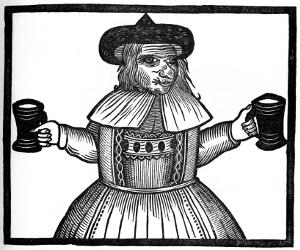
“When Skelton wore the Laurell Crowne,
My Ale put all the Ale-wiues downe.”
George Steevens having heard that a copy of Rand’s edition was
in the Library of Lincoln Cathedral, prevailed on the Dean to bring
it to London; and having made a drawing of the title-page, gave
it to Richardson the printseller, who engraved and published it.
Steevens, soon after, contributed to the European Magazine for
May, 1794, vol. xxv. 334,—
“Verses meant to have been subjoined (with the following
Motto) to a Copy from a scarce Portrait of Elinour Rumming,
lately published by Mr. Richardson, of Castle-street, Leicester-square.
Ne sit ancillæ tibi amor pudori
Xanthia Phoceu! prius insolentem
Serva Briseis niveo colore
Movit Achillem.
Movit Ajacem Telamone natum
Forma captivæ dominum Tecmessæ;
Arsit Atrides medio in triumpho
Virgine rapta.
“Eleonora Rediviva.
To seek this nymph among the glorious dead,
Tir’d with his search on earth, is Gulston fled:—
Still for these charms enamour’d Musgrave sighs;
To clasp these beauties ardent Bindley dies;—
For these (while yet unstag’d to public view)
Impatient Brand o’er half the kingdom flew;—
These, while their bright ideas round him play,
From classic Weston force the Roman lay:—
Oft too, my Storer! heaven has heard thee swear,
Not Gallia’s murder’d Queen was half so fair:—
‘A new Europa!’ cries the exulting Bull,
‘My Granger now (I thank the gods) is full:’—
Even Cracherode’s self, whom passions rarely move,
At this soft shrine has deign’d to whisper love.—
Haste then, ye swains, who Rumming’s form adore,
Possess your Elinour, and sigh no more.
The Marquis of Bute told Dallaway that he gave twenty guineas
for the original engraving of Elinour: see Dallaway’s Letheræum,
1821, p. 6.
Rand’s edition opens with the following lines, which, I need
hardly observe, are by some rhymer of the day:
“Skeltons Ghost.
To all tapsters and tiplers,
And all ale house vitlers,
Inne-keepers and cookes,
That for pot-sale lookes,
And will not giue measure,
But at your owne pleasure,
Contrary to law,
Scant measure will draw
In pot and in canne,
To cozen a man
Of his full quart a penny,
Of you there’s to many:
For in King Harry’s time,
When I made this rime
Of Elynor Rumming
With her good ale tunning,
Our pots were full quarted,
We were not thus thwarted
With froth-canne and nick-pot
And such nimble quick shot,
That a dowzen will score
For twelue pints and no more.
Full Winchester gage
We had in that age;
The Dutchmans strong beere
Was not hopt ouer heere,
To vs t’was unknowne:
Bare ale of our owne
In a bowle we might bring
To welcome the king,
And his grace to beseech,
With,
Wassall my Leigh.
[270]Nor did that time know
To puffe and to blow
In a peece of white clay,
As you doe at this day,
With fier and coale,
And a leafe in a hole;
As my ghost hath late seene,
As I walked betweene
Westminster Hall
And the church of Saint Paul,
And so thorow the citie,
Where I saw and did pitty
My countrymen’s cases,
With fiery-smoke faces,
Sucking and drinking
A filthie weede stinking,
Was ne’re knowne before
Till the deuill and the More
In th’ Indies did meete,
And each other there greete
With a health they desire
Of stinke, smoake, and fier.
But who e’re doth abhorre it,
The citie smoakes for it;
Now full of fier-shops
And fowle spitting chops,
So neesing and coughing,
That my ghost fell to scoffing,
And to myselfe said,
Here’s fylthie fumes made;
Good physicke of force
To cure a sicke horse.
Nor had we such slops,
And shagge-haire on our tops:
At wearing long haire
King Harry would sweare,
And gaue a command
With speede out of hand
All heads should be powl’d,
As well young as old,
And his owne was first so,
Good ensample to show.
Y’are so out of fashion,
I know not our nation;
Your ruffes and your bands,
And your cuffes at your hands;
Your pipes and your smokes,
And your short curtall clokes;
Scarfes, feathers, and swerds,
And thin bodkin beards;
Your wastes a span long,
Your knees with points hung,
Like morrice-daunce bels;
And many toyes els,
Which much I distaste:
But Skelton’s in haste.
My masters, farewell;
Reade ouer my Nell,
And tell what you thinke
Of her and her drinke:
If shee had brew’d amisse,
I had neuer wrote this.”
At the end of the poem is, from the same hand,
“Skelton’s Ghost to the Reader.[271]
Thus, countrymen kinde,
I pray let me finde,
For this merry glee,
No hard censure to be.
King Henry the Eight
Had a good conceit
Of my merry vaine,
Though duncicall plaine
It now nothing fits
The time’s nimble wits:
My lawrell and I
Are both wither’d dry,
And you flourish greene
In your workes daily seene,
That come from the presse,
Well writ I confesse;
But time will devouer
Your poets as our,
And make them as dull
As my empty scull.”
Concerning Elynour Rummyng and the poem by which Skelton
has rendered her famous, Dallaway has the following remarks,—his
account of the circumstances which introduced Skelton to her acquaintance
being a mere hypothesis!! “When the Court of Henry viii
was frequently kept at the palace of Nonsuch (about six miles distant),
the laureate, with other courtiers, sometimes came to Leatherhead
for the amusement of fishing, in the river Mole; and were
made welcome at the cabaret of Elinor Rummyng, whom Skelton
celebrated in an equivocal encomium, in a short [?—it consists of
623 lines—] poem, remarkable only for a very coarse jest, after a
manner peculiar to the author and the times in which he lived, but
which has been more frequently reprinted than his other works.
The gist or point of this satire had a noble origin, or there must be
an extraordinary coincidence of thought in the Beoni, or Topers, a
ludicrous effusion of the great Lorenzo de Medici, when a young
man.... Her domicile, near the bridge, still exists. The
annexed etching was made from a drawing taken previously to late
repairs, but it still retains its first distinction as an ale-house.”
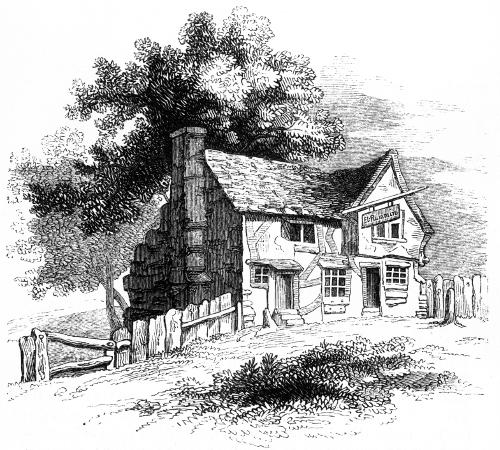
“Some of her descendants occur in the parish register in the
early part of the last century.” Letheræum, 1821, pp. 4-6.
The Tunnyng of Elynour Rummyng] Besides “I Tonne ale or
wyne I put lycour in to tonnes, Je entöne,” Palsgrave has “I Tonne
I masshe ale, Je brasse.... Whan tonne you and god wyll: Quant
brasserez vous,” &c. Lesclar. de la Lang. Fr., 1530. fol. ccclxxxxi.
(Table of Verbes); and here Tunnyng means—Brewing.
P. 95. v. 1.
Tell you I chyll,
If that ye wyll
A whyle be styll]
—I chyll, i. e. Ich wyll, I will. Compare Syr Gawayn and the Grene
Knyȝt;
“And ȝe wyl a whyle be stylle,
I schal telle yow how thay wroȝt.”
and the Prol. to Kyng Alisaunder;
“Yef ye wolen sitte stille,
Ful feole Y wol yow telle.”
Page 95. v. 4. gyll] Equivalent here to girl—a familiar name
for a female; as in the proverb, “Every Jack must have his Gill:”
supposed by some etymologists to be an abbreviation of Julia,
Juliana, or Gillian; by Richardson (Dict. in v.) to be a corruption
of giglot.
v. 6. gryll] “Grymm gryl and horryble ... horridus ... horribilis.”
Prompt. Parv.,—MS. Harl. 221. (Ed. 1499 of that work omits
“gryl..”) The word is of frequent occurrence; but its exact meaning
here seems to be doubtful.
v. 12. lere] i. e. complexion, skin.
v. 14. chere] i. e. look, countenance.
v. 17. bowsy] i. e. bloated by drinking.
v. 21. here] i. e. hair.
v. 22. lewde] i. e. vile, nasty.
v. 23. sayne] i. e. say.
v. 25. glayre] i. e. viscous matter.
Page 96. v. 27.
Her nose somdele hoked,
And camously croked]
—somdele hoked, i. e. somewhat hooked. “Camed or short nosed.
Simus.” Prompt. Parv. ed. 1499. “A Camoise nose, that is to
saie crooked vpward as the Morians [Moors].” Baret’s Alvearie.
“Camuse. Flat.” Tyrwhitt’s Gloss. to Chaucer’s Cant. Tales.
“Camused. Flat, broad and crooked; as applied to a nose, what
we popularly call a snub-nose.” Nares’s Gloss. Todd, quoting this
passage of Skelton, explains camously, awry. Johnson’s Dict. in v.
v. 34. gowndy] So Lydgate;
“A goundy eye is deceyued soone,
That any colour cheseth by the moone.”
Warres of Troy, B. ii. sig. H iii. ed. 1555.
“Gownde of the eye. Ridda, Albugo.” Prompt. Parv.,—MS. Harl.
221.
v. 35. vnsowndy] i. e. unsound.
v. 38. jetty] i. e. that part of a building which projects beyond
the rest.
Page 96. v. 40.
—— how she is gumbed,
Fyngered and thumbed]
i. e. what gums, fingers, and thumbs she has.
v. 45. huckels] i. e. hips.
v. 49. Foted] i. e. Footed.
v. 51. iet] i. e. strut: see note, p. 94. v. 43.
v. 52. fet] Means, perhaps, feat,—neat, handsome one.
v. 53. flocket] “Is described as a loose garment with large
sleeves:” see Strutt’s Dress and Habits, &c. ii. 373.
v. 54. rocket] i. e. a garment, worn often without, and sometimes
with sleeves; sometimes it was made to reach the ground,
and sometimes much shorter and open at the sides. See Id. ibid.
v. 55. With symper the cocket] So Heywood in his Dialogue;
“Vpright as a candell standth in a socket,
Stoode she that day, so simper decocket.”
Sig. F,—Workes, ed. 1598.
and Jonson in his Masque, The Gipsies Metamorphosed;
“Lay by your wimbles,
Your boring for thimbles,
Or using your nimbles,
In diving the pockets,
And sounding the sockets
Of simper-the-cockets.”
Works (by Gifford), vii. 376.
In a note on the latter passage, Whalley quotes from Cotgrave’s
Dict.: “Coquine, a beggar-woman, also a cockney, simper de cockit,
nice thing.” Gifford (ibid.) remarks, “Cocket was a fine species of
bread, as distinguished from common bread; hence, perhaps, the
name was given to an overstrained affectation of delicacy. To simper
at, or over, a thing, is to touch it as in scorn.” Nares (Gloss.
in v.) doubts (justly, I think) the connexion of simper-the-cocket
with cocket bread, and explains it, “quasi simpering coquette,”
observing, that “one of Cotgrave’s words in rendering ‘coquette’
is cocket.” I may add, that in Gloss. of Prov. and Loc. Words by
Grose and Pegge, ed. 1839, is, “Cocket, brisk, apish, pert,” and
“Simper, to mince one’s words.”
Page 97. v. 56.
Her huke of Lyncole grene,
It had ben hers, I wene,
More then fourty yere]
“Huke surquanie, froc.” Palsgrave’s Lesclar. de la Lang. Fr.,
1530. fol. xli. (Table of Subst.). “A loose kind of garment, of the
cloak or mantle kind.” Strutt’s Dress and Habits, &c. ii. 364. “Lyncolne
anciently dyed the best greene of England.” Marg. note in
Drayton’s Polyolbion, Song 25. p. 111. ed. 1622.—Compare a celebrated
ballad;
“My cloake it was a verry good cloake,
Itt hath been alwayes true to the weare,
But now it is not worth a groat;
I have had it four and forty yeere.”
Take thy old cloak about thee,—Percy’s Rel. of A. E. P. i. 206. ed. 1794.
Page 97. v. 63. woll] i. e. wool.
v. 68. gytes] i. e. clothes. Gite is properly a gown:
“And she came after in a gite of red.”
Chaucer’s Reves Tale, v. 3952. ed. Tyr.
v. 69. pranked with pletes]—pletes, i. e. plaits. “I Pranke ones
gowne I set the plyghtes in order.” Palsgrave’s Lesclar. de la Lang.
Fr., 1530. fol. cccxxi. (Table of Verbes).
v. 70. Her kyrtel Brystow red]—kyrtel; see note, p. 149.
v. 1194.
“London hath scarlet, and Bristowe pleasaunt red.”
Barclay’s Fourth Egloge, sig. C iiii. ed. 1570.
“At Brystowe is the best water to dye reed.” Hormanni Vulgaria,
sig. V ii. ed. 1530.
v. 74. gyse] i. e. guise, fashion.
v. 75. whym wham] i. e. something whimsically, fantastically
devised. The word is frequently applied to articles of female finery
by our early dramatists. In Ane Interlude of the Laying of a Gaist,
we are told that the Gaist (ghost)
“stall fra peteouss Abrahame
An quhorle and ane quhum quhame.”
v. 74,—Laing’s An. Pop. Poetry of Scotland.
Whim-wham is used by Gray, Works, iii. 123. ed. Mitford, and by
Lamb, Prose Works, ii. 142.
v. 76. trym tram] i. e. some trim, neat ornament, or pretty trifle.
In Weaver’s Lusty Juuentus, Hipocrisie, after enumerating a variety
of popish trumpery, adds
“And a hundred trim trams mo.”
Sig. B iiii. ed. Copland.
v. 77. brayne pan] i. e. skull, head. See note, p. 100. v. 31.
v. 78. Egyptian] i. e. gipsy.
Page 98. v. 85. gose] i. e. goose.
v. 88. shone] i. e. shoes.
v. 90. baudeth] i. e. fouls. “I Baudy or fyle or soyle with any
filthe, Ie souylle.” Palsgrave’s Lesclar. de la Lang. Fr., 1530. fol.
clviii. (Table of Verbes). “The auter clothes, and the vestementes
shulde be very clene, not baudy, nor torne,” &c. Hormanni Vulgaria,
sig. E iiii.
Page 98. v. 94. wonnynge] i. e. dwelling.
v. 96. Sothray] i. e. Surrey.
v. 97. stede] i. e. place.
v. 98. Lederhede] i. e. Leatherhead; see p. 157.
v. 99. tonnysh gyb] The epithet tonnysh is perhaps derived from
her occupation of tunning (see note, p. 158), or perhaps it may allude
to her shape: gyb is properly a male cat (see note, p. 122. v. 27);
but the term, as here, is sometimes applied to a woman;
“And give a thousand by-words to my name,
And call me Beldam, Gib, Witch, Night-mare, Trot.”
Drayton’s Epistle from Elinor Cobham to Duke Humphrey,—Poems, p. 175. ed. 1619. fol.
v. 100. syb] i. e. related, akin.
v. 102. noppy] i. e. nappy.
v. 103. port sale] If the right reading, must be used here for—sale
in general. “Port-sale, The Sale of Fish as soon as it is brought
into the Harbour; also an Out-cry or Publick Sale of any Commodity.”
Kersey’s Dict.
v. 105. To sweters, to swynkers] i. e. to those who sweat and
labour hard,—to labourers of various kinds.
“For we can neyther swyncke nor sweate.”
Pierce Plowman, sig. I ii. ed. 1561.
v. 110. Now away the mare] Skelton has the same expression in
his Magnyfycence, v. 1342. vol. i. 268. Compare The Frere and the
Boye;
“Of no man he had no care,
But sung, hey howe, awaye the mare.”
Ritson’s An. Pop. Poetry, p. 37.
and Jyl of Braintfords Testament, n. d.;
“Ah sira, mary away the mare,
The deuil giue thee sorow and care.”
and A new Commodye &c. of the bewte & good propertes of women, &c.
n. d.
“Tush syr be mery let pas awey the mare.”
The words are doubtless a portion of some song or ballad. In
Ravenscroft’s Melismata, Musicall Phansies, &c. 1611, is a song
(No. 6) supposed to be sung by “Seruants out of Seruice” who
“are going to the Citie to looke for new;”
“Heigh ho, away the Mare,
Let vs set aside all care,
If any man be disposed to trie,
Loe here comes a lustie crew,
That are enforced to crie
A new Master, a new,” &c.
Page 99. v. 111. sley] i. e. slay.
v. 115. Wyth, Fyll the cup, fyll] So in The Hye Way to the Spyttell
Hous, by Copland, n. d.;
“With fyll the pot, fyll, and go fyll me the can.”
Utterson’s Early Pop. Poet. ii. 15.
v. 122. Hardely] i. e. Assuredly.
v. 123. heles dagged] In Prompt. Parv. ed. 1499. is “Daggyd.
Fractillosus,”—a sense in which Skelton certainly has the word elsewhere
(Garlande of Laurell, v. 630. vol. i. 386); but here perhaps
dagged may mean—be-mired: “I Daggyll or I dagge a thing with
myer.” Palsgrave’s Lesclar. de la Lang. Fr., 1530. fol. cciii. (Table of
Verbes).
v. 124. kyrtelles] See note, p. 149. v. 1194.
—— all to-iagged] See note, p. 100. v. 32: “I Cutte or iagge a
garment.” Palsgrave’s Lesclar. de la Lang. Fr., 1530. fol. cciii.
(Table of Verbes).
v. 130. tunnynge] i. e. brewing; see note, p. 158.
v. 131. leneth ... on] i. e. lendeth, furnisheth ... of: compare
v. 491.
v. 139. sorte] i. e. set, company.
v. 142. skewed] Does it mean—distorted? or walking obliquely?
or squinting? see Todd’s Johnson’s Dict. in v. Skew. A friend suggests
that this epithet, as well as that in the preceding line, may be
applied to colour,—the words being still used as terms of the stable.
Page 100. v. 143. sho clout] i. e. shoe-cloth.
v. 145. herelace] i. e. hair-band.
v. 147. tresses vntrust] So Lydgate;—“With heyr vntrussed.”
Warres of Troy, B. iii. sig. S i. ed. 1555.
v. 148. vnlust] i. e. unpleasantness, unseemliness.
v. 149.
Some loke strawry,
Some cawry mawry]
—loke, i. e. look: strawry I do not remember to have met with elsewhere:
cawry mawry (as a substantive) occurs in Pierce Plowman;
“[Envy] was as pale as a pellet, in the palsey he semed
And clothed in Caurymaury,” &c.
Page 100. v. 151. vntydy] i. e. sluttish.
—— tegges] A term found again in our author’s first poem
Against Garnesche;
“Your wynde schakyn shankkes, your longe lothy legges
...
Bryngges yow out of fauyr with alle femall teggys.”
In what sense Skelton uses tegge, I cannot pretend to determine.
In Warwickshire and Leicestershire, a teg means a sheep of a year
old; and Ray gives, “A Tagge, a Sheep of the first Year, Suss.”
Coll. of Words, &c., p. 88, appended to Proverbs, ed. 1768.
v. 152. Lyke rotten egges] Lydgate in a satirical description of
a lady has—
“Colowryd lyche a rotyn eey [i. e. egg].”
MS. Harl. 2255. fol. 156.
v. 153. lewde sorte] i. e. vile set, low rabble.
v. 155. tyde] i. e. time, season.
v. 161. commy] i. e. come.
v. 163. shreud aray]—shreud, i. e. evil, bad. “Araye condicion
or case poynt.” Palsgrave’s Lesclar. de la Lang. Fr., 1530. fol. xviii.
(Table of Subst.); which, however, may not be the sense of aray in
the present passage. We find:—“Soo with this rumoure came in
syr launcelot and fond them al at a grete araye.” Morte d’Arthur,
B. xix. c. vi. vol. ii. 374. ed. Southey; the next chapter beginning
“What araye is this sayd sir Launcelot,” &c. “For al this foule
araye, for al this great frai.” Mery Tales, Wittie Questions, &c.,
1567. p. 18, reprint. See also our author’s sacred poem, Wofully
araid, vol. i. 141, and note on it.
v. 171. draffe] i. e. hog-wash—either the coarse liquor, or brewers’
grains, with which swine are fed.
v. 173. swyllynge tubbe] i. e. tub in which swillings (hog-wash)
are preserved for swine.
v. 174.
For, be there neuer so much prese,
These swyne go to the hye dese]
—prese, i. e. press, throng: dese, or dais, a word of doubtful etymology,
generally means—a table of estate,—the upper table raised
on a platform more elevated than the others. See Tyrwhitt’s note
on Cant. Tales, v. 372; and Richardson’s Dict. in v. Dais. It
sometimes signifies a long bench (see Jamieson’s Et. Dict. of Scot.
Lang. in v. Deis); and such seems to be its meaning here, as in the
fourth line after this “the hye benche” is mentioned.—Roy in his
satire against Wolsey, Rede me, and be nott wrothe, &c., has imitated
the present passage of Skelton;
“For, be there never so grett prease,
They are set up at the hy dease.”
Harl. Miscell. ix. 51. ed. Park.
Page 101. v. 185.
God gyue it yll preuynge,
Clenly as yuell cheuynge]
—preuynge, i. e. proving.
“And prechest on thy benche, with evil prefe:” (i. e. evil may it prove!)
Chaucer’s Wif of Bathes Prol. v. 5829. ed. Tyr.
—yuell cheuynge, i. e. evil ending, bad success.
“God geve it yvell chevynge.”
Roy’s Rede me, &c., Harl. Miscell. ix. 79. ed. Park.
See also Cocke Lorelles bote, sig. B i., Towneley Myst. p. 108, and
Chaucer’s Chanones Yemannes Tale, v. 16693. ed. Tyr.
v. 189. patch] I know not how to explain.
v. 190. ron] i. e. run.
v. 192. ioust] i. e. joist.
v. 196. bolle] i. e. bowl.
v. 198. skommeth] i. e. skimmeth.
v. 199. Whereas] i. e. Where.
v. 201. blennes] i. e. blends.
Page 102. v. 212. And ye may it broke] i. e. If you may brook it.
v. 213. loke] i. e. look.
v. 218. ble] i. e. colour, complexion.
v. 219. Ich am] i. e. I am.
v. 222. In lust and in lykyng] See note, p. 98. v. 23.
v. 223. whytyng] So in our early dramas, whiting-mop (young
whiting) is a cant term for a nice young woman, a tender creature:
see Puttenham’s Arte of E. P., 1589. p. 184., and note in my ed. of
Webster’s Works, in. 37.
v. 224. mullyng] This term of endearment occurs in the Coventry
Mysteries, applied by one of the shepherds to the infant Saviour;
“Thow I be the last that take my leve
ȝit fayre mullynge take it nat at no greve.”
MS. Cott. Vesp.. D viii. fol. 91.
Compare also Hormanni Vulgaria: “This is a fayre and swete
mullynge. Blandus est puerulus insigni festiuitate.” Sig. dd vii.
ed. 1530.
—— mytyng] In the Towneley Mysteries, one of the shepherds
says to the infant Saviour,
“Haylle, so as I can, haylle, praty mytyng!”
and Jamieson gives myting as a fondling designation for a child,
Et. Dict. of Scot. Lang.—In our author’s third poem Against Garnesche,
v. 115. vol. i. 123, “myteyng”—(but used as a term of contempt)—is,
as here, the rhyme to “wyteyng.”
Since writing the above note, I have met with a passage in the
comedy called Wily Beguilde, which might be adduced in support
of the reading, “nytyng;” but I still think that “mytyng” is the
true one: the dramatist evidently recollected Skelton’s poem, in
the ed. of which he had found “nytyng,” “nittinge,” or “nittine:”—“Comely
Pegge, my nutting, my sweeting, my Loue, my doue,
my honnie, my bonnie, my ducke, my deare and my deareling.”
Sig. C 4. ed. 1606.
Page 102. v. 225. His nobbes and his conny] So in a song in The
Triall of Treasure, 1567;
“My mouse my nobs and cony swete.”
conny, i. e. rabbit.
v. 227. Bas] i. e. Kiss.
—— bonny] i. e. precious one (rather than—beautiful one,—for
it has the epithet “prety”).
v. 229. This make I my falyre fonny] This, i. e. Thus; see note,
p. 86. v. 38: it has been suggested that falyre means fellow; which
I doubt: fonny is, I suppose, foolishly amorous; compare—
“As freshly then thou shalt begin to fonne
And dote in loue.”
Chaucer’s Court of Loue,—Workes, fol. 329. ed. 1602.
“With kissing, and with clapping, I gert the carill fon.”
Dunbar’s Tua Maryit Wemen and The Wedo, Poems, i. 71. ed. Laing.
v. 230. dronny] i. e. drone.
v. 232. rout] i. e. snore.
Page 103. v. 245. conny] i. e. rabbit.
v. 247. a salt] i. e. a salt-cellar.
—— spone] i. e. spoon.
v. 248. shone] i. e. shoon, shoes.
v. 250. a skellet] i. e. a skillet, a small kettle: in Suffolk it means
a brass perforated implement for skimming the cream off milk; see
Moor’s Suff. Words.
v. 251.
Some fyll theyr pot full
Of good Lemster woll]
The meaning is—in the pot which was to hold the ale they brought
wool “instede of monny” (v. 244).
Page 103. v. 254. athrust] i. e. a-thirst.
v. 258. slaty or slyder] i. e. miry or slippery.
Page 104. v. 266. renne] i. e. run.
v. 269. byrle] The word birl—to pour out, furnish for, or part
drink among guests—(see Jamieson’s Et. Dict. of Scot. Lang. in v.,
and Leyden’s Gloss. to The Comp. of Scotland in v. Beir)—is not
very common in English literature: “the olde God of wyne called
Baccus birlyng the wyne.” Hall’s Chronicle, (Hen. viii.) fol. lxxiii.
ed. 1548.
v. 270. gest] i. e. guest.
v. 271. She swered by the rode of rest]—rode, i. e. rood,—cross:
see note on Ware the Hauke, v. 69.
“That is hardly saide, man, by the roode of rest.”
Barclay’s First Egloge, sig. A iii. ed. 1570.
v. 280. haruest gyrdle] i. e. perhaps, a girdle worn at the feast
after the gathering in of the corn.
v. 286. To offer to the ale tap] So in Jak Hare, a poem attributed
to Lydgate;
“And with his wynnynges he makith his offrynge
At the ale stakis.”
v. 288. sowre dowe]—dowe, i. e. dough. “Sower dough leuayn.”
Palsgrave’s Lesclar. de la Lang. Fr., 1530. fol. lxv. (Table of Subst.).
v. 289. howe] i. e. ho.
v. 292. And pype tyrly tyrlowe] Compare a Song belonging to
the Tailors’ and Shearmen’s Pageant;
“Thé sange terly terlow.”
Sharp’s Diss. on Coventry Pag. and Myst., p. 114.
v. 295. hekell] i. e. comb for dressing flax.
v. 296. rocke] i. e. distaff.—In a poem entitled Cryste Crosse me
Spede. A. B. C. Imprynted at London in Fletestrete at the sygne of
the Sonne, by me Wynkyn de Worde, 4to. (which I know only from
the account of it in Typog. Antiq. ii. 367. ed. Dibdin) are the following
lines;
“A grete company of gossyps gadred on a route
Went to besyege an ale hous rounde aboute
Some brought a distaffe & some a rele
Some brought a shouell & some a pele
Some brought drynke & some a tankarde
And a galon potte faste they drewe thederward,” &c.
Though no edition of Elynour Rummyng has come down to us
printed anterior to Cryste Crosse me Spede, the evident imitation
of the former in the passage just quoted, shews that it must have
existed.
Page 104. v. 298. wharrowe] i. e. whirl, or wharve, for a spindle.
“A spyndell with a wharowe—fusus cum spondulo, siue verticillo
siue harpage.” Hormanni Vulg. sig. t i. ed. 1530.
v. 299. rybskyn] In Prompt. Parv., ed. 1499, “Rybskyn” stands
without a Latin term; but in the copy of that work, MS. Harl. 221,
is “Rybbe skynn. Melotula.” In a MS. Catholicon in Lingua materna,
dated 1483, I find “Rybbynge skyn. nebrida. pellicudia.” I
may add that in Palsgrave’s Lesclar. de la Lang. Fr., 1530, “Rybbe
skynne” occurs without the corresponding French, fol. lix. (Table
of Subst.).—Does it mean (as Albert Way, Esq. has obligingly suggested
to me) a leather apron, used during the operation of flax-dressing?
Page 105. v. 303. thrust] i. e. thirst.
v. 305.
But drynke, styll drynke,
And let the cat wynke]
So in The Worlde and the Chylde, 1522;
“Manhode. Now let vs drynke at this comnaunt
For that is curtesy.
Folye. Mary mayster ye shall haue in hast
A ha syrs let the catte wyncke,” &c.
See also three epigrams by Heywood Of the winking Cat,—Workes,
sig. P 4. ed. 1598.
v. 307. gommes] i. e. gums.
v. 308. crommes] i. e. crums.
v. 314. chaffer] i. e. merchandise.
v. 319. in all the hast] Compare: “Bulwarkes were made in all
the haste.” Hormanni Vulgaria, sig. z iii. ed. 1530.
“the ryght way
To London they tooke in all the haste.”
Smith’s xii Mery Jests of the wyddow Edyth, ed. 1573. sig. H iiii.
v. 320. vnlast] i. e. unlaced.
v. 323. all hallow] i. e. all saints,—perhaps, All-saints’ day.
v. 324.
It was a stale to take
The deuyll in a brake]
For “stare,” which is the reading of all the eds., I have substituted
“stale”—i. e. lure, decoy. “Stale of fowlys takinge.” Prompt.
Parv. ed. 1499. So in Marmyon’s Hollands Leaguer, 1632;
“And if my skill not failes me, her I’ll make
A Stale, to take this Courtier in a brake.”
Compare too an epigram by Heywood;
“Take time when time commeth: are we set time to take?
Beware time, in meane time, take not vs in brake.”
Workes, sig. Q 3. ed. 1598.
and Cavendish’s Life of Wolsey; “At last, as ye have heard here
before, how divers of the great estates and lords of the council lay
in a-wait with my Lady Anne Boleyn, to espy a convenient time and
occasion to take the cardinal in a brake.” p. 147. ed. 1827.—In our
text, and in the passages just quoted, brake seems to be used for trap:
among its various significations, it means a strong wooden frame for
confining the feet of horses, preparatory to their being shod; see
Gifford’s note on Jonson’s Works, iii. 463.
Page 105. v. 327. gambone] i. e. gammon.
v. 328. resty] i. e. reasty, rancid.
v. 330. Angry as a waspy]—waspy, i. e. wasp. So Heywood;
“Now mery as a cricket, and by and by,
Angry as a waspe.”
Dialogue, sig. C 4,—Workes, ed. 1598.
v. 331. yane] “I yane I gaspe or gape.” Palsgrave’s Lesclar.
de la Lang. Fr., 1530. fol. ccccxi. (Table of Verbes).
—— gaspy] i. e. gasp.
Page 106. v. 332. go bet] Compare;
“Arondel, queth Beues tho,
For me loue go bet, go.”
Sir Beues of Hamtoun, p. 129. Maitl. ed.
“Go bet, quod he, and axe redily,
What corps is this,” &c.
Chaucer’s Pardoneres Tale, v. 12601. ed. Tyrwhitt,—
who observes that in the following lines of Chaucer’s Legend of
Dido (288), go bet seems to be a term of the chase;
“The herd of hartes founden is anon,
With hey, go bet, pricke thou, let gon, let gon.”
“He hath made me daunce, maugre my hede,
Amonge the thornes, hey go bette.”
The Frere and the Boye,—An. Pop. Poetry, p. 46. ed. Ritson,—
who supposes the words to be the name of some old dance.
Page 106. v. 333. met] i. e. measure.
v. 334. fet] i. e. fetched.
v. 335. spycke] “Spyk of flesshe. Popa.” Prompt. Parv. ed. 1499.
The copy of that work, MS. Harl. 221, has “Spyk or fet flesche,” &c.
v. 336. flycke] i. e. flitch.
v. 339. stut] i. e. stutter.
v. 343. sayne] i. e. says.
—— a fyest] So Hawes;
“She let no ferte nor yet fyste truelye.”
The Pastime of pleasure, sig. Q viii. ed. 1555.
“A fiest, Tacitus flatus.” Withals’s Dict. p. 343. ed. 1634.
v. 346. wyth shamfull deth] Equivalent to—may you die with
a shameful death! see Tyrwhitt’s Gloss. to Chaucer’s Cant. Tales, in
v. With.
v. 347. callettes] i. e. trulls, drabs, jades.
v. 348. I shall breake your palettes]—palettes, i. e. crowns, pates.
So in a poem by Sir R. Maitland;
“For your rewarde now I sall brek your pallat.”
Anc. Scot. Poems from. Maitl. MSS., ii. 317. ed. Pinkerton,—
who, in the Gloss., wrongly explains it “cut your throat.”
v. 350. And so was made the peace] In confirmation of the reading
which I have given, compare Reynard the Fox; “Thus was the
pees made by fyrapel the lupaerd frendly and wel.” Sig. e 5. ed. 1481;
and see note on v. 319. p. 168.
v. 354. sainct James in Gales] The body of Saint James the
Great having, according to the legend, been buried at Compostella
in Galicia (Gales), a church was built over it. Pilgrims flocked
to the spot; several popes having granted the same indulgences to
those who repaired to Compostella, as to those who visited Jerusalem.
In The foure P. P. by Heywood, the Palmer informs us that
he has been
“At saynt Cornelys at saynt James in Gales
And at saynt Wynefrydes well in Walles,” &c.
v. 355. Portyngales] i. e. Portuguese.
v. 356. I wys] i. e. truly, certainly (i-wis, adv.).
v. 360. the Crosse in Chepe] Was originally erected in 1290 by
Edward I. at one of the resting places of the body of his beloved
Eleanor, in its progress from Herdeby, where she died, to Westminster
Abbey, where she was buried; and was adorned with her
image and arms. Of its being afterwards rebuilt,—of the conduits
that were added to it, &c. &c. an account will be found in Stow’s
Survey, B. iii. 35. ed. 1720, and Sup. to Gent. Mag. for 1764, vol. 34.
607. This structure was barbarously demolished in 1643, as a monument
of Popish superstition.
Page 106. v. 362. route] i. e. disorderly crowd.
Page 107. v. 364.
Sneuelyng in her nose,
As thoughe she had the pose]
—pose, i. e. a rheum in the head. So Chaucer;
“he speketh in his nose,
And sneseth fast, and eke he hath the pose.”
The Manciples Prol. v. 17010. ed. Tyr.
See also Reves Tale, v. 4149.
v. 371. fyll] i. e. fell.
v. 372. barlyhood] Or barlikhood, is said to mean a fit of obstinacy
or violent ill-humour produced by drunkenness: see Jamieson’s
Et. Dict. of Scot. Lang. and Supp. in v.; also Stevenson’s addition
to Boucher’s Gloss. in v. Barlic.
v. 378. newe ale in cornes] So in Thersytes, n. d.;
“I will make the drincke worse than good ale in the cornes.”
“New ale in cornes. Ceruisia cum recrementis.” Baret’s Alvearie,
in v. Ale.
v. 386. fabell] i. e. talking.
v. 387. babell] i. e. babbling.
v. 388.
—— folys fylly
That had a fole wyth wylly]
Whether folys fylly means a foolish young jade (a filly,—compare
what follows), or foolish Philly (Phillis,—compare our author’s
Bowge of Court, v. 370. vol. i. 44); and whether or not wylly is
meant for a proper name (as it is given in the comparatively recent
ed. of Rand), let the reader judge.
v. 390. Iast you, and, gup, gylly] See note, p. 99. v. 17. “What
gyppe gyll with a galde backe, begynne you to kycke nowe: Hey
de par le diable gilotte,” &c. Palsgrave’s Lesclar. de la Lang. Fr.,
1530. fol. cclxxii. (Table of Verbes). So Dunbar uses gillot for a
young mare; see his Poems, i. 65, ii. 459 (note), ed. Laing.
v. 394. sennet] i. e. sennight, week.
Page 108. v. 395. pay] i. e. satisfaction, content.
v. 397. Of thyne ale let vs assay]—assay, i. e. try, taste. So in
Pierce Plowman;
“I haue good ale goship said he, gloton wold thou assai.”
Page 108. v. 398. pylche] i. e. cloak of skins.
v. 399. conny] i. e. rabbit.
v. 490. loke] i. e. look.
—— donny] Richardson, Dict. in vv. Dun, Dunny, cites this
line as containing an example of the latter word,—rightly, perhaps,
for donne (dun) occurs in Skelton’s Magnyfycence, v. 1102. vol. i.
257.—The common people of Ireland employ donny in the sense of—poor,
mean-looking, as “a donny creature;” also in the sense of—poorly,
as “How are you to-day?”—“Och! but donny, very
donny.” For this information I am indebted to the kindness of
Miss Edgeworth, who has used the word in one of her excellent
tales.
v. 407. blommer] i. e., perhaps, noise, uproar.
v. 408. a skommer] i. e. a skimmer.
v. 409. a slyce] “Sclyce to tourne meate tournoire.” Palsgrave’s
Lesclar. de la Lang. Fr., 1530. fol. lxii. (Table of Subst.).
v. 412. sterte] i. e. started, rushed.
v. 414. somdele seke] i. e. somewhat sick.
v. 415. a peny cheke] Does it mean—a puny chick?
v. 418. Margery Mylkeducke] So again in our author’s Magnyfycence;
“What, Margery Mylke Ducke, mermoset!”
Compare one of the Coventry Mysteries;
“Malkyn Mylkedoke and fayr Mabyle.”
MS. Cott. Vesp. D viii. fol. 74.
v. 419.
Her kyrtell she did vptucke
An ynche aboue her kne]
—kyrtell; see note, p. 149. v. 1194.—So in our old ballad poetry;
“Then you must cut your gowne of greene,
An inch above your knee.”
Child Waters,—Percy’s Rel. of A. E. P. iii. 56. ed. 1794.
v. 422. stubbed] i. e. short and thick.
v. 423. pestels] i. e. legs,—so called, perhaps, because the leg-bone
resembles a pestle used in a mortar. The expression “pestle
of pork” frequently occurs in our early writers; as in the following
passage concerning the tremendous appetite of Charlemagne;
“Whan he took hys repaast he was contente wyth lytel brede, but
as touchyng the pytaunce, he ete at his repaast a quarter of moton,
or ii hennes, or a grete ghoos, or a grete pestel of porke, or a pecok,
or a crane, or an hare all hool.” Caxton’s Lyf of Charles the Grete,
&c., 1485. sig. b iii.
Page 108. v. 423. clubbed] i. e. like clubs.
v. 425. fote] i. e. foot.
v. 426. foule] i. e. ugly: see note, p. 130. v. 442.
Page 109. v. 429. cantell] i. e. corner, piece, fragment.
v. 431. quycke] i. e. live.
v. 435. punyete] i. e. pungent.
v. 436. sorte] i. e. set, company.
v. 441. I wote nere] i. e. I know never, not.
v. 443. podynges and lynkes] “Links, a kind of Pudding, the
skin being filled with Pork Flesh, and seasoned with diverse Spices,
minced, and tied up at distances.” R. Holme’s Ac. of Armory, 1688.
B. iii. p. 83. In Scotland the terms puddings and links are applied
to various intestines of animals.
v. 447. leche] i. e. physician, doctor.—Dunbar makes a distinction,
which I do not understand;
“In Medicyne the most Practicianis,
Leichis, Surrigianis, and Phisicianis.”
Poems, i. 213. ed. Laing.
v. 450. keke] i. e. kick.
v. 451. the vertue of an vnset leke] “Vnsette lekes be of more
vertue than they that be sette ... præstant in medicina.” Hormanni
Vulgaria, sig. f ii. ed. 1530.
v. 452. breke] i. e. breeches.
v. 453. feders] i. e. feathers.
v. 460. noughty froslynges] i. e. worthless things, stunted by
frost. In Suffolk, froslin is applied to any thing—a lamb, a goslin,
a chicken, an apple, &c., nipped, or pinched, or injured by frost:
see Moor’s Suffolk Words, Appendix.
Page 110. v. 462. callet] i. e. trull, drab, jade.
v. 465. wretchockes] “The famous imp yet grew a wretchock;
and though for seven years together he was carefully carried at his
mother’s back, rocked in a cradle of Welsh cheese, like a maggot,
and there fed with broken beer, and blown wine of the best daily,
yet looks as if he never saw his quinquennium.” Jonson’s Masque,
The Gipsies Metamorphosed,—Workes, vii. 371. ed. Gifford, who thus
comments on the passage in his authoritative style: “i. e. pined
away, instead of thriving. Whalley appears to have puzzled himself
sorely in this page, about a matter of very little difficulty. In
every large breed of domestic fowls, there is usually a miserable
little stunted creature, that forms a perfect contrast to the growth
and vivacity of the rest. This unfortunate abortive, the goodwives,
with whom it is an object of tenderness, call a wrethcock; and this
is all the mystery. Was Whalley ignorant that what we now term
chick, was once chocke and chooke?” The fol. ed. of the Masque of
Gipsies has “wretch-cock,” which Nares, who does not know what
to make of the word, observes “would admit of an easy derivation
from wretch and cock, meaning a poor wretched fowl.” Gloss. in v.
Page 110. v. 466. shyre shakyng nought] i. e. sheer worthless. So
again our author in his Magnyfycence;
“From qui fuit aliquid to shyre shakynge nought.”
v. 475. fall] i. e. fallen.
v. 483. foggy] “Foggy, to full of waste flesshe.” Palsgrave’s
Lesclar. de la Lang. Fr., 1530. fol. lxxxviii. (Table of Adiect.).
v. 489. craw] i. e. crop, stomach.
v. 491. on] i. e. of: compare v. 131.
Page 111. v. 492. an old rybibe] Chaucer, in The Freres Tale, says,
“This Sompnour, waiting ever on his pray,
Rode forth to sompne a widewe, an olde ribibe.”
who says he cannot guess how this musical instrument came to be
put for an old woman, “unless perhaps from its shrillness.” The
word so applied occurs also in Jonson’s Devil is an Ass, act i. sc. 1,
where Gifford observes, “Ribibe, together with its synonym rebeck,
is merely a cant expression for an old woman. A ribibe, the reader
knows, is a rude kind of fiddle, and the allusion is probably to the
inharmonious nature of its sounds.” Works, v. 8.
v. 493. She halted of a kybe] i. e. She limped from a chap in the
heel. The following remedy is seriously proposed in The Countrie
Farme, and was no doubt applied by our ancestors: “For kibes on
the heeles, make powder of old shooe soles burned, and of them with
oile of roses annoint the kibes; or else lay vnto the kibes the rinde
of a pomegranat boiled in wine.” p. 83. ed. 1600.
v. 496.
And fell so wyde open
That one myght se her token]
Compare The foure P. P. by Heywood;
“So was thys castell layd wyde open
That euery man myght se the token.”
v. 498. wroken] i. e. wreaked.
v. 501. on Gods halfe] i. e. “on God’s part, with God’s favour.”
Tyrwhitt’s Gloss. to Chaucer’s Cant. Tales. “A goddes halfe: De
par dieu.” Palsgrave’s Lesclar. de la Lang. Fr., 1530. fol. ccccxxxvi.
(Table of Aduerbes).
Page 111. v. 503. beshrew] i. e. curse.
v. 506. lampatrams] A word which I am unable to explain.
v. 507. shap] i. e. pudendum: see Palsgrave’s Lesclar. de la Lang.
Fr., 1530. fol. xxvi. (Table of Subst.). So in a description of purgatory-punishments
in the metrical legend of Owayne Myles;
“And some were yn to shappus
And some were vp to the pappus.”
MS. Cott. Calig. A ii. fol. 91.
v. 512. stert] i. e. started.
v. 515. dant] In Kilian’s Dict. is “Dante. Ambubaia, mulier
ignaua.” ed. 1605; and in Gloss. to West. and Cumb. Dialect, “Dannet,
a ... woman of disreputable character:” but, for aught I know,
the word in the text may have some very different signification.
v. 516. a gose and a gant] Must mean here,—a goose and a
gander: yet Skelton in Phyllyp Sparowe mentions first “the gose
and the gander,” and afterwards “the gaglynge gaunte:” see note,
p. 130. v. 447.
v. 517. wesant] i. e. weasand.
v. 519. olyfant] i. e. elephant.
v. 520. bullyfant] Another word which I do not understand.
v. 522. hedes] i. e. heads.
Page 112. v. 525. ale pole] i. e. pole, or stake, set up before an
ale-house by way of sign.
v. 535. A strawe, sayde Bele, stande vtter]—stande vtter, i. e.
stand more out, back.
“Straw, quod the thridde, ye ben lewed and nice.”
Chaucer’s Chanones Yemannes Tale, v. 16393. ed. Tyr.
“Stonde vtter felowe where doest thou thy curtesy preue?”
The Worlde and the Chylde, 1522. sig. B iv.
v. 538. sterte] i. e. started.
—— fysgygge] “Trotiere: A raumpe, fisgig, fisking huswife,
raunging damsell, gadding or wandring flirt.” Cotgrave’s Dict.
“Fiz-gig, a wild flirting wench.” Dialect of Craven, &c.
v. 543. gat] i. e. got.
v. 549. quod] i. e. quoth.
—— hyght] i. e. called.
v. 550. bybyll] i. e. drink, tipple.
v. 553. Wheywormed] i. e. covered with whey-worms,—pimples
from which a whey-like moisture exudes.
Page 113. v. 555. puscull] i. e. pustule.
v. 556. muscull] i. e. muscle,—the shell of which is frequently
“scabbyd.”
Page 113. v. 557. noppy] i. e. nappy.
v. 558. soppy] i. e. sop.
v. 560. mote I hoppy] i. e. may I have good hap.
v. 561. coleth] i. e. cooleth.
—— croppy] i. e. crop, stomach.
v. 563. Haue here is for me] See note, p. 118. v. 413.
v. 573. defoyled] i. e. defiled.
v. 575. sorte] i. e. set, company.
v. 582. a pryckemedenty] i. e. one affectedly nice, finical.
v. 583.
Sat lyke a seynty,
And began to paynty
As thoughe she would faynty]
—seynty, i. e. saint: paynty, i. e. paint,—feign: faynty, i. e. faint.
Compare our author’s Colyn Cloute;
“That counterfaytes and payntes
As they were very sayntes.”
v. 587. a lege de moy] So again in our author’s Colyn Cloute;
“And howe Parys of Troy
Daunced a lege de moy,
Made lusty sporte and ioy
With dame Helyn the quene.”
I have not found elsewhere the term lege de moy. Mace, in his
Musick’s Monument, 1676, mentions a Tattle de Moy,—“a New
Fashion’d Thing, much like a Seraband; only It has more of Conceit
in It, as (in a manner) speaking the word (Tattle de Moy),” &c.
p. 129.
Page 114. v. 594. I wys] i. e. truly, certainly (i-wis, adv.).
v. 598. spence] i. e. store-room, for drink, or victuals: “Spens
a buttrye despencier.” Palsgrave’s Lesclar. de la Lang. Fr., 1530.
fol. lxvi. (Table of Subst.).
v. 609. awne] i. e. own.
v. 610. Neyther gelt nor pawne] i. e. Neither money nor pledge.
v. 615. balke] i. e. beam, post: “Balke of an house pouste.”
Palsgrave’s Lesclar. de la Lang. Fr., 1530. fol. xix. (Table of
Subst.).
v. 616. tayle] i. e. tally. “A payre of taylles, suche as folke
vse to score vpon for rekennyng.” Palsgrave’s Lesclar. de la Lang.
Fr., 1530. fol. xiii. (Thirde Boke).
v. 617. yll hayle] i. e. ill health,—ill luck,—a common imprecation
in our old poetry;
“Ill haile, Alein, by God thou is a fonne.”
Chaucer’s Reves Tale, v. 4087. ed. Tyr.
See too Chester Mysteries (De Del. Noe), p. 27. Roxb. ed.
Page 114. v. 619. to mytche] i. e. too much.
v. 620. mummynge] i. e. frolicking, merriment.
Page 115. v. 622. gest] i. e. story. “Gest or romauns.” Prompt.
Parv. ed. 1499.
v. 623. this worthy fest] So in the Coventry Mysteries;
“At wurthy festys riche men woll bene.”
MS. Cott. Vesp. D viii. fol. 32.
and in Cavendish’s Life of Wolsey, “It is not to be doubted but that
the king was privy of all this worthy feast.” p. 199. ed. 1827.
Quod] i. e. Quoth.
All the particulars concerning Garnesche, which I have been able
to discover will be found in the Account of Skelton and his Writings.
Page 116. v. 1. Sithe] i. e. Since.
v. 4. Syr Tyrmagant]—or Termagant,—a very furious deity,
whom the Crusaders and romance-writers charged the Saracens
with worshipping, though there was certainly no such Saracenic
divinity. Concerning the name, see Gifford’s note on Massinger’s
Works, ii. 125. ed. 1813, and Nares’s Gloss. in v.—So in The Flyting
of Dunbar and Kennedy, which in various minute particulars bears
a strong resemblance to the present pieces Against Garnesche;
“Termygantis temptis and Vespasius thy eme.”
Dunbar’s Poems, ii. 85. ed. Laing.
—— tyrnyd] i. e. tourneyed, encountered.
v. 5. Syr Frollo de Franko] Was a Roman knight, governor of
Gaul, slain by King Arthur: see Geoffrey of Mon. l. ix. cap. ii., The
Legend of King Arthur, Percy’s Rel. of A. E. P. iii. 39. ed. 1794,
&c. &c.
—— talle] i. e. valiant.
v. 6. Syr Satrapas] Neither with this, nor with the personage
mentioned in the next line, have I any acquaintance.
v. 8. haue ye kythyd yow a knyght]—kythyd, i. e. made known,
shewn.
“It kythit be his cognisance ane knight that he wes.”
Golagros and Gawane, p. 137, Syr Gawayne, &c. ed. Bann.
Garnesche had the dignity of knighthood; see Account of Skelton
and his Writings. In the heading, and first line, of this poem, he
is called Master; but knights were frequently so addressed. In
Cavendish’s Life of Wolsey mention is made of “Sir William Fitzwilliams,
a knight,” who is presently called “Master Fitzwilliams,”
pp. 310, 311. ed. 1827, and of “Sir Walter Walshe, knight,” who is
immediately after termed “Master Walshe,” pp. 339, 340, and of
“that worshipful knight Master Kingston,” p. 374.
Page 116. v. 8. Syr Dugles the dowty] “The high courage of
Dowglasse wan him that addition of Doughty Dowglasse, which
after grew to a Prouerbe.” Marg. Note on the description of the
Battle of Shrewsbury, in Drayton’s Polyolbion, Song 22. p. 37.
ed. 1622.
v. 9. currysly] i. e. currishly.
v. 10. stowty] i. e. stout.
v. 11. Barabas] The robber mentioned in Scripture.
—— Syr Terry of Trace]—Trace, i. e. Thrace: but I do not
recollect any romance or history in which a Sir Terry of that country
is mentioned.
v. 12. gyrne] i. e. grin.
—— gomys] i. e. gums.
v. 15. Syr Ferumbras the ffreke]—ffreke (common in romance-poetry
in the sense of—man, warrior) is here, as the context shews,
equivalent to furious fellow: we have had the word before, see p. 109.
v. 187. Consult the analysis of the romance of Sir Ferumbras in
Ellis’s Spec. of Met. Rom. ii. 356, and Caxton’s Lyf of Charles the
Grete, &c., 1485, for much about this Saracen, called in the latter
Fyerabras,—“a meruayllous geaunte,”—“whyche was vaynquysshed
by Olyuer, and at the laste baptysed, and was after a
Saynt in heuen.” Sig. b viii.
v. 16. Syr capten of Catywade, catacumbas of Cayre] Cayre is
Cairo; but I am unable to explain the line. In the opening of
Heywood’s Four P. P., the Palmer says, he has been at “the graet
God of Katewade,” alluding, as O. Gilchrist thinks, to Catwade-bridge
in Sampford hundred in Suffolk, where there may have been
a famous chapel and rood; see Dodsley’s Old Plays, i. 61. last ed.
v. 17. Thow] i. e. Though.
—— Syr Lybyus] See note, p. 138. v. 649.
v. 18. contenons oncomly] i. e. countenance uncomely.
v. 19. apayere] i. e. impair—become less.
Page 117. v. 22. Of Mantryble the Bryge, Malchus the murryon]—murryon,
i. e. Moor; so in the third of these poems, Skelton
calls Garnesche “Thou murrionn, thou mawment,” v. 170. vol. i.
125; so too in the Scottish Treasurer’s Accounts for 1501, “Peter
the Moryen,” Dunbar’s Poems, ii. 306. ed. Laing; and in a folio
broadside, M. Harry Whobals mon to M. Camell, &c. (among the
“flytings” of Churchyard and Camell), “Some morryon boye to
hold ye vp.” If the present passage means that the Bridge was
guarded by a Moor called Malchus, I know not what authority
Skelton followed. Concerning the Bridge of Mantryble see the
analysis of the romance of Sir Ferumbras, Ellis’s Spec. of Met. Rom.
ii. 389; and Caxton’s Lyf of Charles the Grete, &c., 1485, “Of the
meruayllous bridge of Mantryble, of the trybute there payed for to
passe ouer,” &c., sig. e viii., and how “the strong brydge of mantryble
was wonne not wythoute grete payne,” sig. h viii.: it was
kept by a giant, named Algolufre in the former, and Galafre in the
latter, who was slain by the Frenchmen when the Bridge was won.
In The Bruce of Barbour, the hero reads to his followers “Romanys
off worthi Ferambrace” and how Charlemagne “wan Mantrybill
and passit Flagot.” B. ii. v. 832 sqq. ed. Jam. “The tail of the brig
of the mantribil” is mentioned in The Complaynt of Scotland, p. 98.
ed. Leyden. Compare also Don Quixote; “nor that [history] of
Fierabras, with the Bridge of Mant[r]ible, which befell in Charlemaines
time, and is, I sweare, as true, as that it is day at this
instant.” P. i. B. iv. c. xxii. p. 546., Shelton’s trans., 1612.
Page 117. v. 23. blake Baltazar with hys basnet routh as a bere]
Does blake Baltazar mean one of the Magi, or, as they were commonly
called, the Three Kings of Cologne? “the third, Balthasar,
a black or Moor, with a large spreading beard,” &c. Festa Anglo-Romana,
p. 7, cited in Brand’s Pop. Ant. i. 19 (note), ed. 1813: with
hys basnet routh as a bere, i. e. with his cap (not helmet, it would
seem,) rough as a bear.
v. 24. Lycon, that lothly luske]—Lycon is probably Lycaon; see
note, p. 127. v. 311. “Here is a great knaue i. a great lyther
luske, or a stout ydell lubbar.” Palsgrave’s Acolastus, 1540. sig. X ii.
“Luske a vyle parsone ribavlt, esclaue, lovrdavlt.” Palsgrave’s
Lesclar. de la Lang. Fr., 1530. fol. xlvi. (Table of Subst.). The
word is often used as a term of reproach in general.
v. 25. brymly] i. e. fiercely, ruggedly.
—— here] i. e. hair.
v. 26. bake] i. e. back.
—— gere] i. e. dress.
v. 30. a camoke] Is explained—a crooked stick, or tree; a
crooked beam, or knee of timber.
v. 31. teggys] See note, p. 164. v. 151.
Page 117. v. 33. Orwelle hyr hauyn] By Harwich.
v. 36. Sarson] i. e. Saracen. So in The Flyting of Dunbar and
Kennedy (see note, p. 177. v. 4), “Sarazene, syphareit,” &c. Dunbar’s
Poems, ii. 75. ed. Laing.
—— ble] i. e. colour, complexion.
v. 37. As a glede glowynge] i. e. glowing like a burning coal:—but
qy. did Skelton write “as a glede glowrynge?” i. e. staring like
a kite. He uses glede in this latter sense in Magnyfycence, v. 1059.
vol. i. p. 259: and in The Flyting of Dunbar and Kennedy (see note,
p. 177. v. 4) we find,—
“hungry gled.”
...
“Lyke to ane stark theif glowrand in ane tedder.”
Dunbar’s Poems, ii. 70, 72. ed. Laing.
—— ien] i. e. eyne, eyes.
v. 39. passe] i. e. excel.
v. 40. Howkyd as an hawkys beke, lyke Syr Topyas] i. e. Hooked,
&c. The allusion is to Chaucer’s Sire Thopas, who “had a semely
nose.” v. 13659. ed. Tyr.
v. 41. buske] i. e. prepare, or rather, perhaps, hie.
v. 42. fole] i. e. fool.
Be] i. e. By.
gorbelyd] i. e. big-bellied.
Godfrey] Concerning this person, who assisted Garnesche in
his compositions, and is afterwards called his scribe, I can give the
reader no information.
Page 118. v. 2. [Your] gronynge, ȝour grontynge, your groinynge
lyke a swyne] Skelton has elsewhere;
“Hoyning like hogges that groynis and wrotes.”
Against venemous tongues, vol. i. 132.
“The Gruntyng and the groynninge of the gronnyng swyne.”
Garlande of Laurell, v. 1376. vol. i. 415.
To groin is explained to groan, to grunt, to growl; but perhaps our
author may have used it like the French “Groigner. To nuzle, or
to root with the snout.” Cotgrave’s Dict.
v. 3. alle to peuiche] See note, p. 100. v. 32.
v. 4. mantycore] See note, p. 127. v. 294.
—— maltaperte] i. e. malapert, (perhaps an error of the transcriber).
v. 5. lere] i. e. complexion, skin.
—— gresyd bote] i. e. greased boot.
Page 118. v. 6.
Ye cappyd Cayface copious, your paltoke on your pate,
Thow ye prate lyke prowde Pylate, be ware yet of chek mate]
—Cayface, i. e. Caiaphas: copious is perhaps an allusion to some sort
of cope, in which that personage might have figured on the stage.
The usual explanations of paltock (“Paltok. Baltheus,” Prompt.
Parv.; “a short garment of the doublet kind,” Strutt’s Dress and
Habits, &c. ii. 352) do not seem to suit the present passage. In
Palsgrave’s Lesclar. de la Lang. Fr., 1530. fol. lii. (Table of Subst.)
we find “Paltocke a patche palleteau;” and see what immediately
follows in this poem: Thow, i. e. Though: chek mate; see note,
p. 96. v. 29.
Compare The Flyting of Dunbar and Kennedy (see note, p. 177.
v. 4)
“Thow irefull attircop, Pylat appostata.”
...
...“Cayphass thy fectour.”
Dunbar’s Poems, ii. 85, 86. ed. Laing.
v. 8. Hole] i. e. Whole, healed.
—— Deu[ra]ndall] Was the celebrated sword of Roland: see
(among other works which might be referred to) Caxton’s Lyf of
Charles the Grete, &c., 1485, “How Rolland deyed holyly after
many martyres and orysons made to god ful deuoutely, and of the
complaynte maad for hys swerde durandal.” Sig. m i.
—— awne] i. e. own.
v. 11. Ye countyr vmwhyle to capcyously, and ar ye be dysiryd]—countyr;
see note, p. 92: vmwhyle, i. e. some time: to, i. e. too: ar,
i. e. ere.
v. 12. all to-myryd] See note, p. 100. v. 32,—meaning, I suppose,
all befouled.
v. 15. Gabionyte of Gabyone] So in his Replycacion agaynst
certayne yong scolers, &c. Skelton calls them “Gabaonitæ,” vol. i.
218.
—— gane] “I Gane or gape.” Palsgrave’s Lesclar. de la Lang.
Fr., 1530. fol. ccxliii. (Table of Verbes).
v. 16. Huf a galante] Compare;
“Hof hof hof a frysch galaunt.”
Mary Magdalene,—An. Mysteries from the Digby MSS. p. 85. ed. Abbotsf.
“Make rome syrs and let vs be mery
With huffa galand synge tyrll on the bery.”
Interlude of the iiii. Elementes, n. d. sig. B ii.
In some Glossary, to which I have lost the reference, is “Huff, a
gallant.”
Page 118. v. 16. loke] i. e. look.
v. 17. Lusty] See note on title of the next poem, p. 183.
—— jet] i. e. strut; see note, p. 94. v. 43.
—— jaspe] Does it mean—wasp?
v. 19. that of your chalennge makyth so lytyll fors] i. e. that
maketh (make) so little matter of your challenge.
Page 119. v. 22. Syr Gy, Syr Gawen, Syr Cayus, for and Syr
Olyuere] Concerning the two first see notes, p. 136. v. 629: Cayus,
or Kay, was the foster-brother of King Arthur; see the Morte
d’Arthur, &c. &c.: for and is an expression occasionally found in
much later writers; see Middleton’s Fair Quarrel, act v. sc. 1.,
Works, iii. 544. ed. Dyce; and Beaumont and Fletcher’s Knight of
the Burning Pestle,—
“For and the Squire of Damsels, as I take it.”
Act ii. sc. 2. [sc. 3.],—
a passage which the modern editors have most absurdly altered:
Olyuere was one of the twelve peers of France.
v. 23. Priamus] Perhaps the personage so named, who fought
with Gawayne, and was afterwards made a knight of the Round
Table; see Morte d’Arthur, B. v. ch. x. xii. vol. i. 148 sqq. ed.
Southey.
v. 24. Arturys auncyent actys] An allusion, perhaps, more particularly
to the Morte d’Arthur; see its other title in note, p. 137.
v. 634.
v. 25. fysnamy] i. e. physiognomy. So in The Flyting of Dunbar
and Kennedy (see note, p. 177. v. 4.)
“—— thy frawart phisnomy.”
Dunbar’s Poems, ii. 68. ed. Laing.
v. 26. to hawte] i. e. too haughty.
—— I wys] i. e. truly, certainly (i-wis, adv.).
v. 29. Godfrey] See note on title of this poem, p. 180.
—— gargons] i. e. Gorgon’s.
v. 30. Syr Olifranke] Qy. a mistake of the transcriber for Syr
Olifaunte, the giant mentioned in Chaucer’s Sire Thopas?
—— splay] i. e. display.
v. 31. Baile] Seems to mean—howl, cry. “I Balle as a curre
dogge doth, Ie hurle.” Palsgrave’s Lesclar. de la Lang. Fr., 1530.
fol. clvii. (Table of Verbes).
—— folys] i. e. fools.
v. 32. ȝe] i. e. ye.
Page 119. v. 36. Gup] See note, p. 99. v. 17.
—— gorbellyd] i. e. big-bellied.
v. 37. turney] i. e. tourney, contend.
—— to fare to seke] i. e. too far at a loss, inexperienced,—unable.
v. 38. whypslovens] A term which I do not understand.
—— a coke stole] i. e. a cucking-stool, a chair or stool fixed at
the end of a long pole, used for the punishment of scolds and
brawlers by plunging them in the water.
v. 39. mantycore] See note, p. 127. v. 294.
—— marmoset] A kind of ape, or monkey.
Page 120.—— lusty Garnyche welle be seyn Crysteouyr] Both
these epithets allude to his dress: “Lusty or fresshe in apparayle
frisque.” Palsgrave’s Lesclar de la Lang. Fr., 1530. fol. xci. (Table of
Adiect.): welle be seyn; see note, p. 112. v. 283.—Compare Dunbar;
“Gife I be lusty in array,
Than luve I paramouris thay say
...
Gife I be nocht weill als besene,” &c.
Poems, i. 185. ed. Laing.
v. 1. lewde] i. e. ignorant, vile.
v. 3. skrybe] Printed by mistake in the text “skryke”—means
Godfrey; see note on title of the preceding poem, p. 180, and compare
v. 90 of the present.
v. 6. I caste me] i. e. I project, design.
v. 9. fauyr] i. e. appearance, look.
v. 11. cousshons] i. e. cushions.
v. 12. condycyonns] i. e. qualities, dispositions, habits. “Condycions
maners meurs.” Palsgrave’s Lesclar. de la Lang. Fr., fol. xxv.
(Table of Subst.). “Whan a man is set in autoryte, than shall his
condycyons be spyed ... Mores deprehenduntur.” “Thy good condycyons
... virtutes tuas.” Hormanni Vulgaria, sig. N i. ed. 1530.
v. 13. Gup, marmeset, jast ye, morelle] See notes, p. 93. v. 11.
p. 99. v. 17, and this page, v. 39.
v. 14. lorelle] i. e. good-for-nothing fellow (see Tyrwhitt’s Gloss.
to Chaucer’s Cant. Tales).
v. 15. Lewdely] i. e. Badly, (as in v. 18 lewdnes, i. e. badness);
but in v. 19 it is to be understood in its more original meaning—ignorantly.
v. 18. awne] i. e. own.
v. 20. ȝe] i. e. ye.
v. 21. to wyde] i. e. too wide.
Page 120. v. 26. dryvyll] See note, p. 113. v. 337.
v. 27. your nose dedde sneuylle] So in The Flytyng of Dunbar
and Kennedy (see note, p. 177. v. 4);
“Out! out! I schowt, upon that snout that snevillis.”
Dunbar’s Poems, ii. 86. ed. Laing.
v. 30. fonne] i. e. fool.
v. 31. A gose with the fete vponne] i. e. a goose with its feet on.
Page 121. v. 32. slvfferd vp] i. e. slabbered up.
—— sowse] “Succiduum. anglice. sowce.” Ortus Vocab. fol.
ed. W. de Worde, n. d. (and so Prompt. Parv. ed. 1499). “Souce
trippes.” Palsgrave’s Lesclar. de la Lang. Fr., 1530. fol. lxv. (Table
of Subst.). And see Todd’s Johnson’s Dict. and Richardson’s Dict.
in v.
v. 34. xulde] i. e. should: a provincialism (see, for instance, the
Coventry Mysteries passim), to be attributed not to Skelton, but to
the transcriber.
v. 36. bawdy] i. e. foul; see note, p. 161. v. 90.
v. 38. haftynge] See note, p. 107. v. 138.
—— polleynge] i. e. plundering.
v. 40. Gynys] i. e. Guines.
v. 41. spere] i. e. spire, shoot,—stripling.
v. 42. lewdly] i. e. vilely, meanly.
—— gere] i. e. apparel.
v. 46. dud frese] i. e. coarse frieze.
v. 52. ȝe] i. e. ye.
v. 53. warde] i. e. wardrobe.
v. 54. kyst a shepys ie] i. e. cast a sheep’s eye.
v. 56. gonge] i. e. privy.
v. 62. bassyd] i. e. kissed.
Page 122. v. 68. pyllyd garleke hed] Palsgrave has both “Pylled,
as one that wanteth heare,” and “Pylled scalled.” Lesclar. de la
Lang. Fr., 1530. fol. xciii. (Table of Adiect.). Compare the next
poem Against Garnesche;
“Thow callyst me scallyd, thou callyst me mad:
Thow thou be pyllyd, thow ar nat sade.”
Pilled-garlick was a term applied to a person whose hair had fallen
off by disease; see Todd’s Johnson’s Dict. in v.
v. 69. hocupy there no stede] i. e. occupy there no place, stand in
no stead,—avail nothing.
v. 70. Syr Gy of Gaunt] So our author again, in his Colyn
Cloute;
“Auaunt, syr Guy of Gaunt.”
In The Flyting of Dunbar and Kennedy (which, as already shewn,
strongly resembles the present pieces Against Garnesche in several
minute particulars) we find—
Dunbar’s Poems, ii. 72. ed. Laing.
and at p. 37 of the same vol., in The Droichis Part of the Play,
attributed to Dunbar,—
“I wait I am the spreit of Gy.”
So too Sir D. Lyndsay in his Epistill to the Kingis Grace before his
Dreme,—
“And sumtyme, lyke the grislie gaist of Gy.”
Works, i. 187. ed. Chalmers,—
who explains it “the well-known Sir Guy of romance.” But both
Dunbar and Lyndsay allude to a story concerning the ghost of a
person called Guy, an inhabitant of Alost. There is a Latin tract
on the subject, entitled De spiritu Guuidonis, of which various translations
into English are extant in MS. One of these is now before
me, in verse, and consisting of 16 closely written 4to pages: Here begynnyth
a notabyll matere and a gret myracule don be oure lord ihesus
cryst and shewyd In the ȝeer of his incarnacion MCCCXXIII. [printed
Latin tract now before me has MCCCXXIIII.] and in the xvi day of
decembyr in the Cete of Aleste. Whiche myracule ys of a certeyn man
that was callyd Gy. and deyde and aftyr viii days he apperyd to his
wyf aftyr the comaundment of god. of whiche apperyng she was aferd
and oftyn tyme rauysshid. Than she toke conseyl and went to the
ffreris of the same cete and tolde the Pryor ffrere Iohnn goly of this
mater, &c. As Gaunt is the old name of Ghent, and as Alost is about
thirteen miles from that city, perhaps the reader may be inclined to
think,—what I should greatly doubt,—that Skelton also alludes to
the same story.
Page 122. v. 71. olyfaunt] i. e. elephant.
v. 72. pykes] i. e. pickaxe. “Pykeys. Ligo. Marra.” Prompt.
Parv. ed. 1499.
—— twybyll] “Twybyll writis instrument. Bisacuta. Biceps.”
Prompt. Parv. ed. 1499. “Twybill or mactok. Marra. Ligo.”
Ibid. “Bipennis ... a twyble or axe, a twall.” Ortus Vocab.
ed. 1514. (in the earlier ed. fol. n. d. W. de Worde, the English
explanation is less full). “Twyble an instrument for carpentars
bernago.” Palsgrave’s Lesclar. de la Lang. Fr., 1530. fol. lxxi.
(Table of Subst.).
Page 122. v. 75. wary] Is frequently found in the sense of
curse,—
(“Who so the waris wared be he.”
Isaac,—Towneley Mysteries, p. 43)—
but here, I apprehend, it means—war, contend.
v. 79. eldyr steke] i. e. elder-stick.
v. 87. sowtters] i. e. shoemakers, cobblers.
v. 88. seche a nody polle] i. e. such a silly head, ninny.
v. 89. pryste] i. e. priest.
v. 90. your scrybys nolle] i. e. your scribe’s head,—Godfrey’s;
see note on title of the preceding poem, p. 180.
v. 91. fonde] i. e. foolish.
v. 93. make] i. e. compose verses.
v. 94. dawpate] i. e. simple pate, simpleton; see note, p. 113.
v. 301.
Page 123. v. 101. Bolde bayarde] The proverbial expression, “as
bold as blind bayard,”—(bayard, properly a bay horse, but used
for a horse in general),—is very ancient, and of very frequent occurrence
in our early literature; its origin is not known:
“For blynde bayarde caste peryll of nothynge,
Tyll that he stumblyng fall amydde the lake.”
Lydgate’s Warres of Troy, B. v. sig. E e ii. ed. 1555.
v. 102. kynde] i. e. nature.
v. 108.
Ye wolde be callyd a maker,
And make moche lyke Jake Raker]
i. e. You would be called a composer of verses, or poet, and you
compose much in the style of Jack Raker. So again our author;
“Set sophia asyde, for euery Jack Raker
And euery mad medler must now be a maker.”
Speke, Parrot, v. 165. vol. ii. 8.
“He maketh vs Jacke Rakers;
He sayes we ar but crakers,” &c.
Why come ye nat to Courte, v. 270. vol. ii. 35.
So too in the comedy by Nicholas Udall, entitled Ralph Royster
Doyster;
“Of Songs and Balades also he is a maker,
And that can he as finely doe as Jacke Raker.”
Act ii. sc. 1. p. 27. (reprint.)
Mr. Collier (Hist. of Engl. Dram. Poet. ii. 448) speaks of Jack
Raker as if he really had existed: I rather think that he was an
imaginary person, whose name had become proverbial.
v. 110. crakar] i. e. vaunter, big talker.
Page 123. v. 114. despyghtyng] “I Dispyte I grutche or reprime
agaynst a thing.” Palsgrave’s Lesclar. de la Lang. Fr., 1530. fol.
ccxiiii. (Table of Verbes).
v. 115. nat worthe a myteyng]—myteyng (which occurs in our
author’s Elynour Rummyng as a term of endearment, v. 224. vol. i.
102) is here perhaps equivalent to “Myte the leest coyne that is
pite.” Palsgrave’s Lesclar. de la Lang. Fr., 1530. fol. xlviii. (Table
of Subst.).
v. 117. scole] i. e. school.
v. 118. occupyed no better your tole] i. e. used no better your
tool, pen: see note, p. 86. v. 52.
v. 119. Ye xulde haue kowththyd me a fole] i. e. You should have
made me known for, shewn me to be, a fool.
v. 121. wyse] i. e. think, intend.
v. 122. xall] i. e. shall.
v. 123. Thow] i. e. Though.
—— Sarsens] i. e. Saracen’s.
v. 124. Row] i. e. Rough.
—— here] i. e. hair.
v. 125. heuery] i. e. every.
v. 127. peson] i. e. pease.
v. 129. geson] i. e. scarce, scanty.
v. 131.
Your skyn scabbyd and scuruy,
Tawny, tannyd, and shuruy, &c.]
—shuruy, i. e., perhaps, “shrovy, squalid.” Forby’s Vocab. of East
Anglia. With this passage compare The Flyting of Dunbar and
Kennedy (see note, p. 177. v. 4);
“Fy! skolderit skyn, thow art bot skyre and skrumple.”
...
“Ane crabbit, skabbit, evill facit messane tyk.”
...
“Thow lukis lowsy.”
Dunbar’s Poems, ii. 70, 84, 72. ed. Laing.
Page 124. v. 139. Xall kyt both wyght and grene] i. e. Shall cut
both white and green,—an allusion to the dress which our author
appears to have worn as Laureat; see Account of Skelton and his
Writings.
v. 140. to grett] i. e. too great.
v. 143. puauntely] i. e. stinkingly, strongly.
v. 155. crawes] i. e. crops, stomachs.
v. 157. perke] i. e. perch.
v. 158. gummys] i. e. gums.
Page 124. v. 159. serpentins] “His campe was enuironed with
artilerie, as fawcones, serpentynes, cast hagbushes,” &c. Hall’s
Chronicle (Henry viii.), fol. xxviii. ed. 1548.
v. 160. bynde] i. e. bend; so in the next poem we find “wyll”
for “well,” and “spynt” for “spent,” peculiarities to be attributed
to the transcriber, not to Skelton.
v. 162. scorpyone] So in The Flyting of Dunbar and Kennedy
(see note, p. 177. v. 4) “scorpion vennemous.” Dunbar’s Poems, ii.
75. ed. Laing.
v. 163. bawdy babyone] i. e. filthy baboon; see note, p. 161. v. 90.
v. 165. mantycore] See note, p. 127. v. 294.
v. 168. gresly gargone] i. e. grisly Gorgon.
—— glaymy] i. e., I suppose, slimy, clammy.
v. 169. seymy] i. e. greasy.
Page 125. v. 170. murrionn] i. e. Moor; see note, p. 178. v. 22.
—— mawment] “Mawment. Idolum. Simulacrum.” Prompt.
Parv. ed. 1499. “Maument marmoset, poupee.” Palsgrave’s Lesclar.
de la Lang. Fr., 1530. fol. xlvii. (Table of Subst.). “Mawment,
a puppet.” Brockett’s Gloss. of North Country Words.—(Mawmet,
i. e. Mahomet.)
v. 172. marmoset] A sort of ape or monkey.
v. 173. I wyll nat dy in they det]—they, i. e. thy; as in the next
poem.—Compare Cocke Lorelles Bote;
“Yf he call her calat she calleth hym knaue agayne
She shyll not dye in his dette.”
v. 175. xulddst] i. e. shouldst.
v. 176. xall] i. e. shall.
v. 177. hole] i. e. whole.
v. 178. Soche pelfry thou hast pachchyd] I do not understand
this line: pelfry is, perhaps, pilfery; but does it not rather mean—petty
goods,—which Garnesche had pachchyd, fraudulently got
together? “Muche of theyr fishe they do barter with English
men, for mele, lases, and shoes, and other pelfery.” Borde’s Boke
of knowledge, sig. I, reprint. “Owt of whyche countre the sayd
Scottys fled, and left mych corne, butters, and other pylfre, behinde
theim, whyche the ost hade.” Letter from Gray to Crumwell, State
Papers, iii. 155,—the Vocabulary to which renders pylfre, pillage—wrongly,
I believe.
v. 179. houyr wachyd] i. e. over watched.
v. 180. thou xuldyst be rachchyd] i. e. thou shouldest be stretched—have
thy neck stretched. So in The Flytyng of Dunbar and Kennedy
(see note, p. 177. v. 4);
“For substance and geir thow hes a widdy teuch
On Mont Falcone, about thy craig to rax.”
Dunbar’s Poems, ii. 79. ed. Laing.
Page 125. v. 182. be bedawyd] Does it mean—be daunted? or,
be called simple fellow? see note, p. 113. v. 301.
v. 183. fole] i. e. fool.
v. 184. gronde] i. e. ground.
v. 186. Syr Dalyrag] So our author elsewhere;
“Let syr Wrigwrag wrastell with syr Delarag.”
Speke, Parrot, v. 91. vol. ii. 6.
“Adue nowe, sir Wrig wrag,
Adue, sir Dalyrag!”
Howe the douty Duke of Albany, &c. v. 297. vol. ii. 76.
v. 187. brag] i. e. proud, insolent.
v. 189. kyt ... to large] i. e. cut ... too large.
v. 190. Suche pollyng paiaunttis ye pley] i. e. Such plundering
pageants, thievish pranks, you play. The expression to “play a
pageant”—to play a part,—has before occurred, see note, p. 88.
v. 85. With the present passage compare: “This one pageant hath
stayned al other honest dedes ... flagitium.” Hormanni Vulgaria,
sig. N v. ed. 1530. “That was a wyly pageaunt ... commentum.”
Id. sig. N vi. “Thou gatest no worshyp by this pageant ... facinore.”
Id. sig. P v. “He had thought to playe me a pagent: Il me
cuyda donner le bont.” Palsgrave’s Lesclar. de la Lang. Fr., 1530.
fol. cccxvii. (Table of Verbes). “A felowe which had renued many
of Robin Hodes Pagentes.” Fabyan’s Chron. vol. ii. fol. 533. ed.
1559. “After he had plaied all his troublesome pageants,” &c.
Holinshed’s Chron. (Hen. viii.) vol. iii. 830. ed. 1587.
v. 191. poynt] i. e. appoint, equip.
—— fresche] i. e. smart.
v. 192. he] i. e. Godfrey; see note on title of the second of these
poems, p. 180.
v. 193. rowllys] i. e. rolls.
v. 194. sowllys] i. e. souls.
v. 197.
That byrd ys nat honest
That fylythe hys owne nest]
—fylythe, i. e. defileth. This proverb occurs in The Owl and the
Nightingale (a poem of the 12th century), p. 4. Rox. ed.
v. 199. wyst what sum wotte] i. e. knew what some know.
Page 126. v. 204. Jake a thrum] In his Magnyfycence our author
mentions “Jacke a thrommys bybyll,” v. 1444. vol. i. 272 (also in
his Garlande of Laurell, v. 209. vol. i. 370); and in his Colyn Cloute
he uses the expression,—
“As wyse as Tom a thrum.”
where the MS. has “Jacke athrum.”—Compare: “And therto
acordes too worthi prechers, Jacke a Throme and Ione Brest-Bale.”
Burlesques,—Reliquiæ Antiquæ (by Wright and Halliwell), i. 84.
goliardum] Equivalent, probably, to buffoon, or ridiculous rhymer.
See Du Cange’s Gloss. in v., Tyrwhitt’s note on Chaucer’s Cant. Tales,
v. 562, and Roquefort’s Gloss. in v. Goliard.
lusty Garnyshe well beseen Crystofer] See note on title of the
third of these poems, p. 183.
Page 126. v. 1. gargone] i. e. Gorgon.
v. 3. Thowthe ye kan skylle of large and longe] i. e. Though you
be skilled in large and long; see note, p. 95. v. 49.
v. 4.
Ye syng allway the kukkowe songe:
...
Your chorlyshe chauntyng ys al o lay]
—o lay, i. e. one strain. So Lydgate;
“The cokkowe syng can than but oon lay.”
The Chorle and the Bird,—MS. Harl. 116. fol. 151.
v. 12. Cicero with hys tong of golde] So Dunbar speaking of
Homer and Tully;
“Your aureate tongis both bene all to lyte,” &c.
v. 17. xalte] i. e. shalt.
—— warse] i. e. worse.
v. 18. They] i. e. Thy; as in the preceding poem.
Page 127. v. 23. lest good kan] i. e. that knows the least good.
v. 25. wylage] i. e. village.
v. 28. Lothsum as Lucifer] So in The Flyting of Dunbar and
Kennedy (see note, p. 177. v. 4), “Luciferis laid.” Dunbar’s Poems,
ii. 75. ed. Laing.
v. 29. gasy] i. e. gaze, look proudly.
v. 30. Syr Pers de Brasy] i. e. Pierre de Brézé, grand-seneschal
of Anjou, Poitou, and Normandy, and a distinguished warrior during
the reigns of Charles vii. and Lewis xi.: he fell at the battle of
Montlhéry in 1465.
v. 31. caytyvys carkes] i. e. caitiff’s carcass.
v. 32. blasy] i. e. blaze, set forth.
v. 33. Gorge Hardyson] Perhaps the “George Ardeson” who
is several times mentioned in the unpublished Bokis of Kyngis
Paymentis Temp. Hen. vii. and viii., preserved in the Chapter-House,
Westminster: one entry concerning him is as follows;
| “[xxiii. of Hen. vii.] |
George Ardeson and Domynicke Sall er
bounden in an obligacion to pay for the
lycence of cccl buttes of malvesey viˢ viiiᵈ
for euery but within iii monethes next
after they shalbe layde vpon lande |
cxviˡⁱ xiiiˢ.” |
Page 127. v. 34. habarion] i. e. habergeon. “Haburion. Lorica.”
Prompt. Parv. ed. 1499.
v. 35. the Januay] i. e. the Genoese. “The ianuays ... Genuenses.”
Hormanni Vulgaria, sig. k iii. ed. 1530.
v. 36. trysyd hys trowle away] i. e. (I suppose) enticed away his
trull.
v. 37. paiantes] See note, p. 189. v. 190.
v. 39. gate] i. e. got.
—— gaudry] i. e., perhaps, trickery. In the Towneley Mysteries,
gawde, trick, occurs several times.
v. 41. Fanchyrche strete] i. e. Fenchurch Street.
v. 42. lemmanns] i. e. mistresses.
v. 43. Bas] i. e. Kiss.
—— buttyng] A term of endearment, which I do not understand.
—— praty] i. e. pretty.
v. 47. Bowgy row] i. e. Budge Row: “This Ward [Cordwainers
Street Ward] beginneth in the East, on the West side of Walbrooke,
and runneth West, thorow Budge row (a street so called of the Budge
Furr, and of Skinners dwelling there),” &c. Stow’s Survey, B. iii.
15. ed. 1720.
v. 50. mow] i. e. mouth,—mock.
Page 128. v. 54. lust] i. e. liking, inclination.
v. 55. broke] i. e. badger.
v. 56. Gup, Syr Gy] See notes, p. 99. v. 17. p. 184. v. 70.
v. 57. xulde] i. e. should.
v. 59. herey] i. e. hairy.
v. 60. on Goddes halfe] See note, p. 174. v. 501.
v. 61. pray] i. e. prey.
v. 63. auncetry] i. e. ancestry.
v. 66. askry] See notes, p. 145. v. 903. p. 152. v. 1358.
v. 68. Haroldis] i. e. Heralds.
v. 69. Thow] i. e. Though.
v. 73. brothells] i. e. harlots. “Brothell pailliarde putayn.”
Palsgrave’s Lesclar. de la Lang. Fr., 1530. fol. xxii. (Table of Subst.).
Page 128. v. 75. Betweyn the tappett and the walle] A line which
occurs again in our author’s Magnyfycence, v. 1249. vol. i. 265: tappett,
i. e. tapestry, hangings.
v. 76. Fusty bawdyas] An expression used again by Skelton in
his Garlande of Laurell;
“Foo, foisty bawdias! sum smellid of the smoke.”
It occurs in the metrical tale The Kyng and the Hermyt;
“When the coppe comys into the plas,
Canst thou sey fusty bandyas, [baudyas]
And think it in your thouht?
And you schall here a totted frere
Sey stryke pantnere,
And in ye [the] cope leve ryht nouht.”
and several times after, in the same poem.
v. 77. harres] Equivalent to—collection. Fr. haras, a stud.
“Haras of horse. Equicium.” Prompt. Parv.,—MS. Harl. 221.
v. 78. clothe of Arres] i. e. tapestry; so called from Arras in
Artois, where the chief manufacture of such hangings was.
v. 79. eylythe] i. e. aileth.
—— rebawde] i. e. ribald.
v. 82. Auaunsid] i. e. Advanced.
v. 83. hole] i. e. whole.
v. 85. lorell] See note, p. 183. v. 14.
—— to lewde] i. e. too ignorant, vile.
v. 86. Lythe and lystyn] i. e. Attend and listen—a sort of pleonastic
expression common in our earliest poetry.
—— all bechrewde] See note, p. 97. v. 28.
Page 129. v. 88. pointyd] i. e. appointed.
v. 89. semyth] i. e. beseemeth.
—— pyllyd pate] See note, p. 184. v. 68.
v. 91. scryue] i. e. write.
v. 92. cumys] i. e. becomes.
v. 93. tumrelle] i. e. tumbrel.
v. 94. melle] i. e. meddle.
v. 95. The honor of Englande] i. e. Henry the Eighth.
v. 97. wyl] i. e. well; as afterwards in this poem.
—— parcele] i. e. part, portion.
v. 98. yaue] i. e. gave.
v. 99. Eliconys] i. e. Helicon’s.
v. 101. commyth] i. e. becometh.
Page 129. v. 101. remorde] Fr. “Remordre. To bite again; also,
to carpe at, or find fault with.” Cotgrave’s Dict. The word is
frequently used by Skelton (see, for instance, vol. i. 188, where he
introduces it with other terms nearly synonymous,—“reprehending”
and “rebukynge”).
v. 102. creaunser] i. e. tutor: see Account of Skelton and his
Writings.—Erasmus, in his Paraph. in Epist. Pauli ad Galat. cap. 4.
v. 2,—Opp. vii. 956. ed. 1703-6, has these words; “sed metu cohibetur,
sed alieno arbitrio ducitur, sub tutoribus et actoribus agens,”
&c.: which are thus rendered in The Paraphrase of Erasmus vpon
the Newe Testament, vol. ii. fol. xiii. ed. 1548-9; “but is kept vnder
with feare, and ruled as other men wyll, passyng that tyme vnder
creansers and gouernours,” &c. (Fr. creanser.)
v. 105. primordialle] i. e. original, earliest.
v. 106. rybawde] i. e. ribald.
—— reclame] i. e. tame,—a metaphor from falconry; see note,
p. 148. v. 1125.
v. 111. warlde] i. e. world.
v. 114. bawdy] i. e. foul; see note, p. 161. v. 90.
Page 130. v. 117. Thow] i. e. Though.
—— pyllyd] See note, p. 184. v. 68.
—— sade] i. e. sad,—sober, discreet,—wise (see the preceding
line).
v. 120. Thowth] i. e. Though.
v. 122. throw] i. e. little while, moment.
v. 125. thé froo] i. e. from thee.
v. 127. lewde] i. e. ignorant.
—— shrow] i. e. curse.
v. 132. Prickyd] i. e. Pointed.
v. 133.
I wold sum manys bake ink horne
Wher thi nose spectacle case]
—manys, i. e. man’s: bake, i. e. back: Wher, i. e. Were. Compare
our author’s poem against Dundas, v. 37. vol. i. 194, and Bale’s
Kynge Iohan, p. 35. Camden ed.
v. 135. wyll] i. e. well; as before in this poem.
v. 136. ouyrthwarthe] i. e. overthwart,—cross, perverse, cavillous,
captious.
v. 144. steuyn] i. e. voice.
v. 145. follest] i. e. foulest.
v. 146. lyddyr] Or lither,—is—sluggish, slothful, idle; but the
word is often used in the more general meaning of wicked, evil,
depraved.
Page 130. v. 146. lewde] i. e. ignorant.
v. 147. well thewde] i. e. well dispositioned, well mannered.
Page 131. v. 148. Besy] i. e. Busy.
v. 149. Syr Wrig wrag] A term several times used by Skelton;
see note, p. 189. v. 186.
v. 151. slyght] i. e. trick, contrivance.
v. 153. to mykkylle] i. e. too much.
v. 154. I xulde but lese] i. e. I should but lose.
v. 155. tragydese] i. e. tragedies. Skelton does not mean here
dramatic pieces: compare his piece Against the Scottes, v. 72. vol. i.
184. So Lydgate’s celebrated poem, The Tragedies, gathered by
Iohn Bochas, of all such Princes as fell from theyr estates, &c.
v. 157. my proces for to saue]—proces, i. e. story; see notes,
p. 143. v. 735. p. 146. v. 969. So our author in his Why come ye nat
to Courte;
“Than, our processe for to stable.”
v. 158. xall] i. e. shall.
v. 162. a tyd] i. e. betime.
v. 164. Haruy Haftar] See note, p. 107. v. 138.
v. 166. xulde] i. e. should.
v. 170. hay ... ray] Names of dances, the latter less frequently
mentioned than the former:
“I can daunce the raye, I can both pipe and sing.”
Barclay’s First Egloge, sig. A ii. ed. 1570.
v. 171. fonde] i. e. foolish.
v. 173. lewdenes] i. e. ignorance, baseness, worthlessness.
v. 176. spynt] i. e. spent, employed.
v. 180. I xall thé aquyte] i. e. I shall requite thee.
Page 132. Psalm cxlij.] Vulg. cxix. 3.
Psal. lxvii.] Vulg. li. 7.
v. 4. Hoyning] “Hoigner. To grumble, mutter, murmure; to
repine; also, to whyne as a child or dog.” Cotgrave’s Dict.
“Hoi, a word vsed in driuing hogges,” says Minsheu; who proceeds
to derive it “a Gr. κοΐ, quod est imitatio vocis porcellorum.”
Guide into Tongues.
—— groynis] See note, p. 180. v. 2.
—— wrotes] i. e. roots.
Page 132. v. 2. made ... a windmil of an olde mat] The same
expression occurs again in our author’s Magnyfycence, v. 1040.
vol. i. 258.
v. 4. commaunde] i. e. commend.
—— Cok wat] See note, p. 108. v. 173.
Page 133. v. 2. lack] i. e. fault, blame.
v. 3. In your crosse rowe nor Christ crosse you spede]—crosse
rowe, i. e. alphabet; so called, it is commonly said, because a cross
was prefixed to it, or perhaps because it was written in the form of
a cross. See Nares’s Gloss. in v. Christ-cross. Christ crosse you spede
alludes to some other elementary form of instruction:
“How long agoo lerned ye Crist crosse me spede?”
Lydgate’s Prohemy of a mariage, &c.,—MS. Harl. 372. fol. 50.
and see title of a poem cited p. 167. v. 296.
v. 7. cognisaunce] i. e. badge.
v. 1. scole] i. e. school, teaching.
—— haute] i. e. high, lofty.
v. 2. faute] i. e. fault.
v. 2. faitours] Has been explained before (see p. 91. v. 172)—deceivers,
dissemblers; and is rendered by Tyrwhitt (Gloss. to
Chaucer’s Cant. Tales), lazy, idle fellows; but here the word seems
to be used as a general term of reproach,—scoundrels.
—— half straught] i. e. half in their senses.
v. 4. liddrous] See note, p. 193. v. 146.
—— lewde] i. e. ignorant, vile.
v. 3. vale of bonet of their proude sayle]—vale, i. e. lower: bonet
means a small sail attached to the larger sails.
v. 4. ill hayle] See note, p. 176. v. 617.
Page 134. v. 4. vntayde] i. e. untied, loose.
—— renning] i. e. running.
v. 7. lewdly alowed] i. e., perhaps, ignorantly approved of.
v. 9. vertibilite] i. e. variableness.
v. 10. folabilite] i. e. folly.
v. 12. coarte] i. e. coarct, constrain.
v. 13. hay the gy of thre] Perhaps an allusion to the dance called
heydeguies (a word variously spelt).
v. 2. Pharaotis] i. e. (I suppose) Pharaoh.
v. 1. vnhappy] i. e. mischievous.
Page 135. v. 2. atame] i. e. tame.
v. 1. tratlers] i. e. prattlers, tattlers.
v. 3. Scalis Malis] i. e. Cadiz. “The tounes men of Caleis, or
Caleis males, sodainly rong their common bell,” &c. Hall’s Chronicle
(Hen. viii.), fol. xiii. ed. 1548. “His fortunatest piece I esteem
the taking of Cadiz Malez.” A Parallel of the Earl of Essex and
the Duke of Buckingham,—Reliquiæ Wottonianæ, p. 177. ed. 1672.
Page 135. v. 4. nut shalis] i. e. nutshells.
v. 7. ren] i. e. run.
—— lesinges] i. e. falsehoods.
v. 8. wrate suche a bil] i. e. wrote such a letter.
v. 10. ill apayed] i. e. ill pleased, ill satisfied.
v. 1. hight] i. e. is called.
v. 2. quight] i. e. requite.
v. 5. Although he made it neuer so tough] The expression, to
make it tough, i. e. to make difficulties, occurs frequently, and with
several shades of meaning, in our early writers; see R. of Gloucester’s
Chronicle, p. 510. ed. Hearne, and the various passages cited in
Tyrwhitt’s Gloss. to Chaucer’s Cant. Tales in v. Tough. Palsgrave
has “I Make it tough I make it coye as maydens do or persons
that be strange if they be asked a questyon.” Lesclar. de la Lang.
Fr., 1530. fol. ccxcii. (Table of Verbes).
Page 137. v. 5. hym lyst] i. e. pleases him.
v. 6. couenable] i. e. fit.
v. 10. sad] i. e. serious.
v. 17. trauell] i. e. travail, labour.
v. 21. prease] i. e. press, throng.
Page 138. v. 23. lacke] i. e. blame.
v. 24. rotys] i. e. roots.
—— vere] i. e. spring.
Quod] i. e. Quoth.
Page 139. v. 7. Agayne] i. e. Against.
v. 8. woundis fyue] A common expression in our early poetry;
“Jhesu, for thi woundes five,” &c.
Minot’s Poems, p. 5. ed. Ritson.
See too Dunbar’s Poems, i. 229. ed. Laing.
Page 140. v. 10. blo] i. e. livid; see note, p. 103. v. 3.
Is mentioned by our author as one of his compositions in the
Garlande of Laurell, v. 1418. vol. i. 417.
With the opening of this piece compare Hawes’s Conuercyon of
Swerers, where Christ is made to exclaim,
“They newe agayne do hange me on the rode,
They tere my sydes, and are nothynge dysmayde,
My woundes they do open, and deuoure my blode:
I, god and man, moost wofully arayde,
To you complayne, it maye not be denayde;
Ye nowe to lugge me, ye tere me at the roote,
Yet I to you am chefe refuyte and bote.”
and a little after,
“Why arte thou harde herted,” &c.
Sig. A iii. ed. n. d. 4to.
Barclay too has,
“Some sweareth armes, nayles, heart, and body,
Tearing our Lorde worse then the Jewes him arayde.”
The Ship of Fooles, fol. 33. ed. 1570.
Woffully araid is, I believe, equivalent to—wofully disposed of or
treated, in a woful condition. “Araye condicion or case poynt.”
Palsgrave’s Lesclar. de la Lang. Fr., 1530. fol. xviii. (Table of Subst.)—(and
see note, p. 164. v. 163).
“Isaac. What have I done, fader, what have I saide?
Abraham. Truly, no kyns ille to me.
Isaac. And thus gyltles shalle be arayde.”
Abraham,—Towneley Mysteries, p. 40.
—“His [Tybert’s] body was al to beten, and blynde on the one
eye. Whan the kynge wyste this, that tybert was thus arayed, he
was sore angry, &c.” Reynard the Fox, sig. b 8. ed. 1481. Again in
the same romance, when Isegrym the wolf has received a kick on
the head from a mare, he says to Reynard, “I am so foule arayed
and sore hurte, that an herte of stone myght haue pyte of me.”
Sig. f 4.
“Who was wyth loue: more wofully arayed
Than were these twayne.”
Hawes’s Pastime of pleasure, sig. I iiii. ed. 1555.
“I am fowle arayed with a chyne cowgh. Laceor pertussi.”—“He
was sore arayed with sycknesse. Morbo atrociter conflictus est.”
Hormanni Vulgaria, sigs. II iii. I ii. ed. 1530.
Page 141. v. 4. naid] i. e. denied.
v. 5. bloo] i. e. livid; see note, p. 103. v. 3.
v. 8. encheson] i. e. cause.
v. 9. Sith] i. e. Since.
v. 12. fretid] Equivalent to—galled.
v. 14. mowid] i. e. made mouths at, mocked.
v. 19. hart rote] i. e. heart-root.
Page 141. v. 20. panys] i. e. pains.
—— vaynys] i. e. veins.
—— crake] i. e. crack.
Page 142. v. 24.
Entretid thus in most cruell wyse,
Was like a lombe offerd in sacrifice]
Entretid, i. e. Treated. So in a “litel dite” by Lydgate, appended
to his Testamentum;
“Drawen as a felon in moost cruel wyse
...
Was lik a lamb offryd in sacrifise.”
v. 29. bobbid] i. e. struck. So Lydgate in the piece just cited;
and in the Coventry Mysteries, Nichodemus seeing Christ on the
cross, says
“Why haue ȝe bobbyd and thus betyn owth
All his blyssyd blood?”
MS. Cott. Vesp. D viii. fol. 186.
—— robbid] i. e. (I suppose) robed.
v. 30. Onfayned] Generally means un-glad, displeased, which
even in the forced sense of—to my sorrow, is against the intention
of the passage: it seems to be used here for—Unfeignedly: and see
note, p. 207. v. 81.
—— deynyd] i. e. disdained;
“Youth dayneth counsell, scorning discretion.”
Barclay’s Fifth Egloge, sig. D ii. ed. 1570.
v. 33. myȝt] i. e. might.
v. 39. enterly] i. e. entirely.
v. 43. ȝytt] i. e. yet.
v. 45. race] i. e. tear, wound.
v. 48. Butt gyve me thyne hert]—hert, i. e. heart. With this and
v. 41 compare Lydgate’s “litel dite” already cited;
“Gyff me thyn herte, and be no mor vnkynde.”
Page 143. v. 49. wrouȝt] i. e. wrought, formed.
—— bowgȝt] i. e. bought, redeemed.
v. 50. hyȝt] i. e. high.
v. 55. sawlys] i. e. soul’s.
v. 59. Hytt] i. e. It.
—— nayd] i. e. denied.
v. 60. blow] i. e. livid; see note, p. 103. v. 3.
This piece is mentioned by Skelton as his own composition in
the Garlands of Laurell, v. 1420. vol. i. 417.
Page 144. v. 1.
Now synge we as we were wont,
Vexilla regis prodeunt]
Compare Lydgate;
“Wherefore I synge as I was wont
Vexilla regis prodeunt.”
Poem about various birds singing praises to God,—MS. Harl. 2251. fol. 38.
The hymn Vexilla regis prodeunt, &c. may be seen in Hymni Ecclesiæ
e Breviario Parisiensi, 1838, p. 71. I ought to add that the
present poem is not a translation of it.
v. 3. onfelde is [s]playd] i. e. is displayed on field.
v. 4. nayd] i. e. denied.
v. 11. thees] i. e. thighs.
v. 13. pyne] i. e. pain.
v. 14. spylt] i. e. destroyed, put to death.
v. 17. dong] i. e. dung, struck.
Page 145. v. 25. fote] i. e. foot.
v. 31. Syth] i. e. Since.
v. 33. chere] i. e. spirit,—or reception.
v. 35. lykes] i. e. pleases.
v. 40. eysell] i. e. vinegar.
v. 51. doone] i. e. done.
Page 146. v. 60. isprode] i. e. spread.
v. 68. payne] i. e. labour, strive.
v. 71. mys] i. e. miss, fail.
v. 72. Withouten nay] i. e. Without contradiction, assuredly.
v. 74. hardnes] i. e. cruelty.
Page 147. v. 7. gentis Agarenæ] i. e. of the race of Hagar.
In giving this poem a place among our author’s undoubted productions,
I now apprehend that I deferred too much to the judgment
of my friend Mr. J. P. Collier, who had recently reprinted it without
suspecting its genuineness. It may, after all, be Skelton’s; but at
any rate it is only a rifacimento of the following verses,—found in
MS. Sloane, 747. fol. 88, and very difficult to decipher:
“So propre cappes
So lytle hattes
And so false hartes
Saw y never.
So wyde gownes
In cytees and townes
And so many sellers of bromys
Say I never.
Suche garded huoes [hose]
Suche playted shoes
And suche a pose
Say y never.
Dowbletes not[?] syde
The syde so wyde
And so moche pride
Was never.
So many ryven shertes
So well appareld chyrches
And so many lewed clerkes
Say I never.
So fayre coursers
So godely trappers
And so fewe foluers
Say y never.
So many fayere suerdes
So lusty knyghtes and lordes
And so fewe covered bordes
Say I never.
So joly garded clokes
So many clyppers of grotes
And go vntyde be the throtes
Say I never.
So many wyde pu[r]ces
And so fewe gode horses
And so many curses
Say y never.
Suche bosters and braggers
And suche newe facyshyont daggers
And so many cursers
Say I never.
So many propere knyffes
So well apparelld wyfes
And so evyll of there lyfes
Say I never.
The stretes so swepynge
With wemen clothynge
And so moche swerynge
Say I never.
Suche blendynge of legges
In townes and hegges
And so many plegges
Say I never.
Of wymen kynde
Lased be hynde
So lyke the fende
Say I never.
So many spyes
So many lyes
And so many thevys
Say I never.
So many wronges
So few mery songges
And so many ivel tonges
Say I neuer.
So moche trechery
Symony and vsery
Poverte and lechery
Say I never.
So fewe sayles
So lytle avayles
And so many jayles
Sawe y never.
So many esterlynges
Lombardes and flemynges
To bere awey our wynynges
Sawe I never.
Be there sotyll weys
Al Englande decays
For suche false Januayes
Sawe I neuer.
Amonge the ryche
Where frenship ys to seche
But so fayre glosynge speche
Sawe I never.
So many poore
Comynge to the dore
And so litle socour
Sawe I never.
So prowde and say [gay?]
So joly in aray
And so litle money
Sawe I never.
So many sellers
So fewe byers
And so many marchaunt taylors
Sawe I never.
Executores havynge mony and ware
Than havynge so litle care
How the pore sowle shall fare
Sawe I never.
So many lawers vse
The truthe to refuse
And suche falsehed excuse
Sawe I never.
Whan a man ys dede
His wiffe so shortely wed
And havynge suche hast to bed
Sawe I neuer.
So many maydens blamed
Wrongefully not defamed
And beyenge so lytle ashamyd
Sawe I never.
Relygiouse in cloystere closyd
And prestes and large
[272] losed
Beyenge so evyll disposyd
Sawe I never.
God saue our sovereygne lord the kynge
And alle his royal sprynge
For so noble a prince reyny[n]ge
Sawe I never.”
Page 148. v. 9. gardes] i. e. facings, trimmings.
v. 10. Jagged] See note, p. 163. v. 124: but here probably (as
certainly in v. 54) something ornamental is meant.
—— al to-torne] See note, p. 100. v. 32.
v. 15. hostryes] i. e. inns.
v. 17. warkes] i. e. works.
v. 22. preves] i. e. proves; equivalent, perhaps, to—turn out
well.
Page 149. v. 25. garded hose] i. e. faced, trimmed breeches.
v. 26. cornede] i. e. horned, pointed.
v. 29. questes] i. e. inquests.
v. 31. quitte] i. e. acquitted.
v. 50. crakers] i. e. vaunters, big talkers.
v. 54. cultyng and jagging] See note above, v. 10: cultyng, I
believe, should be cuttyng.
Page 150. v. 57. knackes] i. e. trifles, toys, or perhaps tricks.
v. 58. naughty packes] An expression which occurs again in our
author’s Garlande of Laurell, v. 188. vol. i. 369, is common in
writers of a much later date, and is not yet altogether obsolete
(see The Dialect of Craven, &c. in Noughty-Pack),—equivalent to
worthless, loose persons (properly, it would seem, cheaters; see
Richardson’s Dict. in v. Pack).
Page 151. v. 90. kepe tuche] i. e. keep contract, agreement.
v. 93. pore] i. e. poor.
v. 94. bordoure] i. e. border.
v. 101. bowyers] i. e. bow-makers.
v. 102. fletchers] i. e. arrow-makers.
v. 105. chepers] i. e. traffickers, sellers (compare the fourth stanza
on the opposite page).
v. 109. alle sellers] i. e. ale-sellers.
v. 110. baudy] i. e. foul; see note, p. 161. v. 90.
—— sellers] i. e. cellars.
v. 113. pinkers] Some cant term which I do not understand.
Page 152. v. 121. vacabounde] i. e. vagabond.
v. 122. londe] i. e. land.
v. 123. bonde] i. e. bound.
v. 129. fleyng] i. e. flying.
v. 130. males] i. e. bags, wallets, pouches.
Page 152. v. 138. covetous] i. e. covetise, covetousness.
v. 141. carders] i. e. card-players.
v. 143. yl ticers] i. e. evil-enticers.
v. 145. lollers] “Apostaticus ... anglice a renegade or loller.”
Ortus Vocab. ed. 1514. “Lollar heretique.” Palsgrave’s Lesclar.
de la Lang. Fr., 1530. fol. xlv. (Table of Subst.). So at the conclusion
of The Flyting of Dunbar and Kennedy, the term Lollard
is used to signify a heretic: see Dunbar’s Poems, ii. 445 (note),
ed. Laing. Compare too our author’s Replycacion, &c. v. 204. vol. i.
215.
v. 146. tollers] i. e. tellers, speakers.
v. 147. pollers] i. e. plunderers.
Page 153. v. 153. So many avayles] An expression which I do
not understand: the poem just given from MS. Sloane has “So
lytle avayles;” see p. 201, last stanza but two.
v. 154. geales] i. e. gaols.
v. 161. jackes] i. e. jackets.
v. 163. partlettes] i. e. ruffs.
v. 166. tucking hookes] Another expression which I do not understand.
v. 169. song] i. e. sung.
v. 178. brybors] i. e. thieves,—properly, pilferers. “Briboure.
Manticulus.” Prompt. Parv. ed. 1499; and see note on our author’s
Magnyfycence, v. 1242.
v. 182. everichone] i. e. every one.
Page 154. v. 186. convenient] i. e. fitting, suitable.
This poem was evidently called forth by a real event; but the
name of the “hawking parson” has not transpired. According to
Barclay, skill in hawking sometimes advanced its possessor to a
benefice;
“But if I durst truth plainely vtter and expresse,
This is the speciall cause of this inconuenience,
That greatest fooles, and fullest of lewdnes,
Hauing least wit, and simplest science,
Are first promoted, and haue greatest reuerence,
For if one can flatter, and beare a Hauke on his fist,
He shalbe made Parson of Honington or of Clist.”
The Ship of Fooles, fol. 2. ed. 1570.
I may add, that afterwards, in the same work, when treating of
indecorous behaviour at church, Barclay observes;
“Into the Church then comes another sotte,
Without deuotion, ietting vp and downe,
Or to be seene, and to showe his garded cote:
Another on his fiste a Sparhauke or Fawcone,” &c.
Page 155. v. 5. abused] i. e. vitiated, depraved.
“Be all yonge galandes of these abused sorte,
Whiche in yonge age vnto the court resorte?”
Barclay’s Third Egloge, sig. C ii. ed. 1570.
v. 8. daw] i. e. simpleton, fool; see note, p. 113. v. 301.
v. 16. him fro] i. e. from him.
Page 156. v. 22. dysgysed] i. e. guilty of unbecoming conduct:
so again in our author’s Colyn Cloute;
“They mought be better aduysed
Then to be so dysgysed.”
v. 30. apostrofacion] i. e. apostrophe.
v. 34. wrate] i. e. wrote.
v. 35. lewde] i. e. ignorant, worthless.
v. 42. Dis] Of which Skelton was rector; see Account of his
Life and Writings.
v. 43. fonde] i. e. foolish.
—— fauconer] i. e. falconer.
v. 44. pawtenar] “Pautner [Pawtenere, MS. Harl. 221.]. Cassidile.”
Prompt. Parv. ed. 1499. “Will. Brito: Cassidile dicitur
pera Aucupis in modum reticuli facta, in quo ponit quos in casse,
id est, rete, cepit.” Du Cange’s Gloss. in v. “Pera ... anglice
a skryppe or a pawtner.” Ortus Vocab. fol. ed. W. de Worde, n. d.
v. 48. hogeous] i. e. hugeous, huge.
v. 49. auter] i. e. altar.
v. 50. craked] i. e. talked vauntingly.
Page 157. v. 55. yede] i. e. went.
v. 56. pray] i. e. prey.
v. 60. tyrid] A term in falconry: the hawk tired on what was
thrown to her, when she pulled at and tore it.
v. 62. mutid] i. e. dunged.
—— a chase] Compare a passage in that curious tract, by Walter
Smith, xii Mery Jests of the wyddow Edyth;
“Her potage & eke her ale were well poudred
With an holsome influence that surgeons call
Pouder Sinipari that wil make on cast his gall:”
in consequence of which, she is compelled suddenly to quit the
supper-table, and,
“When that she was vp, she got her foorth apace,
And er she had walkt xxx fote, she marked a chase
And eftsones another, thrugh the Hal as she yede,” &c.
“A chase at tennis is that spot where a ball falls, beyond which the
adversary must strike his ball to gain a point or chace. At long
tennis, it is the spot where the ball leaves off rolling.” Douce’s
Illust. of Shakespeare, i. 485. Compare our author’s Why come ye
nat to Courte, v. 880. vol. ii. 53.
Page 157. v. 63. corporas] i. e. communion-cloth, the fine linen
cloth used to cover the body, or consecrated elements.
v. 65. gambawdis] i. e. gambols, pranks.
v. 66. wexid] i. e. waxed.
—— gery] “Gerysshe, wylde or lyght heeded farouche.”
Palsgrave’s Lesclar. de la Lang. Fr., 1530. fol. lxxxviii. (Table of
Adiect.).
“Howe gery fortune furyous and wode.”
Lydgate’s Fall of Prynces, B. iii. leaf lxxvii. ed. Wayland.
“And as a swalowe geryshe of her flyghte,
Twene slowe and swifte, now croked nowe vpright.”
Ibid. B. vi. leaf cxxxiiii.
Tyrwhitt explains “gery—changeable.” Gloss. to Chaucer’s Cant.
Tales. Richardson observes that in the present passage of Skelton
“it seems to be giddy (sc.) with turning round.” Dict. in v.
v. 69. the rode loft] A loft (generally placed just over the passage
out of the church into the chancel,) where stood the rood,—an
image of Christ on the cross, with figures of the Virgin Mary
and Saint John on each side of it: compare v. 126 of the present
poem;
“His hawke then flew vppon
The rode with Mary and John”.
v. 70. perkyd] i. e. perched.
v. 71. fauconer] i. e. falconer.
—— prest] i. e. ready.
v. 72. dow] i. e. pigeon.
v. 73. And cryed, Stow, stow, stow!] So Fansy, in our author’s
Magnyfycence, exclaims to his hawk,
“Stowe, byrde, stowe, stowe!
It is best I fede my hawke now.”
Compare Brathwait’s Merlin;
“But stow, bird, stow,
See now the game’s afoote,
And white-mail’d Nisus,
He is flying to’t.”
Odes, p. 250, appended to Natures Embassie, 1621.
“Make them come from it to your fist, eyther much or little, with
calling and chirping to them, saying: Towe, Towe, or Stowe, Stowe,
as Falconers vse.” Turbervile’s Booke of Falconrie, &c. p. 182. ed. 1611.
Page 157. v. 76. lure] See note, p. 147. v. 1100.
v. 78. endude] “She [the hawk] Enduyth whan her meete in
her bowelles falle to dygestyon.” Book of St. Albans, by Juliana
Barnes, sig. C iii.
v. 79. ensaymed] i. e. purged from her grease. “Ensayme of
an hawke,” says the lady just quoted, “is the greeys.” Sig. A v.
See too “How you shall enseame a Hawke,” &c. in Turbervile’s
Booke of Falconrie, &c. p. 115. ed. 1611.
v. 80. reclaymed] i. e. tamed; see note, p. 148. v. 1125.
v. 81. fawconer] i. e. falconer.
—— vnfayned] Either, unfeignedly (in the next line but six
is “not fayne nor forge”) or un-glad, displeased: see note, p. 198. v. 30.
Page 158. v. 83. lyst] i. e. liking, inclination.
v. 85. loked] i. e. looked.
—— the frounce] Is a distemper in which a whitish foam
gathers in wrinkles (frounces) about the hawk’s mouth and palate.
“The Frounce proceedeth of moist and cold humours, which descend
from the hawkes head to their palate and the roote of the tongue.
And of that cold is engendred in the tongue the Frownce,” &c.
Turbervile’s Booke of Falconrie, &c. p. 303. ed. 1611.
v. 87. the gorge] “Is that part of the Hawk which first receiveth
the meat, and is called the Craw or Crop in other fowls.” Latham’s
Faulconry, (Explan. of Words of Art), 1658.
v. 89. clap] i. e. stroke.
v. 91. sparred] i. e. fastened, shut (“boltyd and barryd” being
in the next line).
v. 93. wyth a prety gyn]—gyn, i. e. contrivance.
“And with a prety gynne
Gyue her husbande an horne.”
The boke of mayd Emlyn, &c. n. d. sig. A ii.
v. 100. On Sainct John decollacion] i. e. On the festival of the
beheading of St. John.
Page 158. v. 103. secundum Sarum] So in Sir D. Lyndsay’s Complaynt
of the Papingo;
“Suppose the geis and hennis suld cry alarum,
And we sall serve secundum usum Sarum.”
The proverbial expression, “It is done secundum usum Sarum,” is
thus explained by Fuller: “It began on this occasion; Many
Offices or forms of service were used in severall Churches in England,
as the Office of York, Hereford, Bangor, &c. which caused a
deal of Confusion in Gods Worship, untill Osmond Bishop of Sarum,
about the year of our Lord 1090, made that Ordinall or Office which
was generally received all over England, so that Churches thence
forward easily understood one another, all speaking the same words
in their Liturgy. It is now applyed to those persons which do, and
Actions which are formally and solemnly done, in so Regular a way
by Authentick Precedents, and Paterns of unquestionable Authority,
that no just exception can be taken thereat.” Worthies (Wilt-Shire),
p. 146. ed. 1662.
v. 104. Marche harum] i. e. March hare.
v. 106. let] i. e. leave, desist.
v. 107. fet] i. e. fetch.
v. 110. to halow there the fox]—halow, i. e. halloo. “Men
blewe the hornes and cryed and halowed the foxe.” Reynard the
Fox, sig. h 5. ed. 1481.
v. 112. Boke] i. e. Book.
Page 159. v. 114. lectryne] “Lecterne to syng at.” Palsgrave’s
Lesclar. de la Lang. Fr., 1530. fol. xliiii. (Table of Subst.).
“Sum syng at the lectorne with long eares lyke an asse.”
Bale’s Kynge Johan, p. 27. Camd. ed.
Or simply, a reading-desk: see note on v. 120.
v. 116. With, troll, cytrace, and trouy] So in Apius and Virginia,
by R. B., 1575;
“With hey tricke, how trowle, trey trip, and trey trace.”
v. 117. hankin bouy] Compare Thersytes, n. d.;
“And we wyll haue minstrelsy
that shall pype hankyn boby.”
and Nash’s Haue with you to Saffron-walden, 1596; “No vulgar
respects haue I, what Hoppenny Hoe and his fellow Hankin Booby
thinke of mee.” Sig. K 2: and Brome’s Joviall Crew, 1652; “he
makes us even sick of his sadness, that were wont to see my Ghossips
cock to day, mould Cocklebread, daunce clutterdepouch and
Hannykin booby, binde barrels, or do any thing before him, and he
would laugh at us.” Act ii. sc. i. sig. D 2.
Page 159. v. 119. fawconer] i. e. falconer.
vv. 120, 121. gospellers ... pystillers] “Gospellar that syngeth
the gospell.” “Pysteller [Epistler] that syngeth the masse.” Palsgrave’s
Lesclar. de la Lang. Fr., 1530. fols. xxxvii., liiii. (Table of
Subst.). But in our author’s Phyllyp Sparowe we find,
“Shal rede the Gospell at masse
...
Shal rede there the pystell.”
and see Todd’s Johnson’s Dict. in vv. Gospeller, Epistler.
v. 125. gydynge] “He controlled my lyuynge and gydynge....
mores.” Hormanni Vulgaria, sig. N vi. ed. 1530.
“Wise women has wayis, and wonderfull gydingis.”
Dunbar’s tale of The Tua Maryit Wemen and the Wedo,—Poems, i. 77. ed. Laing.
v. 127. The rode with Mary and John] See note on v. 69. p. 206.
v. 128. fon] i. e. fool.
v. 129. daw] i. e. simpleton; see note, p. 113. v. 301.
v. 137. hawkis bels] i. e. the bells attached to the feet of the
hawk.
v. 138. losels] i. e. good-for-nothing fellows,—the same as lorels,
which has several times occurred before (see note, p. 132. v. 488, &c.):
“Lorell or losell or lurdeyn.” Prompt. Parv. ed. 1499. “Lorrell or
losell.” Palsgrave’s Lesclar. de la Lang. Fr., 1530. fol. xlv. (Table of
Subst.).
v. 142. snappar] i. e. stumble; but see note, p. 92. v. 4.
v. 144. loke] i. e. look.
Page 160. v. 146. bokis] i. e. books.
v. 149. mayden Meed] See the allegorical account of Meed in
Pierce Plowman; where we find,
“That is mede the maid, quod she, hath noyed me full oft.”
and again, “Saue mede the mayde,” &c. sig. C iii. “Now is mede
the mayde,” &c. ibid.
v. 158. toke] i. e. took.
v. 159. this] Perhaps for thus: compare v. 181.
v. 164. Exodi] i. e. the book of Exodus.
“In Exodi ben these mencions.”
Lydgate’s Fall of Prynces, B. i. leaf vii. ed. Wayland.
Page 160. v. 166. Regum] i. e. The Third, now called The First,
Book of Kings.
Page 161. v. 178. the rode] See note on v. 69. p. 206.
v. 181. this] i. e. thus; see note, p. 86. v. 38.
v. 183. dowues donge] i. e. pigeon’s dung.
v. 194. croked] i. e. crooked.
—— Cacus] See extract from The Recuyel of the Historyes of
Troy, in note, p. 213. v. 23.
v. 196. Nother] i. e. Neither.
—— Olibrius] Was “the provost” by whose order Saint Margaret,
after being put to sundry tortures, was beheaded at Antioch.
Golden Legende, fol. ccxiiii. sqq. ed. 1483. See also The Legend of
Seynt Mergrete, printed from the Auchinleck MS., in Turnbull’s
Legendæ Catholicæ. Most readers will recollect Mr. Milman’s dramatic
poem, The Martyr of Antioch.
v. 198.
—— Phalary,
Rehersed in Valery]
i. e. Phalaris, recorded in Valerius Maximus, lib. iii. cap. iii. (where
it is related that the Agrigentines, at the instigation of Zeno Eleates,
stoned the tyrant Phalaris to death. “’Tis plain,” says Bentley,
“he mistakes Phalaris for Nearchus.” Diss. upon the Ep. of Phalaris,—Works,
i. 241. ed. Dyce), and lib. ix. cap. ii.
v. 200. Sardanapall] So our early writers often spell his name;
“Last of all was Sardanapall.”
Lydgate’s Fall of Prynces, Boke ii. leaf L. ed. Wayland.
Page 162. v. 204. Egeas] Is mentioned with various other evil
personages in The Flyting of Dunbar and Kennedy,
“Herod thy uthir eme, and grit Egeass.”
Dunbar’s Poems, ii. 86. ed. Laing.
and in the Second Part of Marlowe’s Tamburlaine;
“The headstrong jades of Thrace Alcides tamed,
That King Egeus fed with humane flesh.”
Last sc. of act iv. sig. G 3. ed. 1606.
v. 205. Syr Pherumbras] See note, p. 178. v. 15.
v. 211. poll by poll] i. e. head by head,—one by one.
“And ye shall here the names poll by poll.”
Cocke Lorelles bote, sig. B ii.
v. 212. Arystobell] i. e. (I suppose) Aristobulus,—who, having
succeeded his father Hyrcanus as high-priest and governor of Judea,
assumed the title of king,—cast his mother into prison, and starved
her to death,—caused his brother Antigonus to be assassinated,—and
died after reigning a year. See Prideaux’s Connect. Part ii.
B. vi.
Page 162. v. 214. miscreantys] i. e. infidels. “These thre kynges
were the fyrst of myscreauntes that byleued on cryst.” The three
kynges of Coleyne, sig. C ii. ed. 1526.
v. 216. Sowden] i. e. Soldan, Sultan.
v. 225. pekysh] See note, p. 129. v. 409.
v. 228. crokid] i. e. crooked.
v. 230. this] i. e. thus; as before, see v. 181.
—— ouerthwarted] i. e. cavilled, wrangled. “To hafte or ouerthwarte
in a matter, to wrangle.” Baret’s Alvearie in v.
v. 231. proces] i. e. subject-matter; see notes, p. 143. v. 735.
p. 146. v. 969. p. 194. v. 157.
Page 163. v. 233. loke] i. e. look.
v. 234. boke] i. e. book.
v. 239. rehers] i. e. tell, declare.
v. 240. sentence] i. e. meaning.
v. 241. scholys] i. e. schools.
v. 242. folys] i. e. fools.
v. 244. Dawcocke] See note, p. 113. v. 301.
Page 164. v. 249. fista] i. e. fist.
v. 250. you lista] i. e. you please.
v. 260. Dialetica] i. e. Dialectica.
v. 264. forica] Is Latin for a public jakes; and compare vv. 62,
183: but I cannot determine the meaning of it here.
v. 270. Jacke Harys] Must not be mistaken for the name of the
person who called forth this piece; we have been already told that
he “shall be nameless,” v. 38. So in our author’s Magnyfycence,
Courtly Abusyon terms Cloked Colusyon “cankard Jacke Hare.”
v. 768. vol. i. 250. There is a poem by Lydgate (at least attributed
to him) concerning a personage called Jak Hare, of which the first
stanza is as follows:
“A froward knave plainly to discryve
And a sluggard plainly to declare
A precious knave that cast hym never to thryve
His mowth wele wet his slevis right thredebare
A tourne broche a boy for wat of ware
With louryng face noddyng and slombryng
Of newe cristened called Jak Hare
Whiche of a bolle can pluk out the lyneng.”
Since the above note was written, the ballad on Jack Hare has
been edited from MS. Lansd. 699. fol. 88. by Mr. Halliwell, among
Lydgate’s Minor Poems, p. 52 (printed for the Percy Society).
“The original of this,” says Mr. H. (p. 267), “is an Anglo-Norman
poem of the 13th century, in MS. Digb. Oxon. 86. fol. 94, entitled
‘De Maimound mal esquier.’”
Page 164. v. 274. federis] i. e. feathers.
Page 165. v. 284. fisty] i. e. fist.
v. 290. Apostata] This form, as an English word, continued in
use long after the time of Skelton.
v. 291. Nestorianus] “Nestoriani quidam heretici qui beatam
mariam non dei, sed hominis dicunt genitricem.” Ortus Vocab.
fol. ed. W. de Worde, n. d.: but here Nestorianus seems to be put
for Nestorius, the founder of the sect.
v. 300. This] i. e. Thus; as before, see v. 181.
v. 301. Dys church ye thus deprauyd] To deprave generally
means—to vilify in words (as in our author’s Colyn Cloute, “The
Churche to depraue,” v. 515. vol. i. 330); but (and see the poem
Howe the douty Duke of Albany, &c. v. 191. vol. ii. 73) here deprauyd
must be equivalent to—defiled.
v. 305. Concha] “Concha recensetur vulgo inter vasa ac ministeria
sacra, cujus varii fuere usus.” Du Cange’s Gloss.
v. 306. sonalia] i. e. the bells attached to the hawk’s feet.
Page 166. v. 313.
Et relis et ralis,
Et reliqualis]
Occurs again in our author’s Garlande of Laurell, v. 1216. vol. i. 410.
v. 315. Galis] i. e. Galicia.
v. 320. chalys] i. e. chalice.
v. 324. Masyd] i. e. Bewildered, confounded.
v. 325. styth] i. e. anvil.
v. 327. daw] i. e. simpleton; see note, p. 113. v. 301.
Page 167. Quod] i. e. Quoth.
v. 3. this] i. e. these.
v. 4. queed] i. e. evil. The word is common in our earliest
poetry:
“That euer schuld haue don him qued.”
Arthour and Merlin, p. 51. ed. Abbotsf.
trentale] i. e. properly, a service of thirty masses for the dead,
usually celebrated on as many different days.
Page 170. v. 44. I faith, dikkon thou crue] See note, p. 115.
v. 360.
v. 46. knauate] i. e. knave.
v. 47. rode] i. e. rood, cross; see note, p. 206. v. 69.
v. 53. fote ball] i. e. foot-ball.
Page 171. v. 61. Wit[h], hey, howe, rumbelowe] See note, p. 110.
v. 252.
Page 172. v. 23.
Crudelisque Cacus
barathro, peto, sit tumulatus]
To readers of Skelton’s days Cacus was known not so much from
the 8th book of Virgil’s Æneid, as from The Recuyel of the Historyes
of Troy, (a translation by Caxton from the French of Raoul
le Fevre), where his story is related at considerable length, and
with great variation from the classical fable: “In the cyte of
Cartagene, a kynge and geant regned. named Cacus whiche was
passyng euyll and full of tyrannye, and had slayn by his cursidnes
the kynges of Aragon and of Nauerre. their wyues and their children
And possessid her seignouryes and also helde in subieccion alle the
contrey into ytaly,” &c. Book ii. ed. 1471—about the middle of the
volume, which is printed without paging or signatures. His death
is afterwards thus described: “But hercules ranne after and retayned
hym And enbraced hym in his armes so harde that he myght
not meue And brought hym agayn And bare hym vnto a depe pytte
that was in the caue where he had caste in all ordures and filthe,
hercules cam vnto this fowle pytte that the grekes had founden And
planted cacus there Inne. his heed dounward from on hye vnto the
ordure benethe, Than the ytaliens cam aboute the pitte and caste so
many stones vpon hym that he deyde there myserably. Suche was
the ende of the poure kynge Cacus. he deyde in an hooll full of
ordure and of styngkynge filthe.”
v. 28. best] i. e. beast.
Page 173. Apud Trumpinton scriptum per Curatum ejusdem, &c.]
A passage wrongly understood by Skelton’s biographers: see Account
of his Life and Writings.
Page 174.
Diligo rustincum cum portant bis duo quointum,
Et cantant delos est mihi dulce melos]
The Rev. J. Mitford proposes to read—
Diligo rusticulum cum portat Dis duo quintum,
Et cantat Delos, est mihi dulce melos:
understanding duo quintum to mean decimum, a tenth or tithe, and
explaining the whole, I like the peasant when he brings his tithe to
Dis, and sings “Delos,”—pays it from motives of devotion.
In 1507, the city of Norwich was “almost utterly defaced” by
two dreadful fires: the first broke out on 25th April, and lasted for
four days; the second began 4th June, and continued for two days
and a night. See Blomefield’s Hist. of Norfolk, ii. 131. ed. fol.
Page 175.
Mortuus est asinus,
Qui pinxit mulum]
“Mulum de asino pingere, Dici potest, quando exemplar et res efficta
non multum inter se distant; vel quando ineptiæ ineptiis repræsentantur,
vel mendacia mendaciis astruuntur. Magna similitudo inter
asinum et mulum est. Tertullianus. [Adv. Valent. cap. xix.].” Erasmi
Adagia, p. 1663. ed. 1606.
Page 178. Henry the Seventh died April 21st, 1509, in the 24th
year of his reign (see Sir H. Nicolas’s Chron. of Hist. pp. 333, 350.
sec. ed.), and in the 52d (according to some authorities, the 53d) year of
his age; and was interred in the splendid chapel which bears his name.
“Here lieth buried in one of the stateliest Monuments of Europe,
both for the Chappell, and for the Sepulchre, the body of Henry the
seuenth.... This glorious rich Tombe is compassed about with
verses, penned by that Poet Laureat (as he stiles himselfe) and
Kings Orator, Iohn Skelton: I will take onely the shortest of his
Epitaphs or Eulogiums, and most to the purpose.
Septimus hic situs est Henricus, gloria Regum
Cunctorum, ipsius qui tempestate fuerunt,
Ingenio atque opibus gestarum et nomine rerum,
Accessere quibus nature dona benigne:
Frontis honos, facies augusta, heroica forma,
Junctaque ei suauis coniux, perpulchra, pudica,
Et fecunda fuit: felices prole parentes,
Henricum quibus octauum terra Anglia debes.”
Weever’s Anc. Fun. Mon., p. 476. ed. 1631.
But the above lines are not in Marshe’s ed. of Skelton’s Workes;
nor are they assigned to him in Reges, Reginæ, Nobiles, et alii in
Ecclesia Collegiata B. Petri Westmonasterii sepulti, &c. 1603,—where
they occur, sig. D.
—— ad sinceram contemplationem reverendi in Christo patris ac
domini, domini Johannis Islippæ abbatis Westmonasteriensis] So Skelton
again in his Replycacion, &c. “ad cujus auspicatissimam contemplationem,
sub memorabili prelo gloriosæ immortalitatis, præsens
pagella felicitatur, &c.” vol. i. 206; and in his Garlande of Laurell,—
“Of my ladys grace at the contemplacyoun,
Owt of Frenshe into Englysshe prose,
Of Mannes Lyfe the Peregrinacioun,
He dyd translate,” &c.
Compare also Hollinshed; “At the contemplation of this cardinall,
the king lent to the emperour a great summe of monie.” Chron.
(Hen. viii.) vol. iii. 839. ed. 1587. Concerning the Abbot Islip, see
Account of Skelton and his Writings.
Page 179. v. 19. sua] Used for ejus.
—— Leo candidior Rubeum necat ense Leonem] Leo candidior,
i. e. the Earl of Surrey, whose badge was a White Lion: Rubeum
Leonem, i. e. King James the Fourth, slain at Flodden, who bore
the royal arms of Scotland, a Red Lion. See note on the poem
Against the Scottes, p. 220. v. 135.
Page 181. v. 1. cuprum] i. e. cupreum. “The Tomb itself [principally
of black marble], with the metal statues which lie upon it,
and the beautiful casts in alto-relievo [of copper gilt], which ornament
the sides, were executed by the celebrated Italian artist Pietro
Torrigiano ... for the sum of 1500l. Its surrounding Screen, or
‘Closure’ [of gilt brass and copper], which is altogether in a different
style of workmanship, though almost equally curious, was,
most probably, both designed and wrought by English artizans.”
Neale’s Account of Henry the Seventh’s Chapel, pp. 54, 59.
The battle of Flodden, one of the most disastrous events in
Scottish history, has been rendered so familiar to readers of our own
day by the poem of Marmion, that a particular account of it here is
unnecessary. It took place on September 9th, 1513. The English
army was commanded by the Earl of Surrey [created Duke of
Norfolk the February following]; the Scottish by their rash and
gallant monarch James the Fourth, who perished in the field amid
heaps of his slaughtered nobles and gentlemen.
Page 182. v. 2. tratlynge] i. e. prattling, idle talk.
v. 5. Lo, these fonde sottes, &c.]—fonde, i. e. foolish. This passage
resembles a rhyme made in reproach of the Scots in the reign
of Edward the First:
“These scaterand Scottes
Holde we for sottes,” &c.
Fabyan’s Chron. vol. ii. fol. 140. ed. 1559.
Page 182. v. 11. Branxton more] i. e. Brankston Moor.
v. 12. stowre] Means generally—hardy, stout; here perhaps it
is equivalent to—obstinate: but in Palsgrave we find “Stowre of
conversation estourdy.” Lesclar. de la Lang. Fr., 1530. fol. xcvi.
(Table of Adiect.).
v. 22. closed in led] The body of James, disfigured with wounds,
was found the day after the battle; it was carried to Berwick, and
ultimately interred in the priory of Shene: see Weaver’s Anc. Fun.
Mon., p. 394. ed. 1631. After the dissolution of that house, according
to Stow’s account, the body, enclosed in lead, was thrown into
one of the lumber-rooms; and the head, which some workmen
hewed off “for their foolish pleasure,” was brought to London and
buried in St. Michael’s Church, Wood Street: Survey, B. iii. 81.
ed. 1720.
Page 183. v. 26. byllys] i. e. bills,—a sort of beaked pikes,—battle-axes.
v. 30. Folys and sottys] i. e. Fools and sots.
v. 32. crake] i. e. vaunt.
v. 33. To face, to brace] So Borde in his Boke of knowlege introduces
a Scotchman saying,
“I wyll boost my selfe, I wyll crake and face.”
Compare our author’s Magnyfycence;
“Cl. Col. By God, I tell you, I wyll not be out facyd.
By the masse, I warant thé, I wyll not be bracyd.”
and his Garlande of Laurell;
“Some facers, some bracers, some make great crackis.”
In Hormanni Vulgaria we find, “He faceth the matter, and maketh
great crakes. Tragice loquitur, et ampullosa verba proiicit.” Sig.
P iiii. ed. 1530. “He is not aferde to face or brace with any man
of worshyp. Nullius viri magnitudinem allatrare dubitat.” Sig. O ii.
And in Palsgrave’s Lesclar. de la Lang. Fr., 1530, “I face as one
dothe that brauleth or falleth out with a nother to make hym a
frayde, Ie contrefays des mines ... I dare nat passe by his dore he
faceth and braceth me so: ... il contrefait tellement des mines.”
fol. ccxxx. (Table of Verbes). “I Brace or face, Ie braggue. He
braced and made a bracyng here afore the dore as thoughe he
wolde haue kylled.... Il braggoyt,” &c. fol. clxxi. (Table of
Verbes).
Page 183. v. 36. ouerthwart] i. e. cross, perverse, wrangling.
v. 41. quayre] i. e. quire,—pamphlet, book.
v. 51. sumner] i. e. summoner (it generally meant what we now
call apparitor).
v. 52. greyth] i. e. agreeth, suiteth.
v. 53. Our kynge of Englande for to syght]—syght, i. e. cite.
While Henry viii. was encamped before Terouenne, James iv. sent
his chief herald to him, with a letter (which may be found in Hall’s
Chron. (Hen. viii.), fol. xxix. ed. 1548), reckoning up the various
injuries and insults he had received from Henry, and containing
what amounted to a declaration of war, unless the English monarch
should desist from hostilities against the French king.
Page 184. v. 57. kynge Koppynge] Compare the Coliphizacio,
where Cayphas exclaims—
“Therfor I shalle the name that ever shalle rew the,
Kyng Copyn in oure game,” &c.
Towneley Mysteries, p. 194,—
the Glossary informing us that “A coppin is a certain quantity of
worsted yarn wound on a spindle, and the spindle then extracted,”—which
may be true, though it does not explain the passage.
Some game must be alluded to.
v. 59. Hob Lobbyn of Lowdean] So again our author in Speke,
Parrot;
“Hop Lobyn of Lowdeon wald haue e byt of bred.”
Perhaps there is an allusion to some song or ballad: Lowdean is,
I apprehend, Lothian.
v. 60. what good ye can] See note, p. 190. v. 23.
v. 61. Locrian] i. e. Loch Ryan—a large bay in Wigtonshire,
which by approximating to the bay of Luce, forms the peninsula
called the Rinns of Galloway. It is mentioned by Barbour;
“And at Lochriane in Galloway
He schippyt, with all his menye.”
The Bruce, B. xi. v. 36. ed. Jam.
In the poem Howe the douty Duke of Albany, &c. Skelton speaks of
the Scots
“Of Locryan,
And the ragged ray
Of Galaway.”
and in his verses against Dundas, he calls him
See too v. 109 of the present poem. Our author uses Scottish names
at random.
Page 184. v. 62. sence] i. e. cense.
v. 63. Saint Ionis towne] i. e. Perth. Compare Langtoft’s Chronicle,
p. 333. ed. Hearne; Minot’s Poems, p. 6. ed. Ritson; and Barbour’s
Bruce, B. ii. v. 53. ed. Jam. It is said that the Picts, after
their conversion to Christianity, or the Scots, after their king had
succeeded to the Pictish throne, consecrated the church and bridge
of Perth to St. John the Baptist; and that hence in process of
time many persons gave to the town the name of St. Johnston:
see Jamieson’s note on the passage last referred to.
v. 72. tragedy] See note, p. 194. v. 155.
v. 79. enbybe] i. e. wet.
v. 83. Irysh keteringes]—Irysh, i. e. Highlanders and Islesmen:
“Than gert he all the Irschery
That war in till his cumpany,
Off Arghile, and the Ilis alsua,” &c.
Barbour’s Bruce, B. xiii. v. 233. ed. Jam.
—keteringes (see Jamieson’s Et. Dict. of Scot. Lang. in v. Cateranes),
i. e. marauders who carried off cattle, corn, &c.
Page 185. v. 86. armony] i. e. harmony.
v. 89. me adres] i. e. apply myself.
v. 90. proces] i. e. story; see notes, p. 143. v. 735. p. 146. v. 969.
p. 194. v. 157. p. 211. v. 231.
v. 91. Jocky my jo] Perhaps a fragment of some song or ballad.
In Scotch, Jocky is the diminutive of Jock, the abbreviation of John:
jo is sweetheart, dear, (joy.)
v. 92. summond] See note on v. 53, preceding page.
v. 97. to] i. e. too.
v. 98. harrold] i. e. herald: see note on v. 53.
v. 100. pye] i. e. magpie.
v. 101. Syr skyrgalyard] So again our author in his Speke,
Parrot;
“With, skyregalyard, prowde palyard, vaunteperler, ye prate.”
and in his poem Howe the douty Duke of Albany, &c.;
“William Johnstone of Wamphray, called the Galliard, was a noted
freebooter.... His nom de guerre seems to have been derived from
the dance called The Galliard. The word is still used in Scotland
to express an active, gay, dissipated character.” Scott’s Minst. of
the Scott. Bord. i. 305. ed. 1810. To skir (under which Richardson
in his Dict. cites Skelton’s term “a skyrgaliarde”) is to scour, to
move rapidly.
Page 185. v. 101. skyt] i. e. hasty, precipitate.
v. 103. layd] “I Laye for me or alledge to make my mater
good.” Palsgrave’s Lesclar. de la Lang. Fr., 1530. fol. cclxxv. (Table
of Verbes).
v. 104. not worth a fly] A common expression in our early
poetry;
“The goos saide then al this nys worth a file.”
Chaucer’s Ass. of Foules,—Workes, fol. 235. ed. 1602.
v. 106. brother] James married Margaret sister of Henry the
Eighth.
v. 109. Gup] See note, p. 99. v. 17.
—— Syr Scot of Galawey] See note on v. 61. p. 217.
v. 110. fall] i. e. fallen.
v. 111. Male vryd] i. e. ill-fortuned (Fr. malheur).
Page 186. v. 117. Scipione] i. e. Scipio.
v. 119. Thoughe ye vntruly your father haue slayne] James iii.
was slain by a ruffian whose name is not certainly known, under
circumstances of great atrocity, in 1488, in a miller’s cottage, immediately
after his flight from the battle of Sauchie-burn, where his
son (then in his 17th year) had appeared in arms against him. The
mind of James iv. was haunted by remorse for his father’s death;
and he wore in penance an iron girdle, the weight of which he every
year increased.
v. 121. Dunde, Dunbar] Scottish names used at random: so
again in our author’s verses against Dundas, “Dunde, Dunbar,”
v. 60. vol. i. 194; and in his poem Howe the douty Duke of Albany,
&c. “Dunbar, Dunde,” v. 24. vol. ii. 68.
v. 122. Pardy] i. e. par dieu, verily.
v. 124. shent] i. e. destroyed, brought to disgrace or punishment.
v. 128. checkmate] See note, p. 96. v. 29.
v. 129. the castell of Norram] In taking the Castle of Norham,
James wasted some days, previous to the battle of Flodden, while
he ought to have employed his forces in more important enterprises.
v. 130. to sone] i. e. too soon.
v. 132. bylles] See note on v. 26. p. 216.
v. 133. Agaynst you gaue so sharpe a shower] Shower is often
applied by our old writers to the storm, assault, encounter of battle:
“The sharpe shoures and the cruel rage
Abyde fully of this mortall werre.”
Lydgate’s Warres of Troy, B. iv. sig. Y iiii. ed. 1555.
“He was slawe yn sharpe showre.”
Kyng Roberd of Cysylle,—MS. Harl. 1701. fol. 94.
and see our author’s poem Howe the douty Duke of Albany, &c.
v. 240. vol. ii. 75.
Page 186. v. 135.
The Whyte Lyon, there rampaunt of moode,
He ragyd and rent out your hart bloode;
He the Whyte, and ye the Red]
The White Lion was the badge of the Earl of Surrey, derived from
his ancestors the Mowbrays. His arms were Gules, on a bend between
six cross croslets, fitchy, argent: after the battle of Flodden,
the king granted to him “an honourable augmentation of his arms,
to bear on the bend thereof: in an escutcheon Or, a demi Lion rampant,
pierced through the mouth with an arrow, within a double
tressure flory and counterflory Gules; which tressure is the same as
surrounds the royal arms of Scotland.” Collins’s Peerage, i. 77.
ed. Brydges.
“If Scotlands Coat no marke of Fame can lend,
That Lyon plac’d in our bright siluer-bend,
Which as a Trophy beautifies our shield,
Since Scottish bloud discoloured Floden-Field;
When the proud Cheuiot our braue Ensigne bare,
As a rich Jewell in a Ladies haire,
And did faire Bramstons neighbouring vallies choke
With clouds of Canons fire-disgorged smoke.”
Epistle from H. Howard Earle of Surrey to Geraldine,—Drayton’s Poems, p. 86 [88], ed. 8vo. n. d.
“George Buchanan reporteth that the Earle of Surrey gaue for his
badge a Siluer Lion, which from Antiquitie belonged to that name,
tearing in pieces a Lion prostrate Gules; and withall, that this which
hee termes insolence, was punished in Him and his Posteritie,” &c.
Drayton’s note on the preceding passage.
—— the Red] The royal arms of Scotland.
v. 139. quyt] i. e. requited.
v. 141. swete Sainct George, our ladies knyght] “Our Lady’s
knight” is the common designation of St. George: so in a song
written about the same time as the present poem, Cott. MS. Domit.
A. xviii. fol. 248; in Sir Beues of Hamtoun, p. 102. Maitl. ed. &c. &c.
Page 186. v. 144. His grace beyng out of the way] i. e. Henry the
Eighth being in France: see note on v. 53. p. 217.
v. 148. ye lost your sworde] The sword and dagger, worn by
James at the battle of Flodden, are preserved in the college of
Heralds. An engraving of them is prefixed to Weber’s ed. of the
poem, Flodden Field.
Page 187. v. 149. buskyd] i. e. hied.
—— Huntley bankys] So again in our author’s verses against
Dundas;
“That prates and prankes
On Huntley bankes.”
and in his Why come ye not to Courte;
“They [the Scottes] play their olde pranckes
After Huntley bankes.”
and in his poem Howe the douty Duke of Albany, &c.;
“Of the Scottes ranke
Of Huntley banke.”
Here again Skelton uses a Scottish name at random. The Huntly-bank,
where, according to the charming old poem, Thomas the
Rhymer met the Queen of Faery, is situated on one of the Eldoun
hills.
v. 153.
Of the kyng of Nauerne ye might take heed,
Vngraciously how he doth speed:
In double delynge so he did dreme,
That he is kynge without a reme;
And, for example ye would none take, &c.]
—reme, i. e. realm. In a letter despatched from the camp before
Terouenne, in answer to the epistle of the Scottish king (see note
on v. 53. p. 217), Henry says; “And yf the example of the kyng of
Nauarre beynge excluded from his royalme for assistence gyuen to
the Frenche kyng cannot restrayne you from this vnnaturall dealynge,
we suppose ye shall haue lyke assistence of the sayde Frenche
kynge as the kyng of Nauarre hath nowe: Who is a kynge withoute
a realme, &c.” Hall’s Chron. (Henry viii.) fol. xxxi. ed. 1548.
James, however, never received this letter: he was slain before the
herald who bore it could procure a passage from Flanders.
v. 158. brake] See note, p. 168. v. 324.
v. 161. Your beard so brym as bore at bay]—brym, i. e. fierce,—rugged,
bristly. James wore “his Beerde somethynge longe.”
Lelandi Collect. iv. 285. ed. 1770.
v. 162. Your Seuen Systers, that gun so gay] Lindsay of Pitscottie
informs us that when James was making preparations for his
fatal expedition against England “he had sewin great cannones out
of the castle of Edinburgh, quhilkis was called the Sewin Sisteris,
castin be Robert Borthik; and thrie maister gunneris, furnisched
with pouder and leid to thame at thair pleasure.” Cron. of Scotl.
i. 266. ed. 1814. These canons were named Sisters because they
were all of the same great size and fine fabric. Concerning Borthwick,
master of the artillery to James, the following mention is
made by Lesley: “Rex amplo stipendio Robertum Borthuik, insignem
tormenti fabricandi artificem donauit, vt tormenta bellica maiora
in arce Edinburgensi aliquamdiu conflaret: quorum permulta hodie
in Scotia reperiuntur, hoc versu incisa:
“Machina sum Scoto Borthuik fabricata Roberto.”
De or. mor. et reb. gest. Scot. p. 353. ed. 1578.
Page 187. v. 169. The Popes curse gaue you that clap]—clap,
i. e. stroke. James died under a recent sentence of excommunication
for infringing the pacification with England.
v. 170. Of the out yles the roughe foted Scottes] i. e. the rough-footed
Scots of the Hebrides: the epithet rough-footed was given
to them, because they wore, during the frost, a rude sort of shoe,
made of undressed deer-skin, with the hairy side outwards; see
MS. quoted in Pinkerton’s Hist. of Scotland, ii. 397.
v. 171. the bottes] i. e. the worms.
v. 172. dronken dranes]—dranes, i. e. drones. The Editor of
Skelton’s Workes, 1736, printed “dronken Danes;” and Weber
(Flodden Field, p. 276) proposes the same alteration; but though
the Danes (as the readers of our early dramatists know) were notorious
for deep potations, the text is right. Our author has again, in
his poem Howe the douty Duke of Albany, &c.;
“We set nat a prane
By suche a dronken drane.”
“Drane. Fucus.” Prompt. Parv. ed. 1499. And compare Pierce
Plowman’s Crede;
“And right as dranes doth nought but drinketh vp the huny.”
v. 175. sumner] See note on v. 51. p. 217.
Page 188. v. 177. to] i. e. too.
Quod] i. e. Quoth.
per desertum Sin] “Profectique sunt de Elim, et venit omnis
multitudo filiorum Israel in desertum Sin, quod est inter Elim et
Sinai,” &c. Exod. xvi. l. (Vulgate).
Page 188. remord] See note, p. 193. v. 101.
v. 7. makynge] i. e. composing, composition.
v. 8. Their males therat shakynge]—males, i. e. bags, wallets:
compare our author’s Colyn Cloute;
“I purpose to shake oute
All my connyng bagge.”
v. 14. brother] See note, p. 219. v. 106.
Page 189. v. 21. pyketh mood] i. e. grows angry, picks a quarrel.
v. 26. recrayed] i. e. recreant, false (the idea of cowardice is certainly
not implied here).
v. 30. died excomunycate] See note, p. 222. v. 169.
v. 37. ouerthwartes] i. e. cross, perverse objections, cavils.
Dis] Of which Skelton was rector; see Account of his Life and
Writings.
Page 190. vv. 17, 18. Leo Candidus ... Leo tu Rubeus] See note,
p. 220. v. 135.
These verses (placed immediately after the poems on the Battle
of Flodden, in the eds.) relate to an event which happened about
the same period. Henry viii. having in person invaded France, in
conjunction with the Emperor Maximilian, they proceeded to the
siege of Terouenne. An attempt on the part of Louis to relieve the
town occasioned the Battle of the Spurs, August 16, 1513, in which
the Duke of Longueville, Clermont, &c. were made prisoners. Terouenne
surrendered to Henry on the 22d of that month, and its
defences were razed to the ground on the 27th. In these dates I
follow Lingard.
Page 191. v. 13. Gloria Cappadocis, divæ milesque Mariæ] i. e.
St. George, whom our author has before termed “our Ladies
knyght,” see note, p. 220. v. 141. During this war, the Emperor,
to flatter Henry’s vanity, wore his badge of the red rose, assumed
the cross of St. George, and accepted a hundred crowns daily as the
soldier of the English king.
“Georgius Dundas, Græce Latineque doctissimus habitus, Equitum
Hierosolymitanorum intra Regnum Scotiæ præfectus, sed prius
Aberdoniæ Professor. Scripsit diligenter, et laboriose. Historiam
Equitum Hierosolymitanorum, lib. ii. Claruit anno MDXX.” Dempsteri
Hist. Eccles. Gentis Scotorum, &c. 1627, p. 234. This George
Dundas was, I apprehend, the person who excited the wrath of
Skelton.
Page 192. v. 1.
Anglicus a tergo
caudam gerit, &c.]
These three hexameters are, it would seem, the composition of
Dundas.
“After this saynt austyn entryd in to dorsetshyre, and came in
to a towne where as were wycked peple & refused his doctryne and
prechyng vtterly & droof hym out of the towne castyng on hym the
tayles of thornback or like fisshes, wherfore he besought almyghty
god to shewe his jugement on them, and god sente to them a shameful
token, for the chyldren that were borne after in that place had
tayles as it is sayd, tyl they had repented them. It is sayd comynly
that thys fyl at strode in kente, but blessyd be god at this day is
no suche deformyte.” The lyf of saynt Austyn,—Golden Legende,
fol. clxxiiii. ed. 1483. See too Nova Legenda Anglie (by Capgrave),
1516. fol. xxx.
“Anglos quosdam caudatos esse.
Svspicabar quod de Anglorum caudis traditur, nugatorium esse,
nec hoc meminissem loco, nisi ipsi Anglicarum rerum conditores id
serio traderent: nasci videlicet homines, instar brutorum animalium
caudatos apud Strodum Angliæ vicum, ad ripam fluuii Meduciæ,
qui Roffensem, siue Rocestrensem agrum alluit. Narrantque eius
vici incolas, iumento quod D. Thomas Canthuariensis episcopus
insideret, per ludibrium caudam amputasse, ob idque diuina vltione
adnatas incolis eius loci caudas: vt in hos fatidici regis carmen torqueri
possit: Percussit eos (inquit) in posteriora eorum, opprobrium
sempiternum dedit illis. De huiusmodi caudis quidam in hunc modum
lusit:
Fertur equo Thomæ caudam obtruncasse Britannos,
Hinc Anglos caudas constat hubere breueis.”
Anglicæ Descriptionis compendium, Per Gulielmum Paradinum Cuyselliensem, 1545. p. 69.
On the proverbial expression Kentish Long-Tailes, Fuller has
the following remarks. “Let me premise, that those are much
mistaken who first found this Proverb on a Miracle of Austin the
Monk.... I say they are much mistaken, for the Scæne of this
Lying Wonder was not laied in any Part of Kent, but pretended
many miles off, nigh Cerne in Dorsetshire. To come closer to the
sence of this Proverb, I conceive it first of outlandish extraction,
and cast by forraigners as a note of disgrace on all the English,
though it chanceth to stick only on the Kentish at this Day. For
when there happened in Palestine a difference betwixt Robert
brother of Saint Lewis King of France and our William Longspee
Earle of Salisbury, heare how the French-man insulted over our
nation:
Matthew Paris. Anno Dom. 1250. pag. 790.
O timidorum caudatorum formidolositas!
quam beatus, quam
mundus præsens foret exercitus,
si a caudis purgaretur et caudatis.
O the cowardliness of these fearful
Long-tails! How happie, how
cleane would this our armie be,
were it but purged from tails and
Long-tailes.
That the English were nicked by this speech appears by the reply
of the Earle of Salisbury following still the metaphor; The son of
my father shall presse thither to day, whither you shall not dare to
approach his horse taile. Some will have the English so called
from wearing a pouch or poake, (a bag to carry their baggage in)
behind their backs, whilest probably the proud Monsieurs had their
Lacquies for that purpose. In proof whereof they produce ancient
pictures of the English Drapery and Armory, wherein such conveyances
doe appear. If so, it was neither sin nor shame for the common
sort of people to carry their own necessaries, and it matters
not much whether the pocket be made on either side, or wholly
behinde. If any demand how this nick-name (cut off from the rest
of England) continues still entaild on Kent? The best conjecture
is, because that county lieth nearest to France, and the French are
beheld as the first founders of this aspersion. But if any will have
the Kentish so called from drawing and dragging boughs of trees
behind them, which afterwards they advanced above their heads and
so partly cozened partly threatned King William the Conqueror to
continue their ancient customes, I say, if any will impute it to this
original, I will not oppose.” Worthies (Kent, p. 63), ed. 1662. The
preceding passage of Fuller, somewhat abridged, is copied by Ray
into his Proverbs, p. 245. ed. 1768. For fanciful stories concerning
the origin of Kentish long-tails, see also Cornv-copiæ, Pasquils
Night-cap, 1612, (attributed to S. Rowlands), p. 42. sqq.; and the
commencement of Robin Good-fellow, His mad Prankes and Merry
Jests, 1628, (a tract which originally appeared at an earlier date).
Page 193. v. 1. Gup] See note, p. 99. v. 17.
v. 23. Agayn] i. e. Against.
v. 26. dur] i. e. door.
v. 28. Go shake thy dog, hey] In our author’s Magnyfycence,
v. 306. vol. i. 235, is,—
“Go, shake the dogge, hay, syth ye wyll nedys.”
and had the expression occurred only in these two passages of
Skelton, I should have felt confident that in the present one “thy”
was a misprint for “the,” and that both were to be explained—“Go
shake thee, dog,” &c.; but again, in his poem Howe the douty
Duke of Albany, &c. v. 159. vol. ii. 72, we find,
“Twyt, Scot, shake thy dogge, hay!”
Page 194. v. 34. hose] i. e. breeches.
v. 37. A spectacle case, &c.] See note, p. 193. v. 133.
v. 40. A tolman to blot] A friend queries “tal man?” but tolman
is, I believe, pen-man: compare our author’s third poem Against
Garnesche;
“Had ye gonne with me to scole,
And occupyed no better your tole [i. e. pen],” &c.
also the commencement of the present piece,—
v. 41. rough foted] See note, p. 222. v. 170.
v. 43. depraue] i. e. vilify, defame.
v. 44. reame] i. e. realm.
v. 56. rankis] i. e., perhaps, wrangles.
v. 58. Huntley bankes] See note, p. 221. v. 149.
v. 60. Dunde, Dunbar] See note, p. 219. v. 121.
v. 63. to far] i. e. too far.
This illustrious and excellent lady, born in 1441, was Margaret,
the only child of John Beaufort, Duke of Somerset. Her first husband
was Edmund, Earl of Richmond, who died in 1456, a little
more than a year after their marriage, the sole issue of which was
Henry, afterwards King Henry the Seventh. Her second husband
was Sir Henry Stafford, second son of Humphrey, the great Duke
of Buckingham. Her third husband was Thomas Lord Stanley,
afterwards the first Earl of Derby of his name. Having survived
him, as also her son King Henry, she died June 29, 1509, in her
69th year, and was buried in the magnificent chapel then lately
erected in Westminster Abbey.
Page 195. v. 5. polyandro] Polyandrum or polyandrium, (properly,
multorum commune sepulchrum—πολυάνδριον)—“Interdum et
sæpius apud ævi inferioris scriptores sumitur pro monumento aut
sepulcro unius hominis.” Du Cange’s Gloss.—Here it means, of
course, the tomb of Henry vii.—Whiting has anglicised the word
in a poem appended to his Albino and Bellama, 1638;
“King Ethelbert’s clos’d in his Poliander.”
v. 7. Titus hanc, &c.] i. e. Livy, who gives an account of Tanaquil,
wife of Tarquinius Priscus: see his Hist. i. 34, &c.—“Tanaquilem
Sidonius Apollinaris et Ausonius pro egregia uxore.” Cassellii
Var. lib. i. c. xiii. p. 210 (Gruteri Lampas, iii.).
v. 19. Abyron] i. e. Abiram: see Numbers, ch. xvi.
Page 196. v. 25. perituræ parcere chartæ] Juvenal, Sat. i. 18.
—— phagolœdoros] i. e. (φαγολοιδόρους) convicia et maledicta
devorantes.
were, i. e. wear: concerning this dress, worn, it would seem, by
Skelton as Laureat, see Account of his Life and Writings.
Page 197. v. 16. somdele sere] i. e. somewhat dry, withered.
v. 17. fayne] i. e. glad, willing.
This piece is a paraphrase of three portions of Brant’s Ship of
Fools: see the Latin version by Locher, Stultifera Nauis, ed. 1497,—Vxorem
ducere propter opes, fol. lx., De livore et inuidia, fol. lxi.,
and De voluptate corporali, fol. lviii.: the same sections will be
found accompanying Barclay’s Ship of Fooles, ed. 1570,—fol. 95,
fol. 97, and fol. 92.
Page 199. v. 3. lygnage femynatyfe] i. e. lineage feminine.
v. 9. sythe] i. e. since.
Page 200. l. 1. boke] i. e. book.
l. 2. iyen] i. e. eyes.
—— loke] i. e. look.
l. 3. folysh] i. e. foolish.
l. 4. Pecunyous] i. e. Money-loving.
—— bee] i. e. by.
l. 5. wyddred] i. e. withered.
l. 6. nobles] i. e. the gold coins so called.
l. 8. habandoneth] i. e. abandoneth.
Page 200. l. 9. for to gather togyther the donge ... grese] In
the Latin of Locher;
“Aruinam multi quærunt sub podice asselli:
Et cumulant trullas: stercora vana petunt.”
l. 18. thoughte] See note, p. 101. v. 10.
l. 20. debylyte] i. e. debilitated.
l. 21. vnpropyce] i. e. unpropitious.
l. 23. esperaunce] i. e. hope, expectation.
—— lygnage] i. e. lineage.
l. 25. demoraunce] i. e. abiding.
l. 26. leseth] i. e. loseth.
l. 29. hert] i. e. heart.
l. 32. cure] i. e. care.
Page 201. l. 15. conninge] i. e. knowledge, learning, attainments.
l. 20. whereas] i. e. where.
l. 22. pore] i. e. poor.
l. 23. corrompeth] i. e. corrupteth,—destroyeth.
l. 30. defende] i. e. forbid.
Page 202. l. 3. condycions] See note, p. 183. v. 12.
l. 4. dyssypers] i. e., I suppose, disperser.
l. 5. brennest] i. e. inflamest.
l. 6. sleeth] i. e. slayeth, (slayest).
l. 7. traueyleth] i. e. causeth travail (trouble) to.
l. 15. reclaymeth] i. e. proclaimeth.
l. 16. courage] i. e. heart, mind, disposition.
l. 17. adnychell] i. e. annihilate.
l. 22. flambe] i. e. flame.
l. 24. where as] i. e. where.
l. 25. odyfferaunt] i. e. odoriferous.
l. 27. tho] i. e. those.
l. 29. dissolate] i. e. dissolute.
Page 203. l. 6. glauca] Properly, I believe, glaucus.
—— eyen beholdinge a trauers] i. e., I suppose, eyes looking
askance.
l. 7. syntillously] i. e. so as to emit sparks.
l. 14. were delybered] i. e. were advised, were minded.
l. 16. domage] i. e. damage, loss.
l. 20. brenneth] i. e. burneth.
l. 21. edefyed] i. e. built.
l. 24. egally] i. e. equally, justly.
l. 28. incontinente] i. e. immediately.
Page 203. l. 29. Cayme] i. e. Cain. So formerly the name was
often written:
“He was of Kaymes kunrede.”
Kyng Alisaunder,—Weber’s Met. Rom. i. 84.
l. 32. Thesius] Should of course be Thyestes, as in Locher’s Latin:
yet Barclay in his version of the passage has,
“Atreus storye and Theseus cruel.”
The Ship of Fooles, fol. 96 [99], ed. 1570.
Page 204. l. 4. rested] i. e. roasted.
—— theim] i. e., perhaps, (if it be not a misprint for “him”)
the guests: but the whole passage is scarcely intelligible.
l. 6. Ethiocles] So written in Locher’s Latin for Eteocles; and
so Lydgate,—
“But make youre myrroure of Ethyocles.”
Storye of Thebes, Pars Prima, sig. C v. ed. 4to. n. d.
l. 12. collacion] Equivalent here, I believe, to comparison.
l. 17. cautellous] i. e. crafty, wily.
l. 25. pill] i. e. strip.
l. 26. mondayne] i. e. worldly, gross.
l. 27. cheseth] i. e. chooseth.
Page 205. l. 7. thoughte] See note, p. 101. v. 10.
l. 8. lenger] i. e. longer.
l. 17. sith] i. e. since.
l. 18. asprely] i. e. roughly, severely.
—— enforce] i. e. exert.
Concerning the “yong scolers” against whom this piece was
composed, I can give no information.
Page 206. l. 9. contemplationem] See note, p. 214, title of Epitaph.
Page 207. l. 4. remordyng] See note, p. 193. v. 101.
—— recrayed] See note, p. 223. v. 26.
l. 5. rechelesse] i. e. reckless.
l. 25. enbolned] i. e. swollen, puffed up.
l. 26. pipplyng] i. e. piping: compare our author’s Garlande of
Laurell, v. 676. vol. i. 388.
l. 29. lusty] i. e. pleasant, desirable.
Page 208. l. 1. sped] i. e. versed.
l. 2. connyng] i. e. knowledge, learning.
v. 8.
—— in the Uyntre
At the Thre Cranes]
Here the tavern with the sign of the Three Cranes is meant: the
three cranes were originally three strong cranes of timber, placed on
the Vintry-wharf, for lifting from the ships the vessels of foreign
wine which were landed there.
Page 208. v. 16. enflamed] i. e. burned.
last l. Ouer] i. e. Besides.
—— processe] i. e. treatise; see notes, p. 143. v. 735. p. 146. v. 969.
p. 195. v. 157; and compare v. 160 of this piece with the heading
before v. 343, where “matter” and “processe” are used as synonymous.
Page 209. l. 5. tetrycall] i. e. sour, sullen, gloomy.
l. 6. friscaioly] So in the Interlude of the iiii Elementes, n. d.;
“Synge frysha Joly with hey troly loly.”
l. 7. moche better bayned than brayned] Does bayned here mean—boned?
In (at least Scottish) poetry we frequently find the expression
“bayne [bone] and brayne:” see, for instance, Henry’s
Wallace, B. vii. v. 596. ed. Jam.
l. 9. burblyng] “I Burbyll or spring vp as water dothe out of
a spring.” Palsgrave’s Lesclar. de la Lang. Fr., 1530. fol. clxxix.
(Table of Verbes).
“And playd with burbels of the water.”
Marie Maudelein, p. 239,—Turnbull’s Legendæ Cathol. (from the Auchinleck MS.)
“The burbly wawes in vp boyling.”
Lydgate’s Chorle and the Bird,—MS. Harl. 116. fol. 147,—
where a word has dropt out of the line. (The ed. reprinted for the
Roxburgh Club has—
“The burbill wawes in their vp boyllyng.”)
—— blode] i. e. blood.
l. 11. rechelesse] i. e. reckless.
l. 15. perihermeniall principles] i. e. principles of interpretation.
“Periermeniæ, Interpretationes; vox Græcæ originis περὶ ἑρμηνείας.”
Du Cange’s Gloss.
l. 17. leudly] i. e. ignorantly—or perhaps, wickedly.
l. 23. surcudant] i. e. presumptuous, arrogant.
l. 24. popholy] Occurs again several times in our author’s writings,
and with the more correct spelling,—popeholy. In Pierce
Plowman we find,
“And none so singuler by him selfe, nor so pope holy.”
In Chaucer’s Romaunt of the Rose is the following description;
“Another thing was doen their [there] write,
That seemed like an ipocrite,
And it was cleped pope holy,
That ilke is she that priuily
Ne spared neuer a wicked deed
When men of her taken none heed,
And maketh her outward precious,
With pale visage and piteous,
And seemeth a simple creature,” &c.
Workes, fol. 111. ed. 1602.
The original French of the preceding passage is,—
“Une autre imaige estoit escripte,
Qui sembloit bien estre ypocrite,
Papelardie est appellée,” &c.
Le Rom. de la Rose, vol. i. 15. ed. 1735.
Roquefort (Gloss. de la Langue Romaine) cites these lines under
“Papelardie, papelardise: Hypocrisie, tromperie, subtilité, mauvaise
foi.” See too Du Cange’s Gloss. in vv. Papelardia, Papelardus.
Compare also Lydgate;
“And for popholy and uyce loke wel aboute.”
The prohemy of a mariage, &c.,—MS. Harl. 372. fol. 51.
and Barclay;
“Ouer sad or proude, disceitfull and pope holy.”
The Ship of Fooles, fol. 57. ed. 1570.
and the Interlude of the iiii Elementes, n. d.;
“For rather than I wolde vse suche foly
To pray to study or be pope holy
I had as lyf be ded.”
Page 209. l. 33. orgulyous] i. e. proud, insolent.
Page 210. v. 22. vnbrent] i. e. unburnt.
v. 23. content] As the marginal note has Convenio, is it not a
misprint for “convent?”
v. 24. leudly] i. e. badly, wickedly.
v. 26. disable] i. e. disqualify, degrade, disparage: “disablinge
hymself in wordes, though his entent was otherwise.” Hall’s Chron.
(Hen. viii.) fol. lvii. ed. 1548.
v. 37. ianglyng] i. e. babbling, chattering,—noisy.
v. 38. clawes] i. e. clause.
v. 39. poppyng dawes] Compare our author’s Why come ye nat to
Courte;
“Poppynge folysshe dawes.”
and v. 121 of the present piece;
“And porisshly forthe popped
Your sysmaticate sawes.”
“Popping, blabbing, like a popinjay or parrot.” Gloss. to Exmoor
Scolding: dawes, i. e. simpletons; see note, p. 113. v. 301.
Page 210. v. 45. recrayed] See note, p. 223. v. 26.
v. 48. baudrie] i. e. foul language: see note, p. 161. v. 90.
v. 50. to] i. e. too.
Page 211. v. 54. confettred] i. e. confederated.
v. 61. attamed] i. e. tamed.
v. 65. sorte] i. e. set, company.
v. 66. fayne] i. e. glad.
v. 75. Te he, &c.] Expressions of laughter;
“Te he, quod she, and clapt the window to.”
Chaucer’s Milleres Tale, v. 3738. ed. Tyr.
v. 76. mo] i. e. more.
Page 212. v. 87. reny] i. e. renounce, abjure.
v. 89. brende] i. e. burnt.
v. 92. discured] i. e. discovered.
v. 95.
Ye are vnhappely vred.
In your dialeticall, &c.]
The old (and unique) copy is without punctuation in this passage;
but that the first line closes the sense, and that Skelton did not mean
that these heretics were unhappely ured in their dialectical, &c. would
appear from a comparison of other passages:
“Agaynst these heretykes,
Nowe of late abiured,
Most vnhappely vred:
For be ye wele assured,” &c.
v. 403 of the present piece.
“But men nowe a dayes so vnhappely be vryd,
That nothynge than welth may worse be enduryd.”
Magnyfycence, v. 6. vol. i. 226.
“O Scottes pariured,
Vnhaply vred,
Ye may be assured,” &c.
Howe the douty Duke of Albany, &c. v. 125. vol. ii. 71.
In our author’s Colyn Cloute we find,
“Wherfore he hath good vre,” &c.
in the note on which line I have cited various examples of vre in
the sense of—hap, luck; and in his poem Against the Scottes,
“Male vryd was your fals entent,”
which surely means—Ill-fortuned, &c. (Fr. malheur). Is vnhappely
vred to be considered as nearly synonymous with male vryd, or is it
to be explained,—unhappily (evilly) used, practised, habituated?
Page 212. v. 98.
If ye to remembrance call
Howe syllogisari
Non est ex particulari,
Neque negativis,
Recte concludere si vis]
“Nullus syllogismus categoricus communis, vel ex solis particularibus,
vel ex solis negativis constare potest. Hanc [regulam] expresse tradit
Aristoteles libro primo Prior. capite 24. numero primo. Hinc metrum
hoc natum:
Ex particulari non est syllogizari,
Neque negativis, recte concludere si vis.”
Crakanthorp’s Logicæ Libri Quinque, 1622. p. 279.
v. 107. Your hertes than were hosed] i. e. Your hearts were in
your hose (breeches): so again our author in his Why come ye nat to
Courte;
“Their hertes be in thyr hose.”
See too Ray’s Proverbs, (Scottish), p. 292. ed. 1768.
v. 113. quosshons] i. e. cushions.
v. 115. Harpocrates] The God of Silence.
Page 213. v. 120. folysshly] i. e. foolishly.
—— fopped] A singular example of the word as a verb.
v. 121. porisshly] In our author’s Garlande of Laurell is “porisshly
pynk iyde,” v. 626. vol. i. 386 (and Palsgrave has “Porisshly,
as one loketh that can nat se well”); see note on the passage: but
I cannot determine the meaning of the word here.
v. 124. dawes] i. e. simpletons; see note, p. 113. v. 301.
v. 126. elenkes] i. e. elenchs (elenchus—in logic).
v. 132. prouoke and tyse] i. e. incite and entice.
v. 143. exhibycion] i. e. allowance of money.
v. 144. skoles] i. e. schools.
v. 145. foles] i. e. fools.
v. 147. founde] i. e. maintained.
Page 214. v. 156. brute] i. e. saying, proverb.
v. 165. skyes] i. e. clouds.
v. 168. dawns] i. e. dance.
v. 169. ray] See note, p. 194. v. 170.
v. 171. lau] i. e. law.
v. 172. shayle] See note, p. 97. v. 19.
Page 214. v. 175. babyls] i. e. baubles.
Page 215. v. 196. face] i. e. face out.
v. 199. to] i. e. too.
v. 204. lollardy] i. e. heretical; see note, p. 204. v. 145.
v. 206. predycacion] i. e. declaration,—or preaching.
v. 207. knowlege] i. e. acknowledge.
v. 212. muse] Is properly the opening in a fence or thicket,
through which a hare or other beast of sport, is accustomed to pass:
see Nares’s Gloss. in v. and Moor’s Suff. Words, in v. Mewse.
v. 215.
With blowyng out your hornes,
...
With chatyng and rechatyng]
Whatever Skelton may have meant by “chatyng,”—(perhaps he
uses it for chatting,—in the next line we have “pratyng”),—rechatyng
is properly a hunting-term, and signifies sounding the
rechate or recheat (Fr.), a certain set of notes blown with the horn
to recal the dogs.
v. 219. pystels] i. e. epistles.
Page 216. v. 220. bremely] i. e. fiercely, roughly.
v. 234. lydder] i. e. bad.
v. 247. popeholy] See note on prose of this piece, l. 24. p. 230.
Page 217. v. 260. echone] i. e. each one.
v. 264. iangle] i. e. babble, chatter.
v. 267. the people of lay fee] i. e. the laity; as again in our author’s
Colyn Cloute;
“The lay fee people rayles.”
v. 403. (where MS. omits “fee”) vol. i. 326:
fee, i. e. possessions; see Tyrwhitt’s Gloss. to Chaucer’s Cant. Tales,
Jamieson’s Et. Dict. of Scot. Lang., and Todd’s Johnson’s Dict. in v.
v. 274. snapper] i. e. stumble; but see note, p. 92. v. 4.
—— werkes] i. e. works.
v. 280. mo] i. e. more.
v. 281. latria] “Le culte que nous déférons à Dieu seul, nous
l’appellons Latrie [λατρεία].” Perroniana, p. 312. ed. 1740.
v. 285.
But, I trowe, your selfe ye ouerse
What longeth to Christes humanyte.
If ye haue reed de hyperdulia,
Than ye knowe what betokeneth dulia]
—ouerse, i. e. overlook: longeth, i. e. belongeth. “L’adoration de
Superdulie est celle qui se défère à la Vierge, et elle est plus eminente
pour la grace qu’elle a reçu de Dieu, plus particuliere que les
autres Saints, pour avoir porté le Fils de Dieu en ses entrailles.”
Perroniana, p. 71. “Aux Saints nous déférons l’honneur qu’on
appelle Dulie.” Id. p. 312. ed. 1740. “Dulia [δουλεία] enim adoratio
est, quæ etiam creaturæ exhibetur, quæ duas species habet,
unam quæ hominibus indifferenter, alteram quæ soli humanitati
Christi exhibetur.” Gaufridus Abbas in Epist. ad Albinum Cardinalem,—cited
by Du Cange, Gloss. in v.
Page 218. v. 293. mased] i. e. bewildered, confounded.
v. 295. brent] i. e. burnt.
v. 296. bvsynesse] i. e. trouble.
v. 297. vyse] i. e. advise.
v. 298. scoles] i. e. schools.
v. 299. foles] i. e. fools.
Page 219. v. 303. replycable] i. e. such as can be replied to.
Page 220. v. 323. remorded] See note, p. 193. v. 101.
v. 225. his pystell ad Paulinum] i. e. his Epistle ad Paulinum
presbyterum de omnibus divinæ historiæ libris, prefixed to the Vulgate:
the passage quoted by Skelton is also to be found in Hieronymi
Opera, I. 1011. ed. 1609.
—— Serenus] The Scholium on this name in Hieronymi Opera
is: “Aulus Serenus lyricus ipse etiam fuit, et, ut Terentianus est
auctor, eleganti ac facili ingenio, et ad jocos amoresque describendos
accommodato: Martianus Capella ac Nonius sæpius ejus carmina
citant.” I. 1017. ed. 1609.—See also an account of Serenus, prefixed
to his extant pieces, in Wernsdorf’s Poetæ Latini Minores,
tom. ii.
v. 337. armony] i. e. harmony.
Page 221. processe] See note, p. 230, on last line (prose) of
p. 208.
v. 359.
For if ye sadly loke,
And wesely rede the Boke
Of Good Aduertysement,
With me ye must consent, &c.]
—sadly loke, i. e. seriously look, consider. In the Garlande of
Laurell Skelton mentions, as one of his own compositions,
“Item Good Aduysement, that brainles doth blame.”
Qy. does he allude to it here?
Page 222. v. 395. auaunce] i. e. advance.
Page 223. v. 399. make] i. e. compose.
v. 405. vnhappely vred] See note on v. 95. p. 232.
“That this piece was composed subsequently to the year 1515,
seems evident from the mention made in one place [v. 283] of
‘Kynge Lewes of Fraunce’ as an example of liberality [and as
dead, v. 285]; and this could only mean Louis xii., who died in
that year, as his immediate predecessor of that name [who died in
1483] was the most niggardly of wretches.” MS. note by Ritson
on a transcript of Magnyfycence.
Page 226. v. 4. probate] In our author’s Garlande of Laurell
mention is made of
“Macrobius that did trete
Of Scipions dreme what was the treu probate.”
where probate is proof, meaning, or, perhaps, interpretation: but
in what sense Skelton uses the word here I cannot determine, the
greater part of this speech being beyond my comprehension.
v. 5. fole] i. e. fool.
v. 6. vnhappely be vryd] See note, p. 232. v. 95.
v. 9. amense] i. e., perhaps, amends.
v. 10. by] i. e. buy, acquire.
v. 16. sad] i. e. grave, serious, sober.
v. 17. lure] See note, p. 147. v. 1100.
v. 22. wonnys] i. e. dwells.
—— and a man wolde wyt] i. e. if a man would know.
v. 24. Mary] i. e. By the Virgin Mary.
Page 227. v. 33. Ye, to knackynge ernyst what and it preue]—i. e.
Yea, what if it prove mocking earnest: compare the preceding
line, and see Jamieson’s Et. Dict. of Scott. Lang. in v. Knack.
v. 35. in the mew] i. e. in confinement,—properly, the place in
which hawks were kept, or in which fowls were fattened: see note
on Why come ye nat to Courte, v. 219.
v. 36. a cue] Is explained (see Todd’s Johnson’s Dict. &c.)—a
farthing, as being merely the sound of q̄, the abbreviation of
quadrans. But Minsheu has; “Cue, halfe a farthing, so called
because they set down in the Battling or Butterie Bookes in
Oxford and Cambridge the letter q. for halfe a farthing, and in
Oxford when they make that Cue or q. a farthing, they say, Cap
my q., and make it a farthing thus qͣ. But in Cambridge,” &c.
Guide into Tongues, ed. 1617.
v. 37. to] i. e. too.
Page 227. v. 39. condyssende] “I Condescende I agre to a mater.”
Palsgrave’s Lesclar. de la Lang. Fr., 1530. fol. cxciiii. (Table of
Verbes).
v. 44. countenaunce] i. e. continence, restraint.
v. 45. let] i. e. hinder, restrain.
v. 47. corage] i. e. inclination, desires.
v. 56. parcell] i. e. part, portion.
v. 57. Ye] i. e. Yea.
v. 60.
Somwhat I coulde enferre,
Your consayte to debarre]
i. e. I could bring in somewhat to hinder, contravene, your conception
of the subject. So again in our author’s Garlande of Laurell;
“Madame, your apposelle is wele inferrid,
And at your auauntage quikly it is
Towchid, and hard for to be debarrid.”
Page 228. v. 65. fet] i. e. fetch.
v. 72. the surpluse of my sawe] i. e. the remainder of my saying.
v. 74. where as] i. e. where.
v. 80. ryn] i. e. run.
v. 86. wonder] I may observe that the Roxburgh reprint, without
authority, and against the sense, has “no wonder.”
v. 89. ken] i. e. instruct.
v. 90. wonders] i. e. wondrous.
v. 92. to] i. e. too.
Page 229. v. 94. other] i. e. either.
v. 95.
To you I arecte it, and cast
Therof the reformacyon]
So Skelton again;
“Syth vnto me formest this processe is erectyd.”
v. 2507 of the present drama.
“Arrectinge vnto your wyse examinacion
How all that I do is vnder refformation.”
Garlande of Laurell, v. 410. vol. i. 378.
He has also,
“Arectyng my syght towarde the zodyake.”
“My supplycacyon to you I arrect.”
Arect in our early writers frequently signifies—impute, a meaning
foreign to the present passages: in the two last cited, there can be
no doubt that it is used in the sense of—raise: in the others it seems
to mean—offer, refer.
Page 229. v. 103. Come of, therfore, let se] Compare Chaucer;
“—— let see, come off, and say.”
Court of Loue,—Workes, fol. 331. ed. 1602.
and Reynard the Fox; “Why tarye ye thus longe, come of.” Sig. b 7.
ed. 1481: and Morte d’Arthur; “Come of thenne sayd they alle, and
do hit.” Book xx. cap. iiii. vol. ii. 394. ed. Southey.
v. 106. reason and skyll] An expression which Skelton has elsewhere;
but the words are nearly synonymous. “Skyll. Racio.”
Prompt. Parv. ed. 1499.
v. 113. chere] i. e. spirit,—or reception.
v. 114. intere] i. e. entire.
v. 115. Oracius to recorde] i. e. Horace to witness.
v. 117. to] i. e. too.
v. 126. Measure is treasure] Lydgate mentions this as “an olde
prouerbe:” see his verses on Moderation, MS. Harl. 2251. fol. 29,
and his poem beginning “Men wryte of oold how mesour is tresour.”
Id. 2255. fol. 143.
—— this] i. e. thus: see note, p. 86. v. 38.
Page 230. v. 131. Ye] i. e. Yea.
v. 133. kynde] i. e. nature.
v. 134. renne] i. e. run.
v. 137. a rest] i. e. a wrest—by which the strings of harps and
other musical instruments were drawn up.
v. 138. All trebyllys and tenours be rulyd by a meyne] “Intercentus,
a meane of a songe.” Ortus Vocab. fol. ed. W. de Worde, n. d.
In the notes on Shakespeare, in Todd’s Johnson’s Dict. &c., mean is
wrongly explained—tenor: what the mean was, depended entirely
on the nature of the composition.
v. 139. beste] i. e. beast.
v. 149. skyll] i. e. reason: see note on v. 106.
v. 150. sad] i. e. grave, serious, sober.
v. 151. It is no maystery] “Maystry done by delyuernesse
ung tovr de souplesse, appertise.” Palsgrave’s Lesclar. de la Lang.
Fr., 1530. fol. xlvi. (Table of Subst.); and see note, p. 113.
v. 329.
“So me helpe God! queth Beues tho,
Hit were no meistri me to slo,
For this is the ferthe dai agon
Mete ne drinke ne bot I non.”
Sir Beues of Hamtoun, p. 68. Maitl. ed.
“That is lytel maystry sayd syre launcelot to slee myn hors.” Morte
d’Arthur, B. xix. c. iiii. vol. ii. 369. ed. Southey.
Page 230. v. 153. herdely] i. e. firmly.
Page 231. v. 166. hyght] i. e. am called.
v. 175. Conuenyent] i. e. Fit, suitable.
—— ryall] i. e. royal.
v. 178. syttynge] i. e. proper, becoming,—a word very common
in our early poetry (altered unnecessarily to “fyttynge” in the
Roxburgh reprint of this piece).
v. 182. his large] i. e. his range.
v. 184. hooly] i. e. wholly.
v. 189. sawe] i. e. sow.
v. 190. nother to] i. e. neither too.
—— lawe] i. e. low: so again in v. 2541, “nowe hy, nowe lawe
degre.”
v. 193. consayte] i. e. conception.
Page 232. v. 202. losyll so lyther] i. e. scoundrel so wicked.
v. 209. plenarly] i. e. fully, entirely.
v. 213. Had I wyste] See note, p. 86. v. 40.
v. 216. to fer] i. e. too far.
v. 219. defaute] i. e. default, want.
v. 226. mone] i. e. moon.
v. 230. lyghtly] “Lightly or sone [i. e. soon]. Leuiter.” Prompt.
Parv. ed. 1499: or, easily.
Page 233. v. 231. to moche] i. e. too much.
v. 233. scole] i. e. school.
v. 234. a poppynge fole]—fole, i. e. fool. “He is a popte fole or
a starke fole for the nones. Homo fatuitate monstrabilis.” Hormanni
Vulgaria, sig. P iii. ed. 1530. And see note, p. 231. v. 39.
v. 239. delyaunce] i. e. dalliance, delay.
v. 249. endure] i. e. remain, dwell.
v. 256. Here is none forsyth whether you flete or synke]—forsyth,
i. e. regardeth, careth: flete, i. e. float, swim. So Chaucer;
“Him recketh neuer whether she flete or sinke.”
Annel. and Ar.,—Workes, fol. 244. ed. 1602.
v. 257. lokyd] i. e. looked.
v. 259. hafter] See note, p. 107. v. 138.
Page 234. v. 260. iangelynge Jacke of the vale] i. e. chattering,
&c.; see note, p. 104. v. 6.
v. 266. Mary] i. e. by the Virgin Mary.
v. 267. largesse] i. e. bounty, liberality.
v. 269. worshyp] i. e. honour, dignity.
v. 272. hyght] i. e. am called.
v. 274. Ye] i. e. Yea.
v. 280. hardely] i. e. firmly.
Page 234. v. 280. auaunce] i. e. advance.
v. 283. reporte me] i. e. refer.
—— Kynge Lewes] i. e. King Louis the twelfth: see note on
title, p. 236.
v. 285. syth] i. e. since.
v. 290. Jacke shall haue Gyl] So Heywood;
“Come chat at home, all is well, Jack shall haue Gill.”
Dialogue, sig. F 3.—Workes, ed. 1598.
Page 235. v. 295. broder] i. e. brother.
v. 296. I set not by] i. e. I value not.
—— Dauncaster cuttys] i. e. Doncaster horses.—Cut was a term
for a common horse, from its having the tail cut short.
v. 297. bolte] i. e. arrow (for a description of it, see Nares’s Gloss.
in v.).
—— shote] i. e. shoot.
v. 298. hyght] i. e. be called.
v. 300. this checke if ye voyde canne] “Checke a mery taunt.”
Palsgrave’s Lesclar. de la Lang. Fr., fol. xxiii. (Table of Subst.).
“I Voyde a thyng out of the way or out of syght, Ie oste.” Id.
fol. ccclxxxxix. (Table of Verbes).
v. 301. to longe to scole] i. e. too long to school.
v. 302. gose] i. e. goose.
v. 303. pole] i. e. pool, water.
v. 304. fole] i. e. fool.
v. 306. Go, shake the dogge, hay] See note, p. 226. v. 28.
v. 310. to play with me checke mate] In allusion to the king
being put in check at the game of chess.
v. 311. your noble estate] Equivalent to—your noble lordship.
v. 312. recorde] i. e. testimony.
v. 314. Sad] i. e. Grave, serious, sober.
v. 318. hele] i. e. health.
v. 319. commaunde] i. e. commend.
v. 321. ony] i. e. any.
v. 322. sone] i. e. soon.
v. 323. kepe] i. e. heed, care, attention.
Page 236. v. 325. after none] i. e. afternoon.
v. 327. Whylest] i. e. Until.
v. 333. mynde] i. e. fancy.
v. 336. beholde] i. e. beholden.
v. 341. By lakyn] i. e. by our Lady: lakyn is the contraction of
ladykyn, little lady.
v. 346. Pountesse] i. e. Pontoise.
Page 236. v. 347. taken me] i. e. committed, consigned to me.
Page 237. v. 355. Ye] i. e. Yea.
v. 357. They bare me in hande that I was a spye] i. e. They
accused me, laid to my charge, that, &c.
“This false knight, that hath this treson wrought,
Bereth hire in hond that she hath don this thing.”
Chaucer’s Man of Lawes Tale, v. 5039. ed. Tyr.
“I Beare in hande I threp vpon a man that he hath done a dede, or
make hym byleue so, Ie fais accroyre” ... “What crime or yuell
mayest thou beare me in hande of: Quel crime ou mal me peulx tu
mettre sus.” Palgrave’s Lesclar. de la Lang. Fr., 1530. fol. clxii.
(Table of Verbes). “Many be borne an hande of a faute, and
punysshed therfore, that were neuer gylty. Plerique facinoris insimulantur,”
&c. Hormanni Vulgaria, sig. m ii. ed. 1530. This expression
occurs with a different shade of meaning in our author’s Why
come ye nat to Courte,—
“He bereth the kyng on hand,
That he must pyll his lande,” &c.
v. 362.
And wolde haue made me Freer Tucke,
To preche out of the pylery hole]
Friar Tuck was one of Robin Hood’s merry companions. Concerning
these lines Ritson remarks that there is “an evident allusion to
some game or practice now totally forgotten and inexplicable.”
Robin Hood, i. xxvi.
v. 364. antetyme] i. e. text. So in the absurd story of Skelton’s
preaching, Merie Tales, (reprinted in Appendix to Account of his
Life and Writings), “I say, as I said before in my antethem, vos
estis.” Tale vii.
v. 366. moche warke] i. e. much work, trouble.
v. 367. Mary] i. e. By the Virgin Mary.
v. 369. made largesse as I hyght] i. e. made donation of money
according to my name (Fancy’s assumed name being Largesse, see
v. 272).
v. 375. grete estates] i. e. persons of great estate or rank.
Page 238. v. 384. ye] i. e. yea.
v. 385. mesure is a mery mene] Heywood in his Epigrammes vpon
Prouerbs has ten on “Measure is a mery meane.” Sig. N iiii.,—Workes,
ed. 1598.
v. 388. ryall] i. e. royal.
v. 391. oder] i. e. other.
v. 405. blunderyng] i. e. disturbance. “I Blonder, Ie perturbe.”
Palsgrave’s Lesclar. de la Lang. Fr., 1530. fol. clxviii. (Table of
Verbes).
Page 238. v. 406. betake] i. e. commit, consign.
v. 411. to put the stone] i. e. to throw the stone above hand, from
the uplifted hand, for trial of strength.
Page 239. v. 413. gyse] i. e. guise, fashion, manner.
v. 417. I set not by] i. e. I value not.
v. 423. lurdayne] i. e. lumpish, lazy fellow, clown,—worthless
person in general.
v. 425. tappyster] i. e. woman presiding over the tap in a public
house.
v. 429. can] i. e. know.
—— praty] i. e. pretty.
v. 430. occupy] i. e. use: see note, p. 86. v. 52.
—— kayes] i. e. keys.
v. 433. at all assayes] Occurs again in v. 2303. “At all assayes,
En tous poynts, or a tous poynts.” Palsgrave’s Lesclar. de la Lang.
Fr., 1530. fol. ccccxxxviii. (Table of Aduerbes). “He is a frende
at all assayes. Omnium horarum amicus est.” Hormanni Vulgaria,
sig. Y iiii. ed. 1530.
v. 435. mekyll] i. e. much.
v. 444. sleyght] i. e. trick, artful contrivance.
Page 240. v. 446. fayty bone geyte] Perhaps corrupted French—fait
a bon get or geste.
v. 449. consayte] i. e. conceit, conception.
v. 453. noppe is rughe] i. e. nap is rough.
v. 455. chafer] i. e. merchandise.
v. 458. The courtly gyse of the newe iet] A somewhat pleonastic
expression,—the courtly guise of the new fashion. “Gette a custome
guise nouuelle.” Palsgrave’s Lesclar. de la Lang. Fr., 1530.
fol. xxxvi. (Table of Subst.).
“Yit a poynte of the new gett to telle wille I not blyn.”
Juditium,—Towneley Mysteries, p. 312.
v. 460. ferre fet] i. e. far fetched.
v. 461. ymet] i. e. met.
v. 462. Margery Mylke Ducke] See note, p. 172. v. 418.
—— mermoset] A kind of ape or monkey.
v. 465. fresshe] i. e. smart.
v. 469. praty] i. e. pretty.
v. 470. iet] i. e. strut; see note, p. 94. v. 43.
v. 472. pope holy] See note, p. 230. l. 24.
v. 473. sadnesse] i. e. gravity, seriousness, soberness, discreetness.
Page 240. v. 475. not worth a flye] See note, p. 219. v. 104.
v. 477. occupy] i. e. use; see note, p. 86. v. 52.
v. 478. worshyp] i. e. honour, dignity.
Page 241. v. 482. tehe wehe] See note, p. 232. v. 75.
v. 485. knokylbonyarde] Compare Palsgrave’s Acolastus, 1540;
“Do I raygne here on this facion, being a swynherde amongest
swyne of Boeatia. i. amongest a meyny of iacke holde my staues, or
knockyldeboynyardes, beinge but of late a kynge,” &c. Sig. Y iiii.;
and Heywood’s Dialogue, &c.,—
“He is a knuckilbonyard very meete
To match a minion neither fayre nor sweete.”
Sig. D 4.,—Workes, ed. 1598.
v. 486. to] i. e. too.
v. 488. warke] i. e. work, business, matter.
v. 489. yarke] i. e. strike, lash.
v. 490. custrell] “Coustrell that wayteth on a speare covsteillier.”
Palsgrave’s Lesclar. de la Lang. Fr., 1530. fol. xxvii. (Table of
Subst.). “Coustillier: An Esquire of the body; an Armour-bearer
unto a Knight; the servant of a man at Armes; also, a groom of a
stable, a horse-keeper.” Cotgrave’s Dict.
v. 492. this] i. e. thus; see note, p. 86. v. 38 (and so in the next
line).
—— freers] i. e. friars.
—— famine] “Famen, sermo, verbum.” Du Cange’s Gloss.
v. 506. By God, I haue bene about a praty pronge]—praty, i. e.
pretty: in the present line at least, pronge seems to mean—prank
(Dutch pronk), whatever be its signification in the following passage
of our author’s Colyn Cloute;
“And howe at a pronge
We tourne ryght into wronge.”
Page 242. v. 510. pagent] i. e. part: see notes, p. 88. v. 85; p. 189.
v. 190.
v. 512. by lakyn] See note on v. 341. p. 240.
v. 513. heyre parent] i. e. heir apparent.
v. 514. rome] i. e. room, place.
v. 516. to] i. e. too.
v. 518. Cockys harte] i. e. God’s heart (Cock, a corruption of
God).
v. 521. thee] i. e. thrive.
v. 526. hyght] i. e. am called.
v. 529. large] A play on the meanings of the word,—big, and
liberal.
Page 242. v. 533. cofer kay] i. e. coffer-key.
v. 535. auowe] i. e. vow: see note, p. 109. v. 199.
Page 243. v. 539. alowde] i. e. approved.
v. 554. in same] i. e. in the same place (a pleonasm,—since
“togyder” precedes).
v. 561. Can] i. e. Know.
v. 562. spedde] i. e. versed.
v. 564. iapes] i. e. jests, jokes.
v. 568. ouerwharte] i. e. overthwart—cross, perverse, wrangling.
v. 569. beshrowe] i. e. curse.
v. 571. iangle] i. e. babble, chatter.
Page 244. v. 573. Ye] i. e. Yea.
v. 575. my botes and my spores] i. e. my boots and my spurs.
v. 578. Cockes woundes] i. e. God’s wounds; see note on v. 518,
preceding page.
v. 580. loketh] i. e. looketh.
v. 585. iurde hayte] Words (French perhaps) which I do not
understand.
v. 591. quod] i. e. quoth.
v. 592. a leysshe of ratches to renne an hare] i. e. a leash of—three—hounds
to run a hare.
v. 597. prece] i. e. press.
Page 245. v. 609. to] i. e. too.
v. 625. Mary] i. e. By the Virgin Mary.
v. 628. do togyder] i. e. put it together.
v. 629. ony] i. e. any.
v. 633. wonne] i. e. dwell.
v. 635. a captyuyte] Is rather, I suspect, a misprint for, than
used in the sense of—in: compare v. 2543.
Page 246. v. 639. the playnesse] i. e. the plain fact.
v. 644. thee] i. e. thrive.
v. 658. a pystell of a postyke]—pystell, i. e. epistle, letter; but
I do not understand the expression.
v. 659. fonnysshe] i. e. foolish.
v. 666. freke] i. e. fellow: see notes, p. 109. v. 187; p. 178. v. 15.
v. 667. peke] “I Peke or prie.” Palsgrave’s Lesclar. de la Lang.
Fr., 1530. fol. cccxvii. [—xv.] (Table of Verbes).
Page 247. v. 672. rome] i. e. room, place.
v. 679. hyght] i. e. be called.
v. 681. Ye] i. e. Yea.
v. 685. By the armes of Calys] See note, p. 118. v. 398.
v. 687. slyght] i. e. trick, artful contrivance.
v. 688. fonde consayte] i. e. foolish conceit,—fantasies.
Page 247. v. 690. sadnesse] See note on v. 473. p. 242.
v. 692. Cockys body] i. e. God’s body: see note on v. 518. p. 243.
v. 695. whylyst] i. e. until.
v. 698. quyte] i. e. acquit.
—— praty] i. e. pretty.
Page 248. v. 707. haftynge] See note, p. 107. v. 138.
v. 713. geste] i. e. guest.
v. 719. hynder] “Hyndringe or harmynge. Dampnificacio.”
Prompt. Parv. ed. 1499. “I Hynder I hurte, Ie porte dommage.”
Palsgrave’s Lesclar. de la Lang. Fr., 1530. fol. cclxii. (Table of
Verbes).
“Lest the reporte in hinderyng of his name,” &c.
Lydgate’s Warres of Troy, B. iii. sig. Q ii. ed. 1555.
v. 720. hode] i. e. hood.
v. 722. fole] i. e. fool.
v. 730. lacke] i. e. blame.
v. 732. sped] i. e. versed.
v. 733. lytherly] i. e. wickedly.
v. 734. Paynte] See note, p. 176. v. 583.
Page 249. v. 737. fauell] See note, p. 107. v. 134.
—— tyned] i. e. pointed, pronged.
v. 745. shrewdenes] i. e. wickedness, evil.
v. 746. grete estates] i. e. persons of great estate, or rank.
v. 748. flery] i. e. fleer.
—— pretence] i. e. intent.
v. 751. bronde] i. e. brand.
v. 752. mase] i. e. bewilder, confound.
—— fonde] i. e. foolish.
v. 754. bale] i. e. sorrow, trouble.
v. 755. Huffa, huffa] See note, p. 181. v. 16.
v. 756. a] i. e. he.
v. 757. Rutty bully] See note, p. 94. v. 29.
—— ioly rutterkyn, heyda] Occurs in a song preserved in the
Fairfax MS. which once belonged to Ralph Thoresby, and is now
among the Additional MSS. in the British Museum (5465, fol. 114):
“Hoyda joly rutterkyn hoyda
Lyke a rutterkyn hoyda.
Rutterkyn is com vnto oure towne
In a cloke withoute cote or gowne
Save a raggid hode to kouer his crowne
Like a rutter hoyda.
Rutterkyn can speke no englissh
His tonge rennyth all on buttyrd fyssh
Besmerde with grece abowte his disshe
Like a rutter hoyda.
Rutterkyn shall bryng you all good luk
A stoup of bere vp at a pluk
Till his brayne be as wise as a duk
Like a rutter hoyda.
When rutterkyn from borde will ryse
He will piss a galon pott full at twise
And the ouerplus vndir the table of the newe gyse
Like a rutter hoyda.”
Sir John Hawkins printed the above song (with the music) and tells
us that it “is supposed to be a satire on those drunken Flemings
who came into England with the princess Anne of Cleve, upon her
marriage with king Hen. viii.” Hist. of Music, iii. 2. But if it be
the very song quoted in our text, it must allude to “rutterkyns” of
a considerably earlier period; and, as the Fairfax MS. contains two
other pieces which are certainly known to be from Skelton’s pen,
there is a probability that this also was composed by him.
Court. Ab. in his next speech but one says, “am not I a ioly
rutter?” and (v. 846)
“My robe russheth
So ruttyngly.”
Rutter, which properly means—a rider, a trooper (Germ. reiter,
reuter), came to be employed, like its diminutive rutterkin, as a
cant term, and with various significations, (see Hormanni Vulgaria,
sig. q iii. ed. 1530; Drant’s Horace His Arte of Poetrie, pistles, &c.
sig. D ii. ed. 1567). When Court. Ab. asks “am not I a ioly rutter?”
he evidently uses the word in the sense of—dashing fellow, gallant,
alluding to his dress, on which he afterwards enlarges in a soliloquy.
In v. 805 Cr. Con. terms him “this ioly ietter.” Compare the following
passage of Medwall’s Interlude of Nature, n. d.;
“And whan he is in suche aray
There goth a rutter men wyll say
a rutter huf a galand.”
Page 249. v. 759. Decke your hofte, &c..]—hofte, i. e. head. If
I rightly understand the passage, Court. Ab. desires Cl. Col. to put
on his hat, or cap: see note below the text.
v. 760. Say vous, &c.] i. e. Savez vous, &c.: the last three words
of the line seem to be the beginning of some French song.
Page 249. v. 761. Wyda] i. e. Oui da!
v. 763. rome] i. e. room, place.
—— stonde vtter] i. e. stand out, back.
v. 765. a betell or a batowe, or a buskyn lacyd] In Ortus Vocab.
fol. ed. W. de Worde, n. d., besides “Feritorium. anglice a battynge
staffe a batyll dur or a betyll,” we find “Porticulus. anglice a lytell
handstaff or a betyll.” For “batowe” I have proposed in a note
below the text “batone” (baton), a conjecture which is somewhat
supported by the preceding word; but it seems more probable that
the right reading is “botowe,” i. e. boot, for the work above cited
has “Ocree ... anglice botis or botwes [ed. 1514—botowes],” and
Prompt. Parv. ed. 1499 gives “Botewe. Coturnus.”
Page 250. v. 768. Jacke Hare] See note, p. 211. v. 270.
—— loke thou be not rusty] i. e. look that thou be not cankered,
uncivil.
v. 769. nother] i. e. neither.
v. 770. lusty] See note, p. 183, heading of poem.
v. 773. Mary] i. e. By the Virgin Mary.
v. 775. swap] i. e. swop: see Richardson’s Dict. in v. “I Swappe
I stryke.” Palsgrave’s Lesclar. de la Lang. Fr., 1530. fol. ccclxxxi.
(Table of Verbes).
—— fotys] i. e. foots, footest.
v. 776. Ye] i. e. Yea.
—— gere] i. e. apparel.
v. 780. mo] i. e. more.
v. 782. a bole of newe ale in cornys] i. e. a bowl, &c.: see note,
p. 171. v. 378.
v. 784. auysed] i. e. purposed on consideration.
v. 786. rome] i. e. room, place, office.
Page 251. v. 789. Cockys harte] i. e. God’s heart: see note on
v. 518. p. 243.
v. 790. for the armys of the dyce] Some cant exclamation.
v. 793. fayne] i. e. glad.
v. 795. rynne] i. e. run.
v. 796. cayser] i. e. Cæsar, or, as it is generally explained, emperor:
in the Coventry Mysteries, however, a distinction is made
between these terms;
“Bothe kynge and caysere and grett empere.”
MS. Cott. Vesp. D viii. fol. 113.
v. 798. quod] i. e. quoth.
v. 799. tende] i. e. attend.
v. 805. ietter] i. e. strutter,—gallant: see note, p. 94. v. 43, and
note on v. 757. p. 246.
Page 251. v. 806. supplye] i. e. supplicate.
v. 810. I ne tell can] i. e. I cannot tell.
Page 252. v. 818. gyse] i. e. guise, fashion.
v. 819. we wyll be aduysed twyse] i. e. we will consider of it
twice.
v. 821. crake] i. e. speak vauntingly.
v. 827. bende] i. e. band.
v. 830. tawle] i. e. brave, bold.
v. 832. defaute] i. e. default, defect.
v. 833. hawte] i. e. haughty.
v. 834. pose] i. e. rheum in the head.
v. 839. loketh] i. e. looketh.
Page 253. v. 843. gere] i. e. apparel.
v. 844. My heyre bussheth]—heyre, i. e. hair. So Barclay, alluding
to the “newe fassions and disguised garmentes” of the time;
“To Ship, galants, come nere I say agayne,
With your set bushes curling as men of Inde.”
The Ship of Fooles, fol. 8. ed. 1570.
v. 847. ruttyngly] i. e. dashingly, gallantly: see note on v. 757.
p. 246.
v. 850. To daunce delyght] So afterwards, Magnyfycence, exulting
in his prosperity, says, “I dawnce all in delyte,” v. 1510.
v. 852. poynte deuyse] i. e. perfectly exact: see Gifford’s note on
B. Jonson’s Works, iv. 169.
v. 855. gyse] i. e. guise, fashion.
v. 857. route] i. e. crowd, assembly.
v. 859. My sleue is wyde] So Barclay describes the young gallants
of the time with “Their sleues blasing like to a Cranes winges.”
The Ship of Fooles, fol. 8. ed. 1570. Wide sleeves are also mentioned
in the following curious passage of Medwall’s Interlude of Nature,
n. d. (written before the year 1500); the speaker is Pride:
“Behold the bonet vppon my hed
a staryng colour of scarlet red
I promyse you a fyne threde
and a soft wull
It cost me a noble at one pyche
The scald capper sware sythyche
That yt cost hym euen as myche
But there Pryde had a pull.
I loue yt well to haue syde here
Halfe a wote byneth myne ere
For euer more I stande in fere
That myne nek shold take cold
I knyt yt vp all the nyght
and the day tyme kemb yt down ryght
And then yt cryspeth and shyneth as bryght
as any pyrled gold.
My doublet ys on laced byfore
A stomacher of saten and no more
Rayn yt snow yt neuer so sore
Me thynketh I am to hote
Than haue I suche a short gown
Wyth wyde sleues that hang a down
They wold make some lad in thys town
a doublet and a cote.
Som men wold thynk that this were pryde
But yt ys not so, ho ho abyde
I haue a dagger by my syde
yet therof spake not I
I bought thys dagger at the marte
A sharp poynt and a tarte
He that had yt in hys hart
Were as good to dye.
Than haue I a sworde or twayn
To bere theym my selfe yt were a payne
They ar so heuy that I am fayne
to puruey suche a lad
Though I say yt a praty boy
It ys halfe my lyues ioy
He maketh me laugh wyth many a toy
The vrchyn ys so mad.”
Page 253. v. 861. hose] i. e. breeches.
v. 866. hyght] i. e. am called.
v. 871. thee] i. e. thrive.
v. 872. fon] i. e. fool.
Page 254. v. 878. pore] i. e. poor.
v. 881. to to] So in v. 2121;
“To flatterynge, to smatterynge, to to out of harre.”
Compare M. Harry Whobals mon to M. Camel, &c. (folio broadside
among the “flytings” of Churchyard and Camell);
“My master Harry Whoball, sur, is to to shamefull wrothe.
...
... for drinke is to to nappye.”
Ray gives “Too too will in two. Chesh.” Proverbs, p. 163. ed. 1768.
v. 884. crake] i. e. vaunt.
Page 254. v. 885. I befoule his pate] i. e. I befool, &c. (not befoul),
as it would seem from v. 1057, “I befole thy face;” and
v. 1829, “I befole thy brayne pan.”
v. 886. fonne iet] i. e. foolish fashion (see note on v. 458.
p. 242).
v. 887. From out of Fraunce] So Barclay;
“Reduce courtiers clerely vnto your remembraunce,
From whence this disguising was brought wherin ye go,
As I remember it was brought out of France.”
The Ship of Fooles, fol. 9. ed. 1570.
Borde, in his Boke of knowledge, introduces a Frenchman saying,
“I am ful of new inuencions
And dayly I do make new toyes and fashions
Al necions of me example do take
Whan any garment they go about to make.”
v. 889. purueaunce] i. e. provision.
v. 907. carlys] i. e. churl’s.
v. 909. wonne] i. e. dwell.
Page 255. v. 915. slyue] i. e. sleeve.
v. 918. preue] i. e. prove.
v. 919. A Tyborne checke] i. e. a rope.
—— craynge, Stow, stow]—craynge, i. e. crying. See note,
p. 206. v. 73.
v. 921. out of harre] i. e. out of hinge, out of order: see Jamieson’s
Et. Dict. of Scot. Lang. and Suppl. in v. Har. The expression
occurs again in v. 2121; and is found in the Towneley Myst. and
G. Douglas’s Virgil’s Æn.
v. 923. warre] i. e. worse.
v. 932. farly] i. e. strange.
v. 933. lokys] i. e. looks.
v. 934. an hawke of the towre] So again our author in the Garlande
of Laurell;
“Ientill as fawcoun
Or hawke of the towre.”
i. e., says Warton, “in the king’s mews in the Tower,” Hist. of E.P.
ii. 355. ed. 4to: and the following lines occur in a poem called
Armony of Byrdes, n. d. (attributed without authority to Skelton),
reprinted entire in Typograph. Antiq. iv. 380. ed. Dibdin;
“The Haukes dyd syng
Their belles dyd ryng
Thei said they came frō the tower.
We hold with the kyng
And wyll for him syng
To God, day, nyght, and hower.”
But I apprehend that by a hawke of the towre Skelton means—a
hawk that towers aloft, takes a station high in the air, and thence
swoops upon her prey. Juliana Berners mentions certain hawks
which “ben hawkes of the toure.” Book of St. Albans, sig. c. v.:
and Turbervile says; “Shee [the hobby] is of the number of those
Hawkes that are hie flying and towre Hawks.” Booke of Falconrie,
p. 53. ed. 1611.
Page 255. v. 935. the malarde] i. e. the wild-drake.
v. 936. becked] i. e. beaked.
v. 938. Mary] i. e. By the Virgin Mary.
Page 256. v. 940. Ye] i. e. Yea.
v. 947. spere] i. e. spire, shoot,—stripling. So in our author’s
third poem Against Garnesche, “But a slendyr spere.” v. 41. vol. i.
121.
v. 953. mo] i. e. more.
v. 954. in the dyuyls date] See note, p. 116. v. 375.
v. 956. he playeth the state] i. e. he playeth the person of consequence.
v. 957. pyke out of the gate] “I Pycke me forth out of a place
or I pycke me hence, Ie me tyre auant.” Palsgrave’s Lesclar. de la
Lang. Fr., 1530. fol. cccxvi. (Table of Verbes).
v. 962. out of consayte] i. e. out of good opinion, favour.
v. 964. a praty slyght] i. e. a pretty trick, contrivance.
v. 971. Cockes harte] i. e. God’s heart: see note on v. 518.
p. 243.
v. 973. poynted after my consayte] i. e. appointed, equipped according
to my fancy.
v. 974. thou iettes it of hyght] i. e. thou struttest it in high style:
see note, p. 94. v. 43.
Page 257. v. 975. let vs be wyse] Equivalent to—let us understand.
v. 977. come of, it were done] The expression “come of” has
occurred before; see note on v. 103. p. 238. Compare Mary Magdalene;
“Cum of ȝe harlotts that yt wer don.”
An. Mysteries from the Digby MSS. p. 97. ed. Abbotsf.
Magnus Herodes;
“Hens now go youre way that ye were thore.”
Towneley Mysteries, p. 147.
Still’s Gammer Gurtons Nedle;
“Sir knaue make hast diccon were here.”
See too our author’s Garlande of Laurell, v. 243. vol. i. 371.
Page 257. v. 979. sone] i. e. soon.
v. 980. Stowe] See note, p. 206. v. 73.
v. 982. There is many euyll faueryd, and thou be foule] i. e. There
is many a one ill-looking, if thou be ugly: see note, p. 130. v. 442.
v. 985. I wys] i. e. truly, certainly (i-wis, adv.).
v. 987. Jesse] i. e. Jesus.
v. 992. bent] i. e. arched; see note, p. 146. v. 1014.
v. 993. glent] i. e. glancing, bright.
v. 1000. Barbyd lyke a nonne]—nonne, i. e. nun. “The feders
vnder the becke [of a hawk] ben callyd the Barbe feders.” Book
of Saint Albans, sig. a 5. Barbe is explained by Tyrwhitt to mean
a hood or muffler, which covered the lower part of the face and
the shoulders; Gloss. to Chaucer’s Cant. Tales: and he refers to Du
Cange in v. Barbuta. According to Strutt, it was a piece of white
plaited linen, and belonged properly to mourning: in an edict
concerning “The order and manner of apparell for greate estates of
weomen in tyme of mourninge,” made by the mother of Henry vii.
in the 8th year of his reign, we find “Everye one not beinge vnder
the degree of a Baronesse to weare a barbe aboue [Strutt prints by
mistake—”about“] the chinne. And all other: as knightes wyfes,
to weare yt vnder theire throtes, and other gentleweomen beneath
the throte goyll.” MS. Harl. 1354. fol. 12. See Dress and Habits,
pp. 323, 325, 326, 368, and plate cxxxv.
v. 1002. donne] i. e. dun.
v. 1003. Well faueryd bonne] So in our author’s Elynour Rummyng,
v. 227, “my prety bonny;” see note, p. 166.
v. 1005. rowte] i. e. crowd, assembly.
Page 258. v. 1008. prese] i. e. press, throng.
v. 1009. a hole mese] i. e. a whole mess, set.
v. 1011. I rede, we sease] i. e. I advise that we cease.
v. 1012. farly ... lokys] i. e. strangely ... looks.
v. 1013. becke ... crokys] i. e. beak ... crooks.
v. 1014. tenter hokys] i. e. tenter-hooks.
v. 1015. wokys] i. e. weeks.
v. 1018. The deuyll spede whyt] So again in our author’s Why
come ye nat to Courte;
“For as for wytte,
The deuyll spede whitte!”
Page 258. v. 1020. to] i. e. too (as in the next two lines).
v. 1023. solempne] i. e. solemn.
v. 1027. a pere] i. e. a pear,—used frequently by our early writers
for a thing of no value. “Vayne glory of the world, the whiche is
not worth a pere.” Morte d’Arthur, B. xv. cap. vi. vol. ii. 254.
ed. Southey.
v. 1028. lese] i. e. lose.
v. 1030. And I may tende] i. e. If I may attend.
v. 1032. halfe] i. e. side.
v. 1035. Fansy seruyce] i. e. Fancy-service.
—— hyght] i. e. am called.
v. 1038. theke] i. e. thatch.
v. 1040. Make a wyndmyll of a mat] Compare v. 2 of our author’s
third set of verses Against venemous Tongues, vol. i. 132.
v. 1041. and I wyst] i. e. if I knew.
Page 259. v. 1049. blunder] See note on v. 405. p. 241.
—— blother] i. e. gabble; as in our author’s Colyn Cloute, v. 66.
vol. i. 313.
v. 1054. this] i. e. thus: see note, p. 86. v. 38.
v. 1055. euerychone] i. e. every one.
v. 1057. fonnysshe] i. e. foolish.
—— I befole thy face] See note on v. 885. p. 250.
v. 1058. a foles case] i. e. a fool’s habit.
v. 1059. glede] i. e. kite. Nares, Gloss. in v., observes that in
the common version of the Bible, Deut. xiv. 13, the glede and kite
are erroneously mentioned together as two distinct birds.
v. 1061. thy lyppes hange in thyne eye] So in Thenterlude of
Youth, n. d.;
“Faine of him I wolde haue a sight
But my lyppes hange in my lyght.”
See too Heywood’s Dialogue, &c. sig. F 4,—Workes, ed. 1598.
v. 1066. pylde] i. e. bald—mangy: see note, p. 184. v. 68.
v. 1068. Ye] i. e. Yea.
v. 1069. Mackemurre] A proper name, though not printed as
such in the old copy:
“The great Onele, and Makmurre also,
And al the lordes and kynges of Ireland.”
Hardyng’s Chronicle, fol. cxlix. ed. 1543.
v. 1070. budge furre] “Budge or Lambes furre.” Minsheu’s
Guide into Tongues. In an order respecting the scholastic habit
in the University of Cambridge, dated 1414, (quoted by Todd from
Farmer’s papers, in a note on Milton’s Comus, v. 707,) mention is
made of “furruris buggeis aut agninis.”
Page 260. v. 1073. thou wylte coughe me a dawe]—dawe, i. e.
simpleton; see note, p. 113. v. 301. So in the fourth line after this,
“ye shall coughe me a fole:” and in Lilly’s Mother Bombie, 1594;
“I know hee will cough for anger that I yeeld not, but he shall
cough mee a foole for his labour.” Sig. B 2.
v. 1074. Mary] i. e. By the Virgin Mary.
v. 1079. can] i. e. know.
v. 1081. broder] i. e. brother.
v. 1082. so hye fro me doth sprynge] i. e. doth (dost) grow so
much taller than I.
v. 1088. gere] i. e. apparel.
v. 1089. folysshe] i e. foolish.
v. 1093. flete] i. e. float, flow, abound.
v. 1095. by] i. e. buy.
v. 1096. Cockys harte] i. e. God’s heart: see note on v. 518.
p. 243.
v. 1103. syke] i. e. such.
v. 1104. a fole the tone] i. e. a fool the one.
Page 261. v. 1107. warke] i. e. work, business.
v. 1108. donnyshe] i. e. dunnish.
v. 1109. a fonde gest] i. e. a foolish guest.
v. 1111. so folysshe and so fonde] i. e. so foolish and so silly (one
of Skelton’s pleonasms).
v. 1118. beshrowe] i. e. curse.
v. 1119. do] i. e. done.
v. 1120. Here is nothynge but the bockyll of a sho] Compare The
Bowge of Courte, v. 397. vol. i. 45.
v. 1121. marke] i. e. marks,—the coins so named.
v. 1123. hyght] i. e. is called.
v. 1124. fole] i. e. fool.
v. 1126. a botchment] “Botchement. Additamentum.” Prompt.
Parv. ed. 1499.
v. 1127. forfende] i. e. prohibit, forbid.
v. 1128. For Goddes cope] So we find as an oath, “By gods
blew hood.” Tom Tyler and his Wife, p. 5. ed. 1661.
v. 1131. be tyme] i. e. by time.
v. 1134. praty] i. e. pretty.
v. 1136. Aungey] Does it mean Angers, or Anjou?
Page 262. v. 1142. gate] i. e. got.
v. 1143. puddynges] See note, p. 173. v. 443.
—— wortes] Is here, I suppose, equivalent to—cabbages.
v. 1147. marmosete] A kind of ape, or monkey.
v. 1148. iapes] i. e. jests, jokes.
Page 262. v. 1150. pultre] i. e. poultry, fowl.
—— catell] i. e. beast.
v. 1154. rode] i. e. rood, cross: see note, p. 206. v. 69.
v. 1157. nyfyls] A word sufficiently explained by the context,
and of frequent occurrence. So in A Mery Play between Johan
the Husbande, Tyb his Wyfe, and Syr Jhan the Preest, 1533, attributed
to Heywood;
“By God, I wolde ye had harde the tryfyls,
The toys, the mokkes, the fables, and the nyfyls,
That I made thy husbande to beleve and thynke.”
v. 1158. canest] i. e. knowest.
v. 1159. mased] i. e. bewildered, confounded.
v. 1165. It forseth not] i. e. It matters not.
v. 1168. Mary] i. e. By the Virgin Mary.
—— sone] i. e. soon.
Page 263. v. 1172. Ye] i. e. Yea.
v. 1175. a farle freke] i. e. a strange fellow: see notes, p. 109.
v. 187; p. 178. v. 15.
v. 1176. play well at the hoddypeke]—hoddypeke is a common
term of contempt or reproach (as in our author’s Why come ye nat to
Courte, v. 326. vol. ii. 37), and is generally equivalent to—fool.
The original meaning of the word is altogether uncertain. Steevens
(note on Gammer Gurtons Nedle) explains it—hodmandod (shell-snail);
and Nares (Gloss. in v.) is inclined to agree with him.
In a passage of Dunbar’s Dance of the Sevin Deidly Synnis (Poems,
i. 51. ed. Laing), “hud-pykis” has been explained (on account of
the context)—misers. In Cotgrave’s Dict. is “Noddy peke.”
v. 1182. ne reckys] i. e. recks not.
v. 1185. mo folys] i. e. more fools.
v. 1189. kesteryll] A sort of base-bred hawk.
v. 1190. I wys] i. e. truly, certainly (i-wis, adv.).
—— doteryll] See note, p. 129. v. 409.
v. 1191. In a cote thou can play well the dyser] “Dysoure. Bomolochus.
Nugaculus.” Prompt. Parv. ed. 1499. “Dissar a scoffar
saigefol.” Palsgrave’s Lesclar. de la Lang. Fr., 1530. fol. xxix. (Table
of Subst.). “He can play the desarde with a contrefet face properly.
Morionem scite representat.” Hormanni Vulgaria, sig. bb iiii.
ed. 1530. “One that were skylled in the crafte of dysours or skoffyng
fellowes.” Palsgrave’s Acolastus, 1540. sig. H ii.
v. 1195. gatte] i. e. got.
v. 1200. fon] i. e. fool.
Page 264. v. 1205. do mastryes] See note on v. 151. p. 238.
v. 1206. cocke wat] See note, p. 108. v. 173.
v. 1211. rode] i. e. rood, cross: see note, p. 206. v. 69.
—— semblaunt] i. e. semblance.
v. 1215. lyste] i. e. liest.
v. 1216. moght ... lyste] i. e. moth ... list.
v. 1220. Johnn a Bonam] One of the persons who figure in the
old metrical tale, The Hunttyng of the Hare, is called “Jac of
Bonam:” see Weber’s Met. Rom. iii. 279.
v. 1223. Shyt] i. e. Shut.
—— dawe] i. e. simpleton; see note, p. 113. v. 301.
Page 265. v. 1230. cayser] See note on v. 796. p. 247.
v. 1232. scoles] i. e. schools,—teaching.
v. 1234. Ye] i. e. Yea.
v. 1241. renneth] i. e. runneth.
v. 1242. thefte and bryboury]—bryboury, i. e. pilfering. “Brybery
or bribe. Manticulum.”—“Briboure. Manticulus.”—“Bryben.
Latricino. Manticulo.” Prompt. Parv. ed. 1499. “I Bribe I pull
I pyll, Ie bribe. Romant, ie derobbe, ... and ie emble ... He
bribeth and he polleth and he gothe to worke: Il bribe,” &c. Palsgrave’s
Lesclar. de la Lang. Fr., 1530. fol. clxxiiii. (Table of Verbes).
“Bribors, Cometh of the French Bribeur, i. e. Mendicus: It seemeth
in a legal Signification one that pilfereth other Mens Goods, as
Cloaths out of a Window, or the like. Anno 28 Ed. 2. Stat. 1. cap.
unico.” Cowel’s Law Dictionary, or The Interpreter, &c. augmented
and improved, &c. ed. 1727. So again our author;
“Thefte also and pety brybery.”
v. 1370 of the present drama.
“Some haue a name for thefte and brybery.”
Garlande of Laurell, v. 183. vol. i. 369.
So too in The Hye Way to the Spyttell Hous, by Copland, n. d.;
“Brybe, and conuey, fro mayster and maystres.”
Utterson’s Early Pop. Poet. ii. 37.
and in Gentylnes and Nobylyte, n. d. (attributed without reason to
Heywood);
“For brybe and stele euery thyng they wyll
If they may secretly come theruntyll.”
Other passages might be cited from various poets. And see Tyrwhitt’s
Gloss. to Chaucer’s Cant. Tales, and Richardson’s Dict.
v. 1244. a nysot] In Prompt. Parv. ed. 1499 is “Anysot or a
folt. Stolidus. Baburrus. Insons.” But in the present passage nysot
seems, from the context, to be equivalent to—lazy jade: and in the
work just cited we find “Nyce. Iners.”—“Nycehede or nycete.
Inercia.”
Page 265. v. 1246. warke] i. e. work.
v. 1247. lyther] i. e. wicked, evil.
v. 1249. Bytwene the tappet and the wall]—tappet, i. e. tapestry.
This line has occurred before, in our author’s fourth poem Against
Garnesche, v. 75. vol. i. 128.
v. 1252. ony] i. e. any.
v. 1254. sorte] i. e. set, company,—people.
v. 1257. ferre] i. e. far.
Page 266. v. 1258. dawys] i. e. simpletons: see note, p. 113.
v. 301.
v. 1261.
He frownyth fyersly, brymly browde,
The knaue wolde make it koy, and he cowde]
—fyersly and brymly are nearly synonymous: make it koy means
here—affect (not merely reserve, but) haughtiness;—and so in our
author’s Bowge of Courte,—
“He bote the lyppe, he loked passynge coye.”
v. 1265. besy] i. e. busy.
v. 1270. quod] i. e. quoth.
v. 1275. lese moche] i. e. lose much.
v. 1278. mo] i. e. more.
v. 1280. scolys] i. e. schools.
v. 1281. folys] i. e. fools.
v. 1282. lyther] i. e. wicked,—rascals (as in the next line but
one—“these lythers”).
v. 1283. Symkyn Tytyuell] See note on Colyn Cloute, v. 418.
v. 1284. lere] i. e. learn.
v. 1289. mykyll] i. e. much.
Page 267. v. 1291. dell] i. e. part.
v. 1293. shroudly] i. e. shrewdly.
v. 1297. fonde] i. e. foolish.
v. 1299. auowe] i. e. vow: see note, p. 109. v. 199.
v. 1301. kynde] i. e. nature.
v. 1303. rutters] See note on v. 757. p. 245.
v. 1308. Mary] i. e. By the Virgin Mary.
—— boke] i. e. book.
v. 1309. Ye] i. e. Yea.
—— loke] i. e. look.
v. 1312. howe] i. e. ho! stop!
“Ye shall haue ay quhill you cry ho.”
Philotvs, sig. B. ed. 1612.
“Greit God defend I suld be one of tho
Quhilk of thair feid and malice neuer ho.”
G. Douglas’s Palice of Honour, p. 30. Bann. ed.
Page 267. v. 1314. scrat] i. e. scratch.
v. 1315. So how] i. e. So ho.
v. 1317. gadde] Does it mean—gadding?
v. 1318. brayne seke] i. e. brain-sick.
v. 1319. to shyre shakynge nought] i. e. to sheer nothing. So in
our author’s Elynour Rummyng, (v. 466. vol. i. 110), that lady pronounces
a couple of stunted goslings to be “shyre shakyng nought,”
i. e. sheer worthless.
v. 1323. perde] i. e. par dieu, verily.
—— ryde or go] See note, p. 125. v. 186.
Page 268. v. 1324. slyght] i. e. contrivance.
v. 1325. hyght] i. e. be called.
v. 1327. wonne] i. e. dwell.
v. 1334. Ye] i. e. Yea.
v. 1338. Cockes armes] i. e. God’s arms: see note on v. 518.
p. 243.
v. 1339. whylest] i. e. till.
v. 1341. slee] i. e. slay.
v. 1342. away the mare] See note, p. 162. v. 110.
v. 1345. a rome ... in euery route] i. e. a place in every crowd,
assembly.
v. 1347. face and brace] See note, p. 216. v. 33.
v. 1348. fotyth] i. e. footeth.
Page 269. v. 1353. poyntmentys] i. e. appointments.
v. 1356. mykyll praty] i. e. much pretty.
v. 1358. an hoby can make larkys to dare]—to dare, i. e. to be
terrified, to tremble,—(it also means—to lurk, lie hid; see note on
the poem Howe the douty Duke of Albany, &c. v. 271). To dare
larks was an expression applied to the catching of larks by terrifying
them; and there were several modes of daring them. When
the hobby (a small hawk, see note, p. 135. v. 567) was employed for
that purpose, the larks lay still in terror till a net was thrown over
them.
v. 1360. almesse] i. e. alms.
v. 1363. howe] i. e. ho.
v. 1365. loke] i. e. look.
v. 1368. hardely] i. e. assuredly.
v. 1370. pety brybery] See note on v. 1242. p. 256.
v. 1373. be] i. e. by.
Page 269. v. 1376. trew] i. e. honest.
v. 1378. checke] i. e. taunt: see note on v. 300. p. 240.
v. 1379. weltyth] To welt means—to border: but qy. is weltyth
here used for weldyth, i. e. wieldeth, directeth?
v. 1382. sadnesse] i. e. gravity, seriousness, soberness, discreetness.
Page 270. v. 1389. sorte] i. e. set, company.
v. 1390. hokes vnhappy]—hokes, i. e. hooks, a word frequently
applied to persons as a term of reproach. “Vnhappy of maners
maluays.” Palsgrave’s Lesclar. de la Lang. Fr., 1530. fol. xcviii.
(Table of Adiect.). So in Jacke Jugelar, n. d.;
“Loo yender cumithe that vnhappye hooke.”
and in Heywood’s Dialogue, &c.;
“Since thou art crosse sailde, auale vnhappie hooke.”
Sig. E,—Workes, ed. 1598.
v. 1395. dawe] i. e. simpleton; see note, p. 113. v. 301.
v. 1396. occupyed] i. e. used, employed; see note, p. 86. v. 52.
v. 1397. reason and skyll] See note on v. 106. p. 238.
v. 1401. Mary] i. e. By the Virgin Mary.
v. 1405. largesse] i. e. liberality.
v. 1411. Had I wyst] See note, p. 86. v. 40.
Page 271. v. 1416. Ye] i. e. Yea.
v. 1421. Ye haue eten sauce] Compare our author’s Bowge of
Courte, v. 72. vol. i. 33.
v. 1422. to] i. e. too.
v. 1425. worshyp] i. e. honour, dignity.
v. 1436. repryuable] i. e. reprovable.
Page 272. v. 1441. menys of to moche] i. e. means of too much.
v. 1442. What, can ye agree thus and appose?]—and appose,
i. e. and yet keep questioning, disputing: see note on Colyn Cloute,
v. 267.
v. 1443. faute] i. e. fault.
v. 1444. Ye] i. e. Yea.
—— Jacke a thrommys bybyll] See note, p. 189. v. 204.
—— glose] i. e. gloss.
v. 1446. loke you vnder kay] i. e. lock you under key.
v. 1456. Take it in worthe] See note, p. 95. v. 68.
v. 1458. largesse] i. e. liberality.
—— kynde] i. e. nature.
v. 1467. stonde] i. e. stand.
Page 273. v. 1473. fonde] i. e. foolish.
Page 273. v. 1474. loke that ye occupye] i. e. look that ye use;
see note, p. 86. v. 52.
v. 1475. For nowe, syrs, I am lyke as a prynce sholde be, &c.]
This speech of Magnyfycence is very much in the style of Herod in
the old miracle-plays: see, for instance, the Coventry Mysteries,
MS. Cott. Vesp. D. viii. fol. 92. sqq.
v. 1477. abandune] i. e. subject.
“For abandonit will he noght be to berne that is borne.”
Golagros and Gawane, p. 142,—Syr Gawayne, &c.
“Till all to yow abandownyt be.”
Barbour’s Bruce, B. iii. v. 883. ed. Jam.
v. 1481. mene] See note on v. 138. p. 238.
v. 1491. syar] i. e. sire, lord.
v. 1493. ryall trone] i. e. royal throne.
v. 1496. spyll] i. e. destroy.
Page 274. v. 1502. loke] i. e. look.
v. 1504. dynt] i. e. blow.
v. 1505. the cane] Does it mean—the khan?
v. 1507. I set not by] i. e. I value not, regard not.
—— prane] i. e. prawn.
v. 1508. Ne] i. e. Nor.
—— rehersse] i. e. mention.
v. 1513. cache] i. e. couch.
v. 1515. mell] i. e. meddle.
v. 1518. to lowte man be sene] i. e. (if the text be right; see foot-note
ad l.) must be seen to bow, pay obeisance.
v. 1520. brymme] i. e. fierce, rugged, bristly.
v. 1521. Basyan the bolde, for all his brybaunce] Basyan is, I
suppose, Antoninus Bassianus Caracalla (he is called “Basian” in
Robert of Gloucester’s Chron. p. 76. sqq.): brybaunce would seem
to mean—plundering (properly, pilfering); see note on v. 1242.
p. 256.
v. 1522. Alerycus] i. e. Alaric.
—— the Gothyaunce] i. e. the Goths.
—— swerd] i. e. sword.
v. 1524. maysyd] i. e. bewildered, confounded—stupid.
v. 1525. fole] i. e. fool.
v. 1526. Galba, whom his galantys garde for agaspe] i. e. (I
suppose) Galba, whom his gallants (soldiers) made to gasp:—they
assassinated him:—see gar in v. 1532.
v. 1527. nother set by] i. e. neither valued, regarded.
v. 1528. Vaspasyan, that bare in his nose a waspe] This passage
is explained by the following lines of a poem never printed, entitled
The Sege of Jerusalem:
“His fader Vaspasiane ferly bytydde
A byke of waspes bredde in his nose
Hyved vp in his hedde he hadde hem of thoght
And Vaspasiane is called by cause of his waspes.”
MS. Cott. Calig. A. ii. fol. 109.
Page 274. v. 1529. agayne] i. e. against.
Page 275. v. 1531. crake] i. e. vaunt, talk bigly.
v. 1532. I shall frounce them on the foretop] To frounce is—to
wrinkle, ruffle up, &c. In our author’s Phyllyp Sparowe, v. 1340. vol. i.
92, Charon is described as having a “frownsid fore top;” and in his
Colyn Cloute, v. 533. vol. i. 331, “foretop” means simply—head, pate.
—— gar] i. e. make, cause.
v. 1538. auaunce] i. e. advance.
v. 1539. take it in degre] Seems equivalent here to—“take it
in gre” (which occurs in v. 2005), i. e. take it kindly: see note,
p. 95. v. 68.
v. 1544. ferre] i. e. far.
v. 1547. supprysed] i. e. overpowered, smitten.
v. 1549. Pullyshyd] i. e. Polished.
—— ornacy] i. e. ornate diction.
v. 1551. electe vtteraunce] i. e. choice expression.
v. 1554. feffyd and seasyd] i. e. enfeoffed and seised,—law-terms.
v. 1556. Mary] i. e. By the Virgin Mary.
v. 1557. comon] i. e. communing, discourse.
v. 1558. Poynt deuyse] See note on v. 852. p. 248.
Page 276. v. 1561. pore] i. e. poor.
v. 1564. semynge] i. e. beseeming, fitting.
v. 1568. maystresse] i. e. mistress.
v. 1569. That quyckly is enuyued with rudyes of the rose] i. e. That
is lively envived with hues, or complexion, of the rose. This somewhat
pleonastic expression is found again in our author’s Garlande
of Laurell;
“Enuyuid picturis well touchid and quikly.”
v. 1570. Inpurtured] i. e. Portrayed, pictured,—adorned.
v. 1571. The streynes of her vaynes] i. e. The strains, runnings of
her veins.
“Rills rising out of euery banck,
In wilde meanders strayne.”
Drayton’s Muses Elizium, p. 2. ed. 1630.
Page 276. v. 1571. as asure inde blewe] See note, p. 101. v. 17.
v. 1573. loke] i. e. look.
—— leyre] i. e. complexion, skin.
v. 1576. lusty] i. e. pleasant, desirable.
v. 1578. to brace and to basse] i. e. to embrace and to kiss.
v. 1579. by hym that hell dyd harowe] i. e. by our Saviour: see
note, p. 150. v. 1291.
v. 1580. a Phylyp sparowe] See note, p. 121. v. 7.
v. 1581. whylest my hede dyd warke] i. e. until my head did
work, ache. “Hedwerke sekenesse. Cephalia.” Prompt. Parv.
ed. 1499. “Wark, to ache.” Hunter’s Hallam. Gloss. “But I may
not stonde, myn hede werches soo.” Morte d’Arthur, B. xxi. c. v.
vol. ii. 440. ed. Southey.
v. 1582. hobby for suche a lusty larke] See note on v. 1358. p. 258.
The same metaphorical use of this expression occurs in our author’s
Colyn Cloute, v. 194. vol. i. 318.
v. 1584. my flesshe wolde be wroken]—wroken, i. e. wreaked,
satiated.
“Whyles thou art yonge ...
Wreke the with wiueryng, if thou wilt be excused.”
Pierce Plowman, sig. M iii. ed. 1561.
v. 1585. consayte] i. e. conceit, fancy.
v. 1586. weryed I wolde be on] i. e. I would worry, eagerly devour:
compare our author’s Phyllyp Sparowe, v. 29. vol. i. 52.
v. 1587. Cockes armes] i. e. God’s arms: see note on v. 518.
p. 243.
v. 1588. ony] i. e. any.
v. 1589. Ye] i. e. Yea.
v. 1590. to be sped] i. e. to be made successful.
Page 277. v. 1592. make suche one to the call] A metaphor from
falconry.
v. 1600. a sawte] i. e. an assault.
v. 1601. prece] i. e. press.
v. 1603. sone] i. e. soon.
v. 1604. intreted] i. e. prevailed on by solicitation.
v. 1606. broken] Seems to mean here—tame, assuage.
v. 1610. consayte] i. e. conceit, conception.
v. 1615. it shall not gretely skyll] i. e. it shall not make much
difference, it shall not much signify.
Page 278. v. 1620. face it] See note, p. 216. v. 33.
v. 1621. Frete] i. e. Gnaw, fret.
v. 1626. lust and lykynge] See note, p. 98, v. 23.
Page 278. v. 1633. your gorge] i. e. what you have swallowed,
the contents of your stomach: see note, p. 207. v. 87.
v. 1636. wambleth] “I Wamble as ones stomake dothe Ie allecte.”
Palsgrave’s Lesclar. de la Lang. Fr., 1530. fol. cccc. (Table
of Verbes). “Nauseo ... to wamble.” Ortus Vocab. fol. ed. W. de
Worde, n. d.
v. 1638. wonder] i. e. wondrous.
v. 1640. harte seke] i. e. heart-sick.
—— me lyst] i. e. it pleases me.
v. 1641. coryed] i. e. curried, drubbed.
—— blyst] i. e. wounded,—thumped.
“Your lasy bones I pretende so to blisse,
That you shall haue small luste to prate any more.”
The Triall of Treasure, 1567. sig. A iiii.
v. 1642. loute] i. e. bow, pay obeisance.
Page 279. v. 1652. at the contemplacyon] See note, p. 214, heading
of Epitaph.
v. 1653. pore] i. e. poor.
v. 1657. sone] i. e. soon.
v. 1664. rowne] i. e. whisper: see note, p. 120. v. 513.
v. 1671. dyssayued] i. e. deceived.
v. 1673. wete] i. e. know.
v. 1677. I wyll haue hym rehayted and dyspysed] Our early poets
frequently use rehete in the sense of—revive, cheer; a meaning
foreign to the present passage. In the Towneley Mysteries, we find
“rehett” and “rehete,” pp. 143, 198, which the Gloss. explains “to
threaten;” qy. if rightly? In some copies of Chaucer’s Troilus and
Creseide, B. iii. 350, is “reheting;” of which, says Tyrwhitt (Gloss.
to Cant. Tales), “I can make no sense.” In G. Douglas’s Virgil’s
Æneidos, B. xiii. p. 467. l. 53. ed. Rudd., and in the Flyting of
Dunbar and Kennedy, Dunbar’s Poems, ii. 74, 80. ed. Laing, is
“rehatoure,” which has been referred to the French rehair: and
perhaps rehayted in our text is—re-hated (Skelton afterwards in
this piece, v. 2458, has the uncommon word inhateth).
v. 1679. rest] i. e. remain.
Page 280. v. 1682. supplyed] i. e. supplicated.
v. 1687. But for all that he is lyke to haue a glent] Glent is
frequently found in the sense of—glance; but its meaning here, as
would seem from the context, is—slip, fall: and in our author’s
Garlande of Laurell we find,
“Go softly, she sayd, the stones be full glint [i. e. slippery].”
Page 280. v. 1688. Ye] i. e. Yea.
v. 1692. What force ye] i. e. What care ye.
v. 1695. loke] i. e. look.
v. 1698. haftynge] See note, p. 107. v. 138.
v. 1702. woke] i. e. week.
v. 1703. sone] i. e. soon.
v. 1706. Mary] i. e. By the Virgin Mary.
v. 1709. comonynge] i. e. communing, conversing.
v. 1711. sad] i. e. grave, serious, sober, discreet.
Page 281. v. 1713. doute] i. e. fear.
v. 1715. ony] i. e. any.
v. 1718. be lykelyhod] i. e. by likelihood,—as it appeared.
v. 1719. to fode] i. e. to feed with words,—deceive. So in our
author’s Bowge of Courte;
“Than Fauell gan wyth fayre speche me to fede.”
v. 1723. reserued] i. e. retained.
v. 1725. set a gnat By] i. e. value at a gnat, care a gnat for.
v. 1738. suche maystryes gan make]—suche maystryes, i. e. such
disturbances from the consequence which you assumed: and see note
on v. 151. p. 238.
Page 282. v. 1745. lurden] See note on v. 423. p. 242.
v. 1748. haynyarde] A term of reproach which I do not understand:
but in our author’s Bowge of Courte, v. 327. vol. i. 42, hayne
seems to mean—hind, slave, peasant.
v. 1749. cast] i. e. throw up.
v. 1751. bolle] i. e. bowl.
—— Goddes brede] i. e. God’s bread.
v. 1754. praty] i. e. pretty.
v. 1758. Cockes armes] i. e. God’s arms: see note on v. 518.
p. 243.
v. 1759. Ye] i. e. Yea.
v. 1766. ony] i. e. any.
Page 283. v. 1772. Where as] i. e. Where.
v. 1775. No force] i. e. No matter.
v. 1776. pollynge] i. e. plundering.
v. 1778. parde] i. e. par dieu, verily.
—— largesse] i. e. liberality.
v. 1779. vergesse] i. e. verjuice.
v. 1782. gyse] i. e. guise, fashion.
v. 1786. taken] i. e. committed, consigned.
v. 1802. lowte] i. e. bow, pay obeisance.
Page 284. v. 1813. syth] i. e. since.
v. 1817. acquyte] i. e. requite.
v. 1820. solace] i. e. pleasure.
v. 1821. dyntes] i. e. blows.
v. 1822. Well were] i. e. In good condition were.
v. 1824. halse] }
v. 1825. clepe] }
Both words signify—embrace; with this distinction,
that the former means properly—to throw
the arms round the neck.
v. 1829. I befole thy brayne pan] i. e. I befool thy skull, head:
see note, p. 100. v. 31.
Page 285. v. 1830. By our lakyn] See note on v. 341. p. 240.
v. 1831. My hawke is rammysshe] “Ramage is when a Hawk is
wilde, coy, or disdainfull to the man, and contrary to be reclamed.”
Latham’s Faulconry (Explan. of Words of Art), 1658.
v. 1833. warne] i. e. prevent.
v. 1835. ronner] i. e. runner.
—— fole] i. e. fool.
v. 1836. iarfawcon] See note, p. 134. v. 557.
v. 1838. ydder] i. e. udder.
v. 1840. slydder] i. e. slippery.
v. 1841. for God auowe] So presently, v. 1851, “I make God
auowe:” see note, p. 109. v. 199.
—— chiydder] i. e. shiver.
v. 1842. Thy wordes hange togyder as fethers in the wynde] An
expression which occurs again in our author’s Speke, Parrot, v. 295.
vol. ii. 14. So too in a comedy (before quoted), The longer thou liuest,
the more foole thou art, &c. Newly compiled by W. Wager, n. d.;
“A song much like thauthour of the same,
It hangeth together like fethers in the winde.”
v. 1844. carle] i. e. churl.
v. 1848. a losell lede a lurden] i. e. one good-for-nothing fellow
lead another: see note, p. 209. v. 138, and note on v. 423 of the present
poem, p. 242.
v. 1849. sowter] i. e. shoemaker, cobbler.
v. 1850. Cockes harte] i. e. God’s heart: see note on v. 518.
p. 243.
v. 1853. Mary] i. e. By the Virgin Mary.
v. 1854. I shall gyue you a gaude of a goslynge that I gaue]
Gaud is found in the sense of—jest, trick, toy, &c.: but the line
(perhaps corrupted) is beyond my comprehension.
v. 1856. reue] i. e. steward, bailiff.
v. 1858. syke] i. e. such.
Page 285. v. 1859. Sadylgose] i. e. Saddle-goose.
—— Dawcocke] See note, p. 113. v. 301.
Page 286. v. 1860. garre] i. e. make, cause.
v. 1862. bytter] i. e. bittern.
v. 1864. to grame] i. e. to be angry,—or perhaps to grieve; the
word being found in both senses.
v. 1865. snyte] i. e. snipe.
v. 1868. loke] i. e. look.
v. 1871. Ye] i. e. Yea.
—— iapes] i. e. jests, jokes.
v. 1876. sone] i. e. soon.
v. 1882. mo] i. e. more.
v. 1886. payntyd] See note, p. 176. v. 583.
v. 1887. demenour] i. e. director: see note, p. 134. v. 553.
Page 287. v. 1891. largesse] i. e. liberality.
v. 1892. fondnesse] i. e. folly.
v. 1896. rode] i. e. rood, cross: see note, p. 206. v. 69.
v. 1898. broder] i. e. brother.
v. 1899. lokys] i. e. looks.
v. 1900. clokys] i. e. claws—clutches; see Jamieson’s Et. Dict.
of Scot. Lang. in v. Cleuck.
v. 1903. quyte] i. e. requite.
v. 1904. velyarde] i. e. old man, dotard.
—— dynt] i. e. blow.
v. 1906. losell] See note, p. 209. v. 138.
v. 1908. hyght] i. e. am called.
v. 1910. rughly] i. e. roughly.
v. 1912. lust] i. e. pleasure, liking.
v. 1913. lurden] See note on v. 423. p. 242.
v. 1915. set by hym a flye] i. e. value him at a fly, care a fly for him.
v. 1916. brace] See note, p. 216. v. 33.
v. 1917. loke] i. e. look.
v. 1918. to] i. e. too.
Page 288. v. 1928. carbuckyls] i. e. carbuncles.
v. 1930. lyppers] i. e. lepers.
v. 1932. Some with the marmoll to halte I them make]—marmoll,
i. e. old sore, ulcer, gangrene. “Marmoll a sore lovp.” Palsgrave’s
Lesclar. de la Lang. Fr., 1530. fol. xlvii. (Table of Subst.). Skelton
recollected Chaucer;
“But gret harm was it, as it thoughte me,
That on his shinne a mormal hadde he.”
Prol. to Cant. Tales, v. 387.
on which passage see Tyrwhitt’s note.
Page 288. v. 1934. brennynge] i. e. burning.
v. 1936. walter] i. e. tumble, roll. “I Walter I tumble, Ie me
voystre.” Palsgrave’s Lesclar. de la Lang. Fr., 1530. fol. cccc. (Table
of Verbes).
v. 1939. sle] i. e. slay.
v. 1945. Lydderyns] i. e. Lydder, wicked, persons: so in our
author’s Garlande of Laurell, “Some lidderons, some losels,” &c.
v. 188. vol. i., 369.
—— set by] i. e. value, regard.
Page 289. v. 1958. franesy] i. e. frensy.
v. 1960. worshyp] i. e. honour, dignity.
v. 1961. fole] i. e. fool.
v. 1962. loke] i. e. look.
v. 1966. sadly] i. e. gravely, seriously, soberly, discreetly.
v. 1967. preposytour] i. e. a scholar appointed by the master to
overlook the rest. “I am preposyter of my boke. Duco classem.”
Hormanni Vulgaria, sig. R viii. ed. 1530.
v. 1968. theyr wanton vagys]—vagys, i. e. vagaries, strayings.
Richardson in his Dict. gives an example of this substantive (vagues)
from Holinshed.
v. 1977. mo] i. e. more.
v. 1979. Howe] i. e. Ho.
v. 1980. lore] i. e. teaching.
v. 1984. vnlykynge] i. e. in poor condition of body. “The
strength and lustinesse, or well lykyng of my body.” Palsgrave’s
Acolastus, 1540. sig. U iiii. “I am withered,” says Falstaff, “like
an old apple-John. Well, I’ll repent, and that suddenly, while
I am in some liking.” Shakespeare’s Henry IV. Part i. act iii.
sc. 3.
Page 290. v. 1989. enuy] i. e. ill-will, grudge.
v. 1993. golde and fe] See note, p. 234. v. 267.
v. 1995. thought] See note, p. 101. v. 10.
v. 2004. syth] i. e. since.
—— no nother] A not unfrequent form in our early writers,—i. e.
none other.
v. 2005. take it in gre] i. e. take it kindly: see note, p. 95,
v. 68.
v. 2006. a noble estate] i. e. a person of noble estate or rank.
v. 2014. Ye] i. e. Yea.
Page 291. v. 2026. loke] i. e. look.
v. 2034. cawdels] According to the custom of great persons. So
in the ballad of Glasgerion;
“He harped in the kinges chambere,
Where cuppe and caudle stoode.”
Percy’s Rel. of A. E. P., iii. 43. ed. 1794.
Page 291. v. 2035. mamockes] “Mammocks, leavings, wasted
fragments.” Forby’s Vocab. of East Anglia.
v. 2037. fayne] i. e. glad.
v. 2038. pomped] In our text at least is equivalent to—pampered.
“The pomped clerkes with foles [fodes] delicous
Erth often fedeth,” &c.
Hawes’s Pastime of Pleasure, sig. B b iiii. ed. 1555.
v. 2040. to be drawe] i. e. to be drawn over, covered.
v. 2042. shertes of Raynes] i. e. shirts made of the delicate species
of linen manufactured at Rennes in Brittany.
v. 2044. happed] i. e. covered.
Page 292. v. 2054. sykernesse] i. e. security, sureness.
v. 2061. plete] i. e. plead.
v. 2064. lyther] i. e. bad,—inactive.
v. 2066. leuer] i. e. more willingly.
v. 2070. they rynne to in manus tuas queche]—rynne, i. e. run,—they
quickly come to be hanged, when they say In manus tuas,
Domine, commendo spiritum meum.
v. 2072. mary] i. e. by the Virgin Mary.
—— mote] i. e. may.
v. 2073. too] i. e. toe.
v. 2077. rydlesse] In v. 2445 is “redlesse,” which properly means—devoid
of counsel: but Skelton seems to use both forms in the
sense of—unavailing.
v. 2080. bloo] i. e. livid: see note, p. 103. v. 3.
Page 293. v. 2093. I garde her gaspe, I garde her gle]—garde,
i. e. made, caused: gle, i. e., perhaps, squint; see Jamieson’s Et.
Dict. of Scot. Lang. in v. Gley.
v. 2094. daunce on the le] A fragment, it would seem, of some
song: le, i. e. lea.
v. 2095. bassed] i. e. kissed.
v. 2096. the bote of all my bale] i. e. the remedy or help of all
my evil or sorrow.
“God send every good man bote of his bale.”
Chaucer’s Chanones Yemannes Tale, v. 16949. ed. Tyr.
v. 2097. farre fet] i. e. far-fetched.
v. 2098. louesome] i. e. lovely one.
Page 293. v. 2098. let] i. e. leave, desist.
v. 2100. patlet]—or partlet,—i. e. a sort of ruff, or rather neck-kerchief:
see Strutt’s Dress and Habits, &c. ii. 368.
v. 2104. lust and lykynge] See note, p. 98. v. 23.
v. 2106. me lyst] i. e. pleases me.
Page 294. v. 2113. hardely] i. e. assuredly.
v. 2114. to moche] i. e. too much.
v. 2115. not worth an hawe] A common expression in our early
poetry;
“Your wo appease which is not worth an haw.”
Lydgate’s Warres of Troy, B. ii. sig. I iiii. ed. 1555.
v. 2116. to free of the dawe] Equivalent, I suppose, to—too
much fooling: see note, p. 113. v. 301.
v. 2117. sad] See note on v. 1966. p. 267.
v. 2121. to to out of harre] See notes on v. 881. p. 249, and
v. 921. p. 250.
v. 2123. iettynge] i. e. strutting: see note, p. 94. v. 43.
—— iapes] i. e. jests, jokes.
v. 2124. mowynge] i. e. making mouths, grimacing.
—— iackenapes] i. e. monkey.
v. 2132. brothell] Was formerly applied as a term of reproach to
the worthless of either sex:
“Of this daye gladde was many a brothell
That myght haue an ore with Cocke Lorell.”
Cocke Lorelles bote, n. d. sig. C ii.
v. 2135. Cockes armes] i. e. God’s arms: see note on v. 518,
p. 243.
v. 2138. lurden] See note on v. 423. p. 242.
v. 2141. largesse] i. e. liberality.
v. 2143. conuenyent] i. e. fit, suitable.
Page 295. v. 2148. poddynge prycke] i. e. skewer that fastens the
pudding-bag.
v. 2150. pot sharde] i. e. potsherd.
v. 2151. the spence of a noble] i. e. the expense or spending of
a noble,—the gold coin so called.
v. 2152. c. s. i. e. a hundred shillings.
v. 2155. occupyed] Though our author, according to his occasionally
pleonastic style, has in the next line but one, “occupyed
and vsyd,” the words are synonymous: see note, p. 86. v. 52.
v. 2156. Ye] i. e. Yea.
v. 2159. retchlesse] i. e. reckless.
Page 285. v. 2162. rynne] i. e. run.
v. 2164. it shall not gretly skyll] See note on v. 1615. p. 262.
v. 2165. spyll] i. e. destroy.
v. 2166. some fall prechynge at the Toure Hyll] So in Thenterlude
of Youth, n. d.;
“By our Lady he dyd promote the
To make the preche at the galowe tre.”
v. 2168. nother they set by] i. e. neither they value, regard.
v. 2171. lusty to loke on] i. e. pleasant to look on.
v. 2172. nonnes] i. e. nuns.
—— ryn] i. e. run.
v. 2173. Freers] i. e. Friars.
—— fayne] i. e. glad, joyful.
v. 2177. rechate] See note, p. 234. v. 215.
Page 296. v. 2186. brast] i. e. burst.
v. 2187. spewe and cast] One of Skelton’s pleonasms.
v. 2188. gotted ... to thy share]—gotted, i. e. gotten.
v. 2193. ye] i. e. yea.
v. 2194. to wed] i. e. for a pawn, pledge.
v. 2195. a daggeswane] i. e. a rough sort of coverlet. “Dagswayne.
Lodex.” Prompt. Parv. ed. 1499. “My bedde is couered
with a daggeswayne and a quylte ... gausape ...”—“Some daggeswaynes
haue longe thrummes & iagges on bothe sydes: some but
on one.” Hormanni Vulgaria, sig. g iii. ed. 1530.
—— ony] i. e. any.
v. 2196. metely well] “Metely: Moyennement. Assez,” &c.
Palsgrave’s Lesclar. de la Lang. Fr., 1530. fol. ccccxliii. (Table of
Aduerbes). “He is metely lerned. Mediocriter doctus est.” Hormanni
Vulgaria, sig. R viii. ed. 1530.
v. 2197. dele] i. e. part, bit.
v. 2198. in the deuyls date] See note, p. 116. v. 375.
v. 2201. the messe] i. e. the Mass.
Page 297. v. 2204. hose] i. e. breeches.
v. 2207. skelpe] i. e. slap, strike: see Jamieson’s Et. Dict. of
Scot. Lang.
v. 2208. loke] i. e. look.
v. 2209. Cockes bones] i. e. God’s bones: see note on v. 518.
p. 243.
—— blysse] See note on v. 1641. p. 263.
v. 2210. dynge the deuyll]—dynge, i. e. strike, knock. So again
in our author’s poem Howe the douty Duke of Albany, &c.;
“And the deuill downe dynge.”
Compare The Droichis Part of the Play, attributed to Dunbar;
“That dang the devill, and gart him yowle.”
Dunbar’s Poems, ii. 38. ed. Laing.
Page 297. v. 2210. holde] i. e. holden, held.
v. 2211. rede] i. e. advice.
v. 2214. wrynge thy be in a brake] Some cant expression: brake,
see note, p. 168. v. 324, and note on Why come ye nat to Courte,
v. 980.
v. 2215. dawe] i. e. simpleton: see note, p. 113. v. 301.
v. 2216. fawchyn] i. e. cut.
v. 2217. cauell] “Kevil, Kephyl, A horse, contemptuously applied
to a person, ‘thou girt kevil.’” The Dialect of Craven, &c.
Compare Lydgate’s verses, entitled in the Catalogue, Advices for
people to keep a guard over their tongues;
“I saugh a kevell corpulent of stature,
Lyk a materas redlyd was his coote,” &c.
MS. Harl. 2255. fol. 132.
v. 2218. iauell] “Iauell. Ioppus.” Prompt. Parv. ed. 1499. Of
this common term of contempt (which Skelton uses in other passages)
the meaning and etymology are uncertain. Todd (Johnson’s
Dict. in v.) explains it “A wandering or dirty fellow;” shews that
it is sometimes written jabel; and would derive it from the verb,
javel, jable, or jarble, to bemire, to bedew. Nares (Gloss. in v.)
refers it to the French javelle, which sometimes means “a faggot of
brush-wood or other worthless materials.” The compiler of the
Gloss. to The Towneley Mysteries (under Hawvelle) considers it
equivalent to—jabberer.
Page 298. v. 2223. iche] i. e. I.
v. 2224. Mary] i. e. By the Virgin Mary.
v. 2229. all one] i. e. all agreed.
v. 2233. rode] i. e. road, cross: see note, p. 206. v. 69.
v. 2234. blode] i. e. blood.
v. 2235. By our lakyn] See note on v. 341. p. 240.
v. 2242. acomberyd] i. e. encumbered, troubled.
v. 2243. Goddys fote] i. e. God’s foot.
v. 2244. facyd] See note, p. 216. v. 33.
v. 2246. condycyons] See note, p. 183. v. 12.
Page 299. v. 2248. bracyd] See note, p. 216. v. 33.
v. 2249. defaute] i. e. default, defect.
v. 2250. to haute] i. e. too haughty.
v. 2252. pratyer] i. e. prettier.
v. 2258. gardeuyaunce] In a note on Dunbar’s Freir of Tungland,
Lord Hailes observes that gardyvians is “literally garde de
viande, or cupboard; but there it implies his cabinet;” and Mr. D.
Laing adds, “rather, a portable cabinet.” Dunbar’s Poems, ii. 243.
Skelton appears to use the word in the sense of—trunk: and Palsgrave
has “Gardeuyans bahus.” Lesclar. de la Lang. Fr., 1530.
fol. xxxv. (Table of Subst.)
Page 299. v. 2259. bowget] i. e. budget.
v. 2260. male] i. e. bag, wallet.
v. 2262. Your trymynge and tramynge by me must be tangyd] The
reader will hardly expect that I should attempt any precise explanation
of this line.
v. 2264. When we with Magnyfycence goodys made cheuysaunce]—cheuysaunce,
i. e. booty: see note, p. 107. v. 100. Compare Gower;
“Right as a thefe maketh his cheuesance,
And robbeth mens gooddes aboute,” &c.
Conf. Am. B. v. fol. cxvi. ed. 1554.
v. 2265. wengaunce] i. e. vengeance.
v. 2266. banne and wary] “I warrye, I banne or curse, Ie mauldis.”
Palsgrave’s Lesclar. de la Lang. Fr., 1530. fol. cccci. (Table of
Verbes). Barclay is even more pleonastic than Skelton;
“And your vnkindnes weray, ban and curse.”
The Ship of Fooles, fol. 22. ed. 1570.
v. 2268. Cockys bonys] i. e. God’s bones; see note on v. 518.
p. 243.
v. 2270. Ye] i. e. Yea.
v. 2275. gaure] i. e. stare: see Tyrwhitt’s Gloss. to Chaucer’s
Cant. Tales. Yet Palsgrave has “I Gaure I krye, Ie hue. Howe he
gaureth after his hauke: Cōment il heue apres son oyseau.” Lesclar.
de la Lang. Fr., 1530. fol. ccxliiii. (Table of Verbes).
Page 300. v. 2276. yll hayle] See note, p. 176. v. 617.
v. 2283. the gowte and the gyn] If gyn means (as the context
seems to prove) some bodily ailment, I know not what it is.
v. 2287. murre] i. e. severe cold with hoarseness.
—— pose] i. e. rheum in the head.
v. 2288. requiem æternam groweth forth of his nose] Heywood
has a similar expression;
“Hunger droppeth euen out of both their noses.”
Dialogue, &c. sig. D 4.—Workes, ed. 1598.
And Cotgrave; “Chishe-face ... one out of whose nose hunger
drops.” Dict.
v. 2291. the halfe strete] On the Bank-side, Southwark,—where
the stews were: it is mentioned in the following curious passage of
Cocke Lorelles bote, n. d. (where the “wynde fro wynchester”
alludes to the temporary suppression of the Southwark stews at the
intercession of the Bishop of Winchester);
“Syr this pardon is newe founde
By syde London brydge in a holy grounde
Late called the stewes banke
Ye knowe well all that there was
Some relygyous women in that place
To whome men offred many a franke
And bycause they were so kynde and lyberall
A merueylous auenture there is be fall
Yf ye lyst to here how
There came suche a wynde fro wynchester
That blewe these women ouer the ryuer
In wherye as I wyll you tell
Some at saynt Kateryns stroke a grounde
And many in holborne were founde
Some at saynt Gyles I trowe
Also in aue maria aly and at westmenster
And some in shordyche drewe theder
With grete lamentacyon
And by cause they haue lost that fayre place
They wyll bylde at colman hedge in space
Another noble mansyon
Fayrer and euer the halfe strete was
For euery house newe paued is with gras
Shall be full of fayre floures
The walles shall be of hauthorne I wote well
And hanged wᵗ whyte motly yᵗ swete doth smell
Grene shall be the coloures
And as for this olde place these wenches holy
They wyll not haue it called the stewys for foly
But maketh it strabery banke.”
Page 300. v. 2293. motton] Long after Skelton’s time, as the
readers of our early dramatists will recollect, mutton was a favourite
cant term for a prostitute.
v. 2294. Ye ... to] i. e. Yea ... too.
v. 2295. queysy mete] “Quaisy as meate or drike is, dangereux.”
Palsgrave’s Lesclar. de la Lang. Fr., 1530. fol. xciii. (Table of Adiect.).
Compare Jyl of Braintfords Testament, n. d.;
“I pray you fil you not to much of the mutton
I promise you that it is very queisy.”
Page 300. v. 2297. In fay] i. e. In faith.
—— froty] Is frequently, as here, used by our early writers for—forty.
v. 2303. at all assayes] See note on v. 433. p. 242.
Page 301. v. 2311. sleeth] i. e. slayeth.
v. 2315. bronde] i. e. brand.
v. 2316. stonde] i. e. stand.
v. 2319. lewdly] i. e. vilely, basely (but here it seems to be used
as an adjective).
v. 2320. to] i. e. too.
v. 2322. fer] i. e. far.
v. 2324. loke] i. e. look.
v. 2330. agayne] i. e. against.
Page 302. v. 2332. wyte] i. e. blame.
v. 2333. rede] i. e. counsel.
v. 2335. Ye] i. e. Yea.
—— ryd thy selfe] i. e. set free thyself,—despatch thyself.
v. 2336. to] i. e. too.
v. 2340. honge] i. e. hang.
v. 2342. tonge] i. e. thong.
v. 2343. throte bole] i. e. throat-bowl,—protuberance of the
throat. “Throte gole or throte bole, neu de la gorge, gosier.”
Palsgrave’s Lesclar. de la Lang. Fr., 1530. fol. lxx. (Table of Subst.).
In Ortus Vocab. fol. ed. W. de Worde, n. d. is “Epiglotum, a throte
bolle.”—“It is not impossible,” says Warton, alluding to this passage,
“that Despare [Myschefe] offering the knife and the halter,
might give a distant hint to Spenser.” Hist. of E. P. (Em. and Ad.
to p. 363 of vol. ii.) ed. 4to. See The Faerie Queene, i. ix. 50.
—— slee] i. e. slay.
v. 2351. to] i. e. too.
v. 2352. Out, harowe]—harowe (variously spelt) is common in
our early poetry as an exclamation of alarm or sudden distress, or
an outcry for help. “Interiectyons of outkrye: Haro. as Haro
alarme trahy trahy.” Palsgrave’s Lesclar. de la Lang. Fr., 1530,
last folio. On the origin of the word see Du Cange’s Gloss. in
vv. Haro, Haroep; Tyrwhitt’s note on v. 3286 of Chaucer’s Cant.
Tales; Jamieson’s Et. Dict. of Scot. Lang. in v. Harro; and Roquefort’s
Gloss. to La Lang. Rom. in v. Harau.
—— hyll] i. e. hell.
v. 2353. combred] i. e. encumbered, troubled.
v. 2354. sloo] i. e. slay.
—— nature and kynde] A pleonastic expression.
Page 303. v. 2357. sautes] i. e. assaults.
v. 2361. soner] i. e. sooner.
v. 2362. luge] i. e. (I suppose) lodge, abode.
v. 2365. wanhope] i. e. want of hope,—despair. “Desperatio.
wanhope.” Ortus Vocab. fol. ed. W. de Worde, n. d. “Wanhope
desespoir.” Palsgrave’s Lesclar. de la Lang. Fr., 1530. fol. lxxiii.
(Table of Subst.). In some of our early writers, however, we find
a distinction made between wanhope and despair.
v. 2370. dysease] i. e. uneasiness, pain.
v. 2373. ony] i. e. any.
v. 2375. ne] i. e. nor.
v. 2383. lectuary] i. e. electuary.
v. 2387. gommes goostly] i. e. gums ghostly, spiritual.
—— herte] i. e. heart.
v. 2388. To thanke God of his sonde]—his sonde, i. e. his sending,—his
providential dispensation.
Page 304. v. 2392. fote] i. e. foot.
v. 2394. mode] i. e. mood.
v. 2398. dyscryue] Signifies—describe; but in the present passage
it would seem to mean—discover, search, try.
v. 2406. Ye] i. e. Yea.
v. 2411. sone] i. e. soon.
Page 305. v. 2430. apayed] i. e. satisfied, pleased.
v. 2433. abylyment] i. e. habiliment.
v. 2434. aduysement] i. e. consideration, heed.
v. 2435. confyrmable] i. e. conformable.
v. 2444. to] i. e. too.
v. 2445. redlesse] See note on v. 2077. p. 268.
v. 2449. to accompte you the contynewe of my consayte] i. e. to
tell you the continuation, the rest, of my conceit, conception.
Page 306. v. 2455. sad] See note on v. 1711. p. 264.
v. 2457. that is no nay] i. e. that is not to be denied.
v. 2458. inhateth] Skelton’s fondness for compound words has
been already noticed (see note, p. 105. v. 31); and here most probably
inhateth was not intended to convey a stronger meaning than—hateth.
—— rennynge] i. e. running.
v. 2460. ne can] i. e. can not.
v. 2465. largesse] i. e. liberality.
v. 2467. thorowly ingrosed] i. e. (as the context would seem to
shew) fully written out.
v. 2468. Pountes] i. e. Pontoise.
Page 306. v. 2469. hyght] i. e. is called.
v. 2474. to] i. e. too.
Page 307. v. 2479. ouerthrow] i. e. overthrown.
v. 2481. Ye] i. e. Yea.
v. 2485. hafters] See note, p. 107. v. 138.
—— forfende] i. e. forbid, prohibit.
v. 2493. sentence] i. e. meaning.
v. 2494. corage] i. e. heart, affection.
—— flyt] i. e. remove.
v. 2499. worshyp] i. e. honour, dignity.
v. 2500. sadnesse] See note on v. 1382. p. 259.
Page 308. v. 2503. I wyll refrayne you ferther, or we flyt]
i. e. I will question you farther before we remove (refrayne being
here, it would seem, according to Skelton’s use of such compounds,
equivalent to the simple, and not uncommon word,—frayne).
v. 2506. processe] i. e. relation, discourse: see notes, p. 143. v. 735.
p. 146. v. 969. p. 194. v. 157, &c.
v. 2507. Syth] i. e. Since.
—— erectyd] See note on v. 95. p. 237.
v. 2508. aforse me] i. e. exert myself, do my endeavour.
v. 2510. warkys] i. e. works.
v. 2513. largesse] i. e. liberality.
—— to] i. e. too.
v. 2517. the nygarde nor the chyncherde] Synonymous terms.
“Chynche or chynchare. Preparcus.” Prompt. Parv. ed. 1499.
v. 2518. negarship] i. e. niggardship.
v. 2522. fumously adresse you with magnanymyte] i. e. hotly,
vigorously provide, furnish yourself with, &c.
v. 2525. affyaunce] i. e. trust.
v. 2534. this processe] i. e. this drama of Magnyfycence: (so
presently, “this interlude” v. 2548, “this treatyse” v. 2562, “this
mater” v. 2576:) see note on v. 2506, above.
Page 309. v. 2539. seke[r]nesse] i. e. security, sureness.
v. 2541. lawe] i. e. low; as in v. 190.
v. 2544. leue] i. e. willing.
v. 2550. auaunsyd] i. e. advanced.
v. 2557. lacke] i. e. fault, blame.
v. 2563. comberyd] i. e. encumbered, troubled.
Page 310. v. 2573. maysterfest] i. e. master-fast.
v. 2577. Precely purposyd vnder pretence of play]—Precely, i. e.
Pressly, seems to mean here—seriously (rather than—expressly).
Page 310. v. 2583. the terestre rechery] If “rechery” be the
right reading, I know not what it means. Qy. “trechery?” as
before, v. 2046,
“Fye on this worlde, full of trechery.”
—— flode] i. e. flood.
v. 2585. Ensordyd] Could only, I presume, mean—defiled: but
qy., as the context seems to require, “Ensorbyd,” i. e. sucked in,
swallowed?
—— wawys] i. e. waves.
—— wode] i. e. mad, raging.
v. 2586. brast] i. e. burst,—break.
v. 2588. hym] Must be an error of the press for “hymselfe;”
compare v. 2581.
v. 2590. syttynge] i. e. proper, becoming.
v. 2591. ryalte] i. e. royalty.
v. 2593. indeuer] i. e. endure, continue, dwell.
This powerful and original poem must have been circulated in
MS., probably for a considerable time, before it was given to the
press; for from a passage towards the conclusion, v. 1239, we learn
that those against whom its satire was directed would not “suffer
it to be printed.” In Colyn Cloute Skelton appears to have commenced
his attacks on Wolsey.
“I could never conceive, Mr. Warton, to what Drayton alludes,
in the preface to his Eclogues, where he says, that ‘the Colin Clout
of Scogan, under Henry the seventh, is pretty.’ He is speaking of
pastoral poetry; and adds, that ‘Barklays ship of fools hath twenty
wiser in it.’ You somewhere say [Hist. of E. P. iii. 76, note, ed. 4to],
‘he must mean Skelton;’ but what PASTORAL did HE write?” Ritson’s
Obs. on Warton’s Hist. of E. P., p. 20 (note); see too his Bibl.
Poet., p. 99. I believe that Drayton did mean Skelton. Colyn Cloute
is surely as much a pastoral as Barclay’s Ship of Fooles,—as much
perhaps as even Barclay’s Egloges.
—— Quis consurget mecum, &c.] Vulg. Psal. xciii. 16, where
“Quis consurget mihi,” &c.
—— Nemo, Domine] Id. Joan. viii. 11.
Page 311. v. 1.
What can it auayle
To dryue forth a snayle]
So in Gentylnes and Nobylyte, n. d. (attributed without grounds to
Heywood);
“In effect it shall no more auayle
Than with a whyp to dryfe a snayle.”
Page 311. v. 9. bokes] i. e. books.
Page 312. v. 20. He pryeth and he peketh] See note, p. 244.
v. 667. So Gascoigne;
“That other pries and peekes in euerie place.”
The Steele Glasse, fol. 301,—Workes, ed. 1587.
v. 28. fole] i. e. fool.
v. 29. scole] i. e. school.
v. 30. a thre foted stole] i. e. a three-footed stool.
v. 36. The deuyll, they say, is dede] Heywood has six Epigrams
on this proverbial expression,—Workes, sig. N 2. ed. 1598. Ray gives,
“Heigh ho, the Devil is dead.” Proverbs, p. 55. ed. 1768.
Page 313, v. 51. connyng bagge] i. e. bag, store, of knowledge
or learning.
v. 52. hagge] See note, p. 99. v. 19.
v. 53. though my ryme be ragged] So Sir D. Lyndsay; “my
rural raggit vers.” Prol. to Monarchie,—Works, ii. 330. ed. Chalmers;
and Spenser, “My ragged rimes.” F. Queene, i. xii. 23.
v. 54. iagged] See note, p. 163. v. 124.
v. 56. moughte eaten] i. e. moth-eaten.
v. 66. blother] i. e. gabble.
v. 67. The tone agayng] i. e. The one against.
v. 68. shoder] i. e. shudder.
v. 69. hoder moder] i. e. hugger-mugger.
Page 314. v. 70. faute] i. e. fault.
v. 71. ben so haut] i. e. be so haughty.
v. 72. loke] i. e. look.
v. 77. sely] i. e. silly, simple, harmless.
v. 79. wull] i. e. wool.
v. 80. Vnethes] i. e. Scarcely.
v. 82. connynge] i. e. knowledge, learning.
v. 83, A glommynge] i. e. A glumming, a looking gloomy, sour.
—— a mummynge] Compare our author elsewhere;
“Men of suche maters make but a mummynge.”
Garlande of Laurell, v. 200. vol. i. 370.
“Thhere was amonge them no worde then but mum.”
“But play scylens and glum,
Can say nothynge but mum.”
v. 906 of the present poem.
v. 84. iape] i. e. jest, joke.
v. 87. hole] i. e. whole.
Page 314. v. 89. the forked cap] i. e. the mitre.
“No wise man is desirous to obtayne
The forked cappe without he worthy be.”
Barclay’s Ship of Fooles, fol. 236. ed. 1570.
v. 90. to lewd] i. e. too wicked, vile.
v. 91. all beshrewd] i. e. altogether cursed.
v. 99. For other mennes skyll]—skyll, i. e. reason: the line seems
to mean—Notwithstanding other men’s reasons.
Page 315. v. 107. solfa so alamyre]—alamire is the lowest note
but one in Guido Aretine’s scale of music: Gayton, in his Notes
upon Don Quixote, 1654, says (metaphorically) that Maritornes
“plaid her part so wel, that she run through all the keyes from
A-la-mi-re to double Gammut,” &c. p. 83.
v. 108. premenyre] i. e. præmunire.
v. 115. heedes] i. e. heads.
v. 119. warke] i. e. work.
Page 316. v. 137.
A great parte is for slouth,
But the greattest parte
Is for they haue but small arte
And ryght sklender connyng
Within theyr heedes wonnyng]
—— sklender connyng, i. e. slender knowledge, learning: wonnyng,
i. e. dwelling. The meaning of the passage is—a great part of this
is owing to their laziness, but it is chiefly to be attributed to their
ignorance, &c.
Page 317. v. 151. werkes] i. e. works.
v. 152. Ure] i. e. Urias.
v. 154. werryn] i. e. hinder, ward off.
v. 159. heery] i. e. hairy.
v. 160. Set nought by] i. e. Value not.
—— ne] i. e. nor.
v. 162. mell] i. e. meddle.
v. 163.
loth to hang the bell
Aboute the cattes necke]
So Heywood;
“And I will hang the bell about the cats necke:
For I will first breake and ieoperd the first checke.”
Dialogue, &c. sig. D 3,—Workes, ed. 1598.
See Pierce Plowman, where one of the rats proposes that a bell
should be hung about the cat’s neck. Sig. A iii. ed. 1561; and Ray’s
Proverbs, p. 85. ed. 1768.
Page 317. v. 166. to play deuz decke] An allusion, I suppose, to
some game.
v. 167. for the becke] i. e. to obey the nod of command.
v. 169. Moche herted] i. e. Much hearted.
v. 178. combred] i. e. encumbered.
Page 318. v. 181. Sho the mockysshe mare] So in our author’s
Why come ye nat to Courte;
“And Mocke hath lost her shoo.”
v. 182. wynche and keke] i. e. wince and kick.
v. 183. not worth a leke] An expression not uncommon in our
early poetry:
“No fallow wourth ane leik.”
G. Douglas’s King Hart,—Pinkerton’s An. Scot. Poems from Maitl. MSS. i. 42.
“Such loue I preise not at a leke.”
Chaucer’s Rom. of the Rose, fol. 130,—Workes, ed. 1602.
v. 190.
Amende whan ye may,
For, usque ad montem Sare,
Men say ye can not appare]
—appare, i. e. impair. The meaning of this passage,—in which
(as I have already noted ad loc.) it seems probable from a comparison
of the MS. and the printed copies, that Skelton used the forms
“Seire” and “appeire,”—is—Amend when ye may, for it is said by
every body, even as far as Mount Seir, that ye cannot be worse
than ye are. The Latin words are a quotation from the Vulgate:
“Et circuit de Baala contra occidentem, usque ad montem Seir.”
Josue, xv. 10.
v. 194. hauke on hobby larkes] See notes, p. 258. v. 1358. p. 262.
v. 1582.
v. 195. warkes] i. e. works.
v. 198. The gray gose for to sho] Hoccleve uses this proverbial
expression;
“Ye medle of al thyng, ye moot shoo the goos.”
and Heywood has the following Epigram;
“Of common medlers.
”He that medleth with all thing, may shoe the gosling.
If all such medlers were set to goose shoing,
No goose need go barefoote betweene this and Greece,
For so we should haue as many goose shoers as geese.”
Sig. P 2,—Workes, ed. 1598.
See also Davies’s Scourge of Follie (Prouerbs), n. d. p. 175.
Page 319. v. 209. pranes] i. e. prawns.
v. 211. werynge] i. e. wearing.
v. 213. ne peason] i. e. nor peas.
v. 214. loke to be let lose] i. e. look to be let loose.
v. 215. gose] i. e. goose.
v. 216.
Your gorge not endewed
Without a capon, &c.]
Equivalent to—You not digesting any thing except, &c.: see notes,
p. 207. v. 78. and v. 87.
v. 218. a stewed cocke] Compare the following passage in the
Interlude of the iiii Elementes, n. d.;
“Tauerner. Though all capons be gone what than
yet I can get you a stewed hen
That is redy dyght.
Humanyte. yf she be fat yt wyll do well.
Tauerner. Fat or lene I cannot tell
But as for this I wot well
She lay at the stewes all nyght.”
v. 219.
To knowe whate ys a clocke
Vnder her surfled [MS. surfuld] smocke]
Compare Heywood’s Dialogue, &c.;
“Howbeit suddenly she minded on a day,
To pick the chest locke, wherein this bagge lay:
...
But streight as she had forthwith opened the locke,
And look’t in the bagge, what it was a clocke,” &c.
Sig. K 3,—Workes, ed. 1598.
In our author’s Garlande of Laurell we find,
“With burris rowth and bottons surffillyng [MS. surfullinge].”
which is cited (Dict. in v. Surfel) by Richardson, who, after quoting
from Gifford that “To surphule or surfel the cheeks, is to wash them
with mercurial or sulphur water,” &c., adds that Gifford’s “explanation
does not extend to the passage from Skelton.” The fact seems
to be that Skelton uses surfle for purfle, i. e. border, embroider: and
I may notice that Brathwait, on the other hand, seems to employ
purfle for surfle;
“With painting, purfling, and a face of Art.”
A Strappado for the Diuell, 1615. p. 150.
Page 319. v. 222.
And howe whan ye gyue orders
In your prouinciall borders,
As at Sitientes, &c.]
Sitientes is the first word of the Introit of the Mass for Passion Sunday
(“Sitientes, venite ad aquas, dicit Dominus,” &c., Isaiah lv. 1).
For this note I am indebted to W. Dyce, Esq., who further observes
that Sitientes Saturday was of old, and is now abroad, the Saturday
before Passion Sunday.
Page 320. v. 233. renne they in euery stede] i. e. run they in
every place.
v. 234. nolles] i. e. heads.
v. 239. Pystle] i. e. Epistle.
v. 243. prymes and houres] i. e. the devotions so named.
v. 248. vagabundus] i. e. vagabonds.
v. 251. ale stake] i. e. stake set up before an ale-house by way
of sign.
v. 252. welcome hake and make] An expression which I have not
elsewhere met with. Ray gives among North Country words, “To
hake, To sneak, or loiter:” in Hunter’s Hallam. Gloss. is “A haking
fellow, an idle loiterer;” and in a song cited by Mr. J. P. Collier
(Hist. of Engl. Dram. Poet., ii. 472) from a MS. drama called Misogonus
by T. Richards, we find,—
“With Bes and Nell we love to dwell
In kissinge and in hakinge.”
—make is common in the sense of—mate, companion.
Page 321. v. 262. stylla] i. e. still.
v. 263. wylla] i. e. will.
v. 264. pekes] See note, p. 129. v. 409.
v. 266. faute] i. e. fault.
v. 267. apposed] i. e. questioned, examined. “He was apposed,
or examyned of his byleue. De religione appellatus est.” Hormanni
Vulgaria, sig. D ii. ed. 1530.
v. 269. connyng] i. e. knowledge, learning.
Page 322. v. 284. Tom a thrum] See note, p. 189. v. 204.
v. 293.
There shall no clergy appose
A myter nor a crose,
But a full purse]—clergy, i. e. erudition.
“Androgeus by kyng Mynos was sent,
For he should profite in cleargy,
To Athens.”
Lydgate’s Fall of Prynces, B. I. leaf xii. ed. Wayland.
—appose seems to be used in a different sense from that in which
we have just had it (v. 267), and to be equivalent to—procure:
crose, i. e. crosier.
Page 322. v. 299. a hermoniake] A term I am unable to explain.
v. 303. Ouer] i. e. Besides.
—— the foresayd laye] i. e. the above-mentioned laity.
v. 305. anker] i. e. anchorite.
v. 310.
To ryde vpon a mule
With golde all betrapped]
Perhaps, as Warton thinks (note on Hist. of E. P., ii. 347. ed. 4to),
an allusion to Wolsey: afterwards in this poem, the Cardinal appears
to be pointed at more plainly.
Page 323. v. 312. purple and paule] An expression which frequently
occurs, more particularly in ballad-poetry (considered by
Percy and others as equivalent to—purple robe): paule, i. e. pall,
rich or fine cloth.
v. 316. Raynes] See note, p. 268. v. 2042.
v. 317. morowes mylke] i. e. morning’s milk.
v. 318. tabertes] Tabards,—jackets or coats, without sleeves,
close before and behind, and open at the sides, are still worn by
heralds: but those mentioned in the text were longer,—a sort of
riding-cloaks. “Tabard a garmêt mâteau.” Palsgrave’s Lesclar.
de la Lang. Fr., 1530. fol. lxviii. (Table of Subst.). And see Du
Cange’s Gloss. in v. Tabartum; Roquefort’s Gloss. in v. Tabar; and
Strutt’s Dress and Habits, &c. ii. 301.
v. 319. Theyr styrops of myxt gold begared]—begared, or begarded,
means—faced, bordered,—adorned. The line, I suspect,
(see various readings ad l.) ought to stand,—
“Theyr styrops with gold begared.”
v. 321. moyles] i. e. mules.
v. 323.
What care they though Gil sweate,
Or Jacke of the Noke]
So afterwards, v. 857, the same terms are used to signify the labouring
poor of both sexes. Jacke of the Noke, i. e. (I suppose) Jack
of the Nook: see “Nocata terræ” in Cowel’s Law Dictionary, &c.
ed. 1727.
v. 325. pore] i. e. poor.
v. 331. farly] i. e. strange.
v. 332. iangle] i. e. babble, chatter.
v. 335. all to-mangle] See note, p. 100. v. 32.
Page 324. v. 337. ascrye] i. e. call out against: see notes, p. 145.
v. 903. p. 152. v. 1358.
v. 341. Ware] i. e. Were. (MS. “Was:” see note ad loc.)
v. 342. Poules] i. e. Paul’s.
Page 324. v. 346. trones] i. e. thrones.
v. 347. Lyke prynces aquilonis] i. e. Like so many Lucifers.
v. 352. For prestes and for lones]—prestes, i. e. sums in advance.
“Prest and loan,” Sir H. Nicolas observes to me, “seem to have
been used in nearly, if not precisely, the same sense in the 16th century.
Perhaps, strictly, prest meant a compulsory advance. In
fiscal records it has much the meaning of charge or imprest.”
v. 356. tonge tayde] i. e. tongue-tied.
v. 360. shrewd] i. e. evil.
v. 362. poollynge] i. e. polling, plundering.
Page 325. v. 365. Ye make monkes to haue the culerage, &c.] A
passage which I do not understand: but culerage perhaps has here
the meaning which it conveys as the name of an herb, “Arse-smart.
Cul-rage.” Cotgrave’s Dict.
v. 373. ouerthwarted] Has been explained before (p. 211. v. 230)—cavilled,
wrangled: but here it seems to mean—crossly, perversely
opposed or controlled.
v. 376. fayne] i. e. glad.
v. 379. corum] i. e. quorum.
v. 388. apostataas] See note, p. 212. v. 290.
Page 326. v. 391. sely nonnes] i. e. silly, simple, harmless nuns.
v. 392. ronnes] i. e. runs.
v. 396. quere] i. e. quire.
v. 397. heuy chere] “Heavy chear, Tristitia, Mœstitia.” Cole’s Dict.
v. 399. fucke sayles] So in a copy of verses attributed to Dunbar;
“The dust upskaillis, mony fillok wiih fuk saillis.”
Poems, ii. 27. ed. Laing.
and in another by Sir R. Maitland;
“Of fynest camroche thair fuk saillis.”
Anc. Scot. Poems from Maitland MSS., ii. 326. ed. Pink.
Focke, a foresail, German. In the Expenses of Sir John Howard, first
Duke of Norfolk, we find, “Item, the same day my mastyr paid to
the said Clayson, for a fuk maste for the said kervelle, iijs. iiijd.”
Manners and Household Expenses of England, &c., p. 206. ed. Roxb.
v. 401. shales] See note, p. 97. v. 19.
v. 403. The lay fee people] i. e. the laity: see note, p. 234. v. 267.
v. 404. fawte] i. e. fault.
v. 409. Boke and chalys] i. e. Book and chalice.
Page 327. v. 417. melles] i. e. meddles.
v. 418. tytyuelles] This word occurs not unfrequently, and with
some variety of spelling, in our early writers. So Lydgate;
“Tytyuylles tyrauntes with tormentoures.”
Le Assemble de dyeus, sig. c i. n. d. 4to.
and Heywood;
“There is no moe such titifyls in Englandes ground,
To hold with the hare, and run with the hound.”
Dialogue, &c. sig. C,—Workes, ed. 1598.
Some have considered the word as derived from the Latin, titivilitium,
a thing of no worth. Jamieson “suspects that it is a personal
designation,” Et. Dict. of Scot. Lang. in v. Tutivillaris. In Juditium,
Towneley Mysteries, p. 310, Tutivillus is a fiend; and in the
Moral Play of Mankind he represents the sin of the flesh, Hist. of
Engl. Dram. Poet., ii. 297, by Mr. J.P. Collier, who says (ii. 223)
that “the name afterwards came to mean any person with evil propensities,”
and refers to the comedy of Rauf Royster Doyster, Skelton’s
Works, and the Enterlude of Thersytes: when he objected to
the derivation of the word from titivilitium and proposed “the more
simple etymology, totus and vilis,” he was probably not aware that
some writers (wrongly) “totivillitium volunt, quasi totum vile:” see
Gronovius’s note on the Casina of Plautus, ii. 5, 39. ed. Var.
Page 327. v. 421. Of an abbay ye make a graunge] A proverbial
expression.
“Our changes are soch that an abbeye turneth to a graunge.”
Bale’s Kynge Iohan, p. 23. Camd. ed.
“To bring an Abbey to a Grange.” Ray’s Proverbs, p. 174. ed. 1768.
v. 424. beade rolles] i. e. prayers,—properly, lists of those to be
prayed for.
v. 429.
But where theyr soules dwell,
Therwith I wyll not mell]
—mell, i. e. meddle. So Dunbar;
“Now with thair sawle we will nocht mell.”
Poems, ii. 52. ed. Laing.
v. 434. reporte me] i. e. refer.
v. 440. the lay fee] i. e. the laity: see note, p. 234. v. 267.
Page 328. v. 447.
splendore
Fulgurantis hastæ]
From the Vulgate. “Ibunt in splendore fulgurantis hastæ tuæ.”
Habac. iii. 11. “Et micantis gladii, et fulgurantis hastæ.” Nahum,
iii. 3.
v. 456. eysell] i. e. vinegar.
v. 458. ypocras] Was a favourite medicated drink, composed of
wine (usually red), with spices and sugar. It is generally supposed
to have been so named from Hippocrates (often contracted, as in our
author’s Garlande of Laurell, v. 1426. vol. i. 417, to “Ipocras”);
perhaps because it was strained,—the woollen bag used by apothecaries
to strain syrups and decoctions for clarification being termed
Hippocrates’s sleeve.
Page 328. v. 459. Let the cat wynke] See note, p. 168. v. 305.
v. 460. Iche wot] Seems to mean here—Each knows (not, I
know); and therefore in the remainder of the line the reading of
Kele’s ed., “yche,” ought not to have been rejected.
v. 467. theologys] i. e. theologians.
v. 468. astrologys] i. e. astrologers.
Page 329. v. 469. Ptholome] See note, p. 133. v. 503.
v. 474. pretendynge] Equivalent to—portending.
“What misfortune, aduersitie, or blame,
Can all the planets to man or childe pretende,
If God most glorious by his might vs defende?”
Barclay’s Ship of Fooles, fol. 129. ed. 1570.
Here Skelton seems to allude to Wolsey; and from these lines (called
in the Lansdown MS., see note ad loc., “The profecy of Skelton”)
perhaps originated the story of our poet having prophesied the downfal
of the Cardinal.
v. 476. trone] i. e. throne.
v. 479. euerychone] i. e. every one.
Page 330. v. 489. bruted] i. e. reported, talked of.
v. 492. wrest vp] i. e. screw up: see note, p. 238. v. 137.
v. 493. twynkyng] i. e. tinking, tinkling.
v. 498. the lay fee] i. e. the laity: see note, p. 234. v. 267.
v. 504. to] i. e. too.
v. 515. depraue] i. e. vilify, defame.
Page 331. v. 523. resydeuacyon] i. e. recidivation, backsliding.
v. 528. ipostacis] i. e. hypostasis.
v. 533. fore top] i. e. (as the context shews) simply,—head, pate.
v. 535. knowe and ken] A pleonasm,—unless ken be explained—see.
v. 542.
And some haue a smacke
Of Luthers sacke]
Concerning the wine called sack (about which so much has been
written) see Henderson’s Hist. of Anc. and Mod. Wines, p. 298.
v. 544. brennyng] i. e. burning.
v. 545. warke] i. e. work.
Page 332. v. 549. carpe] i. e. talk, prate.
v. 551. Called Wicleuista] From Wicliffe.
v. 553. Hussyans] i. e. followers of Huss.
v. 554. Arryans] i. e. followers of Arius.
v. 555. Pollegians] i. e. Pelagians,—followers of Pelagius.
v. 559. to mykel] i. e. too much.
Page 332. v. 564. tryalytes] i. e. three benefices united.
v. 565. tot quottes] So Barclay;
“Then yf this lorde haue in him fauour, he hath hope
To haue another benefyce of greater dignitie,
And so maketh a false suggestion to the pope
For a tot quot, or els a pluralitie.”
Ship of Fooles, fol. 60. ed. 1570.
Page 333. v. 572. persons and vycaryes] i. e. parsons and vicars.
v. 576. loselles] See note, p. 209. v. 138.
v. 577. lewdely] i. e. wickedly, vilely.
v. 578. sely] i. e. silly, simple, harmless.
v. 581. mought] i. e. might.
v. 582. so dysgysed] See note, p. 205. v. 22.
Page 334. v. 597. lokes] i. e. looks.
v. 598. bokes] i. e. books.
v. 600. wroken] i. e. wreaked.
v. 602. iauell] See note, p. 271. v. 2218.
v. 604. face] See note, p. 216. v. 33.
—— crake] i. e. vaunt, talk bigly.
v. 606. kayser] See note, p. 247. v. 796.
v. 607. layser] i. e. leisure.
v. 619. connyng] i. e. knowledge, learning.
—— auaunce] i. e. advance.
Page 335. v. 624. dykes] i. e. ditches.
“Where the blinde leadeth the blinde, both fall in the dyke.”
Heywood’s Dialogue, &c.—Workes, ed. 1598, sig. G 2.
v. 625. Set nothyng by] i. e. Value not, regard not.
v. 637. ye, shall] i. e. yea, I shall.
v. 648. shule] i. e. shovel.
Page 336. v. 654. mamockes] See note, p. 268. v. 2035.
v. 663. kynde] i. e. nature.
v. 664. Many one ye haue vntwynde] The reading of the MS.,
which at least gives a sense to the line: vntwynde, i. e. destroyed;
see note, p. 127. v. 284.
v. 668. fote] i. e. foot.
v. 672. in the deuyll way] A common expression in our early
writers.
“Our Hoste answerd: Tell on a devil way.”
Chaucer’s Milleres Prol., v. 3136. ed. Tyr.
“In the twenty deuyll way, Au nom du grant diable.” Palsgrave’s
Lesclar. de la Lang. Fr., 1530. fol. ccccxlii. (Table of Aduerbes).
“What reason is that, in the twenty deuell waye, that he shulde
bere suche a rule? Quænam (malum) ratio est,” &c. Hormanni
Vulgaria, sig. dd iii. ed. 1530.
Page 337. v. 673. ouer] i. e. besides.
v. 675. hear] i. e. hair.
v. 679. tonsors] i. e. tonsures.
v. 688. the male dothe wrye] See note, p. 142. v. 700.
Page 338. v. 692. Ye bysshops of estates]—of estates, i. e. of great
estate, rank, dignity.
v. 698. awtentyke] i. e. authentic.
v. 704. intoxicate] i. e. poison (Lat. intoxico).
v. 705. conquinate] i. e. coinquinate,—pollute, defile, defame.
v. 710. The Churchis hygh estates] i. e. the dignitaries of the
Church.
Page 339. v. 728. marke] i. e. marks,—the coins so called.
v. 730. werke] i. e. work.
v. 734. sawe] i. e. saying,—branch of learning.
v. 737. pore] i. e. poor.
v. 739. frere] i. e. friar.
Page 340. v. 747.
of the order
Vpon Grenewyche border,
Called Obseruaunce]
The statement that Edward the Third founded a religious house at
Greenwich in 1376 appears to rest on no authority. A grant of
Edward the Fourth to certain Minorites or Observant Friars of the
order of St. Francis of a piece of ground which adjoined the palace
at Greenwich, and on which they had begun to build several small
mansions, was confirmed in 1486 by a charter of Henry the Seventh,
who founded there a convent of friars of that order, to consist of
a warden and twelve brethren at the least; and who is said to have
afterwards rebuilt their convent from the foundation. The friars of
Greenwich were much favoured by Katherine, queen of Henry the
Eighth; and when, during the question of her divorce, they had
openly espoused her cause, the king was so greatly enraged that he
suppressed the whole order throughout England. The convent at
Greenwich was dissolved in 1534. Queen Mary reinstated them in
their possessions, and new-founded and repaired their monastery.
Queen Elizabeth suppressed them, &c. See Lysons’s Environs of
London, iv. 464. ed. 1796.
v. 754. Babuell besyde Bery] When by an order of Pope Urban
the Fourth, the Grey Friars were removed out of the town and jurisdiction
of Bury St. Edmund, in 1263, “they retired to a place just
without the bounds, beyond the north gate, called Babwell, now the
Toll-gate, which the abbat and convent generously gave them to
build on; and here they continued till the dissolution.” Tanner’s
Not. Mon. p. 527. ed. 1744.
Page 340. v. 755. To postell vpon a kyry] i. e. to comment upon
a Kyrie eleison: (a postil is a short gloss, or note).
v. 757. coted] i. e. quoted.
Page 341. v. 779. blother] i. e. gabble.
v. 780.
make a Walshmans hose
Of the texte and of the glose]
So again our author in his Garlande of Laurell;
“And after conueyauns as the world goos,
It is no foly to vse the Walshemannys hose.”
Compare The Legend of the Bischop of St Androis;
“Of omnigatherene now his glose,
He maid it lyk a Wealchman hose.”
Scot. Poems of the Sixteenth Century, (by Dalyell), p. 332.
“Welchman’s hose. Equivalent, I imagine, to the breeches of
a Highlander, or the dress of a naked Pict; upon the presumption
that Welchmen had no hose.” Nares’s Gloss. in v. Unfortunately,
however, for this ingenious conjecture, the expression is found varied
to “shipman’s hose,”—which certainly cannot be considered as a
non-entity. “Hereunto they adde also a Similitude not very agreeable,
how the Scriptures be like to a Nose of Waxe, or a Shipmans
Hose: how thei may be fashioned, and plied al manner of waies,
and serue al mennes turnes.” Jewel’s Defence of the Apologie, &c.
p. 465. ed. 1567. “And not made as a shippe mans hose to serue for
euery legge.” Wilson’s Arte of Rhetorike, p. 102. ed. 1580. Surely
Welshman’s hose (as well as shipman’s) became proverbial from their
pliability, power of being stretched, &c.
v. 784. broke] i. e. brook.
v. 785. loke] i. e. look.
v. 786. boke] i. e. book.
Page 342. v. 800. the brode gatus] Means perhaps, Broadgates
Hall, Oxford, on the site of which Pembroke College was erected.
v. 801. Daupatus] i. e. Simple-pate: see note, p. 113. v. 301.
v. 803. Dronhen as a mouse] So Chaucer;
“We faren as he that dronke is as a mous.”
The Knightes Tale, v. 1263. ed. Tyr.
v. 805. his pyllyon and his cap]—pyllyon, from Lat. pileus. Compare
Barclay;
“Mercury shall geue thee giftes manyfolde,
His pillion, scepter, his winges, and his harpe.”
Fourth Egloge, sig. C iiii. ed. 1570.
and Cavendish’s Life of Wolsey; “and upon his head a round pillion,
with a noble of black velvet set to the same in the inner side”
[where surely we ought to read, “and upon his head a round pillion
of black velvet, with a noble set to the same in the inner side”].
p. 105. ed. 1827.
Page 342. v. 811. As wyse as Waltoms calfe] So Heywood;
“And thinke me as wise as Waltams calfe, to talke,” &c.
Dialogue, &c. sig. F 3,—Workes, ed. 1598.
Ray gives, “As wise as Waltham’s calf, that ran nine miles to suck
a bull.” Proverbs, p. 220. ed. 1768.
v. 812. a Goddes halfe] See note, p. 174. v. 501.
v. 817. scole matter] i. e. school-matter.
Page 343. v. 820. elenkes] i. e. elenchs (elenchus—in logic).
v. 822. mell] i. e. meddle.
v. 826. neuen] i. e. name.
v. 831. mo] i. e. more.
v. 836. Lymyters] i. e. Friars licensed to beg within certain districts.
v. 840. Flatterynge, &c.] Compare Barclay;
“We geue wooll and cheese, our wiues coyne and egges,
When freers flatter and prayse their proper legges.”
Fifth Egloge, sig. D v. ed. 1570.
v. 843. lese] i. e. lose.
Page 344. v. 846. bacon flycke] i. e. flitch of bacon.
v. 849. couent] i. e. convent.
v. 852. theyr tonges fyle]—fyle, i. e. smooth, polish: the expression
occurs in earlier and in much later writers.
v. 854.
To Margery and to Maude,
Howe they haue no fraude]
As we find the name “Mawte” in our author’s Elynour Rummyng,
v. 159. vol. i. 100, and as in the second of these lines the MS. (see
note ad l.) has “fawte” (i. e. fault), the right reading is probably,
“To Margery and to Mawte,
Howe they haue no fawte.”
v. 856. prouoke] i. e. incite.
v. 857. Gyll and Jacke at Noke] See note on v. 323. p. 283.
v. 861. In open tyme] i. e. In the time when no fasts are imposed.
v. 864. an olde sayd sawe] “Oulde sayd sawe prouerbe.” Palsgrave’s
Lesclar. de la Lang. Fr., 1530. fol. li. (Table of Subst.).
Page 344. v. 866. Some walke aboute in melottes] “Circuierunt in
melotis.” Vulgate,—Heb. xi. 37. “Melotes,” as Mr. Albert Way
observes to me, “is explained in the Catholicon to be a garment used
by the monks during laborious occupation, made of the skin of the
badger, and reaching from the neck to the loins,” and according to
other early dictionaries, it was made of the hair or skin of other
animals. So the original Greek word, μηλωτή, which properly
means pellis ovina, signifies also pellis quævis.
v. 867. heery] i. e. hairy.
v. 868. ne] i. e. nor.
v. 869. in remotes] i. e. in retired places.
Page 345. v. 874.
And by Dudum, theyr Clementine,
Agaynst curates they repyne;
And say propreli they ar sacerdotes,
To shryue, assoyle, and reles
Dame Margeries soule out of hell]
—shryue, assoyle, i. e. confess, absolve.—“On a de Clément V une
compilation nouvelle, tant des décrets du concile général de Vienne,
que de ses épîtres ou constitutions. C’est ce qu’on appelle les Clémentines.”
L’Art de vérifier les Dates, &c. (depuis la naissance de
Notre-seigneur), iii. 382. ed. 1818. Skelton alludes here to Clement.
lib. iii. tit. vii. cap. ii. which begins, “Dvdum à Bonifacio Papa
octauo prædecessore nostro,” &c., and contains the following passages.
“Ab olim siquidem inter Prælatos & Rectores, seu Sacerdotes
ac Clericos parochialium Ecclesiarum per diuersas Mundi prouincias
constitutos ex vna parte, & Prædicatorum & Minorum ordinum
fratres ex altera (pacis æmulo, satore zizaniæ procurante), grauis &
periculosa discordia extitit, suscitata super prædicationib. fidelium
populis faciendis, eorum confessionibus audiendis, pœnitentiis iniungendis
eisdem, & tumulandis defunctorum corporibus, qui apud fratrum
ipsorum Ecclesias siue loca noscuntur eligere sepulturam....
Statuimus etiam & ordinamus auctoritate prædicta, vt in
singulis ciuitatibus & diœcesibus, in quibus loca fratrum ipsorum
consistere dignoscuntur, vel in ciuitatibus & diœcesibus locis ipsis
vicinis, in quibus loca huiusmodi non habentur, Magistri, Priores
prouinciales Prædicatorum, aut eorum Vicarij & Generales, et Prouinciales
Ministri & custodes Minorum & ordinum prædictorum ad
præsentiam Prælatorum eorundem locorum se conferant per se, vel
per fratres, quos ad hoc idoneos fore putauerint, humiliter petituri,
vt fratres, qui ad hoc electi fuerint, in eorum ciuitatibus & diœcesibus
confessiones subditorum suorum confiteri sibi volentium audire liberè
valeant, & huiusmodi confitentibus (prout secundùm Deum expedire
cognouerint) pœnitentias imponere salutares, atque eisdem absolutionis
beneficium impendere de licentia, gratia, & beneplacito eorundem:
Ac deinde præfati Magistri, Priores, Prouinciales, & Ministri
ordinum prædictorum eligere studeant personas sufficientes, idoneas,
vita probatas, discretas, modestas, atque peritas, ad tam salubre ministerium
et officium exequendum: quas sic ab ipsis electas repræsentent,
vel faciant præsentari Prælatis, vt de eorum licentia, gratia,
& beneplacito in ciuitatib. & dioecesibus eorundem huiusmodi personæ
sic electæ confessiones confiteri sibi volentium audiant, imponant
pœnitentias salutares, & beneficium absolutionis (in posterum) impendant,
prout superiùs est expressum: extra ciuitates & diœceses,
in quibus fuerint deputatæ, per quas eas volumus & non per prouincias
deputari, confessiones nullatenus audituræ. Numerus autem
personarum assumendarum ad huiusmodi officium exercendum esse
debet, prout vniuersitas cleri & populi, ac multitudo vel paucitas
exigit eorundem. Et si iidem Prælati petitam licentiam confessionum
huiusmodi audiendarum concesserint: illam præfati Magistri,
Ministri, & alij cum gratiarum recipiant actione, dictæque personæ
sic electæ commissum sibi officium exequantur. Quòd si fortè iam
dicti Prælati quenquam ex dictis fratribus præsentatis eisdem ad
huiusmodi officium nollent habere, vel non ducerent admittendum:
eo amoto, vel subtracto loco ipsius similiter eisdem præsentandus
Prælatis possit, & debeat alius surrogari. Si verò iidem Prælati
præfatis fratribus ad confessiones (vt præmittitur) audiendas electis,
huiusmodi exhibere licentiam recusârint, nos ex nunc ipsis, vt confessiones
sibi confiteri volentium liberè licitèque audire valeant, &
eisdem pœnitentias imponere salutares, atque eisdem beneficium absolutionis
impertiri, gratiosè concedimus de plenitudine Apostolicæ
potestatis. Per huiusmodi autem concessionem nequaquam intendimus
personis, seu fratribus ipsis ad id taliter deputatis, potestatem in
hoc impendere ampliorem quàm in eo curatis vel parochialibus Sacerdotib.
est à iure concessa: nisi forsan eis Ecclesiarum Prælati
vberiorem in hac parte gratiam specialiter ducerent faciendam.”
Pp. 184-190. (Decret. tom. iii. ed. 1600.)
Page 345. v. 879.
But when the freare fell in the well,
He coud not syng himselfe therout
But by the helpe of Christyan Clout]
The name “Cristian Clowte” has occurred before in our author’s
Manerly Margery Mylk and Ale, vol. i. 28. The story alluded to
in this passage appears to be nearly the same as that which is related
in a comparatively modern ballad, entitled,
“The Fryer Well-fitted:
or,
A Pretty Jest that once befel,
How a Maid put a Fryer to cool in the Well.
To a merry new Tune. Licens’d and Enter’d according to Order.”
The Friar wishes to seduce the Maid;
“But she denyed his Desire,
And told him, that she feared Hell-fire;
fa, la, &c.
Tush, (quoth the Fryer) thou needst not doubt,
fa, la, &c.
If thou wert in Hell, I could sing thee out;
fa, la, &c.”
The Maid then tells him that he “shall have his request,” but only
on condition that he brings her “an angel of money.” While he is
absent, “She hung a Cloth before the Well;” and, when he has
returned, and given her the angel,—
“Oh stay, (quoth she) some Respite make,
My Father comes, he will me take;
fa, la, &c.
Alas, (quoth the Fryer) where shall I run,
fa, la, &c.
To hide me till that he be gone?
fa, la, &c.
Behind the Cloth run thou (quoth she),
And there my Father cannot thee see;
fa, la, &c.
Behind the Cloth the Fryer crept,
fa, la, &c.
And into the Well on sudden he leapt,
fa, la, &c.
Alas, (quoth he) I am in the Well;
No matter, (quoth she) if thou wert in Hell;
fa, la, &c.
Thou say’st thou could’st sing me out of Hell,
fa, la, &c.
Now prithee sing thyself out of the Well,
fa, la, &c.”
The Maid at last helps him out, and bids him be gone; but when he
asks her to give him back the angel,—
“Good Sir, (said she) there’s no such matter,
I’ll make you pay for fouling my Water;
fa, la, &c.
The Fryer went along the Street,
fa, la, &c.
Drapping wet, like a new-wash’d Sheep,
fa, la, &c.
Both Old and Young commended the Maid,
That such a witty Prank had plaid;
fa, la, la, la, la,
fa, la, la, lang-tree down-dily.”
Ballads, Brit. Mus. 643. m.
Page 345. v. 882.
Another Clementyne also,
How frere Fabian, with other mo,
Exivit de Paradiso]
—mo, i. e. more. Some corruption, if not considerable mutilation
of the text, may be suspected here. There seems to be an allusion
to Clement, lib. v. tit. xi. cap. i., which begins, “Exiui de paradiso,
dixi, rigabo hortum plantationum, ait ille cœlestis agricola,” &c.
P. 313. (Decret. tom. iii. ed. 1600).
v. 892. abiections] i. e. objections.
Page 346. v. 901. hertes] i. e. hearts.
v. 903. coueytous] i. e. covetise, covetousness.
v. 906. play scylens and glum, &c.] See note on v. 83. p. 278.
v. 911. leuer] i. e. more willingly, rather.
v. 914. Worsshepfully] i. e. According to their honour, or dignity.
Page 347. v. 922. payntes] See note, p. 176. v. 583.
v. 924. them lyke] i. e. please them.
v. 931. crosse] See note, p. 116. v. 363.
v. 932. predyall landes] i. e. farm-lands.
v. 943. palles] See note on v. 312. p. 283.
v. 944. Arras] i. e. tapestry: see note, p. 192. v. 78.
v. 947. lusty] i. e. pleasant, desirable,—beautiful.
Page 348. v. 950. shote] i. e. shoot.
v. 951. tyrly tyrlowe] This passage was strangely misunderstood
by the late Mr. Douce, who thought that “tyrly tyrlowe” alluded
to the note of the crow, that bird being mentioned in the preceding
line! Illust. of Shakespeare, i. 353. The expression has occurred
before, in our author’s Elynour Rummyng, v. 292. vol. i. 104: here it
is equivalent to the modern fa, la, la, which is often used with a sly
or wanton allusion,—as, for instance, at the end of each stanza of
Pope’s court-ballad, The Challenge.
Page 348. v. 953. a lege de moy] See note, p. 176. v. 587.
v. 956. With suche storyes bydene]—bydene, that is “by the
dozen,” says Warton, erroneously, quoting this passage, Hist. of
E. P., ii. 343. ed. 4to (note). The word occurs frequently in our
early poetry, with different significations: here it may be explained—together—(with
a collection of such stories); so in The Worlde
and the Chylde, 1522;
“Now cryst ...
...
Saue all this company that is gathered here bydene.”
v. 957. Their chambres well besene]—well besene, i. e. of a good
appearance,—well-furnished, or adorned: see note, p. 112. v. 283.
v. 962. Nowe all the worlde stares, &c.] “This is still,” as
Warton observes (Hist. of E. P., ii. 343. ed. 4to, note), “a description
of tapestry.”
v. 963. chares] i. e. chariots.
v. 964. olyphantes] i. e. elephants.
v. 965, garlantes] i. e. garlands.
v. 974. estate] i. e. high rank, dignity.
v. 975. courage] i. e. heart, affections.
v. 977.
Theyr chambres thus to dresse
With suche parfetnesse]
—parfetnesse, i. e. perfectness. “We should observe,” says Warton,
after citing the passage, “that the satire is here pointed at the subject
of these tapestries. The graver ecclesiastics, who did not follow
the levities of the world, were contented with religious subjects, or
such as were merely historical.” Hist. of E. P., ii. 344. ed. 4to.
Page 349. v. 983. remorde] See note, p. 193. v. 101.
v. 987. mellyng] i. e. meddling.
v. 990. besy] i. e. busy.
v. 991. For one man to rule a kyng] An allusion, I apprehend,
to Wolsey’s influence over Henry the Eighth: so again our author
speaking of Wolsey, in the Latin lines at the end of Why Come ye
nat to Courte, “Qui regnum regemque regit.” Vol. ii. 67. I may
observe too in further confirmation of the reading “kyng” instead of
“gyng” (see note ad loc.), that we have had in an earlier passage of
the present poem,
“To rule bothe kyng and kayser.”
v. 996. flyt] i. e. remove.
v. 998. quysshon] i. e. cushion.
v. 1000. Cum regibus amicare] “Amico, to be frend.” Medulla
Gramatice, MS. (now in the possession of Mr. Rodd).
Page 349. v. 1002. pravare] In Ortus Vocab. fol. ed. W. de. Worde,
n. d., is “Prauo ... prauum facere. or to shrewe,” and “Tirannus.
shrewe or tyrande.” The meaning therefore of pravare in our text
may be—to play the tyrant.
Page 350. v. 1003. vre] “Evr happe or lucke with his compoundes
bonevr and malevr,” &c. Palsgrave’s Lesclar. de la Lang.
Fr., 1530. fol. vi. (Thirde Boke).
“My goddesse bright, my fortune, and my vre.”
Chaucer’s Court of Loue, fol. 330,—Workes, ed. 1602.
“The grace and ewer and hap of olde fortune.”
Lydgate’s Warres of Troy, B. iv. sig. Z v. cd. 1555.
“But wayte his death & his fatall eure.”
“And fortune which hath the such vre y sent.”
Poems by C. Duke of Orleans,—MS. Harl. 682, fol. 24.
v. 1014. played so checkemate] In allusion to the king’s being
put in check at the game of chess.
v. 1017. mell] i. e. meddle.
v. 1019. kayser] See note, p. 247. v. 796.
v. 1020. at the playsure of one, &c.] Meaning, surely, Wolsey.
v. 1025. not so hardy on his hede] An elliptical expression; compare
v. 1154. In the Morte d’Arthur when Bors is on the point of
slaying King Arthur, “Not soo hardy sayd syr launcelot vpon payn
of thy hede, &c.” B. xx. c. xiii. vol. ii. 411. ed. Southey.
v. 1026. To loke on God in forme of brede]—loke, i. e. look:
brede, i. e. bread. A not unfrequent expression in our early writers.
“Whan I sacred our lordes body
Chryste Jesu in fourme of brede.”
The Lyfe of saint Gregoryes mother, n. d. sig. A v.
See too Ritson’s An. Pop. Poetry, p. 84; and Hartshorne’s An. Met.
Tales, p. 134.
Page 351. v. 1030. sacryng] “Sacryng of the masse sacrement.”
Palsgrave’s Lesclar. de la Lang. Fr., 1530. fol. lx. (Table of Subst.).
And see Todd’s Johnson’s Dict. in v.
v. 1041. preas] i. e. press.
v. 1047. ne] i. e. nor.
v. 1050. warke] i. e. work, business.
Page 352. v. 1051. this] Perhaps for—thus; see note, p. 86.
v. 38.
v. 1054. vncouthes] i. e. strange matters.
v. 1055. ken] i. e. know.
v. 1070. premenire] i. e. præmunire.
v. 1074. fotyng] i. e. footing.
Page 352. v. 1075. motyng] i. e. mooting. “Certamen ...
anglice flytynge chydynge or motynge.” Ortus Vocab. fol. ed. W. de
Worde, n. d.
v. 1076. totyng] i. e. prying, peeping.
Page 353. v. 1084. hole route] i. e. whole crowd, set.
v. 1098. escrye] i. e. call out against: see notes, p. 145. v. 903.
p. 152. v. 1358. p. 283. v. 337.
v. 1102. werke] i. e. work.
Page 354. v. 1106. hynderyng] See note, p. 245. v. 719.
—— dysauaylyng] “I Disauayle one, I hynder his auauntage,
Ie luy porte dom̄aige.” Palsgrave’s Lesclar. de la Lang. Fr., 1530.
fol. ccxii. (Table of Verbes).
v. 1116. to be gramed] i. e. to be angered: gramed is doubtless
the right reading here, though the eds. have “greued” and the MS.
“grevyd”—(grame has already occurred in Magnyfycence, v. 1864).
Page 355. v. 1134. depraue] i. e. vilify, defame.
v. 1154. Not so hardy on theyr pates] See note on v. 1025, preceding
page.
v. 1155. losell] See note, p. 209. v. 138.
v. 1156. wesaunt] i. e. weasand.
v. 1157. syr Guy of Gaunt] See note, p. 184. v. 70.
v. 1158. lewde] i. e. wicked, vile.
Page 356. v. 1159. doctour Deuyas] See note, p. 95. v. 55.
v. 1162. dawcocke] i. e. simpleton: see note, p. 113. v. 301.
—— mell] i. e. meddle.
v. 1164. Allygate] i. e. Allege.
v. 1170. lurdeyne] See note, p. 242. v. 423.
v. 1171. Lytell Ease] “Little Ease (prison), mala mansio, arcæ
robustæ.” Coles’s Dict.—“Little-Ease. A familiar term for
a pillory, or stocks; or an engine uniting both purposes, the bilboes.”
Nares’s Gloss.
v. 1178. rechelesse] i. e. reckless.
Page 357. v. 1184. Poules Crosse] i. e. Paul’s Cross.
v. 1186. Saynt Mary Spyttell] In Bishopsgate Ward: see Stow’s
Survey, B. ii. 97. ed. 1720.
v. 1187. set not by vs a whystell] i. e. value us not at a whistle,
care not a whistle for us. Compare Lydgate;
“For he set not by his wrethe a whistel.”
The prohemy of a mariage, &c.,—MS. Harl. 372. fol. 45.
v. 1188. the Austen fryers] In Broad-street Ward: see Stow’s
Survey, B. ii. 114, ed. 1720.
Page 357. v. 1190. Saynt Thomas of Akers] Concerning the
“Hospital intituled of S. Thomas of Acon or Acars [Acre in the
Holy Land], near to the great Conduit in Cheape,” see Stow’s
Survey, B. iii. 37. ed. 1720, and Maitland’s Hist. of London, ii. 886.
ed. 1756.
v. 1191. carpe vs] Is explained by the various reading of the
MS.,—“clacke of us.”
—— crakers] i. e., as the context shews, (not—vaunters, but)
noisy talkers.
v. 1193. reason or skyll] See note, p. 238. v. 106.
v. 1196. at a pronge] See note, p. 243. v. 506.
v. 1199. fonge] i. e. take, get.
v. 1201. the ryght of a rambes horne] An expression which our
author has again in Speke, Parrot, v. 498. vol. ii. 24. So in a metrical
fragment, temp. Edward ii.;
Reliquiæ Antiquæ (by Wright and Halliwell), ii. 19.
And Lydgate has a copy of verses, the burden of which is,—
“Conveyede by lyne ryght as a rammes horne.”
See too Ray’s Proverbs, p. 225. ed. 1768.
v. 1206. yawde] i. e. hewed, cut down. “To Yaw, to hew.”
Gloss. appended to A Dialogue in the Devonshire Dialect, 1837.
Page 358. v. 1208. Ezechyas] Ought to be “Isaias;” for, according
to a Jewish tradition, Isaiah was cut in two with a wooden saw
by order of King Manasseh.
v. 1216. agayne] i. e. against.
v. 1223. cough, rough, or sneuyll]—rough, i. e., perhaps, rout,
snore, snort. I may just observe that Palsgrave not only gives
“rowte” in that sense, but also “I Rowte I belche as one dothe
that voydeth wynde out of his stomacke, Ie roucte.” Lesclar. de la
Lang. Fr., 1530. fol. cccxliiii. (Table of Verbes); and that Coles has
“To rout, Crepo, pedo.” Dict.
v. 1224. Renne] i. e. Run.
v. 1227. set not a nut shell] i. e. value not at a nut-shell, care not
a nut-shell for.
v. 1229. gyse] i. e. guise, fashion.
Page 359. v. 1232. sayd sayne] A sort of pleonastic expression,—equivalent
to—called commonly or proverbially: see note on v. 864.
p. 290.
v. 1235. domis day] i. e. doomsday.
Page 359. v. 1239. boke] i. e. book.
v. 1240. By hoke ne by croke] i. e. By hook nor by crook.
v. 1244. nolles] i. e. heads.
v. 1245. noddy polles] i. e. silly heads.
v. 1246. sely] i. e. silly.
v. 1248. great estates] i. e. persons of great estate, or rank.
v. 1255. wawes wod] i. e. waves mad, raging.
v. 1257. Shote] i. e. Shoot, cast.
v. 1258. farre] i. e. farther:
Gentylnes and Nobylyte, n. d. (attributed without grounds to Heywood), sig. C ii.
Page 360. v. 1262. the porte salu] i. e. the safe port. Skelton
has the term again in his Garlande of Laurell, v. 541. vol. i. 383.
Compare Hoccleve;
“whether our taill
Shall soone make us with our shippes saill
To port salu.”
where the editor observes, “Port salut was a kind of proverbial
expression, and so used in the translation of Cicero de senectute
printed by Caxton.”
Sheriff-Hutton Castle “is situated in the Wapentake of Bulmer,
and is distant ten miles north-east from York ... The slender
accounts of it that have reached our times, ascribe its origin to Bertram
de Bulmer, an English Baron, who is recorded by Camden to
have built it in the reign of King Stephen, A.D. 1140 ... From
the Bulmers it descended by marriage to the noble family of the
Nevilles, and continued in their possession upwards of 300 years,
through a regular series of reigns, until seized by Edward iv. in
1471, who soon after gave the Castle and Manor to his brother the
Duke of Gloucester, afterwards Richard iii. In 1485, in consequence
of the death of Richard at the Battle of Bosworth Field, it
became the property of King Henry vii., and continued in the hands
of the Crown, until James the First granted it to his son, Prince
Charles, about 1616. The Castle and Manor were subsequently
granted (also by King James, according to Camden, and the original
grant confirmed by Prince Charles after he ascended the throne) to
the family of the Ingrams, about 1624-5, and are now in possession
of their lineal descendant, the present Marchioness of Hertford.”
Some Account of Sheriff-Hutton Castle, &c. pp. 3-5, York, 1824.
Leland (who says, erroneously it would seem, that Sheriff-Hutton
Castle “was buildid by Rafe Nevill of Raby the fyrst Erl of Westmerland
of the Nevilles,”) gives the following description of it.
“There is a Base Court with Houses of Office afore the Entering
of the Castelle. The Castelle self in the Front is not dichid, but it
stondith in loco utcunque edito. I markid yn the fore Front of the
first Area of the Castelle self 3. great and high Toures, of the which
the Gate House was the Midle. In the secunde Area ther be a 5. or
6. Toures, and the stately Staire up to the Haul is very Magnificent,
and so is the Haul it self, and al the residew of the House: in so
much that I saw no House in the North so like a Princely Logginges.
I lernid ther that the Stone that the Castel was buildid
with was fetchid from a Quarre at Terington a 2. Miles of. There
is a Park by the Castel. This Castel was wel maintainid, by reason
that the late Duke of Northfolk lay ther x. Yers, and sins the Duk
of Richemond. From Shirhuten to York vij. Miles, and in the
Forest of Galtres, wherof 4. Miles or more was low Medowes and
Morisch Ground ful of Carres, the Residew by better Ground but
not very high.” Itin. i. 67. ed. 1770.
“Report asserts, that during the civil wars in the time of Charles
the First, it [the Castle] was dismantled, and the greater part of its
walls taken down, by order of the Parliament. But this is certainly
not the fact, as will be seen by reference to the ‘Royal Survey’
made in 1624 ... From this Survey it will appear evident, that
the Castle was dismantled and almost in total ruin in the time of
James I.,—how long it had been so, previous to the Survey alluded
to, is now difficult to say. From the present appearance of the
ruins, it is plain that the Castle was purposely demolished and taken
down by workmen, (probably under an order from the Crown, in
whatever reign it might happen,) and not destroyed by violence of
war. However, since this devastation by human hands, the yet
more powerful and corroding hand of Time has still further contributed
to its destruction.... The Castle stands upon a rising bank
or eminence in front of the village, and its ruins may be seen on
every side at a great distance.” Some Account, &c. (already cited),
pp. 5, 6. The vast forest of Galtres formerly extended nearly all
round Sheriff-Hutton.
When Skelton wrote the present poem, Sheriff-Hutton Castle
was in possession of the Duke of Norfolk, to whom it had been
granted by the crown for life: see note on v. 769.
Page 361. v. 1. Arectyng] i. e. Raising.
Page 361. v. 6. plenarly] i. e. fully—at full.
v. 9. somer flower] i. e. summer-flower.
v. 10. halfe] i. e. side, part.
Page 362. v. 15. dumpe] “I Dumpe I fall in a dumpe or musyng
vpon thynges.” Palsgrave’s Lesclar. de la Lang. Fr., 1530. fol. ccxxii.
(Table of Verbes).
v. 16. Encraumpysshed] i. e. encramped. Skelton’s fondness
for compounds of this kind has been already noticed. The simple
word occurs in other writers:
“Crampisheth her limmes crokedly.”
Chaucer’s Annel. and Ar.,—Workes, fol. 244. ed. 1602.
“As marbyll colde her lymmes craumpishing.”
Lydgate’s Warres of Troy, B. iv. sig. X v. ed. 1555.
—— conceyte] i. e. conceit, conception.
v. 20. boystors] i. e. boisterous.
v. 22.
Thus stode I in the frytthy forest of Galtres,
Ensowkid with sylt of the myry mose]
—stode, i. e. stood: frytthy, i. e. woody: ensowkid, i. e. ensoaked:
sylt, i. e. mud: mose, i. e. moss. The forest of Galtres (which, as
already noticed, extended nearly all round Sheriff-Hutton) was,
when Camden wrote, “in some places shaded with trees, in others
swampy.” Britannia (by Gough), iii. 20.
v. 24. hartis belluyng] In the Book of Saint Albans, Juliana
Berners, treating “Of the cryenge of thyse bestys,” says,
“An harte belowyth and a bucke groynyth I fynde.”
—— embosyd] “When he [the hart] is foamy at the mouth, we
say that he is embost.” Turbervile’s Noble Art of Venerie, p. 244.
ed. 1611.
v. 26. the hynde calfe] “Ceruula. a hynde calfe.” Ortus Vocab.
fol. ed. W. de Worde, n. d. In the Book of Saint Albans we are told;
“And for to speke of the harte yf ye woll it lere:
Ye shall hym a Calfe call at the fyrste yere.”
v. 27. forster] i. e. forester.
—— bate] Does it mean—set on, or train?
v. 28. torne] i. e. turn.
v. 32. superflue] i. e. superfluous.
“Ye blabbering fooles superflue of language.”
Barclay’s Ship of Fooles, fol. 38. ed. 1570.
v. 35. wele] i. e. well.
Page 363. v. 38. disgysede] i. e. decked out in an unusual manner.
“Of his straunge aray merueyled I sore
...
Me thought he was gayly dysgysed at that fest.”
Lydgate’s Assemble de dyeus, sig. b ii. n. d. 4to.
Page 363. v. 39. fresshe] “Fresshe, gorgyouse, gay.” Palsgrave’s
Lesclar. de la Lang. Fr., 1530. fol. lxxxviii. (Table of Adiect.),—which
I ought to have cited earlier for the meaning of this word.
v. 40. Enhachyde with perle, &c.] i. e. Inlaid, adorned with pearl,
&c. Our author in his Phyllyp Sparowe tells us that a lady had
a wart (or as he also calls it, a scar) “enhached on her fayre skyn,”
v. 1078. vol. i. 84. Gifford observes that “literally, to hatch is to
inlay [originally, I believe, to cut, engrave, mark with lines]; metaphorically,
it is to adorn, to beautify, with silver, gold, &c.” Note
on Shirley’s Works, ii. 301. “The ladies apparell was after the
fashion of Inde, with kerchifes of pleasance, hatched with fine gold.”
Holinshed’s Chron. (Hen. viii.) vol. iii. 849. ed. 1587. “Hatching,
is to Silver or gild the Hilt and Pomell of a Sword or Hanger.”
R. Holme’s Ac. of Armory, 1688. B. iii. p. 91.
v. 41. The grounde engrosyd and bet with bourne golde]—grounde,
i. e. (not floor, but) ground-work; as in Lydgate’s verses entitled For
the better abyde;
“I see a rybaun ryche and newe
...
The grownde was alle of brent golde bryght.”
MS. Cott. Calig. A ii. fol. 65.
engrosyd, i. e. thickened, enriched: bet has here the same meaning
as in Le Bone Florence of Rome;
“Hur clothys wyth bestes and byrdes wer bete.”
Met. Rom. iii. 9. ed. Ritson,
who somewhat copiously explains it “beaten, plaited, inlay’d, embroider’d:”
bourne, i. e. burnished.
v. 44. abylyment] i. e. habiliment.
v. 45. estates] i. e. persons of estate or rank.
v. 49. supplyed] i. e. supplicated.
v. 50. pusant] i. e. puissant, powerful, mighty.
v. 52. of very congruence] i. e. of very fitness.
“Such ought of duetie and very congruence,” &c.
Barclay’s Ship of Fooles, fol. 188. ed. 1570.
v. 54. astate] i. e. estate, rank, dignity.
—— most lenen] i. e. must lean, bend, bow.
v. 55. arrect] i. e. raise.
v. 58. ryall] i. e. royal.
Page 364. v. 65. wele] i. e. well.
v. 66. embesy] i. e. embusy.
—— holl corage] i. e. whole heart.
v. 68. were] i. e. wear.
v. 69. wonder slake] i. e. wonderfully slack.
v. 70. lake] i. e. lack, fault.
v. 71. ne were] i. e. were it not.
v. 72. bokis ... sone ... rase] i. e. books ... soon ... erase.
v. 73. sith] i. e. since.
v. 74. Elyconis] i. e. Helicon’s.
v. 75. endeuour hymselfe] i. e. exert himself (compare v. 936).
v. 77. sittynge] i. e. proper, becoming.
v. 79. to] i. e. too.
v. 80. comprised] Compare our author in Lenuoy to Wolsey;
“And hym moost lowly pray,
In his mynde to comprise
Those wordes,” &c.
v. 81. rin] i. e. run.
Page 365. v. 83. pullishe] i. e. polish.
v. 86. remorde] See note, p. 193. v. 101.
v. 94. mo ... enduce] i. e. more ... bring in, adduce.
v. 95. parde for to kyll] i. e. par dieu, verily, for to be killed.
v. 96. enuectyfys] i. e. invectives.
v. 101. the grey] i. e. the badger. Juliana Berners says;
“That beest a bausyn hyght: a brok or a graye:
Thyse thre names he hath the soth for to saye.”
The Book of St. Albans, sig. D vi.
v. 102. gose ... oliphaunt] i. e. goose ... elephant.
v. 103. ageyne] i. e. against.
Page 366. v. 110. confecture] i. e. composition.
v. 111. diffuse is to expounde] i. e. is difficult to expound: see
note, p. 144. v. 768.
v. 112. make ... fawt] i. e. compose ... fault.
v. 114. motyue] i. e. motion. So in the next line but one is
“promotyue,” i. e. promotion: and so Lydgate has “ymaginatyfe”
for—imagination. Fall of Prynces, B. v. leaf cxvii. ed. Wayland.
v. 115. auaunce] i. e. advance.
v. 116. rowme] i. e. room, place.
v. 121. gyse] i. e. guise, fashion.
v. 122. iche man doth hym dres] i. e. each man doth address,
apply, himself.
v. 124. bokis] i. e. books.
Page 366. v. 127. loke] i. e. look.
v. 129. mo] i. e. more.
Page 367. v. 133. Ageyne] i. e. Against.
v. 136. wele] i. e. well.
v. 137. rasid] i. e. erased.
v. 140. Sith] i. e. Since.
—— defaut] i. e. default, want.
—— konnyng] i. e. (not so much—knowledge, learning, as)
skill, ability.
v. 141. apposelle] i. e. question.
“And to pouert she put this opposayle.”
Lydgate’s Fall of Prynces, B. iii. leaf lxvi. ed. Wayland.
“Made vnto her this vncouth apposayle:
Why wepe ye so,” &c.
—— wele inferrid] i. e. well brought in.
v. 142.
i. e. it is lively, subtly expressed: compare v. 592 and v. 1161,
where the words are applied to visible objects.
—— debarrid] See note, p. 237. v. 60; and compare Gentylnes
and Nobylyte (attributed without grounds to Heywood) n. d.;
“That reason is so grete no man can debarr.”
Page 368. v. 149. sittyng] i. e. proper, becoming.
v. 152. corage] i. e. encourage.
v. 153. fresshely] i. e. elegantly: see note on v. 39. p. 302.
v. 155. bruitid] i. e. reported, spoken of.
v. 156. outray] See note, p. 123. v. 87, where this passage is
examined.
v. 162. Ierome, in his preamble Frater Ambrosius, &c.] The Epistle
of Jerome to Paulinus, prefixed to the Vulgate, begins, “Frater
Ambrosius tua mihi munuscula perferens,” &c., and contains this
passage: “Unde et Æschines, cum Rhodi exularet, et legeretur illa
Demosthenis oratio, quam adversus eum habuerat, mirantibus cunctis
atque laudantibus, suspirans ait, Quid, si ipsam audissetis bestiam sua
verba resonantem?” It may be found also in Hieronymi Opp. I.
1005. ed. 1609.
Page 369. v. 172. most] i. e. must.
v. 180. wele ... avaunce] i. e. well ... advance.
v. 183. thefte and brybery] See note, p. 256. v. 1242.
v. 184. pyke] i. e. pick.
Page 369. v. 186. cokwoldes] i. e. cuckolds.
v. 187. wetewoldis] i. e. wittols, tame cuckolds.
“Wetewoldis that suffre synne in her syghtes.”
Lydgate’s Assemble de dyeus, sig. c i. n. d. 4to.
v. 188. lidderons] So before, lydderyns; see note, p. 267. v. 1945:
but here, it would seem, the word is used in the more confined sense
of—sluggish, slothful, idle fellows.
—— losels] See note, p. 209. v. 138.
—— noughty packis] See note, p. 203. v. 58.—If Skelton had
been required to distinguish exactly between the meanings of these
terms of reproach, he would perhaps have been nearly as much at a
loss as his editor.
v. 189. Some facers, some bracers, some make great crackis] See
note, p. 216. v. 33.
v. 192. courte rowlis] i. e. court-rolls.—Warton cites this and
the next two verses as “nervous and manly lines.” Hist. of E. P.
ii. 354. ed. 4to.
v. 196. rinne] i. e. run.
Page 370. v. 198. cunnyng] i. e. knowledge, learning.
v. 200. a mummynge] See note, p. 278. v. 83.
v. 201. sadnesse] See note, p. 259. v. 1382.
v. 203. faute] i. e. fault.
v. 204. to] i. e. too.
v. 205. can ... scole] i. e. knows ... school.
v. 207. fole] i. e. fool.
v. 208. stole] i. e. stool.
v. 209. Iacke a thrummis bybille] See note, p. 189. v. 204.
v. 211. agayne] i. e. against.
v. 212. dwte] i. e. duty.
v. 218. to] i. e. too.
Page 371. v. 223. lay] See note, p. 219. v. 103.
—— werkis] i. e. works.
v. 227. most] i. e. must.
v. 232. condiscendid] See note, p. 237. v. 39.
v. 233. clarionar] Is used here for—trumpeter: but the words
properly are not synonymous;
“Of trumpeters and eke of clarioneres.”
Lydgate’s Warres of Troy, B. i. sig. C v. ed. 1555.
and Skelton himself has afterwards in the present poem, “trumpettis
and clariouns.” v. 1507.
v. 235. Eolus, your trumpet] i. e. Æeolus, your trumpeter.
“A trumpet stode and proudly gan to blowe,
Which slayne was and fro the tre doun throw.”
Lydgate’s Fall of Prynces, B. v. leaf cxxx. ed. Wayland.
So Chaucer makes Æolus trumpeter to Fame: see House of Fame,
B. iii.
Page 371. v. 236. mercyall] i. e. martial.
v. 239. prease] i. e. press, throng.
v. 240. hole rowte] i. e. whole crowd, assembly.
v. 243. this trumpet were founde out] See note, p. 251. v. 977.
v. 244. hardely] i. e. assuredly.
v. 245. eyne] i. e. eyes.
Page 372. v. 248. presid ... to] i. e. pressed ... too.
v. 250. Some whispred, some rownyd] See note, p. 120. v. 513.
v. 255. quod] i. e. quoth.
v. 258. plumpe] i. e. cluster, mass. “Stode stille as hit had
ben a plompe of wood.” Morte d’Arthur, B. i. cap. xvi. vol. i. 27.
ed. Southey. Dryden has the word; and the first writer perhaps
after his time who used it was Sir W. Scott.
v. 260. timorous] i. e. terrible.
v. 264. rowte] i. e. crowd, assembly.
v. 265. girnid] i. e. grinned.
v. 266. peuysshe] i. e. silly, foolish.
—— masyd] i. e. bewildered, confounded.
v. 267. whyste] i. e. still.
—— the nonys] i. e. the occasion.
v. 268. iche ... stode] i. e. each ... stood.
v. 269. wonderly] i. e. wonderfully.
v. 270. A murmur of mynstrels] So in many of our early English
dramas “a noise of musicians” is used for a company or band of
musicians.
v. 272. Traciane] i. e. Thracian.
—— herped meledyously] i. e. harped melodiously.
Page 373. v. 274. armony] i. e. harmony.
v. 275. gree] i. e. agree.
v. 278. gle] i. e. music.
v. 279. auaunce] i. e. advance.
v. 282. Sterte ... fote] i. e. Started ... foot.
v. 285.
i. e. lack of,—less than.
v. 288. cronell] i. e. coronal, garland.
Page 373. v. 289. heris encrisped] i. e. hairs formed into curls,
curling.
v. 290. Daphnes] i. e. Daphne. So our early poets wrote the
name;
“A maiden whilom there was one
Which Daphnes hight.”
Gower’s Conf. Am. B. iii. fol. lvi. ed. 1554.
“Her name was Daphnys which was deuoyed of loue.”
The Castell of pleasure, (by Nevil, son of Lord Latimer), sig. A iii. 1518.
So afterwards in the present poem we find Cidippes for Cydippe,
v. 885; and see note, p. 123. v. 70.
—— the darte of lede] From Ovid, Met. i. 471.
v. 291. ne wolde] i. e. would not.
v. 292. herte] i. e. heart.
v. 295. Meddelyd with murnynge] i. e. Mingled with mourning.
v. 296. O thoughtfull herte] See note, p. 101. v. 10.
v. 298. loke] i. e. look.
v. 300.
the tre as he did take
Betwene his armes, he felt her body quake]
From Ovid, Met. i. 553.
Page 374. v. 302. he assurded into this exclamacyon]—assurded,
i. e. broke forth—a word which I have not elsewhere met with, but
evidently formed from the not uncommon verb sourd, to rise.
“Ther withinne sourdeth and spryngeth a fontayne or welle.” Caxton’s
Mirrour of the world, 1480. sig. e v.: in that work, a few lines
after, occurs “resourdeth.”
v. 306. adyment] i. e. adamant.
v. 307. ouerthwhart] i. e. cross, perverse, adverse.
v. 310. Sith] i. e. Since.
v. 314. gresse] i. e. grass. This stanza is also imitated from Ovid,
Met. i. 521.
v. 315. axes] See note, p. 100. v. 9.
v. 317. raist] i. e. arrayest: see note on title of poem, p. 197.
v. 318. But sith I haue lost, &c.] Again from Ovid, Met. i. 557.
v. 324. poetis laureat, &c.] It must be remembered that formerly
a poet laureat meant a person who had taken a degree in grammar,
including rhetoric and versification: and that the word poet was applied
to a writer of prose as well as of verse; “Poet a connyng man.”
Palsgrave’s Lesclar. de la Lang. Fr., 1530. fol. lv. (Table of Subst.).
“And poetes to preoven hit. Porfirie and Plato
Aristotle, Ovidius,” &c.
Peirs Plouhman, p. 210. ed. Whit.
“Nor sugred deties [ditties] of Tullius Cicero.”
Lydgate’s Lyfe and passion of seint Albon, sig. B ii. ed. 1534.
Page 374. v. 328. Esiodus, the iconomicar] i. e. Hesiod, the writer
on husbandry (the eds. by a misprint have “icononucar,”—which
Warton says he “cannot decypher.” Hist. of E. P., ii. 352 (note),
ed. 4to.) Among MSS. Dig. Bod. 147. is “Carmen Domini Walteri
de Henleye quod vocatur Yconomia sive Housbundria:” compare
Cicero; “quam copiose ab eo [Xenophonte] agricultura laudatur in
eo libro, qui est de tuenda re familiari, qui Œconomicus inscribitur.”
Cato Major, c. 17.
v. 329. fresshe] i. e. elegant: see note, p. 302. v. 39.
Page 375. v. 335. engrosyd] i. e. plumped up, swollen.
—— flotis] i. e. flowings,—drops: various reading, “droppes;”
see note ad l. (“Flotyce. Spuma.” Prompt. Parv. ed. 1499, is a distinct
word.)
v. 338. Percius presed forth with problemes diffuse]—presed, i. e.
pressed: diffuse, i. e. difficult to be understood; see note, p. 144.
v. 768. “Skelton, undoubtedly a man of learning, calls Persius
(not unhappily for his mode of thinking) a writer of problems diffuse.”
Gifford’s Introd. to Persius, p. xxxi. ed. 1817.
v. 340. satirray] Is this word to be explained—satirist, or
satirical?
v. 344. auaunce] i. e. advance.
v. 345. mengith] i. e. mingleth.
v. 347. wrate ... mercyall] i. e. wrote ... martial.
v. 352. Orace also with his new poetry] “That is, Horace’s Art
of Poetry. Vinesauf wrote De Nova Poetria. Horace’s Art is frequently
mentioned under this title.” Warton’s Hist. of E. P., ii.
353 (note), ed. 4to.
Page 376. v. 359. Boyce] i. e. Boethius.
—— recounfortyd] i. e. recomforted,—comforted.
v. 360.
Maxymyane, with his madde ditiis,
How dotynge age wolde iape with yonge foly]
—iape, i. e. jest, joke. The Elegiarum Liber of Maximianus, which
has been often printed as the production of Cornelius Gallus, may
be found, with all that can be told concerning its author, in Wernsdorf’s
Poetæ Latini Minores, tomi sexti pars prior. In these six
elegies Maximianus deplores the evils of old age, relates the pursuits
and loves of his youth, &c. &c. Perhaps the line “How dotynge age
wolde iape with yonge foly” (in which case iape would have the same
meaning here as in our author’s Manerly Margery Mylk and Ale,
v. 20. vol. i. 28) is a particular allusion to Elegy v., where Maximianus
informs us, that, having been sent on an embassy, at an advanced
period of life, he became enamoured of a “Graia puella,” &c., the
adventure being described in the grossest terms.
Page 376. v. 365. Johnn Bochas with his volumys grete] In Skelton’s
time, the De Genealogia Deorum, the De Casibus Virorum et
Fœminarum Illustrium, and other now-forgotten works of Boccaccio,
were highly esteemed,—more, perhaps, than the Decamerone.
v. 366. full craftely that wrate] i. e. that wrote full skilfully.
v. 368. probate] See note, p. 236. v. 4.
v. 372. Poggeus ... with many a mad tale] When this poem was
written, the Facetiæ of Poggio enjoyed the highest popularity. In
The Palice of Honour, Gawen Douglas, enumerating the illustrious
writers at the Court of the Muses, says,
“Thair was Plautus, Poggius, and Persius.”
v. 374. a frere of Fraunce men call sir Gagwyne, &c.]—frere,
i. e. friar: concerning Gaguin, see Account of Skelton and his Writings.
v. 376. bote is of all bale] See note, p. 268. v. 2096.
Page 377. v. 380. Valerius Maximus by name] i. e. Valerius who
has the name Maximus (to distinguish him from Valerius Flaccus).
v. 381. Vincencius in Speculo, that wrote noble warkis]—warkis,
i. e. works. The Speculum Majus of Vincentius Bellovacensis (naturale,
morale, doctrinale, et historiale), a vast treatise in ten volumes
folio, usually bound in four, was first printed in 1473. See the Biog.
Univ., and Hallam’s Introd. to the Lit. of Europe, i. 160.
v. 382. Pisandros] “Our author,” says Warton, “got the name
of Pisander, a Greek poet, from Macrobius, who cites a few of his
verses.” Hist. of E. P., ii. 353 (note), ed. 4to. A mistake: Macrobius
(Sat. v. 2.) mentions, but does not cite, Pisander.
v. 383. blissed Bachus, that mastris oft doth frame]—mastris,
i. e. disturbances, strifes: see note, p. 264. v. 1738.
v. 386. sadly ... auysid] i. e. seriously, earnestly ... considered,
observed.
v. 389. fresshely be ennewed] See notes, p. 144. v. 775. p. 302.
v. 39.
v. 390.
The monke of Bury ...
Dane Johnn Lydgate]
—Dane, equivalent to Dominus. So at the commencement of his
Lyfe of our Lady, printed by Caxton, folio, n. d.; “This book was
compyled by dan John lydgate monke of Burye,” &c. He belonged
to the Benedictine abbey of Bury in Suffolk.
Page 377. v. 391. theis Englysshe poetis thre] “That only these
three English poets [Gower, Chaucer, Lydgate] are here mentioned,
may be considered as a proof that only these three were yet thought
to deserve the name.” Warton’s Hist. of E. P., ii. 354. ed. 4to. So
the Scottish poets of Skelton’s time invariably selected these three as
most worthy of praise: see Laing’s note on Dunbar’s Poems, ii. 355.
v. 393. Togeder in armes, as brethern, enbrasid] So Lydgate;
“Embraced in armes as they had be knet
Togyder with a gyrdell.”
Le Assemble de dyeus, sig. d iii. n. d.
v. 395. tabers] i. e. tabards: see the earlier portion of note,
p. 283. v. 318.
v. 397. Thei wantid nothynge but the laurell] Meaning,—that
they were not poets laureate: see note on v. 324. p. 307.
v. 398. godely] i. e. goodly.
v. 402. enplement] i. e. employment, place.
Page 378. v. 405. The brutid Britons of Brutus Albion]—brutid,
i. e. famed. So Lydgate;
“Reioyse ye folkes that borne be in Bretayne,
Called otherwise Brutus Albion.”
Fall of Prynces, B. viii. fol. viii. ed. Wayland.
v. 410. Arrectinge vnto your wyse examinacion] See note, p. 237.
v. 95.
v. 414. besy] i. e. busy.
v. 417. hooll] i. e. whole.
v. 420. poynted] i. e. appointed.
v. 421. pullisshyd] i. e. polished.
v. 425. mowte] i. e. might.
Page 379. v. 428. preuentid] i. e. anticipated.
v. 429. meritory] i. e. deserved, due.
v. 431. regraciatory] i. e. return of thanks.
v. 432. poynt you to be prothonatory] i. e. appoint you to be
prothonotary.
v. 433. holl] i. e. whole.
v. 434. Auaunced] i. e. Advanced.
v. 439. warkes] i. e. works.
v. 444. I made it straunge] i. e. I made it a matter of nicety,
scruple.
v. 445. presed] i. e. pressed.
Page 380. v. 455. prese] i. e. press, throng.
v. 460. Engolerid] i. e. Engalleried.
v. 466. turkis and grossolitis] i. e. turquoises and chrysolites.
Page 380. v. 467. birrall enbosid] i. e. beryl embossed.
v. 469.
Enlosenged with many goodly platis
Of golde]
i. e. Having many goodly plates of gold shaped like lozenges (quadrilateral
figures of equal sides, but unequal angles).
—— entachid with many a precyous stone]—entachid may be
used in the sense of—tacked on; but qy. is the right reading “enhachid?”
as in v. 40 of the present poem, “Enhachyde with perle,”
&c., (and v. 1078 of Phyllyp Sparowe,) see note, p. 302.
v. 472. whalis bone] In our early poetry “white as whales bone”
is a common simile; and there is reason to believe that some of our
ancient writers supposed the ivory then in use (which was made
from the teeth of the horse-whale, morse, or walrus) to be part of
the bones of a whale. Skelton, however, makes a distinction between
“whalis bone” and the real ivory (see v. 468). The latter
was still scarce in the reign of Henry the Eighth; but, before that
period, Caxton had told his readers that “the tooth of an olyfaunt
is yuorye.” Mirrour of the world, 1480. sig. f i.
v. 474. The carpettis within and tappettis of pall]—tappettis of
pall, i. e. coverings of rich or fine stuff (perhaps table-covers): that
tappettis does not here mean tapestry, is proved by the next line;
and compare v. 787,
“With that the tappettis and carpettis were layd,
Whereon theis ladys softly myght rest,
The saumpler to sow on,” &c.
Page 381. v. 475. clothes of arace] See note, p. 192. v. 78.
v. 476. Enuawtyd ... vawte] i. e. Envaulted ... vault.
v. 477. pretory] Lat. prætorium.
v. 478. enbulyoned] i. e. studded; see note on v. 1165.
—— indy blew] See note, p. 101. v. 17.
v. 480. Iacinctis and smaragdis out of the florthe they grew]—Iacinctis,
i. e. Jacinths: smaragdis, i. e. emeralds (but see note, p. 102.
v. 20): “Vng planché, a plancher or a florthe that is boorded.”
Palsgrave’s Lesclar. de la Lang. Fr., 1530. fol. iii. (Thirde Boke).
“Florthe of a house astre.”—“Gyst that gothe ouer the florthe
soliue, giste.” Id. fols. xxxiiii. xxxvi. (Table of Subst.). “I Plaster
a wall or florthe with plaster ... I wyl plaster the florthe of my
chambre to make a gernyer there, Ie plastreray latre de ma chābre
pour en faire vng grenier.” Id. fol. cccxviii. (Table of Verbes).
v. 483. most rychely besene] i. e. of a most rich appearance,—most
richly arrayed: see notes, p. 112. v. 283, p. 295. v. 957.
v. 484. cloth of astate] i. e. cloth of estate,—canopy.
v. 487. ryally] i. e. royally.
Page 381. v. 489. enuyrowne] i. e. in compass, about.
v. 490. stode] i. e. stood.
v. 492. presid] i. e. pressed.
v. 493. Poyle ... Trace] i. e. Apulia ... Thrace.
v. 499. metely wele] See note, p. 270. v. 2196.
Page 382. v. 502. a kyby hele] See note, p. 174. v. 493.
v. 503. salfecundight] i. e. safe-conduct.
v. 504. lokyd ... a fals quarter]—lokyd, i. e. looked: “The false
quarters is a soreness on the inside of the hoofs, which are commonly
called quarters, which is as much as to say, crased unsound quarters,
which comes from evil Shooing and paring the Hoof.” R. Holme’s
Ac. of Armory, 1688. B. ii. p. 152.
v. 505. I pray you, a lytyll tyne stande back] So Heywood;
“For when prouender prickt them a little tine,” &c.
Dialogue, &c. sig. D,—Workes, ed. 1598.
v. 514. the ballyuis of the v portis] i. e. the bailiffs of the Cinque
Ports.
v. 519. besines] i. e. business.
v. 520. most] i. e. must.
v. 521. maystres] i. e. mistress.
v. 523. sufferayne] i. e. sovereign.
v. 525. And we shall se you ageyne or it be pryme] I have my
doubts about what hour is here meant by pryme. Concerning that
word see Du Cange’s Gloss. in Prima and Horæ Canonicæ, Tyrwhitt’s
Gloss. to Chaucer’s Cant. Tales, Sibbald’s Gloss. to Chron. of
Scot. Poetry, and Sir F. Madden’s Gloss. to Syr Gawayne, &c.
Page 383. v. 531. kest ... loke] i. e. cast ... look.
v. 532. boke] i. e. book.
v. 537. supprysed] i. e. overpowered, smitten.
v. 541. the port salu] See note, p. 299. v. 1262.
v. 547. hertely as herte] i. e. heartily as heart.
v. 548. hole] i. e. whole.
v. 550. aquyte] i. e. discharge, pay.
Page 384. v. 554. moche] i. e. much.
v. 555. Affyaunsynge her myne hole assuraunce] i. e. Pledging
her my whole, &c.
v. 559. stonde] i. e. stand.
v. 560. toke ... honde] i. e. took ... hand.
v. 566. iangelers] i. e. babblers, chatterers.
v. 570. moche costious] i. e. much costly.
v. 572. the stones be full glint]—glint must mean here—slippery:
see note, p. 263. v. 1687.
v. 574. yatis] i. e. gates.
Page 385. v. 585. carectis] i. e. characters.
v. 586. where as I stode] i. e. where I stood.
v. 590. a lybbard] i. e. a leopard.—“There is,” says Warton,
who quotes the stanza, “some boldness and animation in the figure
and attitude of this ferocious animal.” Hist. of E. P., ii. 352. ed. 4to.
v. 592. As quikly towchyd] i. e. touched, executed, as much to
the life.
v. 595. forme foote] i. e. fore-foot.
—— shoke] i. e. shook.
v. 597.
Unguibus ire parat loca singula livida curvis
Quam modo per Phœbes nummos raptura Celæno]
The whole of this “Cacosyntheton ex industria” is beyond my comprehension.
Here Skelton has an eye to Juvenal;
“Nec per conventus nec cuncta per oppida curvis
Unguibus ire parat nummos raptura Celæno.”
v. 601. Spreto spineto cedat saliunca roseto] Here he was thinking
of Virgil;
“Lenta salix quantum pallenti cedit olivæ,
Puniceis humilis quantum saliunca rosetis.”
v. 602. loked] i. e. looked.
v. 603. presed] i. e. pressed, thronged.
v. 604. Shet] i. e. Shut.
v. 605. to] i. e. too.
v. 606. astate] i. e. estate, condition.
v. 607. quod] i. e. quoth.
—— haskardis] “Haskerdes went in the queste: not honeste
men. Proletarii & capite censi: non classici rem trāsegerunt.”
Hormanni Vulgaria, sig. n iiii. ed. 1530.
“Wyne was not made for euery haskerde.”
Copland’s Hye Way to the Spyttell Hous, Early Pop. Poetry, ii. 33. ed. Utterson,
who in the Gloss. queries if haskerde mean “dirty fellow? from the
Scotch hasky.” The latter word is explained by Jamieson “dirty,
slovenly.” Et. Dict. of Scot. Lang.
—— rebawdis] i. e. ribalds.
v. 608. Dysers, carders] Dicers, card-players.
—— gambawdis] i. e. gambols.
Page 386. v. 609. Furdrers of loue] i. e. Furtherers of love—pimps,
pandars.
v. 610. blow at the cole] A friend suggests that there is an allusion
here to alchemists; but I believe he is mistaken. It is a proverbial
expression. So our author again;
“We may blowe at the cole.”
Why come ye nat to Courte, v. 81. vol. ii. 29.
The proverb given by Davies of Hereford;
“Let them that bee colde, blow at the cole.
So may a man do, and yet play the foole.”
Scourge of Folly,—Prouerbes, p. 171.
and by Ray, Proverbs, p. 90. ed. 1768, seems to have a quite different
meaning.
Page 386. v. 611. kownnage] i. e. coinage,—coining.
v. 612. Pope holy ypocrytis] i. e. Pope-holy hypocrites: see note,
p. 230. l. 24 (prose).
—— as they were golde and hole]—hole, i. e. whole. Heywood
also has this expression;
“In words gold and hole, as men by wit could wish,
She will [lie] as fast as a dog will lick a dish.”
Dialogue, &c.—Workes, sig. H 2, ed. 1598.
v. 613. Powle hatchettis] See note, p. 98. v. 28.
—— ale pole] i. e. pole, or stake, set up before an ale-house by
way of sign.
v. 614. brybery, theft] See note, p. 256. v. 1242.
v. 615. condycyons] See note, p. 183. v. 12.
v. 616. folys] i. e. fools.
v. 618. dysdanous dawcokkis] i. e. disdainful simpletons, empty
fellows: see note, p. 113. v. 301.
v. 619. fawne thé] i. e. fawn on thee.
—— kurris of kynde] i. e. curs by nature.
v. 620. shrewdly] i. e. evilly.
v. 625. broisid] i. e. bruised, broke.
v. 626. peuysshe] i. e. foolish, silly.
—— porisshly pynk iyde] “Porisshly, as one loketh yᵗ can nat
se well, Louchement.” Palsgrave’s Lesclar. de la Lang. Fr., 1530.
fol. ccccxliiii. (Table of Aduerbes): pynk iyde, i. e. pink-eyed;
“Some haue myghty eyes, and some be pynkeyed ... peti.” Hormanni
Vulgaria, sig. G vi. ed. 1530; and see Nares’s Gloss. in v.
v. 627. aspyid] i. e. espied, marked.
v. 629. a gun stone] After the introduction of iron shot (instead
of balls of stone) for heavy artillery, the term gunstone was retained
in the sense of—bullet: “Gonne stone, plombee, boulet, bovle de
fonte.” Palsgrave’s Lesclar. de la Lang. Fr., 1530. fol. xxxvii. (Table
of Subst.).
—— all to-iaggid] See notes, p. 100. v. 32. p. 163. v. 124.
v. 630. daggid] See note, p. 163. v. 123.
v. 631. byrnston] i. e. brimstone.
Page 386. v. 632. Masid] i. e. Bewildered, confounded.
—— a scut] “Scut or hare. Lepus.” Prompt. Parv. ed. 1499.
v. 635. dysour] See note, p. 255. v. 1191.
—— a deuyl way] See note, p. 287. v. 672.
Page 387. v. 637. peuisshenes] i. e. foolishness, silliness: compare
v. 626.
v. 639. foisty bawdias] See note, p. 192. v. 76.
v. 641. Dasyng after dotrellis, lyke drunkardis that dribbis]—Dasying
i. e. gazing with a stupified look: dotrellis; see note,
p. 129. v. 409: dribbis, i. e. drip, drivel, slaver.
v. 642. titiuyllis] See note, p. 284. v. 418.
—— taumpinnis] i. e. tampions,—wooden stoppers, put into the
mouths of cannon to keep out rain or sea-water. In The foure P. P.
by Heywood, the Poticary tells a facetious story about “a thampyon.”
Sig. D i. ed. n. d. (Fr. tampon).
v. 643. I hyght you] i. e. I assure you.
v. 644. mone light] i. e. moonlight.
v. 648. wele] i. e. well.
v. 649. auenturis] i. e. adventure.
v. 652. herber] See note, p. 101. v. 13.
v. 653. brere] i. e. briar.
v. 654. With alys ensandid about in compas] “i. e. it was surrounded
with sand-walks.” Warton’s Hist. of E. P., ii. 350 (note),
ed. 4to. So the garden, in which Chaucer describes Cressid walking,
was “sonded all the waies.” Troilus and Creseide, B. ii. fol. 152,
—Workes, ed. 1602: and compare Lydgate;
“Alle the aleis were made playne with sond.”
The Chorle and the Bird,—MS. Harl. 116. fol. 147.
v. 655. with singular solas] i. e. in a particularly pleasant manner.
v. 656. rosers] i. e. rose-bushes.
v. 658. coundight] i. e. conduit.
—— coryously] i. e. curiously. So Lydgate;
“Coriously and craftly to endyte.”
The prohemy of a mariage, &c.—MS. Harl. 372. fol. 47.
v. 662. ensilured again the son beames] i. e. ensilvered against
the sunbeams.
Page 388. v. 664. reuolde] i. e. revolved, turned.
v. 669. bet vp a fyre] See note, p. 146. v. 930.
v. 671. flagraunt flower]—flagraunt, i. e. fragrant. Compare
v. 978. So Hawes;
“Strowed with floures flagraunte of ayre.”
The Pastime of pleasure, sig. A a iiii. ed. 1555.
Page 388. v. 673. baratows broisiours] i. e. contentious bruisers,—unless
(as the context seems rather to shew) broisiours means—bruisures,
bruises.
v. 674. passid all bawmys] i. e. surpassed all balms.
v. 676. gardynge] i. e. garden.
—— piplyng] i. e. piping; as in our author’s Replycacion, &c.
vol. i. 207. l. 26 (prose).
v. 680. the nyne Muses, Pierides by name] So Chaucer;
“Muses, that men clepe Pierides.”
The Man of Lawes Prol. v. 4512 (but see Tyrwhitt’s note).
v. 681. Testalis] i. e. Thestylis. So Barclay;
“Neera, Malkin, or lustie Testalis.”
Second Egloge, sig. B ii. ed. 1570.
v. 682. enbybid] i. e. made wet, soaked.
v. 683. moche solacyous] i. e. much pleasant, mirthful.
v. 686. somer] i. e. summer.
—— fotid] i. e. footed.
v. 687. twynklyng upon his harpe stringis]—twynklyng, i. e. tinkling.
So, at a much later period, Dekker; “Thou (most cleare
throated singing man,) with thy Harpe, (to the twinckling of which
inferior Spirits skipt like Goates ouer the Welsh mountaines),” &c.
A Knights Coniuring, 1607. sig. D 2.
Page 389. v. 688. And Iopas, &c.] Here, and in the next two
stanzas, Skelton has an eye to Virgil;
“Cithara crinitus Iopas
Personat aurata, docuit quæ maxumus Atlas.
Hic canit errantem lunam, solisque labores;
Unde hominum genus, et pecudes; unde imber, et ignes;
Arcturum, pluviasque Hyadas, geminosque Triones;
Quid tantum Oceano properent se tinguere soles
Hiberni, vel quæ tardis mora noctibus obstet.”
—— auaunce] i. e. advance.
v. 691. mone] i. e. moon.
v. 694. spere] i. e. sphere.
v. 697. prechid] i. e. discoursed, told.
—— chere] i. e. countenance, look.
v. 699. aspy] i. e. espy.
v. 705. counteryng] See note, p. 92.
Page 389. v. 709. pleasure, with lust and delyte] One of our author’s
pleonastic expressions.
v. 712. conuenable] i. e. fitting.
Page 390. v. 718. wele were hym] i. e. he were in good condition.
v. 720. maystres] i. e. mistress.
v. 725. losyd ful sone] i. e. loosed full soon.
v. 731. That I ne force what though it be discurid] i. e. That I do
not care although it be discovered, shewn.
v. 733. ladyn of liddyrnes with lumpis]—liddyrnes, i. e. sluggishness,
slothfulness (the construction is—ladyn with lumpis of liddyrness).
v. 734. dasid] i. e. stupified.
—— dumpis] See note on v. 15. p. 301: but here the word implies
greater dulness of mind.
v. 735. coniect] i. e. conjecture.
v. 736. Gog] A corruption of the sacred name.
Page 391. v. 737. be] i. e. by.
v. 741. fonde] i. e. foolish.
v. 742. Tressis agasonis species prior, altera Davi] “Hic Dama
est non tressis agaso.” Persius, Sat. v. 76. Davus is a slave’s name
in Plautus, Terence, &c.
v. 748. tacita sudant præcordia culpa] From Juvenal, Sat. i. 167.
v. 751. Labra movens tacitus] “Labra moves tacitus.” Persius,
Sat. v. 184.
—— rumpantur ut ilia Codro] From Virgil, Ecl. vii. 26.
v. 753. hight] i. e. is called.
v. 754. and ye wist] i. e. if ye knew.
Page 392. v. 758. hole reame] i. e. whole realm.
v. 762. smerke] i. e. smirk.
v. 763. leue warke whylis it is wele] i. e. leave work while it is
well.
v. 764. towchis] i. e. touches, qualities.
—— to] i. e. too.
v. 768. astate] i. e. estate, state.
v. 769. Cowntes of Surrey] Was Elizabeth Stafford, eldest
daughter of Edward Duke of Buckingham, and second wife of
Thomas Howard, Earl of Surrey, who afterwards (on the death of
his father in 1524) became the third Duke of Norfolk. She had
previously been attached and engaged to the Earl of Westmoreland
with the consent of both families; but her father, having broken off
the intended match, compelled her to accept the hand of lord Thomas
Howard in 1513. She was twenty years younger than her husband.
After many domestic quarrels, they separated about 1533. Of their
five children, one was Henry Howard, the illustrious poet. She died
in 1558. See Memorials of the Howard Family, &c. by H. Howard,
1834, folio.
The Countess of Surrey appears to have been fond of literature;
and, as she calls Skelton her “clerk,” we may suppose that she particularly
patronised him. The probability is, that the present poem
was really composed at Sheriff-Hutton Castle, which (as already noticed,
p. 300) had been granted by the king to the Duke of Norfolk
for life, and that the Countess was residing there on a visit to her
father-in-law.
The Garlande of Laurell was written, I apprehend, about 1520,
or perhaps a little later: in v. 1192 Skelton mentions his Magnyfycence,
which was certainly produced after 1515,—see note on title of
that piece, p. 236.
Page 392. v. 771. beue] i. e. bevy.
v. 774. warhe] i. e. work.
v. 775. asayde] i. e. tried, proved.
Page 393. v. 776. cronell] i. e. coronal, garland.
v. 786. of there lewdnesse] May mean (as Nott explains it, Surrey’s
Works, i.—Append. p. ix.)—of their ignorance, ignorantly;
but I rather think the expression is here equivalent to,—evilly, impudently.
v. 787. tappettis and carpettis] See note on v. 474. p. 311.
v. 790. To weue in the stoule] So Chaucer;
“And weauen in stole the radevore.”
Leg. of Philomene, fol. 195.—Workes, ed. 1602.
and Hall; “On their heades bonets of Damaske syluer flatte wouen
in the stole, and therupon wrought with gold,” &c. Chron. (Hen. viii.)
fol. vii. ed. 1548.—Mr. Albert Way observes to me that in Prompt.
Parv. MS. Harl. 221, is “Lyncent werkynge instrument for sylke
women. Liniarium,” while the ed. of 1499 has “Lyncet workinge
stole;” and he supposes the stole (i. e. stool) to have been a kind of
frame, much like what is still used for worsted work, but, instead of
being arranged like a cheval glass, that it was made like a stool,—the
top being merely a frame or stretcher for the work.
—— preste] i. e. ready.
v. 791. With slaiis, with tauellis, with hedellis well drest]—slaiis,
i. e. sleys, weavers’ reeds: tauellis, see note, p. 94. v. 34: “Heddles,
Hedeles, Hiddles. The small cords through which the warp is
passed in a loom, after going through the reed.” Et. Dict. of Scot.
Lang. by Jamieson, who cites from G. Douglas’s Æneid;
“With subtell slayis, and hir hedeles slee,
Riche lenze wobbis naitly weiffit sche.”
B. vii. p. 204. 45. ed. Rudd.
Page 393. v. 793. warke] i. e. work.
v. 794. to enbrowder put them in prese] i. e. put themselves in
press (applied themselves earnestly) to embroider.
v. 795. glowtonn] Does it mean—ball, clue? or, as Mr. Albert
Way suggests,—a sort of needle, a stiletto as it is now called,—something
by which the silk was to be inwrought?
v. 796. pirlyng] “I Pyrle wyer of golde or syluer I wynde it
vpon a whele as sylke women do.” Palsgrave’s Lesclar. de la Lang.
Fr., 1530. fol. cccxvii. (Table of Verbes).
v. 798. tewly sylk] Richardson in his Dict. under the verb Tew
places tewly, as derived from it, and cites the present passage. But
tewly seems to have nothing to do with that verb. “Tuly colowre.
Puniceus vel punicus.” Prompt. Parv. MS. Harl. 221. In MS.
Sloane, 73. fol. 214, are directions “for to make bokerham tuly or
tuly thred,” where it appears that this colour was “a manere of reed
colour as it were of croppe mader,” that is, probably, of the tops or
sprouts of the madder, which would give a red less intense or full:
the dye was “safflour” (saffron?) and “asches of wyn [whin] ballis
ybrent;” and a little red vinegar was to be used to bring the colour
up to a fuller red.—For this information I am indebted to Mr. Albert
Way.
v. 799. botowme] “I can make no bottoms of this threde ... glomera.”
Hormanni Vulgaria, sig. t i. ed 1530.
v. 801. warkis] i. e. works.
Page 394. v. 803. With burris rowth and bottons surffillyng]—burris
rowth, i. e. burrs rough: bottons, i. e. buds: surffillyng, see
note, p. 281. v. 219.
v. 804. nedill wark] i. e. needle-work.
v. 805. enbesid] i. e. embusied.
v. 814. conseyt] i. e. conceit.
v. 815. captacyons of beneuolence] Todd gives “Captation (old
Fr. captation, ruse, artifice). The practice of catching favour or
applause; courtship; flattery.” Johnson’s Dict. Richardson, after
noticing the use of the verb captive “with a subaudition of gentle,
attractive, persuasive means or qualities,” adds that in the present
passage of Skelton captation is used with that subaudition. Dict.
in v.
v. 816. pullysshid] i. e. polished.
v. 817.
Sith ye must nedis afforce it by pretence
Of your professyoun vnto vmanyte]
i. e. Since you must needs attempt, undertake, it by your claim to
the profession of humanity,—humaniores literæ, polite literature.
Page 394. v. 819. proces] i. e. discourse; see notes, p. 143. v. 735.
p. 230 (first note on prose), p. 276. v. 2506, &c.
v. 820. iche] i. e. each.
v. 821. sentence ... couenable] i. e. meaning ... fitting.
v. 822. Auaunsynge] i. e. Advancing.
v. 824. arrectyng] i. e. raising.
Page 395. v. 825. ken] i. e. instruct (pleonastically coupled with
“informe,” as in v. 1428).
v. 828. dredfull] i. e. full of dread, timorous.
v. 830. bestad] i. e. bested, circumstanced.
v. 833. gabyll rope] i. e. cable-rope. “A Gable, Rudens.” Coles’s
Dict.
v. 835. beseke] i. e. beseech.
—— Countes of Surrey] See note on v. 769. p. 317.
v. 838. reconusaunce] i. e. acknowledgment.
v. 841. astate] i. e. estate, state.
v. 842. honour and worshyp] Terms nearly synonymous: worshyp,
i. e. dignity.
—— formar] i. e. first, highest: see Todd’s Johnson’s Dict. in v.
Former.
v. 843. Argyua] i. e. Argia.
v. 844. Polimites] i. e. Polynices;
“his fellaw dan Polimites,
Of which the brother dan Ethiocles,” &c.
Chaucer’s Troilus and Creseide, B. v. fol. 180,—Workes, ed. 1602.
“Lete Polymyte reioyse his herytage.”
Lydgate’s Storye of Thebes, Pars tert. sig. i v. ed. 4to. n. d.
v. 847. counterwayng] i. e. counter-weighing.
Page 396. v. 850. Pamphila] “Telas araneorum modo texunt ad
vestem luxumque fœminarum, quæ bombycina appellatur. Prima
eas redordiri, rursusque texere invenit in Ceo mulier Pamphila, Latoi
filia, non fraudanda gloria excogitatæ rationis ut denudet fœminas
vestis.” Plinii Nat. Hist. lib. xi. 26.
—— quene of the Grekis londe]—londe, i. e. land: qy. does any
writer except Skelton call her a queen?
v. 852.
Thamer also wrought with her goodly honde
Many diuisis passynge curyously]
It is plain that Skelton, while writing these complimentary stanzas,
consulted Boccaccio De Claris Mulieribus: there this lady is called
Thamyris (see, in that work, “De Thamyri Pictrice,” cap. liiii. ed.
1539). Her name is properly Timarete; she was daughter to Mycon
the painter; vide Plinii Nat. Hist.: honde, i. e. hand: diuisis, i. e.
devices.
Page 396. v. 857. toke] i. e. took.
v. 860. corage ... perfight] i. e. heart, affection ... perfect.
—— lady Elisabeth Howarde] Was the third daughter of the
second Duke of Norfolk by his second wife, Agnes Tylney, daughter
of Sir Hugh Tylney, and sister and heir to Sir Philip Tylney of
Boston, Lincolnshire, knight (I follow Howard’s Memorials of the
Howard Family, &c.; Collins says “daughter of Hugh Tilney”).
Lady Elizabeth married Henry Ratcliff, Earl of Sussex.
v. 865. Aryna] i. e. perhaps—Irene. In the work of Boccaccio
just referred to is a portion “De Hyrene C[r]atini filia,” cap. lvii.;
and Pliny notices her together with the above-mentioned Timarete.
v. 866. konnyng] i. e. knowledge.
v. 867. wele] i. e. well.
v. 868. enbewtid] i. e. beautified.
v. 870. lusty ... loke] i. e. pleasant ... look.
v. 871. Creisseid] See Chaucer’s Troilus and Creseide.
—— Polexene] i. e. Polyxena, the daughter of Priam.
v. 872. enuyue] i. e. envive, enliven, excite.
Page 397. v. 874. hole] i. e. whole.
—— lady Mirriell Howarde] Could not have been Muriel,
daughter of the second Duke of Norfolk; for she, after having been
twice married, died in 1512, anterior to the composition of the present
poem. Qy. was the Muriel here celebrated the Duke’s grandchild,—one
of those children of the Earl and Countess of Surrey,
whose names, as they died early, have not been recorded? Though
Skelton compares her to Cidippe, and terms her “madame,” he
begins by calling her “mi litell lady.”
v. 880. curteyse] i. e. courteous.
v. 881. Whome fortune and fate playnly haue discust]—discust,
i. e. determined. So again our author in Why come ye nat to Courte;
“Allmyghty God, I trust,
Hath for him dyscust,” &c.
and Barclay;
“But if thou iudge amisse, then shall Eacus
(As Poetes saith) hell thy iust rewarde discusse.”
The Ship of Fooles, fol. 4. ed. 1570.
v. 882. plesure, delyght, and lust] One of Skelton’s pleonastic
expressions.
Page 397. v. 885.
Cidippes, the mayd,
That of Aconcyus whan she founde the byll, &c.]
—Cidippes, i. e. Cydippe; see note on v. 290. p. 307: the byll;
i. e. the writing,—the verses which Acontius had written on the
apple.
v. 888. fyll] i. e. fell.
—— lady Anne Dakers of the Sowth] The wife of Thomas Lord
Dacre, was daughter of Sir Humphrey Bourchier, son of John Lord
Berners and of Elizabeth Tylney, who (see note on v. 399) afterwards
became the first wife of the second Duke of Norfolk.
v. 893. his crafte were to seke] i. e. his skill were at a loss.
Page 398. v. 897. Princes] i. e. Princess.
v. 898. conyng] i. e. knowledge.
v. 899. Paregall] i. e. Equal (thoroughly equal).
v. 901. surmountynge] i. e. surpassing.
v. 902. sad] See note, p. 264. v. 1711.
v. 903. lusty lokis] i. e. pleasant looks.
—— mastres Margery Wentworthe] Perhaps the second daughter
of Sir Richard Wentworth, afterwards married to Christopher Glemham
of Glemham in Suffolk.
v. 906. margerain ientyll] “Marierome is called ... in English,
Sweet Marierome, Fine Marierome, and Marierome gentle; of the
best sort Marjerane.” Gerard’s Herball, p. 664. ed. 1633.
v. 907. goodlyhede] i. e. goodness.
v. 908. Enbrowdred] i. e. Embroidered.
v. 912. praty] i. e. pretty.
v. 918. corteise] i. e. courteous.
Page 399.—— mastres Margaret Tylney] A sister-in-law, most
probably, of the second Duke of Norfolk. His first wife was Elizabeth,
daughter and heir of Sir Frederick Tylney of Ashwell-Thorpe,
Norfolk, knight, and widow of Sir Humphrey Bourchier, son of
John Lord Berners: his second wife was Agnes, daughter of Sir
Hugh Tylney, and sister and heir to Sir Philip Tylney of Boston,
Lincolnshire, knight; see third note, preceding page.
v. 928. besy cure] i. e. busy care.
v. 933.
As Machareus
Fayre Canace]
Their tale is told in the Conf. Am. by Gower; he expresses no
horror at their incestuous passion, but remarks on the cruelty of
their father, who
“for he was to loue strange,
He wolde not his herte change
To be benigne and fauourable
To loue, but vnmerciable!”
B. iii. fol. xlviii. ed. 1554.
(and see the lines cited in note on v. 1048. p. 324). Lydgate (Fall
of Prynces, B. i. leaf xxxv. ed. Wayland) relates the story with a
somewhat better moral feeling.
Page 399. v. 935. iwus] Or i-wis (adv.),—i. e. truly, certainly.
v. 936. Endeuoure me] i. e. Exert myself.
v. 941. Wele] i. e. Well.
v. 942. Intentyfe] “Intentyfe hedefull.”—“Ententyfe, busy
to do a thynge or to take hede to a thyng.” Palsgrave’s Lesclar. de
la Lang. Fr., 1530. fols. lxxxx. lxxxvii. (where both are rendered by
the Fr. ententif).
v. 948. Perle orient] In allusion to her Christian name just mentioned,
“Margarite.”
v. 949. Lede sterre] i. e. Load-star.
v. 950. Moche] i. e. Much.
Page 400.—— maystres Iane Blenner-Haiset] Perhaps a daughter
of Sir Thomas Blennerhasset, who was executor (in conjunction
with the Duchess) to the second Duke of Norfolk: see Sir H. Nicolas’s
Test. Vet. ii. 604.
v. 955. smale lust] i. e. small liking.
v. 958. prese] i. e. press, band.
v. 962. ententifly] See above, note on v. 942.
v. 963. stellyfye] “I Stellifye I sette vp amongest the starres.”
Palsgrave’s Lesclar. de la Lang. Fr., 1530. fol. ccclxxiii. (Table of
Verbes).
v. 965. ne swarue] i. e. swerve not.
v. 968. Sith] i. e. Since.
v. 972, Laodomi] i. e. Laodamia.
v. 975. godely] i. e. goodly.
Page 401. v. 977. Reflaring rosabell] i. e. odorous fair-rose: see
note, p. 134. v. 524.
v. 978. flagrant] See note on v. 671. p. 315.
v. 979. The ruddy rosary]—rosary must mean here—rose-bush,
not rose-bed.
v. 981. praty] i. e. pretty.
v. 982. nepte] “Cats mint or nept is a kind of calamint,” &c.
The Countrie Farme, p. 320. ed. 1600.
v. 983. ieloffer] See note, p. 147. v. 1052.
v. 984. propre] i. e. pretty.
v. 985, Enuwyd] See note, p. 144. v. 775.
Page 402. v. 1006. Ientill as fawcoun] The Falcon gentle, says
Turbervile, is so called “for her gentle and courteous condition and
fashions.” The Booke of Falconrie, &c. p. 26. ed. 1611.
v. 1007. hawke of the towre] See note, p. 250. v. 934.
v. 1025. fayre Isaphill] The Hypsipyle of the ancients.
“Isiphile
...
She that dyd in fayrnesse so excell.”
Lydgate’s Fall of Prynces, B. i. leaf xviii. ed. Wayland.
She figures in the Storye of Thebes by the same indefatigable versifier,
who there says,
“But to knowe. the auentures all
Of this lady. Isyphyle the fayre,”
(Pars tert. sig. h iiii. n. d. 4to.)
we must have recourse to Boccaccio De Claris Mulieribus (see that
work, cap. xv. ed. 1539).
v. 1027. pomaunder] Was a composition of perfumes, wrought
into the shape of a ball, or other form, and worn in the pocket, or
about the neck (Fr. pomme d’ambre). In the following entry from
an unpublished Boke of Kyngs Paymentis from i to ix of Henry viii,
preserved in the Chapter-House, Westminster, pomaunder means
a case for holding the composition;
| “Item to the frenche quenes seruaunt, that brought a
pomaunder of gold to the princes, in Re[ward |
xx. s.” |
(9th year of reign). |
v. 1030. Wele] i. e. Well.
v. 1033. corteise] i. e. courteous.
Page 403. v. 1048. Pasiphe] Lest the reader should be surprised
at finding Skelton compare Mistress Statham to Pasiphae, I cite the
following lines from Feylde’s Contrauersye bytwene a Louer and a
Iaye (printed by W. de Worde), n. d., in which she and Taurus are
mentioned as examples of true love;
“Phedra and Theseus
Progne and Thereus
Pasyphe and Taurus
Who lyketh to proue
Canace and Machareus
Galathea and Pamphylus
Was neuer more dolorous
And all for true loue.”
I may add too a passage from Caxton’s Boke of Eneydos, &c. (translated
from the French), 1490; “The wyffe of kynge Mynos of Crete
was named Pasyfa that was a grete lady and a fayr aboue alle other
ladyes of the royame.... The quene Pasyfa was wyth chylde by
kynge Mynos, and whan her tyme was comen she was delyuered of
a creature that was halfe a man and halfe a bulle.” Sig. h 6.
Page 403. v. 1062. aquyte] i. e. requite.
Page 404. v. 1068. gyse] i. e. guise, fashion.
v. 1074. warke] i. e. work.
v. 1076.
Galathea, the made well besene, &c.
...
By Maro]
—the made well besene, i. e. the maid of good appearance, fair to
see: the expression applied, as here, to personal appearance, independent
of dress, is, I apprehend, very unusual; see notes, p. 112.
v. 283. p. 295. v. 957. p. 311. v. 483: By Maro; vide Ecl. i. and iii.
v. 1082. leyser] i. e. leisure.
Page 405. v. 1094. ich] i. e. each.
v. 1102. curteisly] i. e. courteously.
v. 1103. where as] i. e. where.
v. 1109. Wele was hym] i. e. He was in good condition.
v. 1114. astate] i. e. estate,—meaning here—state, raised chair
or throne with a canopy: compare v. 484.
Page 406. v. 1117. loked ... a glum] i. e. looked ... a gloomy,
sour look.
v. 1118. There was amonge them no worde then but mum] See
note, p. 278. v. 83.
v. 1121. sith] i. e. since.
v. 1124. pretence] i. e. pretension, claim.
v. 1128. princes of astate] i. e. princess of estate, rank, dignity.
v. 1132. condiscendyng] See note, p. 237. v. 39.
Page 407. v. 1135. enduce] i. e. bring in, adduce.
v. 1136. lay] See note, p. 219. v. 103.
v. 1139. bokis] i. e. books.
v. 1143. poynted] i. e. appointed.
v. 1144. presid] i. e. pressed.
v. 1150. ony] i. e. any.
v. 1154. wote wele] i. e. know well.
v. 1156. losende] i. e. loosened, loosed.
v. 1158. byse] Hearne in his Gloss. to Langtoft’s Chron. has
“bis, grey, black,” with an eye, no doubt, to the line at p. 230,
“In a marble bis of him is mad story.”
and Sir F. Madden explains the word “white or grey” in his Gloss.
to Syr Gawayne, &c., referring to the line “Of golde, azure, and
byse” in Syre Gawene and The Carle of Carelyle, p. 204. But we
also find “Byce a colour azur.” Palsgrave’s Lesclar. de la Lang.
Fr., 1530. fol. xx. (Table of Subst.). “Scryueners wryte with
blacke, red, purple, grene, blewe or byce, and suche other.” Hormanni
Vulgaria, sig. Q i. ed. 1530. “Bize Blew Byze, a delicate
Blew.” Holme’s Acad. of Arm., 1688. B. iii. p. 145.
Page 407. v. 1158. gressoppes] i. e. grasshoppers: see note, p. 125.
v. 137.
Page 408. v. 1159. fresshe] i. e. gay, gorgeous: see note on v. 39.
p. 302.
v. 1160. Enflorid] i. e. Enflowered (embellished, for it applies
partly to the “snaylis”).
v. 1161. Enuyuid picturis well towchid and quikly]—Enuyuid,
i. e. envived: quikly, livelily, to the life; a somewhat pleonastic line,
as before, see note, p. 261. v. 1569.
v. 1162. hole ... be ... sekely] i. e. whole ... been ... sickly.
v. 1163. garnysshyd] }
...
v. 1165. bullyons] }
“I hadde leuer haue my boke sowed in
a forel [in cuculli involucro] than bounde
in bourdes, and couered and clasped, and
garnyshed with bolyons [vmbilicis].” Hormanni Vulgaria, sig. Q iiii.
ed. 1530: bullyons, i. e. bosses, studs.
—— worth a thousande pounde] An expression found in other
early poets;
“And euery bosse of bridle and paitrell
That they had, was worth, as I would wene,
A thousand pound.”
Chaucer’s Floure and Leafe,—Workes, fol. 345. ed. 1602.
v. 1166. balassis] Tyrwhitt (Gloss, to Chaucer’s Cant. Tales) explains
Bales to be “a sort of bastard Ruby.” Du Cange (Gloss.)
has “Balascus, Carbunculus, cujus rubor et fulgor dilutiores sunt ... a
Balascia Indiæ regione ... dicti ejusmodi lapides pretiosi.”
Marco Polo tells us, “In this country [Balashan or Badakhshan]
are found the precious stones called balass rubies, of fine quality and
great value.” Travels, p. 129, translated by Marsden, who in his
learned note on the passage (p. 132) observes that in the Latin version
it is said expressly that these stones have their name from the
country. See too Sir F. Madden’s note on Privy Purse Expenses of
the Princess Mary, p. 209.
v. 1167. aurum musicum] i. e. aurum musaicum or musivum,—mosaic
gold.
v. 1172. Boke of Honorous Astate] i. e. Book of Honourable
Estate. Like many other of the pieces which Skelton proceeds to
enumerate, it is not known to exist. When any of his still extant
writings are mentioned in this catalogue, I shall refer to the places
where they may be found in the present volumes.
Page 408. v. 1176. to lerne you to dye when ye wyll] A version
probably of the same piece which was translated and published by
Caxton under the title of A lityll treatise shorte and abredged spekynge
of the arte and crafte to knowe well to dye, 1490, folio. Caxton
translated it from the French: the original Latin was a work of
great celebrity.
v. 1178. Rosiar] i. e. Rose-bush.
—— Prince Arturis Creacyoun] Arthur, the eldest son of King
Henry the Seventh, was created Prince of Wales and Earl of Chester,
1st Oct. 1489: see Sandford’s Geneal. Hist. p. 475. ed. 1707.
Page 409. v. 1183. Bowche of Courte] In vol. i. 30.
v. 1185. Of Tullis Familiars the translacyoun] Is noticed with
praise in Caxton’s Preface to The Boke of Eneydos, &c. 1490: see the
passage cited in Account of Skelton and his Writings.
v. 1187. The Recule ageinst Gaguyne of the Frenshe nacyoun]—Recule,
Fr. recueil, is properly—a collection of several writings: it
occurs again in v. 1390; and in Speke, Parrot, v. 232. vol. ii. 11.
Concerning Gaguin, see Account of Shelton and his Writings.
v. 1188.
the Popingay, that hath in commendacyoun
Ladyes and gentylwomen suche as deseruyd,
And suche as be counterfettis they be reseruyd]
—Popingay, i. e. Parrot: “Reserved excepte sauf.” Palsgrave’s
Lesclar. de la Lang. Fr., 1530. fol. xciiii. (Table of Adiect.).—No
part of Speke, Parrot (in vol. ii. 1), answers to this description: but
“the Popingay” is certainly only another name for Speke, Parrot
(see v. 280. vol. ii. 14); and Skelton must allude here to some portion,
now lost, of that composition.
v. 1192. Magnyfycence] In vol. i. 225.
v. 1193. new get] See note, p. 242. v. 458.
v. 1196. wele] i. e. well.
v. 1198. Of manerly maistres Margery Mylke and Ale, &c.] In
vol. i. 28. is one of the “many maters of myrthe” which Skelton
here says that he “wrote to her.”
v. 1202. Lor] A corruption of Lord.
v. 1203. Gingirly, go gingerly] “Gyngerly: A pas menus, as Allez
a pas menu ma fille.” Palsgrave’s Lesclar. de la Lang. Fr., 1530. fol.
ccccxli. (Table of Aduerb.).
Page 410. v. 1206. This fustiane maistres and this giggisse gase]
maistres, i. e. mistress: giggisse, i. e. giggish,—which Forby gives,
with the sense of—trifling, silly, flighty (Vocab. of East Anglia);
but here perhaps the word implies something of wantonness: gase,
i. e. goose.
Page 410. v. 1207. wrenchis] See note, p. 100. v. 25.
v. 1209. shuld not crase] i. e. that it should not break.
v. 1210. It may wele ryme, but shroudly it doth accorde]—wele,
i. e. well: shroudly, i. e. shrewdly, badly. A copy of verses on Inconsistency
by Lydgate has for its burden,
“It may wele ryme, but it accordith nought.”
v. 1211. pyke ... potshorde] i. e. pick ... potsherd.
v. 1218. mo] i. e. more.
v. 1219.
Of my ladys grace at the contemplacyoun,
Owt of Frenshe into Englysshe prose,
Of Mannes Lyfe the Peregrynacioun,
He did translate, enterprete, and disclose]
—at the contemplacyoun; see note on heading of Epitaph, p. 214:
my ladys grace means perhaps the mother of Henry the Seventh,
the Countess of Derby; see note on title of Elegy, p. 226. Warton
says that this piece was “from the French, perhaps, of Guillaume
[de Guilleville] prior of Chalis. But it should be observed that
Pynson printed Peregrinatio humani generis, 1508. 4to.” Hist, of
E. P., ii. 337 (note), ed. 4to. The Pylgremage of the Soule translatid
oute of Frensshe in to Englysshe with somwhat of additions, the
yere of our lord M.CCCC & thyrten, and endeth in the Vigyle of seynt
Bartholomew Emprynted at Westmestre by William Caxton, And fynysshed
the sixth day of Juyn, the yere of our lord, M.CCCC.LXXXIII
And the first yere of the regne of kynge Edward the fyfthe. fol., was
taken from the French of Guillaume de Guilleville (see Biog. Univ.
xix. 169); but, though Skelton was in all probability an author as
early as 1583, there is no reason for supposing that the volume just
described had received any revision from him. Peregrinatio Humani
Generis, printed by Pynson in 4to., 1508, is, according to Herbert
(Typ. Ant. ii. 430. ed. Dibdin), “in ballad verse, or stanzas of seven
lines:” it cannot therefore be the piece mentioned here by Skelton,
which he expressly tells us was in “prose.”
v. 1226. creauncer] See note, p. 193. v. 102.
Page 411. v. 1229. Speculum Principis] A piece by Skelton entitled
Methodos Skeltonidis Laureati, sc. Præcepta quædam moralia
Henrico principi, postea Hen. viii. missa. Dat. apud Eltham. A.D.
MDI. was once among the MSS. in the Library of Lincoln Cathedral,
but is now marked as missing in the Catalogue of that collection,
and has been sought for in vain. Whether it was the same work as
that mentioned in the present passage, I am unable to determine.
Page 411. v. 1229. honde] i. e. hand.
v. 1231. astate] i. e. estate, state.
v. 1233. the Tunnynge of Elinour Rummyng] In vol. i. 95.
v. 1234. Colyn Clowt] In vol. i. 311.
—— Iohnn Iue, with Ioforth Iack] In 1511, a woman being
indicted for heresy, “her husband deposed, that in the end of the
reign of King Edward the Fourth, one John Ive had persuaded her
into these opinions, in which she had persisted ever since.” Burnet’s
Hist. of the Reform. i. 51. ed. 1816. The words “with Ioforth, Iack,”
were perhaps a portion of Skelton’s poem concerning this John Ive:
ioforth is an exclamation used in driving horses;
“Harrer, Morelle, iofurthe, hyte.”
Mactacio Abel,—Towneley Mysteries, p. 9.
v. 1235. make ... konnyng] i. e. compose ... knowledge, skill,
ability.
v. 1236. parde] i. e. par dieu, verily.
v. 1238. conueyauns] See the long speech of Crafty Conueyaunce
in our author’s Magnyfycence, v. 1343 sqq. vol. i, 268.
v. 1239. the Walshemannys hoos] See note, p. 289. v. 780.
v. 1240. vmblis] i. e. parts of the inwards of a deer. “Noumbles
of a dere or beest entrailles.” Palsgrave’s Lesclar. de la Lang. Fr.,
1530. fol. 1. (Table of Subst.). And see Sir F. Madden’s note, Syr
Gawayne, &c. p. 322.
———— the botell of wyne,
To fayre maistres Anne that shuld haue be sent]
Such a present seems to have been not uncommon;
“Beddes, brochys, and botelles of wyen he to the lady sent.”
Lydgate’s Ballad of A Prioress and her three Wooers,—MS. Harl. 78. fol. 74.
The “maistres Anne” here mentioned is doubtless the lady to
whom the lines in vol. i. 20 are addressed.
v. 1242. wrate ... praty] i. e. wrote ... pretty.
v. 1246. longyth] i. e. belongeth.
v. 1247.
Of one Adame all a knaue
...
He wrate an Epitaph, &c.]
In vol. i. 171.
v. 1250. agerdows] i. e. eager, keen, severe.
v. 1254. Phillip Sparow] In vol. i, 51.
Page 412. v. 1257. Yet sum there be therewith that take greuaunce]
See notes, p. 149 sqq., where will be found illustrations of
the portion of Phyllyp Sparowe which is inserted in the present
poem.
Page 415. v. 1376. The Gruntyng and the groynninge of the gronnyng
swyne] See note, p. 180. v. 2.
v. 1377. the Murnyng of the mapely rote]—mapely rote, i. e.
maple-root.—In Ravenscroft’s Pammelia, 1609, part of a nonsensical
song (No. 31) is as follows;
“My Ladies gone to Canterbury,
S. Thomas be her boote.
Shee met with Kate of Malmsbury,
Why weepst thou maple roote?”
a recollection perhaps of Skelton’s lost ballad.
Page 416. v. 1378. pine] i. e. pain, grief.
v. 1379. a cote] i. e. a coot (water-fowl).
v. 1380. birdbolt] i. e. a blunt arrow used to kill birds; see
Nares’s Gloss. in v. and in v. Bolt.
—— hart rote] i. e. heart-root.
v. 1381. Moyses hornis] So Lydgate;
“Moyses
With golden hornes liche phebus beames bright.”
Process. of Corpus Christi,—MS. Harl. 2251. fol. 251.
“Cumque descenderet Moyses de monte Sinai ... ignorabat quod
cornuta esset facies sua ex consortio sermonis Domini.” Vulgate,—Exod.
xxxiv. 29.
v. 1382. merely, medelyd] i. e. merrily, mingled.
v. 1383. Of paiauntis that were played in Ioyows Garde] Bale,
in his enumeration of Skelton’s writings, alluding to this line (as is
evident from his arrangement of the pieces), gives “Theatrales
ludos.” Script. Illust. Bryt. p. 652. ed. 1557: and Mr. J. P. Collier
states that “one of Skelton’s earlier works had been a series of
pageants, ‘played in Joyous Garde,’ or Arthur’s Castle.” Hist. of
Engl. Dram. Poet. ii. 142. But, assuredly, in the present line,
paiauntis, i. e. pageants, means nothing of a dramatic nature. The
expression to “play a pageant” has occurred several times already
in our author’s poems; “I haue played my pageyond” (my part on
the stage of life), see note, p. 88. v. 85; “Suche pollyng paiaunttis ye
pley” (such thievish pranks), see note, p. 189. v. 190: and though
it may be doubted whether the paiauntis that were played in Ioyows
Garde,—i. e. in the Castle of Sir Launcelot, according to the romances,—are
to be understood as connected with feats of arms, I
cite the following passage in further illustration of the expression;
“The fyrste that was redy to Juste was sir Palomydes and sir
Kaynus le straunge a knyghte of the table round. And soo they
two encountred to gyders, but sire Palomydes smote sir Kaynus soo
hard that he smote hym quyte ouer his hors croupe, and forth with
alle sir Palomydes smote doune another knyght and brake thenne
his spere & pulled oute his swerd and did wonderly wel. And
thenne the noyse beganne gretely vpon sir palomydes. Ioo said
Kynge Arthur yonder palomydes begynneth to play his pagent. So
god me help said Arthur he is a passynge good knyght. And ryght
as they stood talkyng thus, in came sir Tristram as thonder, and he
encountred with syre Kay the Seneschall, and there he smote hym
doune quyte from his hors, and with that same spere sir Tristram
smote doune thre knyghtes moo, and thenne he pulled oute his
swerd and dyd merueyllously. Thenne the noyse and crye chaunged
from syr Palomydes and torned to sir Tristram and alle the peple
cryed O Tristram, O Tristram. And thenne was sir Palomydes clene
forgeten. How now said Launcelot vnto Arthur, yonder rydeth a
knyght that playeth his pagents.” Morte d’Arthur, B. x. cap. lxxix.
vol. ii. 140. ed. Southey.
Page 416. v. 1384. wrate] i. e. wrote.
—— muse] See note, p. 234. v. 212.
v. 1385. do] i. e. doe.
v. 1386. parker ... with all] i. e. park-keeper ... withal.
v. 1387. Castell Aungell] “And the pope fled unto Castle Angell.”
Cavendish’s Life of Wolsey, p. 143. ed. 1827.
—— fenestrall] In Palsgrave’s Lesclar. de la Lang. Fr., 1530,
we find “Fenestrall chassis de toille ou de paupier.” fol. xxxiii.
(Table of Subst.); and in Hormanni Vulgaria, “Paper, or lyn clothe,
straked a crosse, with losynges: make fenestrals in stede of glasen
wyndowes.” Sig. v ii: but see the next lines of our text.
v. 1389. eyn dasild and dasid]—eyn, i. e. eyes: dasid, i. e. dulled.
v. 1390. The Repete of the recule of Rosamundis bowre]—Repete,
i. e. Repetition, Recital: recule; see note on v. 1187. p. 327.
v. 1392. propre] i. e. pretty.
—— ieloffer flowre] See note, p. 147. v. 1052.
v. 1393. to reckeles] i. e. too reckless.
v. 1396. Mok there loste her sho] A proverbial expression, which
occurs again in our author’s Why come ye nat to Courte, v. 83. vol. ii.
29: in his Colyn Cloute we find
“Sho the mockysshe mare.”
v. 1397. barbican] “A Barbican, antemurale, promurale, tormentorum
bellicorum sedes, locus.” Coles’s Dict. “It was generally,”
says Nares (referring to King on Anc. Castles, Archael.),
“a small round tower, for the station of an advanced guard, placed
just before the outward gate of the castle yard, or ballium.” Gloss.
in v. And see Richardson’s Dict. in v.
Page 416. v. 1398. sawte] i. e. assault.
v. 1399. blo] i. e. livid: see note, p. 103. v. 3.
v. 1400. Of Exione, her lambis, &c.] See note ad loc. If the
reader understands the line, it is more than I do.
Page 417. v. 1407. forster] i. e. forester.
v. 1409. to yerne and to quest] Coles renders both these hunting-terms
by the same word, “nicto” (i. e. open, give tongue). Dict.
Turbervile, enumerating “the sundry noyses of houndes,” tells us
that “when they are earnest eyther in the chace or in the earth,
we say They yearne.” Noble Art of Venerie, &c. p. 242. ed. 1611.
“Quest, united cry of the hounds.” Sir F. Madden’s Gloss. to Syr
Gawayne, &c.
v. 1410. With litell besynes standith moche rest]
“Great rest standeth in little businesse.”
Good Counsaile,—Chaucer’s Workes, fol. 319. ed. 1602.
v. 1411. make] i. e. mate, wife.
v. 1412. ble] i. e. colour, complexion.
v. 1413. wele] i. e. well.
v. 1416. Some] i. e. Soham.
v. 1418. Wofully arayd] In vol. i. 141.
v. 1419. making] i. e. composing.
v. 1420. Vexilla regis] In vol. i. 144.
v. 1421. Sacris solemniis] As the still-extant piece mentioned in
the preceding line, and headed Vexilla regis, &c., is not a translation
of that hymn, so we may with probability conclude that this was not
a version of the hymn beginning “Sacris solemniis juncta sint gaudia,”
which may be found in Hymni Ecclesiæ e Breviario Parisiensi,
1838. p. 94.
v. 1424. sadnes] i. e. seriousness.
v. 1425. Galiene }
v. 1426. Ipocras }
i. e. Galen, Hippocrates.
“Old Hippocras, Hali, and Gallien.”
Chaucer’s Prol. to Cant. Tales, v. 433. ed. Tyr.
“For Ipocras nor yet Galien.”
Poems by C. Duke of Orleans,—MS. Harl. 682. fol. 103.
—— Auycen] An Arabian physician of the tenth century.
Page 418. v. 1428. Albumasar] See note, p. 133. v. 501.
—— ken] i. e. instruct (pleonastically coupled with “enforme,”
as in v. 825).
v. 1430. gose] i. e. goose.
v. 1432. ageyne] i. e. against.
v. 1433. Dun is in the myre] A proverbial expression, which
occurs in Chaucer’s Manciples Prol. v. 16954. ed. Tyrwhitt (who
conjectured that Dun was a nickname given to the ass from his
colour), and is common in writers long after the time of Skelton.
Gifford was the first to shew that the allusion is to a Christmas
gambol, in which Dun (the cart-horse) is supposed to be stuck in
the mire; see his note on Jonson’s Works, vii. 283.
v. 1434. rin] i. e. run.
v. 1435. spar the stable dur] i. e. fasten, shut the stable-door; see
note, p. 207. v. 91.
v. 1437. sone aspyed] i. e. soon espied.
v. 1438. wele wotith] i. e. well knoweth.
v. 1439. lucerne] i. e. lamp. So in the Lenvoye to Chaucer’s
Cuckow and Nightingale;
“Aurore of gladnesse, and day of lustinesse,
Lucerne a night with heauenly influence
Illumined.”
Workes, fol. 318. ed. 1002.
v. 1442. wedder] i. e. weather.
v. 1443. cokwolde] i. e. cuckold.
v. 1445. vntwynde] See note, p. 127. v. 284.
v. 1446. ieloffer] See note, p. 147. v. 1052.
v. 1447. propre] i. e. pretty.
v. 1450. all to-fret] i. e. altogether eaten up, consumed: see note,
p. 100. v. 32.
Page 419. v. 1451.
But who may haue a more vngracyous lyfe
Than a chyldis birds and a knauis wyfe]
This proverbial expression occurs in Lydgate;
“Vnto purpos this prouerd is full ryfe
Rade and reported by olde remembraunce
A childes birdde and a knavis wyfe
Haue often sieth gret sorowe and myschaunce.”
The Chorle and the Bird,—MS. Harl. 116. fol. 151.
v. 1454. byll] i. e. writing.
v. 1455. By Mary Gipcy] In much later writers we find, as an
interjection, marry gep, marry gip, marry guep, marry gup.
v. 1456. Quod scripsi, scripsi] From the Vulgate, Joan. xix. 22.
Page 419. v. 1460. Secundum Lucam, &c.] Skelton seems to allude
to the Vulgate, Luc. i. 13, “Et uxor tua Elizabeth,” &c.
v. 1461.
the Bonehoms of Ashrige besyde Barkamstede,
...
Where the sank royall is, Crystes blode so rede]
The college of the Bonhommes, completed in 1285, was founded by
Edmund, Earl of Cornwall, son and heir of Richard, Earl of Cornwall,
who was King of the Romans and brother of Henry the Third,
for a rector and twenty brethern or canons, of whom thirteen were
to be priests. It was founded expressly in honour of the blood of
Jesus, (“the sank royall”), which had once formed part of the
precious reliques belonging to the German emperors, and which
Edmund had brought over from Germany to England. See Todd’s
History of the College of Bonhommes at Ashridge, 1823. p. 1-3.
The pretended blood of Christ drew to Ashridge many persons
of all ranks, greatly to the enrichment of the society. “But,”
Speed tells us, “when the sunne-shine of the Gospell had pierced
thorow such cloudes of darkenesse, it was perceiued apparantly to
be onely hony clarified and coloured with Saffron, as was openly
shewed at Paules Crosse by the Bishop of Rochester, the twentie
foure of Februarie, and yeare of Christ 1538.” A Prospect of The
Most Famous Parts of the World, 1631, (in Buck. p. 43).
v. 1466. Fraxinus in clivo, &c.] “As to the name Ashridge” says
Kennett, “it is no doubt from a hill set with Ashes; the old word
was Aescrugge, Rugge, as after Ridge, signifying a hill or steep
place, and the Ashen-tree being first Aesc, as after Ashche, &c.”
Parochial Antiquities, p. 302. ed. 1695.
v. 1470. The Nacyoun of Folys] Most probably The Boke of
Three Fooles, in vol. i. 199.
v. 1471. Apollo that whirllid vp his chare] Concerning the piece,
of which these were the initial words, a particular notice will be
found in The Account of Skelton and his Writings: chare, i. e. chariot;
compare the first of the two lines, which in the old eds. and
some MSS. of Chaucer stand as the commencement of a third part
of The Squieres Tale;
“Apollo whirleth vp his chare so hie.”
Workes, fol. 25. ed. 1602.
and the opening of The Floure and the Leafe;
“When that Phebus his chaire of gold so hie
Had whirled vp the sterye sky aloft.”
See also Poems by C. Duke of Orleans, MS. Harl. 682. fol. 47.
v. 1472. snurre] i. e. snort.
Page 420. v. 1475. mell] i. e. meddle.
v. 1477. stode] i. e. stood.
v. 1478. Suppleyng] i. e. Supplicating.
v. 1480. bokis ... rase] i. e. books ... erase.
v. 1483. rin] i. e. run.
v. 1487. take it in gre] i. e. take it kindly: see note, p. 95. v. 68.
v. 1490. ragman rollis] The collection of deeds in which the
Scottish nobility and gentry were compelled to subscribe allegiance
to Edward I. of England in 1296, and which were more particularly
recorded in four large rolls of parchment, &c., was known by the
name of Ragman’s Roll: but what has been written on the origin of
this expression appears to be so unsatisfactory that I shall merely
refer the reader to Cowel’s Law Dictionary, &c., ed. 1727, in v.,
Jamieson’s Et. Dict. of Scot. Lang. in v., Nares’s Gloss. in v.,
Gloss. to The Towneley Myst. in v., and Todd’s Johnson’s Dict. in
v. Rigmarole.
v. 1491. lenger] i. e. longer.
v. 1495. Counforte] i. e. Comfort.
v. 1498.
Diodorus Siculus of my translacyon
Out of fresshe Latine, &c.]
—fresshe, i. e. elegant: see note, p. 302. v. 39. This translation from
the Latin of Poggio is mentioned with praise in Caxton’s Preface to
The Boke of Eneydos, &c. 1490, and is still preserved in MS. among
Parker’s Collection, in Corpus Ch. College, Cambridge: see Account
of Skelton and his Writings, and Appendix ii.
Page 421. v. 1505. dome] i. e. judgment, thinking.
v. 1507. the noyse went to Rome] So Chaucer;
“And there came out so great a noyse,
That had it stonde vpon Oyse,
Men might haue heard it easely
To Rome, I trowe sikerly.”
House of Fame, B. iii.—Workes, fol. 270. ed. 1602.
v. 1508. shoke] i. e. shook.
v. 1510. shett ... boke] i. e. shut ... book.
v. 1512. somdele] i. e. somewhat.
v. 1514. sperycall] i. e. spherical.
v. 1515. Ianus, with his double chere]—chere, i. e. visage, countenance.
v. 1517. He turnyd his tirikkis, his voluell ran fast] What is
meant by tirikkis, I know not: it occurs again in our author’s
Speke, Parrot;
“Some trete of theyr tirykis, som of astrology.”
For the following note I am indebted to W. H. Black, Esq. “The
volvell is an instrument, called volvella or volvellum, in the Latin of
the middle age, consisting of graduated and figured circles drawn
on the leaf of a book, to the centre of which is attached one moveable
circle or more, in the form of what is called a geographical
clock. There is a very fine one, of the fourteenth century, in the
Ashmolean MS. 789. f. 363, and others exist in that collection, which
affords likewise, in an Introduction to the Knowledge of the Calendar,
(in the MS. 191. iv. art. 2. f. 199,) written in old English of the
fifteenth century, a curious description of the volvell, with directions
for its use. The passage is entitled ‘The Rewle of the Volvelle.’—‘Now
folowith here the volvelle, that sum men clepen a lunarie; and
thus most ghe governe ghou ther ynne. First take the grettist cercle
that is maad in the leef, for that schewith the 24 houris of the day
naturel, that is of the nyght and day, of the whiche the firste houre
is at noon bitwene 12 and oon. Thanne above him is another cercle,
that hathe write in hem the 12 monthis withe here dayes, and 12
signes with here degrees; and with ynne that, ther is writen a rewle
to knowe whanne the sunne ariseth and the mone bothe; if ghe
biholde weel these noumbris writen in reed, 8. 7. 6. 5. 4. ✠. 4. 5. 6.
7. 8.’ The rule proceeds to shew that there is another row of the
same figures in black, and that the red cross stands in the place of
Cancer, the black at Capricorn: the red figures were used to shew
the rising of the sun and moon, the black for their setting. Over
this is ‘another cercle that hath a tunge,’ (tongue, or projecting
angle to point with,) the figure of the sun on it, and 29½ days
figured, for the age of the moon. Upon this is the least circle,
‘which hath a tunge with the figure of the moon on it, and with
ynne it is an hole, the whiche schewith bi symylitude howe the
moone wexith and wansith.’ It was used by setting ‘the tunge of
the moone’ to the moon’s age, and ‘the tunge of the sunne’ to the
day of the month, then moving the circle of months and signs to
bring the hour of the day to the last named ‘tunge,’ whereby might
be found ‘in what signe he’ (the moon, masculine in Anglo-Saxon)
‘sittith and the sunne also, and in what tyme of the day thei arisen,
eny of hem, either goone downe, and what it is of the watir, whether
it be flood or eb.’ The rule concludes by observing that the wind
sometimes alters the time of the tide ‘at Londone brigge.’”
Page 422. v. 1533. quaire] i. e. quire,—pamphlet, book.
v. 1536. wrate] i. e. wrote.
Page 422. v. 1542. warkis] i. e. works.
v. 1546. loke] i. e. look.
v. 1547. boke] i. e. book.
v. 1552. brede] i. e. breadth.
Page 423. v. 1556. harnnes] i. e. armour.
v. 1558. ageyne] i. e. against.
v. 1563. derayne] i. e. contest.
v. 1569. curteisly] i. e. courteously.
v. 1575. sad] See note, p. 264. v. 1711.
v. 1581. Any worde defacid] i. e. Any disfigured, deformed, unseemly
word.
v. 1582. rasid] i. e. erased.
Page 424.—— Lautre Enuoy, &c.] Concerning this curious Envoy,
see Account of Skelton and his Writings.
v. 1597. sekernes] i. e. security, sureness.
v. 1598. rede] i. e. conceive, consider.
Page 426. v. 5. kepe] i. e. heed, regard, care.
v. 7. Gone to seke hallows]—hallows, i. e. saints.
“On pilgremage then must they go,
To Wilsdon, Barking, or to some hallowes.”
The Schole House of Women, 1572,—Utterson’s Early Pop. Poetry, ii. 66.
But “to seek hallows” seems to have been a proverbial expression;
“O many woman hath caught be in a trayne,
By goyng out such halowes for to seke.”
Lydgate’s Warres of Troy, B. ii. sig. I ii. ed. 1555.
Page 427. v. 13. withholde] i. e. withheld.
v. 14. sayne] i. e. say.