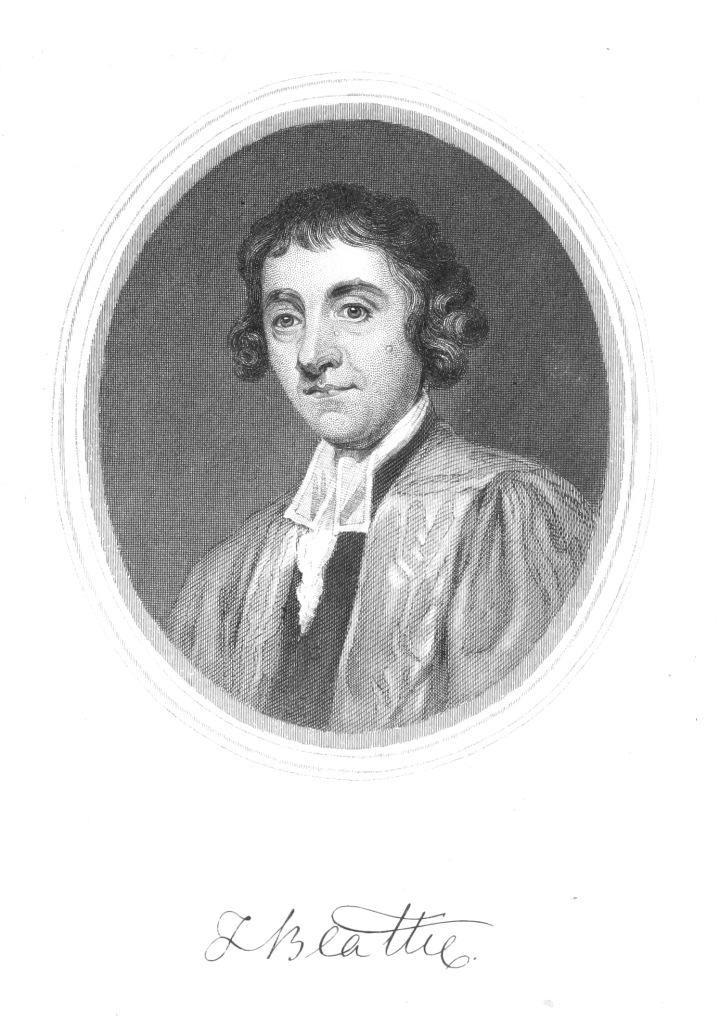
"Heard you that Hermit's strain from Scotia borne,
'For virtue lost, and ruin'd man I mourn?'
Who may forget thee, Beattie? who supply
The tale half-told of Edwin's minstrelsy?"
The Pursuits of Literature.
The subject of this memoir was born on the 25th
of October, 1735, at Laurencekirk, in the county
of Kincardine, Scotland. His father, James
Beattie, who kept a small shop in the village at
the same time that he rented a little farm in the
neighbourhood, was a man of considerable talents
and acquirements:[A] his mother, too, was distinguished
for her abilities. Our author, James,
was the youngest of the six children of this respectable
pair.
After his father's decease, which happened
when he was only seven years old, his mother,
by means of the emoluments derived from the
shop and the farm, was enabled to bring up her
family in comfort. In the management of her
affairs she was assisted by her eldest son, David,
a youth of eighteen, who generously and affectionately
relinquished all other pursuits for that
of promoting her welfare and happiness, and who
appears to have fostered his brothers and sisters
with an almost parental care. James was placed
at the parish school of Laurencekirk, which was
then in some repute, and of which, about forty
years before, Ruddiman, the famous grammarian,
had been the master. At this time he had access
to few books, except those which the minister of
the village (the Rev. Mr. Thomson) kindly lent
him, and which he read with avidity. It was
then that he first became acquainted with English
versification in Ogilby's Virgil. Even then
he was known among his schoolfellows by the
name of the poet; and sometimes he would rise
from bed, during the night, that he might commit
to writing any poetical idea that his fancy
had happened to suggest.
In 1749 he began his academical career, at the
Marischal College, Aberdeen:[B] and as his circumstances
were straitened, he became a competitor—and
with success—for one of those bursaries
or exhibitions, which are annually bestowed
on students who are unable to support the entire
expenses of a university education. He attended
the Greek class taught by Dr. Blackwell.
This scholar, whose writings on classical subjects,[C]
though now fallen into disrepute, once
enjoyed considerable popularity, soon discovered
that his pupil was no ordinary young man, and
distinguished him by several encouraging marks
of approbation. The kindness of the Professor
made a deep impression on the mind of Beattie,
and he used to declare, in after life, that Blackwell
was the first person who gave him reason to
believe that he was possessed of any genius.
During the four years of his attendance at the
Marischal College he also studied philosophy and
divinity. The last mentioned branch of knowledge
he pursued doubtless with a view to the ministry,
the church being then the chief resource of the
well educated sons of the poorer classes in Scotland:
he, however, soon abandoned all thoughts
of the clerical profession.
Having taken the degree of M. A., he was
elected, on the 1st of August, 1753, schoolmaster
of Fordoun, a small hamlet at the foot of the
Grampian hills, about six miles distant from his
birthplace: here also he officiated as præcentor,
or parish-clerk.
Many an hour was now spent by Beattie in
perfect solitude; the family of Mr. Forbes, the
minister, being almost the only society, save the
surrounding peasantry, which his situation allowed
him to enjoy. But his days went happily by.
When not occupied by his public duties, he appears
to have devoted a portion of his time to
the study of the classics;[D] and occasionally he
amused himself by composing little poems, a few
of which were printed in the Scots Magazine.
His fondness for music had ever been decided;
and in his present retirement he cultivated it
with uncommon success.[E] In the grand and
beautiful scenery of the neighbourhood he found
a never-failing source of pleasure. Not far from
the place where he dwelt, a large and well wooded
glen communicates with the mountains. In it
he loved to wander; in it some of his earliest
verses were written; and his recollections of its
wild and romantic charms may be traced in several
vivid descriptions of nature in his poetical
works. Sometimes he would pass the whole
night among the fields, gazing on the sky, and
observing the various aspects it assumed till the
return of day; and the exhilarating song of "the
lyric lark" in the mornings of summer used to
fill him with delight. In 1755, his loneliness
was cheered by the arrival of his brother David,
who came to settle himself at the village of Fordoun.
The celebrated and eccentric Francis Garden,
Esq., (afterwards one of the judges of the supreme
courts of civil and criminal law in Scotland, by
the title of Lord Gardenstone,) who was then
sheriff of the county of Kincardine, and occasionally
resided in the neighbourhood of Fordoun,
was the earliest patron of our author.
They accidentally became acquainted with each
Other. Mr. Garden having one day discovered
Beattie busily writing with a pencil in his favourite
glen, and learning that he was engaged
in the composition of a poem,[F] from that period
took him under his protection.
At this time too he became known to another
more celebrated and more eccentric character,
Lord Monboddo, whose family estate is in the
parish of Fordoun; and though their opinions on
some important points by no means coincided,
they ever after lived on friendly terms.
In 1757, the place of usher in the grammar-school
of Aberdeen being vacant, Beattie, by the
advice of Mr. Forbes, the minister of Fordoun,
became a candidate for it, but without success.
So conspicuously, however, had his abilities manifested
themselves during his examination on
that occasion, that the same place becoming
again vacant about a year after, and two candidates
having appeared, both of whom were declared
unqualified for it, he was requested by the
magistrates to fill it without further trial. He
was accordingly elected to the office on the 20th
June, 1758.
This was an important event in Beattie's life.
From a secluded hamlet, where there was the
greatest difficulty in obtaining either society or
books, he was transplanted to a populous and
flourishing town, where he might associate with
those whose tastes were congenial with his own,
and carry on his literary pursuits by means of
public libraries. The friend of his earlier years,
Professor Blackwell, had sunk into the grave;
but he had soon the good fortune to become
intimately acquainted with several persons of acknowledged
talents and learning, connected with
the Marischal and King's Colleges, as also with
various well educated gentlemen, inhabitants of
the town.
In 1760, a chair in the Marischal College becoming
vacant, it was suggested to Beattie by
his friend, Mr. Arbuthnot,[G] that he should endeavour
to procure the appointment for himself.
Our author, who had never dreamed of aspiring
to so dignified a situation, heard the proposal
with astonishment. Mr. Arbuthnot, however,
"willing to try what could be done," induced
the Earl of Erroll, with whom he was on intimate
terms, to solicit, by means of Lord Milton, the
powerful interest of the Duke of Argyll in behalf
of the humble usher. The application proved
successful; and on the 8th October, 1760, Beattie
was installed Professor of Moral Philosophy and
Logic in the Marischal College.
His first lectures were delivered during the
winter session of 1760, and 1761; and for the
long space of more than thirty years he continued
to discharge most conscientiously the duties of
the important station to which he had been so
unexpectedly raised.
A literary and convivial club (to which the
vulgar gave the nickname of the Wise Club) had
been established for some years at Aberdeen, the
members consisting of the Professors of the Marischal
and King's Colleges, and of gentlemen of
the town, who had a taste for literature and conversation.
Into this society Beattie was now
enrolled. They used to meet at a tavern, once
a fortnight, at five o'clock in the afternoon, (for
in those days the common dinner-hour was early)
when, the president taking the chair, an essay
was read, composed by one of the members in
his turn, and a literary or philosophical subject
discussed; at half past eight a slight meal was
served up, and at ten they retired to their homes.
To this club Dr. Reid, Dr. Campbell, Dr. Gerrard,
and Dr. Gregory, belonged; and from it
several admired works of philosophy and criticism
may be said to have originated.
In 1761 Beattie made his first appearance in
print, in his own character, by publishing a small
volume, dedicated to the Earl of Erroll, entitled
Original Poems and Translations. It consisted
partly of some of the verses which he had formerly
sent to the Scots Magazine, and partly of pieces
which he had recently composed. "This collection,"
says his good-natured and not very tasteful
biographer, Sir William Forbes, "was very
favourably received, and stamped Dr. Beattie
with the character of a poet of great and original
genius." It was certainly "favourably received,"
the chief critical journals of the day being unanimous
in its praise; but that it "stamped the
author with the character of a poet of great and
original genius," I cannot allow. The truth is,
it does not contain a single poem which rises
much above mediocrity; and if Beattie had never
touched the lyre with a more powerful hand, a
memoir of his life would not have been required for
the Aldine Poets. So lightly, indeed, did he himself
afterwards think of the collection in question,
that he used to destroy all the copies of it which
he could procure, and would only suffer four
pieces from it (and these much altered and improved)
to stand in the same volume with The
Minstrel.
During the summer of 1763, Beattie for the
first time visited London, among the inhabitants
of which, Millar, his publisher, was almost his
only acquaintance. While residing there, he
made a pilgrimage to Pope's villa at Twickenham.
The Judgment of Paris, printed in 4to, in
1765, was the least successful of our author's
poetical works. Several passages of considerable
beauty could not prevent this elaborate, cold,
and metaphysical production from being utterly
neglected by the public.
That his Verses on the death of Churchill
(which appeared anonymously very soon after
The Judgment of Paris) were read with more
attention, is to be attributed rather to the subject
of the piece than to its intrinsic merit.[H] No one
can peruse it without regretting that the amiable
Beattie should have been betrayed by political
feelings into such virulent abuse of a man of
genius, who had just been gathered to the poets
of other days. He is said to have written it at
the solicitation of certain friends in Scotland,
where the name of Churchill was held in detestation;
and on these injudicious instigators let a
portion of the odium rest.
In the autumn of 1765, Gray, who was then
regarded as the first of living bards, paid a visit
to the Earl of Strathmore, at Glammis castle.
No sooner did Beattie hear of his arrival than he
addressed to him the following letter:
Marischal College of Aberdeen, 30th August, 1765.
"If I thought it necessary to offer an apology
for venturing to address you in this abrupt manner,
I should be very much at a loss how to begin.
I might plead my admiration of your genius, and
my attachment to your character; but who is he
that could not, with truth, urge the same excuse
for intruding upon your retirement? I might
plead my earnest desire to be personally acquainted
with a man whom I have so long and so passionately
admired in his writings; but thousands of
greater consequence than I, are ambitious of the
same honour. I, indeed, must either flatter myself
that no apology is necessary, or otherwise I
must despair of obtaining what has long been
the object of my most ardent wishes; I must forever
forfeit all hopes of seeing you, and conversing
with you.
"It was yesterday I received the agreeable
news of your being in Scotland, and of your intending
to visit some parts of it. Will you permit
us to hope, that we shall have an opportunity,
at Aberdeen, of thanking you in person, for the
honour you have done to Britain, and to the poetic
art, by your inestimable compositions, and of
offering you all that we have that deserves your
acceptance, namely, hearts full of esteem, respect,
and affection? If you cannot come so far northward,
let me at least be acquainted with the place
of your residence, and permitted to wait on you.
Forgive, sir, this request; forgive me if I urge it
with earnestness, for indeed it concerns me nearly;
and do me the justice to believe, that I am, with
the most sincere attachment, and most respectful
esteem, &c. &c. &c.
"P. S. Dr. Carlysle of Musselburgh, and Dr.
Wight of Glasgow, acquainted me of your being
in Scotland. It was from them I learned that my
name was not wholly unknown to you."
In consequence of this letter, Beattie received
an invitation to Glammis castle; and a friendship
and correspondence commenced between the
two poets, which terminated only with the death
of Gray. The impression which their first meeting
made on our author he thus describes in a
letter to Sir William Forbes:—"I am sorry you
did not see Mr. Gray on his return; you would
have been much pleased with him. Setting aside
his merit as a poet, which, however, in my opinion,
is greater than any of his contemporaries can
boast, in this or in any other nation, I found him
possessed of the most exact taste, the soundest
judgment, and the most extensive learning. He
is happy in a singular facility of expression. His
conversation abounds in original observations, delivered
with no appearance of sententious formality,
and seeming to arise spontaneously without
study or premeditation. I passed two very agreeable
days with him in Glammis, and found him
as easy in his manners, and as communicative and
frank, as I could have wished."
A new edition of our author's Poems came forth
in 1766. From it a large portion of the pieces
published in the former collection was rejected;
while The Judgment of Paris, the Lines on the
Death of Churchill, and one or two copies of
verses never before printed, supplied the deficiency.
The translation of Addison's Pygmæogeranomachia,
which concludes the volume, is remarkable
for its spirited and graceful versification.
In a letter to Dr. Blacklock, dated 22d September
in the same year, Beattie thus alludes to
his great work, The Minstrel:—
"Not long ago I began a poem in the style
and stanza of Spenser, in which I propose to give
full scope to my inclination, and be either droll
or pathetic, descriptive or sentimental, tender or
satirical, as the humour strikes me; for, if I mistake
not, the manner which I have adopted admits
equally of all these kinds of composition. I
have written one hundred and fifty lines, and am
surprised to find the structure of that complicated
stanza so little troublesome. I was always fond
of it, for I think it the most harmonious that ever
was contrived. It admits of more variety of
pauses than either the couplet or the alternate
rhyme; and it concludes with a pomp and majesty
of sound, which, to my ear, is wonderfully
delightful. It seems also very well adapted to
the genius of our language, which, from its irregularity
of inflexion and number of monosyllables,
abounds in diversified terminations, and consequently
renders our poetry susceptible of an endless
variety of legitimate rhymes. But I am so
far from intending this performance for the press,
that I am morally certain it never will be finished.
I shall add a stanza now and then, when I am at
leisure, and when I have no humour for any other
amusement; but I am resolved to write no more
poetry with a view to publication, till I see some
dawnings of a poetical taste among the generality
of readers, of which, however, there is not at present
any thing like an appearance."
Writing to Sir William Forbes, 8th January,
1767, our author gives an account of the cause
of his composing The Hermit, the most perfect of
his minor poems:—
"The favourable reception you gave to my
little poem, demands my acknowledgments. I
aimed at simplicity in the expression, and something
like uncommonness in the thought; and I
own I am not ill pleased with it upon the whole;
though I am sensible it does not answer the purpose
for which I made it. I wrote it at the desire
of a young lady of this country, who has a
taste both for poetry and music, and wanted me
to make words for a Scots tune called 'Pentland
Hills,' of which she is very fond. The verses correspond
well enough with the measure and subject
of the tune, but are extremely unsuitable for
the purpose of a song."[I]
To Dr. Blacklock he again writes concerning
The Minstrel:
"Aberdeen, 20th May, 1767.
"My performance in Spenser's stanza has not
advanced a single line these many months. It is
called 'The Minstrel.' The subject was suggested
by a dissertation on the old minstrels,
which is prefixed to a collection of Ballads lately
published by Dodsley, in three volumes. I propose
to give an account of the birth, education,
and adventures of one of those bards; in which
I shall have full scope for description, sentiment,
satire, and even a certain species of humour and
of pathos, which, in the opinion of my great master
are by no means inconsistent, as is evident
from his works. My hero is to be born in the
south of Scotland; which you know was the native
land of the English minstrels; I mean of
those minstrels who travelled into England, and
supported themselves there by singing their ballads
to the harp. His father is a shepherd. The
son will have a natural taste for music and the
beauties of nature; which, however, languishes
for want of culture, till in due time he meets with
a hermit, who gives him some instruction; but
endeavours to check his genius for poetry and adventures,
by representing the happiness of obscurity
and solitude, and the bad reception which
poetry has met with in almost every age. The
poor swain acquiesces in this advice, and resolves
to follow his father's employment; when, on a
sudden, the country is invaded by the Danes, or
English borderers, (I know not which,) and he is
stript of all his little fortune, and obliged by necessity
to commence minstrel. This is all that I
have as yet concerted of the plan. I have written
one hundred and fifty lines, but my hero is not
yet born, though now in a fair way of being so,
for his parents are described and married. I know
not whether I shall ever proceed any farther:
however, I am not dissatisfied with what I have
written."
On the 28th June, 1767, Beattie was married
at Aberdeen to Miss Mary Dun, only daughter of
the rector of the Grammar-school in that city; a
mutual attachment having for some time existed
between them. She was a few years younger
than our author: her person was pleasing, her
manners were lively; and she possessed a moderate
share of accomplishments. This union,
which seemed to promise nothing but happiness
to Beattie, threw the blight of misery over
his later years, and undoubtedly contributed to
shorten his career. The woman whom he had
selected as a partner for life, inherited from her
mother the most dreadful of human maladies,—insanity;
which, a few years after marriage, displayed
itself in strange follies and caprices,[J] and
at last broke forth with such violence, as to render
her separation from her family absolutely necessary.
By this lady he had two sons, of whom
particular mention will be made hereafter.
Beattie now employed himself on the composition
of his Essay on Truth, a work, which was
to be honoured with such marks of public approbation,
as the most sanguine author in his wildest
dreams of success could hardly have anticipated.
In a letter to Sir William Forbes, dated 17th
January, 1768, he says:—
"I have, for a time, laid aside my favourite
studies, that I might have leisure to prosecute a
philosophical inquiry, less amusing indeed than
poetry and criticism, but not less important. The
extraordinary success of the sceptical philosophy
has long filled me with regret. I wish I could
undeceive mankind in regard to this matter. Perhaps
this wish is vain: but it can do no harm to
make the trial. The point I am now labouring
to prove, is the universality and immutability of
moral sentiment,—a point which has been brought
into dispute, both by the friends and by the enemies
of virtue. In an age less licentious in its
principles, it would not, perhaps, be necessary to
insist much on this point. At present it is very
necessary. Philosophers have ascribed all religion
to human policy. Nobody knows how soon
they may ascribe all morality to the same origin;
and then the foundations of human society, as
well as of human happiness, will be effectually
undermined. To accomplish this end, Hobbes,
Hume, Mandeville, and even Locke, have laboured;
and, I am sorry to say, from my knowledge
of mankind, that their labour has not been
altogether in vain. Not that the works of these
philosophers are generally read, or even understood
by the few who read them. It is not the mode,
now-a-days, for a man to think for himself; but
they greedily adopt the conclusions, without any
concern about the arguments or principles whence
they proceed; and they justify their own credulity
by general declamations upon the transcendent
merit of their favourite authors, and the universal
deference that is paid to their genius and
learning. If I can prove those authors guilty of
gross misrepresentations of matters of fact, unacquainted
with the human heart, ignorant even of
their own principles, the dupes of verbal ambiguities,
and the votaries of frivolous, though dangerous
philosophy, I shall do some little service
to the cause of truth; and all this I will undertake
to prove in many instances of high importance."
During this year, a poem in broad Scotch, entitled
The Fortunate Shepherdess, by Alexander
Ross, schoolmaster, of Lochlee, was printed by
subscription at Aberdeen; and in order to excite
some curiosity about the volume, Beattie good-naturedly
wrote a copy of verses in the same dialect,
addressed to the author, which appeared in
the Aberdeen Journal.[K]
He thus communicates to Dr. Blacklock his
motives for attempting the laborious prose work,
with which he was still occupied:—
"Aberdeen, 9th January, 1769.
"It was very kind in you to read over my
'Essay on the Immutability of Moral Sentiment'
with so much attention. I wish it deserved any
part of the high encomium you bestowed on it.
I flatter myself it will receive considerable improvements
from a second transcribing, which I
intend to begin as soon as I can. Some parts of
it will be enlarged, and others (perhaps) shortened:
the examples from history, and authorities
from ancient authors, will be more numerous; it
will be regularly distributed into chapters and sections,
and the language will be corrected throughout.
The first part, which treats of the permanency
of truth in general, is now in great forwardness;
ninety pages in quarto are finished,
and materials provided for as many more. The
design of the whole you will guess from the part
you have seen. It is to overthrow scepticism,
and establish conviction in its place; a conviction
not in the least favourable to bigotry or prejudice,
far less to a persecuting spirit; but such a conviction
as produces firmness of mind, and stability
of principle, in a consistence with moderation,
candour, and liberal inquiry. If I understand
my own design, it is certainly this; whether I
shall accomplish this design or not, the event only
will determine. Meantime I go on with cheerfulness
in this intricate and fatiguing study, because
I would fain hope that it may do some good;
harm I think it cannot possibly do any.
"Perhaps you are anxious to know what first
induced me to write on the subject; I will tell
you as briefly as I can. In my younger days I
read chiefly for the sake of amusement, and I
found myself best amused with the classics, and
what we call the belles lettres. Metaphysics I
disliked; mathematics pleased me better; but I
found my mind neither improved nor gratified by
that study. When Providence allotted me my
present station, it became incumbent on me to
read what had been written on the subject of
morals and human nature; the works of Locke,
Berkeley, and Hume, were celebrated as masterpieces
in this way; to them, therefore, I had recourse.
But, as I begin to study them with great
prejudices in their favour, you will readily conceive
how strangely I was surprised to find them,
as I thought, replete with absurdities. I pondered
these absurdities: I weighed the arguments, with
which I was sometimes not a little confounded;
and the result was, that I began at last to suspect
my own understanding, and to think that I had
not capacity for such a study. For I could not
conceive it possible, that the absurdities of these
authors were so great as they seemed to me to be;
otherwise, thought I, the world would never admire
them so much. About this time some excellent
antisceptical works made their appearance,
particularly Reid's 'Inquiry into the Human
Mind.' Then it was that I began to have
a little more confidence in my own judgment,
when I found it confirmed by those of whose abilities
I did not entertain the least distrust. I reviewed
my authors again, with a very different
temper of mind. A very little truth will sometimes
enlighten a vast extent of science. I found
that the sceptical philosophy was not what the
world imagined it to be, nor what I, following the
opinion of the world, had hitherto imagined it to
be, but a frivolous, though dangerous, system of
verbal subtilty, which it required neither genius,
nor learning, nor taste, nor knowledge of mankind,
to be able to put together; but only a captious
temper, an irreligious spirit, a moderate command
of words, and an extraordinary degree of vanity
and presumption. You will easily perceive that
I am speaking of this philosophy only in its most
extravagant state, that is, as it appears in the
works of Mr. Hume. The more I study it, the
more am I confirmed in this opinion. But while
I applauded and admired the sagacity of those
who led me into, or at least encouraged me to proceed
in, this train of thinking, I was not altogether
satisfied with them in another respect. I could not
approve that extraordinary adulation which some
of them paid to their arch-adversary. I could not
conceive the propriety of paying compliments to
a man's heart, at the very time one is proving
that his aim is to subvert the principles of truth,
virtue, and religion; nor to his understanding,
when we are charging him with publishing the
grossest and most contemptible nonsense. I
thought I then foresaw, what I have since found
to happen, that this controversy will be looked
upon rather as a trial of skill between two logicians,
than as a disquisition in which the best
interests of mankind were concerned; and that
the world, especially the fashionable part of it,
would still be disposed to pay the greatest deference
to the opinions of him who, even by the
acknowledgment of his antagonists, was confessed to
be the best philosopher and the soundest reasoner.
All this has happened, and more. Some, to my certain
knowledge, have said, that Mr. Hume and
his adversaries did really act in concert, in order
mutually to promote the sale of one another's
works; as a proof of which, they mention, not
only the extravagant compliments that pass between
them, but also the circumstance of Dr. R.[L]
and Dr. C.[M] sending their manuscripts to be perused
and corrected by Mr. Hume before they
gave them to the press. I, who know both the
men, am very sensible of the gross falsehood of
these reports. As to the affair of the manuscripts,
it was, I am convinced, candour and modesty that
induced them to it. But the world knows no such
thing; and, therefore, may be excused for mistaking
the meaning of actions that have really an
equivocal appearance. I know likewise that they
are sincere, not only in the detestation they express
for Mr. Hume's irreligious tenets, but also
in the compliments they have paid to his talents;
for they both look upon him as an extraordinary
genius; a point in which I cannot agree with
them. But while I thus vindicate them from imputations,
which the world, from its ignorance of
circumstances, has laid to their charge, I cannot
approve them in every thing; I wish they had
carried their researches a little farther, and expressed
themselves with a little more firmness
and spirit. For well I know, that their works, for
want of this, will never produce that effect which
(if all mankind were cool metaphysical reasoners)
might be expected from them. There is another
thing in which my judgment differs considerably
from that of the gentlemen just mentioned. They
have great metaphysical abilities, and they love
the metaphysical sciences. I do not. I am
convinced that this metaphysical spirit is the
bane of true learning, true taste, and true science;
that to it we owe all this modern scepticism and
atheism; that it has a bad effect upon the human
faculties, and tends not a little to sour the temper,
to subvert good principles, and to disqualify men
for the business of life. You will now see wherein
my views differ from those of the other answerers
of Mr. Hume. I want to show the world, that
the sceptical philosophy is contradictory to itself,
and destructive of genuine philosophy, as well as
of religion and virtue; that it is in its own nature
so paltry a thing (however it may have been
celebrated by some,) that to be despised it needs
only to be known; that no degree of genius is
necessary to qualify a man for making a figure in
this pretended science; but rather a certain minuteness
and suspiciousness of mind, and want
of sensibility, the very reverse of true intellectual
excellence; that metaphysics cannot possibly do
any good, but may do, and actually have done,
much harm; that sceptical philosophers, whatever
they may pretend, are the corrupters of science,
the pests of society, and the enemies of mankind.
I want to show, that the same method of reasoning,
which these people have adopted in their
books, if transferred into common life, would show
them to be destitute of common sense; that true
philosophers follow a different method of reasoning:
and that, without following a different method,
no truth can be discovered. I want to lay before
the public, in as strong a light as possible, the
following dilemma: our sceptics either believe
the doctrines they publish, or they do not believe
them: if they believe them, they are fools—if
not, they are a thousand times worse. I want
also to fortify the mind against the sceptical
poison, and to propose certain criteria of moral
truth, by which some of the most dangerous
sceptical errors may be detected and guarded
against.
"You are sensible, that, in order to attain
these ends, it is absolutely necessary for me to
use great plainness of speech. My expressions
must not be so tame as to seem to imply either a
diffidence in my principles, or a coldness towards
the cause I have undertaken to defend. And
where is the man who can blame me for speaking
from the heart, and therefore speaking with
warmth, when I appear in the cause of truth, religion,
virtue, and mankind? I am sure my dear
friend Dr. Blacklock will not; he, who has set
before me so many examples of this laudable ardour;
he, whose style I should be proud to take
for my model, if I were not aware of the difficulty,
I may say, the insuperable difficulty, of
imitating it with success. You need not fear,
however, that I expose myself by an excess of
passion or petulance. I hope I shall be animated,
without losing my temper, and keen, without
injury to good manners. In a word, I will be
as soft and delicate as the subject and my conscience
will allow. One gentleman, a friend of
yours,[N] I shall have occasion to treat with much
freedom. I have heard of his virtues. I know
he has many virtues; God forbid I should ever
seek to lessen them, or wish them to be found
insincere. I hope they are sincere, and that they
will increase in number and merit every day. To
his virtues I shall do justice; but I must also do
justice to his faults, at least to those faults which
are public, and which, for the sake of truth and
of mankind, ought not to be concealed or disguised.
Personal reflections will be carefully
avoided; I hope I am in no danger of falling into
them, for I bear no personal animosity against
any man whatsoever: sometimes I may perhaps
be keen; but I trust I shall never depart from
the Christian and philosophic character.
"A scheme like this of mine cannot be popular,
far less can it be lucrative. It will raise me
enemies; it will expose me to the scrutiny of the
most rigid criticism; it will make me be considered
by many as a sullen and illiberal bigot. I
trust, however, in Providence, and in the goodness
of my cause, that my attempts in behalf of truth
shall not be altogether ineffectual, and that my
labours shall be attended with some utility to my
fellow-creatures. This, in my estimation, will do
much more than counterbalance all the inconveniences
I have any reason to apprehend. I have
already fallen on evil tongues (as Milton says) on
account of this intended publication. It has
been reported, that I had written a most scurrilous
paper against Mr. Hume, and was preparing
to publish it when a friend of mine interposed,
and, with very great difficulty, prevailed
on me to suppress it, because he knew it would
hurt or ruin my character. Such is the treatment
I have to expect from one set of people. I was
so provoked when I first heard this calumny that
I deliberated whether I should not throw my papers
into the fire, with a Si populus vult decipi,
decipiatur: but I rejected that thought; for so
many persons have told me, that it was my duty
to publish these papers, that I almost began to
think so myself. Many have urged me to publish
them; none ever dissuaded me. The gentleman,
named in the report, read the essay, and returned
it with the highest commendations; but
I do not recollect that he ever spoke a syllable
about publishing or suppressing it. But I have
certainly tired you with so long a detail, about
so trifling a matter as my works. However, I
thought it necessary to say something by way of
apology for them, for I find that your good opinion
is of too much consequence to my peace,
to suffer me to neglect any opportunity of cultivating
it."
The Essay on Truth being now finished, our
author was desirous of selling the MS. to some
bookseller, in order that he might avoid all risk
to himself in the publication, and intrusted the
care of this matter to Sir William Forbes and
Mr. Arbuthnot. His two friends, however, having
applied to the bookseller, whom they imagined
the most proper person to publish the work, were
vexed by his positive refusal to purchase it, although
he had no objection to print it on Beattie's
account. In this difficulty they generously resolved
to become themselves the purchasers of
the first edition. "I therefore," says Sir William
Forbes, "wrote to him [Beattie] (nothing surely
but the truth, although, I confess, not the whole
truth,) that the manuscript was sold for fifty guineas,
which I remitted to him by a bank bill; and
I added, that we had stipulated with the bookseller
who was to print the book, that we should
be partners in the publication."
At length in May, 1770, the Essay on Truth
was given to the world. As it had been seen in
manuscript by several eminent literary characters,
and as it was understood to be a direct attack
on the philosophy of Hume (who was then
in the height of his popularity,) its appearance
excited immediate notice. It has been said,
that on its publication, Hume spoke of Beattie
with great bitterness, complaining (and I am
forced to allow that there was some cause for the
complaint) that he had not used him like a gentleman:
it has even been asserted that he could
not endure the name of our author to be mentioned
in his presence. I suspect that in all this
there is great exaggeration. The placid temper
of Hume was not likely to be much ruffled by
any thing that might be written against his system;
his friends and admirers were probably
more disturbed by the attack than the philosopher
himself. In less than four years five large
editions of the Essay were circulated, and translations
of it were made into French and other
foreign languages.
From the rugged paths of philosophy Beattie
turned once more into the flowery walks of poesy.
In 1771, the First Book of The Minstrel was published
without the author's name. Its success was
complete. The voice of every critic was loud in
its praise; and before the Second Book appeared
(in 1774), four editions of the First had been
dispersed throughout the kingdom. The following
elegant and touching encomium was passed
upon the poem by Lord Lyttelton, in a letter to
Mrs. Montagu, who had put the First Book into
the hands of that virtuous nobleman:
"Hill Street, 8th March, 1771.
"I read your 'Minstrel' last night, with as
much rapture as poetry, in her noblest, sweetest
charms, ever raised in my soul. It seemed to me
that my once most beloved minstrel, Thomson,
was come down from heaven, refined by the converse
of purer spirits than those he lived with
here, to let me hear him sing again the beauties
of nature, and the finest feelings of virtue, not
with human, but with angelic strains! I beg
you to express my gratitude to the poet for the
pleasure he has given me."
Of the same date with the preceding letter,
Beattie received one from Gray, containing many
minute remarks on his poem. As it consists almost
entirely of verbal criticism, it scarcely admits
of quotation: a single short extract may however
be given from it:
"St. 11. O, how canst thou renounce,[O] &c.
But this, of all others, is my favourite stanza.
It is true poetry; it is inspiration; only (to show
it is mortal) there is one blemish; the word
garniture suggesting an idea of dress, and, what
is worse, of French dress."
When the poem was reprinted, one or two
slight alterations were made in deference to the
opinion of Gray.
In a letter to the Dowager Lady Forbes, 12th
October, 1772, our author confesses that in the
character of Edwin he meant to paint himself:
"From the questions your Ladyship is pleased
to propose in the conclusion of your letter, as
well as from some things I have had the honour
to hear you advance in conversation, I find you
are willing to suppose that, in Edwin, I have
given only a picture of myself, as I was in my
younger days. I confess the supposition is not
groundless. I have made him take pleasure in
the scenes in which I took pleasure, and entertain
sentiments similar to those of which, even in
my early youth, I had repeated experience. The
scenery of a mountainous country, the ocean, the
sky, thoughtfulness and retirement, and sometimes
melancholy objects and ideas, had charms
in my eyes, even when I was a schoolboy: and
at a time when I was so far from being able to
express, that I did not understand my own feelings,
or perceive the tendency of such pursuits
and amusements; and as to poetry and music,
before I was ten years old I could play a little
on the violin, and was as much master of Homer
and Virgil as Pope's and Dryden's translations
could make me."
The intense thought which Beattie had devoted
to the composition of the Essay on Truth having
materially injured his health, he was advised by his
physicians to try the remedy of change of scene.
He accordingly set out on a journey to London,
and arrived there in the beginning of autumn,
1771. He was no longer the obscure individual
who had visited it in 1763;[P] he was now the triumphant
adversary of scepticism, and the author
of the admired Minstrel; a man whom the most
distinguished characters in the literary and fashionable
world were prepared to treat with attention
and respect. Among several letters of introduction,
which he carried with him, was one from
Dr. Gregory, of Edinburgh, to Mrs. Montagu.
At the splendid and hospitable mansion of this
celebrated lady, Beattie became acquainted with
various persons, both male and female, who were
then the chief ornaments of London society; and
he used to dwell with delight on the recollections
of her more private parties, made up of Lord
Lyttelton, Mrs. Carter, and a few others, who
spent their evenings in the most unreserved conversation
on literary, moral, or religious subjects.
From this time, Mrs. Montagu continued to be
one of his firmest friends; and their epistolary
correspondence closed only with her life. The
politeness and kindness of Hawkesworth, Armstrong,
Garrick, and Johnson, also contributed
much to render pleasant his visit to the metropolis.
Concerning the last illustrious man he writes
thus: "Johnson has been greatly misrepresented.
I have passed several entire days with him, and
found him extremely agreeable. The compliments
he pays to my writings are so high that I
have not the face to mention them." In December
Beattie had returned to Aberdeen.
In 1772, his mother died, at the advanced age
of fourscore, at the house of her affectionate son
David, in the neighbourhood of Laurencekirk.
Towards the end of April, 1773, Beattie, accompanied
by his wife, set out again for London.
This journey was undertaken partly for the sake
of his health and partly with a view to another
object—the bettering of his circumstances. The
emolument which he had derived from his writings
bore unfortunately no proportion to the fame he
had acquired; and the small income arising from
his professorship afforded him the only means for
supporting his family. During his former visit
to the capital, in 1771, his English friends had
been very desirous to procure for him some permanent
provision; and it was well known that
his Majesty had expressed approbation of his
writings, and had even declared his intention of
conferring some reward on the man who had
laboured so successfully to advance the interests
of religion. With several important letters of
introduction—one addressed to the Earl of Dartmouth—he
now arrived in London, and was
cordially welcomed by Mrs. Montagu, and his
other friends. His reception by Lord Dartmouth
was kind and courteous: soon after which, being
summoned to wait on Lord North, he was told by
that minister that an early opportunity should be
taken to inform his Majesty of his arrival.
By some of his friends it had been suggested
that Beattie should take orders, and enter the
English church; but this mode of improving his
fortunes he very properly rejected.[Q] At
last, by
the advice of the Archbishop of York, a memorial
was drawn up "expressing his services, his wants,
and his wishes;" which, having been transmitted
to Lord Dartmouth, was by him laid before the
King, who, on that occasion, spoke of Beattie and
his writings with high approbation, and signified
a desire to see him.
Meantime the number of our author's acquaintances
in the metropolis increased daily, and his
society was eagerly courted by a long list of illustrious
names. He now became personally known
to a distinguished churchman, with whom, during
the preceding year he had held some correspondence
by letter—Dr. Porteus, then Rector of
Lambeth, and finally Bishop of London; and the
friendship which took place between them was
sincere and lasting.
At the first levee, Beattie was presented by
Lord Dartmouth to his Majesty, who for several
minutes talked to him concerning his Essay on
Truth in the most condescending and affable
manner.
Soon after this, the University of Oxford, at
the installation of Lord North as its Chancellor,
conferred on our author a very flattering mark
of distinction, an honorary degree of Doctor of
Laws.
At length the object of his wishes was attained.
On the 20th of August, he received an official
letter from the secretary of Lord North, informing
him that the king had been pleased to allow him
a pension of two hundred pounds a year. Of the
private interview, with which, a few days after
he was honoured by their majesties, he has left
the following account in his Diary:
"Tuesday, 24th August, set out for Dr. Majendie's
at Kew-Green. The Doctor told me that
he had not seen the King yesterday, but had left
a note in writing, to intimate that I was to be at
his house to-day; and that one of the King's
pages had come to him this morning, to say 'that
his Majesty would see me a little after twelve.'
At twelve, the Doctor and I went to the King's
house, at Kew. We had been only a few minutes
in the hall, when the King and Queen came in
from an airing; and, as they passed through the
hall, the King called to me by name, and asked
how long it was since I came from town. I
answered, about an hour. 'I shall see you,'
says he, 'in a little.' The Doctor and I waited
a considerable time (for the King was busy),
and then we were called into a large room,
furnished as a library, where the King was walking
about, and the Queen sitting in a chair. We
were received in the most gracious manner possible
by both their Majesties. I had the honour
of a conversation with them (nobody else being
present but Dr. Majendie) for upwards of an
hour, on a great variety of topics; in which both
the King and Queen joined, with a degree of
cheerfulness, affability, and ease, that was to me
surprising, and soon dissipated the embarrassment
which I felt at the beginning of the conference.
They both complimented me, in the
highest terms, on my 'Essay,' which, they said,
was a book they always kept by them; and the
King said he had one copy of it at Kew, and
another in town, and immediately went and took
it down from a shelf. I found it was the second
edition. 'I never stole a book but one,' said his
Majesty, 'and that was yours (speaking to me);
I stole it from the Queen, to give it to Lord
Hertford to read.' He had heard that the sale
of Hume's 'Essays' had failed, since my book
was published; and I told him what Mr. Strahan
had told me, in regard to that matter. He had
even heard of my being in Edinburgh last summer,
and how Mr. Hume was offended on the
score of my book. He asked many questions
about the second part of the 'Essay,' and when
it would be ready for the press. I gave him, in
a short speech, an account of the plan of it; and
said, my health was so precarious, I could not
tell when it might be ready, as I had many books
to consult before I could finish it; but, that if
my health were good, I thought I might bring it
to a conclusion in two or three years. He asked,
how long I had been in composing my Essay?
praised the caution with which it was written;
and said, he did not wonder that it had employed
me five or six years. He asked about my poems.
I said, there was only one poem of my own on
which I set any value (meaning the 'Minstrel,')
and that it was first published about the same
time with the 'Essay.' My other poems, I said,
were incorrect, being but juvenile pieces, and of
little consequence, even in my own opinion.
We had much conversation on moral subjects;
from which both their Majesties let it appear
that they were warm friends to Christianity; and
so little inclined to infidelity, that they could
hardly believe that any thinking man could really
be an atheist, unless he could bring himself to
believe that he made himself; a thought which
pleased the King exceedingly; and he repeated
it several times to the Queen. He asked, whether
any thing had been written against me. I
spoke of the late pamphlet, of which I gave an
account, telling him, that I never had met with
any man who had read it, except one Quaker.
This brought on some discourse about the Quakers,
whose moderation and mild behaviour the
King and Queen commended. I was asked many
questions about the Scots universities; the revenues
of the Scots clergy; their mode of praying
and preaching; the medical college of Edinburgh;
Dr. Gregory (of whom I gave a particular character),
and Dr. Cullen; the length of our vacation
at Aberdeen, and the closeness of our attendance
during the winter; the number of students
that attend my lectures; my mode of lecturing,
whether from notes, or completely written lectures;
about Mr. Hume, and Dr. Robertson, and Lord
Kinnoull, and the Archbishop of York, &c. &c.
&c. His Majesty asked what I thought of my
new acquaintance, Lord Dartmouth? I said there
was something in his air and manner which I
thought not only agreeable, but enchanting, and
that he seemed to me to be one of the best of
men; a sentiment in which both their Majesties
heartily joined. 'They say that Lord Dartmouth
is an enthusiast,' said the King, 'but surely he
says nothing on the subject of religion, but what
every Christian may, and ought to say.' He asked,
whether I did not think the English language
on the decline at present? I answered in the
affirmative; and the King agreed, and named the
'Spectator' as one of the best standards of the
language. When I told him that the Scots clergy
sometimes prayed a quarter, or even half an hour
at a time, he asked whether that did not lead them
into repetitions? I said, it often did. 'That,'
said he, 'I don't like in prayers; and excellent as
our liturgy is, I think it somewhat faulty in that
respect.' 'Your majesty knows,' said I, 'that
three services are joined in one in the ordinary
church service, which is one cause of those repetitions.'
'True,' he replied, 'and that circumstance
also makes the service too long.' From this he
took occasion to speak of the composition of the
church liturgy; on which he very justly bestowed
the highest commendation. 'Observe,' his
Majesty said, 'how flat those occasional prayers
are, that are now composed, in comparison with
the old ones.' When I mentioned the smallness
of the church livings in Scotland, he said, 'he wondered
how men of liberal education would choose
to become clergymen there;' and asked, 'whether
in the remote parts of the country, the clergy, in
general were not very ignorant?' I answered,
'No, for that education was very cheap in Scotland,
and that the clergy, in general, were men of
good sense, and competent learning.' He asked
whether we had any good preachers at Aberdeen?
I said, yes, and named Campbell and Gerard,
with whose names, however, I did not find that he
was acquainted. Dr. Majendie mentioned Dr.
Oswald's 'Appeal' with commendation; I praised
it too and the queen took down the name, with a
view to send for it. I was asked, whether I knew
Dr. Oswald? I answered, I did not; and said,
that my book was published before I read his;
that Dr. O. was well known to Lord Kinnoull,
who had often proposed to make us acquainted.
We discussed a great many other topics; for the
conversation, as before observed, lasted for upwards
of an hour, without any intermission. The
Queen bore a large share in it. Both the King
and her Majesty showed a great deal of good sense,
acuteness, and knowledge, as well as of good nature
and affability. At last the king took out his
watch (for it was now almost three o'clock, his
hour of dinner), which Dr. Majendie and I took
as a signal to withdraw. We accordingly bowed
to their Majesties, and I addressed the King in
these words: 'I hope, Sir, your Majesty will
pardon me, if I take this opportunity to return
you my humble and most grateful acknowledgments,
for the honour you have been pleased to
confer upon me.' He immediately answered, 'I
think I could do no less for a man who has done
so much service to the cause of Christianity. I
shall always be glad of an opportunity to show
the good opinion I have of you.' The Queen
sate all the while, and the King stood, sometimes
walking about a little. Her Majesty speaks the
English language with surprising elegance, and
little or nothing of a foreign accent. There is
something wonderfully captivating in her manner;
so that if she were only of the rank of a
private gentlewoman, one could not help taking
notice of her, as one of the most agreeable women
in the world. Her face is much more pleasing
than any of her pictures; and in the expression
of her eyes, and in her smile, there is something
peculiarly engaging. When the Doctor and I
came out, 'Pray,' said I, 'how did I behave?
Tell me honestly, for I am not accustomed to
conversations of this kind.' 'Why, perfectly well,'
answered he, 'and just as you ought to do.' 'Are
you sure of that?' said I. 'As sure,' he replied,
'as of my own existence: and you may be assured
of it too, when I tell you, that if there had been
any thing in your manner or conversation which
was not perfectly agreeable, your conference
would have been at an end in eight or ten minutes
at most.' The Doctor afterwards told me,
that it was a most uncommon thing for a private
man, and a commoner, to be honoured with so
long an audience. I dined with Dr. and Mrs.
Majendie, and their family, and returned to town
in the evening, very much pleased with the occurrences
of the day."
At this time, Sir Joshua Reynolds, having requested
Beattie to sit for his picture, produced
a likeness of him, which is generally regarded as
one of the finest works of that admirable artist.
He is represented in his Oxford gown of Doctor
of Laws, with his famous Essay under his arm;
while beside him is Truth, habited as an Angel,
holding in one hand a pair of scales, and with
the other thrusting down three frightful figures,
emblematic of Prejudice, Scepticism, and Folly.[R]
Of this picture Sir Joshua made a present to
Beattie, who set a due value on so noble a composition,
and preserved it with the utmost care.
After an absence of a little more than five
months, he returned to Aberdeen.
A striking proof how highly the character and
talents of Beattie were appreciated, even by those
to whom he was personally unknown, occurred in
October of this year (1773), when the chair of
Moral Philosophy in the University of Edinburgh
was offered to him by the electors, the magistrates
of the city. He, however, declined accepting it,
"Though my fortune" (he writes to Sir William
Forbes, on the subject) "were as narrow now as
it lately was, I should still incline rather to remain
in quiet where I am, than, by becoming a
member of the University of Edinburgh, to place
myself within the reach of those (few as they are)
who have been pleased to let the world know that
they do not wish me well." He alludes to the
enemies whom his Essay on Truth had raised up.
The Second Book of The Minstrel, together
with a new and corrected edition of the First,
appeared in 1774, the author's name being now
added. The poem, thus enlarged, suffered no
diminution of its popularity.
The following year, Beattie and his wife spent
several weeks in London, residing during the
chief part of the time with Dr. Porteus, one of
his kindest and most zealous friends. On this
occasion, having shown himself at court, he was
immediately recognized by the King, who spoke to
him very graciously, and made several inquiries
concerning his studies.
To a new and improved edition in quarto, of
the Essay on Truth, printed by subscription,[S] in
1776, our author appended three other Essays:
On Poetry and Music, as they affect the Mind,
On Laughter and Ludicrous Composition, and
On the Utility of Classical Learning. In 1777,[T]
he gave to the press a new edition of The Minstrel,
to which he added a few of his minor poems:
this volume (he says in the preface) contains
"all the verses of which I am willing to be
considered as the author." In 1778,[U] he printed
for private circulation a Letter to Dr. Blair, on
the improvement of Psalmody in Scotland. In
1779, he published, for the use of the young men
who attended his Lectures, a List of Scotticisms,
to the amount of about two hundred. And in
1780, he contributed some thoughts On Dreaming
to the well known periodical paper, The Mirror.
The following portion of a letter from Dr.
Johnson to Beattie shows how sincerely our
author was esteemed by the great moralist:
"Bolt Court, Fleet Street, 21st August, 1780.
"More years than I have any delight to reckon
have past since you and I saw one another. Of
this, however, there is no reason for making any
reprehensory complaint, sic fata ferunt: but, methinks,
there might pass some small interchange
of regard between us. If you say that I ought
to have written, I now write; and I write to tell
you, that I have much kindness for you and Mrs.
Beattie, and that I wish your health better, and
your life long. Try change of air, and come a
few degrees southward; a softer climate may do
you both good. Winter is coming on, and London
will be warmer, and gayer, and busier, and more
fertile of amusement than Aberdeen."
In 1781, Beattie made another journey to
London, taking with him his eldest son, James
Hay Beattie.[V] While there, we find him writing
thus to Sir William Forbes:
"1st June.
"I have been visiting all my friends again and
again, and found them as affectionate and attentive
as ever. Death has indeed deprived me of some
since I was last here, of Garrick, and Armstrong,
and poor Harry Smith; but I have still many
left."... "Johnson grows in grace as he
grows in years. He not only has better health
and a fresher complexion than ever he had before
(at least since I knew him), but he has
contracted a gentleness of manners which pleases
every body."
"28th June.
"I thought it my duty to appear at the levee
before I left London; and accordingly the week
before last I went to court. The king had not
seen me for six years, and yet, to my surprise,
knew me at first sight. He spoke to me with his
wonted condescension and affability; and paid me
a very polite compliment on the subject of my
writings."
His Dissertations, Moral and Critical, were
published in 1783.
A passage from a letter of the poet Cowper to
the Rev. William Unwin, 5th April, 1784,[W] must
not be omitted here:
"If you have not his poem, called the 'The
Minstrel,' and cannot borrow it, I must beg you
to buy it for me; for, though I cannot afford to
deal largely in so expensive a commodity as
books, I must afford to purchase at least the
poetical works of Beattie."
His health impaired, and his peace of mind
destroyed, by the melancholy condition of his
wife (who, labouring under confirmed insanity,
was now removed from her family), we need not
wonder that Beattie should endeavour to forget
his domestic griefs in the society of his English
friends, to whom he was ever welcome. During
the year 1784, after passing some time in London,
he spent a month with Dr. Porteus (who had
now attained the rank of Bishop of Chester), at
the beautiful parsonage of Hunton, near Maidstone,
which he characterizes as "the mansion of
peace, piety, and cheerfulness." He also visited
Mrs. Montagu, at her seat, called Sandleford, in
Berks.
In 1786, his Evidences of the Christian Religion,
were published. A remark which he makes
in a letter, while engaged in the composition of
this judicious summary, is worth quoting: "Whether
this work shall ever be of use to others, I
know not; but this I know, that it has been of
considerable benefit to myself. For though, when
I entered upon it, I understood my subject well
enough to entertain no doubt of the goodness of
my cause, yet I find, as I advance, new light
continually breaking in upon me."
The receipt of the following letter could hardly
fail to gratify our author:
"Philadelphia, 1st August, 1786.
"The American revolution, which divided the
British empire, made no breach in the republic
of letters. As a proof of this, a stranger to your
person, and a citizen of a country lately hostile
to yours, has expressed his obligations to you for
the knowledge and pleasure he has derived from
your excellent writings by procuring your admission
into the American Philosophical Society;
a certificate of which, subscribed by our illustrious
president, Dr. Franklin, and the other
officers of the society, you will receive by the
next vessel that sails to any port in North Britain
from this city.
"The stranger alluded to finished his studies
in medicine in Edinburgh in the year 1769, and
has ever since taught chemistry and medicine in
the college of Philadelphia. His name (with the
greatest respect for yours) is,
"Benjamin Rush."
The next year, with his eldest son for his companion,
he repaired again to London. While
there, he writes thus to his niece, Miss Valentine,
now Mrs. Glennie:
"London, 20th July, 1787.
"I am just returned from Windsor, where I
passed three days. I went thither, partly to see
some friends, but chiefly that I might pay my
respects to the King and Queen. They both received
me in the most gracious manner. I saw
the King first on the terrace, where he knew me
at first sight, and did me the honour to converse
with me a considerable time. Next morning I
saw him again at prayers in his chapel, where he
was pleased to introduce me to the Queen, who
inquired very kindly after my health; observed,
that many years had passed since she saw me
last; regretted the bad weather which I had met
with at Windsor (for it rained incessantly,) which,
said she, has made your friends see less of you
than they wished; and, after some other conversation,
her Majesty and the Princess Elizabeth,
who attended her, made a slight courtesy, and
stepped into the carriage that waited for them at
the chapel door. The King remained with us
for some time longer, and talked of various matters."
Our author then proceeded to visit Dr. Porteus
at Hunton, and Mrs. Montagu at Sandleford, but
was obliged to quit the latter place sooner than
he had intended, on account of the illness of his
son, who shewed symptoms of that consumptive
complaint to which he afterwards fell a victim.
For the sake of medical advice Beattie carried
him back to the metropolis, and from thence, by
very easy stages, to Aberdeen. Soon after his
return to Scotland, the invalid improved so much
in health that he was able to take upon him
part of the management of the class of Moral
Philosophy in the Marischal College, having been
appointed in June of this year (when he was not
quite nineteen) assistant professor to his father.
In 1790, Beattie put forth the first volume of his
Elements of Moral Science; and superintended
an edition of Addison's Periodical Papers, adding
a few notes to Tickell's Life of that author, and
to Johnson's Remarks on his Prose Writings.
The second volume of the Transactions of the
Royal Society of Edinburgh, published during
this year, contains 'Remarks on some Passages of
the Sixth Book of the Æneid,' from Beattie's pen.
He had now to suffer the dire bereavement
which he had long foreseen, the loss of his eldest
son, the object of his fondest affection. He thus
informs the Duchess of Gordon of the melancholy
event:
"Aberdeen, 1st December, 1790.
"Knowing with what kindness and condescension
your grace takes an interest in every thing
that concerns me and my little family, I take the
liberty to inform you, that my son James is dead;
that the last duties to him are now paid; and
that I am endeavouring to return, with the little
ability that is left me, and with entire submission
to the will of Providence, to the ordinary business
of life. I have lost one who was always a pleasing
companion; but who, for the last five or six
years, was one of the most entertaining and
instructive companions that ever man was blest
with: for his mind comprehended almost every
science; he was a most attentive observer of life
and manners; a master of classical learning;
and he possessed an exuberance of wit and humour,
a force of understanding, and a correctness
and delicacy of taste, beyond any other
person of his age I have ever known.
"He was taken ill in the night of the 30th of
November, 1789; and from that time his decline
commenced. It was long what physicians call a
nervous atrophy; but towards the end of June,
symptoms began to appear of the lungs being
affected. Goats' milk, and afterwards asses' milk,
were procured for him in abundance; and such
exercise as he could bear, he regularly took;
these means lengthened his days no doubt, and
alleviated his sufferings, which indeed were not
often severe: but, in spite of all that could be
done, he grew weaker and weaker, and died the
19th of November, 1790, without complaint or
pain, without even a groan or a sigh; retaining
to the last moment the use of his rational faculties;
indeed, from first to last, not one delirious
word ever escaped him. He lived twenty-two
years and thirteen days. Many weeks before it
came, he saw death approaching, and he met it
with such composure and pious resignation, as
may no doubt be equalled, but cannot be surpassed.
"He has left many things in writing, serious
and humorous, scientific and miscellaneous, prose
and verse, Latin and English; but it will be a
long time before I shall be able to harden my
heart so far as to revise them."
In April of the following year, Beattie again
travelled southwards, accompanied by Montagu,[X]
his second son and only surviving child. They
remained some weeks in Edinburgh, and then
journeyed slowly to London, which after a short
stay they quitted for the summer residence of Dr.
Porteus, who was now elevated to the see of the
metropolis. The tranquillity of Fulham Palace,
and the kind attentions of its inhabitants, contributed
greatly to amend the health and raise
the spirits of our author; and he seems to have
enjoyed the company of the distinguished persons
with whom he had an opportunity of associating.
"Last week," he writes to Sir William Forbes,
30th June, 1791, "I made a morning visit to
Mr. Pitt. I had heard him spoken of as a grave
and reserved man; but saw nothing of it. He
gave me a very frank, and indeed affectionate
reception; and was so cheerful, and in his conversation
so easy, that I almost thought myself
in the company rather of an old acquaintance
than of a great statesman. He was pleased to
pay me some very obliging compliments, asked
about my health, and how I meant to pass the
summer; spoke of the Duchess of Gordon, the
improvements of Edinburgh, and various other
matters: and when I told him, I knew not what
apology to make for intruding upon him, said,
that no apology was necessary, for that he was
very glad to see me, and desired to see me again."
Before returning to Scotland, the travellers went
to Bath, and from thence to Sandleford, the seat
of Mrs. Montagu.
The second volume of the Elements of Moral
Science appeared in 1793. During the same
year the sudden death of his favourite sister,
Mrs. Valentine, increased the domestic sorrows
of Beattie. His health was at this period so
greatly impaired, that being unable to attend to
his duties of Professor in the Marischal College,
he engaged his old pupil, Mr. Glennie, as an assistant:
occasionally, however, he continued to lecture
to his class till the commencement of the
winter session of 1797.
For some time past he had occupied himself in
the melancholy yet pleasing task of editing a volume
of the compositions of his eldest son. From
a pardonable partiality for the writings of a beloved
child, and from his not very accurate
attainments in classical scholarship, he admitted
into the collection several pieces, both English
and Latin, which fall considerably below mediocrity.
A few copies of the work were privately
printed in 1794, under the title of Essays and
Fragments in Prose and Verse, by James Hay
Beattie, and were "offered as presents to those
friends with whom the author was particularly
acquainted or connected."[Y] Though it undoubtedly
shows that the deceased was a young man
of uncommon quickness of talent, and the most
indefatigable application, it exhibits nothing which
has a claim to be considered as the offspring
of genius.[Z] The most interesting portion of the
volume is the biographical sketch prefixed to it
by the afflicted father, a memoir of exquisite
simplicity and pathos. The account given by
Beattie of the method which he adopted in imparting
to his son the first idea of a Supreme
Being is too striking to be omitted here:
"The doctrines of religion I wished to impress
on his mind, as soon as it might be prepared to
receive them; but I did not see the propriety
of making him commit to memory theological
sentences, or any sentences which it was not possible
for him to understand. And I was desirous
to make a trial how far his own reason could go
in tracing out, with a little direction, the great
and first principle of all religion, the being of
God. The following fact is mentioned, not as a
proof of superior sagacity in him (for I have no
doubt that most children would in like circumstances
think as he did), but merely as a moral
or logical experiment: He had reached his fifth
(or sixth) year, knew the alphabet, and could
read a little; but had received no particular
information with respect to the Author of his
being; because I thought he could not yet understand
such information; and because I had
learned, from my own experience, that to be
made to repeat words not understood is extremely
detrimental to the faculties of a young mind. In
a corner of a little garden, without informing any
person of the circumstance, I wrote in the mould,
with my finger, the three initial letters of his
name; and sowing garden-cresses in the furrows,
covered up the seed, and smoothed the ground.
Ten days after, he came running to me, and with
astonishment in his countenance, told me that his
name was growing in the garden. I smiled at
the report, and seemed inclined to disregard it;
but he insisted on my going to see what had
happened. Yes, said I carelessly, on coming to
the place, I see it is so; but there is nothing in
this worth notice; it is mere chance; and I went
away. He followed me and taking hold of my
coat, said, with some earnestness, It could not be
mere chance; for that somebody must have contrived
matters so as to produce it.—I pretend not
to give his words, or my own, for I have forgotten
both; but I give the substance of what passed
between us in such language as we both understood.—So
you think, I said, that what appears
so regular as the letters of your name, cannot be
by chance. Yes, said he, with firmness, I think
so. Look at yourself, I replied, and consider
your hands and fingers, your legs and feet, and
other limbs; are not they regular in their appearance,
and useful to you? He said, they
were. Came you then hither, said I, by chance?
No, he answered, that cannot be; something
must have made me. And who is that something?
I asked. He said he did not know. (I
took particular notice, that he did not say, as
Rousseau fancies a child in like circumstances
would say, that his parents made him.) I had
now gained the point I aimed at, and saw that
his reason taught him (though he could not so
express it) that what begins to be must have a
cause, and that what is formed with regularity
must have an intelligent cause. I therefore told
him the name of the Great Being who made him
and all the world; concerning whose adorable
nature I gave him such information as I thought
he could in some measure comprehend. The
lesson affected him greatly, and he never forgot
either it, or the circumstance that introduced it."
After the loss of this highly-gifted youth, the
only tie which bound Beattie to the world was his
second son, who, though far inferior to the deceased
in learning, was endowed with no ordinary
talents.[AA] Just as our author was anxiously
forming plans for his future establishment in
life, Montagu was unexpectedly carried off by a
fever of only a few days' continuance, in the
eighteenth year of his age. Beattie thus communicates
to Sir William Forbes the intelligence
of his death:
"Aberdeen, 14th March, 1796.
"Our plans relating to Montagu are all at an
end. I am sorry to give you the pain of being
informed, that he died this morning at five. His
disorder was a fever, from which at first we had
little apprehension; but it cut him off in five
days. He himself thought from the beginning
that it would be fatal; and, before the delirium
came on, spoke with great composure and Christian
piety of his approaching dissolution: he even
gave some directions about his funeral. The delirium
was very violent, and continued till within
a few minutes of his death, when he was heard to
repeat in a whisper the Lord's prayer, and began
an unfinished sentence, of which nothing could
be heard but the words incorruptible glory. Pious
sentiments prevailed in his mind through life, and
did not leave him till death; nor then, I trust, did
they leave him. Notwithstanding the extreme
violence of his fever, he seemed to suffer little
pain, either in body or in mind, and as his end
drew near, a smile settled upon his countenance.
I need not tell you that he had every attention
that skilful and affectionate physicians could bestow.
I give you the trouble to notify this event
to Mr. Arbuthnot. I would have written to him,
but have many things to mind, and but indifferent
health. However, I heartily acquiesce in the
dispensations of Providence, which are all good
and wise. God bless you and your family.
"He will be much regretted; for wherever he
went he was a very popular character."
Such an effect had this fresh calamity on the
intellectual powers of Beattie, that a few days
after Montagu's death, he experienced a temporary
hut almost utter loss of memory respecting
him. Having searched every room in the house,
he would say to his niece, Mrs. Glennie, "You
may think it strange, but I must ask you if I
have a son, and where he is?" She then felt
herself under the painful necessity of calling to
his recollection the sufferings of Montagu, the
mention of which never failed to restore him to
reason. Often with tears he would declare himself
thankful that his children were in the grave,
exclaiming, in allusion to their mother's malady,
"How could I have borne to see their elegant
minds mangled with madness!" On viewing the
dead body of Montagu for the last time, he said,
"I have now done with the world."
The following passages from two of his letters,
written about this period, are deeply affecting.
He tells the Rev. Dr. Laing, 10th April, 1796:
"I hope I am resigned, as my duty requires,
and as I wish to be; but I have passed many a
bitter hour, though on those occasions nobody
sees me. I fear my reason is a little disordered,
for I have sometimes thought of late, especially
in a morning, that Montagu is not dead, though
I seem to have a remembrance of a dream that
he is. This you will say, what I myself believe,
is a symptom not uncommon in cases similar to
mine, and that I ought by all means to go from
home as soon as I can. I will do so when the
weather becomes tolerable."
To Sir William Forbes he says, 17th of the
same month:
"I have been these many days resolving to
write to you and Mr. Arbuthnot, to thank you
for your very kind and sympathetic letters, but
various things have come in my way to prevent
it. I need not pretend a hurry of business, for
every-body knows I am not capable of any. A
deep gloom hangs upon me, and disables all
my faculties; and thoughts so strange sometimes
occur to me as to make me 'fear that I am not,'
as Lear says, 'in my perfect mind.' But I thank
God I am entirely resigned to the divine will;
and, though I am now childless, I have friends
whose goodness to me, and other virtues, I find
great comfort in recollecting. The physicians
not only advise, but entreat, and indeed command
me to go from home, and that without further
delay; and I do seriously resolve to set out for
Edinburgh to-morrow."
Though Beattie never from henceforth engaged
in any kind of study, he still found some enjoyment
in books, and still derived some pleasure
from the society of a very few of his oldest friends.
He almost entirely ceased to correspond, even
with those whom he most valued; yet when he
happened to receive a letter from any of them,
his spirits were always excited for the rest of the
day. Music, in which he had once delighted,
had become disagreeable to him since the loss
of his eldest son.[AB] A few months, however, before
Montagu's death, he had occasionally played
an accompaniment while Montagu sung; but now,
when prevailed on to resume his favourite violoncello,
he was always dissatisfied with his own
performance. "My fingers," he writes to the Rev.
Dr. Laing, 5th June, 1798, "have not strength to
press down the strings."
In this state he continued till the beginning
of April, 1799, when he was struck with palsy,
which, for eight days, rendered him nearly incapable
of utterance. At different times the
disease repeated its attacks, the last of which, on
the 5th of October, 1802, deprived him entirely
of the power of motion. On the morning of the
18th of August, 1803, he expired without a
struggle, in the sixty-eighth year of his age.
His remains were laid, according to his own
desire, beside those of his children, in the church-yard
of St. Nicholas, at Aberdeen; and a Latin
inscription, from the pen of the late Dr. James
Gregory, of Edinburgh, marks the spot of his
interment.
In person he was of the middle size, of a broad,
square make, which seemed to indicate a more
robust constitution than he really possessed. In
his gait there was something of a slouch. During
his later years he grew corpulent and unwieldy;
but a few months before his death his hulk was
greatly diminished. His features were very regular;
his complexion somewhat dark. His eyes
were black, brilliant, full of a tender and melancholy
expression, and, in the course of conversation
with his friends, became extremely animated.
Though I am of opinion with Gilbert Wakefield,
that the maxim De mortuis nil nisi VERUM is
better than De mortuis nil nisi BONUM, it is with
pain that I touch on the reported failing of so truly
good a man as Beattie. It has been asserted that
towards the close of life he indulged to excess in
the use of wine. In a letter to Mr. Arbuthnot,
he says, "With the present pressure upon my
mind, I should not be able to sleep, if I did not
use wine as an opiate; it is less hurtful than
laudanum, but not so effectual." He may, perhaps,
have had too frequent recourse to so palatable
a medicine, in the hope of banishing for a
while the recollection of his sorrows; and if, under
any circumstances, such a fault is to be regarded
as venial, it may be excused in one who was a more
than widowed husband and a childless father.
The prose writings of Beattie appear of late
years to have fallen into disrepute; and the once
celebrated Essay on Truth is at present as much
undervalued as it was formerly overrated.
His fame now rests upon The Minstrel alone.
Since its first publication, many poems of a far
loftier and more original character have been produced
in England; yet still does it maintain its
popularity; and still in Edwin, that happy personification
of the poetic temperament, do young
and enthusiastic readers delight to recognize a
picture of themselves. Though we cannot fail to
regret that Beattie should have left it incomplete,
yet we do not long for the concluding books from
any interest which we take in the story, such as
is excited by some other unfinished works of genius,
the tale of Cambuscan, for instance, or the legend
of Christabel. In The Minstrel, indeed, there is
but little invention; it is a poem of sentiment
and description, conveying to us lessons of true
philosophy in language of surpassing beauty, and
displaying pictures of nature, in her romantic
solitudes, painted by a master's hand. "On my
once asking Dr. Beattie," says Sir William Forbes,
"in what manner he had intended to employ his
Minstrel, had he completed his original design of
extending the poem to a third canto, he said, he
proposed to have introduced a foreign enemy as
invading his country, in consequence of which the
Minstrel was to employ himself in rousing his
countrymen to arms."[AC] But surely such a conclusion
would have formed too violent a contrast
to the repose of the earlier books; and the charm
which attaches us to the meditative Edwin, while
a wanderer among the lonely hills and groves,
would have been broken, or at least weakened,
by placing him amid the throng of warriors and
the din of arms.
With the exception of The Hermit and the following
exquisite stanza[AD] of Retirement, there is little
worthy of particular notice in the minor poems
of Beattie.