MEMOIR.
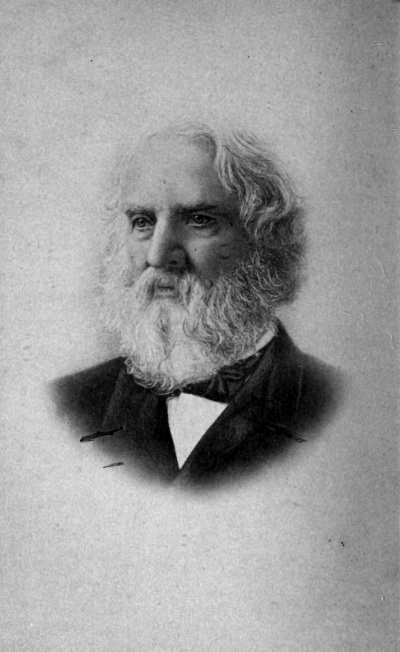
Henry Wadsworth Longfellow was born at Portland, Maine, on the 27th of
February, 1807. His father, Mr. Stephen Longfellow, a native of Gorham,
Maine, then a District of Massachusetts, was a descendant of William
Longfellow, of Newbury, in the same state, who was born in Yorkshire,
England, in 1651, and emigrated to America in early youth. He married
Miss Anne Sewell, and after a married life of fourteen years was
drowned at Anticosti, a large desert island in the estuary of the St.
Lawrence. Mr. Stephen Longfellow, a descendant in the fourth generation
of this gentleman, was born in the year in which the colonies declared
their independence of the mother country. He graduated at Harvard
College in his twenty-second year, and devoted himself to the law,
removing to Portland at the beginning of the present century. He was a
good jurist, as the Massachusetts and Maine Reports testify, and was a
member of the national Congress when it was an honour to belong to that
body. He was also the president of the Maine Historical Society. He was
the father of our poet, whose mother was a descendant of John Alden:
who must have been a prolific old Puritan, for his descendants have produced
two American poets, William Cullen Bryant and Henry Wadsworth Longfellow.
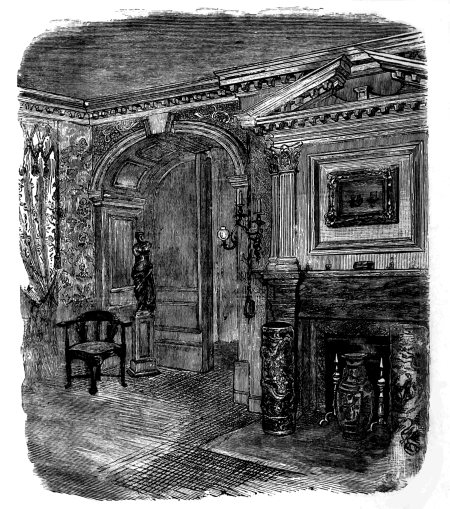
LONGFELLOW’S DRAWING-ROOM.
The first school the young poet attended was kept by a Mrs. Fellows, in
a small house in Spring Street. Later he went to the town school, and
soon after to the private school of Nathaniel H. Carter. Afterwards he
attended the Portland Academy under the same master, and also under the
mastership of Bezaleel Cushman. He entered Bowdoin College at the age
of fourteen. It was a remarkable class in which he found himself for it
contained, among other men who have arrived at eminence in literature,
Nathaniel Hawthorne, George B. Cheever, and J. S. C. Abbott: and he
must have distinguished himself, or he would not have received—as he
did—the appointment of professor of modern languages and literatures,
shortly after he graduated, in 1825. He accepted this appointment, with
the privilege of going abroad for three years, in order to qualify
himself fully for his duties, and the following year saw him travelling
on the Continent.
During his last years at college, the future professor of modern
literature contributed in a modest way to the poetry of his native
land. There was no American poet at the time worth speaking of, except
Bryant; and there were no periodicals in the states, to which young
aspirants could send their contributions. Attempts had been made to
establish them, but without success, for they either died after a few
months’ struggle, or were merged in others, which were threatened with
dissolution. There was in New York a “Literary Gazette” (for which
Griswold says Sands wrote); then an “Atlantic Monthly”; and then the
“New York Review and Athenæum Magazine,” of which Bryant was the first
editor. This became, by the process of merging, the “New York Literary
Gazette and American Athenæum,” which culminated in the “United States
Literary Gazette.” It was in the pages of this last publication, which
was issued simultaneously in New York and Boston, that the early poems
of the young Bowdoin student were given to the world.
With rare exceptions, early poems are imitative, either of one or
more poets whom their writers have read and admired, or of what is
most marked in the poetry of the period. A careful reading of the
“United States Literary Gazette” would show, I have no doubt, that
Mr. Longfellow was not the only American singer, young and old, whose
work bore the impress of the Author of “Thanatopsis.” It is legible
in “Autumn,” “Sunrise on the Hills,” and “The Spirit of Poetry” (I
am writing of Mr. Longfellow’s early poems), and it is present, in
suggestion, in “An April Day,” “Woods in Winter,” and “The Burial of
the Minnesink.” Description of nature is the motive of these pieces,
which are written from books rather than from observation. They show
an apt ear for versification, and a sensitive temperament, which makes
its own individuality felt in the midst of alien poetic influences.
Clearly, a new poet had appeared in the “United States Literary Gazette.”
European travel was not common among Americans fifty years ago; nor
were the places to be visited always determined beforehand. A certain
amount of originality was allowed to the tourist, and if he wrote a book
about what he saw it was not expected that he should cram it with
information. He could be desultory, scholarly, whimsical,—he might
even be a little dull: what was wanted were his impressions. The time
allotted to Mr. Longfellow by his alma mater was passed in
France, Spain, Italy, Germany, Holland, and England. We have glimpses
of what he saw in the first three of these countries, and, in a
measure, of his studies and meditations therein. He has not enabled us
to follow his itinerary with any certainty.
Mr. Longfellow returned to America, and to his duties at Brunswick, and
took to himself a wife in his twenty-fourth year.
His first volume, which was published in Boston, in his twenty-sixth
year (1833), is a translation of the “Coplas de Don Jorge Manrique,”
a thin little twelvemo of eighty-nine pages, which opens with an
“Introductory Essay on the Moral and Devotional Poetry of Spain.” This
scholarly paper contains all that the average reader of forty-five
years ago would care to read in regard to the comprehensive subject
which it discussed. The preface briefly dismissed the original writer
by saying that he followed the profession of arms, as did most Spanish
poets of any eminence; that he fought beneath the banner of his father
Roderigo Manrique, Conde de Parades, and Maestre de Santiago, and that
he died on the field of battle near Cañavete, in the year 1479. This
young soldier has rendered imperishable the memory of his father, in
an ode which is a model of its kind, and which ranks among the world’s
great funeral hymns. It is admirably translated by Mr. Longfellow,
other of whose Spanish studies follow it in the little volume of which
I have spoken in the shape of seven moral and devotional sonnets;
two of which are by Lope de Vega, two by Francisco de Aldana, two by
Francisco de Medrano, the last, “The Brook,” being by an anonymous
poet. The sonnets of Medrano, “Art and Nature,” and “The Two Harvests,”
were omitted in the later editions of Mr. Longfellow’s works, but have
been restored to their proper place in this volume.
The fruits of Mr. Longfellow’s three years’ residence in Europe were
given to the world two years later. If Bryant had been unconsciously
his model in his early poems he cannot be said to have had a model in
“Outre-Mer.” It has reminded certain English critics of Washington
Irving; I fail to see in what respect. It is more scholarly than “The
Sketch Book,” and the style is sweeter and mellower than obtains
in that famous collection of papers,—the writer warbling, like
Sidney, in poetic prose. France receives the largest share of his
attention, and is most lovingly observed, partly for its old-fashioned
picturesqueness, but more, perhaps, because it happened to hit
his fancy. In the ninth chapter or section, which glances at “The
Trouvères,” we have the first French translations by Mr. Longfellow.
One is a song in praise of “Spring” by Charles d’Orleans, the other is
a copy of verses upon a sleeping child by Clotilde de Surville. They
are elegantly translated, but we feel in reading them that the subtle
aroma of their originals has somehow escaped. They do not suggest the
fifteenth but the nineteenth century.
“Outre-Mer” is interesting to the student of American literature
as an excellent example of a kind of prose—half essay and half
narrative—which ranks among the things that were. It could not
flourish now, nor can it flourish hereafter, but it delighted a
literary and sympathetic class of readers forty years ago, to whom it
was a pleasant revealment of Old World places, customs, stories, and
literatures. It was quietly humorous, it was prettily pathetic, and it
was pensive and poetical. Sentimental readers were attracted to the
little sketch of “Jacqueline,” humorous readers to “Martin Franc and
the Monk of Saint Anthony,” and “The Notary of Périgueux,” and literary
readers to “The Trouvères,” “Ancient Spanish Ballads,” and “The
Devotional Poetry of Spain.” (The last paper, by the way, was a reprint
of the introduction to the “Coplas de Don Jorge Manrique”)
The publication of “Outre-Mer,” and his growing reputation as a poet,
pointed out Mr. Longfellow as the successor of Mr. George Ticknor, who
in 1835 resigned his professorship of modern languages and literature
in Harvard College. He was elected to fill the place of the erudite
historian of Spanish Literature, and resigning his chair at Brunswick,
he went abroad a second time in order to complete his studies in the
literature of Northern Europe. He remained abroad a little over a year,
passing the summer in Denmark and Sweden and the autumn and winter in
Germany. The sudden death of his wife at Rotterdam arrested his travel
and his studies until the following spring and summer, which were
spent in the Tyrol and Switzerland. He returned to the United States
in November, 1836, and entered upon his duties at Cambridge which he
discharged for eighteen years.
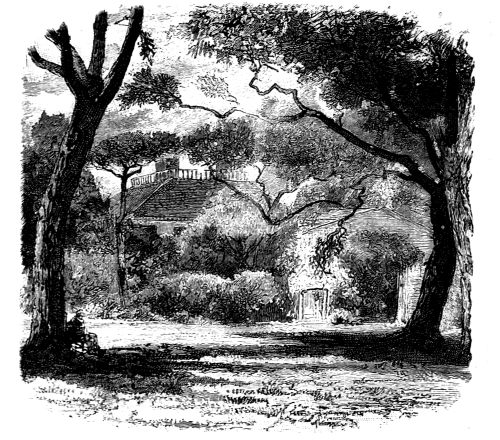
THE REAR LAWN LOOKING TOWARD LONGFELLOW’s HOUSE.
(ALL THIS PART OF THE LAWN IS COVERED WITH GIGANTIC ELM-TREES.
THE HOUSE IS NEARLY HIDDEN BY THE TREES AND LILAC BUSHES.)
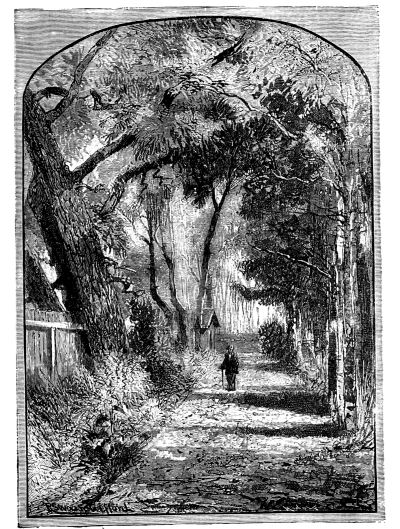
THE AVENUE NORTH OF THE HOUSE.
Mr. Longfellow’s house at Cambridge is one of the few American houses
to which pilgrimages will be made in the future. It was surrounded with
historic associations before he entered it, and it is now surrounded
with poetic ones,—a double halo encircling its time-honoured walls. It
is supposed to have been built in the first half of the last century
by Colonel John Vassal, who died in 1747, and whose ashes repose in
the churchyard at Cambridge under a freestone tablet, on which are
sculptured the words Vas-sol, and the emblems a goblet and sun.
He left a son John, who lived into Revolutionary times, and was a
royalist, as many of the rich colonists were. The house passed from his
hands, and came into the hands of the provincial government, who
allotted it to General Washington as his head-quarters after the battle
of Bunker’s Hill. Its next occupant was a certain Mr. Thomas Tracy, of
whom tradition says that he was very rich, and that his servants drank
his costly wines from carved pitchers. He appears to have sent out
privateers to scour the seas in the East and West Indies, and to worry
the commerce of England and Spain; though why he should include the
galleons of Spain in his free-booting voyages is not clear. He failed
one day, and the hundred guests who had been accustomed to sit down
at the banquets of Vassal house, were compelled to find other hosts.
Bankrupt Tracy was succeeded by Andrew Craigie, apothecary-general of
the northern provincial army, who amassed a fortune in that office,
which fortune took to itself wings, though not before it had enlarged
Vassal house, and built a bridge over the Charles River connecting
Cambridge with Boston and still bearing his name.
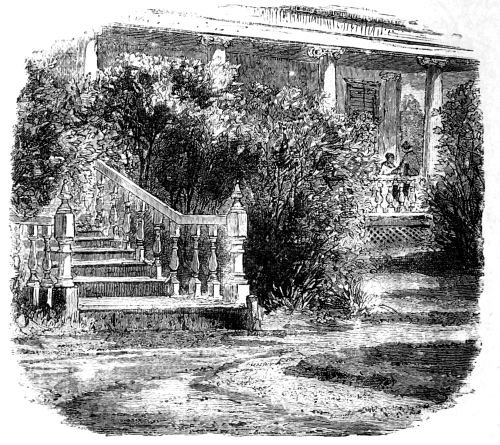
THE WESTERN ENTRANCE.
(FROM THE PIAZZA THERE IS A VIEW OF THE RIVER CHARLES,
BRIGHTON, AND THE DISTANT HILLS.)
In the summer of 1837, a studious young gentleman of thirty might have
been seen wending his way down the elm-shaded path which led to the
Craigie house. He lifted the huge knocker, which fell with a brazen
clang, and inquired for Mrs. Craigie. The parlour door was thrown open,
and a tall, erect figure, crowned with a turban, stood before him. It
was the relict of Andrew Craigie, whilome apothecary-general of the
dead and gone northern provincial army. The young gentleman inquired if
there was a room vacant in her house.
“I lodge students no longer,” she answered gravely.
“But I am not a student,” he remarked. “I am a professor in the
University.”
“A professor?” she inquired, as if she associated learning with age.
“Professor Longfellow,” said the would-be lodger.
“Ah! that is different. I will show you what there is.”
She then proceeded to show him several rooms, saying, as she closed
the door of each, “You cannot have that.” At last she opened the door
of the south-east corner room of the second story, and said that he
could have it. “This was General Washington’s chamber.” So Professor
Longfellow became a resident of this old historic house, which had been
occupied before him by Edward Everett and Jared Sparks, and which was
occupied with him by Joseph E. Worcester, the lexicographer. Truly, his
lines had fallen in pleasant places.
Professor Longfellow’s collegiate duties left him leisure for
literary pursuits, and he turned it to advantage by writing a paper
on “Frithiof’s Saga,” and another on the “Twice-told Tales” of his
fellow-collegian, Hawthorne, whose rare excellence he was among the
first to perceive. These papers were published in the “North American
Review,” in 1837. They were followed during the next year by other
papers: among them one on “Anglo-Saxon Literature,” and another on
“Paris in the Seventeenth Century,” which were contributions to the
same periodical.
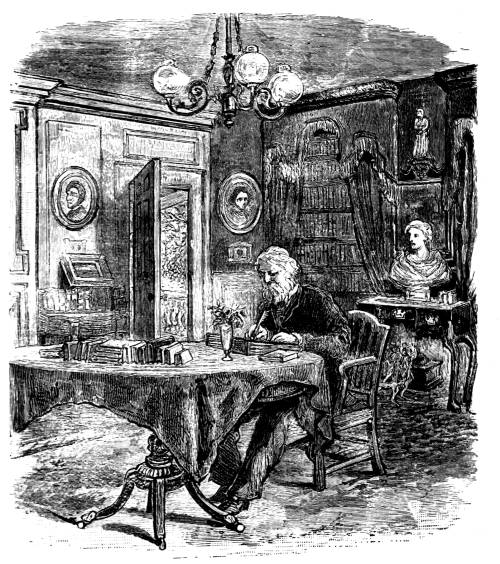
THE STUDY.
The papers mentioned, or some of them, were written in the chamber
which Washington had occupied, as well as a series of papers of which
European travel in Germany and Switzerland, and European experience
and legend, were the chief themes. Through these, like a silken string
through a rosary of beads, ran a slight personal narrative which may
have been real, and may have been imaginary, but which was probably
both. This narrative concerned itself with the life-history of Paul
Flemming, a tender-hearted and rather shadowy young gentleman who had
lost the friend of his youth, and who had gone abroad that the sea
might be between him and the grave. “Alas, between him and his sorrow
there could be no sea, but that of time!” He wandered from place to
place,—noting what struck his sensitive fancy and discoursing of
men and books,—student at once and pilgrim. The hand that penned
“Outre-Mer” was visible on every page of “Hyperion,” but the hand had
grown firmer in the Craigie house than it was at Brunswick; and the
scholarly sympathies of the writer had embraced a richer literature
than that of old Spain and old France. Dismissing the romantic element
of “Hyperion” for what it is worth (and there must have been genuine
worth in it, for it was the cause of its immediate popularity), the
chief and permanent value of the book lay in the new element which it
introduced into American literature—the element of German fantasy
and romanticism. It would have come in time, no doubt, but to Mr.
Longfellow belongs the honour of having hastened the time, and ushered
in the dawn. He was the herald of German poetry in the New World. The
second book of “Hyperion” contains Mr. Longfellow’s first published
translation from the German poets—the “Whither?” of Müller (“I heard
a brooklet gushing”); the third book contains the “Song of the Bell”
(“Bell, thou soundest merrily!”); “The Black Knight” (“’Twas Pentecost,
the Feast of Gladness”); “The Castle by the Sea” (“Hast thou seen that
lordly castle?”); “The Song of the Silent Land” (“Into the Silent
Land”), and “Beware!” (“I know a maiden fair to see”). Besides these
translations in verse, there is, in the first book, a dissertation or
chapter on “Jean Paul, the Only One,” and in the second book a chapter
on “Goethe,” whom Mr. Paul Flemming, by the way, does not greatly
admire. His friend the Baron defends the old heathen by saying that he
is an artist and copies nature. “So did the artists who made the bronze
lamps of Pompeii. Would you hang one of those in your hall? To say that
a man is an artist and copies nature is not enough. There are two great
schools of art, the imitative and the imaginative. The latter is the
more noble and the more enduring.”
The dignity of the literary profession was earnestly maintained by
Mr. Longfellow. “I do not see,” remarked the Baron in one of his
conversations with Paul Flemming, “I do not see why a successful book
is not as great an event as a successful campaign, only different
in kind, and not easily compared.” The lives of literary men are
melancholy pictures of man’s strength and weakness, and, on that very
account, he thought were profitable for encouragement, consolation,
and warning. “The lesson of such lives,” continued Flemming, “is told
in a single word—wait! Therefore should every man wait—should bide
his time. Not in listless idleness, not in useless pastime, not in
querulous dejection; but in constant, steady, cheerful endeavours,
always willing, and fulfilling and accomplishing his task, that, when
the occasion comes, he may be equal to the occasion. And if it never
comes, what matters it? What matters it to the world whether I or you
or another man did such a deed, or wrote such a bock, so that the deed
and book were well done? It is the part of an indiscreet and
troublesome ambition to care too much about fame—about what the world
says of us; to be always looking in the faces of others for approval;
to be always anxious for the effect of what we do and say; to be
always shouting, to hear the echo of our own voices.” “Believe me,” he
concluded, “the talent of success is nothing more than doing what you
can do well, and doing well whatever you do, without a thought of fame.
If it come at all, it will come because it is deserved, and not because
it is sought after. And, moreover, there will be no misgivings, no
disappointment, no hasty, feverish, exhausting excitement.”
If fame comes because it is deserved, it certainly comes to some men
much sooner than to others; why, their contemporaries and rivals do not
perceive as clearly as those who come after them. Mr. Edgar Allan Poe,
for example, could never understand why Mr. Henry Wadsworth Longfellow
was a more successful writer than himself.
We hardly know how to characterize the seed which Mr. Longfellow began
to sow in “The Voices of the Night.” Romanticism does not describe
it, for there is nothing romantic in “The Hymn to the Night,” nor
does morality describe it, except, perhaps, as it bourgeoned in “A
Psalm of Life.” The lesson of the poem last named and of “The Light
of Stars,” was the lesson of endurance and patience and cheerfulness.
It had been taught by other poets, but not as this one taught it, not
inverse that set itself to music in the memory of thousands, and in
words that were pictures. The young man who wrote “A Psalm of Life”
possessed the art of saying rememberable things, and a very rare art
it is. Shakespeare possessed it in a supreme degree, and Pope and
Gray in a greater measure than greater poets. Merciless critics have
pointed out flaws in the literary workmanship of “A Psalm of Life,”
but its readers never saw them, or, seeing them, never cared for them.
They found it a hopeful, helpful poem. “Footsteps of Angels” is to us
the most satisfactory of all these “Voices of the Night.” There is an
indescribable tenderness in it, and the vision of the poet’s dead wife
gliding into his chamber with noiseless footsteps, taking a vacant
chair beside him, and laying her hand in his, is very pathetic. “The
Beleaguered City” is a product of poetic artifice of which there are
but few examples in English poetry. It appears to have been compounded
after a recipe which called for equal parts of outward fact and inward
meaning. Given a material city, a river, a fog, and so on, the poet
sets his wits to work to discover what corresponds, or can be made to
correspond, with them spiritually. If he is skilful, he constructs an
ingenious poem, of doubtful intellectual value. “Midnight Mass for
the Dying Year” is a medley of mediæval suggestion and Shakespearean
remembrance, which demands a large and imaginative appreciation. The
Shakespearean element appears somewhat out of place, though it adds
to the impressiveness and effectiveness as a whole. It is a medley,
however, and it must be judged by its own fantastic laws. Whatever
faults disfigured “The Voices of the Night” were lost sight of or
forgiven for the sake of their beauties and the admirable poetic spirit
which they displayed. A healthful poet was singing, and his song had
many tones.
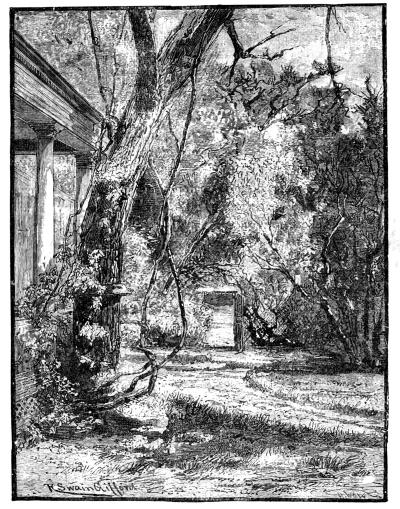
VIEW FROM THE REAR PIAZZA.
(THE OPEN GATE-WAY LEADS TO THE LAWN, A BROAD
AND SPLENDID STRETCH RUNNING TOWARD THE NORTH.)
“Hyperion” and “The Voices of the Night,” which were published in the
same year (1839), established the reputation of Mr. Longfellow as a
graceful prose writer, and a poet who resembled no poet of the time,
either in America or England. His scholarship was evident in both, and
was not among the least of the charms which they exercised over their
readers.
Mr. Bryant was the only American poet of any note who had enriched
the literature of his native land with translations. They showed his
familiarity with other languages, and were well thought of by scholars,
but they added nothing to his fame, for famous he was from the day he
published “Thanatopsis.” It was otherwise with the translations of
Mr. Longfellow, which brought him many laurels, and were in as great
demand as his original poems. There were twenty-three of them in the
little volume which contained “The Voices of the Night,” culled from
“Hyperion,” “Outre-Mer,” his review articles, not forgetting the
great ode of Don Jorge Manrique, and they represented six different
languages. They were well chosen, with the exception of the two
versions from the French; the subjects being in themselves poetical,
and the words in which they were clothed, characteristic of the
originals. The highest compliment that can be paid to Mr. Longfellow is
to say that they read like original poems. The most felicitous among
them are “The Castle by the Sea,” “Whither?” “The Bird and the Ship,”
and the exquisite fragment entitled “The Happiest Land.” Nearly forty
years have passed since they were collected in “The Voices of the
Night,” and these years have seen no translator equal to Mr. Longfellow.
Mr. Longfellow’s second poetical venture, “Ballads and Other Poems,”
determined his character as a poet. It was more mature, not to say more
robust, than “The Voices of the Night,” and its readers felt sure of
its author hereafter, for he felt sure of himself. The opening ballad,
“The Skeleton in Armour,” was the most vigorous poem that he had yet
written,—a striking conception embodied in picturesque language,
and in a measure which had fallen into disuse for more than two
centuries—the measure of Drayton’s “Ballad of Agincourt.” I do not see
that a line or a word could be spared. There were two elements in this
collection not previously seen in Mr. Longfellow’s poetry, one being
the power of beautifying common things, the other, the often renewed
experiment of hexameter verse. What I mean by beautifying common things
is the making a village blacksmith a theme, and a legitimate theme,
too, for poetry. Mr. Longfellow has certainly done this. More purely
poetical than “The Village Blacksmith” is “Endymion” and “Maidenhood.”
The sentiment of the last is very refined and spirited. “It is not
always May,” “The Rainy Day,” and “God’s Acre,” are each perfect of its
kind, and the kinds are very different. “The Rainy Day,” for instance,
is in the manner of “The Beleaguered City,” which for once has produced
a good poem,—I suspect, because it is a short one. “To the River
Charles” is a pleasant glimpse of Mr. Longfellow’s early Cambridge
life, and the art of it is perfect.
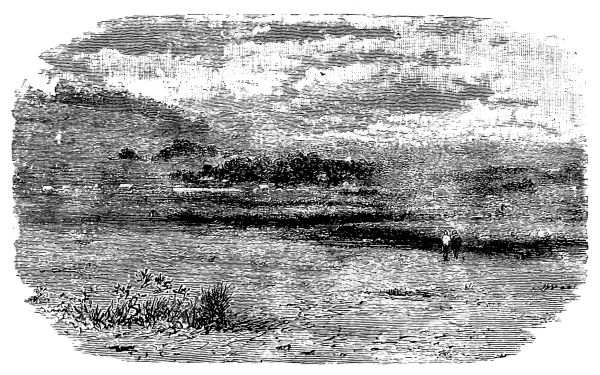
CHARLES RIVER.
The most popular poem in Mr. Longfellow’s second
collection—“Excelsior”—has more moral than poetical value. The
conception of a young man carrying a banner up a mountain, suggests a
set scene in a drama, and the end of this imaginary person does not
affect us as it should, his attempt to excel being so fool-hardy.
That he would be frozen to death was a foregone conclusion. The most
important of the translations here (all of which are excellent) was
“The Children of the Lord’s Supper,” from the Swedish of Tegnér. It
renewed, as I have said, the often baffled attempt to naturalize
hexameters in English poetry,—an attempt which Mr. Longfellow had
made four years before, in his paper on “Frithiof’s Saga,” when he
translated the description of Frithiof’s ancestral estate at Framnäs
into this measure. The poets and poetasters of the Elizabethan era
tried in vain to revive it. Gabriel Harvey, the friend of Spenser,
projected a reform of English poetry,—a reform which, if it had
succeeded, would have caused “a general surceasing of rhyme” and a
return to certain, or uncertain, rules of quantity. “Spenser suffered
himself to be drawn into this foolish scheme,” says Professor Child,
“and for a year worked away at hexameters and iambic trimeters quite
seriously.” (The year in question, I take it, was 1580.) Harvey’s
project was taken up with zeal by a coterie over which Sidney and Dyer
presided; but the wits, notably Nash, ridiculed it, the latter saying
(in substance) that the hexameter was a gentleman of an ancient house,
but that the English language was too craggy for him to run his long
plough in it. And Ascham wrote of it, about fifteen years before,
that it rather trotted and hobbled than ran smoothly “in our English
tong.” So thought not Master Abraham Fraunce, who, in 1587, published
a translation of the “Aminta” of Tasso, in hexameters, and in the
following year a work entitled “Lawier’s Logicke,” wherein he stowed
away a version of Virgil’s Eclogue of Alexis, in the same measure.
Less than a century from this date, Edward Phillips, the nephew of
Milton, paid his respects and disrespects to the ancient and modern
poets in his “Theatrum Poetarum” (1675),—a curious little book, which
is thought to reflect the opinions of his illustrious uncle. He sums
up the unlucky translator of Tasso in a few lines: “Abraham Fraunce,
a versifier of Queen Elizabeth’s time, who, imitating Latin measure
in English verse, wrote his ‘Ivy Church’ and some other things in
hexameter, some also in hexameter and pentameter; nor was he altogether
singular in this way of writing for Sir Philip Sidney, in the pastoral
interludes of his ‘Arcadia,’ uses not only those, but all other sorts
of Latin measure, in which no wonder he is followed by so few, since
they neither become the English nor any other modern language.”
Winstanley expressed the same unfavourable opinion of Fraunce’s
hexameters twelve years later (1687), stealing the very words of
Phillips for that purpose.
Langbaine, in his “Account of the English Dramatick Poets” (1691),
adds four separate works, not mentioned by Winstanley and Phillips,
to the list of Fraunce’s productions (all in hexameters), and records
the disuse of quantitive experiments in English versification.
“Notwithstanding Mr. Chapman in his translation of Homer, and Sir
Philip Sydney in his Eclogues, have practised this way of writing, yet
this way of imitating the Latin measures of verses, particularly the
hexameter, is now laid aside, and the verse of ten syllables, which
we style heroic verse, is most in use.” The next attempt to revive
hexameters on any scale was made by that metrical experimentalist,
Southey, in his “Vision of Judgment,” in 1821,—a piece of obsequious
profanity which richly deserved the ridicule that Byron cast upon it.
Such, so far as I know, is the history of this alien measure in English
poetry. Mr. Longfellow thought well of it, as we have seen, and was
justified in so thinking by the excellence of his own practice therein.
“The Children of the Lord’s Supper” is a charming poem, to which its
antique setting is very becoming.
Mr. Longfellow made a third voyage to Europe after publishing his
“Ballads and other Poems,” and passed the summer on the Rhine. He
returned after a few months, bringing with him a number of poems which
were written at sea, and in which he expressed his detestation of
slavery. “Poems on Slavery” were published in 1843, and dedicated to
W. E. Channing, who did not live to read the poet’s admiration of his
character and his work. This dedication, which is spirited, contains a
noble stanza:
“Well done! Thy words are great and bold,
At times they seem to me
Like Luther’s, in the days of old,
Half battles for the free.”
“The Slave’s Dream” is one of the few rememberable poems of which
the “peculiar institution” was the inspiration. It is exceedingly
picturesque, and its versification is masterly. The harmony of sound
and sense,—the movement of the fourth stanza is very fine:
“And then at furious speed he rode
Along the Niger’s bank,
His bridle-reins were golden chains,
And, with a martial clank,
At each leap he could feel his scabbard of steel
Smiting his stallion’s flank.”
The fertility of Mr. Longfellow’s mind, and the variety of his powers,
were manifested in his thirty-sixth year, when he published the “Poems
on Slavery,” of which I have just spoken, and “The Spanish Student,”—a
dramatic poem, the actors in which were the antipodes of the dusky
figures which preceded them. Judged by the laws of its construction,
and by the intention of its creator, “The Spanish Student” is a
beautiful production. It should be read for what it is,—a poem, and
without the slightest thought of the stage, which was not in the mind
of the author when he wrote it. So read, it will be found radiant with
poetry, not of a passionate or profound kind, which would be out of
place; for the plot is in no sense a tragic one, but of a kind that
suggests the higher walks of serious poetic comedy. The characters
of the different actors in this little closet play are sketched with
sufficient distinctness, and the conversation, which is lively and
bustling, is suited to the speakers and their station in life. The
gipsy dancing girl, Preciosa, is a lovely creation of the poet’s fancy.
In 1843, Mr. Longfellow was married for the second time, and became
the possessor of the Craigie house. Three years later he published
“The Belfry of Bruges and other Poems.” Traces of his early manner,
as unsuccessfully manifested in “The Beleaguered City,” appear in
“Carillon,” the prologue to the volume, and in “The Arrow and the
Song,” which is perhaps the most perfect of all his smaller pieces.
“The Belfry of Bruges” is a picturesque description of that quaint
old city, as seen from the belfry-tower in the market-place one
summer morning, and an imaginative remembrance of its past history,
which passes like a pageant before the eyes of the poet. Everything
is clearly conceived and in orderly succession, and in no poem that
he had previously written had the hand of the artist been so firm.
“Nuremberg,” a companion-piece in the same measure, is distinguished
by the same precision of touch and the same broad excellence. There is
an indescribable charm, a grace allied to melancholy, in “A Gleam of
Sunshine,” which is one of the few poems that refuse to be forgotten.
“The Arsenal at Springfield” is in a certain sense didactic, I suppose,
but I do not quite see how it could be otherwise, and be a poem at all.
A poet should be a poet first, but he should also be a man, and a man
who concerns himself with the joys and sorrows of his fellow-creatures.
There was a great lesson in the burnished arms at Springfield, and a
lesser poet than Mr. Longfellow would not have guessed it.
“Were half the power that fills the world with terror,
Were half the wealth bestowed on camps and courts,
Given to redeem the human mind from error,
There were no need of arsenals and forts:
The warrior’s name would be a name abhorred,
And every nation that should lift again
Its hand against a brother, on its forehead
Should wear for evermore the curse of Cain!”
“The Norman Baron” is a study of the mediæval age, and “Rain in
Summer,” a fresh and offhand description of a country shower.
Not many English-writing poets, good fathers as most of them were,
have addressed poems to their children. Ben Jonson wrote some lines
about his first daughter, who died in infancy. Coleridge sang a
serious cradle-song over his son Hartley, in “Frost at Midnight.”
Shelley bewailed the early death of his son William; and Leigh Hunt
celebrated two of his children in two characteristic poems, the most
natural of which he inscribed to his son John, “A Nursery Song for a
Four-Year-Old Romp.” These are some of the best-known English poets, to
whom childhood was a source of inspiration. Mr. Longfellow distanced
all of them, and apparently without an effort, in the volume under
consideration. His poem “To my Child,” has no superior of its kind in
the language. We have a glimpse of the poet’s house for the first time
in verse, and of the chamber in which he wrote so many of his poems,
which had now become the child’s nursery. Its chimney was adorned with
painted tiles, among which he enumerates:
“The lady with the gay macaw,
The dancing girl, the grave bashaw
With bearded lip and chin;
And, leaning idly o’er his gate,
Beneath the imperial fan of state,
The Chinese mandarin.”
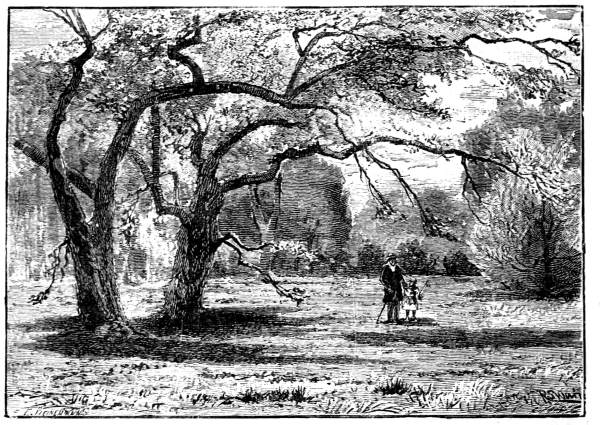
VIEW ACROSS THE LAWN, NORTH-WEST OF THE HOUSE.
The child shakes his coral rattle with its silver bells, and is content
for the moment with its merry tune. The poet listens to other bells
than these, and they tell him that the coral was growing thousands
of years in the Indian seas, and that the bells once reposed as
shapeless ore in darksome mines, beneath the base of Chimborazo or the
overhanging pines of Potosi.
“And thus for thee, O little child.
Through many a danger and escape,
The tall ships passed the stormy cape;
For thee, in foreign lands remote,
Beneath a burning, tropic clime,
The Indian peasant, chasing the wild goat,
Himself as swift and wild,
In falling, clutched the frail arbute,
The fibres of whose shallow root,
Uplifted from the soil, betrayed
The silver veins beneath it laid
The buried treasures of the miser Time.”
He turns from the child to the memory of one who formerly dwelt within
the walls of his historic mansion:
“Up and down these echoing stairs
Heavy with the weight of cares,
Sounded his majestic tread:
Yes, within this very room
Sat he, in those hours of gloom,
Weary both in heart and head.”
These grave thoughts are succeeded by pictures of the child at play,
now in the orchard and now in the garden-walks, where his little
carriage-wheels efface whole villages of sand-roofed tents that rise
above the secret homes of nomadic tribes of ants. But, tired already,
he comes back to parley with repose, and, seated with his father on a
rustic seat in an old apple-tree, they see the waters of the river, and
a sailless vessel dropping down the stream:
“And like it, to a sea as wide and deep,
Thou driftest gently down the tides of sleep.”
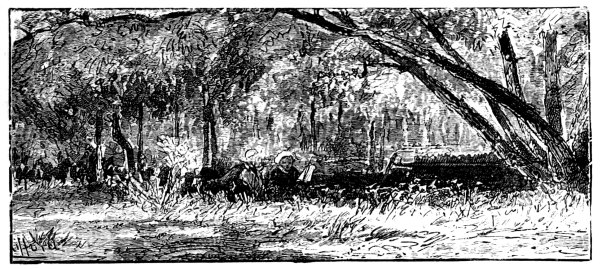
THE OLD WILLOW.
The poet speculates gravely on the future of his child, and bids him
remember that if his fate is an untoward one, even in the perilous hour
“When most afflicted and oppressed
From labour there shall come forth rest.”
In this poem, and in “The Occultation of Orion,” Mr. Longfellow has
reached a table-land of imagination not hitherto attained by his Muse.
“The Bridge” is a revealment of his personality, and a phase of his
genius which has never ceased to charm the majority of his readers. The
train of thought which it suggests is not new, but what thought that
embraces mankind is new? Enough that it is natural, and sympathetic,
and tender. The lines to “The Driving Cloud” are an admirable specimen
of hexameters, and a valuable addition to America’s scanty store of
aboriginal poetry—the forerunner of an immortal contribution not yet
transmuted into verse.
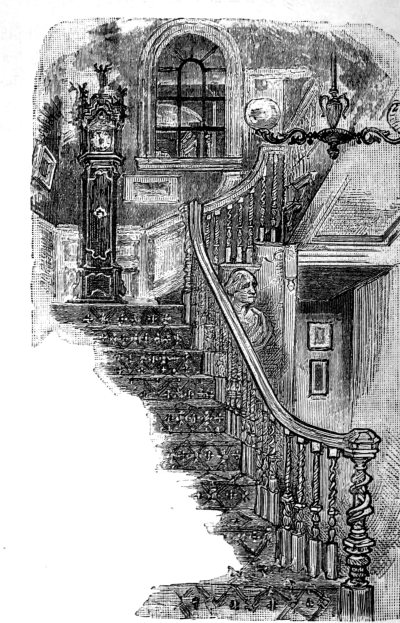
“THE OLD CLOCK ON THE STAIRS.”
Under the head of “Songs” we have eight poems, two of which are
modelled after a fashion that Mr. Longfellow had succeeded in making his
own. I refer to “Sea-weed” and “The Arrow and the Song,” two charming
fantasies in which the doctrine of poetic correspondence (if I may
be allowed the phrase) works out a triumphant excuse for its being.
“The Day is Done” belongs to a class of poems which depend for their
success upon the human element they contain, or suggest, and to which
they appeal. “The Old Clock on the Stairs” is an illustration of what I
mean, and as good a one as can be found in the writings of any modern
poet. The humanities (to adapt a phrase) were never long absent from
Mr. Longfellow’s thoughts. We feel their presence in “The Old Clock on
the Stairs,” in “The Bridge,” and in the unrhymed stanzas “To an Old
Danish Song-book.” This volume introduced Mr. Longfellow in a species
of composition in which we have not hitherto seen him—the sonnet, of
which there are three specimens here, neither of the strictest Italian
form; the best, perhaps, being the one on “Dante,” of whom, by the way,
we had three translations, all from the “Purgatorio,” in the “Voices of
the Night.”
Mr. Longfellow’s next volume was, in a certain sense, the gift of
Hawthorne, to whom he was indebted for its theme. It is stated briefly
in the first volume of his “American Note-books,” in a cluster of
memoranda written between October 24th, 1838, and January 4th, 1839.
Voilá: “H. L. C—— heard from a French Canadian a story
of a young couple in Acadie. On their marriage day, all the men
of the province were summoned to assemble in the church to hear a
proclamation. When assembled, they were all seized and shipped off to
be distributed through New England, among them the new bridegroom. His
bride set off in search of him, wandered about New England all her
lifetime, and at last, when she was old, she found her bridegroom on
his death-bed. The shock was so great that it killed her likewise.”
This forcible deportation of a whole people occurred in 1755, when the
French, to the extent of eighteen thousand souls, were seized by the
English, in the manner stated. History, which excuses so much, has
perhaps excused the act; but humanity never can. It is as indefensible
as the Inquisition.
“Evangeline,” which was published in 1847, disputed the palm with “The
Princess,” which was published in the same year. The two volumes are so
unlike that no comparison can, or should, be made between them. Each
shows its writer at his best, as a story-teller, and if the mediæval
medley surpasses the modern pastoral in richness of colouring, it
is surpassed, in turn, by the tender human interest of the latter.
Evangeline, loving, patient, sorrowful wanderer, has taken a permanent
place, I think, among the heroines of English song; but, whether
the picturesque hexameters in which her pathetic story is told will
hereafter rank among the standard measures of the language, can only be
conjectured. That the poets have fancied them is certain, for the year
after the publication of “Evangeline” saw Clough writing them in “The
Bothie of Tober-na-Vuolich,” and ten years later saw Kingsley writing
them in his “Andromeda.” Matthew Arnold maintains that the hexameter is
the only proper measure in which to translate Homer; and already two
versions of the Iliad in this measure have been made, one by Herschel
(1866) and another by Cochrane (1867).
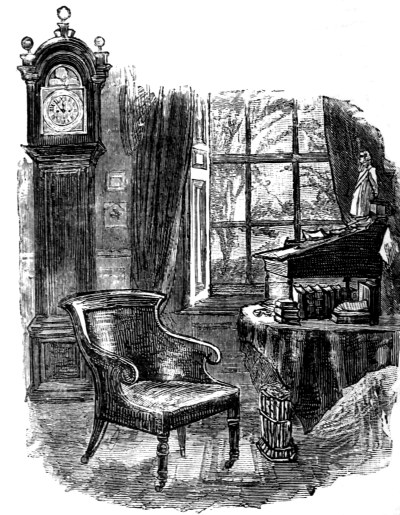
A CORNER OF THE STUDY
Two years before the publication of “Evangeline” (1845), Mr. Longfellow
conferred a scholarly obligation upon the admirers of foreign poetry
by editing “The Poets of Europe,” a closely printed octavo of nearly
eight hundred pages, containing specimens of European poets in ten
different languages, representing the labours of upward of one hundred
translators, including himself. Four years later (1849) he published a
tale, entitled “Kavanagh.” It has no plot to speak of, but its sketches
of character are bright and amusing, and its glimpses of New England
village life are pleasantly authentic.
The five years which included the publication of the next three volumes
of his poetical writings—“The Seaside and the Fireside” (1850), “The
Golden Legend” (1851), and “The Song of Hiawatha” (1855),—added
largely to his reputation as a man of varied attainments, to whom
poetry was an art in which he was perpetually discovering new
possibilities. There are twenty-three poems in “The Seaside and the
Fireside” (including the dedication and the translations), no two of
which are alike, though they all disclose the skilful hand by which
they were wrought. The most important of them, as a work of art, is the
best poem, of which Schiller’s “Song of the Bell” was the model—“The
Building of the Ship.”
“The Golden Legend” transports us back to the Middle Ages, of which we
have had transitory gleams in the earlier writings of Mr. Longfellow.
The poetic atmosphere of that remote period envelops a lovely story,
which turns, like that of “Evangeline,” upon the love and devotion of
woman, that in this instance is happily rewarded.
The figure of Elsie, the peasant girl, who determines to sacrifice
her life to restore her prince to happiness, is worthy of an exalted
place in any poet’s dream of fair women. The charm of the poem, apart
from its poetry, is the thorough and easy scholarship of the writer,
who contrives to conceal the evidences of his reading,—an art which
few poets have possessed in an equal degree, and which Moore did not
possess at all. Mr. Ruskin reflected, I think, the judgment of most
scholarly readers of this poem, when he wrote in his “Modern Painters”
that its author had entered more closely into the temper of the monk,
for good and for evil, than ever yet theological writer or historian,
though they may have given their life’s labour to the analysis.
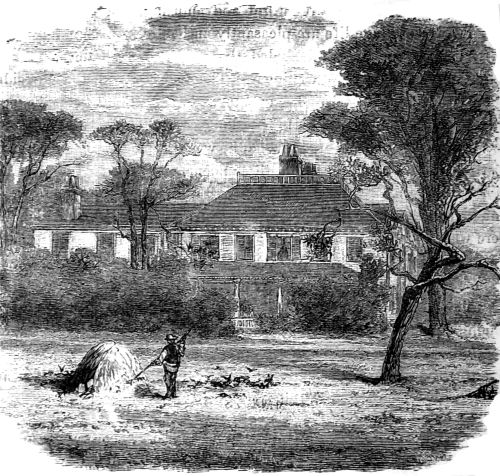
WEST SIDE OF LONGFELLOW’S HOUSE.
(TAKEN FROM A POINT NEAR THE OLD WILLOW.)
That there was a poetic element in the North American Indian several
American poets had believed, and, so believing, had striven to quicken
their verse with its creative energies. Sands and Eastburn wrote
together the ponderous poem of “Yamoyden.” Hoffmann wrote a “Vigil
of Faith;” Seba Smith a “Powhattan;” Street a “Frontenac.” They were
unanimous in one thing,—they all failed to interest their readers. The
cause of this was not far to seek, we can see, since success has been
achieved, but it demanded a vision which was not theirs, and which, it
seemed, only one American poet had. He saw that the Indian himself,
as he figures in our history, was not capable of being made a poetic
hero, but he saw that there might be a poetic side to him, and that it
existed in his legends, if he had any. That he had many, and that they
were remarkable for a certain primitive imagination, was well known.
They were brought to light by the late Henry R. Schoolcraft who heard
of their existence among the Odjibwa Nation, inhabiting the region
about Lake Superior in 1822.
Specimens of these aboriginal fictions were published by Mr Schoolcraft
in his “Travels in the Central Portions of the Mississippi Valley”
(1825), and his “Narrative of the Expedition to Itaska Lake” (1834),
but they were not given to the world in their entirety until 1839 in
his “Algic Researches.” They were as good as manuscript for the next
sixteen years, though one American poet had mastered them thoroughly.
This was Mr. Longfellow, who, in 1855, turned this Indian Edda, as
he happily called it, into “The Song of Hiawatha.” The great and
immediate success of this poem, and the increase of reputation which
it brought its author, recalled the early years of the present century
when Scott and Byron were sure of thousands of readers whenever it
pleased them to write a metrical romance. It was eagerly read by all
classes, who suddenly found themselves interested in the era of flint
arrow-heads, earthen pots, and skin clothes, and in its elemental
inhabitants, who, dead centuries ago, if they ever existed, were now
living the everlasting life of poetry. Everybody read “The Song of
Hiawatha,” which passed through many editions. Its intellectual value
was universally admitted, but its form was questioned, as all new forms
are sure to be. For the form was new to most readers, though not to
scholars in the literatures of Northern Europe. It is original with
Mr. Longfellow, his friends declared. No, his enemies answered, he
has borrowed it from the Finnish epic, “The Kalewala.” The temporary
novelty of its form led to innumerable parodies, but to nothing
serious, that I remember; which I take to be a silent verdict against
its permanency in English versification.
Mr. Longfellow added, three years later, to the laurels he had won
by “Evangeline,” by a second narrative poem in hexameters,—“The
Courtship of Miles Standish.” It lacks the pathetic interest which
is the charm of the earlier poem, but it possesses the same merit of
picturesqueness, and a firmer power of delineating character. Priscilla
is a very vital little Puritan maiden, who sees no impropriety in
asking the man she loves why he does not speak for himself, and not for
Miles Standish, who might find time to attend to his own wooing. The
Puritan atmosphere here is as perfect of its kind as the Catholic
atmosphere of “Evangeline,” and is thoroughly in keeping with the grim
old days in which the story is laid. The versification of the poem is
more vigorous than that of the sister poem, the hexameters having a
sort of martial movement about them.
We do not see that the poetry of Mr. Longfellow has changed much in
the last twenty years, except that it has become graver in its tone
and more serious in its purpose. Its technical excellence has steadily
increased. He has more than held his own against all English-writing
poets, and in no walk of poetry so positively as that of telling a
story. In an age of story-tellers he stands at their head, not only
in the narrative poems I have mentioned, but in the lesser stories
included in his “Tales of a Wayside Inn,” for which he has laid all the
literatures of the world under contribution.
The most distinctive of Mr. Longfellow’s poems are probably those which
he entitles “Birds of Passage,” and which he has from time to time
published as portions of separate volumes. They were inspired by many
literatures, and are in many measures, among which, however, that of
“The Song of Hiawatha” does not reappear, though the hexameter does.
He has the art of finding unwritten poems in the most out-of-the-way
books, and in every-day occurrences. A great man dies,—the Duke of
Wellington, for example,—and he hymns his departure in “The Warden
of the Cinque Ports,” which many prefer to the Laureate’s scholarly
ode. His good friend Hawthorne dies, and he embalms his memory and his
unfinished romance in imperishable verse.
“Ah! who shall lift that wand of magic power,
And the lost clew regain?
The unfinished window in Aladdin’s tower
Unfinished must remain!”
Sumner dies, and he drops a melodious tear upon his grave.
“Were a star quenched on high,
For ages would its light,
Still travelling downward from the sky,
Shine on our mortal sight.
“So when a great man dies,
For years beyond our ken,
The light he leaves behind him lies
Upon the paths of men.”
And again he bids him farewell in a touching sonnet, with a pathetic
and unexpected ending:
“Good-night! good-night! as we so oft have said
Beneath this roof at midnight, in the days
That are no more, and shall no more return.
Thou hast but taken thy lamp and gone to bed:
I stay a little longer, as one stays
To cover up the embers that still burn.”
A child is born to him, and his friend Lowell’s wife dies on the same
night, and he commemorates both in “The Two Angels,” one of his perfect
poems.
Mr. Longfellow published few translations while he was writing his
more important works, such as the “Tales of a Wayside Inn” and “The
Story of Hiawatha.” That he had not forgotten his cunning, however, was
evident in his “Three Books of Song” (1872), where he printed several
translations of Eastern Songs, and in “Keramos, and other Poems,” which
contains two hexameter translations from Virgil and Ovid, and twelve
translations from French, German, and Italian poets. The volume last
mentioned is remarkable in many ways. It not only shows no diminution
of mental vigour, which one might naturally expect in a poet whose
years have exceeded the allotted age of man, but it recalls the young
poet who wrote “The Skeleton in Armour,” and “The Slave’s Dream.”
I know not where to look for more fire than I find in “The Leap of
Roushan Beg,” nor more delicious picturesqueness than in “Castles in
Spain.” “Keramos” belongs to the same class of poems as “The Building
of the Ship,” and is as perfect a piece of poetic art as that exquisite
poem. That the making of pottery could be so effectively handled in
verse reminds us of what Stella said of Swift, viz. that he could write
beautifully about a broom-stick.
Mr. Longfellow’s friendliness, not to say generosity, to his brother
authors, is not the least among his poetic virtues. He sends a greeting
to Lowell in “The Herons of Elmwood,” and honours the memory of Irving
in a tender sonnet, “In the Churchyard at Tarrytown.” In “The Three
Silences of Molinos” (which are those of Speech, Desire, and Thought),
he recognizes the excellence of the poet whom New England delights to
honour next to himself:
“O thou, whose daily life anticipates
The world to come, and in whose thought and word
The spiritual world preponderates,
Hermit of Amesbury! thou too hast heard
Voices and melodies from beyond the gates,
And speakest only when thy soul is stirred.”
If there was any doubt before that Mr. Longfellow was the first
of living sonneteers it is settled by “A Book of Sonnets” in this
collection, the workmanship of which is simply perfect.
Mr. Longfellow’s translation of Dante’s “Divina Commedia” is highly
thought of by scholarly readers. I state, however, as a fact, that he
was not engaged upon it over twenty-five years, as we are told in the
“Life and Letters of George Ticknor”; nor more than thirty years, as
we are told in Richardson’s “Primer of American Literature.” It was
executed in less than two years.
It has not been given to many poets to carry out the ideal of a poetic
life as he has done, and to win a great reputation at an early age,—a
reputation which has not lessened or suffered from any fluctuation of
public taste. The singer of “Keramos” addresses a different public
from the one that welcomed “The Voices of the Night,” but he holds it
nevertheless. In looking back upon his long literary career, one can
see that he has been true to himself as he was manifested to us in his
early prose and verse; that he has fulfilled his scholarly intentions;
and that he has created and satisfied a taste for a literature which
did not exist in America until he began to write,—a literature drawn
from the different languages of Europe, now in the shape of direct
translation, and now in the shape of suggestions, alien to the mass
of English and American readers, but gladly received by both as
new intellectual possessions. He has broadened American culture in
completing his own, and has enlarged American sympathies until they
embrace all other peoples,—the sturdy Norseman, the simple Swede, the
patient Acadien, and the marvel-believing red man of prehistoric times.
Cardinal Wiseman delivered a lecture some years ago on the “Home
Education of the Poor.” In the course of this lecture he commented upon
the fact that England has no poet who is to its labouring classes what
Goethe is to the peasant of Germany, and said: “There is one writer who
approaches nearer than any other to this standard, and he has already
gained such a hold on our hearts that it is almost unnecessary for me
to mention his name. Our hemisphere cannot claim the honour of having
brought him forth, but he still belongs to us, for his works have
become as household words wherever the English language is spoken. And
whether we are charmed by his imagery, or soothed by his melodious
versification, or elevated by the high moral teachings of his pure
muse, or follow with sympathetic hearts the wanderings of Evangeline, I
am sure that all who hear my voice will join with me in the tribute I
desire to pay to the genius of Longfellow.”
The Rev. Lyman Abbott, also recently in the “Christian Union,” remarks
that “There are many persons who regard Christianity as a new form
or a new philosophy, and one might read Longfellow’s songs ‘from
beginning to end,’ and not guess with what form he worshipped or of
what philosophy he is a disciple. But if the Master knew aright His own
mission, He came that we might have life, and have it more abundantly;
and if Paul comprehended the tenour of that life aright, its fruits
are ‘love, joy, peace, long-suffering, gentleness, goodness, faith,
meekness, temperance.’ This life pulsates through all Longfellow’s
words; of these fruits the orchard of his song is full indeed. I do
not recall a single hymn of his which has become a favourite voice
of worship in our churches; but worship has gone up from thousands
of hearts, lowlier and holier for his singing. He does not swing the
censer, but he fills it with his aromatic incense.” ... “Submission
never sang a sweeter song in the night than ‘Resignation;’ devout love
to God never breathed a more Christly petition than in Elsie‘s prayer;
never more unaffected reverence bowed its head than in ’Christus.’”
The Christianity of Longfellow is as simple as that of the New Testament,
and as catholic; his creed, his worship, and his life are love.
“My work is finished; I am strong
In faith and hope and charity;
For I have written the things I see,
The things that have been and shall be.
Conscious of right, nor fearing wrong
Because I am in love with Love,
And the sole thing I hate is Hate;
For Hate is death; and Love is life.
A peace, a splendour from above;
And Hate a never-ending strife,
A smoke, a blackness from the abyss
Where unclean serpents coil and hiss!
Love is the Holy Ghost within;
Hate the unpardonable sin!
Who preaches otherwise than this
Betrays his Master with a kiss.”
The poet died on the 24th March 1882, at Cambridge, Massachusetts and
was buried in the Mount Auburn Cemetery, amidst public and private
evidences of the grief of many thousands of the American people; and in
the United Kingdom his death has been felt as the loss of a familiar
friend, almost irreparable.
Ballads. — THE SKELETON IN ARMOUR. — THE WRECK OF THE HESPERUS .
PREFATORY NOTE.
The following Ballad was suggested to me while riding on the sea-shore
at Newport. A year or two previous a skeleton had been dug up at Fall
River, clad in broken and corroded armour; and the idea occurred to
me of connecting it with the Round Tower at Newport, generally known
hitherto as the Old Windmill, though now claimed by the Danes as a work
of their early ancestors. Professor Rafn, in the Mémoires de la
Société Royale des Antiquaires du Nord, for 1838-39, says:—
“There is no mistaking in this instance the style in which the more
ancient stone edifices of the North were constructed, the style
which belongs to the Roman or Ante-Gothic architecture, and which,
especially after the time of Charlemagne, diffused itself from Italy
over the whole of the West and North of Europe, where it continued to
predominate until the close of the twelfth century; that style which
some authors have, from one of its most striking characteristics,
called the round-arch style, the same which in England is denominated
Saxon and sometimes Norman architecture.
“On the ancient structure in Newport there are no ornaments remaining
which might possibly have served to guide us in assigning the probable
date of its erection. That no vestige whatever is found of the pointed
arch, nor any approximation to it, is indicative of an earlier rather
than of a later period. From such characteristics as remain, however,
we can scarcely form any other inference than one, in which I am
persuaded that all who are familiar with Old Northern architecture will
concur, THAT THIS BUILDING WAS ERECTED AT A PERIOD
DECIDEDLY NOT LATER THAN THE TWELFTH CENTURY. This remark
applies, of course, to the original building only, and not to the
alterations that it subsequently received; for there are several such
alterations in the upper part of the building which cannot be mistaken,
and which were most likely occasioned by its being adapted in modern
times to various uses, for example, as the substructure of a windmill,
and latterly as a hay magazine. To the same times may be referred the
windows, the fireplace, and the apertures made above the columns. That
this building could not have been erected for a windmill is what an
architect will easily discern.”
I will not enter into a discussion of the point. It is sufficiently
well established for the purpose of a ballad, though doubtless many an
honest citizen of Newport, who has passed his days within sight of the
Round Tower, will be ready to exclaim with Sancho, “God bless me! did
I not warn you to have a care of what you were doing, for that it was
nothing but a windmill? and nobody could mistake it but one who had the
like in his head.”
“Speak! speak! thou fearful guest!
Who, with thy hollow breast
Still in rude armour drest,
Comest to daunt me!
Wrapt not in Eastern balms,
But with thy fleshless palms
Stretched, as if asking alms,
Why dost thou haunt me?”
Then, from those cavernous eyes
Pale flashes seemed to rise,
As when the Northern skies
Gleam in December;
And, like the water’s flow
Under December’s snow,
Came a dull voice of woe
From the heart’s chamber.
“I was a Viking old!
My deeds, though manifold,
No Skald in song has told,
No Saga taught thee!
Take heed, that in thy verse
Thou dost the tale rehearse,
Else dread a dead man’s curse!
For this I sought thee.
“Far in the Northern Land,
By the wild Baltic’s strand,
I, with my childish hand,
Tamed the gerfalcon;
And, with my skates fast-bound,
Skimmed the half-frozen Sound,
That the poor whimpering hound
Trembled to walk on.
“Oft to his frozen lair
Tracked I the grisly bear,
While from my path the hare
Fled like a shadow;
Oft through the forest dark
Followed the were-wolf’s bark,
Until the soaring lark
Sang from the meadow.
“But when I older grew,
Joining a corsair’s crew,
O’er the dark sea I flew
With the marauders.
Wild with the life we led;
Many the souls that sped,
Many the hearts that bled,
By our stern orders.
“Many a wassail-bout
Wore the long Winter out;
Often our midnight shout
Set the cocks crowing,
As we the Berserk’s tale
Measured in cups of ale,
Draining the oaken pail,
Filled to o’erflowing.
“Once, as I told in glee
Tales of the stormy sea,
Soft eyes did gaze on me,
Burning, yet tender;
And as the white stars shine
On the dark Norway pine,
On that dark heart of mine
Fell their soft splendour.
“I wooed the blue-eyed maid,
Yielding, yet half afraid,
And in the forest’s shade
Our vows were plighted.
Under its loosened vest
Fluttered her little breast,
Like birds within their nest
By the hawk frighted.
“Bright in her father’s hall
Shields gleamed upon the wall,
Loud sang the minstrels all,
Chanting his glory;
When of old Hildebrand
I asked his daughter’s hand,
Mute did the minstrel stand
To hear my story.
“While the brown ale he quaffed,
Loud then the champion laughed,
And as the wind-gusts waft
The sea-foam brightly,
So the loud laugh of scorn,
Out of those lips unshorn,
From the deep drinking-horn
Blew the foam lightly.
“She was a Prince’s child,
I but a Viking wild,
And though she blushed and smiled,
I was discarded!
Should not the dove so white
Follow the sea-mew’s flight,
Why did they leave that night
Her nest unguarded?
“Scarce had I put to sea,
Bearing the maid with me,—
Fairest of all was she
Among the Norsemen!—
When on the white-sea strand,
Waving his armèd hand,
Saw we old Hildebrand,
With twenty horsemen.
“Then launched they to the blast,
Bent like a reed each mast,
Yet we were gaining fast,
When the wind failed us;
And with a sudden flaw
Came round the gusty Skaw,
So that our foe we saw
Laugh as he hailed us.
“And as to catch the gale
Round veered the flapping sail,
Death! was the helmsman’s hail,
Death without quarter!
Mid-ships with iron-keel
Struck we her ribs of steel;
Down her black hulk did reel
Through the black water.
“As with his wings aslant,
Sails the fierce cormorant,
Seeking some rocky haunt,
With his prey laden:
So toward the open main,
Beating the sea again,
Through the wild hurricane,
Bore I the maiden.
“Three weeks we westward bore,
And when the storm was o’er,
Cloud-like we saw the shore
Stretching to leeward;
There for my lady’s bower
Built I the lofty tower,
Which, to this very hour,
Stands looking seaward.
“There lived we many years;
Time dried the maiden’s tears;
She had forgot her fears,
She was a mother;
Death closed her mild blue eyes,
Under that tower she lies;
Ne’er shall the sun arise
On such another!
“Still grew my bosom then,
Still as a stagnant fen!
Hateful to me were men,
The sunlight hateful!
In the vast forest here,
Clad in my warlike gear,
Fell I upon my spear,
Oh, death was grateful!
“Thus, seamed with many scars,
Bursting these prison bars,
Up to its native stars
My soul ascended!
There from the flowing bowl
Deep drinks the warrior’s soul,
Skoal! to the Northland!
Skoal!”
[1]
—Thus the tale ended.
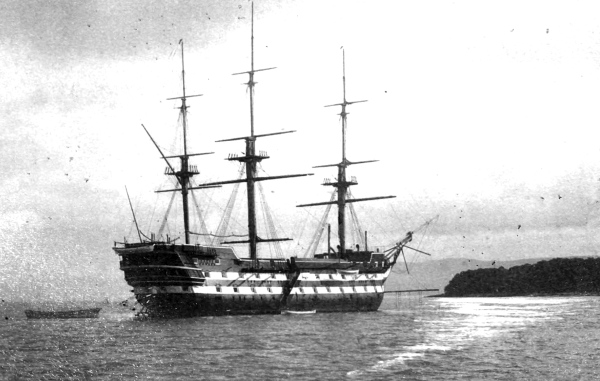
It was the schooner Hesperus,
That sailed the wintry sea;
And the skipper had taken his little daughtèr,
To bear him company.
Blue were her eyes as the fairy-flax,
Her cheeks like the dawn of day,
And her bosom white as the hawthorn buds,
That ope in the month of May.
The skipper he stood beside the helm,
His pipe was in his mouth,
And he watched how the veering flaw did blow
The smoke now West, now South.
Then up and spake an old Sailòr,
Had sailed the Spanish Main,
“I pray thee, put into yonder port,
For I fear a hurricane.
“Last night the moon had a golden ring,
And to-night no moon we see!”
The skipper he blew a whiff from his pipe,
And a scornful laugh laughed he.
Colder and louder blew the wind,
A gale from the North-east;
The snow fell hissing in the brine,
And the billows frothed like yeast.
Down came the storm, and smote amain
The vessel in its strength;
She shuddered and paused, like a frighted steed,
Then leaped her cable’s length.
“Come hither! come hither! my little daughtèr,
And do not tremble so;
For I can weather the roughest gale
That ever wind did blow.”
He wrapped her warm in his seaman’s coat,
Against the stinging blast;
He cut a rope from a broken spar,
And bound her to the mast.
“O father! I hear the church-bells ring,
O say what may it be?”
“’Tis a fog-bell on a rock-bound coast!”—
And he steered for the open sea.
“O father! I hear the sound of guns,
O say, what may it be?”
“Some ship in distress, that cannot live
In such an angry sea!”
“O father, I see a gleaming light,
O say, what may it be?”
But the father answered never a word,
A frozen corpse was he.
Lashed to the helm, all stiff and stark,
With his face turned to the skies,
The lantern gleamed through the gleaming snow
On his fixed and glassy eyes.
Then the maiden clasped her hands and prayed
That saved she might be;
And she thought of Christ, who stilled the wave,
On the Lake of Galilee.
And fast through the midnight dark and drear,
Through the whistling sleet and snow,
Like a sheeted ghost the vessel swept
Towards the reef of Norman’s Woe.
And ever the fitful gusts between
A sound came from the land;
It was the sound of the trampling surf,
On the rocks and the hard sea-sand.
The breakers were right beneath her bows,
She drifted a dreary wreck,
And a whooping billow swept the crew
Like icicles from her deck.
She struck where the white and fleecy waves
Look soft as carded wool,
But the cruel rocks, they gored her side
Like the horns of an angry bull.
Her rattling shrouds, all sheathed in ice,
With the masts went by the board;
Like a vessel of glass, she stove and sank,
Ho! ho! the breakers roared!
At daybreak, on a bleak sea-beach,
A fisherman stood aghast,
To see the form of a maiden fair,
Lashed close to a drifting mast.
The salt sea was frozen on her breast,
The salt tears in her eyes;
And he saw her hair, like the brown sea-weed,
On the billows fall and rise.
Such was the wreck of the Hesperus,
In the midnight and the snow;
Christ save us all from a death like this,
On the reef of Norman’s Woe!
The Spanish Student.
DRAMATIS PERSONÆ.
| Victorian |
Students of Alcalá. |
| Hypolito |
| The Count of Lara |
Gentlemen of Madrid. |
| Don Carlos |
| The Archbishop of Toledo. |
|
| A Cardinal. |
|
| Beltran Cruzado |
Count of the Gipsies. |
| Bartolomé Roman |
A young Gipsy. |
| The Padre Cura of Guadarrama. |
|
| Pedro Crespo |
Alcalde. |
| Pancho |
Alguacil. |
| Francisco |
Lara’s Servant. |
| Chispa |
Victorian’s Servant. |
| Baltasar |
Innkeeper. |
| Preciosa |
A Gipsy Girl. |
| Angelica |
A poor Girl. |
| Martina |
The Padre Cura’s Niece. |
| Dolores |
Preciosa’s Maid. |
| Gipsies, Musicians, etc. |
ACT I.
Scene I.—The
Count of Lara’s Chambers. Night. The
Count in his dressing-gown, smoking and
conversing with Don Carlos.
Lara. You were not at the play to night, Don Carlos;
How happened it?
Carlos. I had engagements elsewhere.
Pray who was there?
Lara. Why, all the town and court.
The house was crowded; and the busy fans
Among the gaily dressed and perfumed ladies
Fluttered like butterflies among the flowers.
There was the Countess of Medina Celi;
The Goblin Lady with her Phantom Lover,
Her Lindo Don Diego; Doña Sol,
And Doña Serafina, and her cousins.
Carlos. What was the play?
Lara. It was a dull affair;
One of those comedies in which you see,
As Lope says, the history of the world
Brought down from Genesis to the Day of Judgment.
There were three duels fought in the first act,
Three gentlemen receiving deadly wounds,
Laying their hands upon their hearts, and saying,
“O, I am dead!” a lover in a closet,
An old hidalgo, and a gay Don Juan,
A Doña Inez with a black mantilla,
Followed at twilight by an unknown lover,
Who looks intently where he knows she is not!
Carlos. Of course, the Preciosa danced to-night?
Lara. And never better. Every footstep fell
As lightly as a sunbeam on the water.
I think the girl extremely beautiful.
Carlos. Almost beyond the privilege of woman!
I saw her in the Prado yesterday.
Her step was royal—queen-like—and her face
As beautiful as a saint’s in Paradise.
Lara. May not a saint fall from her Paradise,
And be no more a saint?
Carlos. Why do you ask?
Lara. Because I have heard it said this angel fell,
And, though she is a virgin outwardly,
Within she is a sinner; like those panels
Of doors and altar-pieces the old monks
Painted in convents, with the Virgin Mary
On the outside, and on the inside Venus!
Carlos. You do her wrong; indeed, you do her wrong!
She is as virtuous as she is fair.
Lara. How credulous you are! Why, look you, friend,
There’s not a virtuous woman in Madrid,
In this whole city! And would you persuade me
That a mere dancing-girl, who shows herself
Nightly, half-naked, on the stage, for money,
And with voluptuous motions fires the blood
Of inconsiderate youth, is to be held
A model for her virtue.
Carlos. You forget
She is a Gipsy girl.
Lara. And therefore won
The easier.
Carlos. Nay, not to be won at all!
The only virtue that a Gipsy prizes
Is chastity. This is her only virtue.
Dearer than life she holds it. I remember
A Gipsy woman, a vile, shameless bawd,
Whose craft was to betray the young and fair;
And yet this woman was above all bribes.
And when a noble lord, touched by her beauty,
The wild and wizard beauty of her race,
Offered her gold to be what she made others,
She turned upon him, with a look of scorn,
And smote him in the face!
Lara. And does that prove
That Preciosa is above suspicion?
Carlos. It proves a nobleman may be repulsed
When he thinks conquest easy. I believe
That woman, in her deepest degradation,
Holds something sacred, something undefiled,
Some pledge and keepsake of her higher nature,
And, like the diamond in the dark, retains
Some quenchless gleam of the celestial light!
Lara. Yet Preciosa would have taken the gold.
Carlos [rising]. I do not think so.
Lara. I am sure of it.
But why this haste? Stay yet a little longer,
And fight the battles of your Dulcinea.
Carlos. ’Tis late. I must begone, for if I stay
You will not be persuaded.
Lara. Yes; persuade me.
Carlos. No one so deaf as he who will not hear!
Lara. No one so blind as he who will not see!
Carlos. And so good night. I wish you pleasant dreams,
And greater faith in woman. [Exit.
Lara. Greater faith!
I have the greatest faith; for I believe
Victorian is her lover. I believe
That I shall be to-morrow; and thereafter
Another, and another, and another,
Chasing each other through her zodiac,
As Taurus chases Aries.
[Enter Francisco with a casket.]
Well, Francisco,
What speed with Preciosa?
Fran. None, my lord.
She sends your jewels back, and bids me tell you
She is not to be purchased by your gold.
Lara. Then I will try some other way to win her.
Pray, dost thou know Victorian?
Fran. Yes, my lord,
I saw him at the jeweller’s to-day.
Lara. What was he doing there?
Fran. I saw him buy
A golden ring that had a ruby in it.
Lara. Was there another like it?
Fran.One so like it
I could not choose between them.
Lara.It is well.
To-morrow morning bring that ring to me.
Do not forget. Now light me to my bed.[Exeunt.
Scene II.—A street
in Madrid. Enter Chispa, followed by
musicians, with a bagpipe, guitars, and other instruments.
Chis. Abernuncio Satanas! and a plague on all lovers who ramble
about at night, drinking the elements, instead of sleeping quietly in
their beds. Every dead man to his cemetery, say I; and every friar to
his monastery. Now, here’s my master, Victorian, yesterday a cowkeeper,
and to-day a gentleman; yesterday a student, and to-day a lover; and
I must be up later than the nightingale, for as the abbot sings so
must the sacristan respond. God grant he may soon be married, for then
shall all this serenading cease. Ay, marry! marry! marry! Mother, what
does marry mean? It means to spin, to bear children, and to weep, my
daughter! And, of a truth, there is something more in matrimony than
the wedding-ring. [To the musicians.] And now, gentlemen, Pax
vobiscum! as the ass said to the cabbages. Pray, walk this way; and
don’t hang down your heads. It is no disgrace to have an old father and
a ragged shirt. Now, look you, you are gentlemen who lead the life of
crickets; you enjoy hunger by day and noise by night. Yet, I beseech
you, for this once be not loud, but pathetic; for it is a serenade to
a damsel in bed, and not to the Man in the Moon. Your object is not to
arouse and terrify, but to soothe and bring lulling dreams. Therefore,
each shall not play upon his instrument as if it were the only one in
the universe, but gently, and with a certain modesty, according with
the others. Pray, how may I call thy name, friend?
First Mus. Gerónimo Gil, at your service.
Chis. Every tub smells of the wine that is in it. Pray,
Gerónimo, is not Saturday an unpleasant day with thee?
First Mus. Why so?
Chis. Because I have heard it said that Saturday is an
unpleasant day with those who have but one shirt. Moreover, I have seen
thee at the tavern, and if thou canst run as fast as thou canst drink,
I should like to hunt hares with thee. What instrument is that?
First Mus. An Aragonese bagpipe.
Chis. Pray, art thou related to the bagpiper of Bujalance, who
asked a maravedi for playing, and ten for leaving off?
First Mus. No, your honour.
Chis. I am glad of it. What other instruments have we?
Second and Third Mus. We play the bandurria.
Chis. A pleasing instrument. Art thou?
Fourth Mus. The fife.
Chis. I like it; it has a cheerful, soul-stirring sound, that
soars up to my lady’s window like the song of a swallow. And you others?
Other Mus. We are the singers, please your honour.
Chis. You are too many. Do you think we are going to sing mass
in the cathedral of Córdova? Four men can make but little use of one
shoe, and I see not how you can all sing in one song. But follow me
along the garden wall. That is the way my master climbs to the lady’s
window. It is by the Vicar’s skirts that the devil climbs into the
belfry. Come, follow me, and make no noise. [Exeunt.
Scene III.— Preciosa’s
Chamber. She stands at the open window.
Pre. How slowly through the lilac-scented air
Descends the tranquil moon! Like thistle-down
The vapoury clouds float in the peaceful sky;
And sweetly from yon hollow vaults of shade
The nightingales breathe out their souls in song.
And hark! what songs of love, what soul-like sounds,
Answer them from below!
SERENADE.
Stars of the summer night!
Far in yon azure deeps,
Hide, hide your golden light!
She sleeps!
My lady sleeps!
Sleeps!
Moon of the summer night!
Far down yon western steeps,
Sink, sink in silver light!
She sleeps!
My lady sleeps!
Sleeps!
Wind of the summer night!
Where yonder woodbine creeps,
Fold, fold thy pinions light!
She sleeps!
My lady sleeps!
Sleeps!
Dreams of the summer night!
Tell her, her lover keeps
Watch! while in slumbers light
She sleeps!
My lady sleeps!
Sleeps!
[Enter Victorian by the balcony.]
Vict. Poor little dove! Thou tremblest like a leaf!
Pre. I am so frightened! ’Tis for thee I tremble!
I hate to have thee climb that wall by night!
Did no one see thee?
Vict.None, my love, but thou.
Pre. ’Tis very dangerous; and when thou art gone,
I chide myself for letting thee come here
Thus stealthily by night. Where hast thou been?
Since yesterday I have no news from thee.
Vict. Since yesterday I’ve been in Alcalá.
Ere long the time will come, sweet Preciosa,
When that dull distance shall no more divide us,
And I no more shall scale thy wall by night
To steal a kiss from thee, as I do now.
Pre. An honest thief to steal but what thou givest.
Vict. And we shall sit together unmolested,
And words of true love pass from tongue to tongue,
As singing birds from one bough to another.
Pre. That were a life indeed to make time envious!
I knew that thou wouldst visit me to-night.
I saw thee at the play.
Vict. Sweet child of air!
Never did I behold thee so attired
And garmented in beauty as to-night!
What hast thou done to make thee look so fair?
Pre. Am not I always fair?
Vict.Ay, and so fair
That I am jealous of all eyes that see thee,
And wish that they were blind.
Pre.I heed them not;
When thou art present, I see none but thee!
Vict. There’s nothing fair nor beautiful, but takes
Something from thee, that makes it beautiful.
Pre. And yet thou leavest me for those dusty books.
Vict. Thou comest between me and those books too often!
I see thy face in everything I see!
The paintings in the chapel wear thy looks,
The canticles are changed to sarabands.
And with the learned doctors of the schools
I see thee dance cachuchas.
Pre.In good sooth,
I dance with learned doctors of the schools
To-morrow morning.
Vict.And with whom, I pray?
Pre. A grave and reverend Cardinal, and his Grace
The Archbishop of Toledo.
Vict.What mad jest
Is this?
Pre. It is no jest; indeed it is not.
Vict. Prithee, explain thyself.
Pre.Why, simply thus.
Thou knowest the Pope has sent here into Spain
To put a stop to dances on the stage.
Vict. I have heard it whispered.
Pre.Now the Cardinal
Who for this purpose comes, would fain behold
With his own eyes these dances; and the Archbishop
Has sent for me——
Vict.That thou mayst dance before them!
Now viva la cachucha! It will breathe
The fire of youth into these grey old men!
’Twill be thy proudest conquest!
Pre.Saving one.
And yet I fear these dances will be stopped,
And Preciosa be once more a beggar.
Vict. The sweetest beggar that e’er asked for alms;
With such beseeching eyes, that when I saw thee
I gave my heart away!
Pre.Dost thou remember
When first we met?
Vict.It was at Córdova,
In the cathedral garden. Thou wast sitting
Under the orange-trees, beside a fountain.
Pre. ’Twas Easter-Sunday. The full blossomed trees
Filled all the air with fragrance and with joy.
The priests were singing, and the organ sounded,
And then anon the great cathedral bell.
It was the elevation of the Host.
We both of us fell down upon our knees,
Under the orange boughs, and prayed together.
I never had been happy till that moment.
Vict. Thou blessed angel!
Pre.And when thou wast gone
I felt an aching here. I did not speak
To any one that day. But from that day
Bartolomé grew hateful unto me.
Vict. Remember him no more. Let not his shadow
Come between thee and me. Sweet Preciosa!
I loved thee even then, though I was silent!
Pre. I thought I ne’er should see thy face again.
Thy farewell had a sound of sorrow in it.
Vict. That was the first sound in the song of love!
Scarce more than silence is, and yet a sound.
Hands of invisible spirits touch the strings
Of that mysterious instrument, the soul,
And play the prelude of our fate. We hear
The voice prophetic, and are not alone.
Pre. That is my faith. Dost thou believe these warnings?
Vict. So far as this. Our feelings and our thoughts
Tend ever on, and rest not in the Present.
As drops of rain fall into some dark well,
And from below comes a scarce audible sound,
So fall our thoughts into the dark Hereafter,
And their mysterious echo reaches us.
Pre. I have felt it so, but found no words to say it!
I cannot reason; I can only feel!
But thou hast language for all thoughts and feelings.
Thou art a scholar; and sometimes I think
We cannot walk together in this world!
The distance that divides us is too great!
Henceforth thy pathway lies among the stars;
I must not hold thee back.
Vict.Thou little sceptic!
Dost thou still doubt? What I most prize in woman
Is her affections, not her intellect!
The intellect is finite; but the affections
Are infinite, and cannot be exhausted.
Compare me with the great men of the earth;
What am I? Why, a pigmy among giants!
But if thou lovest,—mark me! I say lovest,
The greatest of thy sex excels thee not!
The world of the affections is thy world,
Not that of man’s ambition. In that stillness
Which most becomes a woman, calm and holy,
Thou sittest by the fireside of the heart,
Feeding its flame. The element of fire
Is pure. It cannot change nor hide its nature,
But burns as brightly in a Gipsy camp
As in a palace hall. Art thou convinced?
Pre. Yes, that I love thee, as the good love heaven;
But not that I am worthy of that heaven.
How shall I more deserve it?
Vict.Loving more.
Pre. I cannot love thee more; my heart is full.
Vict. Then let it overflow, and I will drink it,
As in the summer time the thirsty sands
Drink the swift waters of the Manzanares,
And still do thirst for more.
A Watchman [in the street]. Ave Maria
Purissima! ’Tis midnight and serene!
Vict. Hear’st thou that cry?
Pre.It is a hateful sound,
To scare thee from me!
Vict.As the hunter’s horn
Doth scare the timid stag, or bark of hounds
The moor-fowl from his mate.
Pre.Pray, do not go!
Vict. I must away to Alcalá to-night.
Think of me when I am away.
Pre.Fear not!
I have no thoughts that do not think of thee.
Vict. [giving her a ring]. And to remind thee of
my love, take this;
A serpent, emblem of Eternity;
A ruby,—say, a drop of my heart’s blood.
Pre. It is an ancient saying, that the ruby
Brings gladness to the wearer, and preserves
The heart pure, and, if laid beneath the pillow,
Drives away evil dreams. But then, alas!
It was a serpent tempted Eve to sin.
Vict. What convent of barefooted Carmelites
Taught thee so much theology?
Pre. [laying her hand upon his mouth]. Hush! Hush!
Good night! and may all holy angels guard thee!
Vict. Good night! good night! Thou art my guardian angel!
I have no other saint than thou to pray to!
[He descends by the balcony.]
Pre. Take care, and do not hurt thee. Art thou safe?
Vict. [from the garden]. Safe as my love for thee!
But art thou safe?
Others can climb a balcony by moonlight
As well as I. Pray shut thy window close;
I am jealous of the perfumed air of night
That from this garden climbs to kiss thy lips.
Pre. [throwing down her handkerchief].
Thou silly child; take this to bind thine eyes.
It is my benison!
Vict.And brings to me
Sweet fragrance from thy lips, as the soft wind
Wafts to the outbound mariner the breath
Of the belovèd land he leaves behind.
Pre. Make not thy voyage long.
Vict.To-morrow night
Shall see me safe returned. Thou art the star
To guide me to an anchorage. Good night!
My beauteous star! My star of love, good night!
Pre. Good night!
Watchman [at a distance]. Ave Maria Purissima!
Scene IV.—An inn on
the road to Alcalá. Baltasar asleep
on a bench. Enter Chispa.
Chis. And here we are, half-way to Alcalá, between cocks and
midnight. Body of me! what an inn this is! The lights out, and the
landlord asleep. Holá! ancient Baltasar!
Balt. [waking]. Here I am.
Chis. Yes, there you are, like a one-eyed Alcalde in a town
without inhabitants. Bring a light, and let me have supper.
Balt. Where is your master?
Chis. Do not trouble yourself about him. We have stopped a
moment to breathe our horses; and, if he chooses to walk up and down in
the open air, looking into the sky as one who hears it rain, that does
not satisfy my hunger, you know. But be quick, for I am in a hurry, and
every man stretches his legs according to the length of his coverlet.
What have we here?
Balt. [setting a light on the table]. Stewed rabbit.
Chis. [eating]. Conscience of Portalegre! Stewed kitten,
you mean!
Balt. And a pitcher of Pedro Ximenes, with a roasted pear in it.
Chis. [drinking]. Ancient Baltasar, amigo! You know how
to cry wine and sell vinegar. I tell you this is nothing but Vino Tinto
of La Mancha, with a tang of the swine-skin.
Balt. I swear to you by Saint Simon and Judas, it is all as I
say.
Chis. And I swear to you by Saint Peter and Saint Paul, that it
is no such thing. Moreover, your supper is like the hidalgo’s dinner,
very little meat, and a great deal of table-cloth.
Balt. Ha! ha! ha!
Chis. And more noise than nuts.
Balt. Ha! ha! ha! You must have your joke, Master Chispa. But
shall I not ask Don Victorian in, to take a draught of the Pedro
Ximenes?
Chis. No; you might as well say, “Don’t-you-want-some?” to a
dead man.
Balt. Why does he go so often to Madrid?
Chis. For the same reason that he eats no supper. He is in love.
Were you ever in love, Baltasar?
Balt. I was never out of it, good Chispa. It has been the
torment of my life.
Chis. What! are you on fire, too, old haystack? Why, we shall
never be able to put you out.
Vict. [without]. Chispa!
Chis. Go to bed, Pero Grullo, for the cocks are crowing.
Vict. Ea! Chispa! Chispa!
Chis. Ea! Señor. Come with me, ancient Baltasar, and bring water
for the horses. I will pay for the supper, to-morrow.
[Exeunt.
Scene V.— Victorian’s
Chambers at Alcalá. Hypolito
asleep in an arm-chair. He awakes slowly.
Hyp. I must have been asleep! ay, sound asleep!
And it was all a dream. O sleep, sweet sleep!
Whatever form thou takest, thou art fair,
Holding unto our lips thy goblet filled
Out of Oblivion’s well, a healing draught!
The candles have burned low; it must be late.
Where can Victorian be? Like Fray Carillo,
[19]The only place in which one cannot find him
Is his own cell. Here’s his guitar, that seldom
Feels the caresses of its master’s hand.
Open thy silent lips, sweet instrument!
And make dull midnight merry with a song.
Padre Francisco!
Padre Francisco!
What do you want of Padre Francisco?
Here is a pretty young maiden
Who wants to confess her sins.
Open the door and let her come in,
I will shrive her from every sin.
Vict. Padre Hypolito! Padre Hypolito!
Hyp. What do you want of Padre Hypolito?
Vict. Come, shrive me straight; for, if love be a sin,
I am the greatest sinner that doth live.
I will confess the sweetest of all crimes,
A maiden wooed and won.
Hyp.The same old tale
Of the old woman in the chimney corner,
Who, while the pot boils, says, “Come here, my child;
I’ll tell thee a story of my wedding-day.”
Vict. Nay, listen, for my heart is full; so full
That I must speak.
Hyp.Alas! that heart of thine
Is like a scene in the old play; the curtain
Rises to solemn music, and lo! enter
The eleven thousand virgins of Cologne!
Vict. Nay, like the Sibyl’s volumes, thou shouldst say;
Those that remained, after the six were burned,
Being held more precious than the nine together.
But listen to my tale. Dost thou remember
The gipsy girl we saw at Córdova
Dance the Romalis in the market-place?
Hyp. Thou meanest Preciosa?
Vict.Ay, the same.
Thou knowest how her image haunted me
Long after we returned to Alcalá.
She’s in Madrid.
Hyp.I know it.
Vict.And I am in love.
Hyp. And therefore in Madrid when thou shouldst be
In Alcalá.
Vict. O pardon me, my friend,
If I so long have kept this secret from thee;
But silence is the charm that guards such treasures,
And, if a word be spoken ere the time,
They sink again, they were not meant for us.
Hyp. Alas! alas! I see thou art in love.
Love keeps the cold out better than a cloak.
It serves for food and raiment. Give a Spaniard
His mass, his olla, and his Dona Luisa,—
Thou knowest the proverb. But pray tell me, lover,
How speeds thy wooing? Is the maiden coy?
Write her a song, beginning with an Ave;
Sing as the monk sang to the Virgin Mary,
Ave! cujus calcem clare,
Nec centenni commendare
Sciret Seraph studio.
Vict. Pray, do not jest! This is no time for it.
I am in earnest!
Hyp.Seriously enamoured?
What, ho! The Primus of great Alcalá
Enamoured of a Gipsy! Tell me frankly,
How meanest thou?
Vict.I mean it honestly.
Hyp. Surely thou wilt not marry her!
Vict.Why not?
Hyp. She was betrothed to one Bartolomé,
If I remember rightly, a young Gipsy
Who danced with her at Córdova.
Vict.They quarrelled,
And so the matter ended.
Hyp.But in truth
Thou wilt not marry her?
Vict. In truth I will.
The angels sang in heaven when she was born!
She is a precious jewel I have found
Among the filth and rubbish of the world.
I’ll stoop for it; but when I wear it here,
Set on my forehead like the morning star,
The world may wonder, but it will not laugh.
Hyp. If thou wear’st nothing else upon thy forehead,
’Twill be indeed a wonder.
Vict.Out upon thee,
With thy unseasonable jests! Pray, tell me,
Is there no virtue in the world?
Hyp.Not much.
What, think’st thou, is she doing at this moment;
Now, while we speak of her?
Vict.She lies asleep,
And, from her parted lips, her gentle breath
Comes like the fragrance from the lips of flowers.
Her tender limbs are still, and, on her breast,
The cross she prayed to, ere she fell asleep,
Rises and falls with the soft tide of dreams,
Like a light barge safe moored.
Hyp.Which means, in prose,
She’s sleeping with her mouth a little open!
Vict. O, would I had the old magician’s glass
To see her as she lies in childlike sleep!
Hyp. And wouldst thou venture?
Vict.Ay, indeed I would!
Hyp. Thou art courageous. Hast thou e’er reflected
How much lies hidden in that one word, now?
Vict. Yes, all the awful mystery of Life!
I oft have thought, my dear Hypolito,
That could we, by some spell of magic, change
The world and its inhabitants to stone,
In the same attitudes they now are in,
What fearful glances downward might we cast
Into the hollow chasms of human life!
What groups should we behold about the death-bed,
Putting to shame the group of Niobe!
What joyful welcomes, and what sad farewells!
What stony tears in those congealèd eyes!
What visible joy or anguish in those cheeks!
What bridal pomps, and what funereal shows!
What foes, like gladiators, fierce and struggling!
What lovers with their marble lips together!
Hyp. Ay, there it is! and, if I were in love,
That is the very point I most should dread.
This magic glass, these magic spells of thine,
Might tell a tale were better left untold.
For instance, they might show us thy fair cousin,
The Lady Violante, bathed in tears
Of love and anger, like the maid of Colchis,
Whom thou, another faithless Argonaut,
Having won that golden fleece, a woman’s love,
Desertest for this Glaucè.
Vict.Hold thy peace!
She cares not for me. She may wed another,
Or go into a convent, and, thus dying,
Marry Achilles in the Elysian Fields.
Hyp. [rising]. And so, good night!
Good morning, I should say.
Hark! how the loud and ponderous mace of Time
Knocks at the golden portals of the day!
And so, once more, good night! We’ll speak more largely
Of Preciosa when we meet again.
Get thee to bed, and the magician, Sleep,
Shall show her to thee, in his magic glass,
In all her loveliness. Good night![Exit.
Vict.Good night!
But not to bed; for I must read awhile.
[Throws himself into the arm-chair which
Hypolito has left, and lays a large book
open upon his knees.]
Must read, or sit in reverie and watch
The changing colour of the waves that break
Upon the idle sea-shore of the mind!
Visions of Fame! that once did visit me,
Making night glorious with your smile, where are ye?
O, who shall give me, now that ye are gone,
Juices of those immortal plants that bloom
Upon Olympus, making us immortal?
Or teach me where that wondrous mandrake grows
Whose magic root, torn from the earth with groans,
At midnight hour, can scare the fiends away,
And make the mind prolific in its fancies?
I have the wish, but want the will, to act!
Souls of great men departed! Ye whose words
Have come to light from the swift river of Time,
Like Roman swords found in the Tagus’ bed,
Where is the strength to wield the arms ye bore?
From the barred visor of Antiquity
Reflected shines the eternal light of Truth,
As from a mirror! All the means of action—
The shapeless masses—the materials—
Lie everywhere about us. What we need
Is the celestial fire to change the flint
Into transparent crystal, bright and clear.
That fire is genius! The rude peasant sits
At evening in his smoky cot, and draws
With charcoal uncouth figures on the wall.
The son of genius comes, footsore with travel,
And begs a shelter from the inclement night.
He takes the charcoal from the peasant’s hand,
And, by the magic of his touch at once
Transfigured, all its hidden virtues shine,
And, in the eyes of the astonished clown,
It gleams a diamond! Even thus transformed,
Rude popular traditions and old tales
Shine as immortal poems, at the touch
Of some poor, houseless, homeless, wandering bard,
Who had but a night’s lodgings for his pains.
But there are brighter dreams than those of Fame,
Which are the dreams of Love! Out of the heart
Rises the bright ideal of these dreams,
As from some woodland fount a spirit rises
And sinks again into its silent deeps,
Ere the enamoured knight can touch her robe!
’Tis this ideal that the soul of man,
Like the enamoured knight beside the fountain,
Waits for upon the margin of Life’s stream;
Waits to behold her rise from the dark waters,
Clad in a mortal shape! Alas! how many
Must wait in vain! The stream flows evermore,
But from its silent deeps no spirit rises!
Yet I, born under a propitious star,
Have found the bright ideal of my dreams.
Yes! she is ever with me. I can feel,
Here, as I sit at midnight and alone,
Her gentle breathing! on my breast can feel
The pressure of her head! God’s benison
Rest ever on it! Close those beauteous eyes,
Sweet Sleep! and all the flowers that bloom at night
With balmy lips breathe in her ears my name!
[Gradually sinks asleep.]
ACT II.
Scene I.—Preciosa’s
Chamber. Morning. Preciosa and
Angelica.
Pre. Why will you go so soon? Stay yet awhile.
The poor too often turn away unheard
From hearts that shut against them with a sound
That will be heard in Heaven. Pray, tell me more
Of your adversities. Keep nothing from me.
What is your landlord’s name?
Ang.The Count of Lara.
Pre. The Count of Lara? O, beware that man!
Mistrust his pity,—hold no parley with him!
And rather die an outcast in the streets
Than touch his gold.
Ang.You know him, then!
Pre.As much
As any woman may, and yet be pure.
As you would keep your name without a blemish,
Beware of him!
Ang.Alas! what can I do?
I cannot choose my friends. Each word of kindness,
Come from whence it may, is welcome to the poor.
Pre. Make me your friend. A girl so young and fair
Should have no friends but those of her own sex.
What is your name?
Ang.Angelica.
Pre.That name
Was given you, that you might be an angel
To her who bore you! When your infant smile
Made her home Paradise, you were her angel.
O, be an angel still! She needs that smile.
So long as you are innocent, fear nothing.
No one can harm you! I am a poor girl,
Whom chance has taken from the public streets.
I have no other shield than mine own virtue,
That is the charm which has protected me!
Amid a thousand perils, I have worn it
Here on my heart! It is my guardian angel.
Ang. [rising]. I thank you for this counsel, dearest lady.
Pre. Thank me by following it.
Ang.Indeed I will.
Pre. Pray, do not go. I have much more to say.
Ang. My mother is alone. I dare not leave her.
Pre. Some other time, then, when we meet again.
You must not go away with words alone.
Take this. Would it were more.
Ang.I thank you, lady.
Pre. No thanks. To-morrow come to me again.
I dance to-night,—perhaps for the last time.
But what I gain, I promise shall be yours,
If that can save you from the Count of Lara.
Ang. O, my dear lady! how shall I be grateful
For so much kindness?
Pre.I deserve no thanks.
Thank Heaven, not me.
Ang.Both Heaven and you.
Pre.Farewell.
Remember that you come again to-morrow.
Ang. I will. And may the blessed Virgin guard you,
And all good angels.[Exit.
Pre.May they guard thee, too,
And all the poor; for they have need of angels.
Now bring me, dear Dolores, my Basquiña,
My richest maja dress,—my dancing dress,
And my most precious jewels! Make me look
Fairer than night e’er saw me! I’ve a prize
To win this day, worthy of Preciosa!
Cruz. Ave Maria!
Pre.O God! my evil genius!
What seekest thou here to-day?
Cruz.Thyself,—my child.
Pre. What is thy will with me?
Cruz.Gold! gold!
Pre. I gave thee yesterday; I have no more.
Cruz. The gold of the Busné,
[20]—give
me his gold!
Pre. I gave the last in charity to-day.
Cruz. That is a foolish lie.
Pre. It is the truth.
Cruz. Curses upon thee! Thou art not my child!
Hast thou given gold away, and not to me!
Not to thy father? To whom then?
Pre.To one
Who needs it more.
Cruz.No one can need it more.
Pre. Thou art not poor.
Cruz.What, I, who lurk about
In dismal suburbs and unwholesome lanes;
I, who am housed worse than the galley slave;
I, who am fed worse than the kennelled hound;
I, who am clothed in rags,—Beltran Cruzado,—
Not poor!
Pre.Thou hast a stout heart and strong hands.
Thou canst supply thy wants; what wouldst thou more?
Cruz. The gold of the Busné! give me his gold!
Pre. Beltran Cruzado! hear me once for all.
I speak the truth. So long as I had gold,
I gave it to thee freely, at all times,
Never denied thee; never had a wish
But to fulfil thine own. Now go in peace!
Be merciful, be patient, and, ere long,
Thou shalt have more.
Cruz.And if I have it not,
Thou shalt no longer dwell here in rich chambers,
Wear silken dresses, feed on dainty food,
And live in idleness; but go with me,
Dance the Romalis in the public streets,
And wander wild again o’er field and fell;
For here we stay not long.
Pre.What! march again?
Cruz. Ay, with all speed. I hate the crowded town!
I cannot breathe shut up within its gates!
Air,—I want air, and sunshine, and blue sky,
The feeling of the breeze upon my face,
The feeling of the turf beneath my feet,
And no walls but the far-off mountain-tops.
Then I am free and strong,—once more myself,
Beltran Cruzado, Count of the Calés!
[21]Pre. God speed thee on thy march!—I cannot go.
Cruz. Remember who I am, and who thou art.
Be silent and obey! Yet one thing more.
Bartolomé Román——
Pre. [with emotion]. O, I beseech thee!
If my obedience and blameless life,
If my humility and meek submission
In all things hitherto, can move in thee
One feeling of compassion; if thou art
Indeed my father, and canst trace in me
One look of her who bore me, or one tone
That doth remind thee of her, let it plead
In my behalf, who am a feeble girl,
Too feeble to resist, and do not force me
To wed that man! I am afraid of him!
I do not love him! On my knees I beg thee
To use no violence, nor do in haste
What cannot be undone!
Cruz.O child, child, child!
Thou hast betrayed thy secret, as a bird
Betrays her nest, by striving to conceal it.
I will not leave thee here in the great city
To be a grandee’s mistress. Make thee ready
To go with us; and until then remember
A watchful eye is on thee.[Exit.
Pre.Woe is me!
I have a strange misgiving in my heart!
But that one deed of charity I will do,
Befall what may; they cannot take that from me. [Exit.
Scene II.—A room in the Archbishop’s palace.
The Archbishop and a Cardinal
seated.
Arch. Knowing how near it touched the public morals,
And that our age is grown corrupt and rotten
By such excesses, we have sent to Rome,
Beseeching that his Holiness would aid
In curing the gross surfeit of the time,
By seasonable stop put here in Spain
To bull-fights and lewd dances on the stage.
All this you know.
Card.Know and approve.
Arch.And further,
That, by a mandate from his Holiness,
The first have been suppressed.
Card.I trust for ever;
It was a cruel sport.
Arch.A barbarous pastime,
Disgraceful to the land that calls itself
Most Catholic and Christian.
Card.Yet the people
Murmur at this; and, if the public dances
Should be condemned upon too slight occasion,
Worse ills might follow than the ills we cure.
As Panem et Circenses was the cry
Among the Roman populace of old,
So Pan y Toros is the cry in Spain.
Hence I would act advisedly herein;
And therefore have induced your grace to see
These national dances, ere we interdict them.
Ser. The dancing-girl, and with her the musicians
Your grace was pleased to order, wait without.
Arch. Bid them come in. Now shall your eyes behold
In what angelic yet voluptuous shape
The Devil came to tempt Saint Anthony.
[Enter Preciosa, with a mantle
thrown over her head. She advances slowly, in a modest, half-timid attitude.]
Card. [aside]. O, what a fair and ministering
angel Was lost to Heaven when this sweet woman fell!
Pre. [kneeling before the Archbishop]. I have obeyed the
order of your grace.
If I intrude upon your better hours,
I proffer this excuse, and here beseech
Your holy benediction.
Arch.May God bless thee,
And lead thee to a better life. Arise.
Card. [aside]. Her acts are modest, and her words discreet!
I did not look for this! Come hither, child.
Is thy name Preciosa?
Pre.Thus I am called.
Card. That is a Gipsy name. Who is thy father?
Pre. Beltran Cruzado, Count of the Calés.
Arch. I have a dim remembrance of that man.
He was a bold and reckless character,
A sun-burnt Ishmael!
Card.Dost thou remember
Thy earlier days?
Pre.Yes; by the Darro’s side
My childhood passed. I can remember still
The river, and the mountains capped with snow:
The villages, where, yet a little child,
I told the traveller’s fortune in the street;
The smuggler’s horse, the brigand, and the shepherd,
The march across the moor; the halt at noon;
The red fire of the evening camp, that lighted
The forest where we slept; and, farther back,
As in a dream or in some former life,
Gardens and palace walls.
Arch.’Tis the Alhambra,
Under whose towers the Gipsy camp was pitched.
But the time wears; and we would see the dance.
Pre. Your grace shall be obeyed.
[She lays aside her mantilla. The
music of the cachuca is played, and the dance begins. The
Archbishop and the
Cardinal look on with gravity and an occasional
frown; then make signs to each other; and, as the dance continues, become more
and more pleased and excited; and at length rise from their seats, throw their
caps in the air, and applaud vehemently as the scene closes.]
Scene III.—The
Prado. A long avenue of trees leading to the gate of Atocha.
On the right the dome and spires of a convent. A fountain.
Evening. Don Carlos and
Hypolito meeting.
Carlos. Holá! Good evening, Don Hypolito.
Hyp. And a good evening to my friend, Don Carlos.
Some lucky star has led my steps this way.
I was in search of you.
Carlos.Command me always.
Hyp. Do you remember, in Quevedo’s Dreams,
The miser who, upon the Day of Judgment,
Asks if his money-bags would rise?
Carlos.I do;
But what of that?
Hyp.I am that wretched man.
Carlos. You mean to tell me yours have risen empty?
Hyp. And amen! said my Cid Campeador.
[22]
Carlos. Pray, how much need you?
Hyp.Some half-dozen ounces,
Which, with due interest——
Carlos [giving his purse]. What, am I a Jew,
To put my moneys out at usury?
Here is my purse.
Hyp.Thank you. A pretty purse,
Made by the hand of some fair Madrilena;
Perhaps a keepsake?
Carlos.No, ’tis at your service.
Hyp. Thank you again. Lie there, good Chrysostom,
And with thy golden mouth remind me often,
I am the debtor of my friend.
Carlos.But tell me,
Come you to-day from Alcalá?
Hyp.This moment.
Carlos. And pray, how fares the brave Victorian?
Hyp. Indifferent well; that is to say, not well.
A damsel has ensnared him with the glances
Of her dark, roving eyes, as herdsmen catch
A steer of Andalusia with a lazo.
He is in love.
Carlos.And is it faring ill
To be in love?
Hyp.In his case very ill.
Carlos. Why so?
Hyp.For many reasons. First and foremost,
Because he is in love with an ideal;
A creature of his own imagination;
A child of air; an echo of his heart;
And, like a lily on a river floating,
She floats upon the river of his thoughts!
[23]Carlos. A common thing with poets. But who is
This floating lily? For, in fine, some woman,
Some living woman—not a mere ideal—
Must wear the outward semblance of his thought.
Who is it? Tell me.
Hyp.Well, it is a woman!
But, look you, from the coffer of his heart
He brings forth precious jewels to adorn her,
As pious priests adorn some favourite saint
With gems and gold, until at length she gleams
One blaze of glory. Without these, you know,
And the priest’s benediction, ’tis a doll.
Carlos. Well, well! who is this doll?
Hyp.Why, who do you think?
Carlos. His cousin Violante.
Hyp.Guess again.
To ease his labouring heart, in the last storm
He threw her overboard, with all her ingots.
Carlos. I cannot guess; so tell me who it is.
Hyp. Not I.
Carlos.Why not?
Hyp. [mysteriously]. Why? Because Mari Franca
Was married four leagues out of Salamanca!
[24]Carlos. Jesting aside, who is it?
Hyp.Preciosa.
Carlos. Impossible! The Count of Lara tells me
She is not virtuous.
Hyp.Did I say she was?
The Roman Emperor Claudius had a wife
Whose name was Messalina, as I think;
Valeria Messalina was her name.
But hist! I see him yonder through the trees,
Walking as in a dream.
Carlos.He comes this way.
Hyp. It has been truly said by some wise man,
That money, grief, and love cannot be hidden.
[Enter Victorian in front.]
Vict. Where’er thy step has passed is holy ground!
These groves are sacred! I behold thee walking
Under these shadowy trees, where we have walked
At evening, and I feel thy presence now;
Feel that the place has taken a charm from thee,
And is for ever hallowed.
Hyp.Mark him well!
See how he strides away with lordly air,
Like that odd guest of stone, that grim Commander
Who comes to sup with Juan in the play.
Carlos. What ho! Victorian!
Hyp.Wilt thou sup with us?
Vict. Holá! amigos! Faith, I did not see you.
How fares Don Carlos?
Carlos.At your service ever.
Vict. How is that young and green-eyed Gaditana
That you both wot of?
Carlos. Ay, soft, emerald eyes!
She has gone back to Cadiz.
Hyp.Ay de mí!
Vict. You are much to blame for letting her go back.
A pretty girl; and in her tender eyes
Just that soft shade of green
[25]
we sometimes see
In evening skies.
Hyp.But, speaking of green eyes,
Are thine green?
Vict.Not a whit. Why so?
Hyp.I think
The slightest shade of green would be becoming,
For thou art jealous.
Vict.No, I am not jealous.
Hyp. Thou shouldst be.
Vict.Why?
Hyp.Because thou art in love,
And they who are in love are always jealous.
Therefore thou shouldst be.
Vict.Marry, is that all?
Farewell; I am in haste. Farewell, Don Carlos.
Thou sayest I should be jealous?
Hyp.Ay, in truth
I fear there is reason. Be upon thy guard.
I hear it whispered that the Count of Lara
Lays siege to the same citadel.
Vict.Indeed!
Then he will have his labour for his pains.
Hyp. He does not think so, and Don Carlos tells me
He boasts of his success.
Vict.How’s this, Don Carlos?
Carlos. Some hints of it I heard from his own lips.
He spoke but lightly of the lady’s virtue,
As a gay man might speak.
Vict. Death and damnation!
I’ll cut his lying tongue out of his mouth,
And throw it to my dog! But no, no, no!
This cannot be. You jest, indeed you jest.
Trifle with me no more. For otherwise
We are no longer friends. And so, farewell![Exit.
Hyp. Now what a coil is here! The Avenging Child
Hunting the traitor Quadros to his death,
[26]And the great Moor Calaynos, when he rode
To Paris for the ears of Oliver,
Were nothing to him! O hot-headed youth!
But come; we will not follow. Let us join
The crowd that pours into the Prado. There
We shall find merrier company; I see
The Marialonzos and the Almavivas,
And fifty fans, that beckon me already. [Exeunt.
Scene IV.—Preciosa’s Chamber. She is sitting,
with a book in her hand, near a table, on which are flowers. A bird
singing in its cage. The Count of Lara
enters behind unperceived.
Pre. [reads].
All are sleeping, weary heart!
Thou, thou only sleepless art!
Heigho! I wish Victorian were here.
I know not what it is makes me so restless!
Thou little prisoner with thy motley coat,
That from thy vaulted, wiry dungeon singest.
Like thee I am a captive, and, like thee,
I have a gentle gaoler. Lack-a-day!
All are sleeping, weary heart!
Thou, thou only sleepless art!
All this throbbing, all this aching,
Evermore shall keep thee waking,
For a heart in sorrow breaking
Thinketh ever of its smart.
Thou speakest truly, poet! and methinks
More hearts are breaking in this world of ours
Than one would say. In distant villages
And solitudes remote, where winds have wafted
The barbed seeds of love, or birds of passage
Scattered them in their flight, do they take root
And grow in silence, and in silence perish.
Who hears the falling of the forest leaf?
Or who takes note of every flower that dies?
Heigho! I wish Victorian would come.
Dolores!
[Turns to lay down her book, and perceives the Count.]
Ha!
Lara.Señora, pardon me!
Pre. How’s this? Dolores!
Lara.Pardon me——
Pre.Dolores!
Lara. Be not alarmed; I found no one in waiting.
If I have been too bold——
Pre. [turning her back upon him]. You are too bold!
Retire! retire, and leave me!
Lara.My dear lady,
First hear me! I beseech you, let me speak.
’Tis for your good I come.
Pre. [turning toward him with indignation]. Begone! Begone!
You are the Count of Lara, but your deeds
Would make the statues of your ancestors
Blush on their tombs! Is it Castilian honour,
Is it Castilian pride, to steal in here
Upon a friendless girl, to do her wrong?
O shame! shame! shame! that you, a nobleman,
Should be so little noble in your thoughts
As to send jewels here to win my love,
And think to buy my honour with your gold!
I have no words to tell you how I scorn you!
Begone! The sight of you is hateful to me!
Begone, I say!
Lara.Be calm; I will not harm you.
Pre. Because you dare not.
Lara.I dare anything!
Therefore beware! You are deceived in me.
In this false world, we do not always know
Who are our friends and who our enemies.
We all have enemies, and all need friends.
Even you, fair Preciosa, here at court
Have foes who seek to wrong you.
Pre.If to this
I owe the honour of the present visit,
You might have spared the coming. Having spoken,
Once more I beg you, leave me to myself.
Lara. I thought it but a friendly part to tell you
What strange reports are current here in town.
For my own self, I do not credit them;
But there are many who, not knowing you,
Will lend a readier ear.
Pre.There was no need
That you should take upon yourself the duty
Of telling me these tales.
Lara.Malicious tongues
Are ever busy with your name.
Pre.Alas!
I’ve no protectors. I am a poor girl,
Exposed to insults and unfeeling jests.
They wound me, yet I cannot shield myself.
I give no cause for these reports. I live
Retired, and visited by none.
Lara. By none?
O, then, indeed, you are much wronged!
Pre.How mean you?
Lara. Nay, nay; I will not wound your gentle soul
By the report of idle tales.
Pre.Speak out!
What are these idle tales? You need not spare me.
Lara. I will deal frankly with you. Pardon me;
This window, as I think, looks towards the street,
And this into the Prado, does it not?
In yon high house, beyond the garden wall,—
You see the roof there just above the trees,—
There lives a friend, who told me yesterday,
That on a certain night,—be not offended
If I too plainly speak,—he saw a man
Climb to your chamber window. You are silent!
I would not blame you, being young and fair——
[He tries to embrace her. She starts back, and draws
a dagger from her bosom.]
Pre. Beware! beware! I am a Gipsy girl!
Lay not your hand upon me. One step nearer
And I will strike!
Lara.Pray you, put up that dagger.
Fear not.
Pre. I do not fear. I have a heart
In whose strength I can trust.
Lara.Listen to me.
I come here as your friend,—I am your friend,—
And by a single word can put a stop
To all those idle tales, and make your name
Spotless as lilies are. Here on my knees,
Fair Preciosa! on my knees I swear
I love you even to madness, and that love
Has driven me to break the rules of custom,
And force myself unasked into your presence.
[Victorian enters behind.]
Pre. Rise, Count of Lara! This is not the place
For such as you are. It becomes you not
To kneel before me. I am strangely moved
To see one of your rank thus low and humbled;
For your sake I will put aside all anger,
All unkind feeling, all dislike, and speak
In gentleness, as most becomes a woman,
And as my heart now prompts me. I no more
Will hate you, for all hate is painful to me.
But if, without offending modesty
And that reserve which is a woman’s glory,
I may speak freely, I will teach my heart
To love you.
Lara.O sweet angel!
Pre.Ay, in truth,
Far better than you love yourself or me.
Lara. Give me some sign of this,—the slightest token.
Let me but kiss your hand!
Pre.Nay, come no nearer.
The words I utter are its sign and token.
Misunderstand me not! Be not deceived!
The love wherewith I love you is not such
As you would offer me. For you come here
To take from me the only thing I have,
My honour. You are wealthy, you have friends
And kindred, and a thousand pleasant hopes
That fill your heart with happiness; but I
Am poor and friendless, having but one treasure,
And you would take that from me, and for what?
To flatter your own vanity, and make me
What you would most despise. O sir, such love,
That seeks to harm me, cannot be true love,
Indeed it cannot. But my love for you
Is of a different kind. It seeks your good.
It is a holier feeling. It rebukes
Your earthly passion, your unchaste desires,
And bids you look into your heart and see
How you do wrong that better nature in you,
And grieve your soul with sin.
Lara.I swear to you,
I would not harm you; I would only love you.
I would not take your honour, but restore it,
And in return I ask but some slight mark
Of your affection. If indeed you love me,
As you confess you do, O let me thus
With this embrace——
Vict. [rushing forward]. Hold! hold! This is too much.
What means this outrage?
Lara.First, what right have you
To question thus a nobleman of Spain?
Vict. I too am noble, and you are no more!
Out of my sight!
Lara.Are you the master here?
Vict. Ay, here and elsewhere, when the wrong of others
Gives me the right!
Pre. [to Lara]. Go! I beseech you, go!
Vict. I shall have business with you, Count, anon!
Lara. You cannot come too soon![Exit.
Pre.Victorian!
O we have been betrayed!
Vict.Ha! ha! betrayed!
’Tis I have been betrayed, not we!—not we!
Pre. Dost thou imagine——
Vict.I imagine nothing;
I see how ’tis thou wilest the time away
When I am gone!
Pre.O speak not in that tone!
It wounds me deeply.
Vict.’Twas not meant to flatter.
Pre. Too well thou knowest the presence of that man
Is hateful to me!
Vict.Yet I saw thee stand
And listen to him, when he told his love.
Pre. I did not heed his words.
Vict.Indeed thou didst,
And answeredst them with love.
Pre.Hadst thou heard all——
Vict. I heard enough.
Pre.Be not angry so with me.
Vict. I am not angry; I am very calm.
Pre. If thou wilt let me speak——
Vict.Nay, say no more.
I know too much already. Thou art false!
I do not like these Gipsy marriages!
Where is the ring I gave thee?
Pre.In my casket.
Vict. There let it rest! I would not have thee wear it;
I thought thee spotless, and thou art polluted.
Pre. I call the Heavens to witness——
Vict.Nay, nay, nay!
Take not the name of Heaven upon thy lips!
They are forsworn!
Pre.Victorian! dear Victorian!
Vict. I gave up all for thee; myself, my fame,
My hopes of fortune, ay, my very soul!
And thou hast been my ruin! Now, go on!
Laugh at my folly with thy paramour,
And, sitting on the Count of Lara’s knee,
Say what a poor, fond fool Victorian was!
[He casts her from him and rushes out.]
Scene V.—The Count of Lara’s
rooms. Enter the Count.
Lara. There’s nothing in this world so sweet as love,
And next to love the sweetest thing is hate!
I’ve learned to hate, and therefore am revenged.
A silly girl to play the prude with me!
The fire that I have kindled——
Well, Francisco,
What tidings from Don Juan?
Fran.Good, my lord.
He will be present.
Lara.And the Duke of Lermos?
Fran. Was not at home.
Lara.How with the rest?
Fran.I’ve found
The men you wanted. They will be all there,
And at the given signal raise a whirlwind
Of such discordant noises, that the dance
Must cease for lack of music.
Lara.Bravely done.
Ah! little dost thou dream, sweet Preciosa,
What lies in wait for thee. Sleep shall not close
Thine eyes this night! Give me my cloak and sword.
[Exeunt.
Scene VI.—A retired spot beyond
the city gates. Enter Victorian and
Hypolito.
Vict. O shame! O shame! Why do I walk abroad
By daylight, when the very sunshine mocks me,
And voices, and familiar sights and sounds,
Cry, “Hide thyself!” O what a thin partition
Doth shut out from the curious world the knowledge
Of evil deeds that have been done in darkness!
Disgrace has many tongues. My fears are windows,
Through which all eyes seem gazing. Every face
Expresses some suspicion of my shame,
And in derision seems to smile at me!
Hyp. Did I not caution thee? Did I not tell thee
I was but half-persuaded of her virtue?
Vict. And yet, Hypolito, we may be wrong,
We may be over-hasty in condemning!
The Count of Lara is a cursed villain.
Hyp. And therefore is she cursed, loving him.
Vict. She does not love him! ’Tis for gold! for gold!
Hyp. Ay, but remember, in the public streets
He shows a golden ring the Gipsy gave him,
A serpent with a ruby in its mouth.
Vict. She had that ring from me! God! she is false!
But I will be revenged! The hour is passed.
Where stays the coward?
Hyp.Nay, he is no coward;
A villain, if thou wilt, but not a coward.
I’ve seen him play with swords; it is his pastime.
And therefore be not over-confident,
He’ll task thy skill anon. Look, here he comes.
[Enter Lara, followed by Francisco.]
Lara. Good evening, gentlemen.
Hyp.Good evening, Count.
Lara. I trust I have not kept you long in waiting.
Vict. Not long, and yet too long. Are you prepared?
Lara. I am.
Hyp.It grieves me much to see this quarrel
Between you, gentlemen. Is there no way
Left open to accord this difference,
But you must make one with your swords?
Vict. No! none!
I do entreat thee, dear Hypolito,
Stand not between me and my foe. Too long
Our tongues have spoken. Let these tongues of steel
End our debate. Upon your guard, Sir Count!
[They fight. Victorian disarms the
Count.]
Your life is mine; and what shall now withhold me
From sending your vile soul to its account?
Lara. Strike! strike!
Vict. You are disarmed. I will not kill you.
I will not murder you. Take up your sword.
[Francisco hands the Count his sword,
and Hypolito interposes.]
Hyp. Enough! Let it end here! The Count of Lara
Has shown himself a brave man, and Victorian
A generous one, as ever. Now be friends.
Put up your swords; for, to speak frankly to you,
Your cause of quarrel is too slight a thing
To move you to extremes.
Lara.I am content.
I sought no quarrel. A few hasty words,
Spoken in the heat of blood, have led to this.
Vict. Nay, something more than that.
Lara.I understand you.
Therein I did not mean to cross your path.
To me the door stood open, as to others.
But, had I known the girl belonged to you,
Never would I have sought to win her from you.
The truth stands now revealed; she has been false
To both of us.
Vict.Ay, false as hell itself!
Lara. In truth I did not seek her; she sought me;
And told me how to win her, telling me
The hours when she was oftenest left alone.
Vict. Say, can you prove this to me? O, pluck out
These awful doubts, that goad me into madness!
Let me know all! all! all!
Lara.You shall know all.
Here is my page, who was the messenger
Between us. Question him. Was it not so,
Francisco?
Fran. Ay, my lord.
Lara.If further proof
Is needful, I have here a ring she gave me.
Vict. Pray let me see that ring! It is the same.
[Throws it upon the ground, and tramples upon it.]
Thus may she perish who once wore that ring!
Thus do I spurn her from me; do thus trample
Her memory in the dust! O Count of Lara,
We both have been abused, been much abused!
I thank you for your courtesy and frankness.
Though, like the surgeon’s hand, yours gave me pain,
Yet it has cured my blindness, and I thank you.
I now can see the folly I have done,
Though ’tis, alas! too late. So fare you well!
To-night I leave this hateful town for ever.
Regard me as your friend. Once more, farewell!
Hyp. Farewell, Sir Count.
[Exeunt Victorian and Hypolito
Lara.Farewell! farewell!
Thus have I cleared the field of my worst foe!
I have none else to fear; the fight is done,
The citadel is stormed, the victory won!
Scene VII.—A lane in the suburbs.
Night. Enter Cruzado and Bartolomé.
Cruz. And so, Bartolomé, the expedition failed. But where wast
thou for the most part?
Bart. In the Guadarrama mountains, near San Ildefonso.
Cruz. And thou bringest nothing back with thee? Didst thou rob
no one?
Bart. There was no one to rob, save a party of students from
Segovia, who looked as if they would rob us; and a jolly little friar,
who had nothing in his pockets but a missal and a loaf of bread.
Cruz. Pray, then, what brings thee back to Madrid?
Bart. First tell me what keeps thee here?
Cruz. Preciosa.
Bart. And she brings me back. Hast thou forgotten thy promise?
Cruz. The two years are not passed yet. Wait patiently. The girl
shall be thine.
Bart. I hear she has a Busné lover.
Cruz. That is nothing.
Bart. I do not like it. I hate him,—the son of a Busné harlot.
He goes in and out, and speaks with her alone, and I must stand aside
and wait his pleasure.
Cruz. Be patient, I say. Thou shalt have thy revenge. When the
time comes, thou shalt waylay him.
Bart. Meanwhile, show me her house.
Cruz. Come this way. But thou wilt not find her. She dances at
the play to-night.
Bart. No matter. Show me the house. [Exeunt.
Scene VIII.—The Theatre. The orchestra
plays the cachucha. Sound of castanets behind the scenes. The curtain rises, and
discovers Preciosa in the attitude of commencing the
dance. The cachucha. Tumult; hisses; cries of “Brava!” and “Afuera!”
She falters and pauses. The music stops. General confusion.
Preciosa faints.
Scene IX.—The
Count of Lara’s chambers.
Lara and his friends at supper.
Lara. So, Caballeros, once more many thanks!
You have stood by me bravely in this matter.
Pray fill your glasses.
Juan.Did you mark, Don Luis,
How pale she looked, when first the noise began,
And then stood still, with her large eyes dilated!
Her nostrils spread! her lips apart! her bosom
Tumultuous as the sea!
Luis.I pitied her.
Lara. Her pride is humbled; and this very night
I mean to visit her.
Juan.Will you serenade her?
Lara. No music! no more music!
Luis.Why not music?
It softens many hearts.
Lara.Not in the humour
She now is in. Music would madden her.
Juan. Try golden cymbals.
Luis.Yes, try Don Dinero;
A mighty wooer is your Don Dinero.
Lara. To tell the truth, then, I have bribed her maid.
But, Caballeros, you dislike this wine.
A bumper and away; for the night wears.
A health to Preciosa!
All.Preciosa!
Lara. [holding up his glass]. Thou bright and flaming
minister of Love!
Thou wonderful magician! who hast stolen
My secret from me, and ’mid sighs of passion
Caught from my lips, with red and fiery tongue,
Her precious name! O never more henceforth
Shall mortal lips press thine; and never more
A mortal name be whispered in thine ear.
Go! keep my secret.
[Drinks and dashes the goblet down.]
Scene X.—Street and garden wall. Night. Enter
Cruzado and Bartolomé.
Cruz. This is the garden wall, and above it, yonder, is her
house. The window in which thou seest the light is her window. But we
will not go in now.
Bart. Why not?
Cruz. Because she is not at home.
Bart. No matter; we can wait. But how is this? The gate is
bolted. [Sound of guitars and voices in a neighbouring street.]
Hark! There comes her lover with his infernal serenade! Hark!
SONG.
Good night! Good night, beloved!
I come to watch o’er thee!
To be near thee,—to be near thee,
Alone is peace for me.
Thine eyes are stars of morning.
Thy lips are crimson flowers!
Good night! Good night, beloved,
While I count the weary hours.
Cruz. They are not coming this way.
Bart. Wait, they begin again.
SONG [coming nearer].
Ah! thou moon that shinest
Argent-clear above!
All night long enlighten
My sweet lady love!
Moon that shinest,
All night long enlighten!
Bart. Woe be to him if he comes this way!
Cruz. Be quiet, they are passing down the street.
SONG [dying away].
The nuns in the cloister
Sang to each other;
For so many sisters
Is there not one brother!
Ay, for the partridge, mother!
The cat has run away with the partridge!
Puss! puss! puss!
Bart. Follow that! Follow that! Come with me. Puss! puss!
[Exeunt. On the opposite side enter the Count of Lara
and gentlemen, with Francisco.]
Lara. The gate is fast. Over the wall, Francisco,
And draw the bolt. There, so, and so, and over.
Now, gentlemen, come in, and help me scale
Yon balcony. How now? Her light still burns.
Move warily. Make fast the gate, Francisco.
[Exeunt. Re-enter Cruzado and
Bartolomé.]
Bart. They went in at the gate. Hark! I hear them in the garden.
[Tries the gate.] Bolted again! Vive Christo! Follow me over
the wall.
[They climb the wall.]
Scene XI.—Preciosa’s
Bed-chamber. Midnight. She is sleeping in an arm-chair, in an undress.
Dolores watching her.
[Opens the window and listens.]
All silent in the street,
And in the garden. Hark!
Pre. [in her sleep]. I must go hence!
Give me my cloak!
Dol.He comes! I hear his footsteps!
Pre. Go tell them that I cannot dance to-night;
I am too ill! Look at me! See the fever
That burns upon my cheek! I must go hence,
I am too weak to dance.
[Signal from the garden.]
Dol. [from the window]. Who’s there?
Voice [from below].A friend.
Dol. I will undo the door. Wait till I come.
Pre. I must go hence. I pray you do not harm me!
Shame! shame! to treat a feeble woman thus!
Be you but kind, I will do all things for you.
I’m ready now,—give me my castanets.
Where is Victorian? Oh, those hateful lamps!
They glare upon me like an evil eye.
[27]I cannot stay. Hark! how they mock at me!
They hiss at me like serpents! Save me! save me!
How late is it, Dolores?
Dol.It is midnight.
Pre. We must be patient. Smooth this pillow for me.
[She sleeps again. Noise from the garden, and voices.]
Voice. Muera!
Another Voice. O villains! villains!
Lara.So! have at you!
Voice. Take that!
Lara.O, I am wounded!
Dol. [shutting the window].Jesu Maria!
Scene I.—A cross-road through a wood.
In the background a distant village spire. Victorian and
Hypolito, as travelling students, with guitars, sitting
under the trees. Hypolito plays and sings.
SONG.
Ah, Love!
Perjured, false, treacherous Love!
Enemy
Of all that mankind may not rue!
Most untrue
To him who keeps most faith with thee.
Woe is me!
The falcon has the eyes of the dove.
Ah! Love!
Perjured, false, treacherous Love!
Vict. Yes, Love is ever busy with his shuttle,
Is ever weaving into life’s dull warp
Bright, gorgeous flowers and scenes Arcadian;
Hanging our gloomy prison-house about
With tapestries, that make its walls dilate
In never-ending vistas of delight.
Hyp. Thinking to walk in those Arcadian pastures,
Thou hast run thy noble head against the wall.
SONG [continued].
Thy deceits
Give us clearly to comprehend,
Whither tend
All thy pleasures, all thy sweets!
They are cheats,
Thorns below and flowers above.
Ah, Love!
Perjured, false, treacherous Love!
Vict. A very pretty song. I thank thee for it.
Hyp. It suits thy case.
Vict.Indeed, I think it does.
What wise man wrote it?
Hyp.Lopez Maldonado.
Vict. In truth, a pretty song.
Hyp.With much truth in it.
I hope thou wilt profit by it; and in earnest
Try to forget this lady of thy love.
Vict. I will forget her! All dear recollections
Pressed in my heart, like flowers within a book,
Shall be torn out, and scattered to the winds!
I will forget her! But perhaps hereafter,
When she shall learn how heartless is the world,
A voice within her will repeat my name,
And she will say, “He was indeed my friend!”
O, would I were a soldier, not a scholar,
That the loud march, the deafening beat of drums,
The shattering blast of the brass-throated trumpet,
The din of arms, the onslaught and the storm,
And a swift death, might make me deaf for ever
To the upbraidings of this foolish heart!
Hyp. Then let that foolish heart upbraid no more:
To conquer love, one need but will to conquer.
Vict. Yet, good Hypolito, it is in vain
I throw into Oblivion’s sea the sword
That pierces me; for, like Excalibar,
With gemmed and flashing hilt, it will not sink.
There rises from below a hand that grasps it,
And waves it in the air; and wailing voices
Are heard along the shore.
Hyp.And yet at last
Down sank Excalibar to rise no more.
This is not well. In truth, it vexes me.
Instead of whistling to the steeds of Time,
To make them jog on merrily with life’s burden,
Like a dead weight thou hangest on the wheels,
Thou art too young, too full of lusty health
To talk of dying.
Vict.Yet I fain would die!
To go through life, unloving and unloved;
To feel that thirst and hunger of the soul
We cannot still; that longing, that wild impulse,
And struggle after something we have not
And cannot have; the effort to be strong;
And, like the Spartan boy, to smile, and smile,
While secret wounds do bleed beneath our cloaks;
All this the dead feel not,—the dead alone!
Would I were with them!
Hyp.We shall all be soon.
Vict. It cannot be too soon; for I am weary
Of the bewildering masquerade of Life,
Where strangers walk as friends, and friends as strangers;
Where whispers overheard betray false hearts;
And through the mazes of the crowd we chase
Some form of loveliness, that smiles, and beckons,
And cheats us with fair words, only to leave us
A mockery and a jest; maddened,—confused,—
Not knowing friend from foe.
Hyp.Why seek to know?
Enjoy the merry shrove-tide of thy youth!
Take each fair mask for what it gives itself,
Nor strive to look beneath it.
Vict.I confess,
That were the wiser part. But hope no longer
Comforts my soul. I am a wretched man,
Much like a poor and shipwrecked mariner,
Who, struggling to climb up into the boat,
Has both his bruised and bleeding hands cut off,
And sinks again into the weltering sea,
Helpless and hopeless!
Hyp.Yet thou shalt not perish.
The strength of thine own arm is thy salvation.
Above thy head, through rifted clouds, there shines
A glorious star. Be patient. Trust thy star!
[Sound of a village-bell in the distance.]
Vict. Ave Maria! I hear the sacristan
Ringing the chimes from yonder village belfry!
A solemn sound, that echoes far and wide
Over the red roofs of the cottages,
And bids the labouring hind a-field, the shepherd
Guarding his flock, the lonely muleteer,
And all the crowd in village streets, stand still,
And breathe a prayer unto the blessed Virgin!
Hyp. Amen! amen! Not half a league from hence
The village lies.
Vict.This path will lead us to it,
Over the wheat fields, where the shadows sail
Across the running sea, now green, now blue,
And, like an idle mariner on the main,
Whistles the quail. Come, let us hasten on.[Exeunt.
Scene II.—Public square in the village
of Guadarrama. The Ave Maria still tolling. A crowd of villagers, with their hats in their
hands, as if in prayer. In front, a group of Gipsies. The bell rings a merrier peal.
A Gipsy dance. Enter Pancho, followed by
Pedro Crespo.
Pan. Make room, ye vagabonds and Gipsy thieves!
Make room for the Alcalde and for me!
Cres. Keep silence all! I have an edict here
From our most gracious lord, the King of Spain,
Jerusalem, and the Canary Islands,
Which I shall publish in the market-place.
Open your ears and listen!
[Enter the Padre Cura
at the door of his cottage.]
Padre Cura,
Good day! and, pray you, hear this edict read.
Padre. Good day, and God be with you. Pray, what is it?
Cres. An act of banishment against the Gipsies!
[Agitation and murmurs in the crowd.]
Pan. Silence!
Cres. [reads]. “I hereby order and command
That the Egyptian and Chaldean strangers,
Known by the name of Gipsies, shall henceforth
Be banished from the realm, as vagabonds
And beggars; and if, after seventy days,
Any be found within our kingdom’s bounds,
They shall receive a hundred lashes each;
The second time, shall have their ears cut off;
The third, be slaves for life to him who takes them,
Or burnt as heretics. Signed, I, the King.”
Vile miscreants and creatures unbaptized!
You hear the law! Obey and disappear!
Pan. And if in seventy days you are not gone,
Dead or alive I make you all my slaves.
[The Gipsies go out in confusion, showing signs of fear
and discontent. Pancho follows.]
Padre. A righteous law! A very righteous law!
Pray you, sit down.
Cres.I thank you heartily.
[They seat themselves on a bench at the Padre Cura’s
door. Sound of guitars heard at a distance, approaching
during the dialogue which follows.]
A very righteous judgment, as you say.
Now tell me, Padre Cura,—you know all things,—
How came these Gipsies into Spain?
Padre.Why, look you;
They came with Hercules from Palestine,
And hence are thieves and vagrants, Sir Alcalde,
As the Simoniacs from Simon Magus.
And, look you, as Fray Jayme Bleda says,
There are a hundred marks to prove a Moor
Is not a Christian, so ’tis with the Gipsies.
They never marry, never go to mass,
Never baptize their children, nor keep Lent,
Nor see the inside of a church,—nor—nor——
Cres. Good reasons, good, substantial reasons, all!
No matter for the other ninety-five.
They should be burnt, I see it plain enough,—
They should be burnt.
[Enter Victorian and
Hypolito playing.]
Padre.And pray, whom have we here?
Cres. More vagrants! By Saint Lazarus, more vagrants!
Hyp. Good evening, gentlemen! Is this Guadarrama?
Padre. Yes, Guadarrama, and good evening to you.
Hyp. We seek the Padre Cura of the village;
And, judging from your dress and reverend mien,
You must be he.
Padre.I am. Pray, what’s your pleasure?
Hyp. We are poor students, travelling in vacation.
You know this mark?
[Touching the wooden spoon in his hat-band.]
Padre [joyfully]. Ay, know it, and have worn it.
Cres. [aside]. Soup-eaters! by the mass!
The worst of vagrants!
And there’s no law against them. Sir, your servant.
[Exit.
Padre. Your servant, Pedro Crespo.
Hyp.Padre Cura,
From the first moment I beheld your face,
I said within myself, “This is the man!”
There is a certain something in your looks,
A certain scholar-like and studious something,—
You understand,—which cannot be mistaken;
Which marks you as a very learned man,
In fine, as one of us.
Vict. [aside].What impudence!
Hyp. As we approached, I said to my companion,
“That is the Padre Cura; mark my words!”
Meaning your Grace. “The other man,” said I,
“Who sits so awkwardly upon the bench,
Must be the sacristan.”
Padre.Ah! said you so?
Why, that was Pedro Crespo, the alcalde!
Hyp. Indeed! you much astonish me! His air
Was not so full of dignity and grace
As an alcalde’s should be.
Padre.That is true.
He is out of humour with some vagrant Gipsies,
Who have their camp here in the neighbourhood.
There is nothing so undignified as anger.
Hyp. The Padre Cura will excuse our boldness,
If, from his well-known hospitality,
We crave a lodging for the night.
Padre.I pray you!
You do me honour! I am but too happy
To have such guests beneath my humble roof.
It is not often that I have occasion
To speak with scholars; and Emollit mores,
Nec sinit esse feros, Cicero says.
Hyp. ’Tis Ovid, is it not?
Padre.No, Cicero.
Hyp. Your Grace is right. You are the better scholar.
Now what a dunce was I to think it Ovid!
But hang me if it is not! (aside).
Padre.Pass this way.
He was a very great man, was Cicero!
Pray you, go in, go in! no ceremony.[Exeunt.
Scene III.—A room in the
Padre Cura’s house. Enter the Padre
and Hypolito.
Padre. So then, Señor, you come from Alcalá,
I am glad to hear it. It was there I studied.
Hyp. And left behind an honoured name, no doubt.
How may I call your Grace?
Padre.Gerónimo
De Santillana, at your Honour’s service.
Hyp. Descended from the Marquis Santillana?
From the distinguished poet?
Padre.From the Marquis,
Not from the poet.
Hyp.Why, they were the same.
Let me embrace you! O some lucky star
Has brought me hither! Yet once more!—once more!
Your name is ever green in Alcalá,
And our professor, when we are unruly,
Will shake his hoary head, and say, “Alas!
It was not so in Santillana’s time!”
Padre. I did not think my name remembered there.
Hyp. More than remembered; it is idolized.
Padre. Of what professor speak you?
Hyp.Timoneda.
Padre. I don’t remember any Timoneda.
Hyp. A grave and sombre man, whose beetling brow
O’erhangs the rushing current of his speech
As rocks o’er rivers hang. Have you forgotten?
Padre. Indeed, I have. O those were pleasant days,—
Those college days! I ne’er shall see the like!
I had not buried then so many hopes!
I had not buried then so many friends!
I’ve turned my back on what was then before me;
And the bright faces of my young companions
Are wrinkled like my own, or are no more.
Do you remember Cueva?
Hyp.Cueva? Cueva?
Padre. Fool that I am! He was before your time.
You’re a mere boy, and I am an old man.
Hyp. I should not like to try my strength with you.
Padre. Well, well. But I forget; you must be hungry.
Martina! ho! Martina! ’Tis my niece.
Hyp. You may be proud of such a niece as that.
I wish I had a niece. Emollit mores.
[Aside.
He was a very great man, was Cicero!
Your servant, fair Martina.
Mart.Servant, sir.
Padre. This gentleman is hungry. See thou to it.
Let us have supper.
Mart.’Twill be ready soon.
Padre. And bring a bottle of my Val-de-Peñas
Out of the cellar. Stay; I’ll go myself.
Pray you, Señor, excuse me. [Exit.
Hyp.Hist! Martina!
One word with you. Bless me! what handsome eyes!
To-day there have been Gipsies in the village.
Is it not so?
Mart. There have been Gipsies here.
Hyp. Yes, and they told your fortune.
Mart. [embarrassed].Told my fortune?
Hyp. Yes, yes; I know they did. Give me your hand.
I’ll tell you what they said. They said,—they said,
The shepherd boy that loved you was a clown,
And him you should not marry. Was it not?
Mart. [surprised]. How know you that?
Hyp.O, I know more than that.
What a soft, little hand! And then they said,
A cavalier from court, handsome, and tall,
And rich, should come one day to marry you,
And you should be a lady. Was it not?
He has arrived, the handsome cavalier.
[Tries to kiss her. She runs off.
Enter Victorian with a letter.]
Vict. The muleteer has come.
Hyp.So soon?
Vict.I found him
Sitting at supper by the tavern door,
And, from a pitcher that he held aloft
His whole arm’s length, drinking the blood-red wine.
Hyp. What news from Court?
Vict.He brought this letter only.
[Reads.
O cursed perfidy! Why did I let
That lying tongue deceive me! Preciosa,
Sweet Preciosa! how art thou avenged!
Hyp. What news is this, that makes thy cheek turn pale,
And thy hand tremble?
Vict.O, most infamous!
The Count of Lara is a worthless villain!
Hyp. That is no news, forsooth.
Vict.He strove in vain
To steal from me the jewel of my soul,
The love of Preciosa. Not succeeding,
He swore to be revenged; and set on foot
A plot to ruin her, which has succeeded.
She has been hissed and hooted from the stage,
Her reputation stained by slanderous lies
Too foul to speak of; and, once more a beggar,
She roams a wanderer over God’s green earth,
Housing with Gipsies!
Hyp.To renew again
The Age of Gold, and make the shepherd swains
Desperate with love, like Gaspar Gil’s Diana.
Redit et Virgo!
Vict.Dear Hypolito,
How have I wronged that meek, confiding heart!
I will go seek for her; and with my tears
Wash out the wrong I’ve done her!
Hyp.O beware!
Act not that folly o’er again.
Vict.Ay, folly,
Delusion, madness, call it what thou wilt,
I will confess my weakness,—I still love her!
Still fondly love her!
Hyp.Tell us, Padre Cura,
Who are these Gipsies in the neighbourhood?
Padre. Beltran Cruzado and his crew.
Vict.Kind Heaven,
I thank thee! She is found! is found again!
Hyp. And have they with them a pale, beautiful girl,
Called Preciosa?
Padre.Ay, a pretty girl.
The gentleman seems moved.
Hyp.Yes, moved with hunger,
He is half-famished with this long day’s journey.
Padre. Then, pray you, come this way. The supper waits.
[Exeunt.
Scene IV.—A post-house on the road to Segovia,
not far from the village of Guadarrama. Enter Chispa, cracking
a whip, and singing the cachucha.]
Chis. Halloo! Don Fulano! Let us have horses, and quickly.
Alas, poor Chispa! what a dog’s life dost thou lead! I thought, when
I left my old master Victorian, the student, to serve my new master,
Don Carlos, the gentleman, that I, too, should lead the life of a
gentleman; should go to bed early, and get up late. For when the abbot
plays cards, what can you expect of the friars? But, in running away
from the thunder, I have run into the lightning. Here I am in hot chase
after my master and his Gipsy girl. And a good beginning of the week it
is, as he said who was hanged on Monday morning.
[Enter Don Carlos.]
Carlos. Are not the horses ready yet?
Chis. I should think not, for the hostler seems to
be asleep. Ho! within there! Horses! horses! horses! [He knocks at the gate
with his whip, and enter Mosquito, putting on his
jacket.]
Mos. Pray, have a little patience. I’m not a musket.
Chis. Health and pistareens! I’m glad to see you come on
dancing, padre! Pray, what’s the news?
Mos. You cannot have fresh horses; because there are none.
Chis. Cachiporra! Throw that bone to another dog. Do I look like
your aunt?
Mos. No; she has a beard.
Chis. Go to! Go to!
Mos. Are you from Madrid?
Chis. Yes; and going to Estramadura. Get us horses.
Mos. What’s the news at Court?
Chis. Why, the latest news is, that I am going to set up a
coach, and I have already bought the whip.
[Strikes him round the legs.]
Mos. Oh! oh! you hurt me!
Carlos. Enough of this folly. Let us have horses. [Gives
money to Mosquito.] It is almost dark; and we are in
haste. But tell me, has a band of Gipsies passed this way of late?
Mos. Yes; and they are still in the neighbourhood.
Carlos. And where?
Mos. Across the fields yonder, in the woods near Guadarrama. [Exit.
Carlos. Now this is lucky. We will visit the Gipsy camp.
Chis. Are you not afraid of the evil eye? Have you a stag’s horn
with you?
Carlos. Fear not. We will pass the night at the village.
Chis. And sleep like the Squires of Hernan Daza, nine under one blanket.
Carlos. I hope we may find the Preciosa among them.
Chis. Among the Squires?
Carlos. No; among the Gipsies, blockhead!
Chis. I hope we may; for we are giving ourselves trouble enough
on her account. Don’t you think so? However, there is no catching trout
without wetting one’s trousers. Yonder come the horses.
[Exeunt.
Scene V.—The Gipsy camp in the forest.
Night. Gipsies working at a forge. Others playing cards by the fire-light.
GIPSIES [at the forge sing].
On the top of a mountain I stand,
With a crown of red gold in my hand,
Wild Moors come trooping over the lea,
O how from their fury shall I flee, flee, flee?
O how from their fury shall I flee?
1st Gipsy [playing]. Down with your John-Dorados,[28]
my pigeon. Down with your John-Dorados, and let us make an end.
GIPSIES [at the forge sing].
Loud sang the Spanish cavalier,
And thus his ditty ran:
God send the Gipsy lassie here,
And not the Gipsy man.
1st Gipsy [playing]. There you are in your morocco.
2d Gipsy. One more game. The Alcalde’s doves against the Padre
Cura’s new moon.
1st Gipsy. Have at you, Chirelin.
GIPSIES [at the forge sing].
At midnight, when the moon began
To show her silver flame,
There came to him no Gipsy man,
The Gipsy lassie came.
Cruz. Come hither, Murcigalleros and Rastilleros; leave work,
leave play; listen to your orders for the night. [Speaking to the
right.] You will get you to the village, mark you, by the stone cross.
Gipsies. Ay!
Cruz. [to the left]. And you, by the pole with the
hermit’s head upon it.
Gipsies. Ay!
Cruz. As soon as you see the planets are out, in with you, and
be busy with the ten commandments, under the sly, and Saint Martin
asleep. D’ye hear?
Gipsies. Ay!
Cruz. Keep your lanterns open, and, if you see a goblin or a
papagayo, take to your trampers. “Vineyards and Dancing John” is the
word. Am I comprehended?
Gipsies. Ay! ay!
Cruz. Away, then!
[Exeunt severally. Cruzado
walks up the stage and disappears among the trees.
Enter Preciosa.]
Pre. How strangely gleams through the gigantic trees
The red light of the forge! Wild, beckoning shadows
Stalk through the forest, ever and anon
Rising and bending with the flickering flame,
Then flitting into darkness! So within me
Strange hopes and fears do beckon to each other,
My brightest hopes giving dark fears a being
As the light does the shadow. Woe is me!
How still it is about me, and how lonely!
Bart. Ho! Preciosa!
Pre.O, Bartolomé!
Thou here?
Bart.Lo! I am here.
Pre.Whence comest thou?
Bart. From the rough ridges of the wild Sierra,
From caverns in the rocks, from hunger, thirst,
And fever! Like a wild wolf to the sheepfold,
Come I for thee, my lamb.
Pre.O touch me not!
The Count of Lara’s blood is on thy hands!
The Count of Lara’s curse is on thy soul!
Do not come near me! Pray, begone from here!
Thou art in danger! They have set a price
Upon thy head!
Bart.Ay, and I’ve wandered long
Among the mountains; and for many days
Have seen no human face, save the rough swine-herd’s.
The wind and rain have been my sole companions.
I shouted to them from the rocks thy name,
And the loud echo sent it back to me,
Till I grew mad. I could not stay from thee,
And I am here! Betray me, if thou wilt.
Pre. Betray thee? I betray thee?
Bart.Preciosa!
I come for thee! for thee I thus brave death!
Fly with me o’er the borders of this realm!
Fly with me!
Pre.Speak of that no more. I cannot.
I am thine no longer.
Bart.O, recall the time
When we were children! how we played together,
How we grew up together; how we plighted
Our hearts unto each other, even in childhood!
Fulfil thy promise, for the hour has come.
I am hunted from the kingdom, like a wolf!
Fulfil thy promise.
Pre.’Twas my father’s promise,
Not mine. I never gave my heart to thee,
Nor promised thee my hand!
Bart.False tongue of woman!
And heart more false!
Pre.Nay, listen unto me.
I will speak frankly. I have never loved thee;
I cannot love thee. This is not my fault,
It is my destiny. Thou art a man
Restless and violent. What wouldst thou with me,
A feeble girl, who have not long to live,
Whose heart is broken? Seek another wife,
Better than I, and fairer; and let not
Thy rash and headlong moods estrange her from thee.
Thou art unhappy in this hopeless passion.
I never sought thy love; never did aught
To make thee love me. Yet I pity thee,
And most of all I pity thy wild heart,
That hurries thee to crimes and deeds of blood.
Beware, beware of that.
Bart.For thy dear sake,
I will be gentle. Thou shalt teach me patience.
Pre. Then take this farewell, and depart in peace.
Thou must not linger here.
Bart.Come, come with me.
Pre. Hark! I hear footsteps.
Bart.I entreat thee, come!
Pre. Away! It is in vain.
Bart.Wilt thou not come?
Pre. Never!
Bart.Then woe, eternal woe, upon thee.
Thou shalt not be another’s. Thou shalt die.
[Exit.
Pre. All holy angels keep me in this hour!
Spirit of her who bore me, look upon me!
Mother of God, the glorified, protect me!
Christ and the saints, be merciful unto me!
Yet why should I fear death? What is it to die?
To leave all disappointment, care, and sorrow,
To leave all falsehood, treachery, and unkindness,
All ignominy, suffering, and despair,
And be at rest for ever! O, dull heart,
Be of good cheer! When thou shalt cease to beat,
Then shalt thou cease to suffer and complain!
[Enter Victorian
and Hypolito behind.]
Vict. ’Tis she! Behold, how beautiful she stands
Under the tent-like trees!
Hyp.A woodland nymph!
Vict. I pray thee, stand aside. Leave me.
Hyp.Be wary.
Do not betray thyself too soon.
Vict. [disguising his voice]. Hist! Gipsy!
Pre. [aside, with emotion].
That voice! that voice from heaven! O speak again!
Who is it calls?
Vict.A friend.
Pre. [aside].’Tis he! ’Tis he!
I thank thee, Heaven, that thou hast heard my prayer,
And sent me this protector! Now be strong,
Be strong, my heart! I must dissemble here.
False friend or true?
Vict.A true friend to the true.
Fear not; come hither. So, can you tell fortunes?
Pre. Not in the dark. Come nearer to the fire.
Give me your hand. It is not crossed, I see.
Vict. [putting a piece of gold into her hand]. There is the cross.
Pre.Is’t silver?
Vict.No, ’tis gold.
Pre. There’s a fair lady at the Court, who loves you,
And for yourself alone.
Vict.Fie! the old story!
Tell me a better fortune for my money;
Not this old woman’s tale!
Pre.You are passionate;
And this same passionate humour in your blood
Has marred your fortune. Yes; I see it now;
The line of life is crossed by many marks.
Shame! shame! O you have wronged the maid who loved you!
How could you do it?
Vict.I never loved a maid;
For she I loved was then a maid no more.
Pre. How know you that?
Vict.A little bird in the air
Whispered the secret.
Pre.There, take back your gold.
Your hand is cold, like a deceiver’s hand!
There is no blessing in its charity!
Make her your wife, for you have been abused;
And you shall mend your fortunes, mending hers.
Vict. [aside]. How like an angel’s speaks the tongue of woman,
When pleading in another’s cause her own——
That is a pretty ring upon your finger.
Pray give it me. [Tries to take the ring.]
Pre.No; never from my hand
Shall that be taken!
Vict.Why, ’tis but a ring.
I’ll give it back to you; or, if I keep it,
Will give you gold to buy you twenty such.
Pre. Why would you have this ring?
Vict.A traveller’s fancy,
A whim, and nothing more. I would fain keep it
As a memento of the Gipsy camp
In Guadarrama, and the fortune-teller
Who sent me back to wed a widowed maid.
Pray, let me have the ring.
Pre.No, never! never!
I will not part with it, even when I die;
But bid my nurse fold my pale fingers thus,
That it may not fall from them. ’Tis a token
Of a beloved friend, who is no more.
Vict.How? dead?
Pre. Yes; dead to me; and worse than dead.
He is estranged! And yet I keep this ring.
I will rise with it from my grave hereafter,
To prove to him that I was never false.
Vict. [aside]. Be still, my swelling heart! one moment, still!
Why, ’tis the folly of a love-sick girl.
Come, give it me, or I will say ’tis mine,
And that you stole it.
Pre.O, you will not dare
To utter such a fiendish lie!
Vict.Not dare?
Look in my face, and say if there is aught
I have not dared, I would not dare for thee!
[She rushes into his arms.]
Pre. ’Tis thou! ’tis thou! Yes; yes; my heart’s elected!
My dearest-dear Victorian! my soul’s heaven!
Where hast thou been so long? Why didst thou leave me?
Vict. Ask me not now, my dearest Preciosa.
Let me forget we ever have been parted!
Pre. Hadst thou not come——
Vict.I pray thee, do not chide me!
Pre. I should have perished here among these Gipsies.
Vict. Forgive me, sweet! for what I made thee suffer.
Think’st thou this heart could feel a moment’s joy,
Thou being absent? O, believe it not!
Indeed, since that sad hour I have not slept,
For thinking of the wrong I did to thee!
Dost thou forgive me? Say, wilt thou forgive me?
Pre. I have forgiven thee. Ere those words of anger
Were in the book of Heaven writ down against thee,
I had forgiven thee.
Vict.I’m the veriest fool
That walks the earth, to have believed thee false.
It was the Count of Lara——
Pre.That bad man
Has worked me harm enough. Hast thou not heard——
Vict. I have heard all. And yet speak on, speak on!
Let me but hear thy voice, and I am happy;
For every tone, like some sweet incantation,
Calls up the buried past to plead for me.
Speak, my beloved, speak into my heart,
Whatever fills and agitates thine own.
Hyp. All gentle quarrels in the pastoral poets,
All passionate love scenes in the best romances,
All chaste embraces on the public stage,
All soft adventures, which the liberal stars
Have winked at, as the natural course of things,
Have been surpassed here by my friend, the student,
And this sweet Gipsy lass, fair Preciosa!
Pre. Señor Hypolito! I kiss your hand.
Pray, shall I tell your fortune?
Hyp.Not to-night;
For, should you treat me as you did Victorian,
And send me back to marry maids forlorn,
My wedding-day would last from now till Christmas.
Chispa [within]. What ho! the Gipsies, ho! Beltran Cruzado!
Halloo! halloo! halloo! halloo!
[Enters booted, with a whip and lantern.]
Vict.What now?
Why such a fearful din? Hast thou been robbed?
Chis. Ay, robbed and murdered; and good evening to you,
My worthy masters.
Vict.Speak; what brings thee here?
Chis. [to Preciosa].
Good news from Court; good news! Beltran Cruzado,
The Count of the Calés, is not your father;
But your true father has returned to Spain
Laden with wealth. You are no more a Gipsy.
Vict. Strange as a Moorish tale!
Chis.And we have all
Been drinking at the tavern to your health,
As wells drink in November, when it rains.
Vict. Where is the gentleman?
Chis.As the old song says,
His body is in Segovia,
His soul is in Madrid.
Pre. Is this a dream? O, if it be a dream,
Let me sleep on, and do not wake me yet!
Repeat thy story! Say I’m not deceived!
Say that I do not dream! I am awake;
This is the Gipsy camp; this is Victorian,
And this his friend, Hypolito! Speak! speak!
Let me not wake and find it all a dream!
Vict. It is a dream, sweet child! a waking dream,
A blissful certainty, a vision bright
Of that rare happiness, which even on earth
Heaven gives to those it loves. Now art thou rich,
As thou wast ever beautiful and good;
And I am now the beggar.
Pre. [giving him her hand.] I have still
A hand to give.
Chis. [aside]. And I have two to take.
I’ve heard my grandmother say, that Heaven gives almonds
To those who have no teeth. That’s nuts to crack.
I’ve teeth to spare, but where shall I find almonds?
Vict. What more of this strange story?
Chis.Nothing more.
Your friend, Don Carlos, is now at the village
Showing to Pedro Crespo, the Alcalde,
The proofs of what I tell you. The old hag,
Who stole you in her childhood, has confessed;
And probably they will hang her for the crime,
To make the celebration more complete.
Vict. No; let it be a day of general joy;
Fortune comes well to all, that comes not late.
Now let us join Don Carlos.
Hyp.So farewell,
The student’s wandering life! Sweet serenades,
Sung under ladies’ windows in the night,
And all that makes vacation beautiful!
To you, ye cloistered shades of Alcalá,
To you, ye radiant visions of romance,
Written in books, but here surpassed by truth,
The Bachelor Hypolito returns,
And leaves the Gipsy with the Spanish Student.
Scene VI.—A pass in the Guadarrama
mountains. Early morning. A muleteer crosses the stage, sitting sideways on his mule,
and lighting a paper cigar with flint and steel.
SONG.
If thou art sleeping, maiden,
Awake and open thy door,
’Tis the break of day, and we must away
O’er meadow, and mount, and moor.
Wait not to find thy slippers,
But come with thy naked feet;
We shall have to pass through the dewy grass,
And waters wide and fleet.
[Disappears down the pass. Enter a Monk.
A Shepherd appears on the rocks above.]
Monk. Ave Maria, gratia plena. Olá! good man!
Shep. Olá!
Monk. Is this the road to Segovia?
Shep. It is, your reverence.
Monk. How far is it?
Shep. I do not know.
Monk. What is that yonder in the valley?
Shep. San Ildefonso.
Monk. A long way to breakfast.
Shep. Ay, marry.
Monk. Are there robbers in these mountains?
Shep. Yes, and worse than that.
Monk. What?
Shep. Wolves.
Monk. Santa Maria! Come with me to San Ildefonso, and thou shalt
be well rewarded.
Shep. What wilt thou give me?
Monk. An Agnus Dei and my benediction.
[They disappear. A mounted Contrabandista passes, wrapped
in his cloak, and a gun at his saddle-bow. He goes down the pass singing.]
SONG.
Worn with speed is my good steed,
And I march me, hurried, worried;
Onward, caballito mio,
With the white star in thy forehead!
Onward, for here comes the Ronda,
And I hear their rifles crack!
Ay, jaléo! Ay, ay, jaléo!
Ay, jaléo! They cross our track!
[Song dies away. Enter Preciosa, on horseback,
attended by Victorian, Hypolito, Don
Carlos, and Chispa, on foot, and armed.]
Vict. This is the highest point. Here let us rest.
See, Preciosa, see how all about us
Kneeling, like hooded friars, the misty mountains
Receive the benediction of the sun!
O glorious sight!
Pre.Most beautiful indeed!
Hyp. Most wonderful!
Vict.And in the vale below,
Where yonder steeples flash like lifted halberds,
San Ildefonso, from its noisy belfries,
Sends up a salutation to the morn,
As if an army smote their brazen shields,
And shouted victory!
Pre.And which way lies
Segovia?
Vict. At a great distance yonder.
Dost thou not see it?
Pre.No, I do not see it.
Vict. The merest flaw that dents the horizon’s edge.
There, yonder!
Hyp.’Tis a notable old town,
Boasting an ancient Roman aqueduct,
And an Alcázar, builded by the Moors,
Wherein, you may remember, poor Gil Blas
Was fed on Pan del Rey. O, many a time
Out of its grated windows have I looked
Hundreds of feet plumb down to the Eresma,
That, like a serpent through the valley creeping,
Glides at its foot.
Pre.O, yes! I see it now,
Yet rather with my heart than with mine eyes,
So faint it is. And, all my thoughts sail thither,
Freighted with prayers and hopes, and forward urged
Against all stress of accident, as, in
The Eastern Tale, against the wind and tide,
Great ships were drawn to the Magnetic Mountains,
And there were wrecked and perished in the sea! [She weeps.]
Vict. O gentle spirit! Thou didst bear unmoved
Blasts of adversity and frosts of fate!
But the first ray of sunshine that falls on thee
Melts thee to tears! O, let thy weary heart
Lean upon mine! and it shall faint no more,
Nor thirst, nor hunger; but be comforted
And filled with my affection.
Pre.Stay no longer!
My father waits. Methinks I see him there,
Now looking from the window, and now watching
Each sound of wheels or footfall in the street,
And saying, “Hark! she comes!” O father! father!
[They descend the pass. Chispa
remains behind.]
Chis. I have a father, too, but he is a dead one. Alas and
alack-a-day! Poor was I born, and poor do I remain. I neither win nor
lose. Thus I wag through the world, half the time on foot, and the
other half walking: and always as merry as a thunder-storm in the
night. And so we plough along, as the fly said to the ox. Who knows
what may happen? Patience and shuffle the cards! I am not yet so bald
that you can see my brains; and perhaps, after all, I shall some day go
to Rome, and come back Saint Peter. Benedicite!
[Exit.
[A pause. Then enter Bartolomé
wildly, as if in pursuit, with a carbine in his hand.]
Bart. They passed this way! I hear their horses’ hoofs!
Yonder I see them! Come, sweet caramillo,
This serenade shall be the Gipsy’s last!
Ha! ha! Well whistled, my sweet caramillo!
Well whistled!—I have missed her!—O, my God!
[The shot is returned. Bartolomé falls.]
The Golden Legend.
The old Legenda Aurea, or Golden Legend, was originally written
in Latin, in the thirteenth century, by Jacobus de Voragine, a Dominican
friar, who afterwards became Archbishop of Genoa, and died in 1292.
He called his book simply Legends of the Saints. The epithet
of Golden was given it by his admirers; for, as Wynkin de Worde says,
“Like as passeth gold in value all other metals, so this legend
exceedeth all other books.” But Edward Leigh, in much distress of mind,
calls it “a book written by a man of a leaden heart for the basenesse
of the errours, that are without wit or reason, and of a brazen
forehead, for his impudent boldnesse in reporting things so fabulous
and incredible.”
This work, the great text-book of the legendary lore of the Middle
Ages, was translated into French in the fourteenth century by Jean de
Vigney, and in the fifteenth into English by William Caxton. It has
lately been made more accessible by a new French translation: La
Légende Dorée, traduite du Latin, par M. G. B. Paris, 1850. There
is a copy of the original, with the Gesta Longobadorum appended,
in the Harvard College Library, Cambridge, printed at Strasburg, 1496.
The title-page is wanting; and the volume begins with the Tabula
Legendorum.
I have called this poem the Golden Legend, because the story upon which
it is founded seems to me to surpass all other legends in beauty and
significance. It exhibits, amid the corruptions of the Middle Ages,
the virtue of disinterestedness and self-sacrifice, and the power of
Faith, Hope, and Charity, sufficient for all the exigencies of life and
death. The story is told, and perhaps invented, by Hartmann von der
Aue, a Minnesinger of the twelfth century. The original may be found in
Mailáth’s Altdeutsche Gedichte, with a modern German version.
There is another in Marbách’s Volksbucher, No. 32.
PROLOGUE.
The Spire of Strasburg Cathedral. Night and storm.
Lucifer, with the Powers of the Air, trying
to tear down the Cross.
Lucifer. Hasten! hasten!
O ye spirits!
From its station drag the ponderous
Cross of iron, that to mock us
Is uplifted high in air!
Voices. O, we cannot.
For around it
All the saints and guardian angels
Throng in legions to protect it;
They defeat us everywhere!
The Bells.
Laudo Deum verum!
Plebem voco!
Congrego clerum!
Lucifer. Lower! lower!
Hover downward!
Seize the loud vociferous bells, and
Clashing, clanging, to the pavement
Hurl them from their windy tower.
Voices. All thy thunders
Here are harmless!
For these bells have been anointed,
[33]And baptized with holy water!
They defy our utmost power.
The Bells.
Defunctos ploro!
Pestem fugo!
Festa decoro!
Lucifer. Shake the casements!
Break the painted
Panes, that flame with gold and crimson:
Scatter them like leaves of Autumn,
Swept away before the blast!
Voices. Oh, we cannot;
The Archangel
Michael flames from every window,
With the sword of fire that drove us
Headlong, out of heaven, aghast!
The Bells.
Funera plango!
Fulgura frango!
Sabbata pango!
Lucifer. Aim your lightnings!
At the oaken,
Massive, iron-studded portals!
Sack the house of God, and scatter
Wide the ashes of the dead!
Voices. Oh, we cannot!
The Apostles
And the Martyrs, wrapped in mantles,
Stand as warders at the entrance,
Stand as sentinels o’erhead!
STRASBURG CATHEDRAL.
The Bells.
Excito lentos!
Dissipo ventos!
Paco cruentos!
Lucifer. Baffled! baffled!
Inefficient,
Craven spirits! leave this labour
Unto Time, the great Destroyer!
Come away, ere night is gone!
Voices. Onward! onward!
With the night-wind,
Over field and farm and forest,
Lonely homestead, darksome hamlet,
Blighting all we breathe upon!
[They sweep away. Organ and Gregorian Chant.]
Choir.
Nocte surgentes
Vigilemus omnes!
I.
The Castle of Vautsberg on the Rhine. A chamber in a tower.
Prince Henry, sitting alone, ill and restless. Midnight.
Prince Henry. I cannot sleep! my fervid brain
Calls up the vanished Past again,
And throws its misty splendours deep
Into the pallid realms of sleep!
A breath from that far-distant shore
Comes freshening ever more and more,
And wafts o’er intervening seas
Sweet odours from the Hesperides!
A wind, that through the corridor
Just stirs the curtain, and no more,
And, touching the Æolian strings,
Faints with the burden that it brings!
Come back! ye friendships long departed!
That like o’erflowing streamlets started,
And now are dwindled, one by one,
To stony channels in the sun!
Come back! ye friends, whose lives are ended,
Come back, with all that light attended,
Which seemed to darken and decay
When ye arose and went away!
They come, the shapes of joy and woe,
The airy crowds of long-ago,
The dreams and fancies known of yore,
That have been, and shall be no more.
They change the cloisters of the night
Into a garden of delight;
They make the dark and dreary hours
Open and blossom into flowers!
I would not sleep! I love to be
Again in their fair company;
But ere my lips can bid them stay,
They pass and vanish quite away!
Alas! our memories may retrace
Each circumstance of time and place,
Season and scene come back again,
And outward things unchanged remain;
The rest we cannot reinstate;
Ourselves we cannot re-create,
Nor set our souls to the same key
Of the remembered harmony!
Rest! rest! Oh, give me rest and peace!
The thought of life that ne’er shall cease
Has something in it like despair,
A weight I am too weak to bear!
Sweeter to this afflicted breast
The thought of never-ending rest!
Sweeter the undisturbed and deep
Tranquillity of endless sleep!
[A flash of lightning, out of which
Lucifer appears,
in the garb of a travelling Physician.]
Lucifer. All hail, Prince Henry!
Prince Henry (starting).Who is it speaks?
Who and what are you?
Lucifer.One who seeks
A moment’s audience with the Prince.
Prince Henry. When came you in?
Lucifer.A moment since.
I found your study door unlocked,
And thought you answered when I knocked.
Prince Henry. I did not hear you.
Lucifer.You heard the thunder;
It was loud enough to waken the dead.
And it is not a matter of special wonder
That, when God is walking overhead,
You should not hear my feeble tread.
Prince Henry. What may your wish or purpose be?
Lucifer. Nothing or everything, as it pleases
Your Highness. You behold in me
Only a travelling Physician;
One of the few who have a mission
To cure incurable diseases,
Or those that are called so.
Prince Henry.Can you bring
The dead to life?
Lucifer.Yes; very nearly.
And what is a wiser and better thing,
Can keep the living from ever needing
Such an unnatural, strange proceeding,
By showing conclusively and clearly
That death is a stupid blunder merely,
And not a necessity of our lives.
My being here is accidental;
The storm, that against your casement drives,
In the little village below waylaid me.
And there I heard, with a secret delight,
Of your maladies, physical and mental,
Which neither astonished nor dismayed me.
And I hastened hither, though late in the night,
To proffer my aid!
Prince Henry (ironically). For this you came!
Ah, how can I ever hope to requite
This honour from one so erudite?
Lucifer. The honour is mine, or will be when
I have cured your disease.
Prince Henry.But not till then.
Lucifer. What is your illness?
Prince Henry.It has no name.
A smouldering, dull, perpetual flame,
As in a kiln, burns in my veins,
Sending up vapours to the head;
My heart has become a dull lagoon,
Which a kind of leprosy drinks and drains;
I am accounted as one who is dead,
And, indeed, I think I shall be soon.
Lucifer. And has Gordonius, the Divine,
In his famous Lily of Medicine,—
I see the book lies open before you,—
No remedy potent enough to restore you?
Prince Henry. None whatever!
Lucifer.The dead are dead.
And their oracles dumb, when questionèd
Of the new diseases that human life
Evolves in its progress, rank and rife.
Consult the dead upon things that were,
But the living only on things that are.
Have you done this, by the appliance
And aid of doctors?
Prince Henry. Ay, whole schools
Of doctors, with their learned rules;
But the case is quite beyond their science.
Even the doctors of Salern
Send me back word they can discern
No cure for a malady like this,
Save one which in its nature is
Impossible, and cannot be!
Lucifer. That sounds oracular!
Prince Henry.Unendurable!
Lucifer. What is their remedy?
Prince Henry.You shall see;
Writ in this scroll is the mystery.
Lucifer (reading). “Not to be cured, yet not incurable!
The only remedy that remains
Is the blood that flows from a maiden’s veins,
Who of her own free will shall die,
And give her life as the price of yours!”
That is the strangest of all cures,
And one, I think, you will never try;
The prescription you may well put by,
As something impossible to find
Before the world itself shall end!
And yet who knows? One cannot say
That into some maiden’s brain that kind
Of madness will not find its way.
Meanwhile permit me to recommend,
As the matter admits of no delay,
My wonderful Catholicon,
Of very subtile and magical powers.
Prince Henry. Purge with your nostrums and drugs infernal
The spouts and gargoyles of these towers,
Not me! My faith is utterly gone
In every power but the Power Supernal!
Pray tell me, of what school are you?
Lucifer. Both of the Old and of the New!
The school of Hermes Trismegistus,
Who uttered his oracles sublime
Before the Olympiads, in the dew
Of the early dusk and dawn of Time,
The reign of dateless old Hephæstus!
As northward, from its Nubian springs,
The Nile, for ever new and old,
Among the living and the dead,
Its mighty, mystic stream has rolled;
So, starting from its fountain-head
Under the lotus-leaves of Isis,
From the dead demigods of eld,
Through long, unbroken lines of kings,
Its course the sacred art has held,
Unchecked, unchanged by man’s devices.
This art the Arabian Geber taught,
And in alembics, finely wrought,
Distilling herbs and flowers, discovered
The secret that so long had hovered
Upon the misty verge of Truth,
The Elixir of Perpetual Youth,
Called Alcohol, in the Arab speech!
Like him, this wondrous lore I teach!
Prince Henry. What! an adept?
Lucifer.Nor less, nor more!
Prince Henry. I am a reader of your books,
A lover of that mystic lore!
With such a piercing glance it looks
Into great Nature’s open eye,
And sees within it trembling lie
The portrait of the Deity!
And yet, alas! with all my pains,
The secret and the mystery
Have baffled and eluded me,
Unseen the grand result remains!
Lucifer (showing a flask). Behold it here! this little flask
Contains the wonderful quintessence,
The perfect flower and efflorescence,
Of all the knowledge man can ask!
Hold it up thus against the light!
Prince Henry. How limpid, pure, and crystalline,
How quick, and tremulous, and bright
The little wavelets dance and shine,
As were it the Water of Life in sooth!
Lucifer. It is! It assuages every pain,
Cures all disease, and gives again
To age the swift delights of youth.
Inhale its fragrance.
Prince Henry. It is sweet.
A thousand different odours meet
And mingle in its rare perfume,
Such as the winds of summer waft
At open windows through a room!
Lucifer. Will you not taste it?
Prince Henry.Will one draught
Suffice?
Lucifer. If not, you can drink more.
Prince Henry. Into this crystal goblet pour
So much as safely I may drink.
Lucifer (pouring). Let not the quantity alarm you;
You may drink all; it will not harm you.
Prince Henry. I am as one who on the brink
Of a dark river stands and sees
The waters flow, the landscape dim
Around him waver, wheel, and swim,
And, ere he plunges, stops to think
Into what whirlpools he may sink;
One moment pauses, and no more,
Then madly plunges from the shore!
Headlong into the mysteries
Of life and death I boldly leap,
Nor fear the fateful current’s sweep,
Nor what in ambush lurks below!
For death is better than disease!
[An Angel with
an Æolian harp hovers in the air.]
Angel. Woe! woe! eternal woe!
Not only the whispered prayer
Of love,
But the imprecations of hate,
Reverberate
For ever and ever through the air
Above!
This fearful curse
Shakes the great universe!
Lucifer (disappearing). Drink! drink!
And thy soul shall sink
Down into the dark abyss,
Into the infinite abyss,
From which no plummet nor rope
Ever drew up the silver sand of hope!
Prince Henry (drinking). It is like a draught of fire!
Through every vein
I feel again
The fever of youth, the soft desire;
A rapture that is almost pain
Throbs in my heart and fills my brain!
O joy! O joy! I feel
The band of steel
That so long and heavily has pressed
Upon my breast
Uplifted, and the malediction
Of my affliction
Is taken from me, and my weary breast
At length finds rest.
The Angel. It is but the rest of the fire, from which the air has been taken!
It is but the rest of the sand, when the hour-glass is not shaken!
It is but the rest of the tide between the ebb and the flow!
It is but the rest of the wind between the flaws that blow!
With fiendish laughter,
Hereafter,
This false physician
Will mock thee in thy perdition.
Prince Henry. Speak! speak!
Who says that I am ill?
I am not ill! I am not weak!
The trance, the swoon, the dream is o’er,
I feel the chill of death no more!
At length,
I stand renewed in all my strength!
Beneath me I can feel
The great earth stagger and reel,
As if the feet of a descending God
Upon its surface trod,
And like a pebble it rolled beneath his heel!
This, O brave physician! this
Is thy great Palingenesis!
The Angel. Touch the goblet no more!
It will make thy heart sore
To its very core!
Its perfume is the breath
Of the Angel of Death,
And the light that within it lies
Is the flash of his evil eyes.
Beware! O beware!
For sickness, sorrow, and care
All are there!
Prince Henry (sinking back). O thou voice within my breast!
Why entreat me, why upbraid me,
When the steadfast tongues of truth
And the flattering hopes of youth
Have all deceived me and betrayed me?
Give me, give me rest, O, rest!
Golden visions wave and hover,
Golden vapours, waters streaming,
Landscapes moving, changing, gleaming!
I am like a happy lover
Who illumines life with dreaming!
Brave physician! Rare physician!
Well hast thou fulfilled thy mission.
[His head falls on his book.]
The Angel (receding). Alas! alas!
Like a vapour the golden vision
Shall fade and pass,
And thou wilt find in thy heart again
Only the blight of pain,
And bitter, bitter, bitter contrition!
Court-yard of the Castle. Hubert standing by the Gateway.
Hubert. How sad the grand old castle looks!
O’erhead, the unmolested rooks
Upon the turret’s windy top
Sit, talking of the farmer’s crop;
Here in the court-yard springs the grass,
So few are now the feet that pass;
The stately peacocks, bolder grown,
Come hopping down the steps of stone,
As if the castle were their own;
And I, the poor old seneschal,
Haunt, like a ghost, the banquet-hall.
Alas! the merry guests no more
Crowd through the hospitable door;
No eyes with youth and passion shine,
No cheeks grow redder than the wine;
No song, no laugh, no jovial din
Of drinking wassail to the pin;
[34]But all is silent, sad, and drear,
And now the only sounds I hear
Are the hoarse rooks upon the walls,
And horses stamping in their stalls!
What ho! that merry, sudden blast
Reminds me of the days long past!
And, as of old resounding, grate
The heavy hinges of the gate,
And, clattering loud, with iron clank,
Down goes the sounding bridge of plank,
As if it were in haste to greet
The pressure of a traveller’s feet!
Enter Walter the Minnesinger.
Walter. How now, my friend! This looks quite lonely!
No banner flying from the walls,
No pages and no seneschals,
No warders, and one porter only!
Is it you, Hubert?
Hubert.Ah! Master Walter!
Walter. Alas! how forms and faces alter!
I did not know you. You look older!
Your hair has grown much greyer and thinner,
And you stoop a little in the shoulder!
Hubert. Alack! I am a poor old sinner,
And, like these towers, begin to moulder;
And you have been absent many a year!
Walter. How is the Prince?
Hubert..He is not here;
He has been ill: and now has fled.
Walter. Speak it out frankly; say he’s dead!
Is it not so?
Hubert. No; if you please;
A strange, mysterious disease
Fell on him with a sudden blight.
Whole hours together he would stand
Upon the terrace, in a dream,
Resting his head upon his hand,
Best pleased when he was most alone,
Like Saint John Nepomuck in stone,
Looking down into a stream.
In the Round Tower, night after night,
He sat, and bleared his eyes with books,
Until one morning we found him there
Stretched on the floor, as if in a swoon
He had fallen from his chair.
We hardly recognised his sweet looks!
Walter. Poor Prince!
Hubert.I think he might have mended;
And he did mend; but very soon
The Priests came flocking in like rooks,
With all their crosiers and their crooks,
And so at last the matter ended.
Walter. How did it end?
Hubert. Why, in Saint Rochus
They made him stand and wait his doom;
And, as if he were condemned to the tomb,
Began to mutter their hocus-pocus.
First, the Mass for the dead they chanted,
Then three times laid upon his head
A shovelful of churchyard clay,
Saying to him, as he stood undaunted,
“This is a sign that thou art dead,
So in thy heart be penitent!”
And forth from the chapel door he went
Into disgrace and banishment,
Clothed in a cloak of hodden grey,
And bearing a wallet, and a bell,
Whose sound should be a perpetual knell
To keep all travellers away.
Walter. O, horrible fate! Outcast, rejected,
As one with pestilence infected!
Hubert. Then was the family tomb unsealed,
And broken helmet, sword, and shield,
Buried together, in common wreck,
As is the custom, when the last
Of any princely house has passed,
And thrice, as with a trumpet-blast,
A herald shouted down the stair
The words of warning and despair,—
“O Hoheneck! O Hoheneck!”
Walter. Still in my soul that cry goes on,—
For ever gone! for ever gone!
Ah, what a cruel sense of loss,
Like a black shadow, would fall across
The hearts of all, if he should die!
His gracious presence upon earth
Was as a fire upon a hearth;
As pleasant songs, at morning sung,
The words that dropped from his sweet tongue
Strengthened our hearts; or, heard at night,
Made all our slumbers soft and light.
Where is he?
Hubert. In the Odenwald.
Some of his tenants, unappalled
By fear of death, or priestly word,—
A holy family, that make
Each meal a Supper of the Lord,—
Have him beneath their watch and ward,
For love of him, and Jesus’ sake!
Pray you come in. For why should I
With out-door hospitality
My prince’s friend thus entertain?
Walter. I would a moment here remain.
But you, good Hubert, go before,
Fill me a goblet of May-drink,
As aromatic as the May
From which it steals the breath away,
And which he loved so well of yore;
It is of him that I would think.
You shall attend me, when I call,
In the ancestral banquet-hall.
Unseen companions, guests of air,
You cannot wait on, will be there;
They taste not food, they drink not wine,
But their soft eyes look into mine,
And their lips speak to me, and all
The vast and shadowy banquet-hall
Is full of looks and words divine!
[Leaning over the parapet.]
The day is done; and slowly from the scene
The stooping sun upgathers his spent shafts,
And puts them back into his golden quiver!
Below me in the valley, deep and green
As goblets are, from which in thirsty draughts
We drink its wine, the swift and mantling river
Flows on triumphant through these lovely regions,
Etched with the shadows of its sombre margent,
And soft, reflected clouds of gold and argent!
Yes, there it flows, for ever, broad and still,
As when the vanguard of the Roman legions
First saw it from the top of yonder hill!
How beautiful it is! Fresh fields of wheat,
Vineyard, and town, and tower with fluttering flag,
The consecrated chapel on the crag,
And the white hamlet gathered round its base,
Like Mary sitting at her Saviour’s feet,
And looking up at his beloved face!
O friend! O best of friends! Thy absence more
Than the impending night darkens the landscape o’er!
II.
A Farm in the Odenwald. A garden; morning;
Prince Henry seated, with a book.
Elsie, at a distance, gathering flowers.
Prince Henry (reading). One morning, all alone,
Out of his convent of grey stone,
Into the forest older, darker, greyer,
His lips moving as if in prayer,
His head sunken upon his breast
As in a dream of rest,
Walked the Monk Felix. All about
The broad, sweet sunshine lay without,
Filling the summer air;
And within the woodlands as he trod,
The twilight was like the Truce of God
With worldly woe and care;
Under him lay the golden moss;
And above him the boughs of hoary trees
Waved and made the sign of the cross,
And whispered their Benedicites;
And from the ground
Rose an odour sweet and fragrant
Of the wild-flowers and the vagrant
Vines that wandered,
Seeking the sunshine, round and round.
These he heeded not, but pondered
On the volume in his hand,
A volume of St. Augustine,
Wherein he read of the unseen
Splendours of God’s great town
In the unknown land,
And, with his eyes cast down
In humility, he said:
“I believe, O God,
What herein I have read,
But, alas! I do not understand!”
And lo! he heard
The sudden singing of a bird,
A snow-white bird, that from a cloud
Dropped down,
And among the branches brown
Sat singing
So sweet, and clear, and loud,
It seemed a thousand harp-strings ringing.
And the Monk Felix closed his book,
And long, long,
With rapturous look,
He listened to the song,
And hardly breathed or stirred,
Until he saw, as in a vision,
The land Elysian,
And in the heavenly city heard
Angelic feet
Fall on the golden flagging of the street.
And he would fain
Have caught the wondrous bird,
But strove in vain;
For it flew away, away,
Far over hill and dell,
And instead of its sweet singing
He heard the convent bell
Suddenly in the silence ringing
For the service of noonday.
And he retraced
His pathway homeward sadly and in haste.
In the convent there was a change!
He looked for each well-known face,
But the faces were new and strange;
New figures sat in the oaken stalls,
New voices chanted in the choir;
Yet the place was the same place,
The same dusky walls
Of cold, grey stone,
The same cloisters and belfry and spire.
A stranger and alone
Among that brotherhood
The Monk Felix stood.
“Forty years,” said a Friar,
“Have I been Prior
Of this convent in the wood,
But for that space
Never have I beheld thy face!”
The heart of the Monk Felix fell:
And he answered, with submissive tone,
“This morning, after the hour of Prime,
I left my cell,
And wandered forth alone,
Listening all the time
To the melodious singing
Of a beautiful white bird,
Until I heard
The bells of the convent ringing
Noon from their noisy towers.
It was as if I dreamed;
For what to me had seemed
Moments only, had been hours!”
“Years,” said a voice close by.
It was an aged monk who spoke,
From a bench of oak
Fastened against the wall;—
He was the oldest monk of all.
For a whole century
Had he been there,
Serving God in prayer,
The meekest and humblest of his creatures.
He remembered well the features
Of Felix, and he said,
Speaking distinct and slow:
“One hundred years ago,
When I was a novice in this place,
There was here a monk, full of God’s grace,
Who bore the name
Of Felix, and this man must be the same.”
And straightway
They brought back to the light of day
A volume old and brown,
A huge tome, bound
In brass and wild-boar’s hide,
Wherein were written down
The names of all who had died
In the convent, since it was edified.
And there they found,
Just as the old monk said,
That on a certain day and date,
One hundred years before,
Had gone forth from the convent gate
The Monk Felix, and never more
Had entered that sacred door.
He had been counted among the dead!
And they knew, at last,
That, such had been the power
Of that celestial and immortal song,
A hundred years had passed,
And had not seemed so long
As a single hour!
Elsie comes in with flowers.
Elsie. Here are flowers for you,
But they are not all for you.
Some of them are for the Virgin
And for Saint Cecilia.
Prince Henry. As thou standest there,
Thou seemest to me like the angel
That brought the immortal robes
To Saint Cecilia’s bridal chamber.
Elsie. But these will fade.
Prince Henry. Themselves will fade,
But not their memory,
And memory has the power
To re-create them from the dust.
They remind me, too,
Of martyred Dorothea,
Who from celestial gardens sent
Flowers as her witnesses
To him who scoffed and doubted.
Elsie. Do you know the story
Of Christ and the Sultan’s daughter?
That is the prettiest legend of them all.
Prince Henry. Then tell it to me.
But first come hither.
Lay the flowers down beside me,
And put both thy hands in mine.
Now tell me the story.
Elsie. Early in the morning
The Sultan’s daughter
Walked in her father’s garden,
Gathering the bright flowers,
All full of dew.
Prince Henry. Just as thou hast been doing
This morning, dearest Elsie.
Elsie. And as she gathered them,
She wondered more and more
Who was the Master of the Flowers,
And made them grow
Out of the cold, dark earth.
“In my heart,” she said,
“I love him; and for him
Would leave my father’s palace
To labour in his garden.”
Prince Henry. Dear, innocent child!
How sweetly thou recallest
The long-forgotten legend,
That in my early childhood
My mother told me!
Upon my brain
It reappears once more,
As a birthmark on the forehead
When a hand suddenly
Is laid upon it, and removed!
Elsie. And at midnight,
As she lay upon her bed,
She heard a voice
Call to her from the garden,
And, looking forth from her window,
She saw a beautiful youth
Standing among the flowers.
It was the Lord Jesus;
And she went down to him,
And opened the door for him;
And he said to her, “O maiden!
Thou hast thought of me with love,
And for thy sake
Out of my Father’s kingdom
Have I come hither:
I am the Master of the Flowers.
My garden is in Paradise,
And if thou wilt go with me,
Thy bridal garland
Shall be of bright red flowers.”
And then he took from his finger
A golden ring,
And asked the Sultan’s daughter
If she would be his bride.
And when she answered him with love,
His wounds began to bleed,
And she said to him,
“O Love! how red thy heart is,
And thy hands are full of roses.”
“For thy sake,” answered he,
“For thy sake is my heart so red,
For thee I bring these roses.
I gathered them at the cross
Whereon I died for thee!
Come, for my Father calls.
Thou art my elected bride!”
And the Sultan’s daughter
Followed him to his Father’s garden.
Prince Henry. Wouldst thou have done so, Elsie?
Elsie. Yes, very gladly.
Prince Henry. Then the Celestial Bridegroom
Will come for thee also,
Upon thy forehead he will place,
Not his crown of thorns,
But a crown of roses.
In thy bridal chamber,
Like Saint Cecilia,
Thou shalt hear sweet music,
And breathe the fragrance
Of flowers immortal!
Go now and place these flowers
Before her picture.
A room in the Farmhouse. Twilight.
Ursula spinning. Gottlieb
asleep in his chair.
Ursula. Darker and darker! Hardly a glimmer
Of light comes in at the window-pane;
Or is it my eyes are growing dimmer?
I cannot disentangle this skein,
Nor wind it rightly upon the reel.
Elsie!
Gottlieb (starting). The stopping of thy wheel
Has wakened me out of a pleasant dream.
I thought I was sitting beside a stream,
And heard the grinding of a mill,
When suddenly the wheels stood still,
And a voice cried “Elsie” in my ear!
It startled me, it seemed so near.
Ursula. I was calling her; I want a light.
I cannot see to spin my flax.
Bring the lamp, Elsie. Dost thou hear?
Elsie (within). In a moment!
Gottlieb.Where are Bertha and Max?
Ursula. They are sitting with Elsie at the door.
She is telling them stories of the wood,
And the Wolf, and Little Red Ridinghood.
Gottlieb. And where is the Prince?
Ursula.In his room overhead
I heard him walking across the floor,
As he always does, with a heavy tread.
Elsie comes in with a lamp.
Max and Bertha
follow her, and they all sing the Evening Song on the lighting of the lamps.
O gladsome light
Of the Father Immortal,
And of the celestial
Sacred and blessed
Jesus, our Saviour!
Now to the sunset
Again hast thou brought us;
And, seeing the evening
Twilight, we bless thee,
Praise thee, adore thee!
Father Omnipotent!
Son, the Life-giver!
Spirit, the Comforter!
Worthy at all times
Of worship and wonder!
Prince Henry (at the door). Amen!
Ursula. Who was it said Amen?
Elsie. It was the Prince: he stood at the door,
And listened a moment, as we chanted
The evening song. He is gone again.
I have often seen him there before.
Ursula. Poor Prince!
Gottlieb.I thought the house was haunted!
Poor Prince, alas! and yet as mild
And patient as the gentlest child!
Max. I love him because he is so good,
And makes me such fine bows and arrows,
To shoot at the robins and the sparrows,
And the red squirrels in the wood!
Bertha. I love him, too!
Gottlieb.Ah, yes! we all
Love him, from the bottom of our hearts;
He gave us the farm, the house, and the grange,
He gave us the horses and the carts,
And the great oxen in the stall,
The vineyard, and the forest range!
We have nothing to give him but our love!
Bertha. Did he give us the beautiful stork above
On the chimney-top, with its large, round nest?
Gottlieb. No, not the stork; by God in heaven,
As a blessing, the dear, white stork was given;
But the Prince has given us all the rest.
God bless him, and make him well again.
Elsie. Would I could do something for his sake,
Something to cure his sorrow and pain!
Gottlieb. That no one can; neither thou nor I,
Nor any one else.
Elsie.And must he die?
Ursula. Yes; if the dear God does not take
Pity upon him, in his distress,
And work a miracle!
Gottlieb.Or unless
Some maiden, of her own accord,
Offers her life for that of her lord,
And is willing to die in his stead.
Elsie.I will!
Ursula. Prithee, thou foolish child, be still.
Thou shouldst not say what thou dost not mean!
Elsie. I mean it truly!
Max.Oh, father! this morning,
Down by the mill, in the ravine,
Hans killed a wolf, the very same
That in the night to the sheepfold came,
And ate up my lamb, that was left outside.
Gottlieb. I am glad he is dead. It will be a warning
To the wolves in the forest, far and wide.
Max. And I am going to have his hide!
Bertha. I wonder if this is the wolf that ate
Little Red Ridinghood!
Ursula.Oh, no!
That wolf was killed a long while ago.
Come, children, it is growing late.
Max. Ah, how I wish I were a man,
As stout as Hans is, and as strong!
I would do nothing else, the whole day long,
But just kill wolves.
Gottlieb.Then go to bed,
And grow as fast as a little boy can.
Bertha is half asleep already.
See how she nods her heavy head,
And her sleepy feet are so unsteady,
She will hardly be able to creep upstairs.
Ursula. Good night, my children. Here’s the light.
And do not forget to say your prayers
Before you sleep.
Gottlieb. Good night!
Max and Bertha.Good night!
[They go out with Elsie.]
Ursula (spinning). She is a strange and wayward child,
That Elsie of ours. She looks so old,
And thoughts and fancies weird and wild
Seem of late to have taken hold
Of her heart, that was once so docile and mild!
Gottlieb. She is like all girls.
Ursula.Ah no, forsooth!
Unlike all I have ever seen.
For she has visions and strange dreams,
And in all her words and ways, she seems
Much older than she is in truth.
Who would think her but fifteen?
And there has been of late such a change!
My heart is heavy with fear and doubt
That she may not live till the year is out.
She is so strange,—so strange,—so strange!
Gottlieb. I am not troubled with any such fear;
She will live and thrive for many a year.
[Elsie’s Chamber. Night. Elsie praying.]
Elsie. My Redeemer and my Lord,
I beseech thee, I entreat thee,
Guide me in each act and word,
That hereafter I may meet thee,
Watching, waiting, hoping, yearning,
With my lamp well trimmed and burning?
Interceding
With these bleeding
Wounds upon thy hands and side,
For all who have lived and erred
Thou hast suffered, thou hast died,
Scourged, and mocked, and crucified,
And in the grave hast thou been buried!
If my feeble prayer can reach thee,
O my Saviour, I beseech thee,
Even as thou hast died for me,
More sincerely
Let me follow where thou leadest;
Let me, bleeding as thou bleedest,
Die, if dying I may give
Life to one who asks to live,
And more nearly,
Dying thus, resemble thee!
The Chamber of Gottlieb
and Ursula. Midnight.
Elsie standing by their bedside weeping.
Gottlieb. The wind is roaring; the rushing rain
Is loud upon roof and window-pane,
As if the wild Huntsman of Rodenstein,
Boding evil to me and mine,
Were abroad to-night, with his ghostly train!
In the brief lulls of the tempest wild,
The dogs howl in the yard; and hark!
Some one is sobbing in the dark,
Here in the chamber!
Elsie.It is I.
Ursula. Elsie, what ails thee, my poor child?
Elsie. I am disturbed and much distressed,
In thinking our dear Prince must die;
I cannot close mine eyes, nor rest.
Gottlieb. What wouldst thou? In the Power Divine
His healing lies, not in our own;
It is in the hand of God alone.
Elsie. Nay, he has put it into mine,
And into my heart!
Gottlieb.Thy words are wild!
Ursula. What dost thou mean? my child! my child!
Elsie. That for our dear Prince Henry’s sake
I will myself the offering make,
And give my life to purchase his.
Ursula. Am I still dreaming or awake?
Thou speakest carelessly of death,
And yet thou knowest not what it is.
Elsie. ’Tis the cessation of our breath.
Silent and motionless we lie;
And no one knoweth more than this.
I saw our little Gertrude die;
She left off breathing, and no more.
I smoothed the pillow beneath her head.
She was more beautiful than before.
Like violets faded were her eyes;
By this we knew that she was dead.
Through the open window looked the skies
Into the chamber where she lay,
And the wind was like the sound of wings,
As if angels came to bear her away.
Ah! when I saw and felt these things,
I found it difficult to stay;
I longed to die, as she had died,
And go forth with her, side by side.
The Saints are dead, the Martyrs dead,
And Mary, and our Lord; and I
Would follow in humility
The way by them illuminèd!
Ursula. My child! my child! thou must not die!
Elsie. Why should I live? Do I not know
The life of woman is full of woe?
Toiling on and on and on,
With breaking heart and tearful eyes,
And silent lips, and in the soul
The secret longings that arise,
Which this world never satisfies!
Some more, some less, but of the whole
Not one quite happy, no, not one!
Ursula. It is the malediction of Eve.
[35]
Elsie. In place of it, let me receive
The benediction of Mary, then.
Gottlieb. Ah, woe is me! Ah, woe is me!
Most wretched am I among men!
Ursula. Alas! that I should live to see
Thy death, belovèd, and to stand
Above thy grave! Ah, woe the day!
Elsie. Thou wilt not see it. I shall lie
Beneath the flowers of another land;
For at Salerno, far away
Over the mountains, over the sea,
It is appointed me to die!
And it will seem no more to thee
Than if at the village on market-day
I should a little longer stay
Than I am wont.
Ursula.Even as thou sayest!
And how my heart beats when thou stayest!
I cannot rest until my sight
Is satisfied in seeing thee.
What, then, if thou wert dead?
Gottlieb.Ah me!
Of our old eyes thou art the light!
The joy of our old hearts art thou!
And wilt thou die?
Ursula.Not now! not now!
Elsie. Christ died for me, and shall not I
Be willing for my Prince to die?
You both are silent; you cannot speak.
This said I, at our Saviour’s feast,
After confession to the priest,
And even he made no reply.
Does he not warn us all to seek
The happier, better land on high,
Where flowers immortal never wither;
And could he forbid me to go thither?
Gottlieb. In God’s own time, my heart’s delight!
When he shall call thee, not before!
Elsie. I heard him call. When Christ ascended
Triumphantly, from star to star,
He left the gates of heaven ajar.
I had a vision in the night,
And saw him standing at the door
Of his Father’s mansion, vast and splendid,
And beckoning to me from afar.
I cannot stay!
Gottlieb.She speaks almost
As if it were the Holy Ghost
Spake through her lips, and in her stead!
What if this were of God?
Ursula.Ah, then
Gainsay dare we not.
Gottlieb.Amen!
Elsie! the words that thou hast said
Are strange and new for us to hear,
And fill our hearts with doubt and fear.
Whether it be a dark temptation
Of the Evil One, or God’s inspiration,
We in our blindness cannot say.
We must think upon it, and pray;
For evil and good it both resembles.
If it be of God, his will be done!
May he guard us from the Evil One!
How hot thy hand is! how it trembles!
Go to thy bed, and try to sleep.
Ursula. Kiss me. Good night; and do not weep.
Ah, what an awful thing is this!
I almost shuddered at her kiss,
As if a ghost had touched my cheek,
I am so childish and so weak!
As soon as I see the earliest grey
Of morning glimmer in the east,
I will go over to the priest,
And hear what the good man has to say!
A village church. A woman kneeling at the Confessional.
The Parish Priest (from within). Go, sin no more!
Thy penance o’er,
A new and better life begin!
God maketh thee for ever free
From the dominion of thy sin!
Go, sin no more! He will restore
The peace that filled thy heart before,
And pardon thine iniquity!
[The woman goes out. The Priest comes forth, and
walks slowly up and down the church.]
O blessed Lord! how much I need
Thy light to guide me on my way!
So many hands, that, without heed,
Still touch thy wounds, and make them bleed!
So many feet that, day by day,
Still wander from thy fold astray!
Unless thou fill me with thy light,
I cannot lead thy flock aright;
Nor, without thy support, can bear
The burden of so great a care,
But am myself a castaway!
The day is drawing to its close;
And what good deeds, since first it rose,
Have I presented, Lord, to thee,
As offerings of my ministry?
What wrong repressed, what right maintained,
What struggle passed, what victory gained,
What good attempted and attained?
Feeble, at best, is my endeavour!
I see, but cannot reach, the height
That lies for ever in the light;
And yet for ever, and for ever,
When seeming just within my grasp,
I feel my feeble hands unclasp,
And sink discouraged into night!
For thine own purpose thou hast sent
The strife and the discouragement!
Why stayest thou, Prince of Hoheneck?
Why keep me pacing to and fro
Amid these aisles of sacred gloom,
Counting my footsteps as I go,
And marking with each step a tomb?
Why should the world for thee make room,
And wait thy leisure and thy beck?
Thou comest in the hope to hear
Some word of comfort and of cheer.
What can I say? I cannot give
The counsel to do this and live;
But rather, firmly to deny
The tempter, though his power be strong,
And, inaccessible to wrong,
Still like a martyr live and die!
The evening air grows dusk and brown;
I must go forth into the town,
To visit beds of pain and death,
Of restless limbs and quivering breath,
And sorrowing hearts, and patient eyes
That see, through tears, the sun go down,
But never more shall see it rise.
The poor, in body and estate,
The sick and the disconsolate,
Must not on man’s convenience wait.
[Goes out.]
Enter Lucifer, as a Priest.
Lucifer (with a genuflection, mocking).
This is the Black Pater-noster.
God was my foster.
He fostered me
Under the book of the Palm-tree!
St. Michael was my dame.
He was born at Bethlehem,
He was made of flesh and blood.
God send me my right food,
My right food, and shelter too,
That I may to yon kirk go,
To read upon yon sweet book
Which the mighty God of heaven shook.
Open, open, hell’s gates!
Shut, shut, heaven’s gates!
All the devils in the air
The stronger be, that hear the Black Prayer!
[Looking round the church.]
What a darksome and dismal place!
I wonder that any man has the face
To call such a hole the House of the Lord,
And the Gate of Heaven,—yet such is the word.
Ceiling and walls, and windows old,
Covered with cobwebs, blackened with mould;
Dust on the pulpit, dust on the stairs,
Dust on the benches, and stalls, and chairs!
The pulpit, from which such ponderous sermons
Have fallen down on the brains of the Germans,
With about as much real edification
As if a great Bible, bound in lead,
Had fallen and struck them on the head;
And I ought to remember that sensation!
Here stands the holy-water stoup!
Holy-water it may be to many,
But to me, the veriest Liquor Gehennæ!
It smells like a filthy fast-day soup!
Near it stands the box for the poor;
With its iron padlock safe and sure.
I and the priest of the parish know
Whither all these charities go;
Therefore, to keep up the institution,
I will add my little contribution!
Underneath this mouldering tomb,
With statue of stone, and scutcheon of brass,
Slumbers a great lord of the village.
All his life was riot and pillage,
But at length, to escape the threatened doom
Of the everlasting, penal fire,
He died in the dress of a mendicant friar,
And bartered his wealth for a daily mass.
But all that afterwards came to pass,
And whether he finds it dull or pleasant,
Is kept a secret for the present,
At his own particular desire.
And here, in a corner of the wall,
Shadowy, silent, apart from all,
With its awful portal open wide,
And its latticed windows on either side,
And its step well worn by the bended knees
Of one or two pious centuries,
Stands the village confessional!
Within it, as an honoured guest,
I will sit me down awhile and rest!
[Seats himself in the Confessional.]
Here sits the priest; and faint and low,
Like the sighing of an evening breeze,
Comes through these painted lattices
The ceaseless sound of human woe;
Here, while her bosom aches and throbs
With deep and agonizing sobs,
That half are passion, half contrition,
The luckless daughter of perdition
Slowly confesses her secret shame!
The time, the place, the lover’s name!
Here the grim murderer, with a groan,
From his bruised conscience rolls the stone,
Thinking that thus he can atone
For ravages of sword and flame!
Indeed, I marvel, and marvel greatly,
How a priest can sit here so sedately,
Reading, the whole year out and in,
Naught but the catalogue of sin,
And still keep any faith whatever
In human virtue! Never! never!
I cannot repeat a thousandth part
Of the horrors and crimes and sins and woes
That arise, when with palpitating throes
The graveyard in the human heart
Gives up its dead, at the voice of the priest,
As if he were an archangel, at least.
It makes a peculiar atmosphere,
This odour of earthly passions and crimes,
Such as I like to breathe, at times,
And such as often brings me here
In the hottest and most pestilential season.
To-day I come for another reason;
To foster and ripen an evil thought
In a heart that is almost to madness wrought,
And to make a murderer out of a prince,
A sleight of hand I learned long since!
He comes. In the twilight he will not see
The difference between his priest and me!
In the same net was the mother caught!
Prince Henry, entering and kneeling at the Confessional.
Remorseful, penitent, and lowly,
I come to crave, O Father holy,
Thy benediction on my head.
Lucifer. The benediction shall be said
After confession, not before!
’Tis a God-speed to the parting guest,
Who stands already at the door,
Sandalled with holiness, and dressed
In garments pure from earthly stain.
Meanwhile, hast thou searched well thy breast?
Does the same madness fill thy brain?
Or have thy passion and unrest
Vanished for ever from thy mind?
Prince Henry. By the same madness still made blind,
By the same passion still possessed,
I come again to the house of prayer,
A man afflicted and distressed!
As in a cloudy atmosphere,
Through unseen sluices of the air,
A sudden and impetuous wind
Strikes the great forest white with fear,
And every branch, and bough, and spray
Points all its quivering leaves one way,
And meadows of grass, and fields of grain,
And the clouds above, and the slanting rain,
And smoke from chimneys of the town,
Yield themselves to it, and bow down,
So does this dreadful purpose press
Onward, with irresistible stress,
And all my thoughts and faculties,
Struck level by the strength of this,
From their true inclination turn,
And all stream forward to Salern!
Lucifer. Alas! we are but eddies of dust,
Uplifted by the blast, and whirled
Along the highway of the world
A moment only, then to fall
Back to a common level all,
At the subsiding of the gust!
Prince Henry. O holy Father! pardon in me
The oscillation of a mind
Unsteadfast, and that cannot find
Its centre of rest and harmony!
For evermore before mine eyes
This ghastly phantom flits and flies,
And as a madman through a crowd
With frantic gestures and wild cries,
It hurries onward, and aloud
Repeats its awful prophecies!
Weakness is wretchedness! To be strong
Is to be happy! I am weak,
And cannot find the good I seek,
Because I feel and fear the wrong!
Lucifer. Be not alarmed! The Church is kind,
And in her mercy and her meekness
She meets half-way her children’s weakness,
Writes their transgressions in the dust!
Though in the Decalogue we find
The mandate written, “Thou shalt not kill!”
Yet there are cases when we must.
In war, for instance, or from scathe
To guard and keep the one true Faith!
We must look at the Decalogue in the light
Of an ancient statute, that was meant
For a mild and general application,
To be understood with the reservation,
That, in certain instances, the Right
Must yield to the Expedient!
Thou art a Prince. If thou shouldst die,
What hearts and hopes would prostrate lie!
What noble deeds, what fair renown,
Into the grave with thee go down!
What acts of valour and courtesy
Remain undone, and die with thee!
Thou art the last of all thy race!
With thee a noble name expires,
And vanishes from the earth’s face
The glorious memory of thy sires!
She is a peasant. In her veins
Flows common and plebeian blood;
It is such as daily and hourly stains
The dust and the turf of battle plains,
By vassals shed, in a crimson flood,
Without reserve, and without reward,
At the slightest summons of their lord!
But thine is precious; the fore-appointed
Blood of kings, of God’s anointed!
Moreover, what has the world in store
For one like her, but tears and toil?
Daughter of sorrow, serf of the soil,
A peasant’s child and a peasant’s wife,
And her soul within her sick and sore
With the roughness and barrenness of life!
I marvel not at the heart’s recoil
From a fate like this in one so tender,
Nor at its eagerness to surrender
All the wretchedness, want, and woe
That await it in this world below,
For the unutterable splendour
Of the world of rest beyond the skies.
So the Church sanctions the sacrifice:
Therefore inhale this healing balm,
And breathe this fresh life into thine;
Accept the comfort and the calm
She offers, as a gift divine;
Let her fall down and anoint thy feet
With the ointment costly and most sweet
Of her young blood, and thou shalt live.
Prince Henry. And will the righteous Heaven forgive?
No action, whether foul or fair,
Is ever done, but it leaves somewhere
A record, written by fingers ghostly,
As a blessing or a curse, and mostly
In the greater weakness or greater strength
Of the acts which follow it, till at length
The wrongs of ages are redressed,
And the justice of God made manifest!
Lucifer. In ancient records it is stated
That, whenever an evil deed is done,
Another devil is created
To scourge and torment the offending one!
But evil is only good perverted,
And Lucifer, the Bearer of Light,
But an angel fallen and deserted,
Thrust from his Father’s house with a curse
Into the black and endless night.
Prince Henry. If justice rules the universe,
From the good actions of good men
Angels of light should be begotten,
And thus the balance restored again.
Lucifer. Yes; if the world were not so rotten,
And so given over to the Devil!
Prince Henry. But this deed, is it good or evil?
Have I thine absolution free
To do it, and without restriction?
Lucifer. Ay! and from whatsoever sin
Lieth around it and within
From all crimes in which it may involve thee,
I now release thee and absolve thee!
Prince Henry. Give me thy holy benediction.
Lucifer (stretching forth his hand and muttering).
Maledictione perpetua
Maledicat vos
Pater eternus!
The Angel, with the Æolian harp.
Take heed! take heed!
Noble art thou in thy birth,
By the good and the great of earth
Hast thou been taught!
Be noble in every thought
And in every deed!
Let not the illusion of thy senses
Betray thee to deadly offences.
Be strong! be good! be pure!
The right only shall endure,
All things else are but false pretences.
I entreat thee, I implore,
Listen no more
To the suggestions of an evil spirit
That even now is there,
Making the foul seem fair,
And selfishness itself a virtue and a merit!
Gottlieb. It is decided! for many days,
And nights as many, we have had
A nameless terror in our breast,
Making us timid, and afraid
Of God, and his mysterious ways!
We have been sorrowful and sad;
Much have we suffered, much have prayed
That he would lead us as is best,
And show us what his will required.
It is decided; and we give
Our child, O Prince, that you may live!
Ursula. It is of God. He has inspired
This purpose in her; and through pain,
Out of a world of sin and woe,
He takes her to himself again.
The mother’s heart resists no longer;
With the Angel of the Lord in vain
It wrestled, for he was the stronger.
Gottlieb. As Abraham offered long ago
His son unto the Lord, and even
The everlasting Father in heaven
Gave his, as a lamb unto the slaughter,
So do I offer up my daughter.
Elsie. My life is little,
Only a cup of water,
But pure and limpid.
Take it, O my Prince!
Let it refresh you,
Let it restore you.
It is given willingly,
It is given freely;
May God bless the gift!
Prince Henry. And the giver!
Gottlieb. Amen!
Prince Henry. I accept it!
Gottlieb. Where are the children?
Ursula. They are already asleep.
Gottlieb. What if they were dead?
In the garden.
Elsie. I have one thing to ask of you.
Prince Henry.What is it?
It is already granted.
Elsie.Promise me,
When we are gone from here, and on our way
Are journeying to Salerno, you will not,
By word or deed, endeavour to dissuade me
And turn me from my purpose, but remember
That as a pilgrim to the Holy City
Walks unmolested, and with thoughts of pardon
Occupied wholly, so would I approach
The gates of Heaven, in this great jubilee,
With my petition, putting off from me
All thoughts of earth, as shoes from off my feet.
Promise me this.
Prince Henry. Thy words fall from thy lips
Like roses from the lips of Angelo: and angels
Might stoop to pick them up!
Elsie.Will you not promise?
Prince Henry. If ever we depart upon this journey,
So long to one or both of us, I promise.
Elsie. Shall we not go, then? Have you lifted me
Into the air, only to hurl me back
Wounded upon the ground? and offered me
The waters of eternal life, to bid me
Drink the polluted puddles of this world?
Prince Henry. O Elsie! what a lesson thou dost teach me!
The life which is, and that which is to come,
Suspended hang in such nice equipoise,
A breath disturbs the balance; and that scale
In which we throw our hearts preponderates,
And the other, like an empty one, flies up
And is accounted vanity and air!
To me the thought of death is terrible,
Having such hold on life. To thee it is not
So much even as the lifting of a latch;
Only a step into the open air
Out of a tent already luminous
With light that shines through its transparent walls.
O pure in heart! from thy sweet dust shall grow
Lilies, upon whose petals will be written
“Ave Maria” in characters of gold!
III.
A street in Strasburg. Night.
Prince Henry wandering alone,
wrapped in a cloak.
Prince Henry. Still is the night. The sound of feet
Has died away from the empty street;
And like an artisan, bending down
His head on his anvil, the dark town
Sleeps, with a slumber deep and sweet.
Sleepless and restless, I alone,
In the dusk and damp of these walls of stone,
Wander and weep in my remorse!
Crier of the Dead (ringing a bell).
Wake! wake!
All ye that sleep!
Pray for the Dead!
Pray for the Dead!
Prince Henry. Hark! with what accents loud and hoarse
This warder on the walls of death
Sends forth the challenge of his breath!
I see the dead that sleep in the grave!
They rise up, and their garments wave,
Dimly and spectral, as they rise
With the light of another world in their eyes!
Crier of the Dead.
Wake! wake!
All ye that sleep!
Pray for the Dead!
Pray for the Dead!
Prince Henry. Why for the dead, who are at rest?
Pray for the living, in whose breast
The struggle between right and wrong
Is raging terrible and strong,
As when good angels war with devils!
This is the Master of the Revels,
Who, at Life’s flowing feast, proposes
The health of absent friends, and pledges,
Not in bright goblets crowned with roses,
And tinkling as we touch their edges,
But with his dismal, tinkling bell,
That mocks and mimics their funeral knell!
Crier of the Dead.
Wake! wake!
All ye that sleep!
Pray for the Dead!
Pray for the Dead!
Prince Henry. Wake not, belovèd! be thy sleep
Silent as night is, and as deep!
There walks a sentinel at thy gate
Whose heart is heavy and desolate,
And the heavings of whose bosom number
The respirations of thy slumber,
As if some strange, mysterious fate
Had linked two hearts in one, and mine
Went madly wheeling about thine,
Only with wider and wilder sweep!
Crier of the Dead (at a distance).
Wake! wake!
All ye that sleep!
Pray for the Dead!
Pray for the Dead!
Prince Henry. Lo! with what depth of blackness thrown
Against the clouds, far up the skies
The walls of the cathedral rise,
Like a mysterious grove of stone,
With fitful lights and shadows blending,
As from behind, the moon, ascending,
Lights its dim isles and paths unknown!
The wind is rising; but the boughs
Rise not and fall not with the wind
That through their foliage sobs and soughs;
Only the cloudy rack behind,
Drifting onward, wild and ragged,
Gives to each spire and buttress jagged
A seeming motion undefined.
Below on the square, an armed knight,
Still as a statue and as white,
Sits on his steed, and the moonbeams quiver
Upon the points of his armour bright
As on the ripples of a river.
He lifts the visor from his cheek,
And beckons, and makes as he would speak.
Walter (the Minnesinger). Friend! can you tell me where alight
Thuringia’s horsemen for the night?
For I have lingered in the rear,
And wander vainly up and down.
Prince Henry. I am a stranger in the town,
As thou art; but the voice I hear
Is not a stranger to mine ear.
Thou art Walter of the Vogelweid!
Walter. Thou hast guessed rightly, and thy name
Is Henry of Hoheneck!
Prince Henry.Ay, the same.
Walter (embracing him). Come closer, closer to my side!
What brings thee hither? What potent charm
Has drawn thee from thy German farm
Into the old Alsatian city?
Prince Henry. A tale of wonder and of pity!
A wretched man, almost by stealth
Dragging my body to Salern,
In the vain hope and search for health,
And destined never to return.
Already thou hast heard the rest.
But what brings thee, thus armed and dight
In the equipments of a knight?
Walter. Dost thou not see upon my breast
The cross of the Crusaders shine?
My pathway leads to Palestine.
Prince Henry. Ah, would that way were also mine.
O noble poet! thou whose heart
Is like a nest of singing-birds
Rocked on the topmost bough of life.
Wilt thou, too, from our sky depart,
And in the clangour of the strife
Mingle the music of thy words?
Walter. My hopes are high, my heart is proud,
And like a trumpet long and loud,
Thither my thoughts all clang and ring!
My life is in my hand, and lo!
I grasp and bend it as a bow,
And shoot forth from its trembling string
An arrow, that shall be, perchance,
Like the arrow of the Israelite king
Shot from the window toward the east,
That of the Lord’s deliverance!
Prince Henry. My life, alas! is what thou seest.
O enviable fate! to be
Strong, beautiful, and armed like thee
With lyre and sword, with song and steel;
A hand to smite, a heart to feel!
Thy heart, thy hand, thy lyre, thy sword,
Thou givest all unto thy Lord;
While I, so mean and abject grown,
Am thinking of myself alone.
Walter. Be patient: Time will reinstate
Thy health and fortunes.
Prince Henry. ’Tis too late!
I cannot strive against my fate!
Walter. Come with me; for my steed is weary;
Our journey has been long and dreary,
And, dreaming of his stall, he dints
With his impatient hoofs the flints.
Prince Henry (aside). I am ashamed, in my disgrace,
To look into that noble face!
To-morrow, Walter, let it be.
Walter. To-morrow, at the dawn of day,
I shall again be on my way.
Come with me to the hostelry,
For I have many things to say.
Our journey into Italy
Perchance together we may make;
Wilt thou not do it for my sake?
Prince Henry. A sick man’s pace would but impede
Thine eager and impatient speed.
Besides, my pathway leads me round
To Hirschau, in the forest’s bound,
Where I assemble man and steed,
And all things for my journey’s need.
Lucifer (flying over the city). Sleep, sleep,
O city! till the light
Wakes you to sin and crime again,
Whilst on your dreams, like dismal rain,
I scatter downward through the night
My maledictions dark and deep.
I have more martyrs in your walls
Than God has; and they cannot sleep;
They are my bondsmen and my thralls;
Their wretched lives are full of pain,
Wild agonies of nerve and brain;
And every heart-beat, every breath,
Is a convulsion worse than death!
Sleep, sleep, O city! though within
The circuit of your walls there lies
No habitation free from sin,
And all its nameless misery;
The aching heart, the aching head,
Grief for the living and the dead,
And foul corruption of the time,
Disease, distress, and want, and woe,
And crimes, and passions that may grow
Until they ripen into crime!
Square in front of the Cathedral. Easter Sunday.
Friar Cuthbert preaching to the crowd from pulpit
in the open air. Prince Henry and
Elsie crossing the square.
Prince Henry. This is the day when from the dead
Our Lord arose; and everywhere,
Out of their darkness and despair,
Triumphant over fears and foes,
The hearts of his disciples rose,
When to the women, standing near,
The Angel in shining vesture said,
“The Lord is risen; he is not here!”
And, mindful that the day is come,
On all the hearths in Christendom
The fires are quenched, to be again
Rekindled from the sun, that high
Is dancing in the cloudless sky.
The churches are all decked with flowers,
The salutations among men
Are but the Angel’s words divine,
“Christ is arisen!” and the bells
Catch the glad murmur, as it swells,
And chant together in their towers.
All hearts are glad; and free from care
The faces of the people shine.
See what a crowd is in the square,
Gaily and gallantly arrayed!
Elsie. Let us go back; I am afraid!
Prince Henry. Nay, let us mount the church-steps here,
Under the doorway’s sacred shadow;
We can see all things, and be freer
From the crowd that madly heaves and presses!
Elsie. What a gay pageant! what bright dresses!
It looks like a flower-besprinkled meadow.
What is that yonder on the square?
Prince Henry. A pulpit in the open air,
And a Friar, who is preaching to the crowd
In a voice so deep and clear and loud,
That, if we listen, and give heed,
His lowest words will reach the ear.
Friar Cuthbert (gesticulating and cracking a
postilion’s whip).
What ho! good people! do you not hear?
Dashing along at the top of his speed,
Booted and spurred, on his jaded steed,
A courier comes with words of cheer.
Courier! what is the news, I pray?
“Christ is arisen!” Whence come you? “From Court.”
Then I do not believe it; you say it in sport.
Ah, here comes another, riding this way;
We soon shall know what he has to say.
Courier! what are the tidings to-day?
“Christ is arisen!” Whence come you? “From town.”
Then I do not believe it; away with you, clown.
[Cracks his whip more violently.]
And here comes a third, who is spurring amain.
What news do you bring, with your loose-hanging rein,
Your spurs wet with blood, and your bridle with foam?
“Christ is arisen!” Whence come you? “From Rome.”
Ah, now I believe. He is risen, indeed.
Ride on with the news, at the top of your speed!
[Great applause among the Crowd.]
To come back to my text!
[36] When the news was first spread
That Christ was arisen indeed from the dead,
Very great was the joy of the angels in heaven;
And as great the dispute as to who should carry
The tidings thereof to the Virgin Mary,
Pierced to the heart with sorrows seven.
Old father Adam was first to propose,
As being the author of all our woes;
But he was refused, for fear, said they,
He would stop to eat apples on the way!
Abel came next, but petitioned in vain,
Because he might meet with his brother Cain!
Noah, too, was refused, lest his weakness for wine
Should delay him at every tavern-sign;
And John the Baptist could not get a vote,
On account of his old-fashioned, camel’s-hair coat;
And the Penitent Thief, who died on the cross,
Was reminded that all his bones were broken!
Till at last, when each in turn had spoken,
The company being still at a loss,
The Angel, who rolled away the stone,
Was sent to the sepulchre, all alone,
And filled with glory that gloomy prison,
And said to the Virgin, “The Lord is arisen!”
[The Cathedral bells ring.]
But hark! the bells are beginning to chime;
And I feel that I am growing hoarse.
I will put an end to my discourse,
And leave the rest for some other time.
For the bells themselves are the best of preachers;
Their brazen lips are learned teachers,
From their pulpits of stone, in the upper air,
Sounding aloft, without crack or flaw,
Shriller than trumpets under the Law,
Now a sermon, and now a prayer.
The clangorous hammer is the tongue,
This way, that way beaten and swung,
That from Mouth of Brass, as from Mouth of Gold,
May be taught the Testaments, New and Old.
And above it the great cross-beam of wood
Representeth the Holy Rood,
Upon which, like the bell, our hopes are hung.
And the wheel wherewith it is swayed and rung
Is the mind of man, that round and round
Sways and maketh the tongue to sound!
And the rope, with its twisted cordage three,
Denoteth the Scriptural Trinity
Of Morals, and Symbols, and History;
And the upward and downward motions show
That we touch upon matters high and low;
And the constant change and transmutation
Of action and of contemplation,
Downward, the Scripture brought from on high,
Upward, exalted again to the sky;
Downward, the literal interpretation,
Upward, the Vision and Mystery!
And now, my hearers, to make an end,
I have only one word more to say;
In the church, in honour of Easter Day,
Will be represented a Miracle-Play;
And I hope you will all have the grace to attend.
Christ bring us at last to his felicity!
Pax vobiscum! et Benedicite!
In the Cathedral.
CHANT.
Kyrie Eleison!
Christe Eleison!
Elsie. I am at home here in my Father’s house!
These paintings of the Saints upon the walls
Have all familiar and benignant faces.
Prince Henry. The portraits of the family of God!
Thine own hereafter shall be placed among them.
Elsie. How very grand it is and wonderful!
Never have I beheld a church so splendid!
Such columns, and such arches, and such windows,
So many tombs and statues in the chapels,
And under them so many confessionals.
They must be for the rich. I should not like
To tell my sins in such a church as this.
Who built it?
Prince Henry. A great master of his craft,
Erwin von Steinbach; but not he alone,
For many generations laboured with him,
Children that came to see these Saints in stone,
As day by day out of the blocks they rose,
Grew old and died, and still the work went on,
And on, and on, and is not yet completed.
The generation that succeeds our own
Perhaps may finish it. The architect
Built his great heart into these sculptured stones,
And with him toiled his children, and their lives
Were builded, with his own, into the walls,
As offerings unto God. You see that statue
Fixing its joyous, but deep-wrinkled eyes
Upon the Pillar of the Angels yonder.
That is the image of the master, carved
By the fair hand of his own child, Sabina.
Elsie. How beautiful is the column that he looks at!
Prince Henry. That, too, she sculptured. At the base of it
Stand the Evangelists; above their heads
Four Angels blowing upon marble trumpets,
And over them the blessed Christ, surrounded
By his attendant ministers, upholding
The instruments of his passion.
Elsie.O my Lord!
Would I could leave behind me upon earth
Some monument to thy glory, such as this!
Prince Henry. A greater monument than this thou leavest
In thine own life, all purity and love!
See, too, the Rose, above the western portal
Resplendent with a thousand gorgeous colours,
The perfect flower of Gothic loveliness!
Elsie. And, in the gallery, the long line of statues,
Christ with his twelve Apostles watching us.
[A Bishop in armour, booted and spurred, passes with
his train.]
Prince Henry. But come away; we have not time to look.
The crowd already fills the church, and yonder,
Upon a stage, a herald with a trumpet,
Clad like the Angel Gabriel, proclaims
The Mystery that will now be represented.
The Nativity.
A MIRACLE-PLAY.[37]
INTROITUS.
Præco. Come, good people, all and each
Come and listen to our speech!
In your presence here I stand,
With a trumpet in my hand,
To announce the Easter Play,
Which we represent to-day.
First of all, we shall rehearse,
In our action and our verse,
The Nativity of our Lord,
As written in the old record
Of the Protevangelion,
So that he who reads may run!
I. HEAVEN.
Mercy (at the feet of God). Have pity, Lord!
be not afraid
To save mankind, whom thou hast made,
Nor let the souls that were betrayed
Perish eternally!
Justice. It cannot be, it must not be!
When in the garden placed by thee,
The fruit of the forbidden tree
He ate, and he must die!
Mercy. Have pity, Lord! let penitence
Atone for disobedience,
Nor let the fruit of man’s offence
Be endless misery!
Justice. What penitence proportionate
Can e’er be felt for sin so great?
Of the forbidden fruit he ate,
And damnèd must he be!
God. He shall be saved, if that within
The bounds of earth one free from sin
Be found, who for his kith and kin
Will suffer martyrdom.
The Four Virtues. Lord! we have searched the world around,
From centre to the utmost bound,
But no such mortal can be found;
Despairing, back we come.
Wisdom. No mortal, but a God-made man,
Can ever carry out this plan,
Achieving what none other can,
Salvation unto all!
God. Go, then, O my beloved Son!
It can by thee alone be done;
By thee the victory shall be won
O’er Satan and the Fall!
[Here the Angel Gabriel
shall leave Paradise and fly towards the earth; the jaws of Hell open below,
and the Devils walk about, making a great noise.]
II. MARY AT THE WELL.
Mary. Along the garden walk, and thence
Through the wicket in the garden fence,
I steal with quiet pace,
My pitcher at the well to fill,
That lies so deep and cool and still
In this sequestered place.
These sycamores keep guard around;
I see no face, I hear no sound,
Save bubblings of the spring,
And my companions, who within
The threads of gold and scarlet spin,
And at their labour sing.
The Angel Gabriel. Hail, Virgin Mary, full of grace!
[Here Mary looketh around her, trembling,
and then saith.]
Mary. Who is it speaketh in this place,
With such a gentle voice?
Gabriel. The Lord of heaven is with thee now!
Blessed among all women thou,
Who art his holy choice!
Mary (setting down the pitcher).
What can this mean? No one is near,
And yet such sacred words I hear,
I almost fear to stay.
[Here the Angel, appearing to her, shall say.]
Gabriel. Fear not, O Mary! but believe!
For thou, a Virgin, shalt conceive
A child this very day.
Fear not, O Mary! from the sky
The Majesty of the Most High
Shall overshadow thee!
Mary. Behold the handmaid of the Lord!
According to thy holy word,
So be it unto me!
[Here the Devils shall again make a great noise
under the stage.]
III.
THE ANGELS OF THE SEVEN PLANETS,
BEARING THE STAR OF BETHLEHEM.
The Angels. The Angels of the Planets Seven,
Across the shining fields of heaven
The natal star we bring!
Dropping our sevenfold virtues down,
As priceless jewels in the crown
Of Christ, our new-born King.
Raphael. I am the Angel of the Sun,
Whose flaming wheels began to run
When God’s almighty breath
Said to the Darkness and the Night,
Let there be light! and there was light!
I bring the gift of Faith.
Gabriel. I am the Angel of the Moon,
Darkened, to be rekindled soon
Beneath the azure cope!
Nearest to earth, it is my ray
That best illumes the midnight way.
I bring the gift of Hope!
Angel. The Angel of the Star of Love,
The Evening Star, that shines above
The place where lovers be,
Above all happy hearths and homes,
On roofs of thatch, or golden domes,
I give him Charity!
Zobiachel. The Planet Jupiter is mine!
The mightiest star of all that shine,
Except the sun alone!
He is the High Priest of the Dove,
And sends, from his great throne above,
Justice, that shall atone!
Michael. The Planet Mercury, whose place
Is nearest to the sun in space,
Is my allotted sphere!
And with celestial ardour swift
I bear upon my hands the gift
Of heavenly Prudence here!
Uriel. I am the Minister of Mars,
The strongest star among the stars!
My songs of power prelude
The march and battle of man’s life,
And for the suffering and the strife,
I give him Fortitude!
Orifel. The Angel of the uttermost
Of all the shining, heavenly host,
From the far-off expanse
Of the Saturnian, endless space
I bring the last, the crowning grace,
The gift of Temperance!
[A sudden light shines from the windows
of the stable in the village below.]
IV.
THE WISE MEN OF THE EAST.
The stable of the Inn. The Virgin and
Child. Three Gipsy Kings, Gaspar,
Melchior, and Belshazzar,
shall come in.
Gaspar. Hail to thee, Jesus of Nazareth!
Though in a manger thou drawest thy breath,
Thou art greater than Life and Death,
Greater than Joy or Woe!
This cross upon the line of life
Portendeth struggle, toil, and strife,
And through a region with peril rife
In darkness shalt thou go!
Melchior. Hail to thee, King of Jerusalem!
Though humbly born in Bethlehem,
A sceptre and a diadem
Await thy brow and hand!
The sceptre is a simple reed,
The crown will make thy temples bleed,
And in thy hour of greatest need,
Abashed thy subjects stand!
Belshazzar. Hail to thee, Christ of Christendom!
O’er all the earth thy kingdom come!
From distant Trebizond to Rome
Thy name shall men adore!
Peace and good-will among all men,
The Virgin has returned again,
Returned the old Saturnian reign
And Golden Age once more.
The Child Christ. Jesus, the Son of God, am I,
Born here to suffer and to die
According to the prophecy,
That other men may live!
The Virgin. And now these clothes, that wrapped him, take,
And keep them precious, for his sake,
Our benediction thus we make,
Naught else have we to give.
[She gives them swaddling-clothes, and they depart.]
V.
THE FLIGHT INTO EGYPT.
[Here shall Joseph come in, leading an ass, on which
are seated Mary and the Child.]
Mary. Here will we rest us under these
O’erhanging branches of the trees,
Where robins chant their Litanies,
And canticles of Joy.
Joseph. My saddle-girths have given way
With trudging through the heat to-day;
To you I think it is but play
To ride and hold the boy.
Mary. Hark! how the robins shout and sing,
As if to hail their infant King!
I will alight at yonder spring
To wash his little coat.
Joseph. And I will hobble well the ass,
Lest, being loose upon the grass,
He should escape; for, by the mass,
He is nimble as a goat.
[Here Mary shall alight and go to the spring.]
Mary. O Joseph! I am much afraid,
For men are sleeping in the shade;
I fear that we shall be waylaid,
And robbed and beaten sore!
[Here a band of robbers shall be seen sleeping,
two of whom shall rise and come forward.]
Dumachus. Cock’s soul! deliver up your gold!
Joseph. I pray you, Sirs, let go your hold!
You see that I am weak and old,
Of wealth I have no store.
Dumachus. Give up your money!
Titus.Prithee cease.
Let these good people go in peace.
Dumachus. First let them pay for their release,
And then go on their way.
Titus. These forty groats I give in fee,
If thou wilt only silent be.
Mary. May God be merciful to thee
Upon the Judgment Day!
Jesus. When thirty years shall have gone by,
I at Jerusalem shall die,
By Jewish hands exalted high
On the accursed tree.
Then on my right and my left side,
These thieves shall both be crucified,
And Titus thenceforth shall abide
In paradise with me.
[Here a great rumour of trumpets and horses, like the noise of
a king with his army, and the robbers shall take flight.]
VI.
THE SLAUGHTER OF THE INNOCENTS
King Herod. Potz-tausend! Himmel-sacrament!
Filled am I with great wonderment
At this unwelcome news!
Am I not Herod? Who shall dare
My crown to take, my sceptre bear,
As king among the Jews!
[Here he shall stride up and down
and flourish his sword.]
What ho! I fain would drink a can
Of the strong wine of Canaan!
The wine of Helbon bring,
I purchased at the Fair of Tyre,
As red as blood, as hot as fire,
And fit for any king!
[He quaffs great goblets of wine.]
Now at the window will I stand,
While in the street the armed band
The little children slay:
The babe just born in Bethlehem
Will surely slaughtered be with them,
Nor live another day!
[Here a voice of lamentation shall be
heard in the street.]
Rachel. O wicked king! O cruel speed!
To do this most unrighteous deed!
My children are all slain!
Herod. Ho, seneschal! another cup!
With wine of Sorek fill it up!
I would a bumper drain!
Rahab. May maledictions fall and blast
Thyself and lineage, to the last
Of all thy kith and kin!
Herod. Another goblet! quick! and stir
Pomegranate juice and drops of myrrh
And calamus therein!
Soldiers (in the street).
Give up thy child into our hands!
It is King Herod who commands
That he should thus be slain!
The Nurse Medusa. O monstrous men! What have ye done!
It is King Herod’s only son
That ye have cleft in twain!
Herod. Ah, luckless day! What words of fear
Are these that smite upon my ear
With such a doleful sound!
What torments rack my heart and head!
Would I were dead! would I were dead!
And buried in the ground!
[He falls down and writhes as though eaten by worms.
Hell opens, and Satan and
Astaroth come forth and drag him down.]
VII.
JESUS AT PLAY WITH HIS SCHOOLMATES.
Jesus. The shower is over. Let us play,
And make some sparrows out of clay,
Down by the river’s side.
Judas. See, how the stream has overflowed
Its banks, and o’er the meadow road
Is spreading far and wide!
[They draw water out of the river by channels, and from little
pools. Jesus makes twelve sparrows of clay, and the
other boys do the same.]
Jesus. Look! look! how prettily I make
These little sparrows by the lake
Bend down their necks and drink!
Now will I make them sing and soar
So far, they shall return no more
Unto this river’s brink.
Judas. That canst thou not! They are but clay,
They cannot sing, nor fly away
Above the meadow lands!
Jesus. Fly, fly! ye sparrows! ye are free!
And while you live, remember me,
Who made you with my hands.
[Here Jesus shall
clap his hands, and the sparrows shall fly away, chirruping.]
Judas. Thou art a sorcerer, I know;
Oft has my mother told me so,
I will not play with thee!
[He strikes Jesus on the right side.]
Jesus. Ah, Judas! thou hast smote my side,
And when I shall be crucified,
There shall I pierced be!
[Here Joseph
shall come in and say.]
Joseph. Ye wicked boys! Why do ye play,
And break the holy Sabbath day?
What, think ye, will your mothers say
To see you in such plight!
In such a sweat and such a heat,
With all that mud upon your feet!
There’s not a beggar in the street
Makes such a sorry sight!
VIII.
THE VILLAGE SCHOOL.
[The Rabbi Ben Israel,
with a long beard, sitting on a high stool, with a rod in his hand.
Rabbi. I am the Rabbi Ben Israel,
Throughout this village known full well,
And, as my scholars all will tell,
Learned in things divine;
The Cabala and Talmud hoar
Than all the prophets prize I more,
For water is all Bible lore,
But Mishna is strong wine.
My fame extends from West to East,
And always, at the Purim feast,
I am as drunk as any beast
That wallows in his sty;
The wine it so elateth me,
That I no difference can see
Between “Accursed Haman be!”
And “Blessed be Mordecai!”
Come hither, Judas Iscariot.
Say, if thy lesson thou hast got
From the Rabbinical Book or not.
Why howl the dogs at night?
Judas. In the Rabbinical Book, it saith
The dogs howl, when, with icy breath,
Great Sammaël, the Angel of Death,
Takes through the town his flight!
Rabbi. Well, boy! now say, if thou art wise,
When the Angel of Death, who is full of eyes,
Comes where a sick man dying lies,
What doth he to the wight?
Judas. He stands beside him, dark and tall,
Holding a sword from which doth fall
Into his mouth a drop of gall,
And so he turneth white.
Rabbi. And now, my Judas, say to me,
What the great Voices Four may be,
That quite across the world do flee,
And are not heard by men?
Judas. The Voice of the Sun in heaven’s dome,
The Voice of the Murmuring of Rome,
The Voice of a Soul that goeth home,
And the Angel of the Rain!
Rabbi. Right are thine answers every one!
Now, little Jesus, the carpenter’s son,
Let us see how thy task is done.
Canst thou thy letters say?
Rabbi. What next! Do not stop yet!
Go on with all the alphabet.
Come, Aleph, Beth; dost thou forget?
Cock’s soul! thou’dst rather play!
Jesus. What Aleph means I fain would know,
Before I any farther go!
Rabbi. O, by St. Peter! wouldst thou so?
Come hither, boy, to me.
As surely as the letter Jod
Once cried aloud, and spake to God,
So surely shalt thou feel this rod,
And punished shalt thou be!
[Here Rabbi Ben Israel
shall lift up his rod to strike Jesus,
and his right arm shall be paralysed.]
IX.
CROWNED WITH FLOWERS.
Jesus sitting among his
playmates, crowned with flowers as their King.
Boys. We spread our garments on the ground!
With fragrant flowers thy head is crowned,
While like a guard we stand around,
And hail thee as our King!
Thou art the new King of the Jews!
Nor let the passers-by refuse
To bring that homage which men use
To majesty to bring.
[Here a traveller shall go by, and the boys shall
lay hold of his garments, and say.]
Boys. Come hither! and all reverence pay
Unto our monarch crowned to-day!
Then go rejoicing on your way,
In all prosperity!
Traveller. Hail to the King of Bethlehem,
Who weareth in his diadem
The yellow crocus for the gem
Of his authority!
[He passes by; and others come in, bearing
on a litter a sick child.]
Boys. Set down the litter and draw near!
The King of Bethlehem is here!
What ails the child, who seems to fear
That we shall do him harm?
The Bearers. He climbed up to the Robin’s nest,
And out there darted, from his rest,
A serpent with a crimson crest,
And stung him in the arm.
Jesus. Bring him to me, and let me feel
The wounded place; my touch can heal
The sting of serpents, and can steal
The poison from the bite!
[He touches the wound, and the boy begins to cry.]
Cease to lament! I can foresee
That thou hereafter known shall be,
Among the men who follow me,
As Simon the Canaanite!
EPILOGUE.
In the after part of the day
Will be represented another play,
Of the passion of our Blessed Lord,
Beginning directly after Nones!
At the close of which we shall accord,
By way of benison and reward,
The sight of a holy Martyr’s bones!
IV.
The road to Hirschau. Prince Henry
and Elsie, with their attendants, on horseback.
Elsie. Onward and onward the highway runs to the distant
city, impatiently bearing
Tidings of human joy and disaster, of love and of hate, of
doing and daring!
Prince Henry. This life of ours is a wild Æolian harp of
many a joyous strain,
But under them all there runs a loud perpetual wail, as of
souls in pain.
Elsie. Faith alone can interpret life, and the heart that
aches and bleeds with the stigma
Of pain, alone bears the likeness of Christ, and can comprehend
its dark enigma.
Prince Henry. Man is selfish, and seeketh pleasure with
little care of what may betide;
Else why am I travelling here beside thee, a demon that rides by
an angel’s side?
Elsie. All the hedges are white with dust, and the great
dog under the creaking wain
Hangs his head in the lazy heat, while onward the horses toil
and strain.
Prince Henry. New they stop at the wayside inn, and the
waggoner laughs with the landlord’s daughter,
While out of the dripping trough the horses distend their
leathern sides with water.
Elsie. All through life there are wayside inns, where man
may refresh his soul with love;
Even the lowest may quench his thirst at rivulets fed by springs
from above.
Prince Henry. Yonder, where rises the cross of stone, our
journey along the highway ends,
And over the fields, by a bridle path, down into the broad green
valley descends.
Elsie. I am not sorry to leave behind the beaten road
with its dust and heat;
The air will be sweeter far, and the turf will be softer under
our horses’ feet.
[They turn down a green lane.]
Elsie. Sweet is the air with the budding haws, and the
valley, stretching for miles below,
Is white with blossoming cherry-trees, as if just covered with
lightest snow.
Prince Henry. Over our heads a white cascade is gleaming
against the distant hill;
We cannot hear it, nor see it move, but it hangs like a banner
when winds are still.
Elsie. Damp and cool is this deep ravine, and cool the
sound of the brook by our side!
What is this castle that rises above us, and lords it over a
land so wide?
Prince Henry. It is the home of the Counts of Calva; well
have I known these scenes of old,
Well I remember each tower and turret, remember the brooklet,
the wood, and the wold.
Elsie. Hark! from the little village below us the bells
of the church are ringing for rain!
Priests and peasants in long procession come forth and kneel on
the arid plain.
Prince Henry. They have not long to wait, for I see in
the south uprising a little cloud,
That before the sun shall be set will cover the sky above us as
with a shroud.
The Convent of Hirschau in the Black Forest. The Convent cellar.
Friar Claus comes in with a light and a basket of empty flagons.
Friar Claus. I always enter this sacred place
With a thoughtful, solemn, and reverent pace,
Pausing long enough on each stair
To breathe an ejaculatory prayer,
And a benediction of the vines
That produce these various sorts of wines!
For my part, I am well content
That we have got through with the tedious Lent!
Fasting is all very well for those
Who have to contend with invisible foes;
But I am quite sure it does not agree
With a quiet, peaceful man like me,
Who am not of that nervous and meagre kind
That are always distressed in body and mind!
And at times it really does me good
To come down among this brotherhood,
Dwelling for ever under ground,
Silent, contemplative, round and sound;
Each one old, and brown with mould,
But filled to the lips with the ardour of youth,
With the latent power and love of truth,
And with virtues fervent and manifold.
I have heard it said, that at Easter-tide,
When buds are swelling on every side,
And the sap begins to move in the vine,
Then in all cellars, far and wide,
The oldest, as well as the newest, wine
Begins to stir itself, and ferment,
With a kind of revolt and discontent
At being so long in darkness pent,
And fain would burst from its sombre tun
To bask on the hill-side in the sun;
As in the bosom of us poor friars,
The tumult of half-subdued desires
For the world that we have left behind
Disturbs at times all peace of mind!
And now that we have lived through Lent,
My duty it is, as often before,
To open awhile the prison-door,
And give these restless spirits vent.
Now here is a cask that stands alone,
And has stood a hundred years or more,
Its beard of cobwebs, long and hoar,
Trailing and sweeping along the floor,
Like Barbarossa, who sits in his cave,
Taciturn, sombre, sedate, and grave,
Till his beard has grown through the table of stone!
It is of the quick, and not of the dead!
In its veins the blood is hot and red,
And a heart still beats in those ribs of oak
That time may have tamed, but has not broke.
It comes from Bacharach on the Rhine,
Is one of the three best kinds of wine,
And costs some hundred florins the ohm;
But that I do not consider dear,
When I remember that every year
Four butts are sent to the Pope of Rome,
And whenever a goblet thereof I drain,
The old rhyme keeps running in my brain:
At Bacharach on the Rhine,
At Hochheim on the Main,
And at Würzburg on the Stein,
Grow the three best kinds of wine!
They are all good wines, and better far
Than those of the Neckar, or those of the Ahr.
In particular, Würzburg well may boast
Of its blessed wine of the Holy Ghost,
Which of all wines I like the most.
This I shall draw for the Abbot’s drinking,
Who seems to be much of my way of thinking.
Ah! how the streamlet laughs and sings!
What a delicious fragrance springs
From the deep flagon, while it fills,
As of hyacinths and daffodils!
Between this cask and the Abbot’s lips
Many have been the sips and slips;
Many have been the draughts of wine,
On their way to his, that have stopped at mine;
And many a time my soul has hankered
For a deep draught out of his silver tankard,
When it should have been busy with other affairs,
Less with its longings and more with its prayers.
But now there is no such awkward condition,
No danger of death and eternal perdition;
So here’s to the Abbot and Brothers all,
Who dwell in this convent of Peter and Paul!
O cordial delicious! O soother of pain!
It flashes like sunshine into my brain!
A benison rest on the Bishop who sends
Such a fudder of wine as this to his friends.
And now a flagon for such as may ask
A draught from the noble Bacharach cask,
And I will be gone, though I know full well
The cellar’s a cheerfuller place than the cell.
Behold where he stands, all sound and good,
Brown and old in his oaken hood;
Silent he seems externally
As any Carthusian monk may be;
But within, what a spirit of deep unrest!
What a seething and simmering in his breast!
As if the heaving of his great heart
Would burst his belt of oak apart!
Let me unloose this button of wood,
And quiet a little his turbulent mood.
See! how its currents gleam and shine,
As if they had caught the purple hues
Of autumn sunsets on the Rhine,
Descending and mingling with the dews;
Or as if the grapes were stained with the blood
Of the innocent boy, who, some years back,
Was taken and crucified by the Jews,
In that ancient town of Bacharach;
Perdition upon those infidel Jews,
In that ancient town of Bacharach!
The beautiful town, that gives us wine
With the fragrant odour of Muscadine!
I should deem it wrong to let this pass
Without first touching my lips to the glass,
For here in the midst of the current I stand,
Like the stone Pfalz in the midst of the river,
Taking toll upon either hand,
And much more grateful to the giver.
Here, now, is a very inferior kind,
Such as in any town you may find,
Such as one might imagine would suit
The rascal who drank wine out of a boot.
And, after all, it was not a crime,
For he won thereby Dorf Hüffelsheim.
A jolly old toper! who at a pull
Could drink a postilion’s jack-boot full,
And ask with a laugh, when that was done,
If the fellow had left the other one!
This wine is as good as we can afford
To the friars, who sit at the lower board,
And cannot distinguish bad from good,
And are far better off than if they could,
Being rather the rude disciples of beer,
Than of anything more refined and dear!
[Fills the other flagon and departs.]
The Scriptorium.[38]
Friar Pacificus transcribing and illuminating.
Friar Pacificus. It is growing dark! Yet one line more,
And then my work for to-day is o’er.
I come again to the name of the Lord!
Ere I that awful name record,
That is spoken so lightly among men,
Let me pause awhile, and wash my pen;
Pure from blemish and blot must it be
When it writes that word of mystery!
Thus have I laboured on and on,
Nearly through the Gospel of John.
Can it be that from the lips
Of this same gentle Evangelist,
That Christ himself perhaps has kissed,
Came the dread Apocalypse!
It has a very awful look,
As it stands there at the end of the book,
Like the sun in an eclipse.
Ah me! when I think of that vision divine,
Think of writing it, line by line,
I stand in awe of the terrible curse,
Like the trump of doom, in the closing verse.
God forgive me! If ever I
Take aught from the book of that Prophecy,
Lest my part too should be taken away
From the Book of Life on the Judgment Day.
This is well written, though I say it!
I should not be afraid to display it,
In open day, on the selfsame shelf
With the writings of St. Thecla herself,
Or of Theodosius, who of old
Wrote the Gospels in letters of gold!
That goodly folio standing yonder,
Without a single blot or blunder,
Would not bear away the palm from mine,
If we should compare them line for line.
There, now, is an initial letter!
Saint Ulric himself never made a better;
Finished down to the leaf and the snail,
Down to the eyes on the peacock’s tail!
And now, as I turn the volume over,
And see what lies between cover and cover,
What treasures of art these pages hold,
All ablaze with crimson and gold,
God forgive me! I seem to feel
A certain satisfaction steal
Into my heart, and into my brain,
As if my talent had not lain
Wrapped in a napkin, and all in vain.
Yes, I might almost say to the Lord,
Here is a copy of thy Word,
Written out with much toil and pain;
Take it, O Lord, and let it be
As something I have done for thee!
[He looks from the window.]
How sweet the air is! How fair the scene!
I wish I had as lovely a green
To paint my landscapes and my leaves!
How the swallows twitter under the eaves!
There, now, there is one in her nest;
I can just catch a glimpse of her head and breast,
And will sketch her thus in her quiet nook,
For the margin of my Gospel book.
I can see no more. Through the valley yonder
A shower is passing; I hear the thunder
Mutter its curses in the air,
The Devil’s own and only prayer!
The dusty road is brown with rain,
And, speeding on with might and main,
Hitherward rides a gallant train.
They do not parley, they cannot wait,
But hurry in at the convent-gate.
What a fair lady! and beside her
What a handsome, graceful, noble rider!
Now she gives him her hand to alight;
They will beg shelter for the night.
I will go down to the corridor,
And try to see that face once more;
It will do for the face of some beautiful Saint,
Or for one of the Maries I shall paint.
The Cloisters. The Abbot Ernestus pacing to and fro.
Abbot. Slowly, slowly up the wall
Steals the sunshine, steals the shade;
Evening damps begin to fall,
Evening shadows are displayed.
Round me, o’er me, everywhere,
All the sky is grand with clouds,
And athwart the evening air
Wheel the swallows home in crowds.
Shafts of sunshine from the west
Paint the dusky windows red;
Darker shadows, deeper rest,
Underneath and overhead.
Darker, darker, and more wan,
In my breast the shadows fall;
Upward steals the life of man,
As the sunshine from the wall.
From the wall into the sky,
From the roof along the spire;
Ah, the souls of those that die
Are but sunbeams lifted higher.
Prince Henry. Christ is arisen!
Abbot.Amen! he is arisen!
His peace be with you!
Prince Henry. Here it reigns for ever.
The peace of God, that passeth understanding,
Reigns in these cloisters and these corridors.
Are you Ernestus, Abbot of the convent?
Abbot. I am.
Prince Henry. And I Prince Henry of Hoheneck,
Who crave your hospitality to-night.
Abbot. You are thrice welcome to our humble walls.
You do us honour; and we shall requite it,
I fear, but poorly, entertaining you
With Paschal eggs, and our poor convent wine,
The remnants of our Easter holidays.
Prince Henry. How fares it with the holy monks of Hirschau?
Are all things well with them?
Abbot.All things are well.
Prince Henry. A noble convent! I have known it long
By the report of travellers. I now see
Their commendations lag behind the truth.
You lie here in the valley of the Nagold
As in a nest: and the still river, gliding
Along its bed, is like an admonition
How all things pass. Your lands are rich and ample,
And your revenues large. God’s benediction
Rests on your convent.
Abbot.By our charities
We strive to merit it. Our Lord and Master,
When he departed, left us, in his will,
As our best legacy on earth, the poor!
These we have always with us; had we not,
Our hearts would grow as hard as are these stones.
Prince Henry. If I remember right, the Counts of Calva
Founded your convent.
Abbot.Even as you say.
Prince Henry. And, if I err not, it is very old.
Abbot. Within these cloisters lie already buried
Twelve holy Abbots. Underneath the flags
On which we stand, the Abbot William lies,
Of blessed memory.
Prince Henry.And whose tomb is that
Which bears the brass escutcheon?
Abbot.A benefactor’s,
Conrad, a Count of Calva, he who stood
Godfather to our bells.
Prince Henry.Your monks are learned
And holy men, I trust.
Abbot.There are among them
Learned and holy men. Yet in this age
We need another Hildebrand, to shake
And purify us like a mighty wind.
The world is wicked, and sometimes I wonder
God does not lose his patience with it wholly,
And shatter it like glass! Even here, at times,
Within these walls, where all should be at peace,
I have my trials. Time has laid his hand
Upon my heart, gently, not smiting it,
But as a harper lays his open palm
Upon his harp, to deaden its vibrations.
Ashes are on my head, and on my lips
Sackcloth, and in my breast a heaviness
And weariness of life, that makes me ready
To say to the dead Abbots under us,
“Make room for me!” Only I see the dusk
Of evening twilight coming, and have not
Completed half my task; and so at times
The thought of my shortcomings in this life
Falls like a shadow on the life to come.
Prince Henry. We must all die, and not the old alone;
The young have no exemption from that doom.
Abbot. Ah, yes! the young may die, but the old must!
That is the difference.
Prince Henry.I have heard much laud
Of your transcribers. Your Scriptorium
Is famous among all, your manuscripts
Praised for their beauty and their excellence.
Abbot. That is indeed our boast. If you desire it,
You shall behold these treasures. And meanwhile
Shall the Refectorarius bestow
Your horses and attendants for the night.
(They go in. The Vesper-bell rings.)
The Chapel. Vespers; after which the monks retire,
a chorister leading an old monk who is blind.
Prince Henry. They are all gone, save one who lingers,
Absorbed in deep and silent prayer.
As if his heart could find no rest,
At times he beats his heaving breast
With clenchèd and convulsive fingers,
Then lifts them trembling in the air.
A chorister, with golden hair,
Guides hitherward his heavy pace.
Can it be so? Or does my sight
Deceive me in the uncertain light?
Ah no! I recognise that face,
Though time has touched it in his flight,
And changed the auburn hair to white.
It is Count Hugo of the Rhine,
The deadliest foe of all our race,
And hateful unto me and mine!
The Blind Monk. Who is it that doth stand so near,
His whispered words I almost hear?
Prince Henry. I am Prince Henry of Hoheneck,
And you, Count Hugo of the Rhine!
I know you, and I see the scar,
The brand upon your forehead, shine
And redden like a baleful star!
The Blind Monk. Count Hugo once, but now the wreck
Of what I was. O Hoheneck!
The passionate will, the pride, the wrath
That bore me headlong on my path,
Stumbled and staggered into fear,
And failed me in my mad career,
As a tired steed some evil-doer,
Alone upon a desolate moor,
Bewildered, lost, deserted, blind,
And hearing loud and close behind
The o’ertaking steps of his pursuer.
Then suddenly from the dark there came
A voice that called me by my name,
And said to me, “Kneel down and pray!”
And so my terror passed away,
Passed utterly away for ever.
Contrition, penitence, remorse,
Came on me with o’erwhelming force,
A hope, a longing, an endeavour,
By days of penance and nights of prayer,
To frustrate and defeat despair!
Calm, deep, and still is now my heart,
With tranquil waters overflowed;
A lake whose unseen fountains start,
Where once the hot volcano glowed.
And you, O Prince of Hoheneck!
Have known me in that earlier time,
A man of violence and crime,
Whose passions brooked no curb nor check.
Behold me now, in gentler mood,
One of this holy brotherhood.
Give me your hand; here let me kneel;
Make your reproaches sharp as steel;
Spurn me, and smite me on each cheek;
No violence can harm the meek,
There is no wound Christ cannot heal!
Yes; lift your princely hand, and take
Revenge, if ’tis revenge you seek;
Then pardon me, for Jesus’ sake!
Prince Henry. Arise, Count Hugo! let there be
No farther strife nor enmity
Between us twain; we both have erred!
Too rash in act, too wroth in word,
From the beginning have we stood
In fierce, defiant attitude,
Each thoughtless of the other’s right,
And each reliant on his might.
But now our souls are more subdued;
The hand of God, and not in vain,
Has touched us with the fire of pain.
Let us kneel down, and side by side
Pray, till our souls are purified,
And pardon will not be denied!
The Refectory. Gaudiolum of Monks at midnight.
Lucifer disguised as a Friar
Friar Paul (sings).
Ave! color vini clari,
Dulcis potus, non amari,
Tua nos inebriari
Digneris potentia!
Friar Cuthbert. Not so much noise, my worthy freres,
You’ll disturb the Abbot at his prayers.
Friar Paul (sings).
O! quam placens in colore!
O! quam fragrans in odore!
O! quam sapidum in ore!
Dulce linguæ vinculum!
Friar Cuthbert. I should think your tongue had broken its chain!
Friar Paul (sings).
Felix venter quern intrabis!
Felix guttur quod rigabis!
Felix os quod tu lavabis!
Et beata labia!
Friar Cuthbert. Peace! I say, peace!
Will you never cease?
You will rouse up the Abbot, I tell you again!
Friar John. No danger! to-night he will let us alone,
As I happen to know he has guests of his own.
Friar Cuthbert. Who are they?
Friar John.A German Prince and his train,
Who arrived here just before the rain.
There is with him a damsel fair to see,
As slender and graceful as a reed!
When she alighted from her steed,
It seemed like a blossom blown from a tree.
Friar Cuthbert. None of your pale-faced girls for me!
None of your damsels of high degree!
Friar John. Come, old fellow, drink down to your peg!
But do not drink any farther, I beg!
Friar Paul (sings).
In the days of gold,
The days of old,
Crozier of wood
And bishop of gold!
Friar Cuthbert. What an infernal racket and riot!
Can you not drink your wine in quiet?
Why fill the convent with such scandals,
As if we were so many drunken Vandals?
Friar Paul (continues).
Now we have changed
That law so good,
To crozier of gold
And bishop of wood!
Friar Cuthbert. Well, then, since you are in the mood
To give your noisy humours vent,
Sing and howl to your heart’s content!
Chorus of Monks.
Funde vinum, funde!
Tanquam sint fluminis undæ
Nec quæras unde,
Sed fundas semper abunde!
Friar John. What is the name of yonder friar,
With an eye that glows like a coal of fire,
And such a black mass of tangled hair?
Friar Paul. He who is sitting there,
With a rollicking,
Devil may care,
Free and easy look and air,
As if he were used to such feasting and frolicking?
Friar John. The same.
Friar Paul. He’s a stranger. You had better ask his name,
And where he is going, and whence he came.
Friar John. Hallo! Sir Friar!
Friar Paul. You must raise your voice a little higher;
He does not seem to hear what you say.
Now, try again! He is looking this way.
Friar John. Hallo! Sir Friar,
We wish to inquire
Whence you came, and where you are going,
And anything else that is worth the knowing.
So be so good as to open your head.
Lucifer. I am a Frenchman born and bred,
Going on a pilgrimage to Rome.
My home
Is the convent of St. Gildas de Rhuys,
Of which, very like, you never have heard.
Monks. Never a word!
Lucifer. You must know, then, it is in the diocese
Called the Diocese of Vannes,
In the province of Brittany.
From the grey rocks of Morbihan
It overlooks the angry sea;
The very sea-shore where,
In his great despair,
Abbot Abelard walked to and fro,
Filling the night with woe,
And wailing aloud to the merciless seas
The name of his sweet Heloise!
Whilst overhead
The convent windows gleamed as red
As the fiery eyes of the monks within,
Who with jovial din
Gave themselves up to all kinds of sin!
Ha! that is a convent! that is an abbey!
Over the doors
None of your death-heads carved in wood,
None of your Saints looking pious and good,
None of your Patriarchs old and shabby!
But the heads and tusks of boars,
And the cells
Hung all round with the fells
Of the fallow-deer.
And then what cheer!
What jolly, fat friars,
Sitting round the great, roaring fires,
Roaring louder than they,
With their strong wines,
And their concubines;
And never a bell,
With its swagger and swell,
Calling you up with a start of affright
In the dead of night,
To send you grumbling down dark stairs,
To mumble your prayers.
But the cheery crow
Of cocks in the yard below,
After daybreak, an hour or so,
And the barking of deep-mouthed hounds,
These are the sounds
That, instead of bells, salute the ear.
And then all day
Up and away
Through the forest, hunting the deer!
Ah, my friends! I’m afraid that here
You are a little too pious, a little too tame,
And the more is the shame.
’Tis the greatest folly
Not to be jolly;
That’s what I think!
Come, drink, drink,
Drink, and die game!
Monks. And your Abbot What’s-his-name?
Lucifer. Abelard!
Monks. Did he drink hard?
Lucifer. O, no! Not he!
He was a dry old fellow,
Without juice enough to get thoroughly mellow.
There he stood,
Lowering at us in sullen mood,
As if he had come into Brittany
Just to reform our brotherhood!
But you see
It would never do!
For some of us knew a thing or two,
In the Abbey of St. Gildas de Rhuys!
For instance the great ado
With old Fulbert’s niece,
The young and lovely Heloise!
Friar John. Stop there, if you please,
Till we drink to the fair Heloise.
All (drinking and shouting). Heloise! Heloise!
Lucifer (starting). What is that bell for? Are you such asses
As to keep up the fashion of midnight masses?
Friar Cuthbert. It is only a poor, unfortunate brother,
Who is gifted with most miraculous powers
Of getting up all sorts of hours,
And, by way of penance and Christian meekness,
Of creeping silently out of his cell,
To take a pull at that hideous bell;
So that all the monks who are lying awake
May murmur some kind of prayer for his sake,
And adapted to his peculiar weakness!
Friar John. From frailty and fall——
All. Good Lord, deliver us all!
Friar Cuthbert. And before the bell for matins sounds,
He takes lantern, and goes the rounds,
Flashing it into our sleepy eyes,
Merely to say it is time to arise.
But enough of that. Go on, if you please,
With your story about St. Gildas de Rhuys.
Lucifer. Well, it finally came to pass
That, half in fun and half in malice,
One Sunday at Mass
We put some poison into the chalice.
But, either by accident or design,
Peter Abelard kept away
From the chapel that day,
And a poor, young friar, who in his stead
Drank the sacramental wine,
Fell on the steps of the altar, dead!
But look! do you see at the window there
That face, with a look of grief and despair,
That ghastly face, as of one in pain?
Monks. Who? where?
Lucifer. As I spoke, it vanished away again.
Friar Cuthbert. It is that nefarious
Siebald the Refectorarius.
That fellow is always playing the scout,
Creeping and peeping and prowling about;
And then he regales
The Abbot with scandalous tales.
Lucifer. A spy in the convent? One of the brothers
Telling scandalous tales of the others?
Out upon him, the lazy loon!
I would put a stop to that pretty soon,
In a way he should rue it.
Monks. How shall we do it?
Lucifer. Do you, Brother Paul,
Creep under the window close to the wall,
And open it suddenly when I call.
Then seize the villain by the hair,
And hold him there,
And punish him soundly, once for all.
Friar Cuthbert. As St. Dunstan of old,
We are told,
Once caught the Devil by the nose!
Lucifer. Ha! ha! that story is very clever,
But has no foundation whatsoever.
Quick! for I see his face again
Glaring in at the window-pane;
Now! now! and do not spare your blows.
[Friar Paul opens the window suddenly,
and seizes Siebald. They beat him.]
Friar Siebald. Help! help! are you going to slay me?
Friar Paul. That will teach you again to betray me!
Friar Siebald. Mercy! mercy!
Friar Paul (shouting and beating).
Rumpas bellorum lorum,
Vin confer amorum
Morum verorum rorum
Tu plena polorum!
Lucifer. Who stands in the doorway yonder,
Stretching out his trembling hand,
Just as Abelard used to stand,
The flash of his keen, black eyes
Forerunning the thunder?
The Monks (in confusion). The Abbot! the Abbot!
Friar Cuthbert.And what is the wonder!
He seems to have taken you by surprise.
Friar Francis. Hide the great flagon
From the eyes of the dragon!
Friar Cuthbert. Pull the brown hood over your face!
This will bring us into disgrace!
Abbot. What means this revel and carouse?
Is this a tavern and drinking house?
Are you Christian monks, or heathen devils,
To pollute this convent with your revels?
Were Peter Damian still upon earth,
To be shocked by such ungodly mirth,
He would write your names, with pen of gall,
In his Book of Gomorrah, one and all!
Away, you drunkards! to your cells,
And pray till you hear the matin-bells;
You, Brother Francis, and you, Brother Paul!
And as a penance mark each prayer
With the scourge upon your shoulders bare;
Nothing atones for such a sin
But the blood that follows the discipline.
And you, Brother Cuthbert, come with me
Alone into the sacristy;
You, who should be a guide to your brothers,
And are ten times worse than all the others,
For you I’ve a draught that has long been brewing,
You shall do a penance worth the doing!
Away to your prayers, then, one and all!
I wonder the very convent wall
Does not crumble and crush you in its fall!
The neighbouring Nunnery. The Abbess Irmingard
sitting with Elsie in the moonlight.
Irmingard. The night is silent, the wind is still,
The moon is looking from yonder hill
Down upon convent, and grove, and garden;
The clouds have passed away from her face,
Leaving behind them no sorrowful trace,
Only the tender and quiet grace
Of one whose heart has been healed with pardon!
And such am I. My soul within
Was dark with passion and soiled with sin.
But now its wounds are healed again;
Gone are the anguish, the terror, and pain;
For across the desolate land of woe,
O’er whose burning sands I was forced to go,
A wind from heaven began to blow;
And all my being trembled and shook,
As the leaves of the tree, or the grass of the field,
And I was healed, as the sick are healed,
When fanned by the leaves of the Holy Book!
As thou sittest in the moonlight there,
Its glory flooding thy folden hair,
And the only darkness that which lies
In the haunted chambers of thine eyes,
I feel my soul drawn unto thee,
Strangely, and strongly, and more and more,
As to one I have known and loved before;
For every soul is akin to me
That dwells in the land of mystery!
I am the Lady Irmingard,
Born of a noble race and name!
Many a wandering Suabian bard,
Whose life was dreary, and bleak, and hard,
Has found through me the way to fame.
Brief and bright were those days, and the night
Which followed was full of a lurid light.
Love, that of every woman’s heart
Will have the whole, and not a part,
That is to her, in Nature’s plan,
More than ambition is to man,
Her light, her life, her very breath,
With no alternative but death,
Found me a maiden soft and young,
Just from the convent’s cloistered school,
And seated on my lowly stool,
Attentive while the minstrels sung,
Gallant, graceful, gentle, tall,
Fairest, noblest, best of all,
Was Walter of the Vogelweid;
And, whatsoever may betide,
Still I think of him with pride!
His song was of the summer-time,
The very birds sang in his rhyme;
The sunshine, the delicious air,
The fragrance of the flowers were there;
And I grew restless as I heard,
Restless and buoyant as a bird,
Down soft, aërial currents sailing,
O’er blossomed orchards, and fields in bloom,
And through the momentary gloom
Of shadows o’er the landscape trailing,
Yielding and borne I knew not where,
But feeling resistance unavailing.
And thus, unnoticed and apart,
And more by accident than choice,
I listened to that single voice
Until the chambers of my heart
Were filled with it by night and day.
One night,—it was a night in May,—
Within the garden, unawares,
Under the blossoms in the gloom,
I heard it utter my own name
With protestations and wild prayers;
And it rang through me and became
Like the archangel’s trump of doom,
Which the soul hears, and must obey;
And mine arose as from a tomb.
My former life now seemed to me
Such as hereafter death may be,
When in the great Eternity
We shall awake and find it day.
It was a dream and would not stay;
A dream, that in a single night
Faded and vanished out of sight.
My father’s anger followed fast
This passion, as a freshening blast
Seeks out and fans the fire, whose rage
It may increase, but not assuage.
And he exclaimed: “No wandering bard
Shall win thy hand, O Irmingard!
For which Prince Henry of Hoheneck
By messenger and letter sues.”
Gently, but firmly, I replied:
“Henry of Hoheneck I discard!
Never the hand of Irmingard
Shall lie in his as the hand of a bride!”
This said I, Walter, for thy sake;
This said I, for I could not choose.
After a pause, my father spake
In that cold and deliberate tone
Which turns the hearer into stone,
And seems itself the act to be
That follows with such dread certainty:
“This, or the cloister and the veil!”
No other words than these he said.
But they were like a funeral wail;
My life was ended, my heart was dead.
That night from the castle-gate went down,
With silent, slow, and stealthy pace,
Two shadows, mounted on shadowy steeds,
Taking the narrow path that leads
Into the forest dense and brown.
In the leafy darkness of the place,
One could not distinguish form nor face,
Only a bulk without a shape,
A darker shadow in the shade;
One scarce could say it moved or stayed.
Thus it was we made our escape!
A foaming brook, with many a bound,
Followed us like a playful hound;
Then leaped before us, and in the hollow,
Paused, and waited for us to follow,
And seemed impatient, and afraid,
That our tardy flight should be betrayed
By the sound our horses’ hoof-beats made.
And when we reached the plain below,
We paused a moment and drew rein
To look back at the castle again;
And we saw the windows all aglow
With lights, that were passing to and fro;
Our hearts with terror ceased to beat;
The brook crept silent to our feet;
We knew what most we feared to know.
Then suddenly horns began to blow;
And we heard a shout, and a heavy tramp,
And our horses snorted in the damp
Night air of the meadows green and wide,
And in a moment, side by side,
So close, they must have seemed but one,
The shadows across the moonlight run,
And another came, and swept behind,
Like the shadow of clouds before the wind!
How I remember that breathless flight
Across the moors, in the summer night!
How under our feet the long, white road
Backward like a river flowed,
Sweeping with it fences and hedges;
Whilst farther away, and overhead,
Paler than I, with fear and dread,
The moon fled with us, as we fled
Along the forest’s jagged edges!
All this I can remember well;
But of what afterwards befell
I nothing farther can recall
Than a blind, desperate, headlong fall;
The rest is a blank and darkness all.
When I awoke out of this swoon,
The sun was shining, not the moon,
Making a cross upon the wall
With the bars of my windows narrow and tall;
And I prayed to it as I had been wont to pray,
From early childhood, day by day,
Each morning, as in bed I lay!
I was lying again in my own room!
And I thanked God, in my fever and pain,
That those shadows on the midnight plain
Were gone, and could not come again!
I struggled no longer with my doom!
This happened many years ago.
I left my father’s home to come
Like Catherine to her martyrdom,
For blindly I esteemed it so.
And when I heard the convent-door
Behind me close, to ope no more,
I felt it smite me like a blow.
Through all my limbs a shudder ran,
And on my bruisèd spirit fell
The dampness of my narrow cell,
As night air on a wounded man,
Giving intolerable pain.
But now a better life began.
I felt the agony decrease
By slow degrees, then wholly cease,
Ending in perfect rest and peace!
It was not apathy, nor dulness,
That weighed and pressed upon my brain,
But the same passion I had given
To earth before, now turned to heaven
With all its overflowing fulness.
Alas! the world is full of peril!
The path that runs through the fairest meads,
On the sunniest side of the valley, leads
Into a region bleak and sterile!
Alike in the high-born and the lowly,
The will is feeble, and passion strong.
We cannot sever right from wrong;
Some falsehood mingles with all truth;
Nor is it strange the heart of youth
Should waver and comprehend but slowly
The things that are holy and unholy.
But in this sacred and calm retreat,
We are all well and safely shielded
From winds that blow, and waves that beat,
From the cold, and rain, and blighting heat,
To which the strongest hearts have yielded.
Here we stand as the Virgins Seven,
For our celestial bridegroom yearning;
Our hearts are lamps for ever burning,
With a steady and unwavering flame,
Pointing upward, for ever the same,
Steadily upward, toward the Heaven!
The moon is hidden behind a cloud;
A sudden darkness fills the room,
And thy deep eyes, amid the gloom,
Shine like jewels in a shroud.
On the leaves is a sound of falling rain;
A bird, awakened in its nest,
Gives a faint twitter of unrest,
Then smooths its plumes and sleeps again.
No other sounds than these I hear;
The hour of midnight must be near.
Thou art o’erspent with the day’s fatigue
Of riding many a dusty league;
Sink, then, gently, to thy slumber;
Me so many cares encumber,
So many ghosts, and forms of fright,
Have started from their graves to-night,
They have driven sleep from mine eyes away:
I will go down to the chapel and pray.
V.
[A covered bridge at Lucerne.]
Prince Henry. God’s blessing on the architects who build
The bridges o’er swift rivers and abysses
Before impassable to human feet,
No less than on the builders of cathedrals,
Whose massive walls are bridges thrown across
The dark and terrible abyss of Death.
Well has the name of Pontifex been given
Unto the Church’s head, as the chief builder
And architect of the invisible bridge
That leads from earth to heaven.
Elsie.How dark it grows!
What are these paintings on the walls around us?
Prince Henry. The Dance Macaber!
Elsie.What?
Prince Henry.The Dance of Death.
All that go to and fro must look upon it,
Mindful of what they shall be, while beneath,
Among the wooden piles, the turbulent river
Rushes impetuous as the river of life,
With dimpling eddies, ever green and bright,
Save where the shadow of this bridge falls on it.
Elsie. O, yes! I see it now!
Prince Henry.The grim musician
Leads all men through the mazes of that dance,
To different sounds in different measures moving;
Sometimes he plays a lute, sometimes a drum,
To tempt or terrify.
Elsie.What is this picture?
Prince Henry. It is a young man singing to a nun,
Who kneels at her devotions, but in kneeling
Turns round to look at him; and Death, meanwhile,
Is putting out the candles on the altar!
Elsie. Ah, what a pity ’tis that she should listen
Unto such songs, when in her orisons
She might have heard in heaven the angels singing!
Prince Henry. Here he has stolen a jester’s cap and bells,
And dances with the Queen.
Elsie.A foolish jest!
Prince Henry. And here the heart of the new-wedded wife,
Coming from church with her beloved lord,
He startles with the rattle of his drum.
Elsie. Ah, that is sad! And yet perhaps ’tis best
That she should die, with all the sunshine on her,
And all the benedictions of the morning,
Before this affluence of golden light
Shall fade into a cold and clouded grey,
Then into darkness!
Prince Henry.Under it is written,
“Nothing but death shall separate thee and me!”
Elsie. And what is this that follows close upon it?
Prince Henry. Death, playing on a dulcimer. Behind him,
A poor old woman, with a rosary,
Follows the sound, and seems to wish her feet
Were swifter to o’ertake him. Underneath,
The inscription reads, “Better is Death than Life.”
Elsie. Better is Death than Life! Ah, yes! To thousands
Death plays upon a dulcimer, and sings
That song of consolation, till the air
Rings with it, and they cannot choose but follow
Whither he leads. And not the old alone,
But the young also hear it, and are still.
Prince Henry. Yes, in their sadder moments. ’Tis the sound
Of their own hearts they hear, half full of tears,
Which are like crystal cups, half filled with water,
Responding to the pressure of a finger
With music sweet and low and melancholy.
Let us go forward, and no longer stay
In this great picture-gallery of Death.
I hate it! ay, the very thought of it!
Elsie. Why is it hateful to you?
Prince Henry.For the reason
That life, and all that speaks of life, is lovely,
And death, and all that speaks of death, is hateful.
Elsie. The grave itself is but a covered bridge,
Leading from light to light, through a brief darkness!
Prince Henry (emerging from the bridge).
I breathe again more freely! Ah, how pleasant
To come once more into the light of day,
Out of that shadow of death! To hear again
The hoof-beats of our horses on firm ground,
And not upon those hollow planks, resounding
With a sepulchral echo, like the clods
On coffins in a churchyard! Yonder lies
The Lake of the Four Forest-Towns, apparelled
In light, and lingering, like a village maiden,
Hid in the bosom of her native mountains,
Then pouring all her life into another’s,
Changing her name and being! Overhead,
Shaking his cloudy tresses loose in air,
Rises Pilatus, with his windy pines.
The Devil’s Bridge. Prince Henry
and Elsie crossing, with attendants.
Guide. This bridge is called the Devil’s Bridge.
With a single arch, from ridge to ridge,
It leaps across the terrible chasm
Yawning beneath us, black and deep,
As if, in some convulsive spasm,
The summits of the hills had cracked,
And made a road for the cataract,
That raves and rages down the steep!
Lucifer (under the bridge). Ha! ha!
Guide. Never any bridge but this
Could stand across the wild abyss;
All the rest, of wood or stone,
By the Devil’s hand were overthrown.
He toppled crags from the precipice,
And whatsoe’er was built by day
In the night was swept away;
None could stand but this alone.
Lucifer (under the bridge). Ha! ha!
Guide. I showed you in the valley a boulder
Marked with the imprint of his shoulder;
As he was bearing it up this way,
A peasant, passing, cried, “Herr Jé!”
And the Devil dropped it in his fright,
And vanished suddenly out of sight!
Lucifer (under the bridge). Ha! ha!
Guide. Abbot Giraldus of Einsiedel,
For pilgrims on their way to Rome,
Built this at last, with a single arch,
Under which, on its endless march,
Runs the river, white with foam,
Like a thread through the eye of a needle.
And the Devil promised to let it stand,
Under compact and condition
That the first living thing which crossed
Should be surrendered into his hand,
And be beyond redemption lost.
Lucifer (under the bridge). Ha! ha! perdition!
Guide. At length, the bridge being all completed,
The Abbot, standing at its head,
Threw across it a loaf of bread,
Which a hungry dog sprang after,
And the rocks re-echoed with peals of laughter
To see the Devil thus defeated!
Lucifer (under the bridge). Ha! ha! defeated!
For journeys and for crimes like this
I let the bridge stand o’er the abyss!
The St. Gothard Pass.
Prince Henry. This is the highest point. Two ways the rivers
Leap down to different seas, and as they roll
Grow deep and still, and their majestic presence
Becomes a benefaction to the towns
They visit, wandering silently among them,
Like patriarchs old among their shining tents.
Elsie. How bleak and bare it is! Nothing but mosses
Grow on these rocks.
Prince Henry.Yet are they not forgotten;
Beneficent Nature sends the mists to feed them.
Elsie. See yonder little cloud, that, borne aloft
So tenderly by the wind, floats fast away
Over the snowy peaks! It seems to me
The body of St. Catherine, borne by angels!
Prince Henry. Thou art St. Catherine, and invisible angels
Bear thee across these chasms and precipices,
Lest thou shouldst dash thy feet against a stone!
Elsie. Would I were borne unto my grave, as she was,
Upon angelic shoulders! Even now
I seem uplifted by them, light as air!
What sound is that?
Prince Henry.The tumbling avalanches!
Elsie. How awful, yet how beautiful!
Prince Henry.These are
The voices of the mountain! Thus they ope
Their snowy lips, and speak unto each other,
In the primeval language, lost to man.
Elsie. What land is this that spreads itself beneath us?
Prince Henry. Italy! Italy!
Elsie.Land of the Madonna!
How beautiful it is! It seems a garden
Of Paradise!
Prince Henry. Nay, of Gethsemane
To thee and me, of passion and of prayer!
Yet once of Paradise. Long years ago
I wandered as a youth among its bowers,
And never from my heart has faded quite
Its memory, that, like a summer sunset,
Encircles with a ring of purple light
All the horizon of my youth!
Guide.O friends!
The days are short, the way before us long;
We must not linger, if we think to reach
The inn at Belinzona before vespers!
At the foot of the Alps. A halt under the trees at noon.
Prince Henry. Here let us pause a moment in the trembling
Shadow and sunshine of the road-side trees,
And, our tired horses in a group assembling,
Inhale long draughts of this delicious breeze.
Our fleeter steeds have distanced our attendants;
They lag behind us with a slower pace;
We will await them under the green pendants
Of the great willows in this shady place.
Ho, Barbarossa! how thy mottled haunches
Sweat with this canter over hill and glade!
Stand still, and let these overhanging branches
Fan thy hot sides and comfort thee with shade!
Elsie. What a delightful landscape spreads before us,
Marked with a whitewashed cottage here and there!
And, in luxuriant garlands drooping o’er us,
Blossoms of grape-vines scent the sunny air.
Prince Henry. Hark! what sweet sounds are those, whose accents holy
Fill the warm noon with music sad and sweet?
Elsie. It is a band of pilgrims moving slowly
On their long journey, with uncovered feet.
Pilgrims (chanting the Hymn of St. Hildebert).
Me receptet Sion illa,
Sion David, urbs tranquilla,
Cujus faber auctor lucis,
Cujus portæ lignum crucis,
Cujus claves lingua Petri,
Cujus cives semper læti,
Cujus muri lapis vivus,
Cujus custos Rex festivus!
Lucifer (as a Friar in the procession).
Here am I, too, in the pious band,
In the garb of a barefooted Carmelite dressed!
The soles of my feet are as hard and tanned
As the conscience of old Pope Hildebrand,
The Holy Satan, who made the wives
Of the bishops lead such shameful lives,
All day long I beat my breast,
And chant with a most particular zest
The Latin hymns, which I understand
Quite as well, I think, as the rest.
And at night such lodging in barns and sheds,
Such a hurly-burly in country inns,
Such a clatter of tongues in empty heads,
Such a helter-skelter of prayers and sins!
Of all the contrivances of the time
For sowing broad-cast the seeds of crime,
There is none so pleasing to me and mine
As a pilgrimage to some far-off shrine!
Prince Henry. If from the outward man we judge the inner,
And cleanliness is godliness, I fear
A hopeless reprobate, a hardened sinner,
Must be that Carmelite now passing near.
Lucifer. There is my German Prince again,
Thus far on his journey to Salern,
And the love-sick girl, whose heated brain
Is sowing the cloud to reap the rain;
But it’s a long road that has no turn!
Let them quietly hold their way,
I have also a part in the play.
But first I must act to my heart’s content
This mummery and this merriment,
And drive this motley flock of sheep
Into the fold, where drink and sleep
The jolly old friars of Benevent.
Of a truth, it often provokes me to laugh
To see these beggars hobble along,
Lamed and maimed, and fed upon chaff,
Chanting their wonderful piff and paff,
And, to make up for not understanding the song,
Singing it fiercely, and wild, and strong!
Were it not for my magic garters and staff,
And the goblets of goodly wine I quaff,
And the mischief I make in the idle throng,
I should not continue the business long.
Pilgrims (chanting).
In hâc urbe, lux solennis,
Ver æternum, pax perennis;
In hâc odor implens cælos,
In hâc semper festum melos!
Prince Henry. Do you observe that monk among the train,
Who pours from his great throat the roaring bass,
As a cathedral spout pours out the rain,
And this way turns his rubicund, round face?
Elsie. It is the same who, on the Strasburg square,
Preached to the people in the open air.
Prince Henry. And he has crossed o’er mountain, field, and fell
On that good steed, that seems to bear him well,
The hackney of the Friars of Orders Grey,
His own stout legs! He, too, was in the play,
Both as King Herod and Ben Israel.
Good morrow, Friar!
Friar Cuthbert. Good morrow, noble Sir!
Prince Henry. I speak in German, for, unless I err,
You are a German.
Friar Cuthbert. I cannot gainsay you.
But by what instinct, or what secret sign,
Meeting me here, do you straightway divine
That northward of the Alps my country lies?
Prince Henry. Your accent, like St. Peter’s, would betray you,
Did not your yellow beard and your blue eyes.
Moreover, we have seen your face before,
And heard you preach at the Cathedral door
On Easter Sunday, in the Strasburg square.
We were among the crowd that gathered there,
And saw you play the Rabbi with great skill,
As if, by leaning o’er so many years
To walk with little children, your own will
Had caught a childish attitude from theirs,
A kind of stooping in its form and gait,
And could no longer stand erect and straight.
Whence come you now?
Friar Cuthbert.From the old monastery
Of Hirschau, in the forest; being sent
Upon a pilgrimage to Benevent,
To see the image of the Virgin Mary,
That moves its holy eyes, and sometimes speaks,
And lets the piteous tears run down its cheeks,
To touch the hearts of the impenitent.
Prince Henry. O, had I faith, as in the days gone by,
That knew no doubt, and feared no mystery!
Lucifer (at a distance). Ho, Cuthbert! Friar Cuthbert!
Friar Cuthbert.Farewell, Prince!
I cannot stay to argue and convince.
Prince Henry. This is indeed the blessed Mary’s land,
Virgin and Mother of our dear Redeemer!
All hearts are touched and softened at her name;
Alike the bandit, with the bloody hand,
The priest, the prince, the scholar, and the peasant,
The man of deeds, the visionary dreamer,
Pay homage to her as one ever present!
And even as children, who have much offended
A too indulgent father, in great shame,
Penitent, and yet not daring unattended
To go into his presence, at the gate
Speak with their sister, and confiding wait
Till she goes in before and intercedes;
So men, repenting of their evil deeds,
And yet not venturing rashly to draw near
With their requests an angry Father’s ear,
Offer to her their prayers and their confession,
And she for them in heaven makes intercession.
And if our Faith had given us nothing more
Than this example of all womanhood,
So mild, so merciful, so strong, so good,
So patient, peaceful, loyal, loving, pure,
This were enough to prove it higher and truer
Than all the creeds the world had known before.
Pilgrims (chanting afar off).
Urbs cœlestis, urbs beata,
Supra petram collocata,
Urbs in portu satis tuto
De longinquo te saluto,
Te saluto te suspiro,
Te affecto, te requiro!
The Inn at Genoa. A terrace overlooking the sea. Night.
Prince Henry. It is the sea, it is the sea,
In all its vague immensity,
Fading and darkening in the distance!
Silent, majestical, and slow,
The white ships haunt it to and fro,
With all their ghostly sails unfurled,
As phantoms from another world
Haunt the dim confines of existence!
But ah! how few can comprehend
Their signals, or to what good end
From land to land they come and go!
Upon a sea more vast and dark
The spirits of the dead embark,
All voyaging to unknown coasts.
We wave our farewells from the shore,
And they depart, and come no more,
Or come as phantoms and as ghosts.
Above the darksome sea of death
Looms the great life that is to be,
A land of cloud and mystery,
A dim mirage, with shapes of men
Long dead, and passed beyond our ken,
Awe-struck, we gaze, and hold our breath
Till the fair pageant vanisheth,
Leaving us in perplexity,
And doubtful whether it has been
A vision of the world unseen,
Or a bright image of our own
Against the sky in vapours thrown.
Lucifer (singing from the sea).
Thou didst not make it, thou canst not mend it,
But thou hast the power to end it!
The sea is silent, the sea is discreet,
Deep it lies at thy very feet;
There is no confessor like unto Death!
Thou canst not see him, but he is near;
Thou needest not whisper above thy breath,
And he will hear;
He will answer the questions,
The vague surmises and suggestions,
That fill thy soul with doubt and fear!
Prince Henry. The fisherman, who lies afloat,
With shadowy sail, in yonder boat,
Is singing softly to the Night!
But do I comprehend aright
The meaning of the words he sung
So sweetly in his native tongue?
Ah, yes! the sea is still and deep,
All things within its bosom sleep!
A single step and all is o’er;
A plunge, a bubble, and no more;
And thou, dear Elsie, wilt be free
From martyrdom and agony.
Elsie (coming from her chamber upon the terrace).
The night is calm and cloudless,
And still as still can be,
And the stars come forth to listen
To the music of the sea.
They gather, and gather, and gather,
Until they crowd the sky,
And listen in breathless silence
To the solemn litany.
It begins in rocky caverns,
As a voice that chants alone
To the pedals of the organ
In monotonous undertone;
And anon from shelving beaches,
And shallow sands beyond,
In snow-white robes uprising
The ghostly choirs respond.
And sadly and unceasing
The mournful voice sings on,
And the snow-white choirs still answer,
Christe eleison!
Prince Henry. Angel of God! thy finer sense perceives
Celestial and perpetual harmonies!
Thy purer soul, that trembles and believes,
Hears the archangel’s trumpet in the breeze,
And where the forest rolls, or ocean heaves,
Cecilia’s organ sounding in the seas,
And tongues of prophets speaking in the leaves.
But I hear discord only and despair,
And whispers as of demons in the air!
Il Padrone. The wind upon our quarter lies,
And on before the freshening gale,
That fills the snow-white lateen sail,
Swiftly our light felucca flies.
Around, the billows burst and foam;
They lift her o’er the sunken rock,
They beat her sides with many a shock,
And then upon their flowing dome
They poise her, like a weathercock!
Between us and the western skies
The hills of Corsica arise;
Eastward, in yonder long, blue line,
The summits of the Apennine,
And southward, and still far away,
Salerno, on its sunny bay.
You cannot see it, where it lies.
Prince Henry. Ah, would that never more mine eyes
Might see its towers by night or day!
Elsie. Behind us, dark and awfully,
There comes a cloud out of the sea,
That bears the form of a hunted deer,
With hide of brown, and hoofs of black,
And antlers laid upon its back,
And fleeing fast and wild with fear,
As if the hounds were on its track!
Prince Henry. Lo! while we gaze, it breaks and falls
In shapeless masses, like the walls
Of a burnt city. Broad and red
The fires of the descending sun
Glare through the windows, and o’erhead,
Athwart the vapours, dense and dun,
Long shafts of silvery light arise,
Like rafters that support the skies!
Elsie. See! from its summit the lurid levin
Flashes downward without warning,
As Lucifer, son of the morning,
Fell from the battlements of heaven!
Il Padrone. I must entreat you, friends, below!
The angry storm begins to blow,
For the weather changes with the moon.
All this morning, until noon,
We had baffling winds, and sudden flaws
Struck the sea with their cat’s-paws.
Only a little hour ago
I was whistling to Saint Antonio
For a capful of wind to fill our sail,
And instead of a breeze he has sent a gale.
Last night I saw Saint Elmo’s stars,
[39]With their glimmering lanterns, all at play
On the tops of the masts and the tips of the spars,
And I knew we should have foul weather to-day.
Cheerly, my hearties! yo heave ho!
Brail up the mainsail, and let her go
As the winds will and Saint Antonio!
Do you see that Livornese felucca,
That vessel to the windward yonder,
Running with her gunwale under?
I was looking when the wind o’ertook her.
She had all sail set, and the only wonder
Is, that at once the strength of the blast
Did not carry away her mast.
She is a galley of the Grand Duca,
That, through the fear of the Algerines,
Convoys those lazy brigantines,
Laden with wine and oil from Lucca.
Now all is ready high and low;
Blow, blow, good Saint Antonio!
Ha! that is the first dash of the rain,
With a sprinkle of spray above the rails,
Just enough to moisten our sails,
And make them ready for the strain.
See how she leaps, as the blasts o’ertake her,
And speeds away with a bone in her mouth!
Now keep her head toward the south,
And there is no danger of bank or breaker.
With the breeze behind us, on we go;
Not too much, good Saint Antonio!
VI.
The School of Salerno. A travelling Scholastic affixing his Theses
to the gate of the College.
Scholastic. There, that is my gauntlet, my banner, my shield,
Hung up as a challenge to all the field!
One hundred and twenty-five propositions,
Which I will maintain with the sword of the tongue
Against all disputants, old and young.
Let us see if doctors or dialecticians
Will dare to dispute my definitions,
Or attack any one of my learned theses.
Here stand I; the end shall be as God pleases.
I think I have proved, by profound researches,
The error of all those doctrines so vicious
Of the old Areopagite Dionysius,
That are making such terrible work in the churches,
By Michael the Stammerer sent from the East,
And done into Latin by that Scottish beast,
Johannes Duns Scotus, who dares to maintain,
In the face of the truth, the error infernal,
That the universe is and must be eternal;
At first laying down, as a fact fundamental,
That nothing with God can be accidental;
Then asserting that God before the creation
Could not have existed, because it is plain
That, had he existed, he would have created;
Which is begging the question that should be debated,
And moveth me less to anger than laughter.
All nature, he holds, is a respiration
Of the Spirit of God, who, in breathing, hereafter
Will inhale it into his bosom again,
So that nothing but God alone will remain.
And therein he contradicteth himself;
For he opens the whole discussion by stating,
That God can only exist in creating.
That question I think I have laid on the shelf!
[He goes out. Two Doctors come in disputing,
and followed by Pupils.]
Doctor Serafino. I, with the Doctor Seraphic, maintain,
That a word which is only conceived in the brain
Is a type of eternal Generation;
The spoken word is the Incarnation.
Doctor Cherubino. What do I care for the Doctor Seraphic,
With all his wordy chaffer and traffic?
Doctor Serafino. You make but a paltry show of resistance;
Universals have no real existence!
Doctor Cherubino. Your words are but idle and empty chatter;
Ideas are eternally joined to matter!
Doctor Serafino. May the Lord have mercy on your position,
You wretched, wrangling culler of herbs!
Doctor Cherubino. May he send your soul to eternal perdition,
For your Treatise on the Irregular Verbs!
[They rush out fighting. Two Scholars come in.]
First Scholar. Monte Cassino, then, is your College.
What think you of ours here at Salern?
Second Scholar. To tell the truth, I arrived so lately,
I hardly yet have had time to discern.
So much, at least, I am bound to acknowledge:
The air seems healthy, the buildings stately,
And on the whole I like it greatly.
First Scholar. Yes, the air is sweet; the Calabrian hills
Send us down puffs of mountain air;
And in summer-time the sea-breeze fills
With its coolness cloister, and court, and square.
Then at every season of the year
There are crowds of guests and travellers here;
Pilgrims, and mendicant friars, and traders
From the Levant, with figs and wine,
And bands of wounded and sick Crusaders,
Coming back from Palestine.
Second Scholar. And what are the studies you pursue?
What is the course you here go through?
First Scholar. The first three years of the college course
Are given to Logic alone, as the source
Of all that is noble, and wise, and true.
Second Scholar. That seems rather strange, I must confess,
In a Medical School; yet, nevertheless,
You doubtless have reasons for that.
First Scholar.O, yes!
For none but a clever dialectician
Can hope to become a great physician;
That has been settled long ago.
Logic makes an important part
Of the mystery of the healing art;
For without it how could you hope to show
That nobody knows so much as you know?
After this there are five years more
Devoted wholly to medicine,
With lectures on chirurgical lore,
And dissections of the bodies of swine,
As likest the human form divine.
Second Scholar. What are the books now most in vogue?
First Scholar. Quite an extensive catalogue;
Mostly, however, books of our own;
As Garriopontus’ Passionarius,
And the writings of Matthew Platearius;
And a volume universally known
As the Regimen of the School of Salern,
For Robert of Normandy written in terse
And very elegant Latin verse.
Each of these writings has its turn.
And when at length we have finished these,
Then comes the struggle for degrees,
With all the oldest and ablest critics;
The public thesis and disputation,
Question, and answer, and explanation
Of a passage out of Hippocrates,
Or Aristotle’s Analytics.
There the triumphant Magister stands!
A book is solemnly placed in his hands,
On which he swears to follow the rule
And ancient forms of the good old School;
To report if any confectionarius
Mingles his drugs with matters various,
And to visit his patients twice a day,
And once in the night, if they live in town,
And if they are poor, to take no pay.
Having faithfully promised these,
His head is crowned with a laurel crown;
A kiss on his cheek, a ring on his hand,
The Magister Artium et Physices
Goes forth from the school like a lord of the land.
And now, as we have the whole morning before us,
Let us go in, if you make no objection,
And listen awhile to a learned prelection
On Marcus Aurelius Cassiodorus.
[They go in. Enter Lucifer as a Doctor.]
Lucifer. This is the great School of Salern!
A land of wrangling and of quarrels,
Of brains that seethe and hearts that burn,
Where every emulous scholar hears,
In every breath that comes to his ears,
The rustling of another’s laurels!
The air of the place is called salubrious;
The neighbourhood of Vesuvius lends it
An odour volcanic, that rather mends it,
And the buildings have an aspect lugubrious,
That inspires a feeling of awe and terror
Into the heart of the beholder,
And befits such an ancient homestead of error,
Where the old falsehoods moulder and smoulder,
And yearly by many hundred hands
Are carried away, in the zeal of youth,
And sown like tares in the field of truth,
To blossom and ripen in other lands.
What have we here, affixed to the gate?
The challenge of some scholastic wight,
Who wishes to hold a public debate
On sundry questions wrong or right!
Ah, now this is my great delight!
For I have often observed of late
That such discussions end in a fight.
Let us see what the learned wag maintains
With such a prodigal waste of brains.
“Whether angels in moving from place to place
Pass through the intermediate space.
Whether God himself is the author of evil,
Or whether that is the work of the Devil.
When, where, and wherefore Lucifer fell,
And whether he now is chained in hell.”
I think I can answer that question well!
So long as the boastful human mind
Consents in such mills as this to grind,
I sit very firmly upon my throne!
Of a truth it almost makes me laugh,
To see men leaving the golden grain
To gather in piles the pitiful chaff
That old Peter Lombard thrashed with his brain,
To have it caught up and tossed again
On the horns of the Dumb Ox of Cologne!
But my guests approach! there is in the air
A fragrance like that of the Beautiful Garden
Of Paradise in the days that were!
An odour of innocence and of prayer,
And of love, and faith that never fails,
Such as the fresh young heart exhales
Before it begins to wither and harden!
I cannot breathe such an atmosphere!
My soul is filled with a nameless fear,
That, after all my trouble and pain,
After all my restless endeavour,
The youngest, fairest soul of the twain,
The most ethereal, most divine,
Will escape from my hands for ever and ever;
But the other is already mine!
Let him live to corrupt his race,
Breathing among them, with every breath,
Weakness, selfishness, and the base
And pusillanimous fear of death.
I know his nature, and I know
That of all who in my ministry
Wander the great earth to and fro,
And on my errands come and go,
The safest and subtlest are such as he.
Enter Prince Henry and Elsie, with attendants.
Prince Henry. Can you direct us to Friar Angelo?
Lucifer. He stands before you.
Prince Henry.Then you know our purpose.
I am Prince Henry of Hoheneck, and this
The maiden that I spake of in my letters.
Lucifer. It is a very grave and solemn business!
We must not be precipitate. Does she
Without compulsion, of her own free will,
Consent to this?
Prince Henry. Against all opposition,
Against all prayers, entreaties, protestations.
She will not be persuaded.
Lucifer.That is strange!
Have you thought well of it?
Elsie.I come not here
To argue, but to die. Your business is not
To question, but to kill me. I am ready.
I am impatient to be gone from here
Ere any thoughts of earth disturb again
The spirit of tranquillity within me.
Prince Henry. Would I had not come here! Would I were dead,
And thou wert in thy cottage in the forest,
And hadst not known me! Why have I done this?
Let me go back and die.
Elsie.It cannot be;
Not if these cold flat stones on which we tread
Were coulters heated white, and yonder gateway
Flamed like a furnace with a sevenfold heat.
I must fulfil my purpose.
Prince Henry.I forbid it!
Not one step farther. For I only meant
To put thus far thy courage to the proof.
It is enough. I, too, have courage to die,
For thou hast taught me!
Elsie.O my Prince! remember
Your promises. Let me fulfil my errand.
You do not look on life and death as I do.
There are two angels, that attend unseen
Each one of us, and in great books record
Our good and evil deeds. He who writes down
The good ones, after every action closes
His volume, and ascends with it to God.
The other keeps his dreadful day-book open
Till sunset, that we may repent; which doing,
The record of the action fades away,
And leaves a line of white across the page.
Now if my act be good, as I believe,
It cannot be recalled. It is already
Sealed up in heaven, as a good deed accomplished.
The rest is yours. Why wait you? I am ready.
Weep not, my friends! rather rejoice with me.
I shall not feel the pain, but shall be gone,
And you will have another friend in heaven.
Then start not at the creaking of the door
Through which I pass. I see what lies beyond it.
And you, O Prince, bear back my benison
Unto my father’s house, and all within it.
This morning in the church I prayed for them,
After confession, after absolution,
When my whole soul was white, I prayed for them.
God will take care of them, they need me not.
And in your life let my remembrance linger,
As something not to trouble and disturb it,
But to complete it, adding life to life.
And if at times beside the evening fire
You see my face among the other faces,
Let it not be regarded as a ghost
That haunts your house, but as a guest that loves you.
Nay, even as one of your own family,
Without whose presence there were something wanting.
I have no more to say. Let us go in.
Prince Henry. Friar Angelo! I charge you on your life,
Believe not what she says, for she is mad,
And comes here not to die, but to be healed!
Elsie. Alas! Prince Henry!
Lucifer.Come with me; this way.
[Elsie goes in with
Lucifer, who thrusts Prince Henry
back and closes the door.]
Prince Henry. Gone! and the light of all my life gone with her!
A sudden darkness falls upon the world!
O, what a vile and abject thing am I,
That purchase length of days at such a cost!
Not by her death alone, but by the death
Of all that’s good and true and noble in me!
All manhood, excellence, and self-respect,
All love, and faith, and hope, and heart are dead!
All my divine nobility of nature
By this one act is forfeited for ever.
I am a Prince in nothing but in name!
Why did you let this horrible deed be done?
Why did you not lay hold on her, and keep her
From self-destruction? Angelo! murderer!
[Struggles at the door, but cannot open it.]
Elsie (within). Farewell, dear Prince! farewell!
Prince Henry.Unbar the door!
Lucifer. It is too late!
Prince Henry.It shall not be too late!
[They burst the door open and rush in.]
The cottage in the Odenwald. Ursula,
spinning. Summer afternoon. A table spread.
Ursula. I have marked it well—it must be true,—
Death never takes one alone, but two!
Whenever he enters in at a door,
Under roof of gold or roof of thatch,
He always leaves it upon the latch,
And comes again ere the year is o’er.
Never one of a household only!
Perhaps it is a mercy of God,
Lest the dead there under the sod,
In the land of strangers, should be lonely!
Ah me! I think I am lonelier here!
It is hard to go,—but harder to stay!
Were it not for the children, I should pray
That Death would take me within the year!
And Gottlieb!—he is at work all day
In the sunny field, or the forest murk,
But I know that his thoughts are far away,
I know that his heart is not in his work!
And when he comes home to me at night
He is not cheery, but sits and sighs,
And I see the great tears in his eyes,
And try to be cheerful for his sake.
Only the children’s hearts are light.
Mine is weary, and ready to break.
God help us! I hope we have done right;
We thought we were acting for the best!
[Looking through the open door.]
Who is it coming under the trees?
A man, in the Prince’s livery dressed!
He looks about him with doubtful face,
As if uncertain of the place.
He stops at the beehives;—now he sees
The garden gate; he is going past!
Can he be afraid of the bees?
No; he is coming in at last!
He fills my heart with strange alarm!
Forester. Is this the tenant Gottlieb’s farm?
Ursula. This is his farm, and I his wife.
Pray sit. What may your business be?
Forester. News from the Prince!
Ursula.Of death or life?
Forester. You put your questions eagerly!
Ursula. Answer me, then. How is the Prince?
Forester. I left him only two hours since
Homeward returning down the river,
As strong and well as if God, the Giver,
Had given him back his youth again.
Ursula (despairing). Then Elsie, my poor child, is dead!
Forester. That, my good woman, I have not said.
Don’t cross the bridge till you come to it,
Is a proverb old, and of excellent wit.
Ursula. Keep me no longer in this pain!
Forester. It is true your daughter is no more;—
That is, the peasant she was before.
Ursula. Alas! I am simple and lowly bred,
I am poor, distracted, and forlorn.
And it is not well that you of the court
Should mock me thus, and make a sport
Of a joyless mother whose child is dead,
For you, too, were of mother born!
Forester. Your daughter lives, and the Prince is well!
You will learn ere long how it all befell.
Her heart for a moment never failed;
But when they reached Salerno’s gate,
The Prince’s nobler self prevailed,
And saved her for a nobler fate.
And he was healed, in his despair,
By the touch of St. Matthew’s sacred bones;
Though I think the long ride in the open air,
That pilgrimage over stocks and stones,
In the miracle must come in for a share!
Ursula. Virgin! who lovest the poor and lowly,
If the loud cry of a mother’s heart
Can ever ascend to where thou art,
Into thy blessed hands and holy
Receive my prayer of praise and thanksgiving!
Let the hands that bore our Saviour bear it
Into the awful presence of God;
For thy feet with holiness are shod,
And if thou bearest it he will hear it.
Our child who was dead, again is living!
Forester. I did not tell you she was dead;
If you thought so ’twas no fault of mine;
At this very moment, while I speak,
They are sailing homeward down the Rhine,
In a splendid barge, with golden prow,
And decked with banners white and red
As the colours on your daughter’s cheek.
They call her the Lady Alicia now;
For the Prince in Salerno made a vow
That Elsie only would he wed.
Ursula. Jesu Maria! what a change!
All seems to me so weird and strange!
Forester. I saw her standing on the deck,
Beneath an awning cool and shady;
Her cap of velvet could not hold
The tresses of her hair of gold,
That flowed and floated like the stream
And fell in masses down her neck.
As fair and lovely did she seem
As in a story or a dream
Some beautiful and foreign lady.
And the Prince looked so grand and proud
And waved his hand thus to the crowd
That gazed and shouted from the shore,
All down the river, long and loud.
Ursula. We shall behold our child once more;
She is not dead! She is not dead!
God, listening, must have overheard
The prayers, that, without sound or word,
Our hearts in secrecy have said!
O, bring me to her; for mine eyes
Are hungry to behold her face;
My very soul within me cries;
My very hands seem to caress her,
To see her, gaze at her, and bless her;
Dear Elsie, child of God and grace!
[Goes out towards the garden.]
Forester. There goes the good woman out of her head:
And Gottlieb’s supper is waiting here;
A very capacious flagon of beer,
And a very portentous loaf of bread.
One would say his grief did not much oppress him.
Here’s to the health of the Prince, God bless him.
Ha! it buzzes and stings like a hornet!
And what a scene there, through the door!
The forest behind and the garden before,
And midway an old man of threescore,
With a wife and children that caress him.
Let me try still further to cheer and adorn it
With a merry, echoing blast of my cornet!
[Goes out blowing his horn.]
The Castle of Vautsberg on the Rhine.
Prince Henry
and Elsie standing on the terrace at
evening. The sound of bells heard from a distance.
Prince Henry. We are alone. The wedding guests
Ride down the hill with plumes and cloaks,
And the descending dark invests
The Niederwald, and all the nests
Among its hoar and haunted oaks.
Elsie. What bells are those, that ring so slow,
So mellow, musical, and low?
Prince Henry. They are the bells of Geisenheim,
That with their melancholy chime
Ring out the curfew of the sun.
Elsie. Listen, beloved.
Prince Henry.They are done!
Dear Elsie! many years ago
Those same soft bells at eventide
Rang in the ears of Charlemagne,
As, seated by Fastrada’s side
At Ingelheim, in all his pride,
He heard their sound with secret pain.
Elsie. Their voices only speak to me
Of peace and deep tranquillity,
And endless confidence in thee!
Prince Henry. Thou knowest the story of her ring,
How, when the court went back to Aix,
Fastrada died; and how the king
Sat watching by her night and day,
Till into one of the blue lakes,
Which water that delicious land,
They cast the ring, drawn from her hand;
And the great monarch sat serene
And sad beside the fated shore,
Nor left the land for evermore.
Elsie. That was true love.
Prince Henry.For him the queen
Ne’er did what thou hast done for me.
Elsie. Wilt thou as fond and faithful be?
Wilt thou so love me after death?
Prince Henry. In life’s delight, in death’s dismay,
In storm and sunshine, night and day,
In health, in sickness, in decay,
Here and hereafter, I am thine!
Thou hast Fastrada’s ring. Beneath
The calm, blue waters of thine eyes,
Deep in thy steadfast soul it lies,
And, undisturbed by this world’s breath,
With magic light its jewels shine!
This golden ring, which thou hast worn
Upon thy finger since the morn,
Is but a symbol and a semblance,
An outward fashion, a remembrance,
Of what thou wearest within unseen,
O my Fastrada, O my queen!
Behold! the hill-tops all aglow
With purple and with amethyst;
While the whole valley deep below
Is filled, and seems to overflow,
With a fast-rising tide of mist.
The evening air grows damp and chill;
Let us go in.
Elsie. Ah, not so soon.
See yonder fire! It is the moon
Slow rising o’er the eastern hill.
It glimmers on the forest tips,
And through the dewy foliage drips
In little rivulets of light,
And makes the heart in love with night.
Prince Henry. Oft on this terrace, when the day
Was closing, have I stood and gazed,
And seen the landscape fade away,
And the white vapours rise and drown
Hamlet and vineyard, tower and town,
While far above the hill-tops blazed.
But then another hand than thine
Was gently held and clasped in mine;
Another head upon my breast
Was laid, as thine is now, at rest.
Why dost thou lift those tender eyes
With so much sorrow and surprise?
A minstrel’s, not a maiden’s hand,
Was that in which my own was pressed
A manly form usurped thy place,
A beautiful, but bearded face,
“Oft on this terrace, when the day
Was closing, have I stood and gazed,
And seen the landscape fade away.”
That now is in the Holy Land,
Yet in my memory from afar
Is shining on us like a star.
But linger not. For, while I speak,
A sheeted spectre white and tall,
The cold mist climbs the castle wall,
And lays his hand upon thy cheek.
Notes.
Page 31. All the Foresters of Flanders.
The title of Foresters was given to the early governors of Flanders,
appointed by the kings of France. Lyderick du Bucq, in the days of
Clotaire the Second, was the first of them; and Beaudoin Bras-de-Fer,
who stole away the fair Judith, daughter of Charles the Bald, from the
French court, and married her in Bruges, was the last. After him, the
title of Forester was changed to that of Count. Philippe d’Alsace, Guy
de Dampierre, and Louis de Crécy, coming later in the order of time,
were therefore rather Counts than Foresters. Philippe went twice to the
Holy Land as a Crusader, and died of the plague at St. Jean-d’Acre,
shortly after the capture of the city by the Christians. Guy de
Dampierre died in the prison of Compiègne. Louis de Crécy was son and
successor of Robert de Béthune, who strangled his wife, Yolande de
Burgogne, with the bridle of his horse, for having poisoned, at the age
of eleven years, Charles, his son by his first wife, Blanche d’Anjou.
Page 31. Stately dames like queens attended.
When Philippe-le-Bel, king of France, visited Flanders with his queen,
she was so astonished at the magnificence of the dames of Bruges, that
she exclaimed, “Je croyais être seule reine ici, mais il paraît que
ceux de Flandre qui se trouvent dans nos prisons sont tous des princes,
car leurs femmes sont habillées comme des princesses et des reines.”
When the burgomasters of Ghent, Bruges, and Ypres went to Paris to
pay homage to King John, in 1351, they were received with great pomp
and distinction; but, being invited to a festival, they observed that
their seats at table were not furnished with cushions; whereupon, to
make known their displeasure at this want of regard to their dignity,
they folded their richly-embroidered cloaks and seated themselves upon
them. On rising from table, they left their cloaks behind them, and,
being informed of their apparent forgetfulness, Simon van Eertrycke,
burgomaster of Bruges, replied: “We Flemings are not in the habit of
carrying away our cushions after dinner.”
Page 31. Knights who bore the Fleece of Gold.
Philippe de Burgogne, surnamed Le Bon, espoused Isabella of Portugal,
on the 10th of January 1430; and on the same day instituted the famous
order of the Fleece of Gold.
Page 31. I beheld the gentle Mary.
Marie de Valois, Duchess of Burgundy, was left by the death of her
father, Charles-le-Téméraire, at the age of twenty, the richest heiress
of Europe. She came to Bruges, as Countess of Flanders, in 1477, and
in the same year was married by proxy to the Archduke Maximilian.
According to the custom of the time, the Duke of Bavaria, Maximilian’s
substitute, slept with the princess. They were both in complete dress,
separated by a naked sword, and attended by four armed guards. Marie
was adored by her subjects for her gentleness and her many other virtues.
Maximilian was the son of the Emperor Frederick the Third, and is the
same person mentioned afterwards in the poem of Nuremberg as the
Kaiser Maximilian, and the hero of Pfinzing’s poem of Teuerdank.
Having been imprisoned by the revolted burghers of Bruges, they refused
to release him, till he consented to kneel in the public square, and to
swear on the Holy Evangelists and the body of Saint Donatus, that he
would not take vengeance upon them for their rebellion.
Page 31. The bloody battle of the Spurs of Gold.
This battle, the most memorable in Flemish history, was fought under
the walls of Courtray, on the 11th of July 1302, between the French and
the Flemings, the former commanded by Robert, Comte d’Artois, and the
latter by Guillaume de Juliers, and Jean, Comte de Namur. The French
army was completely routed, with a loss of twenty thousand infantry and
seven thousand cavalry, among whom were sixty-three princes, dukes, and
counts, seven hundred lords-banneret, and eleven hundred noblemen. The
flower of the French nobility perished on that day; to which history
has given the name of the Journée des Eperons d’Or, from the
great number of golden spurs found on the field of battle. Seven
hundred of them were hung up as a trophy in the church of Notre Dame de
Courtray; and as the cavaliers of that day wore but a single spur each,
these vouched to God for the violent and bloody death of seven hundred
of his creatures.
Page 31. Saw the fight at Minnewater.
When the inhabitants of Bruges were digging a canal at Minnewater
to bring the waters of the Lys from Deynze to their city, they were
attacked and routed by the citizens of Ghent, whose commerce would have
been much injured by the canal. They were led by Jean Lyons, captain of
a military company at Ghent, called the Chaperons Blancs. He had
great sway over the turbulent populace, who, in those prosperous times
of the city, gained an easy livelihood by labouring two or three days
in the week, and had the remaining four or five to devote to public
affairs. The fight at Minnewater was followed by open rebellion against
Louis de Maele, the Count of Flanders and Protector of Bruges. His
superb château of Wondelghem was pillaged and burnt, and the insurgents
forced the gates of Bruges, and entered in triumph, with Lyons mounted
at their head. A few days afterwards he died suddenly, perhaps by poison.
Meanwhile the insurgents received a check at the village of Nevèle;
and two hundred of them perished in the church, which was burnt by the
Count’s orders. One of the chiefs, Jean de Lannoy, took refuge in the
belfry. From the summit of the tower he held forth his purse filled
with gold, and begged for deliverance. It was in vain. His enemies
cried to him from below to save himself as best he might; and, half
suffocated with smoke and flame, he threw himself from the tower, and
perished at their feet. Peace was soon afterwards established, and the
Count retired to faithful Bruges.
Page 35. In the church of sainted Lawrence stands
a pix of sculpture rare.
This pix, or tabernacle for the vessels of the sacrament, is by the
hand of Adam Kraft. It is an exquisite piece of sculpture, in white
stone, and rises to the height of sixty-four feet. It stands in the
choir, whose richly-painted windows cover it with varied colours.
Page 56. As Lope says.
“La cólera
de un Español sentado no se templa,
si no le representan en dos horas
hasta el final juicio desde el Génesis.”
Lope de Vega.
Page 58. Abernuncio Satanas.
“Digo, Señora, respondió Sancho, lo que tengo dicho, que de los azotes
abernuncio. Abrenuncio habeis de decir, Sancho, y no como decis, dijo
el Duque.”—Don Quixote, Part ii. c. xxxv.
Page 64. Fray Carillo.
The allusion here is to a Spanish epigram.
“Siempre, Fray Carrillo, estás
cansándonos acá fuera;
quién en tu celda estuviera
para no verte jamás!”
Böhl de Faber. Floresta, No. 611.
Page 64. Padre Francisco.
This is from an Italian popular song.
“‘Padre Francesco,
Padre Francesco!’
—Cosa volete del Padre Francesco—
‘V’è una bella ragazzina
Che si vuole confessar!‘
Fatte l’entrare, fatte l’entrare!
Che la voglio confessare!”
Kopisch. Volksthümliche Poesien aus allen Mundarten
Italiens und seiner Inseln, p. 194.
Page 65. Ave! cujus calcem clare.
From a monkish hymn of the twelfth century, in Sir Alexander Croke’s
Essay on the Origin, Progress, and Decline of Rhyming Latin Verse, p. 109.
Page 73. Asks if his money-bags would rise.
“Y volviéndome á un lado, ví á un Avariento, que estaba preguntando
á otro (que por haber sido embalsamado, y estar léxos sus tripas, no
hablaba porque no habian llegado si habian de resucitar aquel dia todos
los enterrados), si resucitarian unos bolsones suyos?”—El Sueño de
las Calaveras.
Page 74. The river of his thoughts.
This expression is from Dante:—
“Si che chiaro
Per essa scenda della mente il fiume.”
Byron has likewise used the expression; though I do not recollect in
which of his poems. [The Dream.—Editor.]
Page 75. Mari Franca.
“Porque casó Mari Franca
cuatro leguas de Salamanca.”
Page 75. Ay, soft, emerald eyes.
The Spaniards, with good reason, consider this colour of the eye as
beautiful, and celebrate it in song; as, for example, in the well-known
Villancico:—
“Ay ojuelos verdes,
ay los mis ojuelos,
ay hagan los cielos
que de mí te acuerdes!
Tengo confianza
de mis verdes ojos.”
Böhl de Faber. Floresta, No. 255.
Dante speaks of Beatrice’s eyes as emeralds. Purgatorio, xxxi.
116. Lami says, in his Annotazioni, “Erano i suoi occhi d’ un
turchino verdiccio, simie a quel del mare.”
Page 76. The Avenging Child.
See the ancient ballads of El Infante Vengador, and
Calaynos.
Page 76. All are sleeping.
From the Spanish. Böhl’s Floresta, No. 282.
Page 85. Good Night!
From the Spanish; as are likewise the songs immediately following, and
that which commences the first scene of Act III.
Page 95. The evil eye.
“In the Gitano language, casting the evil eye is called Querelar
Nasula, which simply means making sick, and which, according to the
common superstition, is accomplished by casting an evil look at people,
especially children, who, from the tenderness of their constitution,
are supposed to be more easily blighted than those of a more mature age.
After receiving the evil glance, they fall sick, and die in a few hours.
“The Spaniards have very little to say respecting the evil eye, though
the belief in it is very prevalent, especially in Andalusia, amongst
the lower orders. A stag’s horn is considered a good safeguard, and
on that account a small horn, tipped with silver, is frequently
attached to the children’s necks by means of a cord braided from
the hair of a black mare’s tail. Should the evil glance be cast, it
is imagined that the horn receives it, and instantly snaps asunder.
Such horns may be purchased in some of the silversmiths’ shops at
Seville.”—Borrow’s Zincali, vol. i. c. ix.
Page 96. On the top of a mountain I stand.
This and the following scraps of song are from Borrow’s Zincali; or,
An Account of the Gipsies in Spain.
Page 103. If thou art sleeping, maiden.
From the Spanish; as is likewise the song of the Contrabandista below.
Page 158.
For these bells have been anointed
And baptized with holy water!
The Consecration and Baptism of Bells is one of the most curious
ceremonies of the Church in the Middle Ages. The Council of Cologne
ordained as follows:—
“Let the bells be blessed, as the trumpets of the Church militant, by
which the people are assembled to hear the word of God; the clergy to
announce his mercy by day, and his truth in their nocturnal vigils:
that by their sound the faithful may be invited to prayers, and
that the spirit of devotion in them may be increased. The fathers
have also maintained that demons affrighted by the sound of bells
calling Christians to prayers, would flee away; and when they fled,
the persons of the faithful would be secure: that the destruction of
lightnings and whirlwinds would be averted, and the spirits of the
storm defeated.”—Edinburgh Encyclopædia, Art. “Bells.” See also
Scheible’s Kloster, vi. 776.
Page 178. It is the malediction of Eve!
“Nec esses plus quam femina, quæ nunc etiam viros transcendis, et
quæ maledictionem Evæ in benedictionem vertisti Mariæ.”—Epistola
Abælardi Heloissæ.
Page 194. To come back to my text.
In giving this sermon of Friar Cuthbert, as a specimen of the Risus
Paschales, or street preaching of the monks at Easter, I have
exaggerated nothing. This very anecdote, offensive as it is, comes
from a discourse of Father Barletta, a Dominican friar of the fifteenth
century, whose fame as a popular preacher was so great, that it gave
rise to the proverb—
Nescit predicare
Qui nescit Barettare.
“Among the abuses introduced in this century,” says Tiraboschi, “was
that of exciting from the pulpit the laughter of the hearers; as if
that were the same thing as converting them. We have examples of this
not only in Italy, but also in France, where the sermons of Menot and
Maillard, and of others, who would make a better appearance on the
stage than in the pulpit, are still celebrated for such follies.”
If the reader is curious to see how far the freedom of speech was
carried in these popular sermons, he is referred to Scheible’s
Kloster, vol. i., where he will find extracts from Abraham
à Sancta Clara, Sebastian, Frank, and others; and, in particular,
an anonymous discourse called Der Gräuel der Verwüstung—The
Abomination of Desolation—preached at Ottakring, a village west of
Vienna, November 25, 1782, in which the licence of language is carried
to its utmost limit.
See also Prédicatoriana, ou Révélations singulières et amusantes
sur les Prédicateurs; par G. P. Philomneste. (Menin.) This work
contains extracts from the popular sermons of St. Vincent Ferrier,
Barletta, Menot, Maillard, Marini, Raulin, Valladier, De Besse, Camus,
Père André, Bening, and the most eloquent of all, Jacques Brydaine.
My authority for the spiritual interpretation of bell-ringing, which
follows, is Durandus, Ration. Divin Offic., Lib. i. cap. 4.
Page 197. The Nativity: A Miracle-Play.
The earliest mystery or religious play which has been preserved is
the Christos Paschon of Gregory Nazianzen, written in Greek in
the fourth century. Next to this come the remarkable Latin plays of
Roswitha, the nun of Gandersheim, in the tenth century, which, though
crude, and wanting in artistic construction, are marked by a good deal
of dramatic power and interest. A handsome edition of these plays, with
a French translation, has been lately published, entitled, Théatre
de Rotsvitha, Religieuse Allemande du Xᵉ Siècle. Par Charles
Magnin. Paris, 1845.
The most important collections of English Mysteries and Miracle-Plays
are those known as the Townley, the Chester, and the Coventry plays.
The first of these collections has been published by the Surtees
Society, and the other two by the Shakespeare Society. In his
introduction to the Coventry Mysteries, the editor, Mr. Halliwell,
quotes the following passage from Dugdale’s Antiquities of Warwickshire:—
“Before the suppression of the monasteries, this city was very famous
for the pageants that were played therein, upon Corpus Christi day;
which, occasioning very great confluence of people thither, from
far and near, was of no small benefit thereto; which pageants being
acted with mighty state and reverence by the friars of this house,
had theatres for the several scenes, very large and high, placed
upon wheels, and drawn to all the eminent parts of the city, for the
better advantage of the spectators; and contained the story of the
New Testament, composed into old English Rithme, as appeareth by an
ancient MS., intituled Ludus Corporis Christi, or Ludus
Conventriæ. I have been told by some old people, who in their
younger years were eye-witnesses of these pageants so acted, that the
yearly confluence of people to see that show was extraordinary great,
and yielded no small advantage to this city.”
The representation of religious plays has not yet been wholly
discontinued by the Roman Church. At Ober-Ammergau in the Tyrol, a
grand spectacle of this kind is exhibited once in ten years. A very
graphic description of that which took place in the year 1850 is given
by Miss Anna Mary Howitt, in her Art-Student in Munich, vol. i.
chap. iv. She says:—
“We had come expecting to feel our souls revolt at so material a
representation of Christ, as any representation of him we naturally
imagined must be in a peasant’s Miracle-Play. Yet so far, strange to
confess, neither horror, disgust, nor contempt was excited in our
minds. Such an earnest solemnity and simplicity breathed throughout the
whole of the performance, that to me, at least, anything like anger, or
a perception of the ludicrous, would have seemed more irreverent on my
part than was this simple, childlike rendering of the sublime Christian
tragedy. We felt at times as though the figures of Cimabue’s, Giotto’s,
and Perugino’s pictures had become animated, and were moving before us;
there was the same simple arrangement and brilliant colour of drapery;
the same earnest, quiet dignity about the heads, whilst the entire
absence of all theatrical effect wonderfully increased the illusion.
There were scenes and groups so extraordinarily like the early Italian
pictures, that you could have declared they were the works of Giotto
and Perugino, and not living men and women, had not the figures moved
and spoken, and the breeze stirred their richly-coloured drapery, and
the sun cast long, moving shadows behind them on the stage. These
effects of sunshine and shadow, and of drapery fluttered by the wind,
were very striking and beautiful; one could imagine how the Greeks must
have availed themselves of such striking effects in their theatres open
to the sky.”
Mr. Bayard Taylor, in his Eldorado, gives a description of a
Mystery he saw performed at San Lionel, in Mexico. See vol. ii. chap. xi.
“Against the wing-wall of the Hacienda del Mayo, which occupied one end
of the plaza, was raised a platform, on which stood a table covered
with scarlet cloth. A rude bower of cane-leaves, on one end of the
platform, represented the manger of Bethlehem; while a cord, stretched
from its top across the plaza to a hole in the front of the church,
bore a large tinsel star suspended by a hole in its centre. There
was quite a crowd in the plaza, and very soon a procession appeared,
coming up from the lower part of the village. The three kings took the
lead; the Virgin, mounted on an ass that gloried in a gilded saddle
and rose-besprinked mane and tail, followed them, led by the angel;
and several women, with curious masks of paper, brought up the rear.
Two characters of the harlequin sort—one with a dog’s head on his
shoulders, and the other a bald-headed friar, with a huge hat hanging
on his back—played all sorts of antics for the diversion of the
crowd. After making the circuit of the plaza, the Virgin was taken to
the platform, and entered the manger. King Herod took his seat at the
scarlet table, with an attendant in blue coat and red sash, whom I took
to be his Prime Minister. The three kings remained on their horses
in front of the church; but between them and the platform, under the
string on which the star was to slide, walked two men in long white
robes and blue hoods, with parchment folios in their hands. These were
the Wise Men of the East, as one might readily know from their solemn
air, and the mysterious glances which they cast towards all quarters of
the heavens.
“In a little while, a company of women on the platform, concealed
behind a curtain, sang an angelic chorus to the tune of ‘O pescator
dell’ onda.’ At the proper moment, the Magi turned towards the
platform, followed by the star, to which a string was conveniently
attached, that it might be slid along the line. The three kings
followed the star till it reached the manger, when they dismounted, and
inquired for the sovereign whom it had led them to visit. They were
invited upon the platform and introduced to Herod, as the only king;
this did not seem to satisfy them, and, after some conversation, they
retired. By this time the star had receded to the other end of the
line, and commenced moving forward again, they following. The angel
called them into the manger, where, upon their knees, they were shown
a small wooden box, supposed to contain the sacred infant; they then
retired, and the star brought them back no more. After this departure,
King Herod declared himself greatly confused by what he had witnessed,
and was very much afraid this newly-found king would weaken his
power. Upon consultation with his Prime Minister, the Massacre of the
Innocents was decided upon as the only means of security.
“The angel, on hearing this, gave warning to the Virgin, who quickly
got down from the platform, mounted her bespangled donkey, and hurried
off. Herod’s Prime Minister directed all the children to be handed
up for execution. A boy, in a ragged sarape, was caught and thrust
forward; the Minister took him by the heels in spite of his kicking,
and held his head on the table. The little brother and sister of the
boy, thinking he was really to be decapitated, yelled at the top of
their voices in an agony of terror, which threw the crowd into a roar
of laughter. King Herod brought down his sword with a whack on the
table, and the Prime Minister, dipping his brush into a pot of white
paint which stood before him, made a flaring cross on the boy’s face.
Several other boys were caught and served likewise; and finally,
the two harlequins, whose kicks and struggles nearly shook down the
platform. The procession then went off up the hill, followed by the
whole population of the village. All the evening there were fandangos
in the méson, bonfires and rockets on the plaza, ringing of bells,
and high mass in the church, with the accompaniment of two guitars,
tinkling to lively polkas.”
In 1852 there was a representation of this kind by Germans in
Boston; and I have now before me the copy of a playbill, announcing
the performance on June 10, 1852, in Cincinnati, of the “Great
Biblico-Historical Drama, the Life of Jesus Christ,” with the
characters and the names of the performers.
Page 211. The Scriptorium.
A most interesting volume might be written on the Calligraphers and
Chrysographers, the transcribers and illuminators of manuscripts in
the Middle Ages. These men were for the most part monks, who laboured
sometimes for pleasure and sometimes for penance, in multiplying copies
of the classics and the Scriptures.
“Of all bodily labours which are proper for us,” says Cassiodorus, the
old Calabrian monk, “that of copying books has always been more to my
taste than any other. The more so, as in this exercise the mind is
instructed by the reading of the Holy Scriptures, and it is a kind of
homily to the others, whom these books may reach. It is preaching with
the hand, by converting the fingers into tongues: it is publishing to
men in silence the words of salvation; in fine, it is fighting against
the demon with pen and ink. As many words as a transcriber writes, so
many wounds the demon receives. In a word, a recluse, seated in his
chair to copy books, travels into different provinces, without moving
from the spot, and the labour of his hands is felt even where he is not.”
Nearly every monastery was provided with its Scriptorium. Nicholas de
Clairvaux, St. Bernard’s secretary, in one of his letters, describes
his cell, which he calls Scriptoriolum, where he copied books. And
Mabillon, in his Études Monastiques, says that in his time were
still to be seen at Citeaux “many of those little cells where the
transcribers and bookbinders worked.”
Silvestre’s Paléographie Universelle contains a vast number
of facsimiles of the most beautiful illuminated manuscripts of
all ages and all countries; and Montfaucon in his Palæographia
Græca gives the names of over three hundred calligraphers. He also
gives an account of the books they copied, and the colophons, with
which, as with a satisfactory flourish of the pen, they closed their
long-continued labours. Many of these are very curious; expressing joy,
humility, remorse; entreating the reader’s prayers and pardon for the
writer’s sins; and sometimes pronouncing a malediction on any one who
should steal the book. A few of these I subjoin:—
“As pilgrims rejoice, beholding their native land, so are transcribers
made glad, beholding the end of a book.”
“Sweet is it to write the end of any book.”
“Ye who read, pray for me, who have written this book, the humble and
sinful Theodulus.”
“As many, therefore, as shall read this book, pardon me, I beseech you,
if aught I have erred in accent acute and grave, in apostrophe, in
breathing soft or aspirate; and may God save you all. Amen.”
“If anything is well, praise the transcriber; if ill, pardon his
unskilfulness.”
“Ye who read, pray for me, the most sinful of all men, for the Lord’s sake.”
“The hand that has written this book shall decay, alas! and become
dust, and go down to the grave, the corrupter of all bodies. But all
ye who are of the portion of Christ, pray that I may obtain the pardon
of my sins. Again and again I beseech you with tears, brothers and
fathers, accept my miserable supplication, O holy choir! I am called
John, woe is me! I am called Hiereus, or Sacerdos, in name only, not in
unction.”
“Whoever shall carry away this book, without permission of the Pope,
may he incur the malediction of the Holy Trinity, of the Holy Mother of
God, of Saint John the Baptist, of the one hundred and eighteen holy
Nicene Fathers, and of all the Saints; the fate of Sodom and Gomorrah;
and the halter of Judas; anathema, amen.”
“Keep safe, O Trinity, Father, Son, and Holy Ghost, my three fingers,
with which I have written this book.”
“Mathusalas Machir transcribed this divinest book in toil, infirmity,
and dangers many.”
“Bacchius Barbardorius and Michael Sophianus wrote this book in sport
and laughter, being the guests of their noble and common friend
Vincentius Pinellus, and Petrus Nunnius, a most learned man.”
This last colophon, Montfaucon does not suffer to pass without reproof.
“Other calligraphers,” he remarks, “demand only the prayers of their
readers, and the pardon of their sins; but these glory in their wantonness.”
Page 217. Drink down to your peg.
One of the canons of Archbishop Anselm, promulgated at the beginning of
the twelfth century, ordains “that priests go not to drinking bouts,
nor drink to pegs.” In the times of the hard-drinking Danes, King Edgar
ordained that “pins or nails should be fastened into the drinking-cups
or horns at stated distances, and whosoever shall drink beyond those
marks at one draught should be obnoxious to a severe punishment.”
Sharpe, in his History of the Kings of England, says: “Our
ancestors were formerly famous for compotation; their liquor was
ale, and one method of amusing themselves in this way was with the
peg-tankard. I had lately one of them in my hand. It had on the inside
a row of eight pins, one above another, from top to bottom. It held two
quarts, and was a noble piece of plate, so that there was a gill of
ale, half a pint, Winchester measure, between each peg. The law was,
that every person that drank was to empty the space between pin and
pin, so that the pins were so many measures to make the company all
drink alike, and to swallow the same quantity of liquor. This was a
pretty sure method of making all the company drunk, especially if it be
considered that the rule was, that whosoever drank short of his pin, or
beyond it, was obliged to drink again, and even as deep as to the next pin.”
Page 218. The Convent of St. Gildas de Rhuys.
Abelard, in a letter to his friend Philintus, gives a sad picture
of this monastery. “I live,” he says, “in a barbarous country, the
language of which I do not understand; I have no conversation, but
with the rudest people. My walks are on the inaccessible shore of a
sea, which is perpetually stormy. My monks are only known by their
dissoluteness, and living without any rule or order. Could you see
the abbey, Philintus, you would not call it one. The doors and walls
are without any ornament, except the heads of wild boars and hinds’
feet, which are nailed up against them, and the hides of frightful
animals. The cells are hung with the skins of deer. The monks have not
so much as a bell to wake them, the cocks and dogs supply that defect.
In short, they pass their whole days in hunting: would to Heaven that
were their greatest fault, or that their pleasures terminated there!
I endeavour in vain to recall them to their duty; they all combine
against me, and I only expose myself to continual vexations and
dangers. I imagine I see every moment a naked sword hang over my head.
Sometimes they surround me, and load me with infinite abuses; sometimes
they abandon me, and I am left alone to my own tormenting thoughts. I
make it my endeavour to merit by my sufferings, and to appease an angry
God. Sometimes I grieve for the loss of the house of the Paraclete, and
wish to see it again. Ah, Philintus, does not the love of Heloise still
burn in my heart? I have not yet triumphed over that unhappy passion.
In the midst of my retirement I sigh, I weep, I pine, I speak the dear
name Heloise, and am pleased to hear the sound.”—Letters of the
celebrated Abelard and Heloise. Translated by Mr. John Hughes.
Glasgow, 1751.
Page 232. Were it not for my magic garters and staff.
The method of making the Magic Garters and the Magic Staff is thus laid
down in Les Secrets Merveilleux du Petit Albert, a French translation
of Alberti Parvi Lucii Libellus de Mirabilibus Naturæ Arcanis:—
“Gather some of the herb called motherwort, when the sun is entering
the first degree of the sign of Capricorn; let it dry a little in the
shade, and make some garters of the skin of a young hare; that is to
say, having cut the skin of the hare into strips two inches wide,
double them, sew the before-mentioned herb between, and wear them
on your legs. No horse can long keep up with a man on foot who is
furnished with these garters.”—P. 128.
“Gather, on the morrow of All Saints, a strong branch of willow, of
which you will make a staff, fashioned to your liking. Hollow it out,
by removing the pith from within, after having furnished the lower end
with an iron ferrule. Put into the bottom of the staff the two eyes
of a young wolf, the tongue and heart of a dog, three green lizards,
and the hearts of three swallows. These must all be dried in the sun,
between two papers, having been first sprinkled with finely-pulverised
saltpetre. Besides all these, put into the staff seven leaves of
vervain, gathered on the eve of St. John the Baptist, with a stone
of divers colours, which you will find in the nest of the lapwing,
and stop the end of the staff with a pomel of box, or of any other
material you please, and be assured that this staff will guarantee you
from the perils and mishaps which too often befall travellers, either
from robbers, wild beasts, mad dogs, or venomous animals. It will also
procure you the good-will of those with whom you lodge.”—P. 130.
Page 237. Saint Elmo’s stars.
So the Italian sailors call the phosphorescent gleams that sometimes
play about the masts and rigging of ships.
Page 238. The School of Salerno.
For a history of the celebrated schools of Salerno and Monte-Cassino,
the reader is referred to Sir Alexander Croke’s introduction to
the Regimen Sanitatis Salernitanum; and Kurt Sprengel’s
Geschichte der Arzneikunde, i. 463, or Jourdan’s French
translation of it, Histoire de la Médecine, ii. 354.
Page 255. The Song of Hiawatha.
This Indian Edda—if I may so call it—is founded on a tradition
prevalent among the North American Indians, of a personage of
miraculous birth who was sent among them to clear their rivers,
forests, and fishing-grounds, and to teach them the arts of peace. He
was known among different tribes by the several names of Michabou,
Chiabo, Manabozo, Tarenyawagon, and Hiawatha. Mr. Schoolcraft gives an
account of him in his Algic Researches, vol. i. p. 134; and in
his History, Condition, and Prospects of the Indian Tribes of the
United States, Part iii. p. 314, may be found the Iroquois form of
the tradition, derived from the verbal narrations of an Onondaga chief.
Into this old tradition I have woven other curious Indian legends,
drawn chiefly from the various and valuable writings of Mr.
Schoolcraft, to whom the literary world is greatly indebted for his
indefatigable zeal in rescuing from oblivion so much of the legendary
lore of the Indians.
The scene of the poem is among the Ojibways on the southern shore of
Lake Superior, in the region between the Pictured Rocks and the Grand Sable.
VOCABULARY TO THE SONG OF HIAWATHA.
- Adjidau’mo, the red squirrel.
- Ahdeek’, the reindeer.
- Ahmeek’, the beaver.
- Algonquin, Ojibway.
- Annemee’kee, the thunder.
- Apuk’wa, a bulrush.
- Baim-wa’wa, the sound of the thunder.
- Bemah’gut, the grape-vine.
- Bena, the pheasant.
- Big-Sea-Water, Lake Superior.
- Bukadawin, famine.
- Cheemaun’, a birch canoe.
- Chetowaik’, the plover.
- Chibia’bos, a musician; friend of Hiawatha;
- ruler in the Land of Spirits.
- Dahin’da, the bull-frog.
- Dush-kwo-ne’-she, or Kwo-ne’-she, the dragon-fly.
- Esa, shame upon you.
- Ewa-yea’, lullaby.
- Gitche Gu’mee, the Big-Sea-Water, Lake Superior.
- Gitche Man’ito, the Great Spirit, the Master of Life.
- Gushkewau’, the darkness.
- Hiawa’tha, the Prophet, the Teacher; son of Mudjekeewis,
- the West-Wind, and Wenonah, daughter of Nokomis.
- Ia’goo, a great boaster and story-teller.
- Inin’ewug, men, or pawns in the Game of the Bowl.
- Ishkoodah’, fire, a comet.
- Jee’bi, a ghost, a spirit.
- Joss’akeed, a prophet.
- Kabibonok’ka, the North-Wind.
- Ka’go, do not.
- Kagh, the Hedgehog.
- Kahgahgee’, the raven.
- Kaw, no.
- Kaween’, no indeed.
- Kayoshk’, the sea-gull.
- Keego, a fish.
- Keeway’din, the North-west wind, the Home-wind.
- Kena’beek, a serpent.
- Keneu’, the great war-eagle.
- Keno’zha, the pickerel.
- Ko’ko-ko’ho, the owl.
- Kuntasoo’, the Game of Plum-stones.
- Kwa’sind, the Strong Man.
- Kwo-ne’-she, or Dush-kwo-ne’-she, the dragon-fly.
- Mahnahbe’zee, the swan.
- Mahng, the loon.
- Mahn-go-tay’see, loon-hearted, brave.
- Mahnomo’nee, wild rice.
- Ma’ma, the woodpecker.
- Maskeno’zha, the pike.
- Me’da, a medicine-man.
- Meenah’ga, the blueberry.
- Megissog’won, the Great Pearl-Feather, a magician, and the Manito
- of Wealth.
- Meshinau’wa, a pipe-bearer.
- Minjekah’wun, Hiawatha’s mittens.
- Minneha’ha, Laughing Water; a waterfall on a stream
- running into the Mississippi, between Fort Snelling
- and the Falls of St. Anthony.
- Minneha’ha, Laughing Water; wife of Hiawatha.
- Minne-wa’wa, a pleasant sound, as of the wind in the trees.
- Mishe-Mo’kwa, the Great Bear.
- Mishe-Nah’ma, the Great Sturgeon.
- Miskodeed’, the Spring-Beauty, the Claytonia Virginica.
- Monda’min, Indian corn.
- Moon of Bright Nights, April.
- Moon of Leaves, May.
- Moon of Strawberries, June.
- Moon of the Falling Leaves, September.
- Moon of Snow-shoes, November.
- Mudjekee’wis, the West-Wind; father of Hiawatha.
- Mudway-aush’ka, sound of waves on a shore.
- Mushkoda’sa, the grouse.
- Nah’ma, the sturgeon.
- Nah’ma-wusk, the spearmint.
- Na’gow Wudjoo’, the Sand Dunes of Lake Superior.
- Nee-ba-naw’-baigs, water-spirits.
- Nenemoo’sha, sweetheart.
- Nepah’win, sleep.
- Noko’mis, a grandmother; mother of Wenonah.
- No’sa, my father.
- Nush’ka, look! look!
- Odah’min, the strawberry.
- Okahah’wis, the fresh-water herring.
- Ome’me, the pigeon.
- Ona’gon, a bowl.
- Onaway’, awake.
- Opechee’, the robin.
- Osse’o, Son of the Evening Star.
- Owais’sa, the blue-bird.
- Oweenee’, wife of Osseo.
- Ozawa’beek, a round piece of brass or copper in the
- Game of the Bowl.
- Pah-puk-kee’-na, the grasshopper.
- Pau’guk, death.
- Pau-Puk-Kee’wis, the handsome Yenadizze, the Storm-Fool.
- Pawwa’ting, Saut Sainte Marie.
- Pe’boan, Winter.
- Pem’ican, meat of the deer or buffalo dried and pounded.
- Pezhekee’, the bison.
- Pishnekuh’, the brant.
- Pone’mah, hereafter.
- Pugasaing, game of the bowl.
- Puggawau’gun, a war-club.
- Puk-Wudj’ies, Puk-Wudj-In-in’ees, little wild men of the
- woods; pigmies.
- Sah-sah-je’-wun, rapids.
- Sah’wa, the perch.
- Segwun’, Spring.
- Sha’da, the pelican.
- Shahbo’min, the gooseberry.
- Shah-shah, long ago.
- Shaugoda’ya, a coward.
- Shawgashee’, the craw-fish.
- Shawonda’see, the South-Wind.
- Shaw-shaw, the swallow.
- Shesh’ebwug, ducks; pieces in the Game of the Bowl.
- Shin’gebis, the diver, or greebe.
- Showain’neme’shin, pity me.
- Shuh’shuh’gah, the blue heron.
- Soan-ge-ta’ha, strong-hearted.
- Subbeka’she, the spider.
- Sugge’ma, the mosquito.
- To’tem, family coat of arms.
- Ugh, yes.
- Ugudwash’, the sun-fish.
- Unktahee’, the God of Water.
- Wabas’so, the rabbit; the North.
- Wabe’no, a magician, a juggler.
- Wabe’no-wusk, yarrow.
- Wa’bun, the East-Wind.
- Wa’bun An’nung, the Star of the East, the Morning Star.
- Wahono’min, a cry of lamentation.
- Wah-way-tay’see, the fire-fly.
- Wam’pum, beads of shell.
- Waubewy’on, a white skin wrapper.
- Wa’wa, the wild-goose.
- Waw’beek, a rock.
- Waw-be-wa’wa, the white goose.
- Wawonais’sa, the whippoorwill.
- Way-muk-kwa’na, the caterpillar.
- Weno’nah, the eldest daughter. Hiawatha’s mother;
- daughter of Nokomis.
- Yenadiz’ze, an idler and gambler; an Indian dandy.
Page 255. In the Vale of Tawasentha.
This valley, now called Norman’s Kill, is in Albany County, New York.
Page 256. On the mountains of the Prairie.
Mr. Catlin, in his Letters and Notes on the Manners, Customs, and
Condition of the North American Indians, vol. ii. p. 160, gives
an interesting account of the Côteau des Prairies, and the Red
Pipe-stone Quarry. He says:—
“Here (according to their traditions) happened the mysterious birth
of the red pipe, which has blown its fumes of peace and war to the
remotest corners of the continent; which has visited every warrior,
and passed through its reddened stem the irrevocable oath of war and
desolation. And here, also, the peace-breathing calamet was born, and
fringed with the eagle’s quills, which has shed its thrilling fumes
over the land, and soothed the fury of the relentless savage.
“The Great Spirit at an ancient period here called the Indian Nations
together, and, standing on the precipice of the red pipe-stone rock,
broke from its wall a piece, and made a huge pipe by turning it in his
hand, which he smoked over them, and to the North, the South, the East,
and the West, and told them that this stone was red—that it was their
flesh—that they must use it for their pipes of peace—that it belonged
to them all, and that the war-club and scalping-knife must not be
raised on its ground. At the last whiff of his pipe his head went into
a great cloud, and the whole surface of the rock for several miles was
melted and glazed; two great ovens were opened beneath, and two women
(guardian spirits of the place) entered them in a blaze of fire; and
they are heard there yet (Tso-mec-cos-tee and Tso-me-cos-te-won-dee),
answering to the invocations of the high-priests or medicine men, who
consult them when they are visitors to this sacred place.”
Page 258. Hark you, Bear! you are a coward.
This anecdote is from Heckewelder. In his account of the Indian
Nations, he describes an Indian hunter as addressing a bear in
nearly these words. “I was present,” he says, “at the delivery of
this curious invective; when the hunter had despatched the bear, I
asked him how he thought that poor animal could understand what he
said to it! ‘Oh,’ said he in answer, ‘the bear understood me very
well; did you not observe how ashamed he looked while I was upbraiding
him?’”—Transactions of the American Philosophical Society, vol.
i. p. 240.
Page 262. Hush! the Naked Bear will get thee!
Heckewelder, in a letter published in the Transactions of the
American Philosophical Society, vol. iv. p. 260, speaks of this
tradition as prevalent among the Mohicans and Delawares.
“Their reports,” he says, “run thus: that among all animals that had
been formerly in this country, this was the most ferocious; that it was
much larger than the largest of the common bears, and remarkably
long-bodied; all over (except a spot of hair on its back of a white
colour) naked....
“The history of this animal used to be a subject of conversation among
the Indians, especially when in the woods a-hunting. I have also heard
them say to their children when crying: ‘Hush! the naked bear will hear
you, be upon you, and devour you.’”
Page 266. Where the Falls of Minnehaha, etc.
“The scenery about Fort Snelling is rich in beauty. The Falls of St.
Anthony are familiar to travellers, and to readers of Indian sketches.
Between the fort and these falls are the ‘Little Falls,’ forty feet
in height, on a stream that empties into the Mississippi. The Indians
call them Mine-hah-hah, or ‘laughing waters.’”—Mrs. Eastman’s
Dacotah, or Legends of the Sioux, Introd. p. ii.
Page 283. Sand Hills of the Nagow Wudjoo.
A description of the Grand Sable, or great sand-dunes of Lake
Superior, is given in Foster and Witney’s Report on the Geology of
the Lake Superior Land District, Part ii. p. 131.
“The Grand Sable possesses a scenic interest little inferior to that
of the Pictured Rocks. The explorer passes abruptly from a coast of
consolidated sand to one of loose materials; and although in the one
case the cliffs are less precipitous, yet in the other they attain a
higher altitude. He sees before him a long reach of coast, resembling
a vast sand-bank, more than three hundred and fifty feet in height,
without a trace of vegetation. Ascending to the top, rounded hillocks
of blown sand are observed, with occasional clumps of trees, standing
out like oases in the desert.”
Page 284. Onaway! Awake, beloved!
The original of this song may be found in Littell’s Living Age,
vol. XXV. p. 45.
Page 285. Or the Red Swan floating, flying.
The fanciful tradition of the Red Swan may be found in Schoolcraft’s
Algic Researches, vol. ii. p. 9. Three brothers were hunting on
a wager to see who would bring home the first game.
“They were to shoot no other animal,” so the legend says, “but such as
each was in the habit of killing. They set out different ways; Odjibwa,
the youngest, had not gone far before he saw a bear, an animal he was
not to kill by the agreement. He followed him close, and drove an arrow
through him, which brought him to the ground. Although contrary to the
bet, he immediately commenced skinning him, when suddenly something
red tinged all the air around him. He rubbed his eyes, thinking he was
perhaps deceived; but without effect, for the red hue continued. At
length he heard a strange noise at a distance. It first appeared like
a human voice, but after following the sound for some distance, he
reached the shores of a lake, and soon saw the object he was looking
for. At a distance out on the lake sat a most beautiful Red Swan, whose
plumage glittered in the sun, and who would now and then make the same
noise he had heard. He was within long bow-shot, and, pulling the arrow
from the bow-string up to his ear, took deliberate aim and shot. The
arrow took no effect; and he shot and shot again till his quiver was
empty. Still the swan remained, moving round and round, stretching
its long neck and dipping its bill into the water, as if heedless of
the arrows shot at it. Odjibwa ran home, and got all his own and his
brother’s arrows, and shot them all away. He then stood and gazed
at the beautiful bird. While standing, he remembered his brother’s
saying that in their deceased father’s medicine-sack were three magic
arrows. Off he started, his anxiety to kill the swan overcoming all
scruples. At any other time he would have deemed it sacrilege to open
his father’s medicine-sack; but now he hastily seized the three arrows
and ran back, leaving the other contents of the sack scattered over the
lodge. The swan was still there. He shot the first arrow with great
precision, and came very near it. The second came still closer; as he
took the last arrow, he felt his arm firmer, and, drawing it up with
vigour, saw it pass through the neck of the swan a little above the
breast. Still it did not prevent the bird from flying off, which it
did, however, at first slowly, flapping its wings and rising gradually
into the air, and then flying off towards the sinking of the sun.”—Pp. 10-12.
Page 288. When I think of my beloved.
The original of this song may be found in Oneóta, p. 15.
Page 289. Sing the mysteries of Mondamin.
The Indians hold the maize, or Indian corn, in great veneration. “They
esteem it so important and divine a grain,” says Schoolcraft, “that
their story-tellers invented various tales, in which this idea is
symbolized under the form of a special gift from the Great Spirit. The
Odjibwa-Algonquins, who called it Mondá-min, that is, the Spirit’s
grain or berry, have a pretty story of this kind, in which the stalk in
full tassel is represented as descending from the sky, under the guise
of a handsome youth, in answer to the prayers of a young man at his
fast of virility, or coming to manhood.
“It is well known that corn-planting, and corn-gathering, at least
among all the still uncolonized tribes, are left entirely to
the females and children, and a few superannuated old men. It is not
generally known, perhaps, that this labour is not compulsory, and that
it is assumed by the females as a just equivalent, in their view, for
the onerous and continuous labour of the other sex, in providing meats,
and skins for clothing, by the chase, and in defending their villages
against their enemies, and keeping intruders off their territories. A
good Indian housewife deems this part of her prerogative, and prides
herself to have a store of corn to exercise her hospitality, or duly
honour her husband’s hospitality in the entertainment of the lodge
guests.”—Oneóta, p. 82.
Page 289. Thus the fields shall be more fruitful.
“A singular proof of this belief, in both sexes, of the mysterious
influence of the steps of a woman on the vegetable and insect creation,
is found in an ancient custom, which was related to me, respecting
corn-planting. It was the practice of the hunter’s wife, when the field
of corn had been planted, to choose the first dark or over-clouded
evening to perform a secret circuit, sans habilement, around the
field. For this purpose she slipped out of the lodge in the evening,
unobserved, to some obscure nook, where she completely disrobed. Then,
taking her matchecota, or principal garment, in one hand, she dragged
it around the field. This was thought to ensure a prolific crop, and
to prevent the assaults of insects and worms upon the grain. It was
supposed they could not creep over the charmed line.”—Oneóta,
p. 83.
Page 290. With his prisoner-string he bound him.
“These cords,” says Mr. Tanner, “are made of the bark of the elm-tree,
by boiling and then immersing it in cold water.... The leader of a war
party commonly carries several fastened about his waist, and if, in
the course of the fight, any one of his young men takes a prisoner, it
is his duty to bring him immediately to the chief, to be tied, and the
latter is responsible for his safe-keeping.”—Narrative of Captivity
and Adventures, p. 412.
Page 291.
Wagemin, the thief of corn-fields.
Paimosaid, the skulking robber.
“If one of the young female huskers finds a red ear of corn, it is
typical of a brave admirer, and is regarded as a fitting present to
some young warrior. But if the ear be crooked, and tapering to
a point, no matter what colour, the whole circle is set in a roar, and
wa-ge-min is the word shouted aloud. It is the symbol of a thief
in the corn-field. It is considered as the image of an old man stooping
as he enters the lot. Had the chisel of Praxiteles been employed to
produce this image, it could not more vividly bring to the minds of the
merry group the idea of a pilferer of their favourite mondámin....
“The literal meaning of the term is, a mass, or crooked ear of grain;
but the ear of corn so called, is a conventional type of a little old
man pilfering ears of corn in a corn-field. It is in this manner that a
single word or term, in these curious languages, becomes the fruitful
parent of many ideas. And we can thus perceive why it is that the word
wa-ge-min is alone competent to excite merriment in the husking circle.
“This term is taken as the basis of the cereal chores, or corn-song, as
sung by the Northern Algonquin tribes. It is coupled with the phrase
Paimosaid, a permutative form of the Indian substantive, made
from the verb pimp-o-sa, to walk. Its literal meaning is, he
who walks, or the walker; but the ideas conveyed by it are,
he who walks by night to pilfer corn. It offers, therefore, a kind of
parallelism in expression to the preceding term.”—Oneóta, p. 254.
Page 296. Pugasaing, with thirteen pieces.
This game of the Bowl is the principal game of hazard among the
Northern tribes of Indians. Mr. Schoolcraft gives a particular
account of it in Oneóta, p. 85. “This game,” he says, “is very
fascinating to some portions of the Indians. They stake at it their
ornaments, weapons, clothing, canoes, horses, everything, in fact,
they possess; and have been known, it is said, to set up their wives
and children, and even to forfeit their own liberty. Of such desperate
stakes I have seen no examples, nor do I think the game itself in
common use. It is rather confined to certain persons, who hold the
relative rank of gamblers in Indian society—men who are not noted as
hunters or warriors, or steady providers for their families. Among
these are persons who bear the term of Ienadizze-wug, that is,
wanderers about the country, braggadocios, or fops. It can hardly
be classed with the popular games of amusenent, by which skill and
dexterity are acquired. I have generally found the chiefs and graver
men of the tribes, who encouraged the young men to play ball, and are
sure to be present at the customary sports, to witness, and sanction,
and applaud them, speak lightly and disparagingly of this game of
hazard. Yet it cannot be denied that some of the chiefs, distinguished
in war and the chase, at the West, can be referred to as lending their
example to its fascinating power.”
See also his History, Condition, and Prospects of the Indian
Tribes, Part ii. p. 72.
Page 302. To the Pictured Rocks of Sandstone.
The reader will find a long description of the Pictured Rocks in Foster
and Whitney’s Report on the Geology of the Lake Superior Land
District, Part ii. p. 124. From this I make the following extract:—
“The Pictured Rocks may be described, in general terms, as a series
of sandstone bluffs extending along the shore of Lake Superior for
about five miles, and rising in most places vertically from the
water, without any beach at the base, to a height varying from fifty
to nearly two hundred feet. Were they simply a line of cliffs, they
might not, so far as relates to height or extent, be worthy of a rank
among great natural curiosities, although such an assemblage of rocky
strata, washed by the waves of the great lake, would not, under any
circumstances, be destitute of grandeur. To the voyager coasting along
their base in his frail canoe, they would at all times be an object
of dread; the recoil of the surf, the rock-bound coast, affording for
miles no place of refuge—the lowering sky, the rising wind—all these
would excite his apprehension, and induce him to ply a vigorous oar
until the dreaded wall was passed. But in the Pictured Rocks there are
two features which communicate to the scenery a wonderful and almost
unique character. These are, first, the curious manner in which the
cliffs have been excavated and worn away by the action of the lake,
which for centuries has dashed an ocean-like surf against their base;
and second, the equally curious manner in which large portions of the
surface have been coloured by bands of brilliant hues.
“It is from the latter circumstance that the name by which these cliffs
are known to the American traveller is derived; while that applied
to them by the French voyageurs (‘Les Portails’) is derived from the
former, and by far the most striking peculiarity.
“The term Pictured Rocks has been in use for a great length of
time; but when it was first applied, we have been unable to discover.
It would seem that the first travellers were more impressed with the
novel and striking distribution of colours on the surface than with the
astonishing variety of form into which the cliffs themselves have been
worn....
“Our voyageurs had many legends to relate of the pranks of the
Menni-bojou in these caverns, and, in answer to our inquiries,
seemed disposed to fabricate stories without end of the achievements of
this Indian deity.”
Page 311. Towards the sun his hands were lifted.
In this manner, and with such salutations, was Father Marquette
received by the Illinois. See his Voyages et Découvertes, section v.
Page 434. Like imperial Charlemagne.
During his lifetime he did not disdain, says Montesquieu, “to sell the
eggs from the farm-yards of his domains, and the superfluous vegetables
of his gardens; while he distributed among his people the wealth of the
Lombards and the immense treasures of the Huns.”
Page 529. Coplas de Manrique.
Don Jorge Manrique, the author of this poem, flourished in the last
half of the fifteenth century. He followed the profession of arms, and
died on the field of battle. Mariana, in his history of Spain, makes
honourable mention of him, as being present at the siege of Uclès; and
speaks of him as “a youth of estimable qualities, who in this war gave
brilliant proofs of his valour. He died young; and was thus cut off
from long exercising his great virtues, and exhibiting to the world the
light of his genius, which was already known to fame.” He was mortally
wounded in a skirmish near Cañavete, in the year 1479.
The name of Rodrigo Manrique, the father of the poet, Conde de Parades
and Maestre de Santiago, is well known in Spanish history and song. He
died in 1476; according to Mariana, in the town of Uclès; but according
to the poem of his son, in Ocaña. It was his death that called forth
the poem upon which rests the literary reputation of the younger
Manrique. In the language of his historian, “Don Jorge Manrique, in an
elegant Ode, full of poetic beauties, rich embellishments of genius,
and high moral reflections, mourned the death of his father as with a
funeral hymn.” This praise is not exaggerated. The poem is a model in
its kind. Its conception is solemn and beautiful; and, in accordance
with it, the style moves on—calm, dignified, and majestic.
This poem of Manrique is a great favourite in Spain. No less than four
poetic glosses, or running commentaries upon it, have been published,
no one of which, however, possesses great poetic merit. That of the
Carthusian monk, Rodrigo de Valdepenas, is the best. It is known as the
Glosa del Cartujo. There is also a prose Commentary by Luis de Aranda.
The following stanzas of the poem were found in the author’s pocket
after his death on the field of battle:—
“O World! so few the years we live,
Would that the life which thou dost give
Were life indeed!
Alas! thy sorrows fall so fast,
Our happiest hour is when at last
The soul is freed.
“Our days are covered o’er with grief,
And sorrows neither few nor brief
Veil all in gloom;
Left desolate of real good,
Within this cheerless solitude
No pleasures bloom.
“Thy pilgrimage begins in tears,
And ends in bitter doubts and fears,
Or dark despair;
Midway so many toils appear,
That he who lingers longest here
Knows most of care.
“Thy goods are bought with many a groan,
By the hot sweat of toil alone,
And weary hearts;
Fleet-footed is the approach of woe,
But with a lingering step and slow
Its form departs.”
Page 546. A Christmas Carol.
The following description of Christmas in Burgundy is from M.
Fertiault’s Coup d’œil sur les Noels en Bourgogne, prefixed
to the Paris edition of Les Noels Bourguignons de la Monnoye
(Gui Barozai), 1842:—
“Every year, at the approach of Advent, people refresh their memories,
clear their throats, and begin preluding, in the long evenings by
the fireside, those carols whose invariable and eternal theme is the
coming of the Messiah. They take from old closets, pamphlets, little
collections begrimed with dust and smoke, to which the press, and
sometimes the pen, has consigned these songs; and as soon as the first
Sunday of Advent sounds, they gossip, they gad about, they sit together
by the fireside, sometimes at one house, sometimes at another, taking
turns in paying for the chestnuts and white wine, but singing with one
common voice the grotesque praises of the Little Jesus. There
are very few villages even, which, during all the evenings of Advent,
do not hear some of these curious canticles shouted in their streets,
to the nasal drone of bagpipes. In this case the minstrel comes as a
reinforcement to the singers at the fireside; he brings and adds his
dose of joy (spontaneous or mercenary, it matters little which) to the
joy which breathes around the hearthstone; and when the voices vibrate
and resound, one voice more is always welcome. There, it is not the
purity of the notes which makes the concert, but the quantity—non
qualitas sed quantitas; then (to finish at once with the
ministrel), when the Saviour has at length been born in the manger, and
the beautiful Christmas-eve is passed, the rustic piper makes his round
among the houses, where every one compliments and thanks him, and,
moreover, gives him in a small coin the price of the shrill notes with
which he has enlivened the evening entertainments.
“More or less, until Christmas-eve, all goes on in this way among our
devout singers, with the difference of some gallons of wine or some
hundreds of chestnuts. But this famous eve once come, the scale is
pitched upon a higher key; the closing evening must be a memorable
one. The toilet is begun at nightfall; then comes the hour of supper,
admonishing divers appetites; and groups, as numerous as possible, are
formed, to take together this comfortable evening repast. The supper
finished, a circle gathers around the hearth, which is arranged and
set in order this evening after a particular fashion, and which at a
later hour of the night is to become the object of special interest to
the children. On the burning brands an enormous log has been placed.
This log assuredly does not change its nature, but it changes its name
during this evening; it is called the Suche (the Yule-log).
‘Look you,’ say they to the children, ‘if you are good this evening,
Noël’ (for with children one must always personify) ‘will rain down
sugar-plums in the night.’ And the children sit demurely, keeping as
quiet as their turbulent little natures will permit. The groups of
older persons, not always as orderly as the children, seize this good
opportunity to surrender themselves with merry hearts and boisterous
voices to the chanted worship of the miraculous Noël. For this final
solemnity they have kept the most powerful, the most enthusiastic, the
most electrifying carols. Noël! Noël! Noël! This magic word resounds on
all sides; it seasons every sauce; it is served up with every course.
Of the thousands of canticles which are heard on this famous eve,
ninety-nine in a hundred begin and end with this word; which is, one
may say, their Alpha and Omega, their crown and footstool.”
Page 546. The blind girl of Castèl-Cuillè.
The following description of Jasmin’s person and way of life is taken
from the graphic pages of Béarn and the Pyrenees, by Louisa
Stuart Costello, whose charming pen has done so much to illustrate the
French provinces and their literature:—
“At the entrance of the promenade du Gravier is a row of small
houses—some cafés, others shops, the indication of which is a
painted cloth, placed across the way, with the owner’s name in bright
gold letters, in the manner of the arcades in the streets, and their
announcements. One of the most glaring of these was, we observed, a
bright blue flag, bordered with gold; on which, in large gold letters,
appeared the name of ‘Jasmin, coiffeur.’ We entered, and were welcomed
by a smiling, dark-eyed woman, who informed us that her husband was
busy at that moment, dressing a customer’s hair, but he was desirous to
receive us, and begged we would walk into his parlour at the back of
the shop.
“She exhibited to us a laurel crown of gold, of delicate workmanship,
sent from the city of Clemence Isaure, Toulouse, to the poet; who will
probably one day take his place in the capitoul. Next came a
golden cup, with an inscription in his honour, given by the citizens of
Auch; a gold watch, chain, and seals, sent by the king, Louis Philippe;
an emerald ring, worn and presented by the lamented Duke of Orleans; a
pearl pin, by the graceful Duchess, who, on the poet’s visit to Paris,
accompanied by his son, received him in the words he puts into the
mouth of Henri Quatre:—
‘Brabes Gascous!
A moun amou per bous aou dibes creyre;
Benès! benès! cy plazé de bous beyre;
Aproucha bous!’
A fine service of linen, the offering of the town of Pau, after its
citizens had given fêtes in his honour, and loaded him with caresses
and praises; and nicknacks and jewels of all descriptions, offered
to him by lady-ambassadresses and great lords; English ‘misses’ and
‘miladis;’ and French and foreigners of all nations who did or did not
understand Gascon.
“All this, though startling, was not convincing; Jasmin, the barber,
might only be a fashion, a furore, a caprice, after all; and
it was evident that he knew how to get up a scene well. When we had
become nearly tired of looking over these tributes to his genius, the
door opened, and the poet himself appeared. His manner was free and
unembarrassed, well-bred, and lively; he received our compliments
naturally, and like one accustomed to homage; said he was ill, and
unfortunately too hoarse to read anything to us, or should have been
delighted to do so. He spoke with a broad Gascon accent, and very
rapidly and eloquently; ran over the story of his successes; told us
that his grandfather had been a beggar, and all his family very poor;
that he was now as rich as he wished to be; his son placed in a good
position at Nantes; then showed us his son’s picture, and spoke of his
disposition, to which his brisk little wife added that, though no fool,
he had not his father’s genius, to which truth Jasmin assented as a
matter of course. I told him of having seen mention made of him in an
English review; which he said had been sent him by Lord Durham, who
had paid him a visit: and I then spoke of ‘Mi cal mouri’ as known to
me. This was enough to make him forget his hoarseness and every other
evil: it would never do for me to imagine that that little song was his
best composition; it was merely his first; he must try to read to me a
little of ‘L’Abuglo,’ a few verses of ‘Françonnette.’ ‘You
will be charmed,’ said he; ‘but if I were well, and you would give me
the pleasure of your company for some time, if you were not merely
running through Agen, I would kill you with weeping—I would make you
die with distress for my poor Margarido—my pretty Françonnette!’
“He caught up two copies of his book from a pile lying on the table,
and making us sit close to him, he pointed out the French translation
on one side, which he told us to follow, while he read in Gascon.
He began in a rich soft voice, and as he advanced, the surprise of
Hamlet on hearing the player-king recite the disasters of Hecuba was
but a type of ours, to find ourselves carried away by the spell of
his enthusiasm. His eyes swam in tears; he became pale and red; he
trembled; he recovered himself; his face was now joyous, now exulting,
gay, jocose; in fact, he was twenty actors in one; he rang the changes
from Rachel to Bouffé; and he finished by delighting us, besides
beguiling us of our tears, and overwhelming us with astonishment.
“He would have been a treasure on the stage; for he is still, though
his first youth is past, remarkably good-looking and striking; with
black, sparkling eyes of intense expression; a fine ruddy complexion;
a countenance of wondrous mobility; a good figure, and action full of
fire and grace; he has handsome hands, which he uses with infinite
effect; and, on the whole, he is the best actor of the kind I ever
saw. I could now quite understand what a troubadour or jongleur
might be, and I look upon Jasmin as a revived specimen of that extinct
race. Such as he is might have been Gaucelm Faidit, of Avignon, the
friend of Cœur de Lion, who lamented the death of the hero in such
moving strains; such might have been Bernard de Ventadour, who sang the
praises of Queen Elinore’s beauty; such Geoffrey Rudel, of Blaye, on
his own Garonne; such the wild Vidal; certain it is that none of these
troubadours of old could more move, by their singing or reciting, than
Jasmin, in whom all their long-smothered fire and traditional magic
seem re-illumined.
“We found we had stayed hours instead of minutes with the poet; but he
would not hear of any apology—only regretted that his voice was so out
of tune, in consequence of a violent cold, under which he was really
labouring, and hoped to see us again. He told us our countrywomen of
Pau had laden him with kindness and attention, and spoke with such
enthusiasm of the beauty of certain ‘misses,’ that I feared his little
wife would feel somewhat piqued; but, on the contrary, she stood by,
smiling and happy, and enjoying the stories of his triumphs. I remarked
that he had restored the poetry of the troubadours; asked him if he
knew their songs; and said he was worthy to stand at their head. ‘I
am, indeed, a troubadour,’ said he with energy; ‘but I am far beyond
them all; they were but beginners; they never composed a poem like
my Françonnette! there are no poets in France now—there cannot be;
the language does not admit of it; where is the fire, the spirit, the
expression, the tenderness, the force of the Gascon? French is but the
ladder to reach the first floor of Gascon—how can you get up to a
height except by a ladder?’
“I returned by Agen, after an absence in the Pyrenees of some months,
and renewed my acquaintance with Jasmin and his dark-eyed wife. I did
not expect that I should be recognised; but the moment I entered the
little shop I was hailed as an old friend. ‘Ah!’ cried Jasmin, ‘enfin
la violà encore!’ I could not but be flattered by this recollection,
but soon found it was less on my own account that I was thus welcomed,
than because a circumstance had occurred to the poet which he thought
I could perhaps explain. He produced several French newspapers, in
which he pointed out to me an article headed, ‘Jasmin à Londres;’ being
a translation of certain notices of himself, which had appeared in a
leading English literary journal. He had, he said, been informed of the
honour done him by numerous friends, and assured me his fame had been
much spread by this means; and he was so delighted on the occasion,
that he had resolved to learn English, in order that he might judge of
the translations from his works, which, he had been told, were well
done. I enjoyed his surprise, while I informed him I knew who was the
reviewer and translator; and explained the reason for the verses giving
pleasure in an English dress to be the superior simplicity of the
English language over modern French, for which he has a great contempt,
as unfitted for lyrical composition. He inquired of me respecting
Burns, to whom he had been likened; and begged me to tell him something
of Moore. The delight of himself and his wife was amusing, at having
discovered a secret which had puzzled them so long.
“He had a thousand things to tell me; in particular, that he had only
the day before received a letter from the Duchess of Orleans, informing
him that she had ordered a medal of her late husband to be struck, the
first of which would be sent to him: she also announced to him the
agreeable news of the king having granted him a pension of a thousand
francs. He smiled and wept by turns, as he told all this; and declared,
much as he was elated at the possession of a sum which made him a rich
man for life, the kindness of the duchess gratified him even more.
“He then made us sit down while he read us two new poems; both charming
and full of grace and naïveté; and one very affecting, being an
address to the king, alluding to the death of his son. As he read, his
wife stood by, and, fearing we did not quite comprehend his language,
she made a remark to that effect: to which he answered, impatiently,
‘Nonsense—don’t you see they are in tears?’ This was unanswerable;
and we were allowed to hear the poem to the end; and I certainly never
listened to anything more feelingly and energetically delivered.
“We had much conversation, for he was anxious to detain us, and, in
the course of it, he told me that he had been by some accused of
vanity. ‘O,’ he rejoined, ‘what would you have? I am a child of nature,
and cannot conceal my feelings; the only difference between me and
a man of refinement is, that he knows how to conceal his vanity and
exultation at success, which I let everybody see.’”—Béarn and the
Pyrenees, i. 369 et seq.
Page 600. Nils Juel.
Nils Juel was a celebrated Danish Admiral, and Peder Wessel a
Vice-Admiral, who for his great prowess received the popular title of
Tordenskiold, or Thundershield. In childhood he was a tailor’s
apprentice, and rose to his higher rank before the age of twenty-eight,
when he was killed in a duel.