MEMOIR OF EDGAR ALLAN POE.
It would be well for all poets if nothing more were known of their
lives than what they themselves infuse into their poetry. Too close
a knowledge of the weaknesses and errors of the inspired children
of Parnassus, cannot but impair, in some degree, the delicate aroma
of their songs. The inner life of the poet, the secrets of his
inspiration, the mysterious processes by which his pearls of thought
are produced, can never be made known, and the accidents of his daily
life have but little more interest than those which fall to common men.
Under all circumstances the poet is a mystery, and the utterances of
his fancy are but the drapery of the veiled statue which still leaves
the figure itself unknown. A dissection of the song-bird gives us no
insight into the secret of his melodious notes. Some of the great
modern poets have had their whole lives exposed with minute accuracy;
but in what are we the wiser for the knowledge we have obtained of
them? We only know they lived and suffered like other men, and their
inspirations are still a cause of wonder and delight. The subtle secret
of their power is still hidden from our search; and though we know more
of the daily habits of the men, we know no more of the hidden power
of the poet. But there is still a yearning to know how the men lived
whose genius has charmed and instructed us, and a vague feeling exists,
that in probing the lives of poets we may learn something of the art by
which they produced their works. But it is like the useless labour of
Reynolds, who scraped a painting by Titian to learn the secret of his
colouring.
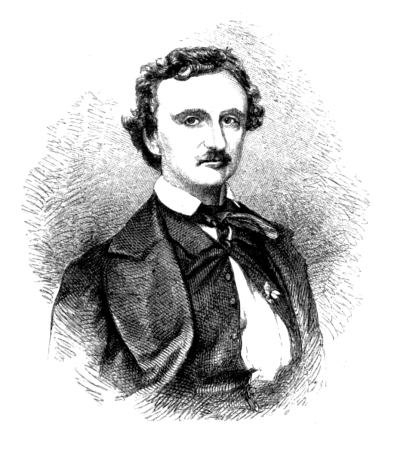
Of all the poets whose lives have been a puzzle and a mystery to the
world, there is no one more difficult to be understood than Edgar
Allan Poe. It is impossible to carry in the mind a double idea of
a man, and to believe him to be both a saint and a fiend; yet such
is the embarrassment felt by those who have first read the poems of
this strange being, and then read any of the biographies of him which
pretend to anything like an accurate account of his life. Like his own
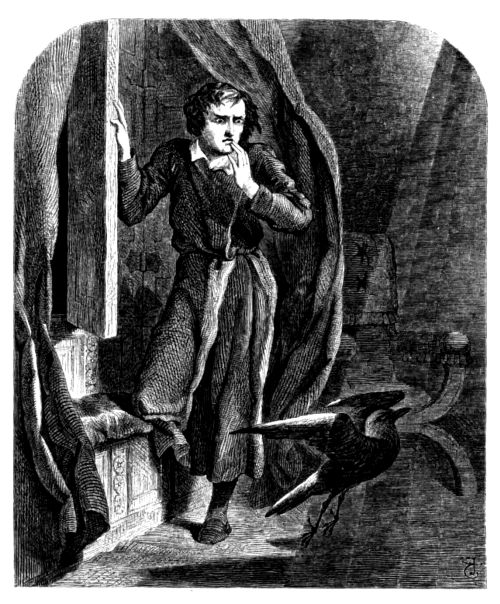
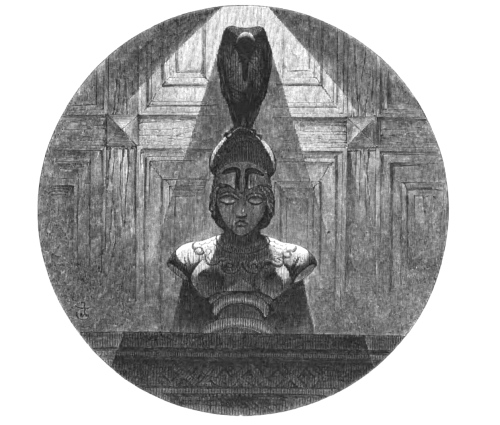
Raven, he is, to his readers, “bird or fiend,” they know not which.
But a close study of his works will reveal the fact, which may serve
in some degree to remove this embarrassment, that there is nowhere
discoverable in them a consciousness of moral responsibility. They are
full of the subtleties of passion, of grief, despair, and longing,
but they contain nothing that indicates a sense of moral rectitude.
They are the productions of one whose religion was a worship of
the Beautiful, and who knew no beauty but that which was purely
sensuous. There were but two kinds of beauty for him, and they were
Form and Colour. He revelled in an ideal world of perfect shows, and
was made wretched by any imperfections of art. The Leonore whose
loss he deplored was a being fair to the eye, a beautiful creature,
like Undine, without a soul. With this key to the character of the
poet, there is no difficulty in fully comprehending the strange
inconsistencies, the basenesses and nobleness which his wayward life
exhibited.
Some of the biographers of Poe have been harshly judged for the view
given of his character, and it has naturally been supposed that private
pique has led to the exaggeration of his personal defects. But such
imputations are unjust; a truthful delineation of his career would give
a darker hue to his character than it has received from any of his
biographers. In fact, he has been more fortunate than most poets in his
historians. Lowell and Willis have sketched him with gentleness and a
reverent feeling for his genius; and Griswold, his literary executor,
in his fuller biography, has generously suppressed much that he might
have given. This is neither the proper time nor place to write a full
history of this unhappy genius; those who scan his marvellous poems
closely, may find therein the man, for it is impossible for the true
poet to veil himself from his readers. What he writes he is.
The waywardness of Poe was an inheritance; though descended from a
family of great respectability, his immediate parents were dissolute
in their morals, and members of a profession which almost always
begets irregularity of habits. The paternal grandfather of the poet
was a distinguished officer in the Maryland line during the war of the
Revolution, and his great grandfather, John Poe, married a daughter of
Admiral McBride, of the British Navy. His father, the fourth son of
the Revolutionary officer, was a native of Maryland, and studied for
the bar; but becoming enamoured of a beautiful actress named Elizabeth
Arnold, he abandoned the law and adopted the stage as a profession.
They lived together six or seven years, wandering from theatre to
theatre, when they both died within a very short time of each other, in
Richmond, Virginia, leaving three children in utter destitution. Edgar,
the second child, who was born in Baltimore in January 1811, was a
remarkably bright and beautiful boy; and he attracted the attention of
a wealthy merchant in Richmond, who had known his parents, and who had
no children of his own. Mr. Allan adopted the little orphan, and he was
afterwards called Edgar Allan. The precocious child was petted by his
adopted parents, who took pride in his forwardness and beauty; he
was sent to the best schools, and was regarded as the heir to their
property. In 1816 Mr. and Mrs. Allan made a journey to Europe, and
Edgar accompanied them. He was placed at the school of the Rev. Dr.
Bransby, at Stoke Newington, near London, where he remained some four
or five years; but all that we know of him during this period of his
life, is what he has himself told us in the tale entitled “William
Wilson,” wherein he describes with great minuteness his recollections
of his school-days in England, and gives a characteristic picture of
the school-house and its surroundings.
On his return to the United States, in the year 1822, he was placed
for a few months at an academy at Richmond, and then was transferred
to the University of Virginia, at Charlottesville. The students at
Charlottesville were noted, at that time, for their reckless and
dissolute manner of life, and young Poe was the most dissolute and
reckless among them. Though extremely slight in person, and almost
effeminate in his manner, he is represented to have been foremost in
all athletic sports and games, and there is good testimony to his
having performed the almost impossible feat of swimming, for a wager,
from Richmond to Warwick, a distance of seven miles, against a current
of two or three knots an hour. Notwithstanding his dissolute habits and
extravagance at the University, he excelled in his studies, was always
at the head of his class, and would, doubtless, have graduated with honour,
had he not been expelled on account of his profligacy and wild excesses.
His allowance of money had been liberal at the University, but he
quitted it in debt; and when his indulgent friend refused to accept his
drafts to meet his gambling losses, Poe wrote him an abusive letter,
and quitted the country with the design of offering his services to
the Greeks, who were then fighting for their emancipation from the
Turks. But he never reached Greece, and all that is known of his
career in Europe is, that he found himself in St. Petersburgh, in
extreme destitution, where the American Minister, Mr. Middleton, was
called upon to save him from arrest, on account of an indiscretion;
through the kind offices of this gentleman the young adventurer was
sent home to America, and, on his arrival in Richmond, Mr. Allan
received him with kindness, forgave him his past misconduct, and
procured him a cadetship at the United States Military Academy at
West Point. Unfortunately for him, just before he left Richmond for
his new appointment, Mrs. Allan, the wife of his benefactor, died.
She had always treated him with motherly affection, and he had paid
more deference to her than to any one else. At West Point he applied
himself with great energy and success for a while to his new course of
studies; but the rigid discipline of that institution ill sorted with
the irrepressible recklessness of his nature, and after ten months he
was ignominiously expelled.
After leaving “the Point” he returned to Richmond, and was again kindly
received and welcomed to his home by Mr. Allan. But there was a change
in the house where the wayward boy had been a pet. There was a new and
a younger mistress. Mr. Allan had taken a second wife, a lady much
younger than himself, and who was disposed to treat the expelled cadet
as a son. But he soon contrived to quarrel with her, and was compelled
to abandon the house of his adopted father, never to return. The cause
of the quarrel which led to this final disruption between Poe and his
generous patron has been variously stated; the family of Mr. Allan
give a version of it which throws a dark shade on the character of the
poet; but let it have been as it may, it must have been of a very grave
nature, for, on the death of Mr. Allan, shortly after, in 1834, the
name of his adopted son, who it was supposed would have inherited all
his wealth, was not mentioned in his will.
On leaving the house of his benefactor for the last time, Poe was left
without a friend, and thrown upon his own resources. He had published
a volume of poems in Baltimore, just after his expulsion from West
Point, under the title of “Al Aaraaf” and “Tamerlane,” to which a few
smaller poems were added. These were the production of his early years,
probably between his fifteenth and sixteenth years, though the exact
date of their production cannot be ascertained. The commendations
bestowed upon these precocious poems encouraged him to devote himself
to literature for a profession. But his first attempts to earn a living
by literature must have been discouraging, for soon after publishing his
first volume, he was driven by his necessities to enlist as a private
soldier in the army. Here he was recognised by officers who had
known him at West Point, and who interested themselves to obtain his
discharge, and, if possible, a commission. But their kind intentions
were frustrated by his desertion. The next attempt he made in
literature proved more successful; he had fruitlessly tried to find
a publisher for a volume of stories; but on a premium of one hundred
dollars, for a tale in prose, and a similar reward for a poem, being
offered by the publisher of a literary periodical in Baltimore, Poe
obtained both prizes; though he was only allowed to retain the prize
for the tale, as it was thought not prudent to give both prizes to the
same writer. The tale chosen was the “Manuscript found in a Bottle,”
a composition which contains many of his most marked peculiarities
of style and invention. The award was made in October 1833, and,
fortunately for the young author, there was one gentleman on the
committee who made the decision, who had it in his power to render him
essential service.
This was John P. Kennedy, the novelist, author of “Horse Shoe
Robinson,” and eminent as a lawyer and a statesman. To this gentleman
Poe came on hearing of his success, poorly clad, pale, and emaciated;
he told his story, and his ambition, and at once gained the confidence
and affection of the more prosperous author. He was in utter want, and
had not yet received the amount to which he was entitled for his story.
Mr. Kennedy took him by the hand, furnished him with means to render
him immediately comfortable, and enabled him to make a respectable
appearance; and in a short time afterwards procured for him a situation
as editor of the “Literary Messenger,” a monthly magazine published in
Richmond. In his new place he continued for a while to work with great
industry, and wrote a great number of reviews and tales; but he fell
into his old habits, and after a debauch quarrelled with the proprietor
of the “Messenger,” and was dismissed.
It was one of the strange peculiarities of Poe to make humble and
penitent appeals for forgiveness and reconciliation to those he had
offended by his abuse and insolence, and he was no sooner conscious of
his error in quarrelling with the publisher of the “Messenger” than
he endeavoured to regain the position he had lost. He was successful;
and though he often fell into his old habits, yet he retained his
connexion with the work until January, 1837, when he abandoned the
“Messenger” and left Richmond for New York. During his last residence
in Richmond, while working for a salary of ten dollars a week, he
married his cousin, Virginia Clemm, a young, amiable, and gentle
girl, without fortune or friends, and as ill-calculated as himself to
buffet the waves of an adverse fortune. In New York he wrote for the
literary periodicals, but soon removed to Philadelphia, where he was
employed as editor of “Burton’s Gentleman’s Magazine;” he continued but
a year in his post, and after several quarrels with the proprietor of
the magazine, left him to establish a magazine of his own. To have a
magazine of his own, which he could manage as he pleased, was always
the great ambition of his life. He had invented a title, selected a
motto, written an introduction, and made the entire plans for the great
work, which was to be called the “Stylus;” it was the chimera which
he nursed, the castle in the air which he longed for, the rainbow of
his cloudy hopes. But he did not succeed in establishing it then, and
was soon installed as editor of “Graham’s Magazine.” As a matter of
course he quarrelled with Graham, and then went to New York, where
he engaged as a sub-editor on the “Mirror,” a daily paper, of which
his friend Willis was editor. But he did not remain long at this
employment, which was wholly unsuited to him, and he left the “Mirror”
without quarrelling with the proprietor. During his engagements with
these different periodicals, he had written some of his finest prose
tales, had published an anonymous work in the style of Robinson Crusoe,
entitled the “Adventures of Arthur Gordon Pym,” and a collection of
his tales in a volume, which he called “Tales of the Grotesque and the
Arabesque,” and gained another prize by his story of the Gold Bug.
He was beginning to be known as a fierce and terrible critic, rather
than as a poet or a writer of tales, when the publication of his poem
of the Raven in the “American Review,” a New York monthly magazine,
first attracted the attention of the literary world to his singular and
powerful genius. Up to the appearance of this wild fantasy, he had not
been generally recognised as a poet, and had known nothing of society.
But he became at once a lion, and his writings were eagerly sought
after by publishers. The prospect lay bright before him; he abandoned
for awhile the vices which so fearfully beset him; he was living
quietly in a pleasant rural neighbourhood in Westchester, near the
city, with his delicate wife and her mother, and a brilliant future
appeared to be in store for him. But he could never keep clear from
magazine editing, and he joined Mr. C. F. Briggs in publishing the
“Broadway Journal,” a literary weekly periodical; but the inevitable
quarrel ensued, and this project was abandoned at the end of a year.
It was while editing the “Broadway Journal” that he engaged in furious
onslaught upon Longfellow, whom he accused of plagiarising from his
poems, and, at the same time, involved himself in numberless disputes
and quarrels with other authors. But he also gained the affection and
admiration of many estimable literary people, some of whom he alienated
by appearing before them when in a state of intoxication. He delivered
a lecture on poetry, but attracted no hearers, and he was so chagrined
by his disappointment, that he fell again into his old habits, and
disgusted his new friends by his gross misconduct; he involved himself
in another quarrel with some of the literati of Boston, and to show his
contempt for them, went there and delivered a poem in public, which
he pretended to have written in his tenth year. On his return to New
York he was again reduced to great straits; and in 1848 he advertised
a series of lectures, in order to raise sufficient means to put into
execution his long-cherished plan of a magazine; but he delivered only
one lecture on the Cosmogony of the Universe, which was afterwards
published under the title of “Eureka, a Prose Poem.” His wife had died
the year previously, and during her illness he was reduced to such
extremities that public appeals, which were generously responded to,
were made in his behalf by the papers of New York.
Not long after the death of his wife he formed an intimacy with an
accomplished literary lady of Rhode Island, a widow, and was engaged to
be married to her. It was to her that he addressed the poem “Annabel
Lee;” the day was appointed for their marriage; but he had, in the
meantime, formed other plans; and, to disentangle himself from this
engagement, he visited the house of his affianced bride, where he
conducted himself with such indecent violence that the aid of the
police had to be called in to expel him. This, of course, put an end
to the engagement. In a short time after he went to Richmond, and
there gained the confidence and affections of a lady of good family
and considerable fortune. The day was appointed for their marriage,
and he left Virginia to return to New York to fulfil some literary
arrangements previous to the consummation of this new engagement.
He had written to his friends that he had, at last, a prospect of
happiness. The Lost Lenore was found. He arrived in Baltimore on his
way to the north, and gave his baggage into the charge of a porter,
intending to leave in an hour for Philadelphia. Stepping into an hotel
to obtain some refreshments, he met some of his former companions, who
invited him to drink with them. In a few moments all was over with him.
He spent the night in revelry, wandered out into the street in a
state of insanity, and was found in the morning literally dying from
exposure, and a single night’s excesses. He was taken to a hospital,
and, on the 7th October, 1849, at the age of thirty-eight, he closed
his troubled life. Three days before he had left his newly-affianced
bride to prepare for their nuptials. He lies in a burying-ground in
Baltimore, his native city, without a stone to mark the place of his
last rest.
In person Edgar Allan Poe was slight, and hardly of the medium height;
his motions were quick and nervous, his air was abstracted, and his
countenance generally serious and pale. He never laughed, and rarely
smiled; but in conversation he was vivacious, earnest, and respectful;
and though he appeared generally under restraint, as though guarding
against a half-subdued passion, yet his manners were engaging, and he
never failed to win the confidence and kind feelings of those with whom
he conversed for the first time; and there were a few who knew him
long and intimately who could never believe that he was ever otherwise
than the pleasant, intelligent, respectful, and earnest companion he
appeared to them. Though he was at times so reckless and profligate
in his conduct, and so indifferent to external proprieties, he was
generally scrupulously exact in everything he did. He dressed with
extreme neatness and perfectly good taste, avoiding all ornaments and
everything of a bizarre appearance. He was painfully alive to all
imperfections of art; and a false rhyme, an ambiguous sentence, or even
a typographical error, threw him into an ecstasy of passion. It was
this sensitiveness to all artistic imperfections, rather than any
malignity of feeling, which made his criticisms so severe, and procured
him a host of enemies among persons towards whom he never entertained
any personal ill-will. He criticised his own productions with the same
severity that he exercised towards the writings of others; and all his
poems, though he sometimes represented them as offsprings of a sudden
inspiration, were the work of elaborate study. His handwriting was
always neat and singularly uniform, and his manuscripts were invariably
on long slips of paper about four inches wide, which he never folded,
but always made into a roll. Nothing he ever did had the appearance of
haste or slovenliness, and he preserved with religious care every scrap
he had ever written, and every letter he ever received, so that he left
behind him the amplest materials for the composition of his literary
life. At his own request these remnants of his existence were entrusted
to Doctor Griswold, a gentleman with whom he had quarrelled, and had
lampooned in his lectures; Doctor Griswold, in a generous spirit,
accepted the charge, and produced from the papers entrusted to him, the
best biography of the strange being that has been published, which was
appended to the collection of his works in four volumes issued in New York.
June, 1857.
THE POETIC PRINCIPLE.
In speaking of
the Poetic Principle, I have no design to be either thorough or profound.
While discussing, very much at random, the essentiality of what we
call Poetry, my principal purpose will be to cite for consideration,
some few of those minor English or American poems which best suit my
own taste, or which, upon my own fancy, have left the most definite
impression. By “minor poems” I mean, of course, poems of little length.
And here, in the beginning, permit me to say a few words in regard to a
somewhat peculiar principle, which, whether rightfully or wrongfully,
has always had its influence in my own critical estimate of the poem.
I hold that a long poem does not exist. I maintain that the phrase, “a
long poem,” is simply a flat contradiction in terms.
I need scarcely observe that a poem deserves its title only inasmuch as
it excites, by elevating the soul. The value of the poem is in the ratio
of this elevating excitement. But all excitements are, through a
psychal necessity, transient. That degree of excitement which would
entitle a poem to be so called at all, cannot be sustained throughout
a composition of any great length. After the lapse of half an hour, at
the very utmost, it flags—fails—a revulsion ensues—and then the poem
is, in effect and in fact, no longer such.
There are, no doubt, many who have found difficulty in reconciling the
critical dictum that the “Paradise Lost” is to be devoutly admired
throughout, with the absolute impossibility of maintaining for it,
during perusal, the amount of enthusiasm which that critical dictum
would demand. This great work, in fact, is to be regarded as poetical,
only when, losing sight of that vital requisite in all works of Art,
Unity, we view it merely as a series of minor poems. If, to preserve
its Unity—its totality of effect or impression—we read it (as would
be necessary) at a single sitting, the result is but a constant
alternation of excitement and depression. After a passage of what
we feel to be true poetry, there follows, inevitably, a passage of
platitude which no critical pre-judgment can force us to admire; but
if, upon completing the work, we read it again, omitting the first
book—that is to say, commencing with the second—we shall be surprised
at now finding that admirable which we before condemned—that damnable
which we had previously so much admired. It follows from all this that
the ultimate, aggregate, or absolute effect of even the best epic under
the sun, is a nullity:—and this is precisely the fact.
In regard to the Iliad, we have, if not positive proof, at least very
good reason, for believing it intended as a series of lyrics; but,
granting the epic intention, I can say only that the work is based in
an imperfect sense of Art. The modern epic is of the supposititious
ancient model, but an inconsiderate and blindfold imitation. But the
day of these artistic anomalies is over. If, at any time, any very long
poem were popular in reality—which I doubt—it is at least
clear that no very long poem will ever be popular again.
That the extent of a poetical work is, cœteris paribus, the
measure of its merit, seems undoubtedly, when we thus state it, a
proposition sufficiently absurd—yet we are indebted for it to the
Quarterly Reviews. Surely there can be nothing in mere size,
abstractly considered—there can be nothing in mere bulk, so
far as a volume is concerned, which has so continuously elicited
admiration from these saturnine pamphlets! A mountain, to be sure,
by the mere sentiment of physical magnitude which it conveys,
does impress us with a sense of the sublime—but no man is
impressed after this fashion by the material grandeur of even
“The Columbiad.” Even the Quarterlies have not instructed us to be so
impressed by it. As yet, they have not insisted on our
estimating Lamartine by the cubic foot, or Pollok by the pound—but
what else are we to infer from their continual prating about
“sustained effort?” If, by “sustained effort,” any little gentleman has
accomplished an epic, let us frankly commend him for the effort—if
this indeed be a thing commendable—but let us forbear praising the
epic on the effort’s account. It is to be hoped that common sense, in
the time to come, will prefer deciding upon a work of Art, rather by
the impression it makes—by the effect it produces—than by the time
it took to impress the effect, or by the amount of “sustained effort”
which had been found necessary in effecting the impression. The fact
is, that perseverance is one thing and genius quite another—nor can
all the Quarterlies in Christendom confound them. By and by, this
proposition, with many which I have been just urging, will be received
as self-evident. In the meantime, by being generally condemned as
falsities, they will not be essentially damaged as truths.
On the other hand, it is clear that a poem may be improperly brief.
Undue brevity degenerates into mere epigrammatism. A very short
poem, while now and then producing a brilliant or vivid, never produces
a profound or enduring effect. There must be the steady pressing down
of the stamp upon the wax. De Béranger has wrought innumerable things,
pungent and spirit-stirring; but, in general, they have been too
imponderous to stamp themselves deeply into the public attention; and
thus, as so many feathers of fancy, have been blown aloft only to be
whistled down the wind.
A remarkable instance of the effect of undue brevity in depressing
a poem—in keeping it out of the popular view—is afforded by the
following exquisite little Serenade:
I arise from dreams of thee
In the first sweet sleep of night,
When the winds are breathing low,
And the stars are shining bright.
I arise from dreams of thee,
And a spirit in my feet
Has led me—who knows how?—
To thy chamber-window, sweet!
The wandering airs they faint
On the dark, the silent stream—
The champak odours fail
Like sweet thoughts in a dream;
The nightingale’s complaint,
It dies upon her heart,
As I must die on thine,
O, beloved as thou art!
O, lift me from the grass!
I die, I faint, I fail!
Let thy love in kisses rain
On my lips and eyelids pale.
My cheek is cold and white, alas!
My heart beats loud and fast:
Oh! press it close to thine again,
Where it will break at last!
Very few, perhaps, are familiar with these lines—yet no less a poet
than Shelley is their author. Their warm yet delicate and ethereal
imagination will be appreciated by all—but by none so thoroughly as by
him who has himself arisen from sweet dreams of one beloved, to bathe
in the aromatic air of a southern midsummer night.
One of the finest poems by Willis—the very best, in my opinion, which
he has ever written—has, no doubt, through this same defect of undue
brevity, been kept back from its proper position, not less in the than
in the popular view.
The shadows lay along Broadway,
’Twas near the twilight-tide—
And slowly there a lady fair
Was walking in her pride.
Alone walk’d she: but, viewlessly,
Walk’d spirits at her side.
Peace charm’d the street beneath her feet,
And Honour charm’d the air;
And all astir look’d kind on her,
And call’d her good as fair—
For all God ever gave to her
She kept with chary care.
She kept with care her beauties rare
From lovers warm and true—
For her heart was cold to all but gold,
And the rich came not to woo—
But honour’d well are charms to sell,
If priests the selling do.
Now walking there was one more fair—
A slight girl, lily-pale;
And she had unseen company
To make the spirit quail—
’Twixt Want and Scorn she walk’d forlorn,
And nothing could avail.
No mercy now can clear her brow
For this world’s peace to pray;
For, as love’s wild prayer dissolved in air,
Her woman’s heart gave way!—
But the sin forgiven by Christ in heaven
By man is cursed alway!
In this composition we find it difficult to recognise the Willis who
has written so many mere “verses of society.” The lines are not only
richly ideal, but full of energy; while they breathe an earnestness—an
evident sincerity of sentiment—for which we look in vain throughout
all the other works of this author.
While the epic mania—while the idea that, to merit in poetry,
prolixity is indispensable—has, for some years past, been gradually
dying out of the public mind, by mere dint of its own absurdity—we
find it succeeded by a heresy too palpably false to be long tolerated,
but one which, in the brief period it has already endured, may be said
to have accomplished more in the corruption of our Poetical Literature
than all its other enemies combined. I allude to the heresy of The
Didactic. It has been assumed, tacitly and avowedly, directly and
indirectly, that the ultimate object of all Poetry is Truth. Every
poem, it is said, should inculcate a moral; and by this moral is the
poetical merit of the work to be adjudged. We Americans especially have
patronized this happy idea; and we Bostonians, very especially, have
developed it in full. We have taken it into our heads that to write a
poem simply for the poem’s sake, and to acknowledge such to have been
our design, would be to confess ourselves radically wanting in the true
Poetic dignity and force:—but the simple fact is, that, would we but
permit ourselves to look into our own souls, we should immediately
there discover that under the sun there neither exists nor can exist
any work more thoroughly dignified, more supremely noble, than this
very poem—this poem per se—this poem which is a poem and
nothing more—this poem written solely for the poem’s sake.
With as deep a reverence for the True as ever inspired the bosom of
man, I would, nevertheless, limit, in some measure, its modes of
inculcation. I would limit to enforce them. I would not enfeeble them
by dissipation. The demands of Truth are severe. She has no sympathy
with the myrtles. All that which is so indispensable in Song, is
precisely all that with which she has nothing whatever
to do. It is but making her a flaunting paradox, to wreathe her in
gems and flowers. In enforcing a truth, we need severity rather than
efflorescence of language. We must be simple, precise, terse. We must
be cool, calm, unimpassioned. In a word, we must be in that mood
which, as nearly as possible, is the exact converse of the poetical.
He must be blind indeed who does not perceive the radical and
chasmal differences between the truthful and the poetical modes of
inculcation. He must be theory-mad beyond redemption who, in spite of
these differences, shall still persist in attempting to reconcile the
obstinate oils and waters of Poetry and Truth.
Dividing the world of mind into its three most immediately obvious
distinctions, we have the Pure Intellect, Taste, and the Moral Sense. I
place Taste in the middle, because it is just this position which, in
the mind, it occupies. It holds intimate relations with either extreme;
but from the Moral Sense is separated by so faint a difference that
Aristotle has not hesitated to place some of its operations among
the virtues themselves. Nevertheless, we find the offices of
the trio marked with a sufficient distinction. Just as the Intellect
concerns itself with Truth, so Taste informs us of the Beautiful while
the Moral Sense is regardful of Duty. Of this latter, while Conscience
teaches the obligation, and Reason the expediency, Taste contents
herself with displaying the charms:—waging war upon Vice solely on
the ground of her deformity—her disproportion—her animosity to the
fitting, to the appropriate, to the harmonious—in a word, to Beauty.
An immortal instinct, deep within the spirit of man, is thus, plainly,
a sense of the Beautiful. This it is which administers to his delight
in the manifold forms, and sounds, and odours, and sentiments amid
which he exists. And just as the lily is repeated in the lake, or
the eyes of Amaryllis in the mirror, so is the mere oral or written
repetition of these forms, and sounds, and colours, and odours, and
sentiments, a duplicate source of delight. But this mere repetition is
not poetry. He who shall simply sing, with however glowing enthusiasm,
or with however vivid a truth of description, of the sights, and
sounds, and odours, and colours, and sentiments, which greet him
in common with all mankind—he, I say, has yet failed to prove his
divine title. There is still a something in the distance which he has
been unable to attain. We have still a thirst unquenchable, to allay
which he has not shown us the crystal springs. This thirst belongs to
the immortality of Man. It is at once a consequence and an indication
of his perennial existence. It is the desire of the moth for the star.
It is no mere appreciation of the Beauty before us—but a wild effort
to reach the Beauty above. Inspired by an ecstatic prescience of the
glories beyond the grave, we struggle, by multiform combinations among
the things and thoughts of Time, to attain a portion of that Loveliness
whose very elements, perhaps, appertain to eternity alone. And thus
when by Poetry—or when by Music, the most entrancing of the Poetic
moods—we find ourselves melted into tears—we weep then—not as the
Abbaté Gravina supposes—through excess of pleasure, but through
a certain, petulant, impatient sorrow at our inability to grasp
now, wholly, here on earth, at once and for ever, those divine
and rapturous joys, of which through the poem, or through
the music, we attain to but brief and indeterminate glimpses.
The struggle to apprehend the supernal Loveliness—this struggle, on
the part of souls fittingly constituted—has given to the world all
that which it (the world) has ever been enabled at once to
understand and to feel as poetic.
The Poetic Sentiment, of course, may develop itself in various
modes—in Painting, in Sculpture, in Architecture, in the Dance—very
especially in Music—and very peculiarly, and with a wide field, in
the composition of the Landscape Garden. Our present theme, however,
has regard only to its manifestation in words. And here let me speak
briefly on the topic of rhythm. Contenting myself with the certainty
that Music, in its various modes of metre, rhythm, and rhyme, is of
so vast a moment in Poetry as never to be wisely rejected—is so
vitally important an adjunct, that he is simply silly who declines its
assistance, I will not now pause to maintain its absolute essentiality.
It is in Music, perhaps, that the soul most nearly attains the great
end for which, when inspired by the Poetic Sentiment, it struggles—the
creation of supernal Beauty. It may be, indeed, that here this
sublime end is, now and then, attained in fact. We are often
made to feel, with a shivering delight, that from an earthly harp are
stricken notes which cannot have been unfamiliar to the angels.
And thus there can be little doubt that in the Union of Poetry with
Music in its popular sense, we shall find the widest field for the
Poetic development. The old Bards and Minnesingers had advantages which
we do not possess—and Thomas Moore, singing his own songs, was, in the
most legitimate manner, perfecting them as poems.
To recapitulate, then:—I would define, in brief, the Poetry of words
as The Rhythmical Creation of Beauty. Its sole arbiter is Taste.
With the Intellect or with the Conscience, it has only collateral
relations. Unless incidentally, it has no concern whatever either with
Duty or with Truth.
A few words, however, in explanation. That pleasure which is
at once the most pure, the most elevating, and the most intense, is
derived, I maintain, from the contemplation of the Beautiful. In the
contemplation of Beauty we alone find it possible to attain that
pleasurable elevation, or excitement, of the soul, which we
recognise as the Poetic Sentiment, and which is so easily distinguished
from Truth, which is the satisfaction of the Reason, or from Passion,
which is the excitement of the heart. I make Beauty, therefore—using
the word as inclusive of the sublime—I make Beauty the province of the
poem, simply because it is an obvious rule of Art, that effects should
be made to spring as directly as possible from their causes:—no one
as yet having been weak enough to deny that the peculiar elevation in
question is at least most readily attainable in the poem. It
by no means follows, however, that the incitements of Passion, or the
precepts of Duty, or even the lessons of Truth, may not be introduced
into a poem, and with advantage; for they may subserve, incidentally,
in various ways, the general purposes of the work:—but the true artist
will always contrive to tone them down in proper subjection to that
Beauty which is the atmosphere and the real essence of the poem.
I cannot better introduce the few poems which I shall present for your
consideration, than by the citation of the Pröem to Mr. Longfellow’s “Waif.”
The day is done, and the darkness
Falls from the wings of Night,
As a feather is wafted downward
From an Eagle in his flight.
I see the lights of the village
Gleam through the rain and the mist,
And a feeling of sadness comes o’er me,
That my soul cannot resist;
A feeling of sadness and longing,
That is not akin to pain,
And resembles sorrow only
As the mist resembles the rain.
Come, read to me some poem,
Some simple and heartfelt lay,
That shall soothe this restless feeling,
And banish the thoughts of day.
Not from the grand old masters,
Not from the bards sublime,
Whose distant footsteps echo
Through the corridors of Time.
For, like strains of martial music,
Their mighty thoughts suggest
Life’s endless toil and endeavour;
And to-night I long for rest.
Read from some humbler poet,
Whose songs gushed from his heart,
As showers from the clouds of summer,
Or tears from the eyelids start;
Who through long days of labour,
And nights devoid of ease,
Still heard in his soul the music
Of wonderful melodies.
Such songs have power to quiet
The restless pulse of care,
And come like the benediction
That follows after prayer.
Then read from the treasured volume
The poem of thy choice,
And lend to the rhyme of the poet
The beauty of thy voice.
And the night shall be filled with music,
And the cares, that infest the day,
Shall fold their tents, like the Arabs,
And as silently steal away.
With no great range of imagination, these lines have been justly
admired for their delicacy of expression. Some of the images are very
effective. Nothing can be better than—
——The bards sublime,
Whose distant footsteps echo
Down the corridors of Time.
The idea of the last quartrain is also very effective. The poem,
on the whole, however, is chiefly to be admired for the graceful
insouciance of its metre, so well in accordance with the
character of the sentiments, and especially for the ease of the
general manner. This “ease,” or naturalness, in a literary style, it
has long been the fashion to regard as ease in appearance alone—as a
point of really difficult attainment. But not so:—a natural manner
is difficult only to him who should never meddle with it—to the
unnatural. It is but the result of writing with the understanding, or
with the instinct, that the tone, in composition, should always
be that which the mass of mankind would adopt—and must perpetually
vary, of course, with the occasion. The author who, after the fashion
of “The North American Review,” should be, upon all occasions,
merely “quiet,” must necessarily, upon many occasions, be simply
silly, or stupid; and has no more right to be considered “easy,” or
“natural,” than a Cockney exquisite, or than the sleeping Beauty in the
wax-works.
Among the minor poems of Bryant, none has so much impressed me as the
one which he entitles “June.” I quote only a portion of it:—
There, through the long, long summer hours,
The golden light should lie,
And thick, young herbs and groups of flowers
Stand in their beauty by.
The oriole should build and tell
His love-tale close beside my cell;
The idle butterfly
Should rest him there, and there be heard
The housewife-bee and humming-bird.
And what, if cheerful shouts, at noon,
Come, from the village sent,
Or songs of maids, beneath the moon,
With fairy laughter blent?
And what if, in the evening light,
Betrothed lovers walk in sight
Of my low monument?
I would the lovely scene around
Might know no sadder sight nor sound.
I know, I know I should not see
The season’s glorious show,
Nor would its brightness shine for me,
Nor its wild music flow;
But if, around my place of sleep,
The friends I love should come to weep,
They might not haste to go.
Soft airs, and song, and light, and bloom
Should keep them lingering by my tomb.
These to their soften’d hearts should bear
The thought of what has been,
And speak of one who cannot share
The gladness of the scene;
Whose part in all the pomp that fills
The circuit of the summer hills,
Is—that his grave is green;
And deeply would their hearts rejoice
To hear again his living voice.
The rhythmical flow, here, is even voluptuous—nothing could be more
melodious. The poem has always affected me in a remarkable manner. The
intense melancholy which seems to well up, perforce, to the surface of
all the poet’s cheerful sayings about his grave, we find thrilling us
to the soul—while there is the truest poetic elevation in the thrill.
The impression left is one of a pleasurable sadness. And if, in the
remaining compositions which I shall introduce to you, there be more or
less of a similar tone always apparent, let me remind you that (how or
why we know not) this certain taint of sadness is inseparably connected
with all the higher manifestations of true Beauty. It is, nevertheless,
A feeling of sadness and longing
That is not akin to pain,
And resembles sorrow only
As the mist resembles the rain.
The taint of which I speak is clearly perceptible even in a poem so
full of brilliancy and spirit as the “Health” of Edward Coote Pinkney:—
I fill this cup to one made up
Of loveliness alone,
A woman, of her gentle sex
The seeming paragon;
To whom the better elements
And kindly stars have given
A form so fair, that, like the air,
’Tis less of earth than heaven.
Her every tone is Music’s own,
Like those of morning birds,
And something more than melody
Dwells ever in her words;
The coinage of her heart are they,
And from her lips each flows
As one may see the burden’d bee
Forth issue from the rose.
Affections are as thoughts to her,
The measures of her hours;
Her feelings have the fragrancy,
The freshness of young flowers;
And lovely passions, changing oft,
So fill her, she appears
The image of themselves by turns,—
The idol of past years!
Of her bright face one glance will trace
A picture on the brain,
And of her voice in echoing hearts
A sound must long remain;
But memory, such as mine of her,
So very much endears,
When death is nigh my latest sigh
Will not be life’s, but hers.
I fill’d this cup to one made up
Of loveliness alone,
A woman, of her gentle sex
The seeming paragon—
Her health! and would on earth there stood,
Some more of such a frame,
That life might be all poetry,
And weariness a name.
It was the misfortune of Mr. Pinkney to have been born too far south.
Had he been a New Englander, it is probable that he would have been
ranked as the first of American lyrists, by that magnanimous cabal
which has so long controlled the destinies of American Letters, in
conducting the thing called “The North American Review.” The poem
just cited is especially beautiful; but the poetic elevation which
it induces, we must refer chiefly to our sympathy in the poet’s
enthusiasm. We pardon his hyperboles for the evident earnestness with
which they are uttered.
It was by no means my design, however, to expatiate upon the
merits of what I should read you. These will necessarily speak
for themselves. Boccalini, in his “Advertisements from Parnassus,”
tells us that Zoilus once presented Apollo a very caustic criticism
upon a very admirable book:—whereupon the god asked him for the
beauties of the work. He replied that he only busied himself about
the errors. On hearing this, Apollo, handing him a sack of unwinnowed
wheat, bade him pick out all the chaff for his reward.
Now this fable answers very well as a hit at the critics—but I am
by no means sure that the god was in the right. I am by no means
certain that the true limits of the critical duty are not grossly
misunderstood. Excellence, in a poem especially, may be considered
in the light of an axiom, which need only be properly put,
to become self-evident. It is not excellence if it require to be
demonstrated as such:—and thus, to point out too particularly the
merits of a work of Art, is to admit that they are not merits
altogether.
Among the “Melodies” of Thomas Moore, is one whose distinguished
character as a poem proper, seems to have been singularly left out of
view. I allude to his lines beginning—“Come, rest in this bosom.”
The intense energy of their expression is not surpassed by anything
in Byron. There are two of the lines in which a sentiment is conveyed
that embodies the all in all of the divine passion of Love—a
sentiment which, perhaps, has found its echo in more, and in more
passionate, human hearts than any other single sentiment ever embodied
in words:
Come, rest in this bosom, my own stricken deer,
Though the herd have fled from thee, thy home is still here;
Here still is the smile, that no cloud can o’ercast,
And a heart and a hand all thy own to the last.
Oh! what was love made for, if ’tis not the same
Through joy and through torment, through glory and shame?
I know not, I ask not, if guilt’s in that heart,
I but know that I love thee, whatever thou art.
Thou hast call’d me thy Angel in moments of bliss,
And thy Angel I’ll be ’mid the horrors of this,—
Through the furnace, unshrinking, thy steps to pursue,
And shield thee, and save thee,—or perish there too!
It has been the fashion, of late days, to deny Moore Imagination, while
granting him Fancy—a distinction originating with Coleridge—than whom
no man more fully comprehended the great powers of Moore. The fact is,
that the fancy of this poet so far predominates over all his other
faculties, and over the fancy of all other men, as to have induced,
very naturally, the idea that he is fanciful only. But never
was there a greater mistake. Never was a grosser wrong done the fame
of a true poet. In the compass of the English language I can call to
mind no poem more profoundly—more weirdly imaginative, in the
best sense, than the lines commencing—“I would I were by that dim
lake”—which are the composition of Thomas Moore. I regret that I am
unable to remember them.
One of the noblest—and, speaking of Fancy, one of the most singularly
fanciful of modern poets, was Thomas Hood. His “Fair Ines” had always,
for me, an inexpressible charm:
O saw ye not fair Ines?
She’s gone into the West,
To dazzle when the sun is down,
And rob the world of rest:
She took our daylight with her,
The smiles that we love best,
With morning blushes on her cheek,
And pearls upon her breast.
O turn again, fair Ines,
Before the fall of night,
For fear the moon should shine alone,
And stars unrivall’d bright;
And blessed will the lover be
That walks beneath their light,
And breathes the love against thy cheek
I dare not even write!
Would I had been, fair Ines,
That gallant cavalier,
Who rode so gaily by thy side,
And whisper’d thee so near!
Were there no bonny dames at home,
Or no true lovers here,
That he should cross the seas to win
The dearest of the dear?
I saw thee, lovely Ines,
Descend along the shore,
With bands of noble gentlemen,
And banners waved before;
And gentle youth and maidens gay,
And snowy plumes they wore
It would have been a beauteous dream,
—If it had been no more!
Alas, alas, fair Ines!
She went away with song,
With Music waiting on her steps,
And shoutings of the throng;
But some were sad and felt no mirth,
But only Music’s wrong,
In sounds that sang Farewell, Farewell,
To her you’ve loved so long.
Farewell, farewell, fair Ines,
That vessel never bore
So fair a lady on its deck,
Nor danced so light before,—
Alas for pleasure on the sea,
And sorrow on the shore!
The smile that blest one lover’s heart
Has broken many more!
“The Haunted House,” by the same author, is one of the truest
poems ever written—one of the truest—one of the most
unexceptionable—one of the most thoroughly artistic, both in its theme
and in its execution, It is, moreover, powerfully ideal—imaginative. I
regret that its length renders it unsuitable for the purposes of this
lecture. In place of it, permit me to offer the universally appreciated
“Bridge of Sighs.”
One more Unfortunate,
Weary of breath,
Rashly importunate,
Gone to her death!
Take her up tenderly,
Lift her with care;——
Fashion’d so slenderly,
Young, and so fair!
Look at her garments
Clinging like cerements;
Whilst the wave constantly
Drips from her clothing;
Take her up instantly,
Loving, not loathing.—
Touch her not scornfully;
Think of her mournfully,
Gently and humanly;
Not of the stains of her:
All that remains of her,
Now, is pure womanly.
Make no deep scrutiny
Into her mutiny
Rash and undutiful;
Past all dishonour,
Death has left on her
Only the beautiful.
Still, for all slips of hers,
One of Eve’s family—
Wipe those poor lips of hers
Oozing so clammily;
Loop up her tresses
Escaped from the comb,
Her fair auburn tresses;
Whilst wonderment guesses
Where was her home?
Who was her father?
Who was her mother?
Had she a sister?
Had she a brother?
Or was there a dearer one
Still, and a nearer one
Yet, than all other?
Alas for the rarity
Of Christian charity
Under the sun!
Oh! it was pitiful!
Near a whole city full,
Home she had none.
Sisterly, brotherly,
Fatherly, motherly,
Feelings had changed:
Love, by harsh evidence,
Thrown from its eminence:
Even God’s providence
Seeming estranged.
Where the lamps quiver
So far in the river,
With many a light
From window and casement,
From garret to basement,
She stood, with amazement,
Houseless by night.
The bleak wind of March
Made her tremble and shiver;
But not the dark arch,
Or the black flowing river:
Mad from life’s history,
Glad to death’s mystery,
Swift to be hurl’d—
Anywhere, anywhere
Out of the world!
In she plunged boldly,
No matter how coldly
The rough river ran,—
Over the brink of it,
Picture it,—think of it,
Dissolute Man!
Lave in it, drink of it
Then, if you can!
Take her up tenderly,
Lift her with care;
Fashion’d so slenderly,
Young, and so fair!
Ere her limbs frigidly
Stiffen too rigidly,
Decently,—kindly,—
Smooth, and compose them;
And her eyes, close them,
Staring so blindly!
Dreadfully staring
Through muddy impurity,
As when with the daring
Last look of despairing
Fixed on futurity.
Perishing gloomily,
Spurred by contumely,
Cold inhumanity,
Burning insanity,
Into her rest,—
Cross her hands humbly,
As if praying dumbly,
Over her breast!
Owning her weakness,
Her evil behaviour,
And leaving, with meekness,
Her sins to her Saviour!
The vigour of this poem is no less remarkable than its pathos. The
versification, although carrying the fanciful to the very verge of the
fantastic, is nevertheless admirably adapted to the wild insanity which
is the thesis of the poem.
Among the minor poems of Lord Byron, is one which has never received
from the critics the praise which it undoubtedly deserves:—
Though the day of my destiny’s over,
And the star of my fate hath declined,
Thy soft heart refused to discover
The faults which so many could find;
Though thy soul with my grief was acquainted,
It shrunk not to share it with me,
And the love which my spirit hath painted
It never hath found but in thee.
Then when nature around me is smiling,
The last smile which answers to mine,
I do not believe it beguiling,
Because it reminds me of thine;
And when winds are at war with the ocean,
As the breasts I believed in with me,
If their billows excite an emotion,
It is that they bear me from thee.
Though the rock of my last hope is shivered,
And its fragments are sunk in the wave,
Though I feel that my soul is delivered
To pain—it shall not be its slave.
There is many a pang to pursue me:
They may crush, but they shall not contemn—
They may torture, but shall not subdue me—
’Tis of thee that I think—not of them.
Though human, thou didst not deceive me,
Though woman, thou didst not forsake,
Though loved, thou forborest to grieve me,
Though slandered, thou never couldst shake,—
Though trusted, thou didst not disclaim me,
Though parted, it was not to fly,
Though watchful, ’twas not to defame me,
Nor mute, that the world might belie.
Yet I blame not the world, nor despise it,
Nor the war of the many with one—
If my soul was not fitted to prize it,
’Twas folly not sooner to shun:
And if dearly that error hath cost me,
And more than I once could foresee,
I have found that whatever it lost me,
It could not deprive me of thee.
From the wreck of the past, which hath perished,
Thus much I at least may recall,
It hath taught me that which I most cherished
Deserved to be dearest of all:
In the desert a fountain is springing,
In the wide waste there still is a tree,
And a bird in the solitude singing,
Which speaks to my spirit of thee.
Although the rhythm, here, is one of the most difficult, the
versification could scarcely be improved. No nobler theme ever
engaged the pen of poet. It is the soul-elevating idea, that no man can
consider himself entitled to complain of Fate while, in his adversity,
he still retains the unwavering love of woman.
From Alfred Tennyson—although in perfect sincerity I regard him as
the noblest poet that ever lived—I have left myself time to cite
only a very brief specimen. I call him, and think him the
noblest of poets—not because the impressions he produces
are, at all times, the most profound—not because the
poetical excitement which he induces is, at all times, the most
intense—but because it is, at all times, the most ethereal—in
other words, the most elevating and the most pure. No poet is so little
of the earth, earthy. What I am about to read is from his last long
poem, “The Princess:”
Tears, idle tears, I know not what they mean,
Tears from the depth of some divine despair
Rise in the heart, and gather to the eyes,
In looking on the happy Autumn-fields,
And thinking of the days that are no more.
Fresh as the first beam glittering on a sail,
That brings our friends up from the underworld,
Sad as the last which reddens over one
That sinks with all we love below the verge;
So sad, so fresh, the days that are no more.
Ah, sad and strange as in dark summer dawns
The earliest pipe of half-awakened birds
To dying ears, when unto dying eyes
The casement slowly grows a glimmering square;
So sad, so strange, the days that are no more.
Dear as remember’d kisses after death,
And sweet as those by hopeless fancy feign’d
On lips that are for others; deep as love,
Deep as first love, and wild with all regret;
O Death in Life, the days that are no more.
Thus, although in a very cursory and imperfect manner, I have
endeavoured to convey to you my conception of the Poetic Principle.
It has been my purpose to suggest that, while this Principle itself
is, strictly and simply, the Human Aspiration for Supernal Beauty,
the manifestation of the Principle is always found in an elevating
excitement of the Soul—quite independent of that passion which
is the intoxication of the Heart—or of that Truth which is the
satisfaction of the Reason. For, in regard to Passion, alas! its
tendency is to degrade, rather than to elevate the Soul. Love, on
the contrary—Love—the true, the divine Eros—the Uranian, as
distinguished from the Dionæn Venus—is unquestionably the purest and
truest of all poetical themes. And in regard to Truth—if, to be sure,
through the attainment of a truth, we are led to perceive a harmony
where none was apparent before, we experience, at once, the true
poetical effect—but this effect is referable to the harmony alone, and
not in the least degree to the truth which merely served to render the
harmony manifest.
We shall reach, however, more immediately a distinct conception of
what the true Poetry is, by mere reference to a few of the simple
elements which induce in the Poet himself the true poetical effect. He
recognises the ambrosia which nourishes his soul, in the bright orbs
that shine in Heaven—in the volutes of the flower—in the clustering
of low shrubberies—in the waving of the grain-fields—in the slanting
of tall, Eastern trees—in the blue distance of mountains—in the
grouping of clouds—in the twinkling of half-hidden brooks—in the
gleaming of silver rivers—in the repose of sequestered lakes—in the
star-mirroring depths of lonely wells. He perceives it in the songs
of birds—in the harp of Æolus—in the sighing of the night-wind—in
the repining voice of the forest—in the surf that complains to the
shore—in the fresh breath of the woods—in the scent of the violet—in
the voluptuous perfume of the hyacinth—in the suggestive odour that
comes to him, at eventide, from far-distant, undiscovered islands,
over dim oceans, illimitable and unexplored. He owns it in all noble
thoughts—in all unworldly motives—in all holy impulses—in all
chivalrous, generous, and self-sacrificing deeds. He feels it in the
beauty of woman—in the grace of her step—in the lustre of her eye—in
the melody of her voice—in her soft laughter—in her sigh—in the
harmony of the rustling of her robes. He deeply feels it in her winning
endearments—in her burning enthusiasms—in her gentle charities—in
her meek and devotional endurances—but above all—ah, far above
all—he kneels to it—he worships it in the faith, in the purity, in
the strength, in the altogether divine majesty—of her love.
Let me conclude—by the recitation of yet another brief poem—one very
different in character from any that I have before quoted. It is by
Motherwell, and is called “The Song of the Cavalier.” With our modern
and altogether rational ideas of the absurdity and impiety of warfare,
we are not precisely in that frame of mind best adapted to sympathise
with the sentiments, and thus to appreciate the real excellence of the
poem. To do this fully, we must identify ourselves, in fancy, with the
soul of the old cavalier.
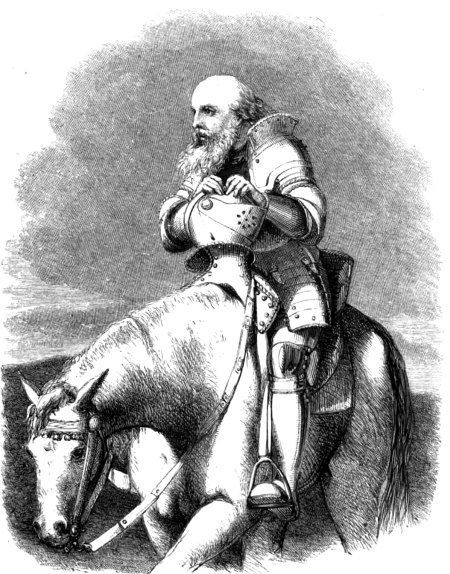
Then mounte! then mounte, brave gallants, all!
And don your helmes amaine:
Deathe’s couriers, Fame and Honour, call
Us to the field againe.
No shrewish teares shall fill our eyes
When the sword-hilt’s in our hand,—
Heart-whole we’ll part, and no whit sighe
For the fayrest of the land;
Let piping swaine, and craven wight,
Thus weepe and puling crye;
Our business is like men to fight,
And hero-like to die!
LONDON:—PRINTED BY RICHARD CLAY,
BREAD STREET HILL