PART ONE — I — II — III — IV
“The lonesomeness of that little girl over
there is becoming painful,” said the Poet from
his chair by the hedge. “I can’t make out
whether she’s too dressed up to play or
whether it’s only shyness.”
“Poor Marjorie!” murmured Mrs. Waring.
“We’ve all coaxed her to play, but she won’t
budge. By the way, that’s one of the saddest
cases we’ve had; it’s heartbreaking, discouraging.
Little waifs like Marjorie, whose fathers
and mothers can’t hit it off, don’t have a fair
chance,—they are handicapped from the
start.—Oh, I thought you knew; that’s the
Redfields’ little girl.”
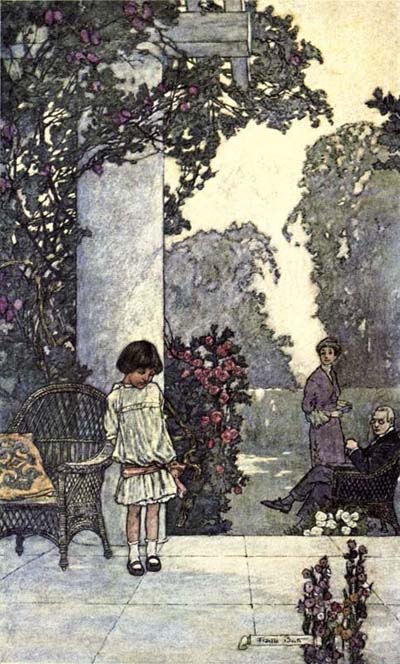
The Poet gazed with a new intentness at the
dark-haired child of five who stood rigidly at
the end of the pergola with her hands clasped
behind her back. The Poet All the People
Loved was a philosopher also, but his philosophy
was not quite equal to forecasting the destiny
of little Marjorie.
“Children,” he observed, “should not be left
on the temple steps when the pillars of society
crack and rock; the good fairies ought to carry
them out of harm’s way. Little Marjorie looks
as though she had never smiled.” And then he
murmured with characteristic self-mockery,—
“Oh, little child that never smiled—
Somebody might build a poem around that
line, but I hope nobody ever will! If that child
doesn’t stop looking that way, I shall have to
cry or crawl over there on my knees and ride
her pickaback.”
Mrs. Waring’s two daughters had been leading
the children in a march and dance that now
broke up in a romp; and the garden echoed
with gleeful laughter. The spell of restraint
was broken, and the children began initiating
games of their own choosing; but Marjorie
stood stolidly gazing at them as though they
were of another species. Her nurse, having
failed to interest her sad-eyed charge in the
games that were delighting the other children,
had withdrawn, leaving Marjorie to her own
devices.
“She’s always like that,” the girl explained
with resignation, “and you can’t do anything
with her.”
A tall, fair girl appeared suddenly at the
garden entrance. The abrupt manner of her
coming, the alert poise of her figure, as though
she had been arrested in flight and had paused
only for breath before winging farther, interested
the Poet at once.
She stood there as unconscious as though
she were the first woman, and against the
white gate of the garden was imaginably of
kin to the bright goddesses of legend. She
was hatless, and the Poet was grateful for this,
for a hat, he reflected, should never weigh upon
a head so charming, so lifted as though with
courage and hope, and faith in the promise of
life. A tennis racket held in the hollow of her
arm explained her glowing color. Essentially
American, he reflected, this young woman,
and worthy to stand as a type in his thronging
gallery. She so satisfied the eye in that hesitating
moment that the Poet shrugged his shoulders
impatiently when she threw aside the
racket and bounded across the lawn, darting
in and out among the children, laughingly
eluding small hands thrust out to catch her,
and then dropped on her knees before Marjorie.
She caught the child’s hands, laughed into the
sad little face, holding herself away so that the
homesick, bewildered heart might have time
to adjust itself, and then Marjorie’s arms
clasped her neck tightly, and the dark head
lay close to the golden one.
There was a moment’s parley, begun in
tears and ending in laughter; and then Marian
tripped away with Marjorie, and joined with
her in the mazes of a dance that enmeshed the
whole company of children in bright ribbons
and then freed them again. The Poet, beating
time to the music with his hat, wished that
Herrick might have been there; it was his
habit to think, when something pleased him
particularly, that “Keats would have liked
that!”—“Shelley would have made a golden
line of this!” He felt songs beating with eager
wings at the door of his own heart as his
glance followed the fair girl who had so easily
turned a child’s tears to laughter. For Marjorie
was laughing with the rest now; in ten
minutes she was one of them—had found
friends and seemed not to mind at all when her
good angel dropped out to become a spectator
of her happiness.
“I have saved my trousers,” remarked the
Poet to Mrs. Waring, who had watched the
transformation in silence; “but that girl has
spoiled her frock kneeling to Marjorie. I suppose
I couldn’t with delicacy offer to reimburse
her for the damage. If there were any
sort of gallantry in me I would have sacrificed
myself, and probably have scared Marjorie to
death. If a child should put its arms around me
that way and cry on my shoulder and then run
off and play, I should be glad to endow laundries
to the limit of my bank account. If the Diana
who rescued Marjorie has another name—”
“I thought you knew! That’s Marian
Agnew, Marjorie’s aunt.”
“I’ve read of her in many books,” said the
Poet musingly, “but she’s an elusive person.
I might have known that if I would sit in a
pleasant garden like this in June and watch
children at play, something beautiful would
pass this way.”
Mrs. Waring glanced at him quickly, as
people usually did to make sure he was not
trifling with them.
“You really seem interested in the way she
hypnotized Marjorie! Well, to be quite honest,
I sent for her to come! She was playing tennis
a little farther up the street, but she came running
when I sent word that Marjorie was here
and that we had all given her up in despair.”
“My first impression was that she had
dropped down from heaven or had run away
from Olympus. Please don’t ask me to say
which I think likelier!”
“I’m sorry to spoil an illusion, but after all
Marian is one of the daughters of men; though
I remember that when she was ten she told me
in solemn confidence that she believed in fairies,
because she had seen them—an excellent reason!
She graduated from Vassar last year, and
I have an idea that college may have shaken
her faith in fairies. She’s going to begin teaching
school next fall,—she has to do something,
you know. She’s an eminently practical person,
blessed with a sound appetite, and she
can climb a rope, and swim and play tennis all
day.”
“The Olympians ate three meals a day, I
imagine; and we shouldn’t begrudge this fair-haired
Marian her daily bread and butter.
Let me see; she’s Marjorie’s aunt; and Marjorie’s
father is Miles Redfield. I know Redfield
well; his wife was Elizabeth Agnew. I
saw a good deal of them in their early married
days. They’ve agreed to quit—is that the
way of it?”
“How fortunate you are that people don’t
tell you gossip! I suppose it’s one of the rewards
of being a poet! The whole town has
been upset by the Redfields’ troubles;—they
have separated. I’ve sent Elizabeth up to
Waupegan to open my house—made an excuse
to get her away. Marjorie’s with her
grandmother, waiting for the courts to do something
about it;—as though courts could do
anything about such cases!” she ended with
feeling.
The Poet, searching for Marjorie in the
throng of children, made no reply.
“You are a poet,” Mrs. Waring resumed
tauntingly, with the privilege of old friendship,
“and have a reputation for knowing the
human heart. Why can’t you do something
about the Redfields’ troubles?—there’s a fine
chance for you! It begins to look as though
sentiment, romance, love—all those things you
poets have been writing about for thousands of
years—have gone out with the old-fashioned
roses. I confess that it’s because I’m afraid
that’s true that I’m clinging to all the flowers
my grandmother used to love—and I’m nearly
seventy and a grandmother myself.”
She was still a handsome woman, and the
Poet’s eyes followed her admiringly as she
crossed the lawn, leaving him to find an answer
to her question. In the days of his beginnings
she had been his steadfast friend, and he
was fond of telling her that he had learned the
kindliness and cheer he put into his poems
from her.
She and her assistants were marshaling the
children for refreshments under a canopy at
the farther corner of the garden, and the animated
scene delighted and charmed him. He
liked thus to sit apart and observe phases of
life,—and best of all he loved scenes like this
that were brightened by the presence of children.
He was a bachelor, but the world’s children
were his; and he studied them, loved them,
wrote for them and of them. He was quite
alone, as he liked to be often, pondering the
misfortunes of the Redfields as lightly limned
by Mrs. Waring. Little Marjorie, as she had
stood forlornly against the pergola, haunted
him still in spite of her capitulation to the
charms of her Aunt Marian. He knew perfectly
well that Mrs. Waring hadn’t meant
what she said in her fling about the passing of
poetry and romance; she was the last woman
in the world to utter such sentiments seriously;
but he was aware that many people believed
them to be true.
Every day the postman brought him letters
in dismaying numbers from people of all sorts
and conditions who testified to the validity of
his message. The most modest of men, he
found it difficult to understand how he reached
so many hearts; he refused to believe himself,
what some essayist had called him, “a lone
piper in the twilight of the poets.” With maturity
his attitude toward his own genius had
changed; and under his joy in the song for the
song’s sake was a deep, serious feeling of responsibility.
It was a high privilege to comfort
and uplift so many; and if he were, indeed,
one of the apostolic line of poets, he must have
a care to keep his altar clean and bright for
those who should come after him.
He was so deep in thought that he failed to
observe Marian advancing toward him.
“If you please, I have brought you an ice,
and there will be cake and bonbons,” said the
girl. “And Mrs. Waring said if you didn’t
mind I might sit and talk to you.”
“You should be careful,” said the Poet,
taking the plate, “about frightening timid men
to death. I was thinking about you so hard
that my watch and my heart both stopped
when you spoke to me.”
“And this,” exclaimed the girl, “from the
poet of gracious words! I’ve been told that
I’m rather unexpected and generally annoying,
but I didn’t know I was so bad as
that!”
“Then let us begin all over again,” said the
Poet. “Mrs. Waring told me your name and
gave you a high reputation as an athlete, and
spoke feelingly of your appetite. It’s only fair
to give you a chance to speak for yourself. So
kindly begin by telling me about Marjorie and
why she’s so forlorn, and just what you said
to her a while ago!”
The color deepened in the girl’s face. It was
disconcerting to be sitting beside the Poet All
the People Loved and to be talking to him for
the first time in her life; but to have him ask
a question of so many obscure connotations,
touching upon so many matters that were best
left to whispering gossips, quite took her breath
away.
“Not a word that I can remember,” she
answered; “but Marjorie said, ‘Take me
home!’—and after she had cried a little she
felt better and was glad to play.”
“Of course that’s only the most superficial
and modest account of the incident,” the Poet
replied; “but I can’t blame you for not telling.
If I knew how to do what you did, I should
very likely keep the secret. Another case of
the flower in the crannied wall,—
Little flower—but if I could understand
What you are, root and all, and all in all,
I should know what God and man is!”
“You give me far too much credit,” the girl
responded gravely. “It was merely a matter
of my knowing Marjorie better than any one
else at the party; I hadn’t known she was
coming or I should have brought her myself.”
“I thought you would say something like
that,” the Poet observed, “and that is why I
liked you before you said it.”
She looked at him with the frank curiosity
aroused by her nearness to a celebrity. Now
that the first little heartache over the mention
of Marjorie had passed, she found herself quite
at ease with him.
“My feelings have been hurt,” he was saying.
“Oh, nobody has told me—at least not
to-day—that I am growing old, or that it’s
silly to carry an umbrella on bright days! It’s
much worse than that.”
Sympathy spoke in her face and from the
tranquil depths of her violet eyes.
“I shall hate whoever said it, forever and
forever!” she averred.
“Oh, no! That would be a very serious mistake!
The person who hurt my feelings is the
nicest possible person and one of my best
friends. So many people are saying the same
thing that we needn’t ascribe it to any individual.
Let us assume that I’ve been hurt by
many people, who say that romance and old-fashioned
roses are not what they were; that
such poetry as we have nowadays isn’t of any
use, and that we are all left floundering here
As on a darkling plain,
Swept with confused alarms of struggle and flight,
Where ignorant armies clash by night.
I want you to tell me, honestly and truly,
whether you really believe that.”
He was more eager for her reply than she
knew; and when it was not immediately forthcoming
a troubled look stole into his face. The
readiness of the poetic temperament to idealize
had betrayed him for once, at least, and he
felt his disappointments deeply. The laughter
of the children floated fitfully from the corner
of the garden where they were arraying themselves
in the tissue caps that had been hidden
in their bonbons. A robin, wondering at all
the merriment, piped cheerily from a tall
maple, and a jay, braving the perils of urban
life, winged over the garden with a flash of
blue. The gleeful echoes from the bright canopy,
the bird calls, the tender green of the foliage,
the scents and sounds of early summer
all spoke for happiness; and yet Marian Agnew
withheld the reply on which he had counted.
She still delayed as though waiting for the
robin to cease; and when a flutter of wings
announced his departure, she began irresolutely:—
“I wish I could say no, and I can’t tell you
how sorry I am to disappoint you—you, of all
men! I know you wouldn’t want me to be
dishonest—to make the answer you expected
merely to please you. Please forgive me! but
I’m not sure I think as you do about life. If I
had never known trouble—if I didn’t know
that faith and love can die, then I shouldn’t
hesitate. But I’m one of the doubting ones.”
“I’m sorry,” said the Poet; “but we may
as well assume that we are old friends and be
frank. Please believe that I’m not bothering
you in this way without a purpose. I think I
know what has obscured the light for you. You
are thinking of your sister’s troubles; and when
I asked you what sorcery you had exercised
upon little Marjorie, you knew her mother had
been in my mind. That isn’t, of course, any
of my affair, in one sense; but in another sense
it is. For one thing, I knew your sister when
she was a girl—which wasn’t very long ago.
And I know the man she married; and there
was never any marriage that promised so well
as that! And for another thing, I don’t like to
think that we’ve cut all the old moorings; that
the anchorages of life, that were safe enough
in old times, snap nowadays in any passing
gust. The very thought of it makes me uncomfortable!
You are not fair to yourself
when you allow other people’s troubles to
darken your own outlook. When you stood
over there at the gate, I called the roll of all the
divinities of light and sweetness and charm to
find a name for you; when you ran to Marjorie
and won her back to happiness so quickly, I
was glad that these are not the old times of
fauns and dryads, but that you are very real,
and a healthy-minded American girl, seeing
life quite steadily and whole.”
“Oh, but I don’t; I can’t!” she faltered;
“and doesn’t—doesn’t the mistake you
made about me prove that what poets see and
feel isn’t reality, isn’t life as it really is?”
“I object,” said the Poet with a humorous
twinkle, “to any such sacrifice of yourself to
support the wail of the pessimists. I positively
refuse to sanction anything so sacrilegious!”
“I’m not terribly old,” she went on, ignoring
his effort to give a lighter tone to the talk;
“and I don’t pretend to be wise; but life can’t
be just dreams and flowers: I see that! I wish
it were that way, for everything would be
so simple and easy and every one would live
happy ever after.”
“I’m afraid that isn’t quite true,” said the
Poet. “I can’t think of anything more disagreeable
than half an hour spent in a big hothouse
full of roses. I’ve made the experiment
occasionally; and if all creation lived in such an
atmosphere, we should be a pale, stifled, anæmic
race. And think of the stone-throwing
there would be if we all lived in glass houses!”
She smiled at this; and their eyes met in a
look that marked the beginnings of a friendship.
“There’s Marjorie, and I must go!” she
cried suddenly. “Isn’t she quite the prettiest
of them all in her paper cap! We haven’t
really decided anything, have we?” she asked,
lingering a moment. “And I haven’t even
fed you very well, for which Mrs. Waring will
scold me. But I hope you’re going to like me
a little bit—even if I am a heathen!”
“We were old friends when the stars first
sang together! Something tells me that I shall
see you soon again—very soon; but you have
not got rid of me yet; I crave the honor of
an introduction to Marjorie.”
In a moment the Poet stood with Marjorie
close at his side, her hand thrust warmly and
contentedly into his, while all the other children
pressed close about. He was telling them
one of the stories in rhyme for which he was
famous, and telling it with an art that was not
less a gift from Heaven than the genius that
had put the words into his ink-pot. Thousands
of children had heard that poem at their
mothers’ knees, but to-day it seemed new,
even to those of the attentive young auditors
whose lips moved with his, repeating the
quaint, whimsical phrases and musical lines
that seem, indeed, to be the spontaneous creation
of any child who lisps them.
And when he began to retreat, followed by
the clamorous company with demands for
more, he slipped away through the low garden
gate, leaned upon it and looked down upon
them with feigned surprise as though he had
never seen them before.
“How remarkable!” he exclaimed, lingering
to parley with them. “Tell you another
story! Who has been telling stories! I just
stopped to look at the garden and all the
flowers jumped up and became children—children
calling for stories! How very remarkable!
And all the brown-eyed children are pansies and
all the blue-eyed ones are roses,—really this
is the most remarkable thing I ever heard of!”
They drew closer as he whispered:—
“You must do just what I tell you—will
you promise, every single boy and girl?”
They pressed nearer, presenting a compact
semicircle of awed faces, and nodded eagerly.
An older boy giggled in excess of joy and in anticipation
of what was to come, and his neighbors
rebuked him with frowns.
“Now, when I say ‘one,’ begin to count, and
count ten slowly—oh, very slowly; and then,
when everybody has counted, everybody stand
on one foot with eyes shut tight and hop
around real quick and look at the back wall of
the garden—there’s a robin sitting there at
this very minute;—but don’t look. Nobody
must look—yet! And when you open your
eyes there will be a fairy in a linen duster and
a cocked hat; that is, maybe you’ll see him!
Now shut your eyes and count—one!”
When they swung round to take him to task
for this duplicity, he had reached the street and
was waving his hand to them.
Under the maples that arched the long
street the Poet walked homeward, pondering
the afternoon’s adventures. His encounter
with the children had sent him away from
Mrs. Waring’s garden in a happy mood. Down
the long aisle of trees the tall shaft of the soldiers’
monument rose before him. He had
watched its building, and the memories that
had gone to its making had spoken to his imagination
with singular poignancy. It expressed
the high altitudes of aspiration and endeavor
of his own people; for the gray shaft was not
merely the center of his city, the teeming,
earnest capital of his State; but his name and
fame were inseparably linked to it. He had
found within an hour’s journey of the monument
the material for a thousand poems. As a
boy he had ranged the near-by fields and followed,
like a young Columbus, innumerable
creeks and rivers; he had learned and stored
away the country lore and the country faith,
and fixed in his mind unconsciously the homely
speech in which he was to express these things
later as one having authority. So profitably
had he occupied his childhood and youth that
years spent on “paven ground” had not
dimmed the freshness of those memories. It
seemed that by some magic he was able to cause
the springs he had known in youth (and springs
are dear to youth!) to bubble anew in the
crowded haunts of men; and urban scenes never
obscured for him the labors and incidents of the
farm. He had played upon the theme of home
with endless variations, and never were songs
honester than these. The home round which
he had flung his defense of song domiciled folk
of simple aims and kindly mirth; he had established
them as a type, written them down in
their simple dialect that has the tang of wild
persimmons, the mellow flavor of the pawpaw.
He turned into the quiet street from which
for many years he had sent his songs winging,—an
absurdly inaccessible and delightful
street that baffled all seekers,—that had to
be rediscovered with each visit by the Poet’s
friends. Not only was its seclusion dear to
him; but the difficulties experienced by his
visitors in finding it tickled his humor. It was
pleasant to be tucked away in a street that
never was in danger of precipitating one into
the market-place, and in a house set higher
than its neighbors and protected by an iron
fence and a gate whose chain one must fumble
a moment before gaining access to the whitest
of stone steps, and the quaint door that had
hospitably opened to so many of the good and
great of all lands.
There was a visitor waiting—a young man
who explained himself diffidently and seemed
taken aback by the cordiality with which the
Poet greeted him.
“Frederick Fulton,” repeated the Poet,
waving his hand toward a chair. “You are not
the young man who sent me a manuscript to
read last summer,—and very long it was,
indeed, a poetic drama, ‘The Soul of Eros.’
Nor the one who wrote an ode in hexameters
‘To the Spirit of Shelley,’ nor yet the other one
who seemed bent on doing Omar Khayyám
over again—‘Verses from Persian Sources’
he called it. You needn’t bother to repudiate
those efforts; I have seen your name in the
‘Chronicle’ tacked to very good things—very
good, and very American. Yes, I recall half a
dozen pieces under one heading—‘Songs of
Journeys’ End’—and good work—excellent!
I suppose they were all refused by magazines
or you wouldn’t have chucked them into a
Sunday supplement. Oh, don’t jump! I’m
not a mind reader—it’s only that I’ve been
through all that myself.”
“Not lately, though, of course,” Fulton remarked,
with the laugh that the Poet’s smile
invited.
“Not so lately, but they sent me back so
much when I was young, and even after I wasn’t
so young, that the account isn’t balanced
yet! There are things in those verses of yours
that I remember—they were very delicate,
and beautifully put together,—cobwebs with
dew clinging to them. I impudently asked
about you at the office to make sure there
really was a Frederick Fulton.”
“That was kind and generous; I heard about
it, and that emboldened me to come and see
you—without any manuscript in my pocket!”
“I should like another handful like those
‘Journeys’ End’ pieces. There was a rare sort
of joy in them, exultance, ardor. You had a
line beginning—
‘If love should wait for May to come—’
that was like a bubble tossed into the air,
quivering with life and flashing all manner of
colors. And there was something about swallows
darting down from the bank and skimming
over the creek to cool their wings on the
water. I liked that! I can see that you were
a country boy; we learned the alphabet out of
the same primer!”
“I have done my share of ploughing,”
Fulton remarked a little later, after volunteering
the few facts of his biography. “There are
lots of things about corn that haven’t been
put into rhyme just right; the smell of the up-turned
earth, and the whisper and glisten of
young leaves; the sweating horses as the sun
climbs to the top, and the lonesome rumble of a
wagon in the road, and the little cloud of dust
that follows and drifts after it.”
“And little sister in a pink sunbonnet strolls
down the lane with a jug of buttermilk about
the time you begin to feel that Pharaoh has
given you the hardest job in his brickyard! I’ve
never had those experiences but”—the Poet
laughed—“I’ve sat on the fence and watched
other boys do it; so you’re just that much
richer than I am by your experience. But we
must be careful, though, or some evil spirit
will come down the chimney and tell us we’re
not academic! I suppose we ought to be threshing
out old straw—you and I—writing of
English skylarks and the gorse and the yew
and nightingales, instead of what we see out of
the window, here at home. How absurd of us!
A scientist would be caught up quick enough if
he wrote of something he knew nothing about—if,
for example, an astronomer ventured to
write an essay about the starfish; and yet there
are critics who sniff at such poetry as yours and
mine”—Fulton felt that the laurel had been
pressed down on his brows by this correlation—“because
it’s about corn and stake-and-rider
fences with wild roses and elderberry
blooming in the corners. You had a fine poem
about the kingfisher—and I suppose it would
be more likely to impress a certain type of austere
critics if you’d written about some extinct
bird you’d seen in a college museum! But, dear
me, I’m doing all the talking!”
“I wish you would do much more. You’ve
said just what I hoped you would; in fact, I
came to-day because I had a blue day, and I
needed to talk to some one, and I chose you.
I know perfectly well that I ought really to
quit bothering my head about rhyme. I get
too much happiness out of it; it’s spoiling me
for other things.”
“Let’s have all the story, then, if you really
want to tell me,” said the Poet. “Most people
give only half confidences,” he added.
“I went into newspaper work after I’d
farmed my way through college. I’ve been
with the ‘Chronicle’ three years, and I believe
they say I’m a good reporter; but however that
may be, I don’t see my way very far ahead.
Promotions are uncertain, and the rewards of
journalism at best are not great. And of course
I haven’t any illusions about poetry—the
kind I can do! I couldn’t live by it!”
He ended abruptly with an air of throwing
all his cards on the table. The Poet picked
up a paper-cutter and began idly tapping his
knee with it.
“How do you know you can’t!”
It was an exclamation rather than a question,
and he smiled at the blank stare with
which Fulton received it.
“Oh, I mean that it won’t pay my board bill
or buy clothes! It feeds the spirit, maybe, but
that’s all. You see, I’m not a genius like you!”
“We will pass that as an irrelevant point and
one you’d better not try to defend. I agree with
you about journalism, so we needn’t argue
that. But scribbling verses has taught you
some things—the knack of appraising material—quick
and true selection—and the
ability to write clean straight prose, so you
needn’t be ungrateful. Very likely it has cultivated
your sympathies, broadened your knowledge
of people, shown you lights and shadows
you would otherwise have missed. These are
all worth while.”
“Yes, I appreciate all that; but for the long
future I must have a surer refuge than the
newspaper office, where the tenure is decidedly
uncertain. I feel that I ought to break away
pretty soon. I’m twenty-six, and the years
count; and I want to make the best use of them;
I’d like to crowd twenty years of hard work
into ten and then be free to lie back and play on
my little tin whistle,” he continued earnestly.
“And I have a chance to go into business; Mr.
Redfield has offered me a place with him; he’s
the broker, you know, one of the real live wires
and already very successful. My acquaintance
with people all over the State suggested the
idea that I might make myself useful to him.”
The Poet dropped the paper-cutter, and permitted
Fulton to grope for it to give himself
time to think.
The narrow circumference within which the
game of life is played had always had for the
Poet a fascinating interest; and he read into
coincidences all manner of mysteries, but it was
nothing short of startling that this young man,
whom he had never seen before, should have
spoken Miles Redfield’s name just when it was
in his own mind.
“I know Redfield quite well,” he said,
“though he’s much younger than I am. I understand
that he’s prospering. He had somewhat
your own problem to solve not so very
long ago; maybe you don’t know that?”
“No; I know him only in a business way; he
occasionally has news; he’s been in some important
deals lately.”
“It’s odd, but he came to me a dozen years
ago and talked to me much as you have been
talking. Art, not poetry, was his trouble. He
had a lot of talent—maybe not genius but undeniable
talent. He had been to an art school
and made a fine record, and this, he used to say
jokingly, fitted him for a bank clerkship. He
has a practical side, and most of the year could
clean up his day’s work early enough to save a
few daylight hours for himself. There’s a pen-and-ink
sketch of me just behind your head
that’s Miles’s work. Yes; it’s good; and he
could pluck the heart out of a landscape, too;—in
oils, I mean. He was full of enthusiasm
and meant to go far. Then he struck the reefs
of discouragement as we all do, and gave it up;
got a job in a bank, got married—and there
you are!”
“It’s too bad about his domestic affairs,”
Fulton volunteered, as the Poet broke off with
a gesture that was eloquent with vague implications.
“He seems to have flung aside all his ideals
with his crayons and brushes!” exclaimed the
Poet impatiently. “Mind you, I don’t blame
him for abandoning art; I always have an idea
that those who grow restless over their early
failures and quit the game haven’t heard the
call very clearly. A poet named McPhelim
once wrote a sonnet, that began—
‘All-lovely Art, stern Labor’s fair-haired child,—’
working out the idea that we must serve seven
years and yet seven other years to win the
crown. We might almost say that it’s an endless
apprenticeship; we are all tyros to the
end of the chapter!”
“It must be the gleam we follow forever!”
said the young man. “No matter how slight
the spark I feel—I want to feel that it’s
worth following if I never come in sight of the
Grail.”
It was not the way of the Poet to become too
serious even in matters that lay nearest his
heart.
“We must follow the firefly even though it
leads us into bramble patches and we emerge
on the other side with our hands and faces
scratched! It’s our joke on a world that regards
us with suspicion that, when we wear our
singing robes into the great labor houses, we are
really more practical than the men who spend
their days there. I’m making that statement
in confidence to you as a comrade and brother;
we must keep our conceit to ourselves; but it’s
true, nevertheless. The question at issue is
whether you shall break with the ‘Chronicle’
and join forces with Miles Redfield; and
whether doing so would mean inevitably that
you must bid your literary ambitions get behind
you, Satan.”
Fulton nodded.
“Of course,” he said, “there have been many
men who first and last have made an avocation
of literature and looked elsewhere for their
daily bread: Lamb’s heart, pressed against his
desk in the India office, was true to literature
in spite of his necessities. And poets have always
had a hard time of it, stealing like Villon,
or inspecting schools, like Arnold, or teaching,
like Longfellow and Lowell; they have usually
paid a stiff price for their tickets to the Elysian
Fields.”
The Poet crossed the room, glanced at the
portrait that Redfield had made of him, and
then leaned against the white marble mantel.
“We’ve wandered pretty far afield; we are
talking as though this thing we call art were
something quite detachable—something we
could stand off and look at, or put on or off at
will. I wonder if we won’t reach the beginning—or
the end—of the furrow we’re scratching
with our little plough, by agreeing that it must
be in our lives, a vital part of us, and quite inseparable
from the thing we are!”
“Yes; to those of high consecration—to
the masters! But you are carrying the banner
too high; my lungs weren’t made for that
clearer ether and diviner air.”
“Let us consider that, then,” said the Poet,
finding a new seat by the window. “I have
known and loved half a dozen men who have
painted,—we will take painters, to get away
from our own shop,—and have passed the
meridian and kept on painting without gaining
any considerable success as men measure it;
never winning much more than local reputation.
They have done pot-boilers with their
left hands, and not grumbled. They’ve found
the picking pretty lean, too, and their lives
have been one long sacrifice. They’ve had to
watch in some instances men of meaner aims
win the handful of silver and the ribbon to
wear in their coats; but they’ve gone on smilingly;
they are like acolytes who light tapers
and sing chants without ever being summoned
to higher service at the altar—who would
scruple to lay their hands on it!”
“They, of course, are the real thing!” Fulton
exclaimed fervently, “and there are scores
of such men and women. They are amateurs
in the true sense. I know some of them, and I
take off my hat to them!”
“I get down on my knees to them,” said the
Poet with deep feeling. “Success is far from
spelling greatness; it takes a great soul to find
success and happiness in defeat. You will have
to elect whether you will take your chances
with the kind of men I’ve mentioned or delve
where the returns are surer; and that’s a decision
you will have to make for yourself. All I
can do is to suggest points for consideration.
Quite honestly I will say that your work promises
well; that it’s better than I was doing at
your age, and that very likely you can go far
with it. How about prose—the novel, for
example? Thackeray, Howells, Aldrich—a
number of novelists have been poets, too.”
“Oh, of course I mean to try a novel—or
maybe a dozen of them! In fact,” Fulton continued,
after a moment’s hesitation, “I’m
working right now on a poetical romance with
a layer of realism here and there to hold it together.
It’s modern with an up-to-date setting.
I’ve done some lyrics and songs to weave into
it. There’s a poet who tends an orchard on the
shore of a lake,—almost like Waupegan,—and
a girl he doesn’t know; but he sees her
paddling her canoe or sometimes playing tennis
near an inn not far from his orchard. He leaves
poems around for her to find, tacked to trees or
pinned to the paddle in her canoe; I suppose
I’m stealing from Rosalind and Orlando. She’s
tall, with light brown hair,—there’s a glint of
gold in it,—and she’s no end beautiful. He
watches her at the tennis court—lithe, eager,
sure of hand and foot; and writes madly, all
kinds of extravagant songs in praise of her.
The horizon itself becomes the net, and she
serves her ball to the sun—you see he has a
bad case! You know how pretty a girl is on a
tennis court,—that is, a graceful girl, all in
white,—a tall, fair girl with fluffy hair; a very
human, wide-awake girl, who can make a
smashing return or drop the ball with maddening
ease just over the net with a quick twist of
the wrist. There’s nothing quite like that girl—those
girls, I should say!”
“I like your orchard and the lake, and the
goddess skipping over the tennis court; but I
fancy that behind all romance there’s some
realism. You sketch your girl vividly. You
must have seen some one who suggested her;
perhaps, if it isn’t impertinent, you yourself
are imaginably the young gentleman casually
spraying the apple trees to keep the bugs
off!”
It was in the Poet’s mind that young men of
poetical temperament are hardly likely to pass
their twenty-sixth birthday without a love
affair. He knew nothing of Fulton beyond
what the young man had just told him, and
presumably his social contacts had been meager;
but his voluble description of his heroine
encouraged a suspicion that she was not wholly
a creature of the imagination.
“Oh, of course I’ve had a particular girl
in mind!” Fulton laughed. “I’ve gone the
lengths of realism in trying to describe her. I
was assigned to the Country Club to do a tennis
tournament last fall, and I saw her there. She
all but took the prize away from a girl college
champion they had coaxed out from the East to
give snap to the exhibition. My business was
to write a newspaper story about the game, and
being a mere reporter I made myself small on
the side lines and kept score. Our photographer
got a wonderful picture of her—my goddess,
I mean—as she pulled one down from the
clouds and smashed it over the net, the neatest
stroke of the match. It seemed perfectly reasonable
that she could roll the sun under her
racket, catch it up and drive it over the rim of
the world!”
“Her name,” said the Poet, as Fulton
paused, abashed by his own eloquence, “is
Marian Agnew.”
“How on earth did you guess that!” exclaimed
the young man.
“Oh, there is something to be said for realism,
after all, and your description gave me all
but her name. I might quote a poem I have
seen somewhere about the robin—
‘There’s only one bird sings like that—
From Paradise it flew.’”
“I haven’t heard her sing, but she laughed
like an angel that day,—usually when she
failed to connect with the ball; but she didn’t
even smile when the joke was on the other girl,—that’s
being a good sportsman! I rather
laid myself out praising her game. But if you
know her I shall burn my manuscript and let
you do the immortalizing.”
“On the other hand, you should go right on
and finish your story. Don’t begin to accumulate
a litter of half-finished things; you’ll find
such stuff depressing when you clean up your
desk on rainy days. As to Marian, you’ve
never spoken to her?”
“No; but I’ve seen her now and then in the
street, and at the theater, and quite a bit at
Waupegan last fall. She has plenty of admirers
and doesn’t need me.”
“I’m not so sure of that,” the Poet replied
absently.
“I must be going,” said the young man,
jumping up as the clock chimed six. “You’ve
been mighty good to me; I shan’t try to tell
you how greatly I appreciate this talk.”
“Well, we haven’t got anywhere; but we’ve
made a good beginning. I wish you’d send me
half a dozen poems you haven’t printed, in
the key of ‘Journeys’ End.’ And come again
soon!”
He stood on the steps and watched the young
fellow’s vigorous stride as he hurried out of the
tranquil street. Oftener than not his pilgrims
left nothing behind, but the Poet was aware of
something magnetic and winning in Fulton.
Several times during the evening he found himself
putting down his book to recur to their
interview. He had not overpraised Fulton’s
verses; they were unusual, clean-cut, fresh, and
informed with a haunting music. Most of the
young poets who sought the Poet’s counsel
frankly imitated his own work; and it was a
relief to find some one within the gates of the
city he loved best of all who had notched a
different reed.
The Poet preferred the late hours for his
writing. Midnight found him absorbed in a
poem he had carried in his heart for days.
Some impulse loosened the cords now; it began
to slip from his pencil quickly, line upon line.
It was of the country folk, told in the lingua
rustica to which his art had given dignity and
fame. The lines breathed atmosphere; the
descriptive phrases adumbrated the lonely
farmhouse with its simple comforts as a stage
for the disclosure of a little drama, direct, penetrating,
poignant. He was long hardened to
the rejections of rigorous self-criticism, and
not infrequently he cast the results of a night’s
labor into the waste-paper basket; but he
experienced now a sense of elation. Perhaps,
he reflected, the various experiences of the day
had induced just the right mood for this task.
He knew that what he had wrought was good;
that it would stand with his best achievements.
He made a clean copy of the verses in his curiously
small hand with its quaint capitals, and
dropped them into a drawer to lose their familiarity
against the morrow’s fresh inspection.
Like all creative artists, he looked upon each
of his performances with something of wonder.
“How did I come to do that, in just that way?
What was it that suggested this?” If it were
Marjorie and Marian, or Elizabeth Redfield!...
Perhaps young Fulton’s enthusiasm had
been a contributing factor.
This association of ideas led him to open a
drawer and rummage among old letters. He
found the one he sought, and began to read.
It had been written from Lake Waupegan,
that pretty teacupful of blue water which, he
recalled, young Fulton had chosen as the scene
for his story. The Redfields had gone there for
their honeymoon, and Elizabeth had written
this letter in acknowledgment of his wedding
gift. It was not the usual formula of thanks
that brides send fluttering back to their friends;
and it was because it was different that he had
kept it.
“We are having just the June days that
you have written about, and Miles and I keep
quoting you, and saying over and over again,
‘he must have watched the silvery ripple on
the lake from this very point!’ or, ‘How did he
know that clover was like that?’ And how did
you?... Miles brought his painting-kit, and
when we’re not playing like children he’s hard
at work. I know you always thought he ought
to go on; that he had a real talent; and I keep
reminding him of that. You know we’ve got a
little bungalow on the edge of Nowhere to go
to when we come home and there’ll be a line
of hollyhocks along the fence in your honor.
Miles says we’ve got to learn to be practical;
that he doesn’t propose to let me starve to
death for Art’s sake! I’m glad you know and
understand him so well, for it makes you seem
much closer; and the poem you wrote me in
that beautiful, beautiful Keats makes me feel
so proud! I didn’t deserve that! Those things
aren’t true of me—but I want them to be;
I’m going to keep that lovely book in its cool
green covers where I shall see it the first and
last thing every day. Your lines are already
written in my heart!”
The Poet turned back to the date: only
seven years ago!
The sparrows under the eaves chirruped,
and drawing back the blind he watched the glow
of dawn spread through the sky. This was a
familiar vigil; he had seen many a dream vanish
through the ivory portals at the coming of day.
A certain inadvertence marked the Poet’s
ways. His deficiencies in orientation, even
in the city he knew best of all, were a joke
among his friends. He apparently gained his
destinations by good luck rather than by intention.
Incurable modesty made him shy of early
or precipitate arrivals at any threshold. Even
in taking up a new book he dallied, scanned
the covers, pondered the title-page, to delay
his approach, as though not quite sure of the
author’s welcome and anxious to avoid rebuff.
The most winning and charming, the most
lovable of men—and entitled to humor himself
in such harmless particulars!
The affairs that men busied themselves with
were incomprehensible to him. It was with
a sense of encroachment upon forbidden preserves
that he suffered himself to be shot skyward
in a tall office building and dropped into a
long corridor whose doors bore inscriptions that
advertised divers unfamiliar occupations to his
puzzled eyes.
The poem that had slipped so readily from
his pencil in the watches of the night had
proved, upon inspection in the light of day, to
be as good as he had believed it to be, but he
carried it stowed away in his pocket, hoping
that he might yet detect a shaky line that further
mulling would better, before submitting it
to other eyes.
This was a new building and he had never
explored its fastnesses before. He was staring
about helplessly on the threshold of Miles Redfield’s
office, where there was much din of typewriters,
when his name was spoken in hearty
tones.
“Very odd!” the Poet exclaimed; “very
odd, indeed! But this is the way it always happens
with me, Miles. I start out to look for
a dentist and stumble into the wrong place.
I’m in luck that I didn’t fall down the elevator
shaft. I can’t recall now whether it was
the dentist I was looking for or the oculist.”
“I hoped you were looking for me!” said
Redfield; “it’s a long time since you remembered
my presence on earth!”
The typewriters had ceased to click and
three young women were staring their admiration.
The Poet bowed to them all in turn,
and thus rubricated the day in three calendars!
Redfield’s manifestations of pleasure continued
as he ushered the Poet into his private
office. Nothing could have been managed more
discreetly; the Poet felt proud of himself; and
there was no questioning the sincerity of the
phrases in which Redfield welcomed him. It
was with a sense of satisfaction and relief that
he soon found himself seated in a mahogany
chair by a broad window, facing Redfield, and
listening to his assurances that this was an idle
hour and that he had nothing whatever to do
but to make himself agreeable to poets. The
subdued murmur of the clicking machines and
an occasional tinkle of telephones reached them;
but otherwise the men were quite shut off from
the teeming world without. Redfield threw
himself back in his chair and knit his hands
behind his head to emphasize his protestations
of idleness.
“I haven’t seen you since that last dinner
at the University Club where you did yourself
proud—the same old story! I don’t see you
as much as I did before you got so famous and
I got so busy. I wish you’d get into the habit
of dropping in; it’s a comfort to see a man
occasionally that you’re not inclined to wring
money out of; or who adds zest to the game by
trying to get some out of you!”
“From all accounts you take pretty good
care of yourself. You look almost offensively
prosperous; and that safe would hold an elephant.
I suppose it’s crammed full of works
of art—some of those old etching-plates you
used to find such delight in. I can imagine you
bolting the door and sitting down here with
a plate to scratch the urban sky-line. Crowd
waiting outside; stenographers assuring them
that you will appear in a moment.”
“The works of art in that safe are engravings
all right,” laughed Redfield; “I’ve got ’em
to sell,—shares of stock, bonds, and that sort
of trash. I’ll say to you in confidence that I’m
pretty critical of the designs they offer me when
I have a printing job to do. There’s a traction
bond I’m particularly fond of,—done from
an old design of my own,—corn in the shock,
with pumpkins scattered around. Strong local
color! You used to think rather well of my
feeble efforts; I can’t remember that any one
else ever did! Hence, as I rather like to eat, I
gave over trying to be another Whistler and
here we are!”
“Rather shabby, when you come to think
of it,” laughed the Poet, “to spurn my approval
and advice to keep on. If you’d gone ahead—”
“If I had, I should be seizing a golden opportunity
like this to make a touch—begging
you for a few dollars to carry me over Saturday
night! No; I tell you my talent wasn’t big
enough; I was sharp enough to realize my limitations
and try new pastures. Where a man
can climb to the top, art’s all right; but look
at McPherson, Banning, Myers,—these other
fellows around here we’re all so proud of,—and
where have they got? Why, even Stiles,
who gets hung in the best exhibitions and has
a reputation, barely keeps alive. I saw him in
New York last week, and he was in the clouds
over the sale of a picture for two hundred dollars!
Think of it—and I wormed it out of him
that that fixed his high-water mark. He was
going to buy an abandoned farm up in Connecticut
somewhere; two hundred dollars down on
a thousand dollars of New England landscape;
said he hoped to paint enough pictures up
there this summer to make it possible to keep
a horse! There’s an idea for you; being rich
enough to keep a horse, just when the zoölogical
museums are hustling to get specimens of
the species before the last one dies! You could
do something funny, awfully funny on that—eminent
zoölogist out looking for a stuffed
horse to stand up beside the ichthyosaurus
and the diplodocus.”
The Poet expressed his gratitude for the
suggestion good-naturedly. He was studying
the man before him in the hope of determining
just how far he had retrograded, if indeed
there had been retrogression. Redfield was a
trifle stouter than he had been in the days
of their intimacy, and spoke with a confidence
and assurance that the Redfield of old days
had lacked. The interview had come about
much easier than he had hoped, and Redfield’s
warmth was making it easier. He was
relieved to find on this closer inspection that
Redfield had not changed greatly. Once or
twice the broker’s brown eyes dimmed with a
dreaminess that his visitor remembered. He
was still a handsome fellow, not over thirty-five
the Poet reckoned, and showing no traces
of hard living. The coarse, unruly brown hair
had not shared the general smoothing-out that
was manifest in the man’s apparel. It was a
fine head, set strongly on broad shoulders. The
Poet, always minutely observant in such matters,
noted the hands—slim, long, supple,
that had once been deft with brush and graver.
In spite of the changes of seven years, concretely
expressed in the “Investment Securities”
on the outer door, the Poet concluded
that much remained of the Miles Redfield he
had known. And this being true increased his
difficulties in reconciling his friend with the
haunting picture of Marjorie as she had stood
plaintively aloof at the children’s party, or with
the young wife whose cheery, hopeful letter he
had read in the early hours of the morning.
“I passed your old house this afternoon,”
the Poet observed casually. “I was out getting
a breath of country air and came in through
Marston. You were a pioneer when you went
there and it’s surprising how that region has
developed. I had a hard time finding the cottage,
and shouldn’t have known it if it hadn’t
been for some of the ineffaceable marks. The
shack you built for a studio, chiefly with your
own hands, seems to have been turned into
a garage by the last tenant—Oh, profanest
usurpation! But the house hasn’t been occupied
for some time. That patch of shrubbery
you set out against the studio has become a
flourishing jungle. Let me see,—I seem to recall
that I once did a pretty good sonnet in the
studio, to the gentle whizz of the lawn-mower
you were manipulating outside.”
“I remember that afternoon perfectly—and
the sonnet, which is one of your best. I
dare say a bronze tablet will be planted there
in due course of time to mark a favorite haunt
of the mighty bard.”
Redfield had found the note of reminiscence
ungrateful, and he was endeavoring to keep
the talk in a light key. He very much hoped
that the Poet would make one of his characteristic
tangential excursions into the realms of
impersonal anecdote. It was rather remarkable
that this man of all men had happened in just
now, fresh from an inspection of the bungalow
and the studio behind the lilacs that Elizabeth
had planted. He began to feel uncomfortable.
It was not so much the presence of the small,
compact, dignified gentleman in the chair by
the window that disturbed him as the aims,
standards, teachings that were so inseparably
associated with his visitor’s name. Redfield’s
perplexity yielded suddenly to annoyance, and
he remarked shortly, as though anticipating
questions that were presumably in his friend’s
mind:—
“Elizabeth and I have quit; you’ve probably
heard that.” And then, as though to dispose
of the matter quickly, he added: “It
wouldn’t work—too much incompatibility;
I’m willing to take the blame—guess I’ll have
to, anyhow!” he ended grimly. “I suppose it’s
rather a shock to a friend like you, who knew
us at the beginning, when we were planting a
garden to live in forever, to find that seven
years wound it up. I confess that I was rather
knocked out myself to find that I had lost my
joy in trimming the hedge and sticking bulbs
in the ground.”
“I noticed,” said the Poet musingly, “that
the weeds are rioting deliriously in the garden.”
“Weeds!” Redfield caught him up harshly;
“I dare say there are weeds! Our trouble was
that we thought too much about the crocuses,
and forgot to put in cabbages!”
“Well, you’re putting them in now!”
“Oh, don’t be hard on me! I’ll let most people
jump on me and never talk back, but you
with your fine perceptions ought to understand.
Life isn’t what it used to be; the pace
is quicker, changes come faster, and if a man
and woman find that they’ve made a mistake,
it’s better to cut it all out than to live under
the same roof and scowl at each other across
the table. I guess you can’t duck that!”
“I shan’t try to duck it,” replied the Poet
calmly. “There’s never anything gained by
evading a clean-cut issue. It’s you who are
dodging. Remember,” he said, with a smile,
“that I shouldn’t have broached the subject
myself; but now that you’ve brought it up—”
He paused, in his habitual deliberate fashion,
reflecting with grateful satisfaction upon the
care with which he had hidden his tracks! He
was now in Redfield’s office; and his old friend
had instructed the clerks outside that he was
not to be disturbed so long as this distinguished
citizen chose to honor him. The Poet, for the
first time in his life, took advantage of his reputation.
Redfield, on his side, knew that it was
impossible to evict the best-loved man in the
Commonwealth, whose presence in his office
had doubtless sent a thrill to the very core of
the skyscraper.
“Of course, these things really concern only
the parties immediately interested,” Redfield
remarked, disturbed by his caller’s manner and
anxious to hide behind generalizations. He
swung himself round in his chair, hoping that
this utterance would deflect the discussion into
more comfortable channels; but the Poet
waited patiently for Redfield to face him
again.
“That is perfectly true,” he admitted; “and
I should certainly resent the interference of
outsiders if I were in your plight.”
Redfield was nodding his assent, feeling
that here, after all, was a reasonable being,
who would go far to avoid an unwelcome intrusion
upon another’s affairs. He was still nodding
complacently when the Poet remarked,
with a neatness of delivery that he usually reserved
for humorous effects,—
“But it happens, Miles, that I am an interested
party!”
The shock of this surprise shook Redfield’s
composure. He glanced quickly at his caller
and then at the door.
“You mean that Elizabeth has sent you!”
he gasped. “If that’s the case—”
“No; I haven’t seen Elizabeth for some
time—not since I heard of your troubles; and
I’m not here to represent her—at least, not
in the way you mean.”
Redfield’s face expressed relief; he had been
about to refer his visitor to his lawyer, but he
was still pretty much at sea.
“I represent not one person, but several millions
of people,” the Poet proceeded to explain
himself unsmilingly, in a tone that Redfield
did not remember. “You see, Miles, your difficulties
and your attitude toward your family
and life in general are hurting my business; this
may sound strange, but it’s quite true. And
it’s of importance to me and to my clients, so
to speak.”
Redfield stared at him frowningly.
“What on earth are you driving at?” he
blurted, still hoping that this parley was only
the introduction to a joke of some sort. There
was, however, nothing in the Poet’s manner to
sustain this hope—nor could he detect any
trace of the furtive smile which, he recalled,
sometimes gave warning of the launching of
some absurdity by this man who so easily
played upon laughter and tears.
“There’s no such thing as you and me in
this world, Redfield,” pursued the Poet—and
his smile reappeared now, fleetingly, and he
was wholly at ease, confident, direct, business-like.
“We’re all Us—you might say that
mankind is a lot of Us-es. And when you let
the weeds grow up in your garden they’re a
menace to all the neighbors. And you can’t
just go off and leave them; it isn’t fair or
square. I see you don’t yet quite understand
where I come in—how you’re embarrassing
me, cheating me, hurting my business, to put
it flatly. You’re making it appear that I’m a
false prophet, a teacher of an outworn creed.
Any reputation that you’re willing to concede I
have doesn’t rest upon profound scholarship,
which I don’t pretend to possess, but upon the
feeble testimony I’ve borne to some very old
ideals. You’ve known me a long time and you
can’t say that I’ve ever bragged of myself—and
if you knew how humbly I’ve taken such
success as I’ve had you’d know that I’m not
likely to be misled by the public’s generous
kindness toward my work. But I owe something
to the rest of Us; I can’t afford to stand
by and see the little fringes I’ve tacked on to
old fabrics torn off without making a protest.
To put it another way, I’m not going to have
it said that the gulf is so widening between
poetry and life that another generation will be
asking what our rhymed patter was all about—not
without a protest. I hope you see what
I’m driving at, and where I’m coming out—”
Redfield walked to the window and stared
across the roofs, with his hands thrust into his
pockets.
“It isn’t easy, you know, Miles, for me to
be doing this: I shouldn’t be doing it if your
affairs hadn’t been thrown in my face; if I
didn’t feel that they were very much my business.
Yesterday I saw Marjorie—it was at a
children’s party at Mrs. Waring’s—and the
sight of her was like a stab. I believe I wrote
some verses for her second—maybe it was her
third—birthday—pinned one of my little
pink ribbons on her, so to speak, and made her
one of my children. I tell you it hurt me to see
her yesterday—and know that the weeds had
sprung up in her garden!”
Redfield flung round impatiently.
“But you’re applying the wrong tests;—you
don’t know all the circumstances! You
wouldn’t have a child brought up in a home of
strife, would you? I’m willing for Elizabeth to
have full charge of Marjorie—I’ve waived all
my right to her. I’m not as callous as you
think: I’d have you know that it’s a wrench
to part with her.”
“You haven’t any right to part with her,”
said the Poet. “You can’t turn her over to
Elizabeth as though she were a piece of furniture
that you don’t particularly care for! It
isn’t fair to the child; it’s not fair to Elizabeth.
Don’t try to imagine that there’s anything
generous or magnanimous in waiving
your claims to your own child. A man can’t
throw off his responsibilities as easily as that.
It’s contemptible; it won’t do!”
“I tell you,” said Redfield angrily, “the
whole thing had grown intolerable. It didn’t
begin yesterday; it dates back three years ago,
and—”
“Just how did it begin?” the Poet interrupted.
“Well, it began with money—not debts,
strange to say, but the other way around! My
father died and left me about eight thousand
dollars—more than I ever hoped to hold in
my hand at once if I lived forever. It looked
bigger than a million, I can tell you. I was a
bank-teller, earning fifteen hundred dollars a
year and playing at art on the side. We lived
on the edge of nowhere and pinched along with
no prospect of getting anywhere. When that
money fell in my lap I saw the way out—it
was like a dream come true, straight down from
heaven. I’d picked up a good deal about the
bond business in the bank—used to take a
turn in that department occasionally; and it
wasn’t like tackling something new. So I quit
my bank job and jumped in for myself. After
the third month I made expenses, and the second
year I cleaned up five thousand dollars—and
I’m not through yet,” he concluded with
a note of triumph.
“And how does all that affect Elizabeth?”
asked the Poet quietly.
“Well, Elizabeth is one of those timid creatures,
who’d be content to sit on a suburban
veranda all her days and wait for the milk
wagon. She couldn’t realize that opportunity
was knocking at the door. How do you think
she wanted to invest that eight thousand—wanted
me to go to New York to study in the
League; figured out that we could do that and
then go to Paris for a year. And if she hadn’t
got to crying about it, I might have been fool
enough to do it!”
He took a turn across the room and then
paused before his caller with the air of one
about to close a debate. The Poet was scrutinizing
the handle of his umbrella fixedly, as
though the rough wood presented a far more
important problem than the matter under discussion.
“Elizabeth rather showed her faith in you
there, didn’t she?” he asked, without looking
up. “Eight thousand dollars had come into
the family, quite unexpectedly, and she was
willing to invest it in you, in a talent she highly
valued; in what had been to her the fine thing
in you—the quality that had drawn you together.
There was a chance that it might all
have been wasted—that you wouldn’t, as
the saying is, have made good, and that at the
end of a couple of years you would not only
have been out the money, but out of a job. She
was willing to take the chance. The fact that
you ignored her wishes and are prospering in
spite of her isn’t really the answer; a man who
has shaken his wife and child—who has permitted
them to be made the subjects of disagreeable
gossip through his obstinate unreasonableness
isn’t prospering. In fact, I’d call
him a busted community.”
“Oh, there were other things!” exclaimed
Redfield. “We made each other uncomfortable;
it got to a point where every trifling thing
had to be argued—constant contention and
wrangle. When I started into this business
I had to move into town. After I’d got the
nicest flat I could hope to pay for that first
year, Elizabeth insisted on being unhappy
about that. It was important for me to cultivate
people who would be of use to me; it’s a
part of this game; but she didn’t like my new
acquaintances—made it as hard for me as
possible. She always had a way of carrying her
chin a little high, you know. These people that
have always lived in this town are the worst
lot of snobs that ever breathed free air, and
just because her great-grandfather happened to
land here in time to say good-bye to the last
Indian is no reason for snubbing the unfortunates
who only arrived last summer. If her
people hadn’t shown the deterioration you find
in all old stock, and if her father hadn’t died
broke, you might excuse her; but this thing
of living on your ancestors is no good—it’s
about as thin as starving your stomach on art
and feeding your soul on sunsets. I tell you,
my good brother,”—with an ironic grin on
his face he clapped his hand familiarly on the
Poet’s shoulder,—“there are more things in
real life than are dreamed of in your poet’s
philosophy!”
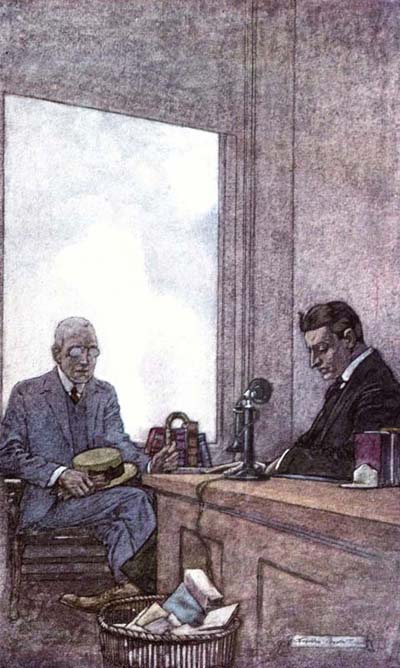
EVERY TRIFLING THING HAD TO BE ARGUED
The Poet particularly disliked this sort of
familiarity; his best friends never laid hands
on him. He resented even more the leer that
had written itself in Redfield’s face. Traces of
a coarsening of fiber that he had looked for
at the beginning of the interview were here
apparent in tone and gesture, and did not
contribute to the Poet’s peace of mind. The
displeasure in his face seemed to remind Redfield
that this was not a man one slapped on the
back, or spoke to leeringly. He flushed and
muttered an apology, which the Poet chose to
ignore.
“A woman who has had half an acre of
Mother Earth to play in for seven years and
has fashioned it into an expression of her own
soul, and has swung her baby in a hammock
under cherry trees in bloom, must be pardoned
if she doesn’t like being cooped up in a flat
and asked to be polite to people her husband
expects to make money out of. I understand
that you have left the flat for a room at the
club.”
“I mean to take care of them—you must
give me credit for that!” said Redfield, angry
that he was not managing his case more effectively.
“But Elizabeth is riding the high horse
and refuses to accept anything from me!”
“I should think she would! She would
be the woman I’ve admired all these years if
she’d let you throw crumbs to her from your
club window!”
“She thinks she’s going to rub it into me by
going to work! She’s going to teach a kindergarten,
in the hope, I suppose, of humiliating
me!”
“It would be too bad if some of the humiliation
landed on your door!”
“I’ve been as decent as I could; I’ve done
everything I could to protect her.”
“I suppose,” observed the Poet carelessly,
“there’s another woman somewhere—”
“That’s a lie!” Redfield flared. “I’ve always
been square with Elizabeth, and you
know it! If there’s any scandalous gossip of
that kind afloat it’s damnably unjust! I hoped
you had a better idea of me than that!”
“I’m sorry,” said the Poet, with sincere
contrition. “We’ll consider, then, that there’s
no such bar to a reconciliation.”
He let his last word fall quietly as though
it were a pebble he had dropped into a pool
for the pleasure of watching the resulting
ripples.
“If that’s what’s in your mind, the sooner
you get it out the better!” snapped Redfield.
“We’ve gone beyond all that!”
“The spring was unusually fine,” the Poet
hastened to remark with cheerful irrelevance,
as though all that had gone before had merely
led up to the weather; “June is justifying
Lowell’s admiration. Your view off there is
splendid. It just occurs to me that these tall
buildings are not bad approximations of ivory
towers; a good place for dreams—nice horizons—edges
of green away off there, and unless
my sight is failing that’s a glimpse of
the river you get beyond those heaven-kissing
chimneys.”
Redfield mopped his brow and sighed his
relief. Clearly the Poet, realizing the futility
of the discussion, was glad to close it; and
Redfield had no intention of allowing him to
return to it.
He opened the door with an eagerness at
which the Poet smiled as he walked deliberately
through the outer room, exposing himself once
more to the admiring smiles of the girls at
the typewriters. He paused and told them
a story, to which Redfield, from the threshold
of his sanctum, listened perforce.
At the street entrance the Poet met Fulton
hurrying into the building.
“I was just thinking of you!” cried the young
man. “Half a minute ago I dropped a little
packet with your name on it into the box at
the corner, and was feeling like a criminal to
think of what I was inflicting!”
“It occurs to me,” mused the Poet, leaning
on his umbrella, quite indifferent to the hurrying
crowd that swept through the entrance,
“that the mail-box might be a good subject for
a cheerful jingle—the repository of hopes, ambitions,
abuse, threats, love letters, and duns.
It’s by treating such subjects attractively that
we may hope to reach the tired business man
and persuade him that not weak-winged is
song! Apollo leaning against a letter-box and
twanging his lyre divine for the muses to
dance a light fantastic round—a very pretty
thought, Mr. Fulton!”
The Poet, obviously on excellent terms with
the world, indulged himself further in whimsical
comment on possible subjects for verse,
even improvising a few lines of doggerel for
the reporter’s amusement.
And then, after he had turned away, he
called the young man back, as though by an
afterthought.
“As to Redfield, you haven’t done anything
yet?”
“No; I’m on my way to see him now.”
“Well, don’t be in a hurry about making the
change. You’d better go up to the lake Sunday
and sit on the shore all day and let June soak
in. You will find that it helps. I’ll meet those
verses you’re sending me at the outer wicket;
I’m sure I’ll like them!”
When Saturday proved to be the fairest of
June days, the Poet decided that it was a pity
to remain in city pent when three hours on the
train would carry him to Waupegan, a spot
whose charms had been brought freshly to his
attention by the sheaf of verses Fulton had
sent him. He had hoped to find Fulton on the
train; but when the young man did not appear,
he found compensation in the presence of Mrs.
Waring, who was bound for Waupegan to take
possession of her house.
“Marian took Marjorie up yesterday. It
occurred to me, after I’d posted Elizabeth off
with a servant to straighten up my house, that
I’d done the crudest thing imaginable, for
Elizabeth went honeymooning to Waupegan—I
gave her and Miles my house for a fortnight,
as you may remember. I wanted to get her
out of town and I never thought of that until
she’d gone.”
“Isn’t it a good sign that Elizabeth would
go? It shows that the associations of the lake
still mean something to her.”
“Oh, but they don’t mean anything to him—that’s
the trouble! If there ever was a brute—”
“There are worse men—or brutes,” the
Poet mildly suggested.
“I can’t imagine it!” Mrs. Waring replied
tartly.
“I’m going fishing,” the Poet explained,
when Mrs. Waring demanded to know what
errand was carrying him lakeward. His dislike
of railway journeys was well known to all his
friends; and no one had ever heard of his going
fishing.
“I have asked you to the lake scores of times
to visit me, and you have scorned all my invitations.
Now that I’ve caught you in the act
of going up alone, I demand that you make
me the visit you’ve been promising for twenty
years.”
“Fishing,” observed the Poet soberly, “is
a business that requires the closest attention
and strictest privacy. I should be delighted to
make that visit at this time, but when I fish
I’m an intolerable person—unsociable and
churlish; you’d always hate me if I accepted
your hospitable shelter when I would a-fishing
go.”
“You’ll not find the hotel a particularly
tranquil place for literary labor, and the food
at my house couldn’t be worse than you’ll get
there. I’ve warned you!”
She was frankly curious as to the nature of
his errand, and continued to chaff him about
his piscatorial ambitions. He gave his humor
full rein in adding to her mystification.
“Perhaps,” he finally confessed, “I shall hire
a boy to do the fishing for me, while I sit under
a tree and boss him.”
“No boy with any spirit would fish for anybody
else—no respectable, well-brought-up
boy would!”
“There’s where you’re quite mistaken! I
expect to find a boy—and a pretty likely
young fellow he is, reared on a farm, and all
that—I expect to find him ready for business
in the morning. Mind you, he didn’t promise
to come, but if he’s the youngster I think he is,
he’ll be there right side up with care to-morrow
morning.”
“I don’t believe I like you so well when you
play at being mysterious. This idea, that if
you serenely fold your hands and wait—John
Burroughs, isn’t it?—your own will come
to you, never worked for me. I should never
have got anywhere in my life if I had folded
my hands and waited.”
“There must always be one who journeys
to meet him who waits, and with your superb
energy you have done the traveling. I’m playing
both parts in this affair just as an experiment.
To-day I travel; to-morrow I shall sit
on the dock and wait for that boy who’s to do
my fishing for me. I’m not prepared for disappointment;
I have every confidence that he
will arrive in due season. Particularly now that
you tell me Marian is already illuminating the
landscape!”
Mrs. Waring was giving him only half attention,
but she pricked up her ears at this statement.
“Marian! What on earth has she to do with
this fishing-trip?”
“Nothing, except that I have a message
for her from the cool slopes of Parnassus. It’s
almost like something you read of in books—her
being here waiting for the sacred papyri.”
He tapped his pocket and smiled.
“I hadn’t the slightest idea she was up
there waiting,” he continued. “You must confess
that it’s rather remarkable! Folding her
hands, utterly unconscious of what Fate has
in store for her; and poems being written to
her, and my fisher-boy on the trail looking for
me—and her!”
“I’m sure I don’t know what you’re driving
at, but you’d better keep your verses for somebody
else. Marian’s a much more practical girl
than Elizabeth; I don’t quite see her receiving
messages from the Muses with more than chilly
politeness. You may be sure she will profit by
Elizabeth’s experience. Elizabeth married a
man with an artistic temperament and she’s
paid dearly for it. A blow like that falling so
close to Marian is bound to have its effect. If
you want to win her smiles, don’t appeal to her
through poetry. As I was saying the other day,
poetry is charming, and sometimes it’s uplifting;
but we’re getting away from it. These are
changing times, and pretty soon it won’t be
respectable to be decent!”
“You said something to the same effect the
other day when your garden was full of children.
I was greatly disappointed in you; it
wasn’t fair to the children to talk that way—even
if they didn’t hear you. I was all
broken up after that party; I haven’t been
the same man since!”
“Oh, I didn’t mean to reflect on you or your
work; you know that!”
“I know nothing of the kind,” returned
the Poet amiably. “You have said it twice,
though the first time was enough. I’m a different
person; you’ve changed the whole current
of my life! I’m making a journey, on a very
hot afternoon, that I should never have thought
of making if it hadn’t been for your cynical
remarks. I’ve taken employment as an agent
of Providence, just to prove to you that my
little preachments in rhyme are not altogether
what our young people call piffle. I’ve come
down out of the pulpit, so to speak, to put my
sermons into effect—a pretty good thing for
all parsons to do. Or, to go back to the starting-point,
I’ve hung my harp on the willows
that I may fish the more conveniently.”
“You ought to be ashamed of yourself to
make sport of a woman of my years! You
had better tell me a funny story,” said Mrs.
Waring, fearing that he was laughing at
her.
“I shall do nothing of the kind! I am heavily
armed with magazines and I shall read the
rest of the way to Waupegan. Besides, I need
time for planning my work to-morrow. It will
be my busiest day!”
It was dark when the train paused at the
lake station, and Mrs. Redfield was waiting,
having come over in a launch to meet
Mrs. Waring. She was wrapped in a long
coat and carried a lantern, which she held up
laughingly to verify her identification of the
Poet.
“Marian and I have just been talking of
you! She and Marjorie have told me all about
the garden-party, and of the beautiful time
you gave the children.”
“If she didn’t mention the beautiful time
they gave me, she didn’t tell the whole story.
And if I hadn’t gone to Mrs. Waring’s party,
I shouldn’t be here!”
“Don’t pay any attention to him,” interposed
Mrs. Waring, counting her trunks as
they were transferred to the miniature steamer
that plied the lake. “There’s some joke about
his coming here; he’s told you one story and
an hour ago he was assuring me that he had
come up to fish!”
She turned away for a moment to speak to
some old friends among the cottagers, leaving
Mrs. Redfield and the Poet alone.
“I’m glad you are here,” said the Poet, “for
I shall stay a few days and I hope we can have
some talks.”
“I hope so; but I must go very soon. I’ve
only been waiting for Mrs. Waring to come. It
was like her to make a chance for me to get
away; you know Waupegan is like home; my
father used to have a cottage here and we children
were brought up on the lake.”
She was a small, dark-eyed woman, a marked
contrast to her tall, fair sister. Her sense of fun
had always been a delight to her friends; she
was a capital mimic and had been a star in
amateur theatricals. The troubles of the past
year—or of the years, to accept Redfield’s
complaint at its full value—had not destroyed
her vivacity. She was of that happy company
who carry into middle life and beyond the
freshness of youth. She had been married at
twenty, and to the Poet’s eyes she seemed little
older now.
He had been wondering since his interview
with Redfield how he had ever dared go as far
in meddling with other people’s affairs. Face
to face with Redfield’s wife, he was more self-conscious
than was comfortable. It would not
be easy to talk to Elizabeth of her difficulties,
for the Poet was not a man whom women took
into their confidence over a teacup. He abused
himself for leaving his proper orbit for foolish
adventures in obscure, unmapped corners of
the heavens.
He said that the stars were fine, and having
failed to amplify this with anything like the
grace that might be expected of a poet, he
glanced at her and found her eyes bright with
tears. This was altogether disconcerting, but it
illustrated the embarrassments of the situation
into which he had projected himself. Clearly
the ambition to harmonize poetry and life was
not without peril; he felt that as the ambassador
from the court of Poesy it might be necessary
to learn a new language to make himself
understood at the portals of Life. Instead of
promoting peace, he might, by the least tactless
remark, prolong the war, and the thought
was dismaying.
As she turned her head to hide treasonable
tears he saw her draw herself up, and lift her
head as though to prove to him that there was
still courage in her heart, no matter if her eyes
did betray the citadel.
“You see, we hung up a new moon in honor
of your coming. It’s like a little feather, just
as Rossetti says.”
“Too suggestive of a feather duster,” he remarked
lightly; and seeing Mrs. Waring walking
toward them he added, gravely:—
“I’ve lied like the most miserable of sinners
about this trip; I came in answer to your letter.
I find that most letters will answer themselves
if you wait long enough. Yours is just seven
years old!”
“Oh,” she cried, with a quick catch of
the breath; “you don’t mean that you kept
that!”
“I most certainly did! It was a very beautiful
letter. I happened to be re-reading it the
other night and decided that it deserved an
answer; so here I am!”
“I’m both sorry and glad you came. It’s
immensely good of you; it’s just like you! But
it’s no use; of course you know that!”
“Oh, I should never have come on my own
hook! I’m only the humble representative of
thousands and thousands of people, and the
stars—maybe—and that frugal slice of
melon up there we call the moon. Nobody else
wanted the job, so I took it.”
He laughed at the puzzled look in the dark
eyes, which was like the wondering gaze of a
child, half-fearful, half-confiding.
“Elizabeth, are you going to stand there all
night talking to any poet that comes along!”
demanded Mrs. Waring; and as she joined
them the Poet began talking amusingly to allay
suspicion.
He again declined to accompany her home,
protesting that he must not disappoint the
boy who would certainly be on hand in the
morning to fish for him. He waved his hand as
the launch swung off, called the man who was
guarding his suit-case and followed him to the
inn.
PART TWO — V — VI — VII — VIII — IX — X
Marian and Marjorie had builded a house
of sand on a strip of shaded beach, and by the
fraudulent use of sticks and stones they had
made it stand in violation of all physical laws.
Now that the finishing touches had been given
to the tower, Marjorie thrust her doll through
a window.
“That will never do!” protested Marian.
“In a noble château like this the châtelaine
must not stand on her head. When the knights
come riding, she must be waiting, haughty and
proud, in the great hall to meet them.”
“Should ums?” asked Marjorie, watching
her aunt gouge a new window in the moist wall
so that the immured lady might view the lake
more comfortably.
“‘Ums should,’ indeed!”
“Should the lady have coffee-cake for ums
tea? We never made no pantry nor kitchen in
ums house, and lady will be awful hungry. I’ll
push ums a cracker. There, you lady, you can
eat ums supper!”
“When her knight comes riding, he will
bring a deer or maybe a big black boar and
there will be feasting in the great hall this
night,” said Marian.
“Maybe,” suggested Marjorie, lying flat and
peering into the château, “he will kill the grand
lady with ums sword; and it will be all over
bluggy.”
“Horrible!” cried Marian, closing her eyes
and shuddering. “Let us hope he will be a
parfait, gentil knight who will be nice to the
lady and tell her beautiful stories of the warriors
bold he has killed for love of her.”
“My boy doll got all smashed,” said Marjorie;
“and ums can’t come a-widing.”
“A truly good knight who got smashed
would arrive on his shield just the same; he
wouldn’t let anything keep him from coming
back to his lady.”
“If ums got all killed dead, would ums come
back?”
“He would; he most certainly would!”
declared Marian convincingly. “And there
would be a beautiful funeral, probably at
night, and the other knights would march to
the grave bearing torches. And they would
repeat a vow to avenge his death and the slug-horn
would sound and off they’d go.”
“And ums lady would be lonesome some
more,” sighed Marjorie.
“Oh, that’s nothing! Ladies have to get
used to being lonesome when knights go riding.
They must sit at home and knit or make beautiful
tapestries to show the knights when they
come home.”
“Marjorie not like to be lonesome. What if
Dolly est sit in the shotum—”
“Château is more elegant; though ‘shotum’
is flavorsome and colorful. Come to think of it
‘shotum’ is just as good. Dolly must sit and
keep sitting. She couldn’t go out to look for
her knight without committing a grave social
error.”
These matters having been disposed of,
Marjorie thought a stable should be built for
the knights’ horses, and they began scooping
sand to that end. Marian’s eyes rested
dreamily upon distant prospects. The cool airs
of early morning were still stirring, and here
and there a white sail floated lazily on the blue
water. The sandy beach lay only a short distance
from Mrs. Waring’s house, whose red
roof was visible through a cincture of maples
on the bluff above.
“If knights comes widing to our shotum and
holler for ums shootolain, would you holler to
come in?” asked Marjorie, from the stable
wall.
“It would be highly improper for a châtelaine
to ‘holler’; but if I were there, I should
order the drawbridge to be lowered, and I
should bid my knight lift the lid of the coal-bucket
thing they always wear on their heads,—you
know how they look in the picture
books,—and then ask him what tidings he
brought. You always ask for tidings.”
“Does ums? Me would ask ums for candy,
and new hats with long fithery feathers; and
ums—”
“Hail, ladies of the Lake! May a lone
harper descend and graciously vouchsafe a
song?”
From the top of the willow-lined bluff
behind them came a voice with startling
abruptness. In their discussion of the proprieties
of château life they had forgotten the rest
of the world, and it was disconcerting thus to
be greeted from the unknown.
“Is it ums knight come walking?” whispered
Marjorie, glancing round guardedly.
Marian jumped up and surveyed the overhanging
willow screen intently. She discerned
through the shrubbery a figure in gray, supported
by a tightly sheathed umbrella. A narrow-brimmed
straw hat and a pair of twinkling
eye-glasses attached to the most familiar
countenance in the Commonwealth now contributed
to a partial portrait of the lone harper.
Marian, having heard from her sister and
Mrs. Waring of the Poet’s advent, was able
to view this apparition without surprise.
“Come down, O harper, and gladden us with
song!” she called.
“I have far to go ere the day end; but I
bring writings for one whom men call fair.”
He tossed a long envelope toward them; the
breeze caught and held it, then dropped it close
to the château. Marjorie ran to pick it up.
“Miss Agnew,” said the Poet, lifting his
hat, “a young gentleman will pass this way
shortly; I believe him to be a person of merit.
He will come overseas from a far country, and
answer promptly to the name of Frederick.
Consider that you have been properly introduced
by the contents of yonder packet and
bid him welcome in my name.”
“Ums a cwazy man,” Marjorie announced
in disgust. “Ums the man what told a funny
story at Auntie Waring’s party and then
runned off.”
The quivering of the willows already marked
the Poet’s passing. He had crossed the lake
to the Waring cottage, Marian surmised, and
was now returning thither.
Marjorie, uninterested in letters, which, she
had observed, frequently made people cry,
attacked with renewed zeal the problem of
housing the knights’ horses, while Marian
opened the long envelope and drew out half a
dozen blue onion-skin letter-sheets and settled
herself to read. She read first with pleasurable
surprise and then with bewilderment. Poetry,
she had heard somewhere, should be read out
of doors, and clearly these verses were of that
order; and quite as unmistakably this, of all
the nooks and corners in the world, was the
proper spot in which to make the acquaintance
of these particular verses. Indeed, it
seemed possible, by a lifting of the eyes, to
verify the impressions they recorded,—the
blue arch, the gnarled boughs of the beeches,
the overhanging sycamores, the distant daisy-starred
pastures running down to meet the
clear water. Such items as these were readily
intelligible; but she found dancing through
all the verses a figure that under various endearing
names was the dea ex machina of
every scene; and this seemed irreconcilable
with the backgrounds afforded by the immediate
landscape. Pomona had, it appeared, at
some time inspected the apple harvest in this
neighborhood:—
The dew flashed from her sandals gold
As down the orchard aisles she sped;—
or this same delightful divinity became Diana,
her arrows cast aside, smashing a tennis ball,
or once again paddling a canoe through wind-ruffled
water into the flames of a dying September
sun. Or, the bright doors of dawn swinging
wide, down the steps tripped this same incredible
young person taunting the waiting hours
for their delay. Was it possible that her own
early morning dives from Mrs. Waring’s dock
could have suggested this!
Marian read hurriedly; then settled herself
for the more deliberate perusal that these pictorial
stanzas demanded. It was with a feeling
of unreality that she envisaged every point the
slight, graceful verses described. Where was
there another orchard that stole down to a
lake’s edge; or where could Atalanta ever have
indulged herself at tennis to the applause of
rapping woodpeckers if not in the court by the
casino on the other side of the lake? The Poet—that
is, the Poet All the People Loved—was
not greatly given to the invoking of gods
and goddesses; and this was not his stroke—unless
he were playing some practical joke,
which, to be sure, was quite possible. But she
felt herself in contact with someone very different
from the Poet; with quite another poet who
sped Pomona down orchard aisles catching at
the weighted boughs for the joy of hearing the
thump of falling apples, and turning with a
laugh to glance at the shower of ruddy fruit.
A lively young person, this Pomona; a spirited
and agile being, half-real, half-mythical. A
series of quatrains, under the caption “In
September,” described the many-named goddess
as the unknown poet had observed her in
her canoe at night:—
I watched afar her steady blade
Flash in the path the moon had made,
And saw the stars on silvery ripples
Shine clear and dance and faint and fade.
Then through the windless night I heard
Her song float toward me, dim and blurred;
’Twas like a call to vanished summers
From a lost, summer-seeking bird.
There were many canoes on Waupegan;
without turning her head she counted a dozen
flashing paddles. And there were many girls
who played capital tennis, or who were quite
capable of sprinting gracefully down the aisles
of fruitful orchards. She had remained at the
lake late the previous year, and had perhaps
shaken apple boughs when in flight through
orchards; and she had played tennis diligently
and had paddled her canoe on many September
nights through the moon’s path and over quivering
submerged stars; and yet it was inconceivable
that her performances had attracted
the attention of any one capable of transferring
them to rhyme. It would be pleasant, though,
to be the subject of verses like these! Once,
during her college days, she had moved a young
gentleman to song, but the amatory verses she
had evoked from his lyre had been pitiful stuff
that had offended her critical sense. These
blue sheets bore a very different message—delicate
and fanciful, with a nice restraint
under their buoyancy.
While the Poet had said that the author of
the verses would arrive shortly, she had taken
this as an expression of the make-believe in
which he constantly indulged in his writings;
but one of the canoes she had been idly observing
now bore unmistakably toward the
cove.
Marjorie called for assistance and Marian
thrust the blue sheets into her belt and busied
herself with perplexing architectural problems.
Marjorie’s attention was distracted a moment
later by the approaching canoe.
“Aunt Marian!” she chirruped, pointing
with a sand-encrusted finger, “more foolish
mans coming with glad tidings. Ums should
come by horses, not by ums canoe.”
“We mustn’t be too particular how ums
come, Marjorie,” replied Marian glancing up
with feigned carelessness. “It’s the knights’
privilege to come as they will. Many a maiden
sits waiting just as we are and no knight ever
comes.”
“When ums comes they might knock down
our house—maybe?” She tacked on the query
with so quaint a turn that Marian laughed.
“We mustn’t grow realistic! We must pretend
it’s play, and keep pretending that they
will be kind and considerate gentlemen.”
Her own efforts to pretend that they were
building a stable for the steeds of Arthur’s
knights did not conceal her curiosity as to a
young man who had driven his craft very close
inshore, and now, after a moment’s scrutiny
of the cove, chose a spot for landing and sent
the canoe with a whish up the sandy beach half
out of the water.
He jumped out and begged their pardon as
Marjorie planted herself defensively before the
castle.
“Ums can go ’way! Ums didn’t come widing
on ums horse like my story book.”
“I apologize! Not being Neptune I couldn’t
ride my horse through the water. And besides
I’m merely obeying orders. I was told to
appear here at ten o’clock, sharp, by a gentleman
I paddled over from the village and left on
Mrs. Waring’s dock an hour ago. He gave me
every assurance that I should be received hospitably,
but if I’m intruding I shall proceed
farther upon the wine-dark sea.”
THE APPROACHING CANOE
“Is ums name Fwedwick?” asked Marjorie.
Fulton controlled with difficulty an impulse
to laugh at the child’s curious twist of his name,
but admitted gravely that such, indeed, was
the case.
“Then ums can stay,” said Marjorie in a
tone of resignation, and returned to her building.
Marian, who, during his colloquy with Marjorie,
had risen and was brushing the sand
from her skirt, now spoke for the first time.
“It’s hardly possible you’re looking for me—I’m
Miss Agnew.”
He bowed profoundly.
“A distinguished man of letters assured me
that I should find him here,” the young man
explained as he drew on a blue serge coat he
had thrown out of the canoe; “but unless he
is hiding in the bushes he has played me false.
Such being the case I can’t do less than offer to
withdraw if my presence is annoying.”
The faint mockery of these sentences was
relieved by the mischievous twinkle in his
eyes. They were very dark eyes, and his hair
was intensely black and brushed back from his
forehead smoothly. His face was dark even
to swarthiness and his cheek bones were high
and a trifle prominent.
He was dressed for the open: white ducks,
canvas shoes, and a flannel shirt with soft collar
and a scarlet tie.
In spite of his offer to withdraw if his presence
proved ungrateful to the established tenants
of the cove, it occurred to Marian that
he was not, apparently, expecting to be rebuffed.
Marjorie, satisfied that the stranger in
no way menaced her peace, was addressing
herself with new energy to the refashioning of
the stable walls along lines recommended by
Marian.
“The ways of the Poet are inscrutable,”
observed Fulton; “he told me your name and
spoke in the highest terms of your kindness
of heart and tolerance of stupidity.”
“He was more sparing of facts in warning me
of your approach. He said your name would
be Frederick, as though the birds would supply
the rest of it.”
“Very likely that’s the way of the illustrious—to
assume that we are all as famous as themselves;
highly flattering, but calculated to deceive.
As the birds don’t know me, I will say
that my surname is Fulton. A poor and an ill-favored
thing, but mine own.”
“It quite suffices,” replied Marian in his
own key. “We have built a château,” she explained,
“and the châtelaine is even now gazing
sadly upon the waters hoping that her true
knight will appear. We have mixed metaphor
and history most unforgivably—a French
château, set here on an American lake in readiness
for the Knights of the Round Table.”
“We mustn’t quibble over details in such
matters; it’s the spirit of the thing that counts.
I can see that Marjorie isn’t troubled by
anachronisms.”
The blue sheets containing, presumably,
this young man’s verses, were still in her belt,
and their presence there did not add to her comfort.
Of course he might not be the real author
of those tributes to the lake’s divinities. His
appearance did not strongly support the suspicion.
The young man who had sent her
flowers accompanied by verses on various occasions
was an anæmic young person who would
never have entrusted himself to so tricksy a
bark as a canoe. Frederick Fulton was of a
more heroic mould; she thought it quite likely
that he could shoulder his canoe and march off
with it if it pleased him to do so. He looked
capable of doing many things besides scribbling
verses. His manner, as she analyzed it, left
nothing to be desired. While he was enjoying
this encounter to the full, as his ready smile
assured her, he did not presume upon her tolerance,
but seemed satisfied to let her prescribe
the terms of their acquaintance. This
was a lark of some kind, and whether he had
connived at the meeting, or whether he was as
much in the dark as she as to the Poet’s purpose
in bringing them together, remained a
mystery.
She found a seat on a log near the engrossed
Marjorie, and Fulton settled himself comfortably
on the sand.
“This has been a day of strange meetings,”
he began. “I really had no intention of coming
to Waupegan; and I was astonished to find our
friend the Poet on the hotel veranda this morning.
He had told me to come;—it was rather
odd—”
“Oh, he told you to come!”
“In town, two days ago he suggested it. I
wonder if he’s in the habit of doing that sort
of thing.”
“It would hardly be polite for me to criticize
him now that he has introduced us. I fear we
shall have to make the best of it!”
“Oh, I wasn’t thinking of it in that way!”
They regarded each other with searching
inquiry and then laughed. Her possession of
the verses had already advertised itself to him;
she saw his eyes rest upon them carelessly for
an instant and then he disregarded them; and
this pleased her. If he were their author—if,
possibly, he had written them of her—she approved
of his good breeding in ignoring them.
“I know this part of the world better than
almost any other,” he went on, clasping his
hands over his knees. “I was born only ten
miles from here on a farm; and I fished here
a lot when I was a boy.”
“But, of course, you’ve escaped from the
farm into the larger world or the Poet wouldn’t
know you.”
“Well, you see, I’m a newspaper reporter
down at the capital and reporters know everybody.”
“Oh, the Poet doesn’t know everybody;
though everybody knows him. Perhaps we’d
better pass that. Tell me some more about
your early adventures on the lake.”
“You have heard all that’s worth telling. We
farm boys used to come over and fish before the
city men filched all the bass and left only sunfish
and suckers. Then I grew up and went to
the State Agricultural School—to fit me for a
literary career!—and I didn’t get here again
until last fall when my paper gave me a vacation
and I spent a fortnight at the farm and
used to ride over here on my bicycle every
morning to watch the summer resorters and
read books.”
“It’s strange I never saw you,” said Marian,
“for I was here last fall. My own memories of
the pioneers go back almost to the Indians.
My father used to own that red-roofed cottage
you see across the lake; and I’ve tumbled into
the water from every point in sight.”
“September and June are the best months
here, I think. It was all much nicer, though,
before the place became so popular.”
“Hardly a gracious remark, seeing that Marjorie
and I are here, and all these cottagers are
friends of ours!”
“I haven’t the slightest objection to you
and Marjorie. You fit into the landscape delightfully—give
it tone and color; but I was
thinking of the noisy people at the inns down
by the village. They seem rather unnecessary.
The Poet and I agreed about that this morning
while we were looking for a quiet place for an
after-breakfast smoke.”
“It must be quite fine to know him—really
know him,” she said musingly.
“Yes; but before you grow too envious of my
acquaintance I’ll have to confess that I’ve
known him less than a week.”
“A great deal can happen in a week,” she
remarked absently.
“A great deal has!” he returned quickly.
This seemed to be rather leading; but a cry
for help from Marjorie provided a diversion.
Fulton jumped up and ran to the perplexed
builder’s aid, neatly repaired a broken wall,
and when he had received the child’s grave
thanks reseated himself at Marian’s feet. The
blue onion-skin paper had disappeared from
her belt; he caught her in the act of crumpling
the sheets into her sleeve.
With their disappearance she felt her courage
returning. His confessions as to the farm, the
university, the newspaper—created an outline
which she meant to encourage him to fill in.
Journalism, like war and the labors of those
who go down to the sea in ships, suggests
romance; and Marian had never known a
reporter before.
“I should think it would be great fun working
on a newspaper, and knowing things before
they happen.”
“And things that never happen!”
She was quick to seize upon this.
“The imagination must enter into all writing—even
facts, history. Bryant was a newspaper
man, and he wrote poetry, but I heard in
school that he was a very good editor, too.”
“I’m not an editor and nobody has called
me a poet; but the suggestion pleases me,” he
said.
“If our own Poet offered you a leaf of his
laurel, that would help establish your claims,—set
you up in business, so to speak.”
“I should hasten to return it before it withered!
My little experiments in rhyme are not
of the wreath-winning kind.”
“Then you do write verses!”
“Yards!” he confessed shamelessly.
She was taken aback by this bold admission.
His tone and manner implied that he set no
great store by his performances, and this
piqued her. It seemed like a commentary on
her critical judgment which had found them
good. Fulton now became impersonal and
philosophical.
“It’s a great thing to have done what our
Poet has done—give to the purely local a
touch that makes it universal. That’s what
art does when it has heart behind it, and there’s
the value of provincial literature. Hundreds of
men had seen just what he saw,—the same
variety of types and individuals against this
Western landscape,—but it was left for him
to set them forth with just the right stroke.
And he has done other things, too, besides the
genre studies that make him our own particular
Burns; he has sung of days like this when
hope rises high, and sung of them beautifully;
and he has preached countless little sermons
of cheer and contentment and aspiration. And
he’s the first poet who ever really understood
children—wrote not merely of them but to
them. He’s the poet of a thousand scrapbooks!
I came up on a late train last night and got to
talking to a stranger who told me he was on his
way to visit his old home; pulled one of the
Poet’s songs of June out of his pocket and asked
me to read it; said he’d cut it out of a newspaper
that had come to him wrapped round a
pair of shoes in some forsaken village in Texas,
and that it had made him homesick for a sight
of the farm where he was born. The old fellow
grew tearful about it, and almost wrung a sob
out of me. He was carrying that clipping
pinned to his railway ticket—in a way it was
his ticket home.”
“Of course our Poet has the power to move
people like that,” murmured Marian. “It’s
genius, a gift of the gods.”
“He’s been able to do it without ever cheapening
himself; there’s never any suggestion of
that mawkishness we hear in vaudeville songs
that implore us to write home to mother to-night!
He takes the simplest theme and makes
literature of it.”
Marian was thinking of her talk with the Poet
at Mrs. Waring’s garden-party. Strange to
say, it seemed more difficult to express her disdain
of romance and poetry to this young man
than it had been to the Poet. And yet he evidently
accepted unquestioningly the Poet’s
philosophy of life, which she had dismissed
contemptuously, and in which, she assured
herself, she did not believe to-day any more
than she did a week ago. The incident of a pilgrim
from Texas with a poem attached to his
railway ticket had its touch of sentiment and
pathos, but it did not weigh heavily against
the testimony of experience which had proved
in her own observation that life is perplexing
and difficult, and that poetry and romance are
only a lure and mesh to delude and betray the
trustful.
“Poets have a good deal to fight against
these days,” she said, wishing to state her dissent
as kindly as possible. “The Bible is full of
poetry, but it has lost its hold on the people;
it’s like an outworn sun that no longer lights
and warms the world. I wish it weren’t so;
but unfortunately we’re all pretty helpless
when it comes to the iron hoofs of the Time-Spirit.”
“Oh!” he exclaimed, sitting erect, “we
mustn’t make the mistake of thinking the
Time-Spirit a new invention. We’re lucky to
live in the twentieth century when it goes on
rubber heels;—when people are living poetry
more and talking about it less. Why, the spirit
of the Bible has just gone to work! I was writing
an account of a new summer camp for children
the day before I came up—one of those
Sunday supplement pieces around a lot of pictures;
and it occurred to me as I watched
youngsters, who had never seen green grass
before, having the time of their lives, that such
philanthropies didn’t exist in the good old days
when people dusted their Bibles oftener than
they do now. There’s a difference between the
Bible as a fetish and as a working plan for daily
use. Preaching isn’t left to the men who stand
up in pulpits in black coats on Sundays; there’s
preaching in all the magazines and newspapers
all the time. For example, my paper raises
money every summer to send children into
the country; and then starts another fund
to buy them Christmas presents. The apostles
themselves didn’t do much better than
that!”
“Of course there are many agencies and a
great deal of generosity,” replied Marian colorlessly.
The young men she knew were not in the
habit of speaking of the Bible or of religion in
this fashion. Religion had never made any
strong appeal to her and she had dabbled in
philanthropy fitfully without enthusiasm.
Fulton’s direct speech made some response
necessary and she tried to reply with an equally
frank confidence.
“I suppose I’m a sort of heathen; I don’t
know what a pantheist is, but I think I must
be one.”
“Oh, you can be a pantheist without being a
heathen! There’s a natural religion that we all
subscribe to, whether we’re conscious of it or
not. There’s no use bothering about definitions
or quarreling with anybody’s church or creed.
We’re getting beyond that; it’s the thing we
make of ourselves that counts; and when it
comes to the matter of worship, I suppose
every one who looks up at a blue sky like that,
and knows it to be good, is performing a sort
of ritual and saying a prayer.”
There was nothing in the breezy, exultant
verses she had thrust into her sleeve to prepare
her for such statements as these. While he
spoke simply and half-smilingly, as though
to minimize the seriousness of his statements,
his utterances had an undeniable ring of sincerity.
He was provokingly at ease—this dark
young gentleman who had been cast by the
waters upon this tranquil beach. He was not
at all like young men who called upon her and
made themselves agreeable by talking of the
theater or country club dances or the best
places to spend vacations. She could not recall
that any one had ever spoken to her before of
man’s aspirations in the terms employed by
this newspaper reporter.
Marjorie, having prepared for the stabling
of all the king’s horses and all the king’s men,
announced her intention of contributing a
wing to the château. This called for a conference
in which they all participated. Then,
when the addition had been planned in all
soberness and the child had resumed her labors,
Marian and Fred stared at the lake until the
silence became oppressive. Marian spoke first,
tossing the ball of conversation into a new
direction.
“You have confessed to yards of verses,”
she began, gathering up a handful of sand
which she let slip through her fingers lingeringly,
catching the grains in her palm. “I’ve
seen—about a yard of them.”
Clearly flirtation was not one of his accomplishments.
His “Oh, I’ve scattered them
round rather freely,” ignored a chance to declare
gracefully that she had been the inspiration
of those lyrics, written in a perfectly legible
hand on onion-skin letter-sheets, that were
concealed in her sleeve. His indifference to the
opening she had made for him piqued her.
She was quite dashed by the calm tone in which
he added, with no hint of sidling or simpering:—
“I’ve written reams of poems about you.”
(He might as well have said that he had scraped
the ice off her sidewalk or carried coal into her
cellar, for all the thrill she derived from his
admission.) “I hope you won’t be displeased;
but when I was ranging the lake last September
we seemed to find the same haunts and to
be interested in the same sort of thing, and
it kept me busy dodging you, I can tell you!
I exhausted the Classical Dictionary finding
names for you; and it wasn’t any trouble at
all to make verses about you. I was really
astonished to find how necessary you were to
the completion of my pen-and-ink sketches of
all this,”—a wave of the arm placed the lake
shores in evidence,—“I liked you best in
action; when the spirit moved you to run or
drive your canoe over the water. You do all the
outdoor things as though you had never done
anything else; it’s a joy to watch you! I was
sitting on a fence one day over there in Mrs.
Waring’s orchard and you ran by,—so near
that I could hear the swish of your skirts,—and
you made a high jump for a bough and
shook down the apples and ran off laughing
like a boy afraid of being caught. I pulled out
my notebook and scribbled seven stanzas on
that little incident.”
Any admiration that was conveyed by these
frankly uttered sentences was of the most impersonal
sort conceivable. She was not used to
being treated in this fashion. Even his manner
of asking her pardon for his temerariousness in
apostrophizing her in his verses had lacked, in
her critical appraisement of it, the humility a
self-respecting young woman had a right to
demand of a young poet who observes her
without warrant, is pleased to admire her athletic
prowess, her ways and her manners, and
puts her into his verses as coolly as he might
pick a flower from the wayside and wear it
in his coat.
“Then you used me merely to give human interest
to your poems; any girl running through
Mrs. Waring’s orchard and snatching at the
apples would have done just as well?”
“Oh, I shouldn’t say that,” he replied, unabashed;
“but even the poorest worm of a
scribbler has to have an ideal and you supplied
mine. You were like a model who strolls along
just when it occurs to the painter that his landscape
needs a figure to set it off. You don’t
mind, I hope?”
This made it necessary for her to assure him
in as few words as possible that she didn’t in
the least object to his view of the matter; and
she added, not without a trace of irony, that
she was always glad to be of use; that if she
could further the cause of art in any way she
was ready to do it.
“Please don’t; that hurt a little! By the
way, the Poet told me I ought to know you.
He recommended you in the noblest terms. I
see now what was in his mind; he thought
I needed your gentle chastening.”
“It’s more likely he thought it well for you
to see your ideal shattered! It’s too bad, for
the sake of your ambitions, that I didn’t remain
just an unknown girl in an orchard—who
suggested Pomona inspecting her crops
and then vanished forever.”
“Oh, I had to know you; it was inevitable,”
he replied with irritating resignation. “You
see I’ve written about you in prose, too; you’ve
been immensely provocative and stimulating.
My best prose, as well as my only decent jingles,
has had you for a subject. I laid myself
out to describe you at the tennis tournament
last fall. Next to watching you run through
an orchard trippingly, like one of Swinburne’s
long lines, I like you best when you show your
snappy stroke with the racket and make a
champion look well to her knitting.”
She turned crimson at this, remembering
very well the “Chronicle’s” report of the tennis
match, which she had cut out and still treasured
in her portfolio. Clearly, her obligations to this
impudent young man were increasing rapidly.
Marjorie, seized with an ambition to add
a new tower to the château, opportunely demanded
their assistance. The architectural
integrity of the château was in jeopardy and
the proposed changes called for much debate
by the elders. This consumed considerable
time, and after the new tower was finished by
their joint labors they set Marjorie to work
constructing a moat which Fulton declared to
be essential.
He got on famously with Marjorie; and this
scored heavily in his favor with Marian. His
way with the child was informed with the
nicest tact and understanding; he entered into
the spirit of the château-building with just the
earnestness that her young imagination demanded.
He promised to take her canoeing to
a place where he thought there might be fairies,
though he would not go the length of saying
that he had seen them, to be sure, for when people
saw fairies they must never tell any one;
it wouldn’t be kind to the fairies, who got into
the most dreadful predicaments when human
folk talked about them. Marjorie listened
big-eyed, while he held her sandy little fingers.
Yes; there was something pleasing in this
young man, who described tennis matches for
the sporting page of a newspaper or wrote
verses or spoke of religion or fairies all as part
of the day’s work.
“The Poet will think I’ve fallen into the
lake,” he remarked presently. “The ride to
Mrs. Waring’s dock was a great concession on
his part and he expressed misgivings as to allowing
me to paddle him back to the inn. He’s
waiting at this moment on Mrs. Waring’s
veranda, hoping that I won’t show up with the
canoe so he can take passage on the steamer
and reduce the hazards of the journey. The
height of the sun proclaims the luncheon hour,
and Marjorie must be hungry. Won’t you
honor my humble argosy!”
Marian could think of no good reason for declining
this invitation, particularly after Marjorie
had chirruped an immediate and grateful
acceptance. Moreover, Mr. Fulton had
made himself so agreeable and had contributed
so many elements to the morning’s pleasure,
that it was not in her heart to be rude to
him.
They embarked after a promise had been
exacted by Marjorie that “ums” should all
meet again on the morrow, to perfect the moat
and build a drawbridge.
“I’m glad to have an excuse for staying,”
Fulton declared, “and I hope I’m not the man
to go off and leave a noble shotum without the
finishing touches. We shall meet frequently,
maid Marjorie. In fact”—he lifted the paddle
and let it drip with a pleasant tinkle into the
calm water, while he half-turned toward
Marian—“I don’t believe I’ll ever go back
to ‘the heat and dust and noise of trades.’ As
old Walt says, in effect, the earth, that is sufficient;
so why not stay close to it?”
“Ums splashed water on me!” protested
Marjorie.
“A thousand pardons, my young realist!”
“The Poet and Elizabeth are waving to us
from the landing,” remarked Marian. “Perhaps
you’d better save the rest of the peroration
until to-morrow.”
“No unkinder word was ever spoken!” cried
Fulton cheerfully, and swept the light craft
forward with long, splashless strokes.
“It’s beautifully kind of you to want to
help; but you see how impossible it is!”
“I don’t like that word,” replied the Poet
patiently. “Most things are possible that we
really want to do.”
For two hours that morning Mrs. Redfield
and he had talked of her troubles, first with a
reluctance, a wariness on both sides that
yielded gradually to the warmth of his kindness.
However, on the whole, the Poet found
her easier to talk to than her husband had been.
She understood, as Redfield had not, that his
appearance in the matter was not merely the
assertion of a right inhering in an old friendship,
but that it was dictated by something larger,—a
resentment of an apostasy touching
intimately his own good faith as a public
teacher. This attitude had not only its poignancy
for her, but it broadened the horizon
against which she had been contemplating the
broken and distorted structure that had been
her life.
“I suppose,” she said bravely, “that we
oughtn’t to ask so much! We ought to be prepared
for calamity; then we shouldn’t break
under it when the blow falls. When I saw other
people in just such troubles I used to think,
‘There’s something that will never come to
me’: I suppose Miles is right in saying that I
have no ambition, that I had become merely a
drag on him. And I can see his side of it; there
wasn’t much ahead of him but standing behind
a bank counter to the end of his days.
The novels are full of the conflicts between the
man who wants to rise and the woman without
wings. It’s my misfortune to be one of the
wingless ones.”
She was less bitter than he expected; and he
took courage from this fact. He had hoped to
avoid any minute dissection of the situation;
but she had given him a pretty full account of
the whole affair, and he was both dismayed and
relieved to find how trivial the details of the
dissension proved. She had wept—beyond
doubt there had been tears—and Miles on his
side had exhausted persuasion before her obstinacy
kindled his wrath. The crux had come
with his demand that she should do her part
toward cultivating acquaintances that he believed
to be essential to the success of his new
undertaking. She had never known such people,
she assured the Poet, feeling that he knew
she never had and would sympathize with her
position. Miles had no right to ask her to
countenance them, and all that.
The Poet preferred to be amused by this.
The obnoxious persons were strangers to him;
he had merely heard of them; he admitted
that he would never deliberately have chosen
them for intimate companionship. And yet it
was not so egregious a thing to sit at the same
table for an hour with a man and woman one
wouldn’t care to meet daily.
“If there weren’t such people as the Farnams
in the world we’d never know how to
appreciate our own kind of folks,” remarked
the Poet. “And that fellow can’t be so bad. I
heard only recently of an instance of his generosity—he
made a very handsome subscription
to the new children’s hospital. Men of that
stamp frequently grow emotional when they’re
touched on the right chord.”
“But you wouldn’t have Miles—the Miles
you used to know—become like that, or get
down on his knees to such people in the hope
of getting some of their money!”
The Poet chuckled.
“If Miles can pry that particular man loose
from any of his money I’d say it proved that
Miles was right and you were wrong! Farnam
doesn’t carry his philanthropy into his business
affairs. He’s quite capable of eating your
lobster to-night and to-morrow morning exacting
the last ounce of flesh from the man who
paid for it. It’s possible that Miles will pay
dearly for his daring; I understand that this
new business is beset with pitfalls.”
“Oh, I want him to succeed! He’s free now
to do as he likes and I hope he will prosper.
At any rate, Marjorie and I are not dragging
him down!”
Angry tears came with this; the Poet looked
away to the green-fringed shores. When she
was calm again he thought it wise to drop the
matter for the present. At least it was best to
withdraw to safe ground, from which it might,
however, be possible to approach the citadel
obliquely.
“Marian,” he remarked, “is a charming
girl.”
She seconded his praise of her sister ardently,
saying that Marian had been splendid
throughout her troubles.
“She sees everything so clearly; I don’t
know what I should have done without her.”
“She sees things your way, then,” he ventured
quietly. “I’m a little afraid we always
prefer counselors who tell us we’re doing
the right thing.”
“Oh, she reasons things out wonderfully.
I hope she will profit by my troubles! Fortunately
we’re unlike; she’s much more practical
than I am. She has a wider outlook; I think her
college training shows there.”
“We must see to it that she doesn’t make
mistakes,” said the Poet, his thoughts reverting
to his efforts to place some new ideals where
Marian might contemplate them without suspecting
that he was responsible for putting
them in her way. The humorous aspects of his
intervention—and particularly his employment
of the unconscious Fulton as a missionary—caused
him to smile—a smile which Mrs.
Redfield detected but failed to understand.
“I can never look on marriage again as I
used to,” she ventured. “Most of the good
things of life have been spoiled for me.”
“I can’t agree to that: you are less than
thirty, which isn’t the age at which we can
afford to haul down the flag. If I’d subsided
at thirty,—had concluded that the world
would never listen to my little tin horn,—I
should have missed most of the joy of life.
And Marian at twenty-two mustn’t be allowed
to say that the world at best is a dreary
place. She mustn’t be allowed to form foolish
opinions of life and destiny and call to
the stage-hands to drop the curtain the first
time some actor misses his cue. And do you
know,” he continued with the humor glinting
through his glasses, “that girl had the bad
manners to tell me to my face only a few days
ago that there was no substance to all our poetizing—that
the romance had been trampled
out of life! To think of that—at twenty-two
or thirty!”
“Well,” said Mrs. Redfield, a little defiantly,
“you must remember that I’ve tried poetry
and romance.”
It was clear from her tone that she thought
this scored heavily on her side, and offset any
blame that might attach to her in his mind.
She was surprised by the quickness with which
he retorted.
“Ah, but have you!”
This was rather discouraging when she had
been at such pains to tell him the truth; when
she had bared her soul to him. She felt that it
was unchivalrous for him to question her fairness
when she had been so frank.
“You can hardly say,” he went on, “that
you made much of a trial of romance when you
dropped it at the first sign of trouble. Please
don’t misunderstand me. That letter you
wrote me during your honeymoon from this
very house was in a sense the declaration of a
faith. You meant to live by it always; and if no
troubles had ever come it would have been perfectly
satisfactory—no doubts, no questions!
You were like a mariner who doesn’t question
his charts when the sea is calm; but who begins
to doubt them when he hears the breakers
roaring on hidden reefs. Ideals are no good if
we haven’t a tolerably strong faith in them.
I’m going to tell you something that may surprise
you. You and Miles have been an ideal of
mine. Not only was your house with its pretty
garden and the hollyhocks a refuge, but it was
one of my chief inspirations. A good many
of the best things I’ve written came out of
that little establishment. I was astonished the
other day, in looking over my work of the past
half-dozen years, to find how much of you and
Miles there is in it. And now I feel that I ought
to modify those things—stick in footnotes to
say that the ideal home—the ideal of happiness
I had derived from you—was all a fraud.
Just think how that would look: an asterisk
tacked to the end of every stanza, leading the
eye down to an admission that my statements
were not true, only poetry, romance, a flimsy
invention which no one need be deceived
by!”
“I hope,” she said despairingly, “that I
haven’t lost everything! I’ve got to hold on
to something for Marjorie’s sake!”
“But Miles,” he persisted, “what about
him!”
“That isn’t kind or fair,” she replied, at the
point of tears again. “If I’ve lost my ideals he’s
responsible! He’s thrown away all of his own!”
“No, not quite! If he had he wouldn’t have
been angry at me when I went to him to discuss
these matters!”
“So you’ve talked to him! Then, of course,
you came to me prejudiced in his favor! I don’t
call that being fair. And if he asked you to talk
to me—”
Her eyes flashed indignantly.
“It’s rather funny that both of you should
be so afraid of that. Nothing is further from
the truth!”
“I know you mean to be kind, and I know it
wasn’t easy for you to come to me. But you
can see that matters have gone too far—after
the heartache and the gossip—”
“The heartache is deplorable, and the gossip
isn’t agreeable,” he assented readily. “We
mustn’t let the chatter of the neighbors worry
us. Think how a reconciliation would dull the
knives of the expectant cynics and hearten the
good people—and they are the majority, after
all—who want to see the gospel of happiness
and love rule this good old world. As for things
having gone too far, nothing’s been done, no
irrevocable step taken—”
“You don’t understand, then,—” and there
was a note of triumph in this,—“I’ve brought
a suit; it will be determined in October.”
“October,” replied the Poet, with his provoking
irrelevance, “is a month of delight,
‘season of mists and mellow fruitfulness.’ The
warmth of summer still hovering; the last
flowers challenging the frost to do its worst;
plans for the indoor life of winter—the fire,
cozy talks that aren’t possible anywhere but
at the hearthside; the friendly lamp and the
neglected book calling us back. I don’t think
you and Miles are going to have a very
happy winter of it under different roofs. I’m
sure I’ll miss the thought of you, running upstairs
on tiptoe when you thought you heard
Marjorie. Miles was always reading Kipling
aloud and we’d forget ourselves and laugh till
you’d hush us and run away in a panic. You
know,” he continued, “your cottage wasn’t
only a place for you to live in; it was my house
of dreams—a house of realities that were
dreams come true. I’ve sat by the table many
a time when you didn’t know I was there—an
intruder stealing in, a cheerful sort of ghost,
sensible of an unspoken welcome. Odd, isn’t
it, about the spirit of place? Not a great many
places really take hold of most of us; but they
have a way of haunting us; or maybe it’s the
other way round and we haunt them, and without
knowing how we get into them. We explore
strange frontiers into undiscovered countries;
we cross from our own existences into other
people’s lives,—lose identity, feel, see as other
people do,—and then lift our heads, rub our
eyes, and become our old selves again—but
not quite. We are likely to be wiser and more
just and tolerant. And it’s discouraging,” he
went on, “to go to your house of dreams and
find it plastered with ‘for rent’ and ‘for sale’
signs—or worse yet, to let yourself in with
your old key to find only ghosts there! That’s
what I’ve been doing. Your bungalow is empty—doubly
empty—for the last tenant didn’t
stay long; the ghosts were probably too much
for him! But I’m there—in spirit, you might
say. If the owner knew how much I loaf
there, in a disembodied sort of fashion, he’d
begin to charge me rent! But it’s mighty lonesome—nobody
around to dig out old songs
and play the airs for me, as you used to, while
I limped along with Miles’s old banjo.”
He spoke with a certain air of injury, as
though after all he were the chief sufferer from
the passing of the old familiar faces from his
house of dreams. He complained as a guest
might who suddenly finds that his hosts have
taken their departure without warning, leaving
him sitting at their fireside all unconscious
of their flight.
Elizabeth was surprised to find that his interposition
in this fashion impressed her more
than the counsels of other friends who, supporting
her cause loyally, urged her to maintain
her “stand” and recommended sharp reprisals.
She had not recovered from her amazement that
this shyest and most unobtrusive of men should
have come to her in any guise; and when he
spoke of his house of dreams—her house with
its old-fashioned garden that contained the
flowers he scattered oftenest through his poems—she
was half-persuaded that he was really a
sad, wistful visitor of this house of dreams—her
house—that symbolized for him contentment
and peace.
His way of stating the case touched her
deeply, and seeing this he rose and walked
to the veranda rail and scanned the limpid
water.
“That looks like the boy I sent to do my
fishing for me,” he remarked. “He’s bringing
Marian and Marjorie home. A pretty capable
boy, that! What do you think of a youngster
who pops up out of nowhere and chucks
bunches of verses into mail-boxes on crowded
corners where any one with any sort of ear,
passing along, would hear them singing inside!
Let’s go down and meet them.”
On their way to the dock the Poet continued
to talk of the young man in the canoe as though
he were a great personage. His extravagant
praise of Frederick Fulton justified any one in
believing that either Shelley or Keats had
stolen away from Paradise and was engaged
just now in paddling a canoe upon Lake Waupegan.
The Poet had risen from the long interview
with apparent satisfaction and was now
his more familiar amusing self.
“How on earth did Marian get acquainted
with this young man?” asked Mrs. Redfield in
perplexity, as Fulton skillfully maneuvered
the canoe inshore.
“Why assume that I know anything about
it? Marian doubtless knows scores of people
that I never heard of; she’s not an old friend
like you. I dare say he saw her wandering
alone on the shore and at once landed and
handed her a poem as though it were the advertisement
of a ventriloquist billed for one night
at Waupegan Town Hall! Very likely, being a
girl of discriminating literary taste, she liked
his verses and bade him welcome. And what
could be more natural than that he should
offer to bring her home! The longer I live the
more I wonder that people meet who were always
destined to meet. We think we’re yielding
to chance when we’re really doing things
we’ve been rehearsing in our subconsciousness
for a thousand years!”
When the party landed he parleyed with
Marjorie to make it necessary for Marian to
introduce Fulton to Elizabeth. He avoided
Marian’s eyes, and warily eluded the combined
efforts of the sisters to detain him. The obvious
result of his artfulness, so far as Marian and
Fulton were concerned, was eminently satisfactory.
The most delightful comradeship
seemed to have been established between the
young people. The Poet was highly pleased
with his morning’s work, but having dared so
much he was anxious to retire while the spell of
mystification was still upon them. Luncheon
was offered; Mrs. Waring would soon be home
and would be inconsolable if she found they had
come in her absence.
“We are very busy—fishing,” said the Poet
as he entrusted himself with exaggerated apprehensions
to the canoe. “When you have a boy
fishing for you you have to watch him. He’ll
hide half the fish if you’re not careful.”
“You absurd man!” cried Marian, with an
accession of boldness, as Fulton swung the
canoe round with sophisticated strokes.
“Ims a cwazy man,” piped Marjorie; “but
ims nice!”
The Poet was amusing himself the next
afternoon with a book of Scotch ballads when
Fulton found him, with his back against a big
beech, apparently established for all time. The
young man didn’t know that the Poet was
rather expecting him—not anxiously or nervously,
in the way of people unconsoled by a
sound philosophy; but the Poet had nevertheless
found in the ballads some hint that possibly
Frederick Fulton would appear.
Fulton carried a tennis racket and an old
geography with the leaves torn out which
served him as a portfolio. These encumbrances
seemed in nowise related to each other, a fact
which called for a gibe.
“I telephoned down to the office last night
and arranged to take my vacation now,” Fulton
explained. “In two weeks I can do some
new poems to relieve the prose of my story
and round it out. The lake’s my scene, you
know; I planned it all last September—and
a lot of things will occur to me here that I’d
never get hold of in town.”
“There’s something in that,” the Poet
agreed; “and by putting aside the pen for the
racket occasionally you can observe Marian in
her golden sandals at short range. And then,”
he deliberated, “if she doesn’t prove to be
quite up to the mark; if you find that she
isn’t as enchanting as you imagined when you
admired her at a distance, you can substitute
another girl. There are always plenty of girls.”
Fulton met the Poet’s eyes squarely and
grinned.
“So far my only trouble is my own general
incompetence. The scenery and the girl are
all right. By the way, you got me into a nice
box showing her my verses! I suffered, I can
tell you, when I followed your advice and paddled
up in my little canoe and found her with
those things!”
The Poet discounted his indignation heavily,
as Fulton clearly meant that he should.
“Formal introductions bore me, and in your
case I thought we’d do something a little different.
From the fact that you’re going off now
with your scribble-book and racket to find her
I judge that my way of bringing you to each
other’s attention has been highly successful.
Pray don’t let me detain you!” he ended with
faint irony.
“I wanted to tell you,” said Fulton, “that
I’ve decided not to accept Redfield’s offer;
I’ve just written to him.”
The Poet expressed no surprise. He merely
nodded and began searching for a knot in the
cord attached to his eye-glasses.
“We can usually trust June with our confidences
and rely on her judgments,” he remarked
pensively. “January is first-rate, too;
February and March are tricky and unreliable.
April, on the other hand, is much safer than she
gets credit for being. But it was lucky that we
thought of June as an arbiter in your case. If
we would all get out under a June sky like this
with our troubles we’d be a good deal happier.
It was a bad day for the human race when it
moved indoors.”
The Poet, absorbed in the passage of a launch
across the lake, had not applauded Fulton’s
determination not to ally himself with Redfield,
as the young man had expected. Fulton
felt that the subject required something more.
“I mean to stick to the newspaper and use
every minute I have outside for study and writing,”
he persisted earnestly. “I’ve decided
to keep trying for five years, whether I ever
make a killing or not.”
“That’s good,” said the Poet heartily. “I’m
glad you’ve concluded to do that. Your determination
carries you halfway to the goal; and
I’m glad you see it that way. I didn’t want to
influence you about Redfield; but I wanted you
to take time to think.”
“Well, I’m sure I should always have regretted
it, if I’d gone with him. And now that
I’ve met Mrs. Redfield, I’m fully convinced
that I’m making no mistake. It doesn’t seem
possible—”
He checked himself, and waited for a sign
from the Poet before concluding. The Poet
drew out and replaced in the ballads the slim
ivory paper-cutter he used as a bookmark.
“No, it doesn’t seem possible,” he replied
quietly. “It was just as well for you to see her
before making up your mind about going in
with Redfield.” (His own part in making it possible
for Fulton to meet Mrs. Redfield at this
juncture was not, he satisfied his conscience, a
matter for confession!) “Of course their affairs
will straighten out—not because you or I
may want them to, but because they really
need each other; or if they don’t know it now
they will. I’m inclined to think Marian will
help a little. Even you and I may be inconspicuous
figures in the drama—just walking on and
off, saying a word here and there! None of us
lives all to himself. All of us who write must
keep that in mind;—our responsibility. When
I was a schoolboy I found a misspelled word in
a book I was reading and I kept misspelling
that word for twenty years. We must be careful
what we put into print; we never can tell who’s
going to be influenced by what we write. Don’t
let anybody fool you into thinking that the
virile book has to be a nasty one. There’s too
much of that sort of thing. They talk about
warning the innocent; but there’s not much
sense in handing a child the hot end of a poker
just to make it dread the fire. There are writers
who seem to find a great joy in making mankind
out as bad as possible, and that doesn’t
help particularly, does it? It doesn’t help you
or me any to find that some man we have
known and admired has landed with a bump
at the bottom of the toboggan. But,” he
ended, “when we hear the bump it’s our job
to get the arnica bottle and see what we can
do for him. By the way, I’m leaving this
afternoon.”
“Not going—not to-day!” cried Fulton
with unfeigned surprise and disappointment.
“As I never had the slightest intention of
coming, it’s time I was moving along. And
besides, I’ve accomplished all the objects of
my visit. If I remained any longer I might
make a muddle of them. I’m a believer in
the inevitable hour and the inevitable word.
‘Skip’ was the first word that popped into my
head when I woke up this morning. At first I
thought Providence was kindly indicating the
passing of a prancing buccaneer who began
pounding carpets under my window at 5 A.M.;
but that was too good to be true. I decided that
it was in the stars that I should be the skipper.
Unless the innkeeper is an exalted liar my
train leaves at four, and I shall be occupied
with balladry until the hour arrives. We must
cultivate repose and guard against fretfulness.
There’s no use in trying to hasten the inevitable
hour by moving the dial closer to the sun.
If you’re not too busy you might bring Marjorie
and Marian over to see me off. It would
be a pleasant attention; and besides, I should
be much less likely to miss the train.”
Mrs. Redfield, Marian, and Marjorie were
back in town by the first of July. The sisters
had taken a small house on a convenient side
street and were facing their to-morrows confidently.
Mrs. Redfield was to open a kindergarten
in October and Marian was to teach
Latin in a private school. Fulton still clung
to the manuscript of his romance for the revision
it constantly invited. Since returning to
town he had seen the Poet frequently, and had
kept that gentleman informed of the movements
and plans of Mrs. Redfield and Marian.
The Poet wandered into the “Chronicle”
office one humid afternoon and found the
reporter writing an interview with a visiting
statesman. On days when every one else complained
bitterly of the heat, the Poet was
apparently the coolest person in town.
“I hope you have enough raisins in your
pudding to spare a few,” he remarked. And
then, as Fulton groped for his meaning, he drew
an envelope from his pocket. “I took the liberty
of purloining a few of those things you
gave me a month ago before I passed them on to
Marian and here’s the ‘Manhattan Magazine’
kindly inclosing a check for fifty dollars for
four of them. I suggested to the editor that
they ought to be kept together and printed on
one page. If you don’t like the arrangement,
you can send back the check. I’d suggest,
though, that you exchange it for gold and carry
the coins in your pocket for a day or two. The
thrill of the first real money you get for poetry
comes only once. Of course, if you’re not satisfied
and want to send it back—”
He feigned to ignore the surprise and delight
with which the young man stared at the slip
of paper in his hand while he tried to grasp this
astonishing news.
“Send it back!” he blurted, breaking in upon
the Poet’s further comments on the joy of a
first acceptance. “Send it back! Why, they’ve
sent me back dozens of better pieces! And if it
hadn’t been for you—Why,” he cried, with
mounting elation, “this is the grandest thing
that ever happened to me! If I wasn’t afraid
of getting arrested I’d yell!”
“Of course,” continued the Poet calmly, “I
had to tell the magazine people that you made
your sketches from life—and that they might
get into a libel suit by printing them. I suppose
you’re hardly in a position to ask Miss Agnew’s
leave to print! You haven’t been seeing much
of her, of course!”
An imaginary speck of mud on his umbrella
engaged the Poet’s attention at the moment so
that he missed the color that deepened in Fulton’s
face.
“Oh, I’ve seen a good deal of Miss Agnew,”
he confessed, “both at the lake and since I’ve
come home. We do some tennis together every
afternoon I can get off. I suppose there might
be some question as to using the poems without
asking her about it. Very likely no one
would ever guess that she inspired them—and
yet I have a guilty feeling—”
“You know, of course; and she, being, we
will say, a person of average intelligence,
knows, too, perfectly well. There you have it—a
very delicate question! And the fact that
she doesn’t care for such foolishness as poetry
and romance makes a difference. You’ve got
to consider that.”
His insinuations had been of the mildest, but
his keen scrutiny marked the flash of resentment
in Fulton’s eyes.
“Well, she was very nice about my putting
her into the story. It did rather stagger her at
first—to know that I had been worshiping
from afar, and grinding rhymes about her for
a year without ever knowing her.”
“The enchantment wasn’t all a matter of
distance, I hope,” the Poet persisted. “I wasn’t
quite sure about her. She struck me as being
a little bitter; seemed to think life a string of
wrong numbers and the girl at the exchange
stupid and cross. I should be sorry if you got
any such notions from her; it couldn’t fail
to make your ideal totter on its pedestal. It
would be rough to find that your Pomona, in
shaking the boughs in the orchard, was looking
for an apple with a worm-mark in its damask
cheek. It would argue for an unhappy nature.
We must insist that our goddesses have a
cheerful outlook; no grumbling when it rains
on the picnic!”
“Well,” Fulton admitted, “she did seem a
little disdainful and rather generally skeptical
about things at first; but I met that by rather
overemphasizing the general good that’s lying
around everywhere, most of which I got from
your books. Her father had lost his money,
and her sister’s troubles couldn’t fail to spoil
some of her illusions; but she’s going into her
school-teaching with the right spirit. She’s
been reading the manuscript of my story and
has made some bully suggestions. I’ve rewritten
one of the chapters and improved it vastly
because she pointed out a place where I’d
changed the key a little—I must have been
tired when I wrote it. I’d rather got off the
romantic note I started with and there were
a dozen dead, pallid pages right in the middle
of the thing.”
“She was afraid the romantic element flagged
there?” asked the Poet carelessly.
“Well, I suppose that’s about what it came
to. My heroine and the hero had a tiff; and I
was giving the girl the best of it and making
him out unreasonable; and she said she thought
that wasn’t fair; that the trouble was all the
girl’s fault. She thought the girl shouldn’t
have been so peevish over a small matter when
the young orchardist had shown himself chivalrous
and generous. It seemed to be Miss
Agnew’s idea that when you go in for romance
you ought to carry through with it.”
The Poet’s attention seemed to wander, and
he suppressed a smile with difficulty. He then
began searching his pockets for something,
and not finding it, remarked:—
“People who never change their minds aren’t
interesting; they really are not.”
“Well, I’m glad enough to change mine,”
replied Fulton, not knowing what was in the
Poet’s mind; “and I hope I’ll never get to a
place where I can’t take criticism in the right
spirit.”
“Oh, I wasn’t thinking of you,” remarked
the Poet.
He rose and moved quickly toward the door,
as though to escape from Fulton’s renewed
thanks for his kind offices in disposing of the
verses.
“Don’t work yourself to death,” he warned
Fulton in the hall. “I’m glad Marian’s influence
is so beneficent. When your proof comes,
hold it a day or two: there’s always the chance
of bettering a thing.”
As September waned, Fulton heard disquieting
news touching Redfield. It was whispered
in business circles that the broker had, the previous
year, sold stock in a local industrial venture
that had already come to grief. Redfield’s
friends were saying that he had been misled by
the enthusiasm of the men who had promoted
the company, but this was not accepted at face
value by some of his business rivals. Fortunately
the amount was not large—a mitigating
circumstance for which he was not responsible;
he would have sold more, it was said,
if investors had proved less wary. The story
was well calculated to injure if it didn’t at
once destroy Redfield’s chances of success
as a dealer in securities.
Fulton was a good deal disturbed by these
reports, which it became his duty to sift for the
“Chronicle.” Fulton liked Redfield; Redfield
was a likable person, a good fellow. The effect
upon his future of this misfortune, attributable
to his new-born zeal for money-making, was not
to be passed lightly. There was nothing for the
papers to print, as the complaining purchasers
had been made whole and were anxious to
avoid publicity. Fulton had watched matters
carefully with a view to protecting Redfield
if it became necessary, and he was confident
that the sanguine promoters were the real culprits,
though it was pretty clear that any scruples
the broker might have had had gone down
before the promise of a generous commission.
When quite satisfied that Redfield was safe
so far as prosecution was concerned, Fulton
spoke of Redfield’s difficulties to the Poet on an
evening when he called ostensibly to report the
completion of his romance. The Poet listened
attentively, but the reporter accepted his mild
expressions of regret as indicating indifference
to Redfield’s fate. The young man’s remark
that if it hadn’t been for the Poet he would
have shared Redfield’s collapse elicited no comment.
The Poet, imaginably preoccupied with
less disagreeable speculations, turned at once
to Fulton’s manuscript. After the final draft
had been discussed and publishers had been
considered, the young man left in the cheerful
mood he always carried away from his talks
with the Poet.
But the Poet spent a restless evening. He
listlessly turned over many books without finding
any to arrest his interest. He was troubled,
deeply troubled, by what Fulton had told him
of Redfield. And he was wandering whether
there might not be some way of turning his old
friend’s humiliation to good account. A man
of Redfield’s character and training would feel
disgrace keenly; and coming at a time when he
believed himself well launched toward success,
the shock to his pride would be all the greater.
Nothing in the Poet’s creed was more
brightly rubricated than his oft-repeated declarations
that the unfortunate, the erring,
the humbled, are entitled to mercy and kindness.
The Redfields’ plight had roused him
to a defense of his theory of life; but Fulton’s
story had added a new integer that greatly increased
the difficulty of solving this problem.
Seemingly Fate was using these old friends to
provide illustrations for many of the dicta that
were the foundation of his teachings. Inspiration
did not visit the quiet street that night.
The Poet pondered old poems rather than
new ones. “Life is a game the soul can play,”
he found in Sill; but the chessmen, he reflected,
are sometimes bafflingly obstinate and unreasonable.
“To-morrow is All-Children’s Day,” remarked
the Poet a few days later when, seemingly
by chance, he met Fulton in the street;
and when the young man asked for light the
Poet went on to explain. “When Marjorie was
born her father and I set apart her birthday to
be All-Children’s Day—a crystallization of
all children’s birthdays, from the beginning of
time, and we meant to celebrate it to the end
of our days. It just occurs to me that you and
I might make it an excuse for calling on Mrs.
Redfield and Marian and Marjorie to-morrow
afternoon, the same being Sunday. Very likely
you have another engagement—” he ended,
with provoking implications that caused Fulton,
who was already pledged to visit Marjorie
and inferentially Marian and Mrs. Redfield
on this very Sunday afternoon, to stammer in
the most incriminating fashion.
“Then if you haven’t anything better to
do we can call together,” said the Poet.
It would have been clear to less observant
eyes than the Poet’s that the reporter was on
excellent terms with the household, and even
if the elders had tried to mask the cordiality of
their welcome, Marjorie’s delight in Fulton was
too manifest for concealment. She transparently
disclosed the existence of much unfinished
business between herself and the young man
that pointed irrefutably to many previous and
recent interviews.
“Inside is no good for houses,” Marjorie was
saying, as the Poet accommodated himself
to the friendly atmosphere; “nobody builds
houses inside of houses.”
This suggestion of the open was promptly
supported by Fulton; and in the most natural
manner imaginable Marian was pressed into
service to assist in transferring building-materials
to the few square yards of lawn at the side
of the house. September was putting forth all
her pomp and the air was of summer warmth.
Marjorie’s merry treble floated in with the
laughter of Marian and Fulton. They were
engaged with utmost seriousness in endeavoring
to reproduce with blocks the elaborate château
of sand, sticks, and stones that had been
their rallying-point on the shores of Waupegan.
The Poet, left alone with Mrs. Redfield,
noted the presence in the tiny parlor of some
of the lares and penates that had furnished
forth the suburban bungalow and that had
survived the transfer to the flat and the subsequent
disaster. They seemed curiously wistful
in these new surroundings. As though aware
that this was in his mind, Mrs. Redfield began
speaking of matters as far removed from her
own affairs as possible. The Poet understood,
and, when the topics she suggested gave opportunity,
played upon them whimsically. The
trio in the yard were evidently having the best
of times; and their happiness stirred various
undercurrents of thought in the Poet’s mind.
He was not quite sure of his ground. It was
one thing to urge charity, mercy, and tolerance
in cloistral security; to put one’s self forward
as the protagonist of any of these virtues was
quite another.
The Poet rose, picked up a magazine from
the center table, scanned the table of contents,
and then said, very quietly,—
“Miles is in trouble.”
He watched her keenly for the effect of this,
and then proceeded quickly:—
“It’s fortunate that the jar came so soon;
a few years later and it mightn’t have been
possible for him to recover; but I think there’s
hope for him.”
“What Miles does or what he becomes is
of no interest to me,” she answered sharply.
“He didn’t feel that there was any disgrace to
him in casting Marjorie and me aside; his
pride’s not likely to suffer from anything else
that may happen to him.”
“He’s down and out; there’s no possibility
of his going on with the brokerage business;
he’s got to make a new start. It’s to be said
for him that he has made good the losses of
the people who charged him with unfair dealing.
I’m disposed to think he was carried away
by his enthusiasm; he was trying to get on
too fast.”
In spite of her flash of anger at the mention
of her husband’s name, it was clear that her
curiosity had been aroused. Nor was the Poet
dismayed by a light in her dark eyes which he
interpreted as expressing a sense of triumph
and vindication.
“I suppose he’s satisfied now,” she said.
“I fancy his state of mind isn’t enviable,”
the Poet replied evenly. “Life, when you come
to think of it, is a good deal like writing a sonnet.
You start off bravely with your rhyme words
scrawled at the top of the page. Four lines
may come easily enough; but the words you
have counted on to carry you through lead
into all manner of complications. You are
betrayed into saying the reverse of the thing
you started out to say. You begin with spring
and after you’ve got the birds to singing, the
powers of mischief turn the seasons upside
down, and before you know it the autumn
leaves are falling; it’s extremely discouraging!
If we could only stick to the text—”
His gesture transferred the illustration from
the field of literary composition to the ampler
domain of life.
She smiled at his feigned helplessness to pursue
his argument further.
“But when the rhyme words won’t carry
sense, and you have to throw the whole thing
overboard—” she ventured.
“No, oh, no! That’s the joy of rhyming—its
endless fascination! The discreet and economical
poet never throws away even a single
line; there’s always a chance that it may be
of use.” He was feeling his way back to his
illustration of life from the embarrassments
of sonneteering, and smiled as his whimsical
fancy caught at a clue. “If you don’t forget
the text,—if you’re quite sure you have an
idea,—or an ideal!—then it’s profitable to
keep fussing away at it. If a bad line offend
you, pluck it out; or maybe a line gets into the
wrong place and has to be moved around until
it fits. It’s all a good deal like the work Marjorie’s
doing outside—fitting blocks together
that have to go in a certain way or the whole
structure will tumble. It’s the height of cowardice
to give up and persuade yourself that you’ve
exhausted the subject in a quatrain. The good
craftsman will follow the pattern—perfect his
work, make it express the best in himself!”
And this referred to the estrangement of
Miles Redfield and his wife or not; just as
one might please to take it.
“Miles has gone away, I suppose,” she remarked
listlessly.
This made the situation quite concrete again,
and any expression of interest, no matter how
indifferent, would have caused the Poet’s heart
to bound; but his face did not betray him.
“Oh, he will be back shortly, I understand.
I rather think he will show himself a man and
pull his sonnet together again! There’s a fine
courage in Miles; unless I’ve mistaken him, he
won’t sit down and cry, even if he has made a
pretty bad blunder. A man hardly ever loses
all his friends; there’s always somebody around
who will hand a tract in at the jail door!”
“You don’t mean,” she exclaimed, “that
Miles has come to that!”
“Bless me, no!” the Poet cried, with another
heart throb. “The worst is over now; I’m
quite satisfied of that!” he answered with an
ease that conveyed nothing of the pains he
had taken, by ways devious and concealed, to
assure himself that Miles had made complete
restitution.
“A man of cheaper metal might have taken
chances with the law; I’m confident that Miles
was less the culprit than the victim. He sold
something that wasn’t good, on the strength of
statements he wasn’t responsible for. I believe
that to be honestly true, and I got it through
men who have no interest in him, who might
be expected to chortle over his misfortune.”
“In business matters,” she replied, with an
emphasis that was eloquent of reservations as
to other fields, “Miles was always perfectly
honorable. I don’t believe anybody would
question that.”
It hadn’t entered into the Poet’s most
sanguine speculations that she would defend
Miles, or speak even remotely in praise of
him. Wisdom dictated an immediate change
of topic. He walked to the open window and
established communication with the builders
outside, who had reproduced the Waupegan
château with added splendors and were anxious
to have it admired.
Indirection as a method and means to ends
has its disadvantages; but it is not to be scorned
utterly. A week following Marjorie’s birthday
children idling on their way home from school
in Marston grew silent and conferred in whispers
as a gentleman whose name and fame had
been interwoven in their alphabet lounged by.
He turned with a smile to lift his hat to an
urchin bolder than the rest who shouted his
name from a discreet distance.
Within a few days the signs had vanished
from the Redfield cottage and the weeds had
been cut. As the Poet opened the gate, Fulton
came out of the front door: neither seemed surprised
to see the other. The odor of fresh paint
elicited a sniff of satisfaction from the Poet, a
satisfaction that deepened a moment later as
he entered the studio and noted its neatness
and order.
“Mrs. Waring sent a maid out to do all this,
and lent me the things we needed for the tea-table,”
Fulton explained. “I had hard work
to persuade her this wasn’t one of your jokes.
I had harder work to get Mrs. Redfield to come
and bring Marjorie; but Marian supported the
scheme, and brought Mrs. Redfield round. I
fell back heavily on your argument that Marjorie
ought to have a final picnic before the
turn o’ the year—a last chance to build a shotum
ready for knights to come widing.”
“Marian is a persuasive person, I imagine,”
the Poet remarked. “By the way, I shall be a
little late arriving. Myers, the artist, lives a
little farther down Audubon Road and I want
to have a look at his summer’s work. Nice
fellow; good workman. Redfield promised to
meet me there; I want to be sure he doesn’t
run away. We don’t want the party spoiled
after all the work we’ve done on it.”
“I wonder,” Mrs. Redfield remarked, over
the tea-table, “who has bought the place?”
“A trust company, I think,” replied Fulton,
glancing through the broad north window of
the studio with careful dissimulation. “As I
passed the other day I saw that the grounds
had been put in order, and decided that this
would be just the place for a picnic.”
“This little house would be nice for my
playhouse; and we could use that big window
to watch ums knights come widing.”
“That chimney used to roar the way you
read about,” remarked Marian. “I think
every house ought to have a detached place
like this, for tea and sewing and children to
play in.”
Mrs. Redfield, ill at ease, was attending listlessly
to the talk. Fulton’s explanation had
not wholly explained. She had agreed to the
excursion only after Marjorie had clamorously
insisted upon the outing her devoted cavalier
had proposed. Marjorie’s comments upon the
broad yard, her childish delight in the studio
playhouse, touched chords of memory that
jangled harshly.
Fulton was in high spirits. His romance
had been accepted and a representative of the
publishing house was coming to confer with
him about illustrations.
“They say it won’t break any best-selling
records, but it will give me a start. The scoundrels
had the cheek to suggest that I cut out
some of my jingles, but I scorned such impiousness
in an expensive telegram.”
“I should hope so!” cried Marian approvingly.
“The story’s only an excuse for the
poems. Even the noblest prose wouldn’t express
the lake, the orchard, and the fields; if
you cut out your verses, there wouldn’t be
much left but a young gentleman spraying
apple trees and looking off occasionally at the
girls paddling across the lake.”
“You do my orchardist hero a cruel injustice,”
protested Fulton, “for he saw only one
girl—and a very nice girl she was—or is!”
“What on earth are you two talking about?”
asked Mrs. Redfield, looking from one to the
other, while thwarting Marjorie in a forbidden
attack upon the cookies. “It seems to me that
you’ve been talking for years about this story,
and I don’t know yet what it’s all about.”
“Hims witing books like the funny poetry
man, and hims told me if I’m good and nice to
you and Aunt Marian he’ll wite a book all
about me, and my dollies, and how we builded
shotums by the lake and in our yard; and
Marian can’t be in any more books, but just
be sitting on a wock by the lake, having ums
picture painted.”
“Thank you, Marjorie; I knew he was a
deceiver and that proves it,” laughed Marian,
avoiding her sister’s eyes. “Let’s all go out and
see the sun go down.”
Marjorie toddled off along the walk that
bisected what had once been a kitchen-garden.
The sun was resting his fiery burden on the
dark edge of a wood on the western horizon.
The front door of the bungalow was ajar and
Mrs. Redfield crossed the piazza and peered in.
The place was clean and freshly papered: a
fire burned m the fireplace—no mere careless
blaze of litter left by workmen, but flaming
logs that crackled cheerily. Her memory distributed
her own belongings; here had been
the table and there the couch and chair; and
she saw restored to the bare walls the pictures
that now cluttered the attic of the home she
had established with Marian, that had once
hung here—each with its special meaning for
the occupants.
She stood, a girlish figure, with her hands
thrust into the pockets of her sweater, staring
with unseeing eyes at the mocking flames.
The Poet had spoken of the visits he paid
in fancy to his house of dreams, and she half-wondered
whether she were not herself a disembodied
spirit imprisoned in a house of shadows.
A light, furtive step on the piazza
startled her, and lifting her eyes with the Poet
still in her mind she saw him crossing the room
quickly, like a guest approaching his hostess.
“It’s pleasant to find the mistress back in
the house of dreams,” he said. “And she brings,
oh, so many things with her!”
He glanced about the empty room as though
envisaging remembered comforts.
“I might have known,” she murmured,
“that this was your plan.”
“No,” he replied, with a smile that brought
to his face a rare kindliness and sweetness, “it
wasn’t mine; I’m merely an inefficient agent.
It’s all born of things hoped for—”
He waved his hand to the bare walls, brought
it round and placed something in her palm.
“There’s the key to my house of dreams.
As you see, it needs people—its own people—Marjorie
and you, for example, to make it home
again. I shall be much happier to know you’re
back....”
ELIZABETH!
He was gone and she gazed after him with a
deepened sense of unreality. A moment later
she heard Marjorie calling to him in the garden.
She stood staring at the flat bit of metal he
had left in her hand, the key of his house of
dreams; then she laid her arms upon the long
shelf of the mantel and wept. The sound of her
sobbing filled the room. Never before—not
when the anger and shame of her troubles were
fresh upon her—had she been so shaken.
She was still there, with her head bowed
upon her arms, when a voice spoke her name,
“Elizabeth,” and “Elizabeth,” again, very
softly.
The sun flamed beyond the woodland. The
Poet joined with Marian and Fulton in praising
the banners of purple and gold that were flung
across the west, while Marjorie tugged at his
umbrella.
“It’s all good—everything is good! A
pretty good, cheerful kind of world when you
consider it. I think,” he added with his eyes on
Marian, “that maybe Miles can find time to do
the pictures for Fred’s book. His old place at
the bank won’t be ready until the first of the
year, and that will give him a chance to work
up something pretty fine. I’ll see that publisher
about it when he comes; and—” He withdrew
several steps, and looked absently at the glories
of the dying day before concluding, “it’s just
as well to keep all the good things in the
family.”
When they hurried to the gate, they saw
him walking in his leisurely fashion toward the
trolley terminus, swinging his umbrella. The
golden light enfolded him and the scarlet
maples bent down in benediction.
THE END
The Riverside Press
CAMBRIDGE . MASSACHUSETTS
U . S . A