PREFACE — FOOTNOTES:
Oliver Goldsmith, the fifth child of Charles and Ann
Goldsmith, was born at Pallas, a hamlet of the parish of
Forney, county of Longford, Ireland, November 10th, 1728. His
father, the “Preacher” of the “Deserted Village,” having been
presented to the Rectory of Kilkenny-West, about the year 1730,
removed his family to Lissoy, the “Auburn” of the Poet. The
“modest mansion” is a ruin, or, by this time, has quite disappeared.
His first schoolmaster is described, by one who remembered
him, as a man “stern to view,” in whose “morning face”
the disasters of the day might be easily read. Goldsmith made
small progress under the ferule of Paddy Burns, and, after being
for some time a pupil in the diocesan school of Elphin, he
was placed with a competent teacher at Athlone, where he remained
two years. He was then transferred to the care of
Mr. Hughes, vicar of Shruel, who treated him with kindness, and
whom he always mentioned with respect and gratitude. His
eldest sister has given a specimen of her brother’s early and
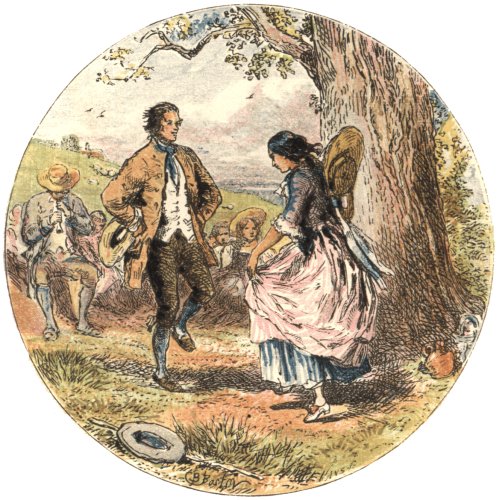
ready humour. A large company of young people had assembled
in his uncle’s house, at Elphin, and Oliver, then nine years old,
was desired to dance a hornpipe, under very unfavourable circumstances,
for his figure was short and thick, and the marks of recent
small-pox were still conspicuous. A young man, who played the
violin, compared him to Æsop dancing; but Oliver, stopping
short in the performance, immediately disabled his satirist with
a sharp epigram:—
“Our herald hath proclaim’d this saying,
See Æsop dancing, and his monkey playing.”
On the 11th of June, 1745, he was admitted a Sizar of Trinity
College, Dublin—a fact which denoted a considerable proficiency
in classical learning; but he was unfortunate in his tutor, who
deserved, and has won, the title of “Savage;” and, perhaps, the
promise of Oliver was blighted by his severity. He neglected
his studies, and was seen “perpetually lounging about the college
gates.” We find him elected, June 15th, 1747, to an Exhibition,
on the foundation of Erasmus Smith, obtaining a premium at the
Christmas examination, and, after a delay of two years, taking his
Bachelor’s degree, February 27th, 1750. His father died in 1747,
but he found a second parent in the Rev Thomas Contarine, who
was descended from a noble ancestry in Venice, and had been a
contemporary and friend of Berkeley. The relatives of the poet
now advised him to “go into orders,” and yielding to the persuasion
of Mr. Contarine, he presented himself before the Bishop
of Elphin, and was rejected. Tradition ascribes the failure to his
uncanonical costume, and the episcopal dislike of scarlet breeches.
His kind friends might now, as he afterwards wrote, be perfectly
satisfied that he was undone; but they did not abandon
him. He was enabled to proceed to Edinburgh, towards the end
of 1752, where he attended the lectures of Monro and the other
Medical Professors. Scotland did not please him. “Shall I tire
you,” he wrote to a friend, “with a description of this unfruitful
country, where I must lead you over their hills all brown with
heath, or their valleys scarcely able to feed a rabbit? Man alone
seems to be the only creature who has arrived to the natural size
in this poor soil.”
His design of completing his studies at Leyden was nearly
frustrated by an act of generous imprudence, from which two
college friends set him free. From Leyden, in the April or May
of 1754, he sent a letter to Mr. Contarine, containing an account
of his journey, and some lively sketches of the “downright Hollander,”
with lank hair, laced hat, no coat, and seven waistcoats,
the lady with her portable stove, the lugubrious Harlequin, and
the domestic interior, which reminded him of a magnificent
Egyptian temple dedicated to an ox. He remained in Leyden
nearly a year, deriving small benefit from the instruction of the
Professors, who, with the exception of Gaubius, the teacher of
Chemistry, were as indolent as himself. Meanwhile, the necessaries
of life were costly, and the attractions of the gaming-table
proved to be overpowering and ruinous. At length, having
emptied his purse, and reduced his wardrobe to a single shirt,
he boldly resolved to make the tour of Europe. This characteristic
chapter of the Poet’s history is yet to be written, if his
lost letters should ever be recovered. The interesting and
copious narrative which he communicated to Dr. Radcliff is
known to have been destroyed by fire.
He commenced his travels about February, 1755. “A good
voice,” adopting his own account of an earlier adventurer, “and
a trifling skill in music, were the only finances he had to support
an undertaking so extensive.” Thus he journeyed, and at night
sang at the doors of peasants’ houses, to get himself a lodging.
Once or twice, he “attempted to play to people of fashion,” but
they despised his performance, and never rewarded him even
with a trifle. We are told by Bishop Percy, that he reached
Padua, and visited all the northern parts of Italy, returning, on
foot, through France, and landing at Dover, about the beginning
of the war, in 1756. We may believe his own assurance, that
he fought his way homewards, examining mankind with near eyes,
and seeing both sides of the picture.
He appeared in London, without means or interest. England,
he complained, was a country, where being born an Irishman
was sufficient to keep a man unemployed. With much difficulty
he obtained the situation of usher at a school. Johnson did not
remember the occupation with a fiercer disgust; and the redolent
French teacher, papering his curls at night, was a frequent
spectre of his memory. A migration from the school-room to the
chemist’s shop slightly improved his condition. Better days were
coming. By the aid of an Edinburgh acquaintance, Dr. Sleigh,
and other friends, he was “set up” as a practitioner at Bankside,
Southwark, where, in his pleasant confession, he got plenty of
patients, but no fees. A physician, Dr. Farr, who had known
him in Scotland, thus describes his appearance:—“He called
upon me one morning, before I was up, and, on entering the
room, I recognized my old acquaintance, dressed in a rusty, full-trimmed
black suit, with his pockets full of papers, which instantly
reminded me of the poet in Garrick’s farce of ‘Lethe.’
On this occasion he read portions of a ‘Tragedy,’ and talked
of a journey to decipher the inscriptions on the Written Mountains.”
In later days, when writing an “Essay on the advantages
to be derived from sending a judicious traveller into Asia,”
Goldsmith professed to feel the difficulty of choosing a proper
person for such an enterprise, and indicated the qualifications
demanded:—“He should be a man of a philosophical turn, one
apt to deduce consequences of general utility from particular
occurrences—neither swollen with pride, nor hardened by prejudice—neither
wedded to one particular system, nor instructed
only in one particular science—neither wholly a botanist, nor
wholly an antiquarian; his mind should be tinctured with miscellaneous
knowledge, and his manners humanized by an intercourse
with men. He should be, in some measure, an enthusiast to
the design; fond of travelling, from a rapid imagination and an
innate love of change; furnished with a body capable of sustaining
every fatigue, and a heart not easily terrified at danger.”
With the year 1757, the prospects of Goldsmith brightened,
and the papers which filled the pockets of the rusty black coat
began to get abroad. He wrote several articles for the “Monthly
Review,” translated the “Mémoires d’un Protestant,” and composed
his “Enquiry into the Present State of Polite Learning
in Europe.” The object of the work was special. He had obtained
the appointment of physician to a factory on the coast
of Coromandel, and was providing funds for the voyage. A
considerable sum was needed. The Company’s warrant cost ten
pounds, and the passage and equipment required one hundred
and thirty pounds in addition; but the emoluments were expected
to be large. The salary was one hundred pounds; the
average returns of the general practice amounted to a thousand;
there was an opening for commercial enterprise, and invested
money brought twenty per cent. These were flattering inducements;
but time deadened their charm, and he shrank from so
distant a banishment, and beginning life again at the age of
thirty-one. Eight years of anxiety and trial had done their work
on his face and temper. His picture of himself was most discouraging.
He had “contracted a hesitating, disagreeable manner
of speaking, and a visage that looked ill-nature itself.” Home
news deepened his melancholy, for his mother was almost blind.
The “Enquiry” appeared, without the Author’s name, April,
1759—a small volume, price half-a-crown; and in the autumn
of the same year, the commencement of a weekly paper, called
“The Bee,” afforded him an opportunity of showing his skill as
an Editor. His plan was to “rove from flower to flower, with
seeming inattention, but concealed choice, expatiate over all the
beauties of the season, and make his industry his amusement.”
The “Bee” expired with its eighth number, but he was more
successful in his next enterprise. To the “Public Ledger,” of
which the first number appeared January 12th, 1760, Goldsmith
contributed one hundred and twenty-three letters, which were
afterwards collected as the “Citizen of the World.”
The last day of May, 1761, was memorable in his life, as witnessing
the commencement of his intimacy with Johnson. His
miscellaneous productions in 1762–4 included a “Life of Richard
Nash, of Bath,” an “Introduction to Natural History,” an “Abridgment
of Plutarch,” a “History of England,” and the “Traveller.”
For the poem he received only twenty guineas, but the applause
of its readers was loud and unanimous. “I was glad,” said Sir
Joshua, “to hear Sir Charles Fox say it was one of the finest
poems in the English language.” A fourth edition was required
within eight months, and the Author lived to see the ninth. In
1764, he wrote the “Captivity,” for which the sum of ten guineas
was paid by Dodsley.
Poetry kept him poor, and we still see him writing for bread
in a garret, and expecting to be “dunned for a milk score.”
However, he cleared and warmed the future with the hopefulness
of his genial nature, and comforted himself by the recollection
that while Addison wrote the “Campaign” in a third storey, he
had only got to the second. Reckless improvidence multiplied
his difficulties. “Those who knew him,” he told a correspondent,
“knew his principles to differ from those of the rest of mankind,
and while none regarded the interest of his friend more, none
regarded his own less.”
Among his disappointments, at this period, are to be numbered
an unsuccessful application for a Gresham Lectureship,
and Garrick’s refusal of the “Good-Natured Man.” But Colman
put the drama on the stage, January 29th, 1768, and the Professorship
of Ancient History in the Royal Academy was agreeably
bestowed. His “Roman History,” published in 1769, was
received with favour; and in the May of 1770, the “Deserted
Village” appeared.
In that year, Gray travelled through a part of England and
South Wales, and Mr. Norton Nichols was with him at Malvern
when he received the new poem, which he desired his friend to
read to him. He listened with fixed attention, and soon exclaimed,
“This man is a Poet.” In twelve days the poem was
reprinted, and before the 5th of August the public admiration
exhausted a fifth impression. His comedy, the “Mistakes of a
Night” (represented March 15th, 1773), obtained a success, of its
kind, not inferior. Johnson said that it answered the great end
of a comedy—“making an audience merry.” For an impertinent
letter in the “London Packet,” Goldsmith caned the editor;
having found, was the remark of a friend, a new pleasure, for he
believed that it was the “first time he had beat,” though “he may
have been beaten before.”
I may add, that the Ballad of “Edwin and Angelina,” having
been privately printed for the amusement of the Countess of
Northumberland, was inserted in the “Vicar of Wakefield,” when
that charming fiction first came out, March 27th, 1766, to delight
the young by its adventures, and the old by its wisdom. For
two years the manuscript had lain in the desk of the Publisher,
until the fame of the “Traveller” encouraged him to send it to the
press.
He was now engaged in the compilation of the “History of
the Earth and Animated Nature,” for which he was to receive
eight hundred guineas; and about this time, according to Percy,
he wrote “the ‘Haunch of Venison,’ ‘Retaliation,’ and some
other little sportive sallies, which were not printed until after his
death.” Mr. Peter Cunningham1 has, for the first time, related
the true story of “Retaliation,” in the original words of Garrick:—A
party of friends, at the St. James’s Coffee House, were diverting
themselves with the peculiar oddities of Goldsmith, who insisted
upon trying his epigrammatic powers with Garrick. Each was to
write the other’s epitaph. Garrick immediately spoke the following
lines:—
“Here lies Nolly Goldsmith, for shortness call’d Noll,
Who wrote like an angel, and talk’d like poor Poll.”
The company laughed, and Goldsmith grew serious; he went to
work, and some weeks after produced “Retaliation,” which was
not written in anger, but with the utmost good humour.
His path seemed now to be winding out of gloom into the
full sunlight,—but, of a sudden, there rose up in it the “Shadow
feared of man.” He was busy with projects, and had prepared
a “Prospectus of an Universal Dictionary of Arts and Science,”
when a complaint, from which he had previously suffered, returned
with extreme severity. His unskilful treatment of the disorder was
aggravated by the agitation of his mind, and he gradually sank,
until Monday, April 4th, 1774, when death released him, in the
forty-sixth year of his age. His remains were interred in the
burial-ground of the Temple; Nollekens carved his profile in
marble, and Johnson wrote a Latin inscription for the monument,
which was erected in the south transept of Westminster Abbey.
The epitaph is thus given in English:—
OF OLIVER GOLDSMITH—
Poet, Naturalist, and Historian,
who left scarcely any style of writing
untouched,
and touched nothing that he did not adorn;
of all the passions,
whether smiles were to be moved,
or tears,
a powerful yet gentle master;
in genius, sublime, lively, versatile;
in style, elevated, clear, elegant—
the love of companions,
the fidelity of friends,
and the veneration of readers,
have by this monument honoured the memory.
He was born in Ireland,
at a place called Pallas,
[in the parish] of Forney, [and county] of Longford,
On the 29th Nov., 1731;2
educated at [the university of] Dublin;
and died in London,
4th April, 1774.
Goldsmith, in the judgment of a friendly, but severe observer,
always seemed to do best that which he was doing. Does he
write History? He tells shortly, and with a pleasing simplicity
of narrative, all that we want to know. Does he write Essays?
He clothes familiar wisdom with an easy and elegant diction, of
which the real difficulty is only known by those who seek to
obtain it. Does he write the story of Animated Nature? He
makes it “amusing as a Persian tale.” Does he write a Novel?
Dr. Primrose sits in our chimney-corner to celebrate his biographer.
Does he write Comedy? Laughter “holds both its
sides” at the Incendiary Letter to “Muster Croaker.” Does he
write Poetry? The big tears on the rugged face of Johnson
bear witness to its tenderness, dignity, and truth. The naturalness
of the Author pervaded the Man. Whose vanity was so transparent,
and yet so harmless? He honestly believed himself qualified
to explore Asia, and would have undertaken to read, at sight,
the Manuscripts of Mount Athos. His tailor’s bill is a commentary
on his life. But under the bloom-coloured coat beat the large
heart of a kindly and generous nature, throwing up the spontaneous
and abundant fruitfulness of charity to the needy, and
sympathy with all. Thieves had only to plunder a stranger, to
make him a neighbour. In reading Goldsmith, or reading of him,
the touch of nature changes us into his kindred, and we do not
more admire the Writer, than we love the Brother.
St. Catherine’s,
September 15th, 1858.
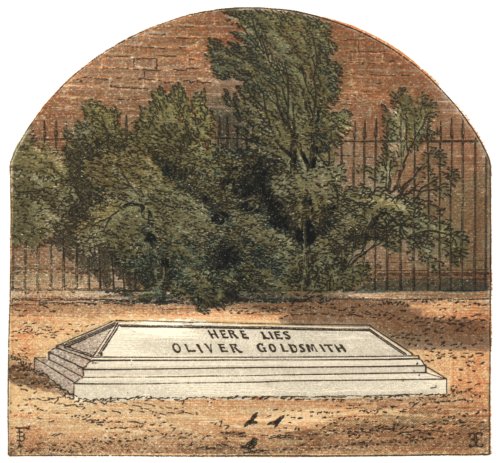
HERE LIES OLIVER GOLDSMITH