"The Colloquy of the Two Sages," edited by Dr.
Whitley Stokes from the Book of Leinster, p. 186a, is
one of the most archaic pieces in tone that have come
down to us. It represents the discussion between an
aged poet and a young aspirant as to the sources of
poetic inspiration, and shows us that the gifts of the
bard were highly regarded as the direct endowment of
the gods. Original in Rev. Celtique, No. xxviii. As in
the following poem, I have made use of the scribal glosses
or explanations wherever they seemed to throw light
upon the original.
"Amorgen sang." Professor John MacNeill has most
kindly made a fresh collation of the manuscripts containing
this obscure poem for my use. Parts, especially
from line 20 onward, are doubtful. I have incorporated
with the text such of the glosses as appear to make the
meaning more intelligible, but the glosses themselves
are mere scribes' guesses, often bad ones, at the sense
of a text they did not understand. This poem, though
ascribed to the earliest traditional poet of Ireland, is,
Prof. MacNeill considers, rather pseudo-archaic, than of
really great antiquity. The allusion to "Tetra's kine,"
which is explained in the gloss to mean "the fish of the
sea," alludes to Tetra as Ruler of the Ocean; in the
"Colloquy" we found him ruling in the assemblies of
the dead. The connection between the ocean and the
invisible world is constant in Irish tradition. The poem
appears to be an assertion of the Druid's powers, preparatory
to the incantation for good fishing which follows
immediately in most manuscripts. The final lines are
an inquiry into the origin of created things, matter on
which the bard or Druid claimed superior enlightenment.
"The Song of Childbirth" and the succeeding "Greeting
to the New-born Babe" are taken from the piece
known as "The Birth of Conchobhar" (Compert Conchobhar),
edited from Stowe MS. 992, by Prof. Kuno
Meyer in Rev. Celt. vi. pp. 173-182.
"What is Love?" From the story called the "Wooing
of Etain" (Tochmarc Etaine). Original in Irische
Texte, i. p. 124.
"Summons to Cuchulain." From the "Sickbed of
Cuchulain" (Serglige Conculaind). Original, ibid., p. 216.
Overcome with fairy spells, the hero lies fast bound in
heavy slumber; the song is an appeal to him to throw
off the charm and to arise.
"Laegh's Description of Fairy-land." From the same
story, ibid., p. 218. Laegh is Cuchulain's charioteer,
who went into fairy-land instead of his master, and
returns to extol its beauty.
"The Lamentation of Fand when she is about to leave
Cuchulain." From the dramatic incident in the same
story, in which Fand, Queen of Fairy-land, and Emer,
Cuchulain's mortal wife, struggle for the affection of the
hero, after Cuchulain's return from fairy-land. Each
woman fully recognises the nobility of the other; and
Fand's parting song, in which she restores him to Emer,
is one of lofty renunciation.
"Midir's Call to Fairy-land." From the story called
the "Wooing of Etain" (Tochmarc Etaine), ibid., p. 132.
"Song of the Fairies." From A. H. Leahy's Heroic
Romances of Ireland (D. Nutt, 1905), p. 29, taken from
the same tale. Etain was wife of Eochad (pron. Yochee),
King of Ireland, but Mider, King of Fairy-land, fell in
love with her. He won an entry into the palace by
playing chess with her husband, who demanded from
Mider as the stake for which they played that the fairy
hosts should clear away the rocks and stones from the
plains of Meath, remove the rushes which made the land
barren, build a causeway across the bog of Lamrach, and
perform other services useful to his realm. The song is
sung by the fairies while they are performing this heavy
task. The final stake is won by Mider, who asks Etain
as his prize.
"The Lamentation of Deirdre," when her husband and
two sons had been slain by King Conchobhar. She
recalls the happy days spent with her husband in Alba
or Scotland, on Lough Etive, and compares it to her
present misery in the house of the King. Original,
Irische Texte, i. pp. 77-81. In all the above poems there
are many difficult and obscure passages.
"Take my Tidings." A ninth century poem, edited
and translated by Dr. Kuno Meyer in his Four Songs
of Summer and Winter (D. Nutt, 1903), and by Dr.
Whitley Stokes in Rev. Celt. xx. p. 258. It is ascribed
to Fionn in the commentary on the "Amra Coluim
Cille." Mr. Graves' poem will be found in his Irish
Poems, i. p. 1 (Maunsel & Co., Dublin).
"Second Winter Song." Text and translation in Dr.
Kuno Meyer's Four Songs of Summer and Winter. A longer
poem on similar lines is to be found in the tale called the
"Hiding of the Hill of Howth," Rev. Celt. xi. p. 125,
reprinted in his Ancient Irish Poetry (Constable), p. 57;
but in the former version the complaint of the lazy servant-lad
is answered by a fine song in which Fionn praises
the signs of coming spring in earth and air.
"In Praise of May." Original and translation published
by Dr. K. Meyer from the tale called "The Boyish
Exploits of Finn" in Rev. Celt. v. p. 195. It is said to
have been composed by Fionn after he received inspiration
by eating the "Salmon of Knowledge" at the River
Boyne. Mr. Rolleston's poem is to be found in his
Sea-Spray (Maunsel, 1909).
"The Isle of Arran." The Arran here spoken of is the
Scottish island of that name. The Fianna were accustomed
to spend part of the autumn and winter hunting
in that island. The poem occurs in the long Ossianic
tract called "The Colloquy of the Ancients," published
by Standish Hayes O'Grady in Silva Gadelica (Williams
and Norgate, 1892). Text, p. 102; translation, p. 109.
"The Parting of Goll with his Wife." From Duanaire
Finn, edited by Prof. John MacNeill (Irish Texts Soc, vii.,
1908), pp. 23 and 121. Goll was leader of the Connaught
Fians and was opposed to Fionn, the chief of the Leinster
warriors. He is described as a man of lofty disposition
and great valour. In this poem he is standing, driven
to bay by his enemies, on a bare rocky promontory, his
wife only beside him, cut off from all hope of escape.
Few poems relating to Goll remain in Ireland, but a good
many survive in the Western Highlands of Scotland.
"Youth and Age." Ibid., pp. 80 and 194. It is Oisín
(Ossian) who here laments his departed youth.
"Chill Winter." From the "Colloquy of the Ancients,"
Silva Gadelica, text, p. 172; translation, p. 192.
"The Sleep-song of Grainne." From Duanaire Finn,
pp. 85 and 198. Dermot, who has carried off Grainne,
the wife of Fionn, is lying down to rest in the forest, when
Grainne hears the approach of their pursuers. She sings
over him this passionate lullaby, in which the restless
activities and foreboding terrors of the animal world are
aptly used to heighten the sense of their own danger.
"The slaying of Conbeg, Fionn's beloved hound."
Original in Gaelic Journal, ix. No. 104, Feb. 1899, p. 328;
the poem occurs in the "Colloquy of the Ancients,"
where the readings are slightly different (Silva Gadelica,
text, p. 143).
"The Fairies' Lullaby." Original in Waifs and
Strays of Celtic Tradition, Argyleshire Series, No. iv.
(David Nutt, 1891). It was collected in Argyleshire by
John Gregorson Campbell.
"The Lay of the Forest Trees." Original in Silva
Gadelica, i. p. 245; trans., ii. p. 278. This curious poem,
which contains much folklore regarding forest-trees,
arose out of the gathering of wood for a fire in the open
air, by a servant or "Man of Smoke," as he is called.
He accidentally threw upon it a block around which
woodbine had twined. This called forth a protest from
the onlookers, who declared that the burning of the
woodbine would certainly bring ill-luck.
"St. Patrick's Breastplate." See Dr. Kuno Meyer's
Ancient Irish Poetry (Constable), pp. 25-7. Original in
Stokes' and Strachan's Thesaurus Palaeohibernicus, ii.
p. 354. Probably eighth century.
"Patrick's Blessing on Munster," ninth century.
Original in Dr. Whitley Stokes' Tripartite Life of St.
Patrick, p. 216; literal translation in Dr. Kuno Meyer's
Ancient Irish Poetry, p. 29. The present poetic rendering,
kindly contributed to my book by Mr. A. P. Graves, has
not hitherto been published.
"Columcille's Farewell to Aran." See Dr. Douglas
Hyde's Three Sorrows of Story-telling (T. Fisher Unwin,
1895), pp. 146-8.
"Columba in Iona." Printed in William Skene's
Celtic Scotland, ii. p. 92, from an Irish manuscript in the
Burgundian Library, Brussels. It bears the ascription
"Columcille fecit," and was transcribed and translated
by O'Curry for Dr. Todd. Many poems are ascribed to
the Saint, but the language of most of them is later than
his time.
"Hymn to the Dawn." From Silva Gadelica, by
Standish Hayes O'Grady (Williams & Norgate); original,
vol. i. p. 56; literal trans., ii. p. 59. The hymn was
composed by St. Cellach on the morning on which he
was slain by his old friends and fellow-students, who had
been bought over to destroy him.
"The Song of Manchan the Hermit." Original in
Ériu, i. p. 39. A ninth century poem, with translation
by Dr. Kuno Meyer.
"A Prayer." Original and literal translation by Miss
Mary E. Byrne in Ériu, ii., Part i. p. 89.
"The Loves of Liadan and Curithir." This touching
poem illustrates the tyrannical use sometimes made of
their authority by the monks of the ancient Irish Church.
St. Cummine, who was the confessor or "soul-friend"
of the lovers, seems to have been a hard and censorious
man. He lived in the first half of the seventh century.
The poem, as we have it, is of the ninth century. Edited
with translation by Dr. Kuno Meyer (D. Nutt, 1902).
The love song has been reprinted in his Ancient Irish
Poetry.
"The Lay of Prince Marvan." This song takes the
form of a colloquy between Marvan, who had left his
royal station to adopt a hermit life, and his brother
King Guaire of Connaught (d. 662). Guaire, visiting
him in his retirement, inquires why he prefers to sleep
in a hut rather than in the comfort of a kingly palace;
in reply Marvan bursts forth into a song in praise of
his retired woodland life. Original in King and Hermit,
edited by Dr. Kuno Meyer (D. Nutt, 1901); translation
reprinted in Ancient Irish Poetry, p. 47.
"The Song of Crede." Text and translation in Ériu, ii.
p. 15; its editor, Dr. Kuno Meyer, ascribes it to the tenth
century. I have to thank Mr. A. P. Graves for most
kindly giving me permission to use his unpublished poem.
"The Student and his Cat," eighth or ninth century.
Written on the margin of a codex of St. Paul's Epistles,
in the monastery of Carinthia. Original and translation
in Stokes' and Strachan's Thesaurus Palaeohibernicus, ii.
p. 293.
"Song of the Seven Archangels." Original in Ériu, ii.,
Part i. pp. 92-4, with literal translation by Thomas
P. O'Nowlan. Mr. Ernest Rhys' poetical version, kindly
contributed by him to this book, has not hitherto been
published.
"Saints of Four Seasons." Original in Ériu, i., Part ii.
pp. 226-7, with translation by Miss Mary E. Byrne.
Mr. P. J. McCall's poetical version is printed in his Irish
Fireside Songs (M. H. Gill, Dublin, 1911).
"The Feathered Hermit." Original printed by Dr.
K. Meyer in Gaelic Journal, iv., No. 40, February 1892,
from a marginal note on Harl. MS. 5280 (Brit. Mus.).
"An Aphorism." Ibid.; also from a marginal note.
"The Blackbird." Marginal note from a copy of
Priscian in the monastery of St. Gall in Switzerland.
Original in Stokes' and Strachan's Thesaurus Palaeohibernicus,
p. 290.
"Deus Meus." Printed by Dr. Whitley Stokes in the
Calendar of Ængus, clxxxv. It is found written on the
margin of the Leabhar Breac, facs., p. 101, and is there
ascribed to Maelisu ua Brolcan (d. 1086). Dr. George
Sigerson's poetical rendering will be found in his Bards
of the Gael and Gall (T. Fisher Unwin, 1897), p. 193.
"The Soul's Desire." Original and literal translation by
Dr. Kuno Meyer in the Gaelic Journal, vol. v., No.6,
1894, p. 95. Though printed from comparatively late
copies, the hymn gives the impression of being ancient.
"Song of the Sea." Original and literal translation by
Dr. Kuno Meyer in Otia Merseiana (Liverpool), ii. p. 76.
It is ascribed to the poet Ruman, who died 707, but the
editor believes it to be of the eleventh century.
"Lament of the Old Woman of Beare." From Dr.
Kuno Meyer's text and translation in Otia Merseiana, i.
p. 119 ff. It has since been reprinted in the author's
Selections from Early Irish Poetry, pp. 88-91. The editor
would put the poem down to the late tenth century.
"Gormliath's Lament for Nial Black-knee." From
the Scottish Book of the Dean of Lismore, edited by Rev.
Thos. M'Lauchlan.
"The Mother's Lament." First printed by Rev.
Edmund Hogan in his Latin Lives of the Irish Saints
(Todd Lectures, V., 1894); see also Gaelic Journal, iv.
p. 89, and Kuno Meyer's Ancient Irish Poetry, p. 42.
Eleventh century? Mr. Graves has kindly given me
permission to use his excellent unpublished version.
"Consecration." Original from the Book of the Dean
of Lismore, a collection of poems made in the Western
Islands about 1512 by Sir James McGregor, Dean of
Lismore, Argyleshire, p. 121. It contains many Irish
poems. This and the two following poems are ascribed
to Murdoch O'Daly, called "Muredach Albanach," or
Murdoch the Scot, on account of his long residence in
that country. He is styled "Bard of Erin and Alba."
He was a Connaught poet, who ended a stormy career
by retiring to the Irish monastery of Knockmoy. It is
probable that these religious poems, if not actually
written by him, were composed about his period.
"Teach me, O Trinity," ibid., p. 123.
"The Shaving of Murdoch," ibid., p. 158 note, from a
translation made by Standish H. O'Grady. This curious
poem refers to the tonsuring of the bard and his contemporary
Connaught chieftain, Cathal of the Red Hand,
when they entered the monastery of Knockmoy together.
In Scotland Murdoch is remembered as the first of the
Macvurrachs, bards to the Macdonalds of Clanranald.
He lived 1180-1225, and Cathal of the Red Hand, 1184-1225.
"Eileen Aroon." Original in Hardimen, i. p. 264; it
should be compared with the version, ibid., p. 211. The
present is the oldest form. Carol O'Daly, who composed it,
was an accomplished Connaught gentleman, whose desire
to marry Eileen Kavanagh was frustrated by her friends.
He fled the country, but returned, disguised as a harper,
on the eve of her marriage to another suitor, and entered
the guest-chamber. He poured out this impassioned
appeal with such good effect, that Eileen fled with him
that night. The last lines are a welcome to her in response
to her avowal of love. The air is very ancient;
in Scotland it is known as "Robin Adair."
"The Downfall of the Gael." Original in Hardiman's
Irish Minstrelsy, ii. p. 102. O'Gnive, bard of the O'Neills
of Clandaboy, accompanied Shane O'Neill to London in
1562, on the occasion of that chief's visit to Queen Elizabeth.
The poem is a lament over the condition of Ireland
and the inaction of the chiefs. Sir Samuel Ferguson's
rendering will be found in Lays of the Western Gael
(Sealy, Bryers & Walker, 1888), p. 136.
"Address to Brian O'Rourke of the Bulwarks" (na
murtha), a poem of seventy quatrains from Egerton MS.
iii., art. 85. Dr. Standish Hayes O'Grady has given
specimens of this poem in his valuable Catalogue of Irish
MSS. in the British Museum, pp. 412-20. Another poem
addressed to the same chief will be found in Hardiman,
ii. pp. 266-305, by John mac Torna O'Mulchonaire.
The writer of the present poem, Teigue O'Higgin, called
Teigue "Dall," i.e. the Blind, on account of his blindness,
is one of the best of all the tribal poets of Ireland. He
was poet to the chiefs of Co. Sligo, but he came to an
untimely end on account of a satire made by him on the
O'Haras, who had ill-used him, some time before 1617.
In the poem we give, he endeavours to arouse Brian to
action, and calls on him to unite the clans against England,
a challenge which O'Rourke did not fail to obey.
It is a good sample of much bardic poetry of the period.
"Ode to the Maguire," by Eochadh O'Hosey or Hussey,
the last bard of the Maguires, whose strongly fortified
castle still frowns upon the waters of the Upper and
Lower Lochs Erne, at Enniskillen, Co. Fermanagh. His
young chief, Hugh Maguire, had marched into Munster
in the depth of the winter of 1599-1600, with 2500 foot
and 200 horse on a warlike foray; the bard, sitting at
home in Fermanagh, bewails the hardships which he feels
sure the chief and his followers are enduring in the open
camps during the winter's weather. A fine copy of this
poem is found in the O'Gara manuscript in the Royal
Irish Academy, Dublin, of which Egerton III is a copy
(and see O'Grady's Catalogue, p. 451).
"A Lament for the Princes of Tyrone and Tyrconnel,"
by the family bard, Red Owen Mac Ward, in the form of
an address of comfort to O'Donnell's sister, Nuala, who
is supposed to be weeping over her brother's grave in
Rome, where he had taken refuge after his flight from
Ireland. He lies buried, beside Hugh O'Neill, in the
Church of San Pietro Montario, on the Janiculum. The
bard imagines the clans of the North of Ireland gathering
to bewail the dead and share Nuala's grief. Though
Mangan's broken metre imparts a fervour and fire to the
original, he adds nothing to its slow monotonous impressiveness.
For original see Egerton III, Art. 48
(Brit. Mus.), and translation of extracts in O'Grady's
Catalogue, pp. 371-3. Mangan's version has been often
reprinted.
"Co. Mayo." There are many versions of this favourite
song. That given here is said to have been composed by
a bard named Thomas Flavell, a native of Bophin on the
Western Seaboard. Hardiman gives the Irish of this
song, i. p. 337; and also another version by David
O'Murchadh, or Murphy, ibid., pp. 229-33. Flavell was a
poor dependent on the fourth Earl of Mayo, and lived
about the middle of the seventeenth century. For a
different song of the same name, see Dr. Hyde's Poems of
Raftery, p. 96.
"The Flower of Nut-brown Maids" is the oldest of
the numerous songs written to the air "Uileacán Dubh O."
This poem dates from the seventeenth century, and it is
said to be an invitation addressed by one of the unfortunate
landowners, driven out of Ulster during the plantation
of James I, to his lady, to follow him to Leitrim. It
seems to refer to a time of famine, and is, like many other
love-songs, in the form of a colloquy. Original in Hardiman,
i. p. 258.
"Roisín Dubh," from the original in O'Daly's Poets
and Poetry of Munster, where two versions are given.
It is the poem on which Mangan founded his "Dark
Rosaleen." The poem is an address to Ireland, veiled as
a woman. Hardiman gives some quatrains in vol. i.
pp. 254-61.
"The Fair Hills of Éire" is one of several sets of words
attached to the tender old air "Uileacán Dubh O," or
"Oh, the heavy lamentation." One, rendered familiar
in Dr. Samuel Ferguson's version, beginning, "A plenteous
place is Ireland for hospitable cheer," is said to have been
written by an Irish student in one of the colleges of
France probably early in the seventeenth century, when
most of the promising Irish youths went abroad for their
education. The version here given in Dr. Sigerson's fine
rendering was written by Donnchad Ruadh MacNamara
about 1730. It has also been rendered into English by
Mangan. For the original, see Poems by Donnchadh
Ruadh MacNamara, edited by Tomás O'Flanngháile
(1897). Dr. George Sigerson's poem will be found in his
Bards of the Gael and Gall (T. Fisher Unwin, 1897), p. 245.
"Love's Despair" (ibid., p. 339). This touching poem
was written by a young farmer of Cork who, near the
time of his marriage, had gone into the city to buy the
wedding-dress for his betrothed. On his way back he
heard that she had been married to another man. In
despair he flung his presents into the fire. His reason
gave way, and he roamed the country henceforth, ever
singing the cruelty of Mary and his own misfortunes. His
story was well known in Co. Waterford, where he lived
a great part of his life. Original in Gaelic Journal, vol. iii.,
1887, p. 22.
The literal translation of the second stanza runs as
follows:—
"No one knows my case, or how I may find life,
But only the woman who has made me ill;
My cure is not on sea or shore, nor in herb or skill of hand,
My cure is only in the Flower of Youth.
I know not hen from cuckoo, I know not heat from cold,
At no time do I know my friends;
I know not night from day,—but my heart would know its love,
Should she come in time to save me."
"The Cruiskeen Lawn." Dr. Sigerson's version (ibid.,
p. 258), here reproduced, shows that this popular air,
better known in connection with O'Keeffe's rollicking
drinking song, was also used as a Jacobite political poem.
The chorus and name of the air, i.e. "The little full jug,"
show that its true intent is bacchanalian. We find this
chorus, like many others, attached to songs of different
significance. Petrie, in his collection of Ancient Irish
Music, p. 37, attaches it to a verse of a lullaby:—
"My love is upon the river,
And he rocking from wave to wave;
A tree without foliage over his head—
And what does my Love want a-straying there?"
(see also Gaelic Journal, viii., 1898, p. 224).
"Eamonn an Chnuic" or "Ned of the Hill" is founded
on the history of a famous outlaw named Edmund O'Ryan,
born in Shanbohy, Co. Tipperary, late in the seventeenth
century. His father possessed considerable property in
his native county, but his wild career led to his outlawry.
The piercing note of the words and of the air of the same
name is typical of much of the poetry of the period.
"Ned of the Hill" lies buried near Fáill an Chluig in the
barony of Kilnemanagh, Co. Tipperary. Some versions
give several other verses, of a different character. It is
a love-song as given by Hardiman, "A chúil áluinn
deas," i. p. 268, and by Mangan in his Poets and Poetry
of Munster, p. 264. The literal translation here printed is
from Mr. P. H. Pearse's contributions in the Irish Review,
Dublin (November 1911), p. 437. Mr. Pearse says,
"'Eamonn an Chnuic' is commonly looked upon as a
love-song, but I feel sure that to its shaper and to those
who first heard it, the figure of the outlaw, driven by
rain-storm and bullet-storm and beating against the
closed door, mystically symbolised the lonely cause of
Ireland."
"O Druimin donn dileas," an early Jacobite song,
sometimes supposed to apply to Prince James Charles
Edward, but more probably to Ireland itself under the
symbolic name of the "Beloved white-backed dun cow."
Original in Hardiman, ii. p. 145. See also in Petrie's
Ancient Music of Ireland, p. 116, a translation by O'Curry.
"Do you remember that night?" Original in Petrie's
Ancient Music of Ireland, p. 142. He says it was written
down for him by O'Curry. The account given by him
of its origin does not seem to suit the words.
"The Exile's Song." Original in Gaelic Journal,
vol. vi., No. 7, 1895, p. 108. Composed by an emigrant
named M'Ambrois (Mac Cambridge), and taken down
from James M'Auley of Glengariff and James M'Naughten
of Cushendall.
"The Fisherman's Keen." From Crofton Croker's
The Keen in the South of Ireland (Percy Society, 1844),
p. 77. It was communicated to Mr. Croker by Mr.
Maurice O'Connell. A literal translation, taken down
from the lips of Mrs. Harrington, a professional "keener"
of Co. Cork, is given in the same author's Researches in
the South of Ireland. Unfortunately the original Irish is
not preserved by him, nor is the name of the lady given
who, he tells us, wrote the poetical rendering.
"The Boatman's Hymn." Taken from Sir Samuel
Ferguson's Lays of the Western Gael, 1888, pp. 162-3.
Original in Hardiman, ii. p. 383.
"Keen on Art O'Leary" by his wife. Original published
in Mrs. Morgan J. O'Connell's The Last Colonel of
the Irish Brigade (Kegan Paul, 1892), vol. ii., Appendix A.,
and reprinted with some corrections in the Gaelic Journal
(vol. vii., Old Series, No. 74, May 1896), p. 18. Some
corrections and additions are made in the following
number (June 1896). Crofton Croker, in his Keens of
the South of Ireland, tells us that he endeavoured to
recover this dirge but without success. It is a true
example of the spontaneous "keen," with its short
broken lines, containing in quick, natural succession,
appeals, reminiscences, laments; moving backwards and
forwards as the irregular promptings of grief and affection
dictate without form or premeditation. It is, however,
lifted into the sphere of fine poetry by its exceeding
simplicity, and by the passion of grief expressed in its
lines.
The circumstances in which the poem had its origin
are particularly tragic. Art O'Leary had been an officer
in the Hungarian service, but he returned to Ireland,
where he had a considerable property in Co. Cork, and
where his handsome person and distinguished manners
made him very popular. He married, against the wish
of her parents, Eileen of the Raven Locks, as she was
called from her dark hair, a daughter of Daniel O'Connell
of Derrynane, grandfather of "the Liberator." The
popularity of Art O'Leary excited the jealousy of a
neighbour, a Mr. Morris, whose horse had been beaten
in a race by O'Leary's beautiful mare. Taking advantage
of the Penal Laws, which did not permit a Catholic to
possess a horse valued at more than £5, he demanded
the mare from Capt. O'Leary for this sum. O'Leary
refused, saying that he "would surrender his mare only
with his life." A local magistrate immediately proclaimed
him an outlaw; soldiers were sent to lie in wait for him
as he was returning home at night, and he was shot
through the heart near Carrig-a-nimmy, in May 1773.
His wife was informed of her husband's death by the
return of the mare without its rider. It was many years
before his body was even allowed to be buried in consecrated
ground. Morris was tried for the murder, but
acquitted; he was soon after shot in his house by Arthur's
brother. Art O'Leary's grave is to be seen in the nave
of Kilcrea Abbey, Co. Cork; the inscription states that
he was only twenty-six years of age when he died.
"Prologue to 'The Midnight Court'" (Cuirt an
Mheadhon Oidhche), by Bryan Merryman. The long satire
of which we give the Prologue has been published by
Mr. Richard Foley (Riscard O Foghludha) (Hodges,
Figgis & Co.).
"Hymn to the Virgin Mary." Original in The Poems
of Egan O'Rahilly (1st ed., Irish Texts Society, vol. iii.,
1900), p. 290. The author, Conchubhar or Conor
O'Riordan was a native of Co. Cork, where he taught
the classics and other subjects to the youths of his
district. He wrote, about the same time as Gray, a
"Meditation in a Country Churchyard," to which this
very beautiful address to the Virgin forms the Epilogue
or "Binding" (ceangal as it is called in Irish). The
whole poem is included in the appendix to Rev. P. S.
Dinneen's edition of O'Rahilly's poems.
"Christmas Hymn." Original in Dr. Douglas Hyde's
Religious Songs of Connacht (T. Fisher Unwin, 1906),
vol. ii. pp. 224-6; from an old North of Ireland
manuscript.
"O Mary of Graces." Ibid., p. 161. Taken down by
Miss Agnes O'Farrelly from a lad in the Aran Islands,
Co. Galway.
"The Cattle-shed." Original in Timthirid Chroidhe
neamhtha Iosa or The Messenger (published by Gill & Son,
Dublin), p. 90. The following nine poems and fragments
are from the same publication, vol. i., Parts 1-4.
"The White Paternoster." Ibid., p. 58. The two versions
of this favourite charm here given, of which the
second is translated from the original in a Kerry journal,
An Lochran (October 1900), should be compared with the
copies printed by Dr. D. Hyde in his Religious Songs,
vol. i. pp. 362-70.
"A Night Prayer." This fragment and the eleven
succeeding prayers were taken down in Irish among the
Decies of Co. Waterford by Rev. M. Sheenan, D.Ph., and
have been published by him in his Cnó Cóilleadh Craobhaighe
(Gill & Son, Dublin, 1907).
"The Man who Stands Stiff." From Dr. D. Hyde's
Religious Songs of Connacht, vol. i. p. 101, taken down
from the mouth of Martin Rua O'Gillarna (in English,
Red Martin Forde) of Lisaniska, Co. Galway. He spoke
no English. This poem is a sample of much of the popular
religious poetry dealing with the approach of death and
the danger of continuing in evil courses.
"Charm for a Sprain." This and the succeeding
charms are taken from Lady Wilde's Legends, Charms,
and Cures of Ireland (Chatto & Windus). It is unfortunate
that Lady Wilde does not give either her originals
or her authorities.
"Before the sun rose at yesterdawn." Original in
Walsh's Irish Popular Songs, 2nd ed. (Gill & Son, Dublin),
p. 146. Edward Walsh, who translated into English
verse a great number of Irish popular songs, lived between
the years 1805-50.
"The Blackthorn." One of those favourite old songs
of which there are many versions, and verses in one that
are not in another. Like many another Irish song, it
seems to be a colloquy between a maid and her lover,
and it is often difficult to tell if it is the lad or the girl
who is speaking. My version is the one printed in Miss
Borthwick's Ceól Sidhe, ii. p. 18 (an excellent collection
of old Irish songs), with two verses added from the version
in Dr. D. Hyde's Love-Songs of Connacht (T. Fisher Unwin,
1893), p. 30. The poem is sad and troubled. Dr. Hyde
says, "There was an old woman in it, long ago, who used
to sing it to me, and she never came to the verse—
'Although the rowen-berry tree is high, &c.,'
that she used not to shed tears from her eye." We can
well believe it. Hardiman (i. p. 234) has published a
different version, and Miss Brooke another in her Reliques
(1816), p. 306.
"Pastheen Finn," or "Fair little Child." Original in
Hardiman's Irish Minstrelsy, i. p. 217. Dr. Hyde gives
a quite different version in his Love-Songs, p. 65. We
find the curfa or chorus attached to different songs. Sir
Samuel Ferguson's version will be found in his Lays of
the Western Gael (Sealy, Bryers, Dublin, 1888), p. 152.
Hardiman considers that it is an address to the son of
James II, under a secret name.
"She." Original in Miss Brooke's Reliques of Irish
Poetry, p. 232.
"Hopeless Love." Given as an example of an old
Irish metre called Dibide baise fri toin, but this poem
was not actually written in this metre.
"Would God I were." Original in Hardiman, i. p. 344.
Mrs. Hinkson's setting of the Irish words will be found in
her Irish Love-Songs (T. Fisher Unwin, Cameo Series,
1892).
"Branch of the sweet and early rose." William
Drennan, M.D. (b. 1754), died in Belfast in 1820.
"'Tis a Pity." Original in Cláirseach na n-Gaedhil,
Part ii., 1902 (Gaelic League Publications). Ceól-sídhe
(p. 92) gives a different version. There are several other
verses.
"The Yellow Bittern" (An bunán buidhe). Original
in Cláirseach na n-Gaedhil, Part v., and Ceól-sídhe, p. 12.
This translation appeared in the Irish Review, Dublin,
November 1911.
"Have you been at Carrack?" Original in Mangan's
Poets and Poetry of Munster (J. Duffy), p. 344. Walsh
thinks it is a song from the South of Ireland.
"Cashel of Munster." There are various versions of
this popular song, set to its air "Clár bog déil." One
used by Walsh was, he tells us, given to him by a lady
of Co. Clare. Ferguson's version is taken from Hardiman,
i. p. 238.
"The Snowy-breasted Pearl." Original in Petrie's
Ancient Music of Ireland, p. 11. Petrie was born in
Dublin in 1789 and died in 1866.
"The Dark Maid of the Valley" (Bean dubh an Gleanna).
There are two versions and airs of this name. The original
of Mr. P. J. McCall's poem is to be found in Miss Brooke's
Reliques, p. 319. His own rendering was published in
his Irish Nóinins (Sealy, Bryers & Walker, 1894), p. 59.
"The Coolun." Original in Hardiman, i. p. 250. Two
other versions will be found in Dr. Hyde's Love-Songs of
Connacht (1893), pp. 71-3. One of these beginning, "A
honey mist on a day of frost, in a dark oak wood" is
very tender and sweet. Its air is among the most beautiful
that Ireland has produced. The "Coolun" was a
lock of hair which, having been forbidden by statute, it
became a mark of national sentiment to adopt. It was
usually worn by youths, but in these poems the address
is to a woman.
"Ceann dubh dileas," or the "Beloved Dark Head."
Original in Hardiman, i. p. 262. Dr. Hyde gives an
additional verse in his Love-Songs. Burns claimed the
air for Scotland, and Corri published it under the name
of "Oran Gaoil," but it is undoubtedly Irish.
"Ringleted Youth of my Love." From Dr. Hyde's
Love-Songs of Connacht (T. Fisher Unwin, 1893), p. 40.
"I shall not die for you." Original, ibid.. p. 138.
"Donall Oge." This pathetic song and the one following
it, "The Grief of a Girl's Heart," seem to be portions
of one long song, to the original nucleus of which quatrains
have been added from time to time. Six stanzas were
published by Dr. Hyde in his Love-Songs (pp. 4-6) under
the title, "If I were to go West"; it would seem that
his "Breed Astore" (p. 76) may also be a portion of the
same poem. Mr. P. H. Pearse, who published several
other stanzas under the title of "Donall Oge," or "Young
Donall," in the Irish Review of August 1911, tells us that
he wrote it down from the words of Denis Dorgan of
Carrignavar, Co. Cork. The Irish will be found printed
in his and Mr. Tadhg O'Donoghue's An t-Aithriseóir
(Gaelic League, 1902), p. 7. In all these versions there
are some stanzas alike and some different to the others.
We have printed nearly the whole of them here under
the two titles of "Donall Oge" and "The Grief of a
Girl's Heart." Both are full of the most heartrending
expression of loss and loneliness. Lady Gregory, in her
Poets and Dreamers, published a literal translation of the
latter poem.
"Death the Comrade." Original in Dr. Hyde's
Religious Songs, ii. pp. 288-90.
"Muirneen of the Fair Hair." Original in Dr. Hyde's
Love-Songs, pp. 10-12. Cf. another Munster version on
p. 16, and one given by Hardiman, i. p. 354.
"The Red Man's Wife." A popular theme on which
there are many variations. We give two, the originals
of both being taken from Dr. Hyde's Love-Songs, pp. 92
and 94. The first is a Galway version, the second from
Co. Meath. The latter was first printed in the Oban
Times. Yet another version is given in Dr. Hyde's
edition of Raftery's Poems, p. 210.
"My Grief on the Sea." Original in Dr. Hyde's Love-Songs.
It was taken down by him from an old woman
named Biddy Cusruaidh or Crummy, living in the midst
of a bog in Co. Roscommon.
"Oró Mhór, a Mhóirín." Original in Petrie's Ancient
Music of Ireland, p. 120. It was obtained by him from
Teigue MacMahon, a peasant of Co. Clare. Mr. P. J.
McCall's poem was printed in his Pulse of the Bards (Gill
& Son, 1904), p. 50.
"The Little Yellow Road." Original taken down by
Prof. John MacNeill in Co. Mayo in July 1894, and printed
by him in the Gaelic Journal for that year (vol. v., No. 6),
p. 91. There are several versions of An Bóithrín buidhe;
see for another, Petrie's Ancient Music, p. 24. Mr. Campbell's
translation, kindly contributed to this collection,
has not been published before.
"Reproach to the Pipe" (Másladh an Phíopa). The
original, taken down in Galway, will be found in the
Gaelic Journal (vol. vi., No. 5), p. 73.
"Modereen Rue." Mrs. Tynan-Hinkson's poem is not
a direct translation, but a spirited free version of the
favourite Gaelic song of this name; it was published in
The Wind in the Trees (Grant Richards, 1898), p. 98.
"The Stars Stand Up" (Táid na realta 'n-a seasadh ar
an aer). Original in Ceól-sídhe, Part iv., p. 50, among
other places. I have altered the last four lines.
"The Love Smart." Original in Dr. Hyde's Love-Songs,
p. 22.
"Well for Thee." Original, ibid., p. 130.
"I am Raftery the Poet." From Dr. Hyde's edition
of Raftery's Poems (H. M. Gill & Son, Dublin, 1903), p. 40.
"Dust hath closed Helen's eye." Original, ibid., p. 330.
Mr. W. B. Yeats has slightly worked over Lady Gregory's
rendering. Mary Hynes, who "died of fever before the
famine," has left a tradition of beauty behind her in her
own country. "She was the finest thing that was ever
shaped," said an old fiddler who remembered her well.
Baoile laoi (Ballylee) is a little village of some half-dozen
houses in the barony of Kiltartan. Lady Gregory's
beautiful rendering was published in an article by Mr.
W. B. Yeats in The Dome, New Series, vol. iv. p. 161.
"The Shining Posy" or "Mary Stanton," ibid., p. 320.
We must remember that poor Raftery, who praises so
warmly the beauty of women, saw them only with the
eyes of his imagination, for he was blind. His verses
seem to have been impromptu compositions. The classical
allusions are very characteristic of the wandering bards,
who liked to show off their acquaintance with the heroes
of bygone ages.
"Love is a Mortal Disease" (Is claoidhte an galar an
grádh). Original in Smoílín na Rann, a collection of
Connaught songs made by Mr. Fionan McCollum, "Finghin
na Leamhna" (Gaelic League, 1908).
"I am watching my young calves sucking." This
and the two following poems, "The Narrow Road" and
"Forsaken," are translated from Dr. Douglas Hyde's
little collection of original Irish songs called Ubhla de'n
Chraoibh, or Apples of the Bough (Gill & Son, Dublin).
"I Follow a Star." Translated by Seosamh mac
Cathmhaoil (James Campbell) from his own Irish poem,
and published by him in The Gilly of Christ (Maunsell
& Co., Dublin).
"Nurse's Song." Published by Mr. Alfred M. Williams
in his The Poets and Poetry of Ireland (Houghton, Mifflin
and Co., Boston and New York). The song is traditional,
and its author is unknown.
"A Sleep Song." Original in Gaelic Journal, May
1911, p. 141. The song was partly taken down from
Mr. McAuley Lynch in West Cork, and partly recollected
from childhood by Mr. P. H. Pearse, the translator.
"The Cradle of Gold." From Mr. Alfred P. Graves'
Irish Poems, ii. p. 117 (Maunsel & Co.). Original in
Petrie's Ancient Music of Ireland, p. 146.
"Rural Song." Original in Petrie's Ancient Music of
Ireland, p. 43. Joyce's Irish Music gives some extra
stanzas.
"Ploughing Song." Original, ibid., p. 30.
"A Spinning-wheel Ditty." Ibid., p. 85.
THE END
Printed by Ballantyne, Hanson & Co.
at Paul's Work, Edinburgh
Transcriber's notes:
Inconsistent use of accents across text, titles and poems in the original has been retained.
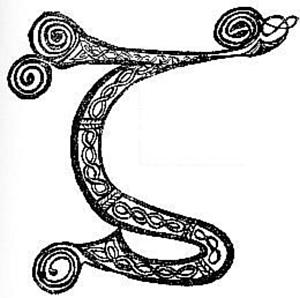
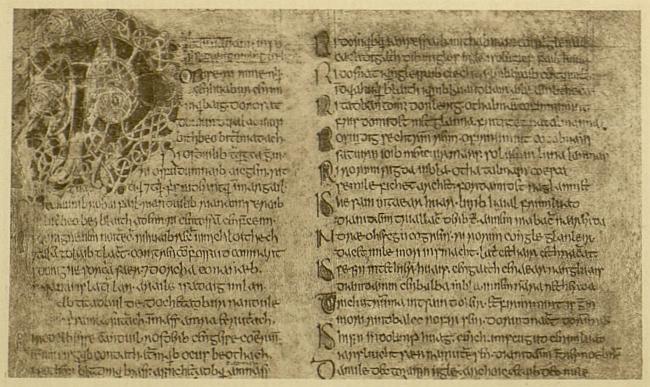 Opening passage of the "Saltair na Rann."