THE ARGUMENT FROM GEOLOGY.
1. I have endeavored to explain that, according to the discoveries of
geologists, the masses of which the surface of the earth is composed,
exhibit indisputable evidence that, at different successive periods, the
land and the waters which occupy it, have been inhabited by successive
races of plants and animals; which, when taken in large groups,
according to the ascending or descending order of the strata, consist of
species different from those above and below them. Many of these groups
of species are of forms so different from any living things which now
exist, as to give to the life of those ancient periods an aspect
strangely diverse from that which life now displays, and to transfer us,
in thought, to a creation remote in its predominant forms from that
among which we live. I have shown also, that the life and successive
generations of these groups of species, and the events by which the
rocks which contain these remains have been brought into their present
situation and condition, must have occupied immense intervals of
time;—intervals so large that they deserve to be compared, in their
numerical expression, with the intervals of space which separate the
planets and stars from each other. It has been seen, also, that the best
geologists and natural historians have not been able to devise any
hypothesis to account for the successive introduction of these new
species into the earth's population; except the exercise of a series of
acts of creation, by which they have been brought into being; either in
groups at once, or in a perpetual succession of one or a few species,
which the course of long intervals of time might accumulate into groups
of species. It is true, that some speculators have held that by the
agency of natural causes, such as operate upon organic forms, one
species might be transmuted into another; external conditions of
climate, food, and the like, being supposed to conspire with internal
impulses and tendencies, so as to produce this effect. This supposition
is, however, on a more exact examination of the laws of animal life,
found to be destitute of proof; and the doctrine of the successive
creation of species remains firmly established among geologists. That
the extinction of species, and of groups of species, may be accounted
for by natural causes, is a proposition much more plausible, and to a
certain extent, probable; for we have good reason to believe that, even
within the time of human history, some few species have ceased to exist
upon the earth. But whether the extinction of such vast groups of
species as the ancient strata present to our notice, can be accounted
for in this way, at least without assuming the occurrence of great
catastrophes, which must for a time, have destroyed all forms of life in
the district in which they occurred, appears to be more doubtful. The
decision of these questions, however, is not essential to our purpose.
What is important is, that immense numbers of tribes of animals have
tenanted the earth for countless ages, before the present state of
things began to be.
2. The present state of things is that to which the existence and the
history of Man belong; and the remark which I now have to make is, that
the existence and the history of Man are facts of an entirely different
order from any which existed in any of the previous states of the earth;
and that this history has occupied a series of years which, compared
with geological periods, may be regarded as very brief and limited.
3. The remains of man are nowhere found in the strata which contain the
records of former states of the earth. Skeletons of vast varieties of
creatures have been disinterred from their rocky tombs; but these
cemeteries of nature supply no portion of a human skeleton. In earlier
periods of natural science, when comparative anatomy was as yet very
imperfectly understood, no doubt, many fossil bones were supposed to be
human bones. The remains of giants and of antediluvians were frequent in
museums. But a further knowledge of anatomy has made it appear that such
bones all belong to animals, of one kind or another; often, to animals
utterly different, in their form and skeleton, from man. Also some
bones, really human, have been found petrified in situations in which
petrification has gone on in recent times, and is still going on. Human
skeletons, imbedded in rocks by this process, have been found in the
island of Guadaloupe, and elsewhere. But this phenomenon is easily
distinguishable from the petrified bones of other animals, which are
found in rocks belonging to really geological periods; and does not at
all obliterate the distinction between the geological and the historical
periods.
4. Indeed not bones only, but objects of art, produced by human
workmanship, are found fossilized and petrified by the like processes;
and these, of course, belong to the historical period. Human bones, and
human works, are found in such deposits as morasses, sand-banks,
lava-streams, mounds of volcanic ashes; and many of them may be of
unknown, and, compared with the duration of a few generations, of very
great antiquity; but such deposits are distinguishable, generally
without difficulty, from the strata in which the geologist reads the
records of former creations. It has been truly said, that the geologist
is an Antiquary; for, like the antiquary, he traces a past condition
of things in the remains and effects of it which still subsist; but it
has also been truly said, at the same time, that he is an antiquary of
a new Order; for the remains which he studies are those which
illustrate the history of the earth, not of man. The geologist's
antiquity is not that of ornaments and arms, utensils and habiliments,
walls and mounds; but of species and of genera, of seas and of
mountains. It is true, that the geologist may have to study the works of
man, in order to trace the effects of causes which produce the results
which he investigates; as when he examines the pholad-pierced pillars of
Pateoli, to prove the rise and the fall of the ground on which they
stand; or notes the anchoring-rings in the wall of some Roman edifice,
once a maritime fort, but now a ruin remote from the sea; or when he
remarks the streets in the towns of Scania, which are now below the
level of the Baltic,[1] and therefore show that the land has sunk since
these pavements were laid. But in studying such objects, the geologist
considers the hand of man as only one among many agencies. Man is to him
only one of the natural causes of change.
5. And if, with the illustrious author to whom we have just referred,[2]
we liken the fossil remains, by which the geologist determines the age
of his strata, to the Medals and Coins in which the antiquary finds the
record of reigns and dynasties; we must still recollect that a Coin
really discloses a vast body of characteristics of man, to which there
is nothing approaching in the previous condition of the world. For how
much does a Coin or Medal indicate? Property; exchange; government; a
standard of value; the arts of mining, assaying, coining, drawing, and
sculpture; language, writing, and reckoning; historical recollections,
and the wish to be remembered by future ages. All this is involved in
that small human work, a Coin. If the fossil remains of animals may (as
has been said) be termed Medals struck by Nature to record the epochs of
her history; Medals must be said to be, not merely, like fossil remains,
records of material things; they are the records of thought, purpose,
society, long continued, long improved, supplied with multiplied aids
and helps; they are the permanent results, in a minute compass, of a
vast progress, extending through all the ramifications of human life.
6. Not a coin merely, but any, the rudest work of human art, carries us
far beyond the domain of mere animal life. There is no transition from
man to animals. No doubt, there are races of men very degraded,
barbarous, and brutish. No doubt there are kinds of animals which are
very intelligent and sagacious; and some which are exceedingly disposed
to and adapted to companionship with man. But by elevating the
intelligence of the brute, we do not make it become the intelligence of
the man. By making man barbarous, we do not make him cease to be a man.
Animals have their especial capacities, which may be carried very far,
and may approach near to human sagacity, or may even go beyond it; but
the capacity of man is of a different kind. It is a capacity, not for
becoming sagacious, but for becoming rational; or rather it is a
capacity which he has in virtue of being rational. It is a capacity of
progress. In animals, however sagacious, however well trained, the
progress in skill and knowledge is limited, and very narrowly limited.
The creature soon reaches a boundary, beyond which it cannot pass; and
even if the acquired habits be transmitted by descent to another
generation, (which happens in the case of dogs and several other
animals,) still the race soon comes to a stand in its accomplishments.
But in man, the possible progress from generation to generation, in
intelligence and knowledge, and we may also say, in power, is
indefinite; or if this be doubted, it is at least so vast, that compared
with animals, his capacity is infinite. And this capacity extends to all
races of men its characterizing efficacy: for we have good reason to
believe that there is no race of human beings who may not, by a due
course of culture, continued through generations, be brought into a
community of intelligence and power with the most intelligent and the
most powerful races. This seems to be well established, for instance,
with regard to the African negroes; so long regarded by most, by some
probably regarded still, as a race inferior to Europeans. It has been
found that they are abundantly capable of taking a share in the arts,
literature, morality and religion of European peoples. And we cannot
doubt that, in the same manner, the native Australians, or the Bushmen
of the Cape of Good Hope, have human faculties and human capacities;
however difficult it might be to unfold these, in one or two
generations, into a form of intelligence and civilization in any
considerable degree resembling our own.
7. It is not requisite for us, and it might lead to unnecessary
difficulties, to fix upon any one attribute of man, as peculiarly
characteristic, and distinguishing him from brutes. Yet it would not be
too much to say that man is, in truth, universally and specifically
characterized by the possession of Language. It will not be questioned
that language, in its highest forms, is a wonderful vehicle and a
striking evidence of the intelligence of man. His bodily organs can, by
a few scarcely perceptible motions, shape the air into sounds which
express the kinds, properties, actions and relations of things, under
thousands of aspects, in forms infinitely more general and recondite
than those in which they present themselves to his senses;—and he can,
by means of these forms, aided by the use of his senses, explore the
boundless regions of space, the far recesses of past time, the order of
nature, the working of the Author of nature. This man does, by the
exercise of his Reason, and by the use of Language, a necessary
implement of his Reason for such purposes.
8. That language, in such a stage, is a special character of man, will
not be doubted. But it may be thought, there is little resemblance
between Language in this exalted degree of perfection, and the seemingly
senseless gibberish of the most barbarous tribes. Such an opinion,
however, might easily be carried too far. All human language has in it
the elements of indefinite intellectual activity, and the germs of
indefinite development. Even the rudest kind of speech, used by savages,
denotes objects by their kinds, their attributes, their relations, with
a degree of generality derived from the intellect, not from the senses.
The generality may be very limited; the relations which the human
intellect is capable of apprehending may be imperfectly conveyed. But to
denote kinds and attributes and actions and relations at all, is a
beginning of generalization and abstraction;—or rather, is far more
than a beginning. It is the work of a faculty which can generalize and
abstract; and these mental processes once begun, the field of progress
which is open to them is indefinite. Undoubtedly it may happen that weak
and barbarous tribes are, for many generations, so hard pressed by
circumstances, and their faculties so entirely absorbed in providing for
the bare wants of the poorest life, that their thoughts may never travel
to anything beyond these, and their language may not be extended so as
to be applicable to any other purposes. But this is not the standard
condition of mankind. It is not, by such cases, that man, or that human
nature, is to be judged. The normal condition of man is one of an
advance beyond the mere means of subsistence, to the arts of life, and
the exercise of thought in a general form. To some extent, such an
advance has taken place in almost every region of the earth and in every
age.
9. Perhaps we may often have a tendency to think more meanly than they
deserve, of so-called barbarous tribes, and of those whose intellectual
habits differ much from our own. We may be prone to regard ourselves as
standing at the summit of civilization; and all other nations and ages,
as not only occupying inferior positions, but positions on a slope which
descends till it sinks into the nature of brutes. And yet how little
does an examination of the history of mankind justify this view! The
different stages of civilization, and of intellectual culture, which
have prevailed among them, have had no appearance of belonging to one
single series, in which the cases differed only as higher or lower. On
the contrary, there have been many very different kinds of civilization,
accompanied by different forms of art and of thought; showing how
universally the human mind tends to such habits, and how rich it is in
the modes of manifesting its innate powers. How different have been the
forms of civilization among the Chinese, the Indians, the Egyptians, the
Babylonians, the Mexicans, the Peruvians! Yet in all, how much was
displayed of sagacity and skill, of perseverance and progress, of mental
activity and grasp, of thoughtfulness and power. Are we, in thinking of
these manifestations of human capacity, to think of them as only a stage
between us and brutes? or are we to think so, even of the stoical Red
Indians of North America, or the energetic New Zealanders, and Caffres?
And if not, why of the African Negroes, or the Australians, or the
Bushmen? We may call their Language a jargon. Very probable it would, in
its present form, be unable to express a great deal of what we are in
the habit of putting into language. But can we refuse to believe that,
with regard to matters with which they are familiar, and on occasions
where they are interested, they would be to each other intelligible and
clear? And if we suppose cases in which their affections and emotions
are strongly excited, (and affections and emotions at least we cannot
deny them,) can we not believe that they would be eloquent and
impressive? Do we not know, in fact, that almost all nations which we
call savage, are, on such occasions, eloquent in their own language? And
since this is so, must not their language, after all, be a wonderful
instrument as well as ours? Since it can convey one man's thoughts and
emotions to many, clothed in the form which they assume in his mind;
giving to things, it may be, an aspect quite different from that which
they would have if presented to their own senses; guiding their
conviction, warming their hearts, impelling their purposes;—can
language, even in such cases, be otherwise than a wonderful produce of
man's internal, of his mental, that is, of his peculiarly human
faculties? And is not language, therefore, even in what we regard as its
lowest forms, an endowment which completely separates man from animals
which have no such faculty?—which cannot regard, or which cannot
convey, the impressions of the individual in any such general and
abstract form? Probably we should find, as those who have studied the
language of savages always have found, that every such language contains
a number of curious and subtle practices,—contrivances, we cannot
help calling them,—for marking the relations, bearings and connections
of words; contrivances quite different from those of the languages
which we think of as more perfect; but yet, in the mouths of those who
use such speech, answering their purpose with great precision. But
without going into such details, the use of any articulate language
is, as the oldest Greeks spoke of it, a special and complete distinction
of man as man.
10. It would be an obscure and useless labor, to speculate upon the
question whether animals have among themselves anything which can
properly be called Language. That they have anything which can be
termed Language, in the sense in which we here speak of it, as admitting
of general expressions, abstractions, address to numbers, eloquence, is
utterly at variance with any interpretation which we can put upon their
proceedings. The broad distinction of Instinct and Reason, however
obscure it may be, yet seems to be most simply described, by saying,
that animals do not apprehend their impressions under general forms, and
that man does. Resemblance, and consequent association of impressions,
may often show like generalization; but yet it is different. There is,
in man's mind, a germ of general thoughts, suggested by resemblances,
which is evolved and fixed in language; and by the aid of such an
addition to the impressions of sense, man has thousands of intellectual
pathways from object to object, from effect to cause, from fact to
inference. His impressions are projected on a sphere of thought of which
the radii can be prolonged into the farthest regions of the universe.
Animals, on the contrary, are shut up in their sphere of
sensation,—passing from one impression to another by various
associations, established by circumstances; but still, having access to
no wider intellectual region, through which lie lines of transition
purely abstract and mental. That they have their modes of communicating
their impressions and associations, their affections and emotions, we
know; but these modes of communication do not make a language; nor do
they disturb the assignment of Language as a special character of man;
nor the belief that man differs in his Kind, and we may say, using a
larger phrase, in his Order, from all other creatures.
11. We may sometimes be led to assign much of the development of man's
peculiar powers, to the influence of external circumstances. And that
the development of those powers is so influenced, we cannot doubt; but
their development only, not their existence. We have already said that
savages, living a precarious and miserable life, occupied incessantly
with providing for their mere bodily wants, are not likely to possess
language, or any other characteristic of humanity, in any but a stunted
and imperfect form. But, that manhood is debased and degraded under such
adverse conditions, does not make man cease to be man. Even from such an
abject race, if a child be taken and brought up among the comforts and
means of development which civilized life supplies, he does not fail to
show that he possesses, perhaps in an eminent degree, the powers which
specially belong to man. The evidences of human tendencies, human
thoughts, human capacities, human affections and sympathies, appear
conspicuously, in cases in which there has been no time for external
circumstances to operate in any great degree, so as to unfold any
difference between the man and the brute; or in which the influence of
the most general of external agencies, the impressions of several of the
senses, have been intercepted. Who that sees a lively child, looking
with eager and curious eyes at every object, uttering cries that express
every variety of elementary human emotion in the most vivacious manner,
exchanging looks and gestures, and inarticulate sounds, with his nurse,
can doubt that already he possesses the germs of human feeling, thought
and knowledge? that already, before he can form or understand a single
articulate word, he has within him the materials of an infinite
exuberance of utterance, and an impulse to find the language into which
such utterance is to be moulded by the law of his human nature? And
perhaps it may have happened to others, as it has to me, to know a child
who had been both deaf, dumb, and blind, from a very early age. Yet she,
as years went on, disclosed a perpetually growing sympathy with the
other children of the family in all their actions, with which of course
she could only acquaint herself by the sense of touch. She sat, dressed,
walked, as they did; even imitated them in holding a book in her hand
when they read, and in kneeling when they prayed. No one could look at
the change which came over her sightless countenance, when a known hand
touched hers, and doubt that there was a human soul within the frame.
The human soul seemed not only to be there, but to have been fully
developed; though the means by which it could receive such
communications as generally constitute human education, were thus cut
off. And such modes of communication with her companions as had been
taught her, or as she had herself invented, well bore out the belief,
that her mind was the constant dwelling-place, not only of human
affections, but of human thoughts. So plainly does it appear that human
thought is not produced or occasioned by external circumstances only;
but has a special and indestructible germ in human nature.
12. I have been endeavoring to illustrate the doctrine that man's nature
is different from the nature of other animals; as subsidiary to the
doctrine that the Human Epoch of the earth's history is different from
all the preceding Epochs. But in truth, this subsidiary proposition is
not by any means necessary to my main purpose. Even if barbarous and
savage tribes, even if men under unfavorable circumstances, be little
better than the brutes, still no one will doubt that the most civilized
races of mankind, that man under the most favorable circumstances, is
far, is, indeed, immeasurably elevated above the brutes. The history of
man includes not only the history of Scythians and Barbarians,
Australians and Negroes, but of ancient Greeks and of modern Europeans;
and therefore there can be no doubt that the period of the Earth's
history, which includes the history of man, is very different indeed
from any period which preceded that. To illustrate the peculiarity, the
elevation, the dignity, the wonderful endowments of man, we might refer
to the achievements, the recorded thoughts and actions, of the most
eminent among those nations;—to their arts, their poetry, their
eloquence; their philosophers, their mathematicians, their astronomers;
to the acts of virtue and devotion, of patriotism, generosity,
obedience, truthfulness, love, which took place among them;—to their
piety, their reverence for the deity, their resignation to his will,
their hope of immortality. Such characteristic traits of man as man,
(which all examples of intelligence, virtue, and religion, are,) might
serve to show that man is, in a sense quite different from other
creatures, "fearfully and wonderfully made;" but I need not go into such
details. It is sufficient for my purpose to sum up the result in the
expressions which I have already used; that man is an intellectual,
moral, religious, and spiritual being.
13. But the existence of man upon the earth being thus an event of an
order quite different from any previous part of the earth's history, the
question occurs, how long has this state of things endured? What period
has elapsed since this creature, with these high powers and faculties,
was placed upon the earth? How far must we go backward in time, to find
the beginning of his wonderful history?—so utterly wonderful compared
with anything which had previously occurred. For as to that point, we
cannot feel any doubt. The wildest imagination cannot suggest that
corals and madrepores, oysters and sepias, fishes and lizards, may have
been rational and moral creatures; nor even those creatures which come
nearer to human organization; megatheriums and mastodons, extinct deer
and elephants. Undoubtedly the earth, till the existence of man, was a
world of mere brute creatures. How long then has it been otherwise? How
long has it been the habitation of a rational, reflective, progressive
race? Can we by any evidence, geological or other, approximate to the
beginning of the Human History?
14. This is a large and curious question, and one on which a precise
answer may not be within our reach. But an answer not precise, an
approximation, as we have suggested, may suffice for our purpose. If we
can determine, in some measure, the order and scale of the period during
which man has occupied the earth, the determination may serve to support
the analogy which we wish to establish.
15. The geological evidence with regard to the existence of man is
altogether negative. Previous to the deposits and changes which we can
trace as belonging obviously to the present state of the earth's
surface, and the operation of causes now existing, there is no vestige
of the existence of man, or of his works. As was long ago observed,[3]
we do not find, among the shells and bones which are so abundant in the
older strata, any weapons, medals, implements, structures, which speak
to us of the hand of man, the workman. If we look forwards ten or twenty
thousand years, and suppose the existing works of man to have been, by
that time, ruined and covered up by masses of rubbish, inundations,
morasses, lava-streams, earthquakes; still, when the future inhabitant
of the earth digs into and explores these coverings, he will discover
innumerable monuments that man existed so long ago. The materials of
many of his works, and the traces of his own mind, which he stamps upon
them, are as indestructible as the shells and bones which give language
to the oldest work. Indeed, in many cases the oldest fossil remains are
the results of objects of seemingly the most frail and perishable
material;—of the most delicate and tender animal and vegetable tissues
and filaments. That no such remains of textures and forms, moulded by
the hand of man, are anywhere found among these, must be accepted as
indisputable evidence that man did not exist, so as to be contemporary
with the plants and animals thus commemorated. According to geological
evidence, the race of man is a novelty upon the earth;—something which
has succeeded to all the great geological changes.
16. And in this, almost all geologists are agreed. Even those who hold
that, in other ways, the course of change has been uniform;—that even
the introduction of man, as a new species of animal, is only an event of
the same kind as myriads of like events which have occurred in the
history of the earth;—still allow that the introduction of man, as a
moral being, is an event entirely different from any which had taken
place before; and that event is, geologically speaking, recent. The
changes of which we have spoken, as studied by the geologist in
connection with the works of man, the destruction of buildings on
sea-coasts by the incursions of the ocean, the removal of the shore many
miles away from ancient harbors, the overwhelming of cities by
earthquakes or volcanic eruptions; however great when compared with the
changes which take place in one or two generations; are minute and
infinitesimal, when put in comparison with the changes by which ranges
of mountains and continents have been brought into being, one after
another, each of them filled with the remains of different organic
creations.
17. Further than this, geology does not go on this question. She has no
chronometer which can tell us when the first buildings were erected,
when man first dwelt in cities, first used implements or arms; still
less, language and reflection. Geology is compelled to give over the
question to History. The external evidences of the antiquity of the
species fail us, and we must have recourse to the internal. Nature can
tell us so little of the age of man, that we must inquire what he can
tell us himself.
18. What man can tell us of his own age—what history can say of the
beginning of history—is necessarily very obscure and imperfect. We know
how difficult it is to trace to its origin the History of any single
Nation: how much more, the History of all Nations! We know that all such
particular histories carry us back to periods of the migrations of
tribes, confused mixtures of populations, perplexed and contradictory
genealogies of races; and as we follow these further and further
backwards, they become more and more obscure and uncertain; at least in
the histories which remain to us of most nations. Still, the obscurity
is not such as to lead us to the conviction that research is useless and
unprofitable. It is an obscurity such as naturally arises from the lapse
of time, and the complexity of the subject. The aspect of the world,
however far we go back, is still historical and human; historical and
human, in as high a degree, as it is at the present day. Men, as
described in the records of the oldest times, are of the same nature,
act with the same views, are governed by the same motives, as at
present. At all points, we see thought, purpose, law, religion,
progress. If we do not find a beginning, we find at least evidence that,
in approaching the beginning, the condition of man does not, in any way,
cease to be that of an intellectual, moral, and religious creature.
19. There are, indeed, some histories which speak to us of the beginning
of man's existence upon earth; and one such history in particular, which
comes to us recommended by indisputable evidence of its own great
antiquity, by numerous and striking confirmations from other histories,
and from facts still current, and by its connection with that religious
view of man's condition, which appears to thoughtful men to be
absolutely requisite to give a meaning and purpose to man's faculties
and endowments. I speak, of course, of the Hebrew Scriptures. This
history professes to inform us how man was placed upon the earth; and
how, from one centre, the human family spread itself in various branches
into all parts of the world. This genealogy of the human race is
accompanied by a chronology, from which it results that the antiquity of
the human race does not exceed a few thousand years. Even if we accept
this history as true and authoritative, it would not be wise to be
rigidly tenacious of the chronology, as to its minute exactness. For, in
the first place, of three different forms in which this history appears,
the chronology is different in all the three: I mean the Hebrew, the
Samaritan, and the Septuagint versions of the Old Testament. And even if
this were not so, since this chronology is put in the form of
genealogies, of which many of the steps may very probably have a meaning
different from the simple succession of generations in a family, (as
some of them certainly have,) it would be unwise to consider ourselves
bound to the exact number of years stated, in any of the three versions,
or even in all. It makes no difference to our argument, nor to any,
purpose in which we can suppose this narrative to have a bearing,
whether we accept six thousand or ten thousand years, or even a longer
period, as the interval which has now elapsed since the creation of man
took place, and the peopling of the earth began.
20. And, in our speculations at least, it will be well for us to take
into account the view which is given us of the antiquity of the human
race, by other histories as well as by this. A satisfactory result of
such an investigation would be attained if, looking at all these
histories, weighing their value, interpreting their expressions fairly,
discovering their sources of error, and of misrepresentation, we should
find them all converge to one point; all give a consistent and
harmonious view of the earliest stages of man's history; of the times
and places in which he first appeared as man. If all nations of men are
branches of the same family, it cannot but interest us, to find all the
family traditions tending upwards towards the same quarter; indicating a
divergence from the same point; exhibiting a recollection of the
original domicile, or of the same original family circle.
21. To a certain extent at least, this appears to be the result of the
historical investigations which have been pursued relative to this
subject. A certain group of nations is brought before us by these
researches which, a few thousands of years ago, were possessed of arts,
and manners, and habits, and belief, which make them conspicuous, and
which we can easily believe to have been contemporaneous successors of a
common, though, it may be even then, remote stock. Such are the Jews,
Egyptians, Chaldeans, and Assyrians. The histories of these nations are
connected with and confirm each other. Their languages, or most of them,
have certain affinities, which glossologists, on independent grounds,
have regarded as affinities implying an original connection. Their
chronologies, though in many respects discrepant, are not incapable of
being reduced into an harmony by very probable suppositions. Here we
have a very early view of the condition of a portion of the earth as the
habitation of man, and perhaps a suggestion of a condition earlier
still.
22. It is true, that there are other nations also, which claim an
antiquity for their civilization equal to or greater than that which we
can ascribe to these. Such are the Indians and the Chinese. But while we
do not question that these nations were at a remote period in possession
of arts, knowledge, and regular polity, in a very eminent degree, we are
not at all called upon to assent to the immense numbers, tens of
thousands and hundreds of thousands of years, by which such nations, in
their histories, express their antiquity. For, in the first place, such
numbers are easily devised and transferred to the obscure early stages
of tradition, when the art of numeration is once become familiar. These
vast intervals, applied to series of blank genealogies, or idle fables,
gratify the popular appetite for numerical wonders, but have little
claim on critical conviction.
23. And in the next place, we discover that not enumeration only, but a
more recondite art, had a great share in the fabrication of these
gigantic numbers of years. Some of the nations of whom we have thus
spoken, the Indians, for example, had, at an early period, possessed
themselves of a large share of astronomical knowledge. They had observed
and examined the motions of the Sun, the Moon, the Planets, and the
Stars, till they had discovered Cycles, in which, after long and
seemingly irregular wanderings in the skies, the heavenly bodies came
round again to known and regular positions. They had thus detected the
order that reigns in the seeming disorder; and had, by this means,
enabled themselves to know beforehand when certain astronomical events
would occur; certain configurations of the Planets, for instance, and
eclipses; and knowing how such events would occur in future, they were
also able to calculate how the like events had occurred in the past.
They could thus determine what eclipses and what planetary
configurations had occurred, in thousands and tens of thousands of years
of past time; and could, if they were disposed to falsify their early
histories, and to confirm the falsification by astronomical evidence, do
so with a very near approximation to astronomical truth. Such
astronomical confirmation of their assertions, so incapable in any
common apprehension of being derived from any other source than actual
observation of the fact, naturally produced a great effect upon common
minds; and still more, on those who examined the astronomical fact,
enough only to see that it was, approximately, at least, true. But in
recent times the fallacy of this evidence has been shown, and the
fabrication detected. For though the astronomical rules which they had
devised were approximately true, they were true approximately only. The
more exact researches of modern European astronomy discovered that their
cycles, though nearly exact, were not quite so. There was in them an
error which made the cycle, at every revolution of its period, when it
was applied to past ages, more and more wrong; so that the astronomical
events which they asserted to have happened, as they had calculated that
they would have happened, the better informed astronomer of our day
knows would not have happened exactly so, but in a manner differing more
and more from their statement, as the event was more and more remote.
And thus the fact which they asserted to have been observed, had not
really happened; and the confirmation, which it had been supposed to
lend to their history, disappeared. And thus, there is not, in the
asserted antiquity of Indian civilization and Indian astronomy, anything
which has a well-founded claim to disturb our belief that the nations of
the more western regions of Asia had a civilization as ancient as
theirs. And considerations of nearly the same kind may be applied to the
very remote astronomical facts which are recorded as having been
observed in the history of some others of the ancient nations above
mentioned.
24. Still less need we be disturbed by the long series of dynasties,
each occupying a large period of years, which the Egyptians are said to
have inserted in their early history, so as to carry their origin beyond
the earliest times which I have mentioned. If they spoke of the Greek
nations as children compared with their own long-continued age, as Plato
says they did, a few thousands of years of previous existence would well
entitle them to do so. So far as such a period goes, their monuments and
their hieroglyphical inscriptions give a reality to their pretensions,
which we may very willingly grant. And even the history of the Jews
supposes that the Egyptians had attained a high point in arts,
government, knowledge, when Abraham, the father of the Jewish nation,
was still leading the life of a nomad. But this supposition is not
inconsistent with the account which the Jewish Scriptures give, of the
origin of nations; especially if, as we have said, we abstain from any
rigid and narrow interpretation of the chronology of those scriptures;
as on every ground, it is prudent to do.
25. It appears then not unreasonable to believe, that a very few
thousands, or even a few hundreds of years before the time of Abraham,
the nations of central and western Asia offer to us the oldest aspect of
the life of man upon the earth; and that in reasoning concerning the
antiquity of the human race, we may suppose that at that period, he was
in the earliest stages of his existence. Although, in truth, if we were
to accept the antiquity claimed by the Egyptians, the Indians, or the
Chinese, the nature of our argument would not be materially altered; for
ten thousand, or even twenty thousand years, bears a very small
proportion to the periods of time which geology requires for the
revolutions which she describes; and, as I have said, we have geological
evidence also, to show how brief the human period has been, when
compared with the period which preceded the existence of man. And if
this be so; if such peoples as those who have left to us the monuments
of Egypt and of Assyria, the pyramids and ancient Thebes, the walls of
Nineveh and Babylon, were the first nations which lived as nations; or
if they were separated from such only by the interval by which the
Germans of to-day are separated from the Germans of Tacitus; we may well
repeat our remark, that the history of man, in the earliest times, is as
truly a history of a wonderful, intellectual, social, political,
spiritual creature, as it is at present. We see, in the monuments of
those periods, evidences so great and so full of skill, that even now,
they amaze us, of arts, government, property, thought, the love of
beauty, the recognition of deity; evidences of memory, foresight, power.
If London or Berlin were now destroyed, overwhelmed, and, four thousand
years hence, disinterred, these cities would not afford stronger
testimony of those attributes, as existing in modern Europeans, than we
have of such qualities in the ancient Babylonians and Egyptians. The
history of man, as that of a creature pre-eminent in the creation, is
equally such, however far back we carry our researches.
26. Nor is there anything to disturb this view, in the fact of the
existence of the uncultured and barbarous tribes which occupy, and
always have occupied, a large portion of the earth's surface. For, in
the first place, there is not, in the aspect of the fact, or in the
information which history gives us, any reason to believe that such
tribes exhibit a form of human existence, which, in the natural order of
progress, is earlier than the forms of civilized life, of which we have
spoken. The opinion that the most savage kind of human life, least
acquainted with arts, and least provided with resources, is the state of
nature out of which civilized life has everywhere gradually emerged, is
an opinion which, though at one time popular, is unsupported by proof,
and contrary to probability.[4] Savage tribes do not so grow into
civilization; their condition is, far more probably, a condition of
civilization degraded and lost, than of civilization incipient and
prospective. Add to this, that if we were to assume that this were
otherwise; if man thus originally and naturally savage, did also
naturally tend to become civilized; this tendency is an endowment no
less wonderful, than those endowments which civilization exhibits. The
capacity is as extraordinary as the developed result; for the capacity
involves the result. If savage man be the germ of the most highly
civilized man, he differs from all other animal germs, as man differs
from brute. And add to this again, that in the tribes which we call
savage, and whose condition most differs, in external circumstances,
from ours, there are, after all, a vast mass of human attributes:
thought, purpose, language, family relations; generally property, law,
government, contract, arts, and knowledge, to no small extent; and in
almost every case, religion. Even uncivilized man is an intellectual,
moral, social, religious creature; nor is there, in his condition, any
reason why he may not be a spiritual creature, in the highest sense in
which the most civilized man can be so.
27. Here then we are brought to the view which, it would seem, offers a
complete reply to the difficulty, which astronomical discoveries
appeared to place in the way of religion:—the difficulty of the opinion
that man, occupying this speck of earth, which is but as an atom in the
Universe, surrounded by millions of other globes, larger, and, to
appearance, nobler than that which he inhabits, should be the object of
the peculiar care and guardianship, of the favor and government, of the
Creator of All, in the way in which Religion teaches us that He is. For
we find that man, (the human race, from its first origin till now,) has
occupied but an atom of time, as he has occupied but an atom of
space:—that as he is surrounded by myriads of globes which may, like
this, be the habitations of living things, so he has been preceded, on
this earth, by myriads of generations of living things, not possibly or
probably only, but certainly; and yet that, comparing his history with
theirs, he has been, certainly has been fitted to be, the object of the
care and guardianship, of the favor and government, of the Master and
Governor of All, in a manner entirely different from anything which it
is possible to believe with regard to the countless generations of brute
creatures which had gone before him. If we will doubt or overlook the
difference between man and brutes, the difficulty of ascribing to man
peculiar privileges, is made as great by the revelations of geology, as
of astronomy. The scale of man's insignificance is, as we have said, of
the same order in reference to time, as to space. There is nothing
which at all goes beyond the magnitude which observation and reasoning
suggest for geological periods, in supposing that the tertiary strata
occupied, in their deposition and elevation, a period as much greater
than the period of human history, as the solar system is larger than the
earth:—that the secondary strata were as much longer than these in
their formation, as the nearest fixed star is more distant than the
sun:—that the still earlier masses, call them primary, or protozoic, or
what we will, did, in their production, extend through a period of time
as vast, compared with the secondary period, as the most distant nebula
is remoter than the nearest star. If the earth, as the habitation of
man, is a speck in the midst of an infinity of space, the earth, as the
habitation of man, is also a speck at the end of an infinity of time. If
we are as nothing in the surrounding universe, we are as nothing in the
elapsed eternity; or rather, in the elapsed organic antiquity, during
which the earth has existed and been the abode of life. If man is but
one small family in the midst of innumerable possible households, he is
also but one small family, the successor of innumerable tribes of
animals, not possible only, but actual. If the planets may be the
seats of life, we know that the seas which have given birth to our
mountains were the seats of life. If the stars may have hundreds of
systems of tenanted planets rolling round them, we know that the
secondary group of rocks does contain hundreds of tenanted beds,
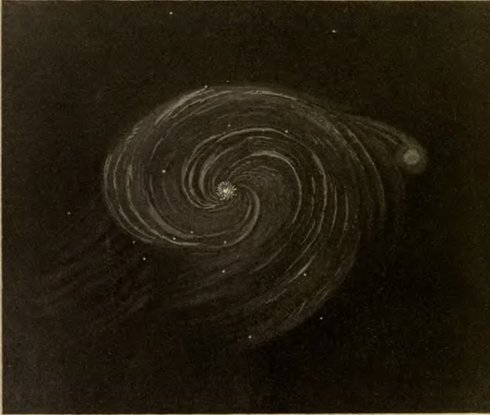
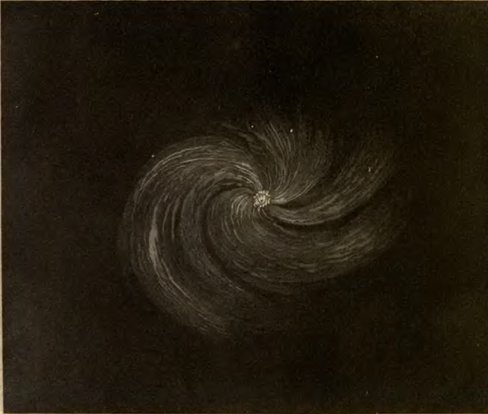
witnessing of as many systems of organic creation. If the nebulæ may be
planetary systems in the course of formation, we know that the primary
and transition rocks either show us the earth in the course of
formation, as the future seat of life, or exhibit such life as already
begun.
28. How far that which astronomy thus asserts as possible, is
probable:—what is the value of these possibilities of life in distant
regions of the universe, we shall hereafter consider. But in what
geology asserts, the case is clear. It is no possibility, but a
certainty. No one will now doubt that shells and skeletons, trunks and
leaves, prove animal and vegetable life to have existed. Even,
therefore, if Astronomy could demonstrate all that her most fanciful
disciples assume, Geology would still have a complete right to claim an
equal hearing;—to insist upon having her analogies regarded. She would
have a right to answer the questions of Astronomy, when she says, How
can we believe this? and to have her answers accepted.
29. Astronomy claims a sort of dignity over all other sciences, from her
antiquity, her certainty, and the vastness of her discoveries. But
the antiquity of astronomy as a science had no share in such
speculations as we are discussing; and if it had had, new truths are
better than old conjectures; new discoveries must rectify old errors;
new answers must remove old difficulties. The vigorous youth of Geology
makes her fearless of the age of Astronomy. And as to the certainty of
Astronomy, it has just as little to do with these speculations. The
certainty stops, just when these speculations begin. There may, indeed,
be some danger of delusion on this subject. Men have been so long
accustomed to look upon astronomical science as the mother of certainty,
that they may confound astronomical discoveries with cosmological
conjectures; though these be slightly and illogically connected with
those. And then, as to the vastness of astronomical
discoveries,—granting that character, inasmuch as it is to a certain
degree, a matter of measurement,—we must observe, that the discoveries
of geology are no less vast: they extend through time, as those of
astronomy do through space. They carry us through millions of years,
that is, of the earth's revolutions, as those of astronomy do through
millions of the earth's diameters, or of diameters of the earth's orbit.
Geology fills the regions of duration with events, as astronomy fills
the regions of the universe with objects. She carries us backwards by
the relation of cause and effect, as astronomy carries us upwards by the
relations of geometry. As astronomy steps on from point to point of the
universe by a chain of triangles, so geology steps from epoch to epoch
of the earth's history by a chain of mechanical and organical laws. If
the one depends on the axioms of geometry, the other depends on the
axioms of causation.
30. So far then, Geology has no need to regard Astronomy as her
superior; and least of all, when they apply themselves together to
speculations like these. But in truth, in such speculations, Geology has
an immeasurable superiority. She has the command of an implement, in
addition to all that Astronomy can use; and one, for the purpose of such
speculations, adapted far beyond any astronomical element of discovery.
She has, for one of her studies,—one of her means of dealing with her
problems,—the knowledge of Life, animal and vegetable. Vital
organization is a subject of attention which has, in modern times, been
forced upon her. It is now one of the main parts of her discipline. The
geologist must study the traces of life in every form; must learn to
decypher its faintest indications and its fullest development. On the
question, then, whether there be in this or that quarter, evidence of
life, he can speak with the confidence derived from familiar knowledge;
while the astronomer, to whom such studies are utterly foreign, because
he has no facts which bear upon them, can offer, on such questions, only
the loosest and most arbitrary conjectures; which, as we have had to
remark, have been rebuked by eminent men, as being altogether
inconsistent with the acknowledged maxims of his science.
31. When, therefore, Geology tells us that the earth, which has been
the seat of human life for a few thousand years only, has been the seat
of animal life for myriads, it may be, millions of years, she has a
right to offer this, as an answer to any difficulty which Astronomy, or
the readers of astronomical books, may suggest, derived from the
considerations that the Earth, the seat of human life, is but one globe
of a few thousand miles in diameter, among millions of other globes, at
distances millions of times as great.
32. Let the difficulty be put in any way the objector pleases. Is it
that it is unworthy of the greatness and majesty of God, according to
our conceptions of Him, to bestow such peculiar care on so small a part
of His creation? But we know, from geology, that He has bestowed upon
this small part of His creation, mankind, this special care;—He has
made their period, though only a moment in the ages of animal life, the
only period of intelligence, morality, religion. If then, to suppose
that He has done this, is contrary to our conceptions of His greatness
and majesty, it is plain that our conceptions are erroneous; they have
taken a wrong direction. God has not judged, as to what is worthy of
Him, as we have judged. He has found it worthy of Him to bestow upon man
His special care, though he occupies so small a portion of time; and why
not, then, although he occupies so small a portion of space?
33. Or is the objection this; that if we suppose the earth only to be
occupied by inhabitants, all the other globes of the universe are
wasted;—turned to no purpose? Is waste of this kind considered as
unsuited to the character of the Creator? But here again, we have the
like waste, in the occupation of the earth. All its previous ages, its
seas and its continents, have been wasted upon mere brute life; often,
so far as we can see, for myriads of years, upon the lowest, the least
conscious forms of life; upon shell-fish, corals, sponges. Why then
should not the seas and continents of other planets be occupied at
present with a life no higher than this, or with no life at all? Will it
be said that, so far as material objects are occupied by life, they are
not wasted; but that they are wasted, if they are entirely barren and
blank of life? This is a very arbitrary saying. Why should the life of a
sponge, or a coral, or an oyster, be regarded as a good employment of a
spot of land and water, so as to save it from being wasted? No doubt, if
the coral or the oyster be there, there is a reason why it is so,
consistently with the attributes of God. But then, on the same ground,
we may say that if it be not there, there is a reason why it is not so.
Such a mode of regarding the parts of the universe can never give us
reasons why they should or should not be inhabited, when we have no
other grounds for knowing whether they are. If it be a sufficient
employment of a spot of rock or water that it is the seat of
organization—of organic powers; why may it not be a sufficient
employment of the same spot that it is the seat of attraction, of
cohesion, of crystalline powers? All the planets, all parts of the
universe, we have good reason to believe, are pervaded by attraction, by
forces of aggregation and atomic relation, by light and heat. Why may
not these be sufficient to prevent the space being wasted, in the eyes
of the Creator? as, during a great part of the earth's past history, and
over large portions of its present mass, they are actually held by Him
sufficient; for they are all that occupy those portions. This notion,
then, of the improbability of there being, in the universe, so vast an
amount of waste spaces, or waste bodies, as is implied in the opinion
that the earth alone is the seat of life, or of intelligence, is
confuted by the fact, that there are vast spaces, waste districts, and
especially waste times, to an extent as great as such a notion deems
improbable. The avoidance of such waste, according to our notions of
waste, is no part of the economy of creation, so far as we can discern
that economy, in its most certain exemplifications.
34. Or will the objection be made in this way; that such a peculiar
dignity and importance given to the earth is contrary to the analogy of
creation;—that since there are so many globes, similar to the
earth,—like her, revolving round the sun, like her, revolving on her
axes, several of them, like her, accompanied by satellites; it is
reasonable to suppose that their destination and office is the same as
hers;—that since there are so many stars, each like the sun, a source
of light, and probably of heat, it is reasonable to suppose that, like
the sun, they are the centres of systems of planets, to which their
light and heat are imparted, to uphold life:—is it thought that such a
resemblance is a strong ground for believing that the planets of our
system, and of other systems, are inhabited as the earth is? If such an
astronomical analogy be insisted on, we must again have recourse to
geology, to see what such analogy is worth. And then, we are led to
reflect, that if we were to follow such analogies, we should be led to
suppose that all the successive periods of the earth's history were
occupied with life of the same order; that as the earth, in its present
condition, is the seat of an intelligent population, so must it have
been, in all former conditions. The earth, in its former conditions, was
able and fitted to support life; even the life of creatures closely
resembling man in their bodily structure. Even of monkeys, fossil
remains have been found. But yet, in those former conditions, it did not
support human life. Even those geologists who have dwelt most on the
discovery of fossil monkeys, and other animals nearest to man, have not
dreamt that there existed, before man, a race of rational, intelligent,
and progressive creatures. As we have seen, geology and history alike
refute such a fancy. The notion, then, that one period of time in the
history of the earth must resemble another, in the character of its
population, because it resembles it in physical circumstances, is
negatived by the facts which we discover in the history of the earth.
And so, the notion that one part of the universe must resemble another
in its population, because it resembles it in physical circumstances, is
negatived as a law of creation. Analogy, further examined, affords no
support to such a notion. The analogy of time, the events of which we
know, corrects all such guesses founded on a supposed analogy of space,
the furniture of which, so far as this point is concerned, we have no
sufficient means of examining.
35. But in truth, we may go further. Not only does the analogy of
creation not point to any such entire resemblance of similar parts, as
is thus assumed, but it points in the opposite direction. Not entire
resemblance, but universal difference is what we discover; not the
repetition of exactly similar cases, but a series of cases perpetually
dissimilar, presents itself; not constancy, but change, perhaps advance;
not one permanent and pervading scheme, but preparation and completion
of successive schemes; not uniformity and a fixed type of existences,
but progression and a climax. This may be said to be the case in the
geological aspect of the world; for, without occupying ourselves with
the question, how far the monuments of animal life, which we find
preserved in the earth's strata, exhibited a gradual progression from
ruder and more imperfect forms to the types of the present terrestrial
population; from sponges and mollusks, to fish and lizards, from
cold-blooded to warm blooded animals, and so on, till we come to the
most perfect vertebrates;—a doctrine which many eminent geologists
have held, and still hold;—without discussing this question, or
assuming that the fact is so; this at least cannot be denied or doubted,
that man is incomparably the most perfect and highly-endowed creature
which ever has existed on the earth. How far previous periods of animal
existence were a necessary preparation of the earth, as the habitation
of man, or a gradual progression towards the existence of man, we need
not now inquire. But this at least we may say; that man, now that he is
here, forms a climax to all that has preceded; a term incomparably
exceeding in value all the previous parts of the series; a complex and
ornate capital to the subjacent column; a personage of vastly greater
dignity and importance than all the preceding line of the procession.
The analogy of nature, in this case at least, appears to be, that there
should be inferior, as well as superior provinces, in the universe; and
that the inferior may occupy an immensely larger portion of time than
the superior; why not then of space? The intelligent part of creation is
thrust into the compass of a few years, in the course of myriads of
ages; why not then into the compass of a few miles, in the expanse of
systems? The earth was brute and inert, compared with its present
condition, dark and chaotic, so far as the light of reason and
intelligence are concerned, for countless centuries before man was
created. Why then may not other parts of creation be still in this brute
and inert and chaotic state, while the earth is under the influence of a
higher exercise of creative power? If the earth was, for ages, a turbid
abyss of lava and of mud, why may not Mars or Saturn be so still? If the
germs of life were, gradually, and at long intervals, inserted in the
terrestrial slime, why may they not be just inserted, or not yet
inserted, in Jupiter? Or why should we assume that the condition of
those planets resembles ours, even so far as such suppositions imply?
Why may they not, some or all of them, be barren masses of stone and
metal, slag and scoriæ, dust and cinders? That some of them are composed
of such materials, we have better reason to believe, than we have to
believe anything else respecting their physical constitution, as we
shall hereafter endeavor to show. If then, the earth be the sole
inhabited spot in the work of creation, the oasis in the desert of our
system, there is nothing in this contrary to the analogy of creation.
But if, in some way which perhaps we cannot discover, the earth
obtained, for accompaniments, mere chaotic and barren masses, as
conditions of coming into its present state; as it may have required,
for accompaniments, the brute and imperfect races of former animals, as
conditions of coming into its present state, as the habitation of man;
the analogy is against, and not in favor of, the belief that they too
(the other masses, the planets, &c.) are habitations. I may hereafter
dwell more fully on such speculations; but the possibility that the
planets are such rude masses, is quite as tenable, on astronomical
grounds, as the possibility that the planets resemble the earth, in
matters of which astronomy can tell us nothing. We say, therefore, that
the example of geology refutes the argument drawn from the supposed
analogy of one part of the universe with another; and suggests a strong
suspicion that the force of analogy, better known, may tend in the
opposite direction.
36. When such possibilities are presented to the reader, he may
naturally ask, if we are thus to regard man as the climax of creation,
in space, as in time, can we point out any characters belonging to him,
which may tend to make it conceivable that the Creator should thus
distinguish him, and care for him:—should prepare his habitation if it
be so, by ages of chaotic and rudimentary life, and by accompanying
orbs of brute and barren matter. If Man be, thus, the head, the crowned
head of the creation, is he worthy to be thus elevated? Has he any
qualities which make it conceivable that, with such an array of
preparation and accompaniment, he should be placed upon the earth, his
throne? Or rather, if he be thus the chosen subject of God's care, has
he any qualities, which make it conceivable that he should be thus
selected; taken under such guardianship; admitted to such a
dispensation; graced with such favor. The question with which we began
again recurs: What is man that God should be thus mindful of him? After
the views which have been presented to us, does any answer now occur to
us?
37. The answer which we have to give, is that which we have already
repeatedly stated. Man is an intellectual, moral, religious, and
spiritual creature. If we consider these attributes, we shall see that
they are such as to give him a special relation to God, and as we
conceive, and must conceive, God to be; and may therefore be, in God,
the occasion of special guardianship, special regard, a special
dispensation towards man.
38. As an intellectual creature, he has not only an intelligence which
he can apply to practical uses, to minister to the needs of animal and
social life; but also an intellect by which he can speculate about the
relations of things, in their most general form; for instance, the
properties of space and time, the relations of finite and infinite. He
can discover truths, to which all things, existing in space and time,
must conform. These are conditions of existence to which the creation
conforms, that is, to which the Creator conforms; and man, capable of
seeing that such conditions are true and necessary, is capable, so far,
of understanding some of the conditions of the Creator's workmanship.
In this way, the mind of man has some community with the mind of God;
and however remote and imperfect this community may be, it must be real.
Since, then, man has thus, in his intellect, an element of community
with God, it is so far conceivable that he should be, in a special
manner, the object of God's care and favor. The human mind, with its
wonderful and perhaps illimitable powers, is something of which we can
believe God to be "mindful."
39. Again: man is a moral creature. He recognizes, he cannot help
recognizing, a distinction of right and wrong in his actions; and in his
internal movements which lead to action. This distinction he recognizes
as the reason, the highest and ultimate reason, for doing or for not
doing. And this law of his own reason, he is, by reflection, led to
recognize as a Law of the Supreme Reason; of the Supreme Mind which has
made him what he is. The Moral Law, he owns and feels as God's Law. By
the obligation which he feels to obey this Law, he feels himself God's
subject; placed under his government; compelled to expect his judgment,
his rewards, and punishments. By being a moral creature, then, he is, in
a special manner, the subject of God; and not only we can believe that,
in this capacity, God cares for him; but we cannot believe that he does
not care for him. He cares for him, so as to approve of what he does
right, and to condemn what he does wrong. And he has given him, in his
own breast, an assurance that he will do this; and thus, God cares for
man, in a peculiar and special manner. As a moral creature, we have no
difficulty in conceiving that God may think him worthy of his regard and
government.
40. The development of man's moral nature, as we have just described it,
leads to, and involves the development of his religious nature. By
looking within himself, and seeing the Moral Law, he learns to look
upwards to God, the Author of the Law, and the Awarder of the rewards
and penalties which follow moral good and evil. But the belief of such a
dispensation carries us, or makes us long to be carried, beyond the
manifestations of this dispensation, as they appear in the ordinary
course of human life. By thinking on such things, man is led to ascribe
a wider range to the moral Government of God:—to believe in methods of
reward and punishment, which do not appear in the natural course of
events: to accept events, out of the order of nature, which announce
that God has provided such methods: to accept them, when duly
authenticated, as messages from God; and thus, when God provides the
means, to allow himself to be placed in intercourse with God. Since man
is capable of this; since, as a religious creature, this is his
tendency, his need, the craving of his heart, without which, when his
religious nature is fully unfolded, he can feel no comfort nor
satisfaction; we cannot be surprised that God should deem him a proper
object of a special fatherly care; a fit subject for a special
dispensation of his purposes, as to the consequences of human actions.
Man being this, we can believe that God is not only "mindful of him,"
but "visits him."
41. As we have said, the soul of man, regarded as the subject of God's
religious government, is especially termed his Spirit: the course of
human being which results from the intercourse with God, which God
permits, is a spiritual existence. Man is capable, in no small degree,
of such an existence, of such an intercourse with God; and, as we are
authorized to term it, of such a life with God, and in God, even while
he continues in his present human existence. I say authorized, because
such expressions are used, though reverently, by the most religious
men; who are, at any rate, authority as to their own sentiments; which
are the basis of our reasoning. Whatever, then, may be the imperfection,
in this life, of such a union with God, yet since man can, when
sufficiently assisted and favored by God, enter upon such a union, we
cannot but think it most credible and most natural, that he should be
the object of God's special care and regard, even of his love and
presence.
42. That men are, only in a comparatively small number of cases,
intellectual, moral, religious, and spiritual, in the degree which I
have described, does not, by any means, deprive our argument of its
force. The capacity of man is, that he may become this; and such a
capacity may well make him a special object in the eyes of Him under
whose guidance and by whose aid, such a development and elevation of his
nature is open to him. However imperfect and degraded, however
unintellectual, immoral, irreligious, and unspiritual, a great part of
mankind may be, still they all have the germs of such an elevation of
their nature; and a large portion of them make, we cannot doubt, no
small progress in this career of advancement to a spiritual condition.
And with such capacities, and such practical exercise of those
capacities, we can have no difficulty in believing, if the evidence
directs us to believe, that that part of the creation in which man has
his present appointed place, is the special field of God's care and
love; by whatever wastes of space, and multitudes of material bodies, it
may be surrounded; by whatever races it may have been previously
occupied, of brutes that perish, and that, compared with man, can hardly
be said to have lived.