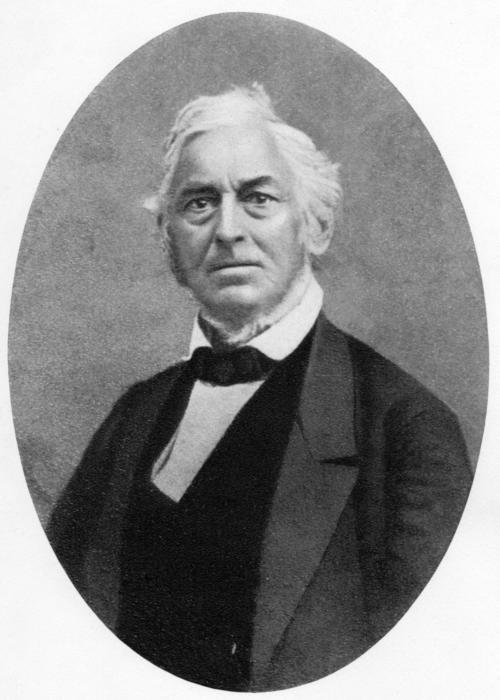
R. WELLINGTON
O. M. TAYLOR
W. H. ALDERMAN
M. J. DORSEY
Report of the New York Agricultural Experiment Station for the Year 1910
II
ALBANY
J. B. LYON COMPANY, STATE PRINTERS
1911
NEW YORK AGRICULTURAL EXPERIMENT STATION,
Geneva, N. Y., December 31, 1910.
To the Honorable Board of Control of the New York Agricultural Experiment
Station:
Gentlemen:—I have the honor to transmit herewith Part II of the
report of this institution for the year 1910, to be known as The Plums
of New York. This constitutes the third in the series of fruit publications
that is being prepared under your authority.
The data embodied in the volume are the result of long-continued
studies and observations at this institution as well as throughout the State,
to which has been added a large amount of information that commercial
plum-growers have very kindly furnished. The attempt has been made
to produce a monograph including all the cultivated plums, and it is
hoped that the result will be recognized as a worthy advance in the
literature of this class of fruits.
W. H. JORDAN, Director.
PREFACE
The Plums of New York is the third monograph of the fruits of this
region published by the New York Agricultural Experiment Station. The
aims of these books have been stated in full in The Grapes of New York,
but it is considered best to re-state some of these briefly and to indicate
some features in which the book on plums differs from the one on grapes.
Broadly speaking, the aim has been to make The Plums of New York
a record of our present knowledge of cultivated plums. The book has
been written for New York but its contents are so general in character
that the work applies to the whole country and more or less to the world.
The first chapter is a historical account and a botanical classification of
plums; the second, a discussion of the present status of plum-growing in
America; while the third and fourth are devoted to varieties of plums.
The first and last two of these chapters contain the synonymy and bibliography
of the species and varieties of plums. In the foot-notes running
through the book biographical sketches are given of the persons who have
contributed most to plum culture in America; here may be found also
matters pertaining to plums not properly included in the text but necessary
for its best understanding. Important varieties, so considered from various
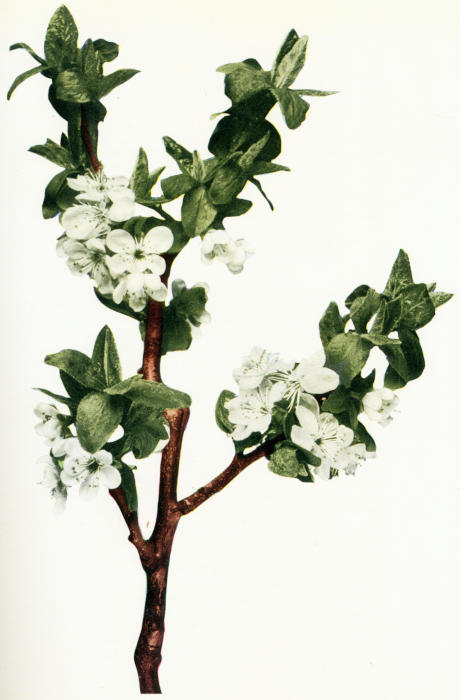
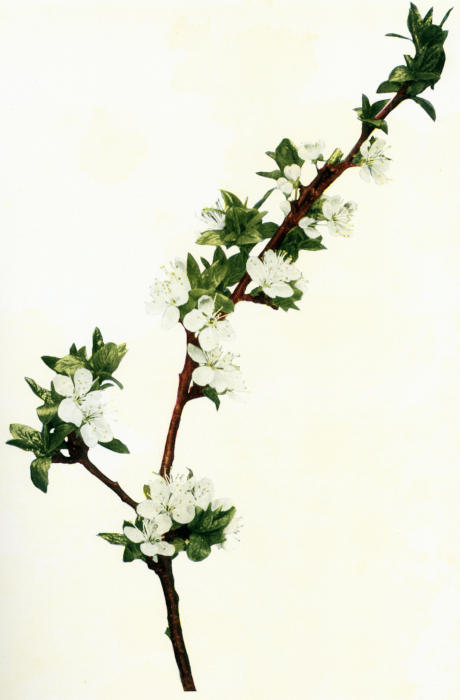
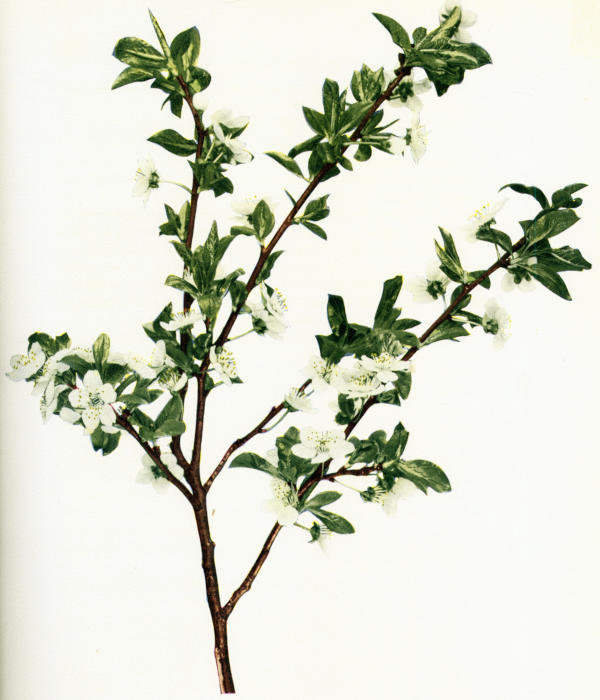
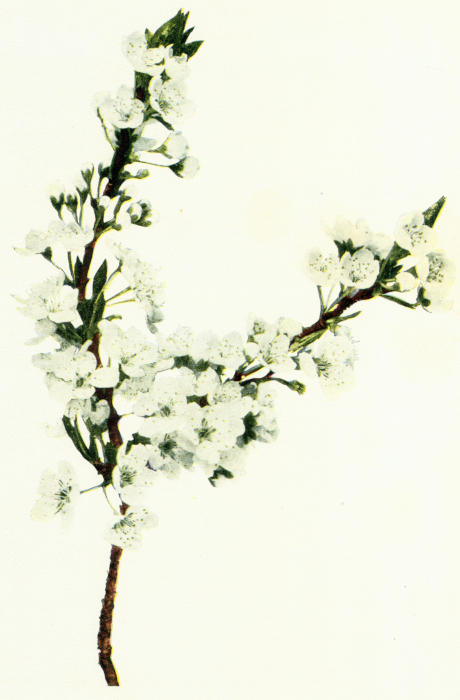
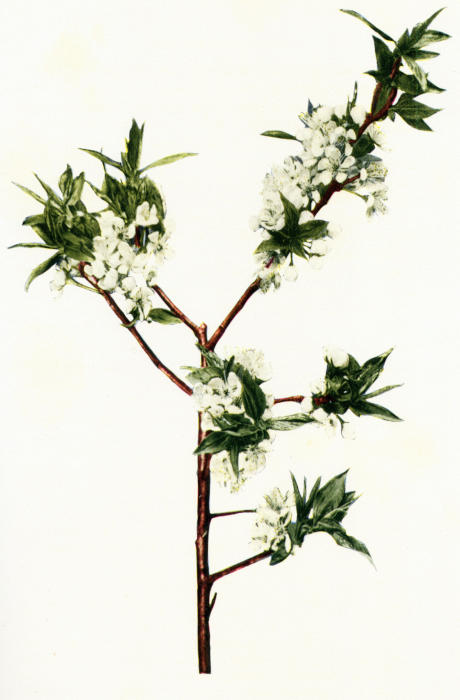
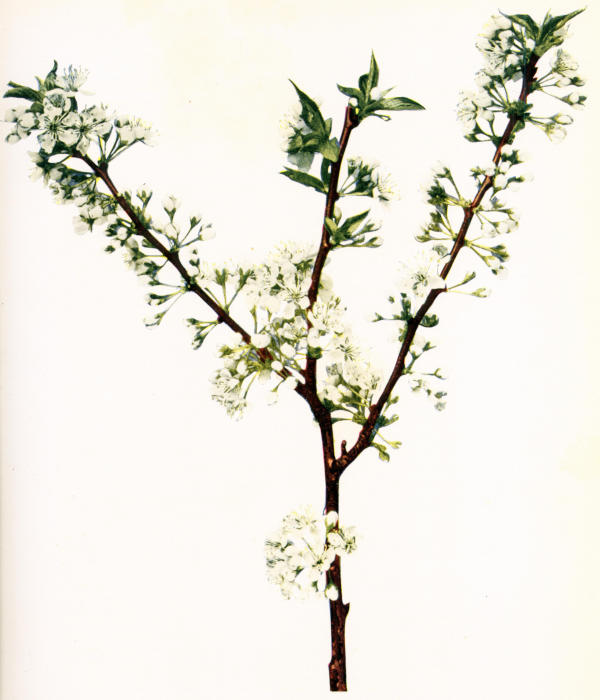
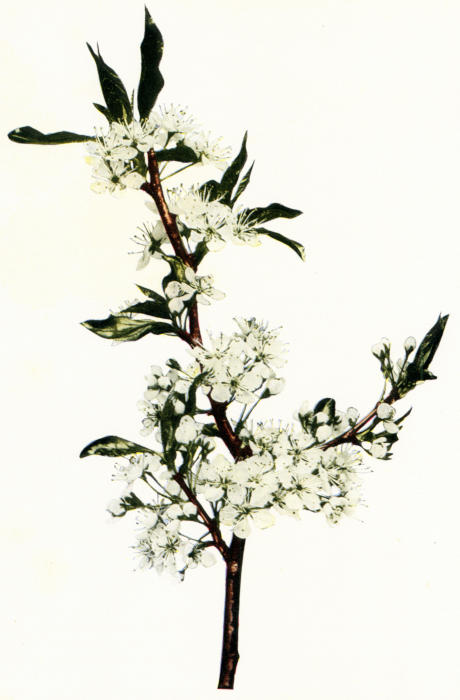
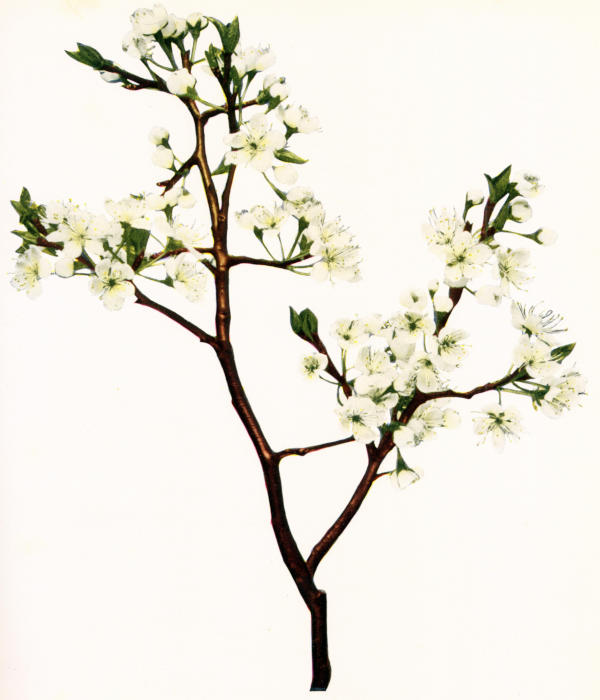
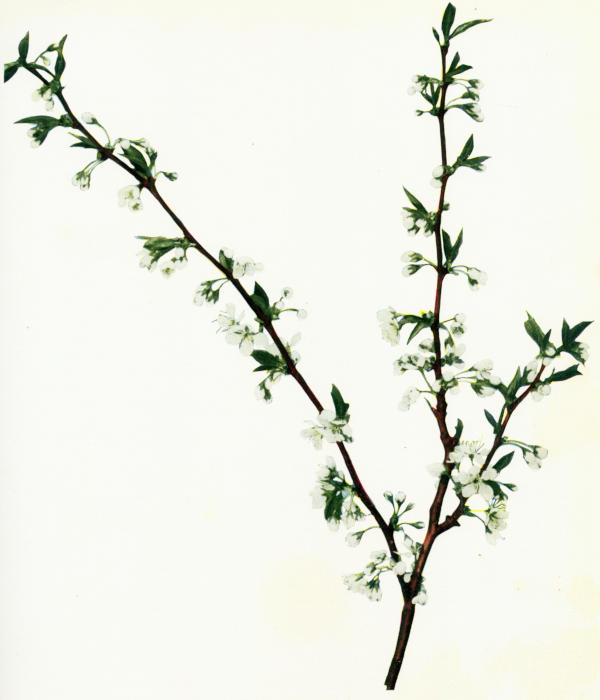
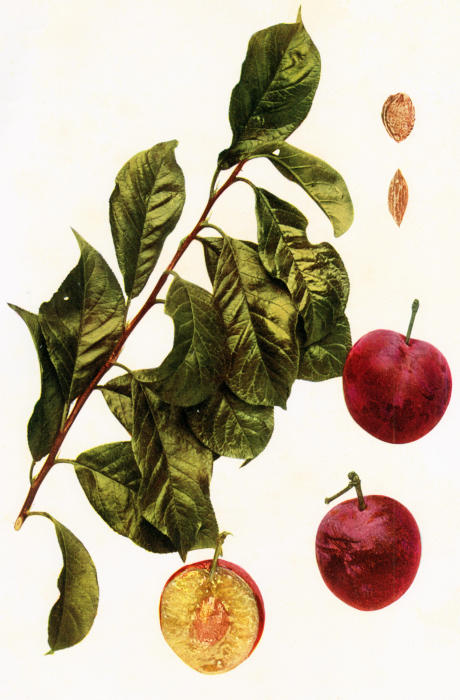
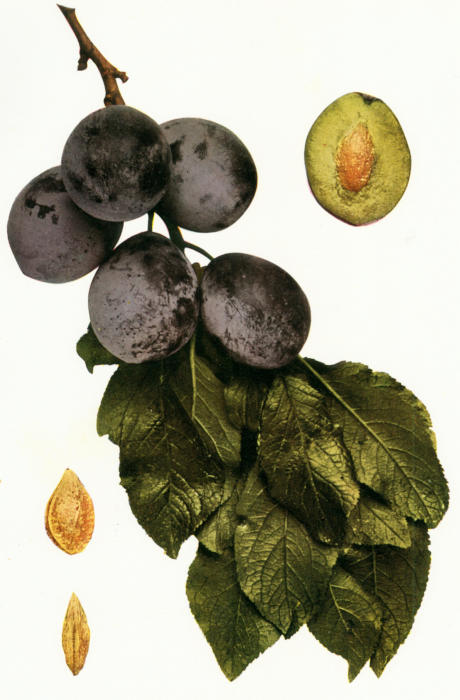
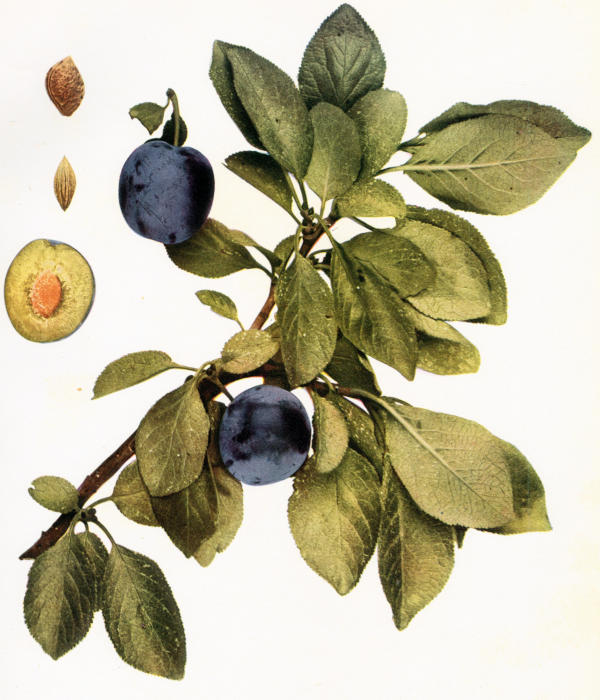
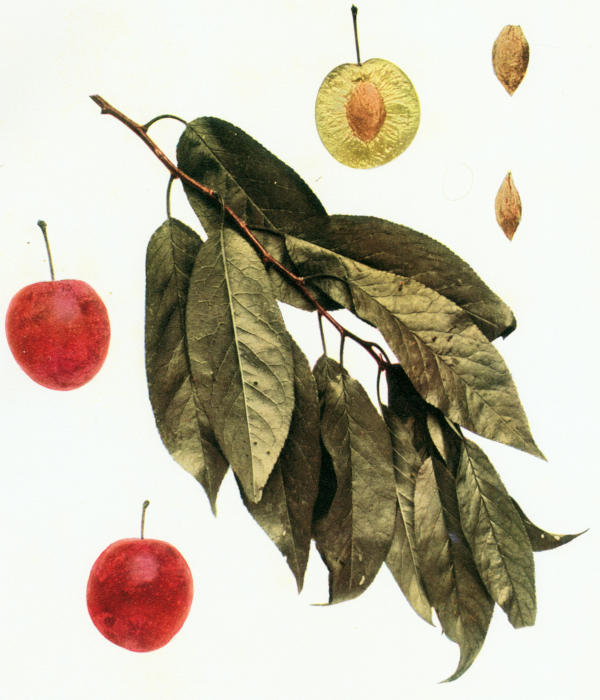
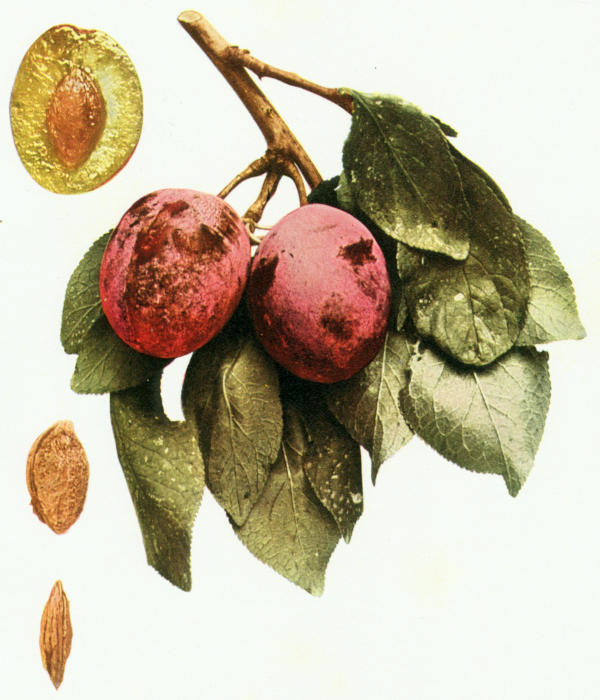
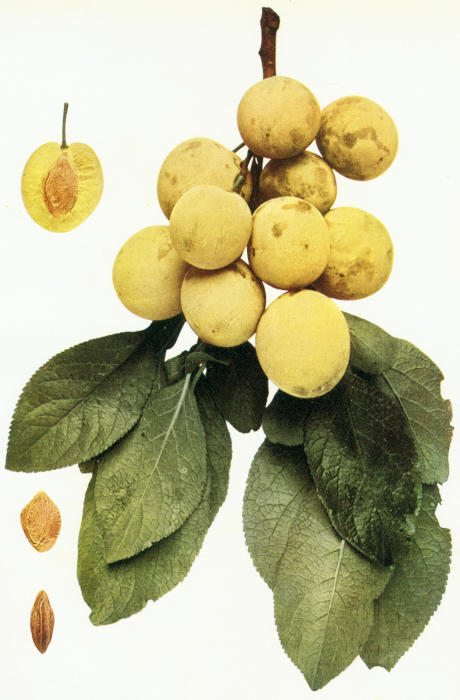
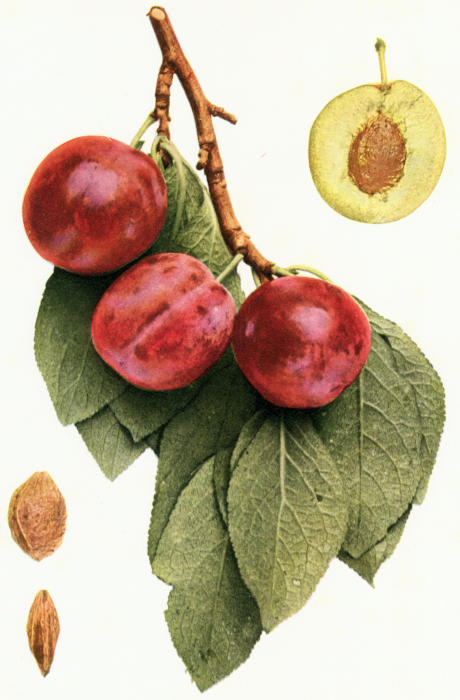
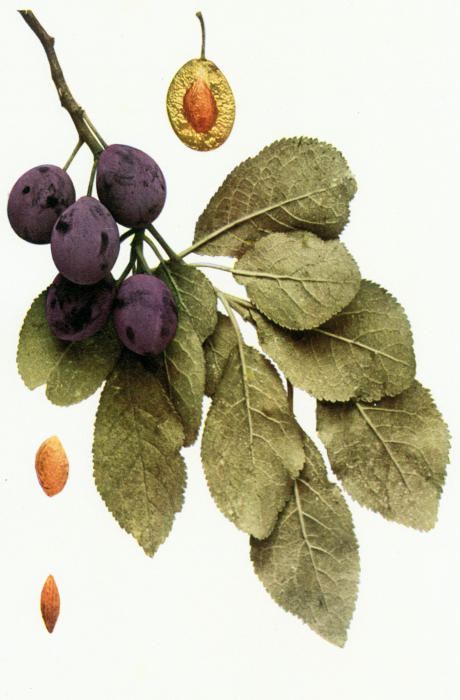
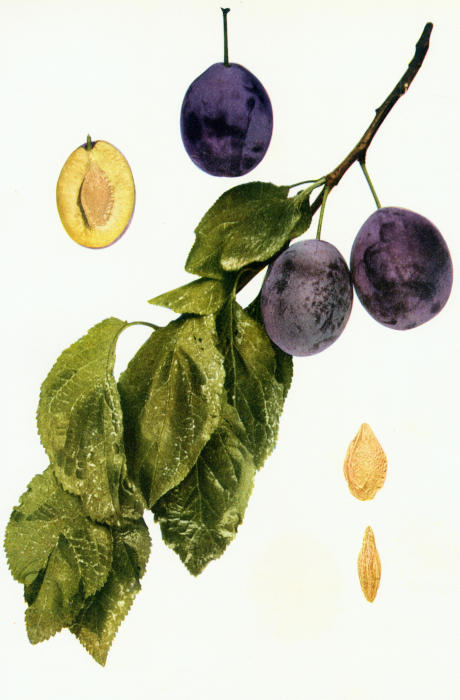
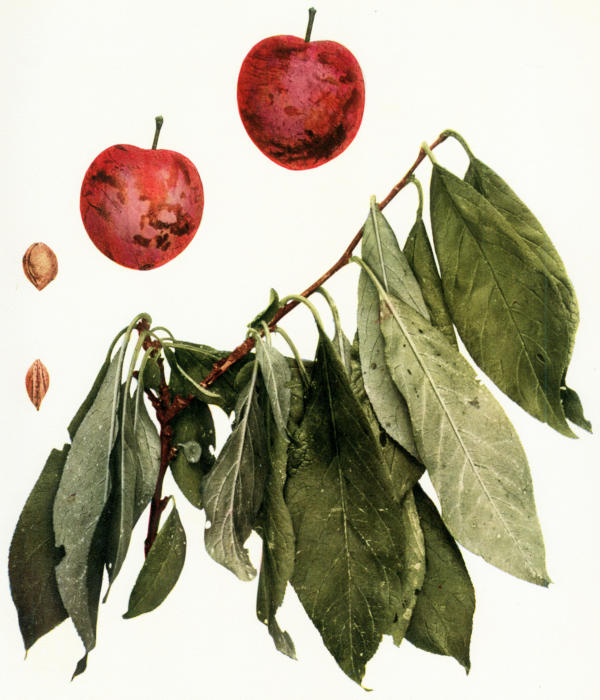
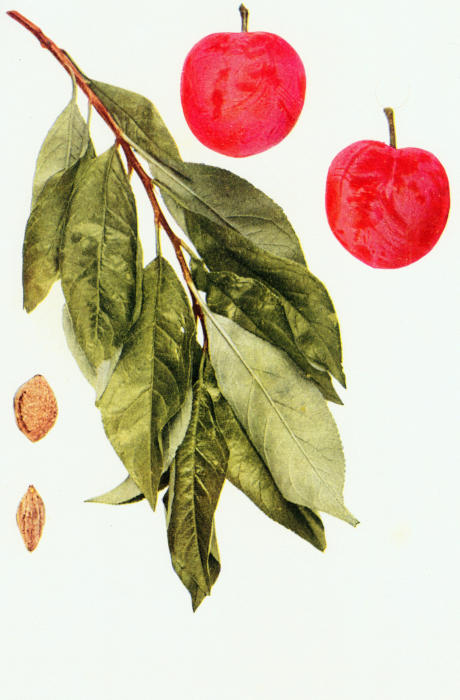
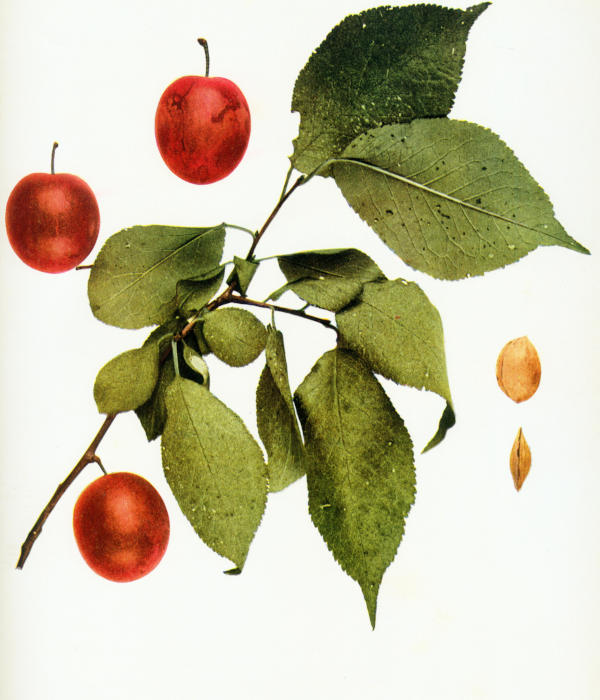
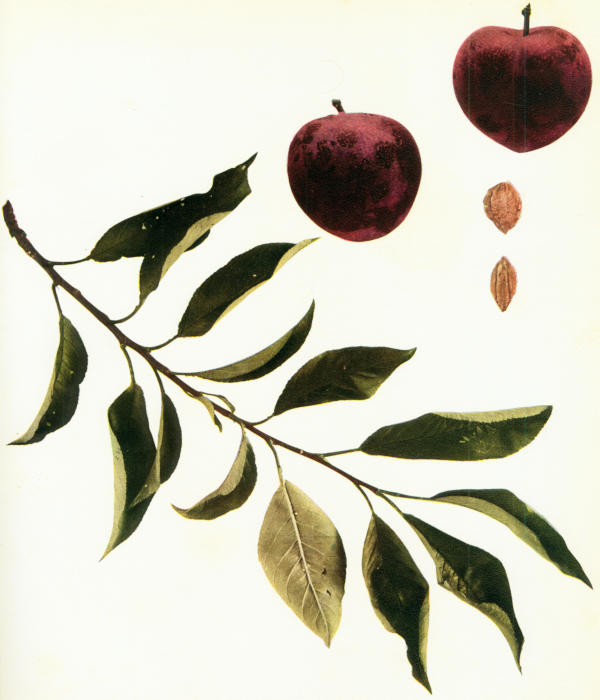
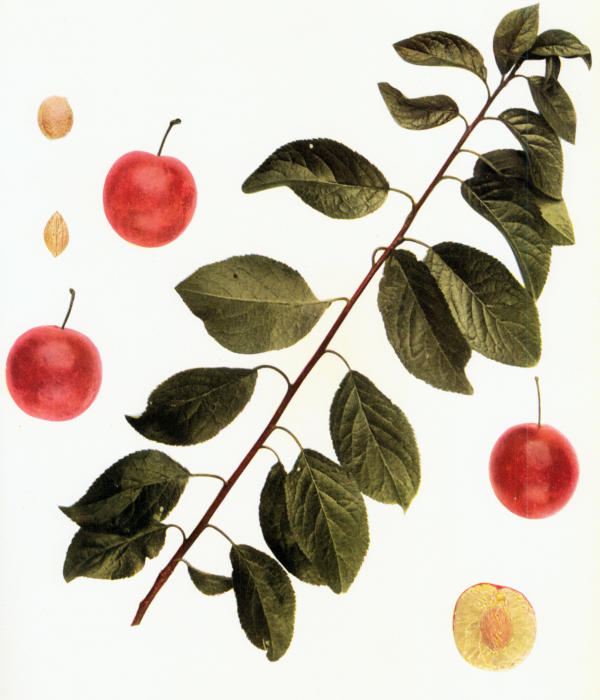
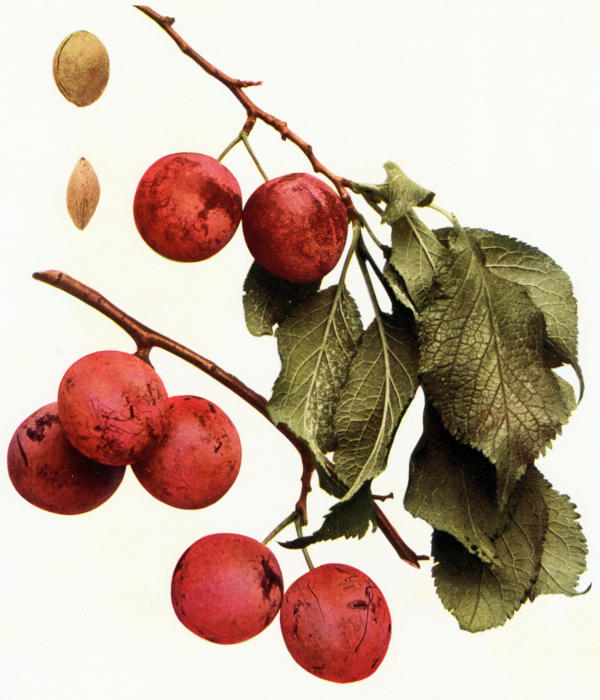
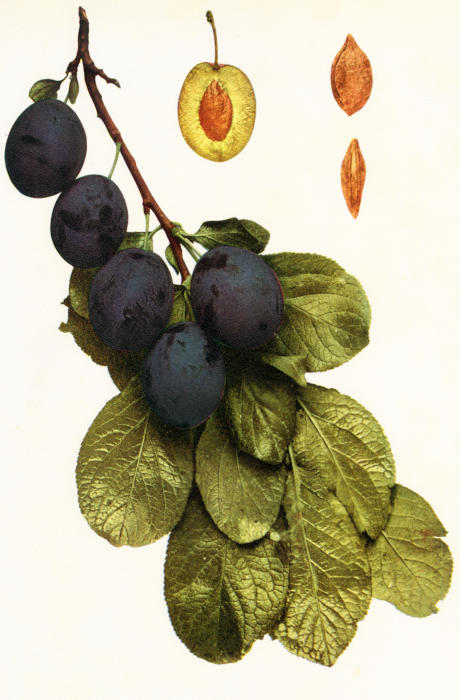
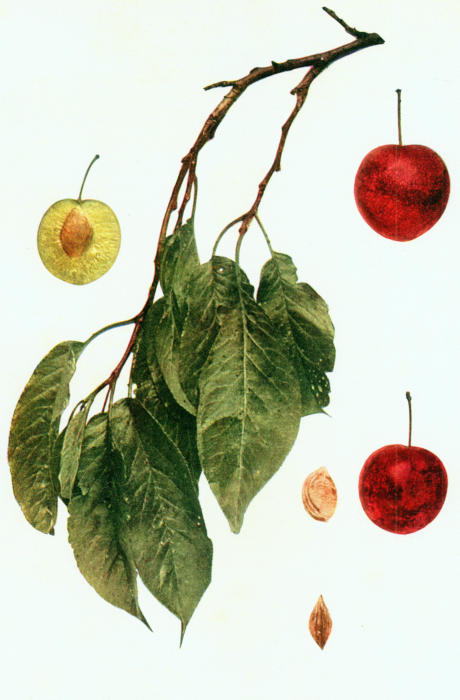
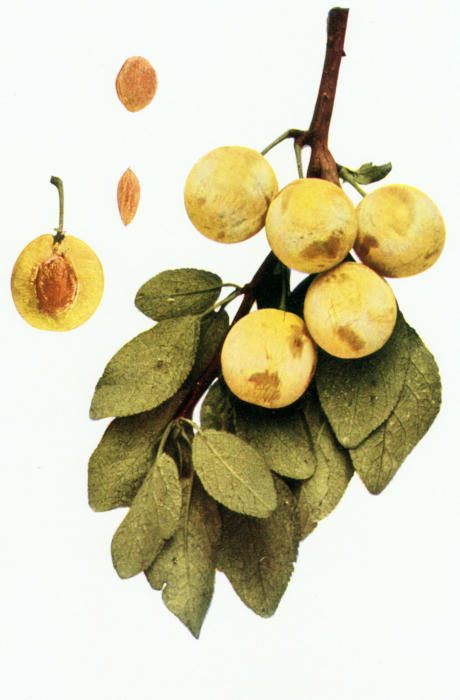
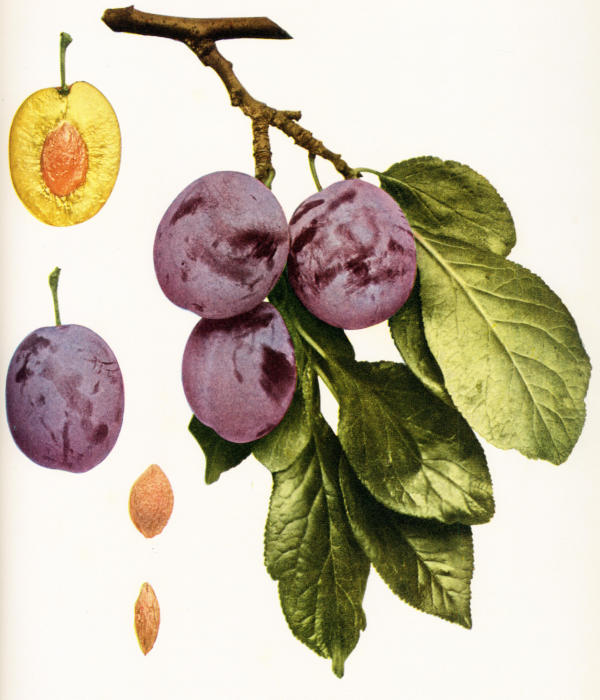
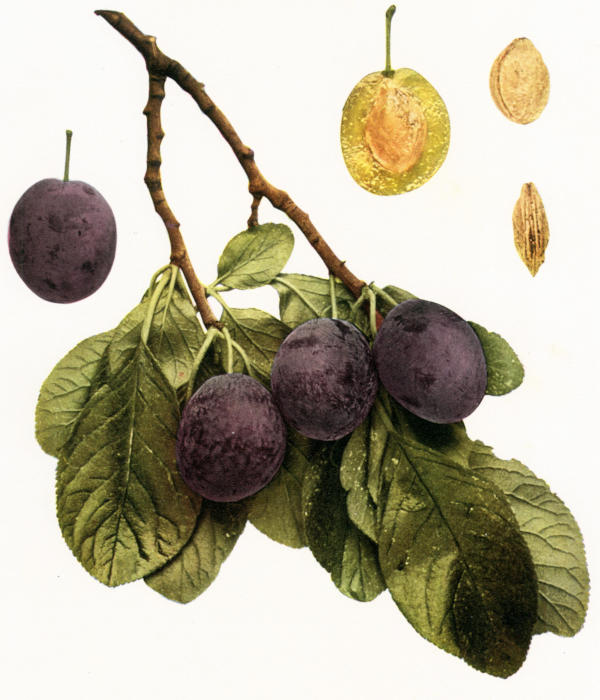
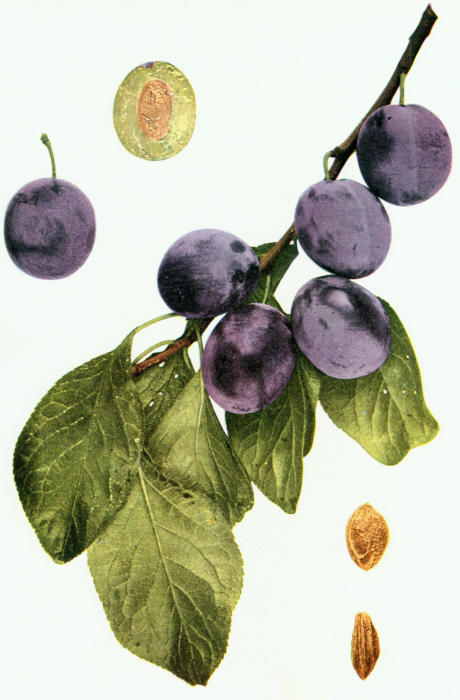
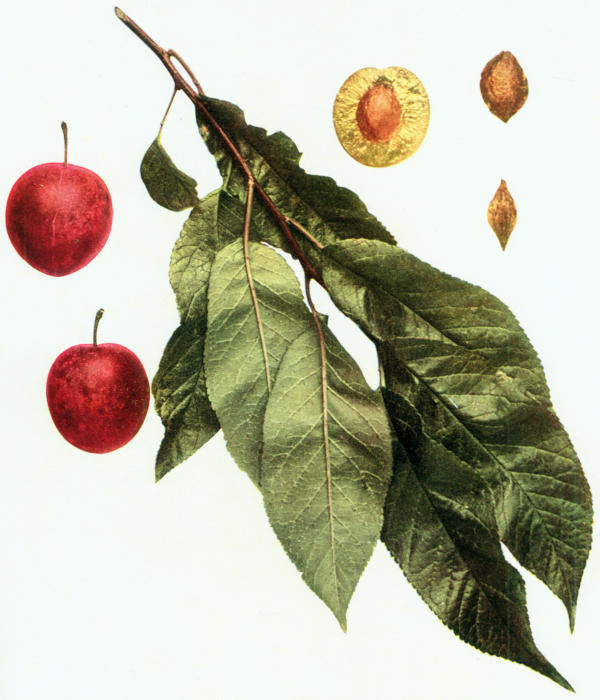
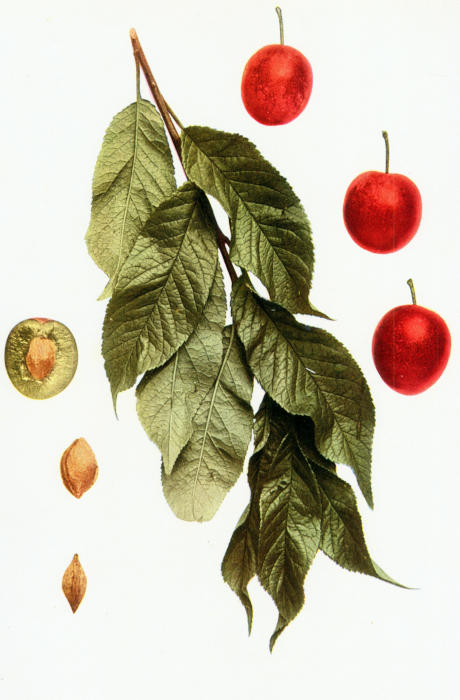
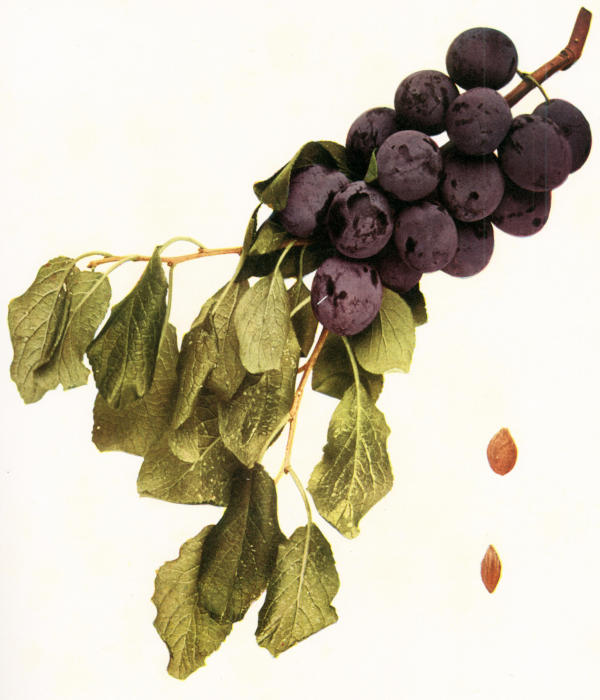
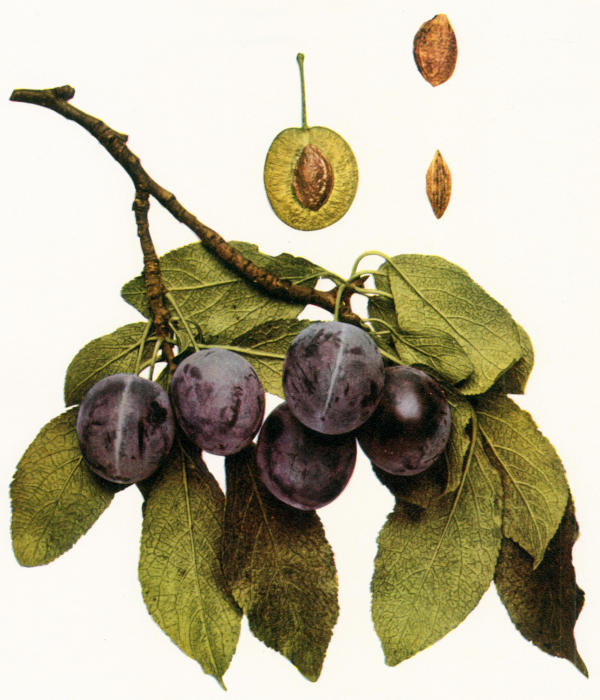
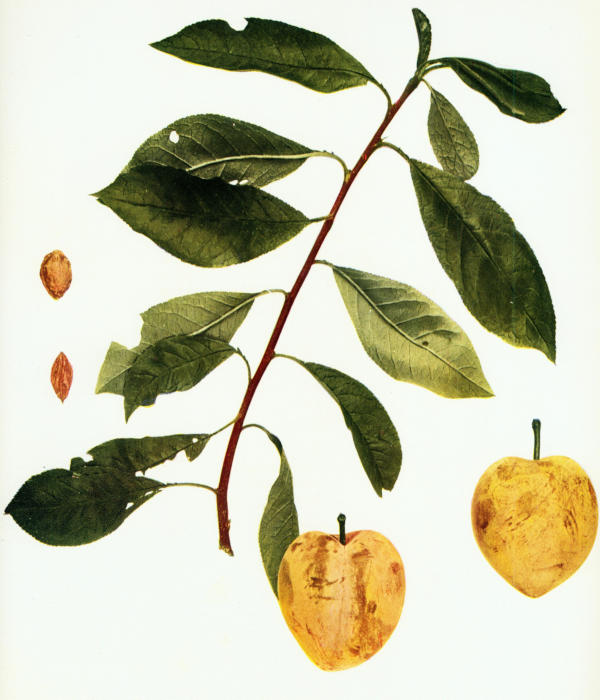
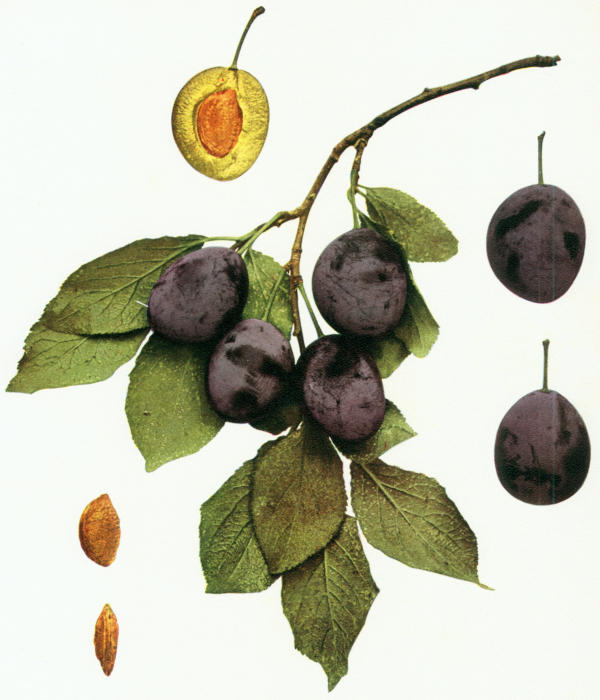
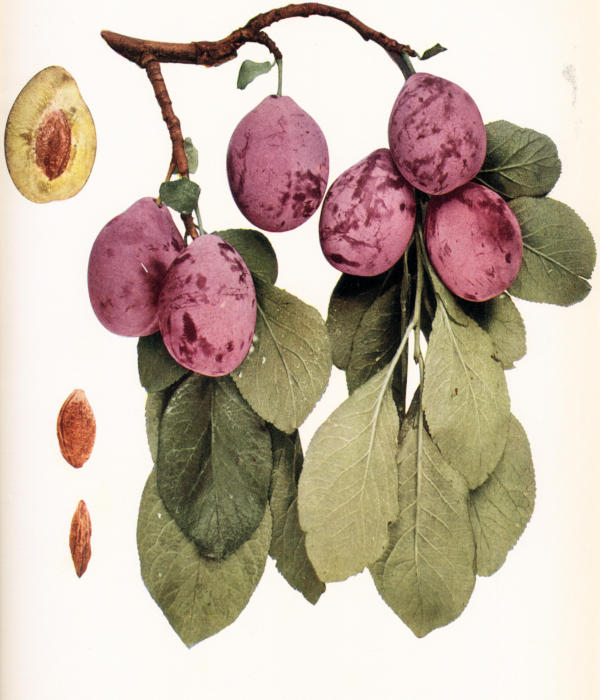
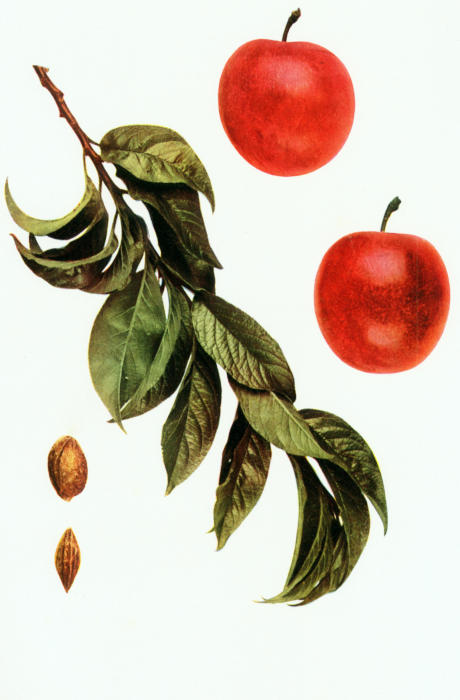
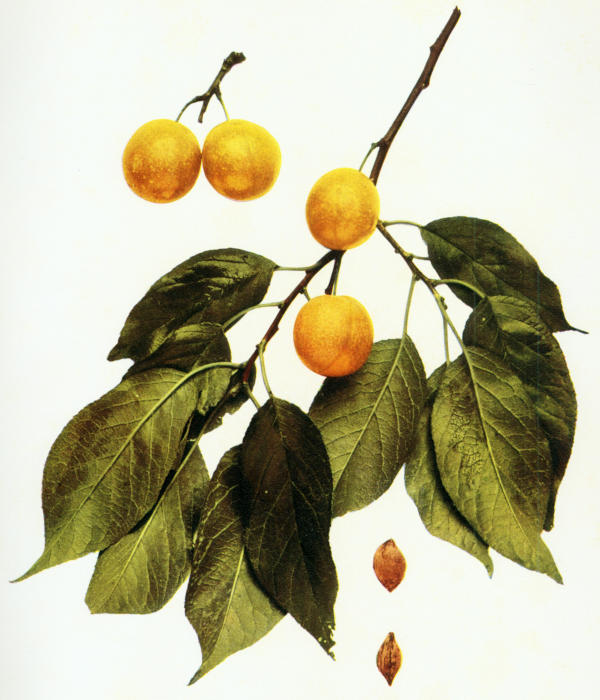
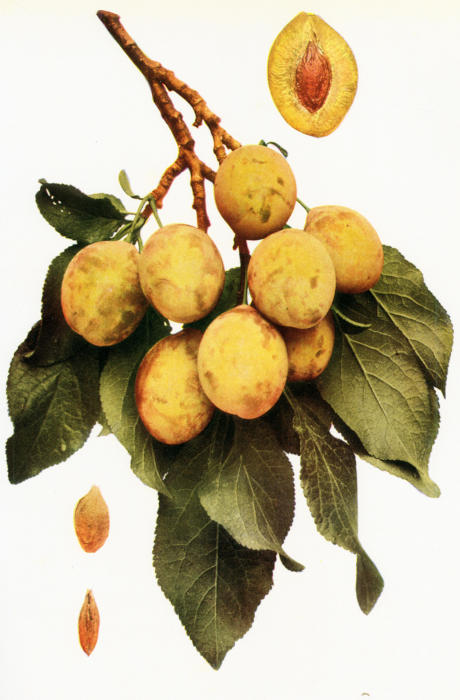
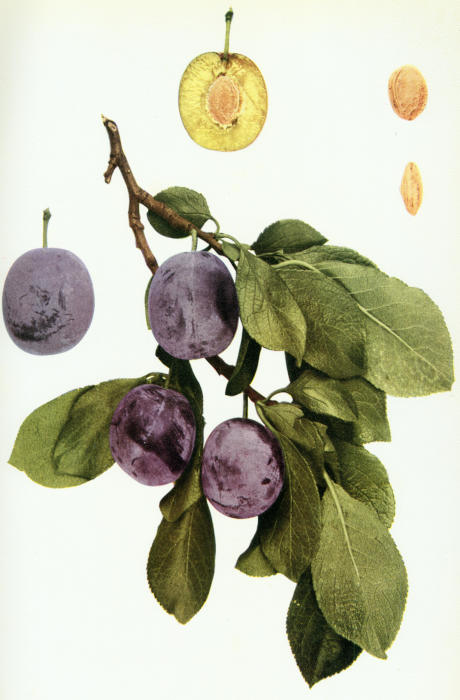
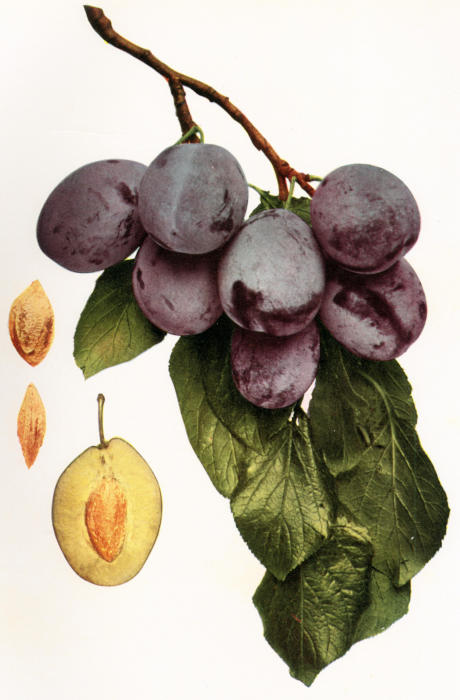
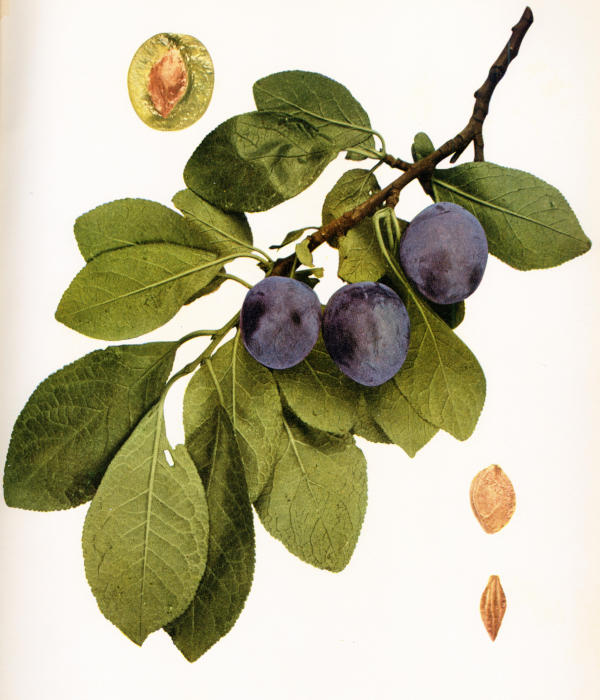
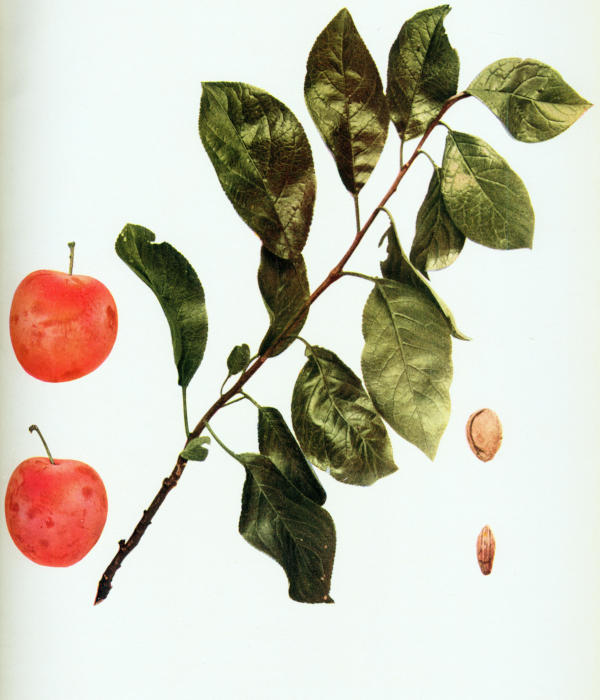
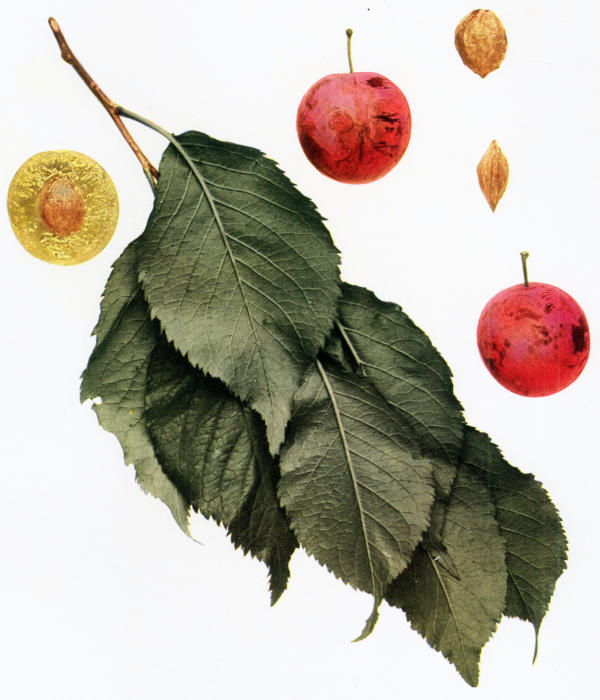
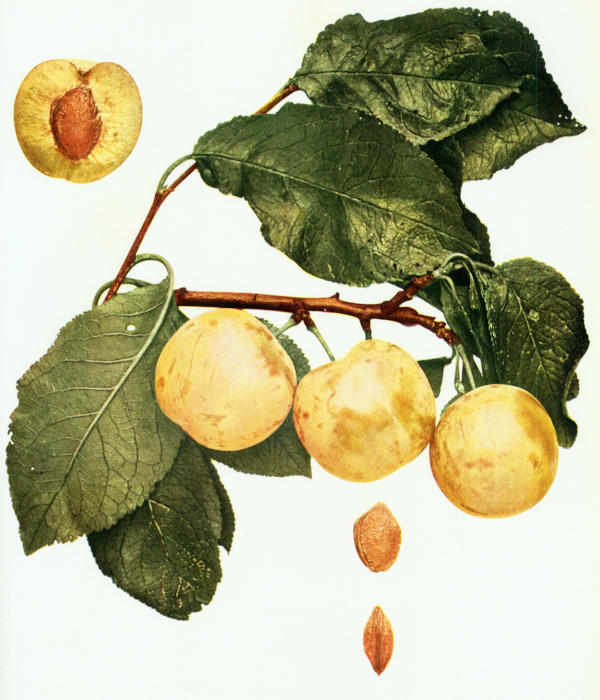
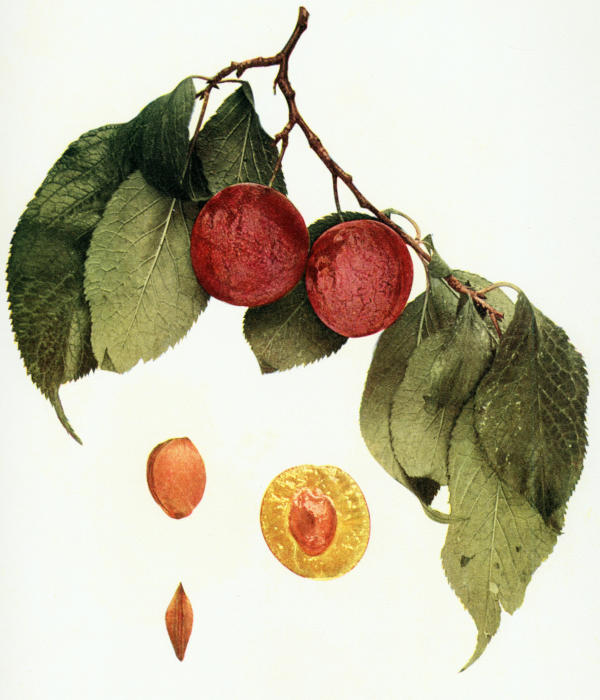
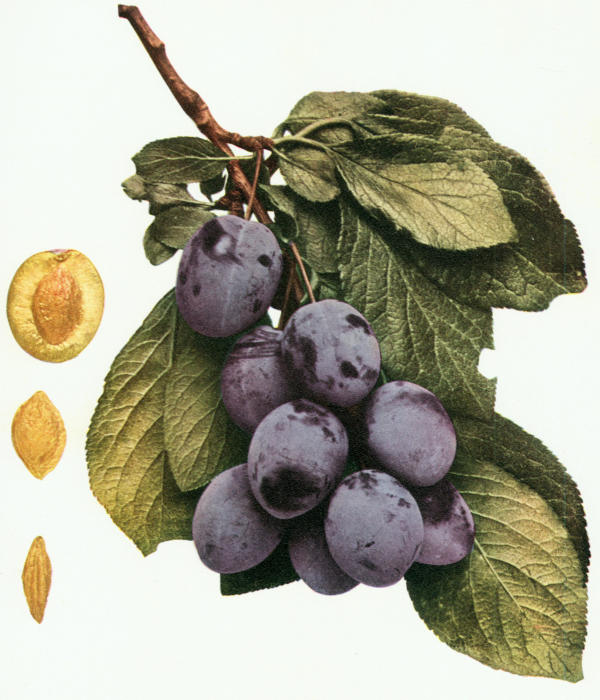
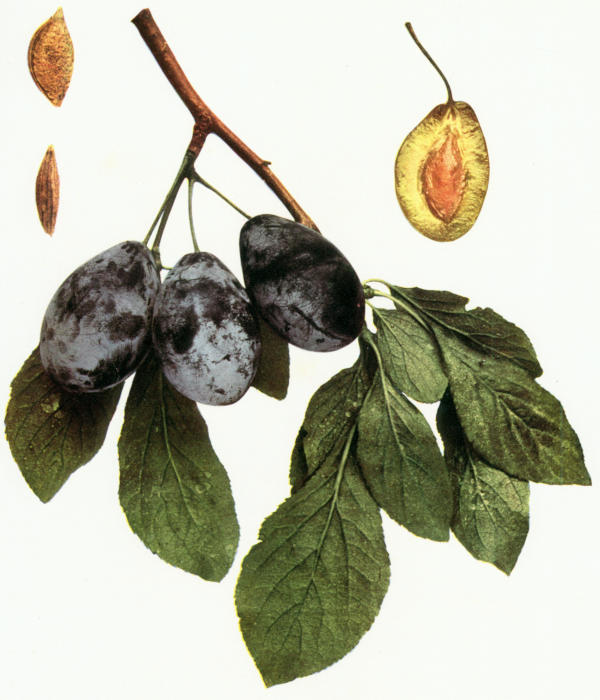
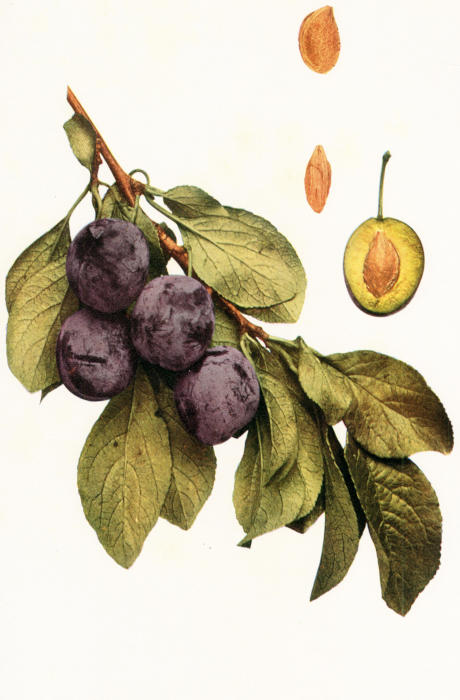
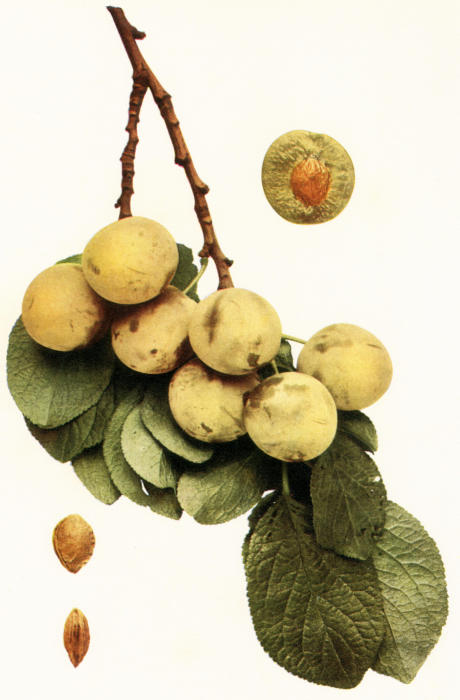
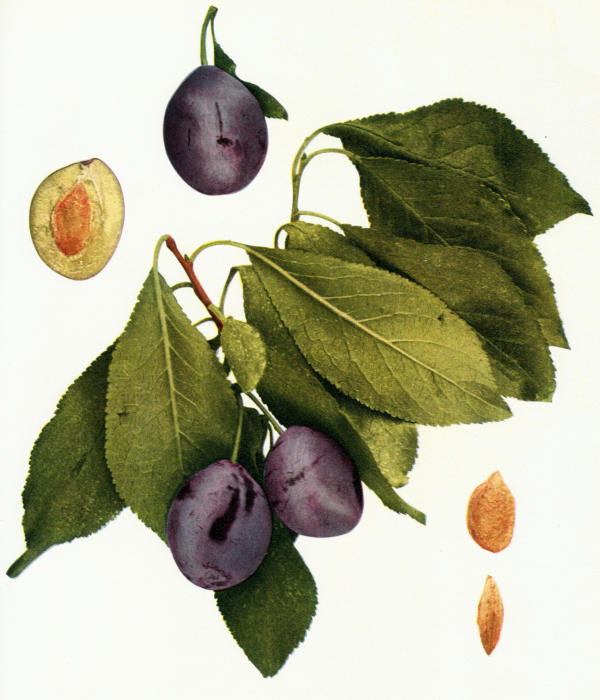
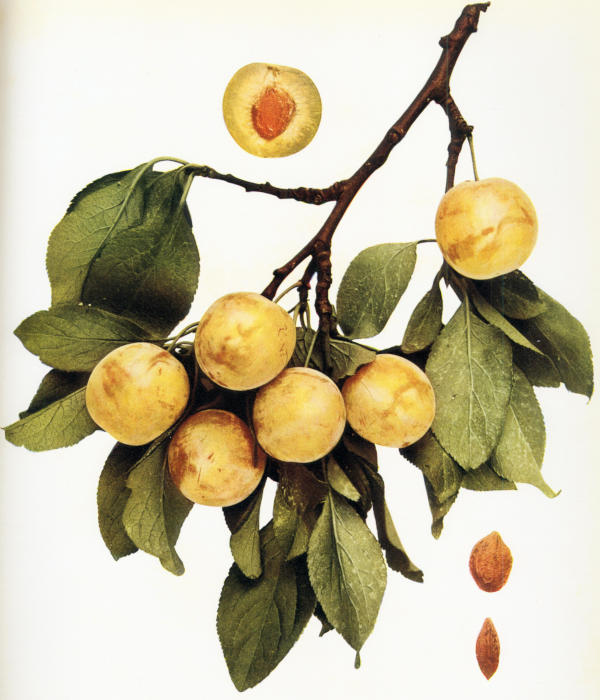
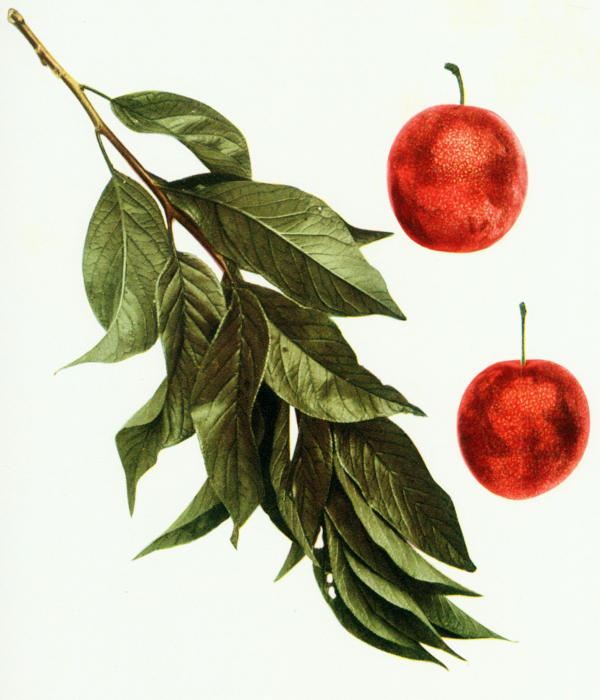
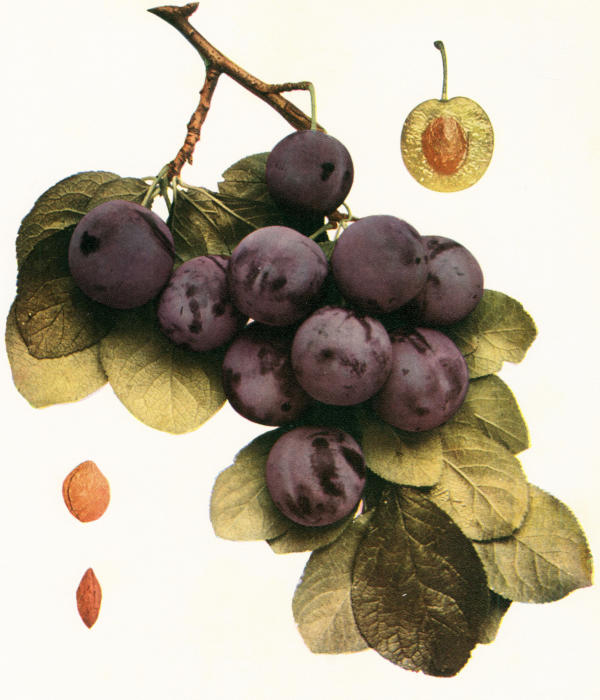
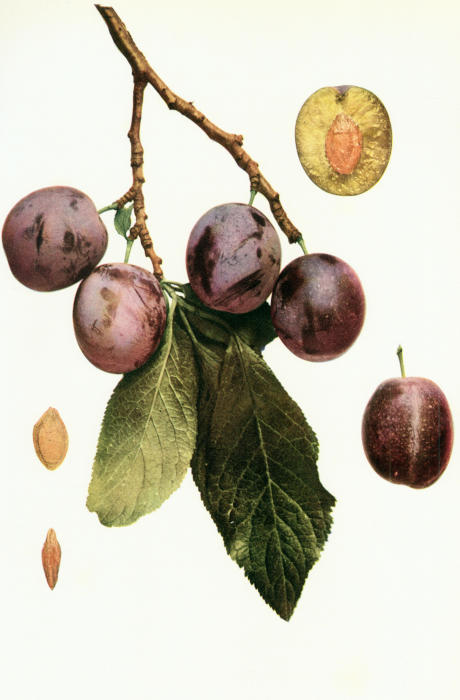
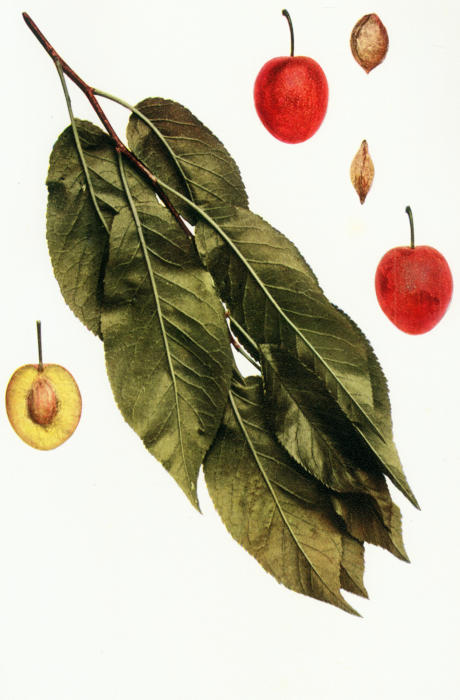
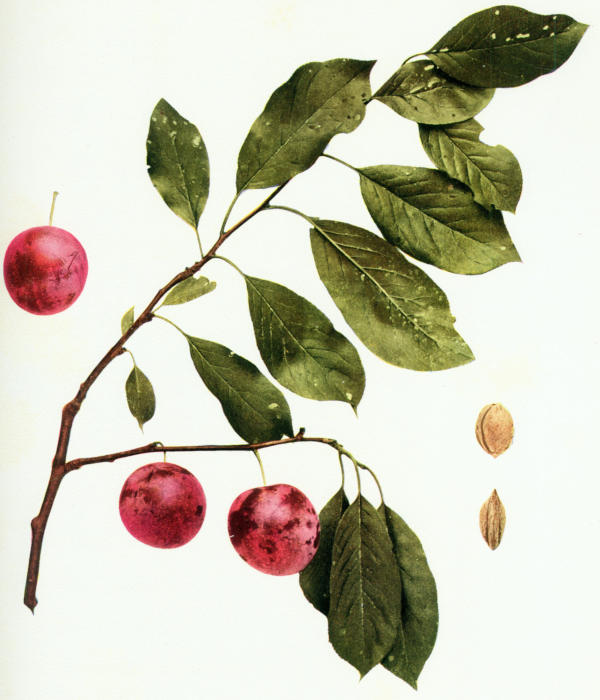
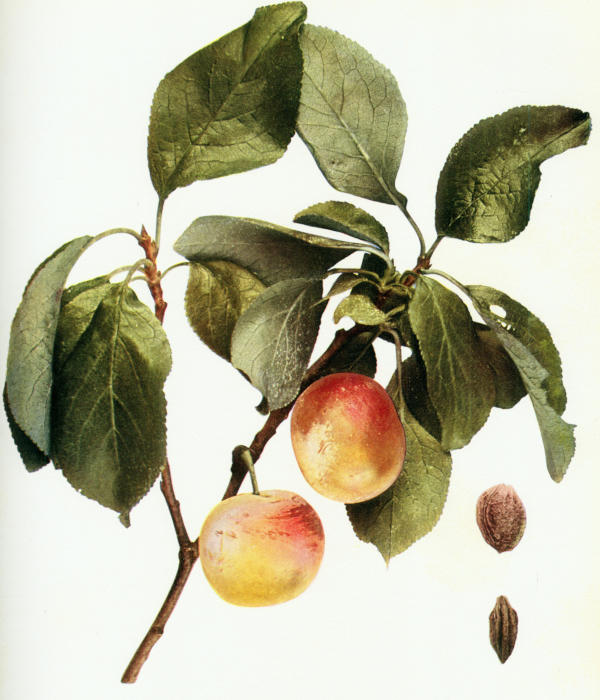
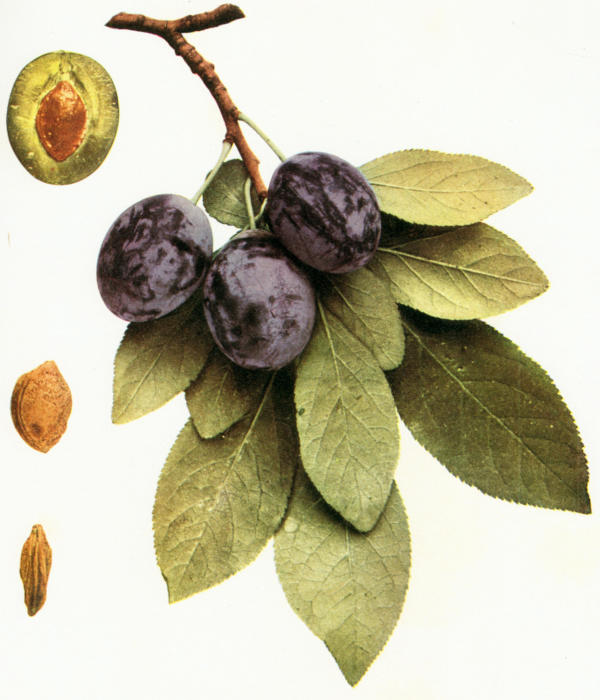
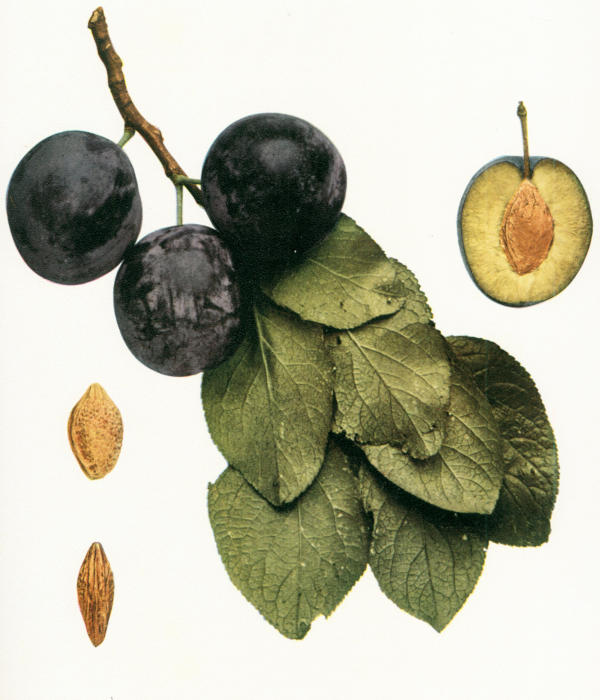
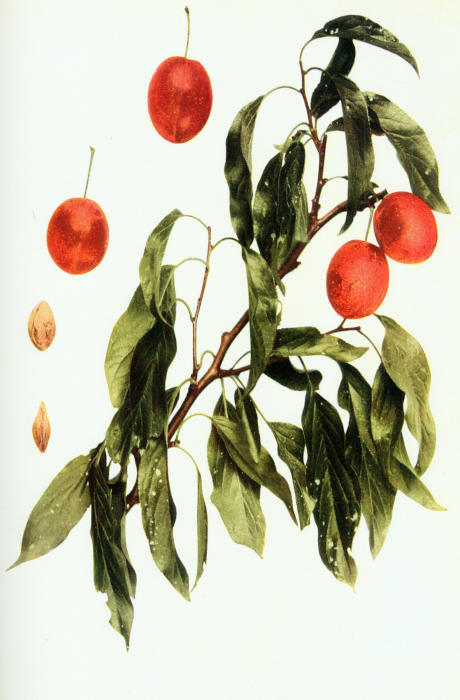
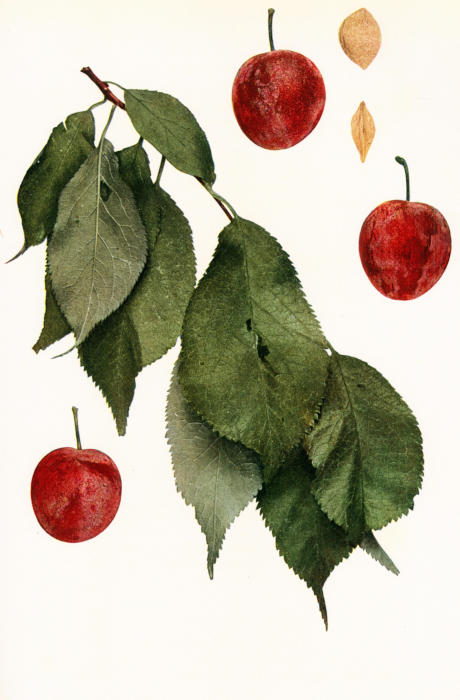
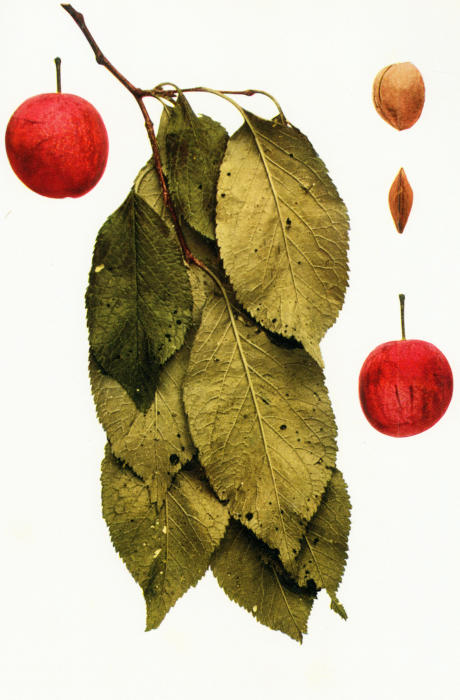
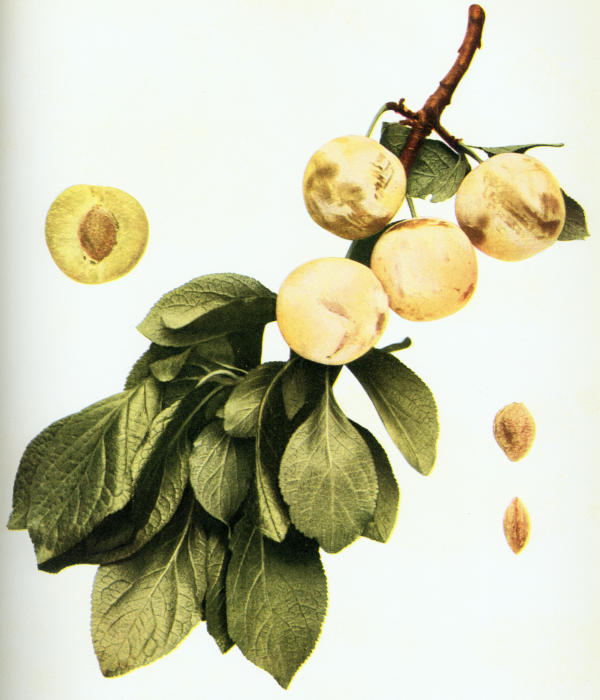
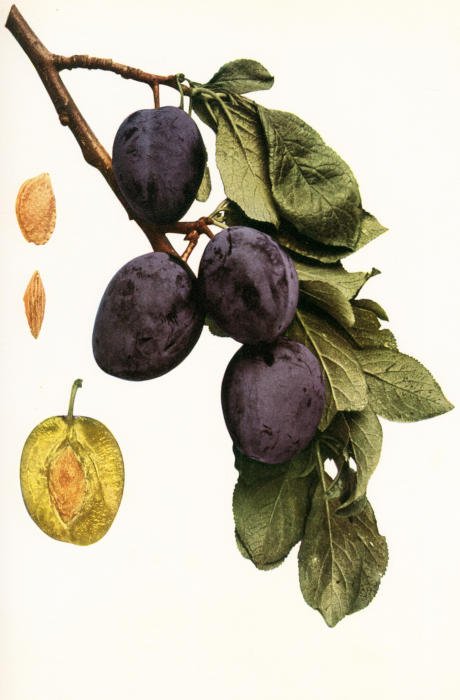
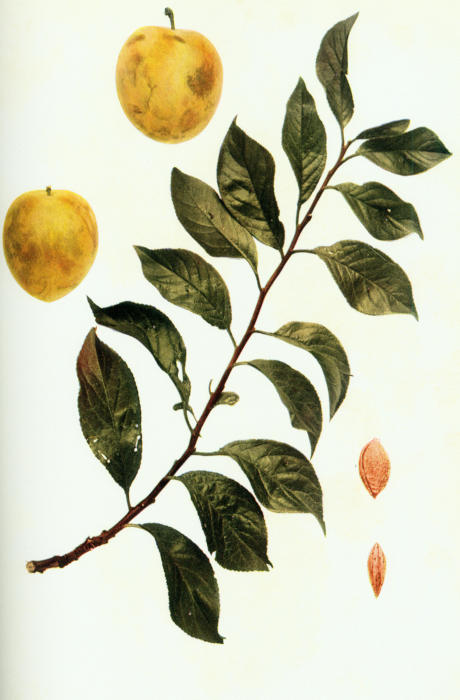
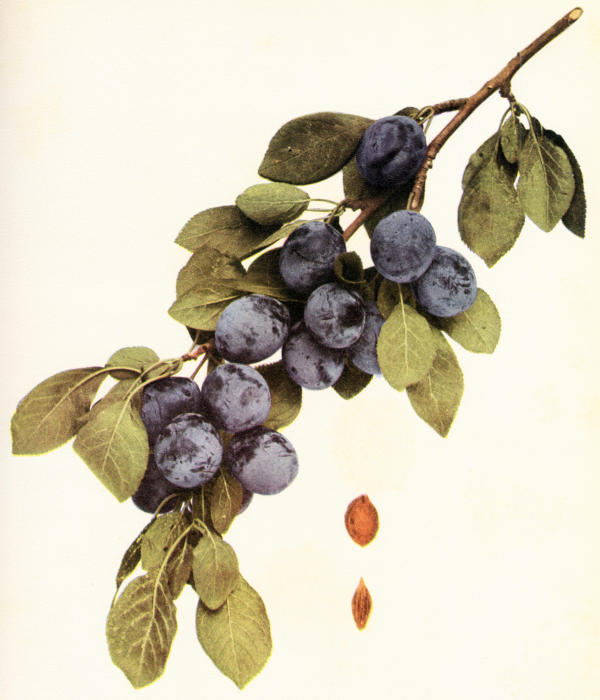
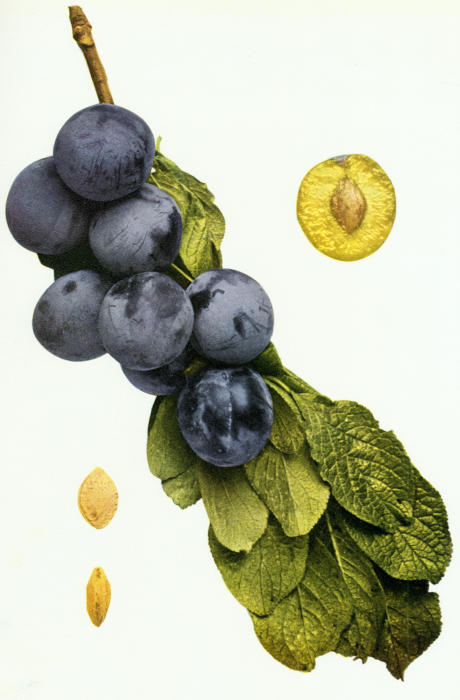
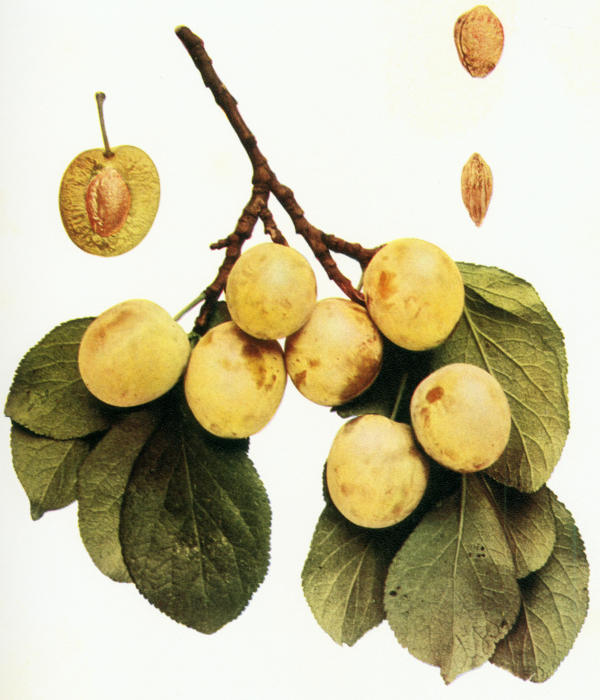
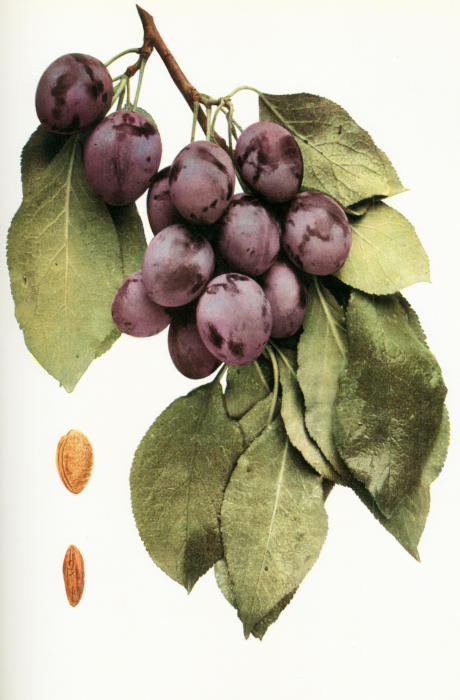
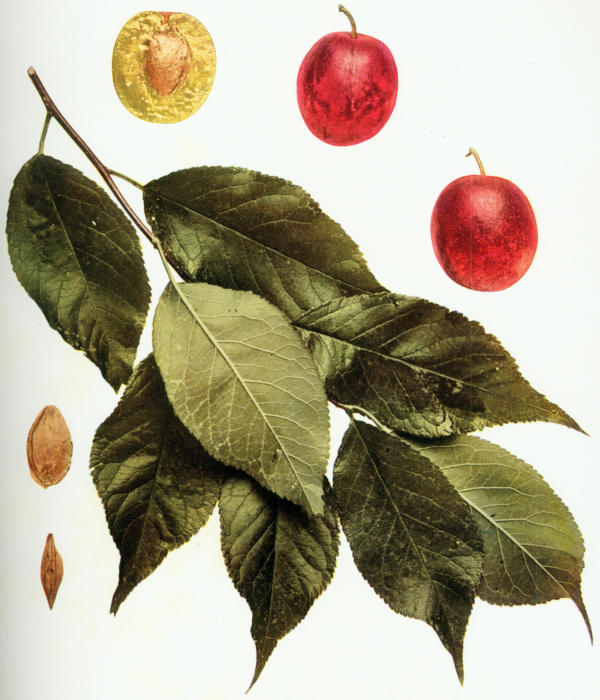
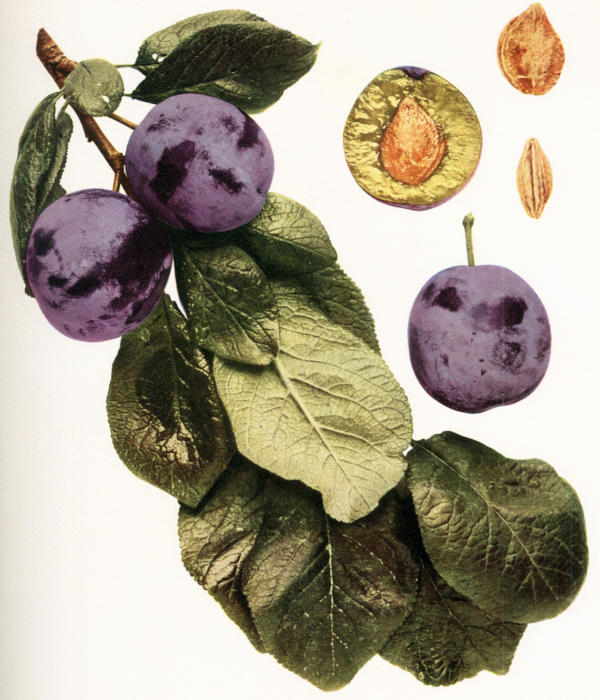
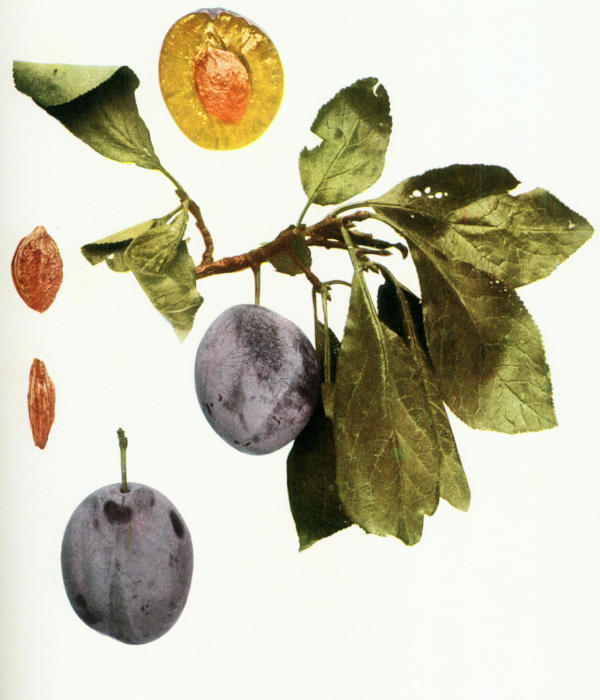
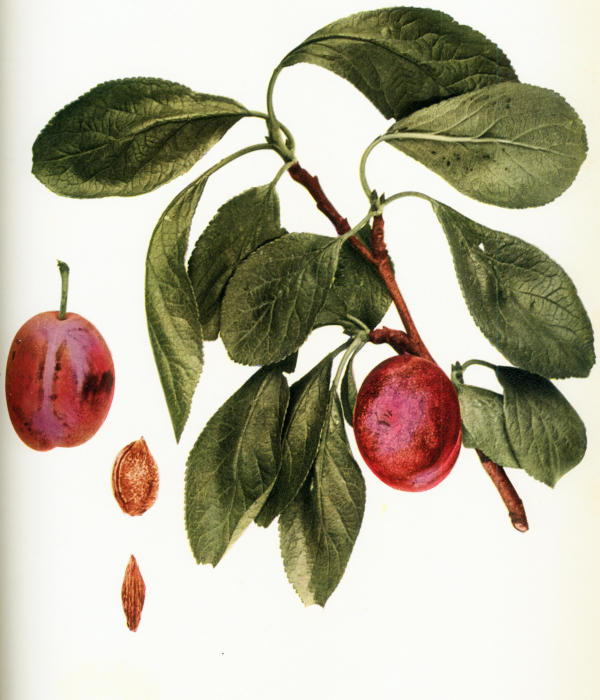
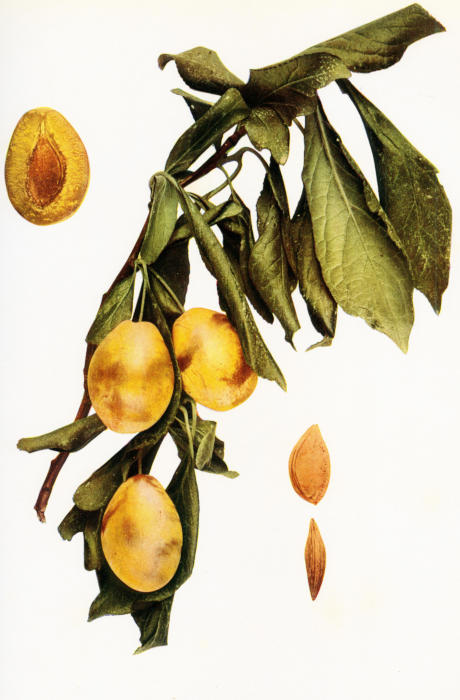
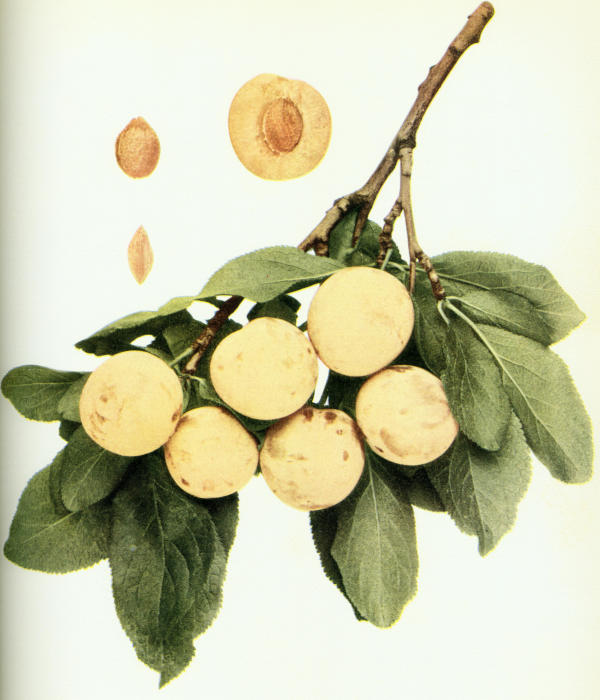
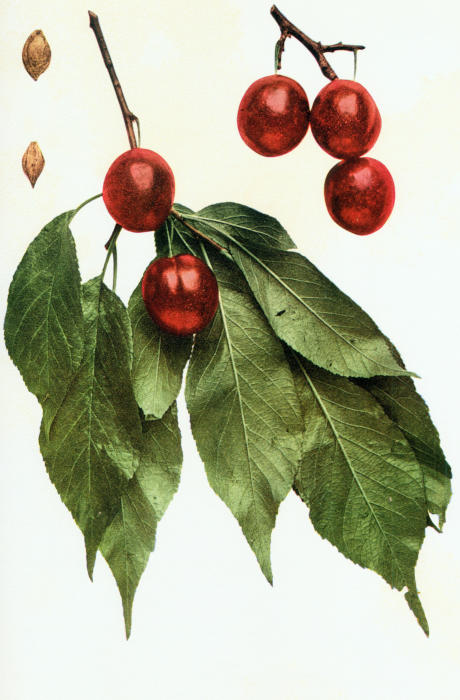
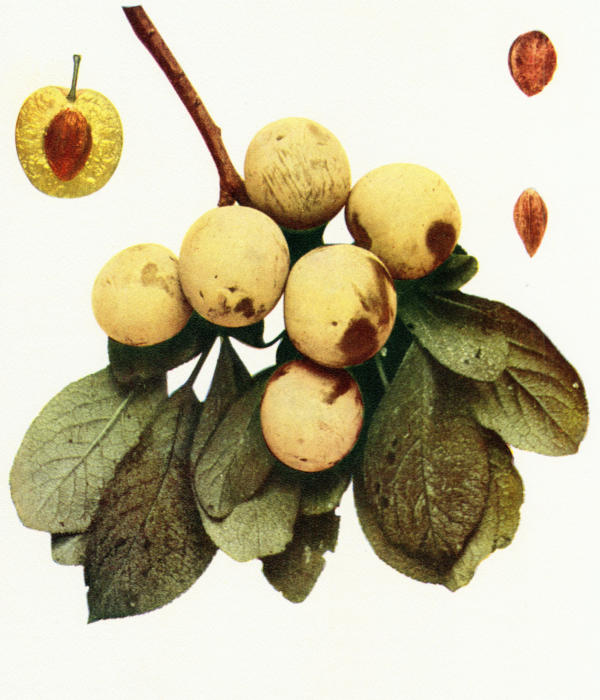
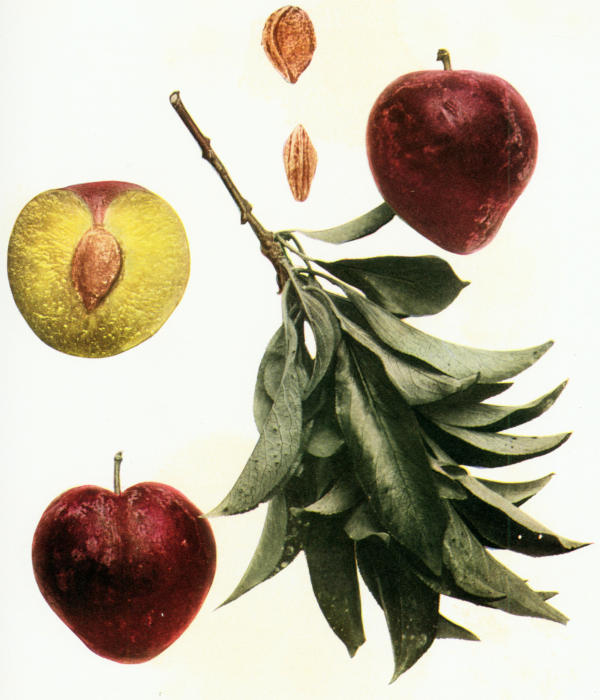
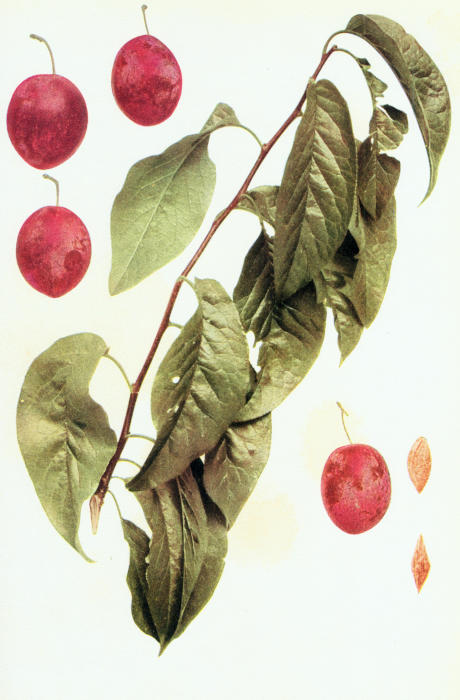
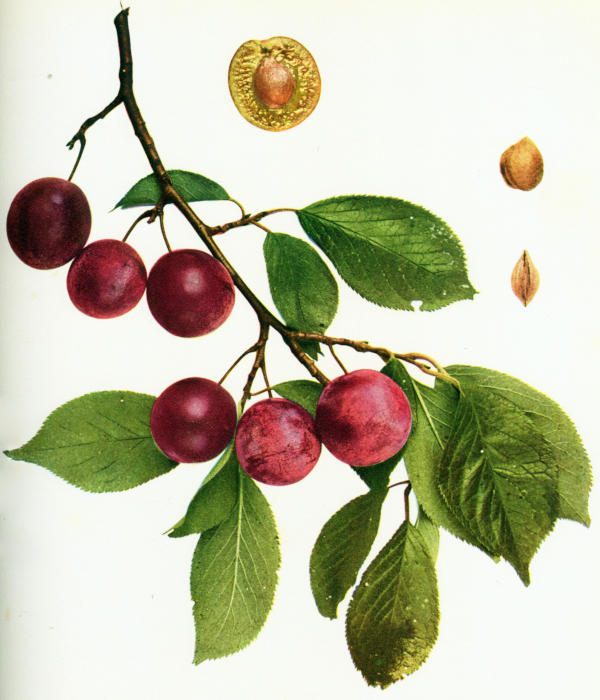
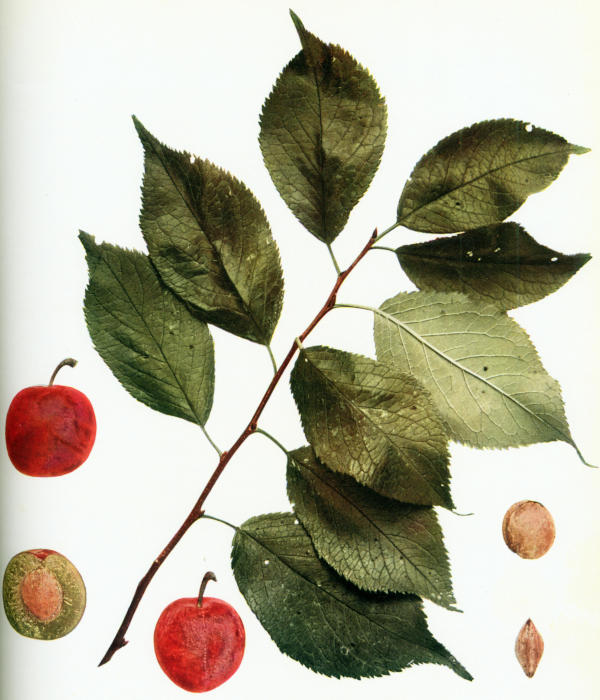
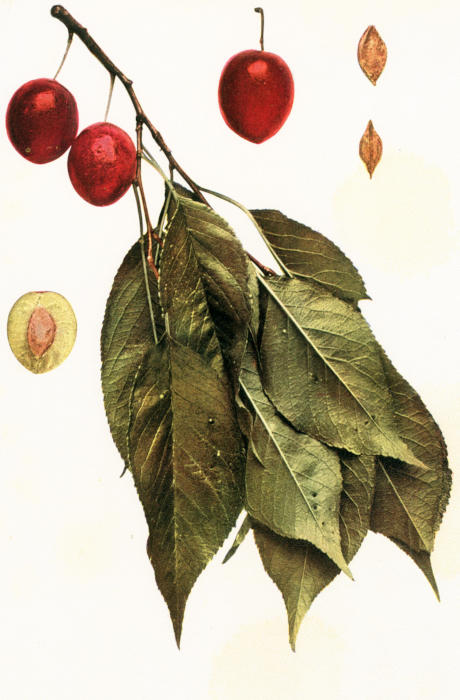
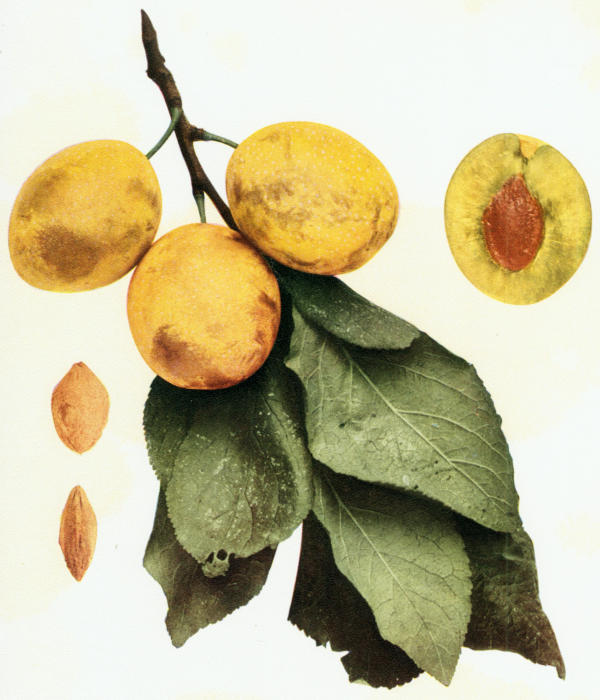
standpoints, with the bark and the flowers of several species, are illustrated
in colors.
The Plums of New York is a horticultural and not a botanical work.
But in a study of the fruit from a horticultural standpoint one must of
necessity consider botanical relationships. It is hoped that in this enforced
systematic study of plums, however, something has been added
to the botanical knowledge of this fruit. In classifying the varieties and
species, to show their characters and relationships, the author has chosen
to dispose of the groups in accordance with his own views though the
arrangement adopted is, for most part, scarcely more than a modification
of existing classifications.
Attention must be called to the indefiniteness of species and varieties
of plums due chiefly to the extreme responsiveness of the plants to environment.
On each side of the specific or varietal types there are wide ranges
of variation. Since the relationships between types are often very close it
is impossible to avoid some confusion in characters, for outliers of
the types cannot but overlap. It might be well said that these outliers
are connecting links and that groups so connected should be combined,
but this would make specific division of the genus and varietal division
of the species almost impossible. The groups must, therefore, be separated
along more or less arbitrary lines. But such arbitrary separation
does not prevent natural groups, if nature be broadly interpreted.
The chief value of the work in hand lies in its discussion of varieties.
In the descriptions the aim has been to give as tersely as possible an idea
of all of the characters of the plums described. With very few exceptions
the technical descriptions of varieties are original and were made by those
who have taken active part in the preparation of this book. Nearly all
of the varieties having full descriptions grow on the Station grounds but
whenever possible specimens of each variety from different localities have
been compared with those growing here.
A special effort has been made to give as exactly as possible the regions
in which the species and varieties of plums grow. Such an effort is made
under the belief that this knowledge is of great value in the study of the
factors which govern the distribution of wild and domesticated plants.
If the boundaries of the regions in which a few scores of varieties of the
several fruits grow can be accurately established valuable generalizations
can be drawn regarding life zones and plant distribution.
The reader should know what considerations have governed the
selection of varieties for color-plates and full descriptions. These are:
(1) The known value of the variety for the commercial or amateur grower.
(2) The probable value of new varieties. (3) To furnish data for the plum-breeder;
to show combinations of species or varieties, or new characters,
or the range in variation. (4) Some sorts have been described because
of historical value—to better show what the trend of plum evolution
has been. (5) To indicate the relationships of species and varieties. The
varieties are divided into three groups according to their importance as
gauged from the standpoints given above.
In botanical nomenclature the code adopted by the American botanists
in Philadelphia in 1904 and modified by the International Botanical
Congress at Vienna in 1905, has been used. For horticultural names,
lacking a better code, the revised rules of the American Pomological Society
have been followed, though in a few cases we have not seen fit to follow
the rules of this society, as the changes required by their strict observance
would have brought much confusion. Only those who have to work with
a great number of varieties of fruit can know the chaotic conditions of our
pomological nomenclature. One of the aims of the work in hand is to
set straight in some degree the great confusion in plum names.
All synonyms of varieties have been given so far as they could be
determined but it did not seem worth while to give all of the references
to be found even in standard plum literature. Fewer of these are listed
for the leading varieties than in the books on apples or grapes which have
preceded, only such being given as have been found of use by the writers
or thought of possible use to future plum students. On the other hand
some references have been given for all varieties, a task not attempted in
The Grapes of New York.
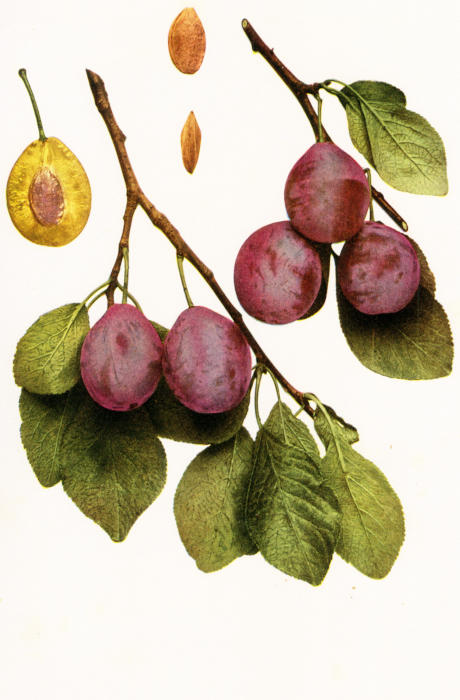
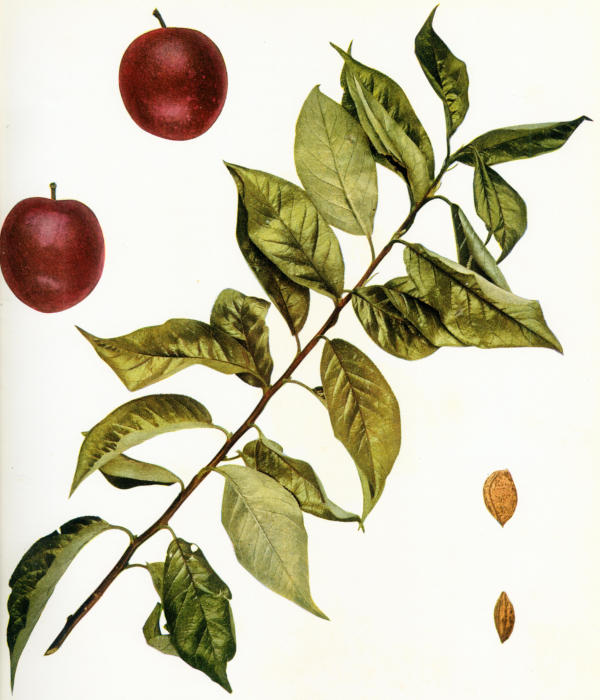
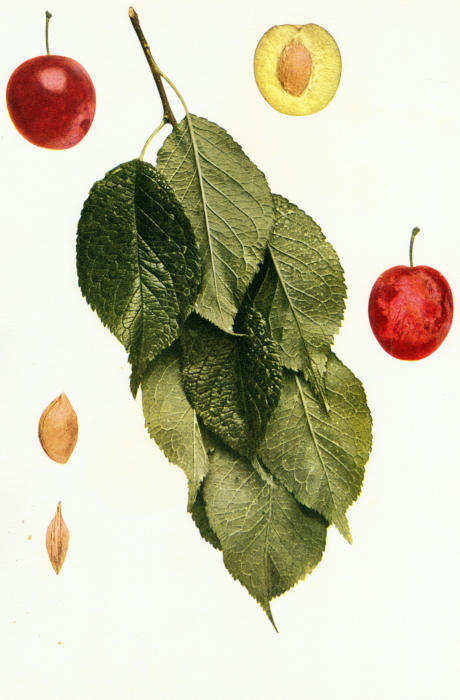
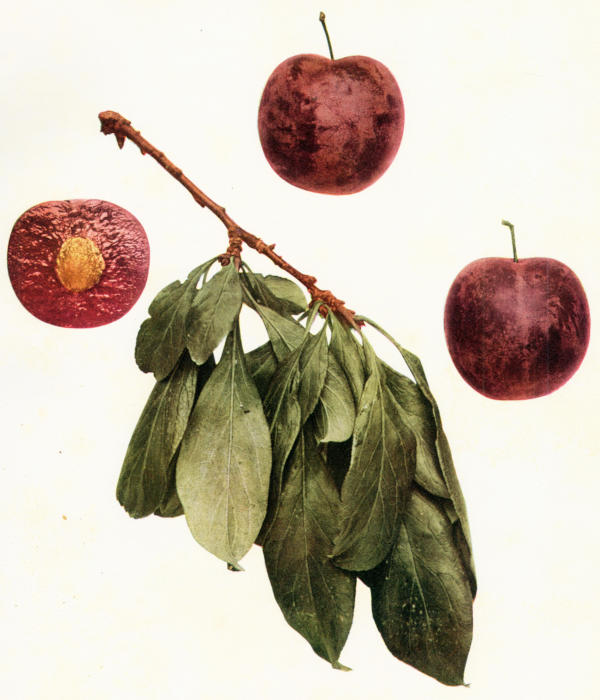
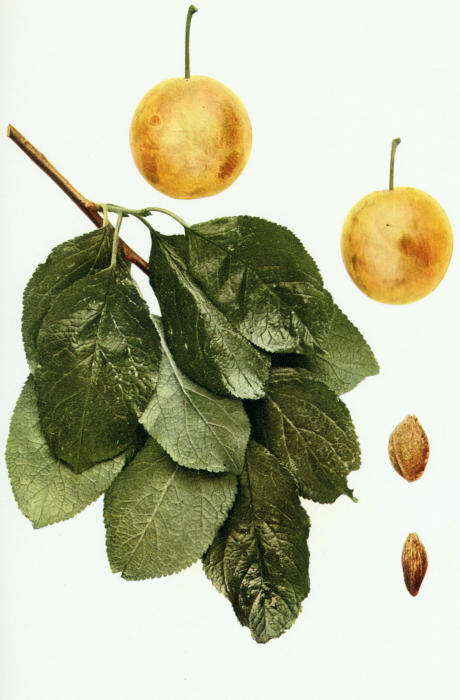
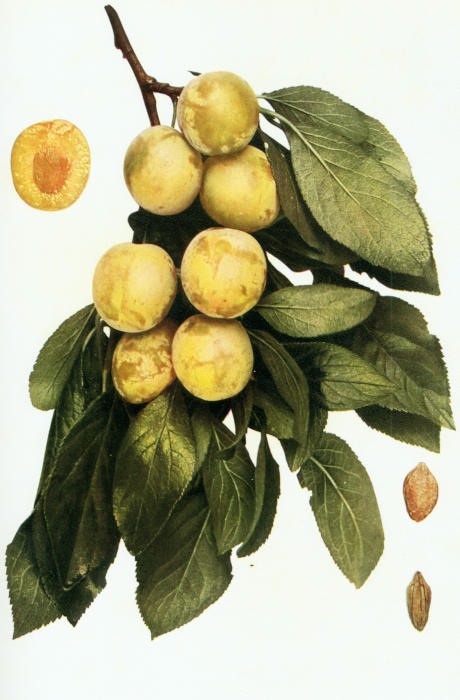
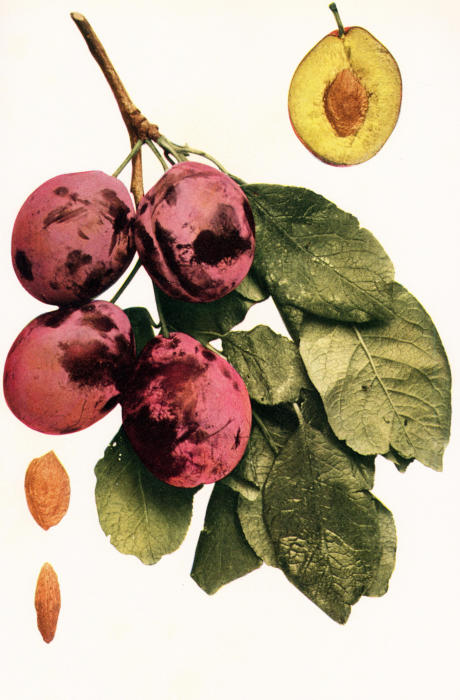
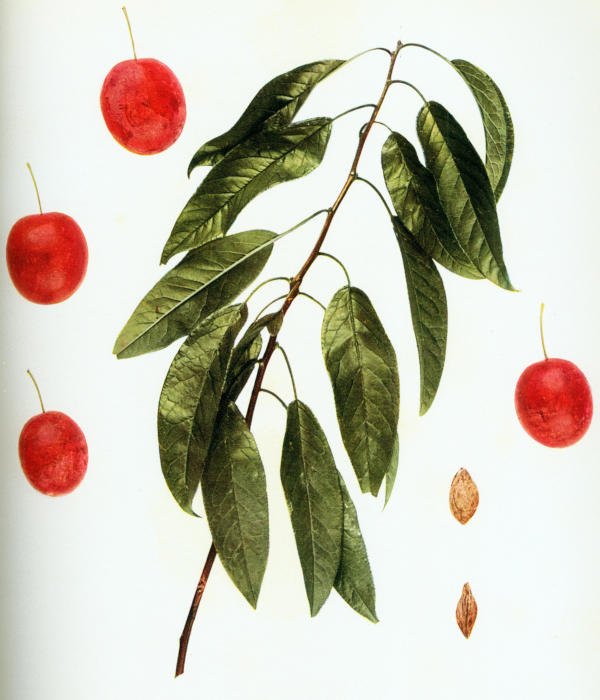
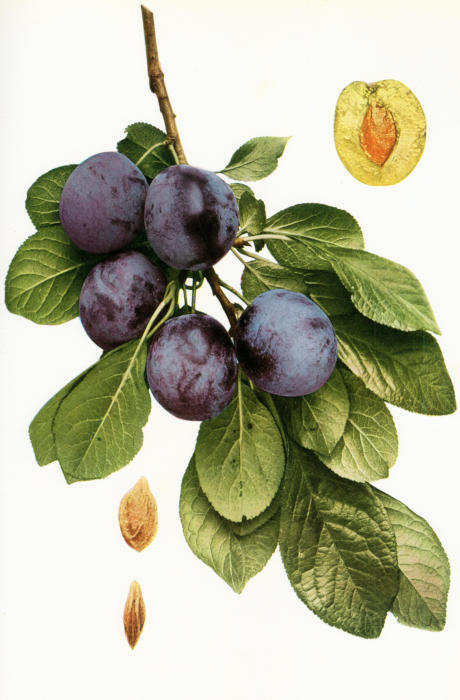
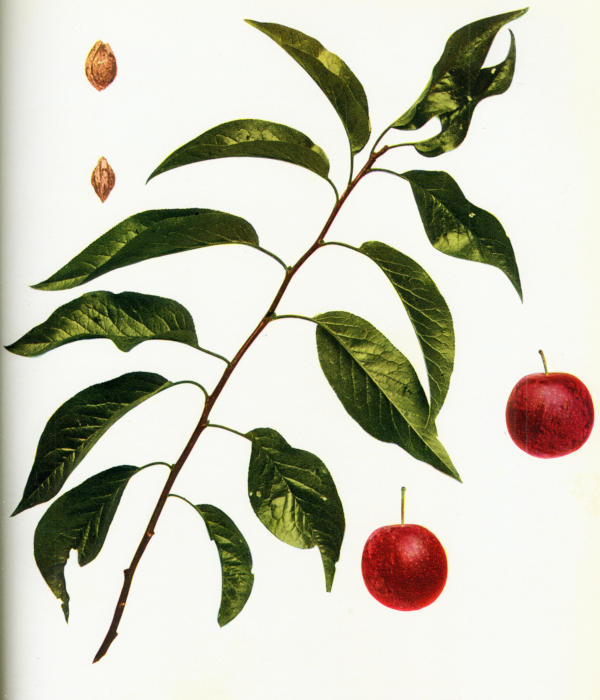
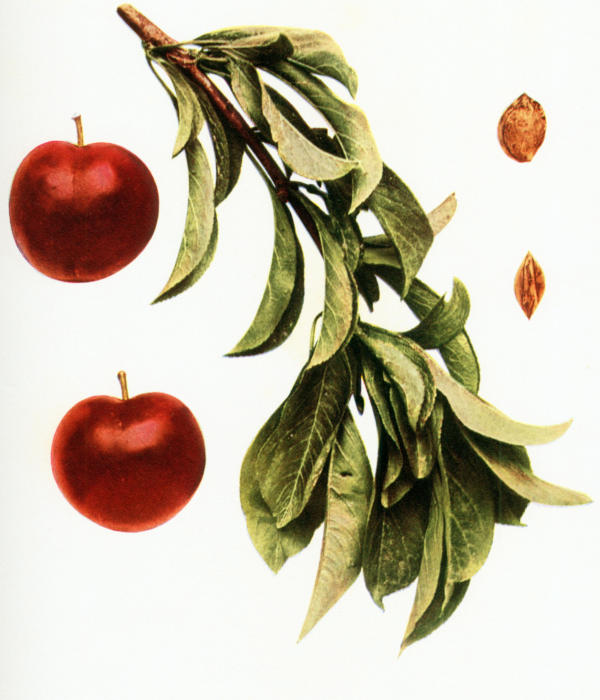
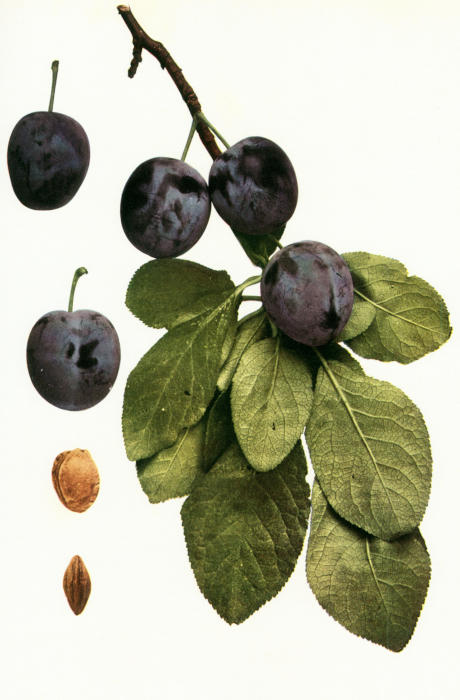
As in the preceding books the color-plates have been given much attention.
Work and expense have not been spared to make the plates
the best possible with the present knowledge of color-printing. Yet the
illustrations are not exact reproductions. The colors are, at best, only
approximations; for it is impossible by mechanical processes to reproduce
Nature’s delicate tints and shades. The camera does not take colors as
the human eye sees them; and the maker of the copper plate can not quite
reproduce all that the camera has taken. The colors then depend on the
judgment of the printer, who by selecting and mingling colored inks, reproduces
as nearly as his materials permit, the shades in his eye and mind;
but no two persons see exactly the same colors in any object; so his conception
may differ much from that of the horticulturist or artist who saw
the original plum, as do theirs from each other. Still it is hoped that the
color-plates will be of great service in illustrating the text. All of the plums
from which the plates were made came from the Station grounds; the
illustrations, with a few exceptions which are noted, are of life size, as grown
under the conditions existing at this place, and as far as possible all are
from specimens of average size and color.
Acknowledgments are due in particular to the plum-growers of New
York who have furnished much information for The Plums of New York;
to numerous institutions in all parts of the United States who have loaned
botanical specimens; to Professor Charles Sprague Sargent for advice,
information and the use of the Arnold Arboretum library and herbarium;
to W. F. Wight of the United States Department of Agriculture, who
has given most valuable assistance in describing the species of plums and
in giving their range; to the Station Editor, F. H. Hall, who has had
charge of the proof-reading; to Zeese-Wilkinson and Company, New
York City, for their care and skill in making the color-plates; and to the
J. B. Lyon Company, Albany, New York, for their careful work in the
mechanical construction of the book.
U. P. HEDRICK, Horticulturist, New York Agricultural Experiment Station.
THE PLUMS OF NEW YORK — CHAPTER I EDIBLE PLUMS — THE GENUS PRUNUS — PLUMS. — CONSPECTUS OF SPECIES OF PLUMS. — 1. PRUNUS DOMESTICA Linnaeus — 2. PRUNUS INSITITIA Linnaeus — 3. PRUNUS SPINOSA Linnaeus. — 4. PRUNUS CURDICA Fenzl and Fritsch. — 5. PRUNUS COCOMILIA Tenore. — 6. PRUNUS CERASIFERA Ehrhart [85] — 7. PRUNUS MONTICOLA K. Koch — 8. PRUNUS TRIFLORA Roxburgh — 9. PRUNUS SIMONII Carrière — 10. PRUNUS AMERICANA Marshall — PRUNUS AMERICANA MOLLIS [115] Torrey and Gray — 11. PRUNUS HORTULANA Bailey [116] — PRUNUS HORTULANA MINERI Bailey — 12. PRUNUS NIGRA Aiton — 13. PRUNUS ALLEGHANIENSIS Porter — 14. PRUNUS SUBCORDATA Bentham — PRUNUS SUBCORDATA KELLOGGII Lemmon — 15. PRUNUS UMBELLATA Elliott — PRUNUS UMBELLATA INJUCUNDA (Small) Sargent — 16. PRUNUS MITIS Beadle — 17. PRUNUS TARDA Sargent — 18. PRUNUS ANGUSTIFOLIA Marshall — PRUNUS ANGUSTIFOLIA WATSONI (Sargent) Waugh [137] — PRUNUS ANGUSTIFOLIA VARIANS Wight and Hedrick — 19. PRUNUS MUNSONIANA [139] Wight and Hedrick — 20. PRUNUS MARITIMA Marshall — 21. PRUNUS GRAVESII Small — 22. PRUNUS ORTHOSEPALA Koehne — 23. PRUNUS GRACILIS Engelmann and Gray — 24. PRUNUS RIVULARIS Scheele
The great genus Prunus includes plums, cherries, almonds, apricots,
peaches, and the evergreen cherries or cherry laurels. Its widely distributed
species number a hundred or more for the world, nearly all of which belong
north of the equator. The species of the genus are widely distributed
in both the eastern and western hemispheres, the flora of eastern America
and of western Asia being especially rich in species and individuals. For
most part the species of Prunus belong to the Temperate Zone, but several
of the evergreen cherries, usually grouped in a section under Laurocerasus,
are found in the tropics and sub-tropics.
The species cultivated for their edible fruits are found only in the
Temperate Zone of the Northern Hemisphere. Of these the peach and
the almond are believed to have come from eastern and southeastern
Asia; the apricot is thought to be a native of northern China; the wild
forms of the cultivated cherries are Eurasian plants, very generally distributed
in the regions to the northward where the two continents meet.
The habitats of the cultivated plums are given in detail in the text that
follows, as Asia, Europe and America. Presumably the genus had its
origin in some of the above regions; but where the center is from which
the species radiated can never be known. Indeed, with present knowledge
it cannot be said in what region Prunus has most species, is most productive
of individuals, or shows highest development and greatest variability,—facts
which might give some evidence as to the origin of the genus. It is
probable that the greatest number of combinations of the above evidences
can be shown for Asia and more especially for the Eurasian region, where
Europe and Asia meet; yet North America has two score or more indigenous
species about half of which are arborescent.
The history of the genus Prunus is one of continual changes. Of the
botanists who have done most toward classifying plants, Ray, Tournefort,
Dillenius and Boerhaave, pre-Linnaean botanists, placed only the plum
in Prunus. Linnaeus adopted the name used by his predecessors for the
plum alone, for a genus in which he also placed plums and cherries. Adanson
and Jussieu returned to the pre-Linnaean classification but Gaertner
followed the grouping of Linnaeus. Necker, DeCandolle, Roemer and
Decaisne held that the plum alone belongs in Prunus. Bentham & Hooker,
Gray and his co-workers in the several revisions of his botany, and Engler
& Prantl, great authorities of the Nineteenth Century, extend the genus
to include all of the stone-fruits. On the other hand, Britton and Brown,
in their recent flora of northern United States and of Canada restrict the
group to plums and cherries. Horticulturists have been less divided in
their opinions than the botanists and have very generally placed all of
the stone-fruits in one genus. The diversity of views as to what plants
belong in Prunus, indicated above, suggests that the differences separating
the several stone-fruits may not be many nor very distinct. This is true,
and makes necessary a discussion of the characters which distinguish
these fruits.
The flowers of true plums are borne on stems in fascicled umbels
and appear either before the leaves or with or after them. Flowers of the
cultivated cherries are similarly borne, though the fascicles are corymbose
rather than umbelliferous. But apricot, peach and almond flowers are
stemless or nearly so and solitary or borne in pairs appearing before the leaves.
The fruits of plums and cherries are globular or oblong, fleshy,
very juicy, with smooth or slightly hairy skins. Peaches, apricots and
almonds are more sulcate or grooved than plums and cherries and the
first two have juicy flesh, but that of the almond is dry and hard or skin-like,
splitting at maturity thereby liberating the stone; these last three
fruits are distinguished from plums and cherries by having very pubescent
or velvety skins though rarely, as in the nectarine, a botanical variety of
the peach, and in a few cultivated apricots, the skins are smooth.
The stone of the plum is usually compressed, longer than broad, smooth
or roughened, thickish and with an acute margin along the ventral suture
and thinnish or grooved on the dorsal suture. The stone of the cherry
is usually globular, always much thickened, smooth or a very little roughened,
ridged and grooved on the ventral suture, with a thin, scarcely raised
sharp margin on the dorsal suture. The stone of the apricot is similar
to that of the plum though thicker walled, with a more conspicuous winged
margin, and is sometimes pitted. The stone of the peach is compressed,
usually with very thick walls, much roughened and deeply pitted. In
the almond the stone resembles in general characters the peach-stone, but
all almond shells are more or less porous and often fibrous on the inner
surfaces. The stone is the part for which the almond is cultivated and is
most variable, the chief differences being that some have thick hard shells
and others thin soft shells.
The leaves of plums are convolute, or rolled up, in the bud. Cherry,
peach and almond leaves are conduplicate, that is are folded lengthwise along
the midrib in bud while the leaves of the apricot, like those of the plum,
are convolute. The manner in which the leaves are packed in the bud
is a fine mark of distinction in stone-fruits. In size and shape of leaves,
as well as in the finer marks of these organs, the botanist and pomologist
find much to aid in distinguishing species and varieties but little that holds
in separating the sub-genera. The last statement holds true with the
floral organs also.
The near affinity of the stone-fruits is further shown by the fact that
plums and apricots, plums and cherries, and the several species of each
of the distinct fruits inter-hybridize without much difficulty. It is a fact
well-known that hybrids often surpass their parents in vigor of plant and
in productiveness and this has proved true with most of the hybrids in
Prunus of which we have accounts, thereby giving promise of improved
forms of these plants through hybridizing. The great variation in wild
and cultivated native plums is possibly due to more or less remote hybridity.
Prunus is a most variable genus. This is indicated by the several
sub-genera, the large number of species and the various arrangements of
these groups by different authors. At their extremes sub-genera and species
are very distinct, but outside of the normal types, and sometimes in several
directions, there are often outstanding forms which establish well-graded
connections with neighboring groups. For example, among the
American plums there are but few species between which and some
other there are not intermediate forms that make the two species
difficult to distinguish under some conditions. There is also a wide range
of variation within the species. The modifications within the species
are oftentimes such as to change greatly the aspect of the plant; the trees
may be dwarf or luxuriant, smooth or pubescent; may differ in branching
habit, in leaf-form, in size and color of the flowers, in the time of opening
of leaf and flower-buds, in color, shape, size, flesh, flavor and time of ripening
of fruit, in the stone and in all such characters as climate and soil environment
would be liable to modify.
This inherent variability is one of the strong assets of the genus as a
cultivated group of plants, for it allows not only a great number of kinds
of fruits and of species but a great number of varieties. Besides, it
gives to the genus great adaptiveness to cultural environment, in accordance
with climate, location, soil and the handling of the trees. The cultivator
is able to modify, too, the characters of members of the genus
to a high degree in the production of new forms, but few, if any, groups
of plants having produced as many cultivated varieties as Prunus.
The genus Prunus is preeminent in horticulture, furnishing all of the
so-called stone-fruits, fruits which for variety, delicious flavor and beauty
of appearance, probably surpass those of any other genus, and which,
fresh or dried, are most valuable human foods. The seeds of one of the
fruits belonging to Prunus, the almond, are commercially important, both
for direct consumption and for the oil which is pressed from them; in
India a similar oil is obtained from the seeds of peaches and apricots, while
in Europe an oil from the seeds of the Mahaleb cherry is used in making
perfumes. Various cordials are made from the fruits of the several species,
as kirschwasser and maraschino from cherries, zwetschenwasser and raki
from plums, and peach brandy from the peach; while fruits and seeds
of the several species are soaked in spirits for food, drink and medicinal
purposes. The bitter astringent bark and leaves are more or less used
in medicine as is also the gum secreted from the trunks of nearly all the
species and which, known as cerisin, is used in various trades. The wood
of all of the arborescent species is more or less valuable for lumber, for
cabinet-making and other domestic purposes.
Prunus is prolific also in ornamental plants, having in common to
recommend them, rapidity of growth, ease of culture, comparative freedom
from pests, and great adaptability to soils and climates. The plants
of this genus are valued as ornamentals both for their flowers and for
their foliage. Many cultivated forms of several of the species have single
or double flowers, or variegated, colored or otherwise abnormal leaves,
while the genus is enlivened by the evergreen foliage of the cherry laurels.
Nearly all of the plants of Prunus are spring-flowering but most of them
are attractive later on in the foliage and many of them are very ornamental
in fruit.
Of all the stone-fruits plums furnish the greatest diversity of kinds.
Varieties to the number of two thousand, from fifteen species, are now
or have been under cultivation. These varieties give a greater range of
flavor, aroma, texture, color, form and size, the qualities which gratify
the senses and make fruits desirable, than any other of our orchard fruits.
The trees, too, are diverse in structure, some of the plums being shrub-like
plants with slender branches, while others are true trees with stout
trunks and sturdy branches; some species have thin, delicate leaves and
others coarse, heavy foliage. In geographical distribution both the wild
and the cultivated plum encircle the globe in the North Temperate Zone,
and the cultivated varieties are common inhabitants of the southern temperate
region, the various plums being adapted to great differences in
temperature, moisture and soil in the two zones.
The great variety of plums and the variability of the kinds, seemingly
plastic in all characters, the general distribution of the fruit throughout
the zone in which is carried on the greatest part of the world’s agriculture,
and the adaptation of the several species and the many varieties, to topographical,
soil and climatic changes, make this fruit not only one of much
present importance but also one of great capacity for further development.
Of the plums of the Old World the Domesticas, Insititias and probably
the Trifloras have been cultivated for two thousand years or more, while
the work of domesticating the wild species of America was only begun
in the middle of the last century. There are about fifteen hundred varieties
of the Old World plums listed in this work, and since the New World
plums are quite as variable, as great a variety or greater, since there
are more species, may be expected in America.
An attempt is made in The Plums of New York to review the plum
flora of this continent, but the species considered fall far short of being
all of the promising indigenous plums; not only are there more to be described,
but it is probable that species here described will in some cases
be sub-divided. The development of the pomological plum-wealth of
North America is but begun. Not nearly as much has been done to develop
the possibilities of the European plums in America as in the case of the
other tree-fruits. Probably a greater percentage of the varieties of Old
World plums commonly cultivated came from across the sea, than of the
varieties of any other of the orchard-fruits which have been introduced.
Much remains to be done in securing greater adaptability of foreign plums
to American conditions. Native and foreign plums are also being hybridized
with very great advantage to pomology.
The Plums of New York is written largely with the aim of furthering
the development of plums in America, the possibilities of which are indicated
in the preceding paragraph. With this end in view the first task
is to name and discuss briefly the characters of plums whereby species
and varieties are distinguished, with a statement, so far as present knowledge
permits, of the variability of the different characters. It is absolutely
essential that the plum-grower have knowledge, especially if he aspires
to improve the fruit by breeding, of the characters of the plants with which
he is to work. These are in the main as follows:
All species and some horticultural varieties have more or less characteristic
trees. Making due allowance for environment—food, moisture
and light—many plum groups can be readily distinguished by the general
aspect of the plant. Of the gross characters of trees, size is usually most
characteristic. A species, for example, is either shrubby or tree-like.
Yet under varying environment, size of plant and of the parts of the plant,
are probably the first to change. Habit of growth is nearly as important
as size and varies but little under changing conditions. A species or
variety may be upright, spreading, drooping or round-topped in growth;
head open or dense; the tree rapid or slow-growing. Hardiness is a very
important diagnostic character, plums being either hardy, half-hardy or
tender. Both species and varieties respond in high degree to the test
of hardiness, the range for varieties, of course, falling within that of the
species. Productiveness, regularity of bearing, susceptibility to diseases
and insects, and longevity of tree are all characters having value for species
and varieties and with the exception of the first named, are little subject
to variation.
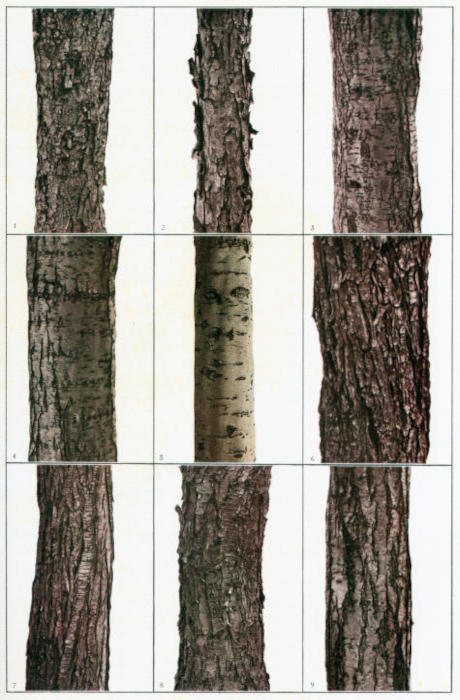
The thickness, smoothness, color and manner of exfoliation of the
outer bark and the color of the inner bark have considerable value in determining
species but are little used in determining horticultural groups.
It is well recognized that all plums have lighter colored bark in the South
than in the North. The branches are very characteristic in several species.
The length, thickness and rigidity of the branch and the length of its
internodes should be considered, while the direction of the branch, whether
straight or zigzag, are very valuable determining characters and relatively
stable ones, seeming to change for most part only through long ranges
of climatic conditions. So, too, the arming of a branch with spines or
spurs and the structure of such organs are important. The color, smoothness,
amount of pubescence, direction, length, thickness and the appearance
of the lenticels, the presence of excrescences on the branchlets of
the first and second year’s growth and the branching angle, are all worthy
of consideration though quite too much has been made of these characters,
especially of pubescence, in determining species, for they are all
extremely variable.
1. P. HORTULANA MINERI 2. P. AMERICANA 3. P. CERASIFERA
4. P. DOMESTICA 5. P. INSITITIA 6. P. HORTULANA
7. P. MUNSONIANA 8. P. NIGRA 9. P. TRIFLORA
The size, shape and color of leaf-buds and of their outer and inner
scales and the margins of the scales differ in different species. Possibly
the most evident, and therefore readiest means of identifying species, at
least, is by the leaves. It is true that leaves are very variable but always
within limits, and either individually or collectively in giving the general
aspect to a tree they are characteristic. Modifications of leaves most often
occur in very young plants, those growing in bright sunshine or deep shade
and on sprouts or suckers, but none of these are usually sufficient to mislead
as to species. Leaf-size and leaf-form are the first characters to be
noted in determining a plum but these are closely followed in value by
leaf-color, leaf-surface, leaf-thickness and leaf-margin. Leaf-size is variable,
depending much upon the conditions noted above but leaf-form varies but
little in the several species. So, too, the color of leaves is very constant
throughout a species, for both surfaces, though impossible to describe accurately
in words and very difficult to reproduce in color-printing. There
is a marked difference in autumnal tints not only of species but of varieties
but these are not very constant in any one location and must vary greatly
under different environments. The thickness of the leaves of the several
species is a distinctive character. Species of plums have very different
leaf-surfaces as regards reticulation, rugoseness, pubescence and coriaceousness,
all of these characters being quite constant, though it is to be noted
that roughness of leaves and pubescence are increased by exposure to the
sun and by the influence of some soils. There is, indeed, considerable
variation in the pubescence of the leaves of all species of plums in different
parts of the country and probably too much has been made of pubescence
as a determining character.
The margins of leaves are very characteristic of species and scarcely
vary under normal conditions if the teeth at the middle of the sides be taken
rather than those toward the base or apex, these very often being crowded,
reduced or wanting. The presence of glands, their position, size, shape
and color, help to characterize several species and seem to be fairly constant
guides. Some species and a great number of varieties have the
distinguishing marks of gland-like prickles tipping the serrations in the
leaf-margins. Length, thickness, rigidity and pubescence of petiole have
some taxonomic value. Stipules usually offer no distinguishing marks
other than those mentioned under leaves.
The blossoms of plums are very characteristic, giving in flowering
time a distinctive aspect to all species and distinguishing some horticultural
varieties. The flowers of all the species are borne in clusters, differing
in number of individuals, according to the species; so, too, the flowers in
the different species vary in size, color, in length of their peduncles, and in
pubescence, especially of the calyx. Flower-characters are constant, taking
them as a whole, yet there are some variations that must be noted. One
of the most marked of these is in the time of appearance of the flowers;
in the South they appear before the leaves but in the North with the leaves.
On the grounds of this Station there are notable exceptions to the latter
statement, with varieties of species showing considerable variation in this
regard. There are some remarkable variations within species as regards
size and color of the corolla and glands and pubescence of the calyx, depending
upon the environment of the plant; but on the whole these characters
are very constant. The fragrance of the flowers of plums varies from a
delicate, agreeable odor to one that is quite disagreeable in some species as in
Americana; the odor seems to be a constant character.
Of all structures of the plum the fruit is most variable, yet fruits are
sufficiently distinct and constant, especially within species, to make their
characters very valuable in classification. Species, whether wild or cultivated,
may be distinguished in greater or less degree by the period of
ripening of the fruits, though in this regard the cultivated varieties of
the several species vary greatly and in the wild state trees of native plums
in the same locality, even in the same clump, may vary in ripening as
much as from two to four weeks. Species are distinguished by size, shape,
color, flesh, flavor and pit among the grosser characters of the structure
and by amount of bloom, stem, cavity, apex, suture and skin among the
minor characters. The fruit is usually the first part of the plant to respond
to changed conditions.
Characters derived from seed structures are generally accounted of
much value by botanists in determining species. Such is the case with
plums. This Station has a collection of stones of over three hundred
cultivated varieties of plums and some specimens of nearly all the different
species. The stones illustrated in the color-plates in this book show that
this structure is quite variable in size, shape, in the ends, surfaces, grooves
and ridges, even within a species; nevertheless in describing the several
hundred forms of plums for The Plums of New York the stone has been
quite as satisfactory, if not the most satisfactory, of any of the organs of
this plant for distinguishing the various species and varieties.
The reproductive organs of plums afford several characters and would
seem to offer means of distinguishing botanical and horticultural groups,
but they are so variable in both cultivated and wild plants as to be very
misleading. Not only do these organs differ very often in structure but
also in ability to perform their functions. Bailey[1] has called attention
to the remarkable self-sterility of some varieties of the native species of
plums, due to the impotency of the pollen upon flowers of the same variety.
C. W. H. Heideman[2] made some very interesting observations on what
he considers distinct forms of the flowers of the Americana plums, describing
for this species all of the six possible variations of flowers enumerated
by Darwin in his Different Forms of Flowers in Plants of the Same
Species. Heideman thinks that other species of Prunus exhibit similar
variations. Waugh[3] made the pollination of plums a subject of careful
and extended study and found much variation in the pistils of plants of
the same species, insufficient pollen in some plants, pollen impotent on the
stigma of the same flower, and considerable difference in the time of maturity
of pollen and stigma in some plums, especially the Americana plums.
These variations, most important to the plum-grower, are of more or less
use in identifying plums.
After the discussion of the characters of plums we may pass to a detailed
description and discussion of the species of plums which now contribute
or may contribute cultivated forms to the pomology of the country
either for their fruits or as stocks upon which to grow other plums. The
following conspectus shows as well as may be the relations of the species
of plums to each other.
A. Flowers in clusters of 1 or 2. (Three in P. triflora.)
Old World plums.
B. Leaves drooping.
C. Shoots and pedicels pubescent.
D. Flowers mostly in twos.
E. Fruits large, more than 1 inch in diameter, variable in
shape, often compressed; tree large; stamens about 30.
1. P. domestica.
E.E. Fruit small, less than 1 inch in diameter, uniformly
oval or ovoid; stamens about 25; tree small, compact.
2. P. insititia.
D.D. Flowers mostly single.
E. Leaves small, less than 2 inches in length; sometimes
a tree; very thorny
3. P. spinosa.
E.E. Leaves large, more than 2½ inches in length; a shrub;
thorns few
4. P. curdica.
C.C. Shoots glabrous or soon becoming so, pedicels glabrous.
D. Pedicels shorter than the calyx-cup; leaves glabrous or
sparsely pubescent on the under side along the rib; flowers in pairs
5. P. cocomilia.
D.D. Pedicels more than twice as long as the calyx-cup.
E. Flowers mostly single; leaves hairy along the midrib on
the under side; petiole ⅕ as long as the leaf-blade; a tree
6. P. cerasifera.
E.E. Flowers in threes; leaves glabrous, petiole shining,
leaf-margins finely and closely serrate, teeth glandular-pointed;
stamens about 25
7. P. monticola.
E.E.E. Flowers in threes; leaves glabrous, often shining,
leaf-margins finely and closely serrate, teeth glandular-pointed;
stamens about 25
8. P. triflora.
B.B. Leaves upright, peach-like, glabrous, veins very
conspicuous, under side barbate at axils of veins; separated from
all other plums by the leaf-characters and by the large, flattened,
brick-red fruits
9. P. simonii.
A.A. Flowers in clusters of 3 or more, rarely 2. American plums.
B. Plants trees. (P. angustifolia rarely a tree.)
C. Leaves broad, mostly ovate or obovate.
D. Leaves long-ovate or long-obovate.
E. Flowers white.
F. Leaf-serrations glandless, acute; petiole usually
glandless; calyx-lobes entire, glabrous on the outer, pubescent on
the inner surface; stamens about 30; stone turgid, large, pointed
at the apex
10. P. americana.
F.F. Leaf-serrations glandular, wavy-crenate; petioles
glandular; calyx-lobes glandular-serrate, pubescent on the inner surface;
stamens about 20; stone turgid, small, prolonged at the ends
11. P. hortulana.
E.E. Flowers fading to pink.
F. Leaf-serrations coarse, rounded, glandular only when
young; petioles biglandular; calyx-lobes glandular-serrate, not pubescent
on the inner surface; stamens about 30; fruit red; bloom light; stone flat
12. P. nigra.
F.F. Leaf-serrations fine, acute, glandular-pointed; petioles
biglandular; calyx-lobes entire, pubescent on the outer, tomentose on the
inner surface; fruits dark purple; bloom heavy; stone turgid, acute at
the ends
13. P. alleghaniensis.
D.D. Leaves round-ovate, obtusely, sometimes doubly
serrate; petioles glandless; calyx-lobes pubescent on both surfaces;
fruit dark red or purplish; stone turgid, pointed at both ends
14. P. subcordata.
C.C. Leaves narrow, lanceolate-ovate.
D. Leaves flat.
E. Leaves glabrous; fruits globular, usually purple at
maturity but sometimes red or orange-red; bloom thin; stone turgid,
cherry-like
15. P. umbellata.
E.E. Leaves pubescent.
F. Stone acute at both ends; fruit purple.
16. P. mitis.
F.F. Stone rounded at base; fruits variously colored
17. P. tarda.
D.D. Leaves more or less folded upward.
E. Fruits small, ½ inch in diameter, cherry-like;
leaves lanceolate, upper surface glabrous, lustrous, lower surface
pubescent in axils of veins, marginal teeth glandless; petioles
biglandular; stone small, ovoid, turgid, cherry-like; rarely a
tree; tender in New York
18. P. angustifolia.
E.E. Fruits large, an inch in diameter, plum-like;
leaves lanceolate, peach-like, upper surface glabrous, lower
surface pubescent along the midrib; petioles with from 1 to 6
glands; stone compressed and pointed at both ends; usually a
tree; hardy in New York
19. P. munsoniana
B.B. Plants shrubs.
C. Fruits dark purple.
D. Leaves ovate, acute, finely serrated; shoots becoming
glabrous; stones pointed at both ends
20. P. maritima.
D.D. Leaves oval-orbicular, crenate-serrate; shoots
usually pubescent; stone pointed only at the base
21. P. gravesii.
C.C. Fruits red or orange, sometimes yellow but never
deep purple.
D. Fruits large, 1 inch in diameter; leaves oblong-ovate,
long-pointed, margin serrate with incurved sometimes glandular teeth,
upper surface glabrous, lower surface pilose; petiole with 1 or 2
glands; stone oval, flattened
22. P. orthosepela.
D.D. Fruits small, ½ inch in diameter.
E. Leaves small, ovate-lanceolate or oval, margins
finely and evenly serrate, upper surface glabrous, lower surface
soft pubescent; petioles short and stout; fruits variable in color,
mostly red; stone turgid, pointed at both ends
23. P. gracilis.
E.E. Leaves oblong-ovate, margins coarsely or doubly
serrate, glabrous above and sparingly pubescent below; petiole
glandular; fruits cherry-red
P. communis domestica.15. Hudson Fl. Anglic. 212. 1778. 16. Bentham Handb. Brit. Fl.1:236. 1865.
P. œconomica (in part) and P. italica (in part). 17. Borkhausen Handb. Forstb.2:1401, 1409.
1803. 18. Koch, K. Dend.1:94, 96. 1869. 19. Koehne Deut. Dend. 316. 1893.
Tree reaching a height of 30 or 40 feet, vigorous, open-headed, round-topped;
trunk attaining a foot or more in diameter; bark thick, ashy-gray with a tinge of red,
nearly smooth or roughened with transverse lines; branches upright or spreading, straight,
stout and rigid, usually spineless; branchlets usually pubescent, light red the first year,
becoming much darker or drab; lenticels small, raised, conspicuous, orange.
Winter-buds large, conical, pointed, pubescent, free or appressed; leaves large,
ovate or obovate, elliptical or oblong-elliptical, thick and firm in texture; upper surface
dull green, rugose, glabrous or nearly so, the lower one paler with little or much tomentum,
much reticulated; margins coarsely and irregularly crenate or serrate, often doubly so,
teeth usually glandular; petioles a half-inch or more in length, stoutish, pubescent,
tinged with red; glands usually two, often lacking, sometimes several, globose, greenish-yellow;
stipules very small, less than a half-inch, lanceolate, narrow, serrate, early
caducous.
Flowers appearing after or sometimes with the leaves, showy, an inch or more
across, greenish-white to creamy-white; borne on lateral spurs or sometimes from
lateral buds on one-year-old wood, 1 or 2 from a bud in a more or less fascicled umbel;
pedicels a half-inch or more in length, stout, green; calyx-tube campanulate, glabrous
or pubescent, green; calyx-lobes broadly oblong, obtuse, pubescent on both surfaces,
glandular-serrate, usually reflexed; petals white or creamy in the bud, oval to obovate,
crenate, notched or entire, claw short and broad; stamens about 30, equal to or shorter
than the petals; anthers yellow, sometimes tinged with red; pistils about as long as the
stamens, glabrous or pubescent.
Fruit of various shapes, mostly globular or sulcate, often necked, blue, red or yellow;
stem a half-inch or more long, stout, pubescent; cavity shallow and narrow; apex variable,
usually rounded; suture prominent or sometimes but a line or indistinct; skin variable;
dots small, numerous, inconspicuous; flesh yellowish, firm, meaty, sweet or acid and
of many flavors; stone free or clinging, large, oval, flattened, blunt, pointed or necked,
slightly roughened or pitted; walls thick; one suture ridged—the other grooved.
Beside the comparatively well-known groups of Domestica varieties,
there are in Europe, with an occasional representative in America, especially
in herbaria, numerous other groups either a part of Prunus domestica
or possibly, in a few cases at least, hybrids between it and other species.
European botanists place some of these in distinct species or sub-species;
but few, however, even of the recent writers on the botany of the plum,
agree at all closely as to the disposition of these edible and ornamental
plums which may be doubtfully referred to Prunus domestica. With this
disagreement between the best European authorities where these plums
have long been known, where some of them have originated, and all may
be found in orchards, botanic gardens and herbaria, it does not seem wise
at this distance to attempt a discussion of such doubtful forms. It is certain,
however, that Borkhausen’s Prunus italica and Prunus œconomica,
as given in the synonymy, are but parts of Prunus domestica, the first including
the Reine Claude plums and the latter the various prunes. So, too,
a wild form named by Borkhausen, Prunus sylvestris, is probably a part
of Prunus domestica.
Bechstein[4] gave specific names to a number of plums which Schneider[5]
holds are all cultivated forms of Prunus domestica. These names are not
infrequently found in botanical and pomological literature, to the great
confusion of plum nomenclature. The following are Bechstein’s species:—Prunus
exigua, Prunus rubella, Prunus lutea, Prunus oxycarpa, Prunus
subrotunda and Prunus vinaria.
The plum in which the world is chiefly interested is the Old World
Prunus domestica. The Domestica plums are not only the best known of
the cultivated plums, having been cultivated longest and being most widely
distributed, but they far surpass all other species, both in the quality of
the product and in the characters which make a tree a desirable orchard
plant. How much of this superiority is due to the greater efforts of man
in domesticating the species cannot be said, for the natural history of
this plum, whether wild or under cultivation, is but poorly known. It is
not even certain that these plums constitute a distinct species, there being
several hypotheses as to the origin of the Domestica varieties. Three of
these suppositions must be considered.
Many botanists hold that what American pomologists call the species
is an assemblage of several botanical divisions. The early botanists distributed
these plums in botanical varieties of one species. Thus Linnaeus,
in 1753, divided Prunus domestica into fourteen sub-species, and Seringe,
in 1825, made eight divisions of the species. Both of these men include
in this species, among others, plums which we now place in Prunus cerasifera,
the Cherry plums, and Prunus insititia, the Damsons and Bullaces.
Nearly all subsequent botanists who have not made two or more species
of it have recognized from two to several sub-divisions of Prunus domestica.
It is possible that what are called the Domestica plums should be distributed
among several botanical divisions. But it is difficult to find any
differential character sufficiently constant to distinguish more than one
species for the several hundred varieties of these plums now under cultivation.
Nor are there any cleavage lines sufficiently distinct to indicate
that the edible varieties of the one species should be sub-grouped.
In coming to these conclusions the writer has studied about three
hundred varieties of Domestica plums growing on the grounds of this
Station and about half as many more growing in other parts of the country,
the whole number representing all of the various species and sub-species
which other workers have made. The differences which have been most
used to classify the varieties of Domestica in several botanic divisions have
to do chiefly with the fruit, as size, shape, color and flavor, characters so
modified by cultivation and selection that they are artificial and transitory
and of little value in botanical classification. Moreover, the botanical
groups which have been founded on these characters are much more indistinct
than ordinarily in botany because of the merging at many points
of one group into another. This indistinctness is greatly increasing year
by year through the intercrossing of varieties. When the characters of
no value to man, and, therefore, little modified by cultivation, are considered,
it is scarcely possible logically to place Domestica plums in more
than one species or to further sub-divide the one species.
The botanists who have divided the Domestica plums into either
greater or lesser botanical groups do not define their divisions with sufficient
accuracy to make them clearly recognizable. Neither do they give
the habitats of the wild progenitors with sufficient certainty to carry conviction
that the groups were brought under cultivation from separate
ancestors. Also, the several botanists who hold to the multiple species
theory for the Domestica plums do not agree as to the limits of the different
groups and give to them very different specific or variety names, showing
that they have widely different ideas as a basis for their classification.
A second theory is that Prunus domestica is derived from Prunus
spinosa and that Prunus insititia is an intermediate between the two.[6]
This hypothesis is based upon the supposition that when Domestica plums
run wild they revert to the Insititia or Spinosa form. It is not difficult
to test this theory. A study of the origin of the several hundred Domestica
and Insititia plums discussed in Chapters III and IV of The Plums of
New York does not show for any one of them a tendency to reversion or
evolution to other species; nor do the descriptions indicate that there
are many, if any, transitional forms. During the two thousand years
they have been cultivated in Europe the Old World plums have been
constant to type. Domestica seedlings vary somewhat but they do not
depart greatly from a well marked type. Such very few striking departures
as there seem to be are more likely to have arisen through crossing with
other species than through reversion or evolution. This Station has grown
many pure seedlings or crosses of varieties of Domestica within the species
and has had opportunity of examining many more from other parts of the
State, and none of these show reversion to the other two Old World species.
Nor, as we shall see, is there much in what is known of the history of these
three species to lead to the belief that the Domestica, Insititia and Spinosa
plums constitute but one wild species or have arisen from one.
It has been remarked that there are few, if any, transitional forms
between the Domestica and other European plums. It is a significant
fact that Prunus domestica can be hybridized with other species of plums
only with comparative difficulty, species of plums as a rule hybridizing
very freely. This is as true with the Insititia and Spinosa as of other
plums, there being few recorded hybrids of either of these species with the
one under discussion. Quite to the contrary the varieties of the several
pomological groups of Domestica plums hybridize very freely. If all were
of one species we should expect many hybrids between the Domestica,
Insititia and Spinosa plums.
We are now left with the third hypothesis, which is, as we have indicated
in a preceding paragraph, that the varieties of Domestica plums
belong to one species; or if they have come from more than one species
the wild forms have not been distinguished and must have grown under
much more nearly similar conditions than is the case with Prunus domestica
and any other species. Without knowledge of more than one wild
form, and in view of the intercrossing of the varieties of these plums it
seems best to consider all as parts of one species, leaving to the pomologist
the division of the species into horticultural groups founded on the characters
which make the fruit valuable for cultivation.
Assuming, then, that the plums known in pomology as Domestica
plums belong to one species, the original habitat of the species may be
sought. In spite of the great number of varieties of plums now grown
in Europe and western Asia, and the importance of the fruit both in the
green and dried state, the history of the plums cannot be traced with much
certainty beyond two thousand years. Though stones, without doubt those
of the Insititia or Damson and the Spinosa or Blackthorn plums, are found
in the remains of the lake dwellings in central Europe[7] the pits of Domestica
plums have not yet come to light. In the summer of 1909 the writer,
in visiting historic Pompeii, became interested in the illustrations of fruits
in the frescoes of the ancient buildings, but neither in the houses of the
ruined city nor in the frescoes in the museums in Naples could he find
plums, though several other fruits, as apples, pears, figs and grapes were
many times illustrated. An examination of the remains of plants preserved
in the museum at Naples taken from under the ashes and pumice
covering Pompeii gave the same results. No stone-fruits were to be found,
though if widely used these should have been on sale in the markets of
Pompeii at the time of the destruction of the city, which occurred late in
August,—the very time of the year at which the examination was made
and at which time plums were everywhere for sale in Rome. This observation
is but another indication that plums were not well-known before
the beginning of Christianity, since Pompeii was destroyed in 79 A. D.
In Greek literature the references to plums are few before the Christian era
and these are more likely to some form of Insititia, as the Damsons, rather
than to the Domesticas.
Pliny gives the first clear account of Domestica plums and speaks
of them as if they had been but recently introduced. His account is as
follows:[8] “Next comes a vast number of varieties of the plum, the particolored,
the black, the white, the barley plum, so-called because it is ripe
at Barley harvest, and another of the same color as the last, but which
ripens later, and is of a larger size, generally known as the ‘Asinina,’ from
the little esteem in which it is held. There are the onychina, too, the
cerina,—more esteemed, and the purple plum; the Armenian, also an
exotic from foreign parts, the only one among the plums that recommends
itself by its smell. The plum tree grafted on the nut exhibits what we
may call a piece of impudence quite its own, for it produces a fruit that
has all the appearance of the parent stock, together with the juice of the
adopted fruit; in consequence of its being thus compounded of both, it
is known by the name of ‘nuci-pruna.’ Nut-prunes, as well as the peach,
the wild plum and the cerina, are often put in casks and so kept till the
crop comes of the following year. All the other varieties ripen with the
greatest rapidity and pass off just as quickly. More recently, in Baetica,
they have begun to introduce what they call ‘malina,’ or the fruit of the
plum engrafted on the apple tree, and ‘amygdalina,’ the fruit of the plum
engrafted on the almond tree, the kernel found in the stone of these last
being that of the almond. Indeed, there is no specimen in which two
fruits have been more ingeniously combined in one. Among the foreign
trees we have already spoken of the Damascene plum, so-called from
Damascus, in Syria, but introduced long since into Italy, though the stone
of this plum is larger than usual, and the flesh small in quantity. This
plum will never dry so far as to wrinkle; to effect that, it needs the sun of
its own native country. The myxa, too, may be mentioned as being the
fellow countryman of the Damascene; it has of late been introduced into
Rome and has been grown engrafted upon the sorb.”
While the records are somewhat vague it is probable that the Domestica
plums came from the region about the Caucasus Mountains and the
Caspian Sea and especially the section east of these mountains and the sea.
What seems to be the wild form of this species has been found by several
botanists in this great region.[9] Here the Huns, Turks, Mongols and Tartars,
flowing back and forth in tides of war-like migration, maintained
in times of peace a crude agriculture probably long before the Greeks and
Romans tilled the soil. The plum was one of their fruits and the dried
prune a staple product. Here, still, to the east, west and north toward
central Asia, plums are among the common fruits and prunes are common
articles of trade. Even in the fertile oases of the great central Asian
desert, plums are cultivated, but whether domesticated here or brought
from elsewhere cannot be told. Koch,[10] speaking of prunes in particular,
gives the following account (translated) of their Asiatic origin:
“According to my investigation Turkestan and the southern Altai
Mountains are the place of origin. When in the year 1844 I found myself
in Baku on the west coast of the Caspian Sea, I had plenty of opportunity
to draw accounts of the fruits of their native lands from the Turkestan
and Bokharan merchants, and was astonished over the high cultivation
of stone fruits in these places—at the same time I was able to taste dried
the most choice because best flavored, the Ali-Bokhara, that is Bokhara
prune. Some of these Bokharan prunes were transplanted a long time ago
to Trans-Caucasia and were especially cultivated in the ancient city and
residence of the Ruler of the modern Elizabethpol. Unfortunately the
cultivation is less now than in earlier times. A further spread toward the
west and toward Europe, I have not been able to follow. In Greece, the
prunes are even to-day an unknown fruit.”
At about the time Pliny wrote, or somewhat before, communication
had been opened between the Romans and the countries about the Caspian
Sea, and a few centuries later the devastating hordes of Asiatics came
westward and for several centuries continued to pour into eastern Europe.
What more probable than that they should have carried dried prunes as
an article of food in the invasions, and eventually, as they made settlements
here and there, have introduced the trees in Europe. It is certain, at any
rate, as we shall see, that several of the groups of cultivated plums trace back
to the Balkan countries of Europe and the region eastward. There, now
as then, the plum is a standard fruit and prune-making a great industry.
The plum when first known in Europe, as described by Pliny and other
early writers, seems to have been a large and well-flavored fruit, indicating
that it had been under cultivation for a long while. This, and the fact
that the fruit was not known by the earliest writers on agriculture, indicate
that the plum was not originally an inhabitant of southern Europe, as
some suppose. It is likely that the tree has escaped from cultivation
and become naturalized in the localities where it is now supposed to grow
wild. Prunus domestica has not been found wild nor under cultivation in
eastern Asia, so far as can be learned by the botanical and horticultural
explorers of China and nearby regions, Prunus triflora being the domesticated
plum of that part of the continent, though it may well be surmised
that some of the Domestica plums are cultivated in western China, a
region as yet but imperfectly explored for its plants.
Having briefly sketched the origin of the Domestica plums in the
Old World we may now consider their history in the New World—a more
satisfactory task, as data are abundant and reliable.
The Domestica plums are valuable food-producing trees in America
but have not attained here the relative importance among fruits that
they hold in Europe. From the earliest records of fruit-growing in the
New World the plum has been grown less than the apple, pear, peach
or cherry, while in Europe it is a question if it does not rank first or second
among the tree-fruits. The comparatively restricted area which the
Domestica plums now occupy in America is due, perhaps, to the fact that
they do not possess in as high degree as the fruits named above the power
of adaptation to the trans-Atlantic environment. Without question the
feature of environment most uncongenial to plums in America is the climate.
The plum thrives best in an equable climate like that of eastern and southern
Europe and of western America, and cannot endure such extremes of
heat and cold, wet and dry, as are found in parts of eastern America and
in the Mississippi Valley. At best this fruit lacks in what is called constitution,
or ability to withstand adverse conditions of any kind, whether
of climate, culture, insects or fungi. Thus in America this plum suffers
severely not only from climate but from several parasites, as curculio,
black-knot, leaf-blight, plum-pockets and other pests.
We find, therefore, that in North America the Domestica plums are
confined to favored localities on the Atlantic seaboard, the Great Lakes
region and the Pacific coast. In the first named area they are to be found
thriving to a limited degree in Nova Scotia and parts of Quebec, somewhat
in central New England, and particularly well in the fruit-growing
sections of New York, especially in the parts of this State where
the climate is made equable by large bodies of water. South of New York,
excepting in a few localities in Pennsylvania, but few plums of this species
are grown. The Domestica plums are grown with indifferent success in
southern Ontario and in Michigan, and now and then an orchard is found
to the south almost to the Gulf. In the great Valley of the Mississippi
and in the states of the plains this plum is hardly known. Westward in
the irrigated valleys of the Rocky Mountains and the Great Basin, the
climate is favorable and the European plums are nearly as well-known as
in any other portion of the continent excepting the Pacific Coast.
It is in the last named region that the foreign plum reaches its highest
development in the New World. The trees in California, Oregon and
Washington are very thrifty and the plums are of large size, handsome
appearance and of high quality. Both tree and fruit in this favored
region are free from most of the insect and fungus troubles with which the
eastern plum-growers must contend. Curculio and black-knot, scourges of
eastern orchards, are not troublesome on the western coast. In this region
the Domesticas, practically the only plums cultivated, succeed on either
irrigated or naturally watered lands.
It is probable that some of these plums were introduced into America
by the first colonists, but if so, the early records do not show that the fruit
was much grown in this country until toward the end of the Eighteenth
Century. Certainly during the first two centuries of colonization in the
New World there were no such plum plantations as there were of
the apple, pear and cherry. Among the first importations of plums were
those made by the French in Canada, more particularly in Nova Scotia,
Cape Breton, Prince Edward Island and in favored situations such as the
L’Islet County and the Island of Montreal bordering and in the St. Lawrence
River.
Peter Kalm in his Travels into North America in 1771 records the
culture of plums as far north as Quebec with the statement that “Plum
trees of different sorts brought over from France succeed very well here,”
adding further, “The winters do not hurt them.”[11] There are other records
to show that the French, always distinguished for their horticultural tastes,
if not the first to grow this fruit in America, at least began its culture at
a very early date.
In the voyages undertaken for exploration and commerce soon after
the discovery of America by Columbus the peach was introduced in America
by the Spanish; for soon after permanent settlement had been made
in the South the settlers found this fruit in widespread cultivation by
the Indians and its origin could only be traced to the Spaniards who
early visited Florida and the Gulf region. William Penn wrote as early
as 1683 that there were very good peaches in Pennsylvania; “not an
Indian plantation was without them.”[12] The abundance of this fruit was
noted by all the early travelers in the region from Pennsylvania southward
and westward but though the wild plums are often mentioned there
are no records of cultivated plums until the colonies had long been
established.
In Massachusetts some plums were planted by the Pilgrims, for Francis
Higginson, writing in 1629, says: “Our Governor hath already planted
a vineyard with great hope of increase. Also mulberries, plums, raspberries,
corrance, chestnuts, filberts, walnuts, smalnuts, hurtleberries.”[13] The
plums were Damsons, as a statement is made a little later that the “Red
Kentish is the only cherry and the Damson the only plum cultivated.”
A further reference to this plum is made by John Josselyn, when, writing
of a voyage to New England in 1663, he says, “The Quinces, Cherries, Damsons,
set the dames a work, marmalad and preserved Damsons is to
be met with in every house.”[14]
In 1797 there is the following concise account of the plums cultivated
in New England:[15]
“The better sorts which are cultivated are the horse plum, a very
pleasant tasted fruit, of large size; the peach plum, red toward the sun,
with an agreeable tartness; the pear plum, so-called from its shape, which
is sweet, and of an excellent taste; the wheat plum, extremely sweet, oval,
and furrowed in the middle, not large; the green-gage plum, which is
generally preferred before all the rest.”
A search in the colonial records of Pennsylvania, New Jersey and
Delaware shows no records of cultivated plums in these states until the
establishment of the Bartram Botanic Garden near Philadelphia in 1728.
Here John Bartram grew fruits, trees and flowers of many kinds received
through exchanges of indigenous species with European correspondents.
Among the plants sent over from Europe to Bartram were several varieties
of plums which were propagated and distributed throughout Pennsylvania
and nearby provinces. It must not be supposed, however, that
the Domestica plums had not been grown in Pennsylvania previous to
Bartram’s time. The plum grows fairly well in localities of this region,
and without question it had been planted by the early colonists with seeds
brought from across the sea. But the absence of references to the plum,
where they abound to the apple, pear, peach, quince and cherry, shows
that this fruit was not much cultivated by the Quakers and Swedes who
settled in the three states watered by the Delaware.
In the southern colonies the Domestica plums grow but poorly, and
as the early settlers of these states were chiefly concerned with tobacco
and cotton, paying little attention to fruits, we should expect the plum
to have been neglected. Then, too, the peach, escaped from the early
Spanish settlements, grew spontaneously in many parts of the South,
furnishing, with the wild plums of the region, an abundant supply of stone-fruits.
Yet the plum was early introduced in several of the southern
colonies.
Thus Beverly,[16] writing in 1722 of Virginia, says: “Peaches, Nectarines
and Apricocks, as well as plums and cherries, grow there upon standard
trees,” with the further statement that these fruits grew so exceedingly
well that there was no need of grafting or inoculating them. Lawson,[17]
in his history of North Carolina, written in 1714, says that the Damson,
Damazeen and a large, round, black plum were the only sorts of this fruit
grown in that state in 1714.
In South Carolina Henry Laurens, who should be accounted a benefactor
not only of that State but of the whole country as well, about the
middle of the Eighteenth Century grew in Laurens Square in the Town of
Amonborough all the plants suitable to that climate that widely extended
merchantile connections enabled him to procure. Thus among fruits he
grew olives, limes, Alpine strawberries, European raspberries and grapes,
apples, pears and plums. John Watson, one of Laurens’ gardeners, planted
the first nursery in South Carolina. His plantation was laid waste in the
Revolution, though it was afterwards revived by himself and his descendants
and was still further continued by Robert Squib. The plum in
several varieties was largely grown and distributed from this nursery.
Charleston, South Carolina, was at the beginning of the Nineteenth
Century the southern center of horticultural activities and the European
plum was widely distributed from here at this time. Of the several botanic
gardens, really nurseries, in Charleston, one was conducted by André
Michaux who was sent by the French Government in 1786 to collect American
plants. Another was owned by John Champneys at St. Pauls, near
Charleston, and was managed by a Mr. Williamson who grew all of the
species of trees, fruits and shrubs, native and foreign, which could be
procured.[18] The third of these gardens was owned by Charles Drayton
at St. Andrews in which not only exotic fruits were grown but those of the
region as well. The plum trees frequently mentioned in the records of
the time as growing in this region came from these nurseries.
In Florida, as has been stated, the peach was introduced by the Spanish
explorers, but if the plum were also planted by the Spaniards it quickly
passed out with the cessation of cultivation. But later there are records[19]
of this and nearly all of the fruits of temperate and sub-tropic climates
having been grown at St. Augustine and Pensacola. In the remarkable
colony[20] founded by Dr. Andrew Turnbull at New Smyrna, Florida, in
1763, the plum was one of the fruits cultivated. It is not probable, however,
that the culture of this fruit was ever extensive in Florida as it does
not thrive there.
William Bartram, son of John Bartram the founder of the Bartram
Botanic Garden, set out on a botanical expedition through the Southern
States in 1773, which lasted five years. He records[21] numerous observations
on the horticulture of both the colonists and the Indians. At Savannah,
Georgia, he found gardens furnished with all the cultivated fruit
trees and flowers in variety. One of the earliest settlements made by
the English in Georgia was Frederica, and here he found the peach, fig,
pomegranate and other trees and shrubs growing about the ruins; though
not specifically mentioned, the plum had probably been planted here with
the other fruits. At the junction of the Coose and Tallapoosa rivers in Alabama,
there were thriving apple trees, which had been set by the French
at Pearl Island in the last named state. Between Mobile and New Orleans,
Bartram found peaches, figs, grapes, plums and other fruits growing to
a high degree of perfection and such also was the case on a plantation on
the Mississippi in Louisiana near Baton Rouge.
These several references to plums show that this fruit was at least
tried in early colonial times, but it was not until after the establishment
of fruit-growing as an industry that any extensive plantings were made.
Pomology really began in America, though it languished for the first half-century,
at Flushing, Long Island, about 1730 with the establishment
of a commercial nursery by Robert Prince, first of four proprietors. Just
when this nursery, afterwards the famous Linnaean Botanic Garden,
began to offer plums cannot be said, but in 1767 one of their advertisements
shows that they were selling plum trees. As a possible indication
that the fruit was not highly esteemed at this period, an advertisement
of trees for sale from this nursery in the New York Mercury of March 14th,
1774, does not offer plums. But in 1794 the catalog of the nursery offers
plums in variety. Indeed, as we shall see, William Prince had at this
time taken hold of the propagation and improvement of the Domestica
plums with great earnestness.
William Prince, third proprietor of the nursery founded by his grandfather
says in his Treatise of Horticulture,[22] “that his father, about the
year 1790 planted the pits of twenty-five quarts of Green Gage plums;
these produced trees yielding fruit of every color; and the White Gage
[Prince’s Imperial Gage], Red Gage and Prince’s Gage, now so well known,
form part of the progeny of these plums, and there seems strong presumptive
evidence to suppose that the Washington Plum was one of the same
collection.” In 1828 the Prince nursery was offering for sale one hundred
and forty varieties of plums which William Prince states[23] “are a selection
only of the choicest kinds, in making which, the commoner fruits have
been altogether rejected.” Of the kinds grown, there were over twenty
thousand trees.[24] To this nursery, to William Prince and to William Robert
Prince,[25] the fourth proprietor in particular, belong the credit of having
given plum-growing its greatest impetus in America.
Other notable nurseries founded at the close of the Eighteenth Century,
which helped to establish plum culture in America, were those of the
Kenricks, of William Coxe, and of David Landreth and Son. The Kenrick
Nursery was founded in 1790 at Newton, Massachusetts, by John
Kenrick, under whom and his sons, William and John A., the business
was continued until 1870.[26] During a large part of this period the Kenrick
Nursery probably grew, imported and disposed of a greater quantity of
fruit trees than any other nursery in New England. Coxe’s nursery was
established in 1806, at Burlington, New Jersey, but he had been growing
fruit for many years previous and was thus a pioneer pomologist before
becoming a nurseryman. In his book, A View of the Cultivation of Fruit
Trees, published in 1817, the first American book on pomology, he says[27]
he had been “for many years actively engaged in the rearing, planting
and cultivating of fruit trees on a scale more extensive than has been
attempted by any other individual of this country.” The third of these
nurseries, that of David Landreth and Son, was conducted in connection
with the seed establishment of that family founded in Philadelphia in 1784.
Their collection of fruits was among the most extensive of the time and
must have forwarded the cultivation of the plum in that region.[28]
A century ago the fruit-growing of the country was largely in the hands
of amateurs and patrons of horticulture. Many varieties of plums must
have been introduced by these lovers of plants. Among such growers
of fruit was William Hamilton of Philadelphia, who introduced the Lombardy
poplar in 1784, and who in 1800 was growing all the plants and fruits
procurable in Europe. Ezekiel Henry Derby of Salem, Massachusetts, one
of the founders of the Massachusetts Society for Promoting Agriculture, grew
many choice foreign plants in his garden, greenhouse, orchard and arboretum,
and attained well merited fame as a horticulturist.[29] Dr. David Hosack,
botanist and founder in 1801 of the Elgin Botanic Gardens in what is now
New York City, was one of the most distinguished patrons of pomology of
his time and grew many new fruits and plants from Europe, afterwards
placing them in the hands of the horticulturists of the country.[30]
These are but a very few of the many men who, having wealth and
leisure, were engaged in growing fruits and plants as an avocation but
were adding greatly to the material and knowledge of those to whom fruit-growing
was a vocation. As a further example of how much these men
contributed to horticulture, a purchase made by a member of the New York
Horticultural Society may be cited. At a meeting of the Society held in
July, 1822, he mentioned a list of fruit trees which he had purchased in
Europe, comprising 784 varieties.[31]
The period during which American pomology may be said to have
been in the hands of wealthy amateurs began shortly after the close of
the Revolution and did not fully merge into that of commercial pomology
until the close of the Civil War. Soon after the beginning of the Nineteenth
Century, horticulture, in fact all agriculture, was greatly stimulated by
the publication of agricultural books[32] and magazines[33] and the formation
of agricultural and horticultural societies.[34] The frequency of the names
of these publications of a century ago in The Plums of New York is an
indication of the contributions they made to the culture of the plum.
Having briefly outlined the history of the Domestica plums, we come
now to a discussion of what we have under cultivation in this fruit. The
Domestica plums, 950 or more mentioned in this text, may be divided into
several more or less distinct pomological groups. These groups are of
interest because in their history the evolution of the plum under consideration
is further developed; because such groups are serviceable to
plum-growers, as each division has adaptation for particular conditions or
particular purposes; and because of their value to the breeder of plums
since the largest and best differentiated groups, as a rule, have their
characters most strongly fixed and may be relied upon to best transmit
them to their offspring.
Groups of plums in pomology are founded for most part upon the
characters of the fruit since these are most readily recognized by fruit-growers.
Yet whenever possible, leaf, flower and tree-characters are considered.
The name given is usually that of the best known variety in the
group though in some of the divisions the name is that of the variety which
seems to be intermediate in character between the other members of
the group.
The groups of plums recognized by pomologists were far more distinct
as we go back in their history. For, in the past, each fruit-growing region
had a pomology of its own in which the varieties of any fruit were few
and similar, constituting but one, or at most a very few types. The various
groups of plums, therefore, largely represent distinct plum-growing
regions. With the increase in intercourse between the countries of the
world, cultivated plums have been taken from place to place and as new
varieties have originated, often from crosses between varieties, the dividing
lines between divisions have been more or less broken down. The
first of the groups to be considered is:—
The Reine Claude or Green Gage Plums.—This group is so distinctive
in several characters that some botanists and pomologists separate it
from other Domestica plums as a sub-species or species[35] and in common
parlance its numerous varieties are very generally grouped together as
“green gages” as if it were quite a distinct fruit from other plums. It
comprises a considerable number of relatively small, round, mostly green
or golden plums of so high quality as to make them standards in this
respect for all plums. The Reine Claude is one of the oldest types of which
there are records. Its varieties reproduce themselves without much variation
from seed though there are a few sorts, possibly crosses with some
other group, which are doubtfully referred to the Reine Claudes. The
later history of these plums is most interesting and is reliable, for the
group is recognized and discussed by almost every European or American
pomologist who has written in three centuries.[36] The early history is not
so well known.
Where the Reine Claude plums originated no one knows. Koch[37]
says he has eaten wild plums in the Trans-Caucasian region, which must
be recorded with the Reine Claudes, but on the next page he advances
the theory that the group is a hybrid between Prunus domestica and Prunus
insititia. Schneider[38] puts the Reine Claudes in Prunus insititia. The
group seems to be a connecting link between the two species named above,
having so many characters in common with each that it is exceedingly
difficult to choose between the two as possible parent species. Prunus
domestica probably originated in the Caucasian or Caspian region, and it
is likely, as Koch suggests, that the Reine Claudes were brought from
there. This is substantiated by the early pomologists, who say these
plums came originally from Armenia and were known as the Armenian
plums, coming eventually by the way of Greece to Italy. If this statement
of its origin be true, Columella[39] knew the fruit, for he says:
—“then are the wicker baskets cramm’d
With Damask and Armenian and Wax plums.”
And so, too, Pliny refers to them[40] in his enumeration of varieties in which
he says: “the Armenian, also an exotic from foreign parts, the only one
among the plums that recommends itself by its smell.”
Hogg[41] says the Reine Claudes were brought from Greece to Italy and
cultivated in the latter country under the name Verdochia. Hogg does
not give his authority and his statement cannot be verified in any other
of the modern European pomologies to which the authors of this work
have had access. The very complete history of the agricultural and horticultural
plants of Italy[42] by Dr. Antonio Targioni-Tozzetti does not give
this name. Be that as it may, some variety of this group was introduced
into England under the name Verdoch and at an early date, for in 1629
Parkinson[43] enumerates it in his sixty sorts describing it as “a great, fine,
green shining plum fit to preserve.” Rea[44] in 1676 also lists and describes
it as does Ray,[45] 1688.
It is doubtful if Parkinson, Ray and Rea had the true Reine Claude,
however, for the Verdacchio, according to Gallesio,[46] one of the best Italian
authorities, is an obovate-shaped fruit while the Claudia is a round one.
Gallesio says the Claudia was cultivated in many places about Genoa
under the name Verdacchio rotondo; about Rome and through Modenese,
for a long time, as the Mammola; in Piedmont as the Claudia; and in
Tuscany as the Susina Regina. Now (1839) he says, “it is known in all
Italy under the name Claudia, and has become so common as to be found
in abundance in the gardens and in the markets.”
The name Reine Claude, all writers agree, was given in honor of Queen
Claude, wife of Francis I, the fruit having been introduced into France
during the reign of that monarch which began in 1494 and ended 1547,
these dates fixing as accurately as possible the origin of the name. Green
Gage, the commonest synonym of either the Reine Claude group or of the
variety, comes from the fact that this fruit was introduced into England by
the Gage family. Phillips[47] gives the following account of its introduction
into England:
“The Gage family, in the last century, procured from the monastery
of the Chartreuse at Paris, a collection of fruit trees. When these trees
arrived at the Mansion of Hengrave Hall, the tickets were safely affixed
to all of them, excepting only to the Reine Claude, which had either not
been put on, or had been rubbed off in the package. The gardener, therefore,
being ignorant of the name, called it, when it first bore fruit, the Green Gage.”
Because of the high esteem in which the plums of this group have
always been held in England the early English colonists probably brought
seeds or plants of the Reine Claudes to America. This supposition is
strengthened by the fact that Prince, in his efforts in 1790 to improve
plums, chose the “Green Gage,” planting the pits of twenty-five quarts of
plums of this variety. McMahon, in his list of thirty varieties of plums,
published in 1806, gives the names of at least seven varieties belonging to
this group. The varieties of the group first came into America, without
doubt, under one of the Green Gage names, but afterwards, probably in
the early part of the Nineteenth Century, importations from France
brought several varieties under Reine Claude names though the identity
of the plums under the two names seems to have been recognized in
American pomology from the first.
In appearance the trees of this group are low and the heads well
rounded. The bark is dark in color and cracks rather deeply. The
shoots are thick and do not lose their pubescence. The leaves are large,
broad, more or less wrinkled, coarsely crenate and sometimes doubly
serrated, a character not usually found in Domestica plums, and bear from
one to four glands. The fruit is spherical or ovoid, green or yellow, sometimes
with a faint blush, stems short and pubescent, suture shallow, bloom
thin, texture firm, quality of the best, flesh sweet, tender, juicy, stone
free or clinging.
The leading varieties of the Reine Claude plums are: Reine Claude,
Bavay, Spaulding, Yellow Gage, Washington, McLaughlin, Hand, Peters,
Imperial Gage, Jefferson and Bryanston.
The Prunes.—In western America plum-growers usually speak of any
plum that can be cured, without removing the pit, into a firm, long-keeping
product as a prune. Such a classification throws all plums with a large
percentage of solids, especially of sugar, into this group. But in Europe
the term is used to designate a distinct pomological group.[48] Since we
have a number of varieties of plums long known as prunes and to which
no other term can be nearly so well applied, it seems wise to follow the
established European custom of using the term as a group name as well
as for a commercial product which is made for most part from these plums.
The prune, as an article of commerce, all writers agree, originated
in Hungary in the Sixteenth Century and was at that time a very important
trading commodity with Germany, France and southern Europe. If, as
Koch surmises (see page 17), the prunes originated in Turkestan or
farther east—and the statements of other botanists and writers tend to
show that his view is correct—the spread of the varieties of this group
westward is readily explained. In the migrations of the Huns, from
western Asia to eastern Europe, in the first thousand years of the Christian
era, some Magyar or Hun intent on cultivating the soil brought with him
the prune-making plums which, finding a congenial home, became the
foundation of the prune industry of Hungary in the Sixteenth Century.
In subsequent commercial intercourse with western Europe the latter
region was enriched by these prune-making plums from Hungary.
In America this group is now by far the most important one commercially,
though prunes were not introduced into this country until
comparatively recent years. The early lists of plums do not include any
of the prunes and even as late as 1806 McMahon only mentions in the
thirty varieties given by him but one, “the Prune Plum.” William Prince
in 1828 speaks only of the “monstrous prune,”[49] but in such a way as
to lead one to believe that neither it, nor any other prune, was then cultivated
in America.[50] In 1831 William Robert Prince in his Pomological
Manual describes from this group only the German Prune and the “Agen
Date,” or Agen. Indeed, it was not until the beginning of the prune
industry in California, about 1870, that the varieties of this group began
to be at all popular though an attempt was made by the United States
Patent Office to start the prune industry on the Atlantic seaboard by the
distribution of cions of two prunes in 1854.[51]
The growth of the prune industry on the Pacific Coast is one of the
most remarkable industrial phenomena of American agriculture. About
1856, Louis Pellier, a sailor, brought to San Jose, California, cions of the
Agen from Agen, France. Some time afterward a larger plum, the Pond,
was also imported from France, supposedly from Agen, and to distinguish
the two, the first was called Petite Prune, by which name it is now very
commonly known in the far west. The first cured prunes from this region
were exhibited at the California State Fair in 1863; commercial orchards
began to be planted about 1870, and the first shipments of cured prunes
were probably made in 1875.[52] In 1880 the output per annum was about
200,000 pounds; in 1900 the yearly capacity was estimated to be about
130,000,000 pounds, valued by the producers at $450,000.[53]
The typical varieties of this group are the Italian, German, Agen,
Tragedy, Tennant, Sugar, Giant, Pacific and the Ungarish.
The distinguishing characters of the group are to be found in the
fruit, which is usually large, oval, with one side straighter than the other,
usually much compressed with a shallow suture, blue or purple, with a
heavy bloom, flesh greenish-yellow or golden, firm, quality good, stone
free. The trees are various but are usually large, upright and spreading
with elliptical leaves having much pubescence on the under surface.
The Perdrigon Plums.—The Perdrigons constitute an old but comparatively
unimportant group of plums.[54] The name comes from an old
time geographical division of Italy.[55] The Perdrigon plums, especially the
varieties having this name, have been grown extensively for two centuries
about Brignoles, France, where they are cured and sold as Brignoles prunes.
Since they are much grown in what was formerly the province of Touraine,
France, they are sometimes called Touraine plums. The early pomological
writers, as the Princes, Kenrick, Coxe, and even Downing, described White,
Red, Violet, Early and Norman Perdrigon plums, but these are not now
listed in either the pomologies or the nurserymen’s catalogs of this country
though the group is represented by Goliath, Late Orleans and Royal Tours.
These plums might almost be included with the Imperatrice group, differing
only in the smaller and rounder fruits.
The Yellow Egg Plums.[56]—There are but few varieties belonging to
this group, but these are very distinct, and include some of the largest and
handsomest plums. The origin of varieties of this group can be traced
back over three centuries and it is somewhat remarkable that the size
and beauty of the Yellow Egg Plums have not tempted growers during
this time to produce a greater number of similar varieties. Rea,[57] in 1676,
described the Yellow Egg under “Magnum Bonum or the Dutch Plum”
as “a very great oval-formed yellowish plum, and, according to the name,
is good as well as great.” The Imperial, which afterward became the Red
Magnum Bonum, is mentioned by Parkinson[58] in 1629 as “Large, long,
reddish, waterish and late.” Earlier names in France, how early cannot be
said, were Prune d’Oeuf, yellow, white, red and violet, or the Mogul with
these several colors, and the Imperiale with the three or four colors. Later
the name d’Aubert was applied to the Yellow Egg. Though this fruit
was first known in England as the Imperiall, and later as the Magnum
Bonum, it has been grown for at least two centuries in that country as
the Yellow Egg, and under this name came to America in the latter part
of the Eighteenth Century. Koch[59] places these plums in the Date-plum
family. The varieties of this group now grown and more or less well-known
are Yellow Egg, Red Magnum Bonum, Golden Drop and Monroe.
The characters which readily distinguish the Yellow Egg group are,—the
large size of the fruit, possibly surpassing all other plums in size, the
long-oval shape, more or less necked, yellow or purple color and the
yellow flesh. The plums are produced on tall, upright-spreading trees.
The Imperatrice Plums.—This is a poorly defined assemblage of varieties,
of which dark blue color, heavy bloom, medium size and oval shape
are the chief characters. It is impossible to trace the origin of the group
or to refer varieties to it with accuracy. The Imperatrice, of which Ickworth
is an offspring, seems to have been one of the first of the blue
plums to receive general recognition, and can as well as any other variety
give name to the type. This group contains by far the greatest number
of varieties of any of the divisions as here outlined, chiefly because
the color, the size, and the shape are all popular with growers and consumers.
This has not always been the case, for in the old pomologies,
blue plums are comparatively few in number, Parkinson, for instance,
giving in his list of sixty in 1629 not more than a half-dozen Domesticas
that are blue.
Among the varieties that fall into this group are:—Ickworth, Diamond,
Arch Duke, Monarch, Englebert, Shipper, Arctic, Smith Orleans
and Quackenboss.
About the only characters that will hold for this large and variable
group are those of the fruits as given above, though to these may be added
for most of the varieties included in the division, thick skin and firm flesh,
clinging stones and poor quality. The trees vary much but are usually
hardy, thrifty and productive, making the members of the group prime
favorites with commercial fruit-growers.
The Lombard Plums.—Just as the blue plums have been thrown in
the last named group, so we may roughly classify a number of red or reddish
or mottled varieties in one group. If the oldest name applicable
to this group were given it should be called after the Diaper plums, well-known
and much cultivated French sorts of two and three centuries ago.
Since they are no longer cultivated, and as the Lombard seems to be a
direct offspring of them and is fairly typical of the division, the name
chosen is as applicable as any. These plums differ but little from those of
the preceding group, except in color and in having a more obovate shape,
a more marked suture, smaller size and possibly even greater hardiness
and productiveness, and if anything, even poorer quality, though to this
last statement there are several marked exceptions. In this group are no
doubt many varieties which are crosses between some of the old red plums
and varieties of the other groups given.
The following sorts may be named as belonging here:—Lombard,
Bradshaw, Victoria, Pond, Duane, Autumn Compote, Belle, Middleburg
and Field.
Tree dwarfish but thrifty, attaining a height of twenty to twenty-five feet; trunk
reaches eight inches in diameter and bears its head rather low, three to five feet from
the ground; bark gray with a tinge of red, smooth, with transverse cracks; branches
upright-spreading, rigid, compact, short-jointed, and more or less thorny; branchlets
pubescent, slender, reddish-brown or drab.
Winter-buds small, conical, pointed or obtuse, free or appressed; leaves small,
ovate or obovate; apex obtuse or abruptly pointed, base cuneate or narrowed and
rounded, margins finely and closely, sometimes doubly serrate or crenate, usually
glandular; texture thin and firm; upper surface slightly rugose, dark green, slightly
hairy; lower surface paler and soft, pubescent; petioles one-half inch long, slender,
pubescent, tinged with red; glands few or glandless.
Flowers expand with or after the leaves, one inch or less in size; borne variously
but usually in lateral, umbel-like clusters, one, two or rarely three from a bud, on
slender pedicels, which are pubescent and one-half inch in length; calyx-tube campanulate,
glabrous or nearly so, green or tinged with red; calyx-lobes narrow, obtuse
or acute, glandular-serrate, glabrous or pubescent, reflexed; petals white or creamy in
the bud, broadly oval, entire or dentate, reflexed, claw short; stamens about twenty-five,
as long as the petals; anthers yellow, often tinged with red; pistil glabrous and
nearly as long as the stamens.
Fruit ripens from early to late; globular or oval, often necked, less than an inch in
diameter, variously colored but usually bluish-black or amber-yellow, with a heavy bloom;
skin thin, tough; stem slender, one-half inch long, more or less pubescent; cavity shallow,
narrow; apex roundish or flattened; suture indistinct or a line; flesh firm, yellow,
juicy, sweet or acid; stone clinging or free, somewhat turgid, ovoid, nearly smooth,
ridged on one edge and grooved on the other.
There is a great diversity of opinion among botanists as to what
Linnaeus meant to include in his Prunus insititia. His description of
the species is not definite and can be made to apply to any one of several
very distinct plums. But the botanists who recognize the species usually
include in it, among cultivated plums, the Bullaces and the Damsons,
plums which differ only in the shape of the fruit, the former being round
and the latter oval. Some of the texts noted in the references for this
species also place the St. Julien and the Mirabelle plums here. In The
Plums of New York the authors consider the Bullaces, Damsons, the St.
Julien and the Mirabelles as belonging to this species.
It is true that Linnaeus established at an earlier date than the naming
of Prunus insititia his Prunus domestica damascena, in which the varietal
name indicates that he meant the Damsons, but the description of the
variety taken by him from Bauhin’s Pinax[60] making the plum large,
sweet and dark purplish, cannot be made to apply to this fruit, nor can
it be connected definitely with any other plum; this being true, and since
Linnaeus refers to no type specimen, figure, or locality, his Prunus domestica
damascena according to current botanical practices in America, should be
rejected.
The trees of the Insititia varieties are readily distinguished from the
Domestica sorts in having a dwarfer and more compact habit; much
smaller and more ovate leaves with more closely serrate margins; branches
more finely divided, more slender, with shorter joints, and bearing spines
or spinescent spurs; having a more abundant and a more clustered inflorescence,
with smaller flowers, a glabrous instead of a pubescent pistil and
calyx-tube; reflexed calyx-lobes where in Domestica they are often erect;
and flowers appearing nearly a week later. The number of stamens in Prunus
domestica averages about thirty; in Prunus insititia, about twenty-five.
The fruit-characters of Prunus insititia are even more distinctive. The
fruits are smaller, being less than an inch in diameter, more nearly round
or oval, more uniform in shape, never strongly compressed as in Domestica,
with a less distinct suture and more often with a pronounced neck.
The color is usually the Damson purple or the Mirabelle yellow, with no
intermediate colors as in Domestica and with few or but slight variations
as compared with the other species. The plums are sweet or sour with
a very much smaller range in flavor in the case of the Insititias and withal
very distinct from that of Prunus domestica. The stones are smaller, more
oval and much more swollen.
In variability the Insititia plums are quite the reverse of the Domesticas,
almost wholly lacking this quality. These plums have been cultivated
over two thousand years, yet there is seemingly little difference
between the sorts described by the Greeks and Romans at the beginning
of the Christian Era and those we are now growing. So, too, one often
finds half-wild chance seedlings with fruit indistinguishable from varieties
under the highest cultivation. This pronounced immutability of the
species is one of its chief characteristics.
There are probably several sub-divisions of Prunus insititia but material
does not exist in America for the proper determination of the true place for
these forms, and the Old World botanists cannot agree in regard to them.
It is probable that Prunus subsylvestris Boutigny[61] and Prunus pomarium
Boutigny[62] belong to Prunus insititia and almost beyond question Prunus
syriaca Koehne[63] is the yellow-fruited Mirabelle of this species. Prunus
insititia glaberrima Wirtg,[64] occasionally found in the herbaria of Europe
has, with its small, roundish-obovate leaves, but little appearance of Prunus
insititia and may be, as Schneider surmises,[65] a cross between Prunus spinosa
and the Myrobalan of Prunus cerasifera.
The Insititia plums are second in importance only to the Domesticas.
Their recorded history is older. This is the plum of the Greek poets,
Archilochus and Hippona, in the Sixth Century B. C.[66] Theophrastus,
the philosopher, mentioned it three hundred years before Christ, as did
Pollux, the writer and grammarian, a century before the Savior, while
Dioscorides, the founder of botany, during the last named period, distinguishes
between this plum and one from Syria, presumably a Domestica.
This is one of the twelve kinds of plums described by Pliny (see page 17)
who calls it the Damascene, so-called from Damascus in Syria, and says
of it, “introduced long since into Italy.” It is the Damask plum of
Columella when in his tenth book he says:
“then are the wicker baskets cramm’d
With Damask and Armenian and Wax plums.”
The yellow plums of the Roman poets, Ovid and Vergil, are probably the
Bullaces or Mirabelles of this species. Indeed, its cultivation was probably
prehistoric, for Heer[67] has illustrated and described stones of a plum found
in the lake-dwellings of Robenhausen which can be no other than those
of Insititia.
The authentic written history of this plum may be said to have begun
with or a little before the Christian Era. The records of the cultivation and
development through the early centuries of the present chronology and the
Middle Ages to our own day may be found in the herbals, botanies, pomologies,
agricultural and general literature of the past two thousand years.
Prunus insititia now grows wild in nearly all temperate parts of
Europe and western Asia—from the Mediterranean northward into Norway,
Sweden and Russia. The botanists of Europe very generally agree
that its original habitat was in southern and southeastern Europe and
the adjoining parts of Asia, and that elsewhere it is an escape from cultivation.
Hooker[68] says that Prunus insititia grows in western temperate
Himalaya, cultivated and indigenous, from Gurwhal to Kashmir, the type
being that of the “common yellow-fruited Bullace.” A few botanical
writers hold that it is truly wild in the parts of Europe where now found
growing. There are also not a few botanists who, as has been stated in
the discussion of the Domestica plums, unite the Insititias with the Domesticas,
and others who combine these two with the Spinosa plums in one
species, Prunus communis.[69]
It is possible that the species is occasionally found naturalized in
eastern United States; several botanists so give it.
Wherever the habitat of the Insititia plums may have been, practically
all writers from the Greeks and Romans who first mention this fruit to those
of the present time, connect the cultivated varieties in one way or another
with the old Semite city, Damascus. It is almost certain that the
Syrians or Persians were the first to cultivate these plums, and that they
were unknown in Europe as domesticated varieties until the Greeks first
and the Romans afterward came in intimate contact with the people of
the Orient. Thus it is often stated in the old pomologies that Alexander
the Great brought these plums from the Orient after his expedition of conquest
and that some centuries later Pompey, returning from his invasion
of the eastern countries, brought plums to the Roman Empire.
The history of the Insititia plums in America has been given in the
main in the discussion of the Domestica plums, for the varieties of the two
species have never been kept separate by plum-growers, all being grouped
together as European plums. It is probable, however, that the Damson
plums of this species were earlier introduced and more generally grown
than any other of the European plums by the English settlers of America,
as the references to plum-growing before the Revolution are largely
to the Damsons. The reasons for this early preference for these plums
are that they come true to seed while most varieties of the Domestica do
not; and trees and cions were not readily transportable in colonial times;
and, too, the Damsons have always been favorite plums with the English.
When the first American fruit books were published at the beginning
of the Nineteenth Century the Damsons and Bullaces were widely grown,
for all writers give a relatively large number of varieties of these plums
and speak well of them. Thus McMahon,[70] in his list of thirty plums gives
six that belong here, ending his list with “Common Damson, etc.,” as
if there were still more than those he enumerates. Prince, in his Pomological
Manual, in 1832, gives at least eighteen sorts that may be referred
to Insititia with the statement that one of them, the Early Damson “appears
to have been brought to this country by the early Dutch settlers,
or by the French who settled here at the time of the revocation of the Edict
of Nantes,” adding, “It is much disseminated throughout this section of
the country.” At the end of the Eighteenth Century Deane’s[71]New
England Farmer or Georgical Dictionary, in a discussion of plums in general
says: “The most common plum in this country is the Damascene plum,
an excellent fruit for preserving, which is said to have been brought from
Damasam, hence the name.”
The hardiness, thriftiness and productiveness of all of the varieties of
this species commend them to those who cannot give the care required
to grow the less easily grown Domesticas, and in America, as in Europe,
these plums are to be found in almost every orchard and in many communities
half-wild, thriving with little or no care. The fact that they are
easily propagated, growing readily from suckers and coming true to seed
is an added reason for their general distribution.
The Insititia plums do not seem to hybridize freely with other species—at
least there are no recorded offspring of such hybrids, though Koch
believes the Reine Claudes to be a hybrid group between this species and
the Domesticas and there is much evidence in the fruit to show that the
French Damson is part Domestica. The tree-characters of the Insititia
plums are such, especially as regards vigor, hardiness, productiveness and
freedom from disease, as to seemingly make hybrids with them very desirable.
That this species can be hybridized with Domestica, at least, is
certain from work done at this Station where we have made a number of
crosses between them.
Four groups of plums, the Damsons, Bullaces, Mirabelles and St.
Juliens, in all eighty-six varieties mentioned in The Plums of New York,
may be referred to this species. There are so few real differences between
these divisions, however, that it is hardly possible, logically, to sub-divide
Insititia plums into more than two groups. But since the groups of
plums given above are so often referred to in pomological works it is necessary
to discuss them.
The Damsons.—The description given the species fits this division
of it closely, the differentiating character for the fruit, if any, being oval
fruits, while the Bullaces, most nearly like these, are round. The origin
of the Damsons, as we have seen, was in Syria and near the ancient city,
Damascus, their written history dating back several centuries before Christ.
This plum has escaped from cultivation in nearly all the temperate parts
of Europe and more or less in the eastern United States, the wild forms
often passing under other names, as the Wild, Wheat, Spilling, Donkey,
Ass, Hog and Horse plums. The true Damsons have a fine spicy taste,
which makes them especially desirable for cooking and preserving, but
a very decided astringency of the skin makes most of the varieties of Damsons
undesirable to eat out of the hand; this astringency largely disappears
with cooking or after a light frost. Nearly all Damsons are sour, though
a few sweet Insititias are placed in this group.
Since the seeds grow readily and the sprouts are very manageable,
the Damsons, with the other Insititias, are much used as stocks upon
which to work other plums, especially the less hardy and less thrifty
Domesticas. Although less used now than formerly for stocks it is a
question if these plums, or some of their near kin, do not make the best
obtainable stocks. There seems to be much difference in the varieties of
Insititia in their capacity to send up sprouts. The forms which send up the
fewest sprouts are much the best for use as stocks.
Curiously enough, the Damsons are highly esteemed now only by the
Americans and English, being grown much less at present in Continental
Europe than a century or two ago. Late pomological works and nurserymen’s
catalogs from others than the English or Americans barely mention
these plums.
The Bullaces.—It is impossible to distinguish between the tree-characters
of the Damsons and the Bullaces, and pomologists are far from agreeing
as to what differences in the fruit throw a variety into one group or
the other. Some writers call a sour variety of Insititia a Damson, and a
sweet one a Bullace; others make color the differentiating character,
calling the purple plums Damsons and the light colored ones Bullaces;
still others call oval Insititias Damsons and round ones Bullaces. If a
distinction is to be made, shape seems to be the character upon which
it should be based. The name Bullace applies to the round shape of the
fruit, but when first used or by whom given it is impossible to say. It
is commonly used in the old herbals and pomologies of both England and
Continental Europe, there being many variations of the name, of which
bullis and bulloes are most common with the word bullum in frequent use
for the fruit of the Bullace tree. The varieties of Bullaces are few in
number, and are not largely grown, being known for most part only in
fruit collections, the Damsons serving all the purposes for which the
Bullaces would be worth growing, and to better advantage.
The Mirabelles.—The Mirabelles are round, yellowish or golden, freestone
Insititias, ranging from half an inch to an inch in diameter, very
slightly sub-acid or sweet. The trees do not differ from the type of the
species unless it be in even greater productiveness than the other groups
of Insititia, all of which bear very abundant crops. The fruits represent
the highest quality to be found in the varieties of this species, approaching
the Reine Claudes of Prunus domestica in richness of flavor. Indeed, the
Mirabelles may almost be said to be diminutive Reine Claudes, resembling
them not only in quality but in color and in shape, and so closely as to
lend color to Koch’s[72] supposition that the Reine Claudes are hybrids between
Prunus domestica and Prunus insititia.
In France the Mirabelles are accorded second if not first place among
plums, being superseded in popularity, if at all, only by the Reine Claudes.
They are used in the fresh state and as prunes, and are freely made into
conserves, preserves, jellies and jams, being found in the markets in some
of these forms the year round. They are much used for pastry, their size
being such that one layer of fruit suffices and is none too deep for a good
pie or tart. The fermented juice of these plums is somewhat largely used
in the making of a distilled liquor, a sort of plum brandy. The dozen
or more varieties of Mirabelles differ chiefly in size of fruit and in time of
maturity. The range in size is from half an inch to an inch in diameter and
in time of ripening in France from the first of August to the first of October.
The Red Mirabelle frequently referred to in pomological works is
Prunus cerasifera, and the name is wrongly so used, for if not first applied
to the several varieties of Insititia it now by almost universal usage belongs
to these plums. The origin of the word, as now commonly used, dates back
over two centuries, being found in the pomological treatises of the Seventeenth
Century. The assumption is that Mirabelle is derived from mirable
meaning wonderful, and the name was first so used by the French.
Unfortunately the Mirabelles are hardly known in America. These
plums have so many good qualities of tree and fruit that American pomology
would be greatly enriched if the best Mirabelle varieties were grown
in both home and commercial orchards. They should be used in cookery
much as are the Damsons, which they surpass for some purposes.
St. Juliens.—The St. Julien that the writer has seen in American and
European nurseries is unmistakably an Insititia. At one time St. Julien
stocks were used almost exclusively in New York nurseries, and few large
plum orchards are free from trees which have through accident to the
cion grown from the stock. Such trees bear fruit so like the Damson
that one is warranted in saying that the two are identical, and that St.
Julien is but a name used for a Damson when the latter is employed as a
stock. The fruit is sweetish with a taste identical with that of the sweet
Damsons.
Plum-growers who have had experience with plums on several stocks
are almost united in the opinion that the St. Julien is the best of all for
the Domesticas, at least. St. Julien stocks were formerly imported in
great numbers from France, where it is still largely grown for European
use. The name seems to have come in use in France more than a century
ago, but why given or to what particular Insititia applied does not appear.
There is, however, a distinct variety or type of Insititia used by the French
in producing stocks, for French pomologists advise careful selection of
mother-plants for the production of the young trees by suckers or layers,
and caution growers of stocks in no case to use seeds which bring twiggy,
spiny and crooked stocks.[73] St. Julien plums are seemingly nowhere grown
at present for their fruits.
There are several ornamental forms of plums which are given specific
names by European horticulturists, mentioned in the last paragraph in
the discussion of the Domestica plums, which some writers place, in part
at least, with the Insititias. These plums are not found in America and
it is impossible to place them with certainty in either of the two species
upon the contradictory evidence of the Europeans.
Plant low, spreading, much-branched, thorny, shrubby, seldom attaining the
dimensions of a small tree; branchlets distinctly pubescent; leaves small, ovate or
oblong-ovate, sometimes obovate, numerous, nearly glabrous at maturity, obtuse at
the apex, cuneate or rounded at the base, margins closely and finely serrate.
Flowers white, one-third or one-half inch in diameter, expanding before the leaves;
borne singly, in pairs or sometimes in threes, in lateral clusters.
Fruit globose, usually less than one-half inch in diameter, dark blue, almost black,
with a heavy bloom; flesh juicy, firm, with an acid, austere taste, scarcely edible for
a dessert fruit but making a very good conserve; stone turgid or but little flattened,
acute on one edge.
European botanists commonly break the species into a number of
sub-species, as:—Prunus spinosa typica Schneider,[74] flower-pedicels and
calyx-cup glabrous; Prunus spinosa praecox Wim. and Grab.,[75] pedicels
short, blossoms appearing before the leaves; Prunus spinosa sessiliflora
Beck,[76] with sessile flowers, possibly the same as the next preceding form;
Prunus spinosa coatanea Wim. and Grab.[77], blossoming with the leaves and
with long pedicels; and Prunus spinosa dasyphylla Schur.[78], flower-pedicel
and calyx-cup more or less hairy. Besides these botanical sub-divisions
there are several horticultural forms as follows:
Prunus spinosa flore-pleno of the nurserymen is a double-flowered
form, making a beautiful little shrub or small tree much planted in gardens
in Europe and somewhat in America. Its blossoms are pure white,
about half an inch in diameter and not quite double, as the stamens form
an orange cluster in the center of the flower. The flowers are thickly
crowded on short spiny branches, the dark color of which forms a striking
contrast to the white flower. Prunus spinosa purpurea is another horticultural
group, more vigorous than the species, less thorny and with larger
foliage. Its branches are erect, purplish in color, striated. The leaves
and petioles are at first very pubescent but at maturity glabrous; the
upper surface of the leaf is green marked with red, the under a deep reddish-violet.
The flowers are a pale rose. One or two variegated forms
of this species are also offered by nurserymen.
Schneider holds[79]Prunus fruticans Weihe[80] and Prunus spinosa macrocarpa
Wallroth[81] to be crosses between Prunus spinosa and Prunus
insititia.
Prunus spinosa, the Blackthorn or European Sloe, is the common
wild plum of temperate Europe and the adjoining parts of Asia. It is
adventive from Europe to America and is now quite naturalized along
roadsides and about fields in many places in eastern United States. Prunus
spinosa is considered by some authors the remote ancestor of the Domestica
and Insititia plums, but as brought out in the discussion of the last named
species, such parentage is very doubtful.
The Spinosa plum is a common and often pestiferous plant in its
habitat, the roots forming such a mass that in general it is impossible
for any other vegetation to grow in its vicinity. The plant is small, spreading
and much branched and bristles with sharp thorns. The leaves are
smaller than those of any of the other Old World species, ovate in shape
and very finely serrate. The flowers are usually single but sometimes in
pairs or threes and are borne in such number as to make a dazzling mass
of white; comparatively few of these, however, set fruit. The fruit is
round and small, usually less than half an inch in diameter, and, typically,
so black as to have given rise to the old saying, “as black as a sloe.”
The fruits are firm but rather juicy, with an acid, austere flavor, which
makes them unfit for eating out of hand until frost-bitten, when the
austereness is somewhat mitigated. The stone is much swollen, with
one edge acute.
European nurserymen now and then offer trees of the Spinosa plum
for fruit-growing, sometimes with the statement that the fruit is sweet.
But pomologists do not speak highly of these cultivated Spinosas and hold
that they are hardly worth cultivation. The wild plums are quite commonly
picked for certain markets in Europe, however, especially those
in which the Domesticas and Insititias are not common. With plenty of
sugar the fruits make a very good conserve. In France the unripe fruit
is pickled as a substitute for olives and the juice of the ripe fruit is sometimes
used to make or adulterate cheap grades of port wine. In the country
districts of Germany and Russia the fruit is crushed and fermented and
spirit distilled from it.
The species is quite variable within limits, but since the wild fruits
have been used from the time of the lake-dwellers of central Europe, without
the appearance of desirable forms, the variations are not likely to give
horticultural varieties worth cultivating for table use. The variations in
the fruit are usually in color, the size and flavor changing but little. Several
ornamental forms are in cultivation, of which the chief ones have been
named.
The few herbarium specimens that the writer has seen of this species
from southeastern Europe strongly resemble Prunus spinosa but Schneider
in the above reference describing it from living specimens says that it
differs from the species last named as follows: “Lower growth, about one-half
as high, spreading squarrose ramification, much less thorniness;
leaves more like domestica, when young hairy on both sides, later above
nearly and underneath more or less glabrous; petiole shorter, not exceeding
one cm.; blooms later, nearly with the leaves, white, about twenty-two
mm. in diameter, borne almost always single in this species; pedicel
finely pilose, in Prunus spinosa almost glabrous; stamens fewer, about
twenty; fruit blue black, stem longer, exceeding twelve mm.”
So far as appears from the few and scant European references to the
species it has no horticultural value.
Tree shrub-like, top thick, broadly ovate; branches drooping, shoots short; branchlets
glabrous, young wood olive or reddish-brown. Buds small, roundish-ovate; leaves
roundish-obovate, sharply and distinctly serrated, glabrous or upon the ribs on the
under side sparsely pubescent. Flowers usually in pairs, opening before or with the leaves,
greenish-white, pedicels about the length of the calyx-cups. Fruit yellow, agreeable.
The writer has seen only herbarium specimens of this plant and has
taken the description given from European texts. According to Schneider
the species has been divided into two varieties by the Italian botanists.
Prunus cocomilia typica having oblong-ovate fruit and Prunus
cocomilia brutia having round fruit. Schneider holds also that Prunus
pseudoarmeniaca Heldr. and Sart.[82] from Epirus and Thessaly is a variety
of Prunus cocomilia differing chiefly in having more pointed leaves and
smaller oblong-roundish red plums. The same author puts in this species
still another plum, a hairy-leaved form from Thessaly which he calls Prunus
cocomilia puberula. He places here also Prunus ursina Kotschy[83] which
differs only in minor respects from the species, chiefly in having violet-red
fruit though Boissier[84] mentions a yellow-fruited plum which he calls Prunus
ursina flava. The last named plums come from Lebanon and North Syria.
Tree small or a tree-like shrub, seldom exceeding twenty-five feet in height; branches
upright, slender, twiggy, unarmed or sometimes thorny; branchlets soon glabrous,
becoming yellow or chestnut-brown; lenticels few, small, orange in color, raised.
Winter-buds small, obtuse, short-pointed, pale reddish-brown; leaves small, short-ovate,
apex acute, base cuneate or rounded, thin, membranaceous, texture firm, light
green, nearly glabrous on both surfaces at maturity, though hairy along the rib on the
lower surface, margins finely and closely serrate; petiole one-half or three-quarters
of an inch long, slender, usually glabrous, glandless.
Flowers large, three-quarters of an inch in diameter, expanding very early or mostly
with the leaves; calyx-lobes lanceolate, glandular, reflexed; petals white, sometimes
with a blush, ovate-oblong or orbicular, the base contracted into a claw; borne
singly, sometimes in pairs, in cymes on long, slender, glabrous peduncles.
Fruit small, one-half inch or a little more in diameter, globular or depressed-globular,
cherry-like, red or yellow; skin thin and tender; flesh soft, juicy, sweet and rather
pleasantly flavored; stone oval, short-pointed at both ends, somewhat turgid, ridged
on one suture and grooved on the other.
Prunus cerasifera, the Cherry plum, first came to notice in pomological
literature as the Myrobalan plum, a name used as early as the last half
of the Sixteenth Century by Tabernæ-Montanus and given prominence
in the Rariorum Plantarum Historum, published by Clusius in 1601. Why
applied to this plum is not known. Myrobalan had long before been used,
and is still, as the name of several plum-like fruits of the East Indies, not
of the genus Prunus, which are used in tanning, dyeing, ink-making and
embalming. Until Ehrhart gave it the name Prunus cerasifera in 1789 it was
known as the Myrobalan plum by botanists, some of whom, and nearly all
horticulturists, have continued the use of the name until the present time.
Not a few of the botanists who have used Myrobalan for this plum
have called it a botanical variety of Prunus domestica. Among these were
Linnaeus and Seringe. Others, as Loisleur and Poiteau, have preferred
the name for the species as distinguished by Ehrhart.
Many of the early botanists, as Tournefort in 1700, Ehrhart in 1701,
Loudon in 1806 and Loisleur in 1812, gave the origin of the Cerasifera
plums as North America, but upon what authority does not appear. On
the other hand many European botanists, including Linnaeus, gave the
habitat as Europe or Asia. The supposition that this plum came from
North America hardly needs discussion. The plum flora of this continent
has been well enough studied so that it can be said that no plant that
could by any possibility be the Cerasifera plum grows on this side of the
Atlantic. Neither does it seem logical to consider this an off-shoot of
Prunus domestica, for fruit and tree-characters are distinctly different,
and for a member of the genus Prunus are remarkably constant. Moreover,
there is abundant evidence to show that this is a distinct species
and that its nativity is in the Turkish and nearby countries in Europe
and Asia and that there it has been in cultivation for a long time.
It is very significant that in the old herbals and botanies a frequent
name of this fruit is “the Turkish plum.” But more specific and almost
conclusive proof is that two forms of plums belonging to this species are
known to come from the Caucasus region. Prunus divaricata[86] is now considered
by some botanists to be a synonym of Prunus cerasifera and by others
to be a botanical variety of the last named species. Ledebour, who named
it, found it in the Trans-Caucasian region. It differs from the type only
in having much divided, wide-spreading and nearly prostrate branches.
The Pissardi plum, a purple-leaved form of this species, originated in Persia.
A plum now growing in the Arnold Arboretum raised from seed from
Turkestan, presumably from wild stock, is identical with plants of Cerasifera
of European origin. And, according to Schneider,[87] this plum is known in
the wild state in Caucasus, Trans-Caucasus, northern Persia and Turkestan.
The Cerasifera plums are small trees, usually upright but in some forms
with spreading branches which are commonly unarmed, glabrous and
brownish in color. The leaves are ovate and smaller and thinner and
with more finely serrate margin than those of the Domestica plums. It
blooms prolifically and bears large, white, single or paired flowers, making
a most beautiful tree when in flower. The fruit is small, round, and cherry-like,
from half an inch to an inch in diameter, usually red but sometimes
yellow. The flesh is soft, sweetish or sub-acid and poor. The stone is
turgid, smooth and pointed. The species is variable in nearly all tree-characters,
and were it not surpassed by other plums for its fruit there would
undoubtedly be a great number of varieties cultivated for the markets.
There are, however, but few cultivated Cerasiferas, only nineteen being
described in The Plums of New York. It is very generally distributed
wherever plums are grown, because of the use to which it has been put
as stocks for other species. For this purpose it is held in high esteem
the world over. In the nurseries of New York it is now used more than
any other stock and it is common to find it fruiting here and there from
plants set for or used as stocks. In fact practically all the cultivated
varieties have arisen as survivals of plants meant for stocks. It is almost
certain that the Cerasifera, or Myrobalan, as it is universally known by
horticulturists, dwarfs the cion and that it is not equally well suited to all
varieties; but it does not “sprout” as badly as some other stocks, is
adapted to many soils, and the young trees grow well and are rapidly
budded, giving at the start a strong and vigorous orchard tree.
The Cerasifera plums are handsome trees. The foliage is a fresh and
beautiful green and whether covered with a mass of flowers or loaded
with red or yellow fruit these plums are as handsome as any of our cultivated
fruit trees, and as desirable for ornamentals.
The hardiness, thriftiness, freedom from disease and adaptability
to soils make the species desirable for hybridizing. A number of breeders
of plums have made use of it with some indications of a promising future,
several interesting hybrid offspring of this species being described in
The Plums of New York.
The small number of varieties of Cerasifera cultivated for their fruit
indicates that but little can be expected from this species by plum-growers,
since so little has come from it in the shape of edible fruits, though it
has been under general cultivation for over three hundred years, at least,
as an ornamental and as a stock. Several valuable groups of ornamentals
have arisen from Cerasifera, of which the following are most notable:—
In 1880 M. Pissard, gardener to the Shah of Persia, sent to France
a purple-leaved plum which proved to be a form of Prunus cerasifera.
To this plum Dippel[88] gave the name Prunus cerasifera atropurpurea, while
horticulturists very generally call it Prunus pissardi. A close study of
the purple-leaved plum reveals no character in which it differs from the
species except in the color of foliage, flowers and fruit; the leaves are
purple, as are also the calyx and peduncles of the flowers, while the fruit
is a dark wine-red. These are but horticultural characters and do not
seem to be of sufficient importance to establish for this plant a botanical
variety. This view is strengthened by the fact that Jack[89] reports that
seeds from the purple-leaved plum have produced plants which agree in
all essential particulars with the species; while Kerr[90] has grown a purple-leaved
plum from a variety of Prunus cerasifera.
Besides this well-known purple-leaved plum nurserymen offer Prunus
pendula, a weeping form; Prunus planteriensis, bearing double white and
red flowers; Prunus acutifolia, a plum with narrow, willow-like leaves;
Prunus contorta, characterized by twisted, contorted foliage; Prunus
elegans, Prunus gigantea, and a variety with yellow and another with
variegated leaves, etc. All of these are probably horticultural varieties
of Prunus cerasifera though some of them cannot be classified with surety.
Schneider[91] calls Prunus dasycarpa Ehrhart,[92] the Prunus armeniaca
dasycarpa of Borkhausen,[93] a cross between Prunus cerasifera and Prunus
armeniaca, one of the apricots.
1. Koch, K. Ind. Sem. Hort. Berol. App. 1854. 2. Schneider Handb. Laubh.1:632. 1906.
Plant shrub-like, slender, upright, scarcely thorny, new wood more or less olive-brown.
Buds short, ovate; leaves roundish or cuneiform, base oblong-ovate, point
drawn out, main nerves over six on both sides, the serrations coarse and uniform in
size, always glabrous. Flowers mostly in twos; borne on long, slender peduncles;
calyx usually glabrous; petals white, odor slight; stamens thirty or more. Fruit
small, roundish-oblong, red; stone ovoid, pointed at one end, somewhat turgid.
Prunus monticola is described by the above authors as a shrub-like
plum from Asia Minor and Armenia having, so far as can be learned from
European texts, little or no horticultural value. The herbarium specimens
seen by the writer indicate that this species is closely related to Prunus
cerasifera. The description of the species is abbreviated from Schneider.
P. domestica. 6. Maximowicz Mel. Biol.11:678. 1883.
P. hattan Tamari. 7. Bailey An. Hort. 30. 1889.
P. communis.8. Forbes and Hemsley Jour. Linn. Soc.23:219. 1886-88.
P. japonica of horticulturists (not P. japonica of Thunberg).
Tree twenty to thirty feet in height, vigorous; trunk six to twelve inches in diameter,
straight; bark thick, rough, numerous corky elevations especially on the branches,
reddish or cinnamon-brown, peach-like; branches long, upright-spreading, much forked,
brash and often splitting at the forks; branchlets thick, straight, glaucous and glabrous,
at first light red, growing darker the second year; lenticels few or many, usually small
but conspicuous, light in color.
Winter-buds small and obtuse, free or appressed; leaves borne abundantly, small
or of but medium size, oblong-obovate, point acuminate or abrupt, prominent, base
rounded, firm, thin, membranaceous, margins finely and closely serrated, sometimes
in two series, teeth usually glandular; upper surface bright green, glabrous, lower surface
dull, whitish, glabrous or slightly pubescent on the veins; veins pronounced;
petioles one-half inch in length, stoutish, tinged with red; glands few or several, usually
globose, greenish; stipules lanceolate, very narrow, one-half inch long, caducous.
Flowers expanding early, before, with or sometimes after the leaves, first of the
plum blossoms to appear, very abundant, three-quarters of an inch in diameter; usually
three springing from each flower-bud, often in dense clusters on lateral spurs and lateral
buds on one-year-old wood; calyx-tube green, glabrous, campanulate or obconic; calyx-lobes
acute to obtuse glandular-serrate, erect, glabrous or pubescent; petals white,
oval, entire or crenate, with a short claw or tip; stamens about twenty-five, shorter
than the petals; anthers yellow, sometimes tinged with red; pistils glabrous, longer
than the stamens; pedicels one-half inch long, slender.
Fruit varying greatly in season, from very early to late; large, from one to two inches
in diameter, globular, heart-shaped or often somewhat conical; cavity deep; apex
conspicuously pointed; suture usually prominent; color varies greatly but usually a
bright red or yellow, never blue or purple, lustrous, with little or no bloom; dots small,
numerous, usually conspicuous; skin thin, tough, astringent; stem one-half inch in
length; flesh red or more often yellow, firm, fibrous, juicy; quality variable, of distinct
flavor, usually good; stone clinging tenaciously or nearly free, small, rough or lightly
pitted, oval to ovate, one edge grooved, the other ridged.
A study of the botanical characters of the many Triflora plums under
cultivation fails to show any lines of cleavage whereby the species can be
divided. Of plums commonly grown in America it is not very closely
related to any unless it be Prunus simonii. There are several plums from
eastern and central Asia with which we are not at all familiar in America
that may show relationship with Prunus triflora, chief of which are Prunus
ichangana Schneider,[94]Prunus thibetica Franchet[95] and Prunus bokhariensis
Royle,[96] the last a cultivated plum from northern India. These, in herbarium
specimens, have some characters reminding one of Prunus triflora, others of
Prunus domestica and still others, of Prunus cerasifera.
The Triflora, or Japanese,[97] plums are now cultivated in all parts of
the world where plums are grown; yet outside of Japan and China they
have been grown for their fruit less than half a century. Despite the
fact that these plums have been grown in Asia for several centuries the
wild form is not known. Indeed, there are doubts in the minds of some
as to whether it constitutes a distinct species, Maximowicz, an authority
on the flora of Japan, among others, holding that it is but a form of Prunus
domestica. Roxburgh in naming it gave but little definite information
in regard to the species, but the herbarium specimens of his in the Kew
Herbarium are readily identified as identical with our Japanese plums.[98]
The confusion between Prunus triflora and Prunus domestica seems needless,
as the points of difference between these two species are several and
very distinct and constant, the resemblances between Prunus triflora and
some of the American species being much closer. So, too, the effort, sometimes
made, to make more than one species out of Prunus triflora is straining
a point, for though the types under cultivation vary considerably
yet the variations are not greater than between varieties of other species of
the genus Prunus.
Prunus triflora is almost certainly a native of China. According to
Georgeson and Sargent, who have made extensive botanical explorations
in the forests of Japan, there are no indigenous plum trees in that country.
Dr. K. Miyake, botanist at the Agricultural College of the Imperial University,
Tokyo, Japan, writes to this Station,[99] that Prunus triflora does
not grow wild in Japan but was introduced there from China from two
to four hundred years ago. Bretschneider[100] in his treatise on The Study
and Value of Chinese Botanical Works says that the plum has been cultivated
from ancient times in China and this indicates that the original
habitat was in that country. Mr. F. N. Meyer, Agricultural Explorer
for the United States Department of Agriculture, who has made extensive
agricultural explorations in China, writes[101] that he has seen many
trees of Prunus triflora cultivated in the Chekiang Province and also about
Canton but that he had not found the species growing wild. Roxburgh
says[102] that the shrub had been “received from China into our gardens in
Bengal.” Forbes and Hemsley[103] state that varieties of this plum are cultivated
in China and that it occurs in the wild state in the mountains near
Peking as well as on the Tsunglin range in Shensi and Kansu. These
writers are, however, uncertain as to where it is truly indigenous.
While the above and practically all evidence points to China as the
original home of Prunus triflora it is likely that the habitat of the species
cannot be accurately determined until western and southwestern China
have been explored by botanists, these regions as yet being almost unknown
to foreign scientists.
Notwithstanding the illustrious work of Kaempfer, Thunberg, Siebold
and Fortune in sending to Europe the choicest plants of Japan and
China, Prunus triflora seems to have reached the Old World through America
at a very recent date. At least the species was not cultivated for its
fruit in Europe until introduced from the United States as Japanese plums,
and even yet they are but barely known in European orchards. The
species was introduced into this country from Japan about 1870 by a
Mr. Hough of Vacaville, California. According to Bailey,[104] who has given
much attention to these plums, Mr. Hough obtained his trees from a Mr.
Bridges, United States Consul to Japan. John Kelsey, Berkeley, California,
produced the first ripe fruit of the Triflora plums in America in
1876 and 1877, and impressed by their value began recommending them.
Owing to Mr. Kelsey’s efforts the propagation of these plums was begun
on a large scale about 1883 by W. P. Hammon & Co., of Oakland, who
commemorated Mr. Kelsey’s labors by naming the plum after him. The
success of the Kelsey started the importation and origination of varieties
and a veritable boom in Japanese plums was soon under way.
This fruit is a most valuable addition to our pomology, no less than
ninety-two varieties now being under cultivation in America. At first it
was thought desirable only for the southern states, but it proved to be
nearly as hardy as the Domestica plums in the northern states and was
soon widely distributed north and south. Beyond question it has suffered
from over-praise, which has led to over-planting. As was of necessity
the case, many untested and worthless varieties were offered fruit-growers,
and these, with the failure of some of the extravagant claims for the really
meritorious varieties, have given the Triflora plums a bad reputation
with many fruit-growers. Now we have cultivated plums of this species
for forty years and there has been time for the excitement of their discovery
and the consequent reaction to abate making it possible to arrive more
nearly at their true place in pomology.
The plums of this species possess several striking features that commend
them to fruit-growers. Undoubtedly the most valuable attribute
of the Triflora plums as cultivated fruits is their wide range of adaptability.
All must admit that this group of varieties is less valuable than
the Domestica varieties where both succeed, but the Triflora plums are
adapted to a much wider range of country and of conditions than the
Domesticas. But even where both types of plums succeed the newer
plum introduces several very desirable features quite aside from additional
variety which the many distinct sorts furnish. Thus, as a species, the
Trifloras are more vigorous, productive, earlier in coming in bearing and
more free from diseases, especially black-knot and leaf-blight, than the
Domestica plums. The Trifloras are also less subject to curculio than
most of the native and European species. They keep longer and ship as
well as the better known Europeans. As compared with native varieties
the plums from Japan are larger, handsomer and better flavored and keep
and ship better. Some disadvantages are that they blossom so early as
to be often caught by spring frosts; they are quite subject to brown-rot;
for most part they are tenacious clingstones; the species, all in all,
is less hardy to cold than the Domestica plums; lastly, they are inferior
in quality to the varieties from Europe. The last fault is so serious that,
though the average for the Triflora plums is high, making them unquestionably
more desirable inhabitants of the orchard than any of the
native species, they cannot compete with the Domesticas where the two
types can be equally well grown.
The botanical differences between these Asiatic plums and those from
Europe and America are most interesting. In 1859 Asa Gray called attention
to the striking resemblances between the east coast floras of Asia and
America. The Triflora plum is one of the plants which furnishes substantial
evidence of this similarity and of the dissimilarity of the east and
west coast floras of the two hemispheres. In general aspect the trees of
the Triflora plums in summer or winter are much more like those of the
American species than like those from Europe or West Asia; so, too, the
fruits are more alike in appearance and in quality, and the peach-like
foliage of the Trifloras might easily be mistaken for that of some of our
varieties of Hortulana or Munsoniana. In the manner in which the buds
are borne and in vernation the resemblance of the Oriental species to the
Americanas, Hortulanas and Munsonianas is again most striking. In
Asiatic and American species the buds are borne in twos and threes, while
in the European species they are more often single or double.
The importance of this similarity of the Triflora plums to the most
common American species is seen when Gray’s reason for the likenesses
between the two floras is considered. This, briefly, is that similar types
of post-glacial plants should persist in areas having like geographical
positions and like climates; hence east-coast plants in one hemisphere
should be expected to be similar to those of the east coast of the other
hemisphere and the same with the west coast. Triflora plums are near
of kin to American plums, then, because they have been evolved under
similar conditions. This is a reason why these plums from Japan
are adapted to so wide a range of country in America, and why, too, they
are so free from the fungus troubles which attack European plums, but
from which American plums suffer but little.
As might be expected from their nearness of kin the Triflora plums
hybridize readily with the American species and especially with the Hortulanas
and Munsonianas, the species they most resemble. Unfortunately
an amalgamation of the Oriental plums with the Americanas is not so
easily accomplished and that with the Domesticas is still more difficult.
Hybrids with Prunus simonii are easily made and the progeny as a rule
have much merit. Hybrids of the Trifloras with our native species give
most promising results, a number of them being described in The Plums
of New York. The fact that the Trifloras have been cultivated for several
centuries, at least, means in their hybridization with American species
that there is an amalgamation of domesticated characters with the similar
but wilder characters of our native species.
It has been very difficult to establish a satisfactory nomenclature
for the Triflora plums now grown in America. In spite of the excellent
work of Berckmans,[105] Bailey[106] and Waugh,[107] in bringing order out of
what was at one time utter confusion, there is still a great deal of uncertainty
as to the identification of some varieties. The confusion began with
the first extensive importation of these plums from Japan when names
which the Japanese applied to classes or groups or the localities from which
the plums came were made to apply in America to definite varieties. Many
of the names under which the plums were imported have had to be dropped
and the varieties boldly renamed. Another source of confusion has been
that these, of all plums, seem most variable under changed conditions.
Local environment in many instances in America changes somewhat the
habit and appearance of varieties, making it difficult to decide whether
two or more specimens of the same sort from different localities are identical
varieties or distinct. Curiously enough, too, the trees of some varieties
of plums seem to bear unlike fruit in different years, especially in the
matter of time of ripening; that is, trees of some varieties do not always
ripen their fruit in the same sequence, being earlier than another variety
one year and possibly later the next. All fruits are more or less variable
in this respect, but the Triflora plums are remarkably so, a fact that has
added to the confusion in their nomenclature, since it adds to the difficulty
of identifying varieties.
The cultivated varieties of Prunus triflora are also very diverse as
regards tree-characters, especially as to vigor, hardiness and time of maturity
of the fruit. The differences seem to be horticultural or those
that come from cultivation, rather than botanical. Indeed, it seems impossible
to place the numerous varieties in horticultural groups that
are marked with any great degree of definiteness. A distinction of groups
based on color is sometimes made, but the one character is insufficient
to have classificatory value. In Japan, according to Georgeson, a division
of the species is made with shape as the line of division. He says[108] “The
round plums are designated by the term botankio, while those of an oval
or pointed shape are called hattankio.” The varieties are sometimes loosely
grouped into yellow and red-fleshed sorts. A serviceable classification
would have to be founded on several or a considerable number of characters.
Such a classification at present is impossible.
Tree small, of medium vigor, upright, dense, hardy except in exposed locations,
unproductive; branches stocky, long, rough, thickly strewn with small lenticels;
branchlets slender, long, with internodes of medium length, reddish, glabrous; leaf-buds
intermediate in size, short, obtuse, free.
Leaves folded upward, oblong-lanceolate to obovate, peach-like, narrow,
long, of medium thickness; upper surface dark green, smooth, shining, lower surface
pale green, not pubescent, with prominent midrib; margin slightly crenate; petiole
short, thick, faintly tinged red, often with four large globose glands on the stalk.
Flower-buds numerous on one-year wood although found on spurs on the older
wood; flowers appearing very early, semi-hardy, small, pinkish-white; borne singly or in
pairs, often defective in pollen.
Fruit maturing early; one and three-quarters by two and one-quarter inches in size,
strongly oblate, compressed; cavity deep, wide, flaring, regular, often slightly russeted;
suture variable in depth, frequently swollen near the apex which is flattened or strongly
depressed; dark red or purplish-red, overspread with waxy bloom; dots numerous,
small, dark colored, with russet center, inconspicuous; stem thick, characteristically
short being often one-quarter inch long; skin of medium thickness, tough, bitter, adhering
to the pulp; flesh rich yellow, medium juicy, tough, firm, very mild sub-acid
with a peculiar aromatic flavor; of fair quality; stone clinging, about seven-eighths inch
in diameter, roundish, flattened to rather turgid, truncate at the base, tapering abruptly
to a short point at the apex, with characteristic rough surfaces; ventral suture narrow,
acute or with distinct wing; dorsal suture very blunt or acute, not grooved.
All that is known of the history and habitat of this species is that
it came from China in 1867 having been sent to the Paris Museum of
Natural History by Eugene Simon, a French consul in China. The spontaneous
form has not as yet been found. The general aspect of the tree
is more that of the peach than the plum and the drupes are as much like
apricots or nectarines as plums but when all characters are considered
the fruit can better be classed with the plums than with any of the other
stone-fruits named.
Prunus simonii has been widely grown in America both for its fruits
and as an ornamental, but it cannot be said that it has become popular
for either purpose and only one variety of the species is now under cultivation.
As a food product the plums lack palatability and as ornamentals
the trees are subject to too many pests. Prunus simonii has been successfully
hybridized with Prunus triflora and as secondary crosses its blood
has been mingled with that of some of the native species as well. Most
of its hybrid offspring have more value than the parent, nearly all of them
lacking its disagreeable taste. According to an article published in Revue
Horticole[110] a new form of the Prunus simonii was produced in 1890 from a
bud sport, the fruit of which is elongated, a little cordate, slightly unequal,
and grooved on one side. So far as can be learned this sport has no very
decided merits as a horticultural plant.
PRUNUS AMERICANA
1. Marshall Arb. Am. 111. 1785. 2. Eaton and Wright N. Am. Bot. 377. 1840. 3. Torrey
and Gray Fl. N. Am.1:407. 1840 (in part). 4. Torrey Fl. N. Y.1:194. 1843 (in part). 5. Emerson
Trees of Mass. 449. 1846. 6. Nuttall Silva2:19. 1846. 7. Darlington Fl. Cest. Ed. 3:72.
1853. 8. Torrey Pac. R. Rpt.4:82. 1854. 9. Curtis Rpt. Geol. Surv. N. C. 56. 1860. 10. Ridgway
Proc. U. S. Nat. Mus. 65. 1882. 11. Sargent 10th Cen. U. S.9:65. 1883 (in part). 12. Watson
and Coulter Gray’s Man. Ed. 6:151. 1889 (in part). 13. Coulter Cont. U. S. Nat. Herb.2:102. 1891.
14. Sargent Silva N. Am.4:19, Pl. 150. 1892. 15. Rydberg Cont. U. S. Nat. Herb.3:156. 1895. 16.Ibid.3:494. 1896. 17. Waugh Vt. Sta. Bul.53:59. 1896. 18. Ibid. Vt. Sta. An. Rpt.10:100.
1896-7. 19. Chapman Fl. Sou. U. S. 130. 1897. 20. Bailey Ev. Nat. Fr. 182, fig. 1898. 21.
Waugh Vt. Sta. An. Rpt.12:231. 1899. 22. Mohr Cont. U. S. Nat. Herb.6:551. 1901. 23. Bailey
Cyc. Am. Hort. 1448 fig. 1901. 24. Rydberg Fl. of Colo. 193. 1906.
Tree attaining a height of thirty feet, slow but strong in growth, often shrubby;
trunk thick, sometimes a foot in diameter, short, bearing the head at three to five feet;
bark one-half inch thick, dark grayish-brown, outer surface rough, shaggy with large
scales, with age becoming smoother, giving a characteristic aspect; branches spreading,
crooked, long, rigid, but often pendulous at the extremities, more or less thorny, with
lateral, spinescent branchlets; branchlets light green, usually glabrous, sometimes
much or little tomentose, at first becoming brownish and later tinged with red; lenticels
numerous, large and distinct.
Winter-buds medium in size, short, acute, appressed, reddish-brown; leaves large,
obovate, oblong-obovate, or oval, acuminate at the apex and usually rounded at the
base, thin and firm in texture, becoming somewhat coriaceous; margins sharply serrate,
almost incised, often doubly serrate, the coarse and double serrations characteristic;
teeth not glandular; upper surface more or less roughened, light green, the lower one
glabrous or slightly hairy, sometimes pubescent, coarsely veined, the midrib grooved
on the upper side; petioles slender, two-thirds inch in length, usually glandless; stipules
long, sometimes three-lobed, falling early.
Flowers expanding after the leaves, large, an inch in diameter, borne in lateral
umbels, two to five-flowered, mostly on one-year-old wood; pedicels one-half inch
long, slender, usually glabrous; calyx-tube obconic, entire, glandular, reddish on the
outer, green on the inner surface, glabrous; calyx-lobes acuminate, glabrous on the
outer and pubescent on the inner surface, reflexed; petals white, sometimes with bright
red at the base, rounded and often lanciniate at the apex, contracted into a long, narrow
claw at the base; stamens about thirty in number, as long as the petals; anthers small,
yellow; pistils glabrous, slender, as long as the stamens; stigma thick and
truncate; anthers and pistils often defective; when in full flower emitting a disagreeable
odor.
Fruit very variable in ripening period; globose, sub-globose, conical, oval, or
sometimes oblique-truncate, usually more than an inch in diameter, red or rarely yellowish,
mostly dull, with or without bloom; dots pale, numerous, more or less conspicuous;
cavity shallow or almost lacking; suture a line; skin thick, tough, usually astringent;
flesh golden-yellow, juicy, meaty, fibrous, sweetish, acid and poor but often good to very
good; stone clinging or free, turgid or flattened, the apex pointed, ridged on the
ventral and slightly grooved on the dorsal suture, surfaces smooth.
As Prunus americana is more carefully studied throughout the great
territory it inhabits, undoubtedly one or more sub-species will be described.
The plums of this species in the Mississippi Valley are distinguished from
the eastern and typical form by fruits having a length greater than the
diameter, by a somewhat different aspect of tree and by flatter seeds which
are usually conspicuously longer than broad. All of the cultivated varieties
come from the western form. The plant of Prunus americana in the
dry plain regions in Kansas and Nebraska becomes shrubby in character
while on the alluvial bottom lands along the streams in this region it retains
the character of a tree. In the southern limit of its range, the leaves
of this species are more or less pubescent on the lower surface. As the
species occurs throughout western New Mexico, Colorado, Utah, Wyoming,
Montana and Manitoba, it differs enough, possibly, from the eastern types
to be considered a sub-species, having a wholly different aspect of tree,
silvery and somewhat scurfy twigs, smaller, thinner and lighter colored
leaves and smaller fruits with more roundish stones.
Prunus americana is the predominating native plum. It is the
most widely distributed, is most abundant in individual specimens and has
yielded the largest number of horticultural varieties of any of the native
species. Because of its prominence and comparatively high degree of
permanency of characters it may well be considered the type from which
has sprung not only its botanical varieties but several other of the American
species. Its variability, too, is shown in its many diverse horticultural
varieties, and of its adaptability it may be said that it flourishes on nearly
all soils and exposures, and is found wild or cultivated from Maine to
Florida and northward from Mexico along the eastern slope of the Rocky
Mountains well into Canada. The species was well named by Marshall
“Americana.”
This plum has not played nearly as important a part in the pomology
of America as its merits would warrant. It seems to have made an impression
almost from the first upon the Europeans who settled America, for
it is mentioned in nearly all the early records of the food products of the
newly found land, yet its cultivation can hardly be said to have begun
until the last half of the Nineteenth Century. But the early descriptions
of this and other native plums by the colonial explorers, naturalists and
botanists, show but little interest in these fruits as subjects for cultivation,
and seem to contain almost no prophecies as to the possible development
of a new orchard plant from them. It is probable that the Damsons,
which were early introduced in America, and the Domesticas, which came
at least before the Revolution, proved so adaptable to the part of the New
World in which the colonies were planted that this, even though the best
of the wild plums, offered small reward in comparison.
It is certain, however, that from the very first, Americana plums
were much used by the early settlers as wild fruits, for the histories of all
the colonies and states in which plums are found contain innumerable
references to wild plums, usually with some expression showing that they
were considered makeshifts until the European plums could be grown.
Long before white men came to America the possessors of the continent
knew and esteemed these fruits of the woods. According to some of the
early writers wild plums of this species, since found where the Americanas
are dominant, were planted and rudely cultivated by the natives.[111] It
is likely, however, that these Indian orchards were more often the result
of seeds dropped about camping places and towns rather than regularly
planted orchards. It is not improbable that the wide distribution of this
species in the Mississippi Valley and the country about and beyond the
Great Lakes is due somewhat to the hand of the Indian, of the voyageur
and of the missionary of the French regime.
The common names under which this plum passes in the states where
it is found as a wild fruit are indicative of the knowledge possessed of it
by the people. The Americana is nearly always the wild plum of eastern
America. It shares with several other species the names in various parts
of the country of Red Plum, Yellow Plum, the Horse and the Hog Plum.
In Iowa this is most often the “native plum;” in Indiana it is the Goose
plum; in Georgia, the August plum, while in the states bordering on the
Gulf it is often called the Sloe.
The domestication of Americana plums is due to the fact that the
plums of Europe will not thrive in the Mississippi Valley, the prairie states,
nor, for the most part, in the South. The European species are tender
both to cold and heat in these regions and they are attacked by those
scourges of plum culture, black-knot, leaf-blight and curculio. If, then,
the people in the West and South were to have plums at hand when
wanted, the wild species had to be brought under cultivation. Where the
two will grow side by side it is doubtful if any would choose to grow the
Americanas in preference to the Europeans or even for the sake of variety.
The Americana plum was introduced into European gardens at an early
date, for references to it are found in the pomological works of the Eighteenth
Century, Duhamel having described it in his great work on pomology in
1768, under the name Prunier de Virginie, and later Poiteau[112] gives a
very good description of it under the name Prune de la Gallissioniere. Just
how much earlier than these dates it was taken to the Old World cannot
be said, but seeds of it are likely to have been taken there by some of the
returning explorers of early colonial times. The important fact is that
as a cultivated fruit it has made absolutely no headway in competition
in Europe with the plums of that continent though it is to be found not
infrequently as an ornamental.
The domestication of these plums began less than a century ago,
not through direct efforts in breeding them but as the result of the selection
of the best of the wild or chance trees found in many widely separated
localities. It would be most interesting to follow in detail the introduction
of variety after variety of this species into cultivation, giving full credit
to the men, many of them pioneers in newly settled countries, through
whose efforts the amelioration of the species was begun. But space forbids,
and the reader who desires to trace more fully the history and the evolution
of these plums must put together the histories of the two or three hundred
varieties of Americanas described in the chapters on varieties.
Are the Americanas to compete with the Domesticas, Insititias and
Trifloras where all may be grown? It is very doubtful or at least not soon.
The Old World plums are so superior, speaking generally, in size, appearance,
and flavor, the qualities which appeal to those who eat plums, that
the native varieties stand small chance for popular favor. Their place
in pomology must long remain the region where the older and more highly
developed groups of plums cannot be grown. Though there are now
many times more of the Americana plums under cultivation than of the
recently introduced Trifloras, the latter are more popular and are likely
to remain so in localities where both can be grown.
The range of Prunus americana is seemingly increasing, making it
almost impossible to give its present limits. The boundary line of its
northern range passes through central New York to central Michigan,
southern Wisconsin, Minnesota and South Dakota extending northwestward
to Manitoba and reaching its western limit in Utah. It occurs locally
southward through Colorado to northern New Mexico. It is rare in Oklahoma
and does not occur in Texas, but is represented in Missouri by a
pubescent form. East of the Mississippi River the typical species occurs
in all of the states from central New York southward to northern Florida.
In this great territory it is found in many diverse soils and exposures but
responding in all to good soil and congenial environment. In the wild state
the Americana plums are most often found along the borders of streams
and swamps or in bottom lands where moisture abounds. Sometimes they
are found in swamps which may be submerged a part of the year. In spite
of a predilection for moist lands, however, the wild plants are not infrequently
found on comparatively dry uplands, seeming to prefer soils
containing considerable lime. The wild trees are usually found in thickets,
often of considerable extent.
Under cultivation the range is even greater than for the wild plant.
It is only in localities of extreme heat and cold, humidity or aridness,
that some of the many Americanas cannot be made to grow under conditions
at all favorable for orchards of any of the temperate fruits. So, too, varieties
may be found for nearly all soils which permit of cultivation. This
freedom from local attachments is one of the chief assets of the species.
The Americana tree is commonly small, often but a bush, and usually
with a thick, thorny top. Generally the head attains a height of about
fifteen or eighteen feet and sometimes it rises to twenty-five or thirty feet,
spreading into many rigid branches which are often pendulous at the extremities.
The species may almost always be told by the rough, shaggy,
grayish bark, the large, thin, persistent plates of which give a very characteristic
shagginess. In the spring the tree is covered with umbelliferous
masses of pure white flowers and both at this season and later with its
ample foliage or showy fruit, the plant is very ornamental. The leaves
are large, oval or obovate, thin, dull and veiny, with very jagged margins.
The fruit is reddish or yellowish or a blending of the two with the
red varieties predominating. Often the color is more nearly orange than
red or yellow—in fact pure yellow fruits cannot be found. Wild or cultivated
the fruits of the Americana plums vary greatly in season, size, shape
and flavor. In the orchard the period of maturity covers a range of several
weeks, beginning in New York in August and ending in October; in the
wild, trees in the same thicket may vary as much as three weeks in ripening
their fruit. The size of the cultivated sorts is from that of a Damson to
that of some of the Gages, the shape being roundish-oval, or quite oval,
sometimes oblique and sometimes truncate at one or both ends and often
more or less compressed. The wild fruits usually have a pleasant flavor
and this is much improved under cultivation so that when fully ripe the
flesh of some sorts is sweet and luscious, hardly surpassed, if the skin be
rejected, by the best Domesticas. The skin is usually thick, coriaceous,
acerb or astringent, and altogether very unpleasant, making with the
tenaciously clinging stones the chief defects of these fruits. In some
varieties skin and stones are far less objectionable than in others.
The trees of the varieties we have as yet are not very manageable
in the orchard. They make a very slow growth and are hard to control,
producing at maturity many leaning trunks which are often crooked, as
are also the branches which, with the unkempt heads, give an impression
of waywardness and wildness. Nearly all of the varieties over-bear and
unless thinned the fruits are so small as to be hardly worth harvesting;
not infrequently trees die from over-bearing. A few varieties are unfruitful
but usually because of defective pollination. Nearly all sucker
badly on their own roots, and except in cold regions should be grown on
other stocks. In general there are fewer pests to combat with these than
with the European plums but yet they are far from being exempt and
require on the grounds of this Station quite as much spraying as do other
plums.
Waugh, who has given the subject much study, claims that the Americanas
are not very strong sexually,[113] chiefly because of defective reproductive
organs. He found in extensive examinations that 21.2 per ct. of
the pistils were defective, ranging from nothing in some varieties to 100
per ct. in others. More seldom the anthers were defective and the flowers
were sometimes proterandrous (the pollen maturing before the pistil is ready
to receive it), and that they were rather frequently proterogynous (the
pistils receptive before the pollen is mature). Waugh holds that in planting
these plums, provision should be made for cross-pollination, and recommends
as sorts most suitable for inter-planting for this purpose, other
varieties of the same species.
Plant-breeders have not found that this species hybridizes as readily
as most of the other cultivated native plums. This is chiefly due to a
seeming lack of affinity for other species. Nevertheless there are numerous
Americana hybrids, and it is likely that as the high quality of the fruit
and the hardiness of the trees become better known they will be used
much more for hybridizing.
The Americana plums are all hardy and some of the varieties can be
grown as far north as general agriculture is practiced. These, with the
Nigras, will probably always be the chief groups for dry, cold regions between
the Great Lakes and the Rocky Mountains. They may also be relied
upon in the colder parts of New York and New England. The flower-buds
as well as the trees are hardy, having been known to withstand a
temperature of forty degrees below zero. Goff[114] reports that in the winter
of 1896-7 the flower-buds of Domestica varieties on the grounds of the
Wisconsin Experiment Station were almost totally destroyed though the
minimum temperature recorded was only twenty-three degrees below zero,
but the flower-buds of Americana varieties were not at all injured. Since
the blossoms open comparatively late there is less damage from spring
frosts in this than in most other species even of the natives.
The number of varieties of Americana plums is a testimonial to the
merits of the species. There are about 260 varieties of them more or
less disseminated. There are many divergent types of these and since
all are far from what may be eventually expected from the species the
number of varieties will undoubtedly greatly increase and in still other
directions. In the meantime the great majority have fallen by the wayside.
The weeding-out process seems to be in this case the chief agent of progression.
A fault with the varieties now before the public is that many
of them are so similar that a difference can hardly be detected. The elimination
of the great majority of the varieties of this species now in the
catalogs and a much more judicious selection of varieties for future dissemination
would relieve pomology of the burden it now carries in the
numerous sorts of Americanas.
1. Torrey and Gray Fl. N. Am.1:407. 1840. 2. Sargent 10th Cen. U. S.9:65. 1883. 3.
Coulter Cont. U. S. Nat. Herb.2:102. 1891. 4. Sargent Sil. N. Am.4:19. 1892. 5. Waugh Bot.
Gaz.26:50. 1898.
P. americana lanata.6. Sudworth Nom. Arb. Fl. U. S. 237. 1897.
P. lanata.7. Mackenzie and Bush Trans. Acad. Sci. St. Louis12:83. 1902.
Prunus americana mollis is a western and southwestern form of Prunus
americana, the sub-species being distinguished from the species by the
amount and character of the pubescence on the leaves and shoots. The
leaves, petioles and shoots of this plum are soft-pubescent, almost tomentose,
the tomentum being pale in color and usually very dense; the calyx-lobes
are pubescent on both sides and the pedicels are appressed and densely
pubescent. According to Bailey, there is a form of this sub-species “with
flowers as completely double as those of St. Peter’s wreath, or similar
spireas.” This double-flowering plum we have not seen.
It is impossible to give the range of Prunus americana mollis as the
woolly-leaved plum of the west gradually passes into the smooth-leaved
species of the east and the two forms are not infrequently mixed in the
South and Southwest; or possibly it would be better to say that they
run into each other though the extreme forms are sufficiently distinct
as to be readily mistaken for separate species. It can only be said
that it is to be found in the greatest abundance in the region extending
from southern Iowa through Missouri. Only two varieties of this
plum, Wolf and Van Buren, are in general cultivation, both of which
originated in Iowa. In neither fruit nor tree-characters do these differ
greatly from the Americana plums.
A plum with pubescent leaves belonging to the Americana series
known locally as the Big Tree plum, occurs from western Tennessee, south-westward
through the extreme southern portion of Missouri, through
Arkansas, southern Oklahoma, extending westward in central Texas, at
least, as far as the Colorado River and reaching its southwestern limit
in northern Mexico. From specimens of this plum in several herbaria
and from studies made of it in the field by W. F. Wight of the United
States Department of Agriculture, it would seem that this plum is a distinct
species, its chief distinguishing character being the great size attained
by the tree. So far as it is known the Big Tree has no cultivated forms
unless it be Bilona, supposed to be a hybrid between this species and
Prunus triflora, now growing on the grounds of F. T. Ramsey, Austin,
Texas.
PRUNUS HORTULANA
1. Bailey Gar. and For.5:90. 1892. 2. Sargent Sil. N. Am.4:23, Pl. 151. 1892. 3. Waugh
Vt. Sta. An. Rpt.10:99-105. 1897. 4. Mohr Torrey Bot. Club Bul.26:118. 1899. 5. Bailey
Cyc. Am. Hort. 1450, fig. 1901. 6. Mohr Cont. U. S. Nat. Herb.6:551. 1901.
P. americana, var.? 7. Patterson List Pl. Oquawka 5. 1874.
Tree attaining a height of thirty feet or more, vigorous in growth; trunk sometimes
a foot in diameter; trunk and branches rough and shaggy becoming furrowed in age;
bark gray-brown, thick and containing deposits of red cork cells which show as bright
red blotches or as thick layers when the bark is sectioned, these deposits, especially in
quantity, characterizing the species; branches very spreading and open, twiggy, slender,
thorny; branchlets light green at first, becoming reddish-brown, glabrous and glossy;
lenticels few, large, very coarse, raised, characteristic of the species.
Winter-buds plump, very small, obtuse, appressed; leaves one and three-quarters
inches wide to five inches in length, long-oval with a tapering, pointed, acuminate
apex, peach-like, base abrupt, texture thin, becoming leathery, margins serrate, almost
crenate, sometimes in a double series, glandular; upper surface smooth, glossy, glabrous;
lower surface light green, almost glabrous except on ribs and veins which are very
pubescent, with characteristic orange color, midrib grooved above, rounded below,
very prominent; petioles slender, an inch in length, pubescent on the upper side, tinged
with red; glands two to eight, small, globose, mostly on the petioles.
Flowers expanding after the leaves, blooming later than any other cultivated plum,
three-quarters inch across; odor disagreeable; clusters borne from lateral buds on one-year-old
wood only, characterizing the species, the fruit-spurs making a very long
growth, more like branches than the spurs of other species, two to six flowers from a
bud; pedicels three-quarters inch long, very slender, glabrous; calyx-tube narrow,
campanulate, glabrous, green; calyx-lobes narrow, acute, glandular-serrate, glands red,
slightly pubescent on the inner side, erect; petals ovate, slightly crenate, dentate at
the apex, tapering into long narrow claws; stamens about twenty in number, yellow;
pistils glabrous, equal to or shorter than the stamens.
Fruit very late in ripening; globose, oval, an inch in diameter; color varying from
shades of red to shades of yellow; bloom inconspicuous or lacking; dots numerous,
small, conspicuous; suture very shallow or only a line; skin thick, tough, astringent;
flesh golden-yellow, juicy, coarse, fibrous, firm, flavor mildly sweet, astringent at the
pit, strongly aromatic; quality fair; stone clinging to the flesh, turgid, long-oval, small,
prolonged at the ends, the surfaces rough and reticulated.
Prunus hortulana as established by Bailey, to quote a part of the
original description, “includes a large class of plums represented by Golden
Beauty, Cumberland, Garfield, Sucker State, Honey Drop, probably Wild
Goose and others.” Unfortunately Bailey later added[117] a number of other
plums to the group which the above varieties and some ten or fifteen
others comprise, the additions in themselves constituting at least three
somewhat distinct groups, and then to account for this omnibus species
called it a “brood of natural hybrids.” Waugh supports Bailey’s conclusions[118]
and divides the species into four groups of hybrids—the Miner
group, the Wild Goose group and the Schley or Clifford group. These,
Waugh says, “form an unbroken series from Prunus americana to Prunus
angustifolia.” The fourth of Waugh’s groups, “comparatively distinct
from the others, is made up of such varieties as Wayland, Moreman, Golden
Beauty, Reed, Leptune, Kanawha and others.” These plums he
designated as the “Wayland group.” This disposition of the plums
under consideration leaves Prunus hortulana as the name of only a
rather loosely related lot of cultivated varieties. It is probable that
neither Bailey nor Waugh, had they seen the material now to be had,
would have left the species as they did.
There is an abundance of herbarium material to show that Prunus
hortulana as originally described by Bailey, with the varieties named as
the type, leaving out Wild Goose, which is but doubtfully included, and
as represented by Waugh’s “Wayland group,” is to be found wild in
Illinois, western Kentucky, western Tennessee, Missouri and northern
Arkansas, Oklahoma and southeastern Kansas. The writer has not seen
material from states adjoining those named but the species is probably
more widely spread than the range given indicates. Further, the cultivated
varieties named by Bailey as members of his species, to which
should be added at least American Golden, Benson, Columbia, Crimson
Beauty, Dunlap, Kanawha, Leptune, Moreman, Reed, Wayland and
World Beater, are so similar in all their characters and constitute a group
so distinct from any other species that it is impossible to place them otherwise
than in a distinct species. A group of hybrids could hardly be so uniform,
and, moreover, these varieties contain characters, like late blooming,
late fruiting, color, texture and flavor of fruit, leaf-serrations and deposits
of red cork-cells in the bark, which other native species do not have, thereby
shutting out the probability of the hybridity theory in which the supposed
parents are Prunus americana and Prunus angustifolia. Lastly, and most
convincing, varieties of the species come true to seed, which of course,
would not be the case were these plums hybrids. From seed borne in
1893 this Station has had six seedlings of World Beater and four of Golden
Beauty attain the age of sixteen years with more or less fruit for thirteen
successive years. The seedlings could hardly be distinguished from the
parents and showed no pronounced characters of either of the species
of which Prunus hortulana has been supposed to be the hybrid offspring.
Of the sixteen varieties named as certainly belonging to this species,
ten came from wild plants or seeds. Two of the remainder came from
planted seeds and the origin of the remaining four is not known. One of
the varieties from the wild, Golden Beauty, if its history as commonly
given is correct, came from the Colorado River in western Texas. The
Golden Beauty now under cultivation almost certainly belongs to Prunus
hortulana, though it differs somewhat from other varieties of the group,
but how it could have come from the wild in western Texas, so far from
the usual range of the species, is at present unexplainable. This and other
idiosyncrasies of distribution were reasons given by Bailey and Waugh
for calling this species a group of hybrids. A careful study of localities
from which all other Hortulana varieties than Golden Beauty have come
shows them to be well within the range of Prunus hortulana. The fact
that Golden Beauty is perfectly hardy at Geneva, and according to Waugh
fairly so at Burlington, Vermont, suggests either that what we have as
Golden Beauty did not originate in south central Texas or that the plant
from which it came must have been introduced there within comparatively
recent times.
Prunus hortulana gives to American pomology a very distinct
and valuable group of plums which fortunately are adapted to a wide range
of conditions, especially of climate. The Hortulanas are particularly well
suited to the Mississippi Valley and southern states and fruit well as far
north and east as New York. The product of Wayland, Kanawha and
Golden Beauty, best known of the plums under discussion, is especially
suitable for preserves, spicing and jelly, being unsurpassed by any other
of our plums excepting the Damsons for these purposes. They are quite
too acid and the flesh clings too tenaciously to the stone for dessert plums
or even for ordinary culinary purposes. These plums, having firm flesh
and tough skins, ship and keep splendidly and since they are the latest
of the native plums in ripening, extend the season for this fruit very
materially. The Wayland-like plums make very good stocks upon which
may be grafted not only the varieties of the same species but those of the
other native species as well. A point of especial merit with these plums
as stocks is that they do not sucker as do most other species. Unfortunately
they cannot be propagated from cuttings and the difficulty of
obtaining seed at present precludes their use very generally. The Hortulana
plums hybridize freely with other native species and their hybrids
are such as to commend this species very highly to plum-breeders for
hybridization.
Waugh[119] has given the name Prunus hortulana robusta to a group
of hybrid plums of which Prunus triflora and various native varieties are
the parents. For most part these hybrids resemble the American more
than the Asiatic parent. Since these plums differ so among themselves
it is doubtful if more can be said as to the characters of Waugh’s group
than to mention the above resemblance. Some thirty or more varieties fall
into this group of which America, Golden, Juicy, Ruby, Waugh and Gonzales
are chief.
PRUNUS HORTULANA MINERI
1. Bailey Cornell Sta. Bul.38:23, 1892. 2. Waugh Vt. Sta. An. Rpt.10:103. 1897. 3. Britton
and Brown 2:247, 1897.
It is impossible from present knowledge to say certainly whether the
Miner-like plums put by Bailey into a botanical sub-division of Prunus
hortulana are extreme variations of the species or, as Bailey in his last
accounts and Waugh at all times have supposed, are hybrids between
Prunus hortulana and Prunus americana. It is certain that all of these
plums are intermediate in some characters between the two species named;
neither botanists nor pomologists can agree as to whether certain varieties
belong to the one or the other botanical division. There are, however,
in several herbaria, specimens from the wild, and from different localities,
that indicate that there is a distinct plum toward the northern limit of
the range of Prunus hortulana which, if a natural hybrid, is of so ancient
hybridity that the plants now come measurably true to type. The chief
representatives of the Miner-like plums under cultivation, as Miner, Forest
Rose, Prairie Flower and Clinton, are so like these wild plums as to lead
the writer to believe that Bailey’s botanical sub-division is justified and
is worth continuing even though a considerable number of the varieties
now put with Miner, most of which have originated under cultivation, are
hybrids and that the wild plums may have come from natural hybrids of
more or less remote time.
The sub-species differs from the species in having shorter, stiffer, less
graceful branches; leaves smaller, thicker, rougher and of a bluish-green
cast; the blossoms of the two are much the same but those of the sub-species
open a few days earlier; the fruits of the sub-species are larger
than those of the species, lighter red, have more bloom, are less firm in
texture, ripen earlier, yet later than those of any other species, and
are quite different in flavor, having more nearly the taste of the fruit of
Prunus americana; the stones, as well as the fruits, are very different,
being in the sub-species larger, broader, flatter, smoother and less pointed.
The differences in fruit and stone, and to some extent in the leaves, can
be seen if the color-plates of Forest Rose and Wayland be compared.
In fruit-growing, the Miner-like plums behave in general much like
the Americana plums. In some respects the fruits are an improvement
upon those of the Americana varieties. For example the skin in the Miner-like
varieties is usually less tough; is brighter in color and the flavor,
in most cases, is a little better. These plums seem to be nearly or quite as
hardy as the Americanas and are adapted to quite as wide a range of soils.
Presumably they have the same value as stocks, though they seem not to
have been tried for this purpose and they should have equal value at least
in plant-breeding. The trees of the Miner-like plums are rather more
amenable to domestication than those of Prunus americana having as
orchard plants straighter trunks, more symmetrical and less unkempt tops
and making larger trees. The fruits ripen so late as to make the varieties
of this group especially valuable in prolonging the season for plums in
regions where native varieties are grown exclusively. About twenty
varieties of this sub-species are under cultivation.
PRUNUS NIGRA
1. Aiton Hort. Kew.2:165. 1789. 2. Sims Bot. Mag. 1117. 1808. 3. Pursh Fl. Am. Sept.1:331. 1814. 4. Torrey Fl. U. S.1:469. 1824. 5. Sargent Silva N. Am.4:15, Pl. 149. 1892.
6. Small Torrey Bot. Club Bul.21:301. 1894.
Cerasus nigra.7. Loiseleur Nouveau Duhamel5:32. 1812.
P. americana (in part). 8. Torrey and Gray Fl. N. Am. 1:407. 1840. 9. Torrey Fl. N. Y.1:194. 1843. 10. Emerson Trees of Mass. Ed. 2, 2:511. 1846. 11. Nuttall Silva2:19. 1852.
12. Sargent 10th Cen. U. S. 9:65. 1883. 13. Watson and Coulter Gray’s Man. Ed. 6:151. 1889.
14. Gray For. Trees N. A. 46, Pl. 1891.
P. americana nigra.15. Waugh Vt. Sta. Bul.53:60, fig. 1896. 16. Ibid. Vt. Sta. An. Rpt.10:102. 1897. 17. Bailey Cyc. Am. Hort. 1449. 1901.
P. mollis.18. Torrey Fl. U. S.1:470. 1824.
Tree small, seldom exceeding twenty feet in height; trunk attaining six or eight
inches in diameter, bearing the head at three to five feet from the ground; bark thin,
one-quarter inch thick, from dark red to a light gray-brown, rough, but not shaggy,
surface covered with thick scales; branches upright, stout, rigid, forming a compact
rather narrow head, armed with stout, spiny spurs; branchlets more or less zigzag,
glabrous or tomentose, green, later becoming reddish-brown; lenticels few or many,
pale, slightly raised.
Winter-buds of medium size, conical or long-acuminate, reddish-brown; leaves
large, broad-oval, ovate or obovate, with a long acuminate apex and cuneate or subcordate
base; margins doubly crenate-serrate with teeth tipped with glands which
disappear as the leaves mature; thin and firm in texture; upper surface light green,
glabrous, the under surface paler, pubescent when young and pubescent at maturity
on some soils; midribs coarse but veins rather slender; petioles two-thirds inch long,
rather stout, with two, sometimes but one, large, dark red glands near the blade,
pubescent and tinged with red; stipules lanceolate, sometimes lobed, one-half inch
in length.
Flowers expanding early, before or with the leaves, large, sometimes one and one-half
inches across; borne in three or four-flowered lateral umbels on slender, glabrous,
red pedicels one-half inch or more in length; calyx-tube obconic, outer surface red,
inner surface pink; calyx-lobes glabrous on both surfaces or with a few, straight, scattered
hairs on the inner surface, pinkish, acute, glandular; petals pink, turning a darker
pink in fading, rather broadly ovate, apex rounded, base a short claw, margins erose;
stamens with yellow anthers; filaments one-half inch long; pistils glabrous, shorter than
the stamens.
Fruit ripening comparatively early; globose or oval, usually somewhat oblong,
an inch or more through the long diameter, red, orange or yellowish in color, with
little or no bloom; skin thick, tough and astringent; flesh yellow, firm, meaty, often
acid or astringent; stone usually clinging, large, oval, compressed, thick-walled, with a
sharp ridge on the ventral and a slight groove on the dorsal suture.
It is possible that a group of Nigras, those occurring in western Wisconsin
and Minnesota and about the upper extremity of Lake Superior
ought to be described as a sub-species since they have a somewhat different
aspect of tree and the fruits are a darker shade of red and show more bloom;
the calyx is more pubescent and the calyx-glands more sessile. The differences
in environment may change these characters, as indicated above,
but they seem very constant in the cultivated varieties of the groups, most
of which come from the west, and therefore sufficient to segregate this
form from the species.
The Nigra is the wild plum of Canada. Its most common name,
“Canada Plum,” is distinctly applicable and is here supplanted by
“Nigra” only for the sake of uniformity. This is undoubtedly the dried
plum which Jacques Cartier saw in the canoes of Indians, in his first voyage
of discovery up the St. Lawrence in 1534.[120] These primitive prunes, Cartier
says, the Indians called “honesta.” In his second voyage, the next year,
he enumerates among other fruits the plum, “prunier,” growing on the
“Ysle de Bacchus,” named from its “Vignes.” Dried plums, we learn
from many later accounts, were a staple article of the winter diet of the
savages. That the Indian tended the trees is probable, for the early explorers
often record that plantations of plums were found about the aboriginal
towns. Undoubtedly the range of this species was greatly extended
by the Indians.
The Nigra is the most northern of the American plums, being an
inhabitant of a region bounded on the north by a line passing from southern
New Foundland westward to the Strait of Mackinac and thence southward
to Lansing, Michigan. Its southern boundary can be but illy defined,
but the species is common in New England, northern New York, where
it is sometimes cultivated about houses, and westward at least as far as
the eastern shore of Lake Michigan for the species, while the western
form reaches the western boundary of Minnesota at least. Small[121] reports
it as far south in the Appalachian System as northern Georgia. In the
great region outlined above it is distributed in more or less scattered
localities, being found usually in the valleys of rivers and streams, though
often on high lands and in open woods, in the last locations preferring a
limestone formation.
There has been much discussion as to whether Prunus nigra should
be given specific rank or be united with Prunus americana, either as a part
of that species or as a botanical variety of it. Until the revival by Sargent
in 1892 of the name given the group by Aiton in 1789, the botanists of the
latter half of the Nineteenth Century had for most part described the two
groups under Prunus americana. Since Sargent’s re-establishment of
the species, botanists have very generally regarded it as worthy of the
rank. Bailey and Waugh, the leading horticultural authorities on plums,
however, consider Nigra as but a botanical variety of Americana. The
taxonomic characters of Prunus nigra seem to the writers of The Plums
of New York to be as distinct as those of several other of the native species
of Prunus, and since the species now is generally recognized by botanists,
we have considered it in this work as distinct from Prunus americana.
The two species may usually be distinguished by the following
differences: (1) The general aspect of the trees is very different. The
tree of Americana is larger, the top is more spreading, and its branches
longer, with more twigs, more slender and more pendulous. The bark
on the trunk is lighter-colored and much more shaggy than in Nigra. (2) The
wood of Nigra is tougher and the trees do not break as readily as those of
Americana. The wood is also lighter in color. (3) The leaves of Nigra
are larger, broader and the serrations are not so deeply incised nor so often
double. Very distinct and very constant are the glands to be found on
the teeth of the serrations on the young leaves of Nigra. These glands
disappear as the leaves grow older, leaving a calloused point which makes
the serrations of Nigra rounded, while those of Americana are acute, this
being one of the most constant differences. (4) The flowers of Nigra appear
several days earlier, are larger and are more pink than those of Americana.
(5) The calyx-lobes of Nigra are glandular and the leaf-stalks are biglandular,
characters usually not found in Americana. The calyx in all its parts
is glabrous or at least far less pubescent than in Americana and if present
the hairs are short and stiff, whereas in Americana the pubescence is
soft. (6) The fruit of Nigra ripens earlier and is darker in color with less
bloom and is more oblong than that of Americana. The skin of the plum
is thinner and is not so objectionable either cooked or eaten out of hand.
(7) The stone of Nigra is usually larger, flatter and more strongly crested.
The characters of the two species vary much in different individuals and
there are many intermediate forms but the differences seem as constant as
between other species of this variable genus.
The Nigra plums are important horticulturally because they can be
grown in somewhat colder regions than the Americanas. They not only
endure more cold than the last named group, but their tough wood enables
them to stand better the weight of snows and the stress of winds. Their
earliness, too, prolongs the season for this type of fruit and in regions
where the season is short they may be grown with more certainty than other
groups. In habits and characters other than those named they are so
like the Americana as to need no further discussion. About forty varieties
of this species are under cultivation.
1. Porter Bot. Gaz.2:85. 1877. 2. Ibid. Gar. and For.3:428, fig. 53. 1890. 3. Sargent Sil.
N. Am.4:27, Pl. 153. 1892. 4. Bailey Ev. Nat. Fr. 225. 1898.
Tree low, slender, straggling, fifteen to eighteen feet in height, or a low shrub;
trunk-diameter from five to eight inches; bark dark brown, surface fissured and scaly;
branches numerous, upright, rigid, seldom spiny; branchlets pubescent, becoming
glabrous and red, turning to dark brown; lenticels many, small, white.
Leaves ovate-oblong or lanceolate, sometimes obovate, apex acute or acuminate,
base rounded, margin sharply serrate, teeth fine and tipped with glands, in texture thick
and firm; upper surface dark green and glabrous; lower surface light green, glabrous
except on the veins and midrib; petioles short, slender, pubescent; glands two, large,
at the base of the blade.
Flowers white, fading to pink, one-half inch across, appearing with the leaves;
borne in two to five-flowered umbels; pedicels slender, finely tomentose, from one-fourth
to one-half inch in length; calyx-tube narrowly obconic; calyx-lobes entire,
pubescent on the outer, tomentose on the inner surface; petals rounded but narrowing
into claws at the base; filaments and ovary glabrous; anthers often reddish; style
slender with a funnel-shaped apex.
Fruit matures in summer or early autumn; from one-quarter to three-quarters
inch in diameter, sub-globose or ovoid, dark blue or purple with heavy bloom; skin
thick and tough; flesh yellow, juicy, acid and somewhat astringent; stone clinging to
the flesh, turgid, acute at the ends, thin-walled, ridged on the ventral and grooved on
the dorsal suture.
In leaf, flower and tree Prunus alleghaniensis resembles Prunus americana.
The species has long been known to be distinct, however, having
been first distinguished by J. R. Lowrie of Warriorsmark, Pennsylvania,
in 1859,[122] and was published as such in 1877, when T. C. Porter of Lafayette
College described it as Prunus alleghaniensis. It differs from Prunus
americana chiefly in the smaller size of the plant, smaller leaves and flowers,
in color of flowers which fade to pink in this species, and in fruit-characters.
The fruit matures earlier, is much smaller in size, is more globose, and
is a dark purple or blue with very heavy bloom. The skin is thick and
tough and while the texture of the flesh is as good as that of the wild
Americanas the flavor is much more astringent. The stone is more
swollen. The plant is commonly but a shrub, usually found along fence
rows and the borders of woodlands, but intermingled among old thickets
of this kind there are often a few small trees. It is a hardy species,
very productive, and seemingly but little attacked by either insects or
fungi, being especially exempt from black-knot.[123] In the wild state it
produces great numbers of suckers which seem to spring very readily from
a bruise or an exposed root.
The range of Prunus alleghaniensis is exceedingly limited. It is
found in abundance only in a small territory in central Pennsylvania,
being of most frequent occurrence in the barrens of northern Huntingdon
County, extending from there north into Center County and northwestward
over the Alleghany Mountains into Clearfield and Elk counties.
It grows for the most part in elevated lands of the wildest character, being
found on low, moist soils, on high and dry barrens and on limestone cliffs,
reaching its greatest size in the last situation.
Specimens identified as Prunus alleghaniensis have been found in at
least two places in Connecticut and the writer has just seen specimens of a
closely allied form collected by W. F. Wight of the United States Department
of Agriculture a few miles south of Houghton Lake, Roscommon
County, Michigan.
This plum is not yet introduced into cultivation and it is doubtful
if the wild fruits have sufficient merit to make an attempt at domestication
promising. While the wild fruits are locally used for various culinary purposes
it is so much inferior to other native plums, being almost uneatable
unless cooked, that its cultivation would hardly warrant the effort.
Arboretum specimens of the tree show it to be somewhat desirable as an
ornamental, being a small, compact, upright plant, very floriferous, and
bearing an abundance of rather attractive fruit.
1. Bentham Pl. Hartweg. 308. 1848. 2. Torrey Pac. R. Rpt.4:82. 1854. 3. Brewer and
Watson Bot. Calif.1:167. 1880 (in part). 4. Lemmon Pittonia2:68. 1890. 5. Greene Fl. Francis1:49. 1891. 6. Bailey Cornell Sta. Bul.38:76. 1892. 7. Sargent Sil. N. Am.4:31, 32, Pl.
154. 1892.
Tree small, rarely attaining a height of twenty-five feet, sometimes a shrub ten
or twelve feet high and often a bush but three or four feet in height; trunk medium
in length with a diameter of 8 to 12 inches; bark gray-brown and deeply fissured;
branches stout and spreading; branchlets glabrous or pubescent, bright red becoming
darker red and finally a dark-brown or gray; lenticels minute, whitish.
Leaves round-ovate, sub-cordate or truncate, or sometimes cuneate at the base;
margins either sharply or obtusely serrate, sometimes doubly serrate; young leaves
pubescent but at maturity nearly glabrous, somewhat coriaceous, dark green on the
upper and pale green on the lower surface, with very conspicuous midribs and veins;
stipules acute-lanceolate, caducous.
Flowers white, fading to rose, about an inch across; appearing before the leaves;
usually borne in threes, often in pairs on short pubescent pedicels; calyx campanulate,
with lobes pubescent on the outer and hairy on the inner surface; petals twice
the length of the sepals, obovate, and contracted into short claws; filaments and ovary
glabrous; style slender and funnel-shaped at the apex.
Fruit ripens in late summer or early autumn; roundish or oblong, about one inch
in length, borne on a short, stout stem, dark red or purplish; flesh subacid, well-flavored,
clinging to the flattish or turgid stone which varies greatly in size, pointed at both ends,
crested on the ventral edge and grooved on the other.
Prunus subcordata, the Pacific or Western plum, is an inhabitant
of the region east of the Coast Range from southern Oregon to central
California. It is so rarely found on the seacoast as to have escaped the
attention of the early botanists and remained unknown until the middle
of the Nineteenth Century, when Hartweg, working in the interior of
California, brought the plant to notice. This wild plum is not common
except in the foothills of the Sierra Nevadas in northern California
and southern Oregon, where it often forms thickets of small trees along
streams, thriving in fresh, fertile, sandy soils, in canons, on hillsides or in
the forests of yellow pine which are found in this region. Hammond[124]
writes of it growing here as usually a small tree but often seen as a shrub
from four to five feet high. Of the frequency of the occurrence he says:
“It often sets the whole countryside ablaze in the autumn, with the
abundance of its scarlet and crimson colors, mingled, of course, with red
and yellow, and garnished with a sprinkling of green.” Sandberg[125] reports
having collected Prunus subcordata as far north and east as Nez
Perces County, northern Idaho, in the Craig Mountains at an altitude of
about 2,900 feet, but this report is based on an error in determination, the
specimen collected by Sandberg being clearly a European species. The
tree and the fruit vary greatly according to the locality.
This Subcordata plum is one of the standard food products of the
aborigines in the region in which it grows, being eaten either raw or cooked;
and it is sometimes dried in considerable quantities at the harvesting places
and carried considerable distances to the Indian villages.[126] The trappers,
the first men to enter the habitat of this plum, followed by the gold-seekers
and ranchers, all knew and esteemed the fruit. The early settlers
regarded it as the most useful of all the wild fruits of the Coast and
attempts were made at an early date to domesticate it. Of these
Wickson says:[127]
“In 1856 there was, on the Middle Yuba River, not far from Forest
City, in Sierra County, a wayside establishment known as ‘Plum Valley
Ranch,’ so-called from the great quantity of wild plums growing on and
about the place. The plum by cultivation gave a more vigorous growth
and larger fruit. Transplanted from the mountains into the valley they
are found to ripen earlier. Transplanted from the mountains to a farm
near the coast, in Del Norte County, they did not thrive. One variety,
moved from the hills near Petaluma in 1858, was grown as an orchard
tree for fifteen years, and improved both in growth and quality of fruit
by cultivation.... Recently excellent results have been reported
from the domestication of the native plum in Nevada County, and fruit
shown at the State Fair of 1888 gave assurance that by cultivation and
by selecting seedlings valuable varieties can be obtained. It is stated that
in Sierra County the wild plum is the only plum which finds a market at
good prices, and that cultivated gages, blue and egg plums scarcely pay
for gathering. The wild plum makes delicious preserves.”
In its typical form Prunus subcordata is a shrub and is often only a
low bush but under the most favorable conditions it attains the dimension
and shape of a small tree. In its roundish, roughish leaves it so closely
resembles the Old World types of plums that it becomes the nearest
approach to them to be found among our American species. But in the
globular, red or purple subacid fruit it betrays its affinity to the
American plums, as it does also in the flat, sometimes turgid, smooth
stone to which the flesh tenaciously clings. The flowers are white, fading
to rose and borne abundantly, making the plant an attractive ornamental
in blooming time as it is also in the autumn when the foliage turns to brilliant
red, scarlet or crimson with touches of yellow. The fruit is sometimes
so poor in quality as to be inedible but on the other hand is sometimes
quite equal to some of the cultivated plums, especially in its botanical
variety, Kelloggii.
That the fruit is capable of improvement by the selection of seedling
varieties and useful in hybridizing with other species can hardly be doubted.
Luther Burbank, under date of December 6, 1909, writes in this regard
as follows:
“The Prunus subcordata, as it grows wild, bears very heavily even
on bushes two and three feet in height, bending the bushes flat on the
ground when the fruit is ripe. This is a very beautiful sight. The wild
ones, although almost invariably bright red and spherical, are sometimes,
though rarely found, yellow. When the seed of the yellow fruit is planted
a certain portion of red ones are produced, but all, practically, of the same
size and quality as the original. The trees of Subcordata in the wild state
are greatly variable in growth, generally much more so than in the fruit.
The fruit, however, varies much in quality, but it is promiscuously gathered
by those living in the vicinity of the plum grounds and considered most
excellent for cooking. I commenced working on this species about twenty-two
years ago and have not carried it on as extensively as with the Maritima,
as I found it subject to plum-pockets, but by very careful selection
I have produced most magnificent plums, oval in form or round, sweet
as honey or sweet as the French Prune, greatly enlarged in size, tree improved
in growth and enormously productive, the different varieties ripening
through a long season. Most of these are light and dark red. Some of
them, when cooked, are far superior to cranberries, having the exact delicious
flavor so much liked in this fruit, and the same color.
“From the crosses of Subcordata with the Americana, Nigra, Triflora
and other species, some of the most beautiful and highest flavored fruits
which I have ever seen have been produced. These vary in color from
almost pure white to light yellow, transparent flesh color, pink, light crimson,
scarlet, dark crimson and purple; in form round, egg-shaped or elongated-oval;
trees both upright and weeping, enormously productive, and
in one or two cases the fruit, by hundreds of experts, has been pronounced
the best plum in flavor of any in existence. Most of these selections are
extremely productive.”
Wickson[128] reports that the roots of Subcordata have been used more
or less as stocks for other plums but show no marked advantages over
the species commonly used for this purpose. Most of those who have
experimented with it condemn it as a stock because it dwarfs the cion and
suckers badly.
Prunus oregana Greene[129] is from its description an interesting plum
of which, however, it has been impossible to secure a glimpse even of herbarium
material and of which we can therefore, only publish Greene’s
description as follows:
“Evidently allied to P. subcordata, but leaves little more than an
inch long, subcoriaceous, pubescent on both faces, in outline oval or broadly
elliptic, never subcordate, commonly acutish at both ends, serrulate;
flowers unknown; fruits in pairs or threes, on pedicels one-half inch long
or more, densely tomentose when very young, more thinly so, yet distinctly
tomentulose when half-grown.
“Known only from specimens collected on the Yanex Indian reservation
in southeastern Oregon, by Mrs. Austin, in 1893; and a most remarkable
species, as connecting true Prunus with Amygdalus. But that it
is a plum and not an almond is evident.”
Without any first-hand knowledge of this species it is thought best
to consider it only under the allied species, Prunus subcordata.
Prunus subcordata kelloggii, named in honor of Dr. Albert Kellogg,
an early explorer and settler in California, is distinguished from the species
in being a somewhat taller and more slender plant.[130] The branches and
bark are of a characteristic ash-gray, so distinct in color from Prunus
subcordata that this is often called the “Gray-branch” plum. The leaves
are orbicular or elliptical, not cordate, cuneate at the base and nearly
glabrous. The fruit is bright yellow instead of red and larger than that
of the species, being an inch or more in diameter with a more nearly free
stone. This plum inhabits the region of Mount Shasta where it has been
known since the time of the early gold diggers, attracting more attention
as a food, and promising more for the cultivator than Subcordata. Botanists
seem to have given this plum comparatively little attention and careful
study may give it specific rank. Locally, and now somewhat in the trade,
it is known as the Sisson plum, after a Mr. Sisson, living near Mount Shasta,
who has brought it to notice. At present the Kelloggii seems to
be the branch of promise for the improvement of the wild plums of
the western coast.
1. Elliott Sk. Bot. S. C. and Ga.1:541. 1821. 2. Sargent 10th Cen. U. S.9:67. 1883. 3. Ibid.
Sil. N. Am.4:33. Pl. 155. 1892. 4. Waugh Plum Cult. 91. 1901. 5. Mohr Cont. U. S. Nat. Herb.6:551. 1901.
Cerasus umbellata. 6. Torrey and Gray Fl. N. Am.1:409. 1840.
Tree low, sometimes a shrub, seldom over twenty feet in height; trunk short, usually
crooked, attaining a thickness of ten inches; bark dark brown and scaly; branches
spreading, slender, twiggy but spineless; branchlets at first pubescent but becoming
glabrous, bright red turning dark brown the second year; lenticels few, oblong, yellowish.
Leaves oblong-ovate, or oblong-obovate to oblong, thin and membranaceous,
acute at the apex but usually obtuse or cordate at the base; margins closely and evenly
serrate with glandular teeth, upper surface dark green and glabrous, lower surface pale
green and more or less pubescent; petioles stout, glabrous or sometimes pubescent;
glands usually two, sometimes wanting, large, dark, at the base of the leaf; stipules
lanceolate, small, caducous.
Flowers medium in size, appearing before and with the leaves; usually borne in four-flowered
umbels; calyx-tube obconic, its lobes entire, outer surface glabrous or pubescent,
the inner densely tomentose; petals white, orbicular, clawed.
Fruit matures in late summer; one-half inch in diameter, nearly round, without
cavity or suture, borne on a slender pedicel three-quarters inch long, orange-red or
bright red to purple or nearly black, covered with a thin bloom; skin thick and tough;
flesh coarse, thick, acid or astringent, scarcely edible; stone nearly free, flattened,
acute at both ends, rugose, thin-walled.
Prunus umbellata, the Sloe, Black Sloe or Hog Plum, Oldfield, and
sometimes Chickasaw and Bullace of the South, is found along the seaboard
from South Carolina to central Florida, thence westward to the Gulf and
along its shores to Texas. Inland it is found as far north as middle Georgia,[131]
Alabama and Mississippi and southern Arkansas. Though very common
in localities in the region outlined, there are vast areas of this territory
in which it is scarcely found, preferring bottom lands of rivers and rich,
moist soils in some instances and dry, sandy copses, open woods and borders
of fields in others. In flower and fruit it is a handsome and conspicuous
plant, yet, as the references show, the early botanists did not describe
it, and even Elliott, who gave it its name, in 1821, passed it by with a scant
description. Its neglect by the several famous botanists of the Eighteenth
Century who explored this region must be attributed to their confusing
it with Prunus angustifolia and Prunus maritima, one or the other of which
is found in most of the region, and to the idiosyncrasies of the distribution
of Prunus umbellata.
The fruit of this species is unfit for dessert purposes but is commonly
gathered for culinary use and sometimes is offered for sale in the markets
of the South, being highly esteemed for pies, jams and jellies. There
appear to have been no efforts made to domesticate it, however, and since
it is quite inferior in fruit-characters to others of the native plums, efforts
to that end are probably not worth while.
1. Sargent Sil. N. Am.13:21. 1902.
Prunus injucunda. 2. Small Torrey Bot. Club Bul.25:149. 1898. 3. Mohr Ibid.26:118. 1899.
4. Ibid. Cont. U. S. Nat. Herb.6:552. 1901. 5. Bailey Cyc. Am. Hort. 1449. 1901.
Tree low, seldom twenty feet in height, often a straggling shrub; trunk short,
crooked, attaining a diameter of eight inches; bark dark brown, nearly black; branches
slender, rigid, twiggy and somewhat spiny; branchlets velvety becoming purplish
and finally a dull gray; lenticels few, yellowish.
Leaves oblong-ovate to obovate, taper-pointed at the apex and obtuse or rounded
at the base, margins closely and finely toothed, thin in texture; upper surface yellowish-green,
wrinkled and more or less pubescent, lower surface densely pubescent and with
a prominent yellowish midrib and rather prominent lateral veins; petioles stout, one-half
inch in length, very pubescent; stipules lanceolate, small, caducous.
Flowers medium in size or small, usually appearing before the leaves; in four or
five-flowered sub-sessile umbels; pedicels slender, three-quarters inch in length, very
pubescent; calyx-tube obconic, tomentose, with erect, entire, sharply pointed, ciliate,
tomentose lobes; petals white, orbicular, clawed; filaments and base of pistil tomentose.
Fruit maturing in late summer, three-quarters inch long, oblong, with but a trace
of cavity and suture, dark purple with light bloom; flesh thin, sour and very astringent;
skin thick, tough; scarcely edible; stone ovoid, long, flat, roughish, pointed at both
ends with a groove on one edge and a grooved ridge on the other.
In 1898 Small described Prunus injucunda as a new species from what
had hitherto been considered a part of Prunus umbellata. Sargent, whom
we follow, gives it as a botanical variety of Prunus umbellata. Small says
that the two differ as follows: Prunus injucunda has “a more rigid habit
and the foliage, including the branchlets, is velvety tomentose. In place
of the sub-globose drupe of Prunus umbellata we find an oblong fruit of an
extremely bitter taste. The stone is correspondingly lengthened.” To
these differences may be added tomentose or pubescent leaves, hairy umbels,
and tomentose calyx and pistil, as characters not found in Prunus umbellata
though there are occasional pubescent individuals in the species.
Small first collected Prunus injucunda in sandy soil in the granite
districts about the base of Little Stone Mountain, Georgia, and reports
it as occurring about Stone Mountain. Mohr reports the plant on rocky
summits and among the sandstone cliffs of Alpine Mountain, Talladego
County, Alabama, as a low, unsightly shrub, four feet in height, with short,
straggling branches. The wild fruit is seldom fit for domestic use and
with so much better material in other species the fruit-grower can hardly
afford to spend time in an attempt to domesticate this one.
1. Beadle Bilt. Bot. Stud.1:162. 1902. 2. Britton and Brown N. Am. Trees 489. 1908.
Tree small, maximum height twenty-five feet; bark dark brown or reddish-gray;
branches spreading or ascending, usually unarmed; branchlets glabrous, glaucous;
leaves thin, elliptic, oblong-lanceolate, sometimes ovate or obovate, apex acute or acuminate,
base narrow or rounded, margin sharply serrate; petioles less than one-half
inch, densely pubescent, with two glands at or on the base of the leaf; upper surface
bright green, finely pubescent, lower surface paler, also pubescent and with a prominent
midrib and veins.
Flowers of medium size, appearing before the leaves; borne in sub-sessile, two to six-flowered
umbels; calyx-tube obconic, smooth, its lobes triangular, pubescent on the outer
and velvety on the inner surface; petals white, obovate, clawed; pedicels slender, smooth,
three-quarters inch long.
Fruit ripening in mid-summer; over one-half inch in length, oblong, dark purple
with a heavy bloom; stone ovoid or oval, flattened, nearly one-half inch long, pointed
at both ends especially at the apex, and crested on one edge.
Prunus mitis is a newly named species from Alabama, common in dry
soils in the regions where it is found wild. The species has many characters
in common with Prunus umbellata to which it is so closely related that
it is difficult to distinguish the two in herbarium specimens. Although
nothing is yet known of its horticultural possibilities the apparent relationship
does not indicate much value in the plum for the cultivator.
1. Sargent Bot. Gaz.33:108. 1902. 2. Ibid. Sil. N. Am.13:23, Pl. 632. 1902.
Tree from twenty to twenty-five feet in height; trunk tall, eighteen or twenty
inches in diameter; bark light brown, reddish, thick, with flat ridges and plate-like
scales; branches spreading, forming an open symmetrical head; branchlets slender,
at first light green and tomentose becoming glabrous, light brownish and lustrous, and
the second year much darker; lenticels small, dark, scattered.
Leaves oblong to obovate, apex acute and sharp-pointed, base rounded or cuneate,
margin finely serrate with incurved, glandular teeth, in texture thick and firm; upper
surface glabrous, dark yellow-green, lower surface pubescent, pale green; petioles
stout, tomentose or pubescent, short, eglandular or with two stalked, dark glands at the
apex; stipules acicular, often bright red, small.
Flowers three-quarters inch across, appearing before and with the leaves; borne
in two or three-flowered umbels, on slender, glabrous pedicels; calyx-tube narrowly
obconic, hairy above, the lobes acute, entire, villose on the outer, tomentose on the
inner surface; petals oblong-obovate with a short claw at the base; filaments and
pistils glabrous.
Fruit maturing very late; short-oblong to sub-globose, one-third to one-half inch in
length, red, yellow, purple, black or blue; skin tough and thick; flesh thick and acid;
stone adhering to the flesh, ovoid, more or less compressed, very rugose, ridged on the
ventral and grooved on the dorsal suture, acute at the apex, rounded at the base.
Prunus tarda, locally known as the Sloe, as are many other plums, was
named from specimens collected in 1901 near Marshall, Texas, by Sargent
and others. Sargent, to whom is due what field knowledge we have of
the plant, gives its range from where found in Texas to western Louisiana
and southern Arkansas. He says that it resembles and is often confounded
with Prunus umbellata but may be distinguished from it by its bark, which
differs from that of any other American plum tree, being more like that
of the chinquapin chestnut with which it grows; by the pubescence on
the leaves, not usually found on those of Prunus umbellata; and by its
variously colored fruit which ripens much later than that of other plums
in the region. From what has been published in regard to the species
one gathers little in regard to its horticultural possibilities though the
statements that it bears great quantities of fruit and is used locally for
culinary purposes indicate that it may have some value under cultivation.
1. Marshall Arb. Am. 111. 1785. 2. Torrey and Gray Fl. N. Am.1:407. 1840. 3. Loudon
Arb. Fr. Brit.2:705. 1844. 4. Sargent 10th Cen. U. S.9:66. 1883. 5. Watson and Coulter Gray’s
Man. Ed. 6:152. 1889 (in part). 6. Gray For. Trees N. A. 47, Pl. 1891. 7. Sargent Sil. N. Am.4:25, Pl. 152. 1892. 8. Mohr Cont. U. S. Nat. Herb.6:551. 1901.
P. chicasa.9. Michaux[132]Fl. Bor. Am.1:284. 1803. 10. Nuttall Gen. N. Am. Pl.1:302.
1818. 11. Elliott Sk. Bot. S. C. and Ga.1:542. 1821. 12. Hall Pl. Texas 9. 1873. 13. Ridgway
Proc. U. S. Nat. Mus. 65. 1882. 14. Chapman Fl. Sou. U. S. 131. 1897.
Plant seldom becoming a true tree, usually, however, forming a small but distinct
trunk with a twiggy, bushy top; bark thin, dark reddish-brown, slightly furrowed or
roughened, scaly; branches slender, usually zigzag with long, thin thorns or spine-like
branchlets; branchlets slender, zigzag, glabrous, glossy, bright red; lenticels few,
scattered, yellowish, raised.
Winter-buds small, obtuse, free, brownish; leaves folded upward, lanceolate or
oblong-lanceolate, pointed at both ends, thin, membranaceous, margins closely and
finely serrate with minute teeth, tipped with glands; upper surface glabrous, lustrous,
bright green, lower surface glabrous or pubescent in the axils of the veins, dull, two-thirds
inch wide and from one to two inches long; petioles one-half inch long, slender,
glabrous or tomentose, bright red with two red glands near or on the base of the leaf;
stipules one-half inch long, narrow-lobed, serrate with gland-tipped teeth.
Flowers appearing with or before the leaves, small, less than one-half inch across,
very numerous; umbels sub-sessile, two to four-flowered, from lateral spurs or buds;
pedicels glabrous, slender, one-half inch in length; calyx-tube campanulate, glabrous;
calyx-lobes obtuse, glabrous outside, margins ciliate, inner surface pubescent, reflexed;
petals creamy in the bud, obovate, apex rounded, narrowing into a claw at the base;
filaments and pistils glabrous, the latter shorter than the stamens.
Fruit ripening early; spherical or ovoid, three-quarters inch in diameter, bright red,
sometimes yellow, glossy, with little or no bloom; dots numerous, very conspicuous;
skin thin; flesh tender, juicy, yellow, subacid; quality rather poor; stone small, clinging,
ovoid, turgid, slightly roughened, cherry-like, edges rounded, the dorsal one grooved.
The original home of Prunus angustifolia is not known. The inference
is left in most of the botanies that the species is not indigenous
in the region east of the Mississippi, but that it was brought by the aborigines
from the southwestern section of the Mississippi Valley or possibly
the southern Rocky Mountains or Mexico. The chief reason for the belief
that it does not belong where it now grows is the fact that it is usually
found near human habitations and on the margins of fields and as it was
known to have been cultivated by the Indians,[133] it is supposed to have
escaped from their semi-cultivated plantations. Bailey[134] dissents from
the current view, holding that the plant behaves like a true native in
regions where he has known it, Maryland in particular. It seems to the
writer that Bartram’s supposition, given in the foot-note below, has been
followed too closely. A careful study of recent botanical works indicates
that the species is indigenous to the southeastern United States.
Whatever the original habitat may have been it is now found in the
wild state from southern Delaware to Florida and westward to the Panhandle
of Texas and southern Oklahoma. It is usually found on rich
soils but is found as well in worn-out fields and pastures, most often in
thickets of small trees or thorny shrubs or scraggly bushes, producing
under the latter conditions a small fruit so like cherries as to give it the
name in some localities “Mountain Cherry” (Maryland), and in others
“Wild Cherry” (Louisiana).
There has been much confusion in regard to Prunus angustifolia.
The older botanists very generally mistook this species for Michaux’s
Prunus chicasa which, as stated in the foot-note on page 82, is almost
certainly not the plum under discussion. Practically all horticulturists
ascribe to Prunus angustifolia a great number of cultivated varieties which
cannot by any possibility belong here; indeed, it is doubtful if the species
is cultivated at all other than very locally, and still more doubtful as to
whether, as compared with other native plums, it is worth growing. In
spite of this confusion the species is one of the most distinct of plums,
and its characters are comparatively constant throughout the range. A
careful reading of Humphrey Marshall’s description of Prunus angustifolia
by subsequent botanists might have helped to keep this plum in its place.
Marshall wrote of it:
“Prunus angustifolia. Chicasaw Plumb. This is scarcely of so large
a growth as the former [P. americana], but rising with a stiff, shrubby
stalk, dividing into many branches, which are garnished with smooth,
lance-shaped leaves, much smaller and narrower than the first kind [P.
americana], a little waved on their edges, marked with very fine, slight,
coloured serratures, and of an equal shining green colour, on both sides.
The blossoms generally come out very thick and are succeeded by oval,
or often somewhat egg-shaped fruit, with a very thin skin, and soft, sweet
pulp. There are varieties of this with yellow and crimson coloured fruit.
These being natives of the Southern states, are somewhat impatient of
much cold.”
The tree-characters given by Marshall are hardly those of the plum
under cultivation which we have been calling Prunus angustifolia, and
his statement that the species is “impatient of much cold” at once separates
the cultivated “Angustifolias” from the true species. We shall
contrast the tree-characters of the two groups of plums in the discussion
of Prunus munsoniana. Of the hardiness of the two it may be said that
the cultivated varieties which we have placed in the last named species
are for the most part hardy as far north as Burlington, Vermont, while the
true Prunus angustifolia cannot be grown to fruiting as far north as Geneva,
New York. Its behavior, too, on the northern limit of its range, and the
fact that it did not follow the aborigines northward as it seems to have
followed them from place to place within its range, show that Prunus
angustifolia belongs in the southern states.
This plum was well known by the early colonists of Virginia and
southward. John Smith in Virginia, in 1607-9, and Strachey, writing a
few years later, saw “cherries much like a damoizm, but for their taste
and cullour we called them cherries.” Beverly in his History of Virginia,
written in 1822, speaks of two sorts of plums, “the black and the Murrey
Plum, both of which are small and have much the same relish with the
Damasine”; the latter was probably the Angustifolia. Lawson in his
History of Carolina speaks of several plums,[135] one of which, the Indian
plum, must have been the fruit of the present discussion. Bruce[136] quotes
a letter from William Fitzhugh, written in 1686, in which the latter speaks
of the “Indian Cherry,” meaning of course, this plum; for it still passes
under the same name.
Of the horticultural possibilities of Prunus angustifolia, little can be
said from this Station as the trees cannot be grown here. But since the
species has been so long known, and is so near at hand to fruit-growers,
without more of its offspring coming under cultivation, it is not likely that
it may be counted upon to bring forth much in the future for the orchard.
Such trees and fruits of this species as the writer has seen are not at all
promising for the cultivator.
P. watsoni.3. Sargent Gar. and For.7:134, fig. 1894. 4. Waugh Bot. Gaz.26:53. 1898.
5. Bailey Ev. Nat. Fr. 218. 1898.
Shrub four to ten feet high; branches slender, short-jointed, zigzag, reddish-brown;
branchlets at first bright red and lustrous, later becoming brownish-red or sometimes
ashy-gray; lenticels few and light-colored; leaves small, ovate, apex acute, base rounded
or cuneate, margins finely crenulate; upper surface glabrous, shining, lower surface
paler, glabrous; petioles reddish, one-half inch in length, biglandular at the apex.
Flowers in fascicles of two to four, borne with or before the leaves and in great
abundance; calyx cup-shaped, the lobes acute, eglandular, ciliate on the margins,
pubescent on the inner surface; petals white, obovate, contracted into a claw at the
base; filaments glabrous, anthers reddish, style slender, exserted; pedicels one-quarter
inch long.
Fruit two-thirds inch in diameter, globose, sometimes oblong, orange-red, bloomless,
handsome; skin thin, rather tender; flesh yellow, juicy, tender, pleasant flavor;
of comparatively high quality; stone somewhat turgid, compressed at the apex, thick-walled,
rounded on the ventral and sometimes on the dorsal suture.
Prunus angustifolia watsoni is the Sand plum of the plains, being an
inhabitant of southern and southeastern Nebraska and central and western
Kansas and possibly passing into western Oklahoma. It is usually
found along the banks of streams and rivers where it often forms shrubby
thickets. The wild plums are held in high esteem for dessert and culinary
purposes, becoming a commercial product in parts of the region in which
they grow, and are occasionally transplanted to the garden or orchard.
From such transplantings a half dozen varieties have arisen. The productiveness,
hardiness to heat and cold and the size and quality of the
fruits should attract plum-growers in the region of its habitat and experimenters
elsewhere as well. Waugh[138] gives the following interesting sketch
of the use to which this plum has been put in Kansas:
“Early settlers in Kansas, before their own orchard plantings came
into bearing, used to find the sand plums well worth their attention. In
July and August everybody for fifty miles back from the Arkansas sand
hills used to flock thither to pick, and it was an improvident or an unlucky
family which came off with less than four or five bushels to can for winter.
Whole wagon loads of fruit were often secured, and were sometimes offered
for sale in neighboring towns.
“The fruit gathered from the wild trees was of remarkably fine quality,
considering the conditions under which it grew. The plums were quite
uniformly large—I would say from memory that they often reached three-fourths
of an inch to an inch in diameter. They were thin-skinned and
of good flavor, not having the unpleasant astringency of the wild Americana
plums, which were also sometimes gathered. They were excellent
for canning and made the finest of jelly.
“Naturally, the settlers who went every year to the sand hills for
plums brought back trees to plant in the gardens they were opening.
Almost every farm within the range mentioned above had a few or many
of the dwarf trees growing. Some of these were fruitful and worth their
room, but most of them have now died out, or are neglected and forgotten.
This is because people have paid no attention to their selection, propagation
and cultivation. Further than this, however, the sand plum has
often failed signally to come up to its record when transferred to cultivation.
It seems not to adapt itself readily to a wide diversity of soils and
conditions.”
The sub-species is easily mistaken for the species; in herbarium specimens
it is almost impossible to distinguish between them, but in general
the Sand plum differs from Angustifolia in its dwarfer habit, shorter-jointed,
zigzag, ashy-gray branches, smaller but thicker leaves, larger, thicker
skinned and better flavored fruit which ripens later, and in a smaller and
somewhat differently marked stone. In distinguishing the two groups
some allowance must be made for the adaptability of plums to different
environments.
Plant a small tree, attaining a height of twenty-five feet; trunk small but well-defined;
branches spreading, bushy, sometimes armed with spinescent branchlets;
young wood slender, more or less zigzag, usually glabrous, glossy, reddish but approaching
a chestnut-brown; lenticels few, scattered, yellowish, raised.
Leaves oblong, oval-lanceolate or rarely slightly obovate-lanceolate, one and one-fifth
to two and one-fifth inches long, three-quarters to one inch broad, gradually narrowed
at the base, acute at the apex; margins very minutely glandular-serrate; upper
surface glabrous and somewhat lustrous; lower surface paler, glabrous or sparingly
hairy along the midrib and in the axils of the lateral veins; petioles slender, usually
reddish, about one-half inch long, pubescent along the upper side, eglandular or sometimes
with one or two glands at the apex; stipules small, linear and glandular-dentate.
Flowers appearing from early in March and before the leaves in the South, to the
middle of April and with the leaves in the North, in dried specimens about one-half
inch broad; pedicels three-eighths to one-half inch long, glabrous; calyx campanulate,
the tube glabrous; calyx-lobes usually shorter than the tube, oblong and obtuse, glabrous
on the outer surface, glabrous or sometimes sparingly pubescent on the inner,
the margin ciliate, eglandular; petals obovate, gradually narrowed toward the base,
erose or entire toward the apex.
Fruit globose or sub-globose, varying from red to yellow, usually with a light bloom;
stone about one-half inch long, two-fifths inch broad, turgid, ovoid to elliptic-oblong, obscurely
pointed at the apex or sometimes slightly obtuse, truncate or obliquely truncate
at the base, grooved on the dorsal edge, ventral edge with a narrow, thickened and
slightly grooved wing, the surfaces irregularly roughened.
Yellow Transparent may be considered a typical variety. Type specimens
in the Economic Collection of the Department of Agriculture were
collected at the Eastern Shore Nurseries of J. W. Kerr, Denton, Maryland,
(flowers) I. Tidestrom, April, 1910; (foliage and fruit) P. L. Ricker No.
2933, June 29, 1909.
In the wild, Prunus angustifolia varians forms dense thickets, the
larger specimens attaining a height of ten or twelve feet. When budded
and grown in the orchard it assumes the form of a small tree with well
defined trunk and spreading branches, sometimes armed with rather
slender spinescent branchlets. It is distinguished from the species by
its usually more robust habit, by its having the young twigs less reddish
and approaching a chestnut-brown in color, rather longer leaves, longer
pediceled flowers, and by the stone in most cases being more pointed at the
apex. Usually in more fertile soil than the species, it occurs locally from
southern Oklahoma through eastern Texas southward possibly to the
Colorado River, and probably westward to the Panhandle region. As yet,
however, its distribution is not well defined.
Nearly all of the early ripening horticultural varieties previously
referred to Prunus angustifolia belong to Prunus angustifolia varians. The
fruit of the sub-species appears to be superior to that of the species though
scarcely equal to that of the other southern plums now cultivated. Hybrids
between this form and Prunus munsoniana undoubtedly occur freely
both in the wild state and under cultivation. The varieties Eagle and El
Paso have probably originated in this way. Nearly all of the plums belonging
to this species, some twenty in all, are tender to cold, none, so far as is
known, succeeding in the North. African, Cluck, Jennie Lucas and Yellow
Transparent may be named as representative varieties.
PRUNUS MUNSONIANA
Prunus angustifolia.1. Bailey Cornell Sta. Bul.38:58. 1892 (in part). 2. Ibid. Ev. Nat.
Fr. 191-194. 1898 (in part). 3. Waugh Vt. Sta. An. Rpt.10:99, 105. 1897 (in part).
Prunus hortulana.4. Bailey Cornell Sta. Bul.38:48. 1892 (in part). 5. Waugh Vt. Sta.
An. Rpt.10:99, 103-105. 1896-97 (in part).
Tree medium to large, from twenty to thirty feet in height; trunk six to ten inches
in diameter; bark grayish-brown, shaggy, furrowed; branches spreading, rather slender,
zigzag, little or not at all thorny; branchlets slender, zigzag, reddish, lustrous, glabrous;
lenticels numerous, large, raised.
Winter-buds small, short, obtuse, usually free; leaves one and one-quarter inches
wide by four inches long, lanceolate to oblong-lanceolate, sometimes broadly so, somewhat
folded, apex acute or tapering, usually rounded at the base, texture thin,
margins closely and finely serrate, teeth with small, dark red glands; upper surface
bright green, glabrous, lustrous; lower surface dull green, pubescence sparse along
the midrib and veins or sometimes tufted in the axils; petioles slender, about three-quarters
of an inch long, pubescent on the upper surface, reddish, usually with two
glands at the base of the leaf-blade; stipules linear, glandular, serrate.
Flowers appearing before or with the leaves, season of blooming late, about three-quarters
inch across, odor sometimes disagreeable; borne on lateral spurs and
buds, two or four flowers in a cluster; pedicels one half inch long, slender, glabrous;
calyx-tube campanulate, glabrous, obscurely nerved, about one-fourth length of the
pedicel; calyx-lobes as long as tube, ovate-oblong, obtuse at the apex, usually glabrous
outside, pubescent inside at least toward the base, glandular-ciliate, erect; petals one-third
inch long, white, creamy in the bud, oval or obovate, margins slightly erose, abruptly
tapering into a claw, sometimes pubescent; stamens about twenty in number, equal
to or shorter than the petals; filaments glabrous; anthers yellow or sometimes
tinged red; pistils glabrous shorter than the stamens.
Fruit ripening early; globose or oval, shortest diameter about an inch, bright currant-red,
rarely yellow; bloom thin; dots few or numerous, whitish, large or small, always
conspicuous; cavity shallow, narrow; suture a line; apex rounded or slightly depressed;
flesh light to dark yellow, juicy, soft or melting, fibrous, sweetish, sour at the pit,
aromatic; good; stone clinging to the flesh, varying from about one-half inch in length
in the wild fruits to at least three-quarters inch in cultivated varieties, turgid, oval,
prolonged and pointed at the apex, usually obliquely truncate at the base, more or
less roughened, grooved on the dorsal edge, thick-margined and markedly grooved on
the ventral one.
The description of this species is based on both wild and cultivated
material, and the variety Arkansas may be considered as a typical
representative. Type specimens, deposited in the Economic Collection of
the United States Department of Agriculture, were collected by W. F.
Wight (flowers) at the New York State Experiment Station, Geneva,
New York, No. 2721, May 15, 1909, and (foliage) at the Iowa Experiment
Station, Ames, Iowa, No. 4178, September 15, 1909.
This species differs from Prunus angustifolia, with which it has long
been confused, chiefly in being a much larger plant, a true tree while the
other seldom reaches the size of a tree. It has coarser and less twiggy
branches, shaggier bark and less red in the color of the young wood. The
leaves are larger, thicker, more truly lanceolate in shape, less folded,
a lighter green and less glossy. The flowers of the new species are
larger, fewer in number, borne in less dense umbels which are not so nearly
sessile as those of the older species and are borne on longer pedicels. The
calyx-lobes are erect in this species and reflexed in Prunus angustifolia,
strongly marked by marginal glands in Prunus munsoniana and eglandular
in Prunus angustifolia. The fruits are larger and wholly plum-like in the
newly made species and cherry-like in Prunus angustifolia. The stone is
very plum-like in Prunus munsoniana but in the older species it might
easily be mistaken for the pit of a cherry. The robust form is hardy as
far north as Geneva, New York, at least, while the other species cannot
be grown much north of Mason and Dixon’s line.
Of the varieties which certainly belong to this species by far the
greatest number have originated under cultivation. There is herbarium
material from uncultivated plants to show that this species is rather common
in the northern part of Texas, in eastern Oklahoma and in parts of
Missouri. It is a species forming dense thickets in its native habitat, where
it is usually found in rather rich soils, with the older central specimens
sometimes attaining a height of twenty to twenty-five feet and gradually
diminishing in height to the edge of the thicket. When budded and
grown in the orchard it forms a well-defined trunk and attains a height
of twenty-five feet or more. The branches are little or not at all spinescent,
bark of the stem in young specimens reddish or chestnut-brown, and
usually rather smooth, becoming scaly and losing its reddish color with
age, that of the young twigs usually chestnut-brown. Its natural range,
though not yet definitely determined, probably extends from central
Tennessee through northern Mississippi, northern Arkansas, central
Missouri and southeastern Kansas to the valley of the Little Wichita River
in northern Texas.
The Wild Goose varieties, now placed here, in the past have been
considered hybrids more closely resembling Prunus hortulana than any
other species. But Wild Goose and some other varieties of its group are
not to be distinguished from Prunus munsoniana and beyond question belong
in this species. The varieties in this division of Munsoniana are largely
seedlings of Wild Goose, each variety possibly with a different male parent
since Wild Goose seldom or never fruits unless cross-fertilized. Thus, of
these plums, twelve are known seedlings of Wild Goose; seven others
originated under cultivation; the origin of fourteen is not known and it is
not certain that any beside Wild Goose came from wild plants. From
such a record, and from the characters of the plants, it is probable that
some of the Wild Goose varieties are horticultural hybrids, many of them
from H. A. Terry of Iowa in whose work, with many varieties of several
species, hybridity was the rule.
Horticulturally, this is the most important group of native plums for
the South; it contains a greater number of cultivated varieties than any
other native species excepting Prunus americana, no less than sixty sorts
being listed in The Plums of New York, some of which are deservedly the
best known of the native plums for either home or market use. For dessert
or the kitchen they are particularly valuable, having a sprightly vinous
flavor making them very pleasant flavored to eat out of hand or when
cooked. Their bright colors, semi-transparent skins and well-turned forms
make them very attractive in appearance. Considering the juiciness of
most of the varieties, these plums ship and keep well. Unfortunately
nearly all of the varieties of this species are clingstones. This group hybridizes
more freely than any other of the plums and there are a great number
of promising hybrids of which it is one of the parents. Of all plums, these
are most in need of cross-pollination, some of the varieties being nearly
or, as in the case of Wild Goose, wholly self-sterile. While these plums
are especially valuable in the Southern States, some of them are desirable
in the North as well, where all will grow at least as far north as central
New York. Plums of this species are occasionally but not often used as
stocks. Some recommend them for stocks for low or wet lands. The fact
that Prunus munsoniana suckers very badly will probably preclude its use
largely in propagating.
The leading varieties under cultivation of this species are Arkansas,
Pottawattamie, Robinson, Newman, Wild Goose and Downing, all of which
are described in full and illustrated in colors in The Plums of New York.
The first four of these have in the past been referred by botanists and
pomologists to Prunus angustifolia and the last two to Prunus hortulana.
1. Marshall Arbust. Am. 112. 1785. 2. Wangenheim Amer. 103. 1787. 3. Michaux Fl.
Bor. Am.1:284. 1803. 4. Pursh Fl. Am. Sept. 332. 1814. 5. Nuttall Gen. N. Am. Pl.1:302.
1818. 6. Elliott Sk. Bot. S. C. and Ga.1:543. 1821. 7. Torrey and Gray Fl. N. Am.1:408. 1840.
8. Torrey Fl. N. Y.1:194. 1843. 9. Emerson Trees of Mass. 449. 1846. 10. Bailey Cornell Sta.
Bul.38:75, fig. No. 9. 1892. 11. Waugh Vt. Sta. An. Rpt.12:234. 1899. 12. Bailey Cyc. Am.
Hort. 1449, fig. 1901.
P. littoralis.13. Bigelow Fl. Bost. Ed. 2:193. 1824.
P. pubescens.14. Torrey Fl. U. S. 469. 1824.
Cerasus pubescens.15. Seringe DC. Prodr.2:538. 1825. 16.Beck Bot. Nor. and Mid. U.
S. 96. 1833.
Shrub four to ten feet high, sometimes a low tree under cultivation; main branches
decumbent and straggling or upright and stout; bark dark brown or reddish, more
or less spiny, often warty; branchlets slightly pubescent at first, becoming glabrous,
dark reddish-brown, straight or slightly zigzag and rather slender; lenticels few,
small, dark.
Winter-buds small, long, acute, with small reddish scales; leaves oval or obovate,
short-acute or nearly obtuse at the apex, rounded or nearly acute at the base,
margins closely and evenly serrate, thinnish or thickish and somewhat leathery; upper
surface glabrous, dull green, lower surface paler and more or less pubescent; petioles
less than one-half inch long, stout, tomentose or glabrous; glands two, sometimes
more, at the base of the leaves.
Flowers small, appearing before the leaves but the latest of any of the hardy plums;
borne in three-flowered umbels closely set along the rigid branches; calyx-tube campanulate,
tomentose; petals white, sometimes pinkish, sub-orbicular, narrowed into a claw
at the base; pedicels short, slender, stiff, tomentose.
Fruit maturing in late summer in Massachusetts; one-half inch in diameter, globose,
slightly flattened at the ends; cavity shallow, borne on a slender pedicel more than one-half
inch in length, usually dark purple with a heavy bloom but variable, sometimes
red or less frequently yellow; skin thick, tough and acrid; flesh crisp, juicy, sweetish;
stone free from the flesh, small, turgid, pointed at both ends, cherry-like, acutely ridged
on one and grooved on the other edge.
Prunus maritima, or as it has long been known, the Beach plum, is
as yet hardly grown as a domesticated fruit. It is destined, however, in
the minds of not a few, because of qualities which we shall describe, to
play a more important part in the future of the cultivated plum flora than
it has in the past. It has several valuable characters that should fit it
alike for direct cultivation and for hybridizing with other species. It is
surprising that more has not been done to domesticate the Maritima plums
for they were among the first fruits noticed by early explorers and have
always been used by both Indians and Whites for culinary purposes. The
fact that Domestica plums thrive in their habitat is the only explanation
of the non-amelioration of this plum before this.
September third, 1609, Hudson entered the river bearing his name
and found “a very good harbor, abundance of blue plums, some currants
brought by the natives dried and the country full of great and tall oaks.”
The blue plum was the Maritima; and from Hudson’s time nearly all of
the accounts of the New World given by early explorers mention this
plum. It is probably one of the plums described by Captain John Smith
as a cherry “much like a Damson;” by Edward Winslow in 1621, in a
letter to England to a friend, as one of his “plums of three sorts”; by
Francis Higginson in his New England’s Plantation in 1630; described by
Thomas Morton in 1632 in his New English Canaan as having “fruit as
bigg as our ordinary bullis.” John Lawson, one of the first of American
naturalists, describes them rather more fully as follows:[140] “The American
Damsons are both black and white, and about the Bigness of an
European Damson. They grow any where if planted from the Stone or
Slip; bear a white blossom, and are a good fruit. They are found on the
Sand-Banks all along the Coast of America. I have planted several in
my Orchard, that came from the Stone, which thrive well amongst the rest
of my Trees. But they never grow to the Bigness of the other Trees now
spoken of. These are plentiful Bearers.” These are but a few of the many
references to the Beach plum but they are enough to show that the colonists
were attracted by this wild plum found on a long stretch of the Atlantic
seaboard—probably the first fruit to attract attention from Virginia to
New England.
To be more explicit as to its range, Prunus maritima, in its typical
form, is an inhabitant of the sea beaches and sand dunes from New Brunswick
to the Carolinas, or possibly farther south, growing inland usually
as far as recent ocean soil formations extend. As it leaves the seaboard
marked variations make their appearance, chief of which are, smaller,
more oval, smoother and thinner leaves and smaller fruit. The species
has been reported as an inhabitant of the sands at the head of Lake
Michigan,[141] but the writer, who is well acquainted with this region, has
never seen it there, nor is it to be found in the chief herbaria of Michigan
as having been collected in the state.
In the region where it is found wild the Maritima plum is a rather
common article of trade. The fruit is usually sold by the quart, the price
being five or ten cents, and is used for both dessert and culinary purposes
though for most part for the latter.
The species is one of the most variable of the true plums and there
is, probably must ever be, much disagreement as to its botanical relationships.
Several botanical varieties of Prunus maritima have already been
named and there are yet groups within the species which seem to be nearly
as distinct as those described and possibly worth distinguishing. Since
the variations show in the size, color and edible qualities of the fruit, as
well as in the characters of the plant, it is to be expected that the species
has a horticultural future though at present it has but one cultivated
variety—Bassett. Professor J. W. Macfarlane of the University of
Pennsylvania has shown well the great range of variations in this plum
both from botanical and horticultural aspects.[142] He holds that these
variations are sufficiently distinct to make many varieties of this plum in
the wild, to which DeVries agrees with the statement that they indicate
“the existence of separate races as elementary species.”[143] The plum which
Small has described as Prunus gravesii, to be discussed later, is a marked
variation of Prunus maritima.
As it grows on the sea-coast Prunus maritima is a low bush three to
six feet high, occasionally reaching a height of ten or twelve feet. Usually
the plant is straggling but sometimes it is compact or even tree-like. Inland,
on better soils, or under cultivation it makes a rather handsome
dwarf tree. The flowers are borne in great numbers, completely covering
the plant and coming later than most of the plums bloom. The species
bears fruit very abundantly, which is always attractive but of quite diverse
value for food. The fruit varies in size from a half to three-quarters of an
inch in diameter and is almost spherical, though sometimes oval and with
or without a distinct suture. The usual color is a rich bluish-black with
a waxy bloom, but red, yellow, amber and orange fruits are often found.
In taste the Maritima plums range from inedible to nearly as rich a flavor
as is found in the best of the Domestica plums. Besides variations in
the above and other qualities, Macfarlane calls attention to the range
in ripening of the fruit of this plum, showing that it extends over a period
of two months, an exceptionally wide variation for a wild plant.
This plum has a number of qualities that commend it to the fruit-grower.
Since in the wild it grows on sandy soils it is not likely under cultivation
to make great demands on either the moisture or the fertility
of soils. It is very hardy and very productive and seldom fails to bear.
It seems to be free or nearly so from some of the pests of cultivated plums.
Lastly, the great number of wild varieties of the plums give many starting
points from which to breed cultivated varieties. Two objections to the
wild fruits are that when the fruit is harvested the juice often exudes
from the wound made by the parting from the stem, and secondly, the
secretion of some substance forming a dark colored, hard core in the pulp
which gives a very bitter taste to the fruit. The last defect is very common
in the wild plums and is probably due to the sting of an insect. Under
cultivation it may be possible to obtain fruits free from these faults.
It would be desirable if some of the characters enumerated above
could be combined with those of other species. Burbank has hybridized
the Maritima plum with other species, with promising results. Of these
he writes under date of December 6, 1909, as follows:
“I first began raising Prunus maritima about 1887—twenty-two
years ago—collecting myself and having specimens sent me all the way
from the coast of Labrador to South Carolina, the finest of which were
obtained from the eastern coast of Massachusetts. Among the seedlings,
of which I raised and fruited several hundred thousands, were yellow,
red, purple and almost black ones, early and late, round, oval, oblate and
flattened, with big stones and little stones, free stone and cling stone, and
much variety in productiveness and growth of the young bushes, but
not one of them the first two or three generations were very much increased
in size—probably the largest being about the size of a cranberry or a small
hazelnut—and none of them of very exceptional quality, though their
habit of blooming late was a tremendous advantage, as they invariably
escaped our spring frosts. This, with their unusual hardiness induced
me to continue experimenting with them. Finally after some ten years
I obtained a very delicious variety, about an inch in length and three-quarters
of an inch in diameter, tree much increased in size, larger foliage
and more productive and producing enormous quantities of most delicious
fruit. From this I raised a great many thousand, almost as good and a
few of them even better, several hundred of which have been selected and
are now bearing on my Sebastopol place. Some of these improved seedling
trees grow five to ten times as large as the ordinary Maritima, with larger
leaves and in every possible way improved. My greatest success with
this species (and one of the most striking occurrences in my work with plums)
was produced by pollinating one of the somewhat improved Maritimas
with Prunus triflora.
“The very first generation, a plum was produced which is an astonishing
grower for a Maritima—almost equal to the Triflora, with large, broad
glossy foliage of almost the exact shape of the Maritima, Maritima blossoms,
and fruit weighing nearly one-quarter of a pound each, with an improved
superior Maritima flavor, Maritima pit in form, but enlarged. The most
singular peculiarity of this plum, which is so enormous, is that the trees
commence to bloom about with the Triflora and bloom and bear fruit
all summer, so that blossoms, young fruit and the enormous deep red
ripening fruit can be seen on the trees at the same time.”
1. Small Torrey Bot. Club Bul.24:44, Pl. 292. 1897. 2. Britton and Brown N. Am. Trees2:249. 1897. 3. Robinson and Fernald Gray’s Man. Ed. 7:498. 1908.
Shrub low, slender, attaining a height of four feet; main trunk much branched,
with dark, rough bark; branches ascending, slender, leafless, unarmed; branchlets
of the season puberulent. Leaves oval-orbicular, orbicular or slightly obovate, rounded,
retuse or apiculated at the apex, base truncate or at least obtuse, margins sharply serrate
or crenate-serrate; upper surface sparingly pubescent or glabrous, lower surface
pubescent, especially on the veins.
Flowers white, one-half inch broad; borne in two or three-flowered, lateral umbels,
appearing with the leaves; calyx-tube campanulate, pubescent; petals sub-orbicular,
abruptly narrowed at the base; pedicels stout, stiff, pubescent.
Fruit maturing in September; globose, one-half inch in diameter, nearly black,
with a light bloom, acid and astringent; stone broadly oval, rounded at the apex,
acute at the base.
Prunus gravesii is now known only in Connecticut, where it is found
on a gravelly ridge at Groton near Long Island Sound. It grows in the
neighborhood of Prunus maritima to which it is evidently closely related.
Small in describing the species gives the following differences between the
Gravesii and the Maritima plums: (1) Prunus gravesii is more slender
and delicate in habit, and matures its leaves and fruit earlier in the season.
(2) The leaf of Prunus gravesii is small and sub-orbicular while that of the
other is larger and more elongated. (3) The new species has smaller flowers
with sub-orbicular petals while those of Prunus maritima are broadly
obovate and gradually narrowed at the base. (4) The fruit of Prunus
gravesii is smaller and more globose and has shorter pedicels. (5) The
stone is more turgid and is pointed only at the base; that of Prunus
maritima is usually pointed at both ends. (6) Sprouts arising from the
ground do not produce flowers as they frequently do in the case of
Prunus maritima.
The cultivation of this plum has not been attempted and as compared
with Maritima it promises little for the fruit-grower.
Shrub four or five feet high; branches dense and twiggy; stems sometimes armed
with slender spines; bark separating in large, loose scales; branchlets stout, slightly
zigzag, reddish-brown becoming dark brown.
Winter-buds obtuse, three-lobed at maturity; leaves oblong-ovate, thin and
firm, acuminate, long-pointed, two and one-half to three inches long, two-thirds inch
broad, unequally cuneate or rounded at the base; margins closely serrate with incurved,
calloused or rarely glandular teeth; upper surface glabrous, light green, lower surface
paler and pilose; petioles slender, slightly grooved, puberulous, one-half inch long;
glands two, large, at the apex of the petiole.
Flowers appearing after the leaves; borne in three or four-flowered fascicles on
stout pedicels one-half inch long; calyx-tube turbinate; lobes puberulous on the outer
surface, with thick tomentum, often tipped with red on the inner surface; petals
narrowly obovate, rounded at the apex, narrowing at the base into slender claws, white
or tinged with pink; stamens orange, exserted; style glabrous, thickened at the apex
into a truncate stigma.
Fruit globose, an inch in diameter, deep red with a heavy bloom; skin thick;
flesh yellow, juicy, of good flavor; stone flattened, oval, slightly rugose, deeply
grooved on the dorsal and ridged on the ventral edge.
The history and habitat of Orthosepala are given by Sargent as follows:
“The history of this plant as I know it, is briefly this: In June,
1880, Dr. George Engelmann of St. Louis, sent to the Arnold Arboretum
a package of seeds marked ‘Prunus, sp. southern Texas.’ Plants were
raised from these seeds and in 1888, or earlier, they flowered and produced
fruit, which showed that they belonged to a distinct and probably undescribed
species. A name, however, was not proposed for it, and in 1888,
probably, plants or seeds were sent to Herr Spath, of the Rixdorf Nurseries,
near Berlin, where this plum was found in flower by Dr. Emil Koehne,
who has described it under the name of Prunus orthosepala.”
Of the affinity of this species Sargent says: “Prunus orthosepala is
a true plum, rather closely related to Prunus hortulana, from which it can
be distinguished by the smaller number of glands of the petioles, by the
eglandular calyx-lobes, the dark colored fruit and smoother stone.” As
the writer has seen this plum growing in the Arnold Arboretum, Jamaica
Plains, Massachusetts, and the City parks at Rochester, New York, it
seems well worth cultivating. Mr. J. W. Kerr writes of it as follows:
“I have P. orthosepala fruiting here, and with me its fruit is exceptionally
fine in quality, sparingly produced—attributable I believe to the
fact that no variety stands near enough to it for proper inter-pollination.
The trees are rather dwarfish in habit, close-headed, with fine clean foliage.
The fruit is globular in form; size equal to fair specimens of Hawkeye
or Wyant; skin a greenish-yellow, almost entirely covered with deep red.”
W. F. Wight of the United States Department of Agriculture has
collected specimens of a cultivated plum, taken from the wild, locally known
as the Laire, in Rooks and neighboring counties in Kansas, with foliage
very similar to Prunus orthosepela. While the identity of Laire with the
species under discussion cannot be established at this time, the reported
source of the seeds, “southern Texas,” from which Prunus orthosepela was
grown may be an error.
1. Engelmann and Gray Bost. Jour. Nat. Hist.5:243. 1845. 2. Torrey Pac. R. Rpt.4:83.
1854. 3. Britton and Brown Ill. Fl.2:249, fig. 1897.
P. chicasa var. normalis.4. Torrey and Gray Fl. N. Am.1:407. 1840.
P. normalis5. Small Fl. S. E. U. S. 572. 1903.
Shrub low, attaining a height of five or six feet; branches many, straggling, more
or less spiny; branchlets at first densely tomentose or soft-pubescent, becoming glabrous;
leaves small, ovate-lanceolate or oval, margins finely and evenly serrate, rather thick,
texture harsh and firm; upper surface dark green, glabrous or nearly so at maturity,
lower surface paler, soft-pubescent becoming nearly glabrous; petiole short and stout.
Flowers white, small, appearing before the leaves; borne in sessile, several-flowered
umbels; pedicels short, slender, soft-pubescent.
Fruit globose or oval, very small, not more than one-half inch in diameter, variable
in color, mostly in shades of red; stone turgid, nearly orbicular, pointed at both ends.
Prunus gracilis is found in dry, sandy soils from southern Kansas
and western Arkansas to central Texas. It grows most abundantly and
thrives best in Oklahoma, a fact which leads Waugh to call it the “Oklahoma”
plum. All who know the species agree that it is a near approach
to Maritima in many of its characters. This plum is very variable and
some of its forms seem not to have been well studied. As a fruit plant
Gracilis is hardly known in cultivation though Torrey says it is cultivated
in the region of its habitat under the name Prairie Cherry. The wild
fruit is used more or less locally and is sometimes offered for sale in the
markets of western towns. The quality is about the same as that of the
wild Americanas and under cultivation would probably improve. The
small size of plant and fruit are the most unpromising characters though
the species is also much subject to black-knot.
1. Scheele Linnaea21:594. 1848. 2. Gray Pl. Wright.1:67. 1852. 3. Hall Pl. Texas. 9.
1873. 4.Coulter Cont. U. S. Nat. Herb.2:101. 1891. 5. Waugh Bot. Gaz.26:50-52. 1898.
6. Bailey Ev. Nat. Fr. 223. 1898.
Shrub three to seven feet high; branches angular, smooth, shining, ash-colored,
rough; lenticels small, crowded; leaves oblong-ovate or sometimes ovate, rarely
lanceolate, apex acute, margins coarsely or doubly serrate, glabrous above and sparingly
pubescent below; petioles glandular, grooved, pubescent; flowers in lateral umbels,
in pairs or several-flowered; fruit about one-half inch in diameter, oblong-oval, cherry-red;
skin thick, smooth and tough, acid.
The preceding description is largely compiled from the authors given
in the references, the writer having seen only herbarium specimens. The
species is included here largely upon the authority of Professor C. S. Sargent
of the Arnold Arboretum and W. F. Wight, who know the plant as described
by Scheele in the field. Gray described the plant as “verging
to Americana.” Bailey says “it evidently bears the same relation to
Prunus americana that Prunus watsoni does to the Chickasaw plum.”
Waugh is “convinced that Prunus rivularis Scheele is nothing more than
one of the more distinct sub-divisions of the multiform hortulana group.”[144]
T. V. Munson writes me that the Waylandi plums belong in this species.
My own opinion is, from the herbarium specimens examined, from correspondence
and conversation with those who have seen the plant in the field, that
Scheele’s species is a good one and quite distinct from the species named
by Bailey, Waugh and Munson as allied to it. It is to be looked for along
the streams and bottom-lands in the neighborhood of San Antonio and
New Braunfels, Texas. The plum is locally known as the Creek plum
and in common with other plums is gathered for home consumption. The
species seems to offer but few possibilities for the fruit-grower.
CHAPTER II PLUM CULTURE. — CLIMATE — Table Showing the Hardiness of Representative Varieties of Plums at Various Places. — Table Showing Blooming Dates and Season of Ripening. — THE POLLINATION OF PLUMS. — LOCATIONS AND SOILS FOR PLUMS. — STOCKS AND PROPAGATION. — PLUM ORCHARDS AND THEIR CARE. — HARVESTING AND MARKETING. — DISEASES. — INSECTS.
Ten states produced over 82 per ct. of the plum crop of the United
States in 1899. The census of 1900 shows that in the preceding year the
total crop in the country was 8,764,032 bushels of which California, Oregon,
New York, Washington, Michigan, Iowa, Texas, Arkansas, Ohio and
Kansas, named in order of yield, produced 7,429,248 bushels. All
other states yielded 1,334,784 bushels. Of these ten states, three, California,
Oregon and Washington, holding first, second and fourth places in production,
use by far the greater parts of their crops for prunes. Four others,
Iowa, Texas, Arkansas and Kansas, grow the native and Triflora varieties
almost exclusively. New York with a crop of 313,668 bushels in 1899,
Michigan with 213,682 bushels the same year and Ohio with 81,435 bushels,
grew the main crop of Domesticas for the states in which plums are not
made into prunes.
At the end of the Nineteenth Century the plum ranked third in commercial
value among orchard products, being surpassed by the apple and
the peach. The increase in number of trees and bushels of fruit for the
whole country for the decade ending with 1899 was remarkable, being for
trees 334.9 per ct. and for bushels of fruit 243.1 per ct. These great increases
were due to very large planting of plums for prunes on the Pacific
Coast and to the widespread distribution during these ten years of native
and Triflora varieties. It is very doubtful if the percentage of increase
has been nearly so great during the present decade. It is likely that the
development of rapid transportation and refrigerator service between the
great plum-growing region of the far West and the markets of the East has
caused a decrease in trees and production in the eastern states.
Plum-growing, as with the growing of all fruits, is confined to localities
geologically, climatically and commercially adapted to the industry. If
we take New York as an example we find that plums are grown largely
only in ten of the sixty-one counties, according to the census of 1900. These
with the number of trees in each are as follows: Niagara 184,133, Ontario
92,917, Seneca 59,205, Monroe 57,246, Schuyler 48,336, Orleans 41,985,
Yates 32,742, Albany 32,373, Erie 30,281, Wayne 30,047. Over 62 per
ct. of all the trees in the State are in these counties and probably they
produce more than 90 per ct. of the plums sent to market.
A canvass of the acreage of four hundred plum-growers in New York
shows that the following in order named are the leading commercial varieties:
Bradshaw, including Niagara, which is identical, Reine Claude including
its several near variations, Italian Prune, German Prune, Lombard,
Shropshire, Grand Duke, Washington and Gueii. Abundance and Burbank
are as widely distributed as any of these, chiefly owing to the zeal
with which nurserymen have sold these varieties, but are seldom grown
exclusively in commercial plantations, and their popularity is now on the
wane as is also the case with Red June which has been largely planted.
Varieties of native plums are hardly grown in New York though now and
then they are found in home collections and there are a few small commercial
plantations of them.
The fruit of the native and Triflora plums is so inferior to that of the
Domestica sorts for market and domestic purposes, that varieties of these
are not likely to take the place of the Domestica plums. Producers and
purchasers are now familiar with the possibilities of the natives and of
the Orientals and have not been greatly attracted by them in New York.
It is true, however, that the natives have been chiefly represented by
Wild Goose and the Trifloras by Abundance and Burbank—scarcely the
best that these groups of plums can produce. It is true, too, that the
varieties have been greatly over-praised and that they now suffer from the
reaction. Yet the Domesticas command the market and their reliableness
in the orchard gives them a popularity in this region which other plums
cannot for a long while trench upon.
This brings us to a discussion of the conditions under which plums are
now grown in North America and more particularly in New York. Of
these, climate, with this fruit, should be first discussed, outranking
all others in importance.
Climatic conditions determine the culture of the plum not only for a
region but for a locality; not only as to whether it is possible to grow
plums at all but as to whether this fruit can be grown with reasonable
prospects of commercial success in competition with other localities. The
constituents of climate which are important in plum-growing are temperature,
rainfall and air currents, the last two being largely dependent upon
the first. The relationship existing between plums and these factors of
climate are fairly well known for they have received attention from the
very beginning of plum culture.
There are four phases of temperature that need to be considered in
order to get a clear insight into the climatic conditions which govern production
of fruit crops. These are, the daily, monthly and annual changes
in temperature and the extremes in temperature. Of these the daily and
annual changes are of little importance. All plants are very adaptable to
daily variations in climate and are little affected by them. Annual variations
are shown by statements of the annual mean temperatures but such
statements are of small value to fruit-growers as they may be the result
of averaging very divergent temperatures or temperatures very close
together. The monthly mean, however, is a very fair criterion of climate
for fruit-growing, especially when given with the amount and distribution
of rainfall.
But far more important than any of the above phases are the extremes
in temperature and more particularly of cold. A plant can not be grown
profitably where the temperature, even occasionally, falls below the
point where winter-killing results to tree or bud, or where the blossom
is injured by frost. Extremes of heat are disastrous usually only when
long continued. For each fruit, too, there must be a total amount of
heat available to carry it from the setting of the fruit to maturity,
in which respect varieties of any fruit may differ materially. Of the
injurious effects and of the necessary amounts of heat, however, we know
but little.
These general considerations of temperature lead us to their application
to the plum and especially to a discussion of the most important of
the several factors—hardiness.
Hardiness to cold, a matter of prime importance with all fruits, is
especially so with the plum because of the many different species, each
with its own capacity for withstanding cold. As the different species are
taken from their natural habitat to other regions, there to become acclimatized,
and as new forms originate by hybridization, the matter becomes
more complicated and more important. Waugh[145] has investigated the
hardiness of plums and we publish a table given by him showing the
hardiness of representative varieties of the species most generally cultivated.
We have taken the liberty of adding a few plums not given in
the original table and have also made some changes in the nomenclature
of the groups.
h—hardy; hh—half-hardy; t—tender.
Ohio
Indiana
Illinois
Kansas
Colorado
Nebraska
W. New York
Vermont
Ontario
Maine
Wisconsin
Iowa
Minnesota
Americana Plums:
De Soto
h
h
h
h
h
h
h
h
h
h
h
h
h
Hawkeye
h
h
h
h
h
h
h
h
h
h
h
h
h
Wolf
h
h
h
h
h
h
h
h
h
h
h
h
h
Domestica Plums:
Lombard
h
h
h
h
h
h
h
h
h
h
h
h
hh
Reine Claude
h
h
h
h
h
h
h
h
hh
h
hh
h
t
Bradshaw
h
h
t
hh
h
h
h
hh
hh
hh
hh
hh
t
Arctic
h
h
h
h
h
h
h
h
h
h
h
h
hh
Hortulana Plums:
Moreman
h
h
h
h
h
h
h
h
h
?
h
hh
t
Golden Beauty
?
h
h
h
h
?
h
h?
?
?
hh
h
t
Wayland
h
h
h
h
h
?
h
h
?
?
hh
hh
t
Insititia Plums:
Damsons
h
h
h
h
h
h
h
h
h
h
h
h
hh
Munsoniana Plums:
Pottawattamie
h
h
h
h
h
h
h
h
hh
t
h
h
h
Newman
h
h
h
h
?
?
h
?
t
t
hh
t
t
Robinson
h
h
h
h
?
?
h
?
t
t
t
hh
t
Nigra Plums
h
h
h
h
h
h
h
h
h
h
h
h
h
The Simon Plum
h
h
h
h
hh
hh
h
hh
hh
t
t
t
t
Triflora Plums:
Abundance
h
h
h
h
hh
h
h
h
h
hh
hh
hh
t
Burbank
h
h
h
h
h
h
h
h
h
hh
hh
hh
t
Satsuma
hh
h
h
hh
t
h
hh
hh
hh
t
t
hh
t
Kelsey
t
?
t
hh
t
t
t
t
t
t
t
t
t
A few general statements in addition to the above table will help
to make plain the comparative hardiness of the different groups of cultivated
plums. The Nigras may be rated as the hardiest of the plums
to be considered though the Americanas are but slightly less hardy. The
plums of these species are the hardiest of our tree-fruits and are able to
resist nearly as much cold as any other cultivated plant. The Insititias,
as represented by the Damsons, at least, come next hardiest after the above
species, with varieties of Domestica, as Arctic, Lombard and Voronesh,
nearly as hardy. So far as resistance to cold is concerned the Domestica
plums as a class are less hardy than the apple, ranking in this respect with
the pear. Of the Domesticas the Reine Claude plums are as tender to cold
as any though some consider Bradshaw as more tender. Between these
last sorts and the hardiest varieties there is a great range in capacity to
endure cold, as would be expected with so large a number of varieties originating
in widely separated climates. The Triflora plums vary more in hardiness
than any other of the cultivated species. Speaking very generally they
are less hardy than the Domesticas, the hardiest sorts, Burbank and
Abundance, being somewhat hardier than the peach, while the tenderest
varieties, of which Kelsey is probably most tender, are distinctly less
hardy than the peach. Of the remaining plums, the Hortulana, Munsoniana
and Watsoni groups, there are great diversities in opinion as to hardiness.
Probably all of the varieties in these last groups are as hardy as the
peach with a few sorts in each more hardy than the peach. It is to be
expected from the more northern range of the wild prototypes that the
Hortulana and Watsoni plums are somewhat hardier than Prunus
munsoniana.
The rainfall is of comparatively small concern to plum-growers in
America, since, with now and then an exception, in eastern America it is
sufficient under proper cultivation, and on the Pacific Coast the crop is
largely grown under irrigation. Summarized statements of annual rainfall
are of little or no importance since almost all depends upon the distribution
of the amount throughout the year and upon the manner in which it falls.
Monthly and seasonal “means” of precipitation, as in the case of
temperature, may be of considerable importance in determining the
desirability of a locality for plums.
Air currents are of local or regional occurrence and though not often
the determinant of profitable culture of plums have sometimes been important
factors in choosing a location to grow this fruit. The occurrence,
direction, moisture condition and temperature are the attributes of air
currents usually considered. The failure of many plums to grow in the
prairie region of the Mississippi Valley and the Great Plains is no doubt
due in some measure to winter winds. The problem of varietal adaptation
is more or less complicated in any region by the nature of the air
currents.
An extremity of any of the constituents of what we call “weather”
endangers the plum crop at blossoming time. In New York stresses of
weather are probably the predominating causes of the non-setting of fruit
on plum trees which bear an abundance of blossoms. This is well shown in
a study of the relations of weather to the setting of fruit made by the New
York Agricultural Experiment Station in which it is held that several
phases of weather at blossoming time cause the loss of plum crops.[146] Thus
late frosts, wet weather, low temperature, strong winds and wide daily
ranges in temperature were factors in the loss of fruit crops in all of the
failures during a period of twenty-five years. Quite as significant was the
fact that in all of the years during this period when there was sunshine
and warm, dry weather during blossoming time there were good crops of
fruit.
Locations for growing the different varieties of plums are selected
with reference to general and local climate. As regards general climate,
latitude, altitude and proximity to large bodies of water are the chief
determining characters; as regards local climate, the lay of the land has
most to do as a determinant. Again, varieties are selected with reference
to time of blooming, that they may escape in some degree injurious climatal
agencies. Lastly, varieties are selected having greater capacity,
from one cause or another, to withstand injurious weather. With all
varieties it is found that cultural treatment to induce strong vitality helps
a tree to withstand stresses of harmful weather at blossoming time.
The above considerations show that the blossoming dates of plums
should be known for the proper culture of this fruit. In the following
table averages of the blooming dates of varieties of plums for the eight
years just past, 1902 to 1909, inclusive, are given.
In making use of these dates, consideration must be given to the
environment of the orchards at Geneva. The latitude of the Smith Astronomical
Observatory, a quarter of a mile from the Station orchards is 42°
52′ 46.2″; the altitude of the orchards is from five hundred to five hundred
and twenty-five feet above the sea level; the soil is a stiff and rather cold
clay; the orchards lie about a mile west of Seneca Lake, a body of water
forty miles in length and from one to three and one-half miles in width and
more than six hundred feet deep. The lake has frozen over but a few times
since the region was settled, over a hundred years ago, and has a very beneficial
influence on the adjacent country in lessening the cold of winter and
the heat of summer, and in preventing early blooming.
The dates are those of full bloom. They were taken from trees grown
under normal conditions as to pruning, distance apart, and as to all other
factors which might influence the blooming period.
An inspection of the table shows that there is a variation of several
days between the time of full bloom of the different varieties of the same
species. These differences can be taken advantage of in selecting sorts
to avoid injury from frost. The same table shows the ripening season
of the plums growing on the Station grounds. Now and then the late and
very late plums given in the table may be caught by fall frosts in the
colder parts of New York or in regions having a similar climate.
The “blooming date” is that of full bloom.
Under season of ripening “very early” is from July 15 to August 10; “early,” August 10
to August 20; “mid-season,” August 20 to September 10; “late,” September 10 to September
20; “very late,” September 20 to October 1.
Blooming date
Season of ripening
May
Very early
Early
Mid-season
Late
Very late
12
13
14
15
16
17
18
19
20
21
22
23
24
P. americana:
De Soto
*
*
Hawkeye
*
*
New Ulm
*
*
Ocheeda
*
*
Oren
*
*
Rollingstone
*
Stoddard
*
*
Surprise
*
*
Wolf
*
*
Wood
*
*
Wyant
*
*
P. cerasifera:
De Caradeuc
*
*
Golden Cherry
*
*
P. domestica:
Agen
*
*
Altham
*
*
American
*
*
Arch Duke
*
*
Autumn Compote
*
*
Arctic
*
Bavay
*
*
Béjonnièrs
*
*
Belgian Purple
*
*
Belle
*
*
Bradshaw
*
*
Bryanston
*
*
Chambourcy
*
*
Champion
*
*
Cling Stem
*
*
Clyman
*
*
Czar
*
*
Dawson
*
*
Diamond
*
*
Doretts
*
*
Duane
*
*
Early Rivers
*
*
Early Orleans
*
Early Royal
*
*
Early Tours
*
*
Empire
*
*
Englebert
*
*
Esjum Erik
*
*
Field
*
*
Freeman
*
*
Furst
*
*
German Prune
*
*
Giant
*
*
G. No. 4
*
*
Golden Drop
*
*
Golden Gage
*
*
Goliath
*
*
Grand Duke
*
*
Gueii
*
*
Guthrie Late
*
*
Hand
*
*
Harriet
*
*
Hector
*
*
Hudson
*
*
Hungarian
*
*
Ickworth
*
*
Imperial Epineuse
*
*
Imperial Gage
*
*
Italian Prune
*
*
Jefferson
*
*
Kirke
*
*
Lafayette
*
*
Large English
*
*
Late Orleans
*
*
Late Muscatelle
*
*
Lombard
*
*
Lucombe
*
*
Middleburg
*
*
Miller No. 1
*
*
Miller Superb
*
*
Missouri Green Gage
*
*
Morocco
*
*
Mottled Prune
*
*
Newark
*
*
Nicholas
*
*
Ottoman Seedling
*
*
Oullins
*
*
Pacific
*
*
Palatine
*
*
Paul Early
*
*
Pearl
*
*
Peters
*
*
Pond
*
*
Purple Gage
*
*
Quackenboss
*
*
Red Date
*
*
Sannois
*
Saunders
*
*
Sheldrake
*
*
Shipper
*
*
Smith Orleans
*
*
Spaulding
*
*
Stanton
*
*
St. Catherine
*
*
Sugar
*
*
Tennant
*
*
Tobias Gage
*
*
Tragedy
*
*
Transparent
*
*
Ungarish
*
*
Union
*
*
Uryany
*
*
Victoria
*
Voronesh
*
*
Warner
*
*
Washington
*
*
Wyzerka
*
*
Yellow Egg
*
*
Yellow Gage
*
*
York State Prune
*
*
P. hortulana:
Golden Beauty
*
*
Wayland
*
*
World Beater
*
*
Hybrids:
America
*
*
Ames
*
*
Apple
*
*
Bartlett
*
*
Climax
*
*
Downing
*
*
Golden
*
*
Hammer
*
*
Japex
*
*
Juicy
*
*
Marianna
*
*
Milton
*
*
Shiro
*
*
Sophie
*
Wickson
*
*
P. insititia:
Black Bullace
*
*
Crittenden
*
*
Freestone
*
*
French
*
*
Frogmore
*
*
King of Damsons
*
*
Late Mirabelle
*
Mirabelle
*
*
Reine des Mirabelles
*
*
Shropshire
*
*
Sweet Damson
*
*
White Bullace
*
P. hortulana mineri:
Forest Garden
*
*
Maquoketa
*
*
P. munsoniana:
Arkansas
*
*
Newman
*
*
Poole Pride
*
*
Pottawattamie
*
*
Robinson
*
Wild Goose
*
*
P. nigra:
Cheney
*
*
P. triflora:
Abundance
*
*
Burbank
*
*
Chabot
*
*
Engre
*
*
Earliest of All
*
*
Georgeson
*
*
Hale
*
*
Long Fruit
*
*
Maru
*
*
Ogon
*
One of the discouragements in plum-growing is the uncertainty which
attends the setting of the fruit in some varieties even though the trees
bear an abundance of blossoms. Blooming, the prelude of fruiting, had
little significance to the fruit-grower until the discovery was made that
many varieties of several fruits were unable to fertilize themselves and
that failures of fruit crops were often due to the planting of infertile varieties.
Investigations as to the self-sterility of pears, plums and grapes have
shown blossoming-time to be one of the most important life periods of these
fruits. The knowledge obtained by workers in this field has to some degree
modified the planting of all orchard-fruits and of none more than of the
plums. Indeed, it is held by many that it is hardly safe to plant any
excepting the Domestica and Insititia plums without provision for cross-pollination.
A variety is in need of cross-pollination when the pollen from its own
blossoms does not fecundate the ovules of the variety. There is a delicate
and complicated procession during the process of fruit formation and
the life of the fruit may be jeopardized by any one of a number of external
or internal influences. These deleterious influences are most often unfavorable
weather or defects in the reproductive organs of the plants themselves.
Of the latter, in the plum there are several rather common ones
which cause self-sterility, as impotency of pollen, insufficiency of pollen,
defective pistils and difference in the time between the maturity of the
pollen and the receptiveness of the stigmas.
It is held that the main cause of the infertility in plums is impotency
of pollen on the pistils of the same variety. The pollen may be produced
in abundance, be perfect as regards appearance, and potent on the pistils
of other varieties but wholly fail to fecundate the ovaries of the variety
from which it came. The most marked examples of such impotency are
to be found in the native plums though the Triflora sorts are generally
accredited with being largely self-sterile and the Domesticas somewhat so.
The proof offered to show the impotency of plums is for most part the
records of fruit setting under covered blossoms. In this method of testing
the impotency of pollen there are several sources of error and the figures
given by experimenters probably greatly exaggerate the infertility of
plums, but since the experience of plum-growers generally affirms the
results in some measure it is well to hold that the native plums at least
should be so planted as to secure cross-pollination. It is doubtful if the
Domestica and Triflora plums are self-sterile and yet the question is an
open one as regards some varieties of these species.
There is great difference in the quantity of pollen produced by the
several groups of plums but it is very doubtful if insufficiency of pollen
is a factor of any considerable importance in the self-sterility of this fruit.
Yet the matter is worth attention because of its bearing upon the selection
of pollinizers. Of the several botanic groups, speaking somewhat generally,
the Americanas and Nigras bear most pollen; the Munsoniana plums are
abundant pollen bearers; the Trifloras seldom show a shortage but bear
rather less than the others named; the Domesticas produce pollen abundantly;
while the hybrid groups are the most capricious of all the plums
in this respect, some varieties bearing much and others but little pollen.
Probably the amount of pollen which the flowers of any tree produce
is somewhat modified by the climate in which the tree is growing, by the
weather and by the vigor of the tree.
Waugh[147] and Goff[148] have shown that self-sterile plums often have
abnormal pistils or pistils too weak for the development of fruits. Not
infrequently flowers of the plum are without pistils, as occasionally, but
less rarely, occurs with the stamens and petals. These abnormalities
cannot be very general causes of self-sterility in plums, however, as varieties,
or even trees, cannot often be found which are not fruitful if other
varieties are growing near them. It is very doubtful if even so much
as fifty per ct. of abnormal flowers, seriously jeopardizes a plum crop,
as the trees bear, if they blossom at all, several times as many flowers as
they can mature plums. But a high percentage of abnormal flowers nearly
always indicates a general weakness in fruit-setting.
Another cause often assigned for the failure of plums to set fruit is
the difference in time of maturity of stamens and pistils. It is claimed
that when these organs do not mature simultaneously the plums do not
set unless pollen is supplied from some other source. The task of taking
notes at blossoming time on more than three hundred varieties of plums
on the grounds of this Station has given abundant opportunity to observe
the comparative degrees of maturity of pistils and stamens in varieties
of this fruit. In general the pistils mature first, often three or four days
before the stamens. Rarely the pollen is disgorged before the stigmas are
receptive. But stigmas remain receptive, weather conditions being favorable,
for several days and the pollen from all anthers is not shed at once
and is produced with such seeming prodigality as to almost insure the
retaining of a sufficient amount to pollinate late-maturing stigmas. In
view of these considerations, premature or retarded ripening of either pistils
or stamens does not seem of great significance in the setting of fruit.
From the statements just made it may be seen that the main cause
of the failures to set fruit when trees bloom freely must be ascribed to the
failure of pollen to fertilize the pistils of the flowers of the same variety.
The solution of the problem of self-sterility in the main, then, is to so
plant that varieties will be mutually cross-fertilized. In the selection of
varieties for such cross-pollination two factors must be considered, simultaneity
of blossoming and sexual affinity.
It is evident, if cross-fertilization is to play an important part in
fruit-growing, in planting to secure it kinds must be chosen which come
into blossom at the same time as those they are expected to fertilize.
The table on pages 106 to 109 shows the sorts that bloom together or
nearly enough so to make cross-pollination possible. It will be found
upon examining the table that, under normal conditions and during the
average season, varieties of any one species overlap sufficiently for the
above purpose unless it be the very early and very late varieties. Variations
due to locality and to season must be expected but within the bounds
of New York these will be slight. If the table is used for other regions
than New York it must be borne in mind that the farther south, the longer
the blossoming season; the farther north, the shorter the season. Properly
interpreted the table of dates should be a useful guide as to the simultaneity
of blooming.
Varieties of plums seem to have sexual affinities. That is, some varieties
will fertilize each other very well and some will not, even though they
belong to the same species. There seems to be little definite knowledge
as to the sexual affinities of plums and it is not, therefore, possible to lay
down exact rules for the selection of pollinizers for individual varieties.
In the current discussions of cross-pollination it is probable that the importance
of “affinities” is over-rated, and yet the subject is worthy of
consideration. Waugh and Kerr have given this subject considerable
attention for native and Japanese plums and have recommended a list
of pollinizers for the several species.[149] The Domesticas and Insititias, the
above writers hold, are best cross-pollinated by varieties from the same
species if cross-pollination is essential.
The subject cannot be closed without the expression of the opinion
that the lack of cross-pollination as a cause of the uncertainties in the
setting of fruit has been over estimated in the planting of plum orchards.
This expression of doubt is made because there are serious disadvantages
in the planting of mixed orchards of any fruit and the question as to whether
these do not outweigh the advantages must ever be considered.
The plum is comparatively easy to suit in the matter of location of
orchards, as is shown by the exceedingly wide range of this fruit in New
York. Plums are grown with eminent success on the elevated and sloping
lands adjoining the Great Lakes, the Central Lakes of western New York
and on both banks of the Hudson. Unquestionably there are many other
localities than those named about the waterways of the State and also
upon the elevated lands in the western interior formed by morainic hills,
and upon the slopes of the mountains in eastern New York. Upon any
land in the State suited to general farm crops, where the severity of winter
is tempered by the lay of the land or proximity to water, and where late
spring frosts are infrequent, plums may be grown. The early blooming
plums, the Trifloras in particular, require more or less consideration as to
the slope of land, a northern exposure to retard blooming-time being best.
With other species the direction of the slope makes little difference, though
a slope for air and water drainage is always better than a dead level.
The plum is now thriving in New York, and in the country at large,
in a great diversity of soils. The chief requisite for the genus in general
seems to be good drainage. Given this condition, some sort of plums
can be grown on almost any soil found in America not wholly prohibitive
of plant growth. Plums can be found which will stand rather more water
than any other of the tree-fruits, and since plums can be grafted on several
stocks, each having its own adaptation to soils, the adaptability of the
genus is still further increased. Yet the several species have somewhat
decided soil preferences.
The Domesticas and Insititias, the plums now almost exclusively
grown in New York, grow most satisfactorily, all things considered, on
rich clay loams. The plum orchards in this State on such soils contain
the largest and most productive trees and produce the choicest fruit from
the standpoints of size, appearance and quality. Yet there are exceptions
in which exceedingly fine Domestica plums are grown on light loams.
The Station collection of about two hundred varieties of European plums
is on stiff clay, but well drained, and the results are uniformly good. The
Americanas and Nigras grow very well on much the same soils as the
European sorts, speaking from the experience on the grounds of this Station,
for varieties of these species are not generally grown in New York. Beyond
question the Triflora plums, next most widely grown in New York after the
Domesticas, are giving the best results on light soils—those most favorable
for the peach. The ideal soil for this species is a sandy or gravelly loam
but they are growing well on soils having either more sand or more clay
than the ideal types. The Hortulana and Munsoniana plums incline to
the comparatively light types of soils named as being best for the Trifloras
rather than to the heavier lands on which the European plums are most
commonly grown.
Plum-growers are well aware of the necessity of good drainage for
this fruit but few seem to realize the importance of warmth in a plum soil.
The plum, in common with all stone-fruits, grows best, as a rule, on
soils having the power to absorb and retain heat, or if the soil have not
these properties the location and the cultivation should be such as to provide
as far as possible for “bottom heat.”
A discussion of stocks naturally follows one of soils, for the two are
intimately related. The plum can be successfully grown on various stocks
and for this reason the practices of nurserymen are diverse, depending
upon the cost of the stocks, the ease with which they may be budded or
grafted and the adaptability of the tree to the stocks. Unfortunately
there is little experimental data to show which of the several stocks is
best for the different plums and since growers seldom know what stocks
their plums are growing upon they can give almost no information as to
the desirability of propagating on this stock or that. Nurserymen know the
stocks best adapted to their purpose and from them we have sought information.
A letter of inquiry sent to representative nurserymen in all parts
of the United States as to the relative merits of the several stocks for the
different species of plums shows that plum propagators in different regions
use somewhat different stocks. In New England and the North Atlantic
States, the Myrobalan seems to be almost the universal choice, the exception
being a few propagators who claim that the Japanese sorts should be
worked on the peach, especially for sandy soils, and a few others who are
using Americana stocks for the American species.
In the Atlantic states south of Pennsylvania and in the Gulf states
to the Mississippi the preferences are very diverse, with the majority of the
nurserymen in this region favoring the peach, Myrobalan following as a
close second choice. For light soils it would seem that the peach is always
to be preferred for this great region. The opinions expressed by the veteran
plum-grower, J. W. Kerr of Denton, Maryland, on this subject are worth
printing in full. He says:
“In this locality for all varieties of the Domesticas that unite thoroughly
with it, the peach is preferable as a stock. There are, however,
a good many varieties of Domesticas that refuse to unite firmly with the
peach. For these the Marianna or the Myrobalan gives best results. For
all of the Japanese plums the peach has proved most satisfactory, when
the trees are propagated by root-grafting on the whole-root plan.
Nearly forty years of experimenting and testing stocks of various kinds
gives me a decided preference for the peach as a stock for native plums;
results doubtless would be different in colder climates and soils than this,
but long and critical experience has conclusively demonstrated the superiority
of this stock when used as indicated for the Japanese.”
In the interior region between the Atlantic and Gulf States and the
Mississippi, the Myrobalan is used almost exclusively for the European
plums and most largely for the other species. Several nurserymen from
this region, however, state that the St. Julien is better than the Myrobalan
for the Domesticas and Insititias but object to them because the stocks
cannot be obtained as cheaply. The peach is generally recommended
for the Triflora sorts and the statement is several times repeated that the
Americanas would be preferred for the native species if stocks of this species
could be obtained readily.
In the northern states of the Mississippi Valley, all nurserymen agree
that plums must be worked on Americana stocks. In this region the
hardy natives only are grown.
South of the northern tier in the states of the plains the Myrobalan
is used almost exclusively for the European species, most largely for the
Trifloras, with the peach second for this species, and Americana stocks
for the native species. Stark Brothers of Louisiana, Missouri, large growers
of nursery stock in this region, express the opinion that “the right stock
for native plums is yet to be found.” In Oklahoma, Texas and New Mexico
the Marianna is mentioned by several nurserymen as desirable, and is,
from these statements, rather more commonly used for stocks in these
states at present than in any other region.
On the Pacific Coast propagators use Myrobalan and peach in about
equal quantities—the first named for heavy soils and the last for the lighter
soils. The native plums are not grown in this region. The almond is
mentioned as being desirable in California under some conditions. Some
plum-growers in the states of the Pacific propagate their own trees from
suckers.
The information given by nurserymen shows that by far the greatest
number of plums in the country are grown on Myrobalan stocks. In New
York this stock is used almost exclusively. In Europe the writer found
that the nurserymen hold that this is a dwarfing stock, and that the trees
on it are shorter-lived than on some other stocks. In the nurseries in
New York, plums in general, but more especially the Europeans, are larger
and finer trees at two years, the selling age, grown on Myrobalan roots
than trees grown on other stocks. Nurserymen lodge but two complaints
against it; these are that in the South it suckers badly and in the cold
states of the Great Plains the roots are killed by the winters. Its advantages
from the tree-growers’ standpoint are: Cheapness of the stock,
which is usually imported from France, large handsome trees in the nursery,
ease of budding and a good union with nearly all varieties. Some growers
complain that certain varieties overgrow this stock making in the end a
badly mal-formed trunk. The Myrobalan plums are very variable, a fact
which finds record in nearly all the characters of tree and fruit and this
is somewhat against it as a stock. It is for this reason that there are so
many “true” and “false” Myrobalans among nurserymen. Many importers
hold that this stock is grown in France from cuttings. Such it
seems was the old practice but now, if information from France is correct,
most of these stocks are grown from seed. Hansen reports that in South
Dakota this stock is worthless because it winter-kills. He says[150] “in experiments
at this Station a very small per cent. of Myrobalan stocks survived
the first winter and these died the ensuing summer.” It is likely
that this stock would suffer in the coldest parts of New York.
In this region the St. Julien is probably the next most common stock
in plum orchards though trees on it are for most part old, as its use is on
the decrease. There is a wide-spread opinion among plum-growers that
this is a much better stock for Domestica and Insititia plums than any
other. On St. Julien stocks varieties of these species, it is claimed, with
much to substantiate the claim, produce trees that are longer-lived, thriftier,
hardier, deeper feeders, sprout less and are less susceptible to changes
in soils. The chief objections to this stock are: It is more expensive, sometimes
scarcely obtainable in France; difficult to bud; the young trees
do not make as good growth as on the Myrobalan stocks; and the
yearlings are much more susceptible to fungi while in the nursery row,
though the latter troubles can be remedied wholly or in part by spraying.
Hansen, in the reference given above, says that “the St. Julien and
European Sloe (Prunus spinosa) both winter-killed” in South Dakota when
used as stocks. The St. Julien stock is propagated from layers when
properly grown in France[151] but much undesirable stock is now raised
from seed. There are fruiting trees of this stock about the nurseries in the
neighborhood of this Station which show it to be an Insititia of the Damson
type, a type likely to come fairly true to seed yet not sufficiently so as to
make seed-grown trees desirable.
The Horse plum was formerly used as a stock by nurserymen a great
deal but is now wholly superseded. Indeed, it is so nearly lost to the trade
as to make it almost impossible to really know what the plum of this name
is. Some describe it as a small-fruited Domestica, others as an Insititia
similar to the St. Julien, but the majority of the trees shown by old nurserymen
in the nursery region of New York, about the only place in which
the stock was used, show it to be a Cerasifera but not Myrobalan. Some
of the named varieties of Cerasifera probably sprung from sprouts of this
stock. It seems to have had no qualities which would make it worth
while to attempt to re-establish the stock.
The testimony of a large number of nurserymen is in favor of the
peach as a stock for plums. Budded on the peach, plums of many varieties
are grown very successfully on the warm sandy and gravelly soils so well
suited to the peach. This stock enables the tree to make a quick growth
and come into bearing early, and the roots do not produce sprouts. The
budding with the peach is easily done, the young trees make a vigorous
growth in the nursery and plums on peach roots can probably be grown
at a less cost than on any other stock. Triflora plums in particular make
excellent trees worked upon peach stock, the roots are as hardy as the
tops and the union is sufficiently congenial to make the resulting tree
long-lived. For the Domestica and Insititia plums the peach stock is not
so valuable, for with some varieties a good union is not secured and the
roots are less hardy than the tops. Among the varieties which nurserymen
say will not unite with the peach are: Lombard, Damsons, Yellow
Egg and Washington. Peach borers are sometimes troublesome when
plums are budded on peach stocks.
Mr. Kerr, in his statement regarding stocks, on page 115, says that
it is his practice to whip-graft the plum on “whole-root” peach roots
obtaining eventually the plum on its own roots. This method is certainly
well adapted to Mr. Kerr’s conditions but whether it would do in heavier
soils and a colder climate is doubtful. One would suspect that some varieties
of Domesticas and Insititias at least would sprout badly.
In the South, more particularly Texas and the Southwest, Marianna
stocks find favor, though their use seems to be on the decrease. The advantages
of this stock are such as appeal to the nurserymen rather than to
the plum-grower. These are that the Marianna readily strikes root from
cuttings and the growth in the nursery is all that can be desired. Cuttings
strike more easily in the South than in the North, hence its popularity in
the first named region.
For the colder parts of the Great Plains and as far east as to include
Wisconsin, Americana seedlings are the only stocks that will withstand
the winter. In this region Americana stocks are, of course, used only for
the native plums and data seem to be lacking as to whether other plums
cultivated for their fruit could be grown on this stock or not. The W.
& T. Smith Company of Geneva report that they are now using Americana
seedlings for native plums for their eastern trade, speaking of them as
follows: “We think we get a larger growth and a better root system by
using the native (Americana) stocks. We also consider that the Flowering
Almonds, Prunus triloba and Prunus pissardi, make a better growth
on native stocks.” From the last statement one would suspect that it
would be feasible to grow other orchard plums than the native species
on this stock. As yet Americana seedlings are expensive, and until they
cost less their use in competition with the Myrobalan and peach stocks
will be almost precluded. The chief fault of the Americana stock is that
the trees sucker rather badly.
Besides the plants discussed above various nondescript members of
the genus Prunus are used as stocks for cultivated plums under particular
circumstances or for particular purposes. Seedlings of Munsoniana plums
are supposed to be preeminently adapted for low wet lands. J. W. Kerr
believes that seedlings of Prunus hortulana are excellent stocks for native
plums as they never sucker.[152] The Sand plum (Prunus angustifolia
watsoni) offers possibilities as a stock for dwarfing larger growing species.
According to Hansen,[153] who reviews the literature and describes several
experiments of his own, the western Sand cherry (Prunus besseyi)
dwarfs varieties worked upon it and has the merits of being extremely
hardy and of producing trees which bear early and abundantly. As stated
in the discussion of Subcordata, stocks of this plum have been used on
the Pacific Coast and discarded because it dwarfs trees and suckers badly.
According to Wickson,[154] the apricot and almond are sometimes used as
stocks for plums in California and in some instances with considerable
success.
Lastly, suckers are not uncommonly used by plum-growers for certain
varieties. Thus in the western part of New York, the plum-growing region
of the East, several varieties as the Reine Claudes and some of the Damsons
are propagated from sprouts taken from the base of old trees. This
method can be used, of course, only when the trees are grown upon their
own roots. The writer was told by plum-growers in Germany and France
that most of the plums in gardens and small plantations, constituting the
majority of the plums in the two countries, were propagated from suckers.
This method has small merit except that it enables a grower to get a few
trees cheaply and perhaps gives a better tree of some varieties for a heavy
soil. Beyond question it gives trees with a tendency to sucker—an undesirable
attribute.
In the horticultural literature of the time recommendations for top-working
plums are rather frequent. It is true that many varieties of
plums grow slowly and make crooked growths, especially in the nursery,
but in the attempts at grafting in New York the failures are
more conspicuous than the successes. If top-working is decided upon,
the earlier in the life of the tree it is done, the better. For the Domesticas
at least, the Lombard is probably the best stock. The method of top-working
is to graft in early spring or bud in late summer. Grafting
ought to be used more often than it is to renew the tops of injured trees,
as the difficulties in doing this are not much greater than in the case of
apples.
Plum trees in New York are set from twelve to twenty feet apart.
The amount of room given seems to depend mostly upon the custom in
the locality, though, as all agree, it should depend upon the soil and the
variety. The deduction which plum-growers are drawing from these
experiences is that the plum should have more room than is generally given
it, therefore, wider plantings are more the rule now than formerly. Little
attention has been paid to mixed planting for cross-pollination in this
State, as the Domesticas are planted almost exclusively and seem under
orchard conditions to be self-fertile.
In this region plum trees are usually planted two years from the bud,
the exception being the Japanese which are sometimes set at a year from
the bud. Plum trees in the past have been headed at three or four feet
above the ground but the tendency now is to head them lower—half the
above distances, and in orchards so planted there seems to be no inconvenience
in tilling with modern implements. In the commercial orchards
of the State the heads are formed of four or five main branches and in
the case of the Domesticas and Insititias about a central trunk but with
the Trifloras the leader is often removed leaving a vase-formed head. After
the head is formed the subsequent pruning is simple, consisting of cutting
out injured and crossed branches and heading-in long, whip-like growths.
The Trifloras receive more pruning than the European varieties, as much
of the fruit is borne on the growth of the previous season and it is necessary
to keep the bearing wood near the trunk. It is the custom to cut rank
growing Trifloras severely but the value of such a procedure is doubtful,
as the more such a plum is pruned the more it will need pruning in the
years to follow. A better plan seems to be to curtail the food and prune
as little as possible, though on rich soils the tree would probably grow
out of all bounds unless cut back somewhat year after year.
About the only cultivated native plums to be found in New York,
if a few Wild Goose trees here and there are excepted, are on the grounds
of this Station. Experience here demonstrates that, prune as you will,
certain varieties of the native species will remain crooked, ungainly and
unkempt. Pruning some varieties is necessary in order to permit pickers
to get into the dense, thorny heads; heading-in such varieties would make
their tops wholly impenetrable.
In common with all tree-fruits the best plum orchards are tilled.
Such tillage usually consists of plowing in the spring followed by frequent
cultivation until the middle of August, at which time a cover-crop of
clover, oats or barley is sown. The plum seems to require more water
than other tree-fruits—it often thrives in comparatively moist land and
fails on sandy soils where the peach would grow luxuriantly. Cultivation
to save moisture is very necessary for the plum in the experience
of New York growers. Grass and grain have proved ruinous in most
orchards where tried, though cultivated crops between young trees to
pay for keep until fruiting-time are very generally planted. The claim
is made by some, and with a show of reason, that there is less of the brown-rot
in tilled orchards than in neglected ones for the reason that the mummied
fruits which carry the fungus through the winter are buried by plowing
and with shallow cultivation, at least, do not come to light and life.
Plum-growers very generally recognize the several distinct and valuable
purposes which cover-crops serve in orchards. They protect the tree
from root-killing, from cold, keep the soil from washing, add humus and,
with legumes, nitrogen to the soil, modify the physical structure of the soil
and hasten seasonal maturity of the tree. There is one other function
which is not so often taken into account. Plum orchards in which cover-crops
are regularly grown, even though the crop be not a legume, need less
fertilizers than those in which no such crop is grown. There are several
reasonable suppositions as to why there should be such an effect, but one
not usually given sufficient consideration is that cover-crops make available
much plant food in the soil. Each plant in the crop collects food from soil
and air, most of it otherwise unavailable, and turns it over to the trees.
A discussion of fertilizers naturally follows. Present practices in the
use of fertilizers with the plum, as with other fruits, are very diverse.
It is impossible to ascertain what considerations have governed the applications
of fertilizers in the plum orchards of New York or what the results
have been. Too often, it is to be feared, fertilizers have been used as “cure-alls”
for any or all of the ills to which trees are heirs. Out of the mass of
conflicting data as to the effects of fertilizers on plums, the most apparent
fact is that much of the fertilizers for this fruit is wasted; this in face of
the fact that plums want rich soils. But the plum crop is mostly water,
the foliage remains on the ground, the trees grow several years before
fruiting, their growing season is from early spring until late fall, the roots
go deep and spread far, the trees transpire large amounts of water, hence
may thrive on diluted solutions of plant food, and now and then there is
an off year in bearing for the trees to recuperate.
It does not follow from the above consideration that plums never
need fertilizers, but it does seem plain that they need rather less than
truck or farm crops and that applications of plant food must be made
with exceedingly great care if fertilizing is to be done without waste. There
is a growing disposition on the part of plum-growers to experiment very
carefully and know that they are getting the worth of their money before
using any considerable quantity of fertilizers for their trees.
Thinning the fruit should be a regular practice with plum-growers, but
it is the operation in the growing of this fruit about which growers are
most careless both as to whether it is done at all and in the manner of doing.
Many growers in New York, realizing the great necessity of thinning certain
varieties of Triflora, as Burbank and Abundance, follow the practice
very regularly with plums of this group; but the Domesticas are seldom
well thinned, though some of them, of which Lombard is a conspicuous
example, ought nearly always to have anywhere from one-fifth to half
of the fruit removed. Growers of some of the native varieties in regions
where these sorts are grown say that under cultivation some kinds of these
plums will bear themselves to death if a part of the crop be not removed
in most years. Those growers in New York who thin, do the work as soon
as possible after the June drop has taken place.
Plum trees in this climate begin to bear when set from three to five
years. The Triflora varieties will bear soonest, the Old World varieties
next in order, say at four years from setting, and the native sorts, as a
rule, come in bearing last. At eight or ten years of age, prolific varieties
of the Triflora and Domestica sorts bear in a good year about three bushels
of fruit; the Insititia and native varieties, on the Station grounds, at least,
do not bear as much, though most of the plums of these two groups bear
more regularly than the first named groups.
Plums in this State, and east of the Mississippi generally, are picked
and put upon the market just before they reach edible condition; while
farther away they must be picked much greener. It is the practice in
the East to pick while still somewhat green because the fruit so
picked is best handled at this stage of maturity and the brown-rot fungus
is likely to destroy much of the crop if left until fully matured. Some
of the Triflora sorts, Abundance, Burbank and October, for example,
are picked from a week to ten days before ripe and yet develop very good
color and flavor. The Domesticas need not be, and are not, picked quite
so green. In picking, great diversity exists as to ladders, receptacles, and
manner of conveyance from orchard to packing house. These need not
be discussed here, nor need the methods of picking be spoken of further
than to say that while good growers consider it vital not to bruise the
fruit nor destroy the delicate bloom, if such injuries can be avoided,
pickers in general are not nearly as observant of these important details
as they should be.
The plum crop is sent to market, for most part in New York, in six,
eight and ten-pound grape baskets with the preference at present for the
smallest of these baskets. Occasionally some fruit is packed in four pound
baskets. Rarely, and always to the disadvantage of both producer and
consumer, plums go to market in the packages in which the fruit is picked.
Indeed, it is seldom advantageous to pack the fruit in the field, it being
far better to convey it to the packing house where the preparations for
shipping may be more carefully made, as the package and the manner of
packing advertise the product. Plums coming to this State from the far
West are often wrapped individually in tissue paper as a help in safe shipping
and to add to their attractiveness but the fruit grown in the State
is seldom, if ever, so treated, though it is possible that choice specimens
could be profitably wrapped. Of the sorting, grading, facing and marking
the packages, little need be said except that they are too rarely well done
in present methods, though there is a steady improvement in attending
to these important matters.
Few plums are stored longer than a week at most in common
storage and three weeks or a month is quite the limit for most varieties
in cold storage. Late plums and in particular some of the prunes might
well be stored longer than is now the custom if proper precautions are
taken, as is shown by the experience at this Station where a considerable
number of the Domestica and Insititia varieties are annually kept in common
storage for a month or longer without unusual precautions. Some
of the new varieties offered to growers, as Apple and Occident, are recommended
as keeping for several weeks after picking. There is a most marked
difference in the keeping qualities of this fruit and it is certain that varieties
can now be selected for long keeping and that there is a fine opportunity
for breeding sorts that will keep even longer than any we now have.
Marketing, the actual selling, is a business quite by itself, and since
it is one which has changed greatly in the past few years and is destined
to change even more in the near future, a few observations on the subject
are worth putting on record. A well developed local market is undoubtedly
the best selling place for the plum producer, as in it the sales are directly
to the consumer, eliminating expensive middlemen. The westward spread
of manufacturing industries, the workers in which use up the western-grown
fruit, is making better local markets for eastern plums, a point
worth noting, for many New York plum-growers have ceased planting,
indeed have been removing trees, fearing western competition.
By far the greater part of the plum crop now finds its way to consumers
through the following costly distributive system: 1st. Local buyers
who ship to centers of consumption. 2nd. Transportation companies.
3rd. Commission companies who collect and distribute the crop in consuming
centers. 4th. Retailers who parcel out the quantities and the
qualities demanded by the consumer. The great defect in handling the
crop is, that there are too many men and too much machinery to do the
work cheaply—moreover, the risks of depreciation are great, and the
fruit is not handled on a large scale chiefly because of a lack of capital
by the grower or local buyer. These defects in the present distribution
of plums in New York make the price received by the grower about half
that paid by the consumer and the selling of the crop a more or less speculative
business. The plum industry, as is the case with all fruits, is greatly
hampered by the present marketing systems.
Unfortunately there is yet but a small outlet for surplus plums as
manufactured products. As a rule the commercial outlook is best for
those fruits of which the surplus can be turned into by-products. The
only outlet for the plum in the East is in canning, as this region is unable
to compete with the West in the making of prunes[155] and as the several
plum products of the Old World are not in demand in the New World.
Beyond question there are a number of products, as preserves, jellies from
the native plums, glacé fruits, plum butter, marmalades and the like,
which could be made profitable for the markets and thus a great help in
utilizing surplus plums.
Plums are subject to a considerable number of fungus diseases, several
of which are often virulent, the virulence depending on locality, season,
weather and variety. Happily for the plum industry, knowledge of plant
pathology has made such advancements in recent years that nearly all
of the diseases of this fruit are now controlled by preventive or remedial
measures.
One of the commonest and most striking of the diseases of the plum is
black-knot[156] (Plowrightia morbosa (Schw.) Saccardo) characterized by wartlike
excrescences on shoots and branches. In early summer these knots are
dark green, soft and velvety, but as the fungus ripens in the fall the color
changes to a carbon-like black and the knots become hard and brittle.
The disease is usually confined to one side of the twig or branch so that
death of the affected part does not ensue at once. Black-knot is an
American malady, at one time confined to the eastern part of the continent
where in some localities its ravages forced the abandonment of plum-growing.
The fungus is now endemic to wild or cultivated plants in practically
all the plum-growing regions of the continent, but it is still epidemic
only in the East, the South and West being practically free from the disease.
Unless especially virulent black-knot is controlled by cutting out
the diseased wood. Usually eradication is not possible without several
prunings during a season.
Much has been made of the supposed immunity of some varieties
of plums to black-knot. In the vicinity of this Station, where the disease
is always present and often rampant, the differences in immunity are not
very marked in varieties of the same species. The Trifloras are less attacked,
however, than any other group of plums, and the Insititias rank
next in immunity. No variety of the Domesticas has yet proved to be free
from the disease but strong claims are made that Middleburg and Palatine
are relatively free.
Next in order of seriousness among the diseases which attack cultivated
plums is the brown-rot[157] (Sclerotinia fructigena (Persoon) Schroeter)
known also very commonly as the ripe-rot and sometimes as peach-blight.
The disease is most conspicuous on the ripe fruits of the various drupes
and is popularly supposed to be confined to the fruits alone. Such is not
the case, for it also attacks, and very vigorously oftentimes, the flowers and
shoots. The presence of the disease on the fruits is known by a dark
discoloration of the skin which is afterward partly or wholly covered by
pustule-like aggregations of grayish spores. The decayed fruits may fall
to the ground, or as is more usual in the case of plums, they hang to the
tree and as the juice evaporates become shriveled mummies, each mummy
being a storehouse of the fungus from which infection spreads the following
season. The twigs, flowers and leaves are known to be suffering from
inroads of the parasite when they are blackened as if nipped by frost.
In warm, damp weather the rot spreads with great rapidity and fruits touching
in clusters or in boxes stored for shipping are well placed to spread
the epidemic. Destruction of the mummy-like fruits and all other sources
of infection, and spraying with bordeaux mixture are now practiced as
preventives, but so far as the crop is concerned with but indifferent success.
A better remedy than we now have is eagerly looked for by growers of
fruits.
The hosts of this fungus show varying degrees of susceptibility to it,
the peach and the sweet cherries being more subject to it than plums.
Similarly, among plums some species and varieties are more susceptible
than others. Thus the Trifloras and Americanas, the latter especially
in the South, are injured more by the brown-rot than other species. The
idiosyncrasies of varieties in this regard are best shown in the discussions
of the individual sorts.
Several interesting and sometimes destructive diseases of plums are
caused by various species of the fungal genus Exoascus.[158] The most common
of these, and the most striking and destructive, is plum-pockets (Exoascus
pruni Fuckel), which causes prominent deformities of the fruit. These
give the disease the common name or less frequently “bladders”
and “curl.” The fungus attacks the developing fruits at an early stage
of their growth and causes the production of a spongy mass in the fleshy
tissue which greatly enlarges and distorts the plum. The stone in a diseased
plum is but rudimentary or very often not at all developed. Less
prominently but quite as frequently, the leaves are attacked, showing
as they unfold more or less red or yellow with a very decided curling and
arching of the leaf-blade. The disease usually spreads from the leaves
to the shoots, the infected shoots with their rosettes of mal-formed leaves
giving the tree a most unsightly appearance. Prevention at present consists
of removing the diseased parts and spraying with bordeaux mixture
when the buds begin to swell. Munsoniana and Hortulana plums seem to
be most susceptible to this disease. Atkinson[159] has described several
species of Exoascus on the different species of wild plums, some of which
are liable to be found on the cultivated varieties of the native plums. They
are all very similar to Exoascus pruni, differing chiefly, in the eyes of the
layman, in forming smaller pockets. Sturgis[160] records an attack of one of
the leaf-curl fungi, distinct from the plum-pockets fungus, on varieties
of Triflora in Connecticut, which seemed to him to be of scientific and
economic importance.
The leaves of the different species of cultivated plums are attacked
by several fungi which produce diseased spots on the foliage, which for
most part drop out, causing a shot-hole effect. These diseases pass under
such descriptive names as “shot-hole fungus,” “leaf-spot,” and “leaf-blight.”
The fungus probably responsible for most of this trouble is best
known as the shot-hole fungus[161] (Cylindrosporium padi Karsten). The
Domestica and Triflora varieties are very susceptible to this fungus, which,
on the foliage of the first, causes spots for most part, while on the latter
the spots on the leaves are nearly always followed by holes. Varieties of
the native species, especially those of Americana and Nigra, are relatively
free from this disease. Another of these shot-hole fungi is Cercospora
circumscissa Saccardo[162], much less common than the former, but still to be
considered and especially on the foliage of Americana. All of these diseases
of the foliage are prevented to some degree by the proper use of
bordeaux mixture, which, on the Triflora plums at least, must be used with
great care to avoid injury. Cultivation has a salutary effect as it destroys
the diseased leaves which harbor the fungi.
Another disease of plum foliage, occurring rarely on the fruit, is the
plum-leaf rust[163] (Puccinia pruni-spinosae Persoon) which produces so
considerable a number of spore cases on the underside of the leaves as
to give the foliage a brownish cast and to cause defoliation in severe infections.
The fungus is most apparent in the fall and most troublesome in
warm, moist climates. Bordeaux is used as a preventive.
Stewart and Rolfs have shown that trunks and branches of plums
affected by sunscald in New York are almost invariably infested by a
fungus[164] (Valsa leucostoma Persoon) which in the Old World is known
as the “die back” of the peach. The disease manifests itself on plums
chiefly by affected areas much depressed at the boundary between the
living and the dead bark, these areas usually, not always, having connection
with sunscald injuries on the trunk. The disease is accompanied by
more or less gumming.
In common with nearly all rosaceous plants, in nearly all countries,
the plum is sometimes seriously injured by the powdery mildew[165] (Podosphaera
oxyacanthae DeBary). The affected leaves have a grayish appearance
caused by the parts of the fungus which project beyond the leaf
tissue; when badly diseased the leaves are more or less arched and curled.
Mildew is seldom prevalent enough on plums to require treatment.
The crown gall,[166] (Bacterium tumefaciens Smith and Townsend)
is a parasite on all of the fruits of the order Rosaceae and is especially
common on nursery stock, attacking plums in many soils but rarely, however,
to the great injury of the plant. These galls are perennial structures
of very varying duration. They are to be found on the roots, usually
at the collar of the plant, and vary from the size of a pea to that of a man’s
fist, forming at maturity, rough, knotty, dark-colored masses. Means of
prevention or cure are not established though all agree that soils may be
inoculated with the disease from infected stock; hence the necessity of
discarding diseased trees at transplanting time.
Smith found in Michigan and Clinton in Connecticut a disease of the
fruit called bacterial black spot[167] (Pseudomonas pruni Smith) of the same
generic origin as the crown gall but widely different in nature. The writers
and the growers who found the infected fruit, saw the disease only on
the Triflora plums. It attacks the green fruits which show conspicuous,
black-purple, sunken spots sometimes as large as half an inch in diameter.
The injuries are usually isolated and quite superficial but nevertheless,
spoil the fruit.
The plum in common with other stone-fruits often suffers from an
excessive flow of gum, for which trouble the name gummosis[168] is now
generally applied. The disease is to be found wherever plums are grown
but it is much more destructive on the Pacific than on the Atlantic seaboard.
So far as is now known gummosis is secondary to injuries caused
by fungi, bacteria, insects, frost, sunscald, and mechanical agencies. The
disease is least common in species and varieties having hard wood; on
trees on soils favoring the maturity of wood; under conditions where
sun and frost are not injurious; and, obviously, in orchards where by
good care the primary causes of gumming are kept out. Stewart[169] has
recorded an interesting case of gum-pockets in the fruit, but could assign
no cause.
Mechanical injuries from the sun, frost and hail are troubles with
which nearly all plum-growers must contend at one time or another. In
this region the Reine Claude and Triflora plums suffer much from sunscald
but none are wholly immune, though Lombard is possibly most so. These
injuries from the elements of weather are often mistaken for diseases,
and are so often followed by fungal parasites and insects as to make it
difficult to distinguish the primary from the secondary trouble. Low-heading
of the trees is the best preventive of these trunk injuries.
Plums are somewhat subject to attacks of the well-known peach
scab[170] (Cladosporium carpophilum Thumen). The scab appears in numerous,
small, sooty, circular spots of brownish color, often confined to one
side of a fruit but in other cases distributed over the whole surface. None
of the cultivated species are free from the disease but the Munsoniana,
and Hortulana varieties are most susceptible to it. Pear blight,[171]
(Bacillus amylovorus (Burrill) DeToni) commonly thought of as a
disease of the pear and apple has been found on various plums, and the
yellows of the peach, cause unknown, is often quite destructive to Triflora
plums. According to Smith the peach rosette,[172] cause unknown,
attacks both wild and cultivated plums in the South and is quickly fatal.
The disease was prevalent on the wild Angustifolias, on two varieties of
Triflora, Kelsey and Botan, but the observer had not seen rosette on
varieties of Domestica.
Waugh describes a trouble which he calls “flyspeck fungus”[173] found
on fruits sent from the Southern States, in which small areas are thickly
dotted with black spots; also a fruit-spot on plums from Texas caused,
as he states, by an undetermined Phoma.[174] Starnes of Georgia describes
a malady of the Triflora plums called “wilt,”[175] cause unknown, which
he states is the most serious obstacle to the culture of this plum in the
South. In this peculiar disease the foliage passes directly from a green,
healthy state into a wilted and then parched condition, the death warrant
being signed when a tree is once affected. In Oregon and Washington
the Italian Prune is subject to a leaf-curl[176] which begins in mid-summer
and curls the leaves conduplicately without withering but shriveling somewhat.
As the season advances the leaves turn yellow and many of them
drop. Neither cause nor cure is known. Smith described a plum-blight[177]
of native plums in Georgia which “destroys large branches or even whole
trees in mid-summer in the course of a few weeks.”
Cultivated plums furnish food for a great number of insects. Many
of the destructive insect pests of the several cultivated species of Prunus
are known to have come from the wild plants of the genus, but others,
and possibly the majority, come from over the seas. No less than forty
species of insects may be enumerated as pests of the plum and many more
can be counted as occasional parasites on one or another of the species.
Of the formidable pests the plum curculio is probably the most troublesome.
The plum curculio[178] (Conotrachelus nenuphar Herbst) is a rough, grayish
snout-beetle somewhat less than a quarter of an inch in length, an insect
so familiar to fruit-growers as hardly to need a description. The female
beetle pierces the skin of the young plums and places an egg in the puncture.
About this cavity she gouges out a crescent-shaped trench, the puncture
and trench making the “star and crescent” of the Ottoman Empire, hence
the common name of the beetle, “The Little Turk.” The egg-laying
process may be repeated in a number of fruits and from each egg a larva
hatches within a week and burrows to the stone, making a wormy fruit.
Most of the infested plums drop. In years past plum-growers relied upon
jarring the beetles from the trees in the early morning, but the treatment
was too expensive, and poisoning with an arsenate is now the chief means
of combating the pest. Rubbish and vegetation offer hiding places for
the insects and hence cultivated orchards are more free from curculio. Thin
skinned varieties are damaged most by the insect but there are no “curculio-proof”
plums.
A larger snout-beetle than the curculio, the plum gouger[179] (Anthonomus
scutellaris LeConte), occasionally does much damage to plums.
The work of the gouger may be told from that of the curculio by the
absence of the crescent cut about the puncture made for the egg, and
from the fact that the larvæ of this pest chiefly infest the stone and those
of the other insect the flesh of the plum. The remedies are the same
for the two insects though the gouger is more easily destroyed.
Among the several borers which are more or less destructive to species
of Rosaceae only the peach borer[180] (Sanninoidea exitiosa Say.) may be
counted as a troublesome pest of the plum. The larvæ of this insect are
frequently to be found in both wild and cultivated plum trees and must
be combated in nearly all plum orchards east of the Rocky Mountains.
The prevention of the work of the borer is best accomplished by thorough
cultivation, the use of coverings of tar and poisonous washes and mounding
the trees. Destruction is effectively carried out only by digging out the
borer with knife or wire. The lesser peach borer[181] (Sesia pictipes Grote
& Robinson) attacks the plum and in New York has been found particularly
injurious to the Wickson plums. The flat-headed apple tree borer[182]
(Chrysobothris femorata Fabricius) is frequently found in the wood of
wild plums and is sometimes a pest of the several cultivated species. It
is treated as is the peach borer. The shot-hole borer[183] (Eccoptogaster rugulosus
Ratzeburg) a diminutive insect which deposits its eggs in the trunks or
large branches of various members of the genus Prunus, may be regarded
as an effect rather than a cause of disease, for it seldom injures perfectly
healthy plum trees. The peach bark-beetle[184] (Phlœotribus liminaris
Harris) is somewhat similar in its work to the shot-hole borer and like
it is found for most part only in diseased and decrepit trees.
The plum aphis[185] (Aphis prunifolii Fitch) is sometimes very destructive
to varieties of the native plums, especially the Americanas, and occasionally
injures or even kills the young trees of the Domestica sorts. It
is not a formidable foe in New York, and it is the exception when trees
must be treated for it, the treatment being any of the contact solutions
used against sucking insects. The cherry aphis[186] (Myzus cerasi Linnaeus)
and the green peach aphis[187] (Myzus persicæ Sulzer) are much less common
than the plum aphis on plum trees, but are sometimes abundant on foliage
of this fruit and are combated in the same way as the more common aphis.
Gillette enumerates two other aphids as attacking the plum in Colorado—the
rusty brown plum louse[188] (Aphis setariæ Thomas) and the mealy
plum louse[189] (Hyalopterus arundinis Fabricius).
Several scale insects infest the plum. Chief of these is the dreaded
San José scale[190] (Aspidiotus perniciosus Comstock) known and feared
by all fruit-growers in the United States. The lime and sulphur solution
is now the most common and probably the most effective spray for this
insect. The European fruit lecanium[191] (Lecanium corni Bouche) occasionally
does a great deal of damage in New York and now and then destroys
the whole crop in an orchard. The winter treatment for San José
scale is used to control this pest, but usually such treatment is supplemented
by a summer spray about July first with such contact sprays as
whale oil soap and kerosene emulsion. Of the other scales[192] which feed
upon plums and now and then become pestiferous the following may be
named: The fruit pulvinaria (Pulvinaria amygdali Cockerell), the mealy
bug (Pseudococcus longispinus Targioni), the scurfy scale (Chionaspis
furfura Fitch.), the West Indian peach scale (Aulacaspis pentagona Targioni),
the Putnam scale (Aspidiotus ancylus Putnam), the cherry scale (Aspidiotus
forbesi Johnson), the walnut scale (Aspidiotus juglans-regiæ Comstock),
Howard’s scale (Aspidiotus howardii Cockerell), the European
fruit scale (Aspidiotus ostreæformis Curtis), the red scale of California
(Chrysomphalus aurantii Maskell), the oyster-shell scale (Lepidosaphes
ulmi Linnaeus), and the soft scale (Coccus hesperidum Linnaeus).
Wild plums of several species seem to be favorite feeding grounds
for the tent caterpillar[193] (Malacosoma americana Fabricius), but cultivated
plums are not so often attacked; the spraying with arsenites usually
given for the curculio is fatal to this pest as well. The spring canker-worm[194]
(Paleacrita vernata Peck) and the fall canker-worm[195] (Alsophila
pometaria Harris) are other caterpillars which often do much damage
unless checked by destructive measures, of which the best are the arsenical
sprays. The larvæ of a considerable number of other moths and butterflies
are often found on plum foliage but seldom in such numbers as to
require systematic destruction.
The eye-spotted bud-moth[196] (Tmetocera ocellana Schiffermuller) is
a rather serious pest in plum nurseries where the larvæ eat into the young
buds at the time they are opening, often destroying the shoots. Sometimes
the larvæ are found destroying buds on old trees. The arsenical
sprays are used to destroy this pest. The peach twig-moth (Anarsia
lineatella Zeller) is now and then found in plum twigs but is seldom classed
as a plum pest.
The clover mite[197] (Bryobia pratensis Garman) formerly considered
a serious pest of the plum only in the far West, is now abundant in plum
orchards in New York. It can be controlled by applications of lime and
sulphur. The bumble-flower beetle[198] (Euphoria inda Linnaeus) is
reported by Goff to be occasionally very injurious to plums in Wisconsin.
Remedies seem not to have been tried. The larvæ of the cherry slug[199]
(Selandria cerasi Peck) is not infrequently found doing damage to plum
foliage and occasionally the larvæ of one or two other saw-flies feed on
the plum. These are all overcome by the use of arsenical sprays. At
least one of the curious insects know as “case-bearers” attacks the plums.
The troublesome one is the pistol case-bearer[200] (Coleophora malivorella
Riley), which is not often a pest but has sometimes done considerable
damage. Attempts to check this insect with the arsenical sprays have
usually proved successful. The plum tree is a host-plant of the hop aphis[201]
(Phorodon humuli Schrank). So much does this insect feed on the plum
that the destruction of plum trees in the vicinity of hop fields is recommended
to hop-growers by Riley.
CHAPTER III LEADING VARIETIES OF PLUMS. — ABUNDANCE — AGEN — AITKIN — ALHAMBRA — ALTHAM — AMERICA — AMERICAN — AMERICAN EAGLE — AMES — APPLE — APRICOT — ARCH DUKE — ARCTIC — ARKANSAS — AUTUMN COMPOTE — BARTLETT — BASSETT — BAVAY — BEJONNIERES — BELGIAN PURPLE — BELLE — BERCKMANS — BERGER — BLACK BULLACE — BLACKMAN — BLEEKER — BLUE PERDRIGON — BODDAERT — BRADSHAW — BRYANSTON — BURBANK — CHABOT — CHALCO — CHAMBOURCY — CHAMPION — CHENEY — CLIMAX — CLING STEM — CLYMAN — COLUMBIA — COMPASS — COPPER — CRITTENDEN — CZAR — DAMSON — DAWSON — DECAISNE — DE CARADEUC — DE SOTO — DIAMOND — DOUBLE FLOWERING GAGE — DOWNING — DRAP D’OR — DUANE — EARLIEST OF ALL — EARLY ORLEANS — EARLY RIVERS — EARLY ROYAL — EARLY TOURS — EARLY YELLOW — EMPIRE — ENGLEBERT — ENGRE — ESPEREN — EXCELSIOR — FIELD — FOREST GARDEN — FOREST ROSE — FOTHERINGHAM — FREEMAN — FREESTONE — FRENCH — FROGMORE — FROST GAGE — FURST — GEORGESON — GERMAN PRUNE — GIANT — GLASS — GOLDEN — GOLDEN BEAUTY — GOLDEN CHERRY — GOLDEN DROP — GOLIATH — GONZALES — GRAND DUKE — GUEII — GUTHRIE LATE — HALE — HAMMER — HAND — HARRIET — HAWKEYE — HUDSON — HULINGS — HUNGARIAN — ICKWORTH — IMPERATRICE — IMPERIAL EPINEUSE — IMPERIAL GAGE — ITALIAN PRUNE — JAPEX — JEFFERSON — JUICY — KELSEY — KERR — KING DAMSON — KIRKE — LAFAYETTE — LAIRE — LARGE ENGLISH — LATE MIRABELLE — LATE MUSCATELLE — LATE ORLEANS — LAWRENCE — LINCOLN — LOMBARD — LONG FRUIT — LUCOMBE — MAQUOKETA — MARIANNA — MARU — MAYNARD — McLAUGHLIN — MIDDLEBURG — MILLER SUPERB — MILTON — MINER — MIRABELLE — MIRACLE — MONARCH — MONROE — MOREMAN — MOROCCO — MOTTLED PRUNE — MYROBALAN — NECTARINE — NEWARK — NEWMAN — NEW ULM — NICHOLAS — OCCIDENT — OCHEEDA — OCTOBER — OGON — ORANGE — OREN — ORLEANS — OULLINS — PACIFIC — PALATINE — PAUL EARLY — PEACH — PEARL — PETERS — POND — POOLE PRIDE — POTTAWATTAMIE — PURPLE GAGE — QUACKENBOSS — RED APRICOT — RED DATE — RED DIAPER — RED JUNE — RED MAGNUM BONUM — REINE CLAUDE — ROBINSON — ROLLINGSTONE — ROYAL TOURS — RUTLAND PLUMCOT — SAINT CATHERINE — SAINT JULIEN — SAINT MARTIN — SATSUMA — SAUNDERS — SERGEANT — SHARP — SHELDRAKE — SHIPPER — SHIRO — SHROPSHIRE — SIMON — SIMPSON — SMALL REINE CLAUDE — SMITH ORLEANS — SOPHIE — SPAULDING — STANTON — STODDARD — STONELESS — SUGAR — SURPRISE — TENNANT — TRAGEDY — TRANSPARENT — UNGARISH — UTAH — VICTORIA — VIOLET DIAPER — VORONESH — WALES — WANGENHEIM — WASHINGTON — WAYLAND — WEAVER — WHITE BULLACE — WHITE DAMSON — WHITE IMPERATRICE — WHITE PERDRIGON — WICKSON — WILD GOOSE — WILLARD — WOLF — WOOD — WORLD BEATER — WYANT — YELLOW EGG — YELLOW GAGE
Though Abundance has been in America only a quarter of a century,
it is now about as well known as any other plum, being probably the
best known of the Triflora plums. The two chief assets which have given
the variety its great popularity so quickly are adaptability to a wide
diversity of soils and climates and, as its name implies, abundance of fruit,
for it bears not only heavily but yearly. As a market plum Abundance
has been overplanted since it ships and keeps poorly, is much subject to
brown-rot, matures unevenly and drops rather too readily as it ripens.
Whether for market or home use, the fruit of this variety should be picked
before it is quite ripe as it develops in flavor best when so picked and the
dropping and rot are thus avoided to some extent. It is an exceedingly
variable plum and undoubtedly several well marked strains could be selected,
some of which are not as hardy or otherwise as valuable as others.
While Abundance has passed the heyday of its popularity it is still one of
the most desirable of the Triflora plums.
This variety was imported from Japan by Luther Burbank in 1884,
and was introduced by John T. Lovett, Little Silver, New Jersey, under
the name Abundance, in 1888. A large number of Japanese plums that
have since been introduced have proved to be either identical or so nearly
like the Abundance that much confusion has arisen. Abundance was
first known as Botan, but that name was dropped as it refers to a group
of plums in Japan rather than to a variety. Babcock, which is said to have
been imported by Burbank in 1885 and named for Colonel E. F. Babcock,
a nurseryman of Little Rock, Arkansas, has been described by Bailey
as indistinguishable from Abundance. Botankio, described in the Georgia
Horticultural Society Report for 1889, proved to be the Abundance as
tested at the Cornell Experiment Station. The Chase plum, also disseminated
in New York under the name Yellow Japan, was bought by the
R. G. Chase Company, Geneva, New York, for the Abundance, but as it
was thought to blossom and fruit later than that variety, it was distributed
as a new plum; in 1897 Bailey considered it the same as Chabot,
but in 1899 he stated that it and Abundance were identical. The Douglas
plum is also identical. Dr. J. T. Whitaker of Tyler, Texas, imported this
variety and introduced it in 1886 under the name of Hytankayo. Bailey,
who tested Whitaker’s variety from trees obtained from T. V. Munson,
Denison, Texas, found a yellow-fruited strain and to distinguish the purple
form named the latter Munson.[202] As this name had been applied to a
native plum, R. H. Price, of the Texas Experiment Station, in 1894 renamed
the variety calling it Douglas.[203] There have been two types of this
Douglas plum disseminated; Bailey, in 1899, found no difference between
it and Abundance except that the Douglas seemed to have a little drier
flesh; others testing Douglas found it to be identical with the Chabot.
Burbank No. 2, imported by Luther Burbank in 1885 and introduced by
him in 1889, is very similar if not identical with the Abundance. Oriole,
recently introduced by the Texas Nursery Company, Sherman, Texas, is so
nearly like Abundance as to be unworthy of a separate name. The
American Pomological Society added Abundance to its fruit catalog list
in 1897.
Tree large, vigorous, vasiform, open-topped, hardy in New York, very productive,
susceptible to attacks of shot-hole fungus; branches rough, dark ash-gray, inclined to
split when overloaded, with few, slightly raised lenticels; branchlets slender, short,
with short internodes, red early in the season changing to dark brown, glossy,
glabrous, with numerous, inconspicuous, small lenticels; leaf-buds small, short, conical,
plump, free.
Leaves folded upward, narrow-obovate or oblanceolate, peach-like, one and three-eighths
inches wide, three and one-quarter inches long, thin; upper surface light
green, smooth, glabrous, with grooved midrib; lower surface pale green, pubescent
on the midrib and larger veins; apex taper-pointed, base cuneate, margin very finely
serrate, with small, brownish glands; petiole three-eighths inch long, slightly pubescent
along one side, reddish, glandless or with from one to five small, globose, green or
reddish glands usually on the stalk.
Blooming season early; flowers appearing with the leaves, medium in size; borne
in clusters on lateral buds and spurs, in pairs or in threes; pedicels of medium length and
thickness, slightly pubescent, greenish; calyx-tube green, obconic, glabrous; calyx-lobes
obtuse, with ciliate margins, glabrous, erect; petals broadly oval, entire, abruptly
clawed; anthers yellowish; filaments of average length; pistil glabrous, equal to the
stamens in length.
Fruit early, season short; one and three-eighths inches in diameter, roundish-ovate,
halves nearly equal, slightly compressed; cavity medium in depth and width,
abrupt, regular; suture shallow, distinct; apex pointed; color pinkish-red changing
to darker red, mottled, with thin bloom; dots numerous, of medium size, russet, conspicuous;
stem one-half inch long, glabrous, parting easily from the fruit; skin thin,
tough, bitterish, separating readily; flesh yellow, very juicy, tender and melting, sweet
except next to the pit, pleasantly aromatic; good; stone clinging, three-quarters inch
by one-half inch in size, oval, somewhat compressed, pointed, rough, ridged along the
ventral suture; dorsal suture grooved.
Agen 22. Agener Kaiserzwetsche 17. Agen Date 3. Agen Datte 5, 10. Agener Pflaume 17.
Agener Pflaume 9. Agen Prune 21. California 20. California 16. D’Agen 2, 10, 11, 17, 24.
D’Agen 3, 5, 8, 13, 20. D’Ast 13, 17. Date 21. Datte 17. De Brignole 17. D’Ente 13, 17, 24.
D’Ente d’Agen 13. Datte Violette 1, 13, 17. Die Blaue Dattelpflaume 17. Die Blaue Dattelpflaume 1.
Du Roi 17. French 20. French Prune 15, 18, 23, 25. French Prune (?) 2, 12, 14, 15, 26. Lot
d’Ente 18. Petite 20. Petite d’Agen 14, 20, 26. Petite Prune 18. Petite Prune 23. Petite Prune
d’Agen 25. Prune d’Agen 5, 6, 7, 8, 15, 17, 19, 25. Prune d’Agen 14, 16, 18, 23. Prune de Brignole
(of some) 5, 7, 17. Prune d’Ante 3. Prune d’Ast 5, 7, 10, 11. Prune d’Ente 7, 12, 18. Prunier
d’Agen 3. Prunier d’Agen 6. Prune d’Ente 22. Prune du Roi 10. Robe de Sergent 3, 5, 7, 8,
11, 13, 17, 18. Robe de Sargent 10, 12. Roi d’Agen 2. Saint Maurin 2, 4. St. Maurin 5, 7, 10, 17.
Saint Mauriniana 4. Violette Dattelzwetsche 17.
Agen is the plum par excellence for prune-making in France and
America. Several qualities make it admirably fit for curing into prunes.
To begin with, it has a high percentage of sugars and solids so that the
plum cures readily into a firm, sweet, long-keeping prune which in cooking
needs comparatively little sugar; again, the trees bear regularly, abundantly
and the plums are uniform in size,—productiveness, regular bearing
and uniformity of size of fruit being necessary attributes of a good prune-making
plum; lastly, it hangs well on the tree as it ripens and afterwards
so that the curing really begins on the tree. Besides making most excellent
prunes, the Agen is a very good dessert plum—one of the best—and ought
to be in every home orchard and, where it attains sufficient size, in every
commercial plantation. Lack of size is the defect in this variety which has
kept it from being more largely grown outside of prune-making regions.
If by pruning, thinning and other cultural treatment the size of the plums
could be increased, the Agen should prove a valuable commercial fruit
in New York.
The name of this variety is derived from Agen, a region in France
where it is extensively grown. Tradition says that on their return from
the Crusades, the Benedictine monks brought with them from Turkey or
Persia what was then known as the Date plum and planted it in the garden
of their abbey on the River Lot, in the vicinity of Bordeaux, France, and
that afterwards this became the Agen. Its first recorded importation into
the United States was made in 1854 by the United States Patent Office,
though it was described by Prince as early as 1832. The most important
introduction was made, however, in 1856, when Louis Pellier of San Jose,
California, introduced Agen on the Pacific Coast, where it soon became
and still is the leading plum, though with curious persistency the fruit-growers
there call it the “French Prune” and the “Petite Prune.” In
1862 this variety was added to the fruit catalog list of the American
Pomological Society. There are many strains of Agen in America, due
to the numerous importations of grafts from various parts of France, where
the plum orchards are frequently grown from seedlings or from sprouts;
some of these strains are worthy of varietal recognition.
Tree of medium size, upright-spreading, dense-topped, hardy, very productive;
branches ash-gray, smooth, with numerous, large, raised lenticels; branchlets slender,
short, with short internodes, greenish-red changing to dark brownish-drab, dull, pubescent,
with small lenticels; leaf-buds of medium size and length, conical, free.
Leaves folded upward, obovate or oval, one and three-quarters inches wide, three
and one-quarter inches long, velvety; upper surface with few fine hairs and a narrow,
grooved midrib; lower surface pale green, thickly pubescent; apex abruptly pointed,
base acute, margin doubly serrate; petiole one inch long, slender, pubescent, tinged
red, with two or three small, globose, greenish-brown glands usually on the stalk.
Season of bloom intermediate in time and length; flowers appearing after the
leaves, one and one-eighth inches across, white; borne on lateral spurs, singly or in
pairs; pedicels five-eighths inch long, thick, glabrous except for a few short hairs,
greenish; calyx-tube green, campanulate, pubescent; calyx-lobes obtuse, somewhat
pubescent within, with glandular margin, reflexed; petals broadly oval or obovate,
entire, tapering to short, broad claws; anthers yellowish; filaments five-sixteenths
inch long; pistil glabrous, equal to the stamens in length.
Fruit late, season short; one and one-half inches by one and one-eighth inches
in size, obovate, the base necked, halves equal; cavity shallow, narrow, flaring; suture
very shallow, indistinct; apex roundish or flattened; color reddish or violet-purple,
overspread with thin bloom; dots numerous, small, brown, obscure, clustered about
the apex and interspersed between russet flecks; stem thick, seven-eighths inch long,
glabrous, adhering well to the fruit; skin thin, tough; flesh greenish-yellow, tender,
sweet, aromatic; very good to best; stone semi-free or free, seven-eighths inch by
one-half inch in size, oval, flattened, with pitted surfaces, rather abrupt at the base
and apex; ventral suture somewhat narrow, furrowed, with distinct wing; dorsal suture
widely grooved.
Aitkin is very favorably mentioned in the references given above
and undoubtedly has value for the Northwest. It was listed in the catalog
of the American Pomological Society in 1899. The variety was found
growing wild in Aitkin County, Minnesota, by D. C. Hazelton on land
adjoining his farm. It seemed to possess merit and was introduced in
1896 by the Jewell Nursery Company of Lake City, Minnesota. Because
of having originated near Itasca Lake, it has been confused with the Itasca
plum, which preceded it by nearly ten years. The following description
is a compilation:
Tree vigorous, productive, ripening its wood very early; fruit earliest in season
of its group; large for its class, oval, deep red, with no bloom; skin thin, not astringent;
flesh yellow, juicy, sweet and rich; good; stone large, oval, flattened, clinging.
Although it is over a decade since Alhambra was offered to fruit-growers,
it has made little headway in popularity and is chiefly of interest
because of its breeding. It is not often that we can trace the pedigree of
a plant for more than one or at the most two generations, but in Alhambra
we are particularly fortunate. Luther Burbank, the originator, began by
crossing Kelsey and Pissardi, and the offspring from this cross
was fertilized with Agen pollen. This tri-hybrid was in turn fertilized
with pollen from a complex hybrid of a cross of Prunus simonii and Prunus
triflora pollinated by a cross of Prunus americana and Prunus nigra. As
might be expected, the offspring of this final cross was extremely variable
and from it was selected the Alhambra. The variety was named by the
originator in 1898.
The fruit as described by Waugh is “egg-shaped, large or very large; cavity
medium shallow, abruptly rounded; suture shallow; apex pointed; color dark, dull
red; dots many, small, yellowish; bloom thin, purplish; skin firm; flesh yellow inside,
reddish outside; stone medium to large, flat, pointed, nearly smooth, clinging; flavor
brisk subacid; quality first rate.”
Prunus domestica
1.Jour. Hort. N. S. 17:228. 1869. 2. Lange Allgem. Garten.2:419. 1879. 3. Oberdieck
Deut. Obst. Sort. 432. 1881. 4. Lauche Deut. Pom. 19, Pl. IV. 1882. 5. Hogg Fruit Man. 692.
1884. 6. Mathieu Nom. Pom. 420. 1889. 7. Gaucher Pom. Prak. Obst. 94, Pl. 1894. 8.Soc.
Nat. Hort. France Pom. 550 fig. 1904. 9.Cat. Cong. Pom. France 468, fig. 1906. 10. Baltet Cult.
Fr. 490, fig. 328. 1908.
Althan’s Reine Claude 6, 7. Althann’s Reine Claude 2, 3, 4, 6. Althahn’s Rote Reine-Claude 6, 7.
Althann’s Reine Claude 7. Count Althann’s Gage 5. Count Althann’s Gage 6, 7. Graf Althan’s
Reine-Claude 6. Graf Althann’s Reine-Claude 7. Hathen’s Red Gage 1. Reine-Claude Rouge de
Hathen 1. Reine-Claude d’Althann 5, 6, 7. Reine-Claude Comte Althan 5, 6. Reine-Claude de Comte
Hathem 5, 6. Reine-Claude du Comte Hathem 6, 7. Reine-Claude du Comte d’Althan 8. Reine-Claude
Althan’s 5, 6, 7. Reine-Claude Comte d’Althan 6. Reine-Claude d’Althan 8. Reine-Claude
d’Althan 6, 7, 10. Reine-Claude Rouge Comte Althan 6, 7. Reine-Claude Rouge du Comte Hethau
6. Reine-Claude rouge du comte Hethan 7. Reinette Claude Comte d’Althan 9. Reinette Claude
d’Althan 9.
Altham is an excellent plum for dessert or home use. The color is
a trifle too dull for market purposes and yet it is better colored than McLaughlin,
which sells fairly well. The fruit is the type of the last named
plum but is later. In Europe this variety is well known and highly esteemed
for its quality, but unfortunately it is almost unknown in America.
The variety is well worth trial in this country as a fine plum of the Reine
Claude group. Altham is a seedling of Reine Claude, raised by Herr
Prochaska, gardener to Count Michael Joseph Althann, of Swoyschitz,
in Bohemia. It was noted in the English Journal of Horticulture for 1869
as a new plum sent out by Thomas Rivers.
Tree of medium size, upright-spreading, dense-topped, productive; leaf-scars prominent;
leaves folded upward, obovate, two and one-quarter inches wide, nearly four inches
long, very thick, leathery; margin doubly crenate, with few, small, dark glands; petiole
thick, with from one to four globose, yellowish-green glands on the stalk; season of
bloom intermediate, short; flowers appearing after the leaves, one inch across, yellowish
at the apex of the petals; borne on lateral buds and spurs, singly or in twos.
Fruit mid-season; one and one-half inches by one and five-eighths inches in size,
oblate, strongly truncate at the base, compressed; color dark purplish-red over a yellow
ground, covered with thick bloom; dots russet surrounded with a dark red ring; stem
adhering strongly to the pulp; flesh light golden-yellow, firm but tender, sweet, mild,
pleasant; very good to best; stone semi-clinging, seven-eighths inch by five-eighths inch
in size, flattened, irregular-oval, with pitted surfaces, contracted at the base into a short
oblique neck; ventral suture prominent, heavily furrowed, often with distinct wing;
dorsal suture wide, deep.
America is illustrated and described in full chiefly because it is the
most promising cross between Prunus munsoniana and Prunus triflora.
The fruit of the variety is unusually attractive in appearance, golden-yellow
with a red cheek and waxy lustre turning currant-red when ripe,
ships exceptionally well and is of very good quality for cooking, but is
without merit as a dessert plum. The trees are large, very vigorous, as
hardy as either of its parents or possibly more so, and enormously productive.
The qualities of fruit and tree are such that the variety ought
to succeed in commercial plantations where any but the hardiest native
plums are cultivated. America is almost phenomenally free from rot, considering
its parentage.
This variety is one of Luther Burbank’s productions, grown from
a seed of Robinson fertilized by pollen from Abundance. It was introduced
by the originator in 1898 and has been since that time well tested at several
places in the eastern states and is very generally well spoken of for a plum
of its kind for the East.
Tree large, vigorous, spreading, somewhat open-topped, hardy, very productive;
branches roughish and with cracked bark, slightly zigzag, dark ash-gray, with numerous,
conspicuously raised lenticels; branchlets willowy, long, with short internodes, green
with a reddish tinge changing to dark chestnut-red, glossy, glabrous, with numerous,
small, raised lenticels; leaf-buds small, short, conical, free.
Leaves folded upward, broadly lanceolate, peach-like, one and one-half inches
wide, three and one-fourth inches long, thin; upper surface reddish late in season,
smooth and glossy, with deeply grooved midrib; lower surface light green, sparingly
pubescent along the midrib and larger veins which are more or less red; apex taper-pointed,
base abrupt, margin finely and doubly crenate and with numerous, small, dark
glands; petiole one-half inch long, tinged red, pubescent along one side, glandless or with
one or two small globose, reddish glands on the upper part of the stalk.
Blooming season intermediate and long; flowers appearing after the leaves, one-half
inch across, white; borne in clusters on short lateral spurs and buds, in pairs or
in threes; pedicels five-sixteenths inch long, slender, pubescent, green; calyx-tube
greenish, obconic, glabrous; calyx-lobes obtuse, with a trace of red along the margin,
glandular-serrate, glabrous, with marginal hairs, erect; petals small, roundish, entire,
tapering abruptly to narrow claws; anthers yellowish; filaments three-sixteenths inch
long; pistil glabrous, longer than the stamens.
Fruit early, season of medium length; one and three-eighths inches in diameter,
roundish-oval, halves equal; cavity shallow, flaring; suture shallow, a distinct line;
apex roundish; color clear, dark, currant-red over golden-yellow, mottled, with thin
bloom; dots numerous, small, whitish, inconspicuous; stem slender, one-half inch
long, glabrous, adhering to the fruit; skin thin, bitterish, separating readily from the
pulp; flesh yellow, juicy, fibrous, somewhat tender, sweet, not high in flavor; fair in
quality; stone clinging, seven-eighths inch by one-half inch in size, oval, pointed, with
pitted surfaces, broadly ridged along the ventral suture; dorsal suture grooved.
Prunus domestica
1.Oregon Sta. Bul.61:17, 18. 1900.
American Seedling 1.
American originated with a Mr. Peterson of Elkton, Douglas County,
Oregon, as a sprout from an old tree. It has never been extensively disseminated,
but seems to be a variety of considerable promise. The fruit
as grown on the Station grounds resembles Hand rather closely; is large
for a plum of its type, is a handsome golden color, is high in quality and
will probably keep and ship well. Too little is known of its tree-characters
to recommend it unqualifiedly.
Tree above medium in size, vigorous, round-topped, dense, productive; branches
numerous; branchlets thick, marked by grayish scarf-skin; leaves flattened, oval or
obovate, two and one-quarter inches wide, four and one-half inches long, dark green;
margin serrate or crenate; blooming season intermediate, short; flowers appearing
after the leaves, one and three-eighths inches across, singly or in twos, fragrant.
Fruit mid-season; very large, roundish-oblate, truncate, golden-yellow, indistinctly
streaked with green, mottled, covered with thin bloom; flesh light golden-yellow, tender,
sweet, pleasant flavor; good to very good; stone clinging, one inch by three-quarters
inch in size, broadly oval, flattened, surfaces pitted; dorsal suture wide, deep.
Of the origin of this very good Americana variety little is known
except that it probably came from Missouri, as it was introduced, in the
fall of 1859, by the Osceola Nursery Company, Osceola, Missouri. Although
an old variety it was not listed by the American Pomological Society until
1899. In regions where Americana plums are grown, American Eagle
ought to be better known, its chief defect being the dull color of the fruit.
Tree vigorous, spreading; leaves large; petiole glandular. Fruit mid-season;
large, varies from roundish-oval to nearly oblate, dark red, covered with thick bloom;
stem short, pubescent; flesh yellow, juicy, fibrous, sweet, aromatic, with characteristic
Americana flavor; of good quality; stone clinging, three-eighths inch by one-half
inch in size, roundish, turgid, conspicuously winged; surface smooth.
Though Ames has been known to the public scarcely ten years, its
good qualities have given it relatively high rank among Americana plums
with which it must be compared. Though supposed to be a cross between
Prunus americana and Prunus triflora, the variety shows few, if any, traces
of the Triflora parentage, except, possibly in the shape and color of the
fruit. The variety is distinguished from other Americana plums by reddish
dots on the fruit instead of the yellowish dots commonly found on the
plums of this species. The fruit of Ames is very attractive in color,
the quality is fair, it keeps and ships well and it is fairly free from rot,
characters which make it desirable where the native plums are grown.
This variety was produced by Professor J. L. Budd[204] of Ames, Iowa,
by crossing De Soto with pollen of a “large Japanese plum received from
Oregon.” For a long while it was known as De Soto × Oregon No. 3 and
as Japan Hybrid No. 3, but was named Ames by Professor John Craig, now
of Cornell University.
Tree of medium size, spreading, dense-topped, hardy, productive; branches roughish,
thorny, the trunk shaggy, dark ash-brown, with numerous, large, raised lenticels;
branchlets willowy, thick, long, with long internodes, green changing to dark chestnut-red,
glossy, glabrous, thickly strewn with conspicuous, large, raised lenticels; leaf-buds
small, short, obtuse, plump, appressed.
Leaves falling early, flattened, oval, two inches wide, four inches long; upper surface
dark green, glabrous, slightly rugose; lower surface light green, pubescent; apex
taper-pointed, base abrupt, margin coarsely serrate, the serrations ending in hair-like
tips, eglandular; petiole seven-eighths inch long, slender, pubescent, tinged red, glandless
or with from one to three globose, greenish-red glands.
Blooming season medium in time and length; flowers appearing after the leaves,
nearly one inch across, white; borne in clusters on lateral buds and spurs, in threes or
fours; pedicels one-half inch long, slender, glabrous, greenish; calyx-tube green, campanulate,
glabrous; calyx-lobes narrow, somewhat acute, reflexed, pubescent on the
inner surface, the margin faintly pubescent and with a trace of red; petals small, oval,
somewhat dentate, tapering below to long, narrow, slightly hairy claws; anthers yellowish;
filaments five-sixteenths inch long; pistil glabrous, equal to the stamens in length,
frequently defective.
Fruit mid-season, one and seven-sixteenths inches by one and five sixteenths inches in
size, ovate or oval, sides compressed, halves equal; cavity shallow, narrow, flaring; suture
a line; apex roundish; color light to dark red over a yellow ground, covered with thin
bloom; dots numerous, small, brownish-red; stem slender, glabrous; skin medium in
thickness and toughness, adhering; flesh golden-yellow, juicy, coarse, fibrous, tender and
melting, semi-sweet; of fair quality; stone nearly free, one inch by five-eighths inch
in size, irregular-oval, flattened and elongated at the base, abruptly pointed at the
apex, very smooth; ventral suture winged and furrowed; dorsal suture acute.
The Apple is a conspicuous plum; its shape, color, size, flavor; its
firm, blood-red flesh and long-keeping quality, all distinguish it. Even the
tree is marked with its robust growth, flat-topped head, peculiar, light brown
bark, handsome foliage and wood that can be propagated from cuttings
with surprising ease. It is difficult to predict the future of this interesting
plum, but probably it will remain for most part a curiosity. Its peculiar
flavor is not pleasant at first taste and it is doubtful if many will learn
to like it. Unpalatability is the defect of the variety which will most often
be counted against it. In general the Apple is inferior for dessert or kitchen
to the Satsuma, itself none too good, which it most nearly resembles of all
plums. In the Station collection tree and fruit are quite susceptible to
both fungus and insect pests and the fruits ripen unevenly. The fruit
of the variety keeps and ships remarkably well and these qualities may
be its saving grace, both so well developed as to make it valuable for breeding
purposes when these characters are desired.
In his catalog for 1898 Burbank announces the Apple as a new
plum and says, “Among the welcome surprises found three years ago among
a lot of some twenty-five thousand plum seedlings was this one, bearing
a cruel load of enormous plums when only two years old.... It
was at once named Apple from the very close resemblance in form, color
general appearance, and rare keeping qualities.... Its parentage is
not known, except that it is a second generation seedling from cross-bred
seedlings, and no doubt Satsuma and probably Robinson are in its line
of ancestry.” Satsuma characters are readily detected in tree and fruit
and especially its hard, red flesh, but in no way is its descent from Robinson
apparent.
Tree of medium size, flat-topped, spreading, dense-topped, slow-growing, semi-hardy,
productive; branches rough and thorny, with numerous fruit-spurs, dark ash-gray,
reddish and with numerous lenticels; branchlets often with a rosette of flower-buds
on the apex of the shoots, slender, with short internodes, greenish-red changing
to dark brown, glossy, glabrous, with numerous, conspicuous, large, raised lenticels;
leaf-buds small, short, obtuse, plump, appressed.
Leaves folded upward, obovate or oblanceolate, one and one-quarter inches wide,
three and three-quarters inches long, thin, leathery; upper surface purplish-red late
in the season, glossy, glabrous, with grooved midrib; lower surface light green, pubescent
at the base of the veins; apex acutely pointed, base cuneate, margin finely and
doubly crenate and with small amber glands; petiole five-eighths inch long, pubescent,
red along one side, with from three to ten large, conspicuous, reniform, red or yellowish
glands on the stalk.
Blooming season early and of medium length; flowers appearing before the leaves,
white; borne in clusters on lateral buds and spurs, in threes or fours; pedicels medium
in length and thickness, glabrous; calyx-tube obconic, glabrous; calyx-lobes narrow,
obtuse, glandular-ciliate, glabrous, erect; petals oval, entire, short-clawed; anthers
yellowish; filaments of medium length; pistil glabrous, shorter than the stamens,
often defective.
Fruit mid-season; one and one-half inches long, one and three-quarters inches
wide, roundish-oblate, compressed, halves equal; cavity medium in depth and width,
flaring, with concentric russet rings; suture shallow; apex depressed and at one side;
color dull dark red, with waxy bloom; dots numerous, large, russet, conspicuous, clustered
about the apex; stem five-eighths inch long, glabrous; skin tough, bitterish, separating
from the pulp; flesh dark red, juicy, firm but tender, sweet, with pleasant mild
flavor, aromatic; good; stone clinging, three-quarters inch by five-eighths inch in size,
oval or obovate, turgid, pointed, roughish, winged on the ventral, deeply furrowed
on the dorsal suture.
Since John Parkinson described the “Apricocke” plum in 1629,
several types of this variety have appeared in literature and these have
become so badly confused that it is impossible to separate them. However,
as the variety is nearly extinct, and will probably never be revived, this
confusion is happily of historic rather than of economic interest. Nearly
all writers recognize at least two types, one of which is superior to the other.
The better of these can readily be identified as the “Abricotée” of Duhamel,
and should be considered the true Apricot. Little is known of
the early history of this variety other than that it was very generally distributed
throughout Europe early in the Seventeenth Century. The
American Pomological Society rejected Apricot in 1858, though it is
doubtful if they had the true type. This variety is not to be confused
with the Prunus simonii, commonly called “Apricot,” or the native plum
of that name.
The following description is compiled: tree large, vigorous, productive; fruit
mid-season; large, roundish or slightly elongated, with prominent suture, yellow,
blushed with red, overspread with thin bloom; flesh yellow, sweet, pleasant, slightly
musky; good; stone small, free.
ARCH DUKE
Prunus domestica
1. Hogg Fruit Man. 684. 1884. 2.Ont. Fr. Gr. Assoc. Rpt. 35. 1891. 3.U. S. D. A. Pom.
Rpt. 45. 1895. 4.W. N. Y. Hort. Soc. Rpt.42:83. 1897. 5.Cornell Sta. Bul.131:182. 1897. 6.Mich. Sta. Bul.169:241, 242. 1899. 7.Ibid.187:77, 78. 1901. 8.Waugh Plum Cult. 95. 1901.
9.Thompson Gard. Ass’t4:156 1901. 10.Ohio Sta. Bul.162:242, 243 fig., 254, 255. 1905.
Late Diamond 1.
Arch Duke ought to become one of the leading plums for the market
in New York. The qualities which fit it for a high place among commercial
varieties are: large size, handsome color—a rich, dark purple with
thick bloom—and firmness of flesh and skin so that it both keeps and ships
well. The accompanying color-plate does not do the variety justice,
either in beauty, color or size of fruit. Arch Duke compared with Grand
Duke, known by all plum-growers, is nearly as large, neck thicker, the same
color, bloom heavier, quality higher, flesh firmer, stone free and ripens
earlier. The tree-characters, like the fruit-characters, are all good. While
this variety is suitable for both home and market use it appears after a
thorough test in many parts of the State for nearly twenty years to be
especially well adapted for a market fruit.
Arch Duke was raised by Thomas Rivers, Sawbridgeworth, England,
from seed of De Montfort, and was sent out in 1883. It was first noted in
America by the Ontario Fruit Growers’ Association in 1891 and was imported
into the United States by S. D. Willard[205] of Geneva, New York,
about 1892.
Tree of medium size, upright-spreading, hardy in New York except in exposed
locations, very productive; branches smooth, dark ash-gray, with small, raised lenticels;
branchlets of medium thickness and length, with long internodes, greenish-red changing
to brownish-red, glossy, covered thinly with bloom and with sparse pubescence; lenticels
numerous, very small, obscure; leaf-buds large, long, pointed, free; leaf-scars swollen.
Leaves folded upward, oval or obovate, one and five-eighths inches wide, three
and five-eighths inches long, thickish, stiff; upper surface dark green, glossy, glabrous,
with grooved midrib; lower surface silvery-green, sparingly pubescent; apex and base
acute, margin doubly serrate, with small, dark glands; petiole three-quarters inch long,
pubescent along one side, tinged red, usually with two large, globose, greenish-yellow
glands on the stalk or on the base of the leaf.
Blooming season intermediate in time and length; flowers appearing after the
leaves, one and one-eighth inches across, in the bud creamy-yellow changing to white
when expanded; borne in scattering clusters on lateral buds and spurs, singly or in pairs;
pedicels nine-sixteenths inch long, glabrous, green; calyx-tube greenish, campanulate,
glabrous; calyx-lobes obtuse, pubescent on both surfaces, glandular-serrate and with
marginal hairs, slightly reflexed; petals obovate or oval, crenate, with short, broad
claws; anthers yellowish, with a trace of pink; filaments five-sixteenths inch long;
pistil glabrous, equal to the stamens in length.
Fruit late, season very short; one and three-quarters inches by one and three-eighths
inches in size, long-oval, slightly compressed and necked; cavity shallow, narrow,
compressed, abrupt; suture shallow and rather broad, prominent; apex elongated;
color reddish-purple changing to dark blue at full maturity, overspread with thick
bloom; dots numerous, small, brownish-russet, inconspicuous; stem often inserted
at one side of the base, five-eighths inch long, glabrous, adhering well to the fruit; skin
tough, adhering; flesh deep golden-yellow often a little reddish, juicy, coarse, firm,
but somewhat tender, sweet, pleasant and sprightly; good; stone free, the cavity larger
than the pit, one and one-eighth inches by five-eighths inch in size, long-oval, necked,
abruptly tipped at the apex, often reddish, rough; ventral suture broad, blunt, slightly
furrowed; dorsal suture with an indistinct shallow groove.
Arctic is very generally supposed to be preeminent in two qualities,
hardiness and productiveness. On the grounds of this Station it is both
hardy and productive and from its behavior here it might well be recommended
for these qualities, but as to its hardiness elsewhere pomologists
do not agree. In the references given above, Downing says it is the hardiest
plum known; in Michigan it is reported very tender in the nursery row;
a Canadian writer says it is not hardy enough for Canada; and it is reputed
in the prairie states to be not hardier than Lombard. The place
of its origin, where few plums are grown, and the fact that it is one of but
few that can be grown in parts of Canada and New Brunswick establish
the claim that it is one of the hardiest of the Domesticas, possibly not more
so, however, than Lombard, Voronesh and a few others. The small size
and mediocre quality of the fruit and the dwarfish trees should rule Arctic
out where less hardy varieties can be grown.
This variety was first noted in 1881 by Downing who says it originated
on the grounds of A. T. Moore, Ashland, Maine, about forty miles north
of Bangor. The parentage of Arctic is unknown. According to the
originator, it was grown from a seed of a medium sized blue plum bought
at a fruit-stand in Boston. In 1881 Arctic was added to the American
Pomological Society catalog, where it still remains.
Tree small, of medium vigor, upright-spreading, very hardy, productive, an early
bearer, subject to attacks of fungi; branches somewhat rough, dark ash-gray, with small
lenticels; branchlets strongly inclined to develop spurs and blossom-buds, short, slender,
with short internodes, greenish-red changing to dark brownish-drab, dull, sparingly
pubescent, with inconspicuous, raised lenticels; leaf-buds short, obtuse, appressed.
Leaves obovate or oval, two inches wide, three and three-eighths inches long; upper
surface dark green, covered with numerous hairs, the midrib grooved; lower surface
silvery-green, pubescent; apex abruptly pointed or acute, base acute, margin finely
serrate, with small, black glands; petiole five-eighths inch long, tinged red, pubescent,
with from one to four globose, green glands usually at the base of the leaf.
Blooming season of medium length; flowers appearing after the leaves, one and
three-sixteenths inches across, in the bud creamy-yellow changing to white as the petals
expand; borne in clusters on lateral buds and spurs, singly or in pairs; pedicels five-eighths
inch long, pubescent, greenish; calyx-tube green, campanulate, pubescent;
calyx-lobes narrow, obtuse, pubescent on both surfaces, serrate, with ciliate margins,
reflexed; petals narrow-obovate or oval, crenate, short-clawed; anthers yellowish;
filaments one-half inch long; pistil pubescent at the base, shorter than the stamens.
Fruit mid-season, ripening period long; one and three-eighths inches by one and
one-quarter inches in size, oval or ovate, slightly swollen on the suture side, compressed,
halves equal; cavity very shallow and narrow, abrupt; suture shallow, indistinct;
apex roundish; color dark purple becoming purplish-black at full maturity, covered
with thick bloom; dots numerous, small, russet, inconspicuous, clustered about the
apex; stem slender, seven-eighths inch long, pubescent, adhering to the fruit; skin of
medium thickness and toughness, separating readily; flesh light yellow, juicy, coarse
and fibrous, somewhat firm but tender, sweetish, mild; fair in quality; stone nearly
free, characteristically small, seven-eighths inch by one-half inch in size, oval, flattened
at the apex, acute at the base, rough and pitted; ventral suture ridged, faintly winged;
dorsal suture broadly and shallowly grooved.
Arkansas, as the synonymy shows, originally, and even now, usually
has Lombard as a suffix, but the name is misleading as the plum is in no
wise like a Lombard and following the rules of the American Pomological
Society it has been dropped in The Plums of New York. On the grounds
of this Station, Arkansas is one of the most valuable plums of its species,
being unusually attractive in size, color and shape and one of the best
in quality of its kind. Its chief fault is a lack of robustness in the tree.
While it would not prove profitable as a market plum in New York, it could
be well planted in a commercial orchard in regions where native plums
must be grown, and in New York it would at least add a pleasing variety
to any collection of plums. This variety was brought to notice by T. V.
Munson in 1881. It originated in Arkansas and was introduced by J. D.
Morrow & Sons of that state.
Tree small, flattened, spreading, dense-topped, symmetrical, hardy, productive,
somewhat subject to shot-hole fungus; trunk shaggy; branches rough, zigzag, sparingly
thorny, dark ash-gray, with numerous lenticels; branchlets slender, with very short
internodes, greenish-red changing to reddish-brown, glossy, glabrous, with few, conspicuous,
raised lenticels; leaf-buds small, short, obtuse, free.
Leaves folded upward, lanceolate, peach-like, one and one-quarter inches wide,
three and one-half inches long, thin; upper surface light green, smooth, glabrous, with
grooved midrib; lower surface pale green, sparingly pubescent along the midrib and
larger veins; apex taper-pointed, base acute, margin finely serrate, with light brown
glands; petiole one-half inch long, slender, pubescent on one side, dull red, with from
one to six small, globose, yellow or brownish-red glands.
Blooming season late and long; flowers appearing after the leaves, five-eighths
inch across, in the buds creamy-yellow changing to white as they unfold; with a strong
disagreeable odor; borne in very dense clusters on lateral buds and spurs, in threes
or fours; pedicels one-half inch long, slender, glabrous, greenish; calyx-tube green,
campanulate, glabrous; calyx-lobes short, sparingly pubescent on the inner surface,
glandular-serrate, faintly hairy and with a trace of red on the margin, erect; petals
obovate, crenate, with narrow claws, somewhat hairy at the base; anthers yellowish;
filaments nearly one-quarter inch in length; pistil glabrous, slightly shorter than the
stamens.
Fruit early, season very long; one inch by seven-eighths inch in size, roundish-ovate,
halves slightly unequal; cavity shallow, flaring, regular; suture an indistinct
line; apex roundish or pointed; color bright currant-red, with thin bloom; dots smallish,
white, conspicuous, clustered about the apex; stem very slender, five-eighths inch long,
glabrous, not adhering to the fruit; skin thin, tough, bitter, separating readily; flesh
orange-yellow, juicy, fibrous, somewhat tender and melting, sweet at the skin but
sour at the center, aromatic; good; stone clinging, three-quarters inch by one-half
inch in size, oval, flattened and prolonged at the base, sharp-tipped at the apex; ventral
suture acute, faintly ridged; dorsal suture acute.
AUTUMN COMPOTE
Prunus domestica
1. McIntosh Bk. Gard.2:533. 1855. 2.Gard. Chron.26:364. 1866. 3. Hogg Fruit Man.
351. 1866. 4. Downing Fr. Trees Am. 897. 1869. 5. Mas Le Verger6:71, fig. 36. 1866-73.
6. Hogg Fruit Man. 685. 1884. 7. Thompson Gard. Ass’t4:156. 1901.
Autumn Compote 5. Compote d’Automne 5.
This plum is well and favorably known in England, but it is scarcely
grown in America, though it has much in the character of its fruit at least
to recommend it. The plums are attractive in appearance and while not
of the highest flavor are yet far above the average in the qualities which
make a good dessert fruit, while for culinary purposes it ranks among
the best. The trees are productive, hardy and fairly vigorous and may be
especially noted as holding their crop well. Autumn Compote is a seedling of
Cooper, raised by Thomas Rivers, Sawbridgeworth, England, about 1840.
Tree of medium size and vigor, spreading, rather low and open-topped, hardy,
very productive; branches smooth, dark brownish-gray, with lenticels intermediate
in number and size; branchlets few, slender, very short, with long internodes, greenish-red
changing to dark brownish-red, dull, sparingly pubescent early in the season, becoming
heavily pubescent later, with few, inconspicuous, small lenticels; leaf-buds long,
pointed, free.
Leaves drooping, folded backward, long-oval or obovate, two and one-eighth inches
wide, four and one-fourth inches long, thick; upper surface dark green, smooth, hairy,
with deeply grooved midrib; lower surface pale green, pubescent; apex acute, base
tapering, margin crenate, eglandular; petiole thick, one-half inch long, tinged red,
glandless or with from one to four globose, greenish-yellow, large glands usually on
the stalk.
Season of bloom medium, short; flowers appearing after the leaves, one and one-quarter
inches across, in the buds creamy-yellow changing to white as the flowers open;
borne in clusters on short lateral spurs, singly or in pairs; pedicels nearly one-half inch
long, glabrous, green; calyx-tube greenish, campanulate, glabrous; calyx-lobes broad,
obtuse, glandular-serrate, sparingly pubescent on both surfaces, reflexed; petals oval,
narrowly dentate, with very short and broad claws; anthers yellowish; filaments
nearly seven-sixteenths inch long; pistil glabrous, longer than the stamens.
Fruit late, ripening period of medium length; one and five-eighths inches by one and
three-eighths inches in size, oval or slightly ovate, halves unequal; cavity shallow, narrow,
abrupt; suture shallow, a distinct line; apex roundish or slightly pointed; color purplish-red
over a yellow ground, covered with bloom of medium thickness; dots numerous,
small, light russet, conspicuous; stem glabrous, adhering to the fruit; skin thin, tender,
separating readily; flesh golden-yellow, dry, firm but tender, sweet, not high in flavor;
fair in quality; stone clinging but not tenaciously, one inch by five-eighths inch in size,
irregularly and broadly ovate, flattened, roughish, slightly compressed and necked
at the base, blunt or acute at the apex; ventral suture narrow, winged, strongly furrowed;
dorsal suture acute or faintly furrowed.
Bartlett was grown by Burbank from a cross of Prunus simonii with
Delaware, the latter one of his earliest hybrids. The originator disposed of
the variety in 1899 and it immediately became popular with nurserymen
and was soon offered for sale in all parts of the United States. Fruit-growers
have not received it so well, however, and most of those who have
tried it have discarded it or hold the variety as a curiosity. The fruit is
attractive in appearance and the Bartlett pear flavor is agreeable, but the
skin cracks badly in this State and the flesh is too soft for shipping. The
tree with its stiff, upright branches resembles a Lombardy poplar and with
its bright, glossy green foliage is an attractive ornamental. It is still
further peculiar in bearing thick clusters of flowers at the ends of lateral
spurs.
Tree lacking in size and vigor, upright, open-topped, not very hardy, productive;
branches rough, with numerous fruit-spurs; branchlets slender, short, glabrous
throughout the season; leaf-buds plump; leaves folded upward, oblanceolate, one
and one-half inches wide, three and one-quarter inches long, thin; margin finely
serrate, in two series, eglandular or with small, dark glands; petiole slender, with
from one to four small glands; blooming season early, long; flowers appearing before
the leaves.
Fruit very early; one and three-eighths inches by one and one-quarter inches in
size, long-cordate to slightly oval, dark purplish-red over yellow, covered with thick
bloom; skin tender, bitter; flesh yellow, not very juicy, tender, sweet, with a peculiar
but pleasant flavor; of good quality; stone clinging, seven-eighths inch by one-half
inch in size, elongated-ovate, narrow, blunt at the base, long drawn out at the apex,
the surfaces rough.
Bassett, the best known of the few cultivated varieties of Prunus
maritima, was found growing wild in New Jersey and was turned over
to a nurseryman, Wm. F. Bassett of Hamilton, New Jersey, who introduced
it in 1872. After its introduction it became somewhat popular in
the West, gaining quite a reputation as being “curculio proof,” However, its
marked inferiority to varieties of other species, in both size and quality,
has now banished it from all commercial plantings. The following description
is compiled.
Tree vigorous, spreading. Fruit late mid-season; very small, roundish, dull red,
covered with thin bloom; skin thick, tough; flesh greenish-yellow; quality poor; stone
of medium size, roundish, smooth, free.
BAVAY
Prunus domestica
1.Gard. Chron.6:65. 1846. 2.Mag. Hort.12:340. 1846. 3.Horticulturist1:527. 1846.
4. Lee Gen. Farmer10:241. 1849. 5. Thomas Am. Fruit Cult. 328. 1849. 6. Elliott Fr. Book 423.
1854. 7.Am. Pom. Soc. Cat. 210. 1856. 8. Downing Fr. Trees Am. 370. fig. 1857. 9.U. S.
D. A. Rpt. 190, Pl. XII. 1865. 10. Hogg Fruit Man. 379. 1866. 11. Downing Fr. Trees Am.
897. 1869. 12.Pom. France7: No. 6. 1871. 13. Mas Le Verger6:93, fig. 47. 1866. 14. Oberdieck
Deut. Obst. Sort. 437. 1881. 15.Cat. Cong. Pom. France 363. 1887. 16.Rev. Hort. 515.
1888. 17. Mathieu Nom. Pom. 422. 1889. 18.Mich. Sta. Bul.129:32, 33. 1896. 19.Cornell
Sta. Bul.131:191. 1897. 20.Mich. Sta. Bul.169:241, 242. 1899. 21. Waugh Plum Cult. 96.
1901. 22.Va. Sta. Bul.134:40. 1902. 23.Ohio Sta. Bul.162:241. 1905.
Bavay’s Green Gage 17, 21. Bavay’s Green Gage 11. Bavay’s renkloie 12. Bavay’s Reine
Claude 17. Bavays Reine-Claude 13. De Bavay 15. Monstreuse de Bavay 15. Monstrueuse de Bavay
10, 11, 12, 17. Prune de Bavay 12, 17. Queen Claude of Bavay 6. Reine Claude 21, 23. Reine-Claude
de Bavay 2, 3, 4, 5, 7, 8, 9, 10, 12, 13, 15, 16, 19. Reine-Claude de Bavay 6, 11, 13, 17, 18, 21.
Reine-Claude Monstreuse de Bavey 1. Reine-Claude Monot 17. Reine-Claude von Bavays 14.
St. Claire 10. Saint Clair 11, 17. Sainte-Claire 17. Saint-Claire 12.
Bavay is one of the best of the green plums—a worthy rival in all
respects and in some superior to its parent Reine Claude. It is unexcelled
as a dessert plum and its delicious flavor is retained in cooking, making
the somewhat rare combination of a first rate dessert and a first rate culinary
fruit. Bavay is not only satisfactory in the qualities which make
it desirable to the consumer but it is a good market plum for it both keeps
and ships well. The flavor is not quite equal to that of Reine Claude,
one of the best of all plums in quality, but in tree-characters the Bavay
surpasses the older variety. The trees bear young, annually and heavily,
sometimes too heavily, and while not as hardy, as large, as robust or as
long-lived as could be wished, yet in these respects they are superior to
those of most of the varieties of Reine Claude plums. Some horticulturists
recommend that the Bavay be top-worked on a more vigorous, hardy and
longer-lived stock but the behavior of trees so treated in this vicinity
makes top-working a very doubtful expedient. Lombard is usually recommended
as a stock upon which to work it. Bavay is indispensable in home
orchards and can be recommended for much more general planting in
commercial orchards.
This variety is a seedling of Reine Claude produced by Major Esperin
of Malines, Belgium, about 1832, and dedicated by him in 1843, to M. De
Bavay, Director of the Royal Nurseries, at Vilvordes, near Brussels. Though
this variety is distinct from its parent in tree-characters, in having a later
season, smaller fruit and a different flavor, the two plums have become
confused by many nurserymen and horticulturists. In 1856, the American
Pomological Society placed Bavay on its fruit catalog list where it still
remains.
Tree of medium size and vigor, upright-spreading, open-topped, hardy, very productive,
somewhat susceptible to sunscald; branches smooth except for the few, large,
raised lenticels, light ash-gray; branchlets medium in thickness and length, with internodes
of variable length, dull brownish-red, pubescent, with numerous, inconspicuous,
small lenticels; leaf-buds large, long, pointed, appressed.
Leaves folded backward, oval, or slightly obovate, wide, long, thick; upper surface
nearly smooth, covered sparsely with hairs; lower surface thickly pubescent, especially
along the midrib and larger veins; apex acute; margin crenate, glandless; petiole
thick, long, tinged lightly with red, glandless or with from one to three globose, greenish-yellow
glands on the stalk or base of the leaf.
Blooming season intermediate in time and length; flowers appearing after the
leaves, one and one-eighth inches across, whitish or creamy at the apex of the petals;
borne on lateral buds and spurs, singly or in pairs; pedicels three-eighths inch long,
pubescent, green; calyx-tube greenish, obconic, pubescent at the base; calyx-lobes rather
broad, obtuse, pubescent on both surfaces, glandular-serrate, reflexed; petals broadly
obovate, crenate, tapering below to short, broad claws; anthers yellowish; filaments
three-eighths inch long; pistil pubescent on the ovary, longer than the stamens.
Fruit late, season long; of medium size, roundish-oval, halves equal; cavity intermediate
in depth and width, abrupt; suture a line; apex roundish; color greenish-yellow
changing to dark straw-yellow, obscurely streaked and splashed, covered with
thin bloom; dots numerous, small, grayish, obscure, clustered about the apex; stem
thick, short, pubescent, adhering well to the fruit; skin rather tough, separating readily;
flesh rich golden-yellow, juicy, slightly fibrous, tender, sweet, pleasant flavor; very good;
stone free, seven-eighths inch by five-eighths inch in size, oval, slightly necked, blunt
at the apex, with pitted surfaces; ventral suture winged, deeply furrowed; dorsal suture
widely and deeply grooved.
Prunus insititia
1. Downing Fr. Trees Am. 898. 1869. 2.Cat. Cong. Pom. France 472. 1887. 3.Ibid. 453.
1906.
Des Béjonnières 2, 3. Prune des Béjonnières 1.
This variety is so highly prized in France that it is here recommended
for trial even though the trees as they grow in this part of New York have
not been productive. It is too small for a dessert plum but might become
of value here if used as in France for tarts, spices, preserves and drying.
The plum originated about 1827 in the nursery of Andre Leroy, Béjonnieres,
Angers, France.
Tree medium in size and vigor, upright-spreading, unproductive; leaf-scars swollen;
leaves oval, medium in width and length; margin with small dark glands, finely serrate;
petiole with none or from one to six glands, usually on the stalk; flowers appearing after
the leaves, tinged creamy-white as they open; borne on lateral buds and spurs, in pairs
or in threes.
Fruit late, season of medium length; one and three-eighths inches by one and
one-quarter inches in size, obovate, a little necked, yellow, blotched with red on the
exposed cheek, covered with thin bloom; stem long; apex strongly depressed; flesh
pale yellow, firm but tender, sweet, aromatic; very good; stone semi-clinging, three-quarters
inch by one-half inch in size, oval.
Prunus domestica
1. Downing Fr. Trees Am. 373. 1857, 2. Hogg Fruit Man. 351. 1866. 3.Pom. France7: No. 27. 1871. 4. Mas Le Verger6:105. 1866-73. 5.Am. Pom. Soc. Cat. 36. 1877. 6.Cat. Cong.
Pom. France 340. 1887. 7.Guide Prat. 153, 352. 1895.
Bleue de Perk 4. Bleue de Bergues 3, 7. Bleue de Belgique 1, 7. Bleu de Perque 1. Blaue von
Belgien 4, 7. Bleu de Bergues 6. Bleu de Peck 6. Belgian Purple 4, 6, 7. Bleue de Belgique 7.
Belgische Damascene 7. Bleue de Perck 7. Bleu de Belgique 6. Fertheringham 3 incor. Prune
Bleue de Belgique 3.
Belgian Purple is a medium grade plum of little value for dessert
but rather highly esteemed for culinary purposes, especially in Europe.
It probably has but a small place in American pomology. Concerning
the origin of the variety, nothing is known although it is generally believed
to have originated in Belgium prior to 1850.
Tree large, vigorous, round and dense-topped, not always hardy, very productive;
branchlets numerous, thick, pubescent throughout the season; leaf-scars prominent;
leaves flattened or folded upward, oval, one and five-eighths inches wide, three and
one-half inches long; margin serrate or crenate; petiole five-eighths inch long, glandless
or with from one to two small glands usually at the base of the leaf; flowers nearly
one inch across, white, with a peculiar greenish and creamy tinge near the apex of the
petals and often splashed with pink towards the base; borne on lateral buds and spurs;
calyx-tube thickly pubescent.
Fruit mid-season; medium to below in size, roundish-oval, purplish-black, overspread
with thick bloom; flesh rich, golden-yellow, medium juicy, firm, sweet, mild;
fair to good; stone nearly free, of medium size, oval, flattened, often with a distinct
wing.
BELLE
Prunus domestica
1.Horticulturist10:71. 1855. 2. Downing Fr. Trees Am. 394. 1857. 3.Flor. & Pom. 144,
Pl. 1863. 4. Hogg Fruit Man. 351, 384. 1866. 5. Mas Le Verger6:27, fig. 14. 1866-73. 6.Le
Bon Jard. 341. 1882. 7. Barry Fr. Garden 410. 1883. 8. Decaisne & Naudin Man. Am. des
Jard.4:382. 9. Mathieu Nom. Pom. 449, 451. 1889. 10.Garden50:295. 1896. 11. Rivers Cat.
33. 1898. 12. Fish Hardy-Fr. Bk.2:55. 13. Thompson Gard. Ass’t4:156. 1901. 14. Waugh
Plum Cult. 96. 1901.
Autumn Beauty 11. Autumn Beauty 9. Belle de Septembre 9, 11, 14. Belle de Septembre
1, 3, 4, 7, 10, 12, 13. Gros Rouge de Septembre 3, 4, 9. Lawrence Early 9. Regina nova 6. Reine-Claude
Rouge 9. Reine-Claude Rouge de Septembre 5, 9. Reine-Claude Rouge of September 2.
Reine-Claude Rouge de Van Mons 5, 6, 8. Reine-Claude Rouge de Van Mons 9. Reine-Claude Rouge
Van Mons 4, 9. Reine Nova (Berre) 9. Reina Nova 2, 3, 4, 9. Rote Claude 9. Reine Nova 9.
Schöne September Königspflaume 9. Van Mons Königspflaume 9. Van Mons Königspflaume 5. Van
Mons Red 9. Van Mons’ Red 4. Van Mons Red Gage 5, 9.
Belle is an unusually large, handsome plum but unfortunately is not
of very high quality. It is much like Pond but is brighter red, a
little smaller, less necked, the stem is shorter, the apex more blunt and
it is more of a clingstone. European authorities say that Belle is second
to none for culinary purposes and its handsome appearance gives it value
across the seas as a dessert plum. As Belle grows on the grounds of this
Station—it seems not to be found elsewhere in New York—the tree-characters
are quite above those in the average variety of plums and when
considered with the fine, late fruits, indicate that the variety might be
grown with profit for market purposes. It well deserves to be tried by
commercial plum-growers.
Belle came from Brussels, Belgium, and was propagated by the famous
horticulturist, Van Mons. Nothing further is known of its origin.
Tree above medium in size, vigorous, upright, open-topped, hardy, productive;
branches smooth, dull dark ash-gray, with small, numerous, raised lenticels; branchlets
thick, with short internodes, green changing to brownish-red, often marked with scarf-skin,
dull, very pubescent early in the season becoming less pubescent as maturity advances,
with numerous, small lenticels; leaf-buds of medium size and length, conical, free.
Leaves flattened or folded upward, obovate, one and seven-eighths inches wide,
four and one-half inches long, thick, leathery; upper surface dark green, with deeply
grooved midrib, sparingly hairy; lower surface silvery-green, pubescent; apex acute, base
cuneate, margin shallowly but broadly crenate, with few small dark glands; petiole
one and one-eighth inches long, thick, pubescent, tinged with light red, glandless or
with one or two small, globose, yellowish glands on the stalk or base of the leaf.
Blooming season late and long; flowers appearing after the leaves, one and one-eighth
inches across, the buds cream-tipped changing to white on expanding; borne
on lateral buds and spurs, usually singly; pedicels about seven-sixteenths inch long,
thick, pubescent, green; calyx-tube greenish, campanulate, glabrous except towards
the base; calyx-lobes above medium in width, obtuse, slightly pubescent on both surfaces,
glandular-serrate, erect; petals broadly ovate, crenate, with short, broad claws;
anthers yellowish; filaments five-sixteenths inch long; pistil glabrous, equal to the
stamens in length.
Fruit late, season of medium length; one and seven-eighths inches by one and three-quarters
inches in size, roundish-oval, slightly compressed, halves nearly equal; cavity
shallow, flaring; suture shallow, rather wide, prominent; apex roundish or depressed;
color light purplish-red over a greenish-yellow ground, overspread with thin bloom;
dots numerous, small, russet, inconspicuous; stem one-half inch long, thickly pubescent,
adhering strongly to the fruit, with fleshy ring about the base; skin of average thickness
and toughness, sour, separating from the pulp; flesh pale yellow, juicy, coarse, firm,
sweet at the skin, but tart at the center, pleasant, aromatic; good; stone clinging,
one and three-sixteenths inches by three-quarters inch in size, oval, turgid, blunt at
the apex, with rough and pitted surfaces; ventral suture winged, with few but prominent
ridges; dorsal suture widely and deeply grooved.
This variety was introduced by Luther Burbank in 1887 from imported
stock. P. J. Berckmans[206] of Augusta, Georgia, who had secured some
Botan trees from Burbank, noted that this plum differed from the rest
and, in order to distinguish it, named it Sweet Botan. The nomenclature
of Botan was confused and indefinite and Bailey, in 1894, renamed the
new plum Berckmans. As it is very similar to Abundance, still more
confusion has arisen in regard to it. Compared with Abundance, Berckmans
is more spreading in growth; fruit less pointed, with dryer and more
insipid flesh; color brighter red and the stone usually freer; but it is neither
as productive nor as free from rot. In 1897 the American Pomological
Society placed the variety on its fruit list. As Berckmans is inferior to
Abundance and ripens at the same season, it is not worth recommending
for general planting. It is to be regretted that so distinguished a horticulturist
as Mr. Berckmans is not to have his name perpetuated in a better
plum than the one named in his honor.
At first sight Berger is a wholly insignificant plum, being no larger
than a sweet cherry; but the variety is so distinct in several characters
that every collection should have a tree or two of it and the plum-breeder
will find it most interesting and valuable. Its peculiarities are: A flavor
quite distinct from that of any other Triflora plum; its cherry-like appearance;
early ripening, maturing in this State shortly after the middle of
July; its pronounced upright habit of growth; its light green foliage; and
its habit of bearing its fruit close to the old wood. In common with many
other Japanese varieties, the nomenclature of Berger is badly confused.
According to Bailey, who received specimens of this variety from various
sections of the country, H. H. Berger & Company of San Francisco sent
out this plum under several names. Berckmans of Georgia received it as
Red Nagate; N. S. Platt of Connecticut as Satsuma; to another person
in the South it came as Shiro Smomo, while T. V. Munson of Texas grew
it under the name of Berger, a term finally adopted by Bailey. In the
meanwhile, Stark Brothers of Louisiana, Missouri, introduced a plum very
similar to this under the name Strawberry but the variety was dropped
by them in 1893. Whether or not this “Strawberry” or “Uchi-Beni,”
as it was sometimes called, was really the Berger it is impossible to say
but it is certain that both of these names have been applied to the Berger.
The following description is a compilation.
Tree vigorous, upright, open-topped, medium hardy; leaves narrow, light colored;
blooming season early; flowers white, small.
Fruit very early; unusually small, roundish but truncate at the ends, attractive
light to dark red, covered with thick bloom; flesh firm, meaty, light yellow, sweet,
of pleasant flavor; fair to good; stone very small and cherry-like, free, with
smooth surfaces.
Black Bulleis 1. Bullesse 2. Earley’s November 11.
This variety is interesting chiefly as an early type of the Insititia
plums, its thorny branches, wayward growth, small and austere fruit, all
bespeaking a wild fruit. The plums when ripened by frost are not unpleasant
to taste and are borne in prodigious quantities. The variety, however,
is surpassed by many other Insititias and has little value other than
to show the steps between wild and highly cultivated fruits.
Black Bullace is one of the oldest of cultivated plums and all data
in regard to its origin have been lost. It resembles the wild forms of its
species very closely and it may have been selected from the wild. Parkinson,
writing in 1629, (References, 1) gives a short description of this
variety; and Gerard, in 1636, (References, 2) says: “The Bullesse and
the Sloe tree are wilde kindes of Plums, which do vary in their kind, even
as the greater and manured Plums do. Of Bullesse, some are of greater
and of better taste than others. Sloes are some of one taste, and some of
others, more sharp; some greater and others lesser; the which to distinguish
with long descriptions were to small purpose, considering they be all and
every of them known even to the simplest; therefore this shall suffice for
their several descriptions.” Black Bullace has long been known in England
and was among the first European varieties cultivated in this country.
Deane in The New England Farmer, 1797, describes this variety briefly as
under cultivation at that time but it did not prove popular in North America
and after Prince, 1832, it seems to have dropped from American plum
literature.
Tree of medium size and vigor, upright or slightly spreading, dense-topped, hardy,
very productive; branches smooth except for the numerous, small, raised lenticels,
dark, ash-gray; branchlets long, with short internodes, green changing to dark brownish-drab,
thickly pubescent, with numerous, inconspicuous, small lenticels; leaf-buds small
short, obtuse, free.
Leaves oval, one and one-half inches wide, three and one-quarter inches long;
upper surface dark green, rugose, hairy, with grooved midrib; lower surface silvery-green,
heavily pubescent; apex abruptly pointed or acute, base acute, margin serrate
or crenate, with a few, smallish, dark glands; petiole three-quarters inch long, green,
thickly pubescent, glandless or with one or two small, globose, greenish-brown glands
on the stalk or at the base of the leaf.
Blooming season intermediate in time and length; flowers appearing with the
leaves, seven-eighths inch across, white; borne on lateral buds and spurs, singly or
in pairs; pedicels three-eighths inch long, pubescent, greenish; calyx-tube green,
campanulate, pubescent only at the base; calyx-lobes narrow, obtuse, pubescent
at margin and base, with few glands, reflexed; petals oval, entire, tapering abruptly
to short claws; anthers yellowish; filaments three-eighths inch in length; pistil
glabrous, shorter than the stamens.
Fruit late, season long; one and one-eighth inches by seven-eighths inch in size,
distinctly oval, necked, not compressed, halves equal; cavity small, shallow, narrow,
flaring; suture lacking; apex roundish, with stigma usually adhering; color purplish-black,
covered with thick bloom; dots numerous, small, brown, inconspicuous; stem
one-half inch long, pubescent, adhering to the fruit; skin of medium thickness and
toughness, slightly astringent, adhering somewhat; flesh greenish-yellow, juicy and
fibrous, firm, sour or agreeably tart late in the season; stone clinging, three-quarters
inch by one-half inch in size, irregularly oval or ovate, slightly necked at the base, acute
at the apex, with pitted surfaces; ventral suture swollen, blunt; dorsal suture acute
or partially furrowed.
Blackman is supposed to be a hybrid between the Wild Goose plum
and a peach. According to Bailey, a Mrs. Charity Clark secured plum pits
from an orchard of Wild Goose and Washington plums in Rutherford
County, Tennessee, about 1865 and gave them to Dr. Blackman of Nashville
of that State. One of the seedlings appeared promising and was
disseminated by a local nurseryman under the name Blackman. A rival
nurseryman in attempting to procure cions of this variety inadvertently
cut them from an adjacent tree, a barren seedling from the same lot of
seed. Unfortunately the spurious Blackman received a wide distribution
while the true variety remained practically unknown. Afterwards in order
to avoid confusion the original Blackman was rechristened Charity Clark
under which name it is now known. The tree of the second Blackman
is strong and vigorous but rarely produces its plum-like fruit. The foliage
is about midway in character between the plum and peach; the fruit-buds
are formed abundantly but seldom open. From a horticultural standpoint,
the variety is of course worthless but the hybrid, one of the first of
its kind, is interesting and worth recording.
Prunus domestica
1. Prince Pom. Man. 25. 1828. 2. Kenrick Am. Orch. 255. 1832. 3. Manning Book of
Fruits 104. 1838. 4. Downing Fr. Trees Am. 273. 1845. 5.Am. Pom. Soc. Cat. 54. 1852.
6. Thompson Gard. Ass’t 515. 1859. 7. Downing Fr. Trees Am. 899. 1869. 8. Mas Le Verger6:21. 1866-1873. 9. Hogg Fruit Man. 686. 1884. 10. Mathieu Nom. Pom. 423. 1889. 11.Guide Prat. 158, 364. 1895. 12. Waugh Plum Cult. 96. 1901.
Just why this old and one time popular plum is now so seldom grown
cannot be said. It is a delicious dessert plum of the Reine Claude group,
much like Yellow Gage but distinguished from it by a longer and stouter
stalk. Its tree-characters in New York are good and the fruit in all the
qualities that make plums desirable is as good as that of most of its class.
The variety originated with a Mrs. Bleeker of Albany, New York, about
1810 from a pit given her by Rev. Mr. Dull of Kingston, New York. This
stone had come from Germany and was thought to have been that of a
German prune but this is probably an error as the seedlings of that variety
come true or nearly so. Bleeker was listed in the catalogs of the American
Pomological Society from 1852 to 1897.
Tree large, vigorous, upright-spreading, open-topped, productive; trunk and
branches thick and covered with rough bark; branches slightly pubescent; leaves two
and one-quarter inches wide, four inches long, oval, stiff; upper surface somewhat
rugose; margin serrate; petiole five-eighths inch long, thick, tinged red, with from two
to three glands usually on the stalk.
Fruit early; nearly one and one-half inches in diameter, roundish-oval, greenish-yellow,
striped and splashed with green becoming golden-yellow at full maturity, overspread
with thin bloom; flesh golden-yellow, dry, coarse, firm, sweet, mild; of good
quality; stone semi-clinging, one inch by five-eighths inch in size, obovate, acute at
the apex, medium turgid, with pitted surfaces.
Early records indicate that the Blue Perdrigon was introduced into
England from Italy. Hakluyt, writing in 1582, says, “Of late time the
Plum called the Perdigevena was procured out of Italy, with two kinds
more, by the Lord Cromwell, after his travel.” Gough, in his British
Topography, states that Lord Cromwell introduced the “Perdrigon plum”
into England in the time of Henry VII. From these accounts it would
seem that this plum was established in England some time during the
latter part of the Fifteenth Century. For three hundred years it thrived
so well in England that writers had no hesitation in pronouncing it their
best plum. From England it came early to America. Probably it was
included in the shipment of plum pits ordered from England by the
Governor and Company of the Massachusetts Bay Colony in New England
in 1629. In spite of its Old World reputation, however, it never found
favor here and is now rarely if ever seen even in collections. The older
writers mentioned a Black Perdrigon which they considered distinct from
the variety under discussion. Inasmuch as all plums until recently were
propagated from seed, it is more than likely that there were all gradations
in color and that some attempted to classify the darker seedlings as a
distinct variety. This hypothesis is borne out by the fact that after grafting
and budding became the common method of propagation the so-called
Black Perdrigon became extinct. The following description is a compilation.
Tree vigorous, but not always productive; young shoots pubescent; fruit mid-season;
medium in size, obovate, compressed on the suture side, purple or blue, with
thick bloom; stem slender; skin thick, very tough; flesh greenish-yellow, firm, rich,
sweet, aromatic; good; stone small, flattened, clinging; fruit hangs on the tree until
it shrivels.
Boddaert’s Green Gage 1, 3. Boddart’s Green Gage 2. Boddaert’s Reine Claude 4. Boddaert’s
Green Gage 4, 6. Reine-Claude de Boddaert 4. Reine-Claude Boddaert 1, 3, 4. Reine-Claude von
Boddaert 4.
Boddaert has much to commend it, the fruit being surpassed by that
of but few other plums of its type—that of the Reine Claude. The plums
are large, attractive and of very good quality. Since the variety has been
known so long it must be that the tree has some fatal defect; otherwise
it would be more largely grown. Boddaert is probably a Reine Claude
seedling and is of foreign origin, the details of its early history not being
known. Downing, in 1876, first mentioned the variety in America; the
following year it was placed on the fruit list in the American Pomological
Society catalog.
Tree large, medium in vigor, upright-spreading, open-topped, productive; trunk
rough; branches smooth, except for a few, raised lenticels; branchlets of medium
thickness, brash, thinly pubescent; leaves oval, two and one-quarter inches wide, four
inches long, thick and leathery; upper surface dark green, rugose; margin crenate, with
small dark glands; petiole pubescent, thick, tinged red, usually with two globose glands.
Fruit mid-season; about one and one-half inches in diameter, roundish-ovate,
strongly compressed, yellow, mottled with green before full maturity, overspread with
thin bloom; stem thickly pubescent; flesh light yellow, dry, meaty, tender, sweet;
good in quality; stone semi-free or free, seven-eighths inch by five-eighths inch in
size, oval or ovate, turgid, with pitted surfaces.
Black Imperial 5, 14. Blue Imperial 5, 14, 19, 20. Bradshaw 9, 14. Grosse Schwarze Kaiser
Pflaume 12. Hart Prune 17. Large Black Imperial 8, 14, 18. Large Black Imperial 2, 3, 12.
Mooney 9, 17. Niagara 7, 9, 10, 11. Niagara 13, 15, 17, ?19, 20, ?22, 23.
Bradshaw leads all other plums in number of trees in New York,
according to a survey of the leading orchards made in the preparation
of The Plums of New York. A study of the variety does not justify this
popularity. The trees grow rather slowly and are slow in coming into
bearing; the fruit is not especially high in quality and in many regions
is attacked by brown-rot too freely for profitable orchard culture. To
offset these faults the trees are large and well formed, bear regularly and
heavily, are hardy, robust and healthy, the best of recommendations,
and the plums are large, attractive in appearance and keep and ship well
especially if picked a little green. The variety, curiously enough, is not
nearly as badly attacked by San José scale as other plums. Probably one
of the reasons why Bradshaw is so largely grown in New York is that it
is easily handled in the nursery and quickly makes a very good nursery
tree. Bradshaw does not deserve the high place it holds with plum-growers,
and must give way sooner or later to better varieties for commercial
orchards. The value of the crop is greatly lessened in New York because
it ripens in the midst of the peach season.
Unfortunately, the origin of this plum is not known. The Europeans
and some Americans have held that it came from America but, since it
is identical with the Large Black Imperial, it must be of foreign origin.
It was named by C. M. Hovey in 1846, and was described in his Magazine
of Horticulture with the following explanation: “For the want of a name
to distinguish a very large and excellent plum, exhibited for three or four
years in succession, by E. E. Bradshaw, Esq., Charlestown, we have called
it the Bradshaw plum.” Barry, in 1855, states in the Horticulturist that
he “received it from Wm. Kenrick, a nurseryman in Newton, Massachusetts,
under the name of Large Black Imperial; but as it has been described
in Hovey’s Magazine as Bradshaw, we have adopted that name in our
catalog.” Though the name Bradshaw is incorrect according to the rule
of priority, it would now cause too much confusion to change it.
Niagara, a well known variety in this State, is identical with Bradshaw
in all characters, in spite of a supposedly distinct origin. According
to Mr. George Atwood of the State Department of Agriculture, a Mr. Moody
of Lockport exhibited, about 1870, the Mooney plum, afterwards named
the Niagara. Being interested in the variety, Mr. Atwood visited Mooney,
at Lockport, the man from whom Moody had secured his stock. In
Mooney’s yard were found several bearing trees, which had been grown
from sprouts taken from the original seedling tree, grown in Canada.
These trees could not be told from the Bradshaw. If the Niagara is distinct
as to origin, it is probably a seedling of Bradshaw. Bradshaw was recommended
to fruit-growers as a promising variety by the American Pomological
Society in 1856 and has since remained on the fruit list of the society.
Tree large, vigorous, broad-vasiform, dense-topped, hardy, very productive;
branches smooth except for the numerous, small, raised lenticels, dark ash-gray; branchlets
short, with long internodes, greenish-red changing to brownish-red, often with
heavy gray scarf-skin, dull, sparingly pubescent, with obscure, small lenticels; leaf-buds
variable in size and length, pointed, free.
Leaves drooping, folded backward, obovate or oval, two inches wide, four and
one-quarter inches long, thickish; upper surface dark green, rugose, pubescent, with a
shallow groove on the midrib; lower surface grayish-green, thickly pubescent; apex
acute, base abrupt, margin not regular, varying from coarsely crenate to serrate, eglandular
or with few, small, dark glands; petiole three-quarters inch long, pubescent, reddish,
glandless or with from one to three large, globose, greenish-brown glands on the
stalk or at the base of the leaf.
Season of bloom short; flowers appearing after the leaves, one and three-sixteenths
inches across, the buds creamy changing to white as the flowers expand; borne on lateral
buds and spurs, singly or in pairs; pedicels nearly eleven-sixteenths inch long, pubescent,
green; calyx-tube greenish, campanulate, pubescent only at the base; calyx-lobes
wide, obtuse, pubescent on both surfaces, glandular-serrate, margins ciliate, reflexed;
petals broadly oval, erose, with short, broad claws; anthers yellowish; filaments seven-sixteenths
inch long; pistil pubescent at the base, shorter than the stamens.
Fruit mid-season; two inches by one and three-quarters inches in size, oval or
obovate, compressed, halves equal; cavity shallow, narrow, abrupt, with a fleshy
ring around the stem; suture very shallow; apex roundish or flattened; color light
purplish-red changing to dark reddish-purple at maturity, covered with thick bloom;
dots numerous, small, russet, inconspicuous, clustered about the apex; stem thick,
seven-eighths inch long, pubescent, adhering strongly to the fruit; skin thin, somewhat
tough, sour, separating readily; flesh dull yellow, often with a trace of red when fully
mature, juicy, fibrous, somewhat tender, sweet, pleasant; good; stone semi-free, flattened,
one and one-quarter inches by three-quarters inch in size, irregularly oval, necked
at the base, blunt at the apex, strongly roughened and pitted, often with numerous,
small, deep pits near the margins of both ventral and dorsal sutures; ventral suture
strongly furrowed and winged; dorsal suture with a deep, narrow groove.
The fruits of Bryanston fall not a little short, all things considered,
of being as good as those of several other of the varieties in the Reine
Claude group of which this plum is a member. For this reason Bryanston
is not often rated by horticulturists as one of the best plums, but the large,
vigorous trees growing on the Station grounds are so especially desirable
for this variety, in a group which taken as a whole is noted for poor trees,
that it is here described among the leading plums. The fruit is larger
than that of Reine Claude but is less attractive in color and shape and
the quality is not as high. It is later than the variety with which it has
just been compared and the crop is not borne as regularly. While this
plum can hardly be recommended for extensive orchard plantings, it yet
has too many merits to be forgotten.
This variety is said to be the result of crossing Reine Claude and
Golden Drop at Bryanston Park, Blandford, England. It was first noted
in the London Horticultural Society fruit catalog in 1831 but no information
in regard to the date of its origin seems to have been published. In
1871 the American Pomological Society added it to its fruit catalog list
but dropped it in 1897.
Tree very large and vigorous, round-topped, open, hardy, very productive; branches
smooth, becoming rough near the trunk, ash-gray, with lenticels of medium size and
number; branchlets somewhat slender, short, with long internodes, greenish-red changing
to dull reddish-brown, marked by scarf-skin, dull, glabrous, with few, inconspicuous,
small lenticels; leaf-buds above medium in size and length, pointed, free; leaf-scars
prominent.
Leaves folded backward, oval or obovate, one and five-eighths inches wide, three
and one-quarter inches long, leathery; upper surface dark green, sparingly hairy, with
a shallow groove on the midrib; lower surface yellowish-green, pubescent; apex abruptly
pointed or acute, base acute, margin crenate, bearing small, dark glands; petiole one-half
inch long, pubescent, with a little red, glandless or with one or two small, globose,
yellowish glands.
Blooming season intermediate in time, short; flowers appearing with the leaves,
one and one-eighth inches across, white, creamy at the apex of the petals in the newly
opened flowers; borne on lateral buds and spurs, singly or in pairs; pedicels one-half
inch long, thick, pubescent, greenish; calyx-tube green, campanulate, pubescent at
the base; calyx-lobes broad, obtuse, pubescent on both surfaces, glandular-ciliate, somewhat
reflexed; petals roundish-ovate, erose; anthers yellow; filaments about one-quarter
inch long; pistil glabrous except at the base, slightly longer than the stamens;
stigma large.
Fruit mid-season; one and five-eighths inches by one and one-half inches in size,
irregular roundish-truncate, halves unequal; cavity shallow, narrow, abrupt; suture
usually shallow, prominent; apex flattened or depressed; color dull yellow with greenish
streaks, sometimes with pinkish blush about the cavity, mottled, overspread with thin
bloom; dots numerous, small, inconspicuous; stem thick, three-quarters inch long,
pubescent, adhering well to the fruit; skin thin, tough, sour, separating readily; flesh
greenish-yellow, juicy, firm but tender, sweet, aromatic; very good; stone nearly
free, seven-eighths inch by five-eighths inch in size, broadly oval, turgid, slightly contracted
at the blunt base, roundish at the apex, with rough and pitted surfaces; ventral
suture broad, with a distinct but small wing; dorsal suture widely and deeply grooved.
Probably Abundance holds first place among the Triflora plums in
New York but Burbank is a close second and in many localities has first
preference. Abundance is in the lead chiefly because the trees of this
variety are larger and better formed and bear more fruit than those of
Burbank. To offset the advantages of Abundance the fruit of Burbank
is of better quality, more handsomely colored, keeps and ships better
and is less susceptible to brown-rot. The fruit of Burbank ripens a week
or more later than that of Abundance, which in most seasons is a slight
advantage for the first-named variety. The trees of this plum are distinguished
from those of all other plums by their low, spreading habit, flat
top and somewhat drooping branches, characters which make them more
or less difficult to handle in the orchard and very difficult to manage in
the nursery. The wood of Burbank is brittle, true of all Trifloras, but a
serious defect in this one. In common with other varieties of its species,
Burbank is less troubled with curculio and black-knot than the European
plums. The fruit of this variety begins to color some days before ripe and
should be picked before fully matured if it is to be kept or shipped. Usually
the best specimens of Burbank come from thinned trees and thinning is
a necessary operation in all commercial orchards. The variety does not
thrive in the South, being poor in quality and rotting badly. In New York,
Burbank is not being planted nearly so largely as a few years ago, the
Domesticas being much more profitable than this or other Triflora plums.
It is a very desirable variety for home plantations in New York.
Burbank was produced from a plum pit sent to Luther Burbank[207] by
a Japanese agent in 1883.[208] The fruit of this variety proved to be very
superior and Mr. Burbank sent specimens of it to the Division of Pomology,
United States Department of Agriculture in 1887, where it was named in
honor of the introducer. Wassu, introduced by J. L. Normand, and the
Russian plum, 20 M, sent out by Professor J. L. Budd proved to be indistinguishable
from the Burbank as tested by Bailey, but Kerr[209] thinks the
Wassu is a distinct variety. The American Pomological Society added
Burbank to the fruit list in its catalog in 1897.
Tree large, vigorous, distinguished by its low, sprawling habit and flat open top,
unusually hardy for a Japanese variety, very productive, healthy; branches somewhat
roughish, dark ash-gray, thickly covered with fruit-spurs, with few, large, raised
lenticels; branchlets medium in thickness and length, with short internodes, greenish-red
changing to dark brown, with gray scarf-skin, glossy, glabrous, with raised lenticels of
medium size and number; leaf-buds short, obtuse, free.
Leaves folded upward, broadly oblanceolate, peach-like, one and one-eighth inches
wide, three and three-quarters inches long, thin; upper surface light green, smooth,
pubescent only on the deeply grooved midrib; lower surface glabrous, pubescent on the
midrib; apex taper-pointed, base cuneate, margin finely and doubly serrate, with
small amber or reddish glands; petiole nine-sixteenths inch long, sparingly hairy on
one side, tinged red, with from one to four small, reniform or globose glands mostly
on the stalk.
Blooming season early and short; flowers appearing with the leaves, white; borne
in dense clusters on the lateral buds and spurs, in threes; pedicels one-quarter inch long,
thick, glabrous; calyx-tube green, obconic, glabrous; calyx-lobes broad, obtuse, glandular-serrate,
glabrous, erect; petals broadly oval, entire, short-clawed; anthers yellowish;
filaments one-quarter inch long; pistil glabrous, longer than the stamens.
Fruit early, season long; variable in size, large when the tree is not overloaded,
one and three-quarters inches in diameter, roundish-conic, halves equal; cavity deep,
abrupt, regular; suture shallow; apex roundish; color dark red over a yellow ground,
mottled, with thick bloom; dots numerous, large, russet, conspicuous; stem five-eighths
inch long, glabrous, parting readily from the fruit; skin thin, tough, sour, separating
from the pulp; flesh deep yellow, juicy, tender, firm, sweet, aromatic; good; stone
clinging, three-quarters inch by five-eighths inch in size, roundish-oval, turgid, blunt
but sharp-tipped, roughish, with a slightly winged ventral suture; dorsal suture acute.
Babcock 15. Babcock ?15. Bailey 3, 4, 6, 7. Bailey 9, 11, 12, 15. Chase 9, 15. Chabot 15.
Douglas 15. Furugiya 7, 15. Furugiya 11, 12, 15. Hytankayo 14. Hytankayo 15. Hon-smomo
15. O-Hatankyo 11. Orient 6, 7. Orient 14. O-hattankio 15. Paragon 8. Red Nagate of some 7.
Uchi Beni of some 11. Yellow Japan 9, 11, 12.
When properly handled the fruits of Chabot are far the most attractive
of the many Triflora plums. They are large, beautifully molded
and handsomely mottled in shades of red over yellow with occasional
splashes of russet and a heavy but delicate bloom. To secure the best
coloring, the fruit must be picked before ripe and be matured in dark storage.
Early picking is necessary also because the season of ripening is very long
and the fruit drops badly if permitted to hang to the trees until fully ripe.
There should be at least three pickings for this variety. Unfortunately,
the quality of Chabot belies its appearance, being at best not above the
average. The fruits are firm and ship well and keep rather better than
those of any other plum of its species. The trees are hardy and dependable
in bearing but not as productive as could be wished. The blossoms
of Chabot open later than those of most other Trifloras, enabling this
sort occasionally to escape frosts which injure other varieties of this species.
The stamens are often short, undeveloped and wholly or in part sterile.
Because of its attractive fruit this variety might well be grown more than
it is for the markets.
Chabot was imported from Japan by a Mr. Chabot of Berkeley, California,
and was introduced to the trade by Luther Burbank in 1886. As
with Abundance, the nomenclature of Chabot is badly confused. Several
names that have been found to be synonymous with the former have also
been applied to the latter. J. L. Normand, Marksville, Louisiana, imported
trees from Japan, among which was a tree that was different from any
growing on his grounds. He named this variety after Bailey and introduced
it in 1891. Later this was found to be identical with Chabot.
Furugiya, another introduction by Normand, is undoubtedly Chabot. H.
N. Starnes of the Georgia Experiment Station, who has tested many of
the Japanese plums, published in Bulletin 68 of his station, the additional
synonyms: Chase, O-hattankio, Hytankayo, Douglas, Hon-smomo and
Babcock. Orient, introduced by Stark Brothers, Louisiana, Missouri, in
1893, is Chabot as tested at the New York and Ohio experiment stations.
Paragon, introduced by the Rogers Nursery Company, Moorestown, New
Jersey, has also proved to be identical. In 1897 the American Pomological
Society added this variety to its fruit catalog list.
Tree large, vigorous, vasiform or upright-spreading, open-topped, slow-growing,
hardy, productive, susceptible to attacks of shot-hole fungus; branches roughish, the
fruit-spurs numerous, dark ash-gray, with raised lenticels variable in size; branchlets
slender, with short intemodes, greenish-red changing to dark chestnut-red, glossy, glabrous,
with numerous, conspicuous, rather large, raised lenticels; leaf-buds small, short, obtuse,
somewhat appressed.
Leaves folded upward, obovate or oblanceolate, peach-like, one and one-quarter
inches wide, three inches long, thin; upper surface light green, smooth, with a shallow,
grooved midrib; lower surface pale green, glabrous except at the base of the veins;
apex acutely pointed, base cuneate, margin finely serrate, with small, amber or dark
red glands; petiole one-half inch long, slender, slightly pubescent along the upper
surface, heavily tinged with red, glandless or with from one to six small, globose or reniform,
greenish-brown glands usually on the stalk.
Blooming season intermediate and long; flowers appearing with the leaves, white;
borne in clusters on lateral spurs in pairs or in threes; pedicels three-eighths inch long,
pubescent, greenish; calyx-tube green, obconic, pubescent at the base; calyx-lobes
obtuse, glandular, somewhat serrate, pubescent at the base, erect; petals broadly oval,
entire, with narrow, long claws; anthers shrivelled; filaments nearly sessile or one-eighth
inch long; pistil glabrous, longer than the stamens; stigma small.
Fruit mid-season, ripening period long; one and five-eighths inches in diameter,
cordate or roundish, halves equal; cavity deep, flaring, with concentric, russet rings;
suture distinct; apex roundish or pointed; color light and dark shades of red over
yellow, mottled, with occasional splashes of russet and with a thick but delicate bloom;
dots numerous, small, russet or yellow, conspicuous unless obscured by the bloom, clustered
around the apex; stem thick, one-half inch long, adhering to the fruit; skin medium in
thickness, tender, bitter, separating easily; flesh golden-yellow, very juicy, coarse and
fibrous, tender, somewhat melting when fully ripe, sweet, although somewhat tart at the
center, sprightly, with characteristic Triflora flavor; good; stone clinging, three-quarters
inch by one-half inch in size, oval, turgid, slightly necked, with pitted surfaces; ventral
suture wide; dorsal suture unfurrowed.
Chalco has been extensively advertised by several nurseries but, from
the reports received, it is doubtful if it will ever be grown commercially.
The trees, in the East at least, are slow in coming into bearing; the fruits
are small; and the flavor such that consumers will have to learn to like
it although it is much better in quality than the Simon plum, one of its
parents, being quite free from the bitterness of this parent. The tree is
rather better than that of the Simon plum or of the Wickson, the two plums
with which it must be compared. The amateur may care to plant Chalco
but here its usefulness ends. Burbank in introducing this plum in 1898,
stated that it was the first fruit offered after twelve years’ work in crossing
Prunus simonii with Prunus triflora and American species. The parentage
of Chalco is given as a Simon-Burbank cross. The following description
is compiled:
Tree vigorous, upright or somewhat vasiform, very productive; leaves large, dark
green. Fruit matures shortly before Burbank; large when well grown, oblate, dark
red; flesh yellowish, firm, very juicy, aromatic, sweet; good; stone small, oval, slightly
flattened, semi-free.
Reine-Claude Tardive De Chambourcy 2. Reine-Claude Tardive Latinois 1. Reine-Claude Tardive
de Chambourcy 1. Reine-Claude Latinois 2, 4. Reine-Claude tardive 1. Reine-Claude Verte 4.
Reine-Claude Tardive 2, 4. Reine-Claude de Chambourcy 3. Tardive de Chambourcy 4.
This fruit was found at the beginning of the Nineteenth Century at
Chambourcy, France, in the garden of M. Bourgeois; no record of its parents
seems to have been made. M. Latinois introduced it into commerce in
1885-1886 and consequently his name became attached to the variety.
The plum is not well known in America, there being only one published
American reference. This Station received the variety for testing in 1899
from the United States Department of Agriculture. It has value on account
of its high quality and its lateness, and is worthy of extensive
testing.
Tree small, upright-spreading, dense-topped, productive; branchlets develop
fruit-spurs near the base; leaf-buds strongly appressed; leaves folded upward, long-oval
or obovate, one and five-eighths inches wide, three and three-quarters inches long,
somewhat leathery; margin doubly serrate or crenate, with small dark glands; blooming
season intermediate in time and length; flowers appearing after the leaves, over
one inch across; borne in thin clusters on lateral buds and spurs, singly or in pairs.
Fruit very late, season of medium length; nearly one and one-half inches in diameter,
roundish, slightly truncate, yellowish-green, with a delicate bloom and a pink blush
on the exposed cheek; flesh greenish-yellow, very juicy, firm but tender, sweet, aromatic,
of high flavor; very good to best; stone semi-free or free, three-quarters inch,
by one-half inch in size, irregular-oval, flattened, rather blunt at the base and apex,
with roughened surfaces; ventral suture strongly furrowed, often with a distinct wing.
The Champion was introduced with the expectation that it would be
a valuable fruit for curing into prunes. It has not proved to be a good
plum for prune-making, as it is too juicy, about three-fourths of its bulk
evaporating, but the western plum-growers have found it a very good
plum for shipping in the fresh state. It is very attractive in appearance,
firm, free of stone, sweet and pleasant and withal of rather high
quality. The tree-characters, as the plums grow in Geneva, are in the
main very good, falling short, if at all, in productiveness. They are such
as to lead to the recommendation of a trial for this plum by plum-growers
in general in New York.
This variety is a seedling of the Italian Prune produced by Jesse
Bullock, Oswego, Oregon, about 1876, and introduced by C. E. Hoskins,
Springbrook, Oregon. Since the Italian Prune comes nearly true to seed
it is very doubtful if this variety is a pure-bred seedling judging from
the characters of the fruit as given below:
Tree of medium size and vigor, upright-spreading, open-topped, hardy, productive,
an early bearer, subject to sun-scald; branches ash-gray, rather smooth, with few,
small lenticels; branchlets short, with very short internodes, greenish-red changing
to brownish-red, dull, sparingly pubescent throughout the season, with few inconspicuous,
small lenticels; leaf-buds below medium in size, short, obtuse, free, plump.
Leaves folded upward, oval, one and five-eighths inches wide, three inches long;
upper surface somewhat rugose, covered with numerous, fine hairs, with a shallow
groove on the midrib; lower surface silvery-green, pubescent: apex abruptly pointed
or acute, base acute, margin crenate, with small black glands; petiole one-half inch
long, green, pubescent, with from one to three medium to large, globose, brownish
glands mostly at the base of the leaf.
Blooming season intermediate in time and length; flowers appearing after the leaves,
one inch across, white with a yellowish tinge at the apex of the petals; borne on lateral
spurs, singly or in pairs; pedicels five-eighths inch long, with a few scattering
hairs, green; calyx-tube greenish, campanulate, sparingly pubescent; calyx-lobes
obtuse, pubescent on both surfaces, glandular-serrate, somewhat reflexed; petals roundish,
crenate, tapering to short, broad claws: anthers yellow; filaments three-eighths
inch long; pistil glabrous, slightly shorter or equal to the stamens in length.
Fruit earlier than Italian Prune; about one and one-half inches in diameter, roundish,
compressed, halves equal; cavity very shallow, abrupt, narrow, regular; suture
shallow; apex roundish, with a slight depression at the pistil-point; color dark purplish-black,
with thick bloom; dots small, russet, somewhat conspicuous, clustered about
the apex; stem five-eighths inch long, sparingly pubescent, parting readily from the
fruit; skin thick, tough, sour, adhering but little; flesh attractive yellow, juicy, firm,
sweet, pleasant flavor; very good; stone free, the cavity larger than the pit, three-quarters
inch by one-half inch in size, irregular-oval, the surface distinctly roughened
and pitted; ventral suture swollen, rather narrow, often with a wing; dorsal suture
with a shallow, narrow, indistinct groove.
Cheney is of little value except towards the northern limits of fruit
culture in America where, because of its great hardiness, it is a most desirable
fruit-plant. Of the varieties illustrated and described among the leading
plums in this text, Cheney is the sole representative of Prunus nigra,
the wild plum of Canada and of northern United States. The accompanying
description shows that while the fruit of this variety is not such as
to recommend it where other species can be grown, the tree has some
characters most desirable wherever plums are grown—hardiness, vigor,
productiveness and good form—so that this variety might well be used in
breeding plums. The trees are very ornamental whether in flower, full
leaf or fruit, but especially when in full bloom as they bear a great profusion
of large white flowers which change to a pleasing pink before falling.
This plum, according to a letter from the discoverer, E. Markle, of
La Crosse, Wisconsin, was found in the brush on a ridge, in Vernon County,
Wisconsin, about twenty-five or thirty years ago. Mr. Markle thought it
must have sprung from a seed dropped by an early voyager of the Mississippi
River as there were no similar plums in the region. Noting its good
qualities Mr. Markle introduced the variety, the date of introduction being
about 1887. The American Pomological Society added Cheney to its fruit
catalog list in 1897, where, however, it remained but two years.
Tree large, vigorous, spreading, dense-topped, hardy, productive, bears early,
somewhat susceptible to disease; branches numerous, dark brownish-gray, very thorny,
with large lenticels; branchlets long, with long internodes, greenish-red changing
to dull reddish-brown, dull, thickly pubescent early in the season, the pubescence decreasing
at maturity, with raised lenticels which are variable in size; leaf-buds smallish,
short, conical, free.
Leaves folded upward, oval, one and three-quarters inches wide, three and five-eighths
inches long, thin; upper surface dark green, nearly smooth, pubescent only
along the midrib which is deeply grooved; lower surface yellowish-green, pubescent
along the midrib and larger veins; apex taper-pointed, margin crenate, usually
in two series, sometimes with small, dark glands; petiole one-half inch long, rather
slender, pubescent, tinged red, glandless or with from one to three small, globose, greenish-yellow
glands usually on the stalk.
Blooming season intermediate in time and length; flowers appearing after the
leaves, showy, about one inch across, white changing to pink; borne in clusters on lateral
spurs, in pairs or in threes, very fragrant; pedicels nine-sixteenths inch long, pubescent,
green with a trace of red; calyx-tube obconic, glabrous, red on the outer surface but
green within and pinkish along the margin; calyx-lobes obtuse or acute, serrate, with
small red glands and with marginal hairs, narrow, sparingly pubescent on the inner
surface, reflexed; petals broadly oval, crenate, often toothed, tapering below to long
narrow claws; anthers yellowish; filaments nearly one-half inch in length; pistil glabrous,
shorter than the stamens.
Fruit mid-season, ripening period very long; medium in size, irregular roundish-oval,
strongly oblique, halves equal; cavity shallow, regular, flaring; suture shallow
or a line; apex roundish, somewhat oblique; color at first yellowish-green with a
light carmine blush changing to deep carmine on a yellow ground, covered with thin
bloom; dots numerous, very small, russet, inconspicuous, densely clustered about
the apex; stem slender, five-eighths inch in length, slightly pubescent, adhering to
the fruit; skin thick, tough, sour, separating readily; flesh deep yellow, very juicy,
fibrous, tender and melting, sweet next to the skin but tart at the center, not high
in flavor; fair in quality; stone adhering, seven-eighths inch by five-eighths inch in
size, broadly oval, distinctly flattened, blunt-pointed, with ridged and furrowed
surfaces; ventral suture acute, narrow; dorsal suture slightly furrowed.
It is hard to judge as to the merits of this variety. From the
behavior of the trees on the grounds of this Station where we have had
fruit of it for eight years, we should say at once that Climax has no place
in the plum-growing regions of the East but others who have grown it
speak so well of it, the fruit in particular, that the unfavorable opinion
of the variety formed here may be unjust. Some of the expressions regarding
this fruit in the foregoing references may be dismissed at once as
the most wildly extravagant and absurd to be found in plum literature.
From its behavior on these grounds and in the plum-growing regions of
the East in general, it seems certain that Climax cannot stand the
vicissitudes of the climate, suffering both in winter and summer. The
trees, in size, vigor and habit of growth, are inferior to those of most
Triflora varieties, and those under observation in this part of New York
are not as productive as the standard Trifloras with which Climax must
be compared. The fruit is handsome in shape and color, more so in
color than the accompanying illustration shows, and is of good quality.
Unfortunately it is very susceptible to the brown-rot, so much so that
because of this defect alone Climax could hardly become a profitable
commercial plum in this region. It has been quite well tested in various
parts of New York and has proved so uniformly disappointing in
tree-characters, in particular, that it cannot be recommended as other
than a plum for the home collection where, because of its beauty and
quality, it is most desirable.
Climax is another of Luther Burbank’s plums, having been introduced
in 1899. The originator states that it is a selected hybrid between the
Simon and Botan plums. The variety was first described as the Royal
but since this name had been previously given to a European plum it was
renamed Climax.
Tree large, vigorous, upright-spreading, somewhat straggling, dense-topped, semi-hardy,
medium productive; branches dark ash-gray, short and stout, with numerous
lenticels; branchlets short, with very short internodes, brownish chestnut-red, glossy,
glabrous, with numerous conspicuous, small, raised lenticels; leaf-buds small, short,
obtuse, plump, free.
Leaves folded upward, oblanceolate, peach-like, one and one-quarter inches wide,
three and three-eighths inches long, thin; upper surface light green, smooth, with a
grooved midrib, glabrous; lower surface light green, glabrous except on the midrib
and larger veins; apex taper-pointed, base cuneate, margin finely serrate or crenate,
with small, dark brown glands; petiole nine-sixteenths inch long, sparsely pubescent,
tinged red, glandless or with from one to seven small, globose or slightly compressed,
reddish glands.
Blooming season early and of medium length; flowers appearing with the leaves,
white; borne in clusters of three, on lateral spurs; pedicels, long, thick, glabrous, green;
calyx tube greenish, obconic, glabrous; calyx-lobes obtuse, with a few hair-like glands,
glabrous, erect; petals roundish-oval, entire; anthers deep yellow; filaments short;
pistil glabrous, equal to the stamens in length; stigma very small.
Fruit very early, season short; one and three-quarters inches in diameter, cordate
or roundish, slightly compressed, halves unequal; cavity deep, abrupt, regular, marked
with faint, reddish, radiating streaks; suture deep, broad; apex pointed; color dark
red, mottled; bloom of medium thickness; dots numerous, variable in size, russet, conspicuous,
clustered about the base; stem thick, nine-sixteenths inch long, glabrous,
parting readily from the fruit; skin thick, bitter, with a tendency to crack, separating
easily from the pulp only when fully ripe; flesh yellowish, very juicy, somewhat fibrous,
tender and melting, sweet, pleasant flavored, aromatic; good; stone adhering, seven-eighths
inch by five-eighths inch in size, somewhat long-oval, pointed, roughish, conspicuously
winged and grooved on the ventral suture; dorsal suture slightly grooved.
Prunus domestica
1.N. Y. Sta. Rpt.9:347. 1890.
This plum belongs to the Reine Claude group, a group in which there
is room for new varieties only at the top. Cling Stem is inferior, falling
short chiefly in quality, for a plum of its type, and it is doubtful if it
is worth general planting. This Station alone seems to have tested the
variety, hence the rather full description which follows of a plum which
cannot be recommended. The variety was sent here in 1890 from North
Ferrisburg, Vermont, by L. M. Macomber.
Tree large and vigorous, spreading, dense-topped, very productive; branches
rough, the bark marked by concentric rings, with numerous spurs and with many,
small, raised lenticels; branchlets short, pubescent; leaf-scars swollen; leaves folded
upward, oval, one and three-quarters inches wide, three inches long, rather thick and
leathery; margin doubly crenate, eglandular or with small, dark glands; petiole pubescent,
tinged red, glandless or with from one to three globose glands usually at the
base of the leaf; blooming season of medium length; flowers over one inch across,
white with yellowish tinge near the apex of the petals; borne on lateral buds and spurs,
singly or in pairs.
Fruit mid-season; one and one-half inches by one and five-eighths inches in size,
nearly roundish, dull light yellow, sometimes mottled with red on the exposed cheek,
overspread with thin bloom; skin thin, sour; flesh greenish-yellow, tender and melting,
sweet near the surface but acid at the center, mild, pleasant, but not high-flavored;
stone clinging, three-quarters inch by five-eighths inch in size, nearly round, turgid; surfaces
pitted; ventral suture broad, heavily furrowed, with a short, distinct wing.
Prunus domestica
1.U. S. D. A. Rpt. 574. 1888. 2.Cal. State Board Hort. 236, 239, Pl. II figs. 3 and 4. 1890.
3.Wickson Cal. Fruits 358. 1891. 4.Am. Pom. Soc. Cat. 25. 1897. 5.N. Mex. Sta. Bul.27:124.
1898. 6.Ohio Sta. Bul.113:158. 1899. 7. Waugh Plum Cult. 98. 1901. 8.Ohio Sta. Bul.162:236, 237 fig., 254, 255. 1905.
Clyman has special merit as one of the earliest good Domesticas.
The fruit resembles that of Lombard somewhat, but is smaller and is much
better in quality. As grown in California the Clyman commands high
prices for shipping eastward. Whether it could be grown profitably in
the East remains to be seen but it deserves to be rather widely tested for
an early home and market plum. In New York it has a few serious faults:
the plums are susceptible to rot, they drop as soon as ripe and the
trees seem not to be quite hardy at Geneva; though in the Ohio reference
given above they are said to be “rather hardier than those of most other
European sorts.” Otherwise than in hardiness the trees at this place are
quite satisfactory. The variety is characterized by very long stamens.
Clyman is well deserving of trial with the possibility that it may prove
to be the best of our early Domesticas.
This plum was raised from a Peach plum stone planted in 1866, by
Mrs. Hannah Clyman, Napa City, Napa Valley, California. The original
tree was cut down but several suckers were taken from the roots and planted
in an orchard. These bore fruit for many years, never failing to mature
a crop. In 1886, Leonard Coates, a nurseryman and fruit-grower of Napa
City, became interested in the plum on account of its extreme earliness
and offered it to his customers. The American Pomological Society added
Clyman to its fruit catalog list in 1897.
Tree rather large, vigorous, round and dense-topped, semi-hardy in New York,
productive; branches ash-gray, nearly smooth, with numerous, small, raised lenticels;
branchlets thick, rather long, with internodes of medium length, greenish-red changing
to brownish-red, dull, heavily pubescent throughout the season, with numerous, indistinct,
small lenticels; leaf-buds of medium size and length, conical, appressed; leaf-scars
prominent.
Leaves folded backward, obovate, one and seven-eighths inches wide, three and
one-quarter inches long; upper surface dark green, rugose, sparingly hairy; lower
surface pale green, pubescent; apex abruptly pointed or acute, base acute, margin
serrate or crenate, covered with small dark glands; petiole nearly seven-eighths inch
long, pubescent, reddish, glandless or with from one to three globose, greenish-yellow
glands variable in size and position.
Blooming season early and short; flowers appearing after the leaves, one and one-eighth
inches across, white, the buds creamy at the apex when unfolding; borne in
clusters on lateral spurs, singly or in pairs; pedicels about one-half inch long, thick,
pubescent, greenish; calyx-tube green, campanulate, pubescent; calyx-lobes narrow,
obtuse, pubescent on both surfaces, serrate, reflexed; petals obovate, dentate, tapering
to short, broad claws; anthers yellow; filaments about seven-sixteenths inch long;
pistil pubescent near the base, equal to the stamens in length.
Fruit very early, season short; one and one-half inches by one and three-eighths
inches in size, oval, halves equal; cavity narrow, abrupt, regular; suture shallow and
often indistinct; apex roundish or slightly depressed; color dark purplish-red, covered
with thick bloom; dots numerous, small, russet, inconspicuous; stem five-eighths
inches long, pubescent, adhering poorly to the fruit; skin tender, sour, separating
readily; flesh pale yellow, dry, firm, sweet, mild but pleasant; of good quality; stone
free, seven-eighths inch by five-eighths inch in size, somewhat flattened, irregular-oval,
with pitted surfaces, tapering abruptly at the base, nearly acute at the apex; ventral
suture of medium width, usually rather blunt; dorsal suture with a wide, deep groove.
Prunus domestica
1.Mag. Hort.8:90. 1842. 2. Downing Fr. Trees Am. 292. 1845. 3. Cole Am. Fr. Book 216.
1849 4. Thomas Am. Fruit Cult. 334. 1849. 5.Am. Pom. Soc. Cat. 86. 1862. 6. Mas Pom.
Gen.2:159. 1873. 7. Hogg Fruit Man. 691. 1884. 8.Wash. Hort. Soc. Rpt. 135. 1893.
Columbian Gage 2, 4. Columbia Pflaume 6. Columbia Gage 7.
When grown on strong soils and in some climates, Columbia is possibly
a plum of value and sometimes of superiority, but in New York in
the average plantation it falls far short of other fruits of its type—that
of the Reine Claude. The trees are productive and the fruit large and
handsome but not of highest quality and moreover drops badly and is very
susceptible to the brown-rot. Columbia originated early in the second
quarter of the Nineteenth Century with L. V. Lawrence of Hudson, New
York, from seed of Reine Claude.
Tree large, medium in vigor, upright-spreading, open-topped, productive; trunk
stocky, rough; branches thick; branchlets pubescent; leaves folded upward, one and
seven-eighths inches wide, four and one-quarter inches long, oval, thick, leathery;
upper surface rugose; margin serrate or crenate, with small, dark glands; petiole thick,
tinged red, pubescent, with from one to three globose glands.
Fruit mid-season; when well grown nearly one and one-half inches in diameter,
roundish-oval, the smaller specimens rather ovate, dark purplish-red, overspread with
thick bloom; stem surrounded by a fleshy ring at the cavity; skin tender, sour;
flesh golden-yellow, dry, firm, sweet, mild; of good quality; stone semi-free or free,
seven-eighths inch by three-quarters inch in size, roundish-oval, flattened; ventral
suture prominent; dorsal suture widely and deeply grooved.
In 1891 H. Knudson of Springfield, Minnesota, pollinated the Sand
Cherry with pollen from the Danish Morello cherry and the Miner plum.
The seed of the resulting cross, beyond question that of the Sand Cherry
and the plum, was planted on August seventh of the same year and, in 1894
produced fruit for the first time. In 1893 C. W. H. Heideman of New
Ulm, Minnesota, secured a cion from this tree and another the following
year. In 1895 Heideman introduced as his own, under the name of Heideman
Sand Cherry, a hybrid between the Sand Cherry and a plum. In the
controversy which followed it developed that the two hybrids were
identical and that Knudson was the real originator. Subsequently C. W.
Sampson of Eureka, Minnesota, introduced Knudson’s plum under the
name Compass. The variety is of interest to plant-breeders and may
have some commercial value in the Northwest but is worthless for its fruit
in New York.
Tree inferior in size, spreading, open-topped, productive; branches and branchlets
slender, the branchlets marked by very conspicuous, large, raised lenticels; leaf-buds
plump; leaves folded upward, one and one-eighth inches wide, three inches long;
margin serrate; petiole tinged red, glandless or with from one to three globose glands
usually on the base of the leaf; blooming season late, of medium length; flowers appearing
after the leaves, seven-eighths inch across, creamy-white as the buds unfold; borne
on lateral spurs, in threes and fours.
Fruit early, season short; seven-eighths inch by three-quarters inch in size, ovate
or roundish-oval, light red changing to dark red at maturity, the skin speckled with
small red dots before fully ripe; skin tough, astringent; flesh light greenish-yellow,
very juicy, melting, subacid except near the skin; poor; stone clinging, five-eighths
inch by three-eighths inch in size, large, elongated-oval, with smooth surfaces.
Copper 2. French Copper 3, 4. French Copper 1, 2, 6.
It is supposed that Copper came from France but very little is actually
known regarding its history. The round early variety described by Coxe
and Prince is distinct from the Copper now grown in this country. It is
probable that the Copper of Downing and of the American Pomological
Society are either distinct, or are early strains of the fruit described
here, since both are mid-season plums while the variety of the following
description is distinctly late. This old sort has been recommended of
late by nurserymen and some plum-growers and it may be worth putting
on the markets again as the trees are extremely productive, the fruit
ships well, and its extreme lateness might extend the plum season. The
fruit is not fit for dessert but makes an attractive, dark red,
well-flavored sauce.
Tree variable in size and vigor, round and dense-topped, productive; branches
numerous, with large lenticels; branchlets twiggy, marked with scarf-skin, glabrous
throughout the season; leaves folded upward, obovate or oval, one and one-half inches
wide, three and one-half inches long; upper surface rugose; margin serrate or crenate,
eglandular or with small dark glands; petiole pubescent, tinged red, glandless or with
one or two globose glands; blooming time mid-season, short; flowers appearing after
the leaves, seven-eighths inch across; borne singly or in pairs.
Fruit very late, season of medium length; one and one-half inches by one and
three-eighths inches in size, roundish-oval, slightly necked; cavity almost lacking;
color a metallic brownish-purple, overspread with thick bloom; skin thick, tough, somewhat
astringent; flesh dull yellow, medium juicy, firm, moderately sweet; poor; stone
free, seven-eighths inch by one-half inch in size, irregular-ovate, abruptly contracted
at the base, with roughened surfaces; dorsal suture prominent.
This Damson came to notice early in the last century in the orchard
of James Crittenden of East Farleigh, Kent, England. In both Europe
and America it seems to be as well known under the names Farleigh and
Cluster as under its true name. Crittenden ranks high among the Damsons
in England but in America it is not a great favorite; just why is hard
to say. It is likely that it fails in some tree-character, for, with the exception
of being a little too tart, the fruit has few faults.
Tree of medium size, upright-spreading, open-topped, productive; branches very
thorny and spinescent; branchlets pubescent throughout the season; leaf-buds plump;
leaves folded upward, obovate or oval, one and one-eighth inches wide, two and one-half
inches long, thin; margin finely serrate, with small dark glands; petiole one-half
inch long, glandless or with one or two glands; blooming season intermediate in time
and length; flowers appearing after the leaves, seven-eighths inch across, densely
clustered; borne usually in twos, fragrant.
Fruit late, season of medium length; seven-eighths inch by three-quarters inch in
size, oval, slightly necked, purplish-black, overspread with very thick bloom; flesh
greenish-yellow, medium juicy, firm but tender, sour, sprightly; probably good for preserves;
stone clinging, five-eighths inch by three-eighths inch in size, oval, acute at the
base, with surfaces nearly smooth.
Czar seems to have a very good reputation in Europe, in England especially,
as a culinary fruit but in America it is but second rate for cooking
and cannot be called a dessert plum at all. Its earliness might make it
valuable were it not for the fact that Clyman is as early and in nearly all
other respects is a better plum. The Czar, like Clyman, is not quite hardy
and lacks somewhat in productiveness. The stone of Czar is usually covered
with a granular, gummy exudation about the apex and its flowers
are peculiar in being more or less doubled. It is doubtful if this variety
is worth planting in New York. This plum was raised by Thomas Rivers,
Sawbridgeworth, England, from a Prince Englebert seed fertilized by Early
Prolific. It first fruited in 1874 and was named for the Czar of Russia
who visited England during the same year. Ellwanger & Barry, of Rochester,
New York, offered it for sale in the United States in 1886.
Tree intermediate in size and vigor, round and open-topped, not always hardy,
moderately productive; branches covered with many fruit-spurs, smooth except for the
numerous raised lenticels and transverse cracks in the bark; branchlets covered with
thick pubescence throughout the season, with numerous small lenticels; leaf-buds large,
strongly free; leaves folded upward, oval, one and three-quarters inches wide, three
inches long; petiole one-half inch long, thick, pubescent, eglandular or with one or two
large, yellowish-green glands at the base of the leaf; blooming season intermediate in
time, short; flowers appearing after the leaves, one inch or more across, white, with a
yellowish tinge at the apex of the petals; borne in clusters on lateral spurs, in pairs
or in threes; filaments five-sixteenths inch long; pistil glabrous except at the base,
slightly longer than the stamens.
Fruit very early, season short; one and one-half inches in diameter, irregular roundish-oval,
compressed, dark purplish-black, overspread with thick bloom; flesh yellow,
coarse and somewhat granular, fibrous, tender, sweet, pleasant flavor; good; stone
free, three-quarters inch by five-eighths inch in size, oval or slightly ovate, blunt at
the base, somewhat acute at the apex, with ridged and roughened surfaces; ventral
suture wide, broadly furrowed, with a short blunt wing; dorsal suture acute or with a
narrow, shallow, indistinct groove.
August Pflaume 17. Blacke Damascene ?1. Blew Damson 1. Black Damascene 5. Black Damson
?8. Black Damson 9, 11, 17. Blew Damask 3. Black Damosine 4. Blue Damson 10, 11.
Bullace 17. Common Damson 6, 15. Common Damson 8, 9, 10, 11, 13, 17. Damascene 2. Damascene
7, 16. Damson 17. Damas Noir ?8. Damascus ?8. Damas Commun 13. Early Damson
of many 9, 10, 17. Haber Pflaume 17. Hafer Schlehe 17. Jakobs Pflaume 17. Kleine Blaue
Julians Pflaume 17. Kreke 17. Krieche 17. Purple Damson 9, 10, 17. Prunus Insititia 17.
Round Damson 8, 15. Round Black Damson ?8. Small Round Damson 8. Sankt-Julians Pflaume
17. Schlehen Pflaume 17. Wahre Schlehen Damascene 17. Zipperle 17. Zipperlein 17.
The common Damson, the Damson of the ancients, probably little
changed since before Christ’s time, is still worthy of cultivation even though
a score or more of its offspring are offered to take its place. In productiveness,
vigor of tree and hardiness it is scarcely surpassed by any of its kind
and while its fruits are smaller and more astringent than the best of its
offspring they are not surpassed for the chief use of all Damsons—the
making of preserves. The chief asset of the Damson is its great adaptability
to various soils and climates, surpassing all newcomers of its type
in this respect. So while undoubtedly some of the improved Damsons
surpass the parent variety under many conditions, there yet remain localities
in which the original stock is possibly most valuable.
The Damson takes its name from Damascus from whence it was
brought into Italy at least a century before the Christian era. What is
a Damson? In England and America it is an oval, usually black, Insititia.
The European continental countries have an entirely different conception
of a Damson from that of the English and Americans. The Germans speak
of our common plums as Damson-like, while the French use the term
Damas indiscriminately. The English, however, have not always made a
sharp distinction for Parkinson in 1629 speaks of the great Damaske or
Damson Plummes as sweet prunes imported from France and Gerard in
1636 described the Damson tree as synonymous to the Plum. The term
Damson is applied to a group as well as to a variety. For a further history
of this plum in Europe and America see the index for references to the
Damson in Chapter I.
Prunus domestica
Dawson Seedling.American Prune.
Dawson is a prune-like plum characterized by an elongated neck, a
peculiar putty-like color of flesh and by large size. The quality is very
good and the trees in all characters are well up to the average of those
of the plums on the Station grounds. The plum is worthy a more extensive
trial than it has yet had. The following history of the variety is given
by its originator: In 1884, P. P. Dawson of Payette, Idaho, planted a
lot of Italian prune pits. In 1891 one of the seedlings produced fruit which
was so distinct as to size that Mr. Dawson deemed it worthy of propagation.
The variety was introduced by Mr. Dawson and A. F. Hitt, Weiser,
Idaho, about 1898.
Tree above medium in size, vigorous, round and dense-topped, productive; branchlets
thick, short, twiggy, marked with scarf-skin; leaf-scars prominent; leaves flattened,
oval, two and one-quarter inches wide, four inches long, dark green, rugose; margin
doubly crenate, eglandular or with small dark glands; petiole pubescent, glandless or
with one or two small glands usually at the base of the leaf; blooming season late, short;
flowers appearing with the leaves, white with yellowish tinge; petals fringed at the apex.
Fruit mid-season, ripening period short; medium in size, strongly obovate, distinctly
necked, dark reddish-purple, overspread with medium thick bloom; flesh light but
dull yellow, tinged red near the surface, dry, firm, medium sweet, mild but pleasant;
of good quality; stone clinging, above medium in size, long-oval or ovate, flattened,
distinctly necked, with roughened surfaces; ventral suture broad, blunt.
Prunus domestica
1.Gard. Chron.23:461. 1863. 2. Mas Pom. Gen.2:43. 1873. 3.Cat. Cong. Pom. France
411. 1887. 4.Guide Prat. 159. 1895.
Decaisnes Pflaume 2. Prune Decaisne 1, 2.
Though a supposed seedling of Golden Drop this variety has all of
the ear-marks of one of the Reine Claude group. It is inferior to several
other plums of the last named group and is not worth recommendation.
Decaisne was originated about 1846 by Jamin and Durand, nurserymen,
at Bourg la-Reine, near Paris, France, from seed of Golden Drop. In
the United States, it has been mainly distributed by Ellwanger & Barry
of Rochester, New York, and by the California Nursery Company of
Niles, California.
Tree intermediate in size and vigor, upright-spreading, rather open-topped, productive;
trunk rough; leaves two inches wide, four inches long, oval, thick, leathery;
upper surface rugose; lower surface thinly pubescent; petiole with from two to three
large, globose or reniform glands.
Fruit mid-season or later; one and seven-eighths inches by one and five-eighths
inches in size, oblong-oval, greenish-yellow, overspread with thin bloom; skin sour;
flesh greenish-yellow, tender, mild; good; stone clinging, one inch by seven-eighths
inch in size, broad-oval, with pitted surfaces; ventral suture rather prominent, heavily
grooved, with a short but distinct wing; dorsal suture wide, deep.
De Caradeuc is without value in this climate for its fruit and is
described at length and illustrated in The Plums of New York only because
it is one of the few representatives of Prunus cerasifera cultivated for its
fruit. The plums are garnet-red, very attractive in appearance and are
borne so much earlier than those of other species that the variety may
be worth planting in home orchards to lengthen the season and for the
sake of variety. This plum is grown rather commonly in the South where
the fruits are said to keep well and not rot. The trees are handsome
ornamentals bearing remarkably rich, green foliage and a profusion of
white flowers which are followed by beautifully colored fruits. The variety
can be recommended for lawn or park where a small, compact, flowering
tree is wanted.
De Caradeuc originated with A. De Caradeuc, Aiken, South Carolina,
between 1850 and 1854. Mr. De Caradeuc brought plum trees from France
and planted them in the vicinity of several native plum trees. From the
seed of the former he produced this variety. The originator believed his
new plum to be a hybrid but practically all students of plum botany think
that it is a pure offshoot of Prunus cerasifera. The variety was introduced
by P. J. Berckmans of Augusta, Georgia. In 1877 De Caradeuc was placed
on the American Pomological Society fruit catalog list where it is still
maintained.
Tree very large, vigorous, spreading, open-topped, variable in productiveness;
trunk rough; branches slender, roughish or smooth, dark ash-gray, with numerous,
large, raised lenticels; branchlets very numerous, twiggy, slender, medium to long,
with long internodes, tinged with red when young, changing to dull reddish-brown,
glossy, glabrous, with few, small lenticels; leaf-buds very small and short, obtuse,
appressed.
Leaves numerous on the branchlets, becoming scattering in the interior of the tree,
folded upward, oval, one and one-eighth inches wide, two inches long, thin; upper
surface dark green, sparingly pubescent, smooth, with broadly grooved midrib; lower
surface pale green, pubescent; apex acute, base broadly cuneate, margin often in two
series of fine serrations, without glands; petiole slender, one-half inch long, slightly
pubescent, tinged red, eglandular or with one or two very small, globose, greenish glands
usually at the base of the leaf.
Blooming season rather early, short; flowers appearing after the leaves, seven-eighths
inch across, white; borne on lateral buds and spurs; pedicels eleven-sixteenths
inch long, below medium in thickness, glabrous, green; calyx-tube reddish, campanulate,
glabrous; calyx-lobes broad, obtuse, slightly glandular-serrate, pubescent, strongly
reflexed; petals roundish or ovate, crenate, not clawed; anthers yellow; filaments
one-quarter inch in length; pistil glabrous, longer than the stamens, somewhat defective.
Fruit very early, season short; one and one-quarter inches in diameter, roundish,
halves usually equal; cavity shallow and narrow, abrupt, regular; suture a dark red
line; apex roundish; color light or dark crimson-red over a yellow ground, overspread
with thin bloom; dots few, light russet, clustered about the apex; stem slender,
eleven-sixteenths inch in length, glabrous, adhering well to the fruit; skin thin, tough,
parting readily; flesh medium yellow, very juicy, fibrous, tender and melting, slightly
sweet, lacking in flavor; inferior in quality; stone clinging, five-eighths inch by one-half
inch in size, roundish-oval, turgid, blunt, with somewhat pitted surfaces; ventral
suture acute, furrowed; dorsal suture distinctly and broadly grooved.
De Soto probably holds first place among the Americana plums in
the favor of fruit-growers. The qualities which commend it are: A tree
rather better suited to the orchard than other varieties of Prunus americana
having little of the waywardness of most sorts of its species and somewhat
the manner of growth of the European plums. The trees, too, are enormously
productive, so much so that in many cases their vitality is weakened
by over-bearing unless thinned. The fruits of De Soto, while not as large
nor as brilliantly colored as some of the Americanas, are not surpassed
by any of the native plums in quality and keep and ship as well as any.
The variety becomes, therefore, a market sort of value in some regions.
The fruits are a little more subject to curculio than those of most of the
native plums and the trees blight in the South somewhat and do not
stand the drouths of the Mississippi Valley as well as some other varieties.
Notwithstanding these defects, speaking generally, the De Soto may be
recommended as one of the best of its species.
De Soto was found on the bank of the Mississippi River near De
Soto, Wisconsin. The first settler to call attention to the plum was a
Mr. Tupper who settled on the land where it was found in 1853 or 1854.
The Trayer Brothers bought the place in 1855 and in clearing the farm
they removed all the plum trees except a grove of what was at first called
Trayer, afterwards De Soto. Later Stephen Heal came into possession
of the property and in 1864 Elisha Hale, Lansing, Iowa, commenced to
cultivate and disseminate the variety. De Soto was placed on the American
Pomological Society fruit catalog list in 1883, dropped in 1891, and
restored again in 1897.
Tree small, intermediate in vigor, spreading, open-topped, perfectly hardy, produces
heavy crops annually, bears young; branches rough and shaggy, somewhat
zigzag, thorny, dark ash-brown, with inconspicuous, small, raised, lenticels; branchlets
numerous, long, green, changing to dull reddish-brown, pubescent at first, becoming
glabrous late in the season, with conspicuous, large, raised lenticels; leaf-buds
below medium in size, pointed, appressed.
Leaves falling early, folded upward, oval, one and three-quarters inches wide,
four inches long; upper surface dark green changing to greenish-yellow, glossy, with
scattering hairs and a narrow, grooved midrib; lower surface finely pubescent; apex
taper-pointed, base somewhat abrupt, margin very coarsely and deeply doubly serrate,
petiole five-eighths inch long, of medium thickness, pubescent, tinged red, glandless
or with one or two globose, brownish glands on the stalk.
Blooming season medium to late and of average length; flowers appearing after
the leaves, one and one-eighth inches across, white; borne in clusters on lateral buds
and spurs, in twos and threes; pedicels eleven-sixteenths inch in length, below medium
in thickness, covered with short, thick pubescence, greenish; calyx-tube green, campanulate,
pubescent; calyx-lobes somewhat acute, eglandular, thickly pubescent on
both surfaces, with a swollen ring at the base of the lobes, semi-reflexed; petals
oblong or ovate, erose, tapering abruptly into long, narrow claws; anthers yellowish;
filaments three-eighths inch in length; pistil glabrous, equal to or shorter than
the stamens.
Fruit mid-season, ripening period short; one and one-half inches in diameter,
roundish, varying to oval or ovate, compressed, often strongly truncate at the base;
cavity shallow or medium, abrupt; suture very shallow or a line; apex roundish or
somewhat pointed; color yellowish-red becoming a light or dark crimson over an orange-yellow
ground, overspread with thin bloom; dots very numerous, small, light russet,
inconspicuous; stem rather slender, three-quarters inch long, sparingly pubescent;
skin thick, tough, very astringent, clinging to the pulp; flesh golden-yellow, very juicy,
fibrous, tender and melting, of medium sweetness, mild; fair to good; stone nearly free,
seven-eighths inch in size, oval, turgid, blunt-pointed, smooth; ventral suture bluntly
acute and with slight furrows; dorsal suture acute, not furrowed.
Black Diamond 9. Black Diamond 11, 13. Diamant 8. Diamantpflaume 8. Dymond 15.
Kentish Diamond 17. Kingston 14 incor. Smith’s Prune 7. Smith Prune 14.
To judge Diamond by appearance would be a grievous error. It is
a large, beautifully colored, well-formed plum, tempting the palate; but one
taste out of hand is a sufficiency. The flesh is coarse and the flavor not at
all pleasant to one accustomed to good plums. Hogg says, in the reference
given, that Diamond is one of the best preserving and cooking plums but
in this case we doubt Hogg’s judgment unless, as may be, Diamond is
much better in England than in America. The firm flesh and tough skin
of the variety commend it as a market plum and the trees are above the
average in size, vigor, hardiness and productiveness—all characters excepting
quality bespeaking the favor of plum-growers. It is planted largely
for the markets where, of course, it sells upon its appearance.
According to Downing, this variety was raised from seed by an Englishman,
in Kent, named Diamond. Kenrick and Hogg, however, state
that it was raised in the nursery of a Mr. Hooker, in Kent. The London
Horticultural Society briefly described this variety in its fruit catalog
for 1831 so that its origin antedates that year. The American Pomological
Society rejected Diamond for its catalog in 1858 but placed it in
its fruit list in 1897.
Tree above average in size and vigor, upright-spreading, somewhat dense-topped,
hardy, very productive; branches ash-gray, roughish, with numerous, small lenticels,
the bark marked with transverse lines; branchlets of medium thickness and length,
with long internodes, greenish-red changing to dark brownish-red, dull, somewhat
pubescent, with numerous, small lenticels; leaf-buds large, long, pointed, appressed.
Leaves folded upward, obovate or oval, one and seven-eighths inches wide, three
and one-quarter inches long; upper surface dark green, with few hairs and with a grooved
midrib; lower surface pubescent; apex obtuse to acute, base acute, margin serrate,
with small, brown glands; petiole five-eighths inch long, slender, pubescent, reddish,
with from one to four small, globose or reniform, greenish-yellow glands on the stalk
or base of the leaf.
Blooming season early or medium, short; flowers appearing after the leaves, one
inch across, the buds yellow-tipped changing to white on expanding; borne on lateral
spurs, in pairs; pedicels five-eighths inch long, somewhat slender, pubescent, green;
calyx-tube greenish, campanulate, pubescent; calyx-lobes broad, obtuse, pubescent
on both surfaces, glandular-serrate, reflexed; petals broadly oval or roundish, entire
or slightly crenate, tapering to short, broad claws; anthers roundish, yellow; filaments
five-sixteenths inch in length; pistil lightly pubescent at the base, longer than the
stamens.
Fruit mid-season, ripening period short; one and seven-eighths inches by one and
three-quarters inches in size, oval, slightly necked, swollen on the ventral side, compressed;
cavity very narrow and abrupt; suture shallow, often a line; apex roundish or
pointed; color deep reddish-purple changing to dark purplish-black at full maturity, with
thick bloom; dots numerous, small, russet, inconspicuous; stem slender, one inch long,
finely pubescent, adhering well to the fruit; skin thin, rather sour, separating readily;
flesh pale or golden-yellow, sometimes with a faint red tinge next the skin, not juicy,
coarse, firm but rather tender, mild subacid to nearly sweet, not high in flavor; of fair
quality; stone with a trace of red, semi-clinging, one and one-eighth inches by five-eighths
inch in size, long-oval, necked at the base, abruptly sharp-pointed at the apex,
with pitted surfaces; ventral suture rather broad, lightly furrowed; dorsal suture
widely grooved.
Die grosse Königin Klaudia Pflaume mit halbgefullter Bluthe 3. Dauphin à Fleurs semi-doubles
5. Dauphin à Fleurs doubles 5. Dauphin à fleurs semi-doubles 5. Double-blossomed 5.
Double-blossomed Plum 6. Gelbe Reneclode Mit Gefullter Bluthe 8. Prune à Fleurs Doubles 8.
Prunier à fleurs semi-double 8. Prunier à fleur semi-double 1, 7. Prune à Fleurs Doubles 2. Prunier
à fleur semi-double 4. Prune Semi-double 4. Prune à fleurs semi-double 4. Reine-Claude
Semi-Double 8. Reine-Claude à fleur semi-double 4. Reine-Claude à Fleurs Semi-double 5, 9. Reine-Claude
mit Halbgefullter Bluthe 9. Semi-double flowering Reine Claude 4.
This is an ornamental variety of the Reine Claude type first noted by
Duhamel in 1768. It was probably well known in Europe at this time for
a little later it was mentioned by Knoop of Holland and Kraft of Austria.
Duhamel described two varieties; one with small fruit which was insipid
when over-ripe, and the other large and of good flavor. In 1846, Poiteau
thought the latter was probably identical with a variety growing at Luxembourg
but he did not think the former was extant. In the third edition
of the London Horticultural Society’s catalog, yellow and purple forms
were mentioned, showing that the variety has been represented by more
than one type. It is worthy of note that the double blossoms, except in
strong soils, are apt to degenerate and become single. The following
description is compiled.
Tree irregular and spreading, unproductive; branches brown on the shaded side
and blood-red on the sunny side; flowers large, semi-double, with from twelve to eighteen
petals; fruit mid-season; large, spherical; suture shallow, sometimes a line; flesh
greenish-yellow, tender, soft, juicy, sweet, agreeably aromatic; clingstone.
Charles Downing 1, 2, 3, 4, 7. Charles Downing 5, 6, 8, 11.
Downing is one of the best varieties of its species. The trees are large,
usually productive, not often sterile as are some of its near of kin sorts and
for a southern plum the variety is remarkably hardy, never having suffered
in Geneva from cold. The only fault that can be found with the
tree is that the foliage is quite susceptible to the shot-hole fungus. The
fruit is particularly attractive with its bright, solid, garnet-red skin, golden
flesh and sweet, pleasant flavor. Unfortunately the flesh is a little too
fibrous and clings too tenaciously to the stone for pleasant eating. Downing
adds a pleasing variety to any collection of plums and in some regions
ought to sell with profit to the grower for the markets.
H. A. Terry of Crescent, Iowa, grew Downing from seed of the
Wild Goose, which the originator thinks was fertilized by some Americana
variety. The Downing, however, shows no traces of Americana parentage.
It is reported as originating in 1882 and first fruiting in 1885. The
American Pomological Society placed this variety on its fruit catalog
list in 1897.
Tree large, spreading, flat-topped, hardy in New York, variable in productiveness;
branches rough, dark gray, with a few large lenticels; branchlets slender, with very
short internodes, greenish-red changing to dull reddish-brown, glossy, somewhat pubescent,
with numerous, small, slightly raised lenticels; leaf-buds small, short, obtuse,
appressed.
Leaves folded upward, broadly lanceolate, peach-like, one and three-eighths inches
wide, three inches long, thin; upper surface reddish late in the fall, smooth, glabrous,
with deeply grooved midrib; lower surface glabrous except along the midrib and larger
veins; apex taper-pointed, margin very finely serrate, eglandular or sometimes with
small dark glands; petiole thirteen-sixteenths inch long, slender, tinged with red,
pubescent along one side, glandless or with from one to five small, globose, yellowish-red
glands usually on the stalk.
Blooming season medium to late, long; flowers appearing after the leaves, one and
one-sixteenth inches across, the buds yellow-tipped changing to white when expanded,
with a strong, disagreeable odor; borne in dense clusters on lateral buds and spurs, in
threes; pedicels eleven-sixteenths inch in length, very slender, glabrous, greenish; calyx-tube
green, obconic, glabrous; calyx-lobes below medium in width, acute, finely pubescent
on the inner surface only, somewhat reflexed, glandular-serrate, the glands numerous
and dark colored; petals oval, narrow, long, crenate, tapering beneath to long,
narrow claws; anthers pale yellow, with a faint reddish tinge; filaments seven-sixteenths
inch in length; pistil slender, glabrous, shorter than the stamens.
Fruit mid-season, ripening period short; about one and one-eighth inches in
diameter, rather large for its class, roundish-ovate, not compressed, halves equal; cavity
shallow, narrow, flaring; suture very shallow and obscure; apex roundish or slightly
conical; color garnet-red, with thin bloom; dots numerous, variable in size, grayish-yellow,
conspicuous, clustered around the apex; stem slender, about three-eighths inch in length,
glabrous, parting readily from the fruit; skin thin, slightly astringent, adhering but little;
flesh golden-yellow, juicy, coarse, fibrous, tender and somewhat melting, very sweet
next the skin but tart toward the center, aromatic; good; stone clinging, three-quarters
inch by one-half inch in size, oval, somewhat oblique, turgid, roughish; ventral suture
narrow, strongly winged; dorsal suture acute, unfurrowed.
Drap d’Or represents a type of the plum hardly known in America
but very popular in continental Europe and most popular of all plums
in France, the chief plum-growing country of the Old World. It is
probable that the division of Prunus insititia represented by Drap d’Or,
the Mirabelle plums, will thrive in America as well as the commonly
grown Damsons of the same species. These plums certainly deserve to
be far more generally planted than they now are. It is certain from the
behavior of the few trees of the Mirabelle group now growing in New York
that they have very decided merit. Drap d’Or is probably not the best
of the yellow, sweet Insititias but it is at least well worth trial.
According to Pomologie De La France, this variety was cited by
Merlet in 1675 and is of old and uncertain origin. Merlet placed the Mirabelle
and the Drap d’Or in the Damas class, but Poiteau thought that the
latter was probably a cross between Reine Claude and Mirabelle since
it resembled the former in quality and shape and the latter in color and
size. Yellow Damask, Mirabelle de Nancy, Yellow Perdrigon, Gross Mirabelle
and others have proved to be identical with the Drap d’Or as tested
in Europe. Whether all of the other synonyms mentioned are the true
Drap d’Or is a question; their number indicates that there are many variations
in this type of the plum. The American Pomological Society placed
Drap d’Or in its catalog list in 1875 and withdrew it in 1899.
Tree small, upright-spreading, dense-topped, hardy, productive; branches ash-gray,
with a brownish tinge, smooth, with very few, small lenticels; branchlets of average
thickness and length, greenish-red changing to brownish-red, dull, sparingly pubescent
throughout the entire season, with few, obscure, small lenticels; leaf-buds of medium
size and length, conical, appressed.
Leaves folded upward, oval, one and one-fourth inches wide, two and one-half
inches long; upper surface slightly roughened, covered with numerous hairs, the midrib
grooved; lower surface silvery-green, pubescent; apex pointed or acute, base abrupt,
margin serrate or crenate, eglandular or with small dark glands; petiole one-half inch
long, pubescent, tinged red, glandless or with from one to three globose, greenish-yellow
glands usually on the stalk.
Flowers fifteen-sixteenths inch across, the buds creamy changing to white when
expanded; borne in clusters on lateral spurs, usually in pairs; pedicels nine-sixteenths
inch long, sparingly pubescent, greenish; calyx-tube green, campanulate, nearly glabrous;
calyx-lobes obtuse, pubescent on both surfaces, glandular-serrate, somewhat
reflexed; petals broadly oval, crenate or sometimes notched at the apex, tapering
below to short, broad claws; anthers yellowish; filaments five-sixteenths inch long;
pistil glabrous, equal to the stamens in length.
Fruit mid-season; one and one-eighth inches by one inch in size, roundish-oval,
compressed, halves equal; cavity shallow, narrow, flaring; suture very shallow, often
a line; apex roundish or depressed; color greenish-yellow changing to golden-yellow,
somewhat mottled and blotched, occasionally with a faint bronze blush on the exposed
cheek, overspread with thin bloom; dots numerous, small, whitish, inconspicuous;
stem slender, sparingly pubescent, adhering well to the fruit; skin thin, separating
readily; flesh light golden-yellow, moderately juicy, coarse, firm but tender, sweet, mild;
of good quality; stone free, five-eighths inch by one-half inch in size, oval, flattened,
nearly smooth, blunt at the base and apex; ventral suture wide, blunt, smooth; dorsal
suture shallowly grooved.
Apricot 5 incor. Dame Aubert Violet 12. Duane’s Plum 5 incor. Duane’s Purple 5, 6, 7,
8, 9, 10, 11, 13, 14, 16, 17. Duane’s Purple 15, 19. Duane’s Purple French 1, 2, 3, 4. Duane’s
French Purple 12. Duane’s Large Purple 3. Duane’s Large Orleans 3. Duane’s Purple French
8, 9. English Pond’s Seedling 8. Pourprée De Duane 15. Pourprêe Duane 13. Purple Magnum
Bonum of some 12, 13. Purple Egg of some 12. Red Magnum Bonum of some 9.
This handsome, purple plum, very well shown in the color-plate, is
one of the half-dozen leading fruits of its kind grown in New York, favorably
known the country over and in Europe as well. Its popularity is
due to its large size, well-turned shape, royal purple color, and firm, golden
flesh, characters which fit it admirably for the store and the stand. But
appearance is the only asset of the fruit so far as the consumer is concerned—the
flesh is dry, tough, sour and clings to the stone, making a plum
unfit for dessert though it does very well for culinary purposes. The fruit
ripens slowly and colors a week or more before ripe; it is at its best only
when fully mature. The trees excel in size, vigor and productiveness and
are usually hardy and bear their crops well distributed and not clustered
as in most varieties of plums. In minor characters, the trees are distinguished
by large leaves, pubescence on the under side and by grayish-drab
shoots covered with dense pubescence. Duane is generally found
to be a very profitable market plum and if it were only better in quality
we could heartily join in recommending it.
Duane originated as a seedling in the garden of James Duane, Duanesburgh,
New York, about 1820. For several years, the variety was distributed
by the Prince nurseries under the name Duane’s Purple French.
This error was caused by Judge Duane’s accidentally sending William
Prince, of Flushing, grafts of this seedling instead of a French plum[210] which
he had imported in 1820. When this mistake was discovered by Downing
and Tomlinson about 1846, the word French was dropped and the plum
became known as Duane’s Purple and later, according to the rules of the
American Pomological Society, as Duane. In 1856, it was listed by the
American Pomological Society as promising well and in 1862 it was placed
on the list of the fruit catalog.
Tree large, vigorous, round and dense-topped, hardy and productive; branches
ash-gray, smooth except for the numerous small, raised lenticels; branchlets medium
to thick, variable in length, with short internodes, greenish-red changing to dark brownish-drab,
dull, thickly pubescent, with raised lenticels intermediate in number and size;
leaf-buds of average size and length, conical or pointed, free.
Leaves folded backward, obovate or oval, one and one-half inches wide, three and
one-half inches long; upper surface dark green, pubescent, rugose, with a narrow groove
on the midrib; lower surface silvery-green, pubescent; apex acute, base cuneate, margin
serrate, eglandular or with small amber glands; petiole one-half inch long, pubescent,
tinged with red, eglandular or with one or two small, globose, greenish-brown glands
on the stalk or base of the leaf.
Blooming season rather early, of average length; flowers appearing before the
leaves, one inch across, white; developing from lateral buds, singly or in pairs; pedicels
nine-sixteenths inch long, thick, pubescent, greenish; calyx-tube green, campanulate,
pubescent; calyx-lobes broad, obtuse, pubescent on both surfaces, glandular-serrate,
erect; petals roundish, entire, short-clawed; anthers yellowish; filaments one-quarter
inch long; pistil pubescent on the ovary, longer than the stamens.
Fruit mid-season, ripening period of average length; one and three-quarters
inches by one and five-eighths inches in size, broadly oblong-oval or obovate, compressed,
halves unequal; cavity shallow, narrow, abrupt; suture variable in depth;
apex roundish or depressed; color dark reddish-purple changing to purplish-black
on the sunny side, overspread with thick bloom; dots numerous, light russet; stem
three-quarters inch long, pubescent, adhering well to the fruit; skin below medium
in thickness, tough, sour, separating readily; flesh pale yellow, lacking in juice, firm, sour
unless fully ripe; of fair quality; stone adhering, seven-eighths inch by five-eighths
inch in size, oval, with pitted surfaces, blunt at the base and apex; ventral suture
wide, blunt; dorsal suture with a broad, deep groove.
Earliest of All was imported by H. H. Berger of San Francisco from
Japan under the name Yosebe, which later became changed to Yosobe,
and in 1897 L. H. Bailey gave the variety the name Earliest of All to
avoid the confusion in the earlier nomenclature. The Wasse Sumomo
introduced by J. L. Normand, Marksville, Louisiana, in 1895, is the Earliest
of All. The variety may have some value because of its extreme earliness.
It is, however, too small, too unattractive in color and too poor
in quality ever to be other than a kitchen plum.
Tree intermediate in size and vigor, vasiform, unproductive; branchlets dark red,
marked with thick scarf-skin; leaf-scars prominent; leaves reddish late in the season,
narrow-obovate, one and one-half inches wide, three inches long; margin finely serrate,
with small, reddish-black glands; petiole tinged red, glandless or with from one to seven
glands usually on the stalk; blooming season early; flowers appearing before the leaves,
white with a little pink; borne in threes and fours.
Fruit very early; one inch in diameter, roundish or roundish-oblong, light or dark
pinkish-red, covered with thin bloom; flesh light yellow, rather dry, soft, inferior in
flavor; of poor quality; stone clinging, five-eighths inch by three-eighths inch in size,
flattened, oval.
Altesse du Roi 16. Damascena Dominicalis Praecox 13, 15. De Monsieur 16. De Monsieur
Hâtive 15. Du Roi 15. Early Monsieur 12. Early Monsieur 4, 5. Early Orleans 11, 12, 13, 15.
Frühe Herrnpflaume 13. Frühe Herrnpflaume 11. Frühe Herzogspflaume 11, 13, 15. Frühe Hernnpflaume
12. Frühe Herrnpflaume 15. Grimwood Early Orleans 10, 13. Grimwood’s Early Orleans
3, 6, 9, 11, 15. Hampton Court 3, 6, 7, 9, 10, 11, 13, 15. Königspflaume 11, ?13, ?15. Monsieur
11, 13 & 15 incor. Monsieur Hâtif 1, 7, 11, 12, 15. Monsieur Hâtif 3, 4, 5, 6, 7, 9, 10, 12, 13, 16.
Monsieur Hâtive 4. Monsieur Hâtif de Montmorency 3, 6, 9, 10, 11, 13, 14, 15. New Early Orleans
3, 6, 9, 11, 13, 14, 15. New Orleans 3, 6, 9, 10, 13, 15, 16. New Orleans 11. Orleans 3. Prune
de Monsieur Hâtif 13. Prune de Monsieur Hâtif 8. Prune de Monsieur Hâtive 12. Prunus damascena
dominicalis praecox 11. Prune du Roi 14. Prune du Roi 11, 13. Red Orleans 11, 13, 15.
Wilmot’s Early Orleans 4, 7. Wilmot’s Early Orleans 3, 9, 10, 11, 13, 15. Wilmot’s Large Orleans
3, 4, 6. Wilmot’s Late Orleans ?7. Wilmot’s New Early Orleans 3, 5, 6. Wilmot’s New Early
Orleans 7. Wilmot’s Orleans 3, 7, 10, 11, 13, 14, 15.
Early Orleans has been planted very little in America and then chiefly
because of its reputation in Europe. While it appears to be a very good
plum in most respects as it grows on the Station grounds, being attractive
in appearance, of good flavor, a freestone and firm enough to ship well,
it surpasses in none of these characters and the fruit is so small as to
make it a poor competitor among the purple plums of its season. It
does not deserve the reputation in America that pomologists have given
it in Europe. In France the Early Orleans, under the name of Prune
du Roi, is used in prune-making but it seems not to have been so used in
America.
Early Orleans is old and of unknown origin. Duhamel in 1768 considered
it a variety of the Orleans, differing only in the time of ripening
but there are additional differences as can be seen in the descriptions of
the two. It is true, however, that these two plums are very similar.
According to Kenrick, Wilmot’s New Early Orleans was raised by John
Wilmot, an Englishman. Though it may be of separate origin it is practically
identical with the Early Orleans.
Tree small, upright-spreading, hardy, productive; branches ash-gray, smooth,
with small, inconspicuous, oval lenticels; branchlets thick, with rather short internodes,
covered with thin bloom and marked with scarf-skin, dull brownish-drab, pubescent,
with a medium number of small, raised lenticels; leaf-buds intermediate in size and
length, conical, free, plump; leaf-scars enlarged.
Leaves folded upward, two and one-quarter inches wide, four inches long, roundish-oval
or obovate, thick; apex abruptly pointed, base acute, margin crenate and with
small, dark glands; upper surface light green, sparingly pubescent and with a grooved
midrib; lower surface silvery-green, pubescent; petiole three-quarters inch long, thick,
pubescent, faintly tinged red, with from one to three large, globose glands mostly
on the stalk.
Season of bloom intermediate in time and length; flowers appearing after the leaves,
nearly one-half inch across, white, the buds yellow-tipped as they unfold; borne in
clusters on short lateral spurs, in pairs; pedicels one-half inch long, thick, pubescent,
green; calyx-tube greenish, campanulate, thinly pubescent; calyx-lobes broad, obtuse,
glandular, pubescent on both surfaces, reflexed; petals roundish, entire, not clawed;
filaments five-sixteenths inch long; pistil glabrous, equal to the stamens in length.
Fruit early, season short; one and one-quarter inches in diameter, roundish-oval,
slightly truncate, halves equal; cavity shallow, narrow, abrupt; suture shallow or a
line; apex roundish to flattened or sometimes depressed, often oblique; color dark
reddish-purple, covered with thick bloom; dots numerous, small, russet, inconspicuous;
stem of average thickness, five-eighths inch long, pubescent, adhering well to the fruit;
skin thin, tough, not astringent, separating readily; flesh lemon-yellow, juicy, coarse,
firm, sweet, mild but pleasant; very good; stone free, three-quarters inch by five-eighths
inch in size, oval, slightly oblique, blunt-pointed, with rough and slightly honeycombed
surfaces.
Early Fruchtbare 12. Early Prolific 4. Early Rivers 4, 10, 12. Early Prolific 2, 3, 6, 10, 12,
13. Fertile Précoce 10. Fertile Précoce 6, 12. Frühe Fruchtbare 6. Frühe Fruchtbare 8. Prolifique
Hâtive 10, 12. Rivers’ Early No. 2 1, 2, 3, 4, 10. Rivers’ Early Prolific Plum 2. Rivers’
Early Prolific 4, 9, 10, 12. Rivers’ Early 6. River’s Early 5. Rivers’ Blue Prolific 7. Rivers’
No. 2 9, 10, 12. Rivers Frühpflaume 8, 11. Rivers’ Frühe Fruchtbare 10.
Early Rivers is widely known because of its earliness, productiveness,
regularity of bearing and desirability for culinary purposes. In New York,
however, the plums are so small and drop so badly as they ripen that the
variety is worthless for commercial purposes. Hogg, in the reference given
above, notes the following peculiarity of the trees of this variety: “The
original tree throws up suckers, which, when removed and planted out,
do not bloom for several years; but scions taken from the original tree and
grafted, bloom the second year. A curious fact is that the grafted trees
fruit abundantly, and the branches are so brittle they break off; in those
raised from suckers the branches never break. The grafted trees in spring
are full of bloom, sparing of shoots, and very few leaves; the suckers are
more vigorous in growth, have no bloom, but an abundance of foliage,
even when six years old.” This variety is a seedling of Early Tours
raised by Thomas Rivers of Sawbridgeworth, England, about 1834. It
was first disseminated under the names Early Prolific and Rivers’ Early
No. 2 but, in 1866, Hogg with the permission of the originator, renamed
it Early Rivers under which name it is now generally known.
Tree medium in size and vigor, round-topped, productive; branchlets thick, short,
pubescent throughout the season; leaves roundish-oval or obovate, one and three-quarters
inches wide, nearly three inches long, leathery; margin crenate or serrate,
with few, small, dark glands; petiole pubescent, with from one to three small glands
usually on the stalk; blooming season intermediate, short; flowers appearing after
the leaves, seven-eighths inch across; borne on lateral buds and spurs, singly or in twos;
petals roundish.
Fruit early, season short; one and one-quarter inches by one and one-eighth
inches in size, roundish-oval or ovate, dark purplish-black, overspread with thick bloom;
flesh dull yellow, firm, sweet, mild, pleasant; of good quality; stone semi-free, three-quarters
inch by one-half inch in size, rather flat, oval, with rough and pitted surfaces.
Early Royal 3, 4, 6. Marian 6. Mirian 3, 4. Mivian 2. Miviam 6. Miriam 7. Royal
Hâtive 1, 2, 5, 7. Royale Hâtive 3, 4. Royale Hâtive 6. Violette Königspflaume 6.
While the fruits of Early Royal are not remarkably attractive in color,
shape or size, the quality is high and its flesh is so firm that the variety
should ship well. This sort is worthy of more extensive trial than it has
yet had in America. Early Royal is a French variety introduced by M.
Noisette of Paris, about 1830. Thompson made the first complete description
of the variety in 1839 from the fruits of a tree in the gardens of the
London Horticultural Society. Although recommended in the catalog of
the American Pomological Society in 1862 it has not been extensively
planted in this country.
Tree large, vigorous, spreading, rather open, productive; branches and trunk
roughish; branchlets thickly pubescent; leaf-scars enlarged; leaves folded upward,
oval or obovate, one and three-quarters inches wide, three and three-eighths inches
long; margin serrate, with small, dark glands; petiole thickly pubescent, with one or
two smallish glands; blooming season intermediate in time and length; flowers appearing
with the leaves, one inch across, white, tinged yellow at the apex of the petals; borne
on lateral buds and spurs, singly or in pairs.
Fruit mid-season, ripening period long; about one and three-eighths inches in
diameter, roundish-ovate, dark reddish-purple, marked by irregular russet streaks,
covered with thick bloom; dots conspicuous; stem thick, pubescent; flesh greenish-yellow,
rather dry, firm, very sweet, mild, pleasant flavor; very good; stone nearly
free, three-quarters inch by five-eighths inch in size, roundish-oval, blunt at the apex
and base, with but slightly roughened surfaces; ventral suture prominent and with short
wing; dorsal suture with a wide, shallow groove.
Blue Perdrigon of some 3, 9, 11, 12. Die frühe Pflaume von Tours 2. De Monsieur 12 incor.
Damas de Tours 8, 9, 11. Early de Tours 5. Early Tours 7, 9, 11. Early Violet 3, 7, 9, 11, 12.
Gros Damas de Tours 1. Hâtive de Tours 12. Madeleine 11, ?12. Monsieur 11 incor. Noire
Hâtive 3, 8, 9, 11, 12. Perdrigon Violet of some 3, 9, 11, 12. Précoce de Tours 1, 3, 5, 6, 7, 8, 9,
10, 11, 12. Précoce de Tours 2, 4. Prune de la Madeleine 4, 9, 11. Prune noire Hâtive 4. Prune
de Gaillon 8, 9, 11. Prune de Monsieur 11 incor. Saint Jean ?11, 12. Violette de Tours 8, 11.
Violette Hâtive 9, 11. Violet de Tours 9, 11, 12. Violette Hâtive 7. Violet 7.
Duhamel described this variety, Gros Damas de Tours and Gros Noire
Hative in the same publication, his descriptions of the three varieties being
nearly identical. Following Duhamel many horticultural authorities continued
to separate the varieties, but Downing, Floy-Lindley and Mathieu
give Damas de Tours as a synonym of Early Tours, and Thompson, Hogg,
Downing, Mathieu and the Guide Pratique give Noire Hative as a synonym,
while Prince holds Prune Noire Hative to be synonymous.
With this great similarity in the names and descriptions, it seems
doubtful if these are separate varieties, but not having the fruit of the
three to compare, it has been thought best in The Plums of New York to
follow the nomenclature of the oldest authorities. Several writers have
also named the Blue Perdrigon and the Perdrigon Violet as identical
with Early Tours but neither can be, as all descriptions indicate that
both are at least a month later in ripening than the variety under discussion.
Early Tours is considered in continental Europe one of the best early
plums for dessert. It is said when fully ripened to be a veritable sweetmeat.
As the variety grows in the Station collection it can hardly be
lauded as highly as in Europe. Yet it is at least worthy of a place in a
home orchard as a delicious early plum.
Tree intermediate in size, upright-spreading, rather open-topped, productive;
branchlets thickish, pubescent; leaves falling early, folded upward, obovate or oval,
one and seven-eighths inches wide, three and one-quarter inches long; margin crenate;
petiole pubescent, glandless or with from one to three glands usually on the stalk;
blooming season intermediate in time and length; flowers appearing after the leaves,
one and one-eighth inches across; borne on lateral spurs or from lateral buds.
Fruit very early; one and one-quarter inches by one and one-eighth inches in size,
slightly oval, dark purplish-black, covered with thick bloom; skin thick, tough, sour;
flesh greenish-yellow, firm, sweet, pleasant flavored; good to very good; stone semi-free,
three-quarters inch by one-half-inch in size, irregular oval.
Amber Primordian 1, 2. Amber Primordian 3, 8, 9, 11, 12. Avant Prune blanche 9, 11, 12.
Bilboa 9, 11. Catalonia 1, 2, 3, 12. Castellan 4. Catalonian 8, 9, 10, 11, 12. Cerisette Blanche
9, 11, 12. Castelane 11, 12. Catalane 11, 12. Catalonische Pflaume 11, 12. Catalonischer Spilling
12. Catalonischer Spilling 11. Catalonische Kricke 11. De Catalogne 6, 11. De Catalogne 12.
D’Avoine 9, 12. Die gelbe frühzeitige Pflaume 12. Early Yellow 9, 10, 11, 12. Early John 9, 11.
Early White Plum 11, 12. Gelbe Spindel Pflaume 11. Gelber Kleiner Spilling 11. Gelbe Frühzeitige
11. Gelbe frühe Pflaume 11, 12. Jaune précoce 11, 12. Jaune de Catalogne 9, 11, 12. Jaune
Hâtive 6, 8. Jaune Hâtive 11, 12. Jaunhâtive 7. Jean Hâtive 9. Jean-hâtive 5. Jean White 11,
12. Kleine gelbe Früh Pflaume 11, 12. London Plumb 5. London Plum 9, 11, 12. Monsieur
Jaune 11 incor., 12. Prune de Catalogne 8, 9, 11. Prune de St. Barnabe 8, 9. Prune d’Avoine 11.
Pickett’s July 9, 11, 12. Prune Monsieur Jaune 9. Prune d’Altesse blanche 9,? 11. Primordian
10, 11, 12. Prunus Catalana 11, 12. Prunus Catelana 11. Prunus Catalonica 11, 12. St.
Barnabée 9. Saint Barnabe 11, 12. Siebenbürger Pflaume? 11, 12.
The Early Yellow goes back as far as the history of plum-growing in
northwestern Europe is recorded. Because of its synonyms it is thought to
have originated in Spain whence it was gradually taken northward, crossed
the boundary and spread through the fertile valleys of France. Early in
the Seventeenth Century it was firmly established in England and was
described by Tradescant and Parkinson. From that time till the present
it has kept a place in European and American horticulture, in spite of the
introduction of hundreds of improved varieties. It is described as follows:
Tree hardy, moderately vigorous and productive; branches long, slender, upright
until bent down with fruit; branchlets pubescent. Fruit very early, small, obovate;
stem short, slender; color pale yellow, with thin bloom; flesh yellow, tender, sweet,
moderately juicy, pleasant; good; freestone.
It is possible that Empire deserves more attention from fruit-growers
than it has had. It is attractive in appearance, pleasant in flavor and
gives promise of shipping well. Wherever the variety proves productive,
as it is to a fair degree on the grounds of the Station, this plum might
well be grown. Empire was grown by Ezra Rood, Cortland, New York,
about 1875, from seed purchased at the State Fair. In 1890, E. Smith
& Sons of Geneva found this plum in Mr. Rood’s yard and procured cions
of it, afterwards introducing the variety under the name Rood. The
year that they made the discovery, John Hammond, also of Geneva, found
the same variety at another place in Cortland and secured cions from
which he subsequently disseminated the plum under the name Empire, by
which it is now generally known.
Tree intermediate in size and vigor, spreading, open-topped, productive; branches
covered with short, thick, fruit-spurs; branchlets short and stubby, pubescent throughout
the season; leaf-scars prominent; leaves folded upward, oval or obovate, one and one-half
inches wide, three and one-quarter inches long, thick, stiff; margin crenate, eglandular
or with small dark glands; petiole thick, reddish, with a few large, globose or reniform
glands; blooming season intermediate in time and length; flowers appearing after
the leaves, over one inch across, yellowish-white; borne singly or in twos.
Fruit mid-season, ripening period very long; about one and five-eighths inches in
diameter, round, dark reddish-purple, covered with medium thick bloom; dots numerous,
conspicuous; stem thick, surrounded by a fleshy ring at the cavity; skin sour; flesh
golden-yellow, dry, firm but tender, sweet, mild, pleasant in flavor; of good quality; stone
nearly free, seven-eighths inch by three-quarters inch in size, oval, turgid, with roughened
surfaces; ventral suture broad, with short but distinct wing; dorsal suture wide, deep.
Englebert 9. Prince Englebert 1, 2, 3, 4, 5, 6, 7, 8, 11, 12. Prince Engelbert 10, 13. Prince
Englebert 15, 16. Prinz Engelbert 11.
In common parlance Englebert is a prune, its origin, shape, color and
firm golden-yellow flesh all marking it as such, but in prune-making regions
it is usually marketed in the green state, if grown at all, and is little used
in curing. It cannot be said to be much more popular as a plum than it
is as a prune, chiefly because it is not of high quality, but also because
it is none too attractive in color, size or shape, cutting a rather poor figure
in comparison with a great number of other Domestica plums. The variety
fails in tree as well as in fruit. The trees are variable in size, suffer from
cold in exposed situations and while rather productive bear their crops
in clusters hard to pick and well placed to insure infection from brown-rot
when that disease is epidemic. For some reason the fruit of this variety
shrivels at this Station not only after being picked, but while still on the
tree. In New York, Englebert has been thoroughly tested, has been found
wanting and is not now recommended.
This variety was obtained from a seed of the “Date Prune,” by M.
Scheidweiler, Professor of Botany at Ghent, Belgium.[211] The date of origin
has not been given, but it was probably produced about the middle of the
last century since it was described as a new fruit in the Horticulturist for
1855. Englebert was added to the American Pomological Society catalog
fruit list in 1871 under the name Prince Englebert, but in 1897, according
to the rules of the Society, the name was simplified to Englebert.
Tree variable in size, vasiform, dense-topped, hardy except in exposed locations,
productive; branches ash-gray, smooth except for the numerous, long-oval, raised
lenticels; branchlets thick, rather short, with internodes above medium in length, green
changing to dark brownish-drab, dull, heavily pubescent throughout the season, with
few, inconspicuous, small lenticels; leaf-buds small, short, obtuse, appressed.
Leaves folded upward, oval or obovate, one and seven-eighths inches wide, three
and one-quarter inches long; upper surface covered with very fine hairs, with a shallow
groove on the midrib; lower surface pale green, finely pubescent; apex roundish-pointed,
base obtuse, margin finely crenate, eglandular or with small dark glands;
petiole three-quarters inch long, pubescent, faintly tinged red, glandless or with one or
two small, globose, greenish-yellow glands at the base of the leaf.
Blooming season early to medium, of average length; flowers appearing after the
leaves, about one inch across, white except for a yellowish tinge near the apex of the
petals; borne in clusters on lateral buds and spurs, usually in pairs; pedicels one-half
inch long, below medium in thickness, pubescent, greenish; calyx-tube green, campanulate,
pubescent; calyx-lobes obtuse, sparingly pubescent on both surfaces, glandular-serrate
and with marginal hairs; petals broadly oval or roundish, crenate, abruptly
tipped with short, broad claws; stamens often inclined to revert to petals; anthers
yellowish; filaments five-sixteenths inch long; pistil glabrous, longer than the stamens.
Fruit mid-season, ripening period short; one and five-eighths inches by one and
three-eighths inches in size; oval, swollen on the suture side, halves equal; cavity shallow,
narrow, abrupt; suture a line; apex bluntly pointed or roundish; color dark purplish-black,
overspread with thick bloom; dots numerous, russet; stem three-quarters inch
long, pubescent, adhering well to the fruit; skin thin, sourish, separating readily; flesh
golden-yellow, juicy, coarse, rather firm, sweet, pleasant-flavored, sprightly; good;
stone one and one-eighth inches by five-eighths inch in size, oval or broadly ovate,
strongly flattened, with roughened and deeply pitted surfaces, blunt at the base and
apex; ventral suture narrow, strongly grooved, not prominent; dorsal suture acute,
with a shallow, often indistinct groove.
This variety is one of the earliest of the Triflora plums and although
the flavor is not as agreeable as that of the best sorts of its species, as Burbank
or Abundance, it is much better than that of Earliest of All, with
which it competes in season. Almost nothing is known regarding the
history and origin of Engre. It was first mentioned in 1890 in the catalog
of J. L. Normand, Marksville, Louisiana, and in all probability is one of his numerous
importations from Japan. The origin of the name is not known.
Tree of medium size, vasiform, dense-topped, productive; branches slightly thorny,
with numerous fruit-spurs; branchlets very short and stubby, glabrous; leaf-buds
plump; leaves reddish when young, oblanceolate, one and three-eighths inches wide,
three inches long; margin doubly crenate, with small brownish glands; petiole tinged
red, glandless or with one or two small, reniform glands on the stalk; blooming season
early; flowers appearing with the leaves, five-eighths inch across; borne on lateral
buds and spurs, in twos or in threes; calyx-lobes red at the margin; anthers pinkish.
Fruit very early; about one and one-quarter inches in diameter, roundish; cavity
deep; color dark pinkish-red, covered with thin bloom; dots numerous, conspicuous;
skin astringent; flesh yellowish, tender and melting, sweet near the surface, but sour
next the pit, low in flavor; poor; stone clinging, five-eighths inch by one-half inch in
size, roundish-oval, turgid; ventral suture broad, blunt.
Prunus domestica
1.Mag. Hort.15:298. 1849. 2. Downing Fr. Trees Am. 380. 1857. 3.Flor. & Pom. 4, Pl.
1863. 4. Downing Fr. Trees Am. 916. 1869. 5.Pom. France7: No. 1. 1871. 6. Mas Le Verger6:65. 1866-73. 7. Lauche Deut. Pom. 12. 1882.
Cloth of Gold Esperen 4. Cloth of Gold 2, 7. Drap d’Or of Esperin 1, 2. Drap d’Or d’Esperen
3, 6, 7. Drap d’Or Esperen 4. Drap d’Or d’Esperen 5. Drap d’Or of Esperen 6. Esperen’s Goldpflaume
7. Golden Esperen 5, 7. Golden Esperen 4. Golden Esperen Plum 3.
Were there not so many handsome, well-flavored plums of the Reine
Claude group, Esperen might well be recommended to the amateur at least,
for it is first class in appearance and quality. But the fruits are small
and the tree-characters are not such that the variety can compete with
the standard Reine Claude plums. Esperen was produced from seed in
1830 by Major Esperen of Malines, Belgium; it was first fruited in 1844,
and was introduced in 1847 by Louis Van Houtte of Ghent, Belgium. It
obtained the designation Drap d’Or from its close resemblance to that variety.
Tree large, vigorous, upright-spreading, productive; trunk stocky, rough; branches
rough, with numerous, large, raised lenticels; branchlets brash; leaves flattened, two
and one-half inches wide, five inches long, obovate or oval; margin serrate; petiole
thick, tinged red, pubescent, with from two to five large, globose glands.
Fruit mid-season; about one and one-half inches in diameter, roundish-oval; cavity
shallow, narrow, often lipped; color yellow streaked and mottled with green, overspread
with thin bloom; skin thin, tender, rather sour; flesh yellow, tender, sweet, aromatic; of
good quality; stone free, one inch by five-eighths inch in size, oval, with pitted surfaces;
ventral suture blunt; dorsal suture wide, deep.
Prunus triflora × Prunus munsoniana
1.Glen St. Mary Cat. 1891-2. 2.Am. Pom. Soc. Cat. 26. 1897. 3.Vt. Sta. Bul.67:11. 1898.
4.Ga. Sta. Bul.68:9, 36. 1905.
Excelsior has not fruited on the Station grounds and is placed in the
list of leading varieties because of the prominence given it in the above references.
The variety was originated by G. L. Tabor, Glen Saint Mary,
Florida, in 1887, from seed of Kelsey supposed to have been pollinated by
Wild Goose, although some authorities believe De Caradeuc to have been
the male parent. It seems to be a promising variety and was mentioned
in the last three catalogs of the American Pomological Society.
Tree vigorous, vasiform; branches slender; leaves of medium size, narrow; margin
finely crenulate, glandular; petiole short, with from one to three small glands; flowers
small, scattered; fruit early; of medium size, roundish, dark red with heavy bloom;
skin tough; flesh firm, yellowish with red tinge towards the center; quality good; stone
of medium size, compressed, clinging.
This offspring of Bradshaw resembles its parent in tree, and in size,
color and shape of fruit, though not so closely as to be readily mistaken
for the older variety. Differences which distinguish the fruits of the
two are: The Field is a trifle smaller, the fruit is more nearly round,
lacking the prolonged neck of Bradshaw and is more plump at the base,
the parent plum being markedly obovate; Field is earlier than Bradshaw,
the latter difference accounting for the synonym, “Early Bradshaw.” The
quality is not such as to commend either of these plums, but of the two
Field is slightly the better. In tree-characters, Bradshaw excels in having
a larger tree and in being more productive. The foliage of Field is very
good, it ripens its wood well and begins to bear while young, but it is inclined
to a biennial bearing habit which makes the average in quantity
of fruit a little too low for a market plum which Field is, if worth planting
at all. A good quality of this variety is that it withstands the brown-rot
very well. It is doubtful if Field is worthy of a place in the fruit-growing
regions of New York, unless, perhaps, where a plum of the Bradshaw type,
but a little earlier, is wanted. Like Bradshaw, Field is comparatively
little attacked by San José scale.
Field is a seedling of Bradshaw grown in Schoharie County, New York.
It was first noted by S. D. Willard of Geneva, New York, in 1889, as “a
variety worthy of cultivation.”
Tree of medium size and vigor, upright-spreading, dense-topped, hardy, productive;
branches ash-gray, smooth except for the numerous, small, raised lenticels; branchlets
slender, short, with internodes of medium length, greenish-red changing to brownish-drab,
with a trace of red, dull, pubescent becoming slightly less so at maturity, with
numerous, inconspicuous, small lenticels; leaf-buds below medium in size, short, obtuse,
appressed.
Leaves folded backward, obovate, two and one-sixteenth inches wide, four and
three-eighths inches long; upper surface dark green, nearly glabrous, with shallowly
grooved midrib; lower surface sparingly pubescent; apex abruptly pointed, base acute,
margin serrate, with a few, smallish, black glands; petiole seven-eighths inch long,
thick, tinged with red, sparingly pubescent.
Season of bloom intermediate, short; flowers appearing after the leaves, one inch
across, white, with a yellowish tinge at the apex of the petals; scattered on lateral
buds and spurs, singly or in pairs; pedicels five-eighths inch long, thick, with few, short,
scattering hairs, greenish; calyx-tube green, campanulate, glabrous; calyx-lobes above
medium in width, obtuse, slightly pubescent on both surfaces, glandular-serrate,
somewhat reflexed; petals broadly oval, entire, tapering below to short, broad claws;
anthers yellowish; filaments three-eighths inch long; pistil glabrous, shorter than the
stamens.
Fruit mid-season, period of ripening short; one and seven-eighths inches by one
and five-eighths inches in size, oblong-oval, compressed, halves equal; cavity shallow,
narrow, abrupt; suture shallow, broad; apex roundish; color dark purplish-red, overspread
with very thick bloom; dots numerous, small, russet, clustered about the apex;
stem three-quarters inch long, sparingly pubescent, adhering well to the fruit; skin thin,
slightly sour, separating readily; flesh greenish-yellow, medium juicy, sweetish, mild; of
fair quality; stone clinging, one inch by five-eighths inch in size, ovate with roughened
and deeply pitted surfaces, blunt at the apex and base; ventral suture broad, distinctly
furrowed; dorsal suture acute.
Forest Garden is placed by most horticulturists in Prunus americana,
but the trees growing on the Geneva Station grounds belong to the Miner
group of Prunus hortulana and the herbarium specimens of foliage and
flowers sent from other stations make it probable if not certain that the
trees here are true to name. This variety is little grown in the East, but
it is widely distributed in the central West where both in tree and fruit-characters
it seems adapted to the needs of the climate and soil. It is one
of the latest of its group, maturing at a good time for shipping, for which
it is further adapted by its tough skin and firm flesh. While Forest Garden
is not preeminently a dessert plum, it has a spicy flavor that makes it
pleasant eating and it is admirably adapted for culinary purposes, especially
for preserving.
This variety is from a wild plum found in the woods bordering on the
Cedar River, near Cedar Rapids, Iowa, by Thomas Hare, and introduced
by H. C. Raymond, of the Forest Garden Nurseries, Council Bluffs, Iowa,
about 1862. The American Pomological Society placed the variety on its
fruit catalog list in 1883, dropped it in 1891, and replaced it in 1897.
Tree medium to large, often very vigorous, spreading, with sprawling habit,
inclined to be flat-topped, perfectly hardy, variable in productiveness, bearing young,
somewhat susceptible to shot-hole fungus; trunk small in proportion to the size of the
tree, shaggy; branches rather rough, zigzag and inclined to split, thorny, dark ash-brown,
with numerous, small lenticels; branchlets thick, long, willowy, with short
internodes, greenish changing to dark chestnut-red, glossy, with thin pubescence when
young, which disappears in autumn, with conspicuous, numerous raised lenticels; leaf-buds
small, short, obtuse, plump, appressed.
Leaves falling early, folded upward, elongated-oval, or obovate, peach-like, one and
three-quarters inches wide, four and one-quarter inches long, thin and leathery; upper
surface smooth, with a shallow, grooved midrib; lower surface silvery-green, pubescent;
apex taper-pointed, base somewhat abrupt, margin doubly crenate, glandular; petiole
three-quarters inch long, sparingly pubescent, faintly tinged with red, usually with
two conspicuous, globose, brownish glands below the base of the leaf.
Blooming season late and long; flowers appearing with the leaves; seven-eighths
inch across, white, with a strong, disagreeable odor; borne in dense but scattering clusters
on lateral buds and spurs, in threes or in fours; pedicels nine-sixteenths inch in
length, slender, glabrous, greenish; calyx-tube green, narrowly campanulate or obconic,
glabrous; calyx-lobes narrow, obtuse, slightly pubescent, margined with few hairs
and with dark-colored glands, slightly reflexed; petals oval, erose, tapering to long
claws of medium width; anthers yellowish; filaments seven-sixteenths inch in length;
pistil glabrous, shorter than the stamens.
Fruit variable in season which is usually late and short; about one and one-eighth
inches in diameter, rather large, roundish-ovate or nearly oval, slightly compressed,
halves equal; cavity shallow, wide, flaring; suture a line; apex roundish or somewhat
pointed; color light or dark red, with thin bloom; dots numerous, russet, conspicuous;
stem slender, five-eighths inch long, glabrous, detaching from the fruit at maturity;
skin thick, tough, slightly astringent, adhering; flesh dark golden-yellow, juicy, coarse,
fibrous, melting, sweetish next the skin but rather sour toward the center, with a strong
and peculiar flavor, aromatic; fair to good; stone clinging, three-quarters inch by
five-eighths inch in size, oval, turgid, blunt and slightly flattened at the base, ending
in an abrupt but sharp point at the apex, nearly smooth; ventral suture narrow, faintly
ridged; dorsal suture acute.
Forest Rose, like Forest Garden, belongs to Prunus hortulana mineri, the
two being similar in many respects. Forest Rose, however, is not as attractive
in color as the other variety, the difference not being well brought out in
the color-plates, is smaller and does not keep nor ship quite as well. The
variety under discussion is better in quality than Forest Garden and better
adapted than the last named variety for the home orchard at least. While
somewhat variable in productiveness, in most localities it bears annually
and abundantly. The trees are rather more thorny than most of its
species.
This variety is said by H. A. Terry of Crescent, Iowa, to be a seedling
of Miner, grown by Scott & Company, a Missouri nursery firm, and introduced
by William Stark, Louisiana, Missouri, in 1878. Terry offers no
evidence to show that this plum is a seedling of Miner and there is a question
as to whether more is really known of its parentage other than that it
came from Missouri.
Tree medium to large, intermediate in vigor, upright-spreading, open-topped,
hardy, variable in productiveness somewhat susceptible to attacks of shot-hole fungus;
trunk very rough and shaggy; branches rough, thorny, dark ash-gray, with numerous
lenticels; branchlets numerous, slender, variable in length, with internodes of medium
length, green changing to dull reddish-brown, glossy, glabrous, with numerous, small,
raised lenticels; leaf-buds small, short, obtuse, appressed.
Leaves falling early, folded upward, elongated-oval or obovate, one and one-half
inches wide, four inches long, thin; upper surface dull red in the fall, rugose, glabrous,
with the midrib and larger veins deeply grooved; lower surface light green, somewhat
pubescent along the midrib; apex acuminate, base acute, margin crenate or serrate,
with small, dark glands; petiole slender, five-eighths inch in length, sparsely pubescent
along one side, tinged with red, glandless or with from one to three small, globose
or oval, greenish-brown glands on the stalk.
Flowers seven-eighths inch across, white, with a disagreeable odor; borne in dense
clusters on lateral buds and spurs, in pairs or in threes; pedicels five-eighths inch long,
below medium in thickness, glabrous, greenish: calyx-tube green, narrowly campanulate,
glabrous; calyx-lobes short and narrow, acute, serrate, somewhat reflexed, glabrous
on the outer surface, but more or less pubescent on the inner surface and along the
margin, which is strewn with red glands; petals oval, dentate, tapering below into
narrow, lightly pubescent claws of medium length; anthers light yellow; filaments
one-half inch in length; pistil glabrous, shorter than the stamens.
Fruit late, season short; one and one-eighth inches by one inch in size, roundish-oval;
cavity shallow, narrow, flaring; suture a line; apex roundish; color dull crimson
overspread with thin bloom; dots very numerous, small, gray, conspicuous; stem
slender, three-quarters inch long, smooth, not adhering to the fruit; skin thick, tough,
astringent, inclined to crack under unfavorable conditions, adhering; flesh dull apricot-yellow,
juicy, fibrous, tender and melting, sweet next to the skin but tart toward
the center, aromatic; fair to good; stone clinging, five-eighths inch by one-half
inch in size, oval, acute at the apex, with pitted surfaces; ventral suture somewhat
blunt.
Foderingham 1. Fotheringay 8. Foderingham Plum 2. Grove House Purple 5, 7, 8. Red
Fotheringham 8. Sheen 2, 5, 6, 7, 8.
Fotheringham is probably one of the oldest varieties of plums now
cultivated. Although but little if at all grown in this country, it has
maintained its place among standard English varieties for at least two
and a half centuries. The exact time of its origin is not certain, but it
was undoubtedly during the first half of the Seventeenth Century as Hogg
records a reference made to it by Rea in 1665. It was first grown extensively
at Sheen, in Surrey, England, about 1700 by Sir William Temple,
who gave it the name Sheen. The variety is described as follows:
Tree hardy, vigorous, productive. Fruit matures just before Reine Claude; of
medium size, obovate; suture distinct; stem one inch long; color reddish-purple with
thin bloom; flesh greenish-yellow, sweet, sprightly; good; freestone.
Prunus domestica
As this variety grows in the Station orchard it is a remarkably fine
plum. The fruits are attractive, of high quality and the tree-characters
are for most part very good. It is certainly a desirable plum for any
home plantation, and if it proves as productive elsewhere as about Geneva,
it may well be worth growing in commercial orchards.
Freeman is a chance seedling found in the yard of a Mr. Freeman of
Cortland, New York, about 1890 and shortly afterwards introduced by
E. Smith & Sons of Geneva, New York, but is as yet hardly known by plum-growers.
Tree intermediate in size and vigor, upright-spreading, productive; branchlets
slender, pubescent; leaves oval, one and one-half inches wide, two and three-quarters
inches long; margin serrate or almost crenate, eglandular or with small dark glands;
petiole reddish, glandless or with from one to four globose glands; blooming season
intermediate, short; flowers appearing after the leaves, creamy-white, usually in scattering
clusters at the ends of lateral spurs; borne singly or in twos.
Fruit mid-season, ripening period short; about one and one-half inches in diameter,
roundish or roundish-oval; cavity very shallow, small, often lipped; color golden-yellow,
blushed and mottled with red on the exposed cheek, covered with thin bloom; flesh
light golden-yellow, firm but tender, sweet, pleasant flavor; very good to best; stone
dark colored, free, seven-eighths inch by five-eighths inch in size, irregular-oval, somewhat
flattened, abruptly contracted at the base, with surfaces roughened; ventral
suture prominent.
Freestone is a Damson separated from other Damsons chiefly in being
sweeter and more free of stone. It is so inferior to varieties of its species
in several particulars as to have little value for commercial planting. The
fruits are smaller and the pits larger in proportion to the amount of flesh
than with several better known Damsons and the trees do not bear as
large crops as plums of this species should; these faults of fruit and tree
condemn the plum. To offset the defects in the tree, freedom from black-knot
and immunity to leaf-blight may be mentioned as compensating somewhat.
Still Freestone is hardly to be mentioned as worth planting in either
home or commercial orchard. The origin of this Damson is unknown.
Stark Brothers, Louisiana, Missouri, who introduced the variety about
1889, describe it as “a selected sort which is very hardy, free from insects,
and productive.”
Tree of medium size and vigor, upright-spreading, vasiform, hardy, not always
productive; branches dark ash-gray, thorny; leaves folded upward, oval, one and
one-quarter inches wide, two and one-quarter inches long; upper surface dark green,
rugose; lower surface silvery-green, pubescent; margin finely serrate, eglandular or with
small, brownish glands; petiole five-eighths inch long, glandless or with one or two small
glands; blooming season late and of medium length; flowers appearing after the leaves,
seven-eighths inch across, the buds creamy, changing to white when expanded; borne
in clusters on lateral buds and spurs, usually in pairs; anthers reddish; filaments five-sixteenths
inch long; pistil shorter than the stamens.
Fruit late, season long; seven-eighths inch in diameter, roundish-oval; cavity
very shallow and narrow; flesh yellowish-green, juicy, tender, sweet, mild; fair in
quality; stone free, tinged red, five-eighths inch by one-half inch in size, oval, turgid,
with roughened surfaces, acute at the base, blunt at the apex; ventral suture broad,
blunt; dorsal suture with a broad, shallow groove.
Far better than the Freestone just discussed is the French Damson,
which in some respects surpasses all other plums in its group. Thus it is
the largest of the Damsons, so large, indeed, as to lead many to believe
that it may be a hybrid with some Domestica plum, the size of the trees,
blossoms and foliage also leading to such a supposition. This excellent
Damson is largely grown for the market in western New York, good quality
as well as size and appearance aiding in selling the product. The fruits
have but one defect, the pit is large for the amount of flesh. Curiously
enough in some seasons the stone clings and in others is perfectly free.
It is in tree-characters that the French plum best shows its superiority over
other Damsons. The trees are large, the largest of the Damsons in New
York, hardy, bear abundantly and annually and carry their foliage so well
that fruit and wood usually ripen perfectly even when the trees are not
sprayed. The season is a little after that of the more commonly grown
Shropshire, which in most years is an advantage. French, while becoming
popular, is still too little known in New York, where its behavior
warrants quite general planting.
S. D. Willard, a nurseryman of Geneva, New York, probably introduced
French in this country; at least it was brought to notice mainly
through his recommendation. The origin is unknown, but it is probably
an introduction from France and may be an old variety renamed. The
figure of Prune Petit Damas Violet given by Poiteau is so very similar as
to suggest that French may be identical with that sort.
Tree large, vigorous, spreading, dense-topped, hardy, productive; branches numerous,
ash-gray, roughish, thorny, with lenticels variable in size; branchlets inclined to
develop spurs at the base, rather slender, short, with short internodes, greenish-red
changing to dark brownish-drab, dull, somewhat zigzag, thickly pubescent, with inconspicuous,
small lenticels; leaf-buds intermediate in size and length, pointed, free.
Leaves folded upward, long-oval, one and one-quarter inches wide, three inches
long; upper surface dark green, covered with fine hairs, with a grooved midrib; lower
surface pubescent; apex abruptly pointed, base abrupt, margin serrate or nearly crenate,
with a few, small, dark glands; petiole eleven-sixteenths inch long, rather slender,
pubescent, faintly tinged with red, usually having two very small, globose, greenish-brown
glands on the stalk or base of the leaf.
Blooming season intermediate in time and length; flowers appearing after the
leaves, one and five-sixteenths inches across, white; borne on lateral spurs, usually in
pairs; pedicels five-eighths inch long, slender, covered with short pubescence, greenish;
calyx-tube green, campanulate, glabrous; calyx-lobes narrow, obtuse, glabrous on the
outer surface, thinly pubescent along the margin and at the base of the inner surface,
glandular-serrate, reflexed; petals oval, dentate or fringed, tapering below to short,
broad claws; anthers distinctly reddish; filaments seven-sixteenths inch in length;
pistil glabrous, equal to the stamens in length.
Fruit late; one and one-half inches by one and one-eighth inches in diameter,
ovate, halves equal; cavity very shallow, narrow, flaring; suture a line; apex roundish;
color dull black, overspread with thick bloom; dots numerous, small, brownish, inconspicuous;
stem slender, three-quarters inch long, sparingly pubescent, adhering well
to the fruit; skin thin, tough, separating readily; flesh greenish, juicy, fibrous, tender,
sweet, pleasant and sprightly; good; stone variable in adhesion, seven-eighths inch
by one-half inch in size, oval, roughened, acute at the base, blunt at the apex;
ventral suture rather narrow, heavily furrowed and somewhat winged; dorsal suture
with a shallow groove of medium width.
Frogmore may be considered among the best of the Damsons in
quality for the culinary purposes to which this fruit is commonly put. The
flesh is tender, sweet and good, but adheres rather too tightly to the stone.
The tree of Frogmore is all that could be desired in productiveness and
quite equals most other Damsons in general and probably surpasses them
all, at least on the grounds at this Station, in length of time that the fruit
hangs on the tree. The habit of growth of this variety varies from that of
Prunus insititia as commonly found, the leaves being larger, the tops more
spreading and the branches less thorny. The variety has hardly been
tried enough in New York to warrant either recommending or condemning
it. According to the Florist and Pomologist, published in 1876, this
variety originated a few years previous to the date of publication in the
Royal Gardens at Frogmore, England.
Tree inferior in size and vigor, round-topped, open, hardy, very productive; branches
thorny, the bark on the older branches splitting transversely to the direction of growth,
making grooves or rings about three inches apart and two inches or more in length;
branchlets slender, almost glabrous throughout the season, covered with light bloom;
leaves bright red on first opening, somewhat folded backward, obovate, one and three-eighths
inches wide, three and one-half inches long; upper surface dark green, rugose;
lower surface silvery-green, pubescent, margin eglandular; petiole five-eighths inch
long, slender, greenish, glandless or with one or two small, globose, yellowish-green
glands usually at the base of the leaf; blooming season intermediate in time and length;
flowers appearing after the leaves, one inch across, white, in scattered clusters on lateral
spurs; borne singly or in pairs; anthers yellow with tinge of red; filaments five-sixteenths
inch long; pistil glabrous, equal to the stamens in length.
Fruit late, season of medium length; one and one-eighth inches by one inch in
size, roundish-oval, compressed, purplish-black, overspread with thick bloom; flesh
golden-yellow, juicy, tender, sweet; good; stone clinging, three-quarters inch by one-half
inch in size, oval, smooth, somewhat acute at the base and apex; ventral suture
blunt or with a short, narrow wing; dorsal suture with a narrow, shallow groove.
Prunus domestica
1. Prince Pom. Man.2:52. 1832. 2.Mag. Hort.4:45. 1838. 3. Hoffy Orch. Comp.2:1842,
4. Downing Fr. Trees Am. 300. 1845. 5.Horticulturist3:446. 1848. 6. Cole Am. Fr. Book 219.
1849. 7.Am. Pom. Soc. Rpt. 54. 1852. 8. Hogg Fruit Mun. 362. 1866.
American Damson 8. Frost Plum 4, 6, 8. October Gage 3.
Frost Gage is too small for market purposes and moreover the fruit
withers rather quickly after picking; the quality is above the average.
The plum is not a Gage, only green fruits being entitled to this name. At
one time this was one of the most popular commercial varieties in the
Hudson Valley, but because of its susceptibility to black-knot it has lost
favor with growers. Downing in 1838 traced the history of this variety
to a tree standing on the farm of a Mr. Duboise, Dutchess County, New
York, Mr. Duboise stating that the original had been planted by his father.
It is doubtful if this is the first tree, however, for in 1849 Charles Hamilton
of Canterbury, Orange County, reported trees of Frost Gage thirty to
forty years old on his place.
Tree of medium size, upright, very productive; branchlets thick; leaves flattened,
oval or obovate, one and one-half inches wide, two and three-quarters inches long;
margin crenate or serrate, with few, small, black glands; petiole short, usually with one
or two glands; blooming season intermediate, short; flowers appearing after the leaves,
white, with a little yellowish tinge; borne on lateral buds and spurs, singly or in twos.
Fruit late; about one and one-eighth inches in diameter, roundish, dark purplish-black,
covered with thick bloom; stem slender, persistent; skin tough, sour; flesh
greenish-yellow, juicy, firm, sweet, mild; fair to good; stone clinging, small, irregular-ovate,
somewhat oblique.
Prunus domestica
1. Mas Le Verger6:45. 1873. 2. Lange Allgem. Garten.2:421. 1879. 3. Oberdieck Deut.
Obst. Sort. 413. 1881. 4. Lauche Deut. Pom. 8, Pl. 1882. 5.Guide Prat. 159, 363. 1895.
Furst would undoubtedly be well worthy of very general cultivation
in plum orchards were it not for the fact that it is very similar to the
Italian Prune. The two fruits differ only in season, the Furst being a few
days earlier, and in the tendency of the variety under discussion to shrivel
about the neck. It may be that Furst will succeed in some localities where
the Italian Prune is not a success.
Furst was propagated by the Baron of Trauttenberg, Prague, Bohemia,
who had received it from Professor Pater Hackl, Leitmeritz, Bohemia,
under the name Furst, given in honor of Eugene Furst, son of the founder
of the School of Horticulture of Frauendorf, Bavaria. Furst Damson has
been confused with this variety, but it is a different plum. Its fruits are
distinctly necked and much inferior in quality, and its shoots are glabrous,
while in this variety they are not. The United States Department of Agriculture
introduced Furst in 1901 and through them this Station received
cions for testing.
Tree of medium size, round-topped, productive; branchlets thick, marked with
slight scarf-skin; leaf-scars very prominent; leaves folded upward, obovate, two and
one-half inches wide, four and one-half inches long; margin doubly serrate or almost
crenate, eglandular or with small dark glands; petiole thick, pubescent, glandless
or with from one to three globose glands usually on the stalk; blooming season late;
flowers one and one-eighth inches across, white, the opening buds tipped with yellow;
borne on lateral buds and spurs, singly or in twos.
Fruit late; one and seven-eighths inches by one and one-half inches in size,
oval, slightly necked, purplish-black, covered with thick bloom; dots numerous, reddish,
conspicuous; stem thick; flesh greenish-yellow, juicy, very fibrous, firm, sweet, mild,
with pleasant aroma; good to very good; stone one and one-eighths inches by five-eighths
inch in size, free, irregular-oval, with rather long, tapering, oblique apex, the
surfaces heavily pitted; ventral suture prominent, often winged; dorsal suture wide.
Georgeson is not worth the trouble it has caused pomologists in straightening
out its nomenclature; and Professor Georgeson deserves to have
his name attached to a far better plum. The rich yellow color of the fruit
makes this a particularly handsome plum, but here praises end. The flesh
is so astringent and clings so tenaciously to the stone as to unfit the variety
for either dessert or culinary use. Moreover, the fruits are exceedingly
variable in color, size and shape, in the last character ranging from flattish
to round, with sometimes round and sometimes pointed apex. The tree
has too much of the sprawling habit of Burbank to make it a good orchard
plant. This plum, and those that have been confused with it, can be spared
without great loss to American pomology.
Georgeson was imported by H. H. Berger & Company, San Francisco,
California, and brought to notice chiefly by J. L. Normand, Marksville,
Louisiana, who named it for Professor C. C. Georgeson, then of Manhattan,
Kansas, a student of Japanese fruits. In the Georgia Horticultural
Society Report for 1889, L. A. Berckmans mentions two types of
Hattankio, one of which may be this variety. Normand, in 1891, said
that he received two varieties of Hattonkin from different sources and in
order to separate them he numbered the earlier, No. 1, the later No. 2.
Bailey and Kerr, however, in 1894, published Hattonkin No. 1 as a
synonym of Georgeson and Hattonkin No. 2, the later, as a synonym
of the Kerr. The Georgia Horticultural Society accepted this latter
nomenclature in their report published in 1895. The Mikado, White
Kelsey and Yeddo as tested by this Station have proved to be identical
with Georgeson, but as tested by Kerr,[212] the Mikado alone is the same.
Normand, which is said to have been imported and introduced in 1891 by
J. L. Normand, is also indistinguishable from this variety. In 1897,
Georgeson was placed on the American Pomological Society fruit catalog list.
Tree medium in size and vigor, upright-spreading or broad-vasiform, not always
hardy, productive; branches roughish, slightly thorny, often with bark cracked longitudinally,
zigzag, dark ash-gray; branchlets glabrous, with characteristic raised lenticels;
leaf-scars enlarged; leaves folded upward, broadly oblanceolate or obovate, one and
three-eighths inches wide, three and three-quarters inches long, thin; margin crenate
or serrate, with small, amber glands; petiole five-eighths inch long, reddish, with
from one to ten brownish-red glands usually on the stalk; blooming season early
to medium, of average length; flowers appearing before the leaves; borne in clusters
on lateral spurs, in pairs or in threes; petals pinkish at the base; anthers reddish;
pistil longer than the stamens.
Fruit early, ripening period short; one and five-eighths inches in diameter, roundish-cordate;
cavity deep, wide, usually with concentric, russet lines; color greenish-yellow
changing to deep yellow as the fruit reaches full maturity, with thin bloom; flesh golden-yellow,
fibrous, firm, sweetish except near the center; fair to good; stone clinging,
five-eighths inch by one-half inch in size, oval, turgid, with pitted surfaces; ventral
suture broad, slightly ribbed; dorsal suture acute.
Although one of the oldest plums under cultivation, probably the
oldest of the prune type, the German Prune is still as largely grown, the
world over, as any; and is seemingly more widely disseminated than any
other plum. It is a little difficult, in America at least, to see why this
fruit holds its popularity so long, for it is surpassed by other plums
in many horticultural characters, and when all of its characters, most
of which are very good, are combined there are still plums which it
does not excel. In most of the attributes which gratify the senses, color,
size, shape, taste and smell, it falls below expectations for a plum so universally
planted. Undoubtedly the wide distribution of this plum is due
somewhat to its many variations. The fruit comes almost true to seed
and is often propagated by planting pits, a practice which has given many
slightly different strains of this variety, each with somewhat different
adaptations.
In the Old World the number of strains of this plum, especially in
Germany, is legion, so many that it is probably impossible to segregate
them at this late date. In America, while there are a number of these
more or less distinct strains it is yet possible to distinguish the chief ones.
In New York, the most commonly grown German Prune is the Rochester
strain and since it agrees most closely with the fruit described in the best
works on pomology, it is the strain described and illustrated in this work.
The trees from which this description was made came from Ellwanger
and Barry, Rochester, New York, who have long maintained a stock tree
of this strain. Another German Prune, fruit of which we have not been
able to obtain, is the Dansville strain grown in the nurseries of Dansville,
New York. Still another of these plums is the Weedsport German Prune[213]
so like the Rochester type as to be hardly worth distinguishing. The
Latz German Prune is a very distinct strain; it is larger, thicker and
broader than the type here described and is more of a clingstone. In
some respects this is the best of the German Prunes. All accounts agree
that this plum was introduced into America from Prussia by a Mr. Latz
about 1850.
All of these German Prunes are characterized by large, hardy, vigorous,
healthy, productive trees, characters so marked that one can say at once
that it is the tree that gives the German Prune its great value. The fruit
is excellent for all culinary purposes, especially for canning, and cures
into a small but very good, tart, meaty, freestone, elastic prune. The
chief objection to the plum for these purposes is that the fruits run small.
The plums are too tart to have much value as dessert fruits. This variety
is likely to remain a standard for some time in New York but will eventually
be superseded by a larger fruit.
The origin of this plum is uncertain. German writers very generally
hold that it came from Asia whence it was carried during the Crusades
to Europe. Lauche, a German authority, says, “In the Sixteenth Century,
the first dried prunes were introduced into Italy, Switzerland and Germany
from Hungary. The tree on the contrary is said not to have been introduced
by us until the end of the Seventeenth Century.” A Prune Plum
was noted in America by Coxe in 1817, but it is impossible to say whether
he meant the German Prune. Prince, however, in 1832, described the
variety under its present name. In 1856, the American Pomological
Society placed the German Prune on the list of the varieties promising
well and six years later added it to its fruit catalog. The German Prune
is used only in the fresh state in New York, but on the Pacific Coast, in
some one of its several types, it is one of the half-dozen leading sorts
for curing.
Tree medium to large, vigorous, round and dense-topped, hardy, usually very
productive; branches ash-gray, somewhat rough, with lenticels variable in size; branchlets
slender, short, with internodes of medium length, green changing to brownish-red,
dull, glabrous, with numerous, small, obscure lenticels; leaf-buds intermediate in size
and length, conical, free.
Leaves falling early, oval or obovate, one and one-half inches wide, three inches
long, thinnish, velvety; upper surface pubescent, slightly rugose, with a shallow groove
on the midrib; lower surface yellowish-green, heavily pubescent; apex abruptly pointed
or acute, base acute, margin finely serrate, with small glands; petiole one-half inch
long, pubescent, tinged with red, glandless or with one or two small, globose glands
usually at the base of the leaf.
Blooming season intermediate in time and length; flowers appearing after the
leaves, nearly one inch across, inconspicuous on account of their greenish-yellow color,
which characterizes the variety; borne on lateral spurs, singly or in pairs; pedicels
five-eighths inch long; below medium in thickness, pubescent, greenish; calyx-tube
green, campanulate, lightly pubescent at the base; calyx-lobes long, narrow, acute,
thinly pubescent on both surfaces, glandular-serrate, erect; petals narrow, long-oval
or obovate, erose, tapering to broad claws of medium length; anthers yellowish; filaments
seven-sixteenths inch long; pistil very pubescent at the base, equal to the stamens
in length.
Fruit late, ripening period very long; one and five-eighths inches by one inch
in size, oval, slightly swollen on the ventral side, halves unequal; cavity very shallow,
narrow, flaring; suture a faint line; apex pointed; color purplish-black, overspread
with thick bloom; dots numerous, small, brown, inconspicuous, clustered about the
base; stem below medium in thickness, five-eighths inch long, adhering well to the fruit;
skin tough, separating readily; flesh yellowish-green, medium juicy, firm, sweetish,
mild, pleasant flavor; good to very good; stone free, seven-eighths inch by one-half
inch in size, the cavity larger than the pit, flattened, obliquely long-oval, pointed at the
apex and base, with rough and pitted surfaces; ventral suture narrow, conspicuously
winged; dorsal suture narrowly and shallowly grooved.
Giant is distinguished for its large size and attractive color. The
accompanying color-plate shows the color and shape very well, but the
fruit is a little too small. Unfortunately Giant is somewhat inferior in
quality, a disappointment to all, as with Agen for a parent high quality
was to be expected. In quality, as in all fruit-characters, the variety resembles
the male parent, Pond. The flesh is coarse, fibrous, lacking in
juice, clings more or less to the stone and rots quickly under unfavorable
conditions. The trees, too, lack somewhat in both vigor and productiveness.
Introduced as a prune, it was supposed that this variety would prove a
great boon to prune-makers, but it does not cure well and is now hardly
used for drying. Giant is proving to be one of the very best shipping plums,
as would be expected because of its firm, dry flesh. It is unfortunate that
so attractive a plum cannot be unqualifiedly recommended, but it is doubtful
if it is worth planting on a commercial scale in New York.
Giant was grown by Luther Burbank, Santa Rosa, California, from
a seed of Agen fertilized by Pond, the Hungarian Prune of the Pacific
Coast. The stock of this variety was offered for sale to nurserymen in
1893 and 1894, but not to fruit-growers until 1895, and then by the originator.
The American Pomological Society placed it on their fruit catalog
list in 1899 as a promising variety for this region and southern California.
Tree medium in size and vigor, round and dense-topped, hardy, usually productive;
branches short, stocky, dark ash-gray, with large lenticels; branchlets short, with internodes
of medium length, greenish-red changing to dark brownish-red, dull, thinly
pubescent, heavily marked with scarf-skin and with few, small, inconspicuous lenticels;
leaf-buds small to medium, short, conical, appressed.
Leaves folded backward, obovate or oval, two and one-quarter inches wide, three
and three-quarters inches long; upper surface pubescent only along the midrib; lower
surface pale green, lightly pubescent on the midrib and larger veins; apex abruptly
pointed or acute, margin serrate or crenate, usually with small, dark glands; petiole
three-quarters inch long, tinged red along one side, sparingly pubescent, glandless or
with from one to four greenish-brown glands usually on the stalk.
Blooming season intermediate in time and length; flowers appearing after the leaves,
one and three-sixteenths inches across, creamy in the buds, changing to white on opening,
borne in scattering clusters on short, lateral buds and spurs, singly or in pairs; pedicels
three-eighths inch long, thick, glabrous, greenish; calyx-tube green, campanulate,
glabrous or lightly pubescent; calyx-lobes broad, obtuse, pubescent on both surfaces,
glandular-serrate, reflexed; petals oval, somewhat erose, with short, broad claws;
anthers yellowish; filaments five-sixteenths inch long; pistil glabrous, longer than the
stamens.
Fruit mid-season, period of ripening short; two inches by one and one-half inches
in size, obovate, slightly necked, compressed, halves unequal; cavity shallow, narrow,
abrupt; suture shallow; apex roundish or depressed; color light to dark purplish-red,
overspread with bloom of medium thickness; dots numerous, smallish, russet, inconspicuous;
stem seven-eighths inch long, thinly pubescent, adhering well to the fruit;
skin of medium thickness and toughness, adhering but slightly to the pulp; flesh light
golden-yellow, variable in juiciness, coarse, somewhat fibrous, firm, rather sweet, mild
fair in quality; stone semi-clinging or clinging, one and one-eighth inches by five-eighths
inch in size, long-oval, flattened, with rough and pitted surfaces; ventral suture strongly
furrowed; dorsal suture with a shallow groove.
Although found in some collections in the United States, Glass has
never attained commercial importance in this country, probably because
its place is taken by the Quackenboss, which it very closely resembles.
The fruit is large and attractive in color and shape, but it is not high in
quality and it must be rated among Domestica plums as only a mediocre
fruit. The tree is said generally to give better satisfaction than the fruit.
This variety originated with Alexander Glass, Guelph, Ontario, and has been
cultivated extensively by Canadian growers to whom its productivity and
hardiness recommend it.
Tree large, vigorous, upright-spreading, open, productive, hardy; branches rough,
stocky; branchlets rather slender, pubescent; leaves folded backward, obovate or oval,
one and three-quarters inches wide, three and one-half inches long; margin finely serrate;
petiole reddish, pubescent, with from one to three smallish, globose glands usually at the
base of the leaf.
Fruit mid-season; one and one-half inches by one and three-eighths inches in size,
oblong-oval, purplish-black, overspread with thick bloom; stem adhering firmly to the
fruit; skin thin, tender, rather sour; flesh light yellow, juicy, firm, sweet, mild; of
fair quality; stone clinging, one inch by five-eighths inch in size, irregular-oval, with
oblique apex, the surfaces rough and pitted; ventral suture prominent, winged.
GOLDEN
Prunus munsoniana × Prunus triflora
1.U. S. D. A. Rpt. 263. 1892. 2. Burbank Cat. 17. 1893. 3.Am. Pom. Soc. Rpt. 74. 1895.
4.Am. Gard.18:715. 1897. 5.Cal. State Board Hort. 53. 1897-98. 6.Vt. Sta. Bul.67:12. 1898.
7.Ohio Sta. Bul.113:161. 1899. 8.Am. Gard.21:36. 1900. 9.Vt. Sta. An. Rpt.14:274. 1901.
10.Mich. Sta. Sp. Bul.30:18 1905. 11.Mass. Sta. An. Rpt.17:161. 1905. 12.Ga. Sta. Bul.68:8, 36. 1905. 13.U. S. D. A. Yearbook 500. 1905.
It would be hard to name another plum as showy as Golden. Large
for its group, beautifully turned, it presents a most striking appearance
long before it is ripe, with its bright yellow skin and crimson cheek, the
whole plum turning to a brilliant currant-red with a delicate bloom at
maturity. But the plum is little more than showy. The flavor is not good,
the flesh is fibrous, excessively juicy and adheres to the stone, the skin
is tough and astringent. In spite of the juiciness the plum ships well, owing
to the tough skin, but the fruits are much attacked by brown-rot and the
skin cracks badly under unfavorable conditions. The trees are rather
small, uncertain in bearing, often enormously productive but do not hold
the crop well, and the plums ripen unevenly. Strange to say, considering
the parentage, the variety is hardy, according to Waugh standing the
winters at Burlington, Vermont, almost perfectly. In tree and fruit the
variety is more like its American parent than the Asiatic one. Golden
can never be a money-maker in New York, but it is worth having in a
home orchard for its handsome appearance.
The original tree of this variety was grown in 1887 or 1888 by Luther
Burbank, Santa Rosa, California, from a seed of Robinson fertilized by
pollen of Abundance. In 1892, the variety was erroneously described in the
United States Department of Agriculture Report as a seedling of Kelsey
fertilized by Burbank. The same year it was named Golden by Burbank
and in 1893 it was offered for sale in his catalog, New Creations in Fruits
and Flowers. Soon after, the original tree and the right of introduction
were purchased by Stark Brothers Nurseries and Orchards Company,
Louisiana, Missouri, and in 1894 the variety was catalogued and disseminated
under the name Gold. This name was registered as a trade-mark
in the United States Patent Office in 1905, but as the prior application
and publication of Golden entitles it to precedence according to the nomenclature
of the American Pomological Society, the name Gold has generally
been dropped by pomologists. The confusion as to the origin and
nomenclature of this variety has been increased by its parentage being
published[214] as a cross of Robinson and Kelsey and by the California shippers
labeling it Late Klondike.
Tree variable in size and vigor, usually small, somewhat vasiform, medium dense,
hardy in all but the coldest localities, an uncertain bearer unless grown under favorable
conditions, when it becomes very productive, susceptible to attacks of shot-hole fungus;
trunk shaggy, sometimes gnarly; branches strong, unusually rough, grayish-brown,
with longitudinal cracks in the bark, with very numerous, small, raised lenticels;
branchlets willowy, numerous, long, with short internodes, green changing to dull reddish-brown,
marked with gray scarf-skin, glossy, glabrous, with numerous, conspicuous,
large, raised lenticels; leaf-buds small, short, conical, free.
Leaves usually flattened, broadly lanceolate, peach-like, one inch wide by three
and one-half inches long, thin, somewhat rigid; upper surface light green, smooth,
glabrous, with deeply grooved midrib; lower surface pale green, thinly pubescent; apex
taper-pointed, base acute, margin serrate or crenate, with numerous, small, dark red
glands; petiole slender, three-eighths inch in length, tinged red, sparingly pubescent
along one side, glandless or with from one to seven small, globose, yellowish-green glands
usually on the stalk.
Blooming season long; flowers appearing after the leaves, three-quarters inch
across, white; borne in clusters on short lateral spurs and buds, in pairs or in threes;
pedicels seven-sixteenths inch long, slender, glabrous, green; calyx-tube greenish,
campanulate, glabrous; calyx-lobes narrow, acute, sparingly glandular-serrate and
pubescent, with scattering marginal hairs, erect; petals oval, entire, clawed; anthers
yellowish; filaments one-quarter inch long; pistil glabrous, longer than the stamens.
Fruit mid-season, ripening period very long; medium to sometimes large, roundish-oblate,
halves equal; cavity deep, flaring, regular; suture a line; apex roundish or
pointed; color golden-yellow blushed or overspread with bright red, with thin bloom;
dots numerous, very small, whitish, inconspicuous, thickly sprinkled around the apex;
stem five-eighths inch long, glabrous, adhering fairly well to the fruit; skin rather tough,
astringent, inclined to crack under unfavorable conditions, separating readily; flesh
golden-yellow, unusually juicy and fibrous, tender and melting, sprightly, sweet next
the skin but tart near the center; fair in quality; stone adhering, three-quarters inch
by one-half inch in size, oval, turgid, flattened at the base, abruptly sharp-pointed
at the apex, with pitted surfaces; ventral suture slightly winged; dorsal suture broadly
grooved.
Honey Drop 8, 10, 14. Honey Drop 5, 11. Missouri Apricot 5, 6, 8, 10, 11, 12, 13.
From the fruit-grower’s standpoint, Golden Beauty is of little interest.
The plums are so small and the quality so poor that the variety is not
worth planting either for the home or for money-making. It is true that
the firm, juicy fruits are very good for table use, in jellies in particular,
and that they may be shipped long distances, but these characters cannot
offset the handicap of small size and poor quality. The variety is of interest
to botanists because it seems to be a wanderer out of the range of the species
to which it belongs. As the history which follows seems to show, Golden
Beauty was found in a part of Texas where Prunus hortulana does not grow
(see the discussion of this species) and quite as remarkable if it really comes
from so warm a part of Texas is the fact that it should be perfectly hardy
here and even farther north. There is a mystery yet to be cleared up about
this plum. The variety is very ornamental in flower, foliage and fruit.
According to current account, Golden Beauty was found wild by a
German on the Colorado River in western Texas during the Civil War.
After the war, the German planted his new plum in a yard in Victoria
County, Texas, where it attracted the attention of Gilbert Onderdonk,
Mission Valley, southern Texas. Onderdonk, noting its merits, propagated
and introduced it in 1874. In 1886, Stark Brothers, of Missouri, introduced
the Missouri Apricot, the Honey Drop of some, which they claimed was
found wild in Missouri. Several pomologists have noted the close similarity
of this variety to Golden Beauty and as tested at this Station they are
identical in all respects and are therefore placed under the older name.
In 1897 the American Pomological Society placed this plum on its fruit
catalog list.
Tree above medium in size, vigorous, somewhat irregular in habit, usually spreading,
low, dense and flat-topped, hardy, variable in productiveness, somewhat subject
to attacks of shot-hole fungus; trunk rough, shaggy; branches roughish, thorny, zigzag,
dark ash-gray, with numerous lenticels of medium size; branchlets long, slender,
twiggy, with short internodes, green changing to greenish-brown, shining, glabrous,
with numerous, conspicuous, large, raised lenticels; leaf-buds small, very short, obtuse,
plump, appressed.
Leaves folded upward, narrowly oval, one and seven-eighths inches wide, four
inches long, thin; upper surface smooth, glabrous, with a grooved midrib; lower surface
light green, sparingly pubescent along the midrib and larger veins; apex acuminate,
base abrupt, margin irregularly and doubly crenate, with small, dark brown glands;
petiole seven-eighths inch long, slender, green, thinly pubescent along one side, glandless
or with from one to eight very small, globose, blackish glands scattered mostly below
the base of the leaf.
Blooming season late and of medium length; flowers appearing after the leaves,
seven-eighths inch across, white; borne in clusters on lateral buds and spurs, with from
four to six flowers in each umbel; pedicels nine-sixteenths inch in length, slender,
glabrous, greenish; calyx-tube green, obconic, glabrous; calyx-lobes acute, erect,
thinly pubescent within, glandular-serrate, the glands reddish; petals ovate or
roundish-oval, erose, tapering below into long, narrow, pubescent claws; anthers
light yellow; filaments five-sixteenths inch in length; pistil glabrous, shorter than the
stamens.
Fruit very late, season of medium length; one inch in diameter, roundish to roundish-oval,
somewhat compressed, halves equal; cavity shallow, narrow, slightly flaring;
suture very shallow or a line; apex roundish or pointed; color orange-yellow,
mottled, overspread with thin bloom; dots characteristic, numerous, large and small,
yellowish, decidedly conspicuous producing a somewhat mottled appearance, clustered
about the apex; stem very slender, five-eighths inch in length, glabrous, adhering
poorly to the fruit; skin thick, tough, adhering to the pulp; flesh golden-yellow, juicy,
coarse, fibrous, tender, mildly sweet, with a faint apricot flavor, somewhat acid when
cooked; fair in quality; stone adhering, five-eighths inch by one-half inch in size,
turgid, oval, abruptly pointed at the base and apex, smooth and with a coating of
yellowish-brown, cottony substance; ventral suture broad, lightly furrowed; dorsal
suture acute or with a shallow furrow.
Golden Cherry Plum 2. Market Plum 1. Youngken Golden 3. Youngken’s Golden Cherry
4. Yunkin Golden 5.
This plum is one of the few cultivated representatives of Prunus cerasifera.
It offers some attractions because of real merit and because it adds
variety to the list of plums for fruit-growers. Some of its qualities are
strongly marked and the variety might prove of value in plant-breeding.
Golden Cherry originated with Samuel Reeves, Salem, New Jersey, as a
seedling of Myrobalan, in the early part of the last century.
Tree large, vigorous, spreading, dense-topped, unproductive; branches slender,
sparingly thorny; branchlets twiggy; leaves oval, one inch wide, one and seven-eighths
inches long; margin finely serrate, with few small glands; petiole reddish, eglandular;
blooming season early, of medium length; flowers appearing before the leaves, well
distributed on lateral buds and spurs.
Fruit very early; one and one-quarter inches in diameter, greenish-yellow changing
to pale yellow with a tinge of red, overspread with thin bloom; flesh pale yellow, very
juicy, melting, sweet next to the skin but rather tart at the pit, aromatic; good; stone
clinging, five-eighths inch by one-half inch in size, oval, with a nearly smooth surface.
Bury Seedling 1, 2, 3, 4, 5, 7, 8, 10, 11, 12, 14, 15, 16. Coe 16, 21. Coe’s 1, 2, 7, 8, 14, 15, 16.
Coe Golden Drop 16, 23. Coe Golden Drop 21. Coe’s Golden Drop Plum 1, 5, 11. Coe’s Golden
Drop 5, 8, 13, 15, 16, 17, 22, 24. Coe’s Golden Drop 2, 3, 4, 6, 7, 8, 9, 10, 12, 14, 18, 20. Coe’s
Golden Drop Plum 13. Coe’s Plum 12, 13, 16. Coe (Pride) 15. Coe’s Imperial 1, 2, 4, 5, 7, 8,
10, 11, 12, 14, 15, 16. Coe’s Rothgefleckte Pflaume 13, 16. Coe’s Rotgefleckte Pflaume 15. Coe’s
Plum 5. Cooper’s Large 15, 16 incor. Coe’s Seedling 3. De Coe 16. Fair’s Golden 15, 16. Fair’s
Golden Drop 2, 4, 5, 7, 8, 10, 11, 14, 15, 16. Golden Drop 1, 2, 7, 8, 12, 14, 15, 16. Golden Drop
Plum 16. Golden Gage 2, 4, 7, 8, 10, 11, 12, 14, 15, 16. Goutte d’Or 13. Goutte d’Or 13, 16.
Goutte d’Or de Coe 15, 16. King of Plums 8. New Golden Drop 1, 2, 4, 5, 7, 8, 10, 11, 12, 15 16.
Nouvelle Goutte d’Or 15, 16. Parmentier? 15, 16. Prune Goutte d’Or De Coé 11. Semis de Bury
15, 16. Silver Prune 17, 19. Silver Prune 22. The Coe’s Plum 1. Waterloo of some 7, 8,? 14, 15.
Unfortunately this fine old plum, the largest, handsomest and best of
the yellow plums, is fit only for the amateur in New York and in the hands
even of the most careful of amateurs it does not reach the perfection in
either appearance or quality that is expected of it in Europe or on the
Pacific Coast of America. In spite of special efforts to obtain specimens
for illustration which would do this variety justice, the color-plate of Golden
Drop is far from satisfactory as regards either size or color of the fruit. In
this region trees of Golden Drop lack constitution and while hardy in tree,
the fruit-buds are often caught by the cold. From lack of vigor and from
injury by freezing, the variety is not productive. The trees, too, are slow
in growth and the fruit needs a long season to reach perfect maturity, often
failing to ripen in parts of New York where other plums mature well.
Again, the trees are subject to nearly all the ills to which plums are heir
and have a somewhat precarious existence because of insects and diseases
though the fruit is not as subject to brown-rot as is that of the Yellow Egg
with which this variety is usually compared. Golden Drop is seemingly
fit for all purposes to which plums are put—for dessert, cooking, canning,
preserving and prune-making. For the last named purpose it is unsurpassed
for a light colored prune of large size, readily selling at a fancy price in
delicatessen stores. The fruit when carefully picked and handled keeps for a
month or more, shrivelling somewhat but retaining its flavor and pleasing
flesh-characters. A task for the plant-breeder is to breed a plum, of which
one of the parents should be Golden Drop, which will give to this region a
plum as good as the Golden Drop in regions where it is at its best. With
all of its defects in the North and East, it is yet worth growing for the
home and often for the late market.
Jervaise Coe, a market gardener, at Bury St. Edmunds, Suffolk, England,
raised Golden Drop from a seed about 1809. Lindley (References, 5)
says, “He [the originator] informed me it was from the stone of Green Gage,
the blossom of which, he supposed, had been fertilized by the White Magnum
Bonum, the two trees of which grew nearly in contact with each other in
his garden.” From a study of the fruit-characters this supposition is very
probable. C. M. Hovey in discussing the synonyms of this variety writes,
“The French have disseminated it considerably under the name of Waterloo;
trees received under that name have fruited in our collection this year,
and proved to be the Golden Drop.” Robert Hogg, in his Fruit Manual,
published in 1884, described Waterloo as a separate variety, found at
Waterloo, Belgium, and introduced by Dr. Van Mons; the descriptions
of the two are practically identical. The Silver Prune, well known on the
Pacific Coast, at one time supposed to be a new variety, turned out upon
investigation to be Golden Drop, though the growers there continue to
call it by the new name they have given it. The variety under discussion
came to America in 1823, when Knight, of England, sent a tree of it to
John Lowell of Massachusetts. In 1852, the American Pomological Society
valued it sufficiently to place it on the list of the fruits worthy of general
cultivation.
Tree medium to large, vigorous, spreading or roundish, open-topped, hardy, productive;
branches ash-gray, roughish, with few, large lenticels; branchlets short, stout,
with internodes variable in length, greenish-red changing to dull brownish-red becoming
drab on the older wood, glabrous early in the season but becoming pubescent at maturity,
with numerous, small lenticels; leaf-buds large, long, pointed, free.
Leaves folded upward, oval or obovate, one and three-eighths inches wide, two
and three-quarters inches long, thickish; upper surface dark green, slightly rugose,
pubescent, with the midrib but faintly grooved; lower surface silvery-green, pubescent;
apex abruptly pointed or acute, base acute, margin serrate, eglandular or with small,
dark glands; petiole one-half inch long, pubescent, tinged red, with from two to three
globose, greenish-yellow glands usually at the base of the leaf.
Season of bloom medium, short; flowers appearing after the leaves, one inch across,
white, borne in clusters on lateral spurs, singly or in pairs; pedicels five-eighths inch
long, lightly pubescent, greenish; calyx-tube green, narrowly campanulate, pubescent;
calyx-lobes obtuse, sparingly pubescent on both surfaces, glandular-serrate, reflexed;
petals oval, dentate, tapering to short, broad claws; anthers yellowish; filaments five-sixteenths
inch long; pistil glabrous, equal to the stamens in length.
Fruit very late, season of average length; two inches by one and one-half inches
in size, oval, tapering at the base to a short neck, slightly compressed, halves equal;
cavity very shallow and narrow, abrupt; suture shallow and wide; apex depressed;
color golden-yellow, occasionally with a faint bronze blush, showing greenish streaks
and splashes before full maturity, overspread with thin bloom; dots numerous, small,
russet, conspicuous; stem three-quarters inch long, thinly pubescent, adhering well
to the fruit; skin tough, rather adherent; flesh light golden-yellow, juicy, intermediate
in firmness and tenderness, rather sweet, mild, pleasant flavor; good to very good;
stone free, one and three-eighths inches by three-quarters inch in size, oval or
ovate, slightly flattened, irregularly ridged and roughened, acute at the base and apex;
ventral suture wide, often conspicuously winged; dorsal suture widely and deeply
grooved.
This old English plum has never been popular in America and is now
scarcely known on this continent. It is a large, handsome, purple plum,
as the illustration well shows, but seldom fit for dessert. “Seldom fit”
because it is quite variable in quality in some seasons and under some
conditions. It is an excellent culinary plum and its firm, thick, meaty
flesh fits it well for shipping. On the grounds of this Station the trees
behave very well in all respects and usually bear very full crops of
plums that would tempt purchasers in any market. It has all of the characters
usually ascribed to a money-maker variety of any fruit and why
not more grown in commercial orchards cannot be said.
Nothing is known of the origin of this plum except that it is English.
William Prince, in 1828, wrote: “This plum is of very large size, and has
attracted much notice in England; but it is only recently introduced
to this country, where it has not yet produced fruit that I am aware of.”
The Nectarine plum was confused with the Goliath in the early part of the
Nineteenth Century, but Robert Thompson,[215] the English horticulturist,
separated them so satisfactorily that they have ever since remained distinct
in plum literature. He found that this variety had pubescent shoots
and fruit-stalks, while the same parts of the Nectarine were glabrous, and
that the season of Goliath is considerably later. The American Pomological
Society placed Goliath on its fruit list in 1862, but dropped it in 1871.
Tree large, vigorous, round-topped, dense, hardy, very productive; branches
stocky, with fruit-spurs numerous, ash-gray, smooth except for the large, raised lenticels;
branchlets somewhat thick, short, with internodes of medium length, green changing
to dull brownish-drab, heavily pubescent throughout the season, with few, inconspicuous,
small lenticels; leaf-buds of average size and length, conical, free.
Leaves somewhat flattened, obovate, two inches wide, three and five-eighths inches
long; upper surface dark green, nearly glabrous, with a grooved midrib; lower surface
heavily pubescent; apex obtuse or acute, base acute, margin finely serrate, eglandular
or with few, small dark glands; petiole one-half inch long, thick, heavily pubescent,
with a faint red tinge, glandless or with from one to three large, globose, greenish-yellow
glands usually at the base of the leaf.
Blooming season early to medium, short; flowers appearing after the leaves, one
inch across, white; borne on lateral spurs, singly or in pairs; pedicels nine-sixteenths
inch long, pubescent, greenish; calyx-tube green, campanulate, lightly pubescent; calyx-lobes,
broad, obtuse, somewhat pubescent, glandular-serrate, erect; petals unusually
large, roundish, finely crenate, not clawed; anthers yellowish; filaments five-sixteenths
inch long; pistil glabrous, longer than the stamens, with a large style and stigma.
Fruit mid-season, ripening period short; one and five-eighths inches by one and
one-half inches in size, roundish-oblong, somewhat oblique, truncate, compressed,
halves unequal; cavity narrow, abrupt, usually russeted; suture a line; apex flattened
or depressed; color dark purplish-red, lighter colored on the shaded side, overspread
with thick bloom; dots characteristic, numerous, large, russet, conspicuous, clustered
about the apex; stem thick, three-quarters inch long, thickly pubescent, adhering
well to the fruit; skin thin, sour, separating readily; flesh golden-yellow, rather dry,
firm, sweet, of mild, pleasant flavor; fair to good; stone free, seven-eighths inch by
three-quarters inch in size, roundish-oval, somewhat flattened, blunt at the base
and apex, roughened and irregularly furrowed; ventral suture wide, winged, heavily
furrowed; dorsal suture with a wide groove variable in depth.
Judging from the several published descriptions, Gonzales is a very
promising plum, for the South at least. The writers have not seen the
variety in the North, but there appear to be no reasons why it should not
succeed in some northern soils and climates. It is a chance seedling found
in Gonzales, Texas, about 1894, and was introduced by F. T. Ramsey,
Austin, Texas, in 1897. About all that can be determined regarding its
parentage is that it is the product of some Japanese variety pollinated by
a native. In 1901, Waugh used this variety to typify a new species, Prunus
hortulana robusta, composed of a number of hybrids between Prunus triflora
and native species. The following description is compiled:
Tree vigorous, upright-spreading, open; leaves narrow, oval, tapering at both
ends; upper surface glabrous; margin minutely glandular, finely crenulate; petiole
short and slender, with two glands.
Fruit mid-season; resembles Burbank in size and shape; skin toughish; color
bright red, sometimes striped and splashed with dark red; flesh yellow, tinged red,
firm, sweet; good; stone of medium size, oval, clinging.
GRAND DUKE
Prunus domestica
1. Hogg Fruit Man. 703. 1884. 2. Mathieu Nom. Pom. 432, 434. 1889. 3.W. N. Y. Hort.
Soc. Rpt.39:100. 1894. 4.Can. Hort.18:117, Pl. 1895. 5.Cornell Sta. Bul.131:186, fig. 40 IV.
1896. 6.W. N. Y. Hort. Soc. Rpt.42:83. 1897. 7.Am. Pom. Soc. Cat. 25. 1897. 8.Mich.
Sta. Bul.169:245. 1899. 9.Ohio Sta. Bul.113:159, Pl. XVI. 1899. 10.Can. Exp. Farm Bul.
2nd Ser. 3:52. 1900. 11.Waugh Plum Cult. 106 fig. 1901. 12.Ohio Sta. Bul.162:243 fig., 244,
254, 255. 1905.
Grossherzog’s Pflaume 2. Grand-Duc 2. Grand Duke 2.
Grand Duke, now probably the favorite late shipping plum in this
region, is, as stated in the history given below, a comparatively new plum
in America. Its great popularity, gained in less than a quarter of a century,
is due to much advertising by nurserymen coupled with such intrinsic
qualities as large size, the true prune shape which seems most pleasing
in some markets, handsome plum-purple and more than all else a firm,
meaty flesh which fits the variety excellently for shipping. The flavor,
as seems most often to be the case with these large blue plums, is not
pleasant and the plum is not more than a second rate dessert fruit though
it is very good in whatever way cooked for the table. The trees grow poorly
in the nursery and even in the orchard are seldom large and vigorous
enough to be called first class, though usually hardy. Some years ago
plum-growers were advised to top-work this and other weak-growing plums
on stronger stocks, but those who have tried such top-working usually
condemn it because it is expensive and ineffective and because it so often
gives a malformed tree. The trees come in bearing slowly but bear regularly
and abundantly and hold the crop well, the plums being unusually
free from rot and hanging in good condition a long time. Grand Duke
deserves its popularity as a market plum and probably no better variety
can be selected in New York for the last of the season.
Grand Duke is another of the many valuable plums produced by
Thomas Rivers, of Sawbridgeworth, England. It was grown from an
Autumn Compote stone and was sent out in 1876. When it was first introduced
into America is not known, but in 1888 cions of it were distributed by
Ellwanger and Barry[216] of Rochester, New York. In 1897, the American
Pomological Society added this variety to its fruit catalog list and recommended
it for this State and neighboring regions with similar climatic
conditions.
Tree above medium in size, moderately vigorous, upright to slightly spreading,
usually hardy, productive; branches ash-gray, with small, numerous lenticels; branchlets
slender, short, with internodes of medium length, greenish-red changing to brownish-red,
many twigs retaining a tinge of green, shining, glabrous, with numerous, small
lenticels; leaf-buds large, long, pointed, strongly appressed; leaf-scars large.
Leaves nearly flat, obovate, one and one-half inches wide, three inches long, thick;
upper surface shining, slightly rugose, pubescent only along the grooved midrib; lower
surface yellowish-green, lightly pubescent; apex taper-pointed, base acute, margin
serrate, eglandular or with small, dark glands; petiole three-quarters inch long, nearly
glabrous, slightly tinged red along one side, glandless or with from one to three globose
yellowish glands on the stalk and base of the leaf.
Blooming season intermediate, short; flowers appearing after the leaves, one inch
across, white; borne in clusters on short lateral spurs and buds, singly or in pairs;
pedicels one-half inch long, slender, glabrous, greenish; calyx-tube green, campanulate,
glabrous; calyx-lobes lightly pubescent, glandular-ciliate, slightly reflexed; petals
obovate, entire, short-clawed; anthers yellowish; filaments one-quarter inch long;
pistil pubescent at the base, longer than the stamens.
Fruit late, season medium; unusually large when well grown, two and one-eighth
inches by two inches in size, elongated-oval or slightly obovate, halves unequal; cavity
shallow, narrow, abrupt; suture wide, variable in depth; apex flattened, somewhat
depressed or occasionally with a short, blunt tip; color dark reddish-purple or purplish-black,
overspread with thick bloom; dots numerous, small, brownish, inconspicuous;
stem three-quarters inch long, adhering well to the fruit; skin variable in toughness,
somewhat astringent, separating readily; flesh golden-yellow, juicy, firm, sweet, mild,
not high in flavor; good; stone clinging, sometimes tinged red, one and one-eighth
inches by seven-eighths inch in size, irregularly oval, slightly flattened, roughish, acute
at the base and apex; ventral suture broad, slightly winged; dorsal suture with a broad,
shallow groove.
Big Blue 1. Blue Magnum Bonum 1, 9. Bradshaw 1 incor. Geuii 3. Gueii 1. Guii 1, 6.
Gweii 1.
Gueii is one of the standard plums of its season in New York, ranking
among the first half-dozen in number of trees growing in the State, with
many growers holding that it is the best general purpose plum of all Domesticas.
The popularity of Gueii is due to its being a money-maker, as few
would care to grow it for home consumption. The quality of Gueii is poor,
especially for dessert, and it cannot even be called a particularly good-looking
plum, though the illustration scarcely does the plum justice, especially
in size. But the variety bears early and abundantly; the trees
are large, vigorous, healthy and hardy and the plums are hardly surpassed
for shipping, especially at the time at which the crop comes upon the
market, about mid-season, the best shipping plums maturing a little later.
The fruit is quite subject to brown-rot, a matter of more moment in other
regions than in New York, and yet in some seasons very important in this
State. The stone, curiously enough, sometimes clings rather tightly and
under other conditions is wholly free. It could be wished that so popular
a market plum were better in quality, but since high quality is seldom
correlated in plums with fitness to ship well, it would be unfair to condemn
Gueii for a market fruit because it cannot be eaten with relish out of hand.
This plum, according to all accounts, originated with a Mr. Hagaman,
Lansingburgh, New York, about 1830. It was brought to notice by John
Goeway (Gueii) and was soon called by his name. For years it was not
much grown and it was not until 1899 that it was placed on the fruit
catalog list of the American Pomological Society.
Tree large, vigorous, spreading, open-topped, hardy, very productive; branches ash-gray,
roughened by longitudinal cracks and by numerous, conspicuous, raised lenticels of
various sizes; branchlets thick, of medium length, with short internodes, green changing
to dark brownish-drab, dull, thickly pubescent throughout the season, with numerous,
inconspicuous, small lenticels; leaf-buds short, conical, free.
Leaves obovate or oval, one and seven-eighths inches wide, four inches long, thick;
upper surface dark green, with scattering fine hairs and with a grooved midrib; lower
surface silvery-green, thickly pubescent; apex abruptly pointed or acute, base variable
but usually acute, margin doubly crenate, with small black glands; petiole five-eighths
inch long, thick, pubescent, tinged red.
Blooming season short; flowers appearing after the leaves, one and one-eighth
inches across, whitish; borne in clusters at the ends of spurs, singly or in pairs; pedicels
thirteen-sixteenths inch long, pubescent, greenish; calyx-tube green, campanulate,
pubescent towards the base; calyx-lobes broad, obtuse, pubescent on both surfaces,
glandular-serrate, reflexed; petals roundish, entire, with very short, blunt claws; anthers
yellow; filaments three-eighths inch long; pistil glabrous, equal to the stamens in length.
Fruit intermediate in time and length of ripening season; medium to above in size,
somewhat ovate, halves equal; cavity below medium in depth and width, abrupt, rarely
sutured; apex bluntly pointed; color dark purplish-black, overspread with thick bloom;
dots numerous, small, russet, inconspicuous, clustered about the apex; stem medium
in thickness and length, pubescent, adhering well to the fruit; skin thin, tender, slightly
astringent, separating readily; flesh greenish-yellow changing to light golden-yellow,
dry, firm but tender, sweet, mild, somewhat astringent towards the center; fair in
quality; stone variable in adhesion but usually clinging, large, ovate or oval, blunt
at the base and apex, strongly roughened and pitted; ventral suture faintly winged;
dorsal suture acute or lightly grooved.
Guthrie’s Minette 1. Guthrie’s Late Green 6. Guthrie Green 6. Guthrie’s Late Green 2,
3, 4. Minette 2, 3, 4. Verte Tardive de Guthrie 4.
Guthrie Late has never attained commercial importance in the United
States, being found only in collections; but in England, according to Hogg,
it is a very fine dessert plum, rivalling the Reine Claude in quality and
ripening a month later. On the grounds of this institution it has failed
because the fruits are small, dull in color and do not keep well. Of the
several varieties produced from seed of Reine Claude by Charles Guthrie,
Taybank, Dundee, Scotland, about the middle of the last century, Guthrie
Late is the best known.
Tree large, vigorous, round-topped, dense, productive; branches stocky; branchlets
pubescent; leaf-buds large, short, with a peculiar brush-like apex; leaves folded
upward, oval, one and seven-eighths inches wide, three and one-half inches long, thick,
rugose; margin crenate, eglandular or with small, dark glands; petiole thick, glandless
or with from one to four globose glands; blooming season short; flowers appearing
after the leaves, one inch across, white tinged with yellow at the apex of the petals;
borne on lateral buds and spurs, singly or in pairs.
Fruit mid-season, ripening period long; of medium size, roundish-truncate, dull
greenish-yellow, often irregularly splashed and striped with green, overspread with thin
bloom; skin thin, slightly astringent; flesh light golden-yellow, rather dry, fibrous,
somewhat tender, sweet, pleasant in flavor; of good quality; stone free, seven-eighths
inch by five-eighths inch in size, ovate or oval, medium turgid, with rough surfaces.
It is doubtful if the average person who grows the Hale would recognize
it as shown in The Plums of New York, as it is supposed to
be a yellow plum; nevertheless the illustration is a good one so
far as the fruits go at least. When mature on the trees the fruits
are yellow with a faint blush, but in storage the color quickly changes
into a pale red, becoming, when the plum is at its best in appearance and
quality, a light currant-red. Hale, though large and handsome of fruit,
is of questionable value, failing both in fruit and tree. The flavor of this
plum is good in the judgment of most fruit connoisseurs, but others find
it a little too sweet and somewhat mawkish near the skin and close about
the pit. All agree, however, that the flesh clings too tightly to the stone for
pleasant eating and that the texture is too tender for good shipping. But
it is the tree that fails most markedly. Even on the grounds of this Station,
where the peach is practically hardy, Hale is but semi-hardy, failing most
often because with the best of care the wood does not ripen properly. The
habit of growth is not particularly good, the trees are slow in coming in
bearing, are not regularly productive and are readily infected by brown-rot
and the fruits much infested by curculio. On the whole, it is to be
regretted that Mr. Hale did not choose a better plum to bear a name so
distinguished in horticulture.
Luther Burbank offered this plum, a cross between Kelsey and Satsuma,
for sale under the name J, in 1893, and the following year as Prolific.
J. H. Hale, South Glastonbury, Connecticut, purchased the variety in 1894,
and introduced it as the Hale in 1896. In 1899, the American Pomological
Society considered it worthy a place on its fruit catalog list.
Tree above medium in size, vigorous, vasiform, open-topped, semi-hardy, variable
in productiveness; branches smooth except for the numerous, small, raised lenticels,
somewhat thorny, dark ash-gray, the fruit spurs numerous; branchlets willowy, of
medium thickness and length, with short internodes, greenish-red changing to light
brown, shining, glabrous; lenticels numerous, small; leaf-buds small, short, obtuse,
plump, free.
Leaves sparse, folded upward, oblanceolate or narrowly obovate, one and three-quarters
inches wide, three and one-half inches long, thin; upper surface glabrous
except for scattering hairs, with a grooved midrib; lower surface light green, glabrous
except along the midrib and larger veins; apex acute or abruptly pointed, base acute,
margin finely serrate or crenate, eglandular; petiole nine-sixteenths inch long, slender,
tinged red, glandless or with from one to four globose or reniform, greenish-yellow glands
on the stalk.
Blooming season early and of medium length; flowers appearing before the leaves,
white; borne in thin clusters on lateral buds and spurs, singly or in pairs; pedicels
long, glabrous, greenish; calyx-tube green, campanulate, glabrous; calyx-lobes obtuse,
with numerous hair-like glands, nearly glabrous, erect; petals roundish-ovate, entire,
not clawed; anthers yellowish; filaments short; pistil glabrous except at the base,
much longer than the stamens.
Fruit early, season short; one and three-quarters inches in diameter, roundish,
halves equal; cavity of medium depth and width, abrupt, regular; suture a line; apex
roundish; color light or greenish-yellow, more or less blushed with red on one side, becoming
red at maturity, mottled, with thin bloom; dots numerous, small, whitish,
conspicuous only where the skin is blushed; stem slender, five-eighths inch long, glabrous,
detaching easily from the fruit; skin thin, tough, adhering; flesh yellowish, very juicy,
fibrous, tender, melting next the skin but firmer at the center, sweet except near the
pit; good in quality; stone adhering, three-quarters inch by five-eighths inch in size,
roundish-oval, flattened, blunt but with a small, sharp tip, rough; ventral suture narrow
and rather conspicuously winged; dorsal suture grooved.
Hammer is one of the best native plums. On the Station grounds
the trees of this variety make the best orchard plants of any of the native
varieties, being large, vigorous, shapely and hardy, falling short only in
being a little uncertain in bearing. The fruits are good in quality, handsome
in appearance and keep and ship well, but crack badly in unfavorable
weather and, according to some writers, are quite subject to brown-rot.
Hammer extends the season of the Americana plums considerably,
for though a hybrid, it may best be ranked with the Americanas, and is
well worth planting in home orchards in New York, where the native plums
are too seldom found; in particular, this variety can be recommended for
the colder parts of this State where Domestica and Insititia plums are not
hardy.
Hammer is one of H. A. Terry’s numerous productions and was grown
from a seed of the Miner evidently fertilized by an Americana. The blood
of the latter is shown by its hardiness and its broad, Americana-like foliage.
The variety first fruited in 1888 and was sent out in 1892.
Tree very large, vigorous, round-topped, widely spreading, hardy at Geneva, an
uncertain bearer; trunk and larger limbs shaggy; branches long, rough, brash, thorny,
dark ash-gray, with many, large lenticels; branchlets thick, very long, with long internodes,
green changing to dull reddish-brown, glabrous, with raised lenticels of medium
number and size; leaf-buds small, short, obtuse, plump, free.
Leaves folded upward, oval or slightly obovate, two and one-eighth inches wide,
four inches long, thin; upper surface somewhat rugose; lower surface pale green, very
lightly pubescent along the midrib; apex taper-pointed, base obtuse, often unsymmetrical,
margin coarsely and doubly serrate, eglandular; petiole three-quarters inch long,
sparingly pubescent along one side, tinged red, glandless or with from one to four small,
globose, greenish-brown glands on the stalk.
Blooming season medium to late, long; flowers appearing after the leaves, fifteen-sixteenths
inch across, white, with a disagreeable odor; borne in clusters on lateral
buds and spurs, in twos or in threes; pedicels five-eighths inch in length, slender, glabrous,
greenish; calyx-tube green, campanulate, glabrous; calyx-lobes narrow, obtuse, thinly
pubescent within, glandular-serrate and with marginal hairs, somewhat reflexed; petals
ovate or oval, irregularly crenate, tapering below into claws of medium length and
breadth; anthers yellowish; filaments seven-sixteenths inch in length; pistil glabrous,
equal to or shorter than the stamens in length.
Fruit mid-season, ripening period of average length; one and one-quarter inches
in diameter, roundish-oval, slightly compressed, halves equal; cavity very shallow,
narrow, flaring; suture an indistinct line; apex roundish; color crimson overspread
with thick bloom; dots numerous, very small, light russet, inconspicuous; stem slender,
five-eighths inch long, glabrous, not adhering to the fruit; skin thick, tough, inclined
to crack under unfavorable conditions, separating readily; flesh golden-yellow, juicy,
fibrous, tender and melting, sweet, strongly aromatic; good; stone semi-free, three-quarters
inch by five-eighths inch in size, flattened, roundish-oval, somewhat compressed
at the base, abruptly pointed at the apex, rough; ventral suture rather narrow, faintly
ridged; dorsal suture with a narrow, shallow groove.
Gen. Hand 1, 2. General Hand 2, 3, 5, 6, 7, 8. Genl. Hand 4. General Hand 9, 10. Montgomery
3 incor.
Unproductiveness and uncertainty in bearing keep this magnificent
yellow dessert plum from being one of the most commonly grown of all
plums in America. Even with these handicaps, it has maintained its popularity
for a century, is grown in all collections and shown in all exhibitions
of note. It is the largest of the Reine Claude plums, well molded, a golden-yellow
and when allowed to become fully ripe is most excellent in flavor
and pleasing in all the flesh attributes of a good dessert plum. It is not
as high in quality as some other of the Reine Claude plums, as, for example
the Washington, with which it is often compared, for it is a little coarser
in flesh and not as sprightly, but it is better than is commonly thought,
because it is seldom allowed to reach its best flavor by full maturity. The
trees on the Station grounds are all that could be asked for even in bearing;
and elsewhere size, vigor and hardiness are usually satisfactory but productiveness
is a weak point. The amateur should always plant this variety
and it would seem as if it were more often worth planting in commercial
orchards.
The history of this variety is well known. The original tree grew on
the place of General Hand, on the Conestoga River, about a mile from
Lancaster, Pennsylvania, and first fruited about 1790. Thirty years later
a Mr. Miller procured grafts and succeeded in growing them. The variety
was brought to the notice of fruit-growers by E. W. Carpenter, a nurseryman
of Lancaster, Pennsylvania, who sent grafts to his brother, S. Carpenter,
of Lancaster, Ohio, and Robert Sinclair, Baltimore, Maryland. To the
latter the introduction of the Hand has been incorrectly attributed. In
1856, Hand was listed in the fruit catalog of the American Pomological
Society.
Tree large, vigorous, spreading, dense-topped, hardy, variable in productiveness;
branches dark ash-gray, rough, with small lenticels; branchlets of medium thickness
and length, with long internodes, green changing to brownish-red, pubescent early in
the season, becoming less so at maturity, with few, inconspicuous, small lenticels;
leaf-buds large, long, obtuse, appressed; leaf-scars large.
Leaves folded backward, obovate or oval, two and three-eighths inches wide, four
and one-half inches long; upper surface dark green, rugose, slightly hairy, with a
shallow, grooved midrib; lower surface pale green, pubescent; apex and base acute,
margin finely and doubly serrate; petiole three-quarters inch long, thickish, pubescent,
tinged red, with from one to four small, globose, greenish-brown glands on the stalk or
base of the leaf.
Blooming season intermediate in time, short; flowers appearing after the leaves,
one and one-quarter inches across, white; borne sparsely on lateral buds and spurs;
pedicels seven-eighths inch long, very pubescent, greenish; calyx-tube green, campanulate,
pubescent; calyx-lobes broad, obtuse, pubescent on both surfaces, glandular-serrate,
reflexed; petals roundish or obovate, slightly crenate, with short, broad claws;
anthers yellowish; filaments three-eighths inch long; pistil lightly pubescent at the base,
equal to the stamens in length.
Fruit mid-season, ripening period long; one and three-quarters inches in diameter,
roundish-truncate or oblate, halves equal; cavity deep, flaring; suture shallow, distinct;
apex flattened or depressed; color yellow, obscurely striped and mottled with green,
overspread with thin bloom; dots numerous, whitish, inconspicuous, clustered about
the apex; stem unusually long, averaging one and five-sixteenths inches in length,
very pubescent, adhering strongly to the fruit; skin thick, tough, slightly astringent,
separating readily; flesh golden-yellow, juicy, somewhat fibrous, firm, sweet, with
pleasant, mild flavor; very good; stone semi-free or free, the cavity larger than the pit,
seven-eighths inch by three-quarters inch in size, broadly oval, turgid, blunt at the
base and apex, slightly roughened; ventral suture broad, sometimes winged; dorsal
suture broadly and deeply grooved.
Prunus domestica
1.Gard. Chron.18:441. 1882. 2. Hogg Fruit Man. 705. 1884.
Harriet is little known in America, but as the variety grows on our
grounds it appears to be somewhat desirable. The type is that of Reine
Claude, the fruit being slightly yellower; the quality is very good and
the tree-characters are good. It is doubtful, however, in spite of these
attributes to recommend it, whether, with the multiplicity of plums of this
type, the variety in question can make headway in the United States.
Harriet was originated by Thomas Rivers, Sawbridgeworth, England, about
1870. While considerably grown in England, it can hardly be said to be one
of the leading varieties in that country.
Tree medium in size and vigor, spreading, open, productive; branchlets thick, very
short, pubescent throughout the season; leaf-buds large, long, tipped brush-like at the
apex; leaves folded upward, oval, one and one-half inches wide, two and three-quarters
inches long, the young leaves bright red when opening; margin serrate or almost crenate;
petiole tinged red, glandless or with one or two glands usually at the base of the leaf;
blooming season intermediate, short; flowers appearing after the leaves, one inch across;
borne on lateral buds and spurs, singly or in pairs.
Fruit mid-season, ripening period long; about one and three-eighths inches in
diameter, roundish-oblate, somewhat oblique, golden-yellow, sometimes mottled with
red, overspread with thin bloom; flesh golden-yellow, firm, sweet, pleasant in flavor;
of very good quality; stone clinging, five-eighths inch by one-half inch in size, oval,
turgid, with slightly roughened surfaces.
This variety is a very satisfactory and widely planted Americana.
It is typical of its species; and its foliage, fruit and pit in the color-plate
herewith presented all represent Prunus americana very well. The fruit
of Hawkeye is more satisfactory than the tree, being both attractive in
appearance and pleasant to eat either out of hand or cooked; the chief
fault of the fruit is that it seems to be easily infected with brown-rot. The
trees are crooked in body and quite too straggling and at the same time
too dense in growth to make good orchard plants. It requires very careful
pruning and training to keep the trees at all manageable. In some of
the references given above it is stated that Hawkeye on its own roots is
a better tree than otherwise propagated. This variety belongs in the
middle west but it might be grown for home use in northern New York
where it is too cold for the European plums.
Hawkeye is a seedling of Quaker grown by H. A. Terry,[217] Crescent,
Iowa. It first fruited in 1882 and the following year was introduced by
the originator. In the Iowa Horticultural Society Report for 1887, Mr.
Terry stated that the original tree had borne five crops in succession and
he believed it to be the most valuable variety in cultivation for the West
and Northwest. The American Pomological Society placed this plum on
its fruit catalog list in 1897.
Tree large, vigorous, rather upright at first, becoming spreading, low-headed,
hardy, usually productive, but variable in some locations, susceptible to attacks of
shot-hole fungus; branches numerous, dark brown, rough, thorny, with numerous,
large lenticels; branchlets long, willowy, with internodes of medium length, green,
changing to dull reddish-brown, shining, glabrous, with numerous large, raised lenticels;
leaf-buds small, short, pointed, appressed.
Leaves tinged red late in the season, nearly flat, oval or slightly obovate, two
inches wide, four inches long, rather thin; upper surface dark green, smooth, glabrous,
with midrib and larger veins deeply grooved; lower surface light green, lightly pubescent
along the midrib and larger veins; apex taper-pointed, base very abrupt, margin coarsely
and doubly serrate, the serrations often becoming spiny, eglandular; petiole rather
slender, nine-sixteenths inch in length, tinged with pink, sparingly pubescent along
one side, glandless or with one or two globose, greenish-brown glands.
Blooming season intermediate in time and length; flowers appearing with the leaves,
showy on account of the numerous, pure white, flat petals, with a somewhat disagreeable
odor; borne in clusters on lateral buds and spurs, in pairs; pedicels seven-sixteenths
inch in length, glabrous, green with a distinct reddish tinge on one side; calyx-tube
red, broadly obconic, glabrous; calyx-lobes short, obtuse, pubescent on both surfaces,
eglandular, with a hairy, serrate margin, somewhat reflexed; petals ovate, crenate,
but somewhat fringed, long and narrowly clawed; anthers yellowish; filaments five-sixteenths
inch long; pistil glabrous, shorter than the stamens.
Fruit mid-season, ripening period of medium length; about one and one-eighth
inches in diameter, roundish-oval or ovate, not compressed, halves equal; cavity unusually
shallow, very narrow; suture an indistinct line; apex roundish; color dull
carmine, covered with thin bloom; dots numerous, gray or reddish, nearly obscure,
with almost none around the base; stem slender, below medium in length; skin thick,
tough, astringent, adhering; flesh pale, dull yellow, very juicy, slightly fibrous, watery
and melting, sweet at first with a tart and somewhat astringent after-taste; good; stone
adhering to the pulp, seven-eighths inch by five-eighths inch in size, roundish-oval,
flattened, smooth, blunt at the base and apex, conspicuously winged on the ventral
suture, with a deep but narrow groove on the dorsal suture.
Hudson River Purple 6. Hudson River Purple Egg 1, 3, 4. Hudson River Purple Egg 2, 5,
7. Purple Egg 2.
Hudson is limited in cultivation, belonging almost wholly to the
Hudson River Valley where it has long been somewhat of a favorite for
both home and market planting. The variety has few qualities of fruit
to commend it especially outside of the region where it is now grown and
even here its value is probably overrated. The fruits are of only medium
size, not markedly attractive in appearance and the quality is below the
average among standard plums. The trees are for most part very good in
constitution and habit of growth and in particular bear very well; they
have the faults of not bearing early and of being subject to black-knot.
The variety, and perhaps it is well, is being less planted than formerly.
Nothing is known of the origin of the Hudson except that it has been
grown in the Hudson River Valley for a good many years. About 1870
it attracted the attention of S. D. Willard of Geneva, New York, who,
thinking it a valuable acquisition, commenced its propagation. In 1897,
it was listed by the American Pomological Society as a successful variety
for this region. J. R. Cornell, a well informed fruit-grower of Newburgh,
New York, in a letter written February 21, 1910, says, “I recall Hudson
very distinctly as it was grown when I was a small boy over fifty years
ago. I would not be surprised, if the facts could be obtained, to learn that
the variety came from Europe, in fact, I incline to that opinion.”
Tree large, vigorous, spreading, very productive, hardy; branches ash-gray, smooth
except for the small, raised lenticels; branchlets slender, with long internodes, greenish-red
changing to brownish-red, dull, glabrous early in the season becoming lightly pubescent
at maturity, with small, inconspicuous lenticels; leaf-buds below medium in size
and length, conical, strongly appressed.
Leaves flattened, obovate or oval, two inches wide, three and three-quarters inches
long; upper surface dark green, smooth, sparsely hairy along the grooved midrib; lower
surface silvery-green, faintly pubescent; apex acute, base abrupt, margin serrate,
eglandular or with small dark glands; petiole five-eighths inch long, thick, lightly
pubescent, glandless or with from one to three greenish-yellow glands.
Blooming season short; flowers appearing after the leaves, one and one-eighth
inches across, white; borne in scattering clusters on lateral spurs, singly or in pairs;
pedicels nine-sixteenths inch long, glabrous except for a few scattering hairs; calyx-tube
green, campanulate, pubescent at the base; calyx-lobes obtuse, lightly pubescent
on both surfaces, glandular-serrate, reflexed; petals obovate, crenate, tapering to short,
broad claws; anthers yellowish; filaments three-eighths inch long; pistil glabrous,
longer than the stamens.
Fruit late, season of medium length; one and five-eighths inches by one and one-eighth
inches in size, long-oval, halves unequal; cavity shallow, narrow, abrupt, regular;
suture shallow; apex slightly pointed; color dark reddish-purple changing to
purplish-black, overspread with thick bloom; dots numerous, small, russet, inconspicuous;
stem slender, one inch long, sparingly pubescent; skin thin, tender, sour,
separating readily; flesh golden-yellow, juicy, rather tender, sweet next the skin but
sour towards the center, aromatic; good; stone one and one-eighth inches by five-eighths
inch in size, sometimes reddish, ovate, roughened and faintly pitted, acute at the base
and apex; ventral suture wide, with numerous ridges; dorsal suture with a wide, shallow
groove.
Gloire de New York, 6, 7, 8. Huling’s Superb 7, 8. Huling’s Superb 1, 2, 3, 4, 5, 6. Huling’s
Treffliche 7. Keiser 2. Keyser’s Plum 3, 6, 7, 8. Superbe de Huling 8.
Hulings is one of the largest of the Reine Claude group of plums and
a remarkably fine fruit in every respect. It is particularly agreeable to
the taste because of its sprightliness, which so many plums of its type
lack. As this variety grows in New York it has much to recommend it
for commercial plantations. Its lack of popularity among planters is due
somewhat to the wholesale substitution by nurserymen of spurious varieties
for it. Hulings originated early in the last century with a Mr. Keyser
of Pennsylvania who grew it from seed, but Dr. W. E. Hulings of the same
state brought it to public notice.
Tree large, vigorous, upright-spreading, dense-topped, productive; branchlets brash,
thick, pubescent; leaves unusually large, obovate, three inches wide, six and one-half
inches long, thick, leathery, rugose; margin crenate or serrate; petiole thick, tinged
red, pubescent, with from one to three globose glands.
Fruit maturing in mid-season; about one and seven-eighths inches in diameter,
roundish, dull greenish-yellow, overspread with thin bloom; skin thin, somewhat sour;
flesh greenish, firm but tender, sprightly; good to very good; stone clinging, one and
one-eighth inches by three-quarters inch in size, broad-oval, medium turgid, with short,
thick, slightly oblique apex; ventral suture often winged; dorsal suture wide, deep.
This plum, representing a type hardly known in America, may be a
descendant of a species distinct from Prunus domestica, and if not, must
at least be considered a well-marked division of the species named. It
differs but little from typical Domestica varieties in habit of growth but
the leaves are smaller, distinctly folded, and droop, giving an aspect to
the tree distinct from the Domesticas in general. But it is the fruit that
differs most. Fruit and stone are more elongated than in other varieties
of its supposed species and the stone is larger, flatter, more pitted and
more pointed at the base and apex. The stem, too, is longer than in the
average Domestica. These differences in leaf, fruit and pit may be well
seen if the color-plate of this variety be compared with those of well-recognized
Domesticas. It is doubtful if Hungarian is worth cultivating in
New York though it is larger than the commonly grown German Prune,
with which it must be compared, and is fully equal if not better in quality
but its type is unknown and consumers hesitate to buy the unknown.
It is well worth a place in private collections.
Nothing is known of the history of this plum other than that it has
been long under cultivation and that, as its name suggests, it came from
Hungary. As in the case of many of the varieties which came from Hungary
there are several strains of this plum. The variety that is known in
America as Hungarian was reported by Downing in 1876, as originating
in Belgium, a mistake, as this is known to have been widely spread for a
long time in Europe and European authorities trace it back to Hungary.
The Ungarish of Budd, the Hungarian Prune of the Pacific Coast which
is Pond Seedling, and the Date Plum, a yellow plum of Downing, all passing
under the name “Hungarian,” are distinct varieties.
Tree large, vigorous, upright-spreading, dense-topped, hardy, productive; branches
ash-gray, smooth, with few, small lenticels; branchlets thick, long, with internodes of
average length, greenish-red changing to brownish-red, dull, sparsely pubescent, with few,
small, inconspicuous lenticels; leaf-buds of medium size and length, conical, appressed.
Leaves drooping, folded upward, oval or obovate, one and five-eighths inches
wide, three and one-quarter inches long, thick; upper surface dark green, rough, hairy,
with a deeply, narrowly grooved midrib; lower surface pale green, pubescent; apex
and base acute, margin serrate, eglandular or with small brown glands; petiole
nine-sixteenths inch long, pubescent, tinged red, glandless or with one or two globose,
greenish-yellow glands usually at the base of the leaf.
Blooming season intermediate in time and length; flowers appearing after the
leaves, seven-eighths inch across, the buds tinged yellow, changing to white on opening,
not clustered but distributed on lateral spurs, singly or in pairs; pedicels seven-eighths
inch long, very slender, pubescent, greenish; calyx-tube green, campanulate, pubescent;
calyx-lobes narrow, acuminate, thickly pubescent on both surfaces, glandular-serrate,
reflexed; petals narrowly ovate, serrate, converging at the base into narrow claws;
anthers yellowish; filaments seven-sixteenths inch long; pistil glabrous, equal to the
stamens in length, small, slender.
Fruit late, season short; one and five-eighths inches by one inch in size, distinctly
oblong, somewhat necked, swollen on the suture side, compressed, halves unequal;
cavity very shallow and narrow, abrupt; suture shallow; apex pointed; color dark
reddish-purple, overspread with thick bloom; dots numerous, small, russet, inconspicuous;
stem slender, one and one-eighth inches long, pubescent, adhering well
to the fruit; skin thin, tough, slightly sour, separating readily; flesh yellowish-green,
juicy, firm but tender, sweet, mild; good to very good; stone semi-free to free, one and
one-eighth inches by one-half inch in size, irregular long-oval, flattened, necked at the
base, acute at the apex, with thickly pitted surfaces; ventral suture wide, blunt; dorsal
suture with a wide, deep groove.
ICKWORTH
Prunus domestica
1.Gard. Chron.1:734. 1841. 2.Ibid.2:176. 1842. 3. Downing Fr. Trees Am. 302. 1845.
4. Thomas Am. Fruit Cult. 345. 1849. 5. Elliott Fr. Book. 420. 1854. 6. Thompson Gard.
Ass’t 517. 1859. 7. Mas Le Verger6:57, Pl. 29. 1866-73. 8. Barry Fr. Garden 413. 1883. 9.
Hogg Fruit Man. 706. 1884. 10. Mathieu Nom. Pom. 435. 1889. 11. Wickson Cal. Fruits
358. 1891. 12.Cornell Sta. Bul.131:187. 1897. 13. Waugh Plum Cult. 110. 1901.
Ickworth is hardly known in America though in England it is a favorite
late plum noted as being one of the best of all plums for late keeping.
In New York the plums of this variety are too small for the market and
are not high enough in quality for a home plum; moreover, the plums
do not always ripen in this latitude. In California Ickworth has been
found to make a very good prune and to ship very well in the green state
but here again small size debars it from great commercial value. The
habits of growth of Ickworth are very good and so markedly so that when
considered with the late keeping qualities of the fruit, one wishes that this
variety might be bred with a larger plum of better quality with the hope
of an offspring from the union of especial value as a late plum.
Knight, the noted English pomologist, raised this plum from the Imperatrice
fertilized by Golden Drop and named it after Ickworth Park, near
Bury St. Edmunds. Knight aimed in raising this and other plums to produce
a fruit containing sufficient sugar to keep well and not shrivel. In
Ickworth he succeeded to a high degree.
Tree large, rather vigorous, upright-spreading, hardy, productive; branches dark
ash-gray, roughened by the numerous, large, raised lenticels; branchlets of medium
thickness and length, with internodes of average length, green changing to brownish-drab,
dull, lightly pubescent, with numerous, inconspicuous, small lenticels, leaf-buds
small, short, conical, appressed.
Leaves folded upward, obovate or oval, one and three-eighths inches wide, three
inches long, thick, leathery; upper surface dark green, shining, pubescent only along
the grooved midrib; lower surface silvery-green, sparingly pubescent; apex abruptly
pointed or acute, base acute, margin crenate, with small dark glands; petiole one-half
inch long, thick, greenish, pubescent along one side, glandless or with from one to four
large, reniform or globose, yellowish-brown glands usually on the stalk.
Season of bloom intermediate, long; flowers appearing after the leaves, one inch
across, white; borne in thin clusters on lateral buds and spurs, singly or in pairs; pedicels
seven-sixteenths inch long, below medium in thickness, glabrous, greenish; calyx-tube
green, campanulate, glabrous; calyx-lobes broad, obtuse, lightly pubescent, with
few glands and marginal hairs, erect; petals roundish or roundish-oval, finely crenate,
tapering below to short, broad claws; anthers yellowish; filaments one-quarter inch
long; pistil glabrous, longer than the stamens.
Fruit very late, season long; one and three-eighth inches by one and one-quarter
inches in size, oval or roundish-oval, sometimes slightly compressed, halves unequal;
cavity shallow, narrow, abrupt; suture shallow, wide; apex one-sided, roundish or
depressed; color purplish-red changing to purplish-black, mottled, overspread with
thick bloom, dots numerous, very small, inconspicuous, scattered between irregular
flecks and nettings; stem thirteen-sixteenths inch long, lightly pubescent, adhering
well to the fruit; skin thick, tender, adhering; flesh dull yellowish, juicy, sweet, mild,
pleasant; good; stone usually clinging, seven-eighths inch by one-half inch in size,
irregularly oval, flattened, faintly pitted, acute at the base, blunt at the apex; ventral
suture wide, heavily furrowed, swollen; dorsal suture widely and shallowly grooved.
Prunus domestica
1. Quintinye Com. Gard. 67, 69. 1699. 2. Langley Pomona 95, Pl. XXV fig. III. 1729.
3. Duhamel Trait. Arb. Fr. 105, Pl. XVIII. 1768. 4. Kraft Pom. Aust.2:45, Tab. 200 fig. 2.
1796. 5. Miller Gard. Dict. 3. 1807. 6. Forsyth Treat. Fr. Trees 20. 1803. 7.Pom. Mag.1:33.
1828. 8.Lond. Hort. Soc. Cat. 148. 1831. 9. Prince Pom. Man.2:60. 1832. 10. Downing
Fr. Trees Am. 290. 1845. 11. Floy-Lindley Guide Orch. Gard. 287, 383. 1846. 12. Thomas Am.
Fruit Cult. 344. 1849. 13. Elliott Fr. Book 416. 1854. 14. McIntosh Bk. Gard.2:529. 1855.
15. Thompson Gard. Ass’t 515. 1859. 16. Mas Pom. Gen.2:101. 1873. 17.Am. Pom. Soc. Cat.
36. 1877. 18. Hogg Fruit Man. 687. 1884. 19. Mathieu Nom. Pom. 423, 452. 1889. 20.Guide
Prat. 161, 358. 1895.
Blue Perdrigon, of some 2. Blaue Kaiserin 19. Blue Imperatrice 9, 10, 12, 13, 14, 15, 17,
18. Blue Imperatrice 16, 19. Die Veischenfarbige Kaiserinnpflaume 4. Empress I. Empress
5, 6, 9, 18, 19. Fürsten Zwetsche 19. Fürstenzwetsche 20. Hoheitspflaume 19, 20. Imperatrice
Blue 8. Imperatrice 7, 8, 9, 10, 12, 13, 14, 15, 18, 19. Imperatrice Violette 3, 16, 20. Imperatrice
Violette 4, 7, 8, 9, 10, 11, 13, 14, 15, 18, 19. Late Red Imperial 9. Late Violet, of some 2. Prinzessin
Pflaume 19. Prune d’Altesse? 9. Red Magnum Bonum 9. Red Imperial 9. Smith’s large
October? 9. The Imperatrice Plum 7. Veritable Imperatrice 8, 10, 13, 14, 15, 19. Violette 8,
10, 13, 14, 15, 19. Violette Kaiserin 19. Violette Kaiserin 16, 20, Violet Empress 9, 19.
Imperatrice has been long known and widely grown but the variety
has no especial cultural value in the United States, the fruit being too
small and too poor in quality. If it has any merit, it is keeping quality,
the fruit hanging well on the tree and keeping well, even improving after
picking.
This is an old variety, well known in Austria, France and England
during the Seventeenth and Eighteenth Centuries. Like most long-known
varieties its nomenclature is badly confused. Writers have confounded
it with Semiana, the Perdrigons, German Prune and other plums of similar
appearance. Duhamel regarded this variety as Perdrigon Late, holding that
the true Imperatrice is nearly round. Calvel, also, describes a roundish
plum under this name in his Traite Complet sur les Pepinieres. It is
probable, however, that both Duhamel and Calvel were mistaken as all
other authors describe an obovate plum. This variety was introduced into
America early in the last century but has never become popular. It is of
interest, nevertheless, since it has been a leading European variety, is a
parent of a number of other varieties and its name is given to a group of
plums. The American Pomological Society added it to its fruit catalog
list in 1877, but dropped it in 1883.
Tree large, vigorous, upright-spreading, productive; leaves obovate or oval, two
and one-quarter inches wide, four and one-quarter inches long, slightly rugose; margin
crenate; petiole one inch long, thick, tinged red, pubescent, glandless, or with one or
two small glands usually at the base of the leaf.
Fruit late; one and one-half inches by one and three-eighths inches in size, roundish
or ovate, purplish-black, overspread with medium thick bloom; flesh golden-yellow,
rather dry, firm but tender, sweet; of fair quality; stone free, one inch by three-quarters
inch in size, roundish-ovate, the surfaces often granular and with a reddish tinge.
Prunus domestica
1.Cal. State Bd. Hort. 48, 50. 1897-98. 2.U. S. D. A. Div. Pom. Bul.7:316. 1898. 3.Can.
Exp. Farm Bul. 2nd Ser. 3:53 1900. 4. Bailey Cyc. Hort. 1378. 1901. 5. Wickson Cal. Fruits 221,
224. 1908.
Clairac Mammoth 1, 5. Imperial Epineux 3.
Imperial Epineuse is well worthy a trial in New York. It is not surpassed
in quality by any other plum of its color. It is one of the largest
plums in the Prune group and is made further attractive by a handsome
reddish-purple color which is lighter or darker according to the exposure
of the plums to the sun. As grown in two orchards near Geneva the tree-characters
are exceptionally good; the crop is so borne on the main limbs
as to be protected from the sun and the tree is particularly large and vigorous,
its strong upright growth being a striking characteristic of the variety.
If the variety proves to be as valuable elsewhere in the State in all characters
as it is here it cannot but make a very desirable plum for the market.
The Imperial Epineuse was found growing as a chance seedling about
1870 in an abandoned monastery near Clairac, in the Valley of Lot, the
great prune district of France. It was first brought to the United States
by Felix Gillett of Nevada City, California, who received the variety with
several others in 1883, three years previous to a similar importation made
by John Rock of Niles, California. After testing the variety Mr. Gillett
mentioned it, without a name, in his catalog in 1888 but owing to the
scarcity of the trees was unable to introduce it to the trade until 1893
when it was sent out under the name “Clairac Mammoth,” from the name
of its place of origin. In 1895 E. Smith & Sons of Geneva, New York, received
this variety from Gillett and grew it under the name “Clarice Mammoth”.
Tree large, vigorous, spreading, fairly productive; branches numerous, covered
with many fruit-spurs; branchlets twiggy, marked with scarf-skin; leaf-buds large,
very free, broad at the base; leaves folded backward, obovate, one and three-quarters
inches wide, three and one-half inches long, thick, rugose, glabrous except along the
deeply and widely grooved midrib; petiole one inch long, tinged red, glandless or with
from one to three globose glands; blooming season intermediate in time and length;
flowers appearing after the leaves, one inch across, singly or in threes.
Fruit rather late, season short to medium in length; large, slightly obovate,
purplish-red, darker on the sunny side, mottled, overspread with thick bloom; flesh
greenish-yellow, fibrous, rather tender, sweet, agreeable in flavor; good to very good;
stone clinging, one inch by five-eighths inch in size, irregular-oval, flattened, obliquely
but bluntly contracted at the base, with pitted surfaces; ventral suture narrow, prominent,
often distinctly winged.
Flushing Gage 7, 8, 11, 12, 14, 15, 17, 20. Flushing Gage 3, 9. Harper 22. Imperial Gage
17, 20. Imperial Green Gage 7. Jenkinson’s Imperial 6, 14, 15. Prince’s Gage 4, 12, 17. Prince’s
Imperial Gage 4, 5, 6, 10. Prinzens Kaiser Reine Claude 20. Prince’s Kaiser Reine-Claude 17.
Prince’s Imperial Gage 8, 11, 14, 15, 17, 20. Prince’s White Gage 4, 12, 17. Reine-Claude de Flushings
20. Reine-Claude Imperiale 20. Reine-Claude Imperiale 17. Reine-Claude Verte Imperiale
17. Reine-Claude Imperiale de Prince 17, 20. Reine-Claude Blanche de Boston 17, 20. Reine-Claude
Verte Superieure 20. Superior Gage 9. Superior Green Gage 12, 14, 15, 17, 20. Superior
Green Gage? 3. Superiour Green Gage 8. White Gage? 1, 2, 20. White Gage 14, 15. White Gage
of Boston 7, 8, 11, 17.
Probably there is more contradictory evidence as to the value of
Imperial Gage than of any other American grown plum. It is down in
some of the fruit books as being the largest of all the Reine Claude plums
and in others as being too small to be desirable; in some, as being of highest
quality and in others as being quite too insipid to be called a dessert fruit.
These contradictions have arisen because the variety grows quite differently
in different soils. The Imperial Gage is best adapted to light sandy
soils, growing largest and being best in quality on such soils and making
the poorest show of all on heavy clay. The illustration in The Plums of
New York shows it as it grows on an unsuitable soil—small, poorly colored,
worthless for a money-crop and not very desirable for home use. The
technical description is also based on trees grown and fruit produced on
soil to which it is illy-adapted. The trees from which these fruits came are
nearly perfect in habits of growth, vigorous, hardy, healthy and bearing large
crops of plums—such as they are. On suitable soils the variety possesses
all the qualities that constitute a fine plum, the product being adapted
alike for dessert, canning, home and market. It has an especially agreeable
flavor in all the various culinary preparations in which it can be used.
Its capriciousness does not warrant its being largely planted but for selected
locations it will prove a most valuable fruit.
The Princes in their nursery at Flushing, Long Island, New York,
about the year 1790, planted the pits of twenty-five quarts of the Green
Gage plum and from these produced, among others, a plum which they
called the White Gage. William R. Prince, in order to distinguish this
variety from the other Gage plums, changed the name to Prince’s Imperial
Gage, now shortened to Imperial Gage. In 1852, the American Pomological
Society placed it on its catalog list of recommended fruits.
Tree large, vigorous, upright-spreading, open-topped, hardy, very productive;
branches ash-gray, smooth, with conspicuous, transverse cracks in the bark, with lenticels
of medium size; branchlets slender, short, with internodes above medium in
length, greenish-red changing to dark brownish-red, dull, sparingly pubescent throughout
the season, with small, inconspicuous lenticels; leaf-buds medium in size and length,
conical, appressed.
Leaves folded upward, oval or slightly obovate, one and seven-eighths inches
wide, three and one-quarter inches long, thick; upper surface dark green, rugose, pubescent,
with a shallow groove on the midrib; lower surface yellowish-green, pubescent;
apex abruptly pointed, base acute, margin crenate, with small dark glands; petiole
one-half inch long, thick, pubescent, purplish-red along one side, glandless or with
one or two small, globose, yellowish-green glands usually on the stalk.
Blooming season short; flowers one and one-eighth inches across, white; borne
on lateral buds and spurs, singly or in pairs; pedicels three-quarters inch long, pubescent,
greenish; calyx-tube green, campanulate, pubescent, with a swollen ring at the
base; calyx-lobes above medium in width, obtuse, pubescent on both surfaces, glandular-serrate,
slightly reflexed; petals broadly obovate, crenate, tapering below to short,
broad claws; anthers yellowish; filaments three-eighths inch long; pistil glabrous,
longer than the stamens; stigma large.
Fruit intermediate in time and length of ripening season; one and nine-sixteenths
inches in diameter, oval or slightly ovate, compressed, halves equal; cavity very shallow
and narrow, abrupt; suture shallow, often a line; apex roundish or depressed; color
dull greenish-yellow, with obscure green streaks, mottled and sometimes faintly tinged
red on the sunny side, overspread with thick bloom; dots numerous, small, grayish,
obscure, clustered about the apex; stem three-quarters inch long, pubescent, adhering
well to the fruit; skin thin, tender, separating readily; flesh golden-yellow, juicy, firm
but tender, sweet, mild; good to very good; stone nearly free, one inch by five-eighths
inch in size, oval, flattened, with pitted surfaces; rather blunt at the base becoming
acute in the largest fruits, very blunt at the apex; ventral suture wide, ridged; dorsal
suture widely and deeply grooved.
ITALIAN PRUNE
Prunus domestica
1.Lond. Hort. Soc. Cat. 152. 1831. 2. Prince Pom. Man.2:78. 1832. 3. Kenrick Am. Orch.
262. 1832. 4. Manning Book of Fruits 106. 1838. 5.Am. Pom. Soc. Cat. 214, 220. 1836.
6. Downing Fr. Trees Am. 381. 1857. 7.Cultivator8:52 fig. 1860. 8. Hogg Fruit Man. 366. 1866.
9. Downing Fr. Trees Am. 924. 1869. 10.Pom. France7: No. 22, fig. 1871. 11. Mas Le Verger6:69, fig. 35. 1866-73. 12. Oberdieck Deut. Obst. Sort. 442. 1881. 13. Lauche Deut. Pom. No. 2,
Pl. 4, 22. 1882. 14. Barry Fr. Garden 412. 1883. 15.Cat. Cong. Pom. France 360. 1887. 16.
Mathieu Nom. Pom. 436. 1889. 17. Wickson Cal. Fruits 358. 1891. 18.Guide Prat. 155, 362.
1895. 19.Oregon Sta. Bul.45:23 fig. 1897. 20.Cornell Sta. Bul.131:187, fig. 44. 1897. 21.Wash. Sta. Bul.38:7, 8. 1899. 22.W. N. Y. Hort. Soc. Rpt.44:92. 1899. 23. Waugh Plum Cult.
111 fig. 1901. 24.U. S. D. A. Div. Pom. Bul.10:6. 1901. 25.Mass. Sta. An. Rpt.17:158. 1905.
The Italian Prune is one of the most widely grown of all plums. Its
home is Italy and it is grown in all of the plum regions of continental
Europe; is well known in England; is third or fourth in popularity in the
Atlantic States of America; is by long odds the leading plum in the Pacific
Northwest where it is chiefly used in prune-making and is grown somewhat
for prunes and for shipping green in California. There are several
reasons why this plum is so popular. To begin with, it is finely flavored
whether eaten out of hand, stewed or otherwise prepared for the table
or cured as a prune. The fruit is a little too tart to be ranked as a first-rate
dessert plum and yet it is one of the best of the prunes for this purpose,
though it must be fully ripe to be fit for dessert; in cooking it changes
to a dark, wine color, very attractive in appearance, with a most pleasant,
sprightly flavor; as a cured prune the flesh is firm and meaty, yet elastic,
of good color and a perfect freestone, making when cooked the same attractive
looking, fine-flavored, sprightly sauce to be had from the green fruits;
the prunes from this variety, too, are noted for long-keeping. In the uncured
state the variety keeps and ships well. The trees are usually large,
hardy, productive, well formed and bear regularly; yet they are not ideal
and the variety fails chiefly in tree-characters. The trees are often capricious
to soil and climate, do not always bear well, seem to be susceptible
to diseases, are preyed upon by insects and suffer in particular from dry
or hot weather. Were all of these troubles of the tree to befall the variety
at one time it would of necessity give way to better sorts, but happily they
are to be found for most part in illy-adapted conditions or in certain seasons;
the Italian Prune well cared for in locations to which it is suited must
long remain one of the leading plums despite the faults of the trees.
The Italian Prune originated in Italy at least a century ago and has
long been common in northern Italy, especially in the vicinity of Milan.
The London Horticultural Society catalog for 1831 first mentions it in
England and the following year it was described in America by Prince
as an excellent prune recently introduced from Europe. The American
Pomological Society recommended it in 1856 as worthy of further testing
and in 1862 it was added to the fruit catalog list of this society. The
origin of the name Fellenberg, a very common synonym, is explained
by Lauche[218] who says: “It came to Germany through a Mr. Fellenberg
and is therefore spread under his name and also under the names Schweizerzwetsche
and Fellenberger Zwetsche.” He further adds that the variety
“is still not known in Germany as it deserves, considering its quality,
size and productiveness.”
Tree of medium size, rather vigorous, spreading or upright, low-topped, hardy,
usually productive; branches ash-gray, smooth, with small, raised lenticels; branchlets
short, with internodes of medium length, greenish-red changing to brownish-drab,
pubescent, with small lenticels; leaf-buds of medium size and length, conical, appressed;
leaf-scars large.
Leaves folded upward, obovate or oval, two inches wide, four and one-half inches
long; upper surface dark green, pubescent; lower surface silvery-green, heavily pubescent;
apex and base acute, margin doubly crenate, with small, dark glands; petiole
five-eighths inch long, above medium thickness, pubescent, tinged red, with from one to
three globose, greenish-brown glands usually on the stalk.
Season of bloom intermediate and short; flowers appearing after the leaves, one
and three-sixteenths inches across, in the buds tinged yellow, changing to white when
expanded; borne on lateral spurs, rarely on lateral buds, singly or in pairs; pedicels
three-quarters inch long, thick, pubescent, greenish; calyx-tube green, campanulate,
pubescent at the base; calyx-lobes long and narrow, acute or narrowly obtuse, pubescent
on both surfaces and along the glandular-serrate margin, reflexed, inclined to curl
at the tips; petals oval or obovate, dentate, tapering to broad claws of medium length;
anthers yellowish; filaments seven-sixteenths inch long; pistil pubescent at the base,
equal to the stamens in length.
Fruit late, season short; one and seven-eighths inches by one and one-half inches
in size, long-oval, enlarged on the suture side, slightly compressed, halves unequal;
cavity very shallow and narrow, abrupt; suture shallow to medium; apex bluntly
pointed; color purplish-black, overspread with very thick bloom; dots numerous, small,
light brown, somewhat conspicuous; stem inserted at one side of the base, one inch
in length, pubescent, adhering well to the fruit; skin thin, somewhat tough, separating
readily; flesh greenish-yellow changing to yellow, juicy, firm, subacid, slightly aromatic;
very good to best; stone free, smaller than the cavity, one inch by five-eighths inch
in size, irregular-oval, flattened, roughened and pitted, necked at the base, abruptly
tipped at the apex; ventral suture prominent, heavily ridged, sometimes strongly
winged; dorsal suture widely and deeply grooved.
Triflora ×
1.N. Y. Exp. Sta. Rpt.12:611. 1893.
Japanese Seedling X. 1.
This plum, parentage unknown, was received from Burbank by the
New York Experiment Station in 1893 for testing, under the name Japanese
Seedling X. While in no way wonderfully remarkable, its earliness,
attractive color, good quality and productiveness have been such that it
has been retained, the cumbersome name having been changed to Japex.
The majority of the characters of the variety are plainly those of Triflora,
yet the fruits in appearance would lead one to call it a Domestica.
Tree very large, vigorous, vasiform, very productive; branches slender, sparingly
thorny; leaf-scars thick; leaf-buds unusually short; leaves obovate or ovate, two and
one-quarter inches wide, four inches long; margin finely serrate varying to crenate,
with few dark glands; blooming season short; flowers appearing before the leaves;
borne in clusters on lateral buds and spurs, singly or in pairs.
Fruit very early, season short; one and one-eighth inches in diameter, roundish,
dark purplish-red or purplish-black, covered with medium thick bloom; flesh light
yellow, very juicy, somewhat melting, sweet next to the skin, but tart near the pit,
aromatic; good; stone clinging, three-quarters inch by one-half inch in size, oval.
JEFFERSON
Prunus domestica
1. Downing Fr. Trees Am. 279, 280 fig. 108. 1845, 2.Horticulturist1:11, 93. 1846. 3.
Floy-Lindley Guide Orch. Gard. 420. 1846. 4. Thomas Am. Fruit Cult. 325, 326, fig. 251. 1849.
5.Mag. Hort.16:453 fig. 25. 1850. 6. Hovey Fr. Am.2:1, Pl. 1851. 7.Am. Pom. Soc. Cat.
54. 1852. 8. Elliott Fr. Book 411. 1854. 9. Thompson Gard. Ass’t 518, Pl. 1. 1859. 10. Mas
Le Verger6:17, Pl. 9. 1866-73. 11.Pom. France7: No. 28. 1871. 12. Hogg Fruit Man. 707.
1884. 13. Gaucher Pom. Prak. Obst. No. 95, Col. Pl. 1894. 14.Cornell Sta. Bul.131:188. 1897.
Bingham incor. 2, 8. Prune Jefferson 11.
Jefferson has long been popular in America and is highly spoken of
by English, French and German pomologists as well, possibly ranking
highest in the Old World of all Domesticas which have had their origin
in America. The popularity of the variety is waning, however, chiefly
because it is lacking in the essentials demanded in a market fruit. There
can be no question as to the standing of Jefferson as to quality—it is one
of the best of all dessert plums. Grown under favorable conditions and
when fully ripe, it is a golden-yellow with a delicate blush and bloom,
large for a plum in the Reine Claude group, a well-turned oval in shape,
withal one of the handsomest plums. The color-plate maker did not
do it justice. It fails as a market variety because the trees are late in
coming in bearing, not always certain in bearing, a little particular
as to soils and not quite hardy though one of the hardiest of all Reine
Claudes. Both tree and fruit are too delicate for the market-grower and
the market-men. As to its value for private places and fruit connoisseurs
there can be no doubt—it is one of the choicest. It would seem that there
should be a place for Jefferson for the fancy trade in the markets, as it
would grace the show-window of any delicatessen store; but unfortunately
there are few fruit-growers in America to cater to such a trade.
Jefferson was raised by a Judge Buel, Albany, New York, about 1825.
The originator presented a tree of this variety to the Massachusetts Horticultural
Society in 1829, and in 1841 trees were given to the London
Horticultural Society which fruited in 1845. The parentage of the variety
is unknown; Floy thought it was a seedling of Washington; Elliott suggested
that it was “from a seed of Coe’s Golden Drop, which in growth
and wood, it closely resembles.” In 1852, the American Pomological
Society placed this variety on its catalog list of fruits worthy of general
cultivation.
Tree medium to large, vigorous, spreading, open-topped, hardy at Geneva, productive;
branches ash-gray, smooth, with small, numerous, lenticels; branchlets slender, short,
with long internodes, greenish-red changing to dark brownish-red, dull, lightly pubescent,
with inconspicuous, small lenticels; leaf-buds large, long, pointed, appressed.
Leaves folded upward, obovate, one and three-quarters inches wide, three and three-quarters
inches long, thick; upper surface sparingly pubescent, with a grooved midrib;
lower surface yellowish-green, pubescent; apex and base acute, margin serrate, with
small, dark glands; petiole three-quarters inch long, tinged purplish-red along one side,
glandless or with from one to three small, globose, yellowish glands usually on the stalk.
Season of bloom medium, short; flowers appearing after the leaves, one and one-eighth
inches across, white; borne on lateral spurs, singly or in pairs; pedicels three-quarters
inch long, pubescent, greenish; calyx-tube green, campanulate, glabrous,
with a swollen ring at the base; calyx-lobes obtuse, pubescent on both surfaces, glandular-serrate
and with fine marginal hairs, erect; petals roundish or obovate, dentate,
tapering to very short and broad claws; anthers yellowish; filaments five-sixteenths
inch long; pistil pubescent at the base, equal to the stamens in length.
Fruit mid-season, ripening period long; one and five-eighths inches by one and
one-half inches in size, roundish-oval, not compressed, halves equal; cavity shallow,
narrow, abrupt; suture very shallow, indistinct; apex roundish; color greenish-yellow,
changing to bronze-yellow, sometimes with faint pink blush on the exposed cheek,
often indistinctly streaked and mottled with green before full maturity; dots numerous,
very small, gray or reddish, inconspicuous; stem seven-eighths inch long, thinly pubescent,
adhering well to the fruit; skin thin, tough, slightly adhering; flesh deep yellow,
juicy, firm but tender, sweet, mild, pleasant; very good; stone semi-free, one inch by
three-quarters inch in size, flattened, broadly oval, abruptly tipped, with a short neck
at the base, blunt at the apex, with rough and pitted surfaces; ventral suture heavily
furrowed, winged; dorsal suture with a wide, deep groove.
Juicy has been widely tested and in general is considered of very
little cultural importance, failing chiefly because of the inferior quality
of the plums. The variety is an interesting cross, however, and has given
a tree so much more vigorous and so much better adapted to orchard
purposes than its native parent, quite equalling the Triflora parent in tree-characters,
as to suggest the value of this cross for improving the trees
of our native plums. This plum, like Golden, was grown by Luther Burbank
from a seed of Robinson fertilized by pollen of Abundance. In 1893
the originator sold the new variety to John Lewis Childs, Floral Park,
New York, who introduced it the following year. The variety has not
escaped without some confusion as to its origin for its parentage has been
published as a cross between Robinson and Kelsey.[219]
Tree very large, vigorous, spreading, open-topped, productive; branches sparingly
thorny; leaves broadly oblanceolate or oval, one and one-quarter inches wide, three
inches long; margin finely serrate or sometimes crenate, with dark reddish-glands;
petiole short, slender, with from two to five globose glands on the stalk; blooming
season of medium length; flowers appearing after the leaves, three-quarters inch across;
borne in dense clusters on lateral buds and spurs, in threes or fours; anthers so numerous
as to give a yellowish color to the flower-clusters.
Fruit mid-season, period of ripening long; one and three-quarters inches by one
and three-eighths inches in size, nearly round, dark golden-yellow with bright red blush,
covered with thin bloom; flesh golden-yellow, very juicy, melting, sweet next to the
skin, but tart at the pit, aromatic; of fair quality; stone clinging, five-eighths inch by
one-half inch in size, oval, turgid, with slightly pitted surfaces.
Kelsey is distinguished as the largest, the latest and the tenderest
to cold of all Triflora plums in America. The variety is not much hardier
than the fig and cannot be safely planted north of Washington and Baltimore.
The tree is vigorous, well formed and productive, having for its
worst fault susceptibility to shot-hole fungus. The plums are large, very
attractive in color and the flesh is firm, the plums being well fitted for
shipping, with a rich, pleasant, aromatic flavor making the fruit very good
in quality. In the South both curculio and brown-rot attack the fruits rather
badly. It is unfortunate that this plum cannot be grown in this latitude.
Kelsey, the first of the Triflora plums introduced into America, was
brought into the country by a Mr. Hough of Vacaville, California, in 1870,
through the United States consul in Japan. John Kelsey of Berkeley,
California, obtained trees from Hough and propagated it in his nursery
to a limited extent. The first fruit was shown by Kelsey in 1877, though
fruit is said to have been produced in 1876. In 1883, W. P. Hammon
and Company, Oakland, California, secured stock of this plum from the
heirs of Mr. Kelsey and the following year extensive sales were made.
The plum was named in honor of the man who did most to bring it before
the public. The American Pomological Society added the Kelsey to its
fruit catalog list in 1889. The following description is compiled.
Tree vigorous, upright, vasiform, tender, productive, an early and regular bearer;
leaves somewhat scant, small, lanceolate, narrow; blooming season early; fruit very
late, season long; keeps and ships unusually well; large, cordate, conical, halves unequal;
suture variable in depth; apex pointed; color rather unattractive yellow, tinged
and splashed with red, often overspread with purple, with attractive bloom, more or
less marked with conspicuous dots; stem sometimes adhering poorly to the fruit; skin
tender; flesh delicate yellow, juicy, firm and meaty, rich, pleasant, aromatic; good
to very good; stone clinging unless well ripened, small, in an irregular cavity larger
than the pit.
Kerr is about the best of the yellow Trifloras and is one of the best
of all early plums of its species. It is very productive, sometimes over-bearing,
and should always be thinned. The quality of the plums is good
and the fruits are attractive in appearance. The faults of the variety are
that the fruits drop as they ripen, though they color if picked green, and
in some localities the tree-characters are poor. This variety was imported
from Japan by Frost and Burgess, Riverside, California, and was distributed
under the group name Hattankio No. 2 or Hattonkin No. 2. As
Georgeson was also distributed under the same name, though under a
different number, confusion resulted. To better distinguish between the
two, L. H. Bailey, in 1894, named Hattonkin No. 2 Kerr, in honor of J.
W. Kerr, the noted plum specialist, of Denton, Maryland. In 1899 the
variety was placed on the fruit catalog list of the American Pomological
Society. The following description is compiled.
Tree large, vigorous, upright, very productive; leaves large, thick; blooming
season late. Fruit early; of medium size unless thinned, when it becomes large, variable
in form, but usually heart-shaped, yellow with thin bloom; skin thick; flesh yellow,
firm, subacid, sweet; fair to good; stone clinging, of medium size, oval, turgid.
Bradley’s King 5. Bradley’s King of Damsons 3. King of Damsons 1, 2.
The fruit of King Damson runs large for a Damson and the flavor
is agreeable, so agreeable that the variety is really a very good dessert
fruit late in the season. This Damson is little grown in America and deserves
much wider cultivation. A peculiarity of the plum is that there is always
more or less doubling of the petals. Very little is known regarding the
history of this excellent variety, but it seems probable that it originated
in Kent, England, where it is much grown.
Tree small, lacking in vigor, upright-spreading, dense-topped, usually productive;
branchlets slender, pubescent; leaves folded upward, oval or slightly obovate, one
inch wide, two and three-quarters inches long; margin serrate, usually with small dark
glands; petiole with one or two glands on the stalk; blooming season intermediate,
short; flowers appearing after the leaves, usually with more than five petals, one inch
across, white with a yellow tinge at the apex; borne on lateral spurs or from lateral
buds, singly or in pairs.
Fruit late, season long; one and one-eighth inches by seven-eighths inch in size,
oval, slightly necked, black, with thick bloom; flesh greenish-yellow, juicy, firm, sprightly,
becoming sweet late in the season; of good quality; stone clinging, five-eighths inch
by three-eighths inch in size, irregular-ovate, slightly necked.
De Kirke 15. Kirke’s 2, 4, 6, 7, 9, 14, 17. Kirke’s 8, 10, 15, 17. Kirke’s Pflaume 12, 13.
Kirke’s Pflaume 8, 10, 15, 17. Kirke’s Plum 1, 5, 8, 10, 11, 16, 18. Kirk’s Plum 3, 5. Kirke 17.
Kirke’s Plum 15, 17, 19. Prune de Kirke 18. Prune de Kirke 8, 10, 17. Prune Kirke 19.
All English descriptions of this variety rank it very high both as a
dessert and a culinary plum. The variety stands well among the purple
plums growing on the grounds of this Station, but since it has been grown
in America eighty years, attaining a reputation only of being mediocre
in most characters, it is probably not worth planting largely. It has many
more worthy competitors in its class and season. Hogg, in the reference
given, says the variety was introduced by Joseph Kirke, a nurseryman
at Brompton, near London, who, he says, “told me he first saw it on a
fruit stall near the Royal Exchange, and that he afterwards found the
trees producing the fruit were in Norfolk, whence he obtained grafts and
propagated it. But its true origin was in the grounds of Mr. Poupart,
a market gardener at Brompton, on the spot now occupied by the lower
end of Queen’s Gate and where it sprung up as a sucker from a tree which
had been planted to screen an outbuilding. It was given to Mr. Kirke
to be propagated and he sold it under the name it now bears.” The variety
was introduced into America between 1830 and 1840. The American
Pomological Society placed Kirke upon its list of rejected fruits in 1858,
added it to the recommended list in 1875, and displaced it in 1899.
Tree large, vigorous, upright-spreading, hardy, productive; branchlets with long
internodes, dull, marked with yellowish-brown scarf-skin; leaf-buds large, long, pointed,
free; leaves flattened, obovate or oval, one and three-quarters inches wide, three and
five-eighths inches long, thick, dark green; margin crenate, eglandular or with small,
dark glands; petiole one inch long, tinged red, glandless or with from one to four small,
yellowish-green glands; blooming season intermediate, short; flowers appearing after
the leaves, one inch across; borne on lateral spurs, singly or in pairs; filaments seven-sixteenths
inch long; pistil glabrous, shorter than the stamens.
Fruit mid-season, ripening period long; about one and five-eighths inches in diameter,
roundish-ovate, dark purplish-black, overspread with thick bloom; flesh greenish-yellow,
fibrous, firm, sweet, mild and pleasant; good to very good; stone nearly free,
one inch by three-quarters inch in size, ovate or oval, flattened, roughened and deeply
pitted, tapering abruptly to a short, pointed apex; ventral suture narrow, with a short
but distinct wing; dorsal suture with a wide groove.
Prunus domestica
1. Prince Pom. Man.2:96. 1832. 2. Tucker’s Gen. Farmer3:153. 1839. 3. Elliott Fr.
Book 427. 1854. 4.Am. Pom. Soc. Rpt. 222, 244. 1858. 5. Hogg Fruit Man. 368. 1866. 6.
Downing Fr. Trees Am. 916. 1869. 7.Guide Prat. 160, 359. 1895.
Gifford’s Lafayette 1, 4, 6. Gifford’s La Fayette 2, 3.
Lafayette originated in New York sometime in the first quarter of
the last century with a Mr. Gifford from a stone of the Orleans. It did
not become popular and was rejected by the American Pomological Society
in 1858, but just why it failed is not apparent, judging either from the
descriptions given in the above references or by its behavior in the orchard
at this Station. The fruit is good, though not remarkable for the
richness of its flavor, its size is large and the color attractive. Moreover
it is so late as to stand almost alone in its season. A retrial of this
old sort commercially might be worth while. The tree is interesting because
of a marked tendency in the flowers to develop petals from the stamens.
Tree of medium size, round-topped, productive; branchlets stocky, with long internodes;
leaf-scars large; leaves folded upward, oval or obovate, two inches wide, four
inches long, rugose; margin crenate, with small, dark glands; petiole pubescent, tinged
red, having at the most three small glands usually on the stalk; blooming season intermediate
in time and length; flowers appearing after the leaves, one and one-quarter
inches wide, creamy-white; borne in pairs; calyx-lobes long and slender.
Fruit very late, season long; one and one-half inches by one and three-eighths inches
in size, oval, purplish-black, overspread with very thick bloom; flesh greenish-yellow,
medium juicy, tender, sweet, mild and pleasant; of good quality; stone free or nearly
so, one inch by five-eighths inch in size, irregular-oval, flattened, with an acute and
slightly oblique apex.
Prunus orthosepala?
Laire is cultivated locally in Rooks and neighboring counties in Kansas
and is highly spoken of by those who grow it. The description of the variety
is made from information sent from the United States Department of
Agriculture. For a further account of this plum the reader is referred
to the discussion of Prunus orthosepala, page 97. The name is derived
from that of the man who first brought the plums under cultivation some
twenty or twenty-five years ago.
Tree dwarfish, dense-topped, not very productive; branches spiny, zigzag; branchlets
thick, reddish-brown changing to dark brown; leaves oblong-ovate, light green,
acuminate, with margins closely serrate and seldom with glandular teeth; petiole
slender, one-half inch long, with two glands at the apex; flowers white or tinged with
pink, appearing after the leaves; borne in threes or in fours; pedicels thick, one-half
inch long; petals narrowly clawed; stamens orange.
Fruit mid-season; one and one-eighth inches in diameter, roundish, greenish-yellow
overlaid with deep red, covered with thick bloom; skin thick; flesh yellow, meaty,
juicy, mild subacid; good to very good; stone clinging, five-eighths inch by nine-sixteenths
inch in size, flattened, oval, with rugose surfaces; grooved on the dorsal and
ridged on the ventral suture.
This appears to be a most excellent plum closely resembling the Italian
Prune and surpassing that well-known variety in some respects. As
compared with Italian Prune, the fruit of Large English runs larger, is
slightly more conical, having the ventral swelling near the base, thus giving
it more of a shoulder. The flavor is sweeter and richer than that of the
Italian Prune. There appear to be practically no differences between the
trees, the foliage and the flowers of the two kinds. Wherever the Italian
is successfully grown it may be well worth while to try the Large English.
The relation the word English has to this prune is unknown. Oberdieck,
in 1881, wrote that this variety resembled the Italian Prune in fruit, but
differed in that it had a noticeably broader leaf; he adds “it has been
incorrectly called the Swiss Prune and is much spread in Germany under
the name of Italian Prune.” E. R. Lake, of the United States Department
of Agriculture, brought it to America, in 1901, from the Pomological Institute,
Reutlingen, Wurtemburg, Germany. Lake’s stock was tested at
this Station and the variety agrees with Oberdieck’s description.
Tree of average size, vigorous, upright-spreading, dense-topped, productive;
branchlets with, long internodes; leaf-scars enlarged; leaves folded upward, oval or
obovate, nearly one and three-quarters inches wide, three and one-half inches long,
thick, rugose; margin crenate or almost serrate, eglandular or with small dark glands;
petiole pubescent, tinged red, with from two to four globose glands; blooming season
intermediate in time, short; flowers appearing after the leaves, one inch across; petals
long, narrow, white, in the buds tipped with yellow; borne singly or in pairs; stamens
tend to become petals.
Fruit late, season of medium length; one and three-quarters inches by one and
one-half inches in size, long-ovate, purplish-black, with thick bloom; dots numerous,
conspicuous; flesh yellowish with a trace of red at full maturity at both skin and stone,
juicy, very sweet, aromatic, with a pleasant flavor; very good to best; stone free, the
cavity larger than the pit, often brownish-red, one inch by five-eighths inch in size,
irregular-oval, flattened, with an oblique apex; ventral suture prominent, usually with
a distinct wing; dorsal suture with a wide, deep groove.
In France, where all of the Mirabelles are highly esteemed, the Late
Mirabelle is much grown because of its season. The variety is practically
unknown in America, but, judging from its behavior at Geneva, well deserves
widespread trial, as do all the Mirabelles. The history of this
variety is unknown other than that it is an old sort, having been mentioned
in the London Horticultural Society catalog as long ago as 1831. In 1851,
Barry, of Rochester, New York, described the Mirabelle d’Octobre, which
is identical with Late Mirabelle, and said that it had been recently introduced
from France.
Tree medium in size and vigor, very hardy, productive; branches smooth; leaves
small, oval, one and one-quarter inches wide, two inches long; margin finely serrate,
with few, dark glands; petiole slender, glandless or with one or two glands at the base
of the leaf.
Fruit late; small, roundish-oval, greenish-yellow, often with a light blush on the
sunny side, covered with thin bloom; stem short, slender; flesh yellow, very juicy,
aromatic, sweet; good; stone semi-free.
Prunus domestica
1. Lucas Vollst. Hand. Obst. 470. 1894. 2.Can. Exp. Farm Bul. 2nd Ser. 3:53. 1900. 3.U. S.
D. A. Div. Pom. Bul.10:22. 1901.
Late Muscatel 2. Späte Muskateller 3. Späte Muskatellerpflaume 1.
This variety was obtained by the United States Department of Agriculture
from the Pomological Institute at Reutlingen, Germany, in 1900,
and was soon after sent to this Station to test. In some respects, in fruit-characters
in particular, the variety is promising, but not sufficiently so
to recommend it to fruit-growers, even for trial.
Tree of medium size and vigor, upright-spreading, productive; branchlets thick;
with short internodes, pubescent; leaf-scars prominent; leaves drooping, folded upward,
obovate, one and five-eighths inches wide, three and three-eighths inches long, leathery;
margin crenate, eglandular or with few, small, dark glands; petiole thick, pubescent,
glandless or with from one to three glands; blooming season intermediate in time;
and length; flowers appearing after the leaves, one inch across; borne in scattering
clusters, singly or in pairs; petals white, creamy-white as they open; anthers
tinged red.
Fruit late, season short; medium in size, roundish, slightly truncate, purplish-brown,
splashed and mottled with russet about the base, overspread with thick bloom;
flesh greenish-yellow, sweet; good to very good; stone often reddish, clinging, three-quarters
inch by one-half inch in size, somewhat flat, irregular-oval, with slightly pitted
surfaces.
Black Orleans 1, 2, 5. Late Black Orleans 3, 4. Late Black Orleans 5. Late Orleans 5. Monsieur
Noir Tardif 5. Orleans Late Black 5.
This is another variety having only a European reputation to recommend
it in America. The fruits of Late Orleans are handsome in color
and shape, but are not large enough to enable them to compete in the
markets with other late purple plums and are so poor in quality as to be
worthless as dessert fruits. In Europe the variety is rated high for culinary
purposes and fruit-growers there like it because it hangs well to the tree
and keeps and ships well. The trees are very satisfactory in practically
all respects. It is doubtful if the variety is worth further trial in America.
Late Orleans was mentioned in the catalog of the Horticultural Society
of London in 1831, but was not described. No account seems to have
ever been published of its origin, but it is probably related to or descended
from the Orleans since they are very similar in tree and shape of fruit,
differing only in size and color of fruit.
Tree large, vigorous, round-topped, hardy, very productive; branches smooth,
dark ash-gray, with numerous, small lenticels; branchlets medium to slender, with long
internodes, greenish-red changing to dull reddish-brown, dull, pubescent, marked with
gray scarf-skin and with small lenticels; leaf-buds intermediate in size and length,
conical, appressed.
Leaves flattened, oval or obovate, one and one-quarter inches wide, two and one-quarter
inches long; upper surface sparingly pubescent, with a deeply grooved midrib;
lower surface heavily pubescent along the midrib; apex abruptly pointed, base broadly
cuneate, margin finely crenate, with small, dark glands; petiole one-half inch long,
slender, pubescent, faintly tinged with red, glandless or with from one to four small,
globose, yellowish glands usually on the stalk.
Flowers appearing after the leaves, one inch across, white; borne on lateral buds
and spurs, singly or in pairs; pedicels one-half inch long, glabrous, greenish; calyx-tube,
green, obconic, glabrous; calyx-lobes obtuse, pubescent, glandular-serrate and
with marginal hairs, erect; petals roundish or broadly ovate, entire, short-clawed;
anthers yellow with a reddish tinge; filaments five-sixteenths inch long; pistil glabrous,
equal to the stamens in length.
Fruit late, season long; about one and one-half inches in diameter, roundish, slightly
compressed, halves equal; cavity shallow, narrow, flaring; suture a line; apex roundish;
color dark purple, overspread with thick bloom; dots few, reddish-brown; stem three-quarters
inch long, pubescent at the base, adhering well to the fruit; skin toughish,
slightly astringent, separating readily; flesh golden-yellow, dry, tender, sweet, mild;
fair in quality; stone clinging, one inch by five-eighths inch in size, oval, flattened,
slightly roughened, blunt at the base and apex; ventral suture rather narrow, blunt;
dorsal suture widely and deeply grooved.
Prunus domestica
1.Cultivator10:167. 1843. 2.Am. Pom. Soc. Cat. 54. 1852. 3. Elliott Fr. Book 412. 1854.
4. Downing Fr. Trees Am. 928. 1869. 5.Pom. France7: No. 29. 1871. 6. Mas Le Verger6:75. 1866-73. 7. Hogg Fruit Man. 710. 1884. 8.Cat. Cong. Pom. France 349. 1887. 9.Guide
Prat. 364. 1895. 10. Waugh Plum Cult. 112. 1901.
Favorite de Lawrence 6, 9. Lawrence Favorite 5. Lawrences Reine Claude 9. Lawrence’s Favorite
1, 2, 3, 4, 7. Lawrence’s Gage 1, 3, 4, 6, 7, 9. Lawrence’s Favorite 6, 8, 9, 10. Lawrence Gage 8.
Prune Lawrence Gage 5. Reine-Claude de Lawrence 6, 9. Reine-Claude de Lawrence 4, 5, 8.
This variety is surpassed in the quality of its fruits by few plums.
The trees bear young and abundantly and the fruit hangs well on the
tree; unfortunately, the plums do not ship nor keep well and the variety
thus fails as a market sort. It is, however, a delicious dessert fruit, deserving
to be grown in every plum connoisseur’s garden. Lawrence is a seedling
of Reine Claude, and was grown by L. V. Lawrence of Hudson, New York,
some time during the second quarter of the last century. As its large size
and superior quality became known its popularity increased, until it was
cultivated not only in America, but to some extent throughout western
Europe. During the last twenty-five years, however, it has waned in popularity,
having been superseded by better commercial varieties, though it
still ranks high as a dessert plum. The American Pomological Society
placed Lawrence in its catalog in 1852, and retained it there until 1899.
Tree large, vigorous, upright-spreading, productive; trunk and branches rough,
with large lenticels; branchlets brash, dark reddish-brown, pubescent; leaves folded upward,
oval, two inches wide, three and three-quarters inches long, thick, leathery,
rugose; margin doubly serrate, with small glands; petiole pubescent, usually with two
small glands.
Fruit medium early; one and three-eighths inches in diameter, roundish, greenish-yellow,
covered with thin bloom; skin thin, tender, slightly astringent; flesh yellowish,
fibrous, tender, sweet, aromatic; very good; stone free, seven-eighths inch by five-eighths
inch in size, oval, turgid, nearly smooth.
Lincoln has never been popular in New York, but in Pennsylvania
and New Jersey it is well thought of for home use and the markets. The
trees in this State grow slowly and when fully grown are rather inferior.
This is one of the sorts recommended to be top-worked on better growing
varieties but, as has been said before in these notes, top-working in New
York is far more often a failure than a success with plums. The fruit of
this variety is unusually attractive in size and color and for quality it
may be named among the best of the red plums. Unfortunately, the variety
is readily infected by the brown-rot which when epidemic cannot be controlled.
Lincoln has been so well tested in New York without becoming
popular with plum-growers that it is hardly worth recommending for
further trial, though the fruits in particular have much merit.
This plum originated in York County, Pennsylvania, about forty-five
years ago, supposedly from seed of the Reine Claude, and was named
after Abraham Lincoln. If it be a Reine Claude seedling it comes from a
cross with some other variety, since it shows many characters not in Reine
Claude. Lincoln was introduced by J. T. Lovett and Company, Little
Silver, New Jersey.
Tree of medium size, vigorous, upright-spreading, but somewhat variable in habit,
dense-topped, hardy, productive; branches ash-gray, rough; branchlets somewhat
slender, short, with long internodes, greenish-red changing to brownish-red, dull, sparingly
pubescent throughout the season, overspread with thin bloom, with small, inconspicuous
lenticels; leaf-buds large, long, pointed, free; leaf-scars prominent.
Leaves somewhat folded backward, oval or obovate, two inches wide, four inches
long, rather stiff; upper surface slightly rugose, pubescent only in the shallow, grooved
midrib; lower surface silvery-green, pubescent; apex abruptly pointed, base acute,
margin doubly crenate, with small, dark glands; petiole nearly one inch long, pubescent,
reddish, with from one to four rather large, globose or reniform, yellowish glands variable
in position.
Season of bloom medium; flowers appearing after the leaves, over one inch across,
white; borne on lateral spurs and buds, singly or in pairs; pedicels about seven-eighths
inch long, slender, pubescent, greenish; calyx-tube green, campanulate, thinly pubescent;
calyx-lobes broad, acute, somewhat pubescent on both surfaces, glandular-serrate,
with marginal hairs, reflexed; petals oval, crenate, with claws of medium width; anthers
yellow; filaments three-eighths inch or more in length; pistil glabrous, shorter than the
stamens.
Fruit early, season short; somewhat variable but averaging about two inches by
one and five-eighths inches in size, oblong-oval, slightly necked, halves usually equal;
cavity very shallow, narrow, abrupt; suture shallow; apex roundish or depressed;
color light or dark red over a yellow ground, overspread with thin bloom; dots numerous,
small, light russet; stem one inch long, lightly pubescent, adhering poorly to the fruit;
skin thick, rather sour, separating readily; flesh greenish-yellow, juicy, coarse and
fibrous, firm but tender, sweet, mild, pleasant; good to very good; stone nearly free,
one and one-eighth inches by five-eighths inch in size, long-oval, flattened, necked at
the base, blunt at the apex, with markedly rough and deeply pitted surfaces; ventral
suture narrow, distinctly furrowed, with a short wing; dorsal suture with a narrow
groove of medium depth.
The Lombard plum is known by all. It is not as largely planted in New
York as a few other varieties, but it is probably more widely grown than
any other plum if the whole continent be considered. The preeminently
meritorious characters which enable it to take first place in American plum-growing
are: The elasticity of its constitution whereby it adapts itself
to widely different soils and climates; the robustness, healthiness, productiveness
and regularity in bearing of its trees; the fact that the fruits
are comparatively free from the scourge of the crescent sign, plum-curculio;
and, lastly, its showy fruits tempting to the eye and readily salable.
The tree-characters of Lombard are all good, making so superior a tree
that it, more than any other variety, is recommended as a stock upon
which to graft weak-growing plums. It is a virile variety and from it have
come a considerable number of offspring mostly from self-fertilized seeds
which have given us several nearly related varieties and strains. There
are also a few very good cross-bred plums of which Lombard was one
parent. Lombard would be preeminently the plum “for the millions”
were it not for a fatal fault—it is very poor in quality. Canned, cooked,
preserved or spiced, it does very well, but as a dessert fruit it falls in a
category with the Ben Davis apple and Kieffer pear, “good-looking but
poor.” The variety ripens so early as to come in direct competition with
the peach and this hurts it not a little as a market plum. To be at its best
the crop should be thinned and should be allowed to ripen fully on the
trees. Lombard is now much used in the canneries in New York and is
also planted in home orchards where only hardy plums stand the climate.
In the markets it is usually a low-priced plum.
Lombard was raised by Judge Platt, Whitesboro, New York, from
seed received from Amsterdam (References, 2). Another writer (References,
10) reports that the trees were brought over from Holland by
some of the earliest Dutch settlers of Utica and Whitesboro. The name
was given to the plum about 1830 by the Massachusetts Horticultural
Society in honor of Daniel Lombard of Springfield, who was the first to
propagate the variety in that state. It was previously well known in New
York as Bleecker’s Scarlet (References, 3), but was never formally described
under that name which must, therefore, though the older, be discarded.
In 1856, it was placed on the recommended list by the American
Pomological Society. Several varieties, as Communia, Tatge, Spanish
King and Odell, are very similar, if not identical to the Lombard and,
consequently, have caused much confusion in the nomenclature of the
variety. This similarity is probably explained by the fact that the Lombard
produces seedlings very nearly true to type. Professor J. L. Budd, in a
letter written in 1898 to this Station, says, “The fruit of Communia is
much like that of Lombard, but this can be said of a hundred or more
east European varieties.” Professor Budd had traveled much in Europe
and knew plums very well. His statement, therefore, is entitled to credence
and indicates, together with other circumstances, that Lombard is one
of an old group of plums the varieties of which are very similar.
Tree of medium size, round-topped, very hardy, productive; branches stocky,
dark ash-gray, smooth, with few, small lenticels; branchlets thick, medium to long,
with long internodes, greenish-red changing to dull brownish-red, marked with gray
scarf-skin, glabrous early in the season, becoming pubescent at maturity, with a few,
inconspicuous, small lenticels; leaf-buds of medium size and length, conical, appressed;
leaf-scars prominent.
Leaves long-oval or long-obovate, one and five-eighths inches wide, three and one-half
inches long, medium to thick; upper surface dark green, thinly pubescent, with
a grooved midrib; lower surface silvery-green, lightly pubescent; apex acute, base somewhat
tapering, margin often doubly serrate, eglandular or with small, dark glands;
petiole one-half inch long, thick, tinged red, pubescent, glandless or with one or two
globose, yellowish-green glands usually at the base of the leaf.
Blooming season short; flowers appearing after the leaves, one inch across, the buds
creamy-yellow, changing to white on expanding; borne in clusters on short, lateral
spurs, singly or in pairs; pedicels nine-sixteenths inch long, slender, nearly glabrous;
calyx-tube greenish, campanulate, pubescent only at the base; calyx-lobes obtuse,
pubescent on both surfaces, glandular-serrate, strongly reflexed; petals oval, entire
or occasionally notched at the apex, short-clawed; anthers yellow; filaments five-sixteenths
inch long; pistil pubescent only on the ovary, longer than the stamens.
Fruit mid-season, ripening period long; one and three-quarters inches by one
and five-eighths inches in size, oval or roundish-oval, slightly compressed, halves
unequal; cavity narrow, abrupt, roundish; suture usually a line; apex roundish or
flattened; color light to dark purplish-red, overspread with thick bloom; dots numerous,
small, light russet; stem slender, three-quarters inch long, adhering well to the fruit;
skin thin, tender, separating readily; flesh yellowish, juicy, slightly fibrous, firm and
sweet, mild; inferior in quality; stone semi-free to free, one inch by five-eighths inch
in size, dark colored, oval, flattened, roughened; base and apex acute; ventral suture
slightly furrowed, acute; dorsal suture widely and rather deeply grooved.
Long Fruit is noted among the leading varieties of plums in The Plums
of New York chiefly to condemn it. On the grounds of this Station and
elsewhere in New York where tested, the trees are unproductive, the crop
drops badly and the fruits are small and poor in quality. The variety
was imported from Japan in 1885 by Luther Burbank.
Tree large, vigorous, vasiform to spreading, unproductive; branches roughened
by numerous raised lenticels; branchlets slender, with short internodes, glabrous,
marked by scarf-skin; leaves oblanceolate, somewhat peach-like, one inch wide, two
and one-half inches long, thin; margin finely crenate, with small, amber glands; petiole
slender, tinged with red, glandless or with from one to five small glands usually on the
stalk; blooming season early; flowers appearing after the leaves, seven-eighths inch
across; borne singly or in pairs; calyx-tube much swollen at the base.
Fruit early; one inch by one and one-eighth inches in size, roundish-oblate; cavity
deep; color dark red over a yellow ground, covered with thin bloom; stem slender,
adhering poorly to the fruit; skin thick, somewhat astringent; flesh greenish-yellow
or pale yellow, tender, sweet, mild; poor in quality; stone semi-clinging, small, one-half
inch by three-eighths inch in size, roundish-oval, turgid, blunt at the base, the apex
terminating abruptly in a small, sharp point, with smooth surfaces.
This old plum has a reputation of high excellence and is well entitled
to it. Despite the fact that it must compete for favor with such estimable
plums as Reine Claude, Washington and Hand, belonging to the same group
with these, it is still much grown in England and is well thought of for
home use in America. Hardly in accordance with its reputation, it was
rejected by the American Pomological Society in 1858 for a place in its
list of fruits. Lucombe originated as a seedling about 1825 with a Mr. Lucombe
of Lucombe, Prince and Company, nurserymen, at Exeter, England,
and was first described by Lindley in 1830 in the Pomological Magazine.
Tree large, of medium vigor, upright-spreading, productive; branches covered
with numerous fruit-spurs; twigs very short, with heavy pubescence; leaves one and
three-quarters inches wide, three and one-quarter inches long, dark green; margin
finely serrate or crenate, with small, dark glands; petiole pubescent, glandless or with
one or two small glands usually at the base of the leaf; blooming season intermediate,
short; flowers appearing after the leaves; petals with a yellowish tinge as the buds
unfold; borne on long naked spurs with tufts of leaves and flowers at the ends, singly
or in pairs.
Fruit mid-season, period of ripening long; one and three-eighths inches by one and
one-half inches in size, roundish-oblate or roundish-obovate, greenish-yellow, becoming
golden-yellow, indistinctly splashed and streaked with green, covered with thin bloom;
flesh golden-yellow, firm, sweet, pleasant, mild; very good; stone free, three-quarters
inch by five-eighths inch in size, roundish, slightly necked, with pitted surfaces.
Maquoketa is distinguished as one of the best of the native plums
for culinary purposes. Nearly all of the plums brought in from the wild
in America have so much astringency, most of it coming from the skins,
that they are impalatable to some. Now and then a variety is nearly free
from this disagreeable taste and Maquoketa is one of these. The quality,
as a dessert fruit, is very good for a native and the fruits keep and ship well.
In the South the plums are subject to both curculio and brown-rot. The
trees, like those of nearly all of the Miner-like plums, are rather better
formed and more adaptable to orchard conditions than those of other
species. After the Americana and Nigra plums, Maquoketa is one of the
hardiest of our native varieties, growing even in Minnesota. The variety
belongs in the South and Middle West and there are few, if any, places in
New York where it is worth growing.
The origin of this plum is uncertain. It is reported in the references
given as a native found on the banks of the Maquoketa River in eastern
Iowa and also as a Miner seedling grown under cultivation. It has been
known to fruit-growers since about 1889.
Tree of medium size and vigor, spreading, low-topped, open, hardy, variable in
productiveness, susceptible to attacks of shot-hole fungus, the trunk shaggy; branches
slender, rough, zigzag, with few thorns, dark, dull ash-gray, with numerous lenticels;
branchlets slender, long, with internodes of medium length, green, changing to dull
reddish-brown, glabrous, with numerous, conspicuous, small, slightly raised lenticels;
leaf-buds very small, short, obtuse, appressed.
Leaves falling early, folded upward, broadly lanceolate, peach-like, one and three-quarters
inches wide, four and one-half inches long; upper surface light green, changing
to a dull red late in the fall, glossy, glabrous, with a narrowly grooved midrib and veins;
lower surface silvery-green, thinly pubescent; apex taper-pointed, base rather abrupt;
margin with serrations in two series, with very small, black glands; petiole five-eighths
inch long, tinged with dull red, hairy, with from one to four globose, rather
large, dark brownish-yellow glands.
Blooming season late and of medium length; flowers appearing after the leaves,
one inch across, yellowish as the buds begin to open, changing to white, with a disagreeable
odor; borne in clusters on lateral spurs and buds, varying from two to four flowers
in a cluster; pedicels five-eighths inch long, slender, glabrous, greenish; calyx-tube
green, narrowly campanulate, glabrous; calyx-lobes narrow, slightly obtuse, nearly
glabrous on the outer surface, but pubescent within, serrate, with dark colored glands
and marginal hairs, reflexed; petals oval or ovate, with long, tapering claws of medium
width, sparingly hairy at the base; anthers yellowish; filaments seven-sixteenths inch
in length; pistil glabrous, slender, shorter than the stamens.
Fruit late, ripening period short; below medium in size, ovate or roundish-ovate,
halves equal; cavity shallow, rather wide, rounded, flaring; suture a distinct line;
apex roundish or slightly pointed; colors some time before fully ripe becoming dark
carmine, covered with thin bloom; dots numerous, small to medium, light brown,
clustered about the apex; stem rather slender, glabrous, parting readily; skin thick,
tough, astringent, semi-adherent, removing a thin layer of pulp when detached; flesh
deep yellow, juicy, coarse, fibrous, nearly melting next to the skin, becoming firmer
toward the center, sweet at first but astringent near the pit, with a strong flavor; inferior
in quality; stone adhering, of medium size, oval, turgid, bluntly pointed at the
base and apex, with slightly roughened surfaces; ventral suture acute, ridged; dorsal
suture a narrow, shallow groove.
Marianna has little or no value for its fruit. It is illustrated and discussed
at length in The Plums of New York for two reasons. First, because
it has long been an enigma which has baffled both horticulturists and
botanists; second, because it is extensively used as a stock upon which
other kinds of plums are propagated. In 1884, a plum of unknown species
was introduced to the trade. Some said the new variety belonged to Prunus
cerasifera and others that it was an offspring of some native species. The
characters of the first named species are so apparent in Marianna that
all are now agreed that this variety is from either a self or a cross-fertilized
seed of Prunus cerasifera; if the latter the other parent must have been
some native species, the particular variety possibly being Wild Goose,
one of the Munsoniana plums. Its behavior on these grounds, its robustness
and semi-sterility and its not fitting exactly into any known species, mark
it as a hybrid. A curious character peculiar to this variety is that it grows
very readily from cuttings and for this reason it is a cheap stock for plums
of all kinds and is used even for peaches and apricots. Besides rooting
readily, the Marianna does not sprout and may be budded as late or later
than the peach. It is chiefly used in propagation in the South, but, for
reasons stated in the discussion of stocks in Chapter II, the Marianna
is not now employed by nurserymen as largely as formerly, though there
are still conditions in which it is the best of stocks. The tree is a handsome
ornamental at any season of the year and its broad, spreading top makes it a
good shade tree.
Marianna originated as a seedling in a mixed orchard belonging to
Charles G. Fitze, Marianna, Polk County, Texas; its parentage is unknown.
The originator considered it a seedling of Wild Goose, but, it is probably
an offspring of DeCaradeuc and, as stated in the foregoing paragraph,
undoubtedly a hybrid. In 1884, Charles N. Eley, Smith Point, Texas,
introduced the Marianna to fruit-growers; in 1889 it was placed on the
fruit catalog list of the American Pomological Society.
Tree large, vigorous, broad, spreading, open and flat-topped, hardy, unproductive,
comparatively free from insects or diseases; trunk rough; branches numerous, usually
smooth, but sometimes roughened by the cracking of the bark, thorny, dark ash-gray,
with numerous, very large, raised lenticels; branchlets slender, twiggy, with internodes
of medium length, green changing to dull reddish-brown, with gray scarf-skin,
glabrous, with conspicuous, large, raised lenticels; leaf-buds very small and short, obtuse,
appressed.
Leaves folded upward, elongated-oval, one and one-eighth inches wide, two and
five-eighths inches long, thin; upper surface smooth, glabrous, with a shallow groove
on the midrib; lower surface pale green, lightly pubescent along the midrib and larger
veins; apex and base acute, margin very finely serrate, with small, black or amber glands;
petiole slender, three-quarters inch long, pubescent along one side, usually tinged red,
glandless or with from one to three very small, globose, greenish-brown glands variable
in position.
Blooming season intermediate in time and length; flowers appearing after the
leaves, three-quarters inch across, white; borne in clusters on lateral spurs, in twos
or in threes; pedicels three-eighths inch long, slender, glabrous, greenish; calyx-tube
green, campanulate, glabrous; calyx-lobes acute, sparingly pubescent, ciliate, erect;
petals very small, separated from each other, broadly oval, entire, tapering to narrow
claws; anthers yellowish; filaments three-sixteenths inch long; pistil glabrous, equal
to the stamens in length.
Fruit early, season of medium length; one and one-eighth inches or more in
diameter, oval or roundish-oval, often not compressed, halves equal; cavity shallow,
narrow, abrupt, regular; suture a line; apex roundish or blunt-pointed; color bright,
light red changing to darker red, overspread with thin bloom; dots numerous, small,
light russet, conspicuous, clustered about the apex; stem slender, five-eighths inch long,
glabrous; skin tough, bitter, inclined to crack under unfavorable conditions, parts
readily; flesh yellow, tinged red under the skin and next to the stone, unusually juicy,
fibrous, watery and melting, sweet next to the skin, but acid near the pit, sprightly;
inferior in quality; stone clinging, three-quarters inch by one-half inch in size, elongated-oval,
blunt-pointed, surfaces pitted; ventral suture blunt, wide, slightly ridged; dorsal
suture widely and deeply grooved.
Maru is much in evidence in plum literature, the concensus of opinion
being that it is little short of worthless. Its quality is not high and it comes
in season about with Abundance which surpasses it in nearly all characters.
The variety was introduced by Luther Burbank and is said to have been
imported by him about 1885. In Japan this name is applied to any round
plum, but so far in America it has been restricted to this variety.
Tree large, lacking in vigor, broad-vasiform, dense-topped, unproductive, somewhat
susceptible to attacks of shot-hole fungus; trunk and branches rough; branchlets
twiggy, marked with thin, russety scarf-skin, glabrous, with large, prominent lenticels;
leaves folded upward, oblanceolate, peach-like, thin, one and three-eighths inches wide,
three inches long; upper surface yellowish-green late in the season; margin very finely
serrate, with small glands; petiole with from one to six glands usually on the stalk;
blooming season early; flowers appearing after the leaves, three-quarters inch across;
borne in clusters on lateral spurs, in threes or fours; pistil longer than the stamens.
Fruit early, about one and one-quarter inches in diameter, roundish-cordate, dull
red, with medium thick bloom; flesh deep yellow, tender and melting, sweet next the
skin, but slightly astringent near the pit; poor in quality; stone clinging, five-eighths
inch by one-half inch in size, oval or roundish, turgid, with rough surfaces.
The habit of the tree of Maynard is commendable and the plums
are very acceptable to those who care for the Triflora fruits. The season
follows Climax, a period when there is a dearth of Triflora plums. Maynard
has been so widely advertised that it is hardly necessary to say that
it is worthy of trial. The variety was first fruited in 1897 by Burbank
after which it was tested by him for five years and was then sold to the
Oregon Nursery Company by whom it was introduced in 1903. It was
named by the originator in honor of Professor T. S. Maynard, then in
charge of horticulture in the Massachusetts Agricultural College.
Tree large, vigorous, upright, open-topped, productive; branchlets thick, dark
chestnut-red; leaves obovate, one and one-half inches wide, three and one-half inches
long, thin; margin finely serrate, with small, dark glands; petiole slender, glandless
or with one or two small glands usually at the base of the leaf.
Fruit early; about one and three-eighths inches in diameter, roundish-truncate, dark
red, changing to purplish-black, overspread with thick bloom; flesh reddish, with a
tinge of yellow near the pit, fibrous, tender and melting, sweet, aromatic; good to very
good; stone semi-clinging, three-quarters inch by five-eighths inch in size, broadly
oval, turgid, blunt at the base and apex, with pitted surfaces; ventral suture prominent,
with deep furrows and with a narrow, blunt wing; dorsal suture acute or with an indistinct
groove.
McLaughlin stands well up with the best of plums in quality and
when well grown is very attractive in appearance. Its flesh is sweet
and yet not so sweet as to cloy the appetite; in flavor it is rich and delicate
and while somewhat like that of Reine Claude, is different, so that the
variety has a taste quite of its own; though the juice is abundant, the
flesh is not watery; the texture is neither too coarse nor too fine, too
fibrous nor too mealy, but in a fruit rightly matured is most pleasantly
melting. There are few other plums in which the characters pleasing
to the taste exist in such nice proportions. McLaughlin is a little smaller
than some other plums of its group, but is quite large enough for a dessert
plum. Unless at its best, it is not as attractive in color as Jefferson, Washington,
Reine Claude and some others of its type, but at its very best, it
is unsurpassed by any other plum in coloring; it has in perfection the delicate
yellow skin which belongs to the Reine Claudes upon which is marbled
tints of white, yellow and crimson, the blending of which the illustration
shows but poorly. The fruit of McLaughlin has its imperfections, however.
The flesh clings tenaciously to the stone, is too melting to keep or ship
well and rots badly on the tree. These defects debar the variety in America,
with present market demands, from commercial plantations. The tree
is above the average in size and vigor and is as hardy as any, more so than
most of the Reine Claude varieties. It comes in bearing early and is rather
productive. The place for this plum, from the summary of its characters,
is apparent at once—in the home orchard and in the collection of the fruit
connoisseur.
McLaughlin was raised by James McLaughlin of Bangor, Maine,
first fruiting about 1840. The parentage of the variety is disputed, but
no one doubts that it contains Reine Claude blood, though the tree is too
vigorous to have been raised from the Reine Claude self-pollinated. Judging
from the tree-characters, it may have sprung from the Washington or Imperial
Gage fertilized by the Reine Claude. The American Pomological
Society, in 1852, placed the McLaughlin with the plums that promised
well, and at the next meeting added it to the recommended list.
Tree of medium size, variable in vigor, spreading, open-topped, hardy, medium to
productive; branches stocky, ash-gray, smooth, with small, indistinct lenticels; branchlets
few, thick, short, with short internodes, greenish-red changing to brownish-drab, lightly
pubescent, with numerous, small lenticels; leaf-buds above medium in size, long, pointed,
appressed; leaf-scars swollen.
Leaves oval, two inches wide, three and one-half inches long, thick; upper surface
dark green, glossy, covered with fine hairs; lower surface pale green, pubescent; apex
abruptly pointed, base acute, margin crenate, with small, black glands; petiole five-eighths
inch long, thick, pubescent, tinged red, with one or two small, globose, yellowish
glands usually at the base of the leaf.
Season of bloom intermediate, short; flowers appearing after the leaves, fifteen-sixteenths
inch across, white, with yellow tinge near the apex of the petals; borne on
lateral spurs and buds, singly or in pairs; pedicels one-half inch long, thick, very pubescent,
greenish; calyx-tube green, obconic, pubescent; calyx-lobes narrow, obtuse,
sparingly pubescent on both surfaces, glandular-serrate and with marginal hairs, reflexed;
petals obovate, crenate, tapering below to short, broad claws; anthers yellowish;
filaments one-quarter inch long; pistil glabrous except at the ovary, longer than the
stamens.
Fruit early, season short; one and five-eighths inches by one and seven-eighths
inches in size, roundish-oblate, compressed, halves equal; cavity shallow, narrow, abrupt;
suture shallow; apex flattened or depressed; color greenish-yellow, blushed and mottled
with red, overspread with thick bloom; dots numerous, small, light colored; stem
thick, three-quarters inch long, pubescent, adhering well to the fruit, surrounded at the
cavity by a fleshy ring; skin tough, slightly adhering; flesh light yellow, juicy, sweet,
mild and pleasant; very good; stone clinging, one inch by three-quarters inch in size,
irregular broad-oval, very blunt at the base and apex, heavily wrinkled and deeply
pitted; ventral suture narrow, distinctly furrowed, winged; dorsal suture widely and
deeply grooved.
It is somewhat remarkable that so good a plum as Middleburg should
have so long escaped the attention of fruit-growers and even of pomologists.
Not even Downing has recorded it, though he lived not more than
a hundred miles from the place of its origin, which must have taken place
in his time. The fruits may be surpassed somewhat by other purple plums
in appearance but few of them are better in quality, either for dessert or
for cooking. It is especially valuable too, because it ripens late, hangs well
to the tree and ships and keeps well, in the latter respect equalling the best
of the prunes. Out of a collection of about three hundred sorts on the
Station grounds, this would undoubtedly be chosen as the favorite purple
plum of its season. The trees, while of only medium size, are robust, healthy,
hardy and usually productive. In Schoharie County, eastern New York,
where this variety originated and has long been grown, black-knot is
usually epidemic and Middleburg and Palatine are said to be the sorts
most free from the disease—so free that neither is much troubled by it.
From its behavior here it is certain that, belying the looks of either fruit
or tree, Middleburg will improve upon acquaintance and that when well
known it will be wanted in home collections at least and more than likely
some commercial fruit-growers will find it profitable.
Middleburg came from Middleburg, Schoharie County, New York,
where it was found as a chance seedling. Mr. S. D. Willard, of Geneva,
first called attention to the variety in 1886 at a meeting of the Western
New York Horticultural Society. Its origin is much older than the date
given, as it has been extensively grown in Schoharie County for a half-century
or more.
Tree above medium in size, vigorous, round and open-topped hardy, productive;
branches ash-gray, smooth, with small lenticels; branchlets of medium thickness and
length, with long internodes, greenish-red, changing to brownish-red, overspread with
light bloom, dull, somewhat pubescent, with few, inconspicuous, small lenticels; leaf-buds
of medium size and length, pointed, appressed.
Leaves folded upward, oval, one and one-half inches wide, three and one-half inches
long, rather thick, stiff; upper surface dark green, sparingly pubescent on the grooved
midrib and larger veins; lower surface silvery-green, pubescent; apex and base acute,
margin doubly serrate, with a few, small, dark glands; petiole eleven-sixteenths inch
long, pubescent, tinged red, glandless or with from one to three small, globose, greenish-brown
glands on the stalk or base of the leaf.
Blooming season early to medium, short; flowers appearing after the leaves, one
inch across, white, borne in scattering clusters on lateral spurs, singly or in pairs; pedicels
three-quarters inch long, overspread with fine, short pubescence, greenish; calyx-tube
green, campanulate, pubescent at the base; calyx-lobes obtuse, thinly pubescent
on both surfaces, glandular-serrate, somewhat reflexed; petals roundish or obovate,
entire, with short, abrupt claws; anthers yellowish; filaments five-sixteenths inch long;
pistil glabrous, equal to the stamens in length, with a large, pubescent ovary.
Fruit very late, season long; one and five-eighths inches by one and one-half inches in
size, distinctly oval, compressed, halves equal; cavity very shallow, narrow, flattened;
suture usually lacking; apex roundish; color varies from light to deep purplish-red, overspread
with thick bloom; dots numerous, small, russet, inconspicuous; stem one inch
long, thinly pubescent, adhering well to the fruit; skin thin, slightly sour, separating
readily; flesh light yellow, rather juicy, somewhat coarse, firm, sprightly when first
mature, becoming sweetish, strongly aromatic, pleasant flavored; very good; stone
semi-free or free, one inch by five-eighths inch in size, irregular-oval, with pitted surfaces,
slightly acute at the base and apex; ventral suture narrow, winged, faintly ridged;
dorsal suture acute or with a shallow, narrow groove.
Prunus domestica
Of the two hundred and more varieties of plums which have fruited
on the Station grounds, Miller Superb is one of the finest for dessert. The
variety is of the Reine Claude group and is fully up with the best of these
plums—all noted for high quality. In size and appearance, the plums
resemble those of the well-known Bavay though usually larger. This plum
originated with Colonel Charles Miller of Geneva, New York, when, is not
known. About 1889, M. F. Pierson of Stanley, New York, secured cions of
the plum from Colonel Miller and named the variety Miller Superb. It
has never been introduced and is grown locally only to a very limited
extent. Its large size, productiveness and superior quality should recommend
it strongly for more general cultivation.
Tree of medium size and vigor, upright-spreading, open-topped, productive;
branches rough as they approach the rough trunk; leaf-scars enlarged; leaves flattened,
oval, two inches wide, three and three-quarters inches long; margin serrate or crenate,
with few, small, dark glands; petiole long, thick, reddish, pubescent, with from one
to three glands usually at the base of the leaf; blooming season of medium length;
flowers appearing after the leaves, one inch or more across, white with yellowish tinge;
borne on lateral buds and spurs, singly or in pairs.
Fruit intermediate in time and length of ripening season; one and three-quarters
inches by one and five-eighths inches in size, roundish-oval or roundish-ovate, golden-yellow,
mottled and splashed with green and sometimes with a blush on the exposed
cheek, overspread with thin bloom; dots conspicuous; flesh light golden-yellow, juicy,
firm but tender, sweet, pleasant in flavor; very good; stone clinging or semi-clinging,
one inch by five-eighths inch in size, ovate or oval, somewhat flattened, usually
winged; dorsal suture grooved.
The special merits of Milton, as compared with other native varieties,
are that it blooms late and ripens early. It thus escapes frosts, when, for
example, its parent, Wild Goose, might be injured; and its early ripening
prolongs the season for native plums. The fruits are large, of very good
quality, though a little too juicy for pleasant eating or to ship well, very
attractive in appearance, and, more important than all else for the regions
in which it is likely to be grown, it is comparatively free from rot. Unfortunately,
the flesh clings most tenaciously to the stone even after cooking.
In its fruit-characters, Milton strongly resembles one of the Mineri plums, but
the tree is very much like that of Wild Goose, its known parent. In New
York, Milton is one of the best of the native plums but it is hardly so considered
in the Middle West, where these plums are most grown, judging
from the discussions of it in the references given above.
Milton, a seedling of Wild Goose grown by H. A. Terry, Crescent,
Iowa, first fruited in 1885. The originator believed that the other parent
was an Americana, but from the characters of the tree it was more likely
one of the Mineri plums. The American Pomological society added Milton
to its fruit catalog list in 1899.
Tree of medium size and vigor, round and dense-topped, symmetrical, hardy at
Geneva, productive, healthy; branches brash, rough, thorny, dark brownish-gray,
with numerous, large, narrow and much elongated lenticels; branchlets very slender,
willowy, medium to long, with internodes of average length, greenish-red, changing
to dull reddish-brown, thinly pubescent, with numerous, conspicuous, small, slightly
raised lenticels; leaf-buds small, short, obtuse, free.
Leaves folded upward, broadly lanceolate or oblanceolate, peach-like, one inch
wide, three inches long, thin; upper surface smooth, with a grooved midrib; lower
surface thinly pubescent on the midrib and larger veins; apex taper-pointed; base
slightly acute, margin serrate or crenate, with numerous, minute, dark glands; petiole
seven-sixteenths inch long, slender, reddish, lightly pubescent, glandless or with from
one to four small, globose, yellowish-brown glands usually on the stalk.
Blooming season late and long; flowers appearing after the leaves, three-quarters
inch across, the buds creamy when opening, changing to white, odor disagreeable; borne
in thin clusters on lateral spurs and buds, singly, in pairs, or in threes; pedicels three-quarters
inch long, very slender, glabrous, greenish; calyx-tube green, obconic, glabrous;
calyx-lobes narrow, slightly obtuse, pubescent within, with dark colored glands and
marginal hairs, erect; petals oval, entire or deeply indented, tapering below to long,
narrow claws margined with few scattering hairs near the base; anthers yellow with
a faint trace of red; filaments five-sixteenths inch long; pistil slender, glabrous, equal
to the stamens in length.
Fruit very early, season short; one and three-sixteenths inches by one inch in size,
oval, slightly compressed, halves equal; cavity shallow, narrow, abrupt, regular; suture
a distinct line; apex roundish or slightly pointed; color dark red, covered with thin
bloom; dots very numerous, medium to large, russet, conspicuous; stem slender, seven-eighths
inch long, adhering fairly well to the fruit; skin thin, tough, astringent, separating
readily; flesh yellowish, the juice given off readily leaving a tough, fibrous pulp,
sweet next the skin, but rather acid at the center, of pleasant flavor; fair to good; stone
adhering, three-quarters inch by one-half inch in size, long-oval, slightly elongated at
the base and apex, somewhat flattened, surface broken into irregular ridges; ventral
suture blunt, faintly ridged; dorsal suture a narrow, shallow groove.
Miner has the distinction of being the first of the native plums to
be named and of being the typical plum in the sub-species to which its
name has been given. Though lacking but a few years of having been in
the hands of civilization a century (the Indians from whom it appears
to have been taken had possibly cultivated it longer), Miner is still a standard
variety and while not the best of the group of which it is the type, it is one
of the best. This variety has the further distinction of being, after Wild
Goose, the parent of more cultivated offspring than any other of our native
plums and must be credited with having transmitted its characters, those
of the tree being especially good, to a high degree. Miner is one of the
parents of more than two score of named native plums in nearly all of which
the resemblances to each other and to the parent are very marked. The
variety is not grown, so far as is known, in New York and the trees on
the grounds of this Station not being in bearing, it was impossible to illustrate
the fruit in The Plums of New York though to do so was greatly
desired. In the Middle West, Miner is probably as widely disseminated
and as largely grown as any other plum, being particularly adapted
to the northern limits of the cultivation of its species. The tree of this
variety is robust, healthy, probably better in habit of growth for orchard
management than any other of the native plums, and usually productive.
The fruits are good in quality, attractive in appearance, comparatively
curculio-proof and are especially suited for culinary uses. The variety
is unproductive unless cross-fertilized.
Several accounts are given of the origin of Miner, none of which can
be accurately verified at this late date. When all of the data is compared
and that which is reliable is put together, the history of the variety runs
about as follows: In 1813 William Dodd, an officer under General Jackson,
found this plum growing in a Chicasaw Indian plantation at a place called
Horse Shoe Bend, on the Tallapoosa River, Alabama. The plums were
so attractive in size and excellent in quality that he saved seeds of the
variety and in 1814 planted them in Knox County, Tennessee. When
the trees came in bearing and their merits were discovered, the new plum
was at once in demand and was rather widely distributed in Knox and
neighboring counties under the names “Old Hickory” and “General
Jackson.” In 1823 or 1824, Dodd moved to Springfield, Illinois, taking
sprouts of this plum with him. Dodd’s young trees did not thrive and he
asked a brother in Tennessee who was moving to Illinois, to bring more
sprouts of the new plum. The brother, instead of going to Springfield,
went to Galena, Illinois, taking with him the sprouts of Old Hickory.
These fell into the hands of Judge Hinckley, who distributed them among
his friends, one of whom, a Mr. Townsend, propagated the variety rather
extensively. At Galena, from the circumstances just noted, the variety
was called “Hinckley” and “Townsend.” Meanwhile, the trees which
the first Mr. Dodd had taken to Springfield came into bearing and the
variety was propagated and distributed in the neighborhood as “William
Dodd” and “Chicasaw Chief.” A relative of the Townsends, at Galena,
took trees of this plum to Lancaster, Wisconsin, where they were propagated
by a man named Joel Barber. Barber named the plum after his
father-in-law, a Mr. Miner, and this name, out of the dozen or more that
have been given it, is the one under which the plum is now universally
known. During the process of dissemination the variety received several
other local names as Isabel, Gillett, Robinson and Parsons.
Tree large, vigorous, spreading, hardy at Geneva, unproductive unless cross-pollinized;
branches smooth, reddish-brown, thorny; branchlets slender, long, with long
internodes, greenish-red, changing to brownish-red, glossy, glabrous, with numerous,
small, grayish lenticels; leaf-buds small, short, obtuse, appressed.
Leaves falling late, long-oval or obovate, peach-like, one and five-eighths inches
wide, four inches long, thick; upper surface roughish, glabrous except for a few hairs
on the narrowly grooved midrib; lower surface very thinly pubescent; apex acuminate,
base abrupt and nearly acute, margin serrate, with small glands; petiole five-eighths
inch long, pubescent on the upper surface, often tinged red, with from two to four reniform
or globose, dark amber glands usually on the stalk.
Flowers late, often self-sterile, medium to large.
Fruit somewhat late; medium in size, roundish-ovate or roundish-oblong; cavity
shallow, narrow, regular; suture indistinct; apex pointed; color dull, dark red, appearing
some time before maturity, covered with thin bloom; dots numerous, minute, yellowish,
conspicuous at first, becoming duller; stem slender, long, adhering strongly to the
fruit; skin thick, tough, somewhat astringent; flesh pale amber yellow, juicy, nearly
tender, mild, aromatic; good in quality; stone adhering, small to medium, roundish-oval,
flattened, pointed at the base and apex, with nearly smooth surfaces.
Prunus insititia
1. Merlet Abrege des bons fruits 1675. 2. Rea Flora 207. 1676. 3. Quintinye Com. Gard. 68, 70.
1699. 4. Langley Pomona 93, Pl. XXIII fig. VIII. 1729. 5. Miller Gard. Dict.3:1754. 6. Duhamel
Trait. Arb. Fr.2:95, Pl. XIV. 1768. 7. Knoop Fructologie2:52, 58. 1771. 8.Lond. Hort.
Soc. Cat. 149. 1831. 9. Prince Pom. Man.2:76. 1832. 10. Poiteau Pom. Franc.1:1846. 11.
Downing Fr. Trees Am. 282 fig. 110. 1845. 12. Thomas Am. Fruit Cult. 330. 1849. 13. Thompson
Gard. Ass’t 518. 1859. 14. Hogg Fruit Man. 371. 1866. 15.Jour. Hort. N. S. 15:359. 1868.
16.Pom. France7: No. 14. 1871. 17. Mas Le Verger6:13, fig. 7. 1866-73. 18. Oberdieck Deut.
Obst. Sort. 425. 1881. 19. Mathieu Nom. Pom. 431, 432. 1889. 20. Gaucher Pom. Prak. Obst.
93, Pl. 69. 1894. 21.Guide Prat. 163, 361. 1895. 22.Garden50:364. 1896. 23.U. S. D. A. Div.
Pom. Bul.10:11. 1901. 24. Baltet Cult. Fr. 489, 492 fig. 326, 503. 1908.
Aprikosenartige Mirabelle 16, 19, 20, 21. Damascena Armeniacea 21. Damascena Armeniaca 19.
Damas Vert 7. De Mirabelle 21. Gelbe Mirabelle 16, 17, 21. Gelbe Mirabelle 18, 19, 20. Geperlte
Mirabelle 19. Green Damask? 3. Kleinste Mirabelle 19. Kleine Mirabelle 19, 20, 21. La Mirabelle
9, 19, 20, 21. Lerchenei 19, 20. Little Mirabelle 9, 19, 20. Mirababelle 20. Mirabel 3. Mirabelle
abricotée 16, 19, 20, 21. Mirabelle 14, 17, 19, 21. Mirabelle Blanche 7. Mirabelle Blanche 14, 16, 19,
20, 21. Mirabelle de Metz 15, 19, 20, 24. Mirabelle de Vienne 14, 16, 19, 20, 21. Mirabelle Jaune 7, 8,
11, 13, 14, 16, 19, 20, 21. Mirabelle Perle 14, 20. Mirabelle Perlée 7, 16, 19, 20, 21. Mirabelle Petite
8, 9, 11, 13, 17, 19, 21. Mirabelle précoce 16, 17, 19, 20?, 21?. Mirabelle Petite 14. Mirabelle
Simple? 7. Mirabelle Verte 16, ?21. Mirabelle Verte ?7. Petit Drap d’Or 9, 19, 20. Petite Mirabelle
9, 16, 19, 20. Petite Mirabelle 16, 17, 21, 24. P. Damascena Armeniacea 16. Prune de Mirabelle
9, 17, 19. Prune de Mirabelle 10. Small Mirabelle 9. Small Mirabelle 19, 20. Syrische
Pflaume 19, 20. The Green Damosine Plum ?2. White Mirabelle 14, 16, 19, 21. White Mirable 4.
Wiener Mirabelle 19, 20.
Mirabelle, though described in an American fruit book as early as
1832 and mentioned in nearly every pomology since, is hardly known in
America. In Europe, especially in France, it is one of the favorite varieties
and is in great demand for canning, preserves, compotes, tarts and prunes.
The trees of this variety on the grounds of this Station grow very well,
producing fine crops of fruit, as it is probable they would do wherever
the Damsons can be grown. The small, round, yellow fruits are attractive
in appearance, and the sweet, pleasant flavor of the variety should fit it
admirably in this country for the purposes for which it is so largely grown
by the French. The trees are small but vigorous and healthy, the last two
qualities having suggested in Europe their use as stocks, to which purpose
they are sometimes put in France when a dwarfing stock is needed. European
writers say that the variety may be reproduced from seed.
Mirabelle is a very old plum; it was noted by the pomological writers
in the latter part of the Seventeenth Century and since that date it has held
a conspicuous place in all of the European plum literature. This variety,
though probably sparingly introduced in America at different times, has
never been widely cultivated and is not now offered for sale by any of
the nurserymen whose catalogs have been consulted for The Plums of
New York.
Tree small, round and open-topped, hardy; branches dark ash-gray, smooth, with
numerous, small lenticels; branchlets slender, of medium length, dull brownish-red,
thorny, glabrous, with numerous, small, indistinct lenticels; leaf-buds of medium size
and length, conical, free.
Leaves falling early, one and one-half inches wide, three inches long, folded upward,
oval, rather thin; upper surface medium green, smooth, with few hairs scattered along
the grooved midrib; lower surface silvery-green, pubescent; apex acute, base abrupt,
margin crenate, with small, black glands; petiole one-half inch long, tinged red along
one side, glandless or with from one to three small, globose glands usually on the stalk.
Flowers appearing in mid-season, after the leaves, seven-eighths inch across, white
with a yellow tinge as the buds unfold; borne on lateral spurs and buds, in twos or
threes; pedicels three-quarters inch long, slender, thickly pubescent, greenish; calyx-tube
green, broadly obconic, glabrous except at the base; calyx-lobes of medium width,
obtuse, glandular-serrate, pubescent on both surfaces; reflexed; petals oval, crenate,
tapering to short, broad claws; anthers yellow with a tinge of red; filaments three-eighths
inch long; pistil glabrous, equal to the stamens in length.
Fruit mid-season, period of ripening of medium length; seven-eighths inch in diameter,
roundish-oval, slightly necked, swollen on one side, compressed, halves equal; cavity
very shallow and narrow, abrupt; suture indistinct; apex roundish or depressed; color
light golden-yellow, sometimes blushed and mottled with red on the exposed cheek,
overspread with thick bloom; dots numerous, small, whitish, inconspicuous, clustered
at the apex; stem slender, three-quarters inch long, pubescent, adhering poorly to the
fruit; skin thin, tough, not astringent, separating readily; flesh light yellow, not very
juicy, firm, but tender, sweet, mild, but pleasant; good to very good; stone free, five-eighths
inch by three-eighths inch in size, oval, blunt, broadly ridged along one edge,
roughish.
Prunus insititia × Prunus domestica
1.Rural N. Y.62:594. 1903. 2.W. N. Y. Hort. Soc. Rpt. 25. 1904. 3.Rural N. Y.64:280.
1905. 4. Oregon Nur. Cat.4. 1906. 5. DeVries Pl. Br. 228. 1907.
Unfortunately, so far as is known, this much-talked-of plum has not
been fruited in New York. About 1887, Luther Burbank imported from
a French nurseryman a tree of the Prunier San Noyeau or Stoneless plum
known as a curiosity in Europe for at least three centuries. With this
fruit he crossed several of the best European varieties, producing hybrids
which first fruited in 1893. Although there were several stoneless fruits
in this lot, none were of any value and it was not until 1899 that one appeared
worthy of consideration. In this seedling, developed from Agen
pollen, the stone is represented by a small, hard scale near the base of
the kernel. Burbank sold the new plum in 1903 to the Oregon Nursery
Company by whom it was introduced in 1906. The following description
is compiled:
Tree somewhat dwarfish, producing a roundish, compact head, very productive.
Fruit larger than Agen, oblong, dark blue covered with thick bloom; cavity medium;
stem short; flesh yellow, sweet, juicy; good; stone lacking, the kernel lying naked
in the flesh.
No plum of recent introduction has so quickly attained popularity
as the Monarch. Of the great number of plums imported from the Old
World, this is one of the few which has proved worthy of a place with the
best American varieties for American conditions, an illustration of the
importance of testing all foreign fruits. The plate shows the fruit of this
variety well, though the plums look smaller in the illustration than in
nature—an illusion always accompanying the reproduction in exact size
of the photograph of a round object. The nicely turned form and the
rich purple color of this plum make it a handsome fruit. While the quality
is not of the best, Monarch ranks high among purple plums as a dessert
fruit, few plums of this color being especially palatable to eat out of hand.
The variety is not remarkable for any of its tree-characters, yet they average
well with other plums and, with those of the fruit, make a variety
quite above the average and give it a place among the best commercial
sorts. Monarch is now so widely disseminated and so largely grown in
New York, that we shall know shortly whether it is to hold the high place
it has so quickly taken among market plums in this State.
Monarch, a seedling of the Autumn Compote, was grown by Thomas
Rivers, Sawbridgeworth, England and was introduced by the originator
in 1885. English publications described and figured this variety in 1883
but there are no notices of it in American pomological literature until
1897. Two years later it was placed on the fruit list of the American Pomological
Society catalog and recommended for the north-eastern section of the
United States. Notwithstanding the fact that the variety is relatively new,
it is now offered for sale by nearly every nurseryman in this country.
Tree of medium size and vigor, upright-spreading, open-topped, hardy at Geneva,
usually productive; branches ash-gray, smooth, with small lenticels; branchlets of
medium thickness and length, with internodes of average length, greenish-red, changing
to brownish-drab, dull, thickly pubescent, with obscure, small lenticels; leaf-buds
large, long, pointed, appressed; leaf-scars somewhat swollen.
Leaves broadly oval, wide, medium in length, thick, somewhat stiff; upper surface
rugose, covered thinly with hairs; lower surface pubescent; apex abruptly pointed,
margin serrate or crenate, eglandular; petiole short, thick, heavily pubescent, lightly
tinged red, glandless or with one or two large, reniform or globose, greenish-brown
glands usually on the stalk.
Season of bloom intermediate in time and length; flowers appearing with the leaves,
one and one-eighth inches across, white; pedicels three-quarters inch in length, thick,
pubescent, green; calyx-tube greenish, campanulate, pubescent; calyx-lobes broad,
obtuse, thickly pubescent on both surfaces, glandular-serrate, reflexed; petals oval,
crenate, tapering to short and very broad claws; anthers yellow; filaments five-sixteenths
inch long; pistil pubescent, longer than the stamens.
Fruit late; two inches by one and three-quarters inches in size, roundish-oval,
halves unequal; cavity deep, medium to narrow, abrupt; suture shallow, often a line;
apex roundish or flattened; color dark purplish-red, often with russet flecks scattered
over the surface, overspread with thick bloom; dots numerous, small, reddish-brown,
conspicuous, clustered about the apex; stem thick, three-quarters inch long, pubescent,
adhering well to the fruit; skin thin, tender, slightly astringent, separating readily;
flesh golden-yellow, juicy, somewhat fibrous, tender, sweet next to the skin, pleasantly
tart towards the center, aromatic; good; stone clinging, one inch by five-eighths inch
in size, long-oval, turgid, roughened and pitted, pointed at the base, blunt at the apex;
ventral suture rather wide, shallowly furrowed, blunt; dorsal suture with a wide, shallow
groove.
Monroe Egg 1, 6. Monroe Egg 2, 7, 8. Monroe Gage 1, 2, 5, 7, 8. Monroe Gage 4. Reine-Claude
de Monroe 5.
The fruit of Monroe is small and the trees produce well only in alternate
years, defects that its high quality cannot overcome. Monroe originated
with a Miss Durham, Penfield, Monroe County, New York, about
the middle of the last century. At one time it was quoted by nearly all
nurserymen but the variety is fast disappearing.
Tree large, vigorous, upright-spreading, hardy, productive; branchlets covered
with fine pubescence; leaves oval, one and three-quarters inches wide, three and one-half
inches long, thick, rugose; margin finely serrate; petiole tinged red, pubescent,
with from one to three small glands.
Fruit matures in mid-season; one and three-eighths inches by one and one-quarter
inches in size, oval, sometimes necked, golden-yellow, often mottled on the
sunny side with red, overspread with thin bloom; stem adhering poorly to the fruit;
flesh golden-yellow, tender, sweet, mild; of very good quality; stone semi-free or free,
three-quarters inch by one-half inch in size, long and slightly irregular-oval, acute at the
base and apex, with nearly smooth surfaces; ventral suture prominent, blunt.
Moreman is the hardiest of the Hortulana plums and possibly worthy
of keeping before plum-growers for this reason. Its fruit-characters are
not as satisfactory as those of several other varieties of its species. Dr.
Wayland of Cadiz, Kentucky, according to T. V. Munson, grew a lot of
seedlings from pits of wild plums found in his vicinity and either from
this lot or from a seedling from them, came the Moreman. The variety
was introduced by W. F. Heikes in 1881. It was listed in the catalog of
the American Pomological Society in 1899. The following description is
compiled.
Tree vigorous, spreading, hardy, productive; leaves of medium size, coarsely serrate;
petiole usually glandless. Fruit late; small, roundish, bright red, bloomless; stem long,
slender; dots numerous, yellow; flesh firm, yellow, pleasant in flavor; quality fair; stone
small, roundish, clinging.
Prunus domestica
1. Parkinson Par. Ter. 576. 1629. 2. Rea Flora 207. 1676. 3. Ray Hist. Plant.2:1528.
1688. 4. Langley Pomona 91, Pl. XX fig. III. 1729. 5. Miller Gard. Dict.3:1754. 6. Knoop
Fructologie 56. 1771. 7. Abercrombie Gard. Ass’t 13. 1786. 8. Forsyth Treat. Fr. Trees 19.
1803. 9.Pom. Mag.3:103. 1830. 10.Lond. Hort. Soc. Cat. 145, 146, 150. 1831. 11. Prince
Pom. Man.2:82. 1832. 12. Downing Fr. Trees Am. 306. 1845. 13. Floy-Lindley Guide Orch.
Gard. 282, 382. 1846. 14. Thomas Am. Fruit Cult. 338. 1849. 15. Loudon Enc. Gard. 921. 1834.
16.Ga. Hort. Soc. Rpt. 28. 1876. 17. Hogg Fruit Man. 714. 1884. 18. Mathieu Nom. Pom.
430. 1889.
Black Morocco 7. Black Morocco 9, 10, 12, 13, 14, 17, 18. Black Damask 9, 10, 12, 13, 14, 17, 18.
Black Damascus 13. Damas Noir 5. Damas Noir Hâtif 6, 10. Damas Hâtif 10. Damas noir
hâtif 11. Early Damask 5, 8. Early Black Damask 9, 10, 13. Early Damson 10. Early Morocco
10, 12, 13, 14, 17, 18. Early Damask 9, 10, 11, 12, 13, 14, 15, 17, 18. Early Black Damask 11.
Early Black Morocco 12, 18. Frühe Schwarze Pflaume 18. Frühe Platte Damascene 18. Italian
Damask 12 incor., 14. Mogul 16. Morocco 16, 18. Marokko Pflaume 18. Morocco Plumb 4.
Morocco 5, 8, 9. Noire Hâtif 18. Saint Cyr 11.
This variety is not popular in New York nor does it deserve to be,
as there are many better plums of its season. Its faults are small size,
an insipid flavor and poor keeping qualities. Morocco is one of the oldest
of the cultivated plums. It has been known in Europe for three centuries
at least and is undoubtedly much older, its early history not having been
written. It is not known when the variety was introduced into this country
but it has been grown in the Southern States for many years under
the name Mogul. About 1894, it was reintroduced from England by the
W. & T. Smith Nursery Company of Geneva, New York, under the name
Mogul.
Tree large, vigorous, round-topped, rather tender to cold, productive; branchlets
covered with heavy pubescence; leaves oval, one and three-quarters inches wide, three
inches long; margin finely serrate or crenate; petiole short, thick, with one or two
globose glands usually at the base of the leaf; blooming season intermediate in time and
length; flowers appearing after the leaves, one and one-eighth inches across, white or
creamy as the buds unfold; borne on lateral buds and spurs, singly or in pairs.
Fruit late, ripening period short; below medium in size, round to oval or
obovate, purplish-black, covered with thick bloom; dots conspicuous; flesh light golden-yellow,
rather dry, moderately firm, sweet next to the skin, but rather acid near the center;
poor; stone clinging, medium to small, oval or ovate, flattened, with rough surfaces.
Prunus domestica
This plum is placed among the leading varieties only that a full
description of it may be put on record. The fruit is attractive in color
but is inferior in quality. These defects are so prominent that the variety
can hardly become popular. The Mottled Prune originated in Waterloo,
New York, as a chance seedling in 1887; it was introduced by E. Smith
& Sons, Geneva, New York.
Tree large, round and open-topped, very productive; branches stocky; branchlets
heavily pubescent; leaves folded backward or flattened, oval or obovate, one and three-quarters
inches wide, three and one-half inches long, thick and leathery, rugose; margin
crenate, with few, small, dark glands; petiole thickly pubescent, dull dark red, glandless
or with from one to three smallish glands usually on the stalk; blooming season
intermediate in time and length; flowers appearing after the leaves, one inch across,
white; borne in scattering clusters on lateral buds and spurs, singly or in pairs;
pedicels very pubescent.
Fruit mid-season, ripening period short; one and three-quarters inches by one and
one-half inches in size, ovate, dark purplish-red, somewhat mottled, covered with thick
bloom; dots numerous, conspicuous; flesh pale yellow, juicy, firm, sweet, mild; of
fair quality; stone free, one inch by three-quarters inch in size, oval, flattened, strongly
roughened; ventral suture deeply furrowed, often with a short wing; dorsal suture
with a narrow, shallow groove.
Myrobalan is a group name rather than a varietal one. Plums of
this group are grown from seeds and many varieties have appeared during
the last three centuries, differing in color, shape, stone and in many minor
characters. The red and reddish-purple plums and the round ones are
apparently the most numerous though there are frequent references to
the White Myrobalan and to heart-shaped fruits in this group. For
a further discussion of these plums see Prunus cerasifera. The Myrobalan
plums are used largely as stocks in the propagation of plums and closely
allied plants; occasionally they are used for culinary purposes though
with rather poor results.
Bradshaw 6. Caledonian 1, 2, 3. Calvel’s Pfirschenpflaume 8. Goliath of some 8. Howel’s
3. Howell’s Large 1, 2, 4, 7, 8. Jenkin’s Imperial 2, 4, 7, 8, 9. Louis Phillipe 4. Louis Philippe
6, 7, 8, 9. Large Early Black 6. Nectarine 1, 8, 9. Nectarine Plum 3, 7. Peach Plum 4, 7, 9.
Peach 2, 8. Prune Pêche 1, 2, 3, 4, 7, 8. Pêche de Calvel 8. Prune d’Abricot 8. Pêche of some
9. Rothe Nectarine 9. Rote Nectarine 8. The Nectarine Plum 1.
Much confusion has existed regarding the identity of the Nectarine,
Peach and Goliath plums. These names have been interchanged indiscriminately
for the three plums and it is now difficult to separate the varieties,
especially as they are very similar. The Goliath, however, may be
separated from the other two by its pubescent shoots, which the others
do not have. The Peach plum is the largest of the three and has a reddish
cast whereas the Nectarine and Goliath are dark purple. The earlier
writers knew a Nectarine as a synonym of Peach but it was not until 1830
that the Nectarine was finally described as a separate variety. Nectarine
is of unknown origin. The following description is compiled.
Tree vigorous, round-topped, productive; leaves large, oval; branches glabrous.
Fruit early; large, roundish, flattened at the ends, dark purple with thin bloom; flesh
greenish-yellow, tinged red at maturity, rather coarse, sprightly; fair to good; stone
of medium size, compressed, oval, semi-clinging.
Prunus domestica
This fruit has little to recommend it to the commercial plum-grower;
it is small in size and unattractive in color; the quality, however, is very
good and the variety is worth planting for home use. Newark originated
in Newark, New York, and in 1895 was bought by E. Smith & Sons of
Geneva, New York, who disseminated it two years later.
Tree medium in size and vigor, upright-spreading, rather open, very productive;
branches rough; branchlets marked by scarf-skin, leaf-scars prominent; leaves flattened,
somewhat drooping, oval or obovate, one and three-quarters inches wide, three and one-half
inches long, thick, rugose; margin coarsely serrate, with small, dark glands; petiole
thick, pubescent, glandless or with one or two smallish glands usually on the stalk;
blooming season intermediate in time and length; flowers appearing after the leaves,
one inch or more across, white with yellowish tinge at the apex of the petals; borne
singly or in pairs; anthers yellow with a trace of red.
Fruit early, season short; one and one-half inches by one and three-eighths
inches in size, oval, dull yellow mottled with red at full maturity, covered with thin
bloom; dots numerous, conspicuous; flesh light greenish-yellow, rather dry, firm, sweet,
mild; good to very good; stone free, three-quarters inch by one-half inch in size, irregular-oval,
flat, with finely pitted surfaces; ventral suture usually winged; dorsal suture with
a shallow, narrow, indistinct groove.
Newman is one of the oldest but still one of the standard varieties
of its species. Its fruits are characterized by a firm, meaty flesh, which
fits it well for shipping and storing; the plums are also attractive in shape
and color but are too small and too low in quality to make the variety a
first-rate one. The trees are large and vigorous and in all respects very
satisfactory orchard plants. Both fruits and trees are usually reported
as fairly free from diseases and insects. While the variety is gradually
going out it still has some value for its crops and ought to make a good
parent from which to breed a race of vigorous, firm-fleshed Munsonianas.
The origin of this plum is uncertain. In 1867 a Mr. Elliott of Cleveland,
Ohio, reported in the Horticulturist that he had received samples of
the “Newman Plum” from D. L. Adair, Esq., of Hawesville, Kentucky,
and gave a brief description of the fruit which seems to tally with that of
the variety under discussion. The American Pomological Society added
this plum to its fruit catalog list in 1875 and removed it in 1891.
Tree large, vigorous, spreading, low and flat, dense-topped, hardy at Geneva,
productive, subject to attacks of shot-hole fungus, the trunk shaggy; branches dark
ash-gray, rough and shaggy, thorny, zigzag, with numerous, rather inconspicuous,
large, elongated lenticels; branchlets very slender, twiggy, with internodes of average
length, greenish-red, changing to dark brown, glabrous, with few, conspicuous, large,
raised lenticels; leaf-buds small, short, obtuse, plump, nearly free.
Leaves lanceolate, peach-like, one and one-quarter inches wide, four inches long,
thin; upper surface smooth, glabrous, with a grooved midrib; lower surface glabrous
except along the midrib and larger veins; apex taper-pointed, base acute, margin finely
crenate, with small, amber glands; petiole slender, seven-eighths inch long, lightly
pubescent along one side, reddish, glandless or with from one to four very small, globose,
yellowish-red glands on the stalk.
Blooming season late and long; flowers appearing after the leaves, three-quarters
inch across, in the buds tinged yellow, changing to white on expanding, odor disagreeable;
borne in clusters on lateral spurs and buds, in twos or in threes; pedicels eleven-sixteenths
inch long, slender, glabrous, greenish; calyx-tube green, campanulate,
glabrous; calyx-lobes small, narrow, slightly obtuse, pubescent on the inner surface,
glandular-serrate and with marginal hairs, erect; petals ovate or oval, crenate, tapering
at the base into long, narrow claws; anthers yellow, tinged with red; filaments
five-sixteenths inch long; pistil slender, glabrous, equal to the stamens in length.
Fruit mid-season, ripening period very long; one inch by seven-eighths inch in
size, strongly oval, not compressed, halves equal; cavity shallow, narrow, flaring; suture
a distinct dark red line; apex depressed; color bright currant-red, with thin bloom; dots
grayish, rather conspicuous, clustered near the apex; stem very slender, seven-eighths
inch long, glabrous, adhering well to the fruit; skin thin, very tough, astringent, separating
readily; flesh deep yellow, juicy, tender and melting, sweetish next to the skin,
but tart at the center; fair in quality; stone clinging, five-eighths inch by three-eighths
inch in size, long-oval, turgid, necked at the base, blunt-pointed at the apex, with finely
pitted surfaces; ventral suture narrow, inconspicuous; dorsal suture with a narrow,
shallow groove.
New Ulm is worthy of attention because of its large, handsome, well-formed
fruits. The plums are further distinguished by a peculiar flavor,
somewhat suggesting that of the mandrake, pleasant to some but disagreeable
to others. The flesh is a little too juicy for pleasant eating but
the fruits ship well, the tough, thick skin firmly holding its contents. The
fruits, however, do not keep well, for, despite the thick skin, the spores
of the brown-rot find entrance and thrive so that the variety rots badly.
The trees are hardy and productive but ill-shaped and hard to manage
in either the orchard or the nursery for which reason the culture of the
variety is discouraged by nurserymen and it is now almost impossible to
buy New Ulm trees. The illustration of this variety shows well the characters
of the western type of Prunus americana in leaf, fruit and stone.
New Ulm was raised from seed of a wild variety that grew in the
neighborhood of the originator and introducer, C. W. H. Heideman, New
Ulm, Minnesota. The fruit was exhibited at the Minnesota State Fair
in 1890 where it attracted much attention, being the largest plum of fifty
varieties exhibited. In 1899 the American Pomological Society placed
the variety on its fruit catalog list. The Minnesota State Horticultural
Society, in spite of the fact that this plum has gained a good reputation
for its size and productiveness, removed it from its recommended fruit
list in 1904 because of the difficulty of growing the trees in the nursery.
Tree of medium size, spreading and drooping, irregular, low and dense-topped,
undesirable in habit of growth, hardy, usually productive, subject to attacks of shot-hole
fungus; branches very rough and shaggy, zigzag, thorny, dark ash-gray, with
large lenticels; branchlets thick, long, willowy, with long internodes, green, with a
faint yellow tinge, changing to light and dark, dull reddish-brown, glabrous, with numerous,
conspicuous, large, raised lenticels; leaf-buds small, pointed, strongly appressed.
Leaves drooping, folded upward, oval or ovate, two inches wide, four and three-eighths
inches long, thin; upper surface dark green, changing to reddish-yellow late in
the season, glabrous, with a grooved midrib; lower surface silvery green, lightly pubescent;
apex taper-pointed, base abrupt, margin coarsely and doubly serrate, eglandular;
petiole slender, five-eighths inch long, pubescent, tinged with red which deepens in
color at the base, glandless or with from one to three globose, greenish-brown glands
usually on the stalk.
Flowers intermediate in time and length of blooming season, appearing after the
leaves, showy on account of the numerous pure white petals, one and one-sixteenth
inches across, white; borne in dense clusters on lateral spurs and buds, usually in threes;
pedicels seven-sixteenths inch long, thick, glabrous, greenish; calyx-tube red, campanulate,
glabrous; calyx-lobes long, narrowly obtuse, lightly pubescent on the inner
surface, thickly pubescent along the glandular-serrate margin, erect; petals oval, entire or
incised, tapering below to narrow claws of medium length and with reddish base; anthers
yellow; filaments seven-sixteenths inch in length; pistil glabrous, much shorter than
the stamens.
Fruit mid-season, intermediate in length of ripening period; about one and
three-eighths inches in diameter, roundish-ovate, halves equal; cavity markedly
shallow, very narrow; suture a line; apex roundish or slightly pointed; color carmine
over a yellow ground, overspread with thin bloom; dots very numerous, russet; stem
five-eighths inch long, glabrous, adhering somewhat to the fruit; skin thick and tough,
astringent, adhering strongly; flesh golden-yellow, very juicy and fibrous, granular,
tender and melting, sweet with a strong aromatic flavor; good; stone adhering, seven-eighths
inch by nine-sixteenths inch in size, oval, slightly flattened, blunt at the base,
pointed at the apex, with smooth surfaces; ventral suture distinctly winged; dorsal
suture narrow, shallow, grooved.
Arab No. 2 Bielaya Nicholskaya 1. White Nicolas 1. White Nicholas 2, 3.
Although a fairly good early dessert plum it is doubtful if Nicholas
has any commercial value as it is inferior in most characters of fruit and
tree to standard varieties; in particular it drops badly as it begins to ripen.
“White,” as formerly and usually now put in the name, is a misnomer,
as the fruit is red; how it came to be applied to this fruit does not appear.
Nicholas was imported from Dr. Regel of St. Petersburg, Russia, by Professor
J. L. Budd of the Iowa Experiment Station in the winter of 1881-82
and in 1888 was sent out for testing under the name Arab No. 2.
Tree of medium size, round-topped, productive; trunk rough; branches smooth
except for the raised lenticels and longitudinal cracks in the bark; branchlets slender;
leaves falling early, folded upward, obovate or oval, one and five-eighths inches wide,
three and three-eighths inches long, rugose; margin serrate, with few, small, dark glands;
petiole pubescent, tinged red, sometimes with several small glands; blooming season
intermediate in time, short; flowers appearing after the leaves, one inch or more across,
white, tinged with yellow near the apex of the petals; borne on lateral buds and spurs,
in scattering clusters, singly or in pairs.
Fruit early, one and three-eighths inches by one inch in size, long-oval, dark red,
covered with thick bloom; stem adhering poorly to the fruit; flesh light yellow,
juicy, fibrous, tender, sweet, mild; good; stone free, one inch by five-eighths inch
in size, flattened, oval, somewhat obliquely acute at the base, with granular surfaces;
ventral suture prominent, rather narrow, blunt; dorsal suture with a narrow, shallow
groove.
Prunus triflora
1.Rural N. Y.57:653. 1898. 2.Am. Gard.19:826. 1898. 3. Burbank Cat. 1899. 4.Vt.
Sta. An. Rpt.12:229. 1899. 5.Rural N. Y.60:658 fig., 662. 1901. 6. Budd-Hansen Am. Hort.
Man. 320. 1903. 7.Ga. Sta. Bul.68:11, 37. 1905. 8.Rural N. Y.65:730. 1906.
Burbank’s Sultan 6. Garnet 1. Garnet 2. Occident 8. Oval Blood (unpublished). Sultan
2, 3, 5, 8. Sultan 4, 7.
Occident differs little from Apple in horticultural characters and need
not be discussed at length as the reader can readily turn to the color-plate
and description of the last named variety. At best this sort can hardly be
called more than a curiosity, though an interesting one, of use, if at all,
only for cooking and as a long-keeping, rot-resistant plum. It will add
novelty to any amateur’s collection because of the size, shape, color, flavor
and red flesh of the fruits.
This variety was grown by Burbank and introduced by him in 1899
under the name Sultan. H. E. Van Deman, in the Rural New Yorker
(References, 1), says that Occident is a cross between Wickson and
Satsuma and that the name Garnet which he suggested, owing to the
color of its flesh and skin, had been accepted by Mr. Burbank. About
two months later the Division of Pomology of the United States Department
of Agriculture called attention to the fact that “Garnet” had
been previously given to another variety and the name was changed
to Sultan. Waugh in 1899 substituted “Occident” for Sultan as the
latter is the name of a European plum; Waugh’s name has been accepted
by all recent writers. Occident undoubtedly contains Satsuma blood but it
has but few characters that suggest Wickson, and if a cross, which is likely,
the other parent is undeterminable. The following description is compiled:
Tree vigorous, slow of growth, straggling, somewhat variable in habit, late in coming
into bearing, productive; leaves numerous, large.
Fruit ripens with Burbank, keeps and ships unusually well, resistant to rot; large,
roundish; cavity of medium depth; suture shallow, distinct; color dark red over a
greenish ground; dots many, yellowish; stem thick, short, adhering to the fruit; skin
somewhat thin, tough, slightly astringent; flesh dark red, firm, sweet, rather acid,
changing to subacid as maturity advances, sprightly; good to very good; stone free
or semi-clinging, of medium size, roundish, turgid, winged, rough.
This variety is generally regarded as one of the valuable native plums
but in New York it is surpassed by a number of other plums of its species
in size of fruit and color though the quality is very good. We must rank
it in this State as second rate among Americanas. Ocheeda was found
by P. L. Hardow in 1872 growing wild on the banks of Ocheeda Lake,
Minnesota, and in 1892 was introduced by H. J. Ludlow of Worthington,
Minnesota.
Tree large, vigorous, spreading, open-topped, unproductive; branches shaggy,
thorny, with large lenticels; branchlets willowy, pubescent; leaves folded upward,
oval, nearly two inches wide, three and one quarter inches long; margin coarsely and
doubly serrate; petiole densely covered with short hairs; blooming season intermediate
in time and length; flowers appearing after the leaves, seven-eighths inch across, dull
white; borne in scattering clusters almost entirely on one-year-old wood, many lateral
buds remaining undeveloped, the bare limbs carrying tufts or clusters of blossoms,
in threes or fours; petals long-obovate, nearly three times as long as wide, tapering to
long claws, reddish at the base; stigma distinctly reddish when the flowers first open.
Fruit mid-season, ripening period long; one inch by seven-eighths inch in size,
ovate or roundish-ovate, slightly oblique, dull light to dark carmine over a yellow ground,
somewhat mottled, overspread with thick bloom; skin slightly astringent; flesh dark
golden-yellow, tender, melting, sweet, aromatic, pleasant in flavor; fair to good; stone
dark colored, nearly free, three quarters inch by one-half inch in size, roundish-oval,
turgid with smooth surfaces; ventral suture markedly winged.
October Purple 1, 2, 3, 4, 5, 6, 8, 9, 10. October Purple 7.
There are but few late plums in Prunus triflora worth cultivating
and one of the needs of horticulture is a late plum of superior quality in
this species. At present October is the nearest approach to the plum
desired but because of several faults it falls considerably short of filling
the need. The fruits are large, attractive-looking, fairly suitable for dessert,
very good for culinary purposes, hang well to the tree and keep and
ship much better than the average Triflora variety; but still they are not
far enough from mediocrity to make the variety especially desirable. The
trees are well shaped, usually robust and healthy and the fruit is well
borne on lateral spurs distributed over the old wood; but in New York, at
least, the trees are very tardy in coming in bearing and cannot be depended
upon to bear satisfactory crops regularly—a fatal fault in a Triflora plum.
October might be sparingly planted in New York to the pleasure of the
amateur and possibly to the profit of the commercial fruit-grower who
has a good local market.
October is said to be a cross of Satsuma and a seedling Triflora plum;
it was first fruited by Luther Burbank in 1892 and was introduced by
Stephen Hoyt’s Sons, New Canaan, Connecticut, in 1897. The variety
was named October Purple by Burbank but “Purple” has been dropped
in accordance with the rules of the American Pomological Society.
Tree variable in size and vigor, upright-spreading, open-topped, hardy for a Triflora,
not uniform in productiveness, healthy; branches rough, dark, dull ash-gray,
with numerous, small lenticels; branchlets slender, long, with internodes of average
length, greenish-red changing to dull reddish-brown, often with a green tinge on the
winter shoots, glabrous; lenticels numerous, small; leaf-buds small, short, obtuse, free.
Leaves falling early, sparse, folded upward, oval or obovate, one and three-eighths
inches wide, three and one-quarter inches long, thin and leathery; upper surface slightly
rugose, with a broad groove on the lightly pubescent midrib; lower surface very thinly
pubescent; apex and base acute, margin glandular, doubly serrate or crenate; petiole
one-half inch long, hairy along the upper side, green, with from one to three small,
globose, yellowish glands variable in position.
Blooming season early to medium, of average length; flowers appearing before
the leaves, thirteen-sixteenths inch across, white; borne in dense clusters on lateral
spurs and buds, in pairs; pedicels one-half inch long, slender, glabrous, greenish; calyx-tube
green, campanulate, glabrous; calyx-lobes obtuse, glandular-serrate, with numerous
hairs along the edge, pubescent, somewhat erect; petals broadly ovate, entire,
tapering to short, blunt claws; anthers yellow; filaments three-sixteenths inch long;
pistil glabrous, longer than the stamens.
Fruit mid-season or later, ripening period long; one and seven-eighths inches in
diameter, roundish-cordate or slightly oblate, halves unequal; cavity deep, wide, flaring,
with streaks radiating from the cavity; suture shallow or a line; apex roundish to
slightly pointed; color dark red over a yellowish-green ground, with bloom of medium
thickness; dots numerous, large, russet, conspicuous, clustered about the apex; stem
somewhat slender, five-eighths inch long, glabrous, adhering well to the fruit; skin
thin, tough, sour, separating readily; flesh light yellow frequently tinged with red,
very juicy, slightly fibrous, variable in firmness, sweet, mild, lacking the strong characteristic
Triflora flavor; good; stone clinging, seven-eighths inch by five-eighths inch
in size, roundish-oval, blunt but with a small tip, somewhat rough, ridged along the
ventral, grooved on the dorsal suture.
Ogon, the Japanese for gold, is the name for one of the comparatively
few varieties of Prunus triflora having a yellow color. This variety is
further distinguished by being the only freestone sort of its species under
cultivation in America. Ogon also has a flavor quite distinct, resembling
somewhat that of the apricot, which is agreeable to some and not so to
others; as the variety grows on the grounds of this Station it cannot
be considered of high quality even for an early plum. The fruits
crack rather badly on the tree and seem to be unusually susceptible to
the attacks of curculio. In some of the references given, it is reported
as making a poor tree and as having a weak constitution, and practically
all agree that the variety is unproductive. These faults preclude its use
in commercial plantations. The variety is distinct and interesting not
only in its fruits but in its flowers which bear comparatively few stamens,
many of which are abortive and show all degrees between perfect stamens
and perfect petals.
Ogon was imported from Japan by H. H. Berger and Company, San
Francisco, California. It was first mentioned as the Ogden in the Georgia
Horticultural Society Report for 1886 and in the 1888 report of the same
Society it was described as a new fruit. In 1897, the American Pomological
Society added Ogon to its fruit catalog list.
Tree medium to large, vigorous, vasiform, dense-topped, hardy at Geneva, unproductive;
branches slender, roughened by numerous spurs, sparingly thorny, dark gray,
with numerous, small lenticels; branchlets sometimes swollen at the tips, of medium
thickness and length, with internodes of average length, dark brown often with some
green, partly overspread with gray scarf-skin, glossy, glabrous; lenticels medium in
number and size, raised; leaf-buds small, short, obtuse, plump, free.
Leaves few, oblanceolate, peach-like, variable in size, averaging one and one-eighth
inches wide, four inches long, thin; upper surface light green, shining, glabrous,
narrowly grooved along the midrib; lower surface light yellowish-green, glabrous except
at the base of the veins; margin finely crenate, with small, dark amber glands; petiole
one-half inch long, glandless or with from one to four globose, greenish glands on
the stalk.
Blooming season early and of medium length; flowers appearing after the leaves,
thirteen-sixteenths inch across, white; borne in clusters on lateral spurs and buds, in
threes or in fours; pedicels five-sixteenths inch long, glabrous, greenish; calyx-tube
green, obconic, glabrous; calyx-lobes narrow, acute, slightly glandular-serrate, faintly
pubescent, erect; petals broadly ovate, entire, tapering below to short claws; anthers
yellowish, with a little pink; filaments three-sixteenths inch long; pistil glabrous, equal
to the stamens in length.
Fruit early, season short; one and one-quarter inches by one and three-quarters
inches in size, roundish-oblate, oblique, halves equal; cavity narrow, regular, flaring;
suture variable in depth, prominent; apex roundish or slightly flattened; color lemon-yellow,
with thin bloom; dots numerous, small, whitish, inconspicuous; stem slender,
one-half inch long, glabrous, separating readily; skin thin, tough, astringent, inclined
to crack, slightly adhering; flesh pale or amber-yellow, not as juicy as many of the
Trifloras, firm and meaty, sweet, mild; of fair quality; stone free, five-eighths inch by
one-half inch in size, roundish-oval, turgid, blunt but with a small short tip, oblique,
slightly pitted; ventral suture faintly ridged and furrowed; dorsal suture not grooved.
Prunus domestica
1.Lond. Hort. Soc. Cat. 150. 1831. 2. Downing Fr. Trees Am. 282. 1845. 3. Cole Am. Fr.
Book 214. 1849. 4. Mas Le Verger6:25. 1866-73. 5. Mathieu Nom. Pom. 442. 1889. 6. Budd-Hansen
Am. Hort. Man. 320. 1903.
Orange belongs to the Reine Claude group. Taking its characters
all in all it cannot compete with even the average varieties of the plums
with which it should be compared. This variety was introduced by A. J.
Downing who secured it from a Mr. Teller of Rhinebeck, Dutchess County,
New York. Although Rhinebeck is probably its place of origin, it is not
likely that Teller first grew the variety since it was quite generally disseminated
in that vicinity at the time of its introduction. It is fast passing
from cultivation.
Tree large, vigorous, upright, productive; branches roughened by the raised lenticels;
branchlets numerous, pubescent; leaves oval or slightly obovate, two inches wide,
four inches long, thick; margin crenate or serrate, with small grands; petiole tinged
red, pubescent, with from two to three globose glands.
Fruit matures in mid-season; about one and one-half inches in diameter
roundish-truncate, light amber-yellow with a blush, overspread with thin bloom;
stem slender, adhering strongly to the fruit; flesh pale yellow, firm, sweet; of good
quality; stone free or nearly so, one inch by five-eighths inch in size, obovate, acute
at the apex, blunt at the base, with thickly pitted surfaces; ventral suture wide,
usually blunt but sometimes distinctly winged; dorsal suture with a deep groove.
Waugh places Oren with the “Miner-like” plums but as the variety
grows here it is a typical western Americana—the characters of this species
in leaf, fruit and stone being well shown in the accompanying plate. It
is one of the best of the Americanas in both fruit and tree. The fruits
are large and of good shape, perhaps a little dull in color and not quite as
good in quality as a few other Americanas but still averaging very well
in all fruit-characters. The flesh is very nearly free from the stone. The
trees are typical of the species, shaggy of trunk and limb, straggling and
unkempt in growth of top, but hardy, robust, healthy and reliable in
bearing. It would seem as if this variety is rather too good to be allowed
to pass out of cultivation until there are more Americanas that are better.
Oren was taken from the wild in Black Hawk County, Iowa, about
1878, by J. K. Oren. Mr. Oren grew trees of this plum on his farm
and permitted all who came to take sprouts, cions and seed until the variety
was very generally disseminated locally. Who introduced it to the trade
and when is not known.
Tree small, spreading, low, dense-topped, hardy, often unproductive; branches
roughish, slightly zigzag, thorny, dark ash-brown, with small lenticels; branchlets
slender, long, twiggy, with internodes of average length, green changing to dark chestnut-brown,
glabrous, with large, conspicuous, raised lenticels; leaf-buds small, short,
obtuse, free.
Leaves falling early, oval or obovate, two inches wide, three and three-quarters
inches long; upper surface dark green changing to golden-yellow late in the season,
smooth and shining, with a narrow, grooved midrib; lower surface silvery-green, lightly
pubescent; apex taper-pointed, base abrupt, margin coarsely serrate, the serrations
ending in sharp points, eglandular; petiole five-eighths inch long, thick, tinged red,
thinly pubescent, glandless or with one or two prominent, greenish-brown glands.
Blooming season late and of medium length; flowers appearing after the leaves,
one and one-eighth inches across, white; borne in clusters on lateral spurs and buds,
in pairs or in threes; pedicels five-eighths inch long, slender, glabrous, green, tinged
with red; calyx-tube red, campanulate, enlarged at the base, glabrous; calyx-lobes
narrow, somewhat obtuse, pubescent on both surfaces and on the margin, reflexed;
petals ovate, somewhat crenate or fringed, tapering below to long, narrow claws, sparingly
hairy along the edge of the base; anthers yellow; filaments three-eighths inch
long; pistil glabrous, shorter than the stamens.
Fruit intermediate in time and length of ripening season; one and three-sixteenths
inches in diameter, roundish, usually truncate and slightly oblique, compressed, halves
equal; cavity very shallow, flaring; suture a line; apex roundish or flattened; color
dull light or dark red over a yellow ground, mottled, with thick bloom; dots numerous,
very small, light russet, inconspicuous; stem slender, five-eighths inch long, glabrous;
skin tough, astringent, adhering; flesh dark golden-yellow, juicy, fibrous, soft and
melting, sweet; fair to good; stone semi-free, seven-eighths inch by five-eighths inch in size,
irregularly roundish or ovate, flattened, blunt at the base and apex, with smooth surfaces;
ventral suture strongly winged; dorsal suture acute, with a narrow and shallow groove.
Prunus domestica
1. Quintinye Com. Gard. 68. 1699. 2. Langley Pomona 91, Pl. XX fig. 4. 1729. 3. Miller
Gard. Dict.3:1754. 4. Duhamel Trait. Arb. Fr. 2:78, Pl. VII. 1768. 5. Knoop Fructologie2:52,
55, 56, 57. 1771. 6. Forsyth Treat. Fr. Trees 19. 1803. 7. Kraft Pom. Aust.2:32, Tab. 179
fig. 1. 1796. 8. Brookshaw Pom. Brit. Pl. XI. 1817. 9.Lond. Hort. Soc. Cat. 145, 150. 1831.
10. Prince Pom. Man.2:62, 67, 85. 1832. 11. Poiteau Pom. Franc.1:1846. 12. Floy-Lindley
Guide Orch. Gard. 289, 290, 383. 1846. 13. Thomas Am. Fruit Cult. 339. 1849. 14.Elliott Fr.
Book 428. 1854. 15. Thompson Gard. Ass’t 519. 1859. 16. Downing Fr Trees Am. 935. 1869.
17. Mas Pom. Gen.2:37, fig. 19. 1873. 18.Am. Pom. Soc. Cat. 36. 1875. 19. Oberdieck Deut.
Obst. Sort. 414. 1881. 20. Mathieu Nom. Pom. 435. 1882. 21. Hogg Fruit Man. 715. 1884.
22.Guide Prat. 156, 360. 1895.
Anglaise Noire 16, 17, 20, 21, 22. Angloise Noire 5. Brignole? 1. Brugnole? 1. Brignole
Violette 17, 20, 22. Brignole Violette? 5. Common Orleans 10, 16, 17, 20. Damas Rouge 10.
Damas Rouge 5, 9. Damas Violet? 5. De Monsieur 17, 22. Die Herrnpflaume 7. English
Orleans 10, 16, 17, 20. French Orleans 8. Hernnpflaume 17. Herrnpflaume 19. Herrnpflaume 22.
Herzog von Orleans 20, 22. Italian Damask of some 14. Large Red Orleans 10. Late Monsieur
10, 16, 17, 20. Monsieur 4, 9, 10, 12, 17, 22. Monsieur 10, 13, 14, 15, 16, 20, 21. Monsieur Ordinaire
9, 10, 14, 15, 16, 17, 20, 21, 22. Old Orleans 10, 13, 14, 15, 16, 17, 20, 22. Orleans 17, 20,
22. Orleans Red Damask 20. Prune de Monsieur 10, 16, 20. Prune de Monsieur 11. Prune
d’Orleans 16, 17, 20, 21. Prunelle? 5. Prune Monsieur 7. Red Damask 10. Red Damask 9,
10, 12, 13, 14, 15, 16, 17, 18, 20, 21, 22. Red Orleans 10, 16, 17, 20. Red Orleans Plum 6.
In Europe Orleans is one of the most renowned of the plums cultivated.
A proof of its popularity is the great number of names, as shown
in the synonymy given above, under which it passes in England and
on the continent. This variety, however, is almost unknown in America
though described by all of the older American pomologists and probably
introduced time and again during the last hundred years in our orchards.
The French fruit books say that the variety thrives better in southern
than northern France and nearly all of the European writers state that
it does best in high, dry, light, warm soils. It is likely that our climate,
and the soils in which plums are generally grown in America, are not suited
to this sort. Unfortunately this Station has no trees of this variety and
the brief description given is a compilation.
The Orleans has been cultivated for more than two hundred years.
Langley said of it in 1729 “The Orleans Plumb tho a common, is yet a
very valuable Plumb, as well for its fine firm juicy Pulp when well ripened,
as its being a constant and plentiful bearer.” The Red Damask and the
Brugnole mentioned by Quintinye in 1699 are probably the Orleans; but
the Prune de Monsieur of Knoop and the Monsieur of Tournefort, which
are yellow, are distinct. The variety is evidently of French origin. Mas
in his Pomologie Generale, 1873, states that it first bore the name Brignole
Violette, but later was given the name it now bears in honor of Monsieur,
Duke of Orleans, brother of Louis XIV. Damas Rouge is an old synonym,
though Duhamel described it as a distinct variety. Herrnpflaume is the
common name of the Orleans in Germany and Austria, while in France,
it is often called the Monsieur. It has never been common in America,
yet it was entered on the American Pomological Society catalog list in 1875.
Fruit early mid-season; medium in size, roundish-truncate, sides unequal; cavity
usually shallow, wide; suture distinct; apex flattened; color dark or purplish-red,
overspread with thin bloom, with a sprinkling of pale reddish dots; stem thick, short;
skin tender; flesh yellowish, juicy, usually melting when properly matured, sweet near
the skin but sprightly toward the center, pleasant-flavored; good; stone free, small,
oval, flattened, with roughish surfaces.
Massot 6, 7. Monstrueuse d’Oullins 2, 7. Ouillin’s Gage 2, 7. Oullins Golden 1. Oullin’s
Golden 2, 9. Oullin’s Golden 3, 4, 6, 7. Oullin’s Golden Gage 2, 7. Oullins Golden Gage 5. Oullin’s
Green Gage 8. Prune-Massot 3. Reine-Claude d’Oullins 1, 2, 7, 9. Reine-Claude D’Oullins
3, 4, 6. Reine-Claude Prêcoce 1, 2, 3, 6, 7, 9. Reine-Claude von Oullins 7. Roi-Claude 3, 7.
Oullins came to America with the best of recommendations from
European growers but it has fallen so far short of its reputation in Europe
that it was dropped from the fruit list of the American Pomological Society
and is gradually disappearing from cultivation. The fault is in the fruit
which is but indifferent in quality for a plum of the Reine Claude group.
In Europe the variety is rated as one of the best dessert sorts; in America
it is hardly second-rate in quality. This difference may be due to differences
in climate and soil; more probably, it is due to the greater number
of better Reine Claude varieties grown in America with which it must
compete. Hand, Jefferson, Washington, McLaughlin, Yellow Gage, Spaulding
and Imperial Gage, the cream of the Reine Claude plums, are all Americans
similar to Oullins but much better in quality. Oullins is hardly
surpassed by any of its group in tree-characters and might well be used
for breeding purposes as there are so few sorts of its kind having satisfactory
trees.
This variety, probably a Reine Claude seedling, was found at Coligny,
France, on the estate of M. Filliaud; it was propagated by M. Corsaint,
gardener to the Baron de Toisy, near Cuiseaux (Department of Saone-et-Loire)
and was introduced at Oullins (Department of Rhone) by M.
Massot, nurseryman. The name is seldom spelled correctly in American
fruit books, being either written with an apostrophe and s or with both
left off, these spellings coming from the supposition that the name comes
from that of a man, a mistake as the history shows. Oullins was placed
on the American Pomological Society catalog fruit list in 1875 but was
dropped when the catalog was revised in 1897.
Tree large, vigorous, spreading, open-topped, hardy, productive; branches ash-gray,
somewhat rough, with numerous, large, raised lenticels; branchlets stout, the
bark rough, medium to above in thickness, short, with short internodes, greenish-red
changing to brownish-red, dull, lightly pubescent, overspread with faint bloom,
with numerous, small lenticels; leaf-buds large, long, pointed, free; leaf-scars
swollen.
Leaves oval or obovate, two inches wide, four and one-quarter inches long, thick;
upper surface dark green, covered with fine hairs, the midrib grooved; lower surface
pale green, pubescent; apex acute or abruptly pointed, base acute, margin serrate
or crenate, with small black glands; petiole three-quarters inch long, thick, pubescent,
tinged red, with from two to four globose, greenish-brown glands variable in size, usually
on the stalk.
Blooming season medium to late, of average length; flowers appearing after the
leaves, one and one-quarter inches across, white, with a faint yellowish tinge; arranged
on lateral spurs, singly or in pairs; pedicels eleven-sixteenths inch long, pubescent,
greenish; calyx-tube green, campanulate, pubescent; calyx-lobes broad, obtuse, pubescent
on both surfaces, glandular-serrate, reflexed; petals broadly obovate, crenate,
tapering to short, broad claws; anthers yellowish; filaments three-eighths inch long;
pistil glabrous, equal to the stamens in length.
Fruit early, season short; medium to below in size, roundish, halves equal; cavity
shallow, below medium in width, abrupt; suture an indistinct line; apex flattened
or depressed; color greenish-yellow changing to dull light yellow, overspread with
thin bloom; dots numerous, small, whitish, inconspicuous, clustered about the apex;
stem of medium thickness and length, adhering well to the fruit; skin thin, slightly
astringent, separating readily; flesh greenish-yellow or pale yellow, somewhat dry,
firm, sweet, not high in flavor; good; stone half-free or free, three-quarters inch by
five-eighths inch in size, broadly oval, flattened, roughened and pitted, blunt at the
base and apex; ventral suture rather narrow, furrowed, with a distinct but not prominent
wing; dorsal suture broadly and deeply grooved.
No part of America is so well adapted to plum culture as the Pacific
Coast and especially the inter-mountain valleys in Oregon. From the
last-named State, though fruit-growing is a very recent development, a
number of meritorious plums have been added to pomology. One of the
best of these, as they grow in New York, is the Pacific, the fruits of which
are well shown in the color-plate. Few purple plums are more beautiful
than this in color and shape, few equal it in size and very few of its color
excel it in quality. The trees are unusually robust, perfectly hardy and
productive. In Oregon the Pacific has not proved a good prune-making
plum but is reported as standing eastern shipment very well, which, if
true, indicates that this plum would succeed as a market fruit in New
York. Pacific is well worth trying in New York as a commercial variety.
This plum is hopelessly confused with the Willamette. The following
is an abridged account of the two fruits as written us by H. M. Williamson,
Secretary of the Oregon State Board of Horticulture, and one of the
leading authorities on fruit-growing on the Pacific Coast.
“About 1875 Jesse Bullock of Oswego, Oregon, sent to Germany for
pits of the Italian or Fellenberg prune, and planted the pits received in
a nursery row. When the trees from these began to bear, Mr. C. E. Hoskins
went to Mr. Bullock’s place, examined the fruit and selected trees which
seemed promising, giving to each tree a number. From at least six of these
trees he took scions, propagated them, and named them Bullock No. 1,
Bullock No. 2, etc. He finally decided that only two of these, Bullock
No. 1 and Bullock No. 6, were of sufficient value to justify their further
propagation. Bullock No. 1 was named Champion and Bullock No. 6,
Willamette. Mr. Hoskins told me these names were given by the State
Horticultural Society, but I find no record of this action. He propagated
and sold a good many trees of both varieties, but more of the Willamette
than of the Champion.
“Mr. Hoskins was strongly of the opinion that the Pacific is identical
with the Willamette. I am as strongly of the opinion that they are distinct
varieties. I base my opinion, first, upon the history of the origin of the
Pacific given me by Henry Freeboro, Portland, Oregon, who introduced
it; and, second, upon what appear to me to be marked differences in the
two prunes. A number of years ago I went to Mr. Freeboro’s place when
prunes were ripe and obtained from him a supply of Pacific prunes grown
on trees propagated by him from scions taken from the original Pacific
tree. I took these prunes to Springbrook and compared them with the
Willamette grown on Mr. Hoskins’ place. I was thoroughly convinced
that the two were decidedly different in character, but Mr. Hoskins did
not think so. I noticed first a marked difference in the habits of growth
of the trees. The Pacific trees were of unusually vigorous growth and had
a decided upright tendency. The Willamette trees were very similar to
the Italian in vigor and had the rather spreading habit of growth of the
Italian. The Pacific prunes are larger in size than the Willamette and
vary much more in size. One of the most decided indications of difference
is the far greater tendency to brown-rot of the fruit of the Pacific than is
the case with the fruit of the Willamette. This has been observed when
scions of the Willamette and of the Pacific have been grafted on the same
tree for the purpose of comparison. I have never seen a well dried specimen
of the Pacific, but this may have been the fault of the men who dried
the specimens I have seen. The Willamette dries easily for a prune of its
size and gives a larger percentage of dried to fresh fruit than the Italian,
according to Mr. Hoskins.
“I believe the Willamette is well worthy of more attention in the
Willamette Valley, whereas the Pacific, on account of its extreme susceptibility
to the brown-rot, does not appear to be a safe variety here, although
when perfect it is a magnificent prune for eating fresh, and one of the
very largest known. I am told that in eastern Oregon where climatic conditions
keep out the brown-rot, the Pacific is proving one of the best varieties
for shipping fresh. At the present time the two varieties are much confused.
When the Pacific prune was introduced, Mr. Hoskins and other recognized
authorities, pronounced it the Willamette, and nurserymen therefore
obtained scions from Willamette trees and sold the propagated trees as
Pacifies, and in a more limited way the reverse was done. The greater
part of the trees supposed to be Pacifics are in fact Willamettes.”
At this Station we have the two plums under discussion, the Pacific
having been obtained from Fred E. Young, nurseryman, Rochester, New
York, and the Willamette, under the name Pacific, from the Oregon Wholesale
Nursery Company, Salem, Oregon. The differences between the two
plums in New York are essentially those given by Mr. Williamson as distinguishing
characters in Oregon.
Tree of medium size, upright-spreading, open-topped, hardy, productive; branches
ash-gray, smooth, with small, raised lenticels; branchlets above medium in thickness,
short, with short internodes, greenish-red changing to brownish-red, covered with
heavy bloom and sparingly pubescent, with indistinct small lenticels; leaf-buds plump,
of medium size and length, obtuse, free.
Leaves obovate, two inches wide, four inches long, the oldest thick and leathery;
upper surface dark green, covered with fine hairs, with a widely and deeply grooved
midrib; lower surface pale green, pubescent; apex acute or obtuse, base acute, margin
crenate, with small dark glands; petiole seven-eighths inch long, thick, pubescent,
tinged red, with from two to four large, globose, yellowish-green glands usually on
the stalk.
Blooming season of medium length; flowers appearing after the leaves, one and
three-sixteenths inches across, white; borne on lateral spurs and buds, singly or in
pairs; pedicels five-sixteenths inch long, thick, pubescent; calyx-tube green, campanulate,
pubescent only at the base; calyx-lobes broad, obtuse, lightly pubescent on both
surfaces but heavily pubescent along the serrate margin, reflexed; petals oval, dentate,
tapering to short, broad claws; stamens inclined to develop into rudimentary petals;
anthers yellow; filaments seven-sixteenths inch long; pistil glabrous, equal to the
stamens in length.
Fruit intermediate in time and length of ripening season; two inches by one and
five-eighths inches in size, ovate, halves equal; cavity shallow, narrow, flaring; suture
shallow, indistinct; apex bluntly pointed; color bluish, overspread with thick bloom;
dots small, brown, conspicuous, clustered about the apex; stem thick, one-half inch
long, pubescent, adhering well to the fruit; skin thin, tough, separating readily; flesh
pale golden-yellow, juicy, firm, sweet, spicy; good; stone free, one inch by five-eighths
inch in size, flattened, irregularly broad-oval, obliquely contracted at the base, blunt
at the apex, with rough and pitted surfaces; ventral suture narrow, with numerous
deep furrows, usually blunt; dorsal suture widely and deeply grooved.
Prunus domestica
This plum, scarcely known outside of two counties in New York, is
of distinctly good quality and if all accounts are true is fairly immune to
black-knot. In size and appearance the fruits are superior to many other
Reine Claude plums, with which it must be compared, so much so that the
variety is probably worth growing outside the region where the following
interesting history shows it has been cultivated for nearly a century and
a half.
Palatine, according to Mr. Washington Garlock of New York, originated
in 1760 when a family of Palatines by the name of Best came from
Germany to the United States and settled in Livingston Manor (East
Camps) now Columbia County, New York. They brought with them
plum pits which they planted and from them secured one tree. In 1762
they moved to Schoharie County, New York, taking with them the seedling
tree. In their new home they propagated the variety, which they
named Palatine, and disseminated it so industriously that it became thoroughly
established throughout Montgomery and Schoharie counties and
attained great popularity because of its apparent freedom from black-knot.
That this popularity is merited is attested by the fact that after
one hundred and fifty years it is still extensively grown in that vicinity.
Tree large, vigorous, spreading, dense-topped, productive; branches thick; branchlets
lightly pubescent; leaves flattened, slightly drooping, obovate, one and five-eighths
inches wide, three and one-quarter inches long, thick, rugose; margin coarsely crenate,
eglandular or with few, small glands; petiole pubescent, glandless or with one or two
small glands; blooming season intermediate in time, short; flowers appearing after
the leaves, more than one inch across, white with yellow tinge at the apex of the petals;
borne singly; calyx-lobes thickly pubescent on both surfaces, strongly reflexed.
Fruit intermediate in time and length of ripening season; about one and one-half
inches in diameter, roundish or roundish-oval, dull yellowish-green becoming greenish-yellow
at full maturity, mottled and indistinctly blushed on the sunny side, overspread
with thin bloom; skin thin, slightly sour; flesh light golden-yellow, juicy, fibrous,
firm, sweet, pleasant in flavor; good to very good; stone dark colored, free or nearly
so, seven-eighths inch by one-half inch in size, oval, with thickly pitted surfaces; ventral
suture blunt or with a short, narrow wing; dorsal suture wide, shallow.
Prunus domestica
1.N. Y. Exp. Sta. Rpt.12:611. 1893. 2.W. N. Y. Hort. Soc. Rpt.42:83. 1897.
Paul’s Earliest 1, 2.
This variety seems to be under test only at this Station where it has
fruited for a number of years. It is so similar to Early Rivers, a variety
of small account in America, as to be an almost worthless addition to the
list of plums. Paul Early originated with and was sent out by J. M. Paul,
North Adams, Massachusetts, about 1888.
Tree very large, vigorous, round-topped, dense, very productive; branches covered
with numerous fruit-spurs; branchlets twiggy, thickly pubescent; leaf-buds strongly
appressed; leaves flattened, obovate or oval, two and three-eighths inches wide, four
inches long; margin crenate, with few, small, dark glands; petiole reddish, pubescent,
glandless or with one or two large glands; blooming season intermediate in time,
short; flowers appearing before the leaves, one inch across; borne in scattering clusters,
usually in pairs; pedicels very thick and pubescent; anthers tinged red.
Fruit very early, season short; one and three-eighths inches by one and one-quarter
inches in size, roundish-oval, dark purplish-black, overspread with thick bloom;
skin tender, slightly sour; flesh greenish-yellow becoming yellowish, tender, sweet
near the surface but sour next the pit, mild; good; stone clinging, seven-eighths inch
by five-eighths inch in size, irregular-oval, with roughened and thickly pitted surfaces;
ventral suture prominent, seldom winged; dorsal suture with a narrow, shallow groove.
Prunus domestica
1.N. E. Farmer Dict. 266. 1797. 2. Prince Treat. Hort. 27. 1828. 3. Prince Pom. Man.
2:106. 1832. 4. Downing Fr. Trees Am. 307. 1845. 5.Horticulturist1:113, 114 fig. 34, 147.
1846. 6. Poiteau Pom. Franc.1:1846. 7. Thomas Am. Fruit Cult. 335, 336 fig. 262. 1849.
8.Horticulturist6:132. 1851. 9. Elliott Fr. Book 422. 1854. 10. Downing Fr. Trees Am. 367.
1857. 11. Hooper W. Fr. Book 250. 1857. 12.Am. Pom. Soc. Cat. 86. 1862. 13. Hogg Fruit
Man. 375. 1866. 14. Mas Le Verger6:73. Pl. XXXVII. 1866-73. 15.Pom. France7: No. 7.
1871. 16.Gard. Chron. N. S. 17:144. 1882. 17.Mich. Hort. Soc. Rpt. 466. 1883. 18. Wickson
Cal. Fruits 353. 1891. 19.Wash. Hort. Soc. Rpt. 136. 1893. 20. Guide Prat. 156, 361. 1895.
21.Cat. Cong. Pom. France 462 fig. 1906.
Peach, the largest early plum, is not high in quality but is justly
esteemed where it can be grown for its earliness, large size and handsome
appearance. Unfortunately this variety is capricious beyond most other
plums as to climate and soils and refuses to thrive unless its needs are
very well supplied in the matter of environment. In America it seems
to find congenial soil and climate only on the Pacific Coast, and even then
refuses to bear well except on strong, rich soils. In New York, even when
grown upon soils similar to those upon which it does well elsewhere, the
fruits are few and lacking in quality, though the trees are large, vigorous
and about all that could be desired in a good plum tree. It may be possible
to grow Peach in favorable locations in the East; in which case, a
plum of its appearance and quality, coming as early in the season as it
ripens, would make a most desirable addition to the list of plums. From
its behavior elsewhere the situation that would suit it best in New York
is a sunny exposure with a warm, rich, clay loam.
The origin of the Peach is unknown. Poiteau was unable to find
any reference to it in the Eighteenth Century European literature and
thought, therefore, that it must have been unknown to this period. Samuel
Deane mentions a Peach plum in New England in 1797. It is doubtful,
however, whether it is the Peach of this discussion, the name having been
applied indiscriminately to several varieties, the Goliath, Nectarine and
Apricot in particular. Prince, in 1832, described a Large Peach Plum
which he said “had been introduced a few years since” but as his variety
is oval and a clingstone, it is not the same as the Peach of Poiteau, the
one discussed here, this plum being nearly round and a freestone. Judge
James C. Duane of Schenectady, New York, seems to have first imported
the Peach plum, with several others, from France, in 1820. The name of
this variety was lost during the shipment and as the invoice called for an
Apricot Plum, the names Apricot and Duane’s Plum became locally applied
to what afterwards turned out to be the Peach. C. H. Tomlinson of Schenectady
and A. J. Downing in 1846 made a careful study of these imported
plums and showed conclusively that this Apricot or Duane’s Plum was
the Peach of the French. In 1862, the American Pomological Society
added Peach to the fruit catalog list and recommended it for the eastern
and western sections of New York.
Tree large, very vigorous, spreading, round or flat-topped, hardy, medium in productiveness;
branches stocky, smooth, dark ash-brown, with lenticels of medium
number and size; branchlets thick, with internodes one inch long, light brown, covered
with short, heavy pubescence; leaf-buds large, of medium length, conical.
Leaves large, oval, of average thickness; upper surface dark green; lower surface
pale green, pubescent; apex obtuse, margin doubly crenate, with small glands; petiole
three-quarters inch long, thick, pubescent, with a trace of red, usually with two, small,
globose, greenish glands at the base of the leaf.
Fruit early; thick-set, without a neck, one and seven-eighths inches in diameter,
roundish, slightly angular, halves equal; cavity deep, wide, compressed; suture shallow,
distinct; apex flattened or depressed; color dark purplish-red, overspread with
thin bloom; dots numerous, large, conspicuous; stem eleven-sixteenths inch long,
glabrous, adhering well to the fruit; skin tough, adhering; flesh golden-yellow, medium
juicy, firm, subacid, mild; good; stone free, one inch by three-quarters inch in size,
roundish-oval, flattened, with rough and pitted surfaces, blunt at the base and apex;
ventral suture wide, prominent, often distinctly winged; dorsal suture with a wide,
deep groove.
One can grow seedlings of some plums with considerable certainty
of getting respectable offspring—plums worth having in an orchard—but
the chances of growing a variety of superior qualities are small indeed.
It is a piece of good luck, a matter almost wholly of luck, when, as in this
case, but one parent is known, to secure as fine a fruit as the Pearl plum.
The variety now under notice is one to be pleased with if it came as a
chance out of thousands; its rich, golden color, large size, fine form, melting
flesh and sweet, luscious flavor, place it among the best dessert plums.
In the mind of the writer and of those who have assisted in describing
the varieties for The Plums of New York, it is unsurpassed in quality by
any other plum. The tree-characters, however, do not correspond in
desirability with those of the fruits. The trees, while of medium size and
seemingly as vigorous and healthy as any, are unproductive. In none of
the several years they have been fruiting at this Station have they borne
a large crop. If elsewhere this defect does not show, the variety becomes
at once one of great value. The fruits of Pearl are said to cure into delicious
prunes—to be readily believed by one who has eaten the fresh fruits.
This variety ought to be very generally tried by commercial plum-growers
and is recommended to all who grow fruit for pleasure.
Pearl is a recent addition to the list of plums and though its history
is well known its parentage is in doubt. In 1898, Luther Burbank introduced
the variety as a new prune grown from the seed of the well-known
Agen. The male parent is not known but from the fruit and tree, one at
once surmises that it was some variety of the Reine Claude group, its
characters being so like those of the plum named that no one could suspect
that it came from the seed of a plum so far removed from the Reine Claude
as the Agen.
Tree of medium size, vigorous, vasiform, dense-topped, hardy, unproductive;
branches ash-gray, with numerous, small, raised lenticels; branchlets twiggy, thick,
long, with long internodes, greenish-red changing to brownish-red, very pubescent
early in the season becoming less so at maturity, with numerous, small, raised lenticels;
leaf-buds large, above medium in length, conical, appressed; leaf-scars prominent.
Leaves broadly oval, one and seven-eighths inches wide, three and one-half inches
long, thick, leathery; upper surface dark green, rugose, covered with fine hairs, with
a grooved midrib; lower surface pale green, pubescent; apex abruptly pointed, base
abrupt, margin serrate or crenate, with small, black glands; petiole seven-eighths inch
long, thick, pubescent, tinged red, glandless or with from one to three small, globose,
brownish glands on the stalk.
Blooming season intermediate in time and length; flowers appearing after the
leaves, showy on account of their size, averaging one and five-eighths inches across,
white, with a tinge of yellow at the apex of the petals; borne on lateral spurs and buds,
usually singly; pedicels one-half inch long, thick, strongly pubescent, greenish; calyx-tube
green, campanulate, pubescent; calyx-lobes broad, obtuse, pubescent on both
surfaces, glandular-serrate and with marginal hairs, strongly reflexed; petals obovate
or oblong, entire, tapering to short, broad claws; anthers yellow; filaments nearly
one-half inch long; pistil glabrous, shorter than the stamens.
Fruit intermediate in time and length of ripening season; one and three-quarters
inches by one and one-half inches in size, roundish-oval, compressed, halves unequal;
cavity shallow, narrow, abrupt; suture a line; apex depressed; color golden-yellow,
obscurely striped and splashed with dull green, mottled, overspread with thin bloom;
dots numerous, small, whitish, inconspicuous, clustered about the apex; stem thick,
three-quarters inch long, thickly pubescent, adhering well to the fruit; skin tough,
separating readily; flesh deep yellow, juicy, a little coarse and fibrous, firm but tender,
very sweet, with a pleasant, mild flavor, aromatic; very good to best; stone clinging,
one inch by five-eighths inch in size, long-oval, slightly necked at the base, bluntly
acute at the apex, with rough surfaces; ventral suture broad, blunt; dorsal suture
with a wide, shallow groove.
Peters is an excellent old plum probably ranking in quality with the
best varieties in the group to which it belongs—a sufficient recommendation
to make it desirable in any home collection of fruit. This variety,
however, is not equal in appearance to any one of several other sorts in
its group, lacking size and color. The trees are large, hardy, robust and
healthy, surpassing in these respects most of the other Reine Claude sorts.
The tree-characters have made this variety a prime favorite in western
New York for two generations, one pomologist after another recommending
it for this section. The fruits are not sufficiently attractive to sell
well, however, and the variety is now going out of cultivation except for
the amateur. While a very good plum it does not appear to be worth
growing in competition with Hand, Washington, McLaughlin, Jefferson,
Spaulding and the latest comer among these high-quality plums, Pearl.
Of the origin of this old plum we have no certain information. William
Prince, the first pomologist to mention it, gave a brief description of
the variety in his “A Short Treatise on Horticulture” published in 1828
but says nothing in regard to its history. In 1831 the London Horticultural
Society listed it in its fruit catalog but otherwise the variety is not
mentioned in the European pomologies.
Tree very large, vigorous, round and dense-topped, hardy, productive; branches
thick, ash-gray, smooth except for the numerous, rather large, raised lenticels; branchlets
thick, short, with short internodes, greenish-red changing to dark brownish-drab,
dull, pubescent throughout the season, with numerous, inconspicuous, small lenticels;
leaf-buds medium in size and length, pointed, free.
Leaves flattened, obovate or oval, two inches wide, four inches long; upper surface
covered with numerous hairs, with a shallow groove on the midrib; lower surface silvery-green,
heavily pubescent; apex abruptly pointed or acute, base rather abrupt,
margin slightly crenate, eglandular or with few, small, dark glands; petiole three-eighths
inch long, thick, tinged red, pubescent, glandless or with one or two small,
globose or reniform, greenish-brown glands usually on the stalk.
Blooming season intermediate in time and length; flowers appearing with the
leaves, one and one-eighth inches wide, white, creamy at the apex; borne on lateral
spurs or buds, singly or in pairs; pedicels about one inch long, below medium in thickness,
pubescent, greenish; calyx-tube green, obconic, pubescent; calyx-lobes broad,
obtuse, pubescent on both surfaces, glandular-serrate and with fine marginal hairs,
reflexed; petals roundish-oval or obovate, dentate to slightly crenate; anthers yellow,
with a slight trace of red; filaments three-eighths inch long; pistil glabrous, longer
than the stamens.
Fruit late, season rather short; about one and one-half inches in diameter, roundish,
compressed, halves equal; cavity very shallow, narrow, abrupt; suture shallow;
apex flattened or depressed; color dull yellowish-green, often blushed or mottled on
the sunny side, covered with thick bloom; dots numerous, large, whitish, conspicuous;
stem one and one-eighth inches long, pubescent, adhering well to the fruit; skin thin,
tough, separating readily; flesh golden-yellow, juicy, somewhat fibrous, firm but tender,
sweet next the skin but sour near the center, with pleasant flavor; very good; stone
clinging, one inch by three-quarters inch in size, oval, turgid, somewhat acute at the base
and apex, with pitted surfaces; ventral suture wide, indistinctly furrowed, often with
a short wing; dorsal suture widely and deeply grooved.
Pond is preeminent among plums for its large size. It is distinguished
also by its form and its color, both being pleasing as well as distinctive.
The three characters, size, form and color make this one of the handsomest
of all plums. Despite the efforts of the color-plate makers, the peculiar
red of this plum is not well shown in the illustration—to the disparagement
of the fruit. At one time Pond was very largely grown in New York
but the fruits are not as perfect, grown here, as on the Pacific Coast and
the trees are not regular in bearing. The eye is pleased with Pond but
the palate is sadly disappointed; at best it is not even second-rate. The
fruits, however, ship and keep well, as is demonstrated by the large quantities
of this variety annually sent from California to the East for sale
on fruit-stands where its showiness perennially beguiles the uninformed
fruit-buyer. There is a fine opportunity for some one to cross this splendid-appearing
plum with one of good quality in the hope of getting an offspring
as handsome but of better quality.
This variety was obtained from seed by Mr. Pond, an English amateur
grower of fruits, concerning whom there seems to be no further information.
The London Horticultural Society mentioned the variety as long
ago as in 1831. Another Mr. Pond, a nurseryman in Massachusetts, grew
a variety very similar in appearance to the English plum and permitted
his name to be given it to the great confusion of the nomenclature of the
two. The Hungarian prune of the Pacific Coast is Pond, why so-called
does not appear; with this as with several other plums the Pacific Coast
fruit-growers persist in using a name known to have been wrongly applied
to an old and well-known variety elsewhere called rightly. Oswego, a
supposed seedling grown in Oswego, New York, is identical with the Pond
as tested by this Experiment Station and by local growers. The American
Pomological Society placed this fruit on its catalog list in 1856.
Tree of medium size, vigorous, upright, hardy, variable in productiveness; branches
light gray, smooth, with small, raised lenticels; branchlets of medium thickness and
length, with internodes of average length, greenish-red changing to brownish-drab,
dull, sparingly pubescent, with inconspicuous small lenticels; leaf-buds large, long,
conical, free; leaf-scars plump, often much enlarged at the apex of the twigs.
Leaves somewhat folded backward, oval, two and one-quarter inches wide, four
inches long, thick, leathery; upper surface dark green, finely pubescent, rugose, with
a grooved midrib; lower surface silvery-green, pubescent; apex abruptly pointed or
acute, base abrupt, margin crenate or serrate, with small dark glands; petiole five-eighths
inch long, thick, pubescent, tinged red, with one or two globose, yellowish glands
variable in size, usually on the stalk.
Season of bloom intermediate in time and length; flowers appearing after the
leaves, one and five-sixteenths inches across, white; borne in thin clusters on lateral
spurs and buds, singly or in pairs; pedicels thirteen-sixteenths inch long, pubescent,
greenish; calyx-tube green, campanulate, pubescent; calyx-lobes broad, obtuse, lightly
pubescent on both surfaces, margins with few glands and hairs, reflexed; petals roundish,
crenate, tapering to short, broad claws; filaments seven-sixteenths inch long;
pistil glabrous, equal to or shorter than the stamens.
Fruit late, season short; two inches by one and three-quarters inches in size,
obovate or oval, frequently with a slight neck, halves equal; cavity shallow, narrow,
abrupt; suture very shallow, often a line; apex roundish; color varies from reddish-purple
to purplish-red, overspread with thick bloom; dots numerous, small, reddish-brown,
obscure, larger in size but fewer in number towards the base; stem thick, seven-eighths
inch long, heavily pubescent, adhering well to the fruit; skin tough, separating
readily; flesh attractive golden-yellow, not very juicy, fibrous, firm, of average sweetness,
mild, not highly flavored; fair in quality; stone semi-free to free, one and one-sixteenths
inches by nine-sixteenths inch in size, long-oval, flattened, the surfaces
roughened and deeply pitted, tapering towards the base and apex; ventral suture
heavily furrowed, with a distinct but not prominent wing; dorsal suture usually widely
and deeply grooved.
Kroh 1, 6. Kroh 3, 7. Poole 2, 7. Poole 6. Poole’s Pride 3, 4, 5. Poole’s Pride 2, 6, 7.
As compared with other native plums growing on the grounds at
this Station, Poole Pride has considerable merit. It is very attractive
in appearance, it seems to have all the characters of a long-keeping and
a good-shipping sort of its species and the trees are large, vigorous, hardy,
healthy and productive. It is, however, lacking in the very important
character of flavor though the texture of the flesh is all that could be
desired. Its very peculiar flavor, incomparable with any other plum or fruit,
while disagreeable to the writer, might be liked by some. The flesh of this
plum is so transparent that the pit can be readily seen when the skin is removed.
To those growing native plums, Poole Pride is recommended for trial.
This variety was raised by P. H. Kroh, Anna, Illinois, and was
exhibited by him under the name Kroh at the American Pomological
Society meeting in 1885. Three years later the same plum was introduced
by Stark Brothers, Louisiana, Missouri, under the name of Poole’s Pride.
The latter name has been so much more widely used that it has been retained
even though the former is correct according to the rule of priority.
Tree large, vigorous, open and round-topped, hardy, productive, healthy; branches
rough, zigzag, with few thorns, dark ash-gray, with numerous, small lenticels; branchlets
twiggy, slender, above medium in length, with short internodes, greenish-red changing
to light chestnut-red, glabrous, with numerous, very conspicuous, large, raised
lenticels; leaf-buds small, short, obtuse, plump, appressed.
Leaves folded upward, ovate or obovate, peach-like, one and three-eighths inches
wide, three and one-half inches long, thin and leathery; upper surface dull red late in
the season, smooth, glossy, with a narrow groove on the midrib; lower surface lightly
pubescent; apex taper-pointed, base rather abrupt, margin finely crenate, with small
dark glands; petiole seven-eighths inch long, slender, hairy, light purplish-red, with
from one to four small, globose, reddish-brown glands on the stalk.
Blooming season late and long; flowers appearing after the leaves, five-eighths
inch across, white; borne in clusters on short lateral spurs and buds; pedicels nine-sixteenths
inch long, very slender, glabrous, green; calyx-tube greenish, campanulate,
glabrous; calyx-lobes narrow, obtuse, heavily pubescent within and along the margin
which is serrate and covered with reddish glands, erect; petals small, ovate or roundish,
crenate, tapering into long pubescent claws; anthers yellowish; filaments five-sixteenths
inch long; pistil glabrous, shorter than the stamens.
Fruit early, season very long; one inch in diameter, roundish-oval, not compressed,
halves equal; cavity very shallow and narrow; suture a distinct line; apex roundish;
color clear, dark, currant-red, with thin bloom; dots few, large, light russet, conspicuous,
clustered about the apex; stem slender, five-eighths inch long, glabrous, but
overspread with a grayish bloom, adhering to the fruit; skin thin, tough, separating
from the pulp; flesh semi-transparent, dark amber-yellow, very juicy, fibrous, tender
and melting, sweet, with a strong, peculiar flavor not pleasant; of fair quality; stone
adhering, five-eighths inch by three-eighths inch in size, long-oval, slightly flattened, compressed
at the base, pointed at the apex, roughish; ventral suture blunt, faintly ridged;
dorsal suture acute, entire.
The plum under notice is possibly of greater cultural value than any
other of its species especially for northern latitudes. It is of high quality
for a native plum, the texture of the fruit being especially pleasing in
eating, and though melting and juicy it keeps and ships very well because
of a tough skin. It escapes both the curculio and the brown-rot to a higher
degree than most of its kind. The trees, though dwarfish at maturity, are
vigorous, productive and among the hardiest of the Munsoniana plums,
growing without danger of winter injury to tree or bud as far north as
the forty-fourth parallel. Pottawattamie is deservedly one of the best
known of the native plums and if varieties of its species are to be grown
in New York, is as desirable as any.
Pottawattamie, according to the most authoritative accounts, was
taken from Tennessee to Iowa with a lot of Miner trees. It came under
the notice of J. B. Rice, Council Bluffs, Iowa, in 1875, and was introduced
by him and named after one of the counties of his State.
Tree medium in size, strong and vigorous when young becoming spreading and
somewhat dwarfish when older, round-topped, hardy at Geneva, usually productive;
branches dark brown, zigzag, thorny, roughened by the numerous, raised lenticels of various
sizes which are often narrow and much elongated; branchlets slender, long, with
internodes of medium length, greenish-red changing to dark chestnut-red, glabrous,
with numerous, conspicuous, large, raised lenticels; leaf-buds small, short, obtuse, free.
Leaves flat or folded upward, lanceolate, peach-like, one and one-eighth inches
wide, three and one-quarter inches long, thin; upper surface light green, reddish late
in the season, smooth, glossy, with a grooved midrib; lower surface pale green, lightly
pubescent along the midrib and larger veins; apex taper-pointed, base abrupt, margin
finely serrate or crenate, with small, reddish glands; petiole one inch long, slender,
tinged red, thinly pubescent, glandless or with from one to five very small, globose,
reddish-yellow glands usually on the stalk.
Blooming season late and long; flowers appearing after the leaves, five-eighths
inch across, creamy-white as the buds unfold changing to whitish, with a disagreeable
odor; borne in clusters from lateral buds, in threes, fours or fives; pedicels five-eighths
inch long, very slender, glabrous, greenish; calyx-tube green, broadly obconic, glabrous,
calyx-lobes narrow, somewhat acute, pubescent on the inner surface, serrate, with
reddish glands and hairy margin, erect; petals small, oval, slightly toothed, narrowly
clawed; anthers yellowish; filaments one-quarter inch long; pistil glabrous, shorter
than the stamens.
Fruit early, season of medium length; variable in size ranging from seven-eighths
inch to one and one-eighth inches in diameter, roundish-oval, slightly compressed,
halves equal; cavity very shallow and narrow, abrupt; suture indistinct; apex roundish
or depressed; color clear currant-red, with thin bloom; dots few, medium to large,
whitish, somewhat conspicuous, clustered about the apex; stem very slender, three-quarters
inch long, glabrous, adhering poorly to the fruit; skin tough, cracking under
unfavorable conditions, separating readily; flesh deep yellow, juicy, fibrous, tender
and melting, sweet next the skin but sour at the center, of pleasant flavor; fair to good
in quality; stone clinging closely, five-eighths inch by three-eighths inch in size, narrow,
long-oval, turgid, smooth, flattened and necked at the base, abruptly sharp-tipped at
the apex; ventral suture acute, inconspicuous; dorsal suture blunt, faintly grooved.
Prunus domestica
1.Pom. Mag.3:129, Pl. 1830. 2.Lond. Hort. Soc. Cat. 152, 153. 1831. 3. Downing Fr.
Trees Am. 308 fig. 127. 1845. 4. Poiteau Pom. Franc.1. 1846. 5. Thomas Am. Fruit Cult. 339.
1849. 6.Am. Pom. Soc. Cat. 54. 1852. 7.Ann. Pom. Belge3:71, Pl. 1855. 8. Thompson Gard.
Ass’t 519, Pl. 1. 1859. 9. Hogg Fruit Man. 377. 1866. 10.Pom. France7: No. 9. 1871. 11. Mas
Le Verger6:3 fig. 2. 1866-73. 12.Cat. Cong. Pom. France 367. 1887. 13. Mathieu Nom. Pom.
452. 1889. 14.Guide Prat. 155, 364. 1895.
Blaue Reine-Claude 10, 11, 13 incor., 14. Die Violette Königin Claudia 13. Die Violette Königin
Claudie 1. Die Violette Köning Claudie 3. Die Violette oder blaue Renoclode 10, 14. Die Violette
oder Blaue Reneclode 11, 13. Purple Gage 2, 8, 10, 11, 12, 13, 14. Prune Reine Claude Violette
4, 10. Reine-Claude Alex. Dumas 14. Reine-Claude Violette 2, 7, 8, 11, 12, 14. Reine-Claude
Violette 1, 3, 5, 9, 13. Violet Queen Claude 3, 5. Violet Gage 8, 9, 10, 12, 13, 14. Violette Reine-Claude
13. Violet Gage 2. Violette Queen Claude 13. Violet oder Blaue Reneclode 13.
Purple Gage is worthy of attention as one of the best flavored of all
purple plums. In all but color of fruit it is a true Gage, to say which is
a sufficient characterization as to quality. In size it averages larger than
most of the Gages or Reine Claude plums, and in color is a rich dark purple
as attractive as any of the purple plums. Another good quality of the
fruit is that of hanging to the tree until it shrivels at which time it is richest
in flavor. Unfortunately the trees, while averaging very well in other
respects, are not productive and the variety cannot be recommended for
money-making though it well deserves a place in home orchards.
Purple Gage is a European variety of unknown origin, though in
the Catalogue descriptif des fruits adoptes par le Congres pomologique
for 1887, it is said to have been raised by M. Galopin of Liege, Belgium.
As it was not mentioned by Duhamel in his Traite des Arbres Fruitiers
in 1768, it is thought to have been unknown at that date. English and
American authors generally apply the name Purple Gage to this variety
but in continental countries the name Reine Claude Violette is most common.
It was imported into America early in the last century and in 1852 was
added to the recommended list of fruits in the American Pomological
Society catalog.
Tree large, vigorous, round-topped, hardy, not very productive; branches numerous,
light ash-gray, with few, small, raised lenticels; branchlets thick, above medium
in length, with rather short internodes, greenish-red changing to brownish-red, marked
with much scarf-skin, glabrous throughout the season, with few, small, slightly-raised
lenticels; leaf-buds of medium size and length, conical, appressed; leaf-scars greatly
enlarged.
Leaves folded upward, oval, one and three-quarters inches wide, three and one-half
inches long, thick, stiff; upper surface dark green, distinctly rugose, lightly pubescent,
with a shallow groove on the midrib; lower surface silvery-green, covered with
thick pubescence; apex abruptly pointed or acute, base rather abrupt, margin serrate
or crenate, eglandular or with small dark glands; petiole three-quarters inch long,
thick, greenish, pubescent, glandless or with one or two rather large, globose, yellowish-green
glands variable in position.
Blooming season late, of medium length; flowers appearing with the leaves, nearly
one and one-quarter inches across, white; borne from lateral buds, usually singly;
pedicels five-eighths inch long, thick, pubescent, greenish; calyx-tube green, campanulate,
glabrous; calyx-lobes narrow, obtuse, lightly pubescent on both surfaces, glandular-serrate,
reflexed; petals obovate or oval, crenate, short-clawed; anthers yellow;
filaments nearly one-half inch long; pistil glabrous except at the base, shorter than
the stamens.
Fruit intermediate in time and length of ripening season; one and one-half inches
by one and three-eighths inches in size, roundish or ovate, slightly compressed, halves
equal; cavity shallow, narrow, abrupt; suture very shallow, often a line; apex variable
in shape; color dark purple or purplish-black, overspread with thick bloom; dots
numerous, russet, conspicuous when the bloom is removed, clustered about the apex;
stem five-eighths inch long, thinly pubescent, adhering well to the fruit; skin thin,
separating readily; flesh dull yellow, juicy, somewhat fibrous, firm but tender, sweet,
of pleasant flavor; very good; stone semi-clinging, seven-eighths inch by five-eighths
inch in size, irregular-oval, flat, often contracted at the base into a long narrow neck,
blunt at the apex, with markedly rough and pitted surfaces; ventral suture swollen,
rather wide, distinctly furrowed, often with a prominent wing; dorsal suture with a
wide and deep groove.
Though not a leading variety, Quackenboss is a prominent one in
the list of commercial sorts for New York. Its fruits possess to a high
degree the characters which make a good market plum; they are of large
size, averaging nearly an inch and a half in diameter; round-oval, a better
shape for the markets than the prune shapes; very prepossessing in color—a
handsome, dark purple with heavy bloom; the flesh is tender and juicy
with a sweet, pleasant flavor making it one of the good purple plums,
though not one of the best in quality. The tree is large, vigorous, hardy,
with a round and spreading top. This gives it great bearing capacity
but though productive in the Station orchard, the variety does not have
the reputation of being fruitful and fails chiefly as a commercial sort for
this reason. It is a late-maturing variety and comes on the market at
a time when plums are wanted for home canning, the demand for this
purpose, for which it is most suitable, helping greatly its sale. The variety
has two peculiarities; the petals are comparatively distinct from each
other giving the flower, or a tree in flower, an odd appearance; and the
leaves are remarkably variable in size.
It is not quite certain when or where this variety first came to notice.
C. Reagles, a competent authority, of Schenectady, New York, in describing
the Quackenboss for The Cultivator in 1858, says “There is a seedling
tree of this identical sort in the garden of Mr. S. C. Groot of this city, which
is about thirty years old.” If true, this puts its origin in Schenectady at
about 1828. But beyond question a Mr. Quackenboss of Greenbush, New
York, introduced the variety, though some years later, and it has taken
his name. In 1871, the American Pomological Society placed the Quackenboss
on its recommended fruit list.
Tree very large and vigorous, round-topped, hardy, productive; branches numerous,
ash-gray, the trunk rough but the limbs smooth, with smallish raised lenticels;
branchlets thick, with long internodes, greenish-red changing to brownish-drab over
red, dull, pubescent, with numerous, small lenticels; leaf-buds of medium size and
length, pointed, free.
Leaves flattened, obovate or oval, variable in size averaging one and seven-eighths
inches wide by three and five-eighths inches long; upper surface very dark green, nearly
glabrous, with a grooved midrib; lower surface pale green, pubescent; apex obtuse,
base tapering, margin finely serrate, with small black glands; petiole five-eighths inch
long, pubescent, faintly tinged red, glandless or with from one to four small, globose,
greenish-yellow glands usually on the stalk.
Blooming season intermediate in time and length; flowers appearing after the
leaves, one and one-eighth inches across, white, with a yellow tinge at the tips of the
opening buds; scattered on lateral spurs, singly or in pairs; pedicels three-quarters
inch long, above medium in thickness, finely pubescent, greenish; calyx-tube green,
campanulate, glabrous; calyx-lobes obtuse, lightly pubescent, glandular-serrate, reflexed;
petals obovate, crenate, with broad claws of medium length; anthers yellow
with a reddish tinge; filaments seven-sixteenths inch long; pistil glabrous except on
the ovary, shorter than the stamens.
Fruit late, season short; one and five-eighths inches by one and three-eighths
inches in size, roundish-oval, compressed slightly, halves equal; cavity narrow, abrupt;
suture shallow, often lacking; apex roundish or depressed; color bluish-black, with
thick bloom; dots numerous, small, yellowish-brown, inconspicuous; stem three-quarters
inch long, pubescent, adhering well to the fruit; skin tender, somewhat astringent;
flesh deep yellow, juicy, tender, sweet, of pleasant, mild flavor; good; stone semi-free,
one inch by five-eighths inch in size, flattened, irregular-oval, tapering to a long,
narrow neck at the base, bluntly acute at the apex, with rough and pitted surfaces;
ventral suture prominent, heavily furrowed, distinctly ridged; dorsal suture acute,
often with a narrow, indistinct, shallow groove.
This plum, well known in Europe, is probably not now grown in America
and it may not deserve recognition here except for its historical interest.
Red Apricot is probably an inferior off-shoot of the Apricot plum although
no definite record of its lineage is obtainable. It does not seem to have
been known until nearly one hundred and fifty years after the Apricot
was brought to notice. Kraft figured and described a long prune-like
red plum under this name but because of its shape his plum was undoubtedly
spurious. The variety was rejected by the American Pomological
Society in 1856. It is described as follows:
Tree vigorous, shoots glabrous; fruit mid-season, large, roundish; color red over
yellow; suture shallow; cavity small; stem an inch long, stout; flesh yellow, dryish,
inferior in flavor; poor; freestone.
Red Date is an interesting variety because of its very peculiar shape
which is that of an elongated curved date. Its flavor is agreeable and
all of the characters of fruit and tree are as good as in the average variety;
yet it can probably be counted as nothing more than an interesting curiosity.
Parkinson described the Red Date as long ago as 1629 and it seems to
have maintained a place in horticulture since then. The variety was
imported from France in 1901 by the United States Department of Agriculture
from which source trees were obtained by this Station.
Tree of medium size, upright-spreading, dense-topped, productive; branches
thorny; branchlets developing many laterals on the new wood at right angles to
the direction of growth, thickly pubescent; leaf-buds free; leaves folded backward,
obovate, one and one-half inches by three and one-quarter inches long; margin crenate,
with small dark glands; petiole pubescent, rather long, glandless or with from one
to three small glands; blooming season intermediate in time and length; flowers appearing
after the leaves, seven-eighths inch across; borne in scattering clusters on lateral
buds and spurs, singly or in pairs.
Fruit mid-season; one and five-eighths inches by one inch in size, long irregular-oval,
enlarged on the suture side, dark purplish-red, with thick bloom; flesh golden-yellow,
rather dry, firm, sweet, mild; of fair quality; stone free, one and one-eighth
inches by one-half inch in size, very long and narrow, somewhat oblique, acute and
oblique at both base and apex; ventral suture blunt; dorsal suture with a long, narrow,
deep groove.
Red Diaper is of historical value only, as it is now rarely found. It
does not seem to have been known as long as Violet Diaper and may be
an off-shoot of the older variety. It probably originated in France, one
of its synonyms, Roche Corbon, having been derived from a small village
near Tours. The Mimms plum said to have been raised from a stone of
the Blue Perdrigon about 1800 by Henry Browne, North Mimms Place,
Hertfordshire, England, and the Imperial Diadem said to be a seedling
of about the same date raised at Duckenfield, near Manchester, England,
are identical with Red Diaper in spite of their supposed separate origin.
The Chypre, or Prune de Chypre, thought by some to be a synonym of
this variety, is undoubtedly distinct, as it is a clingstone and is earlier.
The following description is compiled.
Tree of slow growth in the nursery, hardy, vigorous and productive in the orchard.
Fruit mid-season; large, obovate; cavity slight; stem one-half inch in length; skin
brownish-red; bloom thin; dots very numerous, brownish, conspicuous; flesh greenish-yellow,
firm, fine-grained, sweet; good; stone small, free.
Botan 14. Hytankayo 11. Long Fruit 3. Nagate no Botankyo 10, 11, 17. Red Nagate 1, 2,
3, 6, 9. Red Nagate 4, 5, 11, 12, 13, 17. Red June 2, 3. Shiro Smomo 2, 4, 7, 11, 12, 14. Shiro
Smomo 9.
Red June is variously estimated by fruit-growers and pomologists.
A concensus of the opinions of those who have had actual experience with
the variety shows that it closely follows Abundance and Burbank in popularity
among the Trifloras. The variety is distinguished from all other
plums by its fruit-characters; the plums are distinctly cordate in shape
with a deep cavity and a very pointed apex; the color is a mottled garnet-red
overlaid with thin but very distinct and delicate bloom; the flesh is
a light yellow, firm enough to endure transportation well, peculiarly aromatized,
sweetish and not wholly agreeable in flavor and ranking rather low
in quality; the stone adheres tightly to the flesh. The trees are large,
vigorous, spreading, hardy, healthy and productive—very good for the
species to which the variety belongs. Other good qualities of the variety
are that it blooms late for a Triflora, and that the fruits are comparatively
immune to curculio and brown-rot and hang to the trees exceptionally
well for an early plum. This is one of the Trifloras that varies in season
of ripening, a peculiarity of several of the varieties of this species, but
usually the fruits ripen a week or more before Abundance. Red June is
reported to be somewhat self-sterile and in need of cross-pollination. This
variety ought to have value as an early market plum in New York.
Red June was imported from Japan by H. H. Berger and Company,
San Francisco, California, under the name Shiro Smomo, about 1887.
Stark Brothers, Louisiana, Missouri, obtained the variety in 1892 and
introduced it as the Red June in 1893. In 1897 it was added to the fruit
catalog list of the American Pomological Society. The nomenclature of
this variety is much confused. The true Japanese Red Nagate (Red Nagate
is one of the synonyms of Red June) has red flesh while this one has not;
this variety, to which the name Shiro Smomo is most often applied, is not
a Smomo plum nor is it white, (Shiro is the Japanese for white) affording
another instance of the confusion in the American application of the
Japanese names of the Triflora plums.
Tree large, vigorous, upright-spreading, hardy, productive, healthy; branches
rough, thorny, dark brown, with numerous lenticels of medium size; branchlets slender,
long, with short internodes, dark brown, marked with considerable scarf-skin, glabrous,
with numerous large, raised lenticels; leaf-buds small, medium in length, conical, free.
Leaves folded upward, oblanceolate, one inch wide, two and three-quarters inches
long, thin; upper surface glabrous, with a lightly grooved midrib; lower surface light
green, thinly pubescent along the midrib and larger veins which are tinged red; apex
taper-pointed, base acuminate, margin finely serrate, with small glands; petiole one-half
inch long, slender, tinged red, slightly hairy along one side, with from one to three
small, brown glands usually at the base of the leaf.
Blooming season intermediate in time and length; flowers appearing before the
leaves, white; borne in clusters on lateral buds and spurs, in twos or in threes; pedicels
of medium length and thickness, glabrous except for occasional hairs, greenish; calyx-tube
green, campanulate, glabrous; calyx-lobes narrow, obtuse, sparingly glandular,
with marginal hairs, glabrous on the outer side, thinly pubescent on the inner side,
erect; petals oval, entire, tapering at the base to short claws; anthers light yellow;
filaments short; pistil glabrous, longer than the stamens.
Fruit early, one and one-half inches by one and three-eighths inches in size, roundish-ovate
to roundish-cordate, sides unequal; cavity large, deep, narrow, regular, abrupt;
suture deep, distinct; apex very pointed; color garnet-red, mottled; bloom thin; dots
numerous, small, russet; stem one-half inch long, adhering to the fruit; skin above
medium in thickness, tender, slightly astringent, separating easily; flesh light yellow,
fibrous, somewhat meaty, sweet except near the center; good; stone clinging, five-eighths
inch by one-half inch in size, irregular-oval, slightly flattened, pointed at both
ends, with pitted surfaces; ventral suture prominently winged, narrow; dorsal suture
not grooved.
Once popular, Red Magnum Bonum is now but of historical interest.
Three centuries ago this variety was cultivated in England by John Tradescant
under the name Imperiall. It was mentioned by all of the early
horticultural writers and it seems clear that the variety was well established
in Europe at least as early as the beginning of the Seventeenth Century.
As all plums at that time were propagated from seed, a large number
of sub-varieties of this sort were produced and as these became established
the nomenclature of the variety became much involved. In 1729
Langley called it the Red Magnum Bonum, a name it has since retained.
It is not known when the variety was introduced into this country but
its first appearance in American literature was in 1803. After its introduction
nurserymen sold any large red plum as Red Magnum Bonum and
it became difficult to find the true variety. Professor J. L. Budd apparently
reintroduced this plum in 1881-1882 under the name Dame Aubert
Rouge. Although very extensively grown in America at one time it has
never been a favorite because of its poor quality. The American Pomological
Society rejected it in 1858 from a list of candidates for its catalog.
The following description is compiled.
Tree hardy, vigorous, productive; young shoots glabrous. Fruit mid-season; large,
oval, deep red in the sun, pale red in the shade, covered with thin bloom; stem one inch
long; flesh greenish, firm, slightly coarse, dry, brisk subacid; of fair quality; stone oval,
free.
In the pomological literature since Quintinye in 1699, Reine Claude
has been the standard in quality for plums. For the qualities that gratify
or assist in gratifying the sense of taste,—richness of flavor, consistency
and texture of flesh, abundance of juice and pleasant aroma,—the Reine
Claude is unsurpassed. It is, however, now probably equalled in quality by
several of the great number of similar varieties which have originated in
America and for which American plum-growing is justly distinguished.
Under ordinary cultivation the Reine Claude is not a remarkably handsome
plum but when grown on thrifty trees, the crop thinned, foliage and fruit
kept free from pests and the fruits sufficiently exposed to the sun to color
well, it is a beautiful fruit, its size, form and color all adding to its beauty.
The tree is only of moderate size in the orchard and in the nursery is so small
and wayward that nurserymen hesitate to grow it. The trees, though
small, are productive and bear regularly, the chief defect being the susceptibility
to sunscald whereby the bark on the trunk is killed and the
beginning of the end is marked. The short life of the trees of this variety
is largely due to this injury to the bark and has led to top-working on
Lombard and other stocks, an operation successful only when done early
in the life of the stock. Another serious fault is that the fruit cracks badly
if showers occur at ripening time. Reine Claude is still one of the most
profitable plums grown in New York and whether for the commercial or
home plantation deserves a place in the plum orchard.
For a complete history of this variety the reader is referred to the
discussion of the Reine Claude group of plums. The Bavay, a distinct
variety, is called the true Reine Claude by many nurserymen and horticultural
writers. Green Gage is a synonym of the Reine Claude and is
preferred by some writers for this plum but since “Reine Claude” is as
well known and much older it has been retained in The Plums of New
York. The American Pomological Society placed this variety on its fruit
catalog list in 1852.
Tree of medium size and vigor, round-topped, hardy, productive; trunk and
branches of medium thickness and smoothness; branches ash-brown, with few lenticels;
branchlets short, with short internodes, reddish-brown, lightly pubescent; leaf-buds
large, long, conical or pointed, free; leaf-scars prominent.
Leaves four and one-half inches long, two inches wide, oval, thick, leathery; upper
surface dark green, smooth, covered with fine, scattering hairs; lower surface pale green,
pubescent; apex acute, margin often doubly crenate, glandular; petiole three-quarters
inch long, tinged red, glandless or with one or two small, globose, greenish glands variable
in position.
Fruit mid-season; one and three-quarters inches by one and five-eighths inches in
size, roundish-oval, halves equal; cavity narrow, regular, abrupt; suture shallow, broad;
apex pubescent, roundish or slightly depressed; color yellowish green, indistinctly
streaked with green, becoming golden-yellow at full maturity, sometimes mottled on
the sunny side with red, overspread with thin bloom; dots very numerous, small,
grayish, conspicuous, clustered about the apex; stem thick, three-quarters inch long,
pubescent; skin tough, adhering to the pulp; flesh greenish-yellow or golden-yellow,
juicy, firm, sweet, mild; very good; stone semi-clinging, one inch by three-quarters
inch in size, oval, turgid, tapering at the base, blunt at the apex, with thickly pitted
surfaces; ventral suture wide, distinctly furrowed, often with a short wing; dorsal
suture with a very wide and deep groove.
Robinson has long been one of the best known of its species though
it is probably inferior in fruit-characters at least to several other Munsoniana
sorts. The plums are attractive in coloring but small in size and
comparatively low in quality. The trees are capricious in growth and
not as hardy as some others of the species but where they can be grown
are always productive. The variety is rated by some authors among those
that need cross-pollination to insure large crops. Robinson may be worth
growing in the South and in the States of the Plains but it cannot be
recommended for any purpose in New York.
This variety is a seedling grown by a Mr. Pickett of Putnam County,
Indiana, from a seed brought with him from North Carolina about 1835.
In 1879, Dr. J. H. Robinson read a paper before the Indiana Horticultural
Society on Chicasaw plums, and gave a very flattering description of this
plum, which he had been growing since 1872. Later it was named by the
Putnam County Horticultural Society in honor of Dr. Robinson. This
name was used as a synonym of Miner by Downing in 1869 but at the
present time that usage has almost disappeared in plum literature.
Tree variable in size, often large, vigorous, spreading, not uniform in habit, somewhat
open and flat-topped, hardy, medium to productive; trunk shaggy; branches very
rough, zigzag, thorny, dark ash-gray, with numerous, large, narrow and strongly
elongated, raised lenticels; branchlets slender to medium, with internodes medium
to below in length, greenish-red changing to dull, dark chestnut-red, glabrous, with
numerous very conspicuous, large, raised lenticels; leaf-buds small, short, obtuse, free.
Leaves folded upward, lanceolate, peach-like, one and five-sixteenths inches wide,
three and one-half inches long, thin; upper surface dark green, glabrous, with
deeply grooved midrib; lower surface glabrous except along the midrib and larger
veins; apex taper-pointed, base obtuse, margin very finely serrate, with small, dark
red glands; petiole slender, five-eighths inch long, reddish, lightly pubescent along
one side, glandless or with from one to seven small, globose, reddish-brown glands on
the stalk and on the base of the leaf.
Blooming season medium to late, long; flowers appearing with the leaves, eleven-sixteenths
inch across, whitish, somewhat self-fertile; borne in clusters on lateral buds
and spurs, in twos, threes or fours; pedicels seven-sixteenths inch long, slender, glabrous,
greenish; calyx-tube green, narrow-campanulate, glabrous; calyx-lobes narrow, slightly
obtuse, glandular, pubescent and with marginal hairs, erect; petals ovate or oval, small,
narrow, slightly crenate, tapering below to long, narrow claws; anthers yellowish;
filaments one-quarter inch long; pistil glabrous, slightly shorter than or equal to the
stamens in length.
Fruit early, season very long; less than an inch in diameter, roundish or roundish-oval,
halves equal; cavity of medium depth and width, abrupt; suture a line; apex
roundish; color clear currant-red, overspread with thick bloom; dots scattering, large,
russet, conspicuous, clustered around the apex; stem slender, five-eighths inch long,
glabrous, adhering to the fruit; skin tough, bitter, separating readily; flesh golden-yellow,
very juicy, somewhat fibrous, tender and melting, sweet next the skin, with some
astringency near the center, of mild but pleasant flavor; fair in quality; stone clinging,
five-eighths inch by three-eighths inch in size, oval, turgid, very slightly flattened and
necked at the base, abrupt-pointed at the apex, roughish; ventral suture blunt, slightly
ridged; dorsal suture with a rather broad groove of medium depth.
Rollingstone is an old Americana sort which has been kept in cultivation
chiefly because it is of very good quality for one of its species. The
fruit is rather dull in color and small but not unattractive in appearance;
the plums are little troubled by either the brown-rot or the plum curculio
and ship very well because of the tough skin. The tree is dwarfish with
a crooked trunk, shaggy bark, unkempt top and very twiggy—a typical
Americana and most difficult to grow into a good orchard plant. The
variety is characterized by long, conspicuous stamens, stigmas frequently
defective and by very large leaves. The variety has little or no value
in New York.
Rollingstone was found near an old Indian camping ground on the
Rollingstone Creek, Winona County, Minnesota, by Mr. O. M. Lord,[220]
Minnesota City, about 1852. Mr. Lord planted trees of this plum in his
garden and found that they improved greatly under cultivation, so much
so that they soon became very popular in the local market. About 1882
he introduced the Rollingstone to fruit-growers in general. Mr. H. M.
Thompson of St. Francis, according to the Minnesota Horticultural Society
Report for 1885, sent this plum out under the name Minnesota but fortunately
it has not been distributed under its synonym widely enough to
cause much confusion. In 1897 the American Pomological Society added
Rollingstone to its fruit catalog list.
Tree dwarfish, variable in vigor, spreading, flat-topped, hardy, productive, healthy;
trunk shaggy; branches dark ash-gray, thorny, rough, zigzag, with numerous, rather
large lenticels; branchlets slender, twiggy, medium to short, with internodes of average
length, greenish turning to dark brown, glossy, glabrous, with conspicuous, small,
raised lenticels; leaf-buds medium in size and length, appressed.
Leaves falling early, folded upward, obovate or long-ovate, one and one-half inches
wide, three and one-half inches long, thin; upper surface smooth, glabrous, with a narrow
groove on the midrib; lower surface silvery green, lightly pubescent, the veins prominent;
apex taper-pointed, base rather acute, margin coarsely and doubly serrate, eglandular;
petiole slender, five-eighths inch long, tinged red, sparingly pubescent, glandless or with
one or two small, globose, reddish glands on the stalk.
Blooming season late and short; flowers appearing after the leaves; three-quarters
inch across, the buds creamy-white changing to white as the flowers expand; borne
in clusters on lateral buds and spurs, in threes or in fours; pedicels seven-sixteenths
inch long, below medium in thickness, glabrous, green; calyx-tube reddish-green,
obconic, glabrous; calyx-lobes narrow, acute, eglandular, glabrous on the outer surface
but lightly pubescent within, heavily pubescent on the margin and with irregular deep
serrations, erect; petals oval or slightly ovate, dentate, tapering below into narrow
claws reddish at the base; stamens conspicuous; anthers yellow; filaments three-eighths
inch long; pistil glabrous, equal to the stamens in length; stigma often abortive.
Fruit mid-season or earlier, ripening period short; about one inch in diameter,
roundish, halves equal; cavity shallow, flaring, marked before maturity with light-colored,
radiating streaks; suture a line; apex roundish; color dark purplish-red, with
thin bloom; dots numerous, small, light russet, inconspicuous; stem slender, nine-sixteenths
inch long, adhering poorly to the fruit; skin thick, tough, semi-adherent;
flesh orange-yellow, juicy, slightly fibrous, tender and melting, sweet, strongly aromatic;
good; stone semi-free, five-eighths inch by one-half inch in size, roundish-oval, flattened,
smoothish, blunt at the base and apex; ventral suture acute, faintly ridged; dorsal
suture acute, with a narrow, shallow, indistinct groove.
Prunus domestica
1. Duhamel Trait. Arb. Fr.2:81, Pl. XX fig. 8. 1768. 2. Kraft Pom. Aust.2:35, Tab. 184
fig. 2. 1796. 3. Downing Fr. Trees Am. 313. 1845. 4. Elliott Fr. Book 423. 1854. 5. Mas
Le Verger6:53, fig. 27. 1866-73. 6. Lange Allgem. Garten.2:420. 1879. 7.Le Bon Jard.2:341.
1882. 8.Cat. Cong. Pom. France 368. 1887. 9. Mathieu Nom. Pom. 438. 1889. 10.Guide
Prat. 160, 365. 1895. 11. Waugh Plum Cult. 120, 121. 1901.
Damas de Tours 7. Die königliche Pflaume von Tours 2. Diel’s Königspflaume 9 incor.
Diels Königpflaume 10. Frühe Herrn Pflaume 9 incor., 10. Kings plum of Tours 6. Königspflaume
von Tours 5, 10. Königspflaume von Tours 9. Königliche Pflaume von Tours 9, 10.
Königs Pflaume 9 incor., 10. Königliche Grosse Pflaume 9, 10. Königin von Tours 9, 10. Moroccopflaume
10. Morocco 9 incor. Prune Royale de Tours 5, 9. Rothe Königspflaume 10. Roi 10.
Royale 8, 10. Royale de Tours 1, 3, 5, 7, 8, 10. Royale de Tours 2, 4, 9, 10, 11. Royal Tours 3,
4, 9. Royal of Tours 4. Royal red Plum 8, 10. Worth 11.
This excellent variety should be grown generally in America for home
use, at least, if it proves nearly as desirable as it is rated in Europe. Royal
Tours is an old French sort supposed to have originated in the neighborhood
of Tours, France. Although highly esteemed in Europe, it has not
gained favor in this country and is rarely found here. Waugh states that
in 1899 he secured specimens of it from North Carolina where it was grown
locally under the name Worth. The following description is compiled.
Tree strong, vigorous; branches thick, short, smooth; fruit early mid-season;
of medium size, irregularly roundish, swollen on one side, dark reddish-purple covered
with thick bloom; cavity deep; suture prominent; stem short, thick; skin thick,
firm; dots conspicuous; flesh greenish-yellow, firm, sweet; very good; stone large,
oblong, rough, clinging.
Prunus triflora × Prunus armeniaca
1. Burbank Cat. 13 fig. 1901. 2. De Vries Pl. Br. 218. 1907. 3.Fancher Creek Nur. Cat.
10 fig. 1909.
Plumcot 1, 2.
One of the interesting novelties of recent plum-breeding is the Plumcot
grown by Luther Burbank[221] from a cross between the plum and the
apricot. Not having seen the fruit of this remarkable cross we are unable
to judge of its value to the plum-grower. Out of a large number of extremely
variable seedlings of this cross Burbank selected this, the Rutland
Plumcot, named in honor of an Australian admirer of the fruit. The
variety was introduced by the Fancher Creek Nursery in 1906 and 1907.
The following description is partly compiled.
Tree vigorous, spreading, open, not a heavy bearer; branches thorny; branchlets
rather slender, with short internodes, dull red; leaves folded upward, oval, one and
five-eighths inches wide, two and seven-eighths inches long, rather stiff; margin finely
and doubly crenate, glandular; petiole greenish-red, with from one to four globose
glands.
The fruit in California attains a large size; suture and cavity deep; skin fuzzy
like an apricot, purple; flesh deep red, subacid; quality fair; stone large, broad-oval.
This plum is grown only on the Pacific Coast in America and even
there is to be found but locally and is now passing from cultivation. It
is, however, one of the well-known sorts in Europe, especially in France
where it is used for prune-making. It appears to be of the Reine Claude
group in which group America has so many plums of surpassing merit
that this one has no place on this side of the Atlantic. It is included in
The Plums of New York largely because of its historic interest and because
there seems to be no complete description of it made from trees and fruits
grown on this continent.
The origin of this old plum is unknown. It was first mentioned by
Quintinye in 1699. Wherever it originated, it is now grown most extensively
in France and is known to commerce as the Prune of Tours. The
people in Northern Italy cultivate it under the name Torlo d’Ovo (References,
9). The Belgians have used Saint Catherine incorrectly for the
Imperiale Violette (References, 14). In America, according to Kenrick, it
was not uncommon around Boston in 1832 but it evidently did not receive
much recognition, for the United States Patent Office reimported it from
France in 1854 and distributed it in the northeastern part of this country.
The American Pomological Society added it to its fruit catalog list in
1862 and dropped it in 1899.
Tree large, vigorous, round-topped, usually hardy, productive; branches sparingly
thorny, light ash-brown, smooth except for the few raised lenticels; branchlets thick,
long, with long internodes, greenish-red changing to dark reddish-brown, marked with
scarf-skin, nearly glabrous throughout the season, with few, conspicuous, large, raised
lenticels; leaf-buds of medium size and length, conical or pointed, broad at the base,
appressed.
Leaves folded upward, oval, one and one-half inches wide, three inches long; upper
surface lightly pubescent, with a grooved midrib; lower surface silvery-green, pubescent;
apex and base acute, margin crenate, with small, dark glands; petiole three-quarters
inch long, thick, with a red tinge, pubescent, glandless or with from one to three conspicuous,
globose, bright yellow glands variable in size, usually on the stalk.
Season of bloom intermediate, long; flowers appearing after the leaves, one inch
across, white, the buds tinged yellow as they open; borne on lateral spurs, in twos
or in threes; pedicels nearly one inch long, slender, with thin pubescence, greenish;
calyx-tube green, campanulate, glabrous; calyx-lobes small, narrow, acute, pubescent
on the inner surface, erect; petals oval, entire, not clawed; anthers yellow with a tinge
of red; filaments three-eighths inch long; pistil glabrous, equal to the stamens in length,
often abortive.
Fruit late, intermediate in length of ripening season; small, obovate or oval,
slightly necked, truncate at the base, compressed, halves equal; cavity shallow, narrow,
flaring; suture varies from shallow to deep, often prominent; apex depressed; color
dull green, changing to golden-yellow, overspread with thin bloom; dots numerous,
small, gray, inconspicuous, clustered about the apex; stem slender, very long, often
one and one-eighth inches in length, glabrous, adhering well to the fruit; skin thick,
tough, clinging slightly; flesh light golden-yellow, juicy, fibrous, sweet, mild, pleasant,
not high in flavor; good; stone clinging, three-quarters inch by one-half inch in size,
oval, flattened, slightly acute at the base and apex, with roughened surfaces; ventral
suture finely grooved, blunt; dorsal suture with a wide, shallow groove.
Common Saint Julian 3. Common Saint Julien 5, 7. French St. Julien 3, 5, 7. Gros Saint-Julien
3. Gros Saint-Julien 4. Kleine Blaue Julians Pflaume 7. Large Saint Julien ?3. Petit
Saint Julien 4. Petit Saint Julien 3, 5, 7. Prunus Insititia var. 7. Prunus Domestica Juliana 10.
Prunier Saint-Julien 8. St. Julien 6. St. Julian 3. Saint Julien 3. Saint Julien Petit ?2. Saint-Julien
Petit 3, 5, 7. The St. Julian Plum 1. Weichharige Schlehen Damascene 7.
The Saint Julien plums, as we now use the name, constitute a division
of Prunus insititia used as propagating stocks. Whether the name was
ever applied to a specific variety can not be said. Miller, in 1754, described
a “St. Julian” and gave its chief use as a stock for plums, peaches and
Bruxelles Apricot. Later writers recommend them chiefly, if not only,
as stocks though in France it is said the fruits are dried and sold by the
pharmacists and herbalists under the name Prunus medicines (medicinal
prunes). Carrière, in Revue Horticole 1892, speaks very highly of these
plums as stocks and describes them as follows:
“Tree vigorous, with branches spreading-straggling, relatively short, branched at
the extremity. Leaves numerous, slightly roughened by the prominence of the numerous
nerves on the lower surface, short, oblong, usually rounded at the apex, attenuated
at the base, where are found a few very small glands; petiole about two centimeters
long, yellowish, lengthening out into a prominent midrib; buds short, oval, pointed,
deep reddish-brown; dark green above, pale green below, bordered regularly with
very close, short, slightly inclined teeth.
Fruits very abundant, pedunculate, spherical or oblong, peduncle a little bent,
rather strong, nearly three centimeters long, inserted in a very small cavity, regularly
rounded. Skin strongly attached to the flesh, even, glossy, purplish-black, more or
less glaucous; flesh free from the seed, pulpy, very juicy, soft, greenish, sweet, leaving
a taste a little strong, but not disagreeable; seed short oval, elliptical, flattened, ten
millimeters in width, nearly fifteen to sixteen millimeters in length, with grayish-red
surface roughened by small, regular projections. Matures from July to September.”
Catherine violette 8, 10. Coe’s Fine Late Red 8. Coe’s Fine Late Red 1, 5, 7, 10. Coe’s Late
Red 3, 6, 9. Coe’s Late Red 5, 6, 7, 10. Coë’s sehr späte rothe Pflaume 10. De la Saint-Martin
10. Oktoberpflaume 10. Prune de la St. Martin 3. Prunier de Saint Martin 2, 5, 7. Red St.
Martin 2, 7. Red Saint Martin 5, 6, 7. Rouge tardive de Coë 10. Saint Martin Rouge 5. Saint-Martin
Rouge 1, 2, 3, 6, 7, 10. Saint Martin 2, 3, 5. St. Martin 2, 6, 7, 8. St. Martin Rouge 8.
Violette d’Octobre 10. Violette Octoverpflaume 8. Violette Oktoberpflaume 10.
Saint Martin is an old French variety now hardly worth growing,
brought into England by a Mr. Coe who called it Coe’s Fine Late Red,
a name continued by the London Horticultural Society in its catalog.
In the United States, too, it became quite generally known as Coe’s Late
Red in spite of the efforts of Prince, Downing and Elliott to have it pass
under its true name. The variety was mentioned in the American Pomological
Society’s catalogs from 1867 to 1897. It is described as follows:
Fruit very late; of medium size, roundish, bright purplish-red with thin blue
bloom; suture distinct; cavity shallow; stem of moderate length and thickness; flesh
yellow, with a vinous flavor; fair to good; freestone.
There is a group of several varieties of Triflora plums unique in having
the flesh deep red in color and very firm and juicy. Of these red-fleshed
plums, Satsuma was the first to be introduced into fruit-growing in America
and is one of the parents of most of the others. While the fruit is not
as large nor as handsome in color as in some of its offspring, it is still one
of the best varieties for quality of fruit and its trees are possibly as good
as those of any of the other sorts of red-fleshed Trifloras. Satsuma, besides
being one of the best of its class in quality for either dessert or culinary
purposes, keeps and ships very well and if the plums are of sufficient size
and have been allowed to color properly, the variety makes a good showing
on the markets. Too often, however, it is so unattractive as it reaches
the market that it does not sell well. In the South the plums are said to
be much attacked by brown-rot but they are not more susceptible here
than other plums. The trees are rather above the average for the species
in size, habit, health, hardiness and productiveness though they bear
sparingly when young. They bloom early in the season and are distinguished
from other Triflora sorts by having many spurs and short
branches along the main branches. Satsuma might possibly be found
worth growing commercially in a very small way in some parts of
the State.
Satsuma was raised from the same lot of plum pits from which the
Burbank came, the seeds having been sent to Luther Burbank by a Japanese
agent in 1883. In 1887 Burbank’s tree was the only bearing one in America
but since then it has been tested in all of the large plum regions, having
been introduced by Burbank in 1889. In 1897 it was added to the fruit
catalog list of the American Pomological Society. Even though this plum
is very distinct, with its solid red flesh, it is much confused with other
sorts. A Japanese in a letter[222] to L. A. Berckmans says “Beni-Smomo
comprises a group of red-fleshed plums. In Satsuma, my native home,
Hon-smomo and Yone-smomo are the most noted and familiar fruits of
this group, the first is the smallest in size and deepest in color, while
the second is the largest and most highly esteemed. In some districts,
plums in this group are called Uchi-Beni, which means red inside.”
Hon-smomo or Blood Plum No. 4 was separated from the Satsuma or
Yonemomo by the Georgia Horticultural Society but Bailey found them
indistinguishable.
Tree medium to large, vigorous, upright-spreading, usually quite hardy, moderately
productive, bearing heavier crops as the tree becomes older; branches grayish-brown;
branchlets medium to above in thickness and length, with short internodes, dark chestnut-red,
glabrous, with slightly raised lenticels of medium number and size; leaf-buds
small, short, conical, appressed.
Leaves somewhat lanceolate, four inches by one and one-half inches in size, of
medium thickness; upper surface dark green, with a shallow, grooved midrib; lower
surface light green, glabrous; margin finely and doubly crenate, glandular; petiole
three-quarters inch long, tinged red, with from one to three reniform, greenish-yellow
glands variable in size, usually at the base of the blade.
Blossoms white; borne in pairs or in threes; pedicels nine-sixteenths inch long,
slender, glabrous, greenish; calyx-tube green, obconic, glabrous; calyx-lobes medium
in width, acute, somewhat serrate, with dark colored glands, glabrous, erect; petals
tapering below to claws of medium length, reddish at the base.
Fruit mid-season or later; one and seven-eighths inches by two inches in size,
variable in shape, ranging from roundish-cordate to somewhat oblate, flattened at
the base, compressed, halves unequal; cavity deep, narrow, abrupt, compressed; suture
variable in depth, prominent; apex pointed or roundish; color dark dull red, with thin
bloom; dots numerous, of medium size, russet, somewhat conspicuous, clustered about
the apex; stem slender, three-eighths inch long, glabrous; skin of medium thickness
and toughness, bitter, semi-adherent; flesh dark purplish-red, juicy, tender at the
skin, becoming tough at the center, sweet, with an almond-like flavor; of good quality;
stone semi-clinging or clinging, seven-eighths inch by five-eighths inch in size, oval,
strongly pointed, rough, tinged red; ventral suture narrow, winged; dorsal suture
grooved.
The American Pomological Society recommends this variety for trial
with the statement that the quality is of the best and that it is almost free
from black-knot. But on the grounds of this Station, fruiting for several
years, the plums have been inferior in size and somewhat so in quality and
all told much less attractive than a number of other sorts of the same
season. Saunders originated with John Arris of Belleville, Ontario, Canada.
It was first exhibited before the Fruit-Growers’ Association of Ontario at
St. Catherines in 1883. In 1884, upon its being again exhibited before
the same association, it was named Saunders in honor of the society’s
noted president. The variety was mentioned in the catalog of the American
Pomological Society in 1897.
Tree of medium size, round-topped, very productive; branchlets brash, slender,
very pubescent; leaves flattened, obovate or oval, one and three-quarters inches wide,
four inches long, somewhat velvety, rugose; margin finely serrate, eglandular or with
small dark glands; petiole pubescent, glandless or with from one to three small glands;
blooming season intermediate in time and length; flowers appearing after the leaves,
one and one-quarter inches across, white; borne on lateral buds and spurs, usually singly;
pedicels very pubescent.
Fruit early, season short; one and one-half inches by one and one-eighth inches
in size, oblong-oval, greenish-yellow changing to golden-yellow, covered with thin
bloom; skin thin, tender, slightly sour, cracking when fully mature; flesh yellowish,
tender and melting, sweet, mild; of good quality; stone free, one inch by five-eighths
inch in size, long-oval, flattened, with rough surfaces; ventral suture winged; dorsal
suture with a narrow, shallow groove.
Prunus domestica
1.Cal. State Bd. Hort. 49, 51. 1887. 2.Ibid. 234, 235. 1890. 3.Ibid. 105. 1891. 4. Wickson
Cal. Fruits 357. 1891. 5.U. S. D. A. Div. Pom. Bul.7:316, Pl. IV fig. 2. 1898. 6.Am.
Pom. Soc. Cat. 39. 1899. 7. Waugh Plum Cult. 121. 1901.
Prune d’Ente 2. Prunier Datte 1. Robe de Sergent 2, 5, 6. Robe de Sergeant 7. Robe de
Sergent 1, 3, 4.
In France, from whence Sergeant was imported to California, Sergeant,
Agen and Prunier Datte are held to be identical. But in America
only the first and last are identical, the Agen being quite distinct. It
would seem that the French should know their own plums and that their
nomenclature should be accepted but the Sergeant is now so widely distributed
in America as distinct that we give a brief description of the
plum. There may be more than one type of the Agen in France or American
nurserymen may have received wrongly named varieties.
Tree upright, with branches and branchlets thickish, more robust than Agen;
foliage large, lancet-shaped, glossy, much broader and more shiny than Agen; fruit
mid-season; of medium size, roundish-oval, enlarged on one side; skin deep purple
to blackish with a thick bloom; flesh greenish-yellow, juicier than Agen, sweet, high
flavored; quality good; stone partially clinging; valuable for preserving and drying.
Alderton 5. Dolphin 5. Dauphin 5. Denyer’s Victoria ?2, 5, 7. Empereur de Sharp 3, 6.
Imperial de Sharp 5. Imperiale de Sharp 6. Prune Imperiale de Sharp 3. Queen Victoria ?2.
Royal Dauphine 5. Sharp 8 incor. Sharp’s Emperor 1, 2 incor., 4, 5 incor. Sharp’s Emperor
3, 6, 8 incor. Sharpe’s Emperor 7. Sharps Kaiserpflaume 6. Victoria 5, 8 incor.
Sharp was briefly described in the London Horticultural Society
catalog in 1831. Later, in 1845, A. J. Downing described the variety
but thought it identical with the Victoria, as did other writers, as will be
seen by referring to the Victoria. H. A. Pearson in the Journal of the
Royal Horticultural Society, comparing these two sorts says, “Sharp’s
Emperor is a second rate plum, resembling Victoria, in appearance, but
very inferior in point of cropping and quality, a decided clingstone, often
gumming at the stone, and ripening a fortnight later than its supposed
synonym, not worthy of cultivation.” August Royer in the Annals de
Pomologie Belge et Etrangere also separated the two varieties but describes
them both as freestones. While there is a lack of uniformity in the
descriptions yet the total evidence weighs in favor of two types which are
very similar. The Victoria is probably the better plum of the two.
Prunus domestica
Although extremely vigorous and productive this variety is so inferior
in quality as to be of doubtful value. Sheldrake originated as a chance
seedling on the shore of Cayuga Lake near the town of Sheldrake, New
York. It was discovered and propagated by J. T. Hunt of Kendaia, New
York, and has been under test at the Geneva Station since 1895.
Tree large, vigorous, round-topped, productive; branchlets thick, with long internodes,
pubescent; leaves drooping, somewhat flattened, oval, nearly two and one-half
inches wide, four and one-quarter inches long; margin serrate with few, small, dark
glands; petiole pubescent, tinged red, thick, glandless or with from one to four rather
large glands usually at the base of the leaf; blooming season intermediate in time, short;
flowers appearing after the leaves, nearly one and one-quarter inches across; borne
singly or in pairs.
Fruit rather early; one and one-half inches by one and three-eighths inches in
size, roundish-oblong; cavity very deep, abrupt; color purplish-black, overspread with
thick bloom; dots conspicuous; stem thickly pubescent; skin thin, tender, slightly
acid; flesh yellow, tender, sweet next the skin, but sour near the center, inferior in
flavor; poor in quality; stone dark-colored, semi-clinging, one inch by three-quarters
inch in size, broadly ovate or irregularly oval, flattened, with roughened and granular
surfaces; ventral suture prominent, blunt.
Pride 7. Shipper Pride 4. Shippers’ Pride 7. Shipper’s Pride 1, 2, 3, 5, 8.
This plum has never become an important commercial variety in
New York yet it is offered for sale by a surprisingly large number of nurserymen.
The variety has too many faults to succeed in competition with the
many good plums of its color and season. The flesh is dry and the plums
often shrivel on the tree, characters which fit it for shipping, but which
when taken with poor quality and small size make it of little value after
it reaches the market. Moreover it fruits sparingly under many conditions,
though productive here, and the plums ripen somewhat unevenly
and are susceptible to brown-rot. Some pomologists give a rather better
estimate of the variety than that expressed here, but from all data at
hand the value of the plum is not underestimated in the above statements.
There are a great many better plums for New York than Shipper.
This variety was introduced by Mr. H. S. Wiley of Cayuga, New York.
The plum was found by Mr. Wiley in a private garden at Port Byron, New
York, about 1877. The man upon whose place it grew thought that it
came from a stone of one of the several varieties in his garden but Mr.
Wiley is not sure of this origin and suggests that it may have sprouted
from a root.
Tree large, vigorous, round-topped, hardy, productive; branches thick, ash-gray,
smooth except for the raised lenticels; branchlets of medium thickness and length,
with long internodes, green changing to brownish-drab and with a red tinge, dull,
covered with thick pubescence throughout the season, with inconspicuous lenticels
of medium number and size; leaf-buds small, short, conical, appressed.
Leaves many, flattened or folded upward, obovate or oval, one and three-quarters
inches wide, three and one-half inches long, thick, leathery; upper surface dark green,
hairy, with a grooved midrib; lower surface silvery-green, thick, pubescent; apex
abruptly pointed or acute, base acute, margin serrate or crenate, eglandular or with
small dark glands; petiole one-half inch long, thick, pubescent, with a red tinge, glandless
or with one or two globose, yellowish-green glands usually at the base of the leaf.
Season of bloom intermediate in time and length; flowers appearing with the leaves,
nearly one and one-quarter inches across, white; borne on lateral buds and spurs, singly
or in pairs; pedicels three-quarters inch long, pubescent, greenish; calyx-tube green,
campanulate, pubescent; calyx-lobes obtuse, lightly pubescent on both surfaces, glandular-serrate
and with marginal hairs, reflexed; petals broadly oval or obovate, slightly
crenate or occasionally notched, with short, broad claws; anthers yellow; filaments
five-sixteenths inch long; pistil glabrous, shorter than the stamens.
Fruit late, intermediate in length of ripening season; one and one-half inches by
one and three-eighths inches in size, ovate, swollen on the suture side, compressed,
halves equal; cavity shallow, abrupt; suture shallow; apex bluntly pointed; color
purplish-black, overspread with thick bloom; dots small, russet, somewhat conspicuous;
stem seven-eighths inch long, pubescent, adhering well to the fruit; skin thin, tender,
separating readily; flesh greenish-yellow, rather tart, firm, sweet, mild in flavor; inferior
in quality; stone semi-clinging, often with red tinge near the edge, seven-eighths inch
by three-quarters inch in size, irregular roundish-ovate, turgid, rough, blunt at the base
and apex; ventral suture wide, ridged, distinctly winged; dorsal suture wide, deep.
Shiro has been in the hands of fruit-growers too short a time to permit
a just estimate of it to be made. As the variety grows on the grounds of
this Station, the fruits are large and handsome in form and color, as is well
shown in the illustration. The flavor lacks character and is almost insipid
but the flesh is tender, melting and juicy and so translucent that the pit
can be seen through the flesh. Despite the flavor, the plum is pleasant
to eat and may be ranked as good in quality. Those who have had experience
say that the variety ships very well if not fully mature but quickly
goes down after ripening; the plums are also quite susceptible to brown-rot.
The trees of this variety at Geneva are quite as vigorous, hardy,
and productive as any of the sorts which Mr. Burbank gives as progenitors
of Shiro and will generally, it is believed, surpass any of them in these
respects. It may here be remarked that of the four species from which
Shiro is supposed to have come, it most resembles Prunus triflora in both
tree and fruit though the leaves have some resemblance to those of Prunus
cerasifera. Shiro is still, so far as New York is concerned, in the list of
plums deserving trial but with the chances against its becoming of great
value either for home or commercial plantations.
This is another of Burbank’s plums and is said to be a descendant of Robinson,
(Prunus munsoniana,) Myrobalan, (Prunus cerasifera), and Wickson,
(a cross of Prunus triflora and Prunus simonii) from seed of Wickson.
Burbank in his catalog for 1889 says that the tree resembles a Myrobalan
in foliage, growth and general appearance. But as the variety grows at
this Station it has all the appearances of a Triflora. Shiro was described
in the California State Board of Horticulture Report for 1898 and the
following year it was introduced by the originator.
Tree large, vigorous, upright-spreading, tender to cold, productive; branches
smooth, somewhat thorny, dull ash-gray, with few, small lenticels; branchlets slender,
above medium in length, with short internodes, greenish-red changing to brownish-drab,
glabrous, with inconspicuous, scattering, small lenticels; leaf-buds small, very
short, obtuse, strongly appressed.
Leaves folded upward, obovate, one and five-sixteenths inches wide, two and three-quarters
inches long, leathery; upper surface faintly rugose, glabrous, with a grooved
midrib; lower surface lightly pubescent along the midrib and larger veins; apex acutely
pointed, base rather acute, margin finely crenate, with small, dark glands; petiole
three-eighths inch long, pubescent along one side, greenish-red, glandless or with one
or two small, globose, yellowish glands on the stalk.
Blooming season early and of medium length; flowers appearing before the leaves,
white; borne in clusters on lateral buds and spurs; pedicels short, glabrous, greenish;
calyx-tube green, campanulate, glabrous; calyx-lobes obtuse, glandular-serrate, glabrous
on the outer side, sparingly pubescent within, with a pink margin, erect; petals roundish,
entire, tapering to short, abrupt claws; anthers yellow with a reddish tinge; filaments
below medium in length; pistil glabrous, longer than the stamens.
Fruit very early, season short; one and one-half inches in diameter, roundish-conic,
with halves equal; cavity intermediate in depth and width, flaring, regular;
suture an indistinct line; apex roundish; color light yellow becoming deeper yellow
as the season advances, occasionally with a blush of pink, with thin bloom; dots
numerous, very minute, whitish, inconspicuous; stem three-eighths inch long, adhering
to the fruit; skin thin, tough, sour, occasionally cracking, separating readily, although
a thin coating of flesh is left clinging to the skin; flesh light yellow, semi-transparent,
the stone being faintly visible, very juicy, fibrous, somewhat melting, sweet, mild,
lacks character in flavor; good; stone clinging, seven-eighths inch by five-eighths inch
in size, broadly oval, flattened, slightly elongated at the base, with rough surfaces;
ventral suture faintly ridged and furrowed; dorsal suture very lightly grooved.
In America, Shropshire is probably the best known of the Damsons,
being found not only in nearly all commercial plantations but in the smallest
home collections as well. The qualities which make it so generally a
favorite are for most part those of the tree, the French surpassing it in size
and in quality of the fruit. The trees of the variety under notice are not
surpassed by any other Insititia in size, vigor, hardiness and health nor
are they, except in size, by any other European plum. Shropshire is
enormously productive, bearing its load of fruit year after year until it
is a standard among fruits for productivity and reliability in bearing.
The trees have but one defect,—unless sprayed the foliage falls prey to
fungi and drops early. The trees are comparatively easy to manage in
such orchard operations as pruning, spraying and harvesting as they are
not so thick-topped, twiggy and spiny as other Damsons. The fruit is of
very good size and while in no sense a dessert plum may be eaten out of
hand with relish when fully ripe or after a light frost—a point worth considering
where only Damsons can be grown. It is one of the best of its
kind for culinary purposes. This old variety is still to be recommended
for both home and market.
Shropshire originated in England, sometime in the Seventeenth Century.
It was noted by American writers early in the Nineteenth Century
and in 1875 was placed on the American Pomological Society’s fruit catalog
list. Shropshire is a more familiar name in fruit literature than the references
given indicate, being found in practically every English discussion
of plums since 1676 and in all American notices of this fruit since Prince
wrote in 1832. For a fruit so long under cultivation, it has few synonyms.
Tree large, vigorous, vasiform, hardy, productive; main branches numerous, ash-gray,
smooth except for numerous scars from small spur-like branches, with many,
small lenticels; branchlets twiggy, slender, with short internodes, green changing to
dark brownish-drab, dull, covered with heavy pubescence throughout the season, with
numerous, small lenticels; leaf-buds below medium in size, short, conical, appressed.
Leaves flattened, obovate, about one inch wide, two inches long, thin; upper
surface dark green, pubescent along the grooved midrib; lower surface a paler green,
with thin pubescence; apex obtuse or acute, base acute, margin finely serrate, eglandular;
petiole one-half inch long, slender, greenish-red, with little pubescence, glandless or
with one or two small, globose, greenish-yellow glands usually at the base of the leaf.
Season of bloom medium; flowers seven-eighths inch across, white; borne in
clusters on lateral buds and spurs, singly or in pairs; pedicels three-eighths inch long,
slender, glabrous, greenish; calyx-tube green, campanulate, glabrous; calyx-lobes
narrow, acute, glabrous, the margin glandular-ciliate, reflexed; petals roundish-oval,
entire, short-clawed; anthers yellow; filaments five-sixteenths inch long; pistil glabrous,
shorter than the stamens.
Fruit late, season long; one and one-half inches by one inch in size, oval, compressed,
halves equal; cavity shallow, narrow, flaring; suture an indistinct line; apex roundish;
color purplish-black, overspread with thick bloom; dots numerous, small, russet, inconspicuous;
stem slender, one-half inch long, glabrous, adhering to the fruit; skin thin,
tender, adhering; flesh golden-yellow, juicy, firm but tender, agreeably tart at full
maturity, sprightly, pleasant; stone clinging, three-quarters inch by one-half inch in
size, oval, acute at the base, blunt at the apex, with nearly smooth surfaces; ventral
suture broad, blunt; dorsal suture acute, with a narrow, shallow, indistinct groove.
Apricot Plum 12, 19. Apricot Plum 9, 11. Plum Simon 2. Prune Eugene Simon 8. Prunier
de Simon 8, 14. Prunus simoni 4, 7, 17. Prunus Simonii 2. Prunus Simonii 1, 3, 6, 8, 10, 11, 14,
16, 19. Prunus simoni 8. Simon 19. Simon’s Chinese Apricot Plum 7. Simon’s Peach 15.
Simon’s Plum 5.
The Simon plum, a horticultural variety, constitutes the species Prunus
simonii and has been fully discussed in the chapter of this text dealing
with the botany of the plum. It is given further notice only to introduce
the horticultural references and history and to estimate briefly its value
in fruit-growing. As to the latter it may be said that the fruit is for most
people unpalatable, and therefore of little worth as an edible product.
Some of the crosses of which this variety is one parent are well known
and esteemed in pomology and the Simon plum undoubtedly has value
for plum-breeding in the future. The tree, where it succeeds, is a handsome
ornamental. In New York the variety seems hardy wherever the peach
can be grown and thrives on the same types of soils—sands, gravels and
light loams. The tree is subject to diseases and unless well sprayed is
liable to be short-lived. The variety can be recommended in New York
only to the breeder of plums and for those who want the tree as an ornamental
or a curiosity.
This interesting and distinct plum was obtained in China by Eugene
Simon, a French consul, who sent it to the Paris Museum of Natural History
in 1867. Later it was disseminated by the nurseries of Simon Brothers
at Plantières-Les-Metz. The date of its introduction into America is
unknown, though it was offered for sale by the eastern nurseries as early
as 1881. Ellwanger and Barry of Rochester secured their stock from
France a few years previous to the date given but whether they were the
only importers cannot be said. In 1899 the American Pomological Society
added Simon to its catalog list. The variety is fully described under its
species.
The fruit of Simpson is too small and is so much below the average
of its type, that of the Yellow Egg, in quality that it is not worth general
introduction. It is given attention here chiefly as a matter of record.
Although unquestionably a Domestica, Simpson was found growing wild
in the woods west of Peoria, Illinois. It was introduced by H. Augustine
of Normal, Illinois, about 1888.
Tree large, very vigorous, upright-spreading, dense, very productive; branchlets
slender, with long internodes, thickly pubescent; leaf-buds large, long; leaves flattened,
oval, intermediate in width and length; margin serrate, eglandular; petiole pubescent,
glandless or with from one to three globose glands usually on the stalk; flowers one
inch across, borne in scattering clusters, singly or in pairs; calyx-lobes thickly pubescent
on both surfaces.
Fruit mid-season; one and one-half inches by one and three-eighths inches in size,
oval, golden-yellow, covered with thin bloom; flesh golden-yellow, juicy, firm but tender,
sweet, mild; good; stone semi-free, seven-eighths inch by one-half inch in size, oval,
acute at the base; ventral suture usually winged; dorsal suture widely and deeply
grooved.
Die kleine Königin Claudia 2. English Yellow Gage 9, 10. English Yellow Gage 11, 14.
Gonne’s Green Gage 6, 7, 10, 13, 14. Gonne’s Green Gage 4. Kibitzenei 14. Kleine Dauphine 14.
Kleine Reine-Claude 12, 14. Kleine Weisse Damascene 12, 14. Kleine Reine-Claude 11. Kleine
Grüne Reine-Claude 11, 12, 14. Little Reine Claude 5. Little Queen Claude 7, 9, 10, 11, 13, 14.
Little Queen Claude 8. Little Queen Claudia 3. Little Queen Claudia 5. Petite Reine-Claude 1,
11. Petite Reine-Claude 2, 5, 7, 8, 10. Petit Damas Vert 13, 14. Reine-Claude Petite Espece 14.
Reine-Claude Blanche Petite Espece 5, 6, 7, 10. Reine-Claude Blanche 6, 7, 10, 14. Reine-Claude
Petite 13, 14. Reine Claude (of some) 6. Small Green Gage 5, 7, 10, 14. Small Queen Claude 5.
White Gage 6, 7, 10, 13, 14. White Gage 4. Yellow Gage 4, 6, 7, 13. Yellow Gage 11, 14.
Small Reine Claude, an old variety of unknown origin, is now probably
obsolete. Thomas and Downing described it as an English Yellow
Gage but it cannot be found that it is ever so called in Europe. Since
the variety was known in France and Austria in the latter part of the
Eighteenth Century it is quite certain that it originated on the continent.
From its name and close resemblance to the Reine Claude it is safe to
state that it is a seedling of that sort. It is described as follows:
Tree of normal vigor; branches smooth; flowers small; fruit medium in size,
nearly spherical, truncated on the stem side and slightly on the apex; suture wide and
distinct, thus differing from the Reine Claude; stem medium in length; cavity shallow;
skin tender, yellowish-green, often splashed with red on the sunny side; flesh greenish-yellow,
fine, a little firm, sweet, rich and pleasant; freestone; ripens earlier than the
Reine Claude.
SMITH ORLEANS
Prunus domestica
1. Prince Treat. Hort. 27. 1828. 2. Prince Pom. Man.2:68. 1832. 3.Mag. Hort.9:410. 1843.
4. Downing Fr. Trees Am. 304, 305 fig. 125. 1845. 5.Mag. Hort.14:152, 153 fig. 16. 1848. 6.
Cole Am. Fr. Book 214 fig. 1849. 7. Thomas Am. Fruit Cult. 343. 1849. 8. Elliott Fr. Book
424. 1854. 9.Am. Pom. Soc. Cat. 210. 1856. 10. Hooper W. Fr. Book 252. 1857. 11. Hogg
Fruit Man. 382. 1866. 12. Mathieu Nom. Pom. 450. 1889. 13.Ont. Fr. Exp. Sta. Rpt. 52. 1895.
14.Cornell Sta. Bul.131:192. 1897.
Cooper’s 5. Cooper’s Large 5. Cooper’s Large Red 5. Cooper’s Red 6. Duane’s Purple 3
incor. La Delicieuse 8. Large Orleans 3. Large Purple 3 incor. Monsieur de Smith 12. Purple
Magnum Bonum 3. Red Magnum Bonum incor. 3, 4, 5, 6, 12. Smith’s large Orleans 2. Smith’s
Orleans 1, 2, 3, 4, 6, 7, 8, 9, 10, 11, 13, 14. Smith’s Orleans 5, 12. Smith’s Orleans Pflaume 12.
Smith’s Herrn Pflaume 12. Violet Perdrigon incor. 3, 4, 5, 6, 12. Violetter Perdrigon 12 incor.
In the middle of the last century, Smith Orleans was considered about
the best plum of its color in America. But the fruit is not high in quality,
the texture of the flesh is coarse and it ripens at a time when fruits are
plentiful, for which reasons it has ceased to be regarded with favor by
either the amateur or the professional fruit-grower. The trees, however,
seem to have some remarkably desirable characters and it may be that
the variety should be retained for some locations and purposes and to
breed from, at least. If the older pomologists have written truly few
plums are adapted to a greater range of climates and soils than this one;
so, too, the trees are usually spoken of as of large size, vigorous, healthy,
of great productiveness and as holding the crop well. The trees in the
soil and climate of this Station are quite as the older writers describe them
and were the fruit only better in quality and somewhat more attractive
in appearance, the variety could be highly recommended for a market
plum and as a fruit for culinary purposes in the home orchard.
William Prince, in 1828, in his Treatise on Horticulture, briefly described
Smith Orleans, and seventeen years later A. J. Downing gave a short history
of the variety. It is a seedling of the Orleans raised about 1825 by a Mr.
Smith of Gowanus, Long Island, New York. By an error the variety was
sent out as the Violet, or Blue Perdrigon, a smaller and very different
fruit. Charles M. Hovey of Massachusetts, who secured trees of the Cooper
from Prince, about 1831, believed this variety to be identical with the
Smith Orleans in all characters. Downing could not agree with him but
the present writers find that the two varieties are so much alike that it
is impossible to distinguish between them. As is suggested under Cooper,
they may be identical or they may have come true to seed from the same
parent. The American Pomological Society recommended this plum for
general cultivation in 1856.
Tree large, vigorous, spreading, open-topped, very productive; trunk rather rough;
branches smooth, with few lenticels; branchlets of medium thickness and length, with
long internodes, green changing to dark brownish-red, covered with thin bloom, lightly
pubescent early in the season becoming almost glabrous at maturity, with few, small
lenticels; leaf-buds of medium size and length, conical, appressed.
Leaves flattened or somewhat folded backward, obovate, two inches wide, three
and five-eighths inches long, thick, velvety; upper surface dark green, rugose, with but
few hairs along the narrow, deeply grooved midrib; lower surface silvery-green, covered
with thick pubescence; apex abruptly pointed or acute, base acute, margin crenate,
with few small, dark brown glands; petiole one-half inch long, heavily pubescent, tinged
red along one side, glandless or with one or two small, globose, yellow glands usually
at the base of the leaf.
Season of bloom medium, short; flowers appearing with the leaves, one and one-quarter
inches across, white, with a yellow tinge; borne in clusters on lateral buds and
spurs; pedicels five-eighths inch long, pubescent, greenish; calyx-tube green, campanulate,
with few scattering hairs; calyx-lobes above medium in width, obtuse, sparingly
pubescent on both surfaces, glandular-serrate and with marginal hairs, reflexed; petals
broad-obovate or oval, crenate, tapering to long claws of medium width; anthers yellow,
filaments seven-sixteenths inch long; pistil glabrous, shorter than the stamens.
Fruit intermediate in time and length of ripening season, one and five-eighths inches
by one and one-half inches in size, oval, compressed, halves somewhat unequal; cavity
shallow, narrow, abrupt; suture very shallow or sometimes a line; apex roundish or
depressed; color dark purplish-black, overspread with thick bloom; dots numerous
small, russet, inconspicuous; stem three-quarters inch long, pubescent, adhering to
the fruit; skin below medium in thickness, tender, sour, separating readily; flesh pale
yellow, juicy, tender, sweet, of pleasant flavor; good; stone clinging, one inch by five-eighths
inch in size, oval, with very rough and deeply pitted surfaces, usually somewhat
flattened, tapering abruptly at the base, blunt at the apex; ventral suture wide, blunt;
dorsal suture with a groove variable in depth and width.
Prunus munsoniana
1.U. S. D. A. Rpt. 263, Pl. VI. 1892. 2. Kerr Cat. 1894. 3. Waugh Plum Cult. 189. 1901.
Sophie is fast being lost sight of among the multitudes of native plums
recently introduced. Without any very distinct merits it yet stands high
among plums of its kind. The variety is a seedling of Wild Goose at first
supposed by the originator, J. W. Kerr,[223] of Denton, Maryland, to have
been pollinated by a German Prune which stood near. This is hardly the
case, however, as no trace of Domestica blood can be detected in the
variety. It is mentioned by the American Pomological Society in its
catalog for 1899.
Tree large, very vigorous, spreading, open-topped, productive; branches thorny,
shaggy, with long and unbranched limbs; branchlets willowy, slender; leaves folded
upward, oval, one and three-quarters inches wide, three and one-quarter inches long, thin;
margin shallowly crenate, with small, dark glands; petiole slender, pubescent, with from
one to three small glands; blooming season late, long; flowers appearing after the leaves,
nearly three-quarters inch across, white, pinkish as they open, with a disagreeable odor;
borne in twos or threes; anthers yellow with an orange-red tinge.
Fruit maturing later than Wild Goose; large, one and three-eighths inches by
one and one-eighth inches in size, obovate, slightly necked, pear-shaped, bright red,
covered with thin bloom; dots conspicuous; stem slender, long; flesh deep yellow,
juicy, coarse and fibrous, subacid, flat; of fair quality; stone clinging, three-quarters
inch by three-eighths inch in size, somewhat angular, irregular-obovate, with a peculiar
elongated, flattened, oblique base; apex abruptly acute; surfaces rough.
Among the plums of comparatively recent introduction Spaulding
holds a conspicuous place. It is particularly highly spoken of for its good
quality and while not recommended for commercial orchards is often
mentioned as very desirable for home use. As Spaulding grows at this
Station, it does not sustain the reputation it has elsewhere. It is of the
Reine Claude group of plums and while of high quality is not as good a
dessert plum as several other similar sorts. Moreover, the fruits are small
and too light in color to be especially attractive in appearance. The plums,
too, are quite susceptible to brown-rot. The tree-characters of this variety
are in the main very good but not at all out of the ordinary. It is very
doubtful whether this sort can compete for any purpose with such similar
plums as Hand, Jefferson, Washington, Bavay, Reine Claude, McLaughlin
and Imperial Gage. It may be worthy a trial elsewhere in New York
with the hope that it will more nearly approach the reputation that it
has in other states than it does at Geneva—at best it cannot be more than
a home variety.
Spaulding was brought to the notice of fruit-growers by J. T. Lovett,
Little Silver, New Jersey, who introduced the variety in 1888. The plum
came to Mr. Lovett from Francis Garriel with the statement that it originated
as a seedling in the yard of Mr. Garriel’s father in the Bowery, New
York City. From the resemblance of Spaulding to the Imperial Gage it is
probable that they are closely related. In 1899 the variety was placed
on the fruit catalog list of the American Pomological Society as a successful
variety in the north-eastern part of the United States and the neighboring
parts of Canada.
Tree large, vigorous, upright-spreading, dense-topped, hardy, productive; branches
ash-gray, smooth except for the raised lenticels of various sizes; branchlets of medium
thickness and length, with long internodes, greenish-red changing to brownish-red,
dull, lightly pubescent throughout the season, with obscure, small lenticels; leaf-buds
of medium size and length, conical, appressed; leaf-scars prominent.
Leaves folded upward, nearly two inches wide, three and one-quarter inches long,
thick; upper surface dark green, rugose, glabrous, with a shallow groove on the midrib;
lower surface silvery-green, pubescent; apex abruptly pointed or acute, base acute,
margin serrate or crenate, with small, dark glands; petiole nearly five-eighths inch long,
thick, pubescent, tinged red, with from one to four small, globose, greenish glands
usually on the stalk.
Blooming season intermediate in time and length, one inch or more across, white
with a yellowish tinge at the apex of the petals in the newly opened flowers; borne
on lateral spurs, singly or in pairs; pedicels three-eighths inch long, thick, pubescent,
greenish; calyx-tube green, campanulate, lightly pubescent; calyx-lobes obtuse, pubescent
on both surfaces, glandular-serrate, reflexed; petals oblong, crenate, not clawed;
anthers yellow; filaments one-quarter inch long; pistil glabrous or occasionally with a
few hairs near the base, longer than the stamens; stigma large.
Fruit mid-season, ripening period long; one and five-eighths inches by one and
three-eighths inches in size, oblong-oval or ovate, compressed, halves equal; cavity
small, shallow, abrupt; suture shallow, often a line; apex roundish; color dull greenish-yellow,
with stripes and splashes of light green, overspread with thick bloom; dots
numerous, small, whitish, inconspicuous; stem three-quarters inch long, lightly pubescent,
adhering well to the fruit; skin thin, tender, separating readily; flesh greenish-yellow,
juicy, fibrous, tender, sweet, mild, pleasant; very good; stone semi-free or free,
seven-eighths inch by five-eighths inch in size, ovate, turgid, slightly pitted, blunt at the
base, nearly acute at the apex; ventral suture rather broad, slightly furrowed, with a
distinct but short wing; dorsal suture widely and deeply grooved.
This plum appears to be a very good late variety in several respects;
it is a long-keeping fruit, is of very good quality for dessert and is a fine
plum for canning and preserving. Its faults are that it is tardy in coming
into bearing and the fruits drop badly from the trees as they begin
to ripen; in localities where these faults are marked the variety is worthless.
Stanton originated as a chance seedling in Albany County, New York,
from whence it was sent to Hammond and Willard of Geneva, New York,
who introduced it about 1885.
Tree very large and vigorous, round-topped, variable in productiveness; branches
slender, marked by transverse cracks in the bark; leaf-scars enlarged; leaves folded
upward, oval or obovate, one and one-half inches wide, three inches long; margin
finely and doubly crenate, with few, dark glands; petiole short, glandless or with from
one to three small glands usually on the stalk; blooming season intermediate in time
and length; flowers appearing after the leaves, one and one-eighth inches across, borne
in scattering clusters on lateral buds and spurs, singly or in pairs.
Fruit late, season long; about one and one-quarter inches in diameter, roundish-oblate,
truncate, purplish-black, overspread with very heavy bloom; flesh bright golden-yellow,
fibrous, very sweet, rather high-flavored; good to very good; stone semi-free,
three-quarters inch by five-eighths inch in size, irregular roundish-oval, turgid, with a
blunt and oblique base, the surfaces nearly smooth; ventral suture enlarged, often
with a short, distinct wing; dorsal suture shallow.
Prunus americana
1.Ia. Hort. Soc. Rpt. 78. 1892. 2.Am. Pom. Soc. Rpt. 88. 1895. 3.Am. Pom. Soc. Cat.
38. 1899. 4.Ia. Sta. Bul.46:289. 1900. 5.U. S. D. A. Rpt. 478, Pl. LXII. 1902.
Baker 2. Stoddart 1, 2.
Stoddard is usually rated as one of the best of the Americana plums
and its behavior on the grounds of this Station sustains its reputation.
The firmness of the fruit makes it a good shipping plum of its kind and season.
This variety was discovered by B. F. Stoddard of Jesup, Buchanan County,
Iowa, about 1875, growing in a garden owned by Mrs. Caroline Baker who
stated that her husband secured the trees from the woods, presumably along
the Maquoketa River. The variety was subsequently introduced by J. Wragg
and Sons of Waukee, Iowa, at dates variously reported from 1890 to 1895.
Tree large, vigorous, spreading, open-topped, productive; trunk shaggy; branches
slender, thorny; branchlets slender, with conspicuous, large, raised lenticels; leaves
falling early, flattened, oval or obovate, two and one-quarter inches wide, four inches
long; margin coarsely serrate, eglandular; petiole tinged red, glandless or with from
one to three glands usually on the stalk; blooming season late; flowers appearing with
the leaves, one inch across, white.
Fruit intermediate in time and length of ripening season; about one and three-eighths
inches in diameter, roundish-oblate; suture a distinct red line; color light to
dark red over a yellow ground, mottled, covered with thick bloom; skin astringent;
flesh dark golden-yellow, very juicy, tender and melting, rather sweet next the skin
but tart near the center, with a characteristic flavor; good; stone clinging, seven-eighths
inch by five-eighths inch in size, roundish to broad-oval, strongly flattened,
with smooth surfaces; ventral suture narrow, winged.
Die Pflaume ohne Stein 2. Jean Morceau 3. Kirke’s Stoneless 6, 7. Pflaume Ohne Steine 5.
Pitless 5, 7. Prune Sans-Noyau 4. Sans-Noyau 1, 5. Sans Noyau 3, 6, 7. Steinlose Zwetsche 7.
Stoneless 5, 7.
This curious plum is attracting attention because of the publicity
given it by Burbank in his breeding work. The variety is at least three
hundred years old. It was known to Merlet, writing in the Seventeenth
Century, and has been mentioned in plum literature many times since.
The plum is remarkable because of the entire absence of a stone, the kernel
lying naked in a cavity much larger than itself. The variety is worthless
but presents opportunities for breeding purposes that should not be overlooked.
Judging from the fruit-characters as given below it belongs to
Prunus insititia. The Stoneless is supposed to have been introduced into
England from the Royal Gardens at Versailles by George London. It
was long sold as Kirke’s Stoneless, having been much advertised by Kirke,
a nurseryman at Brompton, England. It is described as follows:
Fruit small, oval, dark purple, with thick bloom; flesh greenish-yellow, harsh
and strongly acid at first but assuming a more pleasant flavor as it shrivels upon the
tree.
SUGAR
Prunus domestica
1.Cal. State Bd. Hort. 47. 1897-98. 2. Burbank Cat. 5 fig. 1899. 3. Waugh Plum Cult.
124. 1901. 4.U. S. D. A. Rpt. 275, Pl. XXXVI fig. 2. 1903.
Sugar Prune 1, 4.
The introduction of Sugar to the Atlantic States was preceded by
very flattering accounts of it from the originator, Mr. Burbank, and from
Pacific Coast plum-growers. Possibly our expectations were too high;
for we have been greatly disappointed in this plum as compared with
its parent, Agen, as the two varieties grow at Geneva—it should be said
at once that neither grows nearly as well in New York as in California.
The fruits of Sugar on the Station grounds are not larger than those of
the Agen, while in California it is said to be twice or three times as large;
the flavor is not as pleasant and the flesh is fibrous in the offspring and
not so in the parent at Geneva, though in California the Sugar is said to
be of better quality than the Agen. As the two grow here, Sugar is rather
more attractive in appearance and ripens earlier, the latter character a
distinct advantage since Agen is very late in New York. The trees of
the two plums are much alike though those of Agen are larger and more
productive than those of Sugar as grown in New York. There are, however,
but two trees of the latter variety on the Station grounds and these
are young, set in 1899, so that too much importance must not be attached
to the comparison of the trees. Sugar is worth further trial in New York
under other conditions of soil and climate but it is extremely doubtful
whether it will surpass the Agen in this State.
This plum, a seedling of the well-known Agen, was introduced by its
originator, Burbank, in 1899. The California Experiment Station in analyzing
this plum found it to be richer in sugar than the Agen and states that
it is larger and more easily dried. Sugar has become of great commercial
importance in the California prune districts and has been top-grafted on
other plums and even on almonds to the extent of hundreds of acres in
that State and in Oregon. As yet it is only under trial in New York.
Tree of medium size, usually vigorous, spreading, dense-topped, hardy, productive;
branches ash-gray, tinged red, smooth except for the numerous, small, raised lenticels;
branchlets slender, with long internodes, green changing to brownish-red, dull, sparingly
pubescent throughout the season, with numerous, inconspicuous, small lenticels; leaf-buds
large, long, somewhat pointed, strongly appressed.
Leaves folded backward, obovate or oval, two and one-half inches wide, five inches
long; upper surface dark green, rugose, covered with numerous hairs, the midrib
narrowly grooved; lower surface pale green, overspread with thick pubescence; apex
abruptly pointed or acute, base acute, margin serrate, with small dark glands; petiole
nearly one inch long, covered with thick pubescence, lightly tinged with red, glandless
or with from one to three small, globose, greenish-yellow glands at the base of the leaf.
Flowers large, intermediate in time of bloom; calyx-tube green; stamens longer
than the pistil.
Fruit intermediate in time and length of ripening season; small, ovate or oval,
halves equal; cavity shallow, narrow, abrupt; suture shallow, often a line; apex
roundish or pointed; color dark reddish-purple changing to purplish-black, covered
with thick bloom; dots numerous, small, light russet, inconspicuous; stem slender,
long, pubescent, adhering; skin thin, tender, separating readily; flesh golden-yellow,
juicy, coarse, fibrous, tender, sweet, mild; good to very good; stone light colored,
with a tinge of red, thin, of medium size, ovate, flattened, with rough and pitted surfaces,
blunt at the base, acute at the apex; ventral suture rather narrow, distinctly
furrowed, slightly winged; dorsal suture with a wide, deep groove.
Surprise is one of the best of the native plums in the Station orchard.
The fruits are very attractive in appearance and while not of the rich
flavor of the Domesticas they are yet of pleasant flavor with an abundance
of juice which together make this a most refreshing fruit. The fruits keep
well and would probably ship well. The color is a peculiar red which
serves to identify the variety; on the whole the fruits resemble the Americanas
while the trees are rather more of the Miner type. The variety is
productive in New York and is so spoken of in Wisconsin by Goff,[224] but
in Iowa it is said not to bear abundantly. If a native plum is wanted in
New York, this variety is worthy a trial.
Surprise, according to the originator, Martin Penning of Sleepy Eye,
Brown County, Minnesota, is the best of a thousand or more seedlings
grown from pits of De Soto, Weaver and Miner sown in 1882. In 1889,
Penning introduced this plum and ten years later it was added to the
fruit catalog list of the American Pomological Society. The parentage of
the variety is unknown but it has usually been thought that the botanical
characters indicate that it is a seedling of Miner. As the tree grows here,
(they came to the Station from Mr. Penning,) it appears to be a hybrid
of Prunus americana and Prunus hortulana mineri, characters of both
species being evident.
Tree large, vigorous, upright, dense-topped, hardy, productive; trunk roughish;
branches smooth, zigzag, thorny, dark ash-gray, with numerous, small lenticels; branchlets
slender, medium to long, with long internodes, green changing to dark chestnut-red,
with brownish-gray scarf-skin, glossy, glabrous, with numerous, conspicuous,
small, raised lenticels; leaf-buds small, short, obtuse, plump, appressed.
Leaves falling early, folded upward, oval or ovate, two inches wide, four and one-half
inches long, thin; upper surface light green, glabrous, smooth, with a grooved
midrib; lower surface pale green, lightly pubescent; apex taper-pointed, base abrupt,
margin often coarsely and doubly serrate, with amber glands which are not persistent;
petiole thirteen-sixteenths inch long, slender, reddish, sparingly pubescent along one
side, glandless or with from one to five small, globose, yellowish-brown glands usually
on the stalk.
Blooming season intermediate in time and length; flowers appearing with the
leaves, three-quarters inch across, creamy-white, with a disagreeable odor; borne in
clusters from lateral buds, in threes or in fours; pedicels three-eighths inch long, slender,
glabrous, green; calyx-tube greenish, campanulate, glabrous; calyx-lobes narrow,
acute, pubescent on the inner surface, serrate and with reddish glands, erect; petals
roundish-ovate, entire, narrowly clawed; anthers yellowish; filaments one-quarter
inch long; pistil glabrous, equal to the stamens in length.
Fruit mid-season, ripening period short; one and three-eighths inches by one and
one-eighth inches in size, halves equal; cavity shallow, flaring; suture very shallow,
distinct; apex roundish or depressed; color dark red, covered with thin bloom; dots
numerous, medium to large, russet, conspicuous, clustered about the apex; stem one-half
inch long, glabrous, adhering to the fruit; skin thick, tough, clinging; flesh golden-yellow,
juicy, fibrous, somewhat tender, sweet, insipid; quality fair; stone clinging,
one inch by five-eighths inch in size, oval, flattened, pointed at the base and apex, with
smooth surfaces.
It is surprising that a variety of so much merit, especially of so great
beauty, as Tennant, should not have been more widely tried in New York.
In the survey of plum culture in this State in the preparation of the text
for The Plums of New York, it could not be learned that the Tennant had
been tried in more than four or five places. In size and beauty of form
and coloring, all well shown in the illustration, Tennant has few superiors
in the collection of plums growing at this Station. While it is not sufficiently
high in quality to be called a first-rate dessert fruit it is more palatable
than most of the purple plums. It ripens at a good time of the year,
several days before the Italian Prune, and should, from the nature of its
skin and the firmness of its flesh, both ship and keep well. A fault of the
fruit as it grows here, a fault not ascribed to it elsewhere, is that it shrivels
soon after ripening. Our trees are large, vigorous, healthy, hardy and
productive—almost ideal plum-trees. This variety should be very generally
tried in commercial plantations in New York and may well be planted in
home collections for a culinary fruit at least. On the Pacific Coast it is
cured for prunes, its meaty flesh fitting it very well for this purpose.
This is another promising plum from the Pacific Northwest. Tennant
originated with Rev. John Tennant of Ferndale, Washington, and was
introduced in 1893 by McGill and McDonald, Salem, Oregon. The variety
is fairly well known in the region of its origin but is practically unknown
in New York. It was listed in the American Pomological Society catalog
in 1897 as successful in the Pacific Northwest.
Tree large, vigorous, round-topped, open, hardy, productive; trunk slightly
roughened; branches stocky, smooth, with lenticels of medium number and size;
branchlets thick, long, with long internodes, greenish-red changing to brownish-drab,
with green patches and considerable scarf-skin, somewhat glossy, sparingly pubescent
throughout the season, with small lenticels; leaf-buds large, long, pointed, appressed;
leaf-scars prominent.
Leaves folded backward, oval or obovate, one and three-quarters inches wide,
three and one-half inches long, thick, stiff; upper surface dark green, rugose, sparingly
hairy, with a grooved midrib; lower surface silvery-green, with thick pubescence; apex
abruptly pointed to acute, base acute, margin crenate, eglandular or with small, brown
glands; petiole five-eighths inch long, thick, tinged red along one side, hairy, glandless
or with one or two rather large, globose, brownish glands variable in position.
Blooming season early to medium, short; flowers appearing after the leaves, one
inch or more across, white, the buds tinged yellow; borne on lateral spurs; pedicels
one-half inch long, thick, pubescent, greenish; calyx-tube green, often with a swelling
around the base, campanulate, pubescent; calyx-lobes broad, obtuse, pubescent on
both surfaces, with thick, marginal hairs, erect; petals roundish-oval, entire, tapering
to short, broad claws; anthers large, yellow; filaments five-sixteenths inch long;
pistil pubescent at the base, equal to the stamens in length; stigma large.
Fruit intermediate in time and length of ripening season; one and three-quarters
inches by one and five-eighths inches in size, roundish-truncate or roundish-oblong,
with irregular surface which is somewhat ridged, halves equal; cavity narrow, abrupt,
slightly compressed; suture variable in depth, distinct; apex deeply depressed; color
dark reddish-purple, overspread with thick bloom; dots numerous, variable in size,
whitish, conspicuous, clustered about the apex; stem thick, three-eighths inch long,
pubescent, adhering well to the fruit; skin tough, adhering slightly to the pulp; flesh
dark golden-yellow, somewhat dry, coarse, tough, firm, sweet, mild but pleasant; of
good quality; stone clinging, seven-eighths inch by five-eighths inch in size, irregular-oval,
flattened, obliquely necked, blunt at the apex, with deeply pitted surfaces,
roughish; ventral suture prominent, heavily furrowed, not winged; dorsal suture
usually with a narrow, shallow groove.
Tragedy is another western plum which, like the Tennant, has not
been well tested in the East. It is an older plum than the Tennant and
somewhat better known in New York but still the reports of it are not
sufficient in number or of great enough range to enable a fair opinion to
be given as to its merits. As the variety grows at Geneva the fruits are
very attractive in appearance—above medium size, a dark, rich purple
color, and having the full, rounded form much liked by consumers in a dessert
plum. The flesh is juicy, tender and sweet so that the quality may be
called good; possibly the flesh is a little too soft for long shipping or long
keeping as it grows here, though in one of the California references it is
spoken of as “valuable for eastern shipment.” The trees are very satisfactory
except that in New York they are not quite as reliable in bearing
as could be wished. A fault, as the variety grows here and which may be
local, is that a large proportion of the pits are cracked and all are soft and
granular. The tree is reported by some as “scale proof” but unfortunately
this statement can neither be denied nor affirmed. A plum with the good
qualities possessed by Tragedy, should be better known in New York.
The following history is contributed by Professor E. J. Wickson,
Berkeley, California. Tragedy originated as a chance seedling on the
farm of O. R. Runyon, near Courtland, Sacramento County, California,
probably in the late seventies. It was first offered to the trade in dormant
buds by W. R. Strong and Company of Sacramento in 1887. Since the
German Prune and Duane Purple grew on the place of its origin and as
it shows characters of both, it has been noted as a probable cross of these
varieties. The name Tragedy is understood to have been given to the
fruit by Mr. Runyon because the plum was noted to be desirable on or
about a day upon which a certain event held to be tragical occurred in
the neighborhood. In 1899, the American Pomological Society considered
Tragedy worthy a place in its list of fruits.
Tree large, vigorous, round-topped, hardy, variable in productiveness; branches
ash-gray, usually smooth, with raised lenticels of various sizes; branchlets twiggy,
thick, medium to short, with short internodes, greenish-red changing to dark brownish-drab,
covered with thick pubescence, with obscure, small lenticels; leaf-buds intermediate
in size and length, obtuse, plump, appressed.
Leaves folded backward, oval or obovate, one and three-quarters inches wide,
three and three-quarters inches long; upper surface dark green, glabrous except for
the few hairs on the deeply and narrowly grooved midrib; lower surface pubescent;
apex acute or obtuse, base acute; petiole five-eighths inch long, thick, pubescent,
faintly tinged red, glandless or with one or two small, globose, greenish-brown glands
usually at the base of the leaf.
Blooming season early, short; flowers appearing with the leaves, seven-eighths
inch across, white; borne on lateral buds, usually in pairs; pedicels one-half inch
long, thick, pubescent, greenish; calyx-tube green, with roughened surface, campanulate,
glabrous; calyx-lobes acute, lightly pubescent, serrate, with many glands and marginal
hairs, reflexed; petals broadly oval, crenate, short-clawed; anthers bright yellow;
filaments nearly five-sixteenths inch long; pistil pubescent at the base, much longer
than the stamens.
Fruit early, season short; one and five-eighths inches by one and three-eighths
inches in size, oval, swollen on the suture side, compressed, halves unequal; cavity
narrow, abrupt, regular; suture shallow, often an indistinct line; apex roundish; color
dark purplish-black, covered with thick bloom; dots numerous, variable in size, russet,
inconspicuous; stem five-eighths inch long, pubescent, adhering well to the fruit; skin
of medium thickness and toughness, somewhat sour, separating readily; flesh greenish-yellow,
juicy, tender, sweet, mild; good; stone clinging, one inch by five-eighths inch
in size, irregular-oval, flattened, obliquely necked; apex acute; surfaces pitted, roughish;
ventral suture narrow, prominent, not winged; dorsal suture narrowly and deeply
grooved.
In Europe Transparent is considered one of the best of all dessert
plums but either it does not do as well in America or the American bred
plums of the Reine Claude group, to which this variety belongs, are much
better on this continent than in the Old World. At any rate in our soil
and climate there are a dozen or more Reine Claude plums as good or
better in quality than Transparent and much superior in other characters.
It is, however, worth planting by the connoisseur for its quality and because
of the transparency of skin—in the latter respect it is unique among Domestica
plums. The flower-buds of this variety have a remarkable tendency
to produce leaves in the place of floral organs.
Transparent is an old French variety. M. Lafay, a rose-grower at
Bellevue, near Paris, raised it from the seed of the Reine Claude and named
it Reine Claude Diaphane. It was grown previous to 1836, for, during this
year, Thomas Rivers of England, while visiting M. Lafay, was told of
its origin. In 1871, the American Pomological Society listed Transparent
in its catalog as worthy of culture. The color of this variety leads to the
suspicion that Reine Claude is not the only parent.
Tree large, vigorous, spreading, open-topped, hardy, productive; branches slender,
ash-gray, roughish towards the trunk, with small lenticels; branchlets above medium
in thickness, short, with internodes of average length, green changing to brownish-red
often retaining some green, dull, pubescent, with small lenticels; leaf-buds of medium
size and length, conical, somewhat appressed.
Leaves folded upward, obovate or oval, two and one-half inches wide, five inches
long, above average thickness; upper surface rugose, nearly glabrous, with a grooved
midrib; lower surface pubescent; apex abruptly pointed or acute, base acute, margin
often doubly serrate or crenate, with small, dark glands; petiole seven-eighths inch
long, thick, pubescent, faintly tinged red, glandless or with from one to four rather
large, globose or oval, greenish-brown glands usually on the stalk.
Season of bloom medium, short; flowers appearing after the leaves, one and one-eighth
inches across, white; borne in scattering clusters on lateral buds and spurs,
singly or in pairs; pedicels five-eighths inch long, thick, pubescent, greenish; calyx-tube
green, campanulate, glabrous; calyx-lobes obtuse, lightly pubescent, glandular-serrate,
reflexed; petals obovate, crenate, tapering to short, broad claws; anthers
yellow with a tinge of red; filaments three-eighths inch long; pistil glabrous, shorter
than the stamens, often in pairs.
Fruit late, intermediate in length of ripening season; one and three-eighths
inches by one and one-half inches in size, oblate, compressed; halves equal; cavity
wide, flaring; suture a line; apex flattened or depressed; color red over a dark amber-yellow
ground, mottled, covered with thin bloom; dots numerous, grayish or light
russet, conspicuous, decreasing in number but increasing in size towards the cavity;
stem thick, three-quarters inch long, pubescent, adhering well to the fruit; skin thin,
adhering but slightly; flesh golden-yellow, juicy, fibrous, tender, very sweet, aromatic,
pleasant; very good to best; stone clinging, five-eighths inch by one-half inch in size,
roundish-oval, turgid, blunt at the base and apex, with slightly pitted surfaces; ventral
suture, wide, blunt, faintly grooved; dorsal suture with a deep groove of medium width.
Budd’s Ungarish as grown at the New York State Experiment Station
is nearly identical with the Italian Prune. The only differences to
be detected are that the Italian Prune is a trifle smaller, a little more firm,
not as broad and not quite as sweet as the Ungarish. The pit of the latter
is usually tinged with red, while that of the former is rarely so colored.
If the Ungarish prove as productive as the Italian Prune it may be more
desirable because of its larger size. In 1883 Professor J. L. Budd of the
Iowa Experiment Station imported trees under the name Quetsche de Hongrie
or Zwetsche Ungarische from C. H. Wagner of Riga, Russia and from
Wilhelm Wohler of Wilna, Russia. Budd disseminated the variety as
Hungary, a name soon changed to Hungarian Prune and later to Ungarish.
This is not to be confused with the true Hungarian so well known in Europe
as the Quetsche de Hongrie.
Prunus besseyi × Prunus watsoni
1. Dieck in Dippel Laubholzkunde3:634. 1893. 2.Cornell Sta. Bul.70:262, Pl. II fig. 3.
1894. 3.Tex. Sta. Bul.32:490. 1894. 4.Vt. Sta. Bul.67:21. 1898. 5. Waugh Plum Cult.
225. 1901.
This interesting natural hybrid was grown by J. E. Johnson at Wood
River, Nebraska, some time previous to 1870. Mr. Johnson planted seed
of the native dwarf cherry which had grown near Sand plums and which
supposedly had been pollinized by the plums. The resulting plants proved
to be intermediates between the cherry and the plum and are now generally
thought to be natural hybrids. From these seedlings, one was selected
and propagated. Shortly afterwards Mr. Johnson moved to Utah taking
his new hybrid with him and from there distributed it as Utah. In 1893
a German botanist, Dieck (References, 1), described this hybrid and gave
it the specific name Prunus utahensis. The plant has no commercial value.
It is described as follows:
Tree a dwarfish tree-like bush three or four feet in height; branches and branchlets
zigzag after the habit of Prunus watsoni: leaves small, narrow-ovate, pointed at the
ends; margins crenulate, glandless, sometimes small glands on the petioles; fruit early,
small, round, dark mahogany-red, covered with bloom; skin very bitter; flesh melting;
pleasant flavor; quality poor; stone small, round like that of a cherry.
Alderton 4, 6, 8, 9, 12, 13, 14, 15. Dauphin 8, 13. Denyer’s Victoria ?2, 3, 6, 8, 9, 12, 13, 14,
15. Denyer’s Victoria 4. Dolphin 8, 13. Imperial de Sharp 8, 13. Königin Victoria 11, 13, 15.
Königin Victoria 9, 14, 15. La Victorine 1. Prune Reine Victoria 3. Queen Victoria ?2, 3, 13,
14, 15. Queen Victoria 9. Reine Victoria 9, 10, 13, 14, of some 15. Royal Dauphine 8, 13. Sharp
20. Sharp’s Emperor 2, 8. Sharp’s Emperor 3, 9, 10, 12, 13, by error 15, 20. Sharpe’s Emperor,
17 incor. Victoria-Pflaume 14. Sharp’s Kaiserpflaume 13. Victoria 8, 9, 13, 14, 20. Victoria’s Kaiserzwetsche 14, 15.
For some reason Victoria, long known in America, has never attained
great popularity in this country. It is a large plum attaining nearly the
size of Pond, though the color-plate does not so show it, and has much
the same color as the plum with which we have just compared it. Here
resemblances cease for Victoria is not the same shape as Pond, is a little
better in quality, is earlier and quite different in tree-characters. It would
seem that this would make a good market plum as it is firm enough in
flesh to ship well, as grown here keeps remarkably well, is better in quality
than the average market plum and is handsome, though Americans seem
to care little for red plums, preferring the yellow sorts and still more the
purple kinds. Unfortunately, Victoria does not always color well in our
climate. The trees of this variety at this Station, while productive, are
not large nor robust, and the foliage is a little too susceptible to fungi.
These defects of the tree may account for the lack of popularity of the
variety in New York though even if they are to be found in all localities,
which is probably not the case, this plum is still worth growing to some
extent for home or market.
The origin of this plum and even its right to the name under which
it is discussed here are matters of controversy. The London Horticultural
Society in 1831 mentioned La Victorine in its catalog but since no
description was given it cannot be identified as Victoria. Sharp’s Emperor
which has been confused with this variety, was described in the same
publication. These two varieties were considered as identical by Charles
Downing, Hogg, Mas and others; while Royer[225] who tested Sharp’s
Emperor, obtained from Liegel, thought it to be distinct, as did Thomas,
the Guide Pratique and Pearson of England. Hogg in describing the
Victoria says, “This is a Sussex plum, and was discovered in a garden
at Alderton in that county. It became known as Sharp’s Emperor, and
was ultimately sold by a nurseryman named Denyer, in the year 1844
at Brixton, near London, at a high price as a new variety under the
name of Denyer’s Victoria.” Pearson in the Journal of the Royal Horticultural
Society for 1897 says the reason that Hogg and other authorities
had called these varieties identical is that they had not seen the true
variety. At this Station we have not seen Sharp’s Emperor but judging
from the descriptions it is distinct though very similar. The American
Pomological Society placed Victoria on its fruit list in 1862 but in 1871,
Sharp’s Emperor was substituted as the correct name with Victoria as
a synonym. This change was probably made to comply with Downing’s
nomenclature of 1869. A review of the whole controversy cannot but
lead to the conclusion that Victoria is the correct name and it appears
also to be in most common use.
Tree of medium size and vigor, upright-spreading, hardy, productive; branches
ash-gray, smooth, with few large lenticels; branchlets thick, short, stout, with short
internodes, greenish changing to dark brownish-drab, dull, with thick pubescence,
with few inconspicuous, small lenticels; leaf-buds large, long, conical or pointed, free.
Leaves folded backward, obovate, two and three-eighths inches wide, five inches
long, thick, stiff; upper surface dark green, rugose, with a narrow groove on the midrib,
sparingly hairy; lower surface medium green, thickly pubescent; apex abruptly pointed,
base cuneate, margin serrate or crenate, eglandular or with small dark glands; petiole
one inch long, covered with thick pubescence, tinged red on one side, glandless or with
from one to three globose or reniform, yellow glands usually on the stalk.
Season of bloom medium, short; flowers appearing with the leaves, one and one-eighth
inches across, white, the buds tinged yellow; borne in clusters on lateral buds
and spurs, singly or in pairs; pedicels nearly three-eighths inch long, thick, heavily
pubescent; calyx-tube green, campanulate, pubescent; calyx-lobes medium to narrow,
obtuse, glandular-serrate, thickly pubescent on both surfaces, reflexed; petals roundish-obovate,
entire or occasionally notched, tapering to short, broad claws; anthers yellow;
filaments one-quarter inch long; pistil glabrous, longer than the stamens.
Fruit mid-season, ripening period of medium length; one and seven-eighths inches
by one and one-half inches in size, long-oval, oblong, compressed, halves equal; cavity
shallow, narrow, flaring; suture variable in depth, prominent; apex roundish or depressed;
color dark red, mottled before full maturity, covered with thick bloom; dots
numerous, russet, conspicuous; stem thick, three-quarters inch long, very pubescent,
adhering strongly to the fruit; skin thin, tender, adhering but slightly; flesh light
yellow, juicy, coarse, firm, sweet, mild but pleasant; good; stone free, one and one-eighth
inches by three-eighths inch in size, broad-oval, strongly flattened, deeply pitted,
roughish, blunt at the base and apex; ventral suture narrow, distinctly winged; dorsal
suture widely and deeply grooved.
Prunus domestica
1. Parkinson Par. Ter. 576, 578. 1629. 2. Langley Pomona 93, Pl. XXIII fig. II. 1729.
3. Duhamel Trait. Arb. Fr.2:101, Pl. XVII fig. 1768. 4. Prince Pom. Man.2:70, 92. 1832.
5. Elliott Fr. Book 425. 1854. 6. Koch Deut. Obst. 572. 1876. 7.Le Bon Jard. 339. 1882.
8. Hogg Fruit Man. 690. 1884. 9. Mathieu Nom. Pom. 452. 1889. 10.Guide Prat. 157, 355.
1895.
Violet Diaper was cultivated at the beginning of the Seventeenth
Century and has maintained itself in Europe until the present time although
never attaining nor deserving the popularity of the Red Diaper. Matchless,
cited as a synonym, is manifestly incorrect as the true Matchless
is a yellow plum; but since it has been used so long and by so many writers
as a synonym, it seems best to mention it as such. This plum is not grown
in America. It is described as follows:
Fruit early; of medium size, oval; suture faint; cavity almost lacking; skin free;
dark purple, covered with thick bloom; flesh yellow, firm, sweet; good; freestone.
Voronesh is a Russian sort supposed to be ironclad as to cold. It is
perfectly hardy at Geneva, the trees are also very productive and the
fruits are attractive enough in size and color to meet market demands
but the flavor is so insipid as to make the plum unfit for dessert and hardly
fit for kitchen use. It is given the honor of a color-plate because it is a
somewhat distinct type. In 1881 Professor J. L. Budd secured from J.
E. Fisher, Voronesh, Russia, a variety which he introduced as Voronesh
Yellow. At the same time he imported a variety from Fisher under the
name Moldavka which proved to be identical with his Voronesh Yellow,
though Budd held that while they were very similar the Moldavka was
more oval than Voronesh.
Tree of medium size, round-topped, productive; leaves drooping, folded backward,
narrow-obovate, two and one-quarter inches wide, four and one-half inches long, thick;
margin doubly serrate, with small, yellowish glands; petiole one-half inch long, tinged
red, pubescent, sometimes with two globose, yellowish-red glands usually on the stalk
near the base of the leaf; blooming season early, short; flowers appearing after the
leaves, fully one and one-eighth inches across, dull white; borne on lateral buds and
spurs, singly or in pairs.
Fruit mid-season, ripening period short; one and seven-eighths inches by one and
one-half inches in size, ovate, necked, slightly enlarged on the suture side, dark lemon-yellow,
with thin bloom; dots very numerous, of medium size, white, conspicuous; stem
adhering strongly to the fruit; skin tough, sour; flesh dark amber-yellow, very tender,
sweet, mild; poor; stone free, one and three-eighths inches by five-eighths inch in size,
long-oval, flattened, somewhat necked, acute at the apex, the surfaces smooth or
partially honeycombed; ventral suture prominent.
Chapman’s Prince of Wales, 3, 5. Chapman’s Prince of Wales 4, 10, 11. Chapman’s Prince
of Wales’ Plum 1. Prince Albert? 11. Prince De Galles 7. Prince De Galles 6, 11. Prince of
Wales 2, 4, 8, 9, 10, 12, 13, 15. Prince of Wales 7, 11, 14, 16. Prinz Von Wales 11. Prune
Prince of Whales 6.
Wales, more commonly known as the Prince of Wales, seems to have
much merit yet it has long been grown in America, probably three-quarters
of a century, without attaining distinction with fruit-growers. In recent
years it has been favorably commented upon in a number of publications
and seems to be better known and more grown than formerly. Whether
this tardily-given recognition is not too late is a question. So many good
plums have been introduced both at home and abroad in the last few
decades that a sort dating back nearly a century must be meritorious,
indeed, to stand the competition. As Wales grows in New York, it is
rather too poor in quality to recommend it for a home variety and the
plums are too small, as they generally grow, for a good commercial fruit.
The trees are enormously productive and are very satisfactory in other
characters as well. In a bulletin from the Cornell Station (References,
13) this variety is said to have “much to commend it for general favor:”
while in Ohio (References, 15) it is thought that Wales “ought to become
popular.”
Wales, a seedling of Orleans, was raised by a Mr. Chapman, Brentford,
Middlesex, England, in 1830. It was exhibited before the London
Horticultural Society in 1845 where it was awarded a prize. The following
year, Hovey, the American pomologist, (References, 2) described the
variety but the date of the first importation to this country is unknown.
It was not until 1897 that the variety was sufficiently known to be placed
on the fruit catalog list of the American Pomological Society.
Tree large, vigorous, slightly vasiform, open-topped, hardy, very productive;
branches ash-gray, smooth except for the numerous, small, slightly raised lenticels,
often marked by concentric rings; branchlets of medium thickness and length, with
long internodes, green changing to brownish-red, dull, thinly pubescent, with numerous,
inconspicuous, small lenticels; leaf-buds large, long, conical or pointed; leaf-scars
prominent.
Leaves folded upward, roundish-ovate or oval, two and one-half inches wide, three
and one-half inches long; upper surface dark green, somewhat rugose, covered with
numerous hairs; lower surface pale green, thickly pubescent; apex and base abrupt,
margin crenate, eglandular or with small dark glands; petiole one-half inch long, pubescent,
tinged red, glandless or with from one to three small, globose, yellowish-brown
glands usually at the base of the leaf.
Blooming season short; flowers one inch across, white, with a yellow tinge; usually
borne in pairs; pedicels eleven-sixteenths inch long, thick, pubescent, greenish; calyx-tube
green, campanulate, lightly pubescent toward the base; calyx-lobes broad, obtuse,
pubescent on both surfaces, glandular-serrate and with marginal hairs, erect; petals
broadly oval, crenate, tapering to short, blunt claws; filaments five-sixteenths inch long;
pistil glabrous except on the ovary, longer than the stamens; stigma large.
Fruit late, season short; one and five-eighths inches by one and one-half inches
in size, roundish-oval, halves equal; cavity narrow, abrupt; suture a line; apex roundish;
color reddish-purple, overspread with thick bloom; dots few, large, often tinged red,
conspicuous; stem thick, one-half inch long, pubescent, adhering well to the fruit;
skin tough, separating readily; flesh golden-yellow, juicy, tender, sweet, mild; good;
stone semi-free or free, seven-eighths inch by five-eighths inch in size, oval, turgid,
blunt at the base and apex, with slightly pitted surfaces; ventral suture narrow, often
acute or with a slight wing; dorsal suture widely and deeply grooved.
Die Wangenheim 4. De Wangenheim 5. Prune de Wangenheim 4. Prune Wangenheim Hâtive
4. Quetsche Précoce de Wangenheim 2, 4, 5. Von Wangenheim Pflaume 2, 4, 5. Wangenheims
Frühzwetsche 2, 5. Wangenheims Früh Zwetsche 4. Wangenheim Hâtive 4.
This variety, very well known and highly esteemed in Germany, has
been grown to some extent in America both on the Pacific and Atlantic
Coasts and in neither region has it proved equal to standard plums.
According to Dittrich, Wangenheim originated at Beinheim, a small place
near Gotha, Saxe-Cobourg, Germany.
Tree large, vigorous, upright-spreading, productive; trunk rough; branches rough,
stocky; branchlets nearly glabrous; leaves folded upward, slightly rugose; margin
finely serrate, with small glands; petiole tinged red, pubescent, with from one to three
small glands usually at the base of the leaf.
Fruit mid-season; one and one-quarter inches by one and one-eighth inches in size,
ovate, purplish-red, covered with thin bloom, yellowish, rather dry, firm, sweet, mild;
of good quality; stone very free, three-quarters inch by one-half inch in size, irregular-oval,
flattened, with faintly pitted surfaces; ventral suture distinctly winged; dorsal
suture with a narrow, shallow groove.
WASHINGTON
Prunus domestica
1. Prince Treat. Hort. 24. 1828. 2.Pom. Mag.1:16, Pl. 1828. 3.Lond. Hort. Soc. Cat. 154.
1831. 4. Prince Pom. Man.2:53. 1832. 5. Floy-Lindley Guide Orch. Gard. 298, 383, 418. 1846.
6. Cole Am. Fr. Book 210. 1849. 7. Thomas Am. Fruit Cult. 326 fig., 327. 1849. 8. Hovey Fr.
Am.1:87, Col. Pl. 1851. 9.Am. Pom. Soc. Cat. 54. 1852. 10. Elliott Fr. Book 415. 1854.
11.Ann. Pom. Belge4:23, Pl. 1856. 12. Thompson Gard. Ass’t 520. 1859. 13. Downing Fr.
Trees Am. 951. 1869. 14.Pom. France7: No. 24. 1871. 15. Mas Le Verger6:59. 1866-73.
16. Hogg Fruit Man. 729. 1884. 17. Mathieu Nom. Pom. 453. 1889. 18.Mich. Sta. Bul.103:32,
33, fig. 1894. 19.Cornell Sta. Bul.131:193. 1897. 20.Va. Sta. Bul.134:44. 1902. 21.Can.
Exp. Farm Bul.43:36. 1903.
Anglesio 17. Bolmar 3, 6, 7, 8, 10, 12, 13, 14, 16, 17. Bolmar’s Washington 3, 7, 8, 10, 11, 12, 14,
16, 17. Bolmar’s Washington 5. Bolmer 1, 4, 13, 17. Bolmer’s Washington 1, 4, 13. Bolmore’s
Washington 4. Double Imperial Gage 1, 4. Franklin 3, 4, 5, 8, 10, 11, 12, 13, 14, 16, 17. Imperial
Gage (of Albany) 4. Irving’s Bolmar 10, 13, 16, 17. Irving’s Bolmer 14. Jackson 11, 13, 14, 17.
Louis Philippe 14. Louis Philipp 17. New Washington 3, 4, 5, 8, 10, 11, 13, 14, 17. Parker’s
Mammoth 10, 13, 16, 17. Philippe 1, 11, 13, 14, 17. Prune Washington Jaune 11. Superior
Gage 1, 4, 8. Superior Green Gage 4, 8. The Washington Plum 2, 8. Washington 5, 8. Washington
Bolmar 8. Washington Gage 4. Washington Jaune 13, 14, 17. Washington Mammot 14,
17. Washington Yellow 17.
Washington holds high rank among the Reine Claude varieties, plums
unsurpassed for dessert purposes. The fruits are large in size for one of
this group; handsome in form and color (in the latter respect the color-plate
does not do the variety justice); abundant in juice yet firm and
meaty enough in flesh to keep and ship well; fine in flavor though not quite
equalling some others of its group in this character. The trees are large,
hardy, vigorous and healthy, remarkable for their broad, glossy, abundant
leaves, bear bountiful crops annually and at a favorable period of maturity.
Washington thus has a combination of characters which few of its group,
with which only it must be compared, possess. The variety, however,
is not without defects; the fruits are subject to brown-rot, so much so
that its value as a commercial variety is greatly lessened; the quality
varies greatly in different locations and even in different years,—the latter
very noticeable on the Station grounds; the trees are slow in coming in
bearing and the crops are small for some years after fruiting begins. From
the above considerations it may be seen that while this variety is almost
always worth planting in a home collection, the location for it as a commercial
fruit needs to be chosen with some care.
There are two accounts of the origin of this variety. William Prince
gives its history as follows (References, 1): “It has always been the
custom at the establishment of the author, at Flushing, to plant annually
the seeds of the finest fruits, for the purpose of originating new varieties;
and, about the year 1790, his father planted the pits of twenty-five quarts
of the Green Gage plum; these produced trees yielding fruit of every
colour; and the White Gage, Red Gage, and Prince’s Gage, now so well
known, form part of the progeny of those plums; and there seems strong
presumptive evidence to suppose that the Washington Plum was one of
the same collection.” Michael Floy gives a different history of the Washington
(References, 5). He states that he received the variety in 1818 from
a Mr. Bolmar of New York who in turn had purchased his trees from a
market woman in 1814. The purchased trees were produced as suckers
from the roots of a Reine Claude tree which had been killed below the
graft by lightning on the Delancey farm, now the Bowery, in New York
City. In 1819, a few of the trees, budded the previous year by Floy, were
sent to England. The American Pomological Society added the Washington
to its fruit catalog list in 1852. Taking in consideration the evidence
of other writers and further facts offered in other accounts by the Princes,
father and son, it seems almost certain that the first history is correct and
that Bolmar’s trees had their origin in the Prince nursery.
Tree large, vigorous, round and open-topped, hardy, very productive; branches
dark ash-gray, rough becoming shaggy on the trunk, with small lenticels; branchlets
below medium in thickness and length, with long internodes, green changing to brownish-red,
thinly pubescent, with small lenticels of average number; leaf-buds of medium size
and length, pointed, free.
Leaves flattened, oval, two and one-half inches wide, four and one-quarter inches
long, leathery, somewhat velvety; upper surface dark green, lightly pubescent, with a
shallow groove on the midrib; lower surface medium green, thickly pubescent; apex
abruptly pointed or acute, base abrupt; margin serrate, eglandular; petiole five-eighths
inch long, green, pubescent, glandless or with one or two smallish, globose, greenish-yellow
glands at the base of the leaf.
Blooming season intermediate in time and length; flowers appearing after the
leaves, one and five-sixteenths inches across, white, with yellow near the apex; borne
on lateral buds and spurs; pedicels three-eighths inch long, thick, covered with fine
pubescence, greenish; calyx-tube green, campanulate, pubescent; calyx-lobes broad,
obtuse, pubescent on both surfaces, glandular-serrate and with marginal hairs, erect;
petals broad-ovate or oval, crenate, tapering into short, broad claws; anthers yellow;
filaments three-eighths inch long; pistil glabrous, longer than the stamens.
Fruit intermediate in time and length of ripening season; one and three-quarters
inches by one and five-eighths inches in size, roundish-oval, compressed, halves equal;
cavity shallow, narrow, flaring; suture shallow; apex roundish; color greenish-yellow
or light yellow, with green stripes and splashes, occasionally with a faint blush on the
sunny side, covered with thin bloom; dots numerous, white, inconspicuous, clustered
about the apex; stem one-half inch long, covered with thick pubescence, adhering
strongly to the fruit; skin thin, slightly sour, separating readily; flesh greenish-yellow,
juicy, firm but tender, sweet, mild, pleasant flavor; good to very good; stone free,
not filling the cavity, one inch by three-quarters inch in size, oval, turgid, roughened,
somewhat blunt at the base and apex; ventral suture wide, marked by deep furrows,
with a distinct but short wing; dorsal suture widely and deeply grooved.
WAYLAND
Prunus hortulana
1.U. S. D. A. Rpt. 573, Pl. 5 fig. 2. 1888. 2.Am. Gard.10:175 fig., 243. 1889. 3.Cornell
Sta. Bul.38:51, 87. 1892. 4.Wis. Sta. Bul.63:24, 62. 1897. 5.Vt. Sta. An. Rpt.10:99, 103.
1897. 6.Ibid.11:281, 286 fig. 1898. 7.Ia. Hort. Soc. Rpt. 228. 1904. 8.Ga. Sta. Bul.67:283. 1904. 9.Ohio Sta. Bul.162:258. 1905.
Wayland is of little interest to plum-growers who grow the Domestica
varieties without difficulty but in the South and Middle West it is an
important representative of a valuable species. The trees withstand the
hot, dry weather in the region south of central Iowa and Nebraska rather
better than do those of varieties of other species and its fruits are borne in
such quantities and so late that this and its kindred sorts become important
plums. The fruits are quite too firm of flesh, too sour and too small to be
of value for dessert purposes but they are most excellent for jellies, marmalades
and preserves—any of the uses to which the Damsons are commonly
put. They are, too, best adapted for long-keeping and shipping of any
of the native plums. Except in size, the plums are hardly surpassed in
the characters that make a fruit handsome among the native plums. The
trees are large, robust and hardy in central New York, usually free from
attacks of insects and fungi and, with their abundant, glossy foliage, are
strikingly ornamental. Wayland is of value for New York, however,
when all characters are considered, only in furnishing variety, in extending
the season for native plums and as an ornamental.
Wayland was found in a plum thicket on the premises of Professor
H. B. Wayland, Cadiz, Kentucky. It was sent by him about 1875 to
J. S. Downer and Sons, Fairview, Todd County, Kentucky, who named
and introduced it. There has been much discussion as to the botanical
status of this variety, various writers having put it in at least three distinct
species and Waugh and Bailey have used it as the type of the Wayland
group of Prunus hortulana.
Tree very large and vigorous, spreading, somewhat drooping, flat-topped, open,
hardy at Geneva, productive; trunk shaggy; branches rough, dark ash-gray, with
inconspicuous lenticels, medium in number and size; branchlets slender, twiggy, long,
with internodes of average length, green, changing to light chestnut-red, glossy,
glabrous, with numerous, conspicuous, large, raised lenticels; leaf-buds very small,
short, obtuse, plump, appressed.
Leaves folded upward, ovate or long-oval, peach-like, one and seven-eighths inches
across, five inches long, thin; upper surface smooth and glossy, with a grooved midrib;
lower surface sparingly pubescent; apex acuminate, base abrupt, margin unevenly
serrate, glandular; petiole one inch long, slender, pubescent along one side, with a
tinge of red, with from one to five very small, globose, brownish glands usually
on the stalk.
Blooming season late and long; flowers appearing after the leaves, thirteen-sixteenths
inch across, white, with disagreeable odor; borne in clusters on lateral buds and
spurs, in threes, fours or fives; pedicels fifteen-sixteenths inch long, very slender,
glabrous, green; calyx-tube greenish, narrowly campanulate, glabrous; calyx-lobes
narrow, acute, erect, lightly pubescent within, serrate and with dark-colored glands;
petals ovate or oval, irregularly crenate, tapering into long, narrow claws with hairy
margins; anthers yellowish; filaments three-eighths inch long; pistil glabrous, shorter
than the stamens.
Fruit very late, season long; one and one-eighth inches by one inch in size, roundish-ovate
narrowing somewhat toward the stem, conical, slightly compressed, halves equal;
cavity medium to deep, narrow, abrupt; suture usually very shallow and wide, often
a distinct line; apex pointed; color dark currant-red, with inconspicuous, thin bloom;
dots numerous, small to medium, conspicuous, densely clustered about the apex; stem
very slender, five-eighths inch long, glabrous, not adhering to the fruit; skin thick, tough,
clinging but slightly; flesh attractive light yellow; moderately juicy, coarse, fibrous,
rather tender, mildly sweet next the skin but astringent towards the pit; fair to good;
stone clinging, five-eighths inch by three-eighths inch in size, long-oval, somewhat
elongated at the base and apex, turgid, with rough and pitted surfaces; ventral suture
wide, blunt, faintly ridged; dorsal suture acute, with a narrow, indistinct groove.
Weaver is an old and well-known Americana, once one of the most
popular of its species because of its hardiness and productiveness. It is
still listed by many nurserymen and is widely distributed throughout
the country but it is now rapidly passing out of cultivation, being superseded
by sorts producing larger and better colored fruits.
This variety was found growing wild on the Cedar River, in Iowa, by
a Mr. Weaver. In 1873, Ennis and Patten, Charles City, Iowa, began its
sale to fruit-growers. The American Pomological Society placed the
Weaver on its fruit catalog list in 1883, dropped it in 1891, and replaced
it in 1897. The following description is partly compiled.
Tree large, vigorous, well formed, upright-spreading, unusually hardy, productive;
branches long, slender; branchlets slender, long, with short internodes, reddish-brown,
glabrous, with numerous, conspicuous lenticels of medium size; leaf-buds small, conical,
of average length.
Leaves falling late, four and one-half inches long, two and one-half inches wide,
obovate or oval, firm, thick, leathery; upper surface dark green, slightly roughened,
glabrous, with narrow midrib; lower surface pale green, pubescent on the midrib and
larger veins; apex acuminate, base somewhat acute, margin deeply and coarsely serrate;
petiole five-eighths inch long, stout, reddish, slightly pubescent along one side, usually
with two large, globose, reddish-brown glands on the stem.
Fruit mid-season or later; one inch by three-quarters inch in size, large for a native,
oval or roundish-oblong, compressed, halves unequal; cavity medium to shallow,
narrow, rather abrupt; suture shallow, distinct; apex roundish or depressed; color not
uniform, yellowish overlaid with purplish-red, mottled, covered with thin bloom; dots
numerous, small, often purplish, inconspicuous; skin thick, very tough, astringent,
adhering to the pulp; flesh deep yellow, juicy, firm and meaty, sweet, mild; fair to
good; stone variable in adhesion, three-quarters inch by three-eighths inch in size, long
and narrow, somewhat oval, flattened, obscurely pointed at the base and apex, smooth.
The origin of this old sort is unknown. It was cultivated more than
three hundred years ago for Parkinson described it as common in his time.
He says of it “The White and the blacke Bulleis are common in most
Countries, being small round, lesser than Damsons, sharper in taste, and
later ripe.” It is probably one of the first of the cultivated plums. White
Bullace is illustrated and described in full in The Plums of New York chiefly
as a means of comparison between the plums of three centuries ago and
those of the present. It has little value now for any purpose, though the
Europeans still grow it rather commonly and from seeds, cions or suckers
as convenience may dictate.
Tree of medium size and vigor, upright-spreading, dense-topped, hardy, unproductive;
branches ash-gray, nearly smooth, with numerous, small, inconspicuous lenticels;
branchlets thick, above medium in length, with short internodes, greenish-red changing
to dark brownish-red, dull, with thick pubescence throughout the season, with few,
small lenticels; leaf-buds small, short, stubby, obtuse, strongly appressed.
Leaves flattened, obovate, one and five-eighths inches wide, two and three-eighths
inches long, thick; upper surface dark green, rugose, with few hairs along the narrow,
grooved midrib; lower surface silvery green, pubescent; apex abruptly pointed or acute,
base acute, margin doubly serrate, eglandular; petiole one-half inch long, green, pubescent,
glandless or with one or two small, globose, greenish-yellow glands variable in position.
Blooming season medium to late, of average length; flowers appearing after the
leaves, three-quarters inch across, white, scattered on lateral spurs; usually borne
singly; pedicels one-quarter inch long, thick, densely covered with short hairs, green;
calyx-tube reddish-green, campanulate, glabrous; calyx-lobes acute, lightly pubescent
on both surfaces, glandular-serrate, reflexed; petals obovate, entire, with short, broad
claws; anthers yellow with red tinge; filaments five-sixteenths inch long; pistil
glabrous, nearly equal to the stamens in length.
Fruit late, ripening season of medium length; about one inch in diameter, roundish,
compressed, truncate at the base; cavity rather deep and wide, abrupt; suture a line;
apex flattened or depressed; color deep amber-yellow, sometimes with faint pink blush
on the exposed cheek, overspread with moderately thick bloom; dots numerous, white,
inconspicuous; stem one-half inch long, covered with scant pubescence, adhering
strongly to the fruit; skin thin, astringent, slightly adhering; flesh deep golden-yellow,
juicy, coarse, fibrous, firm, sour; poor in quality; stone clinging, five-eighths inch by
one-half inch in size, ovate, turgid, blunt at the base, acute at the apex, slightly
roughened; ventral suture broad, blunt, shallowly furrowed; dorsal suture with a wide,
shallow groove.
Frost Plum 6, 13. Late Cluster 6, 13. Late White Damson 6. Late Yellow Damson 7, 9,
10, 13. Shailer’s White Damson 7, 10, 12, 13. Shailer’s White Damson 5. Small Round Damson
5. White Damascene 4. White Damascene 6, 7, 10, 13. White Damask 2. White Damson 6.
White Prune Damson 7, 8, 10, 13. White Winter Damson 6, 13. White Winter Damson 3. Winter
Damson 6. Yellow Damson 9.
This old plum, known since the beginning of the Seventeenth Century,
is chiefly of historic interest. Downing thought this a very desirable addition
to our list of plums but nearly all other pomologists who have seen
the fruit of the variety think it of small importance. Unfortunately it
is not in the collection at this Station and can be neither recommended
nor condemned from first hand knowledge. This plum was first noted in
America by M’Mahon in 1806, and fifty years later it was added to the
American Pomological Society list of promising varieties. For some reason,
perhaps for its color, it has never become so well known as the purple
Damsons. Perhaps from the division of Prunus insititia made in The
Plums of New York, this variety should be known as a Mirabelle rather
than as a Damson. The following description is a compilation:
Tree vigorous, very productive; branches long, slender. Fruit matures the last
of September, season long; small, oval, pale yellow sprinkled with reddish-brown dots,
covered with thin bloom; flesh yellowish, sprightly, pleasant flavored; good to very
good; stone clinging.
Die Weisse Kaiserpflaume 3, 4, 6, 10 incor. Die Weisse Kaiserpflaume 1. Die Weisse Kaiserinnpflaume
1. Imperatrice Blanche 1, 2, 3, 4, 5, 6, 8, 9, 10. The White Imperatrice Plum 3. Prune
Imperatrice Blanche 7. White Imperatrice 3, 10. White Empress 5, 8, 10. Weisse Kaiserpflaume 10.
Kraft in his Pomona Austriaca, 1796, described a Weisse Kaiserpflaume
and a Weisse Kaiserinnpflaume and gave Imperatrice Blanche
as a synonym to both of them. The latter he gave as a variety of the
Weisse Kaiserpflaume but it is probable that they are the same since no
other author noted the distinction, and, in fact, the differences mentioned
are wholly insignificant. According to Downing this variety was little
known in this country in 1845 and it is doubtful if it is now known at all.
It is described as follows:
Compared with the Saint Catherine, which it resembles, it is found to differ in that
its stone is free and its flavor less high; branches smooth; leaves smaller and less shining;
fruit matures in September; of medium size, obovate; suture indistinct; cavity narrow;
skin yellow, spotted with a little red; bloom thin; flesh yellow, crisp, juicy, sweet.
Prunus domestica
1. Rea Flora 208. 1676. 2. Langley Pomona 92, 93, Pl. XXIII figs. V & VI. 1729. 3. Miller
Gard. Dict.3. 1754. 4. Duhamel Trait. Arb. Fr.2:84, Pl. VIII. 1768. 5. Kraft Pom. Aust.2:41,
Tab. 193 fig. 1. 1796. 6.Lond. Hort. Soc. Cat. 151. 1831. 7. Prince Pom. Man.2:52, 64. 1832.
8. Downing Fr. Trees Am. 287. 1845. 9. Floy-Lindley Guide Orch. Gard. 298, 301, 383. 1846.
10. Hogg Fruit Man. 386. 1866. 11. Mathieu Nom. Pom. 454. 1889.
White Perdrigon is an old French variety grown extensively in the
vicinity of Brignoles, France where it is used in the manufacture of the
famous Brignoles Prunes. Because of its use for this purpose, it has been
badly confused with a similar variety, the Brignole, which derived its name
from the town of Brignoles, where it was first grown. The variety is probably
not known in America and might be worth introducing. It is described
as follows:
The White Perdrigon is a mid-season, medium-sized, oval plum, tapering slightly
towards the base; suture shallow; cavity small; stem slender; skin rather tough, pale
yellow, with thin bloom; dots numerous, small, whitish; flesh greenish-yellow, melting,
juicy, sweet, aromatic; good; stone small, long-oval, free.
WICKSON
Prunus triflora × Prunus simonii
1.U. S. D. A. Rpt. 263. 1892. 2. Burbank Cat. 21 fig. 1893. 3.Gard. & For.7:420. 1894.
4.Cornell Sta. Bul.106:63. 1896. 5.Cal. State Bd. Hort. 53. 1897-8. 6.Cornell Sta. Bul.139:46
fig. 120. 1897. 7.Can. Hort.21:30 fig. 1272. 1898. 8.Vt. Sta. An. Rpt.12:229. 1899.
9.Cornell Sta. Bul.175:148, 149 fig. 38. 1899. 10.Am. Pom. Soc. Cat. 41. 1899. 11.Kan. Sta.
Bul.101:125. 1901. 12.Mich. Sta. Bul.187:77, 80. 1901. 13. Waugh Plum Cult. 227. 1901.
14.U. S. D. A. Rpt. 387. 1901. 15.Ga. Sta. Bul.68:13, Pl. IV, 37. 1905. 16.Md. Hort. Soc.
Rpt. 85. 1905. 17.Am. Pom. Soc. Rpt. on Plums etc. 65. 1905.
Eureka 5. Perfection 1, 2. Perfection 4, 14.
It is difficult to estimate the value of Wickson in American pomology.
Probably no plum of recent introduction has been on the one hand so
highly lauded and on the other so condemned as this one. Its remarkable
size, the largest of the Oriental plums if not the largest of all plums;
its handsome color and distinct form; the firm flesh and peculiar flavor,
generally considered pleasant; the narrow upright tree with its long lanceolate
leaves, mark the variety as a new and for some parts of the country
a valuable addition to pomology. The contradictory evidence as to its
desirability arises from the fact that it can be well grown in comparatively
few plum-growing regions, most of these being on the Pacific Coast and
in the South. In New York, the Wickson has small value other than in
private collections. The variety is a little tender in tree and bud, hardy
only in favored parts of this State and not at all where the peach cannot
be grown; it blooms too early to be safe from frost; it is susceptible to
brown-rot; the trees are late in coming in bearing and are not reliable
in fruiting; the fruits ripen unevenly; and the trees are not of good form
for heavy crops. In California, however, the Wickson is one of the leading
Japanese sorts, possibly the leading one, and is seemingly growing in favor.
Starnes, one of the pomological authorities of the South, in his bulletin
on Japan and Hybrid Plums, speaks of Wickson as a “grand plum” and
as one of the best for Georgia. It is to be hoped that from the same cross
which produced Wickson or from breeding this variety with some other,
a plum of this type well suited to New York may sometime be offered
the plum-growers of this State.
Wickson is one of the best known of Burbank’s many plums. The
variety was first described in the report of the Secretary of Agriculture
in 1892 under the name Perfection and as a seedling of Kelsey crossed
by Burbank. In 1893 and 1894 Burbank offered for sale the control and
the stock of this variety but found no buyers and in 1895 introduced it
himself. The parentage of the variety is in doubt. Burbank considered
it a Kelsey-Burbank cross; the Pacific Rural Press described it as offspring
of Kelsey and Satsuma; Bailey, Waugh and the workers at this Station
believe it to have Prunus simonii characters. The foliage, flowers, the
tree, the fruiting habit, the texture of the flesh, all indicate Simon as
one of its parents. According to the report of the Secretary of the California
State Board of Horticulture shipments of this plum were made to
New York in the season of 1897 under the name of Eureka. In 1899 it
was placed on the fruit catalog list of the American Pomological Society.
Tree medium to large, vigorous, with narrow, upright head, dense-topped, tender
to cold, an uncertain bearer; branches medium in smoothness, the fruit-spurs numerous,
dark ash-gray with tinge of brown, with lenticels of medium size; branchlets thick and
long, with short internodes, greenish-red changing to light chocolate-brown, glossy,
glabrous; lenticels numerous, raised, variable in size; leaf-buds small, short, obtuse, free.
Leaves folded upward, lanceolate or oblanceolate, one inch wide, three inches long,
thin; upper surface dark green, glossy, glabrous, with a slightly grooved midrib; lower
surface pale green, glabrous, except along the midrib; apex taper-pointed, base cuneate,
margin finely serrate, with reddish glands; petiole three-eighths inch long, lightly
pubescent along one side, faintly tinged red, glandless or with from one to nine small,
reniform, greenish or yellow glands variable in position.
Blooming season early and of medium length; flowers appearing after the leaves,
intermediate in size, white; borne in clusters on lateral spurs, in pairs or in threes;
pedicels of medium length and thickness, glabrous, greenish; calyx-tube green, obconic,
glabrous; calyx-lobes acute, erect, glandular-ciliate; petals oval, entire, short-clawed;
anthers yellowish; filaments below medium in length; pistil glabrous, longer than
the stamens.
Fruit early mid-season, period of ripening long; variable in size, the larger fruits
about two and one-eighth inches in diameter, obliquely cordate, halves unequal; cavity
deep, abrupt, with yellowish concentric rings; suture often prominent and deep, with a
prolonged tip at the apex; color dark red over a yellow ground, indistinctly splashed with
darker red, mottled with thin bloom; dots numerous, small, yellow, inconspicuous, densely
clustered about the apex; stem thick, eleven-sixteenths inch long, glabrous; skin thin,
tender, separating easily; flesh amber-yellow, juicy, coarse, somewhat fibrous, firm,
sweet, pleasant but not high in flavor; good; stone clinging, one inch by five-eighths
inch in size, oval or ovate, pointed, with pitted surfaces; ventral suture winged; dorsal
suture grooved.
Wild Goose is the first of the native plums to be generally grown as
a distinct variety though Miner was first known and named. Wild Goose,
too, is probably a parent of more sorts than any other variety of the several
cultivated native species, most of its offspring so strongly resembling it
that its name has been given to a group of its closely related sorts. In
spite of the great number of native plums that have been introduced in
recent years, Wild Goose is still a favorite—probably more trees of it are
now cultivated than of any other native plum. Its good qualities are:
bright attractive color; tender and melting flesh with a sprightly and
refreshing flavor; a tough skin which fits the variety well for shipment
and long-keeping; comparative freedom from brown-rot and curculio and
a large, hardy, healthy and, when cross-pollinated, a very productive
tree. Wild Goose has been more extensively planted in New York than
any other plum of its kind and in a few cases has proved a fairly profitable
commercial sort. It is doubtful if it is now the best of its species for this
State but it can at least be recommended for home plantings and in some
localities as a market plum. Wherever planted there should be some
other native sort blooming at the same time for cross-pollination.
The following account of the origin of this variety, more romantic
than credible, is told with several variations. About 1820, M. E. McCance,
who lived near Nashville, Tennessee, shot a wild goose on his farm; his
wife, in dressing the goose, found a plum seed in the craw, which, planted
in the garden, produced the Wild Goose tree. The merits of the new fruit
seem to have been discovered by J. S. Downer, Fairview, Kentucky, and
James Harvey of Columbia, Tennessee. The former propagated, named
and began the dissemination of Wild Goose to fruit-growers. Many varieties
have been sent out for this plum and much confusion has arisen as to
what the true variety is. Since the characters of Wild Goose, even when
cross-pollinated, are transmitted to its offspring to a remarkable degree,
the name now applies to a class of plums rather than to a variety. The
American Pomological Society placed this variety on the fruit catalog
list of the Society in 1875, dropped it in 1891, and replaced it in 1897.
Tree very large and vigorous, wide-spreading, flat-topped, hardy in New York,
productive; branches rough and shaggy, dark ash-gray, with numerous, large, elongated
lenticels; branchlets slender, long, with internodes of medium length, greenish-red
changing to dull reddish-brown, glossy, glabrous, with many, conspicuous, large, raised
lenticels; leaf-buds small, short, obtuse, free.
Leaves folded upward, lanceolate, peach-like, four and one-quarter inches long, one
and one-half inches wide, thin; upper surface light or dark green changing to reddish
late in the season, smooth, glabrous, with a grooved midrib; lower surface pale green,
glabrous except along the midrib and larger veins; apex taper-pointed, base abrupt,
margin finely serrate, with small, reddish-black glands; petiole five-eighths inch long,
slender, pubescent along one side, tinged red, glandless or with from one to six globose,
yellow or reddish-brown glands on the stalk and base of the leaf.
Blooming season late and long; flowers appearing after the leaves, three-quarters
inch across, white, with disagreeable odor; borne in clusters on lateral buds and spurs,
in threes or fours; pedicels five-eighths inch long, slender, glabrous, green; calyx-tube
greenish, narrowly campanulate; calyx-lobes narrow, glabrous on the outer surface,
lightly pubescent within, entire, heavily pubescent and with reddish glands on the
margin, erect; petals ovate, entire, long and narrowly clawed; anthers yellow, with a
tinge of red; filaments five-sixteenths inch long; pistil glabrous, equal to the stamens
in length.
Fruit very early, season of medium length; one and three-eighths inches by one
and three-sixteenths inches in size, oval, halves equal; cavity small, narrow, shallow,
rather abrupt; suture an indistinct line; apex roundish or pointed; color bright red,
with thin bloom; dots few in number, light russet, somewhat conspicuous, clustered
about the apex; the stem attached to a stem-like growth from the fruit-spurs gives
the appearance on the tree of a jointed stem, very slender, three-quarters inch long,
glabrous, not adhering well to the fruit; skin tough, slightly astringent, separating
readily; flesh yellowish, very juicy and fibrous, tender and melting, sweet next the skin
but sour at the center, sprightly; fair to good; stone adhering, seven-eighths inch by
three-eighths inch in size, long and narrow-oval, flattened, slightly necked at the base,
acute at the apex, roughened; ventral suture wide, blunt, ridged; dorsal suture acute
or with a shallow, indistinct groove.
Willard is about the earliest of the Triflora plums that can be shipped
to the markets. When this is said all is said; as the variety has little else
to recommend it, being very inferior in quality and having a reputation
of being subject to shot-hole fungus. S. D. Willard, Geneva, New York,
procured cions of this variety from California about 1888 from an importation
made by Burbank from Japan. According to Willard, the plum
was received under the name Botan and he labelled it No. 26 to avoid
confusion; in 1893, it was named Willard by W. F. Heikes of the Huntsville
Nurseries, Huntsville, Alabama. The American Pomological Society
placed the variety on its fruit catalog list in 1897.
Tree medium to large, vigorous, vasiform, productive; leaves falling early, folded
upward, oblanceolate, one and three-eighths inches wide, three and three-quarters
inches long, thin, glabrous; margin finely and doubly serrate, with very small glands;
petiole three-quarters inch long, with from one to five reniform glands usually on the
stalk.
Fruit early, of medium size, roundish or somewhat oblong, blunt at the apex, dark
red when well grown, covered with thick bloom; stem short, thick, adhering poorly to
the fruit; skin sour; flesh greenish-yellow, rather firm, sweet, low in flavor; poor in
quality; stone variable in adhesion, of medium size.
Wolf has long maintained a high place among the standard Americana
plums, with which it is usually classed though put in a sub-species,
and from which it differs chiefly in having much more pubescence on
foliage, floral organs and branchlets. It is noted for its great hardiness,
reliability in bearing, attractive and well-flavored fruits and in being one
of the few freestones of its kind. This plum is remarkably well adapted
for the northern part of the Mississippi Valley and there alone it is worth
planting extensively. In New York it might prove valuable in the coldest
parts of the State where the Domesticas and Insititias cannot be grown.
This variety was raised from a pit of a wild plum planted on the farm
of D. B. Wolf, Wapello County, Iowa, about 1852. Professor J. L. Budd
of the Iowa Agricultural College stated in 1885 that for over a quarter of
a century the original tree had not failed to produce a partial or large
crop annually on the grounds of the originator. A spurious clingstone
type of the Wolf has been propagated in some nurseries but this false
plum is readily distinguished from the true freestone type. The variety
was added to the American Pomological Society fruit catalog list in 1889,
dropped in 1891, and replaced in 1897.
Tree large, vigorous, spreading, low, and open-topped, hardy, productive, healthy;
branches rough and shaggy, thorny, dark ash-gray, with numerous, small lenticels;
branchlets somewhat slender, short, twiggy, with internodes below medium in length,
green changing to dull brownish-drab, overspread with thick pubescence, with numerous,
small lenticels; leaf-buds very small, short, conical, strongly appressed.
Leaves falling early, oval, one and seven-eighths inches wide, three and seven-eighths
inches long, thin; upper surface medium green, lightly pubescent, with a narrow
groove on the midrib; lower surface silvery-green, pubescent; apex taper-pointed,
margin coarsely and doubly serrate, eglandular; petiole one-half inch long, velvety,
tinged red, glandless or with one or two small, globose, yellowish glands on the stalk
or base of the leaf.
Blooming season of average length, late; flowers opening after the leaves, one inch
across, the buds tinged yellow changing to white as the flowers expand; borne on lateral
buds and spurs; pedicels nine-sixteenths inch long, thickly pubescent, green; calyx-tube
greenish-red, campanulate, covered with short, fine pubescence; calyx-lobes narrow,
acute, heavily pubescent on both surfaces, with few marginal glands, reflexed; petals
inclined to curl, long-oval, fringed, long and narrowly clawed; anthers yellowish; filaments
three-eighths inch long; pistil sparingly hairy on the ovary, equal to or shorter
than the stamens, frequently defective.
Fruit mid-season, ripening period short; less than one inch in diameter, roundish-oval
or somewhat obovate, compressed, halves equal; cavity frequently yellowish,
shallow, narrow, abrupt; suture an indistinct line; apex roundish or flattened; color
dull crimson, thickly mottled, overspread with thick bloom; dots numerous, small,
russet, inconspicuous; stem slender, glabrous, adhering poorly to the fruit; skin thick,
tough, slightly roughened, astringent, adhering; flesh golden-yellow, very juicy, fibrous,
tender and melting, sweet next the skin, but astringent toward the center; fair to good;
stone semi-free to free, five-eighths inch by three-eighths inch in size, roundish-obovate,
tapering at the base, blunt at the apex, with smooth surfaces; ventral suture winged;
dorsal suture acute, or with a faint, narrow groove.
Wood is one of the comparatively new Americanas and seems to have
considerable merit, especially for cold climates. It is attractive in color;
above the average size; good in quality, though not the best of its species;
and the trees in habit of growth and in productiveness are better than
most Americanas. It is sufficiently early to fit into the short seasons of
northern latitudes very well. Wood is one of the sorts that can be recommended
for the coldest parts of this State.
This variety, according to a letter from the originator and introducer,
Joseph Wood of Windom, Minnesota, is a seedling from a choice
plum found growing on the bank of the Des Moines River, Cottonwood
County, Minnesota. It was not mentioned in pomological literature previous
to 1894 and is of too recent origin to be widely distributed or well
known.
Tree of medium size, spreading, hardy, dense-topped, an annual and abundant
bearer; trunk shaggy; branches roughish, thorny, zigzag, brownish ash-gray, with
numerous, small lenticels; branchlets slender to medium, above the average length,
twiggy, with short internodes, greenish-red changing to dark brown, lightly pubescent
when young becoming glabrous in the fall, with numerous, conspicuous, large, much
raised lenticels; leaf-buds of medium size and length, conical, appressed.
Leaves falling early, ovate, two inches wide, four inches long, thin; upper surface
light green, rugose, glabrous, with a narrow groove on the midrib; lower surface silvery-green,
pubescent; apex taper-pointed, base abrupt, margin coarsely serrate, with long,
taper-pointed teeth, eglandular; petiole five-eighths inch long, slender, tinged red,
lightly pubescent, glandless or with one or two small, globose, greenish-red glands on
the stalk.
Blooming season intermediate in time and length; flowers appearing after the leaves,
eleven-sixteenths inch across, white; borne in clusters on lateral buds and spurs, in
threes or fours; pedicels three-eighths inch long, slender, glabrous, green; calyx-tube
greenish, narrowly campanulate, glabrous; calyx-lobes narrow, acute, lightly pubescent,
occasionally tipped with red, serrate, with many marginal hairs, reflexed; petals
oval, notched, tapering at the base to narrow claws of medium length; anthers light
yellow; filaments five-sixteenths inch long; pistil glabrous, longer than the stamens,
often defective.
Fruit mid-season, ripening period short; one and one-quarter inches in diameter,
oblate, compressed, oblique, halves equal; cavity of average depth and width, flaring;
suture a line; apex flattened or depressed; color dark red over a yellow ground, mottled,
with thin bloom; dots numerous, minute, light russet, inconspicuous; stem one-half
inch long, glabrous, detaches from the fruit when ripe; skin thick, tough, sour, adhering;
flesh orange-yellow, juicy, coarse, fibrous, tender and melting, sweet, lacking in flavor;
fair in quality; stone free, three-quarters inch by five-eighths inch in size, roundish,
flattened, slightly oblique, blunt and flattened at the base, roundish at the apex, smooth;
ventral suture acute, not ridged; dorsal suture acute, sometimes indistinctly grooved.
World Beater is very similar to Wayland, differing chiefly in being
a week earlier and, as the color-plate shows, the plums are a little smaller
and more oval. In tree-characters, as the two grow at this Station, World
Beater is perhaps the better plum. This variety has the same place in
pomology as Wayland, a place which it fills possibly a little better. It
may be recommended for culinary purposes and as a late plum for regions
where the peach is hardy. Plums of this species have small value in New
York except for the sake of variety.
World Beater was grown from a seed of a plum found near Nashville,
Tennessee, in 1838, by J. H. Tinsley and planted in Lincoln County,
Kentucky. About ten years later trees of the variety were taken to Clay
County, Missouri, and were further propagated but the variety remained
practically unknown until the fall of 1890 when it was introduced by
Stark Brothers of Missouri.
Tree large, vigorous, spreading, open and flat-topped, hardy where the peach can
be grown, productive; branches rough and shaggy, somewhat thorny, dark ash-gray,
with numerous, large lenticels; branchlets medium to above in thickness and length,
twiggy, with internodes of average length, green changing to dark chestnut-red, glossy,
glabrous, with few, conspicuous, large, raised lenticels; leaf-buds very small and short,
obtuse, plump, appressed.
Leaves folded upward, broadly lanceolate, peach-like, one and three-quarters
inches wide, four and one-half inches long, thin; upper surface smooth, glossy, with a
shallow groove on the midrib; lower surface pubescent on the midrib and larger veins;
apex acuminate, base abrupt, margin serrate, glandular; petiole one inch long, slender,
tinged red, pubescent on one side, with from two to six small, globose, brownish glands
scattered on the stalk or base of the leaf.
Blooming season late and long; flowers appearing after the leaves, three-quarters
inch across, white, with a disagreeable odor; borne in clusters from lateral buds, in
twos, threes or fours; pedicels three-quarters inch long, very slender, glabrous, green;
calyx-tube greenish, campanulate, glabrous; calyx-lobes narrow, acuminate, slightly
pubescent towards the base of the inner surface, serrate and with reddish glands, erect;
petals ovate, crenate, fringed, with pubescent claws of medium width; anthers yellowish;
filaments five-sixteenths inch long; pistil glabrous, equal to the stamens in length.
Fruit very late, season short; one inch by seven-eighths inch in size, roundish-ovate
or oval, not compressed, halves equal; cavity narrow, shallow, rather abrupt; suture a
line; apex pointed; color carmine, bloomless; dots medium in number, small, whitish
or sometimes reddish, somewhat conspicuous; stem slender, medium to above in length,
glabrous, not adhering to the fruit; skin thick, tough, astringent, adhering slightly;
flesh light yellow, juicy, coarse, melting near the skin but firmer and fibrous next the
pit, sweet except near the center, strongly aromatic; fair to good; stone often tinged
red, adhering, three-quarters inch by three-eighths inch in size, oval, turgid, angular,
pointed at the base and apex, roughish; ventral suture wide, blunt, ridged; dorsal
suture acute or with an indistinct, shallow groove.
Wyant is one of the standard Americana plums, ranking well with
the best of them in both fruit and tree-characters. While it is almost
beyond question a true Americana (from its history it could hardly be
otherwise,) it has a number of characters that mark it as a departure from
the usual type of Prunus americana. The calyx-tube is bright red, a character
found only in a few other varieties of this species; the stamens are
much longer than is usual in the species and much more numerous; the
pistils are often defective; the flowers are borne in greater profusion; the
plums do not have the distinctive Americana taste; the flesh is less juicy
than usual; the skin is free and the stones are nearly free and have pitted
surfaces. Some of these characters are so valuable in a native plum that
Wyant may well be used to breed from. The trees from which the description
here given was made came from C. L. Watrous, Des Moines, Iowa,
and to the best of our belief are true to name.
This variety, according to a letter from J. E. Wyant, Shellsburg,
Iowa, was found by J. B. Wyant of Janesville, Iowa, while hunting for
wild plums in 1866 on the Cedar River near his home. The following
year he transplanted the tree to his yard. About 1874, J. E. Wyant told
R. Royce of Shellsburg, Iowa, proprietor of the Benton County Nursery,
of this tree. Royce secured cuttings from the original tree and began
propagating the plum. Fruits were sent to Professor J. L. Budd, Ames,
Iowa, who named it Wyant. The variety was introduced by Mr. Royce
and was disseminated by him and by Professor Budd. In 1897 it was
added to the fruit catalog list of the American Pomological Society.
Tree small, spreading and straggling, flat-topped, very hardy, productive, healthy;
branches rough and shaggy, zigzag, thorny, dark ash-gray, with numerous, large lenticels;
branchlets willowy, slender, long, with long internodes, greenish-red changing to reddish-brown,
glossy, glabrous, with conspicuous, raised lenticels of average size and number;
leaf-buds small, pointed, strongly appressed.
Leaves falling early, folded upward, oval, one and five-eighths inches wide, three
and one-quarter inches long, thin; upper surface green, smooth, glabrous, grooved
on the midrib and larger veins; lower surface silvery-green, lightly pubescent; apex
acuminate, base abrupt, margin coarsely and doubly serrate, the serrations sharp-pointed,
not glandular; petiole one-half inch long, tinged red, pubescent, glandless or with from
one to five globose, yellowish-green glands on the stalk.
Blooming season medium to late, of average length; flowers appearing with the
leaves, showy on account of the many blossoms and peculiar appearance caused by
the numerous long stamens, whitish, with disagreeable odor; borne in dense clusters
on lateral buds and spurs, one to four flowers in each cluster; pedicels one-half inch
long, slender, glabrous, green, faintly tinged with red; calyx-tube red, obconic, glabrous;
calyx-lobes narrow, acute, lightly pubescent on the inner surface, serrate and with
numerous marginal hairs, erect; petals small, narrow-ovate, crenate, with narrow,
long claws; stamens very numerous; anthers yellowish; filaments three-eighths inch
long; pistil slender, glabrous, shorter than the stamens, often defective.
Fruit mid-season, ripening period short; one and one-quarter inches in diameter,
not symmetrical in shape, oblong-obovate to nearly ovate, oblique, somewhat truncate,
halves equal; cavity shallow, narrow, flaring; suture a line; apex slightly flattened;
color dark carmine over a yellow ground which largely disappears as maturity advances,
with thin bloom; dots numerous, very small, light russet, inconspicuous; stem slender,
one-half inch long, glabrous, dehiscent; skin thin, tender, separating readily; flesh
dark golden-yellow, juicy, tender and melting, sweet, with the Americana flavor less
marked than in other varieties; of fair quality; stone nearly free, seven-eighths inch by
five-eighths inch in size, broadly oval, flattened, blunt at the base, somewhat pointed
at the apex, with pitted, dark colored surfaces; ventral suture blunt or slightly winged,
shallowly ridged; dorsal suture acute, with shallow, narrow, distinct groove.
The characters of Yellow Egg were given in the discussion of the
group which bears its name and but little more needs to be said of the
variety. As the largest and handsomest of the yellow plums it is worth
consideration by either the amateur or the commercial fruit-grower in
New York. At best, however, it is fit only for cooking and is none too
good for culinary purposes. The trees are very satisfactory on all but
very light soils. As has been suggested before, this plum ought to be
crossed with varieties of better quality with the hope of getting as handsome
a fruit but one which could be used for dessert purposes.
The references and synonyms show that Yellow Egg is a plum with
an interesting history, but unfortunately the accounts of its origin and
subsequent history have been but poorly preserved. Rea, in 1676, described
the Yellow Egg as the Bonum Magnum or Dutch Plum; we may
infer from this that the English obtained the variety from Holland.
Knoop of Holland, in 1771, described the variety under the name Prune
d’Oeuf Blanche, indicating a French origin. Knoop describes the Prune
De Monsieur as similar and this plum has ever since been held as doubtfully
identical. Duhamel, in Traite des Arbres Fruitiers, 1768, described
Yellow Egg as the Dame Aubert. Kraft in Pomona Austriaca, 1796,
gave it as the Die Grosse Weisse Glanzende, oder Die Albertus Damenpflaume.
These references show that Yellow Egg was well known at an
early date. Because of its close resemblance to many varieties, probably
due to the propagation of seedlings from it, much confusion exists in the
nomenclature of Yellow Egg. White Imperial was separated by Duhamel
and Prince; but Miller, Thompson and most of the subsequent writers
give it as the same. Duhamel believed the Imperial Blanche (White
Imperial) to be the Grosse Datte. So, too, the Wentworth was at first
separated but, later, was recorded as identical. Koch calls Yellow Egg
one of the Datterpflaumen (Date Plums) though he states that there is
another Date Plum known by Tragus more than three hundred years ago
as Prunidactyla. De Candolle seems to hold to the names Dame d’Aubert
and Aubertina for this plum. Professor Budd in exploring southwest
Russia and Poland found a Dame Aubert differing from our Yellow Egg
only in minor characters which he was told came from central Asia.
The exact date of the importation of Yellow Egg to this country is
unknown. Coxe, in 1817, described it as the Mogul and later Prince gave
it the name Yellow Egg. Owing to this change in name, we find America
now and then given as its place of origin by both American and English
writers. In 1862, the American Pomological Society added it to its fruit
catalog list under the name White Magnum Bonum but in 1871, the name
was changed to Yellow Egg. The Darwin Peach, sent out by Fell, a nurseryman
in England, has proved to be identical at this Station and its
distributor, in a recent letter, states that this plum, which has been growing
on his place thirty years, “is apparently identical to the White Magnum
Bonum” which is of course Yellow Egg.
Tree, large, vigorous, round-topped, open, hardy, very productive; trunk roughish;
branches numerous, ash-gray, nearly smooth, with rather large lenticels; branchlets
slender, short, with long intemodes, greenish-red changing to dull brownish-red, dull,
lightly pubescent throughout the season, covered with thin bloom, with few, inconspicuous,
small lenticels; leaf-buds above medium in size, long, pointed, free.
Leaves flattened or somewhat folded backward, oval, two and one-half inches
wide, four and one-quarter inches long, leathery; upper surface dark green, pubescent,
slightly rugose, with grooved midrib; lower surface medium green, thickly pubescent;
apex abruptly pointed or acute, base acute, margin doubly serrate, with few dark glands;
petiole five-eighths inch long, thick, reddish-purple, pubescent, glandless or with one
or two globose, yellowish-green glands variable in position.
Blooming season short; flowers appearing after the leaves, one inch across, white,
with a yellowish tinge at the tip of the petals; borne on lateral buds and spurs, singly
or in pairs; pedicels one-half inch long, covered with thick pubescence, greenish; calyx-tube
green, campanulate, pubescent; calyx-lobes broad, obtuse, pubescent, glandular-serrate,
reflexed; petals roundish-oval, crenate or sometimes slightly notched, tapering
to short, broad claws; anthers yellow; filaments three-eighths inch long; pistil pubescent,
longer than the stamens; stigma oblique.
Fruit late, season short; two inches by one and five-eighths inches in size, long-oval,
compressed, halves nearly equal; cavity of medium depth, narrow, abrupt; suture
shallow, often a line; apex roundish; color golden-yellow, covered with thick bloom;
dots numerous, small, white, inconspicuous; stem slender, one and one-quarter inches
long, pubescent, adhering well to the fruit, surrounded at the cavity by a fleshy collar;
skin thin, slightly astringent, separating readily; flesh golden-yellow, rather juicy,
moderately coarse, firm, of average sweetness, mild; good; stone semi-free or free, one
and one-quarter inches by three-quarters inch in size, oval, rather flat, acute at the
base and apex, with roughened and pitted surfaces; ventral suture wide, heavily
ridged, often distinctly winged; dorsal suture widely and deeply grooved.
Prunus domestica
1. Prince Treat. Hort. 25. 1828. 2. Prince Pom. Man.2:108. 1832. 3. Downing Fr. Trees
Am. 287, 288 fig. 115. 1845. 4. Thomas Am. Fruit Cult. 329. 1849. 5. Cole Am. Fr. Book 208
fig. 1849. 6.Horticulturist7:403. 1852. 7.Am. Pom. Soc. Rpt. 36, 55. 1852. 8. Elliott Fr.
Book 414. 1854. 9.Am. Pom. Soc. Rpt. 210. 1856. 10. Bridgeman Gard. Ass’t3:126. 1857.
11.U. S. Pat. Off. Rpt. 190, Pl. XIII. 1865. 12. Mas Pom. Gen.2:163, fig. 82. 1873. 13. Barry
Fr. Garden 417. 1883. 14. Mathieu Nom. Pom. 443. 1889. 15. Waugh Plum Cult. 126. 1901.
American Wheat 10. American Yellow Gage of some 3, 4, 8, 11, 14. American Yellow Gage 10.
Auserlesene Gelhe Reine-Claude 14. Harvest Gage 6, 8, 11, 14. Prince’s Gage 1. Prince’s Gelbe
Reine-Claude 14. Prince’s Yellow Gage 2, 3, 4, 6, 7, 8, 9, 11. Prince’s Yellow Gage 5, 12, 13, 14,
15. Reine-Claude Jaune De Prince 12. White Gage of some 3, 8, 11, 14.
Yellow Gage belongs to the Reine Claude, or as it is so often called,
the Green Gage group of plums. There are now a great number of these
plums under cultivation in America, most of which have originated in
this country and nearly all of which, as we have said before, are better
than similar kinds from Europe. It is difficult to select from the numerous
first-rate plums of this group the best varieties to retain in home or
commercial orchards. Among these, however, Yellow Gage should be
kept for the home orchard at least. It is a rather large fruit, with a beautiful
color—golden-yellow often with a faint blush, with a firm and juicy
yet tender flesh and a most refreshing admixture of sweet and sour
together with the richness which characterizes the Reine Claude plums.
The fruits come, too, at a time when the market is not overstocked with
these fine plums and the season is particularly long. A review of the tree-characters
in the description which follows shows that in the main they
are good though some complain that the variety is not productive. This
precariousness in bearing, together with the tender skin which keeps Yellow
Gage from standing shipment well, probably precludes the variety from
a high place in a commercial list but does not prevent its being a most
desirable plum for home planting.
This excellent old variety was probably one of the first plums to
originate in America. It came from a Reine Claude pit planted, with many
others, by William Prince[226] in 1783 in the celebrated Prince nurseries at Flushing,
Long Island. Despite its early origin and fine qualities it has never had
much recognition from pomologists. Downing described it in 1845 but
neither Manning nor Kenrick in their excellent books on fruits mention
this plum. The American Pomological Society in 1852 listed it with the
varieties of plums promising well and in 1856 placed it on the list of those
worthy of general cultivation.
Tree very large and vigorous, spreading, dense-topped, hardy, productive; trunk
roughish; branches dark ash-gray, smooth except for the numerous, raised lenticels
of various sizes; branchlets medium to below in thickness, short, with internodes of
average length, greenish-red changing to brownish-red, dull, lightly pubescent, with inconspicuous,
small lenticels; leaf-buds large, long, conical, free; leaf-scars prominent.
Leaves long-oval or obovate, two inches wide, four and one-quarter inches long,
thick, somewhat leathery; upper surface dark green, covered with fine hairs, the midrib
grooved; lower surface silvery-green, sparingly pubescent; apex and base acute,
margin serrate, with few small, dark glands; petiole five-eighths inch long, pubescent,
tinged red, with from one to three smallish, globose, greenish-yellow glands variable
in position.
Blooming season intermediate in time and length; flowers appearing after the leaves,
one and one-eighth inches wide, white, fragrant; borne on lateral spurs, singly or in
pairs; pedicels seven-eighths inch long, with short, thin pubescence, greenish; calyx-tube
green, enlarged at the base, campanulate, lightly pubescent; calyx-lobes narrow,
obtuse, lightly pubescent on both surfaces, glandular-serrate, reflexed; petals oval,
entire, tapering to short, broad claws; anthers yellow; filaments one-quarter inch
long; pistil glabrous, longer than the stamens.
Fruit mid-season, ripening period of medium length; one and one-half inches
by one and three-eighths inches in size, oval, slightly compressed, halves nearly equal;
cavity shallow, narrow, abrupt; suture shallow; apex roundish or depressed; dull
yellow, faintly splashed and streaked with green, sometimes tinged on the sunny side
with light red, overspread with thin bloom; dots numerous, small, white, inconspicuous,
clustered about the base; stem three-quarters inch long, thinly pubescent, adhering
well to the fruit; skin thin, rather sour, separating readily; flesh golden-yellow, juicy,
firm but tender, sweet, mild, of pleasant flavor; very good; stone free, the cavity larger
than the pit, one inch by five-eighths inch in size, oval, turgid, roundish, abruptly
contracted at the base, blunt at the apex; ventral suture broad, blunt, faintly ridged;
dorsal suture widely and deeply grooved.
CHAPTER IV THE MINOR VARIETIES OF PLUMS
Abbaye d’Arton. Domestica. 1. Cat. Cong. Pom. France 445. 1906.
This variety came from a chance seedling found in the ruins of the Abbaye d’Arton
at Valreas, France; it was propagated in 1897 by M. Valdy of Valreas. Tree very
productive; fruit large, obovate; suture obscure; stem short; pale red, darker on the
sunny side; bloom thick; flesh yellow, juicy, sweet; good; freestone; mid-season.
Abricotee de Braunau. Domestica. 1. Hogg Fruit Man. 349. 1866. 2. Oberdieck
Deut. Obst. Sort. 429. 1881. 3. Hogg Fruit Man. 683. 1884. 4.Mathieu Nom.
Pom. 423. 1889.
Abricotée de Braunau 4. Braunauer Aprikosenartige 2. Braunauer Aprikosenartige
Pflaume 4. Braunauer Aprikosenartige Damascene4.Braunauer Neue Kernfrucht
2. Reine-Claude Braunau3, 4.
Dr. Liegel of Braunau, Germany, originated this variety about 1810. Fruit large,
roundish; suture distinct; greenish; bloom rather heavy; dots distinct, reddish;
flesh yellow, firm, juicy, sweet; good; stone free; mid-season.
Abricotee de Lange. Domestica. 1.Mas Pom. Gen.2:103, fig. 52. 1873.
Langes Aprikosenpflaume 1.
Dr. Liegel of Braunau, Germany, grew this variety and named it after Lange of
Altenburg. Fruit of medium size, roundish; suture slight; yellow, blushed in the sun;
flesh yellow, tender, sweet, aromatic; good; clingstone; mid-season.
Abricotée de Trauttenberg 2. Abricotée Rouge de Trauttenberg 2. Trauttenbergs
Aprikosenpflaume 1. Von Trauttenberg’s Aprikosenpflaume 2.
Liegel raised the Abricotée de Trauttenberg from a stone of the Red Apricot and
named it after Baron Emmanuel of Trauttenberg, Prague. Fruit medium in size, oval,
red; flesh yellow, firm, aromatic; good; freestone; mid-season.
Abricot Princesse. Domestica. Mentioned in Knoop Fructologie2:54. 1771.
Admirable. Domestica. Mentioned in Forsyth Treat. Fr. Trees 21. 1803.
Admiral. Domestica. 1. Kenrick Am. Orch. 257. 1832. 2. Downing Fr. Trees Am.
293. 1845. 3. Thomas Am. Fruit Cult. 345. 1849.
Corse’s Admiral 1, 2, 3.
Originated by Henry Corse, Montreal, Canada. Inferior in quality but hardy,
productive and showy; rarely grown. Fruit of medium size, oval, sides unequal, light
purple; dots yellow; bloom thin; stem long, pubescent; flesh greenish-yellow, juicy;
clingstone; mid-season.
Originated by H. A. Terry of Crescent, Iowa. Fruit roundish, yellow, washed
with deep bronze-red; dots small, numerous, yellow, distinct; bloom thin; skin tough;
flesh deep yellow, juicy, rich, sweet; very good; stone large, oval, flattened, clinging.
Apparently an improvement over Hawkeye.
Grown by Theodore Williams, Benson, Nebraska, and introduced by J. W. Kerr,
Denton, Maryland, in 1902. Fruit large, oval; cavity very shallow; suture a line;
apex slightly depressed; dark red; dots many, conspicuous, yellow; good; clingstone;
tree vigorous and productive; said to be resistant to rot.
Originated with G. Onderdonk[227] of Texas and introduced by him in 1870; said to
be one of the best varieties of this species. Tree small, spreading; fruit medium to
large, roundish to oblong, dull, dark red; dots large and small, white; skin thin, tough;
flesh yellow, soft, juicy, subacid; good; stone clinging; mid-season.
Sent out by J. L. Normand, Marksville, Louisiana. Fruit of medium size, heart-shaped,
light yellow with pink cheek; bloom thin; mid-season; fruits drop before ripe
but mature after falling; good; tree spreading, twiggy; branches smooth, glossy,
zigzag.
Produced in the garden of Isaac Denniston, Albany, New York, about 1835. Fruit
below medium in size, oval with a slight neck, greenish-yellow with reddish spots on
the sunny side; flesh yellow, juicy, rich, sweet; good; stone free, small, pointed; mid-season;
tree hardy; productive.
Alberta. Nigra? 1.Can. Exp. Farms Rpt. 426. 1900.
A seedling raised at Indian Head Experimental Farm, Northwest Territory, Canada.
Fruit large; fairly productive; early.
Grown by Luther Burbank; named in 1898. Described by Waugh as follows:
“Fruit oblate, medium size; cavity deep, rounded; stem short; suture rather shallow;
color pale red with many large and small yellowish dots and a thin white bloom; skin
medium thick; flesh-medium firm, bright yellow; flavor sweet and rich, fragrant; good
to best; stone medium to large, slightly flattened, semi-cling; leaf large, oval, pointed,
rather finely double crenulate and minutely glandular, rather thick, glistens as if varnished;
petiole short, glandular.”
Allie. Nigra? 1.Can. Exp. Farms Rpt. 426. 1900.
A seedling raised at Indian Head Experimental Farm, Northwest Territory, Canada.
Tree productive; fruit of medium size; skin red; flavor good; early.
A variety noted by Sir Alexander Burnes, while traveling in Bokhara, as having a
sweet kernel. He states that the stone, when ripe, can be seen through the skin.
A variety selected from wild trees by E. W. Winsor of New Jersey and sent to J. W.
Kerr, Denton, Maryland, who introduced it in 1899. Very small, roundish, purple;
no cavity nor suture; flesh greenish-yellow; poor; freestone; early; tree small, compact,
very productive.
A seedling of De Soto pollinated by Weaver; grown by N. K. Fluke, Davenport,
Iowa, in 1890. Fruit large, oval with a truncate base, clear yellow, mottled with light
red, lilac blush; suture distinct; flesh yellow, firm and meaty; fair in quality; stone of
medium size, flattened, free; mid-season.
Originated by August Dupuis, Village des Aulnaies, Province of Quebec, in 1890
from seed of Mirabelle. Fruit large, roundish; cavity medium, abrupt; suture distinct;
apex rounded; greenish-yellow; dots indistinct; flesh yellow, juicy, sweet, rich; good;
clingstone.
Of ancient and unknown origin. Tree productive; fruit of medium size, roundish,
purplish-black; flesh dry; flavor fair; early.
Amelioree. Domestica. 1.U. S. D. A. Pom. Bul.10:20. 1901.
D’Agen Ameliorée 1.
Ameliorée originated in eastern France and differs from Agen only in being more
vigorous; foliage and fruit larger and the season earlier.
American Golden. Hortulana. 1.Mo. Hort. Soc. Rpt. 182. 1895. 2.Vt. Sta. An. Rpt.11:283. 1898.
James B. Wild of Sarcoxie, Missouri, introduced this variety as a seedling found in
his neighborhood. Tree vigorous; fruit of medium size, round; suture a line; cavity
very shallow; stem medium; bright golden-yellow; dots numerous, large, white;
bloom thin; skin thick, tough; flesh yellow, firm, sweet but sprightly; good; stone
of medium size, turgid, clinging; late.
American Magnum Bonum. Domestica. 1. Downing Fr. Trees Am. 896. 1869.
Probably a seedling of Red Magnum Bonum from which it differs in that the young
shoots are pubescent, the stone clinging and the fruit better in quality.
American Prune. Domestica. 1. Wood Bros. Cat. 1898. Probably a synonym.
American Violet. Domestica. 1.Le Bon Jard.1:342. 1882. 2.Can. Exp. Farm Bul.
2d Ser., 3:49. 1900. P. violette americaine 1.
Tree weak in growth, productive; fruit large, roundish-oval, light purple; bloom
thick; flesh yellow, sweet, juicy; quality good; mid-season.
American Wheat. Domestica. 1. Downing Fr. Trees Am. 289. 1845. 2. Thomas
Am. Fruit Cult. 346. 1849. 3. Mas Pom. Gen.2:129. 1873.
American Wheat 3. Froment American 3.
A very small, round, pale blue plum with thin bloom; flesh greenish, melting,
juicy, sweet; poor; clingstone; mid-season; tree productive; leaves small, light
colored.
Ancient City. Domestica. 1.Cultivator6:270 fig. 1858. 2. Downing Fr. Trees Am.
941. 1869. 3. Hogg Fruit Man. 684. 1884.
Reagles’ Ancient City 1, 2.
Raised by C. Reagles, Schenectady, New York, supposedly from seed of Washington.
Fruit large, roundish; suture deep; sides unequal; yellow, tinged with green,
mottled with crimson specks next to the sun; bloom thin; stem of medium length,
thick; flesh yellow veined with white, firm, coarse; good; freestone.
Found growing on the Turkey River near Sioux Rapids, Iowa, by Mrs. Vincent
Anderson, about 1865. Trees productive; fruit of medium size; good; mid-season.
Angelina Burdett. Domestica. 1.Gard. Chron.13:600. 1853. 2. Mas Le Verger6:37.
1866-73. 3. Gaucher Pom. Prak. Obst. 91. 1894.
Raised from seed by Henry Dowling of Woolston, England, about 1845. Tree
vigorous, hardy and productive; fruit of medium size, roundish; suture deep, one side
enlarged; skin thick; dark purple with brown dots and heavy bloom; flesh greenish-yellow,
rich, juicy, sprightly; stone small, obovate, free; mid-season.
A variety grown from a wild plum root secured in Wisconsin by Mr. Charles Gibb
of Montreal, Canada.
Anna Maria. Domestica. 1. Downing Fr. Trees Am. 896. 1869.
Originated by S. D. Pardee, New Haven, Connecticut. Fruit below medium in
size, roundish-oval; suture lacking; pale greenish-yellow splashed with darker green;
stem short; cavity small; flesh pale green, juicy, melting, rich, sugary; good; stone
nearly free; tree moderately vigorous, spreading, productive.
Originated with M. Spath at Baumschulenweg, Germany, about 1870. Tree vigorous;
fruit of medium size, roundish-oval, flattened at both ends; skin tough, free;
brownish-black; dots brownish; bloom thick; flesh greenish-yellow, very juicy, mild;
good; freestone; season late.
A seedling grown by Edson Gaylord, Nora Springs, Iowa. Fruit large, oblong;
suture distinct; purplish-red on a yellow ground; dots numerous, small; bloom heavy;
skin thick, tough; stone strongly flattened, oval, pointed, sharp on both sides; flesh
rich; flavor good; mid-season.
Apple. Americana. Patten No. 40.
A seedling of Hawkeye; fruit large, roundish, dark red; dots conspicuous; suture
a line; skin tender; flesh juicy, soft, fibrous, sweet; fair; clingstone; mid-season.
Apple. Domestica. 1.Cole Am. Fr. Book 210. 1849. 2. Downing Fr. Trees Am.
373. 1857.
Apple Plum 1, 2.
Originated in the garden of D. U. Pratt, Chelsea, Massachusetts. Fruit large,
flattened like an apple; sides unequal; suture distinct; stem short; cavity broad, deep;
reddish-purple; bloom heavy; dots yellow; flesh greenish-yellow, tender, slightly
coarse, sweet, sprightly; skin astringent; semi-clinging; mid-season.
Tree bushy; fruit medium in size, roundish; suture slight; skin thick; red over
yellow; bloom thin; flesh reddish-yellow, juicy, sweet; quality fair; stone large, flattened,
clinging; mid-season.
Noted in the preceding references as imported from eastern Europe.
Arctic. Nigra? 1.Can. Exp. Farms Rpt. 426. 1900.
A variety selected from wild plants by Thomas Frankland, Stonewall, Manitoba, and
tested at the Experimental Farm, Indian Head, Northwest Territory, Canada. Fruit
large, red; late.
Ashes Seedling. Species? Mentioned in N. Y. Sta. Rpt.9:347. 1890.
An English variety not cultivated in this country. Medium in size, roundish,
purple, firm; quality fair; a good kitchen variety; tree hardy and productive.
Originated with James Beatty at Atkins, Benton County, Iowa, and introduced
by R. Royce of the same place in 1894 under the name Beatty. It became confused
with the Beaty of Texas and Waugh renamed it, giving it the name of the place of its
origin. Fruit large, oval, slightly compressed; cavity small; suture a line; red on a
yellow ground; dots small, numerous; bloom thin; flesh yellow; good; clingstone;
mid-season.
An early, dark crimson, heart-shaped plum of medium size, yellow flesh and
inferior quality.
Aubert. Domestica. 1.Am. Pom. Soc. Rpt. 61. 1887. 2.Ia. Hort. Soc. Rpt. 86.
1890. 3.U. S. D. A. Rpt. 292. Pl. V c and d. 1893. 4.Am. Pom. Soc. Cat.
25. 1897. 5. Budd-Hansen Am. Hort. Man. 328. 1903.
Introduced from Russia by J. L. Budd of the Iowa Experiment Station in 1882.
According to the introducer this variety was found in southwest Russia and Poland;
said to have come from central Asia. Evidently related to the Yellow Egg, differing
in being earlier and of better quality.
Auburn. Domestica. 1. Downing Fr. Trees Am. 897. 1869.
A variety said by Downing to be a native of western New York. Fruit medium
in size, oval; suture shallow; skin light reddish-purple with a thin bloom; stem short;
flesh coarse, orange-yellow, not juicy, sweet, pleasant; good; freestone; early.
A large purplish-red variety introduced by J. W. Kerr, Maryland. Fruit oblong;
clingstone; tree upright, vigorous, unproductive; foliage resembling that of an apricot.
August Zwetsche. Domestica. Mentioned in Mathieu Nom. Pom. 421. 1889.
Liegel’s August Zwetsche.
Aunt Ann. Domestica. 1. Hogg Fruit Man. 351. 1866. 2. Downing Fr. Trees
Am. 918. 1869. 3. Mas Pom. Gen. 275. 1873.
Guthrie’s Aunt Ann 1. Guthrie’s Aunt Ann 2. Aunt Ann 2, 3. Tante Anne 3.
This variety was grown in Scotland by a Mr. Guthrie. A large, round, greenish-yellow
plum; flesh rich, juicy; freestone; tree hardy, productive.
Aurora. Hortulana. 1. Kerr Cat. 1900-03.
Moreman’s Cherry 1.
Originated by Theodore Williams of Nebraska and introduced in 1898 by J. W.
Kerr of Maryland under the name “Moreman’s Cherry;” in 1900, Mr. Kerr changed
the name to Aurora. Fruit large, round, cherry-red deepening to dark red; clingstone;
season late; tree vigorous, productive.
Raised by Wm. Roe, Newburgh, New York. Tree spreading, hardy, productive;
fruit of medium size, oval; suture shallow; stem of medium length; pale yellow with
a thin bloom; flesh greenish-yellow, juicy and sweet with a rich and excellent flavor;
stone long, compressed, pointed at both ends, free; season late.
Azure. Domestica. 1. Mas Pom. Gen.2:67, fig. 34. 1873.
Reine-Claude Azurée 1.
Mas states that this variety grew in his garden from a sucker. Tree vigorous, medium
in productiveness; fruit medium in size, roundish-oblate; suture a line; skin
tender; purplish-black; stem long, slender to medium; cavity deep; flesh green, fine,
tender, soft, juicy, sweet, aromatic; freestone; mid-season.
Bailey. Americana. 1. Kerr Cat. 1901-1902.
A variety sent J. W. Kerr, Denton, Maryland, by the Division of Pomology, United
States Department of Agriculture, for testing. Tree vigorous, upright, productive;
fruit above medium in size, oblong, very dark red; good; clingstone; said to be free
from rot.
Known only from a plate in the possession of the Rochester Lithographing Company,
made some time prior to 1886, representing this plum and stating that it “has
not failed to bear for twenty-five successive years.”
Tree upright, vigorous, unproductive; fruit small, roundish-ovate; stem slender,
inserted in a slight cavity; dark blue or black; flesh greenish-amber, juicy; good;
stone small, roundish, clinging.
A seedling of the German Prune which had its origin at Collingwood, Canada,
with a Mr. Baker. Tree hardy, an annual bearer, productive; fruit resembles the
Italian Prune in color and quality but is a trifle smaller and two weeks later.
A wild variety found by D. L. Royer of Iowa. Tree vigorous; fruit large, round;
apex flat; cavity deep, narrow; dark red, mottled with dull yellow; bloom heavy;
dots whitish, minute, numerous; skin thick, astringent; flesh dark yellow, flavor
pleasant, acid; good; stone semi-free, rounded, thick, of medium size.
Found wild near Baraboo, Wisconsin, about 1860 and introduced by William
Toole of the same place in 1897. Tree vigorous, spreading, symmetrical; fruit of medium
size, round, dull yellow, overlaid with red; flesh firm, mild, sweet; quality fair; mid-season;
drops badly and is a poor keeper.
Originated at Vermilion, South Dakota. Fruit large, roundish; suture a line;
yellowish overspread with light red; sparsely dotted; heavy bloom; skin medium thick,
astringent until fully ripe; flesh pale yellow or reddish, juicy, sweet; good; stone nearly
free; mid-season.
Basaricatta. Domestica. 1. Gallesio Pom. Ital.2: Pl. 1839.
Collo-Torto 1.
An Italian variety described by Gallesio in his Pomona Italiana. Fruit long, prune-shaped,
necked; skin golden-yellow; flesh yellow, firm, sweet and agreeable; a good
shipper.
Bastle. Species? 1.Tex. Sta. Bul.32:490. 1899.
Reported as very weak in growth and as having failed to produce fruit.
Batchelor Damson. Insititia. 1.N. Y. Sta. Rpt.12:611. 1893.
Received for testing at the New York Experiment Station.
Raised by Liegel of Braunau, Germany, from seed of Red Magnum Bonum. Tree
vigorous, productive; fruit above medium size, oblong-oval; suture shallow, halves
usually unequal; skin free; dark purple; bloom thin; flesh yellow, sweet; excellent;
clingstone; early.
Beach Plum. Maritima.
“Beach Plum” is the common name for Prunus maritima.
Beals. Domestica.
A seedling raised by George F. Beals, of Viscalia, California, and sent to Nelson
Smith of Geneva, New York, for testing. Fruit large, egg-shaped, lop-sided; suture
shallow; skin thick; blue, often purplish; dots yellow; flesh firm, yellow, juicy, sweet;
stone large, oval, rough; mid-season.
Found wild by H. Knudson, Springfield, Minnesota. Fruit below medium in size,
oblong; apex flattened; suture depressed; pale yellow tinged with crimson; dots faint;
skin astringent unless fully ripe; flesh pale yellow or reddish, juicy, sweet, rich; stone
large, oblong, rough, pointed, grooved on the back; mid-season.
Beauty’s Choice 1. Beaty Choice 2. Beauty 3. Beaty’s Choice 4. El Paso 4.
El Paso 1.
Originated under cultivation with Lee Beaty, Luling County, Texas, and introduced
by him in 1877. Tree irregular, spreading; fruit of medium size, roundish; cavity
shallow; light red; bloom thin; dots numerous; flesh yellow; good; stone oval, turgid,
clinging.
Bechstein Spitzpflaume. Domestica. Mentioned in Mathieu Nom. Pom. 422. 1889.
A variety said to be of value near Plainview, Texas.
Belle de Hardy. Domestica. 1. Mathieu Nom. Pom. 422. 1889. 2.Guide Prat.
163, 352. 1895.
Said to resemble Agen.
Belle de Louvain. Domestica. 1. Downing Fr. Trees Am. 392. 1857. 2.Ibid. 898.
1869. 3. Lucas Vollst. Hand. Obst. 471. 1894. 4.Guide Prat. 157, 352. 1895.
Large Black Imperial? 4. Plum of Louvain 1. Prune de Louvain 2. Schöne
von Lowen 3. Schöne von Lowen 4.
A seedling found in the nursery of Van Mons at Louvain, Belgium, about 1840. Tree
vigorous, a biennial bearer; fruit large, long-oval; suture distinct; deep purple with delicate
bloom; flesh firm, yellowish, juicy, rich; mid-season; valuable for culinary purposes.
Belle de Paris. Domestica. Mentioned in Can. Exp. Farm Bul. 2d Ser. 3:49. 1900.
Belle de Riom. Domestica. 1.Lond. Hort. Soc. Cat. 144. 1831. 2. Mas Pom. Gen.2:83. 1873.
This variety is thought to have originated in the vicinity of the French village of
Riom, in the early part of the Nineteenth Century. Tree vigorous, productive; fruit
medium, oval; suture indistinct; skin intense purple; dots white; flesh greenish-yellow,
melting, rich, sweet, aromatic; very good; stone oval, free; late.
Belle de Schoeneberg. Domestica. 1. Mathieu Nom Pom. 449. 1889. 2.Guide Prat.
158, 352. 1895.
Belle de Schöneberg. 1. Gloire de Schöneberg. 1, 2. Rotgefleckte Gold Pflaume 1.
Rothgefleckte Goldpflaume 2. Schöne von Schöneberg 1. Schöne von Schöneberg 2.
Tree neither vigorous nor productive; fruit large, roundish, reddish-violet; flesh
yellow, sweet, agreeable; good; early.
Belsiana. Cerasifera. 1.Cat. Cong. Pom. France 471. 1887.
A wild plum resembling Myrobalan, selected by the Arabs and introduced into
France in 1878 by G. Luizet, to whom it was sent by Ferdinand Lombard, horticulturist
at Mustopha, Algieria. Fruit of medium size, round; suture indistinct; cavity
shallow; skin papery; amber-yellow, with a rose tint on the sunny side; flesh amber-yellow,
melting, sweet; stone slightly clinging; early.
Belvoir. Domestica. 1. Hogg Fruit Man. 680, 686. 1884.
Fruit above medium in size, round; suture faint; skin thin; black with russet
markings and dots; flesh yellow, tender, rich; freestone; late.
Reported to have been grown near Chaska, Minnesota, by Paul Wolf. Tree very
vigorous, productive; fruit large, oblong, conical, irregular; suture indistinct; dark
red with thick bloom; dots numerous, small; skin thick, tough; flesh light yellow,
very firm, meaty; fair to good; stone long, pointed, early.
Benedetto. Domestica? Listed in Mathieu Nom. Pom. 422. 1889.
Beni-Detto.
Benedict. Domestica. 1. Downing Fr. Trees Am. 899. 1869.
Originated in Pennsylvania. Tree vigorous; fruit small, oval; suture distinct;
pale yellow, dotted and splashed with red on the sunny side; bloom thin; flesh pale
yellow, juicy, pleasant; good; clingstone.
A variety imported by the Department of Agriculture.
Benschoten. Domestica.
Pits were left in the cellar of a Mr. Benschoten of Woodstock, Ulster County, New
York, by a German emigrant, and from them the above variety was grown. Fruit
above medium in size, oval, cream color, mottled with crimson; flesh golden-yellow,
sugary, aroma like that of an apricot; season late.
Benson originated with Theodore Williams of Benson, Nebraska; was first called
Moreman Prune but was renamed and introduced by J. W. Kerr in 1898. Tree
vigorous; fruit medium in size, roundish; cavity shallow; stem slender; suture distinct;
deep cherry-red, with numerous, yellowish dots; bloom thin; flesh yellow;
quality fair; stone medium in size, oval, clinging; season late.
A seedling raised by Liegel of Braunau, Germany. Tree vigorous, medium in
productiveness; fruit of the same flavor and quality as the Reine Claude, of which it is
probably a strain to be distinguished by earlier maturity, slightly more depressed form
and a paler-colored skin.
Ambre de Provence 2. Ambre de Provence 1. Bernsteinzwetsche 2.
Mentioned in the references cited without description.
Berryhill. Americana. 1. Meneray Cat.
Originated with H. A. Terry, Crescent, Iowa; introduced by F. W. Meneray, Council
Bluffs, Iowa. Tree productive; fruit large, red over a yellow ground; skin thin, tender;
flesh firm; good; clingstone.
Mentioned as a variety growing on the grounds of the New York State College of
Agriculture.
Best Black Blood. Triflora. 1.Rural N. Y.59:655 fig. 245. 1900.
Originated by Burbank and described by him as being productive and vigorous;
leaves resembling Simon; fruit large; flesh juicy and firm.
Best of All. Hortulana mineri × Triflora. 1.Vt. Sta. Bul.67:7. 1898. 2.Rural
N. Y.65:730. 1906. Bestovall 1.
This is a seedling of Miner pollinated by Abundance originating with T. V. Munson,
Denison, Texas. Tree vigorous, prolific; fruit of medium size, round, dark red; flesh
firm, meaty; good; late.
Beta. Maritima. 1. Kerr Cat. 1899-1900.
Selected from wild plants by E. W. Winsor of New York. Fruit yellow, small
and round; very prolific; early.
Mentioned in the preceding references; said to resemble Washington.
Biconical. Triflora ×? 1.Vt. Sta. An. Rpt.14:270. 1901.
A cross between Abundance and “a Chicasaw,” originating with A. L. Bruce,
Texas. Leaves Triflora-like with peculiar double, crenulate, glandular margins. Fruit
conical, of medium size; cavity shallow; suture faint; skin thin; bright red; bloom
moderate; flesh soft, yellow, subacid; quality fair; stone medium in size, round-oval,
clinging.
Biery. Triflora. 1.U. S. D. A. Pom. Rpt. 45. 1895.
Received from California by J. J. Biery, Covington, Louisiana, wrongly labeled
Long Fruit. Fruit spherical, medium in size; cavity deep; suture indistinct; color
yellow, blushed with red, patched with russet and with minute, russet dots, skin thin,
separating easily from the tender, juicy, yellow flesh; good; stone medium in size, oval,
clinging; early.
Big Rose. Domestica. 1.U. S. D. A. Div. Pom. Bul.10:21. 1901.
A variety of English origin introduced into Oregon about 1900.
Bilona. Triflora ×?
Bilona, as yet unintroduced, originated with H. A. Biles, Roanoke, Texas, and is
thought by F. T. Ramsey of Austin, Texas, to be a seedling of Chabot probably crossed
with some native variety. Tree resembles Chabot; fruit red, coloring long before ripe;
quality said to be very good.
Originated in Pennsylvania. Fruit large, oval, yellow, occasionally with carmine
dots on the sunny exposure; suture distinct; cavity narrow and deep; flesh yellowish,
juicy, pleasant; good; clingstone; early; at one time highly esteemed.
Liegel produced this variety from a seed of Early Yellow and named it after his
friend Biondeck, of Baden, near Vienna. Tree large, productive; fruit oval, medium,
light red; flesh yellowish, sweet, highly flavored; freestone; early; considered valuable
for drying.
A variety from Minnesota reported as unsatisfactory in British Columbia.
Bittern. Domestica. 1.Mich. Hort. Soc. Rpt. 289. 1889. 2.U. S. D. A. Pom. Rpt. 25.
1894. 3.Cornell Sta. Bul.131:182. 1897.
Biltern 3.
A seedling grown by Francis Rivers, Sawbridgeworth, England. Tree productive;
fruit above medium or large, oval, purple, with a heavy bloom; dots few, inconspicuous;
skin thick, acid; flesh greenish-yellow, firm, juicy, brisk subacid; good;
stone long, of medium size, oval, clinging; early.
Found on the homestead of Rev. N. W. Bixby, Clayton County, Iowa, in 1847;
introduced by C. H. True, Edgewood, Iowa, in 1880. Tree spreading, vigorous; fruit
large, roundish-oval; cavity narrow, shallow; suture a line; apex rounded; yellow more
or less covered with bright red; dots numerous, small, yellow; skin thick, tender; flesh
yellow, sweet but not rich in flavor; good; stone large, flattened, clinging; mid-season.
Tchernaya Arabskaya 1. Mixed Arab 2. Black Arab 2. Black Prune 2.
One of the foreign varieties tested by the Iowa Agricultural College.
Black Ball. Domestica. Mentioned in Lond. Hort. Soc. Cat. 144. 1831.
Black Damask. Domestica. 1. Miller Gard. Dict. 1754. 2.Am. Gard. Cal. 587. 1806.
3. Downing Fr. Trees Am. 374. 1857.
Small Damas 1. Little Black Damask 1. Small Black Damask 2.
Black Damask has been confused by the old writers with the common Damson.
This plum is a Domestica with a sweet, pleasantly flavored flesh suitable for dessert
purposes and ripens much earlier than the Damson.
Black Damask Hasting. Insititia. 1. Quintinye Com. Gard. 68. 1699.
Mentioned by Quintinye as having a “sharp and sourish taste.”
A wild variety found in Black Hawk County, Iowa. Tree hardy, vigorous, and productive;
fruit large, flattened, more convex on the ventral side; suture distinct; deep
red; skin thick, tough; flesh yellow, tender, rich; good; stone free, mid-season; listed
in the fruit catalog of the American Pomological Society in 1899.
Black Hill. Domestica. 1.Lond. Hort. Soc. Cat. 144. 1831.
Cultivated in the Gardens of the London Horticultural Society.
Black Pear. Domestica. 1. Rea Flora 208. 1676. 2. Langley Pomona 96. 1729.
A variety of early European origin now obsolete. Fruit pear-shaped; skin dark
red or black; juicy when fully ripe.
Arab No. 1 (Budd unpublished). Black Prune No. 1 3. Black Prune No. 1 4.
Black Vengerka 2. Tchernaya vengerskaya 1, 2.
Black Prune was imported by J. L. Budd of the Iowa Experiment Station from
Dr. Regel, St. Petersburg, Russia, in 1881-2, under the name “Tchernaya vengerskaya.”
It was received at this Station for trial under the name “Arab No. 1.” It is a small
prune of fair quality when eaten out of hand, but becomes sour in cooking.
Black Prunella. Domestica. 1. Rea Flora 207. 1676. 2. Ray Hist. Plant. 1529. 1688.
An old European plum. Fruit small, black and very sour; once valued in England
for preserves.
A vigorous variety which originated in the Allegheny Mountains. Fruit above
medium in size, light purple; bloom heavy; flesh yellow, juicy; good; stone clinging;
late; promising.
Bleeker Large Red. Domestica. 1.Cultivator1:306. 1844.
Mrs. Bleeker’s Large Red 1.
Grown by a Mrs. Bleeker of New York from stones received from Germany. Fruit
large, bluish-red, melting and rich; mid-season. Downing gave Bleecker’s Scarlet as
a synonym of the Lombard, but he could not have had this plum in mind.
Bleue de Perse. Domestica. Mentioned in Mathieu Nom. Pom. 423. 1889.
According to the preceding reference the largest of the Damsons. Fruit heart-shaped,
deep purple; bloom heavy; flesh green, juicy, sprightly; mid-season.
Fruit above medium in size, roundish, flattened at the ends; suture well defined;
skin bluish-purple; dots few; flesh greenish-yellow, juicy, sweet; stone small, roundish,
free; early.
A European variety similar to the German Prune. Tree large; fruit large, obovate
to oval; skin reddish-blue; flesh yellow, aromatically sweet; freestone; mid-season.
Blue Eye. Domestica. 1. Kerr Cat. 1894.
Mentioned as of German origin by J. W. Kerr, who obtained the variety from Charles
Luedloff, Carver, Minnesota.
Blue Matchless. Domestica. Mentioned in Forsyth Treat. Fr. Trees 21. 1803.
Introduced by E. Gale of Manhattan, Kansas, about 1860. Fruit of medium size,
round, flattened, dull red with heavy bloom; flesh yellow, coarse; flavor fair; clingstone;
early.
Blue Moldavka was received from Russia by J. L. Budd of the Iowa Experiment
Station about 1882 in a lot of sprouts labeled Moldavka. Tree hardy and productive;
fruit large, oblong; suture a line; cavity of medium size; stem short; dark purple;
bloom thick; dots numerous, russet; flesh greenish-yellow, firm, dry; flavor not high;
quality fair; stone semi-clinging; mid-season.
Blue Plum. Domestica. 1.Horticulturist7:404. 1852. 2. Downing Fr. Trees Am.
900. 1869.
Fruit of medium size, roundish-oval; suture obscure; skin dark blue with light
bloom; flesh yellowish-green, juicy, sweet and refreshing; clingstone; early.
An old variety of the same shape as the Red Primordian but smaller and of a violet-blue
color; of good taste; ripens early, productive.
Blue Prolific. Domestica. 1.Flor. and Pom. 89. 1876. 2. Hogg Fruit Man. 722. 1884.
3.Guide Prat. 156, 356. 1895.
Blue Prolific 3. Fertile Bleue 3. Rivers’ Blue Prolific 2. Rivers No. 4 1.
Tree hardy, productive; fruit below medium in size, oval, slightly narrowed at
the stem end; cavity and suture shallow; dark purple, with thin bloom; flesh dull
greenish-yellow, juicy; flavor brisk and agreeable; a cooking plum; stone clinging;
ripens early.
Blue Prune. Domestica. 1. Hoffy Orch. Comp. 2. 1842.
Hoffy published a colored engraving of this variety, but did not describe it. Fruit
long-oval; suture deep; dark blue.
Blue Rock. Domestica. 1.Can. Exp. Farms Rpt. 423. 1903.
A seedling from Thomas Rivers, England. Tree upright, productive; fruit of
medium size, round; cavity small; suture distinct; dark purple; dots small, gray;
flesh yellow, juicy, sweet, rich; clingstone; early.
A seedling, raised by G. P. Peffer of Pewaukee, Wisconsin, about 1855. Tree hardy,
slow in growth; fruit in pairs, giving rise to the name; flesh yellowish-green, adhering
to the stone on one side; flavor sprightly subacid; late.
Blue Violet. Domestica. Mentioned in Ray Hist. Plant.2:1528. 1688.
Blum. Domestica. 1.Cultivator 3d Ser. 8:280 fig. 1860. 2. Downing Fr. Trees Am.
900. 1869.
A seedling from North Carolina resembling Nelson’s Victory in color and shape.
Size above medium, oval, dull orange with numerous small brown dots; flesh yellowish-brown,
juicy; good; early.
Bohemian Prune. Domestica. 1. Kerr Cat. 1894.
Introduced by J. W. Kerr, who secured plants from Charles Luedloff, Carver,
Minnesota. Tree upright, vigorous, productive; fruit large, roundish-oval, dark purple;
good.
Bomberger. Americana. 1. Terry Cat. 1900. 2.Wis. Sta. Bul.87:12. 1901.
A variety grown by H. A. Terry of Crescent, Iowa, from seed of Harrison; first
fruited in 1897. Tree upright, vigorous, productive; fruit large, roundish; suture
faint; yellow overlaid with red; flesh tender, sweet, rich; good; stone round, smooth,
abruptly pointed; mid-season.
Bongoume. Triflora. 1. Normand Cat. 1891.
Sold by J. L. Normand, Marksville, Louisiana, as a Japanese plum resembling
an apricot.
Originated in the valley of the Marne near Bry-sur-Marne, France. Tree vigorous;
fruit below medium, globular; suture shallow; skin dark purple; heavy bloom; flesh
greenish, juicy, sweet, tender; good for canning; stone very small; very early.
Bonnemain de la Digue. Domestica? 1. Mathieu Nom. Pom. 423. 1889.
Found in the reference given above and in Journal de la Societe Nationale et Centrale
d’Horticulture de France 562. 1875.
A cross between Miner and a seedling of Quackenboss and Wayland, originating
with Theodore Williams, Benson, Nebraska, in 1893. Tree vigorous, spreading; fruit
medium, dark red; flesh coarse, dry; stone semi-clinging; mid-season.
Boulouf. Domestica. 1. Downing Fr. Trees Am. 901. 1869. 2. Hogg Fruit Man.
688. 1884. 3.N. Y. Sta. An. Rpt.15:291. 1896.
Bouloff 3.
Large, roundish-oval; suture a line; stem short and thick; red covered with thick
bloom; dots brownish; flesh yellow, juicy and sweet; good.
A seedling of Yosemite Purple grown at the Central Experimental Farm, Ottawa,
about 1900. Fruit large, roundish; suture a line; uniform deep purplish-red; dots
numerous, yellow, distinct; moderate bloom; flesh deep yellow, juicy, sweet and rich;
good; clingstone; mid-season.
A seedling raised by a Mr. Bower of Philadelphia about 1850. Tree lacking in
vigor; fruit oblong, yellow, like Lawrence; probably of Reine Claude parentage; good.
Described by Rea as of “middle size, black, flat on one side and well tasted.”
Brackett. Americana. 1. Terry Cat. 1900.
One of H. A. Terry’s varieties coming from a seed of Harrison. Tree strong, upright
and productive; fruit large, pale yellow overspread with dark red; flesh yellow,
firm; good; stone semi-clinging.
Brahy’s Green Gage 1, 2. Brahy’s Green Gage 3. Reine-Claude de Brahy 1, 2, 3.
Reine-Claude von Brahy 3.
Supposed to have been raised by M. Brahay Eckenholm, at Herstal, near Liege,
Belgium. Fruit very large, round; suture distinct; skin yellowish-green, with fine
bloom; flesh rich yellow, tender, juicy, very rich flavor; mid-season; a trifle later
than Reine Claude, which it otherwise resembles.
An unproductive German variety. Fruit medium in size, globular; stem short;
suture a line; skin greenish-yellow; flesh green, coarse, dry, sweet, pleasant; stone
clinging; early.
First offered for sale in 1899 by F. T. Ramsey of Austin, Texas. Fruit oblong or
slightly conical, medium in size; stem short; suture lacking; bright red, indistinctly
striped; dots many, small, white, inconspicuous; bloom light; flesh red, fibrous; clingstone;
much like Wild Goose, but somewhat firmer.
Brevoorfs Purple 4. Brevoort’s Purple Bolmar 1. Brevoort’s Purple Washington
1, 3, 4. Brevorts 2. Brevort’s Purple 3. Brevort’s Purple 4. Brevorts’ Purple Bolmar
4. Brevorts Purple Bolmar 3. New York Purple 3, 4. Rote Washington 4. Rouge
de Brevoort 4. Washington 4. Washington Purple 3, 4.
A seedling grown by Henry Brevoort of New York from a stone of Washington
planted in 1819. Fruit large, oval; suture distinct at the base; skin reddish-purple;
flesh yellow, soft, juicy, vinous; clingstone; mid-season; rejected by the American
Pomological Society.
De Briançon 1, 3. Prune de Briancon 3. Prune de Brigantiaca 2, 3.
A variety indigenous to the Alps in southeastern France. Trees grow to the height
of eight or ten feet; fruit small, nearly round, smooth, yellow, with reddish tinge;
flesh yellow; freestone. The stone contains a bitter kernel, from which is extracted
a valuable oil. Prince considered the tree a hybrid between the plum and the apricot.
Prune de Brignole 1. Brignole Plum 1. Brignole Jaune 2. Perdrigon de Brignole
Gros 3. Perdrigon de Brignole ?4. Brignole Jaune 5. Prune de Brignole 5.
The Brignole plum is named from Brignoles, a town in France where it is used with
the White Perdrigon for the famous Brignoles Prunes. Duhamel and several others
have confused the two varieties but they seem to be distinct. The Brignole is larger,
its skin less tough, flesh more yellow and the season later than White Perdrigon.
This seems to be a purple strain of the Brignole which has found its way into California.
Fruit oval, medium in size, violet; dots light yellow, yellow spots on the sunny
side; flesh greenish-yellow, tender, juicy, sweet; freestone; best adapted to a warm
climate.
This plum is thought to have originated in Mississippi and was introduced by J. T.
Whitaker, Tyler, Texas. Tree vigorous, with an upright-spreading habit; fruit small,
round; cavity broad, shallow; stem long, slender; suture a line; bright red with yellow
dots; bloom thin; skin thin; flesh yellow, soft, juicy; quality fair; stone small, clinging;
early; listed in the American Pomological Society catalog of fruits for 1875 but
removed in 1883.
An unproductive seedling of Canadian origin. Fruit of medium size, very dark
blue; bloom heavy; flesh greenish, firm, juicy, sweet and pleasant; late.
Brittlewood. Americana. 1.Wis. Sta. Bul.63:30. 1897. 2.U. S. D. A. Yearbook
477, 478, Pl. LXII. 1902.
Brittlewood No. 1 2.
Theodore Williams of Benson, Nebraska, grew this variety from seed of Quaker
pollinated by Harrison. Tree large, vigorous, spreading; fruit large, nearly round,
symmetrical; cavity small, shallow; stem medium; suture shallow; dark red when
fully ripe; dots numerous, small; bloom thick; skin thick, tenacious; flesh yellowish,
meaty, juicy, mild subacid, rich; good; stone oval, large, clinging; mid-season.
From the same source as Brittlewood but from the reciprocal cross. The two
varieties are similar in all respects except that Brittlewood No. 3 is about a week earlier.
A seedling tree known in the family of R. Brodie, Montreal, Quebec, for three
generations. Fruit below medium, almost round, dark purple; dots obscure; suture
a line; flesh greenish-yellow, sweet, rich; good; mid-season.
A seedling of Harrison grown by H. A. Terry, Crescent, Iowa. Tree vigorous,
spreading, productive; fruit large, oblong, dark red over a yellow ground; flesh firm,
yellow; good; stone semi-clinging.
According to the Lovett Nursery Company, this plum originated in Missouri and
was introduced by them. Fruit above medium, roundish-oval; stem of medium length,
slender; bright red on a yellowish ground; flesh yellow, meaty, sweet; good; early.
Brussels. Domestica. Mentioned in Lond. Hort. Soc. Cat. 144. 1831.
Bryan. Americana. 1. Waugh Plum Cult. 144. 1901.
W. J. Bryan 1. Colonel Bryan 1.
One of H. A. Terry’s numerous seedlings which fruited first in 1896. Fruit large,
oblong, rich, dark red; flesh firm; good.
Buchanan. Domestica. Mentioned in Lond. Hort. Soc. Cat. 144. 1831.
Buchner Konigspflaume. Domestica. Listed in Mathieu Nom. Pom. 424. 1889.
Braunauer Königs Pflaume. Braunauer Violetter Perdrigon. Royale de Braunau.
Budd. Americana. 1. Terry Cat. 1900.
Prof. Budd 1.
Originated with H. A. Terry of Iowa and first fruited in 1897. Tree upright,
productive; fruit large, bright red, with numerous white dots; flesh firm; good; mid-season.
Buel. Domestica. 1. Downing Fr. Trees Am. 272. 1845. 2.Ann. Pom. Belge8:59,
Pl. 1860. 3. Mathieu Nom. Pom. 424. 1889.
Raised about 1840 by Isaac Denniston of Albany and named after the distinguished
agriculturist, Judge Buel. Fruit large, ovate, broadest toward the stem; stalk long
and thick; pale green, thickly sprinkled with lighter dots and speckled red near the
stalk; flesh greenish-yellow, firm, juicy and rich; good; stone nearly free; mid-season.
Buffalo Bill. Species? 1. Letter from F. T. Ramsey.
Selected from the wild plums of Texas.
Buhl-Eltershofen. Domestica. Mentioned in Mathieu Nom. Pom. 424. 1889.
Buhl-Eltershofen Zwetsche.
Buhler. Domestica. 1. Lucas Vollst. Hand. Obst. 473. 1894.
Buhler’s Early Prune 1.
Fruit of medium size, egg-shaped, beautiful blue; table and market plum; early.
A vigorous variety from Germany. Fruit above medium, oval; suture deep;
sides unequal; yellow with red dots; flesh greenish-yellow, juicy, sweet, pleasant;
freestone; early.
A variety grown chiefly in the vicinity of Haywards, Alameda County, California,
for drying. Tree vigorous, bears early and regularly, productive; fruit above medium,
roundish-obovate, having a short neck; suture shallow; apex slightly compressed;
stem slender, one inch long; cavity narrow and shallow; dark purple; flesh greenish-yellow,
sweet and rich with a pleasant flavor; good; stone semi-clinging; season early.
Bunker Hill. Domestica. 1. Bailey Ann. Hort. 196. 1891. 2.Me. Sta. An. Rpt.12:
64. 1896. 3.Vt. Sta. Bul.134:41. 1902.
Plattman’s Bunker Hill 1.
Originated at the Yates County Nurseries near Seneca Lake, New York, by J. H.
Plattman, from a seed of a plum which grew near a Washington and a Reine Claude.
Tree upright, vigorous and productive; fruit medium to large, blue; good; mid-season.
A European variety called Bunter because of its variegated colored fruit. Tree
large; fruit medium, violet-blue on the sunny side, red and green on the shaded side;
flesh greenish, juicy, sprightly; quality fair; freestone; recommended for table and
drying purposes in Germany.
Burbank First. Triflora. 1.Rural N. Y.65:730. 1906.
Burbank’s First 1.
Tree vigorous, productive; fruit small, red and yellow; early; inferior.
A hybrid from Theodore Williams, Benson, Nebraska, published in the preceding
reference under the name of its parents. It resembles the Burbank very closely and
is said to be somewhat more hardy than that variety but inferior in quality.
Listed by Mathieu from Wiener Garten-Zeitung 286. 1884.
Burettes. Domestica. 1. Downing Fr. Trees Am. 374. 1857. 2.Ann. Pom. Belge5:47, Pl. 1857. 3. Mas Le Verger6:115. 1866-73.
Burrettes 1. Des Burettes 3. Prune Des Burettes 2.
Originated by M. Gregoire of Burrettes, Belgium, and first reported in 1849. Tree
vigorous, hardy; fruit large, irregularly oval; suture faint; dull greenish-yellow with
rose-purple on the sunny exposure; flesh green, fine, melting; juice abundant, sweet,
agreeably aromatic; good; freestone.
A seedling of Burbank crossed with Clifford from T. V. Munson, Denison, Texas.
Tree weeping; branches more slender than those of Burbank; fruit large, round, light,
bright red; stone small.
Burgunder Zwetsche 2. Prune de Bourgoyne 1, 2. Burgundy Prune 2. Susina
Torla d’ Nova di Borgogna 2 incor.
Fruit medium, egg-shaped with a neck; suture indistinct; reddish-black; dots
minute, numerous; flesh juicy, sugary, pleasant; freestone; mid-season.
Burlington Gage. Domestica. 1. Goodrich N. Fr. Cult. 83. 1849. 2. Downing Fr.
Trees Am. 902. 1869.
Raised from seed of some unknown “Blue Gage,” brought from Connecticut about
1800, and planted by Mrs. Ozias Buel of Burlington, Vermont. Tree hardy, vigorous,
productive; fruit medium in size, roundish-oval, dark purplish-blue, with abundant
bloom; flesh greenish-yellow, juicy, rich; freestone; early; formerly considered valuable.
A hybrid of Burbank with De Soto, grown and named by Theodore Williams
of Benson, Nebraska, about 1890. Tree of the Americana type; fruit large, oblique,
oval; cavity lacking; stem short, thick; light red and yellow; dots small, white; skin
thick; flesh yellow, juicy; good; stone semi-clinging; early.
Byefield. Domestica. 1. Downing Fr. Trees Am. 272. 1845.
Fruit small, round; suture a line; light yellow, with red spots around the stem; flesh
yellow; clingstone; good; early; rejected by the American Pomological Society in 1888.
Found wild in Caddo Parish, Louisiana, and introduced by G. W. Stones, Shreveport,
Louisiana. It is favorably reported from the South but not generally recommended,
although the American Pomological Society included it in their catalog of
fruits in 1897. Tree low-branching, hardy and productive; fruit of medium size,
roundish-oblong; suture shallow; cavity medium deep; skin thick, tough; bright
red; flesh reddish-yellow, firm, sweet and juicy; poor; stone large, round, clinging;
season early.
Caldwell Golden Drop. Domestica. 1. Downing Fr. Trees Am. 902. 1869.
Caldwell’s Golden Drop 1.
Possibly an American strain of the Golden Drop. Fruit large, oval, sides often
unequal; suture distinct; yellow marbled with crimson in the sun, with thin bloom;
stem slender; cavity small; flesh yellow, juicy, sugary, rich; good; clingstone; early.
Caldwell White Gage. Domestica. 1. Downing Fr. Trees Am. 903. 1869.
Caldwell’s White Gage 1.
A productive variety of American origin. Fruit of medium size, oval, narrowing
slightly at the apex; suture shallow; apex pointed; greenish-yellow, dotted with purple
in the sun; bloom thick; stem long; flesh greenish-yellow, coarse, juicy, sugary; good;
clingstone; mid-season.
Fruit of medium size, slightly oblate; cavity medium deep, flaring; stem long;
suture a line; bright red; dots many, minute; skin thick, tough; flesh yellow; good;
stone roundish, flattened, clinging; mid-season.
Cambell. Domestica. 1. Downing Fr. Trees Am. 903. 1869.
Cambell’s Seedling 1. McCauley’s Seedling 1.
Fruit large, oval; suture shallow; pale yellow, splashed with green, dotted and
marbled with crimson in the sun; bloom light; cavity small; flesh pale yellow, coarse,
juicy, sweet; good; semi-clinging; mid-season.
Campbell. Species? 1.Gard. Mon.25:49, 83. 1883.
A seedling found growing on a Mr. Campbell’s farm near Abingdon, Virginia. Very
late and a long keeper.
Canada Blue. Domestica. 1. Lutts Cat. 1890?
Mentioned as a “small, round, early, blue plum, very productive and excellent
for preserving.”
Probably originated in the vicinity of Hamilton, Ontario, where it is chiefly grown.
Fruit medium to large, reddish-purple, with heavy bloom; flesh yellow, juicy, melting,
sweet, rich; early.
Canadian Apricot. Nigra.
The common wild plum of Canada.
Candelaria. Domestica. 1. Clarke Prune Industry 41. 1893.
Candelaria Prune 1.
About 1881 W. B. Simpson discovered that a supposed Golden Drop tree on the
farm of S. A. Clarke, Salem, Oregon, was not true to name. It seemed of value and was
named Candelaria from the name of the farm. Fruit large, yellow; flesh solid, subacid;
very good; has not been extensively propagated.
Caper. Triflora × Cerasifera? 1.Vt. Sta. An. Rpt.12:221. 1899.
Grown between 1890 and 1895 by J. S. Breece, of North Carolina. Waugh
states that the fruit and foliage suggest the species mentioned above. Fruit of medium
size, oval; cavity shallow; dark red; dots many, minute; skin thick, tough; flesh
firm, red, sprightly, subacid; fair in quality; stone large, turgid, clinging.
Found by M. Oberdieck of Schaferhof on the estate of a Captain Kirchhof near
Nienburg (Hanover). Tree productive; fruit of medium size, round, purplish-brown;
bloom thick; flesh yellow, fine, juicy; sweet, aromatic; good; late.
Introduced about 1892 by A. M. Ramsey and Son of Austin, Texas, under the name
Columbia but changed by Waugh in 1898 to Captain to avoid confusion with an older
Columbia. Tree vigorous, productive; fruit medium in size, spherical, bright golden-yellow;
dots many, conspicuous, whitish; suture a line; skin thin, tough; flesh firm,
yellow; good; stone small, clinging; late.
Capt. Bacon. Americana. 1. Meneray Cat.
A seedling of Weaver grown by H. A. Terry. Tree vigorous; fruit large, red over
yellow; flesh yellow, coarse, rich; freestone; a culinary variety.
Capt. Watrous. Americana. 1. Terry Cat. 1900.
A seedling of Harrison grown by H. A. Terry who plucked the first fruit in 1897.
Tree vigorous and productive; fruit large, roundish, yellow overspread with bright
red; good.
Caro. Americana mollis. 1.Can. Exp. Farm Bul.43:29, 38. 1903.
A seedling of Wolf which originated at the Central Experimental Farm, Ottawa,
Canada, in 1895. Fruit large, roundish; suture distinct; bright red, showing yellow
in patches; dots numerous, yellow, distinct; bloom light; skin thick; flesh deep yellow,
juicy, sweet, rich; good; mid-season.
A seedling grown by C. W. H. Heideman, New Ulm, Minnesota. Fruit of medium
size, yellowish-red; good; season of Forest Garden; subject to plum-pocket and unproductive.
A seedling grown by H. P. Carstesen, Billings Bridge, Ontario. Tree vigorous,
productive; fruit of medium size, roundish; cavity narrow; suture obscure; apex
rounded; yellow, nearly covered with deep red; dots obscure; bloomless; skin thin,
tender; flesh yellow, juicy, sweet; good; stone flat, roundish, nearly free; early.
This Italian variety is much larger than the Early Yellow, known also as the Catalonia.
They may be related, however, for Gallesio says that there are many varieties
from Catalonia which are similar in shape and taste. Fruit large, oblong, slightly
necked; skin greenish and greasy; pulp green, soft, tender, juicy and pleasant.
Catalana Propria. Domestica. 1. Gallesio Pom. Ital.2: Pl. 1839.
Catalana Toscana 1.
A good strain of Catalano grown in Italy.
Catelano Giallo. Domestica. 1. Gallesio Pom. Ital.2: Pl. 1839.
Buon-Boccone 1. Buon-Bocconi 1.
This variety is figured under the name Buon-Boccone and described under Catelano
Giallo. As early as 1839 it was well known in parts of Italy and was then ranked next
to the Reine Claude in quality. Fruit large, oval, dull yellow, tinged with red; pulp
yellow, tender, sweet and highly flavored.
Catelano Violaceo. Domestica. 1. Gallesio Pom. Ital.2: Pl. 1839.
Gallesio described this plum as a strain of the Catelano and adds that it is grown
in abundance at Florence. Tree medium in size; fruit large, oval; suture distinct;
violet; pulp yellowish, tender, juicy, sweet and highly flavored.
Originated and named by Luther Burbank, who states that it is a cross between
Myrobalan and Wickson. Fruit of medium size, egg-shaped; cavity rounded; suture
indistinct; apex pointed; bright, transparent yellow; flavor resembling the Americanas;
good; stone of medium size, clinging.
Fruit of medium size, dull red or cinnabar; flesh firm, brick red, very juicy, sweet,
aromatic; late.
Champion. Americana. 1.U. S. D. A. Rpt. 392. 1891. 2. Terry Cat. 1900. 3.
Waugh Plum Cult. 145 fig. 1901.
A seedling of Hawkeye grown by H. A. Terry; first fruited in 1891. Fruit large,
roundish; suture a line; red over yellow; dots many, conspicuous; skin firm; flesh
yellow, firm; flavor not high; quality fair; stone large, oval, flattened, clinging; late.
Charlotte. Domestica. 1. Prince Treat. Hort. 25. 1828. 2. Prince Pom. Man.2:59.
1832.
Tomlinson’s Charlotte 1, 2. Charlotte 2.
Prince says this is “a seedling of Yellow Egg raised by Judge Tomlinson.” Tree
very vigorous; fruit shaped like its parent, yellow; flesh sweet with an agreeable flavor;
early.
Charmer. Nigra? 1.Can. Exp. Farms Rpt. 426. 1900.
A seedling raised at Indian Head Experimental Farm, Northwest Territory, Canada.
Fruit large, red, bitter; early.
A variety grown on the Experimental Farm at Ottawa, Canada.
Chauviere. Domestica. 1.Rev. Hort. 535. 1891.
Reine-Claude Chauviere 1. Belle de Doue 1 incor.
Grown by M. Chauviere, a Frenchman, who had purchased it under the false name
of Belle de Doue. Trees variable in productiveness; fruit roundish-oblate; suture
shallow; skin changes from marbled greenish-yellow to dark red, dotted and
stained with cinnabar-red; flesh yellowish-green, soft, juicy, honey-like, very agreeable;
clingstone.
Cheresoto.Prunus besseyi × Americana. Cir. S. Dak. Exp. Sta. 1910.
Cheresoto originated with N. E. Hansen of the South Dakota Experiment Station
as a result of a cross of Prunus besseyi with De Soto. After fruiting for one year it was
introduced in 1910. Fruit small, oval; apex pointed; black; bloom heavy; flesh
yellowish-green, sprightly; clingstone.
Found wild near Chaseburg, Vernon County, Wisconsin, in 1870 by E. Markle
of LaCrosse, Wisconsin; introduced by the discoverer. Tree hardy, productive, an
early bearer; fruit resembles that of De Soto except that it is larger and about twenty
days earlier in ripening.
An unimportant seedling from the British Columbia Experiment Station not to
be confused with the Chester of Forsyth. Tree vigorous, unproductive; fruit medium
in size, obovate; cavity narrow, deep; suture shallow; reddish-pink with numerous
golden dots; flesh firm, juicy, sprightly, slightly coarse; stone large, clinging; mid-season.
Chester. Domestica. 1. Forsyth Treat. Fr. Trees 20. 1803.
Mentioned by Forsyth as very productive; fruit rich; season late.
Chester County Prune. Domestica. 1. Downing Fr. Trees Am. 903. 1869.
From Chester County, Pennsylvania. Tree vigorous; branches slender; fruit of
medium size, oval; suture faint; cavity small; stem long, slender; black with thick
bloom; flesh greenish, sweet; good; freestone; mid-season.
Grown by T. V. Munson, from seed of a plum grown by F. T. Ramsey, Lampasas
County, Texas. Tree vigorous; branches zigzag, drooping; fruit oval, small; cavity
of medium depth, rounded; suture faint; dull red over yellow; surface a trifle fuzzy;
dots many; bloom heavy; skin thin, tender, not astringent; flesh soft, yellow, mild
acid, aromatic; quality fair; stone clinging.
Chinook. Nigra? 1.Can. Exp. Farms Rpt. 426. 1900.
A seedling raised at the Experimental Farm, Indian Head, Northwest Territory,
Canada. Fruit of medium size, red; early.
A dwarf variety from Chippewa Falls, Wisconsin, often bearing when only two
feet in height. Fruit small, deep red; skin medium thick; flesh firm, sweet; stone
free, small, pointed, rough; worthless.
A seedling of Wild Goose grown by J. W. Kerr, Denton, Maryland; introduced in
1893; listed in the American Pomological Society catalog of fruits in 1899. Tree vigorous,
prolific and hardy; foliage large, ornamental; fruit above medium to large, variable
in shape, roundish-oblong to oval; cavity shallow; stem long; suture distinct; skin thin,
tough; bright red; dots numerous, light colored; bloom thin; flesh yellow, firm, rather
acid but of good quality; stone medium in size, oval, flattened, clinging; medium early.
Taken from the woods by W. Christie, Villisca, Iowa, in 1887. Fruit round, truncate,
medium in size; apex flattened; cavity wide; suture lacking; yellow, covered
with red; bloom light; skin thick; flesh yellow, melting, flavor sweet, luscious; very
good; stone circular, thick, semi-clinging.
Churchill. Domestica. 1.N. Y. Sta. An. Rpt.12:611. 1893.
A seedling found by G. W. Churchill on the shores of Lake Cayuga. Fruit large,
blue; quality poor; not valuable.
Cyprian 3. Die Pflaume aus Cypern 2. De Chypre 3. De Chypre 4. Prune de
Chypre 1. Prune de Chypre 2, 3.
Chypre is an old variety of unknown origin. Fruit of medium size, round; suture
shallow; cavity large; purple; bloom thick; flesh firm, greenish, sweet when fully
ripe; quality fair; stone clinging; early.
Introduced in 1909 by the originator, N. E. Hansen of South Dakota Experiment
Station. It shows the glossy, purple foliage of the Pissardi plum, one of its parents,
and may be of some value as an ornamental.
This variety came from the seed of a wild plum growing one-half mile from Springfield,
Minnesota; introduced by H. Knudson in 1890. Tree upright when young but
with a weeping tendency when older, vigorous, hardy and productive; fruit large, nearly
round; cavity of medium width, deep; suture a distinct line; dark dull red over yellow;
dots numerous, small, yellow, distinct; bloom heavy; skin thick, tough, slightly astringent;
flesh yellow, firm, juicy, sweet; good; stone of medium size, oval, flattened, semi-clinging;
medium to late.
A wild seedling found in Anne Arundel County, Maryland. Tree moderately
vigorous, not hardy in the North; fruit of medium size, roundish, bright red; dots
numerous; stem short; cavity broad, deep; skin tough; flesh yellow, firm; inferior.
Cleavinger. Domestica. 1.U. S. Pat. Off. Rpt. 274. 1854. 2. Hoffy N. Am. Pom. 1860.
Originated about 1845 with a Mr. Fernsler of Philadelphia from the stone of an
unnamed seedling; introduced by Wm. S. Cleavinger of West Philadelphia. Tree
vigorous; fruit large, oval; suture distinct; dark purple; stem short, thick, surrounded
by a fleshy ring; flesh deep yellow, coarse, juicy, vinous, slightly subacid; good; mid-season.
A seedling of Wild Goose grown by H. A. Terry, Crescent, Iowa, in 1883. Tree
vigorous, spreading and productive; fruit large, oblong, slightly pointed at the ends,
light mottled red; good; clingstone; very early.
A seedling of Wild Goose grown by Mrs. Clifford of Denison, Texas, and introduced
by T. V. Munson and Son of the same place. Tree hardy, vigorous, spreading, productive;
fruit large, pear-shaped, sometimes with a very distinct neck; suture shallow;
bright scarlet with very small yellow dots; flesh yellow, firm, sweet, aromatic; good;
clingstone; a little later than Wild Goose.
Climax’s Brother. Triflora × Simonii. 1.Rural N. Y.59:655. 1900.
One of Burbank’s numerous crosses, having the same parents as Climax. The
tree is an upright grower like Simon and the fruit resembles this parent in form and
size; not as highly colored as Climax; unknown as yet by plum-growers.
Fruit of medium size, roundish; cavity shallow; stem slender; suture a line;
dull red; dots numerous; bloom thin; flesh yellow; quality fair; clingstone; late.
Mentioned in the American Pomological Society’s Catalog from 1897 to 1899.
Originated with George Cluck, Austin, Texas; introduced in 1896 by F. T. Ramsey.
Tree vigorous, productive; blooms very late; fruit of medium size, roundish-oblong;
cavity shallow; bright red with many small, yellow dots; skin tough; flesh yellow,
soft; quality fair; stone medium, oval, turgid, clinging; mid-season.
Cluster. Domestica. Mentioned in Ray Hist. Plant.2:1528. 1688.
Tree vigorous and productive; fruit large, oval, yellow with reddish dots; suture
medium; flesh yellowish, rich, sweet, pleasant; early.
Coeur de Boeuf. Domestica. 1.U. S. D. A. Div. of Pom. Bul.10:19. 1901.
Beef’s Heart 1. Prunier de Carcassone.
Coeur de Boeuf originated in 1879 at Carcassonne, France, as a seedling of a variety
introduced from the province of Lerida, Spain, in 1854. The following description was
made from a tree under test on the grounds of this Station: Tree vigorous, hardy; fruit
of medium size, roundish; cavity medium in size and depth; stem slender; suture
medium; dark brownish-red, covered with minute russet dots; bloom heavy; skin
medium thick; flesh yellowish, meaty, juicy, sweet, rich; good to very good; stone
small, oval, semi-clinging; mid-season.
Parkinson describes this plum as, “Flat like a Peare Plum, early ripe and black,
of a very good relish.”
Coinage. Americana. 1. Terry Cat. 1900.
Said by its originator, H. A. Terry, to be a seedling of Gold Coin. Fruit
large, slightly oblong, pale yellow ground, nearly covered with dark red; flesh firm;
clingstone.
This plum was grown by G. Onderdonk of Texas; introduced in 1874. Tree slow
in growth, hardy, somewhat open and thorny; leaves small, foliage sparse; fruit medium
in size, round, bright red; skin tough; flesh yellow, soft; poor; clingstone; very early.
Originated with J. S. Breece, North Carolina. Tree ornamental, vigorous; leaves
large, reddish, conspicuously veined; fruit small, globular; suture faint; dull deep
red; dots faint; skin thick and tough; flesh medium firm, red; flavor flat; quality
very poor; stone small, flattened, clinging.
Colman. Americana. 1.Ia. Sta. Bul.46:264. 1900. 2. Terry Cat. 1900.
Collman 1.
H. A. Terry first fruited this variety in 1895. Tree upright, healthy, fairly productive;
fruit large, round, brilliant red; good; clingstone; mid-season.
Introduced by J. W. Kerr, Denton, Maryland. Fruit of medium size, roundish;
cavity lacking; suture a line; dull red with a light bloom; flesh light yellow; quality
fair; stone of medium size; clinging; early.
Combination. Triflora ×? 1. Burbank Cat. 1901.
Grown by Luther Burbank. Tree uniform in growth; fruit large, roundish; cavity
deep; suture distinct; stem short; light crimson; flesh straw color, sweet with slight
pineapple flavor; early.
Introduced by J. Wragg & Sons, Waukon, Iowa, in 1879. Fruit small, roundish;
cavity narrow, shallow; suture a line; apex rounded; red; dots numerous; bloom
thin; skin thick, tough; flesh dark yellow, firm, juicy, sweet; good; stone semi-clinging;
mid-season; mentioned in the Catalog of the American Pomological Society for 1899.
Introduced from Denmark by a German colony located at Communia, Clayton
County, Iowa. It resembles the Lombard so closely that they are often confused.
The tree is said to be hardier and a slower grower than the Lombard, and its fruit of
deeper blue and of higher quality. Subject to rot.
A hybrid widely known in the West which originated in 1891 under cultivation
with H. Knudson of Springfield, Minnesota from a seed of Prunus besseyi pollinated
by Miner; introduced by C. W. Sampson, Eureka, Minnesota, in 1897. Tree vigorous,
branches slender; fruit small, roundish-oval, slightly flattened; cavity distinct; suture
a line; brownish-red, with light bloom; skin tough; flesh greenish-yellow, juicy, tender,
acid; quality fair; clingstone.
Originated at Knoxville, Iowa. Tree low, spreading; fruit very small, round,
light red; dots many, minute; flesh yellow; very poor; stone small, oval, clinging.
One authority states that the color is yellow.
Comte Gustave d’Egger. Domestica. 1. Downing Fr. Trees Am. 905. 1869. 2.
Mathieu Nom. Pom. 432. 1889.
Comte Gustave d’Egger 2. Egger’sche Eier Zwetsche 2. Graf Gustav von Egger 2.
An Austrian variety grown by M. Liegel of Braunau from seed of Abricotée. Tree
moderately vigorous; fruit small, oblong-oval; suture broad, deep, distinct; skin
pale yellow, bronzed in the sun and tinged with violet; flesh yellowish, fine, sweet,
juicy, delicious; freestone.
Consul. Americana mollis. 1.Can. Exp. Farm Bul.43:30. 1903.
A seedling of Wolf grown at the Central Experimental Farm, Ottawa. Fruit
roundish, large; cavity narrow, medium in depth; suture a line; deep red; dots moderately
numerous, yellow, distinct; bloom light; skin thick, tough; flesh deep yellow, juicy,
sweet; good; stone semi-clinging; late.
Cooch. Domestica. 1.Can. Hort.21:406. 1898.
A seedling grown by a Mr. Cooch of Ottawa, Canada, in 1889. Fruit large; halves
unequal; suture distinct; cavity shallow; dark red; flesh greenish-yellow, juicy, soft,
sweet; good; late.
Cook. Cerasifera. 1. Kerr Cat. 1900.
Cook’s Early 1.
Fruit medium, roundish to oblong, red; clingstone; early.
This is an accidental seedling grown by H. A. Terry of Iowa in 1885. Tree vigorous;
fruit medium, round, red; skin thin; flesh yellow; good; stone clinging; mid-season;
a good culinary variety.
A cross between Forest Garden and Pottawattamie. It is reported by J. W. Kerr
as being “a large, slightly oblong, red, clingstone variety, ripening mid-season.”
Cooper’s 6. Cooper’s Grosse Pflaume 9. Cooper’s Grosse Rothe Zwetsche 9. Cooper’s
Large 1, 4, 5, 8. Cooper’s Large 3, 6, 9. Cooper’s Large American 3, 4, 5, 7, 8, 9. Cooper’s
Large Red 3. Cooper’s Large Red 4, 5, 6, 7, 8, 9. Cooper’s Large Red American 9.
Coopers Plum 2. Cooper’s Plum 3, 5. Cooper’s Red 7. Grosse De Cooper 9. Grosse
rouge de Cooper 9. La Delicieuse 5. La Delicieuse ?4, 8, 9. Lady Lucy 8. Red Magnum
Bonum 6 incor. Smith’s Orleans 6. Violet Perdrigon 6 incor.
Cooper is said to have originated at the beginning of the Nineteenth Century from
a seed of Orleans planted by Joseph Cooper of Gloucester County, New Jersey. The
variety was imported into England about 1820 and became known in Europe under
the name La Delicieuse which was corrupted into Lady Lucy. This variety is so
similar to the Smith Orleans that it is impossible to separate them. They may be
identical, or they may have come true to seed from the same parent.
Cope. Domestica. 1.U. S. Pat. Off. Rpt. 274. 1854. 2. Downing Fr. Trees Am.
906. 1869.
Cope’s Seedling 1.
A seedling raised by John Cope of Southwark, Philadelphia, some time prior to
1850. Fruit large, long-oval, dark purple; stem long, slender; flesh dry, somewhat
acid; good for cooking; freestone.
A variety first called “The Beauty” by the originator, A. L. Bruce of Texas, who gives
the parentage as Smelt Cherry × Abundance. Fruit small, heart-shaped; cavity shallow;
suture shallow; apex pointed; dark wine-red; skin strong; flesh soft, yellow, rich,
sweet; good; stone small, round, smooth, clinging.
Cottrell was raised as a seedling by R. T. Cottrell, Dover, Olmstead County, Minnesota,
and was introduced by O. M. Lord of the same state in 1888. Fruit large, roundish;
suture a line; cavity narrow; apex rounded; skin thin, not adherent; mottled red
over yellow; bloom medium; dots numerous, small; flesh yellow, juicy, sweet; good;
stone flattened, strongly and sharply margined, clinging; mid-season.
Cowperthwait Green Gage. Domestica. Mentioned in Lond. Hort. Soc. Cat. 148. 1831.
Cox. Domestica. 1. Downing Fr. Trees Am. 906. 1869.
Cox’s Seedling 1.
A seedling from a Mrs. Cox, York, Pennsylvania. Tree vigorous and upright;
fruit very large, roundish-oval, slightly compressed; suture broad, shallow; yellow,
sometimes splashed with green; cavity narrow, deep; flesh greenish-yellow, coarse,
juicy, sweet; good; freestone; early.
Crable. Americana? 1. Waugh Plum Cult. 232. 1901.
A variety from Iowa. Fruit medium in size; obovate; cavity shallow; stem long,
slender; suture a line; apex pointed; orange with crimson blush; dots many, minute,
white; skin tough; flesh yellow; good; stone large, elliptical, slightly winged, clinging.
Craig. Americana. 1. Terry Cat. 1900.
Prof. Craig 1.
A seedling of Harrison, grown by H. A. Terry, Crescent, Iowa. Fruit large,
bright yellow tinged with red; flesh yellow, rich; quality good; semi-clinging.
Originated with H. A. Terry, Crescent, Iowa, from seed of Miner about 1880;
first fruited in 1885. Fruit of medium size, oval; cavity shallow; suture a line; dull
red; dots many; bloom thin; flesh yellow; quality fair; stone large, oval, clinging;
mid-season.
Crimson. Nigra. 1.Ia. Sta. Bul.46:266, 1900.
Introduced by H. Knudson, Springfield, Minnesota. Fruit above medium, light
red; skin thin; good; stone long, large, flattish; very early.
Raised by Henry Cruger, West Point, New York, from a seed of Washington. Fruit
of medium size, roundish-oval, compressed; suture obscure; red in the sun, lilac on
the shaded side; bloom light; dots numerous, yellow; cavity shallow; stem short,
stout; flesh deep orange, dry, mild, agreeable; good; nearly free; mid-season. Mentioned
in the American Pomological Society Catalog from 1875 to 1897.
A cross between Miner and Crimson Beauty grown by A. L. Bruce, Basin
Springs, Texas, and called Mammoth July, but renamed by Waugh in 1899. Fruit
above medium, spherical or slightly pointed, dark red; dots numerous, yellow; skin
thick, tough; flesh yellow; very good; stone small, round, flattened, clinging.
Cumberland originated with Philip Schley, who in 1864 collected pits from trees
growing on the Cumberland Mountains in Tennessee and from them grew this plum.
Tree vigorous and productive; fruit of medium size, oblong, bright yellow; dots conspicuous;
skin thick; flesh firm, meaty; good; clingstone; season late; this variety
is similar to Golden Beauty.
Originated by Thomas Rivers at Sawbridgeworth, England. Tree very productive,
not hardy in this vicinity; fruit medium in size, roundish-oval, purple; flesh
greenish-yellow, juicy, sweet; firm; early.
A seedling grown by S. L. Curry, Welden, Iowa. Fruit large, oval, compressed;
cavity deep; dark purplish-red; surface rough, dull; dots small, gray; bloom heavy;
skin thick, not astringent; flesh yellow, firm, slightly astringent; good; stone large,
flat, winged; early.
Imported by the United States Department of Agriculture.
Cyclone. Americana. 1. Kerr Cat. 1899. 2. Terry Cat. 1900.
Grown from seed of Harrison by H. A. Terry, Crescent, Iowa; first fruited in 1897.
Tree vigorous, spreading, fairly productive; fruit large, dark red; good; mid-season.
Cydemarine. Domestica. Mentioned in Lond. Hort. Soc. Cat. 145. 1831.
A variety grown by J. S. Breece, North Carolina. Fruit large, heart-shaped; suture
indistinct; bright red, with many minute yellow dots; flesh firm, yellow, sprightly; good.
Damaschino Estivo. Domestica. 1. Gallesio Pom. Ital.2: Pl. 1839.
Damaschino d’Estate 1. Zuccherino 1.
According to Gallesio this is a strain of the Damaschino Settembrino and is common
in parts of Italy. Flowers small and white, unfolding in clusters; fruit obovate like
the Settembrino, but slightly larger and its skin, which is yellow, is more easily removed.
Damaschino Settembrino. Domestica. 1. Gallesio Pom. Ital.2: Pl. 1839.
Susino Damaschino Settembrino 1.
An old Italian variety. Of the two plums which bear the name Damaschino this
is the smaller and the more savory. Fruit small, obovate, golden-yellow; pulp fleshy
and sugary.
Damas de Diffenbach. Domestica. 1. Mas Pom. Gen.2:165. 1873. 2. Mathieu
Nom. Pom. 427. 1889.
Damas de Dieffenbach 2. Damas Noir de Dieffenbach 2. Dieffenbachs Damascene
2. Dieffenbachs Schwarze Damascene 2. Diffenbachs Damascene 1.
Liegel obtained this variety from a seed of the Saint Jean and dedicated it to Diffenbach,
head gardener of the Botanical Garden in Vienna, Austria. Tree of medium
vigor, small; fruit small, roundish-ovate; halves often unequal; suture shallow; purplish-black
with a thick bloom; stem short; cavity shallow; flesh yellow, tender, juicy,
sweet and slightly aromatic; freestone; mid-season.
Damas de Provence. Domestica. 1. Prince Pom. Man.2:86. 1832. 2. Kenrick
Am. Orch. 258. 1832. 3. Poiteau Pom. Franc.1:1846. 4. Hogg Fruit Man. 357.
1866. 5. Downing Fr. Trees Am. 939. 1869. 6. Mathieu Nom. Pom. 443. 1889.
Damas de Provence 5, 6. Damas de Provence hâtif 1, 4, 5, 6. Damask of Provence
2. Early Damask of Provence 1, 5, 6. Provence Damask 1, 6. Provence Damask 5.
Provencer Königspflaume 6. Prune Damas de Provence 3. Prunus provincialis 3.
Damas de Provence is an old European variety; fruit of medium size, roundish;
suture deep; cavity small; reddish-purple; bloom thick; flesh greenish, sweet; quality
poor; freestone; very early.
Mas thought this variety was of English or American origin but there seems to be
no reason for this conclusion. Tree small, very productive; fruit small, oval, purplish-black;
flesh greenish, fine, juicy, sweet, highly flavored; clingstone; early.
Damas Dronet 2, 4. Damson Dronet 1. Die kleine langlichte Damaskuspflaume 1.
Dronet Damask 3.
Damas Dronet is an old French variety. Fruit small, oval; suture a line; stem
slender; cavity narrow, deep; greenish-yellow; bloom thin; skin not adherent; flesh
greenish, firm, sweet; good; stone small, free; mid-season.
Duhamel states that this is distinct from the Damas Dronet described by him on
the same page.
Damas Jaune Musque. Domestica. 1. Mas Pom. Gen.2:57. 1873.
Muskirte Gelbe Damascene 1.
A foreign variety first mentioned by Christ, a German writer. Tree vigorous,
productive; fruit medium in size, usually ovoid; suture shallow or a mere line; skin
tender, not adherent, yellow, with a thin bloom; stem long, slender; cavity shallow;
flesh yellow, tender, firm, juicy, sweet, of musky flavor; freestone; very early.
Damas Noir de Tours. Domestica. 1. Forsyth Treat. Fr. Trees 21. 1803.
Mentioned by Forsyth in the preceding reference. It may be the same as Précoce
de Tours, but we have no proof.
An old variety of unknown origin concerning which there has been much confusion.
Parkinson, in 1629, and a few later writers have made it synonymous to Queen Mother,
but it differs from this variety in that Damas Violet has pubescent shoots and oval
fruit, while the Queen Mother has glabrous shoots and round fruit. Tree vigorous, productive;
fruit medium, purple; flesh yellow, firm, sweet and briskly flavored, separates
from the stone; season early.
Damson Riley. Insititia. 1. Stark Cat. 29. 1910.
A variety from Ohio said to have been grown for about twenty years. Introduced
by Stark Brothers, Louisiana, Missouri, in 1910.
Dana Yellow Gage. Domestica. 1. Downing Fr. Trees Am. 275. 1845. 2. Cole Am.
Fr. Book. 215. 1849. 3. Mas Pom. Gen.2:109. 1873.
Dana’s Gage 2. Dana’s Yellow Gage 3. Reine-Claude Jaune De Dana 3.
Dana Yellow Gage was raised by a Rev. Mr. Dana of Ipswich, Massachusetts.
Fruit of medium size, oval, pale yellow; bloom thin; flesh sweet, juicy, clingstone;
mid-season.
Daniel Weeping. Species? 1.Vt. Sta. Bul.67:10. 1898.
A hybrid which originated with a Dr. Daniel in Louisiana; introduced by J. L.
Normand. Tree bushy, spreading and drooping; leaves thick and tough, ovate, acutely
pointed, glandular.
H. Knudson, Springfield, Minnesota, imported this variety in the spring of 1884
and introduced it a few years later. It seems to be grown only in Iowa, Minnesota,
South Dakota and adjoining states, being practically unknown in the East. Fruit
small, roundish, dark blue; good; freestone; mid-season.
Darst. Domestica. 1.Mag. Hort.11:112. 1845.
A seedling originated at Dayton, Ohio, in the garden of a Mr. Darst. Fruit medium
in size, of excellent quality.
Date Plum 5. Dattelpflaumen 6. Dattelzwetsche 5. D’Autriche 5. Great Date 3.
Ienua 1. Prune Datte 4. Prune Datte 5. Prune d’Autriche 5. Quetsche Datte 5.
Quetsche de Hongrie 5. White Date 2. White Date Plum 1. Yellow Date 2.
During the four centuries in which this variety has been cultivated in Europe
numerous strains have arisen which have been designated by the general term Dattelpflaumen.
The group is characterized by roundish or oval fruits, yellow or greenish
in color, sometimes marked with red on the sunny side; flesh yellow, soft; poor in
quality; clingstone; mid-season or later. The original variety is probably obsolete.
This variety was sent into France by M. Bereczki Mate, of Hungary. The tree is
vigorous, productive; fruit large, long, greenish-yellow dotted with red; flesh greenish-yellow,
juicy; good; mid-season.
Poiteau says, “Duhamel regarded as synonyms the names Reine Claude and
Dauphine. Since then a new plum has been shown, and I know not who named it
Dauphine; but it is under this name that it has been introduced and cultivated in the
nursery of the Jardin des Plantes and of Luxembourg.”
A seedling grown by N. K. Fluke, Davenport, Iowa, from seed of De Soto. Fruit
medium in size, oval, sometimes conical; suture a line; skin smooth, clear yellow with
pink blush on the sunny side; flesh yellow, firm, sugary; very good; freestone.
Davis. Munsoniana. 1.Wis. Sta. Bul.63:35. 1897. 2. Terry Cat. 1900.
A variety grown from seed of Wild Goose in 1885 by H. A. Terry, Crescent,
Iowa. Tree low, spreading, vigorous and productive; fruit large, bright red; quality
fair.
Dawson. Species? 1.Gard. Mon.17:144. 1875.
At one time a profitable variety grown on the banks of the Ohio.
Grown from a sprout of Reine Claude planted near Des Moines; introduced by
J. Wragg & Sons, Waukee, Iowa. Fruit medium in size, oval, truncate; suture broad
and shallow; skin greenish-yellow; dots small, numerous; bloom thin; flesh greenish,
firm, juicy; good; clingstone.
Deck. Insititia. 1. Wild Bros. Cat. 1908-09.
Decks Damson 1.
An improved strain of Damson introduced by Wild Brothers, Sarcoxie, Missouri.
A seedling raised about 1885 by H. C. Decker of Dresbach, Minnesota, from pits
of a variety substituted for German Prune; introduced by W. S. Widmoyer of the
same place about 1897. Fruit medium to large, conical; suture distinct; red; dots
many, yellowish; flesh yellow; flavor rich; nearly free; mid-season.
Found growing wild in Kansas; introduced by Abner Allen. Tree slow and irregular
in growth; branches thorny; fruit of medium size, roundish-oval, compressed;
suture distinct; cavity small; stem short; dull red; skin thick; flesh yellow, firm,
sweet; good; stone rough, pointed, free; mid-season; of little value.
De Delice. Domestica. 1. Downing Fr. Trees Am. 360. 1857. 2.Can. Exp. Farm
Bul. 2d Ser. 3:55. 1900.
Prune de Délices 2.
Tree vigorous and productive; fruit of medium size, roundish-oval; suture small;
green, marbled and shaded with violet; bloom thin; flesh orange yellow, juicy, sugary,
luscious; slightly clinging; late.
A Belgian variety both vigorous and productive; fruit large, long, purplish; flesh
greenish; good; mid-season.
De Gondin. Domestica. 1. Mas Pom. Gen.2:91. 1873.
Grown by M. Vaubernier of Laval, Mayenne, and introduced in 1862 by M. M.
Bruant & Company, nurserymen at Poiters, France. Tree vigorous, productive; fruit
very large, roundish; suture disappearing at maturity; dark purple; bloom thin;
flesh yellow, tender, juicy; freestone.
De la Toussaint. Species? 1.Guide Prat. 162, 354. 1895.
Burbank produced this variety by crossing Satsuma with Kelsey; first offered
for sale in 1893; disseminated in the East by J. L. Childs, Floral Park, New York.
Tree semi-dwarf, productive but comes into bearing late; fruit of medium size,
roundish-conical, dark purple, with thick bloom; flesh red, juicy, sweet and rich; good;
stone clinging; mid-season.
De l’Inde. Domestica. 1.Horticulturist6:561. 1851.
Described by Baptiste Desportes of Angers, France, in 1851. Tree vigorous;
branches long, upright; fruit large, obovate, violet-reddish; dots gray and blue; flesh
reddish-yellow, firm, juicy, melting; quality fair.
De Montfort. Domestica. 1.Mag. Hort. 12:341. 1846. 2.Pom. France2: No. 3.
1871. 3. Hogg Fruit Man. 713. 1884. 4. Lucas Vollst. Hand. Obst. 470. 1894.
Montfort Pflaume 4. Prune de Montfort 2.
Originated in the nurseries of Madame Ebert, Montfortin, France; named and
introduced by M. Prevost, Rouen, France. Tree vigorous, spreading, productive;
fruit of medium size, roundish-oval; suture distinct; cavity shallow; dark purple,
with russet dots; flesh green, juicy, sweet, rich; good; freestone; mid-season. Mentioned
in the American Pomological Society’s Catalog from 1877-1897.
De Montmirail. Domestica? 1.Guide Prat. 158, 354. 1895.
Tree of moderate vigor, productive; fruit medium in size, long-oval; yellow lightly
blushed with red; flesh yellow; good; early.
Tree vigorous, productive; fruit large, roundish-oval, bright red to reddish-brown;
flesh golden-yellow, sweet, melting, pleasant flavor; freestone; mid-season.
Originated with H. A. Terry, Crescent, Iowa, supposedly from seed of Hawkeye;
first fruited in 1891. Fruit round to slightly oblong, medium in size;
suture a line; bright red; dots many, minute, white; flesh yellow; good; clingstone;
early.
Dennis Seedling No. 13. Hortulana mineri.
Grown at the Iowa Experiment Station. The fruit is of medium size, roundish,
dark red; dots conspicuous; suture a line; skin thick, tough; flesh firm, juicy, tender,
sweetish; good; clingstone; mid-season.
Denniston Red. Domestica. 1. Downing Fr. Trees Am. 296. 1845. 2.Mag. Hort.13:532. 1847. 3. Thomas Am. Fruit Cult. 337. 1849. 4. Mas Le Verger6:133.
1866-73. 5. Mathieu Nom. Pom. 427. 1889.
Denniston’s Red 1. Denniston’s Red 5. Dennison’s Red 5. Denniston’s Rote
Pflaume 5. Rouge de Denniston 4, 5.
Grown by Isaac Denniston of Albany, New York. The parentage is not known
but Thomas thinks it is a seedling of Lombard. Fruit large, roundish-oval; suture
distinct; cavity small; light red with yellow dots; bloom thin; flesh amber, juicy,
rich, sprightly; good; stone small, oval, compressed, free; mid-season.
Denniston Superb. Domestica. 1. Downing Fr. Trees Am. 275. 1845. 2. Mas Le
Verger6:121. 1866-73. 3. Mathieu Nom. Pom. 427. 1889. 4. Bartrum Pears
and Plums 63. 1903.
Dennison’s Superb 3. Denniston’s Superb 2. Denniston’s Superb Gage 4. Madison
3. Superbe de Denniston 2, 3.
Grown by Isaac Denniston, Albany, New York, about 1835 or 1840. Fruit round,
larger than Reine Claude of which it is probably a seedling, slightly flattened; suture
distinct; cavity shallow; stem of medium length; pale yellow, blotched with red;
bloom thin; flesh thick, meaty, moderately juicy, with a rich, vinous flavor; very
good; stone small, roundish, thick, free; mid-season; catalogued by the American
Pomological Society from 1877 to 1899.
Originated in Iowa. Fruit small, round-oval; suture a line; dull red over yellow;
dots many, minute; flesh yellow; quality poor; stone small, semi-free; mid-season.
A seedling grown by John A. Hogg, Shelton, Nebraska, about 1880 from pits of
a wild plum found in Buffalo County, Nebraska. According to Mr. Hogg, the variety
“grows fully as large as most of the tame varieties; ripens the last of September and
when fully ripe gets bright red on one side.”
A plum of the Van Buren type grown from a seed of Hawkeye by H. A. Terry, Crescent,
Iowa; first fruited in 1893. Tree large, vigorous, upright-spreading; fruit truncate,
conical or oval; suture distinct; cavity small, shallow; stem short, stout; yellow,
washed and spotted with purple-red; dots indistinct; bloom thin; skin thick and
tough; flesh yellow, meaty, sweet and rich; good; stone large, flat, oval, clinging;
mid-season.
This plum has been mentioned by European writers for three centuries. Fruit
of medium size, roundish; suture a line; cavity nearly lacking; skin tough; yellow;
bloom thin; flesh firm, yellow, sweet, rich; quality good; mid-season.
Diapree Nouvelle De Kook. Domestica. 1. Mas Pom. Gen.2:155. 1873. 2. Mathieu
Nom. Pom. 438. 1889.
Kook’s Gelbe Diaprée 2. Kooks Neue Diapre 1. Kook’s Neue Diaprée 2.
This plum originated as a second generation seedling with a Mr. Kook of New
Brauenfels, Texas, and was named by Liegel to whom he submitted the variety. The
fruit is small, oval; cavity small; skin clear yellow; flesh yellow, tender, aromatic;
quality good; stone free; season early.
Mentioned as cultivated in the London Horticultural Society Gardens.
Dixie. Triflora. 1.Horticultural Gleaner 1899.
Grown about 1894 in the vicinity of Whitesville, Georgia, from seed of Burbank,
open to cross pollination. Fruit the size of Burbank, bright red; flesh juicy; good;
late.
A variety imported from France by the United States Department of Agriculture.
Reported by Oberdieck as “a prune which has borne little fruit since 1856.”
Domina. Species? 1. Mathieu Nom. Pom. 427. 1889.
Domino 1.
Reference found by Mathieu in Monatsschrift für Pomologie 7. 1858.
Mr. Dull, a Dutch domine, brought a prune seed from Holland and planted it in
Kingston, New York. From this seed sprang the Domine Dull, a variety often confused
with the German Prune. Fruit of medium size, long-oval; suture slight; stem
long; cavity small; dark purple; bloom thin; flesh yellow, juicy, rich, sweet; good;
clingstone; late. Mentioned in the Catalog of the American Pomological Society in
1867.
Don. Americana mollis. 1.Can. Exp. Farm Bul.43:30. 1903.
A seedling of Wolf raised at the Central Experimental Farm, Ottawa. Fruit
large, roundish; suture a line; uniformly bright red; dots numerous, small, distinct;
bloom moderate; flesh deep yellow, juicy; sweet, rich; good; stone of medium size,
oval, clinging; late.
Don Alteza. Domestica. 1. Parkinson Par. Ter. 576. 1629.
According to Parkinson “a very good sort.”
Don Carlos. Domestica. Mentioned in Forsyth Treat. Fr. Trees 21. 1803.
Don Carlos’.
Dora. Triflora × Munsoniana. 1.Vt. Sta. An. Rpt.14:270. 1901.
A seedling from A. L. Bruce, Texas, said to be a cross between Abundance and Wild
Goose. Fruit medium to large, cordate; suture faint; skin tender, bright red; dots
minute; bloom heavy; flesh yellow, firm, sweet, rich; good; stone small, oval, clinging.
Doree. Domestica. 1. Mas Le Verger6:145. 1866-73.
D’Agen Dorée 1.
Found by Léo d’Ounous in an orchard planted by his father in Ariége, France;
published for the first time by Mas in Le Verger. Tree vigorous; fruit medium,
ovoid; suture shallow; skin tender, not adherent, golden-yellow tinged with rose-violet;
stem slender, rather short; cavity shallow; flesh yellow, fine, juicy, very agreeably
aromatic.
Dorell. Domestica. 1. Downing Fr. Trees Am. 393. 1857. 2.Ann. Pom. Belge8:35, Pl. 1860. 3. Hogg Fruit Man. 374. 1866. 4. Mas Pom. Gen.2:27.
1873. 5. Oberdieck Deut. Obst. Sort. 409. 1881. 6. Mathieu Nom. Pom. 427.
1889. 7. Lucas Vollst. Hand. Obst. 473. 1894.
Dorrel 2. Dorells Grosse Zwetsche 4. Dorelle’s Neue Grosse Zwetsche 3, 6. Dorell’s
Neue Purpurzwetsche 5. Dorelle’s New Purple Prune 6. Dorells Neue Grosse Zwetsche
4, 6. Dorells grosse neue Zwetsche 7. Grosse Quetsche De Dorell 4. Grosse Quetsche
Nouvelle 6. Nouvelle de Dorelle 3. Nouvelle De Dorrel 6. Nouveau De Dorrelle 6.
Prune Grosse Quetsche Nouvelle 2. Prune nouvelle de Dorrel 2. Quetsche De Dorelle
6. Quetsche De Dorelle Nouvelle Grand 1. Quetsche Grosse Nouvelle De Dorrel 6.
Quetsche De Dorelle Nouvelle Grande 6.
A seedling raised by Dr. Dorell, of Kuttenberg, Bohemia. Tree vigorous, productive;
fruit large, oval; suture wide but shallow; cavity small; stem smooth,
reddish; skin reddish-violet, marked with numerous russet dots; flesh yellowish, juicy,
sweet, aromatic, agreeable; good for drying; late mid-season.
Dorell Aprikosenpflaume. Species? Mentioned in Mathieu Nom. Pom. 427. 1889.
Abricotée Nouvelle de Dörell.Dorell’s Neue Aprikosen Pflaume.Mirabelle de
Doerell.
Doris. Species? 1. Watkins & Bros. Cat. 20. 1897-8. 2.Vt. Sta. An. Rpt.14:271.
1901. 3.Mass. Sta. An. Rpt.17:161. 1905.
A variety of doubtful parentage from Burbank; introduced by Stark Brothers
in 1895. Fruit small, roundish-oblate; suture faint; light red; dots numerous; flesh
yellow, watery; quality poor.
A Reine Claude seedling grown by either Isaac Denniston or Elisha Dorr, both
of Albany, New York. Fruit large, oval; suture broad; cavity small; apex sunken;
yellow with red dots; bloom thin; flesh yellow, coarse, juicy; good; clingstone; late.
A chance seedling from H. A. Terry, Crescent, Iowa; introduced by F. W. Meneray
of Council Bluffs, Iowa. Fruit large, yellow blotched with red; skin thin; good;
clingstone; early.
The Dosch prune grew on the farm of Henry E. Dosch, Hillsdale, Oregon, from
a sprout below the union on a Washington plum tree grafted on plum roots. Tree
vigorous, round-topped, prolific, similar to Italian; fruit large, roundish-oval; apex
flattened, base acute; suture shallow; stem medium; skin firm; dark purple; flesh
greenish, firm, sweet; good; freestone.
A novelty growing in the gardens of Chernigow, Russia, in which the fruit consists
of two plums joined together, but easily separated at maturity; fruit bluish-red, sometimes
yellow; flesh orange colored, sweet, juicy; quality fair; two stones, clinging.
Dougall Best. Domestica. 1.Rural N. Y.43:779. 1884.
Dougall’s Best 1.
A chance seedling raised by James Dougall of Windsor, Canada. Tree productive;
fruit oblong, tapering to the stalk; suture distinct; clear yellow, touched with carmine
toward the sun; good; stone partially free.
Douglass. Americana. 1. Meneray Cat.
Grown by H. A. Terry, Crescent, Iowa, from seed of Harrison; introduced by
F. W. Meneray, Council Bluffs, Iowa. Fruit large, oblong, yellow blushed with red;
flesh yellow, sweet, rich, firm; semi-clinging.
Dove Bank. Domestica. 1. Hogg Fruit Man. 358. 1866. 2.Garden53:265. 1898.
Caledonian 2 incor.
Hogg could see no difference between this variety and the Goliath, but H. A. Pearson
in the Journal of the Royal Horticultural Society, for 1897, says that they are distinct.
Pearson adds, further; “The true variety was grown and distributed by Spencer, of
Ilkeston, ... and is said to have been found growing on the banks of the Derbyshire
Dove; it differs from Caledonian (Goliath) in growth, and whereas the leaf glands
of that variety are well developed and red in color, Dove Bank has small ill-developed
glands of a pale color; with regard to the fruit there is no comparison between the two.
Caledonian is a somewhat coarse cooking plum. Dove Bank is a splendid cooking
plum, and good enough for dessert.”
Downing Early. Domestica. 1. Downing Fr. Trees Am. 910. 1869.
Downing’s Early 1.
Originated at Newburgh, New York. Tree moderately vigorous; branches short-jointed;
fruit medium, oval, yellow with slight blush, and crimson dots; flesh yellow,
sweet, slightly adherent to the stone; good; mid-season.
Grown by the famous horticulturist, Thomas A. Knight, from pits produced by
pollinating Yellow Egg with Blue Imperatrice. Fruit medium, oval; suture slightly
marked; skin thin, tender, pale yellow; flesh yellow, juicy, melting, agreeably subacid;
good for preserving; stone clinging; late.
Imported by the United States Department of Agriculture from Hungary. Fruit
medium to large, roundish-ovate, dark purple; bloom light; flesh medium firm, juicy,
yellow; good; clingstone; early.
Dr. Uff Szilvaja. Domestica. 1.Mich. Sta. Bul.152:209. 1898.
Imported from Hungary as Dr. Uff but it differs markedly from this variety.
Fruit small to medium, roundish-oblong; skin greenish-yellow with a faint red tinge;
stem one-half inch long; flesh greenish-yellow, tender, juicy, sweet, rich; good; freestone.
A seedling raised by a Mr. Dry, at Hayes, Middlesex, England; awarded a first
class certificate by the Royal Horticultural Society in 1869. Fruit large, roundish-oval;
suture slight; reddish-purple; bloom thin; flesh dull greenish-yellow, firm yet
juicy; freestone; early.
A supposed cross between Pottawattamie and the Duke Cherry, originating with
Theodore Williams, Nebraska. Tree vigorous, productive; fruit larger than Wild
Goose, of nearly the same form; cavity narrow, deep; suture a line; bright red; flesh
yellow, firm, mild subacid; clingstone; mid-season. Waugh states that this variety
resembles a Wild Goose crossed with an Americana and that he is unable to detect any
cherry characters.
Duke of Devonshire. Domestica. Mentioned in Lond. Hort. Soc. Cat. 146. 1831.
Duke of Edinburgh. Domestica. 1.Jour. Hort.21:216. 1869. 2.Flor. & Pom.7:193. 1871. 3. Hogg Fruit Man. 698. 1884. 4. Mathieu Nom. Pom. 428. 1889.
Duc d’Edinbourg 4.
A variety raised by a Mr. Dry, Hayes, Middlesex, England. Fruit large, roundish-obovate;
suture shallow; skin thin, light purple; flesh reddish-yellow, juicy, richly
flavored; freestone; good culinary plum.
Originated and introduced by J. P. Dunlap of Nebraska. Fruit large, oval; cavity
shallow; suture a line; surface smooth, glossy, bright red; dots many; bloom thin;
flesh yellow, soft, juicy, sweet, rich; good; clingstone; mid-season; reported in the
catalog of the American Pomological Society for 1899.
Another variety produced by J. P. Dunlap of Nebraska. Fruit medium in size,
oblong; suture a line; greenish-yellow covered with dull purplish-red; bloom heavy;
flesh tender, juicy, rich, sweet; freestone.
Fruit medium in size, oval; skin thick, greenish-yellow becoming golden; stem
half an inch long; flesh yellow, tender, juicy, sweet; good; freestone; late.
The fruit of Early Apricot is small, roundish; suture shallow; cavity distinct;
pale red, darker in the sun; dots small, numerous; flesh yellowish-green, slightly juicy,
firm; quality fair; clingstone; season early.
A Domestica of American origin. Fruit the size of Lombard; very early.
Early Blue. Domestica. 1. Miller Gard. Dict.2. 1807. 2. Downing Fr. Trees Am.
899. 1869. 3. Mas Pom. Gen.2:13. 1873. 4. Hogg Fruit Man. 698. 1884.
Azure Hâtive 3. Azure Hâtive 2, 4. Black Perdrigon 2, 4. Blue Gage 3, 4. Blue
Gage 1, 2. Cooper’s Blue Gage 2, 4. Early Blue 3. Little Blue Gage 2.
An old European variety; rejected by the American Pomological Society in 1858.
Fruit of medium size, roundish, dark purple; flesh greenish-yellow, juicy; flavor brisk
and rich; freestone; early.
Early Cherry. Cerasifera ×? 1. Kerr Cat. 21. 1897.
From California; fruit small, round, red; clingstone; early.
Early Cross. Domestica. 1. Downing Fr. Trees Am. 380. 1857.
Originated with a Mr. Cross, Salem, Massachusetts. Tree vigorous, productive;
fruit below medium, roundish, reddish-purple; bloom thick; flesh greenish-yellow,
juicy, sweet; clingstone; early.
Early Favorite. Domestica. 1. Downing Fr. Trees Am. 314. 1845. 2. Elliott Fr.
Book 419. 1854. 3. Downing Fr. Trees Am. 395. 1857. 4. Mas Le Verger6:11. 1866-73. 5. Mathieu Nom. Pom. 447. 1889. 6.Guide Prat. 152, 356.
1895. 7.Rev. Hort. 548, Pl. 1909.
Early Favorite 4, 5, 6. Early Favourite 6. Early Favourite 4. Favorite Hâtive
7. Favorite Précoce 4, 5, 7. Favorite Précoce 6. Favorite Précoce de Rivers 5, 6.
Précoce de Rivers 5. Prune Early Favorite 7. Rivers Early 5, 6. Rivers Early Favorite
5. River’s Early Favourite 5, 6. River’s Early Favourite 3. River’s Early No. 1 1.
River’s Early No. 1 2. Rivers Früh Pflaume 5. Rivers Frühpflaume 6. River’s
No. 1 3, 5.
A seedling of Précoce de Tours raised by Thomas Rivers, Sawbridgeworth, England,
about 1834. Tree vigorous, productive; fruit small, roundish-oval; suture shallow;
bluish-black; dots russet; flesh greenish-yellow, juicy, sweet; good; freestone;
very early. Mentioned in the catalog of the American Pomological Society from
1852 to 1891.
Early Genesee. Domestica. 1.Gen. Farmer9:232. 1848.
Originated in Brighton, Monroe County, New York. Fruit of medium size, long-ovate,
golden-yellow; very early.
Early Golden Drop. Domestica. 1. Wickson Cal. Fruits 352. 1891. 2.Cal. Nur. Cat.
1898.
Early Golden 2.
“Small, bright yellow, sugary and rich; pit free; ripens early.”
Early Mirabelle. Insititia. 1.Hogg Fruit Man. 360, 376. 1866. 2.Mas Le Verger6:1. 1866-73. 3. Oberdieck Deut. Obst. Sort. 410. 1881. 4.Guide Prat. 152,
360. 1895.
Frühe von Bergthold 3. Mirabelle Précoce 1. Mirabelle Précoce 4, 5. Précoce
de Bergthold 1, 2. Mirabelle de Berthold 4. Précoce de Bergthold 4.
Thought to be of English origin; first noted by Hogg. Resembles the Mirabelle
very closely, with which it is confused. Tree medium in vigor, very productive; shoots
downy; fruit small, nearly round; suture indistinct; skin pale yellow, specked with red
on the sunny side; flesh yellowish, sweet, juicy, agreeably aromatic; freestone; early.
Found wild by Joseph Wood of Windom, Minnesota. Tree low, spreading, hardy,
very productive; fruit small, round, yellowish-red; flesh sweet, juicy; stone free;
very early.
Early Normandy. Domestica. 1.Horticulturist30:256. 1875. 2.Le Bon Jard. 340. 1882.
Normande précoce 2.
Noted in the Horticulturist as originating in France. Tree vigorous; fruit as large
as a Reine Claude, purple on the sunny side, light flesh-colored on the shady side; bloom
light; flesh greenish, fine and melting, juicy, sweet; good; early.
Early Pale. Species? Letter from Burbank.
Originated with Luther Burbank and sold to Judge S. F. Lieb in 1897.
Early Pear. Domestica. 1. Parkinson Par. Ter. 577 fig. 1629. 2. Rea Flora 209. 1676.
Prunum Pyrinum praecox 1.
An early strain of White Pear.
Early Perdrigon. Domestica. 1.Lond. Hort. Soc. Cat. 151. 1831. 2. Prince Pom.
Man.2:65. 1832. 3. Poiteau Pom. Franc. 1. 1846. 4. Hogg Fruit Man. 375.
1866. 5. Downing Fr. Trees Am. 936. 1869. 6. Mas Le Verger6:147. 1866-73.
7. Mathieu Nom. Pom. 431. 1889. 8.Guide Prat. 153, 361. 1895.
There are two plums known under this name. Both are small, oval, purplish
and are covered with a thick bloom. One, however, which seems to have been earliest
known, is sweet, rich and of very good quality, ripening about the middle of August.
The second variety was named by Calvel. It is vastly inferior in quality to the first
and ripens in July. Neither variety is well known in America.
Grown by G. Onderdonk of Mission Valley, Victoria County, Texas; introduced
by the originator in 1879. Fruit small, roundish; cavity large; suture lacking;
red; dots few, white; skin thin; flesh soft, yellow, sprightly; quality fair; clingstone;
early.
Early Red Russian 3. Early Red Russian No. 3 3. Krasnaya Skorospielkaya 1.
Mixed Arab 2, 3. No. 3 2.
Early Red was imported by J. L. Budd from Dr. Regel, St. Petersburg, Russia,
in the winter of 1881-82. The following season it was disseminated with a mixed lot
of varieties, all of which became badly confused. Fruit large, oval; cavity small;
suture shallow; dark red; bloom thick; dots white; flesh firm, meaty; quality fair;
clingstone; early.
Early Royal of Nikita. Domestica. 1. Downing Fr. Trees Am. 380. 1857. 2. Mas
Pom. Gen.2:25 fig. 13. 1873. 3. Mathieu Nom. Pom. 429, 430, 441, 449. 1889.
Early Royal of Nikita 3. Frühe Königspflaume Pflaume von Nikita 3. Frühe
Nikitaer Königspflaume 3. Nikitaner Frühe Königspflaume 2. Nikitaer Frühe Königspflaume
3. Nikita’s Frühe Königs Pflaume 3. Royale Hâtive de Nikita 3. Royal Hâtive
de Nikita 3. Royale Hâtive de Nikita 2.
According to Mas this variety originated in Nikita, Crimea. Fruit small, roundish,
reddish-purple; bloom thick; flesh yellow, sweet, juicy; good; semi-clinging; early.
Early St. John. Domestica. 1. Downing Fr. Trees Am. 912. 1869.
Prune de St. Jean 1. St. Jean 1. St. John 1.
Tree vigorous; fruit medium in size, roundish-oblong, reddish-purple; flesh green,
sweet, sprightly; freestone; mid-season.
Early Transparent Gage. Domestica. 1.Jour. Hort. N. S. 17:286. 1869. 2. Hogg
Fruit Man. 722. 1884. 3.Guide Prat. 153, 364. 1895. 4. Rivers Cat. 34.
1898. 5. Bartrum Pears and Plums 63. 1902.
Early Apricot 3. Early Transparent 4. Early Transparent Gage 2, 3. New
Transparent Gage 1. Reine-Claude Diaphane Hâtive 3. Rivers’ Early Apricot 2.
Rivers’ Early Transparent Gage 5.
This seedling of Transparent Gage was raised by Thomas Rivers, Sawbridgeworth,
England, in 1866. Tree hardy, productive, compact; branchlets pubescent; fruit
medium in size, roundish-oblate; suture shallow; stem slender; yellowish-green,
mottled with crimson; flesh greenish-yellow, firm, juicy; quality high; freestone; early.
Early Yellow Gage. Domestica. 1. Downing Fr. Trees Am. App. 2:156. 1876.
Originated with Asahel Foote, Williamstown, Massachusetts. Tree vigorous, upright,
productive; fruit of medium size, roundish-oval; suture shallow; cavity small;
stem slender; pale yellow; bloom thin; flesh greenish-yellow, rather coarse, juicy,
sweet; semi-clinging; early.
A seedling brought to notice by W. V. Eberly of the California Nursery Company.
Fruit large, oval; cavity small; yellow, occasionally slightly russeted; dots numerous,
silvery; flesh yellowish, translucent; sweet, rich; good; stone long, flat, free; late.
Ebon. Cerasifera ×? 1. Kerr Cat. 16. 1899.
Described by Kerr in 1899. Tree upright, with distinct foliage. Fruit medium
in size, round to round-oblong, very dark red; flesh red; clingstone.
A chance seedling grown by M. Luizet, at Ecully-les-Lyon, France; first fruited
in 1866. Tree vigorous, very productive; fruit large, roundish; suture deep; halves
unequal; cavity deep and rather wide; stem medium in length; skin yellow, slightly
tinged with red; flesh yellowish, fine, rather firm, juicy, sweet, Reine Claude aroma;
good; stone nearly free; mid-season.
Eddie. Species? Letter from J. W. Kerr.
Originated by Theodore Williams of Benson, Nebraska.
Edith. Americana. 1.Ia. Sta. Bul.46:269. 1900.
A seedling of Iowa Beauty grown by E. L. Hayden, Oakville, Iowa, about 1895.
Tree upright, vigorous; fruit medium in size, globular; suture indistinct; dark red;
dots numerous; bloom thick; good; stone of medium size; mid-season.
Found in a garden in Brunswick, Germany. Tree large, productive; fruit small,
oval; suture a line; brownish-red, with gold-colored dots; flesh golden-yellow, tender,
juicy, sweet; freestone; early.
Edouard Seneclauze. Domestica. 1. Hogg Fruit Man. 361. 1866.
Fruit very small, obovate, golden-yellow; flesh sweet, richly flavored; freestone;
early.
Eggles. Triflora × Hortulana. 1.Vt. Sta. An. Rpt.14:271. 1901.
Sent out by A. L. Bruce, Texas. Fruit large, round; suture indistinct; bright
red; dots many, minute, yellow; flesh yellow; stone oval, compressed, clinging; poor.
A seedling grown by H. A. Terry of Crescent, Iowa, who introduced it in 1899.
Fruit small, round; suture lacking; yellow overlaid with red; dots small, grayish;
bloom thin; skin thick; flesh firm, yellow, subacid; clingstone; late.
Of unknown origin; quite widely disseminated and highly recommended in the
South about fifty years ago. Tree vigorous; fruit medium in size, oval, blue; flesh
greenish, firm, rich, slightly dry; mid-season.
Elisabeth Pflaume. Domestica. Mentioned in Mathieu Nom. Pom. 429. 1889.
Ellis is said to be a cross between Wild Goose and Golden Beauty, and to have
originated in northern Texas; introduced by T. L. Ellis. Fruit large, round; skin
very thin, red; good; semi-clinging.
Originated with Warren Holton, Hamilton, Ontario; supposedly a seedling of
Reine Claude. It was first called Early Green but was introduced by E. D. Smith
of Winona, Ontario, under the name Emerald. Tree hardy and productive; fruit
large, roundish; stem slender; suture medium deep; yellowish-green; very good;
stone free, smooth; very early.
Emerald came from a cross between Brittlewood and Burbank made by Theodore
Williams, Benson, Nebraska, in 1895. Tree resembles an Early Richmond cherry,
hardy, productive; buds conspicuous; fruit large, roundish, yellow marbled with
coppery-red; flesh yellowish, tender, fibrous, juicy, mild subacid; good.
Emerald Drop. Domestica. 1. Downing Fr. Trees Am. 275. 1845. 2.Ibid. 913.
1869. 3. Mas Le Verger6:125. 1866-73.
Goutte Emeraude 3.
Emerald Drop is a seedling of Washington grown sometime previous to 1845 by
A. J. Downing, Newburgh, New York. Tree moderately vigorous, productive; fruit
of medium size, oval; cavity small; suture distinct, sides unequal; yellowish-green;
flesh greenish-yellow, juicy; good; clingstone; mid-season.
Found wild in northern Texas; introduced by A. L. Bruce. Fruit small, round to
oval, bright red, with many white dots; flesh yellow, soft; stone rough, clinging; early.
A large attractive plum of the Pond type grown by Lillian A. Trotter, Owen Sound,
Ontario, Canada. Fruit large, oval; suture well marked; clear light yellow; bloom
thin; flesh firm, juicy, delicate; good; stone small, rough, free.
Emma. Americana. 1.Ia. Sta. Bul.46:269. 1900. 2. Terry Cat. 1900.
Grown by H. A. Terry, Crescent, Iowa, in 1896. Fruit medium in size, almost
round; skin thin, reddish color; good; stone large, clinging.
Fruit below medium size, roundish-oval; suture obscure; skin yellow; flesh firm,
yellow, flavor rich; very good; very early.
Empereur. Domestica. 1. Mas Le Verger6:63. 1866-73. 2. Mathieu Nom. Pom. 429. 1889.
Empereur de Mas 2.
Grown by M. Mas, France, from a seed of Golden Drop sown in 1850; reported
in 1861 under the name Empereur. Fruit large, obovate; suture indistinct; skin
tender, purple, streaked with deeper purple; flesh clear yellow, melting, juicy, sweet;
stone small, clinging; early.
Emperor of Japan. Domestica. 1. Mathieu Nom. Pom. 429. 1889.
Empereur du Japan 1. Emperor of Japan 1. Kaiser Von Japan 1.
Mathieu found reference to it in Pomologische Monatshefte 134. 1882 and Obst-Garten
322. 1882.
Esjum Erik. Domestica. 1.U. S. Dept. Agr. Pom. Bul.10:21. 1901.
Esjum Erik is an Old World variety imported by the United States Department
of Agriculture in 1900. As tested at this Station it appears to be of little value for New
York growers. Tree vigorous, unproductive; fruit small, obovate, necked; cavity
nearly lacking; suture a line; purplish-black; bloom thick; dots inconspicuous; flesh
greenish-yellow, juicy, firm, sweetish, mild; quality not high; stone small, oval, dark
colored, clinging; mid-season.
A seedling of Miner, grown by H. A. Terry, Crescent, Iowa; first fruited in 1885.
Fruit medium in size, round-oval; suture a line; dark red; dots numerous; bloom
thin; flesh yellow; good; stone oval, clinging; late.
Etopa.Prunus besseyi × Triflora. Cir. S. Dak. Exp. Sta. 1910.
Introduced in 1908 by the originator, N. E. Hansen of the South Dakota Experiment
Station. It is a cross of Occident with Prunus besseyi in which the dark purplish
flesh of the male parent is conspicuous.
A seedling first fruited in 1895 by H. A. Terry, Iowa. Fruit large, nearly round;
suture distinct; skin yellow, striped and splashed with red; flesh sweet, rich; good;
stone oval, free; mid-season.
Eureka. Nigra. 1.Ia. Sta. Bul.46:270. 1900.
Grown in 1896 by Theodore Williams, Benson, Nebraska, from seed of Cheney.
Tree upright, vigorous, unproductive; fruit large; roundish, yellowish-red to purple;
flesh firm, juicy; good; clingstone; very early.
Eureka. Munsoniana. 1.Am. Jour. Hort.5:148. 1869.
Similar to Wild Goose.
Eva. Nigra. 1.Can. Exp. Farms Rpt. 426. 1900.
From Manitoba; tested at the Indian Head Experimental Farm, Northwest Territory,
Canada. Fruit small, red; excellent; mid-season.
A seedling of De Soto supposed to have been fertilized by a wild plum; grown by
J. H. Fairchild, Iowa, in 1894 and offered for sale in 1899 by Snyder and Son, Center
Point, Iowa. Fruit above medium, roundish-oval, yellowish-red with whitish dots;
flesh yellow, firm, juicy; quality fair; mid-season.
Fancy. Munsoniana. 1.Ia. Sta. Bul.46:271. 1900.
From a sprout of Wild Goose, originating with John Brown, Oakville, Louisa
County, Iowa, in 1885. Tree vigorous, very prolific; fruit large, oblong, yellow with
shading of red; bloom thin; flesh sweet, juicy; good; stone small, clinging; mid-season.
A chance seedling found in the yard of a Mr. Fanning, Rockdale, Texas. Fruit
medium in size, round-oval, bright red; dots numerous; flesh yellow; quality fair;
stone oval, clinging; mid-season.
Fawn. Munsoniana. 1. Waugh Plum Cult. 231. 1901.
A variety first grown by David Miller of Camp Hill, Cumberland County, Pennsylvania.
Fruit of medium size, roundish; suture a line; bright red; dots numerous,
large, yellow, giving a dappled or fawn color; bloom very thin; flesh yellow; quality
fair; stone oval, clinging.
Femmonzi. Species? 1. Coates Cat. 1910-11.
A variety first grown by Frank Femmons of Ahwahnee, California, and introduced
by the Leonard Coates Nursery Company, Morganhill, California, in the fall of 1910.
Said to be large and handsome.
Field Marshall. Domestica. 1. Kenrick Am. Orch. 257. 1832. 2. Downing Fr. Trees
Am. 293. 1845. 3. Elliott Fr. Book 426. 1854.
Corse’s Field Marshall 1, 2. Corse’s Field Marshal 3.
A seedling raised by Henry Corse of Montreal, Canada. Fruit large, oval, bright
purplish-red; cavity shallow; flesh greenish-yellow, juicy, subacid; stone long, pointed,
clinging.
Fruit large, obovate; purple; freestone; quality medium; mid-season.
Fin de Siecle. Nigra. 1.Can. Exp. Farms Rpt. 426. 1900.
A seedling raised at Indian Head Experimental Farm, Northwest Territory, Canada.
Tree productive; fruit large; red; flavor fair; early.
Fine Bonte. Domestica. 1. Downing Fr. Trees Am. 913. 1869. 2. Mas Le Verger6:35. 1866-73. 3. Mathieu Nom. Pom. 429. 1889.
Feine und Gute 3. Fine Bonte 3.
Originated in the nurseries of Simon Louis, Moselle, France. Fruit small, irregularly
ovate; suture indistinct; purple; bloom thin; stem very short, thick; flesh greenish
yellow; very good; stone small, free; very early.
Fine Early Plum. Domestica. Mentioned in Forsyth Treat Fr. Trees 21. 1803.
Firba Konigspflaume. Domestica. Mentioned in Mathieu Nom. Pom. 429. 1889.
According to the originator, Luther Burbank, this variety is one of the second generation
of a combination cross of Hawkeye, Hammer, Milton, Wyant, Wayland and
Burbank. It was introduced in 1899 under the breeding number 31,288, but grafting
wood was not offered for sale until 1900. This is probably one of the earliest plums,
ripening in California about three weeks before Red June. Fruit medium in size,
roundish; stem short, slender; yellow with faint blush; flesh yellow, sweet, juicy;
earliest.
First Best. Species? 1. Childs Cat. 136. 1910.
First Best was grown by R. D. Hoyt of Clearwater, Florida, in 1894 from seed
marked “Hill Plum” received from W. Gollen of Saharanfur, India. The tree first
fruited in 1904 and was introduced in the spring of 1910 by John Lewis Childs, Floral
Park, New York, who states that it is an unusually early, yellow variety.
First Sweet. Nigra? 1.Can. Exp. Farms Rpt. 426. 1900.
A seedling raised at the Experimental Farm, Northwest Territory, Canada. Tree
productive; fruit of medium size; skin red, thin; flavor excellent; early.
A seedling of Rollingstone grown at the Central Experimental Farm, Canada. Fruit
above medium, roundish, slightly heart-shaped; suture a line; skin yellow washed
with red; dots many; bloom moderate; flesh pale yellow, juicy, sweet; good; stone
nearly free; cracks when ripe.
Flora Plena. Americana 1. Kerr Cat. 1894-97.
J. W. Kerr, the introducer, found this plum in the yard of a friend in York County,
Pennsylvania, it having been brought from Iowa. Tree dwarf; blooms profusely
with beautiful pure white, very double flowers; no fruit.
Fruit small, roundish-oblong; skin black; flesh rather dry, greenish-yellow; stone
small, oval, clinging; mid-season.
Foote. Domestica. 1.Horticulturist20:324. 1865. 2. Downing Fr. Trees Am. 913.
1869. 3. Mas Pom. Gen.2:77. 1873.
Foote’s Early Orleans 3. Foote’s Early Orleans 1, 2, 3. Monsieur Hâtif de Foote 3.
A seedling of Wilmot’s Early Orleans raised in 1852 by Asahel Foote of Williamstown,
Massachusetts. Tree large and vigorous; fruit of medium size, roundish-oval;
suture absent; very black; flesh greenish, juicy; good; stone oval, flattened, clinging;
very early.
Foote Golden Gage. Domestica. 1. Downing Fr. Trees Am. 914. 1869.
Raised by Asahel Foote, Williamstown, Massachusetts. Tree very vigorous;
shoots slightly downy; fruit large, nearly round; suture shallow; stalk slender; cavity
small; skin golden-yellow, obscurely splashed with green and tinged with red; flesh
yellow, juicy, sweet, slightly vinous; very good; stone slightly adherent; mid-season.
Forest Rose Improved. Hortulana mineri. 1.Ohio Sta. Bul.113:154. 1899.
An improved strain of Forest Rose somewhat larger than the original.
A cross between Forest Garden and Pottawattamie grown by Theodore Williams,
Benson, Nebraska. J. W. Kerr, after testing it, states that it disclosed no special
merits; fruit below medium, oval, dull red; flesh watery; poor.
Formosa. Triflora ×? 1.Fancher Creek Nur. Cat. 7. 1907-8. 2.Fancher Creek
Nur. Cat., Burbank’s Late Introductions. fig. 1909.
Wickson Challenge 1.
Grown by Luther Burbank, who states that it is of mixed parentage, including
probably from fifteen to eighteen varieties. Tree very vigorous and productive; fruit
large, oval to slightly cordate; suture very prominent; cavity medium; rich yellow
with light bloom turning to clear red at maturity; flesh pale yellow, firm, sweet, rich,
apricot flavor; good; stone semi-clinging; mid-season.
Forward Damask. Domestica. Mentioned in Quintinye Com. Gard. 70. 1699.
Originated with A. L. Bruce, Texas, from Abundance crossed with an unknown
variety. Fruit of medium size, oblate; suture a line; bright crimson over yellow;
dots numerous; bloom thin; flesh yellow; good; clingstone.
Raised in the nursery of John Fraser, Woodford, England, about 1895. Tree
small; fruit very small, oval; skin bright yellow; flesh soft; flavor poor; freestone;
valuable because of its earliness.
Originated in 1885 with H. A. Terry, Crescent, Iowa, from seed of Wild Goose.
Tree vigorous, fairly productive; fruit above medium, roundish-oblong; suture distinct;
bright crimson, numerous dots on the lower half; flesh very tender, sprightly; good;
clingstone; early.
An inferior native variety; fruit small; clingstone; mid-season.
Freestone. Americana. 1. Terry Cat. 1900.
A seedling grown by H. A. Terry from seed of Harrison. Fruit large, pale yellow
becoming light red at full maturity; good; stone semi-clinging.
Freestone Goose. Munsoniana. 1. Stark Cat. 29. 1910.
Originated by Theodore Williams, Benson, Nebraska, and introduced by Stark
Brothers, Louisiana, Missouri, in 1910. The fruit is said to be larger and darker colored
than the Wild Goose.
Grown and introduced by J. H. G. Jenkins, Spring Garden, Missouri, about 1896.
Fruit small, spherical; suture a fine line; dark crimson; dots minute; bloom thin;
flesh yellow; good; clingstone; very early; blossoms resistant to frosts.
A variety of uncertain origin found at Johnstown, Fulton County, New York.
Tree vigorous and productive; fruit of medium size, oval; suture distinct; bright
yellow; juicy; good; late and hangs to the tree well.
An accidental cross of Abundance raised by J. M. Funk, Grayson County, Texas.
Tree vigorous, upright, prolific; fruit medium, heart-shaped, bright red; clingstone;
very early.
Eugene Fürst 1, 2. Eugen Fürst 3. Fürst’s Damson 4. Quetsche Précoce de
Fürst 2. Sweet Damson 1, 2.
This plum is frequently confused with the Furst. The origin of the name and
variety is unknown. According to Waugh, it is a German variety introduced in America
about sixty years ago. Foliage Damson-like; fruit small, pear-shaped, with a neck;
cavity shallow, abrupt; stem slender; suture obsolete; apex slightly pointed; skin
tough, purplish-black; flesh greenish-yellow, juicy, slightly acid; quality fair to good;
stone nearly free.
Gabriel Combes. Domestica. 1.Rev. Hort. 332, Pl. 1895.
Prune Reine-Claude Gabriel Combes 1.
Of French origin, probably a seedling of the Reine Claude; first mentioned in
1895. Tree vigorous, productive; fruit spheroidal-ovoid, large, purple; cavity very
small; suture slight; apex pointed; flesh amber-yellow, fine, juicy, sweet, aromatic,
excellent; stone small, free; ripens after Reine Claude.
Said to have originated with a Mr. Galbraith near Boalsburg, Pennsylvania. Tree
straggling; fruit of medium size, oval, purple; flesh tender, juicy; good; clingstone; early.
Introduced about 1890 by I. Gale & Son, Waukesha, Wisconsin. Tree overbears;
fruit below medium, roundish, compressed; suture distinct; apex slightly truncate;
dull red; skin thin; flesh yellow, soft; quality fair; stone thick, rounded, nearly free;
very early.
A European variety. Tree poor; fruit of medium size, roundish; cavity shallow;
stem short, thick; suture shallow; blue; many conspicuous dots; flesh yellow; quality
medium; stone of medium size, oval, slightly necked, nearly free.
Found wild in 1853; in 1861 it was put under cultivation by Judge Elias Topliff
of De Soto, Wisconsin, and subsequently turned over to A. R. Prescott, Postville, Iowa,
who introduced it in 1896. Tree vigorous, productive; fruit medium, oval, scarlet;
flesh sweet, juicy; freestone.
Reported to have been found wild in Ohio; introduced by Leo Welz, Wilmington,
Ohio, in 1887. Tree unproductive, lacking in hardiness; fruit small, oval; stem slender;
cavity shallow; suture a line; bright red; bloomless; flesh yellow, juicy, acid; quality
fair; stone small, long-oval, pointed, clinging; late.
Fruit small, obovate, purple; good; freestone; obsolete.
Garnet. Triflora × Cerasifera. 1.U. S. D. A. Rpt. Pom. 45. 1895. 2. Waugh Plum
Cult. 211. 1901.
Found by J. L. Breece, Fayetteville, North Carolina, under a Kelsey tree which
was probably pollinated from a Pissardi growing near, the foliage showing the reddish
color of the Pissardi; first fruited in 1892. Fruit large, roundish-oval, dark garnet-red
with minute russet dots; cavity small; suture indistinct; skin thin and bitter;
flesh yellow with a tinge of red; flavor mild; stone medium, oval, clinging; more valuable
as an ornamental than for its fruit.
Gates. Americana. 1.Wis. Sta. Bul.63:38. 1897.
Originated at Owatonna, Minnesota. Fruit medium in size, flattened; suture
distinct; very dull red; dots numerous, yellow; skin thick; flesh yellow; quality
fair; stone distinctly margined; late.
Described in 1629 by Parkinson as “large, reddish, waterish, late.”
Gaviota. Triflora × Americana. 1.Fancher Creek Nur. Cat. 1907. 2.Fancher Creek
Nur. Cat., Burbank’s Late Introductions. fig. 1909.
Rice Seed 1.
Originated with Luther Burbank about 1900; probably contains admixtures of
other species than the ones mentioned above. Tree vigorous, productive, late blooming;
fruit very large, oval; suture shallow; cavity medium; dark red over yellow
ground; flesh yellow, firm, sweet, aromatic; good; stone extremely small; mid-season.
Gaylord. Americana. 1.U. S. D. A. Rpt. 441. 1889. 2.Wis. Sta. Bul.63:24, 38
fig. 1897. 3.Ia. Sta. Bul.46:273. 1900.
Found growing wild by David Hardman, Nora Springs, Iowa, in 1854; introduced
by Edson Gaylord of the same place about 1890. Tree vigorous with a tendency to
overbear; fruit of medium size, oval; cavity small; stem short; suture a line; apex
slightly pointed; dull red over yellow; bloom thin; dots numerous, minute; skin
thick, bitter; flesh yellow, melting; good; stone large, oval, flat, semi-clinging; mid-season.
Found wild in Rock Grove, Iowa, about 1870 by John Henry, Nora Springs, Iowa;
cions subsequently distributed by Edson Gaylord. Fruit of medium size, golden yellow;
good; stone small, free; mid-season.
Gem. Domestica. 1. Downing Fr. Trees Am. 915. 1869.
Originated near Albany, New York. Fruit small, round; suture and cavity shallow;
mottled with purple; flesh yellow, juicy, sweet; clingstone.
Gem. Americana. 1. Meneray Cat.
The Gem 1.
A seedling of Lottie grown by H. A. Terry; introduced by P. W. Meneray, Council
Bluffs, Iowa. Fruit of medium size, oblong, red and yellow, with whitish bloom;
good; freestone.
Probably of American origin as it was sent by Downing to M. Mas, but was not
described by the American author. Tree vigorous, productive; fruit medium, oval;
suture indistinct; skin thick, intense purple; bloom abundant; stem short; flesh
yellowish, juicy, vinous; good; freestone; early.
One of the several seedlings sent out by J. L. Normand, Marksville, Louisiana.
Named by L. H. Bailey in 1899. Fruit small, oval, greenish-yellow covered with bright
red; flesh yellow, watery, fibrous, sweet; stone large, strongly clinging; fruit drops
while green; worthless.
Gerishes Seedling. Domestica. Mentioned in Johnson Cat.
Fruit large, oval, yellow; bloom thin; flesh yellow; quality poor; freestone;
season early; rejected by the American Pomological Society in 1858.
Gibson. Domestica. 1.Horticulturist25:319. 1870.
Gibson’s Seedling.
A seedling from W. L. Gibson of Elmira, New York. Tree vigorous, productive;
fruit of medium size, deep amber color; bloom slight; skin thick, very astringent;
flesh sweet, juicy, mild; good.
Gill. Domestica. 1.Ohio Sta. Bul.94:58. 1909.
Introduced by S. R. Gill, Port Clinton, Ohio, who received it in 1882 from a nursery
with Golden Drop trees. Tree vigorous, spreading and productive; fruit medium in
size, round, reddish-purple; bloom light; flesh firm, sweet, rich; good; mid-season;
excellent for canning.
De Gisborne 3. Gisborne’s 1. Gisborne’s 3. Gisborne’s Early 2. Gisborne’s Early 2, 4.
Gisborne’s Zwetsche 3. Gisbornes Zwetsche 4. Ovalrunde Spreckel Pflaume 4. Paterson’s 1, 4.
Tree vigorous, productive; fruit of medium size, oval; suture indistinct; skin
golden-yellow, dotted with cherry-red on the sunny side, with pale bloom; flesh bright
yellow, juicy, sweet; stone large, oval, free; mid-season.
A sucker from a chance seedling found about 1850 by M. Donon of Epinay, France;
named and presented to the National Society of Horticulture in 1898 by M. Gorion.
Fruit above medium size, roundish-oval; suture shallow; deep blue; similar to Monsieur,
but is later and ripens over a period of nearly two months.
Noted in the Revue Horticole as a Mirabelle introduced in 1900 by M. Lecointe.
Fruit similar to Mirabelle de Nancy in shape and form, but larger; skin citron-yellow,
dotted and shaded with red on the sunny side; flesh firm, very sweet, like the Apricot
in flavor.
Gloria. Americana mollis. 1.Can. Exp. Farms Rpt. 119. 1904.
A seedling of Wolf; fruit large, oval; cavity narrow; suture a line; bright red or
yellow mottled with red; dots few; bloom light; skin thick, tough; flesh yellow, juicy,
sweet; good; stone large, nearly free; variety promising.
A very old variety first known as Prince; it is grown largely on the banks of the
Severn, England, where it is propagated from seed or from root-suckers. Fruit small,
oval, with slight tendency to a neck; suture distinct; dark mahogany; bloom thin;
flesh greenish, tender, sweet, pleasant; stone small; free.
From crosses of the species named Burbank grew this variety. Tree of medium
size; branches slender and drooping. Fruit large, round, crimson, dotted with yellow;
flesh orange color, rich; good; freestone; late.
G. No. 4. Domestica. 1.N. Y. Sta. Rpt.9:347. 1890. 2. Mich. Sta. Bul.177:42, 43. 1899.
G. No. 44 Jones (unpublished).
In 1890, Herbert A. Jones, Himrods, New York, sent this variety to a few experiment
stations for testing. Fruit of medium size, roundish; suture very shallow;
cavity medium deep; stem slender; skin thin; dark purple; bloom thick; dots numerous,
sometimes irregular, russet; flesh greenish-yellow, juicy, firm, sourish; poor; clingstone;
mid-season; variety not worth propagating.
Goff. Americana. 1. Meneray Cat.
Prof. Goff 1.
A seedling of Hawkeye grown by H. A. Terry; introduced by F. W. Meneray,
Council Bluffs, Iowa. Fruit large, red over yellow; good; clingstone.
A variety from H. A. Terry not to be confused with the Golden of Burbank (Gold
of Stark Brothers). Fruit of medium size, roundish; cavity shallow, small; orange-yellow
and red; bloom thin; skin rather thick, astringent; flesh yellow, firm, meaty,
subacid; good; clingstone.
Gold Coin. Americana. 1. Terry Cat. 1900.
An unknown variety mentioned by H. A. Terry, Crescent, Iowa, as the parent
of Coinage.
From Edson Gaylord, Gaylord, Iowa. Fruit of medium size, bright yellow; stone
small, free.
Golden Cluster. Domestica. 1.Montreal Hort. Soc. Rpt. 93. 1885.
A seedling from Henry Corse of Montreal. Tree slow in growth, with long internodes;
fruit of medium size, egg-shaped; hanging in dense clusters by firmly adherent
stems; gold, tinged with brown; flesh firm, pleasant; ripening season long.
Golden Gage. Domestica. N. Y. Sta. Rpt.12:611. 1893.
Golden Gage is a seedling of Golden Drop grown by J. T. Macomber, Grand Isle,
Vermont. Fruit small, oval; cavity shallow; suture a line; apex round; skin thin;
pale yellow with red specks; bloom thin; dots small; flesh yellow, very sweet; good;
stone oval, slightly necked; free; mid-season; of little commercial importance because
of inferior size and color.
Golden Gem. Species?
A variety originating from seed with P. P. Dawson, Payette, Idaho.
Golden Prolific. Species? 1.Ont. Fr. Exp. Sta. Rpt.5:116. 1898.
Tree vigorous, productive; fruit medium, yellow; very good; clingstone; poor
shipper.
Golden Prune. Domestica. 1. Wickson Cal. Fruits 360. 1891. 2.Cal. Sta. Bd. Hort.
112. 1891. 3.U. S. D. A. Rpt. 291. 1893. 4. Waugh Plum Cult. 105. 1901.
Golden 2.
Grown by Seth Lewelling, Milwaukee, Oregon, from a seed of the Italian Prune;
mentioned in the last two catalogs of the American Pomological Society. Fruit large,
oval; cavity small, round, shallow, abrupt; stem short; suture shallow; apex depressed,
sometimes cracking; light yellow; bloom thin; dots numerous, yellow; skin thin; flesh
yellow, firm, tender, juicy; good; stone of medium size, long-oval, nearly free; mid-season.
Golden Queen. Americana. 1. Terry Cat. 1900. 2. Ill. Hort. Soc. Rpt. 426. 1905.
Originated with H. A. Terry; first fruited in 1897. Tree characterized by its
luxuriant foliage; fruit large, roundish-oblong, golden-yellow; good; said to be valuable
for dessert.
From Thomas Rivers, Sawbridgeworth, England; closely allied to the Transparent
Gage, but is distinctly later and more golden in color; an excellent dessert plum.
Goldsmith. Domestica. Mentioned in Lond. Hort. Soc. Cat. 147. 1831.
Goldsmith’s Vienna.
Gondin. Domestica? Mentioned in Mathieu Nom. Pom. 432. 1889.
Originated by Dr. Gonne of Fleurus, Belgium. Oberdieck gives the Gonne’s Rothe
Pflaume, which is evidently the same variety, as a seedling of the Red Egg. Tree
vigorous, productive; fruit large, obovate, sometimes spherical; suture shallow to deep;
carmine-red, dotted with russet; flesh yellow, juicy, melting, sweet; the pit lies in a
large cavity, nearly free; mid-season.
Goose-Dye. Species? 1. Kerr Cat. 11. 1900.
A supposed hybrid between the Wild Goose plum and Dyehouse cherry grown by
Theodore Williams. Tree vigorous, productive; fruit larger than Wild Goose, oval,
cherry-red; clingstone; mid-season; said to be free from rot.
A cross between Wild Goose and Ogon made by Theodore Williams, Benson, Nebraska.
Tree suckers badly; fruit of medium size, roundish, red on a yellow ground; clingstone;
mid-season.
Gordon. Domestica. 1.Am. Pom. Soc. Rpt. 46. 1897.
Gordon No. 3 1.
A seedling of Imperial Gage. Fruit of medium size, roundish; yellow overspread
with coppery-red; bloom profuse; skin acid; flesh rich, yellow, meaty, juicy, subacid;
good; freestone; mid-season.
Gordon Castle. Domestica. 1.Gard. Chron.26:364. 1866. 2.Garden54:318. 1898.
A plum of the Reine Claude type which originated at Gordon Castle, England.
Fruit large, obovate; greenish-yellow overspread with a reddish blush; flesh firm, sweet;
good; mid-season.
Gorman. Species? Mentioned in Ia. Hort. Soc. Rpt. 169. 1909.
Grown by Joseph Breck, Texas, supposedly from the Kelsey. Introduced by F. T.
Ramsey in 1898. Fruit medium, oval; cavity shallow; bright red; flesh slightly soft,
fibrous, sprightly; good; clingstone; early.
Grace. Americana. 1.U. S. D. A. Rpt. 263. 1892. 2.Am. Pom. Soc. Rpt. 74.
1895.
Originated with W. R. Grace, Garden City, Kansas. Fruit of medium size, oblong,
yellow striped with red, mottled and washed with dull purple; flesh yellow, melting,
juicy; flavor rich, sweet; good; clingstone; mid-season.
A seedling of Wild Goose crossed with some Americana; from A. L. Bruce, Basin
Springs, Texas, about 1893. Fruit of medium size, roundish; suture a line; clear red;
dots many, conspicuous, yellow; bloom heavy; flesh yellow, soft; good; clingstone;
season follows Wild Goose.
Great Bearer. Domestica. 1.Montreal Hort. Soc. Rpt. 56. 1878.
Corse’s Great Bearer 1.
Undoubtedly originated with Henry Corse of Montreal, Canada. Fruit small,
light blue; flavor fair; very prolific.
Captain Eliphalet Greely of Portland, Maine, secured the original tree from Montreal;
introduced by O. K. Gerrish of Portland. A large, purple plum so closely resembling
Bradshaw that some growers believe them to be identical; its season seems to be earlier
than Bradshaw.
Supposedly a seedling grown by John Grelck of Los Angeles, California, who gave
it to O. S. Chapin of San Diego County about 1883. Fruit small, round, light yellow
with reddish shade, sprightly; good; season before Myrobalan; decidedly superior
to Myrobalan.
Damas de Tours 10. Damas de Tours Gros 7. Damas de Tours Gros 8, 9, 10.
Damas gros de Tours 3. Damas Violet of Tours 4. Great Violet Damask de Tours 5.
Great Damask Violet of Tours 6, 10. Great Damask Violet of Tours 9. Great Plum
of Tours 7. Great Violet Tours Damask 1. Gros Damas 6. Grosse Damascene von
Tours 10. Gros Damas de Tours 8, 9, 10. Gros Damas Violet de Tours 6. Largest
Damask of Tours 8. Largest Damask of Tours 9, 10.
For historical notes and description see Précoce de Tours.
This variety was grown by M. Chabardin of Augny near Metz, France, where it
is considered very promising because of its high quality and earliness. Fruit medium
in size, roundish; purplish; flesh yellowish-green, sweet; quality best of its season;
very early.
Found wild about 1857 by Frederick Albright, near Bangor, Marshall County,
Iowa; not introduced. Tree vigorous, hardy; fruit large, dark red; skin thin; flesh
firm; good; stone small.
A seedling grown by Samuel E. Gundaker, Lancaster, Pennsylvania, about 1820;
sent out by Samuel Carpenter of Lancaster, Ohio, as Groundacre. Tree productive;
fruit large, oval, light yellow; good.
Abricot de Guthrie 5. Guthrie’s Apricot Plum 2. Guthrie’s Apricot 5. Guthrie’s
Golden 4. Guthrie’s Golden 5. Guthrie’s New Apricot 3.
A seedling raised by Charles Guthrie of Taybank, Dundee, Scotland. Fruit of
medium size, roundish; suture slight; cavity small; yellow; bloom thin; dots red;
flesh yellow, coarse, juicy, sweet; good; clingstone; mid-season.
Guthrie Russet. Domestica. 1. Downing Fr. Trees Am. 919. 1869. 2. Mas Pom.
Gen.2:167. 1873.
Rousse De Guthrie 2. Guthrie’s Russet 2.
A seedling of Reine Claude grown by Charles Guthrie, Taybank, Dundee, Scotland.
Fruit large, oval; suture distinct; cavity small; stem slender; yellow, sometimes
marbled with red; bloom thin; flesh yellow, juicy, sweet; good; clingstone;
mid-season.
Grown by Charles Guthrie, Taybank, Dundee, Scotland, probably from seed of
Reine Claude. Tree hardy, productive; fruit of medium size, oval, necked, suture
distinct; cavity small; stem slender; yellow, with thin bloom; flesh yellow, juicy,
sweet; flavor not high but pleasant; good; clingstone; mid-season.
Gwalsh. Domestica. 1.Lond. Hort. Soc. Cat. 148. 1831. 2. Downing Fr. Trees
Am. 301. 1845. 3. Thomas Am. Fruit Cult. 343. 1849.
From Thomas Hancock, Burlington, New York. Fruit large, obovate; suture
indistinct; dark purple; flesh yellow, juicy, sprightly; quality fair; clingstone; mid-season.
Purchased from a nurseryman of Minneapolis and introduced as Haag by J. S.
Haag, Hosper, Sioux County, Iowa. Tree moderately vigorous, spreading; fruit above
medium size, roundish; suture distinct; flesh greenish-yellow, tender, sweet; good;
stone oval, clinging; mid-season.
Originated with Henry Hallenbeck, East Greenbush, Rensselaer County, New
York. Fruit large, roundish-oval, one side often enlarged, reddish-purple; numerous
minute dots; flesh greenish-yellow, very juicy, sugary, brisk flavor; good; clingstone;
mid-season.
Grown by J. S. Breece, North Carolina. Fruit heart-shaped; suture faint; bright
red; dots few; flesh yellow; quality fair; stone large, oval, clinging.
Mentioned in 1868 by Lucius C. Frances in the report of the Illinois Horticultural
Society.
Hanska. Americana × Simonii. 1.S. Dak. Sta. Bul.108: Pl. 5. 1908.
Originated by N. E. Hansen of the South Dakota Experiment Station; first fruited
in 1906 on two-year-old trees. Tree very vigorous, fruit of medium size, roundish-oblate,
halves unequal; suture shallow; bright red; bloom heavy; flesh firm, reddish;
stone very small; semi-free.
Said to be of value in the South. Fruit of medium size; nearly spherical; suture
shallow; skin very thick; bright red over yellow; dots numerous; flesh yellow; sweet;
good; stone round, slightly flattened, clinging; early.
A chance seedling found by Joseph Breck about 1899; introduced by F. T. Ramsey,
Austin, Texas; fruit large, bright red; good.
Harlow. Domestica. 1.U. S. D. A. Rpt. 263. 1892. 2.Am. Pom. Soc. Rpt. 74.
1895.
Supposed to be a seedling of Bradshaw; raised by S. C. Harlow, Bangor, Maine.
Tree vigorous, hardy, productive; fruit large, oblong-oval; skin smooth, reddish-purple;
dots numerous, fawn-colored; bloom light; flesh greenish-amber, melting,
mildly subacid; mid-season.
Harney. Domestica. 1.U. S. D. A. Pom. Rpt. 45. 1895.
Specimens of this plum from H. C. Cook, White Salmon, Washington, were described
by the Division of Pomology, Department of Agriculture. Fruit large, roundish;
cavity large, regular, deep, abrupt; suture shallow; purplish-red; dots large and small,
russet; bloom thin; skin thin, tough; flesh pale yellow, tender, juicy, sweet, rich;
very good; stone medium, roundish, nearly free; mid-season.
Grown by Thomas Rivers, Sawbridgeworth, England, about 1870. Fruit of the
Reine Claude type, medium in size; roundish-oblate; cavity deep; suture slight; skin
thin but rather tough; golden yellow sometimes specked with red; bloom thin; flesh
yellow, juicy, firm, very good; stone of medium size, oval, turgid, clinging; mid-season.
Found growing wild in Minnesota. Tree unproductive; fruit of medium size,
oval; suture a line; cavity shallow; dots small; dull red; bloom thick; flesh yellow,
tender, juicy, sweet; quality fair; stone oval, pointed, flattened, semi-clinging; mid-season.
Harrison is the parent of a great number of varieties.
A sprout taken from a tree bought for De Soto by H. Hart, Sioux County, Iowa,
about 1890; widely distributed by the Iowa Agricultural College. The fruit resembles
De Soto in color and shape, but ripens from ten days to two weeks earlier; somewhat
larger in size but inferior in quality.
Hartwiss. Domestica. 1. Downing Fr. Trees Am. 383. 1857. 2. Mas Pom. Gen.2:123.
1873. 3. Lauche Deut. Pom. No. 3. Pl. 1882. 4. Mathieu Nom. Pom. 453. 1889.
Hartwiss Gelbe Zwetsche 2, 3. Hartwiss Yellow Prune 1. Quetsche Jaune de
Hartwiss 2. Quetsche Jaune de Hartwiss 4. Von Hartwiss’ Gelbe Zwetsche 4.
Obtained by Liegel from a pit of Quetsche Jaune Précoce and dedicated by him
to the Director of the Imperial Gardens at Nikita, Crimea. Tree large, productive;
fruit medium in size, irregularly oval; suture broad and shallow; halves unequal;
skin canary-yellow, rather adherent; bloom thin; flesh yellow, tender, sweet; freestone;
mid-season.
An upright, vasiform tree; fruit above medium, roundish-oblate; suture distinct;
dark red; dots minute, yellow; bloom abundant; flesh dull yellow, firm, juicy, subacid;
good; clingstone; early.
Hazard. Domestica. 1. John Watkins Cat.
Mentioned by John Watkins, nurseryman, Withington, England.
Heaton. Americana. 1. Kerr Cat. 1894.
Received by J. W. Kerr about 1894 from H. A. Terry, Iowa. Fruit medium to large,
oblong-oval, dark purplish-red; freestone; early.
Hector. Domestica.
A chance seedling found about 1890 by Edward Smith on his farm at Hector,
New York; introduced by E. Smith and Sons, Geneva, New York. Tree vigorous,
hardy and productive; fruit one and three-quarters inches in diameter, roundish;
cavity deep; suture shallow; stem short, thick; skin tender; dark reddish-purple;
bloom thick; dots inconspicuous; flesh light yellow, juicy, tender, sweet, mild; quality
good; stone semi-clinging, oval, turgid, slightly winged and necked; mid-season.
F. T. Ramsey, Austin, Texas, offered this sort in his 1897 catalog as an old variety
found in the orchard of a Mr. Heep. Tree very vigorous and productive; fruit above
medium size, red; quality fair.
Imported by Luther Burbank, Santa Rosa, California, in 1885, and named for
W. F. Heikes of the Huntsville Nurseries, Huntsville, Alabama. As tested at the
Cornell Experiment Station similar to Satsuma if not identical with it.
Heine Superbe. Domestica. Mentioned in Mathieu Nom. Pom. 434. 1889.
Helen. Species? 1.Am. Pom. Soc. Cat. 36. 1875.
Helen’s Seedling 1.
Listed in American Pomological Society catalog for eight years.
Hendrick. Munsoniana? 1.Ala. Sta. Bul. N. S. 11:12. 1890.
Hendrick’s 1.
Tree vigorous; fruit of medium size, spherical, yellow, blushed with red; flesh
tender; good; early.
Henrietta Gage. Domestica. 1.Gen. Farmer9:232. 1848. 2. Downing Fr. Trees
Am. 920. 1869. 3. Mas Pom. Gen.2:169. 1873.
Early Genesee 2. Henrietta Gage 3. Reine-Claude D’Henrietta 3.
Originated about 1840 on the farm of a Mr. Brown, Henrietta, Monroe County,
New York. Similar to Reine Claude but much earlier.
Henry Clay. Domestica. 1.Cultivator3:20. 1855. 2. Mas Pom. Gen.2:95. 1873.
A seedling of Howard raised by Elisha Dorr, Albany, New York; named by Dr.
Warder of Cincinnati, Ohio; first fruited in 1852. Fruit large, oval; suture broad
and shallow; stem long, rather thick; skin clear yellow, often washed and dotted
with red on the sunny exposure; flesh clear yellow, sweet, vinous; good; stone small,
clinging; mid-season.
Fruit large, obovate; flesh firm, yellowish-green.
Heron. Domestica. 1.U. S. D. A. Pom. Rpt. 26. 1894. 2.Cornell Sta. Bul.131:187.
1897. 3. Rivers Cat. 35. 1898.
Originated and introduced by Thomas Rivers, Sawbridgeworth, England. Popular
in England but on account of its poor foliage it is of little value in this country. Fruit
large, roundish, dark purplish-red; dots small; skin sour; flesh greenish-yellow, firm,
meaty, moderately juicy, subacid; good; stone large, oval, semi-free; early.
Heroy. Species? Mentioned in Mathieu Nom. Pom. 435. 1889.
A vigorous variety of the Reine Claude type grown in Germany. Fruit of medium
size, roundish, slightly flattened at both ends; suture distinct; sides often unequal;
dull yellow; flesh yellowish, firm, coarse, sweet, juicy, pleasant; freestone; mid-season.
Herzformige Pflaume. Species? Mentioned in Mathieu Nom. Pom. 435. 1889.
Introduced by C. W. H. Heideman, New Ulm, Minnesota, as an example of a
staminate-flowered plum; rarely productive. Fruit very large, roundish-oblong, purplish-red;
clingstone; early.
Highland. Domestica. 1.Cal. State Bd. Hort. Rpt.8:47. 1897.
A seedling of Agen, grown by Luther Burbank, Santa Rosa, California. Tree
vigorous and productive; fruit large, long-oval, purplish-crimson; flesh yellow, firm,
sweet; flavor excellent; stone nearly free.
Highlander. Domestica. 1. Downing Fr. Trees Am. 384. 1857.
Fruit large, irregularly ovate, deep blue; bloom thin; dots brown, numerous;
yellow, juicy, vinous; semi-clinging; late.
Originated under cultivation with J. F. Wagner, Bennett, Iowa, in 1894, from seed
of Miner pollinated by a wild plum; not introduced. Fruit above medium size, dark
red; used for jellies.
Fruit small, round-oval; suture a line; skin deep red; dots very minute; thick
bloom; flesh yellow; quality fair; stone large, half-free.
Hilman. Americana. 1.Wis. Sta. Bul.87:13. 1901.
Fruit small, oblong; skin yellow, two-thirds covered with purple; dots conspicuous;
flesh yellow, firm, sweet; stone small, oval; mid-season.
Hinkley. Americana. 1. Meneray Cat.
A seedling of Harrison grown by H. A. Terry and introduced by F. W. Meneray,
Council Bluffs, Iowa. Fruit large, yellow with a red cheek; flesh yellow, rich, sweet,
semi-clinging; good.
Hlubeck Aprikosenpflaume. Domestica. Mentioned in Mathieu Nom. Pom. 435.
1889.
Hoag’s Seedling. Domestica. 1.N. Y. Sta. Rpt.8:356. 1889.
Received for testing at the New York Experiment Station in 1889.
Hoffman. Munsoniana? 1.Cornell Sta. Bul.38:63. 1892. 2. Thomas Am. Fruit
Cult. 492. 1897.
A wild variety from southwestern Missouri. Fruit of medium size, roundish,
purplish-red; mid-season.
Hofinger Mirabelle. Insititia. Listed in Mathieu Nom. Pom. 435. 1889.
Hofinger’s Rote Mirabelle.Roter Spilling incor.
Hog.
A common name variously applied to P. americana, P. umbellata, P. hortulana
and P. gracilis.
Holland. Domestica. 1. Coxe Cult. Fr. Trees 239. 1817. 2. Prince Pom. Man.2:78. 1832. 3. Downing Fr. Trees Am. 301. 1845. 4. Mathieu Nom. Pom.
435. 1885.
Blue Holland 2, 3, 4. Holland Plum 1, 3. Holland Prune 4. Kensington Prune 2.
Large Holland 2, 3.
An old variety supposed to have been brought into this country from Holland
by the early Dutch settlers. Tree vigorous, productive; fruit roundish, slightly compressed,
blue; stem very adherent; flesh juicy, melting, sweet, rich; freestone; mid-season.
A cross between Lone Star and Kelsey, grown by D. H. Watson, Brenham, Texas;
introduced by W. A. Yates in 1897. Fruit resembles Abundance in shape and size;
yellowish-green splashed with red; flesh firm, juicy, vinous; semi-clinging; mid-season.
A variety said to have originated with a Mr. Holister of Cedar County, Iowa. Tree
productive; fruit of medium size, roundish-oblong; cavity shallow; suture faint; clear
bright red; flesh soft, yellow, sweet; good; clingstone; mid-season.
A seedling grown by D. S. Holman, Springfield, Maine. Fruit of medium size,
oblong, pointed; greenish-yellow; flesh yellow, firm, sweet, juicy; stone small, pointed,
free; mid-season.
Holme. Domestica. 1.Peachland Nur. Cat.
Holmes Early Blue 1.
Introduced by J. Van Lindley, Pomona, North Carolina. Tree hardy, productive;
fruit large, dark blue; good; early.
Holt. Americana. 1.U. S. D. A. Rpt. 392. 1891. 2.Colo. Sta. Bul.50:37. 1898.
3. Waugh Plum Cult. 152. 1901.
Originated with B. J. Holt of Rutland, Ohio. Tree vigorous, spreading; fruit large,
roundish, yellow shaded with red; flesh yellow, melting, juicy, mild subacid; good;
clingstone; mid-season.
Originated with H. Knudson, Springfield, Minnesota. Fruit small, round, deep
red; skin not at all adherent; flavor rich, somewhat resembling a peach; stone small,
free.
Tree unproductive; fruit small, oblate; cavity shallow; suture a line; yellow
washed and shaded with red; flesh sweet; quality fair; clingstone; early.
Hoo Green Gage. Domestica. Mentioned in Lond. Hort. Soc. Cat. 148. 1831.
Hoosier. Hortulana. 1.Sarcoxie Nur. Cat. 1900.
From Greene County, Missouri; introduced by Wild Brothers Nursery. Tree
vigorous, spreading; fruit above medium size, roundish; suture a line; dark cherry-red;
bloom thin; dots distinct; flesh yellow; good; clingstone; late.
Early Damson 3. Horse Plum 3, 4. Irish Horse Plum 2. Large Early Damson 3.
Large Early Damson 5. Large Sweet Damson 4. Prune de Cheval 1. Ros-pruim
Double 1. Sweet Damson 3, 5.
Plums from at least two and possibly three species are known as the “Horse Plum.”
In New York the Horse Plum used by nurserymen as a stock is undoubtedly Prunus
cerasifera. The plum referred to by Waugh, in the preceding reference, is a variety
of Prunus domestica. It is difficult to determine the species referred to by the older
writers, but from the frequency with which the word Damson appears as a synonym,
it would seem that some at least had in mind Prunus insititia.
The Horse plum brought into this country by the early Dutch or French settlers,
propagated by seedlings or suckers was probably an Insititia. During the first half of the
last century, this plum was extensively raised in this State and large quantities were
sold in the New York market. It is described as follows:—
Fruit of medium size, oval; suture distinct; reddish-purple; flesh greenish, firm,
sweet, dry; poor; usually freestone; mid-season.
Originated by a Mr. Hoskins of Pleasant Plain, Jefferson County, Iowa; and introduced
by J. Wragg and Sons, Waukee, Iowa, in 1899. Tree productive; fruit of medium
size, yellow; skin thin, tough; freestone; mid-season.
Houston County. Species? Mentioned in Cornell Sta. Bul.38:79. 1892.
How Amber. Domestica. 1.Mag. Hort.12:398, 399 fig. 1846. 2. Elliott Fr. Book
419. 1854. 3. Downing Fr. Trees Am. 384. 1857.
How’s Amber 1, 2, 3.
A seedling selected from several hundred brought from New Hampshire and grown
by Hall J. How of South Boston in 1838. Tree vigorous, productive; fruit of medium
size, round; suture shallow; amber, spotted and mottled with rose; flesh coarsely
veined, yellow, melting, juicy, rich; good; clingstone; mid-season.
A seedling of unknown parentage produced by Elisha Dorr, Albany, New York.
Fruit large, necked, yellow, dotted and shaded with carmine; stem very adherent;
skin thick; flesh coarse, sweet, rich; clingstone; mid-season.
A seedling of Kelsey grown in the yard of a Mrs. Stumpe, Putnam County, Florida;
introduced by Griffing Brothers in 1906. Fruit large, roundish, red; bloom delicate;
suture a line; skin thin, leathery; flesh yellow, firm, juicy; good; stone small, oval,
clinging; early.
Howell. Domestica. 1. Downing Fr. Trees Am. 302. 1845. 2.Horticulturist7:402.
1852. 3. Downing Fr. Trees Am. 921. 1869.
Chapin’s Early 3. Early Purple 2, 3. Howell’s Early 1. Sea 2. Sea 3.
This variety derives its name from B. Howell of Newburgh, New York, who brought
the original tree from Virginia as a sucker. It was supposed to have been introduced
into the Southern States by cions from Germany. Tree of slow growth; fruit below
medium, oval; suture indistinct; red; flesh juicy, rich, sweet; good; freestone; very
early.
Reported from New Mexico as weak in growth; fruit small, roundish, downy;
yellowish-red; slightly acid; clingstone; resembles the apricot in flavor and appearance.
Hudson Gage is one of several good varieties originated by L. V. Lawrence of Hudson
New York. Fruit of medium size, oval; suture slight; yellow, obscurely streaked
with green; bloom thin; flesh greenish, juicy, melting, sprightly; good; freestone;
early; placed in the catalog of the American Pomological Society in 1877.
Originated in northeastern Mississippi where it is said to be one of the best of its
species. Fruit of medium size, roundish; stem long, slender; cavity shallow; suture
a line; bright red, striped with yellow; dots large, white; skin thin; flesh yellow,
fibrous, watery, sprightly, subacid quality fair; stone of medium size, turgid, clinging;
late.
Basilic 1. Musquée de Besztercze 1. Proune bissioque (Roumanie) 1. Quetsche
musquée de Hongrie 1.
Hungarian Musk Prune is very similar to the German Prune; fruit of medium
size, necked; cavity small; suture shallow; deep purple; bloom thick; flesh yellow,
juicy, sweet, musky, aromatic; stone small, free; mid-season.
J. L. Budd of the Iowa Experiment Station received this plum from Europe with
sprouts of his Ungarish. Fruit of medium size, prune-shape, bright yellow; freestone.
Imported by J. L. Budd from Russia; of little value.
Hunn. Triflora. 1.Cornell Sta. Bul.139:43. 1897. 2.Ibid.175:147. 1899.
Burbank No. 1 1, 2.
A small, round plum named for C. E. Hunn of the New York State College of Agriculture;
apex pointed; suture shallow; deep red; dots many, yellow; flesh soft, yellow,
aromatic; quality fair; clingstone; mid-season.
Originated about 1880 by Henry Hunt, De Soto, Dallas County, Iowa, from seed
of Wild Goose probably pollinated by the De Soto, trees of which stood near. It was
supposed at one time that Lombard was the male parent but no traces of Domestica
blood can be detected in either tree or fruit; introduced in 1897 by M. J. Graham,
Odel, Iowa. Fruit of medium size, roundish-oval; cavity shallow; suture a line; dark
red; bloom heavy; dots large, conspicuous; skin thin, not astringent; flesh yellow,
firm, mild; quality fair; stone large, ovate, winged.
Hunt De Soto. Americana. 1.S. Dak. Sta. Bul.93:20. 1905.
Hunt’s De Soto 1.
Introduced by J. L. Budd of the Iowa Experiment Station; closely resembles
De Soto, differing from it in being a little larger, darker red and a better keeper.
Originated with D. B. Wier of Illinois. Tree very thorny, of slow, irregular growth;
fruit medium, roundish-oblong; cavity shallow; stem medium, stout, dull; red over
yellow; bloom thick; skin thick; flesh pale yellow; quality fair; stone roundish,
rather flat, clinging; mid-season.
Ida Green Gage. Domestica. 1. Cole Am. Fr. Book 212. 1849.
A seedling of Reine Claude originating near Mount Ida, New York. It very
closely resembles its parent except that it is more strongly blushed and is a few days
later; obsolete.
According to the originator, D. B. Wier, of Illinois, the Idall is a cross between
Wild Goose and Miner. Fruit large, roundish-oval; cavity shallow; suture a line;
red; dots many; skin tough; flesh yellow; good; stone of medium size, oval, clinging;
late.
Imperial. Americana. 1.Ia. Sta. Bul.46:276. 1900.
A small plum of the De Soto type brought to notice by C. B. Ginrich, Laporte,
Iowa. Fruit round, conical; cavity broad, deep; suture a line; yellow with red markings;
bloom thin; flesh clear yellow, firm, brisk, acid; good; clingstone.
Impériale Alexandrina. Species? Mentioned in Mathieu Nom. Pom. 436. 1889.
Impériale de Milan. Domestica. 1.Lond. Hort. Soc. Cat. 149. 1831. 2. Hogg Fruit
Man. 365. 1866. 3. Mas Le Verger6:67. 1866-73.
Mailändische Kaiserpflaume 3. Prune de Milan 2, 3.
Originated near the city of Milan, Italy. Tree large, vigorous, spreading; fruit
medium, oval; suture distinct; stem short, rather thick; skin tough, dark purple; bloom
heavy; flesh greenish-yellow, juicy, firm, sweet; good; usually freestone; mid-season.
Supposed to have been brought into this country from Turkey by William Prince.
Tree vigorous, productive; fruit medium, roundish-oval; suture indistinct; stem of
medium length, slender; greenish-yellow, clouded and mottled with darker shades;
bloom thin; flesh yellow, juicy, pleasant; good; clingstone; very early.
Imperial Purple. Domestica. 1. Downing Fr. Trees Am. 923. 1869. 2. Mas Pom.
Gen.2:45. 1873.
Imperial Purple 2. Pourprée Impérial 2.
Raised by William Prince, Flushing, Long Island. Tree vigorous, productive,
fruit medium in size, roundish-oval; suture barely indicated; stem of medium length,
slender; intense purple; flesh yellowish, juicy, sweet; clingstone; mid-season.
Die violete Kaiserpflaume mit scheckichten Blattern 2. Impériale à Petit Fruit
Violet 4. Impériale Violette à feuilles panachees 1. Impériale violette à feuilles
panachees 2, 3.
A variety with variegated leaves and fruit, cultivated as an ornamental.
A seedling of Lombard grown by G. P. Peffer of Pewaukee, Wisconsin. Tree
vigorous and productive; fruit large, roundish, slightly oblate; suture faint; cavity
lacking or small; brownish-red; dots yellow; skin thin, tender; flesh greenish-yellow,
firm, juicy, rich; late.
Improved French Prune. Domestica. 1. Coates Cat. 1908.
Miller 1.
A seedling of Agen grown by Luther Burbank and sold in 1898 under the name
Miller to Leonard Coates, Morganhill, California, who introduced it under the name
given above about 1908. Very similar to its parent but larger and more uniform in size.
Probably a seedling of the German Prune. Tree vigorous; fruit of medium size,
long-oval; suture shallow; cavity small; deep purplish-black; bloom heavy; flesh
yellow, sweet; good; clingstone; late.
Supposed to have been found wild in Indiana; introduced by Dr. I. Cramer. Tree
tender in severe climates; fruit medium in size, oval; cavity shallow; stem slender;
suture a line; red; bloom thin; dots minute, small; flesh yellow, firm; quality fair;
stone large; oval, clinging; season late.
A southern variety of which the place of origin is not certainly known; Munson
says southern Texas, Onderdonk thinks Georgia, others consider Arkansas as its birthplace.
Tree vasiform, open; leaves short, broad, finely serrate; petiole short, glandular;
fruit of medium size, oval; stem short, slender; cavity shallow; suture a line; dots
numerous, white; bright red; skin thick; flesh yellow, melting, insipid; poor; stone
long-oval, flattened, clinging; early.
Inkpa. Americana × Simonii. Cir. S. Dak. Exp. Sta. 1910.
Inkpa is a cross between Prunus simonii and Prunus americana made by N. E.
Hansen of the South Dakota Experiment Station, who introduced the variety in 1910.
Iola. Species? 1.Cornell Sta. Bul.38:79. 1892.
Originated by D. B. Wier, Illinois. Fruit large, oblong, yellow covered with red;
flesh firm; freestone; late.
Iona. Hortulana mineri. 1.Cornell Sta. Bul.38:39. 1892. 2. Thomas Am. Fruit
Cult. 490. 1897. 3. Waugh Plum Cult. 153. 1901.
Originated with D. B. Wier, from seed taken from a wild bush in southwestern
Wisconsin. Tree vigorous, upright; fruit of medium size, oval; cavity shallow; suture
a line; flesh yellow, firm, sweet; quality fair; freestone; late.
Iowa. Americana. 1.Wis. Sta. Bul.63:43. 1897. 2.Minn. Hort. Soc. Rpt. 411.
1899. 3.S. Dak. Sta. Bul.93:20. 1905.
From Allamakee County, Iowa. Fruit medium, oval; red over yellow; skin astringent;
early.
Originated and introduced by D. B. Wier of Illinois. Fruit medium in size, oval;
cavity shallow; suture a line; red; bloom thin; flesh yellow; poor; clingstone; late.
A wild variety from Illinois introduced by Stark Brothers in 1890. Tree dwarf;
fruit of medium size, roundish-oval; stem slender; cavity of medium depth, flaring;
suture shallow; dots many, small, yellow; dark red; bloom thick; skin thick; flesh
yellow, firm, meaty, sweet; quality fair; stone oval, smooth, flattened, clinging; mid-season.
From Charles Luedloff, Cologne, Minnesota. Fruit of medium size, roundish-heart-shaped;
cavity narrow; suture a line; dark red; dots numerous, small, yellow;
bloom thin; skin thick, tough; flesh yellow, juicy, sweet; quality fair; stone oval,
slightly flattened, clinging.
Brought to notice by M. S. Hubbell from a wild tree near Lincoln, Nebraska. Fruit
small, roundish, red over a green ground; clingstone.
Isabella. Domestica. 1.Pom. Mag.3:150. 1830. 2. Downing Fr. Trees Am. 305.
1845. 3.Ann. Pom. Belge6:93, Pl. 1858. 4. Hogg Fruit Man. 366. 1866.
5. Mathieu Nom. Pom. 436. 1889.
Die Isabelle 5. Prune Isabelle 3.
An English variety popular sixty-five years ago; said to produce three crops a year.
Tree vigorous; fruit large, oval; suture distinct; deep, dull red, paler in the shade;
dots many, dark colored; flesh yellow, rich, juicy, brisk; good; clingstone; mid-season.
Isabella. Americana. 1. Kerr Cat. 1900. 2. Terry Cat. 1900
Originated with H. A. Terry, Iowa, in 1893. Tree low, spreading, productive; fruit
of medium size, roundish; dark red on a yellow ground; good; clingstone; mid-season.
Grosse Grüne Pflaume 4. Grüne Inselpflaume 4. Ilevert 2, 4. Ile Vert 3. Ile
verte 3. Ille verte 3. Illvert 1. Inselpflaume Grüne 4. Isle Vert 3. Isle Verte 2.
Prune de Savoye 3. Prune Ileverte 4. Savoy 3.
Tree very prolific; fruit of medium size, oval; suture a line; stem of medium length;
skin yellowish-green, reddish on the sunny side; flesh clear yellow, juicy, sweet; clingstone;
used for preserves and pickles.
Supposed to have originated in Italy. Tree productive, doing especially well in
the South; fruit of medium size, roundish; cavity small; suture distinct; dark purple;
bloom heavy; dots small, light; flesh yellowish-green, juicy, firm, sweet; good; stone
thick, free; mid-season.
An inferior variety from Minnesota; introduced by P. M. Gideon, Excelsior, Minnesota,
and W. F. Heikes, Huntsville, Alabama. Tree dense and stocky; fruit of medium
size, oblong, dull purple-red; skin thick; flesh firm; quality fair; clingstone; mid-season.
Ithaca. Species? 1.Cornell Sta. Bul.38:79. 1892.
Supposed to have originated with Peter M. Gideon, Minnesota.
Ivason. Americana. 1. Kerr Cat. 1897.
From Iowa. Tree vigorous; fruit large, roundish, purplish-red; semi-clinging;
mid-season.
Ive’s Seedling 1, 4. Ive’s Washington 4. Ives’ Washington Seedling 3. Washington
Seedling 2.
A seedling of Washington raised by J. M. Ives of Salem, Massachusetts; named
by C. M. Hovey; first fruited in 1845. Tree very vigorous; fruit large, roundish-oblong;
distinct suture; skin yellow, mottled and dotted with red; bloom thin; stem
short and slender; flesh amber, melting, rich; excellent; stone medium, ovate, free.
Ives. Insititia. 1.Am. Gard.14:148. 1893.
Ives Damson 1.
Grown locally in southern Connecticut. Tree productive; fruit purple, sour;
clingstone; unusually late.
J. H. Rue. Species? 1.Wis. Sta. Bul.63:43. 1897.
First noted by J. L. Budd of Iowa. Tree productive; fruit the size of Stoddard;
flesh firm.
J. Parks. Species? 1.Ill. Hort. Soc. Rpt. 420. 1905.
Fruit small, light red; flesh meaty, firm; good; freestone; not troubled with rot.
Jacinthe. Domestica. 1. Duhamel Trait. Arb. Fr.2:100, Pl. XVI. 1768. 2. Kraft
Pom. Aust.2:28, Tab. 173 fig. 2. 1796. 3. Coxe Cult. Fr. Trees 238. 1817.
4. Prince Pom. Man.2:94. 1832. 5. Mas Le Verger6:123. 1866-73.
An old variety imported from England by William Coxe. Fruit large, elongated;
suture indistinct; clear purple; flesh yellow, firm, juicy; good; stone oval, semi-clinging;
mid-season.
Jacob. Domestica. 1. Downing Fr. Trees Am. 925. 1869.
Described only by Downing. Fruit of medium size, oval, necked, sides unequal;
suture large; violet; flesh greenish, juicy, sweet; good; freestone; mid-season.
A seedling from De Soto pollinated with some Japanese variety; sent out by the
Iowa Experiment Station about 1895. Fruit of medium size, long-oval; suture distinct;
mottled red over a yellow ground; dots none; skin thin, tender; flesh yellow,
sweet; good; freestone.
Japan No. 1. Americana × Triflora. 1. Kerr Cat. 1899.
A hybrid grown by H. A. Terry, Crescent, Iowa.
Japan No. 3. Americana × Triflora. 1. Kerr Cat. 1899.
Another of Mr. Terry’s hybrids.
Japan Hybrid No. 2. (a). Americana × Triflora. 1.Ia. Sta. Bul.114:137. 1910.
One of a number of hybrids produced by the late J. L. Budd of the Iowa Experiment
Station. This one is of the Americana type; fruit medium in size, oval, dark red
over yellow; flesh yellow, tender, sweet; good; freestone; mid-season.
Japan Hybrid No. 2 (b). Americana × Triflora. 1.Ia. Sta. Bul.114:138. 1910.
From the same lot of hybrids as Japan Hybrid No. 2 (a). Fruit resembles Prunus
americana; large, oval, red over yellow; skin thick, tough, bitter; flesh juicy, coarse,
pulpy, sweet; fair in quality; mid-season.
Japanese Plum Seedling. Triflora. 1.Am. Gard.14:515. 1893.
A seedling from Luther Burbank produced by pollinating Kelsey with Satsuma. Outwardly
resembles Kelsey; flesh red, pleasant, juicy, meaty; vinous; stone small, clinging.
Jaspisartige Pflaume. Species? Mentioned in Mathieu Nom. Pom. 436. 1889.
Jennie Lucas is a seedling grown by G. Onderdonk, Mission Valley Nurseries, Victoria
County, Texas; introduced by the originator in 1875. Fruit of medium size,
roundish; cavity shallow; suture a line; dots numerous, large, white; light yellow;
skin thin; flesh yellow, soft, sweetish; quality fair; stone large, round, flattened,
clinging; mid-season.
Blaue Eierpflaume 6, 8. De Bordeaux 1, 2, 5. De Jerusalem 4. Jerusalem 6.
Oeil de Boeuf 1, 2, 4, 5. Oeuil-de-Boeuf 6. Prune de Bordeaux 6. Prune de Jerusalem 3.
Prune Violet de Jerusalem 5. Prunier de Jerusalem 2, 5, 6. Violette de Jerusalem 6.
Violette Jerusalem 5. Violette Jerusalems pflaume 6. Violette Jerusalemspflaume 7.
Wahre blaue Eierpflaume 6, 8.
The tree and fruit of this variety resemble the German Prune of which it is probably
an offspring. Fruit large, oval; suture a line; dark purple; flesh yellowish,
prune-like, firm, sweet; good; stone long, flat, free; mid-season.
Jessie. Americana. 1.U. S. D. A. Rpt. 263. 1892. 2. Waugh Plum Cult. 154. 1901.
A seedling introduced from the wild by the Martin Nursery Company, Winfield,
Kansas, about 1892. Tree productive, vigorous, suckers badly; fruit of medium size,
oval; cavity shallow; suture a line; wine-red; flesh yellow, melting, fibrous, slightly
subacid; good; clingstone; early.
A seedling of Wild Goose from H. A. Terry, Crescent, Iowa; first fruited in 1885.
Fruit of medium size, round; cavity shallow; suture indistinct; red over a yellow ground;
bloom light; dots numerous; skin thin, not adherent to the pulp; flesh yellow, tender;
quality fair; clingstone; mid-season.
Jodoigne. Domestica. 1. Hogg Fruit Man. 367. 1866. 2.Ibid. 708. 1884. 3. Lucas
Vollst. Hand. Obst. 472. 1894.
Boulouf ?1. Jodoigne Green Gage 1, 2. Reine-Claude de Jodoigne 1, 2. Reine-Claude
von Jodoigne 3. Royal de Vilvorde 1, 2.
Probably a Reine Claude seedling; tree large, vigorous; shoots smooth; fruit large,
round, inclining to oblate, greenish-yellow, with brownish-red cheek; suture shallow;
flesh whitish-yellow, firm, juicy, tender, sweet, rich; mid-season.
Tree dwarfish; fruit of medium size, roundish-oval; cavity shallow; suture faint;
red on a yellow ground; skin thick; flesh yellow; clingstone; late.
John A. Domestica. 1.Can. Exp. Farms Rpt. 137. 1894. 2.Ont. Fr. Gr. Assoc. Rpt.
72. 1894. 3.Ia. Sta. Bul.46:276. 1900.
A cross between Evelyn and Italian Prune; originated with Richard Trotter, Owen
Sound, Ontario. Tree vigorous; fruit large, oval or egg-shape; cavity narrow; bronze-red;
bloom heavy; flesh greenish-yellow, firm, juicy, subacid; stone large; clinging; hangs well.
Johnny Roe. Domestica. 1.Garden53:263. 1898.
An English variety propagated from suckers in Nottinghamshire.
Originated in 1880 with Mrs. Owen Jones, Crescent, Iowa, who planted the pits
from a quart of “California plums” she had purchased; introduced by H. A. Terry
about 1895. Tree upright, spreading, productive; fruit of medium size, oval; suture
indistinct; dark red; bloom light; skin thick, tender; flesh firm, meaty; quality fair;
stone smooth, not margined; clinging; mid-season.
Introduced by H. A. Terry. Tree productive; fruit large, oval, red; flesh firm;
clingstone.
Jordan Seedling. Domestica. 1.Can. Hort.14:329. 1891.
Supposed to be a seedling of Yellow Egg; originated with F. Jordan of Goderich,
Ontario. The variety resembles Hulings so closely as to be almost indistinguishable.
Judson. Domestica. 1. Thomas Am. Fr. Cult. 342. 1849. 2. Elliott Fr. Book 427. 1854.
Originated in Lansingburgh, New York, some time in the early “forties.” Fruit
small, roundish; suture indistinct; cavity small; attractive pink; flesh juicy, rich,
vinous; quality high; freestone; season just before Reine Claude.
Julia. Americana. 1.Ia. Sta. Bul.46:277. 1900. 2. Terry Cat. 1900.
Edith of Terry 1.
A seedling from H. A. Terry in 1896. Tree productive; fruit large, round, yellow
striped with light red; flesh firm; clingstone; mid-season.
Julian. Triflora. Noted in Sweet Cat. 1907.
Julien Gros á Feuilles Panachees. Domestica. Mentioned in Lond. Hort. Soc. Cat.
149. 1831.
July Fourth. Domestica? × Triflora × Americana. 1.Rural N. Y.59:655 fig. 1900.
A second generation seedling from Luther Burbank; said to rank very high in
quality.
July Green Gage. Domestica. 1.Jour. Hort.9:128. 1865. 2. Hogg Fruit Man. 360,
367. 1866. 3. Downing Fr. Trees Am. 926. 1869. 4. Mas Pom. Gen.2:99.
1873. 5. Mathieu Nom. Pom. 437. 1889. 6.Guide Prat. 152, 363. 1895.
Bavay’s Early Gage? 1. Bavay’s Frühe Reine-Claude 4, 6. Early Bavay 3, ?5.
Early Green Gage? 2. Frühe Reine-Claude 6. Juli Reine-Claude 5. Julius Reine-Claude
5. July Green Gage 4, 5. Reine-Claude Davion 4, 6. Reine-Claude de Bavay
Hâtive 2, 3, 4, 6. Reine-Claude de Juillet 6. Reine-Claude Hâtive 5, of some 6. Reine-Claude
Hâtive d’Avion 6. Reine-Claude Hâtive de Bavay 6. Reine-Claude Bavay
Hâtive? 5.
July Green Gage was introduced into France from Normandy about the middle
of the last century by a M. Davion. Tree productive; fruit of medium size, roundish;
suture slight; stem short; cavity narrow, deep; yellowish-green sometimes spotted
with red; bloom thin; flesh greenish-yellow, juicy, aromatic, sweet; very good; freestone;
very early.
A plum very well known in Germany. Tree large, productive; fruit large, oval;
skin thick, not adherent, tough, somewhat sour, bluish-black; flesh yellowish, juicy,
slightly sweet; clingstone.
Tree productive, slow and stocky in growth; fruit small to medium, round; stem
of medium length, thick; skin thick, purplish-red; bloom heavy; of medium quality;
clingstone.
Introduced by P. J. Berckmans who had received it from J. S. Downer of Kentucky
in 1871. Fruit of medium size, oval; suture a line; dots many, white; bright red
with a thin bloom; skin firm; flesh firm, meaty, sprightly; good; clingstone; season
late; mentioned in the catalogs of the American Pomological Society from 1875 to 1899.
Kazan. Domestica. 1.Mich. Sta. Rpt. 111. 1887.
A foreign plum listed by the Michigan Experiment Station.
Of the De Soto type, from Delaware County, Iowa, previous to 1888. Fruit
large, roundish-oblong; cavity shallow; stem short, thick; skin thin; orange overlaid
with red; bloom thin; flesh yellow, firm, sweet, not juicy; good to best; stone
large, flattened, clinging; mid-season; does not thrive in the South.
Grown by Theodore Williams of Benson, Nebraska, from a seed of Kelsey pollinated
with Early Cherry. Tree somewhat like Myrobalan; fruit large, roundish-conic,
yellow shaded with red; clingstone; good.
Kelley. Species? 1. Van Lindley Cat. 1899.
Originated in South Carolina; introduced by R. Bates of Jackson, South Carolina.
Tree prolific; fruit medium in size, yellow; good; early.
From Theodore Williams of Benson, Nebraska; from seed of Kelsey, pollinated
with Early Cherry. Very productive; fruit medium, round, pointed, dark red on a
yellow ground; stone small, clinging; mid-season.
The same origin as Kelmyro. Tree vigorous, upright, productive; fruit above
medium, round, pointed, yellow overlaid with light red; high flavor; stone small,
clinging.
Kelsaw. Triflora × Munsoniana. 1.Vt. Sta. An. Rpt.14:271. 1901.
An accidental cross between Kelsey and a “Chicasaw;” from A. M. Augustine,
West Point, Mississippi. Tree a rapid and thrifty grower. Fruit the size of Abundance,
round-oval; stem an inch long; suture shallow; apex rounded; brilliant transparent
red; dots minute; bloom thin; skin thin and tough; flesh yellow with pink markings,
firm, sweet and rich; good to very good; clingstone; early.
Kelsey Prune. Domestica. Mentioned in Wild Bros. Cat. 1892.
Kelso. Domestica? 1. Vandevoort Cat.
Kelso is a yellow plum found about 1870 on the farm of Philip Cline of Sabina,
Ohio. Peter Kelso, who afterwards purchased the Cline farm, brought the plum to
J. M. Vandevoort, who introduced it about twenty-five years ago.
Kenellan. Domestica. Listed in Lond. Hort. Soc. Cat. 149. 1831.
A weak-growing and unproductive variety tested in British Columbia. Fruit
small, long-oval; suture distinct; cavity small; dull red with a thin white bloom and
golden dots; flesh yellow, sweet, coarse, moderately juicy; pleasant; clingstone;
of no value.
Bush 1. Bush 2. Bush Plum of Kent 4. Kentish Bush 3. Waterloo 1, 2. Waterloo
of Kent 2.
Found in a hedge at Boben, England in 1836. Tree hardy, strong, very productive,
fruit large, round; skin dark maroon; flesh firm; flavor fair; fruit keeps three weeks
after being gathered; valuable for market.
Kenyon. Species? 1.Mich. Sta. Rpt. 111. 1887.
Listed as a native plum being tested at the Michigan Experiment Station.
Kester Green Gage. Domestica. 1. Downing Fr. Trees Am. 926. 1869.
Kester’s Green Gage 1.
Originated with a Mr. Weaver of Mt. Pleasant, Pennsylvania. Fruit small, nearly
round, one side enlarged; suture large; pale yellowish-green, splashed with deeper
green; bloom thin; stem medium in length; cavity large; flesh greenish, juicy, sweet,
rich; very good; semi-clinging.
Of the same origin as Kester Green Gage. Tree vigorous, upright with smooth
branches; fruit medium in size, roundish-oval; suture broad and shallow; light yellow
overspread with thick bloom; stem medium; cavity small; flesh greenish-yellow,
juicy, sweet, rich; very good; semi-clinging.
Kicab. Species? 1.U. S. D. A. Pom. Rpt. 45. 1895. 2.Am. Pom. Soc. Rpt. 46. 1897.
A seedling grown by Benjamin Buckman, Farmingdale, Illinois. Fruit medium,
roundish-oval; skin thick, crimson with dark purplish stripes, covered with thick bloom;
dots numerous, variable; flesh yellow, tender, melting, juicy, mild subacid; good to
very good; stone large, oval, clinging; early.
Tree an open, straggling grower, very productive; fruit of medium size, oblong
to oval; cavity medium; stem short to medium, stout; suture faint; dull red mottled
with deeper shades; bloom heavy; flesh yellow, firm; good; stone of medium size,
clinging; mid-season; recommended for market.
King. Munsoniana. 1.Am. Jour. Hort.5:148. 1869.
King of Plums 1.
A seedling of the Wild Goose which it closely resembles.
Grown by John Wragg & Sons, Waukee, Iowa, from seed of De Soto; introduced
in 1897 by W. F. Heikes, Huntsville, Alabama. Tree productive; fruit medium to
small, roundish-oval; cavity narrow, deep; suture a broad line; skin thin, bright
yellow shading into red; bloom thin; dots numerous, small; flesh yellowish, sweetish,
watery; quality fair; stone small, clinging; early.
Grown by H. Knudson, Springfield, Minnesota. Tree unproductive; fruit drops
before ripe; of medium size, roundish, purplish-red; flesh sweet; clingstone; mid-season.
Subject to plum-pocket.
Koa. Domestica. Mentioned in Forsyth Treat. Fr. Trees 21. 1803.
Kober originated with N. K. Fluke, Davenport, Iowa. Fruit large, mottled and
blushed with red; bloom rather thick; flesh moderately firm, sweetish; fair in quality;
clingstone; mid-season.
Koch Königspflaume. Species? Mentioned in Mathieu Nom. Pom. 437. 1889.
Karl Koch’s Königs Pflaume. Royale de Koch. Royale du Dr. Koch.
Liegel grew this variety from seed of Bricette and dedicated it to Koch, secretary
of a horticultural society at Gotha. Tree medium, round-topped; fruit below medium,
roundish-oval; suture a line; cavity shallow; stem short, slender, glabrous; skin free,
yellow spotted with red on the sunny side; flesh yellow, fine, firm, juicy, sweet, rich;
freestone; late.
A seedling raised by W. Kohlenkamp, Philadelphia, Pennsylvania. Tree vigorous,
very productive; fruit borne in clusters, large, oval; stem short; cavity deep; reddish;
bloom thin; flesh yellow, firm, dry; good; freestone; late.
Kopp. Americana. 1.U. S. D. A. Rpt. 441. 1889. 2.Colo. Sta. Bul.50:39. 1898.
3. Waugh Plum Cult. 155. 1901.
Introduced by O. M. Lord, Minnesota City, Minnesota. Tree vigorous, productive;
fruit large, round; skin thick; purplish-red; flesh firm, sweet; clingstone; mid-season.
Korai. Domestica. 1.U. S. D. A. Pom. Rpt. 26. 1894. 2.Am. Pom. Soc. Rpt. 176. 1895.
Quetsche 1, 2.
Received from Hungary by the United States Department of Agriculture in 1893.
Tree vigorous; fruit below medium, oblong-ovate; sides unequal; skin thick, tough;
purple with numerous small, brown dots; flesh yellowish-green, coarse, melting; subacid;
good; stone of medium size, narrow, pointed, clinging; mid-season.
Similar to Yellow Egg; hardy; productive; good; clingstone.
Lady. Insititia. 1.Cultivator3:20. 1855.
Lady Plum 1.
A seedling of Mirabelle from Isaac Denniston, Albany, New York. Tree slender,
vigorous, productive; fruit small, oval; stem short, stout; light yellow, with red spots;
stone small, free; mid-season.
Lakeside No. 1 and No. 2. Hortulana. Letter from Kerr.
Two seedlings from Theodore Williams, Benson, Nebraska.
Lallinger Königspflaume. Domestica. Listed in Mathieu Nom. Pom. 438. 1889.
A seedling from Ontario, Canada. Tree weak; foliage poor; fruit small, heart-shaped;
stem short; cavity lacking; suture a line; reddish; bloom thin; flesh reddish-orange,
juicy; poor; stone large, clinging; mid-season.
Grown by Charles B. Camp of Cheney, Nebraska, from a seed of Wild Goose supposed
to have been crossed with Miner.
Lang. Americana. 1.S. Dak. Sta. Bul.93:21. 1905.
Rang 1.
Sent to the South Dakota Station by C. W. H. Heideman of Minnesota. Tree
vigorous, straggling in growth; fruit large, yellowish; skin thin; flesh sweet, juicy;
good; stone small; keeps well; mid-season.
Originated with Reuben Langdon of Hartford, Connecticut; believed to be a seedling
of Washington. Tree vigorous, spreading; shoots strong, smooth; leaves large;
fruit large, roundish-oval; suture a line; purplish-red to light green in the shade with
some mottling; bloom thick; dots small; stem of medium length, stout, hairy; cavity
deep; flesh yellow, melting, juicy, sweet, acid next to the skin; semi-clinging; early.
Lange Violette Damascene. Species? Mentioned in Mathieu Nom. Pom. 438. 1889.
Blaue Damascenerin.Damas Violet?. Damas Violet Allonge.Damas Violet
Longuet.Das Blaue Auge.Langliche Blaue Damascene?. The Great Damask
Plum.
Grown in Illinois previous to 1869. Tree medium in vigor; leaves obovate or
elliptic-obovate, pointed, with small glands; fruit small, roundish-oblong, light red;
bloom thin; skin thick; flesh firm; quality fair; stone clinging, small, nearly smooth,
turgid, short, pointed; mid-season or later.
Lannix. Triflora × Munsoniana. 1.U. S. D. A. Pom. Rpt. 45. 1895. 2.Vt. Sta. Bul.67:15. 1898.
Supposed to have been produced from Abundance crossed with Wild Goose. Leaves
large, oval, pointed, leathery; petiole short, stout, usually glandless; fruit oval, of
medium size, coppery-red; bloom light; skin thin, tough, bitter; flesh yellowish, translucent,
tender, juicy, slightly fibrous, mild subacid, rich, slightly bitter at the center;
good; stone large, oval, clinging.
Taken from the woods about 1844 at Shopiere, Wisconsin; brought to notice by
B. H. Smith. Tree productive; fruit large, golden, slightly astringent.
Large English Damson. Insititia. Mentioned in Can. Exp. Farm Bul. 2d Ser.
3:51. 1900.
Large Golden Prolific. Domestica. 1.Can. Exp. Farm Bul. 2d Ser. 3:53. 1900.
2. Albertson & Hobbs Cat. 1904. 3. Stone & Wellington Cat. 1907.
Vail’s Seedling 3.
Originated in Canada; a seedling of Yellow Egg. Tree vigorous, spreading; fruit
above medium size, oblong, golden-yellow; flesh yellow, juicy, sweet, pleasant;
early.
Grosse à sécher de Knight 6. Knight’s Green Drying 5, 6. Knight’s Large Drying 4, 6.
Knight’s Large Green Drying 3. Large Green Drying 6. Verte à Secher de Knight 5, 6.
Raised by Thomas Knight; first fruited in 1838. Fruit large, round; suture
shallow; greenish-yellow; bloom thin; flesh yellowish, firm, medium juicy, sweet and
well flavored; excellent for dessert; clingstone; mid-season.
Large Queen. Domestica. 1.U. S. D. A. Pom. Rpt. 26. 1894. 2.Am. Pom. Soc. Rpt. 176.
1895.
Imported from Hungary by the United States Department of Agriculture in 1893
and fruited by E. C. Hoskins of Springbrook, Oregon. Fruit of medium size, roundish-oblate,
dark wine color; bloom light; dots many, conspicuous; skin thick; flesh greenish-yellow,
coarse, mild subacid; good; clingstone; mid-season.
An early German prune used for table, market and drying. Tree large, broad-headed,
productive; shoots pubescent, straight, dark brown; fruit large, oval, sometimes
ovate; suture shallow; sides unequal; stem long, glabrous; skin free, sour, bluish-black;
bloom thick; flesh yellow, firm, juicy, rich, sweet; freestone.
Large White Damson. Insititia. 1. Duhamel Trait. Arb. Fr.2:72, Pl. 3 fig. 2. 1768.
2. Prince Pom. Man.2:88. 1832. 3. Downing Fr. Trees Am. 952. 1869. 4.
Hogg Fruit Man. 709. 1884. 5.Guide Prat. 161, 357. 1895.
Damas Blanc 3, 4. Damas Blanc Gros 2, 3. Damas Blanc Hâtif Gros 3, 4. Damas
Blanc Tres Hâtif 4. Damas Gros Blanc 5. Gros Damas Blanc 2, 4. Gros Damas
Blanc 1, 5. Large White Damask 4. Large White Damask 2. White Damask 3.
Probably of French origin; resembles the Small White Damson closely but is larger
and longer. Branches smooth; fruit below medium, roundish-oval, greenish-yellow; bloom
thin; flesh medium in sweetness and flavor; adapted for cooking; freestone; late.
Late Black Damson. Insititia. 1. Quintinye Com. Gard. 70. 1699. 2. Duhamel
Trait. Arb. Fr.2:73. 1768. 3. Prince Pom. Man.2:89. 1832. 4. Noisette Man.
Comp. Jard.2:495. 1860.
Black Damson 3. Damas Noir 3. Damas Noir Tardif 2, 4. Damas Noir Tardif 3.
Late Damask? 1.
Fruit small, elongated, purplish-black; cavity shallow; suture a line; flesh yellowish-green,
acid until thoroughly ripe; nearly freestone.
Late Blood. Triflora. 1.Cornell Sta. Bul.62:23. 1894. 2.Ibid.106:56. 1896.
Burbank No. 3 1, 2. Hale 2. Hale 1.
Luther Burbank imported this variety in 1885; Bailey named it Hale in 1894 but
changed it to Late Blood two years later. Similar to Satsuma; later, blooms earlier,
is less pointed and differs in leaf-characters.
Late Bolmer. Domestica. 1. Downing Fr. Trees Am. 404. 1857. 2. Mathieu Nom.
Pom. 439. 1889.
Winter Bolmar 2.
Fruit of medium size, roundish, yellow, mottled with red in the sun; flesh yellow,
firm, sweet but not rich; freestone; mid-season.
Late Chalons. Domestica. 1. Prince Pom. Man.2:99. 1832. 2. Mathieu Nom. Pom.
450. 1889.
Tardif de Chalons 1. Tardive de Chalons 1, 2. Späte von Chalons 2.
Fruit of medium size, oval, light yellow with red blush, deepening to violet; flesh
yellowish, melting, juicy, sweet; stone rough, clinging; very late.
Late Conical. Triflora × Simonii. 1.Vt. Sta. Bul.67:16 fig. 1898.
Originated by Burbank; named in 1898. Tree of rapid growth; leaves medium
to large, broadly oval, abruptly pointed, tapering at the base, rather stiff, margins
coarsely double-crenulate; petiole large, set with glands; fruit strongly conical, large;
cavity shallow, abrupt; stem short; suture shallow; yellow overlaid with purple and
red; dots numerous, large; bloom heavy; skin medium in thickness; flesh yellow,
firm, sweet and agreeable; very good; stone of medium size, flattened, pointed, free.
Late Goose. Munsoniana. 1. Stark Bros. Cat. 1909.
From Theodore Williams of Nebraska. Fruit very large; handsome.
Late Orange originated with Thomas Rivers, Sawbridgeworth, England, first
fruiting in 1888; introduced by the originator in 1897. Tree vigorous; fruit similar
to Reine Claude in size and appearance; flesh yellow, juicy, sweet; very good; season
very late.
A seedling of Early Prolific. Tree vigorous; fruit below medium size, round;
suture shallow; stem of medium size; cavity lacking; dark purple; bloom heavy;
flesh greenish-yellow, juicy; flavor pleasant; stone small; early to mid-season.
Late Red Damask. Domestica. 1. Prince Pom. Man.2:85. 1832. 2. Kenrick Am.
Orch. 261. 1832. 3. Poiteau Pom. Franc. 1. 1846.
Damas rouge tardif 1. Gros Damas rouge tardif 1. Gros Damas Rouge Tardif 2, 3.
Large Late Red Damask 2. Late Red Damson 1.
According to Kenrick and Prince this variety was described in the 1825 edition of
Duhamel’s Traité des Arbres Fruitiers. Its description resembles that of Orleans very
closely but its season is evidently later. Tree vigorous, productive; fruit large, oval; skin
thick, adherent to the flesh, light purple; flesh yellow, melting, slightly coarse, juicy,
sweet; good; late.
Late Gage 4. Late Green Gage 1. Late Green Gage 4. October Green Gage ?2.
October Green Gage 4. Reine-Claude d’Octobre ?2, 4. Reine-Claude d’October 3.
Reine-Claude Tardive 4. Reine-Claude Tardive 2, 4.
First mentioned in the London Horticultural Society catalog in 1831. Origin
unknown. Tree vigorous; shoots smooth, stout, short-jointed; fruit small, roundish;
apex dimpled; skin greenish-yellow, mottled with red on the sunny side; bloom thin;
flesh green, juicy, rich, sugary; good; freestone; late.
A seedling from Thomas Rivers of Sawbridgeworth, England; first fruited in 1865.
Branches smooth; fruit of medium size, round; suture shallow; stem long, slender;
dark purple; flesh yellow, rich, sweet, sugary; flavor pleasant; clingstone; very late.
A seedling of Rollingstone, grown by O. M. Lord of Minnesota. Tree medium
in vigor, with a round, compact head; leaves obovate-oblong, short-acuminate, irregularly
crenate; shoots red, smooth, glossy; petioles glandular, pubescent; fruit medium
in size, roundish-oblate; cavity shallow; suture faint; yellow background overlaid with
red; stem of medium length; dots numerous, yellow; bloom thick; skin thick; flesh
yellow, firm; fair to good; stone of medium size, broad-oval, smooth, flattened; late.
A seedling of Transparent from Thomas Rivers of Sawbridgeworth, England.
Tree dwarf, hardy, productive; fruit large, round, greenish-yellow, with purplish blush
in the sun; flesh yellowish, firm, tender, juicy, sweet; high quality; stone very small;
season ten days later than its parent.
From Germany. A true prune of value for table, compotes and drying. Tree
vigorous, productive; shoots glabrous, violet-brown; fruit large, long-oval; suture
shallow or lacking, divides the plum equally; stem not hairy; skin free, sourish; violet-brown
to bluish-black; bloom thin; flesh yellow, firm, rather juicy, slightly tart;
mid-season.
Laura. Species? 1.Vt. Sta. An. Rpt.14:271. 1901.
From Theodore Williams, Nebraska; said to be a cross between Quackenboss
and Red Glass. Tree apparently a pure Americana according to Mr. Williams.
Lawrence 1. Lawrence’s Early 1. Lawrence’s Early 2, 3. Lawrence’s Früh
Rote Pflaume 3.
This plum differs from the well-known American variety, Lawrence, in that it is
smaller, of poorer quality, purple and earlier.
Lawson. Domestica. 1. McIntosh Bk. Gard.2:531. 1855. 2. Downing Fr. Trees
Am. 928. 1869. 3. Mas Le Verger6:141. 1866-73. 4. Lange Allgem. Garten.
421. 1879. 5. Hogg Fruit Man. 710. 1884.
Anna Lawson 3. Anna Lawson 4. Damas Lawson 2, 5. Dorée de Lawson 3.
Golden Gage Lawson 2. Lawson’s Golden 1, 5. Lawson’s Golden 3. Lawson’s Golden
Gage 1.
A seedling of Reine Claude pollinated with Golden Drop, grown in 1842 by Archibald
Gorrie of Annat Gardens, Errol, Perthshire, Scotland; named in honor of Charles Lawson
a nurseryman of Edinburgh. Tree hardier than either parent; fruit of medium size,
oval; suture a line; cavity small; yellow with dull reddish blush; bloom thin; flesh
yellow, sweet, juicy; good; clingstone; mid-season.
Le Duc was found growing wild at Hasting, Minnesota; introduced by W. G.
Le Duc. Fruit of medium size, roundish; suture faint; cavity small; bright red;
bloom thin; flesh yellow, sweet, pleasant; quality fair; stone large, semi-clinging;
mid-season.
Originated under cultivation with H. A. Terry, Crescent, Iowa in 1896; first
fruited in 1899; parentage unknown. Tree vigorous, productive; fruit large, round,
golden-yellow blotched with dark red; skin thin; fine quality; semi-clinging; mid-season.
Leib Sour. Simonii × Triflora. 1.Vt. Sta. An. Rpt.14:272. 1901.
One of Burbank’s hybrids; of the type of Wickson. Fruit large, round or slightly
oblate; stem strong; cavity wide; suture shallow; apex slightly depressed; light red
with thin bloom; dots many, prominent; flesh yellow, firm, meaty; flavor peculiar,
aromatic, subacid; good to very good; stone medium, oval, flattened, clinging.
Originated with Charles Gibb, Montreal, Canada, in 1873 from a wild plum root
obtained from Wisconsin. Fruit medium, round; cavity shallow; stem slender; dull
dark red, mottled; dots small; flesh yellow, not firm, acid; quality fair; stone small,
round-oval, smooth, semi-clinging; mid-season.
Leopard. Triflora ×? 1.Vt. Sta. An. Rpt. 14:272. 1901.
From Theodore Williams, of Nebraska, from a “Botan pit pollinated with Red
Glass.” Fruit large, round-oval; stem medium long, set in a shallow cavity; skin
thick; light rich red; flesh yellow, firm; flavor Miner-like, rich and sweet; good to
very good.
A variety of the Damson type raised by Lepine in Belgium; probably not known
in this country; very similar to Norbet and by some said to be the same. Tree large,
productive; fruit of medium size, round, somewhat compressed; suture shallow; skin
removable, not sourish; dark blue; flesh greenish-yellow, firm, sweet, wine-like; stone
free; late.
Introduced by J. D. Morrow & Sons of Arkansas. Leaves elliptic-ovate to elliptic-obovate,
very long-pointed and coarsely serrate; stalks either glandless or glandular;
fruit of medium size, round; skin thick, dark red; dots yellow; flesh yellow, meaty;
stone medium, nearly smooth, short-pointed, clinging.
Letta. Species? 1.Am. Pom. Soc. Rpt. 133. 1891.
Found in Buchanan County, Iowa; introduced by J. Wragg & Son of Waukee,
Iowa. Fruit as large as Hawkeye.
Lewis. Domestica. 1.U. S. D. A. Pom. Rpt. 46. 1895.
Received by the United States Department of Agriculture from H. C. Cook, White
Salmon, Washington. Fruit large, roundish-oval; stem short, set in a moderately
deep, abrupt cavity; red, a little darker than Lombard; bloom thin; dots numerous;
flesh pale yellow; good to very good; stone large, oval, free; late.
According to Downing, from Lewiston, New York. Tree vigorous, productive;
fruit medium, oval, pale yellow; flesh yellow, not very sweet; flavor medium; clingstone;
mid-season. Rejected by the American Pomological Society in 1858.
Abricotée de Braunau Nouvelle 1, 2. Abricotée de Liegel 3. New Apricot of
Braunau 2.
Liegel Apricot was grown by Dr. Liegel of Braunau, Germany. Fruit of medium
size, roundish; suture deep; yellowish; bloom thin; flesh greenish-yellow, melting,
juicy, sprightly; good; freestone; late.
A variety said to have been imported into France from England. Fruit of medium
size, roundish, greenish; bloom thin; flesh yellow, juicy, rich; very good; late.
Grown by Richard Trotter, Owen Sound, Ontario. Tree hardy, productive; fruit
large, egg-shaped; cavity small and shallow; stem nearly long; suture a line; greenish-yellow
with a few broken stripes of deeper shade; flesh light yellow, firm, meaty, juicy,
slightly acid; good to very good; stone medium to small, oval, turgid, roughened,
partly free.
A seedling of Hawkeye, grown by H. A. Terry, Crescent, Iowa; first fruited in
1893. Tree vigorous and upright; fruit of medium size, round sometimes conical;
cavity broad, shallow; stem slender; apex rounded; yellow overspread with mottled
light and dark red; dots numerous; bloom thick; flesh sweet, melting; quality best;
stone pointed, free; mid-season.
A Russian variety imported by the Iowa Agricultural College in 1882.
Lizzie. Americana. 1. Meneray Cat.
A seedling of Harrison, grown by H. A. Terry; introduced by F. W. Meneray of
Council Bluffs, Iowa. Tree vigorous, spreading; fruit large, pale yellow, with a red
blush; flesh yellow, rich, no acidity; good; semi-clinging.
Lockey. Americana. 1. Kerr Cat. 1894.
Tree dwarfish, lacks in adaptability, blights badly, short-lived; fruit of medium
size, greenish-yellow overlaid with red; good; clingstone.
Grown by E. W. Kilpatrick, Texas, from wild seed produced in eastern Texas. Fruit
of medium size, oval; cavity broad, shallow; stem slender; suture lacking; red; bloom
thin; dots numerous, white; skin thin; flesh soft, yellow, sweet; good; stone oval,
clinging; early. Mentioned in the American Pomological Society catalog in 1897.
One of the Russian varieties imported by J. L. Budd about 1882. Tree hardy,
vigorous, unproductive; fruit medium to large, oblong-oval; purplish-red with light
bloom; dots numerous, small; flesh yellow, juicy, subacid, pleasant; quality fair;
stone rough and strongly margined, semi-clinging.
Long Leaf Wonderful. Domestica. 1.N. Y. Sta. An. Rpt.12:611. 1893.
Long Leaf Wonderful was sent out in 1893 by Luther Burbank; no description is
available and the variety is probably extinct.
Introduced from Russia by J. L. Budd of Iowa about 1882. Tree hardy, vigorous;
fruit medium to large, roundish-oblong, purplish-red; flesh greenish-yellow, juicy,
sweet, pleasant; excellent for culinary use; stone semi-clinging.
Long Scarlet. Domestica. 1.Mag. Hort.1:365. 1835. 2. Downing Fr. Trees Am.
303. 1845. 3.Am. Pom. Soc. Cat. 36. 1875.
Red Gage (incorrectly of some) 2. Scarlet Gage 2, 3. Scarlet Gage 1, 2.
Downing states that the original tree was first noted in the vicinity of Newburgh
about 1823 and that the variety was disseminated by him. Tree very hardy, an abundant
bearer; shoots downy; fruit medium, oblong-obovate; cavity narrow, very shallow;
stem three-fourths of an inch long; bright red or purplish-crimson on the sunny side,
pale yellowish-red on the shaded side; flesh deep yellow, juicy, becoming rich and sweet
if allowed to hang; clingstone; mid-season. Listed in the catalog of the American
Pomological Society in 1875, but dropped in 1897.
Unproductive on dry soil as tested in Jeinsen, Germany.
Longworth. Domestica. 1.U. S. D. A. Rpt. 392. 1891. 2.Am. Pom. Soc. Rpt. 74. 1895.
Said to have originated many years ago with Nicholas Longworth, Cincinnati,
Ohio. Resembles Lombard and is better in quality. Fruit of medium size, roundish-oval,
purplish-red; flesh yellow, sweet, pleasant; mid-season to late.
Lot d’Ente. Domestica. 1. Wickson Cal. Fruits 356 fig. 1891.
D’Ente 1.
This variety is of the same type if not the same as the Agen.
Lottie. Americana mollis. 1. Terry Cat. 1900. 2.Can. Exp. Farms Rpt. 120. 1904.
3. Ill. Hort. Soc. Rpt. 424. 1905.
Lotta 3.
Originated with H. A. Terry, Crescent, Iowa, from seed of Van Buren. Fruit
large, white or pale yellow; good; freestone.
Found growing wild in Missouri about 1860; introduced by Samuel Miller, Bluffton,
Missouri. Fruit of medium size, roundish; suture a line; cavity small; stem
short; dull red; bloom thick; dots numerous; flesh firm, yellow; quality fair; stone
large, flat, clinging; mid-season.
Raised by M. de Maraise, a Belgian pomologist. Tree vigorous, productive; fruit
round-oval; suture narrow and very shallow; skin purple; bloom thick; flesh yellowish-green,
firm, rather sweet; good; stone oval, thick, free; type of the Damsons.
One of the several seedlings sent out by J. L. Normand, Marksville, Louisiana,
who states that it is the offspring of a Triflora variety crossed with a native; named
by Bailey in 1897. Tree spreading, weak and slender in habit; fruit of medium size,
heart-shaped; suture faint; cavity shallow; greenish with dull blush; dots many,
whitish; flesh yellow, fibrous, sprightly subacid; quality fair; clingstone; fruit drops
before ripe.
Lovett. Domestica. 1.Gard. Mon.29:47. 1887.
A seedling of Reine Claude from York County, Pennsylvania, about 1867. Tree
very vigorous and productive; fruit very large, roundish; suture slight; cavity shallow;
dark red; dots minute, yellow; flesh yellow, firm, sweet; semi-clinging; very early.
Lovett. Triflora. 1. Lovett Cat. 1898.
Fourth of July 1.
A chance seedling from the Lovett homestead in Pennsylvania; introduced in
1898 by J. T. Lovett, Little Silver, New Jersey. Fruit of medium size, roundish; suture
indistinct; bright red; bloom light; flesh yellow, firm, rich, sweet, vinous, highly aromatic;
good; freestone; very early.
Lovett Late. Domestica. 1. Cole Am. Fr. Book 218. 1849.
Lovett’s Late Long Red 1.
An excellent long-keeping variety mentioned by Cole in 1849.
Lowry. Domestica. 1. Smith Cat. 1899.
Lowry’s Gage 1.
A chance seedling found growing in a fence corner at St. Davids, Ontario; introduced
by E. D. Smith in 1899. Fruit of medium size, yellow; good; early.
A table and market variety in Germany. Tree vigorous, productive in moist soils;
fruit large, oval; suture shallow, divided unequally; skin somewhat sourish, easily
removed, bluish-red to dark blue on the sunny side; dots fine, yellowish, numerous;
flesh soft, golden-yellow, sweet, highly flavored; stone not always free; ripens before
the Reine Claude.
From Charles Luedloff, Cologne, Minnesota. Fruit medium in size, oblong; suture
distinct; yellow overspread with bright red; dots small, numerous; quality hardly
fair; stone oval, sharply pointed, nearly free.
From Charles Luedloff, Cologne, Minnesota, about 1889; discarded by him later. Tree
regular and abundant in bearing; fruit medium to small, oblong, flattened; skin thick,
mottled with deep red; flesh firm, sweet; fair quality; stone small, nearly free; medium late.
From W. W. Dunlop, Outremont, Quebec. Fruit large, oval; cavity shallow;
suture a distinct line; dark purple; dots indistinct, brownish; skin tough; flesh yellowish-green,
firm, juicy, sweet, rich; very good; clingstone; mid-season.
Luscombe. Domestica. Mentioned in Lond. Hort. Soc. Cat. 149. 1831.
Sent out under the name Wasse-Botankio but renamed in 1899 by Bailey after
Henry Lutts of Youngstown, New York. Tree vigorous, productive; fruit small,
roundish, dark red with numerous fine, golden, dots; bloom heavy; flesh yellow, soft,
with a slight almond flavor; good; clingstone; one of the earliest.
Brought to notice by S. S. Bailey of Grand Rapids, Michigan, and grown for a
number of years by the Michigan sub-station at South Haven under the name Bailey;
renamed Lyon by the Michigan Horticultural Society in 1896. Tree vigorous, upright,
spreading, productive; fruit large, roundish; suture slight; cavity shallow; clear
yellow with light bloom; flesh yellow, tender, rich, sweet, moderately juicy; good;
semi-clinging; mid-season.
Received by the British Columbia Experiment Station at Agassiz from a Mr.
Spaath of Berlin, Germany. Fruit above medium in size; roundish; suture shallow; bright
red; bloom thin; flesh yellow, firm, juicy, sprightly; good; stone slender, free; early.
M. J. De Wolf. Species? 1.S. Dak. Sta. Bul.93:25, 52 fig. 1905.
The most promising from a lot of seedlings grown by M. J. De Wolf, Letcher, South
Dakota, from seed taken from the orchard of H. J. Gurney, Elk Point, South Dakota.
Fruit large, roundish; cavity wide, shallow; suture a line; red marbled on the shady
side with yellow; dots many, large, conspicuous; flesh dark yellow, tender, sweet,
juicy; good; freestone; mid-season.
A seedling unintroduced and of unknown parentage grown by George Temple, presumably
of Iowa. Tree resembles Poole Pride, productive; fruit the size of Wild Goose,
bright red; drops easily; late.
Tree vigorous, moderately productive; fruit large, oval; yellow with reddish spots;
good; early.
Madison. Domestica. 1.Cultivator6:355. 1849. 2.Horticulturist4:214. 1849.
3. Thomas Am. Fruit Cult. 355. 1867.
A chance seedling from the garden of Isaac Denniston, Albany, New York; first
fruiting in 1847 and supposed to be a cross between Bleeker and Blue Gage. Tree
vigorous, productive; fruit of medium size, oval; suture shallow; cavity small; yellow
with reddish blush; bloom thin; flesh yellow, firm, juicy, rich, sweet, pleasant; good;
freestone; very late.
Mainzer Frühzwetsche. Species? Mentioned in Mathieu Nom. Pom. 439. 1889.
Majestic Damson. Insititia. 1. Stone & Wellington Cat. 1907.
Introduced by Stone and Wellington of Toronto, Ontario. Fruit large, purple;
bloom heavy; freestone; early.
A seedling from Thomas Rivers, Sawbridgeworth, England. Tree of moderate
vigor and hardiness; fruit large, oval; suture distinct; deep purple; flesh yellow,
rich, juicy; good; freestone; early; said to rot but little; not hardy.
Die Brustwarzenpflaume 3. Mamelon 3. Mamelon Sageret 2.
Raised by M. Sageret of Paris, France. Tree of medium size; fruit roundish-oval,
strongly necked, yellowish-green, mottled with red; light bloom; flesh yellowish, firm,
juicy, sweet; similar to Reine Claude except in shape.
Manitoba. Americana. 1. Kerr Cat. 1894.
Fruit of medium size, roundish-oval, clear red; freestone.
Several seedlings bearing the numbers 2, 4, 5, 6 and 7 were grown by N. E. Hansen
of the South Dakota Station from seed obtained in Manitoba. Early bearing and productivity
are their chief desirable characters.
Originated on the farm of Louis J. Eider, four miles north of Mankato in Nicollet
County, Minnesota; introduced by S. D. Richardson and Son of Winnebago City,
Minnesota, in 1890. Tree vigorous, fairly productive; fruit above medium size,
oval; cavity shallow; suture faint; skin free from the pulp; dull red; dots yellow;
flesh yellow, sometimes red next the stone, sweet, rich; good; semi-clinging;
late.
Manning. Domestica. 1. Manning Book of Fruits 103. 1838. 2. Thomas Am. Fruit
Cult. 335. 1849. 3. Downing Fr. Trees Am. 930. 1869.
Large Long Blue 1. Large Long Blue 2, 3. Manning’s Long Blue 2, 3. Manning’s
Long Blue 3. Mannings Long Blue Prune 3. Manning’s Long Blue Prune 2. Manning’s
Prune 3.
Received by Robert Manning from Landreth’s Nursery, Philadelphia, Pennsylvania,
without a name; probably a seedling of the German Prune. Tree vigorous;
fruit large, long-oval; suture obscure; cavity small; dark purple; bloom thick; flesh
greenish-yellow, firm, juicy, sweet, sprightly, pleasant; good; stone long, pointed,
free; mid-season; ripening period long.
Marais des Cygne. Americana. 1. Kerr Cat. 5. 1900.
Introduced by J. W. Kerr in 1900. Tree vigorous and productive; fruit of medium
size, roundish, purplish-red; good; clingstone; subject to rot; mid-season.
Grown by A. L. Bruce of Texas, who states that it is a cross between Weaver and
Crimson Beauty, but Waugh considers Mr. Bruce’s Weaver to be Miner. Fruit small,
heart-shaped; cavity medium deep; suture shallow; dark wine-red; skin tough; flesh
yellow, sweet, rich; good; stone small, clinging.
Grown by H. A. Terry of Crescent, Iowa from seed of Van Buren; first fruited in
1893. Tree vigorous, upright-spreading; fruit of medium size, roundish; cavity small;
suture lacking; light red; bloom light; flesh yellow; quality fair; clingstone; mid-season.
Originated with M. E. Hinckley, Marcus, Iowa, from seed gathered from a grove
of wild plums on the Little Sioux River in 1870. Tree vigorous, upright; fruit large,
round, dark red, resembling Miner; flesh firm, meaty; good; early.
Mardy. Domestica. 1.Ohio Hort. Soc. Rpt. 9. 1890.
A seedling from West Virginia grown by a Mr. Mardy. Fruit large, oval, red.
A chance seedling found growing on the grounds of the Kennesau Wholesale Nursery
Company, in 1900, at the edge of a block of Triflora varieties. Tree very vigorous,
productive; fruit of medium size, broadly conical, yellow overlaid with red; dots
yellow; skin slightly waxy; flesh soft, juicy, pleasant; quality fair; clingstone; free
from rot.
Marjorie. Americana. 1. Terry Cat. 1900.
A seedling of Lottie grown by H. A. Terry, Crescent, Iowa. Fruit large, round,
light yellow partly overspread with red; dots small; flesh yellow, rich, sweet; semi-clinging.
Tree productive; fruit of medium size, roundish, flattened at the apex; suture
a line; cavity shallow; stem long, slender; red on a yellow ground; bloom thin; skin
thick; flesh sweet, juicy; good; clingstone; mid-season.
A seedling of Satsuma grown by Luther Burbank and sold under the name Shipper
but changed by Waugh to prevent confusion with an older Shipper. Tree moderate
in growth, sturdy and upright; fruit oval, light red; bloom light; flesh firm, sweet,
juicy; fruit keeps and ships well.
Marmorierte Eierpflaume. Domestica. Listed in Mathieu Nom. Pom. 440. 1889.
Supposed to have originated in South Carolina about 1883; reported four years
later by J. R. Hart from Nova Scotia; introduced by Brown Brothers of Ontario. Tree
hardy, productive; fruit of medium size, oval, dark purple; flesh fine-grained, rich;
good; mid-season.
A chance seedling found growing in the garden of a Mr. Marten, Schenectady,
New York, by Professor Jackson of Union College. Tree very vigorous, productive;
fruit large, roundish-oblong; suture deep; cavity small; yellow, streaked with green
and dotted with red in the sun; flesh yellow, slightly coarse, juicy, sprightly; very
good; freestone; mid-season.
A supposed cross between Duane and Yellow Gage grown by R. A. Hunt, Euclid,
Ohio, about 1882; introduced by Storrs & Harrison in 1898. Tree very productive;
fruit of medium size, yellow; bloom delicate; flesh yellow; good; mid-season.
Mary. Americana mollis. 1. Kerr Cat. 1900. 2. Terry Cat. 1900.
Grown from seed of Van Buren in 1893 by H. A. Terry, Crescent, Iowa. Tree
productive, spreading; fruit light red on a yellow ground; good; mid-season.
Grown by J. W. Kerr from seed of Utah Hybrid; introduced by the originator in
1894. Tree larger than the parent; fruit small, round; suture lacking; dark brownish-red;
flesh soft, watery, sweet, pleasant; quality fair; clingstone.
Originated near Leander, Williamson County, Texas, with a Mr. Mason; introduced
about 1896 by F. T. Ramsey. Tree vigorous; fruit of medium size, heart-shaped,
red; flesh firm; good; clingstone; very early.
Matchless. Domestica. 1. Rea Flora 208. 1676. 2. Langley Pomona 93, 97, Pl.
24 fig. 1. 1729.
White Matchless 2.
Fruit yellow; bloom white; excellent flavor; very productive.
Grown by B. A. Mathews of Knoxville, Iowa, as a sport from Peach Leaf; introduced
by Stark Brothers, Missouri. Tree hardy; fruit small, ruby-red; recommended
for jellies and preserves.
Mauchete. Domestica. 1. Prince Pom. Man.2:93. 1832.
Mouchetée 1.
A French variety of the Reine Claude type. Fruit small, oval; suture a line;
cavity minute; greenish; bloom heavy; flesh green, firm, sweet; freestone; mid-season.
Maude Lacy. Americana. 1. Terry Cat. 1900.
A seedling of Hawkeye grown by H. A. Terry, Crescent, Iowa; fruit large; bright
yellow with a red cheek; flesh firm; semi-clinging.
Damascene Maugeron 6, 8. Damascene von Mangeron 8. Damascene von Maugeron 8.
Damas de Mangeron 6, 8. Damas de Mangeron 7. Damas de Maugeron 3, 5, 8.
Damas de Maugerou 1, 4. Damas de Maugerou 8. Damas de Maugiron 8. Damas
Violet 2. Die Damascenerpflaume von Maugeron 3. Königs Pflaume von Maugerou 8.
Mangeron 6, 7, 8. Maugeron 4, 8. Maugeron Damask 5. Maugeron Damask 6, 8.
Maugiron 2.
An old variety, probably of French origin. Tree vigorous; fruit large, roundish-oblate;
stem slender; cavity shallow; suture a line; purplish; bloom thick; flesh
greenish-yellow, firm, sweet and agreeable; freestone; September. Prince states that
there are two varieties under this name, differing in size, but no other writer mentions
the two.
Mayerboeck Zwetsche. Species? Mentioned in Mathieu Nom. Pom. 440. 1889.
Mayer Königspflaume. Species? Mentioned in Mathieu Nom. Pom. 440. 1889.
Royale?Die Königin?Royale de Mayer.
Mayers Rothe Damascene. Domestica. 1. Mas Pom. Gen. 2:87. 1873. 2.Guide Prat.
163, 359. 1895.
Damas Rouge de Mayer 1. Damas Rouge de Mayer 2. Damas Rouge de Moyer 1.
Mayers Braunrothe Königspflaume 2. Mayers Rothe Damascene 1.
A seedling of Red Magnum Bonum raised by Liegel and dedicated to his colleague,
A. J. Mayer. Tree of normal vigor; fruit large, thick-ellipsoid, slightly truncated;
suture wide, shallow; stem medium in length and size; cavity shallow; skin tender,
not adherent; purple; flesh yellowish, fine, melting, juicy, sweet and aromatic; clingstone;
mid-season.
Brought to notice by F. T. Ramsey, Austin, Texas; fruit of medium size, roundish;
suture visible; dots whitish; golden-yellow; flesh sweet, melting; very good; clingstone.
Tree vigorous, unproductive; fruit small, oval, light red; flesh yellow, juicy,
slightly astringent; clingstone; early.
McPherson. Species? 1.Tex. Sta. Bul.32:479. 1899.
Tree low, bushy, thorny, hardy; fruit small, round, golden-yellow; flesh yellow;
quality fair; clingstone.
McRea. Triflora. 1.Glen St. Mary Cat. 21. 1911.
McRea was grown near Lake City, Columbia County, Florida, from seed of Kelsey;
introduced in the fall of 1910 by the Glen Saint Mary Nursery Company. Fruit of
medium size, roundish; yellow, washed with dull red in the sun; dots numerous; bloom
thin; flesh yellow, firm, juicy, subacid; good; mid-season.
Meads. Triflora. 1.Rural N. Y.64:711. 1905.
Meads Seedling Plum 1.
A seedling grown by H. O. Mead, Lunenburg, Massachusetts. Fruit large, light
reddish-purple; flesh yellow, firm, juicy; good; stone semi-clinging; mid-season.
Originated in central New York. Tree vigorous, hardy, productive; fruit medium
in size, ovate, necked; cavity small; light crimson; flesh yellow, sweet, sprightly; good;
freestone; mid-season.
Meigs. Domestica. 1. Thomas Am. Fruit Cult. 342. 1867.
From Iowa. Fruit medium in size, roundish; cavity lacking; suture slight; yellowish-red;
bloom thin; flesh fibrous; quality fair; freestone; mid-season.
Meneray. Species? 1. Meneray Cat.
A seedling of unknown parentage from H. A. Terry, Crescent, Iowa; introduced by
F. W. Meneray of Council Bluffs, Iowa. Fruit and foliage indicate a fusion of Americana
and Triflora blood. Fruit large, oblong, pear-shaped, yellow tinged with red; good.
Fruit small, oval; cavity small; yellow; flesh yellowish; poor; of no value.
Meroldt. Domestica. 1. Oberdieck Deut. Obst. Sort. 436. 1881. 2. Lauche Deut.
Pom. Pl. IV, 13. 1882. 3. Hogg Fruit Man. 712. 1884. 4. Mathieu Nom. Pom.
440. 1889.
Meroldt’s Gelbe Reine-Claude 4. Meroldt’s Golden Gage 3. Meroldt’s Golden
Gage 4. Meroldt’s Reineclaude 1, 2, 4. Reine-Claude de Meroldt 4.
This variety was grown by Dr. Meroldt, Lischnitz, Bohemia, probably from the
seed of the Apricot plum. Tree grows quickly, medium in size; fruit medium, roundish;
suture shallow; skin adherent; yellow, sometimes with reddish spots; cavity shallow;
stem extremely short, finely hairy; flesh yellow, firm, juicy, sweet, with Reine Claude
flavor; freestone; mid-season.
Merryweather. Insititia. 1.Garden74:527, Col. Pl. 1910.
This plum originated with H. Merryweather and Sons of Southwell, Notts, England,
and received an award of merit in 1907 from the Royal Horticultural Society. Tree
vigorous, productive; fruit large, juicy, purple; Damson-like flavor; good; excellent
for preserving.
In 1884 J. L. Budd of the Iowa Experiment Station introduced several plums from
Russia. Among these the Merunka and Leipsic proved to be identical. The name
Merunka is retained because Leipsic has been used as a synonym of German Prune.
Fruit of Lombard type, medium in size, oval; cavity deep, narrow; suture faint;
apex depressed; purplish-red; bloom thin; skin thin; flesh yellow, tender, sweet;
good; clingstone; mid-season.
Miama as tested at the Ohio Experiment Station proved to be identical with
Lombard. J. W. Kerr of Denton, Maryland, who introduced the variety in 1894 writes:
“When I first received cions from the West, I thought it was a native; but finding
it to be a Domestica, dropped it at once.”
Fruit very large, roundish, sides unequal; cavity narrow, deep; stem short, stout;
suture distinct; dark purple on a dark green ground; dots numerous, bronze; bloom
heavy; flesh greenish-yellow, rich, sweet; good; clingstone; mid-season.
Miller. Species? 1.Glen St. Mary Nur. Cat. 1907.
Introduced by the Glen St. Mary Nursery Company of Florida in 1907. Fruit of
medium size, greenish-yellow; very good.
Miller No. 1. Domestica.
Miller No. 1 is an unintroduced seedling of German Prune supposedly crossed
with Jefferson; grown by D. J. Miller of Millersburg, Ohio. Fruit of medium size,
long-oval tapering to both ends; suture a line; cavity shallow; deep yellow; bloom
thin; dots conspicuous; flesh yellow, tender, sweet, good; stone large, long-oval,
semi-clinging, pointed; mid-season; resembles the German Prune in shape and size.
Miller No 5. Munsoniana. Letter from Kerr.
Grown by David Miller, Camp Hill, Pennsylvania. Tree productive; fruit of
medium size, red; clingstone.
From South Dakota. Tree vigorous, productive; fruit small.
Millett Early Red. Americana. 1.S. Dak. Sta. Bul.93:25. 1905.
Millett’s Early Red 1.
A variety found growing wild near Pierre, South Dakota. Trees low and bushy,
hardy, unproductive; fruit small, red on a yellow ground; skin thick; flesh firm, sweet;
quality fair; stone large; early.
Millett T. T. Americana. 1.S. Dak. Sta. Bul.93:25. 1905.
From South Dakota; fruit very small.
Millett Very Early Red. Americana. 1.S. Dak. Sta. Bul.93:25. 1905.
Millett’s Very Early Red 1.
Not as early as Millett Early Red.
Mills. Domestica. 1. Waugh Plum Cult. 116. 1901.
Fruit medium in size, oval; cavity shallow; suture faint; purplish-red; dots
prominent, white; flesh greenish; quality fair; freestone; late.
Fruit roundish heart-shaped, below medium in size; cavity narrow, moderately
deep; suture a line; deep red; dots obscure; bloom light; skin moderately thick,
tender; flesh deep yellow, juicy, slightly sweet, astringent; poor; stone of medium size,
oval, flattened, nearly free.
Milton Gage. Domestica. 1.Mag. Hort.6:94. 1840.
Reported by C. M. Hovey as fruiting in the nursery of Charles Downing, Newburgh,
New York, seventy years ago.
A cross between Miner and Wayland from T. V. Munson in 1896. Tree vigorous
and productive; fruit of medium size, roundish-oval; cavity lacking; suture a line;
bright, dark red faintly striped; dots many, distinct; bloom light; flesh yellow, firm,
rich, sweet, meaty; very good; freestone; late.
A European variety introduced into Minnesota from Denmark. Tree vigorous,
very hardy; fruit large, ovate; suture distinct; cavity deep, narrow; dark blue; flesh
yellow, juicy, subacid; very good; stone small, free.
Minnesota Seedling. Americana. Letter from J. W. Kerr.
An inferior variety from a Mr. Macomber of Vermont.
Introduced by Peter Gideon of Minnesota. Tree small, slow-growing, bushy top;
fruit small, oval, red on a yellow ground; skin thick; flesh firm, acid; clingstone; mid-season.
Minnie. Domestica. 1.Ia. Sta. Bul.46:280. 1900.
From H. Knudson, Springfield, Minnesota, who raised it from the seed of a large
blue Domestica plum. Tree vigorous, upright; fruit medium in size, necked, greenish-yellow;
good; late.
Originated in North Carolina with J. S. Breece, who considers it an offspring
of Abundance pollinated with Wild Goose. The foliage resembles that of Abundance.
Mirabelle De Bohn. Insititia. 1. Mas Pom. Gen.2:177. 1873. 2. Lucas Vollst. Hand.
Obst. 472. 1894. 3. Mathieu Nom. Pom. 423. 1889.
Liegel received this variety from Henry de Bohn of Upper Austria. Tree of medium
vigor, productive; fruit small, roundish; suture a line; skin tender, yellow, marbled
with red; stem slender; flesh yellow, tender, melting, juicy, sweet, aromatic; freestone;
mid-season.
Mirabelle de Flotow. Insititia. 1. Mas Pom. Gen.2:105, fig. 1873. 2.Rev. Hort.
476. 1901.
Flotows Allerfrüheste Mirabelle 1. Mirabelle La Plus Hâtive de Flotow 1. Von
Flótows Mirabelle 1.
According to Mas, “this variety was obtained from a seed of Perdrigon Violet
by Liegel and dedicated by him to M. de Flotow, of Dresden, one of the first collaborators
of The Illustrirtes Handbuch.” Tree vigorous, very productive; fruit small,
spherical, yellow, dotted with red on the sunny side; stem medium in length and
size; cavity shallow; flesh yellow, tender, soft, sweet, of Apricot flavor, very pleasant;
early.
Mirabelle de Ronvaux. Insititia. 1.Guide Prat. 163, 359. 1895.
Mirabelle Verte. Insititia. 1. Mas Le Verger6:91. 1866-73. 2.Guide Prat. 162, 360.
1895.
Grüne Mirabelle 1, 2.
From a Herr Commans of Cologne, Prussia. Tree moderately vigorous; fruit small,
roundish-oblate; suture deep; cavity deep, wide; skin tender, free; green marbled
with yellow; stem short; flesh green, fine, soft, sweet, aromatic; freestone. Resembles
Reine Claude and may contain Domestica blood.
A large number of plums were planted over a century ago around the old Mission
at Santa Clara, California; after the abandonment of the Mission this variety was found
propagating itself by suckers and was cultivated as late as 1870.
Introduced by J. M. Shell of Georgetown, Texas, about 1875. Fruit large, oval;
cavity very shallow; suture lacking; clear red; dots many, yellow; skin thin, tough;
flesh soft, yellow; good; clingstone; mid-season.
An unimportant variety occasionally found in Alabama and Georgia. Fruit of
medium size, oblong, red; flesh firm; good; clingstone; late.
Missouri Green Gage. Domestica. 1. Bailey Ann. Hort. 196. 1891. 2.Ohio Sta.
Bul.113:160. 1899. 3.Ibid.162:239, 256. 1905.
Introduced in 1891 by Stark Brothers, Louisiana, Missouri. As tested by the
Ohio and New York Experiment Stations it appears to be either identical with or a
strain of the Imperial Gage.
De Mitchelson 4. Mitchelson 3. Mitchelson’s 1, 2. Mitchelson’s 4.
Raised by a Mr. Mitchelson, at Kingston on the Thames, England; a seedling of
a Damson. Fruit above medium size, oval; suture indistinct; dark purple; dots few,
fawn-colored; bloom thin; flesh yellow, tender, very juicy and sweet; freestone;
excellent for culinary purposes.
Mivian. Domestica. Listed in Lond. Hort. Soc. Cat. 150. 1831.
Originated with Theodore Williams of Benson, Nebraska. Fruit small, round,
red, watery; clingstone; mid-season.
Monon. Americana. 1. Kerr Cat. 11. 1897.
Tree very productive; fruit small, greenish with dull red blotches; poor; clingstone;
subject to rot.
Monona. Species? 1.Wis. Sta. Bul.63:24, 48. 1897.
From Christian Steinman, Mapleton, Iowa; said to be the size of Miner but two
weeks earlier.
Monolith. Triflora? × Munsoniana? 1.U. S. D. A. Pom. Rpt. 46. 1895. 2.Vt. Sta. Bul.67:17. 1898.
Originated by J. S. Breece of North Carolina; thought to be a cross between Abundance
and Wild Goose although it does not show Triflora characters. Fruit of medium
size, roundish; cavity medium; suture shallow; coppery-red, striped with darker
red; skin thin, bitter; flesh yellowish, translucent, meaty, tender, juicy, fibrous, mild,
subacid, rich; good; stone semi-clinging.
Monsieur á Fruit Vert. Species? 1. Mathieu Nom. Pom. 441. 1889.
Mathieu found it referred to in Journal de la Societie Nationale et Centrale d’Horticulture
de France 281. 1883.
Mont Barbat d’Ente. Domestica. 1. Wickson Cal. Fruits 356. 1891.
An improved type of Agen coming from the Mont Barbat orchard in the Lot Valley,
France.
Found by E. W. Carpenter of Lancaster, Pennsylvania, growing on the premises
of a Mr. Montgomery about 1830. Tree very productive; fruit large, oval, purple;
quality very good.
Reine-Claude de Montmorency 2. Reine-Claude de Montmorency 1.
Montmorency is thought to be a seedling of the Reine Claude, imported into Canada
in 1790 by Lord Dorchester; extensively cultivated in the eastern part of Quebec but
unknown in the United States. Tree very hardy, productive; fruit medium in size,
roundish; cavity narrow, shallow; stem medium in length; suture indistinct; skin
tough, greenish-yellow, blushed with red; flesh yellow, very juicy, moderately firm,
sweet, rich; very good; stone small, oval, nearly free.
Fruit of medium size, round; no suture; deep red over a yellow ground; skin thin;
flesh moderately firm, subacid; clingstone; mid-season.
Moore Early. Insititia. 1.Ont. Fr. Exp. Sta. Rpt.5:116. 1898.
Moore’s Early 1.
An extremely hardy variety of the Damson type. Tree spreading; fruit of medium
size; grows in clusters; dark purple; good; nearly freestone; desirable for jellies and
preserves.
Moreman. Hortulana. 1. Kerr Cat. 13. 1899-1900.
Moreman Cherry 1.
Originated by Theodore Williams, Benson, Nebraska. Tree vigorous; fruit large,
bright red; clingstone.
A promising variety from W. W. Dunlop, Outremont, Quebec. Fruit of medium
size, roundish; cavity medium; suture distinct; greenish-yellow more or less overspread
with dull coppery-red; dots yellow, distinct; bloom thin; flesh yellowish-green,
sweet, rich; very good; clingstone; mid-season.
Mount Royal. Domestica. 1.Can. Exp. Farm Bul.43:35. 1903.
Dunlop 54 1.
A seedling from W. W. Dunlop, Outremont, Quebec. Fruit of medium size,
roundish; cavity medium deep; suture distinct; dark purple; dots numerous, distinct;
flesh greenish-yellow, juicy, firm, sweet; good; clingstone; mid-season.
Mentioned by Quintinye as “a dry plum having a sharp and sourish taste.”
Moyen de Bourgoyne. Domestica. 1. Prince Pom. Man.2:95. 1832.
Moyen de Bourgogne 1.
Probably not the same as the Moyen of Quintinye. According to Prince it is a
large, oval, yellow plum, of indifferent quality; late. This name applied to a purple
variety is a synonym of Early Perdrigon.
Tree vigorous, unproductive. Fruit of medium size, roundish; stem short; cavity
small, shallow; suture shallow; dark reddish-purple; flesh greenish-yellow, firm, juicy,
sweet, pleasant; clingstone.
Moyret. Domestica. 1. Mas Le Verger6:31 fig. 16. 1866-73. 2. Downing Fr. Trees
Am. 933. 1869. 3. Mathieu Nom. Pom. 441. 1889.
A chance seedling of the Reine Claude obtained on M. Moyret’s place at Neuville-sur-Ain,
France. Tree vigorous, productive; fruit medium, roundish, reddish
to violet-purple; suture wide, shallow; cavity wide, deep; stem rather short; flesh
green, fine, a little firm, juicy, sweet, aromatic; of high quality; freestone; mid-season.
A productive variety recommended for family use by the Georgia Horticultural
Society; fruit yellowish-red, juicy; clingstone; very early.
Mulberry. Domestica. 1. Downing Fr. Trees Am. 282. 1845. 2.Mag. Hort.13:530.
1847. 3. Thomas Am. Fruit Cult. 332. 1849.
Originated in the garden of Isaac Denniston, Albany, New York. Tree moderately
vigorous; fruit large, oval, strongly necked, pale with a few crimson spots; dots white;
bloom thin; flesh greenish-yellow, coarse, melting, juicy, rich, sugary; good; clingstone;
mid-season.
Found growing wild on Muldraugh’s Hill, Harden County, Kentucky. Tree
vigorous, large, unproductive; the clusters of flowers which appear before the leaves
are mostly staminate; fruit large, light red.
A hybrid produced by J. W. Kerr from seed of Wild Goose plum pollinated by the
Troth Early peach; introduced by the originator in 1896. Tree resembles the plum;
foliage very much like that of the peach; worthless, inasmuch as the buds do not open
and contain only deformed anthers and no pistil.
Originated under cultivation by G. Onderdonk, Victoria, Texas; introduced by
the originator in 1888. Tree not hardy as far north as Ames, Iowa; fruit of medium
size, oval; cavity shallow; stem slender; suture a line; bright red; bloom thin; dots
many; skin thin; flesh yellow, soft; quality fair; stone oval, flattened, clinging; early.
The Murdy as tested by the Ohio Experiment Station is considered identical
with the Pond, but as tested at the Michigan Experiment Station, it ripens two weeks
later, has a deeper cavity, finer texture and lighter colored spots on its skin.
Evidently a strain of the Italian Prune; imported from Hungary in 1894 by the
Department of Agriculture and tested at the Michigan Experiment Station. Tree low,
spreading, slow-growing; fruit of medium size, long-oval, flattened on one side; suture
broad, distinct; black with thick bloom; flesh greenish-yellow, moderately firm,
juicy; very good; freestone; not as sweet as Italian Prune and a week later.
Muscle. Domestica. 1. Parkinson Par. Ter. 576, 577 fig. 1629. 2. Rea Flora 207.
1676. 3. Ray Hist. Plant. 1529. 1688. 4. Prince Pom. Man.2:105. 1832.
5. Watkins Cat.
Red Mussell 1. Black Muscle 4. Black Mussell 1. Mussel 4. Mussell 5. Mussell
Plum 1. Red Muscle 2, 3. White Mussell 1.
Of very early European origin, once considered of value but now only used as a
stock; the old writers described both a red and a black form. Fruit small, oval, dark
red; flesh not juicy; poor; stone large.
Christ’s Damascene 6. Damas Fin 6. Damas Musque 2, 3, 4. Damas Musque
5, 6. Damasquinée 6. De Chypre 5. Die musquat Damaskuspflaume 3. Feine
Damascene 6. Musk Damask 6. Musk’d Damask 1. Muskierte Damascene 6. Musque
de Malta ?5, 6. Prune de Chypre 2, 5, 6. Prune de Malte 2, 6. Prune de Malthe 5.
Schwarze Muskateller Pflaume 6. Späte Schwarze Damascene 6. Suisina Grossella
Piccola 6.
Noisette suggests Damascus, Syria, as the probable place of origin of Musk Damson.
Fruit small, roundish; suture distinct; cavity small; dark purple; bloom thick; flesh
yellow, juicy, sweet, musky; good; semi-clinging; mid-season.
Resembles Abundance but is three weeks later. Fruit large, oblate-conical, red
over yellow; dots numerous; flesh yellow, firm; good.
Naples. Domestica. 1. Wild Bros. Cat. 26. 1892. 2. W. & T. Smith Nur. Cat. 24.
1897. 3. Storrs & Harrison Cat. 138. 1893-98.
Beauty of Naples 1, 2, 3.
Naples as catalogued by nurserymen is of the Yellow Egg type although Lyon[228]
and Thomas[229] knew a purple variety of this name. Tree vigorous and productive;
fruit of medium size, oval; cavity small; skin thin, tender; golden yellow mottled
with red in the sun; bloom thin; flesh light yellow, firm, sweet, mild; good; stone
oval, rough, clinging; late.
Native Red. Species? 1.Ont. Fr. Gr. Assoc. Rpt. 87. 1896.
Received by the Fruit Growers’ Association of Ontario from W. N. Snelling of
Ottawa. A very attractive bright red plum of medium size.
Tree spreading, vigorous, short-lived, productive; fruit medium in size, roundish-oval;
cavity shallow; red with numerous yellow dots; skin thick, tough; flesh yellow,
juicy, melting; fair to good; stone medium in size, oval, clinging; late.
Found wild in 1892 by A. Webster, Golden, Burt County, Nebraska; introduced
by H. P. Sayles, Ames, Iowa, in 1897. Tree dwarf, spreading, prolific, bears early;
fruit large, round, slight yellow tinge, mottled red when over-ripe, without astringency
when fully ripe; ships well; early.
Fruit large, oblate; suture faint; stem medium; yellow blushed with pink; flesh
firm, yellow; good; stone of medium size, round, semi-clinging; medium to late.
Nellie Blanche. Americana. 1. Terry Cat. 1900. 2.Rural N. Y.65:726 fig., 730.
1906. 3.Ia. Sta. Bul.114:141. 1910.
Blanche 3.
Grown by H. A. Terry, Crescent, Iowa; fruited first in 1897. Tree vigorous, upright,
productive, bears early; fruit large, oblong; stem medium, set in a small cavity;
skin thick; yellow mottled with red; flesh meaty, very sweet and rich; good; stone
large, clinging; mid-season.
Nelson. Domestica. 1.Lond. Hort. Soc. Cat. 150. 1831. 2. Hogg Fruit Man. 373.
1866. 3. Mas Pom. Gen.2:55. 1873. 4.W. N. Y. Hort. Soc. Rpt.21:20.
1876.
Knevett’s Late Orleans 2, 3. Monsieur tardif de Knevett 3. Nelson’s Victory 1, 2, 4.
Nelson’s Victory 3. Victoire de Nelson 3.
An old variety renamed in honor of the famous English admiral. Fruit of medium
size, round, deep purple; flesh sweet and pleasant; freestone; mid-season; suitable
for culinary purposes.
Never Fail. Americana. 1.Ia. Sta. Bul.46:281. 1900.
Purchased of an Eastern nurseryman for Wolf but proved not true to name; introduced
by J. S. Haag, Hosper, Iowa. Tree vigorous, slightly spreading; fruit large,
round, red; good; ripe with De Soto.
New American. Americana. 1.S. Dak. Sta. Bul.26:14. 1891. 2.Ibid.93:26. 1905.
Of no value in South Dakota because of its lateness.
Thought to be a seedling of Lombard. Tree vigorous, spreading, hardy,
productive; fruit medium to large, round; stem short, inserted in a shallow cavity;
suture distinct; brownish-red with heavy bloom; flesh yellow, coarse; quality
poor.
New Green Gage. Domestica. 1.Lond. Hort. Soc. Cat. 148. 1831.
Mentioned; probably obsolete.
New Large Bullace. Insititia? Mentioned in Mathieu Nom. Pom. 433. 1889.
Received by T. V. Munson from Theodore Young of Wichita Falls, Kansas. Munson
says this variety is distinct from Newtown Egg. Tree vigorous, healthy, productive;
fruit large, oblong, irregular; stem short and stout, set in a small cavity; suture indistinct;
dull red; bloom thin; flesh yellow; good; freestone; late.
Originated with Charles Luedloff, Carver, Minnesota. Tree open, straggling, productive;
fruit medium to large, oblong-oval, purplish-red over yellow, thickly sprinkled
with many yellow dots; flesh yellow, firm; good; stone long, nearly flat, smooth, semi-clinging;
mid-season.
New Wine Sour. Domestica. Listed in Lond. Hort. Soc. Cat. 154. 1831.
Found in the garden of a priest at Nienburg, Hanover, Germany, by M. Oberdieck.
Tree vigorous, an early and abundant bearer; fruit large, obovate; suture broad and
deep; dark brownish-red; bloom thin; flesh yellow, firm, sweet; stone small, free;
mid-season. Good for dessert and drying.
Nikitaer Blaue Fruhzwetsche. Species? Mentioned in Mathieu Nom. Pom. 441. 1889.
Bal Erik.Blauer Spilling.Gus Erik.
A seedling of Wayland pollinated by Wild Goose; from T. V. Munson, Denison,
Texas. Tree moderately hardy, vigorous; fruit medium in size, ovate; cavity shallow;
crimson; dots numerous, white; flesh yellow, firm, meaty, sweet; good; stone small,
clinging; mid-season.
Noire Americaine. Species? Mentioned in Mathieu Nom. Pom. 441. 1889.
Noire de Montreuil. Domestica. 1. Duhamel Trait. Arb. Fr.2:68. 1768. 2. Prince
Pom. Man.2:92. 1832. 3. Hogg Fruit Man. 714. 1884. 4. Mathieu Nom.
Pom. 437. 1889.
Bieler Pflaume 4. Damas Noir Hâtif 4. Early Large Black 1. Frühe Schwarze
Pflaume 4. Frühe Grosse Schwarze Pflaume 4. Grosse Früh Pflaume 4. Grosse noir
de Montreuil 2. Grosse noire hâtive 2, 3, 4. Grosse Noire hâtive 1. Large Early
Montreuil 2. Johannispflaume 4. Large early black 2. La Madeleine 3. Morocco
Pflaume (of some) 4. Montreuil 2. Noire de Montreuil 1, 2, 4. Prune de Saint-Jean 4.
Saint-Jean 4. Waran Erik 4.
According to Duhamel, this name is used for two varieties. One is of medium
size, elongated, purplish-black, strongly resembling Gros Damas de Tours; flesh firm,
yellowish with a rather agreeable flavor; nearly freestone; early. The other is large,
round, of the same color as the first, but its season is later and its flesh is coarse and insipid.
For historical notes see Précoce de Tours.
Nolan. Munsoniana. 1.Am. Jour. Hort.5:148. 1869.
Probably a seedling of Wild Goose which it resembles very closely.
Originated with D. H. Watson, Brenham, Texas; introduced by W. A. Yates, 1897.
Tree healthy, upright; foliage healthy, abundant; fruit medium to large, oval; cavity
abrupt; stem short; suture obscure; apex slightly pointed; dark red, obscurely striped;
dots numerous, small, yellow; bloom light; skin thick, somewhat astringent; flesh
yellow mottled with red, fibrous, juicy; good; stone medium, roundish-oval, flattened,
clinging; early.
De Prince 4. Lepine 3 and 4 incor. Norbert 3. Norbert’s Pflaume 3. Prune de
Lepine 1, 3. Prune de Prince 1, 3. Schwarze Mirabelle 3.
Found wild in the woods of Halanzy, Luxembourg, France. Mas distinguishes
Prune de Lepine as a separate variety. Fruit very small, round; suture obscure;
dark purple; bloom thick; flesh greenish-yellow, firm, sweet; stone small, free. Useful
for drying.
Originated with A. Norby, Madison, South Dakota; No. 13 of his seedlings. Fruit
large, roundish; sides unequal; dark red; stone round, flat; mid-season.
Originated with A. Norby, Madison, South Dakota. Under test at the South
Dakota Experiment Station. The variety bears large, fine fruit of good quality; mid-season.
Another of A. Norby’s seedlings; grown from seed of selected varieties in 1895.
Reported by the South Dakota Experiment Station to be worthy of propagation. Tree
upright, hardy, productive; fruit above medium size, oval to roundish-oblong; rich
yellow overspread with red; bloom thin; dots small, white, numerous; flesh yellow,
firm; good; stone long, oval, nearly free; early.
Norman. Munsoniana? 1.Gard. Mon.20:177. 1878.
Mentioned by W. S. Carpenter of Rye, New York, in 1878 as an improved variety
of the “Chicasaw” group.
Der blaue Rebhuhn aus der Normandie 2. Normannischer Perdrigon 5. Norman
Perdrigon 5. Norman Perdrigon 3. Perdrigon de Normandie 5. Perdrigon Normand 1.
Perdrigon Normand 2, 3, 5. Prune Perdrigon Normand 4, 5. Prunus neustriensis 4.
Schwarzer Perdrigon 5.
A very good French variety. Fruit of medium size, roundish; suture shallow;
cavity small; reddish-purple; bloom heavy; flesh yellow, melting, sweet; good; clingstone;
mid-season.
J. L. Normand,[230] Marksville, Louisiana, disseminated twenty hybrid seedlings,
numbered from one to twenty, which were selected from over 30,000 seedlings; most
of these are crosses between Triflora and selected native sorts.
Normand No. 5. See Alabama.
Normand No. 11. Triflora ×?
Fruit above medium size, oval to oblong-conic; apex pointed; stem medium, set
in a small cavity; yellow overspread with bright red; dots numerous, yellow; flesh
yellow, firm, juicy, aromatic, sweet, good; stone long and narrow, clinging; late. Drops
before ripe.
Normand No. 12. Triflora ×?
Inferior to No. 11 in color, flesh-characters and keeping quality. Drops before ripe
and has a tendency to crack.
Normand No. 15. See Louisiana.
Normand No. 16. Triflora ×?
Fruit resembles No. 12; greenish-white with red blush; flesh pale yellow, soft,
juicy, bitter; clingstone; drops before fully ripe.
Normand No. 17. Triflora ×?
Fruit the size of Burbank, somewhat similar in shape but less pointed, greenish-yellow
thinly covered with dark red, spattered with dots and broken lines of paler color;
flesh greenish, tinged with yellow, very juicy, somewhat acid; poor; clingstone; drops
before ripe.
Normand No. 18. Triflora ×?
Equal to No. 11 in size but inferior in quality; keeps and ships well.
Normand No. 19. Triflora ×?
Fruit about the size of Wild Goose, but not as regular in form; color and bloom
much the same as that variety; flesh of the same color but firmer and of better quality
than Wild Goose; stone medium, clinging; late.
Normand No. 20. See Georgia.
North. Domestica. 1. Downing Fr. Trees Am. 934. 1869. 2. Mas Pom. Gen.2:143.
1873.
North’s Seedling 1.
Raised by Professor North, Clinton, New York. Tree vigorous, bears early, productive;
fruit large, roundish-oval; suture broad and shallow; reddish-purple; bloom
thin; flesh yellow, melting, juicy, sweet; good; clingstone; early.
J. W. Kerr says this variety is subject to twig-blight; reported of value in Iowa;
fruit large, deep red.
North Star. Americana. 1.Wis. Sta. Bul.63:50. 1897. 2.Ibid.87:14. 1901.
Originated with Martin Penning, Sleepy Eye, Minnesota, from seed of Surprise;
resembles its parent very closely. Tree hardy, dwarfish; fruit large, juicy, sweet;
clinging; mid-season.
Corse’s Nota Bena 1. Corse’s Nota Bene 2, 3. Nota Bene de Corse 3.
One of the best of the seedlings raised by Henry Corse, Esq., Montreal, Canada.
Tree very vigorous, productive and hardy, short-lived; fruit large, round, pale brown
sometimes shading to green; flesh greenish, firm, juicy, sweet and rich; good; freestone.
November Gage. Domestica. 1.Mag. Hort.6:92. 1840.
Raised by Henry Corse of Montreal and distributed at the same time as his Nota
Bene.
Originated with a Mrs. Noyes, Springville, Iowa, about 1881, from pits purchased
for California plums; introduced by a Mr. Osborn about 1888. Craig places Noyes in
Prunus hortulana and Waugh, while classifying it with the Americanas, suggests that it
is Hortulana mineri. Tree vigorous, productive; fruit large, roundish to oblong; apex
sometimes flattened or depressed; cavity shallow; suture distinct; skin thick, tough,
rather acid; yellow nearly overspread with red; dots numerous, yellow; flesh tinged
with red, melting, rich and sweet; good; stone large, clinging; early to mid-season.
Fruit the shape of a nutmeg, no larger than a Damson, greenish-yellow; good;
late; obsolete.
Oakley Park Wild. Species? Listed in Lond. Hort. Soc. Cat. 150. 1831.
Oatey. Americana. 1. Kerr Cat. 1894.
In answer to an inquiry Kerr states that “The Oatey is above medium to large,
dull purplish-red when fully matured; clinging. Tree does not succeed here.”
Introduced into France by M. Oberdieck, the German pomologist. Fruit large,
long-oval, yellow blushed with red; flesh yellow, juicy, sweet; good; early.
Oberley. Domestica. 1.Gard. Mon.2:120. 1860. 2. Downing Fr. Trees Am. 934.
1869. 3. Mas Pom. Gen.2:131. 1873.
Oberley’s Greenwood 2. Oberley’s Greenwood 1.
Originated in Northampton County, Pennsylvania, on the farm of a Mr. Oberley.
Tree thrifty, very productive; fruit medium in size, round; suture distinct; skin
amber, but nearly covered with rosy red; bloom thin; flesh juicy; quality fair; clingstone.
Sent to the office of the Canadian Horticulturist by A. M. Smith of St. Catherines.
Fruit medium in size, roundish; skin thin, dark purple; flesh yellow, tender, juicy,
rich, sweet and very agreeable.
Oddy. Domestica. Listed in Lond. Hort. Soc. Cat. 150. 1831.
Originated about 1888 near Brookings, South Dakota; found among a lot of seedlings
grown from wild plum pits sent from Minnesota; bought by H. T. Odegard of
Brookings; introduced by A. Norby of Madison, South Dakota. Tree very productive,
hardy and vigorous; foliage large; fruit large, oblong; suture very shallow from
basin to apex; dark red; flesh yellow, juicy, sweet; good; early.
According to the introducers, Augustine and Company, Normal, Illinois, this
variety was found as a seedling growing in a fence corner at Odell, Illinois; introduced
about 1890. Resembles and may be identical with Lombard; ripens at the same time.
Tree vigorous, productive, irregular in growth; foliage dense; fruit medium in
size, roundish, yellow overspread with bright red; dots numerous, yellow; flesh yellow,
juicy, melting; fair in quality; clingstone; mid-season.
Okaw. Species? Noted in Bailey Ann. Hort. 175. 1890.
Introduced by C. W. H. Heideman of Minnesota. Tree hardy, productive, subject
to shot-hole fungus; fruit medium in size, round to slightly oblong; cavity shallow;
stem slender; clear yellow with a dark red blush; dots small; skin thick, tough; flesh
yellow; quality fair; stone roundish-oval, smooth, clinging; mid-season.
Noted by Parkinson as “shrubby; fruit like an olive in color and size; very good;
late.”
Ollie. Hortulana × Munsoniana. 1.Vt. Sta. An. Rpt.12:226. 1899.
Grown by A. L. Bruce, Basin Springs, Texas; from seed of Wayland crossed with
Wild Goose. Fruit medium, oval; cavity shallow; suture obscure; dark red; flesh
yellow with some red; stone medium, round, flattened, clinging.
Olson. Species? 1.S. Dak. Sta. Bul.93:30. 1905.
Found on the Vermilion River, near Vermilion, South Dakota. Tree productive;
fruit of fair size; stone very large; late.
From Theodore Williams, Benson, Nebraska; a cross between Abundance and
Brittlewood. Fruit variable in size, nearly spherical; cavity deep, rounded; stem long;
suture faint; apex rounded; light red, a shade darker than Wild Goose; dots many,
small; bloom considerable; flesh moderately firm, yellow, juicy, rich and sweet; stone
rather large, oval, flattened; early; not introduced.
Tree vigorous, very productive; fruit medium to large, roundish-oval, marbled
yellow; flesh yellow, juicy, sweet; good; clingstone; early to mid-season.
Opata was grown by N. E. Hansen of the South Dakota Experiment Station from
a cross between Golden and Prunus besseyi; introduced in a small way in 1908. Tree
productive; fruit of medium size, roundish; cavity wide; dark red; bloom rather
heavy; flesh green; said to be good; stone small; very early.
Introduced by F. L. Perry of Bridgeport, Connecticut, as a cross between Burbank
and Satsuma. Tree hardy, vigorous; fruit large; skin thin; flesh dark, sweet; good;
ripens two or three weeks earlier than Satsuma and hangs a month after ripening.
Orillia. Domestica. 1.Can. Hort.26:422. 1903.
A seedling shown at the Orillia fruit exhibit in 1903; grown from a Lombard seed
by Frank Kean. Tree vigorous, bears regularly; fruit similar in size and appearance
to Quackenboss with a smaller stone and heavier bloom.
Tree productive, tender; fruit medium in size, round to oval; cavity shallow;
stem slender; bright red with numerous light dots flesh yellow; quality fair; stone
medium, oval, flattened, clinging; mid-season.
Ottoman Seedling. Domestica. 1.N. Y. Sta. Rpt.9:347. 1900.
Received by this Station for testing in 1890 from L. M. Macomber, North Ferrisburgh,
Vermont, as a seedling of Imperial Ottoman. Tree productive; fruit medium
to large, oval, suture slight or lacking; stem an inch long, slender, inserted with scarcely
a depression; dull red or greenish-red; bloom thin; flesh yellowish-green, juicy, sweet;
very good; stone medium, oval, small wing; early to mid-season.
Under test at the Central Experimental Farm, Ottawa.
Overall. Domestica. 1. Hogg Fruit Man. 716. 1884.
Fruit large, oval; suture faint; stem three-quarters of an inch long inserted without a
depression; dark purple; flesh coarse, pleasantly flavored; clingstone; mid-season.
A wild variety from Owatonna, Minnesota. Trees hardy, productive; fruit medium
in size, oblong; suture distinct; red; flesh yellow, tender, bitter; lacking in flavor;
mid-season.
A seedling grown by R. Trotter of Owen Sound, Ontario, from pits of an unnamed
plum. Tree strong, healthy; fruit large, roundish-oblong; suture distinct, dividing
the plum into unequal parts; brownish-purple; dots light, numerous; bloom thick; flesh
orange, very juicy, rich and excellent; freestone; late.
This variety is from Minnesota and resembles Aitken, but is more vigorous; lacks
productiveness; fruit large, roundish-oval, deep red; flesh orange-yellow; good; stone
large, thin, clinging; very early.
A seedling of the Red June grown at the Central Experimental Farm, Ottawa,
Canada, from seed planted in 1895. Fruit of medium size, roundish to broad-oval;
cavity narrow, of medium depth, abrupt; suture a distinct line, not depressed; apex
rounded; deep red; dots obscure; bloom thin; flesh yellow, firm, juicy; sweet, not
rich; quality medium; stone small, oval, clinging.
Originated from a pit brought from Russia in 1805 by a Captain Paddock. Closely
resembles the Red Magnum Bonum of which it may be a seedling; clingstone.
Paine. Domestica. 1.Am. Jour. Hort.3:97. 1868.
Paine’s Seedling 1.
A chance seedling raised by A. W. Paine of Bangor, Maine. Fruit medium to
large; oval; cavity shallow, one-sided with a small lip; stem long, stout; suture slight;
golden-yellow, blotched with red; bloom thin; flesh yellow, coarse, rich, sweet; clingstone;
early.
Said to resemble “Paisan Blanche” in form, size and productiveness but is purple
and the suture is a little deeper, flesh more watery and inferior in flavor.
Palmer. Triflora. 1.U. S. D. A. Pom. Rpt. 46. 1895. 2.Am. Pom. Soc. Rpt. 47. 1897.
Probably a seedling of Abundance, grown by J. S. Breece of Fayetteville, North
Carolina, about 1892. Fruit of medium size, roundish-conical, coppery-red with numerous
russet dots; bloom light; skin thin, bitter; flesh yellowish, translucent with yellow
veins, meaty, tender, juicy, fibrous, mild subacid, rich; good to very good; stone large,
long, oval, clinging; very early.
Pander. Triflora. 1.Am. Pom. Soc. Rpt. 47. 1897.
A seedling of Abundance grown by J. S. Breece, Fayetteville, North Carolina.
Fruit large, roundish, light to dark crimson; dots minute russet, raised; bloom slight;
skin thin, slightly bitter; flesh yellow, translucent, rather firm, meaty, juicy, sugary
vinous, rich; very good; stone oval, medium in size, clinging; season with Wild Goose.
Imported into France from the Royal Gardens of Naples. Fruit larger than Dame
Aubert, brilliant yellow, ripens in September.
Papeleu. Domestica. 1. Hogg Fruit Man. 716. 1884.
Fruit medium in size, round, symmetrical; stem moderately long, set in a narrow
depression; suture very shallow; golden-yellow when ripe, mottled with pale straw
color; dots small, crimson; bloom light; flesh yellow, tender and juicy, rich, sugary
and highly flavored; freestone; mid-season.
Paquet. Domestica. 1.U. S. D. A. Pom. Rpt. 26, Col. Pl. 1894.
Originated in 1889 with Peter Paquet, Oregon City, Oregon. Fruit very large,
oval; cavity large, deep, regular; stem about an inch long, rather stout, curved; suture
moderate; apex truncated; yellow washed with red; dots many, yellow; skin thick;
flesh yellow; very good; stone oval, semi-clinging; early.
Kerr says this is reputed to be a hybrid of Prunus domestica with a native variety.
Tree upright-spreading; fruit above medium size, oblong-oval; cavity broad and deep;
stem of medium length, stout; greenish-yellow; flesh yellow; good; stone of medium
size, clinging; mid-season.
Parker. Species? 1.Wis. Sta. Bul.63:52. 1897.
Reported as very productive and regular in bearing; fruit large; good; early.
Parrott originated with A. H. Griesa, Lawrence, Kansas. Fruit small, bright red;
bloom thin; stone small; very late.
Parsonage. Domestica. 1. Downing Fr. Trees Am. 367. 1857.
Originated at Rhinebeck, Dutchess County, New York. Tree very vigorous, upright,
productive; fruit medium to large, oval; stem medium; cavity small; pale yellow
splashed with green; flesh yellow, juicy, rich; freestone; mid-season.
Grown at the Experimental Farm, Agassiz, British Columbia. Tree vigorous;
fruit medium, round; suture distinct; red with white bloom; flesh yellowish, sweet,
pleasant; early.
Pasqua. Nigra? 1.Can. Exp. Farms Rpt. 426. 1900.
Sent out by Thomas Frankland, Stonewall, Manitoba. Fruit large, red; late.
Pathfinder. Triflora × (Triflora × Simonii?) 1.Rural N. Y.68:752. 1909.
Pathfinder, a cross between Chabot and Wickson, was grown by William Strong
Arkansas. Fruit heart-shaped, strongly pointed, dark colored; flesh firm, fine-grained
and sweet.
Patten A. Munsoniana. 1.Ia. Sta. Bul.46:286. 1900.
Received by the Iowa Experiment Station from C. G. Patten, Charles City, Iowa,
with whom the variety originated. Fruit medium in size, ellipsoidal, flattened at both
ends; cavity deep; suture a well-marked groove; bright red to purplish-red; dots small,
numerous; bloom thin; flesh firm, meaty; good; stone of medium size, winged, flat,
clinging; not introduced.
Patten B. Americana. 1.Ia. Sta. Bul.46:286. 1900.
Of the Stoddard type, from C. G. Patten, Charles City, Iowa. Fruit medium to
large, conical, somewhat pointed; cavity shallow; stem long; suture clearly outlined;
apex pointed; dark purplish-red; dots numerous, small; bloom thick; skin thick,
brittle; flesh yellow-brown; good; stone large, flat, clinging.
A variety of unknown origin grown for many years by B. A. Mathews of Iowa.
Given as synonymous to Kanawha by the American Pomological Society. Waugh
says this is an error. Fruit medium in size, round; cavity slight; suture a faint line;
deep wine red; dots many, small; flesh yellow, firm; good; stone medium, rough.
Parkinson says of it, “long, whitish and very good.”
Pearl. Americana mollis. 1. Kerr Cat. 11. 1898. 2. Terry Cat. 5. 1900. 3.Ill.
Hort. Soc. Rpt. 424. 1905.
From H. A. Terry, Crescent, Iowa; grown from seed of Van Buren planted about
1891. Tree very productive, vigorous, upright; fruit large, white becoming pale red;
of best quality; ripens last of August.
Die veilchenfarbige Birnpflaume 1. Prune poire grosse violette 1.
Kraft in 1796 described a little-known Pear plum. Tree medium in size, unproductive;
fruit very large, pear-shaped; suture distinct; stem long; reddish-purple;
flesh juicy, unpleasant; freestone. This may or may not be the same as the New England
variety of this name mentioned in the references.
Tested by the Experimental Farm at Agassiz, British Columbia. Tree vigorous;
fruit small, roundish, purple; flesh yellowish, juicy, sweet; mid-season.
Peerless. Americana. 1. Meneray Cat.
A seedling of Harrison grown by H. A. Terry and introduced by F. W. Meneray,
Council Bluffs, Iowa. Fruit large, oblong, dark red; skin thin; flesh yellow, firm;
good; freestone.
Pekin. Species? Letter from Kerr.
Originated by Theodore Williams, Benson, Nebraska.
A cross between Pottawattamie and Forest Garden from Theodore Williams of
Benson, Nebraska; introduced by J. W. Kerr in 1898. Tree slender, a rapid grower,
productive; fruit medium to large, roundish inclined to oblong, red; semi-clinging;
mid-season.
C. W. H. Heideman of Minnesota says this variety was introduced about thirty
years ago as the Peach plum and was sold under that name by Northwestern nurserymen;
he added the name Penning to avoid confusion; it closely resembles Harrison
and is by some considered identical with that variety. Tree hardy and healthy, a shy
bearer; fruit medium to large, oblong, purplish-red; flesh sweet; semi-clinging; mid-season.
Originated about 1840 with James McLaughlin of Bangor, Maine. Rejected by
the American Pomological Society in 1858. Tree productive; fruit large, oval; suture
distinct; cavity small; stem of medium length; greenish-yellow with a red blush in
the sun; bloom thin; flesh yellow, sweet; flavor pleasant; stone long, pointed at both
ends, clinging; early.
Pennock was raised in 1893 by C. E. Pennock of Fort Collins, Colorado, from seed
of Prunus besseyi supposed to have been pollinated by Arctic. Tree dwarfish, upright;
leaves of medium size, ovate, coarsely serrate, thickish, finely tomentose on either side;
petiole short, stiff, sometimes with one gland at the base of the blade; fruit small,
roundish; suture slight; deep blue; bloom heavy; flavor intermediate between the
plum and cherry; stone small, round and cherry-like.
Peoly Early Blue. Domestica. 1. Downing Fr. Trees Am. 309. 1845. 2. Thomas
Am. Fruit Cult. 346. 1849.
From Massachusetts. Fruit medium in size, oblong; stem short; suture obscure;
dark blue; bloom light; flesh yellow; pleasant; fair quality; semi-clinging; early.
Perdrigon des Alpes. Domestica. 1.Lond. Hort. Soc. Cat. 151. 1831.
The London Horticultural Society listed Perdrigon des Alpes and Perdrigon Violet
des Alpes as distinct varieties but there seems to be little difference between them.
Damas de Septembre 4 incor. Königs Pflaume aus Paris 4. Königspflaume von
Paris 3. Later Perdrigon 1. Royale de Paris Tardive 4. September Damascene 4
incor. Späte Herrn Pflaume 4. Späte Königs Pflaume 4. Späte Königs Pflaume
aus Paris 4. Später Perdrigon 4. Später Perdrigon 3.
Quintinye, in 1699, mentioned a Later Perdrigon which is probably this variety.
Duhamel confused this variety with the Impératrice but they are distinct. In America
this Perdrigon is unknown. Tree small; leaves small, obovate; flowers very small;
fruit small, roundish-ellipsoid; suture distinct; skin thick, purplish-black; stem short;
cavity shallow; flesh yellowish, fine, firm, sweet; freestone; late.
Pershore. Domestica. 1. Hogg Fruit Man. 375. 1866. 2. Mas Pom. Gen.2:111.
1873. 3.Garden49:225. 1896.
Pershore Yellow Egg 3.
Grown largely in the Pershore district, Worcester County, England. Tree vigorous,
productive; fruit medium, obovate; suture indistinct; golden-yellow; flesh clear
yellow, neither juicy nor sweet; quality fair; stone small, clinging; fit only for culinary
purposes; propagated by suckers.
Petite Quetsche Sucrée. Domestica. 1. Mas Pom. Gen.2:181. 1873. 2. Mathieu
Nom. Pom. 437. 1889.
Ananas Zwetsche 2. Kleine Zuckerzwetsche 2. Kleine Zucker Zwetsche 1.
A German variety produced from seed of Violette Diaper. Fruit small, oval;
suture shallow; cavity small; stem slender; dark purple; bloom thick; flesh yellow,
fine-grained, juicy, sweet; freestone; mid-season.
Originated with M. E. Hinckley at Marcus, Iowa, from seed of a wild plum gathered
on the Little Sioux River near Cherokee, Iowa; seed planted in 1870. Tree open,
spreading, drooping; fruit large, oblong-oval with rounded apex; suture distinct;
yellow mottled with light and dark red; skin thick, tough; flesh firm, rich and sweet;
good; stone long-oval, pointed, margined; mid-season; cracks and rots in wet seasons.
A variety grown for several years by the Pioneer Nursery Company, Salt Lake
City, Utah; discarded because of its close resemblance to the Italian Prune.
Found wild near Mankato, Blue Earth County, Minnesota, about 1887 by J. S.
Harris of Crescent, Minnesota. Tree vigorous, upright, hardy, productive; fruit large,
round, bright red; flesh orange-yellow, sweet and rich; good; stone roundish, slightly
margined, nearly free; mid-season; mentioned in the catalog of the American Pomological
Society in 1899.
A seedling from Goliad County, Texas, originated by G. Onderdonk; named after
Piram Hall about 1875. Tree hardy, productive; fruit medium to large, roundish;
suture indistinct; light yellow; dots white; bloom thin; skin thin and tender; flesh
yellow, soft, sweet; fair to good; clingstone; mid-season.
See Prunus cerasifera, p. 000. Tree large; shoots purplish; foliage while unfolding
tinged with red, later becoming dark purple; fruit medium in size; skin purplish,
showing color in unripe stage, thin, tough; suture obscure; flesh firm, juicy, moderately
acid, inferior in quality; clingstone.
A chance seedling found by W. A. Plantz of New Castle, California, about 1883.
Tree thrifty, productive; fruit large, oval, tapering towards the stem, reddish-purple;
flesh yellow, sugary, rich, juicy and sweet; ripens in California about three weeks before
the Hungarian Prune.
Introduced by Charles Luedloff, Cologne, Minnesota. Tree a rapid grower with
good foliage; fruit large, round, dark red or purplish-red; flesh reddish, not juicy, very
sweet; good; clingstone; early.
A seedling of the Reine Claude from South Carolina, about 1867. Tree
productive; fruit medium in size, blue; bloom heavy; superior to its parent in
flavor.
Pomona. Americana × Hortulana mineri? 1.S. Dak. Sta. Bul.93:31. 1904.
Originated by E. D. Cowles, Vermilion, South Dakota; under test at the South
Dakota Experiment Station. Said to be “a natural cross of Forest Garden and
Miner.”
Pond Purple. Domestica. 1. Kenrick Am. Orch. 209. 1835. 2. Downing Fr. Trees
Am. 309. 1845. 3. Thomas Am. Fruit Cult. 344 fig. 368. 1867.
Pond’s Purple 2. Pond’s Seedling 2, 3.
Grown in the garden of Henry Hill, Boston; introduced by Samuel Pond of Cambridge,
Massachusetts. As it resembles the well-known Pond, it has been confused
with that variety. Young branches downy; fruit of medium size, roundish; stem
short; purple; flesh yellowish, rather dry, sweet, mingled with acid; quality fair;
freestone; early.
Raised by M. F. Morel, Lyons, France, from seed of the Purple Gage planted
in 1851. Tree of medium vigor; fruit large, round, a little more truncated at the base
than at the apex; cavity narrow, shallow; stem long and stout; suture shallow and wide;
reddish-purple, deeper on the sunny side; bloom heavy; flesh pale yellow, medium fine
grained, melting, very juicy, with a very sweet and aromatic flavor; freestone.
Pontford. Domestica. 1. Watkins Cat. 46. 1892?
Tree very productive; fruit of medium size, purple; mid-season; suitable for market.
Pontotoc. Hortulana. 1.Vt. Sta. An. Rpt.11:286. 1898.
Mentioned in the catalog of F. T. Ramsey in 1898 as not yet well tested.
Mentioned by Waugh who says it originated in Cherokee County, Iowa, and is
probably an Americana.
Poupart. Domestica. 1. Hogg Fruit Man. 717. 1884.
Poupart’s 1.
Mr. Poupart, market gardener at Brompton, grew this variety, according to Hogg,
who says it is an enormous bearer and an excellent preserving plum. Fruit medium,
nearly round, resembling Purple Gage; light purple, dotted and streaked with darker
shades; flesh reddish, firm, sweet, with a Sloe flavor; freestone.
Prairie Flower, a supposed seedling of Miner, originated in Adrian County, Missouri;
introduced by Stark Brothers about 1884. Fruit of medium size, roundish-oval;
suture a line; cavity shallow; skin thick, red over yellow; bloom thin; flesh
yellow; good; stone oval, slightly flattened, clinging; season late. Mentioned in the
last two issues of the catalog of the American Pomological Society.
This variety is of German origin. Fruit of medium size, oval, reddish-brown;
flesh yellow, firm; good; early.
Précoce de Lucas. Domestica. 1. Downing Fr. Trees Am. 2d App. 156. 1876. 2.
Mathieu Nom. Pom. 439. 1889. 3. Lucas Vollst. Hand. Obst. 474. 1894.
Lucas Frühzwetsche 2, 3. Précoce de Lucas 2. Quetsche Précoce de Lucas 2.
Of foreign origin; tree vigorous, an early and abundant bearer; fruit large, oval;
stem long, slender; dark blue; bloom heavy; flesh greenish, juicy, sweet; freestone;
mid-season.
Précoce de Reutlinger. Domestica. Can. Exp. Farms Rpt. 433. 1905.
Précoce de Reutlinger Prune 1.
Tested at the Experimental Farm at Agassiz, British Columbia. Fruit below
medium size, oval; stem short; cavity small; suture well defined and one side
enlarged; deep purple; flesh yellowish, tender, sweet, juicy, rich; stone small, free;
mid-season.
Introduced by George P. Peffer of Pewaukee, Wisconsin. Tree vigorous with an
open top, productive; leaves of medium size, broad-ovate; fruit medium in size, round
or inclining to oblate; cavity very shallow; stem medium; suture nearly obsolete;
deep red over orange-yellow; dots numerous, small; bloom thin; flesh yellow, firm;
fair to good; stone circular, smooth, clinging; mid-season.
A supposed cross between Kelsey and Early Red; from D. H. Watson, Brenham,
Texas; introduced by William A. Yates in 1897. Tree vigorous, compact; fruit of
medium size, roundish, dark red; flesh red, firm; mid-season.
President. Americana. 1. Meneray Cat. The President 1.
A seedling of Harrison grown by H. A. Terry, and introduced by F. W. Meneray,
Council Bluffs, Iowa. Tree productive; fruit large, yellow, covered with red; flesh
yellow, sweet, rich, firm; semi-clinging.
President. Domestica. 1.Gard. World12:123. 1895. 2.Garden58:294. 1900.
3.Ibid.64:262. 1903.
Raised by Thomas Rivers of Sawbridgeworth, England; first fruited in 1894 and
introduced in 1901 by the originator. Tree compact, productive; fruit large, oval, deep
purple almost black; bloom heavy; flesh with a sweet, rich flavor; freestone; late.
Recommended for culinary and market use.
President. Triflora × Simonii. 1.Vt. Sta. An. Rpt.12:226. 1899.
Grown by Luther Burbank as a seedling of Wickson; named by Waugh in 1899.
Fruit large, heart-shaped; cavity deep, rounded; stem short, very stout; suture shallow;
apex pointed; dark, fire-red; dots many, minute; bloom thin; skin thin; flesh firm,
meaty, yellow; flavor peculiar, a trifle like musk-melon; quality poor; stone large,
oval, pointed, flattened, semi-clinging.
Tested at the Experimental Farm at Agassiz, British Columbia. Tree vigorous;
fruit of medium size, globular or sometimes heart-shaped; suture shallow; purple;
flesh pale yellow or greenish, juicy, sweet, pleasant; mid-season.
Presley. Hortulana mineri × Hortulana. 1.Vt. Sta. An. Rpt.12:227. 1899.
From A. L. Bruce, Basin Springs, Texas. Waugh says its parentage is probably
Miner by Wayland. Fruit of medium size, inclined to oval; cavity shallow; bright red;
dots numerous, indistinct; flesh yellow; good; stone small, round, flattened, clinging.
Price. Americana. 1. Meneray Cat.
Prof. Price 1.
A seedling grown by H. A. Terry; introduced by F. W. Meneray, Council Bluffs,
Iowa. Fruit large, oblong, yellow, tinged with red; good; clingstone.
Pride of Waterloo. Domestica. 1. Downing Fr. Trees Am. 3rd App. 182 fig. 1881.
2.W. N. Y. Hort. Soc. Rpt.44:92. 1899.
Pride of Waterloo? 2.
Raised by A. H. Doles, Waterloo, New York, from seed of Smith Orleans; distinct
from Pond with which it is sometimes confused. Tree upright, vigorous, very productive;
branches smooth, reddish-brown; fruit large, oval, narrowing towards the stem;
suture indistinct; cavity large; stem medium in length and thickness; reddish-purple;
bloom thin; flesh deep yellow, coarse, juicy, sweet, sprightly, not rich; stone slightly
adherent; mid-season.
A seedling first fruited by Thomas Rivers, Sawbridgeworth, England, in 1890,
and introduced by him in 1897. Fruit large, round; stem short, set in a medium cavity;
suture distinct; sides often unequal; purplish-red; dots numerous, small, golden;
bloom thin; flesh yellowish, juicy, sweet; good; stone small, free; ripens late and
hangs well after maturing.
Prince. Domestica. 1. Ray Hist. Plant.2:1529. 1688.
Ray mentions a variety by this name. It may be the same as Gloucestershire
Violet.
Prince Early Damson. Insititia. 1. Prince Pom. Man.2:87. 1832.
Prince’s Early Purple 1.
A seedling raised by William Prince. Fruit of medium size, ovate, dark purple,
pleasant; freestone; early.
Prince Orange Egg. Domestica. 1. Downing Fr. Trees Am. 392. 1857. 2. Mas Pom.
Gen.2:187. 1873.
Oeuf Orange De Prince 2. Prince’s Orange Egg 2.
Grown by William Prince. Tree vigorous, productive; fruit large, globular; cavity
medium; stem short, stout; reddish-purple; dots brownish-yellow; bloom thick;
flesh greenish-yellow, a little coarse, juicy, sweet and sprightly, not rich; semi-clinging;
mid-season.
Prince Orange Gage. Domestica. 1. Downing Fr. Trees Am. 405. 1857.
Noted only by Downing, who describes it as follows: “Fruit medium, roundish-oval;
suture moderate; skin yellow; stalk long, set in an open cavity; flesh light yellow,
coarse, juicy, pleasant, but not rich; adheres to the stone; first of September.”
Prince Primordian. Domestica. 1. Prince Treat. Hort. 25. 1828. 2. Prince Pom.
Man.2:79. 1832.
Prince’s Blue Primordian 1. Prince’s Blue Primordian 2.
A seedling of White Primordian, grown by William Prince. A very early variety,
of about the same size as its parent, oval in shape, blue; flesh pleasantly flavored.
Pringle. Insititia? 1.U. S. D. A. Rpt. 503, Pl. 63. 1905.
Pringle is a Damson-like variety originating as a sprout from the stock of a Lombard
tree in the orchard of A. C. Pringle, Mears, Michigan; introduced by E. Hawley &
Sons of Hart, Michigan, about 1896.
Pringle Blue. Domestica. 1.N. Y. Sta. Rpt.12:612. 1893.
Received by the New York Experiment Station in 1890 from L. M. Macomber,
North Ferrisburg, Vermont. Tree very productive; fruit large, irregular-oval; cavity
medium; suture shallow; skin thin, tender; purplish-black; bloom thick; dots small,
numerous; flesh pale yellow, dry, firm; flavor flat; fair; stone semi-clinging; mid-season;
of no value.
Pringle Purple. Domestica. 1.N. Y. Sta. Rpt.9:347. 1890.
Received by the New York Experiment Station in 1890 from L. M. Macomber,
North Ferrisburg, Vermont. Tree productive; fruit of medium size, roundish, compressed;
cavity small; suture a line; skin thin, tender; reddish-purple, unattractive;
bloom thinnish; dots small, numerous; flesh light yellow, moderately juicy, slightly
fibrous, firm, mild; good; stone nearly free; mid-season; of no value.
Procureur. Domestica. 1. Mas Pom. Gen.2:63. 1873.
Platte Hellrothe Königspflaume 1.
Probably of French origin. Tree vigorous, early, productive; fruit large, round,
flattened at the ends; suture well defined; dull yellow, almost covered with bright
purple; bloom thin; flesh pale yellow, juicy, sweet, aromatic; quality fair; stone
small, free; mid-season.
Profuse. Species? Letter from Kerr.
Originated by Theodore Williams, Benson, Nebraska.
Prof. Wittmack. Insititia? × Domestica? 1.Gard. Chron.3:364. 1888.
The parentage of this variety is not definitely known but it is thought to be a
Mirabelle crossed with Italian Prune; grown by Herr Ulhorn, Grevenbroich, Lower
Rhenish Prussia. A sweet plum of the prune type; freestone; good for either dessert
or drying.
Pruneau. Species? 1.Am. Pom. Soc. Rpt. 117. 1875.
Reported from Quebec, Canada, in 1875; commonly grown from suckers.
Prune d’Amour. Domestica. Listed in Mathieu Nom. Pom. 421. 1889.
Prune d’Automne. Domestica. 1. Mas Pom. Gen.2:9. 1873.
Herbstpflaume 1.
Raised by Dr. Dorell of Kuttenberg, Bohemia. Tree of capricious growth; fruit
small, globular; suture indistinct; purplish-black; flesh greenish-yellow, juicy; good;
freestone; late.
Prune de Laghouat. Domestica? Mentioned in Mathieu Nom. Pom. 438. 1889.
Prune de Rudolphe. Domestica. 1. Mas Pom. Gen.2:189. 1873.
Rudolph’s Pflaume 1.
Liegel received this variety in 1842 from Count Bressler of Hungary. Origin
uncertain. Tree vigorous, an early and prolific bearer; fruit medium in size, obovate;
suture indistinct; golden-yellow, dotted with red; flesh clear yellow, sweet, juicy;
good; stone obovate, clinging; mid-season.
Prune de Seigneur. Species? Mentioned in Mathieu Nom. Pom. 450. 1889.
Tree vigorous, very productive; fruit below medium size, oval; stem long, slender,
set in a small cavity; black; bloom thick; flesh greenish-yellow, juicy, sweet; freestone;
very late.
Purple Favorite. Domestica. 1. Downing Fr. Trees Am. 307. fig. 126. 1845.
2.N. Y. Agr. Soc. Rpt. 293 fig. 1848. 3.Mag. Hort.16:455, 456 fig. 27. 1850.
4. Mas Le Verger6:83, fig. 42. 1866-73.
Favorite Pourpre 4. Purple Favourite 4.
The original tree of Purple Favorite was planted at Newburgh, New York, by the
father of A. J. Downing; from whence it came is not known. Fruit of medium size,
roundish; cavity slight; suture lacking; brownish-purple; bloom thin; flesh pale
yellow, tender, juicy, sweet; quality very good; stone small, round, free; mid-season.
Listed in the American Pomological Society catalog since 1852.
Purple Flesh. Triflora. 1. Stark Bros. Cat. 1909.
A purple-fleshed variety introduced by Stark Brothers and recommended by them
as being hardy.
A seedling of Kelsey pollinated by Pissardi; from Luther Burbank, Santa Rosa,
California. Resembles the male parent in wood, bark, leaves, flowers and fruit; very
ornamental on account of its large purple leaves. Fruit larger than Pissardi, dark purple
with many white dots; bloom thin; flesh reddish-purple throughout, firm, subacid;
good; ripens several weeks before Kelsey.
Introduced from the Panhandle of Texas by F. T. Ramsey, Austin, Texas. Tree
small, rapid in growth; fruit below medium in size, round-oblong, inclining to conic,
purplish-red; quality poor; clingstone; early to mid-season.
Introduced by W. S. Carpenter of Rye, New York, who secured it from the “Rocky
Mountains.” Fruit large, roundish; cavity shallow; suture a line; skin thick, deep,
dull red; dots yellow, distinct; bloom medium thick; flesh yellow, juicy, sweet; quality
fair; stone oval, flattened, clinging; mid-season.
Originated at Puymirol in the southwest of France; introduced into California;
a type of the Agen. Tree productive; fruit large, inclined to oblong; flesh very sweet;
ripens a little earlier than Agen.
Found in the wild by Joseph Bundy of Springville, Linn County, Iowa; introduced
about 1862 by H. C. Raymond, Council Bluffs, Iowa. Fruit large, roundish;
cavity shallow; suture a line; stem long; skin thick, dark red; bloom thick; dots
many; flesh yellow, sweet, pleasant; good; stone large, oblique-oval, flattened, semi-clinging;
mid-season.
Of unknown origin; top-grafted about 1880 by Edson Gaylord of Nora Springs,
Iowa, who afterwards distributed the variety. Fruit below medium in size, round,
dull purplish-red; dots white; bloom heavy; flesh soft; quality fair; stone turgid;
mid-season.
Quebec. Domestica. Mentioned in Can. Exp. Farm Bul.43:38. 1903.
From H. A. Terry coming from unknown parents and bearing its first crop in 1897.
Tree upright; fruit large, round, bright golden-yellow; very good; said to be excellent
for canning or dessert.
First grown by Thomas Clark, Chateaugay, Quebec. Tree strong and productive;
fruit large, round; cavity narrow; suture indistinct; greenish-yellow; bloom thin;
dots indistinct; flesh greenish-yellow, juicy, firm, sweet, rich; very good; clingstone.
Queen Mother. Domestica? 1. Parkinson Par. Ter. 576, 577, 578. 1629. 2. Rea
Flora 207. 1676. 3. Ray Hist. Plant.2:1529. 1688. 4. Quintinye Com. Gard.
69, 70. 1699. 5. Langley Pomona 94, Pl. XXIV fig. 3. 1729. 6. Prince Pom.
Man.2:87. 1832. 7. Downing Fr. Trees Am. 310. 1845. 8. Floy-Lindley
Guide Orch. Gard. 291. 1846. 9. Mas Le Verger6:41. 1866-73. 10. Hogg
Fruit Man. 719. 1884. 11. Mathieu Nom. Pom. 437, 448. 1889. 12.Guide
Prat. 160, 361. 1895.
Cherry of some ?1, ?3. Coeur de Pigeon 11. Damaske Violet ?1. Damas Violet
7, 11, 12. Königin Mutter 11. Moschatelle of some 3. Muscadine ?1. Petit Damas
Rouge 9, 12. Petit Damas Rouge 6, 11. Pigeon’s Heart 7, 10, 11, 12. Pigeons Heart 4.
Queene Mother of some 1. Queen Mother 9, 11, 12. Red Queen Mother 7, 11. Rotes
Taubenherz 11. Rotes Taubenherz 11. Small Red Damask 6. Small Red Damson 6.
Queen Mother and Damas Violet have been confused for nearly three centuries,
yet they are distinct, as our descriptions show. Hogg thought the Queen Mother
mentioned by Ray and pictured as a cordate-shaped fruit by Parkinson, was the Myrobalan.
Tree medium in size, compact, spherical; fruit small, nearly round; suture
slightly pronounced, halves equal; cavity nearly lacking; stem medium in length;
skin red to violet on the sunny side; flesh yellow, firm, juicy, sweet; good; freestone;
mid-season.
Queen of Arkansas. Species? Mentioned in Tex. Sta. Bul.32:490. 1894.
Quetsche à feuille argentee. Species? 1.Guide Prat. 162, 362. 1895.
Frühzwetsche mit Silberblatt 1. Silberblattrige Zwetsche 1.
A variety from Hungary having silvery-colored leaves; said to ripen two weeks
before the German Prune.
Found in a garden by M. Donauer of Saxe-Cobourg, Gotha. Fruit of medium size,
obovate, compressed; suture broad, shallow; dark purple; bloom thick; flesh green,
sweet, aromatic; good; stone rough, free; mid-season.
Quetsche Buhl-Eltershofen. Domestica. 1. Mas Le Verger6:159. 1866-73.
A seedling raised by M. Liegel of Germany and named in honor of M. Buhl-Eltershofen.
Fruit above medium size, long-ovate; suture distinct; deep purple; bloom
light; flesh greenish-white, juicy; quality good; stone large.
Quetsche Datte des Allemands. Domestica. 1.Guide Prat. 160, 362. 1895.
Fruit large, irregular-oval, darker color than German Prune; flesh yellow, sweet;
good; late.
Quetsche de Dobrowitz. Species? 1.Guide Prat. 160, 362. 1895.
Dobrowitzer Frühzwetsche 1. Quetsche de Doubrawie 1.
A Hungarian variety maturing about fifteen days earlier than German Prune.
Kreuter’s Zwetsche 1. Kreuters Zwetsche 2. Quetsche de Kreuter 1.
A variety of little merit.
Quetsche de Millot. Domestica. 1. Baltet Cult. Fr. 496. 1908.
Mentioned by Baltet as a better variety than the German Prune.
Quetsche De Ransleben. Domestica. 1. Mas Pom. Gen.2:153. 1873.
Ranslebens Pflaume 1. Ranslebens Zwetsche 1.
A seedling of Reine Claude raised by M. Ransleben of Berlin, Germany. Tree
vigorous, an early and abundant bearer; fruit small, long-oval; suture indistinct;
purplish-brown; thick bloom; flesh green, juicy; stone rough, free.
Probably a seedling of German Prune imported by the United States Department
of Agriculture in 1894. Fruit small, oval; suture distinct; dark blue; flesh
yellow, juicy, tart; late; inferior to German Prune.
From M. M. Bauman & Sons, Bollwiller, Germany. Tree of medium vigor, an
early and abundant bearer; fruit medium, ellipsoidal; suture indistinct; skin dark
purple; bloom thin; flesh yellow, sweet, aromatic; freestone; excellent for drying.
Provinz Zwetsche 2. Quetsche de Province 1. Spitszwetsche 1. Spitzzwetsche 2.
Liegel received this variety in 1816 from M. Grob of Eichelstadt, Bavaria, under the
name of Quetsche de Province. Tree vigorous, an early and productive bearer; fruit
large, long-ovate, obtuse at the stem end, acute-pointed at the apex; suture broad,
deep; deep purple; bloom thick; flesh yellowish, sweet; good for culinary purposes;
stone long, narrow, clinging.
Quetsche Précoce de Buhlerthal. Domestica? 1.Guide Prat. 164, 363. 1895.
Frühzwetsche von Buhlerthal 1. Zwetsche Frühe Von Buhlerthal 1.
A new variety from Germany maturing very early.
Quetsche Précoce De Frauendorf. Domestica. 1. Mas Pom. Gen.2:97. 1873.
Frauendorfer Frühe Zwetsche 1.
Introduced by Eugene Furst, Frauendorf, Bavaria; distinguished from the German
Prune by its larger size, earlier maturity and superior quality.
Liegels Frühzwetsche 1. Liegels Frühzwetsche 2. Quetsche Hâtive de Liegel 2.
Quetsche Précoce de Liegel 2.
Found growing among German Prune trees by M. Liegel; differs from the German
Prune only in that its fruit matures a few days earlier.
Quetsche Précoce De Schamal. Domestica. 1. Mas Pom. Gen.2:5. 1873.
Schamals Frühzwetsche 1.
Originated by M. Schamal of Jungbunzlau, Bohemia. Fruit small, obovate; suture
narrow, shallow; dark purple; flesh yellow, sweet, perfumed; good; freestone.
A European plum of unknown origin. Tree large; fruit large, ellipsoidal; suture
very shallow; skin tender, not adherent, greenish-yellow, specked with red; stem short;
flesh greenish-yellow, melting, juicy, aromatic; of first quality; clingstone; mid-season.
A hybrid grown by D. H. Watson, Brenham, Texas, supposedly from seed of
Kelsey pollinated by Yellow Transparent; introduced by W. A. Yates in 1897. Fruit
of medium size, oblate; cavity broad, rounded; suture lacking; bright clear yellow;
dots yellow; bloom white; flesh yellow, firm, juicy, sweet, rich; very good; stone
small, clinging; early.
Raised by Liegel from the stone of the Abricotée de Braunau plum, and
dedicated by him to M. Henri Rangheri, a merchant at Prague, Bohemia. Tree of
medium vigor; fruit medium, roundish-oval; suture indistinct; cavity shallow; skin
golden-yellow with red spots on the sunny side; flesh yellow, juicy, tender, sweet,
aromatic; of first quality; freestone; mid-season; valuable for table and household
purposes.
Tree hardy and productive; fruit small, dark red; flesh sweet; clingstone; inferior
to Harrison but better than De Soto; mid-season.
Ray. Hortulana mineri × Munsoniana. 1.Vt. Sta. An. Rpt.12:227. 1899.
A supposed cross between Miner and Wild Goose from A. L. Bruce of Basin Springs,
Texas. Fruit small to medium, oval to roundish; cavity medium deep; suture faint;
dark red; flesh yellow; clingstone.
Raymond. Species? 1.Cornell Sta. Bul.38:80. 1892.
Mentioned by Bailey in 1892 in an unclassified list of plums.
Disseminated by W. W. Dunlop, Outremont, Quebec. Fruit of the prune type,
above medium size, oval; suture distinct; dark reddish-purple; bloom moderate;
flesh yellowish-green, firm, sweet; good; freestone; mid-season.
Reagan. Hortulana × Americana. 1. Tex. Cat. 1907.
An offspring of Wayland crossed with an Americana; introduced by the Texas
Nursery Company in 1907. Fruit large, red, rich; good; very late.
Reagles Gage. Domestica. 1. Cultivator 6:269. 1858. 2. Downing Fr. Trees Am.
941. 1869. 3. Hogg Fruit Man. 720. 1884.
Reagles’ Gage 1, 2.
A seedling of Washington raised by C. Reagles, Schenectady, New York. Tree
vigorous, upright; fruit of medium size, spherical; suture broad, shallow; greenish-yellow,
splashed with darker green; bloom light; flesh greenish-yellow, juicy, sweet,
vinous; good; freestone; mid-season.
Rebecca. Americana. 1. Kerr Cat. 1894-1900.
Fruit above medium in size, roundish-oblong, purplish-red; clingstone; mid-season.
Reche. Americana. 1. Kerr Cat. 1894-1901.
Tree strong and productive; fruit large for the species, globular; dull purplish-red;
clingstone.
Red Cloud. Americana. 1. Kerr Cat. 1897-1900.
Fruit small, roundish, mottled red; inferior; clingstone.
Red Gage. Domestica. 1.Am. Gard. Cal. 588. 1806. 2.N. Y. Agr. Soc. Rpt. 292
fig. 1848. 3. Hooper W. Fr. Book 251. 1857. 4. Mathieu Nom. Pom. 443.
1889. 5.Guide Prat. 157, 162, 364. 1895.
Auserlesene Rote Reine-Claude 4. Auserlesene rothe Reineclaude 5. Lombard 3
incor. Prince’s Red Gage 2, 4, 5. Prince’s Rote Reine-Claude 4. Prinzens rothe
Reineclaude 5. Red Gage 4, 5. Reine-Claude Rouge Americaine 5. Reine-Claude
rouge de Prince 5. Reine-Claude Rouge de Prince 4.
Red Gage was grown from a seed of Reine Claude in 1790 by William Prince, Flushing,
Long Island, New York. Fruit of medium size, oval; suture lacking; stem short;
dark red in the sun ranging to pale red in the shade; flesh greenish, tender, juicy, sweet;
very good; stone small, free; mid-season.
Red Gage of Dutchess County. Domestica. 1. Downing Fr. Trees Am. 942. 1869.
Originated in Dutchess County, New York. Fruit of medium size, roundish-oval,
slightly compressed; suture distinct; cavity large; color yellow overlaid with a light
reddish-purple; dots numerous; flesh yellow, juicy; good; clingstone; mid-season.
Red Glass. Hortulana mineri × Domestica. 1.Vt. Sta. An. Rpt.14:272. 1901.
2.Ia. Sta. Bul.114:143. 1910.
Red Glass originated with Theodore Williams of Benson, Nebraska, as a seedling
of Miner pollinated by Quackenboss. Fruit large, oval, red; bloom thick; flesh firm,
meaty, tender, sweet; good; mid-season.
A hybrid from Theodore Williams of Benson, Nebraska, from seed of Red Glass
crossed with Quackenboss. The variety is hardy and gives promise of value in Nebraska.
Red Horse. Americana. 1. Kerr Cat. 1897.
Fruit of medium size, roundish-oblong, dull red; inferior; clingstone.
Redick. Americana. Mentioned in Ia. Hort. Soc. Rpt. 228. 1909.
Red Magdalene. Domestica. Mentioned in Watkins Cat. 1892.
A seedling of Abundance fertilized by Wild Goose from A. L. Bruce[231], Texas; introduced
by J. S. Kerr, Sherman, Texas, in 1898. Fruit of medium size, oblong, pointed,
deep red; similar to Red June but ten days earlier.
Red October. Species? 1.Tex. Dept. Agr. Bul.12:103. 1910.
A variety reported
as worthless in Hale County, Texas.
Of the same origin as Purple Panhandle. Tree irregular and straggling in habit,
very productive; fruit small to medium, irregular-oval or oblong, dull dark red with
scattering dots; bloom thick; skin tough; flesh reddish-yellow; very poor; stone
large, roundish-oval, slightly flattened, clinging; early.
Red Pear. Domestica. 1. Parkinson Par. Ter. 576. 1629. 2. Rea Flora 208. 1676.
3. Ray Hist. Plant.2:1528. 1688.
Mentioned as poor in quality. May be identical with the Pear Plum.
Red Peascod. Domestica. 1. Parkinson Par. Ter. 576, 577. 1629. 2. Rea Flora 208.
1676. 3. Ray Hist. Plant.2:1529. 1688.
Red Pescod 1.
Cultivated in the Seventeenth Century. Fruit elongated, watery; poor in quality;
very late.
Red Perdrigon was first described by Duhamel; probably introduced into America
during the latter part of the Eighteenth Century. Tree very productive; fruit small,
oval; cavity small; suture lacking; dark red; dots small; bloom heavy; flesh yellow,
firm, juicy, sweet, aromatic; freestone; late mid-season.
Early Red Primordian 2. Red Primordian 2, 4. Rouge Hâtive 4.
Common in Europe nearly three centuries ago. Fruit of medium size, pear-shaped,
reddish, pleasant; good; early. Downing and Mas described a variety under this
name supposed to have originated with William Prince. It is very similar to the
older variety of which it may be a seedling.
Red Prune. Domestica. 1.Horticulturist8:536. 1853.
Bottle Plum1.
From Pennsylvania. Fruit long-pyriform, with a slender neck; suture distinct;
pale red; good; it closely resembles the Red Date.
Red Skin. Munsoniana. Letter from Kerr.
Originated by Theodore Williams, Benson, Nebraska.
Red Violet.1. Ray Hist. Plant.2:1528. 1688.
Mentioned by Ray in the preceding reference together with blue and amber sorts
but without description.
Red Virginal. Domestica. 1.Lond. Hort. Soc. Cat. 153. 1831. 2. Prince Pom. Man.2:74. 1832. 3. Elliott Fr. Book 429. 1854. 4. Downing Fr. Trees Am. 950.
1869. 5. Mathieu Nom. Pom. 448. 1889.
Rote Jungfernpflaume 5. Virgin 2. Virgin 3, 4. Virginal à Fruit Blanc 4 incor.
Virginal à gros Fruit blanc 4 incor. Virginal Blanc 4 incor. Virginale 3. Virginale
à Fruit Rouge 5. Virginale Blanc 4 incor. Virginale Rouge 2, 5. Virginal Rouge 1.
White Virginale 4 incor.
Fruit of medium size, roundish, reddish-purple; bloom thick; flesh greenish-yellow,
juicy; good; semi-free.
Red Winter. Domestica. 1.Am. Pom. Soc. Rpt. 61. 1887.
Krasnaya osimaya 1.
Imported by the Iowa Agricultural College.
Reed. Hortulana. 1.N. J. Hort. Soc. Rpt. 12. 1882. 2.Vt. Sta. An. Rpt.11:286
fig. 1898.
Originated with P. H. Reed of Hightstown, New Jersey, from pits brought from
Illinois; introduced by Charles Black of the same place. Tree vigorous; leaves large,
dark green; fruit small, round; suture a faint line; skin thick; dark red; dots yellow;
flesh yellow, meaty; quality fair; stone turgid, semi-clinging; late.
Reel. Americana mollis. 1. Kerr Cat. 1898. 2. Terry Cat. 1900.
Grown by H. A. Terry of Crescent, Iowa; a seedling of Van Buren; first fruited
in 1896. Tree vigorous, productive; fruit large, pale yellow with a red cheek; good.
Regina. Nigra? 1.Can. Exp. Farms Rpt. 426. 1900.
A seedling raised at Indian Head Experimental Farm, Northwest Territory, Canada.
Fruit small, red; skin thick; good.
Tree vigorous; fruit large, round; cavity small; suture distinct; greenish-yellow;
bloom thin; flesh firm, sweet, juicy; good; freestone; mid-season.
Reine Claude d’Oberdieck. Domestica. Mentioned in Mathieu Nom. Pom. 446. 1889.
Reine Claude de Brignais. Domestica. 1. Mathieu Nom. Pom. 452. 1889. 2.Guide
Prat. 162, 364. 1895.
Reine-Claude de Brignais 1. Violette Reine-Claude Von Brignais 1.
Said to be superior to Reine Claude.
Reine Claude de l’Echoisier. Domestica. 1.Can. Exp. Farm Bul. 2nd Ser. 3:55. 1900.
Of French origin. Not hardy in Canada.
Reine Claude de Mezel. Domestica. 1.Can. Exp. Farm Bul. 2nd Ser. 3:55. 1900.
Of French origin. Tree vigorous; fruit medium, globular; suture shallow; skin
greenish-yellow; flesh yellow, juicy, sweet; early.
Reine Claude de Razaimbaut. Domestica. 1. Mathieu Nom. Pom. 446. 1889. 2.Can.
Exp. Farm Bul. 2nd Ser. 3:55. 1900.
Reine-Claude de Razaimbaut 1. Reine-Claude de Razimbaud 1. Reine-Claude
Précoce de Razimbaud 1.
Imported from France by the Canadian Experimental Farm at Agassiz, British
Columbia. Tree vigorous; fruit small, roundish; skin green; flesh green, juicy, sweet;
mid-season.
Reine Claude de Saint-Avertin. Domestica. 1. Mathieu Nom. Pom. 446. 1889. 2.Guide Prat. 155, 364. 1895.
Fruit rather large, roundish, greenish-yellow blushed with red; flesh yellow, juicy,
sweet, aromatic; very good; late.
Reine Claude de Vandenbrok. Domestica. Mentioned in Mathieu Nom. Pom. 446.
1889.
Reine Claude de Wazon. Domestica. 1.Guide Prat. 160, 364. 1895. 2. Baltet Cult.
Fr. 491. 1908.
Tree vigorous, productive; fruit nearly large, obovate, greenish-yellow, washed
with red; flesh juicy, sweet and acidulated; very good; mid-season.
Probably of French origin; as tested in Canada, tree weak; foliage small, scanty;
fruit medium in size, globular; stem one-half inch long; cavity small; suture distinct;
skin whitish-yellow; flesh yellowish, rather dry, tender, fine-grained, very sweet; stone
small, roundish, free; mid-season.
Reine Claude Von Bollwiller. Domestica. Mentioned in Mathieu Nom. Pom. 445.
1889.
Produced by crossing the Mirabelle and the Reine Claude. Tree vigorous and
productive; fruit large, yellow, dotted with red on the sunny side, juicy; good; mid-season.
Reine Victoria. Domestica. 1. Hogg Fruit Man. 380. 1866.
According to Hogg this is a French variety distinct from Victoria. Fruit roundish-oval,
reddish-purple; flesh juicy, rich, agreeable, freestone; similar to Kirke but two
or three weeks later.
Mathieu gives reference to Monatsschrift für Pomologie 281. 1858.
Reizenstein Yellow Prune. Domestica. 1. Downing Fr. Trees Am. 943. 1869.
2. Mas Le Verger6:119. 1866-73. 3. Mathieu Nom. Pom. 446. 1889. 4.Guide
Prat. 161, 362. 1895.
De Reizeinstein 4. Jaune de Reizenstein 4. Pruneau Jaune de Reizenstein 2, 3.
Prune de Reizenstein 2, 3. Quetsche Jaune de Reizenstein 3. Quetsche Jaune de Reizenstein
2, 4. Reizensteiner Gelbe Zwetsche 3. Reizensteiner Gelbe Zwetsche 2, 4. Reizensteiner
Pflaume 2, 3, 4. Reizensteiner Zwetsche 3, 4. Reizenstein’s Yellow Prune 2,
3, 4. Susina Settembrica Quialla 3, 4.
Probably originated in Italy. Tree of medium vigor, very prolific, not hardy;
fruit of medium size, irregularly ovate; suture indistinct; skin golden-yellow; flesh
yellow, juicy, sweet; stone rough, free.
Originated on the farm of Randall Elden, Richland, Bucks County, Pennsylvania,
about 1820. Tree hardy, vigorous, productive and said to be resistant to the curculio;
fruit medium in size, oval; cavity small; suture a line; skin thick, bluish; dots small;
flesh greenish-yellow, firm, slightly sweet; quality fair; stone large, oval, flat, clinging;
mid-season; listed in the catalog of the American Pomological Society in 1875.
Riga 11. Domestica. 1.Mich. Sta. Rpt. 111. 1887.
Imported from Russia by J. L. Budd of the Iowa Experiment Station.
Admiral Rigny 2. Admiral de Rigny 1. Amiral de Rigny 2. Georg IV 2.
Jackson? 2.
Described as of medium size, roundish-oval; suture shallow; yellowish-green
flaked and striped with darker green, with a few crimson dots on the sunny side; stem
of medium length; cavity shallow; flesh yellow, tender, melting, juicy and rich; nearly
freestone; early.
Originated by Henry Corse, Montreal, Canada. Fruit large, bright yellow, tinged
with red next to the sun; good; productive.
Rivers Early. Insititia. 1.Jour. Hort. N. S. 29:177. 1875. 2. Hogg Fruit Man.
695. 1884. 3. Mathieu Nom. Pom. 447. 1889. 4. Rivers Cat. 35. 1898.
Damas Précoce de Rivers 3. Rivers’ Early Damson 1, 3, 4.
Grown by Thomas Rivers, Sawbridgeworth, England, from a seed of St. Etienne.
Fruit of medium size, sweet and juicy; good.
Robert. Americana. 1.Wis. Sta. Bul.87:15. 1901.
Robert’s Freestone 1.
Fruit of medium size, oblong, flattened; suture a line; light greenish-yellow overlaid
with purplish-red; skin thick, tough; flesh moderately firm, sweet but not rich;
stone nearly free.
Roby Yellow. Domestica. 1. Downing Fr. Trees Am. 944. 1869.
A seedling raised by H. R. Roby, Fredericksburg, Virginia. Tree moderately
vigorous; fruit small, round; suture broad, shallow; cavity small; greenish-yellow;
bloom heavy; flesh greenish-yellow, juicy, sweet; good; clingstone; mid-season.
Rockford. Americana. 1.U. S. D. A. Rpt. 392. 1891. 2. Waugh Plum Cult. 161
fig. 1901. 3.Ia. Hort. Soc. Rpt. 128. 1906.
Introduced in 1889 by C. G. Patten of Charles City, Iowa, who found the variety
in 1871 on the farm of O. J. Green who, in turn, had brought it as a young tree from a
grove near Rockford. Tree productive; fruit medium in size, roundish; cavity medium;
suture shallow; skin thick, tough; dark and somewhat purplish-red; bloom thick; dots
small; flesh yellow; good; stone large, oval, flattened, clinging; mid-season; listed
by the American Pomological Society since 1897.
Reported in the Canadian Horticulturist as a “heavy cropper and of first quality.”
Bailey mentions a “Rocky Mountain Seedling” in an unclassified list. The Rocky
Mountain described by Waugh is not to be confused with these two varieties as it is
undoubtedly a Sand Cherry.
Rognon D’Ane. Domestica. 1. Prince Pom. Man.2:100. 1832.
Fruit large, oval, dark purple; mid-season; similar to Yellow Egg except in color.
Rognon de Coq. Domestica. 1. Quintinye Com. Gard. 68. 1699. 2. Miller Gard.
Dict.3:1754. 3.Lond. Hort. Soc. Cat. 152. 1831.
Quetsche Rognon de Coq 3.
Mentioned only by the earlier writers. Fruit long; suture deep, prominent; light
yellow streaked with red; clingstone; late.
Rollande Galloppi. Domestica. 1. Downing Fr. Trees Am. 944. 1869.
Fruit of medium size, long-oval, necked; suture distinct; cavity small; yellowish-green,
dotted with crimson in the sun; bloom light; flesh yellowish-green, juicy, sweet;
good; clingstone; late.
Ronald Fancy. Domestica. 1. Downing Fr. Trees Am. 945. 1869.
Fruit of medium size, oval; suture distinct; cavity medium deep; yellow, striped
with green; bloom thin; flesh greenish-yellow, juicy, sugary, vinous, sprightly; good;
freestone; very late.
Roselle. Americana. 1.Ia. Sta. Bul.46:287. 1900.
Hoffman Seedling 1.
A chance seedling grown by Ernest Hoffman, Roselle, Carroll County, Iowa, in
1892. Fruit large, roundish-oval, yellow blushed with red; sweet; semi-free; mid-season.
Similar to the Horse plum except that it is smaller.
Ross. Domestica. 1.Can. Hort.23:438. 1900.
Ross Seedling 1.
A seedling, supposedly of Bradshaw, grown by J. T. Ross, Hamilton, Canada.
Fruit of much the same appearance as Bradshaw but inferior in quality; earlier in season.
Rostrave Bell. Domestica. 1. Downing Fr. Trees Am. 945. 1869.
Originated with John D. Stephens, Westmoreland County, Pennsylvania. Tree
vigorous, productive; fruit large, roundish-oval; suture broad, shallow; cavity deep;
reddish-purple; dots brown; flesh yellow, coarse, rather dry, vinous; good; semi-clinging;
mid-season.
Rote Mirabelle. Species? Mentioned in Mathieu Nom. Pom. 448. 1889.
Supposed to have originated in Texas. Fruit of medium size, oval; cavity small;
suture a line; skin thin; bright red; dots numerous; bloom thin; flesh yellow; quality
fair; stone oval, flattened, clinging; mid-season. Listed in the catalog of the American
Pomological Society since 1899.
Round. Species? 1.Ill. Hort. Soc. Rpt. 83. 1888.
J. Webster of Centralia, Illinois, states that he received this variety from a Mr.
Spears of Cedar Rapids, Iowa. Of high quality; especially adapted for canning.
Round Leaf Wonderful. Domestica. 1.N. Y. Sta. Rpt.12:612. 1893.
An obscure variety found only in a few collections. Fruit of medium size, long-oval;
suture a line; cavity small; dark purple; bloom thick; dots small; flesh yellow,
fine-grained, tender, sweet, mild; very good; stone flattened, oval, free; mid-season.
Originated with Jos. Rowley, Cummings Bridge, Ontario. Tree very productive;
fruit above medium size, round; suture a line; purplish-red; flesh yellow,
moderately juicy, firm, sweet, rich; good; clingstone; mid-season.
Die Königliche grosse Pflaume 4. French Royal 4, 5, 6. Kings Plum 1. Königspflaume
6. La Royale 5, 6. La Royal 2. Prune Royale 5, 6. Royal tres-grosse 4, 6.
Royal Red 5, 6. Royal 5, 6. Royal 2. Royal Plumb 3. Royale 5. Royale 6. Sir
Charles Worsley’s 3, 5, 6. Wahre Königspflaume 6.
Royal is an Old World variety supposed to have originated in France. Tree a slow
grower; top bushy; shoots pubescent; fruit medium in size, roundish; suture distinct;
cavity narrow; reddish-purple; dots small, brownish; bloom thick; flesh yellow, melting,
juicy, rich, subacid; quality very good; stone small, roundish, pointed, free; mid-season.
Royal Bullace. Insititia. 1. Hogg Fruit Man. 689. 1884.
Royal Bullace is the largest of the Bullaces. Fruit round; suture faint; cavity
wide, deep; stem short, slender; greenish-yellow, mottled with red; bloom thin;
flesh green, sprightly; good; freestone; late.
Royal Dauphine. Domestica. 1. Miller Gard. Kal. 184. 1734. 2. Forsyth Treat. Fr.
Trees 21. 1803.
Royal Dauphin 2. Royale Dauphin 1.
Fruit large, oval, dark red shading to light red, mottled; bloom thick; flesh greenish-yellow,
sweet; good; freestone; mid-season.
Royal de Braunac. Domestica. 1. Downing Fr. Trees Am. 2nd App. 157. 1876.
Fruit of medium size, roundish-oval; suture very slight; light red with dark purple
blush; dots numerous, brown; bloom heavy; flesh greenish-yellow, coarse, rather
firm, juicy, rich; clingstone; mid-season.
Royale de Siebenfreund 1. Siebenfreund’s Königspflaume 1. Siebenfreud’s Königspflaume
2.
Grown by Liegel and named by him in honor of M. Siebenfreud, of Tyrnau,
Hungary. Fruit large, long-oval, brownish-red; flesh pale yellow, juicy; good; mid-season.
Charles H. Shinn of Berkeley, California, describes this variety as a dark red prune
coming from Lake County, California.
Ruby. Triflora × Munsoniana. 1.U. S. D. A. Pom. Rpt. 46. 1895. 2.Vt. Sta. An. Rpt.12:228. 1899. 3. Waugh Plum Cult. 224. 1901.
Originated by J. S. Breece, Fayetteville, North Carolina, from seed of Abundance
pollinated with Wild Goose; fruit borne in 1894. Fruit of medium size, oval; suture
faint; dark, wine-red; skin thick; flesh yellow, firm, meaty, slightly fibrous, sweet,
rich; good; clingstone.
Ruby. Munsoniana. 1.Orchard Home Nur. Cat. 7. 1891. 2. Terry Cat. 8. 1900.
A seedling of Wild Goose introduced by L. T. Sanders of the Orchard Home Nursery,
Plain Dealing, Louisiana, in 1891. Fruit slightly smaller than the parent, round, red
with small dots; flesh solid; good; a good shipper.
In Germany considered valuable for dessert, compotes and market. Tree quick in
growth, large; shoots almost glabrous, dark brownish-red; fruit large, of prune shape;
suture shallow; halves usually equal; stem hairy; cavity shallow; skin easily removed,
yellow often flecked with red, sometimes reddish; flesh yellow, tender, juicy, very sweet,
sprightly; nearly freestone; mid-season.
Originated with J. B. Rue, Pottawattamie County, Iowa; distributed by Professor
J. L. Budd. The fruit closely resembles Stoddard except in the stone, that of the
latter being large and flat, while that of the former is small and round.
Described by Budd and Hansen as a Russian plum; hardier than the Mirabelle
of western Europe and differing in tree and fruit. Fruit small, roundish-oblate, bright
yellow; suture indistinct to distinct at the apex; cavity narrow; stem medium in
length and thickness; flesh yellow, juicy, rich; quality best; freestone.
Imported from Russia. Fruit of medium size, irregular in shape; suture a line;
deep purple with heavy bloom; flesh firm, subacid; quality fair; freestone.
A seedling of Van Buren grown by H. A. Terry, Crescent, Iowa; first fruited in
1893. Fruit large, round; suture a line; cavity shallow; red over a yellow ground
with many conspicuous dots; skin thick, tough, astringent; flesh dark yellow, mushy;
quality fair; semi-clinging; mid-season.
A variety brought into Texas from Alabama about 1853 by General Saffold of Sequin,
Texas, where for years it was the only cultivated plum. Although inferior to later
introductions, it is excellent for preserves and still retains a place among Texan
varieties.
A variety imported from Japan by J. L. Normand, Marksville, Louisiana. In
1901, J. W. Kerr fruited Sagetsuna and Wasse Botankyo and found them identical.
Tree vigorous with straggling habit; fruit large, conic, red over a yellow ground, with
numerous dots; flesh yellow, firm; good; clingstone; earlier than Abundance.
St. Anne. Domestica. 1.Am. Pom. Soc. Cat. 40. 1899.
Bonne St. Ann 1.
Originated in Vermont; catalogued by the American Pomological Society in 1899
and 1901. Fruit blue; good.
Saint Antoine. Domestica. 1.Traité Prat. Sech. Fruits 172. 1893.
Prune de Bordeaux 1.
A plum found in the neighborhood of Gironde, France. The prunes from this variety
are know as Prunes de Bordeaux. The fruits are less esteemed than those of the Agen.
Saint Antonio. Domestica. Mentioned in Lond. Hort. Soc. Cat. 153. 1831.
Of Belgian origin; resembles Golden Drop but is a month earlier and is superior
in quality and productiveness; fruit oval, rounded at both ends, greenish spotted and
marked with a crimson blush; color and flavor of the flesh like Reine Claude.
Mamelonnee? 4. Pflaume von St. Etienne 4. Pflaume von St. Etienne 2.
Tree vigorous; fruit globular or frequently roundish-oval; suture distinct dividing
the sides equally; stem medium; cavity narrow; skin not adherent; yellow blushed and
spotted with red on the sunny side; flesh yellow, tender, melting, juicy, sweet with a
fine flavor; stone small; free; early.
St. James. Domestica. 1.Lond. Hort. Soc. Cat. 152. 1831. 2.Mag. Hort.9:165. 1843. 3. Downing Fr. Trees Am. 311. 1845.
St. James’ Quetsche 1, 2, 3.
A strain of the German Prune; tree very productive; fruit of medium size,
oblong, purple; good; clingstone; mid-season.
St. John. Domestica. 1. Willich Dom. Enc.4:195. 1803. 2.Horticulturist3:396.
1848. 3. Elliott Fr. Book 429. 1854.
Prune de St. Jean 3. Prune de St. Jean 2.
A foreign variety of unknown origin. Tree very productive; fruit of medium
size, round, purplish-blue; flesh greenish-yellow; early.
A seedling of Smith Orleans grown on the grounds of Ellwanger & Barry, Rochester,
New York. Tree vigorous and productive; fruit variable in size, averages medium,
roundish-oval; cavity deep, rounded; stem short; suture shallow; dark reddish-purple;
bloom heavy; flesh yellow, juicy, melting, sweet; quality poor to fair; clingstone;
mid-season.
Saint Martin Quetsche. Domestica. 1.Lond. Hort. Soc. Cat. 152. 1831. 2. Downing
Fr. Trees Am. 283. 1845. 3.Am. Pom. Soc. Cat. 55. 1852. 4. Elliott Fr.
Book 414. 1854. 5. Mas Le Verger6:49. 1866-73.
Coe’s Late Red 5. Prune Violette D’Octobre 5. Rouge Tardive De Coe 5. Saint-Martin
5. Saint Martin’s 4. Saint Martin’s Quetsche 4. Violette October Pflaume 5.
Of German origin; introduced into this country during the second quarter of the
Nineteenth Century. Fruit of medium size, ovate, yellow, sometimes blushed; covered
with a thin bloom; flesh yellowish, juicy, rich; good; late; fruit hangs to the tree long
after maturity.
Fruit resembles Mirabelle, though it is larger; yellow marbled with red; flesh
yellow; good; stone nearly free; very early.
St. Remo. Domestica. 1.Lond. Hort. Soc. Cat. 153. 1831.
Cultivated in the garden of the Horticultural Society of London.
Sandalls. Domestica. 1.Jour. Hort. N. S. 15:247. 1868. 2.Gard. Chron.30:1311,
1347. 1870.
Sandall’s Plum 2.
Originated about 1800 with a Mr. Sandall at Crab Tree, Fulton, England. Tree
vigorous and attains great size; fruit of medium size, round, dark purple; flesh firm,
reddish-yellow, juicy, pleasant; good; clingstone; very late.
Sand Plum is the common name for Prunus angustifolia watsoni.
Sannois. Domestica. 1.U. S. D. A. Div. Pom. Bul.10:20. 1901.
Sannois Quetsche 1.
Originated in Sannois, France. A rather unattractive plum in appearance, but
with a fine flavor and high quality. As grown at this Station the tree is small, vigorous,
upright-spreading; fruit above medium to large, roundish-oblate, slightly compressed;
suture shallow; stem medium in thickness and length; cavity wide, deep; apex flattened;
dull, reddish-purple with darker shades in the sun; bloom moderate; dots numerous,
brownish; skin thick, tough; flesh dark coppery-yellow, juicy, rather coarse, very
fibrous, tough, firm, sweet; very good; stone medium, irregular-oval, turgid, rough,
clinging; very late.
Sansoto.Prunus besseyi × Americana. 1.Cir. S. Dak. Sta. 1910.
Sansoto originated in 1907 as a cross between De Soto and Prunus besseyi made by
N. E. Hansen of the South Dakota Experiment Station; introduced in 1910. Tree productive;
fruit small, round, black; bloom heavy; flesh yellowish-green, sprightly;
clingstone.
Santa Rosa. Triflora. 1.Fancher Creek Nur. Cat. 1907. 2.Ibid. 1909.
Originated by Burbank; introduced by the Fancher Creek Nursery Company
in 1907. Fruit very large, round, suture distinct; cavity medium deep; dark purplish
crimson with thin bloom; flesh reddish near the skin shading to amber near the
center; good; clingstone; keeps and ships well.
Grown by Hansen of the South Dakota Experiment Station from a cross of Sultan
and a selected seedling of the Prunus besseyi; fruited in 1907. Fruit small, round,
glossy, dark purple; flesh dark red.
Introduced by Green’s Nursery Company in 1889. Found in a garden at Saratoga
Springs, New York, in 1897. The American Pomological Society placed it on its fruit
catalog list. As tested at this Station it is identical to the Lombard in fruit-characters
but differs in foliage. It is safe to assume that it is a seedling of the Lombard.
Taken from the wild by Thomas Stonewall, Manitoba; tested at the Indian Head
Experimental Farm, Northwest Territory. Fruit of medium size, red; good; early.
Satin. Hortulana × Triflora. 1.Vt. Sta. An. Rpt.12:228. 1899.
Grown by J. S. Breece, Fayetteville, North Carolina, supposedly from a cross between
Moreman and some Japanese variety. Fruit of medium size, roundish-oval;
suture a line; red with numerous large, yellow dots; skin thick, tough; flesh firm,
yellow; good; clingstone.
Satsugon. Triflora. 1.Rural N. Y.64:677. 1905.
Originated in 1900 with Levi Bell, Sparkill, New York, from a cross between Ogon
and Satsuma. Fruit large, roundish; cavity deep; dark red; flesh red, firm, meaty;
freestone; quality good; mid-season. The originator states that this variety will keep
in an ordinary cellar for two months after picking.
Satsuland. Triflora × Domestica? 1.Rural N. Y.64:677. 1905.
A cross between Satsuma and Richland grown by Levi Bell, Sparkill, New York,
about 1900. Fruit below medium size, oval, cavity lacking; stem long; purplish-red;
clingstone.
Raised from seed by Henry Corse of Montreal, Canada. Tree strong, vigorous,
hardy, productive; fruit dark blue; flesh reddish tinged, firm, sweet and pleasant;
late.
Automne de Schamali 2. Damascena Schamali 1, 2, 4. D’Automne de Schamal 2.
Prune d’Automne de Schamal 1, 3, 4. Prune d’Automne de Schamali 2. Schamal 4.
Schamals Herbstpflaume 4.
Obtained by M. Schamal, nurseryman and pomologist at Jungbunzlau, Bohemia;
first noted by Liegel in 1844. Tree vigorous, productive; young branches smooth,
brownish-red; fruit large, pear-shaped; suture deep; halves unequal; stem slender,
smooth; purplish-red; flesh yellowish, juicy, tender, sweet, vinous; stone oval, free;
mid-season.
Schenectady. Domestica. 1.Mag. Hort. 446. 1847. 2. Thomas Am. Fruit Cult.
342. 1849. 3. Elliott Fr. Book 414. 1854. 4.Cultivator6:52, 269. 1858.
5. Downing Fr. Trees Am. 947. 1869. 6. Oberdieck Deut. Obst. Sort. 402. 1881.
Originated at Schenectady, New York, about 1800; introduced by Dr. Herman
Wendell. It was described in the American Pomological Society’s catalog for twenty-two
years. Tree vigorous, productive; fruit small, roundish-oval; suture shallow; cavity
small; reddish-purple; bloom thin; flesh greenish-yellow, melting, juicy, rich, sweet;
very good; freestone; mid-season; said to reproduce itself from seed.
Originated near Augusta, Georgia; introduced by J. W. K. Nelson of that state.
Fruit of medium size, roundish-oval; suture slight; cavity of medium depth; bright
red with numerous dots; skin tough; flesh yellow; poor; clingstone; mid-season.
Mentioned as an unproductive variety on dry soils.
Schuyler Gage. Domestica. 1.Lond. Hort. Soc. Cat. 147. 1831. 2.Cultivator1:306.
1844. 3.Ibid.3:19. 1855. 4. Downing Fr. Trees Am. 947. 1869. 5. Mas
Le Verger6:103. 1866-73.
Reine-Claude de Schuyler 5. Schuyler Gage 5.
A seedling of Reine Claude grown at Albany, New York, by General Schuyler of
revolutionary fame, who refused to disseminate it. His successor in the ownership
of the tree, John Bryan, also guarded the variety jealously, so that it was not until about
1847 when E. C. McIntosh came into possession of the estate that the variety was introduced.
Fruit of medium size, oval; suture shallow; cavity small; yellow splashed
with green and dotted with red; bloom thin; flesh yellow, juicy, rich, sweet; very
good; freestone; late.
Scioto. Insititia. 1.U. S. D. A. Yearbook 502. 1905.
Mussel 1. Chickasaw 1.
Cultivated for nearly eighty years in the noted Damson district at Chillicothe,
Ohio. It was brought there in 1831 by Miss Palace Hill from the nursery of her brother,
Joseph C. Hill, Petersburg, Virginia, who in turn had found it on the farm of Thomas
Hill near Bollings Bridge, North Carolina. The variety is of the Damson type and
the seed of it was probably brought from Europe by the early colonists. Fruit small,
oval, necked; suture slight; cavity lacking; dark blue; bloom heavy; good.
Scribner. Triflora × Munsoniana. 1.U. S. D. A. Pom. Rpt. 46, Col. Pl. 1895.
2.Vt. Sta. Bul.67:19. 1898. 3. Waugh Plum Cult. 225. 1901.
From J. S. Breece, Fayetteville, North Carolina, supposedly from a cross of
Abundance pollinated by Wild Goose. Fruit large, roundish-oval; suture faint; cavity
large; stem short, stout; dark red with many small dots; bloom heavy; flesh yellow,
firm, meaty; quality very poor; clingstone.
Bailey mentions this variety as coming from Burbank and describes it as; “globular
heart shaped in outline and mottled red; flesh very thick and meaty; orange-yellow,
sweet and excellent, with a slight muskiness, cling.”
Semiana. Domestica. 1. Forsyth Treat. Fr. Trees 21. 1803. 2. Thomas Am. Fruit
Cult. 344, 346. 1849. 3. Cole Am. Fr. Book 217. 1849. 4. Downing Fr. Trees
Am. 947. 1869.
Blue Impératrice 2, 3, 4. Semiana of Boston 4. Semina 1. Simiana 2.
At one time grown extensively around Boston; often confused with Blue Impératrice
and the Semiana or Suisse of Europe. It is, however, much inferior to either of
the above. Tree vigorous, very productive; fruit of medium size, oval, necked; cavity
very small; deep purple; flesh greenish, juicy, subacid, not rich; clingstone; very late.
Damas de Septembre 1, 2, 5, 7. Damas de Septembre 3, 6, 8. Die späte oder
September Damaskpflaume 2. Michaelis Pflaume 8. Münchenpflaume 8. Prune
Damas de Septembre 4. Prune de Vacance 1, 2, 3, 4, 5, 6, 7, 8. Prunier des Vacances
3, 6, 8. Sankt-Michel’s Pflaume 8. September Damascene 8. September Damask 3.
September Damask 7, 8. September Damson 1. Vakanzpflaume 8.
An old variety probably of French origin. Tree of medium vigor, productive;
shoots downy; fruit small, roundish to slightly elongated; suture shallow; stem short;
cavity shallow; skin tender, purplish-black, covered with a thick bloom; flesh greenish,
fine, melting, sweet, agreeable when well ripened; freestone; late.
Grown in Iowa from seed brought from Ohio. Fruit red, coloring a month before
maturity; ripening period very long.
Shaw. Species? 1. Bailey Ann. Hort. 103. 1889.
Mentioned by Bailey in the Annals of Horticulture as introduced by Lovett in
1889; not listed in Lovett’s catalogs.
Shedd Cluster. Munsoniana? Letter from F. T. Ramsey.
A prolific variety resembling Robinson selected from the wild on the line between
Lampasas and Coryelle counties, Texas, by a Mr. Shedd.
Sheldon. Domestica. 1. Downing Fr. Trees Am. 948. 1869.
Originated on the farm of Wareham Sheldon, Huron, Wayne County, New York.
Tree vigorous and prolific; fruit large, oval; suture a line; cavity small; purplish-black;
bloom thick; flesh greenish-yellow, juicy, aromatic; good; freestone; mid-season.
A variety introduced by J. W. Kerr in 1894. Fruit of medium size, oblong-oval,
pointed at the apex; cavity shallow; suture a line; stem short, stout; dull red; bloom
light; flesh yellow; quality poor; clingstone; mid-season.
A seedling of Satsuma grown by Burbank; introduced in 1896 by John Lewis
Childs, Floral Park, New York. Fruit oval, light red; flesh very firm, juicy, sweet;
keeps and ships well; mid-season.
Introduced as a crimson plum but described at the Ohio Experiment Station as yellow.
Shviata Bene. Triflora. 1.Gard. Mon. 367. 1887.
Uwase 1. Blood Plum 1.
H. H. Berger states that the above name and synonyms were applied to a red-fleshed
variety indigenous to Japan. Probably a class name.
Siamese. Domestica. 1. Downing Fr. Trees Am. 284. 1845.
Fruit in pairs firmly attached on one side and hanging from a single stem. The
original tree grew in the garden of Wm. Roe, Newburgh, New York. Fruit of medium
size, obovate; cavity small; skin pale yellow; flesh yellow, juicy, sprightly; quality
fair; clingstone; mid-season.
Sidone. Species? Mentioned in Mathieu Nom. Pom. 450. 1889.
Reported in the preceding reference by S. S. Watkins, Grizzly Flats, California,
as a very good wild plum growing high up in the Sierra Nevada Mountains. Said to
bear beautiful crimson fruit about the size of the Reine Claude, of good quality; highly
recommended for jelly.
Grown by H. A. Terry, from seed of Hawkeye; first fruited in 1891. Fruit large,
oval; cavity shallow; suture a line; red over a yellow ground; dots numerous; flesh
yellow, juicy; good; clingstone; mid-season.
Silva Koning Claudie. Domestica. 1. Wickson Cal. Fruits 358. 1891.
Miller’s Early 1.
Described by Wickson as an undetermined variety brought from Germany by
Dr. L. E. Miller, of California, in 1854; introduced by C. M. Silva & Son of Newcastle,
California, in 1887. Fruit purplish-black; fine flavor; similar in size to the Early
Royal, and about a month earlier.
Sirocco. Triflora ×? 1.U. S. D. A. Pom. Rpt. 47. 1895. 2.Vt. Sta. Bul.67:19. 1895.
J. S. Breece, of Fayetteville, North Carolina grew this variety as a cross between
Abundance and Marianna. Fruit of medium size, roundish-oval; cavity small; suture
a line; coppery-red with streaks of yellow; dots minute, russet; flesh reddish near
the skin but yellow towards the stone, juicy; good.
Fruit larger than the wild Subcordata; yellow or red; flesh soft and palatable.
See the discussion of Prunus subcordata, page 74.
Sixby. Americana. 1.Wis. Sta. Bul.87:15. 1901.
Sent out by Edson Gaylord, Nora Springs, Iowa. Fruit small; suture distinct;
bright red with conspicuous dots; skin adherent; flesh deep yellow tinged with red,
crisp, rich; stone oval.
Grown from seed of Abundance crossed with an early “Chicasaw;” named and
introduced by J. S. Kerr of Texas. Tree vigorous, upright, rapid in growth, resembles
the native variety more than Triflora; fruit large, oblong, yellow tinged red; early.
A cross between De Soto and Red June made by Hansen of the South Dakota
Experiment Station resulted in eight seedlings of which the above was the first to fruit.
Fruit large, dark, dull red and yellow, sweet; good; stone small.
Sloe is a small native variety that has been given the common name of the wild
European plum. (See the following name.) Fruit small, roundish-oblong; skin thick,
dark red; clingstone; mid-season. The name is also applied in one locality or another
to nearly all of the American species of plums as they grow wild.
Blackthorn 4. Black Prunella 2. Common Sloe 4. Épine noire 4. Petit prunallier 4.
Pruneola 1. Prunelle 3. Prune Sauvage 3. Prunus silvestris 3. Prunus spinosa,
foliis lanceolatis 3. Prunelier 4. Prunus spinosa 4. Prunier èpineux 4. Prunallier 4.
Slee-Pruim 3. White Prunella 2. White Blossomed Sloe 4.
See Prunus spinosa.
Small Green Drying. Domestica. 1.Lond. Hort. Soc. Cat. 153. 1831.
A variety under test in the garden of the London Horticultural Society.
Small White Damson. Insititia. 1. Duhamel Trait. Arb. Fr.2:81. 1768. 2. Kraft
Pom. Aust.2:44, Tab. 198 fig. 1. 1796. 3. Floy-Lindley Guide Orch. Gard.
300. 1846. 4. Noisette Man. Comp. Jard.2:496. 1860. 5. Mas Le Verger6:127. 1866-73. 6. Hogg Fruit Man. 726. 1884. 7. Mathieu Nom. Pom.
427. 1889.
Damas blanc petit 6, 7. Damascenen Mirabelle 7. Die Kleine Weisse Damascenerpflaume
2. Kleine Weisse Damascene 7. Klein Weisse Damassener Pflaume 5. Petit
Damas Blanc 1, 5. Petit Damas Blanc 2, 3, 7. Prune Petit Damas Blanc 5. Prunier
Damas à petit fruit blanc 4. Small White Damask 6. Small White Damask 7. White
Damask 3.
Probably a French variety. Tree of medium productiveness; shoots smooth;
fruit small, roundish, inclining to ovate; stem medium in length, slender; skin yellowish,
tinged with red on the sunny side; flesh yellow, firm, juicy, sweet and well flavored;
freestone; mid-season; culinary.
Thought to have originated in Alabama. Tree vigorous with an open and spreading
habit, very productive; fruit medium or above, roundish-oval to roundish-oblong;
cavity shallow, rounded; suture a line; red with numerous small, yellow dots; skin
tough; flesh yellow, soft; quality fair to good; stone medium, oval, somewhat flattened,
clinging; mid-season.
A seedling of Quaker grown by C. A. Smith, Caroline County, Maryland. Tree of
straggling, open growth, vigorous and productive; fruit large, sometimes very large,
roundish-oval to roundish-oblong; suture a line; apex rounded; cavity shallow, narrow;
stem short and stout; yellow overspread with dark red; dots small, yellow; bloom
heavy; skin thick, tough; flesh deep yellow, juicy, firm, sweet; good to best; stone
large, oval, nearly free; medium early. Waugh says, “One of the best Americanas I
ever saw.”
Smith October. Domestica. 1.Can. Exp. Farms Rpt. 146. 1896.
A seedling grown by A. M. Smith, St. Catherines, Ontario. Fruit of medium size,
slightly one-sided; suture obscure; black, somewhat mottled; bloom light; flesh dark
yellow, firm, subacid; quality fair; stone small, globular with a deep hollow alongside
a thickened margin.
Under test at the Experimental Farm at Agassiz, British Columbia. Fruit medium
in size, globular; cavity deep; stem short; suture distinct and terminating in a depression;
yellowish with a purple-red cheek; bloom thin; flesh yellowish, juicy, sprightly;
stone of medium size, clinging; mid-season.
Sent to the Wisconsin Experiment Station in 1890 by I. F. Gale & Son, Waukesha,
Wisconsin. Tree vigorous, productive; fruit large, round-oval; suture a line; stem
short and stout, set in a shallow cavity; purplish-red, shading to orange; dots minute;
bloom thin; skin thick with a very slight harshness; flesh yellow, firm, sweet; fair to
good; stone large, oval, thin, clinging; mid-season.
Grown by W. H. Snelling, New Edinburgh, Ontario, about 1880 from a sprout
of an old tree growing at Gatineau Point, Quebec. Fruit medium to large, usually round;
stem an inch long, set in a round cavity; suture distinct; yellowish-red, mostly covered
with darker red; bloom light; skin thin, tender, apt to crack when fully ripe, slightly
astringent; flesh soft, very juicy, sweet; good; stone large, flat; mid-season.
A seedling of De Soto; originated in 1893 with J. A. Fairchild, Coggon, Linn County,
Iowa. Tree vigorous, upright; fruit large, roundish, oblique-truncate; suture a line;
apex depressed; stem stout set in a shallow cavity; light red with darker shades of red;
dots large; bloom thin; flesh yellow, firm, brisk subacid; fair to good; stone large,
oval, flat, clinging.
Souris. Nigra? 1.Can. Exp. Farms Rpt. 426. 1900.
Under test at Indian Head, Northwest Territory, Canada.
South Cumberland. Species? 1.Am. Pom. Soc. Rpt. 151. 1891.
P. J. Berckmans of Augusta, Georgia, says in the above reference that this variety
has been known for twenty-six or twenty-seven years in his section. Fruit golden
yellow; very good.
Introduced into Marion County, Iowa, by John Laike, a German, under the name
Rex, through cions obtained in 1872 from a Spanish consul. Several tests show this
variety to be identical with the Lombard. If the origin given is correct, the belief that
the Lombard is an old European variety is substantiated.
Späte Zwetsche Von Karlstadt. Species? Mentioned in Mathieu Nom. Pom. 450. 1889.
Speckled Gage. Domestica. 1.N. Y. Sta. An. Rpt.7:92. 1888.
Originated as a sucker from trees secured in Montreal by James Tobias. Fruit
small, round, purplish, speckled with conspicuous dots; very sweet; good.
Found wild by J. A. Speer, Cedar Falls, Iowa. Tree small, very hardy, spreading,
productive, apt to overbear; fruit medium or below, irregular-oval to oblong; suture
distinct; cavity shallow; stem short, slender; purplish-red on a yellow ground; dots
numerous, small; bloom heavy; flesh yellow, firm and sweet; good; stone large, oval,
flat, ends blunt, semi-clinging; medium late.
Found wild by I. K. Teeter near Magnolia, Harrison County, Iowa, in 1878;
introduced by J. W. Kerr in 1900. Tree dwarfish, bears early, productive; fruit
medium in size, dark red; skin tough; flesh yellow, very firm, sweet; good; semi-clinging;
medium to late.
Splendor. Domestica. 1. Burbank Cat. 15 fig. 1893. 2.Cal. State Bd. Hort. Rpt.
47. 1897-98. 3.Am. Gard.21:36. 1900. 4.U. S. D. A. Yearbook 274, Pl.
XXXVI. 1903.
Cross-bred Prune A.P.-318 1.
Splendor was originated by Luther Burbank in 1886 from a cross between Pond
and Agen. In 1893 it was sold under the name Cross-bred Prune A.P.-318 to Stark
Brothers of Louisiana, Missouri, who introduced it the following year under its present
name. The fruit is twice the size of Agen, ovoid, compressed, dark purple; bloom
heavy; flesh yellow, rich, sweet; freestone; hangs well to the tree and ripens its crop
all together.
Spotted Gage. Domestica. 1. Downing Fr. Trees Am. 949. 1869.
Tree vigorous, very productive; fruit medium or above, oval; suture shallow;
greenish-yellow shaded, mottled and splashed with crimson and lilac; dots numerous,
light; bloom thin; flesh coarse, yellow, sugary, juicy, a little vinous; good; semi-clinging;
mid-season.
Found wild by Wm. A. Springer of Fremont, Wisconsin; sent to the Wisconsin
Experiment Station in 1890 and named by Professor E. S. Goff. Tree productive;
fruit of large size, deep purplish-red shading to yellow; dots numerous, yellow; bloom
moderate; skin thick, tender, not harsh; flesh deep yellow, sweet and rich; stone
large, thick margined, clinging; mid-season.
Stabeler Seedling. Species? 1. Elliott Fr. Book 429. 1854.
According to Elliott, an American variety; fruit medium in size, oval, greenish-yellow
with white specks; flesh yellowish, adhering to the stone; mid-season.
Etendard d’Angleterre 5. L’Etendard De L’Angleterre 3. Standard of England
5. Standard of England 1, 2, 4.
An English variety raised from seed about 1845 by Henry Dowling of Woolston.
Fruit above medium size, obovate; suture shallow; stem medium; cavity small; bright
red, shading to purplish-red; dots yellow; bloom thin, violet; flesh greenish, firm,
juicy, brisk flavor; good; stone small, oval, nearly free; mid-season.
Standard. Domestica. 1. Burbank Cat. 11. 1911.
This Standard is a cross between Tragedy and Sugar recently sent out by Luther
Burbank. Professor E. J. Wickson of the College of Agriculture at Berkeley, California,
describes it as follows: “Freestone, pit small ⅝ inch by ⅝ inch. Flesh yellowish, melting,
fine-grained; very juicy and sweet; skin dark blue, sub-color dark red, medium texture.”
Stark Green Gage. Domestica. 1. Bailey Ann. Hort. 196. 1891. 2. Stark Bros.
Cat. 1891.
Stark Green Gage is said to be a seedling of Missouri Green Gage; introduced by
Stark Brothers in 1891. As tested at this Station both of these varieties are identical
with Imperial Gage.
Of the type of Stoddard, originated in 1883 by C. Steinman, Mapleton, Iowa, from
a mixed lot of seed of De Soto, Quaker and Forest Garden. Tree productive; fruit of
medium size, oval, conical, one-sided; stem short; suture distinct; apex pointed;
crimson with numerous dots; bloom thick; skin thin; flesh yellow, watery, sweet;
good to very good; stone medium, oval, pointed; late.
Originated with Calvin Throop near Steptoe Butte, Washington; introduced
by George Purdy, Colfax, Washington. Tree upright, vigorous, bears every year;
fruit resembles Italian Prune very much but is larger and ripens two weeks earlier;
ovate, purple; bloom thin; flesh yellowish, juicy, sweet, pleasant.
Sterling. Americana. 1. Kerr Cat. 12. 1898.
Cataloged by J. W. Kerr for three years; not described.
Stickney. Species? 1.Wis. Sta. Bul.63:60. 1897.
A tender-fleshed variety of the season and size of Rollingstone, grown by Franklin
Johnson of Baraboo, Wisconsin.
Introduced by Thomas Rivers of Sawbridgeworth, England, in 1885. Tree dwarfish,
very productive; fruit small, roundish, red or reddish-purple; flesh orange, juicy,
sweet, fine; good; stone free; early.
Stonewood. Domestica. 1.Mag. Hort.9:165. 1843.
Listed in the catalog of the London Horticultural Society. Fruit of medium size,
roundish, purple; good; freestone; mid-season.
Stout. Domestica. 1. Kerr Cat. 1894.
An inferior blue variety originated by Mr. Stout of Kent County, Delaware; tested
by J. W. Kerr.
The origin of this variety is not known, but it is thought to have come from Illinois.
Tree vigorous, fairly productive; fruit medium or above, round-oblong; suture a line;
cavity shallow; stem slender; dark red; dots numerous, small, yellow; bloom very
thin or lacking; skin thick; flesh yellow, firm; good; stone of medium size, clinging;
late.
Suisse. Domestica. 1. Duhamel Trait. Arb. Fr.2:82. 1768. 2. Forsyth Treat. Fr.
Trees 21. 1803. 3. Prince Pom. Man.2:63. 1832. 4. Downing Fr. Trees
Am. 949. 1869. 5. Hogg Fruit Man. 726. 1884. 6. Mathieu Nom. Pom. 450.
1889.
An old European variety known under many names. In the French nurseries,
it has been badly confused with the Blue Impératrice so common in England. Tree
vigorous and productive; fruit small, oval, dark purple shading to dark red; bloom
heavy; flesh greenish-yellow, juicy and melting; good; clingstone; late.
Sultan. Domestica. 1.Jour. Hort.21:243. 1871. 2.Flor. and Pom. 145. Pl. 1875.
3. Hogg Fruit Man. 727. 1884.
Raised by Thomas Rivers, Sawbridgeworth, England, from seed of Belle, about 1871.
Tree vigorous, very productive; fruit medium to large, round with a deep suture; stem
medium; cavity wide; deep red; bloom thick; flesh greenish-yellow, firm, juicy, brisk
and pleasant; clingstone; early mid-season; said to be an excellent culinary plum.
Sultaneck Erick. Species? Mentioned in Mathieu Nom. Pom. 451. 1889.
Exhibited by C. C. Stirling, Grand Rapids, Michigan, at the meeting of the American
Pomological Society in 1897. Fruit of medium size, round, yellow and lilac; of the
Reine Claude type.
A seedling of De Soto from the Central Experimental Farm, Ottawa, Canada.
Fruit large, oval; cavity narrow, shallow, abrupt; suture distinct, but not depressed;
apex rounded; yellow more or less covered with bright red; dots few, yellow, distinct;
bloom medium; skin thick, moderately tough; flesh deep yellow, juicy, sweet; good;
stone large, flat, oval, free or nearly so; late.
Originated by Charles E. Pennock of Bellevue, Colorado, in 1892. Tree vigorous,
hardy, very productive; fruit large, oval or oblong; suture distinct; stem rather long,
slender; deep red on a yellow ground, beautifully shaded; flesh firm, of excellent quality;
mid-season.
A hybrid between Monsieur and Jerusalem raised by M. Noisette of Paris; first
fruited in 1819. Tree very vigorous; fruit above medium size, round, purplish-black;
flesh yellow, a trifle harsh; excellent; mid-season.
Svedske Tidlig Leipziger. Domestica. 1.Lond. Hort. Soc. Cat. 153. 1831.
Grown in the gardens of the London Horticultural Society prior to 1831.
Found only in the preceding reports. Fruit of medium size, roundish; suture
distinct; cavity small; stem short; yellow; flesh yellow, juicy, sweet, tender; stone
small, mid-season.
A seedling of De Soto grown at the Central Experimental Farm, Ottawa, Canada.
Fruit large, broad-oval, much flattened; cavity narrow, shallow; suture a line; apex
slightly flattened; yellow, mottled and washed with deep red; dots obscure; bloom
light; skin thick, moderately tough; flesh pale yellow, juicy, sweet, pleasant; stone
above medium, oval, almost free.
This variety is a seedling grown by Victor Simon of Corny, Metz, France. Tree
rather small in trunk, but forms a large head, regularly productive; fruit of medium
size, roundish, clear yellow blushed with red; bloom thin; flesh yellow, firm, juicy,
sweet and aromatic; good; late.
Tardive de Fourqueux. Species? 1. Mathieu Nom. Pom. 451. 1889.
Mathieu took his references from the Journal de la Société Nationale et Centrale
d’Horticulture de France 169. 1885.
An Italian variety noted for its size, lateness and color. Tree vigorous, productive;
fruit very large, roundish-oval, yellow; flesh firm, sour; very late.
Tardive Musquee. Domestica. 1. Mas Pom. Gen.2:147. 1873. 2.Cat. Cong. Pom.
France 370. 1887. 3.Rev. Hort. 536, 561. 1893. 4. Lucas Vollst. Hand.
Obst. 470. 1894.
Späte Muskateller Pflaume 4.
Originated by M. M. Baltet, a nurseryman at Troyes, France, about 1859. Tree
weak, productive; fruit medium to above, round-oval with an indistinct suture, very
deep purple; bloom thick; flesh greenish, melting, with aroma of musk; good; mid-season.
This may be the Late Muskatelle of Lucas.
Waugh says this variety, which comes from Georgia, is very similar to Early Cherry.
Tree vigorous, spreading and irregular in growth; fruit small, round; suture indistinct;
stem medium, set in a shallow cavity; red; bloom thin; flesh yellow, soft, sweet;
quality fair; stone small, clinging; very early.
Tatge is said to have originated at Belle Plains, Benton County, Iowa. In 1892,
J. W. Kerr of Maryland mentioned this plum as a new variety, brought to notice about
1890. Tatge is so similar to the Lombard that many authorities have noted them as
identical. J. L. Budd of Iowa considered it somewhat hardier and less subject to rot.
Tawny. Domestica. 1. Ray Hist. Plant.2:1528. 1688.
Given by Ray in a list of the best sorts of plums cultivated in his time.
Grown by Charles Guthrie, of Taybank, Dundee, Scotland; probably an offspring
of Reine Claude. Fruit nearly large, ovate; suture faint; stem medium, inserted almost
without a depression; greenish-yellow with specks of russety-red on the sunny side;
flesh yellow, juicy, tender, melting, very sweet, approaching Reine Claude in flavor
but not equal to that variety; clingstone; mid-season.
J. W. Pool of Indiana who introduced this plum named it Hughes Late but later
changed the name to avoid confusion with the variety named Hughes. Fruit medium
in size, round, yellow mottled with bright red changing to coppery-red when fully ripe;
clingstone; mid-season.
Temple. Species? 1.Am. Pom. Soc. Cat. 1875-1899.
Listed by the American Pomological Society in its catalog from 1875 to 1899.
Tenneha. Species? Mentioned in Cornell Sta. Bul.38:80. 1892.
Terrell. Triflora ×? 1.Am. Pom. Soc. Rpt. 249. 1903. 2.Glen. St. Mary Nur. Cat. 1904.
A seedling of Excelsior from Jay Terrell, Hastings, Florida; introduced by the
Glen St. Mary Nurseries, Glen St. Mary, Florida. Tree healthy, vigorous, similar to
Excelsior, bears heavy crops annually; fruit medium to large, nearly round; suture
a line; apex blunt; cavity medium in depth; stem short and slender; reddish-yellow,
somewhat mottled and deepening to wine-red; dots minute, yellowish; skin thin,
tough; flesh greenish-yellow, meaty, subacid, rich; excellent; stone small, broadly
oval, turgid, clinging; ripens in June in the South.
H. A. Terry of Crescent, Iowa grew this variety from seed of Van Buren; first fruited
about 1896. Tree vigorous, upright, open; fruit large, regular, oval; cavity small,
shallow; suture indistinct; dark red; dots small, gray; bloom thin; flesh yellow,
firm but melting; good; stone large, oval, clinging; mid-season; ripens very evenly.
Terry De Soto. Americana. 1. Terry Cat. 1900. 2.Ia. Sta. Bul.46:289. 1900.
Terry’s Desota 1.
A seedling of De Soto, grown by H. A. Terry. Tree vigorous, upright, productive;
fruit large, golden-yellow overspread with light crimson, mottled with darker shades;
flesh yellow, rich and sweet; clingstone; early.
Grown by Stephen H. Turner of Texas; introduced by Dr. W. W. Steele of Paris,
Texas. Tree small, drooping, hardy and productive; fruit medium to large, roundish,
light red; flesh yellow, firm, sweet and pleasant; stone short and turgid, clinging;
last of June in Texas. Mentioned in the catalog of the American Pomological Society
in 1897.
Noted in the preceding reference as having been grown at the Texas Experiment
Station.
Thanksgiving. Domestica. 1. Green Cat. 8. 1902. 2.W. N. Y. Hort. Soc. Rpt.
25. 1904.
Thanksgiving Prune 1.
Thanksgiving originated with a Mr. Gridley of Chili, New York; introduced in 1902
by Charles A. Green of Rochester, New York. Fruit of medium size, oval; suture
distinct; purplish-black; sweet; good; late; shrivels and keeps for some time after
picking.
Theresa. Domestica? 1.U. S. D. A. Rpt. 264. 1892. 2.Am. Pom. Soc. Rpt. 74.
1895.
Originated at Bloomingburgh, Ohio; named for Mrs. Theresa M. Morris of that
place. Tree bears heavily and regularly, hardy; fruit of medium size, roundish-oval,
reddish-purple; bloom heavy; flesh yellowish-green, very mild, sweet; good; early.
Found in the garden of Wm. Thomas of Boston for whom it was named by the
Massachusetts Horticultural Society; first fruited about 1840. Tree vigorous, productive,
bears early; fruit large, roundish-oval inclined to oblong; suture shallow
with sides unequal; cavity small and narrow; stem medium, rather stout; deep amber
mottled and shaded with soft red; dots white, numerous, bloom thin; flesh yellow;
juicy, somewhat coarse with a mild pleasant flavor; quality medium; stone rather
large, roundish-ovate, light in color, free; mid-season.
Thomas October. Domestica? 1.Am. Pom. Soc. Rpt. 85. 1854.
Said to have originated in Upper Dublin Township, Montgomery County, Pennsylvania.
Fruit medium in size, pale red; good.
Thompsons Golden Green. Species? 1.Country Gent.26:238. 1865.
From R. O. Thompson, Nebraska. Fruit bronze or gold in color, dotted with red
in the sun; very sweet, juicy; freestone.
Thorndyke Gage. Domestica. 1. Downing Fr. Trees Am. 950. 1869.
Originated near Newburgh, New York. Tree moderately vigorous; fruit below
medium size, roundish; suture slight; pale green; flesh greenish, juicy, sweet, pleasant;
clingstone; good; mid-season.
Origin unknown. Fruit small, round; suture indistinct; cavity small; bright
red with many small, conspicuous dots; flesh yellow, soft; stone small, oval, clinging;
mid-season or earlier.
Thresher. Domestica. 1.Pioneer Nur. Cat. 1900.
An improved strain of Agen grown by a Mr. Thresher of California.
From George E. Ruedy, Colfax, Washington, in 1896. Tree vigorous, upright, productive;
fruit of medium size, ovate; cavity small; suture shallow; dark purple;
bloom thin; flesh yellow, firm, coarse, sweet, pleasant; quality fair; freestone;
mid-season.
Tree vigorous, productive; fruit large, oval; suture broad, distinct; cavity usually
lacking; red with thin bloom; flesh yellow, firm, juicy, sweet, rich; stone roundish,
free; early.
Tree vigorous, unproductive; fruit large, roundish; sides unequal; suture broad;
cavity small; reddish-purple; bloom heavy; dots few, yellow; flesh greenish-yellow,
firm, a little coarse, sweet; good; stone semi-clinging; mid-season.
Throssel. Americana. 1.Ia. Sta. Bul.46:290. 1900.
Found wild on the Des Moines River by a Mr. Throssel, Pierson, Woodbury County,
Iowa. Tree vigorous, hardy; fruit large; suture distinct; late.
Tillemond. Domestica. 1. Prince Pom. Man.2:93. 1832.
Belle Tillemond 1. Prunier de Tillemond 1.
Fruit very large, oval; cavity slight; stem large; light purple, with a darker cheek;
flesh greenish, somewhat melting, sharp and acid, not pleasant; late.
Tobias Gage. Domestica. 1.N. Y. Sta. Rpt.12:612. 1893.
Tobias Gage is a supposed seedling of Reine Claude received for testing at this
Station in 1888 from J. T. Macomber, Grand Isle, Vermont. Tree moderately vigorous
and productive; fruit below medium in size, oblate; suture and cavity shallow; dark
coppery-yellow with a dull mottled red blush; bloom thin; flesh yellow, slightly fibrous,
firm, sweet; quality good; stone small, semi-clinging; not equal to Reine Claude in
appearance or quality.
Togo. Triflora. 1.Can. Exp. Farms Rpt. 119. 1904.
A seedling of Red June from the Central Experimental Farm, Ottawa, Canada,
from seed planted in 1895; named in honor of Admiral Togo. Fruit above medium,
roundish; suture usually indistinct; cavity narrow, medium in depth, abrupt; yellow
overlaid with deep red, with many small, inconspicuous dots; flesh yellow, firm, juicy,
sweet; good; stone of medium size, oval, flattened, clinging.
One of a lot of hybrids originated at the South Dakota Experiment Station, first
fruiting in 1906. Fruit one and three-eighths inches in diameter, flat, dark red; flesh
green, sprightly subacid, intermediate between that of the two parents; good; stone
very small; early.
Tomato. Cerasifera. 1.Vt. Sta. An. Rpt.13:370. 1900.
According to Waugh, a seedling of Pissardi, from A. L. Bruce, Basin Springs, Texas.
Fruit small to medium, spherical; cavity shallow; stem short, slender; dark red; dots
very minute; bloom thin; flesh soft, yellow; poor to fair; stone large, oval, flattened,
clinging; mid-season.
A Russian variety introduced into this country by Charles Gibb; tested at the
Iowa Agricultural Experiment Station. Tree hardy, bears early; fruit large, oval,
blue; quality best; freestone; mid-season.
Durchsichtige 1. Die Durchsichtige 2. Frühe Gelbe Reine Claude 2.
Distinct from the English variety, Transparent. Fruit of medium size, oval
clear greenish-yellow; flesh yellow, firm, juicy, aromatic; good; clingstone; early.
Königspflaume von Trapp’s 1. Royale de Trapp 2. Von Trapp’s Königs Pflaume 2.
Produced by Liegel. Tree vigorous; fruit medium in size, oblate; suture shallow;
halves equal or nearly so; stem with short hairs; cavity wide, deep; skin easily removed,
sourish; bluish-black; dots fine, numerous, golden; bloom thick; flesh greenish-yellow,
fine, juicy, sprightly, pleasant; freestone; ripens before the Reine Claude.
Die Zuckersüsse 2. König Zwetsche 2. Sucree de Trauttenberg 2. Sucree-Douce
De Trauttenberg 1, 2. Trauttenberg Zuckersüsse 1. Von Trauttenberg’s Zuckersüsse 2.
Originated in Bohemia; named in honor of Baron Trauttenberg, a zealous pomologist.
Fruit medium in size, obovate and flattened; suture a line; skin brownish-purple;
bloom thick; flesh yellowish-green, juicy, very rich, aromatic; excellent for
dessert; stone rough, free; mid-season.
Trianon. Domestica. Listed in Lond. Hort Soc. Cat. 153. 1831.
John W. Trinkle of Madison, Indiana, grew this plum from seed of Burbank about
1897. Tree vigorous, spreading; fruit large; suture medium; apex small; cavity
large, regular, deep; yellowish; dots small, yellow; skin thick, tenacious, bitter; flesh
yellowish, slightly translucent, meaty, moderately juicy, mild subacid; good to very
good; mid-season.
Trostle. Species? 1. Waugh Plum Cult. 234. 1901.
Known only in the vicinity of Kingsley, Iowa. Fruit dark red.
Trouvée de Vouêche. Species? 1. Downing Fr. Trees Am. 398. 1857. 2. Mathieu
Nom. Pom. 451. 1889.
Trouvée de Vaunêge 2. Trouvée de Vonêche 2.
Found wild by Gregoire (probably of Belgium) and introduced by him. Tree moderately
vigorous; fruit medium to small, oval, regular, reddish-violet with a darker cheek;
bloom violet; flesh juicy, sweet; very good; mid-season.
Truro. Americana × Hortulana mineri. 1.U. S. D. A. Pom. Rpt. 47. 1895. 2. Waugh
Plum Cult. 164. 1901.
From Ezra W. Tucker, Williamsfield, Illinois, about 1895. A seedling of Weaver
crossed with Miner. Tree upright, hardy; fruit large, oblong; suture shallow; cavity
small, shallow; red with many, small, russet dots; flesh yellowish with yellow veins,
tender, melting, juicy, mild subacid; very good; stone medium, oval, clinging; late.
Tucker. Species? 1.U. S. D. A. Pom. Rpt. 26. 1894.
Another seedling from Ezra W. Tucker; said to be grown from seed taken from a
cluster of trees containing Weaver, Miner, Wild Goose and two prune trees; first fruited
in 1894. Tree resembles Wild Goose; fruit medium to large, pyriform, greenish-yellow,
overspread with light purplish-red; dots many, small; skin thick, tender, almost sweet;
very good; stone large, angular, clinging; mid-season.
Tudor. Munsoniana? 1.Tex. Sta. Bul.32:481. 1894.
Tested at the Texas Experiment Station. Tree vigorous and productive; fruit
above medium size, oblong, light red; skin very thin; flesh acid unless fully ripe.
Turkey. Domestica. 1. Parkinson Par. Ter. 576, 577. 1629. 2. Rea Flora 208. 1676.
3. Ray Hist. Plant.2:1529. 1688. 4. Langley Pomona 95, 97, Pl. XXV fig. V.
1729. 5. Abercrombie Gard. Ass’t 13. 1786.
Turkie 1. Turky 2. Turkey Plumb 4.
From the brief descriptions of the Seventeenth Century writers, it appears that
Turkey was a large blue plum of the German Prune type but the variety has either long
since been buried under the hosts of new sorts that have been developed or a new name
has been given it.
Turkish Prune. Domestica. 1.Lond. Hort. Soc. Cat. 152. 1831. 2. R. G. Chase Cat.3. Rice Bros. Cat. 1908.
Quetsche Turkish 1.
The name “Turkish Prune,” although sometimes applied to the Italian Prune
does not seem to be connected with any particular variety. It may be a synonym of
the “Jerusalem Prune” or it may have developed, as a corruption of the still older
“Turkey” plum mentioned by Parkinson and other writers in the Seventeenth Century.
Bifere 2, 7. Bifere 5. Bon deux fois l’an? 2. Bonne deux fois l’an 3. De Deux
Saison 5. Deux fois l’an 2. P. biferum 6. Prune bifere 2. Prune de Deux Saisons 2, 7.
Prune qui fructifie deux fois l’an 5, 7. Prunier bifere 4. Prunier Fleurissant et Poussant
Deux Fois 5, 7. Prunier qui fructifie deux fois par an 1, 2. Prunus bifera 1. Zweimal
Blühende und Zweimal Tragende Bunte Pflaume 5, 7. Zweimal Tragende 7.
A Domestica of ancient origin grown more as a curiosity and an ornamental than
for utility. Fruit long, almost olive-form; suture faint; skin reddish-yellow, heavily
tinged with brown; bloom heavy; flesh coarse, yellow, green beneath the suture, juice
insipid; stone almost smooth, acutely pointed, clinging. The first crop is borne the
beginning of August; the second very late; both worthless.
A curious double plum which originated with Henry Corse, Montreal, Canada;
inferior.
Tzaueron. Insititia? 1.Rev. Hort. 357. 1891.
Le Prunier Tzaneron 1. Tzaneron 1.
Very generally grown throughout southeastern Europe. Tree below medium size;
branches upright; leaves small; glabrous, oval, deep green in color; fruit grows in
clusters, small, pale yellow; flesh firm, juicy, sprightly, refreshing. This variety is
an important commercial sort in the country where it is grown.
Ulysses. Domestica. 1. Downing Fr. Trees Am. 950. 1869.
From western New York; fruit above medium size, roundish-oval, whitish, shaded
and mottled with violet-purple; bloom thin; flesh yellow, juicy, sweet; good; clingstone;
mid-season.
Uncle Ben. Domestica? 1.Gard. and For.7:243. 1894. 2. Kansas “The Plum”
29. 1900.
Originated in Stanislaus County, Napa Valley, California; fruit medium to large,
golden-yellow, spotted with red; flesh sweet, juicy, very good; freestone; late.
Reagles’ Union Purple 1. Union Purple 2, 3. Union Purple 4.
Union originated about 1850 with C. Reagles of Schenectady, New York. Tree
hardy, productive; fruit medium in size, roundish-oval, dark purple; bloom thick;
stem adheres strongly to the fruit; flesh dark yellow, firm, tender, sweet, mild; quality
fair; stone oval, turgid, clinging; mid-season.
Uryany. Domestica.
Introduced from Ammassia, Turkey, by the United States Department of Agriculture
in 1904 and sent to this Station for testing. Tree vigorous, upright with a dense
top; fruit variable in size, roundish to roundish-ovate; suture a line; cavity narrow,
deep, abrupt; stem rather thick, short; dark purple; dots numerous, very small,
yellowish; bloom heavy; skin thin, tough, astringent; flesh yellow, tender, very juicy,
sweet, pleasant; good; stone of medium size, somewhat flattened, clinging; season late.
U. S. Americana. 1. Kerr Cat. 6. 1900. 2. Waugh Plum Cult. 165. 1901. 3.Wis.
Hort. Soc. Rpt. 109. 1903.
Brittlewood No. 2 3. United States 3.
Originated by Theodore Williams of Benson, Nebraska. Tree vigorous and productive;
fruit large, spherical, dark purplish-red; flesh a trifle coarse; good; clingstone;
medium to late.
Originated by Theodore Williams of Benson, Nebraska; introduced in 1902 by
J. W. Kerr, Denton, Maryland. Tree vigorous, healthy and productive; fruit large,
round or sometimes inclined to oblong, dark red; good; clingstone; mid-season.
Van Benschoten. Domestica.
Van Benschoten was introduced by a Mr. Snyder of Kingston, New York. Fruit
of medium size, roundish, greenish-yellow with russet spots; good; stone small, free.
Van Buren. Americana mollis. 1.Ia. Hort. Soc. Rpt. 286. 1887. 2.Cornell Sta.
Bul.38:42. 1892. 3.Colo. Sta. Bul.50:46, Pl. XV. 1898. 4.Can. Exp.
Farm Bul.43:32. 1903.
Van Buren came from a wild seedling in Van Buren County, Iowa; introduced
by J. Thacher. Tree spreading, moderately productive and slow growing; fruit of
medium size, roundish; cavity small; suture a line; skin thick; red over yellow; bloom
thin; flesh yellow, juicy, firm, sweet; quality good; clingstone; season late.
Van Deman. Americana. 1.U. S. D. A. Rpt. 392. 1891. 2.Am. Pom. Soc. Rpt.
88. 1895. 3. Terry Cat. 1900. 4. Waugh Plum Cult. 165. 1901.
Van Dieman 2.
Van Deman is a seedling of Hawkeye grown by H. A. Terry, Crescent, Iowa; first
fruited in 1891. Fruit large, oval; cavity small; suture a line; skin thick; dark red;
bloom thick; flesh yellow; quality fair; stone oval, flattened, clinging; season late.
Van Houten. Species? 1. Terry Cat. 5. 1900.
A plum of unknown parentage from H. A. Terry, Crescent, Iowa; first fruited
in 1895; dwarfish; productive; fruit very large, round, bright red; mid-season.
From H. A. Terry; of unknown parentage. Tree upright, productive; fruit very
large, yellow overspread with light pinkish-red becoming darker red; dots numerous,
white; flesh yellow, very sweet and rich; good; clingstone; early.
An old Italian variety. A few of the modern writers hold it to be the Reine Claude
but according to Gallesio, it is a distinct plum. Fruit medium in size, obovate, greenish;
flesh crisp, sweet, agreeable; very good.
Tree very productive; fruit small, oval, yellowish olive-green with flesh the same
color, sweet; late; said to be excellent for making prunes or for cooking.
Grown for some years by J. W. Kerr, but dropped in 1901. Fruit medium in size,
roundish-oblong, bright red; flesh yellow, very good; clingstone; late.
Vermilon Hâtif. Species? Mentioned in Mathieu Nom. Pom. 452. 1889.
Vesuvius. Cerasifera ×? 1.Fancher Creek Nur. Cat. 1907-8. 2.Ibid. 1909.
Foliage Plum 1, 2.
Grown by Luther Burbank from a cross between Pissardi and some native
or Triflora sort; introduced by the Fancher Creek Nurseries in 1907. Tree vigorous,
elm-like in habit of growth, not productive; fruit small, roundish, purplish-red; flesh
yellow; quality fair; stone small; valuable only as an ornamental.
Supposed to be a seedling of Wild Goose crossed with some Americana; originated
by H. A. Terry, Crescent, Iowa, about 1880. Fruit of medium size, roundish-oval;
dots numerous; suture distinct; bright red; bloom light; flesh yellowish-green, tender;
quality fair; stone small, clinging; mid-season.
Victor. Nigra? 1.Can. Exp. Farms Rpt. 426. 1900.
A seedling raised at Indian Head Experimental Farm, Northwest Territory, Canada.
Fruit of medium size; mid-season.
Victoria. Species? Letter from Kerr.
Originated by Theodore Williams, Benson, Nebraska; fruit large, firm; poor.
This variety is possibly the same as Précoce de Tours but we are unable to identify it
positively with this or any other known variety. The “Violette” mentioned in the
fourth reference above may not be identical with the Violet of the older writers but it
seems to be similar. According to Parkinson the Violet is “a small and long blackish
blew plum, ripe about Bartholomew tide, a very good dry eating plum.”
Theodore Williams of Benson, Nebraska pollinated Prunus besseyi with Wild
Goose and the resulting seedling was fertilized with pollen from Quackenboss. This
final cross resulted in the variety under discussion. Fruit nearly two inches in diameter;
apparently of value.
Die Violette Kaiserpflaume 1. Impériale Violette 1.
Violet Imperial is usually considered the same as Red Magnum Bonum but Liegel
describes it as distinct in that its leaves are shorter, its fruit smaller, darker and ripening
period three or four weeks later.
Violet Royal. Domestica. Mentioned in Miller Gard. Kal. 155. 1734.
Mathieu found reference in Revue Horticole 351. 1869.
Virgata. Species? 1.Ga. Hort. Soc. Rpt. 51. 1889.
A tender shrub of value only as an ornamental. Flowers semi-double, rose colored;
fruit of medium size, oblong, yellow; flesh yellow, juicy, subacid; quality fair; clingstone;
very early.
Virgie. Hortulana mineri × Hortulana. 1.Vt. Sta. An. Rpt.12:229. 1899.
Originated with A. L. Bruce of Texas; a cross between Miner and Crimson Beauty.
Fruit medium, nearly round; suture a line; cavity very shallow; deep crimson with
many yellow dots; flesh yellow; good; stone small, round, slightly flattened, clinging.
Virginia Damson. Insititia. 1.Am. Pom. Soc. Rpt. 151. 1891.
Mentioned in the preceding reference as doing well in Virginia.
Von Berlepsch Zwetsche. Domestica. Mentioned in Mathieu Nom. Pom. 453. 1889.
Berlepsch’s Violette Zwetsche.
Von Bose Rote Zwetsche. Species? Mentioned in Mathieu Nom. Pom. 453. 1889.
Von Lade Späte Mirabelle. Insititia. Listed in Mathieu Nom. Pom. 453. 1889.
Vulcan. Triflora ×? 1.Vt. Sta. An. Rpt.12:229. 1899.
A hybrid grown by Luther Burbank; much like Wickson. Fruit very large, oval,
with sides unequal; cavity large, abrupt; stem short, very stout; suture deep at the
top; purple with darker shades; dots numerous, yellow; flesh red next the skin, sweet
and pleasant; excellent; stone large, elliptical, slightly flattened, clinging.
Wabash. Species? 1.Ind. Hort. Soc. Rpt. 72. 1868.
Noted as a native variety grown in Gibson and Posey Counties, Indiana. Tree low
and shrubby, bearing early; fruit large, conical.
Reported as of little value except for early ripening and productiveness; fruit
small; good for canning.
Wagner. Americana. 1.Ia. Sta. Bul.46:291. 1900.
Wagner No. 9 1.
A seedling of Weaver fertilized with a wild variety; grown by J. F. Wagner, Bennett,
Iowa, in 1894. Fruit small, ovate; cavity broad, shallow; suture clearly defined;
yellowish-red; bloom thin; flesh brownish-yellow, sugary, sweet; quality best; stone
large, flattened, clinging; mid-season.
A seedling raised by A. W. Walker, Clarksburg, Ontario. Fruit of medium size,
dark maroon; flesh greenish, tender, moderately juicy, sweet, pleasant; freestone; early.
Wallace. Americana. 1. Meneray Cat.
A seedling of Harrison grown by H. A. Terry; introduced by F. W. Meneray,
Council Bluffs, Iowa. Tree healthy, vigorous and productive; fruit large, inclined to
oblong, bright yellow overspread with red; flesh firm; good; semi-clinging; mid-season.
Produced by Herr Walter in Altenburg, Germany; valuable for table and market
purposes. Tree vigorous; shoots glabrous; fruit roundish-oval, medium; suture deep;
halves usually equal; stem thick, straight, strongly hairy; skin not adherent, dark
brown; bloom thick; flesh yellow, tender, very juicy; like Reine Claude in flavor; early.
The reference by Mathieu came from Monatsschrift für Pomologie 281. 1858.
Ward October Red. Rivularis ×? 1. Munson Cat. 10. 1902-3.
Found in Clay County, Texas, by Robert Ward; introduced by T. V. Munson,
Denison, Texas. Tree very vigorous and hardy, spreading habit, very productive;
fruit dark bright red with meaty flesh; excellent quality; stone small; ripens in Texas
in September and October.
Warner. Domestica. 1.W. N. Y. Hort. Soc. Rpt.31:60. 1886. 2.Cornell Sta. Bul.131:193. 1897.
Warner’s Late 1. Warner’s Late Red 2.
Warner originated in Schoharie County, New York, and was introduced by S. D.
Willard, Geneva, New York. It is a late variety too small and unattractive for commercial
purposes. Fruit below medium in size, roundish; cavity shallow; suture a line;
stem three-quarters of an inch long; skin moderately thick, dull greenish-red; bloom
thin; flesh yellow, juicy, firm, sweet, mild; quality fair to good; stone oval, slightly
flattened, clinging; season very late.
Warren. Americana. 1. Terry Cat. 5. 1900.
Grown from seed of Hawkeye by H. A. Terry; first fruited in 1897. Fruit large,
mottled light red, with thin bloom; late.
Wastesa. Species? 1.Cir. S. Dak. Exp. Sta. 1910.
State Fair No. 16 1.
A seedling of some native plum; grown and sent out by N. E. Hansen of the South
Dakota Experiment Station.
A seedling of Kelsey thought to have been pollinated by Lone Star; originated
with D. H. Watson, Brenham, Texas; introduced by W. A. Yates in 1897. Tree vigorous,
open; fruit large, pointed, red when fully ripe; flesh yellow, juicy, melting; stone
nearly free, small.
Watts. Species? 1.Am. Pom. Soc. Rpt. 166. 1885.
Mentioned as grown by Dr. D. S. Watts of Madison County, Mississippi.
Waugh. Triflora × Hortulana. 1.Vt. Sta. An. Rpt.14:273. 1901. 2.Rural N. Y.61:658. 1902. 3.Ibid.65:730. 1906.
Grown by J. W. Kerr, Denton, Maryland, from seed of Chabot fertilized with Wayland;
introduced in 1901. Favorably reported where tested. Tree vigorous, rapid
and shapely in growth; fruit medium to large, roundish inclining to oblong; cavity
shallow; stem slender; dark purplish-red; dots few and indistinct; flesh yellow, firm,
meaty; very good; stone small, semi-clinging; mid-season or early.
Raised by Elisha Dorr of Albany, New York; thought to be a cross between Bleeker
and Denniston Superb; resembles Bleeker in growth and productiveness of tree;
fruit large, slightly oval; stem very long; deep yellow overspread with carmine;
flesh greenish-yellow, juicy, firm, sweet with a sprightly flavor; clingstone; late.
Found wild in Minnesota; introduced by P. M. Gideon and W. F. Heikes. Tree
upright, very ornamental in bloom; fruit small to medium, round, dull red; flesh yellow;
inferior; clingstone; mid-season to late.
Tree bears regularly but sparsely; fruit larger than Reine Claude, a little more oval
in shape, yellowish-green; flesh yellowish, tender, soft, juicy, rich; mid-season.
Weeping Blood. Triflora. 1.Hill Side Nursery Sp. Cir. 1895-6.
From J. L. Normand of Marksville, Louisiana; produces blood-red plums of good
quality; valuable only as an ornamental.
Mathieu found reference to this variety in Wiener Garten-Zeitung 290. 1884.
Welch. Americana. 1. Meneray Cat.
Grown by H. A. Terry from seed of Hammer; introduced by F. W. Meneray,
Council Bluffs, Iowa. Tree upright, vigorous; fruit large, bright red on a yellow
ground; flesh yellow, rich; clingstone; mid-season.
A handsome seedling of De Soto grown by the Central Experimental Farm,
Ottawa, Canada. Tree vigorous and productive; fruit above medium size, oval,
flattened; cavity narrow, shallow; rich yellow, more or less washed with red; dots
very small, yellow, indistinct; bloom thin; skin moderately thick, tough; flesh yellow,
juicy, sweet, pleasant; good; mid-season.
Probably of German origin; tree medium in size, a rapid grower, productive;
fruit medium in size, roundish-oval; suture shallow; stem short, glabrous; skin not
adherent, whitish-yellow, the sunny side dull red, sometimes dotted with red; dots
numerous, fine, yellowish; bloom thin; flesh whitish-yellow, firm, very juicy, highly
flavored; good for dessert and cooking; clingstone; late.
Werder’sche Frühzwetsche. Species? Mentioned in Mathieu Nom. Pom. 454. 1889.
Stengel Pflaume.
Wetherell. Domestica. 1.Mag. Hort.6:92. 1840.
Col. Wetherell 1.
Originated by Henry Corse, Montreal, Canada, about 1830. Spoken of highly
at the time of its origin; valuable for commercial purposes.
Grown by Theodore Williams of Nebraska from seed of Prunus besseyi
pollinated by an Americana; introduced by J. W. Kerr. Tree upright and vigorous,
bears early, productive; fruit small, spherical inclining to oblong, dark
purplish-red.
Whitaker is a seedling of Wild Goose raised and introduced by J. T. Whitaker of
Tyler, Texas. Fruit of medium size, oval; cavity shallow; suture a line; skin thin;
bright red; bloom thin; dots many, distinct; flesh yellow, sweet; quality fair; stone
small, long-oval, pointed, flat, clinging; mid-season. Listed in the catalog of the
American Pomological Society since 1899.
Whitby. Species? 1.Can. Hort.18:350. 1895.
A seedling exhibited at the Toronto Industrial Fair in 1895 by the originator,
J. K. Gordon, Whitby, Canada.
White Corn. Domestica. Mentioned in Lond. Hort. Soc. Cat. 154. 1831.
White Diaper. Domestica. 1. Downing Fr. Trees Am. 952. 1869.
Diapre Blanc 1. Diaprée Blanche 1.
This variety seems to have been known only by Downing who says it is a small,
round plum with a whitish-green skin covered with bloom; flesh rather firm, pale
yellow, sweet; good; mid-season.
White Honey Damson. Insititia. 1. Wild Bros. Cat. 1892.
A sweet yellow Damson.
White Muscle. Domestica. 1. Parkinson Par. Ter. 576. 1629.
White Mussell 1.
A strain of the Muscle plum differing from it only in its greenish-white color.
White Otschakoff. Domestica. 1.Am. Pom. Soc. Rpt. 61. 1887. 2. Bailey Ann.
Hort. 18. 1889.
Bielaya Otschakorskaya 1.
One of the numerous varieties imported from East Europe by the Iowa Agricultural
College about 1882. At one time recommended for the prairie states by Professor
Budd.
A variety of ancient and unknown origin. Fruit medium in size, obovate; flesh
adhering to the stone.
White Peascod. Domestica. 1. Parkinson Par. Ter. 576. 1629. 2. Rea Flora 208.
1676.
Peascod Plum 2. White Pescod 1.
Mentioned by the early writers; similar to the Green and Red Peascod.
White Prune. Americana. 1.Ia. Hort. Soc. Rpt. 228. 1909.
Grown by H. A. Terry, Crescent, Iowa; not yet introduced. Fruit long-oval,
yellow, partly over-spread with red; bloom thick, conspicuous; skin thick, tough,
acrid; flesh very firm, meaty, sweetish; good; freestone.
White Queen. Domestica. 1.Ann. Pom. Belge7:95, Pl. 1859. 2. Mas Le Verger6:101, fig. 1866-73. 3. Hogg Fruit Man. 721. 1884. 4. Mathieu Nom. Pom.
454. 1889. 5.Mich. Sta. Bul.177:42, 43. 1899.
Raised by M. Galopin, a nurseryman of Liege, Belgium, about 1844; introduced
into America by the United States Department of Agriculture about 1890. Tree vigorous,
upright; fruit medium in size, roundish-ovate, flattened at the ends, yellowish-white,
sometimes tinged with red; suture shallow; cavity shallow, wide; flesh greenish-yellow,
juicy, aromatic; good; stone small, oval, clinging; late.
White Sweet Damson. Insititia. 1.Mag. Hort.6:123. 1840.
Originated as a seedling in Essex County, New York, sometime previous
to 1840.
A yellow variety of the Wheat plum of Europe. Fruit small, oval, yellow; fair quality.
White Virginal. Domestica. 1. Prince Pom. Man.2:73. 1831. 2. Poiteau Pom.
Franc. 1. 1846. 3.U. S. Pat. Off. Rpt. 306. 1854. 4. Bridgeman Gard. Ass’t
130. 1857. 5. Mas Le Verger6:129. 1866-73. 6. Mathieu Nom. Pom. 454.
1889. 7.Guide Prat. 158, 367. 1895.
Altesse Blanche? 6, 7. Double Beurre Witte? 6, 7. Peach 3. Précoce 7. Prune
Précoce? 6. Prune Virginale 2. Virginal à gros fruit blanc 1. Virginal blanc 1. Virginale
4. Virginale à Fruit Blanc 6, 7. Virginale à gros fruit blanc 5, 6, 7. Virginal
Blanche 6. Virginale blanche 3, 5, 7. Virgin 6. White Virginal 4. White Virginale 6.
Weisse Jungfernpflaume 6. Weisse Jungfernpflaume 5, 7.
A variety confused by Downing with the Red Virginal. Fruit medium in size,
roundish-oblate; suture a line; greenish-yellow; bloom heavy; flesh pale greenish, juicy,
melting, sweet, pleasant; good; clingstone; mid-season.
Grown by R. B. Whyte, Ottawa, Canada; under test at the Central Experimental
Farm, under the name “Whyte R. B., No. 3.” Fruit medium in size, roundish; cavity
narrow; suture a line; apex rounded; deep red; dots and bloom lacking; skin thin,
tender; flesh yellow, juicy, sweet; good; stone long, semi-clinging; mid-season.
Whitley. Domestica. 1. Hogg Fruit Man. 731. 1884.
Whitley’s 1.
Fruit below medium size, round; suture faint; stem on a slight elevation, of medium
length, slender; red with yellow dots, darker on the side next the sun; flesh yellow
with white veins, juicy, sweet and well flavored; clingstone; late.
Originated by D. B. Wier of Illinois; resembles Miner, but is no better than that
variety. Fruit large, round; skin thin, red; flesh yellow, moderately firm; fair to
good; clingstone.
From D. B. Wier of Illinois. Tree vigorous, healthy, productive, bears annually;
fruit large, round, dark red over yellow; good; clingstone; mid-season.
Raised by a Mr. Comack from a stone brought from Italy by R. H. Wilde. Tree
productive; fruit medium to large, oval-oblong, greenish-yellow; flesh yellowish-green,
firm, dry, sweet; clingstone; early.
Col. Wilder 1, 2. Colonel Wilder 4. President Wilder 3.
Wilder was grown from seed of Wild Goose in 1885 by H. A. Terry, Crescent, Iowa.
Fruit of medium size, roundish-oval; suture a line; skin firm, dark red; bloom thin;
dots distinct; flesh yellow, juicy, sweet; quality good; stone large, oval, clinging; mid-season.
Wild Goose Improved. Munsoniana. 1. Stark Cat. 29. 1910.
An improved strain of Wild Goose introduced by Stark Brothers, Louisiana, Missouri,
in 1910.
A wild seedling found in Minnesota; introduced in 1880 by A. W. Sias, Rochester,
Minnesota. Fruit large, round, yellow blushed with red; flesh firm; clingstone; early
to mid-season.
Wilkinson. Domestica. 1. Downing Fr. Trees Am. 400. 1857.
Tree vigorous; branches smooth, rather slender; fruit of medium size, oval, slightly
necked; skin reddish-purple; bloom thick; stalk medium, set in a small cavity; flesh
dark yellow, firm, sweet, not rich; semi-clinging; late.
An old English variety from Rotherham in Yorkshire, where it is highly esteemed
for making preserves. Fruit of the Damson type, small, oval; stem one-half inch
long; dark purple; dots dark colored; flesh greenish-yellow, sometimes tinged with red
towards the stone, sour; stone long, slender, pointed, clinging; late.
From Minnesota; tree vigorous, rigid and thorny, moderately productive; fruit
medium in size, round, irregular; stem long, slender; cavity deep; yellow overspread
with deep red; skin thin; flesh yellowish, soft, of inferior flavor; stone elliptical, somewhat
oblique, rather flat, rounded at both ends, clinging; mid-season.
Winter Damson. Insititia. 1.Lond. Hort. Soc. Cat. 146. 1831. 2. Prince Pom. Man.2:89. 1832. 3. Downing Fr. Trees Am. 297. 1845. 4. Hooper W. Fr. Book
244. 1857. 5. Mas Pom. Gen.2:145. 1873.
Black Damson 3. Blue Damson 2. Blue Damascene 2. Common Blue Damson 2.
Common Damson 3. Damas d’Hiver 5. Damson 2. Damson 2, 3. Damson Winter 4.
Early Damson 3. Late Damson 2. Late Purple Damson 2. Purple Damson 3. Purple
Winter Damson 2. Winter Damson 2, 5.
Mas thought that this variety originated in America, but since it was first noted
in England it is probably an importation to the New World from that country. Downing
distinguished it from the common Damson by its extreme lateness. Tree medium in
size; fruit roundish, small; suture a line; purplish-black; bloom thick; flesh greenish-yellow,
juicy, acid, with a slight astringency; good for preserving; clingstone.
Wiseman. Domestica. Mentioned in Wild Bros. Cat. 1908.
A hybrid between De Soto and Red June grown by Hansen of the South Dakota
Experiment Station who considers it worthy of trial.
Wolf and Japan. Triflora × Americana mollis. 1.Ill. Hort. Soc. Rpt. 424. 1905.
Listed with a number of plums which were tested by H. T. Thompson, Marengo,
Illinois.
Wolf Clingstone. Americana mollis. 1.Wis. Sta. Bul.87:18. 1901. 2.S. Dak. Sta.
Bul.93:13. 1905.
Clingstone Wolf. Wolf Cling 1.
Propagated and sent out in many cases as the true Wolf which it much resembles
except that it is darker in color and is a clingstone. It seems to be more resistant to
diseases and insects than Wolf.
Reine-Claude de Woolston 5. Reine-Claude Noire de Woolston 3. Woolston
Black 4. Woolston Black Gage 1. Woolston Gage 2. Woolston’s Black Gage 3, 4.
Woolston’s Violette Reine-Claude 4.
Raised by a Mr. Dowling of Southampton, England. Tree vigorous, productive;
fruit medium in size, roundish, purplish-black; suture not pronounced; cavity deep
and wide; stem medium in length, slender; flesh yellow, juicy, sweet, sugary, tender,
aromatic; very good; freestone; mid-season.
Wooster. Munsoniana. 1.Wis. Sta. Bul.63:65. 1897.
Mentioned in the preceding reference as not being hardy in Minnesota.
Wooten. Munsoniana. 1.Cornell Sta. Bul.38:65. 1892. 2. Thomas Am. Fruit Cult.
492. 1897. 3. Waugh Plum Cult. 191. 1901.
Wootton 2.
Wooten was found growing wild in Burnet County, Texas, in 1876, by F. T.
Ramsey; introduced by A. N. Ramsey & Son. Fruit oval; cavity shallow; suture a
line; skin thin; bright red; bloom thin; flesh yellow; quality good; stone large,
clinging; mid-season.
Worth. Americana. 1. Kerr Cat. 7. 1902-3.
Originated by Theodore Williams of Nebraska; named and introduced by J. W.
Kerr in 1902. Tree vigorous, healthy and productive; fruit large, round-oblong,
purplish-red on a greenish-yellow ground; semi-clinging; mid-season.
Wragg. Americana. 1. Meneray Cat.
A seedling of Hawkeye grown by H. A. Terry; introduced by F. W. Meneray,
Council Bluffs, Iowa. Tree vigorous, healthy, productive; fruit very large, yellow
blotched with dark red; flesh yellow, firm, rich; good; clingstone; mid-season.
Received by the Wisconsin Experiment Station from Edson Gaylord, Nora Springs,
Iowa. Fruit medium to small, roundish, dark purplish-red with numerous elongated
yellowish markings; bloom heavy; stem long, slender; skin tender, not harsh; flesh
greenish-yellow, crisp, very rich but harsh near the center; stone round, grooved, semi-clinging.
Wunder von New York. Species? Mentioned in Mathieu Nom. Pom. 454. 1889.
Mentioned in a list of varieties under test by H. T. Thompson, Marengo, Illinois.
Said to be a hybrid seedling; fruit light red; fair quality; freestone; mid-season.
Wyckoff. Munsoniana. 1.Linn County Nur. Cat.
Wyckoff was found growing wild along the Cedar River, Iowa, by a Mr. Wyckoff;
introduced by Snyder Brothers, Center Point, Iowa.
From Yorkshire, England; much grown in the northern parts of England. Tree
very productive, strong and upright in growth; fruit small, oval; cavity small; dark
purple, almost black; flesh greenish-yellow, brisk, juicy, agreeably flavored; clingstone;
late.
Wyzerka is one of the numerous Russian varieties imported by J. L. Budd of the
Iowa Experiment Station. There seems to have been some confusion in the distribution
of this plum, for Budd and Hansen, in reference three, describe Wyzerka as a large,
oval, yellow plum with a fine peach-like flavor; the variety sent to this Station under
this name bears a small, purplish-black, Damson-like fruit, long-oval in form, cavity
shallow; suture a line; skin thin; bloom very heavy; flesh yellow, juicy, slightly fibrous,
sweet, mild; flavor good; stone oval, small, free; mid-season.
From seed of Kelsey thought to have been pollinated with Lone Star; originated
with D. H. Watson, Brenham, Texas; introduced by W. A. Yates, 1897. Tree thrifty,
healthy; fruit large, roundish, red when fully ripe; clingstone; mid-season.
Yellow Americana. Species? Letter from Kerr.
Originated by Theodore Williams, Benson, Nebraska.
Yellow Egg. Species? 1.Wis. Sta. Bul.63:66. 1897.
Goff mentions a variety under this name which differs from the older plum of the
same name. Tree of weeping habit, productive; fruit long; freestone.
Yellow, 43 Fischer. Domestica. 1. Bailey Ann. Hort. 18. 1889.
Introduced into this country from Russia by Professor J. L. Budd of Ames, Iowa.
Yellow Impératrice. Domestica. 1.Ann. Pom. Belge 55, Pl. 1853. 2.Pom. France7: No. 11. 1871. 3. Mas Le Verger6:113, fig. 1866-73. 4. Hogg Fruit Man.
732. 1884. 5. Mathieu Nom. Pom. 431. 1889. 6.Cat. Cong. Pom. France 461.
1906.
Altesse Blanche 4, 5. D’Altesse Blanche 6. De Monsieur Jaune 3. Gelbe Herrn
Pflaume 5. Impératrice Jaune 3, ?5. Jaune de Monsieur 2. Jaune de Monsieur 5, 6.
Monsieur à Fruits Jaune 4, 5. Monsieur à Fruits Jaunes 3. Monsieur à Fruits Jaunes
5, 6. Monsieur Jaune 6. Prune de Monsieur Jaune 5. Prune de Monsieur Jaune 1.
Prune de Monsieur, Varietè Jaune 5. Prune Monsieur Jaune 2. Prune d’Altesse
Blanche 2, 5. Virginale Blanche 4, ?5. Yellow Impératrice ?3, 5.
M. Jacquin, nurseryman of Paris, France, obtained this plum from seed of a cross
between the Orleans and the Reine Claude planted about 1820; brought to notice in
1845. Mas considered Hogg’s and Downing’s Yellow Impératrice as different from the
French variety. Tree medium in vigor; fruit medium in size, usually roundish-oval;
suture broad; halves unequal; skin not adhering, golden-yellow, dotted and streaked
with carmine-red; flesh yellow, juicy, very sweet and aromatic; freestone; mid-season.
Yellow Imperial. Domestica. 1. Prince Pom. Man.2:59. 1832.
Imperial jaune 1. Impériale jaune 1.
Described by Prince as distinct from Yellow Egg which it much resembles but
differing in that it is somewhat smaller, about two weeks earlier and slightly more acid.
Fruit of medium size, roundish-oval; suture a line; cavity deep; deep yellow
with crimson specks next the sun; flesh yellow, with white veins, tender, juicy, brisk,
sweet, very good; clingstone; mid-season.
Yellow Magnum Bonum. Domestica. 1.Jour. Hort. N. S. 17:228. 1869.
According to the preceding reference this variety is distinct from the Yellow Egg
(White Magnum Bonum). Fruit medium in size, oval, dull yellow sprinkled with red
dots; rich; clingstone; young shoots smooth.
Described by Waugh from specimens received by him from B. A. Matthews, Iowa.
Fruit small, nearly spherical; suture a faint line; bright golden-yellow; dots many,
whitish; skin thick and strong; flesh yellow and not very firm; quality medium; stone
large, smooth, clinging; inferior in size and quality to Captain or Cumberland.
A variety from the Panhandle of Texas; introduced by F. T. Ramsey of Austin,
Texas. Tree forms a close symmetrical head; fruit small, roundish-oblong, yellow
overspread with clear bright red; dots few, indistinct; skin tough; flesh yellow, hard;
quality poor; stone medium, oval, turgid, clinging.
Yellow Roman Bullace. Insititia. Mentioned in Lond. Hort. Soc. Cat. 144. 1831.
Thought to have originated in Minnesota. Tree small; fruit large, round inclining
to oblong; suture distinct; stem short and stout; yellow more or less mottled and
shaded with red; bloom thin; flesh firm, juicy, rich, sweet; good; stone round, flat,
clinging.
Selected from a seedling orchard of two thousand trees planted near Denison,
Texas, by J. L. Freeman. Tree vigorous, forming a handsome top, productive; fruit
medium in size, oblong, bright yellow; skin thin and tough, reported to crack badly
in some localities; flesh soft and watery, sweet and good; clingstone; early.
Yellow Wildgoose. Munsoniana? 1. Van Lindley Cat. 42. 1899.
Said to have been introduced by R. Bates of Jackson, South Carolina. Fruit
large, equal in size to Wild Goose with better quality; ripens at the same time.
Yellow Yosemite came from the “Rocky Mountains” about 1870 with the Purple
Yosemite; introduced by W. S. Carpenter, Rye, New York. Fruit roundish; suture
a line; skin thick, tough, yellow, with reddish tinge; flesh yellow, sweet, tender; stone
roundish-ovate, clinging; mid-season.
Yohe. Domestica. 1. Downing Fr. Trees Am. 954. 1869.
Yohes Eagle 1.
Noticed by Downing who says it is an accidental seedling in the garden of Caleb
Yohe, Bethlehem, Pennsylvania.
York State Prune. Domestica. 1. Thomas Am. Fruit Cult. 504, 505. 1897. 2. Greene
Cat. 1897. 3. Sweet Cat. 13. 1897. 4.W. N. Y. Hort. Soc. Rpt.44:92. 1899.
Large German Prune 3. York State Prune 3.
A seedling grown near Dansville, New York. As tested at this Station and by
many fruit-growers it is identical with Italian Prune.
Young. Domestica. 1. Downing Fr. Trees Am. 955. 1869.
Young’s Seedling 1.
From Pennsylvania. Tree vigorous; fruit medium in size, roundish-oval, deep
reddish-purple; flesh yellow, sweet; good; freestone; mid-season.
Yukon. Nigra? 1.Can. Exp. Farms Rpt. 426. 1900.
A seedling grown at Indian Head Experimental Farm, Canada. Fruit of medium
size, red; skin thick; good; early.
Yuteca. Species? 1.Cir. S. Dak. Exp. Sta. 1910.
South Dakota No. 8 1.
A very early ripening seedling of some native plum grown by N. E. Hansen of
the South Dakota Experiment Station; sent out in 1907.
Zahlbruckner Damascene. Species? Mentioned in Mathieu Nom. Pom. 455. 1889.
Zahlbruckner’s Violette Damascene.
Zekanta. Species? 1.Cir. S. Dak. Exp. Sta. 1910.
A large yellow seedling of some native plum grown and introduced by N. E. Hansen
of the South Dakota Experiment Station.
Zucchetta Gialla. Species? Listed in Mathieu Nom. Pom. 455. 1889.
Zulu. Species? 1.Vt. Sta. An. Rpt.12:230. 1899.
Grown by Luther Burbank who says in regard to its parentage “It is a mystery,
being three or four generations from innumerable crosses, and resembles no other known
species or variety.” Fruit medium in size, round or somewhat oblate; suture shallow;
cavity broad, open; stem short, strong; very dark dull red, almost black; dots many,
minute, whitish; bloom thick; skin thin and tender; flesh firm, juicy, red, rich and
sweet; quality good to best; stone medium large, rounded, only slightly flattened,
clinging.
Tree low; leaves lance-shaped, short-stemmed; flowers small, fragrant; petals
long, not widely opened; fruit hanging on a long stem, the size and appearance of a
cherry except that it is more elongated; pleasant; sometimes sourish and flat.
Zwetsche Professor Wittmack. Species? 1. Mathieu Nom. Pom. 455. 1889.
Referenced by Mathieu from Garten-flora 142. 1888.
Zwetsche Von der Worms. Species? 1. Mathieu Nom. Pom. 455. 1889. 2.Guide
Prat. 163, 368. 1895.
Grosse Blaue Zwetsche Von der Worms 1, 2. Quetsche Grosse Blaue de la Worms 1, 2.
Tree vigorous, productive; fruit large, oval, bluish-black; flesh greenish-yellow,
juicy, firm; mid-season.
BIBLIOGRAPHY AND REFERENCES, WITH ABBREVIATIONS USED.
In this list it is hoped that there will be found all horticultural books
in America dealing with the plum. No attempt has been made to include
botanical works. Only such European books are recorded as were found
useful in preparing the volume. All the agricultural and horticultural
periodicals to which references are to be found in the preceding pages
are given, but no more. The reports and bulletins of experiment stations
and horticultural societies are not included since the abbreviations used
for such publications are readily recognized. The date of copyright has
been preferred to that of publication though sometimes it has been necessary
to use the latter, as when there were several editions from the same copyright.
Abercrombie, Gard. Ass’t
The Gardeners Daily Assistant. By John Abercrombie.
London: 1786.
Am. Gard.
American Gardening. New York: 1892-1904. (Before
its union with Popular Gardening in 1892, was known
as American Garden. Both Popular Gardening and
American Garden resulted from the union or absorption
of several other horticultural periodicals.)
Am. Gard. Mag.
American Gardener’s Magazine. See Mag. Hort.
Am. Hort. An.
American Horticultural Annual. A Year Book of Horticultural
Progress, etc., under the general editorial
care of Dr. George Thurber. New York: 1867-1871.
Am. Jour. Hort.
The American Journal of Horticulture and Florist’s
Companion. Boston: 1867-1869. Continued as Tilton’s
Journal of Horticulture and Floral Magazine,
1869-1871.
Am. Pom. Soc. Rpt.
American Pomological Society Report. Issued usually
biennially from 1852 to date.
Ann. Hort.
Annals of Horticulture and yearbook of information on
practical gardening. London: 1846-50. 5 vols.
Ann. Pom. Belge
Annales de Pomologie Belge et Étrangère; publiées par
la Commission royale de Pomologie, instituée par
S. M. le Roi des Belges. 8 vols. Bruxelles: 1853-1860.
Bailey, Ann. Hort.
Annals of Horticulture in North America. A record
of Horticultural Progress, appearing annually from
1889-1893. By L. H. Bailey. New York.
Bailey, Cyc. Hort.
Cyclopedia of American Horticulture. By L. H. Bailey,
assisted by Wilhelm Miller. In Four Volumes. New
York: 1900.
Bailey, Ev. Nat. Fruits
A sketch of the Evolution of Our Native Fruits. By
L. H. Bailey. New York: 1898.
Bailey, Sur. Unlike
The Survival of The Unlike. By L. H. Bailey. New
York: 1906.
Baltet, Cult. Fr.
Traité de la Culture Fruitière Commerciale et Bourgeoise.
Par Charles Baltet. Quatrième Édition.
Paris: 1908.
Barry, Fr. Garden
The Fruit Garden. By P. Barry. New York: 1851.
Revised edition, 1883.
Bartrum, Pears & Plums
The Book of Pears and Plums. By E. Bartrum. London
and New York: 1903. Being Volume XI of Handbooks
of Practical Gardening, edited by Harry
Roberts.
Bradley, Gard.
New Improvements of Planting and Gardening, both
Philosophical and Practical. In three parts. By
Richard Bradley. Seventh edition, London: 1739.
Bridgeman, Gard. Ass’t
The Young Gardener’s Assistant. Three parts. By
Thomas Bridgeman. New York: 1857.
Brookshaw, Pom. Brit.
Pomona Brittanica or a collection of the Most Esteemed
Fruits at Present cultivated in Great Britain. By
George Brookshaw. London: 1817.
Budd-Hansen, Am. Hort. Man.
American Horticultural Manual, etc. By J. L. Budd
and N. E. Hansen. In 2 vols; vol. 2. New York
and London: 1903.
Cal. Fr. Grower
The California Fruit-Grower. San Francisco: 1888 to date.
Can. Hort.
Canadian Horticulturist. Toronto: 1878 to date.
Cat. Cong. Pom. France
Société Pomologique de France. Catalogue descriptif
des fruits adoptés par le Congrès pomologique. Lyon:
1887. Ibid.: 1906.
Cole, Am. Fr. Book
The American Fruit Book. By S. W. Cole. Boston: 1849.
Country Gent.
Country Gentleman. Albany: 1853-1865. The Cultivator
and Country Gentleman. Albany: 1866-1897.
The Country Gentleman. Albany: 1898 to date.
Coxe, Cult. Fr. Trees
A View of the Cultivation of Fruit Trees. By William
Coxe. Philadelphia: 1817.
Cultivator
Albany: 1834-1865. In 1866 united with the Country
Gentleman.
Decaisne & Naudin, Man. Am. des Jard.
Manuel de L’Amateur des Jardins. By Jh. Decaisne
and Ch. Naudin. Tome quatrième. Paris.
De Candolle, Or. Cult. Plants
Origin of Cultivated Plants. By Alphonse De Candolle.
Geneva [Switzerland]: 1882. New York: 1885.
Downing, Fr. Trees. Am.
The Fruits and Fruit Trees of America. By A. J.
Downing. New York and London: 1845. Second
edition, same text, with colored plates, 1847. First
revision, by Charles Downing. New York: 1857.
Second revision, by Charles Downing. New York:
1869. First appendix, 1872. Second appendix,
1876. Third appendix, 1881.
Duhamel, Trait. Arb. Fr.
Traité des Arbres Fruitiers. Par M. Duhamel du
Monceau. Tomes 1 et 2. Paris: 1768. Edition publie
en 1782 en trois tomes. Nouvelle Edition en six
tomes, 1807-1835.
Elliott, Fr. Book
Elliott’s Fruit Book: or the American Fruit-Growers’
Guide. By F. R. Elliott. New York: 1854. Revised
edition, 1859.
Fish, Hardy-Fr. Bk.
The Hardy-Fruit Book. By D. T. Fish. Two volumes.
London: probably 1882.
Flor. & Pom.
The Florist and Pomologist. A Pictorial Monthly Magazine
of Flowers, Fruits and General Horticulture.
Conducted at first by Robert Hogg and John Spencer,
later by Thomas Moore and William Paul. London:
1862-84.
Floy-Lindley, Guide Orch. Gard.
A Guide to the Orchard and Fruit Garden. By George
Lindley; edited by John Lindley. American edition
by Michael Floy. New York: 1833. New edition
with an appendix, 1846.
Forsyth, Treat. Fr. Trees
A Treatise on the Culture and Management of Fruit
Trees. By William Forsyth. London: 1802. Same
with Introduction and Notes, by William Cobbett.
Albany: 1803. Seventh edition [English] London: 1824.
Gallesio, Pom. Ital.
Pomona Italiana Ossia Trattato Degli Alberi Fruttiferi
Di Giorgio Gallesio. Tomo Secondo. Pisa: 1839.
Volume 2 includes two large books, Testo 2, which
contains the fruit descriptions and Tavole 2, which
contains the plates.
Gard. and For.
Garden and Forest. Charles S. Sargent, editor. New
York: 1888-1897.
Gard. Chron.
Gardeners’ Chronicle, etc. London: 1841 to date.
Garden
Garden. London: 1872 to date.
Gardening
Gardening. Chicago: 1893 to date.
Gard. Mon.
Gardener’s Monthly, etc. Thomas Meehan, editor.
Philadelphia: 1859-1887.
Gard. World
Gardening World, illustrated. A weekly paper exclusively
devoted to all the branches of practical gardening.
London: 1884-1909. In Vol. 20, 1903, the title
was changed to The Gardening World, an illustrated
journal for country gentlemen and professional
gardeners. The editor from May, 1895, has been John
Fraser; previously the editor had been Brian Wynne,
but in the earlier years the editor’s name is not
given.
Gaucher, Pom. Prak. Obst.
Pomologie der Praktischen Obstbaumzüchters. Von N.
Gaucher. Stuttgart: 1894.
Gen. Farmer
Genesee Farmer. Edited by Luther Tucker. Rochester:
1831-1839. Then consolidated with the Cultivator.
Another periodical of the same name was published
in Rochester from 1845 to 1865. Also New Genesee
Farmer and Monthly Genesee Farmer.
Gerard, Herball
The Herball or Generall Historie of Plantes. By John
Gerard. Enlarged and amended by Thomas Johnson.
London: 1636.
Goodrich, N. Fr. Cult.
The Northern Fruit Culturist, or Farmers’ Guide. By
Chauncey Goodrich. Burlington, Vt.: 1849.
Guide Prat.
Guide Pratique de L’Amateur de Fruits. Description
et Culture des Variétés de Fruits Classées Par Séries
de Mérite. Composant les Collections Pomologiques
de L’Établissement Horticole Simon-Louis Frères.
A Plantières-lès-Metz. (Lorraine Annexée) Deuxième
Édition. Revue et Corrigée par les Chefs de Culture
de L’Établissement. Paris and Nancy: 1895.
Hoffy, N. Am. Pom.
Hoffy’s North American Pomologist. Edited by William
D. Brinckle. Book No. 1. Philadelphia: 1860.
Hoffy, Orch. Com.
Hoffy’s Orchardist’s Companion or Fruits of the United
States. A quarterly journal. Vol. 1, 1841-2, Vol. 2,
1842-3. Alfred Hoffy, Editor and Publisher. Philadelphia.
Hogg, Fruit Man.
The Fruit Manual. By Robert Hogg. First edition,
London: 1860. Second edition, 1861. Third edition,
1866. Fourth edition, 1873. Fifth edition, 1884.
Hooper, W. Fr. Book
Hooper’s Western Fruit Book. By E. J. Hooper.
Cincinnati: 1857.
Horticulturist
The Horticulturist and Journal of Rural Art and Rural
Taste. Albany, Philadelphia and New York: 1846-1875.
Founded by A. J. Downing. Other editors were
Barry, Smith, Mead, Williams and the Woodwards.
Hovey, Fr. Am.
The Fruits of America. Two Volumes. C. M. Hovey.
Boston: 1851.
Jour. Hort.
Journal of Horticulture began as: The Cottage
Gardener; or Amateurs’ and Cottagers’ guide to out-door
gardening and spade cultivation. London: 1849-1861. 25
vols. (Edited Vols. 1-13 by G. W. Johnson, vols.
14-25 by G. W. Johnson and R. Hogg.) Continued
as The Journal of Horticulture, Cottage Gardener and
Country Gentleman.... New Series. London: 1861-1880.
38 vols. (edited by G. W. Johnson and R.
Hogg)—continued under the same title as ... Third
Series. London: 1880-1909. 59 vols. (edited by R.
Hogg).
Jour. Roy. Hort. Soc.
Journal of the Royal Horticultural Society. London:
1846 to date. Vols. 1-9; 1846-55, bear the title of
Journal of the Horticultural Society of London.
Kenrick, Am. Orch.
The New American Orchardist. By Wilham Kenrick.
Boston: 1832. Second edition revised, 1835. Seventh
edition, enlarged and improved, with a supplement,
1844.
Knoop, Fructologie
Part I. Pomologie ou Description Meilleures Sortes
de Pommes et de Poires. Part II. Fructologie ou
Description des Arbres Fruitiers. Par Jean Herman
Knoop. Amsterdam: 1771.
Koch, Deut. Obst.
Die Deutschen Obstgeholze. By Karl Koch. Two
Parts. Stuttgart: 1876.
Kraft, Pom. Aust.
Pomona Austriaca. Abhandlung von dem Obstbaumen.
By Johann Kraft. Wein: 1792.
Lange, Allgem. Garten.
Allgemeines Gartenbuch. By Theodore Lange. Two
Volumes. Second Edition, Leipsic: 1879.
Langley, Pomona
Pomona; or the Fruit Garden Illustrated. By Batty
Langley. London: 1729.
Lauche, Deut. Pom.
Deutsche Pomologie. Von W. Lauche. Berlin: 1882.
Le Bon Jard.
Le Bon Jardinier. 126th Edition Almanach Horticole,
1882 and the 129th Edition, 1884. Paris.
Lond. Hort. Soc. Cat.
A Catalogue of the Fruits Cultivated in the Garden of
the Horticultural Society of London. London: 1826.
Second edition, 1831. Third edition, 1842. A supplement
was published in 1853.
London, Arb. Frut. Brit.
Arboretum et Fruticetum Britannicum. By J. C.
Loudon. Second Edition, Volume 2. London: 1844.
Loudons Enc. Gard.
An Encyclopedia of Gardening, etc. By J. C. Loudon.
New edition. London: 1834.
Lucas, Vollst. Hand. Obst.
Vollständiges Handbuch der Obstkultur. Von Ed.
Lucas. Stuttgart: First edition, 1880; second edition,
1886; third edition, 1893. Third edition edited by
Fr. Lucas. 1894.
Mag. Hort.
Magazine of Horticulture. Boston: 1837-1868. First
published under name American Gardener’s Magazine,
1835-6. Edited by C. M. Hovey with P. B.
Hovey, Jr., associate editor during 1835-6.
Manning, Book of Fruits
Book of Fruits. By Robert Manning. Salem: 1838.
Second edition with title, New England Fruit Book.
Revised by John M. Ives. Salem: 1844.
Mas, Le Verger
Le Verger. Par M. Mas. Tomes 8. Paris: 1866-1873.
Tome 6. Prunes.
Mas, Pom. Gen.
Pomologie Générale. Par M. Mas. Tomes 12. Paris:
1872-83. Tome 2, 1873. Prunes.
Mathieu, Nom. Pom.
Nomenclator Pomologicus. Von Carl Mathieu. Berlin:
1889.
Miller, Gard. Dict.
Gardener’s Dictionary. By Philip Miller. London: 1754.
Revised edition, Volumes I and II. By Thomas
Martyn. London: 1807.
Miller, Gard. Kal.
Gardener’s Kalendar. By Philip Miller.
London: 1734.
McIntosh, Bk. Gard.
The Book of the Garden. By Charles McIntosh. Two
Volumes. London: 1855.
McMahon, Am. Gard. Cal.
The American Gardener’s Calendar. By Bernard McMahon.
Philadelphia: 1806.
Nat. Hist. N. Y.
Natural History of New York. Part V. Agriculture.
By Ebenezer Emmons. Vol. III devoted to fruits.
Albany: 1851.
Nat. Nur.
National Nurseryman. Edited by R. T. Olcott and later
by John Craig. Rochester: 1893 to date.
N. E. Farmer Dict.
The New England Farmer or Georgical Dictionary. By
Samuel Deane. Second Edition. Worcester, Mass.:
1797.
Nicholson, Dict. Gard.
The Illustrated Dictionary of Gardening. By George
Nicholson, assisted by J. W. H. Trail and J. Garrett.
Four volumes, London. Supplement to same. By
George Nicholson et al. London: 1900.
Noisette, Man. Comp. Jard.
Manuel Complet du Jardinier. Par M. Louis Noisette.
Paris: 1860.
Oberdieck, Deut. Obst. Sort.
Deutschlands beste Obst-Sorten. Von. F. G. C. Oberdieck.
Leipzig: 1881.
Oregon Agric.
Oregon Agriculturist. Edited by W. E. Williamson.
Portland: 1891 to date.
Parkinson, Par. Ter.
Paradisi in Sole. Paradisus Terrestris. By John Parkinson.
London: 1629.
Phillips, Com. Orch.
The Companion For the Orchard. By Henry Phillips.
New Edition. London: 1831.
Poiteau, Pom. Franc.
Pomologie Francaise. Recueil des Plus Beaux Fruits
Cultivés en France. Par Antoine Poiteau. Tomes 1-4.
Paris: 1846.
Pom. France
Pomologie de la France. Ou Histoire et Description
De Tous Les Fruits Cultivés En France. Ouvrage
Public avec le concours des Sociétés d’Agriculture
et d’Horticulture Francaises. Tome VII. Lyon: 1871.
Pom. Mag.
Pomological Magazine. Three Volumes. London: 1828-30.
This work has also been published under the title
Pomona Brittanica.
Popular Gard.
Popular Gardening. An illustrated periodical devoted
to Horticulture in all its branches. Vol. I, Buffalo:
1886. Continued as Popular Gardening and Fruit
Growing. An illustrated periodical devoted to Horticulture
in all its branches, Vols. II-VI. Buffalo: 1887-91.
All six volumes edited by E. A. Long; these consolidated
with American Garden and continued as
American Gardening. New York: 1892-1904.
Prince, Treat. Hort.
A Short Treatise on Horticulture. By William Prince.
New York: 1828.
Prince, Pom. Man.
The Pomological Manual, or a Treatise on Fruits. By
William Robert Prince, aided by William Prince.
Second edition. Parts I and II. New York: 1832.
Quintinye, Com. Gard.
The Complete Gard’ner; or Directions for Cultivating
and Right Ordering of Fruit Gardens and Kitchen
Gardens. By Monsieur De la Quintinye. Second
edition. London: 1699.
Ray, Hist. Plant.
Historia Plantarum. By John Ray. London: 1688.
Rea, Flora
Flora: Seu, De Florum Cultura; or A Complete Florilege.
By John Rea, Gent. London: 1676.
Rec. Hort.
Woodward’s Record of Horticulture. Edited by A. S.
Fuller. (An annual.) New York: 1866-1868.
Rev. Hort.
Revue Horticole. Paris: 1829 to date.
Rural N. Y.
Rural New Yorker. Rochester and New York: 1850
to date.
Soc. Nat. Hort. France Pom.
Société Nationale d’Horticulture de France.
Section Pomologique. Les Meilleurs Fruits au début du XXe
Siècle. Paris: 1904.
Sou. Cult.
Southern Cultivator. Augusta, Ga.: 1843.
Thomas, Am. Fruit Cult.
American Fruit Culturist. By John J. Thomas. First
edition, Geneva and Auburn, N. Y.: 1846. Edition
of 1849, Auburn, N. Y. Edition of 1867, 1875-1885,
New York. Twentieth edition, revised and enlarged
by William H. S. Wood. New York: 1897.
Thompson, Gard. Ass’t
The Gardener’s Assistant. By Robert Thompson. Two
volumes. London: 1859. Same, revised by William
Watson. Six volumes. London: 1901.
Traité Prat. Sech. Fruits
Traité Pratique du Séchage des Fruits et des Légumes.
Par J. Nanot et L. Tritschler. Paris: 1893.
U. S. D. A. Rpt.
Reports of the United States Department of Agriculture:
1862 to 1894.
U. S. D. A. Yearbook
Reports of the United States Department of Agriculture:
1894 to date.
U. S. Pat. Off. Rpt.
Reports of the Agricultural section of the United States
Patent Office: 1837 to 1861.
Waugh, Plum Cult.
Plums and Plum Culture. By F. A. Waugh. New York:
1901.
Wickson, Cal. Fruits
California Fruits. By Edward J. Wickson. Second
Edition. San Francisco: 1891. Same, Fourth edition.
Los Angeles: 1909.
Willich, Dom. Enc.
Domestic Encyclopedia or a Dictionary of Facts, etc.
By A. F. M. Willich. First American edition with
additions by James Mease. In five volumes. Vol. 4,
Philadelphia: 1803.
INDEX.
(Names of varieties in this index, if accepted names, appear in Roman type; if synonyms, in italics.)
Damas de Leipsick (syn. of Frühe Leipziger Damascene), 448
Damas de Mangeron; Damas de Mangeron, de Maugeron, de Maugerou; or de Maugiron, Damascene Maugeron, von Mangeron or von Maugeron (syns. of Maugeron), 492
Dorell’s Neue Aprikosen Pflaume (syn. of Dorell Aprikosenpflaume), 434
Dorelle’s Neue Grosse Zwetsche or New Purple Prune; Dorells grosse neue Zwetsche, or Grosse Zwetsche, or Neue Grosse Zwetsche; Dorell’s Neue Purpur Zwetsche; Dorrel (syns. of Dorell), 434
Dörell’s Grosse Ungarische Pflaume (syn. of Large Sugar Prune), 480
Dorell’s Neue Weisse Diaprée (syn. of Wahre Weisse Diaprée), 561
Rivers’ Blue Prolific; Rivers’ No. 4 (syns. of Blue Prolific), 406
Rivers’ Blue Prolific; Rivers’ Early; Rivers’ Early No. 2; Rivers’ Early Prolific or Early Prolific Plum, Rivers’ Frühe Fruchtbare; Rivers Frühpflaume; Rivers’ No. 2 (syns. of Early Rivers), 200
St. Catharine; Saint Catherine; Sainte Catherine; Sainte-Catherine; Sainte-Catherine jaune, ordinaire or de Tours; St. Katharine (syns. of Saint Catherine), 334
Sainte-Catherine (Belgien) (syn. of Red Magnum Bonum), 326
Saint Clair; St. Claire; Saint Claire; Sainte-Claire (syns. of Bavay), 155
[14] Josselyn, John, Gent. New England Rarities London. 1672.
[15] Samuel Deane, D.D. The New England Farmer or Georgical Dictionary 265. 1797.
[16] Beverly, Robert History of Virginia 279. 1722. Reprint 1855.
[17] Lawson, John History of North Carolina 110. 1714.
[18] Ramsey’s History of South Carolina2:128, 129, Ed. 1858.
[19] Forbes, James Grant Sketches of the Floridas 87, 91, 170. 1821.
[20] In 1763 Dr. Andrew Turnbull established a colony of fifteen hundred Greeks and Minorcans
at New Smyrna, Florida, for the cultivation of sugar and indigo. But they cultivated other plants
as well, among the fruits grown there being the grape, peach, plum, fig, pomegranate, olive and
orange. Forbes, James Grant Sketches of the Floridas 91. 1821.
[21] Bartram, William Travels Through North and South Carolina, Georgia, East and West Florida,
etc. Dublin: 1793.
[22] Prince, William Treatise of Horticulture 24. 1828.
[24] Prince, William Treatise of Horticulture 23. 1828.
[25] The frontispiece of The Plums of New York, showing a likeness of William Robert Prince,
dedicates the book to this distinguished American pomologist. It is appropriate that the following
biographical sketch of Mr. Prince, written for The Grapes of New York, should be reprinted here.
“William Robert Prince, fourth proprietor of the Prince Nursery and Linnaean Botanic Garden,
Flushing, Long Island, was born in 1795 and died in 1869. Prince was without question the most
capable horticulturist of his time and an economic botanist of note. His love of horticulture and
botany was a heritage from at least three paternal ancestors, all noted in these branches of science,
and all of whom he apparently surpassed in mental capacity, intellectual training and energy. He
was a prolific writer, being the author of three horticultural works which will always take high rank
among those of Prince’s time. These were: A Treatise on the Vine, Pomological Manual, in two
volumes, and the Manual of Roses, beside which he was a lifelong contributor to the horticultural
press. All of Prince’s writings are characterized by a clear, vigorous style and by accuracy in statement.
His works are almost wholly lacking the ornate and pretentious furbelows of most of his
contemporaries though it must be confessed that he fell into the then common fault of following
European writers somewhat slavishly. During the lifetime of William R. Prince, and that of his
father, William Prince, who died in 1842, the Prince Nursery at Flushing was the center of the horticultural
nursery interests of the country; it was the clearing-house for foreign and American
horticultural plants, for new varieties and for information regarding plants of all kinds.”
[26] Manning, Robert Hist. Mass. Hort. Soc. 33. 1880.
[27] Coxe, William A View of the Cultivation of Fruit Trees 6. 1817.
[28] Landreth’s Rural Register and Almanac. 1872 and 1874.
[32] The horticultural books published in America between 1779 and 1825 were: The Gardener’s
Kalender by Mrs. Martha Logan, Charleston: 1779; The American Gardener by John Gardiner and
David Hepburn, Washington: 1804; The American Gardener’s Calendar by Bernard McMahon,
Philadelphia: 1806; A View of the Cultivation of Fruit Trees by William Cox, Philadelphia: 1817;
The American Practical Gardener by an Old Gardener, Baltimore: 1819; The Gentleman’s and Gardener’s
Kalendar by Grant Thorburn, New York: 1821; American Gardener by William Cobbett,
New York: 1819; and The American Orchardist by James Thacher, M. D., Boston: 1822.
[33] During the quarter ending in 1825 two agricultural publications were in existence in the
United States: The American Farmer, established in Baltimore in 1819, and the New England Farmer,
founded in Boston in 1822. To these should be added the Massachusetts Agricultural Repository,
not a journal in the strict sense of the word but published by the Massachusetts Society for Promoting
Agriculture, established in 1793, and continued until the New England Farmer was started
in 1822. The Repository was the first agricultural periodical of the New World.
[34] At least three agricultural societies were founded soon after the close of the Revolution; the
Philadelphia Society for Promoting Agriculture and the Agricultural Society of South Carolina
were founded in 1785, and the Massachusetts Society for Promoting Agriculture in 1792, while the
first strictly horticultural society, the New York Horticultural Society, was not established until 1818.
[35]P. domestica cereola L. (Sp. Pl. 475. 1753), P. claudiana Poir. (Lam. Encycl.5:677. 1804),
P. italica Borkh. (Handb. Forstb.11:1409. 1803).
[36] For a bibliography of this group see an article by Waugh in Gard. Chron.24:465. 1898.
[48] These are the plums which Linnaeus called Prunus domestica galatensis (Sp. Pl. 475. 1753);
Seringe, Prunus domestica pruneayliana (DC. Prodr.2:533. 1825); and Borkhausen, Prunus œconomica
(Handb. Forstb.2:1401. 1803).
[49] Prince, William A Short Treatise on Horticulture 27. 1828.
[50] “Of the prune, or, as they are termed in German, ‘Quetsche,’ there are a number of varieties,
all which are of fine size, and considered as the best plums for drying as prunes; this is one of
the largest of the varieties; the principal characteristic of these plums is that the flesh is sweet
and agreeable when dried. I am informed that the ‘Italian Prune’ ranks highest as a table fruit
when plucked from the tree. The process of drying prunes seems to be so very easy that I should
suppose it might be undertaken in this country with a certainty of success, and so as to totally
supersede the importation of that article.” Ibid.
[51]United States Patent Office Report: xxix. 1854. The following description of this distribution
is of interest: “The scions of two varieties of prunes, ‘Prunier d’Agen,’ and ‘Prunier Sainte
Catherine,’ have been imported from France, and distributed principally in the states north of
Pennsylvania, and certain districts bordering on the range of the Allegany Mountains, in order
to be engrafted upon the common plum. These regions were made choice of in consequence of
their being freer from the ravages of the curculio, which is so destructive to the plum tree in other
parts as often to cut off the entire crop. It has been estimated that the State of Maine, alone,
where this insect is rarely seen, is capable of raising dried prunes sufficient to supply the wants of
the whole Union.”
[52] Wickson, E. J. California Fruits Ed. 2:82. 1891.
[53] Hedrick, U. P. in Bailey’s Cyclopedia American Horticulture 1440. 1901.
[54] Miller says in his Gardener’s Dictionary of the variety Perdrigon, “Hakluyt in 1582, says,
of later time the plum called the Perdigwena was procured out of Italy, with two kinds more, by
the Lord Cromwell, after his travel.” Miller, Philip Gardener’s Dictionary. Edited by Thomas
Martyn, 2: (no page). 1707.
[55] In the first edition of Species Plantarum Linnaeus called these plums Prunus domestica pernicona;
in the second edition the varietal name was changed to “Pertizone.” In the Prodromus
Seringe designates the group as Prunus domestica touronensis.
[56] The Prunus domestica aubertiana of Seringe. (DC. Prodr.2:533. 1825.)
[69] The reader who desires fuller information regarding the botany of this species should consult
the references given with the botanical description of Prunus insititia.
[70] McMahon, Bernard Gardener’s Calendar 587. 1806.
[71] Samuel Deane, D.D. New England Farmer 265. 1797.
[85] In pre-Linnaean literature Prunus cerasifera is mentioned by Clusius as Prunus myrobalanus
(Rar. Plant. Hist. 46 fig. 1601), and by Tournefort under the same name (Inst. Rei Herb. 622. 1700).
[96]Ill. Bot. His. Mountains and Fl. of Cash.1:239. 1839.
[97] Several apricots and the loquat of southern Japan are also called Japanese plums. The
name Triflora for common usage avoids this confusion and conforms with the growing usage in
horticulture of using the specific name alone.
[98] Bailey says, (Cornell Sta. Bul.62:6. 1894) speaking of these specimens: “I have no hesitation
in saying that our Japanese plums are the same.” The writer examined the specimens in
the summer of 1909 and recognized them at once to be the same as the cultivated Triflora plums.
[111] The New York Agricultural Experiment Station stands on the site of the old Indian village
of Kanadasaga, founded by the Seneca Indians. The records of Sullivan’s raid just after the
Revolution show that when this village was destroyed by the Whites there were orchards of apples
and plums (see Conover’s Kanadasaga and Geneva (Mss.) Hobart College) crudely cultivated. On
the adjoining farm of Mr. Henry Loomis descendants of these old trees still grow. The plums
are Americanas, and Mr. Loomis, now in his 94th year, says that when a boy the Indians and
Whites alike gathered them, soaked them in lye to remove the astringency of the skins and then
cooked, dried or otherwise preserved them.
[115] The Prunus mollis of Torrey (Fl. U. S.1:470. 1824) was Prunus nigra, as Torrey’s specimen,
now in the herbarium of Columbia University, plainly shows.
[116] A brief account of the life of Liberty Hyde Bailey appeared in The Grapes of New York (page
142), but his work with plums deserves further mention. The foundation of our present knowledge
of the cultivated species and races of American and Triflora plums was laid by the comprehensive
study of these fruits made by Bailey in the closing decade of the Nineteenth Century. His
examination of plums may be said to have begun in 1886 with the setting of an orchard of native
plums—probably the first general collection of these plums planted—on the grounds of the Michigan
Agricultural College, Lansing, Michigan. The results of his studies have largely appeared in the
publications of the Cornell Agricultural Experiment Station, the first of which was The Cultivated
Native Plums and Cherries published in 1892; The Japanese Plums, 1894; Revised Opinions of the
Japanese Plums, 1896; Third Report upon Japanese Plums, 1897; Notes upon Plums, 1897. Beside
these bulletins a monograph of the native plums was published in The Evolution of our Native Fruits
in 1898 and a brief but complete monograph of the Genus Prunus in the Cyclopedia of American
Horticulture in 1901. These are but the chief titles under which his studies of plums have appeared,
several minor contributions having been printed from time to time in the horticultural press. While
Dr. Bailey has given especial attention to all fruits grown in eastern America, it is probable that
pomology is most indebted to him for his long and painstaking work with the difficult Genus Prunus
with which he has done much to set the varieties and species in order.
[132] The writer has examined the type specimen of Michaux’s Prunus chicasa in the herbarium
of the Jardin des Plants in Paris and found it, though incomplete and poorly preserved, plainly
not Prunus angustifolia but more likely some form of Prunus umbellata. Undoubtedly, however,
the references which follow Michaux’s are to Prunus angustifolia.
[133] “The Chicasaw plumb I think must be excepted, for though certainly a native of America,
yet I never saw it wild in the forest, but always in old deserted Indian plantations: I suppose it
to have been brought from the S. W. beyond the Mississippi, by the Chicasaws.” Bartram Travels
Through North and South Carolina, Georgia, East and West Florida, etc. 38. 1793.
[135] “The wild Plums of America are of several sorts. Those which I can give an account of
from my own Knowledge, I will, and leave the others till a farther Discovery. The most frequent
is that which we call the common Indian Plum, of which there are two sorts, if not more. One
of these is ripe much sooner than the other, and differs in the bark; one of the barks being very scaly,
like our American Birch. These Trees, when in Blossom, smell as sweet as any Jessamine, and
look as white as a Sheet, being something prickly. You may make it grow to what Shape you
please; they are very ornamental about a House, and make a wonderful fine Shew at a Distance,
in the Spring, because of their white Livery. Their Fruit is red, and very palatable to the sick.
They are of a quick Growth, and will bear from the Stone in five years, on their Stock.” Lawson,
John History of Carolina 105. 1714.
[136] “The third was known among the later colonists as the Indian cherry and was the product
of a tree hardly exceeded by the English peach tree in girth and height, and showing an inclination
for the soil of the valleys of the rivers, and of the narrow bottoms of the smaller streams. This
variety was considered to be of extraordinary excellence in flavor; when ripe it was colored a dark
purple, and there was only a single cherry to the stalk. There were two varieties of plums, resembling,
both in size and taste, the English Damson.” Bruce, Philip Alexander Economic History
of Virginia in the Seventeenth Century1:94. 1896.
[137] Frank A. Waugh was born in Sheboygan Falls, Wisconsin, July 8, 1869. On his father’s side
he is of Scotch descent, though the family has long been in America; his mother came from Germany.
He was educated in the public schools of Kansas and in the Kansas State Agricultural College,
graduating from the latter place in 1891. In 1893 he became professor of horticulture in the
Oklahoma Agricultural College and horticulturist at the Experiment Station, a place which he held
for nearly three years, going late in 1895 to take the same position in the University of Vermont.
After eight years of arduous service in Vermont, during which time he became well known by his
writings on horticultural, botanical and agricultural subjects, he left Vermont to take charge of
horticulture in the Massachusetts Agricultural College and the Hatch Experiment Station.
Professor Waugh’s study of plums began in the West, Kansas and Oklahoma, but his reports in
regard to this fruit have come from Vermont where his work has been mainly done. The chief
titles under which his studies have been published in the bulletins and annual reports of the Vermont
Station are: The Pollination of Plums, Classification of Plums, A Monograph of the Wayland
Group of Plums, Hybrid Plums, Types of European Plums, Propagation of Plums, The Myrobalan
Plums, A Review of the Americana Plums and The Grouping of Japanese-Hybrid Plums. In 1901
he published Plums and Plum Culture, a popular presentation of the various phases of his botanical
and horticultural work with this fruit. The titles given do not represent the extent of his studies
with this fruit for there were third and fourth reports upon several of the subjects mentioned. In
particular he has been helpful to American pomology in the classification of native plums, in his
study of sex in plums and in setting forth the hardiness of the various species and groups. Besides
his papers on plums, Professor Waugh’s chief contributions to horticulture have been a book entitled
Fruit Harvesting, Storing, Marketing, another under the title Systematic Pomology and two
works on apples. He has also published two books on Landscape Gardening which have given him
high standing in this division of horticulture. Professor Waugh will long be remembered in
horticulture for the great extent of his work, for his versatility in the profession and for his ability to
present well to both readers and hearers, either technically or popularly, horticultural knowledge.
[138] “The Sand Plums” Country Gentleman, Jan. 27, 1898.
[139] Thomas Volney Munson, after whom it has been a pleasure to name this species, though best
known as a viticulturist, has also rendered invaluable service to plum-culture. A sketch of his
life appeared in The Grapes of New York (page 122) in which his services to viticulture were briefly
mentioned. While his name is not commonly connected with the study of plums, it is not too much
to say that without his aid the publications of those who have written during the last quarter century
on native plums would have lacked much of the information they contain in regard to the
species of the Southwest. He has an intimate knowledge of the wild plums of Texas and has freely
given of it to all who have asked, often supplementing information with herbarium specimens or
plants. The authors of The Plums of New York wish to give him credit for much of the information,
furnished directly or indirectly, in regard to the wild and cultivated plums of the region in
which he lives, in recognition of which his name is given to one of the most important species of
native plums. Mr. Munson has grown and introduced a number of hybrid plums of note, chief of
those of his own growing being Nimon, Minco and Burford. Many of his experiments in hybridizing
plums, though unproductive of new varieties, are of much value as a guide to other workers
with this fruit.
[155] A prune is a dried plum. The requisite for a prune-making plum is that it have a large proportion
of solids, particularly sugar. Comparatively few varieties of plums bear sufficient amounts
of solids so that they may be successfully cured into a firm, long-keeping product. Only varieties
of the Domesticas are used in making prunes, though possibly some of the Insititias might be so
used. Prunes are chiefly used in cookery though some of the finer grades from France are sold
as confections.
Prunes are either dried in the sun as in California; partially cooked in ovens and the curing
completed indoors, as in European countries; or wholly dried in evaporators, as in the Pacific
Northwest. Sun-drying is the most economical method where the climate permits. The half
cooking does not make so attractive a product but when skillfully done the prunes are possibly
more palatable, as the cooked flavor is liked by consumers. Beyond question the best prunes are
made, however, all things considered, in well-managed evaporators. In evaporators the changes
of curing take place most perfectly and uniformly so that, as a rule, the prune looks better, keeps
longer, is not so tough and has a more natural taste of the green fruit.
In prune-making the fruit is allowed to remain on the trees until ripe enough to fall to the
ground, as the maximum proportion of solids is thus obtained. After picking, the plums are
passed over graders to remove rubbish and to secure uniformity in size, this being essential to
obtain evenness in curing, since the small fruits dry more rapidly than large ones. Usually before
evaporation begins the fruit is dipped in boiling lye or pricked by needles in a pricking machine
to make tender the tough skin and so allow the moisture to escape more readily. The dipping
consists of immersing the fruit for a minute or less in a solution of lye in the proportion of 1 pound
of concentrated lye to from 10 to 50 gallons of water maintained at the boiling point. The fruit
is carried mechanically through the lye vat and a rinser by a modified endless chain, or it may be
dipped in wire baskets. After rinsing the plums are ready for curing.
Exposure to the sun in curing varies from five to twelve days, depending upon the heat of the
sun and the size and the variety of the plum. Curing in evaporators varies with the fruit and with
the make of the machine. In general the temperature in the evaporator is from 120° to 140° at
the start, increasing to from 160° to 180° and decreasing when the prunes are taken out. Too
much heat at first causes the cells of the fruit to burst, thereby producing drip and discoloration.
Important factors in evaporating in machines are the circulation of air, convenience, cost of fuel
and power. The time required for curing ranges from twelve hours for a small plum to forty-eight
hours for a large, juicy one. If not cured enough fermentation and molding result; if cured too
much the weight is lessened, the quality is injured, the prune is harsh and coarse and has a dried
up appearance.
When sufficiently dried the prunes are put in bins or piles to sweat, a process taking from one
to three weeks, after which they are graded, processed and packed. In grading, the prunes are
separated into sizes indicating the number of prunes required to make a pound, as 30’s to 40’s, 40’s
to 50’s and so on to the smallest size, 120’s to 130’s. The processing is done by dipping the
prunes in boiling water and glycerine or by steaming or by using some special preparation in
the final dipping or by rattling in a revolving cylinder. Processing is reputable if it adds beauty
to the color, or kills insects’ eggs or sterilizes the prunes. It is disreputable when the aim is to add
to the weight. The best prunes are packed in boxes, in which process lining with paper, filling
facing, pressing and labeling are important details. A well cured prune is soft and spongy, the
pit is loose but does not rattle, the skin is bright, the product is free from drippings or exudation,
the flesh is meaty, elastic, and of a bright, lively color.
The custom has been to bleach light colored prunes with sulphur fumes. This process injures
the quality and possibly makes the product somewhat poisonous. Sulphuring is now regulated
by the Federal Pure Food Law.
If poorly managed or if the plums are not of the best, several difficulties are encountered in
curing prunes. Thus, a syrupy liquid sometimes oozes from the prunes, besmearing and making
unattractive the final product. Again, the finished prunes may be covered with globules of sugar,
rendering them sticky and destroying the lustre. Fruit grown on poor soils, on unhealthy trees
or picked green may cure into small prunes of an abnormal shape called “Frogs” or they may
ferment and swell up in large soft prunes called “Bloaters.”
The plum chiefly used in California in making prunes is the Agen, usually called Petite, a prune
curing into a bright amber-colored product. This plum is easily cured, and the prune from it needs
little sugar in cooking. In the states north of California the Italian Prune is the favorite, producing
a dark red, almost black product, more tart but on the whole rather better flavored than the
prune from the preceding variety. Other varieties more or less used are Golden Drop, the product
from which is known as the Silver Prune; Reine Claude, which makes a fancy product often
used as a confection; Yellow Egg, which sells as the Silver Prune when evaporated; the German
Prune, making a product much like the Italian Prune; “Hungarian Prune,” from a very large plum
and making a fancy product but very difficult to cure; the Tragedy Prune, an early plum of the
Italian type; Golden Prune, much like the Silver and possibly better; and the Champion, Willamette,
Pacific, Tennant, Steptoe and Dosch, all of the Italian type.
[156] Farlow, W. G. The Black Knot, Bulletin Bussey Institution 440-453. 1876. Halsted, B. D.
Destroy the Black Knot, etc. N. J. Sta. Bul.78:1-14. 1891.
[157] Smith, E. F. Peach Rot and Peach Blight Journ. Myc.5:123-134. 1889. Quaintance, A.
L. The Brown Rot, etc. Ga. Sta. Bul.50:237-269, figs. 1-9. 1900.
[158] Atkinson, G. F. Leaf Curl and Plum Pockets Cornell Sta. Bul.73:319-355, Pls. 1-20. 1894.
[160] Sturgis, W. C. A Leaf Curl of the Plum Conn. Sta. Rpt.19:183, Pl. 2. 1895.
[161] Arthur, J. C. Plum Leaf Fungus N. Y. Sta. An. Rpt.5:276-281, Pls. 6-10. 1887.
[162] Duggar, B. M. Fungous Diseases of Plants 314, figs. 147, 148. 1909. Pierce, N. B. A Disease
of Almond Trees Jour. Myc.7:66-67, Pls. 11-14. 1892.
[163] Scribner, F. L. Leaf Rust of the Cherry, etc. U. S. Dept. Agr. Rpt. 353-355. Pl. 3. 1887.
Hedrick, U. P. Prune Rust Oreg. Sta. Bul.45:67. 1897.
[164] Stewart, F. C. N. Y. Sta. Bul.191:323-324. 1900. Rolfs, F. M. Die Back of Peach Trees
Science26:87. 1907.
[165] Duggar, B. M. Fungous Diseases of Plants 226. 1909.
[166] Smith, E. F. and Townsend, C. O. A Plant Tumor of Bacterial Origin Science25:671-673.
1907. Toumey, J. W. Cause and Nature of Crown Gall Ariz. Sta. Bul.33:1-64, figs. 1-31.
1900. Hedgcock, G. C. Crown Gall, etc. U. S. Dept. Agr. Bur. Pl. Ind. Bul.90:15-17, Pls. 3-5. 1906.
[167] Smith, E. F. Science17:456-7. 1903. Ibid. 21:502. 1905. Clinton, G. P. Report of Botanist
Conn. Sta. Rpt. 273. 1905.
[168] Hedrick, U. P. Gumming of the Prune Tree Oreg. Sta. Bul.45:68-72. 1897.
[169] Stewart, F. C. N. Y. Sta. Bul.191:324-326. 1900.
[170] Pammel, L. H. New Fungous Diseases of Iowa Jour. Myc.7:99-100. 1892.
[171] Jones, L. R. Studies upon Plum Blight Vt. Ex. Sta. Rpt.15:231-239. 1902.
[172] Smith, E. F. The Peach Rosette Jour. Myc.6:144. 1891.
[204] Professor Joseph Lancaster Budd was a native of New York, having been born July 3, 1835,
at Peekskill, Westchester County. On his father’s side he was of French ancestry, but his mother
was of English descent, a member of the Lancaster family, early settlers on the Hudson River. He
was educated in the public schools of Monticello, Monticello Academy and at Hiram College, though
he did not finish at the last named institution because of financial distress at home. In 1857 the
young man moved west and for a year taught in an academy at Rockford, Illinois, and in the
Wheaton schools of the same state. In 1858 he moved to Benton County, Iowa, where he established
the Benton County Orchards and Nurseries. He soon became identified with horticulture
in Iowa, especially through its State Horticultural Society, an organization of which he was secretary
from 1873 to 1885 and from 1892 to 1895, serving in all seventeen years. In 1876 he was
elected to the chair of Horticulture and Forestry in the Iowa Agricultural College, a position which
he held until 1899, when he retired as professor emeritus, having spent twenty-two years in pioneer
work in this college. In 1882 Professor Budd visited Russia to study the hardy plants of that country
and imported from there many varieties of fruit, as well as other plants, which he thought suited
to the climate of the Northwest. After his return his work was largely given up to originating and
testing varieties which he thought would prove of value to the States of the Plains. He was preeminent
in America for his work with Russian fruits and was one of the first to see the possibilities
of our native plums. The frequency with which his name is mentioned in this book as a breeder
of hardy fruits indicates his interest in securing plums adapted to the region in which he lived.
The horticultural library of Charles Downing, by the wish of the owner, was given to the Iowa
Agricultural College with the expectation that Professor Budd would revise Downing’s famous
Fruits and Trees of America. Ill health prevented the accomplishment of this task, although as
senior author he published, in 1902, the American Horticultural Manual in two volumes. During
the greater part of his active life he was a constant correspondent of the horticultural press.
Professor Budd was a teacher as well as a pomologist and did much for American pomology in
imparting to the men who came in contact with him both knowledge and enthusiasm. He died in
Phoenix, Arizona, December 26, 1904.
[205] Samuel D. Willard was born August 24, 1835, near Cayuga, New York. He was educated
in the district school, Canandaigua Academy, and Temple Hall, Geneseo, having been graduated
at the last named place in 1854. After a successful business career of a decade and a half following
his schooling, Mr. Willard engaged in the nursery business in Geneva, New York. He prospered
in tree-growing and soon embarked in fruit-growing as well, rapidly attaining distinction as a nurseryman
and as a fruit-grower. He early began to specialize in plum culture and soon became
one of the leading growers of plums, one of the chief authorities on varieties, and one of the largest
importers of new sorts. In 1897, with Dr. L. H. Bailey as co-author, Mr. Willard prepared Bulletin
131, Notes upon Plums, of the Cornell University Agricultural Experiment Station. In this
bulletin Mr. Willard put on record the results of his long experience in growing plums and gave
descriptions of seventy varieties, nineteen of which he had imported from Europe. Besides this
bulletin he has published but little on plums, but his spoken words regarding them may be found
in nearly every report of the two horticultural societies of New York since 1880, as they are also
to be found in the reports of horticultural societies in neighboring states and the provinces of Canada.
Besides his work in horticultural societies, Mr. Willard was one of the earliest and foremost institute
speakers in New York. He was, too, for many years active in the development of the state
fair in New York, having charge of the horticultural department, a position which he also held at
the Pan-American Exposition in Buffalo in 1901. For nearly a half-century Mr. Willard has been
prominent in his profession in the state and nation; he is known by all eastern fruit-growers and
his vigorous and enthusiastic utterances in the press, from the platform and in conversation have
made him a favorite authority with the fruit-growers of this generation.
[206] Prosper Julius A. Berckmans was one of the noted horticulturists and pomologists of the
generation just passing. He was born at Aerschat, near Antwerp, Belgium, October 13, 1830,
his father being Dr. Louis Edouard Berckmans, author of the splendid pomological work, Album
de Pomologie, and as noted in Europe as was the son in America, in horticulture and pomology. The
younger Berckmans was educated in Tours, Belgium and Paris, attaining distinction as a student
in botany. In 1850 father and son came to America and the following year settled at Plainfield,
New Jersey. Six years later the son moved to Augusta, Georgia, and established near that place
a horticultural plantation, which he called “Fruitlands,” the nursery of which has become famous
throughout the world. Soon after locating in Georgia, Mr. Berckmans became interested in horticultural
organizations and later his activities were extended to the promotion of horticulture in
the Nation. In 1859 he became a member of the first horticultural society in Georgia. In 1876
he helped to organize and was the first president of the Georgia State Horticultural Society, a position
which he held until his death. In 1860 he became a member of the American Pomological Society
and was at once intrusted with important committee work in that organization. His work here
was done so well that in 1887 he was elected president of the society and later was four times re-elected.
Mr. Berckmans was a member of a number of state and national horticultural and scientific
organizations other than those named and was an honorary member of many similar societies
in Europe. In 1893 he was chosen to make the opening address of the Horticultural Congress held
at the World’s Fair in Chicago that year. Mr. Berckmans was eminent in entomology as well as
in botany and horticulture and was interested in all the sciences. Through much reading, study
and travel he became versed in literature and art as well as science. Mr. Berckmans’ fellow-workers
in horticulture, his business associates and the patrons of his nursery, justly esteemed him for his
amiability, integrity and public spiritedness. At his death, November 8, 1910, a well spent life was
ended.
[207] Luther Burbank, known the world over for his work in bringing into being new plant forms,
was born in Lancaster, Massachusetts, March 7, 1849. He was educated in the common schools
and in the local academy, his school-training being supplemented by much reading in the well-stocked
library of which every New England town boasts. After leaving school, some time was spent in a
factory in Worcester, Massachusetts, but, following a strong natural inclination to work with plants,
he left the factory to grow vegetables and seeds. It was while so engaged that he grew the Burbank
potato, most widely known and most valuable, if gauged by the monetary value of the crops produced,
of all of his new plants. In 1875 Mr. Burbank went to California and a few years later
began in a small way the plant-breeding nursery at Santa Rosa in which most of his work has
since been done. The years preceding this beginning and several following it constitute a time
of hard labor, sickness and of financial distress through which only a man of remarkable strength
of character could have lived and kept the desire to continue his work. Following a decade, more
or less, of difficulties after the start at Santa Rosa, Mr. Burbank’s career as a world-wide figure in
plant-breeding may be said to have begun. One cannot briefly catalog the new forms of plants
that have gone forth from his private place in California; they must number well into the hundreds;
his biographer, in 1905, said that Mr. Burbank has worked with over two thousand five hundred
distinct species (Harwood, W. S., New Creations in Plant Life 1. 1905). Among these have been
practically all of the species of plums now under cultivation, from which have been obtained,
according to Mr. Burbank, hundreds of thousands of plum-seedlings of which the breeder has
selected a score or more of very distinct sorts, all interesting and a few of them very valuable.
The many other fruits, flowers and forage plants which Mr. Burbank has sent out, each involving
the handling of countless seedlings, cannot be mentioned here. Nor can his methods and results
be discussed, except to say that in them he is a unique figure in plant-breeding and that they have
been such that he has exercised a powerful influence toward the improvement of plants. The
practical results of Mr. Burbank’s work have been as great or greater than those secured by any other
person in plant-breeding, yet they have been magnified out of all bounds in the popular press and
his work has been caricatured by calling the man a wizard and ascribing to him occult knowledge.
Of the plants introduced by Mr. Burbank the proportion of really valuable commercial ones seems
now to be small, but what he has done cannot be measured by money values; he has awakened
universal interest in plant-breeding; has demonstrated that things unheard of before his time can
be done with plants; and, all in all, his contributions in new forms of plants to horticulture and
agriculture, in their intrinsic and educational value, make him the master worker of the times in
improving plants.
[209] Mr. Kerr in a letter written in 1909 says: “Wassu, as I have it, is radically different from
descriptions of both Waugh and Bailey. The tree is as slovenly in habit as is that of the Burbank—there
all resemblance ceases.”
[210] This French plum proved to be the well-known Peach. See Horticulturist1:115. 1846.
[212] Mr. Kerr writes: “As I have them here, Yeddo and White Kelsey are the same. If there
is a difference between Georgeson and Mikado, I have failed to discover it, but Georgeson and White
Kelsey or Yeddo are plainly distinct. The former is larger, rounder and more greenish in skin color.”
[213] Introduced by Wiley and Company of Cayuga, New York in 1892. See Cornell Sta. Bul.131:193, fig. 47. 1898.
[217] H. A. Terry was born in Cortland County, New York, July 12th, 1826. His parents were
from New England having come as pioneers to New York from Worcester, Massachusetts. The
spirit of pioneering seems to have been strong in the Terry family for in 1836 the parents moved
again to Livingston County, Michigan. The son, leaving his parents in 1845, again went westward
to Knox County, Illinois, and still again in 1846 farther west to Pottawattamie County, Iowa.
After this there were still more wanderings in which Mr. Terry and his family, he having married
in 1848, were as far east as New Haven, Connecticut, for two years and again west to several places
in Iowa. He finally engaged in the nursery business at Crescent, Iowa in 1857; he lived here for
over fifty years, giving to the world his best services in the production of new fruits and flowers,
and here his death occurred February 14th, 1909. Mr. Terry was noted as a peony and a plum
specialist. Of plums he is the originator of over fifty sorts nearly all from the native species—a
record unsurpassed in point of numbers for new varieties by any other plum-breeder. Several of
Mr. Terry’s plums are of surpassing merit for varieties of their species; among these may be named
such well-known sorts as Gold, Hammer, Hawkeye, Nellie Blanche, Crescent City, Downing and
Milton. Most of his varieties are offspring of Prunus americana but there are a few from Prunus
munsoniana and Prunus hortulana. Unfortunately there is little in regard to Mr. Terry’s method
of breeding plums on record for he seems to have written or spoken little for publication. He was
long a prominent member of the Iowa State Horticultural Society and for a number of years had
charge of one of the experiment stations of this society. Of his work with peonies, of which he
produced more than one hundred named sorts, and with other plants, space does not permit discussion.
The last half of his life of more than four score years was a tireless effort to improve the
fruits and flowers of the Mississippi Valley.
[220] Orville Morell Lord was born in China, Wyoming County, New York, April 20, 1826. When
he was eleven years of age the Lord family moved to Lapeer, Michigan, where the subject of this
sketch attended the district school and then for a time was in a private school at Pontiac,
Michigan. In 1852 Mr. Lord moved to Winona County, Minnesota, where he built a saw mill,
and for some years owned and managed a lumber yard. It was only after middle life that he
became interested in horticulture and he then chose the native plums as fruits with which to
work. He was not a breeder of plums and the Rollingstone, brought in from the wild and
sent out by him in 1882, is the only addition to pomology, in the way of a new variety,
made by him. The work with this fruit which has given him a name as a plum specialist was
in testing hardy varieties. He tried thoroughly all the native plums to be obtained, and
much of the present information as to the hardiness of plums for the cold northwest is due
to knowledge gained from Mr. Lord’s experimental orchard. He became a member of the
Minnesota State Horticultural Society in 1884 and in 1889 was made an honorary life member of
this organization. For some years he was a Farmers’ Institute lecturer on horticulture and was
for a time horticultural editor of Farm, Stock and Home. He was not only known in the Northwest
as a plum specialist but carried on correspondence with plum growers throughout the whole country
giving much valuable information regarding this fruit. Beside giving attention to plums he tested
many apples for his region and was the originator of one or two varieties now very generally grown
in his State. During his life he filled several places of public trust, being a member of the Territorial
Legislature in 1853-4 and of the State Legislature in 1873-4. He also served at various times
in minor offices in his County and in his State being at the time of his death a member of the Forest
Reserve Board of Minnesota. With Peter Gideon he was one of the pioneer fruit-growers in the
Northwest and while he has left few fruits of his own breeding and few records in print of the work
he did, yet his long and faithful service in developing fruit-growing in the Northwest makes him one
of the men of note in American pomology. Mr. Lord died July 21, 1906.
[221] Of this fruit Burbank writes to this Station under date of December 6, 1909, as follows:
“I have this season also about 65,000 or 75,000 Plumcot seedlings,—a wholly new fruit which
promises great things for localities where it can be grown. These Plumcots vary more astonishingly
from seed than anything which I have ever produced. No pure Apricots or pure Plums are
produced, but every possible variety and every possible combination and all qualities are brought
out strongly. The range of colors is astonishing,—some new combinations of colors never before
seen in fruits have been produced. The best California judges of fruits—the great growers and
shippers—have pronounced some of these varieties the best fruit ever produced on this earth.
Most of these fruits have a beautiful downy skin—many of them smooth—flesh orange, yellow,
white, crimson or green; pits peculiar. The fruits vary from about the size of a medium peach
down to the size of Green Gage plums, though the various ones are of every possible size, form,
flavor, color, time of ripening, etc. The trees, in some cases, grow faster than any other fruit tree.
Sometimes branches grow on even quite young trees twelve feet in length and an inch in diameter
in a single season. Others are quite slow growers or even dwarfs.”
[223] J. W. Kerr, one of the best informed and most enthusiastic cultivators of native and Triflora
plums, was born in York County, Pennsylvania, January 23, 1842. He is of Scotch-Irish
lineage paternally and of English ancestors maternally. His education at the village school was
supplemented by several years teaching and much reading and study in horticultural literature,
fondness for which seems to have been inborn. In his early manhood Mr. Kerr engaged in growing
trees for sale, a business with which he soon combined a fruit plantation in which he collected and
tested all the plums that could be grown in his climate, comprising the great majority of the varieties
of American species and of the Oriental plums. This work began in 1870, since which time
no man has done more to popularize and improve native plums than Mr. Kerr. His most valuable
work has been in testing varieties, where his knowledge of this fruit, his judgment and his sense
of discrimination have made his opinion, as set forth in his nursery catalog and in the reports of
horticultural societies, authoritative. He has, too, done considerable work in breeding plums,
Choptank, Sophie and Maryland probably representing the best of his endeavors in originating new
plums. It is a duty and a pleasure to acknowledge here the great services rendered by Mr. Kerr
in the preparation of The Plums of New York.
[224] Emmett Stull Goff was born at Elmira, New York, Sept. 3, 1852. He was educated in the
public schools and in the Elmira Free Academy, graduating from the last named place in 1869.
The following years were spent on his father’s farm until in 1880 he became Associate Editor of
an agricultural paper, but finding the work uncongenial he returned to the farm for a short time
leaving again to accept in 1882 a position at the New York Agricultural Experiment Station which
had just been established. Here for seven years Professor Goff gave his attention to vegetables.
His classification of a number of vegetables, the pea, tomato, cabbage and onion in particular,
are still standard in American vegetable culture. During his work at this Station he did much
pioneer work in spraying plants and invented a device for mixing kerosene and water. In 1889 Professor
Goff moved to Madison, Wisconsin, where he became professor of horticulture in the University
of Wisconsin and horticulturist of the Wisconsin Experiment Station. Here for fourteen years he
gave his attention to various phases of fruit-growing and vegetable-growing. His bulletin 87 on
“Native Plums” is the outcome of several years’ experiments in testing and breeding plums of such
of our native species as will grow in Wisconsin. His work with plums is particularly valuable, as
he was able, in his location, to do much to ascertain the degree of hardiness of many varieties
of the species of cultivated plums. From his work with sterility and fertility of varieties came
valuable recommendations regarding the cross-pollination of such varieties as are self-sterile. He
is the author of Principles of Plant Culture and Lessons on Fruit-growing, text books much used in
high schools and agricultural colleges. Professor Goff was a modest and retiring man but singularly
independent of view in all things regarding his work and all things that concerned men—a
serene, lofty-minded, unselfish man. His death occurred at Madison, June 6th, 1903.
[225] Aug. Royer Annales De Pomologie Belge et Etrangere 63. 1859.
[226] William Prince, born in 1725, was the second proprietor of the famous Prince nursery at
Flushing, Long Island, a nursery established by his father, Robert Prince, about 1730. The first
of the American Princes was one of the Huguenots who settled at New Rochelle and on the north
shore of Long Island, bringing with them a great number of French fruits and the love of the French
people for horticulture. The nursery, one of the first, and certainly the most important one in
America at this time, grew rapidly until the Revolutionary War. The establishment was of such
public importance that during a part of the war the British placed a guard over it to protect it from
depredation. With the establishment of peace came an increased trade and the nursery soon
attained even greater prominence than before the war. An effort was made by William Prince,
then in charge, to import all of the valuable European fruits beside which he grew many seedlings,
selecting carefully from them new varieties. Thus in 1790 twenty-five quarts of Reine Claude plum
pits were planted from which came Yellow Gage, Imperial Gage and probably the Washington plum.
Prince died in 1802, his business having been divided between two sons; Benjamin Prince keeping
the original place under the name The Old American Nursery and William Prince occupying a new
place called the Linnean Botanic Garden and Nursery. William Prince seems not to have had the
inclination to write as did his son and grandson but had, even more than they, business energy.
His European exportations and importations made his name famous in horticulture abroad as well
as at home. To him Americans owe the introduction of many varieties of foreign fruits and ornamental
plants; his was the first of the great nurseries of the country, soon to be followed by others,
to import and exchange plants with foreign countries; his is the first recorded attempt to breed
fruits in America on an extensive scale and the fact that the three plums sent out by him are still
valuable varieties indicates his judgment as to worth in fruits. The reputation made by his son,
William Prince, the second, and by William Robert Prince, a grandson, as writers on horticultural
subjects, is in large measure due to the information acquired for them and the training given them
by the William Prince of this sketch.
[227] Gilbert Onderdonk was born in Sharon, New York, September 30, 1829. As a boy he showed
a taste for horticulture and while a lad planted seeds of potatoes, made selections and developed
several varieties more or less widely grown in the middle of the last century. Mr. Onderdonk was
educated in the Cortland Academy at Cortland, N. Y., and in the State Normal College at Albany.
After having taught in the district schools of New York for a few years, he found it necessary to
go to a warmer climate because of bronchial trouble and in 1851 moved to Texas, where he
became a cowboy, a rancher and finally a fruit-grower. In the region in which he had settled
there were wild grapes and wild plums in abundance. The luxuriance of growth and the number
of these fruits so impressed him with the possibilities of fruit culture in southwestern Texas that
he began planting fruit trees. Of necessity these came from the north and for most part failed.
Not to be discouraged, Mr. Onderdonk began the improvement of the wild varieties about his home.
From 1855 to the present time his work has been the testing for the region in which he lives, of every
variety of fruit to be had in Europe and America, and the improvement of the wild fruits growing
about him. The plum, in particular, has received attention from Mr. Onderdonk, and his chief
work with this fruit has been the hybridization of Triflora and Munsoniana varieties from the crossing
of which he has grown some valuable plums. In 1887, the United States Department of Agriculture
employed Mr. Onderdonk to work with plums, grapes and peaches in the southwest, the results
of which are to be found in the reports of the Department immediately following the year mentioned.
He has also done considerable work for the French in sending resistant vines to France. Mr.
Onderdonk is one of several workers in horticulture who have unremittingly served Texas and the
southwest in the production of new varieties of fruits and in testing varieties from other regions.
The value of the foundation these men have laid for horticulture in the southwest cannot now
be estimated.
[230] Joseph L. Normand was born at Marksville, Louisiana, January 14, 1853. He was educated
in the public schools of the parish in which he lived. After leaving school he followed the vocation
of a printer for a number of years, though from childhood horticulture had been an avocation with
him. Before middle life he gave up office work to begin actively the growing of nursery and fruit
trees. His work in horticulture early developed into plant-breeding and towards the close of his life
all of his energies were devoted to the production of new types of plants. In his plant-breeding Mr.
Normand became noted as a hybridizer and a great majority of the fruits and ornamentals sent out
by him were hybrids. Among these may be named the Carnegie Orange, a hybrid more or less frost
resistant, which he obtained by crossing the Louisiana Sweet Orange with Citrus trifoliata. Mr.
Normand also devoted much time to the testing of figs and sent out the New French Fig, selected from
some seventy varieties which he had grown. Pears, apples and plums received his attention and in
all these fruits he developed original types by hybridization. Possibly his most meritorious work
with the plum has been in testing Triflora and native varieties, although he has sent out not a few
hybrids of this fruit most of which, however, do not thrive in northern climates. Mr. Normand
did for his region what Kerr, Munson, Terry, Lord and Williams have done in other parts of North
America in testing plums. All who knew Mr. Normand say that in this day of commercialism he
worked almost wholly for the love of plants—to improve them for his fellow fruit-growers regardless
of the money to be made in his calling. He lived and worked in a region where his achievements
were at first little known and little understood, quite content to work for his work’s sake,
but in the end he gained distinction among the fruit-growers of his State and attracted the attention
of plant-breeders all over the United States. Mr. Normand died in the town of his birth, April
17, 1910.
[231] A. L. Bruce, whose name appears so frequently in the pages of The Plums of New York as a
breeder of native plums, is of Scotch descent. His father, however, came from Illinois to Texas,
settling at Basin Springs, Grayson County, in 1845, where he planted the first orchard in that part
of Texas. The son, subject of this sketch, was born October 6, 1861, and was educated in the
common schools at Basin Springs, Texas. His work in growing and breeding trees began in his
youth, for in 1877 he established himself as a grower and collector of native plums to which he
added many of the Triflora varieties that were soon after introduced from Japan. Mr. Bruce’s first
definite problem in breeding plums was to find extra early and extra late sorts for Texas; his Six
Weeks, Red May, Dayton and several other plums were the results of these efforts. In 1902 Mr.
Bruce moved to Donley County in the Panhandle of Texas from which place he has sent out and
continues to send out Triflora, native and hybrid plums of unusual merit. Beside working with
plums Mr. Bruce is a breeder of peaches, pears, raspberries, dewberries and apples, to all of which
fruits he has made more or less notable contributions. Mr. Bruce is still in the prime of life, has
many plant-breeding problems projected and his work promises much for horticulture in the Southwest
and in the country at large.
Illustrations were relocated to correspond to their references in the
text, therefore page numbers listed in the INDEX TO ILLUSTRATIONS are not
accurate anymore.
The illustration “October” was apparently omitted from
the book (three
different copies checked).
Obvious printer errors corrected and inconsistent spellings have been
kept, including inconsistent use of hyphen, accents, capitalisation,
and proper names.
Index entries that do not match their referenced text corrected (except
where the text is an obvious printer error). Index entries that refer
to non-existent text have been deleted.