THE PLEISTOCENE OF NORTH AMERICA AND ITS VERTEBRATED ANIMALS FROM THE STATES EAST OF THE MISSISSIPPI RIVER AND FROM THE CANADIAN PROVINCES EAST OF LONGITUDE 95°.
Transcriber’s Note:
The cover image was created by the transcriber and is placed in the public domain.
BY
OLIVER P. HAY
Associate of the Carnegie Institution of Washington
Published by the Carnegie Institution of Washington, February, 1923
PREFACE. — CONCLUSIONS REGARDING THE DIVISIONS OF THE PLEISTOCENE. — I. Limits of the Pleistocene. — II. The Blanco Pliocene. — III. The Historical Divisions of the Pleistocene. — IV. Elevations of the Continent Immediately Preceding or Accompanying the Opening of the Pleistocene. — V. Connections with Asia and South America. — VI. The Sources of the Vertebrates of the Pleistocene. — VII. The Richness of the Pleistocene Vertebrate Life. — VIII. On Evolution During the Pleistocene. — IX. Did the Extinction of Species Take Place Mostly at the End of the Pleistocene? — X. The Stratigraphical and Time Limits of the Earliest Pleistocene. — XI. The First Interglacial, or Aftonian, Stage. — XII. The Yarmouth Interglacial Stage. — XIII. The Illinoian Glacial Stage. — XIV. The Sangamon Interglacial Stage. — XV. The Peorian Interglacial Stage. — XVI. The Wisconsin Glacial Stage and the Wabash Beds. — XVII. On the Theory of the Pleistocene Terraces of the Coastal Plain.
VII
The writer has been engaged for several years on an investigation of the
Pleistocene geology of North America and of the Vertebrata which have
been discovered in the deposits of this epoch. It had been his expectation
to publish the results of all his studies at the same date. However, on
consultation with Dr. John C. Merriam, it was agreed that it would be
better to publish immediately that part which pertains to the region lying
east of the Mississippi River and, as to the country further north, that east
of longitude 95°.
At the outset the writer was convinced that, before just conclusions could
be reached, it was necessary to know what fossil materials had been collected
and under what geological and geographical conditions. He therefore
made as thorough a search as possible of the literature for reports of
discoveries of fossil vertebrates. Also, when in scientific journals or in
newspapers the finding of fossils was recorded, recourse was had to correspondence,
thus securing much exact information as to locality, kind of
matrix, depth, and other important data. Often photographs have been
obtained and even the materials themselves. The writer has also visited
many museums and colleges throughout the country and examined their
collections. Even in the smaller institutions, where perhaps only a few
objects have been secured and preserved, some of these have furnished
important information. Regret may be expressed that in the larger museums
and colleges, as well as the smaller ones, too often there have been preserved
only meager or no records regarding the history of what would otherwise be
valuable specimens.
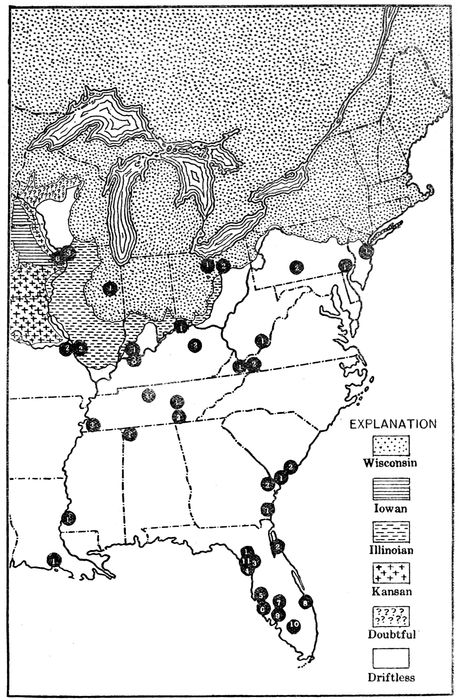
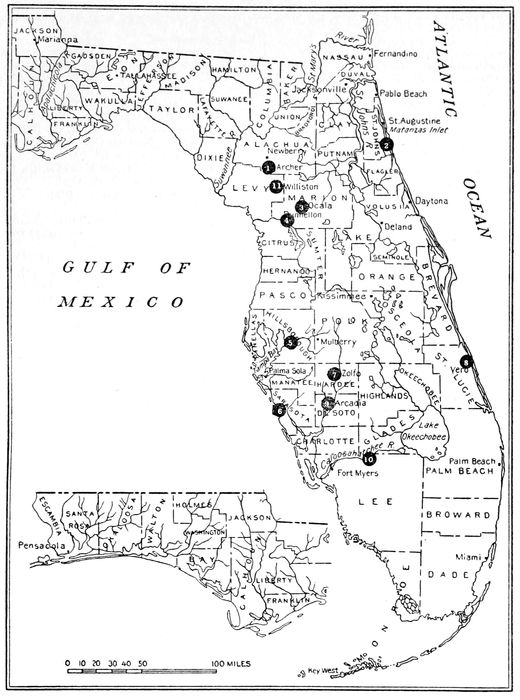
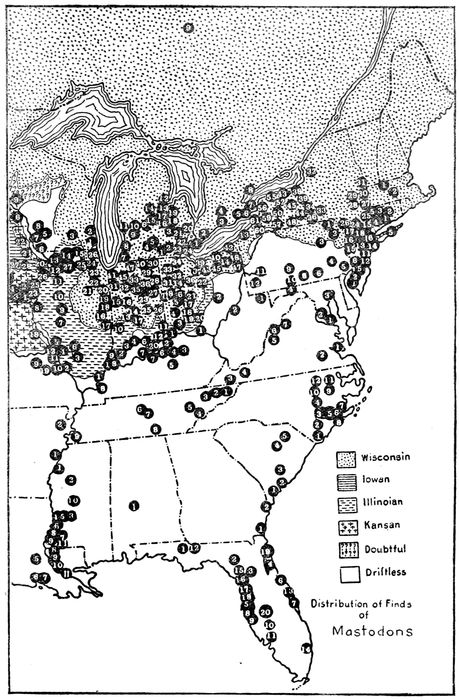
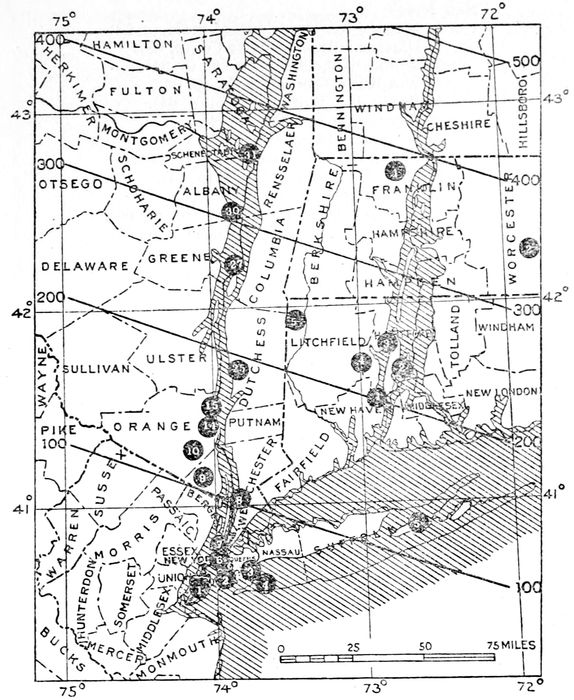
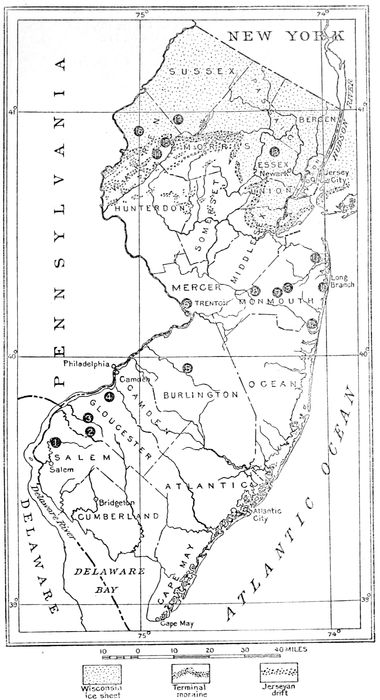
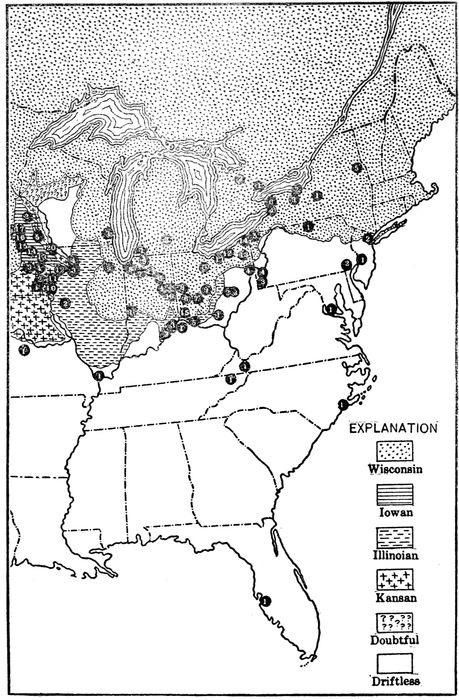
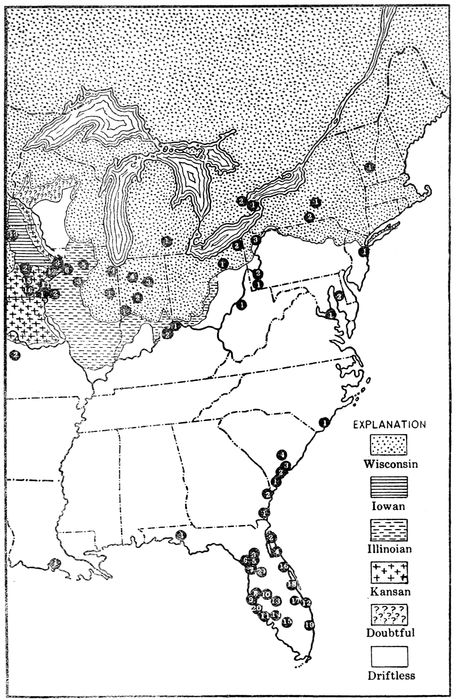
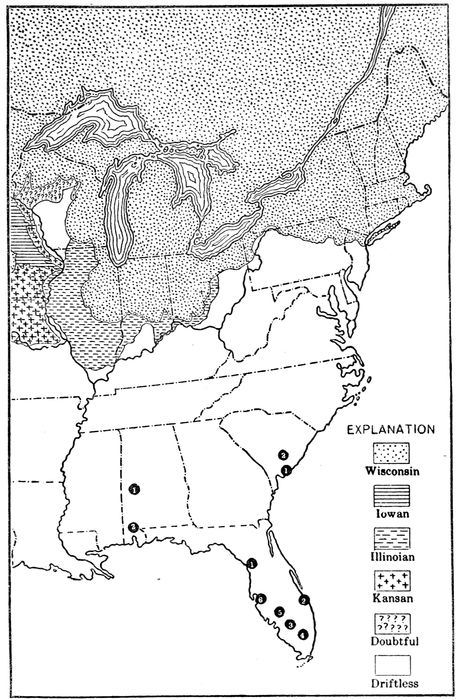
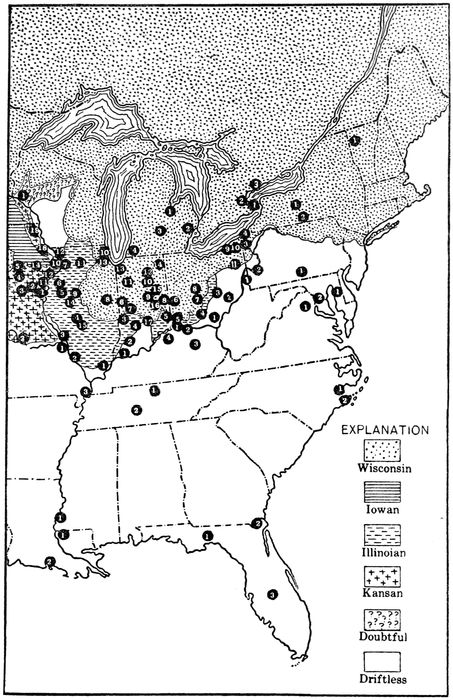
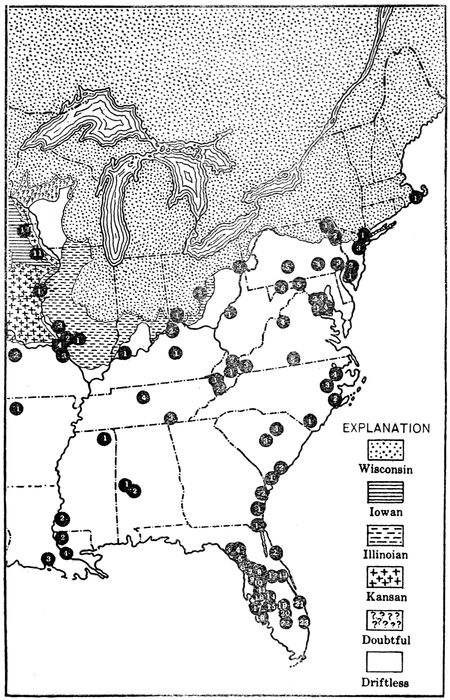
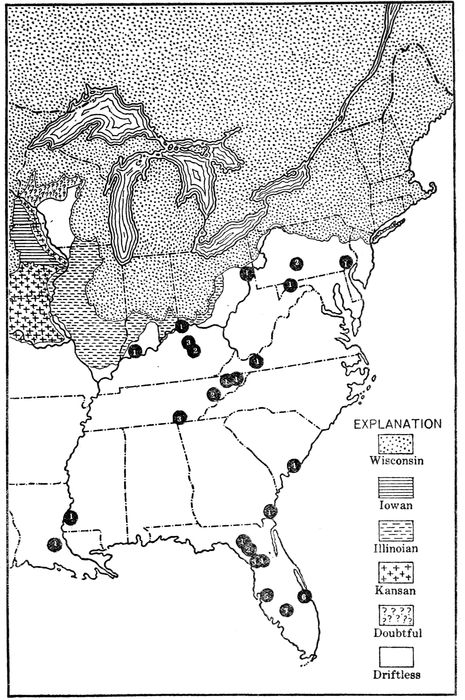
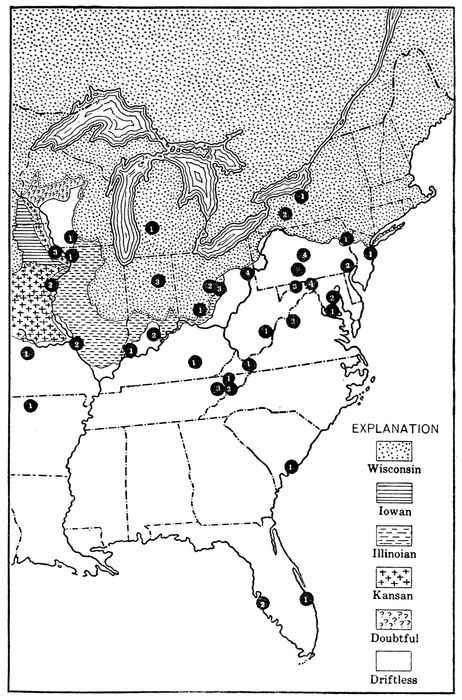
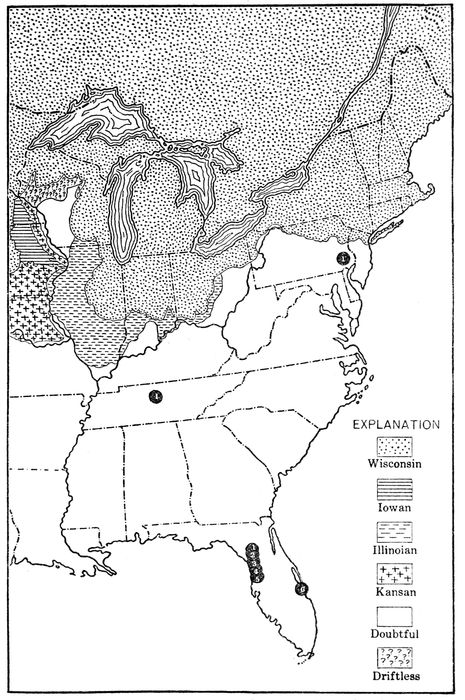
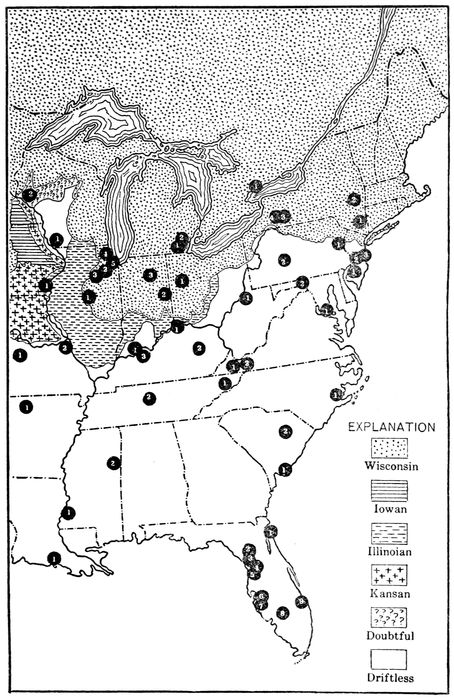
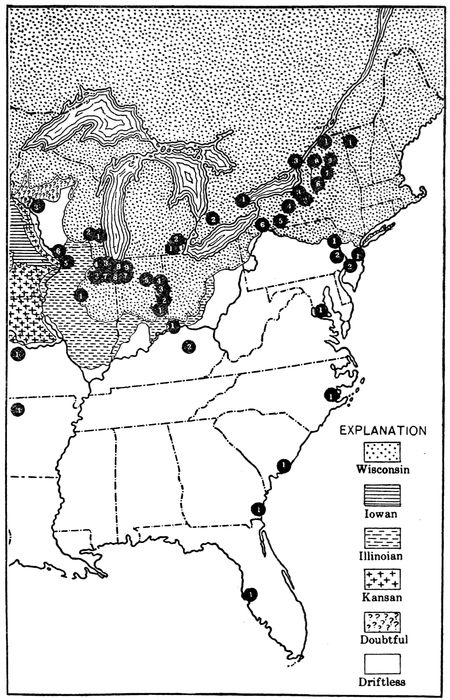
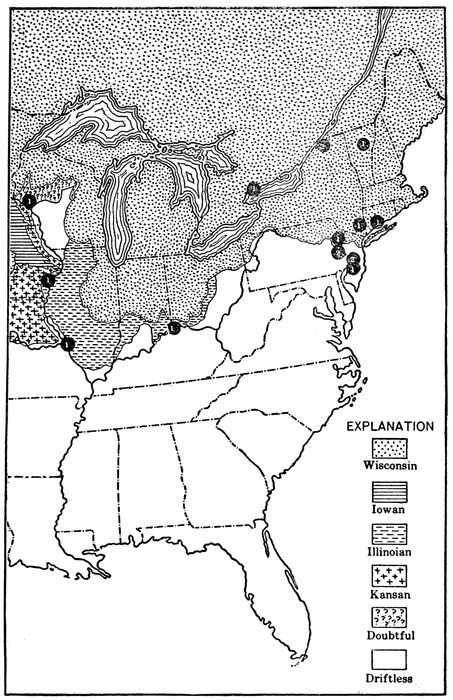
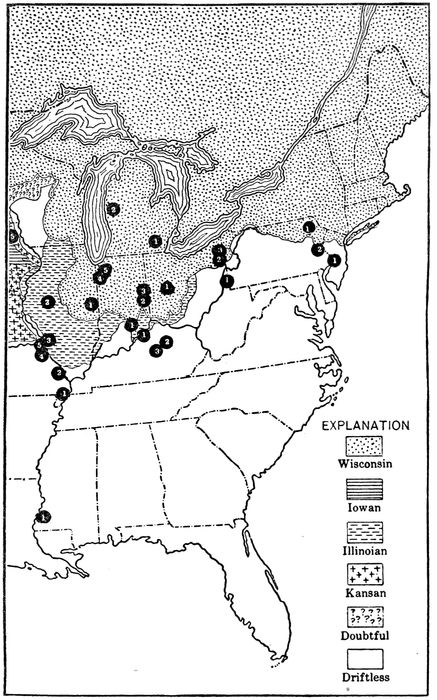
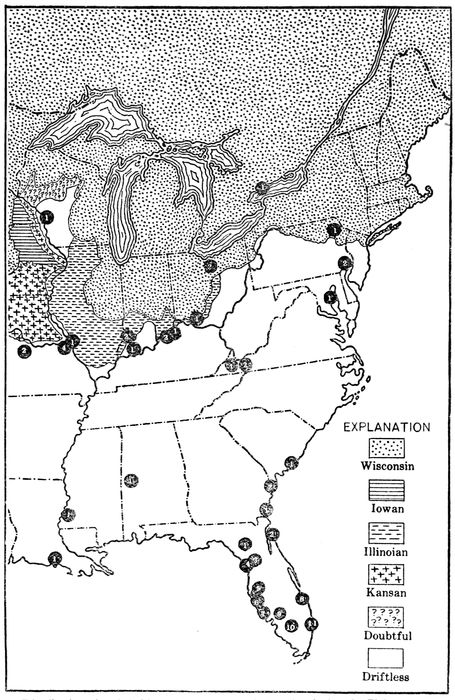
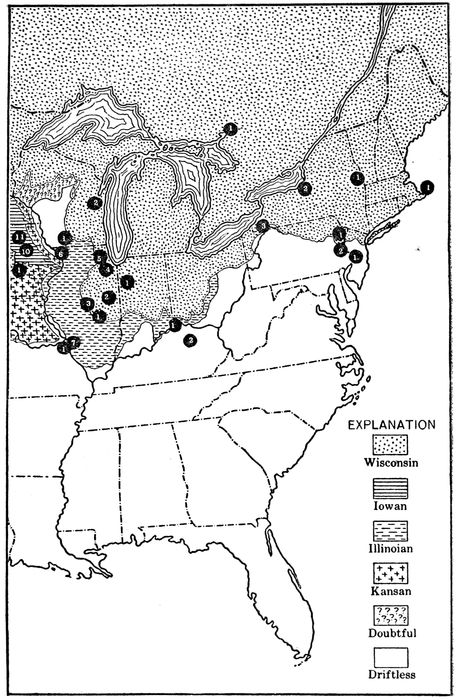
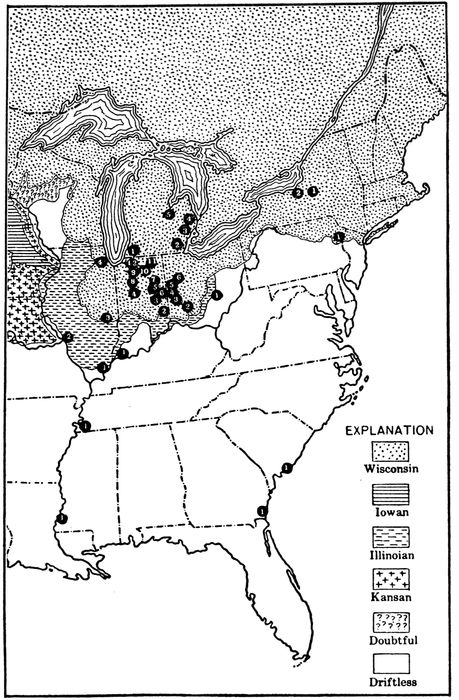
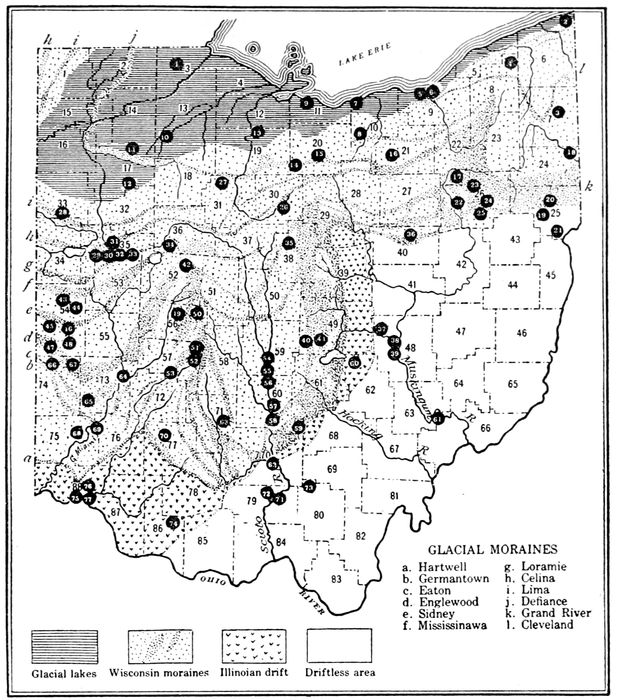
In order to show the geographical distribution of the most important
species that occur in considerable numbers, a series of maps has been
prepared, pertaining to the following:
Whales and porpoises.
Seals and walruses.
The edentates.
Elephas primigenius.
E. columbi.
E. imperator.
E. species undetermined.
Mastodons, mostly Mammut.
Horses, mostly Equus.
Tapirs.
Peccaries.
Camels.
Odocoileus.
Cervus.
Rangifer.
Musk-oxen.
Bisons, extinct.
Bison bison.
Giant beavers.
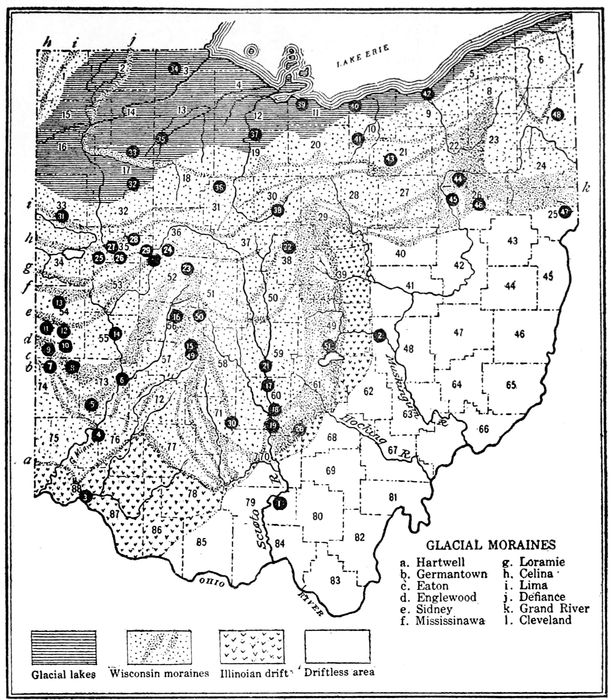
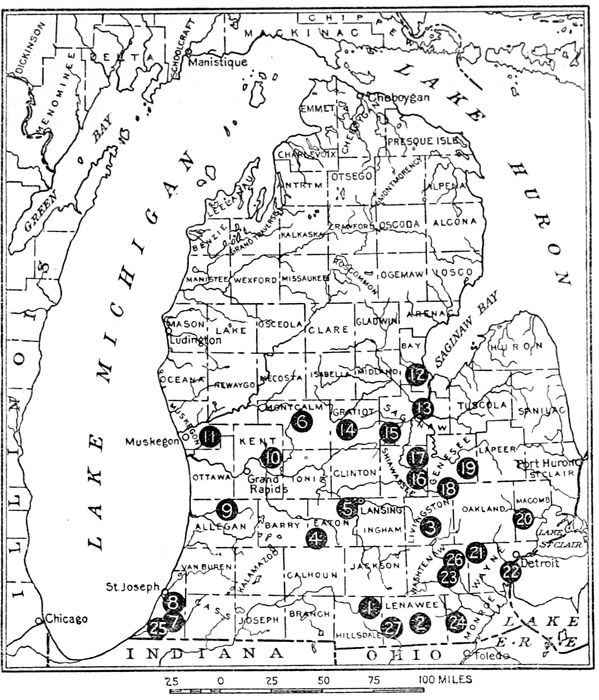
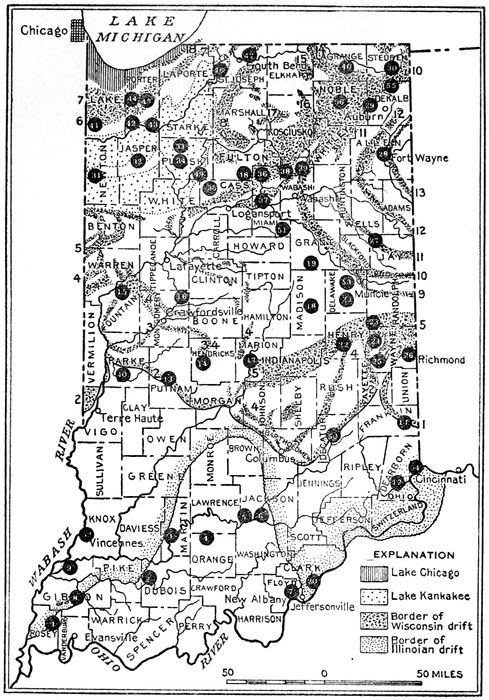
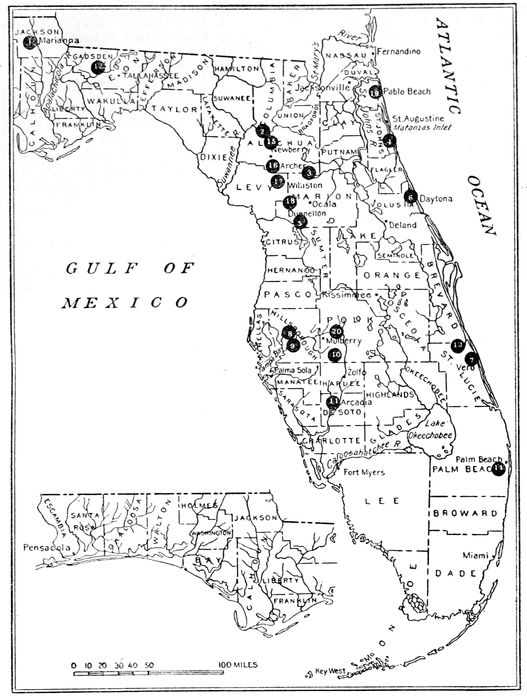
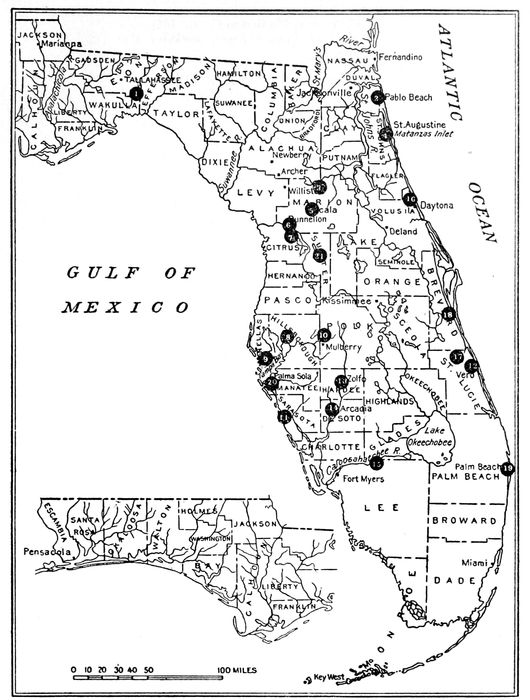
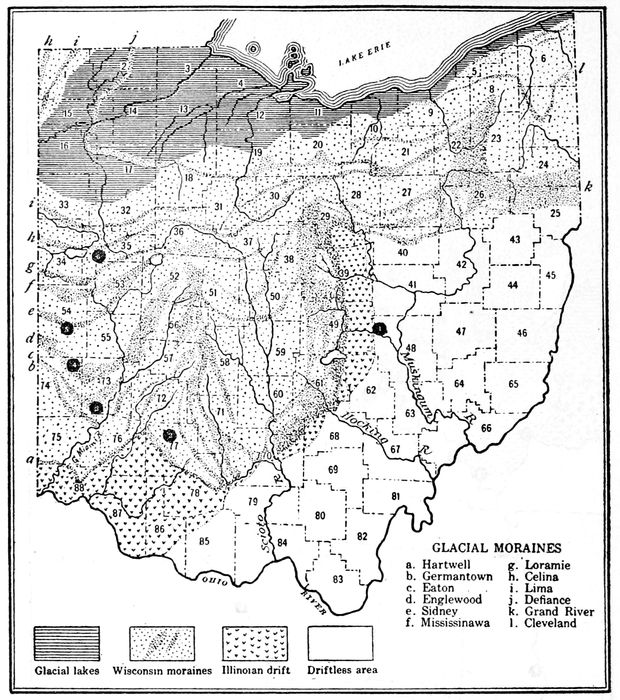
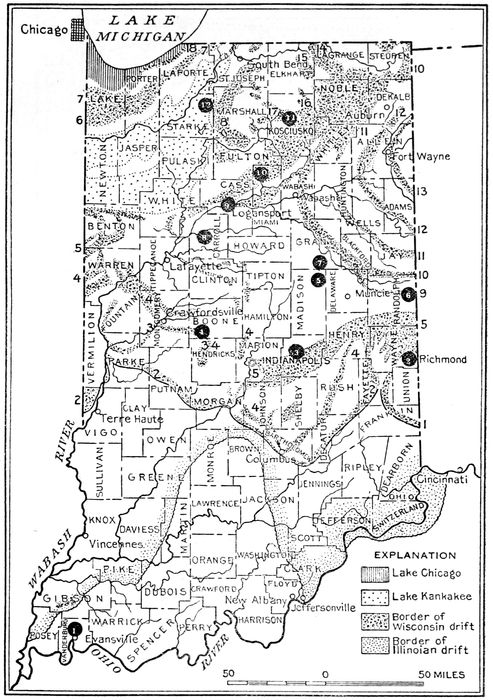
Where the map of a State has become too crowded with numerals, a
special map of that State for that species or genus has been prepared.
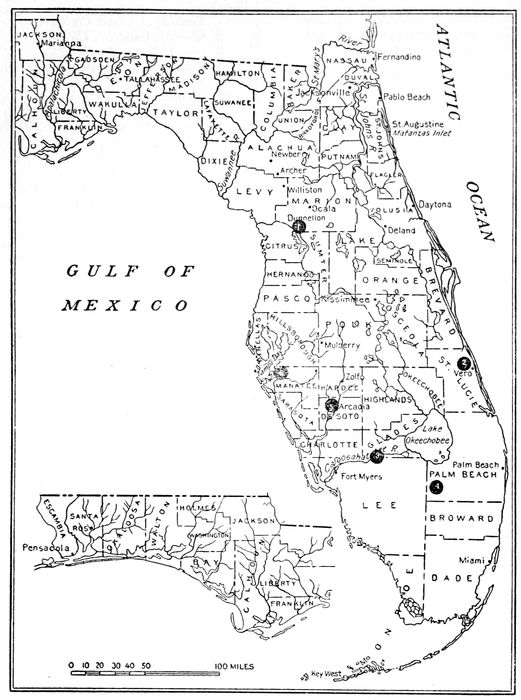
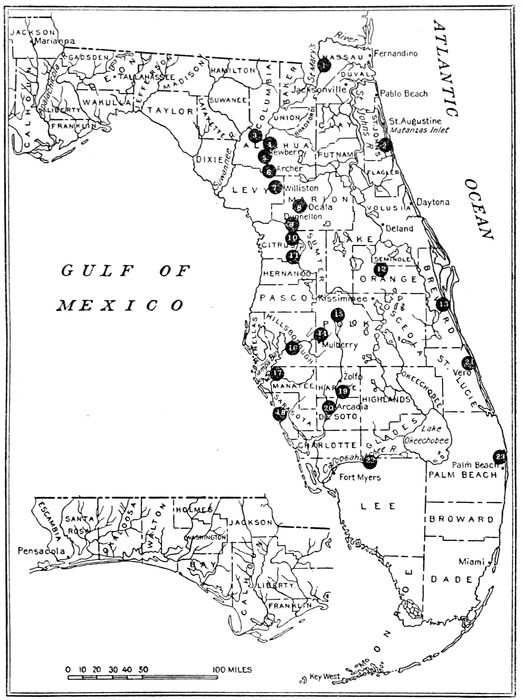
There are maps of the edentates in Florida; mastodons of Indiana, of New
York, of Ohio, of Michigan, of Florida; Elephas columbi in Florida; Elephas
imperator in Florida; horses in Florida.
Other maps and figures for illustration of the Pleistocene geology will
be found in their proper places.
The first part of the present volume is occupied by a consideration of
the specimens recorded on the maps. Such information is noted as could
be secured, often satisfactory, little enough sometimes; but it has been
found that one can not foresee what important information a given fossil
VIIImay furnish. At least, the presence of the fossil at a locality indicates the
existence there of Pleistocene deposits of some kind. In cases where other
species have been associated with the one mapped and described, these
are noted.
When the consideration of these mapped species and genera is completed,
the Pleistocene geology of the various States and provinces is taken up, so
far as it is related to the vertebrate palæontology. This involved an examination
of much of the literature of the Glacial period; and here one soon
finds himself in face of huge tomes and endless articles and detailed maps.
Only somewhat less in amount is the literature of the States beyond the
glaciated area. The opportunity to misunderstand and to commit errors is
unlimited, and the writer can only hope for lenient criticism.
An attempt has been made in the case of all vertebrate fossils to determine
their geological relations and to derive some general conclusions regarding
the history of our Pleistocene vertebrates and their relation to the divisions
of the Pleistocene epoch. The conclusions reached are embodied in the
immediately succeeding pages.
Not much attention has been given to the fossil invertebrates and plants.
It is evident that neither the mollusks nor the plants have undergone any
considerable change during Pleistocene times and are therefore not available
as indicators of geological stages, though often useful for determining
local climatic conditions. Their value can be better utilized by the
palæomalacologists and palæobotanists.
To the officers of museums and colleges and to the private individuals
who have so freely offered the use of their materials and in other ways
aided the writer, he takes pleasure in expressing his sincere thanks. Most
of all, however, he is indebted to the Carnegie Institution of Washington
for the generous support extended during the years of this investigation.
June 1, 1922.
Oliver P. Hay.
THE PLEISTOCENE OF NORTH AMERICA AND ITS VERTEBRATED ANIMALS.
1
The Pleistocene is regarded as being equivalent to what is known as the
Glacial period. It began with the deployment of the ice-sheets which, proceeding
from their centers of accumulation in British America, laid down
in the East the Jerseyan drift and in the West the Nebraskan. The more
the Glacial period is studied the more one becomes impressed with the
significance of its physical effects on the northern hemisphere and with its
influence on the vertebrate life. Doubtless its effects on the world in general
are only beginning to be comprehended. The writer knows of no other
phenomena, geological or biological, which so well characterize the Pleistocene
period as do those comprehended under the term Glacial. They constitute
the key to the determination of the subdivisions of the epoch and
of their succession and to the history of the vertebrates which during this
time occupied the continent.
The Blanco is held to belong to the upper, or to the uppermost, Pliocene.
It is at present assigned to the Middle Pliocene (Osborn, Bull. U. S. Geol.
Surv. No. 361, p. 81; Matthew, ibid., p. 120). Until recently the oldest
known Pleistocene vertebrates appeared to be represented by the collections
which long ago were made at Fossil Lake, Oregon, and at Grayson (Hay
Springs), Nebraska. These assemblages had formerly been referred to the
Pliocene, and the belief that they belong there is not yet wholly without
supporters. It seemed, therefore, proper to retire the Blanco somewhat.
The discovery that the Fossil Lake and Grayson faunas were represented
in the Aftonian deposits of Iowa, and belonged probably to the first interglacial
stage, reveals the fact that the geological interval between the
Blanco and the Aftonian is at least partly filled by the first glacial stage,
the Nebraskan. Naturally, it is to be expected that the breach between
the earlier and the later faunas will be occupied, in part at least, by the
vertebrates of the Nebraskan. What these are is not yet well determined;
but the writer believes that as the Blanco and its equivalent and closely
related formations and faunas become better known, they will be attracted
close to the Pleistocene.
2Aside from the facts just mentioned, the Blanco fauna seems to the writer
to be more closely related to the Aftonian than has been supposed. The
genera which occur in the Blanco are the following:
Megalonyx.
Mylodon.
Glyptotherium.
Hipparion.
Pliohippus.
Protohippus.
Platygonus.
Pliauchenia.
Anancus.
Gomphotherium.
Stegomastodon.
Felis.
Amphicyon?
Borophagus.
Canimartes.
Of these, Megalonyx, Mylodon, Hipparion, Platygonus, Anancus, Gomphotherium?,
Stegomastodon, and Felis are known from the first interglacial
stage. Anancus includes mastodons with short, tuskless lower
jaws and trefoiled molars. Gomphotherium, having long lower jaws with
tusks, upper tusks with enamel band, and with trefoiled molars, may be
represented by some of the early Pleistocene species. The same species of
Stegomastodon appears to be present in the Blanco as in the Pleistocene,
S. mirificus. The edentate Glyptotherium is not far removed from Glyptodon
of the early Pleistocene. The Blanco genera of horses are so close
to Equus that Cope regarded them as belonging to this genus.
The matter may be looked at from another point of view. If Mylodon,
Megalonyx, and Glyptotherium are referred to the Middle Pliocene, we
shall probably have them recorded as living in Texas before they existed
in South America. It is true that Santiago Roth (Neues Jahrb., Min. Beil.,
Bd., vol. XXVI, table opposite p. 144) states that Glyptodon occurs in the
Lower Pampas beds, and these he refers to the Upper Miocene; but the
writer believes that Wilckens (Neues Jahrb, Min. Beil., Bd., vol. XXI, p.
193) is more nearly correct in placing them in the Pliocene. While the
opinion may be correct that, when no obstacles intervene, the time required
for mammals to spread over even a continent constitutes but a small part
of a geological age, yet in making their way from South America, especially
from Argentina, along the narrow bridge that appears to have been offered
them, probably over mountain ranges, and across rivers and gorges, and
in the face of the competing fauna advancing from the north, some of which
were wolves and saber-tooth tigers, the slowly plodding and inoffensive
edentates would have encountered too many hindrances to be able to make
the journey in a short time.
The writer, therefore, ventures to range the Blanco immediately below
the Pleistocene. On about the same level may be placed the Tulare-Etchegoin
and the Thousand Creek formations of Merriam (Bull. Dept.
Geol. Univ. Calif., vol. X, pp. 425, 429).
The writer accepts the divisions of the Pleistocene which the geologists
appear to have established. Formerly it was believed that North America
had been subjected to a single glacial epoch; now it seems to be proved
that there have occurred five such glacial epochs, or stages, and that there
have intervened four interglacial stages of mild climate. The interglacial
stages are italicized. The Nebraskan stage is the earliest, the Wisconsin
the latest: Wisconsin, Peorian, Iowan, Sangamon, Illinoian, Yarmouth,
Kansan, Aftonian, Nebraskan.
3The characteristics of the various stages will be briefly discussed. The
stages are not equally well understood and at present do not seem to be
of equal importance in their relation to vertebrate paleontology.
In pursuing the study of the Pleistocene, one soon realizes that this period
was one of great geological activity. Ranges of mountains, if not begun
anew, were at least raised to greater altitudes. The Cascade Range appears
to have begun to rear its head at the beginning of the epoch, or even a little
later. Here and there the crust of the earth was ruptured and great sheets
of lava were poured out over the land. Ice caps repeatedly accumulated
over large areas in North America and Europe, and in their movements
southward transported vast amounts of earthy débris and turned the
courses of great streams. Apparently at times the rainfall was greatly
increased. The rivers, quickened by greater slope and the increased volume
of water, cut their channels deeper and in the mountains excavated profound
gorges. Through elevation of the land North America was, late in the
Pliocene or early in the Pleistocene, put into easy communication with
Asia and South America, so that vertebrated animals passed freely to and
fro. A part of these activities probably belonged to the latter part of the
Pliocene. In the more elevated regions of the eastern United States, through
the chemical, rupturing, and transporting properties of water, rocks were
dissolved and their disintegrated materials produced what has been designated
the Lafayette formation; but it is possible that this belongs to the
early Pleistocene.
Mention has just been made of a land connection with Asia at some time
about the beginning of the Pleistocene. The evidence for this may be called
circumstantial rather than direct. The geological evidence has not been
developed. If any deposits containing marine fossils had been laid down
along the Asiatic and Alaskan coasts during a time of elevation, they would
now be covered by the sea. Our evidence for the connection is derived
from the distribution of the vertebrate animals. During the early Pleistocene
our country was invaded by a host of mammals whose home was
originally in Asia. These included elephants, bisons, elk, goats, bears,
wolves, and foxes, besides many mammals of smaller size. It is the presence
in America of the smaller animals, many genera of rodents of Asiatic
origin, that shows that there must have been a land connection. These
could not have made their passage across Bering Strait on the ice, as it
might be imagined the larger animals did.
The way between the two continents had more than once before been
open, but it was during the early Pleistocene that modern Asiatic genera
entered North America in great numbers. Exactly where the land bridge
between the two countries was situated is not certain; it may be that a
large part of the area now occupied by Bering Sea was then dry land.
Arldt (Entwicklung der Kontinente, plate 21) represents a connection
4extending from the northern border of Alaska southward to include the
Aleutian Islands. Where narrowest, this bridge, as represented by the
author named, extended from latitude 60° to 70°, a distance of about 700
miles. In such case the cold currents from the Arctic Ocean would have
been prevented from entering the Pacific, while the Japan Current would
have warmed up the southern side of the bridge. The route was then open
on the north for the boreal animals of Asia to enter Alaska; while on the
south the genera inhabiting the more temperate part of eastern Asia would
have had free access to the American shore. Once on the continent, the
boreal mammals might have spread along the shores of the Arctic Ocean
and those of the temperate parts of Asia have made their way up the
Yukon Valley, or possibly along the Pacific coast, to the warmer regions
toward the south. We do not need to suppose that even during the first
glacial, or Nebraskan, stage the climate of that part of North America was
as inclement as now.
At the other end of our continent a train of events not wholly dissimilar
was in motion. Even in the latter part of the Pliocene some South American
edentates, such as Megalonyx, Mylodon, and Glyptotherium, had reached
Texas. Probably a little later the bridge had become widened so that other
edentates and a few genera of South American hystricine rodents swarmed
into our southern borders. At the same time a host of carnivores, tapirs,
horses, camels, peccaries, deer, and cricetine and sciurine rodents made
their way into South America. It is now certain that the land bridge over
which the interchange took place did not include the West Indies. Possibly
there yet remained along the western coast of Central America some of the
border, now submerged, which Schuchert (Bull. Geol. Soc. Amer., vol. XX,
plates 96 to 100) represents as being present during the Tertiary.
The Pleistocene vertebrate fauna of North America has been derived from
three sources. One component had descended from the animals which occupied
the continent during the late Tertiary, but even these were of mixed
derivation. A few appear to have filtered in from South America during the
Pliocene; others had come from Asia during Tertiary invasions; but a large
element was native to the country. As such may be taken the camels, the
peccaries, the three-toed horses, the prong-horn antelope, the deer of the
genus Odocoileus.
Upon a continent of vast extent and great fertility, possessing unbounded
variety of climate and habitat, all these animals were thrown together to
struggle for their existence. We must depend upon the imagination to picture
what the result would have been if nature had pursued a course which
might have been predicted. What the result in reality was, we shall see.
It will be profitable to consider briefly the character of the Pleistocene
vertebrate fauna. The writer has compiled a list of the species which have,
so far as he knows, been collected and described up to this time. There are
in all 637 species; of these, 387 belong to the mammals, 154 to the birds,
526 only to the reptiles, 7 to the amphibians, 56 to the bony fishes, and 7 to
the group of sharks and rays. Certainly these form only a part of the
species which existed. At present there are known in our existing fauna
north of Mexico 693 species of mammals, excluding the cetaceans—somewhat
more than twice the number of known Pleistocene species. It is,
however, rather in the great variety of forms that the Pleistocene excelled.
Following Gerrit S. Miller’s Land Mammals of North America, 1912, we
find in our present fauna north of Mexico 29 families; in the Pleistocene
there are now known 37 families, not including the cetaceans. In our existing
mammalian fauna there are recognized 111 genera; in the Pleistocene,
with hardly half as many species recorded, 138 genera are counted. In
order to realize more vividly the variety of Pleistocene forms, we have only
to recall the animals then present, now absent, namely, the great ground-sloths,
the glyptodons, the numerous species of horses, tapirs, numerous
peccaries, camels, the extinct relatives of the musk-oxen, extinct bisons,
elephants, mastodons of three or four genera, the giant beaver, and the
saber-tooth tigers. Among the birds, reptiles, batrachians, and fishes, there
were few striking forms, and these were mostly among the birds and the
tortoises.
The above account shows the great richness of the vertebrate life during
the Pleistocene; furthermore, this abundance evidently existed during the
early stages of the epoch. It constituted the materials on which that combination
of conditions which we call environment had to work during
Pleistocene times. The comparison shows that the result was an impoverishment
of the vertebrate fauna. Genera and families, even orders, were
wiped out of existence, and these included some of the noblest animals that
have graced the face of the earth, the elephants, the mastodons, tapirs,
many species of bison, horses, saber-tooth cats, huge tigers, and gigantic
wolves. The following nine or ten families became either wholly extinct
or continued to exist only in other more hospitable lands: the Megatheriidæ,
including several genera of ground-sloths; the Hoplophoridæ or glyptodons;
the Caviidæ, which embraced one or more species of huge capybaras; the
Elephantidæ, under which are arranged three or four species of elephants
and three genera of mastodons; the Equidæ, represented by a dozen or more
species of horses; the Camelidæ, of which there were several Pleistocene
species and probably three or four genera; the Hyænidæ, of which there
appears to have been at least one genus, with one species; the Tapiridæ,
including three or four species; and probably the Rhinocerotidæ. Besides
these, the subfamily of Felidæ known as Machairodontinæ, embracing those
wonderful carnivores the saber-tooth tigers, was suppressed. The Dasypodidæ,
which included some armadillos 5 or 6 feet long, are now represented
by only one small species in Texas. Of the Tagassuidæ, to which belonged
several genera and stately species of peccaries, there exists now in North
America north of Mexico but one species, an animal of only moderate size.
We have seen that the Pleistocene fauna was very different from that
which existed when white men first entered the country; also that the
6difference has in large part been due to the destruction of species, genera,
and families. We may now inquire whether or not the loss has been to
any considerable extent compensated by the development of new forms.
Many of our existing genera and species have been found in the collections
that represent the earliest Pleistocene known to us. The writer believes it
would be unsafe to say that any living species that one might select may
not hereafter be discovered in early Pleistocene collections. It is probably
true, however, that some of those small changes by which we distinguish
one species from another have been produced. Some small but persistent
differences might, for example, have arisen in the teeth or in the form
of the skull of a group of muskrats which would justify us in regarding it
as forming a new species. It is extremely doubtful that any new genus of
vertebrates has been developed since the first interglacial stage. Matthew
has concluded (Science, n. s., vol. XL, pp. 232–235) that the evolution of
the mammals during the Pleistocene amounts to about one-tenth of that
achieved during the Pliocene. The present writer regards this as a liberal
estimate.
This failure to evolve new genera and species is not necessarily to be
attributed to the shortness of the Pleistocene period; it may have been due
rather to the unfavorable conditions. In what direction could an animal
make progress when, after being subjected for some thousands of years to
one set of conditions, it was compelled for some other thousands to endure
just the opposite conditions? If life in front of a glacier for some centuries
led to the development of a coat of hair on an elephant, that coat would
probably disappear during the succeeding interglacial stage, and in the end,
if the elephant had not perished, he would be where he began.
Too much stress must not, however, be placed on this suggestion. It may
yet be possible to show that nowhere in the world was any considerable
progress made by mammals during the Pleistocene, in the modification of
their forms and structure. On the other hand, it is also possible that all
over the world climatic conditions were at intervals unfavorably affected
by the development of the great glaciers and that all life was retarded in
its evolution. The writer believes, therefore, that it can not be shown with
certainty that new forms of living things, especially vertebrates, were developed
in North America during the Pleistocene. It may be quite as difficult
to prove that any genera or species of importance entered from other lands
after the first invasion. Under these conditions there appears to be no
means for determining successive faunas other than through recording the
time of the disappearance of genera and species.
At the beginning of the Pleistocene there existed, as has been shown, an
abundant and highly varied mammalian fauna; at the close of the epoch
this fauna had become relatively impoverished. Did all those families and
genera and species, that in the end were missing, perish during or after
the last glacial stage, the Wisconsin? This opinion has been expressed by
some. The writer believes that this view is wholly improbable.
7A glacial sheet, stretched across the continent or a large part of it, was
not local in its effects; it was not a cap of ice merely concealing a part of
the land and covered possibly by forests and allowing occupation by certain
hardy animals, while beyond, up to its foot, the country was pleasantly
cool, wooded, and abounding with animated creatures. In the Sierra
Nevada Mountains of California (Lindgren, Folio 66, U. S. Geol. Surv.)
and of Nevada (Knopf, Prof. Pap., U. S. Geol. Surv., 110, pp. 92–105) and
in the San Juan Mountains of Colorado (Atwood and Mather, Jour. Geol.,
vol. XX, p. 385), at distances of approximately 600 or 700 miles from the
glacial front, there existed, during more than one stage, extensive local
glaciers. Along the Atlantic coast during at least one glacial stage the
walrus was driven as far south as Charleston, South Carolina. One can
hardly doubt that the whole continent was chilled during each of the glacial
stages.
To mammals, which for perhaps various reasons had been with difficulty
enduring the stress of existence, the glacial climates would give the final
stroke; perhaps to others the interglacial climates would have been quite
as fatal. We can not doubt that each glacial and each interglacial stage
swept away a few of the less hardy genera and species. Nevertheless,
several remarkable animals passed through the vicissitudes of all the glacial
and interglacial times and left their bones in the deposits overlying the
last, or Wisconsin, drift. Such are two species of elephants, the American
mastodon, the giant beaver, and one or more species of peccaries. Why
they succumbed at last is difficult to say. Possibly the return of a fifth
warm era proved too much for their endurance.
A reason for believing that the genera and species missing from the fauna
found here when white men arrived, called sometimes the Columbian fauna,
were exterminated gradually and not at one epoch is that certain ones are
found in deposits overlying the earlier glacial drift-sheets, but are not found
in deposits on later drifts. Camels occur in Aftonian beds overlying the
Nebraskan drift, but have not been collected in later interglacial deposits.
Horses grow scarcer as the Pleistocene advances. They are known from
deposits overlying the Illinoian drift, but do not appear after the Wisconsin.
It is necessary to determine, if possible, where the boundary line shall
be drawn between the Pliocene and the Pleistocene. Room must be made
for the first interglacial, the Nebraskan, and its fauna. How long this first
glacial stage continued we do not know. Chamberlin and Salisbury have
indicated (Geology, vol. III, p. 420) that in a rough way the dates from
the present of the culmination of the various glacial stages, except the
Nebraskan, taken in order backward, may be represented by the geometrical
series 1, 2, 4, 8, 16. That is, if the Illinoian stage had its culmination
150,000 years ago, that of the Kansan occurred 300,000 years ago; if the
Nebraskan should fall in the same series, it culminated 600,000 years ago;
and it and the succeeding Aftonian interglacial held sway as long as all the
rest of the Pleistocene put together. It would be rash to assert that this
first glacial did last so long; but we see the possibilities. In a personal
8communication Professor Frank Leverett writes that he estimates that the
Kansan culmination took place at not less than 400,000 years ago and the
Nebraskan at 500,000. This, as the present writer estimates, would leave
for the Nebraskan itself somewhere near 40,000 or 50,000 years. Some
changes in the life of the Pleistocene must have been wrought during those
years.
The glacial deposits of the Nebraskan stage are not as well known as
one might wish. They appear to be in general overlain by the later drifts
and are observed mostly where streams have cut through both the overlying
drift and the Nebraskan. The old drift found in New Jersey is thin
and of no great extent. Moreover, we can hardly expect to find fossil
vertebrates in the drift itself. We must therefore depend on studies of
supposed Nebraskan fossils found mostly outside of the glaciated area and
make comparison of them with earlier and later faunas. If we shall discover
collections of Nebraskan vertebrate animals, we may be sure that
they will differ from those of the first interglacial, the Aftonian. We may
be pretty certain that they will include autochthonous genera of the late
Tertiary, which may be missing from the Aftonian, together with at least
a few genera from South America and others from Asia.
Now, have any formations and included fossil vertebrates been found
which may be fitted into the Nebraskan interval?
In this stage the writer places the beds which Cope designated the Idaho
formation (Cope, Proc. Acad. Nat. Sci. Phil., 1883, p. 135). Since Cope’s
time several new species have been added to his list from this formation.
In 1917 (Bull. Dept. Geol. Univ. Calif., vol. X, p. 432), Dr. J. C. Merriam
published a list of the fossils, except fishes, which had been secured up to
that time. The list of species referred to the Idaho formation is as follows:
Cervus, possibly new. Smaller and more slender than C. canadensis.
Procamelus, size of P. major.
Tragocerus? horn-core of antelope.
Ischyrosmilus n. sp.
Morotherium leptonyx.
Castor, possibly n. sp.
Olor, size of O. paloregonus.
Graculus idahoensis.
In this collection the presence of horses of the genus Equus, of Cervus,
Morotherium, and Castor, is strongly suggestive of the Pleistocene. The
type of Mastodon mirificus was found in Pleistocene deposits of probably
Aftonian age. Although rhinoceroses are supposed to have become extinct
before the end of the Pliocene, this supposition may be an error. The list
of Blanco vertebrates is a short one, and the absence of a genus from it is
not decisive. One drawing of a seine in the sea-waters of Florida would
furnish inadequate materials for conclusions about the fish fauna of that
coast.
The Thousand Creek fauna (Merriam, Bull. Dept. Geol. Univ. Calif.,
vol. X, p. 429), which to the present writer appears of about the same age
as the Blanco, contains a species of Teleoceras. The genera Protohippus
and Procamelus might be supposed to have continued their existence and
evolution until interrupted by an age of ice and by competitors from Asia.
9In 1917 (Bull. cit., vol. X, pp. 255–266) Merriam and Buwalda published
a short list of fossils which they had collected along the Columbia River
in Washington State. A horse was found which was referred to Equus or
Pliohippus; also two camelids, one of which was thought to be near Pliauchenia.
Merriam concluded that the evidence on the whole favored the
Pleistocene. The list will fit into the Nebraskan without difficulty.
In 1889 (Amer. Naturalist, vol. XXIII, p. 253), Professor E. D. Cope
published a list of fossil mammals collected in the “Oregon desert,” apparently
somewhere in the region of Silver Lake or Summer Lake. The list
is as follows:
Canis sp. indet.
Elephas or Mastodon.
Holomeniscus or Auchenia.
Aphelops sp. indet.
Hippotherium relictum.
Equus sp. indet.
Cope looked upon this collection as remarkable in that it showed the
presence of true horses and camels associated with a rhinoceros. He concluded
that the fossils belonged to his Idaho formation. Dr. W. D. Matthew
thought that the collection was a mixture of fossils from two formations
(Bull. Amer. Mus. Nat. Hist., vol. XVI, p. 321). It may, however, have been
made in Nebraskan deposits.
In 1921 (Proc. U. S. Nat. Mus., vol. LIX, pp. 617–638), the writer
described a collection of vertebrate remains from Anita, Coconino County,
Arizona. These remains were found in a cave in making explorations for
copper ore. The list follows:
Equus occidentalis.
E. giganteus?
Mylohyus? sp. indet.
Procamelus coconinensis.
P. longurio.
Antilocapra americana?
Marmota arizonæ.
Citellus tuitus.
Neotoma cinerea.
Lepus benjamini.
Brachylagus browni.
Taxidea robusta.
Canis nubilus?
C. latrans?
Chasmaporthetes ossifragus.
The writer believes that this assemblage of mammals must be referred
to the Pleistocene. It will be noted, however, that there are two species of
the genus Procamelus. These resemble so much two species, P. major and
P. minimus, described by Leidy and Lucas (Trans. Wagner Free Inst., vol.
IV, pp. I-XIV, 15–61) from the Alachua clays of Florida, that it seemed at
first necessary to identify them as such. The genus Procamelus seems,
therefore, to be brought definitely into the early Pleistocene, probably the
Nebraskan.
The collections made in the Alachua clays in Florida were obtained in
Alachua and Levy counties. On pages 195 and 375 will be found an account
of the geological conditions under which the fossils were found, and lists of
the species. The essential features are that such supposed Miocene or
Pliocene genera as Gomphotherium, Procamelus, Teleoceras, and Aphelops
were found associated with the Pleistocene genera Odocoileus, Tapirus,
Megatherium, and Equus. This has been explained on the theory that the
clays are of Tertiary age and that the Pleistocene species had become
mingled with those of an earlier time. At a number of places in Florida
where phosphate rock has been mined there have been secured similar
associations of early camels, rhinoceroses, horses (Hipparion, Parahippus)
with genera belonging undoubtedly to the Pleistocene. This has occurred
so often that the writer doubts the correctness of the explanation given.
10He ventures, therefore, to include in the Pleistocene of the Nebraskan stage
the various deposits that have received the names Alachua clays, the Dunnellon
formation, and Bone Valley formation. The latter, called also the
land-pebble phosphates, is believed by Sellards to be contemporaneous in
age with the Dunnellon or hard phosphates, but to have accumulated under
different conditions. Both the Alachuan and the Bone Valley formations
were referred by Sellards to either the late Miocene or the early Pliocene,
with an evident preference for the latter. It seems to have been the presence
of the rhinoceroses that most influenced him in his assignment of the
deposits; but there were naturally other considerations. He wrote:
The presence of rhinoceroses in the formation is believed to establish definitely the
fact that the beds can not be later than the early Pliocene, since rhinoceroses in America
apparently did not survive beyond that time (Fla. Geol. Surv., vol. VII, p. 73).
According to Sellards the hard phosphate, belonging to the Alachua
(Dunnellon) formation (Fla. Geol. Surv., vol. V, p. 37) resulted from a
disintegration of underlying Upper Oligocene deposits and probably the
Vicksburg limestone. Through chemical action these rocks were partly
dissolved and the residual materials were mixed by local subsidence and
by action of streams and later modified by chemical changes.
The land-pebble phosphate of the Bone Valley formation had, Sellards
concluded (Fla. Geol. Surv., vol. VII, p. 55), resulted from underlying phosphate
marls of Upper Oligocene age. This occurred during a time of general
subsidence of sufficient extent to permit marine waters to reach the area
covered by the Bone Valley phosphates. The presence of sea-water is
indicated by the occurrence of bones of cetaceans.
With regard to the effects of streams and of the chemical action of the
water on the rocks, which contributed to the formation of the hard rock phosphate
and the production of sinks and caves, it may be remarked that
we know of no time when rocks were dissolved and caves formed to the
extent that they were during the Pleistocene.
As shown on page 15, various deposits of marine marls along the
Atlantic coast are referred by the writer to the Nebraskan. Among these
marls are the coquina rock found at St. Augustine and the marine marl
underlying the bed at Vero, which contained early Pleistocene vertebrate
fossils. These marls are known to extend well inland, being found at
Kissimmee, 50 miles from the coast. In some places they are met with at
depths of 70 feet (Sellards, Fla. Geol. Surv., vol. VIII, pp. 105–106). Marls
of probably the same age occur on the western coast of Florida (Dall, Bull.
84, U. S. Geol. Surv., p. 152). The writer believes that some of these marls
may yet be connected with the phosphate beds of the Bone Valley formation.
A figure taken from Sellards (Geol. Surv. Fla., vol. VII, opp. p. 53) may
be found on page 377. This illustrates the relation of the Dunnellon and
Bone Valley formations to the underlying deposits.
Mention has been made of collections of fossil vertebrates which long
ago were secured at Fossil Lake, Oregon, and of others along Niobrara
11River, near Grayson, Nebraska. Lists of the species found at each locality
were given by Dr. W. D. Matthew in 1902 (Bull. Amer. Mus. Nat. Hist.,
vol. XVI, pp. 317–320). These deposits and animals were regarded by
Cope and Marsh as belonging to the Pliocene, until G. K. Gilbert, in his
work on Lake Bonneville (Monogr. I, U. S. Geol. Surv., pp. 393–402) showed
that the Oregon fossils must belong to the Glacial epoch, but he referred
them to a late time in this epoch, that of the last glaciation. It thus became
quite impossible to determine the age of any collection of fossil vertebrates.
In 1887 (Univ. Geol. Surv. Kansas vol. II, pp. 299–308), Williston wrote:
Every fact furnished from Kansas seems to substantiate Cope’s conclusion that
the Megalonyx fauna of the East and the Equus fauna of the West were contemporaneous
and that both occurred during the period of depression; that is, during late
Pleistocene time.
This paragraph was quoted by Osborn in 1910 (“Age of Mammals,” p.
453), who appears to agree in part with Williston, although he expressed the
opinion that some of the deposits were earlier than the others. Osborn
supported the view of the existence of two faunas, that of the “Equus zone”
and that of the “Megalonyx zone.” The former fauna was regarded as
the older, but overlapping somewhat during the “mid-Pleistocene” the
Megalonyx fauna. He presented a catalogue of deposits belonging to his
Equus zone (his page 453) and another of those of the Megalonyx zone
(p. 467). In the latter he included deposits that he would now doubtless
refer to the earliest Pleistocene, for example, the Ashley River beds.
It was necessary for the geologists to come again to the rescue of the
palæontologists. They established the fact that there had passed, not a
single glacial stage, but a series, and that these had been separated by
corresponding interglacial stages. They were able to show also that between
the drift-sheets there were to be found remnants of old gravels and fossil-bearing
soils. In Iowa, through the careful researches of Calvin and
Shimek, numerous remains of fossil mammals were discovered in gravels
lying between the earliest drift, the Nebraskan, and the second drift, the
Kansan. Among these mammals were identified horses, camels, elephants
(E. columbi, E. imperator), Mylodon, Megalonyx, and a large ruminant
which is certainly a species of bison. This fauna, known as the Aftonian,
was correlated by Calvin with that of the Sheridan beds of Nebraska (Bull.
Geol. Soc. Amer., vol. XX, p. 354). The writer has had the opportunity to
study this Aftonian material (Iowa Geol. Surv., vol. XXIII), and, although it
is not as abundant as might be desired, he agrees with Calvin’s correlation.
Making due allowances for environment and the hazards attending preservation
and collection, the Aftonian and Sheridan fauna is practically the
same as that found at Fossil Lake, Oregon. Furthermore, it may be traced
along the plains into Texas and to the shores of the Gulf. Here, at or near
tide-level, or not far away, may be found horses, camels, elephants (E.
columbi and E. imperator), Mammut americanum, and mastodons with
teeth presenting trefoils. In Texas, within a mile of the Louisiana line,
Elephas imperator has been collected. The fauna reappears on the west
coast of Florida; also on Peace Creek; on the east coast at Vero; at Brunswick
and Savannah, Georgia; along Ashley River, near Charleston; probably
12also on the banks of Neuse River, 16 miles below New Bern, North
Carolina; and again probably at Long Branch, New Jersey, where Megatherium
has been found; and finally at Port Kennedy, on Schuylkill River,
about 25 miles above Philadelphia. All along the coast, apparently from
the Rio Grande to Long Branch, the localities which furnish Aftonian
fossils are within a few feet of sea-level.
Up to the present time the interglacial soils found in a few localities
between the Kansan and the Illinoian drifts have furnished only scanty
remains of vertebrate fossils—a rabbit and a skunk at the type locality in
Iowa. Certainly, however, the same animals were living then that were
found at later stages.
To the Illinoian glacial stage the writer refers the collection of fossil
vertebrates which was described in 1908 by Barnum Brown (Mem. Amer.
Mus. Nat. Hist., vol. IX, pp. 157–208) and which had been obtained in the
Conard fissure near Willcockson, Newton County, Arkansas. It is placed
here rather than in the Sangamon stage, because of the number of species
present which suggest a rather cold climate. A list of these species will be
found on pages 31–32 of volume XXIII, of the Iowa Geological Survey.
This was the warm stage which succeeded the glacial Illinoian. Between
the Illinoian and the Wisconsin there passed a long period of time. It is
now believed that it was interrupted by the Iowan ice-sheet, but this appears
not to have lasted long nor to have occupied any considerable area. Associated
with it in some way was the accumulation of much loess. This was
formerly supposed to have been deposited to a large extent at least during
the Sangamon; but, as Leverett informs me, it appears to have been laid
down at a time nearer the Wisconsin than the Illinoian. This Iowan drift
and the loess has been the subject of a special investigation by Alden and
Leighton (Iowa Geol. Surv., vol. XXVI, pp. 49–212). Few vertebrate fossils
have been found in the loess. Their bones may have been dissolved out by
the percolating rain-water, and yet the delicate shells of land mollusks are
abundant. A collection which the writer regards as belonging rightfully to
the Sangamon was made at Alton, Illinois, many years ago, by William
McAdams. A list of the species and an account of the geological conditions
connected with it are presented on page 339. The remains appear to have
accumulated in a pond on the Illinoian drift and to have been covered by
loess. The horse was yet in existence, as well as the deer Sangamona and
the antelope Taurotragus americanus. Two-thirds of the 15 species are
extinct. A smaller number of species have been collected near Kimmswick,
just below St. Louis, Missouri. The remains found in a cave in Bexar
County, Texas, are believed to belong here (Hay, Proc. U. S. Nat. Mus.,
vol. LVIII, p. 129). It is, however, in the Alleghany Mountains that most
of the vertebrates have been collected which the writer refers to the Sangamon
13stage. These have been found in caves and fissures from northern
Pennsylvania to northern Alabama. Unfortunately, although mostly discovered
several years ago, some of these collections have not yet been well
studied and have not been accessible to the writer. They contain two or
three species of horses, two or three genera of peccaries, tapirs, the deer
Sangamona, the antelope Taurotragus, and one or more species of saber-tooth
tigers. Half or more of the species are extinct. To the writer these
assemblages seem to fit into the history nowhere so well as into the
Sangamon stage.
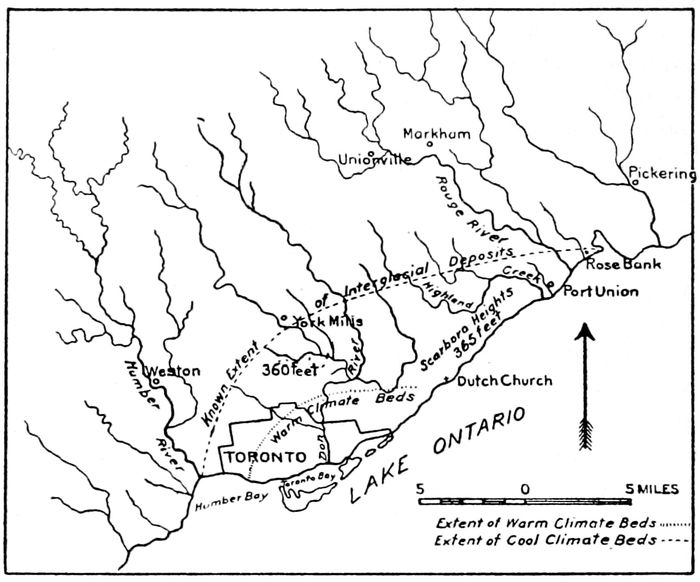
Another assemblage that probably belongs here is that made at Toronto
(p. 282). This indicates a warm climate, since the pawpaw and the osage
orange grew there.
This is the interglacial interval between the Iowan glacial and the Wisconsin.
It was probably not of long continuance and is chiefly remarkable
for the deposition of loess. This has not furnished any important collections
of vertebrate fossils. The type locality for the Peorian stage is a
locality east of Peoria, Illinois. Leverett (Monogr. XXXVIII, U. S. Geol.
Surv.) mentions several cases in which old soils believed to belong to the
Peorian were observed in Illinois. None of these has furnished vertebrate
fossils. It is usually difficult to distinguish the Sangamon from the Peorian
soils.
The next stage which furnishes abundant vertebrate fossils is the Wisconsin.
These remains are found most abundantly in the old soils and
mucks which accumulated in the swamps, ponds, and lakes left on the
uneven surface of the Wisconsin drift as the ice retired. To such deposits
the writer has given the name Wabash beds. They are often called post-glacial
deposits; but that term ought in strictness to be applied only to
deposits of the present epoch. They may be called Late Glacial, but that
expression has been used for the drift and moraines produced by the second
half of the Wisconsin glaciation. It might be better to use for the divisions
of the Wisconsin the terms Lower and Upper.
In the late Wisconsin, or the Wabash, deposits there may be found
remains of any of the existing animals of the region; also often the bones
and teeth of mammals now living in more northern regions. Besides these,
there may occur the relics of animals which were able to endure the rigors,
changes, and competitions of the Glacial period, but succumbed at its end.
These are, especially, two species of elephants, one or two species of mastodons,
four or more species of musk-oxen, the moose Cervalces, one or more
species of peccary, and the giant beaver.
The writer will discuss briefly the widely accepted theory that along the
sea-coast from New Jersey to southwestern Texas there occurs a series of
14terraces and corresponding escarpments, three or more in number, representing
successive emergences of the borders of the continent from the sea.
The theory was first proposed by Dr. W. J. McGee (Amer. Jour. Sci., ser. 3,
vol. XXV, 1888, p. 367; 12th Ann. Rep. U. S. Geol. Surv., pt. I, 1891, pp. 353–521).
He included in the initial submergence not only the area occupied by
the supposed Pleistocene terraces, but also the borders of the coasts to an elevation
corresponding to the Lafayette (Appomattox) formation, which he
referred provisionally to the late Pliocene. This submergence required a
depression of the eastern half of the continent amounting to 500 feet or
more. The theory was accepted especially by the geologists of Maryland
in their excellent reports (Shattuck, Maryland Geol. Surv., Pliocene and
Pleistocene volume, pp. 62–137, with maps). It has likewise been applied
to the geology of Virginia (Clark and Miller, Va. Geol. Surv. Bull. No. IV,
pp. 48–56, 179–189), North Carolina (Stephenson, N. C. Geol. Econom.
Surv., vol. III, 1912, pp. 266–290), Georgia (Veatch, Geol. Surv. Ga., Bull.
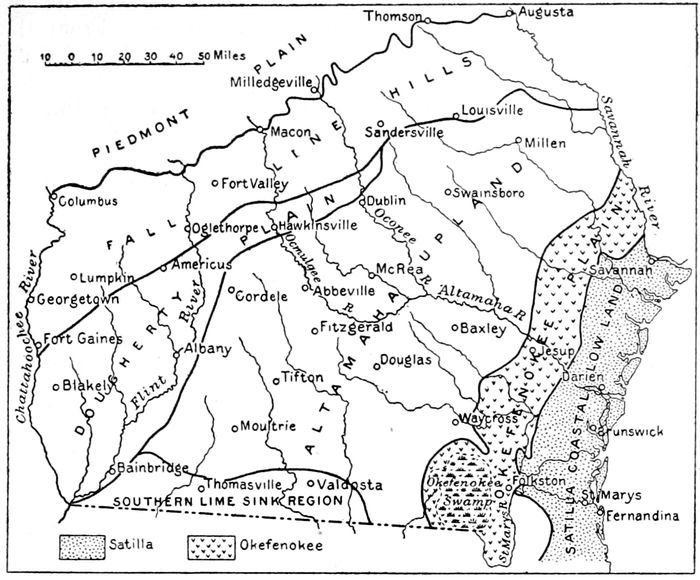
No. 26, 1911, pp. 35–50), as Okefenokee and Satilla; (Stephenson, ibid., pp.
425–445), Florida (Matson and Clapp, Fla. Geol. Surv., vol. II, 1909), and
to Texas (Deussen, Water Supply Pap. U. S. Geol. Surv. 335, pp. 78–83).
Conspectus of the Geology and Vertebrate Paleontology of the Pleistocene.
1 Drift-sheets and other deposits.
2 Representative collections.
3 Disappearance of genera and species.
4 Characteristic genera.
Wisconsin Stage.
Atlantic to Pacific in Wisconsin, Illinois, Iowa, Indiana, Ohio, New York, New Jersey (Cape May, Trenton gravels), Ontario, Quebec, etc., Maine, Massachusetts.
Made in swamps and old lakes on Wisconsin drift (Wabash beds) from Illinois to Massachusetts and Cape Breton Island. Leda clays, Canada.
Old soils between the Iowan and the Wisconsin drifts where the former is present. Reported by Leverett (Mon. U. S. Geol. Surv., vol. XXXVIII) from localities in Illinois. Usually hard to distinguish from Sangamon. Abundant loess in Mississippi Valley.
Fossil mammals rarely found.
None certainly known.
Few recognized. In general, those of the Wisconsin.
Iowan Stage.
Known certainly only from Iowa and Wisconsin. Supposed to be present along New England coast, Gay Head to Maine.
None known; but in general those of the later stages.
Sangamon Stage.
Sangamon River, Illinois. Old soils just above the Illinoian drift. Some loess of this stage. Cave deposits in Texas and in the Alleghany Mountains.
Alton, Illinois; Kimmswick, Missouri; cave in Bexar County, Texas; bluffs at Natchez, Mississippi; salt mine at Petite Anse, Louisiana; Cavetown and Corriganville, Maryland; Ivanhoe, Virginia; Whitesburg Tennessee; interglacial beds at Toronto, Ontario.
None known to have become extinct during this stage.
Mylodon, a few horses, tapirs, peccaries, Sangamona, Taurotragus, Symbos, Bison latifrons, B. antiquus, Elephas and Mammut.
Illinoian Stage.
In Illinois, Wisconsin, eastern Iowa, Indiana, Ohio. Supposed glacial drift from Long Island to Massachusetts (Montauk till, etc.).
Conard fissure, Newton County, Arkansas. Otherwise none recognized.
Interglacial soils and mucks between the Kansan and Illinoian in Iowa and Illinois. Gardner clay and Sankaty from Long Island to Boston.
Few vertebrates yet recognized. Skunk and rabbit at Yarmouth, Iowa.
Not known.
Few known. Doubtless those which became extinct during Illinoian and Iowan and later.
Kansan Stage.
Iowa, Missouri, Kansas, and northwestward. Loess overlying the drift; Jerseyan drift. New Jersey (may be Nebraskan); Pensauken. Jameco gravels on Long Island, New York, and Cape Cod, Massachusetts.
Doubtless those in the later stages of this column and some of those of this stage in column 3.
15Aftonian Stage.
Gravels and soils between the Kansan and the Nebraskan in Iowa, Missouri, Nebraska, and Kansas. Lake and river deposits in Nebraska and Oregon; river deposits, Pittbridge, Texas; asphalt beds near Los Angeles, California. Sands, etc. bearing vertebrate remains at or near sea-level from mouth of the Rio Grande to Sandy Hook, New Jersey.
Along Missouri River in Iowa; Fossil Lake, Oregon; Grayson, Sheridan County, Nebraska; La Brea, California; Lake Lahontan and Walker River, Nevada; Lavaca and Galveston Bays, Texas; Peace Creek, Caloosahatchee River, and Vero, Florida; Brunswick and Savannah, Georgia; Beaufort and Ashley River, South Carolina; Neuse River, North Carolina; Fish House clay near Camden, New Jersey; Long Branch, New Jersey; Port Kennedy, Pennsylvania.
None recognized. Probably some of those cited under the Kansan.
Drift in Iowa and Nebraska beneath more recent drifts; Idaho formation, Idaho; New Jerseyan? and Bridgeton, New Jersey; Mannetto gravels, New York. Long Island, and Cape Cod, Massachusetts; “First Glacial” at Martha’s Vineyard; Arcadia marls, on Peace Creek; Alachuan clays and phosphates, and Bone Valley phosphates; marine marl bed at Vero; Coquina at St. Augustine, Florida; Quarantine Station, Southport, New Hanover County, North Carolina; Dismal Swamp, North Carolina and Virginia.
Collections made in southwestern Idaho; “Oregon Desert,” Oregon; Anita, Coconino County, Arizona; Ringgold, Yakima County, Washington. In clays in Alachua and Levy counties; Dunnellon, Ocala, Brewster, and Mulberry, Florida. Horse at Martha’s Vineyard?.
UPPER PLIOCENE—BLANCO, TEXAS; THOUSAND CREEK, NEVADA; ETCHEGOIN-TULARE, CALIF.
Upper Pliocene Stage.
Texas, Nevada, and California.
Lists published by J. C. Merriam in Bulletin of Department Geology, University of California, vol. x, p. 425 (Etchegoin-Tulare); p. 425 (Thousand Creek); p. 434 (Blanco).
16In Maryland and the District of Columbia there have been recognized
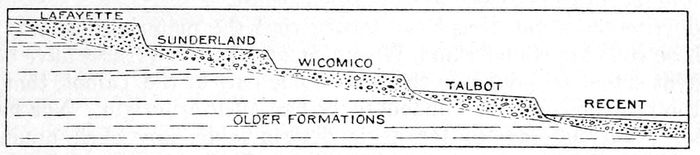
three Pleistocene terraces (Shattuck, as cited above). The uppermost is
the Sunderland, the next the Wicomico, the lowest the Talbot. These are
not correlated by Shattuck definitely with glacial divisions of the Pleistocene,
but the Sunderland is the oldest, while the Talbot is regarded the
most recent, probably about the age of the last glacial stage, the Wisconsin.
When the writer began his study of the Pleistocene he accepted the theory
proposed by McGee and the Maryland geologists, and traces of this acceptance
may be found in this work; but he is now convinced of its falsity. It
is hardly to be believed that the coastal region could have been occupied,
even at intervals, since the late Pliocene, when the depression is supposed
to have been at least 500 feet, and 200 feet during the Sunderland, down
to the end of the Wicomico and even the Talbot, without its having left
other traces of marine occupation than the supposed terraces and escarpments.
There ought to appear somewhere in the long border from New
Jersey to Mexico abundant and extensive deposits of stratified materials,
clays, sands, and gravels. Such deposits appear to be relatively rare.
A still more serious objection to the theory of submergence beneath marine
waters is the absence of marine fossils. In the materials forming these
terraces one might with confidence expect to find at least marine mollusks,
mussels, clams, and beds of oysters; probably also remains of fishes, of
porpoises, and of whales. Leaving out of consideration the Talbot terrace,
which is near sea-level (Shattuck, op. cit., p. 10), the supporters of the
theory under consideration admit that not in the Lafayette, nor the Sunderland,
nor the Wicomico, have any traces of such fossils been met with.
On the other hand, all over these terraces are found remains of land animals
and plants. Mastodons, elephants, and horses are by no means rare. Conditions
favorable for the preservation of teeth of proboscideans must have
been quite as well adapted to preserve shells of oysters. In the Sunderland
and Wicomico a few land plants have been secured, an abundance of them
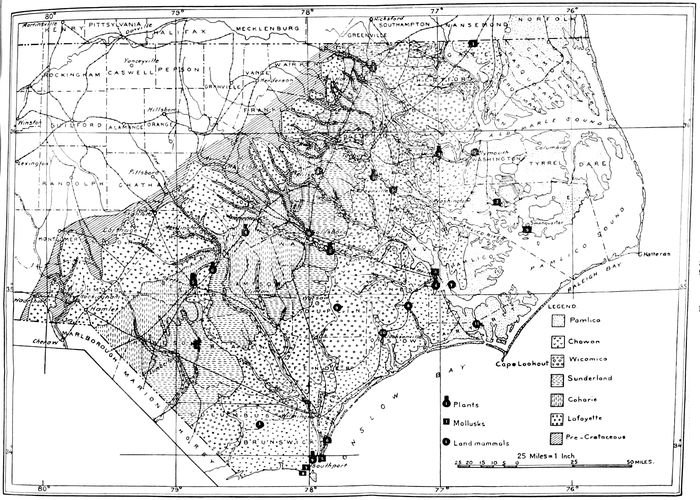
in the Talbot. Map No. 39 shows the distribution of Pleistocene mammals,
mollusks, and plants on the Coastal Plain of North Carolina.
It seems evident, therefore, that the sea has had nothing to do with the
formation of the Lafayette, the Sunderland, and the Wicomico terraces, and
little with that of the Talbot. It was natural that the advocates of this
theory of the formation of these terraces during the Pleistocene should distribute
them somewhat impartially over the time of this epoch, assigning
the Talbot to a late interval. On page 11 the writer has called attention
to the fact that in many places along the coast from southeastern Texas to
New Jersey, at or near sea-level, there are beds which contain a vertebrate
fauna of the Aftonian or first interglacial stage. Probably nowhere do these
beds have any large amount of later materials overlying them; it is often
extremely little. So far as the writer can judge, this means that all the
terraces and escarpments were produced before the time of the first interglacial;
not since that distant time has there occurred along the Gulf or
Atlantic coasts south of New Jersey any considerable elevation or depression
of the Coastal Plain.
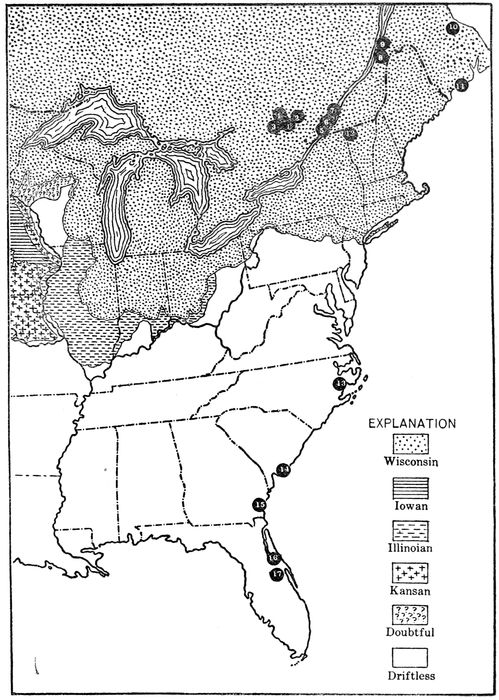
FINDS OF PLEISTOCENE CETACEANS IN EASTERN NORTH AMERICA. — ONTARIO. — QUEBEC. — NEW BRUNSWICK. — VERMONT. — NORTH CAROLINA. — SOUTH CAROLINA. — GEORGIA. — FLORIDA.
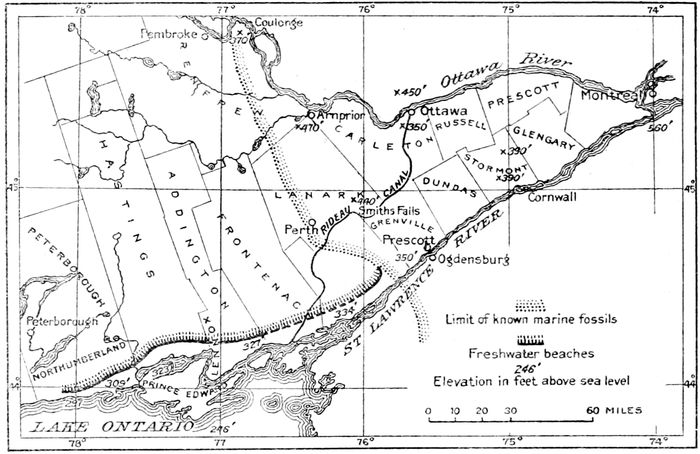
1. Nepean Township, Carleton County.—In 1914, Mr. L. M. Lambe, of
the Canadian Geological Survey, stated (Summ. Rep. for 1913, p. 299) that
Walter Billings, of Ottawa, had presented to the Survey a caudal vertebra
of Delphinapterus leucas, found in Pleistocene gravel on lot 15, concession 5,
of Nepean township. The locality is near Jock River, a stream which flows
northeasterly and enters Rideau River about 11 miles south of Ottawa.
With it was sent the lower end of a femur, supposed to belong to the bison.
2. Ottawa East, Carleton County.—In 1910, Mr. L. M. Lambe reported
(Summ. Rep. Geol. Surv. Can. for 1909, p. 273) that Mr. A. Penfold had
presented to the Survey a caudal vertebra of Delphinapterus leucas, which
he had found at Ottawa East, at a depth of 25 feet, while digging a well.
3. Smith’s Falls, Lanark County.—In 1883 (Amer. Jour. Sci., ser. 3, vol.
XXV, p. 200) Dr. J. W. Dawson announced the finding of two vertebræ, a
part of another, and a fragment of a rib of a large whale, in a ballast pit
at Welshe’s, 3 miles north of Smith’s Falls. This whale he identified as
Megaptera longimana (M. boöps). The bones were found in gravel at a
depth of 30 feet and about 50 feet from the original face of the pit. The
elevation of the place is given as about 440 feet above sea-level. Dawson
stated that this corresponds exactly with the height of one of the sea-terraces
on Royal Mountain at Montreal. He added that this animal might
have sailed past that mountain, then only a rocky islet, when a wide sea,
400 feet above the lower levels of Montreal, covered all the plain of the
lower St. Lawrence. Inasmuch as the highest terrace containing marine
fossils at Montreal stands at a height of about 625 feet (Stansfield, Mem.
73, Canad. Geol. Surv., 1915) above sea-level, the region had apparently
risen about 160 feet at least above its lowest submergence when the whale
was buried. The discovery of this whale is mentioned by Dawson in his
“Canadian Ice Age,” 1894, page 268; also by Professor G. H. Perkins in his
Report of the State Geologist of Vermont, 1907–8, page 83.
4. Pakenham, Lanark County.—This locality is about 42 miles north-northwest
from Welshe’s, where the whale remains just discussed were
found. At Pakenham, in 1906, there were discovered bones, including a
nearly perfect skull, of a white whale. The discovery was reported in 1906
and 1907 by Dr. J. F. Whiteaves (Summ. Rep. Geol. Surv. Can. for 1908,
p. 171; Ottawa Naturalist, vol. XX, pp. 214–216). The remains were found
by a well-digger on a farm (lot 21, 11th concession), and were embedded
in blue clay at a depth of 14 feet. Immediately about the bones was a
mixture of clay and shells. The animal has been referred to Delphinapterus
leucas. As one of the ear-bones was secured, the determination of the species
would appear to be possible. According to Perkins, the ear-bone in the type
of D. vermontanus differs from that of the existing white whale, D. leucas.
The writer is unable to say more than that the whale found at Pakenham
belongs to the Late Wisconsin.
185. Cornwall, Stormont County.—In 1870 (Canad. Naturalist and Quart.
Jour. Sci., vol. V, pp. 438–439), E. Billings gave an account of the discovery
of remains of a white whale at Cornwall. Considerable parts of the skull
were secured, including the lower jaws. Besides many vertebræ and some
other parts, 8 teeth were saved, but the ear-bones were missing. The animal
had been about 15 feet long. Whether it belonged to Delphinapterus leucas
or D. vermontanus may be regarded as doubtful. Extracts from Billings’s
description are to be found in Professor Perkins’s paper (Rep. State
Geologist Vermont, 1907–8, pp. 81–82).
6. Williamstown, Glengarry County.—This place is about 10 miles northeast
of Cornwall. In Professor Perkins’s paper just cited it is stated that
Edward Ardley, assistant curator at Redpath Museum, McGill University,
Montreal, had found here a few bones of a white whale, the hyoid, a few
phalanges, and rib fragments. It is impossible from such limited materials
to determine whether the animal was Delphinapterus vermontanus or D.
leucas. From Mr. Ardley, through Mr. Arthur Willey, curator of Redpath
Museum, the present writer has learned that these bones were dug up from
a depth of 14 feet, in a well sunken in the Leda clay. Under the surface
soil was a band of sandy clay containing shells of Saxicava and Mya.
Beneath this was a stiff blue clay showing stratification and containing
shells of Leda.
7. Montreal.—In 1863 (Rep. Geol. Surv. Canada, p. 919), W. E. Logan
announced the finding of some bones of a whale at the Mile-End quarries,
Montreal, on a slight ridge, “where are found stratified sand and gravel
holding boulders and shells in the lower part.” In corresponding clays in
a neighboring brickyard was found a pelvis of a seal, Phoca grœndlandica.
In 1895 (Canad. Rec. Sci., vol. VI, p. 351), Dr. J. W. Dawson reported the
discovery of a nearly complete skeleton of another white whale at Montreal.
This was found in brick clay, near Papineau Road. The locality is said by
Dawson to be about 100 feet above the St. Lawrence; the bones were in
the clay at a depth of 22 feet. The clay itself was probably deposited at
a depth of 50 to 80 fathoms. This is said by Dawson to correspond approximately
with a well-marked shore-line at Montreal, found at a height of
about 470 feet above the sea and with the old sea-beach at Smith’s Falls
as related on page 17. In 1916, Mr. Edward Ardley, assistant curator of
Redpath Museum, reported (Canad. Rec. Sci., vol. IX, pp. 490–493) the discovery
of a large part of the skeleton of a white whale, supposed to belong
to Delphinapterus leucas, at Montreal East. The skeleton was buried in
Leda clay about 15 feet above St. Lawrence River. It was 10.5 feet long.
The cranium and lower jaw were secured, besides parts of the trunk and
limbs.
8. Rivière du Loup, Temiscouata County.—In his work, “Canadian Ice
Age,” 1894, on page 268, Dr. J. W. Dawson reported that bones of Beluga
catodon (Delphinapterus leucas) had been found at the place mentioned.
It is not probable that parts sufficient for making a definite determination
were secured, nor did Dawson give any details regarding the geological
19conditions connected with the discovery. Doubtless the remains were found
in marine deposits of one of the terraces.
9. Metis, Rimouski County.—In the work just cited (p. 269), Dawson
stated that in the summer of 1891 he secured a large jawbone of a whale
which had been found in digging a cellar in the shelly marl of the lower
terrace at Metis. He did not identify the species, but appears to imply
that it belonged to either the “humpback” (Megaptera boöps) or to one
of the finner whales (Balænoptera).
10. Jaquet River, Restigouche County.—In 1874 (Trans. Nova Scotia
Inst. Sci., vol. III, pp. 400–404), Dr. J. B. Gilpin gave an account of the
discovery of some cetacean bones in a railroad cut at the place named, but
did not identify the bones otherwise than as those of a small cetacean. In
the same year (Amer. Jour. Sci., ser. 3, vol. VII, p. 597), in a short, unsigned
communication, this discovery was mentioned and the whale was identified
as Beluga vermontana. In volume VIII of the same journal (1874, p. 219),
Dr. D. Honeyman described the deposit and gave a list of the shells found
in it. Dawson (Canad. Ice Age, p. 268) refers the bones to Beluga catodon.
The locality is a cut of the International Railway, on the north side of the
Jaquet River, about 0.25 mile from the sea. Gilpin gives the elevation
as 40 feet above the sea; the writer of the unsigned communication just
mentioned gives it as 25 feet.
Professor G. H. Perkins (Rep. State Geologist Vermont, 1907–8, pp. 102–112)
studied the bones described by Gilpin. They consisted of 18 vertebræ,
some fragments of the skull, one of the ear-bones, a part of the lower jaw,
some fragments of ribs, and some arm-bones. He identified the animal as
belonging to the genus Monodon and probably M. monoceros, the existing
narwhal.
11. Mace’s Bay, Charlotte County.—In 1879 (Geol. Survey of Canada,
1877–78, EE, p. 23), Mr. G. F. Matthew reported the discovery of a
ramus of the lower jaw of a whale, possibly a species of Delphinapterus,
at the mouth of the Popologan (or Pocologan) River. It is now in the
Mechanics’ Institute at St. John. It had fallen from a bank of Leda clay.
It probably belongs to the late Pleistocene.
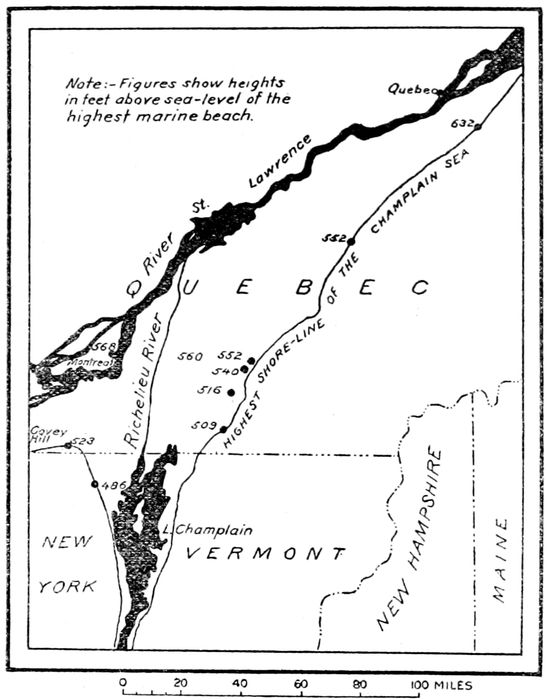
12. Charlotte, Chittenden County.—At this place were discovered considerable
parts of a whale, described in 1850 (Amer. Jour. Sci., ser. 2, vol.
IX, pp. 256–263) by Zadock Thompson, under the name Beluga vermontana.
The animal has by many been regarded as identical with the white whale,
Delphinapterus leucas, now appearing sometimes as far up as Montreal. A
more extended description of it was given in 1853 (Hist. Vermont, Append.,
p. 15, figs. 1–13). This was reproduced in Edward Hitchcock’s Report on
the Geology of Vermont, 1861, page 164, and was followed by remarks on
the specimen by Edward Hitchcock jr. In the second volume of the work
just cited (p. 938) Hager furnished a figure of the skeleton as mounted. In
201908 (Rep. State Geologist Vermont, 1907–8, pp. 76–112, plates X-XIX),
Professor G. H. Perkins gave an extended description of the remains and
reached the conclusion that D. vermontanus is distinct from D. leucas.
Since Perkins’s article gives a full history of the discovery and the literature
pertaining to the specimen, this account will be much abridged. The
bones were found in making a cut for the Rutland and Burlington Railroad,
at the town of Charlotte, about a mile east of the shore of Lake Champlain.
The bones were 8 or 9 feet below the surface and “were very completely
bedded in fine adhesive blue clay.” The locality is 60 feet above the mean
level of the lake and 150 feet above the sea. The deposits were laid down
in the marine waters which took possession of Lake Champlain and the St.
Lawrence Valley when the Wisconsin glacial ice had withdrawn north of
St. Lawrence River. The geological age of the animal is therefore late
Pleistocene.
13. Below New Bern.—In 1842 (Amer. Jour. Sci., vol. XLIII, p. 143),
Richard Harlan reported regarding the species of fossil vertebrates found
16 miles below New Bern. His list, which was long and consisted mainly
of vernacular names, included “cetaceans.”
14. Charleston.—In 1860 (Holmes’s Post-Pliocene Foss. South Carolina,
p. 117, plate XXIV, fig. 9), Leidy described a cetacean tooth which he called
Physeter antiquus. Later the specific name was changed to vetus. At the
same time he figured a tooth (fig. 8) found in the Ashley River deposits.
He further stated that teeth apparently of the same species had been taken
from the Miocene formations of Virginia, but found no characters by which
they could be distinguished from those of the recent sperm whale.
15. Brunswick.—In 1911 (Bull. No. 26, Geol. Surv. Georgia, p. 436),
Gidley reported from here, among other vertebrates, some teeth which he
regarded as those of Physeter vetus; but this may not be correct and they
may not belong to the Pleistocene.
16. Daytona, Volusia County.—In 1916 (Florida Geol. Surv., vol. VIII,
p. 105), Doctor Sellards stated that he had obtained from marl-pits worked
at this place for road materials a proboscidean tusk and a rib of a whale,
probably of the genus Balænoptera. At the same place had been found a
tooth of Elephas columbi.
17. De Land, Volusia County.—At this place was obtained the dolphin
skull which Sellards described as Globicephalus bæreckeii (Florida Geol.
Surv., vol. VIII, p. 107, plate XIV). It was found embedded in sand at a
depth of 10 feet. This sand overlies marls which are regarded as Pliocene
or Miocene. Sellards believed that the sands belonged to the Pleistocene.
It is not improbable that the marls pertain to the Pleistocene of the first
glacial time.
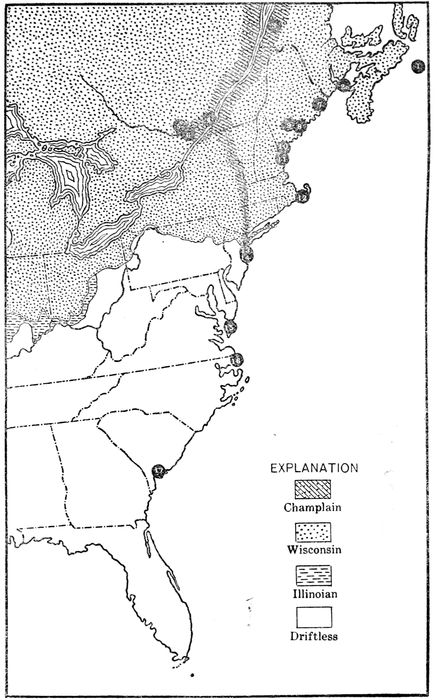
FINDS OF PLEISTOCENE PINNIPEDIA IN EASTERN NORTH AMERICA. — GRINNELL LAND. — NOVA SCOTIA. — NEW BRUNSWICK. — QUEBEC. — ONTARIO. — MAINE. — NEW HAMPSHIRE. — MASSACHUSETTS. — NEW JERSEY. — VIRGINIA. — NORTH CAROLINA. — SOUTH CAROLINA.
Dumbbell Harbor.—In 1877 (Ann. Mag. Nat. Hist., ser. 4, vol. XX, p.
488), Fielden published a paper on the Post-Tertiary beds of Grinnell Land
and north Greenland. Fielden and De Rance reported on the same subject
in 1878 (Quart. Jour. Geol. Soc. Lond., vol. XXXIV, p. 566). In beds having
an elevation of 400 feet, in latitude 82° 30′, there were obtained meager
remains of Phoca hispida and Ovibos moschatus. In latitude 82° 25′ were
secured remains of Rangifer tarandus, Ovibos moschatus, and Phoca
barbata. The invertebrate fauna was found to be identical with that existing
there to-day. If the beds are of Pleistocene age, as the elevation appears
to indicate, they may be referred to the Late Wisconsin.
1. Sable Island.—In the collection of the Philadelphia Academy there is
a walrus skull which was sent to the Academy from Sable Island about
1871. According to Rhoads (Proc. Phila. Acad., 1898, p. 197), Leidy
regarded this skull as that of a recent individual; but Rhoads states that
“the specimen is of precisely the same nature in color, texture, and specific
gravity as the larger fossil specimen which Leidy described and figured in
the Philosophical Transactions and which came from the beach at Long
Branch, New Jersey.” He thinks that it had been derived from an ancient
raised sea-beach. This does not appear to be at all improbable.
2. Fairville, Charlotte County.—In 1879 (Geol. Surv. Canada, Rep. for
1877–8, EE, p. 23), Dr. G. F. Matthew reported the discovery of a skeleton
of Phoca grœnlandica near Fairville, at the mouth of St. John River, New
Brunswick. The fore limbs and several vertebræ were missing. The skeleton
was afterwards destroyed in a fire at St. John. The bones were found
at a depth of about 25 feet, in the lower Leda clay.
3. Bic, Rimouski County.—In Le Naturaliste Canadien (vol. XXXVI,
1908, p. 51), the editor, V. A. Huard, in commenting on a letter written to
him and announcing the capture of a walrus somewhere on the northern
coast of the Gulf of St. Lawrence, recalled an article contributed in 1869
by the former editor, a priest named Provancher (Le Naturaliste Canad.,
vol. II, p. 19). This writer stated that some workmen employed in the
construction of the International Railway had discovered at Bic, Rimouski
County, Quebec, on the southern shore of the St. Lawrence, a complete
skeleton of a walrus. This skeleton had a length of 13 feet. It was found
at a depth of 14 feet, in a compact clay, and at a height of more than 100
22feet above sea-level. The skeleton was deposited in the museum of the
Rimouski Seminary, but was destroyed in a fire in 1881.
It is evident that when that animal died and was buried in the clay the
land in that region stood at a level at least 100 feet lower than at present.
Through the late Mr. L. M. Lambe, of the Canada Geological Survey, the
writer has received from Mr. W. A. Johnston, who made a special study of
the Pleistocene, information regarding the age of the clays at Bic. He says
that little can be said definitely regarding the age of the clays in which
the walrus skeleton was found. Clays belonging to the Champlain submergence
stand now at an elevation of 311 feet in that vicinity; and marine
shells occur in clays, supposed to belong to the Champlain, at an altitude
of 120 feet. There is a possibility that some of the clays in that region are
earlier than the time of the Wisconsin. Mr. Johnston cites Guide Book
No. 1, part I, pp. 77–78, of the Canada Survey, and Dawson’s Ice Age,
1893, pp. 186–195. The first article was written by J. W. Goldthwait. On
page 921 of Logan’s Geology of Canada, 1863, it is stated that bones of
whales and of the morse have been found partially embedded in the Leda
clay in several places between Bic and Matanne, about 60 miles farther
down the river.
4. Montreal, Quebec.—In 1863, Logan (Geol. Surv. Canada, p. 920) told
of the discovery of a skeleton of Phoca grœndlandica near Montreal. The
exact locality appears to be about 0.75 mile east of what was then known
as the Mile-end quarries. These quarries were about 100 feet above sea-level,
and the spot where the skeleton was found was about 40 feet lower
down. At a nearby brickyard some bones of a young seal were discovered
which belonged probably to the same species. One of the pelvic bones of
a seal was found also at the Mile-end quarries. Dr. J. W. Dawson (“Canadian
Ice Age,” 1844, p. 267) stated that the skeleton was found in the Leda
clay; that it is in the collection of the Geological Survey, at Ottawa; and
that detached bones are in the Peter Redpath Museum of McGill University
at Montreal. The Leda clay, at least that of the upper portion of the St.
Lawrence Valley, is now referred to the Champlain epoch, a time when the
sea had invaded this valley and even Lake Ontario.
5. Tétreauville, Ottawa County.—In 1897 H. M. Ami (Ottawa Naturalist,
vol. XI, p. 24) announced that he and Ruggles Wright had found
some bones which were probably those of a young harbor seal, Phoca
vitulina. They were collected in 1888, in a sandy layer about 30 feet below
the surface, on a hillside, at Wright’s brick clay pits, on Aylmer Road,
Tétreauville, Quebec. This place is about 5 miles west of Hull, and within
10 miles of Ottawa. These bones are in the Victoria Museum at Ottawa.
Besides the left half of the lower jaw with teeth, there are both ear-bones,
one exoccipital, the greater portion of the backbone, scapula, part of the
pelvis, and some of the larger limb-bones. This species is abundant in the
Gulf of St. Lawrence, and also ascends the larger rivers to a great distance.
Doubtless great numbers inhabited the inland sea which, during Champlain
times, is believed to have occupied the valley of the St. Lawrence, Lake
Ontario, and the valley of the Ottawa River nearly as far up as the city
of Ottawa.
23
6. Ottawa.—Remains believed to belong to Phoca grœnlandica have
been found near Ottawa, Ontario. In 1856 (Proc. Phila. Acad. Nat. Sci.,
vol. VIII, p. 90, plate III), Doctor Leidy described and figured the hinder
limbs of a young aquatic animal which he regarded as a seal, but did not
more exactly identify. He expressed the opinion that its descendants were
yet sporting in the sea-borders of Canada. This specimen was found in
Gloucester Township, Carleton County, about 9 miles east of Ottawa. The
locality is on Green’s Creek, a tributary of the Ottawa River, the bank of
the creek being about 30 feet high and composed of clay. This is regarded
as being of Champlain age, the close of the Wisconsin stage. Out of this
clay were washed numerous nodules of hardened clay, many of which contained
organic remains, such as marine shells and fishes. Among the latter
are two species, the capelin (Mallotus villosus) and the lump-sucker
(Cyclopterus lumpus).
Later, at the same locality, a lower jawbone of a young seal was found,
which was identified as the harp seal; and it was even thought that it might
have belonged with the hinder limbs figured by Leidy. A figure of this
jaw, with some of the teeth, was published by Dawson in his “Canadian
Ice Age.”
7. Addison Point, Washington County.—From the curator of the Portland
Society of Natural History, Arthur H. Norton, the information is
received that some portions of the skeleton of a walrus, several ribs, parts
of two limbs, and a phalanx of a digit, had been found at Reef Point, near
Addison Point, Maine. These remains are now in the collection of the
society just named. They had been collected in 1881 by C. H. Boyd, who
published an account of them (Proc. U. S. Nat. Mus., vol. IV, p. 234).
They had washed out of the bank on the eastern side of Pleasant River,
about 3 miles below Addison. They had been buried in a stiff blue clay,
about 2 feet above high-water. Above them there was 6 feet of the clay,
and above this gravel and soil. Mr. Boyd stated that he had seen a tusk,
with a part of the socket, which had been washed out at the same place.
8. Andrews Island, Knox County.—The American Museum Journal for
1912 (vol. XII, pp. 269–270) contains an article which calls attention to a
walrus skull preserved in the American Museum of Natural History in New
York. It is reported as having been found by Sidney Norton, in December
1912, in 50 fathoms of water, near Andrews Island, off Owl’s Head, Penobscot
Bay. One of the tusks is complete, the other is gone; also the occiput
and zygomatic arches are missing. The bone is said to be quite well
petrified, which shows that the skull is not a recent one.
9. Gardiner, Kennebec County.—In 1845 Charles Lyell visited (“Second
Visit to the United States,” vol. I, p. 44) Gardiner, Maine, and examined a
collection of fossil shells and crustacea which had been made by Mrs.
Frederic Allen from the glacial deposits of that vicinity. He recognized
the tooth of a walrus, which he stated was similar to the one procured by
him on Martha’s Vineyard. This tooth is said by Packard (Mem. Bost.
24Soc. Nat. Hist., vol. I, 1867, p. 246) to have been a tusk; and he was
informed that it had been taken by Lyell to London and had been identified
by Professor Richard Owen. Inasmuch as Owen regarded the specimen
found on Martha’s Vineyard as a species distinct from the one now living
on the Atlantic coast, it is to be supposed that the Gardiner specimen also
was thought to be different from the latter. Packard, in another communication
(Amer. Naturalist, vol. I, 1868, p. 268), states that the tooth of
the walrus and some teeth of a supposed bison were discovered in the clay-beds
at Gardiner by Lyell, or at least during his visit, but it is evident that
they had been collected before his arrival.
In his discussion of the supposed bison teeth found in clay at Gardiner,
Dr. J. A. Allen (The American Bisons, 1876, pp. 89, 91) gives us some
information about the fate of Mrs. Frederic Allen’s collection. At her death
it passed into the possession of her daughter, by whom the greater part of
it was presented to Bowdoin College, Brunswick, Maine. Professor Manton
Copeland, of this college, informs the writer that the walrus tusk is in their
collection and bears the number FM20. It is badly shattered. The length
is about 75 mm.
The important matter concerning the remains of the walrus found at
Gardiner is to determine when the animal lived there. It is to be assumed
that the tusk had been buried in the Pleistocene clay at that locality. This
appears to belong to the closing period of the Wisconsin stage, but there
has been some dispute about its age.
Packard (Mem. Bost. Soc. Nat. Hist., vol. I, pp. 245–246) gives a list of
the species which had been found in the clay at Gardiner. These are
nearly all invertebrates and indicate a climate somewhat colder than that
now existing there. Whether the time when the walrus lived at Gardiner
was before or after the culmination of the Wisconsin ice period, it was so
long ago that those deposits of clay, made in sea-water of considerable
depth, have since been lifted above sea-level to a height of perhaps 200 feet.
10. Portland, Cumberland County.—In the American Naturalist, volume
XII, 1878, page 633, it is recorded that the larger part of the skeleton of a
walrus, including the skull, with tusks over 5 inches long, had lately been
found in the Quaternary clays at Portland. It had been discovered by
workmen excavating for the foundation of the transfer station of the Boston
and Maine Railroad. The remains were partially embedded in a layer of
blue clay a foot thick, itself overlain by 2 feet 2 inches of a lighter clay.
The latter contained casts and shells of 11 species of mollusks. J. A. Allen,
in his work already quoted, states that the skeleton was found at a depth
of 7 feet. It was placed in the museum of the Portland Society of Natural
History, and is still there, as reported by the curator, Arthur H. Norton.
Mr. Norton has sent the writer an extract from the report of the committee
which investigated this discovery. The bed of blue clay in which
the greater part of the skeleton was buried contained the following species
of mollusks: Mya arenaria, Macoma sabulosa (calcarea), Mytilus edulis,
Cardium (Serripes) grœndlandicum, Saxicava distorta, Nucula antiqua,
Leda tenuisulcata, L. truncata (Yoldia glacialis), Natica clausa, N. pusilla,
and Astarte striata. The lighter-colored clay above the blue clay was more
25sandy and adhered strongly to the bones. This clay contained Mya arenaria,
Mytilus edulis, Serripes grœndlandicus, Astarte striata, Macoma calcarea,
Nucula antiqua, Natica, and Balanus.
Above the lighter-colored clay just mentioned was a foot of a clay which
contained wood and roots, the unused portion of the brick clay that once
existed there, but which had been removed for the manufacture of bricks.
Inasmuch as the clay overlying the bed in which the remains were found
contains marine shells, it is certain that since their deposition the land has
been considerably elevated.
George N. Stone (Monogr. XXXIV, U. S. Geol. Surv., pp. 286–291) has
discussed the age of the glacial deposits at Portland. Professor M. L. Fuller
has written to the author that on the Maine coast the chief clay is known
as the Leda and is found at Portland and Gardiner, and that it probably
antedates the Wisconsin. This is not to be correlated with the Leda clay
of the St. Lawrence Valley. It corresponds rather to Clapp’s “high-level
clays” (Bull. Geol. Soc. Amer., vol. XVIII, p. 505, seq.).
11. Jeffries Reef, off Portsmouth.—The specimen from this place consists
of the greater part of the left side of the skull of a large individual. The
occipital and the exoccipitals are missing. The bone and especially the
tusk have suffered some decay. The fragment is labeled as having been
dredged from a depth of 50 to 75 fathoms on Eastern Jeffries Reef. The
bottom was hard. Jeffries Reef lies 5 or more miles off the southernmost
part of the Maine coast and extends from the Isle of Shoals to Boon Island.
The skull belonged to an old individual. The length from the rear of the
mastoid process to the front of the premaxilla is 360 mm. The exserted part
of the tusk measures 225 mm. in length. At its base the diameters are
65 mm. and 42 mm. There are 4 large grinding teeth. There is no reason
for supposing that the species represented is not O. rosmarus.
12. Gay Head, Martha’s Vineyard.—In his “Travels in North America,”
volume I, 1845, page 257, plate V, figure 1, Lyell announced the finding of a
part of a skull of a walrus at Gay Head. This he had purchased from a
fisherman who lived there and who said it had fallen out of a conglomerate
found at that place and which contains bones of cetaceans. The skull
retained but a small portion of its animal matter. Richard Owen, to whom
the skull was shown, regarded it as belonging to a species distinct from
O. rosmarus. The upper jaw contained the base of one tusk, the socket for
the other, and 3 molar teeth on each side. The reduced number of molars
furnishes no distinctive character, for existing individuals sometimes present
this number. The base of the tusk has its transverse diameter greater
than usual relatively to the fore-and-aft diameter. According to Lyell’s
illustration of the specimen, the greater diameter was 70 mm., the shorter
53 mm. The writer has seen no tusk of O. rosmarus as thick as this; but
the thickness is variable and may possibly attain to two-thirds of the
greater diameter.
26Inasmuch as the Tertiary deposits at Gay Head, rising above the sea to
a height of about 150 feet, are capped by a sheet of glacial drift and clays,
it is probable that the skull in question had fallen from some of these drift
deposits. According to Professor J. B. Woodworth (17th Ann. Rept. U. S.
Geol. Surv., pt. I, p. 982), there are at Gay Head deposits of drift which
represent some of the older glacial stages as well as the last one, the Wisconsin.
It is possible, therefore, that this walrus lived there as far back
as the middle of the glacial epoch or even earlier. For additional information
on the geology of that island consult Woodworth’s paper, in which the
literature is cited; also the important paper by N. S. Shaler (7th Ann. Rept.
U. S. Geol. Surv., 1888, pp. 303–363.)
The hooded seal, Cystophora cristata, has probably been found fossil at
Gay Head. The only reason for this supposition is found in a statement
made by Charles Lyell (Proc. Geol. Soc. London, vol. IV, p. 32; Amer. Jour.
Sci., vol. XLVI, 1844, p. 319). He says that with other remains on Martha’s
Vineyard he found a tooth having the crown fractured. Lyell submitted
the tooth to Richard Owen, who pronounced it to be that of a seal which
seemed to be nearly allied to the modern Cystophora proboscidea (C. cristata).
It seems quite probable that this species lived there at the time when
the walrus haunted the region. It is of course possible that the remains
reported belonged to an animal that lived in that region as far back as the
Miocene. The tooth was not described or figured.
13. Long Branch.—Portions of several walrus skulls have been found on
the beach at Long Branch. Two of these were described and figured by
Leidy in 1867 (Trans. Amer. Philos. Soc., vol. XI, p. 83, plate IV, figs. 1, 2,
plate V, fig. 1). One skull, lacking the lower jaw, some of the right hinder
part of the cranium, and the exserted portion of one tusk, was discovered in
1853. The other specimen, discovered about 1856, furnished the front of
the skull as far back as the middle of the palate. Both belonged to old
individuals. Leidy concluded that the animals which had possessed these
skulls belonged to the existing species Odobenus rosmarus. He surmised
that they had been floated to the New Jersey coast on fields of ice or perhaps
had lived there during the Glacial period. The skull which was found in
1853 is now in the collection of the Philadelphia Academy; the other is in
the collection of the New Jersey Geological Survey. Recently, Mr. Samuel
N. Rhoads has studied these skulls. He had also for examination the skull
from Sable Island, which has been mentioned. He concluded that these
skulls belonged to a species distinct from O. rosmarus and which might bear
DeKay’s name, O. virginianus.
It does not appear to the present writer that Rhoads has successfully
maintained his proposition. He did not have at hand a sufficient number
of skulls of the existing Atlantic walrus to present all the variations that
occur in that species. Of course, the number of fossil specimens was very
limited. In discussing Rhoads’s conclusion, it will be of advantage to consider
a part of a skull which belongs to the Marsh collection in Yale University.
This specimen consists of the anterior half of the skull, without
27the tusks and without the other teeth. It was found at Kitty Hawk, at
the mouth of Albemarle Sound, just north of latitude 36°. It is thoroughly
fossilized; and, having been found so far south, it may be safely regarded
as having belonged to the species which inhabited the New Jersey coast
during the Pleistocene.
For purposes of comparison, such measurements are here given as can
be obtained from the skull; likewise the corresponding measurements of a
specimen from Sable Island, No. 199528 of the U. S. National Museum, and
of another, No. 22014 of the National Museum, brought from Ungava Bay.
Unfortunately, the basilar length of the fossil can not be determined, nor
the width of the mastoids.
Measurements of skulls of walruses, in millimeters.
Kitty Hawk.
Sable Island.
Ungava Bay.
From front of premaxillæ to rear of vomer
183
167
205
From front of tusk to optic foramen
188
177
195
From oral border of premaxilla to upper border of nasal opening
110
96
100
Greatest width across maxillæ
160
136
177
Least width at front of orbits
105
106
146
Least width at temporal fossæ
75
62
70
Width between the sockets for tusks
75
75
85
Length of row of teeth
82
60
83
Space between incisors
40
36
32
Space between last molars
62
60
53
Long diameter of tusk at base
34
26
38
The nasal bones of the fossil are so thoroughly consolidated with each
other and with the adjoining bones that their dimensions can not be determined.
There is no reason, however, for supposing that the length was
greater than 70 mm.
The grinding teeth of the fossil do not show the larger size that we might
expect from Rhoads’s determinations and from comparison with Leidy’s
illustrations. The second socket was almost exactly the diameter of the
same socket in the Sable Island specimen measured. The third socket is
larger than that of the skull from Sable Island. The sockets for the first
molars are very small and shallow; the socket for the left incisor is still
smaller, while that for the right incisor is wholly effaced. The diameter
of the socket for the second molar is much shorter than that of the corresponding
socket in the Ungava Bay specimen. In the latter, the left
incisor is present and large, but the other is missing and the socket is nearly
filled up. It is evident that the teeth are extremely variable in both size
and the number present.
Rhoads has found that the incisive foramina of the fossil skulls in his
hands are placed high above the alveolar borders. In the North Carolina
specimen this height is 32 mm.; in the Sable Island specimen in the U. S.
National Museum, 30 mm.; in the Ungava Bay specimen, about 22 mm.
Nor does the distance between the sockets for the incisors in the fossil from
North Carolina agree with that dimension in the two specimens from
Long Branch.
28Despite the differences shown in the measurements in the table given
above, the writer must conclude that there are not as yet sufficient reasons
for regarding the Pleistocene walrus of the Atlantic coast as specifically
different from the existing form.
Dr. Albert Reid Ledoux, mining engineer, of New York City, when a
young man bathing at low tide at Long Branch, found a skull of a walrus.
This was given to Professor John S. Newberry and is now probably at
either Columbia University or the American Museum of Natural History.
At the same time and at the same spot was a heel-bone of Megatherium,
now in the American Museum (p. 31). It is very improbable that these
two animals lived there at the same time.
According to recent publications of the Geological Survey of New Jersey
(Salisbury, Report for 1897, p. 19, pl. I; Lewis and Kümmel, Bull. No. 14,
p. 120, with Geologic Map of New Jersey, 1910–1912), Long Branch is
situated on the Cape May formation. This is regarded by the geologists
just quoted as corresponding in age, in great part at least, to the Wisconsin
stage. When this deposit was laid down, the New Jersey coast was depressed
from 35 to 50 feet below its present level. It seems very probable
that at that time the walrus was living there and that the skulls found have
been washed out of this deposit by the waves during storms. Nevertheless,
the finding of Megatherium at Long Branch shows that there are deposits
present which belong probably to early Pleistocene.
Dr. H. B. Kümmel, State Geologist of New Jersey, has informed the
writer that a strip 0.25 to 0.75 mile back from the ocean in the region about
Long Branch probably belongs to the Recent time. He states that one
would be safe in concluding that the skulls of the walrus were found in
deposits not older than the Cape May and that they may have occurred
in more recent beds. Against the view that the walruses found along this
coast lived there during the Recent period is their well-fossilized condition.
14. Ocean Grove, Monmouth County.—In 1910, after a storm, a part of
a skull of a walrus was found on the beach at Ocean Grove, New Jersey.
This is still in the possession of the finder, Mr. W. S. Hidden, who furnished
the writer with photographs of the specimen. It consists of the front of
the skull extending back to the bases of the zygomatic arches, and containing
portions of both tusks and most of the teeth. There is no likelihood that
this specimen belonged to any other species than Odobenus rosmarus, and
it was probably washed out of the same deposits as those which furnished
the specimen found at Long Branch.
15. Accomac County.—In the Annals of the Lyceum of Natural History
of New York, volume II, 1828, page 271, Messrs. Mitchill, Smith, and Cooper
made a report on a fossil walrus skull found along the Virginia coast somewhere
in Accomac County. Only the anterior half of the skull was secured.
According to this report, portions of the tusks were preserved, but were much
mutilated. There were present also 4 of the grinding teeth. The skull was
described as being remarkably hard and heavy and the tusks were almost
agatized. The sutures of the skull had mostly closed up; hence the animal
29was evidently an old one. The specimen bore the marks of having been in
salt water, and was said to have been found on the beach.
This is the specimen which DeKay, in 1842 (Zool. of N. Y., pt. I, p. 56,
plate XIX, fig. 1), made the type of his Trichechus virginianus. Newberry,
in 1873 (Proc. Lyc. Nat. Hist. New York, p. 71), identified the specimen
as belonging to the existing Atlantic species. Cope (Proc. Amer. Philos.
Soc., vol. XIV, 1874, p. 17) does not mention the presence of tusks. He supposed
that there was, at that part of the coast, glacial drift, out of which
the skull had been washed. There are, however, no such deposits in that
region. This specimen was placed in the collection of the Lyceum of
Natural History of New York, but according to Rhoads, was afterward
destroyed in a fire.
On examination of G. B. Shattuck’s work on the Pleistocene of Maryland
(Maryland Geol. Surv., Pliocene and Pleistocene volume, p. 95, plate I),
it seems that the coast of Virginia in Accomac County is occupied by the
Talbot formation. This, according to his theory, corresponds, at least the
part nearest the coast, with the Cape May formation of New Jersey. Hence
we might conclude that the walrus skull in question had become buried,
probably during the Wisconsin glacial stage. The present writer regards
the principal part of the Talbot terrace as being much older.
Messrs. W. B. Clark and B. L. Miller (Virginia Geol. Surv. Bull., No. IV,
p. 187) recognize the presence of the Talbot formation in Accomac County,
where it seems to reach a thickness of 100 feet; but the authors add that
part of this may belong to earlier Pleistocene formations.
16. Kitty Hawk, Currituck County.—In the Marsh collection of fossils
belonging to Yale University is a part of a skull found somewhere near
Kitty Hawk. No particulars regarding the exact place of discovery accompany
the specimen. It has already been described on page 27; and, while
there are some differences between it and the recent skulls used for
comparison, it is not believed that a distinct species is indicated.
According to L. W. Stephenson’s map of the Coastal Plain of North Carolina
(North Carolina Geol. and Econom. Surv., vol. III, plate XIII), the
coast at Kitty Hawk and for about 50 miles back of this is occupied by
the Pamlico formation. This corresponds to the upper part of the Talbot
of Maryland, and it, or part of it, may have been deposited at the close
of the Pleistocene. So far as the present writer knows, there is nothing
to show the character of the climate then prevailing. As this Pamlico
nowhere rises more than 25 feet above sea-level, and as the thickness is
usually only from 15 to 20 feet, it is possible that the walrus skull found at
Kitty Hawk had been unearthed by the waves from the Chowan formation
or some still earlier deposit.
17. Charleston.—In 1876 Leidy announced (Proc. Phila. Acad., 1876,
p. 80) that a complete tusk of a walrus had been found in the Ashley River,
30near Charleston. This tusk Leidy described and figured in 1877 (Jour.
Phila. Acad., vol. VIII, fig. 6). It had evidently been dredged from the
river in collecting phosphate rock, as have been most of the fossils of that
region. The tusk was 13 inches long. Near the base it measured 3.62
inches and transversely 1.75 inches. Leidy especially noticed the shortness
of the tusk as compared with the diameter, but concluded that the tusk
might, during the life of the individual, have been broken off and worn
obliquely at the end.
In the collection of the Charleston Museum are some fragments of tusks
of a species of walrus, probably O. rosmarus. One of these, No. 1028,
furnishes 184 mm. of the distal end. The width at the fracture is 60 mm.,
the thickness 29 mm. The distal end is worn off somewhat obliquely, but
not so much as in the tusk figured by Leidy; also, the tusk appears to have
been less curved than the one which he described. The original length can
not be determined.
Another fragment, No. 1029, was given to the Charleston Museum by
Major E. Willis and was no doubt found in the region about Charleston.
This gentleman has sent a fossil horse-tooth and a part of a sirenian to the
U. S. National Museum from Wando River. The fragment is short, but
belonged to a large tusk, its long diameter being 81 mm., the shorter one
51 mm. It was therefore a larger tusk and one whose thickness was relatively
greater than that of the imperfect specimen found at Long Branch
and figured by Leidy.
Mr. Earle Sloan’s collection at the Charleston Museum has two other
fragments of tusks. One, No. 13497, is 113 mm. long, 60 mm. wide, and
25 mm. thick; the other, No. 13296, is 140 mm. long, 60 mm. wide, and
31 mm. thick.
Considering that all of the remains of the walrus found about Charleston
have been picked out of great quantities of phosphate rock collected for
commercial purposes, and that no records of the exact locality where
obtained have been kept, it is impossible to determine their exact geological
age. It is to be supposed that this animal inhabited the region about
Charleston at the time it frequented the coasts of North Carolina and
New Jersey. This appears to have been during the Wisconsin stage; but
it is possible that the walrus extended its range far southward during more
than one of the glacial stages. All of the specimens appear to be thoroughly
fossilized.
FINDS OF XENARTHRA IN EASTERN NORTH AMERICA. — NEW JERSEY. — PENNSYLVANIA. — OHIO. — INDIANA. — ILLINOIS. — VIRGINIA. — WEST VIRGINIA. — SOUTH CAROLINA. — GEORGIA. — FLORIDA. — ALABAMA. — MISSISSIPPI. — TENNESSEE. — KENTUCKY.
1. Long Branch, Monmouth County.—In the American Museum of
Natural History, New York, there is a large heel-bone which was found at
the place named and identified as having belonged to a species of Megatherium,
most probably to M. mirabile. It was presented by Dr. A. R.
Ledoux, of New York, who wrote that he found it about 40 years ago while
bathing at Long Branch. With this bone were found a skull of a walrus
and a tooth of a mastodon. The heel-bone is somewhat more than 15 inches
long. It was incrusted with barnacles and small oyster shells.
While one can not at present be certain that this animal did not live up
to a late stage of the Pleistocene, it is improbable that it did so. It is also
quite improbable that the megatherium and walrus lived at Long Branch
at the same time. It is more likely that the megatherium had its existence
there at the time when horses lived in the same region and when the Port
Kennedy fauna existed; that is, at some time during the early Pleistocene
about the Aftonian stage.
1. Port Kennedy, Montgomery County.—From the noted bone cave at
Port Kennedy a number of species of Megalonyx have been described.
The presence of this genus was first announced by Wheatley (Amer. Jour.
Sci., ser. 3, vol. I, p. 384). Cope, in 1899 (Jour. Acad. Nat. Sci., Phila.,
vol. XI, pp. 211–219), admitted the occurrence of 4 species, Megalonyx
wheatleyi, M. loxodon, M. tortulus, and M. scalper. It must be left to
future investigations to determine the status of these species. M. jeffersonii
was not recognized by Cope in the materials found in the cave. Of M.
loxodon, only a single upper canine molar was found. Of M. wheatleyi,
numerous specimens were secured, including considerable parts of crushed
and decayed skulls. M. tortulus was represented by a considerable number
of teeth; M. scalper by only a single “canine-molar.” On page 312 will be
found a list of the species of vertebrates associated with these sloths. Of
Mylodon, Wheatley (op. cit., p. 384) had a single ungual phalanx which
Cope (op. cit., p. 210) thought belonged probably to M. harlani.
2. Frankstown, Blair County.—Remains of an undetermined species of
Megalonyx have been reported from a bone cave at this place by Dr. W. J.
Holland (Ann. Carnegie Mus., vol. IV, 1908, p. 231). The associated species
are listed on pages 321–322.
1. North Fairfield, Huron County.—In the Norwalk, Huron County,
Museum there are various bones of Megalonyx jeffersonii which were
obtained about 7 miles from North Fairfield. The writer learned of the
discovery of this skeleton from Mr. Roe Niver, a student of the University
32of Illinois. Unfortunately Mr. Niver died before the writer could obtain all
the desired information. A part of the skeleton was in his possession and
is probably in the possession of his family, but the writer has been unable
to secure any information from them. The bones were found at a depth
of a few feet in a hackberry swamp and were considerably scattered. In the
search for these the bones which form the type of Bison sylvestris Hay
were found. The locality is within the area of the Wisconsin drift-sheet and
evidently the animal lived there after the ice had retired from the region.
2. Millersburg, Holmes County.—In the University of Ohio there is a
mounted specimen of Megalonyx jeffersonii containing a considerable part
of the skeleton; the missing portions are replaced artificially. The remains
were found in the eastern part of Holmes County just north of the terminal
moraine of the Wisconsin drift-sheet. This moraine had led to the formation
of a marsh, and in this the animal ended his life. The place was said by
Orton to be 6 miles east and a mile north of Millersburg. The skeleton
lay on shell marl beneath 6 feet of peat. The remains have been described
by Claypole (Amer. Geologist, vol. VII, 1891, pp. 122–132, 149–153) and
by Hay (Geol. Surv. Indiana, vol. XXXVI, 1913, p. 558; Geol. Surv. Iowa,
vol. XXIII, 1914, p. 110).
The only member of the order of Xenarthra that has yet been found in
this State is Megalonyx jeffersonii, and this in only one place, viz, Evansville.
1. Evansville, Vanderburg County.—In 1854 (Proc. Acad. Nat. Sci. Phila.,
vol. VII, pp. 199–200), Leidy described a collection of vertebrate fossils
secured by Mr. Francis A. Lincke from the banks of the Ohio River, near
the mouth of Pigeon Creek, a short distance below Evansville. At that
time and locality bones were usually found sticking out of the bank when
the water in the river was low. The bones sent to Leidy were thoroughly
impregnated with oxide of iron, which served as a cement to adhering
pebbles, sand, and fragments of Unios and shells of other fresh-water
mollusks. The remains of the megalonyx consisted of parts of two tibiæ
of young individuals, an atlas, a fragment of a heel-bone, a metacarpal and
a metatarsal bone, and a claw phalanx. With these were discovered a fragment
of a cervical vertebra of a species of bison, various bones of the
Virginia deer, a vertebra of a horse, probably Equus complicatus, a tooth
of the tapir Tapirus haysii, and a part of the upper jaw of the wolf now
known as Ænocyon dirus, but at that time called by Leidy Canis primævus.
The principal interest in these remains is to determine at what time during
the Pleistocene the megalonyx lived. Some indications may be obtained
from a study of its companions. From a part of a cervical vertebra Leidy
could not name the bison, but it belonged probably to one of the
extinct species. The deer is yet living, but appears to have existed through
most of the Pleistocene. The species of horse represented is extinct, and
there is no evidence that it lived after the Wisconsin glacial stage. Its
latest representatives probably lived during the Sangamon stage. No tapir
is known to have lived after the Wisconsin stage. The wolf, Ænocyon
33dirus, is believed to be represented in the numerous individuals found in the
asphalt beds of Los Angeles, California, probably equivalent in age to the
Aftonian.
Mr. Arthur C. Veatch (Jour. Geology, vol. VI, pp. 257–272) has given an
account of changes which have occurred along the Ohio River in Spencer
County, Indiana, about 25 miles above Evansville, since late Pliocene times.
According to his investigations, the valley of the river was deeply excavated
into the Carboniferous rocks during the Ozarkian uplift. Since that time,
during the Pleistocene epoch, that great valley has been, to a large extent,
filled up by alluvial deposits. While the greater part of these deposits
were laid down during glacial stages, it is not improbable that some were
made during the Aftonian stage and that a part of these yet exist along the
borders of the river. It is still more probable that Sangamon beds yet
exist there and that the bones Leidy described were found here.
Many bones of the megalonyx were described by Leidy (Smithson. Contrib.
Knowl., vol. VII, article V) from a locality 5 or 6 miles below Henderson,
Kentucky, not much more than 10 miles in a straight line from the
mouth of Pigeon Creek. The bone-bed was said by Dr. D. D. Owen (op.
cit., p. 7) to be about 5 feet above ordinary low-water. In the same bed
Owen found abundant remains of the deer. He seemed to regard this bone-bed
as a continuation of that existing at Pigeon Creek.
Megalonyx has been found at Bigbone Lick, between Cincinnati and
Louisville, associated with Equus complicatus, two species of extinct bisons,
and the Virginia deer, in deposits overlying Illinoian drift and hence
belonging, in part at least, to the Sangamon. These deposits are, however,
at a higher level, being now submerged only at times of very high-water in
the Ohio River. If these and the Pigeon Creek beds are of the same age,
we may suppose that the animals entombed at the latter place were buried
low down in the deep valley along the river banks, while those at Bigbone
became covered up around salt springs at a higher level.
1. Urbana, Champaign County.—In the fall of 1909 a claw phalange of
Megalonyx jeffersonii was found near Urbana by Mr. Lindley, of Urbana.
An excavation was being made at the eastern end of Crystal Lake, and the
tooth, as reported to the writer by Professor C. C. Adams, was discovered
in a blue clay. The writer has seen the tooth. The extreme length in a
straight line had been close to 145 mm. The greatest thickness was 42 mm.
This has been figured by the writer (Iowa. Geol. Surv., vol XXIII, plate III,
figs. 5, 6, text-figs. 28–29).
Inasmuch as all this region is covered by Wisconsin drift and this tooth
was found in a deposit lying on the top of this drift, there can be no reason
for denying that this species lived after, probably long after, the withdrawal
of the Wisconsin ice. Two occurrences of the same species in Ohio
confirm the conclusion.
2. Alton, Madison County.—The U. S. National Museum contains a fragment
of a molar of apparently Megalonyx jeffersonii, from a collection
34made long ago by William McAdams, at Alton, Illinois. It has on it
McAdams’s number 21. This collection, which was long in the hands of
Professor O. C. Marsh, as vertebrate palæontologist of the U. S. Geological
Survey, is said to have been made in the loess at Alton. Most of the teeth,
with occasional bones, are inclosed in nodules of extremely fine sand and
carbonate of calcium so hard that the teeth can not be removed without
injury. They have been, however, partly exposed by weathering. The
nodules which contained the fossils were found between the loess and the
underlying Illinoian drift.
The fragment of a megalonyx tooth has the diameters respectively 16
mm. and 24 mm. It is thinner fore-and-aft than other specimens, but this
may be an individual variation.
It is believed that this loess belongs to the Sangamon interglacial stage.
The geology of the locality and the species found there are discussed on
page 339. Also, the fossils were described by the writer in 1920 (Proc.
U. S. Nat. Mus., vol. LVIII, pp. 109–117). The presence of this sloth-like
beast appears to indicate that the climate was at that time mild.
3. Galena, Jo Daviess County.—In 1870 (Proc. Acad. Nat. Sci. Phila.,
1870, p. 13), Dr. Leidy brought to the notice of the Academy the fossil
remains of two species of much interest. These had been presented to the
Academy by Henry Green, of Elizabeth, Jo Daviess County, and were
reported as having been found in a narrow crevice of the lead-bearing
rocks in the vicinity of Galena, at a depth of 130 feet. One fossil was a
metacarpal bone of Megalonyx jeffersonii, the other was identified as a last
lower molar of Bison antiquus. Leidy mentioned three other species,
Platygonus compressus, Procyon priscus, and Anomodon snyderi as having
been found about Galena in similar situations. The geological age of the
Vertebrata found in the lead crevices about Galena has not been well
determined, but the present writer has regarded them as being probably of
late Wisconsin time. The Bison tooth may have been that of the yet
existing species. However, the possibility is that these fossils are pre-Wisconsin.
1. Saltville, Smyth County.—Mr. O. A. Peterson, in 1917 (Ann. Carnegie
Mus., vol. XI, p. 472, figs. 4, 5), reported the discovery of the symphyseal
portion of the lower jaw of Megalonyx at Saltville. It was referred with
some doubt to M. dissimilis Leidy. Further mention of the specimen will
be made on page 352.
2. Ivanhoe, Wythe County.—On a page devoted to the consideration of
a considerable number of species found by Cope near Ivanhoe, in Wythe
County, mention will be made of Megalonyx jeffersonii. Only fragments
of teeth were secured by Cope.
1. Green Brier County.—In a cave situated somewhere in this county
were found the bones described in 1799 by President Thomas Jefferson
35(Trans. Amer. Philos. Soc., vol. IV, pp. 246–260) under the name Megalonyx.
Colonel John Stewart became interested and saved some of the bones from
being carried away by curious inhabitants of the region.
The bones, a distal end of a femur, a complete radius, a complete ulna,
three claws, and some other foot-bones were secured and presented to the
American Philosophical Society of Philadelphia, from which they passed
into the possession of the Academy of Natural Sciences, where they are
still preserved. Some of these were described by Dr. Caspar Wistar (Trans.
Amer. Philos. Soc., vol. IV, 1899, p. 526, plates I, II).
Inasmuch as this species may have existed during a large part of the
Pleistocene and certainly after the passing of the Wisconsin epoch, and
inasmuch as no other species were found associated with the megalonyx
bones, it is impossible to say to what part of the Pleistocene that particular
animal is to be assigned.
1. Beaufort, Beaufort County.—In the Charleston Museum the writer
has seen a left lower canine tooth of Megalonyx jeffersonii. The fore-and-aft
diameter is 34 mm., the transverse 18 mm. It is recorded as found in
dredging in Coosaw River. Tuomey (Rep. Geol. South Carolina, 1848, p.
203) found fragments of bones, probably belonging to Megatherium, on
Eddings Island, about 10 miles south of Beaufort.
2. Charleston, Charleston County.—In 1855, Doctor Leidy (Smithson.
Contrib. Knowl., vol. VII, p. 55) stated that Professor F. S. Holmes, of
Charleston, had loaned him fragments of two very small teeth of Megatherium
found on the shores of Ashley River. These were figured by Leidy
in 1860 (Holmes, Post-Pl. Foss. South Carolina, p. 111, plate XX, figs. 8, 8a).
In a collection belonging to Rev. Robert Wilson, in Charleston, the writer
has seen a tooth of Megatherium found by the Charleston Mining Company
in Ashley River. G. E. Manigault (Proc. Elliott Soc. Nat. Hist.,
1886, p. 91) reported the finding of a claw phalanx of Megalonyx at Cainhoy,
12 miles from Charleston, on Wando River.
In the Charleston Museum is a part of the right side of the upper jaw
of Megatherium, with the second and third teeth and parts of the sockets
of the first and fourth. It is recorded as having been found in the Bolton
phosphate mine on or in Stono River. There is in the same museum a fragment
of the left side of the lower jaw of the same animal. This jaw contains
the second and third molars and parts of the socket of the first and fourth.
It is recorded as having been found in the Kiawah phosphate mine, Cooper
River.
The Charleston Museum contains considerable parts of the skeleton of a
megatherium of which no record has been preserved. In Holmes’s “Post-Pleiocene
Fossils of South Carolina,” page 111, plate XX, figures 7 to 7b,
Leidy mentioned briefly and figured two small fragments of lower teeth of
Mylodon harlani, which had been obtained from the Pleistocene beds of
Ashley River. The tooth figured was originally described as Eubradys
36antiquus. Figures of it are found also in the seventh volume of the
Smithsonian Contributions to Knowledge, plate XVI, figures 21a to 21c.
The Pleistocene geology of South Carolina is discussed on pp. 361 to 368.
1. Brunswick, Glynn County.—In 1842 (Proc. Acad. Nat. Sci. Phila., vol.
I, p. 189), Richard Harlan gave to the Academy of Natural Sciences a
number of bones which had been collected in the Brunswick Canal by Mr.
J. H. Couper and sent to the Academy. Among these was a number of
bones of Megatherium. A part of a lower jaw contained 4 teeth. A list
of the bones is presented by Couper on page 44 of William B. Hodgson’s
memoir on Megatherium published in 1846. There were, besides the part
of a mandible, parts of 2 maxillæ without teeth, parts of 6 or 7 femora, a
part of an ilium, several dorsal vertebræ, and several teeth. Lyell (Second
Visit, ed. 2, 1850, vol. I, p. 347) stated that a part of a skeleton of a Megatherium,
dug out in cutting the canal, was so near the surface that it was
penetrated by the roots of a pine tree. Most of this material was sent to
the Academy of Natural Sciences at Philadelphia (Leidy, Smithson. Contrib.
Knowl., vol. VII, art. 5, p. 54).
The accompanying fossils will be named on page 370.
2. Skidaway Island, near Savannah, Chatham County.—The earliest
announcement of the discovery of Megatherium in North America was
made by Dr. Samuel L. Mitchill in 1824 (Ann. Lyc. Nat. Hist. N. Y., vol. I,
pp. 58–61, plate VI). The announcement was based on a number of teeth
which had been sent to him from Skidaway Island. In the same volume,
on pages 114 to 124, plate VIII, William Cooper described teeth and bones
which had been sent to him from the same locality by Joseph E. Habersham.
Cooper had some reason to conclude that all the bones and teeth found up
to that time had come from the same individual. In 1828 (Annals cited,
vol. II, pp. 267–270) Cooper described additional materials which he had
received from Skidaway Island.
In 1846 (Hodgson’s Mem. Megath., p. 25), Habersham gave a list of the
fossil bones and teeth found at the island mentioned. Lyell (op. cit., p. 313)
gave a brief account of a visit to Skidaway Island and stated that Megatherium,
Mylodon, Mastodon, Elephas primigenius, and a species of the
ox tribe had been found there. In 1855 (Smithson. Contrib. Knowl., vol.
VII, art. 5, p. 50) Leidy enumerated the specimens of Megatherium which
had been found at Skidaway Island, and he gave an excellent figure (plate
xv) of a ramus of the lower jaw containing all its teeth, which had been
sent to the National Institute at Washington. These bones ought to be
now in the National Museum, but the writer has not been able to find them.
They may never have been transferred and may be lost. On the other
hand, Leidy did not mention other specimens from Skidaway Island, given
by Scriven, and now in the National Museum. One of these is the hinder
part of a skull figured in Hodgson’s memoir. Also, the same plate contains
what is almost certainly the astragalus; its greatest diameter is 9
37inches. Furthermore, there is present the distal end of a right humerus
presented by Doctor Scriven. It is probably one of the two mentioned on
page 27 of Hodgson’s memoir. As in the one there measured, the distance
across the condyles is 14 inches and that across the articular surfaces is
7.75 inches. The Scriven collection also contains several teeth and fragments
of others. A piece of the maxilla bears the small hindermost upper
molar, no doubt the fragment mentioned by Habersham in his memorandum,
page 26. Many of the bones sent from the island show by the
presence of barnacles and bryozoa that at one time they lay in salt water;
but this was probably not long before they were discovered.
Lyell stated that among other animals which had been found at Skidaway
Island was Mylodon. Mylodon was reported by Lyell (“Travels in
North America,” vol. I, p. 164) as having been found at Heyner’s Bridge.
This is or was situated about 7 miles south of Savannah and about 5 miles
northwest from the locality on Skidaway Island where the Megatherium
and Mylodon remains were found. The map accompanying Hodgson’s
memoir is here reproduced as map 40.
1. Archer, Alachua County.—Leidy mentioned (Proc. Acad. Nat. Sci.
Phila., 1886, pp. 11, 12) the fact that an astragalus of Megatherium had
been found at Archer. Several other species of vertebrates have been
found there, among them Teleoceras fossiger, Gomphotherium floridanum,
Hipparion plicatile, three species of Procamelus, and a species of Tapirus.
The deposits are assigned to the Pliocene, but it is doubtful whether the
megatherium and the tapir belonged among the others. The geology of the
locality is discussed on page 375. The megatherium, as an undetermined
species, is included in the list of fossils which is recorded by Leidy in Bulletin
84 of the United States Geological Survey, page 129. It may be referred
provisionally to Leidy’s Megatherium mirabile.
2. Almero Farm, St. John County.—In the collection of Mr. Fred Allen,
at St. Augustine, the writer has seen a right tibia of a mylodon found in
the Inland Waterway Canal about 28 miles south of St. Augustine. The
bone is complete, except that a sliver has been split off the upper half of the
outer border. The total length of the bone is 290 mm.; the greatest width
of the upper end 208 mm.; width at middle of length 105 mm.; width of
surface for astragalus 130 mm. This appears to be a relatively stouter bone
than the larger one described by Harlan (Amer. Jour. Sci., vol. XLIV, 1842,
p. 77). It is also larger and relatively stouter than a tibia found at Labelle,
Lee County, described on page 40. It is referred to Mylodon harlani.
11. Williston, Levy County.—In the U. S. National Museum there are
some foot-bones of a large ground-sloth, which are labeled as having been
collected in 1887 by the U. S. Geological Survey, in the county named.
The collector was probably J. B. Hatcher. The astragalus had evidently
been studied by Leidy. This bone was described by the writer in 1919
(Proc. U. S. Nat. Mus., vol. LVI, p. 104, plate XXVII) as Thinobadistes segnis.
38Later, other parts of the foot were found in the museum and described
(Proc. U. S. Nat. Mus., vol. LIX, p. 638, plate CXIX, figs. 6–11).
3. Ocala, Marion County.—In 1888, in a fissure in a limestone quarry,
probably Phillip’s quarry, near Ocala, Mr. Joseph Willcox discovered some
vertebrate remains which were later described by Leidy (Trans. Wagner
Free Inst., vol. II, pp. 13–17, plate III, figs. 1, 5, 6 to 9). The species as
determined by Leidy were Elephas columbi, Equus fraternus, Auchenia
minima, and Machairodus floridanus. They were regarded as belonging to
the Quaternary, but in Dall’s paper of 1892 (Bull. 84, U. S. Geol. Surv.,
p. 129) they are referred to the age of the Alachua clays; that is, to the
Pliocene. Sellards, in 1916 (8th Ann. Rep. Florida Geol. Surv., p. 103),
regards the fossils as belonging to the Pleistocene, and he adds representatives
of 4 genera to the list. These are undetermined species of Bison,
Odocoileus, Dasypus, and Sylvilagus. The genus Dasypus is the one to
which attention is especially called at this time. A list of the vertebrate
animals found at this place is presented on page 378.
4. Dunnellon, Marion County.—In Sellards’s report just referred to, he
prints a list of the Pleistocene vertebrates found in Withlacoochee River.
Among these is the xenarthrid animal Chlamytherium septentrionale.
What parts were secured and exactly at what place the writer does not
know.
In the collection of the Florida Geological Survey is a foot-bone, No.
1307, which appears to be the second right metacarpal of Megalonyx. It
is smaller than the one figured by Leidy. The extreme length is 60 mm.,
the greatest diameter of the proximal end 27 mm., that of the distal end
36 mm. It was found in the mine of the Dunnellon Phosphate Company.
For a list of the associated species the reader is referred to page 376.
5. Hillsboro River, Hillsboro County.—In 1915 (Amer. Jour. Sci., vol.
XL, p. 139), Sellards stated that the Jarman collection at Vanderbilt University,
at Nashville, contains several dermal plates of Chlamytherium
septentrionale, found in Hillsboro River.
6. Sarasota Bay, Sarasota County.—In 1915, Sellards (op. cit., p. 143)
reported that the collection of Wagner Free Institute at Philadelphia contains
one dermal plate of Chlamytherium septentrionale found by Joseph
Willcox at White Beach, on Sarasota Bay.
The American Museum of Natural History, New York, possesses a dermal
plate of a xenarthrid, collected by Barnum Brown 8 miles southeast of
Sarasota. This probably belonged to the animal mentioned above.
7. Zolfo, Hardee County.—Dr. W. D. Matthew has informed the writer
that there are in the American Museum of Natural History some bones of
a very large individual of Megatherium, reported as having been found
near Zolfo. An astragalus, the proximal part of a humerus, the distal part
of a radius, and the proximal part of a femur were mentioned. These bones
may be referred provisionally to Megatherium mirabile Leidy.
8. Vero, St. Lucie County.—At this place there have been found remains
representing 4 genera of xenarthrids, as follows: Megalonyx, Mylodon,
Chlamytherium, and Dasypus.
Megalonyx jeffersonii is represented by a part of a lower jaw, a right
39upper canine tooth, a molar tooth, a part of a hyoid bone, an axis, an
astragalus, a median phalanx, and a claw (Sellards, 8th Ann. Rep. Florida
Geol. Surv., p. 148, plate XXV, fig. 2; plate XXX, fig. 6). These were all
found in the stratum denominated No. 2 in the report just cited.
Mylodon harlani? is known from a single claw, but from which stratum
it was derived is not known.
Chlamytherium is represented by a part of the right side of the lower
jaw, a part of the left side, a foot-bone, and numerous dermal plates
(Sellards, op. cit., p. 148, plate XXVIII, figs. 4 to 6; plate XXX, fig. 7).
Most of these remains have been taken from stratum No. 2, but some
finely preserved dermal plates have been collected from No. 3.
Dasypus remains, consisting of dermal scutes, have been found in both
No. 2 and No. 3.
In the collection of the Florida Geological Survey (No. 1795) is a bone,
apparently the right parietal of an undetermined xenarthrid. It was found
in the canal of the Indian River Farms Company, east of the railway and
near Indian River. The length of the bone at the midline is 70 mm. and
here the thickness is 22 mm. There appears to have been no median crest
and only a feebly indicated occipital crest. There is no rough surface for
the temporal muscles, as in Nothrotherium, and the bone is thicker than
in that genus.
For complete lists of the fossil vertebrates found at Vero, see page 382.
9. Arcadia, De Soto County.—The Xenarthra are represented in the
Pleistocene deposits about Arcadia by the genera Megalonyx, Glyptodon,
and Chlamytherium. If these were not found at Arcadia they were collected
along Peace Creek, not far from the town. A list of the species
found in the vicinity of Arcadia is given on page 380.
Leidy (Trans. Wagner Free Inst., vol. II, p. 27) stated that a first phalanx
of Megalonyx jeffersonii was among the fossils collected along Peace Creek.
It was probably found on the sand-bar at Arcadia. Among the fossil vertebrates
described by Leidy, the paper just cited included some dermal plates
which he referred to the genus Glyptodon. Two of these plates were figured
(op. cit., plate IV, fig. 9; plate VI, fig. 1) as those of G. petaliferus, a species
based on half of a dermal scute described by Cope from southwestern Texas.
The dermal scute shown on Leidy’s plate IV appears to be indistinguishable
from similar plates which have been referred by the present writer to
Cope’s G. petaliferus (Proc. U. S. Nat. Mus., vol. LI, 1916, p. 107, plates
III to V). The scute represented by Leidy on his plate VI appears to be far
less extensively pitted than any of those of the specimen just referred to.
On Leidy’s plate V are two views of a scute which he thought might have
belonged on the tail of a glyptodon. It will be observed that this scute has
a beak distinctly set off from the body of the scute. Among the few caudal
scutes of the specimen which the writer described none presents such a beak,
but such may have existed. It seems probable, however, that there was a
single species of Glyptodon found on Peace Creek and that it was different
from G. petaliferus. Leidy thought that these caudal scutes resembled
those on the tail of the South American G. asper; but Burmeister’s figures
do not indicate exactly such keeled scutes. It is most probable that the
40Florida species requires a new name. It is to be called Glyptodon rivipacis
Hay.
Leidy referred another dermal scute to some glyptodont animal (op. cit.,
plate VI, figs. 2, 3), but its nature is doubtful; it may even belong to one of
the large species of Testudo. A conical bone (plate III, figs. 10, 11) belonged
pretty certainly to Testudo.
In the paper cited Leidy described and figured (p. 24, plate III, figs. 3 to
6) plates of an armadillo-like animal to which he gave the name Glyptodon
septentrionalis. It is now known as Chlamytherium septentrionale. Leidy
had over 30 of these dermal scutes which had been found at Arcadia. They
are now in the Wagner Free Institute at Philadelphia.
Sellards (Amer. Jour. Sci., vol. XL, 1915, p. 143) states that there are
3 dermal plates of this animal in the U. S. National Museum. In 1915
(Florida Geol. Surv., vol. VII, pp. 77, 78, plate on p. 114) he described a
lower jaw, a tooth, and 2 dermal plates of the same animal.
10. Labelle, Lee County.—In the Florida Geological Survey is a right
tibia of a mylodon, found on the bank of Caloosahatchee River, near
Labelle, presented by Capt. F. H. Hendry. The total length is 266 mm.;
on the inner border 236 mm. The width across the articulatory surface
for the femur is 164 mm. The width at the middle of the length is 84 mm.;
fore-and-aft diameter at the same place 38 mm. The side-to-side diameter
of the surface for the astragalus is 57 mm. The bone is referred to Mylodon
harlani.
1. Tuscumbia, Colbert County.—In his work on the “Extinct Sloth
Tribe” in North America (Smithson. Contrib. Knowl., vol. VII, art. V, p. 6,
plate XVI, fig. 13), Leidy, in recording the materials belonging to Megalonyx
jeffersonii at his disposal, mentioned a supposed third upper molar, said to
have come “from Tuscumbia County, Alabama.” This was an error, as
the name of the town is Tuscumbia. The tooth had been loaned to him
by Dr. Jeffries Wyman. Nothing more is known about its history. Mercer
(Proc. Amer. Philos. Soc., vol. XXXVI, p. 38) stated that a well-preserved
series of bones of Megalonyx had been sent to the Academy of Natural
Sciences at Philadelphia by Mr. Tuomey. They had been obtained in
a cave somewhere in northern Alabama. Leidy does not mention this
collection in his work just cited.
1. Natchez, Adams County.—Dr. M. W. Dickeson (Proc. Acad. Nat. Sci.
Phila., 1846, p. 106) exhibited before the Academy a large series of fossil
bones secured by him near Natchez. Among these were noted especially
what was described as an entire head with part of the lower jaw, and many
parts of the skeleton of Megalonyx jeffersonii. This skull is still in the
41collection of the Academy. The lower jaw is missing. It appears that
several skeletons were represented in Dickeson’s collection. These, as
Dickeson stated, had been found in a tenacious blue clay which underlies
what he called diluvial drift, but now regarded as being at least principally
loess. Associated with this animal were remains of Ursus, Bos (Bison),
Cervus (Odocoileus), Equus, and some other but undetermined genera.
In his “Second Visit to the United States of North America,” edition 2,
1850, volume II, p. 196, Lyell mentions the Megalonyx among other fossils
found at Natchez. He states that the fossils found by Doctor Dickeson
were obtained in the “Mammoth Ravine” 6 miles from Natchez.
In Southall’s “Recent Origin of Man,” 1875, page 552, is a statement
made by Professor C. G. Forshey (as quoted from Foster’s “Prehistoric
Races of the United States,” p. 61) in which he says that he visited the
locality where the human pelvis was found and that it was situated in
Bernard’s Bayou, 2.5 miles from Natchez.
In his memoir of 1853 on “Extinct Species of American Ox” (Smithson.
Contrib. Knowl., vol. V, art. III, p. 10), Doctor Leidy included Mylodon
among the genera found at Natchez. In his memoir of 1855 on the “Extinct
Sloth Tribe of North America” (Smithson. Contrib. Knowl., vol. VII, art. V,
p. 48) he gave a list of the bones and brief descriptions of them. They all
belonged to one individual, which was about half-grown.
In a list furnished to B. C. L. Wailles by Doctor Leidy (Wailles, Agric.
Geol., Mississippi, 1854, p. 286), 4 species of Xenarthra are included among
the mammals found fossil in the Pleistocene of Mississippi. These are
Megalonyx jeffersonii, M. dissimilis, Mylodon harlani, and Ereptodon
priscus. Cope regarded M. dissimilis as the same as M. jeffersonii, and
Leidy was disposed to consider his Ereptodon priscus as identical with one
of the species of Megalonyx.
A list of the fossil vertebrates found in the vicinity of Natchez will be
given on page 392.
1. Elroy, Van Buren County.—In 1831 (Jour. Acad. Nat. Sci., Phila.,
ser. I, vol. VI, pp. 269–286, plates XII to XIV; 1835, Med. Phys. Res., pp.
319–331, plates XII to XV), Richard Harlan described a number of bones
of Megalonyx jeffersonii which had been purchased for the Academy of
Natural Sciences, Philadelphia, and which he reported had been found in
“White Cave,” Kentucky. This was supposed to be situated near Mammoth
Cave. It was ascertained later that the bones had been found in
Bigbone Cave, Van Buren County, Tennessee.
The bones mentioned by Harlan had belonged to a young animal and
consisted of 5 vertebræ, a few fore-limb bones, a few hinder-limb bones, a
scapula, a rib, and a part of a molar tooth. Some of the articulating surfaces
still retained their cartilage. In the same cave were found bones of
“Bos” (Bison), “Cervus” (Odocoileus?), Ursus, and a human metacarpal.
These were said to have been found on the surface, while the megalonyx
bones were buried at a depth of 2 or 3 feet. The mandible of the bear
42(Harlan, op. cit., p. 283) was described as displaying appearances of
antiquity equal to that of the megalonyx bones. The sloth bones were
made the basis of the name Megalonyx laqueatus. In 1855 (Smithson.
Contrib. Knowl., vol. VII, art. 5, p. 4), Leidy determined that these bones
belonged to M. jeffersonii. He wrote that the collection consisted of one
molar tooth, four dorsal vertebræ, one lumbar, a left humerus lacking the
upper epiphysis, the proximal two-thirds of the right ulna, the right radius,
the left scapula, the distal epiphysis of the right femur, the left tibia, and
the distal epiphysis of the right tibia, a right calcaneum, two claws of a
hinder foot, and some fragments of ribs. Leidy appears to have concluded
that these bones had been those of a young animal, but that other bones in
the collection had belonged to adult individuals. He stated that they had
come from Bigbone Cave, White County. This adjoins Van Buren on the
north and possibly at that time included the latter; or Leidy may have been
mistaken. Besides the bones above mentioned, Harlan described from this
cave an ilium of Megalonyx (Med. and Phys. Res., p. 334).
In 1892 (Bull. Geol. Soc. Amer., vol. III, pp. 121–123), Professor J. M.
Safford reported the discovery of some bones of a megalonyx in Bigbone
Cave. They had been met with in the bat manure at a depth of about 3
feet. The parts received by Professor Safford, and which are all probably
in Vanderbilt University, were the skull, 17 vertebræ (including 5 sacrals),
a fragment of a rib, a right scapula, a right humerus, the two ilia, a part of
the right pubis, a part of the right ischium, and a left tibia. Safford concluded
that these bones formed a part of the same young animal that
Harlan had described.
In 1897 (Proc. Amer. Philos. Soc., vol. XXXVI, pp. 36–70), Dr. H. C.
Mercer gave a detailed account of his explorations in this cave. It is situated
about a mile from the left bank of Caney Fork River, a mile above
the mouth of a confluent called Dry Branch, and at an elevation of about
1,000 feet above sea-level. It is excavated in Carboniferous limestone and
opens into what is known as “Beech Cove.” Thomas L. Bailey (“Resources
of Tennessee,” vol. VIII, pp. 131–132) described it as being situated 3.5 miles
south of Quebeck, near the head of a hollow or cove extending south from
McElroy’s store. The latter is probably the locality put down on the topographic
sheet of the quadrangle as Elroy. It is further said to be one branch
of an extensive cave whose other branch is known as Arch Cave. Bigbone
Cave is known to extend a distance of 3 miles. It appears that the cave
had been exploited for saltpeter in the wars of 1776, 1812, and 1863 and
immense amounts of the nitrous earth had been removed. Mercer found
no bones until he had reached a small passage at a distance of 900 feet from
the entrance. Here he found an epiphysis of a left humerus, 6 vertebræ,
an astragalus, and a calcaneum of a sloth, evidently a young animal; and
he concluded that they were probably parts of the same animal that Harlan
had described many years before; also a part of a skeleton that had been
found there in 1884, which is the one described by Safford. A remarkable
feature of the bones of the young animal found in this cave, as noted by
Harlan, Leidy, and Mercer, is the presence of some of the cartilage, some
shreds of ligaments, and a part of the horny sheath of one claw.
432. Lookout Mountain, Hamilton County.—In 1894 (Amer. Naturalist,
vol. XXVIII, pp. 355–357), Dr. H. C. Mercer reported his work, done in 1893,
in a cave situated on Lookout Mountain, near Chattanooga, Tennessee. In
a brief report made June 4, 1896 (Dept. Amer. and Prehist. Archæol. Univ.
Penn.), Mercer stated that this cave is on the left bank of Tennessee River,
0.25 mile below Chattanooga Creek. According to the report last quoted,
the cave earth, “with its culture layer,” was removed by him to a distance
of 58 feet from the entrance. According to the report of 1894, this was
effected by digging 4 trenches, 6 feet 10 inches wide and with a depth of
3 feet, in two cases to rock bottom. Near the bottom of the deposit were
found a jaw of Tapirus haysii with teeth, and a jaw of a small Mylodon,
identified as such by Professor E. D. Cope. A bone of the extinct peccary
appears to have been found higher up in the layer of refuse. In a letter
received by the writer in 1919, Doctor Mercer stated that later Cope
expressed some doubt regarding the identity of the bone supposed to belong
to Mylodon.
A further reference to this cave and its contents will be found on page 396.
3. Memphis, Shelby County.—In 1850 (Proc. Bost. Soc. Nat. Hist., vol.
III, p. 280; Amer. Jour. Sci., ser. 2, vol. X, p. 58), Jeffries Wyman reported
that a tooth and a claw of Megalonyx jeffersonii had been found in the
“diluvium” of Mississippi River at Memphis. The tooth is a first upper
molar of large size; the claw is that of the median digit. With these were
found remains of mastodon, beaver, and Castoroides ohioensis.
4. Nashville, Davidson County.—From Mr. William Edward Myer,
Nashville, Tennessee, the writer has received for examination a fragment
of a tooth of a mylodon which was found near Nashville, in sand or gravel,
along Cumberland River, beneath 30 feet of gravel. This tooth appears
to be the left lower penultimate molar of Mylodon harlani, but it is in some
ways different. The antero-inner face has a broad, shallow groove, while
the outer face makes a smaller angle with the inner hinder face than in the
tooth figured by Leidy.
The transverse section resembles that of the lower penultimate molar
of M. sulcidens Cope (Proc. Amer. Philos. Soc., vol. XXXIV, plate X, fig.
4a), and somewhat the tooth regarded by Cope as the upper fourth
molar of M. sulcidens (op. cit., plate XI, fig. 7). It is probable that
M. sulcidens and M. renidens of Cope are synonyms of M. harlani, as Stock
(Bull. Geol. Soc. Amer., vol. VIII, p. 331) is inclined to believe.
The greatest length of a cross-section of the tooth found at Nashville is
27 mm.; the greatest width 14 mm. The tooth is the property of Mr. H. L.
Ridge, of Nashville.
At the same locality have been found remains of Equus leidyi, E. complicatus,
Mammut americanum, a camel (Camelops?), a species of deer, and
some turtle bones. The deposit seems to belong to a stage not far removed
from the Aftonian.
1. Bigbone Lick, Boone County.—In 1831, Dr. Richard Harlan (Monthly
Amer. Jour. Geol., vol. I, p. 77, plate III, figs. 1 to 3) described a left ramus
44of the lower jaw of a ground-sloth which had been brought to New York.
This jaw he referred to his Megalonyx laqueatus (M. jeffersonii); but it
was later shown by Owen (Zool. Beagle, 1840, p. 68) to belong to Mylodon,
and he named it M. harlani in honor of Dr. Harlan. From Cooper (Monthly
Amer. Jour. Geol., vol. I, p. 172) it is learned that this bone had formed part
of the Finnell collection at Cincinnati. So far as the present writer sees,
there was nothing in Harlan’s article to show where the jaw was discovered.
In 1855 (Smithson. Contrib. Knowl., vol. VII, p. 47, plate XIV, figs. 1, 2),
Leidy further described and illustrated the specimen and stated that it was
found at Bigbone Lick. In 1903, Barnum Brown (Bull. Amer. Mus. Nat.
Hist., vol. XIX, p. 511) stated that Harlan’s specimen ought to be in Columbia
University, but it could not be found. It is more probable that it was
destroyed in a fire in the old American Museum of Natural History.
In his report on Bigbone Lick (op. cit., p. 171), Cooper stated that he
had seen in the “Western Museum,” Cincinnati, a large humerus of a
megalonyx. Cooper further wrote that he and a companion had found at
the lick a metacarpal bone which he supposed belonged to the same animal.
The humerus was described and figured by Harlan (Jour. Acad. Nat. Sci.,
Phila., ser. 1, vol. VI, p. 277, plate XIII, fig. 10). Cooper (op. cit., p. 172)
mentions other bones of Megalonyx found at Bigbone Lick, but some may
have belonged to Mylodon. This is the case with the fragment of lower
jaw with 4 teeth which became the type of Mylodon harlani, as above
mentioned. In Princeton University there is an ungual phalanx 167 mm.
long, 66 mm. high, and 43 mm. thick at the middle of the height. This is
labeled as having been found at Bigbone Lick. A list of the species
discovered at this place will be found on page 403.
2. Bluelick Springs, Nicholas County.—In the collection made by Mr.
Thomas W. Hunter, in the sulphur spring at the place mentioned, the
writer has seen two ungual phalanges which were identified as those of
Megalonyx jeffersonii.
3. Henderson, Henderson County.—A considerable part of a skeleton of
Megalonyx jeffersonii was found at different times extending through some
years, about 5 or 6 miles below Henderson, in the bank of Ohio River. This
skeleton is now in the University of Indiana and was described by Leidy
in 1855 (Smithson. Contrib. Knowl., vol. VII, art. 3). This collection furnished
a fine skull and lower jaw. In the same deposits were found many
horns and bones of deer. The geology of the locality and the age of the
bones will be discussed on page 405.
FINDS OF PLEISTOCENE MASTODONS IN EASTERN NORTH AMERICA. — ONTARIO. — CAPE BRETON ISLAND. — MASSACHUSETTS. — CONNECTICUT. — NEW YORK. — NEW JERSEY. — PENNSYLVANIA. — OHIO. — In Unglaciated Region. — In Illinoian Drift Area. — In Area of Wisconsin Drift. — MICHIGAN. — INDIANA. — Mastodons Found in the Unglaciated Region. — Mastodons Found Within Area Covered by Illinoian Drift. — Mastodons Found Between the Shelbyville and the Bloomington Moraines. — Mastodons Found North of the Bloomington Morainic System and South of the Wabash River and the Mississinawa Moraine. — Mastodons Found Within the Mississinawa Moraine. — Mastodons Found Outside of Mississinawa Moraine and Between Wabash and Kankakee Rivers. — Mastodons Found North of Kankakee River. — ILLINOIS. — Outside of Area of Illinoian Drift. — Within Area Covered by Illinoian Drift. — WISCONSIN. — MARYLAND. — VIRGINIA. — WEST VIRGINIA. — NORTH CAROLINA. — SOUTH CAROLINA. — GEORGIA. — FLORIDA. — ALABAMA. — MISSISSIPPI. — TENNESSEE. — KENTUCKY.
1. Essex County.—In 1898 (Science, n. s., vol. VII, p. 80), Dr. H. M.
Ami reported that he had exhumed some mastodon remains in this county.
The exact locality was not given. It was north of the west end of Lake
Erie. The section dug up was from 6 to 8 feet deep. At the bottom were
clay and boulders; above this were found gravel and the bones, and above
these sand, shell marl, peat, and other sands of various colors. The remains
were fragmentary.
2. Morpeth and Highgate, Elgin County.—In 1858 (Canad. Jour. Indust.
Sci. Art, ser. 2, vol. III, p. 356), E. J. Chapman announced the discovery
of a tooth of mastodon at or near this place. He had seen a drawing of the
tooth. It appears that another man also had sent to the journal an account
of the discovery, accompanied by drawings. These showed 5 distinct
crown-ridges.
In 1891 (Geol. Mag. London, ser. 3, vol. VIII, p. 504; Brit. Assoc. Adv.
Sci., 64th meeting, 1892, p. 654), Professor J. Hoyes Panton gave an account
of the discovery of mammoth and mastodon bones at Highgate, only a
few miles north of Morpeth. These were found in a bed of marl. Some
measurements of the mastodon were given.
3. St. Thomas, Elgin County.—In a private museum at Niagara Falls,
owned at the time by Davis Brothers, the writer saw a quite complete
lower jaw and a tusk, labeled as having been found at this place in 1856,
on the farm of Isaac Barnard. The jaw had the last 3 teeth on the right
side and the last 2 on the left side. In front was a tusk about 6 inches
long which appeared to be in the middle of the jaw. The upper tusk is
curved in a semicircle. Dr. J. W. Dawson (Geol. Mag. London, ser. 1,
vol. VI, 1869, p. 39) mentions this find. He stated that there were 2 lower
tusks. If this was the case the species M. progenium is indicated.
4. London, Middlesex County.—In the article quoted above from the
Geological Magazine of London, Dr. J. W. Dawson stated that there were
in the Provincial Museum 3 mastodon molars which had been found at
London.
5. Marburg, Norfolk County.—In 1898 (Science, n. s., vol. VII, p. 80),
Dr. H. M. Ami reported the exhumation of remains of a mastodon at some
place in this county. The skull, 25 ribs, 40 foot-bones, 2 tusks, and many
vertebræ were recovered. The remains were buried at a depth of from only
3 to 4.5 feet. At the bottom was clay; above this, shell marl, and sands of
different colors; and above all was peat.
The writer has seen this skull in Victoria Museum, Ottawa. It is to a
considerable extent restored. It appears to have been found at or near
Marburg. A small label, somewhat injured, has the record: “West half lot
15, R V, Tp. of [?]dhouse, Norfolk Co., Ont. Ami, 1897.” The penultimate
and ultimate molars are in place. The former is 113 mm. long; the
latter is 174 mm. long, and has 4 crests and a talon. The tusks are present
46and the right one is 2,230 mm. long. The skull is a large one. The width
across the rear is 760 mm.
6. Dunnville, Haldimand County.—In 1869 (Geol. Mag. London, dec. 1,
vol. VI, pp. 38, 39), Dr. J. W. Dawson gave an account of the finding of a
mastodon, in 1868, at the place named, situated at the east end of Lake
Erie. When he reached the place a large part of the animal had disappeared,
especially the tusks. He found 7 teeth, a few vertebræ, a few
fragments of ribs, and part of the right ramus of the lower jaw. These
remains were buried in a swamp, partly embedded in a layer of fine sand.
This contained fresh-water shells of species yet living in that region. The
sand was 2.5 feet thick and rested on boulder clay. Over the sand was
1.5 feet of black vegetable mold. He regarded it as clear that the animal
lived long after the close of the Glacial period.
7. St. Catharines and Welland Port, Lincoln County.—At Rochester
University, New York, the writer has seen a cast of a lower jaw, labeled
as having come from the place named above. On the left side the second
and third molars are present, the former slightly worn, the hindermost not
at all. On the right side the hindermost molar is not to be seen. The
second molar is tilted up behind and lowered in front. The little wear of
the tooth is on the hinder end. It is possible that the hindermost molar
was yet in the bone and somewhat under the second one. The ramus has
a length of 400 mm.
8. Toronto, York County.—It does not appear to be wholly certain that
the mastodon has been found at Toronto; but its occurrence there is probable.
In some of his papers Coleman has reported that its presence was
believed to be determined.
9. Junction of Missinaibi and Moose Rivers, Algoma County.—In 1898
(Science, n. s., vol. VII, p. 80), Robert Bell reported a mastodon tooth from
the locality mentioned. It had been chopped out of a skull by an Indian.
Later Bell attempted to obtain the skull, but could not, because of high
water. A further account was given of this tooth by Bell in 1898 (Bull.
Geol. Soc. Amer., vol. IX, p. 383).
1. Middle River, Victoria County.—In 1912 (Proc. Trans. Nova Scotia
Inst. Sci., vol. XIII, pp. 163–174), Mr. Harry Piers, curator of the Provincial
Museum, Halifax, presented a paper in which he detailed the history of
mastodon remains found on Cape Breton Island. At the place above named,
in a meadow, at a depth of only 5 inches, was found a right femur. According
to Piers’s account, this was discovered about the year 1834, possibly a
few years earlier. It came into the possession of the Mechanics’ Institute,
at Halifax, and later of the Provincial Museum of Halifax, where it is now
preserved. It was noticed and figured by J. W. Dawson in the four editions
of his “Acadian Geology.”
2. Baddeck, Victoria County.—According to Piers’s account, a molar
tooth of a mastodon, now in the Provincial Museum, was found in 1859,
at the place named. This tooth is figured by Dawson, with the femur.
Piers states that Dawson was in error in crediting Honeyman with the
discovery. Details regarding this are wanting. The molar has 3 crests.
47In the same museum is a part of a proboscidean tusk, but it is not certain
where it was found. It is quite certain that all of these remains are of
animals which lived there after the Wisconsin ice had retired.
1. Coleraine, Franklin County.—In 1872 (Amer. Jour. Sci., vol. III, p.
146), Dr. Edward Hitchcock, in a letter to one of the editors, reported the
discovery of a tooth of a mastodon at or near this place. It had been
shoveled out of a muck-bed, on the farm of Elias Bardwell. Nothing more
is known about the matter. This tooth was mentioned by B. K. Emerson
in 1917 (Bull. U. S. Geol. Surv. 597, p. 149).
2. Shrewsbury, Worcester County.—In 1885 (Trans. N. Y. Acad. Sci.,
vol. V, pp. 14, 15), N. L. Britton read before the Academy an extract from
the New York Times, copied from the Worcester Spy of October 14, 1885,
relating to the finding of a human skull near Shrewsbury, close to the spot
where mastodon remains had been found the year before. In Science (vol.
VI, 1885), Professor F. W. Putnam gave an account of the investigations of
the case made by himself and others. The conditions under which the
mastodon was buried were incidentally described. In the same year
Franklin P. Rice, a member of the Worcester Natural History Society,
published a pamphlet of 8 pages, in which the discovery and exhumation
of the remains were set forth; one molar, an upper penultimate, was well
figured. A trench was being made in a meadow of a farmer, W. U. Maynard,
about 2 miles from the center of Shrewsbury, on the road to Northborough.
The teeth and some bones of the mastodon were met at a depth of 8 feet.
Putnam stated that these remains, as well as the human skull, were resting
on blue clay beneath a bed of peat. Rice reported that the mastodon bones
and teeth were resting on bed-rock. Putnam believed that both skulls had
been transported thither by water before the peat was laid down. From
Mrs. Ella Horr, custodian of the Natural History Museum of Worcester,
the writer has learned that the mastodon remains are preserved there.
Mention was made of these remains by B. K. Emerson in 1917 (Bull.
U. S. Geol. Surv. 597, p. 149).
There is no reason to suppose that the mastodon in question lived before
the Wisconsin stage, but at its close. The ice must already have retired
beyond the State, and the land, which, according to Dr. Fairchild, was
depressed at the latitude of Shrewsbury about 350 feet, must have been
elevated enough to reduce considerably the area covered by water before
conditions would have favored the presence of mastodon. It is possible,
however, that the depression was not so great.
1. Cheshire, New Haven County.—In 1828 (Amer. Jour. Sci., vol. XIV,
p. 187), a note appeared which stated that in the summer of the preceding
year 3 or 4 large molar teeth of a “mammoth” had been found near
Cheshire. From the description it is evident that they were teeth of a
48mastodon. They were in fine condition but were immediately destroyed
in a frolic of the workmen. The teeth had been found in gravel only a
few feet under ground. Warren (“Monogr. on Mastodon giganteus,” p. 3)
stated that the mastodon teeth had been found in making a canal at
Cheshire. He undoubtedly referred to the teeth mentioned above. Schuchert
(Amer. Jour. Sci., ser. 4, vol. XIV, p. 321) states that one tooth was
preserved and is now in the Yale University collection.
2. New Britain, Hartford County.—In 1835 (Amer. Jour. Sci., vol. XXVII,
p. 165), a report was published about the finding of a vertebra of a mastodon
in digging a canal for a factory in Berlin, not far from New Britain. It
appears to have been met with in a deposit of marl. Schuchert (op. cit.,
p. 322) mentions this find and says that the locality was not in Berlin, but
in New Britain. The depth is given as 3 feet and the material as mud
or clay.
Schuchert, as cited, gave an account of the discovery, in 1852, of another
mastodon in New Britain. Two or three teeth and some bones were found
in a soft swampy soil.
3. Farmington, Hartford County.—In 1914 (Amer. Jour. Sci., vol. XXXVII,
pp. 321–330), Schuchert and Lull described the exhumation of a mastodon
near the town named. All of the principal bones of the skeleton were
secured. One tusk and most of the foot-bones were missing. The account
ought to be taken by collectors as a model for their reports. The exact
position of the skeleton is given. A topographic map of the surrounding
region is furnished, as well as the details concerning the materials occurring
above and below the bones. These lay on boulder clay of Wisconsin age
and were covered by materials washed in from the surrounding higher
grounds. No mollusks were found in the excavation, and little vegetation.
The bones, as shown by Lull’s map, were remarkably little disturbed, not
more than one might expect from the activities of wolves. One of the tusks
was, however, removed from the skull a distance of 23 feet and left on
ground 2 feet higher. Schuchert regarded this as being hard to explain.
The other tusk was not found at all.
4. Bristol, Hartford County.—In 1885 (Trans. N. Y. Acad. Sci., vol. V,
p. 14), O. P. Hubbard stated that the remains of a mastodon had been
found at Bristol, but no further information was furnished.
5. Sharon, Litchfield County.—In 1828 (Amer. Jour. Sci., vol. XIV, p.
187), in a footnote, it was reported that, a good many years before that
time, some remains of mastodon had been found near Sharon. In 1835
(ibid., vol. XXVII, p. 166) it was stated that a mastodon bone, found probably
at Sharon, had been presented to the museum of Yale College. There
seems to be no certainty that the bone was correctly identified.
1. New Dorp, Richmond County.—In 1901 (Ann. N. Y. Acad. Sci., vol.
XIV, p. 67), Dr. Arthur Hollick reported the discovery of some fragments
of a molar of a mastodon in a swamp deposit in the Moravian cemetery
immediately north of New Dorp, Staten Island. The molar was found at
49a depth of 23 feet. The swamp, now drained, was located immediately on
the moraine of the Wisconsin ice-sheet (Folio 157, U. S. Geol. Sur.). It
had evidently at first been a pond about 25 feet deep; later it had become
filled up with sandy silt, muck, and vegetable débris. At a depth of about
8 feet Hollick found a stratum approximately 2 feet thick, in which were
cones of white spruce (Picea canadensis), a tree now found not farther
south than northern New England and the Adirondacks. Evidently the
mastodon had lived there not long after the retirement of the ice, for the
tooth appears to have been only about 2 feet above the bottom of the old
pond. The spot is probably at an altitude above the submergence described
by Fairchild (Bull. Geol. Soc. Amer., vol. XXVIII, p. 279).
2. Ridgewood, Kings County.—In 1885 (Trans. N. Y. Acad. Sci., vol. V,
p. 15), Mr. D. S. Martin stated that some 15 or 20 years before that time
a mastodon skeleton had been exhumed in excavating for the Ridgewood,
Long Island, reservoirs. No details were furnished.
3. Jamaica, Queens County.—In 1859 (Proc. Amer. Assoc. Adv. Sci.,
12th meeting, 1858, p. 232), J. C. Brevoort reported the finding of 5 molar
teeth and fragments of bones in removing pond-muck in the valley of a
small stream which flowed into Baisley’s pond, near Jamaica. In the pond
itself was a deposit of mud, in some places 6 feet deep, which rested on
gravel. This deposit of mud, mixed with vegetable matter, is continued
up the valley mentioned. The bones and teeth were found about 20 yards
from the channel of the stream, resting on the gravel and covered by about
4 feet of the muck.
According to Folio 83, of the U. S. Geological Survey, Jamaica and
vicinity is situated on stratified drift which was laid down while the foot
of the glacial ice was immediately north of the town. The mastodon must
have lived there after the retreat of the ice from the island; it may have
been a long time afterward. According to Fairchild, as above cited, this
locality was submerged by the sea while the stratified materials were being
laid down.
4. Inwood, Nassau County.—In 1891 (Science, vol. XVIII, p. 342), Professor
R. P. Whitfield noted the finding near Inwood of a fragment of what
he regarded as a mastodon tusk. It was met in cutting a ditch in a peat-swamp.
While the probability is that the tusk was that of a mastodon,
it might have been that of one of the elephants.
5. Riverhead, Suffolk County.—In 1842 (Zool. of New York, Mamm., p.
103), DeKay stated that in the year 1823 more than half of a lower jaw,
with the teeth, of a mastodon had been found on the south beach, about
4 miles east of Riverhead, between high and low water. This fossil was
mentioned by Dr. John M. Clarke in 1904 (N. Y. State Mus., Bull. 69,
p. 923); also by J. C. Brevoort in 1859 (Proc. Amer. Assoc. Adv. Sci., vol.
XII, p. 233). This vicinity was evidently submerged while the foot of the
glacier was in Long Island. Only after the emergence of the island did the
animal probably have its existence.
6. Morrisania, New York County.—In 1885, Dr. N. L. Britton (Trans.
N. Y. Acad. Sci., vol. V, p. 15) reported the discovery of a large portion of
a mastodon’s tusk in a cellar excavation in Morrisania 3 years previously.
50Here, as in similar cases, one can not be certain that the tusk was not that
of an elephant.
7. New York City.—In 1891 (Science, vol. XVIII, p. 342), Professor R. P.
Whitfield recorded the finding of a supposed mastodon tusk at the upper
end of New York Island. It was found at a depth of 16 feet below mean
low-water mark, embedded in peat, with the socket end downward. It was
met with in excavating the Harlem ship-canal and at the mouth of Dyckman’s
Creek, an artificial waterway. The location is given as 15 feet from
the north side of the canal and 10 feet west of the center of Broadway.
At this particular spot there was found at the surface from 4 to 6 feet of
meadow sod, with roots, etc. Below this was 12 feet of incipient pure peat,
lying on 18 to 20 inches of sandy clay, which itself reposed on limestone.
The tusk was in the peat, with its base in the sand. It appeared to have
settled from above through the peat.
8. Hartsdale, Westchester County.—In 1908, Dr. John M. Clarke (60th
Ann. Rep. New York State Mus., for 1906, p. 60), reported that a tooth
and some small fragments of bone of a mastodon had been found on the
property of W. H. Fish of Hartsdale. No other information was given.
9. New Antrim, Rockland County.—In 1818 (Cuvier’s Essay Orig. Earth,
p. 390, plate VI, figs. 1 to 4), Samuel L. Mitchill stated that he had received
a set of grinding teeth which had been found at the place named. It is
described as being 11 miles west of the Hudson River and 32 miles from
New York. The teeth had been found in mud at a depth of 3 feet. They
are mentioned in J. D. Godman’s “American Natural History.”
10. Arden, Orange County.—In 1903 (New York State Mus. Bull. 69,
p. 926), Dr. John M. Clarke stated that a tusk and a few other bones of a
mastodon had been found at this place. In 1908 (66th Ann. Rep. New
York State Mus., vol. I, p. 61), he gives the further information that the
locality was on lands of Mr. E. H. Harriman. Only 2 teeth, some ribs, and
a few fragments were secured. The soil was a peat or vegetable mold.
11. Monroe, Orange County.—In 1903 (op. cit., p. 926), Clarke reported
that about the year 1888 mastodon bones were found on land of Martin
Konnight. Clarke himself continued excavations in 1901. About half of
the skeleton was secured in all. These bones are now in the New York
State Museum at Albany. They lay beneath 3 feet of clayey muck, at the
bottom of a pond from 3 to 10 feet deep.
12. Chester, Orange County.—In 1818 (Cuvier’s Essay, etc., p. 376, plate
VII, figs. 1 to 4), Samuel L. Mitchill presented an account of the exhumation
in 1817 of a part of a mastodon skeleton at Chester. This had been originally
discovered in a ditch made through a wet meadow. The surface soil
was underlain by about 6 feet of black peat, and the bones lay in this at a
depth of about 4 feet; beneath was a stratum of coarse vegetation. No
marl underlay this muck. The upper jaw with teeth and tusks, lower jaw
with teeth, shoulder-blade, vertebræ, and parts of the limbs were secured.
An account of this discovery is to be found in Godman’s “American Natural
History.” J. C. Warren, in the second edition of his monograph on
the mastodon, has some remarks on the food of this mastodon. In 1909
(Trans. N. Y. Acad. Sci., vol. XVIII, p. 147, plate), Dr. E. O. Hovey made
51a contribution to the history of this specimen. What became of the bones
is not known.
13. Salisbury Mills, Orange County.—In 1903 (op. cit., p. 926), Clarke
gives a brief account of a part of a mastodon skeleton which, in 1879, was
found at this place, 9 miles southwest of Newburgh. It now forms the
larger part of a mount in the American Museum of Natural History, New
York. The present writer has no further information regarding this
specimen.
14. New Windsor, Orange County.—In the Kansas City Review of
Science and Industry, volume III, 1879, page 241, is an item concerning the
finding of a mastodon at this place. Nearly all the bones were secured.
It was stated that a black vein of muck about 20 feet thick rested on a bed
of blue clay. The bones lay at depths varying from 2 to nearly 5 feet from
the surface.
15. Newburgh, Orange County.—A considerable number of mastodons,
some of them well preserved, have been discovered in the vicinity of Newburgh.
The earliest one found was exhumed by Charles Wilson Peale,
father of the artist Rembrandt Peale, in 1801. An account of the unearthing
of this specimen is given by Rembrandt Peale in his “Historical Disquisition
on the Mastodon,” London, 1803. The locality was probably south
or southwest of Newburgh, for in another paper (Tilloch’s Philos. Mag.,
London, vol. XIV, 1802, p. 163) he states that it was in the neighborhood of
New Windsor. Peale wrote that the specimen was found on the farm of
John Masten. Peale’s account is reprinted in the second volume of Godman’s
“American Natural History.” The whole of that part of the country
is spoken of as abounding in morasses, solid enough for cattle to walk upon,
and containing peat underlain by a shell marl. The mastodon remains had
been found in an effort to get at the marl. It appears that the bones were
met with at a depth of 6 or 7 feet, and were lying on the marl. Although
the spring of 1801 was an unusually dry one, the digging was greatly
hindered by the incoming water, and the work was finally abandoned. A
considerable part of the skeleton was secured and sent to Philadelphia.
What is known as the Warren mastodon was discovered in 1845, on the
farm of N. Brewster, somewhere in the vicinity of Newburgh. It is an
unusually complete and well-preserved skeleton, and gave occasion to the
waiting of Dr. John C. Warren’s monograph entitled “Description of a
skeleton of the Mastodon giganteus.” Of this work there was an edition
printed in 1852, a second in 1855.
The spot where this skeleton was buried is described as being situated
in a small valley 300 or 400 feet in length, in which was a pond of water
30 or 40 feet in diameter. Around this the ground was wet and swampy.
The summer of 1845 being unusually dry and the pond desiccated, a search
was being made for marl. At a depth of about 4 feet the summit of the
animal’s head was encountered. For many years this skeleton was in
Cambridge, but is now the property of the American Museum of Natural
History in New York.
According to Warren’s description (Monograph, 1st ed., pp. 5, 211,
vignette), there was a deposit of about 2 feet of bog-peat, then about a
52foot of peat of a reddish color. This was underlain by a bed of shell-marl
of a thickness not given, but probably about 2 or 3 feet, while below this
was mud changing downward into clay. Some parts of the skeleton were
in this mud; but the head, the right fore-leg, the spinal column, part of the
ribs, the pelvis, and the tail were embedded in the marl. However, Dr.
Charles A. Lee (21st Ann. Rep. State Cabinet, New York, p. 108) affirmed
that these bones were not in the marl, but were wholly embedded in the
muck or peat.
Dr. F. A. Lucas, of the American Museum of Natural History, New York,
stated in 1902 (Science, vol. XVI, p. 169) that there is in Vassar College a
skeleton of a mastodon which is supposed to have been found at Newburgh.
In the collection of the Brooklyn Institute, New York, is a partial
skeleton which was found in 1899 on the farm of F. W. Schaeffer, 3 miles
west of Newburgh. According to Dr. J. M. Clarke (Bull. 69, N. Y. State
Mus., p. 926), the bones were found lying on a stony pavement under muck
and marl. Osborn (Science, vol. X, 1899, p. 539) stated that the deposit
is mostly dark and contains thoroughly decomposed vegetable matter
mingled with a few stones and numerous remains of trees, some of which
retain marks of beavers’ teeth. The deposit appeared to consist of three
layers, indicating, as supposed, the building of three distinct beaver-dams.
Dr. John Mickleborough (Brooklyn Eagle, Mar. 9, 1901) stated that he
had collected in this peat-swamp species of mollusks belonging to Limnæa,
Physa, Planorbis, and Sphærium. He regarded it as certain that the swamp
had been for a long time a fresh-water lake.
Eager (op. cit., p. 73) wrote that in 1838 a mastodon tooth had been
found near Newburgh, on a farm owned by Samuel Dixon. No details.
Clarke (Bull. 69, N. Y. State Mus., p. 926) stated that in 1902 a cranium
and some other parts of a mastodon had been found at Balmville, just north
of Newburgh. The bones lay at a depth of from 2 to 8 feet, some in the
muck and some in the marl below. Under the marl was found a boulder
pavement.
In 1902 (Science, vol. XVI, pp. 594, 1033), Reginald Gordon gave accounts
of the exhumation of a mastodon skeleton 1 mile north of the northern
limit of Newburgh and 0.75 mile away from the Hudson. This certainly
refers to the same mastodon as that reported by Clarke. The place is a
swamp of about 2 acres and at a height of 180 feet above the level of the
river. The bones were found 2 to 8 feet below the surface, a few of them
inclosed in the muck, most of them in an underlying shell-marl. The muck
averages 2 feet in thickness; the marl varies from a few inches to 12 feet
in thickness. Beneath the marl a solid bottom is formed of pebbles and
boulders.
16. Northeast of Coldenham, Orange County.—In 1847 (op. cit., p. 73),
Eager wrote that in 1800 remains of a mastodon were found about 7 miles
northeast from Montgomery, on or near a farm owned by Dr. George
Graham. This statement was based on Dr. J. G. Graham’s letter (Med.
Repos., vol. IV, p. 213). This must have been in the vicinity of the town
named. Dr. J. G. Graham stated that a vertebra had been found here.
This may have been in the marshes along Bushfield Creek.
5317. East Coldenham, Orange County.—Dr. James G. Graham (op. cit.,
p. 213) states that about 7 miles east of Montgomery (apparently about
5 miles west of Newburgh), a grinding-tooth and some hair of a dun color
had been found at a depth of 4 or 5 feet. Possibly the supposed hair was
some sort of vegetable matter. The place may have been on Bushfield
Creek. Gordon (Science, n. s., vol. XVI, p. 1033) reported further the finding
of large numbers of tree-trunks both in the muck and in the marl.
Some mastodon bones were found resting on the trees. Red cedar and
spruce were recognized. Some trees showed marks of the teeth of beavers.
18. Montgomery, Orange County.—Several more or less well-represented
skeletons of mastodons have been discovered in the vicinity of Montgomery.
So far as the writer knows, the first were met with in 1782. An account
of the discovery was given by Rev. Robert Annan in 1793 (Mem. Amer.
Acad. Arts, Sci., vol. II, pp. 160–164). The town was not named, but Mather
(Geol. N. Y., 1st Dist., pt. 1, 1843, p. 202), on the authority of Dr. James G.
Graham (Med. Repos., vol. IV, p. 213), stated that the place was 3 miles
south of Ward’s Bridge, an old name of Montgomery. This would be near
the village of Neelytown, and probably in the swamps along Beaver Creek.
A ditch was being made in a deep and wet swamp, and some large teeth
were thrown out. The description of these shows that they belonged to a
mastodon. Bones were present, but mostly so far decayed that few could
be saved.
Eager (op. cit., p. 73) stated that in 1803 mastodon remains had been
found on a farm a mile east of Montgomery. These bones were dug out by
Peale in 1805 or 1806, and Eager, then a boy, observed the work from day
to day. Nothing was said about what remains were secured, or about the
geological conditions; but Graham wrote that 3 or 4 ribs were found in a
swamp at a depth of 8 feet.
R. Peale, writing in 1803 (“Disquisition on Mammoth,” pp. 27–29),
reported that his father exhumed mastodon bones on a farm belonging to
T. Barber, where 8 years before 4 ribs had been found in digging a pit. One
may suppose that only one place is in question and that Eager was wrong
in his date. Peale secured almost an entire set of ribs, two rotten tusks,
3 or 4 small teeth, and some other parts. At the bottom of the excavation
there was a shell marl; above this there was probably peat or muck.
Dr. Graham further stated that about 3 miles east of Ward’s Bridge
(now Montgomery) some other bones had been discovered. This was quite
certainly near the village of Berea, where swamps are indicated on the
topographical map of that quadrangle.
19. Hamptonburg, Orange County.—Eager (op. cit., p. 73) states that in
1845 mastodon remains had been found in this town on the farm of Jesse C.
Cleve, but no further information was furnished.
20. Bullville, Orange County.—Eager (op. cit., p. 73) says that in 1794
remains of a mastodon had been found about 5 miles west of Montgomery,
just east of the residence of Archibald Crawford, and near the line of the
Cochecton turnpike. It appears probable that the place was east of Bullville
on the Dwaar Kill. What was found was not stated.
In 1830 (Trans. Amer. Philos. Soc., vol. III, p. 478, plate XVII), J. D. Godman
described a skull of a mastodon which, he said, had been disinterred
54a short time previously by Archibald Crawford, about 12 miles from Newburgh.
Besides the head, some bones from the trunk and limbs were secured.
Whether or not two discoveries had been made, and whether, if two, the
localities were near each other, it is now impossible to say with confidence.
Somewhere about Bullville, possibly farther north or northeast, the elder
Peale (R. Peale, Hist. Disquis., p. 30) secured some mastodon bones. In
arriving at the place, he crossed Wallkill River at the falls (Walden) and
“ascended into a rudely cultivated country about 20 miles from the Hudson.”
The bones were found in a morass on the farm of Peter Millspaw.
The lower jaw found there was mentioned and figured by Hays (Trans.
Amer. Philos. Soc., vol. IV, 1834, p. 321).
21. Scotchtown, Orange County.—On the page just quoted, Eager
reported that in 1844 some part of a mastodon had been found at the
place named. In his work on Mastodon giganteus (first edition, pages
110–117, plates XVI, XVIII, XIX), Dr. J. C. Warren described a very complete
skull which had been found at this place. He stated that the
magnificent head is remarkable for its size, whiteness, and the distinctness
of its sutures. It is known as the “Shawangunk head.” Warren wrote that
the strata covering it were: first, gravel; second, marl; third, a layer of
peat hard enough to be turned in a lathe.
Eager, in his “History of Orange County,” on page 348, stated that
remains of Mastodon maximus were, in 1843, dug up from a marl-bed on
the farm of William Connor, about 0.25 mile from Scotchtown, and were
then in the cabinet of Professor Emmons, of Albany. This was quite
certainly the “Shawangunk mastodon.”
22. Otisville, Orange County.—In Yale University there is a nearly
complete skeleton of a mastodon which was described and figured by
Professor O. C. Marsh in 1892 (Amer. Jour. Sci., vol. XLIV, p. 350, plate
VIII), but no statement was made as to its origin. Clarke (Bull. 69, New
York State Museum, p. 925) stated that a mastodon found in 1874 was
purchased by Professor Marsh. Professor R. S. Lull (Amer. Jour. Sci.,
vol. XXV, 1908, p. 193) refers to a mastodon at Yale which came from Otisville.
In 1914 (Amer. Jour. Sci., vol. XXXVII, p. 330) he presented some
notes on the anatomy.
A newspaper account of the discovery of this skeleton stated that the
region of the stomach contained very fresh-looking, large leaves of odd
form, and blades of strange grass of extreme length, and from 1 to 3 inches
in width. It seems probable that a good deal of this was pure imagination.
The vegetation which flourished there at the time the mastodon was living
was certainly not different from that of to-day.
23. Shawangunk, near Wallkill, Ulster County.—Dr. James G. Graham,
writing in 1801 (Med. Repos. New York, vol. IV, p. 213), reported that
“a skeleton of a mastodon had been discovered about 3 miles east of his
house, in the town of Shawangunk.” The bones lay about 10 feet from the
surface and were in a very sound state. Some parts of the head, much
broken, were among the parts secured.
24. Ellenville, Ulster County.—In 1861 (14th Ann. Rep. State Cabinet,
pp. 7, 15) the discovery at this place of some mastodon remains was briefly
55reported. A large tusk and parts of the skull, with teeth, were secured.
The swamp is composed of about 2 feet of peat and 3 feet of marl, resting
on a base of clay. The bones were lying in the marl. In 1871 (21st Ann.
Rep., etc., p. 128) further mention of these bones was made. Clarke (Bull.
69, State Mus., p. 927) mentions these remains and adds that there is also
a smaller tusk in the museum.
In Rutgers College, New Brunswick, New Jersey, the writer has seen a
tusk about 10 feet long, with a considerably spiral form, which is said to
have been found at Ellenville. It may, however, be the tusk of an elephant.
25. Poughkeepsie, Dutchess County.—In 1854 (Amer. Jour. Sci., vol.
XVIII, p. 447), an editorial paragraph stated that a skeleton of a mastodon
had been found buried in a marsh about 2 miles east of Poughkeepsie. It
had then been only partly exhumed. Clarke (Bull. 69, State Mus., p. 927)
quotes from a letter written by Professor W. B. Dwight, who stated that
about 40, perhaps 45, years previously mastodon bones had been found
in a small pond on the “Creek Road,” from 2 to 3 miles northeast of the
city named. Probably the same skeleton was referred to by both writers.
Clarke stated further that there is in the State Museum a vertebra of a
mastodon from Poughkeepsie.
26. Between Red Bridge and Wurtsboro, Sullivan County.—In 1828
(Amer. Jour. Sci., vol. XIV, p. 31), J. Van Rensselaer reported that remains
of a mastodon had been found by workmen digging the Delaware and
Hudson Canal, near the point named. A considerable part of the skeleton
had been secured. Mather (Geol. 1st Dist., p. 233) adds that this was
found in a peat-bog.
27. Claverack, Columbia County.—Somewhere near this place, not
improbably on the opposite side of the river, in Greene County, were
found apparently the first mastodon remains discovered in this country.
In his “History of Orange County, New York,” Eager published a letter
addressed in 1706 by Governor Joseph Dudley to Cotton Mather. In this
he told of having secured a tooth which was probably a penultimate molar
of a mastodon. Dudley regarded it as the eye-tooth of a giant who had
been destroyed by the flood. The locality was given as about 30 miles
below Albany and was mentioned as Claverack. It appears that another
tooth had been presented the year before to Lord Cornbury. In the account
of this, found in a letter by Lord Cornbury, the locality is given as 20 miles
below Albany. Clarke (op. cit., p. 928) thinks that this was probably near
the present New Baltimore; but a letter from Abeel, recorder of Albany
County, published by Clarke, shows that a man was sent to Claverack to
make further search. It appears as if 2 teeth had been discovered at the
same place near the town. Abeel stated that the tooth had been found
near the bank of the river, and that other bones were met with 15 feet below
the surface. It appears not improbable that these bones were buried in
clays laid down during the Late Wisconsin submergence or in deposits
overlying these clays.
28. Freehold, Greene County.—Clarke (op. cit., p. 927) stated that there
is in the American Museum of Natural History, New York, an atlas of a
mastodon which was found at Freehold.
5629. Greeneville, Greene County.—In 1843 (Geol. 4th Dist., p. 367), James
Hall stated that he had visited this locality, where mastodon bones had
been found embedded in a fresh-water marl. Lyell (Ann. Mag. Nat. Hist.,
vol. XII, 1843, p. 127) visited the locality with Hall and stated that the
mastodon bones occurred in swamps at a depth of 4 or 5 feet.
In 1843, Mather (Geol. 1st Dist., p. 44) wrote that bones supposed to
belong to an elephant had been found at this place. It is doubtful whether
the remains reported by Mather and Hall are those of an elephant or of
a mastodon.
30. Coeymans, Albany County.—Mather (Geol. 4th Dist., 1843, p. 44)
recorded the finding of mastodon remains on Helderberg Mountain, on the
farm of a Mr. Shear, 4 or 5 miles west of Hudson River, in the township of
Coeymans. The remains were discovered in a bed of shell-marl, in the
bank of a marsh. A tusk was taken to Albany. It was supposed that most
of the skeleton was left in the ground.
31. Cohoes, Albany County.—In the collection of the State Museum, at
Albany, there is a mounted skeleton of a mastodon discovered in 1866. It
was first announced by Robert Safely (Amer. Jour. Sci., vol. XLII, 1866,
p. 426) and soon afterward noticed by Marsh (Amer. Jour. Sci., vol.
XLIII, 1866, p. 115). It formed the subject of an essay by James Hall (21st
Ann. Rep. New York State Cabinet, 1871, pp. 98–148, plates III-VII) and
was further mentioned by Clarke in 1903 (op. cit., pp. 929–930). Portions
of it were found in two large pot-holes on the shore of Mohawk River. For
the facts, and for Hall’s and Clarke’s conclusions, the reader must consult
the publications cited. G. K. Gilbert (21st Ann. Rep. State Cabinet, 1871,
pp. 129–148) discussed the geological conditions at Cohoes. He concluded
(p. 140) that the pot-holes were not made during a glacial period, but were
of preglacial age. Dr. H. L. Fairchild, who has studied the history of
the Mohawk Valley more thoroughly than anyone else, has expressed in a
letter to the present writer the opinion that the pot-holes are post-glacial
formations. The matter is further discussed on page 297. Inasmuch as
the glacial ice was not far away, it appears to the present writer that the
geological stage may better be regarded as Late Wisconsin.
Professor Fairchild’s plate 16 of Bulletin No. 160 of the State Museum
of New York gives the position of the Wisconsin ice-sheet in New York
at the time that it had just withdrawn from the region about Cohoes. His
plate 17 presents a later stage, when the upper part of the Hudson Valley
was occupied by Lake Albany.
Unfortunately, no evidences of other animal life, excepting the beaver,
were found with the mastodon at Cohoes. Marsh, in his notice of the
discovery, gave a list of the trees recognized in the pot-holes. There were
white pine, hemlock, black spruce, larch, swamp maple, and white birch.
In the American Museum of Natural History, New York, there is a lower
jaw of a mastodon with second and third true molars, right and left, which
is said to have come from Cohoes.
32. Copenhagen, Lewis County.—In 1884 (Trans. Linn. Soc. N. Y., p.
47), Dr. C. Hart Merriam stated that there had been found in 1877, in a
marl bed about a mile west of Copenhagen, a tusk measuring 5 feet 9
57inches in length. It was purchased for the State Cabinet. It could not
be determined whether this had belonged to an elephant or a mastodon.
33. Center Lisle, Broome County.—In the Watkins Glen-Catatonk folio
No. 169 of the U. S. Geological Survey, on page 28, Dr. Ralph S. Tarr
stated that remains of a mastodon had been found a few hundred yards
north of this town, in a boggy place where a spring emerges from the base
of a gravel terrace. He did not tell what parts had been found. He
remarked that one could not be certain whether the bones had been washed
out of the gravel or had come from an animal which had mired there. In
geological age it must be referred to the last half of the Wisconsin stage.
34. Brookton, Tompkins County.—In the American Naturalist, volume V,
1871, page 314, C. Fred Hartt gave an account of the discovery of mastodon
bones at Mott’s Corners, on Six-mile Creek. This is the former name of
the present village of Brookton. Only 2 teeth and some fragments of bones
were secured. The locality is situated in a deep valley of the creek, which
had once been filled with drift, and through this the creek had cut down to
solid rock. Where the bones were found was a small peat-bog consisting
of a layer of peat varying from a few inches to 2 feet. This was full of
sticks, pine knots, bark, etc., more or less decayed. Below this peat was a
layer, a few inches thick, composed of clay mixed with pebbles and pieces
of shale. In this were the teeth and decayed bones. The whole was underlain
by drift materials. Tarr, as cited above, stated that mastodon remains
had been found in a swamp in the valley bottom at Brookton. He did not
say when the discovery was made, nor what was found. It is not unlikely
that the two cases are the same.
In 1871 (Amer. Jour. Sci., vol. II, p. 58), Dr. Burt G. Wilder reported that
5 teeth and many fragmentary bones had been found near Ithaca, in a
deposit of modified drift. The writer has been informed by Miss Pearl
Sheldon, of Cornell University, that these are the same remains as those
reported by Professor Hartt.
The mastodon found at Brookton could hardly have lived there before
the stage when the waters that gathered at the southern edge of the
retreating ice were reaching the sea by way of Mohawk and Hudson
Rivers.
35. Pony Hollow, Tompkins County.—In 1915 (Science, vol. XLI, pp.
98–99), Pearl Sheldon, of the Department of Geology in Cornell University,
reported that a tusk, probably of a mastodon, had been found at Pony
Hollow, 12 miles southwest of Ithaca, on the farm of Bert Drake. This
place, as shown on the Ithaca Quadrangle topographical sheet, is in the
southwest corner of the county. As the writer is informed by Miss Sheldon,
it is on Cantor Creek, near its junction with West Branch. The tusk was
met with in a gravel-pit at a depth of 24 feet. The radius of curvature
was between 2 and 3 feet, the circumference from 10 to 13 inches. It may
have been the tusk of an elephant. The pit was in the base of an extensive
terrace which follows the valley-wall high above the outwash gravel-plain
occupying the floor of the valley. The reporter thought that the terrace
was not later in origin than the end of the ice occupation of the valley, and
might be earlier.
58Miss Sheldon informed the writer that the terrace which contained the
mastodon tusk is too high in the valley to have been formed by water
backed up against the retreating ice-front. Furthermore, the locality is
south of the divide. It was suggested that during the retreat of the ice the
southward-flowing water in the Pony Hollow basin was backed up somewhat
by the ice in the Seneca basin. At any rate, the terrace and the
mastodon contained in it belong to the latter part of the Wisconsin ice
stage.
36. Elmira, Chemung County.—Dr. John M. Clarke (60th Ann. Rep.
New York State Mus., p. 59) referred to reports of the eighteenth century
to the effect that tusks of proboscideans had been found in Chemung River,
one of them just below Elmira. It is very probable that some or all of
these had belonged to the mastodon.
Apparently all that can be said about the geological age of these proboscideans
is that they lived during or after the last half of the Wisconsin
drift stage.
37. Lodi, Seneca County.—In the American Museum of Natural History,
New York, there are second and third upper mastodon molars, recorded as
having been found at Lodi. The town is on the eastern shore of Seneca
Lake. This animal belonged to the last half of the Wisconsin stage, or to
a later one. Possibly it was living there at the early period when the
impounded waters of the Finger Lake region were discharging through
Susquehanna River.
38. Macedon, Wayne County.—Dr. J. M. Clarke, in 1903 (Bull. 69, N. Y.
State Mus., p. 930) reported for Professor H. L. Fairchild, that there
are in the University of Rochester a few mastodon teeth from this place.
There is no information on record about the geology of the place where
they were found. The animal belonged to a relatively late stage of the
Pleistocene and may have lived close to the beginning of the Recent. The
glacier had withdrawn near to or within the basin of Lake Ontario.
39. Seneca Castle, Ontario County.—Professor Edward Hitchcock jr., in
1885 (Science, vol. VI, p. 450), announced the discovery of what was supposed
to be remains of mastodon at the bottom of a peat morass, lately
drained, at the town named. This place is near Flint Creek. No teeth
and no part of the skull were found. The remains were taken to Amherst
College. With these bones was found also an antler of an elk. In a letter
written December 21, 1918, Dr. F. B. Loomis, of Amherst, states that he
regards these bones as those of an elephant.
In Dr. J. M. Clarke’s report of 1903, on page 931, Mr. H. J. Peck gave
an account of this mastodon, together with a plate representing the way in
which the bones were scattered. They were found at a depth of about 3
feet and are shown to have been lying in a deposit of clay and marl, above
which came in succession clay and sand, sand, peat, and muck. Beneath
the bones were, in order, sand, blue clay, sandy clay, and a thin layer of
sand resting on boulder clay.
The stage at or after which this mastodon or elephant lived was probably
that represented by Fairchild’s plate 38.
5940. Perkinsville (Portway), Steuben County.—Dr. John M. Clarke, in
1908 (61st Ann. Rep. New York State Mus., vol. I, p. 44), reported the
discovery of a part of a skeleton of a mastodon in a large swamp 0.75 mile
north of Portway railroad station. The swamp occupies a depression in a
mass of morainic drift. At the surface is from 6 to 12 inches of black muck,
beneath which is a bed of nearly white marl from 6 inches to 6 feet in
thickness. The bones were lying 4 or 5 rods from the border of the swamp.
Those found were in a fine state of preservation. Among them was one
ramus of the lower jaw with teeth.
This and the following specimen lived after the Wisconsin glacier had
withdrawn about halfway from its terminal moraine to the shore of Lake
Ontario.
41. Wayland, Steuben County.—In 1874 (Proc. Bost. Soc. Nat. Hist.,
vol. XVII, p. 91), a report by Dr. J. G. Hunt, of Philadelphia, was presented,
which dealt with the contents of the stomach of a mastodon said to have
been found at Wayland. No statement was made as to the skeleton of the
animal, or the exact place where it had been discovered. No remains of
trees of any kind were detected, but stems and leaves of mosses, confervoid
filaments, a fragment supposed to belong to a rush, woody tissue, and bark
of herbaceous plants.
42. Pittsford, Monroe County.—In 1831 (Amer. Jour. Sci., vol. XIX, p.
358), Mr. J. A. Guernsey, of Pittsford, wrote that a part of a tusk, supposed
to belong to a mastodon, had been found on the bank of Irondequoit
Creek, 2.5 miles east of the town. The part secured was 7.5 feet long, and
the whole tusk was thought to have been about 9 feet long. The figure
accompanying the description seems to indicate a mastodon tusk rather
than that of an elephant, but one can not be certain about the matter. A
much decayed cervical vertebra also was found.
James Hall, in 1843 (Geol. 4th Dist., p. 364), reported that in the town
of Perinton there had been found in the bank of a small stream, in gravel
and sand, a tusk and several teeth. This place appears to be, or to have
been, very near Pittsford. At Perinton, too, was found a tooth of the
elephant Elephas primigenius, as mentioned on another page. It was near
here probably that there were found parts of two skeletons of the peccary
Platygonus compressus, as noted in its proper place.
Inasmuch as all these animals, as well as those found nearer Rochester,
were buried in deposits overlying Wisconsin drift, they must have lived
after the withdrawal of the ice beyond Rochester, and at a time when the
region had taken the present aspect or nearly so.
43. Rochester, Monroe County.—In 1842 (Nat. Hist. N. Y. Mamm., p.
103), J. E. De Kay stated that in 1817 remains of mastodon had been
found in Rochester, 4 feet below the surface, in a hollow or water-course.
He did not give his authority for this statement. James Hall, in 1843
(Geol. 4th Dist., p. 364), reported that in 1838, during the excavation of
the Genesee Valley Canal, at its junction with Sophia street, various bones
of a mastodon had been discovered. They are said to have been intermingled
with gravel and covered by clay and loam, above which was a
deposit of shell marl. The bones were placed in the State Museum at
60Albany. C. D. (Amer. Jour. Sci., vol. XXXIII, 1837, p. 201) says that these
bones were lying on and in a hard body of blue clay and about 2 feet above
the limestone, which itself was polished. Clarke (Bull. 69, New York State
Mus., p. 931) reported, on the authority of H. L. Ward, that a few remains
of mastodon had been found at Mount Hope cemetery. In the collection
of the University of Rochester is a proboscidean rib 837 mm. long, which
is labeled as having been found January 27, 1913, at the corner of Charlotte
boulevard and Miller street. It lay in gravel 12 feet below the surface.
It seems to the writer to belong to Mammut americanum.
44. Scottsburg, Livingston County.—Clarke (Bull. 69, etc., p. 932) reported
that 20 bones and various fragments of bones of a mastodon had
been collected here by F. H. Bradley and H. A. Green, and presented to the
Yale collection by R. S. Fellows. No additional information was furnished.
These remains include a hindermost lower molar (Cat. No. 11714) that had
not yet come into use. The animal may be supposed to have lived during
or after the last half of the Wisconsin stage.
45. Fowlerville, Livingston County.—Dr. John M. Clarke (Bull. 69, etc.,
p. 932) stated, on the authority of Mr. H. J. Peck, that 3 or 4 teeth, tusks,
and other bones, badly broken, had been found, in 1886, in an excavation on
the bank of Genesee River, 80 feet above the water. No further information
has been recorded.
From Dr. I. Edward Line, Rochester, N. Y., the writer has received a
photograph of an upper right penultimate molar, little worn, which he
reports as having been found in 1887, near Genesee River, on the road from
Avon to Fowlerville. It was discovered in a marshy part of the farm of
Robert Boyd and was exhumed by the late Dr. William Nishet, of Avon.
Other teeth, a tusk, and fragments of bone were found, some of which, Dr.
Line states, were taken to Harvard University by Professor F. W. Putnam.
Quite certainly this was the same mastodon as that reported by Mr. Peck.
The animal could not have lived here until after a stage represented by
Fairchild’s plate 37 (Bull. 127, New York State Mus.).
46. Geneseo, Livingston County.—In 1827 (Amer. Jour. Sci., vol. XII,
p. 380), Jeremiah Van Rensselaer reported that, in 1826, the skull, tusks,
lower jaws with teeth, pelvis, and many other bones had been found at
Geneseo. Later (1841) Lyell and James Hall made excavations at the same
place, but discovered only some fragments of the skull and of other bones.
These were at a depth of about 5 feet and were mixed with marl and yet existing
fresh-water shells. Over all was a layer of muck (Lyell, “Travels
in North America,” vol. I, p. 55). Hall (Geol. 4th Dist., p. 363, fig. 173)
published a figure of one of the teeth, a hindermost molar. The remark as
to the geological age of the Fowlerville specimen applies to this one.
47. Nunda, Livingston County.—Clarke (Bull. 69, p. 932) stated, on the
authority of Charles E. Beecher, that 10 bones and fragments of a mastodon
had been secured here, and presented to Yale University collection. No
exact locality and no geological information were furnished. The geological
age is quite certainly late Wisconsin or still later.
48. Belvidere, Allegany County.—In the American Geologist, vol. XXXIII,
1904, page 60, an anonymous note states that some mastodon remains, 3
61ribs and 4 vertebræ, had been unearthed at this place by James Johnson,
of Bradford, and Alban Stewart, of the Smithsonian Institution. Nothing
was said as to the exact locality and geological conditions. The time of the
animal’s life could hardly have been earlier than the last half of the
Wisconsin stage.
49. Pike, Wyoming County.—In 1876 (Guide to Genesee Valley Mus.,
Letchworth Park, Castile, N. Y., 1907, pp. 5–6), a part of a skull, the tusks,
a few vertebræ, and some foot-bones were found on the farm of Charles
Dennis, on the outskirts of the village of Pike. They were met with in
making a ditch and hence were probably in a marsh. Their geological age
is that of the last half of the Wisconsin stage or later.
50. Attica, Wyoming County.—In 1887 (6th Ann. Rep. State Geologist,
for 1886, p. 34), J. M. Clarke described briefly the finding of supposed
mastodon bones at this place. A tusk had been encountered while a trench
for a water-main was being dug on Genesee street. In 1888 (41st Ann.
Rep. State Mus., for 1887, pp. 388–390, plate), Clarke reported the results
of further digging. The tusk was exhumed, as well as two ribs and a fragment
of the zygomatic arch. Nothing was found that distinguished the
remains from those of an elephant. The fragments were in a bog-hole and
scattered over a space about 20 by 25 feet. Under the made ground was
first a layer of loam 5 inches thick, then came in succession 1 foot 2 inches
of clayey muck and 1 foot 5 inches of unlaminated clay and an undetermined
thickness of laminated clay. The bones lay in the unlaminated
clay, at a depth of 2 feet 6 inches from the natural surface. With the bones
was what was thought to be an ankle-bone of an elk. At a distance of 75
feet was another bog-hole, 75 feet in diameter, which was filled with muck
lying on compact laminated clay. The muck had a maximum thickness of
4 feet. At the deepest place was found a piece of pottery and, beneath
and around it, about 30 fragments of thoroughly burned charcoal.
The proboscidean remains here described must have been buried after
(how long after one can not say) the Wisconsin glacier had retired about
two-thirds the way from its southward limit to the shore of Lake Ontario.
51. Leroy, Genesee County.—J. E. De Kay, in 1842 (Zool. N. Y., Mamm.,
p. 104), stated that in 1841 a mastodon tooth weighing 2 pounds had been
found in a bed of marl 3 miles south of Leroy. No other information
appears to have been recorded.
The mastodons found here and at Stafford and Batavia could have lived
only after the ice-sheet had retired beyond these places. About this time
the waters of the Finger Lake region found an outlet westward to the Mississippi
by way of lakes Warren and Chicago.
52. Stafford, Genesee County.—James Hall, in 1843 (Geol. 4th Dist.,
p. 364), reported that some years previously a small molar tooth had been
found at this place. It was beneath muck and upon a deposit of clay and
sand. There was found also a quantity of hair-like confervæ, of a dun-brown
color, which resembled hair so closely that a close examination was
necessary to determine its real nature.
53. Batavia, Genesee County.—In 1904 (Bull. 69, New York State
Museum, p. 932), Clarke reported for H. L. Ward, that in 1897 two tusks,
62a part of a skull with teeth, several vertebræ, and ribs had been found here.
Nothing more is known about this case.
54. Holley, Orleans County.—In 1843, James Hall (Geol. 4th Dist.,
p. 364) reported that during the excavation of the Erie Canal, a large molar
tooth was found in a swamp near Holley. This, according to Clarke, was
about 1820. At the earliest time assignable, this mastodon lived after the
Wisconsin glacier had withdrawn nearly into the basin of Lake Ontario.
It may have had its existence nearly up to the Recent epoch.
55. Medina, Orleans County.—In the Buffalo Society of Natural History
is a part of the left ramus of the lower jaw of a mastodon, labeled as having
been found in a swamp near Medina. It contains the second and third
true molars. The remark about the geological age of the Holley mastodon
is applicable to this one.
56. Niagara, Niagara County.—In 1842 (Zool. N. Y., Mamm., p. 104),
De Kay stated that a mastodon tooth had been found in digging a mill-race
on Goat Island, 12 or 13 feet below the surface. Lyell, in 1843 (Ann. Mag.
Nat. Hist., vol. XII, p. 127), alluded to the occurrence of remains of mastodon
in a fresh-water formation on the right bank of the Niagara River at the
Falls. The formation appears to have consisted of gravel. These are possibly
the same remains as those mentioned by De Kay. Hall (Geol. 4th
Dist., p. 364) stated that the deposit was a fine gravel and loam containing
fresh-water shells, and evidently of fluviatile origin. These deposits were
noted by W. E. Logan (Geol. Canada, 1863, pp. 913–914). On the Canadian
side of the gorge below the Falls, 16 species of fresh-water mollusks were
found in the sand, evidently where they had lived.
At the museum of Davis Brothers, at Niagara Falls, Mr. B. U. Davis told
the writer that he owned 2 mastodon teeth which had been found in digging
for the foundations of the Tower Hotel, which faces the Falls park.
Mastodons could have lived where Niagara Falls is now located only after
the Wisconsin ice-sheet had retired far enough to permit the waters of Lake
Iroquois to fall somewhat below those of Lake Erie, the shrinkage of the
latter to its present basin, and the formation of dry land or land not too
swampy around the present Niagara Falls.
57. Hinsdale, Cattaraugus County.—Hall (op. cit., p. 364) stated that at
this place a tusk, with some horns of deer, had been found in gravel and
sand, 16 feet below the surface. Clarke (Bull. 69, etc., p. 933) mentions
this case and suggests that the antlers were possibly those of the elk. The
tusk may quite as well have been that of an elephant.
Lyell (Ann. Mag. Nat. Hist., vol. XII, 1843, p. 127) referred to this discovery
as showing mastodon bones at the highest elevation known at that
time, 1,500 feet above the sea.
58. Conewango, Cattaraugus County.—In 1908 (60th Ann. Rep. State
Mus., p. 60), Clarke reported that part of a mastodon skeleton, consisting
of from 40 to 50 bones, mostly vertebræ and foot-bones, had been unearthed
in 1906 from the bank of the State ditch along Conewango Creek, close to
the boundary between Cattaraugus and Chautauqua Counties. The remains
lay on a shelf of hard clay. They were discovered and reported by C. N.
Hoard and W. H. Hoard. The locality was probably not far from the town
63indicated. This animal is to be referred to the last half of the Wisconsin
glacial stage; that is, to the Wabash stage.
59. Buffalo, Erie County.—In 1809 (Phila. Med. and Phys. Jour., vol. II,
p. 157), Dr. B. S. Barton reported that a tooth of a mastodon had been
found on Buffalo Creek, near its mouth. Of this mastodon one can only
say that it lived late in Wisconsin times, not earlier probably than when
Lake Iroquois became the immediate predecessor of Lake Ontario.
60. Jamestown, Chautauqua County.—In 1872 (Amer. Naturalist, vol.
VI, p. 178), Mr. T. A. Cheney announced the finding of parts of 2 skeletons
of the mastodon, in a swamp about a mile north of Jamestown. One was
a small animal, probably a young one, the larger one an adult. Of the
latter, 6 teeth in the lower jaw, the tusks, and various other bones were
secured. The remains were lying in a soil composed of peat and marl, at
a depth of 4 feet. A great mass, 8 or 9 bushels, of broken twigs was found
and taken to be the contents of the animal’s stomach. This mastodon
belonged to the last half of the Wisconsin glacial stage.
61. Westfield, Chautauqua County.—Dr. J. M. Clarke, in 1903 (Bull. 69,
etc., p. 933), reported the discovery of a part of a skeleton at Westfield. It
was on the property of Mrs. Alice Peacock, alongside the Nickel Plate Railroad.
A tusk, 6 feet 2 inches long and highly curved, 17 ribs, 8 pelvic
and lumbar vertebræ, a patella, and parts of the scapula and pelvis were
secured. The bones lay on a pavement of heavy boulders and under several
feet of black clayey muck. This animal could have lived here only after
the Wisconsin ice-sheet had withdrawn within, or nearly within, the basin
of Lake Erie.
1. Mannington Township, Salem County.—In Rutgers College, New
Brunswick, New Jersey, is a mounted mastodon said to have been found on
the Hackett farm, Chestnut Hill, in Mannington. This township is northwest
of the town of Salem. It is stated that about 75 per cent of the bones
are present in the mounted skeleton; the missing parts are restored in
plaster or some other material. Rhoads (Mamm, Penn. N. J., 1903, p. 235)
was informed by Professor Valiant that this skeleton was excavated from
a bed of gray marl, at a depth of from 6 to 8 feet below the surface. According
to Lewis and Kümmel’s geological map of New Jersey, 1912, this region
appears to be overlain by the Cape May formation (see also Salisbury and
Knapp, vol. VIII, Final Rep. Geol. Surv. New Jersey, p. 194).
2. Harrisonville, Gloucester County.—In 1869, Cope (Cook’s Geol. New
Jersey, p. 740) stated that a mastodon had been found at this place, but no
details were furnished. Harrisonville is on Oldman’s Creek, and along this
are distributed, according to the map above cited, materials belonging to
the Pensauken formation. Bridgeton, Pensauken, and Cape May deposits
are, however, not far away (Salisbury and Knapp, op. cit., pp. 31, 96, 97,
194, 198).
643. Mullica Hill, Gloucester County.—In Cook’s “Geology of New Jersey,”
Cope reported also that mastodon remains had been found at Mullica Hill,
on Raccoon Creek, but here again no details were given. Following the map
cited, and Salisbury and Knapp, page 194, we find Cape May deposits at
the town, but Pensauken is not far away, and it is not known exactly where
the mastodon remains were met with.
4. Woodbury, Gloucester County.—Mr. Samuel N. Rhoads (Mamm.
Penn. N. J., 1903, p. 235) recorded the discovery of a mastodon near
Woodbury. It was found on Mantua Creek and was in the possession of
Dr. J. C. Curry, of Woodbury. Mantua Creek flows south of Woodbury,
about 2.5 miles distant. On the map cited the region is indicated as being
covered mostly by Pensauken materials, but there is some Cape May (Salisbury
and Knapp, pp. 100, 191). The Cape May is on a lower level along
the streams.
From Dr. Curry the writer learns that the remains of this mastodon passed
into the possession of Mr. Herbert Twells, of Woodbury, New Jersey.
Neither of these gentlemen is able to furnish any further information.
5. Pemberton, Burlington County.—Professor E. D. Cope (Cook’s Geol.
New Jersey, 1869, p. 740) stated that mastodon remains had been found at
Pemberton. Previously, Conrad (Proc. Acad. Nat. Sci., Phila. vol. I, 1832,
p. 11) had reported that bones and teeth of this species had been found here.
In the collection of the Academy at Philadelphia are a part of a skull and
some bones and teeth which were collected at Pemberton in 1887 by J. C.
Saltar and E. McConnell. Rhoads (Mamm. Penn. N. J., p. 234) mentioned
this skeleton and said that it was exposed in the bed of a small stream.
Mr. J. Coleman Saltar, now of Milford, Delaware, has kindly replied to the
present writer’s inquiries. He says that the skeleton was found about 1.5
miles northwest of Pemberton, in the bank of a small stream lying partly
in the water, partly embedded in the bank. The flood-plain is perhaps about
10 feet below the tilled land along the stream. On the flood-plain is recent
silt. Below this appears to be a Pleistocene deposit which contains vegetable
débris, including pine cones. The skeleton was in this layer, about
3 feet below the surface. Professor Valiant informed Mr. Rhoads that
another skull was found, a good many years ago, in a swamp near Pemberton,
and for a long time was used as a door-step before its real nature was
discovered. Mr. Saltar, in the letter referred to above, stated that his
understanding has been that this skull was found along the same stream and
was used as a stepping-stone in crossing, until some progressive person
sought to change its position.
In the collection of the Academy, at Philadelphia, are 2 good teeth and
parts of 2 others which are said to have been found at Pemberton. They
are credited to G. C. Forsyth. At Princeton University is a nearly complete
lower jaw, No. 8173, of a mastodon which was collected at Pemberton.
Pemberton is on Rancocas River. In Salisbury and Knapp’s work of
1917, on page 184, it is stated that sands which seem to belong to the Cape
May are found along the North branch of the Rancocas near Pemberton.
6. Trenton, Mercer County.—Mr. S. N. Rhoads, in 1903 (Mamm. Penn.
N. J., p. 235) stated that there is in Rutgers College Museum a specimen of
65tusk of mastodon which was reported to have been found in 1878 associated
with stone implements in the Trenton gravels, 12 feet below the surface.
Cook (Rep. Stat. Geol. New Jersey, for 1878, p. 15) stated that the tusk
was found at a depth of 14 feet, with the gravel and stones partly stratified
over it. There may be a question whether the tusk belonged to a mastodon
or to an elephant. Professor S. Lockwood (Pop. Sci. Monthly, vol. XXLI,
p. 344) wrote that he had seen a tusk, doubtless the one mentioned above,
taken from the Trenton gravels. Whether or not this tusk was found
immediately at Trenton was not stated, but Cook reported that it was
found at Trenton.
7. Freehold, Monmouth County.—Several mastodons have been reported
from this place. Professor Samuel Lockwood, in 1882 (Amer. Jour. Sci.,
vol. XXIV, p. 291; Pop. Sci. Monthly, vol. XXII, p. 341; Proc. Amer. Assoc.
Adv. Sci., vol. XXXI, 1883, p. 365) reported that he had exhumed a skeleton
of a mastodon in a peat-swamp 2 miles west of the town. It rested on hardpan,
beneath the peat. Over the neck were sticks which had been cut by
beavers. Lockwood’s complete account was published in the Popular
Science Monthly, as quoted. The skeleton was in very bad condition. The
lower jaw is not mentioned. According to the New Jersey map cited, the
region about Freehold is occupied by the Pensauken formation; according
to Salisbury and Knapp the identity of this is not wholly certain. It is
impossible to say when the skeleton had fallen there. Some one, probably
G. H. Cook (Geol. New Jersey, 1868, p. 741), stated that bones of mastodon
had been found near Freehold by O. R. Willis. Professor Valiant has told
the writer of a milk-tooth of a mastodon found at “Hartshorne’s mills”
(Cook’s Geol. New Jersey, 1868, p. 781).
8. Englishtown, Monmouth County.—Mr. S. N. Rhoads (Mamm. Penn.,
N. J., p. 235) stated that Professor Valiant had informed him that remains
of mastodon had been found in marl at Englishtown. The relations of the
remains to the marl one can not now learn. According to the New Jersey
geologists, the region about the place is occupied by Pensauken; but one
can not be certain about the geological age of the mastodon.
9. Marlboro, Monmouth County.—George H. Cook (Geol. New Jersey,
1868, p. 741) reported that a portion of a jaw of a mastodon had been found
in a mill-race at Marlboro; but when this happened we are not told.
Rhoads, as cited, probably refers to the same specimen, where he mentions
a ramus of a young mastodon containing the milk dentition. This is in
Rutgers College. The gravels on the hills about Marlboro are referred by
the New Jersey geologists to the Pensauken. It is not unlikely, however,
that Cape May deposits are to be met with at lower levels.
10. Long Branch, Monmouth County.—A number of mastodons have
been found in the vicinity of Long Branch. In 1824 (Ann. Lyc. Nat. Hist.,
N. Y., vol. I, pp. 143–147), De Kay, Van Rensselaer, and Cooper gave a
detailed account of the exhumation of a mastodon skeleton on a farm called
“Poplar,” 3 miles southwest of Long Branch, and 2 miles from the sea-beach.
The skeleton was found near the border of a marsh and so close to the surface
that it was discovered by a molar sticking out of the turf. The vertebral
column lay only about 8 or 10 inches below the surface. These bones,
66including the skull, which lay near the surface, were more or less decayed.
The tusks were not found at all. The bones were all buried in a stratum of
black earth about 8 feet thick. Below this was a bed of sand, with rolled
pebbles, of unequal thickness, but generally thicker than the bed of muck.
Under this again was found a bed of marl of undetermined age. The impression
received by the investigators was that the animal had sunken into
the marsh and died in a standing position. In such a case, the bog had
been formed before the animal was mired in it. There is an account by
Van Rensselaer in the American Journal of Science, volume XI, 1826, page
246, of the finding of this skeleton. Godman (Amer. Nat. Hist., vol. II)
gave an account of the same discovery. Cook (Geol. New Jersey, 1868,
p. 741) thought that the bones had become exposed to view through subsidence
of the peaty layer, due to its having been drained.
James Hall (Geol. 4th Dist., N. Y., p. 365) states that he had assisted in
exhuming a mastodon at Long Branch which was in a natural vertical position,
his body supported by the turf soil or black earth and his feet resting
upon a gravelly bottom.
Lockwood (Amer. Jour. Sci., vol. XXIV, 1882, p. 294; Pop. Sci. Monthly,
vol. XXII, p. 344) reported that he had known of 2 teeth of the mastodon
which at distant times had been taken up at sea off Long Branch.
While it is very natural to refer to the latest Pleistocene these mastodons
which lie so near the surface, it must not be concluded with too much
assurance that they do belong to the Late Wisconsin. The discovery of
horse-teeth in the Navesink Hills and of Megatherium at Long Branch
shows that the older Pleistocene deposits are present in this region.
11. Navesink Hills, Monmouth County.—In 1869 (Jour. Acad. Nat. Sci.
Phila., vol. VII, p. 261), Leidy reported that remains of the mastodon had
been found in this region, associated with a vertebra and some teeth of a
fossil horse. This was based on Mitchill’s statement (Cat. Organ. Remains,
p. 7) that he had a part of a tibia of a mastodon.
12. Manasquan Inlet, Monmouth County.—In 1882 (Amer. Jour. Sci.,
vol. XXIV, p. 294), Lockwood stated that he had known of a tusk and some
other bones of a mastodon which had been uncovered by sea-waves in a
storm about 15 miles south of Long Branch. In another place (Pop. Sci.
Monthly, vol. XXII, p. 344) he spoke of a tusk which had been thus unearthed
in Monmouth County. The place was evidently north of Manasquan Inlet.
Salisbury and Knapp (Geol. Surv. New Jersey, vol. VIII) describe the
region along the coast from Manasquan River to Long Branch as presenting
Cape May deposits at elevations below 40 or 45 feet, while modern beach
deposits occupy some areas below this level. It seems, however that some
of these supposed Recent materials contain extinct vertebrates and are older
than they appear to be.
13. Verona, Essex County.—George H. Cook (Geol. New Jersey, 1868,
p. 741) stated that a very perfect tooth of a mastodon had been picked up
near Verona. This town is on Peckman Brook, and in the valley of this
stream there is some stratified drift which is referred to the Wisconsin.
Too little is known about the history of the tooth to enable one to determine
with confidence its geological age.
6714. Rockport, Warren County (Schooley’s Mountain).—In 1828 (Amer.
Jour. Sci., vol. XIV, p. 188), Thomas P. Stewart reported the discovery of
what he called a mammoth on Schooley’s Mountain. It was met with in
1827, in excavating the Morris Canal. The locality must therefore be
west of Musconetcong River and probably not far from Rockport. The
bones lay at a depth of about 3 feet. The animal was evidently a mastodon.
A tooth, a lower last molar, measured 3.5 inches in width and 7 inches in
length. The enamel was well preserved. Other bones were found.
15. Hackettstown, Warren County.—In the fourth volume of the Proceedings
of the American Philosophical Society, 1844, on pages 118 to 121,
there is an account, by J. B. Maxwell, of the discovery of the remains of
5 mastodons near Hackettstown, about halfway on the road to Vienna. In
this vicinity is a ridge of gneiss which runs in a northeast-and-southwest
direction. On this ridge is a pond-like depression about 40 yards in length
by 25 yards in width, which at one time was a marsh. After it was drained
the owner began digging in it and discovered the mastodon skeletons. They
are described as consisting of one animal pretty large, three of smaller size,
and one a calf. From these were obtained a skeleton which became the
property of Harvard University and has since been known as the Cambridge
skeleton. It is described by Warren in both editions of his “Monograph on
the Mastodon.” Jackson (Proc. Bost. Soc. Nat. Hist., vol. II, p. 60)
described these skeletons. A lower jaw of a young individual had two
alveoli for lower tusks, 0.75 inch in diameter.
Asa Gray (Proc. Bost. Soc. Nat. Hist., vol. II, 1848, p. 92) examined wood
which had been taken in the place occupied by the stomach of the skeleton
referred to. He found no differences between it and that of the common
hemlock spruce. While Gray speaks of this mastodon as being found on
Schooley’s Mountain, he evidently meant the ones found at Hackettstown.
According to Maxwell’s account there was at the surface 6 inches of vegetable
deposit; below this was found about 6 inches of whitish sand; while
below this came a bed of pure muck from 4 to 6 feet in depth. In this were
buried the mastodon bones.
Lyell (Second Visit to U. S., ed. 3, vol. II, p. 363) mentions the skeletons
found at Hackettstown. Between the ribs had been found about 7 bushels
of vegetable matter supposed to have been contained in the stomach. He
took some of it to London and had it examined microscopically. It appeared
to belong to the white cedar, Thuja occidentalis.
By consulting Lewis and Kümmel’s geological map of New Jersey, it will
be seen that the locality where these mastodons were found is on the Wisconsin
moraine. Plates XLV and XLVa of Salisbury’s report (vol. V, Geol.
Surv. New Jersey) present the topographical and geological details of this
region. A “mastodon pond” is there mapped which is doubtless the one
referred to above. We may be quite certain, therefore, that these mastodons
lived after the retirement of the Wisconsin ice-sheet.
A note, apparently by George Cook (Geol. New Jersey, 1868, p. 741),
stated that some years previously a mastodon tooth had been found 0.5 mile
east of Vienna, 4 miles west of Hackettstown.
6816. Hope, Warren County.—A note, probably by George H. Cook, in his
“Geology of New Jersey,” 1868, page 741, stated that a part of a mastodon
skeleton had been found about 2 miles from Hope, on the road leading to
Johnsonsburg and on the farm of Charles Howell. This would be northeast
from Hope. On the New Jersey map referred to there is some Wisconsin
drift indicated near this place. The remains are probably of late Wisconsin
age.
17. Greendell, Sussex County.—In Warren’s “Monograph on the Mastodon”
(first edition, page 174; second edition, page 200) is an extract taken
from the Sussex Register, of September 27, 1851, giving an account of the
finding of bones, jaws, and teeth of a mastodon on the farm of Timothy H.
Cook, near Greenville. This town was later called Cuttoff and this name
has recently been changed to Greendell. In Cook’s “Geology of New
Jersey,” 1868, page 741, the farm was said to belong to Jacob Voss. In a
bog which had been drained a fire was made on a stump of a tree. The fire
burned the roots, and the bones of the animal became exposed. The bones
of the head especially were apparently very near the surface. The town is
on the Lackawanna Railroad, about 3 miles northeast of Johnsonsburg,
Warren County.
1. Tunkhannock, Wyoming County.—In 1883 (2d Geol. Surv. Pennsylvania,
G7, p. 20), Dr. I. C. White reported that the tusks and the teeth of a
mastodon had been found at Tunkhannock. At the mouth of Tunkhannock
Creek a large gravel deposit rises to a height of 125 feet above Susquehanna
River and then spreads out into a wide plain. In the valley of the creek
mentioned it takes the form of a sharp, low kame-like ridge of gravel and
boulders. In such deposits the mastodon remains were found. According
to White, these gravels and boulders were laid down in the waters which
came from the retreating glacier and which deeply flooded all the streams.
In case this explanation is the correct one, this mastodon lived there after
the beginning of the retreat of the Wisconsin ice-sheet. Possibly, however,
those gravels, at a height of 125 feet, belong to an older glacial stage.
White, on page 123 of his report quoted above, referred to a tusk which
had been dug up in one of the streets of Tunkhannock. This was probably
the one mentioned in connection with the teeth.
2. Pittston, Luzerne County.—Dr. Joseph Leidy, in 1873 (Ext. Vert.
Fauna West. Terrs., p. 238, plate XXVIII, fig. 9), reported that there was in
the Academy of Natural Sciences at Philadelphia 3 first premolars of
apparently as many individuals of Mammut americanum, which had been
found at Pittston, associated with Equus major (E. complicatus) and
Symbos sp. indet. (“Bison latifrons” of Leidy). One of these he figured.
The present writer has examined these teeth. Two are upper antepenultimate
milk molars (pm2), right and left; another is an upper penultimate
milk molar, whose length is 45 mm. and whose width is nearly as much.
They probably did not all belong to one individual. The geological age
of these mastodons will be discussed on page 308.
693. Berwick, Columbia County.—The U. S. National Museum has a cast
of a mastodon tooth sent there in 1904 by Professor A. U. Lesher. The
tooth was an upper right last molar and only slightly worn. There were 4
crests and a very strongly developed talon. No details were furnished
regarding the conditions under which it was discovered.
4. Reading, Berks County.—The collection of the Academy of Natural
Sciences of Philadelphia contains a lower left hindermost tooth of a mastodon
and some fragments of one or two other teeth, said to have been
found on Schuylkill River at Reading. These remains appear not to have
been accompanied by any details regarding the manner of their burial.
5. Port Kennedy, Montgomery County.—Many remains of the mastodon
have been found in the famous cave, or fissure, discovered at this place.
The first accounts of these fossils were published in 1871 (Cope, Proc. Amer.
Philos. Soc., vol. XII, pp. 15, 95; Wheatley, Amer. Jour. Sci., ser. 3, vol. I,
pp. 235–237, 384–385). Cope (Jour. Acad. Nat. Sci. Phila., ser. 2, vol. XI,
pp. 193–267) presented the results of a thorough exploitation of the cave.
For the nature of the remains of mastodon found there the papers mentioned
may be consulted. A list of the associated fossils and a discussion of the
geological features of the case will be found in its proper place on page 312.
6. Jackson Township, York County.—In the collection of the Academy
at Philadelphia there is a lower left hindermost molar of a mastodon which
is labeled as having been found in the township mentioned, but no details
regarding the exact locality and kind of deposit were furnished. Jackson
Township is situated in the west and northwestern part of York County.
7. Kishacoquillas Station, near Reedsville, Mifflin County.—In 1858
Professor H. D. Rogers (Geol. Pennsylvania, vol. I, p. 480) wrote that 4
grinders of a mastodon and a part of the skull had been found 3 miles southwest
of Brown’s Mills on Kishacoquillas Creek. The remains rested on
rounded pebbles and were covered with a few feet of alluvium. Professor
Mosheim Swartzell, of Washington, D. C., informs the present writer that
Brown’s Mills is located at the station Reedsville, and that the tooth must
have been found near the station.
8. Chambersburg, Franklin County.—In 1806, Dr. B. S. Barton (Phila.
Med. and Phys. Jour., vol. II, p. 157) recorded that a large grinder of
Elephas americanus of Cuvier had been found in a field a few miles from
Chambersburg. The tooth was evidently that of a mastodon.
9. Frankstown, Blair County.—Dr. W. J. Holland, in 1908 (Ann. Carnegie
Mus., vol IV, p. 233), reported remains of young mastodons from a
cave at the place named. They were associated with many other species
of mammals, a list of which will be presented on pages 321, 322.
10. Bedford, Bedford County.—According to Cuvier (Oss. Foss., 4th ed.,
1834, vol. II, p. 274), Mitchill mentioned that remains of a mastodon had
been found at or near this place. The present writer has not seen Mitchill’s
statement.
11. Pittsburgh, Allegheny County.—In 1876, Professor J. J. Stevenson
(2d Geol. Surv. Pennsylvania, K, p. 22), reported that numerous fragments
of bones and teeth had been found in the river bank at the junction of
70Monongahela and Allegheny Rivers. They were said to have been presented
to a Pittsburgh high school.
12. Hickory, Washington County.—In 1875, Professor J. J. Stevenson
(2d Geol. Surv. Pennsylvania, K, p. 22) reported that a mastodon tooth
had been found in Mount Pleasant Township, in the county named. It was
said to have been discovered on the high divide between Raccoon and
Chartiers Creeks. The tooth is preserved at Washington and Jefferson
College, at Washington, in the county of the same name. Professor Edwin
Linton has informed the writer that the tooth was found about 1 or 1.5
miles southeast of Hickory. This indicates that it was found along Westland
Run, probably about halfway down to the village of Westland. The
geological position and possible age will be discussed on page 323.
13. Erie, Erie County.—In the Erie Public Museum the writer has seen
a part of a lower right hindermost molar of a mastodon which is labeled
as having been found long ago on what was called Frontier farm, about 2
miles west of the Public Library, below Eighth street and toward the lake.
The discovery is credited to W. F. Leutzer. The locality would apparently
be on Chase Creek, at an elevation of about 600 feet above sea-level, unless
it had possibly been buried along the creek in some pre-Wisconsin formation.
In lack of the information that ought to have been preserved it may
be impossible to arrive at any certain conclusion. Mr. Clyde C. Hill, civil
engineer, North East, Erie County, has informed the writer that Chase
Creek flows through the old Frontier farm.
1. Pike County.—In 1875 (Cincinnati Quart. Jour. Sci., vol. II, p. 154),
J. H. Klippart wrote that the upper jaw of a mastodon, with a considerable
part of the cranium, had been found somewhere in this county and had been
on exhibition in the State Agricultural rooms. It was owned by a Mr.
Faust, of Galion or Crestline. Nothing more appears to be known about
this specimen.
2. Nashport, Muskingum County.—In 1837 (Amer. Jour. Sci., vol. XXXI,
p. 79), S. P. Hildreth, in an unsigned article, stated that mastodon remains
had been found 2 miles north of this place, during the excavation of a canal.
He recognized large portions of tusks and some molar teeth. At the same
place were found the skull which became the type of Castoroides ohioensis,
as well as a skull which Hildreth described and named Ovis mamillaris,
but which probably belonged to a domestic sheep.
47. Lisbon, Columbiana County.—In the Ohio University Department of
Archæology and History there are some remains of a peccary which, as
reported by Professor W. C. Mills, was found associated with remains of a
mastodon. The locality is said to be in the northwest quarter of the
northeast quarter of section 24, township 18 north, range 3 west. This
would be in the south edge of the town of Lisbon and probably on the south
side of the Middle Fork of Little Beaver River. It would be just outside
of the moraine of the Wisconsin drift-sheet.
71
3. Cincinnati, Hamilton County.—In the first edition of his “Ossemens
Fossiles,” in 1812 (vol. II, Mastodons, p. 12), Cuvier mentioned the discovery
of a tooth of a mastodon on the right bank of Ohio River, between the two
Miamis. In 1843 (Ann. Mag. Nat. Hist., ser. 1, vol. XII, p. 127), Lyell
reported that teeth of the mastodon and of an elephant had been found 4
miles north of Cincinnati, in gravel beds of the higher terrace.
In his “Travels in North America,” volume II, page 60, Lyell wrote that
several teeth of mastodons had been discovered on Mill Creek, and on what
he indicated as the upper terrace. He presented a list of the genera of
mollusks that had been found at the same place. He added that mastodon
remains had been found in the strata of the upper terrace, both above and
below Cincinnati. Professor Fenneman writes that in Mill Creek valley
the Illinoian is distinctly terrace-like and composed of interbedded sheets
of outwash and till, as though made during repeated advances of the ice.
The teeth mentioned may belong, therefore, to the Illinoian or Sangamon.
The most important discovery of mastodon remains is that recorded by
Seth Hayes (Jour. Cin. Soc. Nat. Hist., vol. XVII, 1895, p. 217) and by E. W.
Claypole (Amer. Geol., vol. XV, 1895, p. 325). These remains form what
is known as the “Shaw mastodon.” They were discovered in Hyde Park,
in the northeastern part of Cincinnati, in section 27 of Columbia Township.
The spot is 1.4 miles away from the river, and just south of the upper part
of Crawfish Creek. Remains of at least three mastodons were exhumed, including
3 tusks, a lower jaw with teeth, and many other bones. There were
found also a tooth and a vertebra of a horse. An interesting matter regarding
the lower jaw is the presence of 2 mandibular tusks of considerable
size (Hayes, as cited, plates XI, XII). The diameter of each is given as 1.5
inches. One projected beyond the jaw 9.75 inches; the other, 7.4 inches.
They were curved rather strongly downward. The specimen is to be referred
to Mammut progenium Hay. The geology of the locality will be
described on page 328.
Under this number may be recorded the discovery of mastodon teeth in
a well sunk at Mount Washington, about 8 miles east of the central part
of Cincinnati (Fuller and Clapp, Water-Supply Paper 259, 1912, p. 27).
The teeth were found in coarse gravel, which lies only 15 feet from the surface,
and is overlain by old till and loess. The indications are that the age
of the mastodon is early Pleistocene.
4. Amanda, Butler County.—In the collection of the Philadelphia Academy
of Sciences the writer has seen 2 teeth of a mastodon, probably of the
same individual, which are labeled as having been found on Dick’s Creek,
Butler County. This creek is in Lemon Township, and flowing westward,
empties into the Miami near Amanda. The teeth are credited to W. S.
Vaux. No details regarding the circumstances of discovery are recorded.
The locality is south of the Germantown moraine.
5. Germantown, Montgomery County.—In 1875 (Cin. Quart. Jour. Sci.,
vol. II, p. 154), Mr. J. H. Klippart reported that some years before that time
72an account had been published in the Dayton Journal of the finding of teeth,
tusks, and some other parts of the skeleton of a mastodon near Germantown.
It is not known whether any competent person identified these remains, nor
what has become of them.
In 1870 (Amer. Jour. Sci., ser. 2, vol. L, pp. 54–57), Edward Orton described
a geological section which was exposed along Twin Creek, a mile
east of Germantown. Here were found precipitous walls of clay and gravel
from 50 to 100 feet in thickness and extending 0.25 mile in each direction
from a point. Beneath this was a bed of peat along 40 rods of the east bank
of the creek, varying from 12 to 20 feet in thickness. In the peat-bed were
found mosses, grasses, sedges, and wood and berries of red cedar. Orton
reported that in 1870 there were taken from this bed two mastodon tusks
each 8 feet in length; also a tooth which afterwards was shown to belong to
Castoroides. Whether or not these tusks were those mentioned by Klippart
is uncertain.
This section is discussed by Leverett (Monogr. U. S. Geol. Surv., XLI,
p. 363, plate XIV) and by G. F. Wright (“Ice age in North America,” 5th
ed., p. 592, fig. 151). The latter regards the peat-bed as having come into
existence during a temporary recession of the Wisconsin ice and as having
been covered up during another advance of it. Leverett thinks that there
is good reason to believe that the peat-bed indicates a considerable interval
of deglaciation, but that it remains to be determined whether this preceded
the formation of the early Wisconsin moraine or succeeded it. Considering
the great thickness of the overlying Wisconsin drift and the almost certainty
that Illinoian drift underlies the Wisconsin, it seems probable that this
peat-bed belongs to an interglacial deposit, probably the Sangamon.
6. Dayton, Montgomery County.—In 1820 (Amer. Jour. Sci., ser. I,
vol. II, p. 245), Caleb Atwater wrote that teeth of the mastodon had been
found at Dayton. No details were given and the case is not illuminating.
The weights given for some of the teeth make it doubtful whether or not
he distinguished mastodon teeth from those of elephants.
About the first of April 1921, Mr. C. E. Pickering, of Lake View, Ohio,
sent to the Smithsonian Institution for identification a well-preserved upper
right second molar of a mastodon. This had been found 4 miles east of
Dayton in an excavation, 30 feet below the surface. The tooth is 130 mm.
long and 95 mm. wide. The surfaces of the cones are furnished with welt-like
ridges which descend from the summit to the bases.
This whole region is occupied by Wisconsin drift. It is probable that the
tooth was found in some river deposit, not in the drift itself.
7. New Paris, Preble County.—Professor Joseph Moore (Proc. Ind. Acad.
Sci. for 1886, p. 277) reported that many bones of a mastodon had been
discovered by a farmer living 2 or 3 miles from New Paris. Two grinding teeth
and one tusk nearly 11 feet long were part of the remains. The bones
became the property of Earlham College. Nothing was said regarding the
circumstances of the discovery, but the bones were probably found in one
of the marshes so common in that region. New Paris itself appears to be
situated on the Germantown moraine.
738. West Sonora, Preble County.—In 1893 (Amer. Geologist, vol. XII,
p. 73) Professor Joseph Moore reported that mastodon remains had been
found near Sonora, Preble County, in company with a fragment of a tooth
of Castoroides. He probably meant West Sonora, as there is, at present
at least, no town by the name of Sonora in the county. He furnished no
details as to topography or geology. West Sonora is on the Englewood
glacial moraine.
9. New Madison, Darke County.—The museum connected with the
public library in Greenville, Darke County, contains a large lower jaw of a
mastodon with the second and third molars, right and left, found near the
headwaters of Mud Creek, on the farm of Elias Harter. The place was
evidently near the village of New Madison. The township is number 10
north, range 1 east, and is named Harrison. In the same collection is a
part, about 4 feet long, of a tusk found on the farm of Daniel Ruh, about 2
miles north of New Madison. It was met with at a depth of 3 feet in
digging a ditch. For the geology of the region see page 326. New Madison
is on the Englewood moraine.
10. Fort Jefferson, Darke County.—In the collection at the public library
in Greenville is a nearly complete mounted skeleton of a mastodon found
about 1908, in Neave Township, 11 north, range 2 east, near the village
named. The spot is on the Delaplaine farm and near the headwaters of
Bridge Creek. The region is very flat and was originally swampy.
11. Six miles west of Greenville, Darke County.—The writer has been
informed by Mr. Calvin Young, living west of Greenville, that, a good many
years ago, a considerable part of a skeleton of a mastodon had been
exhumed on Kraut Creek, on the farm of Absalom Shade, in the southeast
quarter of section 34, township 12 north, range 1 east. One tusk was
broken up by the workmen in order to discover what kind of wood it was.
A lower jawbone, containing large molars, was 3 feet 2 inches long. The
remains were sold to John Collett, sent to a museum in Terre Haute, and
finally destroyed in a fire. The remains were originally found at a depth
of 5 feet and scattered about in sand and overlain by vegetable mold and
peat.
In a letter of March 9, 1915, Mr. Young wrote that another mastodon had
been found 6 miles west of Greenville. The remains were buried at a depth
of 2.5 feet and lay on a bed of sand and gravel. Teeth and a tusk 10 feet
long were observed, but the skeleton was not exhumed. These fossils were
found on or near the Sidney moraine.
12. Greenville, Darke County.—The collection at Greenville contains an
upper left hindermost molar of a mastodon said to have been found in
Greenville Creek, about 0.75 mile west of the town. Another tooth, an
upper left second molar, was found nearly northeast of the town, but how
far is not stated. Mastodon remains were said by Joseph Moore (Amer.
Geologist, vol. XII, p. 73) to have been found associated with the giant
beaver, somewhere near Greenville.
These remains also must have been buried near the Sidney moraine,
probably in swamps along its border.
7413. Ansonia, Darke County.—In the collection at Greenville nearly complete
ossa innominata, right and left, and some vertebræ are preserved, all
found on the farm of Hezekiah Woods, in section 9 of township 13 north,
range 2 east, at the headwaters of Stillwater Creek. A considerable part
of the south of this section is occupied by a swamp. Around this runs the
contour-line of 1,000 feet above sea-level.
14. Troy, Miami County.—Mr. H. C. Shetrone, of the Ohio Archæological
Museum, at Columbus, reported in 1914 that remains of a mastodon had
been found in a depression about 3 miles from Troy. A company engaged
in draining the pond and in digging found the bones. A lower jaw containing
teeth was secured, as well as an upper tooth. The tusks had not
been found. Troy is on the Loramie River, situated between the Englewood
and Sidney moraines. The remains certainly belong to the latter
part of the Wisconsin stage or later. Professor W. C. Mills writes that the
remains were found on the farm of Mr. Wheeler, 3 miles southeast of Troy.
A swampy kettlehole was being drained.
15. Catawba, Clark County.—In 1875 (Cin. Quart. Jour. Sci., vol. II,
p. 154), J. H. Klippart wrote that a considerable part of a skeleton of a
mastodon had been found in Clark County and had been placed in Wittenberg
College, at Springfield. No details were furnished.
From Mr. C. G. Shatzer, of Wittenberg College, in reply to an inquiry,
the present writer has received the information that this mastodon is now
mounted and in the collection of the Ohio State University at Columbus.
It was found at the edge of a small marsh, on the farm of Mr. N. S. Conway,
on or close to the line between Clark and Champaign counties, and about
4.5 miles southwest of Mechanicsburg. This would be apparently about a
mile northwest of Catawba and in the hills east of Buck Creek. Mr.
Shatzer stated that it is in a rather strong knob-and-kettle country. This
is shown, too, by the topographical sheet of the region.
The writer has examined this mastodon. The tusks measure, following
the curve, 9 feet 8 inches in length. At the base of one of them one diameter
is 162 mm.; the other, 184 mm. The tusks are somewhat spirally curved.
The animal was not aged, inasmuch as the second true molar is worn only
on the first crest, and the third molar is not at all worn.
49. Brighton, Clark County.—Mr. Shatzer reports that in 1905 or 1906
he excavated a mastodon at a point about 5 miles southeast of the place
where the other was found and about a mile due north of the village of
Brighton. This skeleton was met in a marsh and lay at a depth of about
18 inches, but one fore-leg went straight down into the blue clay. The
tusks were badly decayed, but many of the bones were well preserved.
16. Urbana, Champaign County.—In 1908 (Amer. Jour. Sci., ser. 4, vol.
XXV, p. 193), Professor R. S. Lull wrote that the Yale University collection
has a fairly complete skeleton of a young mastodon from Urbana. The
present writer made a note on this specimen to the effect that it was found
on a farm 5 miles north of Urbana. This would seem to be not far from
Mad River.
50. Woodstock, Champaign County.—Mr. J. H. Klippart (Cin. Quart.
Jour. Sci., vol. II, p. 153) reported that in 1869 a farmer, W. A. Howard, of
75Woodstock, while ditching in his meadow, dug up a finely preserved femur
of a mastodon. For several years this was on exhibition in the State
agricultural rooms at Columbus. Unfortunately one can not be sure that
the bone was not that of one of the elephants.
30. Fayette County, near New Holland, Pickaway County.—In 1875
(Cin. Quart. Jour. Sci., vol. II, p. 154), J. H. Klippart reported that portions
of a skeleton of a mastodon had been discovered in a bog near New
Holland. There appears to be no certainty that the remains were not
those of an elephant. They had not been exhumed.
17. South Bloomfield, Pickaway County.—In 1834 (Amer. Jour. Sci.,
ser. 1, vol. XXV, p. 256), in an unsigned article, S. P. Hildreth reported the
discovery of mastodon teeth and ribs in an excavation for a culvert in a
small stream, a mile east of Bloomfield, now called South Bloomfield, where
a canal was being constructed. The teeth were in a fine state of preservation.
At the same place was found the tooth of an elephant. These remains
are said to have been embedded in a black boggy earth.
18. Circleville, Pickaway County.—In 1820 (Amer. Jour. Sci., vol. II,
p. 245), Caleb Atwater stated that a large thigh bone of a mastodon had a
short time before been found near the town in digging a mill-race. Here
again there must be doubt regarding the identification of the animal.
19. Pickaway Plains, Pickaway County.—This name is given to a level
tract lying about 5 miles southwest of Circleville and east of Scioto River.
In the article cited above, Caleb Atwater stated that he had 2 teeth of a
mastodon, one of which had been found in a small rivulet near the “Pickaway
Plains.” This tooth is illustrated by figures 1 and 2 B, of plate II, of
the paper cited. It is evidently a tooth of Mammut americanum. The
locality would be not far from the broad terminal Wisconsin moraine.
20. Salt Creek Township, Pickaway County.—The writer just quoted
reported that the other mastodon tooth which he owned had been found in
the bed of Salt Creek, 22 feet 9 inches below the surface. This tooth is
figured on plate II of Atwater’s paper above cited.
21. Shadeville, Franklin County.—In the collection of the University of
Ohio, the writer has seen a tooth of a mastodon which was found at Shadeville.
This place is on Scioto River, a few miles below Columbus. It is
probably of Late Wisconsin age.
51. Granville, Licking County.—In 1873 (Amer. Jour. Sci., ser. 3, vol. V,
p. 79), L. E. Hicks reported that he had examined the left side of the pelvis
of a mastodon found in the bank of Raccoon Creek, near Granville, along
the route of the Atlantic and Lake Erie Railway. This place is on the
west border of the Grand River moraine.
22. Mount Gilead, Morrow County.—In Ward’s Natural History Establishment,
at Rochester, New York, the writer has seen an upper left third
molar of a mastodon, labeled as having been found at this place. No
details accompanied the specimen. The tooth is 158 mm. long and 95 mm.
wide, and has a large pulp-cavity. Mount Gilead is on the moraine which
forms the eastern limb of the Scioto lobe. The tooth may be with safety
regarded as of Late Wisconsin age.
7623. Harper, Logan County.—In Earlham College, Richmond, Indiana,
are 2 molars of a mastodon, the lower second and the third, which were
found somewhere in the vicinity of Harper.
24. Roundhead, Hardin County.—In 1875 (Cin. Quart. Jour. Sci., vol. II,
p. 153), J. H. Klippart reported that considerable parts of the skeleton of
a mastodon had been exhumed at Fort McArthur, in Hardin County, having
evidently drifted out to the Scioto marsh and being widely scattered. Fort
McArthur does not appear on recent maps; a gazetteer of 1835 locates the
place in Logan County, 24 miles north of Urbana. The locality appears to
be in the neighborhood of Roundhead and in the marshes in which Scioto
and Miami Rivers take their rise.
25. Washington Township, Auglaize County.—In Bulletin No. 16 of the
Geological Survey of Ohio, 1912, page 38, Mr. Alfred Dachnowski, quoting
from C. W. Williamson, stated that in 1878 Mr. S. Craig, while engaged
in surveying section 19 of Washington Township (Tp. 6 S., R. 5 E.) discovered
a mastodon skeleton. No further search had been made in 1905
(Williamson’s Hist. West. Ohio and Auglaize County, p. 336). While
doubtless a proboscidean was buried there, one can not be sure that it was
not an elephant. This place is not far from New Knoxville.
26. Pusheta Township, Auglaize County.—From the same authorities it
is learned that in 1894 a mastodon calf was discovered in section 29 of the
township named (Tp. 6 S., R. 6 E.), embedded in a layer of muck at the
bottom of a circular pond. The skeleton is reported as having been quite
complete, but it went to pieces as it dried. The tusks were about 1 foot
long. At this place the waters flow into Clear Creek, a branch of Auglaize
River.
27. Wapakoneta, Auglaize County.—The authorities quoted reported that
a mastodon had been discovered in a ditch excavation in section 33 of
Duchouquet Township (Tp. 5 S., R. 6 E.), not far from Wapakoneta. The
remains crumbled on exposure and drying. They may have been those of
an elephant.
28. Duchouquet Township, Auglaize County.—The authorities on whom
reliance is here put state that in 1891 a mastodon was discovered by some
laborers who were deepening and widening the bed of a creek which extends
through section 22 of the township mentioned. This creek must have been
either Auglaize River or a branch of it, so unimportant that it is not down
on the topographical sheet of that quadrangle. The tusks extended across
the creek and were cut off by the workmen and carried away.
29. St. Johns, Auglaize County.—Mastodons have been reported from
two localities near the village of St. Johns and along the headwaters of
Willow Creek. The one nearest the village is mentioned in Dachnowski’s
work “Peat Deposits of Ohio” (Bull. 16, Geol. Surv. Ohio, 1912, p. 38). It
was found in section 4 of Clay Township (Tp. 6 S., R. 7 E.), some time
about 1870. There is no certainty that the bone did not belong to an elephant.
The other mastodon was found in 1870 and accounts of the discovery
were given by Dr. G. K. Gilbert (Proc. Lyc. Nat. Hist., N. Y., vol. I,
1871, p. 220; Rep. Geol. Surv. Ohio, vol. I, pt. 1, 1873, p. 556); and by C. W.
Williamson (Hist. West. Ohio and Auglaize County, 1905, pp. 334–336).
77The locality is 2.5 miles east of St. Johns, in section 3, Clay Township.
Farmers were engaged in running a broad ditch through a swamp. The
depth of the swamp deposit at that point was 8 feet, of which the upper
third was peat, the remainder, so far as shown, of marl or marly clay.
The bones were in their natural relations and it was evident to Gilbert that
the animal had mired there. The lower limb-bones were directed downward
and well preserved, but the bones nearer the surface were badly decomposed.
The presence of the teeth enabled Gilbert to identify the animal as the
mastodon. The peat had evidently been deposited after the death of the
animal, which had occurred after the deposit of the drift. Klippart (Cin.
Quart. Jour. Sci., vol. II, p. 153) stated that a part of the remains had been
placed in the Wapakoneta High School. The remains must have been
buried near the Loramie moraine.
In Heidelberg University, Tiffin, Ohio, the writer examined teeth and
bones of two mastodons which had been found in Auglaize County, but the
exact localities were not known.
31. Ohio City, Van Wert County.—In 1848 (Amer. Jour. Sci., ser. 2,
vol. V, p. 215), Whittlesey stated that a mastodon tooth had been found at
this place, and further, that it had been mentioned by Charles Lyell. It
was found in alluvium and rested on a blue marl. The locality is in the
vicinity of the Lima moraine.
32. Columbus Grove, Putnam County.—In 1913, Mr. H. B. Maple, of this
town, sent to the U. S. National Museum for identification a lower left first
molar, found in gravel 3 miles north of the town, near the border of ancient
Lake Maumee.
33. Liberty Township, Putnam County.—In 1874, Professor N. H.
Winchell (Geol. Surv. Ohio, vol. II, pt. 1, p. 392) told of the finding of large
bones, supposed to belong to a mastodon, just southeast of the center of section
6, in draining the Medary marsh, in the township named (Tp. 2 N., R.
7 E.) The bones were in a sandy loam along the north side of the Leipsic
ridge, a part of the Defiance moraine. Another was found in section 8 of
the same township. The remains consisted of two teeth, bones of the posterior
extremities, and a fragment of a tusk. The limb-bone was removed
23 feet from the tusk. These remains lay at a depth of about 3 feet from
the surface. Other large bones, mastodon or elephant, were found in section
7, Ottawa Township (Tp. 1 N., R. 7 E.). This was evidently on the
south side of the ridge mentioned, but yet probably north of Blanchard
River.
34. Springfield Township, Lucas County.—In 1873 (Geol. Surv. Ohio,
vol. I, pt. 1, p. 556), Dr. G. K. Gilbert wrote that Dr. J. B. Trembley, of
Toledo, had informed him that a tooth of a mastodon had been obtained
from a marsh in Springfield, Lucas County. It is probable that Gilbert
meant Springfield Township. He could not ascertain the exact locality,
but he remarked that all the marshes of that township date from the formation
of the lowest and most recent of the raised beaches and that it was
almost certain that the tooth is not less recent than they. Springfield Township
is nearly in the center of this county.
78In 1886 (Proc. Davenport Acad. Sci., vol. IV, p. 309), Dr. E. Sterling, of
Cleveland, wrote that about 15 years previously a mastodon skeleton had
been found in a cranberry swamp in Lucas County; but no more exact location
was given. A large ditch was being made where the muck of the bog
was about 8 feet deep and rested on a layer of “hard pan.” The skeleton was
badly decayed. What proof the writer had that the remains belonged to
the mastodon is not stated.
35. Jackson Township, Wood County.—From a clipping taken from the
Toledo Blade of January 15, 1919, with 2 illustrations, it is learned that
Mr. John Welsh, of the township named, while digging a trench on his farm,
unearthed a tooth of a mastodon. The pictures show that it was a considerably
worn, lower right hindermost molar. Jackson Township (Tp. 3 N.,
R. 9 E.) is in the southwestern corner of the county. From Mr. Welsh
the writer learns that the locality is 3.5 miles northeast of Deshler and
in section 17. The tooth was buried at a depth of 4 feet. The locality is
well within the area covered by old Lake Maumee.
36. Carey, Wyandot County.—In April, 1911, Mr. O. N. Copley, Cary,
sent to the Smithsonian Institution a much-worn lower left first true molar,
found at Cary, in muck, at a depth of 3 feet. With it was found also a
canine tooth of a bear, apparently Ursus americanus. These were buried
near the Defiance moraine.
37. Old Fort, Seneca County.—At Heidelberg University, Tiffin, Ohio,
the writer was told of a mastodon which had been found at Old Fort, and
was in the possession of Mr. J. A. Gillmor, of Fremont, Ohio. Upon inquiry
Mr. Gillmor stated that the tooth, of which he sent a sketch, had been
found in 1909 in a low and marshy piece of tiled ground which lies east of
Sandusky River, opposite Old Fort. The tooth was very superficially
buried, for it was turned up by the plow. Mr. Gillmor stated that in constructing
the Nickel Plate Railroad, not far from where the tooth was found,
some large bones had been discovered. The locality is north of Defiance
moraine and on the old bed of Lake Maumee.
38. Bucyrus, Crawford County.—In 1838, as told by the geologists
C. Briggs (Second Ann. Rep. Geol. Surv. Ohio, pp. 127–129) and J. W.
Foster (Amer. Jour. Sci., ser. 1, vol. XXXVI, 1839, p. 189, fig. 1), a nearly
perfect skull and various parts of the skeleton were found near Bucyrus,
on the land of a Mr. Hahn, during the excavation of a mill-race, and in a
bed of fresh-water shell marl about 4 feet thick. Both tusks were, however,
missing. There were secured also 6 cervical vertebræ, 6 dorsals, 1
lumbar, 5 caudals, 28 ribs, most of the pelvis, and several limb-bones. The
fine skull was sent to the American Philosophical Society in Philadelphia,
and is now preserved in the Academy of Natural Sciences of that city.
What was done with the remainder of the skeleton the present writer does
not know. This specimen has been referred to by several authors. N. H.
Winchell (Geol. Surv. Ohio, vol. II, pt. 1, 1874, p. 247) stated that the
skeleton was embedded in the muck and marl of a swamp and that what
remained of it was then in possession of the Ohio Agricultural and
Mechanical College. The locality was probably near Celina moraine.
39. Sandusky, Erie County.—In 1848 (Amer. Jour. Sci., ser. 2, vol. V,
p. 215), Whittlesey wrote that a tusk and a few bones of mastodon or
79elephant had been uncovered at the deep cut of the Mansfield Railroad, a
few miles from Sandusky, in a Recent bog of muck. J. H. Klippart (Cin.
Jour. Nat. Hist., vol. II, 1875, p. 153) referred to the tusk and said that a
part of it was preserved in the Homœopathic College at Sandusky. It is
impossible now to say whether this belonged to a mastodon or an elephant.
If still preserved it may be possible to determine the genus from the microscopical
structure of the ivory.
40. Brownhelm Township, Lorain County.—In the collection of Oberlin
College are many bones of a mastodon, some jaws and teeth, and a part of
the skull, collected about 1898, on the farm of a Mr. French, in the township
named, not far from the shore of Lake Erie. Professor Lynds Jones,
of Oberlin College, has sent the information that this mastodon was found
in a county ditch in township 6 N., range 19 W., about where the ditch
crosses from lot 29 to 30, on what is known as the North Ridge road. This
ridge is mentioned by J. S. Newberry (Geol. Surv. Ohio, vol. II, 1874, p. 207,
map opp. p. 58), and has an elevation of from 100 to 118 feet above Lake
Erie. It represents the beach of old Lake Warren. According to Professor
Lynds Jones, the mastodon had been buried in a morass between two
branches of the North Ridge or old beach. This was of course well along
toward the close of the Pleistocene period.
41. Pittsfield Township, Lorain County.—In the collection at Oberlin
College are some fragments of mastodon teeth, found somewhere in Pittsfield
township (Tp. 4 N., R. 18 W.) at a depth of about 2 or 3 feet, in a
ditch. No further details have been secured.
In the American Museum of Natural History, at New York, is a lower
right second molar which had been received from Mr. J. J. Crook. It had
probably been found somewhere about Lagrange, but this is not certain.
42. Cleveland, Cuyahoga County.—The geologist Charles Whittlesey
(Smithson. Contrib. Knowl., vol. XV, art. 3, p. 15) stated that, many years
before he wrote, a grinder of a mastodon had been found on the west side
of Cuyahoga River, in the valley alluvium, resting on drift clay near the
lake level. This might indicate one of three things: The mastodon belonged
to some pre-Wisconsin stage; or the tooth had, after the retirement of the
lake to its present level, been washed down from above; or the animal had
lived there after the lake had reached about its present level.
Newberry (Geol. Surv. Ohio, vol. I, pt. 1, 1873, p. 183) stated that his
“Delta Sand Deposit,” which forms the surface of the Cleveland plateau,
had yielded numerous portions of the skeletons of elephant and mastodon.
These could hardly have existed before the retirement of the lake within the
Warren beach.
Klippart (Cin. Quart. Jour. Nat. Sci., vol. II, 1875, p. 153) says that a
nearly complete skeleton of a mastodon was dug up in the immediate
vicinity of Cleveland, but had been broken into pieces at once by the
workmen. The identity of this specimen is doubtful and the exact locality
is unknown.
43. Medina County.—In 1875 (op. cit., p. 153), Klippart reported that
nearly 50 years before he wrote tusks, said to have been 12 feet long, and
some parts of the skeleton of a mastodon had been taken out of a marl pit
80in this county. As in other cases, there is uncertainty about the locality
and the identity of the animal.
44. Green Township, Summit County.—Professor William C. Mills, of
the State University of Ohio, has informed the writer that he had secured
remains of a young mastodon in section 13 of this township (Tp. 2 N., R.
9 W.). The bones were found at a depth of about 30 inches and were badly
decayed. The region is flat and lies in a bend of the headwaters of
Tuscarawas River.
45. Massillon, Stark County.—S. P. Hildreth, in 1837 (Amer. Jour. Sci.,
ser. 1, vol. XXXI, p. 56), reported that a year or two before he wrote some
very large bones and tusks of a mastodon had been brought to light in
excavating a mill-race near Massillon through a swamp or wet prairie. This
city is situated on the Tuscarawas River.
46. Canton, Stark County.—In the Cincinnati Inquirer of November 11,
1910, a paragraph announced that some boys, while digging in the east end
of the city, had found 2 mastodon teeth. On November 26 the writer
received a letter from Mr. N. D. Bush, of Canton, who described the teeth,
so that it is certain that they were those of the mastodon. Both Massillon
and Canton are situated on the broad Grand River moraine.
48. Trumbull County.—Mr. John T. Plummer, in 1843 (Amer. Jour. Sci.,
ser. 1, vol. XLIV, p. 302, footnote), stated that he owned a grinder with 10
prominences which had been found in this county. Evidently the tooth
was that of a mastodon, but the locality is somewhat vague.
1. Church, Hillsdale County.—In 1901 there was found, on the farm of
Mr. Levi Wood, near Church, the greater part of the skeleton of a small
mastodon. This was exhumed by an agent of the U. S. National Museum
and is exhibited there. The animal is small and probably a female. The
bones were found in a peat-swamp, not far from the surface. Those most
deeply buried were only 4 feet from the surface, while others were down
only about 2.5 feet.
The whole of the township in which Church is situated is occupied by a
part of the Mississinawa moraine, the outermost one formed by the Erie
lobe of the Wisconsin ice. So far as the ground is concerned, the mastodon
might have lived there long before the close of the Wisconsin stage at any
time after the exposure of the moraine.
This mastodon was described and figured by Mr. C. W. Gilmore in 1906
(Proc. U. S. Nat. Mus., vol. XXX, p. 610, plate XXXV).
2. Adrian, Lenawee County.—In the American Journal of Science (vol.
XXXVIII, 1864, p. 223), Dr. Alexander Winchell reported the discovery of
remains of a mastodon on section 7 of the township of Adrian, Lenawee
County. The locality is said to have been about 7 miles northwest of the
town of Adrian. The township must therefore be that designated as 6
south, 4 east. Winchell gave a list of the bones, and this comprises probably
81about half of the skeleton, including the skull. According to Winchell, these
remains were found at a depth of only about 2 feet in a peat-bog; beneath
this peat, which was 2.5 feet thick, was marly clay, passing at the depth
of 4 feet into loose sand.
According to the glacial map of Leverett and Taylor, the locality would
lie well outside the limits of Lake Maumee and would be on the Fort
Wayne moraine. Probably a long while after the Wisconsin glacial sheet
had retired from Michigan, this mastodon died there and became covered
by the thin deposit of peat, as found. Here may be noted likewise some
remains of a mastodon which Winchell, in the same paper, says had been
found in Adrian.
In the U. S. National Museum (No. 188) there is a lower jaw of a
mastodon, reported to have been found in a lacustrine marsh in this county,
in the “same locality as the Decker mastodon in Adrian College.” A note
states that with this were found bones of deer, elk, and castoroides. (See
further, under the account of the skull of Castoroides found at Adrian.)
In the annual report of the Michigan Geological Survey for 1901, page
253, A. C. Lane mentioned that at Clinton, Lenawee County, Mr. P. B.
Gragg had found several teeth and bones of mastodon. These seem to have
been buried in the same glacial drain-way as those found in Adrian township.
27. Clayton, Lenawee County.—Mr. George Townsend, of Clayton, Michigan,
has informed the writer that he has the lower jaw of a mastodon
which he found while digging a posthole on his farm near that town. The
locality is described as the middle of the line between the southeast and
northeast quarters of southeast quarter of section 7, T. 7. S., R. 2 E., and
near a creek. The township is Dover. According to Leverett and Taylor
the immediate region is covered by glacial ground moraine.
3. Howell, Livingston County.—Dr. A. C. Lane (op. cit., p. 252) reported
that a lower tooth and a part of a pelvis had been obtained in dredging the
Shiawassee River, in 1900. Mr. C. W. Gilmore, of the U. S. National
Museum, tells the writer that he saw a mastodon tooth which had been
found in a swamp 2 miles southwest of Howell. Alexander Winchell, in
1864 (Amer. Jour. Sci., vol. XXXVIII, p. 224), reported mastodon remains
from Green Oak, in Livingston County. No details were furnished. Most
of this county is occupied by the Charlotte moraine system, formed by the
ice-lobe which extended out from Saginaw Bay.
4. Bellevue, Eaton County.—The writer has learned from Mr. N. A.
Wood, of the University of Michigan, that mastodon remains had been
described from near Bellevue by Mr. E. A. Foote, in the third volume of
the Report of the Pioneer Society of Michigan, on pages 402–403. The
animal was found on the farm of Mr. Charles Cummings. It was a large
one, the femur having a length of 3 feet 10 inches and one tusk was over
12 feet in length. Four teeth belonged to the upper jaw. The remains must
have been found before 1879.
Bellevue is situated on the Kalamazoo River, which here traverses the
Kalamazoo moraine. As in other cases in the central regions of the State,
mastodons may have lived at a rather early stage after the Wisconsin ice
began to withdraw; but they may have kept farther from the glacial front.
825. Olivet, Eaton County.—Dr. A. C. Lane (Ann. Rept. Board of Geol.
Surv. Michigan for 1901, p. 253) reported the finding of mastodon bones
near Olivet. A letter from Professor Samuel Rittenhouse, of Olivet College,
gives the information that many of the bones of the skeleton had been
secured. These were exhumed from a marsh on the northwest quarter of
section 11, township 1 north, range 5 west. Following Leverett and Taylor’s
map, the locality seems to be on an esker through which flows Battle Creek.
The country in this region is covered by the Kalamazoo morainic system
of the Saginaw lobe. The mastodon must have been buried after the ice
receded from that moraine.
6. Stanton, Montcalm County.—Mr. N. A. Wood, preparator in the
University of Michigan, informed the writer that Mr. L. C. Hodges, of
Stanton, in 1911 found some mastodon teeth. Nothing more is known
about these remains. Stanton is situated between the West Branch morainic
system and the Charlotte system.
7. Buchanan, Berrien County.—Mr. William Hillis Smith, of Niles, Michigan,
informed the writer that many remains of mastodons were found in
a large ditch made to drain the Bakerstown marsh. This ditch began south
and west of Buchanan and emptied into Lake Michigan. It was 16 feet
wide and 8 to 10 feet deep. In the course of the work bones and teeth
were frequently thrown out by the steam shovel, especially bones of mastodons.
One skull was badly crushed, but was repaired by Mr. E. H. Crane,
of Kalamazoo, and sold to the Ward Establishment, of Rochester, New
York. Exact statements as to localities are wanting, but the ditch was
evidently located on and within the Valparaiso moraine. It is this moraine
which runs around the southern end of Lake Michigan and separates the
St. Lawrence drainage from that of the Mississippi; east of the lake it
extends far north into Michigan. Naturally, this moraine was formed
before the withdrawal of the Lake Michigan lobe of the Wisconsin glacier
into that lake, and the mastodons might have lived, died, and been buried
there at any time after the exposure of the moraine and the development
of climatal conditions that permitted their existence.
Mr. Hillis Smith stated that a tooth of an elephant had been thrown out
in making the ditch above mentioned. This tooth was in the possession
of Mr. E. H. Crane, of Kalamazoo. The species is not known.
The mastodons referred to above were mentioned by Lane in his report
of 1901, page 253. He also called attention to a list of the mollusks found
in the muck beneath one of the mastodons, prepared by Bryant Walker
(Nautilus, vol. XI, 1898, p. 121), in which 36 species were named.
8. Eau Claire, Berrien County.—In the Joint Documents of the House
of Representatives of Michigan, session 1841, page 559, Bela Hubbard
stated that remains of a mastodon had been found on Paw Paw Creek,
Berrien County. Lane (Rep. Geol. Surv. Michigan for 1901, p. 252) stated
that there are in the Agricultural College at East Lansing, 6 teeth and half
of a lower jaw, found near Eau Claire, and which may be the remains
referred to by Hubbard. This appears, however, to be an error. On these
teeth are the label: “Found at Eau Claire, Berrien Co., Mich. Found
83beneath several feet of muck while digging a ditch. B. L. Comstock, Aug.
17, 1896.” The teeth are extraordinarily large; M3 right is 222 mm. long.
The exact places where the remains mentioned were found have not been
recorded. For an account of the small glacial lakes which occupied the
depressions that existed between the Valparaiso moraine and the shore of
Lake Michigan while the latter was yet filled with ice, see Leverett and
Taylor’s Monograph No. LIII, pages 225–227. In the deposits of these lakes,
but probably long after the glacial ice had retired, were buried the bones
of the mastodon and other animals.
From Mr. N. A. Wood, of the University of Michigan, the information
has been received that a part of a skull of a mastodon was found in making
a public ditch about 2 or 3 miles south of Barada.
25. Galien, Berrien County.—In 1885 (Proc. Bost. Soc. Nat. Hist., vol. V,
p. 133), I. A. Lapham reported the discovery of the right ramus of the
lower jaw of a mastodon at Terre Coupée. This place has disappeared from
the maps; but it is said to have been situated on the railroad, 11 miles west
of Niles, not far east of Galien. The jaw was found by Mr. A. H. Taylor,
at a depth of 6 feet. It was peculiar in having a supernumerary molar, a
seventh. The jaw was again described by Dr. J. C. Warren in 1855 (Amer.
Jour. Sci. (2), vol. XIX, pp. 348–353).
9. Dorr, Allegan County.—A. C. Lane (Rep. Geol. Surv. Michigan for
1901, p. 253) stated that Frank Fleser and others had secured a jawbone
of mastodon and several teeth. The place is stated to be 4 miles west of
Dorr, probably in the valley of Rabbit River, where it cuts through the
Valparaiso moraine.
10. Cannonsburg, Kent County.—In the Kent Scientific Museum at
Grand Rapids is a lower left last molar, labeled as having been found at
Cannonsburg, by Henry Detmer. The exact locality of the place where the
tooth was found is unknown to the writer. The tooth is only slightly worn
and is of a white color. Cannonsburg is on a great expansion of what
Leverett and Taylor call the Charlotte morainic system, a system produced
by the Saginaw lobe of the Wisconsin glacier. Being one of the more distant
moraines of the Saginaw lobe, it was one of the earliest to be freed from
ice and to offer itself to animal occupancy; but it may not have been
invaded by mastodons until the glacial wall had moved much farther away.
11. Moorland, Muskegon County.—In the Kent Scientific Museum at
Grand Rapids, Michigan, is a mounted mastodon, the bones of which, except
the limbs, belong to a specimen found about 1905 in a swamp north of
Moorland. The exact locality, as given by Mr. C. L. McKay, the finder,
is the northwest quarter of the northeast quarter, section 16, township 10
north, range 14 west. The skull and the tusks are in good condition.
Beneath the skeleton was found the skull which was made the type of
Boötherium sargenti Gidley.
The Moorland swamp forms part of a great plain about 25 miles wide
lying between the “Lake border morainic system” (Leverett and Taylor,
p. 222) and the present eastern shore of Lake Michigan. This plain appears
to have been occupied by either ice or the waters of old glacial lakes until
well near the close of the Wisconsin stage. The animal must have been one
84of the latest of his tribe to inhabit the State of Michigan. It may have lived
long after the time of the musk-ox on whose skull the mastodon’s pelvis
was lying.
12. Williams Township, Bay County.—In the annual reports of the
Geological Survey of Michigan (1901, p. 253; 1905, p. 354), the discovery
of the skeleton of a mastodon in Bay County was announced. It had been
found in a depression called a pot-hole. The locality more accurately given
is in the southwest corner of section 3, township 14 north, range 3 east.
There was a fragment of a tusk 8.75 feet long and but little curved, a femur
and its socket 9.5 inches across, one vertebra, and one tooth. These were
found 3 or 4 feet from the surface. The remains were sent to Ypsilanti.
An examination of Leverett and Taylor’s plate XVII (Monograph LIII) indicates
that the mastodon could not probably have lived there until after the
time of Lake Warren. At that time the ice-sheet occupied most of Lake
Huron and a part of Saginaw Bay, but the climate of that region was
probably, for a long time after the passing of Lake Warren, too raw and
cold to please the mastodon, so that it was long afterward that this
individual left his skeleton in the boggy hole.
13. Near Saginaw, Saginaw County.—Dr. A. C. Lane has reported (Ann.
Rep. Geol. Surv. Michigan for 1901, p. 252) that he had found in the
possession of farmers in Tittabawassee Township, Saginaw County, parts
of a tusk, said to have come from a ditch near the course of the Parker
drain, about 0.25 mile north of the south line of section 20, township 13
north, range 3 east, according to Mr. D. E. Williamson, of Saginaw. Dr.
Lane also reported remains of a mastodon, including the lower jaw, found
in digging a tile ditch on the “Willis farm.”
15. Saginaw County.—In October 1910, Mr. Ralph McQuiston sent to
the writer photographs of three mastodon teeth found on a farm about 8
miles east of north of Elsie, Clinton County. He has since given this locality
as being in the southeast quarter of the southwest quarter of section 4,
township 9 north, range 1 east. According to Leverett and Taylor’s glacial
map of Michigan, this would be about 6 miles within the old Lake Warren
beach-line and in sandy deposits laid down in water. The teeth were found
at a depth of 3 feet. It may be that the animal died at that spot after the
waters of Lake Warren had retired. If so, it would be interesting to determine
the origin of the materials which covered the mastodon. On the other
hand, the mastodon remains were possibly deposited there after the withdrawal
of Lake Wayne and that the overlying materials were laid down
by the water of Lake Warren, for this lake appears to have stood at a
higher level than its predecessor. If the latter supposition is correct,
mastodons could live not far away from the glacial front.
Further correspondence with Mr. McQuiston makes it appear improbable
that the overlying materials were deposited by lake waters. Professor
Leverett suggests that the animal had died in an old swale and had afterwards
been buried under fine material washed in from the somewhat higher
ground in the neighborhood. In that case the mastodon may have lived
at any time after the lake waters had retired from the locality.
8514. Alma, Gratiot County.—In Alma College, at Alma, Gratiot County,
are some remains of a mastodon, found about 6.5 miles southeast of Alma,
on the farm of Mr. Albert Smith. These remains were exhumed under the
direction of Professor H. M. MacCurdy, of Alma College (Mich. Acad. Sci.,
Rep. XXI, p. 119). Various parts of the skull are preserved, one part showing
beautifully the air-cells; also a fragment of a tooth, axis, three dorsal
vertebræ, a few ribs, and a part of the pelvis. From Mr. Albert Smith it
is learned that the remains were found on the southwest quarter of section
17, township 11 north, range 2 west. This, following Leverett and Taylor’s
map, would be on the Owosso moraine, which here runs north from Ithaca,
Gratiot County. A ditch was being dug through a peat-bog and the bones
were met with at a depth of 4 feet or less from the surface. Professor
MacCurdy wrote that the bones were lying on a bed of gravelly sand and
were covered by a thin layer of mixed sand and vegetation, while over this
was about 3 or 4 feet of well-decayed peat. The locality is about 2 miles
from the shore-line of the glacial Lake Maumee, as mapped by Leverett
and Taylor.
In the collection at Alma College is a left ramus of the jaw of a mastodon,
which contains the second and the third true molars and the socket for the
first molar. This jaw is reported to have been found on the William Pitt
farm, about 7 miles from Alma and in Seville Township. The exact locality
is given the writer by Professor MacCurdy as being in the south half of the
northeast quarter of section 22, township 12 north, range 4 west. Professor
C. A. Davis contributed for the writer the information that these bones
were discovered in constructing ditches from 18 inches to probably 3 feet
in depth.
In the Alma College collections are some mastodon remains, including
three fine upper teeth, which were found in the southeast part of the village
of Alma. The locality is described as being in the northeast quarter of the
northeast quarter of section 3, township 11 north, range 3 west. Professor
Charles A. Davis, deceased, formerly professor at Alma College, later connected
with the Bureau of Mines at Washington, D. C., as peat expert,
informed the writer that many years ago he exhumed parts of two skeletons
of mastodons. Part of the bones lay in a small deposit of marl and were
well preserved; the others lay on the edge of the marl-bed and above it
and were not so well preserved. It appears that the locality had been
covered permanently with water in which peat was growing. Associated
with the bones in the marl were the fruits of the tamarack (Larix laricina)
and of the black spruce (Picea mariana). These trees are growing there
to-day, and extend far north into British America; hence, when those
mastodons were living in the region about Alma the climate may have been
as warm as it is to-day or much cooler.
Professor C. A. Davis informed the writer that a large number of mastodon
bones were found about 1885 by a farmer who lived half a mile west
of Riverdale. This was in Seville Township, No. 12 north, range 4 west,
apparently in section 31. The discovery was made by the owner of the
land, who found a number of teeth of a mastodon attached to the roots
of a small elm tree which he pulled out of a swale on his farm. The bones
86were not more than 18 inches below the surface. Professor Davis regarded
it as remarkable that remains of the mastodon should be so near the surface
in ponds and swales where peat is growing.
16. Bancroft, Shiawassee County.—Dr. A. C. Lane (7th Ann. Rep. Geol.
Surv. Michigan, 1905, p. 553) reported that some ribs, tusks, teeth, and
many bones of a mastodon had been found near Bancroft, at a depth of 4
feet, in marl, above which were muck, marl, and sand. Lane gives the
locality as being on the line between sections 36 and 25, township 6 north,
range 5 east, but this would be about 12 miles east of Bancroft. The range
is probably 3 east. The locality appears to be on the Fowler moraine.
17. Venice, Shiawassee County.—In the agricultural school at East
Lansing is a lower right hindermost molar, catalog No. 3392, which is
said to have been found at Venice by Mr. Hiram Johnson. There are also
parts of one or two tusks from the same place, probably of mastodon.
Venice is just north of the Owosso moraine, and the mastodon must have
lived there at a rather late time in the Wisconsin stage. A letter from Mr.
Fayette Johnson, of Washington, D. C., son of Mr. Hiram Johnson, informs
the writer that he saw the bones taken up about the year 1884. The place
was about the center of section 21, township 7 north, range 4 east. This
would be apparently on the Owosso moraine.
18. Fenton, Genesee County.—Alexander Winchell (Amer. Jour. Sci., vol.
XXXVIII, 1864, p. 224) reported mastodon remains from this place. No
details were given. Fenton is located on the Portland moraine, one of those
built up by the Saginaw lobe.
19. Davison, Genesee County.—In the museum of the Michigan Agricultural
School, at East Lansing, Michigan, is a large left femur, found near
Davison, Genesee County. It was presented by Mr. A. B. Cullen, but no
more exact information was furnished. A comparison of this femur with
those of the mastodon and of a specimen of E. primigenius from Siberia
indicates that the bone belonged to the American mastodon. The length is
40.5 inches. Davison is situated on the border of an old lake which lay
along the front of the ice which built up St. Johns moraine (Taylor, Monogr.
LIII, p. 241). At this stage the earliest of the glacial lakes, Lake Maumee,
had not yet come into existence; but it must have been long after this time
that the mastodon lived in the region about Davison.
20. Utica, Macomb County.—In 1864, Alexander Winchell (Amer. Jour.
Sci., vol. XXXVIII, p. 224) reported mastodon remains from near this town.
A mention of this discovery is given in volume XVII, page 425, of the
“Collections and Researches made by the Michigan Pioneer and Historical
Society,” by George H. Cannon. It is here stated that remains had been
unearthed on the farm of Hon. P. K. Leech, and that specimens of the
jawbone and several teeth were in the cabinet of Hon. W. W. Andrus. A
letter to the present writer from Mr. A. F. Leech, son of Mr. P. K. Leech,
states that the remains had been found on the east half of the northeast
quarter of section 31, township 3 north, range 12 east, in a swale which runs
across the land described. These teeth and bones were destroyed in a fire
many years ago. According to Leverett and Taylor’s Glacial Map of the
Southern Peninsula of Michigan, the locality where these remains were
87discovered is near the outer border of the glacial Lake Maumee, at a
point where there was a delta. This delta is mentioned by Leverett and
Taylor (Monogr. LIII, U. S. Geol. Surv., p. 383). It is where Clinton River
entered old Lake Maumee. It is evident that the animal did not live before
the time of this lake; it probably existed long after this time, when the
climate had much moderated.
21. Plymouth, Wayne County.—Alexander Winchell (First Bienn. Rep.
State Geologist, 1861, p. 132) stated that a Mr. Shattuck had exhumed
nearly an entire set of teeth of a mastodon, with a part of a tusk 7 feet in
length. Winchell saw five of the teeth; the other bones appear to have been
destroyed. The exact location of this place is not known, but Plymouth is
within the border of the glacial Lake Maumee; and the existence of the
mastodon was possible only well toward the close of the Wisconsin stage.
22. Wyandotte, Wayne County.—In the collection of the University of
Michigan are many bones, including jaws with teeth, of a mastodon found
in Monguegon Township, about 6 miles southwest of Wyandotte and about
2 miles northwest of Sibley. The locality more accurately given is the
northwest quarter of the northeast quarter of section 12, township 4 south,
range 10 east. This was on the farm of Mr. James H. Vreeland. A county
ditch was being made to drain what is known as the Big Marsh. As reported
to the writer by Mr. R. A. Smith, Assistant State Geologist of Michigan,
on a very coarse limestone gravel are 30 inches of blue clay and over this
about 30 inches of muck. The bones were mostly in the blue clay; those
lying in the muck were much decayed. Some teeth and an atlas are in
the possession of Mr. Vreeland.
According to Leverett and Taylor’s map, this mastodon was buried within
the borders of glacial Lake Lundy, just outside of that of Lake Rouge, a
contemporary of Lake Algonquin. On page 442 of Leverett and Taylor’s
monograph it is stated that the altitude of the beach of Rouge Lake is 589
feet. On the map just referred to the 600–foot contour-line runs at a considerable
distance west of the locality of the mastodon find. The latter
appears, then, to have been somewhere between the altitude of 589 and 600
feet above sea-level, without considering the depth the skeleton may have
lain below the surface. The altitude of Lake Erie is 573 feet. It is evident
that the lake had attained nearly, if not quite, its present level when this
mastodon lived.
Dr. E. C. Case, who superintended the excavation of this specimen,
informed the writer that the bones were found 4 feet from the surface.
24. Petersburg, Monroe County.—Alexander Winchell (Amer. Jour. Sci.,
vol. XXXVIII, 1864, p. 224) reported mastodon remains from this place. The
town is in township 7 south, range 6 east. According to Leverett and
Taylor’s map, Petersburg is within the beach which marks the old glacial
Lake Warren. Probably, therefore, this mastodon lived after the retirement
of this lake, unless it had lived during the time of Lake Wayne and
been covered over by the deposits of Lake Warren when the waters of the
latter made their advance on the land. The time of the mastodon was more
probably after both lakes had ceased to exist.
8823. Saline, Washtenaw County.—Mr. N. A. Wood, of the University of
Michigan, informed the writer that he had seen some mastodon remains
which had been found here in 1880. No exact statements were given
regarding the place. Saline is very close to the beach of old Lake Maumee,
where this beach is crossed by Saline River and on the Defiance moraine.
26. Seven miles southeast of Ypsilanti, Washtenaw County.—In 1908
(Folio 155, U. S. Geol. Surv., p. 9), Russell and Leverett stated that remains
of a mastodon had been found a few years previously on the farm of Albert
Darling, about 7 miles southeast of Ypsilanti, where laborers were digging
a ditch across a swampy field. The lower jaw with molar teeth in place,
the left tusk, teeth of the upper jaw, portions of the cranium, some vertebræ
and ribs, and some of the larger bones of the limbs were found. With
considerable restoration these parts were mounted and placed in the museum
of Michigan University. The locality must be not far away from Huron
River and within the beach of old Arkona Lake, a predecessor of the present
Lake Erie.
1. Posey County.—On page 341 of Blainville’s “Ostéographie des Mammifères,”
volume III, it is stated that Lesueur had shown Blainville drawings
of a fine vertebra and a femur, with its epiphyses, of a mastodon which
had been found along the Wabash River. His language indicates that this
was somewhere below New Harmony. He stated that these bones were
in the library at Vincennes, Indiana. In answer to my inquiry about these
bones, President Horace Ellis, of Vincennes University, informed me that
some bones which appear to be those mentioned are in his university.
These remains were found in digging a well, at a depth of 60 feet. One
of the curators of the library at Vincennes, Mr. Badollet, states that with
these bones were some skin and hair. We may suppose that there was
some mistake about this.
Unfortunately, as in so many other cases, it is now impossible to determine
just where these remains were found. New Harmony is situated on the
border of the Illinoian drift, and this continues nearly 10 miles farther
south. This drift is covered by loess. A well sunk here would, at a depth
of 60 feet, be in probably Iowan loess. Nearer the river, in the lowlands,
the depth given would probably be in Wisconsin outwash.
2. Dubois County.—Some details regarding the specimen found here are
given in the author’s paper on the “Pleistocene of Indiana” (36th Ann. Rep.
Geol. Surv. Indiana, p. 702). A part of a mastodon was found long ago
near the mouth of Wolf Creek, at the Rock House Ford of White River.
This appears to be in Harrison Township (1 north, range 4 west). The
valley of White River is here occupied by alluvial terraces older than the
Wisconsin drift (Leverett, Monogr. XXXVII, U. S. Geol. Surv., plate VI).
There is here too, no doubt, much outwash from the Wisconsin glacier itself.
89The writer has received a photograph of a mastodon tooth which Mr.
Marshall Roberts, of Jasper, Indiana, found in 1912 in East White River,
in the northwest part of Harrison Township. The tooth is 195 mm. long
and 87 mm. wide and has four crests and a large talon.
In Samuel L. Mitchill’s “Observations on the Geology of North America,”
page 363, it is stated that a part of a mastodon had been found, in July
1817, “near the falls of the east branch” of White River. No exact
conclusion can be drawn from the facts known.
3. Hindostan, Martin County.—Mastodon remains (36th Rep. Geol. Surv.
Indiana, p. 707) have been found at Hindostan, on the east bank of White
River, about 4.5 miles directly southwest of Shoals. A mastodon tooth was
found in White River at Shoals (op. cit., p. 709). It appears to be
impossible to determine the age of this material.
4. Orange County, west of Orleans.—The writer has given an account
(36th Rep. Geol. Surv. Indiana, p. 710) of mastodon remains found here, on
the farm of Mr. Marion F. Mathers, apparently near the line between the
townships of ranges 1 and 2 west and 3 north, and about 2 miles south of
the line between Orange and Lawrence Counties. The remains appear to
have been found in a valley and about 4.5 feet below the surface. Being
found thus in an unglaciated region, they might have been deposited at
any time during the Pleistocene.
5. Sparksville, Jackson County.—Some years ago teeth and ribs of a
mastodon were found on the bank of White River, at Sparksville. The
valley here is filled with outwash from the Wisconsin drift, but there is
possibly some outwash from the Illinoian.
6. Jackson County, 7 miles west of Tampico.—(See 36th Ann. Rep. State
Geologist of Indiana, vol. XXXVI, p. 706.) A mastodon tooth was reported
found on the bank of Judah Creek, a branch of Mill Creek, in section 9,
township 4 north, range 4 east, not far from Muscatatuk River. This is at
some distance outside of the border of the Illinoian drift. Along Mill Creek
are alluvial deposits, but nearby is Chestnut ridge of probably Wisconsin
age (32d Ann. Rep. Geol. Surv. Indiana, p. 192).
7. New Albany, Floyd County.—In the Fifth Annual Report of the Geological
Survey of Indiana, page 176, Mr. William W. Borden stated that
mastodon remains had been frequently found on the bank of the Ohio River,
at New Albany. As too often, there are lacking details as to localities and
levels. It is quite probable that there is some outwash at this place from
the Illinoian drift, and there is much from the Wisconsin.
8. Princeton, Gibson County.—In 1910, three teeth of a mastodon were
found in this village, at a depth of 6 feet, in a sewer which was being
constructed in West Chestnut street. This region is covered by Illinoian
drift. According to Leverett’s map (Monogr. LIII, 1914), Princeton is situated
on Illinoian ground moraine covered by loess. Dr. E. W. Shaw, of the
U. S. Geological Survey, who is familiar with the region in question, informs
the writer that these teeth were almost certainly found in Iowan loess,
deposited at some time between the Illinoian and the Wisconsin glacial
stages.
9052. Vincennes, Knox County.—At the State University of Colorado, at
Boulder, there is an atlas of a mastodon which was taken there by Professor
M. M. Ellis, formerly of Vincennes, who stated that this, with other bones,
had been found at Vincennes, associated with a skull of a fossil bison.
9. Knox or Gibson County.—In Blainville’s “Ostéographie des Mammifères,”
page 340, it was stated that the lower jaw of a mastodon had
been found at some place between Vincennes and New Harmony. The
locality would be in either Knox or Gibson County. The valley of the
Wabash in all this region is filled with outwash from the Wisconsin glacier,
and most probably the animal represented lived during the Wisconsin stage;
but our lack of knowledge of the conditions in which the jaw was found
forbids any assumption of certainty in our conclusion.
10. Parke County.—In the Forty-first Annual Report of the State
Museum of New York it is reported that there was received, about 1888,
the tooth of a mastodon, found in this county, at the junction of Raccoon
and Little Raccoon Creeks. These creeks unite on section 23 of township
14 north, range 8 west. The political name of the township is Florida. The
region is covered by Illinoian drift; hence the tooth is quite certainly more
recent than that epoch. The valleys of the creeks named are occupied by
outwash from Wisconsin drift, and probably the teeth found lodgment there
during the Wisconsin stage.
11. Brookville, Franklin County.—The writer has given an account of
the remains of mastodons found near Brookville (36th Ann. Rep. Geol.
Surv. Indiana, 1912, p. 704). The information is derived from a report by
Dr. Rufus Haymond, made in the First Annual Report, 1869, page 199.
Two of these were found 8 or 9 feet below the surface, in the gravel of the
upper terrace, along Whitewater River. One was discovered about half a
mile below Brookville, the other about 3.5 miles below the village. According
to Mr. A. E. Taylor’s account of this region (34th Ann. Rep. Geol. Surv.
Indiana), the terrace in which the mastodon bones were buried is 100 feet
above the present bed of Whitewater River. As Haymond speaks of skeletons
being found at these localities, it is probable that something more than
isolated teeth or bones were buried there. If so, the bones were in their
original place of interment, and since that interment the terrace was built
up higher by about 8 feet. According to Leverett (Monogr. LIII, p. 118),
these terraces were made from the outwash of the Wisconsin glacier while
it was forming the moraines which cross Wayne and the southern part of
Randolph Counties. If this is true, these mastodons lived shortly after the
culmination of the Wisconsin stage. This interpretation would imply that
mastodons could live in very close proximity to the glacial front. However,
not too much importance must be attached to this case, for it is possible
that the animals were not correctly identified.
According to Haymond, another skeleton was found about 3.5 miles
northeast of Brookville, in a piece of marshy ground which the owner was
ditching. This discovery must have been made either on the outer (Hartwell)
moraine of the Wisconsin glacier or along East Honnas Creek, where
it breaks through the moraine. In either case, the animal must have been
buried there after the retirement of the ice from that moraine.
9112. Dearborn County.—In 1872 (3d and 4th Ann. Rep. Geol. Surv.
Indiana, p. 402), Professor R. B. Warder mentioned briefly that some
remains of mastodon had been met with in this county. A part of a large
pelvis was found at a salt spring on Tanner’s Creek, below Guilford. This
may have belonged to either a mastodon or an elephant. A mastodon’s
tooth is said to have been found on high ground on George Randall’s farm,
5 miles west of southwest of Aurora, lying on a stratum of blue clay 8 or 9
feet below the surface. This region is occupied by Illinoian drift and the
mastodon probably lived there at some time after the Illinoian stage and
before the Wisconsin. However, we can not be certain that the animal
was not a mammoth, for no description was given of the tooth and it has
almost certainly been destroyed.
According to L. C. Ward’s report on the soils of Dearborn County (32d
Ann. Rep. Geol. Surv. Indiana, p. 232), this immediate region is occupied
by what he calls limestone upland soil, which has resulted from the decay
of Silurian limestones and shales. Nothing is said about Illinoian drift
there. Nevertheless, by some means, this proboscidean was buried there
during the Pleistocene period.
Warder mentioned other remains of proboscideans reported from Ohio
County, adjoining Dearborn on the south, a piece of a tusk found near
Patriot, a tusk on Laughery Creek above Hartford, and a tooth at Rising
Sun, in the river bank; but these may have belonged to elephants. To an
elephant may have belonged the tusks which Warder reported as having
been found in the river bottom 5 miles below Vevay, in Switzerland County.
54. Lawrenceburg, Dearborn County.—Mr. M. G. Mock, of Houston,
Texas, formerly of Muncie, Indiana, a careful collector of mastodon and
elephant teeth, in a letter informed the writer that in August 1887 a large
mastodon tooth was found near Lawrenceburg, but the exact locality was
not given.
20. Charleston, Clark County.—In the Fifth Annual Report of the Geological
Survey of Indiana, 1874, page 176, Mr. William W. Borden reported
the discovery of a skeleton of a mastodon on tract 55 of the “Illinois Grant,”
about 2 miles southwest of Charleston Landing and about the same distance
from the Ohio River. A part of the bones was sent to the old Louisville
Museum; the others were, in 1874, in the possession of Mr. J. Coons, one
of the finders. Probably the bones have long been lost or destroyed.
According to Borden, they were found in a sand-bank. This region is
occupied by Illinoian drift.
According to R. W. Ellis’s soil survey of this region (32d Ann. Rep.
Geol. Surv. Indiana, p. 245, map), this area is occupied by what is called
New Washington clay loam. This is regarded as the residual soil of
the disintegrated limestone of the Jeffersonville and Niagara formations.
Nothing is said about any glacial drift here, but the sand of the sand-pit
mentioned must have been deposited during the Pleistocene.
13. Greencastle, Putnam County.—The State collection at Indianapolis
contains a last molar of a mastodon found somewhere near Greencastle.
92It is not known whether it was found on Wisconsin drift or on Illinoian,
or in Wisconsin outwash along Eel River.
50. Greensburg, Decatur County.—From Dr. W. D. Matthew, American
Museum Natural History, New York City, the writer has received information,
accompanied by drawings, that teeth and part of the jaw of a
mastodon were found near Greensburg, by Mr. Roscoe Humphrey. The
drawings show two teeth, one having a length of 102 mm., the other of 135
mm. Mr. Humphrey states that the jaw and the teeth were found in a
branch of Sand Creek, about 4.5 miles southeast of Greensburg. This is
evidently on the Shelbyville moraine.
14. Danville, Hendricks County.—The collection of the State Museum
at Indianapolis contains a lower second true molar labeled as having been
found near Danville. The specimen is credited to Dr. Vinnage. As this
region is covered by Wisconsin drift, it is probable that the animal lived
after the Wisconsin ice had retired.
15. Attica, Fountain County.—Mr. J. E. Walker, of Attica, Indiana, has
informed the writer that about October 1, 1895, a mastodon jaw was found
near Newtown, in that county. Mr. Charles B. McKinney, of Newtown,
wrote that the jaw was discovered in the bank of Coal Creek, about 4 rods
from where the creek crosses into Montgomery County, in the northeast
quarter of section 9, township 20 north, range 6 west. The bank rose 3 feet
above the bed of the creek and was composed of a black loam; higher
ground is found about 20 rods away. This jaw must have been buried
originally where it was found or nearby and after the ice which formed the
Champaign moraine had withdrawn further north. It may have been long
after this withdrawal. The description of the jaw and teeth leaves no doubt
as to the correct identification of the animal.
Former State Geologist John Collett, in 1880 (2nd Rep. Bur. Stat. Geol.
Indiana, p. 386), stated that in digging a canal a few miles north of Covington
a skeleton of a mastodon had been found embedded in wet peat.
Collett reported that the bones yet contained their marrow. The identity
of the species and the details as to location and depths are not given.
Doubtless the age of the animal was Late Wisconsin.
The whole region is occupied by deposits from the Wisconsin glacial sheet.
16. Bowers, Montgomery County.—Professor Donaldson Bodine of
Wabash College, has informed the writer that about 1885 some remains
of a mastodon were unearthed on the farm of Milton N. Waugh, near
Bowers. The exact locality is said to be in section 12, township 20 north,
range 3 west. This must be close to a stream named on the map Potato
Creek. This lies north of the Bloomington morainic system or on its
northern edge. The epoch of the animal is not earlier than Wisconsin.
According to Jones and Orahood’s soil survey of this county (37th Ann.
Rep. Geol. Surv. Indiana, p. 149), the glacial drift is almost everywhere
overlain by loess, varying in thickness from a few inches to nearly 3 feet.
This loess was deposited after the ice had retired from that region.
17. Indianapolis, Marion County.—In the State Museum at Indianapolis
there is a lower right last molar labeled as having been found in Indianapolis,
93at Pennsylvania and Thirtieth streets, by workmen who were digging
a sewer. This was probably in outwash materials brought down by Fall
Creek from the northeast during the withdrawal of the Wisconsin ice from
the Bloomington moraine to the one which passes through Union City and
Muncie, called the Union City moraine.
18. Anderson, Madison County.—In the Indianapolis Star of July 30,
1911, is an account of the finding of jawbones, with teeth, of a mastodon.
The account was accompanied by reproductions of photographs, which make
the identification certain. The remains were found on the farm of Louis
Webb, but the exact location was not indicated. The animal certainly lived
after the culmination of the Wisconsin stage.
Leverett (Monogr. U. S. Geol. Surv. LIII, p. 99) states that in parts of
central Indiana the Wisconsin drift may be relatively thin, as little as from
15 to 20 feet. In western Tipton and southern Clinton Counties a buried
soil about 20 feet below the surface seems to represent the land surface
previous to the Wisconsin invasion. In southern Madison County a black
mucky soil, carrying pieces of wood large enough to be called logs, underlies
the till at from 15 to 40 feet. Such a soil would be the product of the
interval between the Illinoian glacial stage and the Wisconsin, probably
either Sangamon or Peorian. In such deposits there might be found
vertebrate remains, possibly even of horses.
19. Fairmount Township, Grant County.—In 1883, A. J. Phinney, M. D.,
in describing the geology of Grant County (13th Ann. Rep. Geol.
Surv. Indiana, p. 143), reported that some years previously the tooth of a
mastodon was found in one of the marshes south of the lake in Fairmount
Township, number 23 north, range 8 east. In another part of the report it
is stated that the lake was in section 14. It covered at the time of writing
about 10 acres, but had formerly covered about 30 acres. The drainage is
now north into the Mississinawa River; but, before the Wisconsin ice had
withdrawn to where the Mississinawa moraine now is, the drainage was
toward the south into White River. At some time after the retirement of
the ice from this region it became occupied by mastodons, elephants, giant
beavers, and doubtless many other species of animals.
21. Muncie, Delaware County.—A. J. Phinney, in 1882 (11th Ann. Rep.
Geol. Surv. Indiana, p. 131), reported that a mastodon tooth was found
4.5 miles west of Muncie, on the farm of Edward McKinley. No details
as to depth or kind of soil were given. The tooth is said to have measured
4 by 5.5 inches, with a depth of 7 inches. Unless the roots were present
and large it seems not unlikely that the tooth was that of an elephant.
Phinney did not say that he saw the tooth. He reported other supposed
mastodon remains which had been found in this county, but there is no
assurance that they were correctly identified. Whatever proboscideans they
were, they lived after the Wisconsin ice had retreated from that region.
Mr. M. G. Mock, of Houston, Texas, formerly of Muncie, Indiana, has
been interested in making collections of fossils and curiosities. He has kept
a note-book of his finds and has illustrated it with sketches. He has a lower
right last mastodon molar which was found near Muncie. It is 8.5 inches
long, and has 4 crests and 5 roots.
94He reports having seen a mastodon tooth with 3 crests, which was found
June 1887, about 1.75 miles east of Muncie, at the mouth of Hog Creek.
Two teeth, of which Mr. Mock still owns one, were found August 8, 1894,
2.5 miles south of Muncie, in a ditch near Buck Creek, on the farm owned
by Oliver McConnell.
53. Royerton, Delaware County.—Mr. M. G. Mock, above referred to,
showed the writer a drawing of a mastodon tooth which was found May
24, 1890, near Royerton, 6 miles north of Muncie. With this were two
other teeth; one 7 inches long and weighed nearly 4 pounds. These were
discovered in excavating tile clay at a depth of about 3.5 feet.
22. Henry County.—In the collection of Princeton University are two
lower true molars, apparently the first of each side. The length of each is
95 mm. They are labeled as having come from Henry County, Indiana,
but there is nothing to indicate from what part of the county.
23. Losantville, Randolph County.—Losantville is, according to Leverett
(Monogr. U. S. Geol. Surv. LIII, plate VI), on the Bloomington moraine of
the Wisconsin. As indicated on the map, the drift is covered with silt
formed in local ice-border pools. Hence the mastodon in question left his
bones in a depression on the top of the Wisconsin drift-sheet, and later they
were covered by a deposit of peat.
In Nautilus, volume IV, page 131, Elwood Pleas, of Dunreith, Indiana,
gave a list of six species of mollusks found associated with the mastodon.
All are yet living.
Dr. A. J. Phinney (Twelfth Ann. Rep. Ind. Geol. Surv., p. 181) stated
that mastodon bones had been met in this county, but no details were
furnished.
24. Dalton, Wayne County.—In the Earlham College collection there is
a lower jaw found in Nettle Creek, near Dalton. It contains the last two
molars. The last one has five crests and a talon. The front of the
symphysis is rough, but there are no alveoles for tusks. Dalton is in
the northwestern corner of the county and on the southern border of the
Shelbyville moraine, where this joins the Bloomington moraine.
25. Jacksonburg, Wayne County.—Dr. John T. Plummer (Amer. Jour.
Sci., ser. I, vol. XLIV, 1843, p. 302) stated that he had obtained near Jacksonburg,
18 miles west of Richmond, a tooth. It had four cross-ridges and
was so well preserved that a dentist attempted to make artificial human
teeth from it. According to Leverett’s map, the tooth was probably on the
surface of Wisconsin drift. It could not, therefore, have lived until after
the Shelbyville moraine had been cleared of ice.
26. Richmond, Wayne County.—In the twelfth volume of the American
Geologist, page 73, Professor Joseph Moore, then of Earlham College, stated
that some sound teeth and decayed bones of a mastodon had been found
2 miles east of Richmond, in scooping out a fish-pond. A label on a lower
last molar states that the remains were found on the Floyd farm. With
them were found a fragment of an incisor of Castoroides. According to
Leverett (Monogr. LIII, plate VI), the locality would be outside of the
Bloomington moraine of the Wisconsin drift.
95
27. Penn Township, Jay County.—Mr. David McCaslin (12th Ann. Rep.
Geol. Surv. Indiana, p. 169) stated that various remains of mastodon had
been found in Jay County. He mentioned in particular fragments found
in Penn Township (township 24 north, range 8 east) and which seemed to
indicate the presence of an entire skeleton. It is, however, possible that
this skeleton was that of an elephant. The Salamonie moraine passes
diagonally through this township.
28. Fort Wayne, Allen County.—Richard Lydekker (Foss. Mamm. Brit.
Mus., pt. IV, p. 17) stated that there is in the British Museum of Natural
History a cast of the left half of the brain of an immature specimen of
mastodon which had been found at Fort Wayne. The cast had been sent
to that museum by the Chicago Academy of Science.
Professor C. R. Dryer (16th Ann. Rep. Geol. Surv. Indiana, p. 129)
reported five skeletons of mastodons found in Allen County. No particulars
were given. A note from Professor Dryer to the present writer states that
he had been unable to obtain additional information. It is not unlikely
that some of these remains belonged to elephants, but doubtless some were
those of mastodons. It is to be regretted that so little of value is secured
from such discoveries.
29. DeKalb County, 5 miles west of Waterloo.—In the Carnegie Museum
at Pittsburgh there is a quite complete skeleton of a mastodon which was
found in 1897, in a peat-bog about 5 miles west of Waterloo. Dr. W. J.
Holland gave a brief account of this skeleton in 1905 (Ann. Carnegie Mus.,
vol. III, p. 464). The exact location of the place has not been ascertained
by the writer. According to Leverett’s map (Monograph LIII, U. S. Geological
Survey) this mastodon was buried on the eastern border of the
Salamonie moraine, and it could not have lived there until well along in
the latter part of the Wisconsin stage.
55. DeKalb County, 5 miles northeast of Waterloo.—Dr. W. J. Holland
(Popular Science, New York, vol. XXXIII, 1899, p. 233) described the finding
and disinterment of three mastodons and had a figure of one skeleton.
One of the nearly complete skeletons was found resting on “hardpan,”
partly embedded in a thin layer of shell marl and muck under the peat,
at points not more than 3 feet below the surface.
56. Noble County.—Under this number may be mentioned the following
discovery of mastodon remains: In the American Naturalist, volume II,
1868, page 56, was reported a communication made to the Chicago Academy
of Science by Dr. Meyers, of Fort Wayne. He announced that he and Dr.
Stimpson, of Chicago, had unearthed the skeletons of three mastodons
somewhere in Noble County, in a basin-shaped depression in the middle of
a corn-field, formerly a willow swamp. One of the animals was a young
one. Some of the bones had been found by Mr. Thrush, in digging a ditch
through his land.
The skeletons lay at a depth of 4 or 5 feet, in a stratum of peat which
overlay blue clay containing lacustrine shells. In the peat were found
fragments of boughs and branches of several kinds of wood in a good state
of preservation, and some fragments had been gnawed by beavers.
9630. Ashley, Steuben County.—The American Museum of Natural History,
New York, contains the fine skull of a mastodon, found in Steuben Township
not far from Ashley. The finder of the skull, Mr. Walter F. Deller,
of Ashley, informed the writer that it was discovered in a swamp which
was being drained, about 5 feet from the surface. He states that the bones
lay in a marl, itself overlain by muck, and on top of all some soil which
had been washed in. So far as can be determined, the animal was buried
between the Mississinawa and the Salamonie moraines. With the skull were
found other parts of the skeleton, which shows that the remains were in
their original place of burial.
31. Beaver Lake, Newton County.—In 1870 (Geol. Surv. Illinois, vol. IV,
p. 229), Frank H. Bradley reported that in draining Beaver Lake, in Newton
County, mastodon remains had been found, in company with Boötherium.
No details were furnished, and it is not known what was done with the
specimens. It is probable that the musk-ox belonged to the species Symbos
cavifrons. It occurs over the country much more abundantly than any
other musk-ox.
Beaver Lake has disappeared from the maps, but it is shown on the
geological map of Indiana, published in the Eighteenth Annual Report of
the Geological Survey of Indiana. The lake occupied a part of the present
township of McClellan (township 30 north, range 9 west). Doubtless this
lake existed ever since the retirement of the ice from that region. The
mastodon was probably found in making the ditch from the lake in a
northwesterly direction into the Kankakee River.
32. Jasper County.—John Collett, at that time State geologist, reported
in 1882 (12th Ann. Rep. Geol. Surv. Indiana, p. 73) that remains of a
mastodon had been found in this county, but no particulars were furnished.
He stated that remains of this species, as well as those of the mammoth,
were buried in deposits of peat. A portion of the county is occupied by the
Marseilles morainic system, the remainder by the Kankakee marsh, perhaps
largely a lake during the latter part of the Wisconsin stage. On the maps
the number 32 is placed arbitrarily.
33. Denham, Pulaski County.—In 1915 the U. S. National Museum secured
a large part of the skeleton of a mastodon found about 2 miles west of
Denham. The locality is described to the writer by Mr. W. D. Pattison, of
Winamac, as being on the half-section line between the southeast quarter
of the northwest quarter and the northeast quarter of the southwest quarter
of section 9, township 31 north, range 3 west. This would be not far west
from the center of the section. The skeleton was thrown out by the shovel
of the ditching machine, but most of the bones, including the skull, were
obtained in quite good condition. They were found at a depth of about
9 feet, in a marly deposit, itself overlain by sandy materials.
On consulting Leverett’s glacial map of Indiana it is seen that this skeleton
was found in a marshy tract, in which Monon River rises. It is
represented by Leverett as a ground moraine plain, surrounded by plains
97covered by sand and displaying sand dunes. It forms a part of what has
been called Kankakee Lake, but which, as Leverett says, may have been
in late Pleistocene times not greatly unlike what it has been within Recent
times. It must have been well along in the afternoon of the Wisconsin
stage when this mastodon tempted the insecure footing of these swamps.
This skeleton has been mounted and is now on exhibition at the U. S.
National Museum.
34. Rich Grove Township, Pulaski County.—Mr. J. W. Gidley, of the
National Museum, and Mr. F. M. Williams, of Winamac, Indiana, in 1915,
saw some mastodon bones which had been found here. No details have been
reported.
49. Indian Creek Township, Pulaski County.—From Dr. E. S. Riggs, of
Field Museum of Natural History, it has been learned that in June 1914,
about half of the skeleton of a mastodon was found on the farm of
Mr. William Battie, 5 miles west of Oak, Pulaski County. This would be
in township 29 north, range 2 west. The skeleton was encountered by
ditchers at a depth of 3 feet, in black loam. It was not secured for the
Field Museum of Natural History.
35. Royal Center, Cass County.—Mr. Gidley and Mr. Williams, as mentioned
under No. 34, saw also some mastodon remains which were from
about 2 miles west of Royal Center.
48. Fulton, Fulton County.—The American Museum of Natural History,
New York, contains several mastodon bones secured by Mr. Barnum Brown
in 1915, but which had been found by Mr. Arthur Fry, in July 1913. These
remains were met with in excavating for abutments for a bridge and had
been thrown out of a drainage ditch. The bones were disassociated and
scattered over a considerable area. They were all in black muck overlying
compact quicksand and about 4 feet below the black loam surface soil.
From Mr. Fry it is learned that the locality is 2 miles southeast of Fulton.
This is in township 29 north, range 2 east, and quite certainly in section 36.
Mr. Fry wrote that in digging up these bones logs were found that had
been gnawed by beavers.
Dr. W. D. Matthew informs the writer that on cleaning up the materials
there proved to be present at least four individuals. One was represented
by a very complete skull with portions of the tusks. There was another
skull; also two lower jaws which appeared not to belong to either of the
skulls. From the shortness and the diameter of the tusks it is believed
that all the individuals were females. Besides the skulls there were many
bones belonging to the trunk and the limbs.
36. Macy, Miami County.—Near this place was found the fine skeleton
of a mastodon which is mounted and on exhibition in the Public Museum
at Milwaukee, Wisconsin. A figure of this has been published by the writer
(36th Ann. Rep. Geol. Surv. Indiana, p. 659).
This skeleton was found, according to Mr. H. L. Ward, director of the
museum mentioned, in 1907, in the northwest quarter of section 29, township
29, range 4 east, between Macy and Deedsville. This locality is on
the great moraine which lies north of Eel River and was produced by the
ice fronts of the Michigan, the Saginaw, and the Lake Erie lobes. According
98to a sketch and some notes furnished to Mr. Ward by Mr. C. F. Fite,
who secured the skeleton, it was lying at the lower end of an 8–shaped
area of low muck land surrounded by rather high sandy land. The skeleton
was buried at a depth of 4 or 5 feet, and the surface was miry and covered
with water. Mr. Fite concluded from the position of the bones that the
animal had become mired. He says in a letter to the present writer that
the contents of the stomach had been preserved, but on exposure to the air
became powdery like ashes.
Mr. Fite writes that he took up portions of another mastodon in the
southwest quarter of section 26, township 29 north, range 5 east (Perry
Township), and that he has the lower jaw and teeth. This animal was
found in an old pond which had a growth of buttonwood. The bones were
in a blue clay, itself overlain by a rich black soil.
Still another mastodon is reported by Mr. Fite from this region. This
was found in the fall of 1915, in the northwest quarter of section 12, township
29 north, range 3 east. The remains were found at a depth of 4 feet
and were in a pretty fair state of preservation, except the skull. The
animal had been a large one.
37. Peru, Miami County.—In the collection of Yale University is a lower
left last molar, No. 11689, labeled as having come from Peru, but there
is no other information. Peru is on the Wabash River, a few miles south of
Denver.
51. Jackson Township, Miami County.—Mr. Fite reports having found
another mastodon in the southeast quarter of section 11, Jackson Township,
Miami County (T. 25 N., R. 5 E.). This would be not far from Pipe
Creek, between Somerset and Amboy, and some miles outside of the
Mississinawa moraine. The writer has seen these bones, mostly vertebræ,
and agrees with the identification.
38. Laketon, Wabash County.—Elrod and Benedict state (17th Ann.
Rep. Geol. Surv. Indiana, p. 240) that in 1872 a nearly complete skeleton
of a mastodon was found about 2 miles west of this place, in digging a
ditch at the roadside. The exact location is in section 8, township 29 north,
range 6 east, near the bank of Silver Creek. The political name of the
township is Pleasant. This would be on the southern border of the great
moraine already mentioned as running northeastward and southwestward,
north of Eel River. After some litigation the skeleton was put on exhibition
at Fort Wayne.
In throwing up an embankment for a bridge across Silver Creek, workmen
found in the same township, as reported by Elrod and Benedict, bones of
Elephas primigenius. They were under 5 feet of muck.
39. North Manchester, Wabash County.—Elrod and Benedict, as cited
above, reported that a jawbone with two teeth in it had been found on the
northwest quarter of the northeast quarter of section 1, township 29, range
7 east. This is about 3 miles east of North Manchester. The description
given of these teeth shows that the jaw was that of a mastodon. It was
found beneath 2.5 feet of solid blue clay. According to Leverett’s map,
the locality is not far west of the outer border of the Mississinawa moraine.
9940. Lagrange, Lagrange County.—Professor Donaldson Bodine, now
deceased, formerly of Wabash College, Crawfordsville, Indiana, informed
the writer that there are in Wabash College some teeth and other parts of
a mastodon, which were found in 1910 in some dredging operations near
Lagrange.
H. Pohlig (Bull. Soc. Belge Géol., etc., vol. XXVI, 1912, p. 187) described
a lower jaw, found somewhere about Lagrange, which he referred to
Tetracaulodon ohioticum. It contained a small tusk 230 mm. long and 40
mm. in diameter. There was present also an alveolus for the other tusk.
He accepts the genus Tetracaulodon for mastodons “a quatre défenses
permanentes sans émail représenté par le Mastodon ohioticum.” Individuals
without lower tusks are regarded by him as females.
In Ward’s Natural Science Establishment, Rochester, New York, there is,
or was, a lower jaw of a mastodon from Lagrange County.
The writer has received a photograph showing the right fore-leg, two
ribs, two tusks, and a lower jaw of a mastodon found in 1884, in a swamp,
4 miles northwest of Lagrange. The remains were embedded in a clayey
marl deposit, at a depth of from 4 to 10 feet. They are said to have been
exhumed by Dr. H. M. Betts. The hindermost lower molar shows five crests
and a heel. On the right side is a small lower tusk.
Lagrange is situated at the junction of moraines formed by the Saginaw
and the Huron-Erie lobes of the Wisconsin glacier. From this the Lagrange
moraine runs off northwestward (Leverett, Monogr. U. S. Geol. Surv., LIII,
p. 143). Parts of the county are occupied by till plains and others by sand
and gravel plains and channels of glacial drainage. At the time these
mastodons lived in Steuben and Lagrange Counties, the Wisconsin ice must
have retired quite beyond the limits of the State.
41. Lowell, Lake County.—Mr. M. W. Ponto, Lowell, Indiana, has sent
to the U. S. National Museum a photograph of a lower right hinder molar
(apparently not yet having come into use) of a mastodon. This was found
at a depth of 2 feet 9 inches in a trench for a tile drain. The locality is in
the southwest quarter of the northeast quarter of section 36, township 33
north, range 9 west. This is on the southern border of what Leverett
(Monogr. LIII, p. 175) regards as possibly the westward continuation of the
Kalamazoo morainic system of the Lake Michigan glacial lobe.
42 to 44. Porter County.—In 1898 (22d Rep. Geol. Surv. Ind.), Professor
W. S. Blatchley reported mastodons from various localities in this county;
he probably did not see these remains, and the identifications must be
regarded as somewhat doubtful. Nevertheless it is more probable that the
bones and teeth belonged to the mastodon than to any of the elephants.
The latter, however, have been found in this same county. It is rather
remarkable that so little definite knowledge has been preserved regarding
the proboscideans found in this corner of Indiana.
42. Hebron, Porter County.—One of the localities just mentioned is in
section 25, township 33 north, range 7 west, about 3 miles southeast of
100Hebron. No other information has been obtained about this specimen.
Other remains are said to have been found in a marsh, by the side of Cobb’s
Creek, just east of Hebron.
43. Kouts, Porter County.—Another find of mastodon remains, as
reported by Professor Blatchley, was near Sandyhook, northwest of Kouts.
Mr. C. H. Wolbrandt, of Kouts, has informed the writer that a tooth,
probably that referred to by Professor Blatchley, was found some years
ago in a ditch being made in the Sandyhook marsh. The tooth was found
in a mucky soil at a depth of about 2 feet.
The remains which were found east of Hebron and the tooth found near
Kouts were buried near the northern border of the Kankakee marsh, which
probably was, since the passing of the Wisconsin ice, no less a marsh than
within historical times, and perhaps during some of the time a lake.
44. Valparaiso, Porter County.—Professor Blatchley, as quoted above,
reported that some remains of a mastodon were found about 2 miles southwest
of Valparaiso. The locality is in the southwest quarter of section 27,
township 35 north, range 6 west. This would be on the Valparaiso moraine.
45. Valparaiso, Porter County.—The writer has learned from Mr. Jacob
Davis, of Hebron, that in dredging at a point about 5 miles southeast of
Valparaiso he met with a skeleton of a mastodon and secured a large number
of bones at a depth of 8 feet; but some of them were carried off by curiosity
hunters. It is depressing to think that such remains should be preserved
for thousands of years only to be put to such trivial uses. This locality
would be in the Kankakee marshes.
46. Olive Township, St. Joseph County.—In the museum at Notre Dame
University are considerable remains of a mastodon, found about 1902 in
Olive Township, about 12 miles west or southwest of Notre Dame. Professor
Kirsch has sent a photograph of a tooth of Elephas primigenius which
was found in Olive Township. Apparently the mastodon and the elephant
were living together late in the Wisconsin stage.
47. Notre Dame, St. Joseph County.—From Rev. A. M. Kirsch the writer
learns that remains of two mastodons have been found in the region about
Notre Dame, within a few feet of the surface. All these localities are within
the area of Kankakee marsh. These specimens are now in the fine collection
of that university.
For 48, 49 see page 97; for 50 see page 92; for 51 see page 98; for 52
see page 90; for 53 see page 94; for 54 see page 91; for 55 and 56 see page 95.
1. Shawneetown, Gallatin County.—In 1875 (vol. VI, Geol. Surv. Illinois,
p. 214), Professor E. T. Cox reported that teeth of a mastodon had been
found the preceding summer close to the water’s edge in front of Shawneetown.
They were embedded in a shallow deposit of bluish clay which rested
upon yellow clay and gravel. Michael Robinson, of Shawneetown, states
101in a letter that he has in his cabinet teeth of mastodon and mammoth, found
about that town. The bluffs bordering the Ohio River at Shawneetown
were regarded by Leverett (Monogr. U. S. Geol. Surv., XXXVIII, plate VI)
as of Wisconsin age, consisting of outwash from the ice-sheet lying farther
north.
A. H. Worthen (vol. VI, Geol. Surv. Illinois, p. 39) stated that a fine
tooth of a mastodon, found in Gallatin County, had been presented to the
State cabinet, but no exact history of it was known.
2. Chester, Randolph County.—A note in the Kansas City Review of
Science and Industry, volume VII, 1883, page 351, taken apparently from
a newspaper at Chester, states that a mastodon’s tusk and skull had been
discovered in Chester. It was expected that Professor A. H. Worthen, State
geologist of Illinois at that time, would arrive and conduct the exhumation.
Later (Geol. Surv. Illinois, vol. VIII, p. 8) Worthen stated that a mastodon
had been found at Chester; but no details were added. With so little
knowledge as to exact locality and the surroundings the discovery is of
little value.
3. Beaucoup, Washington County.—In 1857, the geologist J. W. Foster
reported (Proc. Amer. Assoc. Adv. Science, vol. X, Nat. Hist., p. 163) that
remains of a mastodon had been discovered by workmen in making an
excavation along the Illinois Central Railroad, near the town of Beaucoup.
The bones were at a depth of 18 feet in the prairie drift, below the yellow
clay and in the older or reddish clay. No details were given as to what
bones were found or what was done with them.
Most of this county is covered by Illinoian drift. Leverett (Monogr.
U. S. Geol. Surv., XXXVIII, p. 770) states that on the higher lands this has
a depth of from 10 to 20 feet. One might suppose that at a depth of 18
feet some pre-Illinoian interglacial deposit had been encountered. It is not
at all probable that the bones of the mastodon were inclosed in the drift
itself.
4. East St. Louis, St. Clair County.—Dr. F. V. Hayden (Proc. Acad.
Nat. Sci. Phila., 1866, p. 316) announced the finding of a tooth of a mastodon
in the bluffs opposite St. Louis. This was probably in St. Clair County.
In the American Museum of Natural History, New York, is a lower right
last molar of a mastodon, labeled as having been found in St. Clair County,
but there is no other information.
In the collection of the St. Louis Academy of Science there are two teeth
of a mastodon, right and left last upper molars, which had been brought in
by a boy and presented to the Academy. He said that they had been found
in East St. Louis and had been in the possession of the family for some
time. The length of the left molar is 175 mm., the width 102 mm. While
the valley of the Mississippi River is here filled by deposits laid down
during the Wisconsin stage (Leverett, op cit., plate VI) and by later-formed
alluvium, Illinoian drift enters into the bluffs, and perhaps pre-Illinoian
interglacial soils. It is, therefore, of interest that there should be an exact
record made of the place of discovery of every bone and tooth found, the
102character of the deposit, and the depth of burial. In all the cases here
recorded no such records have been kept.
5. Alton, Madison County.—In 1866 (Geol. Surv. Illinois, vol. I, p. 315;
1871, Amer. Naturalist, vol. V, p. 607), A. H. Worthen reported that a part
of a jawbone of a mastodon, with two teeth in it, had been found in the
lower part of the loess, 30 feet below the surface, at some point just above
Alton. The jaw was separated from the limestone by 2 or 3 feet of local
drift. The bone was of a chalky whiteness and in a fine state of preservation.
Worthen wrote that the loess on the bluffs in this region is from
40 to 80 feet in thickness, but appears in places to have been removed by
erosion, so that it comes down to the rock.
Reference is made by Worthen later (Geol. Surv. Illinois, vol. VIII, p. 8)
to the discoveries of vertebrate fossils in the drift and loess of this region.
He mentions that Hon. William McAdams found, at Alton and Chester,
remains of mastodon, mammoth, megalonyx, castoroides, and “Bos primigenius.”
McAdams’s collection is now in the U. S. National Museum and
a list of the species is presented on page 339. These species were
described by the writer in 1920 (Proc. U. S. Nat. Mus., vol. LVIII, pp. 109–117).
In it are only two fragments of molars of this species.
In the collection at Yale University (No. 11713) is an upper left last
molar of a mastodon, obtained from Mr. McAdams. The enamel is very
white. There is on the label the date “Feb. 21, 1888.” This may be one
of the teeth referred to above, and the date may refer to the date of
purchase.
6. Sandoval, Marion County.—Before the American Association for the
Advancement of Science, at its meeting in 1856 (Proc. Amer. Assoc. Adv.
Sci., vol. X, 1857, p. 163), the geologist J. W. Foster stated that at Sandoval,
on the Illinois Central Railroad, mastodon remains had been found at a
depth of 12 feet, under conditions similar to those existing near Beaucoup,
in Washington County. Here again there is a poverty of information. In
this county there is, in many places, a very compact white clay overlying
the Illinoian drift. The relations of this to the drift are not well understood.
At a depth of 12 feet in this clay the Illinoian drift might not be reached
in some places, while at this depth in the drift a pre-Illinoian deposit might
be encountered.
7. Near Niantic, Macon County.—In 1873 (Geol. Surv. Illinois, vol. V,
p. 308), A. H. Worthen gave an account of finding some remains of a
mastodon in this county, near the line between it and Sangamon County
and between Illiopolis and Niantic, on a farm then owned by Mr. William
F. Correll. The American Journal of Science, volume 50, page 422, in a
note regarding the discovery, states that the place is 1.5 miles southeast of
Illiopolis. A well was being sunk in a low, spongy piece of ground, which
had evidently been a pond filled up by wash from the surrounding higher
ground. At a depth of 4 feet two tusks were found, one measuring 7 feet
in length and about 8 inches in circumference, the lower jaw containing the
teeth, the teeth of the upper jaw, and some small bones. Besides these
remains of the mastodon, there were found some bones of the buffalo and
deer, and two antlers of an elk. The bones of these yet existing species
103are said to have been found at the same depth as the mastodon bones, but
were of a lighter color and less decayed.
The bones were partly embedded in a light-gray quicksand, filled with
small fresh-water shells. Above this was 4 feet of black peaty soil.
In the eighth volume of the Geological Survey of Illinois, on page 23,
Worthen wrote that some of the smaller bones of the mastodon and those
of the other animals, except the antlers of the elk, were preserved in the
State Museum of Natural History, at Springfield.
In the museum of the Chicago Academy of Science are, as reported by
the curator, Frank C. Baker, to Netta C. Anderson (Augustana Lib. Pubs.
No. 5, p. 14), two rami of the lower jaw and several molars of a mastodon,
all well preserved. They are labeled as having been found in Macon
County, “6 miles from Abraham Lincoln’s first home” and as having been
presented by C. F. Günther. With these is an upper tooth which probably
belonged with the same lot as the lower jaw. There can hardly be a doubt
that this jaw and these teeth are those described by Worthen. The finder
had probably sold them to Mr. Günther, of Chicago, who had a private
collection.
The region about Niantic is within the area of the Illinoian drift, so that
the bones must have been deposited in the pond after the passing away of
the Illinoian ice-sheet.
Dr. F. C. Baker (Bull. Univ. Illinois, vol. XVII, p. 300), in speaking of
this case, says that the deposit rests on Illinoian drift and hence it appears
referable to the Sangamon interval. It seems to the present writer that
these animals belong to a later time, possibly the Late Wisconsin. The
locality is about 5 miles from Sangamon River. One might suppose that
time enough had elapsed after the Illinoian for the drainage of the pond
that must once have been there. Also, Worthen in his account states the
uplands are covered by loess from 6 to 20 feet in thickness. One might
expect that the pond would have been filled up with the loess which had
blown into it and which had been washed into it from the surrounding
higher land. These considerations are of course not final. The Wisconsin
moraine is not far away, and it is possible that outwash from this was responsible
for the pond and that the animals lived after the glacier had
passed away.
8. Warsaw, Hancock County.—In Netta C. Anderson’s “Preliminary List
of Fossil Mastodon and Mammoth Remains in Illinois and Iowa” (Augustana
Lib. Pubs. No. 5) it was reported by Mr. C. K. Worthen, of Warsaw,
that a part of a mastodon tooth had been found sticking out of a bank of
a creek 5 miles below the town mentioned.
The writer has seen in the collection of the Philadelphia Academy, from
near Warsaw, a part of a lower second molar, labeled as having been found
at a depth of 10 feet, 3 miles east of the Mississippi River. It was presented
by G. W. Hall.
9. Manito, Mason County.—In the U. S. National Museum is a large
upper right second molar, No. 7801, presented in 1913 by Mr. John Wiedmer,
of St. Louis. This was found by his workmen near Manito, in a peat
deposit, at a depth of 5 feet, embedded in the top of a layer of sand which
104underlies the peat. At about the same depth was found a part of the skull
of Symbos cavifrons, also presented to the U. S. National Museum. The
place of discovery more exactly given is in section 22, township 23, range 6.
This locality is within the area of the Illinoian drift. On the east, a few
miles away, is the foot of the great Shelbyville moraine; while very near,
toward the west, there are, according to Leverett (op. cit., plate VI) widely
spread deposits brought down by the Illinois River from the Wisconsin ice-sheet.
The geological conditions here seem to make it probable that both
animals lived near the close of the Wisconsin stage. There may, however,
have been a considerable interval between the times of the two animals;
for peat, sometimes at least, accumulates very slowly. In proof of this
may be cited the case of mastodons found near the surface of peat swamps
in Michigan. In the same peat-swamp at Manito were found at depths of
3 or 4 feet some Indian flint implements. These are in the collection of the
U. S. National Museum.
10. Knox County.—On page 14 of Netta C. Anderson’s list, already
mentioned, Professor Albert Hurd, curator of the museum of Knox College,
Galesburg, reported that there was in the collection a well-preserved tooth
of a mastodon found in the bed of Spoon River, which runs across the
southeastern part of the county. Exactly where along this stream the tooth
was discovered is not on record.
11. Cambridge, Henry County.—In Netta C. Anderson’s list, on page 12,
Professor Frank C. Baker, then curator of the Chicago Academy of Science,
reported that there is in the collection a part of a tusk of a mastodon, found
at Cambridge, in digging a well, at a depth of 16 feet.
In this case one can not be certain that the tusk did not belong to one
of the elephants. From information accompanying the specimen one can
determine little about the exact geological age of the animal. It is probably
post-Illinoian.
12. Rural Township, Rock Island County.—Dr. J. A. Udden (in Netta
C. Anderson’s list, p. 18) reported that there is in the collection of Augustana
College, Rock Island, a well-preserved tooth of a mastodon, found in 1900,
in a creek in the township named, in the southeastern corner of the county.
Udden gives the locality as being in section 19, township 16 north, range
1 west.
In the same institution (J. A. Udden, Augustana Coll., Pub. No. V, p. 12)
is a part of a proboscidean tusk, referred to the mastodon, which Dr. Udden
states was found near Milan, at the base of the loess, in the red oxidized
layer of the Illinoian boulder clay. The locality is on the north side of
Rock River and on the east side of the Milan road south of Rock Island.
The conditions would seem to indicate that the animal had lived about the
close of the Illinoian drift stage.
About June 15, 1916, Mr. A. Daxon, of Omaha, Nebraska, sent photographs
of two mastodon teeth to the U. S. National Museum for identification.
These teeth were found in Bowling Township, Rock Island County,
10 or 12 miles south of Rock Island, but no further information about them
has been secured.
Professor J. A. Paarmann, curator of the Davenport, Iowa, Academy of
Sciences, has written that he had seen a finely preserved mastodon tooth
105which had been picked up on the surface of the ground a mile west of
Milan. The land around about is swampy. The tooth was in the possession
of Edward Herbert, Rock Island, Illinois, but the present writer has not
been able to get any information from him.
13. Sterling, Whiteside County.—In the U. S. National Museum (No.
4222) is a mastodon molar, recorded as found near the town named. It
was transmitted through the U. S. Geological Survey and credited to T. A.
Schroder. It is said to have been found with other teeth and parts of the
skeleton, so that there is little probability that the skeleton was disturbed
after its original interment. It is to be regretted that so little information
was allowed to come with the specimen.
Sterling is in a region of very complicated Pleistocene geology. South
of it is an extensive region of swamps and deposits referred by Leverett
(op. cit., plate VI) to “sand and gravel plains of Wisconsin age.” North
of the town is drift mapped by Leverett as Iowan, but which is now
regarded as Illinoian. As to the age of the tooth in question, no probable
conclusion can be formed, except that it is of post-Illinoian time.
27. Walnut, Bureau County.—In the American Museum of Natural
History, in New York City, there are three molars (No. 10666), belonging
to each side of the upper jaw of a mastodon which was found somewhere
near Walnut, in Bureau County.
14. New Milford, Winnebago County.—According to S. P. Lathrop
(Amer. Jour. Sci., vol. XII, 1851, p. 439), a large tooth of a mastodon, in
a fine state of preservation, was found in the Kishwaukee River, being
brought up in a seine.
The geology about New Milford is not well worked out. The deposits
along the Kishwaukee were probably laid down during or shortly after
the Wisconsin stage.
15. Byron, Ogle County.—In 1873 (Geol. Surv. Illinois, vol. V, p. 110),
James Shaw reported that a tooth identified as that of a mastodon had
been found, in 1858, in a tributary of Stillman’s Run, somewhere in the
region about Byron. The locality is low and marshy. The tooth is
described as having been a ponderous grinder, weighing 7.5 pounds, and to
have been covered with a black and shining enamel. A large mastodon
tooth, just out of the water, might attain such a weight. The statement
regarding the enamel confirms the identification.
Shaw reported further that a large leg-bone, supposed to belong to a
mastodon, had been found 2 or 3 miles above Byron, along the bank of
Rock River, 5 feet below the surface and about 15 feet above ordinary
water-level. It was sent to the State Museum at Springfield. This may
have belonged to one of the elephants.
Harper, Ogle County.—In Netta C. Anderson’s list, on page 15, is a
report from Miss Abba Eager, of Forreston, concerning a tooth of a mastodon
found on the farm of Mr. Gross, in Forreston Township, about a mile
south of Harper, in the bed of a small stream. Another tooth had been
found there a short time before.
Byron is on Rock River, and the tooth was probably in alluvial deposits
laid down after the recession of the Wisconsin ice. Harper is near the
western border of the county and Illinoian drift covers the country. All
106that can be said in the case of the teeth found is that the possessors lived
after the Illinoian stage.
16. Urbana, Champaign County.—In the collection of the Illinois State
University the writer saw a lower right last molar of a mastodon, found
June 1, 1911, at Crystal Lake park, 1.5 miles northeast of the university.
Pesotum, Champaign County.—In 1909, Mr. Rufus M. Bagg (Univ.
Ill. Bull., vol. VI, No. 17, p. 49) recorded the fact that a mastodon tooth
with some bones had been found near Pesotum, on the farm of Mr. Pfeffer,
at a depth of 3.5 feet, in digging a ditch.
Inasmuch as this whole region is covered by Wisconsin drift, the animal
could not have lived there before the ice which deposited the Champaign
moraine had withdrawn. It probably lived there long after the ice had
retreated, possibly about the time when the megalonyx, whose claw alone
is left as a memorial of his former existence, lived in that region.
17. Edgar County.—In 1870 (Geol. Surv. Illinois, vol. IV, p. 266), Frank
H. Bradley, in describing the topography of Edgar County, stated that a
nearly perfect skeleton of a mastodon had been found in one of the sloughs
of the prairie region which prevails in the western part of the county. It
was said that after having been exhibited over that region it was sold to
some museum in Philadelphia, but the writer has been unable to obtain
further information.
In 1857 (Proc. Amer. Assoc. Adv. Science, vol. X, Nat. Hist., p. 10),
J. W. Foster reported that a jaw and three teeth of a mastodon had been
found in yellow clay, about 3 feet from the surface, at Bloomfield, in this
county. This name has disappeared from the maps and gazetteers.
A little of the southern border of the county is occupied by Illinoian
drift, but the greater part is covered by drift of Wisconsin age. The
mastodons reported probably lived after the retirement of the last ice of
the Glacial period.
18. Fairmount, Vermillion County.—In 1870, Frank H. Bradley (Geol.
Surv. Illinois, vol. IV, p. 242) stated that in September 1868 remains of a
mastodon were found 2 miles southeast of Fairmount. He described the
locality as having a black soil, from 1 to 2 feet deep, and underlain by a
light-brown tenacious clay, filled with the shells of Lymnæa, Physa,
Planorbis, Sphærium, etc. The bones of the mastodon lay partly in this
marly clay, but the tip of one tusk rose to within 13 inches of the surface.
The bones were considerably decayed, but Bradley thought this had resulted
from the previous draining of the land and the accession of air to the bones.
Some fragments of this skeleton are in the collection of the Chicago Academy
of Science. The locality is very close to the northern edge of the
Champaign moraine.
19. Iroquois and Vermillion Counties.—Under this number must be
recorded 3 mastodons found at as many different places. Hoopeston is in
Vermillion County, but evidently the mastodon credited to this place was
found in Iroquois County.
Six miles northwest of Hoopeston.—In 1881 (2d Ann. Rep. Dept. Statist.
and Geol. Indiana, p. 18; of complete report, p. 386), John Collett
gave an account of the discovery of a nearly complete skeleton of a mastodon
107about 6 miles northwest of Hoopeston. The locality is evidently in the
southwestern corner of township 24 north, range 11 east. Each tusk formed
a full quarter of a circle, was 9 feet long, 22 inches in circumference at the
base, and weighed, while yet wet, 175 pounds. The lower jaw was well
preserved, nearly 3 feet long, and contained a magnificent set of teeth. The
leg-bones, when joined at the knee, made a length of 5.5 feet. What was
supposed to be remains of herbs and grasses which the animal had eaten
were found between the ribs.
The following mollusks are reported as being found in the same clay
as that which contained the bones: Pisidium abditum?, Valvata tricarinata,
Valvata striata?, Planorbis parvus. It is stated that these shells live at
present all over the States of Illinois, Indiana, and Michigan, and indicate
that the climate of the mastodon’s day was greatly like that of the present
in that region.
Dr. John M. Clarke (56th Ann. Rep. New York State Museum, published
in 1904, p. 926) states that the tusks of this mastodon are now in the
American Museum of Natural History and form a part of a mounted
mastodon. The lower jaw is also in that museum. The writer has seen
this jaw, No. 14345, and there are in it 2 tusks of considerable size, such as
the writer has supposed characterized Mammut progenium. In case this
species shall prove to be a natural one it continued from the first interglacial
or even earlier to the close of the Wisconsin. This is the mastodon to which
Blatchley refers (22d Rep. Indiana Geol. Surv., p. 90).
East Lynn, Vermillion County.—The writer has a note to the effect
that some mastodon remains were found near this place in 1881, but the
authority can not be cited. East Lynn is 7 miles west of Hoopeston.
Rossville.—Dr. Rufus M. Bagg, jr. (Univ. Ill. Bulletin, vol. VI, No. 17,
1909, p. 49, plate IV, figs. 2, 3) reported the finding of a mastodon’s tooth
near Rossville, on the banks of the North fork of Vermillion River, about
7 miles south of Hoopeston. The figures indicate that the tooth is the lower
right first molar, 127 mm. long and 85 mm. wide.
All three of the mastodons mentioned were evidently buried in pond and
swamp deposits which lie on or near the Bloomington moraine of the
Wisconsin drift. They lived, therefore, after the disappearance of the last
glacial ice-sheet and probably long after that disappearance.
20. Beecher, Will County.—At Hebron, Indiana, the writer has seen
various bones of mastodons which had been unearthed in the region about
Beecher by Mr. Jacob Davis, in dredging large ditches. He described these
bones as amounting to “about two wagonloads.”
Mr. George Langford, of Joliet, Illinois, stated in a letter that it is
reported that over a dozen mastodons have been found on one farm near
Beecher in the last 10 years. Mr. Langford sent also a geological section
(fig. 1) taken along Trim Creek. Besides the mastodon remains found there,
he obtained a large part of an antler of Cervalces. The locality is given as
the northwest quarter of the southwest quarter of section 11, township 33
north, range 14 east, 3 miles north of east of Beecher.
108This locality is on the Valparaiso moraine, the last formed before the
Wisconsin ice withdrew into Lake Michigan. It was, however, probably
long after this that the mastodons lived and died there.
Mr. Langford’s account seems to indicate that, after the deposition of the
Valparaiso moraine and the withdrawal of the ice-sheet, there was left along
what is now Trim Creek a shallow lake, which became gradually filled by
washings from the moraine. This at length became a marsh and produced
peat and other vegetable muck. At one stage the surface appears to have
been occupied by a forest, which later became covered by about 4 feet of
sandy soil. Over this is 2 feet of black peat, itself overlain by probably
Recent deposits.
Fig. 1.—Geological section of Trim Creek. Beecher, Will County, Illinois.
1.
Moraine.
2.
Wisconsin drift.
3.
Alluvium.
4.
Black peat.
5.
Sandy soil, with bones.
6.
Peat, sand, vegetable matter.
7.
Same stained brown; with gravel.
Mr. Langford has written that all the mastodon bones were found above
the gravel, some of them 5 or 6 feet below the surface. Antlers of the elk
occurred only above the mastodon bones.
21. Morris, Grundy County.—In 1870, Frank H. Bradley (Geol. Surv.
Illinois, vol. IV, p. 193) stated that in 1868 the remains of a mastodon were
found at Turner’s “strippings,” about 3 miles east of Morris. These bones
lay under 18 inches of black mucky soil and about 4 feet of yellowish loam,
and rested on about a foot of hard blue clay, which itself covered the coal.
The bones were mostly badly decayed and the greater part were broken and
thrown away by the miners; but some, including a part of a lower jaw and
3 teeth, were sent to the State Cabinet at Springfield. The locality was
regarded by Bradley as part of an old river bottom.
In 1871, Worthen referred to the same or another mastodon which had
been found in the vicinity of Morris. He stated that it had been found
in undisturbed drift, 8 feet below the surface. The blue clay on which lay
the mastodon described by Bradley may have been brought down from the
ice which deposited the Valparaiso moraine. The loam and muck were
probably deposits of considerably later date. It is not probable that the
Worthen mastodon was buried in undisturbed drift.
10922. Whitewillow, Kendall County.—At a locality in this county, near
Whitewillow, have been found many mastodon bones and those of various
other animals. The place is 5 miles west by north of Minooka and 15 miles
west of Joliet. Collections have been made there by Dr. E. S. Riggs, of
the Field Museum of Natural History, Chicago, and by Mr. George Langford,
of Joliet. Mr. Langford wrote that his collection was made in township
35 north, range 8 east, and probably section 27. The farm belonged
to John Bamford. Apparently Dr. Riggs’s collection was made at the same
place. Further details will be found on page 337.
Dr. Riggs reported in Netta C. Anderson’s list, already referred to several
times, that in 1902 at least six skulls and numerous other bones had been
found in a well 10 feet in diameter. Above these were bones of bison,
deer, and elk.
23. Yorkville, Kendall County.—In the Field Museum of Natural History
is a composite skull of a mastodon, part of which was found somewhere
about Yorkville; but the writer knows nothing more definite.
Yorkville is situated on Fox River, near the northwestern border of the
Marseilles moraine.
24. Aurora, Kane County.—H. M. Bannister, in 1870 (Geol. Surv. Illinois,
vol. IV, p. 113) wrote as follows: “A portion of the remains of a mastodon,
consisting of the tusks and several teeth, was obtained in excavating the
track for the Chicago, Burlington, and Quincy Railroad near the city of
Aurora, and are now preserved in the museum of Clark Seminary at that
place.”
These same remains were described by the geologist C. D. Wilbur (Trans.
Ill. Nat. Hist. Soc., vol. I, p. 59, figs. 1 to 3). He stated that both tusks
and seven teeth were found, all well preserved. The tusks were 10 feet long
and 10 inches in diameter at the base; they were curved upward and considerably
worn at the ends on the underside. Charles Whittlesey (Smithson.
Contrib. Knowl., vol. XV, art. 3, p. 16) probably referred to these remains.
He stated that they were found in a swamp.
Probably one of these teeth was sent to Dr. J. C. Warren, of Boston,
the author of “The Mastodon giganteus of North America.” It is described
in the second edition of this monograph, on page 76. In the Proceedings of
the Boston Society of Natural History, volume IV, page 376, Warren
described a tooth, probably the same, which had been found 40 miles west
of Chicago, at a depth of 8 feet. He said it was the largest mastodon tooth
then known.
In Netta C. Anderson’s list, page 10, it is reported that in 1875 some
mastodon remains were found about 8 miles southwest of Naperville, which
is in Du Page County. The locality would be not far from the common
meeting-point of Kane, Kendall, Will, and Du Page Counties; also probably
within 8 miles of Aurora. The remains, whatever they were, were
donated to the museum of Jennings Seminary, Aurora.
In Netta C. Anderson’s list it is stated that teeth and a tusk of a mastodon
were found, in 1853, by workmen extending the Burlington Railroad south
of Aurora. They were in a swamp near Fox River, where the Burlington
110shops are situated. These remains, probably the same as those above
described, were presented to Jennings Seminary.
25. Batavia, Kane County.—This town is in Kane County, about 9 miles
north of Aurora. In Netta C. Anderson’s list, on page 13, Dr. E. S. Riggs,
of the Field Museum of Natural History, reported that, somewhere in this
vicinity, in cutting a ditch to drain a marshy lake of about 200 acres,
some leg-bones and vertebræ of mastodon were found in a sticky clay
from about 5 to 7 feet from the surface. Dr. Riggs writes that along the
same ditch he picked up a jaw of the existing species of elk and some
bison bones.
Maple Park, Kane County.—Doctor Rufus M. Bagg recorded in 1909
(Bull. Univ. Ill., vol. VI, No. 17, p. 50, plate IV) the discovery of a large part
of the skeleton of a mastodon. It was found at a depth of 6 feet. The
exact location was not given.
The whole of Kane County lies between or is covered by the Bloomington
and Marseilles moraines, and the mastodons found there must have lived
after the retirement of the ice which produced those moraines.
26. Glencoe, Cook County.—In Netta C. Anderson’s list, on page 9,
Professor James G. Needham, of Lake Forest University, reported that a
fragment of a mastodon’s tooth had been dug up while a ditch in glacial
drift was being made.
Glencoe is situated on the eastern till ridge, as described by Leverett
(Monogr. U. S. Geol. Surv., XXXVIII, p. 381), the one nearest the western
shore of Lake Michigan. If the tooth mentioned really occurred in undisturbed
drift, it is possible that it was redeposited from some earlier interglacial
deposit.
In 1891, W. K. Higley (Bull. Chicago Acad. Sci., vol. II, pt. 1, p. XV)
reported the finding of some bones of a mastodon, about 6 years previously,
on the south side of Wicker Park, near Milwaukee Avenue, Evanston. The
bones were in a layer of fine sand in which were trunks of oak trees. The
depth was 13 feet. The remark was made that the level marked the upper
or late limit of the mastodon.
1. Dover, Racine County.—In the Milwaukee Public Museum is a tusk,
identified as that of a mastodon, exhumed from a peat-bog at Dover, in
1878. Both tusks and some fragments of a scapula, some ribs, and vertebræ
were found, but apparently no teeth. Only one tusk was saved; 4 feet
8 inches long and moderately curved, the middle of the concave surface
being about 6 inches below a line joining the base and the tip of the tusk.
Dover is situated near the southern border of Racine County, in the
southwestern corner of township 3 north, range 20 east. It is, therefore,
within the great composite moraine which runs along the western side of
Lake Michigan. According to Alden’s map (Prof. Paper 106, U. S. Geol.
Surv., plate III) the town is on a tract covered by ground moraine of the
Lake Michigan glacier.
1112. Waukesha, Waukesha County.—In the Milwaukee Public Museum is
a slightly worn upper hindermost molar of a mastodon, No. 3867, labeled as
having been found at Waukesha. There is no other history. The geological
age is probably practically the same as that of the tooth found at Dover,
Late Wisconsin.
3. Madison, Dane County.—The records for mastodons at Madison are
not very satisfactory.
Professor Eliot Blackwelder informs the writer that there is in the collection
at the State University of Wisconsin a large vertebra, supposed to be
that of a mastodon, brought up out of Lake Monona, in 1906.
Professor C. A. Davis informed the author that in 1908 he visited the
fill in one of the city parks made by pumping mud from Lake Monona and
found fragments of ivory and parts of proboscidean bones. It is possible
that these fragments belonged to an elephant.
4. Bluemounds, Dane County.—In 1862 J. D. Whitney, in his “Report
on the Geological Survey of the Upper Mississippi Land Region,” page 132,
mentions having found, at Bluemounds, the first 3 deciduous molars of the
mastodon, exquisitely preserved and not at all discolored. Dr. Jeffries
Wyman, in Whitney’s report, on pages 421, 422, referred to these milk
molars. Whitney in 1866 (Geol. Surv. Illinois, vol. I, p. 162) stated that he
had found in a crevice near Bluemounds bones and teeth of mastodon,
peccary, buffalo, and wolf.
5. Lone Rock, Richland County.—Professor Eliot Blackwelder, of the
Wisconsin State University, informs the writer that there is in their collection
a pair of tusks, supposed to be of a mastodon. They were found somewhere
about Lone Rock in 1901, which is on the northern bank of the
Wisconsin River, in the southeastern corner of Richland County.
6. Sinsinawa, Grant County.—In his report on the geology of the lead
region, already referred to, J. D. Whitney stated, on his page 133, that the
greatest quantity of bones of the mastodon found in that region seems to
have been near Sinsinawa mound, but he had no exact particulars of depth
or position. Some were preserved at the locality for several years; others,
to the amount of several bushels, were carried off or destroyed.
7. Wauzeka, Crawford County.—In the collection of the Public Museum
of Milwaukee is an upper last molar, found at the place named. It is only
slightly worn and nearly white in color. Nothing is known about the exact
place or under what conditions it was found.
8. Richland Center, Richland County.—Professor George Wagner of the
Wisconsin State University, has informed the writer that there is in that
university an almost complete skeleton of a mastodon, found at the place
named. No particulars are known to the present writer regarding the
history of the specimen.
9. Menomonie, Dunn County.—Professor S. Weidman, of the Wisconsin
Geological and Natural History Survey, informed the writer that in the
brick clays used at Menominee had been found a part of a leg-bone of a
mastodon. Dr. Weidman was kind enough to send the bone for examination.
It proved to be the distal end of the right humerus, including the
epiphysial part. The interior of the bone had been neatly excavated, as
if by a tool of some kind, the marks of which remained, which proved to be
112the jaws of a wolf. He had evidently been after the marrow and had
scraped out all of the part filled by cancellated bone. The explanation
appears to be that the mastodon had in some way broken an arm and had
died. The wolves then proceeded to devour him; they could not have
broken the limb themselves.
The finding of the bone shows that these clays belong to the Pleistocene.
In a sand formation underlying the clays a caribou antler and bones of
the Mackinaw trout, Cristivomer namaycush, have been found. Professor
Weidman regards the clays as being of pre-Iowan age.
1. St. Mary’s City, St. Mary’s County.—The U. S. National Museum
(No. 200) contains a fine upper left hindermost molar of Mammut americanum,
labeled as presented by Mr. J. Varden and as found many years
ago in a marl-bed at or near the town named. It was probably met in
digging for Miocene marl, but was doubtless inclosed in overlying Pleistocene
materials. According to Shattuck’s Pleistocene map of Maryland
(Pleistocene volume, plate I), St. Mary’s City is situated on the Wicomico
terrace; but because of absence of exact information whether the tooth was
in the body of this deposit, or below it, or possibly in later materials above
the Wicomico, its exact age can not be determined. Teeth from the locality
were mentioned by Lucas on page 162 of the volume just cited. The geology
of the county is described in a special volume of the Maryland Survey, 1907.
2. St. Clements, St. Mary’s County.—The U. S. National Museum contains
a lower right hindermost molar, found long ago, apparently 1837, and
presented by A. McWilliams. It is recorded as having been discovered in
digging a mill-race at or above St. Clements. This race must quite certainly
have been located along St. Clements Creek. The place is situated
in the Wicomico plain; but possibly Talbot deposits extended up the creek
farther than mapped.
3. Towson, Baltimore County.—Professor F. A. Lucas (Maryland Pliocene,
Pleistocene vol., p. 163) stated that the collection of the Maryland
Geological Survey contains a fine upper last molar of a mastodon found
on the Ridgeley estate, at Hampton, near Towson, about 10 miles north of
Baltimore. At present one can not determine the time during the
Pleistocene when this tooth was part of a living creature.
4. Lane’s Creek?, Washington County.—The writer received, in 1912, a
letter from Professor A. F. Bechdolt, of Bellingham, State of Washington,
in which he stated that somewhat more than 37 years before, while teaching
school in Washington County, Maryland, he saw the remains of a skull
of a mastodon which some negroes had unearthed in making a mill-race,
but they had broken it in pieces with sledgehammers. Professor Bechdolt
recollected plainly the “mammillary face” of the tooth. The locality is
described as being near the Pennsylvania line, south and somewhat west of
Mercersberg, Pennsylvania, among the foot-hills of North Mountain, at a
place locally known as “The Corner.” It appears probable that the locality
was somewhere along Lane’s Creek.
1134. Clear Spring, Washington County.—In circular No. 109, volume XIII,
Johns Hopkins University, 1893, pages 26, 27, is an account of the finding
of a mastodon tooth in 1863. It was discovered after a storm, lying on a
pile of driftwood, in Conococheague Creek, at a point 2.5 miles south of
Clear Spring, and a mile north of the entry of the creek into Potomac River.
The tooth is in the collection of Johns Hopkins University.
1. Six miles east of Williamsburg, York County.—In Godman’s Natural
History (3d ed., 1860, vol. II, p. 77) mention is made of the discovery, in
1811, of remains of a mastodon along the banks of the York River, 6 miles
east of Williamsburg. The account was derived from Dr. S. L. Mitchill
(Med. Repos., New York, vol. XV, p. 388; Cuvier’s “Theory of the Earth,”
p. 399). He had received his information from Bishop James Madison,
then president of College of William and Mary, at Williamsburg. The parts
found consisted of the bones of the pelvis, a thigh bone, 2 vertebræ, 2 ribs,
2 tusks, and 7 molar teeth, 4 of which were yet in a part of the jaw, probably
the lower. The largest tooth is reported as weighing 7.25 pounds; the
smallest between 3 and 4 pounds. It is probable that mastodon teeth in a
wet condition would weigh the amount stated. Clark and Miller (Bull.
IV, Virginia Geol. Surv., 1912, p. 20) refer this animal to the Pleistocene
of the Talbot formation.
Dr. Lyon G. Tyler, president of College of William and Mary, informs
the writer that the fossils above mentioned were doubtless destroyed in a
fire which consumed the main building in 1859.
2. City Point, Prince George County.—The U. S. National Museum (No.
539) contains a part of the upper second true molar of Mammut americanum,
sent there in 1888 by Mr. John S. Webb. The tooth is silicified.
Mr. Webb reported that the fragment had been unearthed by laborers in
making a ditch through some lowland which abounded in shells and blue
marl. In a letter dated September 2, 1918, Mr. Webb informed the writer
that his recollection is that the tooth was found about 12 miles north of
Disputanta and near James River.
3. Abingdon, Washington County.—An upper right second true molar in
the U. S. National Museum (No. 8807) is recorded as having been received
in January 1869 from Mr. Wyndham Robinson, but there is no information
as to the exact locality, depth, and kind of soil inclosing it. With it were
found some vertebræ and fragments of ribs and of tusks.
4. Saltville, Smyth County.—In the U. S. National Museum is the horizontal
part of the right ramus of the lower jaw of a young mastodon, found
at the place named. This, with some remains of an undetermined species
of Bison and some teeth of Elephas primigenius, were presented to the
museum in 1914 by Mr. H. D. Mount. They had been found about 1896,
in making an excavation for the water reservoir of the town. It is said
that within less than a century the valley at Saltville was at times a lake.
The reservoir is situated at the edge of this former lake. The bones were
found at a depth of not more than 8 feet. Mr. O. A. Peterson (Ann.
Carnegie Mus., vol. XI, 1917, p. 474) records the finding of mastodon remains
114in the Saltville deposit. He states that fragmentary remains of mastodon
have for many years been picked up in that valley. A list of the species
of vertebrates found at this place is given on page 353.
About 100 years ago (Med. and Physic. Jour., Phila., XV, 1806, 1st Supp.,
p. 388) an account of the discovery of mastodon remains in Wythe County,
Virginia, was published by B. S. Barton. The details had been communicated
to him by Bishop James Madison, president of William and Mary
College, Williamsburg, Virginia. According to the bishop, not only were
bones discovered but also the stomach of the animal in a state of perfect
preservation, and containing a large quantity of half-masticated food (Godman’s
Amer. Nat. Hist., 3d ed., 1860, vol. II, p. 74). Later, the bishop
admitted that he had been misinformed. It is probable that something was
found there, at least some bones. Bishop Madison had made arrangements
to have the bones sent to Williamsburg; but if they reached there they were
doubtless destroyed by a fire in 1859. The supposed discovery is mentioned
in Cuvier’s “Ossemens Fossiles,” volume II, page 270, and is discussed in
Barton’s “Archæologia Americana,” 1814, page 41.
Wythe County at that time occupied far more territory than at present,
and possibly the bones described by Madison had really been found in
Washington or Smyth Counties; but Saltville, as the writer is informed by
Mr. E. C. Hutton, surveyor, never was in Wythe County.
5. Covington, Alleghany County.—In 1901 there was sent to the U. S.
National Museum by Dr. A. C. Jones, of Covington, a lower last molar of
a mastodon found at that place. This tooth differs from the ordinary teeth
of Mammut americanum in having the crown more depressed. The writer
has observed similar teeth which have been found elsewhere. It is possible
that they belonged to a species distinct from M. americanum. Dr. Jones
informed the writer that the tooth was found within the city limits of
Covington, about 300 yards from Jackson River, at a depth of 12 feet, in
brick clay.
6. Hot Springs, Bath County.—In the U. S. National Museum is a part
of an upper left second true molar, recorded as having been found about a
mile from the Hot Springs Hotel. The tooth is silicified. It was presented
by Mr. J. F. McAllister. Hot Springs is at the head of Wilson Creek, a
tributary of Jackson River. In the folio of Monterey Quadrangle coming
down nearly to Hot Springs, no mention is made of any Pleistocene; but
the presence of occasional deposits of soils along some of the streams is
recorded. Evidently some of these deposits were laid down in Pleistocene
times.
7. Edom, Rockingham County.—The American Geologist in 1891 (vol.
VII, p. 335), contains an account of the finding at this place of bones of
what was called a mammoth, but which was more probably a mastodon.
It was said to have been discovered on the land of a Mr. Frank. The
information was furnished by Dr. Zirkle, who stated that a nearly complete
skull had been found.
In the U. S. National Museum is the symphysis of the lower jaw of a
mastodon, recorded only as having been found in Virginia. The specimen
(No. 210) would not be worth mentioning were it not that it presents in
115front two sockets for tusks of considerable size. The bases of the tusks
are retained at the bottom of the sockets. The left socket has a diameter
of about 35 mm.; the other is slightly smaller. From the outside of one
socket to the outside of the other is 94 mm. The front of the symphysis is
damaged, so that its length can not be determined. Its lower face is quite
flat. The height of the jaw at the front of the tooth which was present is
about 150 mm. It seems to the writer that this jaw belonged to the species
Mammut progenium.
1. Stewartstown, Monongalia County.—Dr. G. F. Wright, in his “Ice Age
in Northern America,” fifth edition, page 378, wrote that Dr. I. C. White
had reported (Amer. Jour. Sci., ser. 3, vol. XXXIV, pp. 378–379) the finding
of a tooth of a mastodon at this place; but in the article quoted nothing is
said about a mastodon. Evidently White published this article elsewhere.
The tooth is said to have been dug up on the fifth and highest terrace
along Monongahela River. In White’s article, page 378, it is stated that
in the region of Morgantown the high-terrace deposits are about 275 feet
above low-water in the Monongahela and 1,065 feet above tide. It is
probable that the mastodon lived there during the early Pleistocene.
2. Parkersburg, Wood County.—In 1902 the present writer received from
Mr. J. W. Miller, of the High School of Williamstown, West Virginia, a
letter inclosing photographs of a mastodon tooth, found on Neal Island,
3 miles above Parkersburg. The tooth appears to be the upper left second
molar and is furnished with all of its roots. The writer does not know
under what conditions the tooth was found. Its perfect state of preservation
shows that it could not have been carried far by the stream. For a
discussion of the Pleistocene of some parts of West Virginia the reader
may consult the paragraphs on pages 354–355.
1. New Hanover County.—Under this number must be mentioned that
a tooth of Mammut americanum has been found about 10 miles below
Wilmington, near the Fort Fisher road. This tooth is in the possession of
Captain E. D. Williams, of Wilmington.
2. Pender County.—Professor H. H. Brimley, of the State Museum at
Raleigh, North Carolina, has informed the writer that there are in that
museum some remains of mastodon from Pender County; but nothing more
is known to the present writer about the nature of these remains or about
the locality where they were found.
3. Duplin County.—From the same source it is learned that there are in
the collection at Raleigh teeth of mastodon which had been found in
Duplin County.
4. Goldsboro, Wayne County.—In the State Museum at Raleigh is a left
ramus of a mastodon, collected near Goldsboro. The writer has examined
this important specimen and has also received a photograph of it, sent by
116Professor H. H. Brimley. This is evidently the jaw described by Leidy
(Proc. Acad. Nat. Sci. Phila., 1871, p. 113) from photographs received from
Professor W. C. Kerr, then State geologist of North Carolina. This jaw
was recorded as having been obtained from gravel overlying Miocene marl,
near Goldsboro.
This specimen presents the peculiarity of having two tusks at the front
of the symphysis. The diameter of these is 45 mm. How long they were
originally can not be determined. The form of this jaw and presence of two
large incisor tusks indicates that this specimen belongs to Mammut progenium.
The front molar present, M2, has a length of 122 mm. and a width
of 88 mm. Leidy regarded this jaw as having belonged to a male animal.
Professor E. Emmons (Geol. Surv. North Carolina, 1858, p. 199) mentions
that a large number of bones had been found in a marl pit near Goldsboro.
5. Jacksonville, Onslow County.—In the collection of the State Museum
at Raleigh the writer has seen a part of a skeleton of a mastodon, found
near Jacksonville and exhumed by Mr. T. W. Adicks. A considerable part
of the skull, including upper teeth, both upper tusks, lower jaw, and some
limb-bones, were secured. The animal was evidently a fully mature one,
as there were present in the jaws the last and the next to the last molars;
but these were not greatly worn. In the lower jaw there were no tusks, but
the tip of the jaw seemed to indicate that earlier in life these might have
been present. The upper tusks are unusually short. One is 33 inches (841
mm.) long, 94 mm. in diameter at the base, and 120 mm. about the middle
of the length. At the base is a pulp-cavity whose depth is 230 mm. The
distal end of this tusk is much worn, evidently during the life of the animal.
On one side is a flat surface 120 mm. long and 75 mm. wide which is directed
obliquely to the plane of the curvature of the tusk. Opposite this surface
is another whose plane is parallel with that of the curvature of the tusk.
About 50 mm. from its tip the tusk is crossed by a groove nearly 20 mm.
wide and 42 mm. deep, which appears to have been produced by the drawing
of branches or roots across the tusk. About 60 mm. further back there
is another groove, broader and shallower. The other tusk is 940 mm. long.
Near its extremity it is crossed by three grooves, one of which, about 55 mm.
behind the tip, runs two-thirds of the way around the tusk.
The small size of the tusks makes it pretty certain that this animal was
a female. The jaw does not differ especially from that of a Late Wisconsin
mastodon, apparently about one-sixth taller, found near Winamac, Indiana,
and now mounted in the U. S. National Museum.
6. Maysville, Jones County.—From Professor H. H. Brimley, of the
State Museum, at Raleigh, the writer has learned that tusks and teeth of
Mammut americanum had been secured for that museum at Maysville.
This is situated on White Oak River. Photographs show the teeth are lower
hindermost molars, right and left. The writer has seen these teeth; likewise
upper second and third molars and the tusks. The latter are of medium
size, having a diameter of 120 mm. at the base. The pulp-cavity is 190
mm. deep. The enamel of all the teeth is rather rough and corrugated.
7. Sixteen miles southeast of Newbern, Pamlico County.—On the left
bank of Neuse River, at a point said to be 16 miles below Newbern, several
117vertebrate fossils were collected many years ago. The collection appears
to have been made by the botanist Nuttall; but the first mention found by
the writer is a paper by H. B. Croom, in 1835 (Amer. Jour. Sci., ser. 1,
vol. XXVII, pp. 168–171). He stated that the locality was on the north
bank of Neuse River, on the land of Mr. Benners, who had dug several pits
in order to obtain marl. In these pits, some reaching a depth of 25 feet,
many fossil shells, sharks’ teeth, and bones of marine fishes were found.
These marls appear to belong to the Pleistocene (Stephenson, North Carolina
Geol. and Econom. Surv., vol. III, p. 289). In the same pits were found
teeth and bones of various Pleistocene mammals. A few of the fossils, as
the great shark tooth, certainly belonged to Tertiary deposits. Croom states
that there were fragments of the horns of a fossil elk; also a mastodon tooth
which had a breadth of 7 inches and a depth of 9.5 inches. It is not improbable
that this was a tooth of an elephant. Teeth, supposed to belong
to a fossil elk and which had a breadth of 3 inches and a depth of 4.5 inches,
were probably hindermost milk molars of Mammut americanum. Harlan
(Amer. Jour. Sci., vol. XLIII, 1842, p. 143) indicated that he had seen in the
collection made by Nuttall remains of the mastodon; also of a supposed
Sus, an elephant, elk, deer, horse, seal, cetaceans, a tortoise, shark, skate,
snake, and fish. This collection apparently passed into the hands of T. A.
Conrad. J. W. Foster (Proc. Amer. Assoc. Adv. Sci., vol. X, p. 166) stated
that Conrad had many years previously obtained these animals near
Newbern. Besides those mentioned he included a hippopotamus. This
identification was probably based on milk tusks or lower tusks of the
mastodon.
8. Harlowe, Carteret County.—In 1828 (Amer. Jour. Sci., vol. XIII, p. 348),
Elisha Mitchell wrote that in digging the Clubfoot and Harlowe Canal,
remains of both the elephant and the mastodon had been found. Under this
number may be mentioned the finding of a jaw of a mastodon in the Inland
Waterway Canal, which appears to run some miles east of the old Clubfoot
and Harlowe Canal. This specimen is, or was recently, in the laboratory
of the U. S. Fish Commission at Beaufort.
9. Pitt County.—In 1871 (Proc. Acad. Nat. Sci. Phila., p. 113), Leidy
reported that an isolated lower last molar tooth of Mammut americanum,
but accompanied by the jaw, had been obtained in Pitt County. No more
exact locality was mentioned. In the U. S. National Museum (No. 202)
is a lower right hindermost molar which was found in Pitt County.
10. Wilson County.—From Professor H. H. Brimley the writer learned
that there are in the museum at Raleigh some remains of mastodon from
Wilson County. The writer has seen at Raleigh a lower second left molar,
from Wilson County.
11. Tarboro, Edgecombe County.—In the U. S. National Museum (No.
205) is a lower right last molar of Mammut americanum, recorded as having
been sent by Dr. Pitman, of Tarboro. It is black and very heavy.
12. Rocky Mount, Nash County.—Professor E. Emmons (Geol. Surv.
North Carolina, 1852, p. 56) mentioned the finding of mastodon bones in
marl-pits, on the farm of Mr. Knight, on the bank of Tar River, 3 miles
west of Rocky Mount. The Pleistocene is here supposed to belong principally
118to the Sunderland, but partly to the Wicomico formation. Emmons,
in 1858 (Rep. North Carolina Geol. Surv., Agric. East Cos., p. 199), figured
and briefly described a molar of a mastodon which he referred to Mastodon
giganteus. This was found in a Miocene marl pit in Halifax County; but
so many Pleistocene species have been reported from such marls that it
is possible that the tooth belonged to a Pleistocene animal.
Leidy (Jour. Acad. Nat. Sci. Phila., vol. VII, 1869, p. 396) referred this
tooth with doubt to his Mastodon obscurus; but the type of the latter,
a lower molar (Leidy op. cit., plate XXVII, fig. 13), presents no such double
series of trefoils.
Leidy (op. cit., p. 247, plate XVII, fig. 16) referred some fragments of
mastodon teeth found at Tarboro to his Mastodon obscurus; but these seem
to the writer to belong to Gomphotherium rugosidens. We do not know that
G. obscurum is a Pleistocene species, nor is it certain that it has been found
in North Carolina.
1. Beaufort, Beaufort County.—In the region about Beaufort numerous
remains of mastodons have been found, most of which are to be referred
to Mammut americanum. In the Academy of Natural Sciences of Philadelphia
the writer has seen a fine left lower last molar of this species. The
collection of Rutgers College contains a part of a tooth from Coosaw River.
At Princeton University there is an upper second true molar from somewhere
about Beaufort. Field Natural History Museum has 3 teeth of
Mammut, recorded as having been found in the phosphate bed at Beaufort.
Leidy (Proc. Acad. Nat. Sci. Phila., 1870, p. 98) stated he had seen, in
the collection of C. N. Shepard at Amherst College, bones, fragments of
jaws, and teeth of mastodon from the marl at the head of Hilton Harbor,
on St. Helena Island, on which Beaufort is situated. Among these were 2
inferior tusks about 10 inches long and 2 inches in diameter at the base.
If the molars which accompanied them had differed from those of Mammut
americanum, Leidy would have been quick to note the fact. Evidently the
bones and teeth mentioned by Leidy are those now in the mounted skeleton
at Amherst College, described by Professor F. B. Loomis (Amer. Jour. Sci.,
ser. 3, vol. XLV, p. 437, figs. 1, 3, 4) as Mastodon americanus. This was a
very large animal and the two large lower tusks show that it belonged to
Mammut progenium.
In the Academy’s collection at Philadelphia is a large hindermost molar,
180 mm. long and 96 mm. wide, which had been sent to the Academy in
company with the type of Gomphotherium rugosidens.
2. Ashley River, above Charleston, Charleston County.—In 1860
(Holmes’s Post-Pl. Foss. South Carolina, p. 109), Leidy stated that fragments
of teeth and bones had been found in the Post-Pliocene deposits of
Ashley River, apparently referable to Mastodon ohioticus (Mammut
americanum). In a footnote to this statement, F. S. Holmes says that since
Leidy’s statement was written several perfect teeth have been discovered,
and referred to plate XIX, figures 1, 2, 3. These figures illustrate the teeth
119which belonged to Dr. L. F. Klipstein, Christ Church. In the preface to
Holmes’s work he refers to the teeth on this plate as being those associated
with teeth of a horse, remains of a deer, and a piece of pottery. On page III
of the introduction there is further explanation of the discovery. Exactly
where the swamp which Klipstein was draining was situated seems not to
have been stated, but the context appears to indicate that it was somewhere
along Ashley River.
In 1918 (Amer. Jour. Sci., ser. 3, vol. XLV, p. 438, fig. 2, not “fig. 3”)
Professor Loomis described and figured 2 lower tusks, found in Nine Mile
Bottom, 9 miles above Charleston, probably along Ashley River. On page
441 Loomis correctly described these, except that what he called enamel is
only a dense outer layer of dentine. Evidently these tusks had been used
for punching against hard objects. One may surmise that the animal had
been accustomed to bark trees with them.
Leidy (Proc. Acad. Nat. Sci. Phila., 1870, p. 98) states that he saw
in the collection of C. N. Shepard, at Amherst College, remains of mastodons,
etc., which had been found on Ashley River.
In the collections at Charleston, both the private ones and that of the
Charleston Museum, there are teeth of Mammut americanum, but records
of exact localities are usually wanting.
3. Head of Cooper River, Berkeley County.—John Drayton, in his “View
of South Carolina,” in 1802, page 39, plate, figure 4, mentions the discovery
of fossil bones in Biggin Swamp, made in digging a canal between Santee
and Cooper Rivers. It appears probable that this swamp is not far from
Monks Corner. Drayton’s figure shows that the tooth was one of Mammut
americanum. It is said to have been buried at a depth of 8 or 9 feet. B. S.
Barton (Archæologia Amer., 1814, pp. 22–23) stated that he had examined
teeth of both mastodon and elephant from this swamp. George Turner
(Trans. Amer. Philos. Soc., vol. IV, 1899, p. 511) speaks of the discovery of
bones of what is called the mammoth in the construction of the Santee and
Cooper River Canal. Cuvier (Oss. Foss., ed. 4, vol. II, p. 275) stated that
the naturalist M. Bose had witnessed the exhumation of 5 molars of mastodon
during the excavation of the “canal de Caroline,” 15 miles from
Charleston. They were found in pure sand at a depth of 3 feet. It is
possible that there is here an error in the distance from Charleston.
4. Lee County.—Tuomey (Rep. Geol. Surv. South Carolina, 1848, p. 178)
states that between Lynch’s Creek and Black River, “near Concord church,”
he found a bed of Pliocene marl about 4 feet thick, which, like the Darlington
deposit, rests on black shale. In an excavation made in this marl, he
found a portion of a tusk of a mastodon. This might, indeed, have belonged
to an elephant, but more probably to Mammut americanum.
5. Darlington County.—In 1848 (Rep. Geol. Surv. South Carolina, 1848,
pp. 177–180), Tuomey reported that 2 perfect molars of Mastodon maximus
(=Mammut americanum) had been found on land of G. W. Dargan, somewhere
near Darlington. They were found in a swamp and covered with
3 or 4 feet of mud, but lying in a marl which he regarded as belonging to the
Pliocene. One was sent to the college at Columbia. In a note to the
geologist J. W. Foster (Proc. Amer. Assoc. Adv. Sci., vol. X, 1856, p. 167),
120Tuomey stated that he had placed in the cabinet of South Carolina College
a fine tooth of mastodon, found in Darlington district. At an earlier date
Robert W. Gibbes (same Proceedings, vol. III, 1850, p. 67) exhibited before
the association teeth of a horse found at Darlington, associated with bones
of Mastodon.
1. Brunswick, Glynn County.—In Richard Harlan’s list (Proc. Acad.
Nat. Sci., vol. I, 1841–43, p. 189) of fossil vertebrates which had been
exhumed in making the Brunswick Canal were mentioned teeth of Mastodon
giganteum (=Mammut americanum). About this time J. H. Couper (Proc.
Geol. Soc. Lond., vol. IV, p. 33) read a paper in which he mentioned the
occurrence of the same species in the canal referred to. Lyell (Second
Visit, etc., p. 348) included the mastodon among the species discovered here.
Richard Owen (Proc. Acad. Nat. Sci. Phila., 1846, p. 93) reported the result
of an examination of a collection submitted to him through Lyell. Hippopotamus
had been recognized in a supposed incisor; but Owen showed that
it was a small tusk of a proboscidean, probably of Mammut americanum.
Leidy (Jour. Acad. Nat. Sci. Phila., vol. VII, p. 248) stated that he had
examined in the collection of the Academy the hinder part of a tooth of
the American mastodon.
Gidley (Bull. 26, Geol. Surv. Georgia, p. 436) recognized Gomphotherium
floridanum and Mammut americanum in a collection which had been made
some years ago at Brunswick, probably in dredging in the harbor. Inasmuch
as only fragments of these teeth were present, the identification was
difficult. The writer has, through the kindness of Professor S. W. McCallie,
had the opportunity to examine these fragments. They appear all to
belong to Gomphotherium rugosidens, a species rather common in that
region. This species probably does not belong to the Pleistocene, but to
the upper Miocene or the Lower Pliocene. It is possible, however, that it
belongs to the lowermost Pleistocene, the Nebraskan.
2. Skidaway Island, near Savannah, Chatham County.—Remains of
Mammut americanum have been found at two places in Chatham County,
Heyner’s Bridge and Skidaway Island. Lyell (Travels in N. A., 1845, vol.
I, p. 163) records his visit to Heyner’s Bridge, on White Bluff Creek, about
7 miles south of Savannah. In Hodgson’s memoir this locality is said to
be on Vernon Creek (map 40). Lyell had learned from Dr. Habersham
that bones of mastodons and other extinct mammals had already been
found there. Lyell himself secured a grinder of a mastodon. It was found
in a bed of clay about 6 feet thick exposed only at low water. The tooth
referred to may be the one mentioned by Lydekker (Cat. Foss. Mamm. Brit.
Mus., pt. IV, p. 23). Hodgson (“Memoir on Megatherium,” p. 12) reported
the discovery of mastodon remains at this place, specifying a section of a
tusk 3.25 feet long and nearly 11 inches in circumference; also a femur,
which was sent to Paris. Reference is made to the mastodon remains on
page 42 of the memoir mentioned. For the geology of this locality and a
list of the species found there the reader is referred to page 371.
It has not been practicable to arrange the figures on the map of mastodons
in Florida in an orderly manner. Below, the localities are described
by beginning at the northern end of the State and ending at the southern end.
1. Marianna, Jackson County.—In the U. S. National Museum (No. 324)
is a tooth of Mammut americanum, recorded as having been sent to the
National Institute, September 25, 1847, by Walter Yonge, from Marianna.
No additional information has been preserved. It is a large upper right
last molar, with 5 cross-crests, a hinder talon, and nearly complete roots.
Marianna is situated on Chipola River.
12. Little River, Gadsden County.—Dr. E. H. Sellards (8th Ann. Rep.
Florida Geol. Surv., 1916, p. 104) reported that a tooth of Mammut americanum
had been obtained from Little River.
2. Fort White, Columbia County.—Dr. E. H. Sellards reported to the
writer the discovery of a tooth of Mammut americanum at a point 3 miles
northwest of Fort White. No details have been received. The town is
on Santa Fe River.
3. Citra, Marion County.—In Ward’s Natural History Establishment, at
Rochester, New York, the writer saw in January 1914, 2 cross-crests of a
probably hindermost upper molar of Mammut americanum. There had
been present a large pulp-cavity. Nothing definite about the history of
the specimen could be obtained, except that it had been found at Citra.
15. Neals, Alachua County.—From this locality Sellards (5th Ann. Rep.
Florida Geol. Surv., p. 58) reported the discovery of a mastodon, probably
Gomphotherium floridanum. Associated with this species was an undetermined
species of Hipparion. At the same place has been found Tapirus
terrestris? On his plates IV and V of the same volume, Sellards has figured
teeth belonging to two undetermined species of mastodons. All of these
fossils came from the phosphate deposits at Neals.
16. Archer, Alachua County.—Dr. Joseph Leidy (Proc. Acad. Nat. Sci.
Phila., 1886, p. 11) reported that Dr. W. H. Dall had discovered at Archer
remains of a mastodon to which Leidy gave the name Mastodon floridanus.
It is here referred to the genus Gomphotherium. It was associated in the
Alachua clays with a species of Hipparion, three species of Procamelus, and
a rhinoceros; also an astragalus of Megatherium. All of these, except the
last, are usually referred to the Lower Pliocene or the Upper Miocene. The
writer believes that they belong to the lowest Pleistocene, the Nebraskan.
17. Williston, Levy County.—Leidy (Proc. Acad. Nat. Sci. Phila., 1887,
p. 309) reported the finding of several species of fossil vertebrates in the
Mixon bone-bed, at or near Williston. The species were Gomphotherium
floridanum, Hipparion plicatile, Procamelus major, and Teleoceras proterus.
These were found in the Alachua clays at depths from 2.5 to 6 feet. In
Dall’s list of 1892 (Bull. U. S. Geol. Surv. No. 84, p. 129) Hipparion ingenuum
is included.
18. Juliette, Marion County.—Sellards, in 1913 (5th Ann. Rep. Florida
Geol. Surv., p. 58), stated that Gomphotherium floridanum had been found
122in hard phosphate in a mine at this place. As in other such cases, he referred
the species to the Upper Miocene or the Lower Pliocene.
5. Dunnellon, Marion County.—In the collection of the Florida Geological
Survey is a fragment of a molar of Mammut americanum which was
dredged up from Withlacoochee River during operations by the Schilman
and Bene Phosphate Company. It was presented by John D. Robertson.
In the possession of Mr. J. D. Robertson of Ocala, Florida, is a part of a
skull of Mammut americanum, reported by him to have been found in the
northeast quarter of the southeast quarter of section 1, township 17 south,
range 19 east. This would be about 6 miles east of Dunnellon and not far
from Withlacoochee River.
In the region about Dunnellon the mastodon Gomphotherium floridanum
has been collected. For the list of species found at Dunnellon and in
Withlacoochee River the reader may consult page 376.
19. Near San Pablo Beach, Duval County.—From station 120, on the
Inland Waterway, near San Pablo Beach, Sellards (8th Ann. Rep. Florida
Geol. Surv., p. 106) reported the discovery of a tooth of Mammut americanum
in place in the bank of the canal. Remains of Elephas columbi and
undetermined species of Bison and Odocoileus had been thrown out by the
dredge.
4. Almero Farm, St. John County.—At the residence of Mr. Fred R.
Allen, 113 King street, St. Augustine, Florida, the writer had the privilege
of examining seven teeth of Mammut americanum which had been found
near Mr. Allen’s farm, 28 miles south of St. Augustine, in the Inland Waterway
Canal. At the same place Mr. Allen had found remains of a fossil
horse, a mylodon, alligator, and a part of the plastron of Terrapene antipex.
The deposits are to be regarded as belonging to some part of the first half
of the Pleistocene, probably the first interglacial.
6. Daytona, Volusia County.—In the U. S. National Museum (No. 2150)
is an upper left last molar of Mammut americanum, sent in August 1901
from Daytona by E. T. Conrad & Company. It had been found at a depth of
5 feet in an old oyster-bed which was being dug up for surfacing the streets.
The locality is within the limits of the town and about 2 miles from the
Atlantic coast. The senders reported a little later that they had found four
other teeth, a piece of tusk 40 inches long and 7 inches in diameter, and
about a bushel of bones and fragments. There appeared to be other bones
in the pit, but nothing more is on record. Since that mastodon died there,
the land appears to have been depressed beneath the sea, permitting the
growth of the oyster-bed, after which there was again an elevation.
13. Fellsmere, St. Lucie County.—Dr. E. H. Sellards (8th Ann. Rep.
Florida Geol. Surv., p. 105) stated that Mammut americanum, represented
by a tooth or teeth, had been found at Fellsmere in connection with the
construction of drainage canals.
7. Vero, St. Lucie County.—At this place have been found well-preserved
remains of Mammut americanum. Besides a part of a lower jaw, there are
some parts of tusks and fragments of other parts. The right side of a
palate containing the second and the third true molars, found in what has
been called stratum No. 2, has been figured by Sellards (8th Ann. Rep.
123Florida Geol. Surv., plate XXXI). The age of these will be discussed on
pages 381–384.
14. Palm Beach, Palm Beach County.—In his report of 1916, already
cited, Dr. Sellards noted the fact, on page 105, that several teeth of Mammut
americanum had been obtained by him, 8 miles west of the Florida East
Coast Railroad, in the canal constructed to drain the Everglades. From the
same canal had been secured Elephas columbi, Equus complicatus, and a
femur of a species of Bison. Sellards informs us that the vertebrate fossils
here, as at Vero and many other localities, are embedded in the sand and
muck beds which lie above the Pleistocene marls.
8. Hillsboro County.—Remains of mastodon have been reported from
various places in this county, but the localities have not been very exactly
defined.
In the National Museum (No. 6726) is a lower left hindermost molar of
Mammut americanum which was sent by Mr. W. L. Spitler, of Tampa.
Exactly where it was found is not recorded. The tooth is white and well
preserved. There are five cross-crests. The cones are unusually low, and
such teeth may possibly represent an undescribed species.
At Heidelberg University, Tiffin, Ohio, the writer has seen a mastodon
tooth, labeled as having come from Tampa Bay. The tooth is heavy and
rock-like. A part of an atlas of the mastodon is from the same place.
In the collection of Oberlin College, Oberlin, Ohio, is a lower right last
molar of a mastodon, labeled as having been found at Sulphur Springs, Hillsboro
County. The writer has not found where this place is situated. All
of the specimens mentioned belong to Mammut americanum.
9. Alafia River, Hillsboro County.—Dr. E. H. Sellards (7th Ann. Rep.
Florida Geol. Surv., p. 112, fig. 45) records the finding of an upper right last
molar of Mammut americanum in this river. The tooth is unworn and has
four cross-crests and a large talon. It was preserved in the collection of
S. A. Robinson. With a collection of teeth of Equus found in Alafia River
and preserved in the American Museum of Natural History, New York, is
a single cross-crest of Mammut americanum.
20. Brewster, Polk County.—In his report of 1915 (p. 106, fig. 36) Dr.
E. H. Sellards figured a fragment of a tusk, found in a phosphate mine,
which he supposed might belong to Gomphotherium floridanum. He figured
also a tooth (p. 104, fig. 34) which he definitely referred to this species, but
it is not clear that it was found at Brewster. A list of the species found
associated with the tusk will be found on page 380. Among these species
is Mammut progenium, a species ranging from the Aftonian to the Late
Wisconsin. While all the species of the list are referred by Sellards to the
Upper Miocene or Lower Pliocene, M. progenium appears to favor a later
reference.
10. Pains Creek, Polk? County.—In the collection of the Academy of
Natural Sciences, Philadelphia, is a tooth of Mammut americanum recorded
as having been found on Pains Creek, 50 miles from Tampa. It appears
to be a second milk molar; the length is 43 mm., the width at the second
crest likewise 43 mm.
There is a Big Pains Creek in the northwestern corner of Polk County,
which empties into Peace Creek. A little further south is Little Pains
124Creek, which empties into Peace Creek in De Soto County, near Bowling
Green. On which of these the tooth was found can not be determined.
11. Peace Creek, De Soto County.—In the U. S. National Museum (No.
1990) is an upper right hindermost molar recorded as having been found on
Peace River. It was a part of the exhibit of the Plant System at the Centennial
Exposition at Atlanta, Georgia. It is credited also to the Peace
River Phosphate Company. Probably the tooth was found somewhere not
far from Arcadia. Leidy (Bull. 84, U. S. Geol. Surv., p. 129) does not
record the species from Arcadia, but his undetermined species of the genus
may have been M. americanum.
The tooth mentioned above has five cross-crests and a conical talon.
At the ends of the transverse valleys are large tubercles.
1. Bogue Chitto, Dallas County.—The U. S. National Museum contains
3 or 4 fragments of large molars of Mammut americanum found not far
from the town named. One fragment is labeled as having been found in
section 10, township 17 north, range 7 east. This would probably be 6 or 7
miles west of north from the town named. Another fragment is said to
have been found in the bed of Bogue Chitto. The teeth were sent to the
U. S. Geological Survey by Crawford P. Lewis. From this same region
there have been collected remains of Elephas imperator and Equus leidyi.
1. Perthshire, Bolivar County.—In the U. S. National Museum is a fragment,
the rear end, of an upper left hindermost molar of Mammut americanum,
received from Perthshire in August 1914. It is the gift of Mr. S. D.
Knowlton and was reported as having been sucked up with gravel from
the bed of Mississippi River. This place is in the northern part of Bolivar
County and immediately south of latitude 34°.
2. Caseilla, Tallahatchie County.—The writer has seen a lower left last
molar of a mastodon, found in 1915, near this place. It was sent to the
U. S. National Museum for identification by Dr. B. Franklin, of Caseilla.
He stated that the tooth had been found in Avant Creek, about 3 miles
above its entrance into Yalobusha River, apparently in the southeastern
corner of Tallahatchie County, in township 23 north, range 7 west. The
tooth had been buried in joint clay. The banks of the creek are usually
about 10 feet high, but where the tooth was found, on the south side of the
creek, the bluff is about 50 feet high.
3. Jackson, Hinds County.—In the collection of the Academy of Natural
Sciences of Philadelphia is a lower left last milk molar, presented by Dr.
Isaac Lea and reported to have been found near Jackson, Mississippi. No
additional information was furnished. The tooth is but slightly worn and
has complete roots.
4. Vicksburg, Warren County.—In the U. S. National Museum (No. 344)
is a fragment of an upper right last molar, said to have been found at Vicksburg.
125The fragment consists of the hindermost crest and the talon. In
Wailles’s report on the geology of Mississippi, 1854, page 284, there is a
statement to the effect that mastodon remains had been found in the deep
cut of the railroad at Vicksburg.
5. Bovina?, Warren County.—In Wailles’s report, just cited, it is stated
that mastodon bones had been found in the vicinity of Big Black River,
near the eastern line of Warren County. While the statement is rather
indefinite, the locality is probably somewhere in the region about Bovina,
on the railway from Vicksburg to Jackson.
6. Claiborne County.—According to Dr. Leidy (Proc. Acad. Nat. Sci.
Phila., 1859, p. 111), portions of jaws with teeth of mastodons have been
found in this county, associated with a skull of a bear which he could not
distinguish from that of Ursus americanus.
7. Jefferson County.—In Wailles’s report of 1854 (p. 284), already cited,
it is stated that remains of the mastodon had been found in this county,
near the former town of Greenville. The writer has not been able to learn
more exactly where this town was situated.
8. Natchez, Adams County.—The region about Natchez is a fertile one
for remains of mastodons and various other fossil vertebrates. The first
mention of the finding of fossils here appears to be a note by S. L. Mitchill
in 1826 (Cat. Organ. Remains, p. 10), who presented two teeth to the
Lyceum of Natural History, New York. G. Troost, in 1835 (Trans. Geol.
Soc. Penn., vol. I, p. 143), stated that he had in his cabinet a tooth of a
mastodon, found near Natchez.
In 1845 (Proc. 6th Meet. Assoc. Amer. Geologists and Naturalists, pp.
77–79), M. W. Dickeson read a paper on the geology of the Natchez
bluffs, in which he mentioned the occurrence of mastodons.
In 1846 (Proc. Acad. Nat. Sci. Phila., 1846, p. 106), the same writer
exhibited at the Academy a large collection of fossil bones which had been
made near Natchez. His account treats especially of the remains of
Megalonyx jeffersonii and a human pelvis; but it is mentioned that the
deposit abounds in bones and teeth of the mastodon. Dickeson stated that
the stratum which contained these organic remains is a tenacious blue clay
which underlies what he called the diluvial drift east of Natchez. This
“drift” is now regarded as being mostly loess.
Lyell, in 1846 (Second Visit to U. S. N. A., ed. 2, vol. II, p. 195), wrote
that mastodon remains had been found in the loam (loess) which contained
land-shells at different depths.
Hilgard in 1860 (Geol. Agric. Mississippi, p. 196) gives a list, furnished
by Dr. Leidy, of the mammalian fossils which had been found “in a solid
blue clay said to belong to this formation” (the Bluff formation). Mastodons
are said to be by far the most common. At Pine Ridge, 6 miles north
of Natchez, in townships 7 and 8 north, range 3 west, mastodons and other
mammals occurred at a depth of about 20 feet from the surface, in a ravine.
The list referred to was quoted from Wailles’s report of 1854 (Agric. Geol.
Mississippi, pp. 285, 286).
Leidy, in 1889 (Trans. Wagner Inst., vol. II, p. 9), in speaking of the
occurrence of human remains at Natchez, referred to the occurrence of the
mastodon at this place. McGee, in 1891 (12th Ann. Rep. U. S. Geol. Surv.,
126pt. I, p. 399), in discussing the geological conditions at Natchez, stated that
several nearly perfect skulls of the mastodon and at least one of the
American elephant had been discovered at Natchez. His idea was that
some of these remains had been found in the brown loam and some in the
gravelly beds well down toward the Port Hudson clays.
In his discussion of the loess at Natchez, Shimek, in 1904 (Bull. Labs.
Nat. Hist., Univ. Iowa, p. 305), expressed doubt about the occurrence of
mastodons and other vertebrates in the loess.
In the collection at Yale University is a large lower jaw of Mammut
americanum, labeled as found at Natchez. Both rami are represented and
each has in it the second and third molars. The hindermost molar is but
little worn. The second molar is 115 mm. long and 87 mm. wide, the
third molar 188 mm. long and 93 mm. wide. The spout at the front of the
jaw is cut off square and is rough, but there are no sockets for tusks.
For further consideration of the Pleistocene geology at Natchez and a
list of the species of vertebrates found there, the reader is referred to
pages 389 to 393.
9. Pinckneyville, Wilkinson County.—On page 284 of Wailles’s report
of 1854 he stated that mastodon bones had been obtained in Bayou Sara,
near Pinckneyville.
10. Between Zeiglerville and Pearce, Yazoo County.—In the U. S.
National Museum (No. 10275) is a right ramus of the lower jaw of a
mastodon, found on the farm of Mr. R. L. Fisher, about 8 miles northwest
of Vaughan. This jaw was sent to the U. S. National Museum by Mr.
R. H. Douthat, secretary of the Yazoo Commercial Club, of Yazoo City.
The specimen had been washed out of its place of burial along a creek.
From Mr. Fisher the writer has received the information that the jaw was
found along Teshacah Creek, in section 9, township 12 north, range 1 east.
It appears to have been buried at a depth of about 15 feet.
The length of the jaw from the rear to the front of the penultimate molar
is 630 mm., to the front of the beak 808 mm. A part of the front of the
jaw has been broken off during exhumation, as shown by the photographs.
The height at the middle of the length is 195 mm. The coronoid process
rises 400 mm. above the lower border of the jaw. There are present the
hindermost and the penultimate molars. The hindermost is 220 mm. long
and has five crests and a low rough talon. In the front of the jaw is a part
of the socket for an incisor tusk which had a diameter of about 40 mm.
Apparently the jaw is to be referred to Mammut progenium.
11. Woodville, Wilkinson County.—From Mr. W. L. Ferguson, of Woodville,
the writer has received a letter, with a photograph showing jawbones,
with teeth, of one or more mastodons found near Woodville. Some fragments
of tusks, a part of a skull, and some vertebræ were also found. The
information is sent that these remains were buried under 30 feet of deposit.
They were found on the bank of Dunbar Creek, a tributary of Bayou Sara,
in township 1, range 3, section 24.
On pages 385 to 389 will be treated the geology of this region; but at the
present it would be unsafe to refer these mastodons to any particular stage
of the Pleistocene.
1. Kingsport, Sullivan County.—The writer was informed by Mr. George
P. Torbett, a newspaper man, that D. M. Lafitte, of Bristol, Tennessee,
had a tooth of a mastodon, found near Kingsport. Mr. Torbett had seen
the tooth and recognized its similarity to a mastodon tooth shown him.
2. St. Clair, Hawkins County.—Dr. S. W. McCallie, State Geologist of
Georgia, waiting in 1892 (Science, vol. XX, p. 333), reported that a mastodon
tooth had been found somewhere in that county. On making inquiry of
Dr. McCallie the writer received the information that the tooth was found
about 3.5 miles nearly due east from St. Clair and about 7 or 8 miles south
of Rogersville. The tooth was presented to the University of Tennessee.
3. Mossy Creek, Jefferson County.—The writer has received from Mr.
W. C. Bayless the information that a mastodon tooth had been found 3
miles south of the place named. The more exact locality is given as the
farm of John Silver, 0.75 mile north of Bays Mountain. The tooth was
discovered under a white oak stump, at a depth of 6 feet. It was 7.5
inches long and had 5 cross-crests.
4. Dandridge, Jefferson County.—The geologist G. Troost, writing in
1835 (Trans. Geol. Soc. Pa., vol. I, p. 142), stated that he had in his cabinet
a tooth of a mastodon from the locality named.
5. Neuberts Springs, 7 miles Southeast of Knoxville.—Doctor McCallie,
as cited above, reported the discovery of four molars of a mastodon in a
fair state of preservation at a point 7 miles southeast of Knoxville. They
were found beneath 30 inches of a yellow tenacious clay, in which occurred
water-worn stones. In a communication to the writer, Dr. McCallie indicates
that the remains had been buried at a time when Tennessee River
flowed at a higher level than at present.
6. Eleven miles West of Nashville, Davidson County.—From Mr. William
A. Nelson, a member of the Tennessee Geological Survey, the information
has been received that some mastodon remains, including teeth, had been
found 11 miles west of Nashville, just west of Mill Creek and about 200
yards from Cumberland River. The remains occurred in a very tough
yellowish clay which occupied a solution channel in the Carter Creek
limestone. This was at a depth of about 15 feet from the surface.
Under this number may be recorded the finding of a part of a lower
molar of a young mastodon near Nashville, sent to the writer for examination
by Mr. W. E. Myer, of Nashville, in 1920. It had been found in
the north bank of Cumberland River, about 300 yards upstream from Lock
A, in a bed of sand beneath nearly 30 feet of gravel. With it were found
a calcaneum of a camel and some fragments of a shell of a turtle. In a
thin bed of gravel just below this were discovered a tooth of Equus leidyi,
a femur of a probably larger horse, and an antler of a small probably
undescribed deer. Apparently these fossil-bearing deposits belong somewhere
near the Aftonian interglacial stage. Remarks on the geology of
this locality will be found on page 399.
7. Williamson County, 11 miles Southeast of Nashville.—The geologist
Troost (vol. cit., p. 139) recorded the finding of mastodon bones and teeth
128in the region noted. The locality was said to be about 0.5 mile from Liberty
meeting-house. It must be in the extreme northeastern corner of Williamson
County. In another spot not far away were found a tusk and a part
of a tooth.
8. Fayetteville, Lincoln County.—From Mr. Wilbur A. Nelson, above
mentioned, the writer learned in 1913 that Mr. W. F. Myer, of Carthage,
had dug up, near Fayetteville, about two-thirds of the skeleton of a
mastodon. Nothing more has been learned about this.
9. Memphis, Shelby County.—In 1850 (Amer. Jour. Sci., ser. 2, vol. X,
p. 57), Dr. Jeffries Wyman reported that teeth of a mastodon had been
found somewhere about Memphis. They were supposed to have been
obtained from the diluvium of Mississippi River, and were found associated
with Castoroides, Castor, and Megalonyx.
1. Ludlow, Kenton County.—In the Sunday Star of Washington, D. C.,
for January 3, 1919, there appeared a reproduction of a photograph of a
tusk, believed to belong to a mastodon, which had been found at Ludlow,
opposite the lower end of Cincinnati. It was unearthed by the steam shovel
in the course of excavating for the Southern Railroad, at a depth of 35 feet,
in a gravel bank. It is reported to have a length of 6 feet 10 inches and a
diameter of 7 inches. A part of the distal end is missing. According to
the photograph, the tusk forms somewhat more than half the circumference
of a circle whose radius is about 23.5 inches. The curvature and the thickness,
as compared with the length, appear to indicate that it belonged to a
mastodon, but the identity is not certain.
2. Bigbone Lick, Boone County.—At this place there have been collected
an almost incredible number of teeth, skulls, and other bones of Mammut
americanum; and these have been sent to many museums of this country
and Europe. While skulls are said to have been found, no complete skeletons
have ever been collected. In 1805, Dr. B. S. Barton (Med. Phys. Jour.
Phila., vol. I, pp. 154–159) wrote of bones he had seen from this place. He
quoted from a letter written by John Bartram to James Logan. Some
Shawanese Indians had brought to Pittsburgh a tooth and a piece of tusk.
They described a head as having a long nose and a mouth on the underside.
They reported that there were at the Lick five whole skeletons; also a
shoulder-blade which, when stood on end, came to the shoulders of a tall
man. What they regarded as the long nose may be interpreted as a tusk.
Probably some tons of mastodon bones have been collected at this place,
but it is quite certain that nearly the whole of this important material has
been lost. Further reference to the locality, its geology, and the species
collected there will be made on pages 401 to 404, map 41.
3. Bluelick Springs, Nicholas County.—From an excavation made at this
place by Mr. Thomas W. Hunter, in an attempt to restore the springs which
supplied the once popular watering-place, there were taken a large quantity
of bones of various animals, perhaps as much as two farm-wagon loads.
The greater number of these bones belonged to the mastodon. Portions
129of skulls were found, but no complete skull. There were in the collection
perhaps 100 mastodon teeth and many tusks, but some of these may have
belonged to elephants. In some cases the tusks show at the distal end
evidences of abrasion by use. Several tusks are planed off on opposite sides,
as if they had lain buried in the bottom of a stream, had been worn down
flat by sand and gravel, and had then been turned over and planed on the
other side. In Mr. Hunter’s collection, seen by the writer, there are small
tusks, probably deciduous upper or lower ones, which vary from 87 mm. to
115 mm. in length. Each one is slightly flattened, and has an outer layer
of hard dentine or possibly enamel, which is smooth. When this has peeled
off the underlying dentine is grooved and ridged longitudinally. The transverse
diameters vary from 20 to about 27 mm. Some of these small tusks
are straight, others are slightly curved. On page 405 will be given a list of
the associated animals and remarks on the geology.
4. Harrisonville, Harrison County.—In the U. S. National Museum is a
lower left penultimate molar of a mastodon said to have been found somewhere
near this place. It was presented by Hon. M. L. Ross, through Mr.
R. L. Garner. No details are known. The village mentioned is said to be
near Cynthiana, but it is not on the maps at hand.
5. Fayette County.—In Kentucky University there is a lower left hindermost
molar of a mastodon, labeled as having been found somewhere in the
county.
6. Drennon Springs, Henry County.—In 1881, Mr. G. K. Greene, (2d Ann.
Rep. Bur. Statist. and Geol. Indiana, 1880, p. 428) stated that the collection
of the State University of Indiana contains a remarkably fine half of a
lower jaw of a mastodon, found at the place named. Nothing more is known
about it. In 1831, C. S. Rafinesque (Monthly Amer. Jour. Geol., vol. I,
p. 354) wrote that “Drennon’s Licks had bones and mounds,” indicating
that at that early time fossil bones had been found there.
7. Louisville, Jefferson County.—In 1835, Dr. Richard Harlan (Med. and
Phys. Res., p. 256) referred to statements made to the effect that several
mastodon skeletons had been found in digging the canal around the falls
of the Ohio, at Louisville. They were taken from the river banks, at a
depth of several feet beneath the present soil. It was added that several
pairs of tusks were arranged in a circle within which were remains of a fire
and Indian tools. The authority for this story is hardly what one could
desire.
8. Smithland?, Livingston County.—In the Academy of Natural Sciences
at Philadelphia is a part of a lower left hindermost mastodon molar, labeled
as having been found at the mouth of Cumberland River. It is credited
to Dr. P. B. Goddard. No details have been preserved. Smithland is at
the mouth of Cumberland River, but how far away from this town the
tooth was found is not known.
FINDS OF ELEPHAS PRIMIGENIUS IN EASTERN NORTH AMERICA. — ONTARIO. — NEW YORK. — NEW JERSEY. — PENNSYLVANIA. — OHIO. — MICHIGAN. — INDIANA. — In Area Covered by Illinoian Drift. — In Area Between the Shelbyville and the Bloomington Moraines. — In Area North of Bloomington Moraine and South of the Mississinawa Moraine and the Wabash River. — In Area North of Kankakee River. — In Area Between the Wabash and Kankakee Rivers. — ILLINOIS. — WISCONSIN. — MARYLAND. — VIRGINIA. — NORTH CAROLINA. — FLORIDA. — TENNESSEE. — KENTUCKY.
1. Toronto, York County.—In 1863 (Canad. Naturalist and Geol., vol.
VIII, p. 399), Professor Alex. Winchell wrote that he had a cast of a
tooth found at Toronto, and thought by him to belong to Elephas primigenius.
The writer saw this cast at Ann Arbor, Michigan. It is evidently
a lower right penultimate molar of the species mentioned. It is to be
regretted that more information was not furnished as to the exact locality
and the beds; it would be of interest to know whether it had been found in
the interglacial deposits that occur about Toronto.
2. Amaranth, Dufferin County.—In 1908 (Bull. Geol. Soc. Amer., vol. IX,
p. 387), Dr. Robert Bell reported the finding of the greater part of the
skeleton of an elephant in a swamp in lot 9, range 7, of the township of
Amaranth. The tusk was said to be 14 feet long and 8 inches in diameter.
The context indicates that the remains were found at a moderate depth in
shell marl.
In 1891 (Geol. Mag., dec. 3, vol. VIII, p. 504), Professor J. Hoyes Panton
reported the discovery, in 1890, of bones of a mammoth at this place,
impliedly in a bed of marl. There were 31 ribs, several vertebræ, a tusk
12.66 feet long, with a portion broken off; also a tooth weighing 16.75
pounds. From Mr. Simon Jelly, of Shelburne, the writer learns that the
bones reported to have been found at Shelburne are the same as those
reported from Amaranth. They had been exhumed by his brother, John
Jelly, and were taken to Owen Sound and from there exhibited at county
fairs for several years.
These bones, or a part of them, are at present in possession of Mr.
Alexander Duke, of San Diego, California. A photograph of the tusk shows
it has quite the length given for it. It is relatively slender, the base having
a diameter said to be 9.5 inches. It is spirally twisted in the distal half.
The atlas is present and stated to measure 16 by 9 inches. There is a small
but distinct photograph of a hindermost molar, apparently an upper one.
The tooth is 16 inches long, 7 inches high, and 3 inches wide. This is
the length from the front of the grinding-surface to the base behind. The
plates are not worn to the base in front. There appear to be 22 ridge-plates
present, and 6 in a 4–inch line. The base of the tooth is straight; the ridge-plates curve forward slightly as they ascend. The hyoid arch is preserved.
The writer regards the specimen as being a large individual of Elephas
primigenius.
This elephant lived after the Wisconsin ice-sheet had begun to withdraw.
According to Taylor’s map (Monogr. U. S. Geol. Surv., LIII, plate XIX),
this region had become cleared of ice while the basin of Lake Ontario was
still fully occupied by the glacier; but it is doubtful that the animal could
have lived there at that time.
1. Minoa, Onondaga County.—Dr. Burnett Smith, of Syracuse University,
sent the writer photographs of a lower hindermost molar of an elephant
which, associated with a tusk, was found at this place, 8 miles east of
Syracuse. Dr. Smith has ascertained that the tooth and the tusk were
dug up during the construction of the West Shore Railroad. The tooth is
quite certainly that of Elephas primigenius. It is worn down to the base in
front, but retains a part of its large posterior root.
2. Williamson, Wayne County.—In the collection of Rochester University
is a lower left hindermost molar tooth found at this place. Professor H. L.
Fairchild informed the writer that the tooth was found on the Iroquois
beach, but whether on the northern or southern side is not known.
3. Pittsford, Monroe County.—In 1842 (Zool. New York Mamm., p. 101,
plate XXXII, fig. 2), J. E. De Kay described, under the name Elephas americanus,
a tooth found at Perinton, about 10 miles east of Rochester and near
Irondequoit River. A description of the discovery and of the locality had
been given in 1837 (Amer. Jour. Sci., vol. XXXII, p. 377) by an anonymous
writer. Two teeth and a tusk had been found in a sandy bank on the
stream mentioned while a race was being made for a saw-mill. The tusk,
and probably the teeth also, lay at a depth of 4 feet. The exact locality
was described as being 2 miles north of the crossing of Erie Canal. This
is in reality southeast of Rochester and near Pittsford. On page 59 is
described a tusk of a supposed mastodon found at Pittsford in 1830.
De Kay regarded the animal as belonging to an undescribed species, but
his name Elephas americanus had been applied to the mastodon by Cuvier
in 1799.
On examining Fairchild’s plates showing the recession of the Wisconsin
ice-sheet (Bull. 127, State Mus. New York) it will be seen that the localities
where the three specimens of Elephas primigenius have been found are
close to the south shore of the ancient Lake Iroquois. The animals could
not, therefore, have lived before the ice had nearly or quite withdrawn into
the basin of the present Lake Ontario. They may have lived long after
this, possibly up to, or near to, the beginning of the Recent. It is to be
noted further that the locality of the molar tooth found at Williamson,
Wayne County, is closer to the shore of Iroquois Lake than is that of any
of the mastodons; so possibly this species existed somewhat longer than did
the mastodon.
4. Buffalo, Erie County.—From the director of the Buffalo Society of
Natural History, Dr. William L. Bryant, the writer has received photographs
of a right upper hindermost molar of Elephas primigenius dredged
from near the middle of Niagara River, opposite Buffalo. The tooth is 275
mm. long and 100 mm. wide on the worn surface. It is worn to near the
base in front, but probably no plates are wholly lost. There appear to be
about 24 present. It appears probable that the tooth had not been carried
far after being washed from its resting-place. Although it probably belongs
to the Wisconsin stage, there is a possibility that it was washed out of some
older Pleistocene deposit.
1325. Queensbury, Warren County.—Mr. C. A. Hartnagel, assistant State
geologist of New York, informed the writer of the discovery, some 60 years
ago, of a tooth of an elephant near Queensbury, situated near the southern
end of Lake George. The tooth is labeled as found on the John Harris
farm. The nature of the deposit in which it was buried is not known. It
was found during the excavation of a cellar, therefore at no great depth.
The tooth is a lower right hindermost molar, worn on only about 8 plates
and not to the base in front. About 7 plates are missing from the rear.
There are present 17 ridge-plates. The length along the base is 250 mm.;
originally it must have been close to 350 mm. On a lateral face there are
only about 7 of the plates in a 100–mm. line. Nevertheless, the writer
regards the tooth as belonging to E. primigenius. It is unusually long for
the species; hence the plates are thicker, quite as thick as some specimens
of E. columbi. However, the enamel, as shown on the worn face, is much
thinner than that of E. columbi and comparatively little folded. The plates
are only moderately concave on the hinder face. The height of the tooth
at the ninth plate is 140 mm.
6. Lewiston, Niagara County.—From Mr. C. A. Hartnagel the writer
received information of the finding of a tooth of an elephant at Lewiston;
and later the tooth was sent for examination. It proved to belong to E.
primigenius and to be the upper right hindermost molar. Inasmuch as it is
worn to the base in front and as the large anterior root is missing, some
plates, probably at least two, are missing. There are 22 present. The tooth
is worn back to the tenth from the rear. The length, as the tooth is preserved,
is 275 mm. The height at the tenth plate from the rear is 160 mm.,
not including the base of the roots. The greatest thickness is 85 mm. On
the lateral face are 9 plates in a 100–mm. line. The base of the tooth is
straight; the hinder border of the crown, arched.
Mr. Hartnagel stated that besides the tooth some fragments of other
teeth and two atlases were found at the same place. Evidently more than
one animal was present. The remains here described were discovered at
least 20 feet below the gravel-bed at that place and 80 feet below the level
top of the terrace at points where it was not eroded. The bones and teeth
appear to have been scattered through a bed of sediments at least 6 feet in
thickness. The remains described above were mentioned by Kindle and
Taylor on page 13 of Folio 190 of the U. S. Geological Survey, but were
referred to a mastodon. The writers described the deposit in which the
tooth was found. The geological age was believed to be that of the Iroquois
episode of the Wisconsin.
1. Trenton, Mercer County.—In the collection at Princeton University
is an upper right last molar of this species recorded as having been found
at Trenton. It was discovered in the bluff of Delaware River, just outside
the fence of the Riverview cemetery, about 12 feet from the surface. The
tooth was given to Dr. Marcus S. Farr by Dr. C. C. Abbott, and to him
133by Dr. Ward, of Trenton. Dr. Abbott was certain that it was found in the
Trenton gravels. Further mention will be made of this on page 304.
2. North Plainfield, Union County.—In Rutgers College is a considerably
weathered elephant tooth referred to this species. It was found on Greenbrook
road, 2 miles east of North Plainfield. There are about 12 ridge-plates
present in the specimen. This locality is on the border of the
Wisconsin drift moraine, and the elephant tooth was probably buried in
outwash from the moraine.
1. Brookfield, Tioga County.—In the U. S. National Museum (No. 193)
is a part of an upper molar of Elephas primigenius sent in 1889 by Mr. Ira
Sayles, of Brookfield. It was found along the north fork of Cowanesqua
Creek. The hinder 13 plates are present. Mr. Sayles, in a letter to the
present writer, stated that originally the tooth had 8 more enamel plates.
This would seem to indicate that the tooth is the hindermost molar. Ten
of the plates on the side of the tooth are crossed by a line 100 mm. long.
The animal probably belonged to the Late Wisconsin stage.
2. Chadd’s Ford, Chester or Delaware County.—In the collection of the
Academy of Natural Sciences, Philadelphia, is a fragment of an elephant
tooth labeled as found in kaolin deposits owned by W. W. Jeffries and G. B.
Dillingham. The specimen was described by Leidy (Proc. Phila. Acad.,
1875, p. 121). In this fragment are six ridge-plates, and a line crossing
them measures 60 mm. The tooth appears to have belonged to Elephas
primigenius. Leidy stated that it had been found lying on the kaolin bed,
8 feet below the surface.
In the same collection is a fragment of a tooth to be referred to E. primigenius,
consisting of three plates, apparently presented by I. McClure. It
is said to have been found in Chester County, but no more exact locality
was named.
3. Harvey’s, Greene County.—From Mr. Andrew J. Waychoff, of
Waynesburg, the writer has received for examination a lower jaw of a
young individual of Elephas primigenius found near the place named.
Professor Edwin Linton sent the information that it was discovered in the
bed of Gray’s Fork of Ten mile Creek, about 0.25 mile west of Graysville.
In the jaw are the second true molars, right and left, slightly worn. The
length of each is 165 mm., the width 62 mm.
4. Lone Pine, Washington County.—From Professor Edwin Linton, of
Washington and Jefferson College, the writer received a photograph of an
elephant tooth found at Lone Pine. This place is located on Little Ten mile
Creek, 7.25 miles southeast of Washington. Professor Linton writes
that a 100–mm. line crosses ten of the ridge-plates on the side of the tooth.
The photograph shows that there are 20 plates present, of which 12 are
worn more or less.
5. Beaverdam, Erie County.—In 1828 (Amer. Jour. Sci., vol. XIV, p. 31),
Mr. Jeremiah Van Rensselaer described a tooth which must have been that
134of Elephas primigenius. It had been found near Lake Erie, at a place
called Beaverdam, near a small rivulet, and at a height of 600 feet above
the lake. He stated that there were 13 layers of enamel in a line 4.5 inches
long. The tooth was sent to the Lyceum of Natural History, New York,
but was probably destroyed in a fire at the old American Museum of
Natural History.
1. Waverly, Pike County.—In the U. S. National Museum is an upper
molar of an elephant said to have been found in a gravel-pit of the Norfolk
and Western Railroad, at Waverly. It was sent to the Smithsonian Institution
in 1900 by Mr. E. Sehon, who stated that the tooth had been picked
up along the railroad mentioned, about 30 miles south of Kenova, West
Virginia, but that the gravel had been loaded on the cars at Waverly. The
tooth is believed to be the hindermost milk molar. There are 10 plates in
a line 100 mm. long. The Pleistocene geological conditions at Waverly may
to some extent be learned by consulting Leverett’s paper forming Monograph
XLI of the U. S. Geological Survey, pages 101–104. There is a
possibility that this tooth was buried in gravels older than the last glacial
stage.
2. Zanesville, Muskingum County.—In 1853 (Amer. Jour. Sci., ser. 2,
vol. XV, pp. 146–147) is found a brief account of the discovery of elephant
remains at Zanesville. One tusk and four molars were found. Two of the
latter weighed (probably while wet) 20 pounds each and two others 14
pounds each. They had been found on the line of what was then called
the Ohio Central Railroad and in the eastern part of the city. At about
the same time (Proc. Boston Soc. Nat. Hist., vol. IV, p. 377) Warren
exhibited a tooth of an elephant, one of three received by him from Zanesville
(misprinted Lanesville). In the second edition of his monograph on
“Mastodon giganteus” Warren figured one of these teeth (his plate XXVIII).
It was stated that he had four of the teeth, all belonging to Elephas primigenius.
These are now in the American Museum of Natural History, New
York. The right upper hindermost molar is a fine large tooth. The large
front root is missing, as are quite certainly about 3 plates. There are now
28 present. The length along the nearly straight base is 335 mm. The
rear is high and arched. There are 9 plates in a 100–mm. line and the
enamel is little festooned. Foster, in 1857 (Proc. Amer. Assoc. Adv. Sci.,
10th meeting, p. 156), described the discovery and exhumation of these
remains, publishing a geological section illustrated by a figure. The elephant
bed is 37 feet above the river and over 20 feet from the surface. In
the collection of the State University at Columbus (No. 5296) is a fine
upper hindermost molar of Elephas primigenius credited to T. W. Lewis and
said to have been found at Zanesville. There are nine or ten plates in a
100–mm. line. Zanesville is situated in the unglaciated part of the State;
but outwash from both the Illinoian and the Wisconsin glaciers has been
deposited along the river. For a knowledge of the Pleistocene epoch in that
region, Leverett’s work may be consulted (Monogr. U. S. Geol. Surv., vol.
XLI, p. 158, plate II).
1353. Duncan Falls, Muskingum County.—In the U. S. National Museum
(No. 308) is a tooth, apparently the first true molar, of Elephas primigenius
labeled as having been found on Salt Creek, in the county named. Salt
Creek is situated in the eastern part of the county, flows southward, and
empties into Muskingum River at Duncan Falls. This tooth is probably
the one mentioned by J. W. Foster in 1857 (Proc. Amer. Assoc. Adv. Sci.,
10th meeting, 1856, p. 158) as having been found near the mouth of Salt
Creek and then owned by Mr. A. C. Ross.
4. Millport, Columbiana County.—From Professor Edwin Linton, of
Washington and Jefferson College, Washington, Pennsylvania, the writer
received a letter stating that there is in that institution a tooth of an
elephant found in section 7 of Franklin Township (17 north, range 3 west),
apparently about 2 miles northeast of Millport and on or near the stream
Nancy Run. The locality is outside of the glaciated area. Probably the
animal had lived during the Wisconsin stage, but there is a chance that it
belonged to an earlier time.
5. Mount Healthy, Hamilton County.—In 1914, the writer received the
photograph of a skull of Elephas primigenius which was found some years
before at Mount Healthy. Professor N. M. Fenneman informed the writer
that it was discovered on the farm of Barney Miller, in the bank of Whisky
Run. Professor C. A. Hunt, of Mount Healthy, has sent the information
that it was found in the bed of Taylor Creek, a branch of West Fork of
Mill Creek, in the northeast quarter of section 28, township 3, range 1, of
the Miami purchase. Taylor Creek is probably another name for Whisky
Run. The skull was met with in deep alluvial sediment. At the time of
Professor Hunt’s writing it was in the possession of Mr. Jacob Kismer,
North Side, Cincinnati. In 1920 it was purchased for the U. S. National
Museum (No. 10261).
The front of the skull is preserved from the vertex to the front of the
premaxilla. A part of one tusk, about 4 inches in diameter, is present.
An upper molar was detached and later lost or otherwise disposed of. The
one present has 10 ridge-plates in a 100–mm. line. Leverett (Monogr. XLI,
p. 283), in speaking of drift deposits in Mill Creek Valley, stated that the
greater part of the drift is Illinoian. Professor Fenneman (Bull. 19, Geol.
Surv. Ohio, p. 158) refers the deposit to the Wisconsin stage.
15. Butler County.—In the collection of the Academy of Natural Sciences
at Philadelphia is an elephant tooth which is accredited to W. S. Vaux and
labeled as having been found in Butler County. The tooth has now a length
of 230 mm., but is worn down to the base in front and the large anterior root
is missing. The width is 105 mm. It appears to be a large hindermost
upper molar of E. primigenius. Nothing more definite is known about the
locality. The whole country is covered with Wisconsin drift.
6. Dayton, Montgomery County.—In the collection of the Society of
Archæology and History at the University of Ohio is a tooth of Elephas
primigenius which, as reported by Professor W. C. Mills, was found near
the middle of the eastern boundary of Montgomery County. This would
not be far from Dayton. The locality is within the area covered by Wisconsin
drift and the animal lived probably not far away from the foot of
the retiring glacier.
1367. Selma, Clark County.—In Earlham College, Richmond, Indiana, are
two upper last molars, right and left, said to have been collected at Selma.
There are nine ridge-plates in a line 100 mm. long. Nothing is known
regarding the geological conditions connected with the discovery, except
that the locality is within the Wisconsin area.
8. Versailles, Darke County.—In the U. S. National Museum is an upper
hindermost molar of Elephas primigenius (No. 4761), recorded as found in
Wayne Township, on the farm of Foster Compton, in the northeast corner
of the township. This would be probably about 4 miles north of east of
Versailles. The country is level and was doubtless originally swampy. This
tooth is apparently the one mentioned by A. C. Lindemuth in 1878 (Geol.
Surv. Ohio, vol. III, pt. 1, p. 509). He stated that it had been picked up in
the creek bottom just north of Versailles.
Under this number may be recorded a tooth of E. primigenius found
many years ago by George H. Teaford, about 2 miles southeast of Palestine,
in Darke County, and now in the collection in the public library at Greenville.
It is a lower left hindermost molar. There are 20 plates present and
evidently a few are missing from the front.
9. Jersey, Licking County.—In the collection of the Ohio State University,
Columbus, are two large teeth of Elephas primigenius labeled as sent
from this place and credited to D. D. Condit. The length along the base
of one of the teeth is 286 mm. There are nine plates in a 100–mm. line and
the enamel is unusually thin. This locality is on the western border of the
Wisconsin terminal moraine and the animal belongs therefore to the Late
Wisconsin stage.
10. Chicago, Huron County.—In the collection of the Society of Archæology
and History, at the University of Ohio, the writer has seen a tooth
of Elephas primigenius, labeled as having been found at this place, which
is located on or close to the Defiance moraine.
11. Kamms, Cuyahoga County.—About May 1, 1911, Mr. F. W. Glenn,
of Kamms, sent to the U. S. National Museum a photograph of a tooth
which the present writer identified as belonging to Elephas primigenius.
This town is about 4 miles from the shore of Lake Erie.
12. Cleveland, Cuyahoga County.—In the collection of Adelbert College,
Cleveland, is a lower jaw of Elephas primigenius which was obtained here.
Professor H. P. Cushing has furnished the writer photographs of this jaw,
which belonged to a young animal, inasmuch as the hindermost milk molar
had not wholly appeared above the bone. Of this tooth, six ridge-plates
were crossed by a line 50 mm. in length.
This jaw was found in 1909, in making a sewer, in hitherto undisturbed
materials, 22 feet from the surface. In the section at that point is found
22 feet of sand resting on till, the latter being the upper part of the glacial
filling of the preglacial Cuyahoga Valley, 300 feet down to the rock. The
jaw was at the base of the sands. Professor Cushing regarded the jaw
as older than old Lake Warren and presumably as belonging to the time of
Lake Whittlesey.
13. New Berlin, Stark County.—At Heidelberg University, Tiffin, Ohio,
the writer has seen a well-preserved specimen of an upper second true molar
137of Elephas primigenius found near New Berlin. There were counted 16
ridge-plates, of which 11 are in a 100–mm. line.
From Rev. J. P. Stahl, Alliance, Ohio, the writer has learned that this
tooth was found about a mile south of New Berlin, in a small gravel hill
along the Canton and New Berlin highway. The gravel was being removed
to make a road-bed. New Berlin is on the Grand River moraine and the
elephant belongs therefore to the Late Wisconsin stage.
14. Amboy, Ashtabula County.—In the Buffalo, New York, Natural History
Society, the writer examined a tooth of Elephas primigenius, discovered
at this place. It is the front half of the right upper hindermost molar.
There are nine ridge-plates in a 100–mm. line. At the same place, and
probably under the same geological conditions, were found teeth of Elephas
columbi. These conditions will be described on page 329.
1. Three Oaks, Berrien County.—Mr. C. K. Warren, of Three Oaks, has
in his possession the upper and lower last molars, right and left, of an
elephant which appears to have been found somewhere in the neighborhood
of Three Oaks. These are large teeth and seem to the writer to belong to
E. primigenius. The left upper tooth is 300 mm. long and 100 mm. wide.
There are 22 plates. The tooth is worn back to the fourteenth plate, 170
mm. high. There are only seven plates in a 100–mm. line, but it must be
taken into account that the tooth is a large one for the species. The plates
are parallel with one another and the base of the tooth is straight. The
enamel is thin.
One of the lower teeth has a length of 342 mm. The height at the first
unworn plate, about the fourteenth, is 135 mm. On the outer face there
are six plates in a 100–mm. line.
Not knowing exactly where these teeth were found or at what depth, not
much can be said regarding them. However, the region about Three Oaks
is occupied by Wisconsin drift and the animal quite certainly lived during
the Late Wisconsin stage.
As shown by the map of mastodons in Michigan (map 8), at least three
specimens of the American mastodon have been found in this county. It
is extremely probable that the two species lived together.
2. Eaton Rapids, Eaton County.—In the Michigan Agricultural School,
at East Lansing, is a lower jaw (No. 8260) of Elephas primigenius, found
at Eaton Rapids, on the Grand River. Dr. A. C. Lane (Ann. Rep. Geol.
Surv. Michigan for 1905, p. 553) says that it was found 2 miles below the
town. It was found in 1904 by Charles H. Fry. The jaw contains a tooth
on each side, and in front of each is a socket for a missing tooth. Behind
the tooth is a cavity in the jaw for a succeeding tooth. The one present is
taken to be the first true molar. There are present 13, possibly 14, plates.
The length of the tooth is 123 mm., its width 51 mm. The enamel is thin
and little crinkled. The jaw is 100 mm. high at the rear of the tooth present.
138Eaton Rapids is situated on the Grand River, where the latter breaks
through the Charlotte morainic system. In this county there have been
found two mastodons, one about Belleview, the other in the vicinity of
Olivet.
1. Otter Creek Township, Vigo County.—In Ward’s Natural History
Establishment, Rochester, New York, the writer saw a pair of upper second
molars which, in 1885, were found in Otter Creek Township. They were
dug up on the farm of W. H. Stewart, while making a ditch in low ground.
From information received from Mr. S. D. Humphrey, North Terre Haute,
it appears that the locality is not far from the common meeting-point of
sections 8, 9, 16, 17 of township 13 north, range 8 west. The complete
tooth, the one of the left side, had 22 plates and a front and a rear talon.
The length was 248 mm., the width 96 mm. There were 10 plates in a line
100 mm. long. This thinness of the plates is evidence as to the specific
identity of the animal.
2. Madison, Jefferson County.—The collection of the Academy of Natural
Sciences, at Philadelphia, contains a large lower last molar of the right
side, presented by Dr. Hallowell in 1840, and labeled as coming from
Madison. The length is 245 mm., and there are 9 plates in 100 mm. This
tooth was mentioned by Dr. Leidy in 1869. From the information furnished
one can conclude only that Elephas primigenius once lived in southern
Indiana.
3. Vevay, Switzerland County.—Professor E. Danglade, of the U. S. Fish
Commission, presented the U. S. National Museum a tooth (No. 7913),
apparently a second true molar, possibly the first, of E. primigenius. There
are 10 plates present. The tooth was found on the shore of Ohio River
about 1.5 miles below Vevay, having been washed out of a gravel bank,
and is much weathered. No exact conclusions about the age of the tooth
can be drawn from the known facts.
10. Webster, Wayne County.—In the collection of Earlham College are 2
elephant teeth, credited to Jehiel Bond and found on Nolands Fork, near
Webster, Wayne County. One is the second molar of the right side of the
upper jaw and is much worn; the other is the third upper molar of apparently
the same side and is but little worn. These teeth were mentioned
by the author in his report on the “Pleistocene Vertebrata of Indiana”
(33d Ann. Rep. Geol. Surv. Indiana, p. 750), but he had not then determined
to what species they belonged. A renewed study shows that they
certainly belong to Elephas primigenius. With these teeth is a tusk which
measures 1,800 mm. along the convex curve.
Webster is situated south of the Bloomington moraine, in a tract of
country indicated by Leverett as covered by undulating drift, in part
morainic.
139The greater part of this political township, made up apparently of parts
of townships numbered 13 north and ranges 8 and 9 west, is occupied by
outwash deposits laid down by the Wabash River and brought from further
north during the Wisconsin stage; but at present, at least, it is impossible
to assign the animal to any particular division of that stage.
4. Windsor, Randolph County.—In the collection at Earlham College,
Richmond, Indiana, is a part of a tooth referred to this species. It is either
the last milk molar or the first true molar of the right side of the lower
jaw. There are present eleven plates and one or more is missing from the
rear. The length along the base is 100 mm., the width is 55 mm. There
are six plates in a line 50 mm. long. This tooth was found August 20, 1893,
in the bed of Stony Creek, near Windsor. According to Leverett’s glacial
map of Indiana, this is just south of the Union City moraine near its
junction with the Bloomington moraine. By what is known of the habits
of this species it may have lived even when the glacial sheet was forming
the Union City moraine.
5. Winchester, Randolph County.—In the collection of Earlham College
is a lower molar of the right side, apparently the first, labeled as found at
Winchester. No details are furnished. Winchester lies on the border of
the Union City moraine and all the country about is occupied by Wisconsin
drift. It is quite certain, therefore, that this mammoth lived at some time
between the formation of the moraine mentioned and the end of the
Pleistocene epoch.
6. Fairmount, Grant County.—Here was found, in 1904, the nearly
complete skeleton of the mammoth mounted in the American Museum of
Natural History in New York City. It has been described and figured by
the writer (36th Ann. Rep. Geol. Surv. Indiana, p. 718, figs. 63, 64; Iowa
Geol. Surv., vol. XXIII, p. 396, fig. 133). It was found on the farm of Mrs.
Dora C. Gift, about 4 miles east of Fairmount. The location is in the
southeast quarter of section 23, township 23 north, range 8 east. This
information has been furnished by Mr. George Swisher, surveyor of Grant
County.
This whole region is mapped by Leverett as being occupied by ground
moraine of till plains, and the animal must have lived after the Wisconsin
ice cleared away. A tract more or less morainic, an extension of the Union
City moraine, is indicated by Leverett on his latest map as passing further
south than Fairmount. At the earliest it must have been after the withdrawal
of the ice from the Union City moraine that the animal lived.
Considering the character of the surrounding country, the nature of the
deposit inclosing the skeleton, and the depth at which it was buried, it
might be supposed that it was not long after the formation of the Union
City moraine that this elephant existed.
9. North Liberty, St. Joseph County.—From Professor A. M. Kirsch, of
Notre Dame University, the writer received a photograph of an upper molar
of Elephas primigenius found at New Liberty about 1905. This tooth is
140worn to the base in front and to the fourth plate from the rear. Evidently
several plates are gone from the front. Apparently 18 remain. The extreme
length is 215 mm. The edges of the plates, as seen on the side of the tooth
present a sigmoid curve. The enamel was evidently thin.
8. Crown Point, Lake County.—Mr. G. W. Stose, of the U. S. Geological
Survey, informed the writer that about 1888 he helped in exhuming some
bones of an elephant near Crown Point, discovered in the construction of a
large ditch in township 34 north, range 8 west. The bones lay in a swamp
clay at a depth of 8 to 10 feet. A part of a tusk, one tooth, and one large
bone were put in Guenther’s Museum, Chicago. Another tooth (M3) owned
by Mr. Stose (No. 8067) was presented to the U. S. National Museum in
1914. It is worn to the base in front; 22 plates remain. The length of the
tooth is 285 mm., and the width 100 mm. There are 8 plates in a 100 mm.
line. The enamel is thin and little folded.
7. Near Francisville, Pulaski County.—The writer has received from
Mr. W. D. Pattison, of Winamac, Indiana, two photographs of a tooth of
an elephant which quite certainly belonged to Elephas primigenius. The
locality is in the southwest quarter of the southeast quarter of section 20,
township 30 north, range 4 west. According to Leverett’s map, this is in a
tract covered by Wisconsin ground moraine and but little above the level
of the Kankakee marshes, the 700–foot contour-line being not far away.
Just west of the place is a part of the Marseilles moraine. The spot must
be very near Metamonong Creek.
11. Rochester, Fulton County.—The American Museum of Natural History,
New York, has a well-preserved skull of Elephas primigenius which
had been exhumed in the vicinity of Rochester. The exact locality is not
known to the writer.
The specimen is supposed to have been a female. The tusks are slender
and only 700 mm. long. The hindermost upper molar is present. It is
245 mm. long and 75 mm. wide. There are 10 plates in a 100–mm. line.
There appear to be 25 or 26 plates present. The second molar was still in
use and about 130 mm. long. This was a large elephant, the measurements
falling only slightly below the specimen in that museum which was obtained
near Fairmount, Grant County.
1. Cairo, Alexander County.—The collection of the Buffalo Society of
Natural History contains a tooth of an elephant, an upper left second true
molar, apparently belonging to Elephas primigenius. It is reported to have
been found at Cairo, at a depth of 95 feet below the bed of Ohio River. It
was probably discovered in preparing the foundations of a railroad bridge.
It has 15 ridge-plates, besides the front and rear talons. The length of the
base, in a straight line, is 156 mm. There are 10 plates in a line 100 mm.
141long, a number too great for E. columbi. The tooth is unworn. It has
suffered no injury, as from being rolled along the river bed; hence the animal
probably died near where the tooth was found. It is impossible to assign
the tooth with certainty to any particular stage of Pleistocene times. It
seems most probable that the animal lived at the time the Illinoian ice-sheet
was only a few miles away; the depth at which it was buried in the filling
of the river channel appears to lend confirmation to this view.
2. Ashland, Cass County.—In the U. S. National Museum (No. 2195)
are some remains of an elephant, referred to Elephas primigenius, found at
Ashland in the spring of 1901. The remains consist of pieces of one tusk,
the symphysis of the lower jaw, the right and left upper hindermost molars,
the right lower last molar, a fragment of the rear of a much-worn upper
second molar, and another of a correspondingly worn lower second molar.
They were found in tilling a farm near Ashland by Mr. J. W. Arnold, of
Jacksonville, Illinois.
The upper teeth resemble greatly those figured by the writer in his report
on the Pleistocene Mammalia of Iowa (Iowa Geol. Surv., vol. XXIII, plate
LIX); but the teeth from Ashland are more worn than those found in
Milwaukee. The last molars from Ashland are worn back to about the
eleventh ridge-plate, and the second molar is worn so that only its rear
portion remained. The length of the upper molars is about 275 mm. The
height of the eleventh plate is 185 mm.; the breadth of the grinding-surface
is 90 mm. One or two of the hinder plates are missing, but evidently there
were at least 24. There are 9 or 10 ridge-plates in a 100–mm. line on the
worn surface; farther towards the base 8 plates in the same space. The
ridge-plates are little bent; the enamel is thin and little sinuous in its way
across the worn surface of the tooth.
The lower last molar is 315 mm. long, 152 mm. high, and 85 mm. wide.
It is thus longer than the upper molars, slightly narrower, and not so high.
A fragment of the hinder end of what appears to be the lower left second
molar shows 7 ridge-plates remaining. These form two series, an inner
and an outer, entirely separate from each other. This condition is sometimes
seen in little-worn teeth.
The geology of this region may be studied on the Tallula-Springfield Folio,
No. 188 of the U. S. Geological Survey. The Tallula Quadrangle includes
a narrow strip of the eastern border of Cass County. Here the surface forms
a nearly level prairie. According to the geologists Shaw and Savage, the
surface in the region next to Cass County and much of the rest of the quadrangle
is covered by a blanket of loess. Its thickness varies from 4 to 20
feet; under this, sometimes, in wells, is to be found a dark-colored ill-smelling
deposit, of no great thickness, which is believed to represent the
Sangamon stage. Underlying the loess everywhere is the Illinoian drift.
As regards the geological age of the elephant described above, it is quite
certain that it lived after the Illinoian stage. It is quite probable, too, that
its teeth and bones were found in the loess which overlies the Sangamon
soil in some places in the quadrangle. This loess may have accumulated
during the Iowan glacial stage or during the succeeding Peorian interglacial.
Considering what we know about the habits of Elephas primigenius, it
142appears most probable that the animal in question passed its life during
some part of the Iowan.
3. Kewanee, Henry County.—In the collection of the University of Illinois,
at Champaign, is a fragment of an upper molar of Elephas primigenius,
found at Kewanee. It was discovered in 1910, in making an excavation
for the National Tube Company, and was presented to the university by
Mr. J. E. Kemp, at that time engineer in charge of the work of excavation.
This gentleman has furnished very exact information regarding the discovery
of the tooth and the nature of the deposits passed through.
Mr. Kemp himself saw the tooth taken out and states that it was found
at a depth of about 12 feet. As to the materials passed through, Mr. Kemp
writes:
“After the first 2 feet of soil carrying organic matter we have 5 feet of yellow clay
above the ground-water level, and below this approximately 3 feet of yellow clay
which becomes very soft unless carefully drained before working. This yellow clay
then merges into bluish clay, hard and better packed, going to a depth of approximately
20 to 21 feet. At this level we meet with that black soil which is known
locally as ‘the chip yard’ and which contains vegetation and pieces of wood, as you
describe. This ‘chip yard’ is a softer stratum than the overlying blue clay and
caused difficulty in the excavation of a hole approximately 20 feet by 30 feet and
20 feet deep, as the vibration of the reciprocating engines in the building caused the
bottom to rise in little hillocks over night, and the last 2 feet of excavation had to be
dug out and 24 inches of concrete placed in the bottom, in order to preserve the
excavation.”
At Galva, 10 miles southwest of Kewanee, in cuttings along the railroad,
is found a section which illustrates the geological situation at Kewanee
(Monogr. XXXVIII, U. S. Geol. Surv., p. 126, plate X). There is at the top
4 feet of loess, 1 foot of Sangamon soil, 4 feet of Illinoian drift; in another
section nearby there are 12 feet of loess, 2 feet of Sangamon soil, and 40
feet of Illinoian drift.
Another section at Galva is described by Leverett (op. cit., p. 130). The
loess is 15 feet thick, beneath which is a mucky soil about 1 foot in depth,
which caps the Illinoian till sheet. In this soil a log about a foot in diameter
and several feet long was found embedded. Alden and Leighton (Iowa
Geol. Surv., vol. XXVI, p. 170) mention this occurrence.
From these examples it becomes evident that the “chip bed” at Kewanee
is a Sangamon soil overlain by loess. The elephant tooth at a depth of 12
feet must have been buried in the blue clay. This, however, is probably
the unweathered part of the loess. If so, the mammoth tooth found at
Kewanee is to be referred to the early Peorian stage.
4. Penny’s Slough, Henry County.—In the collection of the Davenport
Academy of Science is a large upper left hindermost molar tooth, labeled
as having been found in Penny’s Slough. It is very large, the length along
the base being 357 mm. (about 14 inches), and the height of the eighteenth
plate is 175 mm. There is an unusual number of the plates, apparently 27.
There are 7 plates in a line 100 mm. long. The tooth is moderately worn.
There are 2 large roots in front and 2 rows of smaller ones behind these.
The base is straight and the plates little warped.
143Mr. C. C. Martin, of Geneseo, Illinois, county surveyor of Henry County,
has informed the writer that Penny’s Slough is located in sections 17, 18,
19, and 20 of township 18 north, range 3 east, in the northern part of the
county and on Rock River. On Leverett’s glacial map of this region
(Monogr. U. S. Geol. Surv., XXXVIII, plate VI) the area is indicated as being
occupied by sand and gravel plains and terraces of Wisconsin age. It seems
most probable that this elephant lived when the Wisconsin glacier was not
far away. However, there is a variety of Pleistocene formations in that
region and the elephant in question may belong to the Iowan or to the
Illinoian glacial stage.
5. Kendall County.—In the collection of the National Museum is a
plaster cast made from a tooth of Elephas primigenius, found somewhere
in Kendall County, but the present location of the original tooth is not
known. It had a length of 280 mm. along the base. There appears to have
been 20 plates, 8 in a 100–mm. line. The tooth seems to have resembled
greatly one of E. primigenius which was brought from Alaska.
Kendall County is mostly occupied by moraines formed during the
Wisconsin stage of the Pleistocene, especially moraines which were built up
just before the retirement of the ice into the basin of Lake Michigan. Probably
the elephant which possessed the tooth lived during the latter part of
the Wisconsin stage.
1. Milwaukee.—In the Public Museum of Milwaukee are considerable
parts of a mammoth skeleton (No. 5351) found within the limits of the city.
These were secured in May 1898, in excavating for a sewer along Cold
Spring avenue and between Twenty-ninth and Thirtieth streets. On learning
of the discovery, Mr. George B. Turner, then taxidermist of the Milwaukee
Public Museum, afterwards chief taxidermist in the U. S. National Museum,
took charge of the excavations for the skeleton. He furnished the writer
with an account of his work, giving a list of the bones, a plan of the area
excavated, and a section of the deposits passed through. A description of
the remains is given below:
Feet.
Inches.
Filled-in materials
4
0
Clay and peat, mixed
1
0
Peat
1
3
Peat and clay, mixed
1
0
Peat, clay, and shells
1
0
Clear blue clay with the elephant bones at the bottom
4
6
Gravel and cobblestones
undetermined.
As indicated in Turner’s sketch, the surface of the gravel and stones
sloped downward toward the north.
It will be seen that the bones were buried about 9 or 10 feet below the
natural surface of the ground. The head of the elephant was directed
toward the east, the hinder end toward the west. The parts found were
within a distance of 10 feet from east to west. Later the excavations on
each side of the sewer were extended eastward, as shown on the plan, in
144an effort to find the skull, but without success, and iron rods 10 feet long,
in two sections, were driven their full length horizontally everywhere around
the excavation in the hope of recovering the skull.
For some time after the finding of these bones the theory prevailed that
they had belonged to an elephant of one of the circuses which had made use
of the ground near there. The fact that the lower jaw was found, but not
the upper jaw and the brain-case, and only a part of the vertebræ and a
part of the foot-bones, is sufficient to dispose of this theory. Also, some
of the bones lack the epiphyses. Besides this, the elephant was neither the
African nor the Asiatic species. It is evident that the animal after dying
had lain on the surface for some time, so that the bones were somewhat
scattered, perhaps by wolves or waves, and some were injured by exposure
to the weather.
The following is a list of the bones found: Lower jaw, 5 cervicals, 9
presacrals, 31 ribs, both scapulæ, both humeri, both ulnæ, both radii, 9
wristbones, 14 metacarpals and phalanges, 1 femur and a fragment of the
other, 2 tibiæ, 2 fibulæ, 17 metatarsals and phalanges.
It is evident that this elephant lived and died after the Lake Michigan
ice-lobe had withdrawn from that vicinity. It may, however, not have been
long after that withdrawal; for it is probable that the muddy waters from
the foot of that glacial lobe furnished the blue clay which enveloped the
bones. Later peat and muck and mixtures of these with clay accumulated
over the blue clay. The place is within the area of what Alden has mapped
as ground moraine of Lake Michigan glacier. The occurrence of peat and
shells seems to show that there was a pond in which the elephant had been
buried and afterwards covered with clay and peat.
Under this number must be included the fine palate and teeth found in
excavating for a sewer on the South Side, at Milwaukee. The record as to
exact location, depth, and kind of materials overlying it is missing. A
description of it, with illustrations, was published by the present writer in
1912 (Iowa Geol. Surv., vol. XXIII, p. 409, plate LIX).
This individual probably had a history not greatly different from that of
the Cold Spring Avenue elephant.
1. Oxford Neck, Talbot County.—In 1869, Cope (Proc. Amer. Philos.
Soc., vol. XI, p. 178) stated he had seen in the collection of the Baltimore
Academy of Natural Sciences two molars, the tusk, maxillary and premaxillary
bones, and parts of frontals, with fragments of other bones, which
he referred to Elephas americanus Leidy. These, it is supposed, were
remains of E. primigenius. Lucas (Maryland Geol. Surv., Pliocene and
Pleistocene, 1906, p. 164) refers to these remains and identifies them as
certainly those of E. primigenius. He found a smaller tooth of this species
which had come from Oxford Neck. Leidy (Jour. Acad. Nat. Sci. Phila.,
vol. VII, 1869, p. 255) speaks of the teeth, tusks, and the other parts mentioned
above.
1. Saltville, Smyth County.—In 1914, Mr. H. D. Mount, of the Mathieson
Alkali Works, of Saltville, sent to the U. S. National Museum some remains
of an elephant, identified as Elephas primigenius. These were found about
1896 in making an excavation for the water reservoir. The most important
parts sent are teeth, whole or fragmentary, and appear to represent three
or four individuals. Among the teeth is a complete but considerably worn
upper left hindermost molar and an unworn upper second true molar. The
former indicates the presence of 23 ridge-plates; the latter 16 of them.
Remarks on this discovery and a list of all the species secured will be found
on page 352.
1. Inland Waterway Canal, Carteret County.—In the collection of the
State Museum, at Raleigh, the writer has seen an upper hindermost molar
(A. N. 1326) which certainly belongs to this species and which is said to
have been dredged up in Core Creek. The creek forms a part of the
Inland Waterway which joins Neuse River with the harbor at Beaufort.
The molar was presented to the State collection by Mr. H. T. Paterson,
U. S. assistant engineer, now of Newbern, North Carolina. From the
director of the museum, Professor H. H. Brimley, the writer has received
photographs of this fine tooth. In the same canal was found a jaw of a
mastodon which is mentioned on page 117. From Mr. Paterson the writer
has received the important information that the tooth was found in Core
Creek about 8.5 miles from Beaufort, in 1909, while dredging a sedimentary
deposit varying from 6 to 8 feet in depth, containing numerous cypress
stumps and roots and underlain by a deposit of sand mixed with shells and
other fossils. Into this the dredge went from 6 to 8 feet.
The tooth is worn to the base in front and a very few plates are probably
missing. Nevertheless, there are still 22 or 23 remaining. The base of the
tooth is nearly straight and the ridge-plates are but little curved. The
length of the base is 232 mm. Measured along the side of the tooth are 11
ridge-plates in a 100–mm. line. The enamel is unusually thin, being about
1.3 mm. in thickness, and but little undulating across the grinding-surface.
It is believed that the deposit containing this elephant tooth and the
cypress stumps belongs to the first interglacial, while the underlying sands
containing marine fossils belong to the Nebraskan glacial stage.
1. Palma Sola, Manatee County.—Mr. Charles T. Earle, an enthusiastic
collector living at this place, sent to the U. S. National Museum in 1921
various lots of vertebrate fossils which had been washed up on the beach at
Palma Sola. Among the fossils belonging to the Pleistocene is a tooth, a
right lower second milk molar, which must apparently be referred to
Elephas primigenius. It is much worn, the plates present rising above the
146base only about 10 mm. The anterior root and the posterior had been considerably
absorbed. Only 4 ridge-plates remain; evidently at least 1 had
wholly disappeared from the front, and 2, possibly 3, from the rear. The
original length of the tooth can not be determined. The width is 30 mm.
The 4 enamel plates present, together with the portion of cement belonging
to each, occupy a length of 30 mm. The enamel is thin.
It would be more surprising to find this species in Florida had it not
already been discovered in North Carolina and at two places in Texas,
Temple and near San Antonio. One can not state with certainty the stage of
the Pleistocene during which this individual lived, but the writer believes
that it was during an early stage, perhaps the first interglacial.
1. Whitesburg, Hamblen County.—In a collection of fossil vertebrates
sent many years ago to the U. S. National Museum and described by the
writer in 1920 (Proc. U. S. Nat. Mus., vol. LVIII, p. 85) is a fragment consisting
of two plates from the rear of a penultimate milk molar, probably of
the lower jaw. This is referred to Elephas primigenius. Of page 395 will
be found a list of the accompanying species.
1. Bigbone Lick, Boone County.—In the Academy of Natural Sciences at
Philadelphia is a fine upper left hindermost molar, sent from the place
named. There are present 23 or 24 plates. It is worn back to the apex of
the eighteenth plate. The length along the base in a straight line is 253
mm.; there are therefore about 9 plates in a 100–mm. line. Some other
teeth from the same place, now in the collection, were regarded as belonging
to the same species.
In William Cooper’s account of collections made at Bigbone Lick
(Monthly Amer. Jour. Geol., vol. I, pp. 168–171) he showed that great
numbers of teeth as well as bones of elephants had been collected at various
times at this locality. He refers all to Elephas primigenius, but certainly
many of them must have belonged to the species now known as E. columbi.
Cooper mentions the discovery of a fine and nearly entire skull of an
elephant, 4 feet long, having all of the teeth and one tusk in it. In the
nearly 100 years that have elapsed this specimen has probably suffered
destruction.
FINDS OF ELEPHAS COLUMBI IN EASTERN NORTH AMERICA. — ONTARIO. — VERMONT. — NEW YORK. — NEW JERSEY. — PENNSYLVANIA. — OHIO. — MICHIGAN. — INDIANA. — ILLINOIS. — MARYLAND. — WEST VIRGINIA. — NORTH CAROLINA. — SOUTH CAROLINA. — GEORGIA. — FLORIDA. — KENTUCKY.
1. St. Catharines, Lincoln County.—In 1898 (Ottawa Naturalist, vol. XII,
p. 137), Mr. L. M. Lambe stated that there was in the collection of the
Geological Survey of Canada from this place a molar of a mammoth, purchased
in 1887 by Mr. Whiteaves. It had been found while excavating
under the opera house for a sewer, on Queen Street. In the collection of
the Buffalo Society of Natural History the writer has seen a cast of a lower
right hindermost molar, the original of which is said to have been found at
St. Catharines. It was probably made from the tooth now in the collection
at Ottawa. There are 22 plates; probably one or two may be missing from
the front, and the wear extends over only 6 plates. Of these there are 7 in
a 100–mm. line. The plates of the hinder half are considerably curved,
and the hindermost ones lean strongly forward. The writer regards the
tooth as that of Elephas columbi.
As shown by Fairchild’s plate 17 (Bull. 160, New York Geol. Surv.) and
Coleman’s plate 22 (Bull. Geol. Soc. Amer., XV, p. 347) this town is situated
within the Iroquois beach. The elephant could, therefore, hardly have
lived at or before the time of the formation of the beach; in reality it probably
lived long after the lake had retired to its present limits.
In his “Catalogue of Casts of Fossils,” 1866, page 37, Henry A. Ward
gave a figure of a cast of an elephant tooth, No. 143, the original of which
was said to have been found at St. Catharines. This tooth may be the one
now at Ottawa, but if so the figure is incorrect.
2. Hamilton, Wentworth County.—In 1863 (Canad. Nat. and Geol., vol.
VII, p. 135), a lower jaw of an elephant was described under the name
Euelephas jacksoni Briggs and Foster. This had been found near Hamilton,
at the extreme western end of Lake Ontario. It was mentioned and figured
as Euelephas jacksoni in the same year by W. E. Logan (Rep. Geol. Surv.
Canada, p. 914, figs. 495, 497). The specific name, however, is not to be
credited to Briggs and Foster, for it was proposed by W. W. Mather in
1838 (Amer. Jour. Sci., vol. XXXIV, p. 362, figures) for a lower jaw of an
elephant found in Jackson County, Ohio. This jaw is, however, from the
description and the figure, wholly indeterminable. Lambe (Ottawa Naturalist,
vol. XII, p. 136) presents a short history of the specimen found at
Hamilton. It was reported first by T. Cottle in 1852 (Ann. Mag. Nat. Hist.,
ser. 2, vol. X, p. 395; reprint in Amer. Jour. Sci., vol. XV, 1853, p. 282).
Besides the jaw, lacking most of the left ramus, there was found a much-curved
tusk nearly 7 feet long.
The writer has had the opportunity to examine this jaw, now in the
Victoria Museum at Ottawa. It is believed to belong to Elephas columbi.
The finely preserved last molar has been worn on about 9 of the ridge-plates,
and this worn surface is about 110 mm. long. There are 24 plates present,
and 8 of these occupy a 100–mm. line. The hinder plates lean forward and
the base of the tooth is very convex.
148Cottle reported that the remains were discovered at a depth of 40 feet
from the surface and at an elevation of 60 feet above the level of the lake.
It is stated on the label that the elevation above the lake was 70 feet, and
this is the height given by Logan (Geol. Canada, 1863, p. 914). The
author stated also that at an elevation of 7 feet more were found antlers of
Cervus canadensis and the jaw of a beaver.
1. Mount Holly, Rutland County.—In 1849 (Proc. Amer. Assoc. Adv.
Sci., vol. II, p. 100), Professor Louis Agassiz exhibited before the members
of the American Association for the Advancement of Science a tooth and a
tusk of an elephant, discovered in making excavations for the Rutland and
Burlington Railroad, somewhere on the slope of Mount Holly, Rutland
County. It was said to have been found lying under an erratic boulder.
Agassiz was doubtful as to the specific identity of the animal. In 1850
(Amer. Jour. Sci., ser. 2, vol. IX, p. 256), Zadock Thompson gave a brief
account of this discovery. The remains were found, he said, in Mount
Holly Township, at an elevation of 1,360 feet above sea-level, in a deposit
of muck, at a depth of about 9 feet. This muck-bed is located on the
divide between the streams which flow into Connecticut River and those
which empty into Lake Champlain. In 1853 (“History of Vermont,” App.,
p. 14) Thompson presented a more extended report on the discovery. This
is reprinted in Edward Hitchcock’s “Report on the Geology of Vermont,”
1861, page 176. The elevation is given here as 1,415 feet; the location is
said to be east of the summit station. On the Wallingford topographic sheet
of the U. S. Geological Survey the station named Summit is shown to have
an elevation of 1,500 feet. First, there was found a tooth lying on gravel
beneath 11 feet of peat; soon afterward a tusk was discovered at a distance
of 80 feet, and later the other tusk and some bones were met with not far
away. The grinder was in an excellent state of preservation. The length
of one tusk along the convexity of the curve is given as 80 inches, while the
distance direct from the base to the tip was 60 inches. A figure of the
tusk was given by Hager in the second volume of the 1861 report just
referred to, on page 934. According to Agassiz’s statement, the tooth and
tusk were taken to the Lawrence Scientific School, Cambridge.
Dr. J. C. Warren (“Monogr. on Mastodon giganteus,” ed. 2, 1855, p. 162,
plate XXVIII, fig. B) figured and described the tooth. The length was given
as 11 inches at the base, and the number of ridge-plates as 22. This would
give an average of 8 plates in a 100–mm. line. This number and the general
appearance of the tooth indicate that the animal was Elephas columbi,
instead of E. primigenius. The difference between this tooth and that of
E. primigenius is well shown by the figure of a tooth of E. primigenius from
Zanesville, Ohio, figured on the same plate with the Vermont tooth. This
tooth is now in the American Museum at New York.
Thompson reported the presence of many billets of wood, about 18 inches
long, in the bottom of the muck, the work of beavers.
149At the Davenport (Iowa) Academy of Natural Science the writer examined
a tooth of an elephant labeled as having been found on Mount Holly
in excavating for the Vermont Central Railroad. The length along the
base is 300 mm., the height of the ninth plate is 160 mm., the length of the
grinding-surface 160 mm. There are in all 24 plates, the 10 anterior ones
of which are worn. There are 7 ridge-plates in a 100–mm. line, measured
on one side of the tooth. This tooth is regarded as belonging to Elephas
columbi; it certainly belonged to another individual than the one that
Warren figured. It is almost certain that the animals represented by the
teeth and skeletal remains found on Mount Holly lived after the retreat of
the ice from those mountains; and one may suppose that local glaciers
lingered long after the main ice-front had abandoned the region. The
animals lived certainly as late as near the close of the Pleistocene, if not at
the beginning of the Recent; they may have been living on those mountains
while the basin of Lake Champlain was an arm of the sea.
1. Homer, Cortland County.—In 1847 (Amer. Jour. Agric. and Sci., vol.
VI, p. 31, fig.), Samuel Woolworth reported that an elephant tooth had been
found on the bank of a small stream, about 2 miles northwest of Homer.
Emmons, in 1858 (Geol. Surv. North Carolina, East. Cos., p. 200), figured
the same tooth. In his Manual of Geology (ed. 2, 1860, p. 242, fig. 207)
he stated that this tooth was found in Cortland County. Henry A. Ward,
of Rochester, advertised and sold casts of this elephant tooth, as the writer
is informed by Mr. Frank H. Ward, of Ward’s Natural Science Establishment.
It is almost certain that this elephant lived in the neighborhood of
Homer after the Wisconsin glacial ice had begun its retreat to the far north.
2. Elmira, Chemung County.—In the collection of the American Museum
of Natural History in New York is a part of an elephant tooth (Cat. No.
10488) which the writer identifies as belonging to Elephas columbi, and
which is recorded as having been found at Elmira. There are only 3 ridge-plates
in the fragment. As to the time during the Pleistocene when this
species lived in New York, all that can be said is that it was during the last
half of the Wisconsin stage. No specimens have been found as close to
the glacial lakes preceding Lake Ontario as in the cases of Elephas primigenius,
but this may be due to accidents of preservation or to failures of
discovery.
1. Middletown, Monmouth County.—In 1818 (Cuvier’s “Theory of the
Earth,” p. 384, plate I, figs. 2, 5), S. L. Mitchill referred to a tooth of an
elephant found somewhere about Middletown. In his “Catalogue of
Organic Remains,” 1826, page 10, Mitchill mentioned a singular boat-shaped
tooth of an elephant, found on Bennett’s farm, Middletown, New
Jersey. Both references are to the same tooth; the shape was due to the
wear the tooth had suffered. It was said to come from the region where
150the horse remains were obtained. This tooth was a lower right hindermost
molar, much worn. It evidently belonged to Elephas columbi. We have
no other information about the specimen. It appears probable that the
deposits which yielded remains of horses and of elephants are to be referred
to an interglacial stage, at least as old as the Sangamon. The finding of a
bone of Megatherium along the New Jersey coast suggests that the Aftonian
may be represented there.
1. Rogersville, Greene County.—The writer has received from Mr. Andrew
Waychoff, of Waynesburg, a small photograph of a lower hindermost
molar, found 3 miles south of Rogersville, in the bed of Hargus Creek.
The tooth was found about 1909 or 1910 and passed into the possession of
Mr. Waychoff; but it had been broken by the finder, who wished to see
what was in it. The tooth has 8 ridge-plates in a 100–mm. line and the
form and arrangement of the plates indicate that it belonged to Elephas
columbi. It is impossible to determine, with the knowledge at command,
the stage of the Pleistocene to which this animal is to be assigned.
2. Pittsburgh, Allegheny County.—In 1910 (Science, n. s., vol. XXXI,
p. 31), an anonymous note stated that there was in Carnegie Museum of
Natural History an enormous tusk, supposed to be of this species, found
in the banks of the Allegheny River, in a suburb of Pittsburgh. There is,
however, no certainty that the tusk was not that of E. primigenius or of
Mammut americanum. In either case it would be difficult to refer the
animal to any definite Pleistocene stage.
3. Tryonville, Crawford County.—In 1892, Mr. H. Roberts sent to the
Smithsonian Institution considerable parts of a skeleton of Elephas columbi,
including the hinder part of a lower molar, probably the penultimate. These
remains had been found in digging a cellar in Tryonville, at a depth of 7 feet.
Tryonville is on Oil Creek and in the eastern part of the county. From Mrs.
A. A. O’Dell, Niagara Falls, New York, daughter of Mr. Roberts, the writer
learns that the cellar was at a height of 80 feet above the level of Oil
Creek. Since that time the creek has abandoned its channel at that point.
1. Stark County.—In Princeton University is a large lower left hindermost
molar catalogued as having been found in Stark County. The tooth
has 24 ridge-plates and is worn back to the fourteenth from the front. The
length from the front of the tooth to the base of the last plate is 315 mm.
There is no exact record of the locality. The Grand River moraine of the
Wisconsin ice covers most of this county, so that the animal probably lived
after the ice had disappeared from that vicinity.
2. Amboy, Ashtabula County.—In the collection of the Buffalo (New
York) Natural History Society is a small elephant tooth, evidently a
second milk molar, found at Amboy. It is regarded by the writer as
belonging to Elephas columbi. There are present 7 ridge-plates and all
have suffered wear. The length from front to rear is 114 mm.
151In the Case School of Applied Science, Cleveland, is a large lower right
hindermost molar of an elephant found at Amboy, in the extreme northeastern
corner of the State. There is a description and figure of this tooth
in the Scientific American for January 23, 1904, on page 60. It is there
called Elephas primigenius. It presents 23 plates and front and rear talons;
the length from the base in front to the rear of the hinder talon is 295 mm.
There are from 6 to 8 plates in a 100–mm. line. The tooth was found
between 1890 and 1900 in a gravel-pit near Amboy, worked by the Lake
Shore Railroad. In the same pit was discovered a tusk which may have
belonged to the same animal. A tooth of Elephas primigenius at the
Buffalo Society of Natural History was probably found at the same place.
The writer is informed by Professor Frank R. Van Horn, of the Case School
of Applied Science, that the deposit consists of interstratified sands and
gravels and is supposed to be the delta formation of the old Conneaut River.
Its thickness was from 50 to 75 feet. In this deposit was driftwood,
arranged in such regular order that it suggested the idea that it had formed
part of a corduroy road.
1. Jackson County.—In 1863 (Canad. Naturalist and Geologist, vol. VIII,
p. 399), Alexander Winchell described an elephant tooth (No. 3163), found
in this county. This is now in the collection at the University of Michigan,
labeled Elephas jacksoni. The writer regards it as belonging to E. columbi.
It is the much-worn hindermost tooth of the left side of the lower jaw.
There are present 17 plates, and about 7 are missing from the front end.
Above the bases of the rear plates are only 5 in a 100–mm. line; on
the worn face are 7 plates in this distance. The anterior plates lean backward
with respect to the base, while the hinder ones lean forward. The
plates are more or less bent between base and apex. The Kalamazoo
morainic system crosses the middle of Jackson County, running east and
west.
In 1861 (1st Bien. Rep. Geol. Surv. Michigan, p. 132), Professor Winchell
mentioned this tooth and stated that it had been found in the northern part
of the county while a ditch was being made. The locality is, therefore, north
of the moraine referred to above.
1. Terre Haute, Vigo County.—In the State Museum at Indianapolis is
a fine lower left molar of E. columbi, labeled as found, in 1896, near Terre
Haute, on the farm of Aaron Conover, and presented by Earl Conover.
Mr. Herbert C. Anderson, county surveyor of Vigo County, informed the
writer that the farm is located in the southwest quarter of section 9, township
12 north, range 9 west. This is 3.5 miles north of Terre Haute. The
place is near Wabash River and the deposit is probably outwash from one
of the ice-sheets. The depth at which the tooth was found is given as 18
feet. The length from the top of the anterior plate to the base of the hindermost
152is 380 mm.; width of worn face 100 mm. The hinder plates lean
strongly toward the front and there are 6 plates in 100 mm.
2. Monrovia, Morgan County.—The collection of the State Museum at
Indianapolis contains the hinder half of what appears to be the lower right
last molar. This was presented January 10, 1911, by David Hobson, of
Monrovia, Indiana, and is labeled as found 1.5 miles southeast of Monrovia,
in a gravel bar in Sycamore Creek. There are present 13 plates, considerably
flexed as they rise from base to summit.
According to Leverett’s glacial map of Indiana, Monrovia is situated on
the northern edge of the Shelbyville moraine. The tooth seems to have
been found in Sycamore Creek, on the moraine or near its southern border,
not far from the northern border of the Illinoian drift area. While the
possessor of this tooth probably lived during some period of the Wisconsin
stage, it is possible that the tooth had been washed out of some deposit of
the Illinoian or of some interglacial deposit laid down between the Illinoian
and the Wisconsin stages.
3. Windfall, Tipton County.—In the Morrill collection, in the University
of Nebraska, Lincoln, there are two teeth, an upper and a lower last molar,
secured at Windfall by Professor Erwin H. Barbour. These teeth have been
described and illustrated by the writer (36th Ann. Rep. Geol. Surv. Indiana,
p. 742, plates XXV, XXVI). Windfall is situated on Wisconsin drift, some
miles west of the more or less morainic belt which marks the northwestward
continuation of the Union City moraine.
4. Bringhurst, Carroll County.—In the State Museum at Indianapolis is
a last molar found some years ago near Bringhurst and presented by Mr.
John Flora. There are 27 plates present, an unusual number. The length
of the tooth is 320 mm. from the summit of the first to the base of the
twenty-sixth. No information was furnished as to the exact place where
the tooth was found, nor as to the depth and kind of materials. Bringhurst
is situated on Wisconsin drift, and the animal must have lived at some time
after the ice retired from the Fowler-Lafayette moraine.
1. Staley, Champaign County.—In the collection at the University of
Illinois the writer has seen a lower last molar recorded as having been
found by John Early at a point 5.5 miles west and 1.5 miles south of
Champaign, apparently not far from Staley. It is said to have been
picked up by a dredge; hence probably in some ditching operations. The
writer regarded the tooth as belonging to Elephas columbi.
Apparently this tooth was found very near the outer border of the
Champaign moraine; hence the animal might have lived at any time
after the deposition of this moraine. It is more probable, however, that
this species did not affect such a cold environment, and haunted those
regions when the climate had greatly ameliorated.
2. Stronghurst, Henderson County.—In the summer of 1914, Mr. John
Shick discovered near Stronghurst, in a well, at a depth of 20 feet, four
elephant teeth. A letter, with photographs of these teeth, sent to the
153U. S. Geological Survey, was shown the writer, who identified the teeth
as belonging to Elephas columbi, apparently the second and third upper
deciduous molars, right and left. They were reported to have been found
in a dark soil. All the region about Stronghurst is occupied by Illinoian
drift. Since at a depth of 20 feet an old soil was reached it becomes quite
certain that this represents a pre-Illinoian interglacial deposit, probably
the Yarmouth stage; and to that must be assigned the time of the elephant
in question.
3. Chillicothe, Peoria County.—In the palæontological collection of
the University of Iowa is a tooth of Elephas columbi, recorded as collected
at Chillicothe by Fred Wachs. It was found in gravel, at a depth
of 40 feet, but the exact locality is not known. The tooth is the first
lower true molar.
It is impossible to determine the geological age of this tooth. Chillicothe
is situated on Illinois River and within the area of the Wisconsin drift. The
valley is filled with deposits brought down from the Wisconsin ice-sheet
and by late alluvium; but at a depth of 40 feet there might possibly be
some earlier gravels.
4. Chicago Heights, Cook County.—From J. H. Knapp, Chicago
Heights, the writer has received photographs of a lower hindermost molar
of Elephas columbi, found in Second Creek, 2.5 miles east of Chicago
Heights. This locality is situated on the Valparaiso moraine and we must
refer the time of the existence of the elephant to the Late Wisconsin
stage.
5. Pawpaw, Lee County.—In the collection of the palæontological department
of the University of Nebraska the writer saw a lower molar
of Elephas columbi (apparently the left second), found at Pawpaw. It
was presented by Dr. M. H. Everett, of Lincoln, Nebraska. There are
present 19 ridge-plates, and there are 7 plates in a 100–mm. line.
On inquiry by the writer Mr. Frank Wheeler, of Pawpaw, furnished
detailed information. In constructing an ice-pond there was found at a
depth of 4 feet parts of both hip-bones, a femur 4 feet 4 inches long,
some much decayed foot-bones, some vertebræ and ribs, and the head
and lower jaw. The head is said to have been nearly 3 feet long and
the lower jaw 26 inches long. In the latter were two huge teeth. It appears
that the forelegs were present, but much decayed. No tusks were
found, nor any upper teeth. It was concluded that the animal was 22
feet 6 inches long and between 15 and 16 feet high; but the dimensions
were undoubtedly exaggerated. Certain “streaks and mossy fibers” led
to the conclusion that the animal had been covered with a coat of hair.
It is probable that all of these remains except the tooth in Lincoln have
been lost. Undoubtedly, had an expert in exhuming such skeletal remains
been called in there might have been rescued a large part of the skeleton.
Up to this time no good skeleton has been secured of E. columbi.
The place where the skeleton was found is in the southwest quarter
of the southeast quarter of section 10, township 37 north, range 2 east.
This is situated on a member of the Bloomington morainic system, a
moraine left by the Wisconsin ice-sheet. It is evident, therefore, that
154the skeleton of the elephant had, during some Late Wisconsin time, fallen
in a pond and become slowly covered up.
There is an account of this discovery in F. E. Stevens’s “History of Lee
County, Illinois,” 1914, page 527.
6. Woodhull, Henry County.—In the Galesburg, Illinois, Register of
May 14, 1911, appeared an account of the finding of three large molars
and some bones of a supposed mastodon in a clay of a brick and tile
factory at Woodhull.
Professor Page L. Baker, superintendent of schools in Woodhull, states
that first a part, 6 feet 10 inches long, of a tusk was found, 9 inches in
circumference at the base, 6 inches at the other end. Some scattered
bony plates supposed to belong to the skull were observed, but no limb-bones
were found. Five teeth were secured, varying in weight from 6 to 16
pounds; one had 20 enamel plates, and there were 6 of these plates in
a 100–mm. line. It can hardly be doubted that the species represented
was Elephas columbi.
Professor Baker stated that the pit was about 14 feet deep, the upper 2
feet consisting of prairie soil, possibly loess. Below this is 10 feet of red
clay, and then about 2 feet of white clay, resting on a layer of muck. The
bones were in the white clay, but resting on the muck. The teeth were
wholly in the white clay. The tusk was removed about 15 feet from the
teeth. This region is covered by Illinois drift, overlain by loess, sometimes
of considerable thickness. It does not appear from the depth and character
of the deposits that the Illinoian drift had been penetrated. The
muck-bed belongs probably to the Sangamon stage, possibly to the Iowan.
The reader is referred to the geological sections found at Galva, about
18 miles further east (see p. 142).
1. Oxford Neck, Talbot County.—In 1869 (Proc. Amer. Philos. Soc.,
vol. XI, p. 178), Cope wrote that there had been found on the farm of
Lambert Kirby, in Oxford Neck, a molar tooth resembling that of a
half-grown Elephas primigenius or E. columbi. Besides this tooth were
remains of what Cope called Elephas americanus Leidy. These, it is
supposed, belonged to Elephas primigenius. The collection referred to had
been placed in the cabinet of the Baltimore Academy of Sciences; but
the writer has not seen it. Lucas (Maryland Geol. Surv., Pliocene and
Pleistocene, 1906, p. 167) describes the teeth from this locality. He identified
one small tooth as belonging certainly to E. columbi, and a large
one as probably belonging to the same species.
2. Queen Anne County.—In 1820, Horace H. Hayden (Geolog. Essays,
p. 121) wrote that he had an enormous grinder of the Asiatic elephant, dug
up in the county named, on the plantation of Mr. Carmichael. It was
said to have been enveloped in a stiff blue clay.
Dr. Samuel L. Mitchill (Cuvier’s “Theory of the Earth,” 1818, p. 394,
plate I, figs. 3, 5) mentions and figures the tooth, apparently that of
Elephas columbi. It is said to have been dug out of the ground by the
side of a marsh. It was the last upper molar of probably the right side.
1. Wirt County.—From Professor John L. Tilton, of the University of
West Virginia, the writer has received for examination a fragment of a
tooth of Elephas columbi reported to have been found many years ago,
somewhere in Wirt County along Little Kanawha River. No details have
been preserved. The thick ridge-plates and the heavy crimped enamel
betray the species.
1. New Hanover County.—In the State Museum at Raleigh, the writer
has seen a part of a molar tooth of this species consisting of 9 ridge-plates.
It is said to have been found in the quarry of Ross and Larry. There
are 8 ridge-plates in a 100–mm. line and the enamel is rather thick.
Captain E. D. Williams, of Wilmington, has informed the writer that
this quarry is situated about 9 miles below Wilmington, near the Fort
Fisher road. From a point a little below this Captain Williams secured
a tooth of Mammut americanum.
1. Beaufort, Beaufort County.—In 1877, Dr. Leidy (Jour. Acad. Nat.
Sci. Phila., vol. VIII, p. 213) stated that there was in the exhibit of the
Smithsonian Institution at the exposition at Philadelphia, in 1876, a last
lower molar of this species, found at Beaufort. The present writer has
not recognized the tooth in the collection of the U. S. National Museum.
In Rutgers College are six or more teeth or parts of teeth of E. columbi,
recorded as coming from Coosaw River. In the collection of Amherst
College the writer has seen two lower hindermost molars, labeled as collected
in Coosaw River.
2. Edisto River.—In the collection of the Academy of Natural Sciences
of Philadelphia there is a fragment of a molar of Elephas columbi, comprising
only 2 ridge-plates, recorded as having been found in or on Edisto
River. The specimen is credited to Dr. H. C. Chapman. While the locality
is indefinite, it probably was somewhere around Edisto Island.
3. Charleston, Charleston County.—Numerous teeth of Elephas columbi
have been found in the region surrounding Charleston. Godman (Amer.
Nat. Hist., vol. II, p. 257) referred to a statement made by Catesby to
the effect that negroes had found teeth along Stono River which they
recognized as those of an elephant. This had previously been mentioned
by Barton in his “Archæologia Americana,” 1814. In Holmes’s “Post-Pliocene
Fossils of South Carolina,” page 108, Leidy stated that small
fragments of teeth and bones, usually much water-worn, of the extinct
elephant are not infrequently found in the Post-Pliocene deposits in the
vicinity of Ashley River. In a footnote to this remark, F. S. Holmes
stated that later a perfect tooth had been discovered and was figured on
plate XVII; but the tooth there figured came from Texas.
In 1870 (Proc. Acad. Nat. Sci. Phila., 1870, p. 98), Leidy reported that
he had seen in the collection of C. N. Shepard, at Amherst College,
156remains of elephant from Ashley River. It is certain that at least a part
of these remains belonged to Elephas columbi. In the U. S. National
Museum are teeth, recorded as having been secured from the phosphate
beds about Charleston. As an example may be mentioned No. 2105, a
large upper right molar, with 20 ridge-plates. Another has the number
1614 (Hay, Iowa Geol. Surv., vol. XXIII, p. 413, plate LXI, fig. 4).
In the Charleston Museum the writer has seen a lower second milk
molar (No. 13504) of this species. There are 9 ridge-plates and front
and rear talons. The length is 123 mm., the width 52 mm., with 8 plates
in a 100–mm. line. In the same museum is an upper left second milk
molar (No. 1109) with 8 plates present. The length along the base is
95 mm.; from the base in front to the rear of the crown 117 mm.; width
55 mm. This tooth appears to have been found somewhere about Charleston.
In the same museum are other teeth of this species, mostly parts of
the hindermost molars. Other teeth are found in the private collections
of Charleston.
In the American Museum of Natural History, New York, there are
some teeth (Nos. 13707, 13708) from the vicinity of Charleston which
are referred to Elephas columbi. One is an upper hindermost molar, worn
to the base in front and having left 18 plates. There are 6 plates in a
100–mm. line. The enamel is thick. The length of the tooth is 292 mm.;
the width, 90 mm. Another is a worn lower tooth with 16 plates.
Another tooth, either a last milk molar or a first true molar, is not
worn to the base and retains the front root. There are 12 plates and a
large talon and a 100–mm. line crosses 8 plates. The enamel is thick and
considerably festooned. The greatest length of the tooth is 173 mm.
There is another lower right tooth, probably the last milk molar, which
presents 11 plates and front and rear talons. There are nearly 8 plates
in a 100–mm. line.
Another right lower tooth, apparently the first true molar, 165 mm.
long on the grinding-face, has likewise 8 plates in 100 mm. A part of
an upper hindermost molar preserves 11 plates. There are 6 plates in 100
mm. and the enamel is thick and folded.
For a list of the vertebrate fossils found in the region about Charleston,
and their geological age, the reader is referred to page 363.
4. Head of Cooper River, Berkeley County.—In 1802, John Drayton
(“A View of South Carolina,” p. 40, plate, fig. 5) wrote that elephant
bones had been discovered in the excavation of a canal joining Santee
and Cooper Rivers. Drayton’s illustration shows that this tooth must
have belonged to Elephas columbi. The locality was in Biggin Swamp,
apparently not far from Monks Corner. At the same time and place
were found remains of Mammut americanum. The materials are said to
have been deposited in the Charleston Library. Barton (Archæologia
Amer., p. 22) stated he had examined teeth of both the mastodon and
the elephant from this place. Richard Harlan (Jour. Acad. Nat. Sci.
Phila., ser. 1, vol. III, p. 66, plate V, fig. 3; Med. Phys. Res. p. 359, plate,
fig. 3) stated that a tooth of an elephant from the Santee Canal had been
sent to the Academy at Philadelphia.
1. Brunswick, Glynn County.—This is the type locality of Elephas
columbi. This species was based by Falconer (Quart. Jour. Geol. Soc.
Lond., XIII, 1857, table opposite p. 219) on a part of a tooth received from
the geologist Charles Lyell and which had been found in the Brunswick
Canal. The specimen consisted of 10 median plates of a lower second or
third molar. Falconer figured it in 1868 (Palæont. Mem., vol. II, pp. 214,
221, plate X). Lyell (Second Visit, etc. vol. I, p. 348) noted that an elephant
had been found in excavating the canal. Richard Harlan, in 1842
(Proc. Acad. Nat. Sci. Phila., vol. I, p. 189), stated that a large collection
of bones of various animals had been presented to the Academy by J.
Hamilton Couper, of Darien, Georgia. Among these were teeth of E.
primigenius. Couper, in 1848 (Hodgson’s Memoir, etc., p. 45), stated
that two lower jawbones with teeth, several loose teeth, two tusks, and
several vertebræ of Elephas primigenius had been collected in the canal
during 1838 and 1839. These remains quite certainly belonged to Elephas
columbi unless possibly some belonged to E. imperator.
Leidy (Jour. Acad. Nat. Sci. Phila., vol. VII, 1869, p. 254) records the
presence in the collection of the Academy of a lower molar of E. columbi.
The present writer has seen in this collection parts of four teeth of this
species which had been sent from the Brunswick Canal, doubtless parts of
the Couper collection. The species are listed on page 369.
2. Skidaway Island, near Savannah, Chatham County.—Lyell (Second
Visit, etc., vol. I, p. 314) reported that Elephas primigenius had been
found at this place, with Megatherium, Mylodon, Mastodon, and what
was doubtless a species of Bison. Habersham, in 1846 (Hodgson’s
Memoir, etc., p. 29), mentioned two teeth which he identified likewise
as E. primigenius. These elephant teeth are all to be referred with much
certainty to E. columbi.
For the examination of the geology about Savannah the reader is
referred to page 371, map 40.
1. St. Marks River, Wakulla County.—In 1870 (Proc. Acad. Nat. Sci.
Phila., 1870, p. 98), Leidy stated that from this place there was in the
collection of the Natural History Society of Boston a molar of the thick-plated
variety of elephant. The grinding-surface, irregular and worn so
as to present a terraced appearance, has a length of 8.5 inches and included
11 ridge-plates. The species is quite certainly Elephas columbi.
It may be mentioned that Sellards (8th Ann. Rep. Florida Geol. Surv.,
p. 103) reported that part of a skeleton of a mastodon or of an elephant
had been obtained from Wakulla Spring by Mr. John L. Thomas. This
is near Crawfordville.
2. Station 120, Duval County.—Sellards (8th Ann. Rep. Geol. Surv.
Florida, p. 106) reported that Elephas columbi had been discovered at
Station 120, on the Inland Waterway Canal. At the same place had been
158found Mammut americanum, an undetermined species of Bison, and an
undetermined species of Odocoileus. The locality is probably 5 miles south
of Pablo Beach.
3. Citra, Marion County.—In January 1914, the writer saw at Ward’s
Establishment, at Rochester, New York, the hinder half of a lower left
hindermost molar of Elephas columbi, labeled as found at Citra. No
details were preserved respecting the history of the tooth. There were 6
ridge-plates in a 100–mm. line.
4. Near Mantanzas, St. John County.—At the residence of Fred R. Allen,
St. Augustine, Florida, the writer has seen part of four hindermost molars,
three upper and one lower, of Elephas columbi, found in the Inland Waterway
Canal, near his farm, 28 miles south of St. Augustine, apparently not
far from Mantanzas. At the same place have been found Mammut
americanum, Equus sp., Mylodon harlani, and Terrapene antipex. Sellards
(8th Rep. p. 106) adds to this list an undetermined species of Bison and one
of Odocoileus.
5. Ocala, Marion County.—From this place Leidy (Trans. Wagner Inst.,
vol. II, p. 17, plate III, figs. 6–9) has described and figured a first and a
second milk molar. The figures have been reproduced by the writer (Iowa
Geol. Surv., vol. XXIII, plate LXI, figs. 2, 3, 5, 6). These teeth certainly
belong to Elephas columbi. They were found in a fissure in a limestone
rock, near Ocala, in the property of Mr. F. M. Phillips. With them were
a part of a skull of Smilodon floridanus, teeth of a horse which Leidy
referred to his Equus fraternus (=E. leidyi), and teeth supposed to belong
to the little camel Procamelus (Auchenia) minimus. These fossils were
referred to the Pliocene, but apparently there is not sufficient reason for
doing so. The geology of the locality is treated on page 378.
6. Dunnellon, Marion County.—In the collection of the Florida Geological
Survey, No. 2232, is a part of the rear of what is regarded as a hindermost
upper molar, found in a phosphate mine near Dunnellon. There are 7
ridge-plates, but some are missing from the front and some from the rear.
The height of the front plate present is 210 mm.; the width is 82 mm. There
are 6 plates in a 100–mm. line. This tooth is remarkable because of its
thinness. It is possibly a more anterior tooth, but is rather high to be such.
The geology of the neighborhood of Dunnellon and a list of the species
collected there are to be found on page 376.
7. Holder, Citrus County.—In the collection of Dr. H. G. Bystra, chemist
of the Buttgenbach river mine, is a fragment of a tooth of Elephas columbi,
found in the mine, on Withlacoochee River, a few miles north of Holder, in
section 29, township 17 south, range 19 east. In the same collection are a
fragment of an upper and one of a lower molar, found in the same place in
dredging for phosphate rock.
21. Sumterville, Sumter County.—In the collection of the Florida Geological
Survey (No. 240) is a single plate of a tooth of Elephas columbi,
found by Dr. Sellards 3 miles east of Holder.
16. Daytona, Volusia County.—In 1916 (8th Ann. Rep. Florida Geol.
Surv., p. 105), Sellards stated that Mr. Morris, of Daytona, had found in a
marl pit a tooth of Elephas columbi. As stated on page 122, remains of
159Mammut americanum have been found in similar pits. In these pits were
collected a piece of a tusk of a proboscidean and a rib of a whale, thought
to belong to the genus Balænoptera.
In the Fifth Annual Report of the Florida Geological Survey, on pages
222 to 225, are presented the logs of artesian wells put down at Daytona.
In one well was found a bed of white marl at a depth of 6 feet, having a
thickness of 9 feet. It is possible that this corresponds to the marl-bed
which furnished the elephant and whale, and it may belong to the first
glacial stage.
8. Tampa, Hillsboro County.—In the collection of Heidelberg University,
Tiffin, Ohio, the writer has seen a fragment consisting of two plates of an
upper molar of Elephas columbi, labeled as having been found at Tampa.
9. St. Petersburg, Pinellas County.—In the museum of the State University
at Gainesville, Florida, is an upper left second molar of Elephas columbi
recorded as having been found at Indian Rock, a village near St. Petersburg,
in the peninsula west of Tampa Bay. The tooth is covered with
barnacles and had evidently been in salt water. No other information was
secured respecting the tooth.
10. Kingsford, Polk County.—In the collection of Yale University is a
fragment of a lower molar of Elephas columbi, recorded as having been
found at Kingsford. It was obtained under 19 feet of phosphate rock and
sand. The collector was Juan C. Edmundoz. There are present 5 coarse
plates. The tooth belongs possibly to E. imperator. As recorded on
another page, teeth of horses have been found in the same situation. If
correctly reported, they belong, with the phosphate, to the Nebraskan stage
of the Pleistocene.
20. Palma Sola, Manatee County.—There has been sent to the U. S.
National Museum, with other fossils, a fragment of a tooth of Elephas
columbi, washed up on the beach at Palma Sola, and found by Mr. Chas. T.
Earle. Besides the elephant tooth were fragments of deer antlers, several
teeth of Equus complicatus, a few of E. leidyi, one of E. littoralis, and an
astragalus and a metapodial of Bison latifrons?. These all belong apparently
to early Pleistocene. With them came teeth of sharks, a beak of a
porpoise, and the distal end of a metapodial of a camel, all probably washed
out of Miocene or Pliocene deposits in the neighborhood.
11. Sarasota, Sarasota County.—In the American Museum of Natural
History are two fragments of teeth of Elephas columbi collected about 8
miles southeast of Sarasota by Mr. Barnum Brown, in 1911; one consists
of three, the other of two plates. With them were found fragments of
extinct turtles and a dermal plate of an edentate, possibly of Chlamytherium;
also several teeth of horses.
18. Eau Gallie, Brevard County.—Sellards (8th Ann. Rep. Florida Geol.
Surv., p. 105) announced that teeth of Elephas columbi and of Equus complicatus
had been found in the Hopkins Drainage Canal.
17. Fellsmere, St. Lucie County.—Sellards (op. cit., p. 105) reported a
tooth or teeth of Elephas columbi found in a drainage canal at this place.
12. Vero, St. Lucie County.—Numerous fragments of teeth of Elephas
columbi have been found at Vero. The geology will be discussed on pages
160381 to 383, and a list of the fossil vertebrates that have been found at Vero
will be presented.
13. Zolfo, Hardee County.—In the American Museum of Natural History
(No. 15546) is the right ramus with the symphysis and one tooth of Elephas
columbi. The tooth is quite certainly the hindermost one. Thirteen plates
are present and a number must have worn out and disappeared from the
front. Zolfo is on Peace Creek.
14. Arcadia, De Soto County.—Numerous remains of Elephas columbi
have been found at Arcadia and vicinity, mostly in the course of dredging
for phosphate. The geology of the region is discussed on pages 380–381
and a list presented of fossil vertebrates found there.
Leidy (Trans. Wagner Inst., vol. II, p. 22, plate VII) figured a very large
tooth found at Arcadia. It has 27 plates and is 400 mm. long. There are
6 plates in a 100–mm. line. This tooth is in the collection of the Wagner
Institute in Philadelphia. Leidy recorded also a part of a last molar,
now in the Academy of Natural Sciences at Philadelphia.
In the collection of the Public Museum at Milwaukee, Wisconsin, is an
upper, left, hindermost molar labeled as found in the phosphate beds of
Peace Creek, probably at Arcadia. It was presented by Mr. Ad. Meinecke.
There are 6 plates and a little more in a 100–mm. line. Teeth, Nos. 319 and
1991, from Arcadia, are in the U. S. National Museum. No. 1571 of the
Florida Geological Survey was found 6 miles north of Arcadia.
15. Tourner’s, Glades County.—In the U. S. National Museum (No.
8088) is a part of a tooth of Elephas columbi sent by J. M. Purvis,
Tourner’s, Florida. It was reported as having been collected on the
Caloosahatchee River at the place named. This place (spelled also
Turner’s) appears to be near Thompson’s and probably in township 43
south, range 29 east. This tooth appears to be the penultimate milk molar;
there are 9 ridge-plates in a 100–mm. line. The enamel is thin and much
folded.
Leidy (Trans. Wagner Inst., vol. II, p. 23) recorded the discovery of a
last molar tooth of E. columbi at some point on the river mentioned. The
tooth is in the Academy of Natural Sciences of Philadelphia. Dall (Bull.
84, U. S. Geol. Surv., p. 129) on the authority of Leidy stated that Bison
latifrons and Equus fraternus had been found in the Pliocene beds along
this river. It is probable that he used B. latifrons in a wide sense. Sellards
(8th Rep., p. 102) shows that at least the elephant and the horse were from
the Pleistocene.
19. Palm Beach, Palm Beach County.—Sellards, in his Eighth Annual
Report, page 105, stated that there had been secured from the Palm Beach
Canal for the drainage of the Everglades, teeth of Elephas columbi, as well
as those of Equus complicatus and Mammut americanum, and a femur of a
species of Bison.
1. Bigbone Lick, Boone County.—In the Academy of Natural Sciences
at Philadelphia the writer has seen a number of teeth which belong to
Elephas columbi, found at Bigbone Lick. Whether or not these are part
161of the collection given by President Thomas Jefferson the writer has
not learned. One of these teeth has been described and figured by the
writer (Geol. Surv. Indiana, vol. XXXVI, p. 737, plate XXII, fig. 1). It is
identified as the upper hindermost milk molar, is wholly unworn, and shows
well the form of the crown before it came into action. In that stage the
roots are almost wholly undeveloped. The length taken at right angles
with the plates is 145 mm. For remarks on the geology of this locality and
a list of the species of vertebrates the reader is referred to pages 401 to 404.
2. Mouth of Big Twin Creek, Owen County.—In the American Museum of
Natural History are two fine teeth and a lower jaw, with the ascending rami
missing, found where the creek opens into Kentucky River. From the
finders, Mr. H. B. Ogden and his son, the writer learned that the jaw was
about on a level with the water. They had fastened their boat to it, thinking
it was a stump. The top of the bluff was about 35 feet above the water.
Some other bones were secured, among them a humerus. The bones were
in a mixture of what Mr. Ogden called hardpan and sand. No certain statements
can be made about the geological age of this specimen. It might well
be pre-Wisconsin.
FINDS OF ELEPHAS IMPERATOR IN SOUTHEASTERN NORTH AMERICA. — SOUTH CAROLINA. — FLORIDA. — ALABAMA.
1. Charleston, Charleston County.—A number of teeth of Elephas imperator
have been seen by the writer in the collections made in the vicinity
of Charleston.
No. 13557 of the Charleston Museum is a right ramus of the lower jaw
containing the hindermost molar. Sixteen plates are counted, but it is
probable that about two are missing from the front. There is no indication
that there was another tooth behind it. The exact locality of discovery
is not known. In the Frost collection is a part (8 plates) of a lower right
last molar, which must be referred to this species. Seen on the inner face
are only four ridge-plates in a 100–mm. line. In the collection of Rev.
Robert Wilson is a fragment of a molar of E. imperator. The four plates
present occupy 100 mm. of the length of the tooth.
2. Head of Cooper River, Berkeley County.—Richard Harlan (Jour.
Acad. Nat. Sci. Phila., vol. III, 1823, p. 66, plate V, fig. 2; Med. Phys. Res.,
p. 359, plate, fig. 2) described briefly and figured an elephant tooth found
in constructing the Santee Canal, probably in Biggin Swamp, where the
remains of Mammut americanum and Elephas columbi were discovered.
The tooth was a large one, the greatest diagonal length being 14.5 inches
(368 mm.). It had been worn back quite to the rear, the trituration having
affected 15 ridge-plates. This worn face measured 9 inches (228 mm.).
Harlan stated that on this grinding-face 5 inches was occupied by 6 enamel
plates and 7 plates of cement. An estimate shows that a 100–mm. line
would cross 5 of the ridge-plates. Had this tooth possessed the number
(24) of ridge-plates usually found in E. columbi, its length would have
been 20 inches or more.
1. Dunnellon, Marion County.—In the collection of the Florida Geological
Survey (Nos. 2233, 2234) are two fragments of teeth of an elephant
dredged from Withlacoochee River at Dunnellon, presented by Mr. F. J.
Titcomb. The teeth are regarded by the writer as being lower last molars,
although the plates run nearly directly across the grinding-surfaces. They
may belong to one individual. No. 2233 presents six plates; five of these
occupy a line 100 mm. in length. They are much bent as they ascend, so
that their hinder faces are very concave. The enamel is moderately thick.
The tooth (No. 2234) has been figured by Dr. Sellards of the natural size
(8th Ann. Rep. Florida Geol. Surv., p. 85, fig. 12). As shown by that figure,
the ridge-plates of the rear portion have a thickness of 25 mm. or even more.
Taken all together there are hardly 5 in 100 mm. If that tooth had
belonged to Elephas columbi and had had 24 plates, the length would have
been about 25 inches, which is hardly to be supposed.
1632. Vero, St. Lucie County.—In the eighth Annual Report of the Geological
Survey of Florida, Dr. E. H. Sellards described and figured (p. 150,
plate XXV, fig. 1) a lower jaw of an elephant which had been found near
Vero. He referred it to Elephas columbi, but noted the coarseness of the
plates and its resemblance to E. imperator. The specimen was found 3
miles west of Vero, along the bank of the drainage canal. It was embedded
in a matrix of brown sand, a stratum of which rests on the marine shell-marl
which underlies that region. It is evident that a number of plates
are missing from the front and that the tooth is the hindermost one. If the
jaw had belonged to E. columbi with 24 plates, the length of the teeth
would have been about 440 mm. In case the tooth is that of E. imperator,
there were probably about six more plates in front originally and the tooth
had a length of about 330 mm. The width appears to be about 90 mm.
In the collection at Amherst College is a fragment of a lower right molar,
probably the hindermost, of this species. Six plates are represented. It is
well worn down, with a very concave grinding-surface. The plates are close
to 25 mm. thick. The exact place where the tooth was found is not mentioned
on the label, but it was somewhere about Vero.
3. Labelle, Lee County.—In the report just cited (p. 112, fig. 46), Sellards
described briefly and illustrated a tooth he secured in Caloosahatchee River
in 1914. Notes taken by the writer are to the effect that it was found on
the north bank of the river, at the first bend above Labelle, probably in
Lee County and in township 43 south, range 29 east.
The length of this tooth, as preserved, is 310 mm. from the base in front
to the rear of the talon. There are 12 ridge-plates present, but evidently
some are gone from the front. There are 5 of these plates in a 100–mm.
line, taken at the middle of their height. Sellards’s statement that his figure
is one-fifth the natural size is evidently an error for one-third.
If this tooth belonged to E. columbi and had the usual number of plates,
24, the length would have been near 600 mm., a size not probable. If it
belonged to E. imperator, as the writer thinks it did, the original length was
somewhere near 450 mm., a more reasonable, but at the same time, an
unusual dimension.
4. Everglades.—In the American Museum of Natural History, New York
(No. 8068), is a part of a tooth once supposed to belong to the Indian
elephant and said to have been mentioned somewhere by the geologist J. D.
Dana as having been found in the Everglades. It appears to be well fossilized.
It is apparently the second true molar of the right side. There are
12 plates, of which 5 occupy a line 100 mm. long. Some plates are evidently
missing from the front. The writer believes that this tooth belongs
to Elephas imperator.
5. Arcadia, De Soto County.—In the U. S. National Museum (No. 189)
is a part of the left ramus of the lower jaw of an elephant recorded as
having been found on Peace Creek. This jaw was collected by J. Fras
Le Baron, and in a report made to Professor S. F. Baird in 1881, he indicated
that this fossil, with many others which he had sent to the Smithsonian
Institution, had been found somewhere along Peace Creek between
the mouth of Little Charlie Apopka Creek and tide-water, but the place
164is no more exactly designated; in any case not many miles away from
Arcadia. It, with other Pleistocene fossils, was found in gravel overlying
a soft yellow limestone about 4.5 feet thick.
The jaw has been described and figured by Leidy (Trans. Wagner Inst.,
vol. II, p. 23, plate VIII, fig. 2) as Elephas columbi. He stated that eight of
the ridges occupy a space of 6.4 inches. His estimate was, however, made
near the grinding-surface of the tooth, where the plates converge. The
writer has removed the bone and some of the cement from the inner face
of the tooth, so as better to expose the edges of the plates. It is found that
four of the enamel plates, with the corresponding cement plates, occupy
100 mm. The plates are too coarse for the tooth to be that of Elephas
columbi. The length of the tooth, in a straight line along the base, is 260
mm. Had the tooth originally had 22 plates, a moderate number for E.
columbi, the total length would have been 500 mm. or more. Meanwhile,
the width is only 85 mm. There are now 12 plates left, and there were at
first probably 18. The original length was probably about 400 mm. or
less. Leidy thought that the 12 plates present represented the complete
number entering into the constitution of the tooth, but the exposure of the
base of the tooth in front shows that a number of plates had been worn
out and lost.
The species of vertebrates found along Peace River in the vicinity of
Arcadia and their geological age are discussed on pages 380–381.
6. Palmetto, Manatee County.—From Mr. J. C. Hennessy, of Palmetto,
the U. S. National Museum has received a part of a lower left hindermost
molar of Elephas imperator, found by him on January 10, 1917, on the
north shore of Manatee River, within the corporate limits of Palmetto.
The specimen presents seven ridge-plates and part of an eighth. Portions
of the tooth are missing from both ends. The distance across five plates
is 106 mm. The width across the worn face is 100 mm., the height of the
hindermost plate present 150 mm. The enamel is strongly plicated. The
tooth certainly belongs to Elephas imperator. The whole length of the
tooth in its complete state was about 360 mm. Had it belonged to E.
columbi, with 24 plates, the length would have been about 480 mm. (19
inches).
1. Bogue Chitto, Dallas County.—In the U. S. National Museum is a
lower left molar which belongs to this species. It was collected by Lawrence
Johnson, of the U. S. Geological Survey. It is worn down to the
base in front and some plates have thus disappeared. Parts of seven plates
and the hinder talon remain. The width of the grinding-face is 90 mm.
At the third plate from the rear the height of the crown is 97 mm. The
hinder border of the tooth is obtusely keeled and there are no indications
that there was another tooth behind it. It seems necessary, therefore, to
regard it as the hindermost molar. The large hinder root was developed,
but hollow to contain the pulp. The anterior root is entirely missing. The
plates of the crown turn backward strongly. Of these plates there are on
165the inner face of the tooth hardly four in a 100–mm. line; on the outer face,
only four. The enamel is rather strongly folded and of moderate thickness.
With this tooth there came from the same place a molar of Equus leidyi
and some fragments of teeth of Mammut americanum. The writer believes
that these species show the presence, along Bogue Chitto, of Pleistocene
deposits of about Aftonian age.
2. “Near Gulf of Mexico.”—J. C. Warren, in the second edition of his
work, “The Mastodon giganteus of North America,” 1855, page 162, plate
XXVIII, figure A, described and figured a part of a large upper molar, probably
the hindermost, of an elephant which, as the writer believes, belongs
to Elephas imperator. Warren stated merely that this tooth had been
found in Alabama, near the Gulf of Mexico. He regarded the tooth as
belonging to Elephas primigenius and representing a form with extremely
thick plates. Falconer (Palæont. Mem., vol. I, p. 227) described the tooth
with somewhat more accuracy than did Warren, although he had only a
cast of the tooth. He stated that the specimen presented the middle portion
of an enormous last upper molar of the right side. This tooth had lost
part of the front by wear and the rear by fracture. There were preserved
eight complete ridges and a half of another in front. Falconer said that
it bore a close resemblance to the Bollaert tooth found at San Filipe, in
Texas, a tooth described in The Geologist, of London, in 1861, 1862, volumes
IV and V. He gave the length of the fragment, measured at the base, as 7
inches; the length of the eight hinder ridges, at the base, 6.6 inches; the
width of the crown at the third ridge, 4.6 inches; the greatest width behind,
4.9 inches; the height of the last ridge, 8 inches. The average thickness of
the plates, including the cement, was 0.8 inch. Warren’s figure shows that
the enamel is well crimped. Falconer referred the tooth, with some doubt,
to Elephas columbi, but he was not well acquainted with E. imperator. The
present writer believes that the tooth belongs to the last species named.
It is now in the American Museum of Natural History, New York. The
width of the grinding-surface is 110 mm. There are 5 plates in a 100–mm.
line. The plates are not curved. The enamel is thick and festooned.
FINDS OF ELEPHANTS OF UNDETERMINED SPECIES IN EASTERN NORTH AMERICA. — UNGAVA. — ONTARIO. — VERMONT. — NEW YORK. — PENNSYLVANIA. — OHIO. — MICHIGAN. — INDIANA. — In Driftless Area. — On Area Covered by Illinoian Drift. — On Area Between the Shelbyville and the Bloomington Moraines. — In Area North of the Bloomington Moraine and South of the Wabash River and the Mississinawa Moraine. — In Area North of Wabash River. — ILLINOIS. — Within the Area of the Illinoian Drift. — Elephants Found Within the Area of the Wisconsin Drift. — In the Unglaciated Region in the Northwest Corner of the State. — WISCONSIN. — MARYLAND AND DISTRICT OF COLUMBIA. — VIRGINIA. — WEST VIRGINIA. — NORTH CAROLINA. — FLORIDA. — MISSISSIPPI. — TENNESSEE. — KENTUCKY.
166
The rather numerous specimens of elephants here described are those
whose specific identity can not at present be determined. Often the discovery
of elephant remains, especially of teeth, has been reported without
any attempt at description or identification; or they may have been
referred to Elephas primigenius at a time when no specific distinctions were
recognized among our elephants. In probably most cases the specimens
reported have been lost. The great majority of them belonged either to
Elephas primigenius or to E. columbi. It has seemed worth while to keep
record of these unidentified specimens; for equally with the others they
show the presence of Pleistocene deposits.
1. Long Island, James Bay.—In 1898 (Bull. Geol. Soc. Amer., vol. IX,
p. 371, fig. 1), Robert Bell reported the discovery of an elephant tooth on
Long Island, identified by Boyd Dawkins as that of Elephas columbi;
by Cope as probably a variety intermediate between E. columbi and E.
primigenius. No measurements were given by Bell, and the tooth was
figured obliquely, so its proportions can hardly be determined. Cope
regarded it as a hindermost molar, but it appears to be a last milk molar
or a first true molar. It is remarkable for the great thickness of the cement
between the enamel plates.
The tooth was reported found on the naked rock of an island nearly
bare of soil. It might be supposed that a tooth thus exposed would soon
have been destroyed by weathering. Lucas (Geol. Surv. Maryland,
Pleistocene vol., p. 151) expressed the opinion that it had been carried there
by water or ice. One might suppose it had been brought to the island by
human agency. Of its geological age nothing can be said, except that it
is Pleistocene. This locality is not marked on the map of elephants of
undetermined species, as it lies somewhat too far north.
1. St. Catharines, Lincoln County.—In 1866 (Cat. Casts Foss., p. 37,
fig.), Henry A. Ward represented a cast of an elephant tooth which appears
to be the lower right hindermost molar. The original is stated to
have been found at St. Catharines and to be in a museum at Niagara.
It is possible that this is the tooth described on another page as Elephas
columbi and now in the Victoria Museum at Toronto; but, while Ward’s
figure represents the greater length of the tooth as worn, in the other
tooth only 6 plates are worn. It is possible that the figure is incorrectly
drawn.
2. Hamilton, Wentworth County.—In 1904 (Bull. Geol. Soc. Amer.,
vol. XV, p. 352), Coleman mentioned the finding of mammoth remains in
a tunnel excavated through Burlington Heights, near Hamilton, and in a
gravel-pit about a mile farther westward. A tusk and some bones were
167secured, but nothing by means of which the species may be identified.
On page 147 is described the jaw of E. columbi, discovered at Burlington
Heights. Logan (Geol. Canada, 1863, pp. 966, 967) illustrated the
jaw just mentioned by two figures, 496, 498, of the symphysis of an elephant,
found at Hamilton. Possibly this bone belonged to E. primigenius.
3. Toronto, York County.—In 1895 (Jour. Geol., vol. III, p. 641), Coleman
reported that in 1894 a tooth of a mammoth had been found on Don
River, north of Toronto, at a point where the stream flows over the middle
till of the region and cuts away banks showing stratified sand and in some
cases the upper till. The tooth may, therefore, belong to the interglacial
beds, but possibly to the late glacial. In 1901 (Jour. Geol., vol. IX, p.
291), the same author indicated the possible occurrence of mammoth or
mastodon in the Don Valley beds. This was recorded in 1900 (Rep. Brit.
Assoc. Adv. Sci., p. 330). On page 300 (Jour. Geol., vol. IX) it is stated
that an ulna of a mammoth or mastodon had been found in interglacial
beds in Toronto, possibly in deposits representing the cold-climate Scarboro
beds; but as it showed glacial scratches it may have been lying on
the surface at the time of the Wisconsin ice advance. Even in the latter
case the bone can, it would seem, be referred to an interglacial stage.
In 1899 (Ottawa Naturalist, vol. XII, p. 194), Coleman stated that
teeth of mammoths had been discovered in a bar, a part of the Iroquois
beach at York, east of Toronto.
1. Richmond, Chittenden County.—Edward Hitchcock (Geol. Surv.
Vermont, 1861, p. 176) stated that in 1858 remains of an elephant had
been found in Richmond, but no details were furnished. One of the teeth
is still preserved in the University of Vermont. The writer regards the
species as indeterminable.
1. Seneca Lake.—In 1858 (Geol. Surv. North Carolina, East. Counties,
p. 200), Emmons stated that a tooth belonging to the elephant had been
taken from the beach of Seneca Lake. When this happened, exactly
where, and what was done with the tooth, the present writer does not
know.
2. Wellsburg, Chemung County.—In 1793 (Mem. Amer. Acad. Arts, Sci.,
vol. II, pt. 1, p. 164), Timothy Edwards reported a horn or bone of some
animal had been found in Chemung, or Tyoga, River, about 12 miles from
Tyoga Point. Mr. F. W. Ashley, of the Library of Congress, informed the
writer that Tyoga Point was a former name of the present town of Athens,
Pennsylvania. Whether the tusk was really found in Pennsylvania or in
New York is uncertain, nor is it any more certain that the tusk was that
of an elephant and not of a mastodon. The fragment was 6 feet 9 inches
long, with a circumference of 21 inches at the base and 15 inches at the
other extremity. It was estimated to have formed an arc 10 or 12 feet
long of a semicircle.
168Mather, in 1843 (Geol. 4th Dist., pp. 233, 636), stated that bones of
both the mastodon and the elephant had been found in Orange County.
On page 44 of the same volume he stated that bones supposed to belong
to an elephant had been found 2 miles west of Greenville, in Greene
County. Hall regarded them as belonging to a mastodon. The case is
doubtful.
1. Chambersburg, Franklin County.—In 1806 (Phila. Med. and Phys.
Jour., vol. II, pt. 1, p. 157), Dr. B. S. Barton reported remains of a mammoth
found at Chambersburg.
2. Pittsburgh, Allegheny County.—In 1875 (Proc. Acad. Natural Sci.,
Phila., p. 121), Leidy exhibited drawings of an elephant tooth, dredged up
at the confluence of the Allegheny and Monongahela Rivers at Pittsburgh.
The tooth was nearly entire and weighed slightly less than 16 pounds.
Leidy referred the tooth to Elephas americanus, but whether it was E.
primigenius or E. columbi can not be determined.
3. Meadville, Crawford County.—In the Geologist, of London, volume
V, 1862, on page 431, it was stated that Mr. A. B. Ruhmond, of Meadville,
had reported to the Scientific American the discovery of mammoth
remains in the excavation of the Atlantic and Great Western Railroad
at French Creek. No further information was furnished. In this case
the remains might have been those of a mastodon.
4. Girard, Erie County.—In the Erie Public Museum are three tusks,
said to have been found near Girard; one is about 4 feet long; another
somewhat longer. They are slender and probably belonged to Elephas
primigenius, but there is no certainty about this.
1. Little Salt Creek, Jackson County.—Somewhere along this creek was
discovered the lower jaw and its teeth, to which was first given the name
Elephas jacksoni. The creek, with its branches, gathers up the waters of
the central part of the county and leaves the county at its northwest corner.
The first notice of this jaw appears to have been given in 1838 (First
Ann. Rep. Geol. Surv. Ohio, pp. 96, 97) by C. Briggs, assistant geologist
of the survey. He stated that with some other bones it had been found,
by unnamed persons, about 1835, in the bank of a branch of Salt Creek,
in the northwest part of the county. A second search, made by Briggs
and Foster, brought to light fragments of the skull, two teeth, and some
other parts of the skeleton. Parts of the tusk in a frail condition were
secured. It is interesting to learn that the tusk measured on the outer
curve 10 feet 9 inches. The writer has been unable to learn what has
become of these bones; none is in the collection of the State University
at Columbus. The report made by Briggs on this specimen was reprinted
in the American Journal of Science, volume XXXIV, 1838, page 358, in a
review of Mathers’ First Annual Report. The author of the review was
almost certainly J. W. Foster. An unsigned letter, apparently also by
169Foster, follows, in which are poor figures of the jaw and one of the teeth.
In this letter the name Elephas jacksoni is applied to the remains. In
1839 (Amer. Jour. Sci., vol. XXXVI, p. 190), Foster contributed a figure
of one of the teeth, probably a hindermost molar, but it is uncertain
whether it represents the whole tooth or the remaining part of a worn
one; nor is the amount of reduction indicated. The present writer finds
it impossible to decide whether the tooth belongs to Elephas primigenius
or E. columbi.
2. Beverly, Washington County.—In 1874 (Geol. Surv. Ohio, vol. II,
pt. 1, p. 471), Mr. E. B. Andrews reported that, several years before he
wrote, parts of the skeleton of a huge mammoth had been dug up in
Beverly. Among other parts were several large teeth in good preservation,
one of which was deposited in the cabinet of Marietta College; but
the writer has not been able to learn anything about it. A Dr. Bowen,
of Waterford Township, was said to have found, somewhere farther up
Muskingum River, a shoulder-blade of a mammoth; but this locality
must have been in Morgan County. The identification of the species is
also questionable.
3. Nashport, Muskingum County.—J. W. Foster (Geol. Surv. Ohio,
vol. II, 1838, p. 80) reported a molar and a tusk of an elephant had been
dug up at Nashport, in excavating a canal. With these had been found
remains of a mastodon, of Castoroides, and of a supposed sheep. More
probably the latter was an intrusion of a domestic sheep. These remains
had been preserved in the Zanesville Athenæum, but the writer can get
no trace of them.
4. Ross County.—In 1866 (Smithson. Contrib. Knowl., vol. XV, art. 3,
p. 15), Charles Whittlesey reported he had seen remains of elephant in
alluvial muck in Ross County, at an elevation of about 50 feet above
the bottom land of the Scioto Valley. The locality was no more exactly
defined and one can not determine whether it is within the Wisconsin
area, that of the Illinoian, or that not glaciated. According to Leverett
(Monogr. U. S. Geol. Surv. XLI, p. 259), what appears to be an Illinoian
terrace along Scioto River opposite Chillicothe stands 120 feet above
the river, while the Wisconsin terrace is 60 feet lower. The elephant
remains were probably on the Wisconsin terrace.
5. Cincinnati, Hamilton County.—In 1843 (Ann. Mag. Nat. Hist., vol.
XII, p. 127), Lyell wrote that both elephant and mastodon teeth had been
found in the gravelly beds of the higher terraces on the right bank of
the river at Cincinnati. In his “Travels in North America” (vol. II, 1845,
p. 59), Lyell was more definite in his statement. He stated that near
the edge of the higher terrace, in digging a gravel-pit, which he saw open
at the end of Sixth street, a tooth of Elephas primigenius had been discovered
not long before. Dr. E. O. Ulrich informs the writer that this
was probably at the eastern end of the street. Inasmuch as all the elephant
remains of our country were at that time referred to E. primigenius,
it is doubtful whether the specimen belonged to this species or to E.
columbi. Professor N. M. Fenneman writes that the “higher terrace”
here mentioned can be nothing more than the terrace on which the lower
170city stands, namely, the Wisconsin outwash. He knows of no fragments
of Illinoian terrace there.
6. Fort Jefferson, Darke County.—In 1878 (Geol. Surv. Ohio, vol. III,
pt. 1, p. 508), Mr. A. C. Lindemuth wrote that Dr. G. Miesse had in
his collection an almost perfect skeleton of a mammoth, as well as portions
of a mastodon, both of which were found in the peat deposits of
Mud Creek “prairie.” This mastodon is doubtless the one described on
page 73 and preserved in the Greenville Public Library. Where the
elephant remains are the writer does not know. The locality appears
to be in Neave Township (township 11 north, range 2 east).
7. Circleville, Pickaway County.—In 1834 (Amer. Jour. Sci., vol. XXV,
p. 256), in an unsigned article, the geologist S. P. Hildreth told of having
a tooth of an elephant which had been found in gravelly diluvium back
of Circleville. This meant probably somewhere east of the town.
8. South Bloomfield, Pickaway County.—In the article just cited, Hildreth
told of securing, near South Bloomfield, teeth of the “American
elephant,” in association with those of the mastodon. They were found
in excavating for a culvert over a small branch near the town. Hildreth
described the teeth, so that it is certain that they belonged to an elephant;
but the species can not be determined. A tooth is described as being 7
inches broad, 6 inches long, and 3 inches thick.
9. Cleveland, Cuyahoga County.—In 1886 (Proc. Davenport Acad. Sci.,
vol. IV, p. 308), Dr. E. Sterling reported the finding of an elephant
in a small swamp 3 miles from Cleveland and 2 miles from the lake. The
swamp had originally occupied about 2 acres of surface. A well-preserved
tusk, two vertebræ, three ribs, part of the sacrum, and a molar
were secured. In 1873 (Geol. Surv. Ohio, vol. I, pt. 1, p. 183), J. S.
Newberry stated that the delta sand deposits, the gravel and sand, which
form the surface of the Cleveland plateau, had yielded numerous parts
of the skeletons of mastodon and elephant.
10. Montville, Geauga County.—In 1873 (Geol. Surv. Ohio, vol. I,
pt. 1, p. 526), M. C. Read recorded the discovery of remains of an elephant
at this place. Two tusks were secured, also all the bones of the pelvis,
seven or eight vertebræ, some ribs, fragments of the skull, and a part
of one tooth; the latter was not described. The remains were found
in a small marsh; at the surface was a deposit which had resulted from
the growth of swamp vegetation; at the bottom was clay; and in this
clay the bones were buried. They were supposed to have belonged to
a young animal.
11. Canton, Stark County.—In Mount Union-Scio College the writer
has examined a right tibia of a proboscidean reported to have been found
3 miles northeast of Canton. It is believed to have belonged to one of the
elephants and not to a mastodon. The following measurements were taken.
mm.
Total length
675
Side-to-side diameter of lower end across the articular surface
200
Fore-and-aft diameter of lower end across the articular surface
1. East Saginaw, Saginaw County.—In 1902 (Ann. Rep. Geol. Surv.
Michigan for 1901, p. 252), Dr. A. C. Lane reported the tooth of a mammoth
found in ditching close to the Père Marquette shaft No. 2, in East
Saginaw, and that this had been identified by the taxidermist William
Richter. The size given, 11 by 5 inches, indicates that it belonged to one
of the elephants. It was found at a depth of 3 feet or less, and at an
elevation of about 25 feet above the lake. The writer has been unable
to get any additional information about this tooth. The locality is within
the beach-line of the glacial Lake Algonquin, which appears, according to
Leverett and Taylor (Monogr. LIII, U. S. Geol. Surv., p. 397), to have stood
at a lower level than our present Lake Erie.
2. Macomb County.—Alexander Winchell (1st Bienn. Rep. Geol. Surv.
Michigan, 1861, p. 132), in speaking of an elephant molar found in the
northern part of Jackson County, added that other remains had been
found in Macomb County. A. C. Lane (Ann. Rep. Geol. Surv. Michigan
for 1901, p. 252, footnote) takes this to refer to the remains of the mammoth.
Here again a discovery is made of little value, through the neglect
to collect accurate information and to preserve the specimen. Macomb
County, situated on Lake St. Clair, is nearly wholly occupied by deposits
laid down by the falling glacial lakes from Lake Maumee to Lake Erie.
3. Grand Ledge, Eaton County.—Former State Geologist A. C. Lane
(Ann. Rep. Geol. Surv. Michigan for 1901, p. 252) made the following
statement:
“Mr. E. R. Grinold, of Grand Ledge, noticed in ditching north of that town that
they had cut through a tusk; and through Mr. C. V. Fuller my attention was called.
I went there and found the remains barely a foot from the surface, in a little low
swale which Mr. Frank Tabor, the owner, said was a duck pond 40 years ago; in other
words, a good place for a large, heavy animal to get mired. We exposed three teeth
which were plainly those of a mammoth, and were lying just exposed. The teeth
were, two of them, 8 inches long, the third 6. The tusk had flattened into an ellipse
about 9 by 5 inches near the butt, and 6 or 7 feet long.”
Grand Ledge is on the south bank of Grand River, in the northern edge
of the county; likewise on the Lansing moraine, one of the concentric
moraines laid down by the retreating Saginaw lobe of the Wisconsin ice.
4. Buchanan, Berrien County.—Mr. W. Hillis Smith, of Niles, Michigan,
informed the writer that in 1899 a drainage ditch was being made
through the Bakerstown marsh, south and west from Buchanan, and in
the course of the work many mastodon bones were thrown out; also that
one tooth of a mammoth was found. This came into the possession of
Mr. E. H. Crane, of Kalamazoo.
1. Vanderburg County.—John Collett (7th Ann. Report Indiana Geol.
Surv., pp. 245, 246) stated that mammoth remains had been found in
Vanderburg County. Nothing more is known about these.
1722. Shoals, Martin County.—Mr. M. F. Mathers, of Orleans, Indiana,
informed the writer that in 1880, while at Shoals fishing, a part of the
upper jaw of an elephant, with two large teeth in it, was found, in White
River below the shoals. Mr. Mathers assures the writer that the teeth
were of a kind very different from those of a mastodon found on his
place. He did not know what became of the specimen.
E. T. Cox (2d Ann. Rep. Indiana Geol. Surv., 1871, p. 103) stated that
remains of the mammoth and of the mastodon had been found in Martin
County embedded in marsh clay resting on the drift. The only drift
in the county is the Illinoian. These animals must have lived after the
Illinoian stage; but not necessarily immediately after.
3. Vigo County.—John Collett, in 1881 (2d Ann. Rep. Bur. Statist. and
Geol., 1880, p. 385), stated that elephant remains had been found in
Vigo County.
4. Gosport, Owen County.—In 1859, Professor T. A. Wylie (Amer.
Jour. Sci., vol. XXVIII, p. 283) gave an account of the discovery of parts
of the skeleton of an elephant in the bank of White River, about a mile
southeast of Gosport. Two tusks, four teeth, and some fragmentary
parts of the skeleton were exhumed, from a bed of sand, overlain by
8 feet of stiff bluish clay. The sand appeared to rest on bed-rock. One
tusk had a length of about 9 feet and a diameter of 8 inches, and this
diameter was maintained to near the tip. The teeth were evidently the
second and third molars, probably of the upper jaw. The largest molar
measured 11 inches on the longest diagonal and had 20 plates. “The distance
between the plates and the interval between the pairs is about
one-fourth inch.”
This specimen was probably taken to the University of Indiana and
destroyed in a fire. It seems most likely that the remains belonged to
E. primigenius. They were apparently buried in outwash materials from
the Wisconsin ice-sheet.
17. Wailesboro, Bartholomew County.—In 1902 (Proc. Ind. Acad. Sci.,
1901, p. 247), J. J. Edwards, a physician, reported a tooth of Elephas
primigenius found in a gravel-pit 0.5 mile south of Wailesboro at a depth
of 7 feet. The tooth weighed 9 pounds. It was afterwards destroyed in
a fire. Although this was quite certainly the tooth of an elephant, the
identification of the species may be doubted.
5. Brookville, Franklin County.—Dr. R. Haymond (Amer. Jour. Sci.,
ser. 1, vol. XLVI, p. 294), under the name Megatherium, described a tooth,
evidently of an elephant. In 1869 (1st Ann. Rep. Indiana Geol. Surv., p.
200) Haymond stated that he had the tooth in his possession; but the
family does not now (1910) know what became of it. It measured 13
inches in length, 6 inches in height, and 4 inches in thickness. It probably
belonged to E. columbi. No statement was made as to the exact place of
discovery.
173John T. Plummer, in 1843 (Amer. Jour. Sci., ser. 1, vol. XIV, p. 302),
described a tusk found in digging a ditch near Brookville, 15 feet from
the surface. It was nearly 6 feet long, had a diameter of 4 inches, and
was strongly curved. This might have belonged to a mastodon.
6. Parke, Vermillion, and Putnam Counties.—John Collett, State geologist
in 1881 (2d Ann. Rep. Bur. Statist. and Geol., p. 385) made the bare
statement that mammoth remains had been found in these counties. The
southern portions of Parke and Putnam Counties are occupied by Illinoian
drift; the northern portion of each by Wisconsin. Collett’s statement
is not of great value for us. Some remains might have been buried
on the area covered by the Illinoian drift.
7. Montgomery County.—W. H. Thompson, in 1886 (15th Ann. Rep.
Indiana Geol. Surv., p. 159), reported the lower jaw of a mammoth found
in the bed of Black Creek, on the land of Milton N. Waugh, who was not
willing to part with it. Thompson thought that a lake had formerly occupied
parts of Sugar Creek and Madison Townships. The jaw contained
two teeth; besides this jaw, there were two tusks nearly 11 feet long.
The writer was informed by the late Professor Donaldson Bodine that
the locality was on section 12, township 20 north, range 3 west. The teeth
and bones were unearthed by a Mr. Parish and afterwards sold by him;
but it has been found impossible to trace their history. The locality is on
or very near a portion of the Bloomington morainic system, so that it is
evident that the animal lived during the latter portion of the Wisconsin
stage.
16. Connersville, Fayette County.—M. G. Mock has shown the writer a
sketch of an elephant tooth found some years ago 3 miles southwest of
Connersville. The tooth was 9 inches long, 7 inches high, and weighed 8
pounds. Whether it belonged to E. primigenius or to E. columbi is not
known.
8. Wayne County.—John Collett, as mentioned under No. 6, stated that
mammoth remains had been found in this county, but he did not enter into
details.
9. Noblesville, Hamilton County.—John Collett, in the report cited in the
last paragraph, on page 385, gave a detailed account of the finding of some
remains of a mammoth 4 miles southeast of Noblesville, on the farm of
John H. Caylor. The locality is given as on the east half of the northeast
quarter of section 16, township 18, range 9 west; but evidently the range
is 5 east. In the summer of 1880 a large ditch was being made for the
drainage of a swamp, situated, according to Collett, in a valley 20 rods
wide and extending several miles from southeast to nearly northwest. The
higher land on each side is glacial drift and contains gravel and large
174boulders. The ditch was 4 feet deep, 3 feet of which was in recent peat or
bog, and the bottom extended down 1 foot into fine blue clay. In this clay
were found two well-preserved teeth of a mammoth, a hip bone, a thigh
bone, and the tips of two vertebræ. These bones and teeth were scattered
along the line of the ditch a distance of 80 feet and in a width of less than
2 feet. What became of these bones we are not informed. According to
Leverett’s map, this region is covered by Wisconsin ground moraine. I am
informed by Professor Leverett that the valley mentioned by Collett was
probably originally a subglacial drainage channel.
15. Muncie, Delaware County.—M. G. Mock, of Houston, Texas, formerly
of Muncie, Indiana, showed the writer a sketch of an elephant tooth,
a lower hindermost molar, with considerable parts of the skeleton, found
on the farm of S. N. Priddy, July 1, 1895. The tooth was 12 inches long
and 5 inches across. This belonged probably to Elephas columbi, but of
this there is no certainty.
10. Dora, Wabash County.—Elrod and Benedict, in 1892 (17th Ann. Rep.
Indiana Geol. Surv., p. 241), reported two large teeth of a mammoth found
on the farm of John H. Peffley, in the east half of the southwest quarter
of section 18, township 27, range 8 east. The writers of the report saw one
of the teeth and identified it as Elephas primigenius; but probably they did
not consider the differences between this species and E. columbi.
11. Jasper County.—John Collett (12th Ann. Rep. Indiana Geol. Surv.,
p. 73) reported that mammoth remains had been found in Jasper County.
Nothing was added.
12. Pleasant Township, Wabash County.—Elrod and Benedict, as noted
above, state on their page 240 that some years previously mammoth
bones had been discovered while throwing up an embankment for a bridge
across Silver Creek. The bones were found under 5 feet of muck. We have
no assurance that these bones were not those of a mastodon. It was reported
to Elrod and Benedict that some were in Wabash College, at Crawfordsville.
On this same creek, near Laketon, were found some mastodon
remains, for which see page 98. This township, in the northwestern
corner of Wabash County, lies on the great moraine which runs along the
north side of Eel River.
13. St. John’s, Lake County.—Professor W. S. Blatchley, in 1898 (22d
Ann. Rep. Geol. Surv. Indiana, p. 90), stated that an almost complete
skeleton of a mammoth had been found in a marsh at the headwaters of
Deep River, in the north half of section 35, township 35 north, range 9 west.
This would be very close to St. John’s and on the Valparaiso moraine.
It is not probable that Professor Blatchley saw this skeleton, and we can
not, therefore, be certain that it was not that of a mastodon. If it did
belong to one of the elephants it is to be regretted that such rare materials
have not been preserved.
14. Allen County.—Professor C. R. Dryer (16th Ann. Rep. Indiana Geol.
Surv., p. 129) recorded the finding of a single mammoth tooth in Allen
County. Nothing more is known about this.
1. Equality, Gallatin County.—In 1875, E. T. Cox (Geol. Surv. Illinois,
vol. VI, pp. 213–214), in his report on Gallatin County, Illinois, stated he had
picked up numerous plates of elephant teeth at what was called “Half-moon,”
located near Equality, in section 19, township 9, range 8 east. It is
an excavation made many years ago to obtain salt-brine, near the Saline
River, as the region thereabout furnishes salt springs. It is implied in
Cox’s account that other remains of elephants had been found there, but
usually in a bad condition. It is impossible to determine to which species
of elephant the fragments belonged.
According to Leverett’s glacial map of the region (Monogr. XXXVIII, U. S.
Geol. Surv., plate VI), the locality is occupied by alluvial terraces older
than the Wisconsin drift. Not far away is the border of the Illinoian drift.
Most probably the elephants there represented lived after the Illinoian
stage, but they may have lived at any time thereafter up to the Late
Wisconsin.
2. Chester, Randolph County.—Professor A. W. Worthen, former State
geologist of Illinois, made (Geol. Surv. Illinois, vol. VIII, p. 8) the statement
that Hon. William McAdams had found at Chester and Alton remains of
mammoth, Megalonyx, Bos (=Bison), Castoroides ohioensis, and other
extinct animals. He did not, however, say what species had been found at
each place.
A newspaper statement was published in 1911 to the effect that William
Rade, of Belleville, had a large tooth, found in the lowlands along Mississippi
River south of Chester. It was described as a molar a foot in length,
6 inches in diameter (in height probably), weighing over 5 pounds, and
having several parallel ridges across the face. It was doubtless the tooth
of a species of elephant. A letter addressed to William Rade brought no
response. It is probable that the tooth had been washed down from higher
ground at some time. Its geological age is indeterminable.
3. Calhoun County.—William McAdams reported in 1883 (Trans. St.
Louis Acad. Sci., vol. IV, p. LXXIX) that he had recovered from the clay in
a ravine in Calhoun County, Illinois, “the jaw of an elephant beside which
Jumbo would seem small.” One of the teeth from this fossil jaw, and which
McAdams presented before the Academy for inspection, weighed nearly 18
pounds. It is not known what became of this jaw and the teeth; nor can
we determine the geological age of the animal. Such discoveries lose most
of their value through lack of exact statements regarding the origin of the
objects.
15. Christian County.—In 1866 (Geol. Surv. Illinois, vol. I, p. 39),
Worthen stated that a tooth of a mammoth had been found by David
Miller in a sand drift near the South Fork of Sangamon River, in Christian
County. It was presented to the State cabinet. The tooth is said to have
been of a chalky whiteness. The drift which covers this county belongs
176to the Illinoian. It is not probable that the animal in question lived before
the Illinoian stage.
4. Sangamon County.—In 1873, Worthen (Geol. Surv. Illinois, vol. V,
p. 308) stated that the tooth of a mammoth had been found some years
before in the bluffs of the Sangamon River and near the surface. He
concluded that it had not come from beds older than the loess. While the
probability is that the tooth was found in the Sangamon loess, there can
be no certainty about it. The animal might have lived there while the
Wisconsin ice was nearby.
5. Fulton County.—In Netta C. Anderson’s list of 1905 (Augustana
Library Pubs. No. 5, p. 10), Professor Albert Hurd, of Knox College,
reported that there was in the museum of that college a poorly preserved
tooth of some species of elephant, found in Fulton County. All that can
be said about the geological age of this find is that the county is covered
by Illinoian drift and that the tooth is probably not older. Nevertheless,
it might have been found in some excavation or along some ravine which
had reached the Yarmouth.
6. Galesburg, Knox County.—In Netta C. Anderson’s list referred to,
page 14, Professor Albert Hurd reported there was in the cabinet of Knox
College a much decayed elephant tooth, found near Galesburg in the making
of a ditch. The presumption is that the ditch had not passed through the
Illinoian drift and that the animal had lived after the Illinoian stage; it
may be during the Sangamon stage.
14. Pekin, Tazewell County.—In 1909 (Bull. 506, U. S. Geol. Surv., p. 61),
Dr. J. A. Udden reported remains of a proboscidean found in Adam Saal’s
gravel-pit, between Illinois River and Dead Lake, a mile south of Pekin,
at a depth of 18 feet. There were two tusks, two teeth, a part of a jaw,
and a few other bones. One tooth is reported to have weighed 18 pounds,
the other 8 pounds. These were doubtless weighed while wet. Only the
teeth of an elephant would weigh so much. It is impossible to determine
the species. Udden stated that the gravel probably belongs to the latest
Wisconsin terrace. The locality is on the border of the Shelbyville moraine.
9. Peoria, Peoria County.—In 1873 (Geol. Surv. Illinois, vol. V, p. 237),
A. H. Worthen reported two molar teeth, with a portion of the jaw, found
in a gravel-bed in the bluff in the city of Peoria. A part of one of these
teeth was then in the State Cabinet at Springfield. According to Worthen,
these remains were found at a depth between 12 and 48 feet. According to
Udden’s map (Bull. U. S. Geol. Surv., 506, plate I) the locality would
probably be on the early Wisconsin terrace. The animal must have lived
during the formation of this terrace. It would seem that this must have
been after the Wisconsin ice had begun to retire and while the region was
yet much depressed. Baker (Univ. Ill. Bull. XVII, p. 299) stated that this
animal was a mastodon.
7. Rock Island, Rock Island County.—In Netta C. Anderson’s list of
mastodons and elephants it is stated that in laying the overflow pipe from
the basins of the Rock Island waterworks on the bluff south of the city, a
cut was made in the loess to a depth of about 22 feet near the edge of the
bluff. In the lower part of this cut were found a part of a tooth of an
177elephant and a piece of a leg-bone. These were given to the museum of
Augustana College. The loess at this point is said to be about 35 feet thick
and the lower part is somewhat peaty in cuts in the streets further west.
Probably this loess belongs to the Iowan stage and that beneath it was an
old soil deposited in peat-swamps. The fossil seems to belong to the Iowan
glacial stage, possibly to the Peorian interglacial.
8. Atwood, Piatt County.—In Netta C. Anderson’s list, page 17, it is
stated that in the museum of Northwestern University there is a tooth of
a mammoth found near Atwood in 1879. It was dug up from about 6 feet
from the surface. Atwood is in the extreme southeastern corner of Piatt
County; the region round about is occupied by what Leverett (Monogr.
XXXVIII, plate VI) calls the Shelbyville till sheet, belonging to the early
Wisconsin stage. The animal may have lived at any time since that till
was deposited up to Late Wisconsin. The tooth was probably buried in
some old peat-swamp and unearthed during tilling operations.
13. Wheaton, Du Page County.—In Netta C. Anderson’s list, page 10, it
was reported on the authority of Charles A. Blanchard, president of Wheaton
College, that about 1890 the remains of a mammoth were found in
ditches on the Jewell farm, near Wheaton. The remains consisted of about
a dozen ribs, as many vertebræ, a femur, and other parts of legs. It appears
to the writer that the remains may have belonged to a mastodon.
Wheaton is situated on that part of the Valparaiso moraine which runs
parallel with the western shore of Lake Michigan. Whatever the animal
was it must be regarded as belonging to the Late Wisconsin stage.
13. Oak Park, Cook County.—Under this number 13 must be recorded a
mammoth tooth found in a gravel-pit at Oak Park, at a depth of several
feet. Only parts of it were secured and the species is unknown. The pit
was in the Glenville beach, laid down during the waning of the Wisconsin
glacial sheet (Baker, F. C., Univ. Ill. Bull. XVII, p. 70).
10. Evanston, Cook County.—In Netta C. Anderson’s list, page 9, Professor
U. S. Grant, of Northwestern University, reported that the museum
contains the tooth of a mammoth, taken from a gravel-pit near Evanston.
The animal must have lived after the Wisconsin glacier had withdrawn into
the basin of Lake Michigan.
11. Rochelle, Ogle County.—In Netta C. Anderson’s list, pages 15, 16,
Professor Frank Leverett reported that in July 1886 he had seen a collection
of mammoth fossils at the house of F. G. Rossman, a farmer living
near Rochelle, which he had obtained in a bog in the northwestern part of
section 33, Lynnville Township. The materials consisted of a tusk, two
teeth, a piece of the jawbone, a few ribs, and some fragments of bones. The
fragment of tusk was about 5 feet long, 20 inches in circumference at one
end, about 18 inches at the other. The tooth was from 12 to 13 inches long
and 4 inches wide.
Rochelle is on the border between the Wisconsin drift-sheet and the earlier
one lying west of it. On Leverett’s map this is put down as being Iowan;
178but no Iowan is now recognized in Illinois. Mr. F. N. Rice, county surveyor,
reported that Lynnville Township is number 41 north, range 2 west.
12. Galena, Jo Daviess County.—The geologist J. D. Whitney reported
in 1866 (Geol. Surv. Illinois, vol. I, p. 162) that a few teeth of the elephant
had been found near Galena, on the surface. These are said to be preserved
in a collection in Galena. Whitney stated that these were all that
he had met with in the lead region. In his Geology of the Lead Region
(Wisconsin Geol. Surv., vol. I, pp. 129–133) the same author said that, so
far as he knew, elephant remains never were found in the lead crevices.
The teeth mentioned above had been found within the limits of the city
of Galena.
Galena is situated in the driftless region and no conclusion is reached
about the geological age of those teeth.
1. Stockholm, Pepin County.—All that is known regarding the occurrence
of an elephant at this place was published by Professor N. H. Winchell in
1910 (Bull. Minn. Acad. Sci., vol. IV, p. 417), as follows: “Capt. Jos. Buisson
stated that a mammoth tooth was found opposite Lake City, near Stockholm,
on the shore of Lake Pepin.” The tooth may have been that of a
mastodon.
1. Upper Marlboro, Prince George’s County.—In B. L. Miller’s geological
report on this county (Maryland Geol. Surv., 1911, pp. 125, 126) it is
stated that a right humerus of a mammoth, as determined by J. W. Gidley,
had been found at the road crossing of Cabin Branch, near the western
branch of Patuxent River. The bone was sent to Georgetown University,
Washington, D. C.
2. Washington.—In the Prince George’s County volume of the Maryland
Geological Survey, 1911, page 123, Dr. B. L. Miller stated that a tooth
of Elephas americanus (E. primigenius probably) had been found in Wicomico
materials in the pits of a Washington brick company, at a depth
of 35 feet. The brickyard was bounded by Florida and Trinidad avenues
and the Bladensburg turnpike. What has become of this tooth is not
known, nor can one be certain that the tooth was not that of E. columbi.
It may with safety be referred to an early stage of the Pleistocene.
1. Warrenton, Fauquier County.—In 1831, Richard Harlan (Monthly
Amer. Jour. Geol., vol. I, pp. 58–67), in a letter to the editor, stated that a
“Dr. W.” of the village presented him with a fossil molar tooth of an
elephant found in that vicinity. Nothing more is known of this specimen.
1. Wheeling, Ohio County.—The geologist J. W. Foster (Proc. Amer.
Assoc. Adv. Sci., 10th meeting, p. 160) reported that Alfred Sears had
deposited in the Smithsonian Institution some elephant remains obtained
4.5 miles below Wheeling Creek. They were found on the second bottom or
terrace and at a depth of 17 feet from the surface. Within a few feet of
this place was an Indian mound. When the mound was built, 17 feet of
sediment had accumulated over the elephant remains. One can, however,
hardly refer the bones to a time farther back than the Wisconsin. A record
in the U. S. National Museum shows that Mr. Sears, in 1852, sent a tusk
and a tooth of an elephant to Washington. These were doubtless placed
in the collection of the Old National Institute. If they were transferred
to the Smithsonian Institution the record has apparently been lost.
1. 16 miles below Newbern, on Neuse River, in Pamlico County.—Harlan,
in 1842 (Amer. Jour. Sci., vol. XLIII, p. 143), stated that he had seen, in the
collection made by Nuttall on Neuse River, remains of an elephant. Elisha
Mitchell, in the same year (Elements of Geol., p. 128), stated that there
was in the cabinet of the University of North Carolina a tooth of an elephant
from the locality mentioned. Possibly the tooth referred by Croom
(Amer. Jour. Sci., vol. XXVII, 1835, p. 170) to the mastodon and which was
7 inches wide and 9.5 inches deep, was really that of an elephant. Were it
not for the fact that Elephas primigenius has been found in this region of
North Carolina, one might, with confidence, refer the tooth found below
Newbern to E. columbi. For other species found at this place the reader
may consult pages 358 to 359.
2. Harlowe, Carteret County.—Elisha Mitchell (Amer. Jour. Sci., vol.
XIII, 1827, p. 347) stated that in digging the Clubfoot and Harlowe Canal
remains of both the mastodon and the elephant had been found. Nothing
more definite was communicated. The probability is that the animal was
Elephas columbi.
3. Duplin County.—At the meeting of the American Association for the
Advancement of Science in Charleston, South Carolina, in 1850, Dr. R. W.
Gibbes reported that he had obtained a part of a molar of an elephant
found somewhere in Duplin County. He spoke of its resemblance in narrowness
and in thinness of plates to a tooth found in Vermont and
exhibited by Agassiz. Possibly it belonged to Elephas primigenius.
1. Wakulla Springs, Wakulla County.—In the collection of the Florida
Geological Survey is a right tibia of an elephant reported found at the place
180named. The measurements shown in the accompanying table were secured.
For comparison the dimensions of the tibia of the great Elephas primigenius
in the American Museum of Natural History at New York are presented.
Measurement of tibias, in millimeters.
Wakulla Springs elephant.
E. primigenius.
Total length
813
735
Greatest width across upper end
266
245
Fore-and-aft diameter at middle of length
106
100
Side-to-side diameter at middle of length
132
106
Greatest width across lower end
215
205
With the tibia from Wakulla Springs is the distal half of an immense
femur of the left side. The distance across the articular surface of the
distal end was at least 241 mm., but the bone has suffered some abrasion.
The outer articular surface measures 115 mm.; the inner 1,202 mm. When
the bone is placed on a table with the hinder face downward the inner ridge
which bounds the patellar groove rises 280 mm. above the table. Whether
these bones belong to Elephas imperator or to E. columbi is uncertain.
2. Stokes Ferry, St. Mary’s River, Nassau County.—In 1909, Sellards
(2d Ann. Rep. Florida Geol. Surv., p. 147) stated that Dr. L. W. Stephenson,
of the U. S. Geological Survey, had found at this place, in a phosphate
deposit, a fragment of an elephant tooth together with 3 teeth of a fossil
horse and some ear-bones of a whale. The elephant belonged probably to
E. columbi, but possibly to E. imperator.
3. Bartow, Polk County.—Dr. W. H. Dall (Proc. Acad. Nat. Sci. Phila.,
1891, p. 120) has recorded the discovery at this place of tusks supposed to
be those of Elephas columbi. Possibly the tusks were those of E. imperator
or even those of Mammut americanum.
1. Natchez, Adams County.—In his report on the Geology and Agriculture
of Mississippi, 1854, page 284, Wailles wrote that fossil remains of the
elephant were not then known to have been found in the State. However,
on page 286, Elephas primigenius is included in the list of fossil Mammalia
furnished by Leidy. The latter does not say where in Mississippi elephant
remains had been discovered, but it was probably at Natchez.
In his work on the Lafayette formation (12th Ann. Rep. U. S. Geol. Surv.,
part 1, p. 400), McGee stated that at least one skull of the American
elephant had been found at Natchez in gravel, well down toward the Port
Hudson clays, and that to this adhered some of the coarse gravel of the
matrix. Probably the species was Elephas columbi. It is likely that the
skulls referred to by McGee were not as complete as he supposed.
1. Gallatin, Sumner County.—In 1835, Professor G. Troost (Trans. Geol.
Soc. Penn., vol. I, 1835, p. 144) reported that a Mrs. Ephraim Foster possessed
a tooth of Elephas primigenius found in a well at a depth of 40 feet.
The identification followed the opinion of that time that only one species
of elephant had existed in the country. It more probably belonged to
E. columbi.
2. Columbia, Maury County.—In the publication just referred to the
geologist G. Troost stated that he owned a tooth of Elephas primigenius,
found a few miles below Columbia, probably near Duck River, but no
details as to the exact locality and kinds of deposits were furnished. Hayes
and Ulrich (Folio 95, U. S. Geol. Surv.) appear not to have recognized any
Pleistocene in this quadrangle. On page 6 they stated that narrow strips
of bottom lands occur along the larger streams, particularly along Duck
River. The tooth was probably that of E. columbi.
1. Bigbone Lick, Boone County.—Remains belonging certainly to both
Elephas primigenius and E. columbi have been found here, and there is no
reason for supposing that any other species has ever been collected. Many
specimens have, however, been mentioned in the literature of the subject
which one may have difficulty in referring to either of these species. The
difficulty arises from the insufficiency of the descriptions and of the
illustrations when there are any.
Two elephant molars from America were figured by Cuvier (Oss. Foss.,
ed. 4, plate XV, figs. 9, 11), without any exact locality being given, so far
as the present writer can discover. Adams (Palæontograph. Soc., vol.
XXXIII, p. 122) says of these that one was from Mississippi, the other from
Bigbone Lick, but which is from the latter place is not indicated. Caspar
Wistar (Trans. Amer. Philos. Soc., n. s., vol. I, 1818, p. 376) reported that
in the Jefferson collection there were teeth which he referred to the Siberian
elephant. Among these were some which belonged to a young animal.
William Cooper (Monthly Amer. Jour. Geol., vol. I, 1831, pp. 168–171)
recalled the quantity of elephant remains found at Bigbone Lick before his
visit. In the Finnell collection was a tusk with part of the base missing,
which was still 11 feet 10.5 inches long and 22 inches in circumference. It
was much curved, a fact which induced him to refer it to an elephant. In
the same collection were numerous other parts of elephants, including 20
or more teeth. A Mr. Bullock secured a skull nearly entire. It is pretty
certain that the greater part of all this fine material has been lost. Many
of the bones and teeth collected in early times went to the museums of
Europe; some are mentioned by Leith Adams (Palæontograph. Soc., vol.
XXXIII, pp. 75, 122) and Lydekker (Cat. Foss. Mamm. Brit. Mus., pt. IV,
p. 191).
1822. Newport, Campbell County.—In 1871 Professor Shaler (Amer. Naturalist,
vol. IV, p. 160) stated that he had a tooth of Elephas primigenius,
which had been found in the uppermost terrace of the alluvial plane opposite
Cincinnati, at a depth of over 60 feet from the surface.
In 1877 (Geol. Surv. Kentucky, vol. III, p. 79), the same writer stated
that a molar tooth of Elephas primigenius had been found in the city of
Newport, about 25 feet above high-water mark and at a depth of 40 feet.
It is not improbable that the two accounts refer to the same specimen.
3. Bluelick Springs, Nicholas County.—In the collection of Mr. Thomas
W. Hunter, made at this place, were several much water-worn teeth of
elephants, the species not determined.
4. Eminence, Henry County.—The geologist David D. Owen, in 1857
(3d Geol. Surv. Kentucky, p. 103), reported that bones and teeth of the
mammoth had, at times, been found here. They do not appear to have
been preserved.
FINDS OF PLEISTOCENE EQUIDÆ IN EASTERN NORTH AMERICA. — MASSACHUSETTS. — NEW YORK. — NEW JERSEY. — PENNSYLVANIA. — OHIO. — INDIANA. — ILLINOIS. — MARYLAND AND DISTRICT OF COLUMBIA. — VIRGINIA. — WEST VIRGINIA. — NORTH CAROLINA. — SOUTH CAROLINA. — GEORGIA. — FLORIDA. — ALABAMA. — MISSISSIPPI. — TENNESSEE. — KENTUCKY.
Gay Head, Martha’s Vineyard.—In 1900 (Bull. Geol. Soc. Amer., vol.
XI, p. 459, plate XLII, fig. 2), J. B. Woodworth reported finding an astragalus
of a horse in an osseous conglomerate, regarded as belonging to the Miocene.
It was identified by Professor H. F. Osborn, who remarked that it resembled
closely the same bone of some Pleistocene horses. From this conglomerate
have been obtained bones of whales, supposedly also a skull of a walrus.
While the size of the astragalus suggests more that of a Pleistocene horse,
it is possible that there was some large Miocene equid that lived there. The
present writer is inclined to believe it will be found that the astragalus
came from one of the older Pleistocene deposits recognized as present at
Gay Head.
1. Throg’s Neck, New York County.—In 1866 (Smithson. Contrib.
Knowl., vol. XV, art. 3, p. 16), Charles Whittlesey stated he had a tooth
of a horse, taken from the compact marine drift at Throg’s Neck. It was
obtained by J. A. Bailey from excavations at Fort Schuyler, 18 feet below
the surface.
According to Folio No. 83 of the U. S. Geological Survey, Harlem Quadrangle,
Throg’s Neck is occupied by till which usually thinly covers, or
leaves exposed, the underlying Hudson schist; Salisbury gives an account
of the drift on page 14 of the folio cited. At the depth indicated the tooth
184was probably lying in pre-Wisconsin deposits; and taking into consideration
the geological age of other horse remains, one may reasonably conclude
that the tooth at Throg’s Neck was of a horse that lived during the middle
or early Pleistocene. That there may be materials of a pre-Wisconsin stage
underlying the surface drift at Throg’s Neck is indicated by Woodworth’s
discovery (Bull. 48, N. Y. State Mus., p. 626, plate I) of deposits older than
the Wisconsin along Hempstead Bay, Long Island.
Note.—In 1858 (Proc. Boston Soc. Nat. Hist., vol. VI, p. 303), Dr. Skilton, of Troy,
wrote that a farmer had dug up, in what had been marshy ground, 17 teeth of a horse.
These, Skilton stated, belonged to Equus major. The teeth were greatly decayed. The
writer of the report said that the enamel of the first upper molar, meaning the anterior
of the six grinding teeth, measured 1.9 inches (47.5 mm.); that of the corresponding
lower teeth 2.33 inches (58 mm.). If these measurements were taken correctly, they
indicate a horse much larger than any yet known, unless it be Equus giganteus of
Texas. There is no evidence that Dr. Skilton had made any serious study of the
dentition of horses and the teeth were probably those of a domestic horse, or even of
some other animal.
In 1884 (Trans. Linn. Soc. N. Y., vol. II, p. 47), Dr. C. Hart Merriam, in his paper
“The Vertebrates of the Adirondack Region,” stated he had examined several fossil
molar teeth of Equus major exhumed at Keenes Station, near the Oswegatchie Ox
Bow, in Jefferson County, New York. He compared them with the corresponding
teeth of an immense dray horse and found them much larger.
Professor G. C. Manse, of St. Lawrence University, Canton, New York, sent me for
examination 4 upper teeth of a horse which must be those examined by Dr. C. H.
Merriam. They are labeled as having been collected at Gouverneur, a town not far
from Keenes Station. After a careful study of these teeth and comparison with those
of the domestic horse, the writer concludes that they belonged to the latter. Domestic
horses are known to have larger teeth. Professor Manse has unfortunately been unable
to trace the history of the teeth back to Dr. C. C. Benton, of Ogdensburg, who showed
them to Dr. Merriam.
1. Swedesboro, Gloucester County.—In 1868 (Cook’s Geol. New Jersey,
p. 741), Cope stated that Equus complicatus was represented in New Jersey
by a series of teeth obtained while a mill-dam at Swedesboro was being
cleared. No further information has been secured. At the Academy of
Natural Sciences of Philadelphia, the writer has seen a horse-tooth labeled
as coming from the town named; but whether or not it is one of those
referred to by Cope it is impossible to say.
2. Fish House, Camden, Camden County.—In 1869 (Trans. Amer. Philos.
Soc., vol. XIV, p. 250, fig. 55), Cope wrote that a partial skull of Equus
fraternus had been found at Fish House in a blackish clay at a depth of
20 feet from the top of the clay. Over the clay was imposed a bed of sand
from 8 to 15 feet thick. This important skull appears to have been lost
(fig. 7).
In 1897 (Ann. Rep. Geol. Surv. New Jersey for 1896, p. 208, plate X),
Lewis Woolman described other remains of horses supposed to belong to
Equus complicatus, secured in the same Fish House clays. The writer has
seen these and regards them as belonging to the species just named. These
remains of horses will be mentioned on pages 302–303.
3. Navesink Hills, Monmouth County.—Somewhere in the northeastern
part of Monmouth County, in the region of the Navesink (or Neversink)
Hills, have been found remains of a fossil horse. They were first mentioned
by S. L. Mitchill (Cat. Organ. Remains, 1826, pp. 7, 8). He mentioned a
cervical vertebra and teeth in sound condition. Leidy (Jour. Acad. Nat.
Sci., Phila., vol. VII, p. 261) wrote that a vertebra and teeth were associated
with remains of a mastodon. Mitchill mentions only a part of a tibia of a
mastodon. These objects were all presented by Mitchill to the Lyceum of
Natural History in New York. The writer believes these teeth had been
buried in an early Pleistocene deposit.
1. Pittston, Luzerne County.—In the collection of the Academy of Natural
Sciences at Philadelphia are 2 horse-teeth found at or near Pittston.
They were described and figured by Leidy in 1873 (Monograph U. S. Geol.
Surv., I, pp. 245–246, plate XXXIII, figs. 16, 17) as E. major (=E. complicatus).
He stated they were found on the banks of the Susquehanna River,
associated with remains of mastodons and Bison latifrons. The last was,
however, a species of Symbos. In 1869 (Jour. Acad. Nat. Sci., Phila., vol.
185VII, p. 262), Leidy stated that it was reported these remains had come from
a stratum “full of bones.” This stratum belonged probably to an early or
middle Pleistocene interglacial stage.
2. Stroudsburg, Monroe County.—In 1889 (Ann. Rep. Geol. Surv. Pennsylvania
for 1887, p. 6), Leidy reported the finding of “a pair of teeth of a
horse, which were yet incompletely developed,” in Hartman’s Cave, near
the town mentioned. He thought they belonged to an indigenous species.
The position of the cave, its fossils, and their age will be considered in
discussing the Pleistocene geology of the State on pages 308 to 311.
3. Port Kennedy, Montgomery County.—As long ago as 1871 (Amer.
Jour. Sci., ser. 3, vol. I, pp. 235, 384), Wheatley announced the discovery
of 2 unidentified species of horses in the great bone cave at the place named.
They were associated with the remains of 40 other species of vertebrates,
besides many insects. In 1899 (Jour. Acad. Nat. Sci., Phila., ser. 2, vol. II,
pp. 193–267, plates XVIII-XXI), Cope described the materials collected up
to that time from the same cave. Of horses he recorded 2 forms, which he
named Equus fraternus fraternus and E. fraternus pectinatus. He was
inclined to believe the latter would prove to be a distinct species. It is
not certain whether this conclusion was correct; but if not a species, it is
probably a subspecies of Equus complicatus. The teeth referred to E.
fraternus fraternus are pretty certainly those of E. complicatus. Of this
species Cope had a decayed skull of a young animal with teeth, besides a
considerable number of other teeth and some bones of the skeleton. The
geological relations of these remains and those of the other species will be
discussed on pages 311 to 320.
4. Rutherford, Dauphin County.—In 1868 (Proc. Acad. Nat. Sci., 1868,
p. 195), Leidy described a horse-tooth, loaned him by Mr. W. Lorenz and
found somewhere between Rutherford and Highspire. It was met in a
depression 6 feet deep and 20 feet across, filled with diluvium. Leidy
thought the tooth might have belonged to a contemporary of the mastodon,
but this was equally improbable. All the cement was dissolved from the
tooth, and the latter was stained by iron, but not petrified. It was an upper
second true molar. It has probably suffered the fate of such specimens as
are retained in private hands.
5. Frankstown, Blair County.—From Mr. O. A. Peterson, of the Carnegie
Museum, Pittsburgh, the writer learns that some part of an unidentified
species of horse has been found in the collection made some years ago
at Frankstown. For a list of the species page 321 may be consulted.
1. Cincinnati, Hamilton County.—In 1895 (Jour. Cin. Soc. Nat. Hist.,
vol. XVII, p. 217), Mr. Seth Hayes recorded the discovery of a molar tooth
and a vertebra of a horse, identified as Equus fraternus. It was met with
in exhuming the remains of the “Shaw mastodon” in Hyde Park, in the
northeastern part of Cincinnati. The details of the exhumation are given
in the description of the mastodon. The geological age of these animals
dates probably from about the Sangamon stage. The writer has not been
186able to examine the horse remains referred to. It is probable that the tooth
belonged to Equus complicatus.
2. Columbus, Franklin County.—In 1848 (Amer. Jour. Sci., ser. 1, vol. V,
p. 215), Charles Whittlesey stated that bones and teeth of a horse had been
found in fissures or “clay seams” of the Cliff limestone at Columbus. In
1866 (Smithson. Contrib. Knowl., vol. XV, art. 3, p. 16), the same geologist
reported that Joseph Sullivant, of Columbus, had, many years before,
obtained from the crevices of the Cliff lime rock, on the west side of Scioto
River, a number of bones embedded in red clay. Among these was the tooth
of a horse. The crevice had not been open since the date of the white
settlement of the country and it was wholly filled by the red clay which
results from the decomposition of the limestone. Probably all the remains
mentioned by Whittlesey have been lost.
In 1875 (Cin. Quart. Jour. Nat. Hist., vol. II, p. 154), Klippart wrote that,
in excavating the exterior wall at the Ohio penitentiary, the warden, Mr.
Burr, found the fossil jaw of a horse with the molars in good condition.
He stated the horse must have been one-third larger than the ordinary horse
of to-day.
From Professor Clinton R. Stauffer, of Adelbert College, Cleveland, the
writer received for examination a horse-tooth, labeled: “Catalogue No. 356.
Horse-tooth. Given by Robert Cartwright. Found at Columbus, Ohio, in
excavating in a peat-bed for a gas holder in the penitentiary grounds,
October 30, 1873.” It is possible that this is the same tooth mentioned by
Klippart, but probably it is another. The present writer identifies the
tooth as that of Equus complicatus. The geological age is probably
approximately that of the Sangamon stage.
3. Salt Creek, Columbiana County.—In 1866 (Smithson. Contrib. Knowl.,
art. 3, vol. V, p. 16), Charles Whittlesey reported a tooth of a horse found,
about 20 years before, in making the Sandy and Beaver Canal, along Sandy
Creek, in Columbiana County, at a depth not exceeding 12 or 15 feet.
Probably the locality was in the southwestern corner of the county. The
sources of Salt Creek are in Hanover Township, not far from the sources
of Little Beaver Creek. From this vicinity Salt Creek flows westward. This
county lies within the Illinoian drift region and the horse probably lived
during the Sangamon stage or earlier.
1. Evansville, Vanderburg County.—So far as the writer knows, remains
of extinct horses have been found in Indiana only at the mouth of Pigeon
Creek, a short distance below Evansville. Only a single vertebra, a last
cervical, was secured. This formed part of a collection made at the place
named by Mr. Francis A. Lincke. The collection was described by Dr.
Leidy (Proc. Acad. Nat. Sci. Phila., 1854, p. 199). The bone was referred
to Equus americanus, a name employed at that time for the horse now
known as Equus complicatus. Although it would usually be impossible to
identify a species of horse on such materials, it is probable that Leidy was
correct. The geological age of the bone-bed is discussed on page 32. It
187is concluded that the age is most probably the Sangamon, but possibly
Aftonian. The same species has been found at Bigbone Lick, above Louisville,
on the Kentucky side. The deposits there overlie the Illinoian drift
and are, in part at least, Sangamon.
Associated with the horse bone at Pigeon Creek were megalonyx, a
probably extinct bison, the Virginia deer, a tapir, and the extinct wolf
Ænocyon dirus.
1. On the line between Bond and Fayette Counties.—In 1899, Leidy
(Trans. Wagner Inst., vol. II, p. 39, figure) described under the name of
Equus major an equine maxilla, containing 4 premolars, sent him by A. H.
Worthen, State geologist of Illinois. This maxilla had been found in a bog
between Bond and Fayette counties. It was referred by Gidley (Bull. Amer.
Mus. Nat. Hist., vol. XIV, p. 135, fig. 24) to Equus pectinatus Cope. The
specimen is in the collection of the State museum at Springfield and has
been studied by the writer, who regards it as belonging to Equus complicatus.
A fossil horse-tooth found at Bigbone Lick, Kentucky, greatly
resembles one of the premolars of this jaw.
The region where this jaw was found lies within the area of the Illinoian
drift; and, inasmuch as the specimen was found on a bog lying on this drift,
the animal must have lived after the withdrawal of the Illinoian ice-sheet.
The bog deposit belonged probably to the Sangamon stage.
The writer has endeavored earnestly, but in vain, to obtain more exact
details regarding the locality where the jaw was found and the depth of
interment.
2. Alton, Madison County.—At a meeting of the St. Louis Academy of
Science, December 4, 1882 (Trans. St. Louis Acad. Sci., vol. IV, p. LXXX),
William McAdams reported he had seen the fossil tooth of a horse from
near Alton. No details were added, except that all the horses he had seen
from the drift were large animals, while those from the bad lands of
Dakota were mostly quite small.
In the McAdams collection, an account of which will be given on page
339, is a fragment of an incisor of a horse. It has on it McAdams’s No. 25.
It is doubtful that this tooth was found in the loess. All the fossils of that
collection purporting to have been found in the loess are very white, while
this is of a brownish color, and there is a coat of iron oxide adhering to
some parts of it. This may or may not be the tooth mentioned by McAdams
as above reported.
3. Greene County.—At the meeting of the St. Louis Academy of Science
just referred to, Mr. McAdams stated that teeth of an extinct horse had
been brought up from the bottom of a well being dug in Greene County.
More exact situation and the depth of the well were not mentioned.
Both Greene and Madison counties are occupied by the Illinoian drift-sheet.
The horse-teeth found in these counties might have come from
Sangamon deposits; or possibly the Illinoian drift had been passed through
and Yarmouth interglacial had been entered.
188The geologists J. A. Udden and E. W. Shaw (Belleville-Breese Folio,
No. 195, U. S. Geol. Surv., p. 7) have noted in those quadrangles deposits
which may consist of pre-Illinoian till; also old black soils which may
belong to the Yarmouth. The quadrangles mentioned lie along the southern
border of Madison County. The old soils were found at depths varying
from 30 to 75 feet. In this region, too, the Illinoian drift is overlain
by a blanket of loess. To arrive at any valuable conclusion, one
ought to know just where specimens are found and at what depths and in
what kind of deposits. On the other hand, the information is of the most
meager kind. The specimens mentioned are not in a collection made by
McAdams and now in the National Museum.
1. Marshall Hall, Charles County.—In the U. S. National Museum is an
upper right molar, first or second, of a horse labeled as found at this place.
It is credited to Mr. O. N. Bryan, who, some years ago, contributed many
articles to the museum. The conditions of discovery are not known. The
length of the grinding-surface is 28 mm., the width 27 mm. It probably
belongs to Equus leidyi. According to Shattuck’s map of the Pliocene and
Pleistocene of Maryland (Maryland Geol. Surv., 1906, plate I) this locality
is occupied by Talbot deposits. Shattuck regards the Talbot as belonging
to late Pleistocene times. The present writer does not accept this view.
2. Georgetown, District of Columbia.—In 1835 (Med. and Phys. Researches,
p. 267), Dr. Richard Harlan acknowledged the receipt, at the
Academy of Natural Sciences of Philadelphia, of remains of a fossil horse
found at Georgetown in constructing the canal along the Potomac. These
were probably teeth and had been sent by Colonel I. J. Abert, of Washington.
They ought now to be in the Academy mentioned. In 1850, R. W.
Gibbes (Proc. Amer. Assoc. Adv. Sci., vol. III, p. 67) presented before the
American Association of Sciences a specimen (a tooth?) which he said
came from the bank of the Potomac and was associated with a tooth of Bos
(Bison). How he came to have this was not related, nor is it certain that
it was found near Washington.
3. Mitchellville, Prince George’s County.—In the U. S. National Museum
are 2 upper teeth, molars or premolars (No. 8813), of a horse found on his
estate northwest from the town named, by Mr. Edward S. Walker. They
were presented to the National Museum by Dr. Edward W. Berry, of
John Hopkins University. These teeth, apparently first and second molars,
seem to belong to an undescribed species. The table gives the height of
the teeth and dimensions of the grinding-surface in millimeters.
Tooth.
Height.
Length.
Width.
Protocone.
M1
70
29.5
25
12
M2
73
30
23
14.5
189The teeth present the appearance of having been little worn. Measurements
of the crown taken about one-third the distance to the base are as
follows:
Tooth.
Length.
Width.
Protocone.
M1
25
25
11
M2
26
25.2
13
The teeth are moderately curved, so that the outer face is convex, the
inner concave. Some of the cement is retained and is colored blue with
vivianite. The enamel presents less complication than is usually found in
either Equus complicatus or E. leidyi. The dimensions of the teeth and
the narrowness, especially of the second molar, seem to exclude reference
to either of the species mentioned.
4. Chesapeake Beach, Calvert County.—Mr. William Palmer, of the
U. S. National Museum, had for many years been making collections, mostly
of Miocene vertebrates, along the cliffs at Chesapeake Beach. Among other
fossils found there are some remains of horses, among them one much
worn upper tooth, probably a premolar. The height is only 21 mm., the
length of the grinding-surface 22.4 mm., the width 24 mm. It may be
referred provisionally to E. leidyi. Mr. Palmer had also an ungual phalanx
and a cervical vertebra and various other bones and teeth of horses. The
geological situation at the place and the other Pleistocene species found
there will be discussed on pages 347–348.
5. Cavetown, Washington County.—In his work on the exploration of
Bushy Cavern, near Cavetown, Mr. Charles Peabody (Bull. IV, Dept.
Archæol., Phillips Acad., p. 12) stated that in a limestone quarry, south
of the cave, in the red earth, was found a tooth which J. W. Gidley identified
as probably Equus complicatus. In 1920 (Proc. U. S. Nat. Mus., vol.
LVIII, pp. 96–109), the writer described a collection made at Cavetown. In
this were other remains referred to Equus complicatus. Some fragments
of a large tooth were referred with doubt to Equus giganteus.
6. Corriganville, Allegany County.—In a crevice in a limestone rock, at
a point about 3 miles west of north of Cumberland, taken in a straight line,
J. W. Gidley, in the fall of 1912, made a large collection of fossil vertebrates.
In this collection is a first phalanx of an extinct horse. The species
has not been determined. A list of the accompanying species, so far as
determined, will be presented on pages 349–350.
1. Abingdon, Washington County.—In the U. S. National Museum is the
outer half of an upper hindermost molar of a horse sent, in 1869, by Mr.
Wyndham Robinson. With it were remains of Mammut americanum. The
length of the grinding-surface is 30 mm. It belongs pretty certainly to
Equus complicatus.
1902. Saltville, Smyth County.—Mr. O. A. Peterson (Ann. Carnegie Mus.,
vol. XI, p. 474) reported the occurrence of an upper left molar of a horse
at Saltville. The species has not been determined. The matter will be
referred to again on pages 352–353.
3. Ivanhoe, Wythe County.—In 1869 (Proc. Amer. Philos. Soc., vol. XI,
pp. 171–182), Cope gave an account of the discovery of remains of numerous
fossil vertebrates somewhere along New River, in the county named.
Among these animals were upper and lower milk and permanent molars of
a horse. Cope identified these as belonging doubtfully to Equus complicatus.
On page 353, the Pleistocene geology of the region and a list
of the accompanying vertebrates will be presented.
4. Staunton, Augusta County.—From Dr. W. F. Deekens, surgeon dentist
of Staunton, a tooth of a horse found somewhere in that vicinity, was sent
to the U. S. National Museum. It had been found in a limestone quarry,
70 feet below the surface, in a narrow stratum of clay. Probably the tooth
had been carried down into a crevice in the limestone by a current of water.
The length of the grinding-surface is 31 mm. The arrangement of the
enamel folds is simple, but the tooth had only just begun to be worn. The
narrowness of the tooth is remarkable and it may belong to an unrecognized
species.
5. Denniston, Halifax County.—From Mr. G. W. Joyner, living near
this place, the U. S. National Museum in 1920 received a left lower
grinding-tooth of a horse, found by the donor in a little stream on his farm.
1. Point Pleasant, Mason County.—From Dr. L. V. Guthrie, superintendent
of the West Virginia Asylum, at Huntington, the U. S. National
Museum received for examination a horse-tooth dredged up with gravel
from Ohio River at Point Pleasant. The writer has not been able to
distinguish this tooth (either the last or the next to the last premolar)
from that of Equus niobrarensis. If further discoveries confirm this provisional
determination, the known range of the species will be greatly
extended. The tooth has been deposited in the U. S. National Museum by
the owner, Captain H. S. Wert, of Point Pleasant. The presence of this
tooth proves that there are, somewhere not far away, some early Pleistocene
deposits, probably in some high terrace along the Ohio, such as are found
in abundance along the upper part of the river and its affluents.
1 Elizabethtown, Bladen County.—The geologist E. Emmons (North
Carolina Geol. Surv., 1858, p. 197, fig. 18) described and figured an upper
left second or third molar tooth of a horse which he called Equus caballus,
the domestic animal. It, with a tooth from the lower jaw, had been found
in a bed of Miocene age at Elizabethtown. Whatever may have been the
age of the marl-bed, the horse lived during the Pleistocene. Conrad, however
191(Amer. Jour. Sci., vol. XLVII, 1869, p. 359), insisted on the Miocene age
of the animal. The same tooth was, in 1860 (Holmes’s Post-Pl. Foss. South
Carolina, plate XV, fig. 16), figured by Leidy and referred to E. fraternus.
It is now known as E. leidyi. Miller (North Carolina Geol. and Econom.
Surv., vol. III, p. 248) points out that patches of Miocene marl do occur
in the vicinity of Elizabethtown.
2. Sixteen miles Southeast of Newbern, on the Neuse River, in Pamlico
County.—In a locality on the left bank of Neuse River, about 16 miles
below Newbern, bones of Equus and various other animals were first found
long ago, apparently by Nuttall. T. A. Conrad, in 1838 (Fossils Medial
Tert. U. S., p. X), spoke of great numbers of bones of horse, mastodon, etc.
Harlan (Med. Phys. Res., p. 267) says that Conrad possessed specimens
from the locality. Lydekker (Cat. Foss. Mamm. Brit. Mus. part 3, p. 89)
states that there is in that museum an upper cheek-tooth from Newbern.
So far as the writer knows, none of the teeth found here has been figured
or accurately described.
On pages 358–359 will be found a list of the vertebrate fossils collected at
Newbern and a consideration of the geology.
3. Greenville, Pitt County.—In 1852, E. Emmons (Geol. Surv. North
Carolina, p. 106) said he had procured a grinder of a horse at Greenville, in
the sandy stratum just above the Miocene marl. In 1858 (Geol. Surv.
North Carolina Agric., Eastern Counties, p. 197, fig. 21), the same writer
figured an incisor tooth found in the Miocene of Pitt County. Conrad
(Amer. Jour. Sci. 1871, vol. I, p. 468) spoke of the finding of black and
mineralized teeth of a horse, which he regarded as E. fraternus, in Miocene
marl. Leidy (Proc. Acad. Nat. Sci. Phila., 1871, p. 113) reported on the
upper molar tooth which Conrad had found. He regarded it as occurring
accidentally in the Miocene and as belonging to E. complicatus; but as the
tooth was injured, Leidy thought it might belong to Hipparion. In the
collection of the Academy of Natural Sciences at Philadelphia the writer
has seen quite certainly the same tooth. It appears to be an upper premolar,
the third or the fourth. It has a height of about 50 mm. and a
length of 30 mm. The inner half has been split off. It is that of E.
complicatus.
4. Plymouth, Washington County.—E. Emmons, in 1858 (North Carolina
Geol. Surv. Agric., Eastern Counties, p. 197, figs. 19, 20), figured 2
teeth, an upper left molar or premolar and a hindermost left molar, which
had been washed up on the beach at Plymouth. This place is on the south
bank of Roanoke River. Judging from Emmons’s figures, one must
conclude that these teeth belong to Equus leidyi.
1. Beaufort, Beaufort County.—In the museum of Rutgers College, at
New Brunswick, New Jersey, the writer has seen 6 teeth of Equus, presented
by Mr. G. U. Shepard jr., and obtained on Coosaw River; but no
more detailed information has been furnished. In the Charleston Museum
192is a tooth of Equus complicatus which was found by Mr. Earle Sloan, in
Coosaw River.
2. Charleston, Charleston County.—The remains of horses, especially
teeth, are among the most abundant Pleistocene fossils in the region around
Charleston. Most of the specimens have been discovered in dredging for
phosphate rock, and usually nothing is recorded about the exact locality
where found or about the conditions of burial. A considerable number of
well-preserved teeth have, however, been discovered in known localities
and under defined conditions.
The earliest collection of fossils described from about Charleston was
made by Professor F. S. Holmes, of Charleston, and Captain A. H. Bowman,
U. S. Army. These fossils were sent to Dr. Joseph Leidy and described
by him as early as 1858, but more fully in 1860, in Holmes’s “Post-Pleiocene
Fossils of South Carolina.” Most of these fossils were obtained on the
shores of Ashley River, about 10 miles above Charleston. From this locality
were described 5 upper teeth of Equus complicatus (Leidy, op. cit., p. 102,
plate XV, figs. 2–5, 7) and 2 lower ones (plate XVI, figs. 19, 21).
Of Equus leidyi (=E. fraternus Leidy) the author quoted described from
Ashley River 2 lower teeth (op. cit., plate XVI, figs. 20, 22). Leidy (Proc.
Acad. Nat. Sci. Phila., 1870, p. 98) reported that there were in the collection
of C. N. Shepard, at Amherst College, teeth of Equus major (=E. complicatus)
and E. fraternus (=E. leidyi) secured in the Ashley River
deposit. Leidy, in 1873 (Contrib. Ext. Vert. Fauna West. Terrs., p. 245,
plate XXXIII, figs. 14, 15) reported an upper molar and a lower one of
E. complicatus, found in the “phosphate beds” of Ashley River.
From Doctor Swamp, Johns Island, southwest of Charleston, Leidy (op.
cit., p. 103, plate XV, fig. 6) described an upper tooth as that of his Equus
fraternus. This was afterwards made by Cope the type of this species; but
Gidley (Proc. U. S. Nat. Mus., vol. XIV, p. 111) determined that this type
belongs itself to E. complicatus. It was this determination which made it
necessary to give a new name, E. leidyi, to the teeth of medium size which
had gone under the name of E. fraternus.
In the National Museum is a finely preserved upper right third or fourth
premolar of what appears to be Equus complicatus which is recorded having
been found in Wando River, northwest from Charleston. The tooth is
75 mm. high, 31 mm. long on the grinding-face, and 27 mm. wide. The
enamel is much complicated. In Holmes’s “Post-Pleiocene Fossils of South
Carolina,” on pages 102 and 104, Leidy mentions an upper second premolar
of Equus fraternus found on Goose Creek, about 12 miles from
Charleston. He added a paragraph on the geology. Further reference
to this will be found on page 363. In the Charleston Museum and in the
private collections about Charleston the writer has seen many teeth of
horses found in that region, most of them without statements about exact
localities, though some were found in Stono River. The teeth of E. leidyi
appear to be more numerous in the collections than those of E. complicatus.
Many teeth of both species are contained in the Scanlan collection, made
in the region about Charleston and now owned by Yale University. In
193this collection are found also two lower molars which the writer refers to
Equus littoralis. The reader is referred to pages 362 to 366.
3. Richland County.—On the occasion referred to in the next paragraph,
Robert W. Gibbes presented a tooth of a horse found in Richland district
at a depth of 17 feet, in a slough, supposed to have been a former bed of
Congaree River.
4. Darlington, Darlington County.—In 1850 (Proc. Amer. Assoc. Adv.
Sci., vol. III, p. 67), Gibbes showed before the Association several specimens
of horse-teeth, referred to Equus americanus (E. complicatus), found in
supposed Pliocene at Darlington. They were reported as having been discovered
associated with bones of a mastodon, presumably of Mammut
americanum. No additional information was furnished. Darlington is
situated on a branch of Black Creek, an affluent of Great Pedee River.
The teeth were probably found in a Pleistocene terrace deposit.
Apparently remains of extinct horses have been found in Georgia in only
two places, as follows:
1. Brunswick, Glynn County.—During the construction (in 1838–39) of
a canal which connected Altamaha and Turtle Rivers, remains of various
fossil vertebrates were discovered. A list of these will be given on page 370.
Among the remains was a lower left last premolar or first molar of an
extinct horse, described by Leidy in 1847 (Proc. Acad. Nat. Sci. Phila., 1847,
p. 266) and again in 1860 (Holmes’s Post-Pleiocene Foss. South Carolina,
p. 104, plate XVI, fig. 23). In the first publication he referred the tooth
to his species Equus americanus (=E. complicatus); but in 1860 he referred
it to his Equus fraternus (=E. leidyi). The size of the tooth appears
to justify his later conclusion.
Lyell, in his “Second Visit to the United States,” made in 1845 (ed. 2,
vol. 1, p. 348), stated that remains of Equus had been found in the Brunswick
Canal. He referred it to Equus curvidens, and stated that this
species had the upper teeth more curved than any living horse.
On page 436 of Bulletin No. 26 of the Geological Survey of Georgia,
J. W. Gidley furnished a list of vertebrates dredged up somewhere near
Brunswick. Among the species are 3 horses, Equus fraternus (=E. leidyi),
E. complicatus, and E. tau (probably E. littoralis). Through the liberality
of Professor S. W. McCallie, State Geologist of Georgia, the writer has
been permitted to study these teeth. There is one damaged upper molar
which belongs to E. complicatus; 4 upper and 1 lower grinders belong to
E. leidyi; 2 upper left molars are certainly those of E. littoralis; one having
a height of 72 mm., a crown-length of 23 mm., and a width of 22 mm.
The length is slightly greater than that of the type of the species.
In the collection of the Academy of Natural Sciences of Philadelphia
the writer has examined an equine tibia presented by J. H. Couper, probably
found in the Brunswick Canal with the other remains presented by
Mr. Couper. It is compared in size with a tibia of the horse Edwin Forrest,
194with that of a draft horse in the U. S. National Museum, and with that
of E. scotti, No. 10628, in the American Museum of Natural History.
Measurements of tibiæ of horses, in millimeters.
Brunswick horse.
Edwin Forrest.
Draft horse.
E. scotti.
Total length of tibia
455
365
420
370
Side-to-side diameter at middle of length
65
42
50
49
The Brunswick horse was evidently a very large one, but it may have
been an unusually large specimen of Equus complicatus.
2. Skidaway Island, near Savannah, Chatham County.—On page 27 of
William B. Hodgson’s “Memoir on the Megatherium,” in Joseph Habersham’s
memorandum, is noted the fact that among the fossils found here
was a well-preserved tooth of a horse. The height of the tooth is given as
being 2.75 inches, greatest diameter 1.2 inches, the least 1 inch. The tooth
was evidently an upper premolar or molar. It belonged probably either
to Equus complicatus or E. leidyi, but to which is uncertain.
In 1850 (Proc. Amer. Assoc. Adv. Sci., vol. III, p. 67), Robert W. Gibbes
reported the discovery of horse remains, probably a tooth, in the alluvium
of Skidaway Island, a few miles southeast of Savannah. No further information
was furnished. The geological conditions at this island and the
fossils found there will be considered on pages 370 to 372.
1. Stokes Ferry, St. Mary’s River, Nassau County.—In 1909 (2d Ann.
Rep. Florida Geol. Surv., p. 147), Sellards stated, on authority of notes
received from Dr. L. W. Stephenson, that 3 teeth of a fossil horse had been
found at the place named. At the same place was discovered a fragment
of a tooth of an elephant, most probably Elephas columbi, and some ear-bones
of a whale. The writer has not seen these and does not know to what
species they belonged.
Measurements of tibiæ of horses.
Dimensions taken.
Equus sp. Florida.
E. scotti.
E. caballus.
Total length of bone
396
370
392
Length on outer border
360
Length on inner border
378
Width across upper end
125±
107
108
Fore-and-aft diameter at middle of length
45
40
37
Side-to-side diameter at middle of length
56
49
43
Greatest width at lower end
94
93
86
2. Almero Farm, St. John County.—In the collection of Mr. Fred R.
Allen, of St. Augustine, Florida, the writer has examined a left tibia of an
195extinct horse, found in the Inland Waterway Canal, about 28 miles south
of St. Augustine. The species has not been determined, but it may be well
to put on record the measurements. It apparently belonged to a rather
large horse. For comparison, other corresponding measurements are given,
taken from Equus scotti, No. 10628 of the American Museum of Natural
History, and from Equus caballus, No. 74 of Mr. Chubb’s collection at the
museum mentioned, a trotting stallion.
It will be seen that the tibia found below St. Augustine is a relatively
stouter bone than those it is compared with. The large horse, known to
have existed in Florida, is Equus complicatus.
3. Neals, Alachua County.—This place is near Newberry. Here have
been collected Gomphotherium floridanum, Tapirus terrestris?, and Hipparion
sp. indet.
4. Wade, Alachua County.—The writer has seen at Tallahassee, 4 fossil
Equus teeth, found at this place. One is No. 1470 of the Florida Geological
Survey and labeled as found in the Buttgenbach “cummer” mine. It is
a lower left second premolar, 40 mm. high, 31 mm. long, and 14.5 mm.
wide, not including the cement present. Another tooth, No. 1462, from
Buttgenbach’s river mine, near Wade, is the hindermost left molar of the
lower jaw, 32 mm. long, and 13 mm. wide in front. It is thought these
teeth belonged to Equus leidyi.
5. Newberry, Alachua County.—This is the locality mentioned by Dall
(Bull. 84, U. S. Geol. Survey, p. 128) under the name of Hallowells;
but he mentioned no fossils from this place. In the Report of the Florida
Geological Survey, volume v, page 58, Sellards stated that a species of
Hipparion had been discovered in the hard phosphate. In the eighth report
of the same survey, on page 42, the present writer described a specifically
undetermined species of Parahippus, also from the phosphate deposits. On
page 94 Dr. Sellards reported Equus littoralis and Odocoileus from Newberry.
The writer has identified as Equus littoralis, a horse represented by
a lower left hindermost molar, found at Newberry.
6. Archer, Alachua County.—Dr. Joseph Leidy, in 1885 (Proc. Acad.
Nat. Sci. Phila., pp. 32, 33), described from this place a rhinoceros, Rhinoceros
proterus, and Hippotherium ingenuum. In 1886 (ibid., pp. 11, 12)
he again mentioned these species and described in addition to them Mastodon
floridanus and 3 species of camels which he referred to the genus
Auchenia. In a list furnished by Leidy to Dr. W. H. Dall (Bull. U. S.
Geol. Surv., No. 84, p. 129), there are listed, besides the species mentioned,
Megatherium and Cervus virginianus?, all found in the Alachua clays and
usually referred to the Lower Miocene or Upper Pliocene. In the list presented
on page 375, under the geology of Florida, a species of tapir is
added. At present the writer assigns the deposits known as the Alachua
clays to lowermost Pleistocene.
7. Williston, Levy County.—In the American Museum of Natural History,
New York, is an upper last molar of Equus, found at the place named
and presented by E. Mixon. The enamel is not much plicated. The size of
the tooth indicated that it belonged to E. leidyi. In the list of vertebrates
unearthed at Mixon’s (near Williston), furnished by Leidy to Dall, were
196included two species of Hippotherium, H. ingenuum and H. plicatile. These
species are now referred to the genus Hipparion. H. plicatile was described
by Leidy in 1887 (Proc. Acad. Nat. Sci. Phila., p. 309). A list of
the species at present known to have been obtained here is to be found on
page 375 under the geology of Florida. They have all been found in the
Alachua clays and are usually regarded as belonging to the late Tertiary.
8. Ocala, Marion County.—In 1889 (Trans. Wagner Inst., vol. II, p. 13),
Leidy reported the discovery of some fossil vertebrates in a fissure in a
limestone rock near Ocala. Some equine teeth he referred to Equus fraternus
(=E. leidyi). The other species were identified as Smilodon floridanus,
Elephas columbi, and (with some doubt) Procamelus minimus.
For conclusions regarding the geology of the locality see page 378.
9. Dunnellon, Marion County.—The writer has examined 2 fossil horse-teeth
found near Dunnellon, now the property of the Florida Geological
Survey. No. 1366 is from the Camp Phosphate Company’s Blue Run mine.
It is a first or second upper molar, worn down to a height of only an inch
and having a grinding-surface 26 mm. long and 25 mm. wide and with a
protocone 12 mm. long fore-and-aft. No. 1444, also a first or second upper
molar, has a height of 47 mm., a length of 24 mm., a width of 23 mm., and
a protocone of 11.5 mm. The enamel of the lakes is much plicated. The
teeth are identified as those of Equus leidyi. No. 1444 has been figured
by Sellards (7th Ann. Rep. Florida Geol. Surv., p. 111, fig. 40) and described
as dredged from the Schilmann and Bene river mine, on Withlacoochee
River.
On page 376, under the geology of Florida, will be found a list of the
species obtained at Dunnellon and the surrounding region. In this list is
included Parahippus sp. indet. and Hipparion plicatile. Dr. Sellards believes
that many species of that list belong to the Pleistocene. The horse-like
species, the rhinoceros, and the camel are held by him as being older
than the Pleistocene.
10. Hernando, Citrus County.—At this place have been secured Gomphotherium
floridanum, Hipparion sp. indet., and Procamelus sp. indet., all from
the phosphate deposits and referred by Sellards to the Upper Miocene or
the Lower Pliocene.
11. Holder, Citrus County.—In the collection of Dr. H. G. Bystra, of
Holden, is a fossil horse-tooth dredged from Withlacoochee River, in section
29, township 17 south, range 19 east. The species to which the tooth
belonged has not been determined.
12. Orange County.—The writer has seen, in the collection of the Academy
of Natural Sciences of Philadelphia, an upper right last molar of
Equus, labeled as found in the county named. Nothing more is known by
the writer about the tooth.
13. Eau Gallie, Brevard County.—In 1916 (8th Ann. Rep. Florida Geol.
Surv., p. 105), Sellards stated that at this place, in the Hopkins drainage
canal, had been collected teeth of Elephas columbi and Equus complicatus.
14. Kingsford, Polk County.—In the U. S. National Museum are 3 horse-teeth
collected in 1903 by Mr. Juan C. Edmundoz, from some of the phosphate
mines in the region about Kingsford. Although most of the fossils
197from these mines have been supposed to belong to the late Miocene or early
Pliocene, these horse-teeth are certainly of Pleistocene age. One tooth,
No. 8620, is an upper right true molar, either the first or the second. It is
worn down to about half its original length. The length of the grinding-surface
is 25 mm.; its width is 26 mm. The enamel surrounding the lakes
is extremely complicated. Another tooth, No. 8619, is a right hindermost
molar with the protocone missing. A third tooth, No. 8618, is a little-worn
lower molar, probably the second. The height is 83 mm., the length 25 mm.,
width 14 mm. The teeth are to be referred to Equus leidyi.
15. Brewster, Polk County.—In volume VIII of the Florida Geological
Survey, pages 95, 96, Dr. Sellards states that from the phosphate mines at
Brewster have been obtained teeth of Hipparion minor. A list of the associated
species is to be found in the discussion of the Pleistocene geology of
Florida on page 380.
16. Alafia River, Hillsboro County.—In the American Museum of Natural
History, New York, is a collection of 10 teeth of Equus, said to have
been dredged in Alafia River. Some belong to E. leidyi. One, a right third
or fourth upper premolar worn down to a height of 40 mm., has still a
length of 30 mm. and a width of 27 mm.; apparently it belongs to E. complicatus.
The writer has described an extinct species of box-tortoise, Terrapene
putnami (Fossil Turtles, N. A., p. 360) dredged by Professor F. W.
Putnam in Alafia River about a mile above its entrance into Tampa Bay.
With the bone, which forms the type of the species, were dredged a peripheral
bone of a Testudo, possibly T. crassiscutata, and remains of horses
and tapirs. It is pretty certain that the 10 teeth above mentioned were
secured by Professor Putnam.
In Heidelberg University, Tiffin, Ohio, is a part of a lower right premolar
of Equus, apparently E. leidyi, said to have been found near
Tampa Bay.
17. Palmetto, Manatee County.—At several places about the mouth of
Manatee River have been found relics of fossil horses. Mr. Ernest Leitzel,
of Palmetto, sent to the U. S. National Museum for identification some
teeth found in Manatee River, others in Terra Ceia Bay. The teeth are all
well fossilized; some are upper teeth, others belong below. The writer
regards them as belonging to Equus leidyi.
In the same museum are 2 lower right true molars, a second and a third,
sent from Manatee by Mr. N. B. Moore. The teeth are moderately worn.
The length of the grinding-surface of the hindermost molar is only 23 mm.,
the width 12 mm. They must have belonged to a small horse and are
referred to Equus littoralis.
From Mr. Charles T. Earle the U. S. National Museum received in
February 1921, several teeth of Equus leidyi, 2 of E. complicatus, and 1
of E. littoralis, which had been washed up on the beach at Palma Sola, about
10 miles below Palmetto. With these teeth came parts of antlers of a deer,
a part of a metacarpal and an astragalus of Bison latifrons?, a part of a
beak of a platanistid porpoise, a part of a tooth of Elephas columbi, a
fragment or two of a terrapin (Trachemys sp. indet.), a fragment of the
carapace of a soft-shelled turtle, and teeth of sharks. The porpoise and
198the sharks, also a part of a metapodial of a camel, may belong to Miocene
or Pliocene deposits near the locality.
18. Sarasota Bay, Sarasota County.—The region a little further south
than Manatee River has furnished remains of extinct horses. Sellards (7th
Ann. Rep. Florida Geol. Surv., p. 112, fig. 47) has figured a lower tooth of
a large horse, found by Mr. Joseph Willcox, at White Beach, on Sarasota
Bay. Inasmuch as the fore-and-aft dimension of the tooth is 30 mm., it
very probably belonged to Equus complicatus. Mr. Willcox has submitted
to the writer 2 large lower teeth, regarded as belonging to the species just
mentioned. Another lower tooth, apparently a third or fourth lower premolar,
found on the same beach, has the fore-and-aft dimension only 26
mm., the width 15 mm. This is referred to Equus leidyi. At Blackburn’s
place, 12 miles south of White Beach, Mr. Willcox secured a tooth of Equus
apparently little worn. The height is 83 mm., the length at the summit 28
mm., but a little further down only 26 mm.; the width 12 mm. This tooth
is to be referred to Equus leidyi.
In the American Museum of Natural History, New York, are 7 teeth of
Equus, collected in 1911 by Mr. Barnum Brown at a place 8 miles southeast
of Sarasota. They appear to belong to the Florida horse of medium
size, Equus leidyi.
19. Calvenia, Hardee County.—In the U. S. National Museum (No.
4838) is an upper right last molar of a horse labeled as found near the
mouth of Charlie Apopka Creek and as having been presented by Captain
Le Baron through L. C. Johnson. The tooth belongs to Equus leidyi.
Another tooth found at the same place, at the same time (December 16,
1883), and presented in the same way, is a lower grinder. The height is
75 mm., the length, 27 mm., the thickness 12.3 mm. It is to be referred
to E. leidyi.
20. Arcadia, De Soto County.—Many remains of horses, especially teeth,
have been collected at and near this place, by Mr. Joseph Willcox, on a
sand-bar at Arcadia being explored for phosphate. The first published
description of these remains appears to be that of Leidy in 1889 (Trans.
Wagner Inst., II, p. 19). Leidy had at hand 17 upper molars, 2 lower
molars, and 2 incisors. He was, at that time, uncertain whether these
teeth pertained to an indigenous species of Equus or to the domestic horse.
The manager of the Arcadia Phosphate Company, Mr. T. S. Moorhead,
informed Mr. Willcox that the main source of the materials of the bar
extended for miles along the shores of Peace Creek and was about 8 feet
thick.
Among the materials examined by Leidy (Proc. Acad. Nat. Sci. Phila.,
1890, p. 182) was a tooth which he regarded as belonging to Equus major
(=E. complicatus), but, on the suggestion of Professor Cope, he described
and figured as Hippotherium princeps. Later, Lucas (Trans. cit., vol. IV,
p. 49, plate XIX, figs. 12, 13) concluded that Leidy’s first opinion was
correct. The tooth is abnormal in having the column of the protocone free
from the other cusps of the tooth for a short distance from the grinding-surface.
In Bulletin No. 84 (p. 129) of the U. S. Geological Survey, Leidy
referred the Peace Creek horses to his Equus fraternus (=E. leidyi), and
199it is found that in size and other respects the type of Hippotherium princeps
agrees with this species. It is retained, however, as Equus princeps.
In the U. S. National Museum are 6 teeth collected on Peace Creek,
probably not far from Arcadia, which all apparently belong to E. leidyi.
J. W. Gidley (Bull. Amer. Mus. Nat. Hist., vol. XIV, 1901, p. 121) stated
that there is in the American Museum a tooth from Peace Creek, much too
small to be referred to any species at that time reported from the United
States, but resembling closely Equus tau, from Mexico. This tooth probably
belongs to Equus littoralis.
Besides the horses of the genus Equus, there have been found at or near
Arcadia the 3–toed horse Hipparion ingenuum. Whether this is to be
referred with the great majority of the fossils found in this region to the
Aftonian fauna of the first interglacial or to the Nebraskan stage it is
impossible to say.
21. Vero, St. Lucie County.—Numerous remains of extinct horses have
been found here, but they always consist of single bones or teeth, sometimes
in fine condition, sometimes somewhat water-worn. The remains
occur in both deposits, designated as No. 2 and No. 3, but in the latter the
materials are more fragmentary and not specifically identifiable. Sellards
has figured some of the teeth in his seventh Annual Report (1915, pp. 110,
111, figs. 40–43). In his eighth report, on page 149, he has recognized
the occurrence here of 3 species, Equus complicatus, E. leidyi, and E.
littoralis.
The writer has examined a large canine tooth found in the stratum of
sand, No. 2. From its size it is referred to Equus complicatus. Its fore-and-aft
diameter is 14 mm. Another tooth from the stratum, an upper right
third true molar, finely preserved and retaining some of the cement, is
regarded as belonging to E. leidyi. Two lower teeth from No. 2 are water-worn,
but retain their structure. The fore-and-aft diameter of each is
21 mm. They must have belonged to the little horse called E. littoralis.
A fragment of an upper tooth is referred to this species. It is not water-worn,
but has been split from the crown to the root. A hinder first phalangeal
bone found in the canal (No. 1802 of the Florida Geological Survey)
is 96 mm. long. This indicates a horse as large as our ordinary domestic
horses and it probably belonged to Equus complicatus.
22. Labelle, Lee County.—In 1889 (Trans. Wagner Inst., vol. II, p. 17),
Leidy stated that Mr. Joseph Willcox had obtained, from a Pliocene shell-bed
on Caloosahatchee River, some remains of a fossil horse, consisting of
two cervical vertebræ and a part of a lower jaw, which contained the first
and second molar teeth. These teeth are probably what would be called
premolars 2 and 3. Leidy referred the remains to his Equus fraternus
(=E. leidyi).
Dall (Bull. No. 84, U. S. Geol. Surv., p. 129) stated that Equus fraternus,
Bison latifrons, and Elephas columbi were found in Pliocene beds on the
Caloosahatchee, but Sellards (8th Rep. Florida Geol. Surv., p. 102) corrects
this error as to the age.
The writer has received a letter from Mr. Willcox in which he states that
the fragment of lower jaw was found about 2 or 3 miles below Labelle.
20023. Palm Beach, Palm Beach County.—In 1916 (8th Ann. Rep. Florida
Geol. Surv., p. 105), Sellards wrote that Mr. J. L. Hayes had secured for
the Florida State Geological Survey, from the Palm Beach Canal, teeth of
Elephas columbi and Equus complicatus and a femur of a species of Bison.
1. Newbern, Hale County.—In August 1914, there was received at the
U. S. National Museum, from Mr. J. W. White, of Newbern, a lower left
first incisor of a horse. This, with a lower molar of a species of Bison, had
been found in a creek. The incisor is somewhat worn, but still retained
a part of the cup. The grinding-face is 14 mm. from side to side. The
species can not be determined.
2. Bogue Chitto, Dallas County.—In the U. S. National Museum is an
upper right true molar, first or second, of a horse, found at this place in
1883, by L. C. Johnson, of the U. S. Geological Survey. The tooth is
identified as that of Equus leidyi. The enamel is much crenated. At the
same place was found a tooth (a lower molar) of Elephas imperator, and
teeth of Mammut americanum. It seems to the writer that the presence
of these species indicates that the deposits along Bogue Chitto belong
to the early part of the Pleistocene, about equivalent to the Aftonian.
1. Orizaba, Tippah County.—In the U. S. National Museum (No. 1907)
is a fossil tooth of a horse, a third or fourth right premolar, found apparently
not far from this little town. It is labeled as having been picked up at
Lander’s mill, 9 miles south of Ripley, on Cane Creek, out of débris of
Cretaceous marl, and given to Dr. T. E. Stanton. How it came to be
mingled with the marl is not known. The tooth is only moderately worn,
the height being 75 mm. The length of the grinding-surface is 28 mm.,
the width 27 mm. It has the enamel unusually strongly folded. The tooth
is referred provisionally to Equus leidyi.
2. Natchez, Adams County.—Elsewhere will be found an account of the
discovery of fossil vertebrates near Natchez by Dr. M. W. Dickerson (p.
390), among which were found horse-teeth, referred to two species. One of
these horses, represented, as supposed, by 12 teeth, was at first called by Leidy
Equus americanus (Proc. Acad. Nat. Sci. Phila., 1847, vol. III, p. 265, plate
II); but later Equus complicatus (Proc. cit., 1858, p. 11). In 1901 (Bull.
Amer. Mus. Nat. Hist., vol. XIV, p. 109, fig. 7), Gidley selected one of the
teeth, that of Leidy’s plate II, figs. 1, 6, referred to above, as the special type
of the species Equus complicatus. These Natchez teeth are now in the
collection of the Philadelphia Academy of Natural Sciences.
Some of the teeth from Natchez were described by Leidy in 1860 (Holmes’s
Post-Pliocene Fossils of South Carolina, pp. 100–105, plate XV, figs. 11–15,
plate XVI, figs. 24–26, 30, 31) as Equus complicatus. Others (pp. 100105,
201plate XV, figs. 17, 18, plate XVI, fig. 27) were referred to a hitherto
unrecognized species Equus fraternus.
1. Rogersville, Hawkins County.—In the U. S. National Museum (No.
520) is a single horse-tooth found many years ago in a crevice in a marble
quarry at this place. It is referred by the writer to Equus leidyi (Proc.
U. S. Nat. Mus., vol. LVIII, p. 84). With it were sent a canine tooth and a
few bones of a peccary, described as Mylohyus setiger (p. 394).
2. Whitesburg, Hamblen County.—In 1885 Mr. Ira Sayles collected at
this place a lot of bones and teeth of vertebrates, described by the present
writer (Proc. U. S. Nat. Mus., vol. LVIII, p. 87). Among them is an upper
right second premolar of a horse, identified as Equus leidyi. A list of the
species will be found on page 395. E. littoralis also is present.
3. Lookout Mountain, Hamilton County.—In the American Museum of
Natural History, New York, is an upper second molar tooth brought from
Lookout Mountain (Gidley, Bull. Amer. Mus. Nat. Hist., vol. XIV, p. 121).
Under what conditions this tooth was found have not been recorded. It
belongs probably to the species Equus littoralis.
4. Nashville, Davidson County.—From William Edward Myer, of Nashville,
Tennessee, the writer received, June 26, 1920, some fossils collected near
Nashville, about 300 yards upstream from Lock A, in Cumberland River,
at a depth of nearly 30 feet beneath a bank of gravel. Below this gravel is
a bed of sand apparently 2 or 3 feet thick and this is underlain by another
bed of gravel apparently about 2 feet thick. This itself lies on bed-rock at
about the level of low water in the river. In the lower gravel were found
a lower molar of Equus leidyi, a part of a left femur of a large horse, and
an antler of a small undetermined and probably undescribed deer. In the
layer of sand were discovered a heel bone of a camel, a part of a tooth of a
young mastodon, and some fragments of turtle bones. The equine tooth
belongs to the right side. It has a height of about 80 mm., a length of 28
mm. on the grinding-surface, and a width of 16 mm. It is black, and like
the others thoroughly fossilized.
The fragment of femur appears to have belonged to a horse perhaps
larger than Equus leidyi. It begins at the lower border of the third
trochanter and descends to the lower part of the deep fossa for the plantaris
muscle. Immediately above the fossa the side-to-side diameter of the bone
is 50 mm., the fore-and-aft 60 mm. In a horse of medium size these
diameters are respectively 45 mm. and 53 mm.
Later there was discovered at the same locality the upper two-thirds of
the right metatarsal. The fragment is 230 mm. long. The upper articular
end is somewhat injured; 75 mm. below the upper end the fore-and-aft
diameter is 45 mm., the side-to-side diameter 38 mm. The latter diameter
was somewhat greater, as the bone appears to be slightly crushed. The
specimen is referred to Equus complicatus. Probably the femur mentioned
above belonged to this species.
1. Bigbone Lick, Boone County.—In their report published in 1831 (Amer.
Jour. Sci., vol. XX, p. 371), Cooper, Smith, and Dekay reported they found
in the collection from this place large teeth and bones of a horse. They
regarded these as being of equal antiquity with the extinct animals associated
with them. In 1847 (Proc. Acad. Nat. Sci. Phila., vol. III, p. 263,
264) Leidy stated that there were in the Academy 10 permanent molars of
a horse from Bigbone Lick. These he referred to Equus curvidens. In
1853 (Jour. Acad. Nat. Sci. Phila., vol. VII, p. 263) he wrote that several
teeth supposed to have come from this locality had possibly been obtained
elsewhere.
In 1851 (Proc. Acad. Nat. Sci., Phila., p. 140), he spoke of foot-bones of
the horse, a calcaneum and first phalanx, from the same place. In 1860
(Holmes’s “Post-Pliocene Fossils of South Carolina,” p. 104), Leidy mentioned
several horse-bones from Bigbone Lick presented to the American
Philosophical Society by President Jefferson. In Rochester University are
2 hoof phalanges labeled from Bigbone Lick. Osborn (“Age of Mammals,”
p. 478) puts down Equus from Bigbone Lick as being doubtful. There
appears to be no good reason for this.
The remains of horses from this locality appear all to belong to Equus
complicatus.
2. Monday’s Landing, Mercer County.—From Professor Arthur M.
Miller, of the University of Kentucky, the writer has received for examination
a much-worn upper left molar or premolar of a horse found at the
place named. It was met with in a fissure filled with crystallized calcite,
near the bank of Kentucky River. The vein of calcite was about 6 feet
wide. Similar veins at this locality have been worked down to a depth of
200 or 300 feet. A part of a lower jaw of a deer-like animal was found
in one of these veins. The horse-tooth is badly worn, but it appears to
have belonged to a small species, the fore-and-aft length of the crown being
only 19 mm. The enamel of the anterior lake is considerably complicated.
It is impossible, from the lack of other fossil remains, to determine the
geological age of this horse.
FINDS OF PLEISTOCENE TAPIRIDÆ IN EASTERN NORTH AMERICA. — PENNSYLVANIA. — OHIO. — INDIANA. — MARYLAND. — VIRGINIA. — SOUTH CAROLINA. — GEORGIA. — FLORIDA. — MISSISSIPPI. — TENNESSEE. — KENTUCKY.
1. Port Kennedy, Montgomery County.—In 1871, Wheatley announced
(Amer. Jour. Sci., ser. 3, vol. I, p. 384) that he had discovered in the Port
Kennedy bone cave 2 species of tapirs (Tapirus americanus and T. haysii).
In 1899 (Jour. Acad. Nat. Sci., Phila., vol. II, p. 253), Cope stated that
remains of 35 or more tapirs had been discovered in this cave. He referred
all to T. haysii. These tapirs will be mentioned again on page 312, where
the geological relations of the cave and its contents are considered.
2. Frankstown, Blair County.—In 1908, Dr. W. J. Holland reported (Ann.
Carnegie Mus., vol. IV, p. 231) found in a bone cave at Frankstown the third
and fourth lower premolars of a tapir about the size of Tapir americanus,
which name is a synonym of T. terrestris. This will be mentioned in the
discussion of the geology of the region on page 321.
1. New Salisbury?, Columbiana County.—Somewhere in the region probably
of the town named was found, about 1850, a jaw of a tapir, apparently
mentioned first by Louis Agassiz (Proc. Amer. Assoc. Adv. Sci., vol. V, 1851,
p. 179), who referred to it as a jaw of a pachyderm. Leidy, in 1860
(Holmes’s “Post-Pliocene Fossils of South Carolina,” p. 107), reported that
he had studied a much-mutilated fragment of the lower jaw of the smaller
variety of the extinct tapir, which had belonged to Professor J. Brainerd, of
Cleveland. It had been found in the valley of Yellow Creek, in Columbiana
County, in an erosion of the coal series. It was covered with 30 feet of
clay, at a height of 186 feet above low-water in Ohio River. Charles
Whittlesey, in 1866 (Smithson. Contrib. Knowl., vol. XV, art. 3, p. 16),
stated that this specimen was taken from “valley drift,” of Yellow Creek, in
Columbiana County, by Mr. E. White, C. E., in a cut of the Pennsylvania
Railroad. Inasmuch as Yellow Creek itself does not enter the county
named, reference must be to what is called, on the topographical sheet of
the U. S. Geological Survey, North Fork of Yellow Creek. The railroad
follows this creek for many miles in the county. The town of New Salisbury
is taken as being probably not far from the locality. It is not known what
became of this specimen, nor is it possible to say to which species it
belonged. It is to be referred probably to the Sangamon stage.
1. Evansville, Vanderburg County.—Tapir remains have been found at
only one place in Indiana, viz, in the banks of the Ohio River at the mouth
of Pigeon Creek, a short distance below Evansville. A single lower hinder
204molar formed part of a collection made by Mr. Francis A. Lincke and
described by Leidy (Proc. Acad. Nat. Sci. Phila., 1854, p. 199). This tooth
was figured by Leidy in 1860 (Holmes’s “Post-Pliocene Fossils of South
Carolina,” p. 107, plate XVII, figs. 9, 10) under the name Tapirus haysii.
Associated with the tooth were remains of Megalonyx jeffersonii, a bison
of probably an extinct species, the Virginia deer, the horse known as Equus
complicatus, and the large extinct wolf Ænocyon dirus.
On page 32 is discussed the probable age of the bone-bed which contained
the animals named above. It is concluded that the age is possibly
the Aftonian, but more probably the Sangamon. This species of tapir has
been found at Bigbone Lick, Kentucky, between Louisville and Cincinnati,
in deposits containing Equus complicatus, 2 extinct species of Bison, deer,
etc. The deposits lie on Illinoian drift and are in part, at least, of Sangamon
age.
1. Corriganville, Allegany County.—In a crevice in limestone rock, at a
point about 3 miles west of north of Cumberland, Mr. J. W. Gidley found a
tooth of a tapir. The tooth has never been specifically identified. A list
of the associated species, as far as determined, will be given on page 350.
1. Ivanhoe, Wythe County.—In 1869 (Proc. Amer. Philos. Soc., vol. XI,
p. 176), Cope announced the discovery of several lower molars of a tapir
in what he regarded as cave breccia, along New River. These teeth he
found to be somewhat larger than those of T. terrestris, the Central and
South American species, and he referred them to Tapirus haysii. A list
of the species found here is given on page 353.
1. Charleston, Charleston County.—In 1860 (Holmes’s “Post-Pliocene
Fossils of South Carolina,” p. 106, plate XVII, figs. 2, 3), Leidy described
briefly and figured 2 injured upper cheek-teeth of a tapir found in the
Pleistocene of Ashley River, and referred by him to Tapirus americanus
fossilis, on the supposition that they were not different from those of the
existing South American tapir, but larger. The larger of the two teeth
(fig. 2) appears to have had a fore-and-aft diameter of about 29 mm. It
seems, therefore, to belong to Leidy’s species Tapirus haysii. Under the
same name, T. americanus fossilis, Leidy illustrated (figs. 11, 12) a lower
molar found on Ashley River. This appears to be too small to have
belonged to T. haysii. Instead, however, of referring it to T. americanus
(=T. terrestris) it may possibly be found to belong to T. veroensis Sellards,
the lower molars of which are not certainly known. The length of the tooth
figured by Leidy is that of a second molar of T. terrestris, but the width
is greater than in the latter.
205In the Charleston Museum is a part of a left ramus of the lower jaw of
a tapir likewise referred to T. veroensis Sellards. This fragment contains
all 3 of the true molars. The following measurements were secured:
Measurements, in millimeters, of lower molars of tapirs in the Charleston Museum.
Tapirus veroensis?
Tapirus haysii.
Length.
Width.
Length.
Width.
Length of all 3 molars combined
66
79
First molar
20
17
25
28
Second molar
23
18.5
26
31.5
Third molar
24
18
28
32
In the collection of Charles C. Pinckney, at Lambs, South Carolina,
are 2 tapir teeth, one of which is an upper molar, not yet come into use,
apparently the last tooth of the right side. The length of the crown is
25.5 mm., the width in front 27.5 mm., behind about 23 mm. In front
is a pretty strong cingulum, but there is none behind. This tooth is referred
to Tapirus haysii.
In the Scanlan collection from Charleston, now the property of Yale
University, are various specimens of tapirs. An upper left second molar is
slightly worn. The length is 24 mm., the width 30 mm. The outer border
of the crown makes a right angle with the anterior border; in T. terrestris
the outer anterior corner is considerably less than a right angle. In the
latter the hinder faces of the protocone and of the hypocone are concave;
in the tooth here described both hinder faces are swollen, and the crests
appear more depressed than in T. terrestris. It is regarded as belonging
to T. haysii.
In the Scanlan collection are 3 lower molars which the writer refers to
T. haysii. The following are the measurements:
Measurements, in millimeters, of lower molars of tapirs in the Scanlan collection.
Length.
Width.
Left third? molar, with the rear cingulum broken off
28±
22.5
Left second molar
25.5
21
Right second molar
27
21
In the Scanlan collection is a fragment of the left maxilla with 4 teeth,
the last premolar and the 3 molars. The specimen resembles figure 1 of
Leidy’s plate XVII of Holmes’s “Post-Pliocene Fossils of South Carolina.”
The teeth of the Scanlan specimens are, however, less worn. The hinder
206molar had not yet come through the gum. The specimen is referred to
T. terrestris. The following are the measurements:
Measurements, in millimeters, of upper teeth of Tapirus terrestris.
Tooth.
Tapir from Charleston.
T. terrestris, U. S. Nat. Mus. No. 238110
Length.
Width.
Length.
Width.
Pm1
19
24.5
19
25
M1
20
25.5
21
23
M2
22.5
28
23.5
27
M3
24.5
27.5
25.5
26
The molar teeth have an acute angle between the anterior and the outer
borders, and the front and the hinder faces of the protocone and the
hypocone are not so swollen as in the tooth referred to T. haysii. In apparently
every respect the teeth of the fossil agree with the teeth of Tapirus
terrestris from Brazil. It is to be hoped that before long a good skull of
the Pleistocene tapir whose teeth so closely resemble those of T. terrestris
will be discovered. If the two prove to be the same species it will seem
that only the descendants of those which migrated to North America perished
during the Glacial period.
There is another tooth, an upper left second molar, of T. terrestris in the
Scanlan collection; also the rear half of an upper molar labeled as coming
from Bull River. Other fragments of teeth are recorded as coming from
Ashley River.
In the Charleston Museum (No. 13495) is a part of the left ramus of the
lower jaw with the 3 molars. On measurement it is found that the teeth
and jaw agree closely with those of T. terrestris.
1. Brunswick, Glynn County.—In Bulletin No. 26 of the Geological
Survey of Georgia, Mr. J. W. Gidley published a list of species of vertebrate
fossils which belong to the State collection at Atlanta, secured during
some dredging operations at Brunswick. This list, with modifications, is
incorporated in that presented on page 370. Among the fossils examined
by Gidley, a tooth was recognized as that of Tapirus haysii.
1. Neals, Alachua County.—Through the kindness of Dr. E. H. Sellards,
State geologist of Florida, the writer has been permitted to examine various
teeth (No. 1186, Florida Geological Survey) taken from the T. A. Thompson
phosphate mines at Neals. Among these is a lower left milk molar of a
207tapir. The length of the crown is 21 mm., the width at the front lobe
14 mm., at the hinder lobe 12.5 mm. The buttresses are well developed.
The tooth may be provisionally referred to Tapirus terrestris, yet living in
Brazil. Although this tooth was found in phosphate materials, it seemed
to Dr. Sellards more probable that it was an intrusion from Pleistocene
deposits. The present writer refers the Alachua clays to the Nebraskan
stage of the Pleistocene. Sellards has referred to this tooth in his Eighth
Annual Report, 1916, p. 94.
2. Archer, Alachua County.—In 1884 (Proc. Acad. Nat. Sci. Phila., 1884,
p. 119), Leidy briefly described a tooth of a tapir found by Dr. J. C. Neal,
of Archer, Florida. This is now in the U. S. National Museum, No. 3329.
The tooth is the third premolar of the left side, implanted in a fragment
of maxilla. The crown is 23 mm. long and 27 mm. wide. Leidy stated that
it differed neither in form nor size from the corresponding tooth of the living
Tapirus americanus (T. terrestris); but in a specimen of this the corresponding
tooth is only 18.5 mm. long and 25 mm. wide. The fossil agrees
in size with the same tooth of T. haysii from the Port Kennedy Cave in
Pennsylvania (Hay, Geol. Surv. Indiana, vol. XXIII, p. 593). With this
tooth had been found teeth of a young mastodon, remains of several individuals
of a species of rhinoceros, some foot-bones of a llama, a calcaneum
which Leidy thought possibly belonged to the extinct Cervus americanus
(Cervalces scotti), and vertebral centra of a small crocodile. The cervalces
was afterwards dropped from the lists. These remains had been
found in a bed of clay, occupying a ridge in a pine forest. The deposits are
now known as the Alachua clays, and they, as well as the contained fossils,
will be discussed on page 375. The tapir remains are not included in
Leidy’s list given in Bulletin 84 of the U. S. Geological Survey.
3. Dunnellon, Marion County.—The writer has examined a number of
tapir teeth found in phosphate beds in Withlacoochee River, at Dunnellon.
From the Florida geological survey an upper left second premolar (No.
1440) has been received which is considerably larger than the corresponding
tooth of Tapirus terrestris and presents other peculiarities. It may have
belonged to T. haysii. An upper second true molar (No. 1440) has the
crown 23 mm. long, 27 mm. wide across the front lobe, and 23 mm. across
the hinder lobe. The corresponding dimensions of a specimen of T. terrestris
from Surinam are 24 mm., 25.5 mm., and 21.5 mm. A tooth (No.
1378) which appears to be the lower left second molar is 22.5 mm. long,
19 mm. wide in front, and 20 mm. wide behind. The corresponding measurements
of T. terrestris are 22.5 mm., 18.5 mm., and 17.5 mm. The buttresses
which descend from the outer ends of the crests of the fossil tooth are not
so strongly developed as in T. terrestris. Probably these teeth belong to
an undescribed species. An upper molar having a length of 23 mm. has
been shown the writer by Dr. L. W. Stephenson; it was found in phosphate
deposits at Dunnellon and sent to him by Sister M. Catherine, of St. Joseph’s
Academy, at St. Augustine.
4. Near Ocala, Marion County.—Mr. J. D. Robertson, of Ocala, presented
to the National Museum a tooth of a tapir, found in phosphate
deposits a few miles from Ocala, section 5, township 15 south, range 23 east.
2085. Tampa, Hillsboro County.—In the collection of fossils, at Vanderbilt
University, made from the phosphate-producing beds in Hillsboro County,
is part of the left ramus of a lower jaw of a tapir containing the first and
second true molars. The first molar has a length of 24 mm. and a width
of 20 mm. in front. This is smaller than the corresponding tooth of
T. terrestris and near that supposed to belong to T. veroensis. The second
molar has lost its hinder crest. Under the first molar the jaw is 54 mm.
deep and 37 mm. thick.
The writer (Fossil Turtles of North America, p. 361) reported the finding
of tapir teeth in Alafia River, in this county.
6. Vero, St. Lucie County.—At this important locality remains of tapirs
have been found in the bed of sands known as No. 2, and likewise in the
bed of muck mentioned in discussions of the locality as No. 3. From the
latter have been secured parts of 2 lower jaws and a number of detached
teeth (Sellards, 8th Ann. Rep., p. 149). One at least of these (No. 6943)
appears to belong to Tapirus haysii. From No. 2 Dr. Sellards has obtained
a nearly complete skull of a tapir, described (10th and 11th Ann. Rep. Fla.
Geol. Surv., p. 57, plates I-IV) as Tapirus veroensis. From the same stratum
he (8th Ann. Rep., p. 139) secured a part of a tooth which he referred with
some doubt to T. haysii.
7. Arcadia, De Soto County.—Dr. Joseph Leidy (Trans. Wagner Free
Inst., vol. II, p. 19) stated he had examined 3 crowns of upper molars and
fragments of others. In no way did he find them differing from those of
the South American tapir, T. americanus (T. terrestris). On page 380
will be found a list of the vertebrate fossils found in this vicinity.
1. Natchez, Adams County.—In 1849 (Proc. Acad. Nat. Sci. Phila., vol.
IV, p. 182), Dr. Leidy wrote that there was in the collection of the Academy
a tooth of a tapir discovered by Dr. M. W. Dickeson near Natchez. It had
been found in association with remains of the mastodon and the horse
Equus americanus (=E. complicatus). The tooth was pronounced a lower
molar of the left side, apparently the third milk molar, and was referred
to Tapirus americanus fossilis; that is, it was looked upon as a fossil tooth
of the existing South American tapir. The molar was mentioned by Leidy
in 1860 (Holmes’s “Post-Pliocene Fossils of South Carolina,” p. 106). The
writer has seen this tooth in the Academy of Natural Sciences at Philadelphia.
In 1852 (Proc. Acad. Nat. Sci. Phila., vol. VI, p. 148), Leidy called the
attention of the Academy to a fragment of a left lower jaw with 2 teeth
of a tapir found in the Pleistocene near Natchez and sent to Leidy by the
geologist B. L. C. Wailles. It was referred to Tapirus haysii. This specimen
was figured and described by Leidy in 1860 (Holmes’s “Post-Pliocene
Fossils of South Carolina,” p. 107, plate XVII, figs. 4, 5). Wailles mentioned
this jaw in his work (Agric. Geol. Mississippi, 1854, p. 285), and stated
that it was found in a ravine on Pine Ridge, which runs through townships
7 and 8, range 3 west, about 6 miles north of Natchez.
209In a list (furnished by Dr. Joseph Leidy) of fossil mammals found in
the Pleistocene of Mississippi, 2 species of tapirs are included, viz, Tapirus
americanus (=T. terrestris) and T. haysii (Wailles, op. cit., p. 286;
Hilgard, Agric. Geol. Mississippi, 1860, p. 196). The associated species will
be listed on page 391.
1. Whitesburg, Hamblen County.—In the U. S. National Museum is a
collection of bones and teeth of several species of vertebrates, made in what
may once have been the floor of a cave, near the village mentioned. On
page 395 will be found a list of the species. Among the remains are 10
teeth, in fine preservation, of a young tapir, described by the writer (Proc.
U. S. Nat. Mus., vol. LVIII, p. 88, plate III, figs. 4 to 11), and made the type
of a new species, Tapirus tennesseæ.
2. Dandridge, Jefferson County.—On the left bank of Dumplin (or
Dumpling) Creek, about 5 miles above its entrance into French Broad
River, and apparently about as many miles northwest from Dandridge, is
a cavern known as Zirkel’s Cave. Dr. H. C. Mercer briefly described
(Dept. Amer. and Prehist. Archæology, Univ. Penn., 1896) his investigation
of the cave. He reported the finding of remains of tapir, peccary, bear, and
small rodents; but these were not specifically determined.
3. Lookout Mountain, Hamilton County.—In 1894 (Amer. Naturalist,
vol. XXVIII, p. 356), Mercer reported that he had found teeth of a tapir in
a cave on Lookout Mountain. Cope, on page 597 of the same volume,
identified these teeth as those of T. haysii. With them was found a bone,
thought to belong to a mylodon.
According to a letter received by the writer from Dr. Mercer, the tapir
specimen consisted of a lower right ramus, 1 left incisor, and 5 molars.
The teeth appear all to have been loose and the jawbone was broken into
about 8 fragments. The cave and its contents will be discussed on page 398.
4. Bristol, Sullivan County.—In the U. S. National Museum are 2 tapir
teeth in a fragment of the left maxilla. These are the fourth premolar and
the first molar, both considerably worn. The size of these teeth indicates
that they belong to Tapirus haysii.
1. Bigbone Lick, Boone County.—The evidences for the occurrence of a
species of tapir at this place are not as convincing as might be desired.
In 1852, Dr. I. Hays (Proc. Acad. Nat. Sci. Phila., vol. VI, p. 53) presented
to the Academy a tooth of a tapir which he had had in his possession two
years and which was said by him to have come from the bed of a canal in
North Carolina. This tooth was named by Leidy Tapirus haysii on page
106 of the volume cited and again on page 148, but without description. It
was again mentioned by him in 1853 (Jour. Acad. Nat. Sci. Phila., vol. VII,
p. 201) and again without description. In 1860, Leidy (Holmes’s “Post-Pliocene
Fossils of South Carolina,” p. 106, plate XVI, figs. 7, 8) described
210and figured the tooth and stated that it was supposed to have come from
Bigbone Lick. Which of the statements was correct the writer does not
know.
2. Stamping Ground, Scott County.—In 1910 the writer received for
examination from Professor Arthur M. Miller, professor of geology in the
State University at Lexington, Kentucky, a part of a lower jaw of Tapirus
haysii, found between the town named and Georgetown, in the bottom of a
filled-up sink-hole encountered in lead-mining operations, on McConnell’s
Run. In this specimen all the molars are complete and the roots of the
3 hinder premolars are present.
3. Yarnallton, Fayette County.—From Professor Miller there was received
with the specimen above described pieces of the jaws of Tapirus haysii, discovered
in an old stream-deposit at the place named. A fragment of a lower
jaw was sent; also a piece of a right maxilla, with the anterior true molar
complete and parts of the second molar and of the hindermost premolar.
Some other parts of the skeleton were found, but they seem not to have
been cared for.
FINDS OF RHINOCEROSES IN EASTERN NORTH AMERICA. — FLORIDA.
211
1. Archer, Alachua County.—Two species of rhinoceros have been described
from this locality. In 1884 (Proc. Acad. Nat. Sci. Phila., p. 118),
Dr. Joseph Leidy reported the discovery, with other fossils, of remains of a
species of the genus Rhinoceros in Alachua clays, but he gave it no name.
This was, however, done in 1885 (same Proceedings, 1885, p. 32). In 1896,
after the death of Leidy, his unfinished paper, completed and edited by
Professor F. A. Lucas, was published (Trans. Wagner Free Inst. Sci., vol.
IV, p. 41 seq., with numerous figures). This species is now referred to
Teleoceras, as Teleoceras proterus.
In 1890 (Proc. Acad. Nat. Sci. Phila., 1890, p. 94), Leidy described
another species which he called Rhinoceros longipes, from the same place
and deposit. This species is now called Aphelops longipes.
These species are usually credited to the Upper Miocene or Lower Pliocene.
The reader is referred to page 376, where the geological position
of these beds is discussed.
2. Williston, Levy County.—In his list of 1892 (Bull. U. S. Geol. Surv.,
No. 84, p. 129), furnished by Leidy, W. H. Dall included Rhinoceros
proterus among the fossils found at Mixon’s, near the village of Williston.
3. Dunnellon, Marion County.—In 1913 (5th Ann. Rep. Florida Geol.
Surv., p. 58), Dr. E. H. Sellards stated that some remains of a rhinoceros
had been found in the mines worked along Withlacoochee River, in the
region about Dunnellon. In volume VIII of the Florida Survey, page 94,
Aphelops malacorhinus (=A. longipes) is included among the fossils found
in the Dunnellon formation. It is not included in his list of Pleistocene
species found in the Withlacoochee River (Florida Geol. Surv., vol. VIII,
p. 104). This was doubtless because he regarded it as belonging to an
earlier formation.
4. Mulberry, Polk County.—In 1915 (7th Ann. Rep. Florida Geol. Surv.,
p. 72), Sellards stated that a tooth of Teleoceras fossiger (in the present
work recognized as T. proterus) had been discovered in the Bone Valley
phosphate formation, at the place named. As in other cases, the Bone
Valley formation was referred to the Late Tertiary.
5. Brewster, Polk County.—In the volume last referred to, on page 72,
Sellards mentions parts of jaws and teeth found in a phosphate mine at
Brewster which are different from those of Teleoceras proterus. Some of
these are figured by Sellards on his pages 107 and 108. They have not been
specifically or generically determined.
FINDS OF PLEISTOCENE PECCARIES IN EASTERN NORTH AMERICA. — NEW YORK. — NEW JERSEY. — PENNSYLVANIA. — OHIO. — MICHIGAN. — INDIANA. — ILLINOIS. — WISCONSIN. — MARYLAND. — VIRGINIA. — WEST VIRGINIA. — SOUTH CAROLINA. — FLORIDA. — TENNESSEE. — KENTUCKY.
1. Rochester, Monroe County.—In 1889 (Trans. Wagner Inst. Sci., vol.
II, pp. 33–40), Leidy described and figured a skull of Platygonus compressus,
purchased of Ward’s Natural Science Establishment, at Rochester, and said
to have been found in a gravel bank in a railroad excavation, a few miles
from Rochester. This skull was a part of 2 incomplete skeletons found
lying together.
The writer received word from Professor Henry L. Ward, director of the
Milwaukee Public Museum, that he recollects that, when a small boy, about
1873 or 1874, he went with his father, Henry A. Ward, to some point on
the New York Central Railroad, where peccary remains had been found.
He thinks the place was at or near Pittsford. Dr. F. A. Lucas, director
of the American Museum of Natural History, New York, then in the employ
of the elder Ward, writes that the place was at Pittsford, and in a gravel
bank being worked by the railroad company to obtain materials for a fill.
The exact depth at which the bones were found is not recalled, but it was
not great.
The locality, according to Fairchild’s plate 42 (Bull. 127, State Mus.,
New York), is on the predecessor of Irondequoit Bay, extending out from
Lake Iroquois. The peccaries possibly lived rather early in the late Wisconsin
stage; but more probably their time of existence was considerably
later, when the climate had become milder.
2. Gainesville, Wyoming County.—From Mr. C. A. Hartnagel, assistant
State geologist of New York, the writer received notice of the discovery, in
1914, of the remains of 2 peccaries at a point about one-third of a mile
northwest of Gainesville. The remains consist of 2 nearly complete skulls,
parts of 5 ribs, 2 scapulæ, 2 metacarpals, 1 innominate bone, 1 ilium, 1
radius, 1 ulna, and 2 tibiæ. These have been identified by Dr. John M.
Clarke as belonging to Platygonus compressus.
The manner of burial of these peccaries is puzzling and interesting. They
were found in a hill, or drumlin, which stands out on a plain of considerable
extent and whose long axis runs north and south. The elevation is 1,625
feet above sea-level. The drumlin is about 600 feet long, about 300 feet
wide, and 40 feet high. It is composed of sand, gravel, and stones up to a
foot in diameter. The bones are said to have been discovered by a contractor
who was removing sand and gravel. The bones were at the south
end of the drumlin and buried in a considerable pocket of sand. Those
reporting the position of the bones place them at least 10 feet from the
surface, and perhaps as much as 30 feet. Mr. Hartnagel thinks it is almost
necessary to suppose that the skeletons were there when the drumlin was
built. To the writer it would appear still more difficult to explain how they
happened to be there at that time.
1. Shark River, Monmouth County.—In 1869 (Jour. Acad. Nat. Sci.
Phila., vol. VII, p. 387), Leidy described a tooth of a peccary shown to him
by Timothy Conrad, but found by Dr. P. Knieskern, supposedly in a Miocene
formation of Shark River. Leidy expressed the conclusion that the
tooth resembled very closely a premolar of Dicotyles nasutus, now called
Mylohyus nasutus. It is very probable that the tooth had gotten into
Miocene materials by accident or that there was some error in the history,
and that it really belonged to a Pleistocene peccary.
1. Stroudsburg, Monroe County.—Leidy (Proc. Acad. Nat. Sci. Phila.,
1880, p. 347) reported Dicotyles nasutus from the Crystal Hill (Hartman’s)
cave near Stroudsburg; but later (Ann. Rep. for 1887, Pennsylvania Geol.
Surv., p. 8, plate II, figs. 3–6) he described the teeth and parts of the jaws
as Dicotyles pennsylvanicus. This species will be found on page 310 under
the name Mylohyus pennsylvanicus, in the list of fossils found in this cave.
There too will be found a discussion of the location of the cave and the
probable age of the remains.
2. Port Kennedy, Montgomery County.—In the bone cave at this place
have been found 3 species of peccaries. Cope, in 1899 (Jour. Acad. Nat.
Sci. Phila., ser. 2, vol. II, pp. 259–263) described these under the names
Mylohyus tetragonus, M. pennsylvanicus, and M. nasutus. The first was a
new species, based on a damaged lower jaw with some of the teeth (op. cit.,
plate XXI, figs. 3–3b). For the present the writer refers it to the genus
Tagassu, inasmuch as the interval between the canine and the first premolar
(pm2) is only half the length of the whole tooth row, and the molars
have the structure found in Tagassu. Some teeth belonging to an upper
jaw were referred with doubt to this species. They may have belonged to
Mylohyus pennsylvanicus. Of the species last named, Cope had fragments
of 2 lower jaw’s with some teeth in them and some teeth free from the jaws.
Of Mylohyus nasutus, Cope had from the cave only an upper canine and
its reference to this species is uncertain.
On page 312 will be found a list of the species of vertebrates found in
the Port Kennedy Cave; also remarks on their geological age.
3. Milroy, Mifflin County.—In 1882, Leidy described (Proc. Acad. Nat.
Sci. Phila., 1882, p. 302) a species of peccary found in a limestone cave in
the county named, but he gave no more exact information; nor did he do
so in his two subsequent references to it in 1889 (Trans. Wagner Inst., vol.
II, p. 49; Ann. Rep. Geol. Surv. Pennsylvania for 1887, p. 12, plate II, figs.
1, 2). The specimen is in the Academy of Natural Sciences at Philadelphia.
In the Pennsylvania survey, as quoted, the giver is called John Schwarzer.
The name of the species is Platygonus vetus. The writer has been informed
by J. C. Swigart, county surveyor of Mifflin County, that the proper name
214of the donor of the specimen was John Swartzell, a former surveyor who
lived near Milroy and who was much interested in geology.
From Professor Mosheim Swartzell, of Washington, D. C., son of John
Swartzell, the writer has received a letter in which are given this son’s
recollections regarding the finding of the specimen in question. He states
that it was discovered in Naginey’s limestone quarry, 1.5 miles south of
Milroy. It came from a considerable, but now unknown, distance from the
surface and was first noticed in the débris of the quarry. While Mr. John
Swartzell was observing it, an ignorant workman struck it with a tool and
damaged it, exclaiming that it was only the jaw of a hog. It was later
sent to Philadelphia. Professor Swartzell writes that there was a cave not
far away, but that the jaw was not found in it; it probably had fallen down
into a crevice of the limestone.
4. Frankstown, Blair County.—In 1908 (Ann. Carnegie Mus., vol. IV,
p. 231), Dr. W. J. Holland reported remains of a number of peccaries found
in a bone cave at the place named. He mentioned especially Dicotyles
pennsylvanicus, but thought it belonged properly in Platygonus. It is
probably to be referred to Mylohyus as M. pennsylvanicus.
1. Wilmington, Clinton County.—In the collection of the Archæological
and Historical Museum of the University of Ohio, at Columbus, are considerable
parts of the jaws, teeth, and other parts of the skeleton of a
specimen of Platygonus compressus exhumed at a point about 4.5 miles
north of west of Wilmington. The locality is given as being in the northeast
corner of Adams Township, south of the road running northeast and southwest
between Todd and Dutch Creeks; also about 0.6 mile south of the
north line of Adams Township and about 0.75 mile from the east line. It
would therefore be near the second northwesterly directed loop of Todd
Creek in that neighborhood.
2. Columbus, Franklin County.—In 1875 (Proc. Amer. Assoc. Adv. Sci.,
vol. XXIII, Hartford, pp. 1–6; also in Cin. Quart. Jour. Sci., vol. II, pp. 1–6),
J. H. Klippart gave an account of the finding of about a dozen skeletons
of Platygonus compressus. These were buried in 2 “nests” not far from
each other. The bones were rather brittle and were damaged somewhat
in exhuming them. The place of burial was in the bank (apparently the
right) of Olentangy River, at the crossing of Olentangy and Montgomery
streets. The remains were here buried in a sand-bank. One lot of 6 of
the smallest animals was found in penetrating the sand bank about 20 feet
from the entrance and at a depth of 8 feet from the surface. They were
embedded in calcareous clay and sand. The other 6 and largest animals
were found about 6 feet farther in and about 4 feet deeper. It appears
that all the animals were lying with their snouts directed toward the southeast.
Klippart thought that they had been destroyed suddenly and violently.
It is, however, probable that they had been frozen in their beds
during a winter storm. Of these skeletons it appears that half went to
Professor O. C. Marsh, of Yale University, and the present writer has had
215the privilege of studying them. The geological age of the animals will be
considered on page 330.
3. Chalfants, Perry County.—In the collection of the Archæological and
Historical Museum at the University of Ohio are considerable parts of a
specimen of Platygonus compressus found not far from Jonathan Creek,
about a mile northeast of Chalfants. The locality, as given the writer by
Professor W. C. Mills, is as follows: center of southwest quarter of section
14, township 17 north, range 16 west. The name of the political township
is Hopewell. The locality appears to be on the area covered by Illinoian
drift. This fact makes it possible that the animals lived during the
Sangamon stage.
4. Lisbon, Columbiana County.—In the collection just mentioned is the
left ramus of a lower jaw of a peccary which the writer referred with doubt
to Mylohyus nasutus Leidy. It lacks so much of the front end that only
18 mm. of the symphysis is present; also, the ascending ramus is broken off.
There are present the 3 milk molars and the first molar, but this is yet in
its cavity in the bone. A comparison with Leidy’s M. pennsylvanicus seems
to show that the jaw did not belong to that species. Of M. nasutus no lower
jaw is known.
Table of measurements, in millimeters.
Specimen.
Lisbon jaw.
M. penn.
Length.
Width.
Length.
Width.
Dm2
9
5
7
4.5
Dm3
12
8
11
7
Dm4
19.5
11
18
10.5
M1
16.5
12
16
13
This specimen was found near the southern edge of Lisbon, on Middle
Fork of Little Beaver Creek, in the northwest quarter of the northeast
quarter of section 24, township 18 north, range 3 west. The locality is
apparently outside of the glaciated area; and it is at present impossible to
determine the geological age of the animal beyond that it undoubtedly
belongs to the Pleistocene. The writer believes that Mylohyus nasutus
did not survive the Wisconsin ice-stage. The specimen was described and
figured by the writer in 1914 (Iowa Geol. Surv., vol. XXIII, p. 226, plate XXV,
figs. 4–6).
1. Belding, Ionia County.—So far as the writer knows, no species of
peccary has been found in the State of Michigan, except at Belding. The
remains are in the palæontological collection of the University of Michigan,
at Ann Arbor, and belong to the species Platygonus compressus Le Conte.
The remains are said to consist of bones of 5 individuals; and Mr. N. A.
Wood, preparator at the university, informed the writer there are 294 bones.
216The skull of one of the 5 individuals was missing when the collection was
made. The skeletons were found in a peat-swamp, in 1877, and were sent
to Professor Alexander Winchell by Mr. A. Tuttle. A skull belonging to
this collection was described in 1903 (Jour. Geology, vol. XI, p. 777, figs.
1–4) by Mr. George Wagner.
It seems probable that there, as in two or three other known cases, a herd
of these animals, asleep together, had succumbed to rigorous weather,
probably to a winter blizzard.
Belding is situated on Flat River, a tributary of Grand River. It lies
close to a part of the Charlotte moraine system, thought to be correlated
with the Valparaiso system. These peccaries could not have lived in that
region until after the Wisconsin ice had retired into Lake Michigan, or
nearly so. It is more probable that they lived there long after this retirement,
at a time when the climate had become much warmer.
1. Gibson County.—The type specimen of Mylohyus nasutus was found
somewhere in this county. The specimen was first mentioned by Leidy in
1860 (Proc. Acad. Nat. Sci. Phila., p. 416), but without other designation
than peccary. Leidy wrote that it had been sent to him by Dr. David D.
Owen, who informed him that it had been discovered in Gibson County, in
digging a well, at a depth of between 30 and 40 feet. No more exact locality
has ever been determined. The specimen consisted of the front of the skull
only. It was later described by Leidy (Proc. same Academy, 1868, p. 230),
under the name Dicotyles nasutus; and in 1869 (Jour. Acad. Nat. Sci.
Phila., vol. VII, p. 385, plate XXVIII, figs. 1, 2) was further described and illustrated.
The figures referred to have been reproduced by the present writer
in 1912 (Geol. Surv. Indiana, vol. XXXIII, p. 607, text-figs. 42, 43), and
again in 1914 (Iowa Geol. Surv., vol. XXIII, plate XXVI, figs. 1, 2).
It is unfortunate that Owen and Leidy did not more accurately establish
the locality where this jaw was found. In Gibson County there is a considerable
variety of geological deposits, even considering only those belonging
to the Pleistocene and Recent. The eastern and the southeastern portion
lies outside the drift-covered region. A strip along the Wabash is occupied
by alluvial deposits belonging to the Recent epoch. Outside of this is
another strip covered mostly by Illinoian drift.
The Patoka Quadrangle, described in Folio No. 105 of the U. S. Geological
Survey, published in 1904, covers nearly the whole of Gibson County. An
examination of this folio shows how complicated are the later geological
features of the region. It is fair to suppose that a well from 30 to 40 feet
in depth was dug, especially at that time, in the higher parts of the county,
where the elevation is somewhere near 500 feet above sea-level. Here such
a well would probably go through the rather scattering Wisconsin deposits
of various kinds or through the loess referred to the Iowan stage, reaching
perhaps the Sangamon; or through later Illinoian or early Sangamon lake
deposits and Illinoian glacial accumulations into pre-Illinoian deposits. The
folio cited notes (p. 3) the presence of deposits supposed to belong to the
217beginning of the Illinoian stage. These contained zones of black muck and
other organic materials; and in places were found logs and what were
thought by the well-diggers to be “black-oak” leaves. All these might have
been of Aftonian age; and in deposits of that time might have been found
the jaw of Mylohyus nasutus.
This species has been reported from a number of other localities; but the
remains have been of so imperfect character that the identifications may
have been erroneous. Professor Cope reported in 1869 (Proc. Amer. Philos.
Soc., vol. XI, p. 176) that he had found several molars and canine teeth of
this animal in cave breccia in Wythe County, Virginia. The breccia
appeared to be very old, and in them were found a species of Megalonyx,
Equus complicatus?, Tapirus haysii, Ursus amplidens, and many other
extinct species.
Cope in 1899 (Jour. Acad. Nat. Sci. Phila., vol. XI, p. 263) announced
this species from the Port Kennedy cave in southeastern Pennsylvania. In
this case there were found only a canine and 4 molars; hence not too much
reliance must be placed on the identification. A large majority of the
numerous species found in the Port Kennedy cave are extinct. Among
these are species of Megalonyx, a mylodon, a bear, 2 species of saber-tooth
tigers, a tapir, 1 or 2 species of horse, and 3 species of peccaries. One can
hardly doubt that the animals belonged to the early part of the Pleistocene.
The indications are that the known examples of Mylohyus nasutus belonged
to the first half of the Pleistocene; that is, to the Sangamon stage or to the
Aftonian.
2. Near Williams, Lawrence County.—In the collection of the University
of Indiana are some peccary remains found in Rock Cliff quarry, not far
northwest from Williams. These were described by the writer in 1912
(Geol. Surv. Indiana, vol. XXXIII, pp. 596, 605). The remains were secured
by Professor J. W. Beede. A part of a lower jaw which contained a first
true molar and impressions of the second and third molars was referred to
Leidy’s species Tagassu lenis. A large last upper molar (op. cit., p. 605,
plate IV, fig. 2) was referred with some doubt to Platygonus vetus.
These remains, together with some bones of one or the other of these
species and a carapace of the box-tortoise still living in that region, were
inclosed in masses of stalagmite which appear to have pretty completely
filled an old cave in the limestone, encountered in quarrying operations.
According to Professor Beede, the cave had, when he saw it, been all
quarried away except one corner. This was from 20 to 30 feet below the
general surface at that place. It was about 100 feet above the present level
of White River, about on a level with the highest terrace along that stream.
The probabilities are that the peccaries and the box-tortoise belong to one
of the earlier Pleistocene interglacial stages. Professor Beede is inclined to
believe that the cave was filled during the Illinoian glacial stage by streams
carrying in mud and sand and gravel. If this view is correct the inclosed
remains would be at least as old as the Yarmouth.
The species Tagassu lenis is closely related to the peccary which now
lives in southwestern Texas and Mexico, and it has been regarded as identical
with it; but there appear to be reasons why it should be retained under
218its own name. It was first described from teeth found among materials
coming from the phosphate deposits about Charleston, South Carolina.
Certainly many of the species found there lived during the early part of
the Pleistocene.
It is possible that certain teeth referred by Cope (Proc. Acad. Nat. Sci.,
Phila., 1867, p. 155) to the existing peccary belonged to T. lenis; but there
is nothing known regarding their exact geological age. Other teeth found
in the lead region of Illinois were identified by Wyman as those of the
existing peccary. They too may have been those of T. lenis. The writer
regards the animals found in the lead crevices as belonging to rather late
Pleistocene, possibly to Peorian or Sangamon times. As to the remains
found in the cave in Lawrence County it is probable that they date back
to the Sangamon stage.
3. Laketon, Wabash County.—In the Fourteenth Annual Report of the
Geological Survey of Indiana, page 20, Cope and Wortman stated there
was in the Survey’s collection the symphyseal portion of the lower jaw and
a large part of the left ramus with all the premolar teeth, except the last.
This had been found at Laketon, in Wabash County. There were given no
further details, and the writer failed to find the specimen in the collection.
In the collection of Earlham College, Richmond, are photographs of probably
this specimen and of a part of the upper jaw. The latter bone shows
3 premolars and the first molar; the lower jaw presents the symphysis, the
right canine, and the 2 anterior premolars. The photographs are labeled
as those of Platygonus compressus, determined by Cope, and as made from
the Wabash County specimen.
All the region about Laketon is covered with Wisconsin drift or materials
derived from it. The peccary found must have lived after the retirement
of the border of the glacier beyond the Wabash River. It was probably
long after this and when the climate was perhaps warmer than it is now.
1. Galena, Jo Daviess County.—In 1848, Dr. John L. Le Conte (Amer.
Jour. Sci., vol. V, pp. 102–106) described what he regarded as 5 new species
of fossil mammals from the lead region of Illinois. These had been secured
by Mr. Wm. Snyder, of Galena, in a lead crevice 50 feet below the surface,
filled with a mixture of clay and sand cemented by oxide of iron into a
hard mass from which the specimens could not be removed without great
injury. The species described were called Platygonus compressus, Hyops
depressifrons, Protochœrus prismaticus, Procyon priscus, and Anomodon
snyderi. The last was regarded as related to the moles. Procyon priscus
resembled closely the existing P. lotor. The 3 species first mentioned are
now regarded as belonging to a single species, which takes the name Platygonus
compressus. It may be remarked that the original spelling of the
generic name was due perhaps to a lapsus calami or to a printer’s error.
In the complete paper published shortly afterward the name was spelled
Platygonus. It is to be added that the teeth which served as the type of
219the so-called species Protochœrus prismaticus were found at a locality 15
miles from the place where the other remains were obtained; but as to
where this place was nothing is said.
In 1848 (Mem. Amer. Acad. Arts, Sci., vol. III, pp. 257–274, plates I to IV)
Platygonus compressus was more completely described. Various teeth and
parts of the skull and some limb-bones were figured. In this article it is
stated that the remains described had been found in a lead crevice a few
miles from Galena. A portion of the bones had been preserved by the
miners and had at length found their way into the hands of Mr. Snyder, a
merchant in Galena.
In 1852 (Proc. Acad. Nat. Sci. Phila., vol. VI, pp. 3–5) Hyops depressifrons
and Protochœrus prismaticus were further described, the first being
placed in the genus Dicotyles. Both of these are now regarded as belonging
to Platygonus compressus.
The writer has considered it as probable that the peccary remains, as well
as Procyon priscus and Anomodon snyderi, are of Late Wisconsin age; but
it is possible that they are somewhat older. The reader is referred to page
343, where the Pleistocene of the lead region is discussed.
2. Alton, Madison County.—In the McAdams collection, of which a
general account has been given on page 339, is a part of a lower canine
tooth which apparently differs in no way from the corresponding canine of
Platygonus cumberlandensis, found by Mr. J. W. Gidley in a limestone
fissure near Cumberland, Maryland. On page 350 will be found a list of
the species found in this fissure and their geological age.
1. Bluemounds, Dane County.—In 1862, Professor J. D. Whitney reported
(Geol. Surv. Wisconsin, vol. I, pp. 135, 136) that he had discovered in a
crevice at Bluemounds, accompanied by bones and some teeth of the mastodon,
a buffalo, and a wolf, several fragments of jaws and some teeth and
other bones of a peccary, in an excellent state of preservation. At the top
of his page 134 Whitney indicates that these remains belonged to the species
now called Platygonus compressus. On page 422 of the same volume
Jeffries Wyman, in reporting on the vertebrate remains collected in the
lead region, mentions only 3 teeth; and these, he said, differed much from
either of the fossil species and agreed with the existing peccary. From
Whitney’s note at the bottom of his page 135 we may suppose that these
3 teeth were found in Iowa, near Dubuque. It is probable that the teeth
found at Bluemounds belonged to Tagassu lenis.
In 1866 (Geol. Surv. Illinois, vol. I, p. 162), Whitney stated that from
a crevice near Bluemounds he got peccary bones and teeth which were
supposed to be identical with the animals now living. Leidy (Jour. Acad.
Nat. Sci. Phila., vol. VII, p. 384) stated that he believed that teeth found in
Wisconsin belonged to Dicotyles lenis. One can not be certain regarding the
age of these animals found in this lead region. They are probably pre-Wisconsin.
The age will be discussed on page 343.
1. Benedict, Charles County.—More than 50 years ago Cope (Proc. Nat.
Sci. Phila., 1867, p. 155) reported the finding of peccary jaws mingled with
remains of Miocene vertebrates collected by James T. Thomas, near his
residence in Charles County, not far from Patuxent River, near Benedict.
Cope recognized that the peccary and a part of a jaw of Grison macrodon
(referred by Cope to Galera) belonged to the Pleistocene. The peccary
was referred to the existing species Dicotyles (Tagassu) torquatus; likewise
their similarity to the remains described by Leidy from Charleston,
South Carolina, was noted. They are assigned here to Tagassu lenis. The
jaws from the Patuxent locality are now in the Academy of Natural Sciences
at Philadelphia.
2. Chesapeake Beach, Calvert County.—Mr. William Palmer, of the
U. S. National Museum, has shown the writer 3 teeth of a peccary secured
at the place named. These will be mentioned in the discussion of the
geology of the locality. A left third premolar is 10.3 mm. long and 6.2 mm.
wide. A left second molar is 12 mm. long and 10 mm. wide. These apparently
belonged to Tagassu lenis.
In March 1921, Dr. Adolph H. Schultz, of the Johns Hopkins Medical
School, presented to the U. S. National Museum a part of the left ramus
of the lower jaw of a peccary found at Chesapeake Beach. This fragment
contains the first and second molars and the sockets of the fourth premolar
and the third molar. This jaw and the teeth have been compared with
the corresponding parts of a specimen of Tagassu angulatus (No. 35815,
U. S. Nat. Mus.), secured along the boundary between the United States
and Mexico. In size the fossil teeth differ little from those of T. angulatus;
the first molar is, however, somewhat wider; the conule between the two
hindermost cones, the hypoconulid, is much smaller than in the existing
peccary used for comparison. The inner face of each tooth is not so flat
in the fossil as in the other species. In the fossil the height of the jaw at
the second molar is 28 mm.; in T. angulatus 35 mm. The specimen is
referred to Tagassu lenis.
3. Corriganville, Allegany County.—In a rock crevice 3 miles west of
north of Cumberland, J. W. Gidley found abundant remains of peccaries.
These were described by him in 1920 (Proc. U. S. Nat. Mus., vol. LVII,
pp. 651–678, plates LIV, LV, 13 text-figs.). He recognized 4 species, 2 belonging
to Platygonus and 2 to Mylohyus. The new species, Platygonus cumberlandensis
and P. intermedius and Mylohyus exortivus, are based on
materials found in the fissure. With the other materials he recognized a
part of a lower jaw, which he referred to M. pennsylvanicus.
4. Cavetown, Washington County.—In 1920 (Proc. U. S. Nat. Mus.,
vol. LVII, pp. 96–109), the writer described a collection of fossil vertebrates
made at Cavetown by the officers of Phillips Academy, Andover, Massachusetts.
Among the species are 6 which belong to the group of peccaries, as
follows: Mylohyus nasutus (Leidy), M. exortivus Gidley, M. obtusidens
Hay, Tagassu? tetragonus? (Cope), Platygonus vetus Leidy, P. cumberlandensis
Gidley.
221These and the associated species apparently lived here during approximately
the Middle Pleistocene, probably the Sangamon stage. A list of
the species found in the fissure and their geological relations are presented
on page 348. The specimen above referred provisionally to Tagassu
tetragonus was called, in the paper cited above, Platygonus tetragonus. It
appears, however, to be nearer Tagassu. It may even belong to an unnamed
genus.
1. Ivanhoe, Wythe County.—In 1869 (Proc. Amer. Philos. Soc., vol. XI,
p. 176), Cope reported he had found several molar and canine teeth of
Dicotyles nasutus, in cave breccia on New River, with remains of many
other species of vertebrates. This now bears the name Mylohyus nasutus.
A list of the species is given on page 353, where the Pleistocene geology of
Virginia is discussed.
2. Augusta County.—In 1857 (Trans. Amer. Philos. Soc., vol. XI, p. 104),
Leidy stated he had examined a fragment of a lower jaw of a young individual
of Platygonus compressus, found in the county named. The jaw
contained the last milk molar, unworn. The first true molar had not yet
begun to protrude. The writer has seen this specimen in the collection of
the Academy of Natural Sciences at Philadelphia. No other information
regarding its place of origin has been secured.
1. Renicks, Greenbrier County.—In 1920 (Rep. Smithson. Inst, for 1918,
p. 288, plates I-VI), J. W. Gidley reported on a visit he had made to a cave
situated on Greenbrier River, near Renicks. The cave was discovered
during quarrying operations in limestone. The greater part of the bones
had been destroyed before the workers appreciated their value. Only a
part of a skull of a peccary was secured, probably of the species Platygonus
intermedius (Gidley, Proc. U. S. Nat. Mus., vol. LVII, p. 669). It has the
catalogue No. 8003 of the U. S. National Museum. This animal is to be
referred to the Middle Pleistocene.
1. Charleston, Charleston County.—In 1860 (“Holmes’s Post-Pliocene
Fossils of South Carolina,” p. 108, plate XVII, figs. 13, 14), Leidy reported
the finding of teeth of a peccary in the Ashley River deposits. These teeth,
a lower third molar and probably a lower second molar, were described
under the name Dicotyles fossilis and were said to have the size and form
of the corresponding teeth of the collared peccary, Dicotyles torquatus
(=Tagassu tajacu). Fragments of some upper teeth were said to have the
size of those of D. labiatus. In 1869 (Jour. Acad. Nat. Sci. Phila., ser. 2,
vol. VII, p. 384), the fossil teeth just mentioned were referred, with some
222others, to the new species Dicotyles lenis. The principal character distinguishing
the teeth of this species from those of the existing peccaries mentioned
is the absence of accessory tubercles. This is shown also in an upper
hindermost molar of the same species, described by the writer (9th Ann.
Rep. Florida Geol. Sur., 1917, p. 48, plate III, fig. 2) under the name Tayassu
lenis. The name should have been Tagassu lenis.
In the Pinckney collection, at the Pinckney residence, Lambs, South Carolina,
near Charleston, the writer examined a tooth of a peccary, which
apparently belongs to another species. It is taken to be a lower hindermost
molar. A part of the anterior crest and a part of one side are broken
off. The heel is relatively large, consisting of a hinder and 2 anterior
tubercles; between the anterior tubercles is another minute one. In the
middle of each cross-valley is a tubercle. The length of the fragment is
20.2 mm., the width 9.5 mm. This was evidently a larger animal than
Tagassu lenis.
1. Vero, St. Lucie County.—Apparently 2 species of peccaries have been
found in the deposits along the drainage canal, near Vero, in the uppermost
stratum (No. 3). One, represented by a canine tooth, has not been determined
(Hay, Rep. Florida Geol. Surv., vol. IX, p. 50). It appeared to be
too large to belong to Tagassu lenis.
The other remains belonged to a small peccary and have been referred
to Tagassu lenis. In 1916 (Rep. Florida Geol. Surv., vol. VIII, p. 149),
Sellards reported the finding of 2 cheek-teeth and a tibia. One of the teeth
was taken from the stratum called No. 2; the other teeth and the tibia had
washed out of the bank and it was uncertain from which stratum they had
come. In 1917 (Rep. Florida Geol. Surv., vol. IX, pp. 45, 48, plate III, fig. 2),
the writer reported the finding of a hindermost molar of a small peccary,
believed to be T. lenis, in stratum No. 2; also the discovery by Isaac M.
Weills of a small canine of T. lenis in stratum No. 3 (op. cit., plate III, fig. 3).
On page 50 of the same paper the writer referred provisionally to T. lenis
the tibia above mentioned.
2. Palma Sola, Manatee County.—From this place have been sent to the
U. S. National Museum many specimens of fossil vertebrates, a list of which
will be found in the discussion of the Pleistocene geology of Florida (p. 379).
Some of these belong to the Pleistocene, others apparently to the Miocene.
Among the specimens is a right astragalus of a peccary. While it is possible
that the original possessor of this astragalus lived during the Miocene, it
does not seem probable. It may have belonged to Tagassu lenis. The
length of the bone is 32 mm., the width across the lower end 19 mm.
1. Rogersville, Hawkins County.—In the U. S. National Museum is a
part of a lower left canine tooth of a peccary found near the place mentioned.
With it came an upper molar of Equus leidyi. The tooth lacks
223most of the crown. It has been described by the writer under the name
Mylohyus setiger (Proc. U. S. Nat. Mus., vol. LVIII, p. 84, plate III, figs. 21–23).
The root of the tooth is 93 mm. long, measured along the convexity
of the curve. A little of the tip of the root is missing. The size of the
tooth indicates a very large animal.
2. Whitesburg, Hamblen County.—In the U. S. National Museum is a
considerable collection of bones and teeth made in 1885 near Whitesburg.
This locality and the accompanying species will be discussed on another
page. Among the remains are 3 upper canine teeth, referred by the writer
(Proc. U. S. Nat. Mus., vol. LVIII, p. 90, plate III, figs. 12–13) to Mylohyus
nasutus Leidy. A list of the associated species will be found on page 395.
3. Dandridge, Jefferson County.—In 1896 (Dept. Amer. and Prehist.
Archæol. Univ. Penn.), Dr. H. C. Mercer reported he had found remains of
the tapir, peccary, bear, and small rodents in Zirkel’s Cave. The cave is
situated on the left bank of Dumplin Creek, about 5 miles above its
entrance into French Broad River. The species to which the peccary
remains belonged was not determined.
1. Rockcastle County.—In 1853, Dr. Leidy (Trans. Amer. Philos. Soc., vol.
X, p. 331, plates XXXV, XXXVI, XXXVII, figs. 5–8, 17, 19) described under the
name Euchœrus macrops, a fine skull of a peccary which had been lying for
47 years in the collection of the society. It had been sent there by Dr.
Samuel Brown, of Lexington, Kentucky, and was said to have been found in
one of the nitrous caves of that State. The writer is informed by Dr. Arthur
M. Miller, Professor of Geology in the University of Kentucky, that it is
unlikely that the skull came from any of the caves in the region about
Lexington, as he had never heard any of them had been worked for saltpeter.
In the Transactions of the American Philosophical Society for 1804
(vol. VI, pp. 235–247) is a paper by Samuel Brown, in which he describes
a cave in what is now Rockcastle County. In this and some other neighboring
caves were found immense quantities of saltpeter. Probably the skull
which Leidy afterward described from this region was brought to light. It
appears to have been mentioned by Dr. B. S. Barton as early as 1806 (Phila.
Med. and Phys. Jour., vol. II, plate I, p. 158). It is now in the collection
of the Academy of Natural Sciences at Philadelphia. It was recognized
by Leidy as belonging to Platygonus compressus.
FINDS OF PLEISTOCENE CAMELIDÆ IN EASTERN NORTH AMERICA. — PENNSYLVANIA. — FLORIDA. — TENNESSEE.
1. It is not certain that any fossil camel remains have ever been found
in Pennsylvania. In 1899 (Jour. Acad. Nat. Sci. Phila., ser. 2, vol. XI,
p. 264, plate XXI, figs. 4, 4a) Cope described Teleopternus orientalis and
referred it to the Camelidæ. This was found in the Port Kennedy cave,
and whatever its relationships it belongs to the early Pleistocene. Matthew
(Osborn, Age of Mamm., p. 469) suggested that its affinities might be with
the musk-oxen.
1. Archer, Alachua County.—In 1886 (Proc. Acad. Nat. Sci. Phila., 1886,
p. 12), Dr. Joseph Leidy briefly described three species of the genus Procamelus
from materials collected near Archer by Dr. W. H. Dall. The teeth
and bones had been found in what has been called the Alachua clays, and
were associated with a considerable number of species of vertebrates. The
list will be found on page 375, where the Pleistocene geology is considered.
The three species of camels were called Auchenia major, A. minor, and
A. minimus. They are now referred to the genus Procamelus. In 1896 they
were (Trans. Wagner Free Inst. Sci., vol. IV, pp. VII-XIV, 15–61, with plates)
described in more detail and illustrated by Leidy and Lucas. The error
of calling P. minor by the name P. medius, first introduced by Cope, was
followed in the paper just mentioned; and some authors have continued this
practice. Dr. W. H. Dall included these camels in his list (Bull. U. S.
Geol. Surv. No. 84, p. 129). Authors have in general referred to the Tertiary
the deposit which furnished these camels; the present writer believes
that the Alachua beds belong to the first glacial stage. The matter is
further discussed on pages 376 to 378.
2. Williston, Levy County.—In 1892 (Bull. U. S. Geol. Surv., No. 84,
p. 129), Dr. W. H. Dall published a list, furnished by Joseph Leidy, of the
vertebrate fossils found at what was then known as Mixon’s bone-bed.
The species, with some additions, are listed on page 375. Among others is
Procamelus major. The species were found in the Alachua clays, and these
clays are referred by Sellards to the Upper Miocene or Lower Pliocene.
3. Ocala, Marion County.—In 1889 (Proc. Acad. Nat. Sci. Phila., 1889,
p. 31; Trans. Wagner Free Inst. Sci., vol. II, pp. 13–17), Leidy mentioned
the discovery of a tooth of a camel, regarded by him as belonging to
Procamelus, in a limestone quarry at Ocala. With it were described the
saber-tooth tiger Machairodus floridanus. Teeth were found also of a horse
which is referred to Equus leidyi. A list of the species found at this locality
is on page 378. In the Philadelphia Academy paper Leidy called the camel
Auchenia minor. In the next paper cited he regarded it as A. minimus.
4. Dunnellon, Marion County.—In 1916 (8th Ann. Rep. Florida Geol.
Surv., pp. 94, 104), Dr. Sellards presented a list of the species of vertebrates
discovered in the Dunnellon formation at Dunnellon and vicinity. Among
225the species is the camel Procamelus minor. This, however, he did not
include among the Pleistocene animals.
Undetermined teeth of a camel are mentioned by Sellards as found in
the phosphate mines at Dunnellon (5th Ann. Rep. Fla. Geol. Surv., p. 58).
5. Hernando, Citrus County.—Sellards (5th Ann. Rep. Florida Geol. Surv.,
p. 58) reported a discovery of teeth of an undetermined species of camel in a
phosphate mine at Hernando. These probably are of the genus Procamelus.
6. Vero, St. Lucie County.—Some remains of a camel have been found in
the stratum at Vero known as No. 2, the one immediately overlying the
bed of marine marl. Sellards (8th Rep., p. 149) states there had been
secured up to that time two upper cheek-teeth, a distal end of a cannon-bone,
and a phalanx. The latter, a hinder first phalanx, is figured (plate
XXX, fig. 5). It resembles considerably the bone figured by Leidy and
Lucas (Trans. Wagner Free Inst., vol. IV, plate XVIII, fig. 8), but it presents
important differences.
The anterior phalange figured by Leidy and Lucas is 85 mm. long; a
hinder phalange of the same animal would have been shorter. The hinder
phalange found at Vero is 104 mm. long. The probability is that its owner
was an animal considerably larger than Leidy’s Procamelus minimus. The
phalanx referred by Leidy and Lucas to Procamelus medius (=P. minor)
has exactly the length of that of P. minimus, but is a much stouter bone, the
side-to-side diameter at the middle of the length being one-half greater.
The Vero camel appears, therefore, to be distinct from any of the Pliocene
camels of Florida. It probably belongs to the genus Camelops.
1. Nashville, Davidson County.—From Mr. W. E. Myer, of Nashville,
the writer has received for examination a right calcaneum of an undetermined
species of camel, belonging probably to the genus Camelops. This
was found near Nashville, in the bank of Cumberland River. At the same
locality were found part of a tooth of a young mastodon, a tooth of Equus
leidyi, a fragment of a femur of a probably larger horse, an antler of a
young deer, a tooth of Mylodon, and some fragments of turtle bones. However,
the horse remains and the antler are said to have been lying in a layer
of gravel, while the camel and mastodon were in a bed of sand just above
the gravel. Over these beds are nearly 30 feet of gravel.
The total length of the calcaneum is 138 mm., the greatest height 67 mm.,
and the thickness at the rear of the articular surface for the astragalus,
45 mm. From the rear end to the surface for the astragalus is 85 mm.
The surface for union with the cuboid is 19 mm. wide, considerably narrower
than in the dromedary and in an astragalus from Denver, Colorado, which
apparently belongs to Camelops huerfanensis. The outer face of the bone
is considerably less concave than in either of the two species referred to.
The tuberosity is relatively thicker at the middle of its length than is either
of the species mentioned; its height at its middle is relatively less than in the
Denver specimen. It is believed that the age of the beds containing these
fossils is about that of the Aftonian interglacial.
FINDS OF PLEISTOCENE DEER OF THE GENUS ODOCOILEUS IN EASTERN NORTH AMERICA. — ONTARIO. — NEW YORK. — NEW JERSEY. — PENNSYLVANIA. — OHIO. — MICHIGAN. — INDIANA. — ILLINOIS. — WISCONSIN. — MARYLAND. — VIRGINIA. — WEST VIRGINIA. — NORTH CAROLINA. — SOUTH CAROLINA. — FLORIDA. — MISSISSIPPI. — TENNESSEE. — KENTUCKY.
1. Toronto.—In the Guide Book No. 6, issued by the Ontario Bureau of
Mines in 1913, and prepared by Professor A. P. Coleman, it is recorded on
page 18 that in the Don beds at Toronto, supposed to belong to the Sangamon
stage, had been found bones of a deer resembling those of the Virginia
deer. On page 29 deer bones are reported as found in other beds situated
in the western part of Toronto. The age of these is uncertain; they may be
older than the Don beds or younger than the Scarboro beds. In these same
beds have been found also a lower jaw of a bear, possibly Ursus americanus;
an atlas of a bison, a part of an antler of Cervalces borealis, and some parts
of either a mastodon or a mammoth.
The geology of the Pleistocene in the region about Toronto is treated on
pages 281 to 283, figure 3.
1. Orange County.—Emmons, in 1858 (Geol. Surv. North Carolina, East.
Counties, p. 201), stated he had found, in a fresh-water marl-bed in Orange
County, a horn of an extinct deer, associated with remains of mastodon.
The exact locality is unknown.
2. Greenville, Greene County.—In 1846 (Boston Jour. Nat. Hist., vol. V,
p. 390), James Hall mentioned the finding of a jawbone, with teeth, of a
deer in Greene County. It was associated with remains of a mastodon.
3. Cuba, Allegany County.—In 1843 (Geol. 4th Dist., p. 367), Hall
reported that an engineer of the Genesee Valley Canal informed him that
near New Hudson, 4 miles from Cuba, several antlers of deer and one of
an elk had been found 12 feet below the surface, in a muck deposit. New
Hudson appears to be about 10 miles north of Cuba, and not on the canal.
The locality is said to be at the summit of the canal.
4. Hinsdale, Cattaraugus County.—James Hall (op. cit., pp. 364, 366)
stated that a tusk, supposed to belong to a mastodon, with some horns of
deer, had been found at Hinsdale in sand and gravel, 16 feet below the
surface. Clarke (Bull. 69, N. Y. State Mus., p. 933) suggested that these
may have been antlers of the elk.
There appear to be no good reasons for suspecting that any of the deer
remains found in New York are older than Late Wisconsin.
1. Woodstown, Salem County.—In the palæontological collection at Yale
University is a fragment of an antler of a deer, most probably of Odocoileus
virginianus, discovered in Salem County. It is not accompanied by any
information as to the exact locality where found or as to the conditions of
227burial. The fragment of the shaft is 135 mm. long, and from it springs
a tine, the partial length of which is about 45 mm.
2. Vincentown, Burlington County.—In the collection of the Academy of
Natural Science at Philadelphia are some fragments of antlers labeled as
having been found at Vincentown.
In 1869 (Jour. Acad. Nat. Sci., Phila., vol. VII, p. 376), Dr. Joseph Leidy
stated that remains of the deer had been found in Burlington and Monmouth
Counties, but no exact localities were mentioned. Many of the specimens
seem to have been found, as accidental occupants, in marl-beds of Cretaceous
age. In the Academy of Natural Sciences at Philadelphia there are
specimens from Pemberton.
3. Deal, Monmouth County.—In the Academy’s collection, at Philadelphia,
there is a specimen labeled as having been found at this place.
No details are recorded.
1. Stroudsburg, Monroe County.—In 1889 (Ann. Rep. Geol. Surv. Pennsylvania
for 1887, p. 6), Dr. Joseph Leidy reported on a collection which
many years before had been found in Hartman’s Cave, near Stroudsburg.
Nearly all the species still exist, but in the collection was included Castoroides
and Rangifer. Among the fossils were jawbones, with teeth, and
broken bones of the Virginia deer. It seems possible that the remains had
collected there at the close of the Pleistocene; but some may belong to
the Recent.
2. Frankstown, Blair County.—In 1908 (Ann. Carnegie Mus., vol. IV,
p. 231), Dr. W. J. Holland reported the discovery of remains of a deer,
possibly Odocoileus virginianus, in a cave at Frankstown. With this deer
were many other species of mammals. A list is presented on page 321.
1. New Knoxville, Auglaize County.—In his “History of Ohio and of
Auglaize County,” 1905, on page 338, C. W. Williamson, in describing the
finding of a skull of Castoroides near New Knoxville, stated that some
bones of the deer had been found in what was believed to have been the
house of the giant beaver. They were supposed to have been brought there
by carnivorous animals; but the deer may have died there before the house
was covered up.
1. Adrian, Lenawee County.—In 1880 the U. S. National Museum received
from Professor Kost, then of Adrian College, a skull of Castoroides
ohioensis discovered at the place named above. In his communication he
wrote that at the same place there had been found previously a mastodon
and bones of an elk and of a deer. The place was in a marsh, in Adrian,
and the fossils were at a depth of 4 feet.
2282. Ann Arbor, Washtenaw County.—In 1908, Russell and Leverett (Folio
155, U. S. Geol. Surv., p. 9) reported the discovery of bones of deer and
elk in a peat-swamp, 3 miles south of Ann Arbor. In the same swamp had
been found, at a depth of 5 feet, a skull of Castoroides ohioensis. The bones
of the deer and elk were at a somewhat higher level, so that it is not wholly
certain they belong to the Pleistocene.
The specimens found both at Adrian and Ann Arbor lived there after the
retreat of the Wisconsin ice.
1. Evansville, Vanderburg County.—In a collection of bones and teeth
made at the mouth of Pigeon Creek, a short distance below Evansville, and
described by Leidy (Proc. Acad. Nat. Sci., Phila., 1854, pp. 199–200) were
included remains of the Virginia deer. With these bones were parts of the
skeleton of Megalonyx jeffersonii, a bison of probably an extinct species,
a cervical vertebra of the horse known as Equus complicatus, a tooth of a
tapir, and the type upper jaw of the extinct wolf Ænocyon dirus.
On page 32 is discussed the age of the bone-bed. It is concluded that
it belonged possibly to the Aftonian stage, but more probably to the Sangamon.
Although this species of deer yet exists, abundant remains of a species
not yet distinguishable from it are found in early Pleistocene deposits in
Florida and elsewhere. According to D. D. Owen (Smithson. Contrib.
Knowl., vol. VII, art. V, p. 7), this deer was found associated with megalonyx
bones a few miles below Henderson, Kentucky. Also, these two species,
together with Equus complicatus and an extinct species of Bison and other
extinct species of mammals, have been exhumed at Bigbone Lick, halfway
between Louisville and Cincinnati, on the Kentucky side.
Under this number may be considered the deer Odocoileus dolichopsis,
which Cope described in 1878 (Amer. Naturalist, vol. XII, p. 189). This
was represented by a left ramus of the mandible, found, as reported by the
State geologist, John Collett, in a late lacustrine deposit in Vanderburg
County. In the same deposits was found an ulno-radius of a species of
Bison. The deer jaw was further described and figured by Cope and
Wortman in 1884 (Geol. Surv. Indiana, vol. XIV, p. 22, plate ii). Here, in
quoting Cope’s description found in volume IV of Bulletins U. S. Geological
Survey, page 379, the authors substituted Harrison County for Vanderburg
County. In 1912 (Geol. Surv. Indiana, vol. XXXVI, p. 615), the present
writer accepted Cope and Wortman’s statement as to the county; but it
appears that the locality was really in Vanderburg County. Cope and
Wortman’s plate was reproduced by the writer in 1912 (Geol. Surv. Indiana,
vol. XXXVI, p. 615, plate VI, figs. 2, 2b). Figure 1 of the plate represents
a part of an upper jaw which may or may not belong to the same species.
It was supposed to have been found in the same deposits.
2. Harrisville, Randolph County.—In the collection at Earlham College,
Richmond, Indiana, the writer has examined some bones which apparently
belonged to the Virginia deer, Odocoileus virginianus. The distal end of
the radius, a right calcaneum, and a sacrum have been identified. These
229were found in a swamp known as “The Dismal,” situated about 6 miles
nearly east of Winchester. This would not be far from the village of
Harrisville. In this swamp were collected the fine specimen of the giant
beaver, preserved at Earlham College, and the bones of an elk. The swamp
is located near the Union City moraine, and the animals buried there must
have lived at some time after the retirement of the Wisconsin ice-sheet;
probably the time was long enough after that retirement for the climate to
become relatively mild.
3. Roann, Wabash County.—In 1892 (Geol. Surv. Indiana, vol. XVII,
p. 241), Elrod and Benedict reported that in 1882 a Mr. Rantz, while
digging a ditch on the farm of William Runkle, 3 miles north of Roann,
unearthed, at a depth of 9 feet, the antlers and part of the skeleton of the
deer Odocoileus virginianus. The locality is evidently north of Eel River
and near the southern border of the great moraine which runs parallel with
this stream and north of it. Undoubtedly this deer lived after the Wisconsin
ice had withdrawn from the vicinity. In similar situations in that region
have been found several mastodons. It is probable, therefore, that the deer
belonged to the late Pleistocene.
From Mr. B. E. Galtry, of Roann, the writer learns that Mr. Runkle
informed him that none of the bones found has been preserved. There were
many found, shin-bones, ribs, and antlers, from 3 to 4 feet below the surface.
Large numbers of poles were found, and the ditch diggers got the notion that
these poles had formed a bridge.
1. Niantic, Macon County.—In 1873, Worthen, State geologist of Illinois,
reported (Geol. Surv. Illinois, vol. V, p. 308) that he had found some deer
bones in a bog near Niantic; with them were remains of the mastodon,
buffalo, and elk. What is known regarding the locality and the geology is
here recorded on page 102. All these remains were probably buried near
the close of the Wisconsin glacial stage.
2. Whitewillow, Kendall County.—In Netta C. Anderson’s list, page 11.
E. S. Riggs, assistant curator of palæontology in Field Museum of Natural
History, reported that in 1902 Mr. John Bamford, in enlarging a spring in a
bog, encountered a layer of about 2 feet of bison, deer, and elk bones at a
depth of about 5 feet. With these were found skulls of at least 6 mastodons.
From Mr. George Langford, of Joliet, the writer has received a base of a
large antler and a nearly complete small antler of the right side. These
are not to be distinguished from those of O. virginianus. Mr. Langford
wrote that the mastodon bones were mingled with the other bones to the
bottom of the pit dug. In the same excavation were found remains of
mastodon, Cervalces, the existing moose, the elk, the buffalo, and the cannon-bone
of a large sheep-like animal. The exact levels in which these bones
occurred is not known. The reader may consult page 109.
3. Ottawa, La Salle County.—J. D. Caton (“Antelopes and Deer of
North America,” p. 227) tells of having found a nearly complete skeleton
and three antlers of the Virginia deer in the valley of Fox River, near
230Ottawa. These remains were in a stratum of gravel at a depth of more than
16 feet. Over this was the surface loam, then sand, sand and clay, then
more sand. It seems probable that these deposits belonged to the Late
Wisconsin.
4. Evanston, Cook County.—Dr. Frank C. Baker (Univ. Ills. Bull, XVII,
pp. 4, 86) presented a geological section taken in the Toleston beach at
Evanston. This beach was laid down after the withdrawal of the Wisconsin
ice. At the depth of about 9 feet was found a bone of a deer. In
1891, W. K. Higley (Bull. Chicago Acad. Sci., vol. II, No. 1, p. XIV) reported
that a pelvis, referred to a deer, had been found in Late Wisconsin deposits
at Evanston. He had in mind the bone found in Toleston beach. At the
same place was found a femur of a deer at a depth of 9 feet (Leverett, Bull.
Chicago Acad. Sci. Geol. Nat. Hist. Surv., II, 1897, pp. 76, 77). Apparently
the femur and the pelvis had been discovered by Dr. Oliver Marcy in 1864,
from whom both Leverett and Baker quote the geological section.
5. Lemont, Cook County.—Dr. F. C. Baker (op. cit., pp. 56, 89) reported
the finding of a portion of a skull of Odocoileus virginianus and a skull of
the muskrat in the Des Plaines Valley, at Lemont, in a bed of peat.
1. Lead region.—In 1862 (Geol. Surv. Wisconsin, p. 421), Jeffries Wyman,
in his report on the vertebrate animals found by J. D. Whitney, stated that
there was a series of several molar teeth which, in form and size, corresponds
exactly with those of the red deer (Cervus virginianus). He mentioned
also various bones which seemed to belong to the same species, but
some were larger than those of the Virginia deer.
In 1876 (Amer. Jour. Sci., vol. XI, p. 49), Allen described as a new species
Cervus whitneyi, basing the name on a left humerus, a left radius, and a
right metatarsal found in the Whitney collection. It appears probable that
these bones are those mentioned by Wyman as being larger than the existing
Virginia deer and the mule deer. Allen does not, however, mention what
Wyman wrote. Allen’s species is now referred to the genus Odocoileus.
It is not stated by either Wyman or Allen even from what State the remains
were secured. It is most probable that it was Wisconsin.
From the Pleistocene of that region two species of Odocoileus are therefore
known, O. virginianus and O. whitneyi.
2. Menomonie, Dunn County.—In a letter to the author dated January
21, 1917, Dr. S. Weidman, State geologist of Wisconsin, noted that a
vertebra of a deer had been found in brick clay at Menomonie. It was sent
to the American Museum of New York and identified by Dr. W. D. Matthew.
This clay is at present regarded by Dr. Weidman as probably belonging
to the Sangamon interglacial.
1. Oxford Neck, Talbot County.—In 1869 (Proc. Amer. Philos. Soc.,
vol. XI, p. 178), Cope reported that fragments of antlers not distinguishable
231from those of the Virginia deer, Odocoileus virginianus, had been found on
the farm of Lambert Kirby, in Oxford Neck. These, with remains of other
vertebrates, were placed in the Baltimore Academy of Sciences.
2. Cavetown, Washington County.—In 1920 (Proc. U. S. Nat. Mus., vol.
LVIII, p. 104), the writer described the distal end of two radii found at
Cavetown in a fissure in a limestone quarry. These were associated with
remains of 24 other species of vertebrates, mostly mammals. The radii
appeared to be those of Odocoileus virginianus. Another deer, Sangamona
fugitiva, was found in the same fissure.
A list of the accompanying species is given on page 348.
1. Saltville, Smyth County.—Mr. O. A. Peterson (Ann. Carnegie Mus.,
vol. XI, p. 474, fig. 7) reported the finding of an astragalus of some deer-like
animal at Saltville. He states that the bone agrees with that of Odocoileus
virginianus, but is larger. To the present writer the bone is not only too
large to be that of the Virginia deer, but is relatively too narrow, it being
assumed that Peterson’s figure is correct. In both the Virginia deer and the
elk the width of the bone is about 70 per cent of the greatest length, while
the figure given is only 60 per cent as wide as long. It is not improbable
that the animal belonged to another genus.
2. Ivanhoe, Wythe County.—In 1869 (Proc. Amer. Philos. Soc., vol. XI,
p. 176) Cope stated that molars and other fragments of Cariacus (Odocoileus)
virginianus were abundant in the cave breccia which he examined. A
list of the accompanying species will be found on page 353.
1. Wood County.—In 1835 (Amer. Jour. Sci., vol. XXIX, p. 147), Hildreth
stated that bones of a deer had been found in this county, then a part of
Virginia, involved in the travertine on the floor of the cave. No facts are
known that give any clue to the geological age of these bones. They probably
belong to some early or middle stage of the Pleistocene.
1. On Neuse River, Pamlico County, 16 Miles below Newbern.—According
to both Croom (Amer. Jour. Sci., vol. XXVII, 1835, p. 168) and Harlan
(op. cit., vol. XLIII, 1842, p. 143), remains of deer had been found at this
locality. For want of more exact information we may refer them to
Odocoileus virginianus. On page 359 will be found a list of the species
collected here.
1. Charleston, Charleston County.—Numerous fragmentary remains of
Odocoileus have been found in the region about Charleston. F. S. Holmes,
as early as 1859 (Proc. Acad. Nat. Sci., Phila., 1859, p. 177), announced
232the discovery of remains of deer in the vicinity of Charleston. Leidy
(Holmes’s Post-Pliocene Foss. South Carolina, p. 109, plate XX, figs. 1–4)
stated that the collections of Professor Holmes and Captain Bowman contained
fragments of antlers, portions of jaws, and teeth which had been
found in the Post-Pliocene beds of Ashley River. Leidy concluded these
remains did not differ from the corresponding parts of the existing white-tailed
deer (O. virginianus). Many fragments of antlers belong in the
Scanlan collection at Yale University. They are thoroughly fossilized and
are hard and heavy.
In the Charleston Museum (No. 1047) is an anterior cannon-bone of a
deer, but no definite locality is recorded. It is black and apparently
phosphatized, as are the numerous fragments of antlers found in the private
collections at Charleston. The cannon-bone mentioned is 188 mm. long.
While the materials so far discovered do not enable us to distinguish the
deer remains found about Charleston from Odocoileus virginianus, it is not
improbable that they belonged in reality to another species, some perhaps
to the Floridan Pleistocene species O. sellardsiæ.
Antlers of the white-tailed or Virginia deer are common in the collections
about Charleston. In the Scanlan collection are bases of antlers of adult
bucks and two simple spikes of young deer. One base is different from
the others in being much flattened in one border, probably the one on which
the first tine arose. It is possible that it represents a distinct species.
2. Darlington, Darlington County.—In 1848, Tuomey (Rep. Geol. South
Carolina, pp. 177–180) stated that on the land of a Rev. Mr. Campbell,
somewhere in the vicinity of Darlington, he had found fragments of the
horns of a deer. He regarded the beds as belonging to the Pliocene. In the
neighborhood, in a similar deposit, had been found molars of Mastodon
maximus (=Mammut americanum). Both species may belong to the early
Pleistocene.
1. Pablo Beach, Duval County.—Dr. Sellards (8th Ann. Rep. Florida
Geol. Surv., p. 106) reported remains of Odocoileus found at station 120
of the Inland Waterway Canal, about 5 miles south of Pablo Beach.
Further mention is made of this on page 374.
2. Neals, Alachua County.—In his eighth report (page 94) Sellards
stated that at Neals, near Newberry, teeth had been collected which probably
belonged to a species of Odocoileus. These were found while phosphate
rock was being mined; but they, with a tooth of a tapir and one of
Equus littoralis, doubtless belong to the early Pleistocene.
3. Archer, Alachua County.—In 1896 Leidy (Trans. Wagner Free Instit.,
vol. IV, p. X), in a note on the species of vertebrates found in the Alachua
clays, included among these a tapir, a mastodon, and a megatherium. In
his list furnished for Dr. W. H. Dall’s report (Bull. U. S. Geol. Surv. No. 84,
p. 129), is included Cervus virginianus?. The tapir, the deer, and the
megatherium have been regarded as Pleistocene fossils which became mixed
with those of the Pliocene. For that reason Odocoileus is here credited
233to Archer. See also Sellards’s conclusion (6th Ann. Rep. Florida Geol. Surv.,
p. 162). It is not certain exactly where the species above named were
found. One locality mentioned by Leidy is 10 miles south of Archer, now
Williston; another is 10 miles north of the same town, now Newberry. For
the geological age of the species found at Archer, consult page 375.
4. Ocala, Marion County.—From a fissure in a limestone rock at Ocala,
Sellards (8th Ann. Rep., p. 103) secured some remains of Odocoileus, but it
was not determined to what species they belonged.
5. Dunnellon, Marion County.—The writer (8th Ann. Rep. Florida Geol.
Surv., p. 43, plate VIII, figs. 3–5) described some teeth of a deer found near
Dunnellon, in the “Cullens river mine.” These were referred provisionally
to the species or subspecies now living in that region, Odocoileus osceola.
6. Palmetto, Manatee County.—In a small collection of fossil vertebrates
sent from this place by Mr. Ernest Leitzel to the U. S. National Museum
for identification were some fragments of antlers of Odocoileus.
7. Palma Sola, Manatee County.—From Mr. Charles T. Earle the U. S.
National Museum received, in 1921, many fragments of antlers found on
the beach at Palma Sola, about 10 miles below Palmetto and on the south
side of Manatee River. With these came teeth of Equus leidyi, E. complicatus,
E. littoralis, teeth and bone of Bison latifrons?, a tooth of Elephas
columbi, and a fragment of the beak of a ziphoid porpoise. The last
and various sharks’ teeth probably originated in Miocene deposits not far
away. A list of the species found at this place and believed to belong to
the Pleistocene is presented on page 379.
8. Arcadia, De Soto County.—In 1889 (Proc. Acad. Nat. Sci., Phila.,
1889, p. 96; U. S. Geol. Surv. Bull. No. 84, p. 129), Leidy reported the discovery
of antlers of deer, Odocoileus (Cervus) virginianus, at Arcadia.
These may have belonged to O. osceola or O. sellardsiæ. In 1884 (Proc.
U. S. Nat. Mus., vol. VI, p. 428), Mr. S. T. Walker reported the finding of
fossils, among them fragments of deer antlers, on sand-bars in Peace River,
from a point about where the town of Hull now is to a point 8 miles by
land above Fort Ogden, apparently not far from the present town of Owens.
On this matter see Sellards (8th Ann. Rep. Florida Geol. Surv., p. 109).
This locality and its fossils are further described on page 381.
9. Vero, St. Lucie County.—Numerous remains belonging to one or two
species of Odocoileus have been found at Vero. Fragments of various parts
of the skeleton and some teeth have been found in the two upper strata,
No. 2 and No. 3, which lie above the marine marl. The writer (9th Ann.
Rep. Florida Geol. Surv., 1917, pp. 50–57, plate III, fig. 3) referred some of
these bones to the new species, O. sellardsiæ. Possibly only this species is
represented at that locality, but probably some of the bones belong to
O. osceola. Lists of the species found in the two deposits bearing fossil
vertebrates will be found on pages 381 to 383.
1. Natchez, Adams County.—Dr. Leidy wrote (Proc. Acad. Nat. Sci.,
Phila., 1854, p. 199) as follows:
“Fossil bones of a deer not larger than the Cervus virginianus have been found in
association with bones of the Megalonyx, Mastodon, etc., in the vicinity of Natchez,
Mississippi. In the cabinet of the Academy mentioned there are several specimens
from the locality, consisting of a portion of a lower jaw, a fragment of an antler, and
the posterior and inferior portions of two crania.”
The geology of this important locality is discussed on pages 389 to 393.
2. Aberdeen, Monroe County.—In 1869 (Jour. Acad. Nat. Sci., ser. 2,
vol. VII, p. 376), Leidy stated that remains of a deer had been found at
this place in a railroad cutting. No details were given.
Whitesburg, Hamblen County.—In 1920 (Proc. U. S. Nat. Museum, vol.
LVIII, pp. 85–95), the writer described bones and teeth of Pleistocene animals
which had been found at Whitesburg. A list of the species is given on
page 395. In the collection are 21 teeth which were referred to Odocoileus
virginianus, but their small size suggests that they may belong to another
species of deer.
Nashville, Davidson County.—On page 201 is presented an account of a
collection made at Nashville. Among the fossils was an antler of a deer
which is referred by the writer to an undetermined species of Odocoileus
(p. 399).
1. Bigbone Lick, Boone County.—The bones and teeth of the Virginian
deer have been reported with some doubt from Bigbone Lick; even if
found it is not certain that they belonged to Pleistocene deposits.
2. Bluelick Springs, Nicholas County.—In the collection made in cleaning
out Bluelick Springs, in Nicholas County, remains of a deer were secured.
The geological age of these can not be determined with certainty, but they
were probably of Late Wisconsin time. For a list of the associated species
see page 405.
3. Henderson, Henderson County.—In a letter to Dr. Joseph Leidy, published
by the latter (Smithson. Contrib. Knowl., vol. VII, art. 5, p. 7), Dr.
D. D. Owen stated that many antlers and bones of deer had been found
about 6 miles below Henderson, associated with bones of Megalonyx
jeffersonii.
FINDS OF CERVUS CANADENSIS IN THE PLEISTOCENE OF EASTERN NORTH AMERICA. — ONTARIO. — VERMONT. — NEW YORK. — NEW JERSEY. — PENNSYLVANIA. — MICHIGAN. — INDIANA. — ILLINOIS. — WISCONSIN. — MARYLAND. — NORTH CAROLINA. — SOUTH CAROLINA. — GEORGIA. — FLORIDA. — TENNESSEE. — KENTUCKY.
1. Hamilton, Wentworth County.—On Burlington Heights, near Hamilton,
many years ago antlers of the elk were found associated with a jaw
of a beaver. They were discovered 30 feet from the surface and at a level
7 feet higher than the jaw of Elephas columbi described on page 147. The
age of all these bones is late Pleistocene. The elk had, therefore, spread
over the northern part of our country before the close of the Wisconsin stage.
The geology of this locality and the species found there are considered
on pages 284–285.
2. Near Strathroy, Middlesex County.—In 1901 (Ottawa Naturalist, vol.
XV, pp. 95–97, fig.) L. H. Smith wrote on the occurrence of the elk in Ontario.
None had been known to exist there since the settlement by white men.
The writer of the article had a number of specimens of antlers collected in
the neighborhood of Strathroy and the neighboring county, Lambton. A fine
pair of antlers and a part of a skeleton of an elk had been discovered in a
boggy spring in lot 15, 12th concession, township of Lobo. It was evidently
not deeply buried. This and the others, notwithstanding shallowness of
burial, may have been buried in Late Pleistocene times; but there is no
assurance that they did not live during the early Recent.
3. Kingston, Frontenac County.—In 1898 (Bull. Geol. Soc. Amer., vol. IX,
p. 377), Robert Bell stated that remains of the elk had been found in shell
marl in at least two places near Kingston.
1. Grand Isle, Champlain Lake.—In 1840 (Rep. on Quadrupeds, Massachusetts,
p. 82), Emmons reported the finding of an antler on this island,
which he concluded belonged possibly to a young elk. It had been thrown
out by the plow from an elevated piece of ground, near a spring of water.
He concluded that it was the antler of the second year, and stated that it
had no branches. It was somewhat curved and had a total length of 849
mm. The diameter just above the burr was given as 183 mm.; but this is
much greater than that in any specimens of young elks at hand. Possibly
some other species is represented and it may not have belonged to Pleistocene.
1. Racket River, St. Lawrence County.—J. E. De Kay, in 1842 (Zool.
N. Y., Mamm., p. 120, plate XXIX, fig. 1), described a part of a skull, to
which were attached the damaged antlers of an elk, which had been dug up
near the mouth of Raquette River. This must have been not far from
the town of Racket River. Nothing appears to be known regarding the
conditions under which the skull was found. Leidy (Jour. Acad. Nat. Sci.,
236Phila., vol. VII, 1869, p. 377) refers to the specimen. It was at one time
in the Lyceum of Natural History, New York, but is probably no longer in
existence.
2. Seneca Castle, Ontario County.—Mr. E. Hitchcock (Science, vol. VI,
1885, p. 450) reported the finding of an antler of an elk at this place. It was
associated with supposed remains of a mastodon, in a peat morass, near
Flint Creek. It is to be credited to the Late Wisconsin.
3. Farmington, Ontario County.—James Hall, in 1887 (6th Ann. Rep.
State Geologist, New York, p. 391), reported the discovery of about two-thirds
of the skeleton of an elk at the place named, in a cedar swamp,
buried in peat at depths of from 6 to 18 inches. The antlers had projected
above the surface and had been gnawed by rodents. Hall remarked that
the elk had not been known to live in that region since the coming of the
white race. The skeleton may or may not have been deposited there
during the late Pleistocene.
4. Livingston County.—In the collection at Princeton University is a
calvarium of an elk labeled as found in Livingston County. The finder had,
with a tool, chopped off the antlers and otherwise hacked the skull. One
can not be certain as to the geological age of the specimen.
5. Cuba, Allegany County.—In 1843, James Hall (Geol. 4th Dist., p. 367)
reported that several horns of deer and one of an elk had been found at the
summit of the Genesee Valley Canal. The place given was New Hudson,
4 miles from Cuba; but this town is about 10 miles from Cuba and apparently
not on the canal. The antlers were found at a depth of 12 feet, in
muck.
6. Jamestown, Chautauqua County.—Hall (op. cit., p. 365) stated that
Dr. Emmons had in his possession a tooth which he regarded as belonging
to this species. De Kay (Zool. N. Y., Mamm., p. 120, plate XXIX, fig. 4)
describes and figures this tooth. Emmons, in 1840 (Rep. Quadrupeds of
Massachusetts, p. 82), first mentioned the tooth and said it had been found
in a clay bed with several others. The tooth may belong to the Pleistocene,
but this can not be proved. It is of value, as are the other cases, as showing
the former distribution of the species.
7. Boonville, Oneida County.—In 1884 (Trans. Linn. Soc. N. Y., vol. II,
p. 46), Dr. C. Hart Merriam reported that Mr. Calvin V. Graves, of
Boonville, had parts of elk horns, plowed up in an old beaver meadow.
These may have belonged to very late Pleistocene time or to any part of
the Recent.
8. Third Lake of Fulton Chain, Herkimer County.—In the publication
just referred to and on page 45, Merriam stated he had seen a number of
elk antlers, found in a bog near the place mentioned. Their geological age
can not be determined any more closely than in the preceding case.
9. Steele’s Corners, St. Lawrence County.—On page 46 of the paper just
cited, Merriam reported that Dr. C. C. Benton, of Ogdensburg, had parts of
antlers discovered at the place named. No details as to mode of occurrence
were given. The antlers were discarded by their owners some time after
the clearing away of the Wisconsin drift.
1. Deal, Monmouth County.—In 1869 (Jour. Acad. Nat. Sci. Phila., vol.
VII, p. 377), Leidy stated that there were in the museum of the Philadelphia
Academy portions of two antlers of the elk obtained in the earth just above
the Cretaceous greensand near Deal. No further information was furnished.
Deal is about 5 miles south of Long Branch. The antlers may
have belonged to the Pleistocene or to the Recent.
2. Trenton, Mercer County.—In 1911 (Papers Peabody Mus., vol. V, p.
123), Mr. Ernest Volk detailed the finding of a fragment of an antler of
an elk in the glacial gravels at Trenton, at a depth of 5.5 feet. For the
geology of this locality see page 304.
Cope (Cook’s Geol. N. J., 1868, p. 742) wrote that this species has left
antlers and bones in various parts of the State in the gravel drift, but he
mentions no localities.
1. Stroudsburg, Monroe County.—In 1899 (Ann. Rep. Geol. Surv., Pennsylvania,
for 1887, p. 6), Leidy reported the discovery of various fragmentary
remains of this species in the Crystal Hill (Hartman’s) Cave, near
Stroudsburg. This cave and its contents will be considered on page 310.
2. Riegelsville, Bucks County.—From Durham Cave, situated near
Riegelsville, there was sent to the Academy of Natural Sciences of Philadelphia,
about 70 years ago, a collection of bones. They were examined
by Leidy, who reported on them (Proc. Acad. Nat. Sci. Phila., 1880, p. 349).
In this list the elk was not mentioned. In 1889 (Ann. Rep. Geol. Surv.
Pennsylvania, 1887, pp. 18, 19), further attention was given to the collection,
and the elk was included. The bison, which was mentioned in the first
list, was omitted in the second.
1. Adrian, Lenawee County.—In 1880, Professor J. Kost, of Adrian
College, sent to the U. S. National Museum a skull of Castoroides ohioensis
and a jaw of a mastodon found in a marsh in the town of Adrian, at a
depth of 4 feet. At the same place another mastodon, together with bones
of a deer and of an elk, had previously been secured. These belong to a
late period in the Wisconsin.
2. Ann Arbor, Washtenaw County.—In 1908 (Folio 155, U. S. Geol.
Surv., p. 9), Russell and Leverett told of the finding of bones of elk and
deer in a peat-swamp, 3 miles south of Ann Arbor. In the same swamp,
at a depth of 5 feet, a skull of Castoroides ohioensis had been discovered.
The bones of the elk and deer were at a somewhat higher level. While they
are probably of late Pleistocene age, one can not be wholly sure of it.
1. Cambridge City, Wayne County.—In the collection of Earlham College,
at Richmond, Indiana, is a part of the skull of an elk (No. 5070)
labeled as found a mile northwest of Cambridge City, and as presented by
Lee Ault, superintendent [of schools?]. It is recorded on the specimen
that it was found in Little Simond’s Creek and lay partly exposed in a
bed of gravel 4 rods below the mill-dam, and 0.25 mile from where the
creek empties into the West Fork of Whitewater River. The specimen is
pretty thoroughly mineralized and stained with iron oxide. The geological
age of the skull is uncertain, but it has the appearance of being old. Found
in that region, it must, however, be younger than the Shelbyville and
Bloomington moraines, which are nearby.
2. Fountain City, Wayne County.—In Earlham College is the rear of
the skull of an elk recorded as found on Nolan’s Fork, near the border of
the Bloomington moraine. It has the No. 5069 and is credited to Mr. Isaac
Thomas. The remark made in the preceding paragraph about the age of
the specimen from Cambridge City may be repeated here.
3. Harrisville, Randolph County.—In the collection at Earlham College,
Richmond, are some bones which belong to Cervus canadensis and reported
found in May 1893, by Messrs. Shoemaker, Graves, and Moore, in a ditch
or canal being put through the swamp known then by the name of “The
Dismal,” apparently about 6 miles east of Winchester, near the town of
Harrisville. It was here that was found the fine specimen of Castoroides
ohioensis which is at Earlham. Just at what depth the elk bones were
found is not known. With them came some bones of the white-tailed deer,
Odocoileus virginianus. Of the elk there are a dorsal and two lumbar
vertebræ, most of the sacrum, some pieces of ribs, the articular end of the
scapula, a complete humerus, most of the right side of the pelvis, most of
the left pubis, the left cubo-navicular bone, the distal end of the left cannon-bone,
and three phalanges.
We can not be certain that the animal lived at that place during Pleistocene
times. At most, it lived after the Wisconsin ice had withdrawn from
that vicinity. Dr. A. J. Phinney (Geol. Surv. Indiana, vol. XXI, p. 181)
stated that in draining swamps in this county elks’ antlers had been found,
but no details were given. At any rate, in that region all such remains
would belong to a time following the middle of the Wisconsin stage.
4. Pennville, Jay County.—McCaslin, in his report on the geology of Jay
County (Geol. Surv. Indiana, vol. XII, p. 169), stated that the bones of the
mastodon and post-glacial deer, or elk, had been frequently met with.
“The gigantic antlers of the latter have been found in size indicating an
animal 8 or 9 feet high and 10 or 11 in length. These have been picked
up in a bog north of Camden.” Making proper allowances for miscalculations,
we must conclude that these antlers belonged to the elk (Cervus
canadensis). The antlers had probably been laid out so as to give their
maximum extent. This township (24 north, range 12 east) is in the northwest
corner of the county. The name Camden no longer appears on the
maps, being apparently a former name for Pennville. The bog referred to
239was evidently north of the Salamonie River and close to or on the moraine
bearing the same name. The elk must have lived there after, probably a
long time after, this moraine was laid down.
5. Wabash County.—Elrod and Benedict reported in 1892 (Geol. Surv.
Indiana, vol. XVII, p. 240) that a Mr. Longnecer had unearthed the head and
antlers of an elk in a swamp on his farm “near the west county line.” The
antlers measured 8 feet from tip to tip. In this case they probably were
given their greatest possible span. It is to be regretted that no more definite
locality was given. For those in that region who might be interested, it
would be possible to learn the location more accurately by searching the
office of the county surveyor or of the county clerk. At any rate, the
animal lived there in Late Wisconsin time.
6. Foresman, Newton County.—In the State Museum at Indianapolis is
the left antler of an elk said to have been found in 1884, at Foresman. It
is credited to D. E. Howe, and the writer has not been able to get any
additional information. Foresman is on Iroquois River; and, according to
Leverett’s map (Monogr. LIII, plate VI), the region about there is occupied
by clay of a glacial lake bottom. The antler may be of the Recent period,
but more probably of Late Wisconsin times.
7. Rensselaer, Jasper County.—In the State collection at Indianapolis
just mentioned is a part, about 16 inches long, of the antler of an elk,
presented by Dr. Loughridge, of Rensselaer, but no additional information
is furnished. The animal may have lived at any time during or since the
Late Wisconsin stage.
8. Lake County.—In the Twenty-second Annual Report of the State
Geologist of Indiana, page 90, Blatchley stated that antlers of the elk had
been found in this county, but no details were given.
9. Kouts, Porter County.—In the report just cited, on page 90, Blatchley,
State geologist, reported antlers of a large elk found close to teeth of a
mastodon. This was somewhere near Kouts.
The reports of fossil remains of Cervus canadensis in Indiana are not very
satisfactory. In few cases has any effort been made to record anything
like exact information as to the locality and the depth of burial and the
nature of the deposit and to preserve the specimens. Nevertheless, in most
instances at least, it is quite certain that the remains referred to this species
were really such. While, again, some of the remains have possibly belonged
to the Recent period, probably most of them date back to late Pleistocene;
that is, Late Wisconsin times. In many cases the remains have been found
at a depth of several feet in swamps that were being drained. It is certain
that these swamp deposits accumulated with exceeding slowness. Not infrequently
fossil mastodon bones and teeth have been found within a few
inches of the surface. In the case of none of the finds of elk materials is
there any indication of an age beyond that of the Late Wisconsin.
1. Niantic, Macon County.—in 1873 (Geol. Surv. Illinois, vol. V, p. 308),
A. H. Worthen reported the discovery of remains of mastodon, elk, buffalo,
240and deer in a bog near Niantic. The exact locality and the conditions are
described on page 102. In that account it is concluded that the mastodon
remains went to the museum of C. F. Günther, of Chicago, and from there
to the collection of the Chicago Academy of Sciences. What became of the
bones of the elk, the buffalo, and the deer is not known. As no record
appears to have been kept of the depths at which each of the species was
found, we do not know whether or not the others were as old as the mastodon.
However, it is certain that these old ponds and marshes left on the surface
of the Wisconsin drift filled up very slowly.
2. Near Whitewillow, Kendall County, 5 miles west by north of Minooka.—Dr.
E. S. Riggs, of the Field Museum of Natural History, informed the
writer that he had found here bones of the elk. These were also reported
by him in Netta C. Anderson’s list (Augustana Coll. Publ., No. 5, page 11).
Mr. George Langford, of Joliet, has likewise found elk antlers here and
remains of Cervalces and Alces americanus.
For the location of this place and its geological situation page 337 may
be consulted. All the species found are without doubt of Late Wisconsin
age. Riggs’s statement referred to appears to indicate that the elk, buffalo,
and deer bones found are of more recent age than those of the mastodons,
but Mr. Langford writes that the antlers were mixed up with the mastodon
bones.
3. Palos Park, Cook County.—This place is on the Wabash Railway,
about 20 miles southwest of Chicago. Dr. E. S. Riggs wrote the author
that in October 1915, the Field Museum of Natural History had received
a fine head and antlers of the elk from the Sag Drainage Canal near Palos
Park. It was found in peat at a depth of 13 feet. One can hardly doubt
that the animal lived there during the latter part of the Wisconsin stage.
4. Batavia, Kane County.—Dr. E. S. Riggs, writing April 3, 1916,
informed the author that he had picked up the jaw of an elk along a ditch,
somewhere about Batavia, in which mastodon bones had been found. At
what depth the bones had been buried could not be determined. In this case
all that can be said is that the animal lived there after the Wisconsin ice
had retired from that place.
5. Union Grove, Whiteside County.—In the U. S. National Museum, No.
7335, is a right astragalus of an elk found near Union Grove, 3 feet below
the surface of a bed of peat, in an old channel of the Mississippi River.
This astragalus was presented by Mr. Leo B. Lincoln, of Chicago, through
the peat expert of the U. S. Geological Survey, Professor Charles A. Davis.
The locality is said to be in the southeast quarter of the southeast quarter
of section 7, Union Grove Township, apparently township 21 north, range
4 west. This section appears to be about 5 miles away from the present
bed of the river. Although the area is outside of the Wisconsin drift-sheet,
it is not probable that the elk antedates the Wisconsin stage. Its age is
more probably Late Wisconsin.
6. Lead Region of Illinois.—In 1876, J. A. Allen (Amer. Jour. Sci., vol.
XI, p. 48) stated he found in a collection made in this region by J. D.
Whitney an imperfect radius that seemed not to differ at all from that of a
young male Cervus canadensis. This collection is that reported on by
241Jeffries Wyman in 1862 (Geol. Surv. Wisconsin, vol. I, pp. 421–423). It is
impossible to say whether the specimen was found in Wisconsin, Iowa, or
Illinois.
As elsewhere stated, the writer formerly regarded the vertebrate fossils
found in that region as belonging mostly to the Late Wisconsin; but it now
appears possible they lived during a pre-Wisconsin time.
7. Beecher, Will County.—Mr. George Langford, of Joliet, Illinois, an
intelligent collector of the fossils of that region, informed the author that he
obtained an antler of the Cervus canadensis at a place along Trim Creek,
about 3 miles north of east of Beecher. The fragment included the base
and two tines. The exact locality and the geological conditions are discussed
on page 107. Mr. Langford reported that the antlers were above the
mastodon bones. At the same place was found a fragment of an antler of
Cervalces. All these species belonged probably to very late Pleistocene
time.
1. Wauwatosa, Milwaukee County.—In the Public Museum of Milwaukee
are parts of both antlers of an elk found at Miller’s brewery, in Wauwatosa,
at a depth of 4 feet.
Wauwatosa is a suburb west of Milwaukee, on the Menomonie River,
situated principally on one of the moraines laid down just before the Wisconsin
ice-sheet retired into Lake Michigan. The elk must have lived there
since that withdrawal of the ice. It is possible that the antlers were found
in marsh deposits of Recent age along the Menomonie River.
2. Pewaukee, Waukesha County.—This town is situated about 20 miles
north of west of Milwaukee. In the Public Museum at Milwaukee is an
antler which was plowed up somewhere about Pewaukee by Stanley G.
Haskins and presented by him to the museum. Probably the antler belongs
to the Recent epoch.
3. Whitehall, Trempealeau County.—From Dr. S. Weidman, State
geologist of Wisconsin, the writer received a tibia found near Whitehall
and which he identifies as belonging to Cervus canadensis. The following
account of the discovery has been furnished by Dr. Weidman:
“The gully (fig. 2) in which the tibia was found is eroded out of stratified sand,
containing fragments of local sandstone and cherts. The stratified sand, with local
small fragments of sandstone, is, of course, pre-loessial in origin, but the erosion of the
lower terrace is post-loessial, and the gully is very recent. The tibia was taken 2
feet below the lower terrace, along the side of the gully about 5 or 6 feet deep at the
lower end and 3 or 4 feet deep at the upper end; length of gully 300 or 400 feet. The
bone may possibly have been inserted after the development of the lower terrace, but
I could see no indication of disturbance or change in the upper 2 feet of the lower
terrace further exposed by the gully at this point, the upper 2 feet being essentially
the same at this point as elsewhere along the side of the gully. If the bone was deposited
along with the small fragments of sandstone in the stratified formation, the
fragments being usually flat, about 0.5 inch thick by 1 to 2 inches wide, then the bone
is evidently pre-loessial in age. I am inclined to think the bone was deposited with
the sandstone fragments during the process of the filling up of the valley with the
242stratified surface, long before the loess was deposited in the region, rather than after
the loess and the lower terrace was formed.”
Fig. 2.—Diagrammatic section of gully near Whitehall, Wisconsin, showing place of burial of elk bone.
According to this account the specimen belonged to the Peorian stage or
an earlier one.
1. Oxford Neck, Talbot County.—In 1869 (Proc. Amer. Philos. Soc., vol.
XI, p. 178), Cope stated that a collection of vertebrate fossils had been
found on the farm of Lambert Kirby, in Oxford Neck, including parts of
antlers. These were not distinguishable from those of the elk and the
Virginia deer. They were placed in the Baltimore Academy of Natural
Sciences.
1. On Neuse River, Pamlico County, 16 miles below Newbern.—On page
117, in discussing the occurrence of mastodons at this place, it is stated
that H. B. Croom had reported also the presence of elk remains. A more
competent witness was Richard Harlan, who included the elk in his list of
species (Amer. Jour. Sci., vol. XLIII, 1842, p. 143). The reader is referred
to page 358, where the locality and the species are further considered.
1. Charleston, Charleston County.—Dr. Joseph Leidy does not seem to
mention the occurrence of the wapiti at Charleston. F. S. Holmes, in the
introduction to his work on Post-Pliocene fossils of South Carolina, page 7,
mentions the elk among the animals found in the Pleistocene beds which
still have living representatives.
In the collection of the Academy of Natural Sciences, at Philadelphia,
are two teeth, labeled as from Ashley River and credited to Captain A. H.
Bowman. It is possible that Leidy did not mention them because he
regarded them as teeth of elk that lived within Recent times.
1. Brunswick, Glynn County.—In a list of fossil vertebrates dredged,
probably, from the harbor at Brunswick, Gidley (Bull. No. 26, Geol. Surv.
Georgia, p. 436) announced the finding of some part, supposedly a tooth,
of a cervuline, “probably belonging to the genus Cervus.” That C. canadensis
might have lived in that region during some part of the Pleistocene
is not at all improbable; that it lived there during the time that Megatherium
existed we have not at present sufficient evidence.
1. Alafia River, Hillsboro County.—From the late Professor F. W.
Putnam the writer learned that he had obtained from Alafia River some
part of the elk. The present writer has not seen the specimen.
Whitesburg, Hamblen County.—In a collection of fossil vertebrates
secured at Whitesburg and described by the writer in 1920 are some fragments
of teeth which were referred to Cervus canadensis (Proc. U. S. Nat.
Mus., vol. LVIII, p. 92). A list of the species is presented on page 395.
1. Bigbone Lick, Boone County.—In his report of 1831 on Bigbone Lick,
William Cooper (Monthly Amer. Jour. Geol., vol. I, p. 207) stated that he
had found remains of Cervus canadensis; but he did not appear to be wholly
certain of this. Shaler was likewise in doubt regarding the presence of the
elk (Geol. Surv. Kentucky, vol. III, n. s., p. 197). Other authors have mentioned
the elk as occurring here, but not in a convincing way. Nevertheless,
it is not at all improbable that this species was represented here. The
geology of this locality is considered on pages 401 to 404 and a list of the
species is presented.
2. Bluelick Springs, Nicholas County.—In the collection of fossil vertebrates
secured by Mr. Thomas W. Hunter, living near Bluelick Springs,
were teeth, some bones, and fragments of antlers. This collection had been
secured in an attempt to clean out and restore the failing springs. Whether
or not these remains date back to the Pleistocene is uncertain. They are
reported to have been found above the bones of the mastodon.
FINDS OF RANGIFER IN THE PLEISTOCENE OF EASTERN NORTH AMERICA. — GRINNELL LAND. — ONTARIO. — VERMONT. — CONNECTICUT. — NEW YORK. — NEW JERSEY. — PENNSYLVANIA. — ILLINOIS. — WISCONSIN. — KENTUCKY.
244
Dumbbell Harbor.—In 1877 (Ann. Mag. Nat. Hist., ser. 4, vol. XX,
p. 488), Fielden published a paper on the post-Tertiary beds of Grinnell
Land and north Greenland. In 1878 (Quart. Jour. Geol. Soc. Lond., vol.
XXXIV, p. 566), Fielden and De Rance presented a report on the same
subject.
At a station in latitude 82° 30′ N., in beds at an elevation of 400 feet,
there were secured meager remains of Ovibos moschatus and Phoca hispida.
At another station, in latitude 82° 25′, there were obtained remains of
Rangifer tarandus, Ovibos moschatus, and Phoca barbata. The invertebrate
fauna was found to be identical with that now existing there. In
case the beds are Pleistocene they are probably those of a late stage.
1. Toronto, York County.—In 1899 (Ottawa Naturalist, vol. XII, p. 195),
Coleman stated that horns of the caribou were common in the Carleton
Bar, just west of Toronto. This bar belonged to the Iroquois beach. In
the same bar near York, east of Toronto, mammoth teeth had been found.
In 1904 (Jour. Geol., vol. XV, p. 366), the same writer states that antlers
are very common at Toronto Junction. This is probably the same locality
as that spoken of as Carleton Bar.
In 1901 (Jour. Geol., vol. IX, pp. 290, 298), Coleman wrote that a shed
horn of a caribou had been found at Taylor’s brickyard. This is nearly
a mile north of the Gerard street bridge in Toronto (Amer. Geologist, vol.
XIII, p. 87). It was in a blue peaty clay, in which were found also unios
and wood. This clay is about 4 feet 6 inches thick and near the top of the
warm-climate beds. Notwithstanding the presence of the antler of a caribou,
the stratum is assigned by Coleman to the warm-climate beds, because
of the character of the vegetation. At present the caribou is not known to
come nearer than 150 or 200 miles to Toronto.
1. Woodbury, Washington County.—In 1910 (Rep. Geol. Surv. Vermont,
p. 7), Professor G. H. Perkins stated that there are in the State Cabinet at
Burlington a fully developed antler and a part of the upper jaw, with five
molars, of Rangifer caribou found at Woodbury in a peat-bog at a depth
of 7 feet. Probably the animal lived at about the close of the Pleistocene
epoch. The species has not been known in the State since historical times.
1. New Haven, New Haven County.—In 1875 (Amer. Jour. Sci., ser. 3,
vol. X), Professor J. D. Dana gave an account of the finding of a humerus
245and a tibia of a reindeer in the Quinnipiac Valley, near New Haven. The
humerus was discovered in a bed of clay at a depth of 11 feet; the tibia
at a depth of 7 feet. The two bones belonged to different individuals.
Marsh, as quoted by Dana, thought that the tibia resembled more closely
that of Rangifer tarandus of Europe than it did that of R. caribou, but that
the humerus was more similar to that of the caribou. Dana concluded that
the clays had been laid down after the glacier had retreated from the valley,
but while it was yet near enough to send down ice-floes. Woodworth (17th
Ann. Rep. U. S. Geol. Surv., pt. 1, p. 978) was inclined to refer the clays
to some pre-Wisconsin time.
1. Ossining, Westchester County.—In 1859, Dr. Joseph Leidy (Proc.
Acad. Nat. Sci. Phila., vol. XI, p. 194) read a letter from Dr. G. J. Fisher,
of Ossining (then Sing Sing), in which was reported the finding of an antler
of a reindeer in that vicinity, in excavating a peat-bed, 6 feet from the
surface. The peat-bed had an area of about an acre, was surrounded by
high ground, and looked as if it had been the site of an ancient lake. It is
to be regretted that the situation of the place was not more accurately
given.
Woodworth (Bull. 84, New York State Mus., 1905, p. 187) remarked
that he did not know the circumstances under which the reindeer remains
had been found; but its occurrence there was consonant with his views of
the non-submergence of the lower Hudson valley. On the other hand, there
appears to be no good reason why the caribou might not have occupied
that region step by step as the glacier retired, and have remained there
long enough for its bones to become buried in mucks overlying the deposits
laid down in the Hudson while it was at sea-level.
2. Racket River, St. Lawrence County.—In 1869 (Jour. Acad. Nat. Sci.
Phila., vol. VII, p. 377), Leidy mentioned the occurrence of caribou (“Cervus
tarandus”) remains at Racket River, basing his statement on a remark of
S. L. Mitchill (Cat. Organ. Remains, 1826, p. 26). On the same page Leidy
referred to Mitchill’s skull of the elk found at Racket River, and to De
Kay’s figure of it. In De Kay’s description (Zool. N. Y. Mamm., p. 120)
of the skull he stated that it bore a label in Mitchill’s handwriting purporting
that the skull belonged to the reindeer. It looks, therefore, very much as
if the crediting of the caribou to this locality is due to an error of identification
on the part of Mitchill; on the other hand, it is barely possible that
Mitchill had remains of both animals from the locality.
1. Vincentown, Burlington County.—In 1869 (Jour. Acad. Nat. Sci.
Phila., vol. VII, p. 377, plate XXVIII, fig. 9), Leidy described and figured a
part of an antler of a reindeer found at Vincentown. It was discovered
4 feet from the surface in soil overlying greensand. According to Lewis and
Kümmel’s geological map, the region about Vincentown is occupied by Cape
246May deposits resting on Manasquan marl, of Cretaceous age. It may be
supposed, therefore, that this reindeer was in that region during the prevalence
of the Wisconsin glacial stage (Geol. Surv. New Jersey, vol. VIII, p.
183). This antler is peculiar in having no brow-tine, in having the bez-tine
placed at an unusual height, 6 inches above the base, and in having no tine
arise from the rear of the shaft up to a height of about 2 feet from the base.
Where the last-mentioned tine might be expected is simply a sharp ridge.
Leidy thought that the antler resembled more closely that of the barren-ground
reindeer than that of the woodland reindeer. It may, however,
belong to a distinct but as yet unnamed species.
2. Trenton, Mercer County.—In 1884 (17th Ann. Rep. Peabody Mus.,
Harvard Univ., for 1883, p. 372), Professor F. W. Putnam reported as
follows on a fragment of antler of Rangifer found at Trenton by Dr. C. C.
Abbott: “A piece of worked antler, probably a handle to a stone knife,
from the gravel in the railroad cut where the human tooth (No. 27798) was
found. Collected and presented by Dr. C. C. Abbott.”
This specimen is mentioned by Mr. S. N. Rhoads (Mamm. of Pennsylvania
and New Jersey, 1903, p. 241) as belonging to Rangifer grœnlandicus.
From Dr. C. C. Willoughby, director of Peabody Museum, the writer learns
that this part of an antler is yet in that museum. He writes that it has
been a handle for apparently a steel knife and that he sees nothing whatever
about the specimen to indicate a prehistoric origin. It may, he thinks,
have been washed out of some recent Indian grave. In a personal letter
to Mr. S. N. Rhoads, Professor Putnam wrote that the fragment had been
identified by Dr. J. A. Allen as belonging to Rangifer. In 1883 (Jour.
Franklin Inst., vol. CXV, pp. 366, 374), H. C. Lewis stated on the authority
of Dr. C. C. Abbott that remains of Rangifer had been discovered in the
Trenton gravels.
1. Stroudsburg, Monroe County.—In Crystal Hill (Hartman’s) Cave,
near Stroudsburg, there was found, many years ago, bones and teeth of
what Leidy (Proc. Acad. Nat. Sci. Phila., 1880, p. 347) called Rangifer
caribou. In 1889 (Ann. Rep. Geol. Surv. Pennsylvania for 1887, p. 5) the
remains are spoken of as fragments of jaws and teeth.
2. Riegelsville, Bucks County.—In his earliest mention of remains found
in Durham Cave, near Riegelsville, Leidy included the woodland caribou
(Rangifer caribou). In his list published in 1889 (Ann. Rep. Geol. Surv.
Pennsylvania for 1887, p. 18) this species is not included, but the writer
does not know why it was not.
1. Alton, Madison County.—In the collection of fossils made in the region
about Alton by William McAdams, a list of which will be given on page
339, is a single upper right molar, the first or second, which belongs to this
genus. The tooth has McAdams’s No. 11. To the base of the tooth a mass
247of very hard matrix adheres and a part of the grinding-surface is covered
by the same material. The tooth is likewise somewhat shattered. The
length of the tooth is 19 mm., the width across the anterior lobe 13.5 mm.
From the materials at hand it is not possible to determine to what species
the tooth belonged. It is referred provisionally to Rangifer muscatinensis.
This tooth differs from other Rangifer teeth observed in having the front
of the protocone, at its base, less fully rounded out, and in that the mesostyle,
on the inner face of the tooth, widens more extensively as it approaches the
base than in any other species observed. Nevertheless, the width of the
mesostyle varies in species and individuals.
1. Menomonie, Dunn County.—From Professor S. Weidman, of the Wisconsin
Geological and Natural History Survey, the writer received a part of
an antler of a female or a young individual of some species of Rangifer.
Professor Weidman sends the information that this was obtained in a sand
formation just below the clays worked at Menomonie for brick. He regards
the brick-clays as being of Sangamon interglacial age. He states, too,
that a part of a leg-bone believed to belong to a mastodon had been found
in the clays; also bones of a fish, which have been identified by Dr. Hussakof
as the Mackinaw trout, Cristivomer namaycush (Jour. Geology, vol XXIV,
pp. 685–689, figs. 1, 2).
Probably the caribou represented by this specimen lived in that region
at the beginning or at the close of some one of the glacial stages, when the
climate was yet severe. The supposed mastodon bone may have belonged
to Elephas primigenius. It is described on page 111.
At a later time Dr. Weidman sent the writer a large part of the beam of
an antler of a caribou which likewise had been found in the lacustrine clay
at Menomonie. It was met with in the red clay, near the top of the
lacustrine clay bed.
1. Bigbone Lick, Boone County.—The presence of reindeer bones at this
place appears first to have been mentioned by William Cooper (Monthly
Amer. Jour. Geol., vol. I, p. 207). He wrote that “antlers, jaws, and other
remains of Cervus canadensis, C. virginianus, C. alces, and perhaps C.
tarandus are not very rare.” Shaler (Proc. Bost. Soc. Nat. Hist., vol. XIII,
1871, p. 167; Geol. Surv. Kentucky, n. s., vol. III, p. 197) reported that
antlers of the caribou had been found by him here. A list of the species
found at Bigbone Lick will be given on page 403.
FINDS OF MUSK-OXEN IN THE PLEISTOCENE OF EASTERN NORTH AMERICA. — GRINNELL LAND. — NEW JERSEY. — PENNSYLVANIA. — OHIO. — MICHIGAN. — INDIANA. — ILLINOIS. — WEST VIRGINIA. — MISSISSIPPI. — KENTUCKY.
248
Dumbbell Harbor.—In 1877 (Ann. Mag. Nat. Hist., ser. 4, vol. XX, p. 488),
H. W. Fielden presented a paper on the post-Tertiary beds of Grinnell
Land and north Greenland. He reported the discovery of a bone and a
tooth of Ovibos moschatus and a bone of Phoca hispida in deposits at an
elevation of 400 feet. This was in latitude 82° 30′ N. At another station,
in latitude 82° 25′, Fielden procured fossil remains of Rangifer tarandus,
Ovibos moschatus, and Phoca barbata. A report to the same effect was
presented by Fielden and De Rance in 1878 (Quart. Jour. Geol. Soc. Lond.,
vol. XXXIV, p. 566).
1. Trenton, Mercer County.—In 1900 (Ann. Rep. Amer. Mus. Nat. Hist.
for 1899, p. 16), Professor F. W. Putnam stated that Mr. Ernest Volk, of
Trenton, had found in the Trenton gravels a part of the scapula of a musk-ox,
now at the American Museum of Natural History, New York. The part
present is that bearing the glenoid cavity. This report is reprinted on pages
248 to 249 of Volk’s “Archæology of the Delaware Valley” (Papers Peabody
Mus., vol. V). On page 111 of this work, Mr. Volk gives an account
of the discovery of the bone, and illustrates it by plates LXXXVI and
LXXXVII. The bone was identified by Putnam, Matthew, Allen, Boas, Lambe,
True, and Lucas. Inasmuch as the comparison must have been made with
the scapulas of Ovibos moschatus, the fossil probably belonged to this
species.
1. Pittston, Luzerne County.—In 1872 (Contrib. Ext. Fauna West. Terrs.,
p. 255, plate XXVIII, fig. 8), Leidy briefly described and figured a molar tooth
which he referred to Bison latifrons. It had been found along the bank of
Susquehanna River at Pittston, associated with the mastodon and a horse.
Dr. J. A. Allen (Amer. Bisons, 1876, p. 12) expressed the opinion that the
tooth belonged to some species of Ovibos. The present writer agrees that
the tooth is not that of Bison. It seems to agree more nearly with teeth
of Symbos cavifrons; but it differs from the teeth of that species in some
respects. The writer has examined this tooth at the Academy of Natural
Sciences at Philadelphia. It is worn almost to the roots and is 34 mm. long
and 32 mm. thick at the base of the hinder lobe. It agrees in form more
closely with the first molar of both Ovibos and Symbos; but it is much
larger than the same tooth in Ovibos moschatus and somewhat larger than
that of Symbos cavifrons. The inner face of the anterior lobe is much more
rounded than in Symbos, and the inner face of the hinder lobe forms an
angle with the hinder face, instead of rounding into it, as it does in Symbos
cavifrons. The teeth appear to have been packed together more closely,
249on the lingual side, than in Bison, Symbos, and Ovibos. The tooth is probably
worthy of being given a new name.
Mr. S. W. Rhoads has examined this tooth and concluded that it belonged
to Bison bison. To this view it seems sufficient to say that in Bison teeth
the outer face of each of the lobes is very convex and column-like, while
the parastyle and especially the mesostyle are relatively small. In the
Pittston tooth the mesostyle stands out beyond the outer face of the hinder
lobe, and the latter is nearly flat; this is also the condition in Symbos. The
writer will say further that the accessory column is not always present in
teeth of Symbos.
2. Riegelsville, Bucks County.—Mr. Rhoads, as cited above, on pages
246 to 248, described a part of a horn-core of a bovine animal to which he
applied the name Bison appalachicolus. Later (Proc. Acad. Nat. Sci.,
Phila., 1897, p. 492) he concluded that the horn-core had belonged to an
animal of the genus Ovibos; and accordingly it bears the name O. appalachicolus.
Leidy had in 1889 called attention to a collection of bones made
in Durham Cave, near Riegelsville (Ann. Rep. Geol. Surv., Pennsylvania,
for 1887, pp. 18–19). He recorded 20 species, all of which lived there or
at most, not far away, when the country was discovered. These may have
all entered the cave at a later period, but the musk-ox may have antedated
the others. A list of these fossils is presented on page 311.
1. Urbana, Champaign County.—At Urbana, Ohio, in the possession of
Mr. Charles McDarg, the writer has seen a skull of Symbos cavifrons which
had been found on the farm of Ed. Jennings, while a ditch was being dug.
It was buried in mud at a depth of 10 feet. This region is covered by the
Wisconsin drift, and the animal must have lived not long after the ice had
withdrawn from the neighborhood.
2. Youngstown, Mahoning County.—In the geological collection of the
Ohio State University is a part of a skull of Ovibos moschatus secured at
Youngstown. The specimen shows the base of the skull and the forehead.
Between the bases of the horns is a narrow channel, characteristic of Ovibos.
The specimen shows the effects of abrasion, the horn-cores being worn down
to their bases. The specimen is said to have been found in gravel at a depth
of 60 feet. It appears to have been presented in 1890 by H. McGinnis.
It is probable that this skull was found along Mahoning River, but the
elevation was, unfortunately, not given. The probability is that the deposits
inclosing the fossil were laid down during the Wisconsin stage.
According to Leverett (Monogr. U. S. Geol. Surv., XLI, p. 149), the old
trough of Beaver River was filled with gravel during the Wisconsin glacial
stage, and this filling is now in process of excavation. The same is probably
true of its tributary, the Mahoning. If the skull was buried in this gravel
its age is thereby determined.
3. Trumbull County.—In 1853 (Smith. Contrib. Knowl., vol. V, art. 3,
p. 16), Leidy stated that he had received, for inspection, from Professor
Samuel St. John, of Hudson, Ohio, a fragment of a skull, with one horn-core
250attached, which had been found in Trumbull County. No further details
were given as to the locality or of the geological conditions. The skull
appeared to be much water-worn. It belongs to Symbos cavifrons. Trumbull
County is wholly occupied by Wisconsin drift. The animal is, then,
probably to be credited to the Late Wisconsin. It is possible, however,
that this skull was found in an older deposit exposed in the valley of some
stream.
Up to the present time it appears that remains of musk-oxen have been
found in Michigan in only two localities, Manchester, Washtenaw County,
and near Moorland, in Muskegon County. These remains belonged to two
different genera, Symbos and Boötherium.
1. Manchester, Washtenaw County.—In No. 13 of the Occasional Papers
of the Museum of Zoology, pages 1–3, plates I, II, issued by the University
of Michigan, November 12, 1915, Dr. E. C. Case reported the finding of a
fine skull of Symbos cavifrons at a place near Manchester. This was given
by Case as being about 3 miles northeast of Manchester, but Mr. Schlicht,
owner of the farm, has sent the writer a description and plat of the section
which show that the spot is situated about 0.5 mile northwest of the town.
It is near the center of the northwest quarter of the northwest quarter of
section 1, township 4 south, range 3 east. A drain was being made in a
swampy tract and the skull was found at a depth of 4 feet, lying on a bed
of clay. This was covered by a black muck filled with plant remains and
interrupted by a few thin layers of fine gravel.
The skull was in fine condition, but lacked the lower jaw. The spade of
a workman struck the nose and injured the bones so that some parts were
lost. The teeth were almost perfectly preserved.
The locality which furnished this skull is in the valley of the Raisin
River. According to Leverett’s glacial map of Michigan (Monogr. U. S.
Geol. Surv., LIII, plate VII), this valley crosses, at this point, the northern
end of the Fort Wayne moraine. It is not improbable that this musk-ox
lived when the foot of the ice-sheet was not far removed. Even in case the
skull had gotten into a drainage channel it could not, because of its fine
state of preservation, have been moved far from where the animal died.
The circumstances appear to indicate that the skull had been left on the
clayey bottom of a shallow pond of a tundra and become covered by the
muck of a milder epoch.
2. Moorland, Muskegon County.—In 1908 (Proc. U. S. Nat. Mus., vol.
XXXIV, p. 683, plate LXXIX), J. W. Gidley described, as belonging to a new
species, Boötherium sargenti, a skull of a musk-ox found on the farm of
Mr. Charles McKay, reported to be near Grand Rapids. Further inquiry
showed that the farm is located near Moorland, in the northeast quarter
of section 16, township 10 north, range 14 west. The skull was found in a
marsh at a depth of 2 or 3 feet and lying beneath the pelvis of a mastodon.
It and the mastodon are now preserved in the Kent Scientific Museum, at
Grand Rapids, Michigan.
251In 1915 (Proc. U. S. Nat. Mus., vol. XLVIII, p. 525, plate XXXI), the writer
redescribed the specimen. Dr. J. A. Allen, in 1913 (Mem. Amer. Mus. Nat.
Hist., vol. I, pp. 214, 215), referred to this skull and concluded that it had
belonged to the female of Symbos cavifrons. The writer does not accept
this opinion. He has examined more than 25 skulls of S. cavifrons, some
of which must have been females. In none did the rough surfaces for the
horns fail to meet at the midline as it does fail in the Moorland specimen.
The Moorland marsh is surrounded by what Leverett has called the Lake
Border moraines. It is probable that this musk-ox existed there after, but
not long after, the ice had withdrawn into Lake Michigan. From what is
known about the habits of musk-oxen in general, we must conclude that
the climate was yet cold.
The fact that the mastodon remains were so closely associated with the
musk-ox skull does not prove that the animals lived there together. Near
Alma, in Gratiot County, the late Charles A. Davis found mastodon bones
in a peat-bog within a few inches of the surface. If by chance the pelvis
of a modern horse or cow had fallen on that spot, it might easily have been
pressed down into contact with those bones.
1. Wailesboro, Bartholomew County.—In the American Museum of
Natural History, New York, is a portion of a skull of a musk-ox which the
writer identifies as Symbos cavifrons. It is labeled as found along the
East Fork of White River, in 1904, near Wailesboro, Bartholomew County,
Indiana. This locality is about 45 miles east of south of Indianapolis.
The skull is reported to have been washed out of a bank composed of
alluvium which overlies from 10 to 20 feet of glacial gravel. It is also said
that out of the same gravel a tooth of Elephas primigenius had been secured.
It seems to be implied that the musk-ox skull came from the gravel; but
the record is not clear. It was presented to the museum in New York by
Dr. J. J. Edwards, of Columbus, Indiana. He is said to have been interested
to some extent in collecting palæontological materials. It is likely that he
depended on others for his knowledge of the origin of the skull.
The specimen presents the brain-case to the rear of the orbits, including
the basioccipital bone and the bases of the horn-cores. It has been rolled
somewhat and many ridges and processes have been eroded off. Measurements
were given by the writer in his paper on the “Pleistocene Period in
Indiana and its Vertebrata” (Geol. Surv. Indiana, vol. XXXVI, pp. 638–639).
Dr. J. A. Allen (Mem. Amer. Mus. Nat. Hist., vol. I, p. 201) has examined
this skull and concluded that it is not specifically determinable, but the
writer, after re-examining the specimen, sees no reason for changing his
original conclusion.
This skull was found within the area of Illinoian drift; but the border of
the Wisconsin forms the high ground just east of the river. According to
Leverett’s glacial map of Indiana (Monogr. LII, U. S. Geol. Surv., plate VI),
the valley of the river is filled with sands and gravels resulting from glacial
252drainage, and this came mostly, if not all, from the Wisconsin ice. Most
probably the animal which possessed this skull lived there at some time
when the Wisconsin glacial ice was not far away.
2. Richmond, Wayne County.—In the collection at Earlham College,
Richmond, Indiana, is the brain-case of a skull identified as that of Ovibos
moschatus. This fragment was described and figured by the writer in 1912
(Geol. Surv. Indiana, vol. XXXVI, p. 641, plate IX, fig. 2). The skull was
unearthed by some workmen in the vicinity of Richmond and put into the
hands of Professor D. W. Dennis, who loaned it to the writer. It is referred
to Ovibos moschatus, the species now existing in the Arctic region of North
America. Possibly if we had more complete remains specific differences
might be found.
This animal probably lived in the region about Richmond at a time when
the Wisconsin moraine was yet lingering in Indiana and when the climate
was yet severe.
3. Randolph County.—In the collection belonging to Earlham College is
the rear portion of the skull of a musk-ox, identified as belonging to Symbos
cavifrons. At what place in Randolph County it was found is not known.
It had been somewhat eroded and injured. Measurements approximately
correct were given by the writer in 1912 (Geol. Surv. Indiana, vol. XXXVI,
p. 638). We may suppose that the animal lived in that region at some time
during the last half of the Wisconsin stage.
4. Beaver Lake, Newton County.—In 1870, F. H. Bradley (Geol. Surv.
Illinois, vol. IV, p. 229), reported that upon the bottom of Beaver Lake, just
east of the State line, since the lake had been partially drained, skeletons
of Mastodon and Boötherium had been found by Dr. H. M. Keyzer, of
Momence, Illinois, and others. Unfortunately, we do not know what became
of these valuable materials. Probably the “Boötherium” was the animal
now known as Symbos cavifrons, inasmuch as it is far more abundant than
any other species of musk-ox. If any parts of the skeleton of this musk-ox
were really found the loss is great, inasmuch as very few bones have ever
been discovered.
The time when the mastodon and the musk-ox lived about Beaver Lake
must have been after the withdrawal of the Wisconsin glacial sheet beyond
that region. For remarks on this locality see page 96. The name Beaver
Lake has disappeared from the maps, but it was in township 30 north, range
9 west.
5. Hebron, Porter County.—In the American Museum of Natural History
is a nearly complete skull of the musk-ox known as Symbos cavifrons, collected
about 6 miles east of Hebron. It was found by workmen while
making excavations for a railroad bridge. The exact location is given as
section 16, township 33 north, range 6 west, in the marshy lands just north
of Kankakee River. The depth was about 7 feet and the deposit was
described as a mixture of sand and clay. Doubtless the animal died near
the spot where its skull was found, inasmuch as this had undergone little
injury.
This skull was described and figured by the writer in 1912 (Geol. Surv.
Indiana, vol. XXXVI, pp. 635–638, figs. 49, 50) and in 1914 (Iowa Geol.
253Surv., vol. XXIII, pp. 299–302, figs. 98, 99); also by Dr. J. A. Allen (Mem.
Amer. Mus. Nat. Hist., vol. I, p. 214, plates XVII, XVIII).
On Leverett’s glacial map of Indiana this region is represented as being
occupied by sand and gravel deposits resulting from glacial drainage. The
musk-ox must have lived after the foot of the glacier had withdrawn nearly
to the end of Lake Michigan.
1. Bondville, Champaign County.—In the collection of the University of
Illinois, at Champaign, is the rear portion of the skull with the horn-cores
of a specimen of Symbos cavifrons. It is reported as found on the farm of
John Busey, southwest of Champaign and 4 miles from Bondville. Professor
S. A. Forbes informed the writer that the locality is in section 31,
township 19 north, range 8 east. No details are known regarding the conditions
under which the skull was found. The region is occupied by the
Champaign moraine and it was after the retirement of the ice from this
moraine that the animal lived. It may, however, have been not long after
that time.
2. Manito, Mason County.—Mr. John Wiedmer, of St. Louis, presented
to the U. S. National Museum (No. 7800) the rear half of the skull of a
specimen of Symbos cavifrons found near Manito, at a depth of 5 feet,
by workmen who were cutting out peat. A tooth of a mastodon, Mammut
americanum, sent with the skull, is said to have been embedded in the upper
part of the sand which underlies the peat. The skull was reported as found
at about the same depth, but it was quite certainly not in the sand.
The exact location of the skull was in section 22, township 23 north,
range 6 east, within the area of the Illinoian drift-sheet, but the Wisconsin
drift is not far away. The valley of the Illinois River in this county is
mapped by Leverett as occupied by sands and gravels of Wisconsin age.
Probably the animal lived when the Wisconsin ice-sheet was not far distant.
The skull described apparently belonged to a rather small, perhaps not
fully grown individual. For purposes of comparison with other skulls, as
the one found at St. Louis, Missouri, and the one found at Hebron, Indiana
(p. 252), the following measurements have been taken of this skull:
mm.
From tip to tip of horn-cores
437
Height of rear of skull from bottom of condyles
168
Width across the mastoid region
183
Width between hinder ends of temporal fossæ
117
Width at space between bases of horn-cores and orbits
127
Width at the rear border of orbits
231
Length of rough surface of forehead, at midline
200
Fore-and-aft width of base of horn-core
98
Vertical thickness of base of horn-core
78
From front of foramen magnum to rear of nasal bones
260
The exostosis between the bases of the horn-cores is longitudinally deeply
excavated, the excavation being 50 mm. wide and 27 mm. deep. The tips
of the horn-cores come forward only even with the rear border of the orbits.
254In some other cases the horn-cores come forward to the front, or even in
advance of the front border of the orbits. It is possible that this Manito
skull was that of a cow.
3. Alton, Madison County.—In a collection of fossil mammals made at
Alton by William McAdams and now in the U. S. National Museum is a
single tooth, a lower left second molar, referred with some doubt to Symbos
promptus. The crown is 34 mm. long and 25 mm. wide at the base. The
tooth has been described briefly by the writer (Proc. U. S. Nat. Mus., vol.
LVIII, p. 115). A list of the species accompanying it will be found on
page 339.
1. Mahan, Brooke County.—In 1902 (Science, n. s., vol. XVI, pp. 707–709,
fig.), J. B. Hatcher reported the finding of a part of a skull of
Symbos cavifrons at a point in Brooke County, somewhat over a mile below
Steubenville, Ohio. The locality is further defined as being the sand-pit
of the Steubenville Sand Company, on the Thomas Mahan farm, on the
east side of the Wheeling branch of the “Panhandle” Railroad. The details
regarding the locality were furnished by Mr. Sam Huston. The sand-pit
was located in the glacial terrace which rises about 70 feet above low-water
mark and from about 35 to 40 feet above high-water. The river has never
been known to rise as high as to the spot where the skull was found. It
had doubtless been brought down by the waters which built up the terrace.
These waters probably came from the Wisconsin ice-sheet. The skull is
now in the Carnegie Museum at Pittsburgh.
The interesting geology of this region is described on page 355.
1. Natchez.—The first notice of the occurrence of any species of the
Ovibovinæ at Natchez seems to be the inclusion of Symbos (Boötherium)
cavifrons in Leidy’s list of fossil Mammalia found in the State of Mississippi
(Wailles’s Rep. Agric. Geol. Mississippi, 1854, p. 269), but the locality
is not mentioned. The occurrence of the species in the State was not
mentioned by Leidy in 1853 in his “Memoir on Extinct Species of Fossil
Ox” (Smithson. Contrib. Knowl., vol. V, art. 3). Leidy’s list mentioned
above was quoted by Hilgard in 1860 (Agric. Geol. Mississippi, p. 196).
In neither place was any statement made regarding the part preserved.
In his “Memoir on the Extinct Sloth Tribe of North America,” published
in 1855 (Smithson. Contrib. Knowl., vol. VII, art. 5, p. 6), Leidy stated that
Boötherium had been found at Natchez. Five years later (Proc. Acad.
Nat. Sci. Phila., 1870, p. 73) Leidy reported that an isolated tooth, a last
lower molar not yet protruded from the jaw, had been received from
Natchez and was preserved in the museum of the Philadelphia Academy.
On comparison with a last molar in a jaw of a supposed Ovibos cavifrons
received at the Smithsonian Institution and found near Woodbine, Iowa,
Leidy concluded that the Natchez tooth belonged to the same species.
255Probably he had already based on this tooth the announcement of the
presence of this species at Natchez. At least, the writer knows of no other
parts of Symbos cavifrons found at Natchez, and he has seen neither the
tooth from Natchez nor the jaw from Woodbine, Iowa.
Leidy stated that the tooth in question had a height of 2.25 inches, a
length antero-posteriorly of 2 inches.
1. Bigbone Lick, Boone County.—In his account of Bigbone Lick and the
collections made there (Monthly Amer. Jour. Geol., vol. I, pp. 158–174,
205–217), William Cooper included in his list of species both Bos bombifrons
(Boötherium bombifrons) and Bos pallasii (Symbos cavifrons).
Already in 1818 Wistar (Trans. Amer. Philos. Soc., ser. 2, vol. I, p. 379,
plate XI, figs. 10, 11) had described, without systematic name, the skull
which later was made the type of Bos bombifrons by Harlan (Fauna Amer.,
p. 271). This skull was a part of the collection made at Bigbone Lick by
Governor William Clark for President Thomas Jefferson. In the account
presented by Cooper (p. 173) he stated that in the Finnell (sometimes
spelled Phinnell) collection, made in 1830, he had found a second head of
the species, but what became of it is not known. Harlan, as cited (p. 272),
stated that in the collection of fossils made at Bigbone Lick by Major Long
were teeth which probably belonged to the musk-ox. They differed little
from those of the bison, but were thicker at the crown, more deeply grooved
at the sides, and altogether more robust. In 1870 (Proc. Acad. Nat. Sci.
Phila., p. 97), Dr. Leidy mentioned that in the Museum of Comparative
Zoology, in Cambridge, he had seen a skull of Symbos cavifrons which
Professor Shaler had collected at Bigbone Lick. The present writer has
seen this skull. A list of the species found at this locality is recorded on
page 403.
2. Bluelick Springs?, Nicholas County.—In the collection at Yale University
is the hinder part of a skull of Symbos cavifrons, bought in 1876
from Henry Ward, Rochester, and labeled as found in the Bluelick region.
The locality is not more definitely known.
3. Winchester, Clark County.—In the U. S. National Museum is a part
of the rear of the skull of Symbos cavifrons labeled as found at Winchester.
It is credited to J. W. Fitch. It shows well the condyles, some of the base
of the skull, and the base of the right horn-core.
Besides the remains above described a part of a cranium of Symbos
cavifrons from Kentucky is preserved in the Boston Society of Natural
History. Leidy (Smithson. Contrib. Knowl., vol. V, art. 3, p. 16) stated
that it had been found in the alluvium of Kentucky River.
FINDS OF EXTINCT BISONS IN THE PLEISTOCENE OF EASTERN NORTH AMERICA. — ONTARIO. — PENNSYLVANIA. — OHIO. — INDIANA. — ILLINOIS. — WISCONSIN. — MARYLAND. — VIRGINIA. — SOUTH CAROLINA. — GEORGIA. — FLORIDA. — ALABAMA. — MISSISSIPPI. — KENTUCKY.
1. Toronto, York County.—Through the kindness of Professor B. A.
Bensley, of the University of Toronto, the writer has had the opportunity
to examine a malar bone of a bison found in the Don interglacial beds at
Toronto. It is slightly water-worn and the edges are somewhat injured.
The bone has been compared with the corresponding one of a large specimen
of Bison bison, No. 22374 of the U. S. National Museum, and with
a complete skull of Bison alleni from Alaska. The Toronto bone is about
one-third larger than that of the Bison bison and about one-tenth larger
than that of B. alleni. The projecting outer plate, immediately below the
orbit, narrows little if any from behind forward, while in both the other
species referred to it becomes much narrower toward the front. The bone
quite certainly belonged to an extinct species, but without the horn-cores
it is impossible to determine to which one.
In 1901 (Jour. Geol., vol. IX, p. 301), Coleman stated that a large atlas
vertebra of a bison which he thought might belong to B. americanus had
been found in interglacial beds in Toronto. It is more probable, however,
that it belonged to one of the extinct species. It is uncertain whether the
deposits belonged to the Don series or the Scarboro.
The geology of this region is treated on pages 281 to 283.
1. Pittston, Luzerne County.—In 1873 (Contrib. Ext. Fauna West. Terrs.,
p. 255, plate XXVIII, fig. 8), Leidy described and figured a tooth as that of
Bison latifrons. This has been referred here to an undetermined species of
Symbos. In a paper on the distribution of the American bison in Pennsylvania,
Mr. S. N. Rhoads (Proc. Acad. Nat. Sci. Phila., 1895, p. 245) concluded
that this tooth belonged to the existing bison. He stated also that
the Academy had two other teeth, lower molars, from the same place, which
Leidy had labeled as “Bison americanus” and regarded as more recent than
the figured tooth. Rhoads thought the identification correct, but that they
belonged to the same individual as did the tooth figured by Leidy. The
writer has not seen these lower teeth and admits them here only provisionally.
They were found along Susquehanna River, in association with
remains of Mammut americanum and Equus complicatus? (“E. major”).
If any of the bovine teeth belong to Bison the species belonged to early or
middle Pleistocene and is now extinct.
2. Port Kennedy, Montgomery County.—The presence of Bison in the
famous cave at this place was announced by Wheatley in 1871 (Amer. Jour.
Sci., ser. 3, vol. I, p. 384). Cope, in his account of 1899 (Jour. Acad. Nat.
Sci. Phila., vol. XI), does not mention the genus; but Mercer, on page 280
of the same volume, credits Wheatley with having found remains of three
individuals of one undetermined species. He used the generic name Bos.
257A description of the Port Kennedy Cave and its contents and remarks
on the geological age of the fossils will be given on pages 311 to 320.
1. Fincastle, Brown County.—In 1887 (Jour. Cin. Soc. Nat. Hist., vol. X,
p. 20), Horace P. Smith, curator of the society, described a fine pair of
horn-cores of Bison latifrons found in Brown County and which had come
into the possession of the society. They were discovered at a depth of 18
feet, in making excavations for the piers of a bridge across Brush Creek.
Inasmuch as nearly the whole of the course of this stream is in Adams
County, the locality must have been in the northeastern corner of Brown
County, near Fincastle, where the creek has its source, and within the area
of the Illinoian drift. Smith thought that the horn-cores were in the drift;
but, if so, the overlying materials must have been washed down over them
after their burial. It is improbable that they were ever beneath or in the
glacier. The animal probably lived during the Sangamon interglacial stage;
quite certainly before the Wisconsin.
2. North Fairfield, Huron County.—In the Norwalk Museum, at Norwalk,
are some skull-bones of a bison found at some point not known to the
writer, about 7 miles from North Fairfield, while search was being made
for bones of the megalonyx which belongs partly to the museum at Norwalk,
partly to the Niver family at North Fairfield. These bison bones served as
the type of Bison sylvestris, described by the writer in 1915 (Proc. U. S.
Nat. Museum, vol. XLVIII, p. 515, plate XXX). This is the only species of
extinct bison known that lived after the close of the Wisconsin stage.
1. Evansville, Vanderburg County.—Many years ago Dr. Leidy (Proc.
Acad. Nat. Sci. Phila., 1854, pp. 199–200) described a collection of mammalian
remains made on the banks of Ohio River at the mouth of Pigeon
Creek, a short distance below Evansville. Among these materials was a
fragment of a cervical vertebra of a species of Bison, which Leidy identified
with doubt as Bison americanus, the existing bison, now known as Bison
bison. It would be impossible to determine to which of our several species
of the genus Bison this bone belonged; but it probably did not belong to
B. bison. This species is not known from times preceding the Wisconsin
drift and the bone-bed at Pigeon Creek is undoubtedly older. On page 32
is a discussion of the probable age of the bone-bed. It may be as old as the
Aftonian stage, but more probably it belonged to the Sangamon.
The other species found at the locality named are Megalonyx jeffersonii,
the Virginia deer, the extinct horse known as Equus complicatus, Tapirus
haysii, and the extinct wolf Ænocyon dirus. At Bigbone Lick, midway
between Louisville and Cincinnati, on the Kentucky side, have been found
two extinct species of Bison, B. antiquus and B. latifrons. At the same
place has been found Equus complicatus. The beds there overlie the
Illinoian drift and belong, in part at least, to the Sangamon.
258Under this number may be included mention of a bone of a species of
Bison which Cope reported in 1878 (Amer. Naturalist, vol. XII, p. 189) from
Vanderburg County. Cope stated that John Collett, then State geologist
of Indiana, had discovered in a late Pleistocene deposit a number of fossils.
One of these was the ulno-radius of a Bos (now to be referred to Bison);
another was a part of the mandible of the deer Odocoileus dolichopsis. In
1884 (Geol. Surv. Indiana, vol XIV, p. 22), Cope and Workman, inaccurately
quoting Cope’s original description of the deer Odocoileus dolichopsis,
state that this deer and the bison bones were found in Harrison County.
By consulting the Patoka Folio, No. 105, of the U. S. Geological Survey,
it will be seen that the northern part of Vanderburg County, four townships,
Nos. 4 and 5 south, ranges 10 and 11 west, are included. The two northern
townships are largely occupied by lacustrine deposits which the geologists
Fuller and Clapp regarded as having been laid down in lakes produced by
the damming of the drainage by the Illinoian ice-sheet. Farther south,
along the streams emptying into Pigeon Creek, are wide areas which are
covered by “fine silts, mainly of pre-Wisconsin age, but including some of
more recent age.” Whether or not the bison bone and the jaw of Odocoileus
dolichopsis were found in any of these deposits we are unfortunately left
in the dark. It is most probable that the bison and the deer lived there
after the Illinoian stage and before the Wisconsin.
2. Vincennes, Knox County.—In the geological collection of Earlham
College, Richmond, Indiana, is preserved the greater part of the skull of a
bison which belonged to the species known as Bison antiquus. This skull
was first described and figured by Mr. W. G. Middleton and Professor
Joseph Moore (Proc. Ind. Acad. Sci. for 1899, pp. 178–181, with a plate);
afterwards by the writer (Geol. Surv. Indiana, vol. XXXVI, p. 651, figs.
50, 51).
This fine skull is said to have been found in 1896 by a Mr. Brower, a few
miles from Vincennes, in a ditch, at a depth of 6 feet. Beyond this the
writer has not been able to learn. It would be of value to know exactly
where this place was, for then some conclusion might be reached as to the
geological age of the animal. The greater part of the county is occupied
by drift of Illinoian age, which appears in some places to have on it some
loess, and doubtless its surface has been much modified since the materials
were laid down. Even in this area there may be some deposits of later
times, interglacial and glacial.
According to Leverett’s glacial map of the region, there are along Wabash
River sand and gravel terraces of Wisconsin age; while along White River
there are said to be alluvial terraces older than Wisconsin.
At present one can arrive at a conclusion only from general knowledge.
The writer knows of no extinct bison (except one rather peculiar species)
which lived after the Wisconsin glacial stage. It appears most probable
that the skull at Earlham College came from some interglacial deposits
laid down about the middle of the Pleistocene, most likely during the
Sangamon stage.
The writer has been informed that another skull of a buffalo was for
years on exhibition in a business house conducted by Mr. T. L. Cheney,
but it seems to have disappeared. Mr. J. Gimble, of Vincennes, informs the
259writer that it was found in the bed of Wabash River, near St. Francisville,
Illinois, about 10 miles below Vincennes.
1. Alton, Madison County.—In the U. S. National Museum are four
teeth of an undetermined species of Bison found somewhere in the vicinity
of Alton. They are part of a collection made many years ago by Mr.
William McAdams, and afterwards passed into the hands of Professor O. C.
Marsh, then vertebrate palæontologist of the U. S. Geological Survey. It
now belongs to the U. S. National Museum. Nearly all of these fossils
were originally inclosed, wholly or partially, in nodules of fine sand,
cemented together with carbonate of calcium. Where the teeth are exposed
to view they are shown in a beautifully white condition; but the remaining
matrix is so hard and adheres so strongly that it is practically impossible
to remove it without greatly damaging the teeth. A list of the species found
at Alton will be given on page 339; also a discussion of their geologic age.
The bison teeth consist of four upper molars and the hinder half or more
of the left hindermost molar. They were described by the writer (Proc.
U. S. Nat. Mus., vol. LVIII, p. 115). They are somewhat larger than any
belonging to the existing buffalo measured. They are larger, too, than those
of the commonest extinct species, B. occidentalis. It is impossible to say
at present to which extinct species they belonged. One naturally thinks
of Bison latifrons, the bearer of the immense horns, but teeth have not yet
been found associated with the horn-cores of that species.
1. Coon Valley, Vernon County.—In the U. S. National Museum is a
well-fossilized tooth of a species of bison which was sent, in 1899, by Rev.
P. Moe, of Coon Valley. This tooth has been regarded as belonging to
Bison bison, but its fossilization seems to indicate that it antedates the time
of this species. It was found in section 26, township 14 north, range 6 west.
This would be between the towns of Coon Valley and Chaseburg. This
locality lies within the “driftless area,” and it would probably be difficult
for the geologist, even on the ground, to determine the age of the deposit,
especially as no details were furnished regarding the depth at which the
tooth was found or the nature of the inclosing materials.
1. Chesapeake Beach, Calvert County.—Mr. William Palmer, of the U. S.
National Museum, collected at this place, in 1912, a fragment of a lower
last molar which apparently belonged to some species of Bison. A few other
remains have later been secured.
1. Saltville, Smyth County.—In the U. S. National Museum is an upper
second molar of a species of Bison, found at Saltville. It was sent in 1904
by Mr. H. D. Mount, of Saltville, with remains of Elephas primigenius and
260Mammut americanum. It is understood that all were found in excavating
for the water reservoir of the town. The bison tooth is little worn, the
height being still 46 mm. At the summit the crown is 34 mm. long, at the
base 23 mm. long and 29 mm. wide. It resembles closely that of Bison
bison, but is slightly larger than the same tooth in a large specimen of the
existing species. The base of the skull is present, with the occipital condyles.
The latter are slightly larger than in the specimen of B. bison just
mentioned. The species can not be determined, but it probably was not
B. bison. A list of the associated species found at this locality is presented
on page 352.
2. Ivanhoe, Wythe County.—In 1869 (Proc. Amer. Philos. Soc., vol. XI,
p. 176), Professor Cope stated that he had found molar teeth of a bison
which he identified with doubt as Bison antiquus. The animal may quite
as well have belonged to any one of four or five other extinct species.
1. Charleston, Charleston County.—In 1860, Leidy (Holmes’s Post-Pl.
Foss. South Carolina, p. 110, plate XVII, figs. 15, 16) described briefly and
figured a tooth of a bovine animal found in the Pleistocene of Ashley River.
This he suspected belonged to Bison latifrons, but he added that it presented
nothing to distinguish it from that of the existing bison. Numerous teeth
resembling those of the domestic ox and the bison have been found on
Ashley River and have been regarded as those of the domestic animal.
(See letter of Agassiz to Professor F. S. Holmes in the Introduction to
Holmes’s work cited above.) While the teeth of our cattle may have been
picked up along the shores of Ashley River, it is highly probable that the
great majority of similar teeth belonged to some extinct species of Bison.
Probably only the discovery of horn-cores will lead to the determination
of the species. Leidy probably used the name Bison latifrons in a very
wide sense. In the collection at Amherst College the writer has seen an
upper molar of a bison, apparently the second molar, which is 38 mm. long
on the outer face. This length is too great for B. bison and the tooth
probably belongs to B. latifrons. It was probably found in the region
about Charleston.
In the Charleston Museum the writer has seen an anterior cannon-bone
of Bison which had quite certainly been found somewhere about Charleston.
The following measurements were secured, and corresponding measurements
of B. bison are added for comparison:
Measurements of anterior cannon-bones of bisons, in millimeters.
Fossil bison.
B. bison.
Length along the outer border
242
206
Width of upper articular surface
90
Side-to-side diameter at middle of length
64
52
Fore-and-aft diameter at middle of length
39
33
Width of lower articular surface
96
91
261Other measurements may be found in J. A. Allen’s work, “The American
Bisons,” page 45. Apparently the bison which possessed the bone described
above had a height about one-eighth greater than the large individual of
the existing bison compared with it. Fossil remains found elsewhere show
that at least one large species of Bison formerly inhabited this country.
B. latifrons was a species with very large horns, and its body may also have
been larger than that of the existing bison. To this species may have
belonged the large cannon-bone described above.
1. Brunswick, Glynn County.—Remains of an undetermined species of
Bison were found at the time of excavating the Brunswick Canal, south of
Darien, in 1838–39. In a communication to the Academy of Natural
Sciences (Proc. Acad. Nat. Sci. Phila., vol. I, pp. 216–217), Mr. J. Hamilton
Couper gave an account of the geology of the locality and mentioned the
fact that remains of Megatherium, Elephas primigenius, Mastodon giganteus,
Hippopotamus, horse, Bos, and Sus americana had been secured. As
was later determined by Owen (Proc. Acad. Nat. Sci. Phila., 1848, p. 93),
the supposed hippopotamus incisor was a lower tusk of a mastodon. Sus
americana was referred by Owen to his genus Harlanus; but was afterwards
found to belong to Bison. Owen (Jour. Acad. Nat. Sci. Phila., ser. 2, vol. I,
p. 20, plate VI) described and furnished an excellent figure of the jaw. The
jaw is now in the collection of the Academy of Sciences at Philadelphia.
Measurements show that it is larger than the jaw of Bison bison, corresponding
well with the other bones of Bison found at the same place. Leidy
regarded it as belonging to B. latifrons; but he used this name in a very
wide sense. In the Academy of Natural Sciences at Philadelphia is a part
of the right ramus of the lower jaw labeled “Bison latifrons, Darien canal,
Ga.” The teeth are badly worn. The jaw itself is larger than that of Bison
bison. The following measurements were taken:
Measurements of bison jaws, in millimeters.
B. latifrons.
B. bison.
Height of jaw just behind third molar
91
83
Thickness of jaw just behind third molar
36
32.5
Height of jaw in front of third molar
63
52
Thickness of jaw in front of third molar
31
29
The jaw has the appearance of being much more massive than that of
B. bison.
In his work on the “Extinct Species of American Ox” (Smiths. Contrib.
Knowl., vol. V, p. 11), Leidy stated that Couper had presented to the
Academy in Philadelphia a tibia and a part of a humerus of Bison, which
bones he reported were larger than those of the existing American bison,
and he referred them to the species Bison latifrons. The tibia was 456 mm.
262long and 87 mm. wide at the lower end; in a large Bison bison in the U. S.
National Museum the tibia is 412 mm. long and 78 mm. wide below.
Couper presented to the Boston Society of Natural History an atlas and
a metatarsus from the same locality. The atlas had a width of 247 mm.;
that of the existing bison just referred to is 220 mm. wide. The metatarsal
is said to have been 272 mm. long; that of the living bison mentioned is
255 mm. A front cannon-bone at Harvard is 256 mm. long. In a collection
determined by J. W. Gidley (Bull. No. 26, Geol. Surv. Georgia, p. 436)
some bison remains, probably a tooth or teeth, were referred with doubt to
Bison bison. It is far more probable that they belonged to an extinct
species, and that B. latifrons.
2. Skidaway Island, near Savannah, Chatham County.—On page 29 of
Joseph Habersham’s Memorandum, forming a part of William B. Hodgson’s
“Memoir on the Megatherium,” published in 1846, a portion of the humerus
of a Bos is listed among the fossils found at Skidaway Island. This bone
is to be assigned to an undetermined species of Bison. The width across
the condyles is given as 4.5 inches, which is not greater than in B. bison;
but it is not probable that it was this species. Lyell (Second Visit, etc.,
ed. 3, vol. I, p. 348) includes “a species of the ox-tribe” among the fossils
found at this locality.
For further remarks on the species of vertebrates found at Brunswick,
the reader may consult page 371, where also the geology of the locality
is discussed.
1. Wade, Alachua County.—In the collection of the Florida Geological
Survey is an upper left last molar of Bison, found in the Buttgenbach river
mine, in Santa Fe River, 6 miles north from Wade. Although this tooth
was found in a phosphate mine, it certainly belongs to Pleistocene time.
The tooth is but little worn and is well fossilized. Its height is 45 mm., the
length on the outer face 30 mm., the length at the middle of the width 27
mm., the width at the base of the first lobe 24 mm.
There is another tooth in the collection, apparently the second upper
molar of the left side, from the same place and fossilized in the same way.
For a list of the species found at this locality and the writer’s view regarding
their geological age, the reader is referred to page 376.
2. Pablo Beach, Duval County.—In the collection just mentioned there
are, from near Pablo Beach, three bones which apparently belonged to some
extinct species of Bison. No. 4444 is the left fibular bone; No. 4443 the
left third cuneiform of the hinder foot; and No. 4442, a first phalange of a
hinder foot. These were found along the Inland Waterway Canal, about
20 miles north of St. Augustine. The locality appears to be about 5 miles
south of Pablo Beach. At the same place have been found Mammut
americanum, Elephas columbi, and remains of a species of Odocoileus.
3. Ocala, Marion County.—Sellards (op. cit., p. 103) reported remains of
an undetermined species of Bison found in a fissure in limestone rock near
Ocala.
2634. Dunnellon?, Marion County.—Sellards (op. cit., p. 104) presented a
list of Pleistocene vertebrates, found in or along Withlacoochee River, but
the exact localities are not given. Among these is an undetermined species
of Bison. Lucas (Proc. U. S. Nat. Mus., vol. XXI, 1898, p. 767) stated that
there is in the U. S. National Museum an imperfect skull of Bison latifrons,
obtained from Withlacoochee River. The writer has not seen this skull.
On page 376 the other species found here are listed and their geological age
discussed.
5. Tampa, Manatee County.—In the Jarman collection, now in Vanderbilt
University, and made in the region about Tampa, is a right lower third
molar of Bison. It is well fossilized, but structurally does not appear to
differ from a tooth of the existing American bison. It belonged, however,
quite certainly to an extinct species. In the American Museum of Natural
History, New York, is a well-worn lower left last molar of a bison, dredged
up in Alafia River. With it were a mastodon tooth, teeth of two or three
extinct horses, and various extinct tortoises. The reader is referred to
page 379.
6. Palmetto, Manatee County.—Mr. Ernest Leitzel, of Palmetto, sent
from that place to the U. S. National Museum some teeth for determination.
Teeth of the horses are described on page 379. With these was a part of
a lower right molar, possibly the last molar, of Bison.
From Palma Sola, on the south side of Manatee River and about 10 miles
below Palmetto, there has been sent to the U. S. National Museum, by Mr.
Charles T. Earle, the distal end of a metacarpal bone. This has a width
of 93 mm. It may have belonged to Bison latifrons. With it came teeth
of Equus complicatus, E. littoralis, and E. leidyi, a part of an antler of a
deer (Odocoileus), a part of a beak of a platanistid porpoise, and a tooth of
Elephas columbi. Probably the porpoise and teeth of sharks came from
Miocene deposits somewhere in the neighborhood.
7. Grove City, Charlotte County.—Leidy, in 1889 (Trans. Wagner Free
Inst., vol. II, p. 12), stated that Mr. Joseph Willcox had found, on Rocky
Creek, 30 miles north of Sarasota Bay, some remains of the great extinct
Bison latifrons. Sellards (8th Rep., pp. 103, 112) learned that the locality
was really Stump Pass, near Grove City. The horn-core was lost by
accident, but Leidy speaks of it as being huge. With it was the proximal
part of a radius whose upper end measured transversely 1.4 times that of
an existing bison.
In a letter to the author, Mr. Willcox writes that, as nearly as he can
recollect, the diameter of the horn-core was about 5 or 6 inches.
8. Vero, St. Lucie County.—Sellards (8th Rep., Florida Geol. Surv., p.
150) stated that an extinct bison is represented in the collection of the
Florida Geological Survey by a number of teeth, the distal end of a
humerus, and some foot-bones. They were supposed to have been derived
from stratum No. 2.
When in Vero in 1916, the writer secured a much-worn upper left premolar
3 of Bison from the base of the muck layer No. 3. It is in some respects
different from the corresponding tooth of the existing bison. For lists of
the species found at Vero and for a discussion of the geological age the
reader may consult pages 381 to 383.
2649. Arcadia, De Soto County.—In the U. S. National Museum are some
teeth of Bison, obtained at or near Arcadia, on Peace Creek. In general,
these resemble closely the corresponding teeth of B. bison. Leidy (Trans.
Wagner Free Inst., vol. II, p. 22) mentioned a tooth and a first phalanx of
Bison from Peace Creek. These are probably in the collection of the
Wagner Free Institute.
In the U. S. National Museum (No. 1989) is a hinder cannon-bone from
Arcadia. It resembles the corresponding bone in B. bison, but doubtless
belonged to a species now extinct. Lucas (Proc. U. S. Nat. Mus., vol. XXI,
p. 767) referred the teeth and the metacarpal to B. latifrons.
In the same museum is a calcaneum labeled as collected on Peace Creek
by J. F. Le Barron. The reader may consult page 381 for further
information.
10. Labelle, Lee County.—Remains of Bison apparently have been found
at Labelle, or near there. Leidy, in Dall’s report (Bull. No. 84, U. S. Geol.
Surv., p. 129) referred this to B. latifrons. The bison, Elephas columbi,
Equus fraternus, and a mylodon were supposed to have been buried in
Pliocene deposits, but this opinion appears to be erroneous. Sellards (8th
Rep., p. 102) has shown that the elephant and probably the horse were
in Pleistocene marls. As shown on page 384, the elephant is Elephas
imperator.
11. Palm Beach, Palm Beach County.—In his eighth report, Sellards
(p. 105) stated that a femur of an undetermined species of Bison was found
near this place, in the Palm Beach Drainage Canal. In the collection of the
Museum of Comparative Zoology, at Harvard University, are a front
cannon-bone, lacking the epiphyses, and the proximal end of a humerus.
The size of these indicates that they belong to B. latifrons. The glenoid
cavity measures 80 mm. by 60 mm. The neck of the humerus is 100 mm.
wide.
1. Newbern, Hale County.—In August 1914, there was received at the
U. S. National Museum, from Mr. J. W. White, of Newbern, a lower right
last molar of a species of bison reported found in a creek, and an incisor
tooth of a horse, which appear to be fossilized. The bison tooth had just
begun to wear. The fore-and-aft length of the crown is 37 mm. The
locality is somewhat outside of the range of Bison bison as given by Allen
on his map (“American Bisons, Living and Extinct”). The fossil may well
belong to some extinct species and have lived in that region in middle
Pleistocene times.
1. Natchez, Adams County.—In Dr. M. W. Dickeson’s account of a collection
of bones and teeth made near Natchez (Proc. Acad. Nat. Sci. Phila.,
1846, p. 106) he included remains of the genus Bos. To-day these would
be referred to the genus Bison.
265In 1854 (Smithson. Contrib. Knowl., vol. V, art. III, p. 9, plate II, figs. 2–7),
Leidy described and figured bovine teeth from Natchez, which he referred
to Bison latifrons. Two of these teeth had been found, as Leidy stated,
by M. W. Dickeson, in association with remains of Mastodon (Mammut),
Equus, Ursus, Cervus (Odocoileus), Megalonyx, and Mylodon. Three
others had been presented by W. H. Huntington, who discovered them in
association with remains of Mammut americanum, Equus complicatus, and
Felix atrox. Three of the teeth were upper molars, the others, lower molars.
Leidy gave the measurements of most of these. The following measurements
are those of an upper second and an upper third molar:
Measurements of bovine teeth, in millimeters.
Tooth.
Height.
Length.
Width.
Second molar
67
37.5
27
Third molar
75
42.5
29
These teeth are considerably larger than those of Bison bison and B. occidentalis
(Geol. Surv. Iowa, vol. XXIII, p. 320).
1. Woolper Creek?, Boone County.—The type of Bison latifrons is
usually regarded as having been found at Bigbone Lick, but Leidy (Jour.
Acad. Nat. Sci. Phila., vol. VII, p. 372) stated it had been found a dozen
miles or more north of Bigbone Lick, in the bed of a creek that enters into
the Ohio River. It seems probable that this creek is the one named above.
2. Bigbone Lick, Boone County.—It was at this place that was found
the horn-core and attached part of skull which forms the type of Bison
antiquus. It was a part of the Jefferson collection and was described by
Leidy (Proc. Acad. Nat. Sci., Phila., vol. VI, 1852, p. 117). Richard Lydekker
(Cat. Foss. Mamm. Brit. Mus., pt. 2, p. 27) wrote that there is in that
museum a fragment of a right mandible, probably belonging to Bison latifrons.
However, the identification is hardly to be relied on. Shaler (Geol.
Surv. Kentucky, n. s., vol. III, p. 197) reported the finding of bones of Bison
latifrons, but it is doubtful in what sense he used this name; and he did
not indicate how these bones differed from those of other bisons. He
probably had in mind B. antiquus. Hence the presence of the species with
the widely spread horns at Bigbone Lick is doubtful.
A list of the species of mammals collected at this place will be found on
page 403.
FINDS OF BISON BISON IN THE PLEISTOCENE OF EASTERN NORTH AMERICA. — ONTARIO. — MASSACHUSETTS. — NEW YORK. — NEW JERSEY. — PENNSYLVANIA. — INDIANA. — ILLINOIS. — WISCONSIN. — KENTUCKY.
1. North Bay, Nipissing County.—In the U. S. National Museum is a
horn-sheath, found at this place. It was sent by Dr. Charles E. Cook, of
Lockport, New York, who himself saw it thrown out of a ditch, about 5 feet
deep, which was being made from the shore of the lake. The horn was
found at a distance of 600 feet from the lake and in front of the Hotel
Queen’s. It certainly belongs to the existing species, Bison bison. Whether
the presence of the horn at that spot is due to the former existence of the
American buffalo there or to its introduction by man it is impossible to say
at present.
1. Orleans, Cape Cod.—In 1920 (Jour. Mamm., vol. I, pp. 161–164,
figs. 1–3), Dr. G. M. Allen presented an account of the discovery of a
maxilla containing the penultimate and the hindermost milk teeth of a calf
of Bison bison, at Orleans, Cape Cod. This specimen had been collected
about 20 years previously by Dr. A. W. Grabau and presented by him to
the Boston Society of Natural History. The bone and teeth were found
“wholly embedded in till about halfway up on a section of a glacial moraine,
situated on Town Cove and about 70 or 80 feet high.” With the specimen
were associated many fragments of the shells of the mollusk Venus. Dr.
Allen suggested that this bison calf had either come to its end while wandering
on the moraine or had more likely lived and died during the preceding
Peoria interglacial stage. It might be questioned whether bones which had
been buried and thereby become softened would have endured the rough
treatment of a glacial mill.
1. Albany, Albany County.—Dr. John M. Clarke, State geologist of New
York, sent the writer some teeth of a species of Bison, probably B. bison,
for which he gives the assurance that they were found somewhere in the
vicinity of Albany, and in the “Albany clays.” These clays are supposed
to belong to the Champlain stage. While this is somewhat further east
than the bison has extended within historical times, it is entirely reasonable
to suppose that at some time in the not distant past its range went to the
Hudson. Indeed, Dr. G. M. Allen has recently shown (Jour. Mamm., vol. I,
pp. 161–164) that at some time during the late Pleistocene a bison lived in
the region of Cape Cod. The specimens sent by Dr. Clarke must have
occupied eastern New York late in the Wisconsin stage.
2. Syracuse, Onondaga County.—In 1890 (Amer. Naturalist, vol. XXIV,
p. 953), Professor Lucien Underwood reported the discovery of a skull of a
bison in Syracuse, while a sewer was being excavated. Underwood stated
267that it was found at a depth of 10 feet, in a black muck. Professor E. D.
Cope identified the skull as that of Bison bison. The present writer, in
1914, examined the skull at Syracuse University. He also talked with Mr.
John Cunningham, who bought the skull from the finder, a laborer, paying
him one dollar. Mr. Cunningham stated that he went to the spot and
measured the depth from the surface, and found it to be 17 feet. Above the
muck that inclosed the skull was what he regarded as clay. Dr. Burnett
Smith has examined the deposits in a cellar dug within a few rods of the
spot where the skull was found. The upper 7 or 8 feet was a mixture of
shells and clay, and had been used to make a kind of cement. This discovery
appears to make it certain that the bison lived in New York shortly
after the Wisconsin ice had retired from the Finger Lake region.
3. Jamestown, Chautauqua County.—In the American Journal of Science,
volume XXVII, 1835, page 166, is an account, by Knight, of the discovery, at
Jamestown, of what were probably two teeth of a bison in a fragment of
the jaw. These were encountered by John Hazeltine, in digging for a
foundation of a building at the outlet of Chautauqua Lake, and at a depth
of 10 feet. The soil was mostly gravel, but the jaw was said to have been
lying in black muck. It was sent to Yale College, but was not recognized
as belonging to Bison. Reasons were suggested why it did not belong to a
young mastodon. The measurements given of the teeth agree well with the
upper molars of an American buffalo. Joseph Leidy (Jour. Acad. Nat. Sci.,
Phila., vol. VII, 1869, p. 371) quoted Knight’s account as indicating a buffalo.
The discovery is interesting, taken in connection with the finding of the
specimen at Syracuse.
1. Trenton, Mercer County.—Mr. Ernest Volk (Papers Peabody Mus.,
vol. V, 1911, p. 209, plate CXX) reported the discovery of a part of a femur
of Bison (probably B. bison) in the “yellow drift,” at Trenton, 2.5 feet from
the surface. A first right upper molar, identified as that of Bison, was found
in another sand-pit at a depth of 9 feet (op. cit., p. 136). This appears to
have belonged in the Trenton gravel, but at that point the materials were
apparently a mixture of sand and loam. The reader is referred to page
304, where the geology of this locality is described and a list of the species
is given.
1. Stroudsburg, Monroe County.—In Crystal Hill (Hartman’s) Cave, near
Stroudsburg, was found a lower jaw containing the last molar, as noted by
Leidy (Proc. Acad. Nat. Sci., Phila., 1880, p. 347; Ann. Rep. Geol. Surv.
Pennsylvania for 1887, p. 5). Mercer (Proc. Acad. Nat. Sci. Phila., 1894, p.
98), mentions a tooth of the existing bison found in Hartman’s Cave.
2. Riegelsville, Bucks County.—From a cave near Riegelsville, was sent
to the Academy of Natural Sciences of Philadelphia, more than 70 years
ago, a collection of bones, reported on by Leidy in 1880 (Proc. Acad. Nat.
Sci., Phila., 1880, p. 349) and in 1889 (Ann. Rep. Geol. Surv., Pennsylvania,
2681887, pp. 18–19). In the contribution of 1880, Leidy included Bison among
the animals represented, but this is not included in the list of 1887. Why
this was omitted is not known. If Bison occurred there, the probability is
that it was represented by the existing buffalo.
1. Jasper County.—The only record known to the writer of the finding of
buffalo bones worthy to be regarded as fossil is that of the former State
geologist, John Collett (Geol. Surv. Indiana, vol. XII, p. 73), who makes the
statement that in Jasper County bones of the buffalo, the beaver, and the
bear are common.
1. Sullivan, Moultrie County.—In 1875 (Geol. Surv. Illinois, vol. VI,
p. 186), the geologist George C. Broadhead reported that he had found the
skull of a bison on the west bank of Kaskaskia River, about 3 miles southeast
of Sullivan, on the land of John Purvis. The locality appears, therefore,
to have been somewhere near the south half of the eastern line of
township 13 north, range 5 east. The summit of the bluff here is described
as rising about 25 feet above the stream. At the height of about 8 feet
was a bench approximately 10 feet wide, and the skull was found on this
bench, “a few feet from the top.” The surrounding clay was described as
being a rich black loam.
Broadhead stated that the skull measured 12 inches across the forehead
above the eyes and the same between the roots of the horns. The latter
were short, thick, and slightly curved. In the Transactions of the St. Louis
Academy of Science, volume III, page XXIII, practically the same account is
given of the discovery. Here Broadhead expressed the idea that the skull
belonged to Bison latifrons, and said that the horns were short, thick, and
curved upwards and forwards. It is not known where the skull now is.
To the writer it appears most probable that the skull was that of Bison
bison. There is nothing in the description to indicate any of the other
known species. As to the age of the deposits, the presumption is reasonable
that they belong to the Late Wisconsin or Recent, for the locality is north of
the Shelbyville moraine. It is possible that the bench belongs to the
Illinoian; but the nature of the material, “a rich black loam,” seems to show
that the bench is an alluvial deposit laid down since Wisconsin times.
2. Homer, Champaign County.—In the collection at the State University
of Illinois, at Champaign, are the horn-cores and the rear of the skull of
Bison bison, reported to have been thrown out of a ditch near Homer. The
writer is informed by Professor R. M. Bagg, of Appleton, Wisconsin, that
the specimen was found in excavating a ditch, at a depth of 4 feet, according
to the report made to him. Homer is situated on a part of the Champaign
moraine and the bison in question must be not older than Late Wisconsin.
If it was really found at a depth of 4 feet it would seem to date well back
in the Recent, if not into the Pleistocene.
2693. Niantic, Macon County.—Professor A. H. Worthen reported (Geol.
Surv. Illinois, vol. V, p. 308) the presence of bones of the buffalo in an old
filled-up marsh near Niantic. The situation is more particularly described
on page 102. With the bison bones were found those of the mastodon, the
elk, and the Virginia deer. The bones of these animals are said to have
been found under 4 feet of black muck, partly embedded in a light-gray
quicksand filled with shells of Planorbis, Cyclas, and Physa.
Inasmuch as Niantic is situated near the border of the Shelbyville moraine,
all these remains probably belong to Late Wisconsin times. It would be
useful to know whether the bones of the buffalo, the elk, and the deer were
found above those of the mastodons or mingled with them.
4. East of Whitewillow, Kendall County.—In township 35 north, range 8
east, probably in section 27, on land owned by John Bamford, in clearing
out a well in a bog, have been found the bones of mastodons and other
species of vertebrates. For a description of the locality and the species
found there see page 337. Mr. George Langford, of Joliet, has reported
the occurrence of bones of the existing bison there and has sent to the writer
a maxilla which contained finely preserved teeth.
Unfortunately, no thorough and systematic examination of the place has
yet been made. All of the species and the deposit belong to the Late Wisconsin,
that part of it following the withdrawal of the ice. Mr. George
Langford informed the author that he found the bison and deer bones mixed
up more or less with the mastodon bones. At a depth of about 4 to 5 feet the
owner of the place began to strike bones of the bison, which appeared very
fresh, retaining considerable animal matter. From about 6 feet down to
gravel, about 13 feet, mastodon and other bones were literally packed
together.
5. Batavia, Kane County.—Dr. E. S. Riggs, of the Department of
Palæontology, Field Museum of Natural History, wrote to the author that
he had picked up some bison bones along a ditch in which mastodon bones
had been found; but the depth at which they had been met with could not
be determined. At the same time bones of the elk were found. Undoubtedly
the mastodon remains belong to Late Wisconsin times; and it is probable
that the bison and elk remains are to be referred to the same.
6. Galena, Jo Daviess County.—In the collection of the Academy of
Natural Science of Philadelphia is a lower hindermost molar collected in a
lead crevice somewhere near Galena. It was presented to the Academy
by Mr. Henry Green, of Elizabeth, a town near Galena. This, with a
metacarpal bone of Megalonyx jeffersonii, had been found at a depth of 130
feet from the surface. It was described and figured by Leidy (Contributions
to Extinct Vert. Fauna, etc., 1873, p. 255, plate XXXVII, fig. 4). Leidy
thought that it might have belonged to Bison bison, but not improbably to
B. latifrons. J. A. Allen (The American Bisons, etc., p. 13) concluded that
it belonged undoubtedly to the existing American species. The structure
of the tooth will apparently not decide this matter. It is probable that
most of the animals found in those lead crevices belong to pre-Wisconsin
times; and the tooth in question may belong to an extinct species. A list
of the species found in the lead region of Illinois, Iowa, and Wisconsin is
to be found on page 343.
2707. Mitchell, Madison County.—In “Records of Ancient Races in the
Mississippi Valley” (1887), William McAdams, of Alton, Illinois, stated
that in a large mound, square in shape, 300 feet on each side and 30 feet
high, through which the railroads pass in the American bottom, at Mitchell,
had been found, in contact with a number of copper implements and ornaments,
a number of teeth of the buffalo. These McAdams had in his possession.
While these teeth can not be regarded at all as belonging to Pleistocene
times, the fact is of interest in connection with McAdams’s statement
that in all his explorations during a period of more than 30 years, in no
other case had he been able to find any evidences of the buffalo associated
with the remains of the ancient people of this country. In this connection
may be considered Shaler’s views on the modern coming of the buffalo east
of the Mississippi River. On the other hand, account must be taken of the
finding of a skull of a buffalo deep in lake deposits at Syracuse, New York.
1. Bluemounds, Dane County.—In his report, made in 1862, on the
geology of the lead region of Wisconsin (Geol. Surv. Wisconsin, vol. I, p. 136),
J. D. Whitney recorded the finding of bison bones in a crevice at Bluemounds.
From the same crevice were obtained bones and teeth of the
mastodon and of a peccary, and bones of a wolf. It was supposed that these
remains were found at a depth of about 40 feet and embedded in the red
clay commonly found in such crevices. These bones were put into the
hands of Jeffries Wyman for identification, who, on page 421, stated that
the bison bones were all of the size of the same parts of the existing buffalo
and closely resembled them. J. A. Allen (Amer. Jour. Sci., vol. XI, 1876,
p. 47), in referring probably to the same bones, speaks of “an extinct bison,”
without, however, giving any reasons for his conclusion. It is nevertheless
possible that he was correct.
The writer formerly believed that the fossil vertebrates, collected in the
fissures in the lead region, had lived after the close of the Wisconsin glacial
stage. It seems now more probable that they belong to a pre-Wisconsin
time.
2. Oshkosh, Winnebago County.—The writer has received from Dr. S.
Weidman, State geologist of Wisconsin, a humerus, found in a marsh near
Oshkosh, quite evidently that of Bison bison. Although stained by iron on
the outside, the remainder of the bone is white and full of animal matter.
The animal may have lived during the Recent period.
1. Bigbone Lick, Boone County.—Great numbers of individuals of Bison
bison have been found at Bigbone Lick. Cooper (Monthly Amer. Jour.
Geol., vol. I, pp. 207, 211) reported numerous bones of buffaloes and even an
entire skeleton, but they appear to have been near the surface or even on it.
Lyell (“Travels in North America,” Murray’s ed., vol. II, p. 65) stated that
271he had seen great quantities of remains of the bison in a superficial stratum
in the river bank; but he was left in doubt whether or not the animals had
been contemporaneous with the mastodon. Shaler (Geol. Surv. Kentucky,
n. s., vol. III, p. 197) found abundant remains of the buffalo at this place;
but the bones were not found at any great depth, except in the bog about the
spring. He regarded it as proven that the musk-ox and the caribou did
not come into contact with the recent buffalo, but were extinct before it
came. Some of the bison materials collected by Shaler were described by
Dr. J. A. Allen, in 1876 (Mem. Mus. Comp. Zool., vol. IV; Mem. Geol. Surv.
Kentucky, vol. I, pt. 2). It may be difficult to prove that any of the bison
bones and teeth found here are of Pleistocene age; but there appears to be
no good reason why this species might not have reached that region at the
close of the Wisconsin ice-stage. A list of the species of mammals found
here is given on page 403.
2. Bluelick Springs, Nicholas County.—In the mass of materials collected
in the spring at Bluelick Springs by Mr. Thomas W. Hunter, were skulls and
parts thereof, teeth, limb-bones, and vertebræ. The actual geological age
of these remains can not be established; but they were of probably late
Wisconsin age.
FINDS OF CASTOROIDES IN PLEISTOCENE OF EASTERN NORTH AMERICA. — NEW YORK. — PENNSYLVANIA. — OHIO. — MICHIGAN. — INDIANA. — ILLINOIS. — SOUTH CAROLINA. — GEORGIA. — MISSISSIPPI. — TENNESSEE.
1. Clyde, Wayne County.—A skull of the giant beaver was found, about
the year 1846, near Clyde, on the farm of Gen. W. H. Adams. The locality
and the geological conditions were described by James Hall (Proc. Boston
Soc. Nat. Hist., vol. II, 1846, p. 167; Boston Jour. Nat. Hist., vol. V, p. 385).
The region is on the divide between the streams flowing north into Lake
Erie and those flowing southward into Clyde River. The actual spot was
at the head of a shallow stream which flows into Lake Ontario. At this
point the Sodus Canal was cut and ran in a north-and-south direction.
The farm was only partly swampy. Hall’s section is as follows from above
downward:
1.
Vegetable soil, 2 feet or more.
2.
Fine sand, with some alternating layers of clay, containing twigs, leaves, etc., 2 to 3
feet.
3.
Muck, or peaty soil, with decayed wood, bark, leaves, and even trunks of large trees,
about 4 feet.
4.
Fine sand, with fresh-water shells, 2 to 3 feet.
5.
Drift, with boulders; depth unknown.
The skull was found at the bottom of No. 3, at a depth of 8 feet. It is
evident that this animal lived here near, or after, the close of the Wisconsin
stage, and after the old Lake Iroquois had withdrawn from the region.
2. Canastota, Madison County.—In 1914, Dr. Burnett Smith, of Syracuse
University, reported (Amer. Jour. Sci., vol. XXXVIII, p. 463) the discovery,
at this place, of an incisor tooth of the giant beaver. The exact
locality is given as about 225 paces northwest from the southeast line of lot
10, town of Lenox, on Cowaselon Creek, otherwise known as the “State
ditch.” The tooth was found at a depth of 9 feet, in a sticky blue clay,
containing a few fresh-water shells. Just above this, at a depth of 7 feet,
is a layer made up principally of shells, with some vegetable matter. This
animal could not have lived here until after the withdrawal of Lake Iroquois,
and therefore not till near the close of the Wisconsin stage.
1. Stroudsburg, Monroe County.—In 1889, Dr. Joseph Leidy reported
(Ann. Rep. Geol. Surv. Pennsylvania, 1887, p. 14, plate II, figs. 7–20) the
discovery of teeth of Castoroides ohioensis in Hartman’s (or Crystal Hill)
Cave, about 3 miles southwest of Stroudsburg and 5 miles from Delaware
Water Gap. Its elevation is about 800 feet above the level of Delaware
River. The species associated with this giant beaver will be listed on page
309. The parts figured by Leidy are a portion of a palate, with the molars
and some of the premolars, and both rami of the lower jaw, showing the
273three temporary molars and the first true molars, with some incisors and
the permanent canines.
1. Nashport, Muskingum County.—In 1836 (Amer. Jour. Sci., ser. 3,
vol. XXXI, pp. 79–83), S. P. Hildreth, in an unsigned article, gave an account
of the finding of remains of the type specimen of the giant beaver, in association
with remains of mastodon and of a supposed fossil sheep, at a point
2 miles north of Nashport. A canal, now abandoned, was being constructed,
which followed two small streams, one of which flowed into Licking River,
the other into Wakitomika Creek. The land traversed was flat and swampy.
The distance from Nashport to Wakitomika Creek is nearly 4 miles, so that
in saying that the spot was on this creek Hildreth spoke in general terms.
The bones of the mastodon and the right halves of the lower jaws of two
giant beavers were found resting on a bed of gravel at a depth of 14 feet.
Foster (2d Ann. Rep. Geol. Surv. Ohio, 1838, p. 80) stated that a molar and
a tusk of an elephant had also been found here. Hildreth concluded that
the jaws and teeth were perhaps those of an animal of the beaver family;
“or, from the grooved outer surfaces of the incisors, a marine animal of
the walrus or seal race, and a borderer of the ancient ocean.” It was afterwards
described by J. W. Foster (2d Ann. Rep. Geol. Surv. Ohio, 1837,
p. 80, figs.) under the name of Castoroides ohioensis. The remains described
consisted of the front end of one side of a lower jaw with its incisor,
an upper incisor, and a radius. They showed signs of some attrition; but
in a region like that they could not have been transported any considerable
distance.
In the mud in which the canal at this point was cut, there were found
three skulls of a species of sheep, which Hildreth thought were different from
those of the domestic sheep and to which he gave the name of Ovis mamillaris.
They are said to have been discovered at a depth of 8 feet. It seems
quite possible that they had been lying on or near the surface and had made
their way to the side of the canal by the flow of the mud, which gave much
trouble by filling up the canal during the night. Most, if not all, of the
differences thought to separate these skulls from the domestic sheep disappear
on comparison. The specimens of both Castoroides and of the sheep
have probably been lost. They appear not to be at Zanesville. On page
82 of the article above cited, Hildreth stated that he had received, from some
point on Wills Creek, a portion of a tooth similar to the one found at Nashport;
the place was said to be about 40 miles east, apparently, of Zanesville.
This would seem to be in Noble County. The tooth was described as being
embedded in dark-colored carbonate of lime and as having fallen from a
calcareous rock which lies near the tops of the hills, 150 feet above the bed
of the creek. It is very probable that this was not a tooth of Castoroides.
It may have been the spine of a palæozoic shark.
2. Wilmington, Clinton County.—From Professor W. C. Mills, of the
Ohio State University, the writer in 1913 obtained information that a fine
skull of Castoroides, without the lower jaw, had been found on the farm
274of Mr. J. M. Richardson, on the western border of Wilmington. Nothing
more has been learned about the discovery. The locality is north of
the Hartwell moraine, and the animal must have lived there after the
withdrawal of the ice-sheet from that region.
3. Germantown, Montgomery County.—One mile east of Germantown,
Edward Orton, State geologist of Ohio, found along Twin Creek a large
tooth which (Amer. Jour. Sci., ser. 2, vol. L, 1870, p. 54) he compared with
the tusk of a hog. It was later identified by J. S. Newberry (Proc. Lyc.
Nat. Hist. New York, vol. I, 1870, p. 83) as belonging to Castoroides. It
was found in a bed of peat which is overlain by from 50 to 100 feet of
glacial drift. One might conclude that the animal had lived there at some
time between the Illinoian and Wisconsin stages. However, opinions have
differed.
The geology along Twin Creek has been studied by Orton, Wright, and
Leverett. The last named published his views in 1902 (Monogr. U. S. Geol.
Surv., XLI, pp. 363–365, plate XIV, fig. 1). He states (p. 365) that there
seem to be good reasons for believing that the peat-bed indicates the lapse
of a considerable interval of deglaciation. Whether the interval preceded
or followed the formation of the early Wisconsin moraine is yet to be
determined. That seems to mean that the interval may be mid-Wisconsin
or pre-Wisconsin. Wright thought that but a few hundred years had
elapsed between the deposit of the till below the peat and that above.
Orton’s description of the locality was published in 1870 (Amer. Jour. Sci.,
ser. 2, vol. L, p. 54).
4. West Sonora, Preble County.—In 1893 (Amer. Geologist, vol. XII,
p. 73), Professor Joseph Moore reported that a fragment of an upper
incisor of Castoroides had been found at West Sonora. It was associated
with remains of a mastodon. West Sonora is on the Englewood moraine.
5. Greenville, Darke County.—In 1883 (Jour. Cin. Soc. Nat. Hist., vol. VI,
p. 238), F. W. Langdon described a tooth of Castoroides, found at a depth
of 4 feet, in a swampy locality near Greenville. In 1893 (Amer. Geol.,
vol. XII, p. 73), Joseph Moore stated that this tooth belonged to Dr. J. W.
Jay, of Richmond. It may now possibly be in the collection of Earlham
College. Moore said that it had been found associated with mastodon.
In the public library at Greenville is a fragment of an upper incisor of
Castoroides, found in making a ditch along Bridge Creek, in 1889, by Mr.
Leo Katzenberger, who writes that the place is in the northwest corner of
section 1, township 11, range 2 west, 1.5 miles southwest of Greenville.
These animals likewise lived on or near the Sidney moraine.
6 New Knoxville, Auglaize County.—In C. W. Williamson’s “History of
Ohio and Auglaize County,” 1905, on page 338, with a figure, is an account
of the finding of a skull of Castoroides ohioensis in section 29 of Washington
Township, which is in township 6 south, range 5 east, and near New Knoxville.
The discovery had been made that beneath a bed of humus there
was a stratum of gravel of a quality for road making. In removing the
upper peaty layer, the head of the giant beaver was discovered, near the
south margin of the pond. Williamson stated that the house of the animal
was uncovered. It was between 3 and 4 feet high and about 8 feet square;
275the poles of which it was constructed were about 3 indies in diameter and
were laid after the manner of the houses of modern beavers. Apparently
the beaver died in the house, and it was thought that after the death of
the beaver wolves or other carnivorous animals had inhabited the house,
since bones of deer and other animals were strewn over the floor. It is to
be regretted that the house, if such it was, was not taken up in a way that
it might have been accurately reconstructed. Williamson’s account is reproduced
in Bulletin 16, Geological Survey of Ohio, 4th series, 1912, page 39.
In Heidelberg University, Tiffin, Ohio, the writer has seen a very large
skull of Castoroides, labeled as found at Wapakoneta, but it is quite certainly
the one found at New Knoxville. Both incisors are broken off close
to their insertion in the skull. Williamson’s figure represents at least the
left one present.
1. Berrien County.—In the American Museum of Natural History, New
York, is a nearly complete skull with the left ramus of the lower jaw, purchased
from Mr. George A. Baker. The exact place in the county where
it was found is unknown, and the writer has been unable to get into communication
with Mr. Baker.
As to the time in the Pleistocene when this individual lived, we may be
sure that it was after the Wisconsin glacial ice-sheet had abandoned this
county. How long after this retirement it is impossible to say. It is to
be noted that both mastodons and mammoths have been found in this
county, in what appear to be deposits of the same age.
2. Adrian, Lenawee County.—In the U. S. National Museum is a skull
of Castoroides (Cat. No. 197), of which the lower jaw is missing. This was
received June 10, 1880, from Professor J. Kost, then of Adrian College,
Michigan. In his letter Professor Kost wrote as follows:
“Found in fresh-water marsh, 4 feet under, in Adrian, Lenawee Co., Michigan.
In same place as the Decker mastodon, now in Adrian College; also of lower jaw of
smaller mastodon (sent in this consignment), with various bones of elk, deer, etc.”
The mastodon jaw referred to is in the U. S. National Museum (No. 188).
The present writer has not been able to learn exactly where all these bones
were obtained. It would be interesting to know whether all–mastodons,
giant beaver, elk, and deer–were found in the same excavation. It is probable
that they were at least in nearly the same spot. For remark on the age
of the deposits at Adrian see page 81.
3. Ann Arbor, Washtenaw County.—In the collection of the Department
of Geology in the University of Michigan is a skull which lacks the lower
jaw and is otherwise slightly injured. A report of this specimen was made
in 1914 by Mr. N. A. Wood (Science, n. s., vol. XXXIX, p. 759). This was
found several years ago in a peat-bog on the farm of Professor J. B. Steere,
3 miles south of Ann Arbor, at a depth said to have been about 3 feet.
Beneath the peat and muck is a gravelly marl. According to the Ann
276Arbor Folio (No. 155, U. S. Geol. Surv.), there is, running south from the
city, a strip of low ground designated as occupied by peat and muck. This
borders on the east a part of the Fort Wayne moraine, and must have provided
an ideal spot for colonies of these great beavers. Naturally these
specimens must be credited to the Late Wisconsin stage.
4. Attica, Lapeer County.—In the collection of Alma College, Alma,
Michigan, is a fragment of an upper incisor, found at a depth of 7 feet, in
digging the tail-race of a mill in Attica. The statement was made that at
the same place there were often found what appeared to have been beaver
dams made of wood. This wood crumbled on coming to the air. In cases
like this there is a fine opportunity to determine whether or not the wood
had been gnawed by the broad incisors of Castoroides or by the narrower
ones of the existing beaver. The wood might easily be prevented from
crumbling by replacing the water with a solution of gum arabic or even
of glue.
Attica is situated some distance outside of the beaches of old Lake
Maumee, and on low ground between morainic tracts left by the Saginaw
lobe in its retreat. These gigantic beavers must, therefore, have lived near
the close of the Pleistocene.
5. Owosso, Shiawassee County.—In the collection of the University of
Michigan (No. 3109) is the greater part of a lower jaw of a giant beaver,
found somewhere near Owosso, in a swamp deposit. An account of this
specimen was given in 1914 by Mr. N. A. Wood (Science, n. s., vol. XXXIX,
p. 758). It was received from Mr. A. G. Williams in 1892. According to
Leverett and Taylor’s glacial map of Michigan, Owosso lies a few miles
outside of the beach of old Lake Saginaw. This is supposed to have come
into existence about the close of the period of Lake Maumee. The earliest
time when this beaver might have existed, leaving out the question of the
climate, would coincide closely with the time when the one found at Attica
might have lived. It is most probable that both lived at a time when the
glacier front was farther away.
1. Vanderburg County.—In 1884 (14th Ann. Rep. Geol. Surv. Indiana,
pt. 2, p. 37), in a footnote written probably by John Collett, State geologist,
it is stated that remains of Castoroides ohioensis had been found in this
county. Inasmuch as this county lies outside of the drift region, and as
no details as to place and depth were given, we can arrive at no conclusion
as to the stage of the Pleistocene in which the possessor of this tooth lived.
The reader may consult page 258.
2. Richmond, Wayne County.—About 2 miles east of Richmond, where
a farmer was scooping out wet earth for a fish-pond, there was found by
Joseph Moore (Amer. Geologist, vol. XII, p. 73) a fragment of an upper
incisor of this species. With it were sound and decayed teeth of the
mastodon. Most probably this fish-pond was being excavated in low
ground where a marsh had existed. Richmond is situated just south of the
Bloomington moraine, on an area which is undulating and more or less
277morainic. The animal must have lived at some time after the culmination
of the Wisconsin stage.
3. Greenfield, Hancock County.—In 1893 (Amer. Geologist, vol. XII,
p. 73), Joseph Moore mentioned the fact that some remains of Castoroides
had been found near Greenfield and that these were in the possession of
Dr. M. M. Adams. In 1900 (Proc. Ind. Acad. Sci. for 1899, p. 171, plates
I, II), Moore presented figures of the skull and made some brief statements
regarding it. At that time the skull had come into the possession of Earlham
College. If restored this skull would have had a length of 13 inches.
Nothing is known as to the exact place where it was found, but it can not
be doubted that the animal lived after the Wisconsin ice had retreated
further north.
4. Jamestown, Boone County.—In the State Museum at Indianapolis is
a lower jaw of a giant beaver which has all of the molars, but whose incisors
are broken off at the border of the bone. This specimen was presented by
Mr. A. E. Deatley, of Lizton, Hendricks County, who found it in earth
thrown out by a dredging machine, but the exact locality was not stated.
Jamestown is situated on Eel River where it crosses the Champaign moraine.
The geological age of the animal is therefore Late Wisconsin.
5. Summitville, Madison County.—In the State Museum at Indianapolis
is an upper right incisor of the giant beaver in its premaxilla, labeled as
presented by Mr. J. F. Cartwright. Nothing more is known of the history
of the specimen.
Summitville is surrounded by plains of Wisconsin drift. It is about 12
miles from the place where was found the fine mounted specimen of Elephas
primigenius now in the American Museum of Natural History, New York.
6. Union City, Randolph County.—Here was found the nearly complete
skeleton of Castoroides ohioensis at Earlham College, Richmond, Indiana.
This was secured by Professor Joseph Moore, who described and figured it.
It was discovered on the farm of John M. Turner, about 8 miles nearly east
of Winchester. Mr. Turner has informed the writer that the farm is a
part of section 15, township 17, range 1.
The bones occurred in a layer of fine-grained marly silt from 2 to 3 feet
thick, overlain by from 3 to 4 feet of dark loose mold abounding in fragments
of shrubby stems and vines in various stages of decay. Under the
silt containing the bones were coarser and finer drift gravels which formed
the bottom of the ditch. In the silts were found fresh-water gasteropods
and bivalve shells. Along the same ditch, within a distance of 30 rods,
other fragments were found which were supposed to indicate 9 individuals
of Castoroides. As this region is covered by Wisconsin drift, the animal
evidently lived after the Wisconsin ice-sheet had retired from the Union
City moraine, possibly a long time thereafter.
7. Fairmount, Grant County.—Near Fairmount were found some limb-bones
and other parts (but no skull) of the giant beaver. These were
obtained not far from where the large specimen of Elephas primigenius was
discovered which is mounted in the American Museum of Natural History
in New York. The remains of this Castoroides are in the Field Museum of
Natural History. No details regarding the find have been published. It
278was stated that near the bones were parts of trees, as though a dam had
been built there; but this interesting matter appears not to have been
investigated.
The elephant mentioned above was found on the farm of Dora C. Hitt,
in the southeast quarter of section 23, township 23 north, range 8 east.
8. Carroll County.—In 1884 (14th Ann. Rep. Geol. Surv. Indiana, pt. 2,
p. 37) the State geologist, John Collett, wrote that Castoroides had been
found in this county; but nothing was added to this statement. On the
map the number is placed arbitrarily.
9. Logansport, Cass County.—In the U. S. National Museum is a fine
skull of Castoroides, without lower jaw, which, according to the newspaper
report accompanying it (dated January 30, 1894), was found 2 or 3 miles
north of Logansport, by Mr. S. L. McFadin, who sold it to the National
Museum. It lay at a depth of 7 feet on a fine sand, above which was a
foot of solid gravel, then 3 feet of solid clay, and at the top 3 feet of alluvium.
According to Leverett and Taylor’s map of the region (Monogr. U. S. Geol.
Surv., vol. LIII, plate VI), this place would be on the moraine which lies
north of the Wabash River, the meeting-place of the ice-lobes coming from
Lake Michigan, Lake Erie, and Saginaw Bay.
10. Macy, Miami County.—From Mr. C. F. Fite, Denver, Indiana, the
writer received a photograph of a tooth of Castoroides, apparently the
lower right incisor. This was found in Allen Township. Mr. Fite gives as
the exact locality section 23, township 29, range 3 east. This would be not
far from Macy. It lies, therefore, on or near the northern border of the
great moraine which extends from Delphi, Indiana, to the northeastern
corner of the State.
11. Kosciusko County.—As in the case of Cass County, we depend for
our knowledge of the discovery of Castoroides in Kosciusko County on the
statement made by John Collett, in the place there cited.
12. Grovertown, Starke County.—From Dr. E. S. Riggs, of Field Museum
of Natural History, the information has been received that there is at that
museum a fine skull, with the right half pf the mandible, of a giant beaver
which was found 1.5 miles west of Grovertown, in making an excavation
for the abutment of a bridge, 6 feet below the surface in township 34 north,
range 1 west. This is within the region of the Pleistocene Lake Kankakee.
1. Shawneetown, Gallatin County.—In the collection of the Academy of
Natural Science of Philadelphia are a part of one incisor, two molars, and
two petrous bones which were many years ago obtained by a Dr. Feuchtwanger,
from a well at a depth of 40 feet. These were mentioned by
Le Conte in 1852 (Proc. Acad. Phila., vol. VI, p. 53). Leidy has figured the
incisor (Holmes’s “Post-Pliocene Fossils of South Carolina,” 1860, plate
XXII, fig. 5; Ann. Rep. Geol. Surv. Pennsylvania, 1887, plate II, fig. 10).
Leverett (Monogr. U. S. Geol. Surv., vol. XXXVIII, p. 65) states that at
Shawneetown a boring for gas and oil penetrated 112 feet of alluvial and
other deposits before reaching rock. His map (plate VI) indicates that
279here the valley of the Ohio is composed of sand and gravel plains of
Wisconsin age. Under the conditions it seems impossible to form any
certain conclusions regarding the geological age of this specimen. It belongs
possibly to the later half of the Pleistocene.
2. Alton, Madison County.—In the McAdams collection, described on
page 338, is a part of a large upper incisor, in two pieces, of a specimen of
Castoroides, with McAdams’s Nos. 209, 210, and a small fragment of another
incisor. All three specimens are more or less enveloped in nodules of hard
materials. In 1883 (Trans. St. Louis Acad. Sci., vol. IV, p. LXXX) McAdams
stated that he had seen, both in true and modified drift, remains of rodents
large and small, but one, an extinct beaver, was of monstrous size.
For conclusions as to the age of the fauna secured by McAdams see
page 339.
3. Charleston, Coles County.—In 1867 (Proc. Acad. Nat. Sci. Phila.,
p. 97), Leidy briefly described a skull of Castoroides, sent to him for examination
by Professor A. H. Worthen. It lacked both zygomatic arches and
the incisor teeth. The length of the skull was 10.5 inches. This skull had
been found by someone while he was plowing in a field near Charleston.
The region about Charleston is covered by the Shelbyville lobe of the early
Wisconsin drift. The animal must have lived at some time after the
deposition of that drift.
4. Naperville, DuPage County.—H. M. Bannister (Geol. Surv. Illinois,
vol. IV, p. 113) reported a skull and other parts of the skeleton of Castoroides,
found by a farmer in a slough not far from Naperville. The skull went to
Colonel Wood’s Museum in Chicago, and it was probably destroyed in the
great fire of 1871. This animal quite certainly lived after the retirement
of the Wisconsin ice-sheet.
1. Charleston, Charleston County.—In 1860, Dr. Joseph Leidy (Holmes’s
Post-Pl. Foss. South Carolina, p. 114, plate XX, figs. 6–8) recorded the fact
that fragments of the teeth of the giant beaver had been found in the
Pleistocene deposit of Ashley River.
In the Pinckney collection is an upper cheek-tooth, the fourth premolar.
The height of the tooth is 37 mm., the length is 16 mm., the width 11.5 mm.
It was found in the vicinity of Charleston.
In the Scanlan collection, the property of Yale University, and made in
the vicinity of Charleston, are five more or less injured teeth. One is a
left upper molar, either the second or the third. The length of the grinding-surface
is 12 mm., the width 13 mm. Two fragments of upper right incisors
are interesting. One of these, 140 mm. long, bears the oblique excavated
surface worn by the lower incisors. Each diameter of the tooth is 25 mm.
The other fragment is 123 mm. long and comes from the middle of the tooth.
The two diameters of this tooth are, as in the other one, 25 mm. Both of
these teeth appear to be more strongly curved than the teeth of more northern
specimens. Also, the striation on the outer face of the tooth is finer,
finally becoming hair-like lines as the rear face is approached. More of
280the larger ridges in the front of the tooth are directed obliquely and terminate
along a front groove than in specimens hitherto observed. It is
possible that an undescribed species is indicated. The two teeth present
some differences between themselves. Another fragment, 103 mm. long,
has a diameter of 20 mm. At the base is seen a part of the pulp-cavity.
1. Brunswick, Glynn County.—In a small collection of vertebrate
fossils made during dredging operations at Brunswick not many years ago,
and which now belongs to the Geological Survey of Georgia, Gidley found
a fragment of an incisor tooth of Castoroides ohioensis. The accompanying
species will be recorded on page 370. Gidley’s list is found on page 436
of Bulletin No. 26 of the Geological Survey of Georgia.
1. Natchez, Adams County.—James Hall, in 1846 (Proc. Bost. Soc. Nat.
Hist., vol. II, p. 168; Jour. Bost. Soc. Nat. Hist., vol. V, p. 380), announced
that remains of this animal had been found in the neighborhood of Natchez.
The exact locality is unknown and likewise the conditions under which the
specimens were discovered. This species is not included by Leidy in his
list of fossil mammals found in Pleistocene deposits in Mississippi up to
1854 (Wailles, Agri. Geol. Mississippi, p. 196).
A list of the species found in the vicinity of Natchez is presented on
page 392.
1. Memphis, Shelby County.—In 1850, Dr. Jeffries Wyman reported
(Proc. Bost. Soc. Nat. Hist., vol. III, p. 281) that a part of a lower jaw of
Castoroides had been found at Memphis. With it were a toe-bone of
Megalonyx, a tooth of a young mastodon, and a part of the lower jaw of a
beaver. It was thought that these remains had been buried in the deposits
laid down by Mississippi River. It is to be regretted that the locality and
the height above the river were not more exactly specified. The specimen
of Castoroides, a right ramus of the lower jaw, is now in the Academy of
Natural Sciences of Philadelphia.
ON THE PLEISTOCENE GEOLOGY OF NORTH AMERICA AND ITS RELATION TO ITS FOSSIL VERTEBRATES. — ONTARIO. — QUEBEC. — NEW BRUNSWICK, NOVA SCOTIA, AND CAPE BRETON ISLAND. — NEW ENGLAND. — NEW YORK. — NEW JERSEY. — PENNSYLVANIA. — List of species of vertebrates. — List of fossil vertebrates from Durham Cave. — List of species of vertebrates found in Port Kennedy Cave. — OHIO. — MICHIGAN. — INDIANA. — ILLINOIS. — WISCONSIN. — MARYLAND AND DISTRICT OF COLUMBIA. — VIRGINIA. — WEST VIRGINIA. — NORTH CAROLINA. — SOUTH CAROLINA. — GEORGIA. — FLORIDA. — List of Pleistocene vertebrates found in Hillsboro, Manatee, and Sarasota Counties. — List of fossil vertebrates found at Vero in stratum No. 2. — List of fossil vertebrates found at Vero, in stratum No. 3. — ALABAMA. — MISSISSIPPI. — TENNESSEE. — KENTUCKY.
281
For a knowledge of the Pleistocene of Canada, the student ought first to
read Dr. J. W. Dawson’s “Canadian Ice Age,” published in 1894. In this
will be found references to the earlier literature of the subject. For the
results of more recent studies the reports of the Canadian Geological Survey
are to be consulted, as well as papers published in the scientific journals.
For the more important of these papers the reader may consult the list
published by Dr. H. L. Fairchild in 1918 (Bull. Geol. Soc. Amer., vol. XXIX,
pp. 229).
To state the matter briefly, one may say that almost everywhere in
Ontario are deposits of glacial drift of Wisconsin age. In a few localities
have been discovered beds which belong to earlier glacial and interglacial
epochs. On the other hand, around Hudson Bay, around the Gulf of St.
Lawrence, along St. Lawrence and Ottawa Rivers, and the Bay of Fundy
are marine deposits, laid down after the Wisconsin ice had retired from
those localities and while the region which had been occupied by this ice-sheet
was depressed so much that the sea could enter the basins named.
The most interesting locality in Canada for the student of vertebrate
palæontology is doubtless Toronto, because of the presence there of Pleistocene
deposits belonging to more than one stage, and because of the discovery
of several species of extinct vertebrates and of many mollusks,
insects, and plants. For an understanding of the geology of the region
Coleman’s papers must be studied, as well as those of authors cited by him.
On the interglacial deposits three of Coleman’s papers may be especially
cited (Jour. Geol., vol. IX, 1901, pp. 285–310; 10th Internat. Cong. Geol.,
1906, Mexico, pp. 1237–1258; Bull. Geol. Soc. Amer., vol. XXVI, 1915, pp.
243–254).
According to Coleman’s figure 1 of the first paper cited, the known interglacial
deposits in that region extend from the mouth of Humber River
eastward beyond the mouth of Rouge River, a distance of about 22 miles,
and away from the lake a distance of about 8 miles. Deposits have been
found even 14 miles north of Toronto (Coleman, 1915, p. 246). Coleman’s
sketch map of the region, taken from his paper of 1901, is here reproduced
(fig. 3).
According to Coleman (paper of 1915, p. 243) there are known at Toronto
five well-defined sheets of boulder clay, with four sheets of interglacial sand
and clay separating them. So far as the writer knows, only the lowest of
these beds have been described with any particularity. These lowest beds
constitute the Toronto formation, and it is these which have furnished
nearly all the fossil animals and plants discovered in that region. This
Toronto formation is divisible into two portions, and these have been designated
as the Don beds and the Scarboro beds. They are regarded as having
been deposited in the valley of an ancient river running from Georgian Bay
282to Scarboro. Of these the Don beds are the older. Sections of these are
found in Toronto and outside, especially along Don River. They have been
laid down usually on a boulder clay, 1 to 9 feet thick, which itself reposes
on Hudson River shales. At one point along the Don an interglacial river
had cut through both the boulder clay and the shale to a depth of 16 feet.
The Don deposits consist of varying layers of sands, gravels, and clays.
At one point the section obtained amounted to about 27 feet; but this,
combined with another, made up about 44 feet. At one place trunks, 12 or
15 feet long, of trees have been found, which were flattened into the surface
of the boulder till; also shells of unios, which are embedded in clay close
to the boulder till.
Fig. 3.—Region about Toronto, Ontario, showing location of Toronto and Scarboro Heights Pleistocene beds. From Coleman.
In 1913 (Ontario Bur. Mines. Guide Book No. 6, pp. 15–18), Professor
Coleman presented a list of the species found in the Don beds. Of the
plants 32 species of trees had been secured, among them the pawpaw, the
red cedar, and the osage orange; 41 species of fresh-water mollusks were
listed, of which 12 were Unionidæ.
As bearing on the climate, it may be said that there are 12 species of
the genus Unio listed, of which 4 species are now known only from localities
south of the St. Lawrence drainage; while 3 other species live in Lake Erie,
but not in Lake Ontario. The plants are mostly trees; and several species,
as the osage orange and the pawpaw, are now found only considerably farther
south. One species of maple no longer exists. Penhallow gave it as his
opinion that the flora points conclusively to the existence of climatic conditions
of a character more nearly like that of the middle United States
to-day. The unios now missing from that region give evidence to the same
fact. For these reasons the Don deposits are spoken of as the warm-climate
beds.
283The Scarboro beds are finely displayed at Scarboro heights, a few miles
east of Toronto. The thickness of the clay here amounts to about 94 feet.
In these deposits have been found possibly mammoth or mastodon and
caribou, but there is some uncertainty about these. Only 14 species of
plants have been secured and these are trees; but apparently no mollusks
have been reported. As an offset there are great numbers of beetles. Of
these there have been described 72 species, and all are extinct except 2.
The trees, according to Penhallow, indicate a climate somewhat cooler
than that now prevailing in that region. The same conclusion was reached
by Scudder from his study of the insects. In his paper of 1901, Coleman
took the view that the Toronto formation had been laid down in the interval
between the Iowan and the Wisconsin glacial stages, that is, during what
is now known as the Peorian. In the address of 1906, page 44, he appears
to have been inclined to accept Leverett’s view that at least the Don beds
belonged to the Sangamon stage. By 1915 (paper cited, p. 252) he had
about concluded that the Toronto beds were as old as the Aftonian stage.
Dr. G. F. Wright, in 1912 (Bull. Geol. Soc. Amer., vol. XXV, pp. 205–218),
accounted for the deposits and fossil animals and plants found at Toronto
in a different way. At a certain time in the Pleistocene the region about
Toronto was occupied by some species of animals and plants now found
only considerably further south. An ice-sheet from the Keewatin center
extended thither and laid down the Don beds. Later the Labrador glacier
pushed into that region and deposited the Scarboro beds. According to
this view the whole succession of events would be much shortened.
The writer is disposed to accept Leverett’s estimate of the geological
position of the interglacial beds at Toronto. The presence there of Elephas
primigenius, Mammut americanum, and the probable Ursus americanus
hardly counts in the determination of the geological age, for all these
animals appear to have continued on from at least the Aftonian interglacial
to the close of the Wisconsin. There are no specimens that show that either
Rangifer or Cervalces existed during the Aftonian, although one can hardly
doubt that they did then exist. In order to show that the Toronto formation
belongs to the Aftonian, it would be necessary to produce satisfactory
stratigraphical evidence or to find there genera and species of mammals
which characterize the Aftonian, such as camels, Elephas imperator, and
those horses which belong to the early Pleistocene. If the deposits belong
to the Sangamon stage, such horses as Equus complicatus and E. leidyi
ought in time to be discovered there.
Coleman has discussed the interglacial beds that occur elsewhere in
Canada (10th Internat. Geol. Congr. 1906, Mexico, pp. 1237–1258; Bull.
Geol. Soc. Amer., vol. XXVI, 1915, pp. 243–254). He refers to Chalmers’s
account of interglacial deposits along Lake Erie; but so far as the writer
has been able to determine, most of the deposits referred to are of Late
Wisconsin age. However, as he says, Spencer found interglacial materials
near Niagara Falls. Other beds have been discovered along Moose River,
south of James Bay; but their geological position has not been definitely
determined, and the fossils discovered there, mostly proboscideans, are not
referred with certainty to the interglacial deposits.
284Most of the vertebrate fossils found in Ontario, excepting many of those
found at Toronto, belong to the Late Wisconsin stage; and in studying their
geological relations one must, as in the States of New York, Ohio, Indiana,
and Michigan, take into consideration the history of the Great Lakes after
the Wisconsin ice-sheet began to retire. According to Leverett and Taylor’s
maps (Monogr. LIII, U. S. Geol. Surv., plate XIV), as early as the time when
the glacial ice had just begun to withdraw from Lakes Michigan and Erie,
a considerable area of land had become cleared of ice in the peninsula
bounded by Georgian Bay, Lakes Huron, Erie, and Ontario. We can hardly
suppose, however, that any mastodons or any elephants, except possibly
Elephas primigenius, could have made their way to that area. Even the
last-mentioned species would have had to travel over many miles of glacial
ice. Conditions were hardly more favorable when Lake Whittlesey had
come into existence (op. cit., plate XVI). At a later stage (op. cit., plate
XVII) the ice-free parts of the peninsula could have been reached only by
crossing the lakes or over wide stretches of glacier. It is possible that some
of the mastodons and elephants that have been found had crossed over into
Ontario at about the stage represented by plate XIX of the work cited, but
it is more probable that they lived there at a later time.
Brief mention is here made of the fossil vertebrates found in Ontario and
their localities. More detailed statements will be found on the pages cited.
Beginning in the west, a mastodon has been found at Blythewood, Essex
County (p. 45). In Elgin County a mastodon has been met with at
St. Thomas (p. 45), and a mastodon (p. 45) and an undetermined species
of elephant at Highgate (p. 45). A little farther back from the lake, at
London, Middlesex County, has been found a mastodon (p. 45). At
Marburg, not far from the shore of Lake Erie, Dr. H. M. Ami exhumed a
mastodon (p. 45). The writer has not learned how this locality is related
to the ancient beaches. At Dunnville, Haldimand County, a mastodon has
been secured (p. 46). It could hardly have lived there before the lake
had assumed nearly its present level. The same remark will apply to the
time when the mastodon (p. 46), Elephas columbi (p. 147), and possibly
E. primigenius (p. 166) lived at St. Catharines. From Hamilton, at the
extreme western end of Lake Ontario, have been described remains of
Elephas columbi (p. 147), E. sp. indet. (p. 166), elk, Cervus canadensis
(p. 235), and the beaver. Elephas primigenius has been found at Toronto,
(p. 130); also Cervalces, a bison (p. 256), and a reindeer (p. 244). The
same elephant has been discovered at Amaranth, in Dufferin County
(p. 130). The elk, Cervus canadensis, has been reported from Strathroy,
Middlesex County, and Kingston, Frontenac County (p. 235). At Smith’s
Falls, Lanark County, the humpback whale, Megaptera boöps, has been
discovered (p. 17). White whales, Delphinapterus leucas and D. vermontanus,
have been found at Pakenham, Lanark County (p. 17), at
Cornwall, Stormont County (p. 18), Nepean Township (p. 17), Ottawa
East, Carleton County, and Williamston, Glengarry County (p. 18). At
Ottawa has been discovered an assemblage of species, as listed on page 287.
The geology of the Hamilton locality has been described by Logan (Geol.
Canada, 1863, p. 914), by Spencer (Canad. Naturalist, vol. X, 1883, pp.
285222–230, 306–308), and by Coleman (Bull. Geol. Soc. Amer., vol. XV, 1904,
p. 351). The remains mentioned were found in deposits forming what is
called Burlington Heights. Here Dundas Valley opens into the extreme
western end of Lake Ontario. The valley is about a half mile wide. Across
this had been formed a bar, interrupted only at its northern end, with a
height of 108 feet above the level of the lake and a width varying from a
few hundred yards to less than a half mile. Its height is almost that of the
Iroquois beach found on the south shore of the lake and continuing on the
northern shore. Many years ago a canal was cut through the narrowest
part of the bar, and it was in the construction of this that the elephant
(p. 166), elk (p. 235), and beaver bones were found. It is evident that the
bones were deposited there while the bar was being built and at a time
when it lacked 38 feet of being as high as it now is. The elephant jaw is
in good condition, and this indicates that the animal died near the spot.
Coleman (op. cit., p. 352) stated that afterwards a railroad cut had been
made across the southern end of the bar, exposing 30 feet of coarse stratified
gravel, followed below by 2 feet of brown clay (evidently an old soil) and
8 feet of blue till. In the old soil were found quantities of decayed wood,
as well as bones of mammoth and other animals. About a mile farther
west, pits were opened for clay, sand, and gravel. Coleman gives the
following geological section at this place. The column at the right gives
the heights above the lake level.
feet.
feet.
Clay making red brick
6
78
Gravel
30
72
White sand
5
42
Hard pan
4
37
White sand with mammoth tusks and bones
33
Covered to level of the bay
0
The mammoth tusks and bones were not water-worn. It will be observed
that they were found 83 feet below the top of the Iroquois beach (116 feet
above the present lake), while the jaw was only about 45 feet below the
beach. Both Coleman, as cited, and Fairchild (Bull. Geol. Soc. Amer., vol.
XXVII, p. 247) regard the formation of the bar at Hamilton as showing that
during Iroquois times the lake became flooded to a height of about 82 feet.
Besides the interglacial species found at Toronto, which have already
been mentioned, there may be noted a tooth of Elephas primigenius (p.
130), a cast of which was reported by Winchell. Whether this was
derived from interglacial or late Wisconsin beds is not known. Coleman,
as elsewhere cited, reported the finding of remains of one of the elephants
on the Iroquois beach. On the same beach have been collected antlers of
reindeer (p. 244). These animals must have lived there not earlier than
the time when that beach was forming, perhaps later.
286
Fig. 4.—Eastern Ontario, showing limit of fresh-water beaches and marine fossils. Redrawn from Coleman.
In a buried gorge extending in a northwestern direction from the whirlpool
at Niagara to the Niagara escarpment, Dr. J. W. Spencer (Bull. Geol.
Amer., vol. XXI, p. 433) has discovered what he regards as deposits equivalent
to the Toronto formation, while older glacial and interglacial beds are
found below and more recent ones above. No fossils were met with except
wood. At Amaranth have been secured considerable parts of a skeleton of
Elephas primigenius (p. 130). This elephant must have existed rather late
in the Wisconsin stage. About Kingston in Frontenac County, at two
places, have been secured remains of the elk (p. 235), but lack of details
as to places and conditions precludes certainty as to their geological age.
The fact that they were found in shell marl is favorable to the idea that
they belonged to the Pleistocene. Here may be mentioned again the bison
horn of uncertain geological age which was found on the north shore of
Nipissing Lake (p. 266). In Algoma County, on the banks of Moose
River, was found a part of a skull of a mastodon, but there is uncertainty
whether it had been buried in interglacial deposits or in marine Champlain
beds. The region in the extreme eastern end of Ontario is interesting because
it furnishes a considerable fauna belonging to the Champlain stage. During
the last glacial stage the region on which the Wisconsin ice-sheet was resting
became depressed to such an extent that when this ice retreated beyond the
St. Lawrence River, marine waters occupied the basin nearly to the eastern
end of Lake Ontario and Ottawa River as far as Lake Coulonge. Coleman’s
figure of the region (Bull. Geol. Soc. Amer., vol. XII, pp. 129–146,
fig. 1) is here reproduced (fig. 4) to show the western limits of the marine
waters, so far as known, and the corresponding fresh-water beach along
the north shore of Lake Ontario. Figure 5 from Coleman shows how the
Champlain Sea was limited on the south. Marine fossils, especially mollusks,
have been found along the upper St. Lawrence as far as Brockville,
Quebec, and on the opposite side of the river, in New York. On Coleman’s
map the present elevations of the old beaches at important localities are
marked, that at Ottawa having an elevation of 450 feet and at Coulonge
287370 feet. According to Johnston, who has described the Pleistocene geology
in the vicinity of Ottawa (Mem. 101, Canad. Dept. Mines, 1917), there is
a point about 8 miles northwest of the city where a marine terrace is found
at a height of 690 feet above sea-level. The marine beds at Ottawa are
divided into the Leda clays at the base and Saxicava sands above. The
former have a maximum thickness of about 200 feet, the Saxicava sands,
a thickness of about 40 feet. The fossils occur mostly in the Leda clays.
In 1897, Dr. H. M. Ami (Ottawa Naturalist, vol. XI, pp. 20–26), and again
in 1901 (Geol. Surv. Ann. Rep., XII, G, pp. 51–56), published lists of the
fossils found in the Ottawa Valley, nearly all of them in the vicinity of
Ottawa. There were listed 26 species of plants, about 13 species of marine
mollusks, and the following vertebrates:
Fig. 5.—South shore-line of ancient Champlain sea. Redrawn from Coleman.
The aquatic forms are all species existing in the Gulf of St. Lawrence
and along the northern Atlantic coast. The chipmunk lives at Ottawa.
Specimens of feathers of birds also have been found in nodules, but the
species have not been determined. The remains of the chipmunk were
probably washed in by some fresh-water stream.
288According to Johnston’s paper just cited, there are deposits of glacial
drift underlying the marine Champlain beds, but they have furnished no
fossils. The marine deposits extend up the Ottawa Valley at least as far
as Coulonge Lake, and here has been found Mallotus villosus. At Welshe’s,
3 miles north of Smith’s Falls, Lanark County, have been found some
remains of the humpback whale, Megaptera boöps (Dawson, Amer. Jour.
Sci., vol. XXV, 1883, p. 200). It was met with (p. 17) at an elevation of
440 feet above present sea-level. It appears to have been left there during
the time when the Saxacava sands and gravels were being laid down
(Coleman, Bull. Geol. Soc. Amer., vol. XII, p. 133).
The Pleistocene of Quebec was described by Logan in 1863 (Geol. Canada,
pp. 917–926) and by J. W. Dawson, 1894, in his “Canadian Ice Age.” Dawson
divided the epoch, as represented in Canada, into the early Pleistocene,
the mid-Pleistocene, and the later Pleistocene. He did not accept the glacial
theory as it is now understood, admitting only great local glaciers. His
early Pleistocene deposits embraced the great bulk of the boulder clays.
His mid-Pleistocene represents an interglacial period, during which were
deposited the marine Leda clays, Saxicava sands, and their fresh-water
equivalents. The climate was supposed to be milder than at present. During
the later Pleistocene there was to some extent a recurrence of local
glaciation and of deposition of boulder clay. This stage was followed,
according to Dawson, by the Early Modern, which he regarded as the age
of the mammoth and mastodon.
Mr. J. Stansfield has described with some detail the Pleistocene and
Recent deposits of the island of Montreal (Mem. 73, Geol. Surv. Canada,
1915). The boulder clay is of variable thickness and does not appear to
be divisible into beds of different epochs. The Leda and Saxicava deposits
are present. When the latter were laid down the region about Montreal
was depressed about 600 feet below its present elevation. This has been
confirmed by Goldthwait (Summary Rep. for 1913, p. 211). Later it began
to rise; and Stansfield thinks that when the elevation had reached about
100 feet less than that of the present the water of the St. Lawrence at that
point had become fresh. He found some apparent evidences of a recurrence
of glaciation after the Champlain stage, but, on the whole, left the question
undecided. He published a list of about 85 species of marine invertebrate
fossils, collected from the Leda clay about Montreal, and 22 species obtained
from the Saxicava sands. Besides the invertebrates secured from the Leda
clays at that place, there are two vertebrates, Phoca grœnlandica (p. 22)
and Delphinapterus leucas, or D. vermontana (p. 18). At Rivière du
Loup, in Temiscouata County, whale remains were reported in 1894 (p. 18),
which were thought to belong to Delphinapterus leucas. At Metis, Rimouski
County, a jawbone of a whale has been discovered in the shelly marl
of the lower terrace (p. 19); whether or not it belonged to Megaptera boöps
is not certain. The specimen of the former species was described by Leidy
in 1856.
289According to Logan’s report of 1863 (Geol. Canada, p. 920), the single
bone was found in a brickyard. At the same place was found some vertebræ
of the whale. At Bic, Rimouski County, has been found a nearly complete
skeleton of a walrus, at an elevation of more than 100 feet (p. 21).
Dawson (Canadian Record Sci., 1895, vol. VI, p. 352) described a nearly
complete skeleton of the whale which had been found at Montreal in the
Leda clay, 22 feet below the surface. This Leda clay was supposed by
Dawson to have been deposited at a depth of from 50 to 80 fathoms, which
depth, he said, corresponded approximately to the marine shore-lines at
Montreal at an elevation of about 470 feet above sea-level, and to the sea-beach
at Smith’s Falls, above referred to. Hence at the time that the whale
was buried the mountain at Montreal was only a rocky islet in the sea
which prevailed then over the region from the Laurentian hills on the north
to the highlands of Quebec, south of the St. Lawrence.
At Tétreauville, in Ottawa County, on Ottawa River, have been found
some bones, supposed to belong to the harbor seal, Phoca vitulina.
All three of these regions were involved in the glaciation of the Wisconsin
stage. According to Goldthwait (Summary Rep. for 1913, pp. 244–250),
New Brunswick was the center from which the ice flowed out over the other
two lands. From this center it moved southward over the western end of
Nova Scotia, more and more southeastward over the rest of the peninsula,
while over Cape Breton Island the direction was eastward and northeastward.
Some indications were observed of an earlier glaciation. As regards
post-glacial submergence, Goldthwait found that at St. John, New Brunswick,
this had amounted to about 190 feet, while on Cape Breton Island
no signs of any submergence were found. Robert Chalmers had arrived at
similar conclusions; and these agree well with the theoretical isobases drawn
by Taylor for that region (Monogr. U. S. Geol. Surv. LIII, 1915, p. 503).
G. F. Matthew in 1879 (Geol. Surv. Canada, Rep. for 1877–78, EE, pp. 1–36)
described the geology of southern New Brunswick. Few fossil vertebrates
of Pleistocene age have been discovered in these countries. On Cape Breton
Island mastodon remains have been found in two places, Middle River and
Baddeck (p. 46). As long ago as 1874 remains supposed to belong to
Delphinapterus were found near the mouth of the Jaquet River, in the
northernmost part of New Brunswick; but Professor G. H. Perkins has
shown that the animal was probably the narwhal, Monodon monoceros.
The discovery is discussed here on page 19. At the southern extremity
of New Brunswick, along Mace’s Bay, Charlotte County, a jaw supposed
to belong to a species of Delphinapterus was found, which had been buried
in the Leda clay (p. 19). Near Fairville, at the mouth of St. John River,
there has been discovered some bones of the seal Phoca grœnlandica (p.
21). In the Academy of Sciences at Philadelphia is a skull of a walrus
(p. 21) found apparently in the water near Sable Island about 50 years
ago. It is not certain that it is a Pleistocene fossil.
290
Inasmuch as relatively few vertebrates belonging to the Pleistocene have
been discovered in the New England States, it will not be necessary to enter
into details regarding the geology of the glacial period in this region.
Nevertheless, the subject is one of great interest and one which has engaged
the attention of many geologists. For those who wish to enter on the study,
the writer recommends first a paper written in 1906 (Bull. Geol. Soc. Amer.,
vol. XVIII, pp. 505–556) by Frederick G. Clapp, entitled “Complexity of the
Glacial Period in Northeastern New England,” which gives a brief history
of the development of the idea that in the region mentioned there are evidences
of more than one glacial and of more than one interglacial stage.
There are also citations of the principal papers written on the subject.
Among the writers cited are Shaler, Woodworth, Fuller, Upham, Stone, and
Tarr. Clapp concluded that New England had been invaded by at least
three ice-sheets and that these invasions had been separated by two interglacial
intervals of long duration. On account of the greater thickness of
the drift and because of fewer favorable exposures, due to the rocky nature
of the coast and other causes, many difficulties are encountered in studying
the deposits. He regarded absolute correlations as not yet possible. The
last glaciation he accepted as corresponding closely with the Wisconsin, as
displayed in States further west. What is known as Montauk drift, forming
a part of the Gay Head interval of Woodworth, appeared to Clapp to
correspond possibly to the Illinoian. Still older drifts would seem to have
their place nearer the pre-Kansan (Nebraskan) than to the Kansan. What
have been called “Leda clays” are found from Boston north into the St.
Lawrence Valley. Clapp divides them into the “high-level” and the “low-level”
clays. The former are the older and regarded as being about the
equivalent to the Iowan stage. The “low-level clays” are referred to the
Wisconsin stage. Another body of clays named by Fuller (Bull. Geol. Soc.
Amer., vol. XVI, p. 375) the Gardiner clays, from their type locality, Gardiner
Island, near the east end of Long Island, lies beneath the Montauk till
and has been referred by Fuller to the Yarmouth interglacial.
In his paper cited Clapp presents (pp. 520–523) a list of the fossils,
mostly mollusks, which have been collected in the Pleistocene deposits from
New Brunswick to New York.
Along the New England coast are evidences of uplift which followed the
retirement of the Wisconsin ice. Katz (Jour. Washington Acad. Sci., vol.
VIII, 1918, p. 410) reported elevations of 155 feet at Stratham, New Hampshire,
and 300 feet at Pawnal, Maine. Fairchild (Bull. Geol. Soc. Amer.,
vol. XXIX, p. 214) records the elevations at various localities in Maine.
A brief interesting account of the Pleistocene epoch as recorded in Massachusetts
and Rhode Island may be found in an article by B. K. Emerson
(Bull. U. S. Geol. Surv., No. 597, pp. 134–149). It deals in part with the
geology of the valley of the Connecticut River.
Goldthwait (Appalachia, vol. XIII, pp. 1–23) and Foshay (Amer. Jour.
Sci., ser. 4, vol. XXXVIII, pp. 345–348) have found evidences of an early
Pleistocene glaciation in the White Mountains of New Hampshire.
291Vermont is interesting especially on account of the Pleistocene history of
Lake Champlain. This history has been recently discussed by Professor
H. L. Fairchild (Rep. State Geologist Vermont, vol. X, 1916, pp. 1–41, with
maps and views), who presents (pp. 40–411) a list, 37 in number, of the more
important papers relating to the subject.
While the Wisconsin ice-sheet was resting upon Canada and the northern
part of the United States, the land thus occupied, and probably a considerable
area beyond the ice, became depressed. The valleys of the St. Lawrence,
the Ottawa, the Hudson, and the Connecticut had been pressed down
to such an extent that, as the ice-sheet retired these valleys became filled
with water standing at sea-level. When at length the glacial front had
retreated beyond the St. Lawrence, sea-water entered Lake Ontario and
passed up Ottawa River far above the city of Ottawa (Leverett, Monogr.
U. S. Geol. Surv., LIII, plate XXI). South of the St. Lawrence, marine waters
occupied what is now Lake Champlain and as much of the surrounding
land as was then at or below sea-level. In his account Fairchild makes
use of the plate which is here reproduced (map 31) from his article of 1917
(Bull. Geol. Soc. Amer., vol. XXVIII, p. 279, plate XI). This geologist believes
that the Hudson formed for a while a connection with Lake Champlain,
although the Hudson waters may not have been actually saline. But in
Lake Champlain the presence of fossil marine mollusks and at least one
whale skeleton shows that its waters were salt. The lines crossing the plate
obliquely are the isobases which show the amount of elevation which has
taken place along those lines since the end of the Pleistocene. South of
New York City this is zero. At the northern end of Lake Champlain the
elevation is 800 feet. This means that the north end of the lake for a while
stood 800 feet lower than now. Marine fossils have, however, been found
at an elevation of only about 300 feet. The waters which first occupied the
lake and stood at the highest level were of glacial origin and fresh. When
the ice-front had receded so as to open the St. Lawrence and admit sea-water,
the northern end of the lake had been uplifted about 500 feet. It
was then that the marine animals entered.
Other important papers to be consulted in this connection are as follows:
One by J. B. Woodworth (Bull. 84 New York State Mus.); one by Charles
E. Peet (Jour. Geol., vol. XII, 1904, pp. 415–469; 617–660), and two by
Professor Fairchild (Bulls. 105, 127, New York State Mus.).
It is proper to say that certain glacial geologists maintain that the
depression in the New England States has been less than supposed by
Fairchild, and that the isobases curved around toward the north as the
New England coast was approached, somewhat as represented by Taylor
(Monogr. LIII, U. S. Geol. Surv., p. 503). Fairchild, in a later paper (Bull.
Geol. Soc. Amer., vol. XXIX, 1918, pp. 187–244), has reached the same
conclusion and presented a map on which are drawn the isobases, or lines
passing through points affected by the same amount of post-glacial uplift;
from this map 32 has been prepared. On his map the location of the
heavy or solid lines is regarded by Fairchild as being based on clear
evidence. Where the lines become thin the evidence is less trustworthy;
where the lines are broken their positions are hypothetical. The numerals
292on the lines show the amount of uplift along those lines. Two points of
importance are brought out on the map. The first is that Newfoundland
formed an independent center of glaciation and of subsequent uplift, a conclusion
based on good geological evidence. The second point is that the
center of the Wisconsin glaciation was located southeast of James Bay,
considerably farther south and west than is usually supposed. The confirmation
of this is left to the future.
It does not seem to have been demonstrated that there are in Connecticut
any Pleistocene deposits older than those laid down by the Wisconsin ice-sheet.
In case Fuller (U. S. Geol. Surv. Prof. Paper 82) is correct in his
determination of beds of the early, middle, and late Pleistocene on Long
Island, it is to be expected that beds of corresponding ages will yet be
recognized in Connecticut. Woodworth (17th Ann. Rep. U. S. Geol. Surv.,
pt. 1, p. 978) mentions deposits of clay at Berlin and at New Haven that
may be older than the Wisconsin.
While the correlations recorded above of the Pleistocene of the New
England States with the glacial and interglacial stages of the Mississippi
Valley may be subject to modifications, it is interesting to learn that the
presence of Middle and Early Pleistocene deposits in the Eastern States
has received the recognition of so many students of glacial geology. The
hope is awakened that in New England there may yet be found interglacial
deposits which will furnish remains of Pleistocene vertebrates, as these
have come to light from Throg’s Neck, New York, to southern Florida.
It is possible that the astragalus of an equine animal (p. 183), found at
Gay Head, Martha’s Vineyard, belongs to a species of Equus of early
Pleistocene age.
In order to illustrate still further the events connected with the history
of the Pleistocene in the region of the Great Lakes, three additional figures
are introduced. One of these (map 33) shows J. W. Spencer’s conception
of the drainage of the region in preglacial times. The areas now occupied
by the lakes were then traversed by rivers. It will be observed that the
rivers above Pittsburgh now discharging into the Ohio then emptied northward
into the Erigan. This is shown also by a map (fig. 6) taken from
Leverett (U. S. Geol. Surv. Monogr. XLI, p. 89). Figure 5, on page 287,
shows the position of the shore of this Champlain Sea.
The number of Pleistocene vertebrates found in the New England States
is limited, and most of them have been mentioned.
Somewhere on the coast of Maine have been found specimens of the fish
Mallotus villosus (Gould, Proc. Bost. Soc. Nat. Hist., vol. III, 1848, p. 67).
At Charlotte, Vermont, a white whale, Delphinapterus vermontanus, was
found many years ago (p. 19). Some bovid teeth were found many years
ago at Gardiner, Maine, and referred to Bison bison, but it is now believed
that they are teeth of the domestic ox. However, Dr. G. M. Allen has
reported from Cape Cod, Massachusetts, teeth of a young bison (p. 266).
At Woodbury, Washington County, Vermont, at a depth of 7 feet, an
antler and a piece of the upper jaw with five molars of Rangifer caribou
(p. 244) have been discovered (Rep. Geol. Surv. Vermont, vol VI, p. 7).
Mastodons have been discovered in Massachusetts at Coleraine and Shrewsbury
293(p. 47). Many years ago a tooth and a tusk and some bones of an
elephant were found at Mount Holly, Vermont (p. 148); the writer refers
the animal to Elephas columbi. An undetermined elephant has been found
in Vermont at Richmond (p. 167). Walrus remains have been recovered
at Addison Point (p. 23), Andrews Island (p. 23), Gardiner (p. 23), and
Portland (p. 24), all in Maine; off Portsmouth, New Hampshire (p. 25);
and on Martha’s Vineyard, Massachusetts (p. 25). At the latter place a
tooth supposed to belong to the hooded seal (p. 26) was found long ago.
With respect to the specimens found at this place there is some doubt as to
their geological age. With the exception that the reindeer bones (p. 244)
found near New Haven may be of pre-Wisconsin age, no Pleistocene vertebrate
fossils older than Late Wisconsin appear to have been discovered
anywhere in Connecticut. As shown elsewhere (p. 48), there were found
long ago at Sharon, Litchfield County, remains which were identified as
those of mammoth, but these have since been regarded as those of the
common mastodon. Only a single vertebra was preserved.
Fig. 6.—Probable preglacial drainage of the Upper Ohio. From Leverett.
294Mastodons have been found in four other places, Cheshire, New Britain,
Bristol, and Farmington (pp. 47, 48). The animals which left their bones
at those places certainly lived after the last glacial sheet had withdrawn
from the State. As mentioned on page 291, Fairchild has found reasons
for believing that, while the Wisconsin ice-sheet was withdrawing from the
Hudson and Connecticut Valleys, the whole region was so depressed that
these valleys became occupied by water at sea-level. In these waters there
were laid down thick deposits which now stand at levels much above tide,
varying, in Connecticut, from nearly 200 to about 300 feet. Map 31,
reproduced from Professor Fairchild (Bull. Geol. Soc. Amer., vol XXVIII,
1917, plate XI) is intended to show how wide an extent of territory along
the Connecticut Valley was then submerged. It is probable that the
emergence of these deposits was not accomplished until after the glacier
had retired beyond the State.
It will be observed (map 6) that the localities just mentioned, where
the mastodons have been found, lie very close to or on the areas covered
by the deposits mentioned. The pond in which the Farmington mastodon
(fig. 6, No. 3) was buried is in a range of hills which must have stood as an
island in the Connecticut inlet. While it is possible that mastodons lived
on this island while the land was depressed, it is more likely that they lived
there after it had been more or less elevated. Judging from the topographical
maps, one may conclude that the mastodons that have been
found at Cheshire (fig. 6, No. 1) and New Britain (fig. 6, No. 2) were buried
in deposits that overlie those laid down at sea-level. Their time of existence
must have been near the end of the Pleistocene. Too little is known about
the mastodons reported from Bristol and Sharon to form any definite opinion
about the stage of the Pleistocene when they lived; but it was probably
after the withdrawal of the last ice-sheet.
From the geologist’s point of view there is hardly, if at all, another State
which presents for solution more numerous or more interesting problems
connected with the Pleistocene than does New York. Among these are the
geography and topography of the State at the beginning of the Pleistocene;
the number and identity of the glacial stages which affected its surface;
the origin and development of the bordering Great Lakes, of the numerous
interior lakes, and of the river courses, actual and abandoned. For a knowledge
of these one must consult the various reports issued by the Geological
Survey of the State; above all, the numerous and instructive papers that
have been published by Professor H. L. Fairchild, of the University of
Rochester.
For the student of Pleistocene vertebrate palæontology, the State of New
York is not so attractive as some others; but it is far from being devoid of
interest. Few species of vertebrates of Pleistocene age have been found in
its deposits, and these, with one exception, belong to the latest episodes
295of the last glacial stage. So far as the writer is aware, the following list
comprises all of the Pleistocene vertebrates known to have been found
within the borders of the State; those marked with an asterisk (*) are
now extinct:
Deposits of materials belonging to Pleistocene stages older than the
Wisconsin are apparently of rare occurrence in the State. If existing they
are usually concealed beneath the widely spread Wisconsin drift. On Long
Island, Fuller (U. S. Geol. Surv. Prof. Paper 82) has described beds of
gravels, sands, and clays, which he regards as belonging to the Nebraskan,
Aftonian, Yarmouth, and Illinoian. None of these has furnished any vertebrate
fossils. However, in 1866 (Smithson. Contrib. Knowl., vol. XV, art. 3,
p. 16), Whittlesey reported that he had a tooth of a horse (p. 183) found
at Fort Schuyler, Throg’s Neck, 18 feet below the surface. This must have
been lying beneath the Wisconsin drift. Inasmuch as Fuller has found the
Manhassett formation, regarded as equivalent to the Illinoian, around Manhassett
Bay, within 4 or 5 miles of Throg’s Neck, it seems entirely reasonable
to suppose that deposits of similar or earlier age exist at Throg’s Neck.
With the exception of small areas, the whole of the State was at one time
covered by the ice-sheet of the Wisconsin stage. The glacial ice filled the
basins of the Great Lakes, and overrode even the peaks of the Adirondack
and Catskill Mountains. Only along the southern side of Long Island
and in the loop formed in Cattaraugus County by Allegheny River does
the ice-sheet appear to have been absent.
Nearly everywhere, even on the southern coast of Long Island as outwash,
it left its burden of clay, sand, gravel and boulders, usually many
feet in thickness; in the mountainous regions this drift material is present,
at least in the valleys. At the extreme southern edge of the glacial sheet
there was laid down the terminal moraine, which, more or less distinctly
determinable, has been traced from the eastern end of Long Island to the
southwestern corner of Cattaraugus County, and onward into Pennsylvania.
This moraine is shown here on maps 3 and 6–A.
As the ice-sheet withdrew toward the north, the surface which it had
occupied was, for many reasons, very uneven, and in the depressions there
were formed numerous lakelets and lakes. Into the smaller lakes and ponds
especially, were swept, by running water and blown by winds, coarse materials
and dust, so that they began at once to fill. Water-loving plants in
due time took possession of their borders, and in time marshes were formed.
In some of these bodies of waters are now found deposits of shell marl,
which show that for a long period the lakes and ponds were inhabited by
fresh-water mollusks. Sometimes below this marl, but usually above it,
is found a layer of peat, the product of the partial decay of the vegetation.
It is in such peat-bogs, sometimes buried in the peat, sometimes in the marl,
296that have been found most of the bones and teeth of the fossil animals
recovered. Inasmuch as such deposits lie upon the Wisconsin drift, it is
certain that these animals lived, at the localities where found, after the
retirement of the glacier from that locality; how long afterward one usually
can not be certain.
It is in such Late Wisconsin deposits that have been found the numerous
remains of mastodons on Long Island, on Staten Island, around New York
City, and especially in Orange County (pp. 48–54). This county has
furnished some of the most complete skeletons of mastodons ever discovered.
Whether or not the conditions for their existence were more favorable
in this region than in that between this county and the Finger Lake region
may be regarded as doubtful; but it is certain that the conditions for the
preservation of skeletons were extremely favorable.
A remarkable case is presented at Cohoes, where a part of a skeleton of
a mastodon was found in one of the great pot-holes existing there, and
another part of the same skeleton in a neighboring pot-hole. The case is
discussed below.
In the western half of the State, after the foot of the glacier had retired
beyond the divide between the present northward and southward flowing
streams, bodies of water began to collect between the divide and the foot
of the glacier. To these bodies, regarded as lakes, changing from time to
time their dimensions and their outlets, have been given various names.
At first, the waters that collected in the Finger Lake region found their
outlet southward through the Susquehanna River; later through the
Mohawk and Hudson; then westward into the Mississippi drainage; afterward
through a channel leading around west and north of the Adirondacks
and into Lake Champlain and down the Hudson; and finally, as now, into
the St. Lawrence River (map 34).
The waters of the Erie basin, for most of the time, found their outlet
toward the west into the Mississippi; but at a later time they escaped
for a while eastward through central New York into the Mohawk. For
information regarding these lakes one must consult Leverett and Taylor
(Monogr. LIII, U. S. Geol. Surv.) and Fairchild (Bulls. 127, 160, N. Y.
State Mus.).
From a study of the geological history we may arrive at some approximately
correct ideas as to the time when the mastodons, elephants, horses,
giant beavers, etc., lived within the limits of the State. Of these animals,
apparently none of the specimens discovered up to this time belongs to any
pre-Wisconsin stage, except the horse whose tooth was found at Throg’s
Neck (p. 183). The history of our extinct horses and the depth at which
the specimen was found indicate that the animal had lived either during the
first or the second third of the Pleistocene.
We may be certain that none of the mastodons (p. 49) which have been
reported from Long Island lived there while the northern border was occupied
by the glacier, and the remainder by the ocean. Not until the land
had risen to about its present level could mastodons have become buried
in the muck-filled ponds where they have been met with. Where the glacier
front was when mastodons got foothold on the island we can not tell certainly;
297but it required perhaps hundreds or probably thousands of years
for the elevation of the island to the extent of about 100 feet. We can
hardly doubt that the mastodon lived on up to near, possibly into, the
Recent period (see map 34).
It is interesting to speculate on the time and manner of entombment of
the skeleton, described on page 56, which was found at Cohoes, part in
one pot-hole, part in another not far away. Hall adopted the theory that
the carcass of the mastodon had been frozen in the glacial ice and, on the
thawing of this ice, had been dropped into the pot-holes. In fact, he thus
explained the frequent presence of mastodon skeletons in swamps. We
have, however, no evidence that mastodons were ever thus frozen up in the
ice of the glacier; but there is a possibility that this happened sometimes.
If a skeleton should thus have been engaged in the moving stream of ice
it is not probable that it would ever have emerged in a recognizable condition.
In the production of cracks and crevices in the glacial ice, of which
Hall spoke, the bones would have been broken up and scattered, if not
ground to powder. If a cadaver had been frozen in the ice for any considerable
time it would certainly have come out in such a waterlogged
condition that it would hardly have floated. Weighted down by its heavy
tusks, it would have drifted against rocks and at least the tusks would
probably have been broken off. If we exclude the idea that the mastodon
had first been frozen in the glacier, the writer sees no reason for denying
that it might thus have been transported for some distance; but little is
gained by granting it. The animal could as well have lived near Cohoes
as farther up the Mohawk.
As stated on another page, James Hall concluded that the pot-holes
belonged to some preglacial time. Professor H. L. Fairchild has expressed
in a letter to the present writer the following opinion:
“When the ice-sheet melted from Cohoes the locality was 355 feet lower than it is
to-day. Deep estuary deposits partially filled the Hudson Valley and buried the
Cohoes district. The Mohawk channel at Cohoes is excavated through marine sediments.
There is no suggestion of any river channel there previous to the present river
work. The pot-holes are post-glacial, but they probably represent a more copious
and vigorous flow than that of the present river. That was supplied by the diminishing
Iromohawk, the latest outflow through the Mohawk Valley of the Iroquois water.
In this view the pot-holes were drilled by the latest glacial waters.”
It appears that, when the mastodon skeleton fell into the pot-holes, these
had been drilled long before; for the principal one had become filled with
gravel to a depth of at least 10 feet. They were, therefore, probably well
above the stream-level, except in times of high-water. However the carcass
reached the locality, it must have arrived in a complete state. Had it
already attained an advanced stage of decay, some limbs or the feet or
the lower jaw, probably the whole head, weighted down as it was by the
heavy tusks, would have dropped off. It may be assumed that the skeleton
was lying on land or in some pond not far above the pot-holes. The flesh
was not wholly decayed, and the bones were held together by the ligaments.
While the skeleton was in this condition the river rose and swept it over
the first pot-hole, where the right leg dropped off; and then onward over
298the second, where more of it was deposited. Some unimportant parts may
have been carried farther, and some of the missing bones may have decayed
in the pot-holes. After the bones were deposited there the pot-holes became
slowly filled up, probably mostly during times of high-water, with muck
and branches and trunks of trees of several species (Hay, Science, n. s.,
vol. XLIX, 1919, p. 378).
The retreat of the Wisconsin ice-sheet far beyond the St. Lawrence and
the rise of the land to its present elevation, 350 feet above the sea at
Cohoes, belong to the closing chapter of Pleistocene history. When the
Cohoes mastodon was buried the ice-sheet was probably already north of
the St. Lawrence and, as Professor Fairchild writes, 150 feet of the rise
of the land had already occurred. The time could, therefore, not have been
long before the beginning of the Recent epoch. If these animals lived at
such a late time at Cohoes they doubtless existed at the same time in all
parts of the eastern region where their remains have been discovered. They
may have been able to occupy Long Island a little earlier than places
further north, but the interval would be geologically inconsiderable.
The writer has learned of no discoveries of mastodon bones in materials
laid down by the marine waters that occupied Lake Champlain, the St.
Lawrence Valley, and that of Ottawa River, or in deposits overlying these
marine beds.
On the basis of one of Professor H. L. Fairchild’s plates (Bull. 127,
N. Y. State Mus., plate XXXV) the writer has prepared map 34, which is
intended to show the position of the Wisconsin ice-sheet in New York after
it had retired somewhat north of the divide. This divide is marked by a
line of dots. The area then occupied by the ice is stippled. Lake Erie was
already nearly free from ice and was discharging its water by way of the
Mississippi. Impounded waters from the melting glacial ice were collecting
in the region of the Finger Lakes, forming Newberry Lake, and escaping
down the Susquehanna. The Mohawk afforded outlet for the water from
the southeastern lobe of ice. Fairchild’s plates 36 to 42 show the successive
positions occupied by the ice-front as it retired northward and the various
lakes that were formed.
Although not many species of vertebrate animals have been found in the
Pleistocene deposits of New York, a large number of localities have furnished
remains of the mastodon, Mammut americanum. These localities
are recorded and brief descriptions of the remains and their geological
environment have been presented on pages 48–63. The localities are indicated
on map 34. It will be seen that several specimens have been found
on Long Island and many in Orange County, in the southeastern corner of
the State. In the western half of the State most of the finds occur within
the area once occupied by the successive lakes. The animals could have
lived there only after the ice-sheet and the lake waters had disappeared.
It will be seen that a few finds have been made close to the shores of the
present lakes. The animals must have lived there at the very end of the
Pleistocene, if not within the Recent epoch.
The finds of other vertebrates are recorded on the following pages:
Equus sp. indet. on page 183; Platygonus compressus on page 212; Bison
299bison on page 266; Odocoileus virginianus on page 226; Cervus canadensis
on page 235; Rangifer caribou on page 245; Elephas columbi on
page 149; Elephas primigenius on page 131; Castor canadensis on page
272; Castoroides ohioensis on page 272.
In 1850 (Proc. Amer. Assoc. Adv. Sci., vol. II, pp. 255–256), W. C. Redfield
reported that he had received remains of a fox of the genus Vulpes
from Gulf Summit, Broome County. The lower jaw and other bones had
been discovered in a cutting of the New York and Erie Railroad, 40 feet
below the natural surface. The deposit above these bones was evidently
the Wisconsin drift. The fine clay inclosing the bones may have belonged
to the Sangamon, or even some older interglacial deposit. It is impossible
to say whether this fox was Vulpes fulvus or Urocyon cinereoargenteus.
In the consideration of the problems of Pleistocene geology and palæontology,
New Jersey is one of the most important States. Its northern part
is occupied by glacial drift deposits, while the southern two-thirds is covered
more or less completely by materials laid down beyond the limits of the
glaciers. The glacial materials appear to belong to two widely separate
epochs. The geologists who have been connected with the geological survey
of New Jersey recognize in the materials composing the Pleistocene deposits
south of the glacial region three formations, the Bridgeton, oldest; succeeded
by the Pensauken; and the Cape May, the youngest. The geologists of
Maryland recognize in New Jersey three formations which correspond to
the three of Maryland, the Sunderland, the Wicomico, and the Talbot.
However, the author of the Maryland Pliocene and Pleistocene volume,
Professor Shattuck, insists that parts of Salisbury’s Bridgeton, Pensauken,
and Cape May all enter into the Sunderland; parts of the Cape May,
Pensauken, and possibly of the Bridgeton, into the Wicomico; and parts
of the Pensauken and Cape May into the Talbot.
There are wide divergences in the views of the two groups of geologists
regarding the manner in which the materials have been laid down. The
Maryland geologists hold that their three terraces represent three epochs
of submergence, and that the gravels, sands, and clays were deposited in
the salt waters of the ocean or of estuaries. Salisbury and Knapp (Geol.
Surv. New Jersey, vol. VIII, 1917, p. 3) adopt the view that the formations
are partly of subaerial and partly of marine and estuarine origin, with
emphasis on the subaerial mode. Of the Bridgeton, the authors referred to
say (their p. 18 ) that the accessible parts are primarily of terrestrial origin.
A part of what remains may be marine or estuarine, and part of what has
been removed may have been so. No palæontological evidences of marine
deposits of this epoch are found in the State. The writer records his dissent
from the theory that the terraces and the deposits called the Sunderland,
Wicomico, and Talbot have been the product of marine submergence. A
part only of the Talbot can be referred to deposition in the sea.
Of the Pensauken, Salisbury and Knapp say (p. 87): “There is nothing
in its constitution to negative the hypothesis of the whole formation being
300river work; nor is there anything, as now understood, to prove it.” As to
the deposits which they refer to the Cape May, the authors quoted say
(p. 162) that the southern part of the State seems to have stood a few feet
(30 to 50) lower than at present; but that it could not have stood long at
this height, for sea-cliffs are essentially wanting. At one point, near Millville,
Cumberland County, marine fossils are met with at an elevation of
about 10 feet above tide.
The Cape May was, according to Salisbury and Knapp, laid down during
the last glacial epoch, the Wisconsin (p. 162). This determination of age
would doubtless gain the acceptance of the Maryland geologists and their
adherents, although the latter would include under this name many local
deposits which Salisbury puts in the Pensauken.
It is remarkable that, so far as the writer knows, no remains of Pleistocene
vertebrates have ever been discovered in that portion of New Jersey which
is mapped as occupied by the Cohansey sands, an area including nearly
half the State. It lies southeast of a straight line which would run from
Navesink River to Salem. The reason for this lack of fossil vertebrates
does not occur to the writer. A large portion of this region is mapped as
being covered with deposits of all three of the Pleistocene formations,
Bridgeton, Pensauken, and Cape May. On or near to the line of outcrop of
the Cretaceous deposits from Salem to Raritan Bay, not fewer than ten
localities are known where mastodon remains have been discovered, besides
two localities which have furnished horses and two which have furnished
elephants. Since the southeastern part of the State has yielded no vertebrate
fossils and little else to throw light on the age of its deposits, we shall
dismiss it from consideration.
The glacial geology of the State has been studied by Professor Rollin D.
Salisbury, of the University of Chicago, and his assistants, Henry B.
Kümmel, Charles E. Peet, and George N. Knapp. The results of their
studies on the glacial-drift deposits have been published in volume v of the
final report of the State geologist, 1902.
The Quaternary formations of the southern part of the State are described
in volume VIII of the final report. A more succinct description of the events
of the Quaternary period is found in Bulletin 14 (1915) of the New Jersey
Survey. The authors are J. Volney Lewis and Henry B. Kümmel.
In the vicinity of Perth Amboy is a heavy glacial moraine which may be
traced eastward through Staten and Long Islands. West of Perth Amboy
it turns northward, and swinging around it reaches Springfield. Thence it
runs northwestward to Rockaway, and continues west by south to Delaware
River, at Belvidere. This moraine marks, in New Jersey, the southward
limit of the last ice-sheet, the Wisconsin. All the drift deposits of the
State north of this moraine are regarded as belonging to the Wisconsin stage.
It is to be supposed that this is, at least to some extent, underlain by older
drift deposits.
South of the moraine just described are scattered deposits of glacial drift
and other evidence of glacial action which are referred to a much older ice-sheet,
one supposed to correspond to the Kansan drift of the Mississippi
Valley (Salisbury, Geol. Surv. New Jersey, vol. V, p. 781). On the other
301hand, it is sometimes referred (Chamberlin and Salisbury, Geology, vol. III,
pp. 383, 384) to the first glacial (sub-Aftonian).
As has been said, three formations are recognized which were laid down
otherwise than by glacial ice-sheets, the Bridgeton, the Pensauken, and the
Cape May. The deposition of the Cape May is regarded as being contemporaneous
with the Wisconsin ice-sheet (Salisbury and Knapp, New
Jersey Geol. Surv., vol. VIII, p. 162; Lewis and Kümmel, Bull. 14, p. 120).
The Pensauken formation is believed to be much older than the Cape May;
it may (Salisbury and Knapp, op. cit., p. 78) be older than the extra-morainic
drift, mentioned above as being of about Kansan times; but it
may have coincided in part only with the Kansan. According to Lewis and
Kümmel (op. cit., p. 111) the old, extra-morainic, Jerseyan drift was coincident
with at least the later stages of the Pensauken. Hence, we may
believe that the Pensauken corresponds somewhat to the Aftonian stage of
Iowa. The Bridgeton formation is still older than the Pensauken and, being
Quaternary, must be referred either to the early part of the first interglacial
or to the first glacial; but the New Jersey geologists are not specific
on this point.
It is unfortunate that nowhere in New Jersey has any considerable number
of species of Pleistocene vertebrates been found buried together. We are
thus deprived of one means of estimating the age of the species and of the
beds. Most of the specimens found, as the mastodon and the two elephants,
belong to species which lived during the whole or a large part of the Pleistocene
and hence do not testify definitely to the age of the deposits in which
they occur. Too often the information we have regarding the place and
conditions of burial is extremely meager.
In Salem County a mastodon has been found in Mannington Township,
at Chestnut Hill (p. 63); and a deer, probably Odocoileus virginianus, at
Woodstown (p. 226). Although the geological map shows that in Mannington
Township Cape May Pleistocene prevails, while about Woodstown there
is Pensauken, one can not well conclude that the animals are of corresponding
age.
In Gloucester County Mammut americanum has been found at Harrisonville
(p. 63), Mullica Hill (p. 64), and Woodbury (p. 64); Equus at Swedesboro
(p. 184). As to the former species, we can not be certain of the age,
either from our knowledge of the age of the deposits inclosing the remains
or from the history of the species. As to the horse found at Swedesboro, one
may, from the history of the genus in this country, arrive at some conclusion;
but this will be deferred to page 303.
In Camden County, so far as the writer has knowledge, no vertebrate
remains have been found except in the Fish House beds, along Delaware
River, just above Camden; but the horse remains (p. 184) are of great
importance. These beds were originally supposed to be of Cretaceous age,
but in 1869 (Trans. Amer. Philos. Soc., vol. XIV, p. 250), Cope expressed
the conviction that they belonged to the Pliocene period. He presented a
geological section (fig. 7) of the beds which shows a thin stratum of soil
above, then from 8 to 15 feet of light-brown sand, followed below by a
blackish clay about 25 feet in thickness. Near the bottom of the latter was
302found a layer containing shells of several species of Unio and Anodonta.
Just above this bed of unios there was discovered a large part of a skull of
an extinct horse which Cope referred to Equus fraternus. This was
deposited in the collection of the Academy at Philadelphia, but later
disappeared.
Fig. 7.—Geologic section of Fish House beds, Camden, New Jersey. Redrawn from Cope.
In 1897 (Rep. State Geologist, New Jersey, for 1896, pp. 201–247, plates
X-XIV) Woolman published a paper on the stratigraphy of the Fish House
beds and described and illustrated other horse-teeth which he referred to
Equus complicatus. These teeth were found at a depth of 12 feet below the
top of the black clay; 6 feet of surface gravels had been removed from
the clay. The teeth are now in the collection of the Academy, at Philadelphia.
Woolman stated that in the same collection are a patella and a
fragment of a long bone of a horse found in the black clay, in 1892.
Woolman regarded the clay in question as belonging to Pensauken times.
Salisbury and Knapp (op. cit., p. 104, fig. 49) state that there is here 20
feet of black clay overlying Pensauken sand and that the clay is overlain
by Pensauken gravel. If this judgment of the geological age of the clay
is correct, the horses probably lived during the first interglacial (Aftonian)
or the beginning of the second glacial stage (Kansan). There are, however,
those who insist that these Fish House clays belong really to the Cape May
formation. This would make the geological age of the horse about that of
the Wisconsin drift.
Besides the horse remains, only some bones of a wolf have been found in
the clays mentioned, and these too have disappeared. They probably
would have thrown little light on the age of the beds. We must reach
conclusions from other data.
This fact seems to be pretty certain: Had horses lived at Fish House during
the deposition of the Cape May they would (as did the mastodon,
Elephas primigenius, and E. columbi) quite certainly have spread out over
northern New Jersey and over the grassy plains of New York and Ohio;
and their remains would somewhere have been found, as are those of the
other species just mentioned, in old swamp and lake deposits overlying the
Wisconsin drift; but no horse remains have ever been reported from such
deposits. Furthermore, in all the digging that has been done at Trenton, in
deposits acknowledged by all to belong to Wisconsin times, no trace has been
found of horse remains.
303Near the bottom of the Fish House clay bed, just below the level of the
horse remains, there is found a layer which contains river clams represented
by the genera Unio and Anodonta. Ten species of Unio have been
recognized and two of Anodonta. When these were first studied the beds
were believed to belong to the Cretaceous. Nevertheless, the close resemblance
of the shells to still living species was recognized; and to them were
given names differing from those of the related existing forms by the ending
oides. The species were described by Lea and Whitfield and have been
restudied by Dr. H. A. Pilsbry, of the Academy of Natural Sciences, Philadelphia.
The species are probably identical with forms yet living; but half
of them no longer exist in the region of Delaware River. Pilsbry (Proc.
Acad. Nat. Sci. Phila., 1896, pp. 567–570) stated that five of them have no
longer any representatives in the Atlantic drainage south of the St. Lawrence
River system. It is probable that these species had, when they lived at
Fish House, spread into other rivers south of the Delaware and thus were
not trapped in this river by the Wisconsin ice. It seems certain, therefore,
that a longer period of time and a longer series of vicissitudes must have
intervened to produce such changes in geographical distribution. According
to C. T. Simpson’s work, “Descriptive Catalogue of the Naiades,” 1914,
Unio (Quadrula) subrotundus now inhabits the Ohio, Cumberland, and
Tennessee Rivers; U. (Lampsilis) anodontoides occupies the Mississippi
River and Gulf drainage regions; while Anodonta corpulenta is found in
the Upper Missouri region. The Wisconsin ice-sheet and the short period
of time since its disappearance are hardly sufficient to explain this wide
dispersion of species, while others have been able to retain their place in
the Delaware.
Opposed to this view regarding the identity of the unios of the Fish House
beds, see Ortmann (Proc. Amer. Philos. Soc., vol LII, p. 280, 1913) and Baker
(Univ. Ills. Bull., XVII, p. 205, 1920). These writers contend that the species
have no especial relationship to western forms. According to Baker the
deposits are older than the earliest glacial stage. On the other hand, according
to Dr. E. W. Berry (quoted by Baker), who has studied the plants, the
beds belong to the late Pleistocene.
We have, then, these reasons for holding that the Fish House clays are
of early Pleistocene age: (1) Competent geologists have determined them
as belonging to the Pensauken formation, laid down at or before the time
of the Kansan stage; (2) the presence of remains of horses, evidences of
whose existence during or after the Wisconsin have not been produced;
(3) the presence of many species of naiades, some of which yet live in that
region, but the majority of which now live only in far-distant regions.
We may confidently conclude that the horse remains which were found at
Swedesboro belonged likewise to the Pensauken.
In Burlington County mastodons have been found at Pemberton ( p. 64),
but one can not be certain of their geological age. A reindeer has been
unearthed at Vincentown (p. 64). It seems highly probable that it lived
there while the Wisconsin ice-sheet occupied the northern part of the State;
but there is a possibility that it is older. In the Academy of Natural
304Sciences at Philadelphia are some remains of Odocoileus found at Vincentown
(p. 227).
In the vicinity of Trenton, Mercer County, scant remains of six species of
Pleistocene mammals have been reported. These are Mammut americanum
(p. 64), Elephas primigenius (p. 132), Bison bison (p. 287), Ovibos moschatus
(p. 248), Cervus canadensis (p. 237), and Rangifer caribou? (p. 248).
All are known to have existed elsewhere during late Pleistocene times, and
three indicate a cold climate. The presence of fossil vertebrates here is of
special interest because many evidences have been found of man’s occupation
of the region in apparently late Pleistocene times.
At and in the vicinity of Trenton are found both Pensauken and Cape
May deposits, the latter overlying the former (Salisbury and Knapp, op. cit.,
pp. 120, 165). The Cape May rises about 60 feet above sea-level. At
various places the Pensauken protrudes through the mantle of Cape May
and rises to a height of as much as 130 feet above sea-level. Its base is
about 20 feet above sea-level. The materials consist of sand, gravel, and
cobblestones. So far as the writer knows, no fossils have been found in
the Pensauken about Trenton.
The Cape May at Trenton is held to have been laid down principally
during the presence of the Wisconsin ice-sheet in the northern part of the
State; and naturally it consists mostly of sands, gravels, coarse and fine, and
some boulders. In the localities where excavations have been made for sand
and gravel for building purposes, for sewers, and for railroads, and in search
for relics of man, two principal divisions are recognized. Below are strata
of clays, sands, gravels, and boulders which are believed to have been
deposited by the floods of varying intensity which issued from the glacial
moraine then about 60 miles above Trenton (figs. 8, 9). Over this lies a
bed of what is called yellow drift, which reaches a thickness of about 3 feet.
It consists mostly of fine sand, but there are many pebbles and occasionally
some large boulders. It is everywhere characterized by wavy red bands.
While some geologists have held the opinion that this deposit had been
produced by winds, it appears to be definitely determined that it was waterlain
(Wissler, Scient. Monthly, vol. II, p. 237). This “yellow drift” is overlain
by about a foot of black soil which belongs to the Recent epoch and
is the result of cultivation by whites. For details regarding the Trenton
gravels and the yellow sands above it the reader should consult Ernest
Volk’s work, “Archæology of the Delaware Valley” (Papers Peabody Mus.,
vol. V, 1911).
All the species mentioned above have been reported from the beds known
as the Trenton gravels. A femur of a bison was found also in the yellow
drift (see p. 287).
Monmouth County has furnished more fossil vertebrates of the Pleistocene
than any other county. Mastodons have been discovered at Englishtown,
Freehold, Marlboro, Long Branch, Manasquan, and in the Navesink Hills
(pp. 65, 66). Many specimens, as those about Freehold and Long Branch
and Manasquan, are in such superficial positions in peat that they do not
seem to be very old, probably of Cape May age; and yet of this one can not
be wholly certain. The discovery of a heel-bone of a megatherium (p. 31)
at Long Branch appears to indicate the presence there of early Pleistocene
305deposits. At Englishtown the remains had apparently become mixed with
marl, and they may belong to an older stage of the Pleistocene. In the
Navesink Hills, according to Leidy, the mastodon remains were associated
with those of an extinct horse (p. 184). If so, both species probably were
buried in Pensauken deposits. In this same region there was found long
ago a tooth of Elephas columbi (p. 149); but it is useless to speculate on its
geological age. At Long Branch (p. 26), damaged skulls of walruses,
probably of the existing species, have been met with. It seems natural
to associate this southward migration, which extends to South Carolina,
with the Wisconsin epoch; but it is possible that it was earlier. At Deal
(p. 227) have been found remains of a deer, probably Odocoileus virginianus.
Fig. 8.—Sketch of vicinity of Trenton, showing distribution of Trenton gravels. Redrawn from Salisbury and Knapp.
Fig. 9.—Sections taken at Trenton, New Jersey.
Upper figure taken along the line 3 of Fig. 8.
Lower figure taken along the line 2 of Fig. 8.
The black represents the glacial gravel. A, the crystalline rock of the region; T, Trias; K, Cretaceous; Pp, Pensauken; O, sea-level.
306Somewhere about Shark River, a tooth of a peccary (p. 213) was found,
as was supposed, in Miocene marl. Leidy could not distinguish this tooth
from that of Mylohyus nasutus. So far as our evidence goes, this species
belongs to the early and middle Pleistocene.
Near North Plainfield a tooth was found which is referred to Elephas
primigenius (p. 133). The locality is very close to the moraine of the Wisconsin
ice-sheet, and the animal probably lived there when the Plainfield
outwash plain (Salisbury, Geol. Surv. New Jersey, vol. V, 1902, p. 738)
was being laid down.
Near Schooley’s Mountain, but west of Musconetcong River and in
Warren County, remains of a mastodon (p. 67) were encountered in excavating
the Morris Canal. It is probable that these were buried in a swamp
left over from the Wisconsin times; but Lewis and Kümmel’s map of 1910–1912
indicate in this region only drift older than the Wisconsin.
The mastodons found at Hackettstown and Hope, in Warren County, are
probably of Late Wisconsin origin (pp. 67, 68).
Near Mount Hermon, about 5 miles northeast from Delaware, in Warren
County, and about 2 miles northwest of Hope, was found the splendid
skeleton of the moose Cervalces scotti, which forms one of the treasures of
Princeton University (Scott, Proc. Acad. Nat. Sci. Phila., 1885, p. 174). It
was discovered in a bog. All this region is (Salisbury, Geol. Surv. New
Jersey, vol. VIII, plate XXVIII) occupied by Wisconsin drift and the bog
doubtless rested on this drift. It seems certain, therefore, that this stately
relative of our existing moose lived after the disappearance of the Wisconsin
ice-sheet.
A mastodon (p. 68) which was found at Greendell in Sussex County
quite certainly lived there after the last glacial stage.
Berry (Torreya, vol. X, p. 261) has studied a collection of nine species of
plants which had been obtained in peat from near Long Branch. Only
three of these now range north of Long Branch. He concluded that the last
glacial stage had been followed by a period of climate warmer than the
present climate. This is in accord with views which the present writer has
held. It ought not, however, to be assumed with too much confidence that
the peat-bed is of Late Wisconsin origin.
About half of the area of Pennsylvania lies outside of the region which
was glaciated. Figure 10 is a map taken from Folio 172 of the U. S.
Geological Survey, published in 1910 and compiled by Dr. W. C. Alden in
1901. A broad strip along the southern part of the State, being non-glaciated,
is not represented. The areas shaded by parallel ruling and
stippling are those which present evidences of glacial action.
307The glaciated area consists of two principal portions. One of these, that
subjected to the action of the Wisconsin ice-sheet, is represented on the map
by means of oblique parallel lines coming down to an interrupted heavy line.
This line, representing the Wisconsin terminal moraine, starts on Delaware
River north of Easton, runs northwestward to Potter County, thence into
New York, thence back into Pennsylvania, in Warren County, and then
enters Ohio north of the Ohio River. The course of this moraine was
worked out especially by H. C. Lewis and G. F. Wright and was described
in report L of the Pennsylvania Geological Survey, in 1881. The moraine
crosses the Delaware at Belvidere, New Jersey, and passes through the
following counties: Northampton, Monroe, Carbon, Luzerne, Columbia,
Sullivan, Lycoming, Tioga, Potter, Warren, Crawford, Venango, Butler,
Lawrence, and Beaver.
South of this moraine are two areas which, on this map, are represented
by stippling. These are occupied by drift materials, usually forming a
considerably thinner covering, which are believed by most glaciologists to
belong to an older Pleistocene stage, probably about as old as the Kansan.
Especially in the valleys these older drift deposits may reach thicknesses
of 200 or 300 feet. These old glacial deposits are represented also by
terraces along the margins of the valleys. Some of these in the vicinity
of Warren stand at a height of about 1,400 feet above the sea. Figure 17
is taken from Shaw and Munn (Folio 178, U. S. Geol. Surv., p. 12). The
uppermost gravels are supposed to represent the Kansan stage. A few
small patches lying in the angle of the unglaciated area are of doubtful
age, as indicated on the map. It must be stated, however, that there is
some dissent from this conclusion as to the age of this outer drift. Professor
E. H. Williams has published a number of papers in which he takes the position
that this drift is a deposit laid down by the same ice-sheet that later
on built up the Wisconsin moraine (Amer. Jour. Sci., vol. XLVII, 1894,
pp. 32–36; Science (n. s.), vol. XXXVII, pp. 447–450; Pennsylvanian Glaciation,
first phase, 1917, pp. 1–101). Professor G. F. Wright appears to take
the same view. The writer sees no sufficient reason for distrusting the
opinions of Dr. Alden and his colleagues.
It must not be assumed that an animal whose remains have been found
within the area occupied by the Wisconsin drift lived during or after that
stage. Even within this area there may occur fossil-bearing deposits of an
older Pleistocene time. These older deposits may underlie the Wisconsin
drift or they may occur as old terraces high up on the sides of the valleys
of rivers. Cases of the latter kind are found along Allegheny River
(Leverett. Monogr. XLI, U. S. Geol. Surv., pp. 229–252; Shaw Jour. Geol.,
vol. XIX, 1911, pp. 140–156; folio 178, U. S. Geol. Surv., p. 8). On the other
hand, an animal of very late Pleistocene age, or even of the Recent, may be
buried in deposits which overlie an old Pleistocene deposit. It is necessary,
if it can be done, to determine the actual age of the deposit containing the
remains; otherwise one must depend on the geological age of the species
involved, or be content to wait for further information. Unfortunately, but
few of the quadrangles in the glaciated area have had their geological
308structure studied and reported on. At present the U. S. Geological Survey
has published only Folios 92 (Gaines) and 93 (Elkland and Tioga), lying
mostly in Tioga County, partly in Potter; also Folio 172 (Warren), occupying
a part of Warren County. Information may sometimes be secured from
the numerous volumes which have been published by the Geological Survey
of Pennsylvania and from articles in the scientific journals.
Fig. 10.—Glaciated areas of northern Pennsylvania. From W. C. Alden.
The Pleistocene deposits which lie outside of the glaciated areas have been
mostly laid down along rivers. Some of the materials were transported by
the streams which carried away the drainage from the glaciers; in other
cases the materials were brought down from the higher lands and laid down
along the lower and less sloping parts of the streams. In the unglaciated
area many of the quadrangles have been surveyed by the U. S. Geological
Survey and the folios aid in determining the age of deposits which contain
fossil vertebrates.
Important collections have been made in a few localities, and these will
now be considered:
At Pittston, in Luzerne County, on Susquehanna River, have been found
teeth of the horse Equus complicatus (p. 184), remains of mastodon (p. 68),
and of a musk-ox (p. 248). The presence of the horse makes it evident that
the deposit containing the fossils belongs to a stage older than the Wisconsin,
although the locality is within the area of the Wisconsin.
We consider now the contents of a cave found near Stroudsburg, Monroe
County. The Hartman (or Crystal Hill) Cave was discovered in 1880
and explored first by Mr. T. Dunkin Paret, of Stroudsburg. It was soon
afterward examined by Dr. Joseph Leidy, of Philadelphia, and Dr. Thomas
309C. Porter, of Easton. Leidy published the first description of it in 1880
(Proc. Acad. Nat. Sci. Phila., pp. 346–348) and presented a list of the species
of animals which had been secured by Mr. Paret. In 1889 (Ann. Rep. Geol.
Surv. Pennsylvania, for 1887, pp. 1–18, plates I, II), a more detailed report
was made by Leidy, including descriptions and illustrations of some of the
vertebrates and of certain artifacts which had been discovered.
In 1894, Dr. H. C. Mercer made a re-exploration of the cave and gave
a more extended description of it (Proc. Acad. Nat. Sci. Phila., pp.
96–104).
Combining the statements of Leidy and Mercer with data obtained from
the Delaware Water Gap topographical sheet issued by the U. S. Geological
Survey, one finds that the cave is situated on Crystal Hill, about 3.5 miles
in a straight line southwest of Stroudsburg and close to the village of
Stormville. Crystal Hill is a part of an anticlinal fold, Godfrey Ridge, of
the Helderberg limestone. South of the fold runs Cherry Creek; north
of it, Mt. Michaels Creek. On the northeast the hill is cut off from the
rest of the ridge by a valley about 300 feet deep. Mercer’s account states
that the cave is on the top of the hill, about 0.25 mile from Cherry Creek,
but the topographical map locates the top of the hill about 0.75 mile away
from this stream. Mercer also wrote that the cave was 800 feet above
Delaware River, 5 miles away. However, the hill has an elevation of somewhat
less than 840 feet above sea-level, while the river at the nearest point
is somewhat more than 280 feet above sea-level. Inasmuch as the cave is
probably somewhere on the southern slope of the hill, it is about 500
feet above the Delaware and about 300 feet above the bed of Cherry Creek.
The opening of the cave in the rock was wide (Mercer, p. 96, fig. 1), but
had become almost wholly choked by débris. Nevertheless, a hole large
enough for adventurous boys to enter remained (Leidy, op. cit., 1880,
p. 346). After a few feet descent the cave extended nearly horizontally
more than 100 feet. It had become filled nearly to the roof by various
deposits. Excavations showed that on top was a layer, about a foot, of
“black friable earth mingled with animal and vegetal remains” (Leidy).
Mercer describes it as a “top layer of limestone roof-splinters and down-slidden
outer talus thinning inward into less stony cave earth.” Beneath
this layer was a thin stratum of stalagmite. Further digging showed that
below this stalagmite flooring the cave was filled to a thickness of as much
as 14 feet in one place. This deposit is described by Mercer as being a
continuous homogeneous bed of exquisitely fine clay deposited in thin
laminæ rarely sprinkled with sand pockets and underlain with a thin film
of sand. Neither in this deposit nor in the stalagmite was there found a
trace of any formerly living thing. All the remains of animals and all
the artifacts were discovered in the uppermost layer.
It should be noted at this point that this cave is situated about 5 or 6
miles north of the Wisconsin moraine.
The following is a list of the species of vertebrates identified by Leidy.
When his names differ from those now in use they are inclosed in
parenthesis.
Besides these vertebrates, there were reported by Leidy the land snails
Helix albolabris, H. alternata, and H. tridentata; also a pair of valves of
the river mussel Margaratina margaritifera and a fragment of another valve.
Leidy regarded these as showing that this mussel formerly lived in Delaware
River; whereas in his view it no longer existed there; but specimens
of it from Philadelphia are in the U. S. National Museum.
An examination of the list shows that nearly all of the species of vertebrates
are yet in existence and most of these still living in that general region.
Rangifer caribou lives now far to the north and Lynx canadensis has its
range somewhat further north. The two indicate a colder climate, especially
the reindeer. Both got into the cave probably after the glacial front had
withdrawn from that vicinity. The remains of Castoroides may have been
carried in there at about the same time. The type specimen of Mylohyus
pennsylvanicus was found in this cave. Cope referred specimens of a
peccary found in Port Kennedy Cave to the same species with doubt.
Undetermined species of the genus were recognized by Barnum Brown in
his collection made in the Conard fissure in northwestern Arkansas. Dr.
W. J. Holland reported Mylohyus pennsylvanicus from the cave at Frankstown,
Pennsylvania. The type of the genus, M. nasutus, was found in
Indiana. Beyond the testimony furnished by the Crystal Hill Cave, we
have no evidence that the genus Mylohyus existed after the Wisconsin
stage; the possibility exists that this species got into the cave before this
stage.
The specimen of Equus is still more doubtful. It consisted of two isolated
first and second milk molars of a very young colt. Leidy was in doubt
whether the colt belonged to the domestic horse or to an indigenous species.
The specimen had been collected with no record as to the part of the cave
or of the depth in the upper layer of soil where it was buried. A fragment
of a jaw of a colt might easily have been carried into the cave by some
carnivorous animal since the coming of the whites. A fragment of the lower
jaw of a bison also was found which had in it the last molar; and this was
referred by Leidy to the existing buffalo.
311It can hardly be doubted that this cave was hollowed out before the
Wisconsin ice period. It may have been formed during the early Pleistocene.
The fact that it was filled to a depth of 14 feet, in some places, with
a fine laminated clay devoid of all traces of organic beings seems to indicate
that for ages it had been shut off from the outer world, and that streams
charged with fine sediment were permitted to pass through it. During
possibly some glacial stage preceding the Wisconsin, erosion may have
opened the cave so that the horse remains, those of a bison, and of Castoroides
were dragged into it. The evidence for these suppositions is slender,
but so too is that for a late Wisconsin indigenous species of horse in
Pennsylvania. It is probable that most of the species found in the cave
belong to the late Pleistocene or even to the Recent.
Fossil vertebrates found in a cave in Bucks County require our attention.
In 1880 (Proc. Acad. Nat. Sci. Phila., 1880, p. 349), Leidy presented a
list of vertebrate remains which had been lying unstudied for 40 years in
the collection of the Academy. These had been found in Durham Cave,
somewhere near Riegelsville, in Bucks County. It is not improbable that
the cave took its name from the village of Durham, about 2 miles southwest
of Riegelsville. Leidy stated that the cave appeared to have been obliterated
in the quarrying of limestone. In 1889 (Ann. Rep. Geol. Surv. Pennsylvania,
for 1887, pp. 18–19) Leidy published a list of the species which
he had identified.
This list differs in its species from Leidy’s list of 1880 only in the exclusion
of the bison and the inclusion of the elk, Cervus canadensis. All the
species are still in existence, most of them in that region. The presence of
the reindeer, the moose, and the porcupine suggests a cooler climate than
now prevails there. These animals may all have become buried in that
cave during the latest times of the Wisconsin stage or even during the
Recent.
We are now to study a case which furnishes us with a store of knowledge
regarding the life of the Pleistocene. In 1871 there was found at Port
Kennedy, Montgomery County, a cave which was worked for its fossils by
Charles Wheatley and later by Dixon, Mercer, and Cope, the latter having
devoted himself to the description of the vertebrates. First of all will be
given a list of the species of vertebrates, mostly mammals which have been
recognized in the materials found in the cave. When Cope’s names differ
from those employed here they are put in parenthesis.
Into this list there are admitted 60 species, of which 54 are mammals. Of
these, 41 are extinct, not counting the doubtful species unless there is good
reason for it. There are, therefore, 68 per cent of the species extinct.
No remains of Rana were mentioned by Cope in his list of 1899. One
species unnamed was recorded by Wheatley in his lists of 1871 and by
Mercer in his paper of 1899. The turkey (Meleagris superbus) was not
included by Cope in 1899, but it was included by Wheatley and Mercer and
Cope in their papers of 1871 and in that of Cope in 1896 (p. 378). Mercer
313(1899, p. 280) mentions a leg-bone of a turkey, with spur, found by
Wheatley. Remains of Megalonyx were abundant, but of M. loxodon
only a single tooth was met with. Mylodon, believed to be M. harlani,
was found only by Wheatley and was represented, as stated by Cope, by
only a claw phalanx. The horse remains were originally (Cope, 1895,
p. 447) referred to Equus major (=E. complicatus). Mercer, in 1899, in
his figure 9, following Cope’s nomenclature, uses the name E. complicatus.
In 1899, Cope concluded that the equine remains represented two races of
Equus fraternus, E. f. fraternus and E. f. pectinatus. The present writer
believes that the teeth referred to the subspecies fraternus are too large to
belong to the species which was called E. fraternus, but which is now called
E. leidyi. Only a single species of tapir, Tapirus haysii, was recognized.
Cope (1895, p. 447) stated that it was the most abundant of the larger
mammals. Cope (1899, p. 257) reported that 18 individual peccaries were
represented by teeth, while bones were numerous. He recognized the presence
of three species. The identifications of Mylohyus nasutus and M.
pennsylvanicus were uncertain. A new species, M. tetragonus, was based on
a ramus of a lower jaw. Milk molars were yet present and the third molar
had not appeared. Cope spoke of the long diastema; but, to judge from
his figure, the diastema equals only about the length of the milk molars
and the first molar.
Cope, in 1899, described Teleopternus orientalis, basing it on a few teeth
which belonged to three individuals. He was doubtful about the family
position of the animal, but put it provisionally in the Camelidæ. In many
respects the teeth resembled those of the Cervidæ. Matthew (Osborn,
Age of Mammals, p. 469) has suggested its affinity to Ovibos.
Two species of deer were found in the cave, of which one was not distinguishable
from Odocoileus virginianus. In Wheatley’s second list of 1871
and that of Cope of the same year there was recorded an undetermined
species of Bos (Bison). Mercer (1899, p. 280) recorded from the Wheatley
collection remains of three individuals of one species of the same genus.
In Cope’s paper on the remains of this cave nothing is said about the genus;
but in 1872 (Proc. Amer. Philos. Soc., XII, p. 96) he stated that Bos was
represented by a part of a femur and some other bones. Hence in the list
given above an undetermined species of Bison is included.
Abundant remains of the mastodon occurred in the cave, but none of any
of the elephants. One need not, however, on that account conclude that
elephants were not living in that region at that time.
It will be observed that a considerable number of rodents is included in
the list. One species of porcupine is recognized. This was at first regarded
by Cope as an extinct form and called Erethizon cloacinum; but in 1899
he referred all the remains, with some doubt, to the existing species,
E. dorsatum. Cope found remains of about 50 individuals of a species of
rabbit which he determined as Lepus sylvaticus, but this is now called
Sylvilagus floridanus. In the Wheatley collection a species of bat was
recognized and put in Vespertilio. Probably it belonged to Myotis.
Bears were abundantly present in the cave. One species, Arctotherium
haplodon, was larger than the grizzly bear and represented by parts of
314about 25 individuals. A smaller bear, indicated by 8 individuals, appeared
to be in no way different from the existing black bear, Ursus americanus.
Of skunks there are listed 7 species, belonging to 3 genera, all the species
being extinct except a supposed Mephitis putida. Besides these mustelids,
there have been identified remains of the existing badger, the existing
glutton, an extinct weasel, Mustela diluviana, and an extinct otter, Lutra
rhoadsii. Remains of true dogs were not abundant in the collection. Cope
recognized, however, 2 species of the genus Canis, one of about the size
of the more common form of the existing wolf; the other exceeding in size
the largest wolf known to him. This he thought might belong to Leidy’s
Canis indianensis (=C. dirus Leidy). There were present 2 foxes, the
existing gray fox (Urocyon cinereoargenteus) and an extinct species,
U. latidentatus. Of the cat family a species, thought at first to be a
hyæna (Crocuta), received the name Felis inexpectata. It had the size
of the jaguar, and was represented by teeth and various bones. An extinct
lynx, much like Lynx ruffus, was present. Another cat was identified as
Felis eyra. Of this species G. S. Miller (Bull. 79, U. S. Nat. Mus., p. 116)
remarks that its type locality is Paraguay and that it is supposed to range
north to Central America. It appears somewhat doubtful, therefore, that
the fossil remains belong to this species. Nevertheless, the progenitors of
the species, in their wandering from Asia or Alaska to Central America and
Paraguay, might have sent a colony into Pennsylvania, later to become
extinct. Cope stated (1899, p. 250) that there was an isolated calcaneum in
the collection which was of the proper size for Felis eyra, but which differed
from that of this species. Two species of saber-tooth cats were found,
Smilodontopsis gracilis and S. mercerii. The former is represented by
various bones and teeth, especially by a damaged skull which presents the
dentition. The crown of the great canine is 113 mm. long.
Besides the species included in the list given above, there are a few whose
presence for one reason or another is doubtful. In both of his lists of 1871
Wheatley reported the presence of Crotalus, Coluber, and Tropidonotus
(Natrix). Cope (1871, p. 98) said that the reptiles included three or four
serpents, but in 1895 (p. 447) he wrote that two species of Ophidia were
recognized. In his final paper he mentioned only his Zamenis acuminatus,
here referred to Coluber. Wheatley (1871, p. 255) recorded an unidentified
snipe as belonging to Scolopax. Cope (1871, p. 98) wrote that a snipe was
one of two species of birds present. Mercer (1889, p. 280) recognized the
same remains as belonging to a species of Gallinago. Wheatley in his last
list (1871, p. 384) and Cope (1871, p. 98) reported Scalopus (Scalopus) as
being represented by an undetermined species. It is catalogued by Mercer
in the same way. Cope (1895, p. 447) stated that the raccoon was very
rare; but it was not mentioned in any of his later papers. On the same
page he wrote that there were fragments of teeth closely similar to those of
Bassariscus astutus; but the species was not mentioned afterward.
As already said, there are admitted into the list given above, as identified
in a reasonably good manner, 60 species, of which 54 belong to the Mammalia.
It is a matter of interest to compare these with the species of
mammals which were living in that general region before the fauna was
315disturbed by the arrival of the whites. The number of species of the
existing mammals, as shown in the second column, is obtained from Rhoads’s
“Mammals of Pennsylvania and New Jersey.” The subspecies are not
included.
Families of land mammals represented in Port Kennedy Cave and those that have lived in that region within Recent times, together with the number of known species in each family at each of the two epochs.
Families.
No. of species, Port Kennedy.
No. of recent species.
Megatheriidæ
5
Didelphidæ
1
Equidæ
2
Tapiridæ
1
Tagassuidæ
3
Camelidæ?
1
Cervidæ
2
2
Bovidæ
1
1
Elephantidæ
1
Sciuridæ
1
6
Castoridæ
1
1
Cricetidæ
7
9
Zapodidæ
1
2
Erethizontidæ
1
1
Ochotonidæ
1
Leporidæ
1
2
Soricidæ
1
5
Talpidæ
1
3
Vespertilionidæ
1
8
Procyonidæ
?
1
Ursidæ
2
1
Mustelidæ
11
9
Canidæ
4
3
Felidæ
5
3
In the column of fossils there are 54 species; in that of the Recent there
are 58 species. Of two families represented at present in the region, but not
included in the Pleistocene column, Didelphidæ and Procyonidæ, the latter
named has had remains referred to it with doubt. Without doubt members
of both families existed there at that time.
Of the families of the Pleistocene column two no longer live anywhere
near the region; four nowhere on the continent; one nowhere on the earth.
Even of such families as the Ursidæ and the Felidæ important elements, as
Arctotherium and the saber-tooths, are extinct. Of the 54 species admitted
in the Pleistocene column 40 are extinct; that is, 74 per cent.
If we consider the sizes of the animals in question we gain this result:
Only 15 of the existing species are of any considerable size, ranging from
that of a raccoon to that of a bison, about 26 per cent. Of the 54 fossil
species of mammals, about 30 vary in size as indicated, about 57 per cent.
It is hardly to be doubted that this preponderance is due to the poorer
chances which the smaller skeletons had of preservation and of rescue
from the matrix. Had the smaller fossil species been preserved and collected
in the same proportion that the smaller existing ones have to the
larger, the cave ought to have furnished twice as many species of mammals
as it did. It is, of course, possible that the larger species are more liable
than the smaller ones to become extinct as time passes on. We can hardly
doubt, in any case, that when the Port Kennedy animals were being buried
in that cave there lived in that region a considerably larger number of
species than within Recent times. There must have existed in that region
more moles, more rabbits, more cricetids, more squirrels, and many more
316bats. Certainly there is no adequate record of the number of birds, snakes,
turtles, and amphibians that must have existed about Port Kennedy and
have perished in that cave.
From the collection that has been made in the cave at Port Kennedy some
definite conclusions ought to be reached regarding their time of existence.
In his account of the cave and of the exhumation of the animal and vegetable
remains, Mercer (1899, pp. 269–286) has shown what extreme care
was taken in recording the position which each specimen occupied in the
deposits. In his figure 9 he has noted the levels which the various species
occupied. While the existence of four beds of materials makes it evident
that the deposition went on for some time, it is noted that few or no differences
exist in the character of the species included. Possibly Mercer’s
subdivision 1 is to be excepted in this statement. Certainly no great changes
went on in the fauna while the cave was being filled; no such changes as
occurred in the glaciated region from the Aftonian interglacial stage up to
the Late Wisconsin. It appears more probable that the deposits in the cave
and the animals entombed there appertain to about a single Pleistocene
stage. Is, then, the stage the Late Wisconsin?
This cave is situated only about 55 miles south of the Wisconsin moraine.
At the time the species found in the cave existed they must each have
occupied a wide extent of territory. It is not to be doubted that the range
of nearly every species extended northward far beyond the moraine mentioned.
Why, then, in deposits overlying the Wisconsin drift have there
never been found any remains of the four Port Kennedy species of Megalonyx,
of Mylodon, of the two species of horses, of the tapir, of the three
species of peccaries, of the deer Odocoileus lævicornis, of the five extinct
species of cricetids, of Ochotona, of the extinct species of Blarina, of the
great bear Arctotherium, of the six extinct species of skunks, of the extinct
otter, of the extinct dog, of the extinct fox, of any species of saber-tooth
tiger, or of the extinct cats Felis inexpectata and Lynx calcaratus? The
absence of so many species of animals, most of them of large size, from
deposits so well adapted to preserve bones and teeth, render it very certain
that the animals no longer existed there.
Did the extinct species which are referred to above exist in eastern Pennsylvania
at some time during the Wisconsin glacial stage and perish before
the close?
A few of the species found in the cave and still existing are at present
inhabitants of regions somewhat more northerly than Port Kennedy. Such
are Erethizon dorsatum and Gulo luscus; but the great majority, living and
extinct, indicate a climate at least as warm as that of the present; many
of them suggesting a still milder condition. Within historical times both
of the species just named have inhabited the Alleghany Mountains at least
as far south as Port Kennedy. Cope, in 1871 (Proc. Amer. Philos. Soc.,
vol. XII, p. 99), concluded that he had then identified in the cave remains
of 11 neotropical species. It appears, therefore, wholly improbable that
this assemblage of animals lived in that region, so close to the foot of the
glacier, during the Wisconsin stage. These animals must have had their
time of existence previous to this inhospitable epoch. It seems to the
317writer that the proportion of extinct species, three-fourths, and the history
of many of the genera and species, indicate a time about equivalent to the
Aftonian.
Professor A. Heilprin (Proc. Phila. Acad. Nat. Sci., 1895, p. 451) expressed
himself as being inclined to refer this cave fauna to the Pliocene. An
examination of this opinion would show that it is no more tenable than
the opinion that the fauna is of the Wisconsin stage. It will not be discussed
here beyond saying that deposits containing a similar fauna are found along
the Atlantic coast from New Jersey to the Gulf, and that at one place at
least, Vero, Florida, these are underlain by abundant Pleistocene sea-shells.
Besides the vertebrates which have been listed, a number of beetles were
found and about 10 specifically determined plants. Wheatley (1871, p. 385)
presents a list of the beetles as determined by Dr. G. H. Horn, but the names
were not accompanied by descriptions. When later (Trans. Amer. Entom.
Soc., vol. V, 1876, pp. 241–245) Horn came to describe them he reduced the
number of species and, in some cases, gave them other names. The following
is a list as given in Horn’s paper just cited: Cychrus wheatleyi, C.
(minor), Pterostichus (spp. indet.) Cymindis aurora, Chlænius punctulatus,
Dicælus alutaceus, Choeridium? ebeninum, Phanæus antiquus, Aphodeus
precursor. All of these, as the writer is informed by Dr. E. A. Schwarz,
of the U. S. Department of Agriculture, are regarded as extinct, but as
closely allied to species now living in that general region. The plants, as
reported by Mercer, are Quercus palustris, Q. alba, Q. macrocarpa, Fagus
ferruginea, Corylus americana, Pinus rigida, Carya porcina, C. alba,
Ampelopsis quinquefolia, Cratægus crus-galli?, and all still flourish in eastern
Pennsylvania.
Fig. 11.—Section of Port Kennedy bone cave at time of first exploration, 1871. Redrawn from Mercer.
M, M, Triassic shale; AL, Triassic shale; B, black clay, with leaves, etc.
Mercer (1899, p. 269) has given a description of the cave found in quarrying
operations. It was located on the right bank of the Schuylkill River,
at the village of Port Kennedy and about 2 miles below Valley Forge.
Wheatley (1871, p. 236) gave a map which showed the position of the
quarries. A comparison of this with the topographical map of Folio 162 of
the U. S. Geological Survey shows that they were situated about 800 feet
away from the river and facing the valley of an unnamed streamlet. None
of the descriptions give the elevation of the cave above the river or above
the sea. The river at that place is apparently about 70 feet above sea-level.
The 100–foot contour-line runs along near the location of the quarries, but
these may have extended back to a higher level. Putting all of the statements
together, it appears probable that the mouth of the cave was, in
Wheatley’s time, about 50 feet above the level of the river. Originally the
surface elevation may have been still greater, but may have been reduced
by erosion of the hill. The surface rock here is red shale of the Stockton
formation, belonging to the Triassic, and is underlain by the Shenandoah
limestone, a member of the Cambro-Ordovician series. This limestone was
being quarried in 1871, when a cave was broken into, filled with incoherent
materials and exposing fossil bones in abundance. It was visited by Charles
Wheatley, who proceeded to make excavations and collect the fossils. In
studying the fossils he worked with Professor E. D. Cope and Dr. G. H.
Horn. The results were published in Wheatley’s two papers of 1871 and in
318two papers by Cope in the same year (Proc. Amer. Philos. Soc., vol. XII,
pp. 15, 73–102). According to Wheatley’s description and his figures, the
part of the cave seen was about 20 feet wide at the top, expanded below to
about 30 feet, and then narrowed at the bottom, as then recognized, to about
10 feet. The depth was given as 40 feet, but Mercer thinks that this was
improbable and that Wheatley’s
measurements were to some extent
guesses. Mercer (1899, p. 271)
stated that this cave might be compared
to a bottle of unknown size.
It had opened to the surface; and
on his page 283 Mercer spoke of it
as forming a well-like hole that
might have been as much as 70 feet
deep. Evidently Mercer here included
that part of it which he
himself excavated. The materials
filling it were, according to Cope
(1871, p. 73), the débris of the
neighboring Triassic strata. Figure
11 is taken from Mercer’s paper
and is a reproduction of a sketch
made by Wheatley in 1871. After
Wheatley had made his collection
the cave was covered over by
débris from the quarry and forgotten.
Fig. 12.—Section of Port Kennedy bone cave at time of last exploration, 1894. Redrawn from Mercer.
In the course of further quarrying operations the same cave was broken
into again in 1893. Excavations in the materials that filled the cave were
made in 1894 by Dr. Samuel Dixon, H. C. Mercer, and others, resulting in
the securing of the collection which formed the subject of Cope’s paper of
1894 and his final report of 1899. At this time, according to Mercer, the
319quarrying operations carried on from 1855 had transformed a gently sloping
hillside into an amphitheater several acres in extent, walled with perpendicular
escarpments of rock, sometimes a hundred feet high. At this time
the floor of the quarry had been lowered and the cave was broken into at a
level below that reached by Wheatley. Figure 12, reproduced from Mercer’s
figure 5, shows the relation of the later excavations to those of 1871. As
already stated, Mercer concluded that Wheatley’s dimensions were probably
results of guesses, inasmuch as the top of Mercer’s exposure was not
more than 30 or 33 feet below the original level of the hilltop. According
to Mercer’s figure 5, his own excavation probably extended down about 16
feet below the level reached by Wheatley; but other statements appear to
make this somewhat greater.
Mercer wrote that the materials filling the cave had been stratified by
the action of water. He recognized four subdivisions, most of which stood
higher around the walls than at the center of the cave. Of these subdivisions,
the first and uppermost was supposed to mark the lowest level
attained by Wheatley. It consisted of fine clay and loam of black color,
intermingled with fine and coarse muck, in which were found some remains
of small mammals, just what species was not stated. On his chart, his
figure 9, a tapir is indicated as occurring in it. Subdivision 2 was composed
of from 4 to 11 feet of sandy clay, with fragments of sandstone and
limestone, from small ones up to about 2 feet in diameter. In this matrix
there were numerous bones and teeth of large animals, but it lacked small
ones and vegetal matter. Subdivision 3 was a sandy clay, blackened by
vegetable matter and containing numerous bones of vertebrates, large and
small. The lowest subdivision, 4, was a zone which was followed down
about 10 feet and which consisted of sand, clay, and stones, all of a yellow
color. In this were found remains of the larger mammals, better preserved
than in the upper subdivisions. At the lowest depth reached the excavation
appears to have extended below the level of the Schuylkill River and
the water came in so rapidly that further descent was not practicable.
Mercer’s theory of the filling of the cave is expressed in these words, on
his page 277:
“Enough had been seen to convince us that a fresh-water flood, rising to a level of
from 15 to 20 feet above the present level of the hilltop, hence a general inundation of
the whole surrounding country, bearing in its current the clay, stones, and earth of
neighboring levels, had tumbled into the fissure, carrying with it the bones of creatures
previously denuded of flesh and softened by decomposition.”
“Not unreasonably, therefore, we may suppose, not only that the creatures had
perished together, but also that they had perished on the spot or at the chasm—not
meeting this fate during a long interval of time, and through a long series of chance
tumbles, but suddenly and by force of a common event.”
Are we to suppose that during some summer freshet animals in such
numbers were swept away that those that were found in the cave, and
doubtless many more which decayed utterly, were only the relatively few
that happened to pass over that 20–foot hole? Where, then, were picked
up all the other animals that must have burdened the swollen Schuylkill?
320Or did it possibly happen that all the animals that were swept away were
in some unaccountable manner directed into that hole? If the current was
strong enough to sweep along stones up to 2 feet in diameter, how did it
happen to deposit there fine sand and clay, leaves, cones, seeds, and sticks?
It is difficult to accept the theory that the filling of the cave was due to a
cataclysm such as has been invoked. It seems far more probable that the
mouth of the cave was open for many hundreds of years, possibly thousands
of them, so that animals, plants, stones, and fine and coarse earth
could in various ways get into it. Animals wandering about might inadvertently
fall in or be pushed in by the herd. Doubtless at some former
time the Schuylkill flowed at a higher level than now, and during times of
unusually high-water might have risen to the level of the mouth of the
cave and carried into it at each rise some mud, some vegetation, and some
animals. The filling was quite certainly a slow process.
To the writer the part of the cavern which was worked and pictured by
Wheatley has all the marks of an enormous pot-hole, such as those which
have been discovered at Cohoes, New York. While the latter appear to
have been drilled out in late Pleistocene times, the Port Kennedy hole must
have been fashioned during the early Pleistocene or even in the Pliocene.
One may suppose that, after the pot-hole had reached the depth where the
constriction was found, the water began to find its way out at the bottom
through fissures or passages in the limestone. When this happened, the
passages may have been enlarged mechanically or by means of solution,
resulting in the formation of the various lower caverns. When the river
had been lowered enough to reach only occasionally the mouth of the pot-hole,
the latter became choked first by the coarse materials now found in
subdivision 4, and afterwards by finer sand and mud.
Some vertebrates of the late Pleistocene or early Recent observed at
Carlisle deserve consideration.
In 1850 (Proc. Amer. Assoc. Adv. Sci., vol. II, 1849, pp. 352–355) Professor
S. F. Baird gave an account of his explorations in the caves in the region
about Carlisle, Cumberland County. One of these caves was near Carlisle,
and in it Baird found a large number of animal remains. A second cave,
the situation of which was not given, was on the top of a hill and was a
vertical shaft 30 feet deep, which opened into a large gallery. It furnished
a skeleton of a bear, but this appeared to have only recently fallen into the
cave. Another cave was on the bank of the Susquehanna, 0.5 mile below
a railroad bridge. It was, therefore, probably near Harrisburg. The
entrance was in limestone rock, nearly vertical, and 20 feet deep. Here
Baird found many bones, embedded in mud, but of these he obtained only
a few. Another cave, apparently nearby, which Baird spoke of as “the main
cave,” furnished some of his specimens. Still another cave, probably in
the same neighborhood, was the source of his most perfect specimens. This
presented a series of galleries near the roof and these were reached by
ladders. These galleries were filled with mud, and in this mud the bones
were buried. The number of species which he obtained, he reported, was
nearly twice the number living there at the present time. Of these fossil
species he estimated that about 5 per cent were extinct.
321Baird appears never to have completed his study of his collection. His
list designates the animals only by their vernacular names. The mammals
consisted of panthers, lynxes, wolves, foxes, otters, bears, muskrats, deer,
beavers, and rabbits. There were bird remains in great quantities, and
these included wild turkeys, some of great size, swans, wild ducks, and
pelicans. There appeared to be 8 or 10 species of tortoises. Bones of
snakes were quite common; also scales and vertebræ of fishes, and a lower
jaw of a salamander. In the uppermost 2 or 3 inches of mud were many
relics of Indians.
Baird supposed that these bones had in most cases been washed in from
above through sink holes. This collection, or some of it, was brought by
Baird to the Smithsonian Institution; and they, or some of them, are in
the collection of mammals; but the bulk of the collection has apparently
been lost. All of these animals belong evidently to either the very late
Pleistocene or to the Recent period.
A cave at Frankstown has furnished fossils of about Middle Pleistocene
time. In 1908 (Ann. Carnegie Mus., vol. iv, pp. 228–233) and again in
1912 (Proc. Internat. Zool. Congr., Boston, 1907, pp. 748–752), Dr. W. J.
Holland gave an account of the discovery of vertebrate fossils in a fissure
in limestone rock at Frankstown, Blair County. This village is situated on
the Frankstown Branch of Juniata River, a little more than 2 miles north
of east of Hollidaysburg. The fissure was excavated in a Devonian rock
known as the Lewistown limestone. The quarries are reported to be in the
village and on the top of a hill that rises about 400 feet above the banks of
the Juniata. According to the Hollidaysburg topographical sheet, the
920–foot line crosses the river just above the village. The highest hill,
1,260 feet above sea-level, is 0.3 mile away toward the northwest. In this
hill, as Dr. Holland stated, there are several small caves. The one which
furnished the fossils appeared to be about 40 feet in length, averaging from
6 to 8 feet in width, and at the most was not more than 10 or 12 feet high.
The floor was about 30 feet below the top of the hill. The fissure appeared
to have once continued up to the surface, but the opening had been filled
with fallen blocks of limestone. The floor of the cave is described as being
occupied by about 2 feet of red soil, everywhere traversed by bands and
layers of dark materials charged with organic matter. With the finer
deposits were mingled fragments of rock, some being large blocks. The
fossil remains appear to have been carefully collected, but were mostly
fragmentary. They were only cursorily studied at the time of Holland’s
writing and nothing has since been published on them. The number of
species obtained was estimated to be from 30 to 40. The following genera
and species are mentioned:
322After the foregoing had been put in type Mr. O. A. Peterson, of the
Carnegie Museum, sent the writer a revised list in which additions are
made. The following are the most important:
Cryptobranchus sp. indet.
Rana catesbiana?
Clemmys insculpta.
Blarina sp. indet.
Ænocyon dirus.
Canis priscolatrans?
Spilogale putorius.
Brachyprotoma putorius.
Boötherium bombifrons.
Equus sp. indet.
Besides these forms, remains belonging to bats, various birds, snakes, and
batrachians have been recognized. Of the fossils identified generically or
specifically those belonging to Megalonyx, Tapirus, Mylohyus, Cervalces,
Mammut, and Arctotherium are certainly extinct. Probably, too, the bison
and the species of Felis are extinct. There are, therefore, pretty certainly
close to 50 per cent of the species which are no longer living. This percentage
and the history of some of the genera make it improbable that the
assemblage belongs to the Late Wisconsin stage. Some of them could hardly
have been living during the Wisconsin, when the foot of the glacier was
within 100 miles toward the northeast and northwest. On the other hand,
there are no species or genera present which make it necessary to refer the
collection to the first interglacial. The assemblage probably belongs to the
middle Pleistocene.
Coming now to the very southwestern corner of the State, we find that.
Elephas columbi has been met with in the bed of Hargus Creek, 3 miles
above Rogersville, in Greene County (p. 150), and E. primigenius on Gray’s
Fork of Ten Mile Creek, near Graysville (p. 133). In the Rogersville
Folio (No. 146, U. S. Geol. Surv.), Dr. F. G. Clapp described the geology of
this quadrangle. On his page 10 he briefly discussed the meager Quaternary
deposits of the area. These he referred to the Carmichaels formation, and
indicated his opinion that it belonged to very early Pleistocene. On the
geological map it is represented as occurring along Ten Mile Creek at and
just below Rogersville. The occurrence of a tooth of Elephas columbi just
above this town and of E. primigenius just above Harveys (p. 133) renders
it probable that other patches of the formation exist further up the stream
and along some of its branches, and that the fossils were derived from that
formation. It is, of course, possible that small patches of a later deposit
exist there.
Reference has been made to the Carmichaels formation. The type locality
is found at Carmichaels, on Muddy Creek in Washington County. The
geological description of the locality has been presented by Marius R.
Campbell in the Masontown-Uniontown Folio (No. 82, U. S. Geological
Survey). The formation occurs extensively along Monongahela River and
other streams of western Pennsylvania. For information the reader should
consult the Geological Survey Folios Nos. 144, 146, 121, 82, and 177. The
deposits occur at levels considerably above the present streams and are
regarded as having been laid down in old and now abandoned river channels
and in tributaries of these. The time when this occurred is believed by
many, if not most geologists to belong to the early Pleistocene, the Kansas
323stage, or possibly the Nebraskan. In the opinion of some geologists the
glacial ice dammed the streams and caused their valleys to be filled with
detritus. More recent Pleistocene deposits, possibly of Wisconsin age,
occur at lower levels in some places south of the Wisconsin moraine; and
perhaps the age of some of them has not yet been recognized. When
remains of vertebrate animals are discovered, it is of great importance to
determine, if possible, the exact levels of their origin.
On another page mention is made of the finding of a tooth of Elephas
primigenius at Lone Pine (p. 133), 7.25 miles south of southeast of Washington.
This village is on Little Ten Mile Creek. No details of the discovery
have been received. From Folio 144 of the U. S. Geological Survey
it is learned that patches of the Carmichaels formation are found for several
miles along Ten Mile Creek, near the southern boundary of the quadrangle.
It seems probable that there may be patches of the same deposit
along Little Ten Mile Creek, in the neighborhood of Lone Pine.
As detailed on page 70, a mastodon tooth was found many years ago
about 1.5 miles south of the village of Hickory, Washington County, about
twenty miles southwest of Pittsburgh. Westland Run empties into
Chartiers Creek, and this into the Ohio at Pittsburgh. The geology of
Burgettstown and Carnegie Quadrangles has been described by E. W. Shaw
and M. J. Munn (Folio 177, U. S. Geol. Surv. 1911). No Pleistocene
deposits are mapped on the stream mentioned; but just a little lower down,
on Chartiers Creek, is a patch of the Carmichaels formation. Below Hickory
somewhere there must be a Pleistocene deposit of some kind, and it is
more probably early than late Pleistocene.
From the vicinity of Pittsburgh there have been reported remains of the
mastodon (p. 69), of Elephas columbi (p. 150), and of an undetermined
species of elephant (p. 168). Neither of the elephants is certainly determinable.
The mastodon, represented by fragments of bones and teeth, is
said to have been found in the river bank, at the junction of Monongahela
and Allegheny Rivers. It is impossible to determine the Pleistocene stage to
which any of these proboscidean remains belong. As shown on the geological
map of the Carnegie Quadrangle (Folio 177, U. S. Geol. Surv.) there are
indicated here Pleistocene deposits of early, intermediate, and late stages.
Little information is furnished by a mastodon reported found on Dicks
Creek in Butler County. The statements regarding the finding of elephant
remains on French Creek near Meadville are vague and valueless (p. 168).
Some remains of Elephas columbi have been found at Tryonville, at a depth
of 7 feet (p. 150). The town is on the Wisconsin moraine and the elephant
probably belongs to the Late Wisconsin.
Nearly a hundred years ago a tooth of Elephas primigenius was reported
from a place in Erie County, called Beaverdam (p. 133). From Mr.
Clyde C. Hill, civil engineer, Northeast, Erie County, the information is
received that Beaverdam is a cross-roads hamlet about 23 miles south of
the lake, near the prolongation of the western New York boundary line.
This is within the area covered by Wisconsin drift, and it is pretty certain
that the animal lived there after or near the close of the Wisconsin stage.
324Just west of Erie a mastodon tooth has been found along Chase Creek
(p. 70). Unless there are some unrecognized pre-Wisconsin deposits along
this creek, the animal must have lived there at a time after the lake had
retired to about its present limits. This would be near the very close of the
Pleistocene epoch. The same conclusion must be arrived at from a study
of the proboscidean remains (supposed to be those of an elephant) found
at Girard.
Brief mention is made here of finds of fossil vertebrates in Pennsylvania
which have not yet been mentioned; also, the localities are given where they
are found, and citations of the pages where fuller descriptions are furnished:
A horse has been reported from Rutherford, Dauphin County (p. 185),
and a peccary, Platygonus vetus (p. 213), from Milroy, Mifflin County.
Mastodons have been reported from Tunkhannock, Wyoming County;
Berwick, Columbia County; Reading, Berks County; Jackson Township,
York County; near Reedsville, Mifflin County; Chambersburg, Franklin
County, and Bedford, Bedford County (see pp. 68, 69). Elephas primigenius
has been met with at Brookfield, Tioga County (p. 133); and
somewhere about Chadd’s Ford, in Chester or Delaware County (p. 133).
The State of Ohio is partly glaciated, partly not. The unglaciated portion
forms the southeastern border and constitutes close to 28 per cent of
the whole surface. The glaciated area is mostly covered by the Wisconsin
drift, which makes up 60 per cent of the whole surface. The remainder is
covered by that part of the Illinoian drift-sheet which projects beyond the
edge of the Wisconsin. This occupies about 12 per cent of the surface of
the State. The unglaciated area contains Pleistocene deposits along the
streams, especially along Ohio, Muskingum, Hocking, and Scioto Rivers.
Probably the greater part of the materials forming these deposits were
brought down the rivers which headed at the foot of the Illinoian and
Wisconsin glacial ice-sheets. However, all that part of the country which
was not covered by glacial ice was acted on by atmospheric agencies and
suffered erosion. Hence abundant materials of non-glacial origin were
swept down those tributaries of the Ohio which had their sources in the
Alleghany region and down those which flowed through the unglaciated
part of the State. Much of these materials was deposited along the banks
of these streams and mingled with the débris from the glacial ice-sheet.
Doubtless such deposits were being made during the whole Pleistocene epoch
and were mostly swept away; or they may have been covered up by subsequent
deposits; or the deposits of one stage may in many cases not be
distinguishable from those of other stages. A perusal of chapter V of
Leverett’s monograph of 1902 (Monogr. U. S. Geol. Surv., vol. XLI, 1902,
pp. 228–252) and of the papers there cited, also of others published since
that time, will impress the reader with the fact that an old drift, probably
of Kansan or pre-Kansan age, has left traces of itself in Ohio just outside of
325the terminal moraine of the Wisconsin drift. This is found especially in
Columbiana County; but, according to Wright (2d Geol. Surv. Pennsylvania,
Z, p. 207) it extends as far westward as Canton, Stark County.
It is shown in Leverett’s paper that the streams, especially the larger
ones, of southwestern New York, western Pennsylvania, and eastern Ohio
had, at some time preceding that of this old drift, been deeply excavated
into the underlying rocks, and that these ancient channels had become filled
by the outwash from the older drift. Furthermore, terraces composed of this
drift are now found along rivers of the region mentioned, at heights varying
from 150 to as much as 500 feet above the present streams. Those old,
deeply excavated valleys may therefore have once been filled to the highest
terraces and since that time have been re-excavated to the level of the
present streams. The ancient rocky floors in many cases lie now from
a few to some hundreds of feet below the beds of the existing rivers. It is
easily possible that the bones and teeth of early Pleistocene animals may
have been buried in such valley fillings and such terrace deposits. Again,
remains of such vertebrates may have been buried beneath the glacial
“fringe” that has been mentioned. In such cases it may be impossible for
one who is not a glaciologist, perhaps not even for him, to determine the
real age of the fossils. It is, therefore, of the utmost importance that a
record be kept of the exact spot where the fossil was found, so that at some
future time the geology of the locality may be studied by a competent
person. Naturally, other information, as that relating to the kind of deposit,
depth of burial, elevation of place of burial, and the like, is valuable.
A discussion of the Illinoian drift-sheet, including that part found in
Ohio, forms chapter VI of Leverett’s work of 1902 (Monogr. cit., pp. 253–291).
As shown by his plate II, Illinoian drift covers a small area in the
southwestern corner of the State, along Ohio River; then leaving the river
and running first in a northeasterly direction, then directly north, it forms
a narrow strip outside the border of the Wisconsin as far north as Richland
and Holmes Counties. If it extends further east than this, it is concealed
beneath the Wisconsin. It is to be expected that Illinoian drift will be
discovered here and there in the greater part of the State beneath the
Wisconsin where the latter shall have been penetrated in digging wells, in
borings, and where streams have cut down through the later drift-sheet.
In such places it will be possible to find remains of animals and plants
buried in interglacial deposits laid down before the Wisconsin stage; that is,
in either Sangamon or Peorian or even more remote times. On page 269
of the work just quoted, Leverett mentions a case near Lancaster, Fairfield
County, where a black mucky soil was found between the Wisconsin and
the Illinoian drifts. On page 273 of the same work is mentioned the
occurrence of logs and pieces of wood at Bethel, Clermont County, in a
gravel-bed beneath the Illinoian drift. This might be interpreted as indicating
a deposit belonging to the earliest part of the Illinoian or to the
Yarmouth.
The general aspects of the Illinoian drift are described by Leverett on
his pages 270 to 285.
326Deposits of Illinoian age may occur beyond the border of the ice-laid
Illinoian drift and even beyond the Wisconsin as the result of outwash.
Leverett (op. cit., p. 285) mentions the occurrence of what appears to be
an Illinoian terrace along Sandy Creek, near Waynesburg, Stark County,
at 70 feet above the stream, while the Wisconsin terrace is hardly 40 feet
above the creek. High-level terraces are found along Licking and Muskingum
Rivers from Hanover, Licking County, to McConnellsville in Morgan
County, and are thought to be possibly of Illinoian age, while lower
ones belong to the Wisconsin. Illinoian gravels and cobble are likewise
met with along Hocking River (Leverett, op. cit., p. 288); also along the
Scioto from Chillicothe nearly to its mouth. On lower-level terraces other
deposits of Wisconsin age are to be looked for. Again it is seen how
important it is that accurate information should be sought regarding the
exact spot of interment of any vertebrate remains, as well as the elevation,
the depth, and kind of materials passed through.
Map 35 has been prepared to show the distribution of the Wisconsin and
Illinoian drift-sheets in Ohio. The driftless area, shown without shading
of any kind, occupies the southeastern side of the State and forms a broad
tract somewhat parallel with Ohio River. The Illinoian belt lies between
this driftless area and the Wisconsin. Naturally it passes beneath the
Wisconsin drift and probably underlies most of it. A part of the map is
shaded by horizontal lines in order to show the position and extent of
former Lake Maumee. This lake was an early predecessor of Lake Erie
and emptied into Wabash River. The moraines laid down by the Wisconsin
ice on its gradual withdrawal from the State are indicated by the stippled
areas and by the letters at the sides of the map. Most of the names
applied to these moraines in Ohio differ from the parts of the same moraines
in Indiana. The Germantown, Eaton, and Englewood correspond to the
Bloomington of Indiana; the Sidney to the Union City; the Loramie to
the Salamanie; the Celina to the Wabash; and the Lima to the Fort Wayne.
Map 36 shows the localities where Pleistocene mammals have been discovered
in the State and the relation of these localities to the drift-sheets
and the moraines.
It is to be supposed that any animal whose remains are found in deposits
overlying the Wisconsin drift lived there after the retreat of the ice-sheet
from that locality. Any mastodon (maps 5, 7) that has been discovered
within the area covered by the old Lake Maumee probably lived there
after that lake had subsided. However, it might be possible to find along
rivers, or deep cuts along railroads, animals that had lived there during
Sangamon times; but this may be supposed to occur rarely. Mastodons,
Nos. 34, 37, and 39 of map 7, probably lived and died after later Lake
Warren had shrunken into Lake Erie.
Most of the fossil vertebrates that have been found in Ohio belong to the
Late Wisconsin; that is, they lived in their respective localities after the
glacial ice had retired from those localities. A few fossils may be credited
to an interglacial stage, Sangamon or Peorian, which intervened between
the Illinoian and the Wisconsin. Inasmuch as in the area occupied by the
327Illinoian drift this deposit may be cut through by rivers or railroads, it is
possible that pre-Illinoian fossils might be discovered.
A tooth of Elephas primigenius has been found at Waverly, Pike County,
on Scioto River, as recorded on page 134. Along that river there are
deposits of gravel and sand which were derived apparently from Illinoian
drift, while below these Illinoian deposits is a Wisconsin terrace. The
tooth above mentioned appears to have been found in a gravel-pit of the
Norfolk and Western Railroad about the year 1900. The writer has not
been able to secure any information as to the elevation of the pit. The
elephant remains observed by Whittlesey along Scioto River, as mentioned
on page 169, were probably buried in the Wisconsin terrace. A mastodon
has been found in Pike County (p. 70), but the more exact locality is not
recorded.
An important but apparently now lost and therefore indeterminable specimen
of elephant is that to which was given the name Elephas jacksoni,
described on page 168. It was found in the northwestern corner of Jackson
County, on Little Salt Creek, probably a short time before 1838. The
probability is that it was found in Wisconsin deposits, but its age is possibly
greater. According to Leverett (op. cit., pp. 120, 121, 289), there are in
this valley deposits which were probably laid down during the Illinoian
stage. An elephant skeleton is reported to have been dug up many years
ago in the village of Beverly, Washington County (p. 169), on Muskingum
River. Leverett (Monogr. XLI, p. 157) states that glacial deposits belonging
probably to the Wisconsin stage are found here at a height of 119 feet above
the river. Inasmuch as the greater part of the village is below this level,
the elephant probably belongs to Wisconsin time.
Further up the Muskingum, at or near Duncan Falls, there was found
about 1857 a tooth of Elephas primigenius (p. 135). The animal probably
lived and died there at a time when the Wisconsin glacier was not far away.
Other remains of the same species have been described from Zanesville.
The bed which contained these is said to be at a height of 37 feet above
the river and 20 feet from the natural surface of the ground. Inasmuch as
drift outwash, believed to be of Wisconsin age, is built up here to a height
of 100 feet above the river (Leverett, op. cit., p. 157), it is wholly probable
that the elephant, like the one just described, lived in the vicinity of the
Wisconsin ice-front. At Nashport have been discovered in swampy ground
remains of Castoroides (p. 273) and of Mammut (p. 70). Although there
is at Hanover, Licking County, across Licking River, a great dam of supposed
Illinoian age and probably more or less hidden deposits of the same
age along the river, the giant beaver and the mastodon just mentioned may
not be older than the Wisconsin. Nevertheless, as they were found lying
on gravel at a depth of 14 feet, they may have been buried there during
the Sangamon stage. Along the eastern border of the State, in Columbiana
County, on Salt Creek, in the southwestern part of the county, there was
found, about 1845, a tooth of a horse (p. 186). It was discovered while
a canal was being excavated and at a depth not to exceed 12 or 15 feet.
The locality is apparently some miles south of the Wisconsin moraine. The
animal lived there evidently at some time preceding the Wisconsin drift
328stage, possibly after the Illinoian, but quite as likely before the Illinoian.
Not far away from where the horse was discovered, apparently on Little
Yellow Creek, and probably not far from New Salisbury, there was found,
about 1850, a fragment of the lower jaw of a tapir (p. 203). It probably
lived at about the same time that the horse did. Near Millport a tooth,
referred to Elephas primigenius, has been found (p. 135). The locality
is beyond the Wisconsin moraine, but it is impossible to determine whether
the beast lived there early or late in the Pleistocene.
At this point may be mentioned the discovery of remains of a peccary,
supposed to be Mylohyus nasutus (p. 215), and of Mammut americanum
(p. 70) in the southern edge of Lisbon, Columbiana County, apparently
along Middle Fork of Little Beaver River. This locality is on the border
of the Wisconsin drift-sheet, and the peccary and the mastodon might well
have lived there with the horse and the tapir mentioned above.
Not many localities within the area of the Illinoian drift in Ohio have
furnished vertebrate fossils.
Lyell in 1843, as stated on page 71, reported that teeth of mastodons
and of elephants had been found on the Cincinnati side of the river, on the
high terraces.
From Professor N. M. Fenneman the writer learns that Lyell’s reference
could hardly apply to any other locality than Terrace Park or Milford.
Here are found some fragments of an Illinoian terrace that would hardly
be spoken of casually as such, while the Wisconsin deposit is present as an
upper and a lower terrace.
In Hyde Park, as detailed on page 71, considerable parts of a mastodon
and some remains of a horse (p. 185), probably Equus complicatus, have
been discovered. The age of these remains certainly antedates that of the
Wisconsin; and it is not improbable that the excavation was carried through
the Illinoian drift into an older and probably interglacial deposit. Professor
Fenneman writes that this area is only thinly covered by Illinoian
drift and is also far beyond the limits of the Wisconsin outwash.
The occurrence of Bison latifrons near Fincastle, in Brown County (p.
257), must be noted. The fine pair of horn-cores now in the Cincinnati
Society of Natural History may have been buried in deposits of Sangamon
age. It is not, however, impossible that they were in an interglacial bed
below the Illinoian drift.
On page 135 there has been given an account of the finding of a skull
of Elephas primigenius, somewhat more than a mile east of New Burlington.
The locality is treated in proper detail in N. M. Fenneman’s paper
entitled “Geology of Cincinnati and Vicinity” (Bull. 19, Geol. Surv. Ohio,
p. 158). According to this account the skull was buried in a lacustrine silt
laid down probably when the Wisconsin glacier was not far away from that
region. The surrounding country is covered with Illinoian drift. This
skull is now the property of the U. S. National Museum.
In the collection of the Ohio State Archæological and Historical Society
at Columbus there are remains of Platygonus compressus, jaws and good
teeth, which were found about a mile north of Chalfants, in Perry County,
and along Jonathan Creek. This place is within the area covered by Illinoian
329drift. It is possible that the remains are as old as the Sangamon,
but it is also possible that they belong to the close of the Wisconsin
stage (p. 215).
The writer knows of no other fossil vertebrates that have certainly been
found within the area occupied by the Illinoian till as a surface deposit.
As shown by map 36, by far the larger number of Pleistocene vertebrates
which have been discovered in Ohio have been met with within the region
occupied by the Wisconsin drift-sheet. One reason for this preponderance
is the greater area included. Another reason may be found in the fact
that the conditions were more favorable for the preservation of teeth and
bones. Much of the country was flat and swampy and the bones buried in
clay and muck have always been soaked with water. Also there has been
less erosion going on. Erosion leads to exposure and therefore to destruction
of skeletons.
On the map referred to are shown the various moraines that were left
by the Wisconsin ice-sheet in its retreat toward the north. Inasmuch as
most of the burials were in swamps resting on the drift, the animals must
have lived and died there after the ice had left that vicinity; how long
after one may not be able to determine. The mastodons and elephants
which have been found close to the shore of Lake Erie, especially if buried
near the surface, must have lived there at or after the time when the waters
had shrunken into Lake Warren. Such cases are furnished by the mastodons
and elephants found at Amboy (east of Ashtabula) (pp. 137, 150), at
Cleveland (p. 79), and in Brownhelm Township, in Lorain County
(p. 79). The town of Amboy is about 130 feet above lake level and the
gravel-pit which there furnished Elephas primigenius and E. columbi was
probably at about the same level. The writer has not been able to confirm
any case in which remains of proboscideans have been met with on the
south shore of the lake at a level lower than the Warren beach. Mastodons
may be traced to a lower level at the western end of the lake. The one
found in Springfield Township, Lucas County (p. 77), was buried in
deposits only about 45 feet above Lake Erie. As shown by the topographical
maps, the descent from this place and from Bowling Green,
Wood County, to the lake is a gradual one. It may become possible to
follow the presence of the mastodons, the elephants, and the giant beaver
in Ohio up to the time when the lake assumed its present level.
For information regarding the several interesting discoveries of the giant
beaver (Castoroides ohioensis) pages 273 to 275 may be consulted.
It is hardly necessary to take up one by one all the cases of vertebrates
that have been met with within the area covered by Wisconsin drift. With
the few exceptions noted below, their geological age is usually to be
regarded as Late Wisconsin. Along the southern border of this drift,
where the remains are deeply buried, it is not unlikely that they lie in a
pre-Wisconsin interglacial deposit. Along Great Miami and Muskingum
Rivers there is always a possibility that the fossils may occur in a terrace
or in a deep valley deposit of Illinoian age.
About a mile east of Overpeck, Butler County, there has been found the
skull of an extinct bear, Ursus procerus Miller (Hay, Geol. Surv. Indiana,
vol. XXXVI, 1912, pp. 772–776, figs. 71–73). It was found at a depth of 28
330feet and about 3 or 4 feet above the limestone rock of that region. To the
writer it seems quite certain that the Wisconsin drift had been penetrated
and that the skull was in either a Sangamon interglacial deposit or something
still older.
Columbus furnishes one of the rare cases in which horse remains have
been found within the Wisconsin glaciated area (p. 186). We are then
required to determine whether or not the horse, Equus complicatus, did not
live there after the close of the Wisconsin stage. As said on the page cited,
the first remains of horses discovered at Columbus were reported as having
been found in crevices of the limestone and in the red clay filling such
fissures. An examination of the Columbus Folio (197, U. S. Geol. Surv.,
p. 8) will show that in such crevices, south of Scioto River, a red clay is
found which antedates the Illinoian drift, so that one might fairly refer the
horse remains reported by Whittlesey to a pre-Illinoian interglacial stage,
possibly the Aftonian. The horse-teeth found in the excavations at the
penitentiary close to Scioto River may be as old as those found in the rock
fissures, or they may have been buried in a post-Illinoian interglacial
deposit. Such deposits have been found at various places in the quadrangle
(fol. cit., p. 9).
As to the peccaries discovered at Columbus (p. 214), the writer sees no
reason why they should not be regarded as belonging to the Late Wisconsin.
To understand the Pleistocene geology of the southern peninsula of
Michigan, it is indispensable to study Monograph LIII of the U. S.
Geological Survey, by Frank Leverett and F. B. Taylor. The whole peninsula
is overlain by glacial deposits laid down by the Wisconsin ice-sheet.
A glance at their glacial map (plate VII) will indicate to the student the
complexity of glacial problems in this region. The ice invaded the State
from three sides: on the west from Lake Michigan, on the east from Lake
Huron, and on the southeast from Lake Erie.
On the west, close to Lake Michigan, is a system of Lake-border
moraines. This system has been traced more or less satisfactorily around
to Saginaw Bay, Lake Huron. A little farther out, in the southwestern
corner of the State, is Valparaiso moraine. This extends nearly to the
northern end of the peninsula, where it connects with Charlotte moraine
system. Farther in than the Valparaiso system is the Kalamazoo. This
extends northeastwardly from the Indiana line to Barry County, where it
turns east and at Jackson joins the Mississinawa system reaching northeast
from the northeastern corner of Indiana. The Valparaiso and Kalamazoo
moraines are in places closely associated. The attack on the
eastern side of the State came principally from a lobe which flowed through
Saginaw Bay. Nearest Lake Huron, following it around from Port Huron
to the northern end of the peninsula and then turning west, the Port
Huron moraine connected with the moraine along Lake Michigan.
Farther inland is the Charlotte system. On the north, just above
latitude 44°, this joins the Valparaiso moraine, runs southward west of
Lansing, then turns eastward, then northeastward, and connects with the
331Defiance moraine, which passes around the western end of Lake Erie.
Reaching far out from the head of Saginaw Bay, and concentric with it,
to Hastings, 100 miles away, are many minor moraines.
Besides the Wisconsin drift which forms the surface deposit in Michigan,
there are, according to present indications, one or more pre-Wisconsin drifts.
Leverett (Monogr. LIII, p. 72) mentions several localities where what
appears to be more indurated till is encountered, sometimes at a depth of
100 feet. Taylor (op. cit., pp. 289–290) states that “a till older than that
deposited by the Wisconsin ice-sheet seems to underlie more or less continuously
all of the later, or Wisconsin, drift in Indiana and the southern
peninsula of Michigan.” Along the western shore of Lake Huron, north of
Port Huron and along the streams, as reported by Taylor (p. 290), there
are several exposures of Illinoian till, in some cases as much as 30 to 50
feet thick. In one case there is an old soil at the top of this till. In such
old soils it may be possible to find fossil vertebrates of Sangamon or
Peorian times, horses for example.
The fossil vertebrates found up to the present time in Michigan are not
numerous in species or individuals; all appear to belong to the middle
or late Wisconsin times. A peccary, Platygonus compressus, has been
found at Belding, Ionia County (p. 215). Two musk-oxen have been
discovered in the State. At Manchester, Washtenaw County, has been
found a fine skull of Symbos cavifrons (p. 250). At Moorland, Muskegon
County, was obtained a skull which has been called Boötherium sargenti.
Details regarding the mastodons which have been found in Michigan are
given on pages 80 to 88. Only two localities in the State have furnished
remains of Elephas primigenius. These are Three Oaks, Berrien
County (p. 137), and Eaton Rapids, Eaton County (p. 137). Elephas
columbi has been encountered only once in the State, as far as is known;
this was in the northern part of Jackson County (p. 151).
Elephants belonging quite certainly to either E. primigenius or E. columbi,
but for one reason or another not determined, have been found in four
localities. These are East Saginaw, Saginaw County; Macomb County;
Grand Ledge, Eaton County; and Buchanan, Berrien County. (See
page 171.)
The giant beaver, Castoroides ohioensis, found a congenial home in the
swamps of southern Michigan in the late Pleistocene. It has been met
with somewhere in Berrien County; at Adrian, Lenawee County; at Ann
Arbor, Washtenaw County; at Attica, Lapeer County; and at Owosso,
Lapeer County (pp. 275–276).
Whoever wishes to gain a knowledge of the Pleistocene geology of
Indiana, as it is understood to-day, must study Leverett’s two great treatises,
forming Monographs XXXVII and LIII of the U. S. Geological Survey. The
first is entitled “The Illinois Glacial Lobe,” and was published in 1899;
the second has the title “The Pleistocene of Indiana and Michigan and the
History of the Great Lakes.” The portion of the latter monograph which
332deals with Michigan was written by F. B. Taylor. On pages 33 to 54 is a
very full bibliography of the subject, consisting of about 400 titles.
From the glacial map of Monograph XXXVIII, plates V and VI, the writer
has prepared map 37. This shows which part of the State has escaped
glaciation, which has been subjected to the action of the Illinoian ice-sheet,
and which has been covered by the last, or Wisconsin, glacial ice.
It will be seen that about one-sixth of the State, that forming an irregular
triangle whose apex is in Brown County and whose base is formed by the
Ohio River, has never been covered by glacial ice. North of this is a
bilobed area which is covered by till of Illinoian age. The rest of the
State (somewhat less than two-thirds of it) is overlain by the débris left
by the Wisconsin ice-sheet and subsequent deposits.
This northern area is to a great extent occupied by belts called moraines,
along which the materials are usually coarse, often full of boulders, and
frequently standing at a higher level than the surface on each side of them.
These moraines show where for long periods during its retreat, or perhaps
sometimes its advances, the ice-sheet paused and piled up a part of its
load of rocks, gravel, and sand. It will be noticed that these moraines are
somewhat concentric. On the right of the map are seen those moraines
which were left by the ice-lobe which came down Lake Erie and later
retired in that direction. Around the southern end of Lake Michigan are
the moraines laid down by the ice of the Michigan lobe. The latter will be
better seen on a glacial map of Illinois (Monogr. U. S. Geol. Surv. XXXVIII,
plate VI). In their advance the two lobes met and coalesced and produced
more or less irregular and anastomosing moraines.
On the right hand the moraines of the Erie lobe pass on into Ohio, where,
however, they have often been given other names. On the left the
moraines of the Lake Michigan lobe continue into Illinois and retain the
same names. Both groups of moraines are prolonged into the southern
peninsula of Michigan.
On account of the comparatively recent recession of the Wisconsin ice-sheet,
the surface has not become eroded sufficiently to drain away the
water which was left in depressions of the surface. A large part of Indiana
is, or has been until recently, covered by swamps, lakes, and ponds, and
in such localities the bones and teeth of vertebrate animals are best preserved
during the early stages of fossilization. For this reason great numbers
of teeth and bones, sometimes nearly whole skeletons, are met with
in draining these swamps.
The southern border of the Illinoian drift, beginning at Cincinnati, follows
Ohio River on the Kentucky side to Jeffersonville, then passes west
of north into Brown County, whence, turning southwest, it strikes the East
Fork of White River in Du Bois County; thence, following White River a
short distance, it crosses the Wabash in Posey County. Northward, along
this terminal moraine (map 37, figs. 1, 2) of the Wisconsin drift, the Illinoian,
passing beneath this, disappears from the surface.
The surface of the Illinoian area is better drained than the Wisconsin
area. Fewer fossils are found, and on various accounts they are of less
value. Usually the exact locality and kind of deposit is not recorded.
333They may be found washed out of river and creek banks and may have in
reality been buried in sediments that were laid down in Wisconsin times
by the streams that carried away the mud, sand, and gravel from the
glacier. The driftless area has been exposed for many geological ages to
the influence of physical and chemical agencies. Its surface is, therefore,
more diversified by hills and valleys and streams. In the limestones of
this region caves are likely to be found, and these now and then furnish
fossil bones and teeth.
During more than one of the glacial stages, perhaps during the earliest,
the Ohio has served as the drainage-way for the waters that escaped from
the glacial front. This subject is discussed by Leverett in Monograph XLI
of the U. S. Geological Survey. As a result of this conveyance of glacial
waters, the great trough of this stream may contain here and there deposits
of the Illinoian stage or even of older deposits. Remains of Megalonyx
(p. 32) and of a horse (p. 186) have been found in the right bank of the
Ohio, at Evansville, Indiana. At Bigbone Lick, Kentucky, close to the
Ohio, horses have been discovered, Mylodon and Megalonyx. These seem
to occur in Sangamon interglacial beds overlying the Illinoian.
The Illinoian drift, probably everywhere in central and northern Indiana,
underlies the Wisconsin. For some miles back from its terminal moraine
the Wisconsin drift is thin; and possibly the Illinoian may. be found
exposed in creek or river banks, or in railroad cuts. Furthermore, Leverett
(Monogr. LIII, p. 72) writes:
“Probably a considerable number of the heavy deposits of drift in central and
northern Indiana are of pre-Wisconsin age, but as they are largely sand and gravel,
or loose-textured material, they can not easily be discriminated from the Wisconsin.”
Such deposits are likely to be covered by only a thin layer of Wisconsin
till. In many places in Indiana there have been found, deep down in the
drift, old soils, muck beds, and vegetation in various forms. These beds
appear to indicate interglacial deposits, most probably the Sangamon. Now,
various genera of vertebrates, among them horses, tapirs, and mylodons, are
not known to have existed after the Wisconsin glacial stage. If, however,
remains of such animals should be collected in central or northern Indiana,
or Ohio, or in southern Michigan, they might be reported as having been
found in late Wisconsin beds, when really they had been derived from pre-Wisconsin
interglacial soils.
It is interesting to observe that when the Wisconsin ice-sheet began to
withdraw lakes began to form along its borders. One of these, Lake Chicago,
appeared at the south end of the present Lake Michigan and for a
long time discharged its waters down Illinois River. Another, Lake
Maumee, occupied the basin of Maumee River as far west as Fort Wayne,
and emptied down the Wabash. For details connected with the close of the
Pleistocene in the region of Lake Michigan the reader should consult Frank
C. Baker’s “The Life of the Pleistocene, or Glacial Period” (Univ. Ill. Bull.
XVII, 1920).
A brief mention will be made here of the principal Pleistocene vertebrates
that have been found in Indiana; also the localities where found, together
with citations of the pages where fuller information is furnished.
334The ground-sloth Megalonyx has been collected near Evansville (p. 32).
With it were secured remains of an undetermined bison (p. 257), a Virginia
deer (p. 228), a horse (p. 186), a tapir (p. 203), and the dog Ænocyon dirus
(p. 32). Peccaries have been found in Gibson County (p. 216), in Wabash
County (p. 218), and two species at Williams, Lawrence County (p. 217).
At the same place was discovered the shell of a box-tortoise. Remains of
deer have been discovered somewhere in Vanderburg County, including
the existing deer and an extinct species, Odocoileus dolichopsis; at Harrisville,
Randolph County; and at Roann, Wabash County. Bisons of an
extinct species have been secured at Vincennes (p. 258).
The existing bison appears to have been found in Jasper County (p. 268).
Of musk-oxen, Symbos cavifrons has been collected at Hebron, Porter
County (p. 252); at Wailesboro, Bartholomew County (p. 251); somewhere
in Randolph County (p. 252); and probably in Beaver Lake, Newton County
(p. 252). The existing musk-ox, Ovibos moschatus, has been discovered
near Richmond (p. 252).
Mastodon remains are not uncommon, especially in the northern half of
the State. It is hardly to be supposed that these animals were more abundant
there during the late Pleistocene than in many other places in the
region east of the Mississippi. The conditions for their preservation were
evidently more favorable there than anywhere else, unless in Orange County,
New York. Burial in swamp mud kept the bones from decay; and the
imperfect drainage protected them from destruction by erosion. The various
finds are described on pages 88 to 100.
Elephants are less well represented in Indiana than are the mastodons,
but are not rare (pp. 138, 151, 171). Two species were present in the State,
Elephas primigenius and E. columbi. Beavers were doubtless abundant,
but there appears to be no definite record of any find. However, the giant
beaver has been recorded from several localities (pp. 276 to 278).
The great extinct dog Ænocyon dirus was first found near Evansville
(p. 32), and the coyote, Canis latrans, has been reported from Boone
County. The latter is said to have been found in association with the
mammoth (Cope and Wortman, 14th Ann. Rep. Geol. Surv. Indiana, p. 7).
As a foundation for a knowledge of the Pleistocene geology of Illinois,
the student must take Leverett’s work entitled “The Illinois Glacial Lobe.”
This is Monograph XLVIII of the U. S. Geological Survey, a volume of 817
pages, with maps and figures. For a knowledge of the changes which
occurred around the south end of Lake Michigan on the retirement of the
Wisconsin glacier, see Dr. Frank C. Baker’s work, “The Life of the Pleistocene,
or Glacial, Period” (Univ. Ills. Bull. XVII, 1920).
Illinois is eminently a glaciated State, as is to be recognized on Leverett’s
plate VI. A little triangle in the northwestern corner, comprising about 600
square miles, and an irregular tract of perhaps 3,000 square miles at the
southern end of the State constitute the whole of the unglaciated area out
335of 56,650 square miles. Two glacial stages are prominent, the Wisconsin
and the Illinoian. The first was laid down by the Lake Michigan lobe,
which sent its icy mass southwestward as far as Shelbyville. Westward the
border moraine extends to Peoria, then north to west of Princeton, then
northeast to enter Wisconsin 55 miles west of Lake Michigan. Eastward,
of course, the deposits of till and the moraines extend into Indiana. North
of the Shelbyville moraine is the Champaign. A more powerful moraine
is the Bloomington, which forms a loop through the State, extending from
Danville, Illinois, through Bloomington to Peoria, where it appears to have
overridden the Shelbyville and thence northward, forming the outer border
of the Wisconsin drift area. North of this moraine is located that called
the Marseilles, while sweeping around the south end of Lake Michigan into
Indiana and Michigan is the Valparaiso system.
South and west of the area of the Wisconsin drift is the Illinoian. At
Mount Vernon the border crosses the Wabash and traverses Illinois, striking
the Mississippi River at Carbondale. It then follows the Mississippi
north to a point above Keokuk, where it enters Iowa. It reenters Illinois
between Rock Island and Clinton and extends into Wisconsin.
On Leverett’s map (Monogr. XXXVIII, plate VI) there is indicated in
northern Illinois, between the Illinoian and the Wisconsin, a tract supposed
to belong to the Iowan; but Alden (U. S. Geol. Surv., Prof. Pap. 106, 1918,
p. 173) holds that there is no good evidence that the Iowan extends into
southern Wisconsin and Illinois. The supposed Iowan (op. cit., plate III)
is mapped as Illinoian.
The glacial stage which preceded the Illinoian is the Kansan. This
in Iowa extends eastward to the Mississippi, and one might naturally
expect that it would be found underlying the Illinoian east of the river.
Leverett (Monogr. XXXVIII, p. 105) presents evidences of its presence
in western Illinois. Among these evidences is the presence in Hancock
and Adams Counties of another till sheet below the Illinoian and separated
from it by a black soil. This Kansan or some other pre-Illinoian
till sheet has been found in many places in Illinois (op. cit., pp. 107–118).
Animal remains are not likely to be inclosed in the materials of the
moraines or of the intermorainal till; but this is possible. A musk-ox
or a hairy mammoth might have died not far away from the foot of
a stationary or advancing glacier and its bones might have become incorporated
in the moraine. Furthermore, inasmuch as any glacial stage
began while the glacier was yet in the far north and ended only when
it got back there, many non-glacial deposits belonging to that glacial
stage were probably laid down south of it; and it would be difficult or
impossible to distinguish these from interglacial deposits. However, it
was these deposits which were laid down after the glacial ice had withdrawn,
whether glacial or interglacial, which are of more interest to the
palæontologist, because in them are to be found the fossil remains of
animals and plants.
The last of the interglacial stages, that which immediately preceded
the Wisconsin and followed the Iowan, is known as the Peorian. This
takes its name from a locality a few miles east of Peoria (Leverett,
336Monogr. XXXVIII, p. 187). Here the Shelbyville till sheet is underlain
by a bed of fossiliferous loess from 8 to 12 feet in thickness. Beneath
the loess is fully 100 feet of Illinoian drift. This loess seemed to the
geologists who examined it to be a deposit of more recent date than the
Sangamon.
The Peorian interglacial stage and the preceding Iowan glacial stage
have received much attention within recent years. In 1917 (Geol. Surv.
Iowa, vol. XXVI, pp. 49–212), Alden and Leighton presented the results
of their studies on the Iowan drift and the loess associated with it. In
1918 (U. S. Geol. Surv., Prof. Pap. 106, pp. 1–356), Alden dealt with
the Quaternary geology of southeastern Wisconsin. The results of these
investigations have been to establish the fact that a sheet of till intermediate
between the Illinoian and the Wisconsin had been laid down, that
which had already been designated as the Iowan; furthermore, that
immediately following this there was deposited a covering of loess. It
was further concluded that this is the main loess deposit, much of what
has been regarded as Sangamon loess being really loess of a later stage,
the Peorian.
As no Iowan drift is known to be present in Illinois to separate the
loess of the Sangamon from the Peorian, it must be difficult, often impossible
in our present state of knowledge, to distinguish the one from the
other. The Sangamon loess was laid down probably long after the
Illinoian ice disappeared, so that there was time for the Illinoian drift
to become leached and otherwise modified and for the accumulation of
old soils and peat-beds.
On the other hand, the old soils of the Peorian stage are likely to overlie
the loess. Unfortunately, the desired indications of geological age are
not always present where bones and teeth are found; or, if present, are
not always observed. We must, therefore, make our assignments of
fossils to one stage or the other with great circumspection or leave the
decision in abeyance.
Reference has already been made to the presence of Kansan drift
in western Illinois and of black soils intervening between it and the
Illinoian. Such soils must be referred to the Yarmouth interglacial
stage. Whether or not still older glacial or interglacial deposits occur
in Illinois is problematic.
In Illinois any considerable number of species of fossil vertebrates are
rarely found together. The localities are widely scattered and a single
species or two in each is the rule (map 38). In later glacial deposits
around the south end of Lake Michigan have been discovered the dogfish
Amiatus calvus and a sun-fish belonging to the genus Lepomis. Baker
(Univ. Ill. Bull. XVIII, p. 85) reported the humerus of the merganser,
Mergus serrator, from the same region. The ground-sloth Megalonyx
jeffersonii (pp. 33–34) has been found at Urbana, Galena, and Alton.
The few horses are described on page 187. Peccaries have been found
at three localities (p. 218). For the specimens of deer that have come
to light, see page 229. A species of Cervalces and the moose Alces
337americanus have been met with in Will County (p. 107). The reindeer
has been recognized from poor materials found at Alton. The prong-horn
Antilocapra appears to have lived in the region of Galena, as shown
by Wisconsin specimens. The remarkable antelope Taurotragus americanus
has been found at Alton (p. 339). As to the musk-oxen and the
bisons, the reader may refer to pages 251, 259, 268; for the mastodons
and elephants, to pages 100, 140, 152, and 176.
Of the rodents, the muskrat has been found about Chicago; the pocket
gopher at Alton and Galena; the ground hog at the same places (p. 343).
The beaver (p. 339) likewise occurs at Alton. The giant beaver, Castoroides
ohioensis, has been collected at four widely removed places (p. 279). The
rabbit, Sylvilagus floridanus, was included among the animals found in the
lead crevices of the region about Galena, where also have been found an
extinct species of raccoon, Procyon priscus, what appears to be a large dog
Canis (or Ænocyon) mississippiensis, the coyote, Canis latrans, and the fox
Urocyon cinereoargenteus. The bear, Ursus americanus, and the common
gray wolf, Canis nubilus, appear to have existed in the middle Pleistocene at
Alton.
A skull of Felis couguar, the yet existing panther or mountain lion, has
been found in Randolph County, in the bed of Kaskaskia River. It probably
belongs to the late Pleistocene.
A considerable fauna has been secured in the lead region about Galena,
in Illinois, Iowa, and Wisconsin. The collectors and describers of this
were not careful to designate the localities, and in some cases these can not
at present be determined. These collections are discussed on page 343,
in the account of the geology of Wisconsin.
An interesting list of Late Wisconsin mammals has been secured near
Whitewillow, Kendall County. From Dr. E. S. Riggs, of Field Museum of
Natural History, and from Netta C. Anderson’s list, the writer learns that
at least six skulls of the common mastodon, together with many other parts
of the skeleton, has been taken from a well 10 feet in diameter (p. 109).
Above, there were bones of bison (p. 269), deer (p. 229), and elk (p. 240).
It is stated that a layer of these about 2 feet thick was encountered at a
depth of about 5 feet.
Mr. George Langford, of Joliet, states that he made a collection of bones
15 miles west of Joliet and 5 miles west by north of Minooka. The more
exact locality he gave as township 35 north, range 8 east, and probably
section 27, on the farm of John Bamford. Apparently both Riggs and
Langford obtained their materials at the same spot. The latter has sent
the writer some bones from this place, including those of Cervalces, Alces
americanus, and a leg-bone of some undescribed species of sheep or goat.
He also reported the finding of the elk. For other remarks see page 269.
This locality is in the region mapped by Leverett as having been occupied,
after the retirement of the Wisconsin glacial ice, by temporary lakes. The
presence of the moose here seems to indicate a climate somewhat severer
than that now prevailing in that region. Since the occupancy of the country
by the European race the moose has not been known to come further south
338than northern Wisconsin. The list of species obtained is as follows:
Mammut americanum, Ovis sp. indet., Odocoileus virginianus, Cervus
canadensis, Alces americanus, Cervalces roosevelti?.
A brief description of the bone referred to Ovis is presented. The lower
epiphysis is missing, but an allowance is made for this (fig. 13).
Comparisons of the metatarsals of a sheep, of a goat, of Næmorhedus, and of Orvis sp. from Whitewillow, in millimeters, together with indices in one-hundredths of the length.
Measurements taken.
Næmorhedus.
Indices.
Capra hircus 155623.
Indices.
Sheep.
Indices.
Whitewillow animal.
Indices.
Length on outer border of bone
170
100
120
100
152
100
185±
100
Side-to-side width of upper articular surface
36
21.2
23
19.2
23
15.1
37.5
20.3
Fore-and-aft width of upper articular surface
30.5
17.4
20
16.7
21
13.8
37.5
20.3
Side-to-side width, at middle of length
23
13.5
15
12.5
14
9.2
19.0
10.3
Fore-and-aft width at middle of length
17.5
10.3
11.5
9.1
13
8.6
20.0
10.8
Side-to-side width at lower end just above epiphysis
38
22.4
27
22.5
27
17.8
35.0
19.5
Side-to-side width across lower articular surface
41
24.1
27.2
22.5
25
16.4
Fig. 13.—Metatarsal of undetermined species of Ovis? From Kendall County, Illinois.
From Alton, the U. S. National Museum has come into possession of a
collection which furnishes 15 species of fossil mammals. This was made
some time before 1883 by Hon. William McAdams, of Alton. It was briefly
mentioned by him at the Minneapolis meeting of the American Association
for the Advancement of Science in 1883 (Proceedings, vol. XXII, p. 268).
Apparently the collection was secured for the U. S. Geological Survey by
Professor O. C. Marsh and remained at Yale University until after his death.
The species were described by the writer in 1920 (Proc. U. S. Nat. Mus.,
vol. LVIII, pp. 109–117). This collection seemed especially valuable because
the species were found inclosed in supposed nodules of loess. In our country
339the loess has furnished few such remains. The following is the list of the
species as determined. Those marked by a dagger are extinct.
Of these 15 species at least two-thirds are now extinct. This large number
might appear to indicate that the time of their existence was rather early in
the Pleistocene. However, it is quite certain that the loess belongs somewhere
about the middle of the Pleistocene; and there are no species that
require an earlier date.
After the writer’s descriptions of the fossils had been published, an
important paper on the geology of the locality was issued (Jour. Geol.,
vol. XXIX, 1921, pp. 505–514) by Professor Morris M. Leighton, who had
been commissioned by the Illinois Geological Survey to visit and study
the deposits involved. With the aid of Mr. John D. Adams, son of the
collector of the mammalian fossils, Professor Leighton succeeded in finding
the quarry in which most of the fossils had been collected.
At one quarry in Alton Professor Leighton obtained the following geological
section, the description of which is here somewhat abridged:
Feet.
Soil loessial, dark brown, leached
1
Loess, brown above, grading below into buff, leached 4 to 5 feet, maximum thickness
20
Loess distinctly more reddish than that above; many fossil snails, thickness about
30
Glacial till, reddish, with pebbles of Canadian rocks; more oxidized than overlying loess; thickness
1–3
Mississippian limestone, about
100
The concretions which hold the mammalian fossils were found to lie
between the upper surface of the till and the overlying loess; occasionally
a concretion bears a drift pebble. The concretions have resulted from
the lime which in solution was brought down from the loess and again
precipitated so as to cement the loess materials around the fossils.
Professor Leighton was not able to determine definitely the ages of the
till and of the two deposits of loess. As to the till, its geographic location
suggested that it belonged to the Illinoian, but it had many of the characteristics
of the Kansan. The latter is believed to be present at St. Louis
and other localities not far away. Before the overlying reddish loess
had been deposited the till had suffered weathering and erosion, indicating
a considerable lapse of time had intervened. The lower reddish loess
presented many evidences that it is a deposit distinct from the upper
buff loess; and there seemed to be some indications of at least a short
interval between them. Leighton’s conclusion was as follows:
If the drift is Kansan in age, the reddish loess may be Sangamon; if,
on the other hand, the drift be Illinoian, the reddish loess probably is
340Peorian. It is unlike any Peorian loess of which the writer knows, but the
color does not necessarily preclude that possibility.
As to the upper loess, Leighton thought it might be of early Peorian
age, but possibly of early Wisconsin. However, his final conclusion was
thus expressed:
“If the till proves to be Kansan in age, the weathering of the drift may be credited
to the Yarmouth interglacial epoch, the mammalian fauna to late Illinoian or early
Sangamon times, the reddish loess probably to the Sangamon, and the buff loess to
the Iowan.... However this may be, the Illinoian and Sangamon epochs
are post-mid-Pleistocene from the standpoint of duration of the Pleistocene and the
fauna represented by the McAdams collection may be regarded as post-mid-Pleistocene.”
The greater part of this State is covered by the drift-sheet which has
derived its name from the State, but in the southwestern corner is a considerable
tract which has never been subjected to glacial action. A small
part of this area extends southward into Illinois and another part into
northeastern Iowa. In Wisconsin it reaches eastward to Baraboo. East
of this driftless area is a tract lying along the southern border of the
State and reaching eastward about to 88° 40′ longitude, which is covered
by the Illinoian drift.
The most detailed geological survey of any part of Wisconsin, so far
as regards the Pleistocene, is that made by Dr. W. C. Alden, of the U. S.
Geological Survey, of the area comprised between the boundary of the
State on the south and 44 degrees of latitude on the north and between
Lake Michigan on the east and 90 degrees of longitude on the west. On
the western side it joins the Mineral Point Quadrangle, to be mentioned
further along. There is, therefore, a wide strip surveyed across the
whole State. The area treated by Alden is, of course, nearly entirely
covered by Wisconsin drift. In the southwestern corner a considerable
part of the driftless region is included. East of this, as already stated,
is a tract which the Wisconsin ice-sheet did not reach and which shows
Illinoian ground moraine and some terminal moraines of Illinoian drift.
This narrows as it approaches its eastward limit.
Alden (p. 166) informs us that at no place in the area subjected to vigorous
glaciation by the Wisconsin ice-sheet had soils or vegetal deposits been
found between the Wisconsin drift and the earlier drifts. At several places,
however, deposits have been discovered which probably belong to earlier
glacial stages. Just outside the area mapped by Alden, in Calumet and
Outagamie Counties, Lawson (Bull. Wis. Nat. Hist. Soc., vol. II, pp. 170–173)
has recorded the discovery of much wood and other vegetable matter.
Baker (“Life of the Pleistocene,” p. 317) has referred the deposits to the
Sangamon. These interglacial deposits of uncertain age need not be here
noted further. In this Wisconsin area some remains of mastodons and
elephants have been met with, but all are relics of a time after the partial
or complete recession of the Wisconsin glacier. Remains of two individuals
of Elephas primigenius have been found in Milwaukee (p. 143). It is
evident that they lived there after the withdrawal of the Wisconsin ice-sheet.
341One of these was buried beneath peat and clay at a depth of 10
feet or more and at a level of about 100 feet above the present level of
Lake Michigan.
At Dover, in Racine County, in 1878, a proboscidean tusk and some
bones were found in a peat-bog. They have been identified as those of a
mastodon, but of this one can not be certain. The age of the deposits is that
of the Late Wisconsin stage, after the withdrawal from that vicinity of the
ice, but how long after one can not say. The Milwaukee Public Museum
has a tooth of a mastodon (p. 111), labeled as found at Waukesha. Its geological
age is that of the other remains here referred to. In the collection
of the University of Wisconsin is a large vertebra of a proboscidean which
was found in Lake Monona. Its time of burial must have been late Wisconsin.
Inasmuch as no remains of vertebrate animals have yet been found
in Wisconsin, in the area covered by the Illinoian drift, it is not necessary
to dwell on this region. It is not certain that there is beneath it a still older
drift; but there are, according to Alden, some indications of such deposits.
For a knowledge of the driftless area, first of all, may be consulted the
report made by Chamberlin and Salisbury in 1885 (6th Ann. Rep. U. S.
Geol. Surv., pp. 199–322, with plates). Alden’s work above referred to
maps a part of the region. Grant and Burchard have studied the geology
of the Lancaster and Mineral Point Quadrangles (Folio U. S. Geol. Surv.
145). Their text-figure 1 is here reproduced, inasmuch as it shows the
relation of the region to the surrounding glaciated areas (fig. 14). The
topographical map of Folio 145 and that of Chamberlin and Salisbury will
show the uneven character of the surface. This has resulted from the
erosion undergone during the whole of the Pleistocene. Much of the area
is covered with a coating of loess. Along Mississippi River this may be as
much as 10 feet thick, but at a distance of from 30 to 40 miles it becomes
reduced to a few inches. Considering this erosion, one might conclude that
few vertebrate remains would be preserved; nevertheless they are not wholly
missing.
In 1862 (Geol. Surv. Wisconsin, vol. I, p. 136), J. D. Whitney stated that
he had found in a crevice at Blue Mounds, Wisconsin, remains of the
mastodon (p. 111), a peccary (p. 219), bones and teeth of a buffalo (p. 270),
and a wolf which he referred with doubt to Canis latrans. The depth was
uncertain, but it may have been as much as 40 feet. The fossils were
embedded in reddish clayey loam, the usual crevice earth. On page 422
of the same volume, Jeffries Wyman referred the wolf remains to two
distinct species, Canis occidentalis and C. latrans. In 1876, Dr. J. A. Allen
(Amer. Jour. Sci., ser. 3, vol. XI, pp. 47–49) described from the same lot of
bones the species C. mississippiensis. This apparently did not include jaws
and teeth that Wyman had referred to C. occidentalis. In Wyman’s paper,
on page 422, he assigned three teeth to Dicotyles torquatus, an existing
peccary, without stating that it had been found at Blue Mounds. In 1869
(Jour. Acad. Nat. Sci. Phila., ser. 2, vol. VII, p. 384), Leidy referred this
peccary to his Dicotyles lenis, an extinct species. Inasmuch as the peccaries
found at Galena were identified by Leidy (Whitney, vol. cit., p. 424)
342as Platygonus compressus (p. 218), it appears pretty certain the Dicotyles
lenis (Tagassu lenis) was among the fossils collected at Blue Mounds
(p. 219). It must, however, be kept in mind that Whitney, on page 35,
stated that he had collected bones and teeth of the same animal near
Dubuque, Iowa. Allen regarded the buffalo as belonging to an extinct
species; but it is really undeterminable. Accordingly there may be credited
to this locality the following species: Tagassu lenis, Bison sp. indet., Mammut
americanum, Canis nubilus (C. occidentalis), C. mississippiensis, C.
latrans.
Fig. 14.—Relation of driftless region of Wisconsin, Iowa, and Illinois to glaciated areas. From Grant and Burchard. Unshaded area represents driftless region.
In Whitney’s report, on page 133, he announced the finding of a large
quantity of bones of mastodons at Sinsinawa Mound (p. 111), but he
did not know at what depth they occurred. It seems probable that they
had been met with in one or more crevices.
It seems probable that the animals found in crevices in the lead region
of Wisconsin, Illinois, and Iowa belong approximately to one geological
343stage of the Pleistocene. The following appears to include all known to
have occurred in such situations:
Megalonyx jeffersonii?.
Platygonus compressus.
Tagassu lenis.
Odocoileus virginianus?.
Cervus canadensis.
C. whitneyi.
Antilocapra americana.
Bison sp. indet.
Mammut americanum.
Marmota monax.
Microtus sp. indet.
Geomys bursarius.
Sylvilagus floridanus? (Lepus sylvaticus).
Anomodon snyderi.
Procyon priscus.
Canis nubilus (C. occidentalis).
C. mississippiensis.
C. latrans.
The writer was at one time inclined to believe that these animals belonged
to the time succeeding the withdrawal of the Wisconsin ice-sheet. Baker
(“Life of the Pleistocene,” p. 353) thinks that they belong probably to the
Peorian, inasmuch as the region is covered by Iowan loess, beneath which
many of the bones have been found. It is quite probable that those crevices
were open during at least some part of the Pleistocene and that animal
remains collected in them. The fossils are reported as being sometimes
inclosed in a matrix of cave or fissure materials which are cemented together
by iron. The considerable number of extinct species, certainly 7 out of
about 18, makes it probable that the fauna is not so recent as the Late
Wisconsin.
It appears to be determined that the Iowan loess was formed immediately
after the retirement of the Iowan ice-sheet. It might, therefore, be
a question whether all of these animals might have got into those crevices
in time to be covered in by the loess. On the other hand, the Illinoian
drift was, for a long time, exposed to weathering and erosion before
the Iowan drift and loess were laid down. Also, the Sangamon interval
was probably much longer than the Peorian, so that the chances for
the accumulation of the fossils were greater. It seems, however, that we
can only say that the fossils are post-Illinoian and probably pre-Wisconsin.
Besides the vertebrate fossils referred to above, a few others, especially
mastodons (pp. 110, 111), have been found at other places, but so little
is known of the conditions of their interment that they furnish little
geological information.
A very interesting region is found in the western part of the State, in
Dunn and Pepin Counties. This has been examined with great care by
Dr. Samuel Weidman, State geologist of Wisconsin. About Menomonie
there are several brickyards, whose excavations furnish opportunities
for studying the formations at that point. Sections of one of these brickyards
are described and illustrated by Dr. E. R. Buckley, in Bulletin
VII, part 1 (1901), page 194, plate XXXVII. A section and brief description
is found also in a paper by Dr. Hussakof (Jour. Geol., vol. XXIV, p.
688). In that region are found outwash gravels which have been definitely
correlated by Weidman with Iowan drift. In some places this is overlain
by loess. These gravels vary from 10 to 20 feet in thickness at Menomonie.
Beneath the gravels are found lacustrine clays varying in
thickness from 20 to 40 and even 60 feet. These are stratified and consist
344of layers from 1 to 12 inches in thickness, with intervening thin layers of
sand. Toward the bottom the sand increases in amount. Beneath the
clay-bearing formation is a bed of sand attaining a maximum thickness of
about 150 feet. This is underlain by coarse sand and gravel. The lacustrine
clays and the underlying sands and gravels are included by
Weidman in his Menomonie formation, and this is believed by him to be
of Sangamon interglacial age. In northwestern Wisconsin are found
other glacial deposits believed to belong to the Illinoian drift epoch.
In the lacustrine clay at Menomonie have been found remains of the
great lake trout, Cristivomer namaycush (Hussakof, as cited above), of a
deer (p. 230), a caribou (p. 247), and probably a mastodon. The deer is
represented by a single vertebra, identified by Dr. W. D. Matthew. The
supposed mastodon is indicated by the distal end of the right femur, the
caribou by an antler of a young and probably female individual and by
the shaft of a large individual.
At Woodville, in St. Croix County, about 20 miles west of Menomonie,
has been found a forest bed regarded as belonging to the Aftonian. This
was described by Arthur Koehler (Amer. Forestry, vol. XXVI, Feb. 1916,
p. 92, 3 figs.). Wood was found that was identified as that of spruce.
In 1913 (Science, n. s., vol. XXXVII, p. 457), in a brief abstract, Weidman
reported that in Wisconsin he recognized drift deposits of Wisconsin,
Iowan, and Kansan ages and another still older. No localities were mentioned,
but his statements were doubtless based mostly on his work in the
western part of the State. The loess was found to be laid down after the
Iowan and before the Wisconsin. Interglacial deposits were found
between the Kansan and the Iowan.
In 1905 (Jour. Geol., vol. VIII, pp. 238–256) and in 1910 (Jour. Geol.
vol. XVIII, pp. 542–548), Dr. R. L. Chamberlain presented the results of
his investigations on the “Pleistocene Geology of the St. Croix Region in
Western Wisconsin.” His conclusion (p. 548) was that in that part of the
State there were present (1) a surface mantle of gray Wisconsin drift
deposited by a glacier from the Keewatin center; (2) red Wisconsin drift
deposited by a glacier coming from the Labrador center; (3) a red drift
left by an ice invasion from the Labrador center, its age consistent with
Illinoian; (4) a grayish-black till that had come from the Keewatin center
and whose age was probably Kansan.
For obvious reasons the Pleistocene geology of the District of Columbia
is considered in connection with that of Maryland. This region is of
especial interest, because of the long time and the care which has been
bestowed on it by geologists and because the conclusions reached have
been applied to the geological study of States both toward the north and
toward the south.
The most complete exposition of the Pleistocene geology of the region is
to be found in the volume of the Maryland Geological Survey entitled
“Pliocene and Pleistocene,” published in 1906. The geological treatise
itself was written by George Burbank Shattuck and is illustrated by many
345maps and text-figures. Included in this is a bibliography of the subject
which occupies 17 pages. There is a chapter by W. B. Clark, Arthur
Hollick, and F. A. Lucas, on the interpretation of the palæontological
criteria; another by F. A. Lucas on the mastodons and the elephants.
The Pleistocene mollusks found in the State, 40 species, were described
and figured by W. B. Clark; while the plants, also nearly 40 in number,
were described and figured by Arthur Hollick.
The history of the development of our present knowledge of the geology
of Maryland and the classification of its formations up to 1906 is given
by Shattuck in the volume just cited (pp. 25–40). This geologist recognized
in the superficial deposits of the State five formations (fig. 15).
These are, beginning with the oldest, Lafayette, Sunderland, Wicomico,
Talbot, and Recent.
Fig. 15.—Diagram showing the ideal arrangement of the supposed terraces in the Maryland Coastal Plain. From Shattuck.
The Lafayette is regarded as having been laid down during the Pliocene.
The Sunderland, Wicomico, and Talbot form three terraces, of which the
Sunderland is the oldest, most elevated, and farthest away from the larger
bodies of water. It is composed of clay, peat, gravel, and boulders supposed
to have been brought in by the ice. The coarser materials appear to
occupy usually the lower parts of the formation. The elevation near Washington
is about 200 feet, but southward it descends gently, until in St.
Mary’s County it is only about 60 feet. The thickness varies from about
80 feet to nothing. According to Shattuck, at the time of deposition of
the Sunderland the coast was depressed to an extent of about 200 feet, so
that its materials were laid down either in salt water or in that of wide
estuaries. No deposits belonging to it have been found in the eastern
peninsula. In the western peninsula considerable areas are recognized
along the Potomac up to Washington and along the Patuxent and Chesapeake
Bay to Baltimore and Elkton. Except in the southern part of this
peninsula, the Sunderland is found only in widely separated patches. No
marine organisms are known to have left their remains in the Sunderland,
but forest trees of a number of existing genera and several extinct species
have been described by Hollick in the volume cited.
The Wicomico formation is described as occupying a large portion of the
central and higher parts of the eastern peninsula; in the western it forms
a narrow and often interrupted fringe around the Sunderland. North of
Washington and Annapolis it occurs only in patches. Its materials are very
similar to those of the Sunderland. Its greatest elevation is about 100 feet
above sea-level, and this, according to Shattuck’s view, marks the amount
of depression of the land at that time. The thickness may be as much as
34670 feet, but is usually much less. No marine fossils proper to the period
have been discovered in the deposits, but at a point in Prince George’s
County plant remains have been found in a deposit about 20 feet thick.
The Talbot formation forms a fringe, sometimes of great width,
sometimes narrow or interrupted, along all the large bodies of water in this
State and in Delaware. It is the lowest of the terraces. The greatest
elevation is about 45 feet; the thickness does not exceed 40 feet. The
materials noted are those of the other two formations—clay, peat, sand,
gravel, and ice-borne boulders. At several points along Chesapeake Bay
and on the lower part of Patuxent and Potomac rivers, deposits containing
plant remains have been discovered, including pines, cypress, hickory,
beech, elm, and black locust. In contrast with the other formations, the
Talbot has furnished many marine fossils, mostly mollusks; but in all
cases the localities are close to the present coast.
The writer does not accept the theory that the materials forming what
have been called the Sunderland, Wicomico, and Talbot terraces have been to
any great extent laid down in the sea. Some part of the Talbot, that lying
near the present coast, has undoubtedly had such an origin. Nor has the
Coastal Plain suffered, so far as is determinable, any such amount of
depression as the theory mentioned requires. The materials of the Sunderland
and Wicomico have, in the writer’s opinion, been brought down by
rivers whose beds lay at levels nearly as high as those of the real or
supposed terraces. When the Talbot materials were laid down, the rivers
and estuaries of the coast had been cut down nearly to their present levels,
and this was not long after the beginning of the Pleistocene.
The authors of the submergence theory admit that no satisfactory
evidence of the presence of marine organisms, vertebrate or invertebrate,
are to be found in the body of the assumed terraces, except again in parts of
the Talbot which immediately border the ocean or the great estuaries. It is
almost inconceivable that the ocean could occupy the Coastal Plain from
New Jersey to Mexico for thousands of years and lay down great thicknesses
of clay, sand, and gravel without having left somewhere beds of
molluscan shells in such situations that they would have been discovered.
While these marine fossils are lacking, there are found on all these terraces
from Maryland to Florida and to the Rio Grande an abundance of land
vertebrates such as elephants, mastodons, horses, camels, peccaries, and
many other forms. Nor do our palæobotanists have difficulty in finding
oaks, walnuts, hickories, poplars, etc. On the theory of submergence there
are missing all the things that ought to be found and there are met with
just the things that would not be expected.
A figure is here reproduced (fig. 15) from the Maryland Pliocene and
Pleistocene volume, page 66, with the explanation there accompanying it.
The reader may judge for himself whether the sea could occupy the
Atlantic coast since Pliocene times without leaving any traces of marine
fossils, while at the same time there were preserved in those terraces
remains of land animals and land vegetation.
Another section (fig. 16) is reproduced from Folio 179 of the U. S.
Geological Survey, the authors of which are G. W. Stose and C. K. Swartz.
347The uppermost terraces are by these authors supposed to belong to the
late Pliocene, the formation formerly known as the Lafayette. These
figures suggest that the one set of terraces have some connections with the
other set.
Fig. 16.—Section across Potomac River near Big Pool, Maryland. Shows gravel-covered terraces. Folio 179, U. S. Geol. Survey.
Beginning at the southern extremity of Maryland, we notice the
occurrence of remains of Mammut americanum at or near St. Mary’s City.
Other remains of the same animal have been secured near St. Clements in
St. Mary’s County (p. 112). Both of the localities are situated on territory
mapped by Shattuck as Wicomico; but as remarked on page 112, our
knowledge of the conditions under which the fossils were found is not
sufficient to allow us to say more than that they belong to the Pleistocene.
The species existed from early to late Pleistocene and can not be used to
determine the age of the deposits.
Along Patuxent River, in Charles County, not far from Benedict, Cope
(Proc. Acad. Nat. Sci. Phila., 1867, p. 155) recognized jaws and teeth of
Grison macrodon and of Tagassu lenis (p. 220). Both are extinct species.
According to Shattuck’s map of 1906, this region is covered by the Talbot
formation; but inasmuch as the species named were obtained from pits furnishing
Miocene marl, one can not be sure that they are not older than the
supposed Talbot. It would probably require a search in the land records
in order to determine exactly where the objects were found. The presence
of Elephas primigenius suggests that this animal had been pushed down here
during one of the glacial stages.
Nearly a hundred years ago an elephant tooth (p. 154) was found
somewhere in Queen Anne County, but it would probably be now impossible
to determine the locality. In case the elephant tooth was found near
Chesapeake Bay, as is very probable, there is no record of any Pleistocene
vertebrate having been found in the central and eastern parts of the eastern
peninsula.
In the eastern peninsula remains of Pleistocene vertebrates have been
recorded from only two localities, Oxford Neck, Talbot County, and an
undetermined locality in Queen Anne County. From Oxford Neck, Cope
(Proc. Amer. Philos. Soc., vol. XI, 1869, p. 178) reported Elephas primigenius,
E. columbi, Cervus canadensis, Odocoileus virginianus, Chelydra
serpentina, and Terrapene eurypygia.
At Chesapeake Beach, William Palmer, of the U. S. National Museum,
discovered a few remains of Pleistocene vertebrates. One of these is a tooth
of an undetermined species of Bison, probably not the existing one. Another
348species is probably Equus leidyi (p. 189). Three teeth appear to represent
the peccary Tagassu lenis (p. 220). In 1921, Dr. Adolph H. Schultz, of
the Johns Hopkins Medical School, presented to the U. S. National Museum
another specimen of T. lenis which he had found at Chesapeake Beach.
Inasmuch as the fossils were picked up after having fallen from their
resting-place, it is impossible to say to which formation they belonged. In
the opinion of the writer, none of the three species indicates a late
Pleistocene time.
On the opposite side of the western peninsula, at Marshall Hall, Charles
County, there was found long ago a tooth which the writer refers to Equus
leidyi.
Coming north into the District of Columbia, we find recorded the discovery
of remains of horses and possibly at two different times. According
to Darton’s work (Folio 70, U. S. Geol. Surv.), there is some later Columbia
laid down along the route of the Chesapeake and Potomac Canal above
Georgetown. This would now doubtless be regarded as belonging to the
Talbot. It seems to follow that either the Talbot is much older than has
been supposed or that some of the extinct horses continued on until a
comparatively late time in the Pleistocene.
Within the limits of the city of Washington there has been found a tooth
of probably Elephas primigenius at a depth of 35 feet, in the Wicomico
formation (see p. 178). On any theory of the origin of the terraces, the
presence of the tooth at that depth in the ground and at that elevation
appears to indicate a considerable geological age for the animal. To what
extent materials may have been washed down from the surrounding higher
land may be difficult to determine.
In Prince George County, near Mitchellville, have been found two teeth
of an extinct horse (p. 188). These are as yet unidentified. They are in
the U. S. National Museum, No. 8813.
Near Towson, in Baltimore County, a mastodon tooth has been found
(p. 112); but beyond proving that there is at that locality some Pleistocene
deposit, it gives us little information.
In 1920 (Proc. U. S. Nat. Mus., vol. LVIII, pp. 96–109), the writer described
a collection of vertebrate fossils, collected in a cave or fissure in limestone
at Cavetown, Washington County, by anthropologists from Phillips
Academy, Andover, Massachusetts. The following is the list of species
that were found in the collection:
349Of the 22 species here recognized 12 are extinct. This large number of
itself indicates that their time of existence was not recent. Similarly, the
presence of 2 species of horses, several species of peccaries, and of a saber-tooth
tiger points to a rather ancient period. The writer believes that the
assemblage belongs to the Sangamon stage of the Pleistocene.
Fig. 17.—Generalized section across the Allegheny Valley at Parkers Landing, West Virginia, showing various stages of erosion and valley fill. U. S. Geol. Surv. Folio 178.
In Washington County, probably along Lane’s Creek, was found, in
digging a mill-race, the skull of a mastodon (p. 112). Further east, near
Clear Spring, and about a mile above the entrance of Conococheague Creek
into the Potomac, was discovered a tooth of a mastodon (p. 113). This
had been washed out of some deposit along this creek, probably not far
away from where it was found. As Stose has shown (Hancock Folio, No.
179, U. S. Geol. Surv.), along the Potomac and its tributary streams there
are extensive Pleistocene deposits of sand and gravel, laid down when the
river was as much as 200 feet above its present level. It is probable that
such deposits date from the early Pleistocene (fig. 17). A more important
locality for Pleistocene vertebrates is that near Corriganville, about 3 miles
west of north of Cumberland, Maryland. The cave is in Allegany County,
west of Wills Creek and south of Jennings Run, about 0.5 mile south of the
village of Corriganville. An account of this locality, with a list of the
species determined up to that time, has been published by Gidley (Proc.
U. S. Nat. Mus., vol. XLVI, 1913, pp. 93–102). In cutting through a spur
of limestone in making a railroad, at a depth of about 100 feet there was
exposed a cave or fissure which contained many bones and teeth. Gidley
secured some hundreds of specimens belonging to about 35 species. Unfortunately
nothing has been published which shows the relation of this cave
to the terraces which are found along Potomac River and its tributaries.
Through the kind offices of Mr. F. S. Rowe, welfare agent of the Western
Maryland Railway, the writer has received from the division engineer, Mr.
P. Cain, of Cumberland, a topographic map of Allegany County and a
profile of the road extending through the rock cut. From these it appears
that the level of the track, at the fissure, is 837 feet above sea-level. This
seems, therefore, to be considerably above the highest terrace along the
Potomac in that region. It is to be supposed that the fissure was formed
long before the animal remains accumulated in it.
350In a paper published in 1920 (Proc. U. S. Nat. Mus., vol. LVII, pp. 651–678,
plates LIV, LV, text-figs. 1–10) Gidley added to his former list four species
of peccaries, as follows: Platygonus cumberlandensis, P. intermedius, Mylohyus
exortivus (all new), and M. pennsylvanicus. In another communication
he reported also a deer, a wolverine, a beaver, a lynx, a badger, a
marten, an eland, and a crocodile or an alligator (Rep. Smithson. Inst. for
1918, pp. 281–287). Many of the identifications are merely provisional.
Provisional list of fossils found near Corriganville.
On account of the present unstudied condition of the collection, it is
difficult to reach conclusions that are satisfactory. It appears, however,
that there are at least 6 hitherto undescribed species, one-fifth of the whole
number. Another 6, if at all correctly determined, indicate a wide removal
from their ranges of the present day. Lepus americanus now lives well
toward the north, coming down to Saginaw, Michigan. Ochotona princeps
lives in the Rocky Mountains of British America. Synaptomys borealis
is known only from the region about Great Bear Lake, Mackenzie, Canada.
Microtus chrotorrhinus has its habitat in Quebec and the northeastern
United States. The species of Napæozapus are Canadian in their range,
but descend to southeastern Maryland and to North Carolina in the mountains.
Sciuropterus alpinus is found from Alaska to Hudson Bay, but
descends on the Pacific coast to southern California. This northern habitat
of so many supposed species suggests that the fissure received its contents
during one of the glacial stages, and this may be the case. However, it is
not unlikely that these species and some others are really undescribed ones.
One may reasonably expect to find in a fauna containing Equus and Tapirus
a much higher percentage of extinct species than Gidley has recorded.
The most remarkable member of the fauna is Taurotragus americanus,
a species closely related to the eland of southern Africa (Gidley, Smiths.
Misc. Coll., vol. LX, No. 27). Its presence in western Maryland gives a
vivid impression of the widely extended journey that some animals have
made from one continent to others. The same species has since been found
351in collections made at Alton, Illinois (p. 339), and at Kimmswick, Missouri
(Proc. U. S. Nat. Mus., vol. LVIII, p. 113).
According to the author’s views, the fauna found at Cumberland, like
that of localities in western Virginia, belongs to a time somewhere about the
middle of the Pleistocene. Most of the species may be supposed to have
lived there during the warm Sangamon stage; others, as the wolverine, at
a somewhat earlier or later time when the climate was cooler.
For the student of Pleistocene vertebrate palæontology, as for the geologist,
Virginia may be divided into three physiographic regions, the Coastal
Plain, the Piedmont Plateau, and the Appalachian Mountains. The line
which divides the Coastal Plain from the Piedmont Plateau begins at the
southern boundary of the State, at about 77° 31′ longitude. The towns
on or not far from this nearly north-and-south line are Emporia, Petersburg,
Richmond, Hanover, and Fredericksburg. Near the latter the line inclines
slightly eastward and passes a few miles west of Alexandria and Washington,
D. C. The Coastal Plain is much less elevated than the region west of
it and consists of deposits of Mesozoic or Cenozoic age, and much of it is
covered by Pleistocene materials. The Plateau region is elevated and consists
mostly of Palæozoic rocks, mostly metamorphosed into a crystalline
condition. The Appalachian region presents nearly parallel ranges of
mountains and intervening valleys.
For a knowledge of the Pleistocene geology of the Coastal Plain the reader
should consult Bulletin iv, 1912, of the Virginia Geological Survey. The
authors who discuss the physiography and geology of this region are William
B. Clark and Benjamin L. Miller. On pages 19 to 45 they present a very
full bibliography of the geological literature pertaining to this region. Additional
valuable assistance may be obtained from the various folios issued
by the United States Geological Survey, but unfortunately not many species
of vertebrate animals have been found on this Coastal Plain of Virginia.
In Bulletin IV, already mentioned, Clark and Miller recognize the
presence of three terraces belonging to the Pleistocene. To these are given
the names applied in Maryland and North Carolina to what are regarded
as equivalent terraces. The oldest of these, most elevated and farthest
from the coast, is the Sunderland; eastward of this lies the Wicomico; the
Talbot is the youngest and lowest and borders the coast. Unfortunately,
the geologists referred to did not map the areas occupied individually or
collectively by these terraces. They accept the theory that these terraces
were laid down in the sea. It is admitted, nevertheless, that no marine
fossils are found in deposits of the Sunderland and Wicomico. In the
Talbot, 26 species of marine mollusks have been reported from Talbot
deposits of the Dismal Swamp Canal, all regarded as belonging to living
species. It will be recollected that Woolman (Proc. Acad. Nat. Sci. Phila.,
1898, p. 414), in a study of mollusks collected in the Dismal Swamp Canal,
found 7 extinct species in a collection of 49 species, equal to about 16 per
cent. It is, however, not unlikely that the collections had been dredged up
from deeper deposits.
352In Bulletin V of the Virginia Geological Survey, on page 25, Sanford
stated that the Talbot had a width of 30 miles at the south. On consulting
Stephenson’s map of the superficial formations of the Coastal Plain in
North Carolina (North Carolina Geol. Surv., vol. III, plate XIII) it will be
seen that this corresponds quite exactly with the width of the Pamlico
formation at that line. For the writer’s views on the terraces named the
reader may consult page 346 on the geology of Maryland.
On page 113 is recorded the discovery of a tooth of a mastodon in a
marsh near Disputanta, in Prince George’s County. Not enough is known
about the geology of the region to say more than that the deposit belongs
to the Pleistocene.
About 6 miles east of Williamsburg, a little more than 100 years ago,
remains which pretty certainly belonged to the genus Mammut and probably
to the species M. americanum (p. 113) were discovered, said to have
been found on the banks of York River; but by this was probably meant
the banks of the flood-plain. The bones were found in marsh mud and were
surrounded by roots of cypress trees. The adjacent bank was 20 feet
higher than this level. The topographical map of the Williamsburg Quadrangle
shows that an abrupt rise of this amount is to be found only about
10 miles away from the river. Whether the cypress roots were those of
trees that had grown within recent years or whether they were remains of
a Pleistocene forest, such as was exposed at Tappahannock, Essex County
(Bull. IV, p. 186), the writer does not know. The information at hand
about this case does not make it possible to pronounce on the geological
age of the mastodon.
On page 28 an account is given of the discovery of a skull of a walrus
on the Atlantic coast of Virginia, at Accomac. It had doubtless been
washed up by the sea from a Pleistocene deposit. It is easiest to suppose
that the walrus had been driven southward along the coast during the
Wisconsin glacial stage; but possibly this happened during an earlier glacial
time.
No vertebrate fossils of Pleistocene age appear to have come to light
anywhere on the Piedmont Plateau, and little or nothing is known about
its Pleistocene geology.
From the geological surveys we get little information about the
Pleistocene formations of the Appalachian region. At most, mention is
made of soils of undetermined age along the streams; and yet from this
region have been obtained a very considerable number of Pleistocene
vertebrates.
From Mr. Wyndham Robinson, of Abingdon, Washington County, the
U. S. National Museum received in 1869 a tooth of Mammut americanum
(p. 113) and one of Equus complicatus (p. 189). Nothing has been learned
regarding the conditions under which they were unearthed. The horse-tooth
points to an age preceding the Wisconsin drift.
From Saltville, in Smyth County, the following forms have been obtained:
353That a crocodile should have lived in this region during the Pleistocene
is remarkable. Megalonyx dissimilis is otherwise known only from
Natchez, Mississippi, from deposits which appear to be of about Illinoian
or Sangamon age. The horse-tooth points to about this time or earlier,
while the other species do not contradict this conclusion. The astragalus
referred to Odocoileus probably belongs to some other genus.
Mr. M. D. Mount sent to the U. S. National Museum remains of Bison
(p. 259), Mammut americanum (p. 113), and Elephas primigenius (p. 145).
These, he reported, had been found at a depth not greater than 8 feet in
excavating for the city reservoir. He has written that the valley of Holston
River at Saltville, within about 80 years, had been a lake, at least at certain
times of the year, and that the reservoir was excavated at the margin of
this low area.
Mr. O. A. Peterson (Ann. Carnegie Mus., vol. XI, 1917, pp. 469–474)
reported from this place the crocodile, the megalonyx, cervalces, the
supposed deer, the horse-tooth, and remains of mastodons. The bones were
found in a sink-hole, in a layer of coarse gravel, pebbles and cobblestones,
a fact indicating that a stream of some size had occupied the place. Overlying
this layer was one in which there were fragments of large river shells.
The bone layer appears to have been only about 4 feet from the surface.
Peterson concluded that at the close of the Pleistocene or later the remains
had been moved and redeposited from some place not far away, but this
would not affect the geological age of the fossils and it is evident that
remains of vertebrates are widely dispersed in that valley. All the species
reported are extinct, but only large forms were secured.
Professor Cope, probably in 1868, found the following 24 species. He
did not state the localities exactly, except that they were along New River,
in Wythe County. Two were on the land of Abraham Painter. The writer
applied to the surveyor of the county named and has been informed that
the farm which belonged to Abraham Painter is on New River, near the
town of Ivanhoe. The nomenclature of the species has been revised. The
species preceded by a dagger are extinct.
At least 9 of the 24 species are extinct. None of the recorded species
requires us to refer the deposit to early Pleistocene times. Ursus amplidens
was described from the deposits at Natchez. This and Tapirus haysii,
Equus complicatus, and Mylohyus nasutus point to middle Pleistocene,
apparently about to Illinoian or Sangamon times.
354Cope reported that the teeth and bones were found in a cave breccia.
This consisted of a number of irregular masses which occupied “depressions
and short galleries” in the southeast side of a line of hills. When those
masses were excavated from their beds the floor and roof of a portion of
a cave were exposed, with the stalactites, stalagmites, and usual incrustations.
It would appear, therefore, that at some time in the early Pleistocene
or in the late Pliocene the caves had been formed through the effect of
streams of carbonated waters on the limestone; that in some way the bones
and teeth of the animals listed above had got into the cave; that by a
change in the amount or character of the water the caves had gradually
filled up; and that afterwards the limestone which contained these caves
had undergone great erosion.
Further north, in the valley of Jackson River at Covington, there is
evidently a deposit of Pleistocene clay, for in it at a depth of 12 feet was
found a tooth of a mastodon (p. 114). Another mastodon tooth was
found near Hot Springs, at the head of Wilson Creek, in Bath County,
possibly in similar deposits (p. 114). In Augusta County an unidentified
species of horse (p. 190) and the peccary Platygonus (p. 221) have been
discovered.
So far as the writer has learned, vertebrate remains belonging to the
Pleistocene have been found in West Virginia in only eight places and only
seven species are represented: Mammut americanum (p. 115), Elephas sp.
indet. (p. 179), Equus niobrarensis? (p. 190), Symbos cavifrons (p. 254),
Megalonyx jeffersonii (p. 34), Odocoileus virginianus? (p. 231), and a
peccary (p. 221). The horse appears to indicate an early Pleistocene
time, possibly pre-Kansan, but all the other species continued from at
least the Aftonian stage through to the Late Wisconsin. The specimens,
therefore, do not help us to determine the age of the deposits in which they
are found.
No part of the State lies within the glaciated area; hence, during the
whole of the Pleistocene epoch its surface was subjected to weathering and
to the erosion of running water. At times the streams built up deposits on
their beds. Later they deepened their channels and left a part of their
former deposits as terraces. At a still later time the deposition and
deepening may have been repeated, and as a result there is sometimes a
series of terraces one above another. The age of these terraces and their
origin have been the subjects of a good deal of controversy.
In the Masontown-Uniontown Folio (U. S. Geol. Surv. No. 82), M. R.
Campbell has discussed the terraces along the Monongahela River, which
occur at an altitude of about 1,000 feet above sea-level and perhaps 150
feet above the present river. Also more than 100 feet above the present
river are old abandoned river channels which are now partially filled up.
In 1911 (U. S. Geol. Surv. Folio 178, pp. 11–13), E. W. Shaw and M. J.
Munn described the Quaternary of the Foxburg and Clarion quadrangles
in Pennsylvania, where the same Pleistocene problems are involved. They
present an account of the different views regarding the high-level terraces
and the abandoned channels. They concluded, as did Campbell, that these
355terraces and channels dated back to the early Pleistocene and probably to
the Kansan stage. Figure 17 is a reproduction of Shaw and Munn’s figure
10, on their page 12. It represents a section across Allegheny River at
Parker’s Landing, Armstrong County, Pennsylvania. The uppermost
gravels in the figure would be those of supposed Kansan age; while the
lowermost are those laid down during the last glacial stage, the Wisconsin.
In the materials of the high terraces one may expect to find fossil vertebrates
of the early Pleistocene, as in the case of the mastodon reported
from Stewartstown, West Virginia (p. 116). The conditions of burial
should, however, be carefully studied and recorded; for it would be possible
for remains to be left at a later time on such a terrace and to be covered up
by earth washed down from above.
On page 254 an account is given of finding a musk-ox skull near Steubenville,
Ohio, on a terrace about 75 feet above the low-water mark. The
region of the western part of West Virginia, western Pennsylvania, and
northeastern Ohio is interesting because of its history during the late Pleistocene.
The reader is referred to Leverett’s monograph, “The Glacial
Formations and Drainage Features of the Erie and Ohio Basins” (Monogr.
U. S. Geol. Surv., vol. XLI, 1902, pp. 88–158, with figs.). Leverett essays
to show that the upper part of the Ohio River, the Allegheny, and the
Monongahela with its branches at one time emptied into Lake Erie. The
connection was made through Beaver River, which now flows into the Ohio,
and Grand River, in eastern Ohio, now emptying into Lake Erie. When the
Wisconsin ice filled Lake Erie and occupied its southern shore the mouth of
Grand River was dammed and the water could escape only to the south.
The flow was reversed, and after it had reached the top of the divide it
entered the stream that then represented the head of the Ohio. When at
length the mouth of Grand River was reopened, the new channel had been
cut so deep that most of the streams of western Pennsylvania and West
Virginia continued to flow down the Ohio. Leverett’s figure representing
the preglacial drainage of the upper Ohio region is here reproduced (fig. 10).
Our knowledge of the Pleistocene geology of North Carolina is at present
confined almost wholly to the Coastal Plain of the State. The most recent
general discussions of the geology of this region are found in volume III
of the North Carolina Geological and Economic Survey, 1912. The authors
who contributed to this volume are William Bullock Clark, Benjamin L.
Miller, L. W. Stephenson, B. L. Johnson, and Horatio N. Parker. L. W.
Stephenson has furnished an article on the Cretaceous deposits, and in his
numerous geological sections he has referred to the Pleistocene materials
there found. Benjamin L. Miller wrote on the Tertiary formations and
likewise noted the Pleistocene materials found in his sections. The most
important part of the volume for the student of the Pleistocene is Stephenson’s
article on “The Quaternary Formations,” which occupies pages 266 to
290. Clark, Miller, and Stephenson united in a chapter on the “Geological
History of the Coastal Plain of North Carolina.” Clark, besides, deals with
356the “Correlation of the Coastal Plain Formations.” In addition to numerous
plates and text-figures, a colored map shows the area covered by the
surficial formations of the Coastal Plain and another the distribution of
the formations exclusive of the surficial. Finally, Miller and Stephenson
presented a bibliography which includes 150 titles, occupying pages 44 to 73.
According to Clark and Stephenson, the Pleistocene of North Carolina
comprises five formations; the oldest is the Coharie, farthest removed from
the coast and lying back against the so-called Lafayette, itself supposed,
with some doubt, to belong to the Pliocene. Toward the coast there come in,
in succession of position and time, the Sunderland, the Wicomico, the
Chowan, and the Pamlico. These formations are described as forming
more or less well-defined terraces having higher and higher elevations as
they are followed back from the coast. The Pamlico nowhere exceeds 25
feet above sea-level. The Chowan varies in elevation from about 25 feet
to about 50 feet. The Wicomico formation slopes from about 50 feet up to
about 90 or 100 feet. The Wicomico may attain elevations of from 140 to
150 feet at the western border. The Coharie varies from about 160 feet
along its eastern border to as much as 235 feet along its western border.
From its western border each formation sends up the rivers prolongations
into or across the next formation toward the west.
Each terrace may present along its coastward border an escarpment of
varying elevation and obviousness. The Coharie and Sunderland formations
are regarded by the authors named as being correlated with the Sunderland
of Virginia and Maryland, although the Coharie may be really Pliocene.
The Wicomico is equivalent to that called by the same name in the States
farther north, while the Chowan and the Pamlico together are correlated
with the Talbot of Virginia and Maryland.
The area occupied by the Pamlico is extremely narrow or absent along
the southernmost third of the coast of the State. At longitude 77° the
boundary between it and the Chowan turns and runs north, very slightly to
the east, striking the northern boundary of the State at about 76° 15′. Just
south of Albemarle Sound its width east and west is nearly equal to that
of all the other Pleistocene formations at that latitude, taken together.
Clark, Miller, and Stephenson (op. cit., p. 300) accept the theory of
McGee that during Lafayette times, probably in the late Pliocene, the
Coastal Plain was depressed some 500 feet below its present level and
covered by the sea. Into this sea were poured, by the rivers coming down
from the higher lands to the west, the clay, sand, and gravel, sometimes
boulders, which make up the so-called Lafayette. Somewhat later the
region was uplifted enough to expose the Lafayette deposits and they suffered
erosion. When the Coharie formation began to be laid down the sea-level
must have been about 160 feet higher than at present; it continued
to rise until it reached an elevation of about 200 feet. A subsidence and a
succeeding elevation occurred, during which the Sunderland terrace was
produced. In like manner the succeeding deposits and terraces are supposed,
by the geologists named, to have been formed—the Wicomico, the
Chowan, and the Pamlico.
One objection already offered (p. 346) to this theory to account for the
deposits belonging to the Lafayette and the formations of the Pleistocene
357is that, instead of beds of sea-shells, remains of marine fishes, porpoises, and
whales, there are found scattered here and there over this region the bones
and teeth of elephants, mastodons, horses, and other land animals. In
maintaining this objection it is not necessary to assume that the lower
parts of the Pleistocene area have never been submerged.
The writer has caused to be prepared a map showing the geographical
distribution of the five formations referred (in the work cited) to the
Pleistocene. It is based on the maps found in that volume. It shows also
the localities where fossil vertebrates have been discovered, and where
marine fossils and land plants have been secured (map 39).
One difficulty met with in our study of the distribution of the finds of
extinct vertebrates in North Carolina, as elsewhere, arises from carelessness
in recording and preserving proper data. In several cases here to be
considered, no more is known than that a fossil has been found in a certain
county. Happily, more is known in many other cases.
Examination shows that no fossil vertebrates are known to have been
found in North Carolina within the area of the Coharie formation, but that
mastodons have been met with in the areas of all four of the other formations
as laid down in Stephenson’s map, plate XIII of the work cited
above. Horse remains, too, seem to have occurred within all the areas last
noted. This does not mean necessarily that these remains were buried in
the corresponding formations. A mastodon may have lived long after the
Sunderland was laid down and his remains have become buried in some
isolated deposit, say of Pamlico times; or, the remains may be found
within the area of Pamlico, but really buried in underlying Chowan. Each
case must be decided on the evidence bearing on it.
Mention is made on page 155 of the finding of a tooth of Elephas columbi
about 9 miles below Wilmington. Whether this was buried in Pamlico
deposits close along Cape Fear River, in Chowan deposits which prevail
there, or beneath these, in Wicomico, it is impossible to say. A short
distance below this place was found a tooth of Mammut americanum.
On page 190 is given an account of the discovery of a tooth of Equus
leidyi in what was supposed to be Miocene marl in the vicinity of Elizabethtown,
on Cape Fear River, in Bladen County. Miller (op. cit., p. 248)
states that the Pleistocene about Elizabethtown rests usually directly on
the Cretaceous, but that south of the town are found some patches of
Miocene marls. The region about this town is mostly occupied by the
Sunderland formation, but the Wicomico extends up the river far above the
place. It is, however, mapped as lying mostly on the north side of the
river. It seems pretty certain that the horse-tooth occurred in the
Sunderland, probably at its base.
Mastodon remains, as stated on page 115, have been found in Pender
County, but where is not known. Along the coast is a narrow strip of
Pamlico. The southeastern half of the county is occupied by the Chowan,
the northwestern by the Wicomico.
Mastodon teeth have been found in Duplin County, but there is no
record as to exact locality, depth, or matrix. The southeastern two-thirds
of the county is covered by deposits of the Wicomico, the northwestern
third by Sunderland. The mastodon probably belongs to one or the other
358of these. The Pleistocene deposits are, however, underlain by Tertiary
rocks, and possibly the mastodon came from these and belongs to a different
genus.
On page 116 will be found an account of remains of a mastodon, probably
Mammut americanum, which was found near Jacksonville, in Onslow
County. Three of the supposed Pleistocene formations are found near
Jacksonville. The Pamlico comes up the New River quite to the town.
Immediately at the town is (following Stephenson’s map) the Chowan.
The southeastern border of the Wicomico comes down nearly to the town.
In which of the three areas the teeth were discovered we do not know. A
case is here furnished which illustrates the need of most accurate
observation and record of locality, depth, and character of materials.
As stated on page 116, teeth and tusks of Mammut americanum have
been obtained at Maysville, Jones County. The writer does not know
exactly the place where the remains were discovered. The region about
Maysville is occupied by the Chowan formation, but the Pamlico sends
an extension up White Oak River as far as Maysville.
Remains of both Mammut and Elephas have been reported from Carteret
County. In 1828 (see p. 117) Elisha Mitchell stated that remains of
the elephant and mastodon had been met with in digging the Clubfoot and
Harlow Canal. This canal passed from Neuse River to Newport River.
In 1876 (Senate Ex. Doc. No. 35, 44th Congr., p. 17) S. T. Abert transcribed,
from an earlier report made by Professor Olmstead, a geological section
taken in this canal. The excavation went to a depth of 16 feet. The
uppermost of the four layers consisted of the peaty mold usually found in
the swamp. The next layer was made up of a yellowish-brown potter’s
clay. The third layer consisted of sand and was full of sea-shells and fossil
remains of “mammoths” (mastodons) and elephants. The shells belonged
to species now found near Cape Lookout, principally conch, scallop, and
clam. The layer below this was blue clay. In the case here presented
there can hardly be a doubt that the stratum containing the shells and the
bones belonged to a Pleistocene formation older than that assigned to the
Pamlico.
On page 145 is described a tooth of Elephas primigenius, dredged up in
Core Creek, forming part of the Inland Waterway in Carteret County.
The conclusion seems unavoidable that this boreal animal had been driven
to this southern latitude during one of the glacial stages, and one naturally
thinks of the latest one, the Wisconsin; but it may have been at a much
earlier time. A mastodon jaw has been secured in the same canal.
Doubtless the locality in North Carolina, the most important to the
student of Pleistocene vertebrate palæontology, is that reported long ago
on the northern shore of Neuse River, 16 miles below Newbern. As stated
on page 117, in a mention of the mastodon bones discovered, H. B.
Croom seems first to publish a statement concerning the animal remains
found there. Some of his identifications were certainly wrong. According
to Harlan (Amer. Jour. Sci., vol. XLIII, 1842, p. 143), there were secured
remains of elephant, mastodon, hog, elk, deer, horse, seal, cetaceans, a
tortoise, snake, fish, shark, and skate. As in another case, Harlan may have
359mistaken worn teeth of Bison for teeth of the hog (Sus). For our purpose
the most important animals of the list are the elephant, the mastodon,
and the horse. According to Croom, the animal remains were found in a
marl pit. He was informed by the owner that in an upper layer there
were found teeth of sharks and fragments of bones of marine fishes, mingled
with sea-shells. In a deeper layer, 20 to 25 feet below the surface, there
occurred the remains of land animals, together with sea-shells of great
variety. Croom thought that some teeth belong to the hyena, and Foster
reported the hippopotamus; but in both cases the identifications were
wrong.
Conrad (Amer. Jour. Sci., vol. XXVIII, 1835, pp. 107–110; Proc. Nat. Inst.
Prom. Sci., vol I, pp. 191–192) reported that the bones of animals found
here were water-worn, black, and silicified. He concluded that they had
been brought down the Neuse River and mingled with sea-shells. The
fossiliferous stratum did not rise anywhere more than 10 feet above the
river. In the first publication quoted, Conrad published a list of 66
mollusks in this stratum, of which 7 were not yet known as living species
and 2 others are noted as new. According to this list, less than 90 per
cent are recent. He referred the deposits to his newer Pliocene. In the
second publication cited he concluded that the stratum belonged to the
post-Pliocene. Stephenson (op. cit., p. 289) refers to the investigations
made at this locality. It is not improbable that the deposit which furnished
these fossils belongs to the earliest Pleistocene stage, the Nebraskan.
The same may be said about the coquina rock mentioned by Stephenson
which occurs at Old Fort Fisher, in New Hanover County (op. cit.,
p. 289, plate XXVIII).
On page 115 the writer refers to a lower jaw of a mastodon found by
the geologist W. C. Kerr, near Goldsboro, and described by Joseph Leidy.
The jaw was reported to have been found in gravel overlying Miocene marl.
The writer believes that the mastodon belonged to the species Mammut
progenium. Goldsboro, on Neuse River, is near the western border of the
Sunderland formation, but the Wicomico is prolonged up the river far
above Goldsboro. According to Stephenson and Johnson (op. cit., p. 475),
Miocene sands and clays are found over a portion of the northern part of
the county (Wayne). The geological age of this mastodon depends more
on the age of the gravels in which it was found than on the age of the
terrace, although the writer is willing to concede an early Pleistocene stage
for the terrace.
A mastodon tooth has been found (see p. 117) somewhere in Wilson
County. The county is covered mostly by Pleistocene of Sunderland age,
but a small part of the western end is occupied by the Coharie; while,
according to Stephenson’s map, both the Chowan and the Wicomico follow
up Contentnea Creek into Wilson County. The geological age of the
mastodon is doubtful.
At Greenville, Pitt County, have been found remains of Equus complicatus,
perhaps also of another species of horse (see p. 191). While
supposed to have been found in Miocene marls, the tooth belonged without
doubt to the Pleistocene. Pitt County is occupied by four Pleistocene
360formations, Pamlico, Chowan, Wicomico, and Sunderland. The probability
is that the horse-teeth were found in an early Pleistocene deposit.
As indicated on page 117, remains of Mammut americanum have been
found in Pitt County, possibly at Greenville.
As noted on page 117, a tooth of Mammut americanum has been found at
or near Tarboro. Nothing more is known about its origin. At this place
are found deposits belonging to the Chowan, Wicomico, and Sunderland
formations; it is impossible to say from which the tooth was derived.
Emmons (Geol. Surv. North Carolina, 1852, p. 56) reported finding
mastodon bones in marl-pits on the farm of Mr. Knight, on the banks of
Tar River, in Nash County, 3 miles west of Rocky Mount. The same
Pleistocene deposits occur here as at Tarboro. The bones were supposed
to have been buried in Miocene marl, and this may have been true. If so,
they belonged to some other species of mastodon than Mammut americanum.
On page 191 is given an account of the discovery of teeth of Equus leidyi
which were washed up on the beach at Plymouth. This town is on Roanoke
River, several miles from Albemarle Sound, and on the border between the
Pamlico and the Chowan formations. Our determination of the geological
age of the teeth must be based on other evidence than that furnished by
the discoverers.
Elsewhere in this work is given an account of finding a part of a skull of
a walrus at Kitty Hawk. It was probably during the Wisconsin glacial
stage that this animal lived along the coast as far south as Charleston.
As to the geological age of the Pamlico formation, the geologists who
have contributed to the report of 1912, the volume cited, hold that it
belongs to late Pleistocene. The writer believes that the formation was
laid down at a much earlier time. The mastodon jaw and the tooth of
Elephas primigenius found in the Inland Waterway Canal may have been
buried there during the prevalence of the Wisconsin ice epoch; but, on the
other hand, this may have happened during an older Pleistocene stage.
It will be observed that the Pamlico becomes very narrow along the
southern third of the coast of North Carolina. In South Carolina it may
be represented by one of the older Pleistocene deposits recorded by Sloan;
in part possibly by the Wando clays or the Sea island sands. In the
author’s view, it is pretty certain that the Pleistocene molluscan fauna
which had been found in the Clubfoot and Harlow Canal and at the locality
below Newbern corresponds to the Wadmalaw in the vicinity of Charleston.
It seems to appear at the southeastern corner of the State, at Southport,
and again in the northeastern corner in Dismal Swamp. According to
Shaler (10th Ann. Rep. U. S. Geol. Surv., pt. I, 1890, p. 315), a collection
of mollusks made near the northern border of the swamp was submitted to
Dr. W. H. Dall. There were 29 forms, of which 24 are yet existing, 5
extinct. There were, therefore, 17 per cent of extinct forms. Dall regarded
the deposits as belonging to the Pliocene; the writer believes that they may
be referred to the Nebraskan stage of the Pleistocene.
From a study of mollusks collected later in the Dismal Swamp Canal,
Woolman (Proc. Acad. Nat. Sci. Phila., 1898, pp. 414–428) concluded that
they belonged to a time not earlier than late Pliocene and possibly as late
as the Pleistocene. Darton (U. S. Geol. Surv., Folio 80) referred the
361deposits to the Pliocene. Stephenson (op. cit., p. 290) states that recent
investigations have led to the conclusion that the beds should be referred
to the Pleistocene. The parties in such a dispute may compromise by
referring the beds to the Nebraskan stage. It seems probable that the
Chowan formation belongs to a stage a little later than these mollusk-bearing
beds and represents a strip of old coast marsh, inhabited by
elephants, mastodons, horses, and various other animals.
In discussing the causes which led to the production of Cape Hatteras,
Professor Shaler (Proc. Bost. Soc. Nat. Hist., vol XIV, 1872, p. 117)
remarked that the hard shelly limestone which comes to the surface just
above high-tide level along the shore of the mainland from Newbern to
the mouth of the Roanoke River looks much like the shell-bed found near
Charleston, South Carolina.
To the reader who wishes to know what work has been done on the
Pleistocene geology of South Carolina, two papers may be recommended.
The first of these, historical in nature, was published in 1890 by Professor
Joseph A. Holmes (Jour. Elisha Mitchell Sci. Soc., vol. VII, pp. 89–117), the
second in 1905 by Dr. Griffith T. Pugh (Thesis, Vanderbilt Univ., pp. 1–74).
Those who have contributed most to a knowledge of the palæontology of
this formation are Tuomey, F. S. Holmes, Leidy, Dall, Dall and Harris, Earle
Sloan, and G. T. Pugh. J. A. Holmes, Tuomey, F. S. Holmes, and Dall have
made important contributions to the knowledge of the invertebrate animals.
For our knowledge of the vertebrates we are indebted principally to F. S.
Holmes and Joseph Leidy. The author who has dealt most recently and in
considerable detail with the stratigraphy of the Pleistocene deposits is Earle
Sloan, State geologist (Bull. No. 2, ser. IV, South Carolina Geol. Surv., 1908,
479 pages). From these authorities we learn that, while the larger part of
the Coastal Plain may be to a greater or less extent overlain by deposits
referable to McGee’s Columbian, the deposits which bear fossils are confined
almost wholly to a narrow strip along the coast. In this strip have
been found the numerous mollusks listed and described by Tuomey, F. S.
Holmes, and W. H. Dall, as well as most of the species of vertebrate
fossils. The fossiliferous deposits do not usually extend back from the
coast more than about 10 miles.
Undoubtedly fossil-bearing Pleistocene deposits are to be found here and
there along all the rivers, perhaps to the western border of the Coastal
Plain. This is indicated by the discovery of remains of horses and
mastodons in Darlington and Richland counties. The thickness of the
Pleistocene deposits along the coast is said to amount to as much as 60
feet, but it is usually much less. Only a part of this is fossiliferous, a bed
that appears to vary in thickness from about 3 to 8 feet. This is
found as much as 8 feet above mean-tide level, sometimes below it. The
materials of this fossiliferous bed vary greatly. Sometimes they consist
almost entirely of shells of mollusks, in other cases of a blue mud or sand,
and with these may be mingled peaty materials, gravel, and again rolled
masses derived from the underlying deposits. The fossils contained in the
362bed mentioned consist of mollusks, and in some places bones and teeth of
vertebrates occur in more or less abundance. The bed is underlain often by
deposits of Tertiary age. Bones and teeth of the vertebrates, as fishes and
cetaceans, that lived when those Tertiary rocks were being deposited
may occasionally have been washed into the Pleistocene bed. Again, where
the older and the newer beds are exposed along the shores, fossils may
be washed out of both and commingled on the beach; then again, a great
part of the fossils collected along this coast of South Carolina have been
rescued from the phosphate rock gathered for commercial purposes. This
has been to a great extent dredged from the rivers; and thus remains of
Pleistocene and of Tertiary animals have been mixed indiscriminately
together. It is often impossible to determine to what formation a fossil
may belong. To add to the difficulty of the palæontologist, the vertebrate
remains are sometimes found washed out and mingled with bones or teeth
of what appear to have been domestic animals.
Beginning at the northern end of the South Carolina coast-line, the first
locality furnishing Pleistocene fossils is, or rather was (Pugh, op. cit.
p. 33), White (or Price’s) Creek, in Horry County. Here at a height of
about 5 feet above tide was found a bed approximately 6 feet thick
apparently thrown up on the shore by storms (Tuomey, Geol. Rep., 1848,
p. 187). No vertebrates have been reported from the locality. At Laurel
Hill, in the extreme northeastern corner of Georgetown County, Tuomey
(op. cit., pp. 187, 188) found a perpendicular bluff 30 feet high, at the base
of which was a bed 8 feet thick made up of sand and broken shells. The
top of the bed was 8 feet above tide, the highest elevation reached by the
bed along the South Carolina coast. Tuomey mentions other localities
around Georgetown where the fossiliferous bed was discovered. One was
on Santee River. No vertebrates appear to have been met with in this
region. In Christ Church parish, in Charleston County, Tuomey discovered
several exposures of the bed in question, and this was sometimes so
superficial as to be within reach of the plow.
Pugh (Pleistocene Deposits, etc., p. 34) quotes from F. S. Holmes a
section which was found at Goose Creek, north of Charleston, as follows:
Yellow sand
12
feet
Blue mud
29
feet
Ferruginous sand, containing bones, etc.
3
inches
Yellow sand
3
feet
Pliocene marl resting on Eocene white marl
12
feet
The bones occurred likewise in the blue mud, and such were especially
well preserved. Leidy (Holmes’s Post-Pl. Foss. S. C., p. 102) recounts his
observations at this locality; nevertheless, the only vertebrate fossil that
the writer finds credited by Leidy to this locality is a tooth of Equus
fraternus (=E. leidyi), which he figured (plate XV, fig. 8).
Dredging for phosphate rock has been carried on extensively in Cooper
River; but of Pleistocene vertebrate fossils secured here the writer has
record of only Megatherium, mirabile. This is represented in the Charleston
Museum by a portion of a lower jaw.
Wando River is situated northeast of Charleston, runs parallel with the
coast, and empties into Cooper River. From this have (according to the
363writer’s knowledge) been secured only Equus complicatus and a part of a
tusk of Odobenus. The latter is in the Charleston Museum. In most cases
no record has been kept of the origin of the specimens in collections.
The Pleistocene bed along Ashley River is famous for the number of fossil
vertebrates which it has furnished. It has been described by F. S. Holmes
in various publications, especially in the Introduction to his Post-Pleiocene
Fossils of South Carolina, 1860, pages I-XII. In the same work, on pages
99–100, Dr. Leidy briefly described the geological character of the beds;
and on subsequent pages he described the vertebrate species found there.
The principal beds were located on Ashley River, about 10 miles above
Charleston. According to Pugh (“Pleistocene Deposits of South Carolina,”
p. 34), the fossiliferous deposits rest on Miocene marls. At the top are 4
feet of yellow sands with bands of clay; below, is a foot or more of blue
mud lying on the Miocene. The bones are more numerous and best preserved
in the blue mud. The Pleistocene bed is elevated only a few feet
above tide-level. Inasmuch as nearly all the species of Pleistocene vertebrates
which have been found along the South Carolina coast have been
secured along the Ashley River, the few found elsewhere will be included
in the following list. Some of those marked found somewhere about
Charleston may have been collected in or along Ashley River. In this list
the contractions following the names signify as follows: A, Ashley River;
B, the region about Beaufort; C, somewhere around Charleston; C. r.,
Cooper River; E, Edisto River; G. c., Goose Creek; J. i., John’s Island;
S. r., Stone River; W. r., Wando River; Y., Yonge’s or Young Island. The
species preceded by the dagger are extinct.
Besides the species enumerated, the early collectors found remains which
were identified as belonging to such domestic animals as the dog, ox, sheep,
and hog. Leidy rejected these as Pleistocene species, while Holmes and
Agassiz accepted them as such. Possibly the supposed dog was in reality a
364wolf and the supposed ox a bison. Small teeth like those of cows are fossilized
as are the teeth of extinct animals. At Bee’s Ferry on Ashley River
the fossiliferous bed has a thickness of 3.5 feet and is at about high-water
mark. It is overlain by from 15 to 20 feet of loose sands.
By far the most of the species have been entered in the list on the
authority of Joseph Leidy. Only F. S. Holmes reported the elk (Cervus
canadensis), and the writer has seen two teeth of the species at the Academy
of Natural Sciences in Philadelphia credited to Charleston. Holmes also
reported Glyptodon, but that is not included in the list. Lynx ruffus, Ursus
americanus, Hydrochœrus pinckneyi, Elephas imperator, Bison latifrons,
Alces runnymedensis, Camelops sp., and Equus littoralis are included on the
evidence of specimens seen by the writer in the Charleston Museum or in
some of the other collections made on the coast of South Carolina. Loomis
has recently (Amer. Jour. Sci., vol. XLV, 1918, p. 438) described a specimen
of Mammut progenium (as Mastodon americanus) from near Charleston
and another from near Beaufort.
Alces runnymedensis was first briefly referred to in Year Book No. 14
of the Carnegie Institution of Washington, 1915 (1916), page 387. The
name is based on an upper right hindermost milk molar in the Charleston
Museum (No. 13534). It is the property of Mr. Charles C. Pinckney.
Where the tooth was found is not known, but it was somewhere near
Charleston, in the phosphate-bearing area. The specific name is that of
the estate of the owner. The tooth closely resembles the corresponding
one of Alces americanus, but is larger and has a flatter crown. Only the
crown of the tooth is preserved, and of this a part of the enamel of the
inner anterior cone is broken off; otherwise it is in fine condition. The
color is very black. The following measurements are given of this tooth
and of the corresponding one of Alces americanus, No. 117055 of the U. S.
Biological Survey. The two teeth are only slightly worn.
Measurements of milk molars of Alces, in millimeters.
Dimensions taken.
A. americanum.
A. runnymedensis.
Length of tooth near outer border
24.0
25.5
Length of tooth at middle width
21.5
23.0
Width of tooth along front border
23.0
23.0
Width of tooth from median style to base of inner hinder cone
21.0
24.0
The angle between the outer and inner faces of the hinder half of the
tooth is 54° in the tooth of the existing species, 64° in the fossil tooth. On
the grinding-surface the fossettes are wider than in the tooth of the existing
moose.
It is interesting to find this moose in the region about Charleston. We
must suppose that it lived there during one of the glacial stages, probably
when the walrus occupied that part of the coast.
In the Pinckney collection is a tooth of a capybara that deserves attention.
A figure of it is here presented (fig. 18), a side view. Exactly where
the tooth was found is not known, but it was somewhere in the vicinity of
365Charleston. The tooth is the upper left hindermost molar. In the figure
the front end is directed toward the left hand. There are present 17 plates.
None of the plates either in front or behind are missing. The free edges of
the plates are not turned backward. The length of the tooth is 62 mm., the
width is 17.5, the height of the plates on the inner face 37 mm., but probably
the less calcified bases of the plates have been destroyed.
Fig. 18.—Side view of upper last molar of Hydrochœrus pinckneyi from Charleston, S. C. ×1. Type.
On the grinding-surface the plates run obliquely from the inside outward
and backward. As seen on the inner face, the plates, as they pass to the
grinding-surface, lean backward. The corresponding tooth of a capybara
from Surinam has a length of 37 mm. The length of its skull from foramen
magnum to the front of the snout is 215 mm. In case the skull of the fossil
was long in proportion to the length of the tooth, the length as given above
would be 360 mm., about 15 inches.
To this fine large species I give the name Hydrochœrus pinckneyi, in
honor of Mr. Charles C. Pinckney, the owner of a collection of fossils from
the region about Charleston and the proprietor of the estate of Runnymede,
near Lambs, South Carolina.
In the same collection is a part of the lower jaw, right side, of a rather
large wolf. In this jaw there remain the complete fourth premolar, the
roots of the third premolar, and one root of the second (fig. 19).
The following measurements are taken from the fragment mentioned;
from the corresponding part of a jaw of Ænocyon dirus, No. 8307, from
La Brea, California; from the gray wolf, Canis occidentalis, from Fort Simpson,
British America, No. 9001, U. S. National Museum; and from the type
of C. floridanus, in the U. S. National Museum.
Measurements of jaws and teeth of wolves, in millimeters.
Parts measured.
Charleston jaw.
La Brea jaw.
C. occidentalis jaw.
C. floridanus type.
Height of jaw in front of pm4
28
32
33
21.5
Thickness at front of pm4
14
16
14.2
10.2
Length of pm4
18.5
20.2
18.5
14.5
Thickness of hinder lobe of pm4
9.5
11
9.5
7
Thickness of front lobe
8.5
9.8
8.5
6.4
366The measurements show that the fossil is much too large to belong to the
wolf now inhabiting Florida. It appears also to be too small to belong to
the wolf Ænocyon dirus, and A. ayersi was but little if any smaller. The
lower teeth of the latter species are not known. The accordance in measurements
with those of C. occidentalis makes it probable that the fossil jaw
found at Charleston belonged to a wolf not greatly different. With the
materials at hand it is impossible to refer the jaw specifically.
Fig. 19.-Part of the right side of the lower jaw of an undetermined species of wolf, showing premolar. Charleston, S. C. ×1.
Within the city of Charleston the bed bearing vertebrate fossils is said
to be several feet below tide-level. At Young Island, Wadmalaw Sound,
nearly 20 miles southwest of Charleston, the top of the fossil-bearing
stratum is at tide-level. This locality is otherwise known in the literature
as Simmons’s. The only Pleistocene vertebrate fossils that the writer finds
reported from the place are the fishes Lepisosteus osseus and Trichiurus
lepturus.
In the region about Beaufort, the same fossil-bearing stratum, having
about the same composition and the same elevation, is met with in many
places. A few species of fossil vertebrates and many invertebrates have
been secured. Here have been found Mammut americanum (p. 118),
Elephas columbi (p. 155), Equus complicatus (p. 191), and Megalonyx
jeffersonii (p. 35).
A brief notice will be taken of the few known localities where, away from
the immediate coast, vertebrate fossils have come to light.
Tuomey, in 1848 (Rep. Geol. South Carolina, p. 177), in describing marls
found near Darlington, on the farm of G. W. Dargan, and which he regarded
as belonging to the Pliocene, reported the discovery of two perfect molars
of a mastodon (p. 118). The locality was in a swamp, and the bed of marl
was covered with 3 or 4 feet of black mud. The teeth were immediately
below the mud and enveloped in the marl. These teeth belonged to Mammut
americanum and had been deposited at some time during the Pleistocene.
At another place fragments of the antlers of a deer were found in the marl.
In such cases the marls formed at one time the surface of the ground, or
more probably the bottom of a swamp; and the Pleistocene bones and teeth
367might have been trampled down into the marl by living animals. On page
119 is given an account of another mastodon tooth discovered in the same
county; and the teeth of a horse have been reported as having been found,
associated with those of the mastodon (see p. 193).
In Lee County, adjoining Darlington County on the southwest, at a
locality “near Concord church,” between Lynch’s Creek and Black River,
Tuomey (op. cit., p. 178) found a bed of Pliocene marl about 4 feet thick.
From an excavation in this marl had been taken a tusk which Tuomey
regarded as that of a mastodon, but this may have belonged to an elephant.
In Berkeley County, at the head of Cooper River, there is, or was, a morass
known as Biggin Swamp. This was passed through in constructing the
Santee Canal. On page 156 is an account of the discovery of remains of
Elephas columbi and of Mammut americanum; on page 162, the finding of
a tooth of Elephas imperator. The discovery of the latter marks the age
of the deposits as being about that of the Aftonian interglacial.
It has been seen that at many points along the coast there is a fossiliferous
stratum varying from 2 to 8 feet. At most localities the fossils
consist principally of marine animals, especially mollusks, and the deposits
have evidently been laid down in salt water. Along Ashley River and at
some localities in the region about Beaufort it seems evident that the
surface was above, but not far above, sea-level, and that it formed a swamp
on which a great variety of land animals could move about and feed.
After death their bones would suffer the fate which befalls them in such
cases. Most of them would undergo decay. Parts would be trampled into
the muck, broken into fragments, and undergo still further decay. Only
the most durable parts, as the teeth, antlers, and the more solid bones
would usually stand a chance for preservation. Apparently, on this coast,
no considerable parts of one skeleton have ever been found, or at least
reported. In Charleston Museum are many bones of a skeleton of
Megatherium, but it is uncertain where it was found.
The list of vertebrates referred to the Pleistocene of the South Carolina
coast contains 33 species of mammals, of which 24 appear to be extinct.
This high proportion of extinct species seems to confirm our reference of
the fauna to the early Pleistocene. Besides the extinct forms, it is to be
noted that within historical times the muskrat, beaver, and elk have
not lived in the region about Charleston.
Pugh (Pleist. Deposits S. C., p. 66), from a study of the Pleistocene
marine mollusca of South Carolina, has concluded that, if the Pleistocene
sea-temperature differed at all from that of the present, it was slightly
higher rather than slightly lower. It must be remembered, however, that
the Pleistocene represented a very long period of time and that, farther
north, the climate underwent great fluctuations. That these fluctuations
would not have affected the temperature of the sea along the coast of the
Carolinas is not probable. It is hardly supposable that capybaras and
manatees lived about Charleston at the same time that the moose and the
walrus were there. The latter had been forced down there during some
glacial stage, possibly the Wisconsin; while the horses, tapirs, elephants,
manatees, the mylodon, and the megatherium had their existence, we may
suppose, about the time of the Aftonian. During this stage, too, lived the
368species of mollusks which Pugh has elaborated. It would seem that after
that time some change took place in conditions, probably a slight elevation,
so that little more than beds of unfossiliferous sand and marls were
deposited.
Professor Earle Sloan, in his “Mineral Localities of South Carolina”
(Bull. No. 2, ser. IV., South Carolina Geol. Surv.), has recognized the
following divisions in the marine Pleistocene of the State:
6.
Sea Island loams.
5.
Wando clays and sands.
4.
Accabee gravels.
3.
Bohicket marl-sands.
2.
Wadmalaw marl.
1.
Ten-Mile sands.
Of these, the fossiliferous deposits referred to above appear to belong
to the Wadmalaw marl. It may be confidently expected that somewhere
along the South Carolina coast, beneath the beds bearing the vertebrate
fossils, there will yet be discovered other Pleistocene deposits, probably
shell marls, which belong to the Nebraska stage.
The only part of Georgia at present of interest to the student of
vertebrate palæontology is that which lies immediately along the Atlantic
coast and along a few of the larger rivers. The northwestern corner of
the State is mountainous and probably contains little or no Pleistocene.
The Coastal Plain extends landward to a line which starts at Augusta,
on Savannah River, passes through Milledgeville and Macon, and ends at
Columbus, on the Chattahoochee. A large part of this region is mantled
by a deposit resulting from the decay of the underlying rocks. These
deposits are of uncertain age, a part belonging probably to the Pleistocene,
but the large part to the Pliocene or to still older Tertiary. The Pleistocene
has not yet been differentiated from the remainder, and, in any case, has
furnished no vertebrate fossils. For information on the subject the reader
may consult McGee (12th Ann. Rep. U. S. Geol., Surv., pt. I, pp. 478–484),
Spencer (Geol. Surv. Georgia, 1890–91, pp. 61–81), and Veatch and
Stephenson (Bull. 26, Geol. Surv., Georgia, pp. 400–456).
The deposits in Georgia which can with certainty be referred to the
Pleistocene form a broad belt lying along the coast and extending landward
a distance of about 30 miles along Savannah River and about 60 miles at
the Florida boundary line. For a description of these deposits the reader is
referred to Veatch and Stephenson’s article in Bulletin 26 just mentioned,
pages 424–456. These deposits are disposed in two terraces, a higher and
older and a lower and younger. The older is named the Okefenokee formation,
the younger the Satilla formation. The positions of these may be
observed in the figure here presented, taken from Bulletin 26 above referred
to (fig. 20).
The Okefenokee terrace has a breadth of 20 to 40 miles and an elevation
of 60 to about 125 feet above sea-level. It forms a plain which Veatch and
Stephenson describe as in general flat and almost featureless. It is dotted
with cypress ponds and swamps, with here and there low ridges and hills
of sand. Along the larger streams which cross the plain are found terraces
supposed to have been laid down while the Okefenokee terrace was forming;
369they extend far back into the State. In neither the main terrace nor the
fluviatile terraces have any fossils been found, except a little silicified wood.
Fig. 20.—The Coastal Plain of Georgia. Adapted from Veatch.
The Satilla Plain extends backward from the coast 20 to 30 miles and
varies in elevation from 15 to 40 feet. On the landward side it ends in an
escarpment which is taken, by the authors quoted, to be an old sea-beach.
Along the large rivers it is continued as a series of terraces occupying a
lower position than those of Okefenokee time. According to Veatch and
Stephenson, this formation consists of unconsolidated clays, sands, and thin
layers of gravel. The thickness averages about 15 feet, but may become
as much as 45 or 50 feet.
The Satilla deposits are fossiliferous. At various places, at some distance
from the coast, sea-shells occur, especially shells of oysters. This shows
that at times the plain, or at least some parts of it, has been under sea-water.
Bones and teeth of vertebrate animals have been discovered at
several localities, but at only two places have identifiable materials been
secured. The region about Brunswick and that just south of Savannah have
furnished important collections of vertebrate animals.
During the years 1838 and 1839 an attempt was made to construct a canal
to connect Altamaha River with Turtle River at Brunswick. Some bones
of large mammals were met with and came to the notice of Hamilton
Couper, and through him became known to the scientific world. The most
striking was the great ground-sloth, of the genus Megatherium, and which
Leidy afterwards called Megatherium mirabile. At a more recent time,
during dredging operations, probably in the harbor, other remains were
found and turned over to the Geological Survey of Georgia. The fragmentary
370bones and teeth were identified by Mr. J. W. Gidley (Bull. No. 26,
Geol. Surv. Georgia, p. 436).
The fragments of teeth regarded by Gidley as belonging to Mammut
floridanum appear to the writer to represent Gomphotherium rugosidens,
a species rather common in that region and belonging to the upper Miocene
or Lower Pliocene. Four teeth identified as those of Physeter vetus or
Physeterula neolassicus appear to be identical with Leidy’s Orycterocetus
quadratidens; but this may be possibly the same as Physeterula neolassicus
(=P. dubusi). It, too, is older than the Pleistocene. From the two
collections have been determined the following list:
With the bones found in the canal was a femur 13 inches long, which
Harlan described as Chelonia couperi, but which resembles more closely
that of some edentate mammal. Gidley stated that the shark-teeth probably
represent Eocene and Miocene species. This may be true, but the supposition
is not necessary, inasmuch as species of all three genera are yet living
on our Atlantic coast.
J. Hamilton Couper (Hodgson’s Memoir, pp. 37–40) has given an account
of the topography and geology of the region through which the Brunswick
Canal was being constructed (map 40). On one of the plates of the work
is a section from the ocean westward 21 miles. About 10 miles west of
St. Simon’s Island the canal passed through Six-mile Swamp. This is connected
at its northern end with Altamaha River, at the southern with Turtle
River. The swamp has thus the appearance of a lake which has become
filled with alluvial deposits. These consist of a compact clay, usually
yellow and impregnated with iron. There are thin strata of soft, chalky
marl and many fragments of petrified wood. At the bottom of this deposit
were found the bones of Megatherium, Elephas, Mammut, Equus, and Bison.
Beneath the clay stratum was sand with marine shells. Overlying the clay
was a thin stratum of vegetable and sandy loam. The bones occurred at a
depth of from 4 to 6 feet. In no instance, except when they had been
washed out into the salt-water creek, was there any abrasion of the surface
or incrustation of marine shells.
The geologist Charles Lyell (Second Visit, etc., vol. I, p. 347) stated that
part of a skeleton of a megatherium, dug out in cutting the canal, was
so near the surface that it was penetrated by the roots of a pine tree. As a
considerable number of the bones of one skeleton were found together, Lyell
supposed that a whole carcass had been floated down the river to the spot.
Even before remains of fossil vertebrates had been found at Brunswick,
bones had been discovered at Skidaway Island, near Savannah. As early
371as 1823, S. L. Mitchill (Ann. N. Y. Lyc. Nat. Hist., vol. I, p. 58) announced
the finding of teeth of Megatherium at this place. More than 20 bones
of the same animal were reported from the same locality in 1824 by William
Couper. In 1846 (Hodgson’s “Memoir on Megatherium,” pp. 25–30), Dr.
Joseph Habersham published a list of the species discovered up to that time.
Lyell (Second Visit, etc., vol. I, p. 313) gave an account of his visit to the
locality and noted the species obtained. The following list appears to
contain all found there:
The box-tortoise Terrapene canaliculata was described by the writer in
1907 (Bull. Amer. Mus. Nat. Hist., vol. XXIII, p. 850, figs. 5–7) on fragmentary
materials found in the U. S. National Museum. These had been
sent there by Dr. J. P. Scriven, who had been active in collecting the fossil
vertebrates about Savannah. Whether the remains of this box-tortoise were
found on Skidaway Island or in Whitemarsh Island is uncertain.
Besides these species, found on Skidaway island, two species, Mammut
americanum and Mylodon harlani, have been found at Heyner’s (or
Hainer’s) Bridge. This is about 7 miles south of Savannah, where the
road crosses Vernon Creek (Lyell, “Travels in North America,” vol I, pp.
163–164). Here the stream is called White Bluff Creek. In order that
the reader may get a clear understanding of the conditions at this important
locality, a map found in Hodgson’s Memoir is reproduced (map 40).
The whole region south of Savannah, between the mouths of Savannah
and Ogeechee Rivers, is low and much divided into islands by streams
connected with the rivers mentioned. A considerable part of these islands
consists of marshes, which are usually overflowed by the tides. Most of the
fossil bones were found along the southern bank of Skidaway River, in two
places, apparently about 0.5 mile apart and near the western end of the
island. On the map Hodgson has named the locality Fossilossa. Here
Skidaway River made a bend which caused the bank to be eroded away,
thus exposing the bones. According to Couper (Hodgson’s Memoir, p. 40),
the bones were embedded in the marsh formation at about the level of
very low-water. Lyell (Second Visit, etc., vol. I, p. 314) stated that the
bones occurred in a dark peaty soil, or marsh mud, above which was a
stratum of sand 3 or 4 feet thick; while below the peaty soil and below
sea-level was sand containing many marine fossil shells, all belonging to
species yet living on the neighboring coast.
The authors quoted state that at various places along the Georgia coast
are found stumps of trees, cypress, cedar, and pine, in the deposits of the
salt marshes and at a depth of from 2 to 4 feet below high-water. This
is taken as evidence of subsidence in that region.
It is a matter of importance to know how those animal remains reached
their place of burial. It has been suggested that whole carcasses had
been floated down the streams and sunken where the bones are found.
This is possible, but not probable. The peaty nature of the deposit inclosing
372the bones appears to be opposed to this view; nor could disarticulated
bones have been washed down far from above, for they show no signs of
attrition. The most probable explanation is that these animals lived and
died about where their bones were discovered. At some past time the
surface stood at a higher level than at present, although low enough to
be more or less marshy. It probably supported a dense forest growth,
and hither the species listed above resorted, with many others not yet
discovered.
The animals inhabiting the region represent the same fauna found at so
many places in Florida and Texas. The writer believes that they existed
during the early part of the Pleistocene, approximately during the Aftonian
interglacial; and that some of the species, as Megatherium, Mylodon,
Equus, and Tapirus haysii became extinct before the advent of the
Wisconsin glacial stage, probably a long time before this.
For the most recent descriptions of the geology of Florida one must consult
the Annual Reports of the Florida Geological Survey, issued by the
State geologist, Dr. E. H. Sellards, and Water supply Paper 319 of the
U. S. Geological Survey, prepared by George C. Matson and Samuel Sanford
and published in 1913. In the latter work are two large maps, one
representing the topography of the State and the distribution of the
various geologic formations; the other presents a generalized view of the
distribution of Pleistocene terraces, as recognized by Matson and Sanford.
The Second Annual Report of the Florida Geological Survey contains a
map similar to the first mentioned.
From these maps it will be seen that the surface of Florida is largely
occupied by Pleistocene deposits. According to Matson and Sanford, these
deposits present themselves as disposed mostly in three principal terraces;
and these are believed to indicate that the State was at one time largely
submerged beneath the sea and that its present condition was attained
after three principal upward movements. As shown on plate V of the
geologists just named, the northern half of the peninsula at the time of
greatest depression was represented by a number of islands, two of considerable
size. One of these was situated at the northern end of the
peninsula, the other near its center. The materials laid down around these
islands and bordering the dry land along the northern border of the
western half of the State form what is called the Newberry terrace. Its
surface stands now at a height varying from 70 to somewhat more than
100 feet above sea-level. A second elevation exposed the deposits which,
at least in part, constitute the next terrace, the Tsala Apopka. Its surface
is a plain having an elevation of 40 to 60 feet above sea-level. At this
stage the islands of the peninsula had coalesced, and the dry land extended
southward nearly to the present Lake Okeechobee. A broad belt along the
Atlantic and Gulf coasts, now dry land, was still occupied by salt water.
A third elevation of the land left exposed the lowest terrace, the Pensacola,
that bordering the Atlantic and Gulf coasts and including the southern end
373of the peninsula somewhat farther north than Lake Okeechobee. The
elevation of this terrace varies from that of sea-level up to about 40 feet.
The materials composing the terraces in Florida are principally sand
with local deposits of clays. In the southern part of the State important
beds of limestone are found in the Pensacola terrace. These beds are
shown on Matson and Stanford’s geological map. At St. Augustine and
along the coast southward are beds of sea-shells cemented into coquina.
Where cementation has not occurred there are beds of loose shells and of
marl and sand.
The writer has already (p. 346) expressed his opinion regarding the
Coastal Plain terraces found in the States farther north. He finds in
Florida nothing to contradict, but much to confirm, that opinion. Whatever
may be the origin of Newberry and Tsala Apopka terraces, they were
not laid down in salt water. From the descriptions of the deposits there
the stratification and the alternation of the materials do not exist that
one might expect; but, above all, there seem to be no marine fossils to
attest to the presence of the sea. In Florida, too, here and there over these
higher lands there are found, in place of marine fossils, the remains of
many extinct land animals, as mastodons, elephants, horses, ground-sloths,
and the like.
As regards the Pensacola terrace, there are found at its base, within a
few feet above or below sea-level, deposits containing remains of such
animals as have just been mentioned, besides many others. Often the state
of preservation of these remains and the condition of their burial are such
that we must conclude that the animals lived and died on the spot.
Furthermore, these animals constitute an assemblage corresponding to that
found in western Iowa, in Nebraska, and in Oregon, which are believed to
have existed during the first interglacial stage. It corresponds also to
that met with under similar conditions and at the same level at Savannah,
at Charleston, at Brunswick, and at Long Branch. In most cases, too, this
fossiliferous stratum is overlain with very scant deposits. By some
geologists and palæontologists the animals are regarded as belonging to the
Pliocene.
If the reference of the fossil vertebrates mentioned is not wholly wrong,
it follows that the lowest terrace or plain along the coast was not laid down
late in the Pleistocene, but at an early stage, and the higher plains must
have been formed at still earlier times.
At Vero, as will be shown on page 382, a large assemblage of fossil
vertebrates has been secured. The bed furnishing the oldest fossils, those
of the bed known as No. 2 and believed to be of about first interglacial
age, is underlain by a bed of marine shells, also of Pleistocene age. This
bed is regarded by Dr. E. H. Sellards as being equivalent to the coquina
which is so well known at St. Augustine; and the same formation is found
here and there along both coasts of the peninsula (Matson and Sanford,
op. cit., p. 192). Probably not all deposits that are called coquina are of
the same age, but the deposits in question pass, on the landward side,
beneath the deposits which bear vertebrate fossils. The bed at Vero,
No. 2, must have been laid down after an uplift had brought above sea-level
the bed of shells No. 1, on which No. 2 reposes; that is, between the
374time of deposition of No. 1 and No. 2 there must have elapsed a considerable
interval of time. The shell deposit, therefore, probably belongs
to the first glacial epoch, the Nebraskan. Inasmuch as a similar vertebrate
fauna is found on both the eastern and the western coasts of the peninsula,
it follows that any Pleistocene deposits underlying these vertebrate-bearing
beds belongs to the Nebraskan stage; in places these have great thickness.
Matson and Sanford (op. cit., pp. 194–195) concluded that the maximum
thickness of the Pleistocene in southern Florida, disregarding the sandhills,
is probably about 125 feet. Even if it were a matter of importance to
determine in or on which terraces the vertebrate fossils are found, it would
not always be easy to do so. The majority of specimens have been discovered
around the coasts of the State, and therefore in deposits referred
to the youngest terrace. In other cases it is difficult to determine the terrace
in which fossils are buried, partly because of imperfect records as regards
locality, kind of deposits, and depth of burial, partly because each terrace
extends up the river valleys beyond its general border. The various fossil-bearing
localities will therefore be taken up by counties, beginning at the
western end of the State and ending at the southern end.
Jackson County.—As already recorded on page 121, a tooth of Mammut
americanum has been found at Marianna. No details have been recorded.
The Newberry terrace extends nearly or quite to this town. If it could be
shown that this tooth had been buried in that terrace when it was formed,
it would probably have to be referred to the time of the first glacial stage.
Gadsden County.—It appears that no vertebrate remains belonging to
the Pleistocene have been found in this county, except a tooth of Mammut
americanum (p. 157) which was discovered somewhere in Little River.
Wakulla County.—On page 157 the finding of a tooth of Elephas columbi
somewhere along St. Marks River has been mentioned; also the discovery
of a part of a skeleton of either a mastodon or an elephant somewhere about
Wakulla Springs.
Columbia County.—A mastodon tooth has been found in this county 3
miles northwest of Fort White (p. 121). To which terrace it belonged or
what is its place in Pleistocene time it is impossible to say.
Nassau County.—At Stokes Ferry have been found some teeth of an
extinct horse (p. 194), a fragment of a tooth of an elephant (p. 180) and
some ear-bones of a whale. Veatch and Stephenson (Bull. 26, Geol. Surv.
Georgia, p. 394) report that these appeared to come from either the Charlton
formation or the Satilla. If the Charlton really belongs to the Pliocene it is
not probable that the fossils were derived from it; if they were derived
from the Satilla, they do not belong to late Pleistocene.
Duval County.—On page 106 of the Eighth Annual Report of the
Florida Geological Survey, Sellards reported the finding of remains of
Mammut americanum (p. 122), Elephas columbi (p. 157), an undetermined
species of Bison (p. 262), and an undetermined species of Odocoileus (p.
232), near Pablo Beach, at station 120 on the Inland Waterway Canal.
Here, too, has been discovered a bone of Trachemys? nuchocarinata. Sellards
stated that the position of the beds here is the same as that of the other
localities along the Atlantic coast, the fossils being found in sand and
muck which rest upon Pleistocene shell-marl. The locality is, of course,
375on the youngest terrace; but that, in the opinion of the writer, belongs to
the early Pleistocene.
St. John’s County.—At a place 28 miles south of St. Augustine, along the
Inland Waterway Canal, Mr. Fred P. Allen, of St. Augustine, collected on
the Almero farm remains of Mammut americanum (p. 122), Elephas columbi
(p. 158), Mylodon harlani? (p. 37), Equus sp. indet. (p. 194), the box-tortoise
Terrapene antipex, and a dermal plate of perhaps Alligator mississippiensis.
These were found in the banks of the canal. Here, at least, the
horse and the mylodon, taking into consideration the geological circumstances,
indicate early Pleistocene, equivalent to the first interglacial stage.
Levy and Alachua Counties.—Geologically these counties furnish
important localities because of the presence of the Alachua clays (usually
referred to the lower Pliocene or even the Upper Miocene) and deposits
belonging to all three of the Pleistocene terraces, Newberry, Tsala Apopka,
and Pensacola. The Alachua clays first require consideration, for in them
have been found a considerable number of species of vertebrates which
usually indicate Pleistocene deposits. The localities where Alachua clays
have furnished vertebrate fossils, as indicated on Matson and Sanford’s
map (Water Supply Paper 319, U. S. Geol. Surv., plate I), are situated, one
around Archer, Alachua County (the type locality), second, about 5 miles
west of Williston, in Levy County, and a third about 5 miles east of Newberry,
in Alachua County.
The clays referred to form accumulations in depressions on the surface
of the Ocala limestone, itself belonging to the Eocene. The deposits are
said to average in depth about 10 feet, but are often thinner and occasionally
much thicker. They have furnished a considerable number of species
of vertebrates. A list, prepared by Dr. Leidy, of those found at Archer
was published in 1892, in Bulletin 84 of the U. S. Geological Survey, on
page 129. Besides these, Leidy had previously reported a tapir, a small
crocodile or alligator, and a bone thought to belong to the extinct Cervus
americanus (Cervalces scotti?), but which was not afterward mentioned.
The rhinoceroses and the camels were described by Leidy and Lucas in
1896 (Trans. Wagner Free Inst., vol. IV, pp. 1–61 with plates).
Herewith is presented a list of such vertebrates as have been found at
Archer. It appears necessary to retain for the rhinoceroses the specific
names given them by Leidy.
376The list from the locality east of Newberry (Hallowell’s place of Dall’s
report) is rather short. Equus littoralis, Odocoileus osceola?, Hipparion
sp. indet., and Parahippus sp. indet. have been reported (Rep. Florida Geol.
Surv., vol. V, p. 58; vol. VIII, pp. 42, 94). At Neals, Alachua County.
Tapirus terrestris?, Gomphotherium floridanum, and Hipparion sp. indet.
have been collected (Sellards as cited). At Juliette, same county, Gomphotherium
floridanum has been secured, and at Hernando the same species;
also Hipparion sp. indet. and Procamelus sp. indet. (Sellards Florida Geol.
Surv., vol. V, p. 58). Along Santa Fe River, in the Buttgenbach mines,
6 miles north of Wade, have been found teeth of Equus and a tooth of
Bison.
At Dunnellon, about 25 miles south of Williston, from the phosphate
mines along the Withlacoochee River, have been obtained fossil vertebrates
so similar to those found in the Alachua clays that Sellards concluded
to unite his Dunnellon formation and the Alachua clays into one to be
called the Alachua formation (6th Ann. Rep. Florida Geol. Surv., p. 161).
The list of vertebrates found at and about Dunnellon is as follows, including
the species dredged in Withlacoochee River:
The species marked by an asterisk are regarded by Doctor Sellards and
others as belonging to the Miocene or Pliocene (8th Ann. Rep. Florida
Geol. Surv., p. 94). See also Sellards, 1913 (5th Ann. Rep. Florida Geol.
Surv., p. 58; 8th Rep., p. 104).
On the basis of the fossil vertebrates it can hardly be denied that the
Alachua clays and the phosphate mines at Dunnellon are of the same geological
age. According to Sellards, the formation belongs to the upper
Miocene or to the lower Pliocene. Merriam (Bull. Dept. Geol. Univ.
Cal., vol. X, p. 439) refers it to the Pliocene. Although there is present a
strong palæontological element which represents the Pleistocene, the reference
of the formation to the late Miocene or early Pliocene has seemed to
be required by the presence of Gomphotherium, Procamelus, Teleoceras,
and Hipparion. The Pleistocene species are usually accounted for on the
supposition that they are intrusions from more recent deposits.
A figure from Sellards (Geol. Surv. Florida, vol. VII, p. 53), only slightly
modified is intended to show the relation of the phosphate-bearing formations
to those underlying them (fig. 21).
It is worth our while to consider whether or not the reference of the
Alachua formation to the Miocene or early Pliocene is required by
palæontological evidence. Gomphotherium is characterized by having
molar teeth which on abrasion at one or both ends of each crest, present
a trefoil pattern of the enamel; also by having a band of enamel on each
of the upper tusks. Now, teeth having the same structure are not uncommon
377in deposits of undoubted Pleistocene age in Kansas and Texas. That
the animals possessing these teeth had tusks with enamel bands is not
known, but it is quite possible that such enamel bands were present.
Fig. 21.—Diagrammatic sketch of geologic structure of Florida from north to south passing through the hard rock and pebble phosphate fields, showing relation of the phosphate deposits to the underlying formations. After Sellards.
1.
Georgia-Florida State line.
2.
Suwannee River.
3.
Lake City.
4.
Santa Fe River.
5.
Withlacoochee River.
6.
Lakeland.
7.
Arcadia.
8.
Caloosahatchee River.
9.
Gulf Coast.
a
Upper Oligocene phosphatic marls.
b
Ocala limestone.
c
Hard rock phosphate.
d
Bone Valley formation.
e
Pleistocene deposits (Pliocene and Pleistocene of Sellards).
The genus Hipparion is not confined to the Tertiary. Teeth have been
discovered in the Aftonian of Iowa (Hay, Geol. Surv. Iowa, vol. XXIII, p.
150) and in Missouri (op. cit., p. 149). The writer has described a species
of the genus, Hipparion cragini, collected by Professor Cragin in the Sheridan
beds in Kansas (Kansas Univ. Sci. Bull., vol. X, p. 42).
One may be justified in suspecting that Procamelus lived on into the
Pleistocene. Not only has it been found associated with Pleistocene fossils in
five places in Florida—Archer, Williston, Dunnellon, Hernando, and Ocala—but
it has been met with in possible Pleistocene deposits (the Idaho formation)
in Idaho, which furnishes Equus, Cervus, Castor, and Stegomastodon
mirificus (the type of which belongs in the Sheridan beds). Furthermore,
the writer has had occasion to describe a collection of fossils, believed to
belong to the early Pleistocene, which was obtained at Anita, Coconino
County, Arizona. Among these fossils are two species of Procamelus much
like those described by Leidy from the Alachua formation (Proc. U. S.
Nat. Mus., vol. LIX, pp. 622–626). The writer believes that the genus
Procamelus persisted into the early Pleistocene.
Two species of rhinoceros have been collected in the Alachuan formation,
Teleoceras proterus Leidy and Aphelops longipes Leidy. Both occurred
at Archer, while T. proterus was found near Williston and A. longipes at
Dunnellon. A rhinoceros has been discovered in the Idaho formation, with
the Pleistocene species named above in connection with Procamelus of
these beds. In Oregon Cope made a collection which has been examined
by Dr. W. D. Matthew (Bull. Amer. Mus. Nat. Hist., vol. XVI, p. 321).
Here again Teleoceras was supposed to have been found with Hipparion,
camels belonging to Camelops (or Procamelus), Elephas, and Equus.
Matthew thought that there had happened, either before the fossils were
collected or afterwards, a mingling of elements of two distinct faunas.
378To the writer it seems improbable that the commingling of Procamelus
and the rhinoceroses with Pleistocene forms should occur thus accidentally
so often and at such widely removed localities. It appears more probable
that these Tertiary genera did not become extinct so early as has been
supposed and that the association was not a secondary one. The association
is what might be expected in collections made in deposits of the earliest
Pleistocene.
It must not be forgotten in these discussions that the Pleistocene genera
and species with which the collections in question are being compared are
those of the so-called Equus beds, which appear to represent the fauna of
the first interglacial stage. This, however, was preceded by the Nebraskan,
the first glacial, which probably occupied a long period of time; possibly
it was half as long as all the rest of the Pleistocene (Chamberlin and
Salisbury, Geology, vol. III, p. 383). About the vertebrate life of this long
stage we know as yet very little. The writer is quite convinced that the
Idaho formation and the Alachua, or Bone Valley, belong to the earliest
Pleistocene.
Marion County.—In a fissure in the limestone-rock quarry at Ocala
there has been found an important collection of vertebrates. The following
list is thought to include all that have been reported:
A part of this list was published by Sellards in 1916 (8th Ann. Rep.
Florida Geol. Surv., p. 103). The tortoises were described in the same
volume.
Inasmuch as Trucifelis floridana has been found in the Pleistocene at
Vero, Florida, one may safely regard the specimen found at Ocala as also
of Pleistocene age. All of the other mammals are admitted to be of
Pleistocene age except Procamelus minimus. The fissure may have been
open during some part of the Nebraskan stage.
Volusia County.—At Daytona, situated on the east coast, therefore on
the youngest terrace, remains of Mammut americanum (p. 122) have been
found. At DeLand there has been recovered the skull of a dolphin which
Sellards (8th Ann. Rep. Florida Geol. Surv., p. 107, plate XIV) has described
as Globicephalus bœreckii (p. 20). It was found at a depth of 10 feet, in
sands which overlie Pliocene shell marls. The sands are regarded as
belonging probably to the Pleistocene. DeLand is on the Tsala Apopka
terrace. At a depth of 10 feet there was reached the supposed marine
base of this terrace.
Orange County.—As stated on page 196, a tooth of an extinct horse was
found somewhere in the county.
Pinellas County.—On the western shore of Tampa Bay (p. 159), near
St. Petersburg, at Indian Rock, a tooth of Elephas columbi was found.
379Hillsboro and Manatee Counties.—The region around Tampa Bay is
important because of the wealth of vertebrate fossils dredged up by the
collectors of phosphate rock from the beds of Hillsboro, Alafia, and
Manatee Rivers. Unfortunately, few accurate records have been kept of
localities and conditions of occurrence of the fossils, and we usually know
only that a collection was made in a certain river, perhaps not so much as
that. For that reason it is concluded to group together all the fossils
regarded as Pleistocene and known to have been found in Hillsboro,
Manatee, and Sarasota Counties. In order to indicate as far as possible the
localities, the names of the species are followed by contractions which
apply as follows.
The bones of man belonged to the skull and are as completely fossilized
as the bones of a horse and are wholly free from organic matter.
Among the mammals of this list there are no genera and few species
that have not been found in the Pleistocene at many places in the United
States. The presence of Elephas imperator and three species of Equus and
Chlamytherium apparently indicate Pleistocene of about Aftonian times.
From Palma Sola, Manatee County, there have been sent to the U. S.
National Museum by Mr. Charles T. Earle many specimens of fossil
vertebrates, found at various times washed up on the beach. Some
belonged evidently to deposits older than the Pleistocene, probably to
Miocene, and included teeth of sharks, a beak of a platanistid porpoise,
and a lower tooth of a sirenian, Metaxytherium floridanum. Other
specimens, as bones of a camel, parts of the shells of tortoises, alligator or
crocodile teeth and bones are of uncertain age. Ten species of the list are
referred to the Pleistocene. All of the teeth are isolated, but many are well
preserved and little water-worn. The bones are mostly fragmentary, some
worn, some not.
Polk County.—On page 159 is an account of a tooth of an elephant.
Elephas columbi, reported as being found at Kingsford, Polk County, under
38019 feet of phosphate rock and sand. It may belong to E. imperator. On
page 196 is detailed the finding of several teeth of Equus in the phosphate
mines of Kingsford. The species E. leidyi and E. littoralis are recognized.
Unless these elephant and horse-teeth had been incorrectly reported or had
been secondarily introduced into the phosphate beds, they are, in the
writer’s opinion, to be referred to the first glacial stage, the Nebraskan.
Dr. W. H. Dall has somewhere reported the finding of tusks at Bartow;
these were supposed to have belonged to Elephas columbi (p. 180). At
Nichols the large land-tortoise Testudo hayi Sellards has been recovered
from a phosphate mine. From phosphate mines at Brewster has been
secured the following list of vertebrates, obtained from Dr. Sellards’s reports
(Florida Geol. Surv., vol. VII, pp. 100, 106, 108; vol. VIII, pp. 95, 96, 98, 100).
All of this list are referred by Sellards to the upper Miocene or lower
Pliocene. The writer regards them as belonging to the first stage of the
Pleistocene.
From a phosphate pit at Christina, Sellards (Florida Geol. Surv., vol.
VII, p. 106, fig. 35) has reported a tooth of an undetermined species of
Gomphotherium.
Sellards (Florida Geol. Surv., vol. VII, pp. 72, 110) has reported the
collection of remains of Hipparion sp. indet. and of Teleoceras proterus
(p. 211) from phosphate mines at Mulberry. In the U. S. National Museum
are undetermined remains of Gomphotherium from the same place, sent in
by Matson.
Brevard County.—In the Hopkins drainage canal at Eau Gallie have
been found remains of Equus complicates (p. 196) and Elephas columbi
(p. 159).
Zolfo, Hardee County.—At Zolfo, near the border of the Bone Valley
area, have been found Megatherium (p. 38) and Elephas columbi (p. 160).
De Soto County.—With one exception, apparently, fossil vertebrates
have been discovered in De Soto County only in deposits along Peace
Creek. The exception is a place called Tourner’s or Turner’s, on Caloosahatchee
River. The elephant found there will be considered among the
fossils found in Lee County. At Calvenia, at the entrance of Charlie
Apopkee Creek into Peace Creek, Equus leidyi (p. 198) has been secured.
Most of the fossils found below Calvenia are accredited to Arcadia.
According to Leidy (Trans. Wagner Inst., vol. II, p. 19), those of his list
were found on a sand-bar at Arcadia; but certainly others have been taken
from phosphate rock dredged both above and below the town. As complete
and as accurate a list as the writer has been able to prepare is here
presented.
Peace Creek, or Peace River, has been the source of many fossil
vertebrates, the greater part of them obtained at or near Arcadia. Most
of the species were described by Joseph Leidy in 1889 (Trans. Wagner
Free Inst., vol. II, pp. 19–31). The region was examined by Dr. W. H. Dall,
381whose report was published in 1892 (Bull. 84, U. S. Geol. Surv., pp.
128–133). He referred the bed bearing vertebrate fossils to the Pliocene.
Cope (in Dall’s report, p. 130) regarded them as equivalent to the Equus
beds of the Great Plains, or between these and the Loup Fork. Sellards
(Florida Geol. Surv., vol. VII, pp. 78–83) places the formation in the
Pleistocene.
List of fossil vertebrates found in Peace Creek at or near Arcadia.
Of all the genera and species of mammals and reptiles appearing in the
list, there is none that it is necessary to suppose was derived from Pliocene
deposits, or even from those of a Pleistocene stage earlier than the first
interglacial. The marine fishes and sharks have been derived possibly from
the Arcadia marls. On the other hand, the presence of Elephas imperator,
the species of Equus, Hipparion, Glyptodon, Chlamytherium, and the
gigantic tortoise Testudo crassiscutata furnishes evidence that the age was
about that of the Equus, or Aftonian, beds of the Great Plains.
St. Lucie County.—At Fellsmere, a place near the northern border of
the county and about 10 miles west of Indian River, teeth of both Elephas
columbi (p. 159) and Mammut americanum (p. 122) have been found, in the
construction of drainage canals.
The most important locality for Pleistocene fossils in St. Lucie County,
one may say in the whole State, is Vero. The topographical, geological, and
palæontological conditions found here are described in the Eighth and
Ninth Annual Reports of the Florida Geological Survey. Papers on the
subject may be found also in the Journal of Geology for January 1917 and
for October 1917; also in the American Anthropologist for the first and
second quarters of 1918. Besides the large number of species of vertebrates
found here, the interest is heightened by the fact that, associated with
these, are human bones and objects of human manufacture. Through the
valley of an insignificant stream was dug a large drainage canal, the construction
of which brought to light vertebrate bones and teeth. Three beds
of Pleistocene materials were exposed. At the bottom is found a bed of
marl filled with marine mollusks and which is the geological equivalent of
the coquina rock at St. Augustine. The same deposit is found in various
places along the coast and has received from Dr. Sellards the name
Anastasia formation. Above this lies a stratum composed mostly of sand,
but containing also some muck. In the discussion of the locality this bed
is designated as No. 2, the marl being No. 1. No. 2 has a thickness of
382about 2 feet. It in turn is overlain by No. 3, which consists mostly of
vegetable matter and sand. It is called also the muck-bed. In places the
muck is replaced by a bed of marl, which here and there may become
pretty firmly consolidated. The thickness of No. 3 is about 2 or 3 feet.
Vertebrate fossils are found in both No. 2 and No. 3. It is the purpose of
the author first to present lists of the fossils which have been found in
each of the upper beds, beginning with the stream of sand, No. 2.
383Besides those remains which are to be assigned with certainty to one or
the other or both of the strata, there are a few others about whose place
in the deposit there is uncertainty:
Testudo luciæ.
Gopherus præcedens.
Trachemys bisornata.
T. sculpta.
At a point about 3 miles west of Vero, a lower jaw of Elephas imperator
(p. 163) was found in the bank of the drainage canal. It was embedded in
a matrix of brown sand which rests upon the stratum of marine shell marl.
The list of mammals found in stratum No. 2 shows that there are 29
species and that 21 of these are extinct. This high proportion of species no
longer existing is of itself enough to show that the deposit is an old one.
Again, such species as Elephas imperator and camels occur in the glaciated
region only in Aftonian beds, and outside of the glaciated region only in
those which are quite certainly of approximately the same age.
In the list of species found in stratum No. 3 there are 25 mammals, of
which 12 species are extinct. These form, therefore, 48 per cent of the
whole, indicating apparently a more recent geological time, perhaps about
the Sangamon stage. It is true that the geologists hold that there has been
continuous deposition and that no interval elapsed between the laying down
of No. 2 and No. 3. In a region so near to the level of the sea, where the
streams are small and short and have little fall, deposition must have gone
on with extreme slowness; hence there may have been no period when deposition
ceased. Apparently, too, there was a time when the region was somewhat
lower than at present and salt water came up the stream as far as the
locality where the fossils are found. The presence of Chelonia mydas,
Caretta caretta, the two species of Caranx and Aëtobatis narinari may thus
be explained.
The fresh-water and terrestrial mollusks of stratum No. 2 were submitted
to Dr. Paul Bartsch, of the U. S. National Museum, who has reported on
them (Rep. Florida Geol. Surv., vol. VIII, p. 144). He lists 29 species, all
living.
The marine mollusks found in the stratum called No. 1, and which the
writer refers to the first glacial stage, have been studied by Mr. W. C.
Mansfield, of the U. S. Geological Survey (Rep. Florida Geol. Surv., vol. IX,
pp. 78–80). Seventy-four species are specifically determined, and of these
61 are identical with living forms. Three or four species are possibly
extinct. There is no question that the deposit belongs to the Pleistocene.
Nearly all of the plants were found in the bed designated as No. 3, the
upper or muck-bed. These were studied by Dr. Edward W. Berry, of the
Maryland Geological Survey. His report, published in 1917 (Rep. Florida
Geol. Surv., vol. IX, pp. 19–33), states his conclusion that the plants belong
to the late Pleistocene, either the Peorian or the Late Wisconsin. It may be
stated that Dr. Berry adopts the theory that the terraces supposed to be
found along the Atlantic Coast were formed during stages of submergence
beneath the sea, the lowest one late in Pleistocene time.
Lee County.—The whole of Lee County is occupied by Pleistocene
deposits which form a part of the Pensacola terrace. Naturally the Pleistocene
is overlain, generally, at least, by accumulations of Recent materials,
384and it may not always be easy to distinguish the one from the other. So
far as the writer knows, all the vertebrate fossils discovered in this county
have been collected along Caloosahatchee River above Fort Myers. The
geology of this river has been described by Heilprin (Trans. Wagner Inst.,
vol. I), Dall (Bull. 84, U. S. Geol. Surv., pp. 142–145), Matson and Sanford
(Water Supply Paper 319, pp. 134–138), Sellards (2d Ann. Rep. Florida
Geol. Surv., p. 123, 6th Ann. Rep. Florida Geol. Surv., pp. 41–46). The
Pleistocene is underlain by Pliocene marls and hard and soft limestones
and consists of beds of muck, marl, and sand of little thickness. At Labelle
it is said (Sellards, 2d Ann. Rep., p. 126) that there is a fossiliferous Pleistocene
marl covered by 3 feet of sandy loam. The following seem to be
the species which have been found in the Pleistocene in this region:
The presence of Elephas imperator is an indication that the deposits
belong to the early part of the Pleistocene. None of the species appear to
indicate an older stage than the Aftonian.
Dade County.—Sellards (8th Ann. Rep., p. 106) records that some fragmentary
remains of a proboscidean had been found in Miami River, Dade
County.
Palm Beach County.—On page 105 of the report just cited, Sellards stated
that Elephas columbi (p. 160), Mammut americanum (p. 123), Equus complicatus
(p. 200), and Bison sp. indet. (p. 264) had been found in the Palm
Beach Canal, constructed to drain the Everglades.
At some unknown point in the Everglades, possibly in Lee County, there
was found many years ago a tooth of an elephant which the writer believes
belonged to Elephas imperator, already mentioned on page 163. It was
formerly reported as E. columbi.
An account of the Quaternary formations of Alabama may be found
in Eugene A. Smith’s “Report on the Geology of the Coastal Plain of Alabama.”
This was published in 1894, and the part pertaining to the Pleistocene
is found on pages 28 to 65. Along the coast Smith recognized the
presence of a formation which he called the Biloxi. The upper part of this
was regarded as belonging to the Recent, while the lower portion was
thought to be the equivalent of Hilgard’s Port Hudson, those deposits
numbered 1 to 4 in the section shown on page 387, under Geology of
Mississippi. The thickness of the Port Hudson is given as about 100 feet.
Borings revealed the presence of shells and lignitized wood.
Along the rivers which traverse the Coastal Plain are found three
terraces. The first or lowest is that which is subject to annual overflow.
The second terrace, “the second bottom,” occurs along most of even the
smaller streams of the Coastal Plain. It may be as much as a mile wide.
The height above low water may vary from 10 to 15 feet in the lower
courses of the rivers to 60 feet farther up stream. Near water-level a
385blue clay is frequently found which contains stumps, roots, and other
remains of vegetation, often well preserved. Smith concluded that this
second terrace was the substantial equivalence in time to the Port
Hudson.
Smith presents a geological section taken along Black Warrior River, in
Hale County, 150 miles above Mobile. The section included about 50 feet.
As caving went on, stumps and logs were frequently brought into view.
Similar sections were found on Coosa River, above Montgomery, and
on Alabama River, 50 miles above Mobile.
The third terrace is found at elevations of from 50 to 100 feet above
the second. It is sometimes 3 miles or more in width.
In his paper on the Citronelle formation (Prof. Paper U. S. Geol. Surv.,
98, pp. 167–208), Matson discusses briefly (pp. 189–190) the Pleistocene
of the area studied by him. This extends from the western end of Florida
to Mississippi River. Here he recognized four terraces, from the youngest
to the oldest, the Pensacola, the Hammond, the Port Hickey, and the
St. Elmo. The St. Elmo merges into the Natchez formation, which Matson,
quoting Chamberlin and Salisbury, regarded as sub-Aftonian. The Port
Hickey terrace is stated to take its name from a locality on the Mississippi
River where the typical materials of the Port Hudson formation are
exposed. The Port Hickey terrace may, as suggested by Matson, be of post-Iowan
age. Naturally, these correlations require confirmation.
Berry has described fossil plants (Amer. Naturalist, vol. XLI, pp. 689–697;
Amer. Jour. Sci., ser. 4, vol. XXIX, pp. 387–398) which were found
along Chattahoochee River, not far below Columbus, Georgia; on Warrior
River, up to 356 miles above Mobile. Pleistocene deposits must occur
along all the larger streams still farther north, and these deposits will
yield in time bones and teeth of vertebrated animals.
Notwithstanding the considerable area of Pleistocene deposits discovered
in Alabama, the number of species of vertebrates met with is
remarkably small. On page 40 is recorded the finding of Megalonyx
jeffersonii somewhere about Tuscumbia. At Newbern, Hale County, have
been found an incisor tooth of a horse (p. 200) and a molar of a bison
(p. 264). At Bogue Chitto, Dallas County, have been collected Equus
leidyi (p. 200), Mammut americanum, and Elephas imperator. The last
species indicates that the deposits probably belong in the Aftonian. The
writer knows of no other localities in the State where vertebrate fossils
of the Pleistocene have been obtained.
The geological history of the lower part of the Mississippi Valley during
Quaternary times appears to be particularly difficult to understand
and at present is far from being unraveled. It is easy to see that such
a region will offer great difficulties. Here debouches into the ocean a
majestic river which drains not only the glaciated portions of the United
States from western New York to northwestern Montana, but the larger
part of the region south of this from the Blue Ridge to the Rocky Mountains,
and brings down every year enormous quantities of sand and silt,
386which are dropped partly on its flood-plain, but mostly near its mouth.
Through the ages during which this has been proceeding, this river has
been ever changing its bed, sometimes eroding away one bank, sometimes
the opposite one; so that its flood-plain is, in most places below the mouth
of the Ohio, many miles wide, varying, according to Russell (“Rivers of
North America,” 1898, p. 267) from 5 miles to 80 miles in width. During
the Quaternary there have been also elevations and subsidences of the
bed at least from Cairo northward, as a result of which at one epoch the
current was hastened and the valley cut out deeper; at another the current
was checked, the channel clogged up, and the river forced to seek a
new channel or even new temporary or permanent outlets to the Gulf
(E. A. Smith, Geol. Surv. Alabama, 1894, pp. 30–34).
To get a correct idea of the Pleistocene geology of the lower Mississippi
region, one must understand the situation at the beginning of this epoch.
I. C. Russell, on page 267 of his work just quoted, calls attention to the differences
displayed by the valley of the river within the glaciated region
and that south of it. South of the mouth of Ohio River the wide flood-plain
of the Mississippi lies from 300 to 500 feet below the general level
of the bordering uplands. He states further that the hard rock bottom of
the valley is only imperfectly known, but that the records of wells and
borings show that an ancient valley has been filled with alluvium to a depth
of at least 100 or 200 feet in its northern part and to an increasing depth
southward. If to this thickness, given by Russell, we add the depth, 300 to
500 feet, which the flood-plain occupies below the bordering uplands, we
get a measure of the depth of the great trench which once existed where
now lies the flood-plain of Mississippi River. In his paper on the underground
waters of southern Louisiana (Bull. 1, Louisiana Geol. Surv., 1905,
p. 42, plate II) Harris presents the record of the Fabacher well, which was
bored at New Orleans. At a depth of about 1,200 feet fossil remains were
brought up which appeared to be of Pleistocene age. It is evident from
these facts, as in the case of those obtained from the rivers of Texas, that
at about the beginning of the Pleistocene, or more probably during the time
of the so-called Lafayette, at the close of the Pliocene, the country east of
the Rocky Mountains, at least, stood for a long time at a much higher level
than at present and that, as a result of this elevation, there was an enormous
general erosion of the face of the country and a great widening and deepening
of the river valleys. This time of elevation was quite certainly followed
by a prolonged period of depression, during which these canyon-like trenches
and their tributaries, up to their last ramifications, were nearly completely
refilled. This refilling must have occurred during the early stages of the
Pleistocene, for in the materials are buried the bones of early Pleistocene
animals. As quoted below, in considering the geology at Natchez, Chamberlin
and Salisbury state that since the Natchez formation, 200 feet thick,
was laid down, the trench of the Mississippi, 60 miles wide, has been excavated.
One might change this expression and say that it had been re-excavated,
but not to its original depth.
When we reflect that the greater part of the sediments which, during the
Pleistocene epoch, were deposited at the mouth of Mississippi River and
387on its flood-plain from Kentucky southward, were certainly derived from
the glaciated portions of its great valley, and that those regions were alternately
affected by the events of five glacial and four interglacial epochs,
we must conclude that corresponding deposits or phenomena of some kind
exist throughout the valley. The matter is, however, so complicated that
many years must elapse before a satisfactory solution will have been
reached.
In his Report on the Geology and Agriculture of the State of Mississippi,
1860 (1863–65), the geologist E. W. Hilgard, on pages 5 to 46, described
under the name of Orange sand a deposit which characterizes the greater
part of the surface of that State. He referred this to the Quaternary and
regarded it as being the southern equivalent of the northern drift. This
formation is now believed to belong mostly at least to the Pliocene. Besides
the Orange sand, Hilgard (op. cit., pp. 194–201) referred other formations
to the Quaternary. These in order would be as follows, the latest above:
5.
Modern alluvium.
4.
Second bottom, or Hommock deposits.
3.
Yellow loam deposits.
2.
The Bluff formation.
1.
Orange sand.
The Bluff formations were described as occupying a narrow belt along
the borders of the Mississippi bottom in northern Mississippi and along the
river itself in the southern part of the State. He stated that the fossils
belonged to terrestrial species, and quoted Leidy’s list of vertebrates, already
mentioned, remarking that the blue clay which furnished them was said to
belong to the Bluff formation. He reported that the snails found in the
Bluff formation seemed all to belong to living species. The yellow loams
occupied a large part of the surface of the State, overlying the Orange sand
and forming a great part of the soils of the State. The succeeding formations
were found along many of the rivers.
In 1869 (Amer. Jour. Sci., vol. XLVII, pp. 331–346), Hilgard reported the
results of a geological reconnaissance of Louisiana. In this he proposed the
name Port Hudson group for extensive deposits of clays which were
especially well displayed at Port Hudson. This formation was further
described by Hilgard in 1872 (Smithson. Contrib. Knowl., vol. XXIII, No.
248, p. 5). Two geological sections taken near Port Hudson were presented,
one of which is here reproduced.
Section midway between Port Hudson and Fontana.
6.
Yellow loam, sandy below
8–10
5.
White and yellow hardpan
18
Orange and yellow sand, sometimes ferruginous sandstone, irregularly stratified
8–15
4.
Heavy greenish or bluish clay
7
3.
White indurate silt, or hardpan
18
2.
Heavy green clay with porous calcareous concretions above, ferruginous below; some sticks and impressions of leaves
30
1.
Brown muck with cypress stumps
3–4
White or blue clay with cypress stumps
The cypress stumps of No. 1 were numerous and well preserved.
The writer reproduces Hilgard’s geological map of the lower Mississippi
region, in which is represented the distribution of the Port Hudson according
to that writer’s views (fig. 22). It will be seen that it was supposed to
388pass eastward into the coast region of Mississippi, Alabama, and Florida.
Westward from Atchafalaya River it was believed to occupy a large part
of southern Louisiana and to pass into Texas and around the Gulf coast
to near the Rio Grande. It will be observed that in the latter State it
corresponds in a general way to what has been called by Deussen the Lissie
formation.
Fig. 22.—The Mississippi embayment. Redrawn from Hilgard. Used to show the distribution of the Port Hudson group.
Although Hilgard represents on his map an alluvial deposit as covering
the region of the delta, a belt along the western side of the great river as
far up as Cairo, and the wide tract between Mississippi and Yazoo
Rivers, a study of his paper shows that he believed that much of these
regions was underlain by his Port Hudson. He recognized it at Greenwood
on the Yazoo, 60 miles east of the Mississippi; at Vicksburg, and at
various places in the delta. Usually its upper surface occurs at about
low-water level along rivers, and elsewhere is met with in digging wells.
At Vicksburg it was encountered by Grant’s Army in digging his
famous canal. It was believed by Hilgard that the same deposit was present
at Petite Anse, overlying the Orange sand and overlain by more recent
deposits.
Inasmuch as Hilgard believed that the Orange sand was laid down at
the time when the northern drift was being deposited, he had to refer
his Port Hudson to a later time, and this time he seemed to regard as being
the epoch called by Dana the Champlain.
389McGee referred the deposits of the lower Mississippi Valley (sometimes
called the Mississippi embayment) to his Columbia formation (12th
Ann. Rep. U. S. Geol. Surv., plate I, p. 392). This formation, in his view,
had been laid down during a great subsidence of the borders of the continent
and when the waters of the Gulf reached as far north as the mouth
of Ohio River or beyond. He relegated Hilgard’s Orange sand to the
Pliocene and recognized four phases as belonging to the Pleistocene. These
were, beginning below: (1) Port Hudson; (2) Orange sand (of Safford,
not that of Hilgard); (3) loess; (4) brown (or yellow) loam. Of these
divisions there were really only three, for he regarded the loess as only
a phase of the loam and as lying sometimes above, sometimes below the
latter. He recognized the Port Hudson clays as flooring the entire flood-plain
of the Mississippi from the mouth of the Ohio well toward the gulf
shore. The formation was believed to be usually a low-lying one; but
at Natchez (as seen by his section given on page 391) it is elevated
high above the present flood-plain.
Gilbert D. Harris, geologist in charge of the geological survey of
Louisiana, and Arthur C. Veatch, assistant geologist, have contributed
much to our knowledge of the Pleistocene geology of the State. Reference
to their works will be found in the descriptions of several fossil-bearing
localities, especially in the description of Petite Anse.
Harris, in 1905 (Bull. 1, Geol. Surv. Louisiana, p. 13), expressed the
conclusion that the longer the geology of southern Louisiana is studied
the more futile appears the attempt to make satisfactory subdivisions
in the Quaternary deposits—subdivisions that have any definite time
or structural limits. He regarded it as a mistake to assign to the Port
Hudson a special place in geologic time.
Chamberlin and Salisbury in 1906, as quoted below, made no mention
of the Port Hudson formation; but that part of it supposed to be found
at Natchez was evidently included in their Natchez formation.
Inasmuch as Petite Anse and Natchez have furnished more species
of fossil vertebrates than any other localities in their States, and likewise
human relics supposed to be of equal age with the extinct mammals, these
places will receive especial attention.
Natchez is the most important locality in Mississippi as regards Pleistocene
vertebrate palæontology. So far as the writer knows the first
mention of the occurrence of vertebrate fossils here was a note by Dr. G.
Troost in 1835 (Trans. Geol. Soc. Penn., vol. I, p. 143), who stated that he
had in his possession a tooth of a mastodon found at Natchez.
In 1845 (Proc. 6th Meet. Assoc. Amer. Geologists and Naturalists, pp.
77–79), Dr. M. W. Dickeson, of Natchez, read a paper entitled “On the
Geology of the Natchez Bluffs,” in which he distinguished 22 several
beds. These were said to be of varying thickness and distinctly marked,
but all composed of various colored clays and sands, and containing
numerous organic remains, embedded wood, and detrital matter. Probably
by far the greater part of these beds were of subordinate importance
and do not appear to have been noted since that time. Beneath the surface
soil Dickeson recognized a mass of yellow loam 20 to 30 feet in thickness,
exceedingly fine and free from gravel. In this had been found shells
390of Helix and scattered bones of mastodons. Below this came a bed
of ferruginous sands and gravels 4 feet thick. This was succeeded below
by what he called the mastodon bed, in which Dickeson had detected
remains of more than 30 individual mastodons. The thickness of this
was not given. The next stratum, his No. 6, was a fine clay of blue color,
from 12 to 15 feet thick. In this and his No. 22, an ash-colored clay,
at low-water mark, he discovered remains of what has since proved to
be Megalonyx jeffersonii. The localities where his fossils were found were
not given with exactness.
At a meeting of the Academy of Natural Sciences, October 6, 1846
(Proc., etc., vol. III, p. 107), Dickeson exhibited a large collection of fossil
bones obtained by him in the vicinity of Natchez. Among these were
the head and lower jaw of the Megalonyx already mentioned. He stated
that the stratum that contains these organic remains is a tenacious blue
clay that underlies the diluvial drift east of Natchez and which diluvial
deposit abounds in bones and teeth of the Mastodon giganteus. Associated
with the megalonyx were remains of bear, bison, deer, and horse.
The collection was more notable because of the presence of a part of a
human innominate bone. Dickeson affirmed that this had been taken
out of the blue clay about 2 feet below three associated skeletons of the
megalonyx; and it is further stated to have accorded in respect of color,
density, etc., with those of the megalonyx and other associated bones.
This bone is now in the collection of the Academy of Natural Sciences,
Philadelphia.
In 1846 the English geologist, Sir Charles Lyell, studied the geology of
the region at Natchez (Second Visit to U. S. N. A., ed. 2, vol. II, pp. 194–201).
With him were Dr. Dickeson and B. L. C. Wailles, afterwards State
geologist of Mississippi (Wailles, Agric., Geol. Miss., 1854, p. 213). In the
yellow loam of the bluffs Lyell recognized loess deposits, from their resemblance
to those of the Rhine. These he estimated to occupy the upper 60
feet of the bluff, and in them were found 20 species of land-snails, all yet
living. He reported that this loess sometimes passed into a lacustrine deposit
which contained shells of Lymnæa, Planorbis, Paludina, Physa, and Cyclas,
and that with the land-snails had been found, at different depths, remains
of the mastodon, while in clay under the loam (meaning evidently
the loess) and above the sand and gravel, entire skeletons of the megalonyx
had been met with, associated with bones of the horse, bear, stag, ox
(Bison). Lyell noted especially the recent development of deep ravines.
One of these, called the Mammoth Ravine, had been formed, he was assured,
within the preceding 35 years. Its length was 7 miles and its depth
60 feet. In this ravine was found the human innominate bone referred to
above. He was shown this bone, and states that Dr. Dickeson was persuaded
that the bone had been taken out of the clay underlying the loam
(loess). This indicates that Dickeson himself did not take out the human
bone. Lyell thought that, like most of the other fossils, it had been picked
up in the bed of the stream, which would simply imply that it had been
washed out of the cliffs, and that it may have been dislodged from some
Indian grave near the top. He (p. 197) stated that the place where the
391bone was found was 6 miles from Natchez. The reader may consult further
Lyell’s account of his observations at Natchez in volume III of the American
Journal of Science, 1847, page 266.
In 1854 Wailles (op. cit., p. 286) published a list of the vertebrate fossils
which had been found in the State. This list had been prepared by Dr.
Leidy. While no localities are mentioned in either publication, it is quite
certain that most, if not all, of the species had been found at Natchez.
Wailles (p. 285) stated that the most prolific locality was on Pine Ridge,
in townships 7 and 8 north, range 3 west, 6 miles north of Natchez. While
the name is not used, it is supposed that reference is here had to the
Mammoth Ravine mentioned by Lyell. Leidy’s list was as follows:
Felis atrox Leidy.
Ursus americanus fossilis.
U. amplidens Leidy.
Equus americanus Leidy.
Cervus virginianus fossilis.
Bison latifrons Leidy.
Boötherium cavifrons Leidy.
Elephas primigenius.
Tapirus americanus fossilis.
T. haysii Leidy.
Megalonyx jeffersonii Harlan.
M. dissimilis Leidy.
Mylodon harlani Owen.
Ereptodon priscus Leidy.
Mastodon giganteus.
Hilgard (Agric. Geol., Mississippi, 1860, p. 196, a work not issued until
the early part of 1863), republished Leidy’s catalogue of species just mentioned
and stated that these had been found in a solid blue clay.
In J. W. Foster’s “Prehistoric Races of the United States,” published in
1873, p. 61, is a statement made by Professor C. G. Forshey, in which he
says that he visited the locality where the human innominate bone was
found and that it was in Bernard’s Bayou, 2.5 miles north from Natchez.
This does not accord with the statement of Wailles, who lived near Natchez
and who visited the locality in company with Lyell and Dickeson. Forshey
presented reasons for concluding that the bone was not derived from the
Bluff formation. He stated that the mastodon bones and all others, of which
there were many, were rotten, and that it was only with difficulty that any
of them could be preserved. On the other hand, Leidy, in speaking of the
bones of the megalonyx found in the Mammoth Ravine (Smithson. Contrib.
Knowl., vol. VII, art. 5, p. 6), and of those of the Mylodon (op. cit., p. 48),
says that they were in a good state of preservation.
In his work on the Lafayette formation published in 1891 (12th Ann.
Rep. U. S. Geol. Surv., pp. 347–521), McGee discussed the geology about
Natchez. On page 397 he presented a composite section obtained along
about 3 miles of the bluff. This in a modified form is here given.
Section at Natchez.
feet.
7.
Loess
10 to 50
6.
Brown loam
10 to 40
5.
Stratified loamy sand
5 to 15
4.
Tenacious blue clay (Port Hudson)
10 to 15
3.
Cross-stratified sand, with pebbles
30 to 50
2.
Stratified gravel
5 to 15
1.
Greenish and blue clay, to above low water (Grand Gulf, Tertiary)
5 to 10
McGee noted that these divisions (except the Port Hudson and Grand
Gulf) are purely arbitrary, inasmuch as the character and thickness of
the beds change more or less within no great distances.
392He noted the fact that the loess abounded in mollusks mostly of land and
swamp species; also that some of the gravelly beds well down towards the
Port Hudson clays had yielded bones and teeth of elephants and mastodons.
In 1898, Dr. B. Shimek visited Natchez and studied especially the loess
(Amer. Geologist, vol. XXX, pp. 279–298, with plates X-XVI). He estimated
the thickness of the loess as not exceeding 30 feet. He collected from
this loess more than 4,600 shells of mollusks; and these proved to belong
to 39 species or well-recognized subspecies. These species are all terrestrial
in habit and all are now found living either on the hills in the immediate
vicinity or in similar situations in other parts of the South. Shimek came
to the conclusion that the loess of that region had been deposited by the
action of the winds. He was unable to find any “brown loam” above the
loess, the presence of which other authors had affirmed.
Shimek found no traces of mammalian bones in the loess and was
inclined to doubt that they occur there. He does not appear to have
visited the locality from which most of the bones were reported.
Chamberlin and Salisbury, in 1906 (Geology, vol. III, p. 386, fig. 513),
discussed briefly the geological situation at Natchez. The Natchez formation
(evidently including the Port Hudson) has a thickness of about
200 feet and is made up of materials derived mostly from the so-called
Lafayette, on which it there rests unconformably. In this Natchez formation
are also crystalline pebbles and calcareous clays assignable to
wash from the glacial regions. Between this Natchez formation and the
overlying loess a marked interval is indicated. The authors are inclined
to assign the Natchez deposits to the earliest part of the Pleistocene, viz,
to the Aftonian and the drift epoch preceding the Aftonian. Since the
time when the Natchez formation was deposited the great trench of the
Mississippi Valley, about 60 miles wide, has been excavated.
Already on page 391 has been given the list of fossil mammals which
Leidy made out for the State geologist of Mississippi, B. L. C. Wailles.
A revision of this is here presented, with the addition of Castoroides
ohioensis.
According to Lyell (Amer. Jour. Sci., vol. III, 1847, p. 268), Megatherium
and Castoroides had been found in the bluffs at Natchez.
From this list of mammals it is possible perhaps to reach some conclusion
regarding the geological age of the deposits containing them.
In case we accept without reserve the species, 16 in number, as determined,
only 3, Tapirus terrestris, Odocoileus virginianus, and Ursus americanus,
are yet living, leaving about 81 per cent of the whole as being extinct, and
what was called Tapirus terrestris was probably an extinct form. This alone
makes it probable that the time of their existence was early in the Pleistocene.
393All three of the supposed existing species may, however, prove to
belong to extinct species closely related to those whose names they yet
bear.
Certain species may be left out of consideration because of paucity
of specimens and our consequent lack of knowledge of them. These are
Megalonyx dissimilis, Ereptodon priscus, and Ursus amplidens.
In case the high percentage of extinct species is not recognized as being
decisive, we may consider the assemblage from another point of view.
Certain species of the list appear to have existed throughout the Pleistocene,
at least from the time of the first interglacial stage. These are
Megalonyx jeffersonii, Mammut americanum, Elephas columbi, and Castoroides
ohioensis, and their presence indicates only a Pleistocene time.
Others of the list are not known to have existed after the time of the
last Wisconsin drift-sheet, and may be supposed to have become extinct
before that time. These are Mylodon harlani, Equus complicatus, Equus
leidyi, Tapirus haysii, and Bison latifrons. All of these quite certainly
existed until after the Illinoian drift period, probably into the Sangamon
interglacial, except apparently Equus leidyi.
The list contains no species of primitive mastodons belonging to the
genus Gomphotherium, no species of Hipparion, no camels; and Elephas
imperator appears to be missing. There is, therefore, no necessity for
believing that the mammal-bearing deposits at Natchez are as old as the
Sheridan, or Aftonian stage, but the ancient forms mentioned may at any
time turn up there or elsewhere in the immediate region.
The presence of Symbos cavifrons might be supposed to point to a rather
late date in the Pleistocene; but evidence has accumulated which indicates
that it reaches back farther in time than we have supposed. Taking
all into consideration, the writer concludes that the fossil vertebrates
found at Natchez date back at least as far as the time of the Illinoian drift
stage. There is nothing to prove that they are not as old as the Aftonian
stage, except the apparent absence of camels, Elephas imperator, mastodons
belonging to Gomphotherium, and a multiplicity of species of Equus.
Unfortunately, vertebrate fossils, especially those known to belong to
definite horizons in the Pleistocene, are, aside from Natchez, rarely found;
but near Orizaba, in Tippah County, a tooth of a horse has been discovered
which appears to have been Equus leidyi (p. 200). Remains of a
deer (p. 234) have been found in a railroad cutting at Aberdeen, Monroe
County. Mastodons are not uncommon, as may be seen on consulting the
pages where these animals in Mississippi are discussed (pp. 124 to 126).
There are not many States which furnish fewer Pleistocene deposits of
any considerable area than does Tennessee. Lying, as it does, away from
the sea, there are no marine Pleistocene beds; situated beyond the glacial
area, there are no glacial-drift deposits; and almost half of the State, the
eastern, being mountainous, with rivers running in narrow valleys, there
has been little opportunity for accumulation of loose Pleistocene materials.
394The U. S. Geological Survey has published about 25 folios describing the
geology of this mountainous part of Tennessee. One will search these
folios, perhaps in vain, for any mention of Pleistocene deposits and for traces
of these on the maps. Now and then mention is made of narrow strips of
alluvium along some of the larger rivers; nevertheless there are evidences
that in some of these strips there are Pleistocene deposits. From the
mountainous region westward to near Mississippi River there have doubtless
been, during the Pleistocene, better opportunities for deposition of
alluvium along the river courses, but such deposits have been little studied.
Along the great river forming the western boundary there is a band, 10 to
perhaps 25 miles in width, overlain by loess. This may attain a depth
along the river varying from 20 to 70 feet, but away from the river it thins
out to a feather-edge (Glenn, Water Supply Paper 114, U. S. Geol. Surv.).
Up to this time, however, it has furnished few, if any, Pleistocene fossils.
Notwithstanding the paucity of Pleistocene areas in the mountainous portion
of Tennessee, this region has furnished a considerable number of
species of Pleistocene vertebrates, and bids fair to furnish its due proportion
(fig. 23). These species occur, not in water-laid or wind-laid deposits, but
in caves which abound in the limestones of that region. In 1918 (Resources
of Tenn., vol. VIII, pp. 85–142), Mr. Thomas L. Bailey located and described
more than 100 caves of considerable size. Many had been worked to obtain
saltpeter. Bones have been reported from a few of them; probably bones
had been met with in others, but were not regarded as important. In these
caves (and in others yet to be discovered) may hereafter be found numerous
remains of animals. Other sources for such fossils are the crevices that
are sometimes opened up in quarrying operations. Caves and crevices of
this kind are found in the Alleghany Mountain region from northern Pennsylvania
to Lookout Mountain in Tennessee, and from them there is already
known an extensive Pleistocene fauna.
Beginning in the northeastern corner of the State, a brief survey will be
made of the localities and fossils which concern us. At Kingsport, in
Sullivan County (fig. 23, 1) the writer has learned of the finding of a
mastodon tooth (p. 127), but beyond the fact that it was owned by
Mr. D. M. Lafitte, the writer has been able to learn nothing.
From Bristol, Sullivan County (fig. 23, 2), in the northeastern corner
of the State, there has been sent to the U. S. National Museum a fragment
of a maxilla containing two teeth of a tapir. This is referred to Tapirus
haysii. No details regarding the place of discovery or of the geological
conditions are known (p. 209).
From Hawkins County, at a locality not specified (fig. 23, 3) another
mastodon tooth has been reported by Dr. S. W. McCallie (Science, ser. 2,
vol. XX, p. 333) (p. 127). These announcements show at least that these
animals could exist in those rough and elevated regions. From crevices in
a marble quarry near Rogersville (fig. 23, 4), Hawkins County, there were
sent many years ago to the U. S. National Museum a tooth of the horse
Equus leidyi (p. 201); and a canine tooth of a very large peccary, Mylohyus
setiger (p. 222). The same peccary has been secured from Cavetown,
Maryland.
395
Fig. 23.—Localities where fossil vertebrates have been found in Tennessee.
In the U. S. National Museum is a collection of remains of vertebrate
animals made about 1885 by Mr. Ira Sayles, a collector for the U. S.
Geological Survey, from a point about a mile north of Whitesburg, Hamblen
County (fig. 23, 5). Some masses of the matrix which contained the bones
accompany the collection. This matrix is a red earth such as is often found
in the floor of caves and in fissures in limestone, the result of the decomposition
of the calcareous rock. Some fragments are to a great extent made up
of broken bones. It is evident, however, that there is now no cave at that
place. Sayles suggested that the bones were “kitchen-middens” and that
there had been an old fortification there. Possibly a cave or a fissure once
existed there and the rock inclosing it may have dissolved away, leaving
the floor.
In this collection the writer has found the following species; these were
described in 1920 (Proc. U. S. Nat. Mus., vol. LVIII, pp. 85–95, plates III, IV;
text-figs. 1–3). Those preceded by an asterisk are extinct.
396In this list there are 19 species, of which 8 are extinct. The latter form,
therefore, 42 per cent of the whole list. This ratio appears to indicate a
time about the middle of the Pleistocene. There are no forms that require
an earlier date and there is good reason for believing that the horses and
the tapir did not exist after the last glacial stage, perhaps not after the
Sangamon interglacial.
It is interesting to find in eastern Tennessee the remains of Elephas
primigenius. The discovery of teeth of this animal at Beaufort, North
Carolina, in eastern Tennessee, and especially in Texas, proves that the
range of that species extended even farther south in the New World than
it did in the old. It is not improbable that the animal withdrew to the
south during one or more of the glacial stages. However, none of the other
species found at Whitesburg suggests a cooler climate than now prevails
there.
It is possible that some of the forms referred to existing species are really
extinct. The teeth identified as those of Odocoileus virginianus are smaller
than those usually found in recent individuals. The deer Sangamona
fugitiva appears in a collection made at Cavetown, Maryland, and in
another made at Alton, Illinois, in or beneath deposits of loess that are
believed to have been laid down about the time of the Sangamon stage.
In Jefferson County mastodon remains have been found at two places,
Dandridge (fig. 23, 8) and Mossy Creek. No details are known about the
first case; in the case of the tooth found 3 miles south of Mossy Creek
(fig. 23, 6) it is stated that it was discovered at a depth of 6 feet and
beneath a white oak stump. Between the two villages, on the left bank of
Dumplin Creek, 5 miles above its mouth, is Zirkel’s Cave. From this cave
(fig. 23, 7) Mercer (Dept. Amer. Archæol. Univ. Penn., 1896) reported the
discovery of remains of tapir (p. 395), peccary (p. 223), bear, and small
rodents; but to what species they belonged is not known. The tapir and
the peccary indicate Pleistocene times. The bear probably belonged to the
same epoch.
At a point 7 miles southeast of Knoxville (fig. 23, 9) Professor S. W.
McCallie reported the finding of a mastodon tooth beneath 30 inches of
clay. At Lookout Mountain (p. 395, fig. 23, 10) have been secured a tooth
of a horse, probably Equus littoralis (p. 201), remains of tapir and probably
of Mylodon (p. 43). Just where the horse-tooth was found is not
known. The tapir was found in a cave on the left bank of Tennessee
River, 0.25 mile below the mouth of Chattanooga Creek (Mercer, as cited
above; also in Amer. Naturalist, vol. XXVIII, p. 355). Mercer’s accounts
are brief and were intended only as preliminary reports. From him,
through Miss Harriet Newell Wardle, of Philadelphia, the writer has
received a letter in which are given some details about the investigation of
this cave in 1893 and 1896.
Dr. Mercer extended his trench inward from the entrance a distance of
about 50 feet and downward to the rocky bottom of the cave. He recognized
the presence of three layers, as follows: (1) top layer, from 6 to 8
inches deep, containing relics of both white man and Indian; (2) middle
layer, about 2 feet thick, containing evidence of Indian only; (3) red cave
397earth, varying from one to several feet in thickness, according to the uneven
conditions of the cave floor. This latter layer was subdivided into an upper
zone (a) about a foot deep, which showed evidences of intrusion of bones
and refuse from the overlying layer, and (b) the undisturbed red earth
which contained bones of bats and perhaps of some other animals. In the
upper zone (a) of the red-earth layer Mercer found a jawbone and loose
teeth of Tapirus haysii (p. 209) and a jawbone of Mylodon (p. 43) without
teeth, both as identified by Professor Cope. Later, Cope became doubtful
as to the Mylodon bone. In this upper zone of red earth, “within a
few varying inches of the depth of the tapir specimen above or below it,”
Mercer found bones of cave rats (Neotoma), marmot (Marmota), squirrel,
deer, opossum, teeth and fragments of the skull of a large unidentified
mammal, a small and a large bird, wild turkey, two species of turtles, frogs,
and drum-fish. The skull and other bones of the large unidentified mammal
had plainly been cracked to secure the marrow, and were otherwise crushed
and splintered. Also, as many as 493 hornstone chips were found, besides
bones rubbed to a point, and 10 potsherds. It becomes a question how the
tapir bone and teeth and perhaps the bone of the mylodon and the evidences
of the Indian’s presence got into this upper layer of red earth. Mercer
“thought it reasonable to conclude that the tapir had been intruded into the
red earth from the upper layer and had been in contact with the Indians.”
This appears to indicate the idea that the tapir had existed there at a late
period, probably after the Pleistocene; but the evidences appear to show
that this animal lived in the United States not later than about the Sangamon
stage of the Pleistocene. It is more probable that the tapir remains
had not been disturbed and that the relics of man had, by some means,
made their way down into the red earth. There remains also the possibility
that Indians and tapirs and mylodons had lived together in that region
during the middle of the Pleistocene and while the upper foot of red clay
was being deposited. The presence of the other animals mentioned by
Mercer does not disprove this possibility, for all of them pretty certainly
existed there during the middle Pleistocene.
Not far from Elroy, Van Buren County (fig. 23, 11) there is an interesting
cavern known as Bigbone Cave. This and the bones which it has furnished
are now to be described.
Mercer (Proc. Amer. Philos. Soc., vol. XXXVI, pp. 36–70) found that in
the greater part of this cave the nitrous earth that had formed the floor
had been removed to such an extent that on the walls its stains remained at
a height of one’s waist. Wherever any of this deposit remained it was
exceedingly dry and any disturbance of it produced a cloud of dust. It
appears to have consisted mostly of the dung and excretions of animals,
such as bats and cave rats. The preservation of the cartilage and horny
sheaths of the claw was due to this dryness of the atmosphere. Where
Mercer found the bones he recognized four layers, to represent which he
published a figure (op. cit., p. 47, fig. 4). This is here reproduced with
unimportant changes (fig. 24). On top there was a layer from 2 to 3
inches thick which had resulted from the disturbance produced by the
passing of white men and possibly to some extent of Indians. With the
398dust were mingled remains of charred vegetable substances that had been
used as torches.
Fig. 24.—Diagram showing a vertical section of the gallery in Bigbone Cave near Elroy, Van Buren County, Tenn. Adapted from Mercer.
The second layer was 2 to 5 feet deep and consisted almost entirely of
well-preserved dried excrements of cave rats (Neotoma) and of porcupines
(Erethizon). In it were observed nuts, sticks, fur, and moss. The only
animal remains found in this layer were the bones of Megalonyx (p. 42),
quills and coprolites of Erethizon dorsatum, coprolites and a jaw of a cave
rat referred to Neotoma magister, and jaws of two bats, Adelonycteris fuscus
and Myotis subulatus (Vespertilio gryphus of Mercer). Some traces were
found of an undetermined herbivorous mammal about as large as a bear.
With the lot of Megalonyx bones from this cave which were described by
Harlan there were remains referred to Bos (Bison), Ursus, Cervus (Odocoileus?),
and a human metatarsal; but these were reported as having been
picked up on the surface and may therefore have belonged to quite recent
skeletons.
Besides the animal remains found by Mercer in his second layer, there
were present quantities of vegetable matter belonging to several species.
All, however, were forms yet living in that region.
399Mercer’s third layer appears to have consisted of dry excrements which
had become somewhat hardened. Its thickness was a foot. In it were
found vegetable matter, some bat jaws and fur, and the carcass of a “window
fly.” The fourth layer consisted of a fine water-laid clay which on drying
had contracted and broken up into small angular masses. The interstices
appear to have been filled by materials soaking down from the upper layers
of excrement. No organisms were found in it.
Mercer concluded that the sloth remains were geologically recent, and
this may be true. Megalonyx jeffersonii has been found in the northern
States in deposits overlying the Wisconsin drift, and it is quite reasonable
to suppose that the animal existed in Tennessee up to as late a time as it
did in Ohio and Illinois. The persistence of the cartilages of the sloth,
and the framework of the window fly which lay below the sloth bones,
naturally suggests a comparatively short time; but if, through the dryness
of the cave, they could endure a thousand years, they might possibly endure
several thousand. One must consider also the length of time required for
1.5 or 2 feet of cave floor to be built up from the excrements of bats, porcupines,
and cave rats, but there is no reason to refer the time back further
than about the close of the Wisconsin stage.
On another page (p. 127) is presented the little that is known about the remains
of two mastodons which have been reported from the region about
Nashville. One tooth was found 11 miles west of the city (fig. 23, 12); a part
of a skeleton at a point 11 miles southeast of it (fig. 23, 13). A tooth of
an undetermined species of elephant was found long ago near Columbia,
Maury County (p. 395, fig. 23, 15). According to Folio 95 of the U. S.
Geological Survey, there are some narrow strips of alluvium along Duck
River, at Columbia. The tooth may or may not have been found in this
alluvium. Apparently in the neighborhood of Gallatin, Sumner County
(fig. 23, 16), was found before 1835, at a depth of 40 feet, a tooth of an
elephant (p. 181). The information furnished by the tooth, as reported,
is not worth much.
In June 1920, the writer received from Mr. William Edward Myer,
of Nashville, a small box of fossils, collected near Nashville (fig. 23, 14).
The exact locality is given as being about 300 yards upstream from Lock A,
in Cumberland River. According to a sketch sent by Mr. Myer and here
reproduced (fig. 25), there are loose deposits about 30 feet in thickness
lying upon bed-rock. This bed-rock is found at about the level of low-water
in the river. On this rock there is found first a bed of gravel, which,
to judge from Myer’s sketch, is 2 or 3 feet in thickness. Above this comes
a bed of sand of about the same thickness. The rest of the 30 feet is composed
of gravel; and this rises to the level of the flood-plain. In the lowermost
stratum, the bed of gravel, were found a tooth of Equus leidyi (p. 201),
a part of a femur of a horse of large size (p. 201), and an antler of a small
and probably unnamed deer (p. 234). This antler resembles those
of some of the Central American species of Odocoileus. In the next stratum
above were found some indeterminable fragments of turtle bones, a tooth
of a young mastodon (p. 127), and a calcaneum of a large camel (p. 225),
belonging probably to the genus Camelops. In October 1920, Mr. Myer
400sent from the same locality a part of a molar of Mylodon harlani (p. 43).
These remains appear to the writer to indicate that the deposits are of
early Pleistocene age, about that of the first interglacial.
Fig. 25.—Section on Bank of Tennessee River at Nashville.
Somewhere about Memphis (fig. 23, 17), were found, about the middle of
the last century, some scanty remains of a young mastodon, a bone of
Megalonyx (p. 43), and a part of a lower jaw of Castoroides (p. 280).
Jeffries Wyman thought that these remains had been found in diluvium of
the Mississippi River. It appears probable that they were found in the
loess, which is well developed at that locality. Some exactness in reporting
the locality would have led to the solution of this question.
The State of Kentucky lies almost wholly south of the area of glaciation.
Only along Ohio River, from about 50 miles above Cincinnati to about as
many miles below, do any ice-laid drift materials appear, and these belong
to the Illinoian glacial stage. For information on this drift the reader
may consult Leverett’s account (Monogr. U. S. Geol. Surv., vol. XLI, pp. 256–258,
plate II). Near Carrolton, between Ohio and Kentucky Rivers, is a
ridge of Illinoian drift which rises as much as 200 feet above low water.
Later-formed terraces of these rivers are found up to 90 feet. Not far away
from this locality drift materials are found on the highlands to a height of
300 feet above the Ohio. Below Rising Sun, Indiana, on the Kentucky
side, are knolls of drift deposits rising about 150 feet above the river.
This Illinoian drift occupies nearly the whole of Boone County; elsewhere
it forms a narrow strip along the Ohio.
Naturally there were laid down, at various times during the Pleistocene,
deposits beyond the glacial front. Rivers coming down from the glaciers
brought into the Ohio valley enormous quantities of gravel, sands, and
clay, much of which must have been deposited along the banks or at the
bottom. Such materials may have been laid down there during all or some
of the earlier glacial stages, some perhaps during interglacial times. Probably
at later times the most of these early deposits were swept away, but
some may have persisted. The rock floor of the Ohio (Leverett, op. cit.,
p. 83) is below the level of the present stream, generally between 30 and
40160 feet, and, at some points in its lower course, 75 feet. There might, therefore,
now exist Illinoian drift materials anywhere above this rocky floor,
as well as high up on the bluffs. It may be difficult, sometimes impossible,
to determine the actual age of such deposits. During the whole Pleistocene,
the rivers which enter the Ohio from the south were bearers of fine and
coarse materials from the higher lands where they took origin. Sometimes,
and in some parts of their courses, they may have occupied channels other
than those now holding the waters. During times of depression of the
country the sediments were dropped along the channels until the latter may
have been nearly filled. Then the country may later have become elevated,
so that the streams again cut down and left some of the old deposits as
terraces. In some parts of the State, as in the region of Mammoth Cave,
water circulating in the limestone rocks has dissolved these so as to produce
caverns and fissures of various sizes. In such caves, when they became
opened to the surface, animals would seek hiding-places and would perhaps
bring in others as their prey. Dying there, their bones might be preserved.
From such a cave has been secured a fine specimen of the skull of a peccary
(p. 223). Such caves should be examined with great care.
One of the most famous localities for fossil vertebrates in this country is
that known as Bigbone Lick, in Boone County, about 22 miles in a straight
line southwest of Cincinnati. Fossil bones were collected there as long
ago as 1739. A condensed history of the explorations made there for fossils
was given by William Cooper in 1831 (Monthly Amer. Jour. Geol., vol. I,
pp. 158–174, 205–216). An account of the locality, its geology, and something
about the fossil vertebrates and fresh-water mollusks found there
was given by the geologist Charles Lyell in 1845 (“Travels in North
America,” Murray ed., vol. II, pp. 62–66).
Enormous quantities of bones and teeth, especially those of Mammut
americanum, have been collected at this place. When it was first discovered,
bones of this animal, of the elephants, and some others, must have
been lying exposed on the surface, the result probably of erosion by the
creek passing there through what was then a marsh. General William
Henry Harrison, in 1795, shipped from there 13 hogsheads of bones, but
these were lost on their way to Pittsburgh. Dr. Goforth is reported to
have got as many mastodon teeth as a wagon and four horses could draw.
These teeth are said to have weighed from 12 to 20 pounds each. If this
statement of weights is true, some or all of the teeth were those of elephants.
In 1807, General William Clark made a collection at Bigbone Lick, at the
instances of President Thomas Jefferson. Brief notices of these were published
by Dr. Samuel L. Mitchill and by Dr. Caspar Wistar. Some of
these bones were sent to the American Philosophical Society at Philadelphia
and were afterwards put into the collection of the Academy of Natural
Sciences. Another part was sent to Paris. Remains of various species,
mostly the mastodon, have gone into many museums of this country and of
Europe; but it is evident that the greater part of the things collected there,
and especially of the finest things, has been lost to science.
Notwithstanding the amount of work done at Bigbone Lick, the geology
of the locality, and especially of the bone-bearing levels, is not well known.
402Most persons who have labored there were interested almost wholly in
getting as many bones as possible and then in getting away. Cooper, as
cited, published a map of the region and indicated where the excavations
had been made up to that time. This map is here presented, redrawn
(map 41). From Cooper’s account it appears that all of the bones had
been found within a very circumscribed area, near a number of salt springs.
The bones occurred on the surface and as deep as 25 feet. Cooper attributed
this variation of depth to the unevenness of the surface, his idea being that
the bone-bearing stratum occupied a certain level. He concluded that the
valley had been filled up to a depth of not less than 30 feet by unconsolidated
beds of various kinds, of which the uppermost was a light-yellow clay.
This appeared to have been brought down from the higher grounds by flowing
water. In it were found bones of buffaloes and other modern animals.
Below this came a thinner layer of darker color, softer and more gravelly,
which contained remains of reedy plants and fresh-water mollusks. It is
described as being sometimes very thin or even wanting. It was in this
layer that the bones, or most of them, were buried. It was itself underlain
by a bed of blue clay of a very compact and tenacious kind. Cooper
added that this bone-bearing layer appeared sometimes to be embedded in
the blue clay.
The next important investigations made at this place, so far as the
writer knows, are those instituted by Professor N. S. Shaler in 1868 (Geol.
Surv. Kentucky, 2d ser., vol. III, 1877, pp. 196–198; Allen’s “The American
Bison,” 1876, pp. 232–236). He reported that he had sent to the Museum
of Comparative Zoology at Harvard at least a ton of bones. Immediately
at the salt springs Shaler appears not to have been able to discover any
order in the disposition of the bones. “It is only at points remote from
the springs, where the beds seem to have been formed by a mixture of the
creek mud and the waste from the springs, that we find the remains in the
order which will enable us to form some opinion as to the succession of
occurrence of these animals at this point.” At one place he thought he had
succeeded in finding a distinct order of succession. Just where this place
was he did not indicate, nor what kinds of deposits were passed through.
The depth reached appears to have been only 8 feet. Unfortunately, the
great collection made by Shaler has remained unstudied, except the remains
of the buffalo (J. A. Allen, “The American Bison,” 1876, with plates).
Shaler thought that the beds of glacial drift did not extend south of Ohio
River. The discovery that the Illinoian drift-sheet covers most of Boone
County (Leverett, Monogr. U. S. Geol. Surv., vol. XLI, pp. 257–258) throws
much light on the history of the locality. It appears rather strange that
Shaler did not find rocks of far northern origin at Bigbone Lick. The geologic
history appears to be something like this. When the Illinoian ice-sheet
crossed the Ohio there was present the predecessor of Bigbone Creek.
Inasmuch as the glacial sheet did not remain there long, a rather thin
deposit was laid down in the creek. This is probably represented by the
bed of blue mud mentioned by Cooper. When the glacier retired, the
locality became a swamp covered probably by vegetation and receiving
mud and gravel brought there by the stream and washed down from the
403surrounding hills. Doubtless the salt springs existed then as now and
attracted thither elephants, mastodons, and other species. What were all
the changes undergone there between the Illinoian and Wisconsin drift
stages can not be guessed; but during the latter time, when the Ohio was
carrying down vast quantities of detritus, some from the glaciated regions,
some from the non-glaciated, its muddy waters were often backed up into
Bigbone Creek, as they are sometimes now, and they left there the upper
yellow clay described by Cooper, or at least most of it. When the Wisconsin
stage had passed and Bigbone Creek was free to work in that valley,
erosion began. As the creek was cutting down its bed to the present level
it doubtless often changed its position, and in this way produced the irregularity
of surface which both Cooper and Shaler mention.
Notwithstanding its widely extended reputation, Bigbone Lick has furnished
relatively few species of vertebrates, and there is question regarding
the antiquity of some of these. About the presence of Mammut americanum
there is no doubt. About the presence of elephants also there can be
no question; and the writer is quite certain that both Elephas primigenius
and E. columbi occurred there. Undoubtedly Equus complicatus has been
collected there; also Boötherium bombifrons, Symbos cavifrons, Bison
antiquus, and B. bison; but it is not certain that the remains of the last-named
species are not of Recent times. Shaler mentions the presence of
Bison latifrons, but he probably had in mind B. antiquus. The type of
B. latifrons was found in another creek valley. The occurrence of the
Cervus canadensis, Odocoileus virginianus, and Alces americanus is mentioned
by Cooper, who stated that he thought he had seen traces of all
of them. Shaler was doubtful as to the elk. In Allen’s monograph on
American bison, on page 234, Shaler admits the moose. The following is a
list of the species which have been reported from Bigbone Lick. References
are made to pages where further information is given on the species.
It is proper now to determine, if possible, during which of the Pleistocene
stages each of these species lived. It is quite probable that none of the
individual animals that have been dug up at Bigbone Lick lived there
before the Illinoian glacial stage. To find such, if they have been preserved
there, the excavations would have to be carried much deeper. The
writer assumes that any of the animals that lived there in the interval
between the Illinoian and the Wisconsin stages lived, died, and were buried
during the Sangamon stage. Megalonyx jeffersonii may belong to the
Sangamon or to the Late Wisconsin, for we know nothing about the depth
at which the bones and teeth were secured. Mylodon harlani is not known
to have existed anywhere after the Wisconsin, and hence we may refer it to
404the Sangamon. Equus complicatus also may with certainty be referred to
the Sangamon; likewise Tapirus haysii, in case the type was not found in
South Carolina. As to the cervids Odocoileus virginianus, Cervus canadensis,
Alces americanus, their status is doubtful. They might go back to
the Sangamon or have lived there at any time up to and during the Recent.
The reindeer is most likely to have existed there during the Wisconsin ice-stage.
The fine specimen of Cervalces scotti at Princeton University was
found in New Jersey in deposits overlying Wisconsin drift, but it may be
taken as certain that the species had existed before the time of the Wisconsin.
There is no record of depth, matrix, or associated fossils in the case of the
type of this species, which was found at Bigbone Lick. It is natural to
refer the two species of musk-oxen to the Wisconsin stage; but there are
indications that at least Symbos cavifrons has been found at other localities
in pre-Wisconsin deposits. Shaler recorded it as being found near the
bottom of his excavation with the horse and with the bison which he called
Bison latifrons, but which is Bison antiquus. It and Symbos cavifrons probably
belong to the Sangamon.
From the fact that bones of the mastodon and the two species of elephants
were found by Shaler in the deeper deposits, it is probable that the individuals
represented belonged to the Sangamon or some other pre-Wisconsin
deposit; but, inasmuch as all three species lived after the Wisconsin, there
seems to be no known reason why some of their bones may not have been
buried in the late and superficial deposits at Bigbone Lick. As to the bones
of the bear found at this place little can be said.
The numerous remains of Bison bison appear by all accounts to have
been found only in the uppermost parts of the deposits. Shaler was of the
opinion that the buffalo (Allen’s “The American Bison,” p. 234) had come
to the region east of Mississippi River at a very late period, after the
disappearance from Bigbone Lick of the elephants, the mastodon, and
Symbos. It seems to the present writer that the presence of the existing
buffalo east of the Mississippi only after the passing of the Wisconsin
ice-sheet is quite certain; but that it came only after the extinction of
the great proboscideans is hardly to be sustained. In many localities
over the country remains of all three species have been found in swamps
overlying the Wisconsin drift. In 1890 (Amer. Naturalist, vol. XXIV, p.
953), Professor Lucien Underwood described a fine skull of the American
buffalo which had been found in making a sewer at Syracuse, New York.
Underwood stated that it had been found in black muck, at a depth of
10 feet; but Mr. John Cunningham, superintendent of grounds at the university,
who saw the place and secured the skull from the laborer who
encountered it, told the present writer that the depth was 17 feet. It
would seem that that bison had lived on the shores of Onondaga Lake
not long after the Wisconsin glacier had withdrawn from the place.
We do not know under what geological conditions the type of Bison
latifrons was found; but it pretty certainly came from post-Illinoian
deposits, probably Sangamon, along possibly Woolper’s Creek in Boone
County. Proboscidean remains have been reported from the Kentucky
405side of the Ohio in the region of Cincinnati, but it would be hazardous at
present to assign them a geological age. The same may be said about the
mastodon remains found in digging the canal around the falls, although
the low level along the river seems to indicate the Late Wisconsin.
A collection, forming probably two farm-wagon loads, was made several
years ago at Bluelick Springs, by Mr. Thomas W. Hunter. The springs
having failed, Mr. Hunter undertook to dig down and restore the flow.
In this he failed, but he did find great quantities of bones, mostly those
of the mastodon, but also of elephants, buffaloes, and a few others (p. 129).
There were about 100 mastodon teeth, many tusks, and large pieces of
these; and of these pieces about 20 had been planed off so as to be flat
on one or on two sides, as if they had lain in the bottom of a stream and
the water and sand had worn them down on one side and then the tusks
had been turned over and undergone a planing of the opposite side.
Among the bones were two ungual phalanges of Megalonyx jeffersonii
(p. 44), and remains of the elk (p. 243), and deer (p. 234). To none
of the species found there need one assign a higher antiquity than late
Pleistocene; but some might have been older. In Scott County, between
Stamping Ground and Georgetown, there has been found, in the bottom
of an old sink-hole, a part of a lower jaw with teeth of Tapirus haysii
(p. 210). The time of existence of this animal is to be regarded as lying
somewhere back of the Wisconsin glacial stage. With this jaw, Professor
Arthur M. Miller sent to the writer some pieces of jaws of Tapirus haysii
(p. 210) which had been found in an old stream-deposit at Yarnallton,
Fayette County. From a fissure filled with calcite, at Monday’s Landing,
Mercer County, there has been sent to the writer, by Professor Miller,
a molar tooth of a horse (p. 202). Nothing more can be said of this horse
than that it is older than the Wisconsin stage. It may be as old as the
first interglacial.
About 5 or 6 miles below Henderson, on Ohio River, many years ago,
considerable parts of the skeleton of Megalonyx jeffersonii were found
(p. 44). With them were reported to have been discovered antlers and
bones of the deer (p. 234). A description of the locality was sent to
Joseph Leidy and published by him in his work on ground-sloths (Smiths.
Contrib. Knowl., vol. VII, art. 5, p. 7). The bone-bed lay at an elevation
of only 5 or 6 feet above an ordinary stage of low water. It was composed
of a ferruginous sand and contained various species of fresh-water
mollusks and stems and limbs of trees. This was underlain by a bluish
clay, while above it, rising 40 or 50 feet, were beds of siliceous earth and
widely spread marls. Neither the geology of the place, so far as the
writer knows, nor the history of the animal requires us to believe that the
geological age is beyond that of the Late Wisconsin or Wisconsin. However,
a short time before, near Evansville, Indiana, at the mouth of Pigeon
Creek, and apparently only about 10 miles away from where Owen
found megalonyx bones, there had been discovered by Frances A. Lincke,
and described by Leidy (Proc. Acad. Nat. Sci., Phila., vol. VII, 1854, pp.
406199–200), a collection of vertebrate fossils. This included remains of
megalonyx (p. 32), a cervical vertebra of a bison (p. 257), a vertebra
of a horse (p. 186), a tooth of Tapirus haysii (p. 203), and a part of the
upper jaw of the wolf known as Ænocyon dirus (p. 204). The horse
was most probably Equus complicatus, while the bison was probably
one of the extinct species. The wolf is regarded as being the same as
that so abundantly found in the collections made at Rancho La Brea,
near Los Angeles. The writer regards the fauna as belonging to the
Sangamon, unless it is still older. The specimens were found sticking
out of the river at low water, and it becomes quite probable that the
Henderson beds and bones are of the same age as those at Evansville.
As mentioned on another page (p. 223) it is probable that the fine
skull of Platygonus compressus that was sent many years ago to the
Academy of Natural Sciences of Philadelphia by Dr. Samuel Brown, of
Lexington, Kentucky, and described by Leidy (Trans. Amer. Philos. Soc.,
vol. X, p. 331, plates XXXV-XXXVII) had been found somewhere in Rock
Castle County. It counts as another product of the caves which abound in
the Alleghany range of mountains.
MAPS AND THEIR EXPLANATIONS
407
Map 1.
Distribution of Pleistocene cetaceans in eastern North America. For explanation see page 408.
For explanation of the numerals on the margins see map 37.
466
Map 31.—Shows areas on Long Island and along Connecticut and Hudson Rivers at sea-level near the end of the Pleistocene. Ruled areas submerged. Amount of subsequent elevation indicated in feet at the end of the isobases. Redrawn from Fairchild.
467
Map 32.
Isobases of Late Glacial uplift in eastern North America. After Fairchild.
Map 33.
J. W. Spencer’s view of preglacial drainage of the region of the Great Lakes. Redrawn from Spencer and Foshay.
468
Map 34.
Map of York showing the location of the Wisconsin ice not long after it began to retire; also Lakes Newberry and Maumee; also location of finds of mastodons. Geology after Fairchild. For explanation see page 468.
Glacial map of Ohio showing the areas occupied by the Wisconsin and Illinois drifts; also the unglaciated area; also the distribution of the Wisconsin moraines. For names of counties see page 470.
The numerals in the column at the left are those given to the counties on the map.
The numerals in the second column are those found on the black circles.
Explanation of Map 37. Glacial Geology of Indiana.
The southern limit of the Illinoian drift, from Cincinnati to Jeffersonville, thence north to Brown County, thence southeast to Posey County, is shown by a wavy line limiting a stippled border. The southern limit of the Wisconsin drift is represented by a smooth line and a coarser stippling. North of this terminal moraine are represented important moraines developed during the recession of the Wisconsin ice-sheet.
1.2.2.
Shelbyville moraine
3.3.4.4.4.
Champaign moraine
5.5.5.
Bloomington moraine
6.7.7.
Valparaiso moraine
9.10.10.
Mississinawa moraine
11.
Salamonie moraine
12.
Wabash moraine
13.
Fort Wayne moraine.
Based on Leverett’s Glacial Map of Indiana, Plate VI, Monograph LIII of the U. S. Geological Survey.
474
Map 38.
Glacial map of Illinois. Marks also the localities where Pleistocene vertebrates have been discovered. Based on Leverett’s map, Plate VI, Monogr. XXXVIII, U. S. Geol. Survey. For explanation see pages 474 and 476.
Shelbyville moraine. From Indiana line in southern Edgar County runs westward, then northwestward to Peoria. Here it merges with the Bloomington moraine.
2.
Champaign moraine. Radiates northwestward, southwestward, and eastward from Champaign.
3.
Bloomington moraine. From Indiana line in Vermillion County passes westward through McLean County to Peoria, where it joins the Shelbyville moraine. Thence runs north to Lee County, northeastward to Kane County and north into Wisconsin.
4.
Marseilles moraine. Enters from Indiana in northern Iroquois County, passes across northeastern Livingston, eastern La Salle, to eastern Kane County and northward.
5.
Valparaiso moraine. Embraces the southern end of Lake Michigan.
Map of Coastal Plain of North Carolina, showing the localities where fossil organisms have been found, what they are, and their relation to the terraces. The fossils consist of plants, mollusks, and mammals. Each group is indicated by a differently shaped black spot. The information regarding the plants and mollusks has been obtained from Dr. L. W. Stephenson’s report on the geology of North Carolina, volume III, 1912, pages 266–303.
Plants.
1.
Weldon, Northampton Co., Wicomico.
2.
Dupree Landing, Edgecombe Co., Chowan.
3.
Seven Springs, Wayne Co., Chowan?.
4.
Four Oaks, Johnson Co., Coharie.
5.
Fayetteville, Cumberland Co., Coharie.
6.
Wade, Cumberland Co., Sunderland?.
7.
Williamston, Bertie Co., Pamlico.
8.
10 miles below Newbern, Craven Co., Pamlico.
9.
Southport, New Hanover Co., Pamlico?.
Mollusks.
1.
Dismal Swamp, Gates Co., Pamlico?.
2.
Belhaven, Beaufort Co., Pamlico?.
3.
Newbern, Craven Co., Pamlico?.
4.
16 miles below Newbern, Craven Co., Pamlico?.
5.
Fort Fisher, New Hanover Co., Pamlico?.
6.
Carolina Beach, New Hanover Co., Pamlico?.
7.
Near Southport, New Hanover Co., Pamlico?.
8.
Ft. Caswell, New Hanover Co., Pamlico?.
9.
Swanquarter, Hyde Co., Pamlico?.
Mammals.
1.
Rocky Mound, Nash Co., Sunderland. Mastodon.
2.
Tarboro, Edgecombe Co., Wicomico. Mastodon.
3.
Plymouth, Washington Co., Pamlico?. Horse.
4.
—— Wilson Co., ——? Mastodon.
5.
—— Pitt Co., Wicomico? Mastodon, horse.
6.
Goldsboro, Wayne Co., Sunderland or Wicomico. Mastodon.
7.
16 miles below Newbern, Craven Co., Pamlico. Horse mastodon, etc.