Our conception of experimentation includes a large number of phenomena
having the common tendency to bring into action the manifold inborn
predispositions of the organism, but without reference to those
instincts by means of which the relation of the individual to other
living creatures is regulated. In experimentation only the more general
needs, such as are indubitably grounded in the nature of the organism,
are allowed expression, in such a manner as to bring into action the
sensor and motor apparatus as well as the higher mental faculties. The
individual would exhibit similar qualities in isolation; he plays with
himself, not with his relations to others, and even when association
exists, as, for instance, in ball-catching, he recognises at the same
time that experimental play is involved. Now, however, we enter on
the consideration of such play as is intentionally directed toward
other beings, and first on our list is the inborn impulse to fight.
Walther von der Vogelweide has shown the power of this instinct in the
impressive lines:
“Des Stromes Wellen rauschten kühl;
Ich sah darin der Fische Spiel.
Ich sah, was ringsum in der Welt:
Den Wald, das Laub, Rohr, Gras und Feld,
Und was da alles kriecht und fliegt
Und seine Bein’ zur Erde biegt.
Dis sah ich, und ich sag’ Euch das
Keins lebt von ihnen ohne Hass.”
“The stream’s waves murmured oolly;
I saw the fishes playing there;
I saw all that was in the whole round world;
In wood, and bower, and marsh and mead, and field,
All things which creep and fly,
And put a foot to earth.
All these I saw, and say to you,
That nothing lives among them without hate.”
In our common speech, too, life is referred to as a battle, and is
in reality too often a general struggle for money or power. It is
but natural, then, to find the fighting impulse developed early in
childhood and practised in play. Indeed, the demand for its exercise is
so strong that there is scarcely any form of play which may not take on
the character of a contest. Especially is this the case when there is
any difficulty to overcome or danger to be encountered. “Both danger
and difficulty,” says Lazarus, “appear as incarnated opponents over
whom it is possible to gain a victory.”359 In the same way play with
lifeless objects is easily converted into a contest by the force of
æsthetic illusion. As numerous examples of such intensive stimulation
of the fighting impulse have already been given, I shall here mention
only the mountain climber’s struggle with lofty peaks. In this chapter
such collateral themes must be avoided, as we shall find our immediate
problem very wide. In order to discriminate as to the relative
importance of the various fighting plays the following division of the
subject will prove convenient: First, there are direct fighting plays
in which the contestants immediately measure their strength, whether
mental or physical. The second group is composed of indirect fighting
plays where the victory is sought through means of conducting the
contest. Among the mental phases of this we find betting and gambling.
In the third group we place merely offensive sports in which no defence
is possible or availing, such as playful destructiveness, teasing, and
the enjoyment of the comic (so far as it is connected with fighting at
all). After disposing of all these, two subdivisions yet remain: first,
playful chasing, fleeing, and hiding (hunting plays); and, second, the
enjoyment of witnessing a contest.
Any one who takes the hand of a two-year-old child and strikes himself
with it, pretending to be much hurt, can not doubt after seeing the
delight displayed by the little creature, the pleasurable effect of the
discharge of this impulse so deeply seated in human nature. Yet the
fighting instinct seems to be comparatively late in assuming the form
of regular independent playful contests. Unprovoked tussling merely
for the fun of the thing seldom appears earlier than the third year,
while young bears, dogs, and other animals begin such play almost
at once. In this youthful tussling the chief aim is to throw one’s
opponent to the ground and to hold him in this helpless position. So
far as my observation goes in this little-investigated sphere, very
small boys seldom stand for their combats. Usually one already seated
seizes his comrade, who may be standing near, by the foot, pulls him
down, and they fight, rolling over on the floor, and each seeking to
keep the upper hand. The effort is constantly made to keep the enemy’s
head down, a position so distasteful to the party concerned that the
scene threatens to end in noisy and serious strife. As the children
grow older they gradually formulate rules for their contests partly
through imitation of their elders and partly as the result of their
own experience. As with adults, the proper grip of the opponent’s
body is an important point. “He caught him by the waist, where he was
weakest” is quoted as far back as the Hildebrandslied. For throwing,
it is often necessary to slip the hand through the other’s arms and
give him a sudden twist, or to place one arm on his neck and push him
backward. The legs, too, have their part to do. Sometimes a boy is
thrown across a projected knee, or a leg is thrust outward to check
the fall when the attempt is made to throw sideways by lifting. Or the
method adopted by Odysseus in an extremity may be employed—a sudden
blow dealt at the bend of his opponent’s knee being the cause of his
overthrow. Usually the fight ends at this point,360 but sometimes
the tussling is continued on the ground, as described above, and the
playful character is very apt to be lost. Sometimes it happens, on the
contrary, that the fight is over before either contestant is thrown.
I saw two boys wrestling, when one of them was lucky enough to get a
good grip on his opponent’s body, but the latter could bend his head
back, whereupon they desisted and called it a tie. There is often an
effort to take the enemy unawares, as when a boy leaps unexpectedly
on his opponent’s back, gives him a violent push, or runs against him
forcibly. Suddenly dousing one another with water is another favourite
if not very pleasant youthful sport.
Prize fighting by adults seems to have been generally practised in
Europe as well as in other parts of the world from remote antiquity.
The ancient Egyptians were zealous wrestlers. Among the Greeks, where
the art was extraordinarily developed, it often became brutal; breaking
the fingers and throttling were allowed, and a familiar sculptured
group shows a cruel twisting of the arms to hold down the thrown
wrestler. Ring fighting was practised by both boys and men among early
Germans, as numerous ethnological remains demonstrate. In Japan, prize
fighting is as much a national sport as is bull baiting in Spain.
Bastian saw it in Burma, Ratzel among the Eskimos, Indians, Hawaiians,
etc., and other observers in remote parts of the earth. Among the
Brazilian Bororó friendly contests are governed by the following rules:
“To seize a man by his right wrist is a challenge. The two contestants
face one another, and each places his hands on the other’s shoulders
or on the small of the back. In this position they must stand with
bodies perfectly erect,361 their feet wide apart, and each looking
toward the other’s back. They maintain a good-humoured silence for some
time, and then suddenly become very much in earnest, and make desperate
efforts to throw one another by tripping. One usually opens the attack
by thrusting one of his heels into the knee hollow of his opponent
and trying to bend it, but the other is prepared, and sets his sturdy
leg so far back that the effort is fruitless. Attack and resistance
on both sides follow in rapid succession until one of the contestants
falls.”362
Here, too, is opportunity for the application of the wiles practised
by Odysseus when the mighty Ajax lifted him off his feet.
“... Still his craft not deserted Odysseus:
He dealt a blow from the back and loosened the joint of his knee
So that backward he fell and Odysseus sank down above him
Right on his broad chest. And the people around were amazed.”
In von den Steinen’s description of the Brazilian customs, the effort
to pull down the head, mentioned above in connection with childish
wrestling, is dwelt upon as the chief aim instead of the grip on the
waist. “The contestants, representatives of different tribes, come
forward in pairs, their bodies smeared with yellowish red uruku,
and with black. They stoop, catch up a handful of sand, and in a
crouching position, with hands hanging down, they rapidly circle round
each other, casting angry glances at their opponents, and calling out
threateningly, ‘Húuha! húuha!’ Then one touches his right hand to his
adversary’s left, and at this signal they all leap to the attack,
springing up and down as fast as possible on the same spot, not unlike
angry apes, each seeking to seize and bend down the other’s head. This
violent exercise goes on for some time without any direct attempt to
throw one another. They are very friendly after it is over, and may be
seen walking about with their arms around each other’s shoulders.”
As a last example I quote Berlepsch’s graphic description of the
Schwingen as practised in the Swiss Alps. Shirt and trunks are the
only articles of clothing allowed, and the latter expose half the
thigh, and must be made of stout, strong drilling. Every man grasps
with his right hand the waistband of his opponent, and with his left
the rolled-up trouser leg, and now begin, either standing or kneeling,
violent efforts to overthrow one another. For a complete conquest this
must be accomplished twice.363 The struggle is especially exciting
when the contestants represent different valleys, and on them rests
the responsibility of maintaining the honour of their native place.
“As soon as the two athletes have taken the proper grip they sink on
their right knees and withdraw the lower part of the body as far as a
good hold will permit. If one has reason to fear that he is about to
be lifted, he lies flat down on his stomach and the other must follow
suit. In this unnatural position they torment one another for half an
hour at a time, writhing on the ground like snakes, and stretching
sinews and muscles until their faces grow dark with the strain. If
neither can manage to overcome his opponent by endurance, superior
strength, or strategy, they at last voluntarily abandon the conflict,
utterly exhausted, and shake hands on their prowess, but neither can
claim a victory.”364 So-called tests of strength are similar to
this.365 In pulling contests the attempt is made to draw the opponent
toward one, sometimes by the hands—in the Bavarian mountains it is
done by hooking the middle fingers together—sometimes by seizing a
stick at its ends or across, sometimes with a rope, as the Greek boys
did, sometimes by a band around the neck, which serves to strengthen
the muscles of the back,366 and sometimes by hooking one knee of
each together, so that the contestants can only hop about on one foot
until the contest is decided. Another test of strength is the pushing
which children usually take up of themselves, as many schoolroom
benches could testify. In Japanese contests pushing across a line seems
to be a leading feature. Zettler gives the following description of
it: “Japanese prize fighters are trained to their profession through
centuries of inheritance from father to son, and by every conceivable
means calculated to produce perfect specimens of their kind. In stature
they are veritable giants, not only in height but in the development
of all the limbs and masses of fat, which would not lead one to expect
special adroitness or muscular force. In their ring contests the effort
is made either to throw or to push one another off the arena, which is
an elevated circular platform thickly strewn with sand and surrounded
with a double ring of straw. Whoever makes one step over the edge is
lost. Weight is of great use in this contest.” Children frequently make
use of a combination of pulling and pushing, which is really imitative
play. One child, for instance, takes his position on a sand heap and
defends himself against another who represents the enemy storming his
castle. From the well-nigh innumerable tests of strength we may select
the following as typical: The players stand with outstretched arms
opposite one another, seize hands and pull, or one stands firm with
stiffened arms while the other tries to stir him, or they sit in such
a way that the knees of one are caught between those of the other, and
the effort is made to force the legs apart; or sometimes it is to open
the rolled-up fist, etc.367
Fighting with fists leads the way to fighting with weapons, though the
rolled-up fist is used by the angry child as a weapon earlier than the
open hand. In playful fighting, however, the blow with the fist is not
much used. Sometimes a little playful boxing is indulged in, but it is
difficult to keep within the bounds of play in a fisticuff. Gymnastic
exercises of this kind as practised by the Greeks and English are more
important. Among the former blows were aimed at the head, and, “to
strengthen the blow,” says Fedde, “the fist and forearm were wrapped
with thongs of oxhide, which left the fingers free to double up the
fist. Later a strip or ring of hard leather was added, which, as it
was held around the ball of the fist, inflicted severe wounds, being
sometimes studded with nails or lead knobs. The soft leather thongs
of earlier times were called friends (μείλιγαι), while the
dangerous knobs in later use received the name of bullets (σφαῖραι),
and a specially cruel kind of gloves were ants (μύρμηκες).”368
That not only practised athletes used these, and that
they were donned in the playful contests of mere boys, is proved by
the speech of Lucien’s Scythian, Anacharsis. “And those standing so
straight there,” he says as he is observing the youthful sports, “beat
one another and kick with the feet. There is one who has been hit on
the chin, and his mouth is full of blood and sand, and his teeth almost
knocked out, poor fellow, and yet the archon does not separate them and
end the strife. On the contrary, he urges them on and praises the one
who gives the blow.”369 Raydt says of English boxing: “An English
specialty in physical exercise is boxing, practised methodically and
with all possible skill. The fists are incased in thickly wadded
gloves, which render the blows harmless, and a distinction is made
between extreme severity and lighter strokes, the tactics admitting of
felling an opponent by the former or exhausting him with the latter.
The boxing which I have seen was carried on in an orderly and decorous
manner, and still I was convinced that it is a very severe exercise,
and should not be introduced into the schools.”370 Regular boxing
matches, requiring seconds and an umpire, as they are given by the
students, are fought either to settle some dispute—“Fighting with
fists is the natural and English way for English boys to settle their
quarrels,” is said in Tom Brown’s School Days—or as a spectacle for
a large audience to witness. In both cases it is fighting play only
when the belligerent instinct as such forms the chief motive, and
when, too, the quarrel in one case, or the prize offered and desire
for self-display in the other, gives occasion for the exercise of the
fighting instinct. There can be no doubt that this is often the case.
Like our own students, English youths often fight, not because they
have any quarrel, but because they seek one, because they want to
fight, and the struggle thus becomes not the means but actually the
end. The case is frequently the same with prize fighting. Professional
boxers at the beginning of the nineteenth century were to a great
extent rough fellows, who were only after money, or at best notoriety.
But Conan Doyle has recently given us in his Rodney Stone a masterly
description of a blacksmith who was a good husband and a skilful
workman, yet even in his old age could not resist an invitation to take
part in a public prize fight. What primarily influenced this man was a
deep-rooted manly enjoyment of fighting for the fight’s sake, and many
Greek and English athletes have felt as he did.
Another primitive method of fighting is by throwing missiles; even
monkeys throw stones, dry branches, and fruit. Miss Romanes’s ape was
very sensitive to ridicule. One day the tailoress came into the room,
and a nut was given to the monkey to open with his hammer, as he knew
how to do. The nut proved to be empty, and the woman could not help
laughing at the monkey’s blank expression. “He then became very angry,
and threw at her everything he could lay his hands on—first the nut,
then the hammer, then a coffee-pot, which he seized out of the grate,
and lastly all his own shawls. He threw things with great force and
precision by holding them in both hands and extending his long arms
well back over his head before projecting the missile, standing erect
the while.”371
The child begins very early to throw things to the ground, as we have
seen, and seems to delight in watching their motion as well as in the
noise. Later the child turns the skill thus acquired to the account
of his fighting instinct, and in this way genuine offensive throwing
begins as soon as he is able to tumble about alone. The enjoyment is
doubled when it becomes not only a question of hitting the enemy, but
of dodging his missiles as well. The prettiest and most harmless form
of such sport is snowballing; but also fruit, cherry stones, clods
of earth, pebbles, hay in the meadows, pillows from the beds, etc.,
all serve the same purpose. Some games of ball, too, are of a similar
character. K. Weinhold tells us how he as a boy played against his
comrades with a six-pound cannon ball. The wonder is that no bones
were broken. “Less fortunate,” he continues, “were the islanders who
indulged in this mad folly, for in their case it was punished. On a
holiday the contest between boatmen and landsmen was begun, and after
several days the latter retired as victors. The boatmen, stung by
the taunts of their conquerors, took counsel with their friend Hard
Grimkelssohn, who advised them to make balls of horn and challenge
the shore people to another game. That evening six of the latter lay
dead, while the boatmen lost not a single man.”372 In many ball
games, however, the players do not themselves catch the ball, which
is sent to a base or home, as in the English game of football. Behind
each party is a base consisting of two upright posts and a connecting
rod, and each side endeavours to get the ball over the other’s base
or to prevent such a result when it threatens their own. This is a
specialized form of reciprocal mass contest, since the enemy is not
attacked in person, but the effort is made to wrest from him a symbolic
stronghold, as is common in mental contests. There are many similar
ball games—for instance, baseball—where the ball is thrown by hand
and its analogue found among the North American Indians; and cricket,
where a single player, armed with a bat, defends the easily approached
wicket. The idea is carried further when the ball which is thrown
becomes the goal as well, so that the same instrument is at once weapon
and symbol of the enemy. Playful pelting is indulged in in carnival
times, when berries and confetti are thrown about promiscuously; in
former times there were many occasions for this lively sort of play.
Travellers experience the primitive impulse which makes it hard for
them to resist the temptation to throw when in midsummer they stand in
a little snow field, and students are universally given to throwing
beer mugs, in spite of its being occasionally dangerous. The principle
of returning offensive missiles is not much applied in play, and yet I
remember that as a boy I enjoyed shooting with bow and arrow at another
boy similarly armed. We stood about fifteen feet apart and tried to hit
each other with light and harmless cane arrows. A still more innocent
battle was fought with popgun and berries.
It is doubtful whether children really play with thrusting weapons;
they rather exercise than fight with their wooden swords and spears,
but when it comes to an offensive use of the weapons play turns
to earnest, and, as with the young Goethe, ends disastrously in
quarrelling and blows. Boys who are much older engage in actual
fighting plays with such weapons, but it is left to the students’
duels to exhibit its highly developed form. Some years ago the
half-grown sons of a professor in a university town went to a fencing
hall and fought out a regular contest in a perfectly friendly spirit,
although it was by no means bloodless. Many readers will no doubt
recall such incidents. Such contests between boys and young men are
very interesting, and in Germany we distinguish between them and real
duels in that they are playful, while the latter are brought about by
some serious offence. That serious wounds sometimes result from these
fencing matches is no argument against their playful character, for
many games are dangerous, and these contests certainly come within
our definition of a play, the satisfaction afforded by them being
not in conquest but in fighting as such. When, indeed, one student
provokes another intentionally from dislike or anger, the fighting
which results is not a play; but the elaborately arranged appointments
and the fencing matches which result from some remarks made, perhaps,
in all courtesy, though it may end in injury to one or both parties,
undoubtedly is of this character.373 In the same way must have been
managed the jousts and tourneys of the middle ages, the knightly
combats of ancient Teutons, and youthful trials at arms and many
similar contests as practised by various peoples374 where, so long as
there is no evidence of a quarrel, but only a natural demand to satisfy
an inborn impulse to fight, it is all playful. We must not forget,
however, that the desire for self-exhibition, to display one’s skill
and courage, is also conspicuous.
This subject brings us to a question which I touched upon in The
Play of Animals. In reviewing the fighting plays of animals we found
that many mammals and birds fight hotly in youth who seldom beard
an enemy in later life, habitually taking to flight when attacked.
The supposition in such cases must be that fighting play serves as
practice for the mating contest, since even the peaceful ruminants
engage in bitter combat with rivals. This supposition granted, we
may further assume that the fighting plays of the fiercer animals
are also connected with the sexual life, and may it not be true
with men as well? It is indisputable, of course, that human combat
with wild beasts and other enemies is often a struggle for food and
ownership, and accordingly, in considering play as preparatory for
serious fighting, its aim must be considered as only partially sexual.
Still, the connection is sufficiently close to deserve a few words
of mention.375 A great difference is observable in the tussling
of boys as they approach maturity. While the games of six-year-olds
are uniformly harmless, and proceed amid laughter and fun, as the
age of puberty approaches fighting play assumes a much more serious
character, and even when only play is intended the whole bearing of the
participants is greatly modified. Genuine make-believe, the innocent
measuring of strength, is no longer practised; the youth desires to
prove that he can play with danger, too; he assumes an offensive and
boastful air, and regards each of his contemporaries as a rival. The
inward restlessness which characterizes this time of life is directed
by instinct toward belligerence, and every opportunity to fight is
welcomed. It is at this time that the weapons, properly blunted or
otherwise rendered less effective, may still be dangerous, for youths
of all vigorous peoples will engage in some kind of spirited combat.
Take, for example, the description of London boys, by Fitz Stephen,
who lived in the time of Henry II. We find not only the nobility, but
the merchant class as well, exercising themselves at all times of the
year in armed contests, which, in spite of their playful character,
often had serious results. In the dead of winter, often on ice, they
assembled for this purpose, with staves for lances, held jousts “from
which they did not always escape uninjured, for many were the legs and
arms broken in the fray. But the youths, in their desire for glory,
delighted in such practice, which served as a preparation for the time
when they should go to war.”376
While we are obliged to attribute a very general significance to such
dangerous indulgence of daring warlike spirit, still we can not fail to
trace its connection with sexual life. Without the youth’s necessarily
knowing it, there is something similar to the bellicose tendency
exhibited by animals in their pairing season, in the feeling of rivalry
which possesses him at this time. The same thing is shown in the spirit
of adventure, which at first is only a general desire for change,
and delight in struggle and risk, but in its manifestations that are
most closely connected with play appears in many mediæval knights in
close conjunction with courtship. “The heroic deeds of adventurous
knights,” says Alwin Schultz, “should be included in the category of
fighting plays. Thus Ulrich von Lichtenstein, in his open letter to
all knights, promised to every knight who would break a lance with him
on his homeward journey from Venice to Bohemia a gold ring for his
sweetheart, and to any one who should unhorse him the steed on which
he rode; while in case he himself came out conqueror all he required
was that the vanquished knight should pay homage to his lady.” Another
knight, Waltman von Lättelstedt, took with him on a ride from Merseberg
to Eisenach a damsel on a palfrey, having with her a sparrowhawk and
a hunting dog. “Waltman proclaimed that on his arrival at Eisenach he
would be ready to fight all comers, and that whoever should overcome
him could have the girl, the palfrey, the sparrowhawk, and even the dog
and harness, but must permit the girl to ransom herself if she chose
with a guilder and a gold ring. Whomsoever he should overthrow must
give to him, as well as to the maiden, a ring of equal value. When she
came back from Eisenach this young girl had gold rings enough to bestow
one on every maid of high degree in all the town of Merseberg.”377
Such contests were more formidable with the North Germans. Among these
warriors it was common for a hero to travel to a distant land, and when
a woman there pleased him, to demand her surrender from husband or
father or brother in two weeks’ time, the demand to be supported in the
lists.378
And finally it may be mentioned that the tourney, which was at first
practised chiefly as preparatory for war, became later as often a
contest for a woman. In one English tilt the king promised the kiss of
an eight-year-old girl as the reward of success, and Eastern tourneys
were often instituted to win the hand of a princess.379 What was
there done with intention may often unconsciously ground the various
contests of young men.
The impulse to opposition is a quality which is usually regarded as
a very unpleasant disposition of mind, but which is in reality, when
kept within proper bounds, the very leaven of human life. We shall
see later that rivalry taken in connection with the imitative impulse
is one of the mainsprings of advance of culture, and the oppositional
force connected with the fighting instinct is also necessary for the
mental development of mankind. The great newcomers in the various
departments of learning are almost invariably either friendly or
bitter opponents of long standing authorities, and any project which
meets with no opposition sinks to sleep. For the individual, too,
it is quite as important, since a man without it would be entirely
too hospitable to suggestion; indeed, abnormal suggestibility rests
finally on the suspension of this instinct. Children early show a
playful as well as an earnest resistance to authority. While Sully
is right when he says that an attitude of absolute hostility to law
on the part of the child would make education impossible, still he
admits that the best children—from a biological standpoint—have
“most of the rebel” in them.380 The sweetness of forbidden fruit
is imparted largely by the combative instinct. Such a spirit is
manifested playfully, not when disobedience is attended with cries
and struggles or sulky behaviour, but when it is enjoyed for its own
sake, as a source of triumphant satisfaction. When a two-year-old child
who has been told not to throw his spoon under the table repeats the
action, not in anger but with twinkling eyes, he is acting playfully.
Some of their speeches, however, exhibit this spirit most clearly.
For instance, a small boy who had been rather rough with his younger
brother and was remonstrated with by his mother, asked, “Is he not my
own brother?” and then cried triumphantly, when his mother admitted
the undeniable fact, “Well, then, you said I could do what I please
with my own things!”381 Another child of three years and nine months
answered his nurse who called him: “I can’t come; I have to look for
a flea!” and pretended to be doing so while he broke out in a roguish
laugh.382 A three-year-old Italian girl said to her grandmother under
similar circumstances, “Non posso venire, la piccolina [her doll] mi
succhia!”383
With children of school age, playful resistance to authority is
naturally directed chiefly against the teacher. As an example I
regretfully recall a piece of mischief of which I myself was guilty. I
had looked back during a recitation to speak to the boy behind me, when
the teacher called out to me to turn around. At that I turned around
so completely as to be able to continue my conversation from the other
side. The indulgent teacher was so amused at my impudence that he did
not punish me as I deserved. Hans Hoffman has shown in his Ivan the
Terrible how ill-mannered schoolboys can take advantage of a teacher
who does not possess the secret of command; and Carl Vogt says of his
school days at the gymnasium: “Study and work were for the majority
secondary considerations. Most of the boys stayed there for the purpose
of tormenting their fellow-students and enraging their teachers. By
studying the peculiarities of character possessed by our tyrants we
soon found a weak side to each of them and tried such experiments with
these weaknesses as their owners could not avenge by punishment. Thus
the whole school was leagued against the professoriat, and now single
combat or skirmishing, now slyly preconcerted mass operations were for
the time in favour, and there were occasional truces, but no lasting
peace.”384 E. Eckstein’s humorous sketches, too, are especially
popular because of their celebration of this warfare against the
teachers.
We have yet to notice adult opposition to political, scientific,
artistic, social, and religious authority. It is of course usually
serious, and yet it seems to me that in spite of its practical side
there is often something playful in it, something of enjoyment of the
conflict for its own sake. The obstructionist in legislation, the
opponents of time-honoured regulations, customs, doctrines, rules
of art and dogmas, all take, if they are born fighters, a peculiar
pleasure in the excitement of resistance to authority. They like to
blend their voices in the war cries of spiritual combat. It is one of
the pleasures of life.
Contradiction is another form of opposition. I once snapped the fingers
of my four-year-old nephew, Heinrich K., for some misbehaviour. After
he had been quiet for a while, as was his habit, this dialogue passed
between us, evidently soon becoming playful to the child: “Uncle,
I’ll shut you up in a room so you can never get out.” “Oh, I’ll climb
out of a window.” “Then I will shut the blinds.” “But I will open
them.” “But I’ll nail them shut.” “Then I’ll saw a hole in the door.”
“But I’ll have an iron door, very strong.” “Then I’ll make a hole
in the floor.” “But I will go underneath and make iron walls to the
whole house.” And so it went on until I gave up the struggle with
childish inventiveness. Enjoyment of such playful dispute often lasts
a lifetime. As a fourteen-year-old boy I once argued for hours with a
friend as to whether the beauty of colour was relative or absolute.
One of us contended that a blue embroidered chair might be positively
ugly, however attractive the colour, while the other maintained that
the beauty of the blue would make the chair admirable. I mention this
trivial example only because it shows so plainly the playful character
of such talk, for without any personal interest in the matter we waxed
warm over our respective views and presented them with great energy.
The heated discussion gave us quite as much satisfaction as solving the
problem could have done; in fact, the charm of conversation is largely
to be attributed to the enjoyment of disputation. On examining closely
into what constitutes the attraction of such entertainment for us we
find that besides relating and listening to anecdotes and gossip about
acquaintances (this is also play) our chief pleasure is in more or less
playful combating of opposite opinion. People who have no interest or
talent for these three things are at a loss in society.
We now take up such intellectual contests as are commonly included
in the lists of fighting plays, including the solution of riddles,
to which we alluded under experimentation. The measuring of mental
readiness between individuals when the problem is given orally by a
third person, and this is the original and natural method, is a genuine
intellectual duel. It was a favourite entertainment of the ancient
Germans which Rückert has celebrated in his beautiful poem. Another
form is the putting of difficult questions alternately to opposed
parties, as in our modern spelling bee. There are examples of this in
the Eddas, such as the intellectual duels between Odin and a giant, and
between Thor and the dwarf Alvis. Romantic troubadour songs belong here
too. Uhland and Rückert once engaged in a metrical debate as to whether
it is worse to find one’s lover dead or faithless. Uhland preferred
death, while Rückert attempted to sustain the thesis “better false than
dead.”385 Rivalry is conspicuous in such contests, as we shall have
occasion to note later.
In our common forfeit games, too, mental contest often forms the
basis of the fun. For instance, it is a distinct attack and parry
when a handkerchief is thrown to a player and a word pronounced to
which he must find a rhyme. In English, where the spoken and written
words are so unlike, the spelling of unfamiliar words is turned into
a game; and another idea is to introduce into a story some object or
incident suggesting the name of one of the players, whereupon he must
continue the recital, passing it on to another in the same way. Or a
passage from some great author may be cited and his name guessed, and
many similar devices. Finally, we mention the important group of plays
for which the stimulus is partly intellectual experimentation, but is
primarily attributable to the combative instinct, such as board and
card games, both of which are symbolic of physical contests in which
the players appear as leaders of opposing forces and originators of
strategic operations. A genuine battle ground is afforded by the board,
and the great object is to have the right man in the right place at
the right time. In cards strategy is exhausted in the choice of the
right champion at the right moment, but is rendered much more difficult
by the fact that the former contestants have disappeared from view,
while the reserve is concealed. Thus it results that board games afford
opportunity for the display of skill in arrangement and card games
especially cultivate memory, while both are important promoters of
the logical faculty and of imaginative foresight.386 An important
distinction between them is that in board games the strength of the
contestants is exactly equal at the start, and the material chances are
identical, while in cards inequality is the rule.
Board plays (the name is not very fortunate, for the battlefield is
by no means always a board) are older and more generally distributed
than the others. When Lazarus points out reasoning games in distinction
from games of chance as indicative of a higher state of culture387
he can not be referring to board games in general, since some of the
lowest and most savage tribes indulge in them. There are three distinct
varieties of these plays. In the first kind one, or possibly two,
stand opposed to a large party, but the conditions are equalized by
the rule that all the party must act together while the smaller side
is rendered more formidable by various advantages, such as greater
freedom of motion and capacity for lying in wait and taking prisoners.
The object is to dislodge the single fighter from his stronghold and
cut off his retreat,
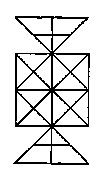 or to surround him in the open field and take
him captive. The prototype of the former is the beleaguered fortress,
and of the latter combats with dangerous beasts of prey. The Malay
Rîman-Riman, or Tiger-play, is a good example of the latter. The arena
is somewhat of this form and appearance, the figure being simply traced
on the sand, or stamped with red and white on boards or cloth. The
single player has twenty-four stones, the men, ôrang-ôrang. The other
players have a single large one or sometimes two, the tiger, rîman.
The tiger is governed by fixed rules, and the men seek to pen him up so
that he can not move.388
In the second kind the parties, being numerically equal, stand opposed
as in checkers, where a hot struggle goes on to get three men in
a row—at least this is one of the simplest forms of the game as
described by Ovid. Among German antiquities there is a representation
of two men with a board set with stones. Schuster at least considers
this a game similar to checkers.389 And besides, there are groups
engaged in the Damen-Spiele, which was probably known to the ancient
Egyptians as well as the Greeks and Romans, although we can not be
certain as to the rules of these ancient games, πόλις, ludus
latrunculorum. In mediæval times elaborately ornamented boards were
used for this game. “Especially noteworthy,” says Weinhold, “is one
that is used as a reliquary on the altar at Asschaffenburg. It is set
with jasper and beryl crystals, beneath which various figures are
inlaid in the Roman manner on a gold ground.”390 Büttikofer brought
with him from Liberia a very interesting ethnological specimen, almost
unique in character. The game played in that region does not require
a board or other
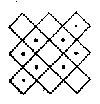 flat surface, but wooden cases into which rods are
inserted like arrows in a quiver. This represents the placing of the
men on a board. Each player has ten rods, of which only four are
placed at the beginning of the game. The dots in the cut show their
position. The object is to get into the enemy’s country by judicious
jumping, the reserve ammunition being placed as occasion requires
until the supply is exhausted.391 Another form of this kind of game
is the Oriental Mangale, which is now becoming quite general.392
In Damascus, where, according to Petermann, it is constantly played
in all the coffee houses, a board two feet by six inches is used. It
is over an inch thick and has in its upper side two parallel rows of
holes, seven in number in Damascus; other places have six, eight, or
nine. In these holes tiny pebbles, gathered in a particular valley by
pilgrims to Mecca, are laid; usually seven in each. The player removes
the stones from the first depression on his right, and throws them
one by one toward the left and into the holes on his opponent’s side.
This play is kept up under certain rules and conditions, of course,
and with the aid of much counting393 of winnings, and whoever gets
the most stones has the game.394 In concluding we must not fail to
notice the noblest of all board games, chess, which, on account of the
great variety of men employed and their complicated moves, is the most
difficult of games, as well as the most entertaining. Many are of the
opinion that some ancient games are of the same character, but it is
probable that real chess is of Indian origin, whence it spread to the
Persians and Arabians, and through them into northern Africa, Sicily,
Sardinia, and Spain. In the last-named country we hear of it as early
as the ninth century, and it appeared in Italy and Germany certainly
not later than the eleventh, soon becoming the favourite game of the
educated classes. This is proved by the fact that in a book of sermons
published in the latter half of the thirteenth century one Jacobus de
Cessoles, a Dominican, attempts to set forth a system of rules for
right living founded on the rules of the ludus scaccorum.395 The
game has naturally undergone many changes in the course of time; for
instance, the Arabians originally had elephants in the place of our
bishops; but it has always preserved the character of a battle, and is
so represented in old Arabian manuscripts.396
Our third group of board plays is comprised of those which add the
attraction of chance to intellectual enjoyment of the contest. It
is true that to a certain degree chance is an element in the purest
games of reason, since the most skilful player can not foresee all the
consequences of a move, and various uncontrollable influences397
may interfere with the best-laid plans; but in the games which we are
now considering there is a blending of risk with calculation, which
has a peculiar charm. Perhaps the most familiar game of this kind is
backgammon, which was certainly known to the Greeks and Romans, and
possibly to the Egyptians and Phœnicians. In this game and kindred
ones the object is to throw away men whose value is determined chiefly
by chance, while the advance to advantageous points is a matter of
calculation, thus affording a combination of direct and indirect
fighting. Backgammon is of peculiar ethnologic interest because of
the prominent part it plays in the controversy as to whether Asiatic
influence is traceable in primitive American civilization. E. B. Tylor
has stated in several passages398 that a kind of backgammon played
on a cruciform board is a favourite amusement of the East Indians, and
is called by them Patschisi (in Burmah: Patschit), and a very similar
form of the game was known to the pre-Columbian Mexicans under the
name of Patolli. Tylor considers the complicated nature of the game as
a sufficient disproof of its independent origin, and from this, and a
certain kinship to chess which is apparent in it, he concludes that
the whole group of games furnishes an important argument in favour of
Asiatic influence on American life before the time of Columbus.
Dominoes may serve as the connecting link between such games as we
have been considering and card games, since the lack of a prescribed
field, the concealed store of each player, and the chance distribution
at the beginning, as well as the acquisition of new ammunition during
the game are common features. Playing cards are supposed to be a
comparatively recent invention of the Chinese, which, like chess, was
carried into Spain by the Saracens, and thence spread all over Europe
in the fourteenth century. Many are of the opinion that they are a
modification of chess, and in fact the oldest game known to be played
with them is one of the most complicated that we have—namely, Taroc,
which requires seventy-eight cards. It was played in Bologna in the
beginning of the fifteenth century.
Since the victory in card games is not won by virtue of the position
of the cards, but by their succession and value, the faculty of memory
is largely concerned, as victor and vanquished at once disappear and
the men yet unengaged are concealed. This and the inequality of the
players’ forces at the beginning constitute the distinguishing feature
of cards. Lazarus’s penetrating glance has descried the point which
differentiates the various games, placing them in the varying relation
of accident and calculation. “Not all games,” he says, “are alike in
this. There are some in which chance is predominant—as poker, for
example, or the new game of bluff, so popular in America, where so much
depends on the dealing, and the play is not so much a calculation as
an attempt to exhaust one’s opponent.... The stronger games, however,
such as whist, Boston, l’hombre, solitaire, piquet, Skat, euchre, etc.,
depend on the sustained influence of both chance and calculation. After
the cards are once distributed calculation begins, but chance continues
to be powerful,399 for at every play a new card enters into the
combination and must be given its due weight, whether from the hand of
friend or enemy. This is more obvious in the cases where the original
force is recruited by drawing from the pack; yet even here attentive
following of the progress of the game will furnish data for determining
the probable situation of a third card, and thus, after all, skill has
as much to do with it as chance. And in such a game as whist en deux
in which all the cards are dealt, and each player knows exactly the
strength of his opponent, the whole thing depends on calculation, and
consequently is not so attractive. It would be a game of chess with
cards but for its inferiority in variety and combination.”400 Lazarus
goes on to say why chance is indispensable in card games—namely,
because, as there is no such thing as space combination, the monotony
would be wearisome, and continued playing well-nigh impossible. Without
Fortune’s reverses, too, the games would necessarily be begun with
equal forces, and it is easy to see how little enthusiasm such games
would excite. Only in connection with chance, then, can Reason find
in cards a task worthy of her powers, and, indeed, a small prize is
a stimulus sometimes needed to keep up our interest. This may be a
suitable place to mention that it was formerly the custom to play for
money or some stake with all games of chance and even with chess.
I close this review of contests which are purely intellectual with
two brief remarks, the first of which concerns the invention of board
games. It is difficult to find a perfectly satisfactory answer to
the question of their origin. However, their complication points to
adults rather than children as their probable inventors, and to me
the following consideration seems important: The primitive races, who
find it difficult to convey their thoughts in speech, naturally take
to marking on the sand, and hence the figures might arise.401 If the
leader of one of the more intelligent peoples wished to instruct them
concerning some past or future combat, it would be a simple method
of illustrating his meaning to draw an outline on the ground and
represent the position of the hostile forces by small stones or similar
objects whose movements would symbolize the manœuvres of the forces
or the advances of knights for single combat. This would, no doubt,
be exceedingly interesting to those conducting it, and also to the
spectators, and might easily be repeated for the sake of the amusement
afforded until some inventive genius turned it into a veritable play
with board and men. To show that there is nothing improbable in this
supposition we may point to the fact that such play is actually carried
on by our own officers (Italian, manovra sulla carta).
The second remark relates to the pleasurable quality of games involving
use of the reasoning faculty. We have already shown that play with
reason takes the form of experimentation with imagination and the other
intellectual faculties in their capacity of illusion workers as well
as in their more constructive activity; now we find further that its
recreative effect is much greater than is realized during the progress
of the game, and that the consciousness of standing voluntarily in a
world of our own creation may be a feature in the interest excited
by the game.402 The chief source of satisfaction, however, is
enjoyment of the fight, in the playful intellectual duel, where bold
attack and skilful parry, systematic advance and stubborn resistance,
crafty manœuvring and direct assault, single combat and the general
skirmish, as well as pursuit and demolition, succeed one another in
ever-renewed combinations. In those games which add the charm of
uncertainty to the mental contest the effect is of course still more
complicated. As I shall have occasion later to speak exhaustively
of games of chance, I confine myself here to Lazarus’s significant
conclusion from the union of these contrasted forces. “That men, and,
indeed, the same man can take pleasure in such opposite and absolutely
contradictory principles of play seems wonderful, and yet it is most
natural, for both are elements of human nature grounded in the very
essence of his being and the normal manner of using his powers. In
his serious, moral life, directed by the mandates of duty, he is also
controlled by two contrary forces, freedom and necessity. He must bow
to Fate and yet strive and struggle for what is his own. He expends
his energies according to his own behests, and must then await success
and reward till the turn of Fortune’s wheel. Both disappointment and
struggle, receiving and expending, suffering and toiling, are woven
into the texture of his life and character, and become the sources of
his volition as well as the arbiters of his fortune. He obeys both
forces; to pursue and hold to what is good is his dual impulse, both in
life and in play.”403
In playful competition indirect conquest of an opponent is aimed at,
since the effort is to show that one can perform the task better than
another. In it the fighting instinct assumes the form of rivalry. “No
entreaties or commands,” says Lazarus, “nor even tips, could arouse our
coachman to such a display of skill and speed as could another coachman
who showed a disposition to race with him. Apart from the fighting
instinct itself, jealousy is the prime cause of rivalry”. Spinoza
defines it as “the desire for a thing aroused in us by the belief
that others want it.” One of the first manifestations of jealousy in
children is with regard to the love and caresses of its parents; we
all know at what an early age the infant expresses his disapproval
when his mother pets another child—sometimes as early as the second
quarter. If he shows it simply as anger he is plainly jealous, as
older children are; but if (as a dog often does when the hand he loves
strokes another) he tries to win to himself by all sorts of cajoleries
the maternal tenderness, then he enters upon a sort of rivalry.
True emulation, however, is first developed when the aim is to win
approbation and admiration when praise rather than love is the alluring
reward—in short, when the child becomes ambitious. Say to a three- or
four-year-old boy, “Your friend Otto can draw beautifully,” and it is
ten to one that he will answer, “But I can draw better.” This desire
to surpass others is what leads to the indirect contest which we call
rivalry.
Imitation, too, plays the part of a first cause here, as Spinoza
points out in pursuance of his definition of emulation. As, however,
this subject will come up for discussion later, let it suffice to
say here that imitation is exceedingly important for all mental and
physical development, and is accordingly especially conspicuous in
the play of children. The effort to say “I can, too,” easily takes on
a certain hostile character when there is difficulty in attainment,
and so imitation becomes actual rivalry as soon as the effort is for
“I can do better,” and the struggle becomes sharper in proportion to
the consciousness of a desire to surpass. Thus we are justified in
regarding the impulse of jealousy which is related to the fighting
instinct as the foundation of rivalry as well.
Before going on to investigate this playful rivalry it may be useful
to inquire into its social significance. G. Tarde, in his interesting
sociological study, Les lois de l’imitation,404 attempts to prove
that imitation is the mainspring of social evolution. But along
with the peaceful operations of imitation, the fighting instinct,
too, makes itself felt in manifold ways, as a principle of progress
(as I remarked above in discussing combativeness), in conjunction
it is true with imitation and usually under the form of rivalry. It
is evident that social progress would be slow indeed if men only
imitated and never opposed what is done in their presence. Rivalry in
ownership, power, and authority is the force which urges each to do
his utmost in the struggle for life, and which has produced the most
advanced civilizations. A people without ambition is lost; not merely
stationary, but actually decadent. As in art bald imitation of even the
best models results in weakness, so in society. Men must will to do
better in order to do as well.
In spite of their variety we can very quickly review the physical
imitative games, since under movement-plays we have already noticed
a considerable number belonging to this class, and since it is their
psychological side alone that chiefly appeals to us. The following
examples, then, are merely chosen to show by means of their variety
the great importance of imitation in human play.405 Children learn
most of their bodily movements by such play in a way which clearly
illustrates the mingled effects of imitation and emulation. When
one child jumps off the second step, another child who sees him
immediately tries to cover three; and when boys are practising their
leaps each makes a mark in the sand beyond the others as his goal.
To lift a heavier weight, to throw farther, to run faster, to jump
higher, to make a top spin longer, to stay longer under water, to
shoot higher, farther, and with better aim than his comrades can, is
the burning wish of every childish heart. In order to see the same
enthusiastic rivalry in physical prowess exhibited by adults, we
must turn to the half-civilized peoples to whom such acquirements
are of surpassing value in the struggle for life. Among the ancient
Germans, for example, such contests were carried to the highest degree
of perfection, and, in spite of their avowedly playful character,
conducted with such seriousness that they often became matters of
life and death. Skill, prowess, and endurance in leaping, running,
lifting and throwing huge stones, the use of bow and arrow, diving
and swimming, riding and rowing, were all the subjects of contest,
and each victor sought to surpass the achievements of the former one.
All warlike peoples of whom ethnology is cognizant show much the
same picture, and highly civilized nations, too, accord an important
position to athletic contests, as the Greek and Roman games bear
witness, as well as the championships and records of our own day.
Rivalry enters, too, into such games as tenpins, billiards, croquet,
golf, etc., all of which are favourite amusements. The pleasure they
afford is complicated, including display of one’s own strength and
skill, the pleasure of watching others, the stimulus of rivalry and the
satisfaction of overcoming an opponent. Sometimes, and especially in
croquet and billiards, the contest closely approaches fighting play,
since the participants not only try to attain the object of the game,
but are apt to engage in direct hostilities.
We now turn to some examples that are better calculated to exhibit the
many-sidedness of rivalry, which is, of course, an element in all the
games of skill which we have mentioned. We are not so well prepared to
find it in games requiring patient effort, yet even the Eskimos, in
their Fadenfiguren, indulge in fierce emulation,406 and a play as
peaceful as kite-flying is not exempt. “The Hervey Islanders believe
that once the god Tane challenged the god Rongo to a kite-flying
contest, in which the latter won because his cord was longer.”407
In drinking there is rivalry in the effort to withstand the power of
alcohol, and students have a time-honoured tradition that the man
is a fine fellow and worthy of all respect who can drink the rest
of the company under the table. It is more charitable to attribute
this practice to rivalry rather than to love of drunkenness.408
The instance of the two boys holding burning matches illustrates how
readily the ability to suppress any manifestation of pain lends itself
to rivalry. The old Germans tested their endurance by sitting at
feasts after their battles, and when they were covered with wounds.
In a grotesquely exaggerated saga it is related of the wounded sons
of Thorbrand: “Thorodd got such a blow in the neck that his head hung
sideways; his hose were all bloody and would not meet. Snorri could
see and feel that a sword was sticking in his thigh, but Thorodd said
nothing. Among the gayest of the gay is Snorri, son of Thorbrand, who
sits with the others at table, but eats little and looks white. When
asked what ails him he says, ‘When the vulture has won the fight he is
not in haste to eat.’ Then Gode looks at his neck and finds an arrow
head at the root of his tongue.”409 The jeering of Walthar and Hagen,
who vie with one another in mocking at their wounds, is another case in
point. Finally, the passion for making collections, which is so strong
in both children and adults, may be considered as a form of competitive
rivalry which reaches its climax in the miser.
The space devoted to the more general kinds of emulation has purposely
been curtailed in order to devote more to the special case of gaming,
as much of the ground has been covered already.
Children are fond of displaying their mental acquirements even before
they are old enough to go to school, but it is there, of course, that
the best opportunity is afforded them. Colozza tells us how the Italian
children use their recess time for contests over the multiplication
table.410 During school hours recitation is easily transformed to
emulation which can be turned to account by the judicious teacher with
better results than are attained by one who tries to draw the line too
rigidly between work and play.
The intellectual rivalries of adults are exceedingly varied. Music
offers unlimited opportunities when people are far enough advanced to
have any sort of society, and even primitive tribes indulge in this
sort of entertainment. Among the Eskimos the contestants compete in
public for the prize for singing, and then fall into actual combat,
thus combining the two forms of rivalry. Grosse quotes from Rink the
following musical dialogue between two East Greenlanders. “Savdlat:
‘The south, the south, oh, the south over there! As I stood on the
headland I saw Pulangitsissok, who had grown fat upon halibut. The
people of this land know not how to speak. Therefore they are ashamed
of their language. They are dumb over there; their speech is not like
ours. In the north we speak in one way, different from those in the
south. Therefore we can not understand their talk.’” To this challenge
Pulangitsissok responds: “‘There was a time, as Savdlat knows, when I
was a good sledger, when I could take a heavy load on my kajak. Four
years ago he found this out. That was the time when Savdlat bound his
kajak to mine for fear he might capsize. Then he could carry a good
load on his kajak, too. As I was tugging along you cried out pitifully,
and were afraid and almost overturned. I had to hold on to my ropes
to keep us up.’”411 Such sarcastic dialogue often leads to direct
contests, in which the singers try to rout one another by means of
their witty improvisations. A later form is the contest in oratory and
song on an assigned theme, opening with a direct challenge between the
contestants. The poem of Wartburg-Krieg is especially famed, while
Plata’s symposium may be instanced as a fine example of competitive
oratory on a given theme.
Other kinds of rivalry frequently arise in social gatherings, such
as recounting experiences in love, hunting, and battle, as was
pre-eminently the custom among the ancient Germans. “One after
another,” says Weinhold,412 “boasted of his prowess and sought to
prove it by tales of his wonderful deeds. To heighten the effect, each
chose an opponent worthy of his mettle. Thus it happened that Eystein
and Sigurd, the crusader, both Norwegian kings, once had a controversy
in court. Eystein advanced the proposition that it was impossible
to live aright in society, and called on his brother to sustain the
contrary. Then the travelled warrior Sigurd, who had filled all lands
with the fame of his deeds, and the peace-loving, home-staying Eystein,
each related what he had done and could do: the one his battles, his
fame in the East; the other that he had built huts for poor fishers,
made roads over rugged mountains, opened harbours, widened Christendom,
and strengthened the Church—in short, extended his kingdom by every
peaceable method. The talk became warm, and the silence which followed
was ominous, but as they were both noble-hearted no harm came of it.”
Very characteristic, too, is the Harbardhslied in the Edda, where the
gods Wotan (under the name Harbardh) and Donar emulously recount their
achievements:
Donar: “Do you ask what I did to Rungner,
The giant with sturdy heart and head of stone?
I felled him then, he lies at my feet.
And what did you, Harbardh, the while?”
Harbardh: “For more than five full winters
Was I on an island that is called Allgrün;
There I found men to fight and enemies to fell,
Many things to prove, and many maids to free,” etc.
Singing the praise of one’s future deeds is another form of such
boasting. A company of carousing men have need of a wild boar or some
other sin offering to go through their midst as they perjure themselves
with oaths concerning the hazardous and difficult deeds which they mean
to perform.
Before taking up games of chance again I mention once more the fact
that many reasoning games are also rivalries—dominoes, for example,
and backgammon413—since the chief effort is to reach a certain
goal first and direct efforts are made to embarrass and retard the
adversary, so that genuine fighting play results.
In chance games proper, however, the contestants do not attack one
another directly, but seek to conquer by the better solution of some
problem, the point of departure from other rivalries being that the
reward of solution, at least in games of pure chance, is entirely
accidental, and not dependent on the player’s strength or skill. We
will now attempt to review the more important phenomena connected with
such games, and later study the question in its psychological bearings.
The wager is akin to play with chance and arises from the holding of
opposite opinions, which can only be settled by future events. Even
if the bet concerns something which is past or present, still the
decision must be in the future, and the fighting element comes in in
the striving of each to prove his superiority, the interest being
much enhanced by pooling the stakes. The bettor’s conviction as to
the correctness of his opinion may be strong or weak414—absolute
certainty destroys the validity of the bet, while absolute uncertainty
makes it a mere game of chance, whereas it should depend, like the
best card games, on a union of reasoning and hazard. For this reason
future events are the proper subjects of the wager, and we will confine
ourselves for brevity’s sake to such bets. Schaller says rightly: “The
future is pre-eminently the object of conjecture, of the reckoning of
probabilities. Even when present circumstances seem to tend inevitably
to a certain result, there are still infinite possibilities that other
results may transpire. Therefore the wager should concern something yet
to come.”415
One of the earliest forms of betting was on physical or mental
superiority, and the stakes formerly so common in reasoning games may
be regarded in the same light. There was much betting on the victor
in the old German riddle contests and life itself was sometimes
staked, if we may depend on the ancient accounts. More often, though,
physical prowess was the subject of the wager. “Indeed, Tacitus may
be right,” says Schuster, “when he records that the Germans disdained
to be praised for ordinary physical vigour, yet they gave prizes to
the victors in their contests and liked to claim the glory when it set
them above others. Reputation with them must not be mere empty words;
one must work for it to the full extent of his powers. Many examples
illustrate this spirit; for instance, Welent and Amilias, the smiths,
each boasted that he could not be surpassed in his art. The latter
offered to bet on it, and Welent replied, ‘I have not much property,
but I will stake it all.’ Then said Amilias, ‘If you have nothing else,
stake your head, and I will stake mine, and whichever of us is the
better man shall cut the other’s head off.’ Two of Olaf Trygvason’s
retainers boasted of being superior mountain climbers, one wagering
his ring on it, and the other his head.”416 Schuster cites, too, the
famous contest in the Nibelungenlied, to which Brunhild thus challenges
King Gunther:
“She said: If he is your lord and you are in his hire,
Tell him that I have sworn that whoever can resist my play,
And prove himself my master there, him will I wed,
While if I win you must go alone from hence.”
Fable makes animals wager in the same way; the old tale of the hare and
the hedgehog is found even in Africa, although there the hedgehog has
become a tortoise.417
The stakes are not always, however, on one’s own ability, but quite as
often on the performances of others, or on the speed and endurance of
animals. This is indeed the most popular form of the sport, doubtless
because the agreeable tension of expectation is thus prolonged until
the very moment of the dénouement, as it is not likely to be in
the more personal contests. In riding, rowing, sailing, and running
contests spectators, as well as participants, bet on the result.418
“Betting on races,” says E. v. Hartmann, “is the most dangerous and
exciting form of gambling, being dependent purely on chance, and
yet offering a false appearance of being essentially influenced by
intelligence and judgment. The custom is fostered of raising the stakes
at the last moment under the influence of artificial stimulation to
interest during the race itself. Immature boys, sons of respectable
labourers, are thus initiated in the fascinations of the passion for
gaming who would otherwise have little inclination for it.”419 In
various parts of the world wagers are laid on the result of fights
between animals. In ancient Greece gamecocks were bred with special
care, and Tanagra, Rhodes, Chalcis, and Delos were famous for the
achievements of their respective breeds. The birds were fed with garlic
before the fight to augment their excitement, and were armed with
artificial spurs. The stakes were often enormous.420 Cock-fights
in which betting seemed to be the principal feature were held during
the middle ages in most European cities, and in some localities have
survived to the present day. Malays are especially devoted to this
sport. It only remains to add in conclusion that lifeless things,
too, may be the subject of bets. The Gilbert Islanders set two
sailboats, about four feet long, afloat, and bet as to which will sail
fastest.421 This is very near to being play with pure chance, and
the wager of Canning with an English duke is even more so. They staked
a hundred pounds on the question of who should meet most cats on a
certain road.
There is but one opinion as to the origin of games of pure
chance—namely, that they grew out of the serious questioning of Fate
in the form of oracles, and colour is given to the theory by the
custom of jesting with the oracle. The Greek custom of pouring wine
into a metal cup and from the sound it made reading one’s prospects
in love, drawing straws—a practice which Walther von der Vogelweide
has made famous—the various flower oracles, counting the cuckoo
calls, observing the flight of birds—as, for example, how many times
the kite circles—and many other such customs422 were originally
conducted seriously, with a view to gaining some knowledge of the
future, and even when playfully practised smack of superstition. Tylor
says, in his admirable study of this subject: “Soothsaying and games
of chance are so closely allied that the instruments of each are used
interchangeably, as among the clever Polynesian magicians cocoanuts are
skilfully rolled about in a circle. In the Tonga Islands the chief use
made of a holiday is to inquire whether the sick will be cured. They
offered loud prayers to the family deity that he would place the nuts
aright, then spun them, and from their position judged of the god’s
will. Under other circumstances, when the cocoanuts are rolled simply
for amusement, no prayer is offered and no significance attached to the
result. The Rev. G. Turner found the same custom in the Samoan Islands
in another stage of development. There a company sits in a circle, the
nuts are rolled about among them, and the oracle’s answer depends on
whether the monkey face of the nut is turned toward the questioner when
it stops rolling. The Samoans formerly used this method to detect a
thief, but now it is a forfeit game.”423 In this sort of play with
chance there is nothing special at stake, yet it is no doubt closely
connected with those forms which have this feature.
Another of the earliest of the manifold forms of chance games is the
casting of lots. New Zealand wizards decide the fortunes of war by
throwing staffs. If the stick which represents their own tribe falls on
that of another, then a favourable outcome may be confidently expected
to the battle. The Zulus have a similar ceremony, and the Hindus
cast lots before the temple and supplicate the gods for victory. In
the Iliad the crowd prayed with outstretched hands while the dice in
Agamemnon’s helmet decided who should be the first to fight Hector.
Tacitus tells us that the German priests tossed three dice on a white
cloth before they attempted to reveal the future.424 The origin,
then, of the use of dice in games of chance is indubitable. The
ancient form of backgammon common in India and Mexico was played with
lots instead of dice, as was also the case with the Arabian Tâb. Some
Indian tribes use the simple casting of lots for gambling purposes. The
Arabian does not throw, but draws lots as a substitute for the Meisir
forbidden in the Koran.425 The complicated Chinese game lotto is
well known, and Bastian found a similar one used in Siam.426 E. von
Hartmann refers repeatedly in his Tagesfragen to our European lottery,
combating the popular idea that it is reprehensible, and should not
be fostered by the state. He sees in a well-conducted state lottery
the best means of directing the ineradicable tendency to play games of
chance into harmless channels. Money speculation is, as a rule, little
different from a lottery, since the great majority of speculators
have no more intimation of the outcome than is furnished by the law
of probabilities which governs pure games of chance. Returning now to
simpler manifestations, we find many which are closely related to the
use of lots. North American Indians, who are zealous gamblers, use
marked or coloured stones, seeds, and teeth, and stake their clothing,
furniture, weapons, and, in fact, all that they possess. In Burmah a
favourite game is played with beans, and in many of the villages a
thrashing floor is erected for the express purpose of supplying the
demand.427 In Siam the children play with shells, and everything
depends on whether the opening falls up or down.428 A similar game
was known to the Greeks, and in Rome a coin was tossed with the cry,
“Caput aut navis!” equal to our “Heads or tails!” We must suppose that
such play by children is derived from adult games of chance.
Astragalus and dice were the implements used in many such games. The
former are peculiarly shaped bones from the ankles of sheep, goats,
or calves, and their use for such purposes is very ancient. They are
capable of resting on any one of four sides which may vary in value, as
the six sides of dice. The Schliemann collection in the Berlin Museum
contains some of them which were found in the “second city.” In ancient
Greece four astragali were used in the games of adults, and were thrown
either from the free hand or from a cup. Special names were given to
the various throws, such as Aphrodite, Midas, Solon, Euripides, etc.,
and the worst throw was called, there as in Rome, the dog. The children
of antiquity also played with these bones a game partly of chance and
partly of skill, and Hellenic children use them to this day. Ulrichs
saw them at Arachola on Parnassus. “The children there,” he says, “play
with the astragalus, which is a small four-sided bone rounded at the
end and so shaped as to be capable of resting on any of its sides. In
the game the uppermost side is read, the commonest throw being that
which brings the round end up and is called the baker or the donkey.
Then follow the thief, the vizier, and, rarest of all, the king, the
side which looks like an ear and is opposite the vizier.”429
The name vizier seems to point to Mohammedan influence, and indeed the
children of Damascus have a special game of chance with astragalus
in which the terms vizier and thief are both used.430 Some think
that ordinary dice are derived from the astragalus, but it would be
difficult to prove, though their imitation in other materials seems to
suggest it, as in the case of the oblong dice used by the Romans with
cubical ones, and several hundred prehistoric dice found in Bohemia are
of similar form. The Berlin Museum, too, has oblong dice from India
and China, showing that they were widely used in the Orient, and
Hyde points out in his history of games of chance that the Greek word
κύβος is related to the Arabic Kab, which meant simply made
of lamb’s bones. On the other hand, cubical dice with spots like ours
are found in Theban graves, so that we can not be positive as to the
priority of the astragalus.
Possibly cocoanut rolling was the primitive form of roulette as we
have seen it used in half-religious, half-playful manner by the South
Sea Islanders. The Berlin Museum has Chinese rolling dice through
which a peg passes, projecting on each side or with the peg on one
side only, and the ball tapering to a point on the other. According
to Egede, Greenlanders have a sort of roulette, an oblong ball about
which the players sit with the stake before them.431 Another form
of chance game is the morra, which was probably known to the ancient
Egyptians, and was in all likelihood at first a clever method of
calculating.432 As a play the hands of all the players are thrown
simultaneously into the air, and each must guess at the number of
outstretched fingers without taking time to count. This amusement,
still very popular among Italian peasants, was called by the Achæans
“micare digitis.” In China, where it is zealously cultivated, it
bears the name of “tsoey-moey.”433 The North American Indians have
a modification of it in their cane guessing—namely, the effort to
locate a small object passed quickly about in a company. It is used
for gambling purposes, the Indians staking all that they have, even
to their wives sometimes.434 The “Kyohzvay” play is taken quite as
seriously in Burmah. For this a stick is fixed among the folds of a
tightly wrapped cord, and the game is won or lost435 according as it
is or is not successfully concealed.436 The various games of cards
afford by far the most important instances of play with chance, and
their name is legion. We have not time even to glance at such games as
faro, lansquenet, rouge et noir, trente et quarante, etc., except to
say that they all depend on a combination of reason with chance, and so
more speedily put an end to suspense as to who is the victor than do
purely chance plays. We are now confronted by the difficult question
of what it is that constitutes the demoniacal charm of gaming, whose
power is demonstrated by the value of the stakes with which a man will
tempt Fate. Every one is familiar with Tacitus’s description of the
ancient Germans who, when they had lost everything else, staked their
freedom and their life on the last throw. H. M. Schuster gives a long
list of examples of Germans staking freedom, wife, and children, the
clothes on their backs, life itself, yes, even their souls’ salvation
when their passion for play was at its height. That this is a universal
Aryan trait is shown by the Indian poem of Nala and Damayanti. The
former, under the power of a hostile demon, loses at play with Pushkara
his ornaments, jewelry, horses, wagons, and clothes. In vain his wife
and followers seek to restrain his madness; for many months the ruinous
play goes on until Nala has lost all his property and even his kingdom.
Then as Pushkara, with loud laughing at the unlucky fellow, cried out
that now he must put up his wife Damayanti, Nala rose from the table
and walked away with his faithful wife, stripped as he was of all else.
The Chinese, Siamese, and Burmese, too, are all passionate gamblers,
and the Malays are famous for their wagers on animal fights. This
is sufficient to show that the wonderfully strong attractive power
of gaming, “le jeu-passion, dont le rôle tragique est vieux comme
l’humanité,”437 is the result of numerous causes whose aggregate,
according to Fechner’s principle, is far greater than their numerical
sum. Taking account of the essentials only, we still have a threefold
phenomenon; these are, desire to win the stake, the stimulus of strong
effects, and the impulse given by the fighting instinct.
Winning the stake is so important that without it games of chance
become very flat and most unimpressive, as forms of entertainment. How
is this to be explained? Sometimes it appears as veritable cupidity,
the “fascination d’acquérir d’un bloc, sans peine, en un instant.”438
The seductive chink of gold pieces is heard and visions of new names
of wealth open before us, promising to deliver us from all burdens and
dangers which in spite of their distance and vagueness we strive to get
possession of by a single turn of Fortune’s wheel; the gold fever is at
home in gambling dens. Yet—and I think this is important—as a rule,
it is not mere greed for gain as such, but a feeling more refined. It
is boundless delight in sudden good fortune that makes the unearned
winnings so enticing. That inward striving after the absolute, which is
so deeply rooted in the human breast, is concerned in the longing to
experience at least one moment of exhilarating joy with which a single
stroke of Fortune’s wand sets our hearts aflame:
“From the clouds it must fall,
Such is the gift of the gods;
And the strongest power of all
Is that which belongs to the moment.”
It would be misleading to suppose that all wagers in a game of chance
are attributable to a desire to win, even in this refined sense. In so
far as it is the chief motive, there is no real play at all, for it
constitutes a serious aim wholly outside the sphere of play. There must
be some other meaning to the intense delight in winning, and Lazarus,
as usual, puts his finger on it. “Even for an onlooker, not pecuniarily
interested, the charm increases with the value of the stake.”439 The
stake serves not only to enhance the thought of winning the game, but
intensifies the decisive moment.440 A gambler must have excitement at
any price, and he also wants to risk something; betting satisfies both
demands.
The need for intense stimuli which we are so constantly encountering
in the course of this inquiry appears as the second motive in our
classification, and it is met by a storm of effects which betting
excites. Consequently gambling is pre-eminently suited to supply this
demand. I have already pointed out that betting on the performances
of others is an especially popular form of gambling, since in this
way alone can the excitement be enjoyed unimpaired by personal
considerations. So, too, in games of pure chance, which relegate the
player to comparative inactivity and impart a feeling of externality
among its other effects. By far the most important of these effects
is the contrast of the emotions of hope and fear, and often this
simultaneous action of opposing passions is sufficient to stir the soul
to its depths, since, as Lazarus penetratingly remarks, the result is
in either case positive; the question is not, winning or not winning,
it is winning or losing. This is another point which renders games of
chance peculiarly fit for the production of exciting effects. Also
besides fear and hope there is the tension of expectation and the shock
of surprise to render the mental agitation more intense and varied.
This explains why gambling is the last resort of the dissipated,
worn-out man who needs sharp stimuli to arouse his exhausted
powers.441
Gambling is, moreover, a fighting play, and this is doubtless one
of its most important phases. There is no other form of play which
displays in so many-sided a fashion the combativeness of human nature
and with so slight expenditure of time and strength. There is the charm
of danger as such, enjoyment of bold betting which in the changing
course of the game is constantly renewed, and further indirect as well
as direct battle with an opponent, for he who makes the best throw gets
the best card. Besides all this there is the desire to win his wager,
and by means of the steady augmenting of stakes it differs from all
other fighting plays in affording at the last moment, when all seems
lost, an opportunity of retrieving everything by a sudden overwhelming
victory. And finally there is the defiance of the power of chance, or
rather, if a religious rearing makes one scruple to put it in this
form, we may call it a struggle with the powers of darkness.
The question now arises whether this is properly called a fight when
the player can not influence the outcome, but must submit absolutely to
the incalculable hazards of fortune. What right has he to congratulate
himself on a victory for which he is in no way responsible? To this
it may be answered that in addition to this subjective, psychological
condition there is an active contest; for an illusion exists in
connection with every game of chance that in some way the outcome is
dependent on the capacity of the player, and a little reflection will
show that this is characteristic of human nature. How else arises our
naïve sense of worth or of shame? Are we not vain of physical beauty,
of inherited advantages, and of riches which we have not earned? Does
not the consciousness of deformity, stupidity, weakness, awkwardness,
or even a lowly origin impart a feeling of shame and a sense of
responsibility for our own shortcomings? We feel as if we had had a
voice in the fashioning of our bodies and souls and a choice of our
position in life—in short, as the vulgar saying has it, as if we had
not been careful enough in the choice of our parents. Just in the same
way we are proud of our luck in play. Luck is genius, and he whom
it smiles upon is a hero.442 This failure to discriminate between
fortunate circumstance and personal merit is shown in a striking manner
in popular poetry. Its heroes are often armed with magic weapons or
directly assisted by higher powers who lend them supernatural strength
or work ruin to their enemies. Such advantage is thus given them that
the reflecting person has some difficulty in regarding their exploits
as especially praiseworthy, yet the average hearer is undisturbed by
such considerations. For instance, consider the invulnerability of
Achilles and Siegfried’s Tarnkappe, which gave him in the fight with
Brunhild “the strength of twelve men.”
In the case which we are considering, however, this habit of mind has
a twofold significance: First, there is the personification of chance
as fate, with whom the player struggles. Lazarus says: “Instead of
blind chance, he pictures before him a reasoning intelligence whose
laws he tries to fathom, and in the face of many failures and mistaken
conclusions he persists in attempting to calculate his chances and to
count on them, forgetting that the reckoning of probabilities is useful
only in generalities and is practically worthless when applied to a
single case. By and bye he endows luck with moral qualities as well.
He will risk everything on a single card, and either can not believe
that Fate will be inexorable, that his faith and perseverance must at
last be rewarded, or else assumes an attitude of defiance to a hostile
being.”443 In the second place, the gambler regards the implements
of his trade as does the magician among primitive peoples the means
of performing his incantations. It is actual fetich worship in which
personification assumes proportions quite different from those it bears
in the general idea of fate. Demons who sometimes obey the player’s
will, and sometimes mockingly defy him, seem to dwell in the dice and
cards, transforming play into a contest in magic arts. This is perhaps
not so strongly felt by cultivated people of the present day as I
have represented it, yet it is present in a more or less rudimentary
form in all devotees of the game. While some scoff at it, even they
avoid those things which are traditionally supposed to bring ill luck.
Thus, when I was a student, in our games with dice which were very
popular, the following rules were rigidly observed: In order to throw
double sixes, the player took the dice cup in his right hand, placed
the left over it and shook it solemnly three times up and down before
making the final throw. If low numbers were desired, the inverted cup
was held slantingly and drawn carefully back on the table so that the
dice glided out rather than rolled. For medium throws there was a
choice between two methods over whose comparative efficacy there was
serious controversy: either to rise from the table and empty the cup
from a height, or to propel the dice suddenly by a sidelong movement
from the cup, held at a slant. Was all this mere joking? To a certain
extent certainly it was, yet the boys half believed in it and had a
poor opinion of beginners who did not know how to handle the dice.
Among the lower classes, however, and among peoples of less advanced
civilization this fetichism is much stronger. Konrad von Haslan, says
Schuster, testifies to having seen and heard “how on the one hand dice
are honoured, greeted, and kissed, and have offerings of booty made
to them, while on the other they were beaten and abused as if they
possessed life. Often the player who has lost by them takes revenge
by picking out the spots or smashing the dice with a stone or biting
them in two to make them suffer.”444 All these circumstances combine
to make gaming a fighting play not alone with men, but also with
supernatural powers whose inscrutable decisions possess a peculiar
power and whose favour lends to the fortunate player a special nimbus,
while the vanquished does not suffer in his own esteem as if he had
been conquered by a human foe.
Finally, we should note that gaming has various mental connections
with experimentation, since enjoyment of the excitation of hope and
fear and the feeling of suspense as well as the shock of surprise
is experimental in every case. With this is combined great activity
of attention and imagination to whose agency the personification of
which we have spoken must be ascribed; reason’s part in the process is
displayed in the complex calculation of probabilities, and that of the
will most conspicuously in the effort to appear outwardly calm while
the wildest excitement reigns within, and hope and despair surge in
alternate waves across the soul.
It is difficult to say which of these stimuli ought to be placed at
the head of the list, but two appear to me to be rather more important
than the others. First, the combative impulse, whose influence is
particularly strong here; and, second, pleasure in intense effects,
as when the “gold fever” takes the form of longing for a supreme
moment which shall fill the soul to the brim, something which will
transcend all other transporting agents. Both find their satisfaction
at the gaming table, owing to the suddenness and importance of its
revelations. In concluding, it may be remarked that the extraordinary
persistence of gamblers, who sometimes sit all night at the table,
as if hypnotized, may be at least partly explained by the law of
repetition taken in conjunction with the independent attractions of
the game. The performance of the last part of a mechanically repeated
action tends to lead to the production of the first part again.
Turning our attention now to the third of our principal groups
of fighting plays, the first subject—namely, the destructive
impulse—will not occupy us long, as we have already given some
consideration to it in the section on analytic movement-play. There
we were chiefly concerned with the experimental element as manifested
in the desire to take things to pieces. Here we shall emphasize the
fighting instinct which is so easily aroused even toward a lifeless
object, and frequently becomes a sort of delirium which is only
appeased by the entire destruction of the object, as if it were
a vanquished foe. And here, too, belongs the inquiry under what
circumstances the discharge of this impulse, whether directed against a
living or a lifeless object, may be considered as playful. As soon as
rage ceases to be the chief influence, and the destruction is continued
simply for the sake of its intoxicating effects, it takes on more or
less of a playful character, though it is inexpedient to attempt to
set clearly defined limits to what is earnest and what is play.445
When children tear paper or overturn structures laboriously erected by
themselves, how often the interest is cumulative, developing finally
into passionate eagerness from action which was at first indifferent!
The paper is seized in the teeth, the building kicked to bits, objects
which are breakable entirely destroyed, flowers pulled to pieces, etc.
Education should interfere at this point and direct the play, imposing
proper checks. Madame Necker de Saussure relates of a previously gentle
and tractable girl of eighteen months that “one day when she was alone
with her mother, who was confined to her bed from illness, the child,
without the least provocation, broke into open rebellion. Clothes,
hats, fans, and every movable object that she could lay her hands on
were piled in the middle of the floor, and she danced around the pile
and sang with the greatest delight. Her mother’s serious displeasure
had no restraining effect.”446 “A girl three years old,” says Paolo
Lombroso, “was left alone for a few moments, and proved her ability
to improve the time. She at once began most energetically, and with
full consciousness of what she was doing, to pull to pieces a basket
of vegetables. She reduced all these to fragments, and then emptied
an inkstand in her lap, amusing herself by smearing it on the wall
and floor with her fingers. When that palled she took a corkscrew
and punched her apron as full of holes as a sieve.”447 A little
later in life the impulse leads to more violent misdemeanours. The
destruction of garden borders, smashing of furniture in public parks,
and many other acts of vandalism which we prosecute, are practised by
half-grown lads, and sometimes even by students.448 Some may object
to calling such roughness play, but play it surely is if there is no
malicious intention, as is usually the case. Such mischief is often
reprehensible, and deserves to be checked, yet such antics as those
of the subalterns as described by Eugen Thossan can not be taken
seriously. He says: “Suddenly a beer mug flew across the table and hit
Sergeant Putz square in the face. This was the signal for a general
free fight. Steins flew through the air like cannon balls. Four lamps
borrowed from the officers’ rooms were on the table; one was struck and
the chimney fell off. Somebody called out ‘When the chimney is gone the
lamp may as well follow,’ and a blow from a fist shattered the lamp.
A mad rage for destruction was kindled, and with anything that came to
hand all the lamps were beaten to pieces. In the general hullabaloo
no one noticed the wounds that he received from the splinters and
blows. When every vestige was demolished, a frightful war whoop rose
to the hall above.” It is more than probable that such orgies as this
often have a certain connection with the sexual life. We find among
animals—deer, buffalo, etc.—a similar rage for destruction during
their breeding season.
My last example refers to mature men. It is the vigorous description
in Vischer’s Auch Einer of the argument of two friends in an inn about
the china displayed around them. “At last Auch Einer called out: ‘That
is enough; they are condemned.’ He bought the whole collection from the
innkeeper and then let himself loose. He handed me the pitcher with the
remark that I should have the honour of opening the ball. I was not
slow to obey, and as a massive granite block stood opposite the window
I sent the pitcher crashing against it. Auch Einer was delighted, and,
seizing a vinegar cruet, followed suit. Then we took turns with plates,
dishes, glasses, and whatever came to hand. A crowd of villagers soon
collected outside and cheered the rare sport; loud laughter and cries
of ‘Go it, there!’ greeted each act of justice.”
Injurious treatment of living creatures, too, is often due to the same
instinct. In the desire to investigate, the principle of the golden
rule is forgotten. It would be too optimistic, however, to assume
that such things are never done from cruelty. Fischart says that even
well-disposed children reveal the demon of fighting and destruction
when there is a beetle or a broken-winged bird or a wounded cat to
torment. Most readers will recall some reminiscence of their own youth
when they really enjoyed inflicting injury on some living thing. It
may assume a dangerous form when directed against other persons. Some
years ago a number of children at play intentionally drowned a comrade;
and Fr. Scholz tells us, “An eight-year-old girl with an angelic face
secretly put some pins in her little brother’s food, and calmly
awaited the catastrophe, which fortunately was averted.” “A girl
twelve years old pushed a child of three, with whom she was playing,
into a pile of paving stones for no other reason than that she might
have the opportunity to tickle him cruelly.”449 Among criminals
murders may sometimes result from following this impulse. Some time
ago three peasants were tried for the murder, with incredible cruelty,
of a servant. They were father, son, and mother. After the old man
had throttled his victim he said to his accomplices, “Now he is dead
enough.” But the woman, to make sure, dealt a hard blow on the poor
fellow’s head. “Now I think he has had enough, this fine rabbit that we
have caught.”450 Here the bounds between play and earnest are hard to
place, but probably belong at the point where the prearranged plan is
no longer the leading thought, it having given place to mad delight in
inflicting injury. These matters are, after all, only on the threshold
of play, and we will now turn our attention to subjects more important
to our inquiry.
The fighting instinct of mankind is so intense that all the playful
duels, mass conflicts, single combats, and contests which we have
described, do not satisfy it. When there is no occasion for an actual
testing of their powers, children and adults turn their belligerent
tendencies into a means of amusement, and so arise those playful
attacks, provocations, and challenges which we class together under the
general name of teasing. The roughest if not the earliest form of such
play is that of bodily attack, such as is often observed among animals.
A female ape which Brehm brought to Germany loved to annoy the sullen
house dog. “When he had stretched himself as usual on the greensward,
the roguish monkey would appear and, seeing with satisfaction that
he was fast asleep, seize him softly by the tail and wake him by a
sudden jerk of that member. The enraged dog would fly at his tormentor,
barking and growling, while the monkey took a defensive position,
striking repeatedly on the ground with her large hand and awaiting the
enemy’s attack. The dog could never reach her, though, for, to his
unbounded rage, as he made a rush for her, she sprang at one bound far
over his head, and the next moment had him again by the tail.”452
We all know how children delight in just such teasing. To throw an
unsuspecting comrade suddenly on his back, to box him or tickle and
pinch him, to knock off his cap, pull his hair, take his biscuit from
his hand, and if he is small hold it so high that the victim leaps
after it in vain—all this gives the aggressor an agreeable feeling of
superiority, and he enjoys the anger or alarm of his victim. When I was
in one of the lower gymnasium classes our singing on one occasion was
suddenly broken into by a shrill scream. One of the pupils had found a
pin which he energetically pushed into an inviting spot in the anatomy
of the boy in front of him. The culprit could only say in palliation
of his offence that he did it “without thinking,” which excuse was
received rather incredulously. Schoolboys often pull out small handfuls
of one another’s hair, and it is a point of honour not to display any
feeling during the process. Becq de Fouquières records an ancient
trick of this kind, consisting of a blow on the ear in conjunction
with a simultaneous fillip of the nose. Cold water is a time-honoured
instrument of torture. To duck the timid bather who is cautiously
stepping into the pond, to empty a pitcher on a heedless passer-by, to
place a vessel full of water so that the inmate of a room will overturn
it on opening the door—these are jokes familiar wherever merry young
people are found. The lover of teasing naturally seeks such victims as
are defenceless against him, especially those who are physically weak
or so situated as to be incapable of revenge. Yet there are ways of
annoying the strong and capable. A good-natured teacher is apt to be
the subject of his pupils’ pranks, though in this case they seldom take
the form of physical assaults. It is not an unheard-of thing, however,
for a paper ball to hit his head or for his seat to be smeared with ink
or perhaps with glue as in Messerschmidt’s Sapiens Stultitia.453
Youths and grown men are little behind the children in such jests.
There is, for instance, the christening on board ship in honour
of crossing the line which Leopold Wagner thinks is derived from
the ancient religious ceremony celebrated on passing the pillars
of Hercules.454 Tossing in a blanket, which made such a lasting
impression on Sancho Panza, was known to the Romans by the name
of sagatio. Such rough sports were practised in the time of the
Roman emperors by noble youths. Suetonius relates of Otho that the
future emperor as a young man often seized, with his companions, upon
weak or drunken fellows at night, and tossed them on a soldier’s
mantle (distento sago impositum in sublime jactare).455 In popular
festivities fighting with pigs’ bladders is a fruitful source of
amusements to which tickling with a peacock’s feather is a modern
addition, and lassoing with curled strips of paper which cling about
the neck. Students make a specialty of such pranks. A favourite
one was crowding, when the streets had only a narrow pavement for
pedestrians, while in bad weather the rest of the road was a mass of
unfathomable mud; another was to deal a hard blow on the high hat of
some worthy Philistine, plunging him suddenly into hopeless darkness,
or tracing a circle on the bald head of a toper asleep over his wine,
etc. In an inn in Giessen there is still in existence a bench through
whose seat a nail projects when a hidden cord is pulled—a pleasant
surprise for the unsuspecting guest who reclines upon it. On entering
the gymnasium I was initiated in an æsthetic little practice which is
of ancient date and serves as an instance of the coarse jesting that
is so common there. One of the company secretly fills his mouth with
beer and reclines on two chairs. With a handkerchief spread over his
face he plays the part of The Innkeeper’s Daughter. They all sing the
familiar song, and two accomplices play the rôle of two of the peasants
while the novice is asked to be the third. The veil is thus twice
withdrawn from the daughter’s face, and twice replaced without any
suspicious revelations, but when the innocent third lover arrives he
is greeted with the stream of stale beer full in the face. A suitable
companion-piece to this decidedly disgusting trick is this incident
related by Joest as occurring among the Bush negroes of Guayana: “As I
was tending the wound of a young negress whose breast was badly cut,
she wearied of the operation, and suddenly seizing it in both hands she
sent a stream of warm milk into my face and fled laughing away.”456
The most harmless teasing is the obvious kind which forms the basis of
much social play, such as games for a company like “Blind-Man’s Buff,”
“Fox Chase,” “Copenhagen,” and similar diversions. A striking instance
occurs in The Sorrows of Werther. During a violent storm Lotta attempts
to cheer the frightened company; she places chairs in a circle and
seats everybody in them—many acceding in the hope of being rewarded
with a sweet forfeit or two, and getting their lips all ready. “We
are going to play counting,” said Lotta. “Now, attention! I am going
round the circle from right to left, and you must count, each taking
the number that comes to him; and we are going like lightning, and
whoever hesitates or blunders gets a box on the ear, and we are going
on to thousands.” She then stretched out her arms and flew around the
circle, faster and faster. If any one missed, bang! came a box on his
ear, and in the laugh that followed, bang! came another, and always
faster and faster. Werther, however, noticed with inward satisfaction
that the two blows which he received were somewhat harder than Lotta
gave the others. When the company is still less refined than this,
joking sometimes becomes so rough as to lose its playful character.
The ancient Thracians were celebrated for this sort of thing.
Gutsmuth says truly that from this circumstance much could be inferred
concerning the state of civilization among them, if we had no other
sources of information. “A man stands on a round stone holding a sickle
in his hand and having his head through a noose suspended from above.
When he is not expecting it a bystander pushes the stone away and there
hangs the poor wretch who has been chosen by lot for this fate. If he
has not sufficient skill and presence of mind to cut the knot at once
with the sickle he flounders there until he dies, amid the laughter of
the spectators.”457
Turning now to other forms of teasing than direct bodily annoyance, we
find again that children very early understand it. When the pretence is
made of great alarm at his beating with a spoon or banging a book or at
a sudden cry, a child as young as two years old shows great delight,
and will repeat the performance with a roguish expression. From this
time on, to cause sudden fright is a favourite method of gratifying
the taste for teasing. The ghostly manifestations which terrify each
generation in turn can often be traced to some mischievous urchins.
I remember a joke played on a geographical professor at the gymnasium
who, as he carelessly opened a closet door, was confronted by a
skeleton which had been used in the previous lecture. Students could
hardly subsist without the ancient trick of stuffing the clothes of a
“suicide,” and placing the figure on the floor of their victim’s room
with a pistol lying near, or hanging it by a rope to the window frame,
to give the late home-comer a genuine scare. In Athenäus we find a
beautiful instance of readiness to meet such a trick. King Lysimachus,
who took delight in teasing his guests, one day at a banquet threw a
skilfully made artificial scorpion on to the dress of one Bithys, who
recoiled; but, quickly recovering himself, said to the rather penurious
king: “My lord, it is now my turn to frighten you; I beseech you give
me a talent.”458 Such sport with fear, though harmless in these
instances, becomes a passion with all narrowminded, tyrannous natures,
and leads to cruelty which is anything but playful. Slatin’s dramatic
work, Fire and Sword in the Soudan, gives an instance of such traits
in the character of the Caliph Abdullah. Indeed, Abdullah had a part
in, or rather was the occasion of, Slatin’s first experience during
the life of the Mahdi. Slatin was taken prisoner by the Mahdi’s army
before the gates of Khartoum. The morning after the city was taken,
alarming rumours reached him; half incredulous, he looked out of his
tent. “A mob had collected before the quarters of the Mahdi and his
caliphs; it seemed to be getting into motion and making toward me, and
I soon saw clearly that they were coming in the direction of my tent. I
could now distinguish single persons. First walked the negro soldiers,
one of whom, whose name was Shetta, carried a bloody burden on his
head. Behind him howled the mob. The slaves entered my tent and stood
glowering before me, and Shetta opened the roll of cloth and showed
me—Gordon’s head! I grew faint and dizzy at the sight, my breath
stopped, and it was only by the greatest effort that I commanded myself
sufficiently to gaze upon that pallid face.” The Mahdi and his caliphs
had ordered this hideous cruelty.459
A common and early developed form of teasing is the deception which
imparts to the perpetrator a feeling of intellectual superiority.
Children display this in their tender years principally by pretending
that they are going to do forbidden or improper things, as revolt
against authority. When the little girl observed by Pollock was
twenty-three months old she often declined to kiss her father
good-night. She turned from him as if annoyed or indifferent, to make
a fausse sortie, and then called him back and gave the kiss.460
Sigismund’s boy often exhibited a “kind of humorous defiance of
authority,” such as grasping at a light standing near him, but not so
that it could burn him, and looking slyly at his father.461
Older children have innumerable tricks of this kind. A sort of game
is to strike on a table with a spoon or on the floor with a card and
repeat the formula “He can do little who can’t do this, this,” and
pass the stick or spoon to the next neighbour with the left hand. The
uninitiated who attempt to do this usually pass it with the right hand
and are much puzzled when told that they are wrong. There is much of
this element, too, in the games of magic which children are so fond
of. For examples of it among adults it is only necessary to turn again
to the old jokes of students. In a university town a merchant, Karl
Klingel, was roused in the middle of the night by a ring at the bell.
The visitor was a student named Karl, who pretended to think that the
name on the sign was a signal for him. “Mystification,” says Goethe in
Wahrheit und Dichtung, “is and ever will be amusement for idle people
who are more or less intelligent. Indolent mischievousness, selfish
enjoyment of doing some damage is a resource to those who are without
occupation or any wholesome external interests. No age is entirely free
from such proclivities.” Moreover, one whole day in every year is given
over to this jesting deception. The civilized world over the first of
April is fool’s day. Wagner thinks that this custom arose from the
change of the new year from the vernal equinox to January 1st, thus
giving to the customary exchange of New Year’s gifts the character of
jests, and to those who should forget the change of time the appearance
of fools. So they are called Aprilnarren, poisson d’Avril, April fools,
and in Scotland gowks.462
Memory forms another important division of our subject. The
child’s natural impulse is easily aroused by new and striking
peculiarities—for instance, he soon learns by example to stammer,
to talk through his nose, or imitate any other defect without at
first intending to tease. When his mimicry is laughed at he attempts
intentional caricature, yet we are not to suppose from this that he
would never do so alone. As a rule, though, it is the amusement of
adults which stimulates him to improve on his former efforts. And as
soon as he perceives that his victim is annoyed his mimicry becomes
teasing.463 At school this sort of teasing attacks unmercifully
any little weakness or peculiarity, such as a halting or limping
gait, stammering or lisping speech, a strange accent or foreign
pronunciation. All these become the objects of ridiculous exaggeration
even in the presence of older persons if they show no signs of
disapproval.464 In our club in the high school there was a boy who
ran his words together in a comical fashion, and from imitating his
manner of speech we constructed a formal language, some words of which
still survive in the memories of his contemporaries. The most important
sphere of this sort of imitation is that of pictorial art, where the
caricaturist seeks to amuse by his exaggerated representations of
familiar peculiarities. Children attempt this too. Their efforts are at
first, of course, the grossest deformities with projecting ears, huge
noses, etc., which they label with the name of some comrade whom they
wish to annoy, but later when they have learned to draw they achieve
some creditable caricaturing. I well remember our portrait of a French
teacher who had two deep lines from the base of his nose to the corners
of his mouth, forming with his long nose the letter M. Such pictures
are, of course, not to be classed with methods of teasing unless
the intention is to show them to the subject, which is by no means
always the case, and unless their raison d’être is something less
than serious malice or hatred. There is always a charm in wielding,
under the safe refuge of anonymity, these effective weapons against
the mighty of the earth. What has not the nose of Napoleon III, for
instance, suffered in this way!
Political caricatures were known to the early Egyptians;465 and
in Venezuela, besides pre-Columbian figures, a statuette with a
gigantic nose has been found which is supposed to represent the
Spanish invader.466 Indirect satire forms a poetic analogue to
these creations of the pictorial art, as it is an ironical form of
teasing which imitates in an exaggerated manner, and makes the most of
awkwardness and weakness, to raise a laugh against their possessor.
Here play and earnest are frequently mingled, the poet usually setting
out with the serious intention of annoying his victim, and yet taking
such pleasure in the effort that the attack becomes genuine play.
Indeed, we may say that the happiest and most effective satires are
usually those which reveal such playfulness. The epistolæ obscurorum
virorum afford brilliant examples as well as many passages in
Rabelais’s immortal work.
Finally, we must note the kind of teasing which is implied in
provocative words and actions. Children often have the desire to use
insulting and abusive language to their elders, but, not quite daring
to utter it, they assume an impertinent air which sometimes seems
partly playful. Thus Compayré tells of a child who said to his mother,
“Vilaine!” but added immediately, “poupée vilaine”; and Marie G—— in
her third year said to her father, “Papa, you are a—stove, you are
a—tray,” while the expression of her face plainly showed that she had
a more offensive epithet in mind.
There can be no doubt that the fighting instinct often finds expression
in the direct effort to excite others to anger by provoking words. Such
taunts are frequently thrown into rhythmical form, and so constitute a
primitive lyric in which the musical element is not wanting. This is
especially the case when there are several participants, who chant them
in a sort of recitative, and usually adopt, as far as my observation
goes, that fundamental stereotyped measure which forms the basis of
all467 primitive German child-song, and which in its simplest form is
this:
In this measure the street urchins call mockingly after a teamster:
“’S hängt eener hinde dran,
’S hängt eener hinde dran,”
or when they wittily compare a tipsy man with an over-loaded and
toppling wagon:
“Er hot, er hot,
Er hot zu scheppe gelade,”
or taunt a young Englishman with
“Beefsteak, Wasserweck
Auf dem Kopf e grosse Schneck?”
or scoff at a tale-bearing comrade:
“Angeber, geb mich an
Kriegst ’n hohle Backezahn.”
This same motive is always used for such songs now as it was in
the days of our pagan forefathers, who doubtless gave it a wider
application.
Grosse points out that the derisive songs of savages have a strong
similarity to such childish taunts. He cites one which Grey heard
Australians sing in scorn of one of their own number:
“Oh, what a leg he has!
Oh, what a leg he has!
The old kangaroo jumper”—
and compares it to a scene before the door of a school in Berlin where
a troop of children followed a little lame girl, calling out:
“Aetsch, ätsch, ätsch,
Anna has a crooked leg,
Aetsch, ätsch, ätsch.”
468
Scornful speech among the common people is more than teasing. I must
confine myself to only one or two examples of this important group. The
above will suffice as an instance of the common jeering at physical
infirmity.
Banter between the sexes begins even in childhood. In
Alsace the little girls sing a rhyme which recalls the English
“Girls are made of sugar and spice
And all that’s nice;
Boys are made of rats and snails
And puppy dogs’ tails.”
“Räge, Räge, Tropfe!
D’Buäwe muess mä klopfe,
D’Maidle kummen in Hommelbett,
D’Buäwe kummen in Knotensäck!”
While in Bohemia the boys have it—
“Zeisig, Zeisig,
Die Buben sind fleissig.
Stieglitz, Stieglitz,
Die Mädeln sind gar nichts nütz.”
469
“Boys are the busy ones,
Goldfinch, goldfinch.
Girls are no use at all.”
At the festivals, and especially the weddings of mountain folk, the
youths and maidens carry on a veritable poetic warfare, which sometimes
becomes pretty severe.
Ten different German tribes too had champions who sang in scornful
contests like that of the two Greenland poets.470 In trade rivalry
the tailor suffers most. Religious differences have given rise to such
jargon as this:
“Franz Willwanz
Willwippke Kadanz,
Willwippke Kadippke
As it is not expedient to dwell on the higher forms of satire
here,472 I will close this section with some remarks on the
provocative manner and bearing. Like all other teasing, a scornful
manner results from a feeling of superiority, and is always calculated
to depreciate its object. When serious, such scornful behaviour
constitutes a challenge to actual combat, but when playful it becomes
the sort of teasing in which the perpetrator enjoys annoying others.
The gesture which naturally accompanies it is pointing with the finger,
and children usually add laughter. Even dogs understand this laughter,
as their half-angry, half-depressed demeanour well proves. Sticking
out the tongue, which with some children only means awkwardness and
embarrassment, is sometimes employed in the same way. Sittl thinks
that it was unknown to the Greeks and early Romans473 (?); yet the
Gauls made use of it as a means of expressing contempt, as did also the
Jews. I have been unable to find a satisfactory explanation of this
or for the “turned-up nose.” In Romeo and Juliet this passage occurs:
“I will bite my thumb at them, which is a disgrace to them if they
bear it”; and Persius refers to the same thing as expressing scornful
depreciation of one’s opponent. Italians and Greeks place the thumb
nail on the front teeth and snap it forward with like intent.474
Minimo digito provocare, which may be freely interpreted as “I can
manage you with my little finger,” serves the same purpose as does
snapping the fingers also. Tylor remarks that in the language of
deaf-mutes the rubbing together or snapping of small objects signifies
contempt, depreciation, etc.475 Many scornful gestures are obscene
in character, and some such have been perpetuated in plastic art,
especially during the middle ages (as, for instance, on the door of the
Schwäbisch Hall). They all no doubt originated in the desire to express
contempt in a forcible manner,476 though the appropriateness of some
of them is not apparent, as, for instance, jeering challenges to some
degrading act, direct accusations, symbolic threats of defilement,
where the idea seems to be that the assailant wishes to prove himself
not only fearless in the presence of his foe, but shameless as well.
While on one side teasing is an expression of the fighting impulse,
on the other it seems to be of considerable value as a promoter of
sociability. The educational quality of school comradeships and
students’ clubs depends in no small degree on the hardening of the
super-sensitive by teasing, and thus preparing them for the future
buffetings of fortune. It is useful, too, in stirring up heavy and
phlegmatic natures. Bastian writes from Siam: “When a boy misses his
aim and stands like a whipped poodle, his comrades mock him with ‘Kui,
kui,’ which is very provoking. Some poor fellows are so sensitive to
this blame and jeering, and so emulous of praise that they are quite
beside themselves, and beat their heads against a wall. They are then
said to be ‘Ba-Jo,’ or mad from shame. When, on the contrary, they meet
such scorn with indifference, they are regarded as fearless.”477
There are two theories of the comic—that of the feeling of superiority
and that of contradiction; the one being more subject to the will
and the other to reasoning processes. That which Hobbes sets forth
and which is perpetuated in modern psychology by Bain, Kirchmann,
Neberhorst, and others, emphasizes the connection between laughter
and ridicule. As the latter is a pleasure, “orta ex eo, quod aliquid,
quod contemnimus in re quam odimus ei inesse imaginamu” (Spinoza), so
too our appreciation of the comic is derived from our own powers of
exaggeration over and above the contradictions inherent in the object
of our depreciation. Erdmann says that we never think of Christ’s
laughing, because we have an innate feeling that there is something
malicious in unrestrained laughter.478 The other theory, which
also has many supporters, lays most stress on the intellectual side
of the phenomenon, on the idea of contradiction, of inconsequence,
of incongruity as displayed by the comic object. This startles us at
first by its unexpectedness, and then appeals agreeably to our sense of
the ridiculous. These two theories are by no means exclusive the one
of the other, and are only opposed in that each accuses the other of
failure to cover all the facts. Sully and Ribot479 attempt to unite
them by deriving the more refined sense of incongruity from the first
exaggeration, progressively excluding the latter by mental play with
contraries. We will be satisfied with the undeniable fact that pleasure
derived from the comic is usually not only experimentation with
attention, the shock of surprise, and a more or less logical enjoyment
of the incongruities involved, but also an agreeable pharisaical
feeling of being superior to the occasion. So far, then, as such
pleasure can be referred at all to reason it does consist in this sense
of superiority, and belongs in the category of fighting plays.
It is a familiar remark that we find something not altogether
disagreeable in hearing of the misfortunes of even our best friends.
From the standpoint of social science it is evident that humanity is
not entirely dominated by the social and sympathetic instincts since
even when these are most strongly manifested there is always a remnant
of the fighting impulse in ambush, which greets with joy any damage
to a friend as to a foe. This is the principle of competition. We
know that untutored savages make violent demonstrations of joy over
the misfortunes of an enemy, their fiendish laugh of triumph has been
often described, and childhood recollections furnish most of us with
striking data in the same line. “A ten-year-old boy who had daubed a
comrade with filthy mud from the street danced around his victim and
screamed with laughter.”480 Sometimes scornful and contemptuous
laughter serves as a weapon, for it is not always a mere expression
of feeling, being frequently used to infuriate an opponent much as a
provoking manner is employed. We find, too, that in numerous cases
it originates in a triumphant feeling, as when the teasing we have
been considering is successful, and also when spectators applaud such
success. Then, too, there is laughter at the artistic representation
of such scenes, pictorial, plastic, and poetic. Yet we are far from
exhausting the list. As a result of the struggle for life, every
inferiority calls forth a triumphant feeling in the observer, be it
in physical or mental fitness or in opportunity or ability. Thence
comes, too, the opposition among gregarious animals to anything which
menaces the social norm or its usages, anything which is too small or
too great to be reduced to the general average, provided the greatness
is not sufficient to inspire awe or fear. And inferiority, too, in the
courtship contest is often subject for ridicule. In all these cases,
embracing as they do a large proportion of things comic, the instinct
for fighting enjoys a triumph, and this enjoyment forms a large part of
the general sense of satisfaction.
Yet we rightly hesitate to identify enjoyment of the comic with
mere maliciousness. There is evidently something more. But what? Is
Aristotle’s explanation, that the misfortune to another which excites
our mirth is really a harmless thing, sufficient? By no means. While
this may be quite true considered subjectively, it does not bear on
our special question. It is at this point, I think, that the other
theory becomes applicable, especially in a connection which has not
been sufficiently brought forward. In all the relations of the comic
with which we have so far had to do, only a small part of the stimulus
of contrast has come from the object itself and from the relief of
tension. By far the most significant feature of the process is the
fact that the observer alternates between æsthetic feeling or inner
imitation and the external sense of triumph. Hereby alone does the
comic win the right to a place in the sphere of æsthetics. It is a
psychological law that sufficient observation of any object stirs
the imitative impulse to such a degree as to cause us inwardly to
sympathize with the object, and the law holds good with regard to
what we consider inferior if it impresses us as amusing as well. Our
feeling, then, is so far from being pure malice that we actually spend
an interval in inward participation in the inferiority, though at the
next moment, it is true, exulting triumphantly in our own superiority.
All this is a play grounded on the instinctive indulgence of our
fighting impulse, aided and enlarged by the idea of contrast, the two
together constituting appreciation of the comic. Mere mischief is not
æsthetic, and the mere idea of contrast does not necessarily produce
laughter; but, then, synthesis does call forth this characteristic
effect of the comic.481 The mischievous factor is sometimes of much
less importance, and the laugh not at all like ridicule, yet in the
vast majority of cases the idea of resistance mingles, if for nothing
else, then to overcome the shock which is apt to stagger us at first,
but is finally conquered. I proceed now to adduce some instances to
which, in spite of their diversity, this explanation is applicable.
We have seen that surprise is one of the first causes for laughter in
children. They thoroughly enjoy the moment of recognition of a picture
which has puzzled them, and adults have the same feeling when they
have wrestled with almost illegible handwriting and at last decipher
it. There is a slight shock of it, too, when we hear a child express
precocious sentiments or see an animal act like a man. Then arises
what Kries calls a state of false psychic disposition, from which we
escape in the next instant. We may test this sensation by turning
from a comic sheet to some serious reading. We are apt to conceive of
the first sentences as if they were meant to be ironical, and find
the recognition and correction of the misapprehension a pleasure in
itself. Such a stimulus is also mildly operative in the amusement we
derive from masquerades and other pretences. The charm of juggling
and sleight-of-hand tricks is dependent on the unexpected performance
of an apparently impossible task or the solution of an apparently
insurmountable difficulty. As an instance of the surprise whose
conquest forms a part of our amusement and which at first gives us a
shock which has something of superstition in it, I will mention that
which I felt on receiving “in the very nick of time,” as it were, the
article of Hall and Allin’s, to which I have so often referred, just as
I was about to begin my attempt to analyze the comic.
Punning, the introductory step to wit, is enjoyed by children too young
to appreciate true wit. It consists in an incongruous association of
ideas which at first amazes and then delights. Wit presents ideas in
unexpected associations full of suggestion which prove either to be
illusory or to conceal some jesting or serious meaning. Finally, we may
include in his list some lying tales and extravagances which are too
grotesque to represent any intention to deceive.
In all these instances we can trace the combination of fighting play
with the contrast of ideas. The former, however, possesses here a
deeper and more subjective significance, since it is no longer inspired
by external inferiority, but by the necessity for overcoming the shock
which at the first blush staggers and overwhelms us, but which it
enables us to shake off immediately. We can thus speak of an offensive
and a defensive triumph; in the former the laugh has something of
the character of an attack, while in the latter we are warding off
surprise. Yet the contrast of ideas coming in here makes it difficult
to maintain this distinction clearly. Inner imitation falls in many
cases into the background or entirely out of view, indicating that we
are no longer dealing with æsthetic enjoyment. In the simpler cases
contrast between stressed attention and its sudden unexpected release
becomes the most prominent feature, while in others it is the contrast
of opposing qualities which the object really possesses or has ascribed
to it.
Summing up now the important data we find that enjoyment of the comic
depends in the large majority of cases, though not in all, on the union
of fighting play with the idea of contrast. This kind of fighting play
naturally falls into two distinct groups, involving everything comic.
The one is essentially composed of aggressive fighting plays, and makes
prominent the contrast between inner imitation and the triumphant
feeling of superiority. In the other group we find more defensive
fighting play, and the idea of contrast takes the form primarily of
sudden relaxation of the stressed attention and the impression of
contradiction. That the first group represents an earlier stage of
development from which the second is evolved, as Sully and Ribot
intimate, is not easily proved. Children exhibit both very early.
Are there cases which do not exhibit fighting play in any form? I do
not deny the possibility, though up to this time I have not been able
to discover any such. The first difficulty to surmount in trying to
establish this possibility would, it seems to me, be the laughter of
children when they mimic anything (for example, the cries or movements
of animals), which is not in itself amusing, nor is their intention
mischievous. Can this be a case where the idea of contrast works alone
and there is no fighting play? I think not, for I am convinced that the
child’s first impression of the comic depends on his æsthetic sympathy
with the model and on his conscious shaking off of this feeling; and,
furthermore, the idea of contrast is in this instance connected with
the conquest of difficulty, an association which always indicates an
approach to fighting play, and is especially significant in this case,
since mimicry singles out the salient and individual characteristics of
the model.482
Having learned to recognise the three principal groups of fighting
plays we turn now to a special application of the fighting instinct.
The name “hunting play” will include, for the sake of brevity, playful
pursuit, flight, and hiding.
The chase is, in connection with the collecting of fruits, the oldest
and most primitive method of obtaining a food supply known to us.
It is not impossible that in some more primitive stage than that of
modern savages human beings subsisted entirely (with the exception of
some insects, young birds, and eggs) on vegetable food, as monkeys do.
But we have no definite knowledge of this, and, however it may be,
the facts justify the deduction that the impulse to pursue a fleeing
creature, or, on the other hand, to flee and hide from approaching
danger, is as much an inborn instinct in man as in the lower animals.
It is true, indeed, that the arts of the chase are of vast service to
evolution in other ways than in the pursuit of and escape from wild
beasts, for it is often enough his fellow-man from whom the fugitive
flees and must escape by speed or guile. In the case of animals the
instinctiveness of the impulse is proved by their play. The kitten
treats a ball of yarn exactly as an adult carnivorous animal does its
prey, and that before she takes note of a living mouse; and young dogs
show their wolfish nature in their chasing of one another when there
is no real game to pursue. In the life of man, too, phenomena are not
wanting which point to an instinctive basis for the hunting instinct,
and they all belong to the sphere of play.
First, then, we must consider actual hunting of animals, which is not
for the purpose of securing food. Small children display a disposition
to chase animals. G. H. Schneider considers that this fact points
directly to the inheritance of the habits of primitive man, but it
is not necessary to call in the principle of inheritance of acquired
characters, since simple succeeding to inborn instincts is sufficient
to produce this result. “In the same way,” says Schneider, “the
impulse for hunting, fishing, slaughtering animals and plundering
birds’ nests in so cruel a manner is inherited, and is to-day quite
common in young men accustomed to an outdoor life. The boy never eats
the butterflies, beetles, flies, and other insects which he eagerly
pursues and possibly dismembers, nor does he suck the eggs which he
gets from nests in high trees, often at the risk of his life. But the
sight of these creatures awakens in him a strong impulse to plunder,
hunt, and kill, apparently because his savage ancestors obtained their
food chiefly by such acts.”483 Schneider goes too far, I think, in
assuming that there is a special connection between the sight of a
certain animal and the inherited impulse, yet it is quite probable that
there is a general tendency to seek and pursue moving living creatures
over and above what can be accounted for by fear. And perhaps the
children of savages possess this tendency in a higher degree than do
our own. Semon tells us of young Australians: “Any one who observes
the children, and especially the boys, will see how in their play
all the exercise is directed to the perfection of their skill in the
chase. They are constantly occupied with throwing pieces of wood and
little clubs at any possible target, killing squirrels and bringing
down birds and small animals with these missiles. On the march, while
the women and girls carry the baggage, the boys amuse themselves with
various throwing plays.” The cylindrical nests of Australian birds are
favourite hiding places of poisonous snakes, “and children who give
promise of becoming zealous scientific investigators are often, as well
as their elders, bitten in this way. My little friends in Coonambula
were eager collectors of all sorts of insects and every creeping thing,
and I have to thank them for many of my choicest specimens.”484
The chase as practised for sport by adults also argues for an
instinctive basis of such play. Civilized man, who no longer makes
hunting a direct means of replenishing his larder, still feels the
force of this powerful impulse, and playfully reverts to the practices
of his progenitors. The passion which this sport excites in its
votaries is so strong as to leave little doubt that the impulse is an
inherited one. “In our time,” says Johann von Salisbury in the twelfth
century, “the chase is regarded by the nobility as the most honourable
of employments, and its pursuit the highest virtue. They consider it
the summit of earthly bliss to excel in this exercise, and consequently
they ride to the chase with greater pomp and pageantry than to war.
From pursuing habitually this manner of life they lose their humanity
to a great degree, and become almost as savage as the beasts they
hunt. Peasants peacefully tending their flocks are torn from their
well-tilled fields, their meadows, and pastures, in order that wild
beasts may take possession.”485
King Edward III had such a passion for hunting that he took a large
pack of dogs with him when he was making war on France, and on French
soil and every day he followed the chase in some form. The priestly
Nimrods whose tastes belie their calling have been subjects of
derision from the time of Chaucer to C. F. Meyer’s Shots from the
Chancel, and the opposite extreme is found in Sebastian Brant’s
Narrenschiff, where he accuses his contemporaries of disturbing the
worship of God by bringing their dogs and falcons into the churches.
In modern times the passion for hunting is strongest in mountaineers,
whose free outdoor life affords every opportunity to indulge the taste.
No one who has seen the face of an old mountaineer as he catches sight
of a likely goat has any further doubt that inherited instinct is at
the bottom of the hunting impulse. Bismarck well described the charm of
field sports at the time (1878) when, his health being threatened, he
left the business of his office to younger diplomats, and refused to be
consulted except on the most vital questions. Rudolf Lindau has given,
too, in a parliamentary speech of Bismarck a half-humorous and yet
striking picture of a tired hunter: “When a man starts off on a hunt in
the morning he is quite willing to tramp over miles of heavy ground to
get a shot at birds. But after he has wandered about all day, has his
game bag full, and is about ready to go home, being tired, hungry, and
covered with mud, he shakes his head if the game-keeper says that there
are partridges in the next field. ‘I have enough,’ he says. But if a
messenger comes with the news that there is a wild boar in the woods
below, this tired man with hunter’s blood in his veins forgets his
fatigue, and hastens to the woods, not satisfied until he has found the
game and captured it.”
The most rigidly conducted chase has something of the character of
play, and there is a whole cycle of games in which flight and pursuit
are the main features. To begin with the pursuit of our own kind:
suppose one taking a two-year-old child in his arms and springing
toward another person, who runs away in pretended fright. The child
will manifest delight, which is much too strong to be attributed to
mere pleasure in the movement, and must be connected with the hunting
impulse. It is shown, too, quite as plainly by boys playing on the
street. James is right when he says, “A boy can no more help running
after another boy who runs provokingly near him than a kitten can help
running after a rolling ball.”486 In 1894 I had an opportunity to
observe a scene which displayed the power of this instinct in a manner
which was almost terrible; the boys irresistibly reminded me of dogs or
wolves pursuing their prey in a hot chase. At that time a racer came
to Giessen, and to attract attention ran through the streets at midday
attired in rose-coloured tights, fantastically decorated, and carrying
a large bell in his hand. He moved with incredible rapidity, now
disappearing round some corner, and now emerging from a side street.
When school was out a crowd of homeward-bound boys filled the streets,
and, catching sight of the runner, chased after him, so that soon a mob
of from fifty to one hundred children were on his heels, chasing him
like a pack of hounds with the wildest excitement and loud cries. The
man carried a whip which he laid about him well, otherwise the children
would doubtless have tried to catch and beat him.
The number of plays which employ such chasing is extraordinarily
great, and I will confine myself to a few examples which display the
characteristic points of difference. One of the simplest forms of it
is the “Zeck,” which is described in a seventeenth century collection.
Another is the Greek ὀστρακίνδα, for which the boys used bits
of pottery or a shell, one side of which was smeared with pitch and
called night, while the other side was day. The children were divided
into parties of the day and night, and the token thrown up in the air.
The side lying uppermost on its fall determined which party should flee
and which pursue. Whoever was caught was called a donkey487 and must
sit on the ground to await the end of the game. This may have been the
origin of our coin tossing. In most chasing plays there are special
pre-arranged conditions which avert danger from the fugitive and
facilitate bringing the play to a close, and most of these conditions
can be traced to some ancient superstition. In one game the pursued
is safe while standing on or touching iron, and in another sudden
stooping makes him immune, while others again appoint bases as cities
of refuge. These were used by the Greeks, and a great variety of
designation indicates how general they are among the Germans. In the
Greek σχοινοφιλίνδα the participants formed in a circle,
around which one went with a stick which he secretly hid behind one of
the players, who has the privilege of chasing the depositor; or, in
case he fails to discover in time what an honour has been conferred
upon him, he must run around the circle exposed to the blows of all
its numbers.488 It is like our “Drop the Handkerchief,” and also the
game where the boy, whose cap the ball falls in, must throw it after
the others. Finally, I will mention two games in which this element
has developed into complex imitation of genuine combat. “Fox chasing”
furnishes a perfect picture of battle. Two hostile parties stand
opposed and attempt to conquer one another and to free their imprisoned
allies, and yet, since each capture is made by pursuit and not by
fighting, the principle of the chase is the controlling one. “Hare and
Hounds” is another imitation of the chase. Adults usually play it on
horseback, though there is a notice in Ueber Land und Meer (1880, No.
27) of such a chase on foot, in America. Two specially good runners are
given fifteen minutes’ start, and the rest of the company take the part
of hounds.
But it is not essential that the thing pursued shall be a living
creature. Just as kittens and puppies chase lifeless objects, such as
rolling balls, sticks, etc., so do human beings also find substitutes
for the proper objects of their sportiveness. Catching a swiftly
moving ball is sometimes of this nature; there is attending it a
feeling of triumphant mastery much the same as that which excites the
boy who seizes and holds a fleeing comrade or the clown who obstructs
the course of a scorching wheelman. This is especially the case with
professional ball players, who allow the ball to pass their hands and
then seize it by a quick movement as it is about to touch the ground.
There are other games in which the ball is not caught in the air, but
is allowed to fall to the ground and roll away while the players must
pursue and catch it. Football and cricket are examples of this, and
consequently can be classed either with chase or fighting plays, though
they have more of the characteristics of the latter. Another form of
hunting play which should not be overlooked is the seeking for hidden
persons or things. H. Lemming refers to a process belonging to the
child’s first quarter as a kind of hiding play. “The child’s aunt had
him on her lap, his little head resting on her right shoulder, while
she played hide with him. ‘Where is he?’ she would cry while she hid
his head between her arm and breast; then, as she suddenly drew the arm
away, ‘There he is.’ She had not done it many times before the little
fellow understood perfectly. As soon as his aunt made the motion he
turned his head in the right direction and laughed softly. Several
days passed, and the game had been repeated two or three times, when
one morning early, as he was lying on my bed, I smiled at him and he
laughed back; then his face took on a roguish expression, and he buried
his head in the pillow for an instant and suddenly raised it with the
same mischievous look. He repeated this several times.”489 Becq de
Fouquières restores a beautiful antique picture of a Greek hiding play.
One little fellow presses his eyes shut while two others hurry to hide
themselves. In Siam “Hide-and-Seek” is called “Looking for the Axe,”
and is oftenest played in the twilight because dark, impenetrable
corners are more abundant then.490 There is added weirdness, too, in
the half light, and the shock of surprise on suddenly coming upon the
hidden object is stronger, bringing the players more in touch with the
emotional life. The objects to be hidden are of various kinds. This is
a use to which children love to put Easter eggs, and much interest is
added to the search by the cries of “Cold,” “Freezing,” “Getting warm,”
“Hot, hot, burning,” etc. Very common, too, are games like “Button,
button, who’s got the button?” where a small object is passed from hand
to hand and kept concealed. A curious forfeit game like this was very
popular in former years, and is thus described by Amaranthes: “The
whole company sit close together in a circle on the ground while a shoe
belonging to one of them is slipped along and hidden beneath their
legs, while one person tries to find it.”491 Fleeing and hiding occur
in all hunting plays, but are specially prominent in some forms—in
games like “Going to Jerusalem,” for instance, where many attempt to
make use of the same chair, “Stagecoach,” “Change Kitchen Furniture,”
“Cats and Mice,” etc. In many the pursuers are restricted by certain
conditions and prohibitions which are in favour of the fleeing ones,
and furnish occasion for evasions and all sorts of byplay. For one
thing the “catcher” may be hooded or blindfold. Bastian saw a game
played in Siam in which the bandage over his eyes was so arranged that
it hung down like an elephant’s trunk.492 Another handicap is to
require the pursuer to hop on one foot and hit those whom he overtakes
with his knotted handkerchief. When in his excitement he changes to the
other foot they all cry out and beat him with theirs. The Greek ἀσκωλιασμός
was apparently much like this.
Æsthetic observation belongs more properly to imitative play, but we
have been compelled to notice it already in several connections and
must not overlook its influence on fighting play. Thanks to inner
imitation we can take part in fights without objective participation,
and actually enjoy attacks and defence, strategy and risk, victory and
defeat as if they were our veritable experience. As we found in games
of rivalry, this internal sympathetic fighting has a great advantage
over objective fighting in the more varied and lasting excitement which
it effects (for example, the tension of expectation which in one’s own
quarrels soon vanishes); yet, on the other hand, it lacks the element
of pleasure peculiarly associated with one’s own achievements.
In considering the observation of actual fighting we must distinguish
between combat with an enemy and the conquest of difficulty. Inner
imitation is prominent in both. When we see a company of labourers
trying to lift a heavy stone or beam with pulleys, or driving piles
in the water, or a man pulling his boat up on the beach, or a smith
beating the hot iron with heavy blows of his hammer, or a hunter
scaling mountain crags to reach an eagle’s nest, we take part in the
struggle with difficulty and enjoy success as if it were our own. The
sympathetic interest is even greater in witnessing a fight between
two combatants; indeed, it can be playful only when the onlooker can
restrain his emotions and regard the struggle going on before him as
a theatrical representation, as is often enough the case. When two
boys are tussling, when adults quarrel with high words, when a rider
attempts to control his vicious horse, when a man defends himself with
a stick against a brutal dog, when the champions of opposing parties
fight in the presence of their backers, the spectators may take such
impersonal interest in the combat.
Much more to our purpose, however, is the witnessing of playful
fights where the contestants engage merely for amusement or to test
their prowess, whether or not they are in playful mood. In this case,
overcoming difficulties is the leading feature. Then, too, there are
myriad forms of juggling, contortionism, prestidigitating, etc., in
which the spectator, at least in part, inwardly joins; and the wild
excitement of animal and ring fights, bull baiting, fencing matches,
racing on foot, wheel, and horse. Even for the fighting plays which
are not intended as an exhibition, such as football and cricket games,
there is usually collected a crowd of intensely sympathetic spectators,
and the players themselves, when not in action, are entirely out of
the game, yet they still take part through inner imitation which has
frequent outward manifestations. Moreover, whoever sees a difficult
piece of work accomplished feels a desire to test his own skill with a
like task. The merest onlooker at a prize fight will assume belligerent
postures, as Defregger says, and savages are often so wrought upon by
witnessing a war dance that serious brawls ensue.
These facts lead us insensibly to the realm of art, of which I merely
remark in passing that certain echoes of the fray may be detected in
architecture and music, and that the representative arts and especially
painting devote a wide field to combat, but that the real domain of
internal fighting play is found in poetry. Fighting and love plays493
contribute most largely to the enjoyable element in poetry, and the
latter is less effective when divorced from combat. Even in lyrics,
which would seem to afford the least opportunity for exploiting such
themes, the tourney is a fruitful inspiration, and the triumphant
note of victory is conspicuous. A verse of Heyse’s illustrates in
mocking wise, and perhaps more forcibly than any other, how great is
the importance to the poetic art of its connection with the fighting
instinct. In dilating upon the literary status of the abode of bliss he
says:
“Für Drame, Lustspiel und Novelle
Ist leider hier Kein günst’ner Boden;
Die kultivirt man in der Hölle.
Hir giebt es Hymnen nur und Oden.”
“For drama, stage play, and novel
There is, alas! no public here;
These things are practised down in hell.
Here hymns and odes are de rigueur.”
In studying epic poetry we are struck by the frequency with which the
excitement of fighting furnishes the motive. This is the case with
almost the whole cycle of primitive epics and folk stories, down to
our modern romance; and when an epic is produced, like the Messias,
for example, without such stimulus to interest, it falls irretrievably
under the reproach of dulness. In the drama war is all-important. A
short time ago an unnamed author published an article on dramatic
conflict to which I fully subscribe.494 Since the time of Aristotle
the idea of acting has been prominent495 in any conception of the
drama, though there have been some writers like Lenz, Otto Ludwig, and
lately Gartelmann, who have stressed the delineation of character. Both
theories easily lead to a one-sided view. “Not character as such, but
character in conflict it is which lays claim to our interest in the
drama, and only such acting is dramatic as reveals the conflict.... The
essence of the dramatic consists in the presence of an overwhelming
catastrophe which forms the central point of the poem, and its
culmination is the writer’s chief task.” It strikes me that this is
incontestable, though it may be urged that the conflict is only a means
of bringing out the essential features of the character. Thus Wetz
strikingly says: “If a poet wishes to portray his hero realistically,
then must his environment contrast with his character. He must be
put in trying circumstances, and thus be brought out of himself and
reveal his utmost depths. Comedy as well as tragedy furnishes such
situations; where the amusing complications or fatal passion have once
been intimated they must be pursued to their final consequences.”496
For refined connoisseurs it may be true that in perfect drama497
conflict is but a means of unveiling character, yet even their interest
is deepened by psychological considerations. With naïve spectators,
who are to me the more important, it is quite otherwise. The conflict
itself is the important thing to them, and the fact that it may afford
insight into character is only noteworthy as making the fight more
interesting. In any case we are safe in averring that the pleasure
afforded by the drama has one very essential feature in common with
ring contests, animal fights, races, etc.—namely, that of observing a
struggle in which we may inwardly participate.
Tragedy is the highest poetic representation of a contest which is
pursued to the bitter end, usually violent defeat.498 Here we again
encounter the question of enjoyment in relation to what is tragic.
Volkelt explains it as a result of (1) the exalted character of the
excitement; (2) sympathy; (3) strong stimuli; and (4) appreciation of
artistic form. The third point, which is also one of ours, he considers
subordinate. His first point, however, is not universally applicable,
and his second is limited to those cases in which the sufferer is
regarded as worthy, and even then pain predominates and only serves
to weigh the balance further down on that side. Thus only the last
two points remain for universal application. While we grant that
appreciation of artistic form is an element in the explanation, the
third point, pleasure in intense stimuli, seems to me more important.
Volkelt’s view is not a little influenced by Vischu’s contention that
“a general disturbance of the emotions constitutes a satisfaction for
barbaric crudeness and ennui.” We have already had occasion to show
that the enjoyment of strong stimuli is of great significance in all
departments of play, but I fail to see anything barbaric about it, and
consider this word unworthy to be applied to æsthetic pleasure. Is it
not a noble pleasure to stand on a mountain summit or a ship’s prow and
watch an approaching storm? And how much more elevated still is the
storm of effects which tragedy awakens in us!
In considering fighting play in this connection we must notice a
further point which is a corollary to those which have gone before, and
is illustrated by some of the examples already given. The man standing
on a ship and contemplating the force of a storm (I do not refer to his
struggle with it) enjoys more than mere excitement. His soul partakes
of the raging of the elements, the seething waves which break on the
vessel’s prow, the furious gusts of wind, all this outward strife
is inwardly imitated by him, and he is filled with jubilant delight
in exercising all his fighting instincts. So also with tragedy. Not
only joy in the storm of emotions, but also joy in the contest, is an
important means of subduing what is unavoidably painful. While this
relation, too, has been appreciated in other spheres, its application
to the tragic has not hitherto been made. Indeed, this instinct is
usually referred to in a narrow sense as a sort of bloodthirstiness,
an idea not always far wrong. Ribot has formulated the following
progression: “Pleasure in manslaughter, pleasure in judicial execution,
pleasure in witnessing death (murder, gladiatorial combat, and the
like), pleasure in seeing the blood of animals gush out (bull and cock
fights), pleasure in witnessing violent and gory melodrama [this is
only imitation, since the illusion of reality is but momentary], and
finally, pleasure in reading bloody romances and following imaginary
murder trials.”499 We can hardly deny that even the cultured
spectator feels something of the murderous impulse when, for instance,
Hamlet springs with the agility of a tiger toward the king to fix him
with a dagger. Yet as a whole this exposition of the theory of tragedy
is defective even if we make the murderous impulse cover every variety
of injurious conduct. The impulse to inflict injury has nothing to
do with the final overthrow of the hero of our sympathies (and we
do sympathize often with the very criminals in tragedy), and in the
instances cited by Ribot it is usually less the bloodiness of the
episode than its character as a fight which attracts us. The feeling of
power in combat, not the cruelty of destructiveness, is most prominent.
The reason that spectators of an animal fight are not satisfied until
one of the fighters is either killed or disabled is surely not because
they delight in injury as such, but because the fight can not be
decisive until some injury is done.
While, then, we can not adopt this theory of the destructive impulse,
yet we can learn from it, especially on one point to which we have
given too little attention. We do take a certain pleasure in the
catastrophe involving the personages of a drama which differs from our
satisfaction in a fighting play; we sympathize with the sufferer, and
yet experience feelings of pleasure. So long as the crisis delays,
the case is indistinguishable from all other fighting plays; but how
can we take part by inner imitation in the general collapse and yet
enjoy the spectacle? In answer to this I must say that I am extremely
doubtful whether the moment of the catastrophe is always enjoyable;
I am inclined to think that quite often the sources of pleasure are
insufficient to outweigh genuine grief. In this case inner imitation
persists because the spectator is hypnotized by the extraordinary
tension, and is unable to desist. I think, for example, that no
one experiences lively feelings of delight while Wallenstein is
being murdered behind the scenes, in spite of the intense stimulus,
importance of the interests involved, etc. It is not essential
that every instant of æsthetic contemplation should be filled with
unadulterated pleasure. On the other hand, there are undoubtedly
instances in which the catastrophe is actually enjoyed; and since we
are not prepared to accept the explanation of this given above, let us
inquire whether we can find one more satisfactory from the standpoint
which we have adopted—namely, that of fighting play strictly speaking.
An example will make my view clear, and one which may be explained
in two ways. Let us picture to ourselves a Roman amphitheatre with
the spectators assembled to witness a fight between a “bestarius”
and a lion, and suppose that the man, in spite of wonderful agility,
receives more and more serious wounds and is finally slain by the
maddened brute. Suppose, further, that inner imitation on the part of
the spectators is engaged by the man, as is natural, so that their
pleasure can not be referred to triumph in the lion’s victory. To us
the most conspicuous feature of the whole thing is the cruelty and
bloodthirstiness of the spectators, and reading modern descriptions of
these old Roman customs only strengthens this idea. The barbarity was
undoubtedly there, but was it the ground of their enjoyment? I think
not, for thousands of the breathless spectators. On the contrary, that
which moves these people is one of the strongest and most stirring
stimuli known to us, sympathy with the courage and persistence of
fighters to the death. For the best and probably the most of the
spectators the satisfaction is not in mere witnessing cruel horrors,
but first in the invincible courage which is undaunted in their
presence, or in case of the hero’s defeat it consists in a victory over
their own sympathetic terror. How clearly this passage from Cicero
indicates this! “When you see the boys in Sparta, the lads in Olympia,
or barbarians in the arena suffer the severest blows and bear them
silently, will you wail like a woman when you feel pain? Boxers never
lament when they are beaten from the ring, and what wounds they get!
Can you not put up with a single hurt from the buffetings of life? What
fighter, even an ordinary one, ever sighs or groans or goes about with
a downcast face? Which of them has tamely submitted to death?”
In a similar way the sight of misfortune in tragedy may give pleasure
because the outward undoing of the hero is calculated to awaken in us
a feeling of triumph in which imitation gives us a part. As I have
said, I do not believe that this is always the case, but rather that
while the tragedy as a whole gives pleasure the supreme moment may be
painful; and in still other circumstances the storm of emotion, one
of all-conquering Fate, etc., may cause feelings of satisfaction when
there is no inner victory. It is never so intense, however, as when
this is present—a proof of the importance of fighting play. The utmost
triumph for a fighter is the victory over his fear of defeat, and such
victory is afforded by our playful sympathy with a tragic incident.
Then fighting play becomes a source of such pleasure as is attributed
ordinarily to exalted influences. Such side lights on a subject are
seldom without important significance, and our problem is now thrown
into somewhat this form. Tragedy most perfectly represents combat when
it is pursued to a catastrophe. Since we habitually sympathize with the
human element, the contradiction ensues of our experiencing pleasure
in the suffering which we deplore and are involved in. We explain this
apparent contradiction by assuming that the catastrophe becomes the
foundation for an inner victory which converts it into a triumph. An
examination of the various elevating effects which Volkelt’s analysis
discloses reveals much that is irrelevant from our standpoint. The
most salient of these points is his tragic opposition, whereas we have
found that the catastrophe is in itself enjoyable only when exultation
in the triumph of desolation is based on dread of that very thing.
When the exhilaration depends merely on the overwhelming nature of
Fate or when a moment of respite is snatched for the doomed hero,
the poignancy of our sympathy with the final suffering is softened.
Independent satisfaction in the catastrophe is present only where
there is an element of fighting play, and herein lies the essence of
our theory—that is, when inner imitation transforms defeat into
victory. “Courage and self-possession in the presence of a powerful
enemy, of threatened danger or calamity, or of difficult and anxious
questions—this is what the tragic artist displays. All that is martial
in us holds saturnalia in the presence of tragedy.”500
The study of fighting play has thus led us from its rough and cruel
manifestations to the culminating point of tragedy. What Volkelt
says in a general way of the supreme moment we may apply to our own
position: “Even in suffering and grief, in fear and defeat, must the
tragic personage, if he would not fall below the requirements of his
art, always appear great. When a man quails in the hour of extreme
suffering or wavers before the severest test, however superior he may
have appeared previously, there is an end of tragic effect. But let
him display greatness of soul at the crucial moment, he then makes an
elevating impression which is subverting to pessimism and encouraging
to the idea that the severest and most outrageous attacks of Fortune
can not make a man small, that the human spirit bears within itself a
principle of growth and of supremacy which is able to cope with the
might of Fate itself.”501
I close with the remark that this study of the tragic is advanced with
a full sense of its inadequacy. My main intention is to indicate the
scope of my conception of fighting play. The general idea of play has
been developed by others and applied advantageously in the treatment
of contrast of ideas in the tragic. Tragedy, like all other sources of
higher æsthetic pleasure, extends beyond the sphere of play because, to
put it briefly in the words of Schiller, we can descry through the veil
of beauty the majestic form of truth.
Is there such a thing as playful application of the sexual impulse?
Views of this subject differ widely, and the remarks on it of animal
observers show that many hesitate to use the term “play” in this
connection. Wundt says: “The distinction has been made between
fighting play and love play, and such actions and expressions as, for
instance, the cooing of doves, the calls of singing birds, etc., have
been interpreted as wooings. But these wooings are quite seriously
intended by the bird, and I do not think that we can regard them as in
any sense playful.”502 On the other hand, others can be cited who
assure us that most observers agree in ascribing to singing birds,
besides their regular courtship arts of song and flight, actions which
have all the marks by which Wundt himself characterizes play—namely,
enjoyment, repetition, and pretence. However, we shall find that it
is in man that play with the function in question is most clearly
exhibited, and, as its connection with art has already been referred
to, it will be sufficient to dwell on one aspect of it here—namely,
its relation to poetry. However derogatory it may be considered to
condition poetic art on such stimuli, the fact is incontestable that,
deprived of their influence, the tree of poetry would be stripped of
its verdant living dress.
On the other hand, we must avoid the older and more common error of
speaking about the “sweet sportiveness of love” without distinguishing
between what is really playful and what is quite seriously meant. It is
true that such popular usages of speech have not become general without
some foundation in fact, and it may prove interesting to inquire how
this one arose. We find the element of truth in the popular feeling by
comparing the subject under discussion with eating and drinking, which
are also sensuous pleasures. Why do we not hear so much of play in
their exercise? Evidently there is a difference. While in eating and
drinking, so far as directed by hunger, the real end, the preservation
of life, is always in view, while the real end of lovers’ dalliance,
namely, the preservation of the species, is far in the background. It
is true that we sometimes eat and drink for the enjoyment it gives, as
well as to satisfy hunger and renew our strength, yet the practical
bearing of the act is so closely and inseparably connected with it
that only under very special circumstances can we speak of it as
playful. It is quite otherwise with the caresses and the traffic of
love. Here the practical results are so far removed and the things in
themselves are so enjoyable that such language is quite justified.
Still, while there is analogy there is not perfect identity with play,
and we must carefully inspect various aspects of the subject to select
those which are unmistakably of this character. The subjoined examples
are therefore selected advisedly and with care, in view of possibly
unexpected readers of this chapter. A glance over the field discloses
the following suitable divisions: 1, Natural courtship play; 2, sex and
art; 3, sex and the comic.
Birds have many familiar courtship arts which are hereditary (the
isolated adult bird displays almost as much capacity in this direction
as does one reared with his kind), but mammals exhibit much less of
it. In relation to man there is a theory that sex grounds all art (of
this we shall speak later), but a scientific system of comparative
courtship of the various human races does not exist; nor, indeed,
have we systematic observations of any one people. It is therefore
impossible to affirm whether there are such things as instinctive
gestures, expressions, caresses, etc., which all human beings recognise
as sexual stimuli. From the little that is known it seems probable that
the number of such tokens is not great—even the kiss is by no means
general! We can only be sure of a universal tendency to approach and to
touch one another, and of a disposition to self-exhibition and coquetry
as probably instinctive and of the special forms which these tendencies
take under the influence of imitation and tradition as secondary
causes. Caressing contact may then be regarded as a play when it is
an end in itself, which is possible under two conditions: First, when
the pursuance of the instinctive movements to their legitimate end is
prevented by incapacity or ignorance; and, second, when it is prevented
by an act of will on the part of the participants. Children exhibit
the first case, adults often enough the second.
It is generally known that children are frequently very early
susceptible to sexual excitement, and show a desire for contact with
others as well as enjoyment of it, without having the least suspicion
of its meaning. Keller gives a beautiful and touching example of this
in his Romeo und Julia auf dem Dorfe: “On a tiny plot of ground all
covered with green herbs the little lass lay down upon her back, for
she was tired, and began to croon some words in a monotonous way,
while the boy sat near her and joined in the song, almost wishing to
follow her example, so weary and languid he felt. The sun shone into
the open mouth of the singing girl, gleaming on her teeth so dazzlingly
white and shining through the full red lips. The boy noticed this, and
taking her head in his hands he examined the little teeth curiously and
cried, ‘Guess how many teeth you have?’ She reflected for a moment, as
though making a careful calculation, and then said with conviction,
‘A hundred.’ ‘No; thirty-two,’ he answered; ‘but wait till I count
again.’ Then he counted aloud, but as he did not make thirty-two he
had to begin over several times. The little girl kept still for some
time, but as the zealous enumerator seemed never to get any nearer the
end of his task she shook him off at last and cried, ‘I will count
yours.’ So the boy stretched himself on the grass with the girl above
him, throwing his head back while she counted 1, 2, 7, 5, 2; but the
task was too hard for the little beauty, and the boy had to teach and
correct her, so she too had to begin over and over again. This play
seemed to please them better than any they had had that day. But at
last the little girl slid down by the side of her small instructor, and
the children slept together in the bright sunshine.” From such tender,
unconscious premonitions we pass to more strongly marked love plays,
for which the services of a special instructor are usually necessary,
as in the somewhat peculiar relation of the boy Rousseau to the little
Goton who played the part of teacher in their private interviews: “Elle
se permettait avec moi les plus grandes privautés, sans jamais m’en
permettre aucune avec elle; elle me traitait exactement en enfant:
ce qui me fait croire, ou qu’elle avait déjà cessé de l’être ou qu’au
contraire elle l’était encore assez elle-même pour ne voir qu’un jeu
dans le péril auquel elle s’exposait.”
Often, too, children show the same sort of preference, all unconscious
of its import, toward particular favourites among their grown-up
friends, enjoying the pleasure of contact for its own sake. “The pretty
girl,” says Mantegazza, “whom Nature has endowed with the power to
awaken longings and sighs at her every step, often does not realize
that in the swarm of her admirers there are boys scarcely yet past
their childhood, who secretly kiss any flower on which she may chance
to look, who are happy if they may steal like a thief into the room
where the beauty has slept and may kiss the carpet that her foot has
pressed; ... and how seldom does she suspect, as her fingers play with
the locks of the little fellow whose head rests on her knee, that his
heart is beating audibly under her caressing touch!”503 Perez cites
Valle’s account of a ten-year-old boy who was in love with his older
cousin. “Elle vient quelquefois m’agacer le cou, me menacer les côtes
de ses doigts longs. Elle rit, me caresse, m’embrasse; je la serre en
me défendant et je l’ai mordue une fois. Elle m’a crié: Petit méchant!
en me donnant une tape sur la joue un peu fort, etc.”504
This feeling may be involved in some of the positions and movements
of tussling boys. Schaeffer has remarked in a short paper that in
the belligerent plays of boys, especially ring fighting,505 “the
fundamental impulse of sexual life for the utmost extensive and
intensive contact, with a more or less clearly defined idea of conquest
underlying it,” plays a most conspicuous part. I do not believe that
this is the rule, yet I am convinced that Schaeffer’s view is more
often correct than would appear at a first glance, and especially so
when the contestants are on the ground and laughingly struggle together.
Lastly, we must notice the absorbing friendships between children
of the same sex. Here, too, the instinct, robbed of its proper aim,
may assume a sportive, playful air. Even among students, friendships
are not rare in which the unsatisfied impulse plays its part all
unknown to the subjects. I content myself in this connection with the
citation of a little-known passage of the highest poetic beauty, and
evidently inspired by personal reminiscence. In it a light touch of
sexuality is imparted with a delicacy equal to that of Keller. Wilhelm
Meister writes to Natalie of his suddenly formed and tragically ended
friendship with a village lad. The two boys, who had just become
acquainted, were fishing together on the river bank. “As we sat there
leaning together he seemed to grow tired, and called my attention
to a flat rock which projected into the water from one side of the
stream. It made the loveliest place to bathe. Pretty soon he sprang up,
declaring that he could no longer withstand it, and before I knew it
he was down there undressed and in the water. As he was a good swimmer
he soon left the shallows, yielding his form to the water and coming
toward me. I too began to be interested. Grasshoppers danced around
me, ants swarmed about, bright-coloured insects hung from the boughs
overhead, and gold gleaming sunbeams floated and glanced fantastically
at my feet, and just then a huge crab pushed up between the roots to
his old stand whence he had been driven by the necessity of hiding
from the fishers. It was so warm and damp that one longed to get out
of the sun into the shade, and then from the cool shade to the cooler
water. So it was easy for my companion to lure me in with him. I
found a mild invitation irresistible and, notwithstanding some fear
of parental displeasure, and a vague terror of the unknown element, I
was soon making active preparations. Quickly undressing on the rock I
cautiously stepped into the water, but did not go far from the gently
sloping bank. Here my friend let me linger, going off by himself in the
buoyant waves. When he came back he stood upright to dry his body in
the warm sunshine. I thought the glory of the sun was eclipsed by the
noble manly figure which I had never seen nude before. He too seemed to
regard me with equal attention. Though quickly dressed again, we now
stood forever revealed to one another, and with the warmest kisses we
swore eternal friendship.”
I suppose the general playfulness of the foregoing instances might be
called in question on the ground that there is no consciousness that
it is all a play, no sham activity. Yet we refer complacently enough
to other things which display quite as little of such subconsciousness
as play. Indeed, the rule is that it is absent from mental play, and,
moreover, this is a case that more closely concerns the emotions.
The plays which involve subjective sham activity overlap to a great
extent the sphere of the objective ones where the man or animal takes
pleasure in action which has no necessary actual aim, yet without
being conscious of having turned aside from the life of cause and
effect. If we admit that the boy careering aimlessly about is playing
because he enjoys the movement for its own sake, or that gourmands who
eat without hunger, and merely to tickle their palates, are playing,
then we must also call it play when the child takes pleasure in the
sexual sensations arising from touch stimuli without knowing that his
activity, on account of the exclusion of their proper end, is all a
sham. From a purely biological standpoint the conception of play goes
much deeper, as we shall see later on. I have purposely selected such
examples as (with the exception of the last citation) exhibit the
sexual impulse in conjunction with other activity that is unmistakably
playful, believing that this conjunction would strengthen the
probability of its being playful in those cases which if given alone
might appear doubtful.
With adults the subjective side of play is more prominent, especially
when the proper end of the instinctive impulse for contact is held in
abeyance by the will of the participants. Here belongs the dalliance
of engaged couples. It is no play, of course, when the lovers,
on the first revelation of their common feeling or after a long
separation, indulge in a passionate embrace. But when in their daily
intercourse that manifold trifling begins which is too familiar to
need description, I see no reason why it should not be called play
with touch stimuli. The more naïve the period or social class the
more common this is. In the free intercourse of the sexes in mediæval
baths the jesting caresses must often have been quite rough. While
many of the pictorial representations of such bathing scenes are
doubtless exaggerated, still they could not have been pure inventions.
The description by the Florentine Poggio (1417) of Swiss bathing
customs bears them out. He expressly says: “It is remarkable to see
how innocent they are; how unsuspiciously men will look on while their
wives are handled by strangers,... while they gambol and romp with each
other and sometimes without other company; yet the husbands are not
disturbed nor surprised at anything because they know that it is all
done in an innocent, harmless way.” In feudal times it was the custom
for noble gentlemen to be served in the bath by young women, to be
washed by them, and afterward rubbed. At the spinning fêtes the young
couples “played,” as a Christmas piece has it, with all sorts of hand
clasping and stroking. But the most remarkable proceeding of this kind
was the “lovers’ night of continence,” observed in various countries,
including France, Italy, and Germany, by knightly devotees whose
lady permitted them to pass one night at her side, trusting to their
oath and honour not to take advantage of her kindness. This strange
custom, so shocking to our ideas of propriety, was doubtless derived
from similar practices of very ancient origin among the peasantry, the
chastity of whose girls was rarely violated in spite of the utmost
intimacies. It is interesting to find an ethnological analogue to this
among the Zulus. According to Fritsch, the custom of Uku-hlobonga
obtains there, “in which the young bachelors join the maidens of the
neighbourhood, and these latter choose their mates, each according to
her pleasure. The rejected swains have to bear the scorn of the whole
company, while the chosen ones recline with their sweethearts, and an
imitation of the sexual function is gone through with. Yet, as a rule,
the girl by force and threats prevents anything more serious!”506
Self-exhibition will occupy us only so far as it does not relate to
art. Every lover desires to present himself in the most favourable
light to the object of his affections, and to this end he plays a part,
to a certain extent; he “does as though” he were braver, stronger,
more skilful, handsomer, of finer feeling, and more intelligence than
he actually and habitually is. Fliegende Blatter said once, “A lover
always tries to be as lovable as he can, and is therefore always
ridiculous.” Such self-display is not necessarily playful, but it
becomes so as soon as the lover’s vanity is involved, and he aims not
only at the desired effect on his mistress, but also enjoys for its
own sake the exploitation of his charms. Here, as in so many psychic
phenomena, the complexity of the field is important. We are able to
see ourselves over our own shoulders, and behind the wooing I stands a
higher consciousness which looks on with satisfaction at the display
of its own attractions. Hence arise the frequent cases where a sort
of tacit understanding between a man and woman prohibits all serious
intercourse, so that they can have only such relations as depend on the
sexual stimulus (flirting).
As the first form of courtship by self-exhibition I mention those
fighting plays in which the combatants engage in the ladies’
presence. I have noticed incidentally that human combat, as well as
that between animals, is often connected with the sexual life, but
now we will consider the subject from its proper standpoint. That a
martial bearing is a means not only of terrifying enemies, but also
of delighting females, all experience goes to show, and war paint and
feathers become adornments as well. Here as with animals, says Colin
A. Scott, the terrible approaches the beautiful, and as modesty in
women has a peculiar charm to the other sex, so does a warlike spirit
appeal to the feminine nature. “In some tribes a man dare not marry,
and indeed no woman would have him, until he has slain a certain
number of foes.”507 The conquest of rivals then becomes a means of
self-exhibition before the loved one. Westermarck, in his history of
human marriage, gives numerous instances of such courtship contests,
from which I shall borrow. Heame states that “it is a universal custom
among the North American Indians for the men who are wooing a woman to
fight for her, and naturally the strongest among them gets the prize.
This practice prevails among all their tribes, and is the occasion
of passionate rivalry among their youths, who from childhood, and on
every possible occasion, make a point of displaying their strength
and skill in fighting.” Lumholtz writes from North Queensland: “If a
woman is beautiful all the men want her, and the strongest and most
influential is usually the lucky man. Consequently, the younger men
must wait a long time to get a wife, especially if they are not brave
enough to risk a fight with one stronger than themselves. Among the
West Victorian tribes described by Dawson a young chief who can not
find a wife for himself and is inclined to another man’s, may, if
the latter has more than two wives, challenge the husband to combat,
and if victorious make the lady of his choice his lawful spouse. In
New Zealand when a girl has two suitors of equal merit a contest is
arranged in which the damsel is dragged by the arms in different
directions by the wooers, and the stronger carries off the bride.”
Arthur Young tells of a strange custom which was at one time general
in the Arran Islands. “A number of the poorer village folk confer
together respecting some young girl who according to their opinion
ought to be married, and select an eligible peasant. This settled, they
send a message to the fair one that next Sunday she will be ‘beritten
gemacht’—that is, carried on the men’s shoulders. She then prepares
burned wine and cider for the feast, and after mass all pay her a visit
to watch the sling contest. After she is ‘beritten gemacht’ the rivalry
begins, and general attention is skilfully directed toward the chosen
swain. If he is victor he surely marries the maiden; but if another
overcomes him he loses her, for she is the prize of the champion.”508
There is surely something playful about such contests, at least in the
preparation and in the awards, if not in the struggle itself. But it
is not always by combat with other suitors that the lover displays his
courage, strength, and dexterity. By boldly taking risks and engaging
in tests of strength and trials of skill which have so strong an
attraction for the young, he claims the attention and admiration which
women bestow on such acts. I do not assert that such exhibitions would
never take place without feminine spectators, but as a rule they would
be pursued with much less enthusiasm if the only onlookers were to be
men. Most herdsmen would be indifferent to the Edelweiss growing on the
almost inaccessible rocks did not a sprig of it in their hats advertise
them to the village beauties as men fearless of danger. We have seen
that the adventurous knight’s readiness for the fray and hearty welcome
to danger in any form were usually prompted by his wish to lay the
trophies of his victories at his lady’s feet. Nowhere is this sort of
courtship more naïvely expressed than in Walter Scott’s Ivanhoe, where
Richard Cœur de Lion sings beneath his lady’s window:
“Joy to the fair! My name unknown,
Each deed and all its praise thine own;
Then, oh, unbar this churlish gate!
The night dew falls, the hour is late.
Inured to Syria’s glowing breath,
I feel the north breeze chill as death;
Let grateful love quell maiden shame,
And grant him bliss who brings thee fame.”
We should further note the display of physical charms so far as it can
be separated from art, which, indeed, is no easy task, as the boundary
line is sometimes almost indistinguishable. Yet it does exist, and we
may be able to detect it most readily in the conduct of our budding
youths. As a rule, when the other sex begins to interest them they
are impelled to make the most of every outward advantage. The boy
begins to be neat, to care for his teeth and nails, arrange his hair
more carefully, to consider the fit of his clothes, and to indulge in
boots and gloves which are too small for him; he puts on high collars
and makes a great display of his cuffs, and impatiently awaits the
premonitions of a mustache. It is altogether unlikely that he is clear
as to the meaning of all this, and in that case he is playing with his
personal charms. Such special attention is given to the hair by youths
of all classes as to suggest a particular significance for that form of
adornment, and the care of the beard naturally goes with it.
There are, however, less innocent modes of self-exhibition and some
which more unmistakably point to the end which they are intended
to serve. The girdle decorations of savages, for instance, are now
considered to have a significance quite different from that formerly
attributed to them. Their original intention was in all probability
to attract attention, not to conceal. Of their ornamental use we are
not now speaking, but I confess that I have my doubts of the universal
applicability of the explanation just indicated, in spite of the
opinion of many competent investigators. Forster speaks of the leaves
of a certain species of ginger plant which the male inhabitants of
some of the New Hebrides bind to their breech cloths, as outraging
in their appearance every law of decency, and Barrow makes the same
remark about the Hottentots.509 Many scholars, too, are disposed to
attribute the origin of circumcision to some such beginnings, as there
is much against its explanation on religious or sanitary grounds. It
is rather surprising that no one has adduced, in support of the modern
view of the purposes of courtship served by the articles suspended from
the girdle, the strange fashion of projecting front flaps introduced
in the fifteenth century. Rabelais’s famous chapter on this subject is
merely an exaggeration, not an invention. The reality was certainly bad
enough,510 and as little calculated as are the savage decorations to
serve the purposes of modesty. Yet in neither case am I prepared to
assert that they belong exclusively to the category of sexual stimuli.
The higher the culture of a people the more prominent becomes the
display of mental qualities in conjunction with physical advantages.
We have seen that the opportunity to speak in public is often the
leading stimulus in the mental fighting play of argument, and in the
intercourse of the sexes the decorous display of one’s intellectual
advantages appears as a further play, be it whether the man simply
wishes to show his powers to their best advantage in the presence of
beautiful women, or whether he intends his gallantry as a direct attack
on the feminine heart. Every one knows how common this is as a mere
play, apart from any serious intention, and, indeed, that it is the
habit of man to play the gallant even when he is not especially “laying
himself out” to be attractive. The much-decried unseemly haste of men
in society to seek refuge in the smoking room after dinner is due
certainly in part to their fatigue after keeping up the play so long
and trying to appear superior to their ordinary selves.
But earnest courtship, too, easily assumes a playful character, because
the pleasure in self-exhibition and the satisfaction of vanity easily
become ends in themselves. The stilted and flowery epistolary style
common a few generations ago doubtless grew up in this way, and the old
letters published as models for lovers are good instances of this sort
of extravagance.
Coquetry in the other sex is allied to self-exhibition in the male, but
it is of so complicated a character that a special section is devoted
to its treatment. Usually the word conveys the idea of a heartless use
and enjoyment of a woman’s power over men, but it really has a much
wider meaning which is of great biological importance.
Not only among human beings, but in the animal world as well, peculiar
behaviour is noticeable on the part of females, which is based on the
antagonism of two instincts—namely, the sexual impulse and inborn
coyness. Hence arises that alternate seeking and fleeing for which I
know no better name than coquetry, which is thus seen to be often quite
different from mere heartless play. A simple illustration is that of
the doe followed by an ardent buck; she flees, but it is always in a
circle.
If we find the cause of such coquetry in inborn modesty which is
directly opposed to the sexual impulse the question is at once asked,
Of what use is this modesty? The answer which is attempted in The
Play of Animals involves an essential modification of the theory of
natural selection. Darwin has referred animal arts of courtship to
æsthetic taste on the part of the female, who is said always to choose
the handsomest and best equipped of her wooers. But it is by no means
certain that such choice from a number is always the case; indeed, some
observers directly contradict the theory of courtship arts at all. The
Müller brothers have definitely established the fact that birds pair
long before the breeding season, so that such arts can only be for the
purpose of “overcoming feminine reluctance to sexual union.” And H.
E. Ziegler remarks, in a notice of my book, that courtship plays are
indulged in repeatedly by monogamous birds long after their permanent
choice has been made. With these facts then as premises, I have reached
the following conclusion: Since the sex impulse must necessarily have
extraordinary strength, the interests of the preservation of species
are best served by a long preliminary condition of excitement and by
some checks to its discharge. The instinctive coyness of the female
serves this purpose. The question is not, in my opinion, which of many
males she will choose, but rather which male possesses the qualities
necessary for overcoming the reluctance of the female whom he selects
and besieges, and for maintaining at the same time the proper state
of excitation. “The female is not then the awarder of a prize, but is
rather a hunted creature; and just as the beast of prey must possess
special instincts for securing his victim, so must the ardent male be
equipped with special instincts for subduing the coyness of his mate.”
Thus the phenomena of courtship are directly referable to a biological
end, and the great importance of coyness is explained.511
But this peculiarly feminine instinct has a salient psychological
significance as well, as I have hinted in the preface to my former
work: “Just as in the beast of prey instincts of ravenous pursuit are
refined into the various arts of the chase, so from such crude efforts
at wooing that courtship has finally developed in which sexual passion
is psychologically sublimated into love.” We must suppose that the
evident refinement and depth of the marriage relation among birds is
largely to be ascribed to the fact that the male does not simply excite
and control his mate, but seeks to win her in a less abrupt manner by
the display of his charms and capabilities; and the same is true with
ourselves. Without the modesty of women, which as a rule only yields to
the power of love, the sexual relation would hardly be a poet’s theme,
while now love is regarded as the highest flight of the human soul. “La
pudeur,” says Guyau, “a civilisé l’amour.”
This coyness, of course, can only constitute a love play when it is
manifested in the struggle with sexual instinct—that is, when it
becomes coquetry or flirting. As in the female spider, this impulse
is converted into rage which endangers the life of the wooing male,
so there are among women Brunhild natures for whom the process of
courtship can never be playful. But the effect is different when
repulsion is so balanced by attraction that there is alternate motion
to and from, approach and then flight; though this alone does not
constitute it a play, as the conflict of opposed instincts may be very
serious. When, however, women enjoy the varying moods for their own
sake, playful exercise of instinct easily ensues, and is somewhat akin
to the fighting and hunting play, yet clearly differentiated from them.
“In Paraguay,” says Mantegazza, “where intercourse between the sexes
is very free, an impatient youth who has good grounds to believe that
he is regarded favourably repeats in all possible variations of tone,
now tender, now passionate, now beseeching, now wrathful, the one word,
‘To-day!’ and the lovely creole who has never heard of Darwin answers
laughingly: ‘No, indeed; not to-day! You have only known me ten days!
Perhaps in two months.’”512 Here the natural shyness has so little
of fear or anger that the young girl actually enjoys controlling her
lover and putting him off, and yet such coquetry as this is far from
being the heartless behaviour so commonly designated by that word. Even
this latter I regard as a love play, however, for we must suppose the
genuine coquette to be heart whole. She finds her chief pleasure in
her relations with the other sex, even the satisfaction of her vanity
being of another quality from that which has no such connection. If we
inquire what are some of the special forms of this playful coquetry we
find them parallel with self-exhibition in men, except that the display
is constantly held in check and veiled by modesty. While man makes much
of his courage and strength in the presence of women, women are apt to
take occasion to parade their weakness and helplessness. Genuine love
involves, as I have occasion to remark, a combination of the sexual and
fostering instincts; therefore woman’s need of his help is a strong
attraction to a man, which is quickly recognised and turned to account
by the female. A young girl is usually very much alive to the fact when
one of her rivals makes a display of her timidity or delicacy to make
herself interesting. On the other hand, women too like to show where
their capabilities lie, and they exploit their housewifely qualities.
This is amusingly shown among the company collected in one of the
mountain clubhouses where all must go to strengthen and refresh the
inner man. Great zeal is displayed by the women, aforetime so weary, in
getting out the dishes, laying the table, cooking and serving the meal,
and then in clearing away and tidying up. It is all done with laughter
and jest, for the very novelty makes it a delight, but would their
interest be so great if there were no masculine spectators in the hut?
Of all the modes of self-exhibition, there is none so important to
a woman as the display of her physical charms, and the difference
between the sexes is plainly shown here as elsewhere. Man in his
wooing makes straight for the goal; woman’s efforts are veiled, but
not hidden, under a show of modesty. The man says, “Look, I am thus
and so”; the woman, “I, too, am thus and so, but don’t look.” The
alluring glance which turns away if it is noticed, but not unless it
is, is a purely feminine love play, and so is the smile which is not
visibly directed toward the man for whom it is intended; with them,
too, attention to the hair is conspicuous. It is amazing to see what
importance even a three-year-old girl will attach to it, and with
what jealous interest the hair of other children is observed. A doll
with real hair is their chief desire. But an enumeration of woman’s
peculiarities in this respect is summed up in their toilet for full
dress; the décolleté gown tells the whole story. Klopstock has the
idea when he speaks in his ode (Die Brant) “of the quickening breast
which so softly swells, not wishing to be seen, but sure of being
seen.” It would be impossible for men to carry off such an exhibition
as women do. They would either not do it at all, or else openly
recognise the object of it. Women, on the contrary, would, if asked,
indignantly protest against such an implication. As a rule, however,
they show little disposition to exhibit their charms for one another’s
benefit.
This principle extends, too, to the display of their mental graces.
When the talk between a man and a woman becomes a love play, she
usually tries to conceal her discovery of their congeniality with
defensive trifling. She leads him on with mocking words, makes a direct
attack, then pretends to discourage him, or intrenches herself in
incredulity.
Before going on to consider this branch of the subject a few remarks
are in order in regard to the Darwinian theory, which has been so
often referred to. According to it the arts are considered as directly
derived from the relations of the sexes in much the same manner as the
well-known phenomena in the bird world are known as courtship arts. Far
be it from me to deny the sexual instinct its part in the beginnings
of art, yet I certainly consider this view entirely too one-sided. The
attempt has been made, too, to refer the conception of beauty to this
instinct. Grant Allen, in particular, is a latter-day exponent of this
view; proceeding from sexual selection he reasons that for man mankind
is the first of æsthetic objects. All misshapen, abnormal, feeble,
unnatural, and incapable creatures are repugnant to us, while those
are beautiful which can boast of health, vigour, perfect development,
and parental soundness. Consequently our first ideas of beauty are
purely “anthropinistic,” having their origin and centre in man and what
immediately concerns him, his weapons, garments, and dwellings.513
The value placed on bright-coloured shells, stones, feathers, etc.,
comes from their use as personal adornments. While this view certainly
has much in its favour, yet its first premise is doubtful. Can we
assert with assurance that the perfect human form was the first object
of æsthetic admiration? If there ever were primitive men who knew no
sort of personal adornment, was the well-built, vigorous, and youthful
body beautiful to them? Did they first derive their intense delight
in coloured stones, feathers, shells, etc., from the fact that these
things could be used as bodily adornments? Such an affirmation is by no
means self-evident. We find pleasure in gay or shining objects a much
earlier feeling in children than is admiration of the human form, and,
moreover, it must be borne in mind that the attraction instinctively
felt for the normal and vigorous youthful form is not ordinarily due to
æsthetic appreciation. May it not be possible that the shining stones
and gay feathers were the earliest objects of æsthetic observation,
and that from them the eye first received its education and learned
to admire the human figure. Or if this is too radical, is it not
more prudent to assume that sensuous pleasure as such has its place
in conjunction with sexual stimuli in the development of æsthetic
appreciation? The personal adornments of primitive peoples seem to
me to indicate clearly that men at first had very little regard for
perfect physical beauty; therefore, proceeding cautiously, we are led
to the conclusion that the original use of cosmetics is on the whole a
detraction from racial beauty, though some painted or tattooed designs
do emphasize even for our eyes the symmetry and eurythmy of the nude
figure, and whitened teeth do bring out the colour effects of a dark
skin. Yet there are so many forms of would-be decoration which have
a contrary effect by reason of their lack of harmony with the racial
norm, so to speak, that we are forced to doubt whether the natural man
has much feeling for simple physical beauty in itself. Take this brief
description of Scott’s: “Teeth were extracted or filed to points, the
head shaved, beard and eyebrows pulled out, skull compressed, feet
bandaged and lengthened or deformed by turning the four smaller toes
under, nose and lips weighted with rings and sticks, ear lobes dragged
down until they touch the shoulders, the breasts cut off or made
unnaturally prominent, the skin scarred, seamed, or bruised as well as
painted, stained, and tattooed.”514 Is it not natural to infer from
this that to the savage the body is beautiful only when what we think
its most beautiful and characteristic features are marred or destroyed?
It proves to be very questionable, then, how far the idea of beauty
is connected with the sexual instinct, though none can doubt that the
use of ornaments plays an important rôle in self-exhibition before the
opposite sex. It would be hazardous to state, however, that courtship
is their only end, since there are terrifying decorations which
would not be useful in that capacity unless, indeed, as a means of
frightening away rivals, which is hardly probable. There is the social
aim to be considered, and the simple pleasure in possessing beautiful,
unusual, or valuable things (we put such things in our pockets, but
the savage has to attach them externally).515 Hardly any primitive
method of decoration can be adduced as directly strengthening Darwin’s
theory; the imitative principle controls the beginnings of plastic
art, courtship is not the exclusive aim in savage dancing, and as for
the music and poetry which go with the dancing, they rarely deal with
such subjects.
It may be demurred that such arts have gradually been divorced from
their original intention, but the facts do not point to it. Though
some scholars regard other ornamentation as of later origin than the
use of cosmetics, there is nothing to prove that this is a fact.516
Moreover, in the development of the special arts a noteworthy fact
becomes prominent—namely, that the sexual element appears stronger in
the later stages, while at first other elements are quite as important
or even far more so. Thus love is a conspicuous theme in the lyrics of
civilized peoples, but of primitive races Grosse declares: “It can not
be ascertained that the Australian tribes ... have produced a single
love song; and Rink, their most faithful student, says that the Eskimos
hardly show any appreciation of the sentiment of love.”517 In our
dancing the two sexes unite in a movement-play, and Orientals have
beautiful girls to dance before them. Among savages, on the contrary,
imitative dances are much more common, which have no connection with
sex relations. Indeed, we often find rules which confine dancing to
certain places of resort where women are excluded. We can say of
personal adornment too that civilized peoples apply them much more to
the uses of courtship than do savages.
These things being true, it is well to use caution in applying the
Darwinian theory to the origin of art; while uses of courtship very
often accompany the appearance and development of art, we must still
cling to our conception of play as its principal source. Delight in
sensuous pleasure and in regularity, the charm of rhythm, enjoyment
of imitation and of illusion, the demand for intense stimuli, the
attraction of attempting what is difficult—all are elements in the
principle which we have repeatedly found and shall find more and more,
connecting the spheres of play and art without necessarily touching
at all on the question of sex. Even self-exhibition itself may depend
as much on the social as on the sexual instinct. I am convinced, then,
that Schiller was in the main right in deriving art from play, while
Darwin’s theory must be relegated to the position of a secondary or
partial explanation.
Having made this critical review of the subject, I may give my
undivided attention to the effort to prove that art, in its last
analysis, does include the sexual element along with all else that
appeals to the feelings, and so is often converted into a love play.
But we must distinguish such play as it is manifested in artistic
production and that which appears in æsthetic enjoyment. We often
find courtship carried on by means of the former, while the latter
is concerned only with the playful enjoyment of sexual excitement,
unconnected with any serious aim. Courtship by means of artistic
production is a subject which has been pretty thoroughly canvassed and
will have but brief mention here. It exhibits a playful character, such
as the above-mentioned forms of self-display when the wooer enjoys
the mere act of unfolding his charms. Among savages it is usually
confined to the use of pigments and dancing. Westermarck and Grosse
have recently enumerated the principal uses of the former. But, as I
have said, such decoration is not exclusively for courtship purposes;
the desire to outshine other tribes is often a powerful motive.
The psychological aspect of this sort of thing is interesting. The
later development of fashion teaches us that mere delight in finery
and ornament is a very small part of it; there is a complication of
relations. When we see an elegant old gentleman at a watering place
with a flower in his buttonhole, we attribute his state of mind to
a belated feeling of youthfulness; and so the adornments of savages
and the coquette’s toilet owe their effect less to a direct appeal
to the senses than to their symbolic meaning. They betray the demand
for ornament, and this demand again discloses the adaptability of
ornamentation to sexual purposes. Our peasant youths at the fairs
put labels in their hats announcing to the interested public that
they are in the matrimonial market, and all decoration for courtship
purposes says the same thing in effect. Their suggestiveness is not
so much in the external appearance as in their symbolism,518 and
this may explain the fact that what is merely striking is as effective
in primitive and sometimes in modern decoration as what is really
beautiful.
Savage dances sometimes serve the purposes of courtship, and, of
course, the wild intoxication of movement which they lead to is itself
calculated to produce sexual excitement. Notes on obscene dances may
be found in the works of Waitz-Gerland (Australian), Turner (Samoan),
Ehrenreich (Brazilian), Powers (Californian), Fritsch (Zulu), and
others. When such dances serve the purposes of courtship they are
not uninteresting. When they consist of a wild mêlée in which
participators and spectators are thrown into a condition of ecstasy,
the idea of discriminating choice on the part of the women is difficult
to apply. There is, however, no such difficulty in the way of my theory
that violent excitement is a necessary preliminary. I give two examples
from the bird world: “The black-headed ibis of Patagonia, which is
almost as large as a turkey, carries on a strange wild game in the
evening. A whole flock seems to be suddenly crazed; sometimes they fly
up in the air with startling suddenness, move about in a most erratic
way, and as they near the ground start up again and so repeat the
game, while the air for kilometres around vibrates with their harsh,
metallic cries. Most ducks confine their play to mock battles on the
water, but the beautiful whistling duck of the La Plata conducts them
on the wing as well. From ten to twenty of them rise in the air until
they appear like a tiny speck, or entirely disappear. At this great
height they often remain for hours in one place, slowly separating
and coming together again while the high, clear whistle of the male
blends admirably with the female’s deeper, measured note, and when they
approach they strike one another so powerfully with their wings that
the sound, which is like hand-clapping, remains audible when the birds
are out of sight.”519 In cases where this sort of orgy, indulged in
by flocks of birds, serves sexual purposes, as it probably often does,
my theory proves to be more explanatory than Darwin’s, and the same may
be said of our general dance with its direct appeal to such stimuli. It
is much less likely that some of the dancers will single out special
partners than that participant and spectators alike will be thrown into
an ecstatic state in which all restraints are cast off.
In considering such dances the question must be met whether they, like
the courtship arts of birds, are referable to instinctive tendencies.
It may be inferred from the introductory part of this section that I
am somewhat sceptical as to that. I do, indeed, doubt whether human
dancing should be attributed exclusively to courtship, and I think we
can hardly emphasize too much the fact that while man possesses the
full complement of instincts, they are subordinated in his case in
favour of intellectual adaptations. Of birds we know with comparative
certainty that they must learn and practise their courtship arts
practically without teachers; but no one will affirm that individual
man without tradition or example would turn to ornament and dancing
on the awakening of sexual impulse. Only a general disposition toward
self-display is instinctive, the how and when being left to invention
and tradition. Perhaps some particularly significant movements are
specializations of this disposition, as, for instance, the hip
movement, which is accentuated in the waltz and which has influenced
plastic art since the time of Praxiteles. There must be much more
thorough investigation of the subject before we can affirm even the
possibilities respecting it.
Of the other arts, that of lyric poetry is about the only one which we
need to consider in relation to courtship, and this more especially in
its connection with music. Among primitive races dancing invariably
accompanies the recital of such poetry. The troubadour is the product
of a higher social condition. The lyric, too, played an important part
as an instrument of courtship in Mohammedan civilization during the
fifteenth and sixteenth centuries, as is apparent from the Thousand
and One Nights Tales. “The ear often loves before the eye,” to quote
from one of them which deals with the winning power of beautiful verse.
In the story of Hajat Alnufus and Ardschir the amorous prince, who is
disguised as a merchant, seeks to awaken the love of the proud princess
by means of passionate verse, and the description is fine of how a
tender interest is aroused in the coy and high-spirited beauty toward
the persistent wooer, though it develops, it is true, into genuine
love only under his gaze. “O Hajat Alnufus,” runs one of these love
poems, “make happy with thy presence a lover whom absence is undoing.
My life was surrounded with joy and bliss, but now the nights find me
raving and mad with love. Must I always sigh and moan, always be cast
down and hopeless? All night long sleep shuns me, and I gaze wearily
at the stars. Oh, have pity on a dismayed and suffering lover whose
heart is sad and his eyes weary with watching!” In the story of Hasan
of Bassrah we have a feminine counterpart of this which deserves to be
numbered among the finest pearls of Oriental lyrical poetry. Hasan’s
lady is so rejoiced to see him after a long separation that she breaks
forth in the following rhapsody: “I breathe in the air which wafts from
your land and refreshes you in the morning. I ask the wind about you
whenever it blows from that way; I think of no one but you.”
More common are the instances which, while not directed toward a
special wooing, yet have the character of play with the sexual emotions
which is pleasurable in itself, and involve the question of the
connection of such stimuli with æsthetic enjoyment. I maintain that
this element is much more conspicuous in the use of cosmetics and
in dancing than is actual courtship, and even in the ornamentation
which seems far from the sphere of sex, and in architecture itself
love play is not entirely lacking at any stage of its development.
Von den Steinen has told us what pleasure the Brazilian tribes take
in decorating their tools with conventionalized ulúri, which are
triangular pieces of bark such as the women are fond of wearing. It
is very conspicuous in all the adornments of these people, who make
no secret of their fondness for it. This feeling, too, is at the
foundation of the employment of nude female figures for decorative
purposes in renaissance art. Obscene exaggerations of the masculine
figure are not uncommon in plastic representation, and are no doubt
due as much to sexuality as to any religious significance (such as
the exaltation of the idea of productiveness, etc.). Nor is love
play lacking in the art of cultured peoples, though here we are not
confronted with the crude sensuality, which is of comparatively little
psychological interest, but with that more subtile effect of the
instinct, that tender, moving, melting sensation which must be felt to
be understood, for it can not be described. In my Einleitung in die
Aesthetik520 I have set forth the grounds on which the philosopher
Stöckl objects to representations of the nude. “As a result of
original sin,” he says, “mankind is susceptible to evil passions which
are aroused at the sight of nakedness, and the will is incited to
connivance in the sinful lust. Of original sin and its consequences,
it is true, most advocates of the nude in art are quite ignorant
theoretically, and yet it is a truth testified to by the experience
of every man, even though he be a student of æsthetics, that there
is in us a law which is at variance with spiritual law, and that we
ought to avoid everything that tends to bring us under its power, to
which things nakedness in art belongs.”521 Whatever protest can be
made against this in the name of art, and however it may be insisted
that there is such a thing as chaste nudity, still I am convinced that
in the extraordinary attractiveness of the work of Praxiteles and
Canova, for example, subtile emotions connected with the sexual life
are involved. I have noticed that for the uneducated person Canova’s
Cupid and Psyche is regarded as embodying the acme of sculptured beauty
without the observer having the remotest suspicion of the source of
much of his intensity of admiration. The higher the æsthetic culture,
however, the less as a rule (not always) is this force operative, and
therefore directly in the interests of chastity the answer may be made
to Stöckl’s challenge, that an artist may experience a purely æsthetic
enjoyment of form in the nude figure which is hardly possible to the
uncultivated person.
It is hardly necessary to dilate on the influence of the instinct in
question in the sphere of painting. Here, too, it is more evident to
the average man, with his naïve enjoyment of materiality, than to the
connoisseur. Andrée tells us that many tribes of men cherish indecent
pictures and statues which have no religious symbolism, and we all know
how common is the habit of drawing such things on fences and walls.
But more significant than such grossness is the popular preference
for sentimentally suggestive pictures. The passionate admiration of
some neuropathic persons for the flat illustrations of a fashion paper
is but a pathological exaggeration and distortion of the amazing
popularity of some insipid, wide-eyed, simpering feminine figure,
and the almost worse blond hero of many so-called artists. It is not
necessary to call names, but a student of psychological æsthetics
should not shrink from stating sine ira the true (though often
unconscious) grounds for the admiration bestowed on such things, nor
ignore its significance.
While music comes in the province of our inquiry only when the
accompanying words, situation, and explanations, or the subjective
temper of the hearer lends to the tone movements a sexual meaning,522
poetry, on the contrary, as has been said, plays a very large part
in the business of love, and even more so among civilized than among
primitive people. Besides love lyrics, which have been sufficiently
illustrated, there are narrative descriptions of love scenes and
processes—not only the numerous poetic lucubrations which deserve to
be designated as erotic, which means in plain English indecent, but the
whole immeasurable sea of novels and romances whose leading interest
depends on this theme. Many can read such tales only in their youth
(boys are especially liable to this passion for romance immediately
after the subsidence to their attack of Indian tales), but the
majority retain their capacity for inward sympathy with the trials of
lovers; and here, too, the taste of the general public is as opposed to
that of connoisseurs as in the case of pictures. The ability to cater
to this taste is possessed pre-eminently by women, because the false
idealism which abounds in such works accompanies a certain ignorance
of the facts of life which women retain oftener and longer than men.
The study of some of the better class of these romances—notably those
of E. Marlitt—is not without psychological interest. One of our comic
papers not long since quoted this passage, ostensibly from a novel:
“In an adjoining room sounded a bearded masculine voice”; and the
sentence might serve as a motto for the title page of a treatise on
the yellow-covered romance of the type which is so highly prized by
hundreds of thousands of readers of both sexes. A favourite theme is
to follow the fortunes of a young married couple who are estranged at
first, as in Marlitt’s Zweiter Frau, Werner’s Glück auf, and Ohnett’s
Hüttenbesitzer. It is, of course, psychologically and æsthetically
interesting to follow the conversion from real or pretended aversion to
attachment, a process from which, Spinoza tells us, deeper love results
“quam si odium non præcessisset.” But the extraordinary attractive
power of this novel specific for bringing about the desired result
arises from a special stimulus not difficult to identify from our point
of view, and inherent in the situation.
This subject offers a difficult problem. The fact that all mankind,
adult and child, the refined, cultured person as well as the primitive
savage, the latest representative of centuries of civilization and his
remotest ancestor, alike show a propensity to take pleasure in things
relating to this subject, is one which we may deplore and yet can
not characterize as entirely inexplicable. But we may ask why it is
considered comical.
It frequently happens that the comic impression is heterogeneous, as
in the ribaldry which perverts wit from its proper sphere and makes
the offence against good manners take the form of a social blunder,
while unintentioned indecency may raise a laugh at the expense of the
perpetrator. Yet it can not be denied that the mere introduction of
the sexual element is an independent source of amusement and one which
requires some special explanation.
The common solution as set forth by Vischer and Zeising is to the
effect that this stimulus is identical with that of any other
impropriety, the laugh being at the outrage to conventionality.523
But while this explains some cases there are others which it does not
touch. Civilized man who is prohibited by strict rules of propriety any
reference to such subjects may experience a feeling of triumph when
he boldly bursts the bonds of custom, but with children and savages
the case is quite different, and they exhibit a peculiar enjoyment
of such things which is not identical with their relish of forbidden
fruit. Von den Steinen tells us that the Bakaïri consider it a shameful
thing to be seen eating, but do not regard the broadest reference to
things sexual as the least breach of good manners.524 Yet they too
find them comic. “It is true,” says the famous and learned traveller,
“that things which would seem indecent to us afforded the Bakaïri,
both men and women, evident enjoyment, and if any delving pedant who
considers modesty in our sense an inborn inheritance of mankind could
follow the rising tide of gaiety which would have offended a member of
our degenerate race, he would be obliged to admit that their hearty
laugh is not shameless in our sense, nor is it an effort to conceal
embarrassment. Yet it is undeniably erotic in a mild way, and resembles
as much as the difference in circumstances and conditions will allow
the laughter over games with us in which the two sexes are thrown
together.”525
What, then, is the true source of this? Possibly the following
considerations may serve to throw some light on it: First, it may be
premised that allusion to sexual subjects has some association with the
idea of physical ticklishness. “The sexual parts have a ticklishness
as unique as their function, and as keen as their importance. The
faintest suggestion of them has great power over the risibilities
of children.”526 More important still are two other points which
make the sexual comic a special case of offensive and defensive
fighting play, such as we considered in the previous chapter. The
former may be inferred from the fact that this passion throws men and
animals into a state of ecstasy which robs them of self-control, and,
like intoxication, temporarily “disables them in the struggle for
life.”527 As a result of this the man who by word or deed actually
places himself in any relation to this side of life calls forth in us a
feeling of superiority which pleases us and excites our laughter. This
applies especially to the amusement which all displays of amorousness
induce, whether they are modest or bold—the one so long as it does not
move, and the other so long as it does not disgust us. In other cases
the fighting play becomes defensive, and this side of the question
seems to me to exhibit more delicate psychological distinctions, since
it concerns the thrill of sexual emotion which is excited in the hearer
or spectator, and which, while it is agreeable, yet, coming as it does
from without and therefore not under his own control, he laughingly
repels it. Kant notices that amusement is generally caused by what is
momentarily deceptive. If we accept the purely intellectual conception
of deception—namely, that it is a shock or a slight confusion—then
we may regard its conquest as a genuine triumph. Such a triumph we
experience when we repel the incipient stimulation, and the contrast of
ideas thus called up gives the finishing touch to the comic effect.
The Tschwi negroes have a proverb to the effect that “no one teaches
the smith’s son his trade; when he is ready to work God shows him how”;
and I. G. Christaller obtained the following explanation from one of
the aborigines: “If you have a trade, and a son who watches you at
work, he easily learns it. God has implanted in children the faculty
of observing and imitating, and when the son does what he has seen
his father do so often it is as if he knew of himself. It is, indeed,
God who teaches him!” And this childlike elucidation is not a bad one
of the significance of playful imitation in life. The inborn impulse
enables a child to learn alone what he either could not do at all or
only after painful and wearisome teaching. Imitation is the connecting
link between instinctive and intelligent conduct. Thanks to it we
can add much to our accomplishments without other instruction, and
in a manner agreeable to ourselves, for enjoyment of its exercise is
natural, so that, to use the language of the African, it is indeed God
who teaches us.
The earlier psychologists gave too little attention to imitation.
The work of Tarde528 and Baldwin529 has first brought to many
the knowledge that it is probably destined to win a prominent place
in biological psychology, similar to that accorded to the idea of
association in the older theories. At any rate these investigators
have certainly expanded the common acceptation of the term. Tarde says
of a man who unconsciously and involuntarily reflects the bearing of
others or accepts outside suggestion, that he is imitating, and he
regards such magnified imitation as a special case of the great cosmic
law of repetition (ondulation, génération, and imitation are the three
forms of “répétition universelle”). Baldwin calls stimulus-repeating
repetition in general imitation (so far as it is produced by the
organism itself), and so includes the alternate expansion and
contraction in the lowest organic forms. According to him, the
essence of imitation lies in the fact that when movement follows a
stimulus, the stimulus is renewed, giving rise to what may be called
“circular” reaction. Imitation of the acts of another individual, from
the perception of which a duplicate act results, is a specialized
form of this circular reaction. Baldwin has tried to prove that
the accommodation of an organism to its environment is a phenomenon
of “organic imitation,” and he grounds his new theory of “organic
selection” on this principle. I can not here dwell longer on it than to
say that it undertakes to mediate in the strife between neo-Darwinism
and neo-Lamarckianism, since the survival of the individual with the
necessary adaptibility gives selection time to produce hereditary
adaptations with the same general trend (selection among coincident
variations). Our purpose is best served by confining ourselves to the
ordinary use of the term imitation, namely, “The repetition of the acts
of one individual by another,”530 as Lloyd Morgan has defined it.
Even this is of the greatest biological and psychological import, since
it is responsible for what Baldwin calls “social heredity”; the psychic
heritage or “tradition,” independent of physical heredity,531 which
hands down acquired habits from generation to generation. In using the
word tradition, indeed, one naturally thinks more of habits acquired
by their owner, who by precept and example imparts them to others,
so that emphasis is laid first on the acts of the originator, though
the inclination to impart would be fruitless without imitation on
the part of the pupil. On close examination we find this literal use
of the term far from satisfactory; as a rule, the acquisition of the
habits of others depends entirely on the imitator, without intentional
assistance from the model, a distinction which finds expression in the
common proverb that example is better than precept. The operation of
this principle is apparent among the higher animals. Wallace lays great
stress on it, though in a somewhat partial way. Weismann employs the
word in its wider sense when he says: “A young finch which grows up
alone sings untaught the song of its kind, though never so beautifully
nor so perfectly as when an older bird which is a fine singer is given
him as a teacher” (teacher is here not to be understood literally). “He
is largely influenced by tradition, though the fundamental principle
of the finch’s song is already implanted in his organization.”532
Indeed, the data of animal psychology give us a sort of experimental
proof of the importance of the imitative impulse, since animals reared
away from their own kind but with some other species are often strongly
influenced by the alien models, in spite of their inborn instincts.
An attempt to formulate satisfactorily the biological significance of
imitation results somewhat as follows: To the higher animals imitation
of their own species is an important adjunct to instinct. The young
finch has, indeed, an inborn instinctive capacity for producing the
note characteristic of his kind, but even with the assistance of
experimentation this instinct is not adequate to his needs until
imitation of practised singers rounds out, so to speak, the inherited
capacity by means of acquired adaptations. It is evident that there
are two ways of regarding this conception of imitation. The one which
Baldwin develops is implied in Weismann’s “already” when he says that
the fundamental principle of the finch’s song is “already” implanted
in his organism, thus implying that imitation is an essential factor
in the growth of his instinctive equipment. When the more intelligent
individuals of a species have by means of independent accommodations
made new life conditions for themselves they can manage to keep
afloat by the aid of imitation until “natural selection, by favoring
and furthering” coincident variations (those tending in the same
direction), can substitute the lifeboat heredity for the life-preserver
tradition.
The other view, as I have presented it in The Play of Animals, takes
just the opposite ground—namely, that imitation enables the animal to
dispense with instinct to a much greater degree than would otherwise
be possible, and so gives free play to the evolution of intelligent
control. Here we find imitation tending to relegate instinct to the
category of things rudimentary, while, according to the hypothesis
analyzed above, it favours the growth of instinct. “It is through
instinct,” says Baldwin in a notice of my earlier work, “that
instincts both rise and decay.” For our purpose the second view is
evidently the more serviceable, since it is undeniable that in man at
least, the transition from fixed instincts to more plastic tendencies,
with their partial supplanting by acquired adaptations, has been the
general course of phylogenetic evolution, and to this process imitation
is of extraordinary value.533
Finally, in pursuance of the same line of thought, it seems that
imitation, at least in man, goes far beyond instinct; for by his
untrammelled relations to the external world man has been enabled to
climb beyond the ground floor of Nature to a higher plane of culture.
Yet of all his means of improvement none to speak of are physically
inherited. Thus we see the idea of imitation expanded not only to
supply the deficiencies of instinct “not yet” or “no longer” adequate,
but to such an extent that on it depends the “social” heritage of
culture from generation to generation. This powerful impulse, without
which there could be no teaching, no handing down of anything to
posterity, thus becomes the indispensable medium of continuity, and
therefore the necessary postulate of a cumulative human culture, as
opposed to one constantly recommencing ab ovo. But the further
question arises, May we not be justified in calling the imitative
impulse itself an instinct? Once granted the fact of instinct at all,
and an affirmative answer seems imperative to one who is familiar with
the workings of this impulse in men and animals. On these grounds I
have committed myself in my former work to the designation of imitation
as an inborn instinct, and yet I must admit the logical inconsistency
of this, since the very conception of instinct dispenses with the use
of imitation. As commonly understood, instinct may be defined as a
hereditary and clearly defined motor reaction to a given stimulus.
In imitation, on the contrary, we have a thousand varying reactions,
for as the stimulus (the model) varies the whole character of the
reaction follows suit. What becomes of the fixed hereditary orbit if
at each repetition entirely new movements, sounds unconnected with
the foregoing ones, etc., are produced? “To assert that imitation is
instinctive,” says Bain, “is to maintain the existence of an infinity
of pre-existing associations between sensations and actions.”534 This
appears to me to be the one insurmountable objection among the many
which he and others have brought against the conception of imitative
instinct, and it is serious enough to cause me to modify my former
position.
As a point of departure, suppose we take the assumption that, with
certain limitations, a psychophysical adjustment, not in the ordinary
sense instinctive, accounts for the genesis of imitation. This
adjustment depends on the fact that in conscious activity a necessary
connection exists between the movement produced and the antecedent
concept of the movement. On the one hand, then, a movement is said
to be voluntary only when the motor act is accompanied with such an
idea of movement, while the other view implies that the idea itself
is the thing which urges its own fulfilment.535 If this is so, the
mere concept of the movement performed by another impels us to perform
it as well, and hence arises imitation. Although the difficulty
is to establish the correctness of this assumption,536 yet we
may be pretty sure that the concept of a possible movement, if not
crippled by antagonistic motives, does induce a certain readiness for
fulfilment.537
This analysis, it is true, acquaints us with a necessary condition of
imitation, but as little accounts for the amazing force of the impulse
as the mere conception of movement accounts for voluntary activity.
While every concept may impel to the corresponding motor act, we know
from experience that such tendencies to form habits are checked and
aborted by all sorts of hindrances, mere inertia being sufficient in
many cases to counteract the motive power of such concepts. There must
be special reasons, then, which lend to the perception of a movement
performed by another such extraordinary motive power. We have still
to meet the question whether there may not be an inherited relation
developed on the foundation and presupposition of the “readiness”
described above. The thousand sensory motor paths involved in it
can not be determined by heredity, since they presuppose acquired
experience (as in learning to speak, first crude experimentation,
then imitation). But the strength of the pleasurable quality in
the reproduction of a movement accomplished first by another, the
strenuousness of the effort which presses for expression, as well as
the seriousness of the disappointment in cases of failure, are direct
results of selection and the developmental factors connected with it.
In support of this proposition we may refer to the social instincts,
the simplest of which is the associativeness of members of the same
race, tribe, or faction. Its demands lead to a kind of imitation, at
least in movement impulses (Hudson assures us that the young pampas
sheep runs the instant it is born after its rapidly running mother),
and the impulse to answer a warning or alluring call. Pleasure in
satisfying this genuine instinct is especially evident where one of the
participants (they being usually of the same species) accompanies the
signal with appropriate movements.
I permit myself no judgment of the value of this hypothesis, but I
believe its adequacy to meet the case is incontrovertible. Bain, too,
in the fourth edition of his work cited above, has made a suggestion
looking in the same direction, by which the use of the word instinct
gains a certain justification. Nor should it be forgotten that to
strengthen this “readiness” a whole series of other requirements may be
present, which for convenience in this analysis I may call instinctive.
Perhaps an illustration of a movement concept which is not imitative
in the ordinary sense will make this clear. If we think intentionally
and definitely of the movements involved in whistling, we are likely
to feel a mild inclination to whistle, which, however, is commonly
easy enough to overcome. Therefore we call it a certain “readiness” in
preference to a stronger term, such as “impulse.” But let this mental
process take place in church during service; the corresponding action,
it is true, is not performed, because of the influence of contrary
motives, but the impulse may nevertheless be so strong that their
subject suffers great annoyance. Why is this? Probably because the
idea of not whistling excites the instinctive impulse toward activity
of the movement apparatus (experimentation) as well as the fighting
instinct,538 which resents such constraint and lends itself as a
powerful auxiliary to the movement impulse. It is just in this way that
the perception of movement made by another arouses special instinctive
emotions, and illustrates the power of the imitative impulse. This,
then, is a brief explanation of the grounds of the theory developed
above, according to which imitation serves as a complement to instincts
which have been weakened in favour of intellectual development or are,
for whatever reason, inadequate to the individual’s life tasks.
Thus we know that a child has the impulse to make use of his motor
apparatus, but this impulse is strengthened when another person makes
a movement which attracts the child’s attention. The concept as such
produces a mild inclination and the natural impulse to move weighs
down the scale. The little girl inherits an instinct for nursing;
alone, it would probably not be strong enough to originate nursing
play, and quite as little would the idea of the movements involved
which the child acquires from watching her mother have that result
(as witness, the boy). The two together produce the familiar result.
In the same way the boy’s fighting instinct impels him to imitate all
warlike demonstrations. We may say that the “what” of the subject is
answered by the movement idea and the “that” predominantly by the
corresponding instinct, though acquired necessity of course may
do the same thing. Moreover, imitation has a special affinity for
curiosity and the fighting instinct. The former asks concerning an
unusual movement by another, “How does he do it?” and an effort to
experiment at once ensues, while the fighting instinct is on the alert
at the perception of a difficulty, and loses no time in overcoming it
in order to enjoy the “I can, too,” of success. This success may be a
triumph over the model, since if no superiority is proved we arrogate
to ourselves a capacity which up to this time has been the property
of another.539 It may, however, be mere pleasure in overcoming the
difficulty, as when we try to imitate qualities which we admire in
another, adding to the combative impulse the desire to make one’s self
agreeable or to subordinate others. But so far as conscious playful
imitation is directly concerned, the struggle with difficulties is
still in the foreground. We must remember, too, that with many of the
higher kinds of imitation—pre-eminently so with that which may be
called constructive, since its material is invariably appropriated from
foreign sources—the pleasure which is derived from recognition and
from illusion adds to its play the powerful charm of imagination.
Although I have presented here only a few of the leading features which
an analysis of the imitative processes reveals, enough has been said
to show how complicated and difficult the problem is, and to render
advisable a general summing up in more compact form of the results of
these somewhat rambling observations. It will not do to call imitation
instinct and leave it at that, since it is not a specific but quite
an involved reaction. Moreover, the condition of imitation, namely,
the tendency of movement ideas to produce corresponding movements,
is not itself instinctive; but we have seen that this tendency alone
does not explain all that we include under the name of imitation. This
tendency of the movement ideas must have special grounds furnished by
organic needs, and especially those which are instinctive; when the
general idea of movement is coincident with one of these the impulse
toward discharge becomes very strong. We cited in illustration of this
the general movement-impulse, nursing, curiosity (how is it done?),
belligerence (not only as regards distinctly hostile movements, but
sensation as well), recognition, and illusion. If there is nothing
else, then imitation taken alone is no instinct; it is only in very
close connection to instinct, as our biological point of view has
shown. It is, however, probable that these limits are not reached by
the simplest imitation, such as coughing, gaping, etc., and use may
be made of the hypothesis of transference (loi de transfert) from
specific social instincts, which are themselves the result of a certain
degree of imitativeness of the movement idea (agreement, answering, and
the like) to movement itself in cases involving the movements belonging
to a species. By this means natural selection of whatever developmental
factor is employed acquires an essential impetus. Whoever regards such
collaboration as probable will consider imitation as a phenomenon at
least similar to instinct.
Thirdly—and this point will be quickly disposed of—when is imitation
to be regarded as play? Evidently we must apply the psychological
criterion; imitation is a play when it is enjoyed for its own
sake.540 Imitation transcends play at its highest and lowest
limits. Simple reflex reactions, such as gaping when another gapes,
fleeing because another has fled, etc., can not be called play in
a psychological sense, nor is the child’s first reproduction of
sounds playful. Only when he repeats the performance from enjoyment
of his success can we be sure of the thing from a psychological
standpoint.541 The limit is passed in the other direction by
rendering the movements mechanical, so that the imitation is performed
involuntarily, no longer affording enjoyment of the act itself, as
it is now directed toward the external aim. Here belong imitative
teaching (so far as it is not in itself enjoyable) and the imitation
of an exemplary personality or ideal which is so important to ethics.
In the latter, however, a suggestion of playfulness is sometimes
present, though it would seem that nothing could be further from the
proper sphere of ethics; when poetic figures serve as models, however,
it is sometimes hard to mark the limit between the serious and the
playful.542
In conclusion, I would remark that imitation is almost never merely
that; it is creation as well, production as well as reproduction. Close
on the heels of imitation comes imagination, and that in the double
meaning of the word which we have learned to know. Imagination expands
the copy into a full likeness of the original, and then creates the
illusion that it is the original. However, imitation may actually
be new creation. As Baldwin lucidly puts it, the child’s persistent
imitation calls into the arena with the satisfactory copy a host of new
combinations which may be non-essential to this special aim, but which
claim the child’s attention and interest as discoveries of his own.
He is often so interested in these unexpected combinations as to lose
sight of his original purpose, and runs to his parents or comrades to
show what he can do.543
In turning to the consideration of imitative plays I prefer to divide
them into the following groups for the sake of convenience. First,
I shall speak of playful imitation of simple movements, which are
preparatory to more complicated processes, distinguishing between
optical and acoustic percepts. Then follow two important specialized
groups, namely, the dramatic and plastic or constructive imitation; and
finally I shall treat inner imitation as a fourth kind of play.
(a) Optical Percepts
According to Tracy544 there are few points so generally accepted
without question by child psychologists in general as that of the
beginning of imitation in the second half year. Yet this agreement is
not so universal as might be wished. Thus Baldwin says that experiment
with his own children has left him utterly unable to confirm the
results reported by Preyer, who thought that he could establish the
presence of imitation in the third or fourth month. Baldwin, like
Egger, could not be sure of it before the ninth month.545 Strümpell,
on the other hand, thought he recognised the beginnings of it in the
twelfth week. “Careful observation assured me that the child was
sympathetically excited by the movements of adults in speaking. When
any one was talking to him he watched the mouth instead of the eyes,
as formerly; and as he watched, his own mouth moved softly, the lips
assuming different positions, which undoubtedly resulted from movements
in the inner part of the mouth.”546 Baldwin may be right in regarding
such very early observations as frequently misleading, since the
correspondence with a model is apt to be accidental, though I do not
think that this supposition explains away all cases. However, enjoyment
of imitation and consequently play with it is undoubtedly of later
origin. This observation of Preyer may be called playful. “In the tenth
month correct copies of various movements are constantly produced,
and that with full consciousness. In the often repeated hand and arm
movement of ‘shaking ta-ta’ the child gazes earnestly at the person
showing him the signal, and suddenly repeats it correctly.”547 This
is not the unconscious or involuntary copying of strange models which
is so common with young and old. The question no doubt arises in the
child’s mind, “How is that done?” and when followed by the successful
accomplishment of the task, is further succeeded by the joyful feeling
of “I can, too,” and playful use of the imitative faculty. The same
is the case with the following instances: “As I, with the intention
of amusing the child, waved my right hand to and fro before him, he
suddenly began to move his own right hand in the same way, and from
that time imitation slowly but surely progressed. On the day following,
he was much quicker in repeating the attempt, and evidently wondering
at the novelty of his experience, watched attentively now my hand
and now his own.... At fifteen months the child learned to put out a
candle flame. He blew six or seven times in vain, and kept grasping
at the flame, laughing when it eluded him, and straining after it,
while puffing and blowing with distended cheeks and lips unnecessarily
protruded.... A large ring which I slowly laid on his head and took
off again the child seized and unhesitatingly set it on his own head
(sixteen months).”548 Sigismund says: “The child learns all his
little arts from his nurse: shaking good-bye, patting, kissing his
hand, bowing, dancing, etc. But he copies of his own accord movements
and attitudes which strike and please him. He walks with his father’s
stick, tries to smoke a pipe, puts wood on the fire, scribbles with a
pencil, and, in short, imitates whatever he sees done about him.”549
From a psychological standpoint there are various distinctions to be
made in these instances. Sometimes it is the movement itself which
forms the centre of interest, while again the result of the movement
is the thing aimed at, making the muscular exertion only a means to
the end (as in blowing out the light).550 It is significant that the
pleasure derived from imitation is more conspicuous in the first case;
and another important question is, whether more of curiosity or more
of pleasure in competition is involved, since the one likens imitative
activity to intellectual experimentation, and the other assimilates
it to rivalry. In the one case the child’s attention is fixed on the
question, “How is that done?” He is interested in the modus operandi
as in the solution of a riddle. In the latter case the movement made
in his presence arouses him like a challenge: “You can’t do that!” And
his whole effort is directed to the proof that he can. The two factors
do not necessarily exclude one another; they may work together. The
exhilarating effect is heightened by strong emphasis of the fighting
element; the stronger the consciousness that the task was difficult,
though now achieved, the more will both child and adult enjoy the
imitation—another support to our theory of the comic.
In later life, at least among civilized people, the impulse to playful
imitation of the movements of others is not so strong,551 except in
the case of teasing mimicry. Most adult imitation is either of the
character of involuntary adaptation, or for some specific end, and is
thus partly within and partly without the sphere of play. When, for
instance, the southerner who goes north to live, gradually controls
his lively gesticulation, it is done unconsciously and involuntarily,
unless he assists in the process because he does not wish to appear
ridiculous. There may be some imitative play in the indulgence of
air-castle building, founded on external models, though careful
discrimination would be needed to detect it always. Then there is the
callow youth who copies a leader of fashion in his manner of walking,
talking, and acting, and finds sufficient satisfaction in the success
of his efforts without any further aim. Sometimes, too, that imitation
founded on serious effort is manifested in trifling ways. I do not
know whether such amusement is now dispensed with in teaching writing;
my experience was that the higher classes at school as well as the
children tried to model their hand after that of some admired student,
teacher, or friend. Sully’s remark that imitation is sometimes “the
highest form of flattery” is applicable here.
(b) Playful Imitation of Acoustic Percepts
A group occupying a position midway between the foregoing and that
which is now to be treated of consists of such imitations as find their
antecedent in movement which appeals to the eye and yet whose real
effect is in the repetition of acoustic impressions. Preyer records
the following unsuccessful effort at the end of the first year: “At
this period, if any one struck with a salt spoon on a glass, making it
sound, my child would take up the spoon and attempt to hit the glass
in the same way, but he could not get the tone.”552 Quite similar is
Baldwin’s observation: “H——’s first clear imitation was on May 24th
(beginning of ninth month) in knocking a bunch of keys against a vase
as she saw me do it, in order to produce the bell-like sound. This she
repeated over and over again, and tried to reproduce it a week later
when, from lapse of time, she had partly forgotten how to use the
keys.”553 This sort of imitation, where, as in putting out the light,
the result is more important than the movement itself, is more enduring
than simple movement imitation, because the end attained is itself a
source of pleasure.
The most important phase of acoustic imitation is that which aids in
the child’s acquirement of speech. In studying experimentation we found
that voice practice is an indispensable antecedent of learning to
talk. Add to this the imitative impulse and the equipment is complete
for acquiring a mother tongue. The child imitates all the kinds of
sound that he hears—the howling of the wind, animal calls, coughing
and sneezing—but of course he hears most constantly the sounds of
his native language, and so it naturally follows that he gives it
particular attention, which constantly increases as he becomes aware
of his parents’ delight in his acquirements and as he perceives their
practical use.
Sigismund has asked whether imitation of singing may not serve as an
introduction to language lessons. He says: “The first real imitation
which I observed in my boy was not repetition of articulate speech,
but of a musical tone. When he was fourteen months old and had as
yet imitated nothing (?), I occasionally sang to him a popular song
whose melody began with a downward quarter (F-C), which interval
recurred frequently and forcibly in the song. I was greatly surprised
when the child, though very drowsy, sang this measure correctly, an
octave higher. The following day the same thing happened, and this
time without any example.... Is it the rule or the exception that the
infant sings imitatively before he speaks so? Many mothers whom I have
questioned were uncertain whether such singing had occurred at all,
but they had probably simply failed to notice it. The result of my own
investigations and observation points to the probability that children,
like birds, more easily comprehend and repeat singing tones than
speech.”554 Ufer justly replies to this that while children do indeed
often sing before they can talk, we have no reason to affirm that this
is the rule. The child observed by Miss Shinn, for example, first made
feeble efforts to imitate singing in its fortieth month.555 It is
always unsafe to attach too much importance to isolated cases. It is
characteristic of man that many of his inherited capacities are left
afloat, as it were, and must be anchored by individual experience, thus
affording opportunity for the development of varied individuality.
Consequently, it is hardly possible to be too cautious in drawing
conclusions for phylogenetic evolution from ontogenetic development.
It is self-evident that not all the sound imitations which underlie the
acquirement of speech are playful in a psychological sense. Words are
often babbled mechanically without any special enjoyment. Moreover, as
soon as the child has overcome the difficulties of the first stage of
his language study and knows how to express his wants, he often makes
use of expressions whose model exists only in his memory, without any
playful intention. Still, a considerable part of the effort to learn
to speak is properly imitative play. Preyer’s description shows us
how the child put his whole soul in the attempt to understand the lip
movements, and in another place (fifteen months) he says, “If he
hears a new word, ‘cold,’ for example, which he can not repeat he is
angry or turns his head away and cries.”556 This demonstrates the
presence of fighting play; when the effort to be able to say “I can,
too,” fails in its aim, consciousness of defeat is betrayed by ill
humour. Older children, too, often obtain new acquisitions in speech
in a playful fashion. I kept a series of notes on Marie G—— in this
connection, extending from the third to the seventh year, and they show
this unmistakably. While she lived in Giessen she mimicked the dialect
of the servants and many of the peculiarities of Hessian speech, and
enjoyed copying the expressions of her playmates in talking to her
dolls. In one note, which records the observations of a single day,
I find four distinct efforts of this kind, and for many months she
adopted the rather forward manner of speaking, practised by a boy of
whom she was thrown with for a while. Hardly had we become settled in
Basel before she made a rhyme illustrating the local accent here.
The child’s effort, on the whole, is directed toward attaining
likeness to his model, whatever may be the difficulty, otherwise
he would remain satisfied with his first effort when he found it
understood. “Persistent imitation” constantly urges him on to
improvement by repetition, constantly striving for betterment. Thus
the power is gained to acquire new territory. The child’s enjoyment,
too, of recognition constantly furnishes him with alluring models.
This progressive method is directly opposed to natural inertia and
indolence, which are so strong in some children that we occasionally
find them not only satisfied with slipshod methods, but actually
going back, after learning better, to the faulty pronunciation. This
retrogression, too, is often playful.
We have space but for one illustration from the many which this
subject affords; it relates to inventiveness in language imitation. We
have already seen that the experimental play of infants (especially
in reduplication) furnishes material for a science of language. The
easily articulated syllables papa, mamma, baba, fafa, dada, etc.,
are sufficiently explained in the case of parents, who take them
into their own vocabulary and thus confirm the child in their use.
Many expressive words have originated in this way.557 Darwin’s
child said “mum” to signify eating or wanting to eat, and Strümpell’s
daughter at ten months called all the birds that she saw from the
window “tibu.”558 Older children, too, often indulge in such playful
experimental coining of words,559 as we shall see later. At present
we are more concerned with the word building founded on acoustic
imitation. Preyer thinks that the only kind of word creation practised
by children is the imitation of sounds which they have heard and their
repetition in the form of interjections. I quote from him: “When the
listener first imitates a word and then makes independent use of
it depends with normal children principally on whether much effort
is made to instruct them. More important psychogenetically ... are
observations on the creation of words with a special sense before the
beginning of genuine speech. These are not to be regarded as mistaken,
imperfect, or onomatopœic imitations,... but rather as original
interjections. In all my observations and studies directed especially
to their investigation, I have been able to discover nothing tending to
establish a connection of the hearer’s concepts with articulate sounds
and syllables.... S. S. Haldemann has in his notes on the invention of
words, which include a small boy’s discoveries in that line, citations
from Taine, Holden, myself, and others. This boy called a cow “m,”
a bell “tin-tin” (Holden’s boy said “ling-dong-mang” for a church
bell), a locomotive “tschu-tschu,” the splash of something falling
in water “boom,” and applied the same word to throwing, striking,
falling, shooting, etc., without regard to the quality of the sound,
though always with reference to some sound. In weighing the fact that
a sound repeated to him, such as a trumpet call, was fitted with a
word suggestive of the sound seems to show that an intelligent child
attempts to imitate and repeat what he hears, despite the objection
of a Max Müller, and until a better hypothesis is offered affords an
object lesson in the study of the origin of language.”
Yet this theory is decidedly partial, for among primitive people,
besides mamma, papa, adda, etc., other sounds depending on neither
interjections nor imitation, but purely the result of experimentation,
get a meaning from the simple relation of mother and child, and so
attain at least a place in their vocabulary and surely form one of
the grounds for the explanation of the growth of language. It is not
maintained that the child first learns the art of imitating sound
from his elders, for without doubt he is often the originator, as
in the case of mamma and papa, which he has taught them. For us the
interesting question here is that of recognition which we find again
the object of playful activity. The “Bow-wow” theory sounds perhaps
improbable, or even ridiculous when we think of its being used by
adults,560 but when confined to children all this is changed.
It works somewhat in this way: The child learns through imitation
to produce all sorts of sounds—the crash of falling objects, the
rumble of rolling ones, cries of animals, the gurgling of water. His
mother’s play with him adds to the value of such imitations, since
in their play the imitative sound comes to stand for its object just
as symbolism arises from the effort to express qualities. Imitation
makes this intelligible, since every copy is a symbol of the thing
copied. Even the interjection and the experimental sound can only be
elements of speech by imitation or repetition. Thus Jodl rightly says
(following Marty) of the imitation of sound, “As soon as their power
of adjustment, their reason, is sufficiently developed, they derive
from free play the means consciously employed for the acquisition of
varied experience.”561 Therefore I maintain that imitation is an
indispensable condition in the explanation of the origin of language,
its objects being threefold: (1) All the acoustic models afforded by
the environment; (2) interjectional sounds; (3) experimental sounds.
It is as assured a fact that children practise the first as that
they playfully repeat their own experiments. Playful imitation of
interjection is not to my knowledge indulged in by very young children,
but using the sound to signify the thing from which it proceeds is
natural enough. On the whole, then, it seems that while imitation plays
an important part in the origin of language, as many investigators
testify, to make it the only factor would be an act of presumption.
As this impulse for acoustic repetition is weaker in adults than in
children, I need only mention the playful use of it in poetry where it
is agreeable to all. I have already had occasion to remark that poetry
written for children is especially rich in such imitation. Animal cries
and bird notes figure largely. Rückert’s poem Aus der Iugendheit makes
use of a very common metre to imitate the whirring call of the swallow,
thus:
“Wenn ich weggeh’,:,:
Hab ich Kisten und Kasten voll;
Wenn ich wiederkomm’,:,:
Hab ich kein Fädchen Zwir-r-n.”
562
“When I go away
I have trunks and boxes full;
When I come back again
I haven’t a rag to my name.”
This interpretative imitation which lends to unintelligible sounds a
special meaning is applied to other things than animal cries, such as
the clatter of arms, the ringing of bells, the splashing of water, the
roaring of wind, etc. For adults it is expressed in the refrain, which,
however, does not as a rule convey any special meaning. A rather crude
form of it is found in Bürger’s Leonore. A more subtile use of it is
illustrated in efforts to make the sound of the words convey a faint
resemblance to the acoustic effect which is being described. A familiar
and celebrated instance of this is found in this passage from Faust:
“Und wenn der Sturm im Walde braust und knarrt,
Die Riesenfichte stürzend Nachbaräste
Und Nachbarstämme quetschend niederstreift,
Und ihrem Fall dumpf hohl der Hügel donnert....”
563
Music, too, is notably richer in imitation of the latter sort than in
the much less valuable tone-painting. As we have, however, touched on
its analogy with and relation to speech movements, which is its most
important feature, the subject will not be opened further here.
In the playful imitation which we have considered up to this point,
illusion was as a rule not involved, of the kind which seems to
convert the copy into the original. In dramatic or imitative play
involving the reproduction of actions it is almost invariably present,
and essentially differentiates such play. Imitation is still the
foundation and also the source of pleasure not only in the feeling of
emulation, but in putting one’s self in the place of another, in the
play of imagination and in the enjoyment of æsthetic effect. There
can be no doubt that this refinement of the process by which the
external act of imitation becomes at the same time inward sympathy is
of great importance to human progress. Konrad Lange has shown in his
stimulating article564 that with the higher animals at least, play
without the contributory zest of illusion or conscious self-deception
would probably be much less attractive and consequently fail of its
biological purpose, since this feature of it contributes essentially to
the advance of intelligence. Even when the child merely copies for the
sake of copying he learns an astonishing amount, and acquires a host of
psychic adaptations. But mental elasticity, adaptability, and mobility
are first acquired when the migratory instincts of the soul, so to
speak, are awakened, and the child enters into the life of his model.
Veritable participation in the mental states of another individual,
objective appraisal of what he feels and strives for, would scarcely be
possible without such practice.
In the dramatic imitative play of children important distinctions are
apparent which are not noticeable in the dramatic art of adults.
The play may be so conducted that the player’s own body appears as
the exclusive object of the mimic production, or in such a manner
that the pretended object serves, either on the ground of an actual
resemblance or by sheer force of imagination, as a substitute for the
thing represented, or, lastly, in a way that includes both. We have an
instance of the first when the boy pretends to be a soldier, of the
second when he marches his tin soldiers to battle, and of the third
when he himself takes part in the combat, or when a little girl plays
that her doll is a real baby and she herself the mother. Since we have
reason to believe that dramatic art has developed from the play of
children by way of the mimic dance we may be sure that its progress has
been selective, and that there is good reason for the perfection of the
first of these forms. The second, indeed, appears in the marionette
farces which are still much enjoyed by the uneducated classes among
ourselves and are in great favour in the East. The third kind, in
which the player places himself in direct dramatic relation with the
puppet (taking the word in its widest sense), has no analogy in our
art, but is most prominent in the fetich cult. And the reason why is
easily traced. A fundamental distinction between mimic play and mimic
art consists in the fact that the player imitates simply for his own
amusement, the artist for the pleasure of others. His is not real play,
but exhibition. Bearing this distinction in mind, we see that the third
form of play is not applicable to art.
In our short review of dramatic imitative play we will not adhere
too closely to the three distinctions, but simply inquire what it
is that the child imitates. And first we glance at the strange fact
that his impersonating impulse extends even to inanimate objects; the
child acts without any feeling of limitation, like the labourers in
Midsummer-Night’s Dream, who were ready to take the part of the Wall
or the Moon indifferently. During a long and complicated play some
child will be a door post, a tree, a seat, a wagon, and a locomotive,
and endeavour by his motions and carriage to support these bold
illusions. This exhibition of versatility on the part of the child is
interesting in its analogy to the expansion of the imitative impulse
in æsthetic perception. Such external personification of lifeless
objects corresponds to inner imitation which is itself a kind of
personifying. A higher object of dramatic imitation is found in the
actions of animals which, as we have seen, are apt to lead to strongly
marked comic effects. They are a source of the liveliest amusement
to children, who will crawl like a snake, grunt like a pig, fly like
a bird, swim like a fish, seize and devour prey, make grimaces, wear
animal masks, make shadow pictures, notice and laugh at animals, and
perhaps even mimic their movements.565 This last propensity has given
name and character to many complicated traditional games, such as “Cat
and Mouse,” “Wolf im Garten,” “Fox Chase,” “Hen and Hawk,” “Fox and
Chickens,” etc. This manifestation of the child’s deep interest in the
animal world is analogous to animal imitation in primitive art and
animal veneration in primitive religion. In the former connection the
animal dance is most conspicuous, being extremely widespread. Masks
representing the different animals are commonly worn, and the movements
of domestic animals, especially the dog, as well as of wild beasts,
are reproduced in rhythmic order,566 nor are the dancers daunted by
swimming and flying. Probably the masking in Greek and Japanese dances
is attributable to such an origin, as also the unnaturally placed tails
on ancient figures of fauns, for in these dances animal tails were hung
in the belt.567
Hall and Allin, in their valuable treatise so frequently cited, attempt
to assign a reason for the very special interest which children take
in animals. They find my practice and preparation theory in this case
“obviously wrong.” As a partial explanation they develop the view
that use of a rudiment produces to a certain degree its atrophy, and
that consequently childish imitation of animals “marks the harmless
development of rudimentary animal instincts as they pass to their
needed maximal growth, till the next higher powers that control and
subordinate them are unfolded, thus recapitulating with immense
rapidity a very long stage in the evolution of the human out of the
animal psyche.”568 It strikes me that this is one of the numerous
cases of the too bold application of the seductive but dangerous
phylogenetic theory. Entirely apart from the fact that the idea of
weakening as a result of practice seems improbable in regard to the
imitation of animals as well as in the catharsis theory on which the
author seems to base his, it is noteworthy that the child has to make
an effort to reproduce the movements, actions, and calls of animals,
and this at a time when it has already progressed very far in the
acquirement of human capabilities. Therefore, I am unable to subscribe
to the theory advanced by these gentlemen. None will deny that the
imitative impulse is of great biological importance as practice, and I
do not see that any special explanation is needed for its extension to
animal actions. If, however, such explanation is required, my theory
readily supplies it, for few things are more useful to primitive
man than a thorough knowledge of animal life, and playful imitation
afforded a much surer means of acquiring this than did mere receptive
observation.
We now pass to human activities which are chosen as models by children
still more than are the activities of animals. It may be stated in
general that there is scarcely anything which engages the energy of
man which is not made the object of childish imitation. Children of
savages naturally have a much smaller répertoire than those of
civilized people, but as far as the fact of imitation is concerned,
and as it appears in child’s play, it usually strikes travellers most
forcibly, since they are not as a rule alive to the less salient
phenomena of experimentation. Livingstone says that in central Africa
it is remarkable how few playthings the children have; their life seems
to be already a serious one, and their only amusement consists in
imitating their elders while they build huts, lay out gardens, or make
bows, arrows, shields, and spears. In other places, he says, giving
a beautiful instance of childish invention and illusion, many bright
children are found who have plenty of attractive toys. They shoot
birds with their little bows, and teach captive ones to sing. They are
very skilful in setting traps and snares for small birds, as in the
preparation and spreading of birdlime. The boys make toy guns out of
reeds and shoot grasshoppers.569 Many other witnesses confirm all
this, though their reports are usually less full and lucid, and we may
conclude that the games and sports of adults are also early acquired
by the children by means of imitation. Among the “wild men” exhibited
in Europe, quite small children are often found who perform the dances
of their elders with astonishing accuracy, and travellers tell us that
they do the same thing in their homes. Captain Jacobsen once attended
a regular Indian child’s party, for which the little people painted
their faces and stuck feathers in their hair in regulation style. “It
was really comical to see little tots of three and four gotten up
in this fashion and dancing about with leaps and bounds while older
ones beat the wooden drum.”570 Children of civilized peoples still
retain among their plays many heathenish customs which have not been
practised by adults within the memory of man. An interesting example
will accomplish the transition from savagery, dealing as it does with
the powerful influence of the imitation of the uncultured on European
children. Signe Rink tells of her childhood spent in Greenland: “Like
all European children in the country my brothers and sisters and I
had a genuine passion for everything pertaining to Greenland; and
accordingly, as soon as the door was shut on our elders we tried in
every possible way and by all sorts of mimicry to identify ourselves
with our playmates. My brother got himself up as a seal hunter from
head to foot, and I became an Eskimo woman with waddling gait, who
was sternly forbidden to leave the house.” And of her play in an
Eskimo hut and with a Greenlandic girl she gives the following
delightful description: “We took off our shoes and sat on the warm,
comfortable, half-dark part of the couch behind the backs of the
grown people. Wherever I was there was Anna, my best friend among the
Greenland children.... We made quite free with pincushions, dishes,
and timepieces! We brought mussel shells and bleached seal bones and
made a playhouse in the corner. We took cushions from the great pile
and made beds for the puppies. We made mural decorations from coloured
chips. Over our heads hung boots, hose, skins, trousers, and timiaks
(under-jackets) to dry in the warmth of the lamp or to be out of the
way. All these surroundings formed elements in our play. In imagination
we had sent our husbands off on a seal hunt, and with thimbles on
our first fingers, the Greenland custom, we sewed round flaps for
the boot soles of the absent ones.”571 One can not read such a
description as this without being impressed with the incalculable
influence of imitation on the whole psychic life of the child, not only
in relation to externals, but also as affecting their deeply rooted
sympathies and antipathies, habits and convictions, all of which are
deeply influential on the developing character. Baldwin says: “It is
not only likely—it is inevitable—that he makes up his personality,
under limitation of heredity by imitation, out of the ‘copy’ set in
the actions, temper, emotions of the people who build around him the
social inclosure of his childhood. It is only necessary to watch a
two-year-old closely to see what members of the family are giving him
his personal ‘copy’—to find out whether he sees his mother constantly
and his father seldom; whether he plays much with other children, and
what their dispositions are to a degree; whether he is growing to be a
person of subjection, equality, or tyranny; whether he is assimilating
the elements of some low, unorganized social content from his foreign
nurse. For, in Leibnitz’s phrase, the boy or girl is a social monad,
a little world, which reflects the whole system of influences coming
to stir its sensibilities. And just as far as his sensibilities are
stirred he imitates, and forms habits of imitating. And habits?—they
are character.”572
There is hardly any limit to the rôle playing of civilized children.
Under normal conditions they naturally take their own parents as
models, and even in societies not governed by caste considerations this
must have a conservative influence. But the occupations of others, too,
appeal strongly to the imitative impulse, and it is altogether probable
that such tests of various possibilities often exert an influence on
the later choice of a life’s calling, for play develops predispositions
and antipathies. When Schiller was eight or nine years old he was
taken to see the magnificent ducal opera house in Ludwigsburg, and was
forthwith inspired to produce a similar work; so he built a little
theatre of books, and had paper figures to act in it. Soon afterward
he got up private theatricals among his sisters and schoolmates. His
enjoyment of preaching, too, was shown in his being able, like young
Fichte, to repeat, when a child, whole sermons verbatim whose lofty
spiritual pathos confirmed his natural inclination toward the priestly
calling.
Before proceeding to the consideration of special forms of the
imitative impulse, I will make a limited selection from a series
of observations calculated to illustrate the variety of childish
imitation. The carrier’s wagon, the street car, the railroad are as
well represented by his own body as by external objects, though the
silver knife-rests on our table seems especially adapted for the last,
being hitched together and pushed about the table, passing through
tunnels, stopping at stations, etc. An old servant who comes to our
house daily to see if anything is wanted from the library or post
office, regularly gets letters which the child has placed in old
envelopes. Another play is for the child to knock at the front door
and say to the maid who opens it, “I am an old letter carrier.” When
asked if she has any letters she answers, “Here is some money for you,”
and spits in the girl’s hand. She comes with a pile of old papers, and
asks if we want to buy one. She travels to Coburg between the house
and garden, and visits a friend, saying, when she comes back, “I have
told Emmy that she must come here soon.” For months after a visit to
a swimming pool she practises swimming in the garden; standing on a
chair holding her nose she jumps in the grass, where she tries to copy
the movements of swimmers. She said, when five years old, to her doll:
“Lisa, in an hour you go to Frau Schneider, and when she asks you,
‘What is, the sky is blue?’ you must say, ‘Le ciel est bleu’; and when
she asks, ‘What is, the tree is green?’ you must say, ‘L’arbre est
vert.’” At six and a half she gave her doll writing and piano lessons.
In the latter she grasped the doll so that by means of pressure on the
hidden mechanism she elicited from it accompanying wails, at regular
intervals and in good time.
The capacity for illusion is always the most interesting feature of
such play. The same child varies greatly in this respect: sometimes he
seems entirely given up to self-deception; he will offer you a meal of
candy in which one bit represents the meat, another the vegetables,
etc., and is quite hurt if you are guilty of confusing these dishes.
Sometimes, too, when he has concocted various dainties out of mud, he
can not resist the temptation to bite into the brown mass, although in
his calmer moments he well knows that mud is not edible. On the other
hand, the waking consciousness seems to be unshaken through it all.
If you warn the playing child not to hurt his rocking horse, he will
answer that it is only a wooden horse, without, however, abating his
zeal in the play. Then, again, the whole thing is laid out beforehand,
as in this case. Marie: “Then let’s play that I am a thief, and there
is a whole roomful of cakes, and the door is shut, and I cut a hole in
it and take all the cakes away, and you are the policeman and run after
me and get all the cakes back again.” Frieda: “And I will take them
to my child. Or shall we play birthday?” When choice is thus offered
between various possibilities there is, of course, much variation
in the strength of the illusion, and the sudden transitions of the
imagination are often very striking. For instance, one small dramatist
called two combs which he held together a biscuit, and said it had an
excellent taste, and the next moment was rocking them to sleep with
tender solicitude. We have already noticed the child’s extraordinary
capacity for supplying any deficiencies in the object of his fantasy;
he has no difficulty in accepting two upright pencils as towers, an
umbrella for a baby, with grass stalks attached to it for flowing locks.
At the risk of giving too much space to this phase of the subject I
will describe a baptismal festival in 1896, which was participated
in by half a dozen children from five to fourteen years old, at our
house. For the adults chairs were provided and placed in regular rows,
and they were required to bring tickets of admission which a duly
accredited doorkeeper received. All the children were deeply affected
during the official parts of the ceremony, especially the young mother,
who showed as she brought the doll infant forward a really pallid face,
and the fourteen-year-old minister was so moved by his solemn office
that he lost his place after the first sentence. On the certificate of
baptism was the proverb:
“Ihm ruhen noch im Zeitenschoose
Die schwarzen und die heitern Loose”;
573
and the programme, whose second part seems to throw some doubt on the
lofty idealism of the children, was as follows:
PROGRAMME
FOR THE CHRISTENING OF ILSE, ELIZABETH, AND ERIKA BÖHME
I. Baptism.
1. Sermon.
II. Lunch.
First course, pastry.
Second course, ham and asparagus.
Third course, fish and potatoes.
Fourth course, tongue and cabbage.
Fifth course, beefsteak with sauce.
Sixth course, poultry and salad.
Seventh course, roast pork and chestnuts.
Eight course, venison and compote.
Ninth course, pies.
Tenth course, ices.
Eleventh course, cheese and pumpernickel.
III. Conclusion.
1. Conversation.
2. Games.
3. Domino party.
4. Dancing.
Amid the bewildering variety of childish dramatic play two specialized
groups seem to be particularly prominent. As stated in the general
introduction the imitative impulse is often aroused by an intensive
stimulus calculated to call into play other stimuli as well, one of
the most prominent being the fighting instinct—playful imitations of
all sorts of contests—as vigorously practised by boys, for, however
much education may be said to foster it, their inborn nature sets
the pace. The old story of Achilles’s choice of a sword, though he
had been brought up like a girl, is well founded. Among savages the
chase and manly contests are the constant models for playing boys,
while among ourselves, besides playing soldier, many such sports are
kept alive solely through tradition. This is the case, too, with less
cultured peoples, the bow and arrow being used as toys long after
they are abandoned for serious warfare.574 Since so many of these
plays have been enumerated with the other fighting plays, I will not
here single them out, but rather confine myself to a notable example
from ethnology. Just as our children chase each other, take prisoners
and execute them, so do the little ones of the Seram Islands play at
decapitation. “A favourite game of young and old,” says Joest, “is
that of cutting off heads, for which the children are armed with light
wooden swords. A cocoanut is hidden in the shrubbery, and their naked
bodies wind like snakes through the grass and thicket in search of it.
An arrow or lance is hurled into the air when the nut is found, and a
couple of well-directed blows with the sword sends it bounding away,
severed from its stem. The victor, holding his booty in his left hand
and exulting in his triumph, runs off at a gallop, pursued by the
entire crowd, shouting and brandishing their weapons.”575
The nursing or fostering instinct which is so prominent in the
imitative play of little girls deserves more attention. A special
section is devoted to such play among animals in my former work, but
I admit that I am myself somewhat sceptical in regard to some of the
examples quoted there, though I was most careful to get the testimony
of trustworthy investigators. Among animals, moreover, some sorts
of nursing play are wanting, such, for instance, as that in which a
lifeless object is treated as a veritable infant.576 The feeding
of young birds of a second brood by their older brothers and sisters
seems to me entitled to be called a nursing play, and Naumann observed
this in the case of water wagtails. Altum reports the same behaviour
by canary birds, and vouches for having seen young water wagtails who
were still wearing their first feathers feed young cuckoos.577 That
this is a play can scarcely be questioned, and it must be imitative
since the parent birds are taken as models, but whether it is dramatic
illusion play is another question and a doubtful one, for there is
always actual feeding with actual food; not, as with children, a mere
pretence. Yet I am very doubtful whether there would be any nursing
plays among children without parental models, and for that reason it
has been included among imitative plays in this book instead of being
given a separate section. We then conclude that the maternal instinct
is present in little girls, but first attains expression in play on the
rise of the imitative impulse.
We have a direct analogue to the bird examples when an older child
assumes the rôle of mother to a younger with purely playful and
imitative motives. Dramatic illusion first comes in when sham activity
is involved, as may be the case with dolls, other children, or even
adults as the subjects. We must conclude, then, that the imitative
impulse is fully developed only when imagination supplements the copy.
Baldwin gives a particularly pretty instance of dramatic nursing play
where the older sister takes the part of mother to the younger.578
As regards the use of dolls it would be interesting to know whether
the child would of its own accord so treat any beloved object if it
had never seen a real doll made by adults, but the artificial doll
is always provided so early that there is no opportunity to make the
experiment. In the slums of a great city a proper subject might perhaps
be found. However, we know that the child’s powers of illusion are
amazing. A cushion, a stick, a building block, an umbrella, a dust
brush, or a footstool, a table cover, a slipper, a fork, in short,
anything portable, is liable to become a beloved and zealously nurtured
baby, and every detail is quickly arranged to suit the picture.579
Finally, a few words as to the origin of this toy. Its use is well-nigh
universal, and one of the sights most worth seeing in an ethnological
museum is a collection of dolls from all over the world. They are
made of clay, of edible earth, of wax, of wood, of bark, of cloth, of
porcelain, etc., and imitations of the human figure blend with those of
animals, of household furniture and utensils, of arms and implements of
different sorts in motley variety.580 They serve to illustrate human
progress. In mediæval Europe, in ancient Rome, in Greece—everywhere
the doll was at home. The old museum in Berlin, for example, possesses
a wooden doll from the Egyptian excavations, which has movable legs,
and a crocodile whose jaws can open and shut. Since these images of men
and animals were probably the earliest form of toys, the conclusion
is natural that they probably originated with idols which from
religious feeling may have lain in the cradles and thus appealed to the
children as playthings. Other customs and the testimony of travellers
give colour to this idea, though it is difficult to draw the line
between the idol and the doll.581 Through the kindness of my former
colleague, Sticker, at Giessen, I myself own an old Indian wooden doll,
which appears suited to be both a protection from evil spirits and a
toy for children. Still, we must not allow to pass unchallenged any
manifestation of the disposition which used to be so common, to refer
everything to a religious origin. It is quite possible that simple
pleasure in plastic representation for its own sake is responsible for
the manufacture of these toys. Von den Steinen tells us, “Dolls a span
long, made of straw, served as children’s toys, and were also stuck in
a pole on the roof of their places of festivity as a sign that some
frolic was in progress, and everybody spread the news.”582 There is
nothing here to hint at a religious significance.
Of dramatic imitation play by adults we find only a few remnants among
civilized people, aside from mimicry on the one hand and the borders
of art on the other, where imitation is not exhibited as an end in
itself, but rather in relation to its effect on the spectators, and
therefore is no longer a genuine play. Professional actors “play” only
in particularly happy hours. The case is quite otherwise, however,
with savages, whose imitative dances, while conducted in the presence
of spectators, it is true, are unmistakably for the enjoyment of the
participants first, somewhat as are our amateur theatricals. We have
already described animal and erotic dances, which are also imitative,
of course, and all interesting, comic, and exciting elements of their
life are repeated in various dramatic dances, fighting scenes being
favourite subjects. I choose an example whose details most strongly
recall the capacity for illusion possessed by children. It is a woman’s
dance which K. Semper saw in the Palau Islands: “We could already hear
the rustling of their leafy garments, which swung in time with the
dancers’ movements as they stood in a long row. Their aprons were of
the briefest, their naked bodies were fantastically painted in gay
colours. In one hand they carried short wooden instruments which seemed
to be weapons, and in the other a staff covered with a skilfully made
tuft of white shavings, tipped with red. They marched in a row on to
the raised platform whose roof sheltered them from the sun, and now
the dance began. The beginner sang a verse without moving, then all
repeated it as a chorus with accompanying rustling of the leafy gowns
and beckoning movements of the arms. Soon they became more active, and
apparently wished to express joy and greeting. Each seized her wooden
instrument—a neighbour told me that they represented weapons—and
made light swinging movements before her. During this war dance they
gradually removed from the starting point. A sudden loud cry, wild
movements of the arms and whole body, excited singing and blazing
eyes betokened the expectation of approaching battle.... The dancers’
movements became wilder, they stamped their feet, their hands dealt
blows in time with the song—here to strike a fallen foe, there to
sever a head. At last victory is won. They grasp the wands bearing
the gay tufts and raise them aloft, then lower them diagonally to the
ground. ‘What does that mean, Frau Ebadul?’ I ask. ‘That is the battle
of the Inglises against Aibukit, whom they are besieging; now they are
firing the villages—the yellow tufts are flames to light the huts
with.’” Aside from the rhythmical movement which is needed to complete
the power of illusion for adults, this is very like the dramatic
imitative play of children.
Under this heading are grouped external representations of two or three
dimensions, thus including drawing as well as the moulding commonly
understood as plastic. Here it is more difficult to distinguish between
play and art than in dramatic imitation, since, while the child nursing
her doll, or putting his tin soldiers through a drill, thinks not at
all of spectators, and how they will be affected; even an infant artist
is always eager to show what he can do. It can, however, be generally
prevised that pictorial imitation is a play only when pure joy in the
act of production fills the soul of the copyist.
I begin with imitative drawing, which seems to be widely practised, not
only by children but by primitive people as well, and will therefore
claim most of our attention. Its origin is not clearly determined,
though von den Steinen’s observations make out the case pretty clearly
for their connection with language of gesture. “The simplest drawings,”
he says, “are those connected with gesture. When a savage repeats the
cry of an animal in one of his spirited dramatic tales and wishes to
make the effect more forcible, he also imitates the creature’s bearing,
gait, and movements, and pictures special peculiarities, such as long
ears, trunk, horns, etc., in the air with his hand. Such actions
for the eye form a parallel to the voice imitation for the ear, but
when they still do not suffice, drawings are made on the sand. In
the absence of word equivalents for communicating with them I myself
have often taken refuge in such sand writing.”583 He goes on to say
that he thinks, although his observation has been confined to Indian
tribes, the further development of drawing followed for the purposes of
communication after the idea of making pictures was once grasped; and
that finally they were made without such practical aim, efforts were
made to improve the technique, and all sorts of natural objects were
represented in interesting and novel aspects.584
I know of nothing that should hinder us from accepting this luminous
explanation and applying it to the origin of all drawing but for one
point, which does offer some difficulty. That a primitive hunter should
imitate animal bearing, gait, and movement is easily accounted for
by the instinct for dramatic imitation, but it takes us no nearer to
our goal; and, moreover, how does it happen that he adds the outline
of ears, trunk, or horns in the air to complete the picture? On this
point the whole question depends. Would this mode of suggesting contour
ever occur to a man who had never seen drawing? Does not the former
presuppose the latter, instead of accounting for it? I do not presume
to judge of the force of this objection, but feel that we can not
afford to ignore it. If it is a just one, von den Steinen’s explanation
of course falls to the ground, and there is apparently nothing left but
to refer the whole subject to playful experimentation. In this case we
would best proceed from the sand drawing, since it is probable that the
child or adult playfully marking on the sand accidentally produces some
semblance to a natural object and adopts it as his own. Thus the child
observed by Miss Shinn accidentally produced (110th week) a triangle
in the midst of aimless scribbling, and repeated it afterward with
conscious intent.585 While absolute certainty is unattainable in such
instances, it would still be valuable to make observations on a child
who had never seen a pencil used for drawing or writing. Should such
a one go on from scribbling to drawing, our play idea would receive
valuable confirmation.
Another question is how far drawing, however acquired, may be regarded
as a play. The finished production of the artist’s pencil is not
always so, by any means, for in modern times his art requires all a
man’s energies, and becomes his life calling and his means of support.
Productions of dilettantes belong more to our sphere. But how is it
with primitive folk? Here, too, the play idea is often excluded, for
the reason that their drawings serve religious purposes, or are used as
picture writing; yet, according to the views of recent ethnologists,
it would be misleading to refer such drawing exclusively to these
ends. “We are convinced,” says Grosse, “that in the drawings of savage
people, with comparatively few exceptions, neither a religious nor any
other serious purpose is involved. We are perfectly right in trusting
the numerous witnesses who assure us that such drawings are made
simply for the pleasure of making them.”586 This establishes the
pre-eminently playful character of primitive drawing and sculpture,
and the efforts of children are still more obviously so. Imitative
and imaginative play here join hands, the former making the point of
departure while the expanding and illuminating power of the latter is
needed to complete the satisfaction in the finished product.
As I am unfortunately unable to go into details,587 I close the
subject with some general remarks on the character of such drawing.
For the child and for the savage the chief object of representation is
one of the most difficult of all, namely, living animals. Miss Shinn’s
niece, who began with mathematical figures, is an exception accounted
for by the fact that she was intentionally directed toward abstract
form. Even the geometrical patterns in primitive ornamentation may
often be traced to the imitation of animals, and a distinction between
the work of these people and that of children lies in the fact that
they prefer such figures while children incline to the human figure,
which is rarely represented by savages. The explanation of this is that
for the hunter the animals which he pursues form the chief objects
of his imagination, as any sportsman among ourselves who begins to
draw will illustrate. A third view is presented when we ask what is
the psychological antecedent of imitation. In civilized art it is as
a rule conscious perception of the actual object, as genuine artists
rarely paint from memory. But it is quite otherwise with children; they
object to drawing from Nature, as H. T. Lukens points out.588 They
prefer to make the absent present by their art, and their passion for
drawing is considerably dampened by the practice in observation which
school discipline requires. The child’s model is commonly a mental
image, a fact which explains many of his particularities. The savage,
too, from what we know of his art, seems to produce it not directly
from the object, but from his impression of it, and thus it happens
that he represents effects of things which are not visible to the
beholder now, though they may have been elements of the scene which he
recollects, and explains, too, in part his almost incredible errors in
proportion and in the relative position of things, such as placing the
mustache of a European above the eyes, or even on top of the head.589
This suggests the distinction which Grosse makes between childish and
primitive art. He thinks it strange that the two are even considered
to be on a par, since children seldom show a trace of the hunter’s
close observation. The art of savages is, as a rule, naturalistic,
that of children symbolic; the only actual resemblance being the lack
of perspective in both. This view certainly contains an important germ
of truth, but the statement is extreme. It is true that many drawings
of primitive man display a remarkable truth to Nature, impossible to a
child, and, as Grosse rightly says, resulting from trained powers of
observation joined to the dexterity acquired in the manipulation of
weapons and tools. But this wider knowledge and greater skill seem to
me to be the sole grounds of difference, and the sharp distinction of
naturalistic and symbolic unwarranted. Of course, drawing is in itself
to a great degree symbolic, but the symbolism displayed by children,
surprising as it often is, does not betoken any special preference for
symbolism, but often results partly from incapacity and partly from the
exigencies of the subject being represented. When full representation
is unattainable they are satisfied to make their meaning intelligible,
and savages, too, often resort to similar expedients. Grosse himself
gives us some Australian drawings on wood where the human face is
represented without a mouth, just as often happens in childish efforts.
In these figures the fingers are symbolized by mere lines. In his
valuable chapter on drawing among the Bakaïri, von den Steinen points
out still closer analogy with children’s work. He says, for example,
that, as a rule, only three fingers and toes are indicated, to serve
as a suggestion for the rest. It seems to me that it is then rather a
question of more or less than any real difference.
Our next topic is the question of beauty, and here, too, the child and
the savage are close parallels. Both have a certain interest in the
introduction of colour which appeals to them, both object to carrying
out the full type, both probably draw from memory, and both lack almost
totally the appreciation of beautiful form. The savage, indeed, does
introduce the simpler elements of beautiful form in his ornamentation,
but in his representations of human and animal figures there is little
effort to preserve such outlines. This bears out our former conclusion
that savages have little appreciation for physical beauty as such, and
with children it is much the same. Some children, it is true, make a
general distinction between people who are beautiful and those who
are ugly, but in drawing not only the ability but often the intention
as well is wanting, to produce beautiful faces. When they do attempt
something definite in the way of expression it is much more likely to
be caricature of homeliness than beauty. It is known also that this
tendency is especially displayed in periods of highly developed art,
and more particularly by the Germans.
A final observation refers to children alone. I have already noted
that imitative play, in which the player appears in dramatic relation
to the puppet, while common enough with children, is not found in
adult art unless at the most a partial analogy is traceable in some
religious connections; these same principles apply to drawing. The
child plays with the figures he has drawn as with dolls, and gives us
a most attractive picture of his capacity for illusion. Marie G——,
when four and a half years old, wanted to draw a holy family. First
came a kneeling figure, whose position was most precarious—his knees
would not bend properly, and for reverently folded hands there was a
confusion of crossing lines. The little artist cried with annoyance:
“The naughty child doesn’t want to kneel. Joseph will be angry with
him because he won’t kneel down and say his prayers; he is stamping
and scolding.—You naughty child, won’t you kneel down now and pray?”
In the meantime she made Joseph (asking if he wore trousers), with
his foot raised to stamp on the ground, and then came the kneeling
figure—a good child now, at last. A little of this capacity for
illusion is sometimes found among full-grown artists, and especially
among the naïve religious painters who are conscious of the divine
indwelling as they make their representations of religious subjects.
The consideration of plastic imitative play in its narrower sense
will occupy us but a short time. Von den Steinen’s explanation of
drawing, given above, will hardly apply here. The probable starting
point for such figures was the accidental resemblance of some outline
to weapons, implements, or ornaments. The child’s ready capacity for
illusion which is as likely to call a circular outline an umbrella as
a human head is not wanting in adults as well, and especially so among
primitive people. When he makes a dagger handle out of a reindeer horn,
or a necklace of various small objects, or adorns a clay vessel with
impressions, and enjoys doing these things, his hands thus rendered
skilful need but little help to make other images. Another possible
origin is in experimentation with plastic material, such as clay or
wax, which would naturally lead to moulding.
The first hypothesis is well illustrated by von den Steinen’s
description of the chain figures of the Bakaïri. He says, “As the
rhyme often suggests the thought, so an outline already familiar may
suggest a motive”; the meagre suggestions which satisfy savages in such
cases “is evident in most of the figures which adorn their necklaces,
strung between seeds, shells, and nuts. It matters not what is the
material—a bit of the spiral of a rose-coloured snail shell with an
irregular outline does duty as a crab; from the shell of the Caramujo
branco (Orthalicus melanostornus) they cut birds and fishes;...
bits of green and black mottled stone are fishes when flat and birds
when rounded, and sometimes Nature is assisted in carrying out these
resemblances. Fruit, too, was used which bore an accidental resemblance
to some sort of bird.”590
But Brazilian plastic art includes the other type as well; they mould
figures in wax and in the edible clay which furnished their forefathers
with food. As a man held a lump of clay in his hand the impulse may
have been aroused by some accidental resemblance, and thus give rise in
a purely playful manner to the custom which von den Steinen has called
“only a skilful method of storing the material.... Black wax was most
beautifully moulded by the Mehinakú into excellent animal forms and
suspended around the neck or laid away in a basket until wanted.”591
That this was a playful habit is proved by the maize figures of the
same tribe. These were usually bird forms almost as large as turkeys,
and hung from the roof on long ropes, “A strange spectacle to the
traveller who thinks at once of idols or fetiches, but these fine birds
are in reality nothing but well-filled ears of corn in the natural
husks.”592 We can not here go into the higher forms of primitive
sculpture, but it may be mentioned in passing that even such aboriginal
tribes as the Indians of central Brazil often make use of their plastic
skill for symbolic decoration. Thus the Mehinakú adorn the upper end of
their wooden spades with the carved head of a mud wasp, because they
too dig in the ground and throw up the dirt as the Indian does with his
tool.593
We must pass still more hurriedly over the plastic efforts of children,
which are of much less importance than their drawings, though among
the children of savages the disposition to attempt a rude sort of
sculpture is much more common than with us. Nachtigal relates that
the negro children of Runga formed rhinoceroses and elephants out of
the beautiful red clay which abounds there.594 There are individual
instances of a similar kind among civilized children. Ricci has taken
some trouble to make a collection of such work by Italian children, and
finds it differs less from the efforts of savages than their drawing
does.595 On the whole, however, this branch of art seems to be
comparatively little prized or pursued with the exception of making
snow men and some caricatures in wax, dough fruits, and the fashioning
in sand of gardens, streets, cities, tunnels, and forts which are all
about as much imitative play as production.
In conclusion I offer a few general remarks on imitation in
connection with representative art, where three forms of it can be
distinguished—objective, artistic, and subjective imitation. The first
consists, as we have seen, in repetition founded on sense-perception
and simple memory, while the last permits considerable deviation from
reality. The child and probably the savage prefers to produce from
memory.
Artistic imitation may be defined as the influence of copies produced
by other artists. It plays in art the same rôle as that which falls to
tradition in general culture, for without it the artistic genius would
have little advantage over the gifted savage; indeed, even with him
artistic imitation is of great importance. It is not alone the wish
to do what others have attained; it is also the via regia to the
higher evolution of art. A stimulating task is to trace in history how
originality was won by copying. Baldwin’s little girl began to build a
church from blocks after a picture. When she has laid the foundation,
suddenly her face lights up and she begins to depart from the model.
On being reminded by her father that churches are not built in that
way she answers, “Oh, no; I am making an animal with a head and a tail
and four legs,” and, full of pride in her new discovery, she returns
to her work of art, which is no longer a church, but has been turned
into an animal.596 We see here, as in a magnifying glass, the law
of progress. Not in random discharges but from real action comes the
new; and the action that leads to the new is not original, but must be
imitative.597
This imitative action must not only always have another artist’s
work as its model; here may enter our principle of subjective or
self-imitation, which, indeed, is more a physiological than a
psychological principle since it is no other than all-powerful habit
in its spontaneous form, the impulse to repeat.
Children best illustrate it, but the familiar saying that genius
consists in an infinite capacity for taking pains is a popular
expression of the fact that progress depends on indefatigable
perseverance. It is Baldwin’s persistent imitation again. And
self-imitation is as indispensable to progress as is the imitation of
others, acting in conjunction with the law of habit, according to which
the frequent use of an act tends to make it easy. The conservative
principle of imitation furnishes a basis for higher development by
supplying an incentive for the mechanical effort required by the first
laborious accomplishment of the task, as well as for the introduction
of new details and the application of effective variations. Here, too,
an example from child psychology clearly shows the coupling of new with
old habits. A child observed by Perez had learned to draw a locomotive,
and was so charmed with the accomplishment that he did not want to draw
anything else. One day his grandmother wanted him to make a portrait of
her, and what did the boy do but draw a locomotive with a first-class
carriage attached, and his grandmother’s head protruding from one of
the windows!598 In similar way the painting of landscape began in
history with little pieces of background piping out of figure pictures.
The conviction has long prevailed599 among German students of
æsthetics that one of the weightiest problems of their science is
offered by that familiar process by which we put ourselves into
the object observed, and thus attain a sort of inward sympathy
with it. In France the same problem has been treated in a notable
manner by Jouffroy, who says, “Imiter en soi l’état extérieurement
manifeste de la nature vivante, c’est ressentir l’effet esthétique
fondamental.”600 In this very complicated process we can distinguish
these leading characteristics: 1a. The mind conceives of the
experience of the other individual as if it were its own. 1b. We live
through the psychic states which a lifeless object would experience if
it possessed a mental life like our own. 2a. We inwardly participate
in the movements of an external object. 2b. We also conceive of
the motions which a body at rest might make if the powers which we
attribute to it were actual (the fluidity of form). 3. We transfer the
temper, which is the result of our own inward sympathy, to the object
and speak of the solemnity of the sublime, the gaiety of beauty, etc.
By including all these under the rather inadequate name of æsthetic
sympathy, and bearing in mind what we learned in the review of æsthetic
pleasure, we can not fall into the error of supposing that they
include the whole field; yet at the same time we must see that their
explanation involves not only its most difficult but also its most
important problem. Why is this?
The attempt might be made to answer this question entirely in terms
of the psychology of association, only we should then be forced to
designate processes as associational which do not at all come under
the original definition of the word—namely, processes of fusing or
blending, which is not the bringing of a succession of disparate ideas
into special relations, but rather a unifying process, in which the
after-effect of past experience and the present perception blends to an
inseparable synthesis.
I select, then, as an example, the latest utterance of Lipps on the
impression produced by a Doric column, citing only those points which
seem to meet our purpose. He speaks first of the mechanical method of
regarding the column and then continues: “But another element follows
this naturally. Mechanical events external to us are not the only
things in the world. There are events lying nearer to us in every sense
of the word since they take place within us; and these are similar or
analogous to the external events. Moreover, we have the disposition
to regard similar things from the same point of view, and this point
of view is determined preferably by the nearest object. Therefore we
compare what happens externally with what happens in or to ourselves
and judge of it according to the analogy of our own experience.”
After remarking that such a method of observation is implied in such
expressions as “strength,” “aspiration,” etc., as applied to a column,
Lipps goes on: “Our satisfaction is not of the general kind which
applies to the universal idea of strength, effort, activity. Every
mechanical event has its special character or its special manner of
fulfilment. This may be easier, more untrammelled, or more difficult,
and requiring the overcoming of more serious obstacles; it may require
greater or less expenditure of ‘force.’ All this reminds us of our own
inner processes and evokes those, not indeed identical in character,
but analogous. It presents to us an image of similar effort on our own
part, and with it the peculiar personal sensations which accompany the
act. The mechanical event which seems to fulfil itself ‘with ease’
incites us to an equally simple and expeditious act; the violent
expenditure of vigorous mechanical energy, to an exertion of our own
will power, to which is added the feeling of lightness and freedom
proper to a self-originated act, and in other cases the not less
agreeable feeling of our own strength.” Omitting what intervenes I add
the conclusion of the treatise: “From the conditions indicated there
results not, indeed, the entire æsthetic impression produced by a Doric
column, but a considerable part of it. The vigorous curves and spring
of such a pillar afford me joy by reminding me of those qualities in
myself and of the pleasure I derive from seeing them in another. I
sympathize with the column’s manner of holding itself and attribute to
it qualities of life because I recognise in it proportions and other
relations agreeable to me. Thus all enjoyment of form, and indeed
all æsthetic enjoyment whatsoever, resolves itself into an agreeable
feeling of sympathy.”601
Here we encounter the difficulty mentioned above. It is evident from
these extracts that this is a case of successive associations. We
are “reminded” of similar subjective processes, and the “idea” of
similar acts of our own is “evoked,” be they facile or strenuous. But
successive associations are not available as an element in æsthetic
enjoyment, as Lipps602 goes on to say: “Moreover, all this takes
place without reflection. Just as we do not first see the pillar and
subsequently work out its mechanical interpretation, so the second,
personal interpretation, can not be said to follow the other. The
being of the column, as I perceive it, is necessitated by mechanical
causes which themselves appear to me to be from the standpoint of human
action.”603 Then we have not a true image of our own deeds before us;
we are not actually “reminded,” for the process is one of simultaneous
fusion, in which the consequences of earlier experience unite with
sense-perception to effect a direct harmony. From this direct blending
at the instant of perception we see why, to the observer, the pillar
seems to hold itself “as I do when I brace myself and stand up
straight.”
Assuming that this simple presentation of the psychology of inner
sympathy furnishes the elements of an explanation, still, in my
opinion, the state of æsthetic enjoyment is not yet sufficiently
accounted for. The fusion processes described form part of a general
psychological fact, and it is impossible to complete an act of
apperception without such synthesis. The question must be answered
as to how æsthetic perception is differentiated as a particular
satisfaction from general apperception; and the answer brings us
directly to the idea of play. Take thunder, for example. On the ground
of the synthetic process, its roar makes, universally and naturally,
the impression of a mighty voice raised in anger. The child has that
impression when it frightens him; so has the savage man when he regards
it with religious awe. But neither feeling is on that account æsthetic;
that comes only when the hearer enjoys the emotional effect of the
phenomenon as such, rendered possible by the process of fusion; when
he has an independent, self-centred pleasure in this result—that is
to say, when he plays. The same remarks apply to the column. It is
self-evident that we can not think of its upward spring without calling
in our earlier experiences, but it seems to me to be just as apparent
that in æsthetic perception the impression is intentionally lingered
over only for the sake of its pleasure-giving qualities, i. e.,
playfully.
Further, I think it is certain that there is in the play of æsthetic
enjoyment a condition of consciousness analogous to that underlying a
special class of plays—namely, the experimental. The force of this
analogy has impelled various students of various lands, independently
of one another, to this common goal. It is, of course, only a
relationship of conditions of consciousness, not genuine identity;
but we may affirm this much—namely, that inner sympathy is at least
as closely connected with dramatic imitation as the latter is with
plastic imitation. If the dramatic begins with a mere motor reaction,
which tends more and more to identify itself with self-transference
into the condition of another being, then inner imitation appears as
but a further step toward spiritualizing the imitative impulse. When,
therefore, I designate æsthetic sympathy as a play of inner imitation I
believe I have correctly characterized the psychic attitude of æsthetic
enjoyment as far as it is based on the fusion processes.
But I must go a step further. So far we have had in mind only past acts
and their effects as the psychological precedent of such sympathy, and
herein lies, in my opinion, the inadequacy of the whole associative
method. The sympathy of an æsthetic nature possesses such warmth and
intimacy, and such progressive force, that the effects of former
experience, however indispensable, are not sufficient, as Volkelt,
Dilthey, Th. Ziegler, and A. Biese have justly remarked. Mere echoes
of the past can not bring about what I understand as the play of inner
imitation. On the strength of my experience I hold fast to inner
imitation as an actuality, and one connected with motor processes,
which bring it into much closer touch with external imitation than the
foregoing dissertation would indicate. I have intentionally made use
of the qualifications “in my opinion,” “in my experience,” etc. For,
theoretically at least, I must admit the possibility that persons may
exist for whom æsthetic enjoyment does not get beyond the stage here
indicated. All that follows relates to those only in whose æsthetic
pleasures motor accompaniments are apparent, whether subjects of
consciousness or inaccessible to the self-examiner.
In attempting to develop the main points of this fuller conception
of inner imitation, I first take up the analogy between the child’s
dramatic imitation and æsthetic sympathy.604 The child playing with a
doll raises the lifeless thing temporarily to the place of a symbol of
life. He lends the doll his own-soul whenever he answers a question for
it; he lends to it his feelings, conceptions, and aspirations; he gives
to it the pretence of mobility by posing it in a manner that implies
movement, or by his simple fiat when he asserts that it has nodded,
or beckoned, or opened its mouth. Here the resemblance to æsthetic
sympathy is already strong, and is still further augmented by the
use of the child’s own body as the instrument of his mimic play. His
attitudes and positions are then symbolic. The boy who with the paltry
aid of a paper helmet and a stick to stride can identify himself with
the cavalry officer whom he imitates has the soul of a fighter. And
he can extend this power of symbolic imitation to inanimate things as
well; kneeling with his hands on the floor, he is a bench which easily
turns into a locomotive as soon as forward motion and the puffing sound
suggest it. We have here illustrated the power of illusion to convert
a mere symbol into the thing symbolized, entering fully into the
pretence and yet not confusing itself with reality, just as in æsthetic
sympathy. Thus imitation proves itself to be the author of the symbol.
This external imitation proclaims the inner. What, then, constitutes
the difference between the two, and how are we to define inner
imitation in the fuller sense in which it is used here? We have seen
that external imitation is at the same time inner sympathy, and the
external bodily movements are chiefly directed toward furtherance of
this and of the transference of self which accompanies it. But how is
it when external visible imitative movements are wanting? Is inner
sympathy to be conceived of as merely a brain process in which only
the recollection of past movements, attitudes, etc., is blended with
sense perception? By no means. There is still activity, and that in
the common sense of the word as it relates to motor processes. It is
manifested in various movements whose imitative character may not
be perceptible to others. In this instantaneous perception of the
movements actually in progress I find the central fact with which
blend, on the one hand, imitation of past experiences, and on the other
the perceptions of sense.
Inquiry concerning the complex movements of inner imitation is not yet
past its opening stages, but so much seems to be established—namely,
that by it are called forth movement and postural sensations
(especially those of equilibrium), light muscular innervation,
together with visual and respiratory movement, all of which are of
great importance. Movements of the eyes have been given special
attention by R. Vischer,605 sensations of rest by Couturat.606
Wundt has made eye movements of general psychological interest, and S.
Stricker607 has attempted to do the same for the muscular sensations
called forth by the central impulses (at the present stage, including
principally tactile sensations of the skin, as well as muscular and
joint sensations). Intensely interesting is the article by Vernon Lee
and Anstruther-Thomson on beauty and its contrary,608 which quotes a
number of observers who, as much from practice as from the possession
of exceptional gifts, far transcend the limits attained by the average
man in self-observation. Couturat and Stricker advance the idea that
such movement processes, so far as they depend on mild muscular
contraction, are due to the imitative impulse.
Before adducing some examples, I must venture on one more observation.
It is not, of course, to be assumed that such external movements are
necessarily genuine copies of sense-perceptions. In the psychological
treatment of eye movements, for example, sufficient caution has
not been exercised, and consequently a false standard has arisen,
transcending the facts. Here we shall find a comparison with external
dramatic imitation play of great value, bearing in mind that the result
of the latter is a symbol, not a counterpart. When a boy has to cut
off his comrade’s head in dramatic play, a very soft blow with a stick
is sufficient to indicate execution with the sword of justice, and in
the same way and degree the movement of which we are speaking may be
symbolic. Suppose a man fancying a huge spiral imprinted on the wall
in front of him. If he remembers the motor processes he can reproduce
them at will; little movements of the eyes, little tensions of the
neck muscles and in the throat, together with breathing movements, are
useful and (at least in my own case) even indispensable, and yet there
is no really spiral motion—the symbol is sufficient.609
I now present a few examples. First, as regards the optical perception
of movement. “When I am in good physical condition,” says Stricker,
“and take my stand at some distance from an exercise ground so that
I can watch the company with ease but not catch the word of command,
I feel certain muscular sensations quite as strongly as if I stood
under the command and attempted to follow it. When the troop marches,
I keep time with them in the sensations of my lower limbs; when they
go through the arm exercise, I have quite intense muscular feelings
in my upper arm; when they turn, I feel the same in my back.” (B) The
following passage shows that the same individual can experience also
other symbolic sensations of movement: “From the exercise ground I
went to the theatre to see the gymnasts, and first watched one using
a springboard. At the moment when he leaped from it I had a distinct
sensation in my chest, and the feeling, too, of motion in the muscles
of my eyes.”610 In poetic art inner imitation of movements must
also be given due weight.611 Lessing’s requirements for a poet
depend largely on this, for on its subjective side poetic enjoyment
is connected with memory pictures, and movement is conspicuous in
these.612
All this is true in a higher degree of the enjoyment of musical
movement. Herder said once: “The passionate part of our nature
(τὸ θυμικόν) rises and falls, it throbs or glides softly. Now it
sweeps us along, now holds us back; it is now weak, now strong; its
own movement, its step, as it were, varies with every modulation, with
every strong accent and vanishes as the tone varies. Music strikes a
chord in our innermost nature.”613 In all this we find not only the
effect of association, but actual motor processes in our own bodies,
which extend from the rhythmical movements, visible for others, to
the most delicate (and invisible) associations in the inner part of
our body. The process which I tried to characterize in the section
on hearing-play is with me connected with breathing movements and
tensions of the throat and mouth muscles, and is thus symbolic in both
directions. Those who play much on some instrument commonly find that
with them the tension is of those muscles which they most use—this is
apt to be especially the case in recalling a remembered melody. We must
avoid a too free assumption of “internal song,” as well as of throat
movements. Baldwin says,614 “I am able with the greatest ease to hold
aloud an ā sound at ć, say, and at the same time cause a whole
tune—say Yankee Doodle—to run its course ‘in my ear.’” I, too, can
do this, though not with ease; the remembered tune is literally “in
the head”—that is to say, I have the sensations of movement which
represent this melody clearly in my mind, where they are difficult to
locate, but are actual sensations, not mere memories. I can observe
this process to better advantage by holding my breath and drumming on
the table, hearing a melody in the rhythmic movement. These instances,
however, do not clear up the undeniable contrast between an acoustic
and a motor melody, particularly as in the first, motor accompaniments
are entirely wanting. This is probably the case in a much higher degree
for æsthetic enjoyment than for mere recollection.
I pass finally to the consideration of the æsthetic impression of
objects at rest, giving first two examples from the article already
cited, by Vernon Lee and Anstruther-Thomson, who seem to stand aside
altogether from the conflict raging among our own students of æsthetics
and psychology at present devoting themselves to this subject. They
are more under the influence of the Lange-James sensation theory, in
the pursuance of which they have little in common with the theory of
symbolism as advanced here, and do not even make use of the term inner
imitation. Yet the fact of it leads them to the expression “to mime”
in attempting to characterize æsthetic perception. Their observations
undoubtedly transcend the normal (particularly in motor types), and
in some instances practice comes to the aid of natural endowment,
while auto-suggestion occasionally plays a part. These extreme cases,
however, may serve to call the reader’s attention to the normal
conditions, which are not so obvious.
The first example relates to the inspection of a jar. “Here is a jar
equally common in antiquity and in modern peasant ware. Looking at this
jar one has a specific sense of a whole. One’s bodily sensations are
extraordinarily composed, balanced, correlated in their diversity. To
begin with, the feet press on the ground, while the eyes fix the base
of the jar. Then one accompanies the lift up, so to speak, of the
body of the jar by a lift up of one’s own body; and one accompanies
by a slight sense of downward pressure of the head the downward
pressure of the widened rim on the jar’s top. Meanwhile, the jar’s
equal sides bring both lungs into equal play; the curve outward of the
jar’s two sides is simultaneously followed by an inspiration as the
eyes move up to the jar’s widest point. Then expiration begins, and
the lungs seem closely to collapse as the curve inward is followed
by the eyes, till, the narrow part of the neck being reached, the
ocular following of the widened-out top provokes a short inspiration.
Moreover, the shape of the jar provokes movement of balance, the left
curve a shifting on to the left foot, and vice versa. A complete
and equally distributed set of bodily adjustments has accompanied the
ocular side of the jar; this totality of movements and harmony of
movements in ourselves answers to the intellectual fact, of finding
that the jar is a harmonious whole.”615
Now an example of the influence of attention in the observation of
plastic form: “We can not satisfactorily focus a stooping figure like
the Medicean Venus if we stand before it bolt upright and with tense
muscles, nor a very erect and braced figure like the Apoxyomenos if we
stand before it humped up and with slackened muscles. In such cases the
statue seems to evade our eye, and it is impossible to realize its form
thoroughly; whereas, when we adjust our muscles in imitation of the
tenseness or slackness of the statue’s attitude, the statue immediately
becomes a reality to us.”616
It is easy to turn such passages into ridicule (and there are some much
stranger in the article), but the fact is that they are only extreme
expressions of actual elements in all the motor forms of æsthetic
enjoyment. But the authors have not grasped the fact of symbolism, and
they stress too much the sensations of movement, just as Sergi, for
example, has done in his Dolera e Piacere. When the scholar in Riehl’s
Burg Neideck, on his first sight of an extended plain, had the feeling
of being himself widened out, this effect was in all probability due to
sensations produced by breathing movements. Yet this is not in itself
the whole satisfaction, but rather a mere motor symbol which satisfies
the imitative impulse, just as the external suggestion is responded
to by dramatic imitation, or the little motions of the body in the
phantastic visions of the dream.
To answer the question of how this play of inner imitation originates,
it must be borne in mind that voluntary external imitation must
always be preceded by a stadium of adjustment (or “Einstellung”).
So it is especially in childhood, where this prodromal stage is
often of long duration. And what are here the objects of the child’s
imitation?—sounds, gestures, attitudes. Now sounds, gestures, and
attitudes are also the very objects of inner imitation in æsthetic
pleasure.
In concluding, we are confronted by the question whether this
faculty of inner imitation belongs exclusively to a special group of
individuals—namely, the distinctly motor type. If this is so, then
a very important part of the æsthetic satisfaction is confined to a
fraction of the human race. One hesitates to affirm that we of the
motor type labour under the disadvantage of taking intense pleasure in
a state which is lacking in physical resonance, so to speak; and yet,
if this is the case, we still can boast that fusion with past processes
which after all leaves the plus sign in our favour. I am convinced,
however, that no such sharp distinction of types is warranted by
the facts, the difference being as a rule one of quantity or degree
of individual endowment. Ability to observe such movements in one’s
self is no criterion. There may be individuals with very strong inner
imitative movements who are unable to separate the motor element from
the tout ensemble. To illustrate the difficulty: A man who glances
suddenly to the right imparts to surrounding objects an apparent motion
to the left (this may help to account for the “fluidity of form”), yet
to many it is impossible to get a clear perception of this, even under
the most favourable conditions. In the same way there are probably many
who deserve to be reckoned with the motors in æsthetic enjoyment who
are yet unable to make their own movements a matter of observation.
Much discrimination is required in the attempt to single out a special
group of social plays proper to our subject. I am, however, well
aware that it is an essential feature in any system of play, and that
Baldwin is quite right when he says in his valuable preface to The
Play of Animals, “Finally, I should like to suggest that a possible
category of ‘Social Plays’ might be added to Groos’s classification.”
The great difficulty is that it is well-nigh impossible to make
separate observations on them as a distinct class, for as a rule the
social impulse furnishes the incentive to the special games which we
have considered. To take a familiar example: Society chat is a social
play par excellence, and yet the indulgence in this element of it
appeals to consciousness as but a vague and undefined satisfaction
compared with the influence of the impulses to combat and to courtship.
For this reason the present section must be of a somewhat different
character from the foregoing ones. It must be theoretic, and thus form
a connecting link with the second part of the book.
In the sphere of social play we still find ourselves in close touch
with imitation. Though Tarde’s formula, “La société c’est l’imitation,”
has the one-sidedness characteristic of an epigram, it is an
unquestionable fact that this impulse is of fundamental significance
in the origination and preservation of social conditions. Uniformity
of conduct and sentiment, without which social co-operation would be
impossible, is preserved mainly by imitation, and, what is more, by
its involuntary form, as illustrated in the infectiousness of such
simple acts as coughing and gaping. But, before going into this, I must
emphasize some phases of the social impulse which are not identical
with imitation, and whose value to play is easily demonstrated.
It may be recalled that in our inquiry into the origin of the imitative
impulse the question was raised whether its resemblance to instinct
might not be explained by its relation to the genuine instincts of race
affinity and the production of calls and warning cries. The physical
and mental association common to men and gregarious animals seems to
me to depend largely on these two relatively simple instincts, those of
physical association and communication. Both are extremely important
for the establishment of the family, and the view that the social
factor has nothing to do with the family is, in my opinion, far too
extreme. Ants and bees may serve them for illustrations, but in the
life of herds and tribes the primal relation between mother and child
seems to me the starting point from which the need of association and
communication has extended.617
Our inquiry then will proceed from need of bodily association or the
herding instinct as a starting point. However this impulse may have
developed phylogenetically, ontogenetically the child’s associative
needs are at first satisfied by the family, and almost entirely by the
mother; he is, as a rule, relatively late in turning his attention
to a social sphere. “Before the third or fourth year,” says Madame
Necker de Saussure, with some exaggeration, “the child is happy only
with his elders. His needs, his pleasures, and the certainty with
which he counts on our protection are all in our keeping. Other
children interest him for a time, but soon tire him, and their little
tempers excite his own. In his inability to cope with such situations
he turns again to the grown people.”618 Although this is put too
strongly,619 its essential truth is well known; indeed, Curtmann
and Flashar for that very reason deprecate the extension of the
child’s social circle at too early an age, and Franz Kübel says, in
Süddeutschen Schulboten (1875): “Because the life of an eremite, be he
scholar, æsthetic, or what not, is a mistake, why should all of life
necessarily be social? Why should the bud be forced to open too early?
Why should the sphere of individual life be so soon widened to take in
love for all? It seems to me indisputable that the early education of
a child should be carried on in the family circle, and also that there
is a dangerous tendency to arouse social impulses too early.”620
Indeed, we must admit that experimentation can not have its due effect
if the child is introduced too early to a wider circle, and that the
strong stimulus of social life tends to overshadow and interfere with
the development of family life when allowed to exert its full force on
the very young. Just as with children who are kept too much at home,
overweening family feeling interferes with their progress in society
and hampers them through life, so, on the other hand, too much society
weakens the parental relation. There should be a certain equilibrium of
influence, as in all other departments of culture, to supply the most
favourable conditions in the struggle for existence.
Returning from this digression, we remark first that there can be no
doubt of the value of social games in preparing incipient men and women
for later life. “Le società infantile,” says Colozza, “sono società
di guoco.”621 The demand for identification with some social group
finds its satisfaction in this way, and this satisfaction rests, as
we have seen, on the broad foundation underlying other instincts,
especially those relating to combativeness. I merely mention the direct
effect of the impulse for association, the agreeable consciousness of
being “in the swim.” Among animals this feeling is manifested rather
as a reaction from the annoyance of separation from the herd, yet the
gregarious animal pasturing with its kind or carrying food to them may
be filled with a cheering sense of security such as we experience when
established in a cosy corner at the club. Be that as it may, the child
at any rate, as soon as it is old enough to make the acquaintance of
other children, is filled with eager desire to be wherever his comrades
are assembled for whatever purpose. I need only hint at his rage and
despair when he sees through a window that the “other fellows” are
collecting, while he for some reason can not go out.
These early manifestations of the social instinct are too simple
to require much illustration. We all recognise them, and they are
frequently displayed by adults as well. Holidays spent in simple
playful indulgence of the gregarious instinct are of the greatest
value for the collective social life of mankind. Here as elsewhere
the practice theory is applicable to adults, as two extremely diverse
instances will illustrate most satisfactorily. One is the difficulty
of keeping up religious community life when the festival character is
allowed to lapse; even when there remains enough association of the
votaries themselves to constitute a gratification of the associative
impulse, yet the abandonment of holiday festivities undoubtedly has a
marked effect. The tamer a religious observance becomes the larger the
proportions of lukewarm adherents. Many sects have a clear perception
of this, and it accounts for the fact that some of them employ methods
not far removed from the practices of savages. This brings us to
the second instance—namely, the importance of festive gatherings
to savage peoples. If our owners, our own peasantry, scattered in
families through the rural districts, are in danger of losing their
social feelings when deprived of religious or secular festivals, the
necessity is yet much greater with primitive men. Apart from warfare,
this is about their only means of association as tribes or clans. It
is valuable, too, in connection with and preparatory to their fights.
Among the Weddas of Ceylon, who “have not yet acquired the art of war,”
and are very undeveloped socially, we find only feeble suggestions
of the festival. From our noble cathedrals, our concert halls and
theatres, and other places of amusement, converging lines lead directly
back to the festal huts of savages. From these, however, women are as a
rule strictly excluded.
Finally, I remark that a playful motive is often discernible in the
formation of the multifarious clubs for the advancement of some worthy
object in this age of abounding culture. We all know persons for whom
an absorbing interest in the ostensible object of the club would be out
of the question but for the good company. The mere fact of being one
of a group is satisfaction enough to the gregarious instinct, and the
playfulness of this condition can scarcely be questioned.
Turning now to the wider social impulses to which these simple
manifestations are related, we must first notice the voluntary
subordination of the individual which is so essential a feature. In
the relation of parent and child there could hardly be any training,
and certainly no such thing as education, without this element. After
dwelling on the child’s spirit of opposition, Sully gives in his
Studies in Childhood the contrary picture in a series of incidents
designed to show that there is yet in the childish soul something “on
the side of law,” and goes on to remark that “it is worth while asking
whether, if the child were naturally disposed to look on authority as
something wholly hostile, he would get morally trained at all.”622
While this is true, still the contrary, rebellious spirit is developed
by the parental relation, and we may see voluntary subordination much
better illustrated by going on the street with the child and noticing
his behaviour with his playmates. The blind obedience accorded the
leader of a little band is calculated to fill parents and teachers with
envy. Here the social impulse is supreme in the demand for association
and classification which governs and directs society. The same relation
exists among animals between the herd and its leader, and no orderly
association of men could exist without it. As simple compulsion is not
enough with children, so with adults discipline is insufficient. The
leader’s command must be met by an inward disposition to obey in the
interests of the whole. The heads of political parties who thunder
invectives against the “slaves” and “dumb cattle” in other parties are
yet considerably disconcerted when their own followers display too
little of the disposition for subordination.
The common fighting plays of children markedly exhibit this voluntary
submission to a leader, less known, I think, in regulation games than
in the many contests which a crowd of children will naturally fall
into when a few belligerent spirits are present; when there is a
trick to be played on schoolmates or janitor, an orchard to plunder,
some unpopular person to annoy by breaking his windows or otherwise
damaging his property—in these escapades the leader’s word has
absolute authority, and the most docile children will commit deeds in
blind obedience which fill their parents with amazement and horror.
The influence of example is a factor not to be overlooked, but it is
not by any means all; more influential still is the esprit de corps
after the plot is once hatched. Formerly, when children were given more
freedom in this direction, schoolboy leagues were of great importance,
but even now their associations for contest play a weighty part in
youthful life; there they learn to see how common peril strengthens
the bond of union and enjoins submission to the leader. It is an
illustration in miniature of the influence of war on the evolution of
society.
This leads to the observation that play is instrumental in teaching
children submission to law as well as to a leader. Thus H. Schiller
says very truly of gymnastic exercises: “They promote not only presence
of mind, dexterity, skill, and readiness, but furnish as well valuable
training for society. Law and limitation are here self-imposed by the
players, and he finds them again in the bounds which he strives to
transcend.”623 Since gymnastic and belligerent games afford exercise
chiefly to males, we trace here an interesting distinction between
the sexes. It seems that those manifestations of the social impulse
relating to subordination are not pursued by women so energetically nor
in the same way as with men. Woman is the guardian of good form, but as
a rule she will not subordinate herself to rigorous law. I think any
customs agent will bear me out in this statement from his observation
of the behaviour of travellers. This probably results from a difference
in the instinctive equipment of the sexes; fighting impulses, which are
strongly developed in the males, further the social ones by reason of
their imperative requirement of association. This is apparent in the
exercises referred to by Schiller, and is materially advanced by the
practice which play affords. The success of American women in their
movement for emancipation is largely furthered by their participation
with men in various sports and the consequent better development of
their social capacities.
I conclude these remarks on voluntary subordination with some reference
to the origin of punishment. It is commonly referred to the principle
of vengeance, but, though feelings of personal grievance and revenge
may be closely involved in its origin and development, they can not
entirely account for the institution of punishment. Even the play of
children clearly distinguishes between personal revenge and social
chastisement. The infraction of the unwritten laws of our familiar
games arouses a spontaneous and general sentiment against the offender
which does indeed resemble the demand for vengeance, but stresses more
the idea of social injury. What urges to the chastisement of the liar,
the coward, and the betrayer is a righteous indignation which results
from outraged social feelings, and the desire to expel the offender
from the group. This was apparent in the early tribes from which all
civilized peoples have developed. Justice is as old as social humanity,
and if it can be derived at all from personal revenge this could have
been possible only as far as offences between man and man were regarded
as offences against the community as a whole.
Social sympathy next demands our attention as connected with the demand
for association, and for the sake of brevity I include in the term not
merely the inward sentiment, but also the émotion tendre and the
readiness to lend a helping hand to other members of the same group.
It is perhaps best defined by the expression “good fellowship,” which
is everywhere current. Play has a significant part in it as well with
children as with adults. I introduced a passage in The Play of Animals
on the actions of some young foxes who amused themselves playing
together until some occasion arose for strife. Then, one of them being
bitten so that blood flowed, the others fell upon and devoured him;
and I then remarked that “the good comradeship of young animals is
first of all a play comradeship. It exists in play when aside from the
conditions of the play there is little sympathetic feeling.” This is
to a great degree applicable to humanity as well. Apart from relations
of actual friendship which are deeper than simple comradeship, we find
among individuals very little genuine interest and kindliness. It is
only when people are members of the same social group that they learn
to regard one another with the friendly feeling which is necessary
for effective association. Social sympathy is apt to be but a wider
egoism, and the identification of the individual I with the social
whole a slightly more circuitous route to self-advancement. When party
lines are obliterated the interest subsides, as many have discovered
who counted on personal friendship as a result of social sympathy.
Further consideration of the value of this comradeship, however, shows
it to be indispensable to the formation and maintenance of society,
and that the school in which it is developed is furnished by play.
Children scarcely manifest it in any other connection; as they grow
older they may form friendships independently of their common play, but
as a rule their comradeship is that of play. With adults the case is
not very different, for even when they associate for a serious purpose
banquets and other playful features are considered indispensable for
strengthening the bond. These festivities, it is true, have their root
in the common need for amusement, but their practical value consists
in the impetus they give to social sympathy, and their indirect
furtherance of effective association.
As the associative impulse which we have made our starting point
primarily promotes external connections, but is attended with various
far-reaching consequences, and finally results in the demand for
communication, so this last, from serving first the narrow unit of the
family, brings about the inner spiritual union of the social group. The
chief means which serves this impulse of humanity is language.624
Although this communication does serve a practical purpose from its
very inception, there are still many playful manifestations of it.
Compayré offers an observation which may be regarded as a prelingual
illustration of this. It records a sort of dialogue between a child,
still unable to speak, and his elder brother. “Pendant quelques minutes
c’est une alternance ininterrompue, là de mots et de phrases nettement
articulés, ici de petits cris confus.”625 Older children, too, often
show the same thing in their play with dolls and other toys as well
as toward persons and animals. We sometimes sigh for a limit to the
unmeaning gabble which the child apparently enjoys for its own sake.
Similar observations have been made on adults, though here as with
children it is difficult to draw the line between play and earnest.
So far as the object is to instruct others or make a good impression
and thus improve one’s own social standing, the act is serious,
but it oftener wears the aspect of merely playful self-exhibition.
And, finally, when an unimportant piece of news is passed about
and talked over “just for something to say,” we have an instance
of pure playfulness, since a satisfaction of the social impulse is
sought without serious aim and purely for its own sake. The teas and
Kaffeeklätzchen so affected by women are of a similar character.
Without attempting to analyze too closely the style of conversation
prevailing on such occasions, we venture to say that a universal desire
for expression is conspicuous. This is certainly the fact in the social
gatherings of men and of society in general. Ordinary society chat is a
social play.
There are other phases of conversational intercourse, however,
which are more germane to our present purpose, such, for example,
as the invention of special forms of speech which are selections
from tentative efforts by the process of exclusion. The great social
importance of a common language thus finds expression in play.
Reference has already been made to the fact that children coin
words—that is, they make use of sounds independently discovered by
experimentation. Sometimes several children will construct a sort of
secret language in this way. The remarkable case referred to by H. Hale
of a pair of devoted twins who did not learn first the language spoken
around them, but one all their own, in which they conversed with ease
and fluency, is not, however, an instance in point, since there was
evidently no play about it. Yet children do form such a secret system
sometimes in play. Colonel Higginson mentions two girls about thirteen
years old who made a language for their own amusement. They wrote
about two hundred words of it in a book. Thus “Bojiwassis” denoted the
half-anxious, half-resolute feeling that precedes taking a leap, and
“Spygri” the pride in having accomplished it. “Pippadolify” expressed
the stiff manner of walking of the young officers in Washington.626
This well illustrates childish versatility in word coinage. Von
Martius, Peschel, and others attribute the rapid transformations in
the language of savages to the influence of children, whose faulty
reproduction of words learned from their parents is adopted by the
latter.627 Also original creations arise in the intercourse of
parent and child. We have already spoken of the imitative sounds that
come into a language in this way, and childish experimentation may be
equally influential. “Papa” and “mamma” are evidences that this is
sometimes true, and many other words may have had a similar origin.
But, turning again to our subject proper, we find that the tendency
of a social group to distinguish itself by its manner of speaking is
widespread among adults.628 It can not always be called playful,
however, as some serious aim is often had in view, as in the code of
criminals and the passwords of secret societies, but the technicalities
of special callings and professions are often clearly playful, and
are especially affected by the newcomer who is impressed with the
advantages of belonging to the set. With what zeal does the newly
initiated sportsman set himself to learn the vocabulary of the chase!
With what unction does the freshman repeat the latest student’s slang!
Conan Doyle, in his Rodney Stone, has given us an admirable picture
of the affected speech of the English dandy at the beginning of the
nineteenth century, and the euphuism of Shakespeare’s time is another
instance. Pleasure and pride in belonging to a certain class or set are
often manifested in such peculiarities.
But impulse for communication may assume other forms, as in the cases
when we found it of so great value in courtship under the form of
self-exhibition. And it has also, as Baldwin629 points out, a more
general social significance. While our personal peculiarities are
first brought out in our intercourse with others, we at once become
conscious, on the other hand, of an impulse to display them in order to
gain influence. Satisfaction with one’s own achievements is attained
only when these have gained social recognition. Self-exhibition plays
an important part, too, in the pleasure we derive from collective
games. The rivalry which we have studied from the standpoint of the
fighting instinct takes a more pacific form, as the pleasure of finding
one’s importance testified to by imitation on the part of others. This
is not mere exultation in victory over others, but takes higher ground,
since the sense of superiority which it engenders is dependent on their
support.
When the display of one’s excellences thus transcends verbal expression
it results from the highest forms of social intercourse, from that
devotion of time and energy to society which constitutes the vocation
of the social leader. It is the very opposite to that voluntary
subordination to a leader of which we have spoken, and yet true
social leadership also is founded on just such subordination. The
aspirant for its honours must so merge himself in the society that
its aggrandizement shall mean his own—a signal proof of the force of
the social impulse. Whether the task is great or small, the ruling of
an empire or the leadership of a club, the principle is the same, and
consequently the social plays of children are enlightening. Even here,
forceful, active, inventive natures quickly attain the mastery and the
difference is apparent between the merely violent, who think only of
their own advancement, and the born leader who makes the interests of
society his own, who is ready to answer for the crowd, and is found
in the front line in times of danger and will suffer no injustice to
any of his following. Such leadership is possible only where there is
the capacity for identifying his own will and conviction with those of
the rest, thus effectuating the groups’ subordination. The “magnetism”
of those who succeed as leaders depends on the presence and force of
this faculty; they must have not mere strength of will, but the kind of
will adapted for fusion with the common will for the attainment of its
social ends.
In concluding these observations on the associative principle, I
must notice the social side of artistic activity. It may be said in
general that artistic production fulfils an important function in
giving universal pleasure. H. Rutgers Marshall tries to establish
the existence of “the blind instinct to produce art works.”630 The
attempt, however, to analyze the social tendencies operative in the
creative artist will disclose the two last-mentioned forms of the
communication impulse. The artist longs to set forth with all his
power that which fills his soul, and to make objective representation
of it for his own benefit and that of others, and at the same time
win, by this unfolding of his nature, influence over the souls of
others—giving that he may gain. This motive is not equally strong in
all art, yet to a certain degree Richepin’s passionate words apply to
any such work: “C’est tout moi qui ruissela dans ce livre.... Voici
mon sang et ma chair, bois et mange!” and every great artist strives
for mastery over the emotions of others. The genius may, it is true,
create only for himself or a choice few, or when his work is finished
he may conceive a distaste for it or not concern himself at all about
it, yet on the whole it can not be denied that the controlling motive
(half conscious, it may be) is the desire to gain mastery by means of
his art. Gildemeister rightly says: “Publicity is the breath of art.
Dilettantism may be confined to the studio or the salon, art must speak
to the people.”631 Since it is directly through these social aims,
however, that æsthetic production diverges from play, we need not
linger on the subject.
We now take up the last of the social influences which we had to
consider, the powerful agency of imitation, and more especially such
involuntary imitation as is manifested in the infectiousness of
coughing, gaping, etc. Its influence is universal. Espinas, Souriau,
Tarde, Sighele, Le Bon, and others have treated the problem of such
mass suggestion, and Baldwin contributes a valuable chapter full of
critical acumen on the Theory of Mob Action, in his Social and Ethical
Interpretations. To introduce the subject I give two examples, one
from animal psychology, the other from anthropology, illustrating the
extreme phenomena of mass suggestion. Hudson gives us the following:
“This was on the southern pampas at a place called Gualicho, where I
had ridden for an hour before sunset over a marshy plain where there
was still much standing water in rushy pools, though it was at the
height of the dry season. This whole plain was covered with an endless
flock of chakars, not in close order, but scattered about in pairs and
small groups. In this desolate spot I found a small rancho, inhabited
by a gaucho and his family, and I spent the night with them. About
nine o’clock we were eating our supper in the rancho when suddenly the
entire multitude of birds covering the marsh for miles around burst
forth into a tremendous evening song. It is impossible to describe
the effect of this mighty rush of sound.... One peculiarity was that
in this mighty noise, which sounded louder than the sea thundering
on a rocky coast, I seemed to be able to distinguish hundreds, even
thousands, of individual voices. Forgetting my supper, I sat motionless
and overcome with astonishment while the air and even the frail rancho
seemed to be trembling in that tempest of sound. When it ceased, my
host remarked with a smile: ‘We are accustomed to this, señor; every
evening we have this concert.’ It is well worth the ride of a hundred
miles to hear this demonstration.”632 Mediæval dancing may furnish an
example from human life. At Freiburg in Switzerland, in 1346, before
the castle of Graf Greyerz, a dance was practised which began with
simple movements. They gathered strength, however, like an avalanche,
and spread through the entire country. Uhland has made this dance the
subject of a poem, which may be paraphrased as follows:
“The youngest maiden, slender as a stalk of maize,
Seized the count’s hand and drew him in the ring.
They danced through the village, where file succeeded file,
They danced across the meadows, they danced through the wood,
To where, far across the mountains, the silvery sounds rang out.”
Marrentanz.
These, as I have said, are extreme manifestations of mass suggestion,
and should not be given too much weight in explaining social
development. “The loss of identity and social continence,” says
Baldwin, “on the part of the individual, when he is carried away by
a popular movement, is well struck off by the common saying that he
has ‘lost his head.’ This is true; but then he regains his head and
is ashamed that he lost it. His normal place in society is determined
by the events of that part of his life in which he keeps his head.
And the same is true of the events in the life of the social group
as a whole.”633 Yet these forms of suggestion which border on the
pathological are but exaggerations of social qualities indispensable
to the race. Had we not the inborn impulse to imitate movements which
sweep through a mob, great occasions would never find us ready with
great actions. The magic power of mass suggestion is the indispensable
complement of the social leader’s talents, and consequently is closely
related to our familiar voluntary subordination. Tarde even regards
obedience as a special case of imitation, and to strengthen his
position reminds us that command begins with example. With monkeys,
horses, dogs, etc., the leader sets the example by performing the
particular act, and the others imitate him.634 Yet I am quite
confident that voluntary subordination is not identical with imitation.
Even with animals the leader is the strongest, most skilful, and
generally the most intelligent of the herd, and obedience appears as
imitation perhaps, but not of the ordinary kind; rather of one who by
means of the force of his individuality compels subjection through
fear, respect, and love, or the compounding of these. The need of the
weak to lean on the strong does indeed lead to imitation, but is not
identical with it.
Moreover, it seems to me that an explanation of mass suggestion can not
be arrived at by means of the imitative impulse without the assumption
that voluntary subordination works with it; that blending of fear,
respect, and attraction is not necessarily confined to a single leader,
but may be directed to the whole group, and, indeed, without such a
sentiment the leader’s influence would be much crippled. Those whose
minds are made up not to go with the herd (the partisans of another
faction, for instance) will display little imitative inclination so
long, at least, as this determination is clearly defined. But when
the personality of the leader and the imposing and alluring aspects
of the mass combine their effects, the imitative impulse assumes its
full force. The result is quite similar to that obtained in hypnosis,
with which it is often compared, and in the manifestations of which,
in spite of the important rôle played by imitation, voluntary
subordination is indispensable for the operation of suggestion.
If now we inquire as to how these processes take effect in play, we
find the practice theory applicable to adults in a greater degree even
than to children; for we are at once confronted by the importance of
festivals as mentioned above and again impressing itself upon us here.
For the further division of our subject I distinguish between general
acts and general inner imitation, in the former of which motor and in
the latter emotional suggestion is conspicuous.
The desire to act in conjunction with the social group finds manifold
expression in the play of children. “Any one who watches the games of
a set of boys in the school yard or in the streets,” says Baldwin,
“will see that it is only a small part of the moves of the game which
are provided for with any consistent or well-planned plot or scheme.
The game is begun, and then becomes, in great measure, the carrying
out of a series of coups et contre-coups on the part of the leaders
among the players; the remainder following the dictation and example of
the few. When the leader whoops, the crowd also whoop; when he fights,
they fight. All this social practice is most valuable as discipline
in serious social business.”635 Such effects of general imitation
are prominent in most social fighting plays, but we shall confine
ourselves to some children’s games in which acting in common seems
to be itself the principal aim. Here we are met by the fact that in
its last analysis such play is referable to adult imitation—that is
to say, they are handed down to the children. A simple kind of play,
which clearly reveals a social character, is that in which the children
imitate all sorts of movements made by the leader. For example, take
the familiar one in which the children dance around, hand in hand,
singing:
“Adam had seven sons, seven sons had Adam,
They ate not, they drank not, they looked in his face
whereupon they all stop, the leader stepping to the centre of the
circle and making all sorts of motions—clapping hands, bowing,
bending, lifting his arms, sawing, scrubbing, fiddling, sneezing,
coughing, laughing, crying, etc.—all of which are repeated by the
other children. This same song was probably sung by adults in the
Easter processions which were derived from the mediæval pest dances,
but even so their origin is not yet reached. The following description
by Svoboda strongly recalls the play of children: “Dancing is the
greatest pleasure of the Nikobars; it is very solemn and slow. A place
is cleared for it among the huts; the leader steps out, and first
of all marks a great circle, while each man lays his hand on his
neighbour’s shoulder. The leader raises the tune, making a step, now
left, now right, swinging his free leg. All keep their eyes fixed on
him and mimic what he does, sinking on their knees, sitting on their
heels, and then making a grotesque leap, or stepping backward and
forward. All this is repeated stiffly, mechanically, and without any
spirit, but constantly accompanied by a nasal song, until late in the
night.”637
Further we may notice dancing games of children accompanied by song.
In looking through a collection of them like that of Böhme, one is
astonished at their variety as well as the remarkable and often
apparently meaningless songs that accompany them. Many are of the
opinion that they date from the middle ages, while others trace them
back to the old German religious dances along with a cycle of songs
in celebration of the goddess Freija. As a rule, proofs are wanting
in both directions, and there is a choice of opinions between them.
If, for example, the common stooping at the end of a stanza appears to
be a survival of some religious ceremony, it may just as probably be
the duck, duck, duck of animal dances of prehistoric times. Rochholz
has actually derived a Swiss form of the song from such mimicry of
animals. The obscurity of many verses is caused by the frequent
introduction of new subjects. In one case the ceremony of taking the
veil is dramatically gone through with, and J. Bolle states that this
originated in a thoroughly frivolous dance of adults. Indeed, the
intermeddling of adults is constantly to be reckoned with, as in the
case of a shepherd’s song, where “Adam” is substituted for “Amor” with
evident ironical intent.
In regard to such games of children the following question is a
pertinent one: How does it happen that the social plays whose models
are formed in the dancing of men or of both sexes are practised chiefly
by girls? If we think back to our own childhood we shall find that
while little fellows do take part in such games, older boys regard them
as unmanly and unworthy of them. I suspect that in earlier times, when
the men indulged in them, the boys gladly followed suit, as is quite
generally the case among savages now.
A final word on children’s festivals, in which the social significance
of play is most clearly displayed. Take the most familiar example,
the school picnic: if only a handful of children go for an outing
with a teacher they are not particularly delighted, but when the whole
school goes their pleasure is increased more than proportionately to
their numbers. They are excited and joyous, and every expression of
pleasure seems multiplied by a many-voiced echo, and, until they grow
tired, all show a readiness to obey the spirit of good comradeship.
Such an occasion bears all the essential marks of a genuine festa,
with its feeling of belonging to the social group, subordination to
the good of the whole and to the leader who represents it, sympathetic
participation, and satisfaction of the associative impulse in its
various forms, the attraction which belongs to actions and enjoyments
in common with others, and finally the festal board which makes a play
of eating and drinking. Some of the festivals of children, too, have
been handed down from the sports of adults. A Swabian dance that was
formerly performed by the salt refiners now belongs to the children,
who dress for it in the costume of the craft. But most such holidays
have a much earlier origin in pagan feasts, as in the case of Easter,
Mayday, Whitsuntide, midsummer, etc. I take as my solitary example
the Heidelberg Sommertagsfest, in which a portable pyramid of straw
represents conquered winter, and one bedecked with fresh green is
triumphant summer. The attendant children carry wands trimmed with
eggs, pretzels, and gay streamers, and sing as they go:
“Strieh, Strah, Stroh,
Der Sommerdag is do.
Der Sommer un der Winder,
Des sinn Geschwisterkinder.
“Summerdag Stab aus,
Blost dem Winter die Auge aus.
Strieh, Strah, Stroh,
Der Sommerdag is do.”
This ancient mythological festival, which survives with wonderful
vitality among children in the Palatinate and some other localities,
threatened to become extinct in Heidelberg until some one seriously
undertook its restoration. It is an inspiriting sight when the fine old
streets are the scenes of the processions of numerous summer and winter
pyramids, and thousands of children in holiday attire, carrying the
gay wands and merrily singing the old song. It can not be questioned
that feelings of fellowship and attachment to home are heightened and
deepened by the practice of such customs.
Turning now to adults, whose festivals furnish the models for these
childish ones, I can not better illustrate the importance of imitation
on such occasions than by repeating the striking passage quoted from
James in the Play of Animals. In concluding a passage on play he says:
“There is another sort of human play, into which higher æsthetic
feelings enter. I refer to the love of festivities, ceremonies, and
ordeals, etc., which seems to be universal in our species. The lowest
savages have their dances, more or less formally conducted. The various
religions have their solemn rites and exercises, and civic and military
powers symbolize their grandeur by processions and celebrations of
divers sorts. We have our operas and parties and masquerades. An
element common to all these ceremonial games, as they are called, is
the excitement of concerted action, as one of an organized crowd. The
same acts, performed with a crowd, seem to mean vastly more than when
performed alone. A walk with the people on a holiday afternoon, an
excursion to drink beer or coffee at a popular ‘resort,’ or an ordinary
ballroom, are examples of this. Not only are we amused at seeing so
many strangers, but there is a distinct stimulation at feeling our
share in their collective life. The perception of them is the stimulus,
and our reaction upon it is our tendency to join them and do what they
are doing, and our unwillingness to be the first to leave off or go
home alone.”638
As we can not possibly review the whole field of society, a few general
remarks must suffice to supplement what has already been said. While
there was at one time a tendency to relegate this, like so many other
sociological problems, to a religious origin, such a proceeding is now
regarded with some degree of skepticism. The Australians celebrate all
important events by dances—the harvest, the opening of the fishing
season, the coming of age of youths, a meeting with friendly tribes,
setting out to battle or the chase, and success in these. “Among the
pacific Bakaïri on the Rio Novo,” says von den Steinen, “the principal
festival is in April. I, with my civilized ideas, clung to the
supposition of a thanksgiving celebration, and wondered what friendly
power was the recipient of all this praise and gratitude. I tried to
get something definite out of Antonio, but he was unresponsive to my
suggestion. ‘We have the feast at harvest time,’ he said, ‘because we
have something to feast on then; in the dry season we have to scrimp,
and in the wet season everything is afloat.’ Materialistic, if you
will, but eminently practical.”639
It seems then that the origin at least of the festival is referable
to general social needs whose important stimuli arouse a general
excitation, and thus attain their most effective expression. The
essentials to primitive festivals were the feast and the dance,
both being conducted with the intemperance characteristic of mass
suggestion. Here we find again that playful satisfaction of the
sense of taste which claimed our attention in the beginning of this
discussion, and this is its clearest manifestation, since here the play
is a social one. As the child may be led to perform incredible feats in
the consumption of cakes, candy, and other dainties at a party, so the
adult, when not hampered by anxiety about his digestion or compunctions
as to such impositions on hospitality (and these considerations are
usually as far from the mind of a savage as that of a child), can
accomplish quite as much on festive occasions. This effect is furthered
by the free use of alcohol, which, in spite of its many bad qualities,
is not to be despised as a promoter of sociability. We hear so much of
the fights and brawls to which the unlicensed indulgence in spirituous
drinks gives rise that we forget that mild intoxication puts the
majority of men in a cheerful and friendly humour, and is calculated to
promote the good fellowship of the company. Without the least intention
of denying the danger incurred in the use of alcohol as a beverage, I
still think it only fair to show the other side of the picture—namely,
the damper it puts on anxiety and care, and its promotion of social
sympathy, of the associative impulses and the capacity for enthusiasm
in all directions.
Dancing, which next to feasting is the most primitive form of
festivity, is kept up to an incredible duration, the expenditure of
strength being constantly renewed. In the sagas of the Bakaïri, it is
said of Keri, the founder of the tribe: “Keri called all his followers
together, and in the evening they danced on the village green. Keri
stopped to drink while the dance costumes floated in the air about him.
He called to Kame [the ancestor of another tribe]. Many of the people
came, and Keri was lord of the dance. They danced the whole day, and
only rested toward evening; after dark they began again and danced the
whole night. Early in the morning they went to the river and bathed;
then they came back to the house and began again and danced all that
day and night. Then the holiday was over.”640 The intoxication of
motion, which, as we have before seen, is probably the chief stimulus
in dancing, is universally enjoyed on such occasions, and enhances
the social impulses. It is a sort of ecstatic state apart from the
narrow individual sphere, and favourable to social affiliation. Indeed,
among primitive people it is often the indispensable condition of an
alliance, as there is a widespread custom for several neighbouring
tribes to collect for some high feast. No one has given a better
description of the importance of the dance for the promotion of
sociability than has Grosse. “The warmth of the dance,” he says,
“fuses the distinct individualities to a unified essence moved and
governed by a single emotion. During its progress the participants find
themselves in a condition of social completeness, the different groups
feeling and acting like members of a unified organism. This is the most
important effect of primitive dancing. It takes a number of men who,
in their detached, unsettled condition of varying individual needs and
desires, are living unregulated lives, and teaches them to act with one
impulse, one meaning, and to one end. It makes for order and cohesion
in the hunting tribes whose way of life tends to separate them. After
war it is perhaps the one factor which makes the interdependence of
individuals of savage tribes apparent to themselves, and incidentally
it is one of the best means of preparing for war, for gymnastic
exercises prefigure military tactics in more ways than one.”641
In studying the festal and social customs of highly civilized peoples,
while we find much that is new, many things are reminiscent of savage
life. Eating is still the principal feature, but the common impulse
to activity is no longer expressed in forms so specialized as the
savage dance, for the modern social dance is of comparatively little
importance in this connection. Entertainment by means of vocal and
instrumental music and rhythmic elocution, displays of physical prowess
and singing contests almost complete the list of plays applicable here,
being concerned as they all are with collective life. I may mention
one other phenomenon, however, which illustrates the analogy with
primitive customs—namely, the societies formed for social enjoyment.
They prove the need felt by civilized men to form within the limits
of their more extended social sphere smaller circles which by their
exclusiveness enhance the feeling of sympathy. Formerly, when special
well-organized groups arose in the burgher guilds, they were partly of
a social character, as J. Schaller points out,642 and we yet have
labour unions, merchants’ clubs, and artists’ leagues, though in many
of them the trade or calling is no longer stressed; on the contrary,
versatility is the chief desideratum in the membership, and no strict
exclusiveness prevails. Such details are commonly determined by the
general degree of cultivation prevalent. Moreover, there is apt to be a
certain ritual belonging to such organizations, with written statutes
and unwritten traditions, all more or less playful, and quickly
developed among savages into a sort of cultus. I am not aware whether
a monograph exists treating this subject in detail, though one would
certainly be of interest.
Secret societies recall the usages of savages, especially in one
particular—namely, in excluding females. The implication in the use of
the word savage, usually unjust, is quite fair here, since the men are
pledged to inflict instant death on the woman whose curiosity should
penetrate to the secrets of their club. And while among civilized
men the protest is less vigorously applied, still the exclusion is
enforced. Von den Steinen thinks that among the Bakaïri the regulation
is due to their objection to having their women seen by strangers,
and representatives of several tribes usually take part in the dance.
Their other festivities are special hunting feasts, which are regarded
as altogether unsuitable for the participation of women.643 Quite
as influential, if not more so, seems to me the natural feeling that
the presence of women destroys the company’s sense of unity. Savages
especially, who regard women with open contempt, would feel ill at ease
if their festivities were invaded by the other sex. When we see how
little boys, as soon as they are out of their infancy, spontaneously
refuse to take little girls for their playmates,644 we must ascribe
some serious meaning to this essential distinction between the sexes.
It is this, I think, which forms the chief ground for the exclusion of
women from the sports of civilized men, and perhaps the same desire to
be left to themselves is a considerable factor in masculine opposition
to the woman’s movement.
In any remarks on general inner imitation we must be particularly
careful to keep well within its proper definition, or we are sure to
find ourselves launching out into the vast domain of æsthetics. How
inner sympathy is conditioned on the effects of past experience; how
it is raised to the level of æsthetic emotion only through the fact
that the beholder or hearer enjoys the fusion process for its own
sake; and how, finally, this inner imitation consists, at least with
motor individuals, and perhaps with all who are capable of æsthetic
perception, in actual movement on their own part in conjunction with
this fusion—all this has been set forth in a former section. Here
we are considering merely the social aspects of such play, and we
find its manifestations well marked. As a rule, the child, like the
adult, when in the presence of any soul-stirring spectacle, longs for
a companion to feel it with him, and when a whole social group unite
in a common imitation, the emotional effect is vastly augmented. The
social effect of such collective enjoyment is usually marked by an
increased sense of fellowship, but beyond this there is an appreciable
difference of quality which under favourable conditions directly
furthers the social feeling. Let us begin by observing the dancing of
savages again, where we find besides the pleasure of participation
the equally strong effect of seeing and hearing the other dancers—a
fact that is reiterated again and again in the descriptions of such
occasions. The facile transition from real imitation to inner sympathy
is one indication of their close kinship. The spectator is impelled
to accompany the rhythmic movement of the dance music by all sorts of
motions on his own part. Millendorf gives us the following description:
“Soon the dance became heated, the movements turned to hops and leaps,
the whole body being involved and the face inflamed; the cries grew
constantly more ecstatic, the clapping wilder, and the few garments
were finally thrown off. All present seemed seized with a frenzy; a few
attempted to withstand it for a while, but soon began to move the head
involuntarily, now left, now right, keeping time, and then suddenly,
as if bursting some invisible bonds, they leaped among the dancers,
widening the circle.”645 As soon as external imitation begins,
æsthetic enjoyment accompanies it, but there is no doubt that to bring
this about there must be intense inner imitation before the overt act
becomes irresistibly attractive.
As has already been pointed out, the general social importance of inner
imitation depends on its enhancing effect on the feeling of fellowship,
as is illustrated even in the dancing of savages. As to the part played
by self-exhibition in this effect, we may mention that gymnastics and
war dances, which are performed before spectators, afford opportunities
for the display of physical advantages and martial prowess. Among the
lowest tribes known to us, however, the accompanying song seems to have
hardly any other than a musical significance, consisting as it does
in the mere repetition of meaningless sounds, and can not, therefore,
be considered as influential in the sense that the dramatic poetry of
higher standing peoples is so. But the war dance which pictures forth
the enemy’s defeat may be said to have something of the effect of our
patriotic drama. Some tribes, indeed, give the dramatic representation
without rhythmic dance music, more after the manner of civilized
acting. Lange describes an Australian play in the last scene of which
a fight between white men and natives is introduced. “The third scene
opened with the sound of horses tramping through the woods—horses are
indispensable to the representation of whites. The men’s faces were
stained a brownish white, their bodies blue or red to represent the
bright-coloured uniforms. In lieu of gaiters their calves were bound
with rice straw. These white men galloped straight for the blacks,
firing among them and driving them back. The latter quickly rallied,
however, and now began a mock battle in which the natives overcame
their foes and drove them away. The whites bit off their cartridges,
set the trigger, and, in short, correctly went through all the motions
of loading and firing. As often as a black man fell the spectators
groaned, but when a white man bit the dust they cheered loudly. When,
finally, all the whites took to ignominious flight, the delight of the
audience was unbounded; they were so wrought up that a feather’s weight
would have turned the sham fight into a real one.”
The drama, of course, at once suggests itself as the civilized man’s
substitute for such scenes as this, since its social significance is
incontestable, yet with limitations such as we found operative in the
dance. As among savages the inspiriting war dance and those whose
effects are comic or sexual occupy a large place, so in our theatre
the effort to transform the drama into an exclusively social and moral
agent is impracticable. The complaint that our stage, instead of being
the exponent of lofty ethical standards, caters too much to frivolous
tastes, and tickles too much the popular palate for comic effects, is
just as applicable to the savage and his dance, if it were intelligible
to him. The dual purpose of dramatic art—setting before the eyes a
complete ethical and social standard, and at the same time not scorning
to supply amusement pure and simple—will be better understood as time
goes by, and is not likely to alter, despite all cavils. Yet there is
truth in the warning, and the ideal side of the drama does need to
be fostered and emphasized at present, since in much of the material
now offered it can not be said to assert itself (omnia præclara tam
difficilia, quam rara sunt). But civilized people have besides the
drama a number of other displays, whose social effect is by no means to
be despised. I need only suggest the universal testimony of historians
to the enormous influence exerted by the Greek games on their national
sentiment, to the effect on the populace of public processions
culminating in the Roman triumphs, and the patriotic significance of
our own gymnastic and song festivals and competitive contests.
The study of epic poetry reveals a somewhat different picture. While
with us, for adults at least, enjoyment of an epic is conditioned on
its perusal, inferior peoples have access to it only through the medium
of a recounter, whose words and gestures are followed by the crowd with
the greatest interest. Renowned deeds of hunters and warriors, tales
and sagas celebrating the strength and skill of ancestors, relating
animal adventures, and dwelling on the triumph of strategy over brute
force, form for a large percentage of the human race the essence of
the recounter’s art. And without pedagogic aids a clear ideal of the
social excellence proper to his tribe is brought before the hearer’s
imagination, and exerts an incalculable influence on his thoughts and
volitions. This powerful effect of epic poetry grows with culture
and with the consolidation of the treasury of tribal tradition into
such forms, as witness the Homeric poems in their influence on the
Hellenes. Among moderns, however, the recital of poetry has ceased
almost entirely to be a form of social play since the introduction
of printing, yet its social effect is decidedly augmented, for under
present conditions a hundred thousand readers at once experience the
same feelings and respond to the same ideals. Yet the enjoyment is not
simultaneous and en masse, so to speak, and therefore transcends our
subject.
Finally, we must touch cursorily on the contribution of the other
arts to the social order, so far as they make use of inner imitation.
Music was mentioned in connection with dancing, and earlier still with
the intoxicating effect of rhythmic succession of tones. It is not a
matter of surprise, then, to find that a festive gathering of social
groups is almost unthinkable without the inspiration of music in some
form, or that even on serious occasions, yes, even on the battlefield
itself, the inspiriting exuberant charm of this art is appropriated
for every sort of social purpose. Of the other arts, architecture is
most applicable to our subject. It is true that from a social point
of view the influence of sculpture and painting is well worthy of
consideration, but both these arts are most effective when subservient
to architecture. The massive arch is so familiar as an impressive
symbol of social unity that a mere mention of it is sufficient—the
more as in it the playful character of æsthetic observation is to a
great degree subordinate.