The cover image was created by the transcriber and is placed in the public domain.
BY FANNY FERN.
ILLUSTRATED BY FRED. M. COFFIN.
NEW YORK:
PUBLISHED BY MASON BROTHERS,
108 AND 110 DUANE-STREET.
1857.
Entered, according to Act of Congress, in the year 1856, by
MASON BROTHERS,
In the Clerk’s Office of the District Court for the Southern District of New York.
STEREOTYPED BY
THOMAS B. SMITH,
82 & 84 Beekman St.
PRINTED BY
C. A. ALVORD,
15 Vandewater St.
PREFACE.
iii
Since “Little Ferns” was published, I have
had many letters, and messages, from little
children all over the country, asking me
“to write them soon another little book of
stories.” Here is one that I have prepared
for you and them: I hope you will like it;
for some of you, it will be too young a book;
for some of you, too old; those for whom it
is too young, will perhaps read it to little
brothers and sisters; those for whom it is too
old now, can look at the pictures and learn
to read, little by little, by spelling out the
words in the stories. I call it “The Play-Day
ivBook;” because I made it to read when
you are out of school, and want to be amused.
If, while you are looking only for amusement,
you should happen to find instruction,
so much the better.
“Oh, dear, I knew it would rain to-day, just because
I didn’t want to have it; every thing is so dark,
and cold, and gloomy; drip—drip—drip—oh, dear!
had I made the world, mother, I never would have
made a drop of rain.”
“What would the cattle have had to drink, then?”
“I am sure I don’t know; I don’t see why they
need drink. I could drink milk, you know, mother.”
“But if it didn’t rain the grass would all dry up,
and then the cows would give no milk.”
“Well, I don’t know any thing about that. I know
I don’t like rain, any how; do you like a rainy day,
mother?”
“Yes, very much: it gives me such a nice chance to
work; I have nobody to interrupt me. I can do a great
deal on a rainy day.”
8“But I have no work, mother.”
“Ah, that is just the trouble: time lies heavy on idle
hands; suppose you wind these skeins of silk into nice
little balls for my work-basket?”
“So I will; won’t you talk to me while I am doing
it? tell me something about yourself, when you was a
little girl—little like me; tell me the very first thing
you can ever remember when you was a tiny little
girl.”
“Bless me, that was so long ago that you will have
to give me time to think. Can you keep your chattering
tongue still five minutes, while I do it?”
Susy nodded her head, and fixed her eye very resolutely
on a nail in the wall.
A long pause.
“Hum—hum,” muttered Susy pointing to her lips, as
her mamma moved in her chair.
“Yes, you can speak now.”
“Have you thought of it, mother?”
“Yes.”
“Well, that’s nice; let me get another card to wind
that skein on, when I have done this; I hope it is a long
story, I hope it is funny, I hope there ain’t any ‘moral’
in it. Katy Smith’s mother always puts a moral in; I
don’t like morals, do you, mother?”
9Susy’s mother laughed, and said that she didn’t like
them when she was her age.
“There now—there—I’m ready, now begin; but
don’t say ‘Once on a time,’ I hate ‘Once on a time;’ I
always know it is going to be a hateful story when it
begins ‘Once on a time.’”
“Any thing more, Susy?”
“Yes, mother: don’t end it, ‘They lived ever after in
peace, and died happily.’ I hate that, too.”
“Well, upon my word. I did not know I had such a
critic for a listener. I am afraid you will have to give
me a longer time to think, so that I can fix up my story
a little.”
“No, mother, that’s just what I don’t want. I like it
best unfixed.”
“Well, the first thing I remember was one bitter cold
Thanksgiving morning, in November. My mother had
told me the night before that the next day was Thanksgiving,
and that we were all invited to spend it ten
miles out of town, at the house of a minister in the
country.”
“Horrid!” said Susy; “I know you had an awful
time. I am glad I wasn’t born, then. Well—what
else?”
“We were all to get up and breakfast the next morning
10by candle-light, so as to take a very early start, that
we might have a longer stay at Mr. Dunlap’s. My
mother told me all about it the night before, as she
tucked me up in my little bed, after which I saw her
go to the closet and take down a pretty bright scarlet
woolen frock and a snow-white apron to wear with it,
with a nice little plaited ruffle round the neck; then
she laid a pair of such snow-white woolen stockings
side of them, and a pair of bright red morocco shoes.”
“How nice—were you pretty, mother?”
“Of course my mother thought so; I think I looked
very much as you do now.”
Susy jumped up, and looked in the glass.
“Then you had light-blue eyes, a straight nose, a
round face, and yellow curly hair? Did you, mother,
certain, true?”
“Yes.”
“Well, mother.”
“Well, then, my mother went down stairs.”
“Didn’t she kiss you, first?”
“Oh, yes, she always did that.”
“And heard you say your prayers?”
“Yes.”
“Our Father, and, Now I lay me?”
“Yes.”
11“How queer for you to say my prayers when you
were a little girl. I am glad you said my prayers. Well,
mother.”
“Then I lay a long while thinking about the visit.”
“In the dark?”
“Yes.”
“Any body with you?”
“No.”
“Wern’t you afraid?”
“Not a bit.”
“You funny little mother—well.”
“And by-and-by I went to sleep, and slept soundly
till morning. Long before daylight my mother lifted me
out of bed, washed and dressed me by a nice warm fire,
and then took me down in her arms to breakfast. I
had never eaten breakfast by candle-light before. I
liked the bright lights, and the smell of the hot coffee
and hot cakes, and my mother’s bright, cheerful face.
It did not take us long to eat breakfast, but before we
had done the carriage drove up to the door. Then my
mother wrapped some hot bricks upon the hearth in
some pieces of carpet.”
“What for?”
“To keep our feet warm in the carriage, while we
were riding, and then she pulled another pair of warm
12stockings over my red shoes and stockings, and put on
my wadded cloak, and tucking my curls behind my
ears, tied a blue silk hood, trimmed with swan’s down
under my chin, and putting on her own cloak and bonnet, led me to the door.
“I had never seen the stars before; they glittered up
in the clear blue sky, oh, so bright, so beautiful! The
keen frost-air nipped my little cheeks, but when they
lifted me into the carriage, I was sorry not to see
the pretty stars any longer; they wrapped up every
thing but the tip end of my nose, in shawls and tippets,
and though I could not see the bright stars any more, I
kept thinking about them; I wondered what kept them
from falling down on the ground, and where they staid
in the daytime, and how long it would take me to count
them all, and, if one ever did fall down on the ground,
if it would be stealing for me to keep it for ‘my ownty
doan-ty.’
“I was not used to getting up so early, so the motion
of the carriage soon rocked me to sleep, and when I
awoke it was broad daylight, and the carriage had
stopped at the minister’s door. Oh, how the snow was
piled up! way to the tops of the fences, and all the
trees were bending under its weight; every little bush
was wreathed with it; the tops of the barns, and
13sheds, and houses, were covered with it; and great long
icicles, like big sticks of rock candy, were hanging from
the eaves. I liked it most as well as the pretty
stars; I was glad I had seen them and the soft white
snow.
“Then the minister, and his wife and boys came out,
and we went in with them to a bright fire, and the
coachman put up his horses in the barn, and went into
the kitchen into the big chimney-corner, to thaw his
cold fingers. They gave me some warm milk, and my
mother some hot coffee, and then the grown people
talked and talked great big words, and I ran about the
room to see what I could see.”
“What did you see?”
“First, there was a Maltese cat, with five little bits of
kittens, all curled up in a bunch under their mother,
eating their breakfast; by-and-by the old cat went
out in the kitchen to eat hers, and then I took one of
the kittys in my white apron, and played baby with it.
It purred and opened its brown eyes, and its little short
tail kept wagging. I could not help thinking the little
country kitty was glad to see some city company. Then
I got tired of the kitty, and went up to the corner of
the room to look at some shells, and the minister’s boy
told me to put them up to my ear, and they would
14make a sound like the sea, where they came from; I
asked him if they were alive? and he laughed at me;
and then my face grew as red as my frock, so that I had
to hide it in my white apron.
“Then, after a while, the bells rang for church, for
the minister was going to preach a Thanksgiving sermon;
and my mother said that she was going with him
and his wife to hear it; but that she would be back
soon, and that I might stay, while she was gone, in the
warm parlor, with the kitty and the shells; and that
the minister’s boy would stay with me if I didn’t like
to stay alone. Then I crept up into my mother’s lap,
and whispered that I did not like the minister’s boy because
he had laughed at me, and that I wanted his
mother to take him away with her to church, and leave
me all alone with the kittys and the shells; then the
minister’s boy laughed again when they told him, and
said ‘I was a queer one;’ but I didn’t care for that,
when I saw him tie on his cap and pull on his mittens
to go off. So they opened the door of the sitting-room
into the kitchen, that Betty might see I did not catch
my apron on fire, and then they went to church.”
“Didn’t they leave you any thing to eat?”
“Oh, yes, I forgot that; I had a plate of ‘Thanksgiving
cookies,’ as they called them, and as soon as the
15door was shut, I took the plate in my lap and never
stopped till I had eaten them all up.”
“Wasn’t you a little pig, mother?”
“Not so very piggish, after all, because I was so astonished
with my candle-light breakfast, before starting
from home, that I forgot to eat any thing. So, you see,
I was very glad of the cookies.”
“I am glad the minister’s boy did not stay, mother;
I dare say he would have eaten them all up. Didn’t
you get tired before church was out, mother?”
“No; I looked out of the window a long while, at the
pretty white snow; and by-and-by I saw a cunning
little bird pecking at the window; it was all white but
its head, and that was black. I wanted to open the
window and let it in; I thought it must be cold, but
I was afraid the minister’s wife would not like it if the
snow should fly in from the window-sill on her nice
carpet; just then Betty the cook came in, and she told
me that it was a little snow-bird, and that she thought
it had become quite chilled, for the frost lay thick on
the windows; Betty said she would open the window,
and in it flew on the carpet; then I tip-toed softly up
and caught him; he fluttered a little, but I think he
liked my warm hand. Betty told me to put him in my
bosom, and so I did; and then he got warm as toast,
16and the first thing I knew; out he flew, and perched on
top of a rose geranium in the window; then I gave
him some cookie crumbs, and he ate them, and then he
began pecking at the window, and Betty said she
thought he wanted to get out to his little mates outside.
I did not want him to go, I liked him better than the
kittys or the shells, but when Betty said that perhaps
the cat would catch and eat him, I said, ‘Let him go;’
so she opened the window, and away he flew.
“Then I did not know what to do; I wished the
minister would not preach such a long sermon, and
keep my mother away. I wondered what we were
going to have for dinner, for I began to smell something
very nice in the kitchen, and I wished more than ever
that sermon was over. I went and peeped through the
crack of the door into the kitchen, to find out what
smelt so good, and I saw, oh, such a big fire-place, you
might almost have played blind-man’s buff in it, only I
supposed that ministers would not let their children
play blind-man’s buff; and front of the fire-place was
a great tin-kitchen, and in the tin-kitchen was a monstrous
turkey, and front of the turkey kneeled Betty,
putting something on it out of a tin box.
“I said, ‘Betty, what is that tin thing?’
“Betty said, ‘It is a dredging-box, you little chatterbox;’
17and then the red-faced coachman, who was toasting
his toes in the chimney-corner, laughed, and said,
‘Come here, sis!’
“I did not go. I did not like to be laughed at, and
I was not his sis; but still I kept smelling things through
the door-crack, because I had nothing else to do, and because
I liked the good smell. I saw Betty take out three
pies to warm; one, she said, was mince, and I thought
when I got a piece how I would pick out all the nice
raisins and eat them; the other was pumpkin, and the
other was an apple pie; then there was a large chicken
pie, and a cold boiled ham, and some oysters; I knew
my mother brought the ham and oysters from the city,
because I heard her talking about it at home; and then
I wondered if folks who went to eat dinner with
ministers had always to bring a part of their dinners.
Then Betty came in to set the table for dinner; I was
afraid she would not put on a plate for me, and that I
should have to wait in the corner till the big folks had
eaten up all the good things; but she did, and set up a
little high chair with arms, that the minister’s boy used
to sit in when he was little. I told Betty I did not like
the minister’s boy’s chair, and that I wouldn’t sit in it;
and then Betty said, ‘Sho, sho—little girls must be seen
and not heard.’ I asked Betty what that meant, and
18then she and the red-faced coachman laughed again,
and the coachman said, ‘Sis, it is fun talking to you.’
Then I heard a great noise in the entry, such a stamping
of feet, and such a blowing of noses; sure enough
meeting was done; I was so glad, for I knew the turkey
was.
“Then the minister said, ‘Come to me, little one.’”
“Oh, mother! I am so sorry; I suppose he wanted
you to say your catechism, when you were so hungry;
did you go?”
“I stood with my finger in my mouth, looking him
in the face, and thinking about it. I liked his face; it
was not cross, and there was a pleasant smile about his
mouth, and a soft sweet look in his eyes; so I went
slowly up to him. I was glad he did not call me ‘sis,’
like the coachman; I did not like to be called sis;
I wanted people to be polite to me, just as they were to
my mother.”
“What did he say to you, mother? Did he make you
say the catechism?”
“No; he pushed my curls back off my face, and
kissed my forehead; then he asked me if I liked to hear
little stories?”
“Did he? Why, what a nice minister!”
“I said, ‘Yes; do you know any? I know some.’
19“Then the minister asked me what I knew.
“Then I said,
“‘Two wise men of Gotham went to sea in a bowl; if
the bowl had been stronger, my tale would have been
longer.’ Then the minister laughed and asked me if I
believed that; then I said ‘Yes, it is printed in a real
book, in my Mother Goose, at home;’ and then the
minister told me to ‘say some more Mother Goose,’ and
then I told him all about ‘Old Mother Hubbard, who
went to the cupboard,’ and ‘Jack and Gill,’ and ‘Four-and-twenty
black-birds,’ and ‘Little Bo-peep;’ and then
the minister laughed and said, ‘Mother Goose forever!’ I
did not know what that meant, and I did not dare to ask,
because the ministers boy came into the room just then,
and said, ‘What a nice baby you have got on your knee,
father;’ and that made my face very red; and I asked
the minister to let me get down, and then the minister’s
boy came up to me and said, ‘Sis!’ and I said, pouting, ‘I
ain’t sis, I am Susy;’ and then he laughed, and said again,
‘What a queer one!’ and began pulling the cat’s tail.”
“How ugly—I wish I’d been alive then, I would have
pulled his hair for teasing my mother so. What happened
next, mother?”
“Then Betty brought in the roast turkey, and the
hot potatoes, and the oysters, and things; and then the
20minister himself lifted me up in my high chair, between
him and my mother, and then he folded his hands and
said a blessing.”
“Was it very long, mother?”
“No, only a few words, and then he carved the
turkey, and gave me the wish-bone.”
“Why, mother, he was not a bit like a minister; was
he? Well?”
“Then I ate, and ate, and ate; and the minister gave
me all the plums out of his pie, because he said that he
could not find four-and-twenty black-birds to put in it;
and after dinner he picked out my nuts for me; and
when his boy called me ‘Sis,’ he said, ‘John, behave!’
After dinner, I asked the minister if he knew how to
play cat’s-cradle; he said he used to know once; then
he said to his wile, ‘Mother, can’t you give us a string,
this little one and I are going to play cat’s-cradle.’ He
was such a while learning that I told him I did not
think ministers could play cat’s-cradle; but his wife
said he was stupid on purpose, to see what I would do;
he got the string into a thousand knots, and I got out
of patience, and then I wouldn’t teach him any more;
then he told me to see if I could spell cro-non-ho-ton-thol-o-gus,
without getting my tongue in a kink. Then
the minister’s boy said, ‘Try her on Po-po-cat-a-pet-el,
21father.’ Then the minister and I played ‘Hunt the Slipper,’
and ‘Puss in the Corner,’ and ‘Grand Mufti,’ and I
was so sorry when a man drove up to the door, in a
sleigh, and carried the minister off to see a poor sick
woman.”
“Why, mother, I never heard of such a kind of a minister
as he was. I thought ministers never laughed, and
that they thought it was wicked to play; and that’s
why I don’t like them, and am afraid of them. I wish
our minister, Mr. Stokes, was like that minister you have
been telling about; then I wouldn’t cross over the
street when I see him coming. Do you think Mr.
Stokes likes little children, mother? When he sees me
he says, ‘How is your mother, Susy?’ but he never
looks at me when he says it, and goes away after it as
fast as ever he can; but what else happened at your
minister’s, mother?”
“Well, by that time, the sun began to go down, and
the frost began to thicken on the windows; and though
the large wood fire blazed cheerfully in the chimney,
my mother said we had such a long, cold ride before
us, that it was time we were starting. So I went out
in the kitchen to tell the red-faced coachman to tackle
up his horses, and there he lay asleep on the wooden
settle.”
22“What is a settle?”
“A rough kitchen-sofa, made of boards, with a very
high back. I touched his arm, and he only said, as he
turned over, ‘Whoa, there—whoa!’ ‘John,’ said I,
‘we want you to tackle up the horses; my mother wants
to go home, John.’
“‘Get up, Dobbin, get up, Jack,’ said John, without
opening his eyes.
“‘John,’ said I, right in his ear, for I was getting
tired.
“‘Oh, that’s you sis, is it?’ said John, springing up, and
knocking over the old settle with a tremendous noise.
‘Bless my soul, that’s you;’ and then he burst into a
loud laugh, and I found out that he had not been asleep
a bit, and only did so to plague me.
“Well, we warmed the bricks again; and wrapped
them up with the old pieces of carpet, to put under our
feet, and I drank some warm milk, and the minister’s
wife put some cookies in my bag, and tied my soft blue
silk hood round my face, and as she did it, she sighed
such a long sigh, that I said,
“‘Does it tire you to tie my hood?’
“‘No—no—no—no’—and then a great big tear came
rolling down her cheek, and then she said, ‘There is a
little silken hood like yours in the drawer up-stairs, but
23I have no little rosy face to tie it round now;’ and I
stopped and thought a minute, for at first I did not
understand; and then I said softly,
“‘I’m sorry.’
“And then she wiped away her tears, and said, ‘Don’t
cry dear; you looked like her, in that little hood; but
God knows better than we do—I shall see her again
some day.’
“Then she kissed me, and put me into the carriage,
and John cracked his whip, and we were just starting,
when the minister’s boy came running out with my little
bag, and said,
“‘Here’s your bag, sis; kiss me and you shall have it.’
“‘I wouldn’t kiss you, no—not for twenty bags,’ said
I; ‘I love your mother, and I love your father; but I
ain’t “sis” and I don’t love you, and I won’t kiss you.’
“‘Queer one—queer one,’ said he, tossing my silk
bag into the carriage, and making a great snow-ball
with his hands to throw at John.”
“Hateful thing.”
“You must not say that, Susy.”
“Why not?”
“Because that minister’s boy is your father.”
“Oh—oh—oh,” screamed Susy, hopping up and
down, “did I ever—did I ever—who would have
24thought it, that such a hatef—I mean that such a—boy
should make such a dear papa, oh, mother; oh, I am so
happy, it is so funny.”
“Happy on a rainy day, Susy. I thought an hour
ago that you were the most miserable little girl in the
world, because you could not make the sun shine.”
“You are my sunshine, mother.”
“And papa, that hatef—”
“Now don’t, mother. I would never have said, so—never,
if I had known—but how could I tell he was
going to turn out my papa? any more than you could—when
he used to call you sis.”
“Sure enough, Susy.”
THE BOY WHO WANTED TO SEE THE WORLD.
25
“Nothing but school, school—I am tired of it; I
am tired of living at home; I am tired of every
thing. My father is kind enough, so is my mother;
but I want to be a man for myself. I am a very tall
boy of my age; I am sure it is time I had off my round
jacket. I want to see the world; I don’t believe it is
necessary for a fellow to swallow so many Greek and
Latin dictionaries before he can do it. I have a great
mind to ‘clear out;’ there is a quarter of a dollar up
in my box, and I am a ‘prime’ walker; pooh—who
cares? They should not tie a fellow up so, if they don’t
want him to run off. I can’t stand it; I will go this
very day; of course I sha’n’t want any clothes but
those I have on my back; they ought to last me a year;
they are right out of the tailor’s shop. He didn’t
know, when he made them, what a long journey they
were going; who knows but one of these days, this
26very suit of clothes may be shown in a glass case, to
crowds of people, as the very suit that the famous
traveler, John Sims, wore when he was a boy. I like
that! I never could see the use of keeping boys cooped
up at home. Who wants to be a walking dictionary?
I don’t. I feel as if I could go round the world and
back again in twenty minutes; no—not back; you don’t
catch me back in a hurry! I should like to see myself
come sneaking home, after Bill Jones, and Sam Jackson,
and Will Johnson, and all the fellows in the street,
had heard I had run off. Of course they’ll miss me
awfully; I am ‘prime’ at ‘hop-scotch,’ and ‘bat-and-ball,’
and ‘hockey.’ I can stand on my head longer
than any fellow among them; and when it comes to
leaping over a post—ah, just ask my mother how many
pairs of trousers I have stripped out doing it. I guess
Jack Adams will miss me in the geography class; he
always expects me to tell him his lesson; stupid dunce!
I guess the school-master will miss me, too, for I was
always the show-off-fellow, when company came into
school; they can’t say I didn’t study my lessons well;
but I am sick of it, crammed to death, and now I’m off.
I wonder if I shall ever be sick when I am on my
travels; that would be rather bad; mother is so kind
when a fellow is sick: pshaw—I won’t be sick—who’s
27afraid? who’s a cry-baby? not I; I am John Sims, the
great traveler that is to be—hurrah! I wonder who
will have my old sled ‘Winded Arrow?’ I dare say
sis will be going down hill on it; what a plague
sisters are. Dora always has the biggest piece of pie;
not that I care about it—I am too much of a man; but
it is confoundedly provoking; if you try to have a little
fun with girls; they holler out, ‘Oh, don’t, you hurt!’
and they bawl for just nothing at all, except to get their
brothers a boxed ear. I can’t bear girls; I never could
see any use in them. Now, if Dora had been a boy—ah,
that would have been fun; he could have gone off
with me on my travels; well—never mind about that,
it is time I was going, if I mean to go to-day; father
will be home to dinner soon, and then my plan will be
all knocked in the head; I shall be sent out of an errand,
or some such thing. I guess I will go out at the
back door; it is ridiculous, but somehow or other I feel
just as if every body knew what I was going to do;
but once round the corner—down —— street—and off
on the railroad track, and they may all whistle for
Johnny Sims, the famous traveler.”
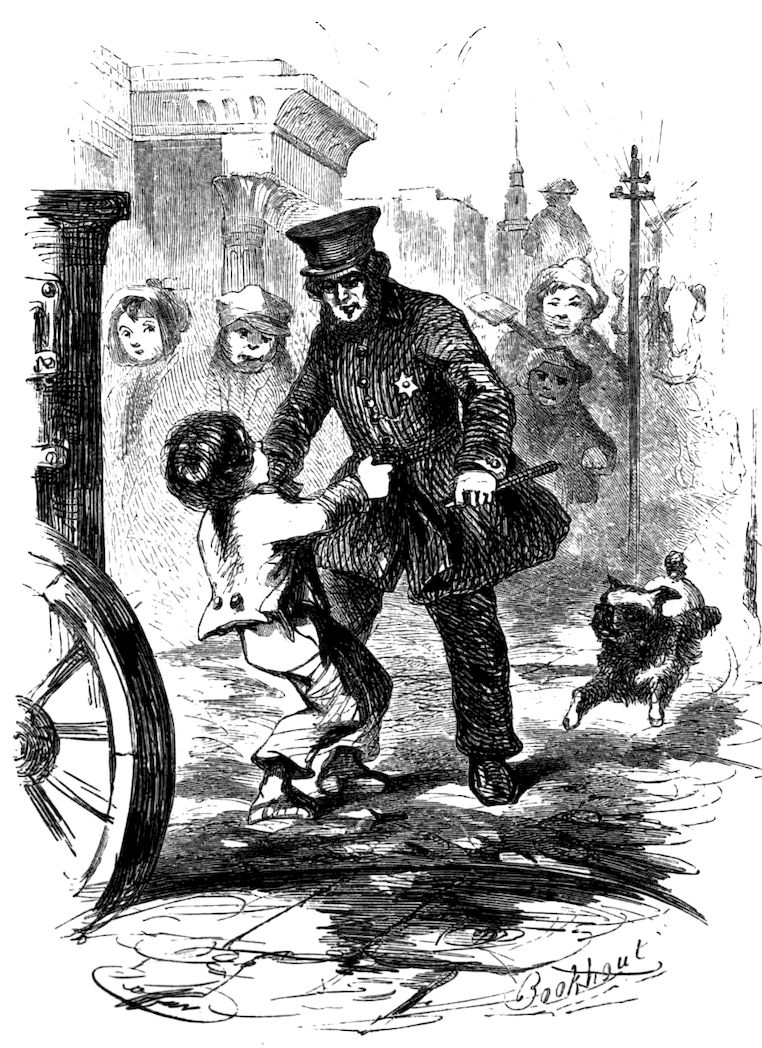
“Thump—thump—thump! I wonder who that is,
knocking at my front door,” said Betty Smith; “I hope
28it is not the minister! I can’t leave these preserves for
any body! thump—thump! What a hurry some folks
are in, that they can’t give a body a chance to wipe
their sticky fingers on a roller; nobody comes here but
the peddler and the tinman, unless it is the minister;
who can it be?” and Betty opened the door, and hurled
from between her teeth, her usual blunt, “What do you
want?”
“A piece of bread, if you please; I’ve taken such a
long walk, and I am very hungry.”
“Where did you come from?” asked Betty, “and
where are you going? and why didn’t you put a piece
of bread or something in your pocket before you started,
hey?”
“I did not think I should be so hungry,” said the
boy.
“Well—where are you going now, any how?”
“I don’t know.”
“Don’t know? that’s a pretty story! how did you
come by those good clothes? I’ll bet a sixpence you
stole ’em; they are genuine broadcloth—fine as our
minister wears—and you begging for a piece of bread!
I can’t put that and that together. You don’t get any
bread from me, till you open your mouth a little wider,
my young mister, and tell me what you are up to. I
29shouldn’t wonder if you were sent here by some bad
people, or something, to see if my man was to home;
I can tell you now that he ain’t, but there’s a gun behind
that kitchen door that’s better than forty of him,
and I know how to handle it, too. Do you hear that,
now? I’ll have you taken to—taken to—I’ll have
something done to you—see if I don’t; if you don’t
tell me in two minutes who sent you to my house!”
said the curious Betty. “I don’t believe you are hungry—it
is all a sham!”
“I am, really,” said the boy. “Nobody sent me
here; I never did any thing bad. Won’t you give me
a piece of bread, and tell me what road this is?”
“He’s crazy!” said Betty, looking close into the
boy’s eyes.
“No, I am not crazy. I—I—I don’t know the way
home.”
“Where is your home?”
The boy hesitated, and hung his head.
“Tut, now, if you want your bread,” said Betty,
growing more and more curious, snatching a fragment
of a loaf, and holding it up before him—“if you want
this now, tell me where you live?”
“In the city,” said the boy.
“Ten miles off! Did you walk all that?”
30The boy nodded.
“Did your pa and ma know it?”
“No.”
“Come now, here’s another slice,” said Betty, “and
I’ll put some butter on it, if you’ll tell me what you
did it for?”
“I wanted to run away.”
“Goodness! What for? Did your folks treat you
bad?”
“No.”
“What then?”
“I wanted to travel.”
“Ha—ha—ha—ha!” said Betty, holding on to her
sides. “That’s too good—too good—and got tired
a’ready—ha! ha!—and want to find the way home!
Smart traveler you are! How do you expect to get
back to-night? It is most sundown now.”
“I don’t know,” said the boy, sadly.
“Nor I,” said Betty. “But I’ll tell you what I will
do. I’ll give you a supper and a bed to-night; and
my man is going in to market at four o’clock to-morrow
morning, with some vegetables; and he will give
you a lift, if I ask him. How’ll that do?”
“Thank you,” said the boy; “but—”
“But?” said Betty. “Oh yes, you are thinking of
31what a pucker your pa and ma will be in about you,
all night. Well, you should have thought of that
afore you started. It can’t be helped now. I know
my man won’t budge an inch before four o’clock in the
morning; he’s just as sot as the everlasting hills.
There he comes now. I guess he’ll wonder where I
picked up you.”
“Halloo! Betty,” said Richard, rattling up to the door
with his team. “What boy is that?”
“Why, Richard!”
“Why, Johnny!”
“What does all that mean?” said the astonished
Betty, as the little boy flew into her husband’s arms.
“What on earth does that mean? Did you ever see
him before?”
“Well, I should think I had,” said Richard, “seeing
that I have found his pa in vegetables all summer;
and this boy, every blessed morning, has jumped on to
my team for me to give him a lift on his way to school.
Should r-a-t-h-e-r think I had seen him before, Betty;
but how he came out here, that’s what I want to
know—didn’t know as ever I told him where I
lived.”
“You never did,” said Johnny. “I have been a bad
boy, Richard—I ran away from home. I read books
32about boys that went off to see the world, and I
thought it would be fun.”
“Well!” said Richard, laughing; “you are not the
first fellow who has found out that bread and butter
and money don’t grow on the bushes. Now I suppose
you are quite ready for me to carry you back?”
“Yes,” said Johnny.
“Well, eat your supper, and then be off to bed, for
I shall start before the hens are awake; and mind you
tell your folks that I had no hand in your going off.
It looks rather suspicious, you see—coming straight
out to my house. Lucky you did not fall into worse
hands; and, Betty, you might as well brush up his
dirty shoes and take a little dust off his jacket and
cap. I can always tell a boy that hasn’t seen his
mother for four-and-twenty hours. Ah, Johnny, nothing
like a mother. Don’t you be too proud, now, to
ask her pardon for running off; you young scapegrace.”
“No I ain’t,” said Johnny.
“What are you laughing at?” asked Richard.
“I was thinking,” said Johnny, as he watched Betty
dusting his jacket, “what a silly boy I was, and how I
thought that one of these days every body would want
to see the jacket and trowsers that the great traveler
33John Sims had on, when he first started on foot to go
round the world.”
“Never mind that,” said Richard, laughing; “it will
be a cheap suit of clothes for you, if it only teaches
you that a good home is the best place for boys, and a
good father and mother the very best of friends.”
“Wake up, wake up,” shouted Richard, shaking John
by the shoulder the next morning, “my team is all harnessed,
and at the door; and Betty has some smoking-hot
coffee down stairs; wake up, Johnny, and we’ll get
into town time enough to eat breakfast with your
mother.”
Johnny jumped out of bed, and in his hurry, put his
legs into the sleeves of his jacket: he was not used to
dressing in the dark; the hot coffee was soon swallowed,
and jumping into the market cart beside John, they rattled
off by starlight down the road. Richard did not
talk much, he was thinking how much money his turnips,
and carrots, and beets, and parsnips, would bring
him, so that Johnny had plenty of time to think. Every
mile that brought them nearer to the city made him feel
more and more what a naughty boy he had been, to
distress such a good father and mother; so that he was
quite ready when the market cart rattled over the paved
streets of the city, and up to his father’s door, to say
34all that such a foolish boy should say, when his parents
came out to meet him; nor did he get angry when “the
fellows” joked him about his “long journey round the
world.” And when they found he could laugh at his
own folly, as well as they, they soon stopped teasing
him. Johnny has some little boys of his own now, and
when they begin to talk big, he always tells them the
story of “John Sims, the famous traveler.”
THE JOURNEY. — CHAPTER I. — CHAPTER II. — CHAPTER III.
35
Did you ever go a journey with your mother? No?
Little Nelly did; it was great fun for her to see
her mother pack the trunk. She had no idea before how
much may be got into a trunk by squeezing. She
thought it full half a dozen times, and laughed merrily
when her mother pressed down the things with her
hands, and piled as many more on top of them. Nelly
and her mother were going to Niagara; that is a long
way from New York. They went to bed very early the
night before, for they knew that they must be up and
off by daylight, breakfast, or no breakfast; for the cars
do not wait for hungry people, as you may have found
out. Long before daylight Nelly put her hand on her
mother’s face, and said, It is time to get up, mother, and
sure enough it was; so they both sprang out of bed,
washed their eyes open, hurried on their clothes, and, I
wish I could say, eat their breakfast, but unfortunately
36Nelly and her mother were boarding at a hotel. Now,
perhaps you do not know that the servants in the New
York hotels set up nearly all night, to wait upon people
who stay out late at theaters, and like a nice dainty
supper when they get home; and to take care of
strangers, too, who arrive late at night; so you can
imagine how tired they are, and how soundly they sleep,
poor fellows, in the morning. Many of them are most
excellent people, who bear without complaint all the
hard words they get from those, whose chairs they stand
behind, and who consider themselves privileged for that
reason to insult and abuse them. No matter how weary
they are, they must dart like a flash of lightning wherever
they are sent, and get sworn at and abused even
then for not going quicker. I remember well a middle-aged
man who was waiter in a hotel where I once lived.
He was as truly a gentleman as your own father. I
could not bear that he should answer the bell when I
rang it; it seemed to me that I should rather wait
upon him. I could not bear that he should bow his
head so deferentially every time he spoke to me, or be
so troubled if my tea or coffee was not just as I was accustomed
to have it. I could not bear that he should
beg my pardon for every little omission or accident, so
seldom occurring, too. I almost wished he would say
37something impudent or saucy; it made me so uncomfortable
to see such a fine, dignified, gentlemanly man
waiting upon my table, waiting upon people in the
house, too, who were not fit to wipe his shoes; running
hither and thither at the call of capricious, ill-bred
children, whose wealthy parents had never taught them
that servants have hearts to feel, and that they should be
humanely treated. Ah, you should have seen our John;
his manners would not have disgraced the White
House. In fact I should not be surprised any day to
hear that he was its master; for he who fills an inferior
position faithfully and well, is he who oftenest rises to
the highest. Remember that!
Well, as I was telling you, before I began about
John, when Nelly and her mother got up, the poor,
sleepy servants, who had not been in bed more than an
hour or so, were not up, so Nelly nibbled a cracker
and drank a glass of water, and she and her mother
jumped into the carriage and were driven to the dépôt.
How odd Broadway looked by early daylight! No
gayly dressed ladies swept the pavements with their
silken robes; no dandies thumped it with their high-heeled
boots and dapper canes; no little girls, dressed
as old as their mammas, glided languidly up and down,
with their hands folded over their belts and an embroidered
38handkerchief between their kidded fingers.
No—none but the useful class of the community were
stirring: market-men, from the country, with their
carts laden with lettuce, parsnips, cabbages, radishes,
and strawberries, covered over with a layer of fresh,
green grass, the very sight and odor of which made one
long to be where it grew. Then there were milkmen,
driving enough to tear up the pavement; then there
were rag-pickers, gray with dirt, raking the gutters;
then there were shop-boys and office-boys by the score,
who had crossed the ferries to their work, for board in
New York is expensive business; then there were tailoresses
and sempstresses, more than I could count, with
their shawls drawn round their thin shoulders, and their
faces shrouded in their barege vails; then there were
poor, tired news-boys asleep in entries and on steps,
while others of their number rushed past with their
bundles of damp papers. Little Nelly saw it all, for her
eyes were sharp and bright; and now she is at the
dépôt. All is hurry, skurry; carriages, cab-men, passengers,
and baggage. Nelly’s eyes look wonderingly
about her, and she keeps close to her mother, for the
loud shouts of the men frighten her; now she is safe in
the cars—how pale, sleepy, and cross every body looks!
They hang up their traveling-bags on pegs over their
39heads, they fold up their shawls for cushions, they examine
their pockets to see if their purses and checks
are all right, they shrug their shoulders and pull down
the windows to keep out the steam from the car boiler,
for we are not yet out of the dépôt, they put their feet
upon the seat, coil themselves up into a ball, and wonder
why the cars don’t start. Siz—z—z, off we go—good-by
New York, with your dust, and din, and racket—good-by
to your sleepy belles, who are dreaming of
last night’s ball, and getting strength to go to another;
good-by to the gray old men who toil so hard to find
them in dresses and jewels; good-by to their thoughtless
sons, who spend so freely what they never earn;
good-by to the squalid poor of whom they never think,
though they may some day keep them wretched company;
good-by to the poor old omnibus horses, who trot
and stumble, stumble and trot, till one’s bones ache to look
at them; good-by to the merry, sun-burned drivers, who
so courteously rein up their horses, when ladies want to
trip across the slippery streets; good-by to the little
flower-girls, who manufacture those tempting little baskets
of pinks, geraniums, and roses; good-by to the
pretty parks, with their fountains and trees, nurses and
children; good-by to the prisons, which often shut up
better people than many whom the judges suffer to go
40unpunished at large; good-by to the hospitals with their
groaning patients, watchful nurses, and skillful doctors.
Good-by, we shall not be missed, no more than the
pebble which some idle school-boy tosses into the pond,
and which disappears and is thought of no more. Good-by,
busy, dirty, noisy, crowded, yet delightful New
York, for we are off to Niagara.
How hot it is, how dusty—how hungry we all are.
I hope we shall soon stop to dinner, for our stock of
crackers and patience is exhausted, and nothing is left
of the oranges but the peel. Ah, here we are! Only
ten minutes to eat; what can the conductor be thinking
about; does he take us for boa-constrictors? or does
he think that, like the cows, we can store in our food
and chew it whenever we get a chance? The fact is,
he does not think any thing about it; all he cares for is
to pack us all in the cars again and start at the last of
the ten minutes. So I suppose we must elbow our way
into the dining-room with the rest and scramble for a
seat! “Beef, pork, mutton, veal, chicken, what’ll you
41have, ma’am?” “What’ll I have? oh, any thing, something,
only be quick about it, please, for this little girl
looks paler than I like to see her. Lamb and green
peas, that will do; but, oh, dear, where’s our knife and
fork? Turn round, Nelly, take that spoon and begin
on the peas, we can’t stop for trifles. There’s that
horrid fizzing of the car boiler, which warns us that
we must swallow something or go hungry till bedtime.
And here’s a custard, but no spoon; next time
I travel I will carry a knife, fork, and spoon in my
pocket. I wonder if the people who keep this eating-place
forget these things on purpose, so that we need
not eat our ten minutes’ worth of food? and we so
hungry, too.” “Have an orange, ma’am?” “Of course
I will: I have not had any thing else.” “Passengers
ready—passengers please settle.” Poor Nelly swallows
the last bit of custard and looks wistfully at those we
leave behind, and we pay for our comfortless dinner,
and scramble back into the cars. “All aboard.” Off
we go again. The fat old lady in front of us goes to
sleep; the gentlemen get out their newspapers. I
wonder do they know how many people have ruined
their eyesight trying to read in the cars? It is a losing
way of gaining time, Mr. Editor; take my advice and
put your papers in your pockets to read when you get
42to the next stopping-place. There is a woman taking
out a needle and thread to sew—that is worse yet—but
every body imagines they know best about such things,
so I’ll not interfere. Here comes a boy into the cars
with some books to sell. Little Nelly pinches my arm
slily and looks very wise; she has spelt out, with her
bright eyes, among the other books. “Fern Leaves.”
Nelly is a bit of a rogue, so she says to the boy, “Have
you Fern Leaves?” “Yes, miss, and Second Series and
Little Ferns, too.” And he hands them to me. Nelly
touches my foot under the seat, and looks as grave as a
judge, while I turn over the pages, and when I ask the
little boy who wrote Fern Leaves, she does not laugh,
but looks straight out of the window at a cow munching
grass by the road side, as if it were a matter of no
concern at all to her. The little bookseller repeats my
question after me, “Who wrote Fern Leaves?” and looks
bewildered, then, after scratching his head, he answers,
with the air of one who has hit it, “Fanny’s Portfolio,
ma’am.” We did not buy the books, we had seen
them before. But not till the last rag of the little bookseller’s
torn jacket had fluttered through the door, did
Nelly’s gravity relax: you should have seen, then, the
comical look she gave me behind her pocket handkerchief,
and heard her ringing laugh, well worth writing
43a book for, and which nobody understood but we
two, and that was the best part of the joke.
By-and-by there was a quarrel in the cars about
seats, for selfish people travel as well as the good-natured.
A cross-looking man, with a wife to match,
had monopolized two entire seats, in one of which they
sat, and on the other placed their feet and their carpet-bags.
It was not long before a large, well-dressed gentleman,
with his wife, requested leave to sit on the seat
occupied by the cross gentleman’s carpet-bags; to
which the cross man replied, with a growl, and without
taking down his feet, that that seat was engaged to
some persons who had just stepped out. This was a
fib; but the gentleman supposing it to be true, led the
lady back to the sunny seat which she had just left,
and which had given her a bad headache. An hour
after, the big gentleman stepped up to the cross man
and says, “Your friends are a long time coming, sir.”
You should have seen the cross man then; how he
sprang to his feet like a little bristly terrier dog, which
he strikingly resembled; how he tauntingly asked the
big, well-dressed man, how it happened that such an
aristocrat as he did not hire an entire car for his lordship
and her ladyship (meaning his wife). “I should
have done so,” replied the gentleman, in a very low tone,
44as he turned on his heel, “had I known that pigs were
allowed to travel in this car.” The laugh and the
whisper, “Good enough for him!” which followed,
might have abashed any body but our terrier, who
stepped up to the principal laugher, who sat next me,
and putting his face close to his, hissed between his
shut teeth, “Shut up!” Nelly did not know what
“shut up” meant, but she knew the meaning of the
doubled-up fist which the terrier thrust into our neighbor’s
face, and looked up at me to see whether there
was any danger of our being thumped or not. Seeing
only a smothered smile on my face, and the conductor
approaching to set matters to rights, she soon became
quiet.
On we flew, past houses, fences, trees, cows, sheep,
and horses, some of whom pricked up their ears for a
minute, then went lazily on munching grass, as much
as to say, “That’s an old story;” others, finding an
excuse in it for a frolic, raced over the meadows, and
kicked up their heels, as if to say, “Just as if nobody
could run but you!”
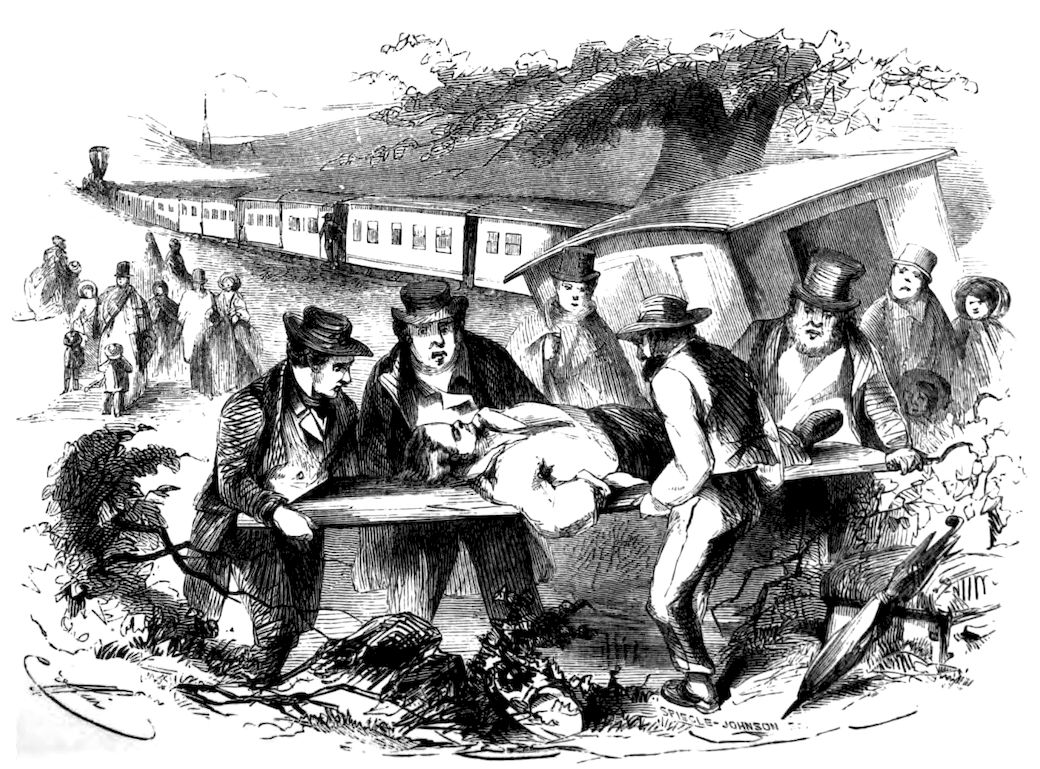
45Hark! what’s that? Nobody answers; but the
cars tip half-way over, we are all thrown in a heap on
the floor, the window-glass comes smashing in, and the
hot steam rushes in. A great fat man doubles me up
over a seat, trying, like a great coward as he is, to
climb over me to get out the window. We don’t
know yet what has happened; but, “Get out of the
cars!” says the conductor, “quick!” The window is
too small to let out the fat man, so he kindly allows
me the use of my ribs again, which must have been
made of good material, or they would have been
broken as he bent me over that seat. I snatch Nelly,
poor pale Nelly! who never screams or speaks, for she
is a real little Spartan—and we all clamber out into
the tall, wet meadow-grass. Then, the danger over,
great big tears roll out of Nelly’s eyes, and with an
hysterical laugh, as she looks at the broken cars, she
sobs out, in a half sorrowful, half droll way, this nursery
snatch—“All of a sudden, the old thing bursted!”
“Any body hurt?” ask the pale, anxious passengers,
as they creep out one by one. “No—nobody’s hurt.”
“Ah yes—ah yes—the poor brakeman is badly scalded—poor
fellow.” Now the country people come
flocking out of the farm houses—good, honest, kind
souls—and they make a litter, and they put the wounded
man upon it, and bear him slowly away over the
green fields, under the drooping trees, carefully, carefully,
heeding his groans, into the nearest farm-house; then
the doctor’s chaise drives hurriedly up, and after a
46time, word is brought us that he will not die. Little
Nelly cries and laughs again, for she is very nervous
from the fright. And the conductor says, “Have patience,
ladies; we will soon get another car;” and
some go into barns, and some go into houses, for the
rain is falling; and the poor watchmaker, whose trunk
was broken to pieces, stands looking at the fragments
of broken watches, and saying big words about damages
and the railroad company. But every body else
is so glad to be alive, and to be in possession of sound
limbs, that they do not think of their baggage. And
after a while the new car comes, for every body helps
us, and we all climb up into it, and the color comes
back to the lips of the ladies; and the great fat coward,
who bent me double over the seat, takes precious
good care to sit near the door, ready for a jump if
any thing else turns up, or turns over.
One o’clock at night, and this is Niagara. It might
as well be Boston Frog Pond, for all the enthusiasm
has been shook, and jolted, and stunned, and frightened
47out of us getting to it. And now here it is one o’clock
at night. I suppose not a bit of supper is to be had
for poor Nelly and me, although we have eaten nothing
since we had that scrambling twelve o’clock dinner.
What a big hotel! bless us—there is a supper though
all ready; for they are used to little accidents, called
collisions, this way, and feed the survivors with as much
alacrity as they bury the dead; to be sure there is a
supper—chicken—oh, Nelly! chicken and hot tea.
Sorry figures we cut by the light of the bright gas
chandeliers, with our jammed bonnets and torn riding-dresses,
but who cares? I am sure black John don’t;
he is just as civil as if we were as presentable as a
Broadway belle; certainly he is used to it; he is used
to seeing ladies emerge from begrimed caterpillar riding-habits
into all sorts of gay butterfly paraphernalia;
John is charitable; he always suspends his judgment of
passengers till the next morning at breakfast; then he
knows who is who. If a lady takes diamonds with her
coffee, he knows she talks bad grammar, and is not
what she would have people think her; he is not surprised
to have her find fault with every thing from the
omelette to the Indian cake. He expects to see her
nose turned up at every thing, just as if she had every
thing better at home.
48She does not impose on John—he waits upon her
with a quiet twinkle in his eye, which says as plain as
a twinkle can say: I have not stood behind travelers’
chairs these two years for nothing; that game has
been played out here, my lady; but when a lady comes
down to breakfast in a modest-colored, quiet-looking
breakfast robe, with smooth hair, neatly-slippered feet,
and a very nice collar, and speaks civily and kindly to
him, John knows he sees a real lady, whether she owns
a diamond or not—and her pleasant “Thank you,” when
he has taken some trouble to procure her what she desires,
wings his feet for many a hard hour’s work that
day. I wish ladies oftener thought of this. I wish
they did not think it beneath them, or were not too indifferent
or thoughtless to attend to it. “What is that
noise, John?” “Oh, them’s the Rapids, ma’am.” “Rapids?
sure enough, we almost forgot we were at Niagara;
how very dismal they sound!” John laughs and says,
“You are tired to-night, ma’am; when you look at them
in the morning you will like ’em; most ladies does.”
But poor Nelly is half asleep over her plate, so we will
go to bed. What a little box of a chamber! not a
pretty thing in it but Nelly; a table, a chair, a bed, a
bureau, and a candle on it; the window shaking as if
it had St. Vitus’s dance; the Rapids, as John calls them,
49roaring like mad under the window. I can’t stand the
rattling of that window. I’ll stop it with the handle of
a tooth-brush. I suppose I have a tooth-brush left, if
the cars did run off the track; oh, yes! “Now tumble
into bed, Nelly. What a dismal thing those Rapids
are, to be sure. I feel as if I were out at sea in an
egg-shell boat. I wonder how they will look in the
morning? don’t you, Nelly?” No answer. “Nelly’s
asleep; I wish I could sleep, but I’m sure those horrid
Rapids will give me the night-mare.”
“Morning? you don’t mean that, Nelly! and you look
as bright as if the cars had kept right end up all the
way here. Does the sun shine, Nelly? Open the blinds
and see. No? what a pity. ‘A great river under the
window!’ why, pussy, that river is the Rapids; I don’t
wonder they shake the window so; how they tumble
about! Now, we will dress and breakfast, and then,
no! for the Falls. You and I are not to be frightened
at a few rain-drops, Nelly; we have had too many
drenchings running to and fro from printing-offices for
that. That’s right, Nelly, dip your face into the washbasin,
it will make your eyes strong and bright; now
smooth your hair, and put on the plainest dress you can
find, but let it be very clean. I hope your finger-nails
50and teeth are quite nice, and then pull your stockings
smoothly up; of all things don’t wear wrinkled
stockings. Put stout boots on; don’t be afraid of a thick
sole, Nelly; every thing looks well in its place; and a
thin shoe on Goat Island would be quite ridiculous.
“You are glad to get out of that stifled bed-room?
so am I. What a nice wide breezy hall this is! Oh,
there are more travelers who have just arrived, and
there are some more who are just leaving; and there
comes the servant to say breakfast is ready; gongs are
out of fashion, I am glad of that; I would run a mile
to escape a gong; and beside, no hospitable landlord,
I think, would set such a machine in motion to disturb
sick and weary travelers, who prefer a longer sleep.
Ah, this landlord knows what he is about, I am sure of
that; you can generally judge of any house by the
manners of the servants. How well trained they are
here, how quiet, how prompt! Good fellows; I hope
they get well paid, don’t you, Nelly? I hope they have
a comfortable place to sleep, when the day is over, don’t
you? All black? I am glad of that, too; I like black
people; they are such a merry people, they are so
easily made happy, they are so affectionate, they are so
neat. Oh, what nice bread and coffee! Don’t touch
those omelettes, Nelly; take a bit of beefsteak and
51here’s some milk—real milk; it is so long since I have
tasted any, that it seems like cream!
“Who are those people? How do I know, little
puss? I dare say they are asking the same question
about us! You don’t like that lady’s face? Why
not? She don’t look as if she could laugh. That’s
a fact, Nelly. She is as solemn as an owl. But perhaps
she is in trouble, who knows? We must not laugh
about her. Come, Nelly, let us get up and go to the Falls.
Tie on your bonnet; what a nice fresh air! See the shops,
Nelly! shops at Niagara, who would have thought it?
and curiosities of all sorts to sell! Well, never mind
them now. Want a carriage? want a cab? Of
course we don’t—look at our democratic thick-soled
shoes! what’s the use of having feet, if we are not to
be allowed to use them? No, of course we don’t want
a carriage; we feel, Nelly and I, as if we were just
made; don’t you see how we step off? No, keep your
carriages for infirm, proud, and lazy people. Carriage—who
can run in a carriage? who can skip? This way,
Nelly, over the little bridge? Oh—pay toll here!
Do we? Twenty-five cents. And please register
our names! Oh yes, of course—Mrs. Nelly, and
Miss Nelly. What are you laughing at, puss? come
along; oh, see this pretty island! now you see the use
52of thick shoes—off into that grass, and pick me some
of those wild-flowers. Oh, Nelly, there are some blue,
and pink, and purple—get a handful, Nelly! Oh, how
delicious it is to be alive; skip, Nelly, run, Nelly, sing
Nelly.
“A real Indian? Where? Oh, that’s not a real Indian,
no more than you or I. She’s a pretty little sham Indian;
but what are her pin cushions and moccasins to
these wild-flowers? No, no, little girl, don’t stop us
with those things; we left shopping in New York.
Goat Island was not made for that, I’m sure; come
Nelly! A boy with crosses made of Table-rock;
how they plague us—we don’t want to buy any
crosses, we are cross enough ourselves, because you
keep bothering us so; we came to see the Falls, not to
do shopping. Come away, Nelly! Oh, Nelly—look!
look!”
But why describe the Falls to you, when all your
school geographies have a picture of it? when your
teacher has taken all the school to see a panorama of
it? when your Uncle George, and Aunt Caroline, and
Cousin James have seen it? and yet no tongue, no pen
ever could, ever has described its beauty, its majesty.
I would that I had never heard it attempted; I would
that I had never heard of Niagara; I would that I had
53come upon it unawares some glorious morning before
Indian girls had peddled moccasins there, or boys, had
profaned it by selling pictures and crosses; I would have
knelt on that lovely island, and seen God’s majesty in
the ceaseless, roaring torrent; God’s smile in the bright
rainbow, hung upon the fleecy mist; God’s love in
making earth so beautiful, for those who forget to thank
Him for it. I would lead him there who says there is
no God, that he might hear His voice, and see His
glory.
But no two persons look on Niagara with the same
eyes. You can not see it through my spectacles; some
it animates and makes jubilant; others it depresses and
terrifies; some hear in it the thunder and lightning of
Sinai; others hear in it the voice of Him who stilled
the raging waves with “Peace, be still!”
Yes, I was glad to have seen Niagara, but I was not
sorry to leave it. Its rushing torrent threw a shadow
over my spirit. Its monster jaws seemed hungry for
some victim, other than the unconscious leaves which
it whirled so impatiently and disdainfully out of sight.
Its never-ceasing roar seemed like the trumpet-challenge
to battle, telling of mangled corpses and broken
hearts. No;—dearer to me is the silvery little brook,
tripping lightly through green meadows, singing low
54and sweet to the nodding flowers, bending to see their
own sweet beauty mirrored in its clear face. I like
not that all Nature’s gentle voices should be tyrannically
hushed to silence, drowned by a despot’s deafening
roar. Give me the low murmur of the trees; I like
the hum of the bee; I like the flash of the merry
little fish; I like the little bird, circling, darting, singing,
skimming the blue above, dipping his blight wings
in the blue below; I like the cricket which chirps the
tired farmer to sleep; I like the distant bleat of the
lamb, the faint lowing of the cow; I lay my head on Nature’s
breast, in her gentler moods, and tell her all my
hopes and fears, and am not ashamed of my tears.
But she drives me from her when she roars and foams,
and flashes fierce lightning from her angry eyes; I
close my ears to her roaring thunder. But when, clearing
the cloud from her brow, she hangs a rainbow on
her breast, throws perfume to the pretty flowers, and
smiles caressingly through her tears—ah, then I love
her; then she is all my own again.
Here I have been running on! and all this while
you have been waiting to know the rest of my story.
Well, Nelly and I started to go back to New York.
Nelly did not like the idea of trusting herself in the
cars, nor, to tell the truth, did I; but there was no
55help for it: besides, it is not wise to be a slave to one’s
fears. So we tried to forget all about it. A girl who
lived with me once remarked, there is always something
happening most days. So we soon found amusement.
An old lady in the cars, when she had smelled
up all her camphor and eaten all her lozenges, commenced
asking me questions faster than I could answer,
and looking at Nelly through her spectacles.
Some of her questions were very funny, and, from any
body but an old lady, would have been impertinent;
but we answered them all, for it was very evident she
did not ride in the cars every day, and was determined
to get her money’s worth. Poor old lady! I suppose
she had lived all her life in some small village where
there was only a blacksmith’s shop and a meeting-house,
and where every body knew what time every
body got up, and what they had for breakfast. Nice
old lady! I hope somebody gave her a good cup of
tea, and a rocking-chair, when she got home, which, I
regret to say, was the first stopping-place after we
left Niagara.
From the car-windows Nelly and I saw the Catskill
Mountains. O the lovely changing hues of their
steep and misty sides; the billowy clouds that rolled
up, and rolled over, and rolled off;—then the far-off
56summit, now hidden, now revealed, lying against the
sky, tempting us to see from thence the kingdoms of
the earth, and the glory of them. And so we will,
some day. I will tell you what we see.
Night came, and we had not yet reached New York.
Nelly was dusty, and hungry, and tired; but she was
a good traveler, and made no complaint. The cars
were dashing along through the darkness, close by the
edge of the Hudson River, and Nelly clasped my hand
more closely as she looked out of the windows upon
its dark surface, and sighed as if she feared some accident
might tip us all over into it. But no such accident
occurred, and by-and-by the bright gas-lights of
New York shone and sparkled; and the never-failing
gutter odor informed us that we were back again upon
its dusty streets.
THE MORNING-GLORY.
57
“How did Luly look?” Her eyes were brown, her
hair was brown, too; she was very pale, and
slender, and had a soft, sweet voice, just such a voice
as you would expect from such a fragile little girl.
Luly did not like to be noticed: she was fond of being
by herself, and would often sit for an hour at a time,
quite still, with her slender hands crossed in her lap,
thinking; her cheek would flush, and her eye moisten,
but no one knew what Luly was thinking about. Luly
did not love to play; she did not care for dolls, or
baby-houses; she never jumped rope, or drove hoop, or
played hunt the slipper; this troubled her mother, who
knew that all healthy young creatures love to play and
frolic; and so she brought Luly all sorts of pretty
toys, and Luly would say very sweetly, “Thank you, dear
mamma,” and put them on the shelf, but she never
played with them, and seemed quite to forget that they
were there. Luly’s grandmother shook her head, and
58said, “Luly will die; Luly will never live to grow
up.”
If Luly heard any one speak in a harsh, cross voice,
she would shiver all over, as if some cold wind were
blowing upon her; and if she saw two persons quarreling,
she never would be satisfied till she had made peace
between them. One day, before she could speak plain,
her mother sent her down to the kitchen on an errand;
when she got to the door, she stood still, for the cook
and the chambermaid were very angry with each other;
one was saying “You did,” and the other “I didn’t,” in
very loud tones, and their faces were very red with passion.
Luly stood in the door-way, looking, listening,
and trembling, as she always did at any such sight.
Tears gathered slowly in her eyes, and unable to bear it
any longer, she stepped between them, and clasping her
little hands, said in her broken way, with her sweet,
musical voice, “Oh, don’t condict, please don’t condict.”
So the girls stopped contradicting, ashamed before a
little child, “for of such is the kingdom of heaven.”
Luly never disobeyed her mother—never—never. If
her mother told her not to go out in the garden without
her leave, and then went away for an hour, she
was just as sure that Luly had obeyed her, as if she had
been there to see; and yet, every night when this little
59girl went to bed, she would say, as she laid her head
upon the pillow, “Mother, do you think God will forgive
all my sins to-day? I hope he will, I hope I
haven’t made God sorry, mother;” and when her mother
said, “Yes, I know he will forgive you, Luly,” she
would smile so peacefully, and say: “Now you can go
down stairs, mother.” Luly never was afraid of God;
she never thought or spoke of His “punishing” her;
but she loved Him so much that it was a great grief to
her to think that she might have “made Him sorry,” as
she called it. One morning when she woke, one beautiful
summer morning, when the scent of the roses came
in at the open window, when the dew-drops were glistening,
and the green trees waving, and the birds singing,
she crept out of her little crib, and stood at her
window looking out on the fair earth, with her little
hands clasped, her eyes beaming, and her cheek glowing.
“What is it, Luly?” said her mother, as tears rolled
slowly down Luly’s cheeks.
“I want to see Him,” whispered Luly.
“Who, my child?”
“God.”
Then Luly’s mother thought of what her grandmother
had said: “Luly will not live; Luly will die,”
60and she clasped her little girl tightly to her breast, as if
she feared even then she would go from her.
But no mother’s clasp could hold little Luly; no
mother’s tears could bribe the Death Angel. Rose-red
grew the cheek, then white as snow, the little hands
grew hot, then icy cold, the soft eye bright, then dim,
and she who never grieved us living, grieved us dying.
A PEEP OUT OF MY WINDOW.
61
I wish I knew what that cow is thinking about;
how lazily she stands there, switching her sides with
her tail, and looking up and down the meadow. I am
no judge of cows, but I think that is a pretty cow.
Any lady might be proud of her great, soft brown eyes.
I am glad she does not know that one of these days,
the butcher will thump her on the head and sell her for
beef; I am glad she does not know that the pretty
little calf, which frolics by her side, will be eaten for veal,
next week. Munch away, old cow, and enjoy the fresh
clover while you can; I don’t believe you have any idea
what a pretty picture you and your baby calf make, as
you stand with your hoofs in that brook and bend your
heads to drink. I like to think, though I know it is
not so (because you have no soul, old cow), that when
you raise your head from the brook and lift it toward
the sky, you are thinking of Him who made the pretty
clover grow and the sparkling brook to flow. And now
62the little calf is nursing. Pull away, little rogue? if
you have not a better right to your mother’s milk than
Sally, the dairy-maid, I will agree to go without butter;
pull away, it does me good to see you; now kick up
your heels and run like mischief over the meadow; see
the old cow blink and wink, as she looks after her, as
if to say, Well, well, I was young myself, once; calves
will be calves, spite of cows. And there is a hen and
her cunning little chickens; I should like to catch that
tiny white one, which blows over the meadow like a piece
of cotton wool, and cuddle her right up in my neck; I
am sure the old hen would not object if she knew how
I liked chickens; but she don’t, and she would probably
take me for a highwaywoman, and I can’t have my
character called in question that way, even by a hen;
beside her beak is sharp, and so are her claws: I think I
had better admire her little soft white baby at a distance.
Nice little thing, how glad I am it does not have to be
fixed up in lace and embroidery, every morning, and
have a nurse rubbing its nose enough to rub it off,
every time a stray breeze makes it sneeze; how glad I
am the little thing can roll and tumble in the grass, instead
of being stewed up in a hot nursery and sweltered
under a load of crib-blankets, till all its strength oozes
out in perspiration; dear little chick, I hope you will
63find plenty of little worms to eat, and I hope no old
rooster will cuff your ears for doing it; I hope you will
have the downiest side of your mother’s wing to sleep
under, and plenty of meal and water when worms are
scarce. But, see! there’s a shower coming up; you
had better scamper under the shed; don’t you hear the
thunder, little chick? don’t you see that beautiful zig-zag
lightning darting out of that dark cloud? and
don’t you see that lovely blue sky over yonder, peaceful
as the good man’s soul, when the cloud of trouble
threatens him? No, little chick, you don’t notice it a
bit; you are only chasing after your mother, and trying
to dodge the rain-drops; well, pretty as you are, I had
rather be born with a soul; I am glad my soul will
live millions of years after you are dead; I want to
know so much that puzzles me here on earth, but
which I am willing to believe is all right, until God
Himself explains it all to me. I am glad I am not a
little chick without a soul, because I want to learn
about these things in heaven.
THE CIRCUS.
64
What a mob of boys! There’s Bill Saunders,
and Ned Hoyt, and Tom Fagin, and Lewis
Coates, and John Harris; and, sure as the world, there’s
that little tomtit, Harry Horn, without a sign of a cap
on, jumping up and down as if there were pins in his
trowsers. What can be the matter, I wonder? Now
they shout, “Hurra—hurra!”—but then boys are
always screaming hurra. I have done breaking my
neck leaning out of the window to see what is the
matter. I won’t look at the little monkeys. There it
goes again—“Hurra! hurra!” One would think General
Washington, Lafayette, or some other great person,
was coming down street. Now they move one
side—ah, now I see what all the fuss is about! A
great flaming red and yellow handbill is posted on the
fence; and on it is written, “Pat Smith’s Circus!
next Wednesday afternoon and evening.” Circus! no
wonder little Harry Horn forgot to put his hat on, and
jumped up and down as if he were trying to jump out
of his trousers. If there is any thing that drives boys
65crazy, it is a circus. I should like to know why; I
have a great mind to go to Pat Smith’s Circus myself,
just to find out; for I never was in a circus in my
life. Yes, I will go, and I will take Nelly; she never
was in a circus either. No, I won’t; I will leave her at
home with black Nanny. No, I wont; I will take
black Nanny too; but then I am not sure Pat Smith
allows colored people in his circus. “Well, if he is
such a senseless Pat as that, he may go without three
twenty-five cent pieces, that’s all, for Nanny likes a
little fun as well as if her skin were whiter; and if
Nanny can’t come in, Nelly and I won’t. But Nanny
can; Pat is not such a fool. So, come along, Nanny;
come along, Nelly; it don’t matter what you wear.
Walk a little faster, both of you; we must get a good
seat, or we shall lose half the fun. Short people are
apt to fare badly in a crowd. Here we are! This a
circus! this round tent? How funny! Music inside;
that’s nice; I like music; so do Nelly and Nanny.
Here’s your money, Mr. Pat Smith. Goodness! you
don’t mean that we have got to clamber up in those
high, ricketty-looking seats, without any backs? Suppose
we should fall through on the ground below?
Suppose the seats should crack, and let all these people
down? I think we’ll climb up to the highest seat, for
66in case they do break, I had rather be on the top of the
pile than underneath it. That’s it; here’s a place for
you, Nanny. Bless me, what a “many people,” as
little Harry Horn says. Little babies, too, as I live;—well,
I suppose their poor tired mothers wanted a little
fun too; but the babies are better off than we, because
they can have a drink of milk whenever they are
thirsty. Ah, I was a little too fast there, for Pat
Smith has provided lemonade, and here comes a man
with a pailful. Circus lemonade!—no, I thank you;
it may be very good, but I prefer taking your word for
it. How the people flock in! What’s that coming in
at yonder door? Nanny! Nelly!—look! Is it a
small house painted slate-color? No—it is an elephant—a
live elephant. What a monster! what great flapping
ears! what huge paws! and what a rat-ty looking
tail! I don’t like his tail; but his trunk is superb. I
am afraid he has had a deal of whipping to make him
behave so well. How he could make us all fly, if he
chose; what mince-meat he could make of those little
fat babies yonder. I am glad he don’t want to; they
are too pretty to eat. What are they going to do with
him, I wonder? It can’t be that they mean to make
him walk up that steep pair of stairs. Yes—see him!
Would you believe such a great monster could do it so
67gracefully? He lifts his paws as gently as a kitten.
Now that’s worth seeing; but how in the world are
they going to get him down, now that he has reached
the top? See—he is going to back down; not one
false step does he make; now he has reached the bottom.
Clever old monster! It seems a shame to make
such a great, grand-looking, kingly creature, perform
such dancing-master tricks. Now his master lies flat
on his back on the ground, and the old elephant is going
to walk over him. Suppose he should set that
great paw of his on his master’s stomach, and crush
him as flat as a pancake? No; see how carefully he
steps over him with those big legs; never so much as
touching his gay scarlet-and-white tunic. Splendid
old fellow, to have so much strength, and yet never use
it to the harm of those who torment him with all this
nonsense. How I should like to see you in your native
jungles, old elephant, with all your baby elephants;
your little big babies, old fellow. There he goes. I
am glad they have done with him. It makes me sad
to see him. Good-by, old Samson.”
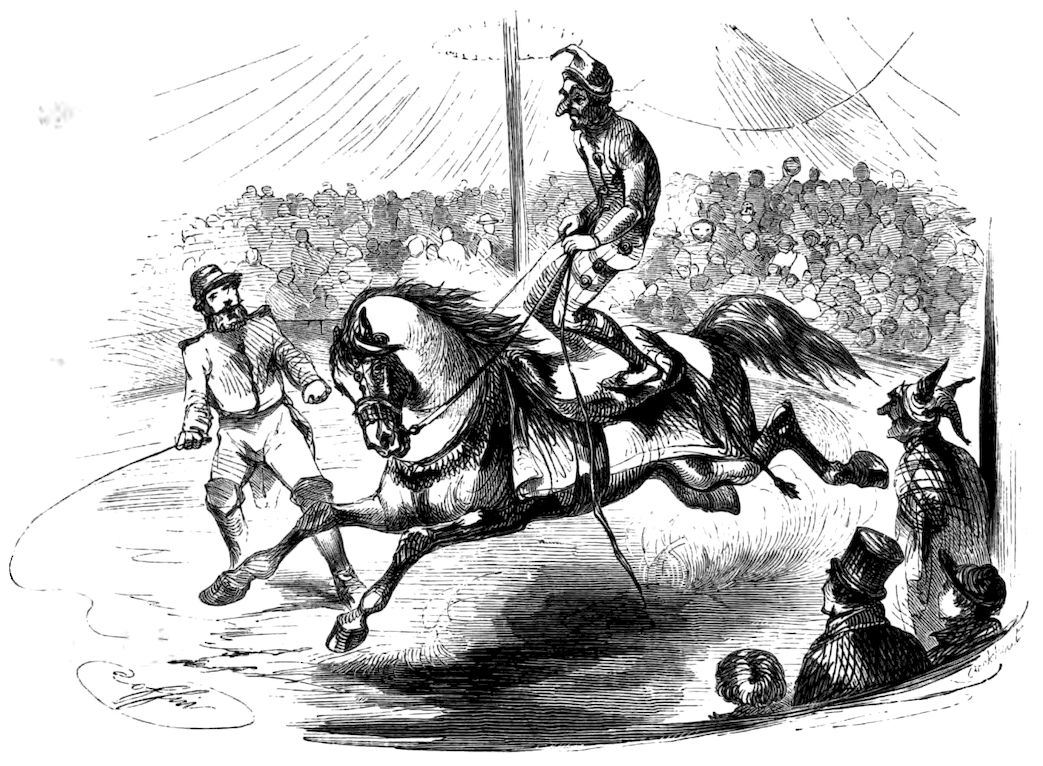
What now? a lady on horseback, Mr. Pat Smith’s
wife; she sits her horse very well, but that’s nothing
remarkable; I can sit a horse as well as that myself;
but I couldn’t make a leap on his back over that five-barred
68gate—mercy, no—he will break her neck, I
know he will; I am afraid Mr. Pat Smith wants a
second wife. Oh, see, the horse has come down safe
with her on the other side of the gate; now she is going
to try it again; what a woman that is! I hope
Mr. Pat Smith gives her half the money that he takes
this hot night, for I am sure she has earned it; but wives
don’t always get what they earn, and I dare say Mrs.
Pat Smith don’t.
Now here come a parcel of fellows in white tights,
tight as their skin, tumbling head over heels, up side
down, standing on each others’ heads, and cutting
up untold and untellable capers. I must say their
strong limbs are quite beautiful, just as God intended
limbs should grow, just as I hope yours will grow, one of
these days, though I think it may be done without your
being a circus tumbler. See how nimble they are, and
how like eels they twist and squirm about, leaping on
each others’ shoulders like squirrels, leaping down again,
running up tall poles and sitting on the top and playing
there with half a dozen balls at once, which are tossed
up at them from below. It is really quite wonderful,
and yet I can’t help thinking had they taken as much
pains to learn something really useful, as they have to
learn to be funny, how much good they might do; for,
69after all, a monkey, or a squirrel, or an ourang-outang
could do all that quite as well as a man, who is so
much superior to them, quite as gracefully, and without
any teaching, too; but, bless me, a circus is no place
to think, and yet I wish those men’s heads were as well
trained as their heels; if you listen you will find out
they are not; just hear those stupid jokes they are
making, how badly they pronounce, how ungrammatically
they express themselves, and hear—oh, no—don’t
hear that! what a pity they should say any thing indelicate
before ladies and pure little children. Now I know
why fathers and mothers do not like their little boys
and girls to go to the circus. Mr. Pat Smith, Mr. Pat
Smith, you must leave off those stupid bad jokes, if you
want to draw ladies and little children.
I wish somebody would get up a good circus without
these faults. I can not think so badly of the people as
to believe that they would like it less if it were purified.
I think it might be made a very pleasant and harmless
amusement for little children, who seem to want to go
so much, and who have often felt so badly because their
parents were not willing. Perhaps there are such good
circuses, that I may not have heard of. I like good
schools, I like study, but I should like to write over
every school-room door:
“All work and no play makes Jack a dull boy.”
WHAT EVERY LITTLE CHILD MAY SEE.
70
I hope you love to look at the bright sunsets; oh the
joy they are to me! Yesterday it had been raining
all day; dark, gloomy clouds hovered overhead; the
birds and the children were nested out of sight; the
hens crept up under the shed corners, and the old cows
stood patiently waiting under the trees for the sun to
shine out. It shone at last, and oh, with what a glory;
I wished I had a hundred eyes to gaze, for every moment
the lovely hues changed to hues more beautiful—sapphire,
topaz, emerald, ruby, opal, amethyst, diamonds.
Overhead, the mottled gold and purple; in the west, a
field of blue, clear and pure as a baby’s eyes, with
fringes of brown, like its sweet-drooping lashes; farther
still, floated golden clouds, bright enough to bear the
baby’s spirit to heaven; while in the east, the dark
heavy, rain-clouds, were rolled up and piled away; back
of the snow-white cottages, back of the tall church-spire,
which pointing upward seemed to say, Praise him who
made us all. Who could help it? Oh, if earth is so
71lovely, what must heaven be? if God’s foot prints are
so beautiful, what must be His throne?
Evening came, and all this glory faded out only to
be replaced by another; countless stars, sparkled and
glittered over head; then came the moon, slowly; veiling
itself bride-like in fleecy clouds, as if not to dazzle
us with her beauty. On came the still midnight; when
sleep fell like flower-dew on weary lids; when the
whispering leaves told each other all their little secrets,
and the queen moon glided about, silvering the poor
man’s roof while he slept, as if it had been a palace.
Morning came, and the jealous sun shot forth at her a
golden arrow, to tell her that her reign was past. She
grew pale, and moved slowly on, one little star keeping
her kindly company. Up flashed the sun, brighter for
his eclipse. The flowers and the children opened wide
their dewy eyes; the dew-drops danced, the little birds
shook their bright wings, tuned their throats, and trilled
out a song, oh, so bright, so joyous. God listened for
man, but he was dumb.
A STORY FOR BOYS.
72
Now, boys, I am going to write a story for you. I
don’t know why I have written more stories for
girls than for boys, unless it is because all the boys I
ever had have been girls. Sometimes I have been sorry
this was so, because I think boys can rough it through
the world so much better than girls, especially should
the latter have the misfortune to lose their father when
they are young. I hope this is not the case with you;
it is very sad for young eyes to be watching the way he
used to come, and see only other happy gleeful children
with their living, breathing, loving, fathers.
But I will not talk about this now. I want to tell
you that I do love boys, though I am very much afraid
of them.
Afraid?
Yes; now you need not look so innocent, just as if
you never, when a lady had picked her way carefully
through the sloppy streets, jumped into a big puddle
near her, and sent the dirty water all over her nice
73white stockings, and pretty gaiter boots—ah—you see I
know you; just as if you hadn’t come rushing round a
corner when you were playing tag, and knocked the
breath out of a woman before she could say “Don’t;”
just as if you didn’t eat peanuts in an omnibus and let
the wind blow the shells into her lap; just as if you
didn’t put your muddy shoes up on the omnibus seat,
and soil the cushions, and spoil ladies’ dresses; just as if
you did not—you rogues—say saucy things to bashful
little girls, at which your schoolmates Tom Tules
and Sam Hall would burst into a loud laugh and the
poor little girl would have to go a long way round to
school the next morning merely to get rid of you. I
should be sorry to believe that you know how much
pain you sometimes give a little girl in this way: perhaps
her mother is a widow and has to earn her own
living, and can not spare time every morning to go with
her daughter to school, or to call for her when
school is done; and it pains her very much to have to
send the weeping child who is so afraid of you, out
alone; and she sighs when she thinks of the time when
that child’s father was alive, and they had plenty of
money to hire a nurse-maid to see that she did not get
run over or troubled on her way.
I don’t believe you think of this, when you slyly
74pull their curls as you go by, or make believe snatch
their satchels, or elbow them off the sidewalk, to
please that naughty Frank Hale, who says, “’Tis fun.”
I am sure you never thought seriously of all I have
just told you, or you would not do it.
A stupid boy who never wants “fun” will never be
good for any thing. But it is not “fun” to give pain
to the weak, timid, and helpless; it is not fun to play
the tyrant. Oh, no, no. It is fun to play ball, and
hop-scotch; and it is fun to skate, and slide, and
“coast,” as the Boston boys call it (i.e., go down a
steep, icy hill on a sled); but this steep, icy hill should
not be in the street, where horses and carriages are,
crossed by other streets, through which people are
passing. A little boy was once coasting very fast down
such a hill as this, and when a very prim maiden lady
was picking her way across it. On came the boy,
like lightning, tripped up her heels, and carried her
down on his sled, on top of him, to the bottom of the
hill. She was, fortunately, not hurt. She got slowly
up, smoothed out her rumpled dress, bent her bonnet
straight, put her spectacles on the end of her nose, and
looking at the little boy (who stood there quite as much
astonished as she at what he had done), she remarked,
“Young man, it was not my intention to have come
75this way!” He got off easily, didn’t he? But had
he broken any of her bones, a policeman would perhaps
have rung at his father’s door some time that
day, and his father would have been obliged to pay a
fine, because his boy broke the law by “coasting” in
the streets—(that’s Boston law). And beside that,
had the lady been poor, his father would have had to
pay a doctor for mending her bones. Don’t think
I do not approve of coasting in safe places. It is what
boys call “prime.” I like to coast as well as you do;
and when you get a nice sled, with good “runners,” I
should like to try it. If it goes like chain-lightning,
you may name it Fanny Fern; but if it twists round
at every little thing in the path, and don’t go straight
ahead, you may call it—what you like; but don’t you
dare to name it after me.
KATY’S FIRST GRIEF.
76
Little Katy, so they told me, was an only child. I
don’t know how that could be, when she had two
little sisters in heaven. But Katy had never seen them;
they turned their cheeks wearily to the pillow and died
years before she was born. Katy had heard her mamma
speak of them, and she had seen their little frocks
and shoes, and a little blue silk hood, trimmed round
the face with a soft white fur, soft as the baby’s velvet
skin; and she had seen a dry crust of bread, with the
marks of tiny teeth in it, carefully put away in the
drawer; and a small string of coral beads, red as the
baby’s lip; and she had seen her mother put her fingers
through the sleeve of a little fine cambric shirt, and
look at it till tears blinded her eyes. Katy was not
strong herself; her mother was very much afraid that
she would die too; she was very careful always to tie
her tippet closely about her throat, when she went out,
and to see that her feet were warm, and her little arms
covered. There were very few days in which Katy felt
77quite well, and I don’t suppose she could help crying
and fretting a great deal; she wanted to be in her
mother’s lap all the while, and did not like to have
strangers come in and talk to her mother. That could
not be helped you know, and then Katy would cry
very loud, and nothing seemed to pacify her.
As she grew older, her mother took such good care
of her, that her health began to improve, and she grew
stronger; but she had been petted, and had her own
way so much (because they disliked to trouble her
when she was sick) that she had become very selfish;
she liked nobody to touch her toys, or even look at
them. This was a pity. One morning Katy woke,
climbed up in her crib, and called out “Mamma!” but
there was no mamma there. “Papa!” there was no
papa either. This was something very uncommon; for
they were always there when she woke in the morning.
Then Katy set up a great cry, louder than you would
ever believe such a little bit of a thing could cry, and
then a strange woman came in, and said, “Hush!” and
then Katy screamed louder than ever, and grew very
red in the face, and said, “I won’t hush, I want my
mamma—I will have my mamma!” and then Katy’s
papa came up and whispered to the strange woman, and
then the strange woman nodded her head and went out
78of the room; and then Katy’s papa told Katy that her
mamma was in the other room, and that, if she would
be a good girl, and stop crying, and let him dress her,
she should go and see her. Katy had a great mind not
to stop, but she wanted so much to see her mamma
that she made up her mind she would; so her papa
put on her little petticoats, and as he never had dressed
his little girl, he buttoned them before, instead of behind;
and then Katy had a cry about that, and then
her papa was a great while finding out how her frock
fastened; he saw some “hooks” on it, but he could not
find any “eyes” to hook them into, and so he told Katy,
who kept wriggling round on his lap like a little eel,
slipping off his knee, and slipping back, and fretting
like a little tempest to see “mamma;” then papa’s forehead
began to have great drops of perspiration on it, as
he fumbled away at the little frock with his big fingers,
and by-and-by he found out that there were things called
“loops,” so small he could hardly see them, to hold
the hooks, instead of eyes, and then he said, drawing a
long breath, “Now, little Katy, I’ll have you dressed in
a twinkling!” so he fastened it, and then put on her
stockings, and one shoe; but when he looked for the
other, it was nowhere to be found; it was not in the
crib, nor under it, in the closet, or in the bureau drawers;
79it was not anywhere, that he could see. Katy
wanted to go without it, but her papa said, no, she
would get cold: and then Katy set up another of her
great cries, and just as two big tears, big enough to wet
the whole front of her frock, came rolling down, her
papa found the little red shoe under the wash-stand.
Then he put it on, and saying, “Now, Katy,” he took
her in his arms, and carried her through the entry, into
the “best chamber;” it was so dark, with all the blinds
shut and the curtains drawn, that Katy at first could not
see who or what was in it. In a minute or two her
eyes got used to the dim light, and then she saw her
mamma on the bed, and a little white bundle of something
lying on her arm. Katy’s papa moved a little
nearer, and whispered to Katy, “See, mamma has a
cunning little brother for you to play with.” Katy
looked at him a minute, and then her face puckered up
all over, and she burst out into such a cry, you never
heard the like; “I don’t want him—I don’t want him,
I want to lay on mamma’s arm, I don’t want any little
brother!” Then the strange woman motioned to Katy’s
papa to take her out of the room, and then Katy clung
to the bed-post, and cried louder than ever, “No, no—take
him away, take him away—I don’t want that little
brother!”
80Poor little Katy—you should have heard her sob,
going down stairs; all that papa could say did not comfort
her. He took her on his lap to the breakfast table,
gave her some real tea out of his saucer, and let her
eat with mamma’s nice silver fork; it did no good, not
more than a minute at a time; she could not forget
that “little brother,” who was cuddled up so comfortably
in her place on mamma’s arm. And now even
papa could not stay any longer with Katy, for it was already
past nine o’clock, and he must go down town to
attend to his business; so he called Bridget, and told
her to keep Katy in the parlor with her playthings, till
her mamma sent for her; and kissing his little sobbing
girl, he went away. Papa and mamma both gone!
what should Katy do? Bridget tried to comfort her,
and sang her a song, called “Green grow the rushes, O,”
but it was of no use. Then the strange woman came
down to eat her breakfast. Katy wiped the tears out
of her eyes, and looked at her from under the corner of
her apron. The strange woman sat down to her breakfast,
and ate away; how she did eat! one egg—two
eggs—three eggs—two cups of coffee, and several slices
of bread and butter; then she said to Bridget, “Where’s
that crying child? Mrs. Smith wants to have her
brought up-stairs; I never heard of such a thing since
81I went out nursing, as having such a troublesome little
thing in a sick chamber. She will make her mother
sick with her fussing, and so I told her; but she told
me to bring her up when I had done my breakfast, and
to I suppose I must; where is she?”
“There,” said Bridget, pointing to Katy, cuddled up
in the corner, so afraid of the strange woman, that she
had forgotten to cry.
“Sure enough—well—I am glad to see you are in a
better temper, Miss Katy; your mother wants you to
go up-stairs, but I can tell you that you won’t stay there
long, unless you are as hush as a mouse; for I have
come here to take care of her, did you know that? and
I never allow naughty children to stay with their sick
mothers. Now, if you will promise to be good, I will
take you up-stairs; will you promise?”
Katy’s under lip quivered a little, but not a word
came out of it.
“Say, will you be good?”
No answer.
“Well, then, you can stay down stairs, that’s all, I
sha’n’t take you up-stairs.” Then the strange woman
took a cup and saucer in her hand and went up into
the sick room.
Then Katy cried so hard and so loud.
82Katy’s sick mother turned her head on the pillow
and sighed. “Is that Katy, crying, Mrs. Smith?” she
asked of the strange woman, who just then came in to
the door.
“Oh, don’t you be bothering your head now about
your family,” said Mrs. Smith, pouring a little gruel into
the cup.
“It is very well to say that,” said Katy’s mamma;
“Katy has been a sickly child always, and I can’t help
feeling anxious about her. We have been obliged to
fondle her more on that account; I am sure she will
outgrow her pettishness, as she gets her health, and it
is very hard to turn her off so all at once; it is hard for
grown people to bear it, when another person steps in
and takes their place with a friend whom they love,
and how can you expect a little sick child to feel willing
and happy about it all at once?”
“Well, I told her she could come up, if she would
promise to be good, but she wouldn’t, and so I left her
down there; I can’t have her here fretting you.”
Katy’s mamma laid her hand on her forehead and
closed her eyes for a moment, and sighed again; then
she said, “It frets me much more to hear her cry down
stairs; I think I can make it all right to her about the
baby if she comes up here.”
83“Just as you please, of course,” said Mrs. Smith,
giving her gingham apron a twitch; “just as you please;
but you must recollect, if the child frets you into a
fever, the blame will be laid at my door. Oh, just as
you please, of course, you are mistress of the house; but
I always likes to see ladies a little reasonable;” and
Mrs. Smith went into the entry and told Bridget to
bring up Katy to see her mamma.
Now Katy was, on the whole, a good little girl, as
good as she could be, with all the pains and aches and
ails she had; she was very affectionate too, and loved
her papa and mamma very very dearly, and believed
every thing they told her, and they had patience with her
faults, believing that when her health was better she would
be less fretful. That was why her mamma was troubled
at what the nurse had said to her little grieved sorrowful
daughter; and that was why, though she felt very
sick, she sent for her to try and make her feel happy.
Oh, you never will know, any of you, until you have little
children of your own, how strong a mother’s love is.
Well, little Katy crept into her mother’s room, and
sidled up to the bed, with an eye on the strange
woman, Mrs. Smith, as if she feared every moment that
she would snatch her up, before she could get to her
mother’s bedside.
84Katy’s mother put out her pale hand and took hold
of her little daughter’s trembling fingers. Katy was
trying to choke down the tears, but one of them fell
upon her mother’s hand. Then Katy’s mother told
her to climb upon a chair and get carefully on the
bed.
Katy did not look at Mrs. Smith, though she heard
her mutter something, but scrambled upon the bed as
her mother told her.
“Katy, look here,” and her mamma unrolled the soft
folds of a little fleecy blanket, and there lay a little
baby, so little, so cunning, with such a funny little
fuzz all over its head, and such little pink bits of fingers.
“Katy, I want you to help me take care of this little
brother; I am sick, and can not wait upon him, and I
want you to hand me his little blankets, and frocks,
and shoes, and caps; and I want you to pat him with
your little soft hand when he cries. See, he is no bigger
than your big doll; and by-and-by, when he is a little
older, you shall sit in your little rocking-chair, and rock
him and get him to sleep for me; and when he gets fast
asleep, you and I will put him in the cradle, and tuck
him all up nice and warm, and you shall sit by him
and sing him the little song papa taught you. He is
85your little live doll, and can open and shut his eyes—see
there!”
“Yes, I see,” said Katy, in a soft whisper, and the
ugly frown all went away from her pretty white forehead.
“I see. Has he got any toes?”
Then Katy’s mother showed Katy the little bits of
pink toes all curled up in a heap on his funny little
foot. And then Katy’s mother said, that her head
ached so badly, she must try to sleep, but that she
wanted Katy to sit in the chair beside the bed, very
still, and take care of the little baby, while she slept;
and Katy looked quite pleased, and said she would.
So every time the little baby breathed hard, Katy
would pat the quilt with her forefinger, but she never
spoke a word any more than a little mouse. And all
that day she staid in her mamma’s room and did exactly
as she told her; and when her papa came home,
she went down stairs with him, and drank some “real
tea” out of his saucer, and put a piece of butter on his
plate, because she said she promised to help mamma
while she was sick; and then her papa undressed her
and put her to sleep in his bed; but after she had said,
“Now I lay me” and “Our Father,” her little lip quivered,
and looking up in her papa’s face, she said, “Are
you sure my mamma can love little brother and me
86too?” and when her papa said, “Yes, I am sure,” she
believed him, because she knew he never told her
wrong, and then she laid her head quietly down to sleep.
I could not tell, when a great many weeks had gone
by, how she learned to love her little brother, how
dearly she loved to help wash him and dress him, and
smooth his soft silky hair; how patiently she picked
up his playthings when he grew bigger, and gave him
all her own too; and how pretty she looked as she sat
in her little chair, holding him and peeping into his
bright blue eyes. Oh Katy’s mamma knew better
about her own little girl than the strange woman, Mrs.
Smith, did. She knew how badly a little child’s heart
may sometimes ache, and how a few kind words, said
at the right time, may cure it and make it happy.
Love your mother, little ones.
OUR NEW DOG DASH.
87
Dash! go away! how do you suppose I can
write when you are jumping at my elbow,
playing with my robe-tassels, and cutting up such
antics, as you have been this last half hour? I know
it is a pleasant morning, as well as you do; I should
like a ramble as well as you would; but business is
business, Dash, and neither you nor those great fleecy-white
clouds, sailing so lazily over the blue sky;
neither the twitting birds, nor the sweet soft air, every
breath of which makes my blood leap; neither the
fresh green grass, nor the pretty morning-glories which
have opened their blue eyes under my window, can
get me out of this chair till my work is done. So, go
away, Dash; you need not sniff, and bark, and jump
up on the window-sill that way; you don’t know me,
or you would know that, in my dictionary, won’t
means won’t. Beside, what is to hinder you from going
out by yourself, I’d like to know? Dog-days are
over, no policeman or covetous boy, in want of half a
dollar, will knock you on the head. Why not go out
88by yourself till I get ready to come, if you are in such
a mortal hurry? What are you afraid of? That
solemn flock of geese? those hens and roosters? or
that great Newfoundland dog, who looks big enough
to swallow you at a mouthful? or that steady old
brown cow? A pretty fellow you are to be afraid!
you who fell upon poor puss, shook her, and chased
her up-stairs and down, and in my lady’s chamber, till
her back had a hump as big as any camel’s, and her
eyes looked like two great emeralds; oh, you blustering
little coward! Suppose that great Newfoundland
dog should serve you in that fashion! That’s why
you are afraid to go out of doors without me, sir, is it?
Ah ha!—none of us so big but we can find our match,
let me tell you. Remember that, next time you shake
a poor harmless pussy, because you were jealous of a
saucer of milk I gave her. Let me tell you, sir, ladies
first, after that the gentlemen. Where were you
brought up, I would like to know, that you have not
learned that? Let me see you ruffle one hair of my
little Maltese pussy, sir, and I will—no I won’t, for
here comes my husband, your master. I like to have
forgotten what I told you just now, that none of us
are so big but we can find our match. Never fear,
Dash, I won’t touch you; for I’ve found mine.
FUN AND FOLLY; A STORY FOR THOUGHTLESS BOYS.
89
Halloo! there’s old John coming down the street,
top of a load of straw, in that crazy old cart, with
that old skeleton of a horse. Gemini! what a turn
out, isn’t it Bob? what fun it would be to step up behind
the cart, and set that straw on fire with a match;
I say, Bob, wouldn’t the old fellow jump down quicker?
Let’s do it.
Bob, always ready for “fun,” took a match, and applying
it to the dry straw, in an instant set it all of a
blaze; then they both ran off, and hid behind a wall to
see what would come of it.
Down scrambled old John, head first, and rolled off
into the road; the horse feeling the heat, started, and
the wheel of the cart passing over old John’s head, left
him bleeding and almost lifeless, on the ground.
“Think he’s dead?” whispered Bob with white lips.
“I didn’t mean to hurt him, I only wanted a little fun
Sam.”
90“They’ll put us in jail if they find us,” said Sam,
“oh what shall we do; old John will die, he don’t move
a bit;” and the naughty boys crept still more closely together
behind the wall.
Old John was not dead; only stunned and bleeding;
a farmer who came by, seeing him, took him up in his
cart, and carried him to the almshouse: and there we
will leave him groaning on his small bed, while I tell
you his story.
John was once Teller in a bank. Do you know what
a teller does? He counts over all the money that is
brought into the bank, and gives an account of it to the
president of the bank, and the directors. Of course he
has to be very careful never to make a mistake in counting;
or to mislay even a sixpence; lest the president
and the directors of the bank might think he had stolen
it. John was very careful and very honest; and all the
people who had dealings with him, liked him very much;
thousands and thousands of dollars passed through his
fingers every day, but he never had a wish to steal a
cent; although there were a great many things he could
think of, which he wished to buy. At last John got
married. His wife was a young girl, named Ellen Norris;
she had bright black eyes, rosy lips and two very
pretty dimples in her cheeks; John thought he had
91never seen any thing half so bewitching as those dancing
dimples: he was half crazy, when Ellen said yes,
to his question, “Will you marry me;” he thought Ellen
loved him as well as he loved her, and that they could
be as happy together as two robins in one nest. But I
am sorry to say, that Ellen did not really love John;
she was as poor as she was pretty, and had married him
because she supposed he would buy her beautiful dresses,
ribbons, and things, to set off her beauty; so after
they were married, she kept coaxing for this thing, and
coaxing for that, and coaxing for the other; and how
could poor John bear to say no, to those two pretty dimples?
So he bought one piece of furniture after another,
that he knew he could not afford to buy; and
silks and satins for Ellen, and hired carriages for
her to ride in; and bought every thing which she took
it into her foolish head, and selfish heart, to fancy.
By-and-by, he found that he had used up all the money
which belonged to him; but still Ellen kept coaxing and
teazing; and one day when John, for the first time, ventured
to say he could not buy something she wanted,
Ellen burst into tears, and told John that he did not love
her. John could not bear that; so he kissed her, and
told her she should have it; but as he went down to the
bank, his lips were very white, and there was a strange
92troubled look in his face, which was never seen there
before. That night he put a roll of bills in Ellen’s
hand, but long after she was sleeping, dreaming I suppose,
of all the fine things money would buy, John
might be seen pacing up and down the floor, and now
and then striking his forehead with his clenched fist.
Many times after this, Ellen had rolls of bills, and
many nights John walked the floor, in the way I have
told you.
At last there came a day when Ellen waited for
John to come home to dinner—waited—waited—waited—but
he did not come. Instead, there came the
messenger of the bank, and told her that John was put
in jail to be tried for taking money from the bank that
was not his. The messenger pitied Ellen, because she
was so young, and because he believed her to be a good
and loving wife; and he would have rather given a great
deal of money, than to have told her such bad news, if
he had had it to give. Every body was so astonished
when they heard about John; every body had thought
him “such a good fellow;” nobody knew how that foolish,
selfish woman, had led him on to steal with her
dimples and her tears. No—for John never told of it;
not even to excuse himself; not even when his heartless
wife refused to go and see him in jail; and when
93she packed up the silks, and ribbons, which had sent
John to State Prison, and went off without saying good-by,
after she found that he could not buy her any more.
Not a word did poor John say against his wife; not a
word would he hear any body else say, because she had
deserted him in his trouble.
Poor John! he was sentenced to State Prison for several
years; the best years of his life; when he was
young, strong, and hearty; they shaved off his brown
hair, put on the prison dress, and set him to work cutting
stone. John made no complaint, he said it was just,
that he had deserved his punishment: he did just as he
was bid, but the light died out from his fine bright eye,
his head drooped upon his breast, and when the day’s
toil was over and the officer had locked him up for the
long lonely night, into his narrow dark cell, could you
have passed in, you would have seen him tossing on his
straw bed, and now and then you might have heard him
groan, “Oh, Ellen! Ellen!”
When he had staid his time out in prison, the officers
took off his prison clothes, and gave him a new
suit to go away with. John stood looking at them; the
light fell from the window upon the face of the same
man, who stood in that spot five years before, to have
that prison uniform put on. Oh, how changed. Now
94his brown hair, was snow-white with sorrow; his eye
dim, and his frame bent like an old man of fourscore.
John looked at the new clothes they brought him; why
should he put them on? where should he go? who on
the wide earth would befriend the poor convict?
So poor John went staggering out through the heavy
gate, as the warden unlocked it with his huge key, and
slouched his hat over his eyes, as if he could not bear
that even the sun should see his face, and wandered
forth—he knew not whither. At last he came to a little village, and there in the woods, away from the curious
gaze, away from the scornful finger, he built him a little
cabin of boughs and logs; and now and then he wandered
down to the village, and the farmers would give
him a basket of potatoes, or a little meat, or corn.
This was the old man whom Bob thought it would be
fun to tease; whose straw he set on fire, and who lay
mangled and bleeding by the way-side, with none to
care for him.
It is a pleasant afternoon, the warm sun shines on
the sweet flowers, and the birds sing on, as if grief, and
care, and sorrow had never entered this bright and
beautiful world of ours. A hearse winds slowly down
beneath the waving trees; no carriages follow it, and
95there are no mourners on foot; only the sexton stands at
the grave, waiting to lay old John’s head on its last
peaceful pillow. Poor John—death has knocked off
his last fetter. He who forgave the thief on the cross,
will surely show him mercy.
HISTORY OF A FAMILY OF CATS.
96
Mrs. Tabby Grimalkin, a highly respectable gray cat,
had lived for several years with a maiden lady by
the name of Stevens, in whose house she had lately
reared five interesting young Grimalkins, of various
sorts and sizes.
She was a most watchful and affectionate mother, and
had endeavored, to the best of her ability, to bring up
her kittens in the manner best approved by all sensible
and well-bred cats.
They were allowed to remain with their mother, until
the critical period of weaning was past, when Miss
Stevens declared one day, in Mrs. Grimalkin’s hearing,
that such a scampering round her kitchen was not
to be endured, and that she intended the next day to
distribute them round the neighborhood among her
friends.
This was sad news for their mother, as you may suppose;
but after turning it over in her mind several
97times, she concluded it was better than having them
strangled or drowned, and forthwith began to give them
advice as to their conduct when away from her.
They all set up a piteous mewing at their hard fate,
but with one shake of her paw she shut up their mouths
and went on with her speech. She especially forbade
their associating promiscuously with all the cats in the
neighborhood, or attending any moonlight concerts without
her leave. She told them any time when they
needed exercise, they could call for each other, and come
down to the maternal wood-shed, when she would be
most happy to see them; and she would occasionally,
when mousing was scarce, and there was nothing going
on, return their call.
So Muff, and Jet, and Brindle, and Tabby, and Spot
lay down by their mother’s side for the last time, and
purred themselves to sleep; as for their mother, she
wandered up and down the yard half the night, in a very
unquiet frame of mind, occasionally returning, to look
at her kittens, who lay cuddled up in a bunch in blissful
unconsciousness.
About a month after this, I was one day passing
through the yard, and who should I spy but Mrs. Grimalkin,
surrounded by her family, the happiest cat in
all Pussdom. I stepped softly behind the door, determined
98for once to play eaves-dropper, and hear what
was going on.
Muff “had the floor,” and was giving her mother an
account of the treatment she met in the family she
lived with. She said there were four ungovernable
children, who amused themselves when out of school
in trying to see whether her tail and ears were really
fastened on tight or not. Then they had stroked her
back the wrong way, till every hair stood up, as if it
was frightened; had shut her up in a shower-bath,
and turned water on her till she had fits, and never
found her comfortably snoozing in a warm corner,
that they did not rouse her up to make her run round
after a ball, till she was as crazy as a fly in a drum.
In short, mother, said she, I’ve heard people say such
a one “leads a dog’s life of it.” I say, let them try a
cat’s life once.
As soon as she had finished, up jumped her brother
Jet. He was as black as a little negro, with the exception
of four little milk-white paws; he had little shining
black eyes, and whiskers as trim as any modern
dandy’s. He had no such misfortune to relate, not he.
He slept on a rug, in the corner of his mistress’s parlor,
and had a nice chicken-bone to pick, and a saucer of
milk to drink, when he wanted it. His mistress was
99an old lady, and she had such nice little parties to tea,
and they all made a pet of him, and it was so amusing
to lie curled up on the rug, and hear them talk over all
the gossip of the village. So, with a very complacent
look, as if he had quite fulfilled his destiny, he trimmed
his whiskers, and sat down on his hind paws, to hear
what his sister Brindle had to say.
Poor Brindle was very bashful, and it was a long
time before she could speak at all. She looked thin
and bony, as if the world in general, and her mistress
in particular, had snubbed her; indeed she acknowledged
that she was half starved, and beaten every day
beside, for stealing food enough to keep her bones together.
Here she was seized with a horrid fit of
coughing, which so distressed her mother, that she forbade
her talking any more, and told her to stay and
spend the night with her, and she would give her
some supper, and some catnip, to cure her cough.
It was now Spot’s turn. She said she had her story
all “cut and dried,” but really she had been so shocked
at the idea that Brindle had been stealing, that she
thought it was a chance if she could recollect any of it.
She said, for her part, she should be ashamed to have
any cat in the neighborhood know that she was related
to her. Here her mother sprang at her and gave her
100a box on the ear; and told her, that her grandmother,
Mrs. Mouser, who was as correct a cat as ever mewed,
brought her (Mrs. Grimalkin) up, to find her living
when and where she could, and that every cat that had
been born since Adam’s cat (if he had any), had done
the same, and she never could find out that they were
expected to do any differently. Spot looked a little
ashamed, for in fact she had taken many a sly nibble
herself, and her mother knew it.
Just then she seemed to be looking at the opposite
corner of the wood-shed; her mother’s eyes following
the direction of hers, espied a strange cat looking very
intently at Spot. Mrs. Grimalkin walked up to him,
and with a scratch gave him to understand that his
room was better than his company; and though he
protested he had only come in a quiet way, to wait
upon Miss Spot home, another scratch from her mother
settled the matter without any useless words.
As soon as quiet was restored, little Tabby jumped
up, in a state of great excitement, and said, she had
that day caught her first mouse, which she brought
forward and laid as a trophy at her mother’s feet.
Tabby evidently had not recovered from the excitement
of the capture, for her little eyes snapped, like two fire
coals, and she kept moving her tongue about her
101mouth, as if she just longed to eat him up herself.
She told her mother, it made her feel bad when he first
began to squeal, and she was so little, she thought it
rather doubtful, at first, whether the mouse would eat
her, or she should eat the mouse; and as for squealing,
she concluded, there must be a first time for every
thing, and she had got to get used to that.
It was getting late, and Mrs. Grimalkin rose, and put
it to vote, who should have the mouse for supper, and
without a dissenting voice, even from Spot, it was
unanimously awarded to poor starved Brindle. So
bidding her and their mother good-night, the rest
walked home by the light of the moon, Spot occasionally
looking round, to see if she could see any thing
of her discarded lover.
For my own part, I came out of my hiding-place
deeply interested in the welfare of Mrs. Grimalkin’s
family, and fully determined that I would treat my
kitty kindly, and feed her so well that she should never
complain.
THE POOR-RICH CHILD.
102
“I never saw such a little torment as that child,
never; he’s just the mischievousest little monkey
that ever was made; nothing in the house will stand
before him. I wish his mother would take a little care
of him, and make him behave. I should like to whip
him an hour without stopping. I do believe he is the
worst boy who ever lived.”
No—Eddy was not the worst boy who ever lived;
I am sure he does not look like it. He hears what
Betty says, about wanting “to whip him an hour without
stopping:” but he does not pout, or kick out his
foot, or throw his ball after her; he picks up a bit of
string, and begins to play horse with a chair, as good-humoredly
as if Betty had said he was the best boy in
the world. No—Eddy was not a bad boy; but, like a
great many other children who did not deserve it, he
got that name. I will tell you about it. Eddy’s
mother did not like the care of children; she liked to
go shopping, and buy handsome dresses, and spend a
103great deal of time in talking with dressmakers about
trimming them; and after she got them finished, she
liked to sit down in her handsome parlors, and fold her
white hands, and admire herself, till somebody or other
called to admire her; or else she liked to walk out in
the street, and hear people say—“Splendid! beautiful!
what taste Mrs. Van Wyck always shows in her dress!”
Then she was happy! that repaid her for all the pains
she had taken to make a doll of herself; but when she
came home, and her little boy, whom perhaps she had
not seen before that day, ran into the hall and said,
“Mamma!” Mrs. Van Wyck caught her beautiful dress
quickly up in her hand, and said, “Martha! do take
that child away; I am sure he will ruin my dress.”
Then Martha would take Eddy up into the nursery,
and shut the door, and call him a little plague; and
Eddy would stand at the nursery window, and look out
into the neighbors’ yards; and see, for the hundredth
time, a long row of wooden sheds, with clothes dangling
on the lines, and a long row of tall brick houses
and tall brick chimneys; and then he would turn away
and take up his top, and then his cart, and then his
marbles; and then he would look at Betty, who had
thrown herself down on the bed to read a novel; and
then Eddy would say, timidly, “Betty?” and Betty
104would answer, “Be quiet, can’t you?” and then Eddy
would wander round the small, hot nursery again;
and then he would say, “Betty, won’t you please take
me out to walk? I am so tired and hot, Betty;” and
Betty would say, “No, there’s no need of your walking;
go draw your cart, and let me alone; what a
plague you are!” and then Eddy would pick up a pair
of scissors on the floor, and seeing a piece of white
cloth lying on the table, he would begin to cut it—because
the poor tired child didn’t know what else to
do; and by-and-by Betty would get through with her
novel, and the first thing Eddy knew she would shake
him half out of his jacket, and scream out, “You little
torment! you have cut my night-cap into inch pieces;”
and when Eddy said, “I did not know that piece of
cloth was a night-cap, Betty,” she would say, “Don’t
you tell me that, you little fibber; you did it on purpose,
I know you did.”
After a while Eddy’s father would come home, and
Eddy would run out in the hall, and say, “Papa, here’s
Eddy;” and his father would say, “So I see, and I suppose
you want a top or a ball, don’t you?” and Eddy
would say, “No, I want you, papa;” and then his
father would say, “Not now, Eddy, by-and-by.” But
“by-and-by” never came to poor Eddy, for his father
105was a very long time eating dinner, and then came
wine, and then came cigars, and then came company;
and Eddy was hurried off to bed, only to begin another
day just like it, on the morrow. You see how it was;
he was an active little fellow; he could not keep still;
nobody talked to him, they gave him nothing to do;
and when he got into what they called “mischief,” then
they said he was a bad boy. Oh how many such little
suffering, rich people’s children I have seen; a thousand
times more to be pitied than the children of poor
parents.
One night Eddy awoke and said, “Betty!” Betty
wanted to sleep, so she pretended she did not hear him;
Eddy tossed about his little bed, a while longer; and
then his throat felt so bad he said again, “Betty!” but
Betty never spoke, and it was all dark; so little patient
Eddy lay back again on his pillow—lay there all night
without any one to take care of him. In the morning,
Betty roused up and said, “Get up, Eddy;” but Eddy
did not move; then Betty went to his little bed, and
shook his arm; then she peeped into his face; she had
never seen Eddy look that way before. Every body in
the house now came to look at Eddy; then the doctor
came and looked at him; but death had stepped in before
him; that poor little throat was filling, filling; the
106doctor could do nothing. He said Eddy died of croup.
You and I know he was murdered. Died as hundreds
of children die every year, of wicked neglect. Oh, there
is room for children in Heaven; they are never “in the
way” there—that’s one comfort.
THE HOD-CARRIER.
107
Your name is George, eh? well that is a good
name: I will tell you a story about a little boy
of that name. He was the son of a farmer, in the town
of Jackson, Washington county, State of New York,
who was called “Butter John,” on account of his keeping
a large dairy in that place. Little George, the son of
“Butter John,” was about six years old when war was
declared between England and the United States. He
was lying one evening in his little bed, when his Uncle
Robert came in and told his father the news. Little
George did not say any thing, but he lay very still and
listened, and thought a great deal about the coming
war with the British. Not long after this, one afternoon,
his mother took him with her to gather some
fruit in the orchard. It was a beautiful day; the sun
shone very brightly, when suddenly little George heard
something which sounded like distant thunder, and yet
it could not be thunder, because there was not a single
108cloud in the blue sky. Hark! there it is again! what
can it be? thought George. At last George put his ear
to the ground and heard—what do you think? the low
booming of artillery. George jumped up with his face
all aglow and his eyes sparkling, and said, “Mother, our
folks are certainly whipping the British, on the lake.”
“Sure enough,” said his mother, “I shouldn’t wonder
if you were right, George.” And the very next day they
heard of Commodore McDonough’s victory over the British,
on Lake Champlain. Little George was all excitement
about the battle; he could think and talk of nothing
else. A few days afterward, the British prisoners were
to be brought along the road, and to pass within a mile
of George’s father’s house. George ran to his father
and mother and said, “Oh, do let me go and see them,
won’t you, father? won’t you, mother?” They both
said no, thinking it best for such a little fellow to stay
at home. This was a dreadful disappointment to
George, who had the greatest desire to look at those
British prisoners; he sat down on the door-step of his
father’s farm-house and thought over it, and thought
over it, and wondered why he couldn’t go, just to take
one peep and see what those British fellows looked like,
and, for the first time in his life, he made up his mind
not to obey his father and mother, whom he loved so
109much, but to go. So he looked all about to see if any
body was watching him; no, the coast was clear, off he
started across the fields, as fast as his little legs could
carry him, to see the British, never stopping to get his
hat, to cover his little bare head: hats might be had
any day, but the British were a rarity.
By-and-by he reached the road, where he had heard
people say they were to pass, and seating himself by
the side of it, he waited with great round eyes of
wonder to see them come along; and as they came, he
counted three hundred prisoners and sixty guards to
take care of them, lest they should run away. By-and-by
they all halted in the pleasant green fields to eat
their dinner. George wanted dreadfully to go close up
to them, but he was a little afraid; he did not know
but they might want to dine off of him; but his curiosity
got the better of his fears, and after watching
them for a while, he climbed over the fence. The
soldiers spied him, and beckoned to him to come see
them. He was in for it then, Master George! however,
he went boldly up to them, and they began talking and
laughing with him very pleasantly, and by-and-by they
liked him so well, that they coaxed him to eat dinner
with them; so George who had never eaten with the
British, thought he would try that too, and so down he
110sat with them to dinner. One of the soldiers said to
him, “You will make a capital soldier when you get
bigger.” This pleased Master George hugely, and made
him feel as grand as a corporal; he held up his head,
when—lo and behold, who should he see but his father,
who had come to catch the little bare-headed runaway.
Then George was afraid in good earnest, for he expected
a tremendous spanking; but luckily for him, his father,
old “Butter John,” became so interested hearing the
soldiers tell about the battle, that he forgot all about
spanking George, and did not even scold him.
111I told you George’s father was a farmer, and farmers
in those days had very few books; but as soon as
George learned to read, he got hold of those few, and
every evening he would read so long as his candle would
burn, and before he was twelve years old, he had read
all those books, “Life of Washington,” “Cook’s Voyages,”
“Carver’s Travels,” “Plutarch’s Lives,” “Josephus’s
Works,” and “Hume and Smollett’s History of
England.” Pretty well that, for a little farmer boy
only twelve years old. Sunday he was not allowed to
read these books, but on that day he read the Bible
with his mother, and what Mr. Scott, a minister, had
written about the Bible. George used to get up very
early in the morning, just as all boys have who ever
became any thing in the world; your lie-a-beds are always
drones in the hive. I dare say he used to do
some of his reading then; I know he did not get time
during the day, because he had to do “chores,” as they
call it, on the farm of his father “Butter John,” and
as this farm had five hundred acres in it, and plenty of
cattle on it to be taken care of, you may be sure Master
George had no extra time for reading; but somehow
he managed to read a book called “Life of William
Ray,” which told all about a boy who left his father’s
farm, and went off to seek his fortune in the world.
This book bewitched George who was tired of farm-work,
and was quite as anxious now when he was a big
boy, to see what the world was made of, as he was
when six years old, to see what the British were made
of. He spoke to his father about it, when he was seventeen,
but the sturdy old farmer shook his head and said
no. He wanted George at home to do farm-work.
About this time there was a great talk in the neighborhood
about the Erie Canal, and George began thinking
about that; for you must know that, when he was
a little fellow, he used to be very fond of building all
sorts of things; he would get boys together and build
miniature bridges and dams, and every chance he could
get, he would go among mechanics and watch them at
112their work. The truth was, nature did not cut him out
for a farmer, but his father, good old man, did not see
it, perhaps because he was so busy with his dairy and
his cattle, perhaps because, like almost all fathers, he
wished him to follow the same profession which he followed,
and this is natural enough; but if a boy will
make a better architect or builder than he will a farmer,
I think it is a pity he should not be one; mothers see
quicker than fathers generally, what their boys are cut
out for, and George’s mother, as she watched him build
the little bridges with the boys, said, “You never will
be a farmer, George!” and she said right.
At last George said to his father, “Father, I have made
up my mind to go away from home to see what I can
do.” The cautious old farmer shook his head again, told
George that he would regret it, that he did not know
what it was to be away from home. But George was a
young man now, and he felt restless and unhappy on the
farm, where his old father was so contented to stay year
after year, and dig, and plant, and plow, and reap, and
make butter and cheese. I suppose he thought George
was so safe there, and comfortable, that it was a pity for
him to trudge off like a peddler with his pack on his
back to seek his fortune. He knew the world was a
tough place to make fortunes, and he had an idea that
113George, his boy George, was not the fellow to find one,
at any rate away from the farm; but George’s heart
was set upon going, and go he did, though he had no
money to start with, and nothing in the world but the
clothes on his back. He went straight to an uncle of
his and worked for him till he had earned forty dollars,
and then started for Troy, New York, where he hired
himself out as a day laborer, at one dollar a day, to wait
on some stone masons, who were engaged in building.
George knew that to learn a trade thoroughly it is necessary
to begin at the beginning, and not to be above
doing the smallest job; he wanted to learn every thing
from brick-laying to stone cutting, and so he went afterward
to a man who was going to build a house, and
worked for him all that season, laying brick, cutting
stone, and learning every thing he could learn at the
mason’s trade, as diligently as he knew how. Poor industrious
George: after working so hard all summer, the
man he worked for could not pay his workmen in the
fall, what he owed them; was not that too bad? I expect
when “Butter John” heard of that he said, “I
told him so; I told George he would regret going away
from the farm.” But George was not discouraged; he
went in a straight-forward manly way to the man with
whom he had boarded while he was at work, and said:
114“Mr. Noel, my master, Mr. Galt, has not paid me the
money he owed me, and so I can not pay my board bill
as I expected to do, but I am going to get some more
work to do, and just as soon as I get paid for it, you
shall have your money.” Did Mr. Noel bluster and
scold, and put him in jail? No, he had sense enough
to know that if a man has no money to pay his debts,
he surely can not earn any, when he is shut up in jail;
beside he trusted in George, and saw he was a good fellow,
who meant to be honest, so he said pleasantly,
“Time enough George,” and then George walked twenty-two miles, to hire himself out to lay brick until cold
weather, and this time he got his pay for it. Now did
he forget his promise to Mr. Noel, who was twenty-two
miles off? Did he run farther off with what he had
earned, and say that good Mr. Noel might whistle for
his pay, as many a dishonest man has done, who wears
a finer coat than honest George did then? No—that’s
what he didn’t. He started for Hoosack Four Corners
at very short notice, where he paid every single cent he
owed Mr. Noel. What do you think of that? forty-four
miles to walk in one day to pay an old debt, twenty-two
miles there, and twenty-two back. I call that an
honest deed, and the young man who did it, a young
man to be honored and believed in.
115Well, George trudged back again, as I told you, with
a light heart, and a light pocket too, for not a cent had
he left in it; but what of that? he was young, healthy
and hopeful. What could Misfortune do to him? She
knew it was no use, so she left George for some poor
whining wretch, who sniveled at the first discouragement
he met with and spent his breath, not in working,
but in saying “I can’t.”
Well, George kept on working and studying too; every
chance he got he bought a few books and read them
thoroughly and well, and when he had mastered them,
he would look about for more, for he was anxious to lay
up something better than money, a good education, which
is in fact, always a fortune to its possessor; better than
bank stock, because nobody can swindle or cheat you
out of it. By the time he was twenty George had
saved one hundred and fifty dollars; perhaps you may
think that was not a great deal of money. Ah, you
don’t know what it is to be poor, and earn every cent
by hard labor, or you would not think so. You don’t
know how delicious it is, after a tough struggle, to become
independent and eat bread of your own earning. Part
of the money George had earned he spent in books
again and with the remainder of it, and the little library
he had collected, he started for Pennsylvania. George
116now understood thoroughly the building of locks, bridges
and all sorts of mason work. All this time he had hired
himself out to do work for other people.
It occurred to George now, that he was fit to become
a master-workman himself; i.e. agree to build a bridge
or some such thing, and hire men to work under him;
he was certain that he knew quite as much as a great many
other men who did this; in fact, a master-workman
who employed George, told him one day, that he
was a great fool to be working for him, when he (George)
knew more than he did. But just then he was taken
with fever and ague, and had to lie by a while; he
thought he would then to go home to his native place,
and perhaps that might help him, but he did not go to
his father’s and live on the old man, not he; he was too
proud, now that he was a grown man, to live on his
parents, and hear the neighbors say that he “had come
to sponge them out of their money;” no, he paid his
own board at a tavern near, till he got better; then he
worked again perseveringly—worked—worked—though
still troubled with an ague chill every day; and now he
had earned $2,350—hurrah for George! Then he
thought it was about time to treat himself to a gold
watch. George always thought it the cheapest in the
end to buy a thoroughly good article, even should it
117cost more at first; and there’s where he was right; so
he went to Marquand, a jeweler in Broadway, and purchased
a watch worth $300—what do you think of
that? Well—after he had treated himself to a watch,
what does the fellow do but treat himself to a wife. I
don’t know what she cost him; a few blushes I dare
say, a gold ring I know; to say nothing of the fee for
the minister who married them; but I rather think it
paid. After his marriage, as he had plenty of money,
he thought he would live a while without working; but
he was too good a fellow to relish an idle life; he did
not believe we were made only to enjoy ourselves. So,
like a sensible man he engaged to make part of the
famous “Croton-water Works,” which all New York
boys have heard of. His part of the work was in
“Sleepy Hollow,” which Washington Irving has made so
famous. Well, there he lived peaceably and happily with
his wife; there he had two dear little children, named
Josephine and Mary Alice, and there little Mary closed
her bright eyes, and went away with “The Good Shepherd,”
who loveth the little lambs. I could tell you a
great deal more about George, how he, after a while
went to Europe, and visited all the great foreign cities;
how, when he came back, he found that his old father
had got into debt, and how George, like the good fellow
118he was, paid all the old man’s debts, with his own
earnings; How happy he must have been to do that
for Butter John! How he built “the High Bridge;”
how he built a great thumping steamer, called the
Oregon; how he launched her (that was a splendid
sight, I know); and how he bought another steamer,
called the Neptune, for I tell you this, George
couldn’t be idle to save him—it was not in him; how,
afterward he built steamers to carry the United States
Mail to California viâ New Orleans and Chagres; and
that was a great benefit to his country, greater than I
can tell you; how he purchased the Staten Island ferry;
how he purchased property in Fifth Avenue, one of the
finest streets in New York, and how he went there to
live; how there is every thing elegant and comfortable
in his house, but what he most values, a splendid
library; how he preserves and shows to this day in that
library, the old thumbed, dog’s-eared arithmetic, and
other books, which he used to pore over when he was a
poor boy; and how he can look around his beautiful
home and think that it was all honestly and hardly
earned, “beginning at the foot of the ladder” (sure
enough), as a hod-carrier. Can you wonder that such
a man, of such honesty, and energy, and intelligence,
119should be put up for the highest office our country has
to give? Can you wonder that thousands of his fellow-citizens
said, in September, 1855, “Give us George—George
Law—for President of the United States!”
THE TOM-BOY.
120
“For shame, Maria!”
I turned my head. A little girl was just clambering
down from a pile of boards in a vacant lot near
the house. It was Saturday afternoon; and all the long
week “Maria” had been shut up in a school, from nine
o’clock till two, although she was only seven years old;
and every afternoon, when she should have been playing,
she was trying to cram her poor bewildered head
with great long lessons, which some stupid person
had made for little children, full of great big words,
which it was impossible for her to understand, even if
she could manage to commit them to memory. No
wonder Maria was glad when Saturday afternoon came
and lessons and school were over for one week at least;
no wonder she skipped off into “the vacant lot,” and
climbed up and down the pile of boards, to stretch her
poor little cramped limbs, and to see if there was really
any life left in them; and a very good time she had
been having of it, too; jumping off of one end of the
121pile down on the soft grass, then making a “teeter,” by
pulling out one of the boards and balancing it on the
others; she on one end, now sailing up so high! and
Sarah Jane Clarke on the other, going down so low!
and now and then both would roll off into the grass and
laugh so merrily; then they would pelt each other with
handfuls of grass, and chase each other round the pile
of boards, till their pale cheeks were as red as fresh-blown
roses; to be sure Maria had torn a hole in a shilling
calico apron; but that is easily repaired, much more
easily than a crooked spine, much more easily than a
diseased brain; but I suppose Mrs. Mott did not think
of this when she frowned on her little daughter, and
said, “For shame, Maria, what a tom-boy.” She never
had heard, as I have, a poor worn-out little girl, tossing
from side to side in her bed, at night, repeating parts
of her grammar and geography in her sleep, and dreaming
that she was being punished for not getting them
more perfectly. She never stood over a little girl who
was dying—dying because her little brain had been
worked at school harder than her little feeble growing
body could bear. Ah, if she had, she would have been
so glad to have seen the rose bloom on the pale cheeks
of her little daughter, that Saturday afternoon, that she
would never have minded the torn apron, or made the
122child ashamed of what was really proper and good for
her to do; what it would have been well for Maria had
she done every afternoon of her life.
“Tom-boy?” no, a girl is not a tom-boy for playing
“teeter” and climbing boards; no more than her brother
is a girl, because he sometimes sits on a chair. I say
romp; I say shout; I say fly kites; play ball; drive
hoop; climb sheds and fences, tear your aprons (mind
you learn to mend them yourself), soil your hands and
faces, tangle your hair, do any thing that’s innocent,
but don’t grow up with crooked backs, flat chests, sallow
faces, dull eyes and diseased brains; your mother, and
yours, and yours, I hope, think as I do about these
things. Ask them.
Maria’s mother did not think so. So she went on
frowning at her little daughter, every time she saw her
using her limbs, and reproved her as severely for tearing
her apron as she would had she told a lie, and
perhaps more so. So Maria studied and grew crooked,
grew crooked and studied until she was sixteen years
old; then her mother sent her to Professor Cram-all’s
school “to be finished.” This gentleman used to give
his young ladies longer and harder lessons than their
brothers had in college, and was very proud of his
scholars and his school. So Maria used to sit up every
123night till eleven and twelve o’clock, getting her lessons,
beside being in school from nine in the morning till
three; and Maria’s mother thought it was a grand
school, and Professor Cram-all, the very king of teachers.
Well, Maria staid there two years, and “got
finished,” and when she came from there, she went
straight to a “water-cure establishment” (your mother
will tell you what that is), and there she is now, trying
to get her poor crooked back straightened. Poor sick
girl, what good does all her Greek and Latin do her
now? Ah! had her mother only let her play as well
as study, study less and play more, until her limbs grew
stronger. I know she thinks so now, when she drives
out to the water-cure establishment, to see her dying
daughter. And yet her mother meant to do right—when
she was young, she never was taught at all, and
so she grew up very ignorant; this often made her
ashamed when she was a lady, and so she determined
that her daughter, Maria, should know every thing;
and in her hurry to do this she forgot her poor little
childish body altogether. So I say, again, to all of you,
don’t mind being called “a tom-boy”—run, jump, shout,
fly kites, climb boards, tangle your hair, soil your hands
and tear your aprons, and Nature will reward you with
strong straight backs, full chests, bright eyes, rosy cheeks,
and a long life.
THE LITTLE MUSICIAN.
124
“Little nuisance!”
So said a young school-girl who sat next me
in the city cars. She was out of humor; perhaps
she had an imperfect lesson at school; perhaps she
was weary of sitting in a close room so many hours;
perhaps her head ached badly, and she was faint for
her dinner.
“Little nuisance!” Who was a little nuisance? It
was a poor boy, who had first paid his five pennies to
the conductor, and had commenced playing on an accordeon,
in the hope of getting some money from the
gentlemen and ladies in the car. Some scowled, some
pouted, and some, like the young lady I have mentioned,
loudly called him “a nuisance.” Still the boy
played on, though with a weary, spiritless look in his
young face, as if to say, “I know it is poor music, very
poor, to ears which are used to opera or concert singing;
but have pity on a poor boy, who would earn a
few honest pence for his bread, who will not steal, and
125dislikes to beg.” It was of no use. The gentlemen
were busy reading their newspapers, the ladies in taking
care of their hooped skirts and flounces. “Lily
Dale” charmed them not, nor “Auld Lang Syne.”
There were diamond pins flashing in the sunlight from
gentlemen’s shirt bosoms, rubies and emeralds from
ladies’ fingers, and a massive gold bracelet clasped a
snowy arm that was never pinched by cruel want.
Little parcels, too, the ladies had, from which peeped
costly purchases in embroidered lace and muslins.
Little boys were with them, so unlike the little musician,
in their silk-velvet jackets, frilled collars, and
plump rosy faces, that one could hardly believe both to
belong to the same human family.
Still the boy played on, with the old, weary, spiritless
look, with his soft eyes fixed upon those unsympathizing
faces: silver and gold glistened through the
net-work of dainty purses, but not for him. One more
tune the child played; then, folding his accordeon up
under his arm, he stepped from the car, and was out
of sight.
Where? In the great busy city? Did he sink
down fainting from hunger and fatigue, feeling that
God and his good angels had left him? Did he stand
before some broker’s shop-window, as I have seen
126many a little ragged child stand, counting the shining
piles of dollars, half-dollars, and quarters, and the great
round gold pieces—only one of which would make his
weary feet to leap for joy? God help the lad! Did
he look at them, with hungry eyes, and count them
over and over, till wrong seemed to him to be right,
and the little hand that never was stained by dishonesty
became foul with crime? No—it were sad to be
hungry and houseless; but it were sadder yet to be
shut up in a prison—a bad conscience keeping him
tormenting company.
Where did he go?—the “little nuisance”—where?
The papers told me the next morning. Listen:
“A little boy who is accustomed to play the accordeon
in the street-cars, in stepping from the Fulton
ferry-boat to the pier, last evening, accidentally lost
his footing, and was drowned.”
No more fault-finding voices to ask why don’t the
lad earn his living, or call him “a nuisance” when he
tried the only thing he could do, and failed; no more
returns at nightfall with leaden feet, and empty pockets.
The boats plough on just as merrily; the water
dances and sparkles all the same as if the light in his
blue eyes were not quenched forever.
Where is the little nuisance? where?
127Ask them who, through much tribulation, have
washed their robes white, who neither thirst nor hunger
any more, and in whose song is no jarring discord.
Of such is the little musician!
LIONS.
128
Did you ever see a live lion?
Yes, at the menagerie.
Pooh! that was no more a lion than your little baby-sister
is a full-grown woman; to be sure this lion had a
stout old lion for its father, and a lioness for its mother;
but that does not make it a lion, though the keeper of
the menagerie might tell you so till he is black in the
face.
Why?
Because lions that you see at menageries are taken from
their mothers before they are weaned. They are then
carried away from their native forests, where they might
have run about and grown hearty and strong, and fed,
not on the milk of the old lioness, but on whatever their
keepers see fit to give; then they are cramped up in close
unwholesome cages, where they can scarce turn round;
what chance have they of growing up to look like lions?
Instead of that bold, kingly look, that magnificent form
and flowing mane, which they would have had, if the
129old lioness had brought them up according to her notions,
their shapes become mean and poor, their manes
thin, their look unhappy and broken-spirited, and their
whole appearance very miserable. Ah, a wild lion is
quite another affair, as you would soon find, could he
but crunch your little heads between his jaws.
Now I should like to see a real forest lion, at a safe
distance of course; I should wish to be up on a tree, or
on top of a high mountain perhaps. He is not afraid of
any thing, not he! he comes tramping along, cracking
the bushes as he goes, and sniffing round to find two or
three big men to make a luncheon of. A little kid
would be only a mouthful for him. Lions are like cats
in one respect: they do not kill at once, and put the
poor creature out of his misery, any more than pussy
does the poor frantic little mouse. The lion stands and
looks the man in the eye, and makes believe he is going
to eat him in about a half a minute, and when he has
frightened the poor fellow almost to death, he gives him
a great slap with his paw, or flaps his great bushy tail
in his face, as if to say, how do you like that? this is
only the beginning, old fellow, I will chew you up
pretty soon. I don’t like that in the lion; it is too
petty and mean for such a great grand creature. A
lion will never eat a dead body; he likes warm, live
130creatures, and if, when he has killed one for the fun of
it, he finds that he is not hungry enough to eat the
whole of him at one standing, he never goes back again
afterward to take another meal, he would scorn to do
that; he leaves such second-hand pickings to such poor
miserable loafers as jackals and hyenas, and strides off
with his great grand nose up in the air, as if to say, the
best is good enough for me.
When a lion and lioness leave their home in the
forest to take a ramble, the lioness always goes first and
leads the way; and when she stops in her walk, the old
lion stops too, till she is ready to go on. Ask your
mother if she don’t think that’s about the proper way
to do things? When they come to an Arab’s tent where
they mean to get their supper, the lioness lies down a
short distance off, while the old lion bounds in and
snatches whatever he thinks madam will like best, and
then lays it down at her feet. He looks on all the time
she is eating it with a great deal of satisfaction, and
never thinks of touching a bit till she has had enough.
Just tell your father that!
When the lioness’s little baby-cubs are born, she does
not leave them (even for an instant), for a great many
days; the old lion goes to market, as he ought, and
brings home the family dinner. When the little baby-lions
131are three months old, and have got all their teeth
(a great many lion-babies, like other babies, die getting
their teeth), when they have got all their teeth,
not before, the affectionate mother lioness goes out
for a walk to get them food; but she only stays two
or three hours. I wish those foolish young mothers,
who go to balls and dance till daylight, while their
poor little hungry babies are screaming themselves sick,
would take pattern by the old lioness. Well, when she
comes back from her walk, she brings along some mutton
(we won’t be particular about asking her where she
got it, because she might give us a rough answer).
Then she carefully skins the mutton, and after tearing
it into small bits, she gives it to her baby-lions to eat.
The old pa-lion does not like to stay with his little
babies, because their frolics disturb his dignity; so he
won’t sleep in the same place with them and their
mother, but chooses a place near by, where the old lady
can roar after him if any thing happens. If I were she,
some night, when the old fellow was fast asleep, I would
take my little cubs, and creep off, where his “dignity”
would never be disturbed by my babies again—what!
not play with my pretty smart little babies? Solemn
old goose, I say! When the old lion takes his young
ones out to hunt, if the poor little things seem afraid
132of any strange noise they hear, he just puts his mouth
close to their ear, and roars into it, loud as thunder, as
if to say, stop that now, you cubs! or I’ll give you
something worth while to be afraid of. And now I
will tell you a curious thing: this lion, so strong, so
grand, so terrible, whose roar makes the strongest man’s
heart to quake, this lion has his deadly foe in the
shape of flies. Often lions have ulcers on their bodies,
the flies get into them, and make them very sore and
corrupt; and the lion not knowing how to rid himself
of them, they soon put an end to his life. Ah, you old
forest Goliath! strong and brave as you are, you yet have
your David!
THE CRIPPLE.
133
A crowd! a crowd! a crowd! Well, what of
that? You must have come from the country,
or you would not stop to look at a crowd in New
York. Nothing short of an earthquake ever astonishes
a New Yorker. Ah, but this is a very serious matter;
a little girl has been run over by the street-cars, and
lies there on the pavement, maimed, bleeding, and
senseless. Well, she should have been more careful;
well, she should not have been playing in the street;
well, she should have been at home with her mother.
Suppose she had no home which deserved the name?
Suppose she had no mother? What is a mother?
You throw your little arms around the neck of that
sweet gentle woman near you, who has loved you,
cared for you, watched over you, ever since you can
remember; and that is your answer. Well, then,
by that touching reply, I tell you, that the poor little
crippled Lucy, though she has a mother, is motherless.
Ah, I see by the tear in your eye that you have rightly
134read my riddle. You look pityingly in my face, and
say, Oh what will become of her? What will she do
now that she is hurt so badly, perhaps dying, if her
own mother does not love her? You remember when
you had the measles, how you were moved into your
mamma’s room, and had a nice soft bed to lie on, with
snowy pillows and quilt, and how gently your mother
glided about you, now stooping to kiss your hot forehead,
now bathing your feverish hands, or moistening with cool
drink your parched lips; how she was never tired waiting
on you, though her face was so very pale; how she
brought you every little toy you fancied you wanted,
although she knew that the moment you had it you
would want it taken away again; you remember, when
she brought you your medicine, that she did not deceive
you into swallowing it by telling you it was
“sweet” or “good;” but that she said it was very disagreeable
indeed to take, and that she did not wonder
you did not like it, and that she wished she could take
it for you; and you remember how pitiful she looked
as she said this, and how it gave you courage to drink
it down at one swallow, without making a single complaint.
And then you remember the good old doctor
whom your mother sent for to come and see you; that
kind old man, with snow-white hair, and a big old-fashioned
135watch-chain and seals that he gave you to
play with, and shoes that did not creak a bit; that
pleasant old doctor, who was acquainted with you as
long back as your mother was, and who knew the
history of every tooth in your head. How nice it was
to have him walk up to your bed, beside your mother,
and say so cheerfully, “Mary, my dear, we will soon
have you driving hoop and picking dandelion blossoms
in the park;” and then, when he went away,
you remember how your mother drew the window-curtain,
and, seating herself by the bed, sang very,
very low, almost as low as a little humming-bird’s
drowsy hum, some pretty little song, to lull you to
sleep!
Oh, yes, you have not forgotten it, and you ask me
again, What will poor little crippled Lucy do, without
all this love and comfort, and without a kind mother?
Now just suppose it to be several weeks from the
time when little Lucy was run over. Take hold of my
hand and come with me. You see that large house
yonder, standing back from the street? You see those
bright green grassy banks in front of it, and those fine
old trees? Well, that is the Hospital, where people
who meet with sad accidents are carried, to be cured
by the doctors, who do not make them pay money for
136it, unless they can afford it. There poor little Lucy
has been seven long weeks. Let us go in and see her.
Up, up the steep steps; I am glad the house stands
back so far from the street, because the noise of the
passing carriages will not disturb those sick people.
Queen Anne gave them this house. I had as lief kiss
the hem of her robe as not, for doing it. Up—up—there
you are; now step into the hall; what a nice
wide one it is, and how deliciously the cool summer
breeze plays through it. Oh how glad I am the sick
have such a nice place! “All right!” the porter says,
as we show him a paper which one of the doctors has
given us, to admit us whenever we please;—“all
right!”—yes, all right; right that there should be such
a fat, wholesome-looking, smiling, pleasant-voiced head-nurse
for the sick to look at and draw strength from:
I am very sure that, were I sick, the sight of her roly-poly
limbs, and rosy face, would make me better every
time her clean gingham dress and snow-white apron
swept past.
137See what a row of beds are in that long room, and a
sick person in each. But we will not stop to look at
them now, we have come to see Lucy, poor little crippled
Lucy. There she lies in that cot yonder, next the window,
with her little snow-flake of a hand lying outside
the white coverlid; she raises her pale face from the
pillow, and her eyes grow bright, for she knows that I
love and pity her; she can’t move much, for (it will
make you feel so bad that I can hardly bear to tell you)
she has had her leg cut off, where the cars crushed it.
She does not complain, as she shews you the bandaged
stump that is left, but her sunken eyes, and the little
drooping wrists, not much bigger than your papa’s cane,
tell what she has suffered. Suppose I should tell you
she had had it cut off twice? Poor, poor Lucy; the
doctors cut it off first at the ankle, hoping to save the
rest of the leg, but afterward, they found it must be
taken off higher up, just above the knee, and the dear
patient suffering child went through with the agony all
over again. It makes one cry to think of it. But see,
Lucy don’t cry, I wish she would; she is so much like
an angel that I am afraid we shall lose her, after all,
though the doctor says she will “get well, slowly.”
She likes the flowers I bring her; she likes the little
dainty doll too, with its changes of dresses, and skirts
and aprons and bonnets; for she gets tired looking at
that long row of beds, with a groaning sick person in
each; at that row of windows too, down the long hall;
she wearies of moving her little wasted forefinger, round
and round the figures on her bed-quilt; she wearies of
138looking at her little stump of a limb, and wondering
how she shall learn to walk with only one leg, and
she wearies lying in one position hour after hour,
without turning over. I don’t wonder. I thought as I
sat there, how I should like to hang some pictures on
those bare walls, for those sick folks to look at and
think about, as they lie there; how I should like to
give them all a fresh bunch of flowers every day; and
how sad it was, when they were sick and nervous and
weak, to see a patient in the next bed die, before their
eyes, and be carried out. All these thoughts passed
through my mind, as I sat fanning little Lucy; and it
made me happy to see her turning over the doll’s little
gay-colored dresses, and trying them on, one after
another, and saying “How pretty!” Lucy wanted a
name for the doll I brought her, so I gave it the name
of “Fanny.” Lucy did not know why I chose that
name, though you and I do. But we must go now, for
the pleasant-looking fat nurse has brought Lucy her
dinner, and I think that will do her more good than we
can; but stop a minute, Lucy, should you like me to
bring you a little book, next time I come? (Oh, dear,
how could I ask the child? see, she hangs her head, she
“can’t read,” although she is seven years old). Well, can
you sew, Lucy? Yes, she can sew. Oh, that’s nice; then
139you shall have a little thimble, some needles, some
spools, a pair of scissors, and some silk to make your
doll some dresses, and a box to keep them all in; that’s
what you shall have, you poor little patient lamb-like
Lucy. You are a living sermon, and if I am not better
for seeing you, it will not be because I don’t need improving.
THE TRUANT.
140
Johnny thought he knew better than his mother
what was best for boys. Johnny’s mother thought
it was not safe for boys to play about the streets.
Johnny thought that was all nonsense. As Johnny
could not get leave to play in the street, he thought he
would play there without leave. One fine day, he
snatched his cap slyly, when his mother was busy,
and stepped out at the front door, and whipped round
the corner in less time than I have taken to tell you
about it. Wasn’t it delightful? What was the use
of being a boy, if he must be tied to his mother’s
apron-string, like a whimpering cry-baby of a girl?
Other boys played in the street, plenty of them. True,
they did not always have whole rims to their hats, and
their jackets were buttonless, and their knees were
through their trowsers; but what of that? They were
“first-rate fellows to play.” True, they used bad words
now and then, but he, Johnny, was not obliged to do
so. His mother was a very nice mother, and he loved
141her; but his mother never was a boy, and how could
she tell what boys wanted? He did not mean to disobey
her—oh, no; he only meant—pshaw! what was
the use of wasting time thinking about that. Halloo!
there’s an organ-grinder with a monkey; and there’s
a man with three little fat pups to sell, black pups, with
white paws, and curly drooping ears, and tails so short
that they can’t even wag them; and there’s a shop-window
with marbles and fire-crackers—what a pity he
had no pence! And there’s a boy stealing molasses
out of a hole in a hogshead by sucking it through a
straw; and there are two boys at a fruit-stall—one
talks to the old woman who keeps it, while the other
slyly pockets an apple, without paying for it; and
there’s a boy sprawling in the middle of the street,
who tried to steal a ride on an omnibus step, and got a
smart cut on his temple for his pains; and there—yes—there’s
Tom Thumb’s carriage on a high cart. What
funny little ponies. How Johnny wishes he were General
Tom Thumb, instead of plain Johnny Scott. Silly
boy, as if it were not better to be a fine full-grown man,
able to fight for his country if she needed him, as
Johnny will be some day, than to be passed round the
country for a little hop o’ my thumb puppet show?
And yonder is a great stone building. What can it be?
142Perhaps a bank. No, it is too big for that. What a
great heavy door it has. It is not a meeting-house.
No—and Johnny drew nearer. Now the big gate
opens, and a crowd of people gather outside. Johnny
goes a little nearer; nearer, nearer still; now he sees a
cart stop before the door. ’Tis not a baker’s cart, nor a
grocer’s cart, nor a milkman’s cart—but never mind
the cart.
See! inside the gate across that fenced yard, come a
dozen or more boys, about Johnny’s age, and a man
with them. Who are they? What are they there
for? Why is that man with them? And where are
they going? Johnny edges a little nearer. Now he
has one foot inside the gate, for the little boys are
passing through, and he wants to look at them. Now
they have all passed through. Where are they going
in that cart?
“Come along, you little scapegrace. None of your
lagging behind,” says the man who was with the boys,
seizing Johnny roughly by the shoulder. “Come along,
don’t you pull away from me. Come, it is no use crying
for your mother—you should have thought of
her before you stole those peaches. Where you are
going? You know well enough that the Judge has
sent the whole gang of you to Blackwell’s Island
143and there’s the city cart to take you there; and I am
the man to put you into it, and see that you go. None
of your kicking, now. Come along, or it will be the
worse for you.” And he seized Johnny, and lifting him
by his trowsers into the cart as easily as you would
handle a kitten, he locked him in with the other boys,
and told the driver to go ahead. “Stop there,” said a
man in the street to the driver; “stop there. That little
fellow don’t belong to those bad boys. His name is little
Johnny Scott. His mother is a neighbor of mine, a very
nice woman too. I know her very well. He was only
looking round the gate of ‘The Tombs’ to see what
was going on. Let him out, I say. I will see him safe
home. Oh, Johnny, Johnny, this comes of running
about the street. You might have been carried to
Blackwell’s Island, had it not been for me. What do
you suppose your mother would say to see you
here?”
Sure enough, that’s what Johnny thought, as he
clambered out of the prison-wagon and wiped his eyes
on his jacket sleeve. Sure enough, how could he ever
look her in the face?
But his mother did not punish him. No, she thought
rightly that he had punished himself enough; and so he
had. It was a good lesson to him, and for a long time
144he was ashamed to go out into the street, for fear some
boy who was looking on that day, and had seen him
pushed into the prison-cart, would halloo after him,
“There goes a Blackwell Island boy.”
BESSIE AND HER MOTHER.
145
Bessie was very fond of reading. Well, I think I
hear some of you say, I hope you are not going
to find fault with that. Oh, but I am, though; because
as wise old Solomon said thousands of years ago, there
is a time for every thing. Bessie did not believe this;
she thought that time was never made to sew; she
thought that time was never made to dust, or sweep,
or keep herself tidy, or attend to visitors, or go of errands,
or do any thing, in fact, but read, read, read,
from Monday till Saturday, and Saturday till Monday.
She would sit down with a story-book in her hand, the
first thing after breakfast, the sun shining in through
the closed windows upon an un-made bed, which needed
airing, upon dresses, shoes, and stockings, which needed
putting away, upon her own unsmoothed locks, unbrushed
teeth, uncleansed finger-nails, and torn morning-dress;
what do you think of that? Then her mother
would call, “Bessie!” and Bessie would answer “Yes,”
without stirring or raising her eyes from the story-book;
146then her mother would call again, “Bessie!” louder
than before, and then Bessie would begin to move
slowly across the room, still reading, to see what
was wanted; then her mother would tell her to “go
down and tell the cook to make apple dumplings for
dinner;” then Bessie, with her mind still on the book,
would go down and tell Sally “not to make apple
dumplings for dinner;” then her mother would tell her
to “shut the front entry-door, where the hot sun was
beating in;” then Bessie would go and shut the china-closet
door instead; then her mother would say, “Bessie,
have you mended your stockings this week?” and
Bessie would answer, without knowing what she was
talking about, “Yes, mother;” and then that afternoon,
Bessie’s mother would tell her to “get ready to go out
with her;” and then Bessie would say, “I have no
stockings mended to wear;” and then her mother would
remind her of what she said about it, and Bessie would
look at her as bewildered as if she had been dreaming,
for she did not know when she told her so what she was
saying. Was it right for Bessie to do so? and was it
wrong in Bessie’s mother, who knew how necessary it
is for girls to be tidy, and orderly, and neat, to tell Bessie
that she must only read so much a day, and that,
not before she had attended to all these things which I
147have said she was in the habit of neglecting? Was it
wrong for Bessie’s mother to insist upon her going into
the kitchen sometimes, and learning how to clean silver,
and how to cook and make pies and cakes? was it
wrong for her to oblige her to keep her thimble and
scissors in her work-basket, instead of on the piazza-floor,
and her shawl in the drawer instead of under the
bed? was it wrong for her to make her lace up her
gaiters neatly, instead of letting the strings tangle round
her feet? It would have been much less trouble to
Bessie’s mother had she allowed her to take her own
way about these things, instead of trotting up-stairs and
down to see what she was about, and how things looked
in her room; but Bessie’s mother knew that a woman
is always disgusting, no matter how much she knows,
or has read, unless she is neat and tidy in her habits,
and that she is not worthy the name of a woman, if
she can not take proper care of her house, or is too indolent,
or slovenly to do it; she loved her daughter
better than she did her own ease, and she knew, spite of
Bessie’s tears, that it were cruel kindness to heed them;
she knew that many a man has become a drunkard because
he never found any thing fit to eat on his table, or
his house in decent order when he came home; it is quite
as necessary for a woman to know how to make wholesome
148bread and puddings, as it is that she should read,
and study, and be able to talk about books, or even to
write them herself; yes, though she may be able to
have cooks and chambermaids to do her work. Suppose
she wants a pudding for dinner; suppose she has
a cook who does not like to work any better than her
mistress if she can help it; and suppose the cook not
caring to take trouble to make the pudding, tells her
ignorant mistress, that “there is not time now to make
and boil it before dinner.” Such things have been
done, and many a fine lady, I can tell you, has been
obliged to go without her pudding, because she did not
know enough to tell the cook that what she said was
not true.
Beside, suppose this lady who knows so much about
books, should get into difficulty with her servants, and
they should all go off and leave her; must her husband
go without his dinner because she can not, at a moment’s
notice, get more servants to cook for her? how helpless
such a woman is—how ashamed she must feel, as her
husband puts on his hat and goes to an eating-house to
get his dinner. Bessie did not think of all this, but her
mother did. By-and-by when Bessie grew up, and was
married, and had a nice pretty house, she knew how to
mend her husband’s clothes and get him a good dinner,
149as well as she did how to talk with him about books,
and other things in which he was interested; and when,
looking round his comfortable home, he kissed his wife,
and said, “Bessie you are my treasure,” Bessie would
point to the little grave-yard within sight of her window
and as her tears fell fast she would say, “Oh, if I could
but thank my mother now for all she did for me when
I was so naughty and wayward.”
Think of this, dear children, when you pout to lay
down an interesting story-book, when your mother calls
you to do some necessary work; and don’t wait till
the tombstone lies heavy on her breast before you believe
that she knows better than you what is best for
you.
RED-HEADED ANDY.
150
What should you do were your mother to fall
down in a fit? stand still and scream? or run
out of the house, and leave her lying half-dead upon the
floor? Or, should you have what people call, “presence
of mind?” that is, call for somebody to help her, and do
all you could for her till they came. It is a great thing
to have “presence of mind;” there are very few grown
people who have it; there are plenty of people when a
bad accident happens, who will crowd round the sick
person, keep all the good fresh air away from him;
wring their hands, say oh! and ah! and shocking! and
dreadful! but there are few who think to run quickly
for the doctor, or bring a glass of water, or do any one
of the thousand little things which would help so much
to make the poor sufferer better. If grown people do
not think of these things, we certainly should not be
disappointed if children do not; and yet, wonderful,
though it may be, they are often quicker-witted at such
151a time than their elders. I will tell you a story, to show
you that it is so.
Andy Moore, was a short, stunted, freckled, little
country boy; tough as a pine knot, and with about as
much polish. Sometimes he wore a hat, and sometimes
he didn’t; he was not at all particular about that;
his shaggy red hair, he thought, protected his head well
enough; as for what people would think of it—he did
not live in Broadway, where one’s shoe-lacings are
measured; his home was in the country, and a very
wild, rocky country, at that; he knew much more
about chip-munks, rattle-snakes, and birds’-eggs, than he
did about fashions; he liked to sit rocking on the top
of a great tall tree; or standing on a high hill, where
the wind almost took him off his feet; he thought the
sunset, with its golden clouds, “well enough,” but he
delighted in a thunder-storm; when the forked lightning
darted zig-zag across the heavy black clouds, blinding
you with its brightness; or when the roaring thunder
seemed to shake the very hills, and the gentle little birds
cowered trembling in their nests for fear.
Andy’s house was a rough shanty enough, on the
side of a hill; it was built of mud, peat and logs, with
holes for windows; there was nothing very pleasant
there; his mother smoked a pipe when she was not
152cooking or washing, and his father was a day laborer
who spent his wages for whisky and tobacco. No
wonder that Andy liked to rock on the top of the tall
trees, and liked the thunder and lightning better than
the eternal jangling of their drunken quarrels. Andy
could hear the hum of busy life in the far-off villages;
but he had never been there; he had no books, so he
did a great deal of thinking, and he hoped some day to
be something beside just plain Andy Moore, but how or
when, the boy had not made up his mind. In the mean
time, he grew, and slept, and ate, and thought—the
very best thing at his age that he could have done, anywhere,
had he but known it.
There was a railroad track near the hut of Andy’s
father; and Andy often watched the black engine, with
its long trail, as it came fizzing past, belching out great
clouds of steam and smoke, and screeching through the
valleys and under the hills like a mad demon. Although
it went by the hut every day, yet he had never
wished to ride in it; he had been content with lying
on the sand bank, watching it disappear in the distance,
leaving great wreaths of smoke curling round the treetops.
One day as Andy was strolling across the track,
he saw that there was something wrong about it; he
did not know much about railroad tracks, because he
153was as yet quite a little lad, but the rails seemed to be
wrong somehow; and Andy had heard of cars being
thrown off by such things. Just then, he heard a low
distant noise; dear, dear, the cars were coming, coming
then! He was but a little boy, but perhaps he could
stop them in some way, at any rate there was nobody
else there to do it. Andy never thought that he might
be killed himself; but he went and stood right in the
middle of the track, just before the bad place on it, that
I have told you about, and stretched out his little arms
as far as he could. On, on came the cars, louder and
louder. The engineer saw the boy on the track, and
whistled for him to get out of the way; Andy never
moved a hair; again he whistled; Andy might have
been made of stone, for all the notice he took of it;
then the engineer of course had to stop the train, swearing
as he did so, at Andy, for “not getting out of the
way;” but when Andy pointed to the track, and he
saw how the brave little fellow had not only saved his
life but the lives of all the passengers, his curses changed
to blessings, very quick. Every body rushed out to see
the horrible death they had escaped, had the cars
rushed over the bad track and tossed headlong down
the steep bank into the river. Ladies kissed Andy’s
rough freckled face, and cried over him; and the gentlemen,
154as they looked at their wives and children,
wiped their eyes and said “God bless the boy;” and
that is not all, they took out their porte-monnaies and
contributed a large sum of money for him; not that
they could ever repay the service he had done them;
they knew that; but to show him in some way beside
mere words, that they felt grateful. Now THAT boy had
presence of mind. Good, brave little Andy! The passengers
all wrote down his name, Andy Moore, and the
place he lived in; and if you want to know where
Andy is now, I will tell you. He is in college; and
these people whose lives he saved, pay his bills and are
going to see him safe through. Who dare say, now,
when a little jacket and trowsers runs past, “It is only
a boy!”
LITTLE NAPKIN.
155
I am sure I don’t know whether to laugh or to cry.
Poor little “Napkin!” Of course you know that
“Napkin” is Louis Napoleon’s little baby; perhaps you
don’t know that his mamma does not nurse him herself.
I wonder does she know how much pleasure she loses
by not doing it? I wonder does she know how sweet
it is to wake in the night, and find a baby’s soft little
hand on her neck, and his dear little head lying upon
her arm? I wonder does she know how beautiful a
baby is when it first wakes in the morning, raising its
little head from the pillow, and gazing at you with its
lustrous eyes and rosy cheeks, so like a fresh-blown
dewy flower? I wonder does she know how delicious
it is to give the little hungry rogue his breakfast? No,
no; poor Eugenia! poor empress! She knows nothing
of all this. She has had all a mother’s pain, and none
of a mother’s pleasure. She hires a woman to nurse
and sleep with little “Napkin;” she never sees how
sweet he looks in the bath, the water dripping from his
156round polished limbs; she never puts his little fat arms
into the cunning little sleeves of his clean white robe, or
puts his little foot, with its rosy-tipped toes, into the
little warm stocking. I wouldn’t be the empress, no,
not for all her beauty and diamonds, if I could not do
all this for my little “Napkin.” The handsomest
dresses in all Paris would not comfort me any if I knew
Madame Baut, or Madame any body else, was giving
my little Napkin his milk, instead of myself; no, indeed.
I should be afraid, too, all the time, that some pin was
pricking him, or that his frock-strings were tied too
tight, or that Madame Baut, or whoever the nurse is,
would—but what is the use of talking about it? I
would not have any Madame Baut. What is the use
of being empress, if you can’t do as you like, especially
with your own baby? One might as well be a slave-mother.
I had rather be that Irish woman yonder,
hanging out her husband’s clothes in the meadow, while
her baby creeps after her on all fours, picking butter-cups.
Not nurse my own baby! Not wash him, dress
him, or sleep with him? Ah, Monsieur Louis Napoleon,
it is lucky I am not Eugenie. If you wanted your
empress, I am afraid you would have to come to little
Napkin’s nursery for her. “Happy as a queen.” It
makes me laugh when any body says that; or happy
157as an empress, either. I don’t want half a dozen maids
of honor to dress and undress me, and put me to bed.
I don’t want them following at my heels whenever I
walk in the halls, gardens, or drawing-rooms. I should
go crazy at the thought of it. I should lock the door
on the whole of them. I wouldn’t be dressed so many
times a day. I wouldn’t have so much twisting, and
braiding, and curling, and plaiting of my hair. I
wouldn’t call my husband “Sire!” Sire! Just imagine
it? How you would laugh to hear your mother
call your father “Sire.” No, I would say, Napoleon, or
Nappy (just as the whim suited me), suppose we put
our little “Napkin” in the basket-wagon, and draw him
to the Tuileries; and then I, the empress, would—but,
thank goodness, I am not an empress. I am very sure
if I were, I should get my head cut off.
Little Napkin had an uncle named Napoleon Charles,
who died when he was very young. One day he was
sitting with his mamma, Hortense, at a window of her
beautiful palace, which looked out on the avenue. It
had been raining very hard, and the avenue was filled
with little puddles of water, in which some barefooted
children were playing with little boats made of chips.
The little Prince Napoleon Charles was beautifully
dressed, and had more costly toys to play with than I
158suppose you or I ever saw in our lives, some of which
were given him by his good, dear, beautiful grandmother
Josephine, whom all France, and indeed every body
who ever heard of her, loved. But the little Prince
Napoleon Charles did not seem to care for the beautiful
presents, nor his beautiful clothes, nor the splendid
furniture of the palace, but stood looking out of the
window on the avenue.
His mamma, noticing it, said, “So, my son, you do
not thank your grandmamma for all her kindness and
those pretty presents she sent you?”
“Oh, yes, mamma,” said little Napoleon Charley,
“but grandmamma is so good, I am used to it; but look
at those little boys, mamma.”
“Well,” said his mother, “what of them? Do you
wish you had some money to give them?”
“No; papa gave me some money this morning, and
it is all given away.”
“Well, then, what ails my dear child? What do
you want?”
“Oh,” said the little prince, hesitatingly, “I know you
won’t let me; but if I could run about in that beautiful
puddle, it would amuse me more than all good grandmamma’s
presents!”
You whose fathers are not rich, and who envy other
159children their fine clothes, fine toys, and fine carriages,
must remember this little story. There are plenty of
rich men’s children who would be glad to part with
all these things, could they only make “dirt-pies,” and
splash their bare toes in the gutters, as you do. All
is not gold that glitters; believe this, and it will cure
you of many a heartache.
THE SPOILED BOY.
160
If there ever was a boy who needed a dose of the old-fashioned medicine called “oil of birch,” it was
Tommy Sprout. He had scowled and fretted till his
face looked like a winter-apple toward spring, all shriveled,
and spotted, and wrinkled. The moment Tommy
sat down to table, before the rest of the family had a
chance to get settled in their chairs, Tommy would begin
this fashion: “I say Ma” (Tommy pronounced it
“Mha,” through his nose), “I say mha, give me some
milk, quick!”
Then his “mha,” instead of sending him away from
the table, as she should have done, would say,
“Presently, my son; wait a few minutes, till I have
poured out the coffee!”
“I whon’t whait, I say, mha, I whon’t whait; so
there, now;” and Tommy would catch hold of his
mother’s arm and jerk the coffee all about. “Come
now, mha, gim’ me my mhilk, quick!”
Then his mother would stop pouring out the coffee,
161no matter how many older persons than Tommy were
waiting for it, and give him his milk, which he would
drink down, hardly stopping to breathe, making a noise
like a little pig who is sucking his corn out of a trough.
Then he would set down his cup, wipe his mouth on his
jacket sleeve, catch hold of his mother’s elbow, and say,
“Mha, give me an egg!”
“Wait my son, till I can fix it for you.”
“No I won’t; I want to fix it myself; I say, give me
one.”
“Oh, Tommy, what a boy you are; well, take it,
then;” and his mother would give him an egg.
Then Tommy would begin to pound the shell with
his tea-spoon, and pretty soon it would break, and the
egg would fly all over him, and all over the table-cloth,
while Tommy tried to ladle it up with his tea-spoon.
Then he would cram a great wedge of bread and butter
into his mouth, and before it was half swallowed, he
would ask his “mha” where the hammer was, “’cause
he and Sam Gill were going to make a prime box;” and
when he had found out where it was, he would jump
up and fly through the door, leaving it wide open, and
his mother would get up and shut it, and say for the
hundredth time, “Did you ever?”
One day Tommy was sitting astride the garden-gate,
162playing horse, when a lady came up to call on his
mother. Tommy sat still, and never offered to let her
pass in.
“Let me come in, my dear, please,” said the lady.
“Get up, Dobbin, get up, old hoss,” said Tommy
lashing the gate with a willow switch, without answering
the lady.
“Let me pass, will you, dear?”
“No, I won’t; I’m playing hoss; you may just go
round to the back gate.”
So the lady went round to the back gate, wetting her
feet in the dewy grass. Tommy’s mother was quite
surprised when the lady appeared suddenly before her
kitchen window, where she was making cake, instead
of ringing at the front door, as visitors always did; and
when she found out how it was, she said again, “Did
you ever?”
Tommy went on lashing his “hoss.”
Tommy was a great cry-baby; though he was very
fond of plaguing other people, he was not quite so fond
of being teazed himself; if a boy did but point at him,
he would run screaming in to his mother like a mad
bull, and she would hug him up, and wipe his great red
face with her pocket-handkerchief, and give him a piece
of frosted cake to comfort him.
163“Did you ever?”
Well, you can imagine what sort of a man such a
boy would make, when he grew up. When he was
twenty, he got married, and brought his wife home to
his mother’s to live; his father had been dead many
years. Ah, then the poor old lady, his mother, reaped
the bitter fruit of the seed she had sown. Tom ordered
her round like a servant; sitting with his feet up in a
chair, while she limped up-stairs and down to wait upon
him. Poor old lady; she saw too late the sad mistake
she had made; and how cruel had been her kindness
to Tommy. By-and-by she died; Tom’s wife had
been driven off long before by her husband’s bad conduct,
and now he was all alone at the old farm-house.
Then he was taken with a shocking rheumatism in all
his limbs; he could not even so much as lift a finger
to help himself; he had no friends now to come in and
comfort him, because he had made all his acquaintances
dislike him; he had nobody but the doctor, and “old
Maggie,” whom he hired to come and make his tea, and
there he lay on the bed groaning and swearing. Oh!
it would chill your blood to hear him—you, whom I
hope, never take the dear and holy name of God in
vain. Nobody pitied him, because, they said, “he had
been so bad.”
164One Sunday Tom lay in bed groaning; the sun
streamed in through the half-closed shutters, and the
little motes were swimming round in the sunbeams;
the window was partly open, and the scent of the clover
blossoms and new-mown hay floated in on the summer
air. Sabbath-school was over, for the little children
were singing their parting hymn; and this was what
they were singing:
“Abide with me! fast falls the eventide;
The darkness thickens; Lord, with me abide;
When other helpers fail, and comforts flee,
Help of the helpless, oh, abide with me!
“Swift to the close ebbs out life’s little day;
Earth’s joys grow dim, its glories pass away;
Change and decay in all around I see,
Oh, Thou who changest not, abide with me!”
Very sweet were those little childish voices; very
sweet were the words they sang. It was a long, long
time since Tom had shed a tear; but he did so now.
Poor, wicked, lonely Tom! and long after the childrens’
eyes were closed, like flowers, in sleep, as he lay awake,
that night, the words came to him, again and again,
“Help of the helpless, oh, abide with me!”
I told you that none of Tom’s acquaintances wanted
165to go near him, because he was so bad. Oh, is it not
well that God does not feel so toward us, sinners? that
He pities us because we are so bad and wicked? and
that when every body forsook poor bad Tom, He drew
near to him, in the voices of the dear little children,
softening his icy heart, as the sun melts the snow?
What else could have made Tom willing to linger and
to suffer, longer or shorter, as God willed it? What
else made him ask old Maggie’s pardon for his oaths
and rough words to her? What else could have made
him so lamb-like, those two long, painful years, before
Death came to set the spirit free, from his worn-out
body? None, during all that time, ever heard a complaint
from the lips once so full of curses; but often, in
the night-time, as the traveler passed the old farm-house,
he would stop to listen to these words, from poor sleepless,
but happy Tom:
“Help of the helpless, oh, abide with me!”
PUSS AND I.
166
Muff, come here! Don’t stop to clean your paws,
that is only an excuse for not minding, you
naughty little mischief. Come here, Muff; you need not
play with my watch-chain or your tail either. I do not
wonder that you dislike to look me in the eye, you are
not the first guilty one who has dreaded to look in the
eye of the person whom they had wronged. Muff, who
jumped upon the marble table and frightened the poor
gold-fish, by putting a paw into the glass globe? who
went down cellar and lapped milk out of the pan? who
jumped on the breakfast-table, and helped herself to
beefsteak, before her mistress could get down to table?
who flew at the looking-glass-doors of my new secretary,
to play with another Muff, who seemed to play with
her? who scratched and defaced the rosewood ornaments
upon the side of the secretary, with her sharp
claws? who took a nap on the velvet sofa, without asking
by-your-leave? and, worse than all, Muff, oh, Muff,
who stole into my chamber, before I woke, in the morning,
and, with one spring, lit on my astonished face,
167startling me into a headache for the rest of the day?
what have you got to say to all that, Miss Muff?
Well, in the first place, if you please, madam,
I will answer your question (Yankee fashion) by asking
another. Whose cook was it who threw her apron
over me, when I was quietly taking a walk in the street
one day, and brought me here without saying by-your-leave,
for a play-mate for your own little girl? As to
the “gold-fish,” I did put my paw on the glass globe,
there’s no use denying that, because you peeped into
the parlor just as I was doing it; but that does not
prove that I wanted to kill and eat them, and if I did,
did not you buy a fresh lobster this morning, of the
market-man, and tell your cook to boil him, boil him
alive? if you kill creatures for your dinner how should
a poor little cat be expected to do better?
“Lapped milk out of a pan,” did I? don’t you often,
when you pass into a confectioner’s shop, pick up bits
of candy and peppermint-drops, and put them in your
mouth, while you are wailing to be waited upon?
People who live in glass houses shouldn’t throw stones,
mistress! As to helping myself “to beefsteak,” if your
girl had not kidnapped me, and brought me to this
bran-new house, where there is not a sign of a mouse
to be had, I would not have been obliged to steal your
168beefsteak. With regard to “looking in the glass,” the
less you say about that, the better.
Where’s the harm if I did want to trim my whiskers
a little, and admire my soft white paws, I am not the
only person in this house who looks in the glass, I reckon.
I also plead guilty to “taking a nap on your velvet
sofa,” but I will leave it to any outsider, if I did not
look better on it than did the boots of that gentleman
who called to see you the other evening, and who certainly
ought to know what velvet sofas were intended for.
Yes, and I jumped on your face in the morning too,
I am not going to back out of that, but you must recollect
that you have a way of sleeping too long in the morning;
and that I never can get my breakfast till your ladyship
has had yours; as to the headache you say I gave
you by doing it, it is my opinion, that the preserves,
and hot biscuit, you ate for tea the night before, were
answerable for that. But what a fool I am to waste
words with a woman who lays down one rule of right
for her cat, and another for herself; thank goodness
there’s a mouse, the first I’ve seen here, now you’ll see
science, or my name is not kitty; keep your old cold
beefsteak and welcome, and I will take my first independent
meal in this house, off hot mouse, and no thanks
to you.
LUCY’S FAULT.
169
Lucy had long silken golden curls, they fell quite to
her waist. Her mother did not “do them up” in
paper; her hair curled naturally. Lucy was not proud
of her curls; she did not care any thing about them;
ladies in the street, often stopped her to look at them:
and her little playmates often said, “I wish my hair
curled like Lucy’s,” but Lucy always said, “I wish they
were off.”
One day Lucy went to her mother, and said: “May
I have my curls cut off?”
“No,” said her mother, “I should not like to have
them cut; I think it would be a great pity, they are so
soft, so long, and so even; your head is always full of
notions, run away and play.”
Lucy went away, but she kept thinking about her
hair, and wishing her mother would let her have it all
cut off, and when Lucy once got her heart set on any
thing, she never would be satisfied till she got it.
A few days after, she thought she would try again,
170so she said, “Mother, if you would only let me go to
Mr. Wynne, the barber, and have my hair cut close; may
I mother?”
“Yes,” said her mother.
Lucy looked up in astonishment. “May I really? Do
you know what you are saying?”
“Yes.”
Up sprang Lucy, her long golden curls streaming out
behind her like a vail, up three steps at a time to her
room, to get her bonnet and shawl, then down three
stairs at a time to her mother, to get the money to pay
Mr. Wynne for cutting her hair. Lucy never asked
any one to go with her, she was a very independent
little girl, she knew the way to the barber’s, because her
father used to go there to get shaved, and when Lucy
was much smaller, he used sometimes to take her with
him.
So Lucy soon found the shop; there were no customers
in it. Lucy was glad of that; nobody to bother
her; but unfortunately Mr. Wynne was not in, either.
But Lucy was determined that she would not be disappointed,
so when the barber’s assistant said,
“What do you want of Mr. Wynne?”
She answered, “I want him to cut off my curls.”
“Cut your curls?” replied the man; “were they
171my sister’s, I would not have them cut off for a five
dollar bill; one don’t see such curls as yours every
day, miss.”
“They must be cut,” said little Lucy, shutting her
lips together very firmly. “Why can’t you cut them
for me?”
“Not I,” said the assistant, “at least not till Mr.
Wynne comes in.”
“My mother knows about it,” said Lucy, with a
vexed toss of her curls, “see, here is the money to pay
you for cutting my hair.”
“Perhaps so—perhaps so!” said the assistant, “but I
should rather not put scissors to that hair, till Mr. Wynne
tells me to. I expect him in soon—you can wait, miss,
if you choose.”
Lucy did choose; so untying her bonnet-strings, she
seated herself before a cage, in which hung a red and
green poll parrot, who cocked his head one side, and
looking at her with a doleful twist in his red eye,
said,
“Poll’s sick!”
Lucy had never seen a poll parrot before, and she
looked this way and that way, as if she could not believe
that the bird said this.
Then the poll parrot said,
172“Give Poll some sugar! Poll’s sick!” and before
Lucy had done laughing at this, he said,
“Want to be shaved? take a seat.”
“No,” said Lucy, laughing; “but I want my hair
cut!”
The poll parrot cocked his head on one side again,
and whined out,
“Poll’s sorry!”
“He don’t know what he is talking about, does he?”
asked Lucy, looking a little abashed. “Any way I
shall have my curls cut, Miss Polly; see if I don’t!”
“Your curls cut—that hair cut!” exclaimed old Mr.
Wynne, coming in at the door; “not at my shop, you
little rogue. What do you suppose your mother would
do to me? I’ll be bound she sets her life by ’em:
Many a lady who brings her little girl here to have her
hair curled with the curling-tongs, when she is going
to a party, would give her eyes for these natural curls
of yours. No, no, Miss Lucy, you would get me into
a pretty scrape there at home. Ah! when you are a
little older, you will not be in such a hurry to part with
’em, to my thinking—better run home to your ma, Miss
Lucy!”
“My mother sent me here,” said Lucy; “and see
here is the money to pay you for cutting my hair.”
173“Now really, Miss Lucy? honor bright?
“Really and truly,” said Lucy.
“Well—it’s a sin and a shame; but I’ll do it if your
ma said so; look here, Jacob!” and Mr. Wynne lifted
the heavy curls on his finger; “not an uneven hair in
’em, Jacob, and just as soft as silk.”
“Make a dozen frizettes,” said Jacob; “a good job
for us, any how.”
“Yes; and if it was a boy’s hair I shouldn’t mind.
I hate to see a boy curled and befrizzed; I think somehow
it puts puppy notions in his head, that he don’t
ever get rid of; but a little girl is another matter. St.
Paul says, you know.”
“Never mind St. Paul;” said Jacob, “it will make at
least a dozen frizettes, good full ones at that!”
“Well—here goes then, Miss Lucy,” and snipping
the sharp shears, down fall the curls in a golden shower
one after another upon the floor. Jacob meanwhile
looked on in delighted astonishment.
“There miss,” said old Mr. Wynne, rubbing some
cologne over her cropped head, “I think it is a chance
if your own mother would know you now.”
“Never fear,” said Lucy, passing her hand over her
shaven crown; and tying on her bonnet without stopping
to look in the glass.
174“It has really quite changed her,” said Mr. Wynne,
pocketing his shilling, as Lucy went out the door;
“but as you say, Jacob, those curls are worth something
to us.”
On flew Lucy, as if wings were at her heels, and
bursting into the parlor, where her brothers, and sisters,
and mother were sitting, twitched off her bonnet, and
stood to be admired.
Such a shout!
“What’s the matter?” said the astonished Lucy.
“Look in the glass—only look in the glass,” was all
the merry laughers could say. “Oh, Lucy, what a fright
you are!”
“An escaped bedlamite,” said her brother John.
Lucy ran to the glass—the blush which overspread
her cheeks and temples might plainly be seen crimsoning
the very roots of her shaved hair. “Did old Mr.
Wynne put a bowl on your hair, and cut it to the shape
of it?” asked John, holding his sides.
Poor Lucy! She did not expect that old Mr.
Wynne would make her so ridiculous a figure. Rushing
up-stairs into her room and into bed, she sprang
between the sheets, and drawing them tightly over her
unfortunate head, sobbed out her vexation.
By-and-by her mother came up.
175“Lucy.”
“Oh, mother, I did not think he would make me
such a fright. Why did you let me go, mother?”
“Because I thought the loss of my little daughter’s
curls would be but a small sacrifice, should it cure her
of that impetuous, impatient spirit which leads her into
so many difficulties. I could easily, my dear child,
have cut your curls (were it advisable to do so) in such
a way as not to disfigure you; but, as usual, you asked
no advice, and thought you knew best about it. Mr.
Wynne is much better at scraping men’s chins than at
cutting young girls’ hair.”
“But can’t you fix me up a little, mother? I don’t
want John to call me ‘a bedlamite.’”
“Don’t lie a-bed then, Lucy.”
Lucy was too troubled to laugh; but she got up
slowly, and her mother managed, with a comb, a brush,
and a little water, to coax up the few hairs she had left,
as only a mother’s fingers know how.
Now, when Lucy has any pet plan in that little head
of hers, she always goes to her mother first, and says,
“Tell me what you think about it, mother.”
UNTIDY MARY.
176
“Oh, Mary, Mary, how your room looks! Books, scissors,
pincushions, spools, dresses, shoes and stockings,
all lying pell-mell upon the floor. One would
think your bureau-drawers had been stirred up with a
pudding-stick; and as to your closets, it makes me quite
sick to peep into them. “You cleaned it up?” Yes,
I know you did, about a week ago, and ever since, after
having used any thing, you have thrown it down just
where it came handiest, instead of putting it in its
place. You are only a little girl—I know that, too;
but women are made out of little girls, and wives and
mothers out of women; and most likely as you keep
your room now, and all your little property in the way
of books and toys, just so you will keep your house
when you are mistress of one. That’s why I speak to
you about it. That’s why it is so important you should
learn now to be tidy and neat.”
Now I will tell you what I would like you to do. It
does not matter to me whether you have plenty of
177servants in the house or not. I would like you to make
your own bed every morning. Not spread it up, but
make it up. You may need help to turn over your
mattress, but that done, the rest is easy. Then I would
like you to sweep your room. Then I would like you
to dust it. Then I would like you to place every article
in the room where it would look best and prettiest.
Then wind up all your spools of cotton, and disentangle
all the odds and ends in your work-basket. Now I am
ready to sit down in that chair opposite, and tell you a
story. If you think I could have done it just as well while
things were in such disorder, you are mistaken. I would
have swept and dusted it myself first. What is the story
to be about? Don’t be in a hurry. I have to do every
thing after my own fashion, and I have not got through
with what I had to say yet. Just look round your room.
Don’t you feel a pleasure in seeing that nice smooth
bed without a hump in it? and those nice smooth pillows
set up against the head-board? Does not your
looking-glass look better, now the fly-specks are wiped
off? and the rounds of your chairs and your bureau, for
being dusted? does not your wash-bowl look better
emptied of its dirty water, with the pitcher set in it,
and the nice white towel spread over? do not your
dresses look better on the closet-pegs than on the floor,
178and your bonnet in its band-box instead of on a chair?
and does it not give you pleasure that you know how
to wait upon yourself, without jerking the bell-wire for
a poor tired servant to do it for you? “Yes?” That’s
right. Now I will tell you the story.
Once on a time.
No, that won’t do, every body begins a story that
way.
When I was a little girl I—that won’t do either, because
it was such a while ago that perhaps you will
think I can’t remember correctly. Nonsense, supposing
I couldn’t, a story is a story, isn’t it? You need not
laugh.
When I was a little girl, children used to “go to
catechize,” as they called it then, i.e., the minister, once
a month, collected all the children of his church, in a
vestry, to recite the lessons he had given out to them,
in the catechism. Some of the answers in this catechism
were long, and all of them difficult for a child to
understand. Now there was one defect (if you choose
to call it so) about me, which has stuck by me ever
since. It is next to impossible for me to commit to
memory any thing I do not fully understand. To be
sure, when I stated my difficulty, they explained it; but
the mischief was, that the explanation was often harder
179still to comprehend than the thing explained; now you
see why I used to dread “catechism afternoons.” Most
of the girls had the parrot-faculty of rattling off the answers
in a manner, to me, truly astonishing and discouraging.
Then I had a very thin skin, and a very
distressing habit of blushing through it, when spoken
to, of which I was very much ashamed; added to this,
every little girl who was called upon to answer a question,
had to stand up and look “the minister” in the
eye, while she did it. See now what a double and
twisted distress there was about it. Then all the parrot-girls
called me “stupid.” Now I knew that I was not
stupid, but that was small comfort when every body
thought so. I thought it over and cried about it, and
thumbed my catechism, thinking perhaps that was the
way to “have it at my finger ends,” as people often say;
and then I cried again, for that word “stupid,” troubled
me. Now the very next lesson contained a very long
and very hard answer, that I was very sure, for that
reason, would come to me. I read it over; it might as
well have been Greek or Latin for all I could make of
it. No, it was of no use, I never could learn it, that
point was settled. I shut up my catechism and folded
my hands; perhaps they were right, after all, perhaps I
was “stupid,” and I cried again.
180No, I was not stupid. I sprang up and wiped my
tears away; I looked in the glass, my face was not
handsome, certainly, but it was not a stupid face, it was
as bright as the faces of those parrot-girls, at any rate;
well I just locked the door, and sat down on a cricket
very resolutely, in the middle of the room, opened the
catechism, laid it in front of me, then with my elbows
on my knees and my fingers in my ears, to keep out all
sounds, I studied away as if my life depended on it; the
butterflies flew into the window and folded their bright
wings, but it was of no use—the swallows twittered
at me, “Never mind your catechism, only look at us;”
but I took no notice of them. The flies lit on the end
of my nose, I took my fingers out of my ears, gave them
a good cuff and began to study again; a little mouse
blinked his black eyes at me, from the closet-door, but
I was neither to be frightened or coaxed away from that
catechism.
I said nothing about my learning it to any body, but
all dinner time I kept muttering it softly over to myself.
Well, three o’clock came, and so did the big girl who
always went with me “to catechize,” and who always
knew her lesson, to every comma and semicolon, and
thought me the greatest little dunce who ever wore a
pinafore. Well the vestry was full when we got there,
181as usual, of rows of children on rows of benches, in their
“go to meetin’” bonnets and shoes, with their pocket-handkerchiefs
and catechisms, waiting for the minister.
By-and-by he came, took off his black hat, set it under
the spindle-legged table, pulled off his black gloves,
put them in his black hat, seated himself in the big
leather arm-chair, used his handkerchief twice, looking
round over the benches the while to see if any lamb of
his fold was missing, and then opening the catechism
and glancing over its passages, asked the question the
answer to which I had been studying all the day, then
he paused and glanced round the room to select the
little girl whom he intended should answer it. I
watched his black eye, and it was a very beautiful one,
pass by all the Susans and Janes and Claras and Lucys
and finally, rest on me, as I knew it would.
To my astonishment, I did not feel myself blush, or
tremble as usual; and when he said, “Susan, can you answer
this question?” I stood erect, and was about to begin,
when the big girl who came with me, thinking I
was about to make a fool of myself, and disgrace her,
jumped up too, and said, “I am sure she can’t say that
long one, sir.” Not deigning to notice the interruption,
and fixing my eye on a peg in the wall, I went straight
through the long answer like a well-trained locomotive,
182never stopping to take breath till I had jerked out the
last syllable.
Did I ever blush after that? Not I. Did I hold up
my head while there? To be sure I did, but when I sat
down, Clara jerked my sleeve, and said, pouting, “You
are the oddest, most provoking little thing I ever saw,
and nobody ever knows what you are going to do next.
I never felt so silly in all my life; it is the last time I
will come to catechize with you.” But one thing is very
certain, those parrot-girls never called me stupid afterward,
and what was worth a mine of gold to me, when
I went out of the vestry, the minister laid his hand of
blessing on my head, and, gave me a smile, I am sure, as
radiant as the one he now wears in heaven.
A LUCKY IRISH BOY.
183
“Halloo there! little fellow, what are you doing
here, on my door-step? why don’t you run
home to your dinner?”
“I was waiting for you to come home, thinking you’d
give me some,” said the boy.
The gentleman smiled, and looked in Johnny’s face;
there was nothing vicious in it; it was a bright, honest
little face, lit up by a pair of round blue eyes, and shaded
by locks of tangled brown hair; there was nothing
impertinent in his answer to Mr. Bond, had you heard
the tone in which he made it.
“Where do you live?” asked the gentleman.
“I don’t live, I stay round.”
“Who takes care of you?”
“Nobody.”
“Where did you sleep last night?”
“In that big stone house.”
“Don’t tell fibs,” said Mr. Bond; “I know the gentleman
who lives there.”
184“Ask him, then,” said Johnny, with his chin comfortably
resting on the palms of his hands, “I never tell a
lie.”
“Well, then, tell me how you came to sleep
there.”
“Why, you see, sir, I was sitting on the gentleman’s
steps when he came home in the evening, and he asked
me what I was there for, and why I did not go home
and go to bed; and I told him that I was waiting for
him to come home, thinking perhaps he would give me
a bed, and he did, sir, in the coach-house; and that’s
how I came to sleep there.”
“I see,” said Mr. Bond, laughing; “but I hope you
would not be willing always to live on people that way,
even if they would let you; a strong healthy boy like
you, might earn his living. Would you like to get
work to do?”
“Ay,” said Johnny, “and send the money to my
mother in Ireland.”
“Have you no friends out of Ireland?”
“No, sir.”
“What made you think I would give you some dinner?”
“Because every body is kind to me,” said little Johnny,
looking trustfully up in Mr. Bond’s face.
No wonder, thought Mr. Bond. “Well Johnny, I’ll
185give you some dinner, and then I must try to find you
some work; did you ever hear the old rhyme,
“‘Satan finds some mischief still
For idle hands to do?’
“Come in, come to the kitchen with me; here, Betty,
give this boy a good dinner, quick as you can, and after
I have eaten mine I want to see him again.”
“Dinner! I guess so,” muttered Betty; “I wonder if
master thinks I roasted those chickens, and made those
apple tarts, and custards, for that little rag-a-muffin, that
dirty little hop o’ my thumb?”
“Can’t I help you lift that pot off the fire,” asked
Johnny, as Betty’s face grew red, trying to move it.
“You? well I don’t know but you kin,” said the mollified
and astonished Betty; “why yes, you may if you
have a mind to; what put that into your head? and
what made you speak so civil to me after I spoke so
cross to you; there’s something under that, I reckon;”
and Betty looked at him sharply; poor Betty, she had
been knocked round the world so roughly, that she had
learned to suspect every body.
“What did you do it for, I say, you queer thing?”
asked Betty, standing before him.
“I wanted to help you,” said Johnny, “you looked
so hot and tired.”
186“And cross, hey?” said Betty, suspiciously; “why
didn’t you say cross, and done with it? well never mind,
I won’t pester you, and I’ll give you some dinner, so
long as master says so, but I can’t say I have much
faith in beggar children; its ‘God bless you,’ if you
give them what they want, and it’s something else, that
I won’t repeat, if you don’t; that’s the upshot on’t, but
sit down in that chair, and munch your bread and butter,
and don’t you dare to lay hands on them silver
forks now, d’ye hear?”
As Betty said this, and as she crossed the kitchen
with a pot of hot water, her foot slipped on an apple-paring,
and she would have fallen and scalded herself
badly, had it not been for Johnny, who sprang to help
her.
“Now what do you do that for?” asked Betty again,
when she had wiped up the puddle of hot water from
the floor; “you are the queerest young one I ever saw.
Don’t you ever get mad when people snap you up; I
can’t stand it a minute. I guess you are better than
you look, after all; I will give you some chicken when
master has done with it; it is lucky that hot water
didn’t splash all over me, what’s your name?”
“Johnny.”
“Johnny what?”
187“That’s it,” said Johnny—“Johnny Watt; how did
you know?”
“Don’t be poking fun at me;” said Betty; “where’s
your mother?”
“In Ireland.”
“Do tell if you are all alone over here?”
“Yes.”
“Don’t you know nobody?”
“No.”
“Where do you—how do you—mercy on us! I
never hearn of such a thing. How old are you?”
“Seven.”
“Why didn’t you stay to home?”
“Because we had nothing to eat, and I wanted to
come here, and earn money, and go back and buy something
for my mother; and I told the captain so, and he
said he would bring me over, if I thought I could take
care of myself when I got here.”
“Well, how was I to know all that?” said Betty,
penitently. “I’ve got a mother too. Won’t you have
another bit of bread and butter? don’t you like sugar
on your bread and butter? I wish master would be
done with them chickens, so that I could give you a
drumstick. Ah, here comes the dish; set it down here,
Sukey; this child don’t know a living soul out of Ireland,
188and has come away on here to earn his own living;
have this side-bone, Johnny? and this wing? To
think I should have spoken so cross to the child; but
how was I to know that he was all alone in the world?
these children who come begging to the back door here,
tell such fibs, and are such little cheats—it’s enough to
dry up all the milk of human kindness in a body; eat
away, Johnny! I hope master will keep you here, you
might run of errands, and the like, for old Pomp is
growing stiff in the joints, and there’s a power of running to be done, for mistress is as full of notions as an
old maid; but that’s always the way with folks that has
no children.”
“You think so, do you, Betty?” said Mr. Bond, laughing;
“well, I don’t think you will have that to say after
to-day; there will be one child in the house, at least; I
have been talking to Pomp about keeping Johnny to
help in the carriage-house, and do little jobs generally;
and if you can tidy him up, Betty, for Mrs. Bond is not
willing to have any trouble about it, he can stay. I
think a little water, a hard brush, and a new suit of
clothes would improve him; and Pomp says that he
can sleep with him in the chamber over the carriage-house.”
You would hardly have known Johnny the next
189morning, he looked so spruce and tidy and handsome,
as he ran up-stairs and down, in a pair of soft shoes,
which Betty had carefully provided him, lest he should
shock Mrs. Bond’s nerves. Poor useless Mrs. Bond, who
had been brought up to be a fine lady, and who thought
one proof of it, was to be constantly talking of “her
nerves;” poor unhappy Mrs. Bond, who never thought
of any thing, or any body save herself; who never knew
the luxury of doing a kind action, and whose greatest
pleasure consisted in making every body wait upon her.
It would have been a blessing had her house caught
fire, and turned her out of doors, and had she been
obliged to work for her living; I think nothing else
would have cured “her nerves,” or made her understand
that there were other people in the world beside herself.
I am sure little Johnny was five times as happy as she,
with all her wealth. It was like a glimpse of sunshine
to see his face after looking at hers, all knotted up with
selfishness and discontent. I think Mr. Bond thought
so too; I think he was glad to escape from her and her
poodle, the long winter evenings, and teach Johnny to
read and write in the library, and I think he hardly
imagined, when he did so, that the poor little Irish boy
would one day be taken in as a partner in the firm of
“Bond & Co.;” but so it was, and a very good partner
190he proved to be; and many a bright gold-piece he sent
over to Ireland for his old mother, and many a warm
shawl he bought for his friend Betty, who was so afraid
the first day he came, to have him in the same room
with the “silver forks.” Poor old Betty, she could not
bear joking about it now; she said “it made her feel like
crawling through the key-hole,” but then, as she said,
how should she know that she was “entertaining an
angel unawares?”
THE CHILD PRINCE AND THE CHILD PEASANT.
191
You know that Queen Victoria has a brood of little
children; fat little cubs they are, too, if we may
trust the pictures of them that we see in the shop-windows;
and although they are a queen’s children, I will
bet you a new kite that you have more cake and
preserves and candy than they ever had all together in
their lives, for English people do not allow their children
such unwholesome things. Their rosy cheeks
come of good roast beef and mutton, dry bread, and
very plain puddings, with plenty of sweet milk. That
is the way to make stout, healthy boys and girls. Victoria
is a right good, sensible mother; her children,
though they are princes and princesses, do not go unpunished,
you may be sure, when they do naughty
things. She wants to make them fit to rule England
when they are called to do so; and in order to do that
properly and wisely, she knows that they must first
learn to rule themselves. Not long since she went
192with her little family to the Isle of Wight. While
there, her young son, the Prince of Wales, took it into
his royal little head to pick up shells by the sea-shore.
While doing this, his little lordship noticed a poor
little peasant-boy who had picked quite a basket-full
of pretty shells for himself. The naughty little prince
thought it would be good fun to knock the poor boy’s
basket over, and spill out all his shells; so he gave it
a kick with his royal little foot, and away it went!
Now, the little peasant-boy did not relish that sort of
fun as well as the prince. He quietly picked them all
up, replaced them in his basket, and then said, “Do
it again if you dare,” for he knew he had his rights as
well as the prince. Up went the prince’s naughty little
foot again, and over went the peasant-boy’s shells.
Very soon after, the prince went crying home to his
mother, Victoria, with a bloody nose and a swelled
face. Victoria asked him where he had been, and how
he got hurt so badly; and the prince told her that the
little peasant-boy had done it, because he (the prince)
had kicked over his basket of shells. Did Victoria hug
up the little prince, and say, “You poor, dear little
child, how dare that good-for-nothing little peasant-boy
lay his hands on my noble little son? I will send and
have him severely punished for his impertinence?”
193Did she, the queen, say this to the little bruised, crying
prince? No, indeed. She looked him sternly in the
eye, and said, “The peasant-boy served you just right,
sir. I hope you will always be thus punished when
you do so mean an action.” Then she sent for the little
peasant-boy, made him some presents, and provided his
father with means to give him an education. Was she
not a sensible mother? and was not this a good lesson
for the little proud prince? I warrant you he will remember
it all his life long, and when he gets to be
king, if he is half as sensible as his mother, he will
thank her for it. Another good thing I must tell you
of Queen Victoria; they say that she has each of
her children taught some trade; so that if Fortune’s
wheel should turn round so fast as to whirl them off
the throne some day, they would then be able to get
their own living. I like Queen Victoria, and I hope her
little family will grow up to be a great comfort to her,
for a mother is a mother, all the world over, whether
she wears a crown on her head or not, and queens have
a great deal of care, and much less happiness than you
think.
THE WILD ROSE.
194
Maud was a funny little thing; she was so fat
that she could scarcely waddle. Her eyes were
so round, and so black, and so full of fun! her cheeks
so plump and red, her shoulders so white and dimpled,
and her hands looked like two little white pincushions.
Maud was a country child, as you might know.
Her parents were good, honest farming-people, who
were not afraid of rain, or sun, or dew; who worked
hard from Saturday till Monday, and from Monday till
Saturday again; who owed nobody a cent, owned the
farm they lived on, and were as contented and happy as
two persons could possibly be.
Maud had no nursery-maid—not she. Maud took
care of herself, and liked it right well too. She toddled
round after her mother, into the dairy-room, into the
kitchen, up chamber, out to the well, over to the barn,
crowing, laughing, tumbling and picking herself up
again, for her mother was too busy to stop to do it;
eating bits of bread, drinking drops of milk, peeping
195into every thing she saw, and educating herself, as nobody
else could possibly do; and when she tumbled
into her little bed at night, she slept so soundly, that
the old rooster had hard work to crow her awake the
next morning. Maud’s playthings were corn-cobs,
squashes, clothes-pins, rusty nails, broken broom-handles,
bits of string, and a broken snuff-box—then there were
the hens and chickens, who went in and out of the
house whenever they liked, and the old horse, who often
stepped his hoofs inside the back door, to see how
things were going on; beside a little lamb and a flock
of geese, who made noise enough for a small regiment.
Yes, Maud had enough to do. It is city children, with
a whole nursery full of toys and half a dozen nurses to
take care of them, who are always crying because they
“don’t know what to do.”
One morning, when little Maud was sitting on the
door-step watching the old hens catch grasshoppers, a
woman came through the gate and up the path toward
the house. Maud did not run away; she liked the
looks of the strange woman with moccasins on her feet,
embroidered in bright-colored beads, with a gay blanket
pinned round her shoulders, and a man’s hat on her
head, with a bright red feather in it.
“Pretty papoose,” said the Indian woman, looking at
196little Maud’s rosy face and black eyes; “pretty papoose;”
and down she sat beside Maud on the door-step.
Maud did not know that papoose meant baby.
In fact, she did not think any thing about it, she was so
busy looking at something on the Indian woman’s back
that was bobbing up and down inside her shawl.
Maud thought perhaps it was a cat or a kitten, and
she put out her little hand to feel of it.
“Want to see Indian papoose,” said the strange woman
to Maud, and reaching her hands up over her head, she
pulled off her back from under her shawl, a little brown
Indian baby, with twinkling black eyes, and hair as
black as ink.
Maud’s mother hearing some one talking on the door-step,
came out with her sleeves rolled up to the elbow,
and spots of flour all over her check apron, for she was
making some good country pies. When she saw the
Indian woman, she took her papoose in her arms, and
invited her to come in to the kitchen and get some
dinner; for country folks are always kind to travelers.
So the woman said, “Good,” and went in, and the little
brown baby seemed to think it was “good” too, when
Maud put a crust of bread in its fist for it to nibble.
Then the Indian woman asked leave to light her pipe,
for she was as fond of smoking as any Broadway loafer,
197and down she sat on the kitchen door-step—puff—puff—puff—while
Maud’s mother stepped round to get her
breakfast ready. The little Indian papoose did not
laugh when Maud said “boo” to it, and touched its
dusky chin with her little white forefinger. It looked
as solemn as a judge, as it lay there twinkling its beadlike
black eyes. Little sociable Maud did not like that;
when she played with her spotted kitty, the good-natured
kitty always said “purr—purr—purr;” when
she went out to see the little frisky, pink, and white
pigs, they ran up to the side of the pig-stye and said,
“ugh! ugh! ugh!” when she met the old rooster, he
halloed out as loud as he could, “cock-a-doodle-do!”
the horse said “neigh!” the cow said “moo!” the dog
Ponto said “bow-wow!” and that little Indian papoose
was as dumb as a dead toad, and would not even laugh.
Maud did not like such solemn babies.
When the Indian woman had eaten her breakfast, she
said “good” again; then she asked Maud’s mother if
she and the other Indians could have some trees which
stood on the farm, “down in the lot;” they wanted the
bark from them to make into baskets to sell, to buy
blankets with. Maud’s mother said “she would ask
John,” meaning Maud’s papa; and if he said yes, they
might have them; but John was gone off in the fields,
198nobody knew where. And so the Indian woman knocked
the ashes out of her pipe, strapped the solemn little
papoose on her back, and tramped off, down the road,
looking like a picture in her gay feathers, and bright
blanket, as she wound in and out among the trees.
Perhaps you think because Maud’s papa had to plow,
and hoe, and rake, and dig, that he had no time to play
with his little girl. Ah, you are mightily mistaken;
the minute the old farmer turned the corner of the
road, which led up to the house, he gave a loud whistle
for little Maud; she heard it, with her little sharp ears,
and out she toddled, out the gate, and down the road,
with her brown hair blowing about her rosy face, and
her eyes all a glow with love and fun; then the old
farmer would open his arms wide to catch her, and then
she would laugh such a musical laugh that it made the
little birds jealous; and then the old farmer would hoist
Maud up on his broad, strong shoulder, her fat little calves
dangling, and one round arm thrown about his neck, and
away they would go under the trees, home. Then when
they got there, they went into the kitchen (the floor of
which was as white as snow), and the farmer would wash
his sun-burned face, and honest brown hands, and then sitting
down to the supper-table with his good wife opposite
him, and Maud on his knee, he would thank God for
199them both, and ask His blessing on their supper; and
the setting sun streaming in at the window on his silver
hair, would light up little Maud’s sweet innocent face
till you could almost believe it to be an angel’s.
After John, and his wife, and Maud, had finished
their supper, Maud’s mother told John what the Indian
woman said about wanting the bark of his trees to make
baskets of.
John crossed his arms on the table, and leaning over
it, so as to look his wife full in the face said, “Jenny!
I can understand why the Lord made snakes, and musquitoes,
and rats, and cockroaches, but I never could
understand why an Indian was made. Now, I don’t
want to hate any thing He has seen fit to make; but I
should rather no Indians would cross my path. As to
the trees, I can find a better use for them than to make
Indian baskets of them, and so I told one of the tribe
whom I met over yonder in the woods, a cut-throat
looking rascal he was too.”
“Oh, John,” said Jenny, looking fearfully at little
Maud; “I am always so careful to be friendly with
those Indians.”
John laughed heartily, and getting up stretched out
his brawny arms, as if it were impossible for any danger
to come near any one whom he loved.
200It was twelve o’clock of a bright Saturday noon.
John’s wife had been very busy all the morning making
pickles; now she took in her hand the huge bell to call
John in to dinner, and rang it loudly outside the door.
John heard its clear sharp tones, and stopping only to
plow to the end of a furrow, unyoked his oxen, and
trudged whistling home. “Where is Maud?” he asked,
as he sat down to his smoking-hot dinner. “Out in
the garden,” said his wife, “busy as a bee, picking berries
in her little tin pail.”
John went to the door and whistled, shading his
eyes with his hand, as he did so, to see if his pet were
near.
He listened; no merry laugh met his ear. Ah,
Maud must be hiding, for fun, amid the tall currant-bushes;
the little rogue! and John crossed over the
garden, to look for her. No, she was not there; nor
swinging on the low branches of the great apple-tree;
nor up in the barn, where the old horse contentedly
munched his oats, and the little gray mice scampered
over the floor, for grain; nor up on the log, peeping
into the pig-stye; nor at the spring, looking at the
darting little fish. Where was she? John went back
to the house.
“The Indians!” was all Maud’s mother could whisper,
201through her white lips, as her husband returned
alone.
“Pshaw!” said John, but his brow grew dark, and
snatching up his hat, he darted across the fields and
plunged into the woods.
Maud’s mother stood in the door-way, looking after
him and helplessly wringing her hands. When he disappeared
she went back into the kitchen, and set the
untasted dinner down to the fire, for John, and moved
about here and there as if it were a relief to her not to
sit still. Maud’s kitty came up and purred round her
feet, and then Maud’s mother, unable to keep back
the tears, bowed her head upon her hands and wept
aloud.
The long afternoon crept slowly on; the sun stole in
to the west sitting-room window; and still no tidings
of little Maud or John. It was so weary waiting; if
she had only gone with John to look for her child; but
it was too late now. No, why should not she look too?
any thing were better than sitting there, hour after
hour, in such misery. Throwing a shawl over her head,
Maud’s mother passed through the gate and out into
the open fields. Oh, how desolate they looked to her
now: and yet the ripe grain waved before the breeze,
the trees bent to the ground with their golden fruit, and
202large fields of buckwheat waved their snowy blossoms,
to reward the farmer’s industry and care. But what
were rich crops to them if Maud were not found?
Maud, for whom they toiled so gladly, early and late;
Maud, the sunshine of their cottage home? and then
the poor mother thought of all her pretty little winning
ways; she remembered how that very morning, she
had climbed upon a chair, when she was busy in the
dairy-room, and put up her rosy mouth to kiss her.
Oh, if harm should come to her! No, surely God would
care for one so pure and innocent.
Hark, what is that? other footsteps beside hers are
in the woods. Can it be John? John and Maud? No,
it is an Indian; she sees the fluttering blanket, the red
feather, ’tis the very woman who smoked the pipe in
her own kitchen, but yesterday. Oh, surely she could
not have stolen Maud, and the poor troubled
mother strained her eyes and pressed her hand tightly
over her heart. The Indian woman had something
in her arms, but the blanket is wrapped about it, it is
not her own baby, no, that is strapped as usual upon
her back; now she lifts the blanket; ’tis Maud, Maud!
and with a wild cry, the poor mother runs to the Indian
woman, and clasping her feet, says, “I was kind to your
child. Oh, give me mine.”
203And then the Indian woman told her, partly by signs
partly by words, that one of the tribe, to whom John
had spoken about the trees, stole Maud, because he was
angry with John, and brought her away to their encampment;
but that when she saw the child she remembered
her, and told the Indian (who was her own
brother), that he must not harm Maud, but must give
the child to her to take back, because its mother had
fed her and lighted her pipe at her fire, and so Nemekee
gave up Maud, and the good Indian woman was
hurrying back with the child to her own home. Poor
little Maud, she was too frightened to cry, but she
reached out her little trembling hands to her mother,
and nestled her head in her bosom, like a timid little
dove when the hungry hawk is near.
At nightfall, John came slowly home; he looked a
year older since morning; no tidings yet of the little
wanderer. He had been to the spot of the Indian encampment,
but the tents were gone, and only a blackened
heap, where they had cooked their food, marked
the spot. What should he tell his poor weeping wife?
Ah! there were tears and smiles under that little cot-roof,
that night; nor did John and his wife forget to
thank Him who noteth even the fall of the sparrow, and
who had safely returned their little lost lamb.
JENNY AND THE BUTCHER.
204
Little Jenny was an only child. Now, I suppose
you think she was a great, petted cry-baby.
“Petted” she certainly was, but all the petting in the
world could not spoil Jenny. If you should miss her
from the parlor, ten to one she would be found binding
a wet napkin round the forehead of her mother’s cook,
to cure her headache, or applying a bit of court-plaster
to her cut finger. Sally used to say that the dark, underground
kitchen seemed to grow lighter whenever
Jenny flitted through it with her sunshiny face. Now,
perhaps you think that Jenny was a beauty; there,
again, you are mistaken; for she had light-blue-gray
eyes, a pug-nose, and a freckled skin. But what of
that? Did it ever enter your head when you kissed
your mamma whether she was handsome or not? Is
not every person whom we love, handsome to us? Certainly.
And I would defy any body to be with Jenny
ten minutes, and not love her. Even the milkman,
205who brought such a wholesome odor of clover and hayfields
into the city kitchens, always had a pretty little
nosegay slyly tucked away among his milk-cans for
Jenny. A ball-room belle might have turned up her
nose at it; for often it was only a simple bunch of red
and white clover, with one or two butter-cups to brighten
it up; but to Jenny it was quite as beautiful as the
scentless hot-house Camelia—yes—and more so; for a
Camelia always reminds one of a beautiful woman without
a soul.
Then—beside the milkman, there was Shagbark, the
grocer’s boy, for whom Jenny had once opened the
back gate, when Sally’s hands were in the dough; I
should like to have counted the great three-cornered
nuts he used to empty on the kitchen-table, from his
pockets, for Jenny, every time he brought in a pound
of tea or sugar. Oh, I can tell you that a good-humored,
smiling face, and a voice made musical by a kind heart,
are worth all the beautiful Camelia faces that ever
peeped from under a green vail.
Jenny was quite a little musician. She could hum
tunes correctly before she could speak plain; and as
soon as she was high enough to reach her little hands
up to the piano-keys, she began to play “by ear,” for
she could not read a note of music. When she heard
206fine singing, it seemed to throw her into an ecstacy of
pleasure; her plain face grew so luminous and beautiful,
that you would hardly know it to be little freckled
Jenny’s. Her kind father and mother procured her good
teachers, and Jenny was not discouraged at the idea of
practicing, as, I am sorry to say, are some little girls;
for she knew that nothing great is ever attained without
patient labor; and long before even Sally was up in the
morning, Jenny would be running up and down the
scales, as fast as her little fat fingers could fly. Sally
used to say, as she set the breakfast-table, that “she did
not like that tune as well as Yankee Doodle.” This
made Jenny laugh very heartily, but she did not pain
Sally by calling her an ignoramus for saying so. And
so things went on very pleasantly in Jenny’s home, as is
always the case where each one strives to make the
other happy.
Little Jenny was in the habit of watching for her
father to come home; and when she heard his step in
the hall, she would bound down stairs like a little antelope,
and jump into his arms, and kiss his face, just
as if it were not all covered with beard, whiskers, mustaches,
and things. One day she seated herself at the
front window, as usual, to wait his turning the corner
of the street which led toward the house. “There he
207comes!” exclaimed Jenny; and then her little hands
fell at her side, and she bent her head forward, and
pressed her bright face close to the window-pane. Was—that—her—papa,
walking so slowly, like an old man,
his head bent down upon his breast, and never one look
for his little girl? He must be sick—and Jenny ran
down stairs, and out at the front door, to meet him on
the threshold.
When she asked him, “Was he sick?” he said “No;”
but his voice trembled, and a great warm tear fell on
Jenny’s face, as he bent over her; and as he turned
from her to meet her mamma, Jenny heard him say,
“God shield the little lamb;” then Jenny’s mamma told
her that “she had better go and practice her music-lesson;”
and then Jenny’s father and mother had a
long—long talk; and when they came in to dinner, her
mamma’s eyes were red with weeping, and her father
looked as though he had had a fit of sickness.
Little Jenny asked no questions, for she had a great
deal of delicacy, and she knew that if it was proper she
should know what troubled her father, that he would
tell her; but every time he helped his little daughter
to any thing at the table, she would kiss his hands, and
at the dessert, she put the biggest orange and largest
bunch of grapes upon his plate. Her papa’s heart seemed
208too full to thank her, but his eyes brimmed with tears,
as he laid his hand on her little brown head.
The truth was, Jenny’s father had failed, and lost all
his money; and when he looked at Jenny, and thought
that he might die before he could earn any more, and
leave her, and her mamma, helpless in the world, it was
too bitter a thought for him to bear: then the people to
whom he owed the money which he had hoped to pay,
were coming to take away all the furniture, and fine
things; and Jenny’s favorite piano, of course, must go
with the rest; and he could not find heart to say a word
to her about it.
Well, the day came on which all the things were to
be sold; and nobody yet had had courage to tell Jenny—good
little Jenny, who never gave a minute’s pain to
any body in her life, not even to a little fly. Jenny
wondered what made Sally, and all the family look so
strangely at her, but she was put off with excuses of
one kind and another, and so the bewildered child went
to her old friend the piano, for comfort.
As she was playing, she heard a strange voice in the
hall; then the door opened, and her father came in
with the butcher, of whom he had purchased all the
meat for the family since they had lived in that
house.
209Then—Jenny’s father put his arm around his little
girl, and told her that the butcher had come to take
her piano for some money which he owed him. Jenny
looked at her father as though she could not believe
her ears—then she looked at the piano—then at the
butcher—while great tears gathered slowly in her eyes.
Now, the butcher was a great rough fellow, with a
fist like a sledge-hammer, and a voice like a bass drum;
he had killed many a fat little calf, and bleating lamb,
in his day; but he had never met such a sweet, pleading,
tearful look, as Jenny gave him that minute, and
he melted down under it, just like a pile of snow when
the warm sun kisses it.
Rubbing the corner of his white butcher’s frock into
his eyes, and turning to Jenny’s father, he said,
“I’m not the fellow to take that little girl’s piano
away from her; and, what’s more, I won’t!” and before
Jenny could thank him, he, and the carman whom
he had brought to carry away the piano, were through
the door and out of sight.
Now, shouldn’t you like to hug that butcher? I
should. I tell you what it is, the best hearts are oftenest
found under the roughest coats; and this Jenny’s father
and mother soon found out, for the gay people who had
eaten their dinners and drank their wine, took flight as
210soon as Poverty came in and sat down at the table with
them.
The good butcher did not lose sight of little Jenny, I
promise you; he not only forgave her father’s debt but
offered to lend him some money to begin business again.
What do you think of that?
By-and-by Jenny grew up a big girl, and learned a
deal more about music; then she gave lessons on her
piano, and helped her father, and beside that played the
organ on Sunday in one of the churches. This was very
lucky, for her father, through disappointment and too
close attention to business, was taken sick, and was unable
to earn any more money. By-and-by trouble overtook
the good butcher too, and he had a long, and
painful, and expensive sickness. Did Jenny forget her
benefactor now? Did she draw down her face and her
purse-strings and tell him to “trust in Providence?”
Did she try to hunt up some fault, which he might at
some time in his life have committed, and make that a
cover for her parsimony, and an excuse for not helping
him in his necessity? Not she. She stood by his bed,
gave him his medicines, brought him wine, jellies, and
broths, sang to him, read to him, prayed God to save
his life, and was as much of an angel as she could be,
and be flesh and blood. But the good butcher died,
211and left a little orphan daughter. Oh, how far the influence
of one good deed may reach! He had not laid
up money for her in “The Bank of Commerce,” or “The
City Bank,” or “The Exchange Bank,” but he had laid
a treasure up for her in the Bank of Heaven, by his
many benevolent and charitable deeds, and God remembered
it; and Jenny took the little weeping Susy
home, and fed her, and clothed her, and sent her to
school, and taught her to sing and play; and none
who listen to the sweet voice, or look upon the sweet
face of the butcher’s daughter, as she sings in one of
our great churches of a Sunday, know this little story
that I have been telling you.
Oh, never believe, dear children, that a good deed
goes unrewarded. Angels bend to see it, and a richer,
sweeter song, rings through the golden streets of
heaven, whenever the strong, loving hand of compassion
is held out to the weak, unfortunate and despairing.
THE TWO BABES.
212
“Cannon thundering, bells pealing, flags waving,
illuminations, military parades, peasants, nobles
and princes, all crowding to that big house! What
the mischief is all this fuss about? Some great victory
perhaps. No; as sure as your name is Johnny, it is all
about an hour-old baby; but for all that, you had better
not speak of him, without taking your hat off; that
baby is of some consequence, I can tell you, for all he
lies there, wheezing and sneezing, winking and blinking,
like an astonished little pup.
Long before he came to town, there were more baby-clothes
made up for him than he could wear, should he
stay a baby twenty years; and all loaded with lace and
embroidery, and finified with silk and satin; and the
people left their workshops, and ran to see them, as if
they had not another minute to live. Then there were
half a dozen rooms, all prepared for his expected little
cry-babyship; for you had better not believe that he was
213going to stay in one room, like any common baby; not
he! Then all the gray-haired old men, and beautiful
women, bent over his magnificent cradle, and declared
him to be the most splendid baby that ever was born;
and it was as much as his nurse’s life was worth to stick
a pin into him, or wash his little flabby nose the wrong
way, or tie his frock a tenth of an inch too tight or too
loose, or nurse him a minute too long or too short, or
allow an impertinent sunbeam to make him sneeze,
when he didn’t want to. Oh, he was a great baby
that! Even his playthings were gold crosses and ribbons,
that kings have been known to cut each other’s
heads off for, scrambling which should wear. Step
softly—bend low before his cradle; royal blood flushes
that little face. He is the King of Algiers.
Peep with me into yonder stable; the door is a-jar;
there is nothing there to frighten you. The light glances
through a chink in the roof upon the meek, submissive
cattle, who with bowed heads, drowsily dose the listless
hours away. Is there nothing else in the stable?
Look again. Yes, there in yonder corner, sits a fair
young mother. Her coarse mantle is wrapt around her
shrinking form, and her small head is drooping, partly
with weariness, partly with tender solicitude for the
214new-born babe upon her lap. No rich wardrobe awaits
the little stranger; clothed only in his own sweet loveliness,
he slumbers the quiet hours away. But see!
above that stable glows a star, brighter than ever glittered
on the breast of earthly prince or king; and
above that star is a city, “which hath no need of the
sun, nor of the moon to shine in it, for the glory of
God doth lighten it, and the Lamb is the light thereof;”
and that is the Heavenly Home of the lowly “Babe of
Bethlehem.”
THE LITTLE SISTERS.
215
Hark! there is a bird singing—the first one I have
heard this spring. How can you expect me to
sit looking this stupid sheet of paper in the face, when
that pretty bird is calling me out-doors, with all his
sweet might? I have a great mind to throw my inkstand
right out of the window! No I won’t; it might
hit that bent old woman, who is raking the gutter with
her long iron poker. Oh, it is hard enough for young
people to be poor; but to be poor, feeble, and gray-headed—oh,
’tis very sad! The young heart is always
hopeful; it can bear a great deal of discouragement;
it leaps to a bird’s sweet trill, or a patch of green grass,
or a bit of blue sky, although its owner may be covered
with rags, and knows not where he shall get his next
meal, or find his next night’s shelter.
The other day, I saw two little bits of girls, with
tangled hair, dirty skins, bare legs, and ragged skirts,
crouching down upon the pavement, and clapping their
216little tan-colored hands, because they had found—what
do you think? A diamond? No—they never saw
such a thing; though could they have seen their own
eyes just then in a looking-glass, they might have found
out how diamonds look. Had they found a sixpence
or a shilling? No, I think by their appearance, they
might never have seen so much money. “A London
doll, with blue eyes, and red checks, and flaxen curls?”
No; all the dolls they ever saw were made of old
newspapers rolled up. What then? Why, two little
blades of grass, that even the mayor, aldermen, and
Common Council could not keep from struggling up
through the pavement, to tell those poor little children
that spring had come. No more little shivering toes
and fingers, no more imprisonment in a dark, damp,
underground cellar room, gloomy enough to chill even
the light, hopeful heart of a little child. No, indeed!
Oh, but they were lovely, those two tiny blades of grass!
and the children lay flat down on their stomachs upon
the pavement, and called it their “little garden,” and
kicked their poor thin calves up in the air, and were
happier with their treasure, than many a rich man,
worth millions, with his hot-house and conservatory full
of costly flowers and mimic fountains, whose beauty he
scarce notices, for thinking of some great ship of his,
217off on the water, and trembling for fear she may be lost,
with her rich freight of silks and laces.
“Get out of the way, there,” growled a pompous old
gentleman, with a big waistcoat, and a gold-headed
cane, thrusting the two children rudely aside, as he
strutted past; “Dirty little vagabonds—ought to be
sent to ‘the Island.’ Pah!” “Yes—off with you,”
said the policeman, bowing low before the gold-headed
cane and the golden calf who carried it; “off with you,
d’ye hear?”
“He has trod on our pretty garden,” whimpered the
distressed little things, looking back; “he has spoiled
our garden,” and they rubbed their dirty little fists into
their eyes.
“Dis—gust—ing,” replied a lady, whose flounces the
children had run against in their endeavor to “get out
of the way.” Poor things—ever since they were born
they had heard nothing but “get out of the way;”
they had begun to think the world was not intended
for children. Ah! but another lady who is coming
along, and who has watched the whole scene, does not
think so.
“Would you like this—and this?” said she, putting
in their hands two of those delicious little bouquets, sold
by the flower-girls of New York.
218A shilling to give so much happiness! Who would
have thought it? How the smiles drank up the tears
on those little faces? Was there ever any thing so
beautiful as those forget-me-nots? See those little bare
feet trip so lightly home with them; now they crawl
down into the dark cellar room. Comfortless enough,
is it not? Their mother stands wringing out her husband’s
red-flannel shirts, at the wash-tub; both children
begin at once to tell about “the lady who gave them
the flowers,” and their mother wipes the suds from her
hands, and gets an old cracked mug, and places the
violets in it, up against the dingy window-pane; and
now and then she stops to smell them, for she has not
always lived in the dirty, close, dark alleys of the city,
and the odor of those violets brings the tears to her
faded eyes, once as blue as they; but she must not think
of that; and bending over them once more, with an
“Ah me!” she goes back again to her work: for well
she knows that by-and-by a step will be heard stumbling
down those stairs, and a man’s voice—not
singing, cheerily, because his home, his wife and children
are so near, but cursing—cursing that patient, toiling
woman, cursing those half-starved innocent little
girls. Oh, what could have turned that once kind man
219into such a cruel brute? Ask him, who, for a few
paltry pence, sells the Rum that freezes the hearts of
so many little girls’ fathers, and sends their patient, all-enduring
mothers weeping to the grave!
OURS; OR, A LOOK BACKWARD.
220
Yes, Swissdale was ours! The title-deeds were
“without a flaw,” so lawyer Nix informed us.
Ours—the money was paid down that very day.
Those glorious old trees were ours; tossing their
branches hither and thither, as if oppressed with exuberant
animal life; or stooping to caress the green
earth, as if grateful for its life-sustaining power. Ours
were the broad sloping meadows, dotted with daisies
and clover, waving responsive to every whisper of the
soft west wind; ours were the dense woods, which
skirted it, where the sentinel squirrel cocked up his
saucy eye, then darted away to the decayed tree-trunk,
with his smuggled mouthful of acorns; ours the pretty
scarlet berries, nestled under the tiny leaves at our feet;
ours the rose-tinted and purple anemones, whose telltale
breath betrayed their hidden loveliness; ours the
wild rose, fair as fleeting; ours the green moss-patches,
richer than courtly carpet, trod by kingly feet; ours
the wondrously fretted roof, of oak and maple, pine and
221chestnut, now jealously excluding the sun’s rays, now
by one magic touch of their neighborly leaves, making
way that their bright beams might crimson the heart
of some pale and tremulous flower, languishing like a
lone maiden for the warm breath of Love. Ours were
the robins and orioles, sparrows and katy-dids; ours
the whip poor-will, wailing ever amid marshy sedge,
where the crimson lobelia, more gorgeous than kingly
robes, defied the covetous eye, and timorous foot. Ours
the hedges, tangled with wild grape, snowy with blossoming
clematis, woven with sweet briar, guarded by
its protecting thorns. Ours the hill-side; where the
creeping myrtle charily hid under the tall grass its
cherished blue-eyed blossoms; ours the gray old rocks,
whose clefts, and fissures, the golden moss made bright
with verdure; ours the valley lillies, ringing ever their
snow-white bells for the maidens’ bridal. Ours the
bower-crowned, vine-wreathed, hill-summit, whence with
rapt vision we drank in that broad expanse of earth,
and sea, and sky, in all its waving, glowing, sparkling,
changing, glorious beauty!—one perpetual
anthem to Him, who hath neither beginning nor end
of days.
Ours was the little blue-eyed one, who, though of
infant stature, measured thought with angels; and with
222finger on hushed lip and lambent eyes, listened to
voices, alas! all unheard by us, that were wooing her
fragile form away.
“Ours—” was she? God rest thee, Mary—naught
is left us now, but this sweet memory, and our falling
tears!
But we were not the only ones who had exultingly
said, “Swissdale is ours.” One fine morning I stood
upon the lawn, under the broad spreading trees, watching
the mist, as it slowly rolled off the valleys, and up
the hill sides. The air was laden with fragrance and
music, and the earth bright with beauty. I heard a
stifled sob near me! Oh, who could sorrow on such an
Eden morning? I turned my head. Three young
sisters, clad in sable, with their arms about each other,
were looking at a luxuriant rose-vine whose drooping
clusters hung above my door.
“Our mother planted it,” they sobbed—“she died
in that room,” pointing to the second window, over
which the rose-vine—her rose-vine had clambered up.
“Could they roam over the old place?” I pressed a
hand of each, and nodded affirmatively, for their tears
were infectious.
There are sorrows with which a stranger may not
inter-meddle; but hour after hour passed, and still those
223sable-clad sisters sat, on the hill-summit, with their
arms about each other, mingling their tears. Oh, how
plaintive to them the blithe song of the bird of the
unrifled nest, the musical murmur of the careless
brook! Every twig, every tree, every flower, had its
sorrowful history!
Ah! how little I thought as I looked at that weeping
group—that years hence—I too, should make to
that very spot, the same sorrowing pilgrimage! That
strange eyes should moisten for me, when I asked leave
to roam over the “old place;” that I, too, with streaming
eyes, and tremulous finger should point to the trees
and vines which my dead had planted.
Wise as merciful is the Hand which draws before
our questioning eyes the vail of the future!
CHILDREN’S TROUBLES.
224
I believe in children, and I can’t say that of all
grown-up people, by a great deal. For instance, I
don’t believe in an editor who feels too important or
too busy to say a word now and then to the children
of his subscribers. I would not give a copper for him;
I don’t care how much he knows about politics (which
you and I always skip when we read his paper) if he
does not love children he is not the editor for me—there
is something wrong about him. Why need he
put on such big airs? Ten to one, if we inquired, we
should find out he was once a little boy himself; cried
for sugar candy; was afraid of the dark, and ran
screaming to his mother whenever he saw a poor, harmless,
old black man. He put on big airs indeed! that’s
a joke! I’ve a great mind to set up a paper for you
myself, and not notice the grown-up folks at all.
Wouldn’t it be fun? But you see I have my own
ideas about things—and there’s your Aunt Nancy, who
225was born and brought up when children were thumped
on the head for asking the reason for things. She
would take up our little paper, and scowl at it over her
spectacles. Other papers for children generally keep
an eye out for Aunt Nancy—and papers for big people
too, for the matter of that. But I couldn’t do it. Your
Aunt Nancy believes that children should talk, move,
and act as if they were a hundred years old. I respect
your Aunt Nancy, but I can’t believe in that; and what
is more, I am sure that God does not. I believe that
the merry laugh of a little child is just as sweet in His
ear, as the little prayer it lisps. He loves you all; oh,
how much! He likes you to be happy; He made you
to be happy as well as good. And He never—never
thinks, great as He is, that what little children say or
think, is “of no consequence.” And though He keeps
the sun, moon, and stars in their right places, and holds
the roaring winds and the great mighty sea in His fists,
and makes all the trees and flowers, and birds and beasts,
and human beings all over the earth, He is never “so
busy” that He can not bend down His ear whenever a
little child sobs, or, looking up to Heaven, calls Him
“Father.”
Well, you see, it looks very small when an editor
or any body else, thinks himself too important or too
226busy to remember the dear little children whom God
can watch over so lovingly. I don’t like it; and I don’t
like a great many other things you children have to
bear, and sometimes I get so troubled about it, that I
want to go all round battling for your rights.
Now, the other day I saw a lady very gayly dressed,
leading along her little girl by the hand. It was a bitter
cold day, and by-and-by this lady met a lady friend of hers,
and they both stopped just as they reached a corner
where the wind blew the coldest, to admire each other’s
new bonnets and cloaks. Now, though the lady had
wrapped herself up warmly in furs, her little girl’s legs,
for two inches above her pretty gaiter-boots, were quite
bare, and the cold wind nipped her little calves till
they were quite purple, and she began to cry, as well
she might; but her mamma only shook her impatiently,
and went on for half an hour longer, talking about the
fashions—foolish fashions, which tell foolish mammas
to let their little children go bare-legged in winter, and
tell them that a muslin ruffle will keep their little calves
warm enough.
Now I did not know the name of that little girl; so,
when I looked day after day at the list of deaths, I could
not tell whether God had taken her up to heaven or not,
but I hoped so, because I did not want her to suffer, and
227because I thought that a mother who would be so foolish
as to do that, would make a great many other very
sad mistakes in bringing up her little girl.
Yes, I felt very badly about it; and I felt badly about
my little friend George, the other day. George goes to
school; he has a great many lessons to get out of school.
He is a very conscientious little boy, and can not be
tempted away from his lessons after he sits down to
learn them; so, when it was proposed the other night,
after tea, to take him to some place of amusement, he
said, “I would rather not go, because I am not sure that
I have my French lesson perfectly for to-morrow.” So
he staid at home and studied it, and the next morning
trudged off to school, quite happy in the thought that
he knew it perfectly.
Now, the boys in George’s school have a bad way of
“telling” each other in the class. George is too honest
to do this; he neither will tell them, nor let them tell him.
Poor little George! he missed in his lesson that morning,
although he had tried so hard to learn it. The
teacher reprimanded him (that means scolded him), and
gave him a bad mark, while the naughty boys who had
scarcely looked at their lessons got good marks, because
they peeped in the book and told each other the answers.
228Poor little George!
He came home, with his large brown eyes full of tears,
looking sick and discouraged. He could not eat a bit
of dinner, though there was roast turkey and plum-pudding.
His little heart was almost broke.
So I took him in my lap, and I told him that a great
many men and women, too, all over the world, were suffering
just such injustice; that when they tried hardest
to do right, they got no credit for it from their fellow-creatures,
and often had “bad marks” for it just as he
did, and that it really seemed to them sometimes as if
the lazy and deceitful prospered most.
But then I told little George that it was only in seeming
that they prospered, because God, who, as you know
sees every thing, and is never careless or short-sighted
as George’s teacher was, never lets those who do right
suffer for it. He may take His own time to right them,
(which is always the best time), but He does it; and I
told George that those naughty boys would grow up ignorant
though they did get good marks, and that he
would grow up to be well educated and useful if he did
get bad ones when he did not deserve them; and I told
George that one of these days, when they all grew up,
that while those lazy, ignorant fellows found it impossible
to earn a living, and what was worse, had no heart
229to do good, some College which wanted a splendid president,
would write a letter to George and make him one,
and he could become at once both honorable and useful.
Yes, my children, just so surely as the bright sun
shines over your dear little heads, our loving God, who
writes down in His book every act of injustice and
wrong-doing, even to little children, will, if you only
work on with a brave, patient heart, turn all your trials
into blessings.
True as heaven—Aunt Fanny knows it.
THE VACANT LOT.
230
So they call it. Vacant? I wonder have they noticed
its tenants? The noisy flock of geese, which
waddle in procession to greet the rising sun, with a
screech of delight; unfurling and clapping their huge
snowy wings, as if to say, “Ah, we can have it all our
own way, now, while yonder sluggards slumber.” Not
so fast: yonder, with solemn step and slow, struts a
pompous old rooster, whose blood-red crest defies goose-dom,
and all its waddling works. See how meekly those
wives of his—black, brown, white and speckled, tag behind
his rooster-ship; too happy to pick up the smallest
fragment of a worm which his delicate appetite disdains—and
even that is to be approached at a proper
distance from this two-footed Nero, or a handful of
feathers remind their hen-ships that the lord of the harem
is, and will be, cock of the walk. Pompous old
tyrant! you should have a little tar mixed with your
feathers. I could laugh at your ridiculous struttings,
231were you not the type of many a biped of whom human
laws take no notice.
Vacant lot?
See yonder urchin, who has crept from his bed while
“mammy” is sleeping, that he may enjoy an unrebuked
frolic with the hens and geese. Could any artist improve
him? The red-flannel night-gown, scarce reaching
to the bare fat calves, and falling gracefully away
from the ivory shoulders; the little snowy feet, scarce
bending the dewy grass; the white arms tossed joyously
over the curly brown head. Pretty creature! that ever
time should transform you into a swearing, drinking,
roystering, bar-room loafer.
Vacant lot?
What could be more picturesque than the group round
yonder pump? Those big Newfoundland dogs shaking
the glistening drops from their shaggy sides. The
master, and his two horses neighing, plunging, rearing,
tossing their flowing manes and tails, and rolling upon
the grass, hoofs uppermost, in uproarious fun; while
the pretty occupant of the red-flannel night-gown, claps
his dimpled hands in fearless ecstacy.
Vacant lot?
That old pump is a picture, any hour in the twenty-four.
The matron, with her round white arms bared to
232the shoulder, poising the well-filled pitcher, the wee babe
hanging at her skirts; the toil-worn father, laving his
flushed brow and soiled hands, and quaffing the cool
nectar. Were I an artist, the rosy morning light should
show me no prettier pictures than may be found in “the
vacant lot.”
“FOOLISH NED.”
233
So they call him. I have seen many persons who
thought themselves quite in their senses, more
foolish and less useful than Ned. Ned does an errand
very correctly; he brings home the marketing as
promptly as you could do it. He flies a kite for little
Sam Snow till its tail is lost in the clouds, and the boys
are lost in astonishment; he makes little boats for the
school-children to sail in the pond; he carves wooden
whistles; nobody can make a better horsewhip out of
common materials; he picks up all the runaway babies
in the neighborhood and carries them safely home to
their mothers; he leads the gray horse to water, and
rubs his glossy coat as well as any groom. I do not
think he can read, at least not as you and I were
taught to read; he sees the blue sky, and the green
grass, and the flowers; he stops short and listens when
a little bird sings; he looks up into the tall trees, and
watches the shifting sunbeams light up their leaves; he
234lies under the tree-shadows and gazes, well pleased, at
the soft white clouds. Who shall say that in their
graceful flight they drop no message from their Maker
(unheard by us) to “Foolish Ned?”
When Ned’s hat and coat are old, it does not fret
him; when a bank fails, Ned laughs all the same; he
likes Winter; he likes Summer; he likes Spring; he
makes garlands of the Autumn leaves, and glides with
nimble foot over the ice-bound brook. He stands at
the church porch, and bows his head, as the grand old
organ sends out on the summer air its holy anthem-peal.
And yet, they who with careless foot cross its
sacred threshold, call him “Foolish Ned!”
Unto whom much is given; of him (only) shall God
require much.
GREENWOOD.
235
Come—let us go to Greenwood. Where’s Greenwood?
Oh, I forgot you were not a little New
Yorker. Greenwood is the great cemetery, or burial-place,
of the New Yorkers, on Long Island, and a very
lovely place it is, too. I like to see burial-places filled
with flowers, and waving trees, and sparkling fountains;
I do not like that death should be made a gloomy
thing. I do not like that children should lie awake
nights in shuddering fear of it. Were you away on a
journey from your pleasant home, and were your dear
father to send a messenger for you to come to his
arms, would you say, No, the messenger is ugly, I do
not like his looks, I would rather never see my father
than to go with him? Would you not say to yourself,
it is but a short journey, I can trust a dear father who
has been so kind to me, and who loves me so well, I
will put my hand in that of the messenger he has sent,
and go with him; my father surely knows what is best
236for me, I have never had any thing but kindness at his
hands. Now why can not you think thus of the
messenger whom your Heavenly Father sends for you,
even though his name is Death? Now, I do not like
you to be afraid of death; I do not like you to pray to
God because, if you do not, you are afraid he will do
something dreadful to you. Oh, never pray that way,
pray to him just as you would run up to your mother
and throw your arms about her neck and love her, and
thank her because she was so good and kind to you,
not because you are afraid she will whip you. That is
the way God wants you to pray to him. I am sure of
it; and I am sure he loves you even better than your
mother, and were she to die, would watch over you
tenderly, for he takes special care of little orphans.
No, do not think gloomily of the good loving God, or
of His messenger, Death. Love him—how can you
help it, when you see this beautiful earth He has made
for you, and read all His sweet words that have comforted
so many who are now happy with Him, beyond
what you or I ever dreamed of.
But I must tell you about Greenwood, and how glad
I was to see the pretty flowers blooming over the graves,
and the long graceful willow branches dipping into the
silver lakes, and then streaming out on the fresh wind
237as if they were too full of happiness to keep still. I
liked the little squirrels which ran across the path, with
their tails curled saucily over their backs, and their
black eyes twinkling sociably at us as we passed. I saw
some graves there of little children; there were no tombstones
or monuments over them; their fathers and mothers
had brought them to this country from far away
beyond the blue sea, and in that country it is the custom,
when a little child dies, to place all his little toys
on the grave, with a little glass case over them (not to
keep them from thieves, oh, no, I can’t believe that any
thief who ever stole, would touch a little dead child’s
toys, nobody is bad enough for that); the glass case
was to keep the rain from spoiling them, because often
the father and mother, little brothers and sisters, would
like to come and look at them, and think of their little
Wilhelm, or little Meta. On one little boy’s grave
was a little rusty cannon, which he used to play with,
on another, only a pair of half-worn little shoes, with
the strings tied together, very coarse homely little
shoes, with the little toes turned up, just as the child’s
foot had shaped them. I think the little boy was too
poor to have playthings, and this was all his sorrowing
mother had to tell us that her little boy lay dead beneath.
The tears came into my eyes when I saw them,
238not for the little dead boy, oh, no, I was glad he had
gone home to God, but for his lonely mother, for I too,
have little half-worn shoes, but the tiny feet which used
to wear them, I may never see or hear again in this
world, but heaven is not so far off from me, since little
“Mary” went there, and I think that is why God often
takes our dear ones to keep for us, just as the shepherd
when he takes the lamb in his arms, knows that the
mother will want to follow.
Well, then I saw another little grave and under the
glass-case upon it was a little doll, a tiny tea-set, and
three locks of hair, golden, brown, and black, cut from
the little heads that lay pillowed there. On another
grave was a riding-whip and a little horse, with the reins
lying idly about his neck; there are no little busy fingers
now “to make-believe ride;” but the little boy who
used to play with them knows more now than the most
learned person on earth, and perhaps if you and I go to
heaven, as I hope we shall (not because we are “afraid
of hell” but because we want to be there with “our
Father”), if we should go there, perhaps that very little
boy will sing us the first sweet song of welcome. Who
knows?
After wandering round Greenwood a long while, and
seeing many, many beautiful things, I got into the cars
239to come back to New York; beside me I saw two little
girls, one about five years and the other three. I could
scarcely see their bright black eyes for the curls which
hung over them. The younger was playing with a
bunch of flowers, humming the while a simple little
song, just as if she were all alone by herself, instead of
amid a car full of people. Presently the little five year
old girl looked up in my face; then she said with a very
sweet little voice,
“Have you been to Greenwood?”
“Yes, dear.”
“There’s a many people dead there, ain’t there?”
“A great many.”
“Are any of your peoples dead?”
“Yes, my dear,” said I.
“Is?” (and the little creature put her hand in my
lap, as if that brought us nearer to each other), “Is?
we just put little brother in Greenwood.”
“What ailed him?” said I.
“Sick,” answered the little girl, playing with my
bracelet.
“Mother is dead too, mother is in Greenwood, we put
her there two weeks ago.”
“What ailed your mamma?”
“Sick,” answered the little one again.
240“I hope you have a father,” said I, looking around
the cars, for the little sisters seemed quite alone.
“Yes, out there (pointing out on the platform to a
man with black crape on his hat, who was—shall I tell
you? laughing and joking with some men outside),
that’s father.”
“Yes, that’s father!” sang the little one, twisting her
flowers, “that’s father.”
Poor little things.
“I loved mother,” said the elder girl, as she saw my
eyes moisten; “mother loved me too. I used to go to
store for mother; when she died she kissed me, and
gave me her parasol;” and the poor child drooped her
head over my hand with which she was playing.
“Do you know that you will see your mother
again?” said I.
“No! shall I?”
“Yes; she will not come here; but God will take
you to see her, if you are a good child.”
“I’m glad;” said she, softly.
“Don’t go away,” said she, as the cars stopped for
me and my party to get out.
“Rock-a-baby—by-baby,” sang the happy little sister,
still twisting the flowers.
I kissed them both. I looked into their father’s face,
241as I passed him on the platform. I read nothing there
that made my heart happier when I thought of his little
girls; but I looked up in the bright blue sky, and I
read there that “not a sparrow falls to the ground without
God’s knowledge,” and I knew that He who cares for
the sparrows, would surely care for the motherless little
sisters.
BED-TIME.
242
“Just half an hour; only just half an hour more,
mother.”
“Not one minute, Tommy—you have been saying
‘just half an hour more,’ these two hours; I think you
would keep on saying so till daybreak, if I would let
you set up all night; little boys should go to bed early,
that they may get up early.”
“I wish there was no such thing as bed,” muttered
Tommy, as he picked up his playthings, and followed
his mother up-stairs.
“I am sorry to hear you say that, my boy; bring
me your night-gown, and while I am undressing you, I
will tell you a little story.
“The other night I was lying in my bed awake; it
was between eleven and twelve o’clock; it was a damp,
chilly night, but there are always plenty of people
about the New York streets, long after twelve o’clock.
I lay there listening to a hand-organ beneath my window;
243I don’t like hand-organs much, but this was a
very good one, and the tunes were sweet, mournful
tunes, such as I like best to listen to. The organist
played as long as he could get any pennies, and then
strapping his organ across his back trudged off. Lulled
by the sweet music, I was just falling asleep, when I
heard a child’s scream beneath the window—then another—then
another; then the words ‘Oh—don’t! oh—don’t!
let me go—oh, dear—oh, dear!’ What
could a little child be doing out in the street at that
time of night? and who could be hurting it? I flew
to the window and opened it. There was a great crowd
beneath the window, for the little girl had screamed so
loud that every body had run, as I did, to know what
was the matter. At first I could not make out what it
all meant; it seemed so strange that not one of all
those people who were looking on, should take the little
girl away from that great tall man, who was holding
her so tight, while she still kept on screaming, ‘Oh,
don’t! oh, let me go!’
“Not only did they not take hold of him, but they
moved on one side to let him go off with the little girl,
who was throwing herself about in his arms, as if she
were wild with fear. Presently the man who had the
child, passed under a bright gas-light, and as he did so
244I saw a star glitter upon his broad breast. A policeman!
that was why nobody meddled with him then;
but what naughty thing could a little girl like that have
done, that she must be carried off by a policeman at
twelve o’clock at night? Surely—surely—so young a
child as that could not have done any thing so very bad.
“But the policeman carried her off, still shrieking, and
as her voice died away in the distance, I could still hear
‘Oh don’t! oh let me go!’ and then the crowd scattered,
and every body went home; and I went back to bed,
and dreamed that the little girl was going to be hung,
and that I saved her. Not till the next morning, could
I find out what was the cause of the trouble. The little
girl’s name was Ann Mahon. Her father and mother
were Irish, and lived in a cellar, with a great many people,
black and white, who were all very bad and idle.
Little Ann had never lived in any other way than this;
she was born in a cellar; and had been beaten and
starved and abused, till she was not more than half the
size of children of her own age. Her father and mother
were both drunkards; they were too idle to work for
a living, so they sent poor little Ann out into the streets
at nine o’clock at night, to beg money; thinking that
people would pity a little girl so much for being all
alone at that time of night, that they would certainly
245give her something. But to make sure of her getting
it, they told little Ann, when they pinned the thin ragged
dirty shawl over her little brown head, that if she
sat down on the steps anywhere, and went to sleep, or
did not bring some money when she came back, they
would whip her, till she was almost dead. So the poor
little thing went out, and pattered up and down the cold
pavements, with her bare, weary feet, hour after hour,
never daring to sit down a moment to rest herself, running
up to the gentlemen who were hurrying home, with
‘A penny please sir? a penny please sir?’ Now, a
lady would come along, a bright beautiful lady, with a
gay cloak, just from the theater or opera, leaning on a
gentleman’s arm, her eyes flashing like the diamonds in
her bosom; she would hear little Ann’s ‘A penny
please,’ as she stepped into her carriage, and gathering
up her beautiful clothes in her snowy fingers, lest Ann
should soil them, would turn away and pass on, and the
gentleman with her, would say, ‘What a pest these beggars
are.’ Sometimes some gentlemen who had little
girls at home like Ann, would put their hands in their
pockets, and give her a penny, and say kindly, ‘Run
home, my dear, out of the street,’ but the poor child did
not dare to go, till she had more pennies, and so she
wandered on.
246‘By-and-by little Ann heard the organ under my window;
she liked the music, it sounded like kind words to
her, and poor Ann had heard so few of those, in her
little lifetime; so she drew closer to the crowd to listen
still saying, in a low voice, ‘Penny please, penny please,’
to the people who stood there; for she did not dare to
stop saying it on account of what her mother had told
her, and because it was getting late, and she had as yet
only two pennies.
“Presently little Ann felt a heavy hand on her shoulder;
she started, and turned round—there was a tall
policeman! Little Ann screamed; she knew well
enough what a policeman was—poor little girl, she had
seen the bad people among whom she was forced to live,
hide away from them, many a time; and she had seen
them, when the policeman caught them, struggle, and
kick, and scream, to keep from being carried to prison;
no wonder that little Ann screamed out, ‘Oh, don’t—let
me go—oh, don’t!’ as the policeman lifted her up in
his arms, just as he would a feather, to carry her off, as
she thought, to jail.
“But that was not what the policeman was going to
do; he was only going to take her to the watch-house,
and keep her safely till morning, and then have her
show him where her parents (who sent the poor thing
247out nights) lived; that he could take them and have
them punished for doing it; that was what the policeman
was going to do with little Ann; but the poor
child did not know that, nor if she had, would it have
comforted her any to have been told that her father and
mother were to be sent to jail, and she to the almshouse;
for bad as they were, they were all she had to
care for; and so the poor little friendless thing clung to
them. No, Ann did not know where she was going or
what for, and the policeman being used to seeing
misery, did not take any trouble to explain, or to quiet
her, as he should have done; so when poor Ann had
screamed till she was all tired out, she fell asleep in the
dreary watch-house, with the policemen.
“What do you think that little girl would have given,
Tommy, for a nice safe home like this; a clean warm
little bed, and a kind mother to undress her every night,
and put her into it? Think of that, my boy, when
you scowl, and pout, and wish that ‘there never was
such a thing as a bed.’”
SOLILOQUY OF OVERGROWN FIFTEEN.
248
I sprang up, like Jonah’s gourd, in a night; I am
as tall as a bean-stalk and as green; I am thick
where I ought to be thin, and thin where I should be
thick; I am too big to drive hoop, and not old enough
to wear one; too tall to let my hair loose on my shoulders,
and not old enough to fix it up with a comb; I
am too large to wear an apron, and I can’t keep my
dress clean without one; I have out-grown tucks, and
am not allowed to wear flounces; I have to pay full
price in the omnibuses, and yet gentlemen, because of
my baby-face never pull the strap for me; I have lost
my relish for “Mother Goose,” and am not allowed to
read love-stories; old men have done giving me sugarplums,
and young men have not begun to give me
“kisses;” I have done with gingerbread hearts and nobody
offers me the other sort; I have given up playing
with “doll-babies,” and am forbidden to think of a husband;
if I ask my mother for a “dress-hat,” she says
249“Pshaw! you are nothing but a child;” if I run or
jump in the street, she says, “My dear, you should remember
that you are a young lady now.” I say it’s
real mean; so there, now, and I don’t care.
A TEMPERANCE STORY.
250
Charley Colt’s father was a grocer. There was
a great sign stuck up on the corner with a sugarloaf
painted on either end; and outside the door were
hogsheads of “Jamaica brandy,” and “Old Cogniac.”
He was not a temperance man of course; temperance
was not so much talked about in those days as it is
now; it was a matter of course that drunkards went
reeling home from such places as Mr. Colt’s, and nobody
seemed to think the worse of the man who sold such
maddening stuff. Many a poor heart-broken woman
turned away her head when the fat, jolly Mr. Colt
walked, on Sundays, into the best pew in church, and
sat up as straight as if he had not taken the bread out
of the mouths of so many widows and their children.
Nobody thought the worse of Mr. Colt for taking,
for liquor, all the wages which a poor man had been all
the week earning, instead of telling the foolish fellow to
take it home to his destitute family. Mr. Colt slept
251just as soundly as if he had not been doing this for
years; and the law did not meddle with him for it; and
as to that old-fashioned book, the Bible, which says,
“Love thy neighbor as thyself,” Mr. Colt never troubled
himself to wipe the dust from its covers. Mr. Colt had
a bright little boy named Charley, of whom he was very
fond; he was an only child. Charley spent all his
time in the store when he was not in school, listening
to the men who came there to drink, as they lounged
round the door, or sat on the counter, or perched themselves
on top of the barrels of whisky and rum. Sometimes
they would ask him questions, to see what queer
old-fashioned answers he would make, and then his
father would wink with one eye and say “Oh, he’s a
case, that boy, he is going to college one of these days,
and going to be a gentleman, ain’t you, Charley?” and
then the men would set him up on the barrels and give
him the sugar and rum in the bottom of their glasses,
and then Charley would talk so fast and so loud that
you would think he was crazy, and so things went on
at the grocer’s till Charley was a big boy, big enough
to go to college. Then his father fitted him out with
a great many fine clothes, because he said his handsome
Charley should be a gentleman, and gave him a purse
full of money, and told him to hold up his head, and
252not let any body tread him down. And Charley opened
his bright eyes and shook his thick curls, and said,
whoever wanted to get the better of him would have
“to get up early in the morning.” And so off he went
to college “to be made a gentleman of.”
When Charley got there, he found out that the way
to be a gentleman in college was to insult his teachers,
break windows, run up great long bills at the tailor’s,
the hatter’s, the pastry cook’s, and the eating and
drinking saloons.
It was very easy work, and when he got through,
the bills were sent to his father to pay. As to his lessons,
his father had never said any thing about those—it
was stupid work studying, well enough for poor men’s
sons, whose fathers were not rich, and who would have
to earn their own living, but all he was sent there for, was
to learn to be a gentleman. His teachers reproved him
for neglect of study, and Charley plainly told them it
was none of their business to speak to a gentleman in
that way; and when his tutor told him that he must
not use such language to him, he knocked the tutor
down with his gentlemanly fists. To be sure he was
drunk when he did it, but the tutor did not seem to
think much, even of that gentlemanly excuse, and so
Charley was expelled—that is, sent away from college,
253and went back again to his father. Mr. Colt did not keep
the store now; he had made so much money, making
drunkards, that he could afford to sell out all his rum-barrels
to another man, who wanted to get rich too, by
breaking women’s hearts, and starving poor innocent
children. Mr. Colt now lived in a fine large house,
with great high stone steps like a palace, and a great
bronze lion on each side of the door. There were
beautiful sofas and chairs inside, and mirrors the whole
length of the wall, from floor to ceiling. The carpets
were as thick and soft as the moss-patches in the woods,
and the flowers in them so beautiful that you hesitated
to put your foot on them. Then there was silver, and
cut-glass, and porcelain, and a whole army of servants,
all bought with the poor drunkards’ money; and Mr.
Colt walked up and down his rooms, and thought himself
a good man, and a gentleman. Charley Colt
thought it was all very fine when he came back from
college. But what he liked better than any thing else
was his father’s wine-cellar. He smoked and drank,
and drank and smoked, and lolled around the streets to
his heart’s content. One night he was brought home
very drunk, by two policemen, who had found him
quarreling in the street; his head was badly cut, and
his fine clothes were soiled and covered with mud, and
254his hat was so bruised, that you could not have told
what shape it was when it was made.
Old Mr. Colt was sitting in his handsome parlor, in
his dressing-gown and slippers, reading the evening
paper, when the policemen rang at the door; hearing a
scuffling in the entry, he opened the door of the parlor
and there was his son, bruised, ragged, dirty, bleeding,
and dead drunk.
Old Mr. Colt had often seen other men’s sons, whom
he had helped to make drunkards, in this condition,
without being at all troubled by it; but his own son—his
fine handsome Charley—his only child—to look so
beastly—to be so degraded—ah, that was quite another
thing. His brain reeled, his knees tottered under him,
his hand shook as if he had the palsy; then, for the
first time in his life, he knew the misery he had brought
to other firesides, other happy homes. All that night
he walked up and down the floor of those splendid
rooms; now he remembered the poor women who used
to come to his shop to coax home their drunken sons
and husbands, and all the fine furniture in his rooms
seemed to be stained with their tears; now he remembered
an old gray-haired man, who prayed him with
clasped hands never to sell his son another drop of that
maddening drink; and then there seemed to come a
255hand-writing on the wall, and this it was: “With what
measure ye mete, it shall be meted to you again!” and
the wretched old man bowed his head upon his breast
and said, “Oh, God, thou art just!”
ALL ABOUT HORACE.
256
Now what is that little boy crying for? A rocking-horse?
Some marbles? A bat and ball? A pair
of skates? What a curious-looking boy he is! Thin,
small, stooping, awkward; but what clear blue eyes;
and what a singularly sweet innocent expression in his
colorless face. Every body hates to see him cry,
because every body loves Horace. His father and
mother are poor, hard-working people, and have other
children beside him to take care of; and each one
must do something toward helping support the family,
too. Horace’s mother works in the field, hoes, rakes
up the hay, plants, and digs, just like his father: perhaps
you think she must get so tired doing all this, and
in door women’s work beside, that she could have
no time at all to attend to her little boy, Horace.
Don’t you believe it; women in those days were made
of better stuff than most of the women of our day.
Horace’s mother could not have planted potatoes or
257raked hay, in corsets or a hoop-skirt. She could not
have done it had she lived on cake, cordial, pies and
confectionery. She could not have done it had she
slept in close, heated apartments. She did none of all
those foolish things. Neither was she cross or ill-tempered,
nor did she beat and push little Horace round
and tell him that he was always in the way, as some
poor, tired, hard-working women do; not she—she was
the merriest, jolliest, funniest, story-telling-est woman
you ever heard of; went singing after the hay-cart, singing
to the plow, singing to the barn-yard, singing to
dinner, and singing to bed. That robbed labor of half
its weariness, and winged the feet of every body about
her; so little Horace was not afraid to follow his
mother about. No matter how busy she was, she
always found time to speak a pleasant word to her fair-haired
little boy. And such stories as she told him,
and such “a lot” of them, fairy stories, and “old
legends,” why, she was as good as a whole library of
child’s story-books; and better too, because half of
those are written either so that children can not understand
them, or so babyish as to disgust them. She
was better than any story-book, you may be sure, and
Horace would have run his legs off for her any day, as
well he might.
258But I have not told you yet, what Horace was crying
about. Well, it was because he had missed a word
and lost his place in the class. You must know that
Horace was a famous speller; but the best sometimes
are caught tripping, and so it proved with him, and it
mortified him so much that he could not choke the
tears away. Now, perhaps you think the boys who
got above him in the class were glad of this; perhaps
you have known boys who have felt so. Horace’s
schoolmates did not: they all loved him because he was
so good and gentle, and when they saw how badly he
felt, they refused to go above him: that dried up his
tears very quick. There is nothing like kind words and
deeds to dry up tears; try it, and you will see.
Little Horace’s fame as a speller (you must not think
because he occasionally tripped at it, that this was not
true, any more than that because there are some hypocrites
that there is nothing in religion)—little Horace’s
fame as a speller went all over the country. There was
an old captain of a vessel who lived on a farm near,
and who had heard of him; whenever he met the boy
he would say, “Horace, how do you spell Encyclopædia?”
or “Kamschatka,” or “Nebuchadnezzar.”
Then he used to lend him books to read, and question
him about them afterward, and I promise you that
259Master Horace was always able to answer any of his
questions, for he did not read “skipping” as do some
boys. The old captain was kind to Horace’s brother,
too; and gave him a sheep, and a load of hay to feed
the sheep on, one winter.
Horace found another friend, too, for good boys who
are eager to learn, no matter how poor they may be,
always get on somehow; this friend was a minister
who used to teach him grammar, for the pleasure of
teaching such a bright little fellow. Sometimes, to see
whether he had understood what he had been taught,
he would tell him wrong, but Horace could not be
caught that way; when he had once understood a thing
he stuck to it, and it was of no use trying to shake his
belief in it.
Perhaps you are thinking that he was not good for
any thing but study; there again you are mistaken.
He was just as good at farm-work, and just as thorough
as he was at study. Sometimes, when his father
had set Horace and his brothers a task to do while he
went away from home, his roguish brother would say,
“Come, Hod, let’s go fishing!” Did he go? This was
his answer, I want you to remember it, “Let us do our
stint first!” Horace could play, too; he could catch
more fish than all the other fellows put together; but
260shooting, which the other boys were so fond of, he disliked;
when they went to murder a little bird or rabbit,
he would lie down and stuff his ears full of grass
till the murder had been done; he could not bear to
hear a gun go off, and he could not bear to see these
creatures killed. Why he did not feel so about fish
seems strange to me, but then he was a strange boy altogether.
I dare say you wonder, when his friends were so
poor, how he got books, and where, and when, he found
time amid the farm-work to read them, and how he
learned to read at all. I will tell you; you are not tired,
are you? I am not. You see when he was only two
years old, he used to lie on the floor with the big Bible,
and pore over it, and pick out the letters, and ask questions
about them. The fact was, the child taught himself;
he could read at three years any child’s book, and
at four, any book you could bring him; and what is
funnier, at four years he could read a book up side
down, or sideways as well as right side up. He learned
all this, not because he was told to, but of his own accord,
and because he loved it. The nearest school-house
was a mile and a half from home, and when he was six,
he began to go to it. Sometimes tremendous snowstorms
would blow over the New Hampshire hills,
261where Horace lived, and many a little fellow was lost
in the snow-drifts, or frozen to death. This did not
keep Horace at home, and when he could not wade
through the snow himself, he would mount on the
shoulders of a good-natured schoolmate, who was
stouter and bigger, and who would even pull off his
own mittens, and draw them over Horace’s little hands to
keep them from freezing. Do you think you would have
taken as much pains as did Horace, to learn? or would
you have clapped your hands when the noiseless snowflakes
came sailing lazily down, because they would afford
you an excuse for staying at home, to pop corn in
the big old-fashioned fire-place.
Speaking of the big fire-place, reminds me to tell you
another thing about Horace. All his evenings he spent
in reading; he borrowed all the books he could muster
for miles round. Poor people can not afford to burn
many candles or lamps; but this was not to keep
Horace from reading the borrowed books. How could
he read without a light? ah—that’s just the question.
He collected together in a safe place a parcel of pine-knots,
and when it came evening he set one of those up
in the great big chimney-corner, set it on fire, and then
curled himself up, like a kitten on the hearth, and read
away with all his might; neighbors dropped in to talk
262with his father and mother, but he neither saw nor
heard them, nor they him, the still, puny, busy little
reader. It was like waking up a person from a sound
sleep, to rouse him from his dear book. Sometimes
his little schoolmates would come in to spend the
evening, for they liked Horace’s mother as well as
Horace, and had often listened to the pretty stories she
used to tell; they did not like him to lie on the hearth
and read, when they wanted to play; so they would go
up and seize him by one leg, and draw him away from
the pine knot and the book. Horace would quietly get
on his legs and walk straight back again, without showing
the least anger; then they would snatch away his
book and hide it, thinking in that way to get him to
play with them; then he would very quietly go and
get another book and lie down again to read. What
could you do with such a boy? Why, let him read, of
course. The boys couldn’t quarrel with him, because
he was always so good-natured; beside, his learning was
a mighty good thing for them; even boys twice his
age, wanted him to explain sums they could not understand,
or other lessons too, which never puzzled his
little flaxen head a bit. Ah, he was a great boy, that
Horace, for all he was so little.
One day he went into a blacksmith’s shop, and was
263looking on so intently while the blacksmith shoed the
horses, that the blacksmith said to him, “I think you
had better come and learn my trade.”
“No,” said little Horace, with quite a determined air,
“I am going to be a printer.” The blacksmith laughed,
as well he might, that such a little button of a boy,
should already have made up his mind so decidedly
about what puzzles young men at the age of twenty; but
Horace always knew his own mind and was not afraid,
when it was proper for him to do so, to speak it.
And now I suppose you would like to know whether
this little fellow ever did become a printer? whether all
this learning ever did him or any body else any good;
and what became of such a queer boy any how.
Well, his father lost what little property he had, and
Horace, who was always a kind son, helped him all he
could, and when he thought it would be helping his
father best, to try to support himself, he started off with
a clean shirt under his arm to seek his fortune, and
learn to be a printer. I could not tell you all the disappointments
and discouragements this bright little fellow
met with, or how nobly he bore up under them all;
but I will tell you how at last he came to New York,
where so many rich men live, who like himself first came
to the city on foot, with only a few cents in their pockets,
264and a change of clothes tied up in a bundle, and
slung over their shoulders. It costs so much to live in
New York that Horace tried at several places before he
could find lodgings where he could afford to stay. He
did not care for delicacies, he had been used at home to
sit round a howl of porridge with his father and mother,
brothers and sisters, and all eat with the same spoon
out of the family bowl. After making many inquiries
he found at last a cheap place, and after taking breakfast
there, set out to wander through the city in search of
employment.
265You boys, who have always been fed, clothed, and
lodged, by your kind parents, and who take it as a matter
of course, can have little idea what weary discouraging,
disheartening work, this search for employment
is—how roughly harsh words fall upon the ear, used
only to loving tones; how hard it is to smother down
angry feelings when you are wrongfully suspected;
how tough it must have been for Horace, who was so
happy over the family bowl of porridge, because love
sweetened it, when on his first application for employment,
the gentleman to whom he spoke looked sharply
at him, saying, “My opinion is, that you are a runaway
apprentice, and you had better go home to your master,”
and when Horace tried to explain that it was not
so, the gentleman stopped him short with, “Be off about
your business, and don’t bother me.” But this rough
answer did not discourage Horace, who kept on, all that
day, going up-stairs and down into different offices asking
for employment and receiving the same chilling
“No.” Ah, I can tell, I, who have tried it, how weary
and forlorn he must have felt, that Friday night, as he
went home to his cheap lodgings, and how hopeless
seemed the idea of commencing again the next morning,
and returning again the next night with no better
success. Sunday came, and Horace, as many have done
before him, went to church with his troubled spirit, and
forgot the body and all its little petty needs, the earth
and all its little toils and cares, and came away, as “the
poor in spirit” always come from God’s temple, rich in
blessing.
The next day, Horace heard of a place where he
might probably find employment. Did he say, “It
is no use, I have spent two whole days now, wandering
up and down the city, in and out of offices, for nothing?”
No, he did not say this; he was on the steps of the
printing-office at half past five in the morning. Not a
soul was there but himself, and Horace sat down upon
the steps to wait till it was open, poor fellow, with his
bundle on his knees, pale and anxious, and there waited
266and waited a long, long while before any one came.
By-and-by, one of the journymen who worked in the
office, came, and sat down on the steps too, and began
talking with Horace. That man had a heart, and he
pitied Horace, whom he believed to be a good, honest
fellow, and whom he resolved to befriend. When the
office was opened he took him into it. Every body who
came in laughed at Horace, because he was dressed in
such a shabby way. Did he mind that? Of course he
did not, no more than you would mind the barking of
your dog, Tray. The foreman in the office looked at
him, the apprentices looked at him, they all looked at
him, and thought that such a countrified-looking fellow
must, of course, be a fool, and it was all nonsense to try
him; however, to oblige the kind journeyman who
brought him in, they consented to give him a piece of
work to do, the only work they had, and a very difficult
job, so much so that several in the office had tried and
given it up in despair. Well, Horace, nothing discouraged,
went right at it with a will. By-and-by the
master of the office came in, and glancing at Horace,
asked the foreman, contemptuously, what he had hired
that fool for?
“He is the best we could get, and we must have
somebody,” was the answer.
267“Well,” said the vexed man, “pay him off to-night
and send him about his business.”
Did they send him off? Not they; not by six dollars,
which they were glad to pay him every week, for
the sake of keeping such a good workman in their office.
The men and boys in the office, nick-named him
“the Ghost,” on account of his pale complexion. I
could not tell you all their tormenting tricks, which
never kept Horace from working steadily on; or how
they got the black, inky, printer’s balls, and rubbed
them all over his yellow hair, and played other roguish
tricks to torment him; and how he kept steadily on
with his work, never getting angry, never noticing their
nonsense, till they were forced to let him alone, for it is
no fun to keep on trying to plague any body who don’t
mind it a bit. I couldn’t tell you all his adventures,
but I will tell you that when he earned money he always
sent nearly the whole of it to his father and mother,
never buying what young lads like best to spend
money for, in the way of eatables and new clothes. I
will tell you that he did become a printer, and astonished
every body by his learning and intelligence; that he
not only became a printer but an editor, and a member
of Congress, and what is better, always in his paper takes
the part of the working-people and farmers, among whom
268he was brought up, instead of turning his back upon
them and getting proud because he grew rich; and
famous—he tells them all about new plows, and new
breeds of cattle, and how to manage their farms to the
best advantage, and always has a kind, encouraging
word for those who, like himself, are struggling to get
on in the world without friends or fortune; and that is
the best part of the whole. And now, when the carrier
drops his paper at your father’s door, I want you to
read the articles Horace Greeley writes for it, and feel
proud, if he does not, of him and of the New York
Tribune.
A WALK I TOOK.
269
Did you ever see the New York Battery? Of course
you have, if you are a New Yorker. You have
stood a thousand times looking toward Staten Island,
over the blue water, and seen the gallant ships, and the
little pleasure-boats, and the mammoth steamers, and
listened to the far-off “yeave-ho,” of the good honest
sailors, and felt the fresh sea-breeze fan your heated
cheek; sat down under the shady trees, and watched
the children roll upon the grass, and heard their merry
shouts. Not the children of the rich—no; luckily for
poor children, the Battery, one of the most beautiful
spots in New York, was long ago voted “unfashionable;”
after that, of course, it would never do for
any body who wished to be thought any body, to walk
there, and to admire this beautiful view or enjoy the
cool shade of the lovely trees—no, indeed. So these
fashionables left the beautiful Battery to the poor
people, and I thanked God for it, as I sat there
under the trees, one hot summer afternoon, and saw
270them come streaming in through the gates, from the
filthy alleys, and by-streets, with their little barefooted
children, and their care-worn anxious-looking
wives. They had it all to themselves now, no fear
of intruding, for, as I told you, nobody who cared
to be thought fashionable would ever dare to venture
there, much less sit down beside them on the benches.
But I was not fashionable, so I sat there and watched
the face of the tired, worn-out mother, and saw her faded
eye brighten, as it rested on the blue water and the
beautiful sunset clouds, enjoying the cool wind as
it lifted the tangled curls from her sick baby’s face.
Her poor little baby! who had been shut up in a dark
underground room all day, while his mother stood
scrubbing out clothes at the wash-tub—ah! it was
quite another thing for them this fresh sea-breeze, this
pretty grassy velvet carpet, dotted with butter-cups and
dandelion blossoms. The little baby hardly knew its
own mother’s face, it looked so pleasant and fresh and
happy; hardly knew her voice, which grew softer and
sweeter, though she did not know it, as she felt that
God had made some things for the poor as well as the
rich; and as I sat beside them, and watched the little
pale baby tumble round on the soft grass, picking butter-cups,
I thanked God, as I told you before, that the
271Battery had become “unfashionable,” so that these
poor creatures and I, could go there and enjoy all
this beauty without having it spoiled by their foolish
presence. Just as I was going away from the
Battery, thinking of these things, I saw a group of
emigrants before me, who had just landed from some
ship. How oddly they were dressed! Most of them
were young, hale, and strong; and glad to leap from
the rocking vessel to the shore, which they had been
told was the “poor man’s paradise.” On they went,
gazing bewilderingly about, jostled hither and thither
as they passed through the streets. Strange sights,
strange sounds, strange faces all. There was nothing
there to remind them of the old “fatherland.” How
odd the vehicles, how curious the houses, how new the
dresses; how little all the busy people about them
seemed to care what became of the poor emigrants in
a strange land.
Now, as the emigrants pass along, still gazing, still
wondering, they see a church. They understand that!
Ah! the great loving heart of God beats for his children
in all lands, beneath all skies! And so the poor
emigrants stopped, and the old man reverently uncovered
his silver head; the child hushed its gleeful prattle;
the rosy maiden checked her merry laugh, and
272with one accord they all knelt upon the pavement, to
render thanks to Him who held the winds and waves
in the hollow of His hand, and who had brought them
safely to this foreign land.
It was a holy and beautiful sight! The man of
business stared at that kneeling group as he rushed by,
and for the first time for many, many a day, he thought
of the long-forgotten prayer at his dead mother’s knee;
and the half-way Christian crimsoned with shame, as
he looked at these poor emigrants, and remembered
how the noisy voices of the world had drowned for him
the still, small whisper of God’s Spirit.
Ah! my dear little children, believe me, there are
many good sermons which are never preached in
churches.
SUSY FOSTER.
273
Don’t know Susy Foster? bless me! I thought every
body knew Susy. Did you never meet her
trudging to school, with her satchel and her luncheon?
did you never look at her and wonder how people could
ever call Susy Foster “homely?” Did you never notice
how many different shades of color her eyes would take
while you were talking to her? and how the blood
would come and go on her pale cheek? Did you never
notice her stoop to pick up a cane for some old man,
whose limbs were so stiff, that it was difficult to do it
for himself? Did you never see her help some younger
child safely across the muddy, crowded street? Did you
never see her give away her scanty luncheon to some
little girl who had eaten no breakfast? Did you never
see her walk round an ant hill on the sidewalk, instead of
walking over it? Did you never see her in school recess,
helping some child, whose wits were not as quick as
her own, to do a puzzling sum in arithmetic, or teach
274her some long word in geography? Did you never see
her thoughtfully tie up a little schoolmate’s shoe, for
fear the loose string would trip her on the sidewalk?
or untie a knot in her bonnet-strings, or pin her cloak
together for her when the button came off? Did you
never see her put her arm round a little child, who
was crying because her school-fellows had made fun of
a big patch on her gown? Did you never hear her sing
when school was over, “I want to be an angel?” and
did tears never dim your eyes, that a little thing like
her, who was only a poor little errand-girl, apprenticed
to Miss Snip, the milliner, and who never knew what it
was to be loved by father, or mother, brother or sister,
should be so much kinder to every body, and so much
better than yourself, who had all these and many more
blessings? Susy Foster homely? I never saw her little
brown head, but there seemed to me to be a halo
round it, such as one sees on pictures of the infant
Jesus. Susy Foster homely? She is not homely, now.
The bright sun, as it slants across the village green, goes
down upon the little childish group who come tripping
out of the old school-house, but Susy is not among
them, her seat in school is vacant, her satchel lies idly
on the shelf. Miss Snip still scolds and frets, but Susy
does not hear her; the spider weaves his busy web
275upon the wall in Susy’s garret, but there are no little
curious lonely eyes to watch him. The old blind man
at the street corner, stands leaning on his staff, listening
till he is weary, for Susy’s pleasant voice. He did not
see the poor’s hearse, as it rumbled past him with little
Susy in it; but some day the film will fall from his
sightless eyes—not here—and he will see Susy, and
many like her, of whom the earth was not worthy.
“FEED MY LAMBS.”
276
What can that gentleman be doing with all those
children? there is one whole car quite filled
with them. He is not their father, that is very certain,
though he is as kind to them as if he were. No, he
can not be their father. Some of those little faces are I
Irish, some Scotch, some French. They all look happy,
and yet they are leaving father and mother, brothers
and sisters, never more perhaps to meet them again in
this world.
“Happy?” you exclaim; “happy” to go away thus
from home and friends? Suppose that home were
at the “Five Points?” suppose their fathers and mothers
drank, and stole, and quarreled, and taught those
children to do the same, till their very souls sickened at
the name of home? till even the grave, dark and gloomy
as it appears to fresh young life, would seem a safer,
better, happier place? What then? Then suppose a
good man, with his heart full of compassion for those
277little suffering, tempted, and, as yet, innocent children,
should lay his hand of blessing on their heads, as Jesus
did, and say, “Come unto me.” Suppose he should
tell them that if they would leave these wretched homes
he would take them thousands of miles away from the
great swarming city, into the country, where the air is
pure and fresh as the hearts of the people, among whom
he would find them happy homes; where they would be
taught to read and write, and never be beaten because
they were unwilling to steal or lie. Suppose I should
tell you that this gentleman, Mr. Van Meter, has taken
many, many cars full of such children, to the far West,
and that many of them have been adopted as own children
into families who love all that is good, and to
whom God has given means to provide for all their
wants. Oh, what a change from the dirty, dark, noisome
dens of the Five Points; no wonder the little
children feel happy; no wonder they look up in Mr.
Van Meter’s cheerful face, with eyes brim-full of trust
and tenderness; no wonder they put their little hands
in his and say, “Take us, we will go wherever you tell
us;” and no wonder that his heart swells when, months
after he leaves them in their new homes, he receives
their letters, thanking him for bringing them there, and
telling him how much they have learned, and how kind
278are their new friends, and how one of them is to be a
farmer, and one a doctor, and one a minister; and then
they beg him to bring away more children from those
dreadful places, to the good and beautiful homes of the
West. And well they may beg for their old playmates,
the poor children who are left behind; oh, you can
have no idea how wretched, how dreadful, are the lives
they lead. Not long since, two young girls, five and
nine years old, were living alone in a miserable room,
with no fire, no food, and scarcely any clothing; but
they were thankful even for a shelter at night, and in
the day, they begged from door to door, for a mouthful
of food; it was pitiful how hungry they were; it was
pitiful their pinched, care-worn, old little faces. One
day when they came home from begging, they found
their landlord in the old dirty desolate room they called
their home. He had come for the money they were to
pay him for the use of it.
“Money?”
The poor little frightened girls looked up in his
face.
“Money?”
They had none to give—not a cent; and so they
were turned into the street.
Taking hold of each other’s hands, and wiping, with
279their ragged aprons, the fast falling tears, on they went,
those little sisters, past happy homes, where rosy, well-fed
children peeped at them from out richly curtained
windows; past many a little happy face, upon the sidewalk,
never stained with such bitter, desolate tears;
past the good, past the bad, past the indifferent, up to
the gate of a large stone building, where they stopped,
knocking with their little half-frozen fingers. Why
should the little sisters knock there? That is a prison;
they have committed no crime—why should the little
sisters knock there?
Because their father and mother are there—because
they have no home on the wide earth if that wretched
prison can not be their home. Do you wonder now, that
Mr. Van Meter begs people to give him money, that he
may take such children away from sin and suffering, to
the pure homes of the beautiful West? I know your
heart says with mine, God speed!
TWO LIVE PICTURES.
280
I wish I were an artist. I would paint two pictures
that I saw to-day.
This was the first.
At the basement window of a house I passed, sat a
mother and her little sick girl. On the window was a
tumbler containing some physic, into which the mother
had just dipped a spoon, which she was holding to the
sick child’s mouth. You should have seen that little
girl’s disgusted, shuddering face, as she turned it away
from the spoon, over her right shoulder. I doubt if the
physic itself was “worse to take!”
This was the second picture.
A little girl, about five years old, had been sent, by
her mother, to the butcher’s, for a beefsteak, with an open
basket. She had done her errand, and was tripping
home with the meat, singing as she went, when a great
bouncing Newfoundland dog came toward her, and
with a bound, placed his two fore-paws on her shoulder,
281while the poor child reached her little arms as high as
they would go, above her curly head, to save the precious
beefsteak. There, now, there are two subjects, for
any of you who can draw. I only wish I could, and I
would have had them in this very book.
A RIDDLE; OR, MAMMA’S CHRISTMAS PRESENT.
282
“Hurrah for Christmas! How it snows! how it
blows! who cares? who’s got a Christmas
present?”
“Mother! well, what has mother got in her stocking?
Nothing?—that’s too bad.”
“Aye; but I did not say she had nothing; I said she
had nothing in her stocking.”
“Did not Santa Claus bring her any thing?”
“Yes.”
“Well, why not put it in her stocking, then?”
“It was too big.”
“What can it be? Tell us; a work-table?”
“No.”
“A rocking-chair?”
“No.”
“A new silk dress?”
“No.”
“A muff?”
283“No.”
“A writing-desk?”
“No.”
“A picture? an ottoman? a statue? a new bonnet?”
“No—no—no—no!”
“Pshaw, it was nothing.”
“But I tell you it was something!”
“Something? then, a table-bell?”
“No; it is not a bell now, but it may be.”
“Not a bell now, but may be! Oh, pshaw, we give
it up; tell us, what is it?”
“Well then—a live baby!”
THANKSGIVING.
284
To-morrow is Thanksgiving.
No joyful clapping of hands when this was said,
and the newspaper laid down in which the Thanksgiving
proclamation had just been read. No little eyes
brightened, or rosy lips said, “How nice—how glad I
am!” and yet the little group, gathered there around
the warm fire, were well fed and well clothed; there
would be the usual turkey, and mince-pie, and plum-pudding
at the Thanksgiving dinner; but grandpapa
would not be there. Grandpapa was “gone!” What
was Thanksgiving, without grandpapa’s silver head at
the table? Little curly heads would miss the trembling
hands of blessing; little ears would listen vainly for
the faltering kindly voice; little eyes would watch when
the hall door opened, but hear no tottering footstep;
there would be no loving strife now, who should put
away his “staff.” Grandpapa has a surer Staff now.
Dear old grandpa! who ever heard him speak a
285fretful, unkind word? No need to say Hush, children,
grandpa is coming—no need to put away the humming-top,
marbles, or ball; no need to draw down the merry
little faces; no need for little chests to heave the half-stifled,
disappointed sigh; no, indeed; grandpa’s hands
trembled, grandpa’s feet tottered, grandpa’s forehead was
seamed with wrinkles, and his hair was snow-white;
but grandpa’s heart was fresh and green, and the sparkle
in his eye was as merry as when he was a little boy
himself.
Oh, what will Thanksgiving be without grandpa?
Did grandpa ever think his children were not his children,
because they were grown up, and had married,
and left their old home? Did grandpa ever scowl at
them when trouble and poverty came, as if it were a
crime to be sick or poor? Was grandpa only glad to
see them when they were rich and prosperous, and did
he love them only when the world noticed them? No—no—else
they would not all say to-day,
“Oh, what will Thanksgiving be without grandpa?”
Dear old grandpa—there will be no sorrow mixed with
his Thanksgiving to-morrow. You will all, I am sure,
give thanks for that; his eyes are no longer dim, but
the glorious things he sees, neither you or I may know,
till our earthly Thanksgivings are over. No pillow to
286place for the feeble head, there is no sickness there; no
cooling draught for the parched lips, for there is no
more thirst; neither does he hunger any more; no
need to trim the watcher’s midnight lamp, there is no
night there. Oh, happy, blessed, sainted grandpapa.
Surely the memory of Thanksgiving we will keep, and
it shall not be without thee!
THE END.
TRANSCRIBER’S NOTES
Silently corrected obvious typographical errors and variations in spelling.
Retained archaic, non-standard, and uncertain spellings as printed.