On June first, ten days before blastoff, David
Lester came back to the shop, sheepishness, pleasure and worry
showing in his face.
"I cleared up matters at home, guys," he said. "And I went
to Minneapolis and obtained one of these." He held up the
same kind of space-fitness card that the others had.
"The tests are mostly passive," he explained further. "Anybody
can be whirled in a centrifuge, or take a fall. That is
somewhat simpler, in its own way, than clinging to a careening
motor scooter. Though I do admit that I was still almost
rejected...! So, I'll join you, again—if I'm permitted? I understand
that my old gear has been completed, as a spare?
Paul told me. Of course I'm being crusty, in asking to have it
back, now?"
"Uh-uh, Les—I'm sure that's okay," Ramos grunted.
"Right, fellas?"
The others nodded.
A subdued cheerfulness seemed to possess Lester, the
mamma's boy, as if he had eased and become less introverted.
The Bunch took him back readily enough, though with misgivings.
Still, the mere fact that a companion could return,
after defeat, helped brace their uncertain morale.
"I'll order you a blastoff ticket, Les," Frank Nelsen said.
"In one of the two GOs—ground-to-orbit rockets—reserved
for us. The space is still there..."
David Lester had won a battle. He meant to win through,
completely. Perhaps some of this determination was transmitted
to the others. Two-and-Two Baines, for example,
seemed more composed.
There wasn't much work to do during those last days, after
the equipment had been inspected and approved, the initials
of each man painted in red on his blastoff drum, and all the
necessary documents put in order.
Mitch Storey rode a bus to Mississippi, to say goodbye to his
folks. The Kuzaks flew to Pennsylvania for the same reason.
Likewise, Gimp Hines went by train to Illinois. Ramos rode
his scooter all the way down to East Texas and back, to see
his parents and a flock of younger brothers and sisters. When
p. 37
he returned, he solemnly gave his well-worn vehicle to an
earnest boy still in high school.
"No dough," Ramos said. "I just want her to have a good
home."
Those of the Bunch who had families didn't run into any
serious last minute objections from them about their going
into space. Blasting out was getting to be an accepted destiny.
There was a moment of trouble with Two-and-Two Baines
about a kid of eight years named Chippie Potter, who had begun
to hang around Hendricks' just the way Frank Nelsen
had done, long ago. But more especially, the trouble was about
Chippie's fox terrier, Blaster.
"The lad of course can't go along with us, Out There, on
account of school and his Mom," Two-and-Two said sentimentally,
on one of those final evenings. "So he figures his
mutt should go in his place. Shucks, maybe he's right! A lady
mutt first made it into orbit, ahead of any people, remember?
And we ought to have a mascot. We could make a sealed air-conditioned
box and smuggle old Blaster. Afterwards, he'd be
all right, inside a bubb."
"You try any stunt like that and I'll shoot you," Frank Nelsen
promised. "Things are going to be complicated enough."
"You always tell me no, Frank," Two-and-Two mourned.
"I know something else," said Joe Kuzak—he and his tough
twin had returned to Jarviston by then, as had all the others
who had visited their homes. "There's a desperate individual
around, again. Tiflin. He appealed his test—and lost. Kind of
a good guy—someways..."
The big Kuzaks, usually easy and steady and not too comical,
both had a certain kind of expression, now—like amused
and secretive gorillas. Frank wasn't sure whether he got the
meaning of this or not, but right then he felt sort of sympathetic
to Tiflin, too.
"I didn't hear anything; I won't say or do anything," he
laughed.
Afterwards, under the pressure of events, he forgot the
whole matter.
It would take about thirty-six hours to get to the New
Mexico spaceport. Calculating accordingly, the Bunch hoisted
their gear aboard two canvas-covered trucks parked in the
driveway beside Hendricks', just before sundown of their last
day in Jarviston.
People had begun to gather, to see them off. Two-and-Two's
folks, a solid, chunky couple, looking grave. David Lester's
mother, of course, seeming younger than the Bunch remembered
her. Make-up brought back some of her good-looks.
She was more Spartan than they had thought, too.
p. 38
"I have made up a basket of sandwiches for you and your
comrades, Lester," she said.
Otto Kramer was out with free hotdogs, beer and Pepsi, his
face sad. J. John Reynolds, backer of the Bunch, had promised
to come down, later. Chief of Police, Bill Hobard, was there,
looking grim, as if he was half glad and half sorry to lose this
passel of law-abiding but worrisome young eccentrics. There
were various cynical and curious loafers around, too. There
were Chippie Potter and his mutt—a more wistful and worshipping
pair would have been hard to imagine.
Sophia Jameson, one of Charlie Reynolds' old flames, was
there. Charlie had sold his car and given away his wardrobe,
but he still managed to look good in a utilitarian white coverall.
"Well, we had a lot of laughs, anyway, you big ape!"
Sophia was saying to Charlie, when Roy Harder, the mailman
with broken-down feet, shuffled up, puffing.
"One for you, Reynolds," he said. "Also one for you, Nelsen.
They just came—ordinarily I wouldn't deliver them till
tomorrow morning. But you see how it is."
A long, white envelope was in Frank Nelsen's hands. In its
upper left-hand corner was engraved:
UNITED STATES SPACE FORCE
RECRUITING SECTION
WASHINGTON, D.C.
"Jeez, Frankie—Charlie—you made it—open 'em, quick!"
Two-and-Two said.
Frank was about to do so. But everybody knew exactly what
was inside such an envelope—the only thing that was ever so
enclosed, unless you were already in the Force. An official
summons to report, on such and such a date and such and
such a place, for examination.
For a minute Frank Nelsen suffered the awful anguish of
indecision over a joke of circumstance. Like most of the
others, he had tried to get into the Force. He had given it up
as hopeless. Now, when he was ready to move out on his own,
the chance came. Exquisite irony.
Frank felt the lift of maybe being one of—well—the
Chosen. To wear the red, black and silver rocket emblem, to
use the finest equipment, to carry out dangerous missions, to
exercise authority in space, and yet to be pampered, as those
who make a mark in life are pampered.
"Que milagro!—holy cow!" Ramos breathed. "Charlie—Frankie—congratulations!"
Frank saw the awed faces around them. They were looking
up to him and Charlie in a friendly way, but already he felt
that he had kind of lost them by being a little luckier. Or was
p. 39
this all goof ball sentiment in his own mind, to make himself
feel real modest?
So maybe he got sentimental about this impoverished, ragtag
Bunch that, even considering J. John Reynolds' help, still
were pulling themselves up into space almost literally by their
own bootstraps. He had always belonged to the Bunch, and
he still did. So perhaps he just got sore.
Charlie's and his eyes met for a second, in understanding.
"Thanks, Postman Roy," Charlie said. "Only you were right
the first time. These letters shouldn't be delivered until your
next trip around, tomorrow morning."
They both handed the envelopes back to Roy Harder.
The voices of their Bunch-mates jangled in a conflicting
chorus.
"Ah—yuh damfools!" Two-and-Two bleated.
"Good for them!" Art Kuzak said, perhaps mockingly.
"Hey—they're us—they'll stay with us—shut up—didn't
we lose enough people, already?" Gimp said.
Frank grinned with half of his mouth. "We always needed
a name," he remarked. "How about The Planet Strappers?
Hell—if the chairborne echelon of the U.S.S.F. is so slow and
picky, let 'em go sit on a sunspot."
"I need some white paint and a brush, Paul," Ramos declared,
running into the shop.
In a couple of minutes more, the name for the Bunch was
crudely and boldly lettered on the sides of both trucks.
"Salute your ladies, shake hands with your neighbors, and
then let's get moving," Charlie Reynolds laughed genially.
And so they did. Old Paul Hendricks, born too soon, blinked
a little as he grinned, and slapped shoulders. "On your way,
you lucky tramps...!"
There were quick movements here and there—a kiss, a
touch of hands, a small gesture, a strained glance.
Frank Nelsen blew a kiss jauntily to Nance Codiss, the
neighbor girl, who waved to him from the background. "So
long, Frank..." He wondered if he saw a fierce envy showing
in her face.
Miss Rosalie Parks, his high school Latin teacher, was
there, too. Old J. John Reynolds appeared at the final moment
to smile dryly and to flap a waxy hand.
"So long, sir... Thanks..." they all shouted as the diesels
of the trucks whirred and then roared. J. John still had never
been around the shop. It was only Frank who had seen him
regularly, every week. It might have been impertinent for
them to say that they'd make him really rich. But some must
have hoped that they'd get rich, themselves.
Frank Nelsen was perched on his neatly packed blastoff
p. 40
drum in the back of one of the trucks, as big tires began to
turn. Near him, similarly perched, were Mitch Storey, dark
and thoughtful, Gimp Hines with a triumph in his face, Two-and-Two
Baines biting his lip, and Dave Lester with his large
Adam's apple bobbing.
So that was how the Bunch left Jarviston, on a June evening
that smelled of fresh-cut hay and car fumes—home. Perhaps
they had chosen this hour to go because the gathering darkness
might soften their haunting suspicions of complete folly
before an adventure so different from the life they knew—neat
streets, houses, beds, Saturday nights, dances, struggling
for a dream at Hendricks'—that even if they survived the
change, the difference must seem a little like death.
Seeking the lifting thread of magical romance again, Frank
Nelsen looked up at the ribbed canvas top of the truck. "Covered
wagon," he said.
"Sure—Indians—boom-boom," Two-and-Two chuckled,
brightening. "Wild West... Yeah—wild—that's a word I
kind of like."
Up ahead, in the other truck, Ramos and Charlie Reynolds
had begun to sing a funny and considerably ribald song. They
made lots of lusty, primitive noise. When they were finished,
Ramos, still in a spirit of humor, corned up an old Mexican
number about disappointed love.
"Adios, Mujer—
Adios para siempre—
Adios..."
Ramos wailed out the last syllable with lugubrious emphasis.
"Always it's girls," Dave Lester managed to chuckle. "I still
don't see how they expect to find many, Out There."
"If our Eileen has—or will—make it, she won't be the first—or
last," Frank offered, almost mystically.
"Hey—I was right about the word, wild," Two-and-Two
mused. "Yeah—we're all just plum-full of wanting to be wild.
Not mean wild, mostly—constructive wild, instead. And,
damn, we'll do it...! Cripes—we ought to come back to old
Paul's place in June, ten years from now, and tell each other
what we've accomplished."
"Damn—that's a fine idea, Two-and-Two!" David Lester
piped up. "I'll suggest it to the other guys, first chance I
get...!"
Of course it was another piece of callow whistling in the
dark, but it was a buildup, too. Coming home at a fixed, future
time, to compare glittering successes. Eldorados found and
exploited, cities built, giant businesses established, hearts won,
real manhood achieved past staggering difficulties. But they all
p. 41
had to believe it, to combat the icy sliver of dread concerning
an event that was getting very near, now.
Mitch Storey sat with his mouth organ cupped in his hands.
He began to make soft, musing chords, tried a fragment of
Old Man River, shifted briefly to a spiritual, and wound up
with some eerie, impromptu fragments, partly like the drums
and jingling brass of old Africa, partly like a joyful battle,
partly like a lonesome lament, and then, mysteriously like
absolute silence.
Storey stopped, abashed. He grinned.
"Reaching for Out There, Mitch?" Frank Nelsen asked.
"Music of your own, to tell about space? Got any words for
it?"
"Nope," Mitch said. "Maybe it shouldn't have any words.
Anyhow, the tune doesn't come clear, yet. I haven't been—There."
"Maybe some more of Otto's beer will help," Frank suggested.
"Here—one can, each, to begin." For once, Frank had
an urge to get slightly pie-eyed.
"High's a good word," he amended. "High and sky! Mars
and stars!"
"Space and race, nuts and guts!" Lester put in, trying to
belong, and be light-minded, like he thought the others were,
instead of a scared, pedantic kid. He slapped the blastoff drum
under him, familiarly, as if to draw confidence from its grim,
cool lines.
The whole Bunch was quite a bit like that, for a good part
of the night, shouting lustily back and forth between the two
trucks, laughing, singing, wise-cracking, drinking up Otto
Kramer's Pepsi and beer.
But at last, Gimp Hines, remembering wisdom, spoke up.
"We're supposed to be under mild sedation—a devil-killer, a
tranquilizer—for at least thirty hours. It's in the rules for prospective
ground-to-orbit candidates. We're supposed to be
sleeping good. Here goes my pill—down, with the last of my
beer..."
Faces sobered, and became strained and careful, again. The
guys on the trucks bedded down as best they could, among
their gaunt equipment. Soon there were troubled snores from
huddled figures that quivered with the motion of the vehicles.
The mottled Moon rode high. Big tires whispered on damp
concrete. Lights blinked past. The trucks curved around corners,
growled up grades, highballed down. There were pauses
at all-night drive-ins, coffees misguidedly drunk in a blurred,
fur-tongued half wakefulness that seemed utterly bleak. Oh,
hell, Frank Nelsen thought, wasn't it far better to be home in
bed, like Jig Hollins?
p. 42
At grey dawn, there was a breakfast stop, the two truck
drivers and their relief man grinning cynically at the Bunch.
Then there was more country, rolling and speeding past. Wakefulness
was half sleep, and vice-versa. And the hours, through
the day and another night, dwindled toward blastoff time, at
eleven o'clock tomorrow morning.
When the second dawn came, the Bunch were all tautly
and wearily alert again, peering ahead, across dun desert.
There wasn't much fallout from the carefully developed hydrogen-fusion
engines of the GO rockets, but maybe there
was enough to distort the genes of the cacti a little, making
their forms more grotesque.
Along the highway there were arrows and signs. When the
trucks had labored to the top of a ridge, the spaceport installations
came into view all at once:
Barbed-wire fences, low, olive-drab gate buildings, guidance
tower, the magnesium dome of a powerhouse reactor, repair
and maintenance shops, personnel-housing area carefully
shielded against radiation by a huge stellene bubble, sealed and
air-conditioned, with double-doored entrances and exits. Inside
it were visible neat bungalows, lawns, gardens, supermarket,
swimming pools, swings, a kid's bike left casually
here or there.
The first sunshine glinted on the two rockets and their
single, attendant gantry tower, waiting on the launching pad.
The rockets were as gaunt as sharks. They might almost have
been natural spires on the Moon, or ruined towers left by the
extinct beings of Mars. At first they were impersonal and expected
parts of the scene, until the numbers, ceramic-enamelled
on their striped flanks, were noticed: GO-11 and GO-12.
"They're us—up the old roller coaster!" Charlie Reynolds
shouted.
Then everybody was checking his blastoff ticket, as if he
didn't remember the number primly typed on it. Frank Nelsen
had GO-12. GO—Ground-to-Orbit. But it might as well
mean go! glory, or gallows, he thought.
The trucks reached the gate. The Bunch met the bored and
cynical reception committee—a half-dozen U.S.S.F. men in
radiation coveralls.
Each of the Bunch held his blastoff ticket, his space-fitness
and his equipment-inspection cards meekly in sweaty fingers.
It was an old story—the unknowing standing vulnerable before
the knowing and perhaps harsh.
Nelsen guessed at some of the significance of the looks they
all received: Another batch of greenhorns—to conquer and
develop and populate the extra-terrestrial regions. They all
come the same way, and look alike. Poor saps...
p. 43
Frank Nelsen longed to paste somebody, even in the absence
of absolute impoliteness.
The blastoff drums were already being lifted off the trucks,
weighed, screened electronically, and moved toward a loading
elevator on a conveyor. The whole process was automatic.
"Nine men—ten drums—how come?" one of the U.S.S.F.
people inquired.
"A spare. Its GO carriage charge is paid," Reynolds answered.
He got an amused and tired smirk. "Okay, Sexy—it's all
right with us. And I hope you fellas were smart enough not
to eat any breakfast. Of course we'd like to have you say—tentatively—where
you'll be headed, on your own power, after
we toss you Upstairs. Toward the Moon, huh, like most fledglings
say? It helps a little to know. Some new folks start to
scream and get lost, up there. See how it is?"
"Sure—we see—thanks. Yes—the Moon." This was still
Charlie Reynolds talking.
"No problem, then, Sexy. We mean to be gentle. Now let's
move along, in line. Never mind consulting wristwatches—we've
got over four hours left. Final blood pressure check,
first. Then the shot, the devil-killer, the wit-sharpener. And try
to remember some of what you're supposed to have learned.
Relax, don't talk too much, and try not to swallow any live
butterflies."
The physician, looking them over, shook his head and made
a wry face of infinite sadness, when he came to Gimp and
Lester, but he offered no comment except a helpless shrug.
The U.S.S.F. spokesman was still with them. "All right—armor
up. Let's see how good you are at it."
They scrambled to it grimly, and still a little clumsily. Gimp
Hines had, of course, long ago tailored his Archer to fit that
shrunken right leg. Then they just sat around in the big locker
room, trying to get used to being enclosed like this, much of
the time, checking to see that everything was functioning right,
listening to the muffled voices that still reached them from beyond
their protecting encasement. They could still have conversed,
by direct sound or by helmet-radio, but the devil-killer
seemed to subdue the impulse, and for a while caused a dreaminess
that shortened the long wait...
"Okay—time to move!"
Heavy with their Archies, they filed out into desert sun-glare
that their darkened helmets made feeble. They arose in
the long climb of the gantry elevator and split into two groups,
for the two rockets, according to their GO numbers. It didn't
seem to matter, now, who went with whom. Each man had his
p. 44
own private sweating party. The padded passenger compartments
were above the blastoff drum freight sections.
"Helmets secure? Air-restorer systems on? Phones working?
Answer roll call if you hear me. Baines, George?"
"Here!" Two-and-Two responded, loud and plain in Frank
Nelsen's phone, from the other rocket.
"Hines, Walter?"
One by one the names were called... "Kuzak, Arthur?...
Kuzak, Joseph?..."
"Okay—the Mystic Nine, eh? Lash down!"
They lay on their backs on the padded floors, and fastened
the straps. Gimp Hines, next to Frank, seemed to have discarded
his crutches, somewhere.
The inspector swaggered around among them, jerking straps,
and tapping shoulders and buttocks straight on the floor
padding with a boot toe.
"All right—not good, not too bad. Ease off—shut your eyes,
maybe. The next twenty minutes are ours. The rest are yours,
except for orders. I hope you remember your jump procedures.
Also that there are a lot of wooden nickels Upstairs—in orbit,
on the Moon, anyplace. We'll call some of your shots from the
ground. Good luck—and Glory help you..."
The growl in their phones died away with the muffled footsteps.
Doors closed on their gaskets and were dogged, automatically.
Then it was like waiting five minutes more, inside a cannon
barrel. There was a buzzing whisper of nuclear exciters. The
roar of power cut in. A soft lurch told that the rockets were
off the ground—fireborne. The pressure of acceleration
mounted. You closed your eyes to make the blackness seem
natural, instead of a blackout in your optic nerves, and the
threadiness of your mind seem like sleep. But you felt smothered,
just the same. Somebody grunted. Somebody gave a
thick cry.
Frank Nelsen had the strange thought that, by his body's
mounting velocity, enough kinetic energy was being pumped
into it to burn it to vapor in an instant, if it ever hit the air.
But it was the energy of freedom from gravity, from the
Earth, from home—for adventure. Freedom to wander the
solar system, at last! He tried, still, to believe in the magnificence
of it, as the thrust of rocket power ended, and the
weightlessness of orbital flight came dizzily.
He didn't consciously hear the order to leave the orbiting
GO-12, which was moving only about five hundred feet from
it's companion, GO-11. But, like most of the others, he worked
his way with dogged purpose through what seemed a fuzzy
nightmare.
p. 45
The doors of the passenger compartments had opened; likewise
the blastoff drums had been ejected automatically, and
were orbiting free.
Maybe it was Gimp who moved ahead of him. Looking out,
Frank saw what was certainly Ramos, already straddling a
drum marked with a huge red M.R., riding it like a jaunty
troll on a seahorse. He saw the Kuzaks dive for their initialled
drums, big men not yet as apt in this new game as in football,
but grimly determined to learn fast. The motion was all
as silent as a shadow.
Then Frank jumped for his own drum, and found himself
turning slowly end-over-end, seeing first the pearl-mist curve
that was the Earth, then the brown-black, chalk-smeared sky,
with the bright needle points and the corona-winged sun in it.
Instinct made him grab futilely outward, for the sense of
weightlessness was the same as endless fall. He was falling,
around the Earth, his forward motion exactly balancing his
downward motion, in a locked ellipse, a closed trajectory.
His mind cleared very fast—that must have been another
phase of the devil-killer shot coming into action. Controlling
panic, he relocated his drum, marked by a splashed red F.N.,
set his tiny shoulder ionic in operation, and reached back to
move its flexible guide, first to stop his spin, then to produce
forward motion. He got to the drum, and just clung to it for
a moment.
But in the next instant he was looking into the embarrassed,
anguished face of a person, who, like a drowning man, had
come to hang onto it for dear life, too.
"Frank, I—I even dirtied myself..."
"So what? Over there is your gear, Two-and-Two—go get
it!" Frank shouted into his phone, the receiver of which was
now full of sounds—a moaning grunt, a vast hiccuping, shouts,
exhortations.
"Easy, Les," Reynolds was saying. "Can you reach a pill
from the rack inside your chest plate, and swallow it? Just
float quietly—nothing'll happen. We've got work to do for a
few minutes... We'll look after you later... Cripes, Mitch—he
can't take it. Jab the knockout needle right through the
sleeve of his Archer, like we read in the manuals. The interwall
gum will seal the puncture..."
Just then the order came, maddeningly calm and hard above
the other sounds in Frank's phone: "All novices disembarked
from GOs-11 and -12 must clear four-hundred mile take-off
orbital zone for other traffic within two hours."
At once Frank was furiously busy, working the darkened
stellene of his bubb from the drum, letting it spread like a
long wisp of silvery cobweb against the stars, letting it inflate
p. 46
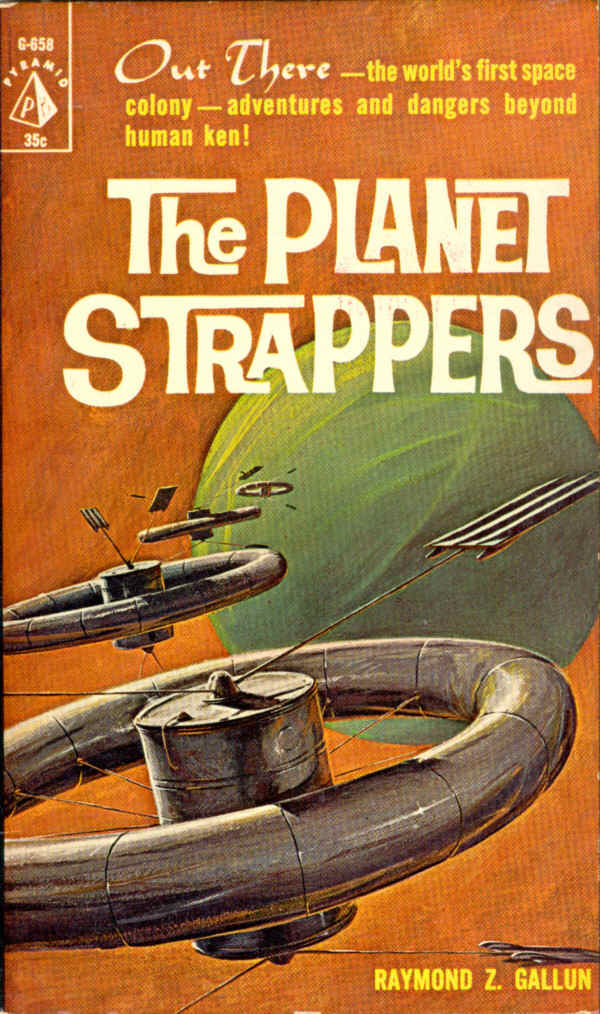
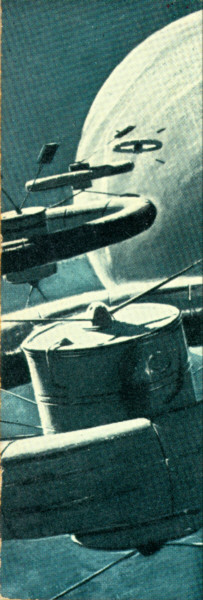
from the air-flasks to a firm and beautiful circle, attaching the
rigging, the fine, radial spokewires—for which the blastoff
drum itself now formed the hub. To the latter he now attached
his full-size, sun-powered ionic motor. Then he crept
through the double sealing flaps of the airlock, to install the
air-restorer and the moisture-reclaimer in the circular, tunnel-like
interior that would now be his habitation.
He wasn't racing anything except time, but he had worked
as fast as he could. Still, Gimp Hines had finished rigging his
bubb, minutes ahead of Frank, or anybody else. On second
thought, maybe this was natural enough. Here, where there
was no weight, his useless leg made no difference—as the
space-fitness examiners must have known. Besides, Gimp had
talented fingers and a keen mechanical sense, and had always
tried harder than anybody.
Ramos was almost as quick. Frank wasn't much farther behind.
The Kuzaks were likewise doing all right. Two-and-Two
was trailing some, but not very badly.
"Spin 'em!" Gimp shouted. "Don't forget to spin 'em for
centrifuge-gravity and stability!"
And so they did, each gripping the rigging at their bubb
rims, and using the minute but accumulative thrust of the
shoulder ionics of their Archers, to provide the push. The inflated
rings turned like wheels with perfect bearings. In the
all but frictionless void, they could go on turning for decades,
without additional impetus.
"We've made it—we're Out Here—we're all right!" Ramos
was shouting with a fierce exultation.
"Shut up, Ramos!" Frank Nelsen yelled back. "Don't ever
say that, too soon. Look around you!"
Storey and Reynolds were still struggling with their bubbs.
They had been delayed by trying to quiet Dave Lester, who
now floated in a drugged stupor, lashed to his blastoff drum.
Slowly, pushed by their shoulder ionics, Gimp, Ramos and
Frank Nelsen drifted over to see what they could do for
Lester.
He was vaguely conscious, his eyes were glassy, his mouth
drooled watery vomit.
"What do you want us to do, Les?" Frank asked gently.
"We could put you back in one of the rockets. You'd be
brought back to the spaceport, when they are guided back by
remote control."
"I don't know!" Lester wailed in a hoarse voice. "Fellas—I
don't know! A little falling is all right... But it goes on all
the time. I can't stand it! But if I'm sent back—I can't ever
live with myself!..."
Frank felt the intense anguish of trying to decide somebody
p. 47
else's quandary that might be a life or death matter which
would surely involve them all. Damn, weak-kneed kid! How
had he ever gotten so far?
"We should have set up his bubb first, put him inside, and
spun it to kill that sense of fall!" Gimp said. "We'll do it, now!
He should be all right. He did pass his space-fitness tests, and
the experts ought to know."
With the three of them at it, and with the Kuzaks joining
them in a moment, the job was quickly finished.
Meanwhile, the sharp, commanding voice of Ground Control
sounded in their phones, again: "GOs-11 and -12 returning
to port. Is all in order among delivered passengers? Sound
out if true. Baines, George?..."
David Lester's name was called just before Frank Nelsen's,
and he managed to say, "In order!" almost firmly, creating a
damnable illusion, Frank thought. But for a moment, mixed
with his anger, Frank felt a strange, almost paternal gentleness,
too.
At the end of the roll call, the doors of the GO rockets
closed. Stubby wings, useful for the ticklish operation of skip-glide
deceleration and re-entry into the atmosphere, slid out
of their sheaths. Little, lateral jets turned the vehicles around.
Their main engines flamed lightly; losing speed, they dipped
in their paths, beginning to fall.
Watching the rockets leave created a tingling sense of being
left all alone, at an empty, breathless height from which you
could never get down—a height full of dazzling, unnatural
sunshine, that in moments would become the dreadful darkness
of Earth's shadow.
"Hey—our spare drum—it'll drift off!" Ramos shouted.
The Kuzaks dived to retrieve the cylinder. Others followed.
But there was a peculiar circumstance. The friction cover at
one of its ends hung open. There was a trailing wisp of stellene—part
of the bubb packed inside—and a thin, angry face
with rather hysterical eyes, within the helmet of an Archer
Five.
"Shhh—it ain't safe for me to come out yet," Glen Tiflin
hissed threateningly. "Damn you all—if you dare queer
me...!"
"Cripes—another Jonah!" Charlie Reynolds growled.
Frank Nelsen looked at the Kuzaks, floating near.
"Well—what could we do?" Joe Kuzak, the gentler twin,
whispered. "He came back to Jarviston, to our rooming house,
one night. We promised to help him a little. What are you going
to do with a character nuts enough about space to armor
up and stuff himself inside a blastoff drum? Of course he
didn't come that way from home. There's that electronic check
p. 48
of drum contents at the gate of the port. But he was there on
a visitor's pass, waiting—having hitchhiked all the way to here.
After the electronic check, he figured on stowing away, while
the drums were waiting to be loaded. The only thing we did
to help was to take a little of the stuff out of the spare drum
and stow it in our two drums, to leave him some room. We
thought sure he'd be caught, quick. But you can see how he
got away with it. Those U.S.S.F. boys at the port don't really
give a damn who gets Out Here."
"Okay—I'll buy it," Reynolds sighed heavily. "Good luck
with the stunt, Tif."
Tiflin only gave him a poisonous glare, as the nine fragile,
gleaming rings, the drifting men and the spare drum, orbited
on into the Earth's shadow, not nearly as dark as it might have
been because the Moon was brilliant.
"We'd better rig the parabolic mirrors of the ionics to catch
the first sunshine in about forty minutes, so we can start moving
out of orbit," Ramos said. "We'll have to think of food,
sometime, too."
"Food, yet—ugh!" Art Kuzak grunted.
Frank felt the fingers of spasm taking hold of his stomach.
Most everybody was getting fall-sick, now, their insides not
finding any up or down direction. But the guys wavered back
to their bubbs. The shoulder ionics of their Archers, though
normally sun-energized, could draw power from the small nuclear
batteries of the armor during the rare moments when
there could be darkness anywhere in solar space.
The Planet Strappers stood in the rigging of their fragile
vehicles, setting the full-sized ionics to produce increased acceleration
which would gradually push the craft beyond orbit.
Joe Kuzak ran a steel wire from a pivot bolt at the hub of his
ring, to tow Tiflin and his drum.
Then everybody crawled into their respective bubbs, most
of them needing the centrifugal gravity to help straighten out
their fall-sickness.
"My neck is swelling, too," Frank Nelsen heard Charlie
Reynolds say. "Lymphatic glands sometimes bog down in the
absence of weight. Don't worry if it happens to some of you.
We know that it straightens out."
For a few minutes it seemed that they had a small respite
in their struggle for adjustment to a fantastic environment.
"Well—I got cleaned up, some—that's better," Two-and-Two
said. "But look at the fuzzy lights down on Earth. Hell, is
it right for a fella to be looking down on the lights of Paris,
Moscow, Cairo, and Rangoon—when he hasn't ever been any
farther than Minneapolis?" Two-and-Two sounded fabulously
befuddled.
p. 49
David Lester started screaming again. They had left him
alone and apparently unconscious, inside his ring, because all
ionics, including his, had had to be set. Then, in the pressure
of events, they had almost forgotten him.
"I'll go look," Frank Nelsen said.
Mitch Storey was there ahead of him. Mitch's helmet was
off; his dark face was all planes and hollows in the moonlight
coming through the thin, transparent walls of the vehicle.
"Should we call the U.S.S.F. patrol, Frank?" he asked anxiously.
"Have them take him off? 'Cause he sure can't stand
another devil-killer."
"We'd better," Frank answered quickly.
But now Tiflin, having deserted his blastoff drum, was coming
through the airlock flaps, too. He stepped forward gingerly,
along the spinning, ring-shaped tunnel.
"Poor bookworm," he growled in a tone curiously soft for
Glen Tiflin. "Think I don't understand how it is? And how do
you know if he wants to get sent back?"
Mitch had removed Lester's helmet, too. Tiflin knelt. His
arm moved with savage quickness. There was the crack of
knuckles, in a rubberized steel-fabric space glove, against Lester's
jaw. His hysterical eyes glazed and closed; his face relaxed.
For a second of intolerable fury, Frank wanted to tear
Tiflin apart.
But Mitch half-grinned. "That might be an answer," he said.
They plopped where they were, and tried to rest until the
orbiting cluster of rings emerged from Earth's shadow into
blazing sunshine, again. Then Mitch and Frank returned to
their own bubbs to check on the acceleration.
It was soon plain that Joe Kuzak's bubb, towing Tiflin's
drum, would lag.
"Hell!" Art Kuzak snapped. "Get that character out here
to help us inflate and rig his own equipment! We did enough
for him! So if the Force notices that there are ten bubbs instead
of nine, the extra is still just our spare... Hey—Tiflin!"
"Nuts—I'm looking after Pantywaist," Tiflin growled back.
"Awright," Art returned. "So we just cast your junk adrift!
Come on, boy!" There was no kidding in the dry tone.
Tiflin snarled but obeyed.
Ions jetting from the Earthward hub-ends of the rotating
rings, yielded their steady few pounds of thrust. The gradual
outward spiral began.
"Cripes—I'm not sure I can even astrogate to the Moon,"
Two-and-Two was heard to complain.
"I'll check your ionic setting for you, Two-and-Two," Gimp
answered him. "After that the acceleration should continue
p. 50
properly without much attention. So how about you and me
taking first watch, while the others ease off a little...?"
Frank Nelsen crept carefully back into his own rotating
ring, still half afraid that an armored knee or elbow might go
right through the thin, yielding stellene. Prone, and with his
helmet still sealed, he slipped into the fog which the tranquilizer
now induced in his brain, while the universe of stars,
Moon, sun and Earth tumbled regularly around him.
He dreamed of yelling in endless fall, and of climbing over
metal-veined chunks of a broken world, where once there had
been air, sea, desert and forest, and minds not unlike those of
men, but in bodies that were far different. Gurgling thickly,
he awoke, and snapped on his helmet phone to kill the utter
silence.
Someone muttered a prayer in a foreign tongue:
"... Nuestra Dama de Guadalupe—te pido, por favor...
Tengo miedo—I'm scared... Pero pienso mas en ella—I
think more of her. Mi chula, mi linda... My beautiful Eileen...
Keep her—"
The prayer broke off, as if a switch was turned. It had been
brash Ramos... Now there were only some fragments of
harmonica music...
Frank slipped into the blur, again, awakening at last with
Two-and-Two shaking his shoulder. "Hey, Frankie—we're five
hours out, by the chronometers—look how small the Earth
has got...! We're all gonna have brunch in Ramos' vehicle...
Know what that goof ball Mex was doing, before?
Stripped down to his shorts, and with the spin stopped for
zero-G, he was bouncing back and forth from wall to wall inside
his bubb! The sun makes it nice and warm in there. Think
I might try it, myself, sometime. Shucks, I feel pretty good,
now... Frankie, ain't you hungry?"
Frank felt limp as a rag, but he felt much better than before,
and he could stand some nourishment. "Lead on, Two-and-Two,"
he said.
Ramos' bubb was spinning once more, but he was wearing
just dungarees. The Bunch—the Planet Strappers—with only
their helmets off, were crouched, evenly spaced, around the
circular interior of the ring. Dave Lester was there, too—staring,
but fairly calm, now. In this curious place, there was
a delicious and improbable aroma of coffee—cooked by mirror-reflected
sunlight on a tiny solar stove.
"So that's the way it goes," Charlie Reynolds commented
profoundly. "We reach out for strangeness. Then we try to
make it as familiar as home."
"Stew, warmed in the cans, too," Ramos declared. "Enough
for a light one-time-around. I brought the stew along. Hope
p. 51
you birds remember. Then we're back on dehydrates. Hell,
except for that weight problem and consequent cost of stuff
from Earth, we'd have it made, Out Here. The Big Vacuum
ain't so tough—no storms in it, even, to tear our bubbs apart.
I guess we won't ever have a bigger adventure than finding
out for ourselves that we can get along with space."
"If we had a beef roast, we'd put it in a sealed container of
clear plastic," Gimp laughed. "Set it turning, outside the
bubb, on a swiveled tether wire. It would rotate for hours like
on a spit—almost no friction. Rig some mirrors to concentrate
the sun's heat. Space Force men do things like that."
"Shut up—I'm getting hong-gry!" Art Kuzak roared.
Ramos poured the coffee in the thin magnesium cups that
each of the Bunch had brought. Their squeeze bottles, for
zero-G drinking, were not necessary, here. Their skimpy portions
of stew were spooned on magnesium plates. Knife and
fork combinations were brought out. An apple purée which
had been powder, followed the stew. Brunch was soon over.
"That's all for now, folks," Ramos said ruefully.
Tiflin snaked a cigarette out from inside the collar of his
Archer.
"Hey!" Reynolds said mildly. "Oxygen, remember? Shouldn't
you ask our host, first?"
Ramos had eased up on ribbing Tiflin months ago. "It's
okay," he said. "The air-restorers are new."
But Tiflin's explosive nerves, under strain for a long time,
didn't take it. He threw down the unlighted fag. He snicked
his switch blade from a thigh pocket. For an instant it seemed
that he would attack Reynolds. Then the knife flew, and
penetrated the thin, taut wall, to its handle. There was a
frightening hiss, until the sealing gum between the double
layers, cut off the leak.
The Kuzaks had Tiflin helpless and snarling, at once.
"Get a patch, somebody—fix up the hole," Joe, the mild
one, growled. "Tiflin—me and my brother helped you. Now
we're gonna sit on you—just to make sure your funny business
doesn't kill us all. Try anything just once, and we'll feed
you all that vacuum—without an Archer. If you're a good boy,
maybe you'll live to get dumped on the Moon as we pass by."
"Nuts—let's give this sick rat to the Space Force right
now." Art Kuzak hissed. "Here comes their patrol bubb."
The glinting, transparent ring with the barred white star
was passing at a distance.
"All is well with you novices?" The enquiring voice was a
gruff drawl, mingled with crunching sounds of eating—perhaps
a candy bar.
"No!" Tiflin whispered, pleading. "I'll watch myself!"
p. 52
The United Nations patrol was out, too, farther off. Another,
darker bubb, with other markings, passed by, quite
close. It had foreign lines, more than a bit sinister to the
Bunch's first, startled view. It was a Tovie vehicle, representing
the other side of the still—for the most part—passively opposed
forces, on Earth, and far beyond. But through the
darkened transparency of stellene, the armored figures—again
somewhat sinister—only raised their hands in greeting.
In a minute, Frank Nelsen emerged from Ramos' ring.
Floating free, he stabilized himself, fussed with the radio
antenna of his helmet-phone for a moment, making its transmission
and reception directional. On the misty, shrinking
Earth, North America was visible.
"Frank Nelsen to Paul Hendricks," he said. "Frank Nelsen
to Paul Hendricks..."
Paul was waiting, all right. "Hello, Frankie. Some of the
guys talked already—said you were asleep."
"Hi, Paul—yeah! Terra still looks big and beautiful. We're
okay. Amazing, isn't it, how just a few watts of power, beamed
out in a thin thread, will reach this far, and lots farther?
Hey—will you open and shut your front door? Let's hear the
old customer's bell jingle... Best to you, to J. John, to Nance
Codiss, Miss Parks—everybody..."
The squeak of hinges and the jingling came through, clear
and nostalgically.
"Come on, Frank," Two-and-Two urged. "Other guys would
like to talk to Paul... Hey, Paul—maybe you could get my
folks down to the store to say hello to me on your transmitter.
And I guess Les would appreciate it if you got his mother..."
When the talk got private, Frank went to Mitch Storey's
bubb.
"I wanted to show you," Mitch said. "I brought seeds, and
these little plastic tubes with holes in them, that you can string
around inside a bubb. The weight is next to nothing. Put the
seeds in the tubes, and water with plant food in solution. The
plants come up through the holes. Hydroponics. Gotta almost
do it, if I'm going way out to Mars without much supplies.
Maybe, before I get there, I'll have even ripe tomatoes! 'Cause,
with sun all the time, the stuff grows like fury, they say. I'll
have string beans and onions and flowers, anyhow! Helps keep
the air oxygen-fresh, too. Wish I had a few bumble bees!
'Cause now I'll have to pollenate by hand..."
Nope—Mitch couldn't get away from vegetation, even in
space.
The Planet Strappers soon established a routine for their
journey out as far as the Moon. There were watches, to be
sure that none of the bubbs veered, while somebody was asleep
p. 53
or inattentive. Always at hand were loaded rifles, because you
never knew what kind of space-soured men—who might once
have been as tame as neighbors going for a drive on Sundays
with their families—might be around, even here.
Neither Kuzak slept, if the other wasn't awake. They were
watching Tiflin, whose bubb rode a little ahead of the others.
He was ostracized, more or less.
Everybody took to Ramos' kind of exercise, bouncing
around inside a bubb—even Lester, who was calmer, now,
but obviously strained by the vast novelty and uncertainty
ahead.
"I gave you guys a hard time—I'm sorry," he apologized.
"But I hope there won't be any more of that. The Bunch will
be breaking up, soon, I guess—going here and there. And if
I get a job at Serenitatis Base, I think I'll be okay."
Frank Nelsen hoped that he could escape any further part
of Lester, but he wasn't sure that he had the guts to desert
him.
It wasn't long before the ionics were shut off. Enough
velocity had been attained. Soon, the thrust would be needed
in reverse, for braking action, near the end of the sixty hour
journey into a circumlunar orbit.
Sleep was a fitful, dream-haunted thing. Food was now
mostly a kind of gruel, rich in starches, proteins, fats and
vitamins—each meal differently flavored, up to the number of
ten flavors, in a manufacturer's attempt to mask the sameness.
Add water to a powder—heat and eat. The spaceman's usual
diet, while afield...
One of the functions of the moisture-reclaimers was a rough
joke, or a squeamishness. A man's kidneys and bowels functioned,
and precious water molecules couldn't be wasted, here
in the dehydrated emptiness. But what difference did it really
make, after the sanitary distillation of a reclaimer? Accept,
adjust...
Decision about employment or activity in the immediate
future, was one thing that couldn't be dismissed. And announcements,
beamed from the Moon, emphasized it:
"Serenitatis Base, seventeenth month-day, sixteenth hour.
(There was a chime) Lunar Projects Placement is here to serve
you. Plastics-chemists, hydroponics specialists, machinists,
mechanics, metallurgists, miners, helpers—all are urgently
needed. The tax-free pay will startle you. Free subsistence and
quarters. Here at Serene, at Tycho Station or at a dozen other
expanding sites..."
Charlie Reynolds sat with Frank Nelsen while he listened.
"The lady has a swell voice," said Charlie. "Otherwise, it
sounds good, too. But I'm one that's going farther. To Venus—just
p. 54
being explored. All fresh, and no man-made booby traps,
at least. Maybe they'll even figure out a way to make it rotate
faster, give it a reasonably short day, and a breathable atmosphere—make
a warmer second Earth out of it... Sometimes,
when you jump farther, you jump over a lot of trouble.
Better than going slow, with the faint-hearts. Their muddling
misfortunes begin to stick to you. I'd rather be Mitch, headed
for heebie-jeebie Mars, or the Kuzaks, aiming for the crazy
Asteroid Belt."
That was Charlie, talking to him—Frank Nelsen—like an
older brother. It made a sharp doubt in him, again. But then
he grinned.
"Maybe I am a slow starter," he said. "The Moon is near
and humble, but some say it's good training—even harsher
than space. And I don't want to bypass and miss anything.
Oh, hell, Charlie—I'll get farther, soon, too! But I really don't
even know what I'll do, yet. Got to wait and see how the cards
fall..."
Several hours before the rest of the Bunch curved into a
slow orbit a thousand miles above the Moon, Glen Tiflin set
the ionic of his bubb for full acceleration, and arced away,
outward, perhaps toward the Belt.
"So long, all you dumb slobs!" his voice hissed in their
helmet-phones. "Now I get really lost! If you ever cross my
path again, watch your heads..."
Art Kuzak's flare of anger died. "Good riddance," he
breathed. "How long will he last, alone? Without a space-fitness
card, the poor idiot probably imagines himself a big, dangerous
renegade, already."
Joe Kuzak's answering tone almost had a shrug in it. "Don't
jinx our luck, twin brother," he said. "For that matter, how
long will we last...? Mex, did you toss Tiflin back his shiv?"
"A couple of hours ago," Ramos answered mildly.
Everybody was looking down at the Moon, whose crater-pocked
ugliness and beauty was sparsely dotted with the blue
spots of stellene domes, many of them housing embryo enterprises
that were trying to beat the blastoff cost of necessities
brought from Earth, and to supply spacemen and colonists
with their needs, cheaply.
The nine fragile rings were soon in orbit. One worker-recruiting
rocket and several trader-rockets—much less powerful
than those needed to achieve orbit around Earth—because
lunar gravity was only one-sixth of the terrestrial—were
floating in their midst. On the Moon it had of course been
known that a fresh Bunch was on the way. Even telescopes
could have spotted them farther off than the distance of their
240,000 mile leap.
p. 55
Frank Nelsen's tongue tasted of brassy doubt. He didn't
know where he'd be, or what luck, good or bad, he might
run into, within the next hour.
The Kuzaks were palavering with the occupants of two
heavily-loaded trader rockets. "Sure we'll buy—if the price is
right," Art was saying. "Flasks of water and oxygen, medicines,
rolls of stellene. Spare parts for Archies, ionics, air-restorers.
Food, clothes—anything we can sell, ourselves..."
The Kuzaks must have at least a few thousand dollars,
which they had probably managed to borrow when they had
gone home to Pennsylvania to say goodbye.
Out here, free of the grip of any large sphere, there was
hardly a limit to the load which their ionics could eventually
accelerate sufficiently to travel tremendous distances. Streamlining,
in the vacuum, of course wasn't necessary, either.
Now a small, sharp-featured man in an Archie, drifted close
to Ramos and Frank, as they floated near their bubbs. "Hello,
Ramos, hello, Nelsen," he said. "Yes—we know your names.
We investigate, beforehand, down on terra firma. We even
have people to snap photographs—often you don't even notice.
We like guys with talent who get out here by their own efforts.
Shows they got guts—seriousness! But now you've arrived.
We are Lunar Projects Placement. We need mechanics, process
technicians, administrative personnel—anything you can name,
almost. Any bright lad with drive enough to learn fast, suits
us fine. Five hundred bucks an Earth-week, to start, meals
and lodging thrown in. Quit any time you want. Plenty of different
working sites. Mines, refineries, factories, construction..."
"Serenitatis Base?" Ramos asked almost too quickly, Frank
thought. And he sounded curiously serious. Was this the Ramos
who should be going a lot farther than the Moon, anyway?
"Hell, yes, fella!" said the job scout.
"Then I'll sign."
"Excellent... You, too, guy?" The scout was looking at
Frank. "And your other friends?"
"I'm thinking about it," Frank answered cagily. "Some of
them aren't stopping on the Moon, as you can see."
Mitch Storey was lashing a few flasks of oxygen and water
to the rim of his bubb, being careful to space them evenly
for static balance. He didn't have the money to buy much
more, even here.
The Kuzaks were preparing two huge bundles of supplies,
which they intended to tow. Reynolds was also loading up a
few things, with Two-and-Two helping him.
"I'm all set, Frank!" Two-and-Two shouted. "I'm going
p. 56
along with Charlie, maybe to crash the Venus exploration
party!"
"Good!" Frank shouted back, glad that this large, unsure
person had found himself a leader.
Now he looked at Gimp Hines, riding the spinning rim of
his ring with his good and bad leg dangling, an expectant,
quizzical, half-worried look on his freckled face.
But Dave Lester was more pathetic. He had stopped the
rotation of his bubb. He looked down first at the pitted, jagged
face of the Moon, with an expression in which rapture and
terror may have been mingled, glanced with the hope of
desperation toward the job scout, and then distractedly continued
dismantling the rigging of his vehicle, as if to repack
it in the blastoff drum for a landing.
"Hey—hold on, Les!" Two-and-Two shouted. "You gotta
know where you're going, first!"
"Make up your mind, Nelsen," said the job scout, getting
impatient. "We handle just about everything lunar—except
in the Tovie areas. Without us, you're just a lost, fresh punk!"
But another man had approached from another lunar GO
rocket, which had just appeared. He had a thin intellectual
face, dark eyes, trap mouth, white hair, soft speech that was
almost shy.
"I'm Xavier Rodan," he said. "I search out my own employees.
I do minerals survey—for gypsum, bauxite—anything.
And site survey, for factories and other future developments.
I also have connections with the Selenographic Institute of the
University of Chicago. It is all interesting work, but in a rather
remote region, I'm afraid—the far side of the Moon. And I
can pay only three hundred a week. Of course you can resign
whenever you wish. Perhaps you'd be interested—Mr. Nelsen,
is it?"
Frank had an impulse to jump at the chance—though there
was a warning coming to him from somewhere. But how
could you ever know? You would always have to go down
to that devils' wilderness to find out.
"I'll try it, Mr. Rodan," he said.
"Selenography—that's one of my favorite subjects, sir!"
David Lester burst out, making a gingerly leap across the horrible
void of spherical sky—stars in all directions except where
the Moon's bulk hung. "Could I—too?" His trembling mouth
looked desperate.
"Very well, boy," Rodan said at last. "A hundred dollars
for a week's work period."
Frank was glad that Lester had a place to go—and furious
that he would probably have to nursemaid him, after all.
Gimp Hines kept riding the rim of his ring like a merry-go-round,
p. 57
his face trying to show casual humor and indifference
over ruefulness and scare. "Nobody wants me," he said cheerfully.
"It's just prejudice and poor imagination. Well—I don't
think I'll even try to prove how good I am. Of course I could
shoot for the asteroids. But I'd like to look around Serenitatis
Base—some, anyway. Will fifty bucks get me and my rig
down?"
"Talk to our pilot, Lame Fella," said the job scout. "But
you must be suicidal nuts to be around here at all."
The others leapt to help Nelsen, Ramos, Gimp and Lester
strip and pack their gear. Ramos' and Gimp's drums were
loaded into the job scout's rocket. Nelsen's and Lester's went
into Rodan's.
Gloved hands clasped gloved hands all around. The Bunch,
the Planet Strappers, were breaking up.
"So long, you characters—see you around," said Art Kuzak.
"It won't be ten years, before you all wind up in the Belt."
"Bring back the Mystery of Mars, Mitch!" Frank was saying.
"When you get finished Mooning, come to Venus, Lover
Lad," Reynolds told Ramos. "But good luck!"
"Jeez—I'm gonna get sentimental," Two-and-Two moaned.
"Luck everybody. Come on, Charlie—let's roll! I don't want
to slobber!"
"I'll catch up with you all—watch!" Gimp promised.
"So long, Frank..."
"Yeah—over the Milky Way, Frankie!"
"Hasta luego, Gang." This was all Ramos, the big mouth,
had to say. He wasn't glum, exactly. But he was sort of preoccupied
and impatient.
The five remaining rings—a wonderful sight, Frank thought—began
to move out of orbit. Ships with sails set for far ports.
No—mere ships of the sea were nothing, anymore. But would
all of the Bunch survive?
Charlie Reynolds, the cool one, the most likely to succeed,
waved jauntily and carelessly from his rotating, accelerating
ring. Two-and-Two wagged both arms stiffly from his.
Mitch Storey's bubb, lightest loaded, was jumping ahead.
But you could hear him playing Old Man River on his mouth
organ, inside his helmet.
The Kuzaks' bubbs, towing massive loads, were accelerating
slowest, with the ex-gridiron twins riding the rigging. But their
rings would dwindle to star specks before long, too.
The job scout's rocket, carrying Ramos and Gimp, began
to flame for a landing at Serene.
In the airtight cabin of Xavier Rodan's vehicle, Frank
p. 58
Nelsen and David Lester had read and signed their contracts
and had received their copies.
Rodan didn't smile. "Now we'll go down and have a look
at the place I'm investigating," he said.