For several hours after she was seized and bound by Tholto's men Vernia
lay with Rotha in darkness in the bottom of the boat. She could not see
the members of the crew on either side, though she heard the rhythmic
strokes of the paddles and caught scraps of the conversation.
Tholto acted as helmsman, holding his torch aloft with one hand while
he swung the tiller with the other. From time to time she caught the
glint of torchlight as he stooped to issue hoarse commands.
It was by sheer good luck that they happened on the channel which led
them around the column of falling water, for in the dim light it is
probable that the helmsman would not have seen it and reversed the boat
in time to avoid it. Vernia, of course, knew nothing of the danger they
had so narrowly escaped, though she heard the distant roar and wondered
what caused it.
Several hours after they passed the falls the interior of the boat was
suddenly illuminated by daylight streaming through the front and rear
entrance holes. After another hour of paddling Tholto placed one of his
men at the helm and, untying the bonds of the two girls, put food and
water before them.
He watched them silently while they drank; neither ate anything; then
tied them once more and resumed his place on deck. The man who had
acted as steersman distributed food and water to the others at their
posts, half of the men paddling while the other half ate and drank.
Some time later—Vernia judged it to be about mid-day—the boat lurched
violently, then settled down to a familiar, rolling motion that vividly
reminded her of her trip with Grandon in the fragile toadstool craft on
the treacherous Azpok Ocean.
The two girls conversed in whispers, speculating on the fate that was
in store for them and wondering if Grandon and Oro had learned of their
abduction. At length both became violently ill from the tossing of the
craft and lapsed into silence.
Toward evening Tholto ordered half of the men on deck while the others
redoubled their efforts at the paddles. In a few moments the keel
grated sharply on gravel and the lurching ceased. Tholto threw Vernia
over his shoulder as if she had been a sack of sabit food and carried
her up on the bank while another of the men followed with Rotha.
The crew speedily unloaded all provisions and supplies, then dragged
the lightened craft high on the bank. A fire was started in the lee of
the rocky cliffs, and two of the men who had gone in search of meat
returned with a large pink lizard which was cut up and roasted over the
flames.
The cliff behind them was honey-combed with natural caves. Tholto chose
the largest and best situated of these for himself; the next best for
his men.
While the evening meal was being prepared moss was gathered for couches
by some, while others went in search of roots to make Zarovian wine. A
large supply of the latter was secured and placed in a food sack with
water which was brought to a boil by the primitive method of dropping
hot stones in it.
When the men had eaten their fill Tholto undid the bonds of both girls
and ordered them to serve the kova. For cups they were provided with
the shells of large bivalves. Rotha complied meekly, but Vernia refused
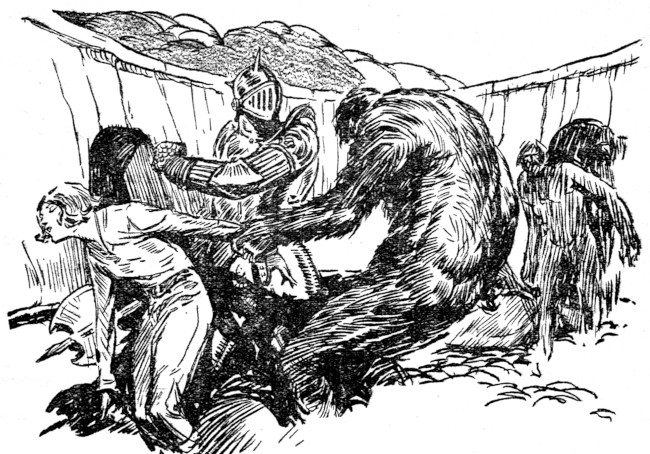
with flashing eyes, whereupon Tholto seized her wrists and twisted them
cruelly.
"You are my woman," he growled. "Do my bidding, and do it quickly, or
you will be punished. I would not hurt that beautiful body of yours,
but you must learn now to obey."
There was a blazing fire in her glance as she suddenly wrenched her
arms free.
"Your woman indeed! I should much prefer to mate with a monkey-man."
Tholto laughed sneeringly.
"I will tame you. Your lessons will start to-night."
Binding her hands and feet once more, despite her struggles, he carried
her into the dark cave and threw her on the floor.
"Now lie there and reflect on the folly of resistance. Much good wine
is being consumed, and I would not miss it. I will return presently,
and if you so much as utter a whisper of protest you will learn why
strong men fear the wrath of Tholto."
Many of the marsh-men had not tasted liquor for years, each man's
abstinence dating from the time he had been captured by sabits. Small
wonder, then, that they called for more and more until Rotha, exhausted
by running from one to the other with the brimming shells, sipped a
small quantity herself to stimulate her flagging muscles. The effects
of the wine were very strong. The men were first mildly stimulated,
then exhilarated, and finally stupefied.
Tholto might have drunk to excess with the rest, had not other
pleasures beckoned. As it was, he took only enough to intoxicate him
slightly, then, with the bestiality of his savage nature aroused to the
uttermost by what he had drunk, walked unsteadily into the cave where
he had left Vernia bound and helpless.
Grandon was momentarily bewildered by the sudden attack of the
monster that dragged him beneath the black water, but the instinct of
self-preservation came to the rescue even before reason made him aware
of what had happened. His left arm was pinned to his body in the grip
of powerful jaws that would have cut him in two had it not been for his
armor, but the right arm was free; and drawing his sword, he plunged it
again and again into the leathery throat.
He held his breath until it seemed that his lungs would burst, but the
pressure of those jaws did not relax, and he prayed that his blade
might find a vital spot before it was too late.
To his surprise, the water suddenly drained from his helmet and he
tasted air. It was dank, foul air, charged with the offensive odor of
putrefied flesh, but at that moment as welcome to his bursting lungs as
a balmy, sweet-scented zephyr from a fern forest.
The monster ground its teeth ineffectually against Grandon's armor for
a moment, then dropped him on a slimy floor and, putting its huge claw
on his chest, gave vent to a horrible, gurgling roar. He was convinced
that the beast weighed at least a ton, and gave silent thanks to the
skillful armorer who had fashioned that strong breastplate.
The creature continued its disconsolate roaring, which was intensified
a hundredfold by ringing, cavernous echoes, and Grandon noticed that
with each roar the gurgling sound seemed more pronounced and the vocal
tones grew weaker. Slowly the weight on his chest relaxed—slowly the
creature sunk over on its side.
With a quick jerk he rolled from under the mighty claw in time to avoid
the convulsive death struggles of the monster. His sword had not drunk
blood in vain.
Taking his small flash light from its pouch, Grandon surveyed the scene
about him. The reptile lay on its back, its great clutching feet moving
slightly. A thick stream of blue-black blood spurted from a score of
wounds on its neck. The source of the sickening odor was a number of
partly devoured bodies of the lesser reptilians and something which,
horror of horrors, looked like a human foot and shinbone, though the
toes were long, webbed, and armed with sharp claws.
The lair of the great sightless carnivore was an arched cavern which
ended at the water's edge in front of him and appeared to connect with
a series of other caverns behind. As it was impossible for him to
return under water the way he had come, Grandon turned his footsteps
toward the caverns in the rear, hoping that they might open into the
upper passageways where he would have a possible chance of rejoining
his men.
As he journeyed on and on through that intricate maze of dark, damp,
dismal caves, it seemed that they only led him deeper into the bowels
of the earth. Moisture dripped constantly from a thousand pendent,
crystalline points overhead, forming little puddles and tiny streamlets
in the hollows and crevices of the uneven floor. Presently, however,
the floor slanted upward, the dripping ceased, and the puddles
disappeared. His hopes rose.
Quite suddenly and unexpectedly he emerged on the bank of a large
stream. It looked like the one in which he had been plunged some
time before, but he could not be certain, for the surroundings were
different from any he had seen.
What was that? Could it be that he saw a human being moving slowly
along the bank, apparently plucking and eating small fungus growths?
And there, farther on, was another, and yet another, until only a short
distance from where he stood the bank literally swarmed with them. What
could it mean? Did a race of men or anthropoid apes inhabit this region
of eternal darkness?
The creatures paid no attention whatever to his flash light. He turned
it directly on the one nearest him and gasped in amazement. It was
manlike in form, but what a horrible, misshapen, unbelievably grotesque
caricature of the genus homo! It had long, bony, webbed fingers and
toes armed with sharp claws. The smooth, hairless skin was a mottled
silver gray in color, like that of a mackerel. But the face—Grandon
was positive he had never seen anything so hideous in all his Zarovian
wanderings.
It consisted, in front, of a broad, flat nose, and a mouth filled with
huge ratlike teeth, and was minus chin, eyes or forehead. The hairless
pate slanted straight back from the root of the nose and up from the
base of the neck, ending in a conical point at the back. The ears were
human in form, but easily four times as large as the aural appendages
of any man Grandon had ever seen, and the creature kept them constantly
in motion, presumably for the purpose of guarding against prowling
enemies, or locating prey which it obviously could not see.
A stealthy sound behind him caused Grandon to wheel suddenly. There,
not three feet from him, stood a creature similar to the one he had
been watching. It sniffed the air in his direction for a moment with
ears cocked sharply forward, then raised its head and uttered a long,
mournful, wailing shriek.
Before he could sense the import of that cry he was surrounded by a
chattering, excited group of creatures, seemingly materialized from the
darkness around him. Thinking he was about to be attacked, Grandon drew
his sword and awaited the first act of hostility from that narrowing
circle.
To his surprise, they made no move to attack him, but seemed only
curious. One, a trifle bolder than the rest, reached out long bony
fingers and touched his armor, then made a queer, cackling noise. It
reminded him of a sound he had once heard when a boy: a sound which had
haunted his dreams for years afterward—the terrible, mirthless laugh
of an idiot. Others, emboldened by the successful experiment of their
comrade, pawed him over in turn, while the caverns rang with the echoes
of their horrid cackling.
Grandon grew, tired of being man-handled, and attempted to push the
things away from him with outstretched arms. They were apparently
harmless, and he had not the heart to use his sword on them. He
learned his mistake too late, for they took this movement as a sign
of hostility, and a dozen of them pounced on him, bearing him to the
floor, where pinned beneath their combined weight, he could scarcely
lift a finger.
Then, above the shrieking and chattering of his captors, he heard the
familiar click of paddles against the metal sides of a boat. A bright
beam of light flashed over him.
"Oro!" he shouted at the top of his voice. "To the rescue, Oro!"
Would they see him or hear his cry? He listened intently, then shouted
again and again. Once more the rays of the searchlight played on the
struggling mass of creatures that swarmed over him. It hung there. A
hoarse command sounded simultaneously with the noise of hollow metal
scraping on stone. Then there was the clank of armored men running,
followed by the sound of blows and unearthly shrieks of anguish. Two
stalwart marsh-men helped Grandon to his feet as the last of his
captors fled off, howling in dismay.
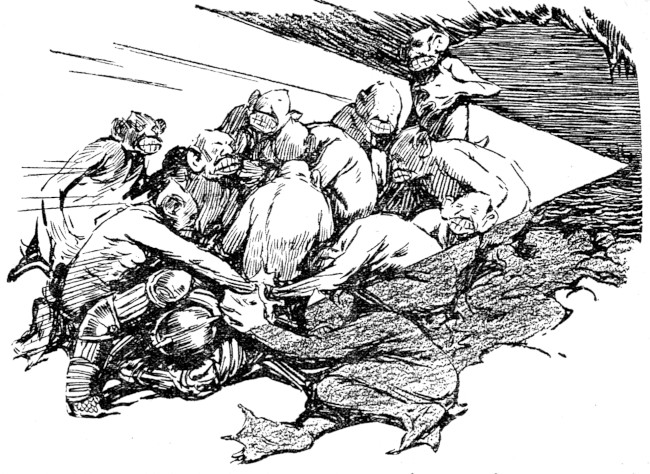
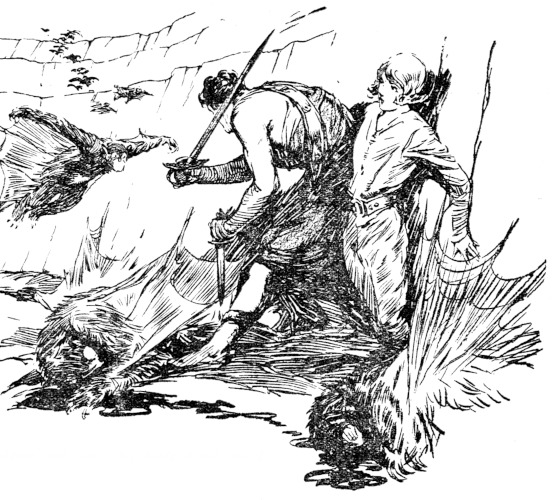
The ray of the searchlight played on the struggling mass of creatures that swarmed over him.
There was a brief but joyous reunion of commander and men on the bank,
which was rudely broken into by a shower of missiles from out the
darkness. Evidently the eyeless beings knew something about throwing
stones, for they were hurled with uncanny accuracy. Nearly every man
in the company was struck, and several were bowled over, though their
armor protected them from serious injury.
Grandon ordered every one aboard, as he had no stomach for useless
slaughter, and felt pity rather than animosity toward the sightless,
feeble-minded creatures that had attacked him. To him they represented,
not an evolution toward a human type, but rather a reversion from it.
In all probability they had sprung from the same prehistoric
anthropomorphous ancestors as man, but as is always the case,
environment had gradually stamped its mark on them during countless
thousands of generations. Because they had lived in Stygian darkness
with no use for eyes, the organs of sight had disappeared. The brain,
the organ of objective reason, was correspondingly dwarfed. Other
peculiar characteristics, such as the webbed feet and hands and the
froglike skin, would be the natural result of living like amphibious
reptiles.
For some time after they pushed away from the shore, stones continued
to rattle against the boat and splash in the water about it, but on
rounding a curve in the stream the shower of missiles ceased and they
saw no more of the strange creatures who hurled them.
An hour later they emerged from beneath a perpendicular cliff into
broad daylight, shot a swift rapids, and proceeded on a beautiful,
sparkling stream, dotted with verdant islets and flanked on either
side by the great salt marshes. He noticed that these marshes, in all
but the spots that were continually above the sea water, had a type of
vegetation peculiarly their own, for the reason that only those plants
and fungi which could withstand the action of salt would grow in them.
The predominant plant was a rank-growing, jointed cane which seemed to
attain a height of about twenty feet at maturity.
The ocean breeze kept the cane brakes constantly in motion, producing
an odd, rattling sound that had a peculiar, depressing effect on
Grandon. It seemed that these weeds were conspiring against him as
other forces had conspired, to keep Vernia from him, bending their
heads together and whispering their fearful secrets in a language
he could not understand. It was a relief when, toward evening, they
reached the ocean coast and landed for a short time to give the men a
chance to stretch their cramped muscles and steep some liquor.
While they built a fire of dried reeds and prepared the roots, Grandon
and Oro explored the coast for some distance southward without finding
any sign of those whom they sought. They accordingly had four of the
men paddle them across the mouth of the river and traversed the coast
line to the north for several miles. Both were hurrying along, looking
for signs of a camp or a cooking fire, when the sharp-eyed Oro suddenly
uttered an exclamation of surprise and ran down to the water's edge.
Lying on the sand where it had been deposited by the breakers was an
empty food sack.
"They came this way in the boat," he exclaimed. "This sack could have
come from nowhere but the valley of the sabits, and there are no tracks
on the shore."
They hurried back to the camp, and, after a hasty meal, embarked
northward. The sudden, inky darkness of moonless Venus descended
before they had gone far, and the wind rose, making coastwise travel
exceedingly difficult. Toward midnight they sighted a flickering light
ahead. On coming closer they saw a large camp fire surrounded by
recumbent figures and, in silhouette, the curved, serpentine prow of an
Albine boat.
After silently beaching their craft a little way from the camp, they
deployed in a semicircle, then charged. To their infinite surprise they
met with no resistance. The twenty sleeping men on the ground about the
fire did not move a muscle, though they had made enough noise to waken
an army.
Oro comprehended the situation at a glance. The sleeping men, the empty
shells and the food sack, half filled with the now luke-warm beverage.
"Too much kova," he said.
"But the girls," asked Grandon, "where are they? And where is Tholto?"
His question was partly answered by the sudden appearance of Rotha from
the entrance of a near-by cave. With a smothered cry of thanksgiving
she flung herself into the strong arms of Oro, who swung her off her
feet in his exuberance of joy.
"Where is Vernia?" Grandon asked her. "Tell me quickly—is she safe?"
Rotha hesitated as if fearful that he would strike her for her answer.
"She is in that cave—with Tholto."
The cave she indicated was a short distance from the one she had just
vacated. Grandon swung his spiked club free and, snatching a blazing
brand from the fire, entered, followed by Oro and several others.
A solitary figure sat, cross-legged in the middle of the floor. It was
Tholto. He waited their coming with bowed head.
"What have you done with her, false friend?" demanded Grandon.
Tholto removed his helmet and cast it to the floor.
"Kill me, Grandon of Terra," he said sadly, in a tone totally unlike
that of Tholto the braggart. "I bare my head to a just executioner. I am
not fit to live."
"Answer my question, accursed slave. Where is our Torrogina?"
"I do not know. I left her here for a short time while I went for a
drink or two of wine. When I returned she was gone. My head was reeling
from the drink when I entered. Many years have passed since I tasted
liquor and I overestimated my capacity. I sank to the floor and dreamed
a horrible dream in which I saw her torn to pieces by a huge animal.
She is dead—dead, and I am the cause."
"The fool is drunk," said Oro. "Pay no attention to his ravings. She is
probably concealed somewhere near by."
After binding Tholto and setting a man to guard him, they searched
the cave, calling loudly to Vernia, but there was no reply. Rotha was
positive that she had not left the cave previous to Tholto's entrance,
as the mouth was only a few steps from the place where she had served
drinks to the men, and she could not have missed seeing her.
Grandon's attention was attracted by a yawning hole about three feet
in diameter, which had previously escaped his observation, as it was
partly concealed by a section of jutting rock. He substituted a torch
for the nearly consumed fire brand and entered on hands and knees
followed by Oro. The opening grew larger as they progressed, until they
could stand erect.
Presently they emerged in the open air. They were in a fern forest, not
more than a hundred feet from the camp, having come completely through
the hill that screened it from the coast.
Oro stooped and, with a muttered exclamation, picked up some strips
which had been torn from a sack and knotted together.
"She came this way," he said, excitedly, "for here are the strips with
which Tholto bound her."
His words were followed by a cry of horror from Grandon which brought
Oro to his side.
"The dream of Tholto," he said, brokenly. "It is a reality. Look!"
On the ground before them was a pool of freshly congealed blood. Beside
it lay a small Albine gauntlet—the gauntlet of Vernia!
As Grandon sorrowfully retraced his steps followed by the horrified
Oro, he pressed the little Albine gauntlet to his lips and a great lump
rose in his throat. Vernia dead! It was unbelievable, yet he had seen
the evidence with his own eyes. He passed through the cave with the
feeling of one walking in a dream, trying to persuade himself that it
was all a fearful nightmare from which he should presently awaken.
With a dazed feeling of unreality he sat down before the fire, obsessed
by horrid visions of a slender young body, mangled and bleeding in the
cruel jaws of some jungle beast. All night long he sat there, staring
at the licking flames, unmindful of what went on around him.
Tholto and his stupefied companions, disarmed and bound by Grandon's
men, lay in a long row under the watchful eyes of four guards. The
others slept, with the exception of Oro, who sat across the fire
with Rotha, replenishing it from time to time. The two conversed in
awed whispers, speculating on the possible fate of the culprits and
wondering what their young commander would do or whither he would lead
them since Vernia was dead.
The dawn found Grandon gazing at a heap of smoking embers. His four
weary guards wakened their slumbering companions and lay down for a
well-earned rest. The stupefied drinkers slept on, oblivious of the
sounds that went on about them, as the awakened men prepared the simple
breakfast of hot roots and stewed mushrooms.
Marsh-men are expert fishermen, and four of them rigged some crude
but efficient tackle by tearing up several food sacks for line, using
thorns for hooks and stones for sinkers. They fished along the shore
only a few yards from the camp and soon had caught more than the entire
company could possibly eat. The fish were boiled in the same manner
as the roots and mushrooms, and made a most pleasing addition to the
morning meal.
When all was ready, Oro fearfully approached his young commander with
a shell of steaming roots, another of mushrooms, and a toothsome fish.
Mechanically, Grandon took the food and tried to eat, but it seemed
that every morsel choked him. He rose unsteadily to his feet, as his
legs were cramped and numb.
As he made his way among the men, some of them cringed as if afraid he
might vent his wrath and disappointment on them. They could not fully
understand the working of a mind which, being furious, discriminated as
to who should suffer. Among their own people an enraged chief was a man
to be shunned, for he would be likely to attack the person nearest him.
Grandon walked straight to where Tholto lay, bound and helpless. He
called two of the men.
"Remove his armor," he said curtly.
The command was obeyed with celerity, while the soldiers crowded around
to see how the culprit was to be punished. All were positive that he
would be tortured to death, as would have been the case had he deserted
a commander among his own people or stolen the affianced of a chief.
"He is going to broil him alive," whispered one.
"No. He will hang him by his great toes head downward and stick him
full of thorns," said another. "It is much more slow and painful, and
he richly deserves it."
When his armor was removed the prisoner stood silently, almost
impassively, waiting his death sentence.
"I should kill you, Tholto," said Grandon, "yet I cannot bring myself
to slay a helpless prisoner. You have proved yourself a man without
a sense of honor or gratitude. As such, you are not fit to wear the
armor or bear the weapons of a soldier of Granterra. I found you a
naked, primitive savage, and return you thus to your native jungle. You
will have a fighting chance for life. It is a slender one, but must be
preferable to immediate death from your point of view. Go!"
Tholto, no less amazed than those about him at this unexpected
reprieve, climbed the rugged hillside and disappeared over the brow.
Meanwhile, most of the sleeping deserters had awakened. They looked
about them in astonishment, and several tried unsuccessfully to rise,
but the bonds held them.
"Are we to let them go, also?" asked Oro.
"Cut their bonds," said Grandon, "And see that all are thoroughly
awakened."
The men were forthwith released, and the more drowsy were shaken until
completely awake, after which they all stood before him, the deserters
unarmed, surrounded by the others.
"I extend complete amnesty to you who forsook your country in its
hour of need, foolishly following the leadership of Tholto, on one
condition. That is, that you promise to return at once to Granterra,
tell Joto all that has happened, and enlist your services with those
who are fighting for the supremacy of man in the valley of the sabits.
Do you promise?"
To a man they assented eagerly.
"Give them their weapons and provisions," ordered Grandon. "Let them
begin their journey now."
The craft was quickly loaded and pushed out to sea. When it had
departed Grandon called his men around him once more.
"The quest that we began with some scant hope of success has ended in
complete failure," he said sadly. "Last night when I learned of the
death of our beloved princess I was ready and willing to die. I wanted
to end my existence, as it has grown empty and unattractive for me. One
thought alone restrained me. I have a duty to perform. Far to the north
of us live a people who have been enslaved and driven from their homes
without just cause. They made me prince of their country, which they
call Uxpo, and I fought in their behalf until Providence intervened
and carried me away through a series of strange adventures. I cannot
command you to accompany me on the journey I will begin to-day. Neither
will I entreat you. If there be those among you who love adventure for
its own sake, I extend the invitation to come with me and share the
fortunes, or mayhap, the misfortunes of war. I make no promises, nor
do I offer any rewards, though if Uxpo should win to freedom those who
assisted in her deliverance will not go unremembered."
Oro was the first to speak.
"Where Grandon of Terra leads, Oro follows," he said warmly.
"He fought for the freedom of our country," said another. "It is only
fair that we should fight for his. I am at your service, Grandon of
Terra."
"And I—and I—-" shouted the others in a chorus. "Lead us to Uxpo."
"Load the boat and make ready to push off," said Grandon. "We will
start at once. Some three or four days journey from here a great river
empties into the Azpok. By following it we will come to Uxpo."
The boat was soon loaded and ready. They pushed off, and with Oro at
the helm, began their coastwise cruise in search of the mouth of that
mighty stream on whose waters they hoped to travel to the captive
kingdom of their adored young commander.