FRANK E. WING
ASSOCIATE DIRECTOR PITTSBURGH SURVEY; SUPERINTENDENT CHICAGO
TUBERCULOSIS INSTITUTE
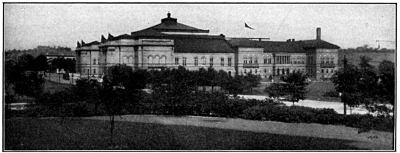
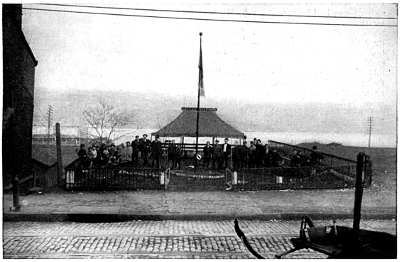
One convincing and startling feature of the Pittsburgh Civic Exhibit
in November was a frieze of small silhouettes three inches apart
stretching in line around both ends and one side of the large hall in
Carnegie Institute in which the exhibit of the Pittsburgh Survey was
installed. The frieze was over 250 feet in length, and the figures were
distributed in correct proportion by age and sex. They represented six
hundred and twenty-two persons in all, the death-toll from typhoid
fever in Pittsburgh during the year 1907. Accompanying this frieze,
placed prominently over the doors where everyone could read them, were
duplicates of the following sign in large display letters:
If the Death Rate Had Been 25 per 100,000, still
considerably greater than that in Albany, Ann Arbor, Ansonia,
Atlantic City, Binghamton, Boston, Bridgeport, Brockton,
Cambridge, Canton, Detroit, Fall River, Hartford, Jersey City,
Lawrence, Lowell, Milwaukee, New York, Rochester, St. Paul,
Springfield, Syracuse, Worcester, and a score of other cities
having a fairly pure water supply, but 114 of these persons
would have died and the line would be only 2/9 as long.
Who is Responsible for this Sacrifice?
And next to this placard was another sign, showing in comparative
columns the amount of typhoid fever in Pittsburgh during the four
months that had elapsed since the opening of a great municipal
filtration plant, compared with the amount for the same months of the
previous year; for example ninety-six cases in October, 1908, as
against 593 in October, 1907.
The typhoid problem in Pittsburgh in its larger cause has always been
a water problem; in its consequences it has become one of the city's
biggest social and economic problems; in its solution, it has been
tied up with all the politics of a boss-ridden city. The story of
filtration is the story of the navigation of an unwieldy craft through
a tempestuous channel. Buffeted by cross winds of public opinion, its
sails battered and torn by squalls of commercial opposition and abuse,
guided now to the right and now to the left by frequently changing
pilots, a plaything for the waves of councils, its booty coveted by
buccaneers of each political faction, filtration and its freightage of
health (or contracts) has been a prize over which the elements in the
municipal life of Pittsburgh have battled hard and long. The docking of
this craft in safety and security is one of Pittsburgh's greatest civic
achievements; its protracted passage is her most enduring disgrace.
In handling the question of typhoid in Pittsburgh, we must then, deal
with three distinct themes: water, economics, and politics.

Silhouettes are not here classified as to age, sex and
occupation.
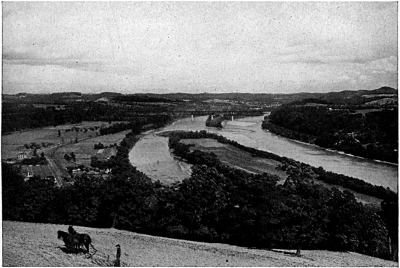
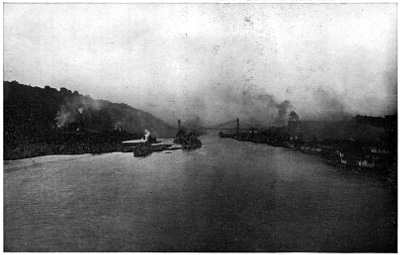
The publicly supplied drink of Pittsburgh has been river water and
whatever that river water contained. Prior to the opening of the new
filtration plant last summer, that part of the city known as "old
Pittsburgh," comprising the first twenty-three[9] wards, received its
water supply from cribs in the bed of the Allegheny River at Brilliant
Station, about seven miles above the city. Water taken from these cribs
(and since 1905 from an artificial channel of sheet piling along the
shore) was pumped into reservoirs on Herron Hill and Highland Park, and
then turned unfiltered into the water mains for distribution to the
shops and residences throughout the city.
With the exception of two or three wards, which receive a company
supply of filtered water, that part of the city known as the South
Side, comprising wards twenty-four to thirty-six, and ward forty-three,
formerly the Borough of Sheraden, receives its water from the
Monongahela direct, and from the Ohio direct, just below the junction
of the Monongahela and the Allegheny. The former city of Allegheny,
the present North Side, was supplied directly from the Allegheny River
from two sources; first from the Allegheny at a point near Montrose,
about eleven miles up the river, and second from another point on the
Allegheny near Sixteenth street. This latter source of supply was
discontinued on March 5, 1908.
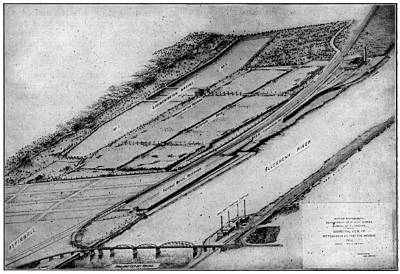
THE NEW FILTRATION BASINS.
The Allegheny and the Monongahela Rivers are turbid at all times,
and after a rain or in the spring, so muddy that a platinum wire
cannot be seen more than a quarter of an inch from the surface. In
addition to this, investigations have shown that the rivers commonly
carry in solution the soluble chemical products of the mills along
their shores,—organic and inorganic, acid and alkali; oils, fats,
and other carbon compounds; dead animals,—rats, cats and dogs;
flesh-disintegrated and putrescent; as well as the offscourings of
iron and steel mills, tanneries and slaughter houses, and similar
industries. But this is not all. Seventy-five up-river towns,—with
an estimated population of 350,000 inhabitants,—in the Allegheny or
tributary valleys; and in the Monongahela a long string of towns,
Swissvale, Homestead, Braddock, Rankin and McKeesport, all furnish
their supply of common sewage as a further contamination of the already
dirty water with its long list of disease-breeding bacteria.
These conditions have existed since Pittsburgh came into prominence as
an industrial center. Typhoid has been endemic. The duration of this
"plague" in Pittsburgh, unbelievable though its sufferance may appear
in view of the facts already given, is a matter of history and record.
For thirty-five years, up to the beginning of 1908, the city was in
the grip of a scourge which has been in the words of the most recent
treatise on typhoid[10], "one of the black records in the sanitary
history of our country." Here and there clamorous, indignant voices
were raised against it; but public sentiment had become so callous that
it only spasmodically and halfheartedly demanded the carrying into
operation of a tardy system of filtration. In the meantime, those who
could not afford to buy distilled or spring water, continued to drink
this filth.
With what result? For the last twenty-five years, an average death
rate of 102.3 per 100,000 population; since 1889 never below 107;
for the last nine years an average of 130; and last year, the year
of the completion of Pittsburgh's filtration plant, 131.5 deaths and
1,115 cases for every 100,000 inhabitants. A black record this, in
the face of uncontrovertible evidence from other cities, both in this
country and abroad, that the purification of the water supply should
blot out at least seven-ninths of the typhoid fever. In contrast with
Pittsburgh's high mortality, the average for other large American and
European cities since 1898 may be seen from the following list:
|
| Pittsburgh | 130.0 |
| Allegheny | 104.4 |
| Washington | 59.0 |
| Philadelphia | 54.7 |
| Baltimore | 35.3 |
| San Francisco | 30.5 |
| St. Louis | 30.3 |
| Chicago | 27.3 |
| Boston | 24.5 |
| New York | 18.2 |
| Paris | 17.4 |
| London | 11.7 |
| Vienna | 5.2 |
| Berlin | 4.2 |
|
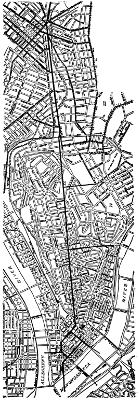
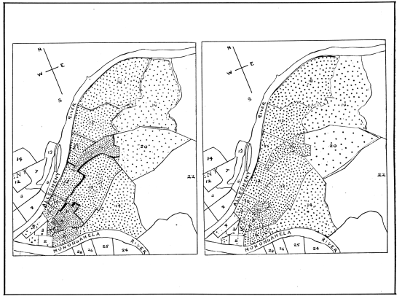
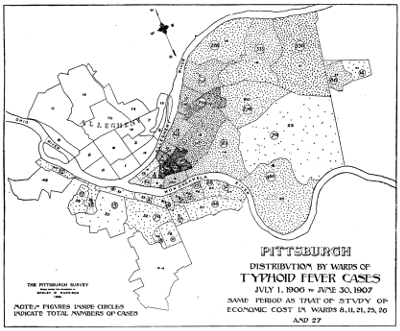
The very even distribution of typhoid in Pittsburgh,—another
indication pointing to infected water as the chief cause,—is seen in
the map on page 927, on which each dot represents a case of typhoid
within the year,—July 1, 1907, to June 30, 1908, the period covered by
the main part of this study.
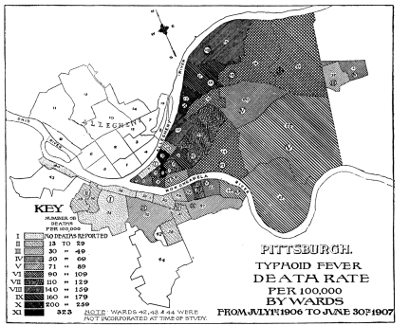
The second map shows the relative mortality, by wards, for the same
period.
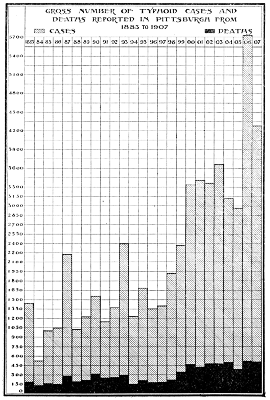
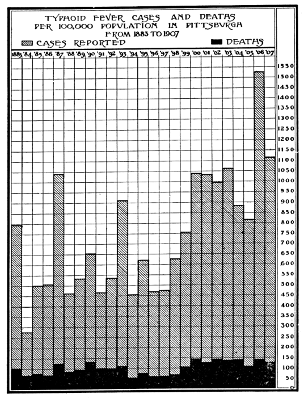
The following chart shows the relative rise and fall from year to year
in cases and deaths during the past twenty-five years, and is based on
estimates of population provided by the United States Census Bureau.
The morbidity figures are taken from the United States census prior to
1901, and from the Pittsburgh Bureau of Health records following that
year.
Previous to 1883 very little attempt was made to compel physicians
to report typhoid cases to the Pittsburgh Bureau of Health; hence no
reliable morbidity records are available up to that time. But in the
year 1882 an ordinance was passed requiring such reports to be made.
It is very certain that several years elapsed before a majority of the
cases was actually reported, and even at the present time, in spite of
prosecutions and a more enlightened sentiment, many cases never reach
the bureau. Yet the number of cases actually reported in Pittsburgh
proper, since 1883, reaches the astounding total of 54,857. In other
words, within the past twenty-five years, one person to every six of
the total population has had an attack of typhoid fever.
But even more telling in its significance is the fact that out of
these 54,857 reported cases, 8,149, or 14.8 per cent died as a result
of their illness. Over eight thousand men, women and children were
sacrificed here in Pittsburgh in the last twenty-five years to a
disease known by modern science to depend for its very existence upon
lax methods of handling food, drink and waste. Over eight thousand
graves have been dug, half of them (4,069) since February 6, 1899,
more than nine years ago, when the report of Pittsburgh's Filtration
Commission, advising the necessity of a pure water supply, was placed
in the hands of the Pittsburgh councils. In life, these eight thousand
people, standing single file, four feet apart, would form a line six
and one-sixth miles long, extending from the court house in a straight
line to the Filtration Plant; or from the Point Bridge down the Ohio as
far as the Borough of Emsworth.
In order to establish a sure ground for estimate as to the economic
drain of this disease upon this community, a concrete study of the cost
of typhoid in six selected wards of Greater Pittsburgh was undertaken
by the Pittsburgh Survey. The sections of the city chosen are fairly
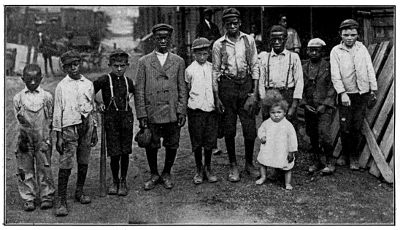
representative of living conditions among the wage-earning population.
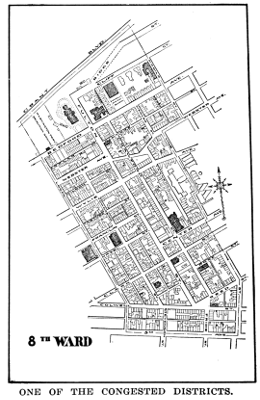
Wards 8 and 11, in what is commonly known as the Hill District,
represent a congested quarter made up largely of Russian Jews,
Austrians and Italians, with a considerable number of Americans and
American Negroes. The residents of these two wards are chiefly employes
of the small trades and the sweating and stogie industries, clerks,
factory hands, common laborers, etc., who are rather below the average
scale of earning capacity. They number about 22,000 for the two wards
and among them there were forty-four per cent of the cases studied.
Wards 25, 26 and 27 are on the South Side. Their total population is
about 33,000; mill hands, mostly of Slavic origin, occupy those parts
of these wards bordering the Monongahela River, and a better-off class
of Americans occupy the hilltops overlooking the river. The wards
would, therefore, represent a rather uneven population, as based on
nationality or wage scale, but were not a large factor in this study,
as only eight per cent of the cases covered were found in these wards.
Ward 21, the other section selected, is in area one of the largest in
the city, lying to the east in what is known as the Homewood District.
The population of this ward is about 26,000, living mostly in good
homes, with occasional poorer dwellings along the railroad and in
some of the "runs." In the main, they represent a high wage or small
salaried class. From this section, the other half of the cases studied,
about forty-eight per cent was taken.
The period covered by the investigation was one year, beginning July 1,
1906, and ending June 30, 1907. The field work was done by Miss Anna
B. Heldman, visiting nurse of the Columbian School Settlement, whose
personal acquaintance with many of the families of the Hill District,
and whose six or eight years' experience in caring for typhoid patients
in this same neighborhood, enabled her to secure in detail many facts
that might have escaped a person less familiar with the district or the
families concerned.
An analysis of the cases thus studied, shows that there were either
reported to the Pittsburgh Bureau of Health, or known to the
investigator, but not reported, 433 cases of typhoid fever in wards
8 and 11, 94 in wards 25, 26, and 27, and 502 in ward 21—a total of
1,029 in these six wards within the one year studied. These cases
occurred in 844 families. Miss Heldman, five months after the close of
this year period, was able to locate but 338 of these families, the
remainder having either moved out of the state, or been lost track of
by people living in the neighborhood.
There were 2,045 individuals in these 338 families, or an average of
6.4 persons per family. Of this number, 448 individuals, or 22 per cent
had typhoid fever within the year. Out of these 448 cases, there were
26 deaths and 422 recoveries, an exceptionally low percentage of deaths
to cases.
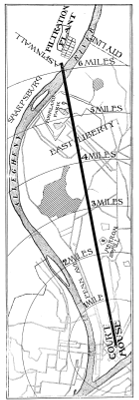
Line representing 8,149 people who have died from
typhoid fever in Pittsburgh since report of Filtration Commission in
1899 advising necessity of pure water. Standing in marching order,
single file, four feet apart, they would make a procession six miles
long.
Of the 448 patients, 187 were wage
earners, contributing all or part of their earnings to the
family income. As a result of their illness, these 187 wage earners
lost 1,901 weeks' work, or 36.6 years. This averaged over ten weeks
per patient, and represented an actual loss in wages of $23,573.15.
In addition, other wage earners lost 322 weeks' work while caring for
patients, thereby losing $3,326.50 in wages, and bringing the total of
wages lost to $26,899.65.
The other large item of cost is that of expense for care and treatment
of patients. Ninety cases were treated in hospitals for all or part
of the time, as pay patients, half-charity, or full-charity cases.
To meet these hospital expenses, $2,332.00 was paid to hospitals by
full-pay patients themselves, and $1,834.50 was paid the hospitals
by either individuals or charitable organizations for the care of
half-pay patients, making the total cost of caring for 90 hospital
patients $4,166.50. This is an understatement, because it omits the
contribution of the hospitals themselves to the care of half-charity
and full-charity patients. If figures were available, there should
be added the amount represented by the difference in the money paid
to hospitals and the actual cost of maintenance, presumably another
$1,800.[11]
The expenses of the remaining 358 patients cared for in their homes
amounted to $12,889.90 for doctors' bills, $1,965.50 for nurses,
$2,640.60 for medicines and drugs; $1,810.10 for milk, $629.20 for ice,
$861.50 for servants made necessary by the illness of those naturally
caring for the home, and $1,204.45 for other expenses, of which the
largest single item was the cost of a trip to Colorado and return at
the doctor's orders, for a patient threatened with tuberculosis. The
total of these expenses was $22,000.35.
The funeral expenses of the 26 patients who died, amounted to
$3,186.00. It may be argued that sooner or later funeral expenses
must inevitably be met, and that they should not, therefore, be
charged against this account. Under the circumstances, however, these
expenses were premature, and were directly chargeable to typhoid fever.
Consequently, it has seemed fair from the point of view of this study,
to include them. The grand total loss in wages and in expenses thus
outlined was $56,252.50.
Further analysis shows that the average loss in wages per patient among
the 187 wage earners was $126; that the average cost per patient in
loss of wages and expenses for the 446 patients was $128; and that the
average cost in loss of wages and expenses for each typhoid death among
the 448 cases was $2,164.
Consider the losses in these wards in their bearing upon the city as a
whole.
There were 5,421 cases of typhoid fever in Greater Pittsburgh in 1907.
If the cost to each patient was $128, typhoid fever cost the city that
year $693,888 in expenses and loss of wages alone. There were 622
deaths from typhoid fever in Greater Pittsburgh during the same period.
If we put the value of these lives lost at so low a figure as $4,000,
an additional loss of $2,448,000 was sustained. Or in round numbers
$3,142,000 was the minimum economic loss to the community of Greater
Pittsburgh, due to typhoid fever alone in the year 1907. This is a
conservative estimate, in view of recent values placed on deaths from
tuberculosis.[12] The two and a half million dollar death item might be
doubled without overstating the case.
When it is considered that typhoid fever has been almost constantly
prevalent within the city limits, with practically no abatement,
for the past thirty-five years, it requires only a little applied
mathematics to calculate the probable enormity of the money loss to
the community, through the ravages of this disease alone, year after
year. Was it not time for it to stop? In the face of over a $3,000,000
loss last year, $5,450,000 was not more than the city could afford to
pay for the filtration plant that is purifying the drinking water.
Nor was it extravagance for the mayor and city councils to grant
the superintendent of the Bureau of Health an increased staff of
tenement house and milk inspectors, to make it possible to clean up
other sources of infection, and hasten the time when typhoid fever
in Pittsburgh shall constitute a no greater menace than in any other
well-kept American city.
I have used the term "economic cost" of typhoid fever with reference
to Pittsburgh families. The mere phrase carries with it no knowledge
of all those family readjustments and inconveniences, the distress
of mind and unalloyed misery that must be considered before we can
form any adequate idea of what such sickness holds for a wage earning
population. Were it necessary to measure the result of typhoid fever
only in cold cash, it would be a relatively easy task. In the first
place there are the thousand and one makeshifts and re-establishments
that must be reckoned with in order to get a clear idea of what
typhoid means to those poorer families, where, without the invasion of
sickness, the business of getting bread is a constant struggle. In a
family consisting of a man, wife and three children, the sixteen year
old daughter, who had not been very strong, contracted typhoid. At the
end of sixteen weeks in bed and thirty-two weeks out of work, she had
developed a marked case of tuberculosis. Not being strong enough to go
back to her former employment, she secured work in a bakery where she
was subsequently seen coughing as she wrapped up bread for customers.
The father of this girl, during her sickness, was keeping six cows on
the premises and selling milk to customers living in the neighborhood.
The twenty-year-old wife of a Hungarian laborer had a six weeks' old
baby when she came down with a slow case of the fever. She remained at
home for a week with no one but herself to do the work and care for
the baby. The husband, who did not realize the cause of her weakness,
gave her a beating each day when he came home, because he thought her
lazy. He made her carry up coal for the fires until she became so
delirious that he could not keep her in the house. She was then sent to
a hospital and the baby given to friends. The woman died in a week and
the baby two weeks later.
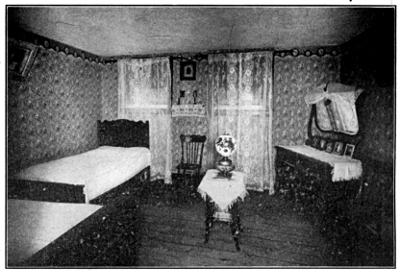
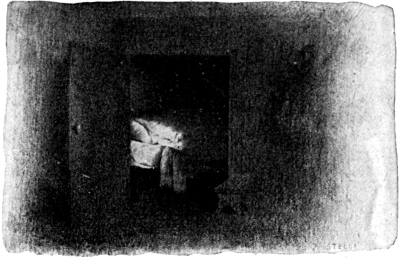
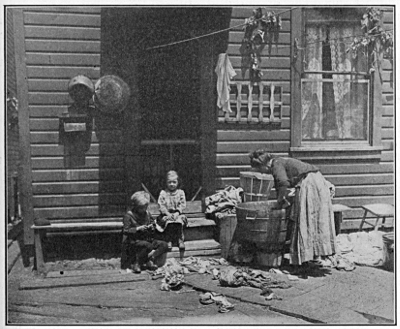
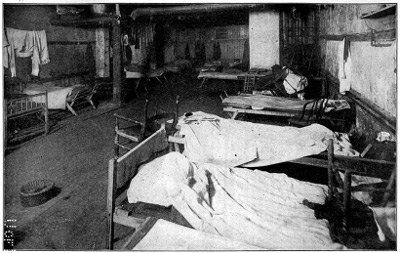
A family of five, consisting of father, mother and three little
children, cooked, ate and slept in one uncurtained room. The mother and
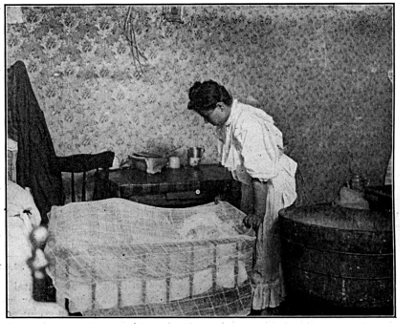
four year old girl were taken sick at the same time. The girl occupied
an Arbuckle coffee box, with a pillow and pillow-case for a mattress,
and the man's overcoat was her only covering. The mother slept in the
only bed, furnished with a mattress and one small comforter, and shared
it at night with the father, the baby and their six year old girl, who
lay across the foot of the bed. The girl was in danger of contracting
pneumonia from exposure. A family of seven occupied a store and kitchen
on the first floor and two rooms upstairs. A small bedroom was the
only one which had a fireplace; and the entire family slept there; the
mother (who had typhoid), in the only bed, and the father and five
children in a row on the floor.
In another family, the six year old boy had the fever, and was found
lying on an improvised bed, his little dog tied beside him. The mother
had rested the ends of two boards in a china closet at one end of the
kitchen, and on a chair at the other, so that she might care for the
patient, do the cooking and attend to the baby at the same time. By
this make-shift, the father was able to keep at his work.
One family, consisting of father, mother and five children, managed
ordinarily with a bed for the parents, a child's bed for the eight
year old girl, a two-third size bed for the eighteen and sixteen year
old daughters, and a cot for the fourteen year and ten year old sons,
one sleeping at each end. First the mother and one of the boys were
taken sick, and during the early part of their illness, no one was
disturbed. But within a month, and before the first two patients got
well, the four other children came down with typhoid, making six in
the family sick together. Then the father slept on the floor and the
sick mother got out of her bed to give place to two of the children,
she, herself, sleeping at the foot of the bed until one of the children
became delirious. After that she moved to the foot of the two-thirds
bed. In the day time she had no place to lie down, and sat all day in a
chair until she became so weak that she could hardly walk. Occasionally
she helped her husband who did the cooking and cared for the patients,
by paring potatoes and doing other small work about the kitchen. No
one had time to keep the kitchen sink clean, and the accumulation of
vegetable matter became so filthy that it had to be reported to the
Bureau of Health. With family income cut off, and with nothing saved,
the family would have been penniless had it not been that the doctor
made his bill moderate; the family was trusted for groceries, milk
and ice; friends gave about twenty dollars in cash, and Columbian
Settlement furnished bedding and the services of a visiting nurse. The
mother did not fully recover for about six months. The father, who
suffered a good deal from loss of sleep and exposure while caring for
the patients, contracted a cold. This developed into a serious case of
asthma from which he died.
To these and many similar families there were more serious results
than the debts incurred. A school girl's unrecovered health, a stogie
roller's reduced speed, a blacksmith's and a tailor's loss of strength,
a case of tuberculosis developed, a boy become a truant, a family
broken up and deserted, a baby's death,—all are of tremendous concern
as items in the annual wear and tear of the city's potential resources.
They are items of "economic cost" that cannot be handled by the
statistical method. They are, after all, the real human finger marks
that typhoid leaves when its clutches are loosened.
Such a showing, then, of actual economic and personal loss as this
study of six Pittsburgh wards brought out, is offered as a final
leverage to those who in other American cities may be endeavoring to
dislodge inertia and clear their water supplies. This investigation
of typhoid fever, however, as it was found in the households of the
wage earners of Pittsburgh, had its immediate practical bearings. The
sanitary facts it brought out showed unequivocally the necessity for
ridding the city of other sources of infection at the same time that
the water supply was cleared.
There was evidence that many of the after cases in the families
studied, were due to conditions existing entirely apart from the water.
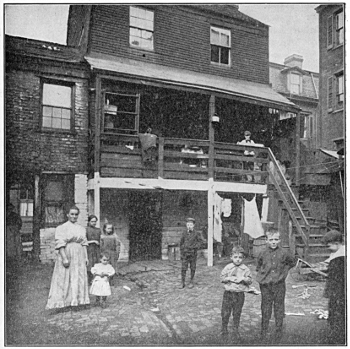
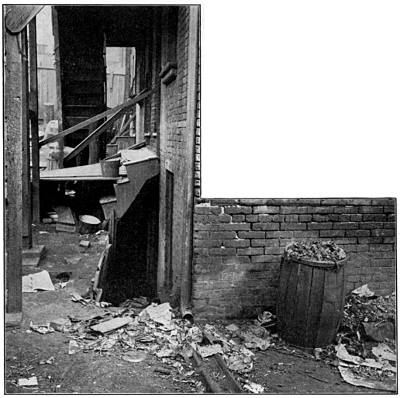
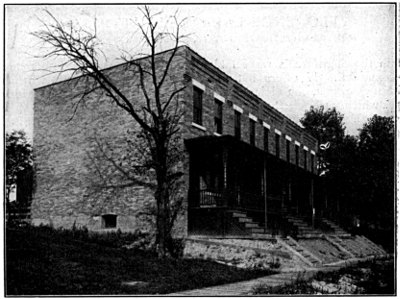
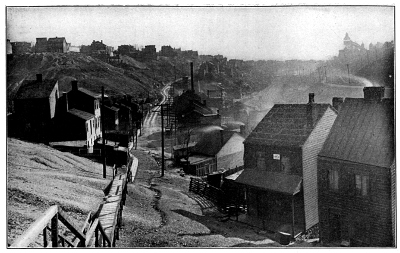
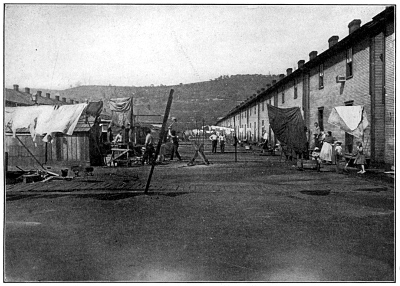
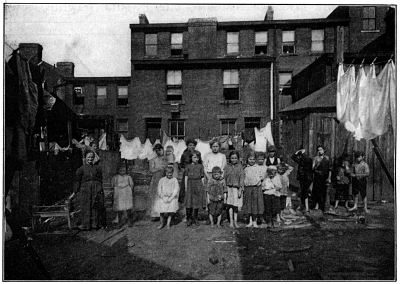
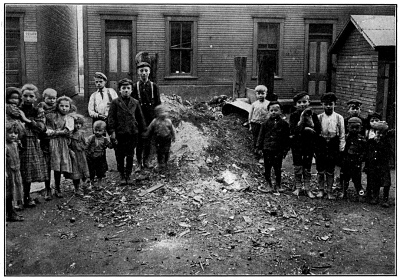
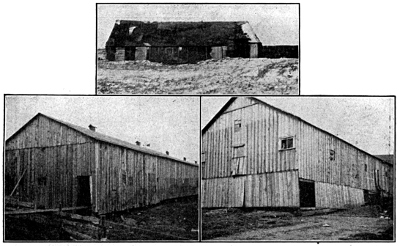
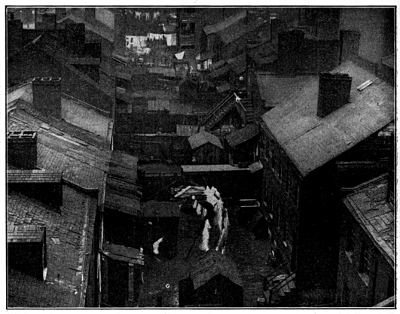
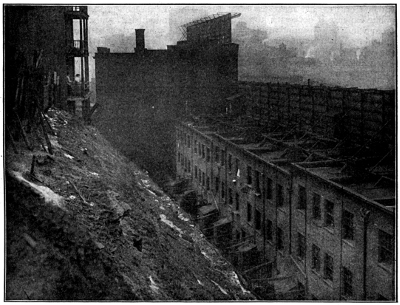
Reports on housing conditions in Pittsburgh show that a favorable
laboratory for the growth and dispersal of germs exists in the city's
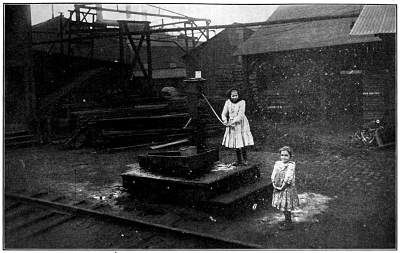
unsanitary dwellings. Insufficient water supply renders cleanliness
almost impossible. Overcrowding means increased possibilities of
infection through contact with food and drink in the combined family
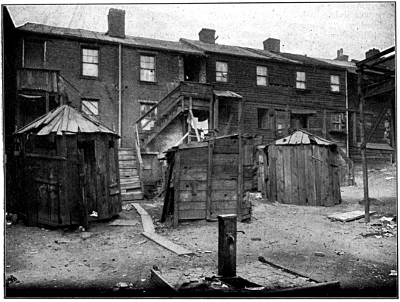
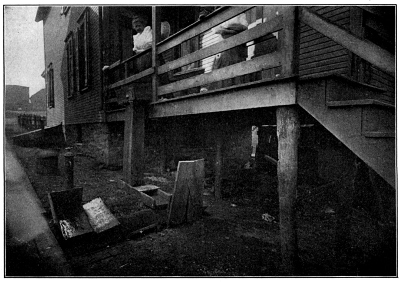
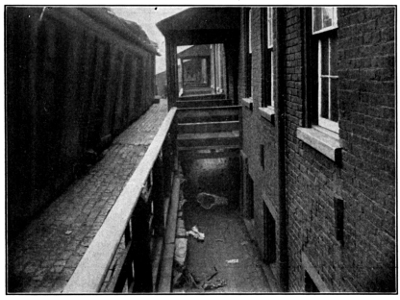
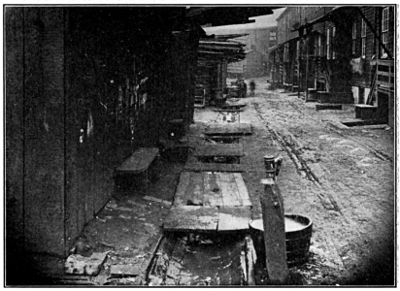
kitchen, pantry, dining-room, and bedroom. Pittsburgh's thousands of
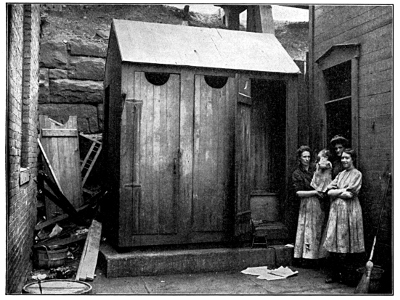
open privy vaults afford ideal conditions for the spread of disease by
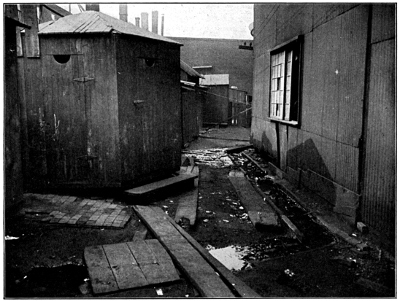
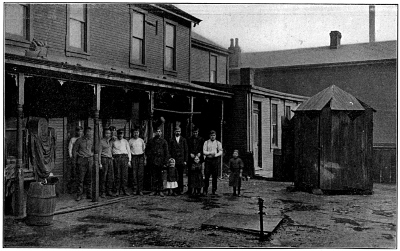
flies and other insects, and by personal contact. Such plague spots as
Saw Mill Run, with its string of double-and triple-decker rear privy
vaults discharging on the banks of a stream which are flushed off only
when the water rises after a rain, afford further examples, deplorable
and disgusting.
How much of the Pittsburgh typhoid has been due to direct contagion
from such conditions as these, can only be inferred at the present
writing. In line with the general question of contagion, and secondary
cause, however, our data afford some clews. They show that in forty of
the families studied, the first case was followed in from ten days to
one or two months by other cases, seventy-six cases in all, in addition
to the original forty. It shows further that in at least eighteen of
these families, one or more of the following conditions existed: Family
crowded into one or two rooms; home dirty and poorly kept; the person
who cared for the patient also doing the family cooking; well and sick
members of the family sleeping in the same room and often in the same
bed; privy vaults in exceedingly bad condition, and often stopped up
and overflowing with filth. In one family, consisting of man, wife,
four children and three lodgers, crowded into two dirty rooms, a three
year old boy was taken sick in October. The mother did the family
cooking and cared for the patient. The cesspool in the yard which was
in bad condition was used by two families. Another member of the family
became ill November 3, and the mother came down on December 19. There
were seven cases in this one courtyard within the year.
In another instance a man, wife, and nine children were living in three
rooms. The sixteen year old son was taken sick on June 20 and was sent
to the hospital. Then in July came the thirteen year old daughter for
whom her mother cared at home. The mother also did the family cooking.
The father, mother and eleven year old son all slept in the same room
with the patient. All three of them followed within a month, and
another son twelve years old, was taken sick in August.
In another family of eight, the sink in the kitchen and the toilet
in the yard were in a very filthy condition. The mother and one son
were taken sick in August. The sick and the well slept together in the
crowded bedrooms. In November four more members of the family came
down with the disease, on the sixth, ninth, eleventh and fifteenth,
respectively.
Let the reader judge for himself whether or not, in the face of these
facts, it can be expected that filtered water alone will solve the
problem.
The Pittsburgh Typhoid Fever Commission is a recognition of these
facts, and a recognition also from a national and scientific point
of view, that probably never again in the history of any large
American city will there be such a favorable laboratory in which to
study the epidemiological facts of typhoid fever both before and
after filtration. The commission was appointed in April, 1908, by
Mayor Guthrie; is made possible by a grant from the Russell Sage
Foundation, and by the co-operation of the bureaus of health and water,
which offered the free use of their laboratories for analytical and
administrative purposes. Dr. James F. Edwards is chairman, and the
membership includes Dr. Dixon of the State Board of Health, Prof. Wm.
T. Sedgwick of the Massachusetts Institute of Technology, and Dr. E. S.
Rosenau, of the Public Health and Marine Hospital Service, who has been
directing the elaborate governmental investigations into typhoid in the
District of Columbia. The following report is made (January 1) by Dr.
E. G. Matson, of the Pittsburgh Bureau of Health, executive officer of
the committee.
The work of the commission to date has consisted of a minute
investigation of all cases of typhoid which have appeared
since May 1, 1908, including the sanitary condition of their
living and working places. Investigations have also been made
into neighborhoods where there appeared to be fewer cases
than the average of the city, the milk supply, and the water
supply, both public and private. It is remarkable that not even
the smallest outbreak has been traced to milk. A particular
feature of the study of water supply is that in connection
with the acidity of the Monongahela and the eastern affluents
of the Allegheny and its effect upon the sewage discharged
by an enormous town population into them. So far typhoid has
declined greatly in Pittsburgh since January, 1908, as compared
with the average or even the minimum of previous years. This
decline has naturally been a subject of great interest though
it is too soon to give the results of investigations. We have
ascertained that this decline has been shared by the towns on
the lower Allegheny, which have hitherto been supposed to be
the most important source of our epidemics. During November
and December, which would represent the first months of the
filtered water period, typhoid has been reported from the
filtered water area at the rate of the most favorable American
cities, and in Allegheny, which receives nearly the same water
unfiltered, at about twice this rate.
And now we come to the story of the long fight for pure water in
Pittsburgh. The irony of the situation is, that there should ever have
been a long fight in a city which has since 1863 publicly recognized
the danger of impure water, the significance of which has almost
continually been brought before the people by press and platform
alike, for the past fifteen years. The story of the whole filtration
movement cannot be separated from the story of the struggle for
supremacy of contending factions in the dominant political party. And
the result,—excess typhoid with its terrible cost,—becomes part of
the penalty the city has had to pay for such corruption as the present
graft proceedings in councils are bringing to light.
The situation at the beginning of the filtration movement in 1895-96
was this: One of the strongest political machines in the history
of municipal government was in absolute control in Pittsburgh. It
mattered not who was elected mayor; he had no responsible power.
Heads of departments were appointed by outgoing councils. This meant
that department heads held over, and used their power to re-elect as
in-coming councilmen the outgoing councilmen who had elected them.
Moreover, councils were controlled by the ring.[13] In this way the
political machine was self-perpetuating. The directors of public
works drew specifications for public improvements; councils awarded
contracts; and it is a matter of notorious record that the well-known
firm of which one of the ring leaders was a member usually secured the
contracts.
The municipal election in February, 1896, was hard and bitterly
fought. George W. Guthrie headed the reform party as candidate for
mayor. According to one authority the majority of ballots cast were
for Guthrie, but when the count came in officially a few days after
election, the ring had won. With the mayor, both branches of councils,
and the director of public works all of the dominant party, the
carrying out of their ante-election pledges so far as filtration was
concerned would seem a matter of course.
True to these pledges, a resolution for the appointment of a Filtration
Commission, to include the mayor, the president of each council, and
eight citizens,—making eleven in all,—passed City Councils on June
8, 1896, and was approved by the mayor on June 10.
The commission was promptly appointed and set to work to make a
thorough investigation into the relative merits of various methods of
filtration and water supplies in use in cities of the United States and
Europe. Allen Hazen, a leading expert on filtration, was employed for
the first phase of the investigation, and Prof. William T. Sedgwick
of the Massachusetts Institute of Technology, eminent as a sanitary
expert, investigated the typhoid situation in the city. Morris Knowles,
C. E., was appointed resident engineer in local charge of all items of
experiment and investigation. Various members of the commission visited
European and American cities to study filtration methods; extended
bacteriological and analytical studies of the Allegheny River water
were made; small, slow, sand filter beds and standard make mechanical
filters were set up at the experiment station to test the relative
merits of each as applied to Allegheny River water; and nothing was
left undone as a means of arriving at a sound conclusion. Over two and
a half years elapsed between the appointment of the commission and the
rendering of its report.
The report, which was very elaborate, was presented at a joint session
of councils on February 6, 1899, and showed that the members of the
commission were united in their belief that, all things taken into
consideration, a slow, sand filtration plant should be constructed.
In accordance with its recommendation steps were immediately taken
for the issue and sale of bonds to provide the necessary funds, a
public election for this purpose being held on September 19, 1899. The
appropriation ordinance for the year 1900 contained "No. 100; for the
purpose of extension and improvement of water supply and distribution,
including the filtration of such water supply, and providing and
furnishing meters to be used in connection therewith ... $2,500,000."
The ordinance authorizing the controller to issue bonds for the
purpose as above specified was passed by Select Council in March, and
approved by the mayor April 3. So that prior to May 1, 1900, a fund of
$2,500,000 became available, and the prospect for the prompt erection
of the plant would have been bright, but for the fact that during the
four years since 1896 certain changes in the attitude of the members
of the ring toward one another had taken place, that were destined
to involve further complications. One member (Magee) had aspirations
toward the United States Senate. In this he encountered opposition from
the other end of the state, and in the struggle for state supremacy
that followed, Pittsburgh was left largely to another member of the
ring.
In the early part of 1900 E. M. Bigelow, who for a long time had been
director of public works, had a row with this leader (Flinn) over
certain matters of public work. The result was that on June 11, 1900,
the ring-controlled councils threw Mr. Bigelow out of office and
elected as director of public works a man more friendly to the ring.
This break between Flinn and Bigelow was the beginning of the long
series of events that retarded the filtration movement for at least
four years.
Bigelow was now "out." The new director of public works, appointed
by councils was acceptable to the ring that was "in"; so was the
membership of councils. The question with Bigelow was, naturally, how
to get back into office. This is the way he accomplished his desire.
The ousted director had a brother, who, it is said, had an old grudge
against the ring. He went to Harrisburg and prevailed upon the
State Legislature to grant Pittsburgh a new charter, abolishing the
office of mayor and substituting that of recorder, this office to be
filled by the governor until April, 1903, when the regularly elected
recorder would come into office. The charter also gave the recorder
much larger powers than the mayor had previously enjoyed, among them
the appointment of heads of departments and the right to enter into
contracts hitherto the prerogative of councils alone.
As might be expected, the newly appointed recorder soon exercised the
authority vested in him by the terms of the new charter, and on June
11, 1901, removed the head of the department of public works again
installing Mr. Bigelow in that important position, just one year after
he had been removed by councils.
It must be remembered that while Mr. Bigelow had again secured the
directorship of the Department of Public Works, there had been no
change in councils, which were still enrolled on the side of the
ring. While councils could not now stop the preparation of plans and
specifications for the proposed filtration plant, they could make a lot
of trouble in other ways; and so they did.
There are contradictory statements at this time as to just how much
progress had been made on plans during the year that Mr. Bigelow was
out of office. One side claims that "sixty per cent of the plans had
been drawn"; the other said, "only part of the plans." At any rate,
within six weeks Mr. Bigelow removed the engineer who had served under
his immediate predecessor, appointed as resident engineer Morris
Knowles (who was later appointed chief engineer of the newly created
Bureau of Filtration), and directed him to start work on plans for the
filtration plant.
At the same time councils proceeded in an attack on the director for
alleged delay in the preparation of plans; and on November 11, 1901,
presented a report to its filtration committee declaring Mr. Bigelow
entirely responsible for all the delay in the preparation of plans
and specifications, adding that these delays had been "gross and
inexcusable." This report was accompanied by a resolution ordering
Director Bigelow to furnish within ten days, to the filtration
committee, for its approval, all the plans and specifications for the
work lying north of the Western Pennsylvania Railroad, directing him
further to proceed with the utmost diligence to the completion of the
plans and specifications for the remainder of the plant, and to submit
the same to the filtration committee on or before December 2, 1901. The
report and resolution were adopted by both councils on the day of their
presentation. The real motive for this attack is readily inferred.
In the meantime the opposing faction had been working with the
governor, and after a notorious meeting at the Duquesne club, the
governor was prevailed upon to remove his first appointed recorder, on
the pretext that he had displaced several old soldiers from office,
and to appoint another recorder in his place,—this time a man upon
whom the machine could rely. At the close of the letter of removal, the
governor added a now famous postscript, "I was not bribed."
With the appointment of the new recorder, Bigelow was again forced out
of the office of director of public works. This put the ring again in
full control, with even greater powers than it had before. A year and
a half had elapsed since the $2,500,000 became available, and all that
the people had to show for it were eighty-five acres of land, part of
the plans and specifications completed, and over 600 more deaths from
the scourge of typhoid fever.
The next move was made within ten days after Director Bigelow's
dismissal, when another ordinance for the letting of the contract was
introduced. It quickly passed both councils and received the recorder's
approval. By this ordinance the contract was not to exceed $1,500,000
and was to be for the construction of "so much of the filtration plant
as is shown upon the drawings and description in the specifications, as
and to be known as contract No. 1."
Under this ordinance the new director advertised for bids, which were
received and opened. It appeared that the lowest bid was made by the T.
A. Gillespie Company, at about $1,292,000. The director and recorder
were preparing to let this contract for part of the work to the
Gillespie Company, and it looked as though the faction of the ring now
in the saddle would win the stakes.
But they had not reckoned all the odds. The opponents of the ring,
in this two-sided hold-up game, brought out another winning card. It
was in the person of John P. Edgar, a citizen of Steubenville, Ohio,
but the owner of property in the thirty-seventh ward, Pittsburgh, who
entered suit in the United States Circuit Court at Pittsburgh for an
injunction to restrain the recorder and director of public works from
awarding the contract. The case was argued before Judge Buffington on
March 3, 1902, W. B. Rodgers and George W. Guthrie appearing for the
plaintiff, and Thomas D. Carnahan, city solicitor, for the city. Suit
was based on the allegation that no estimate had been presented to
councils for the whole cost of the improvement, and that the letting
of this partial contract would be in violation of the new charter,
which required that before any contract for public improvement could
be entered into, such an estimate for the entire cost must have been
presented. The city solicitor showed that an estimate had been made
of the entire cost, but this estimate had not been made public or
submitted to councils. Mr. Rodgers maintained that this estimate must
be submitted to councils and approved by them. He and Mr. Guthrie
also claimed that the contract should embrace the completion of the
work. On March 13, 1902, Judge Buffington issued the injunction prayed
for. The court held that the estimate of the whole cost, required by
the charter, must be made to councils and become a matter of public
information, and that such an estimate had not been made.
The machine was temporarily blocked, but five days after the injunction
had been granted, the recorder instructed his director of public works
to have blueprints, plans and estimates of the entire filtration
system ready to present to councils at as early a date as possible,
thus starting the necessary legal steps for placing a new contract.
Within a month these plans and estimates, involving an expenditure
of $3,635,500, were prepared and submitted to councils, and three
ordinances for the letting of contracts were presented. The increase
over the first estimate was explained as due to an increase in the
number of services to be metered, and to a general increase in the cost
of materials.
These three ordinances were indefinitely postponed, however, in
councils, because more money for the construction of the plant under
the increased estimate was not available.
The next hold-up came from the city controller, who on May 1, 1902,
sent the following letter in duplicate to Recorder Brown and Director
McCandless:
In view of the uncertainty attending the proposed filtration of
the water, and the doubt as to the ultimate disposition of the
matter by councils, this department desires to notify you that
on and after May 10, no indebtedness against that appropriation
for any purpose, except for labor or supplies previously
furnished, should be incurred, as, under the decision of the
court, there is now no authority for any expenditure for
filtration purposes.
In the meantime, about April, 1902, and all through that summer,
advocates of a mountain water supply were at work. At the same time
changes in councils threw out of the Filtration Committee members
favoring sand filtration and elected opponents of the plan to its
membership. The result was that on July 21, 1902, an ordinance was
brought forward authorizing the Filtration Committee to prepare, in
conjunction with the superintendent of the Bureau of Water Supply, or
some other competent engineer designated by the director of public
works, estimates showing the entire cost of the installation of the
proposed sand filtration plant. Early in January, 1903, this resolution
had passed both councils. It was, however, vetoed by the recorder on
the ground that it was unnecessary, the Department of Public Works, he
held, having already furnished full estimates, in good faith, and being
ready to assist councils further in any manner that might be suggested.
The recorder added in his veto: "If the purpose of this resolution
is ultimately to defeat the proposed plan of sand filtration and
substitute therefor a system of mechanical filtration, I am unalterably
opposed to it." An attempt to pass the resolution over the recorder's
veto was made, but it failed for lack of the necessary three-fifths
vote.
In the meantime an ordinance was presented authorizing a public
election for a bond issue large enough to cover the difference between
the amount of money then available and the amount required under
the increased estimate. All that came of this was an inquiry by the
sub-committee to which it had been referred as to whether the new
estimate included coverings for the filter beds, and whether the South
Side was to be given filtered water. After ten months' further delay,
this sub-committee reported that the estimate did not provide for
covered filter beds and that it made no provision for the South Side.
Another year and a half had elapsed, with 650 additional deaths from
typhoid fever; 1,250 to date.
In April, 1903, by the election of Mayor Hays, the Bigelow faction
again came into power and Mr. Bigelow was reappointed director of
public works. Councils reorganized. A reform, or Bigelow man, was
elected to the presidency of councils, control of committees was
secured, and by the middle of 1903, the Bigelow faction was again in
full power.
By this time the South Side was demanding filtered water. The new
estimates presented by Director Bigelow in September, 1903, included
ten filter beds for the South Side, and the raising of the pumping
capacity for the first twenty-three wards by twenty million gallons,
and included also, new machinery and boilers for the Brilliant pumping
station, and a fifty-inch steel main across the city to supply the
South Side and the Monongahela River wards of the old city. These
brought the total new estimate up to over seven million dollars.
The time between September 21, 1903, and January 12, 1904, was
required to get a resolution through councils and approved by the
mayor, authorizing the finance committee to employ three experts, Col.
Alexander M. Miller of Washington, John W. Hill of Philadelphia, and
Rudolph Herring of New York, "to verify and make a report on or before
March 1, 1904, to the committee on finance, as to the correctness of
the estimates made by the director of public works."
Under this resolution the experts were employed and went to work. In
the meantime, councils had received a petition from the Pittsburgh
Section of the American Chemical Society, urging the establishment of a
sand filtration plant; also a resolution of the Civic Club of Allegheny
county, and a resolution of the permanent civic committee of the
women's clubs of Allegheny county, urging sand filtration at an early
date.
During 1903 there were 450 deaths from typhoid fever.
On February 27, 1904, the filtration experts made their report
recommending a receiving basin, three sedimentation basins, a clear
water basin, and forty filter beds. They also recommended sand
filtration and covers for filter beds, but cut down the capacity of the
various parts of the plant sufficiently to reduce the estimated cost by
$700,000.
On March 31, 1904, the Bureau of Filtration in the Department of Public
Works was created for the purpose of constructing these important works.
No further opposition of a serious character was met, and in July of
that year a second bond election for $5,000,000 was held and passed
by a vote of nearly two to one. These bonds were issued in September;
plans and specifications for the enlarged plant were prepared as soon
as possible; bids were advertised; and the contract was let on March 4,
1905.
With the final award of the contract the fight for pure water was
practically won. Director Bigelow again stepped out of office in 1900
with the election of a mayor independent of either Republican faction;
but the work of pushing the plant forward to completion was carried
on by the Guthrie administration under the efficient supervision of
Directors Clark and Shepherd, and Superintendent Knowles; so that by
October, 1908, the plant was supplying a good quality of filtered water
to the first twenty-three wards,—the old city.
The settling of the pending litigation between the city and the
Monongahela and other private water companies on the South Side,
together with the taking over of that property by the city was all that
remained to be done before filtered water could be supplied to that
part of the city.[14]
In the meantime the North Side (Allegheny City) still has unfiltered
water. Immediately after Allegheny was annexed to the Greater City
in December, 1907, steps were taken to pave the way for filtered
water there. $750,000 was appropriated for ten extra filter beds
on city-owned land adjoining the plant, and their construction is
now under way. Their use for the North Side involves extra pumping
facilities, however. A plan to bring the old Allegheny pumping station
at Montrose down to Aspinwall for this purpose was recently blocked
by members of councils from the North Side. Satisfactory explanation
for this action does not seem to be forthcoming. The reason alleged
was that its removal would throw some of the men out of a job. In
the meantime Allegheny continues drinking unfiltered water with
no immediate prospect of relief, and the same sort of political
influence that delayed filtration in the old city so long, seems to be
accomplishing similar results on the North Side.
In conclusion, let me apply the economic facts brought out in the first
section of this article, to the four years of unnecessary delays in the
construction of the filtration plant, from April 3, 1900, to April 29,
1904. They must be considered in making up the whole bill of the city
in the cause of pure water.
During all this time, more than $2,200,000, on which the city was
paying three and one half per cent interest, was lying in the banks
favored by the administration, bringing the city but two per cent;
and the death rate from typhoid fever was the highest of any of the
large cities in the United States. But for this delay the plant might
have been brought to completion on January 1, 1904, or at least as
far advanced as it was January 1, 1908, and four years,—1904, 1905,
1906 and 1907,—of excess typhoid fever might have been avoided. Not a
startling statement, perhaps, on the face of it. But consider seriously
what these four years of excess typhoid fever have meant to the people
of Pittsburgh in deaths and economic cost. I have told you of but half
of the people of six wards out of forty-three, one year out of four. In
1904, with an estimated population of 352,852, there were 503 deaths
from typhoid in Pittsburgh. Cities with a fairly pure water supply
do not have over twenty-five deaths annually per 100,000 population
from typhoid. Had Pittsburgh's typhoid fever death rate in 1904 been
twenty-five per 100,000, there would have been but 88 deaths instead
of 503, and the grim total of 415 lives would not have been blotted
out. By allowing $2,000 as the cost in loss of wages and expenses for
each death (a little under the actual costs in the concrete study of
economic cost already given), and allowing our previous minimum of
$4,000 as the value of each life, the total excess deaths in 1904 alone
from lack of pure water was a loss to the community of $2,490,000.
There were 425 unnecessary deaths in 1906, and a wastage of $2,550,000;
289 unnecessary deaths in 1905, and a wastage of $1,734,000; 415
unnecessary deaths in 1904, and a wastage of $2,490,000. In the four
years the community lost $9,000,000,—over $4,000,000 more than the
cost of the filtration plant. And in those four years, 1,538 lives were
unnecessarily sacrificed.
There are those who will say, and perhaps rightly, that Pittsburgh's
filtration plant of to-day is the magnificent triumph of construction
that it is, only because of those years of delay in shaping the final
plans; that while those who fought the measure tooth and nail for
so many years did not have that purpose in mind, yet the set-backs
they were able to accomplish, have made in the end for a larger,
better, more efficient and more far-serving plant than could have been
possible, had the first plans been carried hastily to completion. Such
may be the case. If so, let the people be thankful that the cause of
pure water triumphed ultimately over a lethargic public sentiment,
selfish political purposes, and municipal shortsightedness. Let them
at the same time remember at what cost to themselves and to their city
the fight was won. And let the plant itself stand as an object lesson
of tardy justice, and a monument to those hundreds of lives that paid
the penalty unwillingly and unknowingly of being part and parcel of an
unaroused municipal conscience.
GROSS NUMBER OF TYPHOID CASES, 1885 TO 1907.