The congestion exhibit in New York
last spring proved one of the most effective
and startling means of making a
contented community sit up and think
about its "other half." It formulated
questions half formed in many minds and
demanded answers. Its influence was
felt over the whole country, and its discussions
have bobbed up here and there
and everywhere ever since in articles, conferences
and addresses.
That the congestion exhibit answered
questions as well as asked them, and that
it has a constructive program to offer
not only to New York but to the whole
country are amply proved by the decision
just reached, and announced to-day for
the first time, to hold an exhibit and conference
of city planning next March.
"Every American city needs a city plan
now," is the conclusion of the committee,
and the steps by which it has arrived at
this conclusion are interestingly set forth
in its announcement.
While the organization bears the name
of the Committee on Congestion of Population
in New York, its scope and purpose
are much wider. The program approved
by its executive committee is "to
obtain a plan for the development of
Greater New York, and other American
cities, along economic, hygienic and aesthetic
lines; and to promote the better
distribution of population throughout
city, state and nation."
To establish the need for such a program,
the committee offers as "admitted
facts" the following:
Many American cities with a population
of over 50,000 have congestion of population,
factories and offices; such congestion creates
problems for which we cannot find solutions;
no city should use all the land within its
boundaries as intensively as is necessary in
its most congested areas,—to do so perpetuates
congestion; no American city yet has
a legal right to prescribe the height and use
of buildings in its various sections; no city
can develop normally without a plan which
anticipates its growth for twenty-five or fifty
years.
As a means of stimulating consideration
of the subject and of promoting farsighted
planning for the future, the committee
has adopted as its slogan the statement,
"Every American city needs a city
plan now." It will show, it announces,
the cost of the lack of a city plan in New
York, the city planning which has been
done in some American and foreign cities,
and the pressing need for a city plan in
New York to-day. The conference on
city planning in March will include an
exhibit of the best developments from all
over the world. Both exhibit and conference
will be keyed up to two major considerations:
"the concentration of one-half
the population of a great state in one
city makes the problem of statewide importance;
the concentration of one-nineteenth
of a nation's population in one
city gives the problem national bearing."
There will be study of the best methods
for distribution of population, for promoting
feasible methods of locating factories
and industrial colonies, and an educational
campaign to show the advantages
of migration from congested centers.
Massachusetts, almost invariably a
leader in preventive measures, is developing
this year a most unique and promising
kind of co-operative effort in the
prevention of tuberculosis. Massachusetts
was the first state to organize a
board of health, dating from 1869. It
was the first state to choose its factory
inspectors from the medical profession,
this dating from 1906, and out of these
two farsighted provisions of the law has
grown during the past two months a plan
by which manufacturers are assuming a
part of the financial burden in seeing to
it that operatives in their factories, found
to have tuberculosis in the incipient
stage, are sent to the Rutland Sanatorium
and given the best possible opportunity
for cure.
The plan originated in Worcester
which, with a string of neighboring
towns and villages, forms one of the sixteen
inspection districts into which the
state is divided. As a result of the activity
of Dr. M. G. Overlock, the state
inspector of health in charge, seventy
manufacturing plants, employing more
than 20,000 hands, have followed the example
of David H. Fanning, president of
the Royal Worcester Corset Company,
in agreeing to pay a part of the maintenance
cost of any of their employes
sent to Rutland. The cost in the sanatorium
is nine dollars a week. Of this
the state pays five dollars and the company
four dollars. The term usually
agreed upon is three months. At the
end of that time, a large number of the
cases have been so far restored that
they can be taken to nearby, supervised
boarding houses and farms and make
room for new patients,—a plan hit upon
to relieve the great pressure upon this
institution which accepts only incipient
cases. The employer continues his contribution.
The boarding houses, conducted
along approved lines, have sprung
up all over the surrounding hills much as
they have at Saranac Lake in New York.
The factory inspection has been keyed
up to take the greatest possible advantage
of the co-operation of employers.
Frequent visits are made to all plants,
but to those in which the work rooms
are full of dust, or where there are
other conditions favoring tuberculosis,
Dr. Overlock makes a visit once a
month. All minors on the working staff
are taken before him, and required to
furnish a full family history. If there
has been tuberculosis in the family, even
remote, a medical examination is at once
made. The others are examined more
superficially, but the least trace of suspicious
symptoms is at once seized upon
as cause for an examination. In this
way, it is believed, incipient cases among
minors will be caught in their earliest
stages. The system will later be extended
to adults. An extension of the
plan to secure the interest and help of
employers has begun in some other inspection
districts, and will eventually be
introduced throughout the state.
But the carefully laid plans to detect
and ward off incipient cases comprise
only one part of the Massachusetts plan
to fight tuberculosis. In May three
homes for advanced cases will be opened,
and the development of the plan calls
for additional homes, scattered through
the state, until it shall have made complete
provision for all cases, early or
advanced. In view of the almost unanimously
expressed opinion at the recent
International Tuberculosis Congress,
that the strategic point of attack in the
campaign is in isolating advanced cases,
the provision of these homes is, perhaps,
the most important plank in the Massachusetts
health platform. Governor
Guild is much interested in the whole
plan. In a recent letter to Dr. Overlock
he wrote: "It has been a great pleasure
for me to inaugurate the new policy of
the commonwealth of provision for all
cases of tuberculosis, not merely as at
present the care of the curable, but the
care of the incurable as well."
The business of lending money on
salaries and wages has received a practical
knockout blow in Cincinnati
through the Commercial Tribune, which
instituted the crusade, with the co-operation
of the officials of the city and of
various private organizations.
Aided by an ordinance which orders
the licensing of salary loan offices and
which makes a weekly report to the city
auditor necessary, the campaigners have
already been able to put one office out of
business entirely, and to sew up all the
others in the courts in such a way that
it now seems very likely that most of
these will retire rather than face the
storm which awaits them.
D. H. Tolman is more deeply involved
in Cincinnati than he has ever been before.
His son, E. E. Tolman, who is
said to be connected with the business of
his father, is under arrest and is now
waiting a hearing in the police court.
His manager has been arrested and convicted
on three counts.
Although these cases have been appealed
to a higher court, an application
for an order to restrain the further interference
with the Tolman business has
thus far been refused.
D. H. Tolman has ordered his manager
in Cincinnati to refuse to comply
with the ordinance and unless the courts
do issue this order the manager will be
arrested every week.
The Commercial Tribune has secured
all of the Tolman forms from a former
manager. These have all been printed
together with a letter from the ex-manager
in which the latter makes a complete
exposé of the methods pursued behind the
doors of one of his offices.
The auditor of Cincinnati has declared
his purpose of keeping up the fight.
He has forced ten salary loan offices to
pay a license fee and to comply with
the provisions of the local ordinance.
Agents have been permanently employed
by the official to watch the loan
offices and to ferret out any new agents
who may attempt to operate secretly.
The Legal Aid Society which was recently
formed to advise the poor, has
made it its business to impress upon all
who seek its meetings the futility of borrowing
money from the salary loan people
and has furnished a list of the companies
which are classified as "loan
sharks," to every man and woman whom
it could reach.
In this way people who never read
the newspapers are given information
which they otherwise would probably
never receive.
The Legal Aid Society is also at work
on a code of laws which will be submitted
to the General Assembly at its
coming session and which it is hoped
will solve the question of loaning money
on salaries and chattels in Ohio for all
time.
The attorneys of the society promise
a law which will set a fixed rate, which
will include interest and expenses, on all
such loans. It is said now that this rate
will be either three or four per cent.
The contemplated law will also contain
a provision which will make the recovery
of usury possible.
It is further planned to have a provision
in the law similar to the Massachusetts
statute, requiring the signatures
of the wife, when a borrower is married,
and of his employer. Some of the
best attorneys in Cincinnati including
former Prosecuting Attorney Benton
Oppenheimer, are at work on these laws.
Another movement now on foot is the
founding of a salary loan office on the
same basis as several chattel loan offices
which are now operating in the country,
whose stockholders are philanthropists
and men of wealth.
Cincinnati has such a chattel loan company
and the men who are now fighting
the salary loan business there are urging
the stockholders of this company to take
up the other work.
The most gratifying thing of the Cincinnati
campaign has been the falling
off of business in the loan offices. The
companies admit this and one broker left
for Florida after explaining that his
business had decreased seventy-five per
cent during the campaign.
One of the interesting bills to be
brought before the 1909 session of the
New York Legislature is that drawn by
Bernhard Rabbino, relating to a special
domestic relations court. Mr. Rabbino
believes that if we have courts for the
purpose of divorce, for separating mothers
from children and children from fathers,
we should have a separate tribunal
to which families in discord could appeal.
There are probably from 12,000 to 15,000
domestic trouble cases handled yearly
in Manhattan and the Bronx alone, but
as no records are kept of summons
cases,—and these come under that
head,—it is not possible to compute the
exact number. Probably it is greater
than the number of cases handled by the
children's court, and a domestic relations
court is justified by Mr. Rabbino, additionally,
on the ground that it precedes
the children's court, having for its fundamental
purpose the preservation of the
family as a unit, with an opportunity for
fathers and mothers to secure the same
expert and individual attention that is
given to the children.
Domestic affairs are admittedly out of
place in a general police court. The unfortunate
participants are not in any sense
criminals, and yet they are surrounded
by thieves, pickpockets, drunkards, disorderly
persons,—the regular rabble of
the criminal court,—and an outraged self-respect
is the consequence of such treatment.
The present organization of magistrates'
courts contemplates that the magistrate
shall sit one-half of the day on the
bench and the other half shall be in
chambers for the settlement of just such
cases as Mr. Rabbino would bring before
the domestic relations court. As a matter
of practice, however, so congested are
the courts and so pressing their work,
that there is no time for this personal
consideration which the law contemplates.
The magistrate does what he can in the
face of tremendous difficulties, but he has
not the time to investigate these cases,
and without proper attention there can be
no adjustment of them. Divorce and
separation are the natural results.
The idea of such a court would be to
prevent litigation as a whole and particularly
to safeguard the homes of the poor,
for the poor are those who are obliged to
resort to police courts. The better-off
take their affairs to the Supreme Court.
It is very possible that these lower courts
might develop into something higher, and
many matrimonial difficulties which now
cause a permanent rupture of relations
be peaceably adjusted with judicial assistance.
Such a court might also have a
marked effect on juvenile crime, for any
force that makes for better home conditions
is preventive of crime. The bill requires
also that the court of domestic relations
have exclusive jurisdiction over
all cases of abandonment, non-support,
and the non-support of poor relatives as
provided by law.
The bill as drawn would make this domestic
relations court part of the city
magistrates' courts, on the lines of the
children's courts now being generally
established throughout the country. The
idea, however, would be to have a special
court altogether, and if successful,
this would probably be done.
The introduction of this bill in the Legislature
may bring to sharp discussion the
whole question of division of jurisdiction
in the city courts. The present
established principle is that such courts
should be divided geographically, covering
a certain borough or section of a borough.
The children's court differs radically
from this and introduces a functional
division. It is an open question
whether, with the police courts crowded
as they are, such a functional division has
not become necessary for more cases than
those of delinquent children,—whether
the separation of special kinds of cases
into children's courts and into courts of
domestic relations will not prove more
effective than a further division of territory.
A review of municipal events and
tendencies for the past year, which might
be the title of Clinton Rogers Woodruff's
report as secretary of the National Municipal
League, centers around efficiency
and honesty in government as a result
of clear accounting systems and understandable
statistics; wide-spread efforts at
charter revision; a constantly growing
sentiment for nomination reform; and a
militant desire, evident in many sections,
to tackle the problems which have grown
up around the saloon in politics.
The Massachusetts Bureau of Municipal
Statistics, the first of its kind, has already
resulted, Mr. Woodruff believes,
in a number of cities reconstructing their
accounts on a sounder and more substantial
basis. The first year's report shows
a confusing lack of system in handling
the receipts and disbursements of towns
and cities; a wide variety of dates for
closing the fiscal year; many defects in
the treasurers' methods of accounting;
and the need for consolidation of the administration
of trust funds. In many
instances, money left to the community
for special purposes has been used by the
town trustees for general purposes.
But "the movement for uniform accounting
proceeds without interruption."
Originated by the National Municipal
League, it was given momentum by the
Census Bureau and by legislation in Ohio
and Massachusetts. Accounting investigations
and reforms are being made the
basis for an approach to the solution of
important problems in Boston, in New
York by the conspicuous work of the Bureau
of Municipal Research, and in Minneapolis.
The point of attack in Minneapolis
has been the administration of
the school fund "which seems to have
been particularly inadequate and inefficient."
A grand jury found "a startling
and deplorably loose state of affairs."
The investigation was made by trained
men from San Francisco and other Pacific
Coast cities. In Wilmington there
has been a thoroughgoing examination of
municipal account.
Legislative reference bureaus are being
established to help in this movement, of
particular value to Chicago which "is
on the threshold of an era of public improvement
which will call for the most
intelligent direction from the city government."
Mr. Woodruff predicts that "we
may expect within the next half dozen
years to find a series of similar bureaus
established in all the leading cities, gathering
for their respective municipalities
information concerning improvement;
and, moreover, we may expect a further
development, in that all of these bureaus
and libraries will be so co-ordinated, each
with the others, as to form a strong chain
of information that will banish from the
halls of legislation and the offices of administration,
the dense ignorance that all
too frequently found a welcome lodgement."
Charter changes are pressed every year
more strongly to the front. It is true now
that wherever a good government organization
of any sort is found, there will be
accompanying it a campaign either for
a new charter or for amendments to the
existing one. Perhaps the most noticeable
tendency of the movement is a demand
for a greater degree of home rule
for the cities which have been "subjected
to a degree of legislative buffeting that
has well nigh destroyed the cherished
ideal of self-government."
Nomination reform has been much discussed,
and a number of laws providing
for direct nominations have become effective
during the year. Mr. Woodruff
holds that the results of direct nominations
have, on the whole, "recommended
themselves to those who are striving for
the elimination of nomination monopoly
and for the inauguration of a simpler and
more direct form of election machinery."
Further, he holds that "it is now generally
conceded, except by a very small and
diminishing group of men, that the preparation
and distribution of the ballots
at the general election is a proper state
function and expense."
The objections to direct nominations
are discussed at length and finally dismissed
with the conclusion: "We must
realize that we are living in a democracy,
and that the election machinery must be
democratic and must record the wishes
of the people and be responsive to their
desires. Direct nominations are a step in
advance because they enable the people
directly to express their wishes. No
doubt they have made their mistakes, and
will continue to make them; but they
have had to bear the brunt of them in the
past, and they must continue to bear them
in the future; and this in the long run will
prove to be the most effective way of
building up an enlightened and efficient
democracy."
The initiative and referendum are advocated,
because "they are unquestionably
proving effective in breaking down some
of the privileges and monopolies that have
characterized political organizations for
many years."
The Council of One Hundred, an auxiliary
to the Parks and Playgrounds Association
of New York, has been fully
organized by Miss Pauline Robinson and
Seth Thayer Stewart, with a membership
of well known men and women who
are interested in playground activities
and civic improvement. At the first
meeting of the council at the home of
Mrs. Charles B. Alexander, in December,
Richard Watson Gilder presided, introducing
Mrs. George C. Riggs (Kate
Douglas Wiggin), who read a valuable
paper. Eugene A. Philbin, president of
the Parks and Playgrounds Association,
outlined the development of that organization,
which is the union of the Brooklyn
Society for Parks and Playgrounds
and the Metropolitan Parks Association.
Howard Bradstreet, the secretary of the
association, gave through lantern slides
a synopsis of the active work in conducting
playgrounds and baseball centers
during the last season. Seth Thayer
Stewart sketched a possible plan for the
extension of the recreation idea throughout
the city, and Dr. Luther H. Gulick
spoke briefly on recreation for girls.
The Council of One Hundred, of which
Mr. Gilder is president, Jacob H. Schiff,
George D. Pratt, Mrs. Frederick W.
Whitridge and Mrs. Samuel Bowne Duryea,
vice-presidents; and Miss Pauline
Robinson, secretary and treasurer, will
meet two or three times a year. Its purpose
is to assist individually and as a
body in the active work of the Parks and
Playgrounds Association. While much
is being done by the city through park
and school in the way of offering play
facilities to children, nevertheless, so
great is their number in New York, that
only a small percentage of the possibilities
have as yet been realized. With a
million children of school age or under,
occupied only a small part of the time,
the street must be the chief resort for the
large majority.
The experience of last summer showed
both the feasibility and the good result of
organizing the children of the street by
play leaders who appreciate the value of
free play, and are acquainted with child
nature. The plan of work as outlined
calls for the placing of such play leaders
in various sections of the city; the encouraging
of the establishment of places
for recreation by different organizations
and neighborhood committees, and for
the provision and maintenance of various
forms of play throughout the year in sections
otherwise neglected. During the
summer the association maintained eight
vacant lots as playgrounds, eleven baseball
centers and a camp for boys. The
neighbors of several of these grounds
have asked to have them extended during
the winter, and the association will
undertake to do so early in the new year.
Much significance is attached to the
recent organization of the New York
state branch of the National Society
for the Promotion of Industrial
Education. The passage of the industrial
education bill last year opened up to
the state possibilities in the way of industrial
education which it has not thus
far been able to measure. A volunteer
body of some sort has been needed to
awaken interest and stir up the whole
state. Particular opportunity offers
among the up-state cities and it was with
this in mind that the officers and advisory
board were elected, for as the list shows,
the members are representative of the
state as a whole as well as of many lines
of industrial and educational activity.
The officers are:
President, James P. McElroy, manager of
the Consolidated Car Heating Company, Albany;
vice-president, Dr. Andrew S. Draper,
state commissioner of education, Albany;
secretary-treasurer, Arthur L. Williston,
Pratt Institute, Brooklyn.
Additional members of the executive
committee are:
V. Everit Macy, chairman of Board of
Trustees, Teachers' College, New York; Joseph
R. Campbell, president Diamond Saw
and Stamping Works, Buffalo; Thomas D.
Fitzgerald, president Allied Printing Trades
Council of New York State, Albany; Frank
L. Babbott, manufacturer and member of the
School Board, Brooklyn.
At a public meeting following the formation
of the branch, considerable enthusiasm
was developed and a number
of interesting papers were read. Of
these, perhaps the most substantial contribution
to the discussion of the evening
was by Dr. William H. Maxwell, city
superintendent of schools, New York,
who presided. Among other things Dr.
Maxwell said:
Certain things may be taken as demonstrated
with regard to industrial education:
First, trade schools are needed. They are
needed for the sake of our industrial wealth
and efficiency. They are needed for the
sake of the boys and girls of this city. The
best preparation for a trade is the manual
training high school where, in connection
with elements of a liberal education, students
receive instruction in drawing, in
tools, and in applications of art to industry.
But these schools breed engineers, not journeymen.
Hence we need schools to give
training that will shorten and enrich the
period of apprenticeship for the journeyman.
Second, such schools must be a part of
the public school system and must articulate
directly and closely with the elementary
schools, to the end that boys and girls between
fourteen and eighteen, or at least
sixteen, may obtain that training which will
enable them to be of use in a shop; because
it is in the public schools that the boys and
girls are found who need such training.
Third, to carry out this articulation, elementary
schools should have manual training
to discover these boys and girls who
have an aptitude for mechanical pursuits.
Brains are as necessary in mechanical pursuits
as in law or theology.
Certain difficulties stand in our way:
First, apathy of manufacturers who have
shown little desire to obtain really skilled
American workmen, as for example, the firm
which established a school to train apprentices
and found that they were taken away
by other firms as soon as they had learned
a few tricks of the trade.
Second, apathy of the financial authorities
of the city who have just cut out the amount
asked for by the Board of Education for
shops and kitchens, and given only $22,000
for a trade school. It is encouraging, however,
to remember that the first annual appropriation
for manual training in Brooklyn
was only $5,000. If we make good use of
the small appropriation, the demonstration
will secure larger appropriations in the
future.
Third, the foolish or nebulous arguments
of many of those who have been advocating
trade schools. Arguments have been foolish
when they became pleas for the elimination
of existing high schools and the conversion
of these institutions into trade
schools. Those that have not been foolish
have been largely nebulous, vapory exhortations
to establish trade schools, without the
substance of a well considered plan. Such
a well considered plan is now the great desideratum.
While the advocates of trade
schools have been talking, the Board of Education
has established and maintained five
prosperous and useful evening trade schools
which are patronized largely by apprentices.
Those evening trade schools confine their operations
chiefly to the building and machinists'
trades. Shall we stop there? Will our
friends not give us a plan for teaching our
three largest trades, clothing, beer brewing,
and sugar refining? What we need farther
is a well thought-out plan of co-operation
between the school and the manufacturer,
such as that at Fitchburg, Mass.
For these reasons,—the apathy of manufacturers,
the apathy of the financial authorities
of our city, and the need of definite, coherent
plans,—the cause of trade schools
stands sorely in need of the aid of this local
branch of the national society. The time
is surely opportune when the Board of Education
has appointed a standing committee
on this subject and when the state, through
the industrial education bill, passed last
winter by the Legislature, has decided to
give substantial financial assistance to any
community that established trade schools.
The mummery and begging in which
the children of New York city so generally
indulge Thanksgiving Day and
other holidays have long been matters
of concern and alarm to those who are
interested in educational work with
young people. Many articles have appeared
denouncing the custom. On the
morning of Thanksgiving, the New York
Times contained an especially well directed
effort to protest against this growing
evil.
The children of Asacog Social Settlement,
52 Sands street, Brooklyn, partake
very generally in these holiday mummeries,
masquerading and begging. The
harmful results have long been realized,
but the efforts heretofore used to modify
the custom have been quite ineffective.
It was resolved this year to undertake
a different method of modifying the nuisance.
It was found in all cases that the children
had no idea why they should choose
Thanksgiving for begging, beyond the
fact that people gave them money on that
day and all their playmates chose this
method of "having fun," so of course it
was necessary to be in the game.
So with "having a good time" in mind,
parents, young people, children, were invited
to a festival on Thanksgiving eve.
It seemed quite necessary to draw a
moral lesson in the attempt to overthrow
such a deeply seated custom, and this was
done through a series of tableaus and
dances with connecting narrative.
The probable historical setting of the
Thanksgiving custom was presented
through scenes of the Dutch in Holland,
during the troublesome times of William
of Orange, when the sea beggars made
their famous pledge. Two tableaus
showing the court scene and the banquet
of the beggars were followed by a costume
dance by small boys, which was
called the "beggars' march." The English
contribution to the celebrations was
in tableaus from the history of the Guy
Fawkes plot. The Dutch and English
transferred to America were shown by
Peter Stuyvesant and his surrender; the
southern scenes with their harvest ideas
through a colored plantation sketch; the
Puritans and Indians by tableaus and Indian
squaw dances. Then followed the
times of the Revolution, with the tyranny
of the British, the spirit of '76, and the
Evacuation Day celebration on November
25, 1783.
The tableaus were given in costume by
the young people and children, about
seventy-five taking part. The members
of the Civic Club, composed of mothers
and neighborhood women did a great
deal in preparing the costumes and dressing
the actors.
The settlement had the valuable help of
Miss Mari R. Hofer in preparing Dutch
and Indian dances, and of Howard Bradstreet,
the narrator of the evening.
Admission was by tickets given in clubs
and classes, and the seating capacity of
three hundred and twenty-five was taxed
to over five hundred. But the carnival
spirit was in the midst and no one minded
the necessity of standing on a chair with
a friend or two in order to catch an occasional
glimpse of the stage. Several of
the star performers became so interested
in the audience that it was necessary to
snatch the nearest boys or girls as the occasion
demanded, hustle them to the improvised
"green" room, hastily dress
them in remaining fragments of costumes
far removed from the historic time, and
with impromptu coaching from the
wings, an attitude was struck worthy of
any Dutch patriot or Puritan dignitary.
The most gratifying results of the performance
were that the begging on the
street was greatly diminished. Many of
the children did dress up and beg, for of
course we could not expect a complete
reformation on Sands street. But up to
eleven o'clock not a begging child had
been seen on Asacog corner. Later in
the day little beggars began to appear
but in smaller numbers and at three
o'clock in the afternoon, a very lively
hour, all the children on the block were
out playing their ordinary street games,
and but one child was in fancy costume.
From one tenement from which twenty
children begged last year, but two indulged
this year, one mother having been
to the festival, and really beginning to
realize the dangers of street gaieties for
the first time, refused to permit her eight
year old girl to parade in fancy dress, at
which the child volunteered to stay in
bed, feeling life was too dull for words,
and besides she was tired from the night
before, the carnival spirit having worked
itself out. In reality it was the "day after
the fun."
The pupils in the Lincoln School, situated
in the suburbs of Burlington, Iowa,
feel no restraint from want of room to
play, for the school grounds are as large
as a small park, and stretches of prairie
land roll before and behind the building.
Beautiful oaks and elms form tiny forests
round about, a brook rushes through
the outskirts, and in each season nature
calls so loudly to the boy that it requires
all the ingenuity of teachers and truant
officers to keep him in school. Many nationalities
have congregated in this part
of the city, for it is a factory district, and
each September there are enrolled little
Germans, Russians, Swiss and Irish who
are instinctively antagonistic to one another.
The teachers of Lincoln School have
found it advisable to be present during
the noon hour, as well as during recess,
to prevent the playing of rough games
in which many children were injured,
or which resulted in fighting.
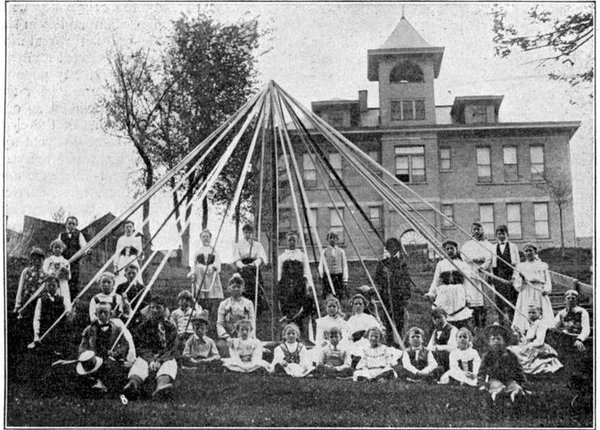
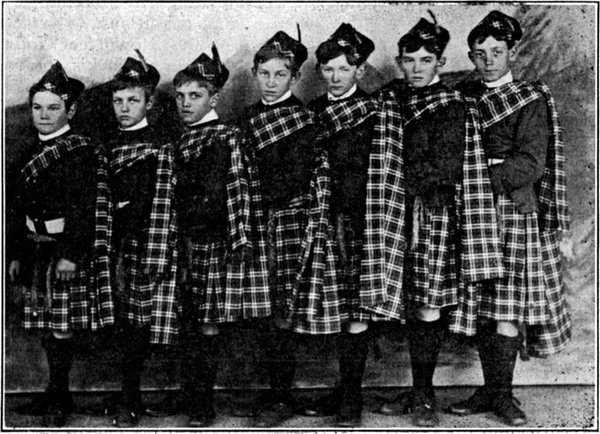
About ten years ago a may-pole was
introduced, which revolutionized the
school. A small organ was carried into
the yard and as many as forty children
took part in this dance at the same time.
About five years ago, fearing that this
dance would become monotonous, other
folk dances were introduced, and now
one may see during all intermissions,
groups of boys and girls dancing the gavotte
der kaiserin, Irish reel, Highland
fling, sword dance, dance of the Alpine
peasants and the minuet. In order that
even these should not become uninteresting,
costumes have been provided for
each dance, and this is bound to be the
greatest aid in discipline; for what boy
will play truant when he can impersonate
Washington in the minuet or some Scottish
hero in the sword dance or Highland
fling. To defray the expense of the
costumes, a play was given,—Spyri's
Heidi. This met with such success that
they now have a dramatic club, whose
members have presented Old-Fashioned
Girl, Eight Cousins and Little Baron to
large audiences in the Opera House.
Many unruly boys have become docile,
after impersonating some genuinely honest
boy character. The manners and
dress of both boys and girls have been
much improved since they have taken
part in these plays.
The folk-dances have been used in this
school for so many years that all are prepared
to say that they are a success with
the boys in as great a degree as they are
with the girls. A boy seldom refuses to
join in the dances. The most enjoyable
period during the session is the time of
the rhythmic play. They need no other
punishment for disobedience than to
threaten to refuse to play for the folk
dances.
GRAHAM TAYLOR
Social research on a city-wide scale is
a contemporary product. Appropriately
old London was the first to have its living
conditions comprehensively investigated.
To Charles Booth belongs the
credit of having initiated and set the type
of such enquiry. His great work in seventeen
volumes on Life and Labor in
London standardized methods and results
in some lines of civic investigation. Its
data were almost entirely derived from
secondary documentary sources furnished
by official records and the reports of voluntary
agencies, but the originality with
which it is everywhere stamped lies in the
handling and verifying of the material
thus acquired. The whole great analysis
and synthesis of the largest city population
of the world, thus attempted for the
first time, deserves to be ranked as one
of the greatest achievements of the closing
decade of the nineteenth century.
That this brave pioneering was attempted
by one of London's great shippers, and
that it was so successfully carried
through to completion at a cost of twenty
years of labor and a quarter million of
dollars, also sets a standard of self-exacting
citizenship worthy alike of the world's
greatest city and of one of its most modest
and personally resourceful citizens.
The extent to which this survey of
London afforded intelligent incentive and
basis for the reconstructive civic spirit
and work which attended and followed
it is demonstrated by contemporary history.
The voluntary efforts to improve
conditions, and the London County Council's
achievement in increasing open and
street spaces and in furnishing housing
and other equipment for city life, were on
a scale befitting the foundation in fact
substantially laid by Mr. Booth's monumental
work. Liverpool, Glasgow, Birmingham
and many provincial cities received
impetus and direction in their
heroic efforts to ascertain and improve
their own conditions.
Seebohm Rowntree followed Mr.
Booth's example in his study of poverty
in York, but went beyond his methods in
making a first hand investigation of the
facts. Robert W. deForest and Lawrence
Veiller set the type for American
enquiry into city conditions by their investigation
and reports of the Tenement
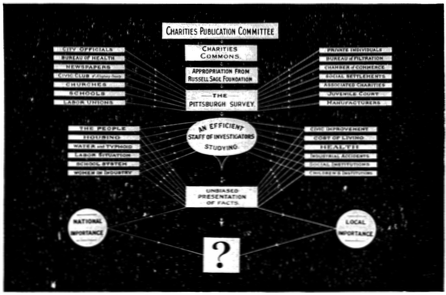
House Problem in New York. And now
the Pittsburgh Survey registers the most
inclusive standard thus far set in ascertaining
the facts of living conditions in a
typical industrial community. In cooperating
to carry through this constructive
survey the Russell Sage Foundation
and this magazine achieve the most
noteworthy fulfilment of their common
purpose to improve social and living
conditions in the United States.
JACOB A. RIIS
These two
Christmas
stamps are next
of kin. Our Red
Cross stamp is
the youngest
child of the
Danish Julemarke
which
sprang out of a
country postmaster's
brain to take
its place among the
most effective
weapons in the
world-wide fight
with the white
plague. Of what
stout stock the
family are,—it is a big family by this
time, with sons and daughters in many
lands,—this year's issue of the Danish
stamp tells at a glance. For the big building
pictured in it is the "Christmas Stamp
Sanatorium," built for tuberculous children
out of the half pennies the Danish
people have given these five years as their
contribution to the great campaign.

Denmark is a little country. All in
all it has not much more than half as
many people as the Greater New York,
if indeed it has so many. Yet in so short
a time it has wrought so great a tangible
result. What it has further wrought in
the way of arousing public interest and
guiding public education in this matter
is beyond calculation. For the last is
the biggest end of the work of the Christmas
stamp, wherever it goes.
In New York city two years ago we
raised a great outcry about child cripples,
made so by tuberculosis. We counted
five thousand or more in the tenements
of the metropolis and decided that their
one chance of life lay in building a hospital
on the seashore, on the lines of the
little one now run on Coney Island by the
Association for the Improvement of the
Condition of the Poor. Forthwith money
was raised, a quarter of a million of dollars,
to build a much bigger one with,
and architects were set to work to draw
plans. The city appropriated a site in a
great seashore park, to be laid out for
the people. Then there happened what
so often happens in New York when a
great public enterprise is to be carried
out. It ran into a rut, somehow. Money
became tight, the controller could not
find the funds, park and hospital were
side-tracked and stayed so.
They are side-tracked yet. The money
kind-hearted New Yorkers gave for the
children is in the bank. The little cripples
still crawl around their tenements.
The winds blow over the ocean and waste
their healing balm. The park is as far
away as ever. And the purses of the
charitable snap with an extra twist of
tightness when they think of it all. Next
time we shall plead the children's cause
in vain.
That is the way of New York. The
picture above tells the way of poor little
Denmark. No doubt there is an excuse,
or a string of them, for the American
city. But excuses do not mend aching
joints and wasted frames. How long before
New York will catch up with Denmark?
Would it not be fine if this lusty
son of a worthy sire, the Red Cross
Christmas stamp, were to help get us
started again?
EMORY R. JOHNSON
University of Pennsylvania
The Confessions of a Railroad Signalman
by J. O. Fagan is an exceptionally
able book, worthy of the serious attention
of every student of the causes of
railroad accidents.[1] The author gives
his qualifications for writing the book
by saying that he "has been a telegraph
operator and tower-man for twenty-seven
years and part of the time chief clerk
to a railroad superintendent," and he further
adds that "the extent of territory
covered by this experience is even wider
than one would suppose. For a telegraph
operator is, of necessity, one of the best
posted men in the service." In addition
to this experience from which a knowledge
of the subject has been gained, the
author possesses a remarkably well
trained mind and has command of exceptionally
clean English.
The main thesis of the book is that accidents
are due mainly to non-observance
of rules. "Railroad managers, therefore,
sooner or later will come to understand
that the one thing needed in the railroad
service at the present day is to educate
employes to appreciate the fact that successful
and safe railroading in the future
will have to depend, not upon the multiplication
of safety devices or the reconstruction
of rules, but upon the personal
effort and conduct of conscientious, alert,
and careful men." Furthermore, the author
has "arrived at the conclusion that
on our railroads the interests of the community
have become secondary to those
of the employe and his organization."
Mr. Fagan also maintains that "it is actually
a matter of reasonable demonstration
that at least seventy-five per cent of
the casualties might be avoided by increase
of interest on the part of the employe,
and the earnest concentration of
his best thought on the subject."
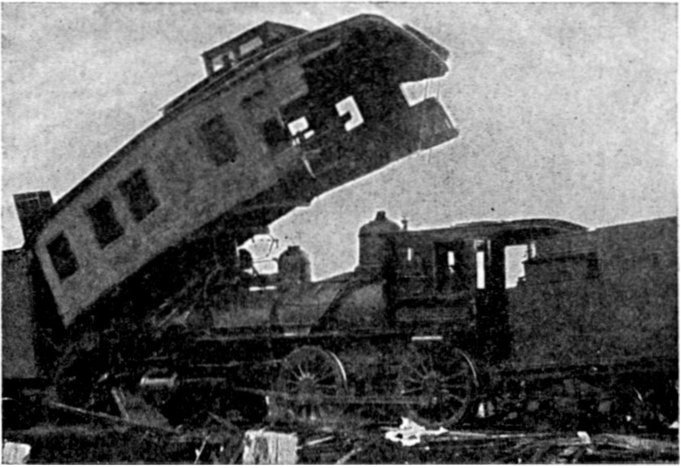
FROM CONFESSIONS OF A RAILROAD SIGNALMAN
The natural remedy for the situation,
as stated by Mr. Fagan, would lie in the
observance by employes of the company's
rules and regulations, in the discipline by
the management of all employes for each
and every non-observance of any rule,
and the enforcement of discipline with
appropriate penalties regardless of the
personality of those subjected to discipline.
The enforcement of discipline,
moreover, should not be made to depend
upon consequences resulting from non-observance
of rules. Employes should
be penalized by loss of pay for their disregard
of the rules or regulations whether
their actions do or do not result in
casualties.
Mr. Fagan, however, believes, and
brings convincing evidence to show, that
the above remedy is beyond hope. The
organizations of which the railroad employes
are members take the position that
the member who violates a rule is to be
defended against condemnation by the
public or discipline by the management.
Instead of taking the view that the interests
of the public are paramount to
those of any individual railroad employe,
the railroad employes' organization seeks
invariably to shield its members against
the consequences of their actions. Furthermore,
the managers of most railroads
have decided that the strict enforcement
of the rules and the punishment of those
who do not observe the rules result in
so many controversies with the labor
unions and are so destructive of harmonious
relations between the company and
the unions, that it is better to strive for
harmony rather than to enforce discipline.
In other words, discipline and the safety
of the public are made subsidiary to the
maintenance of harmonious relations
with the employes. Such being the situation,
Mr. Fagan believes that reform
is not to be expected within railway management
but must come from
the outside as the result of the
exercise of governmental authority.
The government
must punish employes for non-observance
of rules and penalize
railroad officers for the
non-enforcement of their regulations.
The analyses and arguments
of the book are convincing.
The position taken by Mr.
Fagan is one the accuracy of
which will doubtless be vigorously
denied by the organizations
of railroad employes and
will be to some extent questioned
by the responsible management of
railroads. However, it seems to the author
of this review that Mr. Fagan has
established his thesis.
ARTHUR P. KELLOGG
The simple Italian peasant, he whose
meager village life was so accurately
drawn by Mr. Mangano in earlier issues
of this magazine, is familiar in every
city in this country, and we have in
America what is probably a fair appreciation
of his poverty, his hardships and
the longing for better things which send
great blocks of the population of rural
provinces flocking across the Atlantic.
Of industrial Italy we know less, having
few sources of information. If the
life of the factory towns is really as bad
as The Forewarners,[2] by Giovanni Cena,
makes it,—if wages are as low, work as
hard, housing as squalid and amusements
as few,—then we have in the book a
story of remarkable growth in wretchedness,
for the manufacturing towns of
northern Italy are, as Mrs. Humphry
Ward points out in the introduction to the
English translation, only forty years old.
The book makes clear the source of the
socialist vote in the Italian Parliament
and the human stuff which the railway
and other big strikes are made of. It is,
supposedly, the life story of a Turin
printer. Starting as the son of a clay
digger, he graduates into the working
world after a childhood spent in an orphanage.
Having some little education
more than his fellows, he becomes a
proofreader for a house which is putting
on the Italian market the standard works
of science and philosophy in all languages.
This gives him stronger meat
than a weak body and an overwrought
mind can digest, and he becomes oppressed
with the wrongs of his class, with
the grind of the factory and the squalid
life of the house where he has a tiny
cell in the garret. There he piles up, in
proof sheets, a library of the greatest
books in the world. Pouring over them
by night, half-fed, unsociable, brooding,
his mind slips gradually from its moorings
and he throws his life away as a
sacrifice, for this book, the story of his
life and the story of his class, is hidden
in his bosom. A tragic death, he believes,
will cause it to be published and set afoot
nothing short of a revolution.
The book does not tell the manner of
his death, but it implies that he threw
himself in front of the King's automobile,
which he often met in his wanderings
outside the city. It typified to him the
oppression which he felt,—"the griefs of
others I have such a longing to relieve
that the desire becomes a torment to me,
and I cannot shake myself free from it
except by action." Of the automobile
drivers he had written: "Whilst the nobility
are trying to draw in their claws
so as not to exasperate us, here come
these bourgeoise parvenus to insult us
in our own house. Yes, in our own house,
for the highroad belongs to the peasant
and the poor man." His studies, which
put him above the other workmen, were
themselves his undoing, for the substance
of Tolstoi and Spencer became so much
more to him than the form, that his work
grew bad and worse until he was discharged,—an
incident convincing to one
who has attempted to read proof with an
eye to things greater than commas and
spelling.
Out of it all he worked a scheme of
things as they ought to be, which, whether
it came from the proofreader or from the
author who takes a proofreader's smarting
sense of wrong as his theme, makes
an interesting program:
A king who has a lofty ideal of society
wishes to lead his subjects up to it by his
methods of government, and is willing to
abdicate when he feels that they are really
free. His chief instruments in the work
of redemption are doctors and school teachers.
On the one hand freedom, on the other
action. Freedom from error whilst doing
everything to favor and afford sufficient
light. A tendency to abolish all forms of
restraint, from the material ones for criminals
to the moral ones for all men; from
handcuffs to laws. The gradual abolition
of hereditary rights of property; every human
being to have the needful, and everything
to return to a common fund at his
death. The legal personality of women, and
the equality of the sexes, to be recognized
as steps to the conquest of individuality,
liberty, happiness. Each to be free to develop
to the utmost his own life, his own
affections. Birth and education to be protected.
Rest to be ensured to old age. Public
hygiene to be watched over till disease
be eliminated. Every facility to be afforded
to manufactures, commerce and science, so
as to encourage man to conquer himself, the
earth, the heavens. Faith in progress, as if
it were not,—and it is not,—destined to die
with our earth. The worship of life.
Such a scheme and the style and force
of the book are difficult to associate with
the neurasthenic proofreader, skilfully as
the author has drawn the background and
made the man's thought develop over his
proof table.
But whether the character be drawn
convincingly or not, the book gives a
wonderfully clear and sharp-cut picture
of the environment of such a worker.
Some bits of description stand out above
the others, one of them the Turin tenement,
where "from the first flights of
stairs, carpeted and warmed by hot air
pipes, to the bare flight of our top floor,
the steps grew ever steeper and steeper.
Each evening we passed through all the
social zones, hot, temperate and cold;
we were lodged in the arctic regions."
There were 142 of these steps to the top
floor, where naught but poverty dwelt,—a
penniless poet with a sister who supported
him, a lonely working girl, a
woman of the streets, a drunkard and his
screaming, beaten wife and half-witted
children, and Cimisin, a cobbler, who always
"was whistling at full speed to the
accompaniment of his hammer. The tears
of women, the curses of drunkards, had
for so many years mingled with the merriment
of that harmless madman."
His history of the printing shop is complete
and modern, even to the point where
the men went back to their cases after a
strike, only to find that long rows of linotypes
with women operators had displaced
them. These women, he thought, might
have among them one fitted to be his
mate, but he was too shy to seek her out.
He could see them only as workers at
the almost human machines, or where
"the cylinders revolved with a loud din,
the sheets rained out one on top of the
other, the women in their long overalls
kept on repeating their monotonous movements,
feeding the sheets into the press
or collecting them into piles. On two
side platforms the women were in constant
motion. A hundred women and a
hundred men. It was impossible to imagine
that relations other than those existing
between the several parts of a machine
might be formed between these beings
created for a mutual understanding."
Still he wonders vaguely if
perhaps in this uniformity of action, foreign
to and apart from the monotonous toil
which exhausts them, something exists,
smiles, shines? Have some got a small
bird singing in their hearts whilst their
hands grow grimy at the wheel?...
No love of their work,—that is to say of their
life,—inspired them; each of them constantly
saw the work of an hour, a mere fragment,
leave his hands anonymously and forever,
and none of them could ever say of
anything, "That is my work!" What will remain
of them at the end of their lives to
prove that they have lived? In truth, they
have not lived.
Of the women in his tenement, girls
who were not harnessed to a factory, he
found even less of life, though perhaps
more of womanhood. Going with his
friend to see the latter's young sister in
a maternity hospital, he reflects that this
is the way with many of them,—"love
leads to the hospital." The patients there
are mostly unmarried girls. The married
ones have few children now. "How talk
of love, of family life, in a society which
deals out the same ration to the single
man and to the father of a family?"
His friend starves, the sister dies, the
drunkard's wife, mother of six, takes her
life,—everyone whom he knew, it seems,
all the associates high up in the attic of
the "aëropolis," come to grief and misery
and death. He greatly admires the
woman, a physician, who visits them.
"She picks up, joins, straightens out innumerable
threads; she seems to be weaving
a tapestry of which she will only
complete a tiny bit, a work which she
has inherited from one generation and
will transmit to another." She offers him
a part in her work, but he feels "incapable
of giving myself in small doses." He
is impatient, irritable for "something
ready to hand, swift as lightning," that
shall right all wrongs and ease all pain
at a stroke. He cannot work with others,
or for others, and so he tucks his story
into his bosom and starts out to meet the
King's car. Almost at the last he confesses,
"I have passed beside life."
Reviewed by ROLAND P. FALKNER
To the great majority of people the
school report is the only tangible evidence
of what the school administration is doing.
The citizens generally cannot be
expected to know what goes on in the
school rooms or in the meetings of boards
of education, nor what is taking shape
in the back of the superintendent's head.
Even were they afforded the utmost opportunity
and gifted with such unusual
perception, it is not likely that without
convenient summaries and condensed
statements they could form any idea of
the public school system as a whole.
If the school report is at once the evidence
and test of the school administration,
it is clear that its ideal is such a
marshalling of the facts regarding the
schools of the city as will give the reasonably
intelligent citizen a clear notion of
just how well the schools are performing
the duties entrusted to them.
The book before us is a study of the
school reports for the purpose of ascertaining
how far and in what manner they
seek to embody such ideal. It is a study
in comparative administration.
This study reveals so wide a diversity
among school reports as to preclude the
idea of any consensus of opinion as to
what they should contain. While uniformity
of scope and treatment is not to
be expected, it might reasonably be anticipated
that the similar purposes of the
school administration in different places
would give to these reports a certain
family resemblance. In so far as such a
resemblance can be traced, it does not
appear to be so much the result of parallel
internal development as the product of external
compulsion or suggestion. State
educational departments charged with
allotment of state school funds according
to a fixed unit in school work, have
led to an emphasis upon such units. A
similar influence has been exerted by the
United States Bureau of Education in
its request for information along certain
definite lines.
Apart from these influences tending toward
a certain uniformity, there are other
forces working in the same direction
though less effectively. The trend of
present discussion in educational affairs
is not without its influence, and when
certain facts are needed to point a moral
or adorn a tale the experience of other
cities points to investigations or arrangements
of material which are new to the
city in question. Conscious effort to
promote uniform treatment of statistical
data, a theme which has been discussed
almost to weariness by the National Education
Association and kindred organizations,
has been singularly fruitless.
With these general considerations by
way of introduction, the work takes up
its main theme, the scope of educational
statistics. In them we find the condensation
of educational experience, and here
more than in other parts of the text we
should expect the experience and practice
of one city to be helpful to another.
Too often, indeed almost universally, the
tables of facts are isolated from the text
of the report, and no effort is made to
explain their meaning or set forth the salient
features which they present. In
view of the volume of tabular matter
there is a painful poverty of interpretation.
The method pursued by the author in
his record of the facts, is to furnish a
specimen table from the different reports
in regard to each matter touched
upon, a selection of the simpler and then
the more detailed statements to be found
in them. The following heads are treated
in this way: School plant, expenditure,
census, attendance, age of pupils, promotions,
survival, compulsory attendance,
high schools, vacation schools, libraries,
medical inspection, teachers and summaries.
The variety of forms exhibited
is highly instructive although, it may be
confessed, somewhat bewildering. The
author has confined himself so strictly to
a study of methods that he is disposed to
let the tables speak for themselves. There
is here, too, an absence of interpretation.
Tables of figures may speak for themselves
but to understand them one must
know their language. One cannot help
but feel that in many cases some explanation
why the detailed tables are to be regarded
as superior, other than the fact
that they are more detailed, would have
been more illuminating and would have
relieved somewhat the monotony of this
important chapter for the general reader.
No attempt is made to outline a model
report. We have instead in chapter 5 a
series of questions which might be answered
in a school report. The list does
not pretend to be exhaustive but in reality
it constitutes a somewhat formidable
program, if it be assumed that the greater
part of these questions should receive
attention.
Conscious of the fact that somewhat
staggering demands are made on the
school administration, the discussion of
"suggested economies and improvement"
comes as an antidote. This is a brief
discussion of short cuts and methods to
get at desired results. It looks to a simplification
of records and such forms and
registers as will supply the needed information,
without excessive work. This
is a very vital point and the suggestions
as far as they go are admirable.
While the subject presented in these
pages is thoroughly technical, the work
may be commended most heartily to
school authorities and to all who are interested
in the progress of our schools.
It is an appeal for exact information and
should not be passed by without a hearing.
Such information in regard to our
schools,—one of the most important
branches of our government,—is painfully
lacking. It has too often been assumed
that the management of schools
was a matter for experts of which outsiders
could not properly judge. Within
certain limits this is true, but it does not
distinguish between the scholastic and the
administrative sides of school work. We
undoubtedly need both among our school
authorities, and in the public at large a
keener perception of the requisites of a
sound and effective administration. It is
not, perhaps, too much to say that there
is no great business enterprise of the people
of which they know so little as they
do of their schools. In private affairs
such ignorance on the part of directors
and stockholders would lead to bankruptcy.
The authorship of the several chapters
of the book is distinctly stated. The general
considerations herein briefly noted
are the work of Dr. Snedden; the particular
application to the city of New York
is the work of Dr. Allen. Those who are
familiar with Dr. Allen's work answer
that he can always be relied upon for a
readable and spicy statement. But in
view of the predominantly local interest
of his discussion and the inexorable limits
of space, it has seemed best in the foregoing
notice to lay the greater emphasis
on those large aspects of the subject
which are from the pen of Dr. Snedden.
BY RICHARD REALF
My father was mighty Vulcan,
I am Smith of the land and sea,
The cunning spirit of Tubal Cain
Came with my marrow to me;
I think great thoughts strong-winged with steel,
I coin vast iron acts,
And weld the impalpable dream of Seers
Into utile lyric facts.
I am monarch of all the forges,
I have solved the riddle of fire,
The Amen of Nature to need of Man,
Echoes at my desire;
I search with the subtle soul of flame,
The heart of the rocky earth,
And out from my anvils the prophecies
Of the miracle years blaze forth.
I am swart with the soot of my chimneys,
I drip with the sweats of toil,
I quell and scepter the savage wastes
And charm the curse from the soil;
I fling the bridges across the gulfs,
That hold us from the To Be,
And build the roads for the bannered march
Of crowned Humanity.
Published in the National Labor Tribune,
Saturday, February 23, 1878.
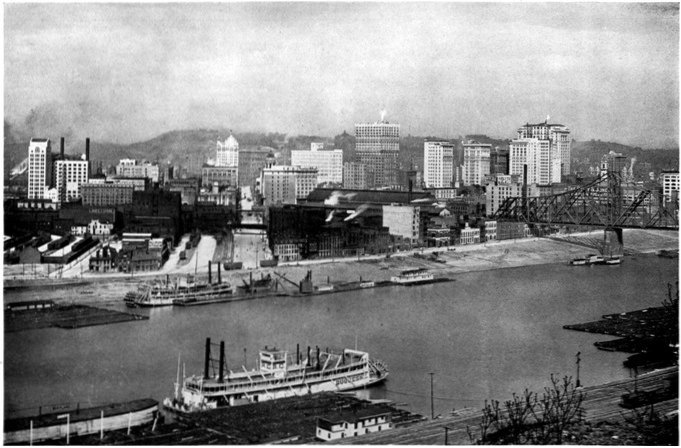
Chautauqua Photographic Co.
PITTSBURGH.
THE POINT, AS SEEN FROM THE HEIGHTS OF THE SOUTH SIDE.
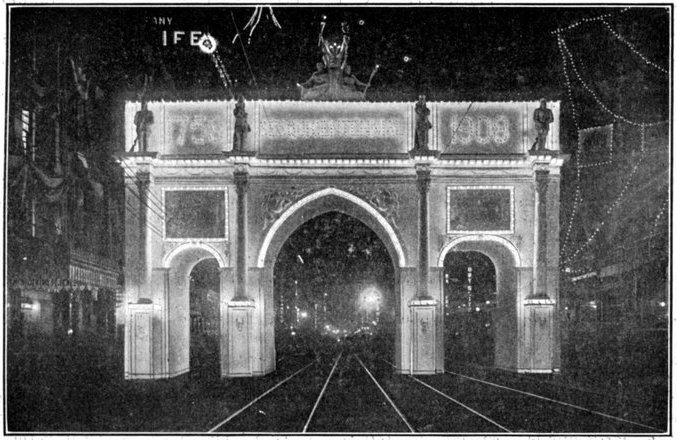
THE PITTSBURGH ARCH SESQUI-CENTENNIAL WEEK.