She does no work by halves, yon raving ocean;
Engulfing those she strangles, her wild womb
Affords the mariners whom she hath dealt on,
Their death at once, and sepulchre.
Old Play.
There were ten “lang Scots miles” betwixt Stourburgh and Jarlshof; and
though the pedestrian did not number all the impediments which crossed
Tam o’ Shanter’s path,—for in a country where there are neither hedges
nor stone enclosures, there can be neither “slaps nor stiles,”—yet the
number and nature of the “mosses and waters” which he had to cross in
his peregrination, was fully sufficient to balance the account, and to
render his journey as toilsome and dangerous as Tam o’ Shanter’s
celebrated retreat from Ayr. Neither witch nor warlock crossed
Mordaunt’s path, however. The length of the day was already
considerable, and he arrived safe at Jarlshof by eleven o’clock at
night. All was still and dark round the mansion, and it was not till he
had whistled twice or thrice beneath Swertha’s window, that she replied
to the signal.
At the first sound, Swertha fell into an agreeable dream of a young
whale-fisher, who some forty years before used to make such a signal
beneath the window of her hut; at the second, she waked to remember that
Johnnie Fea had slept sound among the frozen waves of Greenland for this
many a year, and that she was Mr. Mertoun’s governante at Jarlshof; at
the third, she arose and opened the window.
“Whae is that,” she demanded, “at sic an hour of the night?”
“It is I,” said the youth.
“And what for comena ye in? The door’s on the latch, and there is a
gathering peat on the kitchen fire, and a spunk beside it—ye can light
your ain candle.”
“All well,” replied Mordaunt; “but I want to know how my father is?”
“Just in his ordinary, gude gentleman—asking for you, Maister Mordaunt;
ye are ower far and ower late in your walks, young gentleman.”
“Then the dark hour has passed, Swertha?”
“In troth has it, Maister Mordaunt,” answered the governante; “and your
father is very reasonably good-natured for him, poor gentleman. I spake
to him twice yesterday without his speaking first; and the first time he
answered me as civil as you could do, and the neist time he bade me no
plague him; and then, thought I, three times were aye canny, so I spake
to him again for luck’s-sake, and he called me a chattering old devil;
but it was quite and clean in a civil sort of way.”
“Enough, enough, Swertha,” answered Mordaunt; “and now get up, and find
me something to eat, for I have dined but poorly.”
“Then you have been at the new folk’s at Stourburgh; for there is no
another house in a’ the Isles but they wad hae gi’en ye the best share
of the best they had. Saw ye aught of Norna of the Fitful-head? She went
to Stourburgh this morning, and returned to the town at night.”
“Returned!—then she is here? How could she travel three leagues and
better in so short a time?”
“Wha kens how she travels?” replied Swertha; “but I heard her tell the
Ranzelman wi’ my ain lugs, that she intended that day to have gone on to
Burgh-Westra, to speak with Minna Troil, but she had seen that at
Stourburgh, (indeed she said at Harfra, for she never calls it by the
other name of Stourburgh,) that sent her back to our town. But gang your
ways round, and ye shall have plenty of supper—ours is nae toom pantry,
and still less a locked ane, though my master be a stranger, and no just
that tight in the upper rigging, as the Ranzelman says.”
Mordaunt walked round to the kitchen accordingly, where Swertha’s care
speedily accommodated him with a plentiful, though coarse meal, which
indemnified him for the scanty hospitality he had experienced at
Stourburgh.
In the morning, some feelings of fatigue made young Mertoun later than
usual in leaving his bed; so that, contrary to what was the ordinary
case, he found his father in the apartment where they eat, and which
served them indeed for every common purpose, save that of a bedchamber
or of a kitchen. The son greeted the father in mute reverence, and
waited until he should address him.
“You were absent yesterday, Mordaunt?” said his father. Mordaunt’s
absence had lasted a week and more; but he had often observed that his
father never seemed to notice how time passed during the period when he
was affected with his sullen vapours. He assented to what the elder Mr.
Mertoun had said.
“And you were at Burgh-Westra, as I think?” continued his father.
“Yes, sir,” replied Mordaunt.
The elder Mertoun was then silent for some time, and paced the floor in
deep silence, with an air of sombre reflection, which seemed as if he
were about to relapse into his moody fit. Suddenly turning to his son,
however, he observed, in the tone of a query, “Magnus Troil has two
daughters—they must be now young women; they are thought handsome, of
course?”
“Very generally, sir,” answered Mordaunt, rather surprised to hear his
father making any enquiries about the individuals of a sex which he
usually thought so light of, a surprise which was much increased by the
next question, put as abruptly as the former.
“Which think you the handsomest?”
“I, sir?” replied his son with some wonder, but without
embarrassment—“I really am no judge—I never considered which was
absolutely the handsomest. They are both very pretty young women.”
“You evade my question, Mordaunt; perhaps I have some very particular
reason for my wish to be acquainted with your taste in this matter. I am
not used to waste words for no purpose. I ask you again, which of Magnus
Troil’s daughters you think most handsome?”
“Really, sir,” replied Mordaunt—“but you only jest in asking me such a
question.”
“Young man,” replied Mertoun, with eyes which began to roll and sparkle
with impatience, “I never jest. I desire an answer to my question.”
“Then, upon my word, sir,” said Mordaunt, “it is not in my power to form
a judgment betwixt the young ladies—they are both very pretty, but by
no means like each other. Minna is dark-haired, and more grave than her
sister—more serious, but by no means either dull or sullen.”
“Um,” replied his father; “you have been gravely brought up, and this
Minna, I suppose, pleases you most?”
“No, sir, really I can give her no preference over her sister Brenda,
who is as gay as a lamb in a spring morning—less tall than her sister,
but so well formed, and so excellent a dancer”——
“That she is best qualified to amuse the young man, who has a dull home
and a moody father?” said Mr. Mertoun.
Nothing in his father’s conduct had ever surprised Mordaunt so much as
the obstinacy with which he seemed to pursue a theme so foreign to his
general train of thought, and habits of conversation; but he contented
himself with answering once more, “that both the young ladies were
highly admirable, but he had never thought of them with the wish to do
either injustice, by ranking her lower than her sister—that others
would probably decide between them, as they happened to be partial to a
grave or a gay disposition, or to a dark or fair complexion; but that he
could see no excellent quality in the one that was not balanced by
something equally captivating in the other.”
It is possible that even the coolness with which Mordaunt made this
explanation might not have satisfied his father concerning the subject
of investigation; but Swertha at this moment entered with breakfast, and
the youth, notwithstanding his late supper, engaged in that meal with an
air which satisfied Mertoun that he held it matter of more grave
importance than the conversation which they had just had, and that he
had nothing more to say upon the subject explanatory of the answers he
had already given. He shaded his brow with his hand, and looked long
fixedly upon the young man as he was busied with his morning meal. There
was neither abstraction nor a sense of being observed in any of his
motions; all was frank, natural, and open.
“He is fancy-free,” muttered Mertoun to himself—“so young, so lively,
and so imaginative, so handsome and so attractive in face and person,
strange, that at his age, and in his circumstances, he should have
avoided the meshes which catch all the world beside!”
When the breakfast was over, the elder Mertoun, instead of proposing, as
usual, that his son, who awaited his commands, should betake himself to
one branch or other of his studies, assumed his hat and staff, and
desired that Mordaunt should accompany him to the top of the cliff,
called Sumburgh-head, and from thence look out upon the state of the
ocean, agitated as it must still be by the tempest of the preceding day.
Mordaunt was at the age when young men willingly exchange sedentary
pursuits for active exercise, and started up with alacrity to comply
with his father’s desire; and in the course of a few minutes they were
mounting together the hill, which, ascending from the land side in a
long, steep, and grassy slope, sinks at once from the summit to the sea
in an abrupt and tremendous precipice.
The day was delightful; there was just so much motion in the air as to
disturb the little fleecy clouds which were scattered on the horizon,
and by floating them occasionally over the sun, to chequer the landscape
with that variety of light and shade which often gives to a bare and
unenclosed scene, for the time at least, a species of charm approaching
to the varieties of a cultivated and planted country. A thousand
flitting hues of light and shade played over the expanse of wild moor,
rocks, and inlets, which, as they climbed higher and higher, spread in
wide and wider circuit around them.
The elder Mertoun often paused and looked round upon the scene, and for
some time his son supposed that he halted to enjoy its beauties; but as
they ascended still higher up the hill, he remarked his shortened breath
and his uncertain and toilsome step, and became assured, with some
feelings of alarm, that his father’s strength was, for the moment,
exhausted, and that he found the ascent more toilsome and fatiguing than
usual. To draw close to his side, and offer him in silence the
assistance of his arm, was an act of youthful deference to advanced age,
as well as of filial reverence; and Mertoun seemed at first so to
receive it, for he took in silence the advantage of the aid thus
afforded him.
It was but for two or three minutes, however, that the father availed
himself of his son’s support. They had not ascended fifty yards farther,
ere he pushed Mordaunt suddenly, if not rudely, from him; and, as if
stung into exertion by some sudden recollection, began to mount the
acclivity with such long and quick steps, that Mordaunt, in his turn,
was obliged to exert himself to keep pace with him. He knew his father’s
peculiarity of disposition; he was aware from many slight circumstances,
that he loved him not even while he took much pains with his education,
and while he seemed to be the sole object of his care upon earth. But
the conviction had never been more strongly or more powerfully forced
upon him than by the hasty churlishness with which Mertoun rejected from
a son that assistance, which most elderly men are willing to receive
from youths with whom they are but slightly connected, as a tribute
which it is alike graceful to yield and pleasing to receive. Mertoun,
however, did not seem to perceive the effect which his unkindness had
produced upon his son’s feelings. He paused upon a sort of level terrace
which they had now attained, and addressed his son with an indifferent
tone, which seemed in some degree affected.
“Since you have so few inducements, Mordaunt, to remain in these wild
islands, I suppose you sometimes wish to look a little more abroad into
the world?”
“By my word, sir,” replied Mordaunt, “I cannot say I ever have a thought
on such a subject.”
“And why not, young man?” demanded his father; “it were but natural, I
think, at your age. At your age, the fair and varied breadth of Britain
could not gratify me, much less the compass of a sea-girdled peat-moss.”
“I have never thought of leaving Zetland, sir,” replied the son. “I am
happy here, and have friends. You yourself, sir, would miss me, unless
indeed”——
“Why, thou wouldst not persuade me,” said his father, somewhat hastily,
“that you stay here, or desire to stay here, for the love of me?”
“Why should I not, sir?” answered Mordaunt, mildly; “it is my duty, and
I hope I have hitherto performed it.”
“O ay,” repeated Mertoun, in the same tone—“your duty—your duty. So it
is the duty of the dog to follow the groom that feeds him.”
“And does he not do so, sir?” said Mordaunt.
“Ay,” said his father, turning his head aside: “but he fawns only on
those who caress him.”
“I hope, sir,” replied Mordaunt, “I have not been found deficient?”
“Say no more on’t—say no more on’t,” said Mertoun, abruptly, “we have
both done enough by each other—we must soon part—Let that be our
comfort—if our separation should require comfort.”
“I shall be ready to obey your wishes,” said Mordaunt, not altogether
displeased at what promised him an opportunity of looking farther abroad
into the world. “I presume it will be your pleasure that I commence my
travels with a season at the whale-fishing.”
“Whale-fishing!” replied Mertoun; “that were a mode indeed of seeing the
world! but thou speakest but as thou hast learned. Enough of this for
the present. Tell me where you had shelter from the storm yesterday?”
“At Stourburgh, the house of the new factor from Scotland.”
“A pedantic, fantastic, visionary schemer,” said Mertoun—“and whom saw
you there?”
“His sister, sir,” replied Mordaunt, “and old Norna of the Fitful-head.”
“What! the mistress of the potent spell,” answered Mertoun, with a
sneer—“she who can change the wind by pulling her curch on one side, as
King Erick used to do by turning his cap? The dame journeys far from
home—how fares she? Does she get rich by selling favourable winds to
those who are port-bound?”[30]
“I really do not know, sir,” said Mordaunt, whom certain recollections
prevented from freely entering into his father’s humour.
“You think the matter too serious to be jested with, or perhaps esteem
her merchandise too light to be cared after,” continued Mertoun, in the
same sarcastic tone, which was the nearest approach he ever made to
cheerfulness; “but consider it more deeply. Every thing in the universe
is bought and sold, and why not wind, if the merchant can find
purchasers? The earth is rented, from its surface down to its most
central mines;—the fire, and the means of feeding it, are currently
bought and sold;—the wretches that sweep the boisterous ocean with
their nets, pay ransom for the privilege of being drowned in it. What
title has the air to be exempted from the universal course of traffic?
All above the earth, under the earth, and around the earth, has its
price, its sellers, and its purchasers. In many countries the priests
will sell you a portion of heaven—in all countries men are willing to
buy, in exchange for health, wealth, and peace of conscience, a full
allowance of hell. Why should not Norna pursue her traffic?”
“Nay, I know no reason against it,” replied Mordaunt; “only I wish she
would part with the commodity in smaller quantities. Yesterday she was a
wholesale dealer—whoever treated with her had too good a pennyworth.”
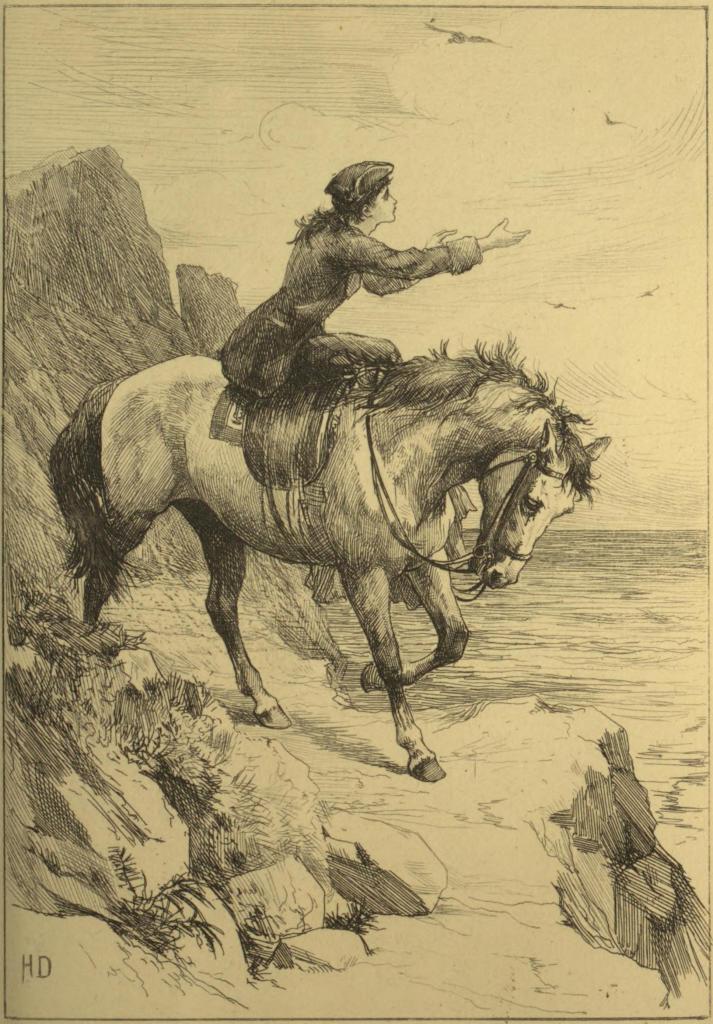
“It is even so,” said his father, pausing on the verge of the wild
promontory which they had attained, where the huge precipice sinks
abruptly down on the wide and tempestuous ocean, “and the effects are
still visible.”
The face of that lofty cape is composed of the soft and crumbling stone
called sand-flag, which gradually becomes decomposed, and yields to the
action of the atmosphere, and is split into large masses, that hang
loose upon the verge of the precipice, and, detached from it by the
violence of the tempests, often descend with great fury into the vexed
abyss which lashes the foot of the rock. Numbers of these huge fragments
lie strewed beneath the rocks from which they have fallen, and amongst
these the tide foams and rages with a fury peculiar to those latitudes.
At the period when Mertoun and his son looked from the verge of the
precipice, the wide sea still heaved and swelled with the agitation of
yesterday’s storm, which had been far too violent in its effects on the
ocean to subside speedily. The tide therefore poured on the headland
with a fury deafening to the ear, and dizzying to the eye, threatening
instant destruction to whatever might be at the time involved in its
current. The sight of Nature, in her magnificence, or in her beauty, or
in her terrors, has at all times an overpowering interest, which even
habit cannot greatly weaken; and both father and son sat themselves down
on the cliff to look out upon that unbounded war of waters, which rolled
in their wrath to the foot of the precipice.
At once Mordaunt, whose eyes were sharper, and probably his attention
more alert, than that of his father, started up, and exclaimed, “God in
Heaven! there is a vessel in the Roost!”
Mertoun looked to the north-westward, and an object was visible amid the
rolling tide. “She shows no sail,” he observed; and immediately added,
after looking at the object through his spy-glass, “She is dismasted,
and lies a sheer hulk upon the water.”
“And is drifting on the Sumburgh-head,” exclaimed Mordaunt, struck with
horror, “without the slightest means of weathering the cape!”
“She makes no effort,” answered his father; “she is probably deserted by
her crew.”
“And in such a day as yesterday,” replied Mordaunt, “when no open boat
could live were she manned with the best men ever handled an oar—all
must have perished.”
“It is most probable,” said his father, with stern composure; “and one
day, sooner or later, all must have perished. What signifies whether the
fowler, whom nothing escapes, caught them up at one swoop from yonder
shattered deck, or whether he clutched them individually, as chance gave
them to his grasp? What signifies it?—the deck, the battlefield, are
scarce more fatal to us than our table and our bed; and we are saved
from the one, merely to drag out a heartless and wearisome existence,
till we perish at the other. Would the hour were come—that hour which
reason would teach us to wish for, were it not that nature has implanted
the fear of it so strongly within us! You wonder at such a reflection,
because life is yet new to you. Ere you have attained my age, it will be
the familiar companion of your thoughts.”
“Surely, sir,” replied Mordaunt, “such distaste to life is not the
necessary consequence of advanced age?”
“To all who have sense to estimate that which it is really worth,” said
Mertoun. “Those who, like Magnus Troil, possess so much of the animal
impulses about them, as to derive pleasure from sensual gratification,
may perhaps, like the animals, feel pleasure in mere existence.”
Mordaunt liked neither the doctrine nor the example. He thought a man
who discharged his duties towards others as well as the good old
Udaller, had a better right to have the sun shine fair on his setting,
than that which he might derive from mere insensibility. But he let the
subject drop; for to dispute with his father, had always the effect of
irritating him; and again he adverted to the condition of the wreck.
The hulk, for it was little better, was now in the very midst of the
current, and drifting at a great rate towards the foot of the precipice,
upon whose verge they were placed. Yet it was a long while ere they had
a distinct view of the object which they had at first seen as a black
speck amongst the waters, and then, at a nearer distance, like a whale,
which now scarce shows its back-fin above the waves, now throws to view
its large black side. Now, however, they could more distinctly observe
the appearance of the ship, for the huge swelling waves which bore her
forward to the shore, heaved her alternately high upon the surface, and
then plunged her into the trough or furrow of the sea. She seemed a
vessel of two or three hundred tons, fitted up for defence, for they
could see her port-holes. She had been dismasted probably in the gale of
the preceding day, and lay water-logged on the waves, a prey to their
violence. It appeared certain, that the crew, finding themselves unable
either to direct the vessel’s course, or to relieve her by pumping, had
taken to their boats, and left her to her fate. All apprehensions were
therefore unnecessary, so far as the immediate loss of human lives was
concerned; and yet it was not without a feeling of breathless awe that
Mordaunt and his father beheld the vessel—that rare masterpiece by
which human genius aspires to surmount the waves, and contend with the
winds, upon the point of falling a prey to them.
Onward she came, the large black hulk seeming larger at every fathom’s
length. She came nearer, until she bestrode the summit of one tremendous
billow, which rolled on with her unbroken, till the wave and its burden
were precipitated against the rock, and then the triumph of the elements
over the work of human hands was at once completed. One wave, we have
said, made the wrecked vessel completely manifest in her whole bulk, as
it raised her, and bore her onward against the face of the precipice.
But when that wave receded from the foot of the rock, the ship had
ceased to exist; and the retiring billow only bore back a quantity of
beams, planks, casks, and similar objects, which swept out to the
offing, to be brought in again by the next wave, and again precipitated
upon the face of the rock.
It was at this moment that Mordaunt conceived he saw a man floating on a
plank or water-cask, which, drifting away from the main current, seemed
about to go ashore upon a small spot of sand, where the water was
shallow, and the waves broke more smoothly. To see the danger, and to
exclaim, “He lives, and may yet be saved!” was the first impulse of the
fearless Mordaunt. The next was, after one rapid glance at the front of
the cliff, to precipitate himself—such seemed the rapidity of his
movement—from the verge, and to commence, by means of slight fissures,
projections, and crevices in the rock, a descent, which, to a spectator,
appeared little else than an act of absolute insanity.
“Stop, I command you, rash boy!” said his father; “the attempt is death.
Stop, and take the safer path to the left.” But Mordaunt was already
completely engaged in his perilous enterprise.
“Why should I prevent him?” said his father, checking his anxiety with
the stern and unfeeling philosophy whose principles he had adopted.
“Should he die now, full of generous and high feeling, eager in the
cause of humanity, happy in the exertion of his own conscious activity,
and youthful strength—should he die now, will he not escape
misanthropy, and remorse, and age, and the consciousness of decaying
powers, both of body and mind?—I will not look upon it however—I will
not—I cannot behold his young light so suddenly quenched.”
He turned from the precipice accordingly, and hastening to the left for
more than a quarter of a mile, he proceeded towards a riva, or cleft
in the rock, containing a path, called Erick’s Steps, neither safe,
indeed, nor easy, but the only one by which the inhabitants of Jarlshof
were wont, for any purpose, to seek access to the foot of the precipice.
But long ere Mertoun had reached even the upper end of the pass, his
adventurous and active son had accomplished his more desperate
enterprise. He had been in vain turned aside from the direct line of
descent, by the intervention of difficulties which he had not seen from
above—his route became only more circuitous, but could not be
interrupted. More than once, large fragments to which he was about to
intrust his weight, gave way before him, and thundered down into the
tormented ocean; and in one or two instances, such detached pieces of
rock rushed after him, as if to bear him headlong in their course. A
courageous heart, a steady eye, a tenacious hand, and a firm foot,
carried him through his desperate attempt; and in the space of seven
minutes, he stood at the bottom of the cliff, from the verge of which
he had achieved his perilous descent.
The place which he now occupied was the small projecting spot of stones,
sand, and gravel, that extended a little way into the sea, which on the
right hand lashed the very bottom of the precipice, and on the left, was
scarce divided from it by a small wave-worn portion of beach that
extended as far as the foot of the rent in the rocks called Erick’s
Steps, by which Mordaunt’s father proposed to descend.
When the vessel split and went to pieces, all was swallowed up in the
ocean, which had, after the first shock, been seen to float upon the
waves, excepting only a few pieces of wreck, casks, chests, and the
like, which a strong eddy, formed by the reflux of the waves, had
landed, or at least grounded, upon the shallow where Mordaunt now stood.
Amongst these, his eager eye discovered the object that had at first
engaged his attention, and which now, seen at nigher distance, proved to
be in truth a man, and in a most precarious state. His arms were still
wrapt with a close and convulsive grasp round the plank to which he had
clung in the moment of the shock, but sense and the power of motion were
fled; and, from the situation in which the plank lay, partly grounded
upon the beach, partly floating in the sea, there was every chance that
it might be again washed off shore, in which case death was inevitable.
Just as he had made himself aware of these circumstances, Mordaunt
beheld a huge wave advancing, and hastened to interpose his aid ere it
burst, aware that the reflux might probably sweep away the sufferer.
He rushed into the surf, and fastened on the body, with the same
tenacity, though under a different impulse, with that wherewith the
hound seizes his prey. The strength of the retiring wave proved even
greater than he had expected, and it was not without a struggle for his
own life, as well as for that of the stranger, that Mordaunt resisted
being swept off with the receding billow, when, though an adroit
swimmer, the strength of the tide must either have dashed him against
the rocks, or hurried him out to sea. He stood his ground, however, and
ere another such billow had returned, he drew up, upon the small slip of
dry sand, both the body of the stranger, and the plank to which he
continued firmly attached. But how to save and to recall the means of
ebbing life and strength, and how to remove into a place of greater
safety the sufferer, who was incapable of giving any assistance towards
his own preservation, were questions which Mordaunt asked himself
eagerly, but in vain.
He looked to the summit of the cliff on which he had left his father,
and shouted to him for his assistance; but his eye could not distinguish
his form, and his voice was only answered by the scream of the
sea-birds. He gazed again on the sufferer. A dress richly laced,
according to the fashion of the times, fine linen, and rings upon his
fingers, evinced he was a man of superior rank; and his features showed
youth and comeliness, notwithstanding they were pallid and disfigured.
He still breathed, but so feebly, that his respiration was almost
imperceptible, and life seemed to keep such slight hold of his frame,
that there was every reason to fear it would become altogether
extinguished, unless it were speedily reinforced. To loosen the
handkerchief from his neck, to raise him with his face towards the
breeze, to support him with his arms, was all that Mordaunt could do for
his assistance, whilst he anxiously looked for some one who might lend
his aid in dragging the unfortunate to a more safe situation.
At this moment he beheld a man advancing slowly and cautiously along the
beach. He was in hopes, at first, it was his father, but instantly
recollected that he had not had time to come round by the circuitous
descent, to which he must necessarily have recourse, and besides, he saw
that the man who approached him was shorter in stature.
As he came nearer, Mordaunt was at no loss to recognise the pedlar whom
the day before he had met with at Harfra, and who was known to him
before upon many occasions. He shouted as loud as he could, “Bryce,
hollo! Bryce, come hither!” But the merchant, intent upon picking up
some of the spoils of the wreck, and upon dragging them out of reach of
the tide, paid for some time little attention to his shouts.
When he did at length approach Mordaunt, it was not to lend him his aid,
but to remonstrate with him on his rashness in undertaking the
charitable office. “Are you mad?” said he; “you that have lived sae lang
in Zetland, to risk the saving of a drowning man? Wot ye not, if you
bring him to life again, he will be sure to do you some capital
injury?[31]—Come, Master Mordaunt, bear a hand to what’s mair to the
purpose. Help me to get ane or twa of these kists ashore before any body
else comes, and we shall share, like good Christians, what God sends us,
and be thankful.”
Mordaunt was indeed no stranger to this inhuman superstition, current at
a former period among the lower orders of the Zetlanders, and the more
generally adopted, perhaps, that it served as an apology for refusing
assistance to the unfortunate victims of shipwreck, while they made
plunder of their goods. At any rate, the opinion, that to save a
drowning man was to run the risk of future injury from him, formed a
strange contradiction in the character of these islanders; who,
hospitable, generous, and disinterested, on all other occasions, were
sometimes, nevertheless, induced by this superstition, to refuse their
aid in those mortal emergencies, which were so common upon their rocky
and stormy coasts. We are happy to add, that the exhortation and example
of the proprietors have eradicated even the traces of this inhuman
belief, of which there might be some observed within the memory of those
now alive. It is strange that the minds of men should have ever been
hardened towards those involved in a distress to which they themselves
were so constantly exposed; but perhaps the frequent sight and
consciousness of such danger tends to blunt the feelings to its
consequences, whether affecting ourselves or others.
Bryce was remarkably tenacious of this ancient belief; the more so,
perhaps, that the mounting of his pack depended less upon the warehouses
of Lerwick or Kirkwall, than on the consequences of such a north-western
gale as that of the day preceding; for which (being a man who, in his
own way, professed great devotion) he seldom failed to express his
grateful thanks to Heaven. It was indeed said of him, that if he had
spent the same time in assisting the wrecked seamen, which he had
employed in rifling their bales and boxes, he would have saved many
lives, and lost much linen. He paid no sort of attention to the
repeated entreaties of Mordaunt, although he was now upon the same slip
of sand with him. It was well known to Bryce as a place on which the
eddy was likely to land such spoils as the ocean disgorged; and to
improve the favourable moment, he occupied himself exclusively in
securing and appropriating whatever seemed most portable and of greatest
value. At length Mordaunt saw the honest pedlar fix his views upon a
strong sea-chest, framed of some Indian wood, well secured by brass
plates, and seeming to be of a foreign construction. The stout lock
resisted all Bryce’s efforts to open it, until, with great composure, he
plucked from his pocket a very neat hammer and chisel, and began forcing
the hinges.
Incensed beyond patience at his assurance, Mordaunt caught up a wooden
stretcher which lay near him, and laying his charge softly on the sand,
approached Bryce with a menacing gesture, and exclaimed, “You
cold-blooded, inhuman rascal! either get up instantly and lend me your
assistance to recover this man, and bear him out of danger from the
surf, or I will not only beat you to a mummy on the spot, but inform
Magnus Troil of your thievery, that he may have you flogged till your
bones are bare, and then banish you from the Mainland!”
The lid of the chest had just sprung open as this rough address saluted
Bryce’s ears, and the inside presented a tempting view of wearing
apparel for sea and land; shirts, plain and with lace ruffles, a silver
compass, a silver-hilted sword, and other valuable articles, which the
pedlar well knew to be such as stir in the trade. He was half-disposed
to start up, draw the sword, which was a cut-and-thrust, and “darraign
battaile,” as Spenser says, rather than quit his prize, or brook
interruption. Being, though short, a stout square-made personage, and
not much past the prime of life, having besides the better weapon, he
might have given Mordaunt more trouble than his benevolent
knight-errantry deserved.
Already, as with vehemence he repeated his injunctions that Bryce should
forbear his plunder, and come to the assistance of the dying man, the
pedlar retorted with a voice of defiance, “Dinna swear, sir; dinna
swear, sir—I will endure no swearing in my presence; and if you lay a
finger on me, that am taking the lawful spoil of the Egyptians, I will
give ye a lesson ye shall remember from this day to Yule!”
Mordaunt would speedily have put the pedlar’s courage to the test, but a
voice behind him suddenly said, “Forbear!” It was the voice of Norna of
the Fitful-head, who, during the heat of their altercation, had
approached them unobserved. “Forbear!” she repeated; “and, Bryce, do
thou render Mordaunt the assistance he requires. It shall avail thee
more, and it is I who say the word, than all that you could earn to-day
besides.”
“It is se’enteen hundred linen,” said the pedlar, giving a tweak to one
of the shirts, in that knowing manner with which matrons and judges
ascertain the texture of the loom;—“it’s se’enteen hundred linen, and
as strong as an it were dowlas. Nevertheless, mother, your bidding is to
be done; and I would have done Mr. Mordaunt’s bidding too,” he added,
relaxing from his note of defiance into the deferential whining tone
with which he cajoled his customers, “if he hadna made use of profane
oaths, which made my very flesh grew, and caused me, in some sort, to
forget myself.” He then took a flask from his pocket, and approached
the shipwrecked man. “It’s the best of brandy,” he said; “and if that
doesna cure him, I ken nought that will.” So saying, he took a
preliminary gulp himself, as if to show the quality of the liquor, and
was about to put it to the man’s mouth, when, suddenly withholding his
hand, he looked at Norna—“You ensure me against all risk of evil from
him, if I am to render him my help?—Ye ken yoursell what folk say,
mother.”
For all other answer, Norna took the bottle from the pedlar’s hand, and
began to chafe the temples and throat of the shipwrecked man; directing
Mordaunt how to hold his head, so as to afford him the means of
disgorging the sea-water which he had swallowed during his immersion.
The pedlar looked on inactive for a moment, and then said, “To be sure,
there is not the same risk in helping him, now he is out of the water,
and lying high and dry on the beach; and, to be sure, the principal
danger is to those that first touch him; and, to be sure, it is a
world’s pity to see how these rings are pinching the puir creature’s
swalled fingers—they make his hand as blue as a partan’s back before
boiling.” So saying, he seized one of the man’s cold hands, which had
just, by a tremulous motion, indicated the return of life, and began his
charitable work of removing the rings, which seemed to be of some value.
“As you love your life, forbear,” said Norna, sternly, “or I will lay
that on you which shall spoil your travels through the isles.”
“Now, for mercy’s sake, mother, say nae mair about it,” said the pedlar,
“and I’ll e’en do your pleasure in your ain way! I did feel a
rheumatize in my back-spauld yestreen; and it wad be a sair thing for
the like of me to be debarred my quiet walk round the country, in the
way of trade—making the honest penny, and helping myself with what
Providence sends on our coasts.”
“Peace, then,” said the woman—“Peace, as thou wouldst not rue it; and
take this man on thy broad shoulders. His life is of value, and you will
be rewarded.”
“I had muckle need,” said the pedlar, pensively looking at the lidless
chest, and the other matters which strewed the sand; “for he has come
between me and as muckle spreacherie as wad hae made a man of me for the
rest of my life; and now it maun lie here till the next tide sweep it a’
doun the Roost, after them that aught it yesterday morning.”
“Fear not,” said Norna, “it will come to man’s use. See, there come
carrion-crows, of scent as keen as thine own.”
She spoke truly; for several of the people from the hamlet of Jarlshof
were now hastening along the beach, to have their share in the spoil.
The pedlar beheld them approach with a deep groan. “Ay, ay,” he said,
“the folk of Jarlshof, they will make clean wark; they are kend for that
far and wide; they winna leave the value of a rotten ratlin; and what’s
waur, there isna ane o’ them has mense or sense eneugh to give thanks
for the mercies when they have gotten them. There is the auld Ranzelman,
Neil Ronaldson, that canna walk a mile to hear the minister, but he will
hirple ten if he hears of a ship embayed.”
Norna, however, seemed to possess over him so complete an ascendency,
that he no longer hesitated to take the man, who now gave strong
symptoms of reviving existence, upon his shoulders; and, assisted by
Mordaunt, trudged along the sea-beach with his burden, without farther
remonstrance. Ere he was borne off, the stranger pointed to the chest,
and attempted to mutter something, to which Norna replied, “Enough. It
shall be secured.”
Advancing towards the passage called Erick’s Steps, by which they were
to ascend the cliffs, they met the people from Jarlshof hastening in the
opposite direction. Man and woman, as they passed, reverently made room
for Norna, and saluted her—not without an expression of fear upon some
of their faces. She passed them a few paces, and then turning back,
called aloud to the Ranzelman, who (though the practice was more common
than legal) was attending the rest of the hamlet upon this plundering
expedition. “Neil Ronaldson,” she said, “mark my words. There stands
yonder a chest, from which the lid has been just prized off. Look it be
brought down to your own house at Jarlshof, just as it now is. Beware of
moving or touching the slightest article. He were better in his grave
that so much as looks at the contents. I speak not for nought, nor in
aught will I be disobeyed.”
“Your pleasure shall be done, mother,” said Ronaldson. “I warrant we
will not break bulk, since sic is your bidding.”
Far behind the rest of the villagers, followed an old woman, talking to
herself, and cursing her own decrepitude, which kept her the last of the
party, yet pressing forward with all her might to get her share of the
spoil.
When they met her, Mordaunt was astonished to recognise his father’s old
housekeeper. “How now,” he said, “Swertha, what make you so far from
home?”
“Just e’en daikering out to look after my auld master and your honour,”
replied Swertha, who felt like a criminal caught in the manner; for on
more occasions than one, Mr. Mertoun had intimated his high
disapprobation of such excursions as she was at present engaged in.
But Mordaunt was too much engaged with his own thoughts to take much
notice of her delinquency. “Have you seen my father?” he said.
“And that I have,” replied Swertha—“The gude gentleman was ganging to
hirsel himsell doun Erick’s Steps, whilk would have been the ending of
him, that is in no way a cragsman. Sae I e’en gat him wiled away
hame—and I was just seeking you that you may gang after him to the
hall-house, for to my thought he is far frae weel.”
“My father unwell?” said Mordaunt, remembering the faintness he had
exhibited at the commencement of that morning’s walk.
“Far frae weel—far frae weel,” groaned out Swertha, with a piteous
shake of the head—“white o’ the gills—white o’ the gills—and him to
think of coming down the riva!”
“Return home, Mordaunt,” said Norna, who was listening to what had
passed. “I will see all that is necessary done for this man’s relief,
and you will find him at the Ranzelman’s, when you list to enquire. You
cannot help him more than you already have done.”
Mordaunt felt this was true, and, commanding Swertha to follow him
instantly, betook himself to the path homeward.
Swertha hobbled reluctantly after her young master in the same
direction, until she lost sight of him on his entering the cleft of the
rock; then instantly turned about, muttering to herself, “Haste home, in
good sooth?—haste home, and lose the best chance of getting a new
rokelay and owerlay that I have had these ten years? by my certie,
na—It’s seldom sic rich godsends come on our shore—no since the Jenny
and James came ashore in King Charlie’s time.”
So saying, she mended her pace as well as she could, and, a willing mind
making amends for frail limbs, posted on with wonderful dispatch to put
in for her share of the spoil. She soon reached the beach, where the
Ranzelman, stuffing his own pouches all the while, was exhorting the
rest to part things fair, and be neighbourly, and to give to the auld
and helpless a share of what was going, which, he charitably remarked,
would bring a blessing on the shore, and send them “mair wrecks ere
winter.”[32]