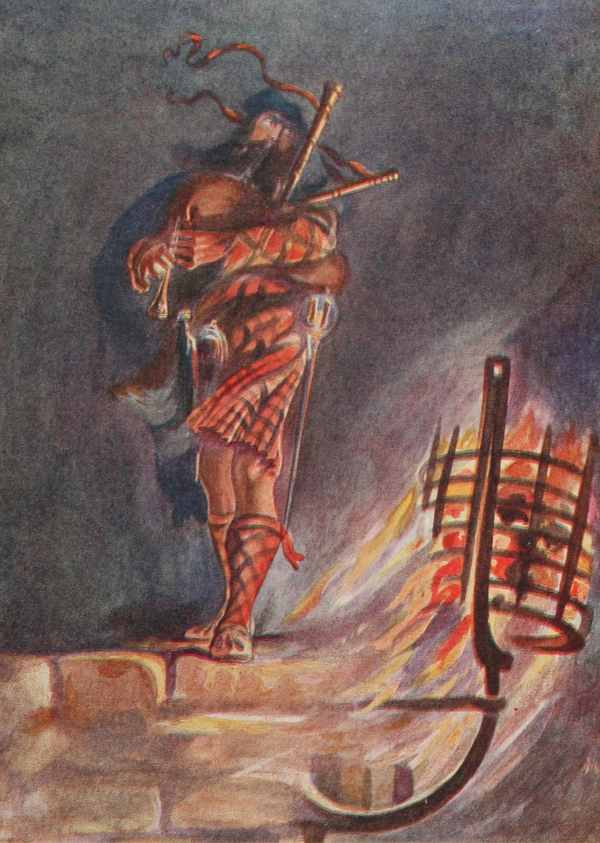
During the autumn[2] and winter of 1914-15 pipers, for obvious
reasons, had few opportunities of attracting much attention, still
less of performing their highest duty, viz. playing their companies into
action. They were necessarily, on account of the extreme shortage of men,
for the most part employed in the ranks; and in many of the old Regular
battalions pipe bands disappeared altogether.
For a time it seemed that the critics were right, and that in warfare
in the twentieth century there was no longer a place for a class of man
which was destined to disappear, as the bard and the harper had done in
days lang syne.
This view was widely held, and in some regiments was never modified.
But gradually, as attacks became more frequent and movements set
in, and as the British Army grew stronger in numbers, the position changed,
and the piper became more than an invaluable marching instrumentalist
or performer at ceilidhs in billets.
The first occasion on which pipers played, or tried to play, their companies
into action was at Cuinchy on 25th January 1915, when the 1st Black Watch
suffered such heavy casualties in advancing through deep mud up to their
knees.
It was at Neuve Chapelle in March 1915 that the company piper really
had his first chance of showing what he could do, as a piper, in action. On
this occasion the 20th Brigade had to carry the stronghold of Moulin du
Piètre, and lost very heavily; the 2nd Gordons were in the main attack
and the 6th Gordons, a Territorial unit, in reserve. The 6th Gordons
were called upon to support their comrades of the old Regular Army, and
advanced, headed by their pipes and drums, with a rush which carried many
of them beyond their objective.
From that time onwards, right up to the end of the war, pipers have
repeatedly played their units into action, in spite of the unfavourable
conditions resulting from modern rifle and artillery fire and gas, and have
established the standard of gallantry in this respect which has been at
once the admiration of all observers and an incentive to their successors
to emulate them.
During the first weeks' heavy fighting, in April-May 1915, on the
left of the attenuated British line of the Ypres salient, the pipers of Canadian
battalions took a prominent part. In their advance on the St. Julien
wood the 16th Canadians were led by their company pipers, two of whom
were killed and two wounded while playing; their places were at once
taken by others, who played the battalion through the German trenches
at the heels of the retiring enemy to the tune "We'll tak' the guid auld
way." In many subsequent actions these men distinguished themselves
in the same way.
After the failure of the first attack on the German line at Rue des Bois
on 9th May 1915, in the action of Richebourg-Festubert, the 1st Black
Watch were played to a fresh attack by their company pipers. "With
their characteristic fury they had vanished into the smoke, and the only
evidence that remained was the sound of the pipes." When they reached
the German trenches a piper, Andrew Wishart, stood on the parados playing
until he was wounded. Another piper, W. Stewart, was awarded the
D.C.M. on this occasion.
The same thing happened in the case of the 2nd Black Watch at Festubert,
the companies being led by their pipers. Of these men two, Pipers Gordon
and Crichton, were specially mentioned for their gallantry. The Seaforth
pipers, too, suffered heavily in this as in many later actions—"Caber Feidh"
has often been heard along that line which looked so weak, but was too
strong for the Germans.
In the action at Festubert on the 17th May the 4th Camerons got further
than any other battalion, and were played in by their pipe major, J. Ross,
and four pipers. These men got through untouched, though their pipes
were all injured.
Later again, on 16th June 1915, when the Hooge salient was straightened
by the 3rd Division, the attack was led by the 8th Brigade, and the enemy
front and support lines were taken. On this occasion Pipe Major Daniel
Campbell, although wounded, played his battalion, the 1st Royal Scots
Fusiliers, over the top.
Dawn was just breaking when the Pipe Major scrambled out on the
parapet and started playing. The men raced forward after him until
stopped by uncut wire. In the hand-to-hand fighting which ensued the
Pipe Major threw aside his pipes and, catching up a bayonet, joined in
the attack.
It was during the Ypres fighting, where gas was first used against us,
that an incident occurred of which the facts are as stated, but unfortunately
it has been found impossible to get the names of the men concerned.
"The men, looking into the storm of shells that swept their course
and at the awful cloud of death now almost on them, wavered, hung back—only
for a moment. And who will dare to blame them?
"Two of the battalion pipers who were acting as stretcher bearers saw
the situation in a moment. Dropping their stretcher they made for their
dug-out and emerged a second later with their pipes. They sprang on
the parapet, tore off their respirators and charged forward. Fierce and
terrible the wild notes cleft the air ... after fifteen yards the pibroch ceased;
the two pipers, choked and suffocated with the gas fumes, staggered and
fell."[3]
Although in these earlier actions pipers had done much to maintain
the traditions of the past they had never had the opportunities of distinguishing
themselves that came to them during the great operations about
Loos in September 1915. The attack of two army corps, in which were
thirty Scottish battalions, along a seven-mile front, was a chance for these
men, and one of which they were not slow to avail themselves. Three
pipers at least earned the title of "The piper of Loos," and one of these,
Daniel Laidlaw, of the 7th King's Own Scottish Borderers, was awarded
the Victoria Cross; but, in the general orgie of gallantry which characterised
those operations, individual pipers in very many cases won the highest
praise in their own units but escaped the official recognition they had
earned.
The attack by the 28th Brigade on the Hohenzollern Redoubt was
accompanied by fearful casualties; with uncut wire in front, in an atmosphere
heavily laden with gas, exposed to machine-gun fire in front and
flank, the 6th K.O.S.B., 10th and 11th H.L.I. and 9th Seaforths were decimated.
The K.O.S.B. were played over the top by their veteran Pipe Major,
Robert Mackenzie, an old soldier of forty-two years' service. He was
severely wounded and died the following day.
On the right of this Brigade the 26th had better luck, as the wire was found
to be more thoroughly cut. The 5th Camerons and 7th Seaforths led the
way followed by the 8th Gordons and 8th Black Watch, and reached Fosse 8,
where they hung on, though reduced to the strength of a single battalion.
"The heroism of the pipers was splendid. In spite of murderous fire
they continued playing. At one moment, when the fire of the machine guns
was so terrific that it looked as if the attack must break down, a Seaforth
piper dashed forward in front of the line and started 'Caber Feidh.' The
effect was instantaneous—the sorely pressed men braced themselves together
and charged forward. The Germans soon got to realise the value of the
pipes and tried to pick off the pipers."
In this one attack the 5th Camerons had three pipers killed and eight
wounded. Further south the pipers of the 2nd and 6th Gordons led their
companies in the costly attack on Hulluch and the Quarries. An officer
of the Devons, on their flank, writes:
"I shall never forget those pipes.... During the charge a Gordon piper
continued playing after he was down."
On the other side of the Hulluch road the 15th Division received its
baptism of fire, and lost 6000 men in the two days' fighting. One of the
battalions of the 46th Brigade, the 7th King's Own Scottish Borderers,
afforded an admirable example of the value of the pipes in rallying men
when the position is critical. The piper concerned, Daniel Laidlaw, was
awarded the Victoria Cross and the Croix de Guerre. The London Gazette
Notification, which does not err on the side of uncontrolled emotionalism,
describes the award as follows:
"For most conspicuous bravery.... During the worst of the bombardment,
when the attack was about to commence, Piper Laidlaw, seeing that
his company was somewhat shaken from the effects of gas, with absolute
coolness and disregard of danger, mounted the parapet, marched up and
down and played his company out of the trench. The effect of his splendid
example was immediate, and the company dashed out to the assault. Piper
Laidlaw continued playing his pipes until he was wounded."
The evidence of eye-witnesses shows that, at the time, a cloud of gas
was settling down on the trench and there was heavy machine-gun fire.
Laidlaw played "Blue Bonnets over the Border," and the effect on the
men was indescribable; as they followed him over the top he changed
to "The Standard on the Braes of Mar." The old tune was surely never
played to better purpose; and if Laidlaw's action stood alone, if he were
the only piper during the war who stimulated a company at the moment
when things were at their worst, surely that achievement amply supports
the view that, even in the warfare of to-day, piob mhor is an instrument of
war which can justify all claims made for it. As it is, Piper Laidlaw, "the
Piper of Loos," stands as type of a class of men who, throughout the war,
have lived up to the traditions of a great past.
Another piper of the same battalion, Douglas Taylor, being wounded
and unable to play, spent thirty-six hours bringing in gassed men without
relief, until he himself was dangerously wounded. Further on, the 44th
Brigade—the 8th Seaforths, 7th Camerons, 9th Black Watch and 10th
Gordons—made the historic charge which captured Loos and then went
on, until, for want of support, they could get no further and were compelled
to retire. They rallied on Hill 70 round a tattered flag made out of a
Cameron kilt. The battalions of this brigade were played into and beyond
Loos; and, when they were widely scattered and mixed up, pipers played to
rally the men of their own battalions. Among many others, Piper Charles
Cameron of the 11th Argylls stood out in the open playing unconcernedly,
and was thereafter known in his battalion as "the Piper of Loos."
The shattered remnants of the 15th Division were withdrawn in the
evening from the blood-stained slopes of Hill 70, but the battalions were
played in by their own pipers. The 9th Black Watch numbered only 100
of all ranks and one piper; the 7th Cameron pipers were practically annihilated,
the 8th Seaforths lost ten, and others suffered in similar degree.
It is a far cry from Hill 70 to Scaur Donald, and they were only regimental
pipers, but to these brave men the words of the old song are surely
applicable.
"There let him rest in the lap of Scaur Donald,
The wind for his watcher, the mist for his shroud,
Where the green and the grey moss shall weave their wild tartan,
A covering meet for a chieftain so proud."
In the fighting subsidiary to the main action of Loos, at Mauquissart
and in the neighbourhood of Neuve Chapelle, the 2nd Black Watch pipers
distinguished themselves greatly. They played their companies into and
beyond the first line of German trenches. One of them, A. Macdonald,
stood playing on the German parapet while the position was being cleared,
and then on, through a hurricane of fire, over three lines of trenches, until
dangerously wounded. For this he was given the D.C.M.
Three others, J. Galloway, R. Johnstone and David Armit, did precisely
the same; and yet another, David Simpson, behaved with such gallantry
that he also came to be known as "the Piper of Loos," the third of the
brave trio to earn that honourable title. He had already played over
three lines of German trenches, and was leading towards the fourth when
he was killed. Johnstone, on this occasion, played till he fell gassed.
Throughout the long succession of actions which punctuated the Somme
operations in 1916, the pipes continued to be much in evidence, and references
to them and to their effect upon the men during that bloody fighting
are frequent in the contemporary reports of observers, and in private letters
subsequently published. French reports also have placed on record their
admiration for the company pipers of Scottish regiments. "Some of the
finest work," writes one well-known French military writer, "was accomplished
at the very outset by the Highlanders, who carried the trenches
in lightning fashion, urged on by the inspiriting music of their pipes."
The fighting at Loos had shown, on a comparatively small scale, that
the pipes, when freed from the restrictions placed upon their employment
by the exigencies of trench warfare, were still capable of fulfilling their
historic rôle in open fighting The gallantry of the pipers at Hulluch and
Hill 70 was worthy of the units they led, and established a record which
was hard to beat; but for months on end their great achievements were
emulated by those of their successors in the new armies which had poured
into the field.
The opening attack on the 1st July affords numerous examples of pipers
playing their companies into action, and a few may be taken as representative
of the whole.
In the attack by the 32nd Division the 17th H.L.I, succeeded, with a loss
of over 500 men, in capturing and holding part of the Leipzig redoubt, though
unsupported for a considerable time. The Commanding Officer writes:
"I told the Pipe Major to play; he at once responded, getting into a
small hollow, and playing and greatly heartening the men as they lay there
hanging on to the captured position. Pipe Major Gilbert showed a total
disregard of danger and played as if he were on a route march. For this
action he obtained the Military Medal."
In the advance on Mametz on the same day the 2nd Gordons were led
by their company pipers. An officer of an English battalion in the 20th
Brigade describes how "we heard their pipes play these fellows over. It
sounded grand against the noise of shells, machine guns and rifle fire. I
shall never forget them."
The same thing occurred later when the battalion attacked the orchards
of Ginchy. On both occasions the casualties were very heavy.
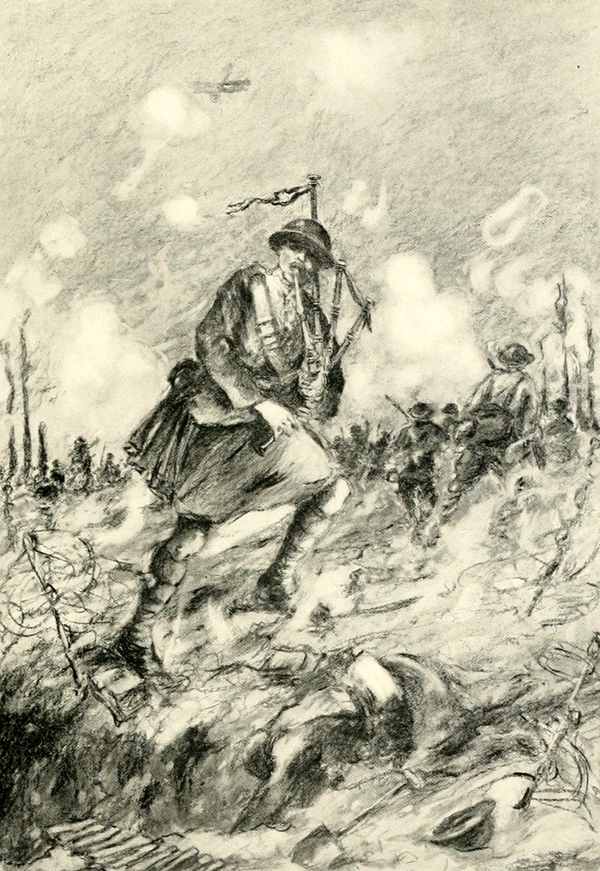
PIPER DANIEL LAIDLAW, V.C., 7TH KING'S OWN SCOTTISH BORDERERS
At Loos
From the Drawing by Louis Weirter, R.B.A.
At Fricourt Pipe Major David Anderson of the 15th Royal Scots stood
out in front of the battalion until he was wounded, and played across
shell-beaten ground under heavy fire. He was awarded the Croix de
Guerre.
The two battalions of Tyneside Scottish were similarly played to their
attack on La Boiselle and the ridge in front of it on the opening day of the
battle of the Somme. A correspondent who was present says:
"The Tynesiders were on our right, and, as they got the signal to advance,
I saw a piper—I think he was the Pipe Major—jump out of the trench and
march straight towards the German lines. The tremendous rattle of machine-gun
and rifle fire completely drowned the sound of his pipes, but he was
obviously playing as though he would burst the bag, and, faintly through
the roar of battle, we heard the mighty cheer his comrades gave as they
swarmed after him. How he escaped I can't understand, for the ground
was literally ploughed up by the hail of bullets; but he bore a charmed
life, and the last glimpse I had of him as we, too, dashed out showed him
still marching erect, playing on regardless of the flying bullets and of the
men dropping all round him."
Of the two battalions 10 pipers were killed and 5 wounded, and Pipe
Major Wilson and Piper G. Taylor both got the Military Medal. Many
of these pipers, having played their companies up to the German trenches,
took an active part in the fighting as bombers.
Again, at Longueval on 14th July, regimental pipers were conspicuous.
As the 26th Brigade—8th Black Watch, 10th Argylls, 9th Seaforths, and
5th Camerons—commenced their advance, they were exposed to frontal
and enfilading machine-gun fire, and shrapnel mowed them down; but
their pipers led the way, and the men followed cheering and shouting.
"Where we were the brunt of the action fell on two New Army battalions
of historic Highland regiments. Their advance was one of the most magnificent
sights I have ever seen. They left their trenches at dawn, and a torrent
of bullets met them. They answered immediately—with the shrill music
of the pipes, and, indifferent apparently to the chaos around them, pushed
steadily on towards their objective."
Describing the attack by the 10th Argylls, another observer writes:
"We came under a blistering hot fire, but the men never hesitated. In
the middle of it all the pipes struck up "The Campbells are coming," and
that made victory a certainty for us. We felt that whatever obstacles
there barred our path they had to be overcome.... The last fight was
the worst of all. It was at the extreme end of the village, where the enemy
had possession of some ruined houses. They had a clear line of fire in all
directions, and we were met with a murderous hail of fire. For a moment
the men wavered. I doubted if they were equal to it. Then a piper sprang
forward, and the strains broke out once more. The attacking line steadied
and dashed at the last stronghold of the Huns. Their line snapped under
our onslaught."
On this occasion the Pipe Major, Aitken, a man of sixty, was awarded
the Distinguished Conduct Medal. One of the pipers referred to in the
above incident was James Dall, and his Commanding Officer considers
his action in playing the regimental march at this juncture was the means
of his company gaining their objective; the other was D. Wilson, who
was also mentioned in despatches with Dall.
Of the attack by the 9th Seaforths a wounded officer writes:
"We swept on until we finally carried the German trench with a rousing
cheer to the strain of the pipes. The heroism of the pipers was splendid.
In spite of murderous fire they kept playing on. At one moment, when the
fire was so terrific it looked as if the attack must break down, one of the
pipers dashed forward and started playing. The change could be felt at
once, the sorely pressed men gave a mighty cheer and dashed forward
with new zeal."
North of Longueval the 1st Gordons made a furious attack, on the 18th
July, and on this occasion they were led by their pipers.
"They were out of sight over the parapet, but we could hear at intervals
their shouts of 'Scotland for ever!' and the faint strains of the pipes. Then
we saw them reappear, and then came prisoners."
Similar accounts were given of the 6th and 7th Gordons. In the 6th
Gordons Piper Charles Thomson had his arm blown off while playing. "The
gallantry of these men who wear the tartans of the old Scottish clans would
seem wonderful if it were not habitual with them. Their first dash for
Longueval was one of the finest exploits of the war. They were led forward
by the pipers, who went with them, not only towards the German lines,
but across them and into the thick of the battle.... In that September
fighting the pipe major of a Gordon battalion played his men forward and
then was struck below the knee; but he would not be touched by a doctor
until the others had been tended. He was a giant of a man and so heavy
that no stretcher could hold him, so they put him in a tarpaulin and carried
him back. Then he had his leg amputated and died."[4]
On the 3rd September the 4th Black Watch were played into action
and had to capture a village. According to an eye-witness:
"It was magnificent to see these men charge up the narrow street leading
to the second barricade. Amid the ruined houses on each side the enemy
were posted. At the moment when it was hottest the strains of the pipes
were heard. The men answered with a cheer and swept steadily on over
the barricade and through the ruins; and the village was ours."
Of a Seaforth battalion a similar story is told:
"The men simply raced into the storm of bullets ... at last it became
too terrible for any human being to stand against it. The attacking lines
melted away, the men seeking what cover could be found.... It was
here that the pipers of the Seaforths had their chance. They took it.
As the men advanced again to the attack they were cheered on by the
strains of the pipes, which could just be heard. The men dashed through,
clearing out the enemy as they went."
During the attack on Beaumont Hamel in October, as in the earlier
fighting at Thiepval, the pipers of the 15th H.L.I. lost very heavily when
leading their companies.
Such instances of the bravery of pipers and of the stimulus afforded
by the pipes to men in action became matters of almost every-day occurrence,
and, though everyone recognised the tremendous losses that were the
result of their exposure, there were occasions when those losses were more
than compensated for at the time by the results obtained. Everywhere,
at Contalmaison, Martinpuich, Pozières, Delville Wood, wherever Scottish
troops were employed, their pipers played their historic rôle, and, to quote
Philip Gibbs, "over the open battlefields came the music of the Scottish
pipes, shrill above the noise of gunfire."
Nor were the pipers of purely Scottish regiments left to establish these
records of bravery unchallenged. They had keen rivals in battalions of
overseas Scots, notably the South African Scottish and the Canadians.
During the fighting for Delville Wood in July the South Africans were
torn to pieces by shell fire. The remains of the battalion hung on for
days, losing all their officers but the colonel. When relief came their
pipers headed the blackened and weary warriors out of the wood of
death.
Similarly, the 16th Canadian Scottish pipers maintained the fine reputation
they had earned on the Ypres salient. When the battalion moved up
to the attack on the Regina trench on 8th October, there was keen competition
among the pipers as to who should be allowed to play them over.
"Four pipers, Richardson, Park, M'Kellar and Paul marched ahead of the
battalion with the Commanding Officer for a distance of half a mile under
intense machine-gun fire and escaped scatheless. They could be heard
clearly as they played 'We'll take the good old way,' and, as they passed,
wounded men lying in shell holes raised themselves on their elbows and
cheered them. When they got near the German line the battalion encountered
uncut wire which, being unusually heavy, took some time to cut. While
this was going on Piper Richardson played up and down outside the wire
for twenty minutes in the face of almost certain death.... Shortly afterwards
a company sergeant major was wounded, and Richardson volunteered
to take him out. After he had gone he remembered he had left his pipes
behind. He left the sergeant major in safety in a shell hole and returned.
He was never heard of again."
This brave man was awarded a posthumous V.C., the second piper to
obtain this coveted distinction. Piper Paul was subsequently given the
Military Medal.
At the capture of the Vimy Ridge on 9th April, 1917, by the Canadians,
the pipers of some of their battalions took a prominent part. On this
occasion the 16th Canadian Scottish repeated what they had done in previous
engagements, their companies being led by pipers. The pipers concerned
were Pipe Major Groat and Pipers M'Gillivray, M'Nab, M'Allister, M'Kellar
and Paul, and they advanced a distance of over a mile under heavy fire
without any casualties. The Pipe Major was awarded the Military Medal.
Similarly the 25th Canadians had their pipers out in this action, and
Piper Walter Telfer, who went on playing after being severely wounded,
was given the Military Medal; Piper Brand got the same decoration.
Later on, in the fighting round Arras, a battalion of the Camerons was
played to the attack:
"When the order came our men went over with right good will. It
was a thrilling moment, especially when the pipes struck up the Camerons'
march. I believe it was that music, at that particular moment, which made
it possible for us to go through the ordeal that followed."
Once again "The March of the Cameron Men" was the undoing of
an enemy which had to stand up against the Camerons; and in one part
of the line, when the attack was most furiously resisted, the company piper
changed his tune to the old "Piobaireachd Dhomnuil Duibh"—
"Fast they came, fast they come,
See how they gather!
Wide waves the eagle's plume
Blended with heather."
An account of the few minutes before "zero" by a piper of this battalion
appeared in the Scottish Field ("Pipes of the Misty Moorland," John
M'Gibbon), and affords a good example of the steadying effect of the pipes
in a period of great strain on morale:
"I looked down at the company and I could see they were shaken....
I slung my rifle over my back and took up the pipes; that cheered them.
I played through two or three tunes and then birled up 'Tullochgorum.'
They fairly hooched it and stamped time with their feet. It was close
on 'zero' ... when I changed to 'The March of The Cameron Men.' Our
guns burst out with drum fire behind us ... and the men jumped the parapet
like deer and raced over the broken ground at the double. I kept up 'The
Cameron Men.' ... I reached the parapet of the first enemy trench, when
I 'stopped one' with my leg, and down I went in a heap."
The pipes were again to the front in the fighting for Hill 70 on the Lens-Loos
line in August, 1917. It was surely appropriate enough that, in the
advance over the very country in which so many Scottish regiments had
fought, with only temporary success, two years before, the pipes should again
be at the head of the units which recaptured those blood-soaked positions.
An officer, describing the advance of the 13th Royal Highlanders of
Canada, says:
"Our advance was resumed and we swarmed over the top at three
different points. Away to the left, which was the objective of our advance,
the strains of the pipes could be heard, and across the hills, where so many
Scottish lads had fallen two years ago, there burst a loud triumphant cheer
as the Canadian Highlanders pressed on to complete their work."
And so it happened that the gallant lads of the 15th Division were
avenged.
Opportunities for pipers continued during the later fighting in 1917-18.
Records of individual companies and platoons show that on several occasions
the pipes encouraged the men to further effort. In one case near Albert,
a company of the Black Watch was temporarily cut off from its supports
after getting into a German trench and suffered heavily; the men were
crushed by superior numbers, and the prospect was black until the piper,
who was present as a stretcher bearer, started playing. This had a great effect
on the company, which held on to the position until reinforcements arrived.
In the fighting about Albert in August, 1918, several instances occurred
of pipers playing their companies to the attack.
On the whole, however, at this stage in the war, it was being found
increasingly difficult to renew the depleted ranks of the pipe bands, and most
regiments were simply driven to keeping their pipers out of action as far
as possible, except on special occasions. But there were still enough left of
them to lead their units ever further eastward as the tide of war rolled back.
Incidents frequently occurred showing that their experience of four
years' fighting had not damped the ardour of pipers in action.
On one occasion a 16th Canadian piper went into action playing on
top of a tank, and was killed. At Amiens, the pipers of the 16th and
48th Highlanders of Canada played the battalions to the attack in
August, 1918.
As the German defeat became increasingly apparent and the British
forces drove the enemy before them, pipers again got an opportunity of
leading their companies to the attack. During the fighting about Albert-Arras
in August, 1918, Scottish troops were heavily engaged. Lieut.
Edouard Ross, of the French interpreter staff, describes an attack by a
battalion of the Black Watch in which a detachment with a piper got into
the German trenches; they were all wounded, and their position was
dangerous, but the piper started playing, and the sound rapidly brought
reinforcements, who captured the position.
In Gallipoli, as on the Western front, pipers added lustre to their reputation;
and incidents which occurred to some of them showed that they were
stout fighting men even after their pipes were put out of action.
The nature of the terrain generally precluded the more spectacular duty
of playing their units to the attack, and the heavy casualties in the force
and the constant demand for men resulted in their being frequently
employed in the ranks; nevertheless, several cases did occur of company
pipers acting as such.
On 12th July, 1916, when the 6th H.L.I. captured three lines of Turkish
trenches, Pipers W. Mackenzie and M'Niven played at the head of their
companies; M'Niven was killed, and Mackenzie, putting down his pipes,
took part in the fighting with a Turkish shovel and did great execution.
On the same day the pipers of the 7th H.L.I. led their battalion into
action, and only one of them was wounded. Of these men one, Piper
Kenneth MacLennan, was subsequently awarded the Distinguished Conduct
Medal "for playing his pipes during the attack and advancing with the
line after his pipes had been shattered by shrapnel, and heartening the
wounded under fire." Another, Piper Cameron, played his company over
three lines of trenches, with a revolver hanging on his wrist, and earned
a mention in despatches; and Piper Macfarlane played through two bayonet
charges until two of his drones were blown off by shell fragments.
Writing of the fighting on 12th July, a wounded officer writes:
"The sound of the pipes undoubtedly stirred them on, a piper belonging
to each of the two battalions, 5th Argylls and 7th H.L.I., having mounted
the parapets of their own trenches, and there in full danger played their
comrades on to victory."
In the attack on Achi Baba there was no opportunity for pipers as
such, though Pipe Major Andrew Buchan played the 4th Royal Scots "over
the top," and, as an officer writes: "fearless of all danger went along the
line and did much to hearten the men." Buchan was killed.
Of the pipers of the 5th Royal Scots none survived the early days of the
fighting on the Peninsula. An officer of the regiment wrote that they
"gloriously upheld the traditions established long ago." In the Achi Baba
fighting four were killed and four wounded.
Casualties in action and by disease took heavy toll of the pipers of all
these battalions, and after a few months on the Peninsula the pipe bands
temporarily ceased to exist.
Even before the withdrawal of the force from Gallipoli it was found
that so many casualties had occurred among the pipers of the battalions
engaged that the bands were well on the way to extinction. Consequently,
under the able management of Colonel Maclean of Pennycross a divisional
band numbering twelve pipers and six drummers—all that remained—was
organised out of the wreck of the pipe bands of the 52nd Division.
That band, though never sent into action, individually or collectively
played frequently under shell fire; and "Hey Johnnie Cope" could be
heard quite distinctly every morning in the firing line up to within a few
days of the evacuation.
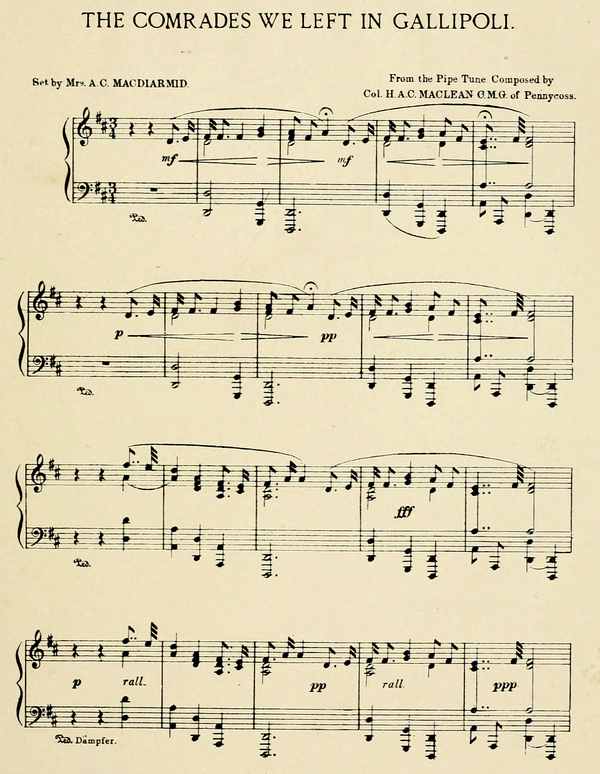
THE COMRADES WE LEFT IN GALLIPOLI.
Set by Mrs. A. C. MACDIARMID
From the Pipe Tune Composed by
Col. H. A. C. MACLEAN C.M.G. of Pennycoss.
The divisional band served on the Desert front in Egypt, and then
accompanied the Division right into Palestine, playing the leading battalion,
the 4th K.O.S.B.'s, over the frontier to "Blue Bonnets over the Border."
Later on, more pipers and more Scottish units appeared; and so we
find the 2nd London Scottish being played into Jerusalem, and "Dumbarton's
Drums" sounding at the head of the Royal Scots as they took over the
guard on the Holy Sepulchre—as is the right of "Pontius Pilate's Bodyguard."
Opportunities for the employment of pipers as such were comparatively
rare in the course of the Salonika operations, for obvious reasons. At
Karadzakot Zir, however, the 1st Royal Scots pipers played their companies
to the attack on the village, and the C.O. reported that, in his opinion,
"It was largely due to the presence of the pipers with the leading wave
that the enemy evacuated their trenches and retired in disorder."
Playing the pipes in the Golden East is a far greater effort than it is
at home, and every piper who has soldiered there knows how the heat
and the dryness of the atmosphere affect his bag and reeds. But the cult
of piob mhor thrives east of Suez, and at least as much enthusiasm is shown
by regiments stationed in India as in a home station.
And when Scottish troops were called upon to take their part in the
Mesopotamia operations, we find the pipes as prominent a feature in the
fighting as they were on the Western front. At Sheikh Saad on 7th January,
1916, the 1st Seaforths—the "Reismeid Caber Feidh"—were played to the
attack across absolutely open ground by their Pipe Major Neil M'Kechnie
and other pipers. An officer who was present describes the incident as
follows:
"As we advanced over the dead flat open desert the Turks suddenly
opened a very heavy fire from well concealed trenches at a range of from
600 to 800 yards. The battalion immediately advanced by rushes towards
the enemy's position in spite of very heavy initial losses. Foremost among
the men was our acting Pipe Major, M'Kechnie, who immediately struck
up the regimental charge or 'onset,' 'Cabar Feidh.'
"His fine example as well as his music had a remarkable effect on the
men at such a critical moment. He was shortly afterwards wounded, and
had to drop behind as the lines went on."
In the same action the 2nd Black Watch were played in by their pipers
just as they had been on many previous occasions in France. In the act
of playing Corpl. Piper MacNee was mortally wounded. This brave man
had been wounded before at Mauquissart and awarded the Distinguished
Conduct Medal. The Pipe Major, John Keith, was awarded the D.C.M.
for "gallant and distinguished service throughout the operations."
For four years and a half the pipes of war played their part in the greatest
war in history; in the front, under conditions in which they could never
have been expected to exist at all, they have led men to victory, have rallied
them when victory eluded their grasp, and have marched them back undismayed
by the tortures of battle; behind the lines they have headed
the long columns of Scottish troops on their way up to the furnace in which
the fate of nations was cast.
But, everywhere, they expressed the ideal of the race and led men to
follow causes, even causes which appeared lost ones, through to the end.
When silence fell on the 11th November, 1918, along the blasted line
where rival civilisations had so long struggled for mastery, the rôle of the
pipes changed, and it was no longer the "onset" that the piper was impelled
to play. The consummation of long effort had been attained—and what
instrument more entitled to bear witness to the fact than the one which
had sounded over the blood-stained slag-heaps of Loos, the shell-swept
heights of Vimy?
As the British First Army entered Valenciennes, the pipers of a historic
Scottish division played through the "place" opposite the Hotel de Ville,
and must have awakened in the old gabled houses memories of the centuries
old alliance between the Lilies of France and the Thistle.
Further east, along the roads that led to Cologne, the pipes played
unceasingly, as befitted the occasion, impressing on the population that
this was indeed the coming of "Scotland the Brave."
And so, over the great Rhine bridge, the pipes of the 9th and Canadian
Divisions led the way, and Germany learnt at last that when piob mhor
sounds "Gabhaidh sin an rathad mor"[5] it generally attains its objective.
The piper is, first and last, a fighting man; and when a regiment is
mobilised it at once loses most of its pipers. Whatever the strength of
the band may have been in peace time, only the "sergeant piper"—a hideous
official term for the pipe major—and five "full" pipers are normally retained
as such. The remainder, while acting as pipers when opportunity offers—and
designated accordingly—serve in the ranks.
During this war, and notably during the early years of it, it was often
found necessary to make use of full and acting pipers in some purely military
capacity, i.e. either in the ranks, or as Lewis gunners, bombers, orderlies,
runners or stretcher bearers. This fact accounts for many of the honours
awarded to pipers, and, at the same time, for the heavy casualties among
them.
It is quite impossible to do justice to individuals or units in regard
to the part they played in performing such duties; for those who obtained
official recognition, in some form or other, hundreds have merely had the
satisfaction of playing the game, in accordance with the rules laid down
by all ranks of the British army. The few examples given in this place
are typical of the whole.
At Festubert in June, 1915, the pipers of the 6th Seaforths worked
continuously day and night, and brought 170 casualties from the front
line to the dressing station; at Loos the 9th Black Watch lost nearly all
their pipers when similarly engaged, and at the two actions of Loos and
Neuve Chapelle the 6th Gordons had two killed and ten wounded.
Again, the 2nd Royal Scots pipers lost heavily on the Somme, and
were on one occasion highly commended for bringing water up to some
newly captured trenches under heavy fire.
The comments of General Sir William Birdwood in a despatch to the
Australian Government, though intended to apply to Australian stretcher
bearers, are very applicable to pipers acting in this capacity, whether
individually or collectively:
"Where all have done so well it is very hard to differentiate, but as
a class the stretcher bearers have been beyond praise. Never for a second
have they flinched from going forward time after time, absolutely regardless
of the fire brought against them; and I so deeply regret that they should
have suffered in consequence."
Another and most hazardous class of duty, which was largely performed
by pipers in some battalions, was that of "runners" or despatch carriers;
this often involved crossing heavily shelled country, and has resulted in
many casualties. Notable cases have occurred of men carrying despatches
through intense barrages, and some have received rewards; the majority
of such cases, however, have necessarily been unnoticed.
Some men appear to have specialised in this duty, e.g. Pipe Major Matheson,
1st Seaforths, who got the D.C.M. "for gallant conduct on many
occasions in conveying messages under heavy fire," and Lance-Corpl. Piper
Dyce, 13th Royal Highlanders of Canada, who on one occasion carried
a most urgent despatch through artillery barrage when badly wounded.
In other cases pipers, individually and collectively, have done admirable
service in bringing up ammunition.
Many instances of acts of heroism by individual men are detailed below.
Playing the pipes in action, though essentially the most important,
is, for obvious reasons, only one of the duties of the soldier piper. Every
unit of an army is not always in close touch with the enemy, and every
battalion puts in a good many miles of marching in a year in conditions
which are rarely ideal and very often acutely miserable. It is here that
the pipes have rendered such conspicuous service as the marching instrument
par excellence; and the cult of the bagpipe has spread to units and nationalities
which, before the war, would never have thought it possible that
the company piper would become one of their most cherished institutions.
That Irish regiments should again adopt the national instrument that
had played their ancestors on to the battlefields of France in 1286 is so
natural as to need no comment; but when we find English and Australian
units, battalions of the United States army, and ships of His Majesty's
Navy, to say nothing of field ambulances and transport units, adopting
the bagpipe, no further evidence is required to substantiate its claim to
be a highly important feature of modern military organisation.
It is indeed to a recognition, in the very early days of the war, of the
great value of the pipes in "exciting alacrity and cheerfulness in the soldier"
that is due the fact that so many units have deliberately tried to keep
their pipers out of harm's way, and have only allowed them, under protest,
to accompany their companies into action, and then only in limited numbers.
Commanding officers have appreciated that, as a stimulus to tired men,
to men marching weary miles to take up a position, to men returning worn
out from a spell of duty, the music of the pipes has proved invaluable.
Instances of this stimulating effect are too numerous to mention, but
a few, taken from contemporary accounts of the war, may be regarded
as typical.
The following incident in the retirement from Mons has frequently
occurred elsewhere. "I shall never forget how one General saw a batch
of Gordons and K.O.S.B. stragglers trudging listlessly along the road. He
halted them. Some more came up, until there was about a company in
all, with one piper. He made them form fours, put the piper at the head
of them, 'Now lads, follow the piper and remember Scotland,' and they
all started off as pleased as Punch, with the tired piper playing like a hero."[6]
The Rev. Dr. Maclean, C.M.G., describes a case of the effect of the pipes
on tired men:
"It was a sweltering hot day, and the road was deep with dust. The
long snaky khaki column came marching steadily down the hill, silent
under the weight of their accoutrements with the grinding heat of an April
sun.... As the Scots came by he gave the sign to the piper. He stepped
forward and struck up one of the great battle marches of our race. The
scene that followed baffled description. A roar of cheering burst from
the ranks."
Another instance,[7] by one who was himself in the ranks, may be regarded
as typical. The regiment concerned was the Glasgow Highlanders, but
the description is applicable to every Scottish regiment in the Army List:
"Kilometre after kilometre we marched, through the hottest hours
of the middle day, and our feet and backs ached under the weight of all
we carried, our faces were dabbled and streaked with dust and perspiration,
and in our mouths was only dust to chew....
"Walking had become a purely mechanical exercise, our limbs controlled,
as it seemed, by some power outwith us; our brains were numb and dazed
with fatigue and the maddening persisting pain that was our every step.
Blindly, dumbly, helplessly we staggered on ... in infinite weariness we
dragged ourselves to the beginning of the street, and then—
"Then the pipes suddenly set the heavens and the earth dancing to
the strains of 'Highland Laddie,' the regimental march of the Glasgows.
And at the skirl of the pipes, and before the eyes of those critical spectators,
every man braced himself, his step assumed as much of jauntiness as he
could put into it, and he had a laugh and a jesting answer ready on his
lips for every outsider who spoke to him.... It was something more
potent than wine that put the boldness into their step, it was the sense
of the tradition and honour of their regiment: the feeling that on no account
must they present other than a brave front to the world, that the one
unpardonable offence would be to let the battalion down."
Examples could be multiplied indefinitely, but the best tribute to the
value of the pipes as a marching instrument and in keeping the men cheery
is, after all, the fact that regiment after regiment felt constrained to keep
them out of action entirely—whether as pipers pure and simple or in other
military capacities.
Statements to this effect have been received from nearly all the regiments
whose views have been asked, commanding officers being almost unanimous
in their opinion that, only where it is imperatively necessary, should a
pipe band be exposed to the chances of annihilation inseparable from modern
shell fire.
And in just the same manner as the pipes have helped battalions along
the "via dolorosa" into action so they have, time and again, played them
back to rest and comparative security. In some cases they had shared in
the action itself, in others they waited until their services were required.
Many commanding officers and observers have referred to this as one of
the most important of their duties. In describing the return of a battalion,
or what remained of it, from Longueval, Philip Gibbs writes:
"There was a thick summer haze about, and on the ridges the black
vapours of shell bursts.... It was out of this that the Highlanders came
marching. They brought the music with them and the pipes of war playing
a Scottish love song, 'I lo'e na a laddie but ane.' Their kilts were caked
with mud, they were very tired, but they held their heads up, and the
pipers who had been with them played bravely ... and the Scottish love
song rang out across the fields."
An officer of an Argyll battalion, writing of the days of trench fighting,
says: "They have done much to hearten us on long marches. They came out
of Bethune after Loos and played what was left of us back to billets."
Another, in the Royal Scots, referring to the return of the battalion from
Kemmel, says: "I shall never forget the effect on the men; as they struck
up they fairly shouted themselves hoarse with delight."
"Wonderful pipes! The men get tired and would fall out, but the
pipes make a unity of them. Invisible tendons and muscles seem to connect
the legs of all files, and all move as one, mechanically, rhythmically, certainly.
The strong are reduced to the step, the weak are braced up to it. All bear
the strain and share the strain. So we go on, and the miracle is in the
power of the music."[8]
A final quotation—one of a very great number received—reflects the
opinion of all ranks:
"I have often seen a company just out of the trenches straggling along
the road too weary to think of keeping in formation, let alone in step. On
the first sound of the pipes these same men would double up to their place
and march along with the best of them."
The ubiquity of the pipes on the Western front has been remarked
by all observers. "The music of the pipes is now as much a part of the
great orchestra of this war as the incessant rumbling of distant guns, as
the swirl of traffic along the transport lines, as the singing of birds above
No Man's Land.... And where there are pipes there are Scotsmen—Scots
everywhere from the sea to St. Quentin, in old French market towns,
and in Flemish villages ... and in camps behind the fighting line not beyond
the reach of long range shells, and up in the trenches where death is very
near to them.... As long as history lasts the spirit of France will salute
the memory of these kilted boys and of all the Lowland Scots who have
gone into the furnace fires of this war to the music of the pipes, and have
fallen in heaps upon her fields. A thousand years hence, when the wind
blows softly across the ground where they fought, old Scottish tunes will
sound faintly in the ears of men who remember the past, and all this country
will be haunted with the ghosts of Scotland's gallant sons."[9]
Nor has it been on the Western front alone that the value of the pipes
has made itself appreciated. In every other theatre of war as well has
"the tune with the tartan of the clan in it" been heard at the head of
columns toiling through the dust and heat, or through pitiless rain. In
Egypt and Gallipoli and the Holy Land, in Mesopotamia and the Balkans,
the pipes have been the prelude to great happenings. "Bundle and Go"
in the early dawn of an Eastern day, "Soldier lie down" at night—these
have been the preliminaries which led up naturally to "Cabar Feidh" in
a hail of machine gun fire, or "Horo mo nighean donn bhoidheach" in the
streets of captured Bagdad.
"Many a soldier sadly misses his pipe, which of course may not be lit
on a night march; but to me a greater loss is the silence of those other
pipes, for the sound of the bagpipes will stir up a thousand memories in
a Highland regiment, and nothing helps a column of weary foot soldiers so
well as pipe music, backed by the beat of a drum."[10]
When the British army advanced into German territory the pipers
had an opportunity to play with an abandon that had never been felt
before.
"Next day, with the skies still streaming, we made the longest continuous
march, some 36 kilometres, and by that effort got well into Germany. The
roads improved as we got farther on, but the tramp through the forest of
Zitter was long, marshy, and melancholy. Our company was first after the
pipers, and had the full benefit of the music all the way. And we wandered
inward; inward, with our seeking and haunting Gaelic melodies, into the
depths of the hanging, silent wood. It was strange how aloof nature seemed
to these melodies. In Scotland, or even in France, all the hills and the
woods would have helped the music. But in this German land all were cold
toward us, and those endless pine trees seemed to be holding hands with
fingers spread before the eyes to show their shame and humiliation. There
was a curious sense that the road on which we trod was not our road, and that
earth and her fruits on either hand were hostile.
"And how tired the men became, with half of them through the soles
of their boots and with racking damp in their shoulders and backs from their
rain-sodden packs. But we listened still whilst voluminous waves of melody
wandered homeless over German wastes and returned to us,
I heard the pibroch sounding, sounding,
O'er the wide meadows and lands from afar.
or to the stirring strains of the 'March of the Battle of Harlaw,' or to the
crooning, hoping, sobbing of 'Lord Lovat's Lament,' and so went on from
hour to hour through the emptiness of Southern Germany. When we thought
we had just about reached our camping ground for the night, we came to a
guide post which showed it still to be seven kilometres on. But that was
at the top of a long hill, and the road ran gently down through woods the
whole way. The colonel sent a message to play 'Men of Portree.' The
rain had stopped, and an evening sky unveiled a more cheerful light. So,
with an easy inconsequent air, we cast off care and tripped away down to
the substantial and prosperous bit of Rhineland called Hellenthal, well on
our way to Cologne."[11]
The interminable marches are over and their goal has been attained;
and the instrument which has a tune for every human emotion can now
play "The Desperate Battle" in German towns with a safety which has
been long unknown. To many a man, however, as he fingers his chanter,
the feeling will come, as he thinks of the good men and true who never
reached the 11th November, 1918, that the tune that is most appropriate
is "Lochaber no more."
Pipe tunes—as every piper knows—have local associations, associations
with particular incidents, particular emotions; and in military piping
this is never overlooked. In war everything has changed—everything
but the elemental courage and passions of the men who are engaged in it;
and, as piob mhor is essentially the instrument on which those elemental
passions can be best expressed, it is not uninteresting to observe how
individual pipers have resorted to particular tunes, to suit particular
occasions. In many, perhaps in most, cases there were traditional or regimental
reasons for playing one tune rather than another, and such tunes
were often in the highest degree appropriate; but in other cases the
individuality of the performer determined the choice.
Of a selection based on tradition the best authenticated instance is
that of the Gordon piper who played Cogadh na Sith, "War or peace,"
during the Somme fighting. The tune itself, a piobaireachd composed
by the great M'Crimmon some 400 years ago, was played by the Gordons
at Waterloo and by a Cameron piper, Kenneth M'Kay, at Quatre Bras.
"[12]About the middle of June a draft of about a hundred and twenty men
arrived in camp for the Gordons—the finest draft the commanding officer
declared he had ever seen. On the 18th, they were ordered to the front.
I found they had a piper with them, and immediately laid hold on him
to play the men down to the station. I brought him up to my tent and
provided him with a set of pipes which I had reserved for my own particular
work.... I found something more interesting than that. His great-grandfather
had been a piper in the regiment in the days of the Napoleonic
war, and at the Battle of Waterloo he stood within the square and played
the ancient Highland challenge-march 'Cogadh na Sith,' as the French
cuirassiers hurled themselves upon the immovable ranks in vain.
"'John,' I said, 'this is the anniversary of Waterloo, and you will lead
the men out to that very tune which your great-grandfather played on
that great day.' I told the colonel, and his eyes gleamed as he said to me,
'Ah! padre, we'll do better than that. You will tell the men about it,
and I will call them to attention, and your piper will play his tune in memory
of the men of Waterloo.'
"And so it was done, and a thrilling incident it was as the men stood
rigid and silent in full marching order, and the piper strode proudly along
the ranks, sounding the wild, defiant challenge that stirred the regiment
a hundred years before."
Regimental tunes appeal enormously to the men who hear and know
them; it was probably as much the sound of "Blue Bonnets over the
Border" as the sight of Piper Laidlaw piping along the parapet that made
the men, shaken with shell fire and gas, go straight forward; and red hackles
have followed "Highland Laddie" in circumstances when another tune might
have failed to exert the same extraordinary influence. But, having played
his regulation onset, the piper has an opportunity of suiting his own taste
and selecting a tune appropriate musically and emotionally, as well as
in name, to the occasion.
On many occasions when the choice of a tune has not been restricted
by regimental custom or tradition, individual performers have made selections
which indicated the remarkable mentality of the British soldier.
At Loos, where Pipers Simpson and M'Donald of the 2nd Black Watch
played their company over the top and through the attack, the tune they
commenced with was "Happy we've been a' thegither,"—only later changing
into the ceremonial onset "Highland Laddie." To men in a trench who have
suffered untold nerve strain waiting for Zero and who happen—as do most
men in Highland regiments—to know one tune from another, no more
appropriate combination of "onsets" could have been selected.
At Beaumont Hamel, when the 17th H.L.I. took the German trenches
and had an opportunity of bombing out the occupants, Pipe Major Gilbert
played another popular and very suitable tune, "The muckin' o' Geordie's
Byre," and greatly encouraged the men in their task. This same tune
has done duty on many similar occasions.
It was to "We'll tak the guid auld way" that the 16th Canadians attacked
at Vimy, and many Cameron pipers have played the "Piobaireachd Dhomhnuill
Duibh" in similar circumstances.
Another very favourite tune was "The Macgregor's Gathering" which
was played with great effect in the capture of many villages during the
Somme fighting.
A curious coincidence was the selection by the pipers of the 1st H.L.I.
of "I'll gang nae mair tae yon toun" as they marched out of Marseilles
on 1st November, 1914, on their way to the front. During the first six
months they lost seven pipers killed, eight wounded and two taken prisoner,
and the band ceased to exist.
"Baile Inneraora,"—otherwise "The Campbells are Coming"—was
the tune to which the first Highland regiment of the Expeditionary Force,
the 2nd Argylls, landed in France; from that time onward it has immortalised
on every front, if that were necessary, the town of which Burns wrote:
"There's naething here but Highland pride
And Highland scab and hunger.
If Providence has sent me here,
'Twas surely in his anger."
The Argylls long ago took Burns' song and treated it with the contempt
it deserves when they adopted "Baile Inneraora" as their "onset." It
was played at the taking of Longueval, in the attack at Loos, and
at the subsequent rally after that glorious disaster, and in many other
actions.
During the fighting on the Somme for the heaps of ruins which had once
been a French village, an incident occurred which takes us back to the
legend connected with the pibroch "A Cholla, mo run." Long ages ago,
when the Campbells heard they were going to be attacked by Coll Kiteach
at Dunivaig, they set an ambush and captured the advance guard. All
were hanged except the piper, who was given permission to play a lament
over his comrades. The piper at once started the warning, which was
heard and understood by his comrades,
"Coll of my love avoid the strait, avoid the strait, avoid the strait,
Coll of my love, go by the Mull, gain the landing place."
The poor piper was instantly stabbed by the infuriated Campbells.
It is a far cry from those days, when men could converse to each other
in pibroch, to 1916; but another tune—not "A Cholla, mo run"—was
played by another piper in a French village when his party was cut off.
Two officers, a sergeant, and a piper of an Argyll battalion, got separated
from the main body, and found themselves unable to get away when the
village was again attacked by our men. The small party at once started
bombing the enemy from the rear, but the piper, appreciating the unpleasant
possibility of their own presence not being recognised, struck up
the regimental onset. This alarmed the Germans, who thought they were
being attacked from a fresh quarter, and materially contributed to the
success of the operation.
"Agus bha iad am measg uam fear treuna 'n an luchd-cuideachaidh 's a' chogadh."
To attempt to compile a complete record of the achievements of individual
pipers or of the pipe bands of units is an impossible task; it would involve
a review of the whole course of the war. A long time must elapse before
the histories of battalions are completed, and even then we shall probably
never know fully the extent to which their pipers have contributed to the
attainment of success.
Throughout the war correspondence has been carried on with individuals
who, in spite of their appalling environment, have found time to supply
information. They at least have the satisfaction of knowing that to them
is largely due the fact that brave acts have been saved from oblivion.
Such a review as follows is but a fragmentary one, based on information
obtained from officers, N.C.O.'s and men of the battalions concerned—but
almost never from individual pipers. Among these men there appears
to have been a conspiracy of silence, and attempts to obtain fuller information
as to the reason for the granting of awards or the names of pipers whose
identity disappeared under the blue pencil of the Censor have proved in
very many instances unavailing.
The omission from these pages of mention of achievements of pipers
of many battalions must be regarded as indicating lack of space to record
them, or of failure to obtain the desired information.
The original Expeditionary Force landed in France with seven Scottish
battalions possessing pipe bands; when the armistice was signed the
number of such units exceeded a hundred. Although on mobilisation
the number of "full" pipers in a battalion is only six it must be remembered
that there are always "acting pipers" serving in the companies who are
available—until that source of supply is exhausted—to take the place of
casualties; and it is safe to reckon that the 100 battalions have had more
than 2500 pipers at various times.
The numbers that served in various units during the campaign varied
enormously; in some, which freely utilised their pipers in the front line—in
the ranks, as bearers, and as pipers in action—as many as seventy or eighty
have been borne on the strength at different times; in others, which kept
these men invariably behind the front line, the casualties were negligible
and comparatively few were used up.
This difference in method of employment largely explains the variations
in the casualty lists and honours of different units; and, in some cases, it
has been found impossible to obtain anything like complete information.
8543 Piper James Mackenzie, 1st Scots Guards.
During the desperate fighting about Ypres in October, 1914, Piper Mackenzie
greatly distinguished himself bringing up ammunition to the firing line. He was killed
while doing so. Awarded a mention in despatches.
8081 Piper Charles Scott Maguire, 2nd Scots Guards.
On the 27th October, 1914, near Ypres, an advanced trench was blown to pieces
by shell fire, most of its occupants being killed or wounded. Hearing calls for help,
Piper Maguire went forward from the support trench to report. He crawled 15 yards
on hands and knees to the wrecked trench and found several men had been buried
by the explosion. Although without any protection from enemy fire he dug out a
man and found he was dead; he continued his task and got out another, placing
him for safety under cover of the dead body. He then crawled back to his trench.
The N.C.O. in charge had been killed meantime, and no official report of his conduct
was possible. Maguire himself was wounded shortly after, his back being broken; he
died of paralysis some seven months later.
11002 Piper J. McMillan, 1st Royal Scots.
Was awarded the D.C.M. for conspicuous gallantry as a battalion scout.
| 10123 | Corpl. | E. Collins, | } |
| 10754 | Piper | J. Clancy, | } |
| 10639 | " | J. Smart, | } | 1st Royal Scots. |
| 10032 | " | P. Mallin, | } |
During the operations on the Salonika front the battalion had to capture Karadzakot
Zir. The men had to advance over open country to the attack. These pipers played
over three successive charges to the enemy's position, and the commanding officer
considered their gallantry on this occasion was to a large extent instrumental in bringing
about the success of the attack. In spite of their exposed position they all got through
without being touched.
11065 Piper H. M'Leod, 2nd Royal Scots.
Was repeatedly mentioned in despatches for gallantry in attending wounded under
fire, and was recommended for the D.C.M.
1235 Piper W. Sinclair, 5th Royal Scots.
Shortly after the original landing on the Gallipoli Peninsula, a critical retirement
took place. Piper Sinclair, on his own initiative, gathered together a handful of
stragglers, and, taking up a favourable position, covered successfully the withdrawal
of the battalion. He was killed.
Pipe Major John Buchan, 4th Royal Scots.
Just before the attack on Achi Baba on 28th June, 1915, Pipe Major Buchan played
along the line as the battalion went over; he was killed.
7271 Pipe Major J. M'Dougall, 8th Royal Scots.
Was awarded the Distinguished Conduct Medal "for gallant conduct under very
trying circumstances" as a stretcher bearer at Festubert in May, 1915.
Corpl. Alexander Forsyth, 9th Royal Scots.
At Arras in April, 1917, this man, who was a highly skilled bomber, volunteered
to bomb the Germans out of a position in which they were covered by machine guns.
He crawled up and succeeded in his object, but was killed. He was given the Distinguished
Conduct Medal.
13283 Pipe Major A. Colgan, 12th Royal Scots.
In the Loos attack the pipe major played the battalion over the top and was
wounded. Subsequently, in the great German offensive in 1918, when pipers had to
serve in the ranks, he got the Military Medal "for good leadership and courage."
Pipe Major John Mouat, 13th Royal Scots.
During the final advance in 1918 the pipers were employed as bearers, and suffered
heavy casualties. Pipe Major Mouat received a mention in despatches.
Pipe Major Murdoch Macdonald, 13th Royal Scots.
A heavy shell burst among a company and buried a number of men. Pipe Major
Macdonald went out alone, under very heavy shell fire and brought in six wounded men
unaided.
Pipe Major David Anderson, 15th Royal Scots.
In the opening attack on the Somme front on 1st July, 1916, the battalion was
played forward by the pipe major, to the old regimental tune "Dumbarton's drums."
He was hit shortly after going over the top, but continued playing; he was again
wounded after crossing the third line of trenches and fell to the ground. He tried
to go on playing while sitting on the ground, but his pipes were shattered by a shell
bursting near him. He managed to get up and was at once attacked by a German,
but succeeded in knocking him out with his fists, and then continued fighting with
a rifle until overcome by his wounds.
Pipe Major Anderson was given the one Croix de Guerre allotted to his Division
for the most conspicuous act of bravery. The pipes he was playing on this occasion
were of historical interest as they had been taken to the Antarctic by a member of
Scott's expedition, and had been played also in the Arctic expedition of 1907.
Another interesting feature of Anderson's achievement was that several Germans
surrendered to him as he played on the parapet of one of their trenches.
Pipe Major David Campbell, 1st Royal Scots Fusiliers.
Although he had been wounded in the arm on the previous day Pipe Major Campbell
played his battalion to the attack on the German position at Hooge on June 16, 1915.
He played on right up to the German wire entanglements when, throwing his pipes
aside, he caught up the bayonet of a comrade who had just been shot by a German
officer and at once attacked the latter. He captured the officer.
9884 Piper Higginson, 1st K.O.S.B.
The initial engagement of the battalion was the landing on Gallipoli. During the
first few days the pipers were fighting in the ranks, and the gallant exploit of Piper
Higginson is eloquent indication of the fact that they played the part of the fighting
man right well. All the officers and N.C.O.'s of his Company having been killed or
wounded during the heavy fighting of 26th April, 1915, Piper Higginson rallied the
remainder, and organised and led a bayonet charge with such dash and bravery that
the Turks were swept back from a line they had captured earlier in the day. Just
as success was attained Piper Higginson was mortally wounded, and died some hours
later. Had he survived he was to have been recommended for the D.C.M.
| 1315 | Piper Maitland, | } |
| 8248 | Pipe Major W. Mackenzie, | } | 1st K.O.S.B. |
During most of their stay on the Gallipoli peninsula the pipers had to bring up
ammunition, rations, stores, etc., a job which was at all times most trying and often
extremely hazardous. For conspicuous bravery in charge of these carrying parties
the Pipe Major and Piper Maitland were awarded the Military Medal.
556 Piper A. Erskine, 5th K.O.S.B.
Was mentioned in despatches for gallantry as a stretcher bearer in Gallipoli.
14851 Pipe Major Robert Mackenzie, 6th K.O.S.B.
At the battle of Loos 25th September, 1915, when the battalion went forward to
the attack in which it was decimated, the first over the top was the Pipe Major, who
started playing at once. He was wounded and fell after a comparatively short distance,
but managed to crawl back. His leg had to be amputated, and he died of shock
shortly afterwards. Mackenzie was a man of nearly sixty years of age, and had forty-two
years' Army service. He was awarded a mention in despatches. Before the
action he had been detailed, on account of his age, to be postman, but insisted on going
into action.
15851 Piper Daniel Laidlaw, V.C., 7th K.O.S.B.
Just before the attack on Hill 70 and Loos on 25th September, 1915, the battalion,
which was under heavy shell fire, was exposed to a cloud of poison gas. Many of
the men succumbed to this gas, and the remainder were shaken by what they were
going through. The commanding officer, seeing Laidlaw standing waiting with his
pipes for the order to advance, called to him, "Pipe them together, Laidlaw, for God's
sake, pipe them together," and he immediately climbed out on to the parapet, and
marched up and down, regardless of danger, playing "Blue Bonnets over the Border."
The effect on the men was magical; at the same moment the order came to advance,
and the officer shouted "Come on, the Borderers, who'll be the first to reach the
German trenches?" The survivors of the company swarmed up and over to the
assault following the piper. The men were falling all round him, but Laidlaw continued
to advance until he got near the German line, when he was wounded and the officer,
who was alongside of him, was killed. As he lay on the ground he tried to go on
playing, and then managed to get up and hobble after the battalion.
He was awarded the Victoria Cross "for most conspicuous gallantry," and the
French Croix de Guerre.
The sobriquet "Piper of Loos" was commonly applied to Piper Laidlaw; though,
in fairness to two other men, it must be admitted that he only shared that distinction
with them.
Pipe Major Douglas Taylor, 7th K.O.S.B.
During the attack on Loos when Piper Laidlaw got the V.C., the other pipers
were chiefly employed in bringing in the casualties. There were large numbers of
men lying about who had been gassed. Pipe Major Taylor, though himself wounded
in the hand, continued bringing in these men for thirty-six hours, until he was himself
shot down with a bullet in the heart. He recovered ultimately—one of the surgical
miracles of the war.
Pipe Major W. Robertson, 2nd Scottish Rifles.
Was awarded the Military Medal for gallantry in the field.
Pipe Major Neil Macleod, 8th Scottish Rifles.
Greatly distinguished himself in the Dardanelles fighting in attending on the
wounded. He was killed in the attack on 12th July, 1915.
| 40631 | Corpl. Whitelaw, | } |
| 17806 | Piper M'Gurk, | } | 9th Scottish Rifles. |
In a daylight raid at Arras in February, 1917, these two men played their companies
over, standing on the parapet, and then followed them up to the German position.
Pipe Major J. M'Coll, 10th Scottish Rifles.
Was awarded the Military Medal for gallantry during the Somme fighting.
14631 Piper Alexander Stevenson, 11th Scottish Rifles.
On 20th April, 1917, Piper Stevenson observed a comrade, who had been out
on a night patrol, lying wounded in No Man's Land, and calling for help. He at once
went over the parapet in broad daylight and brought him in, although the Germans
brought a machine gun to bear on him as soon as he exposed himself. While assisting
the medical officer to dress the wounded man he was killed. His name was mentioned
in despatches for gallantry. He had previously done excellent work carrying messages
in action.
| Piper | Andrew Wishart, | } |
| 9430 | Piper W. Stuart, | } | 1st Black Watch. |
After the failure of the first attack on Richebourg, 9th May, 1915—the attacking
battalions simply melting away under a sheet of lead—a second attack on the position
was ordered for midday; the leading battalions on this occasion being the 1st Black
Watch and 1st Camerons. The men went over the top with a tremendous dash,
and each company was led by its pipers. Two at least actually reached the German
trenches and continued playing—9430 W. Stuart, and Andrew Wishart of the Black
Watch. They were under very heavy fire, and both got wounded. Wishart fell
into a shell hole and lay there for four days before he succeeded in crawling back to
our trenches. When he fell there were loud shouts "The piper's down," and the men
made frantic efforts to get into the enemy's trenches; but the machine gun fire was
too heavy, and they had to withdraw. Piper Stuart was awarded the D.C.M.
Piper George Galloway, 7th Black Watch.
On one occasion Piper Galloway rescued five men who had been buried by a shell
explosion. Subsequently, when employed as a runner, he was called on to deliver
an important message under very heavy fire. This he accomplished in almost impossible
conditions, and was given the Military Medal.
L/Corpl. G. Swan, 7th Black Watch.
Served in the ranks during the Somme fighting. He was killed in action, and was
awarded the Military Medal.
1919 Piper Alexander Pratt, 2nd Black Watch.
Pipers throughout the war have been employed in a great variety of ways besides
piping. Piper Pratt was reported in Mesopotamian Force Despatches as "one of the
bravest and most intelligent bomb sergeants in the regiment; on three occasions
he has proved his high capacity for leadership in the attack. He has been twice
wounded. His power of training grenadiers and his influence over his men are quite
exceptional." He was promoted in the field to Sergeant and awarded a D.C.M.
941 Piper Peter MacNee, 2nd Black Watch.
Also distinguished himself greatly as a bomber. He won the D.C.M. at Neuve
Chapelle. In France he was twice wounded, but went to Mesopotamia with the
battalion. In the fighting at Sheikh Saad in January, 1916, he was mortally wounded.
| 1839 | Piper | Alexander Macdonald, | } |
| 736 | Piper | David Simpson, | } |
| 365 | Piper | R. Johnstone, | } | 2nd Black Watch. |
| 699 | Piper | David Armit, | } |
| 187 | Piper | J. Galloway, | } |
In the attack by the 2nd Black Watch at Mauquissart, 25th September, 1915, the
pipers took a prominent part, playing their companies up to and through the German
first and second lines. After three lines had been captured the order to attack the
fourth was given. 736 Piper David Simpson at once dashed forward playing, followed
by his company; he was killed just as they reached the objective. His bravery
earned him the title, for long after, of "The Piper of Loos." He was recommended
for the Victoria Cross. Further on, 1839 Piper Alexander Macdonald alternately
played from one trench to the next and assisted in bombing the enemy out of their
dugouts. In the third trench he marched, playing "Macgregor's Gathering," down
the trench at the head of the bombers, and then climbed on to the parapet and continued
playing. He was ultimately wounded and lost his leg. For his gallantry he was
given the D.C.M., but did not long survive to enjoy the honour as he died soon after
his discharge. At the same time 365 Piper R. Johnstone went on playing until he
fell gassed. As pipers fell out wounded others took their places, and the battalion
was played continuously into and through the action. It appears to have been a
tradition among the pipers of this battalion that they were always to play whenever
an opportunity occurred. Pipers David Armit and J. Galloway also played right up
to and through the German support trenches.
1198 Pipe Major D. M'Leod, 4th Black Watch.
Piper M'Leod played his company into action at Loos.
During this action the commanding officer was mortally wounded; he was brought
in, under intense fire, by Pipe Major—then Corpl. Piper—M'Leod, who received the
Military Medal for his gallantry. He subsequently got a bar to the Medal for repeated
acts of gallantry during the great advance of 1915.
410 Pipe Major Alexander Low, 4th Black Watch.
Received the Military Medal for devoted attendance to the wounded at Neuve
Chapelle.
1568 Piper Alexander Howie, 5th Black Watch.
At Neuve Chapelle Piper Howie greatly distinguished himself in bringing in
casualties. He was killed while performing this duty. Mentioned in despatches.
| Piper | R. Pirnie, | } |
| Piper | A. Forbes, | } | 6th Black Watch. |
| Piper | A. Tainsh, | } |
| Piper | R. Mapleton, | } |
These men played the battalion in to the attack on High Wood, 14th July, 1916.
Though much exposed they escaped unwounded.
Piper Ferguson, 6th Black Watch.
At Laventie this man marched from one end of the line to the other playing "Johnny
Cope," which aroused the enemy, who, expecting an immediate attack, at once started
a barrage. No attack was ever intended.
2126 Piper Alasdair M'Donald, 6th Black Watch.
Near Laventie in July, 1916, a small patrol of four men operating in No Man's Land
ran into some Germans, with the result that two of them were badly wounded and
could not get back to our lines. Volunteers were asked for, and M'Donald and another
man went out. They met a German patrol and dispersed it, but this at once brought
hostile machine gun fire on to them. They had to hunt about for a considerable
time in high grass full of barbed wire before finding the wounded men, and, in bringing
them back, had to make use of part of a German communication trench. Piper M'Donald
was mentioned in despatches.
| 290056 | Pipe Major Thomas Macdonald, | } |
| 292440 | L/Corpl. G. Swan, | } | 7th Black Watch. |
| 200509 | Piper A. Mands, | } |
| Piper George Galloway, | } |
All these men received the Military Medal for gallantry in carrying despatches
during the Somme actions. On several occasions they performed quite invaluable
service in this way.
7671 Piper Alexander Henderson, 1st Cameron Highlanders.
On October 22nd, 1914, Piper Henderson went out to an officer of the battalion
who was lying wounded in a very exposed position, and applied first field dressings.
He then helped this officer back to our position under heavy machine gun fire and
then returned to his duty in the ranks. He was awarded the Distinguished Conduct
Medal.
Sergt. Johnson, 2nd Cameron Highlanders.
Received the Military Medal for conspicuous gallantry on the night of 11th March,
1917, when on a reconnoitring patrol on the Struma. He killed the enemy's sentry
before he had time to warn his group, thus enabling the party to account successfully
for five out of seven of the enemy. Also for continuous good work as sergeant in charge
of regimental scouts.
As scout sergeant he subsequently still further distinguished himself, and by his
initiative and daring in incessant patrol work, materially assisted in gaining complete
ascendancy over all the ground between our own and the Bulgar trenches. "His display
of daring, initiative and courage has been a splendid example to all the men under him."
56 Pipe Major John Ross, 4th Cameron Highlanders.
Played the battalion to the attack at Festubert on 17th May, 1915, along with the
other pipers of the battalion.
17128 Piper J. Scobie, Cameron Highlanders.
Obtained the M.M., D.C.M. for gallantry in action.
9158 Acting Pipe Major J. MacLellan, 1st Seaforth Highlanders.
During the advance in Mesopotamia ammunition happened to run short at a point
only 50 yards removed from the Turk trenches. MacLellan at once volunteered to
fetch some, and was killed as he was bringing it up.
8391 Pipe Major D. Mathieson, 1st Seaforth Highlanders.
Was awarded the Distinguished Conduct Medal "for gallant conduct on many
occasions in conveying messages under heavy fire, and also for gallantry in attending
on the wounded on an exposed part of the line."
9446 Pipe Major Neil M'Kechnie, 1st Seaforth Highlanders.
During the engagement at Sheikh Saad on 7th January, 1916, the battalion had
to advance for a long distance over perfectly flat country under very heavy fire.
Casualties among our men were very numerous. The pipe major and Pipers Colin
M'Kay and Alex. M'Kay at once started playing "Caber Feidh," and continued to
do so for some time. M'Kechnie and Alex. M'Kay were both wounded.
At Neuve Chapelle M'Kechnie had distinguished himself as a bomber, and was
mentioned in despatches and awarded the Russian Order of St. George.
766 Pipe Major Mackenzie, 1st Seaforth Highlanders.
Was mentioned in despatches for gallantry in Palestine.
412 Piper William Barry, 1st Seaforth Highlanders.
Went out into No Man's Land under heavy machine gun fire to the assistance of
a wounded comrade who was lying unable to move, and whose clothing had caught
fire. Piper Barry was recommended for the D.C.M.; he was mentioned in despatches.
529 Piper Colin M'Kay, 1st Seaforth Highlanders.
During the advance at Sheikh Saad some of the pipers had to bring up ammunition.
The Turkish barrage was generally late and missed the advancing battalion, but came
down behind it; this resulted in severe casualties among ammunition parties. Piper
M'Kay was specially promoted on the field for gallantry in performing duty as an
ammunition carrier.
201307 Piper P. Stewart, 4th Seaforth Highlanders.
A company on the Ypres sector in September, 1917, had to advance a distance of
nearly two miles over flooded ground badly cut up by our artillery. The men were
very heavily laden with extra ammunition, bombs, etc.; Piper Stewart played them
along until he fell and damaged his pipes. When they reached their position volunteers
were called for to go out and try to establish communication with the brigade on
the left, whose position was not known. Piper Stewart went out and performed this
task, but was badly wounded in the arm. He had previously done excellent work
in collecting casualties and putting them in an abandoned gun emplacement. He was
awarded the Military Medal.
599 Piper Donald M'Kay, 5th Seaforth Highlanders.
Was killed at Beaumont Hamel when carrying despatches. His C.O. said of him,
"It was by devotion such as his that victory was bestowed on us that day."
| 21629 | Piper | D. Fraser, | } |
| 4661 | Piper | B. Hamilton, | } | 7th Seaforth Highlanders. |
In the attack at Loos, when the battalion was played in by their pipers, most of
these men were killed or wounded. At one time the position became very serious and
the advance was checked. Pipers Fraser and Hamilton at once got up into the open
and started playing "Caber Feidh"; the effect was very marked as their companies
dashed forward after them. They were both killed.
8535 Piper D. Davidson, 7th Seaforth Highlanders.
This man, when serving in the ranks, showed such gallantry and initiative that
he received both the Distinguished Conduct Medal and the Military Medal.
8112 Pipe Major Alexander Mackenzie, 8th Seaforth Highlanders.
At Loos, when the battalion was played into action, there were very heavy losses
among the pipers. Pipe Major Mackenzie distinguished himself greatly, and was given
the Distinguished Conduct Medal.
8119 Pipe Major G. Gordon, 9th Seaforth Highlanders.
Played the battalion into action at Longueval on 14th July, 1916, and was awarded
the Belgian Croix de Guerre.
5745 Piper Charles M'Lellan, 9th Seaforth Highlanders.
At the battle of Loos he was acting as orderly to his captain; as they got over
the parapet the officer was hit, and died a few minutes afterwards. Piper M'Lellan
then reported himself to another officer who sent him back, under heavy fire, for
reinforcements. Having done this several times, he went to look for his captain and
brought in his body. He was awarded the Military Medal.
10744 Corporal A. Godsman, 1st Highland Light Infantry.
During the action at Neuve Chapelle he repeatedly brought up ammunition to
the firing line under the heaviest fire, until he was wounded. He was awarded the
Distinguished Conduct Medal and the Russian Order of St. George.
11480 Piper John Brodie, 2nd Highland Light Infantry.
This man was one of the party with the late Col. W. L. Brodie when that officer won
the V.C.
240881 Piper William Mackenzie, 6th Highland Light Infantry.
In the action of 12th July, 1915, in which the battalion captured three lines of
Turkish trenches in Gallipoli, Piper Mackenzie went into action armed with a revolver
and a shovel, displaying great gallantry and doing great execution with both these
weapons until he was wounded.
1914 Piper Kenneth MacLennan, 7th Highland Light Infantry.
Was awarded the Distinguished Conduct Medal "for playing the pipes during the
attack (on the Turkish trenches, 12th July, 1915) and advancing with the line after
his pipes had been shattered by shrapnel, and heartening the wounded under fire"
(London Gazette). After his pipes had been broken he continued to play on his chanter
for some time. He then made several journeys across the open to fetch water for
the wounded under heavy fire; and also brought up boxes of ammunition.
1901 Piper D. Cameron, 7th Highland Light Infantry.
In the attack on the Turkish trenches on 12th July, 1915, Piper Cameron played
his company right up to the captured trenches and was awarded a special mention in
Divisional Orders (52nd Division). On this occasion, while playing, he had a revolver
hanging from his wrist, and on reaching the trenches started using it with good effect.
Piper Donald Macfarlane, 7th Highland Light Infantry.
In the same action in Gallipoli on 12th July, 1915, Piper Macfarlane played his
company through a bayonet charge and continued doing so until a shell burst shattered
his pipe drones. He then devoted himself to giving water to the wounded.
Corpl. Piper Allan M'Nicol, 12th Highland Light Infantry.
During the fighting at Loos and Hill 70 Corpl. M'Nicol was employed carrying an
artillery observation flag, and signalling successive positions to our guns as they were
captured. For his gallantry in action he was awarded the Military Medal.
15006 Pipe Major William M'Comb, 16th Highland Light Infantry.
On 14th February, 1916, the Pipe Major, though stunned and sick from a blow
by a branch of a tree which had been hit by a shell, went forward and dug out several
men who had been buried. There was heavy shell fire at the time. He was given the
Military Medal.
12095 Piper (Pipe Major) Thomas Richardson, 16th Highland Light Infantry.
Was awarded the Military Medal for gallant conduct at Roupy in the night of
2nd April, 1917, when the company in support was heavily shelled and casualties were
heavy. "Pipe Major Richardson organised carrying parties and showed an utter
disregard of danger under the continuous fire of heavy guns."
Pipe Major B. M'Donald, Highland Light Infantry.
An ammunition dump having caught fire he went in under heavy machine gun
and shell fire and succeeded in dragging out boxes of bombs and throwing them into a
shell crater full of water. By this means he stopped the conflagration. At the time
he had just been given a commission, and he received for this action the Military Cross.
16094 Pipe Major Young Gilbert, 17th Highland Light Infantry.
On the 1st July, 1916, the battalion crawled up to within 100 yards of the Leipzig
redoubt and rushed the latter when the barrage lifted, and held on. The position was
a very perilous one, and the C.O. called on the Pipe Major to play to the men. This
he at once did and continued doing so, with the most stimulating effect on the
battalion. For this action he was awarded the Military Medal.
5495 Piper James Ritchie, 2nd Gordon Highlanders.
On the 14th July, 1916, the battalion had to attempt the capture of the road from
High Wood to Longueval. Advancing beyond the first objective they advanced
further and tried to dig in, but came under deadly fire from flank and rear. Of the
two leading platoons only one wounded officer and five men ever got back. Piper
Ritchie volunteered to carry a message to regimental headquarters and bring up
reinforcements. He did this twice. He was awarded the Military Medal.
6349 Pipe Major Charles Anderson, 2nd Gordon Highlanders.
Was awarded the Military Medal. His C.O. writes: "Has done splendid work
throughout; his cheerfulness and gallantry have been at all times most marked, and
he was a splendid example to all until he was severely wounded at Hulluch on 25th
September, 1915."
6863 Piper R. Stewart, 2nd Gordon Highlanders.
From the commencement of the war Piper Stewart's gallantry was repeatedly
brought to notice and especially during the fighting in October and November, 1914,
and at Ypres. He was specially promoted to Sergeant and awarded the D.C.M. and
the Russian Order of St. George for bringing up ammunition under particularly trying
circumstances at Ypres. He was killed at Loos.
Pipe Major (Sergt. Major) Angus Maclean, 2nd Gordon Highlanders.
Rejoined his old battalion on the outbreak of war and was transferred from the
pipes to a company as sergeant major. He was awarded the Military Medal for "conspicuous
courage and ability in organising work under very dangerous conditions."
The 2nd Gordon Highlanders in Italy.
In the summer of 1918 the pipers, during the offensive, were attached for duty
to the 23rd Field Ambulance. All the wounded had to be carried across a deep and
very rapid burn, which was difficult to get across for a single man. These pipers,
however, with four men to a stretcher and four more to steady them, and without their
kilts and hose, succeeded in getting large numbers of casualties over. They stood in
the water for many hours. Subsequently they went out to look for wounded and
brought in many more. "But for the work of the pipers and drummers it would have
been impossible to evacuate the wounded that night."
Piper George Paterson, 4th Gordon Highlanders.
In the fighting outside Cambrai in November, 1917, Piper Paterson played the
battalion into action and charged in three successive waves; he also played it into Cantanig
under heavy fire. Here he was wounded. He was awarded the Military Medal.
Piper William Webster, 4th Gordon Highlanders.
In the face of heavy fire during the retirement in March, 1918, repeatedly brought
up ammunition to men in the front line. Was awarded the Military Medal.
| Piper | P. Bowie, | } |
| Piper | P. Paterson, | } | 4th Gordon Highlanders. |
| Piper | R. Prentice, | } |
| Piper | G. Davidson, | } |
In the Ypres fighting on 31st July, 1917, Piper Bowie rallied the men at a time
when things were looking very bad. He was awarded the Military Medal. At the
Marne, too, he and Pipers P. Paterson, R. Prentice, and G. Davidson played their
companies into action "and the example set by them roused the troops to further
efforts to force the enemy from a difficult position and enabled them to gain a great
victory."
1985 Piper Charles Thomson, 5th Gordon Highlanders.
At Festubert Piper Thomson showed great courage as an observer, and repeatedly
crossed a heavily shelled zone, which was also under fire by snipers, carrying messages
to battalion headquarters.
Piper H. Lunam, 5th Gordon Highlanders.
In the action at High Wood on 18th July, 1916, Piper Lunam "very heroically
played his company into action in face of heavy machine gun fire and a heavy enemy
barrage. He got no official recognition, but the thanks and respect of his comrades
who followed him."
10115 Pipe Major J. Howarth, 6th Gordon Highlanders.
During the fighting at Loos Pipe Major Howarth was acting as orderly to the
commanding officer, and, in the course of the advance, was wounded in the feet. A
shell had burst and knocked over a dozen of our men and he at once went off to give
first aid. On the way he saw Captain —— of the 2nd Gordons lying wounded. As,
on account of his own wound, he was unable to carry the wounded officer in, he took
off his own puttees, wound them round his knees as a protection, took Captain —— on
his back and crawled back on hands and knees to our own line.
Pipe Major Howarth had already received the D.C.M. for his gallantry in tending
the wounded at Neuve Chapelle. For his action on this occasion he was awarded a
bar to the medal.
10700 Piper W. Bannerman, 6th Gordon Highlanders.
In the fighting at Givenchy on 2nd June, 1915, some of the pipers were employed
in the ranks. Piper Bannerman was mentioned in despatches for great gallantry in
leading a bayonet charge.
Piper (Sergt.) Peter Dean, 2nd Argyll and Sutherland Highlanders.
When serving in the ranks as a machine gun sergeant he worked his gun alone in
an exposed position when the rest of the gun team had all been killed or wounded. He
was awarded the Distinguished Conduct Medal.
3162 Piper William Carlyle, 6th Argyll and Sutherland Highlanders.
After a bayonet charge at Festubert on 16th June, 1915, the battalion was lying
on the ground under heavy fire. Near the enemy's line was a wounded man. Piper
Carlyle crept out on hands and knees to try and bring him in; just as he reached the
man and had started to lift him, he was killed. Piper Carlyle was mentioned in
despatches.
Piper John Walls, 7th Argyll and Sutherland Highlanders.
Was awarded the Military Medal for devotion to duty as battalion runner through
the barrages on 23/24th July, 1915.
Pipe Major J. Wilson, 8th Argyll and Sutherland Highlanders.
On the 8th April, 1916, a German raiding party of considerable strength entered
our trenches in the Labyrinth after the explosion of several mines which inflicted heavy
casualties. Pipe Major Wilson at once organised a counter attack and drove out the
enemy. He received a Divisional certificate of gallant conduct.
266 Piper George Shearer, 9th Argyll and Sutherland Highlanders.
When employed as a bearer on 24th May, 1915, brought in a wounded man out of
No Man's Land under particularly difficult circumstances, and was awarded the D.C.M.
4627 Pipe Major Thomas Aitken, 10th Argyll and Sutherland Highlanders.
During the fighting at Longueval in July, 1916, although a man of sixty years of
age, Pipe Major Aitken, at his own request, acted as orderly to the commanding officer
for the whole day; he was ultimately wounded. He was awarded the Distinguished
Conduct Medal "for conspicuous gallantry on this and many other occasions."
| 6191 | Piper | J. Dall, | } |
| 2616 | Piper | D. Wilson, | } | 10th Argyll and Sutherland Highlanders. |
When the battalion attacked Longueval it was met by heavy machine gun fire,
which caused very severe casualties. Part of the enemy wire had been left uncut by our
bombardment, and this caused momentary confusion in the ranks, as it was very
dark. The advance was held up by some ruined dwellings in the streets of the village
which had been turned into machine gun nests. Pipers Dall and Wilson at once started
playing, and in spite of the noise of shell fire all round them, they succeeded in rallying
the men, and in leading an attack which proved to be irresistible. Piper Dall was
wounded. Piper Wilson was awarded a mention in despatches.
569 Piper G. Gamack, 10th Argyll and Sutherland Highlanders.
Received the Military Medal for great gallantry in evacuating casualties during
the storming of the St. Quentin Canal, Sept., 1918.
Pipe Major Donald Macfarlane, 11th Argyll and Sutherland Highlanders.
In the action of Loos the Pipe Major was employed as a despatch runner carrying
messages back from Hill 70. He continued doing this though severely wounded in the
arm. He was recommended for the Distinguished Conduct Medal.
| Piper | Charles Hoey, | } |
| Piper | J. Barnett, | } | 11th Argyll and Sutherland Highlanders. |
| Piper | T. Wallace, | } |
In the attack at Loos these men all played their companies into action. Piper
Barnett was killed while doing so.
Piper Charles Cameron, 11th Argyll and Sutherland Highlanders.
When the battalion attacked Hill 70 on 25th September, 1915, the pipers led their
companies and suffered heavy casualties. The 15th Division hung on to the slope of the
hill until next day, but ultimately had to fall back, being heavily counter-attacked.
The men of different units got mixed up in the hand to hand fighting which ensued, and
it was necessary to rally them in their own units. Piper Cameron stood under heavy
fire playing, and rallied the men of the 11th. His bravery resulted in his being known
in the division as "The Piper of Loos."
598 Corpl. Piper R. Stevenson, 12th Argyll and Sutherland Highlanders.
Many of the pipers of this battalion were employed as scouts, and Corpl. Stevenson
rendered particularly good service in this capacity, especially in August, 1918,
when, in spite of heavy enemy fire, he went forward and carried out a successful
reconnaissance of the wire on the enemy's trenches. For this he got the Military
Medal.
139 Corpl. Piper H. G. Latham, 1st London Scottish.
On account of heavy losses at Messines the pipers of this battalion during the early
part of the war were employed in the ranks. Corpl. Latham was a crack shot and had
got into the final stage of the King's Hundred at the Bisley Camp in 1914. He was
accordingly employed as a sniper with much success. He took a prominent part in the
bayonet attack at Messines. He was killed at Zillebeke 16th November, 1914. Was
awarded a mention in despatches.
Piper Sydney Wilson, Liverpool Scottish.
This man served in the ranks. He was awarded the certificate for gallantry on three
separate occasions.
| 290 | Pipe Major John Wilson, | } | 1st Tyneside Scottish. |
| 1525 | Piper George Taylor, | } |
Both these men received the Military Medal for bravery in playing their battalion
into action at La Boiselle on 1st July, 1916. The whole of the pipers of this and the
2nd Battalion took part in this, one of the most spectacular attacks on the Somme;
and their behaviour was an inspiration to the men. They were exposed to very heavy
fire and to every sort of obstacle on the ground, but went on playing after ten pipers
had been killed and five wounded. 1525 Piper James Phillips of the 2nd Battalion,
after having his pipes shattered, started bombing the German trenches. He was
mentioned in despatches.
Sergt. John Macdonald, Princess Patricia's Canadian Light Infantry.
At Hooge on 8th May, 1915, after a front trench had been obliterated by shell fire,
Sergt. Macdonald dug out two wounded men who had been buried, and carried one
on his back and assisted the other to a place of safety under very heavy shell and rifle
fire. He was awarded the Distinguished Conduct Medal. In Sept., 1916, he died of
wounds.
24011 Lance Corpl. J. Dyce, 13th Royal Highlanders of Canada.
During the Ypres fighting in April, 1915, Corporal Dyce was employed as a despatch
runner and had to cross ground heavily bombarded by the enemy. While doing so
he was shot through the chest, and became unconscious; on coming to, knowing the
importance of the despatch he was carrying, he started crawling in to deliver it at
battalion headquarters, collapsing when he arrived there. He was mentioned in
despatches.
29327 Pipe Major James Groat, 16th Canadian Scottish.
In the attack on the Vimy Ridge Pipe Major Groat and the pipers of the battalion
played them to the attack, Groat accompanying the commanding officer. They had
to advance over a mile under terrific fire. On this occasion he received the Military
Medal.
Subsequently, in the attack on Hill 70 on 15th August, 1918, he again led the
battalion and was awarded a bar to the Medal; and on 2nd September, 1918, at Arras,
he got the Distinguished Conduct Medal for a similar action. He had played the
battalion through five successful attacks when he was finally wounded.
28930 Piper James Richardson, V.C., 16th Canadian Scottish.
At Festubert in May, 1915, he showed the greatest gallantry in carrying despatches,
and also saved a wounded comrade's life. In the attack on the Regina trench on
8th October, 1916, he played his company to the attack. When they got near the
enemy's position very heavy wire entanglements were encountered, which took a
considerable time to cut through; while this was being carried out Piper Richardson
marched up and down outside the wire playing, while the men were falling all round
him. When the wire had been cut he continued at the head of his company, and
played the "Reel of Tulloch" on the German parapet, followed by the "Deil in the
Kitchen" as the battalion started bombing the dugouts. At this moment the Company
Sergeant Major was dangerously wounded and Richardson volunteered to take him
out. He successfully accomplished this and then said he must go back to fetch his
pipes which he had left behind in the captured trench. He never returned and must
have been killed. The Commanding Officer[13] writes of him: "I really think his V.C.
performance was one of the great deeds of the war. The conditions were those of
indescribable peril and terror. The lad's whole soul was bound up in the glory of
piping, and he was only taken into action after imploring his colonel with tears
in his eyes. Altogether a most wonderful example of high souled courage and
enthusiasm."
A year after Piper Richardson's death he was awarded a posthumous Victoria
Cross.
| 28557 | Piper | Alexander M'Gillivray, | } |
| 29048 | Piper | Allan Cameron M'Nab, | } |
| 429603 | Piper | George Paul, | } |
| 466703 | Piper | John M'Allister, | } |
| 603174 | Piper | Gordon Cruickshank, | } | 16th Canadian Scottish. |
| 467573 | Piper | Alexander Robertson, | } |
| 737176 | Piper | John M'Lean, | } |
| 633179 | Piper | Archibald M'Dowell. | } |
The whole of these men received the Military Medal for playing their companies
into action on different occasions. No man was ever recommended for reward unless
he had played into action on three different occasions, and every man had to volunteer
for the duty. As a matter of fact so keen was the competition that lots had to be
drawn to decide who should play.
429603 Piper George Paul, 16th Canadian Scottish.
After winning the Military Medal for his gallantry in playing his company to the
attack on Hill 70 on 15th August, 1918, Piper Paul went into action at Amiens playing
on top of the tank "Dominion." While doing so he was killed. His action on this
occasion roused the wildest enthusiasm among his comrades and contributed greatly
to the success of the operation.
59224 Corpl. William Currie, 21st Canadians.
On several occasions Corpl. Currie showed extraordinary gallantry in bringing
in wounded men from positions in which any attempt at rescue appeared hopeless, on
account of the heavy fire brought to bear on any one trying to approach. The last man
rescued by Corpl. Currie had been shot by a sniper and was lying in a trench only a foot
deep. Currie succeeded in getting him away although he was badly wounded in the
process. He was several times complimented officially and was finally specially
promoted and awarded the Military Medal. He subsequently got a Commission and
won the Military Cross for gallantry.
60115 Piper Hugh Mackenzie, 21st Canadians.
At Hill 70 volunteers were called for to bring in a man who was lying wounded in
No Man's Land. Mackenzie was one of three who volunteered to get him; two of
these men were killed. Mackenzie was given the Military Medal.
| Piper | W. Brand, | } | 25th Canadians. |
| Piper | Walter Telfer, | } |
In the attack on the Vimy Ridge 9th April, 1917, these two pipers played their
companies into action. Telfer was so badly wounded that his leg had subsequently
to be amputated, but continued playing, until he fell. Both of them were awarded
the Military Medal.
1246 Piper John Macdonald, 1st Canadian Machine Gun Corps.
During an action the attack was held up and most of the teams of the machine
guns were killed. Piper Macdonald succeeded in pushing forward to the objective
with a gun and held on until dark. He was the last to leave, carrying the gun on his
shoulders. For this he was promoted Quartermaster Sergeant, and was awarded
the Military Medal.
| Pipe Major Alexander Grieve, | } |
| Piper J. Waterhouse, | } | South African Scottish. |
| Piper A. Gray, | } |
When the Germans advanced on the Cambrai front in March, 1918, the pipers were
frequently called upon to serve in the ranks in various capacities. At Houdincourt they
were suddenly required to reinforce a position and piled their pipes on the ground.
A shell burst destroyed the whole of the pipes. For gallantry when acting as despatch
runners Pipe Major Grieve got the D.C.M. and Pipers Waterhouse and Gray the Military
Medal.
Pipe Major J. Robertson, 2nd Auckland Regiment.
The pipers served in the ranks. Pipe Major Robertson received the D.C.M. for
conspicuous gallantry at Bapaume.
| Piper | A. Aitken, | } | 42nd Australians. |
| Piper | R. Gillespie, | } |
These men were employed as scouts and both received the Military Medal for
valuable observation work prior to the action at Messines in June, 1917.
Brought in contact as Scottish troops have been with those of our Allies
it is not surprising that military pipers have attracted the attention of
observers and writers who, before the war, knew nothing of their existence.
From the early days of the war the pipes, the tartan and the kilt aroused
the liveliest interest in France; and perhaps the sincerest tribute to them
is the fact that, in their caricatures of the nations, the Germans usually
depicted the British soldier as a particularly unattractive Highlander.
At first the French writers were mildly sarcastic about the players of the
"cornemuse," and regarded them as an amiable weakness of the comrades
of the "auld alliance"; but gradually they discovered that pipes and
tartan were the outward and visible signs of a spirit which won their whole-hearted
admiration, and then their attitude changed.
Describing an attack by the 51st Division a French observer wrote:
"Resolutely they crossed what seemed to be impossible ground ... they
charged to the shrill sounds of the bagpipes ... they charged like heroes
of Walter Scott—leurs bonnets à rubans et leur jupes de danseuses."
Though the Breton bignon, the cornemuse, the German dudelsackpfeife
are no longer—if they ever were—instruments of war, the instinctive admiration
for the pipes remains in the most unexpected quarters; and in France,
Flanders, Italy, the Balkans, and even the occupied portions of Germany,
"piob mhor" has aroused race memories long dormant. One effect of
this is the demand which has recently arisen in Italy for pipes from this
country; another is the fact that the French Government have added a
painting of a piper by a French artist to the official collection of war pictures.
American observers were often very ignorant of the mysteries of the
bagpipe. A writer in the Boston Evening Transcript, after eulogising the
piper as a military institution, informs his readers that in the hands of a
really skilled performer the strains of the pipes can be heard for a distance
of six miles against the wind or ten miles if the conditions are favourable.
The writer may have been of M'Crimmon descent, but his enthusiasm
exceeded his powers of observation.
One thing is quite certain, viz., whatever their inmost feelings regarding
the musical qualities of the pipes, foreigners generally appreciate their
military value in war and share the opinion of the court-martial in 1746 that
they must be regarded as an "instrument of war."
The Germans certainly were not slow in forming an estimate of the
military value of the piper. From a very early stage in the war they learned
to associate the instrument with a type of troops for whose mentality,
as exhibited in the attack, they had more respect than sympathy, and
the piper at once became a marked man whenever he went over the top.
The casualties among pipers while playing would of themselves suggest
that this was the case; but the statements of officer prisoners show that
orders were given to pick off pipers for precisely the same reason as officers
commanding platoons or companies.
Even pipers fall into the hands of the enemy occasionally, but they
were never allowed to take their instruments with them into captivity.
Gradually, as "comforts," pipes were sent out to individual officers and
men; and the following letter from an officer of the Gordon Highlanders
who was at Friedberg Camp, indicates how popular pipe music became
among his fellow-prisoners of the Allied armies.
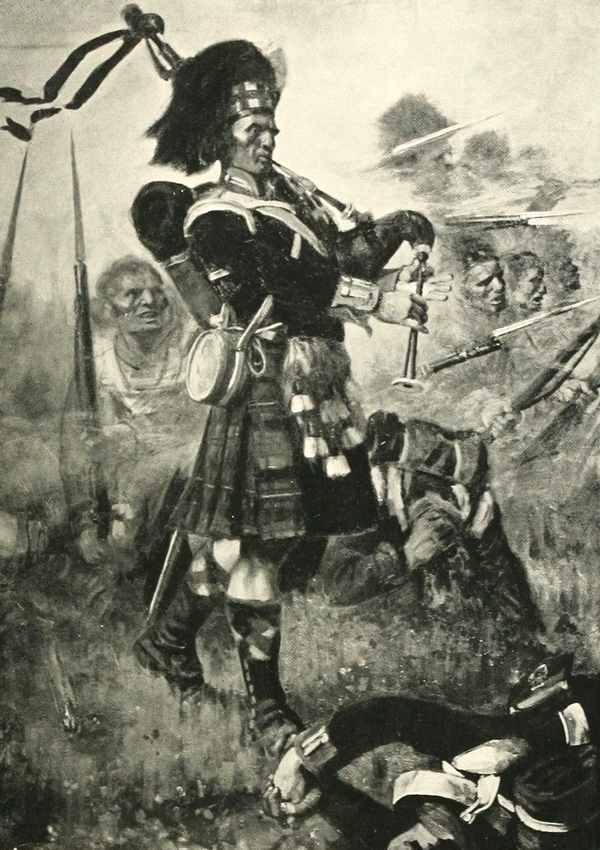
PIPER KENNETH MACKAY, CAMERON HIGHLANDERS
At Quatre-Bras
From the Painting by Lockhart Bogle, by kind permission of the Officers
of the 1st Cameron Highlanders
"Friedberg, 11/1/1917.
Though only a young player I play here every day and do not find
people too hostile to me. The Russians, French and even the Germans
greet me with great interest and seem to find pleasure in listening to me—though
as I said I am no great player; the most unsympathetic are always
to be found among the ranks of the "Sassenach." I learnt to play in 1911,
on joining my Regiment, under George MacLennan, who was Pipe-Major
at that time. While on leave in Edinburgh I used to have lessons with
his father—Jno. MacLennan. Up till now I have only attempted "The
Glen is mine" and "Struan Robertson" in Piobaireachd, but having
been thoroughly taught by the MacLennans I naturally follow their way
of thinking. Yesterday I played to a Russian who is a very good player of
the piano. He was delighted with the Pipes and I could not play too
many tunes for him. Strathspeys and Reels are greatly appreciated by all
our Russian friends. Last St. Andrew's Day we organized an Exhibition
of dancing which was a complete success. As the Scottish Colony here
is so small we asked the Russians to come and help us. This they did
right well with dances and songs, the music being provided, in both cases,
by "Balalaika," or Russian national instrument. For our part we danced
two foursome Reels (dancing two different sets of steps), a Sword Dance
and a Highland Schottische. In the latter dance we each took a Russian
as a partner, they having been trained up for the event. We sang "Bonnie
Dundee," "Lassies of Scotland," "MacPherson," and finished up with
"Auld Lang Syne." For the Reels my Russian friend provided the music
on the piano. Our costume was of course improvised. Kilt, shoes and
hose we had, we wore white shirts with lace cuffs, a strip of tartan fastened
with a brooch at the shoulder to do duty as a plaid and a black velvet band
with a lace ruffle, falling down in front, round our necks. Our sporrans,
with the exception of one which was made out of a local rabbit, all came
from home. I had several pretty compliments paid to me by the Russians
and French, both on our costume and dancing. Five of us took part
altogether. I wonder if it would be too much to ask you to send me instructions
for dancing the "Lochaber Broadswords" and the "Seann Triubhas,"
in case we have the misfortune to pass another St. Andrew's Day here in
Germany. If we do we shall give another Exhibition and I would like
to be able to vary it. I only know 12 Strathspey steps and 8 Reel steps.
Since I have been a prisoner I have taught over 30 people to dance the
Reel—including two Frenchmen and one Russian, and at present I have
five pupils on the chanter. We are 16 Scots here, so can you say we are
losing our national distinctions? I have only told you this because I
thought it would interest you."
In Holland, in the internment camps, an organised pipe band was
instituted by the writer of the above letter, and consisted of thirteen pipers
of whom two were pipe majors.
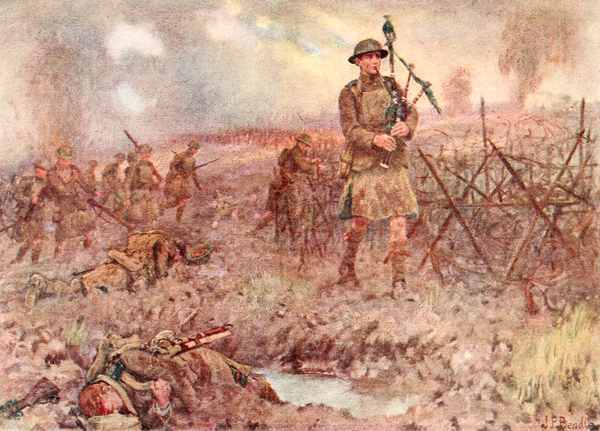
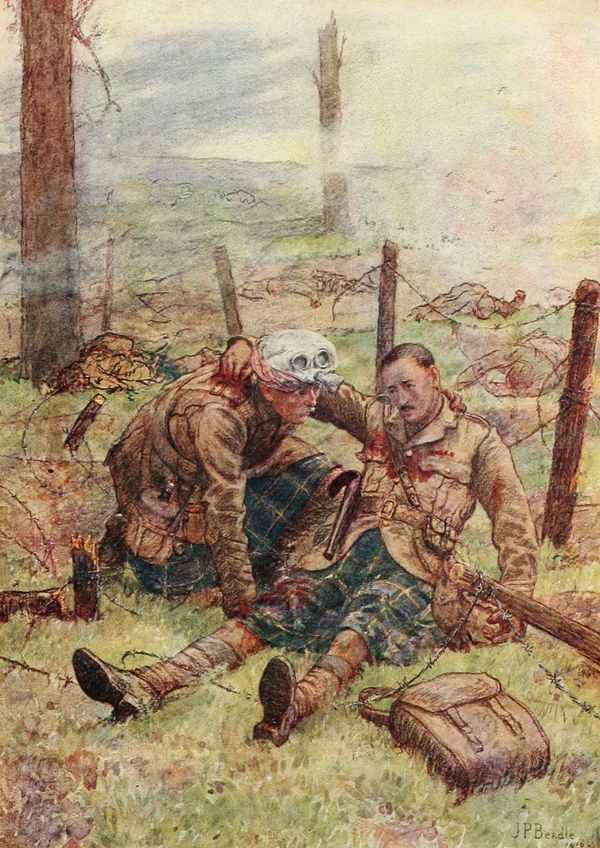
 , endre
(note: if this shake on F or E is approached from a higher note
the vocables become ved
 in, hodr