THE SURVIVING AUTHOR HAS PRESENTED
SIX HUNDRED COPIES OF
THESE MEMORIALS TO THE VESTRY
OF ST. MATTHEW’S CHURCH IN UNADILLA,
N. Y., WITH A VIEW TO THEIR
SALE. THE SUM THUS SECURED IS
TO BE HELD IN RESERVE AS A FUND,
THE INCOME FROM WHICH SHALL
FINALLY BE EXPENDED, WHEN
NEEDED, IN THE CARE OF THE BURIAL
GROUNDS ADJOINING THAT
CHURCH IN WHICH, WITH A FEW
EXCEPTIONS, THESE “PIONEERS OF
UNADILLA,” LIE BURIED....
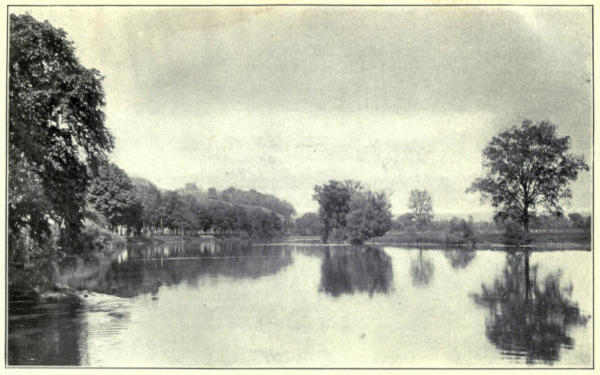
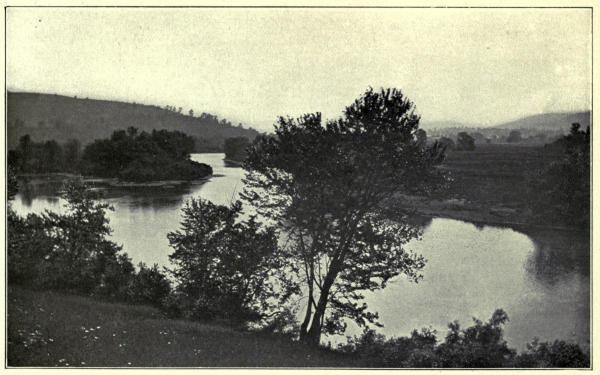
THE SUSQUEHANNA AT UNADILLA,
From the Dam at the Head of the Binnekill.
From “The Old New York Frontier.” Courtesy of Charles Scribner’s Sons.
THE PIONEERS
OF UNADILLA VILLAGE
1784-1840
BY
FRANCIS WHITING HALSEY, AUTHOR OF
“THE OLD NEW YORK FRONTIER.”
REMINISCENCES Of Village Life and of Panama and California
from 1840 to 1850
BY
GAIUS LEONARD HALSEY, M. D. A PHYSICIAN IN UNADILLA FOR FIFTY YEARS.
ILLUSTRATIONS AND A MAP
SOLD BY THE
VESTRY OF ST. MATTHEW’S CHURCH,
UNADILLA, N. Y.
1902
650 Copies Only Printed and the
Type Distributed.
Press of George D. Raitt,
The Unadilla Times.
TO
JULIET CARRINGTON HALSEY THESE MEMORIALS OF MY NATIVE VILLAGE
AND EARLY HOME.
The Early Explorers—Settlers Before the Revolution—Sidney
and the Ouleout—Wattles’s
Ferry—Other Susquehanna Villages—The
Catskill Turnpike—Village Founders—“My
Native Land”—The Isolation of Unadilla,
Curtis Noble and Isaac Hayes—The opening
of the Turnpike—Arks on the Susquehanna—Col.
George H. Noble and Judge Charles
C. Noble—H. H. Howard and Dr. Willis Edson,
IV. EARLY TOWN MEETINGS, ROADS AND HOUSES. 1787-1810.
Many towns made from the original Unadilla—“The
County of Unadilla”—Curiosities
from town records—Roads before 1800—Houses
standing in 1808—Dr. Dwight’s visit
in 1804—Road Districts in 1800,
Stephen Benton and his store—Major C. D.
Fellows, Judge Sherman Page and Dr. Adanijah,
Daniel, Gilbert and Gardner Cone—Capt.
Frederick A. Bolles, Salmon G. Cone,
David Finch, William J. Thompson, Niel
Robertson, Col. Thomas Heath, A. P. Gray,
M. B. Jarvis, Josiah Thatcher, John Eells,
and Lyman Sperry,
The builders of the mills—Origin of the Binnekill—Creeks
that fed it—Sampson Crooker’s
purchase—Joel Bragg—The burning of
the mills—Gen. Edward S. Bragg,
Early missionaries—Father Nash and St.
Matthew’s—Rev. Norman H. Adams—Pioneers
buried in the churchyard—The Presbyterian,
Baptist and Methodist churches—Freedom
Lodge—Capt. Edward Howell—A
schoolhouse in 1821—The two bridges built,
VIII. PIONEERS IN TRIBUTARY NEIGHBORHOODS. 1784-1823.
Crookerville settled—Unadilla Centre and
Rogers Hollow—Families along the old Butternuts
road—Sand Hill and Hampshire
Hollow—Sidney Centre and the old Paper
Mill region—“Spencer Street”—Samuel Rogers,
Martin B. Luther, Col. David Hough
and Perry P. Rogers,
Two business centres—Roswell Wright’s
store and Stephen Benton’s—Arnold B. Watson—The
Unadilla Bank—The old Academy—Clark
I. Hayes—Col. A. D. Williams and
Erastus Kingsley—Dr. John Colwell, Henry
Ogden, L. B. Woodruff, Henry S. Woodruff
and Seleck H. Fancher,
XII. THE UNADILLA HUNTING CLUB AND THE JUBILEE OF INDEPENDENCE. 1820-1826.
A famous haunt of deer—Men who came to
hunt them—Dinners at Hunter’s Hall—Poachers
and Pomp’s Eddy—A great Fourth
at Kortright—Political feeling disclosed in
an oration—Survivors of the Border Wars—Joseph
Brant,
Charming light on business and social life—Post
Office contests and “up-street and
down-street”—A celebration of the Fourth—Frederick
T. Hayes—“The footsteps of
bygone generations,”
Birthplace and family history—Dr. Gaius Halsey
of Kortright—The Catskill Turnpike—The
first stove—To Delhi for general training—Erastus
Root and the Rev. William
McAuley—Reading medicine—To Scranton
or Unadilla?—Arrival at Kingsley’s Hotel,
III. OLD INHABITANTS AND EARLY PRACTICE. 1840-1847.
Others who survived with the author from
1840—“Capt. Horn”—Practical Jokes at
Williams’s Store—The Carmichaels—A Year’s
Business—Harry Wolcott—A dead man
brought to life—Frolics with a three-year-old
colt—Removal to Connecticut,
Sailing away from New York—In the Chagres
River—First view of the Pacific—A long
stay in Panama—Admiral Porter and C. P.
Huntington—The voyage up the Pacific
Coast—Arrival in the Golden Gate,
A city of cloth tents—Gambling and curiosities
in prices—A perilous trip to Sacramento—Two
board shanties make a town—Sutter’s
Fort—Samuel Brannon—Chances
in real estate,
Mining on the American River—A hole that
lasted a season—Taking turns as cook—Profitable
practice of medicine—Other mining
parties—Two cities grow up in a night,
VIII. JAMAICA AND THE RETURN TO UNADILLA. 1849-1850.
Health restored in the Atlantic—A look around
Kingston—Settle in Unadilla again—Origin
of the word Unadilla—Men in the Civil
War—Charles C. Siver—Service in the War
as surgeon after Antietam,
White men appear to have been in the upper
Susquehanna valley in 1616, or about one hundred
and sixty years before the Revolution. They came
as explorers and then as fur traders. After them
in the next century came missionaries to the
Indians. Finally in 1769 arrived surveyors, owners
of land patents and actual settlers. When the
first Indian raids were made upon the valley in
1777 during the Revolution, thriving farm communities,
composed mainly of Scotch-Irish, with a
few Dutch and Palatine Germans, had been established
at points from Otsego Lake down to the
mouth of the Unadilla River.
One of these existed at the mouth of the Ouleout
Creek and was called Albout; another was in the
old paper mill region; another across the Susquehanna
in what is now Sidney village and still another
along the lower waters of the Unadilla
River. The three settlements at the confluence of
the Susquehanna and Unadilla rivers were sometimes
known collectively as Unadilla, although the
one on the site of Sidney was often designated separately
as the Johnston settlement before the war
and as Susquehanna Flats afterwards. While it is
not unlikely that some of the Unadilla village lands
had been occupied in that period, actual proof of
this is wanting.
When the war closed, and settlers began to return
to the valley, seven years had passed since
those early pioneers were driven out. The country
was again a wilderness in some respects more forbidding
than when the settlers first entered it.
Only the blackened logs of burned houses remained
on many farms. Lands that had produced wheat
and corn through several seasons in happier times
were now overgrown with weeds, brush and
briars.
No part of New York state, not even the Mohawk
valley, had been more constantly the scene
of depredations; none had been so often used as a
route of travel for small armies of Indians and
Tories on the one hand and of American patriot
soldiers on the other; none had now become a land
of such utter desolation.[2]
When the Revolution closed the earliest settlers
to return came in 1784 and many were families
whom the war had driven out. Others were men
who had entered the valley as soldiers, or who had
heard of its rich lands through others who were
soldiers. Many went to the old paper mill region.
Among these were the Johnstons who had formerly
lived in Sidney, and, after spending a year on
Unadilla lands, returned to Sidney again. The
McMasters and William Hanna also settled in the
paper mill region. Others went to the valley of
the Unadilla River and still others to the Ouleout.
All these men took up lands that had been occupied
before the Revolution.
Of those pioneers we have, in several cases, full
and authentic records. One who settled on the
Ouleout was Sluman Wattles, who came from Lebanon,
Connecticut, in 1784 and took up lands below
Franklin village where he was to remain a
potent factor in the life of all that region for the remainder
of his life. Another was Timothy Beach
who settled at the mouth of the Ouleout. Another,
in the same region, was James Hughston
and still another Nathaniel Wattles, who opened a
hotel near the Sidney side of the present upper village
bridge.
Before a bridge was built Mr. Wattles maintained
a ferry at that point to which his name was
given. Wattles’s Ferry for many years was the
point of destination for scores of pioneers who
each season crossed the wilderness from the Hudson
to the Susquehanna and here entered boats in
which they and their household possessions were
transported to points further south and west.
Another pioneer, and the ancestor of a large family
that still survives in the Ouleout country, was
Isaac Hodges who arrived in 1789 from Florida,
Montgomery county, where he must have known
the Johnstons and others who came to this valley
from that place. The family had been settled in
Florida for some years, Abraham Hodges before
the war being one of the well known citizens of
that part of the Mohawk valley. Isaac Hodges’s
son Hezekiah in 1790 settled on the farm where
William T. Hodges spent his life. It is recorded of
Hezekiah that he planted the first apple orchard
known in that neighborhood. It became the parent
orchard of many others.
These men had all been a few years in the country
before others came to plant the settlement that
grew into Unadilla village. Some of the founders
of the village arrived from the same towns in Connecticut
whence had come the men of the Ouleout.
Here in the stream called Martin Brook they found
a water power which would drive a saw mill, then
a pressing need of the country, and which soon afterwards
drove also a grist mill. Here one of them
opened a hotel, another a store, and a third became
a physician—facts which laid the foundations
of a small community in which ere long were to be
centered many vital interests of a large frontier
territory.
Finally in 1800 an old primitive road, running
from Catskill to Wattles’s Ferry, was improved
into a turnpike. It became the model road in all
this part of the state, and was destined to remain
for more than a quarter of a century the main
highway of trade, travel and settlement. Contemporary
with the opening of this road, was the coming
of Curtis Noble and Isaac Hayes, two young
merchants, whose enterprise and success gave the
final weight of influence to causes already operating
for the founding on this soil of the village
which, for half a century, was to control a larger
sum of interests than any other within a radius of
perhaps twenty miles.
Indeed the origin and early growth of nearly all
the upper Susquehanna villages came from similar
causes. Usually a store and a saw and grist mill
determined the site. Mills were established near
the mouths of streams tributary to the main
waterway. Hotels and stores naturally followed.
Centers were thus established, around which other
enterprises and homes soon were gathered. With
Cooperstown, Oneonta, Otego, Unadilla, Sidney
and Bainbridge the genesis is practically the same.
As time went on, other circumstances, added to
what lumbering and agriculture had done, led to
newer progress, such as the Catskill turnpike that
aided Unadilla, the Esopus one that helped Bainbridge,
the Charlotte one that made for the welfare
of Oneonta, or those later circumstances, which,
before the era of railroads set in, made Oneonta
and Bainbridge centers of the stage business for
the whole valley. All these villages, save Cooperstown
and Bainbridge, were founded on lands in
the Wallace patent.
The sketches which follow relate to one alone of
these villages; but Unadilla might serve as a type
of them all. It is a village with whose annals the
circumstances of birth and an eighteen years’ residence
on its soil have helped to make the author
familiar. Many of its leading citizens of a past
generation he knew in boyhood. Its highways,
hills and streams remain the most familiar and
among the fairest he has ever known.
The lives of the men who founded and built up
this village may be assumed to possess interest to
those who were born in that village, or who have
made it their home. No wise man can be indifferent
to the founders of any place bearing such relations
to himself, any more than he can be indifferent
to the founders of his native land in a larger
sense. In a very forceful way such men have
helped to make him what he is, and what he must
forever remain. They are
“dead but scept’red sovrans
Who still rule our spirits from their urns.”
Out of the very soil on which one is reared appear
to spring forces fixing deep marks on one’s
nature. One is not alone a native of his birthplace,
but in some considerable degree a product. No
fact is more familiar in biographies, whether of
great or small lives, and for example in the life of
Dickens. The fondness of Dickens for ships and
salt water was life long because Dickens, like his
own Copperfield, had been “born within sound of
the sea and its eternal nevermore.”
This influence springs not from climate altogether;
nor from soil or landscape. More than to
any of these influences perhaps it is due to inhabitants,
older and wiser than he, by whom his tendencies
were directed, if not actually shaped. Such
as these are the unacknowledged teachers of us all.
As of the founders of states and of cities, so of
those who found villages and small settlements:
they definitely give to communities their character.
They still exert their sway long after they have
ceased to speak and toil.
The primary interest in these sketches now is,
and must continue to be, local. And yet, in a
sense, those quiet annals have wider value. Small
as this village has remained, the charm of its site
and the beauty of its streets have impressed all
visitors. The place, moreover, stands otherwise
apart, and stands with some eminence, as an example
of a New York village at its best.
For three quarters of a century, Unadilla remained
thoroughly isolated from the great world
beyond its borders. Until the nineteenth century
had two-thirds passed away, it had neither railroad,
nor canal, nor any near communication with
one. At Catskill, or at points in the Mohawk
valley, for a long series of years, its people could
first reach a larger world, and then the undertaking
involved a journey on wheels, in some cases of
ninety miles, through a rough country. Even in
Civil War times, a day’s journey by stage was still
necessary in order to reach a railway and learn the
war news; while the war had some years passed
away, when a railway first came to its own doors.
How that event gradually changed this community
those know best who have known the village
both before and since the invasion. Before it
occurred, growth and character proceeded almost
wholly from local forces, which were mainly strong
and otherwise beneficent. Whatever was good
and productive, proceeded out of the place itself—out
of the virtues that lay in its own people, who
were very largely of New England stock.
Here in many families dwelt a quality in refinement,
the things which, in these matters, mean culture—fineness
of feeling, elevation of sentiment, a
sense of the obligations which worldly independence
confers and a good breeding—which isolation
could not deny to the place, and which isolation
probably did much to bestow upon it.
Boys who knew that culture and were blessed
by its influence, boys who are now men and have
travelled far, may well reflect, as more than one of
them has done, that in vain have they sought to
find that culture developed in finer or sweeter state
elsewhere.
To New England the obligation for that is unquestionably
large; but this cannot explain all
things. When we say that in this inland New
York village thrived for almost four score years a
bit of New England transplanted in the west, we
must add to the statement that it thrived in an
isolation so complete that, what was best in New
England culture, here came to florescence in full
degree.
It is a common enough experience to find men
and women showing a partial fondness for their
early homes. Out of this isolation of Unadilla has
sprung, I think, a very partial fondness for the
place among those who knew it in the early forties,
fifties and sixties. What Webster, on a famous occasion
said of Dartmouth college, they might say
of this village: it is a small place, but there are
those who love it.
The men who led in this work of village foundation
are little known to the present generation.
Many of them lie buried in St. Matthew’s churchyard,
and headstones mark their graves, familiar
places to all who frequent that enclosure. But few
are the visitors who know anything of the story of
those strong and valiant souls.
II. THE VILLAGE SITE AND THOSE WHO CHOSE IT. 1784-1800.
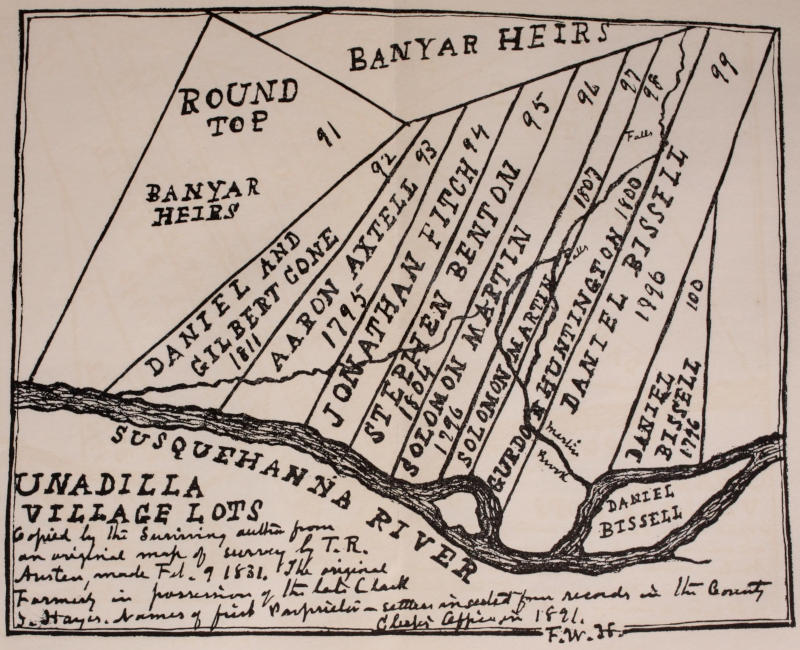
The site of Unadilla village comprises nine lots
of the Wallace or, as it would be better to call it,
the Banyar Patent, since its real owner was
neither Alexander nor Hugh Wallace, but Gouldsborough
Banyar. They are lots 92 to 100, inclusive.
Each runs in a northeasterly direction on
lines generally parallel. The lots are of somewhat
varying widths with lengths of perhaps ten times
the widths. Besides Mr. Banyar the non-resident
early owners from whom the settlers obtained
their titles included eminent citizens of Albany
County—John Livingston, the Lansings and the
Van Vechtens—who seem to have acquired their
holdings from Mr. Banyar. At first leases on the
redemption plan were given. Several pioneers had
long been here before they acquired actual titles,
although others purchased soon after coming; but
it was not until 1811 that the last village lot
passed from an alien owner to an actual settler.
The records of those early transactions are not
complete. Searches made for the author leave several
gaps to be filled. It was not a universal custom
in those times to record deeds. A buyer often
accepted the old deeds from the man from whom
he purchased. Even in cases where deeds were
eventually recorded several years might have
elapsed after the purchase. In the period from
1772 until 1791, during which Unadilla was part
of Tryon, or Montgomery County, no records
exist of any sales by Mr. Banyar or of any sales to
or by the Livingstons, Lansings or Van Vechtens,
searches for the same having been made for the
author in vain at Fonda. In Cooperstown the
author has fared better. Here titles to almost any
lot can be traced back to the formation of the
county in 1791. From these records alone has it
been possible to prepare the appended account of
first sales to settlers.[3]
First to purchase outright, so far as the records
show, was Aaron Axtell, the pioneer blacksmith of
the village, who was here before 1794. In August
1795, he secured a part of lot 93 for £110. He
made the purchase from Mr. Banyar. Lot 93 lies
in the western end of the village. Mr. Axtell’s
house stood on the site of the future Owens or Salmon
G. Cone residence just beyond the railroad
crossing, which some twenty odd years ago was
burned. In 1810, Uriah Hanford had become the
owner of this lot.
Mr. Axtell was of Welsh origin, and another of
the name who came to Unadilla was Moses Axtell.
Moses Axtell had lived in Boston before the Revolution,
where he was one of the famous party who
disguised themselves as Indians and threw the tea
into Boston harbor,—the act by which, in the
trouble with the Mother Country, the gauntlet
was definitely thrown down by the Colonists.
Moses Axtell afterwards fought in the battle of
Lexington and at Bunker Hill.
Next as a purchaser came Solomon Martin, who
in June 1796 secured lot 96, embracing perhaps
150 acres. He paid for it the sum of £141 5s.
The sale was made by the Van Vechtens. Like all
these lots it ran back to the hills for a distance of
about a mile from the river bank.
The third purchase was made by Daniel Bissell.
In August 1796 he obtained from Mr. Banyar lots
99 and 100, comprising nearly 400 acres, for
which he paid £345. These lots extended from the
extreme eastern end of the village down to about
where St. Matthew’s church stands. Mr. Bissell
sold a part of lot 100 in 1801, to his kinsman
Guido L. Bissell for $250. Another part of the
same lot he sold to Solomon Martin in the following
year for $450.
Gurdon Huntington was the next purchaser. He
did not acquire title, however, until 1800, which
was about ten years after he came into the country.
He then purchased from John Livingston a
part of lot 98 for $352. Probably Dr. Huntington
had already erected on this lot, the yellow house
that still stands in the rear of the building long
used as the post office. He seems to have built the
house while occupying the land under a lease with
the privilege of purchase.
Aaron Axtell in 1803 purchased a further part of
lot 93 from William Fitch and Sarah, his wife. He
paid $1400 for it, which would indicate that improvements
had been made by the former owner.
Mr. Fitch had a house in the village before 1803.
As Mr. Axtell bought his first part of lot 93 from
Mr. Banyar, Mr. Fitch’s part had, of course, originally
been purchased from the same owner.
Stephen Benton, in 1804, became the owner of
lot 95. He purchased it for $1095 from Peter
Betts who then lived in Bainbridge and whose wife
was Eliza Fitch, a sister of Amasa Fitch, an early
settler on village land. Peter Betts owned other
lands in the Wallace patent below the village. He,
with William Fitch and Jonathan Fitch, had secured
titles to land within the village limits somewhat
earlier than the settlers already named; but
the Cooperstown records give no clue to the date
of their purchases which indicates that he made
the purchase before 1791. There were Fitches in
Lebanon, Connecticut, and these men perhaps
came into the country with the Wattles families in
or soon after 1784, which would make them the
first settlers who took up village lands.
Jonathan Fitch in 1805 sold to Jacob Hayes the
land he lived on in lot 94. For a part of that lot
Mr. Hayes paid $800. Here again improvements
obviously were included in the purchase price. Mr.
Fitch is known to have had a house in the village
at that time.
Next among the purchasers came Solomon Martin
a second time. He bought lot 97 from Mr.
Banyar in 1807, paying £153 14s. On this lot
stood General Martin’s house and store. He at
this time was the largest land owner in the village.
After his death in 1816, the estate was said to be
“land poor.”
The records now proceed to the purchase made
by Daniel and Gilbert Cone, in 1811. This was lot
92 which lay beyond the Axtell purchase. The
Cones bought of the Lansings and paid $563.39
for the tract. Three years later they sold one acre
of it to Niel Robertson for $400, which must have
included improvements. From Mr. Banyar in 1813
the Cones bought another lot for $501.25. This
was lot 108, but it was outside village limits.
Daniel Bissell who in some respects is the most
interesting of these pioneers was a native of Lebanon
where he was born in 1748. He married in
that place Sarah Wattles and was approaching
forty years of age when, about 1792, and perhaps
earlier, he came to Wattles’s Ferry. In Lebanon
he had already become a man of varied and useful
activities. He possessed a considerable tract of
land there and papers now owned by Harriet Bissell
Sumner show that he had had many transactions
with Sluman Wattles. A paper characteristic
of the period, containing an “account of Benjamin
Bissell’s estate that Daniel Bissell took”,
names pistols valued at £2, a greatcoat valued at
12s., leather breeches at 5s. and one gun at £1,
12s., 6d. Another paper signed “Jonathan Trumbull,
Captain-General”, who was the original
“Brother Jonathan”, his home being in Lebanon,
is dated in 1773 and excuses Daniel Bissell from
military service owing to “a lameness of the arm
caused by fracture and a pain in the chest caused
by a sprain.”
Still another paper dated in March 1792 gives a
list of articles delivered to Daniel Bissell from the
estate of Mr. Fitch. It includes one large kettle,
valued at 8s., one meal chest at 3½s., one small
feather bed at 30s., one pair of saddle bags at 6s.,
one small bedstead 10s., and one copy of Gibbs’s
“Architecture”, 24s. Some of these articles no
doubt found their way to the new settlement. Mr.
Bissell had a family of nine children, three or four
of whom had reached their twentieth year. He
brought with him the large sum of $7,000 in
specie, which completely filled a good sized basket.
One of the recorded facts in Mr. Bissell’s life is
that he kept the first hotel. A license issued to
him, though not the earliest in the town by five or
more years, still exists with the seal attached. It
is signed by Solomon Martin, in whose hand the
whole paper is written, and by Peter Schremling
and Gurdon Huntington. By virtue of law these
gentlemen, Commissioners of Excise for the town
of Unadilla, say they “do hereby permit Daniel
Bissell to retail strong and spirituous liquors according
as it is in said law made and provided,
from the date hereof until the first Tuesday in May
next after this date.” The license is dated September
9, 1799.
Mr. Bissell’s relations with other settlers are
shown in several letters. One from Noble and
Hayes, of which he was the bearer, dated in 1806,
is addressed to Bogardus and DuBois of Catskill,
and informed them that the Unadilla merchants
sent by Mr. Bissell three barrels of wheat, with
other articles which were to be sold “if you can
and credit us the avails.” Another from Dr.
Huntington was addressed to Packard and Conant
of Albany. Dr. Huntington sent by Mr. Bissell a
few rags and said “I expect you will give four dollars
for rags, or more, and if they do not come to
the amount of the paper [the rags were to be exchanged
for writing paper] I will be I suppose in
Albany in about two weeks and will settle for the
same.” The date of this is November 1808, when
Dr. Huntington was a Member of the Assembly.
About the same time came a relative of Daniel
Bissell, though not a near one, Guido L. Bissell,
Mrs. Sumner’s ancestor. He was born in 1769
and was the father of that other Daniel Bissell
whom many men and women can still remember.
He was also the father of Hannah Bissell who became
the wife of John Veley. In 1796, as Mr. Bissell’s
account book records, “John Barsley began
to work for me”, and in the following spring
“Sevenworth began to work for me.” In this ancient
volume, another entry under date of Franklin,
March 23rd, 1798, is this: “I promise to Guido
Bissell 15 shillings on demand, being for value received,
John Pooler”, and still another, “Mr.
Guido Bissell and I have settled and find a balance
of 2 pounds due said Bissell on account, James
Hughston.” Mr. Bissell for some time was engaged
in trade. His book has many entries of sales of
“jane”, velvet, cloth, etc., as well as charges for
work done by himself and men whom he employed.
He did some of the work in building Wright’s store
in 1815, and when St. Matthew’s church was built
made note of “work on the church five days by
Mr. Beadle.”
A numerous and influential family in Connecticut
had been the Bissells. John Bissell, a pioneer of
Windsor, and believed to be the ancestor of them
all, was the first white man who ventured across
the Connecticut River from Windsor, where he
built a house and began the East Windsor settlement.
For forty-four years his descendants, Aaron
Bissell and Aaron Bissell, Jr., filled the office of
town clerk. In Windsor in the last century was a
Daniel Bissell and a Daniel Bissell, Jr. The latter
performed secret service for Washington, that won
for him a badge of merit. Members of this family
have been prominent in various walks of life. One
of them was a Protestant Episcopal bishop.
Solomon Martin came to Unadilla some years
before 1790. In 1792 he already had a store here.
He was a native of Woodbury, Connecticut, one of
the oldest towns in that state outside the Connecticut
River valley, and was a son of another Solomon
Martin, descended from one of the first settlers.
The family was English and one of them,
Captain John Martin, went around the world with
Drake. They were entitled to bear arms and had
for their motto “Sure and Steadfast.” Solomon
was born June 15, 1762. His name is given by
Cothran among natives of Woodbury who served
in the Revolution, although he was only a boy of
thirteen when the war began. His title of general—a
militia title, I believe—belongs to a late period
in his life. In 1792 he was a captain and in 1806
a colonel. He served in the war of 1812.
His store in Unadilla was the first set up. Its
site was on Main just west of Martin Brook Street.
Here also he lived, the house and store having been
built together. At a late date he appears to have
been in partnership with Gurdon Huntington.
Many years afterwards there stood near the present
White store block a building called the Dr.
Huntington store. It was afterwards moved to the
site of the present L. L. Woodruff residence and
then conveyed to the street that fronts on the river
where it still stands adjoining the churchyard
grounds. Solomon Martin had a distillery as
early as 1803, when Guido L. Bissell charged him
“to work at trough at stillhouse 18 shillings,” “to
work in the still house 6 shillings”, and again “to
work on the still.”
Solomon Martin and Sluman Wattles had close
business relations. Mr. Wattles sold him boards
“delivered to your store” in 1792, and in the same
year charged George Johnson 3 pounds, 17 shillings
for “goods taken at Captain Martin’s store.” In
1794 he charged Martin 6 shillings as “fees for license”,
and the same year Roger Wattles with “an
order on Solomon Martin for three quarts of rum
for 7 shillings.” When Martin was in the Legislature
in 1806, Sluman Wattles sold him a yoke of oxen
“which he agrees to allow me as much for as he can
sell them to the McAlpins for and answer the same
to Lansing at Albany towards the Mill place which
I bought of him (Lansing) between now and the
last of August next.” Martin appears to have
made his journey to the State Capital in a conveyance
drawn by these oxen.
Solomon Martin’s wife was Susan Scott of Catskill,
whom he married in 1796. In 1816 he died,
and Mrs. Martin with her four sons and her unmarried
sister continued to occupy the home in
Unadilla for many years. He was elected Supervisor
in 1798, 1799, 1800, 1801 and 1802. He
was Sheriff of Otsego County from 1802 to 1806,
and was twice a Member of Assembly. His business
relations were large. Among plaintiffs in
suits before Sluman Wattles in and about the year
1794, Martin often appears, some twenty suits
and confessions of judgment in his behalf being entered.
During his term as Sheriff, Martin became associated
with a murder case in a way that gave his
name considerable notoriety. Stephen Arnold of
Burlington had so severely whipped a girl six years
old that she died of her injuries. Arnold was tried,
convicted and sentenced to be hanged. On the day
appointed for the execution, thousands of people
assembled to witness it in an open field on the
banks of the river in Cooperstown. An address
was made by a clergyman, the prisoner spoke a few
words, Sheriff Martin adjusted the rope, and then,
while the assemblage was breathlessly waiting for
the final scene, Martin produced a letter from Governor
Lewis granting a respite. It appeared that
this letter had reached Martin early in the morning
and it was now past noon. His excuse for his
conduct was that he and a few others whom he
had consulted thought it would be improper to
make the letter public except on the scaffold.
Solomon Martin’s permanent memorial in this
village is the stream that bears his name. It was
formerly divided into two streams running through
village lands, and then coming together, thus forming
an island. When the owners of land on and
near this island desired to erect buildings they
thought it proper that the brook should be confined
to one channel, and accordingly attempted so
to make it.
More than half a century has passed since that
step was taken, but the stream in high water time
is still true to its old time habit: the brook pushes
out to the westward and asserts dominion over its
old time territory. All the efforts of two generations
to prevent this again and again have failed.
Across this stream on Main street originally stood
a wooden bridge. At the sides horses could be
driven down for water. A stone arched bridge
erected a great many years ago, admirably took the
place of this primitive structure and so remained
until 1893, a striking monument of the care with
which it was built.
Solomon Martin for many years had a sawmill
on this brook. It stood a short distance above
the tannery site and here for many years the road
came to an end. The building of this sawmill goes
back of the year 1796. Solomon Martin, his store
and his sawmill were long since gone. They are all
forgotten to this generation. A dark stone slab
marks his burial place in St. Matthew’s churchyard.
Meanwhile the unruly brook remains forever to
strengthen recollections of his name.
Further up this stream other sawmills were afterwards
built. What was the dwelling house adjoining
these mills still does duty there as a home
on a different site, and here in their old age long
lived Lewis, or “Luke”, and Edward Carmichael.
Beyond that site Martin Brook now possesses a
newer and more lasting memorial of individual enterprise.
Athwart the stream have been erected
imposing dams of stone serving reservoirs and
standing as firm and permanent as the hills that
form their abutments. Solomon Martin had been
nearly forty years in his grave when was born the
citizen of Unadilla who in that secluded ravine was
to erect these enduring and beneficent structures,—Samuel
S. North.
Gurdon Huntington, whose home for many years
was in the historic building that still stands at the
corner of Main and Martin Brook Streets, came to
Unadilla before 1794, and here he lived until 1830.
He was a native of Franklin, Connecticut, which
lies within a few hours’ walk of Lebanon, Daniel
Bissell’s home. His father was Deacon Barnabus
Huntington, and he belonged to the sixth generation
in descent from Simon Huntington, a noted
early emigrant from England who sailed for the new
world in 1633 with his wife and children, and on
the voyage over died and was buried at sea. From
his surviving sons a very distinguished family of
descendants were to be raised up in many parts of
this country—Samuel who was governor of Connecticut
and a signer of the Declaration of Independence,
Samuel who was governor of Ohio,
Daniel the artist, and Collis P., the railroad magnate,
whose home in early life was in the Susquehanna
Valley at Oneonta.
Gurdon Huntington was born on July 3rd, 1768.
He was educated by his father’s pastor, the Rev.
Dr. Nott. One of his schoolmates was that Eliphalet
Nott who rose to much eminence as president
of Union College. The boy read medicine in
Connecticut and then came to Unadilla. In 1798
he married Esther, the only daughter of Benjamin
Martin of Woodbury, Connecticut. Benjamin Martin
was Solomon Martin’s eldest brother.
Dr. Huntington “became a successful and deservedly
popular physician” in Unadilla. His
practice is known to have extended to places distant
forty or fifty miles from home, and one may
well believe the statement that “a more welcome
visitor never entered those scattered homes.” In
this laborious field he made journeys by day and
night and often wended “his solitary way along almost
untrodden paths”, forded unbridged streams
and yet was a “cheerful and happy man”, as well
as a “skillful and prosperous physician.” He is
said to have accumulated in his time “a handsome
property.” He was a man of genial manners and
by nature companionable.
Dr. Huntington was elected supervisor of Unadilla
in 1803 and again in 1809 and 1811. For
seven years he was town clerk. He served four
terms in the Legislature—in 1805, 1806, 1807 and
1808. In 1813 he removed to Cairo, Greene
County, where he died in 1847 at the age of
seventy-nine.
In this early pioneer history, other names besides
these are found—Adam Rifenbark, Seth Abel, Capt.
Uriah Hanford, Jacob Boult, Abel Case and Jonas
Sliter. Each was here before the eighteenth century
closed. Capt. Hanford came before 1796 and
was a freeholder in 1809. He died here more than
thirty years afterwards. He was the father of
Theodore Hanford. Jonas Sliter dates as far back
as 1795 and probably several years further. He
seems to have belonged to the family which settled
in the old paper mill region before the Revolution.
Perhaps he came back as soon as the war
closed. Seth Abel was living in the town before
1798 and long served as tax collector and pathmaster.
Abel Case was probably here before the century
closed. In 1809 he was a freeholder and in
1810 a commissioner of highways. He owned land
that joined Solomon Martin’s and was one of the
first vestrymen of St. Matthew’s Church. Guido
L. Bissell worked on his wagon house and roofed
over his barn in 1806. Jacob Boult was living in
the village in 1800 “near the bridge” and was still
a resident in 1837. Giles Sisson was living on the
river road above the village before 1808. Still another
name is William Wheeler, to whom in 1797
Guido L. Bissell sold “15 lights of sash for 7 and
6 pence”, “290 feet of timber for 10 shillings and
1300 shingles for 1 pound.”
The life story of these pioneers is really a history
of this settlement in its formative period.
Their activities widely differed, and so did their importance.
But all were among the first pioneers
and they all had a share in laying the foundations.
III. TWO FRONTIER MERCHANTS. 1800.
While Solomon Martin, Gurdon Huntington
and Guido L. Bissell had sold goods in Unadilla before
the century closed, the first merchants, in any
large and permanent sense, were Curtis Noble and
Isaac Hayes. Among settlers who came after the
century had just ended, special distinction belongs
to both men. They were contemporary in their
coming with the building of the turnpike, and both
were young, Mr. Noble being twenty-five and Mr.
Hayes twenty-four. Here they remained in partnership
until Mr. Noble died more than a generation
afterwards. Their varied activities extended
far along the valley and to the north and south of
it. They were typical frontier merchants, a class
of whom New York State in those times had many
examples—men of youthful energy, largeness of
aims, honorable purposes, capacity for toil and fine
mercantile instincts.
Curtis Noble was descended from Thomas Noble,
an Englishman who reached Boston as early as
1653. Descendants of Thomas Noble make up a
genealogical record filling a book of more than 600
pages. He settled in Westfield, Massachusetts,
and there died in 1704. His eldest son, John, was
the first white man who settled in New Milford,
Connecticut, and there in 1750 was born John’s
son Elnathan, and in 1754 his son Jesse.
Elnathan Noble in 1794 bought for $750 a farm
of 100 acres in Otsego County on the Butternut
Creek in what is now New Lisbon. When he
moved to the farm in April of that year, there was
a log house on it ten feet by twelve, with an elm
bark roof and a chimney of sticks and clay. In a
cart covered with tow cloth and drawn by two
yoke of oxen he arrived early in May with Johanna
Bostwick, his wife, and their one daughter and
four sons, finding the land heavily timbered, the
settlers few, and these chiefly Dutch or German.
Here Elnathan Noble lived until his death in
1824, his funeral being conducted by the Rev. Daniel
Nash, known better as “Father” Nash, with
whom he had long co-operated in support of the
Episcopal faith. Jesse had followed him to New
Lisbon, and Jesse’s son Thomas found in Unadilla
a wife in Eliza Ann Beach, daughter of Abijah H.
Beach, by whom he had eight sons, Whitney B.,
George N., Edward B., Thomas H., Carrington T.,
John Henry and Clark. Jesse’s daughter Hetty became
the wife of the Rev. Russell Wheeler, the first
rector of St. Matthew’s church in Unadilla.
Elnathan Noble’s eldest son Curtis did not go to
New Lisbon with his father. He had already entered
upon a mercantile life at New Milford in the
store of Elijah Boardman, where also had been employed
his future partner, Isaac Hayes, and there
Curtis Noble remained until 1800 when he and Mr.
Hayes formed their partnership and set out for
Unadilla. In that year Mr. Noble married Mr.
Hayes’s sister, Anna, who survived him until 1865
when she died at eighty-four.
Mr. Hayes was born in 1776. His father was
Thomas Hayes of Ilminster, Somersetshire, England.
Mr. Hayes in 1798 was sent by Mr. Boardman
to the Western Reserve of Connecticut, now a
part of Ohio, under contract to clear up a tract of
land, sow grain and otherwise prepare the way for
settlers. These lands were in the present township
of Medina.
Early in 1800 Mr. Hayes had returned to New
Milford and entered into his agreement with Curtis
Noble to conduct a business “as merchants or
shopkeepers in the State of New York at such place
as may by them be thought most proper under the
name and firm of Noble and Hayes for a term of
time not less than ten years.” They contributed
each at the beginning one thousand dollars. Mr.
Hayes was soon afterwards to increase his amount,
while Mr. Noble had the privilege of doing so.
Each was to “devote his whole time and attention
to the business, use and benefit of the said company.”[4]
Instead of ten years this partnership continued for
nearly forty. Formal settlement was finally made
in 1841 with George H. Noble and Charles C.
Noble as executors of their father’s estate.
These Unadilla pioneers came by way of Catskill,
the turnpike being then in process of construction.
On reaching the river they stopped at the Wattles’s
Ferry hotel and soon concluded that the lands
across the stream offered the most promising site
they had seen for their enterprise. Here was the
terminus of the turnpike over which their goods
could be brought from Catskill and from here
down the Susquehanna could be sent in boats the
produce of the country which they expected to acquire
in exchange for goods.
Their first stock of goods arrived on a Saturday,
when they were living in the house afterwards
called the Priest house, a close copy of the Gurdon
Huntington house. It occupied the site of the
present Horace Eells residence. In one of the
rooms of this dwelling the goods were opened and
on the following Monday Mr. Hayes on horseback
made a tour of the Ouleout country and the upper
Susquehanna, announcing to all the inhabitants
that a new store had been opened. Solomon Martin,
who had a rival store, predicted disaster for
the new firm. But Mr. Hayes’s tour brought a
crowd of customers at once and a large trade was
soon secured.
In the following year the firm was able to send a
large quantity of local produce to Catskill and Baltimore.
Pearl and pot ashes, pork, bacon, wheat,
cattle, dried apples and eventually whiskey became
staple articles of export. An old account book
records that in 1808 Mr. Noble, on one occasion,
sold 30 barrels of pot ashes “for cash in York”,
and in 1809, “588 pounds of rags.” Shipments to
Catskill were made by well known residents of the
town—John Pooler, John Carley, Aaron Axtell,
James Hughston and others. The business eventually
grew to large proportions. Wheat, rye and
corn were grown in vast quantities and everyone
was overburdened with the stock on hand. In a
single week the firm was known to ship to Catskill
3,000 bushels of wheat, which meant 90 sleigh-loads.
These circumstances forced the firm into
distilling rye and corn into whiskey, and for this
purpose the stone building, afterwards used as a
tannery was erected.
Between Unadilla and Baltimore regular ark
loads of produce made journeys down the river.
As described to the author by the late Clark I.
Hayes, these arks were from 20 to 30 feet long and
from 15 to 20 feet wide, the depth being from 3 to
4 feet. Boats similar to them were in general use
on inland waters at that period. On the Mohawk
the favorite boat was called the Schenectady boat,
which was “a broad and shallow scow some 50
feet in length steered by a sweep oar of 40 feet and
pushed upstream by man power.” On these boats
when the river was high 10 tons of freight could be
carried.
The ark proper was the invention of a Pennsylvania
farmer named Kryder living on the Juniata.
In 1792, when flour and lumber were dear, he first
resorted to this kind of boat in order to reach Baltimore,
and thus realized an excellent profit. The
ark afterwards came into very general use all
along the upper as well as the lower Susquehanna.
In favorable water 80 miles a day could be traversed.
Mr. Kryder’s first ark carried 300 barrels
of flour. Later ones were large enough to bear the
weight of 500 barrels. It was by means of these
boats that the vast grain product of Central and
Western New York was for many years transported
to southern markets.
The arks of Noble and Hayes were loaded at a
cut in the river bank that may still be seen opposite
their old store. Having been hauled near the
bank, planks were thrown out to the arks from the
shore. In seasons when the water was at its most
favorable stage,—which was usually falling high
water that enabled a boat to be kept in the centre
of the stream,—loading was done at other points
in order to start several arks at one time. All the
products of the country went down the river in
these arks—at least all for which a market existed
at the end of the journey. They were loaded sufficiently
well to draw from 20 to 24 inches of
water. From three to five of them were usually
coupled together in line and placed in charge of an
experienced pilot who understood the course and
currents of the stream. Men with long oars steered
them at each end of the line under directions from
the pilot.
Lumber intended for Baltimore went in rafts
which were put together at places along the river
where some quiet eddy could be found near a sawmill.
One of the best spots of this kind near Unadilla
was the eddy below the Condensery which
formerly covered a large territory that has since
been filled in by the action of the water, leaving
scarcely a trace of the water area that formerly existed.
After making their sales in Baltimore, Mr.
Hayes or Mr. Noble went on to New York to purchase
goods, shipping them by way of the turnpike.
Refuse grain from the Noble and Hayes distillery
was fed to cattle and hogs. It was a common
thing to slaughter from 200 to 300 hogs in the fall,
and to feed half that number of cattle through the
winter. In the time of Jefferson’s Embargo the firm
met with heavy losses. Mr. Hayes used to tell
how a supply of crockery that had cost $1200 just
before the Embargo was raised was afterwards
worth only $112.
When the Embargo was imposed however, it not
only affected the stock of merchants favorably but
the farmer’s produce unfavorably. Grist mills had
been busy with heavy crops all through the autumn
of 1807 in anticipation of high prices, due to the
foreign demand; but when the ports were closed,
the demand ceased and farmers often found themselves
in possession of a staple article for which
they could not get the cost of the labor put into it—the
sowing, reaping and grinding. The loss in
New England to each family because of this measure
was reckoned in 1808 to be about $100.
Thousands of men were ruined by it, and notices of
sheriff’s sales covered tavern doors and guide posts
at forked roads. Men in those days could be sent
to jail for debt and thus in New York City during
a period of less than a year 1300 persons were
imprisoned. That city has been described as
looking “like a town ravished by pestilence.”
Streets were deserted and grass grew on the
wharves.
Isaac Hayes in 1804 built the house in which his
son so long lived—the house still occupied by descendants
of his. It was for many years regarded
as the finest residence on the road between Catskill
and Ithaca. This may readily be believed, for in
1804 the common dwelling house was a log hut,
while the three “yellow houses”, then standing in
the village, one of which the Huntington house
still survives, were fine modern residences.[5] Mr.
Hayes’s house for that time was indeed a palatial
country mansion. A remarkable feature of it was
the height of the rooms, as may still be seen; they
are as high as rooms in many dwellings of our day.
Remarkable also was the design of the house—the
elevation, the mantels, above all the circular stairway.
In the existence here of that edifice in those
early days lay a sign of the culture which someone
has said “corrects the theory of success.”
On the island opposite this house formerly existed
a race-course. It does not appear to have
been in use long, however,—perhaps not for more
than two seasons. A temporary foot bridge was
erected across the stream, made of planks resting
upon benches having legs long enough to keep the
planks above water. This bridge was wide enough
for two persons to pass. After the races were over
it was removed. Horses and carriages reached the
island by the fordway.
Mr. Hayes’s activities in this community, apart
from his mercantile business, were wide and varied.
He was postmaster for many years, supervisor
in 1805, and for seven other years, and was elected
to the Legislature in 1811 and in five other years.
He had an important share in founding St. Matthew’s
Church. He had come from the home of
Congregationalism and did not embrace the Episcopal
faith until some years after he came to Unadilla,
when he joined with others in promoting the
services held by “Father” Nash. He was a vestryman,
warden and treasurer of the Church for many
years and was senior warden at the time of his
death, which occurred in 1857 at the age of eighty
years and ten months.
Isaac Hayes’s wife was Sarah, daughter of Benjamin
S. Mygatt, of New Milford. To the same
family belonged the late Henry R. Mygatt of Oxford
and his sister, Mrs. Frederick A. Sands, of
Unadilla. The two families of Noble and Hayes, as
already shown, were related by marriage, Mrs.
Noble being Mr. Hayes’s sister. No family accounts
were kept at the store; each took what it
needed. Eventually the two family homes contained
twenty children. One of these children survived
elsewhere until 1892; when he died in Bennington,
Vermont, at the age of eighty-three,—Joel
M. Hayes.
Thomas Hayes of Ilminster had seven children
besides Isaac. They were Abraham, Polly, Jacob,
Hannah, Daniel C. and Thomas. Abraham’s
daughter Anna married Dr. David Walker, who
succeeded Dr. Huntington as the occupant of the
“yellow house”, and whose brother Francis built
the house across the street that was long the home
of the late Henry S. Woodruff. Dr. Walker lived in
Unadilla as late as 1835, and finally died in the West.
A daughter of Jacob Hayes, Julia Ann, became the
wife of Col. A. D. Williams, for many years a merchant
in Unadilla, of whom more will be said hereafter.
Isaac Hayes’s daughter Sarah Ann, who was
born in 1815, became the wife of the Rev. Louis
LeGrand Noble, a cousin of Curtis Noble, whose
career as a clergyman began in the historic St.
Peter’s Church in Albany and included successive
charges in North Carolina, Catskill, Chicago,
Glens Falls and Hudson City, New Jersey. He became
in 1872 professor of English literature in St.
Stephen’s college at Annandale. He was a friend
of Thomas Cole, the artist, became one of his executors,
edited his papers, and wrote his life.
Like Mr. Hayes, Curtis Noble was active in many
affairs apart from his own business. He was supervisor
in 1825 and 1829 and held the office of
town clerk for a longer period than any other citizen
of the village has ever done—from 1805 to
1824. A story that has survived to this day is
that he once brought down with his gun from the
top of a pine tree a Susquehanna shad. This was
strictly true. He had shot a hawk and with the
hawk fell a shad which the hawk had taken from
the river.
Curtis Noble’s eldest son was Col. George H.
Noble, whose wife was Sherman Page’s daughter,
Elizabeth Butler. He was a man of extensive
knowledge and deeply impressed those who knew
him. For some time he was engaged in business in
the brick store at Main and Depot Streets. The
stone part of the Arnold residence was built by
him. Colonel Noble at one time edited a paper
called the Unadilla News. In 1840, Edward H.
Graves had started a paper called the Susquehanna
News, which Col. Noble purchased of him in the following
year and changed the name. After a brief
career it was followed by the Weekly Courier, of
which Edson S. Jennings was editor.[6] Colonel
Noble died in 1847 at the age of forty-two.
Curtis Noble’s second son was Charles Curtis, a
graduate of Union College who became a lawyer at
Owego, but after his father’s death returned to
Unadilla. He was County Judge in 1843, and a
Member of Assembly in 1849. He died in 1851 at
the age of forty-five, while on a visit to Owego,
where he hoped a change of air might improve his
health. By way of Deposit, the body was brought
back to Unadilla by rail and from Bainbridge a
funeral train of thirty carriages conveyed it to Unadilla.
His stone law office, near the house where
his widow long afterwards lived, stands as a familiar
relic of his career.
His widow survived until July 13, 1890. She was
a large-minded, gifted woman. Few like her have
dwelt so long in this valley. She was born in Owego
in October 1808 and was married in 1834, becoming
the mother of six children, three of whom grew
to maturity and one to the age of fifteen. All these
children soon passed away in the steps of their
father. With the finest resignation, Mrs. Noble
bore these recurring afflictions which left her for
more than a quarter of a century a solitary figure
in the home where her young life had been spent.
One who knew her long, when writing of her early
life, described her as “the centre of a large social
circle and the brightest intellectual force within it.”
It was, indeed, women like her who could make one
realize what Steele meant when he said of Lady
Elizabeth Hastings that “to love her was a liberal
education.”
Curtis Noble’s daughter Harriet Amelia, the
widow of Henry H. Howard, was long the sole
survivor of Mr. Noble’s family in the village. Mr.
Howard was a citizen of the village for nearly
sixty-five years: he came in 1827 and died in 1890.
He was a native of Madison County, his father
being Samuel Howard a native of Bridgewater,
Massachusetts. He married Harriet Noble in
1837, their only surviving child being Dr. Frederick
S. Howard of New York. Men and women can
now recall the Fourth of July celebrations of their
childhood to which Mr. Howard usually contributed
the balloons made by him on his own premises.
He was a man of bright and original mind,
capable of varied and forceful wit, and had considerable
knowledge of human nature.
Curtis Noble had a brother named Elnathan who
went from New Lisbon to Michigan in 1833,
where he gave to a town in Livingston County,
the name of Unadilla,[7] and a sister named Sally
who in 1808 was married to Dr. Willis Edson. Dr.
Edson was a native of Pittsfield, Massachusetts.
He read medicine with the famous Dr. White of
Cherry Valley and in 1815 came to Unadilla, where
he died in 1823 at the age of forty, leaving a son
Willis who was long in business here.
A daughter of Dr. Edson was the wife of Col.
Robert Hughston who led a regiment to the front
in the Civil War. Col. Hughston was descended
from the Ouleout pioneer and spent many years on
the farm where a bridge crosses that stream to the
lands that were taken up after the Revolution by
Timothy Beach. Dr. Edson’s son Darwin was the
father of William D. Edson, the author’s friend and
schoolmate, who practiced law in Unadilla for
some years and afterwards joined other men from
the village in finding a new home in the “zenith
city of the unsalted seas.” In that distant town
Mr. Edson is now City Judge.
IV. EARLY TOWN MEETINGS, ROADS AND HOUSES. 1787-1810.
Otsego County was formerly part of Montgomery.
Montgomery had before been called Tryon
County after the Colonial Governor, William
Tryon. Governor Tryon became a Tory during
the Revolution and hence the change in name. At
the close of the war Montgomery embraced lands
enough to have formed a small state—the lands
that now comprise the counties of Montgomery,
Otsego, Herkimer, Fulton, Hamilton, St. Lawrence,
Lewis, Oswego, Jefferson and parts of Delaware,
Oneida and Schoharie.
Otsego was formed from Montgomery in 1791,
but the need for a division of the large territory
comprising Montgomery had been felt soon after
it was set off from Albany County in 1772 under
the name of Tryon. The Legislative Council in
1775 set apart a certain tract called the Old England
district, in which were included settlements
on the Unadilla River and Butternut Creek: under
this name the tract was known during the Revolution.
After the war, it was reorganized under the
same name with new officers and so continued until
Otsego was set off in 1791 and then the name
disappeared.
Otsego first comprised only two towns—the
towns called Otsego and Cherry Valley, but in
1792 the town of Otsego was divided and the
name Unadilla was given to its southern half. In
that town of Unadilla were then embraced lands
that have since been made to constitute seven
Otsego County towns, and which by the census of
1890 had a population of 20,024, divided as follows:
Butternuts, 2,723; Morris, 1,920; Milford,
2,051; Laurens, 1,659; Oneonta, 8,018; Otego,
1,840; Unadilla, 2,723; Oneonta Village,[8] being
not only the largest community in Otsego County,
but the largest between Albany and Binghamton.
When Oneonta was first taken off from Unadilla,
it was named Otego from the creek that still flows
across its territory—the Wauteghe Creek of earlier
times.
The division of the Unadilla territory began in
1796 when Butternuts (with lands afterwards
taken from Butternuts and called Morris), Oneonta,
(including lands that afterwards were taken
from Oneonta to make Laurens), and Milford were
erected as separate towns. The present Otego
lands remained a part of Unadilla until 1822. This
division found its justification in the growth of
population which had been surprisingly large before
the 18th century closed. As early as 1794,
Otsego County was able to cast 1,487 votes for
Member of Congress, which would mean a population
of probably more than 10,000. The town of
Otsego alone in 1795 had 2,160 male inhabitants
above the age of sixteen. Six years later the entire
county contained 21,343 souls. Spafford in 1813,
which was before Otego was taken off, credited the
town of Unadilla with a population of 1,426, and
the taxable property was valued at $141,896.
Unadilla had five distilleries and fourteen schoolhouses.
The land was “held in fee.”
A study of the records of this town of Unadilla,
as contained in a large pigskin-bound volume, now
in the office of the Town Clerk, sheds interesting
light on many aspects of frontier life. It contains
the record of the town meeting held in 1796, which
met in the house of Daniel Bissell, on the site of the
present residence of Samuel D. Bacon, which for so
many years was the home of Dr. Evander Odell.
This meeting was presided over by Nathaniel Wattles
of Wattles’s Ferry. David Baits was elected
supervisor and Gurdon Huntington town clerk. It
was voted that the next town meeting should also
be held in Daniel Bissell’s house, but later meetings
held their sessions “in the schoolhouse near Daniel
Bissell’s.” In 1798 the house of Solomon Martin
was used; in several other years the schoolhouse.
Suggestions were often made that meetings be
held outside the village, because of the long distances
which many persons had traveled for the
earlier meetings. In 1817, and some other years,
voters assembled at the house of Capt. Elisha S.
Saunders, several miles up the river. Motions
were afterwards made that meetings take place on
the Unadilla river, in the paper mill country, and
in Unadilla Centre, but these were lost.
At the meeting in 1797 it was voted that “the
town will be at the expense of sending after Esquire
Scramling, or some other magistrate, to qualify
the town officers”, and in 1797 that “the town
will allow the Town Clerk five dollars for his services
for the last year.” The same sum was voted
in 1803 to Solomon Martin and David Baits for
“services done heretofore as supervisors of this
town.” Lawful fences were declared to be those
“four feet nine inches high”, with the “poles or
rails not more than six inches asunder.” Earmarks
were registered as follows: Abner Griffith, “slots
in the right ear”; Daniel Bissell, “a square crop
on ear, with a half penny on the under side of the
left ear”; John Sisson, “a hole through the right
ear and a half penny the underside of the left”;
William Fitch, “a half penny under side each ear.”
It was voted that hogs “with yokes eight inches
long above the neck and four inches below be allowed
to run as free commoners”, and that “the
town will give for each wolf killed within the limits
thereof forty shillings.” Wolves seem to have been
plentiful until a rather late period. Dr. Odell in
1872 said men were then living who could remember
the site of the railroad station in the village as
“a tangled thicket from which the cry of the panther
and howl of the wolf were frequently heard.”
In 1796 the number of persons assessed in Unadilla
was ninety-nine; the total real and personal
property was set down at £2,275, and the tax at
£52. A year later the persons assessed numbered
106; the property was $12,045 in value and the
taxes were $370. In 1808 a memorandum declared
the number of “Quakers returned in this
town, 1, viz: Stephen Wilber, tax $4.”
Signs of the discontent, due to an inconveniently
large town, which eventually led to taking off
Huntsville (Otego) from Unadilla were seen very
early. One was the holding of the town meeting
at the house of Captain Saunders; another was a
proposal in 1817 to divide Unadilla by adding to
Chenango County “all that part lying in Upton’s
Patent”, which was the valley of the Unadilla
River, and coming east to the “west end of the village
of Unadilla.” This proposal emanated from
“the western portion of the town.” But the town
meeting of 1817 resolved to “use all due diligence
to prevent such division.” Nine-tenths of the people
were declared to be opposed to it, its strongest
advocates lying outside the town, and their motives
being “to divide and distract the citizens of our
territory.”
Some twenty-five years after Otsego County was
formed a project was started for setting off a new
county comprising parts of Otsego, Chenango and
Delaware, and to be called the County of Unadilla,
with the village of Unadilla as the county seat. In
1818, the sum of $250 was voted to defray the expenses
of a committee while attending the Legislature
“for the purpose of obtaining a new county.”
Other papers on this subject may be found in the
State archives down to a period so late as 1856.
In 1802 it was resolved that the town should
have two pounds. One was to stand “not to exceed
half a mile from Hubbell’s Mills, so-called, and
the other within half a mile of Yates’s Ferry, so-called.”
The two were to be built of “logs rolled
up in form or manner of a house.” William Potter
was Poor Master in 1793, and in October he
charged the town with “a winding sheet for F——
twelve shillings”, and “for F——’s attendance and
doctrine £3, 12s. 3d.” In March 1794, he received
as license money $10 each from Isaac Gates, Nathan
Hill and Barrett Overheyser, and in 1795 the
same from nine other persons.
First among enterprises having in view the general
good came roads which at the start were mere
clearings through the forests. Above all things the
scattered settlements in the upper valley needed
communication with each other. The road by
which they reached the outer world ran from Wattles’s
Ferry to Catskill,—a road much older in its
first state than the turnpike and one which the
turnpike finally supplanted. The original road
had been opened about fifteen years before the
turnpike was established. A wheeled vehicle as
early as 1787 is known to have made a journey
over its entire length.
By the summer of 1788 this first road was in
passable condition. The State now took its improvement
in charge. G. Gelston made a survey of
it in August 1790, and during the next year Sluman
Wattles did some work on it, his cousin, Nathaniel,
having a contract with the State for the
work. In 1792, Solomon Martin drove a yoke of
oxen over it to Catskill and back, taking fifteen
days, which meant an average of six miles a day.
The road was only twenty-five feet wide. In the
same year a regular weekly mail route was established
over it from the Hudson to the Susquehanna.
A State road that dates from 1790, led from
Unadilla by the Susquehanna and Charlotte to
Schoharie Flats. In that year Sluman Wattles reported
to State officials that it was worth £12 per
mile “to clear out and make this road.” It became
an important highway to the settlers.
To about the same period belongs the building of
Main Street in Unadilla village, which was extended
westward to the Unadilla River. The survey
was made by Nathaniel Lock of Westchester
County. The original map made by him may still
be seen in Albany. In December 1791, a certificate,
signed by Solomon Martin, David Baits, Israel
Smith, Elijah Heyden, Nathaniel Lock and other
“inhabitants of the Ouleout and Unadilla”, declared
that this road had been completed agreeable
to Lock’s map by Benjamin Hovey[9] and John
Massereau. The signers added that “said road
had been amended so that loaded ox teams or
carts can pass and repass the whole distance with
ease.” Originally the road in Unadilla village ran
closer to the river. It was several times altered
and once at the instance of Solomon Martin, to
whom credit is given for the obtuse angle formed
near the Post Office.
Solomon Martin and others certified in 1791
that they had completed a road from the Unadilla
to the Chenango River. A road also had been
opened down the Susquehanna, where were many
settlements, and at Windsor in 1791 one had been
started across the hills to Cookoze (Deposit) on
the Delaware “to serve”, says Lincklaen, “to
transport commodities to the Philadelphia market.”
By 1794, a road ran all the way over to
Carr’s Creek from the Ouleout, beginning at a
point near the stone house on the W. J. Hughston
farm. It had been begun somewhat earlier. In
that year a bridge was constructed across Carr’s
Creek, Sluman Wattles charging 8 shillings for one
day’s work on it.
For the records of later road building we must
turn to the town archives instead of the State. In
1796, there was made “a return of a highway,
laid out through the town of Unadilla, beginning
at Abner Griffith’s on the river and running north
to the Sand Hill Creek where the patent line
crosses; then crossing the creek; thence northerly
through lot number 119 until it runs twenty-five
rods on the lot of Elisha Lathrop”, from whence it
proceeded to the north line of the town. These
records show how early the Sand Hill and Hampshire
Hollow parts of the town were settled.
The northern central parts of the town were at
first approached from the Unadilla River and the
Butternut Creek. Earliest among records concerning
a road running directly north from the village
is “a return for an alteration of a road beginning
near Captain Solomon Martin’s on the line between
him and Daniel Bissell and running on said
line northerly as far as the land will permit.” This
return is dated May 10th, 1796; but there is nothing
to show anything further in connection with
such a road. The present Martin Brook road
through to the north part of the town from Martin’s
saw mill, was not opened until nearly fifty
years after the date of this paper.
In June 1796, commissioners, on the application
of twelve freeholders, laid out a road “beginning
near Aaron Axtell’s house at a stake, thence running
a northwesterly course to a pine tree marked
H; then to a pine tree marked with a blaze;
thence to a walnut staddle, also marked with a
blaze; then running nearly the same course to a
pine tree marked with an X; thence running until
it intersects the old road six rods north of the five-mile
tree.” To this project, which points to what
was afterwards the old Kilkenny road, there was
opposition and it was referred to a jury of twelve
men, who reported that it was “not consistent;
neither do we think it necessary and therefore we
do protest against said road.” Built, however,
this road was in early times, though it had some
years to wait. Mention of it first occurs in the
list of road districts for 1810.
Earliest of all roads actually opened from the village
leading over the hills to the north, seems to
have been the one running from near the store of
Noble and Hayes, of which mention occurs in the
road list for 1809, but a return for the survey of it
had been made in 1808. The town in 1800 had already
been divided into road districts of which
there were fifteen. They show with much force
the extent to which the Unadilla township lands
had been opened up at that early day. They are
as follows:
“First district, beginneth at the town line at
Stephen Harrington’s and runneth to the Unadilla
River road.
“Second, beginneth at the Butternut Creek and
runneth on the said Unadilla road to the Eel Ware
Bridge.
“Third, beginneth at the Eel Ware Bridge and
runneth on the said road to a pine tree marked
No. 4 at the foot of the hill.
“Fourth, beginneth at the pine tree at the foot
of the hill marked No. 4; from thence to the State
road and from the ferry to the line of Banyar Patent.
“Fifth, beginneth at Banyar Patent line and running
to the two-mile tree on the State road, and
from Colonel Baits’s.
“Sixth, beginneth at the two-mile tree and from
thence to the Grog Shop Creek to include the
bridge.[10]
“Seventh, beginning at the east end of the village,
thence to the foot of still water.
“Eighth, beginning at the foot of still water and
up the cross new road as far as Laban Crandall’s
house; from thence to the eight-mile tree.
“Ninth, beginning at the eight-mile tree; from
thence to the Otsdawa bridge.
“Tenth, beginning at the Susquehanna River
road up the Sand Hill Creek road to the north line
of the town.
“Eleventh, beginning at Merriman’s sawmill;
from thence to the northwest line of the town.
“Twelfth, beginning at Laban Crandall’s house;
thence through the north line of the town on the
Sisson road.
“Thirteenth, beginning at the river road; thence
up Wheaton Creek to Joseph Peam’s house.
“Fourteenth, beginning at the Wheaton road;
from thence to the Sand Hill Creek road.
“Fifteenth, begins at the west branch of the
Otsdawa Creek; thence to the town of Otego
[now Oneonta] at or near Thurston Brown’s.”
Such were the roads that established communication
among the settlers—primitive highways the
most of them, and greatly inferior to the turnpike
that came in in 1800 as the model road for all this
territory and which remained for many years the
chief highway to many parts of central and southern
New York. One of the earliest highways in the
State west of the Hudson and south of the Mohawk
was this one from Wattles’s Ferry to Catskill,
and it stands as a historic landmark of that
great turnpike era which began with the new century.
The turnpike grew out of stern necessity. So
great had been the demand for roads pouring in
upon State authorities from all neighborhoods,
that it was impossible to meet them. The State
in consequence gave to private corporations permission
to open and improve roads and impose
tolls as their recompense. Among the men who
took stock in the Catskill Turnpike were Stephen
Benton, Solomon Martin and Sluman Wattles, the
price of shares being twenty dollars and the
amount of stock twelve thousand dollars. Caleb
Benton, who lived in Catskill and was a brother of
Stephen, at one time was president of the company.
Two stages were kept regularly on the road, the
fare being five cents per mile, making the cost of
the trip from Unadilla to Catskill about the same
as the fare by rail from Unadilla to New York now,
while the time consumed was three days.
Dr. Dwight came over the road in 1804 and tells
how he saw “a few lonely plantations recently begun”,
and how he “occasionally passed a cottage
and heard the distant sounds of an axe and of a
human voice”, while all else “was grandeur,
gloom and solitude.” He describes Franklin as
“for some miles a thinly built village, composed of
neat, tidy houses”, in which everything “indicated
prosperity.” Further down the Ouleout the
country “bore a forbidding aspect, the houses being
thinly scattered and many of them denoted
great poverty.”
At Wattles’s Ferry he was unable to find a boat.
Even a dinner was denied him. A bridge had been
begun but he had to cross “a deep and rapid ford.”
Further down the river William Hanna supplied
him with a dinner. It was the opening of this
turnpike[11] which, as I have said, determined that a
village should grow up at its western terminus.
Here was a stopping place, the end of the land
journey, a place for stores and hotels, the point
where pioneers might enter boats and thus be conveyed
to destinations south and west.
The number of houses standing in the village in
1808 could not have been more than fifteen or seventeen.
At the extreme eastern end near the bridge
lived a man named Morgan. His house was a
rude affair dug into the bank.
To the west of Morgan came one of the yellow
houses, then occupied by Guido L. Bissell, who
seems to have built it.
Next was the home of Curtis Noble whose family
comprised at this date his wife and his two sons
George and Charles, then five and two years old
respectively, and an infant daughter.
Beyond stood the Isaac Hayes residence, built
four years before, and already famous as the most
attractive dwelling between Catskill and Ithaca.
Beyond this lived Captain Amos Bostwick,
whose wife was Sally Hayes, an aunt of Isaac
Hayes. Captain Bostwick had served in the Revolution
in the same regiment with Elijah Boardman
of New Milford. His wife died in 1825 at the age
of seventy-seven, and he in 1829 at the age of
eighty-six. Clark I. Hayes could just remember
him as “an old, infirm man, sitting by his open fire
on the hearth, cane in hand, poking the ashes.”
Several rods to the west were the home and shoe
shop of Fowler P. Bryan, the father of Alexander
Bryan, standing near where the Frank Bacon
house is.
To reach the next dwelling, involved a walk to
the home of Gurdon Huntington on the corner of
Martin Brook Street. This house was built by
Guido L. Bissell and Jerome Bates and has long
been the oldest house in the village. Except for the
rear part, put on afterwards, it has scarcely been
altered since its original erection. The flight of
time long since raised it to the eminence of a centenarian.
Besides Dr. Huntington, those who
have owned and occupied it include Dr. David
Walker, Dr. G. L. Halsey and Albert T. Amsden,
while at one time it was owned by Col. A. D. Williams.
The last occupant who owned it was Peter
Hodges, who, on the death of his wife in 1889,
sold it to Dr. Halsey, who thus became its owner
a second time. The design of the house is Flemish.
Houses like it may be seen to this day in the older
parts of Bruges and Ostend. Readers will perhaps
pardon the personal pride which prompts the statement
that beneath that roof, on an October day,
some time “befo de war,” was born the writer of
this chronicle.
Beyond the Huntington house came the store
and house of Solomon Martin on the land now
occupied by the residence of Marvin P. Sweet.
This structure remained standing for more than
twenty years when it was torn down to make way
for the present house, which was built by the Rev.
Norman H. Adams.
The land thence westward was vacant as far
down as the site of the present residence of Milo B.
Gregory, on which had been erected a few years
before the home of Stephen Benton.
No other house existed until one reached the site
of the E. C. Belknap home, where a house is said
to have existed at that time, but its occupant’s
name remains unknown to me.
Beyond this all was vacant until the yellow
house of Aaron Axtell, the pioneer blacksmith, was
reached.
On the southern side of the street were fewer
houses than on the northern—in all not more than
six. First at the eastern end came the Abijah H.
Beach home, where Oliver Buckley lived in later
years. It had been erected as early as 1805. Mr.
Beach was a native of New Milford, and thus had
for neighbors across the way three other New
Milford families,—Hayes, Noble and Bostwick.
Next to the west was the Daniel Bissell house,
where Mr. Bissell at first had erected a log dwelling.
He put up a frame house in 1794, which remained
until 1817 when Joel Bragg built on this
site his first hotel.
To the west came the home of John Bissell on the
site of the Dr. Gregory house. John Bissell owned
the neighboring fertile island, a gift from his father.
His house was torn down when Joel Bragg erected
the brick dwelling.
Further on stood the Sampson Crooker residence
on the L. B. Woodruff site, a portion of which still
remains at the rear of the later building.
Next came the hotel which Dr. Cone built on the
site of the present Unadilla House at the corner of
Clifton Street.
Beyond stood Jacob Hayes’s house, just below
the site of the Presbyterian Church.
From this point there was no house until the
Sliter place was reached beyond the present barns
of James White.
Such was the village of Unadilla, twenty-five
years after Sluman Wattles and Timothy Beach
made their settlements on the banks of the Ouleout.
Seven years later the number of houses was thirty,
in which fact we see the influence of the turnpike in
building up the settlement. Dr. Dwight in his
notes of the visit made in 1804, gives as follows
his impressions of the place and its surroundings:
“That township in which we now were is named
Unadilla and lies in the county of Otsego. It is
composed of rocks, hills and valleys, with a handsome
collection of intervales along the Susquehanna.
On a remarkably rugged eminence, immediately
northwest of the river, we saw the first
oaks and chestnuts after leaving the neighborhood
of Cat skill. The intervening forests were beech,
maple, and so forth.
“The houses were scattered along the road
which runs parallel with the river. The settlement
is new and appears like most others of a similar
date. Rafts, containing each from twenty to
twenty-five thousand feet of boards, are from this
township floated down the Susquehanna to Baltimore.
Unadilla [the township] contained in 1800
823 inhabitants.”
V. LATER MEN OF MARK. 1804-1815.
Important additions to the population soon followed
the coming of Curtis Noble and Isaac Hayes.
They included men who for a long period were to
remain foremost citizens. One was Stephen Benton,
who came from Sheffield, Massachusetts, and
from Peter Betts of Bainbridge in 1804 purchased
his farm of 115 acres. Guido L. Bissell in July
1805 charged Mr. Benton with “three day’s work
at harvest 18 shillings”, “to making drag 10 shillings”,
and “to putting up partition 6 shillings.”
Two years later Mr. Bissell charged against him
“to making of bedstead 17 shillings”, and “to
making table 6 shillings.” In 1810, when work
was going forward on St. Matthew’s Church, Mr.
Bissell charged for “5½ days work on Church, £2,
6s.”
THE BENTON AND FELLOWS STORE.
Mr. Benton opened a store on the northwest corner
of Main and Clifton Streets. Across the street
may still be seen the building in which on the former
site he and his son Albert long did business: it
has the date 1816 still upon the pediment. From
Sheffield Mr. Benton in 1816 secured as clerk a
young man then fourteen years old named Christopher
D. Fellows. Mr. Fellows came to Unadilla
over the Catskill turnpike, and in 1823 became a
partner in the store with Albert Benton. He thus
was launched upon a business career that was to
last nearly eighty years, his span of life extending
to his ninety-third year.
Major Fellows’s share in building up the village
was large. He became an active and intelligent
force in nearly all that advanced its interests. A
feature of the Benton and Fellows business was a
distillery. Like Noble and Hayes this firm suffered
from a surplus of grain. There was no other way
by which the stock could be disposed of. A merit
of this whiskey, however, was its purity. Much of
the product was consumed by men engaged in lumbering.
So great was the demand for it, that a
hogshead was sometimes sold at retail in one day.
Large quantities in casks were shipped down the
river every year.
The Benton distillery stood in the rear of the
present residence of Milo B. Gregory. This house
dates from 1823, and was erected by Major Fellows
and Albert Benton after an earlier house,
built by Stephen Benton, had been destroyed by
fire. Stephen Benton died in April 1840 at the age
of sixty-six. The wife of Major Fellows was his
daughter. Major Fellows was elected to the Assembly
in 1845 when John A. Dix and Daniel S.
Dickinson were chosen United States Senators. In
1894, almost fifty years after that event, Major
Fellows went to Albany and was invited to sit in
the speaker’s chair.[12]
Contemporary with the coming of Stephen Benton
was the coming of Sherman Page, a native of
Cheshire, Connecticut, where he was born in 1779.
His father was Jared Page, who settled in what is
now the town of Greene, Chenango County, at a
place still known as Page Brook, on a stream that
flows into the Chenango River a few miles above
Port Crane. About 1799 Sherman Page went
over into the adjoining town of Coventry and
there taught the first school in the place. He read
law about this time and went to Unadilla to open
an office, being the first man in the village to
practice that profession regularly.
He was here as early as 1805 and in 1807 was
elected a path master. With his father he had
come into the country by way of Wattles’s Ferry
of which he must have retained the vivid recollections
of youth. Into most enterprises, Mr. Page’s
energies appear to have entered, whether these
were social, religious or commercial. He was supervisor
in 1826 and in three other years, a member
of Assembly in 1827, and a member of Congress
from 1833 to 1837. He was also county judge.
He built and long occupied the house where now
lives Mr. George W. Hardy, but later on his home
was in the stone house across the street. His wife
was a niece of Sampson Crooker, and he had five
children,—Robert who was a lawyer in Flint,
Michigan, Vincent who also went West and long
afterwards died in Unadilla, Elizabeth who became
the wife of George H. Noble, and long survived as
the widow of her second husband, Arthur Yates of
Waverley, Mary who was the first wife of William
H. Emory, and Maria, the first wife of Frederick
A. Sands. Judge Page died in September, 1853.
Mr. Emory was a native of Maryland and was
born in 1811. He came to Unadilla about sixty
years ago and was all his life engaged in the dry
goods trade, at one time in the building that now
adjoins White’s store on the west, but which then
stood on the lot opposite J. Fred. Sands’s residence,
later at the corner of Main and Clifton
Streets, in the brick building that was destroyed in
the fire of 1878, and still later in the old brick store
uptown. He was an active member of the Methodist
Church and his home was the westerly one of
the two stone houses, its builder having been Frederick
A. Sands.
As early as 1805 had come the first of four
brothers who were to leave a distinct mark on the
growth of the village,—Dr. Adanijah Cone. His
first home was the original hotel that stood at
Main and Clifton Streets which he built, and of
which for several years he was the proprietor. He
then built the rear portion of the house that was
afterwards the home of his son, Lewis G. Cone, and
in which now lives his grandson, Frederick L.
Cone. In 1808, his two brothers, Daniel and
Gilbert, followed him, and in 1815, the fourth
brother, Gardner. Daniel and Gilbert first lived in
an old house on the south side of the road about
one hundred rods from the present James White
house. The White house was built by them in
1815. These brothers Cone came from Hebron,
Connecticut. Their varied interests comprised
farm lands, a fulling mill, a store, a hotel and the
practice of medicine.
Daniel and Gilbert Cone in 1808 bought 300
acres of land from Mr. Sliter and in 1811 Lot 92 of
the Wallace Patent from the Lansings of Albany.
They did a large business in fulling and dressing
cloth, people coming from far and near with the
cloth they had woven at home. Theodore Hanford
and Erastus Kingsley at one time were employed
by them. Gardner Cone settled on the farm afterwards
the home of Salmon G. Cone, who was his
nephew. Gardner Cone’s wife was Sarah Robertson,
a sister of Niel Robertson. Daniel married
Margaret Hull, a sister of Mrs. Calvin Gates, and
for second wife married Hannah Taylor, a sister of
Lydia Taylor, the wife of Dr. Cone. Lydia Taylor
had a niece also named Lydia Taylor who became
the wife of Erastus Kingsley. Hannah Taylor
Cone, after her husband’s death, removed to Connecticut,
where on January 8, 1894, she died at the
age of ninety-four.
Dr. Cone died in 1862 at the age of eighty-four.
His widow when she died was past ninety. Their
son Lewis G. Cone was for a great number of
years one of the best known citizens of the village.
With his brother-in-law Frederick A. Bolles, he
was long engaged in business. Captain Bolles
came to the village in 1838 and remained here until
his death in June, 1891. He arrived from
Oxford, to which place he had gone from his native
town of Vernon, Oneida County. He purchased
the hotel at Main and Bridge Streets and conducted
it for several years when he sold the property
to Colonel Thomas Heath. He married Julia A.
Cone in 1839, and afterwards went into the hardware
trade with Lewis G. Cone. For almost forty
years the two were partners. On the death of
Mr. Cone in 1878, the partnership was continued
with Mr. Cone’s only son, Frederick L. Cone.
Captain Bolles in 1845 was captain of a company
which went out from this village during the
anti-rent difficulties in Delaware County. It was
a company of light infantry from the 151st Regiment,
described by Jay Gould as “composed
mostly of young men who with a little drilling
made excellent soldiers”. Colonel Samuel North,
who afterwards came to Unadilla where the remainder
of his life was spent, commanded the regiment.
His orders were to hold it “in readiness to
answer any call that may be made for additional
force should it be deemed necessary”. At the
funeral of the murdered Deputy Sheriff Steele in
Delhi on August 10, the Rev. Norman H. Adams
from Unadilla assisted in the services. Captain
Bolles was supervisor of Unadilla in 1851 and in
1861 was a member of Assembly. His first wife
died in 1868, and in 1871 he married Mrs. W. S.
Bryant of Guilford.
Following Captain Bolles came his brother,
Frank G. Bolles, who spent the remainder of his
life almost entirely in this village. He was long
associated with his brother and Lewis G. Cone in
the hardware business, at one time as employe, at
another as partner. He was prominently identified
with Free Masonry in this part of the State,
and was Postmaster under President Cleveland,
and saw service in the Civil War. He was all his
life one of the most agreeable personalities in the
village, his gift of humor being marked and its
manifestations incessant. He knew everybody
and everybody knew him. His death did more
than any other event in a long period of years to
eclipse the gaiety of life in public places. Fare-you-well,
friend of us all.
Of those four brothers Cone, Dr. Cone’s grandson,
Frederick L. Cone, now alone in the male line
survives on village soil to preserve the family
name. To this family belonged the late Salmon G.
Cone, but neither of the four brothers was his ancestor.
They were his uncles. His father was
Zachariah Cone, who remained in Connecticut
where Salmon G. was born and grew up. Salmon
taught school in Connecticut, afterwards in Sag
Harbor on Long Island and in Kentucky. He
came to Unadilla in 1843, and thenceforth until
his death few men in this part of the upper Susquehanna
valley were better known. He had often
been elected supervisor and always by an unusually
large majority. The energies of his nature
were mainly directed to private enterprises extending
much beyond the limits of the village. One
who knew him well for the most of his life thus
wrote of him after his death:
“He was a bold and outspoken advocate of
any cause which he espoused. While this sometimes
made his conduct seem rash and injudicious,
no one who knew him could fail to have respect for
his character, which seemed to be above the use of
means to which men ordinarily resort. He could
do nothing by indirection. His antagonisms were
open as the day, and he was the most firm and
steadfast of friends. Mr. Cone’s early training,
habits and proverbial industry and thoughtfulness
would have made him successful anywhere. He
saw all his projects thrive. From small investments
he watched his fortune grow to imposing
proportions and he was proud in the contemplation
that it was all the work of his hands. He
lived a great, generous, liberal, manly life and he
was in accord with whatever was brave and manly
in the community, as he understood it.”
Mr. Cone died in April, 1890, in his seventy-eighth
year. He lies buried on the outer edge of
that elevated plain where a new cemetery has been
opened, overlooking the peaceful village from the
Sidney shore of the Susquehanna.
In those first years of the century came other
settlers of note,—William Wilmot in 1800, Niel
Robertson and John Eells in 1811, and David
Finch in 1814. William Wilmot was the first cabinet
maker. A memorandum made by Guido L.
Bissell in April, 1800, reads, “Wilmot and Hayes
began to board with me”, and another “Hayes
left of the 12th of December.” Mr. Wilmot was
born in Danbury, Connecticut, in 1780, and died in
1849. Near the home of the late A. P. Gray still
stands the building where he did business. The
house in which his son Daniel W. Wilmot long lived
was built by him. Mr. Wilmot married Rachel
Wattles, a relative of Nathaniel Wattles. She died
in 1812, and he then married her sister Octavia,
who was the mother of Daniel. Mr. Wilmot’s
third wife was Nancy Cleveland. Later he married
Ann Smith. He and they all lie buried in the
village churchyard. His business was continued
until quite recent times by his son, with whom
was associated Colonel Thomas Heath.
Colonel Heath from 1844 until 1858 kept the
hotel at Main and Bridge Streets and at one time
was Sheriff of the county. He was afterwards
proprietor of the Oquaga House in Deposit which
got its name from the ancient and historic Susquehanna
town, Oghwaga. From the doorway of
this hotel many persons, born in Unadilla, first
saw a railway train. After the opening of the Albany
and Susquehanna Railroad, Colonel Heath
returned to Unadilla. Here he died in 1889. He
was born in Walton in 1812 and was the father of
George W. Heath.
Niel Robertson came from the same place as the
Cones,—Hebron. He bought from them his Unadilla
land in 1814 and thereon built the house
which still stands under the hill at the extreme
lower end of the village. Elsewhere he survived to
a very old age. His wife died from a lightning
stroke. When Mr. Robertson came to Unadilla he
brought a child five years old who was afterwards
married to the Rev. Lyman Sperry. Another
daughter became the wife of A. P. Gray.
Mr. Sperry, who was the father of Watson R.
Sperry, for many years managing editor of The
New York Evening Post, and who afterwards
went to Persia as the United States Minister under
President Harrison, was born in Alford, Massachusetts,
in 1808, and was a son of Nathan Sperry,
whose family had settled originally in Hartford,
Connecticut. He became a minister of the Methodist
Episcopal church and at one time was Presiding
Elder of the Otsego district. Mr. Sperry died
in 1892. I recall him best in his old age, when the
stoop of senility was upon him, and the kindly,
almost eager, interest he always took in anything
I chose to say to him. I cannot forget those conversations,
each summer for many years in vacation
time, on sidewalks and in dooryards, with this
beautiful old man.
Mr. Gray was a native of Durham, Greene County.
He was born in 1811 and came to Unadilla in
1832. He was an old friend of the Rev. Norman
H. Adams who had lived at the neighboring town
of Oak Hill. Mr. Gray engaged in harness making
in Mechanic’s Hall, and later in carriage trimming.
After marriage he lived in the house that Sampson
Crooker owned on the L. B. Woodruff site. Late
in life he was employed in a responsible place by
the Albany and Susquehanna Railroad Company.
In the rear of his house on land of his, once existed
a brickyard where were made the bricks used in
constructing the store destroyed in the fire of 1878.
Mr. Gray died in November, 1886.
John Eells came from Walton. He followed
marked trees to find the way. He was a shoemaker
and tanner, and near the residence of the late John
Van Cott opened the first tannery in the village.
For a time he lived in the Priest house. The rear
portion of Elizabeth Clark’s home was built by
him as a shoe shop on lower Main Street. He died
in 1870 at the age of eighty-four. His son Horace
Eells survived in Unadilla until about three years
ago. For a long period he continued the business
of tanning and was actively identified with the
Presbyterian church.
David Finch was a son of Daniel Finch, an Englishman
who settled in Litchfield, Connecticut,
before the Revolution. David Finch was one of
four children. He married Ruth Mallery of Cornwall,
Connecticut, whose father, like his own, had
come from England to America before the war.
After his marriage David Finch lived for some
years in Oxford, Connecticut, where he engaged in
manufacturing woolen cloth and where four children
were born. His business declined after the
War of 1812, and in 1814 he set out for Unadilla
where he engaged in building.
His first home in the village was in the western
end beyond the Wilmot house. He afterwards
bought a farm in Sidney, opposite the old fulling
mill, but some years afterward returned to the village
and lived in the Masonic Hall, while it occupied
the old Brick Store lot. In 1820 he acquired
the house afterwards removed to its present site
by Horace Eells. It was then an unfinished building
which had been begun by Thomas Noble. Mr.
Finch, assisted by William J. Thompson, completed
it and made it his home.
His first considerable work as a builder was the
Roswell Wright house, afterwards the residence of
Senator David P. Loomis, which was erected in
1823 or 1824. The panel lumber used for it cost
only five dollars per thousand. Mr. Finch built
the Edson house below the Presbyterian church
about the same time, and in company with Lord
and Bottom did work on St. Matthew’s church.
Of him William J. Thompson learned his trade.
Mr. Finch was born in 1782 and died in 1841.
His son, William T. Finch, who died a few years
ago in Chicago was long a citizen of Unadilla. A
daughter was the wife of Rufus G. Mead.
Mr. Thompson was born in Saratoga in 1805
and came with his father to Otego in 1808, and to
Unadilla as an apprentice to Mr. Finch in 1824.
He and Mr. Finch were afterwards partners and
together reared many structures still standing in
Unadilla village, as well as in other places, including
Meredith Square and Coventry. Mr. Thompson
was a member of St. Matthew’s Church for
sixty years or more. He died in Savannah, Georgia,
in January, 1895, and his body was brought
to the old churchyard for burial. In the Masonic
Hall, while an apprentice, Mr. Thompson found
his first Unadilla home, scarcely dreaming that he
would live to move the edifice to its present place
as his own residence for nearly fifty years—the
house now the summer home of his son-in-law
Lester T. Hubbell.
A friend of Curtis Noble and Isaac Hayes who
soon followed them to Unadilla, was Melancthon
B. Jarvis who was born in Norwalk, Connecticut,
in June, 1775, where he had known Josiah Thatcher.
He settled on the Timothy Beach farm near
the mouth of the Ouleout, but later moved to the
village and occupied part of the house Sheldon
Griswold long lived in. He died in 1856.
Captain Josiah Thatcher about the same time
settled on a neighboring farm, part of which has
since been known as the Sternberg place. He had
served in the Revolution three years. In the house
which still stands on the place he lived until he
died in 1856 at the age of eighty-six. His wife was
Anna Reed, and his children were Polly, George,
Esther, Harriet, Nancy, Amelia and Frances. His
ancestor was an Englishman from Kent, who on
arrival in America was shipwrecked off Cape Cod,
where a lighthouse was afterwards set up and
named after him.
VI. A GRIST AND SAWMILL CENTRE. 1790-1812.
Until the new century had well started on its
course, the only business in the country yielding
much cash was lumbering, which involved journeys
down the Susquehanna and Delaware rivers to
Harrisburgh, Baltimore and Philadelphia. So extensive
became this industry that others were neglected
and prophets of evil predicted the ruin of the
country. Every settlement in the valley had many
sawmills, not only on the river but along tributary
streams. Spafford in 1813 reported that
Unadilla alone had sixteen, five of which were accompanied
by grist mills.
Among the mills which exerted influence in fixing
the sites of villages considerable eminence belongs
to those situated in Unadilla village near the
mouth of the Binnekill. Originally they were
known as the Bissell mills. This site was chosen
in order to make use of the waters of Martin
Brook and other streams which there found a way
into the Susquehanna. Martin Brook at that
time was a much larger stream than now. Indeed,
on village land, it consisted, as already stated, of
two streams which formed an island, a branch
starting some distance below the old Peter Weidman
place, proceeding westward and southward
until it crossed Main Street near a willow tree at
the old Post Office corner, and thence went across
the Woodruff lands to join the main channel in the
churchyard. Besides the waters of this brook,
there flowed through the village two smaller
creeks then having a larger volume than now, one
near the residence of Samuel D. Bacon, the other
crossing Main Street several rods further east. Before
the timber was cut these three streams combined
to pour into the river a large volume of
water.
The first mill on the site of the present mills was
the sawmill built by Daniel Bissell some years before
1800 and supplied by the waters of these three
creeks. At the point near where the combined
streams emerged into the river, the banks on both
the island and the mainland shore were high, thus
affording a natural site for a dam. Daniel Bissell
probably erected his sawmill here as early as 1790.
We, therefore, have in this mill the pioneer industry
for Unadilla village, the first distinct industry in
which men engaged aside from farming.
As early as 1803, additional water had been secured
from the river through a small raceway dug
by John Bissell and a man named Mason. The
volume of water was further increased by a dam
thrown across the river at the head of this raceway.
The lumber industry having expanded, other
mills had been erected further up Martin Brook,
thus interfering with the supply of water, and
making it necessary to obtain a new source from
the river. The original raceway, still called the
Binnekill, was a much smaller affair than the present
one. By using a pole one could leap across it.
It is not unlikely that some water always flowed
through from the river, except when the water
might be very low. It became an easy matter to
enlarge the volume by deepening the bed. Evidence
exists above the present river dam on the island
side that an earlier dam had been built there
running diagonally up the stream, instead of
straight across as now. M. W. Duley, who owned
the property for many years and often made repairs
to the present dam, held to the opinion that
the original dam was a primitive affair constructed
of brush and stone like an eel rack dam.
There still exists in Mrs. Sumner’s hands a certified
copy of the contract for the sale of this property
to Sampson Crooker in 1803, as made by the
owners, Daniel Bissell and John Bissell. It provided
that Mr. Crooker should have “the privilege
of opening the artificial raceway called the Binekill
wider if necessary to supply the mill with
water and throwing out the dirt on the bank of
said Binekill, together with all the privileges and
appurtenances unto the said land, sawmill and
Binekill[13] belonging, and also the dam on the river.”
With the mill, the raceway and the dam Mr.
Crooker acquired a considerable tract of land, in
lots 98 and 99 of the Wallace patent, on which
were houses inhabited by Brewster Platt and
Elijah Ferry.
The contract further specified that Mr. Crooker
should have “the privilege of digging a ditch
through on the line between said Livingston’s land
and said Bissell’s land from the mill to the river,
on condition that Livingston stop the water where
it now runs into the river.” For this property
Mr. Crooker was to pay eleven hundred dollars.
He was described as “of Canton, Greene County.”
Mr. Crooker probably erected the grist mill soon
after 1804. It was standing in 1808 and he owned
the property until finally sold to Joel Bragg. Mr.
Crooker’s home stood on the site of the L. B.
Woodruff house in a lot which then embraced also
the St. Matthew’s Church ground and the cemetery.
His brothers George and Jacob soon followed
him to Unadilla from Cairo.[14]
From Sampson Crooker these mills passed to
Joel Bragg, whose life was one of the most stirring
and impressive to be found in these annals. Mr.
Bragg was a native of Vermont. With his father
early in the century he went to Chenango County.
The father seems to have been a “Vermont sufferer”,
one of those who were deprived of their Vermont
lands by the settlement of the disputes
growing out of the New Hampshire Grants, and
had received land in Chenango County as compensation
for his losses. About the year 1812, Joel
Bragg came to Unadilla and purchased land that
had been a part of the original Daniel Bissell
purchase. He built a new hotel on the site of Mr.
Bissell’s hotel, and when this was burned he rebuilt
it. George W. Reynolds of Franklin, a few
years ago, recalled how in 1828 he had stopped at
this hotel with his father, finding it “full of brawny
men whose business seemed to be hauling logs to
the sawmill and boards to the Delaware at Walton
for rafting to Trenton and Philadelphia markets.”
After Mr. Bragg bought the grist and sawmill
property from Mr. Crooker, he met with a second
misfortune. The mills were burned. It is related
that, on the morning after the fire, Mr. Bragg was
seen coming down the street smoking a pipe and
with an axe over his shoulder. Asked where he
was going, his reply was, that he was starting for
the woods to cut timber for a new mill. This illustrates
the indomitable pluck of Joel Bragg. He
not only erected a new sawmill but the stone
building used for the gristmill was his work.
Later on Mr. Bragg built the present brick house
belonging to the Dr. Gregory estate, making the
bricks himself, in the lot between the schoolhouse
grounds and the railroad station. This was not
long after 1837. Students at the old Academy can
recall the ditches that formerly existed in that
ground, where clay had been taken out to make
bricks. The land being marshy there, these ditches
were commonly full of water and became populous
with frogs. I well remember going there with
other boys to catch these frogs with spears, roasting
their legs at the fire we built nearby.
Mr. Bragg died in 1870 at the age of eighty-five
years and ten months. A son of his who was
reared in this village rose to honors elsewhere,—Edward
S. Bragg. He was born in Unadilla in
1827, was educated at Hobart College and read
law in the office of Judge Noble. Admitted to the
bar in 1848, he soon removed to Fond du Lac,
Wisconsin, where he had held several offices before
1860, and in that year became a delegate to the
Charleston Convention which nominated Stephen
A. Douglass. He became a captain in the army in
1861 and rose to the rank of Brigadier-General,
with which he was mustered out in October, 1865,
having served in nearly all the campaign of the
Army of the Potomac. He was a delegate to the
Democratic conventions which nominated Seymour,
Greeley and Cleveland. The first nomination of
Cleveland was seconded by him in a speech which
became celebrated all over the country for its allusion
to Tammany Hall’s opposition to Cleveland,
General Bragg saying Cleveland was admired “for
the enemies he had made.” General Bragg has
been repeatedly elected to Congress where he was
always a conspicuous figure on the Democratic
side. He was seriously mentioned as a candidate
for President on the Sound Money Democratic
ticket, to run during the first Bryan campaign.
These village mills have had many names contemporary
with their owners. Besides the Bissells
and Mr. Bragg, the owners have included N. F.
Brant, Albert T. Hodges, M. W. Duley and H. Y.
Canfield, the present owner. Historic among industries
in this village they stand. Elsewhere in the
town, few, if any, pioneer mills still remain, and
fewer still have any work to perform. Even here
the familiar hum of wheel and buzz of saw, which
aforetime were often the only sounds that the village
heard in still summer afternoons, and which
formerly were often heard through the night time
also, now seldom startle even the most listening
ear. What piles of logs have I not seen gathered
about that site in boyhood times; what sleigh-loads
have I not seen pass through village streets,
now and then to climb upon their tops for a ride to
the mill site to watch their unloading! Grass is
now growing close to the highway where logs once
were piled to the utmost limit, and seldom does
any sound emerge from either mill roof or shed.
VII. CHURCHES, BRIDGES AND A SCHOOL. 1809-1824.
The earliest religious services held in Unadilla
village appear to have been conducted by “Father”
Nash. He came to Otsego County as a missionary
near the end of the eighteenth century and
labored in many parts of the county with great
zeal and fruitful results for the remainder of his
life. His wife often went with him to distant
places on horseback, she leading in the singing
while he conducted the services. Of many Episcopal
Churches in the county, he, in a spiritual sense,
was the founder.
“Father” Nash had held services many times in
Unadilla before St. Matthew’s Church was founded,
the meetings being held in private houses and
even in barns. To his influence was largely due
the denominational character of that Church, established
as it was in a community composed so
largely of men who had come from the home of
Congregationalism. It was due to his influence
upon them, combined with the fact that several of
these men had already acquired some acquaintance
with the Episcopal faith, that the Church took on
the Episcopal character. These men were Curtis
Noble, Isaac Hayes, Josiah Thatcher, Abijah H.
Beach, Solomon Martin, Dr. Cone and Sherman
Page. They had all come from some of the few
Connecticut towns in which Episcopalianism had
been able at last to secure a foothold. To its forms
and faith they were not wholly strangers.
Among the first Episcopal clergymen who
preached in Connecticut was a member of the
family to which Mr. Beach belonged, the Rev.
John Beach, who changed to that faith from
Congregationalism in 1732, and became an active
man in the formation of Episcopal Churches in several
Litchfield towns. In 1740, he rendered such
services to Woodbury, the ancestral home of Solomon
Martin, where in 1783 was held a meeting
which has historic fame as the first step taken in
this country to secure Episcopal authority, Samuel
Seabury being selected as bishop.
In 1736, the Rev. Jonathan Arnold, another
Episcopal clergyman, held services at New Milford,
the home of Mr. Noble and Mr. Hayes,
“where the use of the Lord’s prayer, the creed and
the ten commandments, or the reading of the scriptures
in divine service was never before known”,
while at New Milford in 1764 a church was organized.
At Hebron, the home of the Cones, was
formed in 1734 the sixth Episcopal Church ever
known in the state of Connecticut; while at
Cheshire, the home of Sherman Page, a Church edifice
had first been erected in 1760. The Nobles of
New Milford were among the most active supporters
of the Episcopal Church in that place. Mr.
Hayes when he came to Unadilla, although his
sympathies as an Englishman’s son, were perhaps
in that direction, was not a professing Episcopalian.
In New Milford dwelt friends of Episcopalianism
named Thatcher. Partridge Thatcher, who
went there originally from Lebanon, was the
architect of the New Milford church. To the same
family belonged Josiah Thatcher who came from
Norwalk, where also Episcopal beginnings had
been made.
When finally it was decided to form a Church in
Unadilla, the chief inspiring cause was a desire to
elevate the moral tone of the community: a frontier
settlement seldom maintains a high standard of
social life. The motive, therefore, was not so much
to found a Church of any one denomination, as to
found a Church of some kind. The denominational
character of the society was finally determined by
a vote. Sherman Page presided at the meeting
and the vote was equally divided between Episcopalians
and Presbyterians. Mr. Page was therefore
called upon to give a casting vote, and thus
turned the scale in favor of an Episcopal Church.
This meeting was held in 1809.
For the first permanent rector, the wardens
and vestrymen sent to Connecticut and secured
the Rev. Russell Wheeler who came in the spring of
1814, remaining until August 1819. Josiah Thatcher
made a special journey to Connecticut to
arrange for his coming. Mr. Wheeler was a graduate
of Williams College and had studied divinity
under Bishop Hobart. Before coming to Unadilla
he had been rector of a Church in Watertown, Connecticut,
ten miles from New Milford. After leaving
Unadilla, he was rector of the Church in Morris.
For him was built the house that formerly stood
where now stands the Sperry residence, and in
which afterwards lived Albert Benton and Bradford
Kingsley.
For one year following Mr. Wheeler, the Rev.
James Keeler was rector, and then came the Rev.
Marcus A. Perry who remained five years, his home
being in the Howard house. Next came the rector
who of all men that ever ministered over this
Church perhaps made the deepest personal impression
and exerted the widest influence on the community,
the Rev. Norman H. Adams. He was rector
of St. Matthew’s from 1825 until 1853, the year
of his death. In the year of his coming, Colonel
George H. Noble addressed to his cousin, Susan E.
Hayes, who was then in New York, a letter in
which he said:
“We are now preparing for Christmas, on which
occasion we calculate to have Mr. Adams preach
for us. He commences an engagement to preach
for us for half the time for six months. He has
preached here two Sundays and was very much
liked by all who heard him. He writes elegantly
and is quite an orator; so I think we shall not
have so many dull, go-to-meetingless Sundays this
winter as we had anticipated.”
The grave of Mr. Adams with the striking monument
that indicates its site is a familiar spot in the
churchyard. Mr. Adams came from Greene County
and was an old friend of Arnold B. Watson, who
came to Unadilla from the same neighborhood.
Ground for a Church edifice and burial purposes
was purchased in January 1810. A headstone in
the churchyard still marks that date as the year of
the first interment. A contract was let in the same
year to Sampson Crooker for the construction of a
building thirty feet by fifty, but for want of means
the frame stood as a skeleton for two years afterward,
when the structure was at last finished.
Trinity Church of New York city supplied the parish
with the money needed for this purpose—fourteen
hundred dollars. The means by which that opulent
corporation was induced to make the contribution
forms an interesting story. It has come
down from Judge Page, through the recollections
of Lester Hubbell.[15]
ST. MATTHEW’S CHURCH.
Consecrated in 1814, Enlarged in 1845, and Again in 1852.
LLOYD L. WOODRUFF AND SAMUEL D. BACON STANDING ON THE SIDEWALK.
The vestry of St. Matthew’s had decided to ask
Trinity for help and Judge Page was sent to New
York to make the application. He found on arrival
that Trinity had so many applications of the
kind that its policy had been to decline all, but the
Judge, by means of the City Directory, ascertained
the personal addresses of all members of the vestry
and proceeded to call upon them. On meeting
with a refusal from the first one he told him how
much he regretted to return home without securing
a single vote, and asked as a favor that he might
have this man’s vote. The vestryman at last consented,
but assured the Judge he could not possibly
secure the gift. The Judge then called upon the
other vestrymen and employed the same methods
as with the first. Each was to give him one vote
in order to save his pride on returning home.
When the vestry of Trinity came together, the request
from St. Matthew’s was duly read by the
clerk, put to a vote, and, to the surprise of every
one present except the Judge, was passed unanimously.
The Judge is said to have kept his countenance
in a state of rigid repose, when he rose to his
feet and thanked the vestry for their generosity.
Bishop Hobart consecrated the Church in 1814
and in 1817 a bell that had been cast in London
was set up. In 1845 the church at a cost of fifteen
hundred dollars was enlarged and entirely remodeled
by William J. Thompson. This was
during the administration of Mr. Adams: it was
newly consecrated by Bishop DeLancey. About
seven years afterwards another enlargement of the
nave was made by Mr. Thompson and Lewis
Carmichael, during the rectorship of the Rev.
Samuel H. Norton. About the time when Trinity
Church gave the fourteen hundred dollars, Gouldsborough
Banyar gave the Church 116 acres of land
two miles below the village,—a property which
was retained until some years after the Civil War,
when it was sold and the present rectory in part
built from the proceeds.
The first grave opened within the burial ground
was that of Edward Howell, a sea captain, who,
early in the century, had abandoned his roving life
and settled on the Nathaniel Wattles place intending
there to spend the remainder of his days.
When the purchase of this land was under consideration,
Mr. Howell was asked for a subscription.
He declined on the ground that he had just sold
his farm with the intention of going with his
family to Bath, Steuben County. A few days afterwards,
Captain Howell was taken ill and died.
Thus his grave was the first ever opened in those
grounds. As may still be seen, the stone that
marks Captain Howell’s grave was “inscribed by
his children.” The family removed to Bath where
one of his sons became a judge and member of
Congress.
In this churchyard are buried many of the first
Unadilla pioneers, as well as men who followed
them in the first half of the nineteenth century,
among the number Solomon Martin, Guido L. Bissell,
Josiah Thatcher, James Hughston, Isaac
Hayes, Curtis Noble, Stephen Benton, Sherman
Page, William Wilmot, Adanijah, Daniel, Gilbert
and Gardner Cone, Abijah H. Beach, David Finch,
Niel Robertson, Fowler P. Bryan, Joel Bragg, Col.
A. D. Williams, Henry Ogden, Dr. John Colwell,
Erastus Kingsley, Arnold B. Watson, Col. Samuel
North, Frederick A. Sands, Rev. Norman H. Adams,
L. Bennett Woodruff, Henry S. Woodruff, and Dr.
Gaius L. Halsey.
An earlier burial place than this stood just east
of Lester Hubbell’s summer home. There was
buried Daniel Bissell. Mr. Thompson remembered
the head stone that marked his grave. What disposition
was made of these graves when the grounds
were abandoned as a burial place, the author has
been unable to ascertain.
Contemporary with the founding of St. Matthew’s
Church was the founding of Freedom Lodge.
Its charter dates from the same year—1809. De
Witt Clinton was then Grand Master of the Grand
Lodge of the State. At the organization of the
lodge, Stephen Benton was made master, Abijah
H. Beach senior warden, and Sherman Page, junior
warden. For some years meetings were held in
the house of Stephen Benton. During that period,
the lodge records were lost in a fire which destroyed
Mr. Benton’s house. In the time of the anti-Masonic
movement, growing out of the Morgan tragedy,
the lodge was practically closed. But in 1854,
it was reorganized, with A. B. Watson as Master,
and R. G. Mead and A. D. Williams as wardens.
To a much later date belongs the Chapter.
After St. Matthew’s, the next oldest village
Church is the Presbyterian, the influence of which
has been an important factor in spiritual and social
life. Two Presbyterian missionaries had been
here before 1800, and possibly as early as the
coming of “Father” Nash. Perhaps it was due
to them that so much early Calvinistic strength
had been shown in Cooperstown and Sidney. But
Elihu Spencer and Gideon Hawley had been more
than forty years in advance of them, those men
coming as missionaries to the Indians. It is,
therefore, true that the earliest religious teachings
in the valley came from men of the Presbyterian
faith, although on village soil the pioneer,—in so
far as depth of impression was concerned, and
possibly as a matter of date also—was “Father”
Nash, an Episcopalian.
The Presbyterian Church in Unadilla was organized
in 1823. Its first members were Uriah Hanford,
Rhoda Hanford, Jesse R. Hovey, Mary Hovey,
Holley Seeley, Garrett Monfort, Sarah Monfort,
John Eells, Sophia Bottom, Daniel Castle, and Philo
L. Phelps. For several years services were held in
the school-house and in private dwellings. The
building of a Church edifice was delayed until 1844,
the year in which at Sand Hill the Baptist church
was erected.
Since the building of the Episcopal church thirty
years had now gone by, in which fact we see the
historic importance in early village annals of St.
Matthew’s. At Unadilla Centre, as early as 1830,
a Methodist Church had been set up, but it was
not until a quarter of a century afterward that a
Methodist Church building was erected in Unadilla
by a society destined to exert marked influence,
and to-day existing in a fine state of vigor and usefulness.
The Baptist Church dates from 1847. Judge
Page gave the land on which the building stands,
valued by him at two hundred dollars. Frederick
A. Sands, William J. Hughston and Simeon Bidwell
were among the other contributors. Many
gifts were in small sums. Scores of persons gave
twenty-five and fifty cents. Anything was acceptable.
On the original subscription book may still
be read items like these: “$3 in boots and shoes”;
“$10, one-half in cash, half in hats”; “$5 in
boots and shoes”; “$3 in a United States map”;
“2 dozen papers of tobacco”; and twenty-five
cents in the form of “one bottle of Cholera Morbus
Specific.”
Spafford records that in 1824, Unadilla possessed
“a handsome toll bridge across the Susquehanna,
250 feet long, with three arches well covered
and painted, as ornamental to the village as it is
useful.” This bridge had been erected in 1817,
the builder being Luther Cowles and one of the
workmen Guido L. Bissell. It supplanted an older
and inferior structure which had been partly completed
as early as 1804, and which stood a few
feet further up the stream where remains of one of
the piers were still visible a few years ago in clear
water. The piers of the new bridge were originally
formed of plank boxes filled with stone.
These proved inadequate in times of high water
and projecting piers of stronger masonry were
erected in their place. The bridge continued in use
until 1893, when the present structure of iron was
erected. It was owned by a company which had
the privilege of raising money by issuing bank
notes.
The building of another bridge on a new site at
Unadilla was probably influenced somewhat by
the enterprise which was building up a settlement
at Crookerville. It was also inspired by the growing
interests of the lower business centre of the
village. On June 29, 1822, in the presence of Daniel
Cone, Stephen Benton gave the Commissioners
of Highways a quitclaim deed to a strip of land
running “from the turnpike near Foster’s Tavern[16]
on the west side of Sherman Page’s line south.”
This land was granted for a public highway and
was to revert back to Stephen Benton or his heirs
“in one year after the bridge which is contemplated
to be built across the river shall become
impassable for teams and loads, unless a new
bridge shall be built, and that in good repair for
passing with loads and teams.” On the same day
a similar deed to land one rod wide adjoining Mr.
Benton’s was given to Sherman Page in Daniel
Cone’s presence for similar uses and on the same
conditions. Benjamin Saunders, W. D. Spencer
and Eber Ferris, Commissioners of Highways, laid
out this road “agreeable to the request of Gilbert
Cone, Albert Benton and John Bissell, trustees for
building the free bridge.” This bridge remained
free for ten years and then became a toll-bridge.
The road was not opened earlier than 1823. A new
iron bridge was erected on this site in the summer
of 1894.
SECOND BRIDGE ON THE SITE OF WATTLES’S FERRY.
Built in 1817, Taken Down in 1893.
In 1821, a handsome two-story building was
erected as a school-house, including a classical
school of about thirty scholars and a common
district school. The land for a site had been
granted by Robert Harper of Windsor in July,
1820, the consideration being “one dollar and
other divers good causes and considerations him
thereunto moving.” This edifice, on the site of the
present home of R. K. Teller, continued in use as a
school for about sixty-five years, when it was sold
for a hundred dollars, moved to a street across the
railroad track and converted into a dwelling.
VIII. PIONEERS IN TRIBUTARY NEIGHBORHOODS. 1784-1823.
The rapidity with which the lands in this valley
were taken up, once they had been made accessible,
is most striking. Not only was the site of the
village put under cultivation before the century
closed, but many tracts elsewhere, on the hills to
the north and south and along the two rivers,
Susquehanna and Unadilla. Of those pioneers this
volume should contain some record. They became
familiar figures in village streets. Here they found
a market for their produce; here many of them
attended Church; here was the bank; here lived
their family physicians and their lawyers; here
was the post office, and here were the dry goods
and grocery stores. Some of these localities have
since built up villages of their own, such as Sidney
Centre (or Maywood) and Wells Bridge; but for
three-quarters of a century Unadilla was the central
village with which all their interests were
closely identified.
Across the river from the village in the Crookerville
neighborhood, a settlement had been started
by Stephen Wood before the eighteenth century
closed, and here was a sawmill. Mr. Wood’s wife
was a sister of William Gordon who afterwards
came to live on the Nathaniel Wattles place. Mr.
Gordon was the father of Samuel Gordon of Delhi
who was stationed at Unadilla during the Civil
War as Provost Marshall. The sawmill in Crookerville
had been built some years before 1800, when
Guido L. Bissell charged Mr. Gordon “to two days
on the mill, six shillings”, “to repairing the sawmill,
14 shillings”, and in 1801, “to work on sawmill,
6 shillings”, and “to work on sawmill and
gate 6 shillings.” Soon afterwards a grist mill
was erected. It was owned by a man named
Bennett who sold it to Mr. Crooker, after whom
the place got its name.
Mr. Crooker gave a new start to the settlement
by erecting a woolen mill in which yarn was spun,
cloth woven and carpets made. For some of these
carpets he found a market in New York. He
erected seven houses around the mills, one for himself,
the others for his employes. He died in 1842,
and his son Edmund continued the business, with
Elisha Thompson, a brother of William J. Thompson,
but in 1844, the property passed into the
hands of Major Fellows who, in 1845, converted
the woolen mill into a grist mill.
Early among those who reached the hills north
of the village were Peter Rogers, Abel DeForest and
a man named Morefield. In 1799, Mr. Rogers’s
dwelling was described as an “old house,” indicating
that it had been built before the Revolution.
Town records show that Mr. DeForest was living
there as early as 1797. Other men who came to
this region were Elijah Place and Rufus Fisk, as
early as 1799, and James Maxwell, John Butler
and Lysander Curtis, who arrived later.
Abel DeForest was a member of Assembly in
1810, 1813 and 1814. The DeForest name has
been well preserved in numerous descendants.
According to the census of 1890, there were fifty-eight
persons of the name living in the town. William
DeForest for more than thirty years was a
groceryman in the village. Over his counter, in exchange
for peanuts and oranges, were to pass the
most of the pennies that came into the author’s
hands when a boy.
Lysander Curtis outlived all his contemporaries.
When he died in December, 1890, his age
was ninety-eight years, nine months and twenty
days. For nearly sixty years he had lived on the
same farm. He was born in Columbia County in
1792 and came to this valley with his father when
twelve years old. He served in the War of 1812,
and in 1833 settled on 300 acres of unimproved
land at the upper end of Rogers Hollow. Out of
this land he made a valuable farm, which at the
time of his death was still in his possession. Mr.
Curtis had voted at every election save one since
he became of age.
Noah Gregory, whose son settled in that part of
the town called Unadilla Centre, was a native of
Norwalk, Connecticut, where he was born in 1796.
He lived in Gilbertsville, and after him was named
Gregory Hill. His son, Ebenezer Gregory, in 1823
married James Maxwell’s daughter and moved to
a farm where he built the stone house that still
stands in Unadilla Centre. He reared four sons
and four daughters who have contributed for more
than one generation familiar figures to the social
and business life of the village.
One of his sons was Jared C. Gregory who died
in Madison, Wisconsin, in 1891. He lived in Unadilla
for many years, reading law with Judge
Noble, and practising it here until 1858 when he
removed to Wisconsin, having been two years before
the Democratic candidate for Congress. In
Wisconsin he had success as a lawyer, became a
Regent of the University of the State and postmaster
of Madison under President Cleveland.
His wife was Charlotte Camp, a sister of Mrs.
Charles C. Noble. She is still living in Madison.
The author had the pleasure of meeting her there
in the summer of 1900, while securing material
for “The Old New York Frontier” in the Library
of the State Historical Society. He spent two
hours in her home, and they passed as might one.
Another son was Dr. Nelson B. Gregory, who in
the last years of his life was a conspicuous figure
in the village. In his youth he had learned dentistry
and went to France where he became a pioneer
American dentist. He had among his patients
men of whom the world everywhere has heard,
including Thiers. He returned to Unadilla about
twenty years ago and devoted himself to farming
and stock raising on the fertile island farm formed
by the Susquehanna and the Binnekill. He died in
1895.
In 1804, Abel Holmes came from Connecticut to
Morris, bringing with him a son Amos, then one
year and a half old. In 1809 Mr. Holmes went to
Unadilla Centre, built a log house and cleared up
a farm, with his nearest neighbor living one mile
away. He lived to be eighty-four years old, and
his son Amos died at ninety-five. Amos learned to
ride a bicycle when he was ninety-three. The last
years of Amos’s life were spent in the village and
he distinctly remembered the place as he had seen
it in boyhood.
By 1820 many families were living along the old
Butternut road, running north from the Noble and
Hayes store. Beginning at the north line of the
town and coming south, the first farm was occupied
by Richard Musson, who had settled there in
1804. Then came in the order named, Daniel
Adcock, Jehiel Clark, Captain A. Bushnell, a family
on the Peter Coon farm, Simeon Church, L. Farnsworth
and James Maxwell. This brings us to
Unadilla Centre where Mr. Maxwell kept a hotel.
South from this point the settlers were Mr. Lamb,
Mr. Carr, William Derrick, a colored man who had
formerly been a slave owned by General Jacob
Morris, another Mr. Carr, Jarvis Smith, John
Haynes, who was a blacksmith, Joseph Smith, Mr.
Allen, and finally Mr. Hemenway. This brought
the traveler to the hill overlooking the village, at
the base of which lay a group of buildings belonging
to merchants, stock dealers, and farmers,
gathered about the store and distillery of Noble
and Hayes.[17]
In the Sand Hill and Hampshire Hollow regions,
the town road records show that lands had been
taken up before the eighteenth century closed.
Among the early names are Daniel Buckley, John
Sisson, Samuel Merriman, Elisha Lathrop, Thomas
Wilbur, and John Cranston, all of whom had arrived
as early as 1796 when Abner Griffith and
Samuel Betts were living on the river road south
of those settlements. John Sisson came as early
as 1790, living first on the river road and then removing
to the neighborhood afterwards called
Sisson Hill. Other early names are Eber Ferris,
John Palmer, Aaron Sisson, Lee Palmer, Hezekiah
and William Carr, Edward Smith, Harvey Potter,
Bethel Lesure, Samuel Patterson, and Captain
Seth Rowley.
Captain Rowley had taken part in the siege of
Fort Schuyler in 1777, that historic event which,
combined with the battle at Oriskany, precipitated
the Border Wars of the American Revolution.
Captain Rowley spent three weeks at Fort Schuyler.
He died at the age of ninety-one. On the
river road near the mouth of Sand Hill Creek settled
Captain Elisha Saunders, who was a physician
as well as a soldier. He was killed at the battle of
Queenstown in the War of 1812, and left two sons,
one of whom became a physician in Otego, while
the other, B. G. W. Saunders, lived for many years
in Unadilla.
Benjamin Wheaton had settled in the eastern
part of the town before 1796. He survived in that
neighborhood as the traditional hero of many
hunting tales, some of which are worthy of Baron
Munchausen. One of them relates to a panther.
Mr. Wheaton, after a long tramp through the
woods, on sitting down to rest, fell asleep. When
he awoke, he found himself covered with leaves
and concluded that a panther had thus bestowed
upon him the attentions received from other creatures
by the celebrated Babes in the Woods. He
believed however that the panther’s attentions
had been prompted by self interest, in that she expected
to return with her young and make a meal
of him. Accordingly, he climbed a tree and when
the big cat came back with her kittens, the mighty
hunter slew all three.
The condition of Hampshire Hollow, which was
settled by seven families from New Hampshire, has
been described by Sylvester Smith as it existed in
the early part of the century.[18] The heads of families
and the number of their children were these:
Parker Fletcher, seven children; Whiting Bacon,
(the father of Samuel D. Bacon of Unadilla),
eleven; Peter Davis, six; Walter Winans, four;
Gaius Spaulding, four; Ephraim Smith, ten; Abraham
Post, ten; John Cranston, ten; Samuel Lamb,
four; Levi Lathrop, twelve; Asa Lesure, eight;
Ephraim Robbins, six; Theophilus Merriman,
seven; William Chapin, seven; John Lesure, eight
(Mr. Lesure was living in 1891 at the age of eighty-nine);
Thomas J. Davis, three, and B. M. Goldsmith,
three. Nearly all of these families in Mr.
Smith’s boyhood were still living in log houses.
With the building of the road from the Ouleout
over to Carr’s Creek, in 1794, an important beginning
was made in opening up the Sidney Centre
neighborhood—a road little used now-a-days because
of the heavy grade, but it seems to have
been the original means of approach to Sidney
Centre. Settlers came in slowly. The first to arrive
came before the road was open. Jacob Bidwell
settled there in 1793 and found two or three
families had preceded him, but they did not remain
long. Mr. Bidwell built a house on the farm
owned in recent years by Harper W. Dewey. His
brother taught the first school on Carr’s Creek and
in 1798, at this wilderness home, was born a son
who spent his old age in Unadilla village—Simeon
Bidwell.
At Smith Settlement homes were planted about
the same time, the pioneer having been Samuel
Smith. On the Niles farm the first settler was John
Wellman who sold the place to Joseph Niles in
1810. Mr. Niles came from Connecticut. He was
drafted for the War of 1812 and for twenty-five
dollars hired a man to go in his place. This man
went to Sackett’s Harbor under General Erastus
Root of Delhi. Mr. Niles’s son Samuel lived on
this farm all his life, I think. In 1816, David
Baker, the father of Horace and William Baker,
came to this neighborhood.
Another early settler was Jonathan Burdick.
His father had settled in Kortright in 1810. Jonathan
came to Carr’s Creek in 1836. Except for the
Smith settlement, the country was still in large
part a wilderness. Assisted by his wife Mr. Burdick
rolled up a log house. His father had been
present as one of the guard at the time Major André
was taken from the old Dutch Church at Tappan
to his place of execution, for complicity in the
treason of Benedict Arnold. The father was also
present at the surrender of Cornwallis. Another
pioneer in the Sidney Centre neighborhood was
Windsor Merithew. He came in 1835. The first
school-house in this region was built in 1825 and
was constructed of logs.
In the paper mill district some of the first settlements
in the town were made. Here stood the
original village of Unadilla, a village of scattered
farms, planted in 1772 and burned by the American
soldiers under Colonel William Butler in 1778,
when it had become a settlement of Indians, British
Tories and runaway negroes who had driven
out the original Scotch-Irish pioneers. To these
lands came some of the first settlers who returned
to the valley after the war, which was about
1784. On the paper mill site, saw and grist mills
had been built within a few years and around
them was gathered a thriving settlement. The
mills were owned by Abimileck Arnold. A carding
mill and cloth dressing factory were also established
here. Mr. Arnold arrived soon after the war
closed and seems to have been here before the conflict
began.
On the farm just below the paper mill site, where
the Johnstons spent their first season, was made
one of the settlements that belong to a time previous
to the war. Here now William Hanna, a
Scotchman from Cherry Valley, made his home and
here he long lived and kept a hotel. Mr. Hanna
was possibly a relative of the Rev. William Hanna,
who twenty years before had been pastor of the
first Presbyterian Church established in Albany
and had corresponded with Sir William Johnson,
from which we may, perhaps, infer that the
younger William Hanna had come into the valley
before the war. The younger Hanna had served
in the Revolution in the Third Regiment of Tryon
County Militia. Witter and Hugh Johnston were
in the same regiment. In this regiment David
McMaster was a captain.
Two Ouleout names that appear on the muster
roll are Abraham Fuller who built the mill there
probably before the war, and Abraham Hodges,
while among other names are Daniel and David
Ogden of Otego, and Henry Scramling and John
Van Dewerker of Oneonta. Jonathan Carley the
pioneer of the family that still survives on the Ouleout,
had served in the Revolution and came into
the country in 1796 from Duchess County.
A sister of the Johnstons was the wife of Stephen
Stoyles who settled on the farm where recently
lived Norman D. Foster and whose daughter was
married to Obel Nye. Mr. Stoyles had served in
the Revolution and came into the valley in 1788.
Descendants of Mr. Nye lived on this farm until it
passed to Mr. Foster. Here for many years cider
was made and to this mill and the rival manufactory
at the Ryder farm on the Ouleout many boys
from the village years ago were accustomed in the
autumn to make their pilgrimages. With delight
the author recalls that among these boys he was
often one.
Captain David McMaster came with the Johnstons.
He lived across the way from the Ephraim
Smith house. C. Frasier settled on the A. N. Benedict
farm and David Bigelow on the Evans place,
not far from the site of the old Indian Monument,
all trace of which I believe has now disappeared.
As early as 1796 Moses Hovey had settled in this
neighborhood—I believe on the Sylvester Arms
place.
To the Luther farm early came back one of the
Sliters of the Revolution and then Phineas Bennett
who was here at the beginning of the century,
or before. Elisha Luther, a Revolutionary pensioner,
came from Clarendon, Vermont, in 1825,
and bought the farm from a family named Sherwood.
Mr. Sherwood’s daughter was the wife of
Moses Foster whose coming was contemporary
with Mr. Luther’s. Mr. Foster left behind numerous
descendants.
Other daughters of Mr. Sherwood by another
wife were those who became the three wives of
Colonel David Hough, owner of the farm on which
stands a brick house. One of these daughters
when married to Colonel Hough was already the
widow of a man named Lord. Another was the
widow of Dr. Slade, the father of Chauncey Slade,
a citizen of the village for many years. Colonel
Hough bought his farm from a family named Hurd
who were relatives of the Jewell family of Guilford.
On this farm bricks were made and many
thousands of them were used for chimneys in Unadilla
village. Alvin Woodworth lived in this neighborhood
early in the century and his son Alvin
Clarke Woodworth, who died in 1818, was the
first person buried in the cemetery near the home
of Norman D. Foster. Here Chauncey Slade lies
buried.
With Elisha Luther came his son, Martin B. Luther,
whose death in the summer of 1890 removed
a citizen of much personal worth and superior intellectual
endowments. He had been supervisor in
1841 and 1842 and was a justice of the peace for
several terms. He was an authority on titles in
the Wallace and Upton patents and was a surveyor
of long experience. He was prominent in Masonry.
He joined to wide reading a clear and large
understanding. Mr. Rogers[19] did not exaggerate in
describing him as “a man of great capacity, much
modesty, an honored citizen, a good farmer, and a
gentleman of unquestioned honor.”
On the Unadilla river a large family of the name
of Spencer settled,—so large indeed that a part of
that neighborhood was known as “Spencer Street.”
The father was Jonathan Spencer and one of the
sons was Orange Spencer. These men appear to
have first settled here before the Revolution. Following
them were several families to whom they
were related by marriage, sisters of Jonathan being
the wives of Jeremiah Birch, Jonathan Stark
and Jeremiah Thornton.
Mr. Birch was the grandfather of Albert G.
Birch.[20] Jeremiah Birch came soon after the Spencers
and was from the same locality in Montgomery
County. He as well as the Spencers had served
in the Revolution in the Third Regiment of Tryon
County Militia and probably was at Oriskany.
Mr. Stark made his home on the Horace Phelps
place and died about sixty-five years ago. Another
relative of Jonathan Spencer was Jalleal Billings,
who was a son of one of his sisters. He settled
near the bridge that now crosses to Shaver’s Corners.
Mr. Billings’s mother had for her second
husband Enos Yale, who settled in that valley
several years before the eighteenth century closed.
Mr. Yale was prominent in town affairs.
To this same valley, near the mouth of the river,
some time afterwards came another family named
Spencer. Their ancestor, Amos Spencer, originally
was from Connecticut and had served in the Revolution.
He had settled in the town of Maryland,
Otsego Co. On the Unadilla river settled two of
his family, Simeon and Porter, who afterwards
came to the village, leaving descendants, some of
whom are still living there.
Samuel Rogers, the ancestor of P. P. Rogers,
came to Unadilla before 1795. Four children and
his wife came with him. They settled first on the
Gates place above the Salmon G. Cone farm, but
went afterwards to the Unadilla river. Mr. Rogers
was a native of North Bolton, Connecticut, where
he was born in 1764, and his wife a native of the
neighboring town of East Windsor. He died in
1829. Mr. Rogers was one of those shoemakers
who have been remarkable for other things than
their trade. He worked at that trade for the most
of his life, but had great love of books and was
possessed of much knowledge in several directions.
Like Sluman Wattles, he was a typical pioneer of
the best class, a man who could do many things
and do them well. He was a practical surveyor
and knew enough medicine to have practised it.
He had learned some law, and after he was fifty-five
years old acquired a good reading knowledge
of the Latin language. Judge McMaster, who
knew him well, said: “There was no man in this
society in his time of so much intellectual culture
as Mr. Rogers except the minister, and not always
excepting him.”
Mr. Rogers’s son Jabez was long a resident of
the village, as was his grandson, Perry P. Rogers,
whose later life was spent in Binghamton where he
died in 1894, to the regret of every person who had
known him. He had a most intimate knowledge
of the early settlers of this part of the valley. He
was born on the Unadilla river, but in boyhood
went to Steuben County and thence to Buffalo,
where he was admitted to the bar. He came to
this village in 1857 and practised law here until
1871, when he went to Binghamton and there
spent the remainder of his days. He lies buried in
St. Matthew’s churchyard. My school mate, his
son Joseph, grew up in this village, and in the
churchyard sleeps.
At the mouth of the Unadilla river grist and saw
mills were owned at the beginning of the century,
if not earlier, by a man named Nickerson. Sixty
or more years ago they had passed into the hands
of Harry Hoffman. The farm where Delos Curtis
lives was occupied by John Abbey, the Bryan farm
by Silas Scott. Seth Scott is an early name connected
with the Thomas Monroe farm, and another
name connected with it is Phineas Reed, who built
the stone house in 1832. On a portion of this farm
lived Major David Francis, who came into the
country as early as 1790. His house stood near
the creek that crosses the highway where the road
turns off to East Guilford. Older residents well remembered
many amusing stories of this man.
Seth Scott and his brother Silas had arrived as
early as 1796. Seth’s wife was Amy Birch, an aunt
of Albert G. Birch. Silas Scott, William D. Mudge,
father of the late William L. Mudge of Binghamton,
and Jesse Skinner all lived in this neighborhood
and married sisters named Lee, daughters of
Philemon Lee. Of this family of Scott was
“Granther” Scott, who kept the first toll bridge at
Wattles’s Ferry. Henry Dayton, who surveyed
many of the first town roads, lived where Julius
Utter more recently lived. Jerome Bates was another
early resident on the Unadilla river. He was
a carpenter and with the builder Bottom erected
the house on the Bundy farm. Here also settled
Zachariah C. Curtis who died in 1891 in his ninety-second
year. His parents were from Stratford,
Connecticut, and had settled in Madison County.
About 1800, he was born. Mr. Curtis settled on
the Unadilla river in 1823, where he was a pioneer
in the cultivation of hops. For many years his
yard was the only one in the southern part of the
county. Mr. Curtis was the father of J. Delos
Curtis.
IX. MAIN AND MILL STREET MEN. 1815-1840.
Early in the eighteenth century the village had
become divided in its business interests, two trade
centers having been created. Sharp rivalry had
well begun before the new century was ten years
old. As time went on, this rivalry deepened and
spread until it permeated the entire community.
Indeed, for three generations it formed a pivot
around which many interests revolved.
At the beginning of the settlement, the indications
were that the center would be in the neighborhood
of what is now Main and Martin Brook
Streets, where the first goods were sold. The desire
to be as near as possible to the terminus of the
Catskill Turnpike, and directly accessible to the
river from their store, led Noble and Hayes to begin
their enterprise at the extreme eastern end of the
village. But the interests which centered at that
distant point were afterwards shifted to Main and
Mill Street, largely because new enterprises had
grown up there. Here was found a site more nearly
central; here were the thriving mills of Joel Bragg;
here Roswell Wright in 1815 built his store; nearby
was Bragg’s Hotel; here was St. Matthew’s
Church; and here was established the post office.
Meanwhile, had occurred the opening of the store
of Stephen Benton at Main and Clifton Streets,
and the building of the hotel by Dr. Cone diagonally
across the way. Here therefore was now another
center. Thus had been cast the die from which so
much of the subsequent history of the village was
to take its rise—two rival centers of trade. Colonel
North has shown with fullness, in a paper reprinted
in a later chapter, what had been the
growth of the two ends by 1828. Each in some
respects had advantages. If the eastern, or upper,
end had a young ladies’ private school, the western
end had two physicians as against the other’s one.
Up-town had the only church building and the
grist and saw mill; but down-town had the fulling
mill and the tannery. Each had a hotel.
Wagons were made down-town and clocks and
watches were there repaired, but hats were made
up-town and so were coats and trousers. In one
respect the honors were notably easy. Each had
its own distillery; but this fact may have increased
rather than allayed the disputatious tendencies.
The opening of the two stores of Stephen Benton
and Roswell Wright was almost simultaneous.
Mr. Wright at the beginning did business alone,
but soon had as partner Moses G. Benjamin. Mr.
Wright had come from Wethersfield, Connecticut,
where he was born in 1785, and had previously
started in business in Catskill. After remaining his
partner in Unadilla for several years, Mr. Benjamin
went to Bainbridge. Their store stood on the
southeast corner of Main and Mill streets, and
among those who helped to build it was Guido L.
Bissell. Standing in the centre of the village, it
supplanted for its immediate area the store formerly
conducted by Solomon Martin and Gurdon
Huntington, General Martin having died in 1816
and Dr. Huntington having gone to Cairo in 1813.
It continued for a long period of years to be the
up-town centre of village business life. Mr. Wright
was postmaster for a number of years and he had
in his employ, or as partners, at one time and
another, young men who were to become notable
factors in the future of the village. More than one
was to remain a resident for sixty years.
Arnold B. Watson, one of the number, was a
native of Albany County, and came to the village
in 1821 to take charge of a classical school in the
upper story of the building that long stood on the
site of R. K. Teller’s residence. He was then
twenty-three years old. Two and a half years
later he entered Roswell Wright’s store and in a
short time was a partner, the firm becoming
Wright and Watson. Later it was Wright, Watson
and Company, Abiel D. Williams having joined
the firm.
Mr. Wright died in 1832 and Mr. Watson went
into business on his own account in the brick store
which had been erected across the street in 1832,
on the site of the Masonic Hall. The Masonic Hall
was then ten years old. It had been built by Lord
and Bottom and was now removed eastward to
the site of the present beautiful residence afterwards
built by Mr. Watson. Here Mr. Watson
continued to do business for many years, and here
he established the Unadilla Bank, which for more
than twenty years was perhaps the most widely
known bank in this part of the valley. Clark I.
Hayes became his partner, and by this firm the extensive
operations of Noble and Hayes were revived
and long continued.
Mr. Watson’s activities outside his firm extended
in many directions. He became active in the organization
and building of the Albany and Susquehanna
railroad and his name was one of those
proposed for president. Of St. Matthew’s Church
he was senior warden and treasurer for thirty
years. To him more than to any other one person
was the village indebted for the old Academy. He
not only had the largest amount of stock but in
every possible way promoted its welfare afterwards,
his interest never ceasing until his death.
Mr. Watson had twenty-two shares of the Academy
stock; A. D. Williams had sixteen; L. B.
Woodruff, twelve; Erastus Kingsley, thirteen; Mrs.
Charles C. Noble, eight; C. I. Hayes, eight; the
estate of Isaac Hayes, twelve; Mrs. Isaac Hayes,
seven; Joel Bragg, five; and W. J. Thompson,
two. An effort was made to secure for the Academy
the land known as the Harper lot, which faced
Main Street opposite the present Sands and Arnold
residences. Subscriptions were solicited, but disputes
arose, ending in the purchase of the present
site from Joel Bragg, land which was then an
orchard.
The absence of down-town names from the list of
stockholders would indicate that down-town men
had been disappointed in the selection of the site,
the stock being entirely taken by men living uptown.
The building was erected by Mr. Thompson
in 1851. It continued in use until 1894, when
the present fine structure of brick was erected and
the old building sold and taken down, the Academy
site and its endowment fund being united with the
new school.
Mr. Watson, in 1832, built for his residence the
brick structure which now forms part of Bishop’s
Hotel. Erastus Kingsley afterwards acquired this
property and enlarged it for hotel purposes. Later
on Mr. Watson erected the residence which still
stands east of the brick store. Mr. Thompson
built it for him. This involved the second removal
of the Masonic Hall, which was taken to its present
site where with its enlargements it stands as the
summer home of Lester T. Hubbell. Mr. Thompson
found a model for Mr. Watson’s new house
near Utica, or at least some suggestions for it; but
otherwise he was the architect as well as the
builder of that noble village residence.
Mr. Watson’s first wife was Susan Emily, daughter
of Isaac Hayes. Their children were Henry M.,
now of Buffalo; Julia N., who died in her youth;
Sarah A., who was married to the Rev. E. Folsom
Baker; Susan H., the wife of Frederick T. Sherman
of Brooklyn, and William H. of Buffalo. In 1865
Mr. Watson married Isaac Hayes’s daughter Augusta,
who survived him until December 20th,
1891, when at the age of seventy-three she died in
the house her father had built in 1804. In this
house she had been born. In St. Matthew’s Church
she was baptised; she remained all her life a
member of it and in its churchyard she lies buried.
Mrs. Watson’s brother, Clark I. Hayes, at the
age of seventy, followed her to this last resting
place a little more than a year afterwards. Mr.
Hayes during his business career was universally
popular throughout a large territory. Mr. Rogers,
whose acquaintance with him was intimate, has
described him as “a gentleman by instinct, courteous,
pleasant, affable.” Amid many changes
of fortune he maintained through life a placid,
hospitable and manly relation towards society and
those who compose it. Born as he had been to
rural affluence and reared in refined surroundings,
he personally seemed never altered by trials which
might have been sufficient to break the spirit of
men trained in sterner schools. Under his influence,
probably more than that of any other man in the
community, was due the elevation of the standard
of farm stock in this part of the valley.
Like his sister Mr. Hayes was born in the house
in which he died. Her home for some years was
elsewhere, but Mr. Hayes spent all his days in this
dwelling, which was part of his inheritance. Few
lives have embraced so long a period of village
history as these two. When this brother and sister
first saw the light scarcely more than twenty
houses were standing; the turnpike was still the
main highway from the Hudson to this part of the
state; lumbering was the chief industry and produce
arks were making voyages down the Susquehanna.
These lives were interesting in many other
ways, ways more personal, for all who knew and
understood this man of staid courtesy and sweet
spirit, this woman of bright and gentle life, whose
careers closed in the very place where they began.
Another year brought to this churchyard another
child of Isaac Hayes, his son Frederick T., of
whose boyhood more than one pleasing glimpse is
given in Henry Noble’s diary, of which extracts
will be printed in a later chapter. Frederick Hayes
spent his business life in a New York bank of which
he was an officer, but he often came back to Unadilla,
pleased once more to walk among the scenes
of his youth.
In Erastus Kingsley was seen perhaps the most
popular landlord which this valley ever knew. He
was a native of Franklin where he was born in
1800, his father being Bradford Kingsley. On coming
to Unadilla, he was employed by Daniel and
Gilbert Cone. For a short time he kept the hotel at
Main and Bridge Streets. A sister of his was the
first wife of Marvin C. Allen and the mother of
Chester K. Allen. Mr. Allen for some time lived in
the Bradford Kingsley house and later on bought a
house then standing on the corner of Main and Walnut
Streets, where he died. For his second wife he
married Caroline Gregory. Mr. Kingsley died in
1865. His hotel at Main and Depot Streets was the
headquarters in stage-coaching times and in the
rear of it travelling circuses usually fixed their tents.
Around this village corner gather many other
memories. After Mr. Watson perhaps comes Colonel
Williams, at least in point of duration of associations.
He was a native of Westford, Otsego
County and a son of Israel Williams. He began
life in Unadilla as a clerk in Wright’s store and
afterwards was a partner. In 1827 he removed to
Honesdale, Pennsylvania, where with his wife’s
brother, Thomas Hayes, he was engaged in trade
for ten years. He then returned to Unadilla and
resumed business on the old site, Mr. Wright having
died. Mr. Wright’s house became Colonel
Williams’s home. He was elected supervisor in
1855 and died in 1871 at the age of sixty-nine.
Long after his death his son Thomas and his
daughter Elizabeth remained familiar and pathetic
figures amid the scenes of their father’s life, which
had been active and honorable in youth and prime
but which closed in misfortune. Thomas Williams
died in Cooperstown in 1890, and was buried in
the churchyard here at his father’s side.
Contemporary with these names is the name of
John Colwell. Dr. Colwell was a bachelor, and a
bachelor he died. He was born in Richfield in 1794.
An authentic story of his youth relates to his dislike
of school. Found missing one day, he was
long searched for in vain until at last discovered by
his mother half way down a well. Being urged to
emerge from his cool retreat, he refused to do so
unless assured that he would be neither punished
nor made to go to school. Dr. Colwell read medicine
in Cherry Valley with the elder Dr. White and
settled in Unadilla as early as 1820. Here he remained
until his death, widely known and always
beloved. His office still stands on Mill Street just
below the blacksmith shop. He boarded for many
years at Kingsley’s hotel and previously had lived
at Bragg’s hotel.
Mr. Kingsley was tolerant of Dr. Colwell’s eccentricities
in money matters. The doctor never
kept any book accounts, seldom made collections
and infrequently made payments. Mr. Kingsley in
consequence acquired a habit of collecting some of
the doctor’s bills himself, and thus took care of his
own claims; it might now be money that he collected,
or it might be a “side of beef.” This simple
method of paying two debts by one transaction
seemed to accord admirably with the doctor’s
liking for simple methods in finance. He was supervisor
in 1845 and 1846 and died in 1868 at the
home of Dr. Joseph Sweet. He was laid away in
St. Matthew’s churchyard.
Dr. Colwell was an old schoolmate of Levi
Beardsley, the author of the “Reminiscences.”
Contemporary with him in Unadilla was Henry
Ogden, whom Beardsley describes as “a fine, talented
fellow, but amazingly fond of hunting and
fishing and a most keen sportsman.” Mr. Ogden
was from Catskill. He had four sons and two
daughters, the eldest son being a graduate of West
Point, who died a brevet-major in the regular
army, receiving his rank for meritorious conduct.
He served in the Black Hawk war of 1832 and in
the Florida wars of 1837-38 and 1840-42. He
died at Fort Reilly, Kansas, in 1845, and lies
buried in the churchyard here with his father and
mother. Henry Ogden’s two other sons removed
to California. Mr. Ogden was a lawyer and his
office building still exists as part of the home of
William H. Sewell on Watson Street. His house occupied
the site of the church rectory and was built
as early as 1815. It now occupies a new site on
Martin Brook Street.
Another name permanently connected with this
village corner is that of Levi Bennett Woodruff.
Mr. Woodruff was a native of Hartford County,
Connecticut, whence he went with his father, Joel
Woodruff, to Meredith, in Delaware County, when
ten years old. In coming to Unadilla he was the
forerunner among four brothers, one of whom,
Lloyd L. Woodruff, is still living here. Joel Woodruff
spent his last years in the old house on the
turnpike just above the Foster Thompson farm, an
ancient dwelling with an old sweep well and once
owned by Ira Spaulding. A portion of this structure
had formerly been used as a schoolhouse on
another site.
L. B. Woodruff came to Unadilla in 1829 in company
with Edwin J. Smith, who also was from
Meredith. The two engaged in blacksmithing near
the present stone shop and for many years conducted
a prosperous business. Blacksmithing had
previously been carried on in the same place by
Turner McCall and Charles Wood. Mr. Woodruff
in 1835 or 1836 built the stone shop still standing
and later on the spacious dwelling on the Main
Street corner. Retiring from the shop, he engaged
in trade in a store near his house, and during the
railroad building years conducted a large business.
He died in 1879.
Mr. Woodruff was followed in 1835 by his
brother, Henry S. Woodruff, who survived him
several years. He also was a blacksmith, but he
abandoned that calling from ill health and for a
long term of years was proprietor of the stage
line from Unadilla over the old Turnpike to Delhi,
by way of Meredith Square. He had exceptional
eminence for familiarity with that road. He was
born upon it in the town of Meredith and had travelled
over its western end more times than any one
else living in his day. When he died the buildings
on his premises were found stored full of many curious
relics of the stage business, from the smaller
hardware of sleighs and harnesses, to worn-out
whips and ancient buffalo robes, from two-horse
vehicles to an old-time covered sleigh that marked
in signal manner the passing away of an interesting
era.
The year 1841 brought to the village the third
of these brothers, Lloyd L. Woodruff, who engaged
in trade as a merchant tailor and then as a
general dry goods merchant, builder, &c., with his
brother-in-law, Milo B. Gregory, in the uptown
brick store. John Woodruff, the fourth brother,
spent some years as a clerk in the old brick store
when a young man, but finally removed to Delhi
where he became an eminent citizen and merchant.
More than sixty years ago, when the Masonic
Hall stood on its original site, one of its occupants
was Seleck H. Fancher, whose sudden death from
heart failure in March, 1891, startled the community.
He was found in his garden about eight
o’clock in the morning with life extinct. He was a
native of Connecticut and died at eighty-two years
of age. Until the hour of his death, his life had
been an active one. Several generations of boys
and girls will long preserve the memory of this
open-minded man, this kind-hearted friend of theirs.
He was a shoemaker and like Samuel Rogers was
wise in many things besides his craft. A building
that will long be associated with his activities is
the octagon house built by him and which was his
home for more than twenty years. Mr. Fancher
was himself as many-sided as the house he dwelt
in. His mind had as many windows open to the
sun.
X. TWO MEN OF NOTE. 1828-1835.
At the junction of Main and Mill Streets two
other men, destined to notable distinction in village
annals, began their careers. Each had been born
in another place, each came to Unadilla as a young
man, each spent here the most of his remaining
days, and here finally each was to pass away and
be buried in the old churchyard, the one fifty-one
years afterwards, the other sixty-six—Frederick A.
Sands and Samuel North.
Mr. Sands, as early as 1835, was a clerk in the
Wright store. He had come to the village from
Franklin and was a son of Judge Obadiah Sands,
a native of Sands Point on Long Island, descended
from Captain James Sands[21], an Englishman, who
came to this country about 1642, landing at
Plymouth. Capt. Sands had been born at Reading,
England in 1622.
Benjamin Sands of Sands Point married Mary
Jackson, and Obadiah Sands, the father of Frederick
A. Sands, was their son. Leaving Sands
Point in May 1795, when in his twenty-first year,
Obadiah, fifteen days later arrived at Cookoze, now
Deposit, then a large centre of the lumber industry.
He had with him as cook a colored boy who was a
slave. Mr. Sands engaged actively in lumbering
and dealt in real estate, following these pursuits at
Cookoze until 1802, when he settled in Delhi,
remaining there three years. He then removed to
a place in Sidney, about three miles below Franklin
village on the turnpike, and in the same year was
married to Elizabeth Teed of Somers in Westchester
County. In 1811 he removed to Jericho[22],
afterwards Bainbridge Village, where he engaged
largely in the purchase and sale of real estate.
Mr. Sands afterwards purchased a tract of land
in Franklin, one mile east of the village, and in
1818 went there to live. On this farm Abel Buell
of Lebanon, Connecticut, had settled in 1790, or
earlier, and thus was near his old Connecticut
neighbor, Sluman Wattles. Franklin thenceforth
until 1840 continued to be Judge Sands’s home.
For a short time afterwards he lived in Meredith
and in 1845 went to Oxford where he died in 1858.
He was buried on the farm in Franklin, but his remains
were afterwards brought to Unadilla and
now rest in the churchyard. He had six sons and
three daughters. All but three of them survived
him. The survivors were Dr. William G. Sands of
Oxford, Jerome B., of Bainbridge, Marcellus, Dr. A.
Jackson, who lived many years in Unadilla, Frederick
A., and Elizabeth E., who became the wife of
Joshua C. Sanders and is still living in New York.
Frederick A. Sands was born in Bainbridge
February 19th, 1812. Following his employment
as a clerk in the Wright store, Mr. Sands engaged
in business first with Christopher D. Fellows,
under the name of Fellows and Sands, and next
with Mr. Watson as Watson and Sands. He then
removed to Oxford where he was active in business
with his brother-in-law, James W. Clark, along
with whom and an old personal friend, Henry L.
Miller, and others, he became interested in the
First National Bank of that place, an institution
that has had a prominent and successful career.
Mr. Miller and he were lifelong friends. They were
buried at the same hour and on the same day in
1886.
On the death of his father in 1868, Mr. Sands,
who was executor and trustee of the estate, abandoned
his mercantile pursuits and devoted himself
to the affairs of the estate, which was a
large one for that period. In his management of
this property the necessity never arose for a lawsuit.
He possessed what Matthew Arnold called
“sweet reasonableness.” When he died, it was
said of him that “few men have done so much business
with so little litigation.” He was familiar
with real estate titles in the neighborhood where
he lived, and his papers have been described as
“models of neatness and brevity and always as
correct as care and labor could make them.” With
this scrupulous exactness went also a fine integrity.
In politics Mr. Sands was a democrat, though he
had small liking for the profession of politics. Official
place he never sought. Mere office could scarcely
have added anything to the esteem in which for
two generations he here was held.
Mr. Sands’s first wife was Maria, daughter of
Sherman Page. Two years after the marriage she
died. In January 1841 he married Clarissa A.,
sister of the late Henry R. Mygatt of Oxford, who
survived him only a few months. Mr. Sands had
dwelt in both of the stone houses in the centre of
the village, having built the western one and enlarged
the other, which was his home for more than
forty years. Between these ancient dwellings his
son, J. Fred. Sands, in later years erected a beautiful
modern home, and far to the rear of them, on
an elevated plateau where agricultural fairs were
annually held long ago, opened up streets and
erected a number of houses.
The story of this Main and Mill Street centre, of
the Academy and the old brick store, connects
itself closely with the life of another citizen of the
village who was Mr. Sands’s son-in-law. In the
Academy building Frank B. Arnold’s life in the
village had its beginning. In the brick store he
had his office and there he died. He lived in Unadilla
more than twenty years, and first came to
take charge of the Academy. Dr. Odell and Mr.
Thompson were the trustees who engaged him.
He was from Gilbertsville, where he had just been
graduated from the school, and now wished to
teach in order to help himself through Hamilton
College. Under Mr. Arnold the Academy became
very prosperous, and never was teacher more
popular with students. A memorial of his career
may be seen in the trees that still stand near the
side-walk in those school grounds. They were
planted by the hands of Mr. Arnold and his pupils.
Having read law and been admitted to practice,
Mr. Arnold soon removed to Nebraska, but he
came back in a few years and thenceforth always
lived in the village. Although a Republican, he
was several times elected supervisor in this Democratic
town by majorities as large as were ever
given to any candidate. In 1885 and 1886 he was
elected to the Assembly and in 1887-1888 served
in the Senate. He became the Republican candidate
for Congress in 1890, but was defeated by a small
majority. His health was seriously undermined at
this time, and on December 11th he died in his office
at Main and Depot Streets.
Mr. Arnold made a distinct mark in the Legislature
and became known throughout the State.
He had many attractive personal qualities, with
tastes quite apart from those which the law and
politics fostered. He had read extensively in general
literature and had collected many books. His
law library was the one which formerly belonged
to Daniel S. Dickinson. Mr. Arnold was born in
Ireland and came to this country when a child.
His father settled in East Hartford, Connecticut,
where some years later the boy was seen by Major
C. P. Root of Butternuts, and under his influence
made his home in Butternuts.
On this corner in Roswell Wright’s store the
business life of Samuel North in Unadilla was begun.
His age was fourteen when he arrived in
May, 1828, remaining in the store until he was
twenty-one. The history of his family goes back
to pioneer days in the valley of the Delaware. The
Norths are of Long Island origin and of English
ancestry. At Newtown the line comes down from
Thomas to Benjamin and then to Robert, who in
1784, with twenty other persons, mostly from
Long Island, set out for what is now the village of
Walton by crossing the wilderness from Kingston
to the Delaware. With Robert North came his wife
and an infant son named Benjamin who was the
father of Colonel North. Mrs. North for the last
portion of this journey rode on horseback with
her infant in her arms and with a bed and pieces of
furniture fastened on the horse behind her.
The owner of the Walton patent was William
Walton, a man of much note and affluence in New
York at that time. He had offered to give a tract
of land in his patent to the first male child born
there on condition that the child should bear his
name. The first child thus born was a son of Robert
North. Mrs. North had wished to call him
Samuel, and, in spite of the offer, the name Samuel
was adopted. This boy went to Albany as a clerk
in the Assembly, and afterwards became a lawyer,
but died in early life. Long after this event Samuel’s
brother Benjamin became the father of a son,
in whom was revived the name of Samuel. This
was Colonel North, who for many years was probably
the most distinguished citizen of the village.
After leaving Unadilla when he became of age,
Colonel North pursued his mercantile calling for a
time in New York. Returning to Walton he became
colonel of a regiment of Hamden and Walton
militia which was called out during the Anti-rent
difficulties. He once more settled in Unadilla
and in 1849 was elected County Clerk. In 1853
he was made principal clerk in the appointment
division of the General Post Office Department in
Washington, and soon afterwards was made special
agent of the department for a portion of New
York and New England. He was a delegate to the
Charleston convention of 1860 and voted for Stephen
A. Douglass. By this act he incurred the
displeasure of President Buchanan and lost his
position. Returning to Unadilla he engaged in the
hardware business. While acting as one of the fifteen
special agents of the Post Office Department
he had been rated as No. 1 as to the value of his
services.[23]
Colonel North’s wife was Eliza Gray of Durham,
Greene County, whom he married in 1835. She
died in 1891 and he followed her in 1894 in the 81st
year of his age. Their son Thomas Gray North,
was born in Walton, August 15, 1840, and for
years filled a large place in the business life of Unadilla.
He was the head and manager of the banking
house then known as Thomas G. North &
Co. which, for more than thirty years, has been
among the prominent and successful banks in this
part of the State. Since his death the house has
been continued as North & Co., Samuel S. North,
Colonel North’s only surviving child being the head.
Thomas G. North’s untimely death in 1885 cast a
shadow over the village such as few events have
done. He was educated at Geneva and began business
with Charles C. Siver in 1865, first as hardware
merchant and then as banker. Mr. Siver’s
poor health ending finally in his lamented death
broke up the partnership and Mr. North continued
the business with his father until he died.
XI. HOUSES STANDING SEVENTY-THREE YEARS AGO. 1828.
Colonel North, near the close of his life, published
an interesting and valuable description of
the village at the time of his first arrival in 1828.[24]
By his kind permission, secured at the time of its
appearance, the greater part of this paper is given
here. The description begins at the eastern end of
the village and first embraces the north side of
Main Street through to the western end as follows:
“The first dwelling was a one story house in
which lived an aged couple, Jesse Noble and his
wife.
“Next was the residence of David Finch and
family consisting of himself and wife, four sons
and four daughters.
“At this point was a diverging road, then as
now, leading over the hills to the town of Butternuts.
On the west side of this road, a few rods
from Main Street, stood the distillery of Noble and
Hayes, one of the seeming necessary adjuncts of
the then new country, to work up the surplus grain
of those days, for which there was no market except
in a liquid form.
“Next was what was known as the tenant house
of Noble & Hayes, in which lived Amos Priest and
his wife on the site of which now stands the residence
of Horace B. Eells, being the same house
with additions and improvements in which David
Finch lived, but was moved to where it now
stands, because of railroad encroachments.
“Next was the store and storage buildings of
Noble & Hayes, one of the earliest mercantile
firms established in this section. The store, since
abandoned for such use, has been altered into a
dwelling, and is now occupied by George Wolcott
and family.
“Next was the residence of Curtis Noble and
family, consisting of himself, wife, four sons and
four daughters.
“Next was the residence of Isaac Hayes and
family, consisting of himself, wife, four daughters,
two sons and a niece. It is now the home of Clark
I. Hayes and family.
“Next was the residence of Captain Amos Bostwick,
a Revolutionary soldier, and family, consisting
of himself, wife and one daughter. It is now
known as the tenant house attached to the farm
of Clark I. Hayes.
“Next passing an intervening space of several
rods of open field, came what was designated
as the “yellow store” built by Henry A. Beach,
but never successfully utilized for business purposes.
It became a sort of “catch all” for migratory
tenants. It occupied the lot on which now
stands the residence of LeGrand Stone.
“Next was an open field to where Hiram Benedict
and family resided in a small house, detached
from which was a shop in which he carried on the
tailoring business. The house at a later day was
improved and modernized by Jared C. Gregory,
and is now the residence of Mrs. Wm. McLaury
and daughter.
“Next was the house now the residence of Mrs.
Henry H. Howard, then occupied by Arnold B.
Watson and family.
“Next was the residence of Daniel Castle and
family, consisting of himself, wife, two sons and a
daughter. It is the same house modernized and
improved, now the property and residence of Mrs.
Hurlburt.
“Next was an intervening cultivated field, upon
the west side of which was an unoccupied house,
formerly the residence of Jacob Hayes and family.
It was at a later day removed, and the lot with
some addition to it was afterward built upon by
Hon. Charles C. Noble. The place has lately been
purchased by James Collins, who with his family
now occupies it.
“Next was an open field a distance of thirty rods
down to where H. C. Gregory and his family now
reside in the house built by Mr. A. B. Watson.
Within the grounds of the same as now inclosed,
stood near the east line, the dwelling of Mason
DeForest, and near thereto a shop in which he
worked at shoe making. Both the house and shop
were demolished when Mr. Watson built his house.
“Next was the Masonic Hall standing about two
rods east of the brick store since built, in which
lived Henry A. Beach and his family. Masons at
that time being in a languishing condition, the
lodge room was soon used for a young lady’s
school, kept by a Miss Seymour from Connecticut.
The Hall was afterward purchased by William J.
Thompson, moved to Watson Street, and by him
converted into a dwelling which is now his residence.
“Next passing an intervening space of several
rods down to where White’s Hall now stands,
there was an unoccupied building known as the
Dr. Huntington store, which was afterwards
moved off, and is now the residence of Nicholas
Price on Watson Street.
“Next was the yellow house yet standing, then
the residence of Dr. David Walker, his wife, and
one child, a son.
“Next after an interval of several rods was the
house occupied by the family of General Solomon
Martin, deceased, consisting of his widow, her
maiden sister, Mary Scott, and four sons, Edward,
William, Benjamin and Robert. It is the place
whereon now stands the residence of Marvin
Sweet, which was built by, and for many years,
was the residence of the Rev. Norman H. Adams.
“Next was an open space of about forty rods
down to what is now known as the Elder Sperry
place, where was a house occupied by Albert Benton
and family, on the site of which now stands
the Sperry mansion.
“Next were the store and storage buildings of
Benton and Fellows, back of which was their distillery
and tenant house. It is worthy to be remarked
that, notwithstanding the cheapness and
abundance of whiskey in those spiritual times—two
shillings per gallon at retail—there was more
drinking and fewer drunkards than there are now.
Delirium tremens was not a resultant effect of over
indulgence, nor was such a thing known in Unadilla,
until after the local distilleries had ceased to
make pure extract of rye and corn and the merchants
introduced as a substitute therefor that vile
decoction of the Devil’s invention, New England
rum.
“Next was the residence of Stephen Benton,
where now Major C. D. Fellows, one of the old
and honored survivors of the long ago now eighty-nine
years of age, resides, and rejoices in the possession
of pleasant home surroundings and the
comforting consciousness of an upright life, having
been always a Democrat without variableness or
shadow of turning.
“Next passing along an intervening distance of
some forty rods there was a house in which David
Scott and family resided.
“Next was a building adjoining the west line of
the house, lot and premises of Samuel North, in
which Deacon John Eells carried on the business
of shoe making.
“Next was the wagon shop and manufactory, of
Horace and Sheldon Griswold, since made into a
dwelling and now the residence and property of
Mrs. Isaac Crandall.
“Next was the cabinet shop of Wm. Wilmot still
standing, but changed to a tenant house.
“Next was the residence of Wm. Wilmot and
family consisting of himself, wife, three daughters
and one son. The residence is now occupied by the
survivors of the family, one daughter and the
widow of Daniel.
“Next was the residence of Deacon John Eells
and family, which he abandoned a little later to
occupy the brick house he had built and in which
his son-in-law E. C. Belknap and family now live.
“Next was an old house occupied by Luke Washburn,
jr., which served the double purpose of a
residence and a shop in which he manufactured
chairs. It is the locality on which now stands the
residence of Mrs. Henry Briggs.
“Next on the west part of Mrs. Briggs’s lot
was a one story building occupied by a man
named Hovey, a repairer of watches and clocks,
who did business under the then attractive sign of
an immense outhanging wooden watch.
“Next was the Capt. Uriah Hanford place with
a frontage of some forty rods on which standing
well back from the road was a red house in which
Major Fellows commenced housekeeping.
“Next was a diverging road from Main Street,
leading from Kilkenny and Rogers Hollow, facing
which on the corner west stood a small building in
which Niel Robertson carried on the business of
saddle and harness making.
“Next was the residence of Dr. Nijah Cone and
family consisting of himself, wife, son and daughter.
The place is now owned and occupied by the
widow of his son Lewis G. and his grandson Frederick
L.
“Next was the residence of Daniel and Gilbert
Cone, now owned and occupied by James White
and family.
“Next and last on the north side of the street
about forty rods further west was a tenant house
of D. & G. Cone, since demolished, in which lived a
man named John Hough and his family.”
Colonel North next describes the south side of
Main Street, returning first to the eastern end as
before, and then proceeding west as follows:
“First came the residence of Judge Abijah H.
Beach and family, consisting of himself, wife, two
daughters and one son, and is now the residence of
the widow of Oliver Buckley.
“Next where Miss Jeyes and her brother now
reside, was the home of Guido L. Bissell, his wife,
two daughters and two sons. The house was built
by the accumulated earnings of the two daughters,
Betsy and Hannah.
“Next was the residence of Capt. Daniel Hayes,
his wife and four sons. Within the same inclosure
was a shop in which Capt. Hayes worked at the
business of making hats.
“Next at a distance of several rods further down
was the hotel kept by Joel Bragg, in which he with
his wife and their children, four sons and two
daughters resided. It was lately the residence of
Dr. Evander Odell and family and is now owned by
F. O. Adams.
“Next passing along a few rods below stood the
shop in which Daniel Castle and Benjamin H. Ayers
dealt in furs and manufactured hats. The building
since altered into a dwelling, is now owned by Lyman
H. DeForest.
“Next was the residence of “Uncle John Bissell”
(he was everybody’s uncle). “Uncle John,” who
was a widower, lived here with his son Benjamin
and family. The old house was at a later day torn
down to make place for the brick mansion now
the residence of Dr. Gregory, which was built by
Joel Bragg, who at that time owned the farm property
therewith connected.
“Next was the residence built for himself by Roswell
Wright, now owned and occupied by Ex-Senator
D. P. Loomis and his family.
“Next standing on the corner of the road leading
to the grist and saw mills of Joel Bragg, was
the store of Roswell Wright, occupied by the firm
of Wright, Watson & Co., composed of Roswell
Wright, Arnold B. Watson and Abiel D. Williams.
It is the same building, modernized and now owned
by Albert Mallery in which the grocery business is
carried on by Heimer & Mallery.
“Next, turning down the mill road, there stood,
some ten rods from the corner, on the west side of
the road, a wood framed blacksmith shop, occupied
successively by Turner McCall and Charles
Wood. Later this building was abandoned and
the more commodious stone building as now used
was erected by Levi B. Woodruff in which he continued
the business.
“Next standing near the present residence of
Hiel Crandall was a house in which lived a very respectable
colored family of the name of Howell of
which the husband and father, Peter, was a trusty
man and a recognized favorite.
“Next on the opposite side of the road midway
between the brook and the sawmill, lived Richard
Ferguson, the sawyer, and his wife, in a small, one
story plank house long ago demolished.
“Next the grist and saw mills stood together at
the end of the road which was a Cul de sac ending
thereat.
“Next on the corner of Main and Mill Streets opposite
Wright’s store, there stood an old house in
which lived the family of a man by the name of
Robinson who attended to grinding the grain of
customers and taking judicious tolls at the gristmill.
“Next was the law office of Henry Ogden, Esq.,
occupying the site on which afterwards was built
by Rufus Mead the store now standing vacant.
The office was moved down near the mills and altered
into a dwelling.
“Next was the residence of Henry Ogden and
family, consisting of himself, his mother, his wife,
four sons and two daughters, occupying the site of
the present Episcopal rectory.
“Next was St. Matthew’s Episcopal Church, occupying
the site on which it now stands, then and
for several years afterward, the only church edifice
in town.
“From the church to the old district school house
there were no buildings.
“From the school house to the present residence
of H. E. Bailey was an open field known as the
“Harper lot,” on which were no buildings. It was
a place of resort for pitching quoits, ball playing,
military parades, shows and circus performances.
“The residence of Mr. Bailey, referred to in the
preceding paragraphs, was built by the Hon. Sherman
Page, and at the time we write of, was the
residence of his family, consisting of himself and
wife, two sons, three daughters and a niece. Mr.
Page was a representative man and a notable
figure in public affairs of that time. On the east
of the house, close to the street, stood his law
office, long since moved off and appropriated to
other uses.
“Next was the well-kept hotel of James Williams
which since its modernization and extensive alteration
and improvement, now bears the name of
the Tingley House. In the now open space, corner
of Main and Bridge Streets, stood the hotel barn,
in front of which was a commodious open shed for
the use of travellers and local patrons of the
hotel. On the road leading to the bridge, then as
now, spanning the Susquehanna river, a distance
of about seventy rods, there were no buildings of
any kind.
“From the corner of Main and Bridge Streets
down to the Edson place, the present residence of
W. E. Rifenbark, a distance of over fifty rods, there
were no buildings. On the west side of the house,
next to the west line of the premises, was the office
of Dr. Edson but that has disappeared.
“Next was the house that is now the home of
William Ingraham and family then occupied by
John Bottom and family who afterward moved to
Boston and were there known by the name of
Bottome.
“Next was a small house on the site of the house
now belonging to the Rev. Mr. Hayes in which
lived Melancthon B. Jarvis and his family of which
the late Mrs. A. S. Ames was one of the daughters.
“Next was the tanning and currying shop of
Johnson Wright which, with his house nearby,
since demolished or removed, were on the lot and
premises on which stands the fine residence of the
family of the late John Van Cott.
“Next was the residence of Deacon Holley Seeley
and family and a little further on was his blacksmith
shop in which he wrought skillfully and industriously
at his trade of shoeing horses and
fashioning implements of farming for his customers.
The family long ago moved away and the
house was transported to a location on Martin
Brook Street. The old shop fell into disuse and
went to decay.
“Next was an open space of some forty rods
down to the residence of Niel Robertson and family
where John Armstrong now lives with his family.
“Next was the office of Dr. Nijah Cone near the
present gateway entrance to the barnyard of James
White.
“Next was the cloth dressing and finishing shop
of D. and G. Cone who carried on work in that
line largely.
“Next were the barns of Messrs. Cone who,
among their other industries, were quite extensive
farmers.
“Next and last was a red house in which Elias
Mead, his wife and three sons lived. Mr. Mead
worked at chair making and house painting. The
premises are now owned by Dr. Johnson and his
family.
“A little further down near Bartholomew’s shingle
mill was the fulling mill of Messrs. Cone.”
XII. THE UNADILLA HUNTING CLUB AND THE JUBILEE OF INDEPENDENCE. 1820-1826.
When the century had passed through its first
quarter, Unadilla had become a thriving frontier
settlement. Affording as it did a terminus for two
great highways, the one to Catskill, the other to
Ithaca, and with a navigable river giving an outlet
to Southern markets for lumber and farm products,
notable prosperity had been secured. As
we have seen, two new bridges had been built
across the river, a fine schoolhouse erected, and
church societies established. There were thriving
stores and hotels, woolen industries, blacksmith,
cabinet and wagon shops, a hat factory, lawyers
and physicians. In the township the cloth produced
in the year 1824 comprised 19,206 yards.
There were four grist mills, three fulling mills, six
carding machines, and one ashery.[25] On farm
lands the number of sheep was 5,044; of cattle,
2,324, and of horses 439.
The population of the village was somewhat less
than 300: in 1827 it was 282, and in that year it
was incorporated. It so remained for thirty years
when after an interval of more than thirty, it was
incorporated again. Under that early incorporation
one-third of the highway tax was applied to
the construction of side walks. At the same time,
efforts were made in other directions for improvements.
In the spring of 1828 the large trees that
now adorn Main Street, were set out—“by the
united work of willing hands, gratuitously rendered”,
said Col. North.
The population of the township in 1824 was
2,194, of whom 506 men were farmers and 110
mechanics, in the latter class being embraced the
carpenters, masons, blacksmiths, mill operators,
etc., the proportion to farmers indicating very
promising activity outside mere soil cultivation.
Thirteen men were classed as traders, or storekeepers.
Six were foreigners, by which term seems
to have been meant persons not of an English
speaking race. Nineteen were free blacks, men
who a short time before had doubtless been slaves.
Throughout the county the population had grown
surprisingly everywhere. By 1820 Otsego counted
up 44,800 souls, or nearly as large a population as
it has ever had since.
On the side of social life for a period ten years
later, the next chapter will give interesting
glimpses from Henry Noble’s journal. The village
had already become a well known centre for deer
hunting. Indeed, its fame in that respect had extended
far beyond its borders. Nowhere in the
upper valley were deer to be had so plentifully as
among these hills. Men came from distant places
in the autumn, having formed what they called
the Unadilla Hunting Club, of which a charming
account has been left us by Levi Beardsley.[26]
Among its members were Sherman Page, Henry
Ogden and Dr. Colwell, with professional and
other friends of theirs from Oxford, Utica and elsewhere,
among them General Rathbone, Colonel
Clapp, Judge Monell, Judge Morris, and John C.
Clark. Sherman Page was the Grand Sachem of
the club.
The meetings extended over four days. After
lasting for five years a Legislative enactment interfered
with them. At each meeting a dinner was
given by Judge Page, at which were consumed one
or two saddles of venison, Susquehanna pike—then
plentiful in the river, and in the capture of
which Henry Ogden was an expert,—wine and
brandy. The general meeting place was the village
inn, on the site of the present Unadilla House, which
adjoined Judge Page’s home and was called
Hunters’ Hall. The game mostly sought was deer.
From early Indian times this region had been celebrated
as a favorite haunt of these fleet-footed
and mild-eyed creatures. In a letter written some
years after the meetings ceased, Judge Page said:
“We killed twenty-seven deer one week. Among
them were twelve large bucks. That week we ran
fifty-two well trained hounds. We had thirty-two
men who put out the dogs, some in pairs, others
singly, and about thirty bloods; some men were on
horseback and others on foot; some watching the
points of hills, others at the fords of the river, and
always one or more at the Indian Monument.[27]
“Imagine yourself on the high bank at Pomp’s
Eddy,[28] the sun just resting over Burnt Hill, Round
Top at the south, Poplar Hill at the north [the
points of the compass are here obviously reversed]
the famous eel weir above and the cave bank below
you. A hound breaks forth on Poplar Hill; another
and still another on Burnt Hill and Round
Top. By this time twenty are in hearing. You
know not when the dog may come. You hear a
rifle at the cave bank and now another at the eel
weir, and perhaps at the haystack and Ouleout.
Crack, crack, crack, and still the music of the dogs
grows louder and more shrill as they approach.
All is expectation and excitement. You are flurried.
“At this moment a large buck with antlers erect
is seen on the opposite side, making his way directly
to you. Pop goes a smooth-bore, and Spickerman,[29]
the poacher, has killed him. Your agitation and
excitement cease, for you are angry and wish
John Carley was there to lick the rascal. You
despair of killing anything, but are not discouraged
for another deer will soon be along, and as for
Carley he will certainly flog the poacher when he
meets him.
“The dogs are still in full cry in every direction
and your morning’s sport has just commenced.
Keep your place for another deer will be here;
and so it turns out. You have killed him and
Carley has found and licked Spickerman, and got
away his buck, but has finally restored it at your
request after the flogging.”
Mr. Beardsley wrote of those times thirty years
afterwards:
“I have seen nineteen fat bucks and does lying
side by side in the ballroom of our hotel at Unadilla.
Even in my sleep and often within the last
twelve months I have dreamed of those Unadilla
hunts, and the well known cries of the hounds that
used to traverse those romantic hills. That music
has in fact ceased; the deer are all gone; the huntsmen
have laid by their rifles, and civilization and
agricultural improvements have spread over those
rugged hills as well as those delightful valleys.”
On July 4, 1826, the Jubilee of Independence
was celebrated with enthusiasm along the valley
and on the Turnpike. Toast lists that still survive
show with what keen interest the political topics
of that time were discussed. The strife of parties
and the flow of patriotic speech were as intense in
that period as in any that since has passed, save
perhaps during the Civil War. It was an important
era of expansion and development, in which
our new civilization was broadening out into the
democratic spirit that has since pervaded it, supplanting
the aristocratic tendencies of public life in
earlier times. The presidents who had been in office
were Washington, John Adams, Jefferson,
Madison and Monroe. In the year of the Jubilee,
John Quincy Adams was President. Four years
later was to begin the long supremacy of Andrew
Jackson, with all that this implied in making the
general government what Lincoln afterwards declared
that it should still be,—a “government of
the people, by the people, for the people.”
In those Jubilee orations were contained valuable
suggestions of the political temper and stress
out of which the Jacksonian spirit was to rise into
control of the National Administration. Along
this valley, and in the towns on the Catskill Turnpike
with which Unadilla had the most intimate
relations,—more intimate than with settlements on
the Susquehanna—these political sentiments were
everywhere strong.
Among the celebrations was one at Kortright
Centre, now a mere handful of scattered farmhouses,
but then a thriving village where had gathered
for the celebration practically all the population
within a radius of perhaps twenty miles. The
Turnpike was then in its most flourishing state,
with hotels so frequent as often to stand within
sight of each other. Along this highway dwelt a
homogeneous, though long drawn out, community,
ninety miles in length, with its pulse beating as
from the throbbings of one heart, its main interests
practically identical from Catskill to Unadilla. The
oration spoken at Kortright in that Jubilee celebration
discloses the prevailing public sentiment of
the time.[30] Of Washington the speaker said:
“Endowed by nature with a frame of the greatest
strength, which had not been enervated by
parental indulgence or a puny education, with a
strength and depth of mind to which to find a
parallel we may search the records of the world in
vain, he seemed from infancy destined to command.
The inflexibility of his virtues astonished his enemies;
his coolness and self-possession in the hour
of danger pointed to him as the master spirit of
the Revolution, peculiarly fitted ‘to ride the whirlwind
and direct the storm.’ His valor had been
tested in the French war, and long will the banks
of the Monongahela bear witness to his youthful
prudence and courage in saving the remnant of
Braddock’s defeated army.
“On accepting the chief command, his modesty
and diffidence betrayed the greatness of his soul.
After showing his countrymen the way to conquest
and victory he concluded the American war with
honor to himself and his compatriots in arms. He
resigned his commission into the hands which gave
it and retired to his farm to enjoy the sweets of
domestic life, and this, too, at a time when an exasperated
and injured people were ready to confer
upon him absolute power. But, preferring the
happiness of his country and the approving smiles
of his own countrymen to the glittering diadem,
he once more endeared himself to the land of his
nativity, gaining the paternal appellation of the
Father of his Country.
“When it became necessary to secure the Federal
compact by adopting a proper constitution, fitted
to the growing wants of the young and rising republic,
he presided in that august assembly that
framed it. He was the first to administer the government
under its regulations, and for eight successive
years, beset with perils and dangers, guided
by wisdom, he steered the bark of state into the
port of safety.
“For all these services and self-denials, what did
he ask as a recompense? The crown had been refused
when within his grasp. Did he lay his hands
upon the national treasury? No; he refused pay
for the seven years he had spent in arduous service.
Did he ask for peculiar privileges for himself and
his family? No; none of these. He retired sublimely
to the shades of Mount Vernon, there to
enjoy the happiness rural life affords, content with
the honor of having assisted his countrymen to
achieve their independence and establish their liberty
upon a permanent basis. History furnishes
no parallel to this. Compared with Washington,
Alexander becomes a selfish destroyer of the human
race, Caesar the ambitious votary of power, and
Bonaparte the disappointed candidate for universal
empire.”
To the Border Wars of the Revolution, which
were still fresh in the memory of many of his
auditors, the speaker referred as follows:
“The sufferings of many peaceful inhabitants
were little inferior to those of actual combatants.
Their fields were laid waste and devastated; their
homes burned over their heads; their sons murdered
upon the paternal hearth; their wives and
daughters outraged by a licentious soldiery, and
to cap the climax of British butchery, the merciless
savages were let loose on our defenseless frontier
settlements and a bounty was given for American
scalps. How often were the scattered inhabitants
led captive into the howling wilderness; how often
was the murderous tomahawk plunged into the
defenseless bosom; how often was the smiling
babe torn from its mother’s arms and its brains
beat out against the wall!
“Alas! the records of those days furnish too
many incidents of tragic scenes. How could that
nation, which we have been told was the bulwark
for that religion taught by the Prince of Peace,
authorize such barbarity? How could that nation,
which still wishes to lord itself over our minds and
style itself the pattern of refinement, assist in
those acts so revolting to human feelings? But
such was the fact. If any in this assembly have a
doubt of the truth of this assertion, I appeal for
confirmation to those whitehaired patriots before
me whose eyes I see moisten at the recollection of
the tragic scenes. Certainly the curse of an offended
God must fall upon that people so lost to
the feelings of honor and humanity.”
Of England’s direct complicity in the barbarities
committed during the Border Wars there no
longer exists any doubt. Joseph Brant, during his
visit to London, in 1775-6, entered into an understanding
with Lord George Germaine, the member
of Lord North’s cabinet, who had direct charge of
the conduct of the war in America, while the correspondence
between at least one other member of
the Cabinet and the commander of the English
army in this country settles beyond all question the
complicity of the home government in the employment
of Indians during the war.
A large mass of testimony also exists to show
that the Indians were not only urged to take part
in the war, but were promised immediate pecuniary
rewards, were lavishly supplied with presents, and
were assured that, however the war might terminate,
their material condition should be made as
good as before. It was not the Indians who were
responsible for the most barbarous scenes on the
frontier, but the English themselves—Tories who
had gone to Canada and come back, of whom the
master fiend was Walter N. Butler and a leader
scarcely less culpable, his father, John Butler.
Brant himself declared, on more than one occasion,
and notably at Cherry Valley, that the Tories were
“more savage than the savages themselves.”
How high ran party spirit in 1826 further passages
from this oration by my grandfather will
show:
“There is one reflection painful to the feelings of
every well-wisher of our land. It cannot be denied
that party spirit has had a baneful influence
upon national character. Long must the moralist
deplore its effects on the manners and morals of the
present age. Why has the hated demon been permitted
to stalk through our land uncontrolled, embittering
the cup of domestic happiness and
poisoning the social intercourse of friends and
neighbors? But thanks to the wisdom and enlightened
policy of our late president, James Monroe,
the administration was shown to be the representative
of a nation and not the instrument of
party feeling, and under him we have enjoyed a
political calm that is both salutary and refreshing.”
JOSEPH BRANT—THAYENDANEGEA,
Born in 1742, Died in 1807.
From the Original Painted from Life in London in 1776.
From “The Old New York Frontier.” Courtesy of Charles Scribner’s Sons.
President Adams, having recommended what is
known as the Panama Mission, the speaker remarked
that for this he “had been denounced by
the aristocratic slave-holders of the South and a
few renegades from the cause of freedom and humanity
in the North”, and then added the following
words on slavery and disunion, subjects which
even then had become portentous to men’s minds:
“These men style themselves patriots and republicans.
Yet we have been told by the mouth of
this faction (I mean the beardless man of Roanoke)[31]
that our Constitution is a falsehood; that
it carries a lie upon the face of it in asserting that
men are born free and equal. Our legislative halls
have been polluted by hints at the dissolution of
the Union. May that tongue cleave to the roof of
the mouth that dares to utter such a treacherous
sentence, and may that arm be paralyzed that
shall be raised to carry the unrighteous threat into
execution.”
In concluding, a few words were addressed by
the speaker “to the surviving patriots of the Revolution
who this day honor us with their presence”:
“Ye war-worn remnant of that patriotic band
who were the stay and defense of your country in
the hour of danger, what cause have we not to
venerate those silver locks, bleached in the service
of your country, those war-worn features the consequence
of many a painful campaign, and those
scars received in defense of American liberty? They
are the emblems of merit and the true badges of
honor, serving as marks of distinction by which we
are enabled to point you out from among your less
fortunate citizens. They are far more honorable
than those toys of knighthood so eagerly sought
after by the sycophants of monarchical power.
“Long will your country respect that valor
which shielded her liberty from the attacks of an
infuriated foe. May your country still reward you
for those services performed a half century ago.
Although the liberal intentions of our chief magistrate
have been frustrated toward you for the
present by the illiberality of a faction, yet I trust
that the day is not far distant when you will acknowledge
that republics are not always ungrateful.
May the evening of your days be as happy
and serene as its meridian was glorious and honorable.
Although time has greatly thinned your
ranks and each succeeding year makes your number
less, your fame will be as durable as the everlasting
hills of your own dear country.”
XIII. VILLAGE LIFE SEVENTY YEARS AGO. 1830-1833.
A newspaper as already shown, was first established
here about sixty years ago.[32] For a
period earlier than that, no better light could be
shed on social and business life than is found in an
old journal kept by Henry C. Noble from November
1830 to January 1833, now in the possession
of Mr. Noble’s nephew, Dr. Frederick S. Howard
of New York. When he began this journal, Henry
Noble was twenty-one years old, serving as a clerk
in the store of his father and Isaac Hayes. In
company with Frederick T. Hayes, his cousin, he
afterwards began business for himself in the old
Noble and Hayes store, but died of fever in May
1833.
That he was a young man of much promise this
journal alone would show. Any one may see that
who reads the subjoined passages. While writing
the journal its pages seem to have been accessible
to his companions including his brother George H.,
and Rufus G. Mead, who occasionally made entries
some of which were prompted by refreshing
boyishness. Here and there were signs of good
literary ability, especially on the part of his
brother. The following items are taken from the
last six months of 1830:
“Dec. 5. Page and Benton party mustered all
hands today and sent them all over town to get
signers to have Isaac Hayes (the now postmaster)
put out of office and C. D. Fellows appointed in his
stead. Do not fear for the result of their labors
much; think they mean to effect more at town
meeting than at Washington.
“Dec. 8. Employed considerable part of the day
in arranging post office concerns. We have a stage
from Catskill every night and one from Ithaca
every morning; one from Albany and one from
Cooperstown weekly. The post office spirit is
abroad. Everything that has a sound echoes post
office.
“Dec. 20. Cotillion party at night; had Arnold
extra music; a very pleasant time. Eat a bowl of
oysters and come home.
“Dec. 23. Alarmed about two o’clock this morning
by the cry of fire. As Fred sallied out the first
thing to attract our attention was a bright blaze
flashing at intervals towards the heavens. We
hasten to the scene of conflagration which was
Mr. J. Bragg’s sawmill and his stone gristmill.
Not anything could be done to save them as they
were so far gone before discovered. All the village
folks assembled to see the destruction that was
going on. Much sympathy was shown as Mr.
Bragg is one of the most unfortunate men that
ever lived in the tide of time. About four years
ago his house was burned. I do not think $8,000
would make good his loss that he has suffered for
four years past.
“Came home from the fire; went to bed; got up
at daylight and in the course of the day all of us
fixed for the wedding. Christmas eve and Mary
Hayes is to be married to Nathaniel Piersol, in the
church before such an audience as always attend
on Christmas eve. Miss E. B. Page, H. A. Noble
and A. Edson were bridesmaids, and Hen, Fred
and George groomsmen. All of us started from
Isaac Hayes’s house to the church. We soon found
ourselves before the altar and the holy man. The
ceremony soon performed and all took a seat in the
right hand corner of St. Matthew’s exposed to the
wonderment of a thousand eyes. Came home and
had a merry time.
“Dec. 27. It is supposed Mr. Bragg’s mills were
set on fire—by whom none knows.
“Dec. 28. Mr. Bragg is getting out timber to
repair his sawmill immediately. They have got a
subscription to help him; which has been signed
very liberally.”
During the first six months of 1831, the record
embraces parties, a music school, a stirring town
meeting, the finding of a boy lost in the woods
and the raising of Joel Bragg’s new sawmill:
“Jan. 3, 1831. Much is said about clearing the
dams out of the Susquehanna. They are to have
a great meeting down the river.
“Jan. 15. All went to cotillion party in the
evening; last one we are to have; eight or ten
couples from Franklin, some from Huntsville and
Bainbridge; had a very fine company of ladies,
say twenty-five, and about thirty gentlemen; had
Pyro to play, a blind boy and Arnold; danced
until about two o’clock.
“Jan. 28. All went down to Williams’s to music
school, the last they have; had some very fine
music and all the young folks from the village
there; girls and boys and some old women; went
from there to Dr. Walker’s and spent the rest of the
evening very pleasantly; got home at twelve.
“Feb. 1. Benton’s store down town, folks say,
is the centre of business. Let them think, for after
a close examination we find we have as many mechanics
at the upper side of the schoolhouse as
below and more merchants, more lawyers, doctors,
etc., and much more taxable property, and take a
great many more newspapers by one-third.
“Feb. 4. We did but little business in the store
except we sold a bill of drygoods to T. Allen to
amount of $230.
“Feb. 19. Bragg raised his sawmill this afternoon.
“Feb. 27. Caucus meeting at Williams’s; all
met and up-street and down-street could not agree
upon the mode of making nominations. Therefore,
they quit and came up to Bragg’s and nominated
Curtis Noble supervisor and David Walker for town
clerk. Down-street folks held up John Eells for
supervisor, H. Griswold town clerk, etc., and anti-Masons
held a meeting at Maxwell’s and nominated
David Hough for supervisor and D. Walker
for town clerk. S—— kept open doors all day;
kept a bottle of whiskey in readiness and free for
all who wished to drink, but, by the bye, must
vote as he wants to have them.
“March 2. Town meeting day and three parties.
S—— store turned into a grog shop and all the
poorest shacks in town voted his ticket and got
drunk on his whiskey. Eells got 130 votes, C.
Noble 108, Hough 80, a close run; took a vote to
move the town meeting up to Bragg’s and tied;
tied again to move to Betts’s, and lost by fifteen
votes; therefore it must be at J. Williams’s again.
“March 27. Some of the Clipknockey[33] Dutchmen
ran against the free bridge.
“May 18. S. Pooler had a boy of twelve years
old lost in the woods near Judson’s mill[34] on Thursday,
and all the people for five or ten miles about
turned out to look for him, say about 500 men each
day, until Sunday all went out and the number
was estimated at more than 1,000. They formed
companies and each company formed a line and
scoured the woods until about two o’clock P. M.,
when they found him. Then they all rushed to
Pooler’s house (and it was a splendid sight), to
hear the horns, guns and the hallooing and the
multitude altogether produced a scene seldom
witnessed anywhere. A joyous smile seemed to
light up every countenance. The boy was out
three nights and four days. He was able to run
about and to all appearances would have lived a
month longer.”
A celebration of the Fourth of July, a mad dog
scare, the Catskill and Erie railroad,[35] Dr. Walker’s
new store, Thanksgiving Day, and the marriage of
the Rev. Norman H. Adams are topics touched
upon in the ensuing six months:
“July 4. Called very early in the morning; boys
firing an old gun; heard the thirteen guns fired
down at Williams’s from a three-pounder; worked
very hard in the store until ten o’clock; then went
down to Williams’s orchard and heard a very good
oration from Samuel Gordon, Esquire; marched
over to the tavern and sat down to a good dinner;
paid four shillings for it; gave one shilling to sit at
the wine table. Commodore M. T. Woolsey presided;
Captain Thatcher commanded the gun and
thirteen regular toasts were drunk, accompanied
by the hurrahs of the people and the thunders of
the cannon.
“Came home about four o’clock, opened the store
and stayed here until about eight o’clock, and then
started for Bragg’s where the Bachelors of Unadilla
had assembled and all the girls in the village
and some from Huntsville and Walton, etc., and
together with the officers of the day occupied the
whole house; the company a large one and very
select. About eleven o’clock the doors to the dinner
table were thrown open and all turned in and
everyone helped him or herself to whatever they
wished. The rooms were handsomely decorated
and the tables were furnished with all the luxuries
the land produced—berries, cakes, wine, etc. Each
and all ate what they wanted, then went down below
and promenaded from room to room until
they were satisfied, all following the dictates of
their own feelings. At a seasonable hour retired
each to his respective homes in the best spirits
possible. Thus we celebrated the Fourth of July,
and it was said by all to be the happiest day Unadilla
had to boast of.
“July 16. Some droviers here to buy cattle.
George added up accounts of sales to-day and
found the month of June $1,900. Store full of
hired hands to get their pay for harvesting.
“July 24. In the evening all the girls and boys
went to take a walk, say a company of seventeen
assorted; went up to the bridge and down to
Williams’s corner and home. We have now in our
village E. A. Ogden, R. H. Martin, C. C. Noble,
three young men, two of whom, Noble and Martin,
have just been admitted to the bar and Ogden is a
graduate of West Point.
“July 30. Charles[36] started with Piersol for
Owego to look at the place and see about going
there to settle down. George and all the commissioned
officers gone over to Butternuts to officers’
election; returned at night; made A. D. Williams
lieutenant-colonel.
“Aug. 30. Great cry about mad dogs. Every
person that ventures out in the evening now carries
a large cane to kill mad dogs with.
“Sept. 1. Pooler and I went on the island and
fixed the race course, three-fourths of a mile long.
“Oct. 13. Horse-racing people collecting from all
parts of the country to see the sport; race course
on the island. About four o’clock the horses trotted,
and Pooler’s mare by beating the two first
heats took the money without running the third.
At night, Fred and myself took the stage for Catskill;
from there we went to Albany and looked
about the city; went up to the railroad to see the
cars (steam) come in from Schenectady and go
out.[37] Started for New York on Sunday morning.
Nothing new or old that is worth recording happened
until Saturday morning when we started
for Connecticut in the steamboat. New Milford is
a dull old town and a very rich one. Some fine
girls and many old folks.
“Oct. 28. Norman H. Adams came home with
his wife; had been out to Rensselaerville and got
married.
“Oct. 30. Have been to church all day. Adams
preached and his wife was at church exposed to the
gaze of a large congregation that wished to satisfy
their curiosity to see the priest’s wife.
“Nov. 16. Dr. Walker has opened a store one
door west of the church. Warsaw is in the hands
of the Russians, but the Poles still fight like heroes.
England is agitating her Reform Bill and
France, unhappy France, is losing what she gained
in the ever-memorable days of July, 1830.
“Nov. 30. People talk about a railroad coming
down the river from about ten miles below Cooperstown
and from there to Catskill. When such a
project shall be carried into effect, then I think our
part of the country will flourish again, for it is the
only thing that will shake off the curse that was
put upon us by the construction of the Erie Canal.
“Dec. 4. Talk about having a dance to-morrow
night at Williams’s, but can get but few ladies to
agree to go. Many of them have a kind of religious
scruple about the matter: think it is wicked, but
dare not say so for fear of being thought foolish.
“Dec. 8. This day is Thanksgiving, but people
hardly know it; they read so little of newspapers
and think so little of the day. Nothing is done to
distinguish it from any other day. In earlier times
it used to be set apart for eating pumpkin pies,
pudding and molasses. Shocking degeneracy. The
usages of olden times have given place to cranberry
tarts, mince and apple pastry.
“Dec. 9. We held a meeting a few days since
to appoint delegates to Owego, the object of
which is to take into consideration the contemplated
railroad from Catskill to Lake Erie, and at
the same meeting agreed to apply for a charter for
a toll bridge where the free bridge now is.
“The cold water folks are as active now as any
we have. They are making great efforts to reform
the whole community and say the time is not far
distant when drinking ardent spirits will be completely
done away with.
“Came home, got horse and went down to Foster’s
with Mead and Colwell; got supper for ourselves
and a bit of hot toddy, and came home
about twelve o’clock.”
Below is an interesting collection of entries ranging
from a remarkable freshet and rafting time to
the raising of Mr. Adams’s new house; from the
marriage of men who were afterwards well known
citizens to the cholera in New York, and from oyster
suppers at Foster’s tavern to the departure of
Samuel North for New York where he had obtained
employment in Pearl Street:
“1832. Jan. 16. News, news, news, news! This
day William J. Thompson, a bachelor, was married
to Miss Eliza Betts in the morning and a good
many of us village folks went up to bear witness.
“Jan. 19. Benton’s free bridge went off with
the ice last night. The ice went out of the river
here to-day. It came down from above and dammed
up before the store so much that it stopped
and turned the water onto the island, which in a
few minutes was almost all flooded, but after a
few hours the water forced a way through. It was
a splendid sight to see the rolling and tumbling,
cracking and breaking up of the ice (say sixteen
inches thick) and to see the anxiety of the multitude
that lined the bank gazing with a pleasure
approaching terror to see the operation of such
tremendous powers. It left the island covered
with large cakes.
“Jan. 22. Cone has been down to the Unadilla
river and says the bridge has gone; also the Sidney
bridge has turned up about a foot and must go
off with the ice; but few bridges stand the ice
freshet this winter. It is the hardest we have had
this twelve years, so say all.
“March 13. The island is almost all flooded.
George and myself went onto it in the boat and
sailed all over from head to foot. Crooker’s part
is almost wholly flooded. Up at Boalt’s the road
is drowned out, so much so that no one can pass,
and the Sidney bridge went off last Sunday. Almost
all our communications with the other villages
are cut off.
“March 17. The vestry have voted Mr. Adams
one hundred dollars and have raised one hundred
more by subscription to assist him in building a
house on the Martin farm which he has bought for
$1,500. God prosper him.
“As a bachelor and a member of the club, I feel
it a duty to note particularly all the marriages
that take place, whereby our society is affected.
Therefore, the case of Levi Bennett Woodruff must
be commented upon. The bachelors have given
him a discharge. Woodruff, in short, is a fine fellow
of uncommon attainments, rather interesting
than otherwise, in his manners good-natured and
good-looking. His wife (Silva Eldridge) I do not
know much about, although I have long been acquainted
with her; but think she is of good disposition
and possessed of generous feelings.
“April 5. Heard from George today by some
raftsmen that have been down to Philadelphia
and sold their lumber and returned. The best
brought $23. Mr. Wright was buried today.
“April 15. All the young ladies in this end of the
street are getting to be religious. Three or four
of them ‘obtaining a hope’ as it is called (where
one is convinced of her duty towards God and
the light of the everlasting gospel works upon her).
“May 6. Wednesday Samuel North left Watson
and Williams and has gone to New York. Samuel
was a good fellow and well liked and one and all
expressed a regret to lose him.
“May 30. Samuel North was over from Walton
and returned on Tuesday. He has been since he
was here to New York and obtained a situation in
Pearl Street with O. O. Halsted and Company—very
good place indeed.
“June 5. Watson is building a new house, almost
opposite his store; also Adams is pulling
down the old Martin house and is to build a new
one this summer.
“June 17. Concert on Thursday evening last at
W. H. Scott’s[38] where he had assembled all the
finest girls in the neighboring towns as well
as of this. He had three pianos and the young
ladies played in succession from the youngest
to the oldest. The room was crowded with the
most respectable audience I ever beheld in this
place upon any occasion of the kind.
“June 21. The Indians in the Northwest Territory
have declared war against the United States.
My old friend E. A. Ogden is with the United States
troops in the enemy’s country.”
The building of the brick store, protracted meetings
at Esquire Eells’s and a visit from Bishop Onderdonk
are chronicled during the next half year:
“July 10. Went in the afternoon to help raise
the Adams house. Samuel North returned home.
He left the city on account of the cholera which
rages hard in New York; 100 to 150 cases a day.
“Who talks about anything else but the cholera:
it is prayed and preached and sung and laughed
about. The city of New York vomits out its inhabitants
by thousands daily as if it had itself
got the cholera and was throwing the disturbed
contents of its prodigious stomach over the whole
country. The steamboats puff and the coaches
groan under their heavy loads. When the stage
driver winds his melodious horn as he comes round
the hill all the good old ladies and some of the
men run to the door to see if the cholera is coming.[39]
“July 22. Bishop Onderdonk here and preached
two sermons, and in the forenoon confirmed about
thirty-five of the young people, principally young
ladies. Bishop Onderdonk is good sized and well
proportioned (two hundred and thirty pounds)
for a man; performs his duty in a very impressive
and solemn manner, and supposing none equal to
Bishop Hobart we were happily disappointed.
“July 28. Cholera meeting at Williams’s tonight.
“August 26. Cholera still continues to rage in
New York, Albany, Rochester and Syracuse. Dr.
Colwell gone to New York, sent by the inhabitants
of this village.
1833. “Jan. 6. On the evening of January 1st,
the good people of the village had what is called a
donation party at the Rev. Mr. Adams’s, at which
was a very large and respectable company assembled,
and together with the fine supper and very
good address by Mr. Adams made the evening
very pleasant. Donation amounted to about sixty
dollars and the effect produced was very good.”
Under later dates are many entries in the journal
in another hand, the hand of Henry Noble’s
friend Frederick T. Hayes, who seems to have been
his most intimate and constant friend. Some of
these passages were written years afterwards in
New York city; others here in Unadilla. Following
are a few of them:
“Henry C. Noble died in Unadilla the 15th of
May, 1833, at twenty minutes before seven o’clock.
“1843. August 6. Looking over this old journal
and much disposed to feel melancholy. Had he
lived, today would have been his birthday. I even
now feel the pang of the separation. Time has
been multiplied but has not lessened my friendship.
I can even now shed a tear. I can say no more.
“George H. Noble died in Unadilla 26th July, 1847.
“1853. August 30. Henry A. Ogden died this
day at 6 A. M.
“1868. Tuesday, May 19. Obituary of Dr. John
Colwell in the Unadilla Times. He died on the
morning of the 13th at the house of Dr. Joseph
Sweet, full of honors and full of years. Thus are
those whose names are written in this book passing
away from off the earth.
“1870. January 6. While over to Hudson City
yesterday, Carrington I. Hayes told me Mr. Joel
Bragg of Unadilla died last Monday.”
Mr. Hayes survived until 1894, when he died in
Montclair, New Jersey, and as already stated, his
body was brought to Unadilla for burial. Opposite
the house in which he was born, has since been
erected as a memorial a large and beautiful seat
cut from granite. Standing there in a small park-like
enclosure, overlooking the Susquehanna, it
may well testify to the fondness Mr. Hayes always
had for the village on whose soil he was born, and
in whose soil he sleeps.
And so have passed away these pioneers—they
and many of their descendants. A kind of desolation
has indeed overspread this beautiful land,
in the midst of which, even in broad noonday, one
seems to hear “the footsteps of bygone generations
passing up the village street.”
REMINISCENCES OF VILLAGE LIFE AND OF PANAMA AND CALIFORNIA. 1840-1850.
PREFACE.
These reminiscences were written by Dr. Halsey
for “The Unadilla Times” and were printed in the
columns of that newspaper in the spring and summer
of 1890. In the following winter they underwent
revision, with a view to their appearance in
pamphlet form for distribution among his old
friends. He had long been in failing health and on
February 17, 1891, he passed away at his home in
Unadilla. The last mental exertion in which he
ever engaged occurred two days before his death
and was connected with these papers.
Beginning in the spring of the same year the
present writer undertook to prepare a series of
footnotes to these papers, with an introduction,
giving a brief outline of the early history of this
part of the upper Susquehanna Valley. As the
subject was investigated, it became evident that
for such an introduction a great mass of material,
largely unpublished, could be had in libraries and
state archives,—in New York City and Albany, and
in the Harvard University library and the Wisconsin
State Library at Madison. The work of years,
rather than of weeks was seen to be necessary to
prepare a record that could aspire to be at all
worthy of the historic interest of the subject.
Researches from year to year finally resulted in the
preparation not of a mere introduction to the
reminiscences, but a formidable manuscript of
many hundred pages and more than 150,000
words, embracing not only the history of Unadilla
village, but the entire upper Susquehanna valley
from Otsego Lake to Old Oghwaga, and many neighboring
localities. This manuscript that has since
been divided into two parts, one of local interest,
the other of general,—“The Pioneers of Unadilla
Village”, now submitted to the public, and “The Old
New York Frontier.” The real germ of the two
volumes, therefore, lies in these reminiscences. Indeed,
except for my father’s work, those volumes
never would have been undertaken.
F. W. H.
146 W. 119th St., New York.
Dec. 10, 1901.
DR. GAIUS L. HALSEY.
Born in 1819, Died in 1891.
I. KORTRIGHT AND UNADILLA. 1819-1840.
Readers of our village paper may find some interest
in the personal reminiscences of one who
came to Unadilla just half a century ago in April of
this year, 1890. Such a record may properly include
a brief reference to my childhood and early
youth, which were spent elsewhere, the object being
to contrast old circumstances with the advantages
now accessible for training and educating
the young that they may the more readily and
completely fulfill the purposes of the Great Father
of us all.
It must be evident to intelligent minds that there
is a Great First Cause from which emanate all the
phenomena of organized life; and equally evident
that the governing motive of that intelligence is
something higher and more elevating than the enslaving
of masses of men in order that a few may
accumulate wealth and power. Conditions are indeed
improving, though not as rapidly as we might
wish to see them. The facilities of the present day
for enlightening all classes through higher education
are so ample, varied and often so free, as compared
with fifty years ago, that none need now be
launched upon the uncertain sea of life without being
better able to understand and fulfill the purposes
of their existence.
I was ushered into the world, according to the
record, on the fourth of May, 1819, twenty days
before the Queen of England;[40] among the bleak
and stony hills of Kortright, Delaware County,
New York.[41] My father was born at Bridgehampton,
which lies at the eastern end of Long Island,
where his ancestors had lived and died since 1640.
Thomas Halsey, the first settler there, was a Hertfordshire
Englishman who had lived in Naples,
Italy, and then in Lynn, Massachusetts,—in the
latter place some time before 1637. From Lynn
in 1640[42] he sailed with a company of men and women
to Long Island, where they founded Southampton,
the oldest town, I believe, in this state
settled by Englishmen.
My father, after whom I was named, was also a
physician and had emanated from the office of the
elder Dr. White of Cherry Valley[43] and was of more
than average prominence along the Catskill Turnpike
in those early days. Being a profound lover
of his profession, he was very devoted to its practice.[44]
He was never known to refuse a call from
rich or poor, day or night, if able to go. Naturally
sociable and fond of mirth he was a great
story teller, ever ready to give or receive a joke.
I will give an instance when a rather expensive
one was perpetrated upon him, but he took it as it
was intended, and repaid it in due time with compound
interest. A man of the name of William
Blakely kept a noted hotel about three miles west
of our home. A shooting match was being held
there one winter day. My father had great pride
in his abilities with the rifle and was present. He
and Blakely each had a new beaver hat, which
kind of head covering was all the style in those
days, costing eight dollars, then a large sum for a
hat. Blakely began to banter my father about his
marksmanship, and finally offered to set up his
beaver forty rods off as a mark at sixpence a shot,
Blakely to pay a shilling when the hat was struck,
the trial to begin after dinner. While at dinner
Blakely exchanged hats and set up father’s as the
target instead of his own. A confederate in the
joke was sent to report on every shot. He reported
a failure until the hat had been struck several
times, but finally brought it in, when my
father found he had ruined his own hat.
The old Catskill turnpike, that starts at our upper
village river bridge, and runs eastward through
to Catskill on the Hudson, passes the door of my
father’s house. On one of the red mile stones that
stood within a few rods of the house was cut “56
miles to Catskill.” It was the goal for many a
frolic in boyhood with my neighboring playmates.
As there were no canals or railroads in those
days, this turnpike was the outlet for a large portion
of western and southern New York, and also
for parts of the state of Ohio. The products of the
farms, butter, grain lumber, wool, etc., had to be
drawn by teams over this road to reach a market
at Catskill. Droves of hundreds of head of cattle
and sheep were passed daily. Stages with three
and four extra teams heavily loaded hourly passed
both ways. Hotels were to be found as often as
every two miles the whole length of the road, and
all crowded every night. Private carriages without
number were to be seen loaded with people
and their baggage, going on journeys to visit
friends at a distance. This vast amount of travel
to and from Catskill, naturally made that place a
point of great interest in my boyish mind; to see
it was the height of my ambition.
In those early days the motto of the civilized
world was “to spare the rod is to ruin the child.”
My father not only endorsed it but improved upon
it, using the rawhide in place of the rod, but as I
felt then and am now positive it was a grave mistake.
I believe most emphatically that no child,
whatever may have been his characteristics, was
ever improved mentally or physically, through
having the base feeling of fear instilled into him.
To this day, when that instrument of torture is
brought up and I recall my sufferings from the use
of it, the old feeling of resentment and denunciation
is aroused. I know it was a great damage in
my mental development, and I have no knowledge
of any instance where it served a beneficial purpose.
Training and persistent appeals to the budding
reasoning faculties of the youthful brain are the
only correct method for the parent who would
secure control of his children. Love and reverence,
not fear and hate, are the principles to inculcate.
Are the rod and rawhide calculated in their nature
to inspire love and reverence? Parents should
rather make companions of children, reason with
them, let them see and know there are two sides to
all pictures, good and bad; familiarize them with
the two sides of all moral questions and then show
them through reasoning powers why the right one
should be adopted. Brutal chastisement with rod
or rawhide never drove a moral idea into a youthful
brain and never can.
What a change in every department of life since
those times has taken place. Kitchen stoves
were then unknown; no carpets covered floors.
My father brought the first cooking stove into the
town, and his house became as it were a hotel for
many days, owing to the callers who came out of
curiosity to see the wonderful “Jew’s Harp” cooking
stove. Matches were unknown. Many and
many a cold, stormy night, have I been called up
to harness or unharness my father’s horse, and
many a cold morning have I had to go to a neighbor’s
forty or fifty rods away, for a shovel of live
coals to start the morning fire.
My school days at Kortright were confined to
the district school, and three years in a private
school kept by the village clergyman.[45] I then
spent a year at Hartwick Seminary[46] near Cooperstown
from which place I walked at the close of
the term to my home in a day, a distance of 30
miles. The greater portion of the three years of
private instruction I have always looked upon as
lost or wasted, it having been mainly devoted to
acquiring a smattering of the dead languages, Latin
and Greek. I say wasted, unless the case were that
of a person desirous of becoming a teacher, or of
diving into moss covered theological traditions.
Even such persons however would be better fitted
to advance the general welfare of the race, if they
devoted more energies to acquiring a knowledge of
what pertains to that welfare, through methods of
mental development that belong to modern times. I
recently read in the Delhi Gazette a notice of the
death of Robert F. McAuley, a member of the bar,
at Kingston, on the Hudson river. He was an old
schoolmate, and the youngest child of the Rev.
William McAuley, referred to above as the village
clergyman, whose private school I attended.
The son and I were very intimate in our youthful
associations. This led to what I may call an epoch-making
incident in my youthful history. In those
days the military law of the state called for a general
training day; all males between the ages of 18
and 45 were required to be enrolled and to do two
days’ duty yearly—one day of company, and one
of general training. General training was looked
forward to yearly as a very important event, not
only for doing military duty, but as a general holiday
for the amusement and recreation of old and
young, both male and female. Our fathers decided,
in order to encourage us in our studies, to give us
the privilege of attending the coming general training,
which was to be held that year at Delhi; that
is, provided we were studious, and attentive to our
school duties.
On the morning of the anxiously looked for day
we received a letter of introduction to General
Erastus Root,[47] of Delhi, who at that time was the
most prominent lawyer and statesman in that
section of the country, if not in the State, and the
commanding officer of the military force assembled.
We were received very kindly, and placed in
charge of his son, who took pleasure in showing
us over the field where the exercises took place, and
we went home at night feeling greatly elated over
the reception and other delights of the trip.
Mr. McAuley was one of the most highly educated
men of his day, a graduate of Glasgow,
Scotland; he was as familiar with Latin, Greek,
and Hebrew, as with the English language. His
church was of the Scotch-Irish Presbyterian faith—“Seceders”
as they called themselves in those
days; he was looked up to and revered by the entire
community, and was the peace-maker in all
differences that arose among his parishioners. The
communicants numbered several hundred. The
grounds about his church on every Sunday were
crowded with teams; in fact Sunday was like a
general training day in point of numbers. Within
a radius of six miles from his church I am sure it is
no exaggeration to say there would not be fifty of
the populace absent from the services, which were
made up of two long sermons each day, opening
and closing with a prayer of corresponding length.
At his death the congregation split up into three
churches which I am told have a comparatively feeble
existence; in fact I was told on a recent visit to
the old home by one of the most prominent members
of the parent church, that he doubted
whether they could longer sustain a clergyman and
that they would probably be obliged to sell their
building to the Methodists. Mr. McAuley raised
to maturity 16 children—9 sons and 7 daughters;
he lived to bury all I think but four or five. He was
totally blind for several years before he died.
At the age of sixteen I was left an orphan by the
death of my father, my mother having died five
years previous. They both lie buried in a favorite
corner of the ground he owned near the old home
which was reserved at the sale of the estate
after he died. Time and the elements have not
dealt kindly with their monuments, but it has recently
been a reverent occupation of my brothers
and myself to restore them and enclose the grounds
with a new wrought iron fence. The old buildings
are still standing, but in a very dilapidated condition;
the office, a two story building—the upper
story, used by his many students as a dissecting
room—stands unoccupied; even the outside front
door was unclosed on a recent visit. But in most
other things there has been little change. Kortright
presents today essentially the same scene
that I looked upon in boyhood,—except that the
inspiring scenes of busy life along the highway are
known no more.
On reviewing at this date the following few years
of my free intercourse with the world, unchecked
and uninfluenced by parental restraint, I am astonished
at my escape from moral destruction,
through the wiles and baneful influences, which are
every where so prevalent and attractive in appearance
to the uncultured, easily impressed, youthful
mind. Does the world and do parents, realize their
responsibility in watching over and guiding children
through this, the most critical period, morally
speaking, of life, from sixteen to twenty-one?
If we only look about we may see a horde of
stranded, mental and physical wrecks as compared
with the few who are carried safely through that
period.
After spending three years required by law as a
medical student, beginning with Dr. E. T. Gibbs in
Kortright, two years after the death of my father
and ending with Drs. Fitch and Hine of Franklin,
I was graduated and received my diploma from the
Fairfield Herkimer County Medical College, which
was afterward moved to Albany and merged into
the college established there.[48] This was in the
winter of 1839-40, three months before I reached
my majority.
As an example of the wonderful advancement in
all departments of knowledge, allow me here to
mention the little that was then known of the wonderful,
all-pervading principle of electricity. The professor
of chemistry at the Fairfield College, James
Hadley, when lecturing upon that subject, said to
the class before him that this principle, so omnipresent
throughout nature, could never be of practical
use, for the reason that it could only be made
to produce motion, being without other power,
and to prove it he had an apparatus, driven by
electricity, by which a wheel was made to revolve
rapidly, but the slightest obstruction, as a feather,
would stop it. He was estimated to be one of the
highest of chemical authorities. Could he return
to life again with what amazement would he look
upon the influence that this element is exerting
upon the enlightenment and advancement of the
world.
In looking about for a place in which to open an
office for the practice of my profession, I decided
to stop at what is now Scranton,[49] Pennsylvania,
then a hamlet known as Razorville and a lumbering
section. Coal was known and the people of
the region were burning it but it had no commercial
value, for the simple reason that there were no
railroads or other facilities for transporting it to
market. I finally abandoned the idea and on the
9th day of April, 1840, landed in Unadilla and
took board with Erastus Kingsley but not having
the traditional shilling piece in my pocket; instead
I had $5 borrowed money, and a debt of $700
on my shoulders.
The 9th day of April, 1840, was a clear beautiful
spring day; the ground was dry, roads were dusty
and farmers busy with their spring’s work. On
my way from Franklin to Unadilla on horseback,
when opposite the old Daniel Beach Hotel,[50] two
miles west of Franklin, a hotel having a reputation
far and wide, my horse stumbled throwing me
over her head sprawling into the dust, but luckily
doing me no damage other than covering me most
thoroughly with dust.
Unadilla Village was then a hamlet estimated to
contain 300 inhabitants; there were three physicians,
one of whom had come in the year before
and bought the old Bragg Hotel, the property
known in later years as the Dr. Odell place. Had
I known that this gentleman intended to practice
his profession, in addition to keeping a hotel I
probably should not have ventured to remain here,
but once arrived and circumstanced financially as
I was, I could see no alternative but to stay, and
sink or swim as the fates might decree. The two
other physicians, Drs. Cone and Colwell, had been
here many years, and were firmly established practitioners.
While their deportment toward me as a
new comer and competitor, was cool and dignified,
I had no reason to complain of their treatment.
The outlook at best was anything but encouraging
for a young stripling lacking a month of being
of man’s age.
II. UNADILLA SIXTY YEARS AGO. 1840.
The village as it would have appeared upon the
map in 1840 I may describe as follows: Beginning
at the upper or east end, the first building was a
one story, weather-beaten house, standing near the
shanty occupied by Mrs. Slavin; it was the home
of our venerable disciple of St. Crispin, S. H. Fancher.
Then came the house now owned and occupied by
Horace Eells. It then stood on the opposite or eastern
corner of the old Butternuts road—the site is
now occupied by another house—and was owned by
David Finch, father of Wm. T. Finch, Esq.
A few rods back on the old Butternuts road
stood a small, low shanty that had been used in
connection with the Noble and Hayes distillery
(since occupied as a tannery by Mr. Eells) as a
hog pen; it was then occupied by a family of the
name of Nichols—Ti Nichols, who was one of my
first patrons. I shall ever retain a feeling remembrance
of the premises, for the reason that on my
first visit in a dark night, the crown of my head
came in violent contact with a knot in a beam over
head, the room being not over five feet in the clear.[51]
On the site now occupied by Mr. Eells’s house
there stood one of the first houses built in this
place, the house on the present Post Office corner
being the other and of the same style. The one in
question was then occupied by Amos Priest, who
was the practical farmer for the Noble and Hayes
firm.[52]
Next was the old store building of the above
firm, soon afterward used as a tobacco and cigar
factory by Noble and Howard.
The two next as now standing were the residences
of the Noble and Hayes families with the
farm house next adjoining. Mr. Noble had died a
few years previously. Mr. Hayes was still living
and dealing quite largely in fat stock.
Next came the old yellow building that was recently
torn down and a double tenement house
erected on its site.
Thence was a vacancy down to the premises now
occupied by Frank Bacon, where was a small house
afterward succeeded by the present neat cottage.
Next was the adjoining property with the
present rear portion of the house; the front was
afterward built. This house and the small house
to the east of it were then owned and occupied by
Thomas H. Graves, a partner in the stage route
between Ithaca and Catskill.
The two next were as now the H. H. Howard
and Benjamin H. Ayers houses,[53] the latter being
years after remodelled by the late Simeon Bidwell.[54]
Thence we pass to the stone law office of C. C.
Noble.[55]
Thence was a vacancy down to the site of the A.
B. Watson house now occupied and owned by H.
C. Gregory, where then stood the Masonic Hall afterwards
moved to its present location on Watson
Street, and converted into a dwelling by William
J. Thompson.[56]
Between this hall and the brick hotel stood the
Mechanic’s hall, afterwards moved to its present
site and now owned and occupied by R. M. Brant
as a grocery and dwelling.
The brick store was then occupied by the firm,
I think though am not positive, of Noble and Emory,
but it was soon changed to Watson and Noble
and finally to Watson and Hayes.
Next came the brick hotel opened that spring by
Erastus Kingsley who was probably as well
known as a hotel landlord as any man in the rural
part of the state. He could count his patrons by
the hundred; when traveling they would go 10,
15, and 20 miles extra, just to stay over night
with “Old Kingsley.”
All was now vacancy again down to the old
yellow house on the corner of Martin Brook Street
now owned by the writer.
There were no buildings on Martin Brook Street
except a small one story one which is now a part
of Dr. Joseph Sweet’s residence; it was then occupied
by the widow Lamb and two sons, Lewis and
Gurdon.
Next on Main Street came the Rev. N. H. Adams
house with farm attached, Lewis Lamb, above
mentioned, being his farm hand. This is the house
now owned and occupied by M. P. Sweet.[57]
Again was a vacancy down to the stone houses;
the first or eastern one was built and occupied by
George H. Noble, the other was built by F. A.
Sands and occupied by Judge Page, who had purchased
it on the death of Mrs. Sands, who was the
Judge’s daughter.[58]
Where now stands the Lyman Sperry house stood
an old house owned by Bradford Kingsley, the
father of Erastus.
Then was a vacancy again to the corner of Clifton
Street, since opened, where stood the old Benton
and Fellows store, the front of which—afterward
built on—was moved across the street and is
now the Fellows Block, occupied by M. B. Gregory,
the printing office, etc. The firm name was
then, I think, Benton and Fellows, but it was
soon changed to Fellows, Mead and Finch.
Next was the old Benton house, then occupied as
now by Major C. D. Fellows in whose house the
elder Benton, his father-in-law, died a few days or a
short time after my advent.
A vacancy occurred again and extended down to
the house then owned and occupied by Col. Daniel
Cone, since remodelled.[59]
A small house stood next, on the lot now occupied
by Col. Samuel North’s residence; it was afterward
moved farther down on the south side of
the street and is now owned by Mr. Bryant, the
cooper.
Next was the adjoining brick house, owned by
Esq. Eells, father of Horace Eells, and of the wife
of E. C. Belknap, the present owner.
Then came the frame part of Edson and Hanford’s
carriage shop;[60] and then the brick shop and
Wilmot’s cabinet shop.
The adjoining house now owned by the A. P.
Gray estate[61] was then owned by a blacksmith of
the name of Chatfield, whose wife, a sister of our
old patriarch O. F. W. Crane, was in the last
stages of consumption, and was put into my hands
as a patient by her then attending physician, one
of my old preceptors, Dr. Francis W. Hine,[62] of
Franklin.
DR. GURDON HUNTINGTON’S HOME
The Oldest House in the Village.
After the A. P. Gray house came the Wilmot
homestead.
The next was an old rookery where the residence
of the widow Briggs now stands and in the same
yard stood a small house which was afterward
burned.
Then came a house patterned after the old house
behind the Post Office. An incident attached to the
latter dwelling I overlooked in its proper place and
will give it here. I bought this property, on the
corner of Martin Brook Street, in 1850, of Col. A.
D. Williams, and lived in it seventeen years. Here
my sons were born. While living there I took out
the chimney and in doing so, came across a brick,
on which were the initials of a man and the year
1809, thus giving at least a hint as to the age of
that chimney.[63] The house mentioned above stood
on the site of the fine residence afterwards erected
by Evans Owens, which was burned mysteriously.
Next was the Dr. Nijah Cone house, now owned
by his grandson Frederick L. Cone, and then the
Gilbert Cone house, now owned by James White.
If we now cross the road and return, we find
the house at the foot of the hill which was the Niel
Robertson residence.
The next house stood where the John Van Cott
residence now is[64] and was owned by Johnson
Wright who conducted a tannery in the rear of the
house. He had a leather store in a building which
was moved and now stands on Martin Brook
Street where it has been converted into a house for
rental.
Then came the house[65] and store owned by Colonel
Sheldon Griswold, now the property of the
Rev. Mr. Hayes. The store was occupied by Griswold
and Cone, Lewis Cone being Mr. Griswold’s
partner.
A house occupied by A. P. Gray who was running
a harness shop came next.
From there all was vacant up to the Dr. Edson
place, now belonging to the Peter Rifenbark estate.[66]
From there the land was all open up to the hotel
now the Unadilla House.[67]
Next came the old Page house now owned by H.
E. Bailey.
From there all was vacant up to the old school
house site now occupied by the Teller residence, except
that there was a building on the corner of
Main and Walnut Streets, which was afterward
moved and is now the upright part of the Jordan
place on Walnut Street.
Adjoining the school house stood, as now, the H.
S. Woodruff place, and next a small house, where
now the L. L. Woodruff house stands. This house
was moved and is now occupied by Mr. Price, on
Watson Street.
Next came the Episcopal Church and adjoining it
a house where the rectory stands, which was
moved to Martin Brook Street for a house to rent.
Next was a small house which is now the rear
part of the L. B. Woodruff house.[68]
Next across the street came the store and dwelling
of Colonel A. D. Williams, now owned respectively
by A. Mallory and D. P. Loomis.
Then came the brick house owned by Joel Bragg
and now the property of Dr. Gregory.
The next was the hat shop of B. H. Ayers, afterwards
converted[69] into a dwelling and now owned
by Lyman DeForest and occupied by Charles Mulligan.
The next was the old Bragg Hotel now owned
by our agent at the railroad station, Mr. Adams.[70]
From there was an open space up to the old Bissell
residence which recently passed into the hands,
by purchase, of Mr. and Miss Jeyes.
Next was an old house, since torn down, occupied
by Daniel Hayes, a hatter. Lastly came the old
Judge Beach house which now is the Oliver Buckley
residence.[71]
Thus I have mentioned every house and building
of any importance which constituted the village of
Unadilla when I first became a resident and which
stood on Main Street. Watson Street has since
been opened through to Bridge Street with the exception
of the portion that runs through the land
between the Misses Raitt and Miss Elizabeth Veley
residences, but there were no buildings yet erected
on it. There was not a dwelling or other building
standing on Mill Street except the Woodruff stone
blacksmith shop, J. Hanford’s wagon shop, the
mills and the house where Hiel Crandall lives,
which was then the Mill house and stood on the
corner by the Condensery.
Martin Brook road had been opened a few years
previous. It was opened in its upper part largely
through the efforts of A. B. Watson and A. D.
Williams who desired to bring business from the
Rogers Hollow country to the upper end of the
village. The land on either side was in a state of
nature, covered from near the Eells tannery, with
pine and hemlock; nearly an unbroken forest
through to the Wheeler Warrener farm on the Rogers
Hollow side of the hill. There was a small
clearing on what is now the John Osborn farm,
and just beyond, a man of the name of Wycott,
had rolled up the year before, a small one room
log house. The road was hardly passable the
greater portion of the way and I had quite a serious
time one very dark, stormy night in getting
home from a visit to one of the Bartholomew families,
then living beyond the Rogers Hollow Creek.
I was on horseback, and started for home about
eight or nine o’clock, as near as I can remember. It
was raining and as dark as a pocket, but I had no
difficulty until I reached the summit of the ridge,
coming toward the village, where I struck the
thickest of the woods. The limbs and underbrush
began to whip me in the face, and I soon became
aware that my horse had lost the trail—it was not
fit to be called road—but I could do no better than
give her the reins, protect my face from the brush,
and allow her to go where she pleased. After
what seemed to me hours, I discovered in the distance,
a slight glimmer of light and pointed for it.
I found it to be the reflection, through the unmudded
chinks, of the Wycott house fire place. They
were all abed, and had left the brands burning and
the light showing between the logs. I hallooed
and induced the old man to lend me his lantern.
When I reached home the clock was striking twelve
so that I was certainly three hours traveling some
three and a half or four miles.
An amusing incident in my experience in that
neighborhood occurred on the Osborn farm above
referred to. An old log house standing near the
creek below the Osborn barn was occupied by Ethan
Allen, known as “Capt. Horn,” who was given,
as those who remember him will recall, to boasting
and telling pretty tough yarns, one of which gave
him the nickname above mentioned. This yarn related
to his grabbing a bull by the horns and
hurling him off a bridge and twisting off the
horns.
Well, I was called to see him one cold night and
found him suffering severely from pleurisy; while
preparing to bleed him, which was the accepted
treatment in those days for that disease, he made
the remark, in his boastful way, that he had never
fainted in his life, and that I might take as much
blood out of him as I pleased; I could not make
him faint. Feeling a little mischievous I concluded
to test his powers of endurance. I drew him up
before the fireplace, where a roaring fire was burning,
corded his arm, made a free opening into the
vein, and the blood poured out in a stream nearly
as large as my little finger. In less than two minutes
he was on his back on the floor in a complete
faint. After a few moments he came to; looking
up and rubbing his eyes he said: “Doctor, I was
not the least bit faint. I was only a little sick at
the stomach and thought I would lie down a moment.”[72]
III. OLD INHABITANTS AND EARLY PRACTICE.
The following are the names, I believe, of all
persons now living whom I found here in April,
1840, and who are still residents in April, 1890: S.
H. Fancher, C. I. Hayes, Mr. and Mrs. H. H. Howard,
Mrs. C. C. Noble, Mrs. Curtis Gregory, Mrs.
A. P. Gray, Major C. D. Fellows, Mrs. E. C. Belknap,
Miss Elizabeth Veley, David Hanford, Samuel
D. Bacon, Mrs. Louisa Hanford, Mrs. Edson
Jennings, Emeline Wilmot and Captain F. A. Bolles.
Others who were then here and are still living elsewhere
are these: Mrs. George H. Noble, Waverley;
Mrs. A. B. Watson, New York; Samuel Robertson,
Corning; Mrs. R. S. Hughston, Delhi; William T.
Finch, Chicago, and J. I. Laraway. C. W. Carpenter
arrived a month later.[73]
J. I. Laraway and his father-in-law Weidman
had recently purchased the water power and mills
of Joel Bragg, and had moved in from Schoharie
County a month or two ahead of me. Older citizens
will remember the disaster which befell them
soon after their arrival, by the going out of the
river dam.
The only Church was St. Matthew’s, of which
the Rev. N. H. Adams was rector. He was universally
beloved and was very attractive in the pulpit,
the church being well filled upon all occasions
when he preached. The district school offered the
only facilities for educating the young, but it was
generally supplied with excellent teachers.
Captain “Horn” was one of my first and most
constant patrons. He then lived on the old Butternuts
road, about two miles from the village, in
a tumbled down log house—log houses were the
rule in those days; outside of the villages a frame
dwelling was comparatively rare—with a flock of
small children nearly as wild as Arabs. My day
book for the year 1840 will show that I averaged
visits twice a week professionally and my only recompense
was the working of my poll tax and an
occasional day’s work he did on the lot which I now
occupy purchased of A. B. Watson and Isaac
Hayes in 1841.
As an instance of how lasting an impression a
slight and insignificant matter will make on a person’s
mind I give the following: In the woods as
you climb the hill on the old Butternuts road going
north one day I saw a bird about half the size of a
robin, of a dirty red plumage, which had as I remember,
but two notes to its song and these of a
mournful character. Whenever I have since heard
that bird’s song it has brought to my mind the
idea of pinching poverty, so closely associated
was it with my frequent travels to that poor family.
Col. Williams’ store, on the corner of Mill Street,
was a rendezvous in those days for the genial spirits
of the village including the Colonel himself. It
was rare fun to listen to the jokes and repartee of
a coterie of fun-loving men, made up of Dr. Colwell,
Rufus G. Mead, Benjamin H. Ayers, L. Bennett
Woodruff, A. B. Watson, David Finch and others.
The shots and jokes flew thick and fast, keeping
the room in a roar of laughter.
Mr. Woodruff was then running the blacksmith
shop. He had recently bought a pair of sporting
fowls. Mr. Mead rushed into the shop one morning,
saying to Mr. Woodruff hurriedly, “there’s a
crow in your walnut tree; let me take your gun.”
Mr. Woodruff had a double barrelled gun, and
prided himself on his abilities as a marksman. He
insisted on using it himself—just what Mr. Mead
wanted him to do. Mr. Woodruff loaded both
barrels and creeping out very cautiously to a
proper distance, blazed away and brought down
his blooded hen. It was a long time before he
heard the last of that joke.
When “Mesmerism” began to attract attention,
Dr. Colwell took quite an interest in it. Mr. Mead
thought he saw an opportunity to accomplish a
good joke on the doctor. He proposed to mesmerize
him and appointed a time for the experiment.
He prepared on the sly a dinner plate,
covered on the bottom with lamp black, which he
gave to the doctor to be held by him in front with
the clean side opposite his face, Mr. Mead sitting
in front with a similar plate, minus the lamp black.
Dr. Colwell was to make every motion that Mr.
Mead made. Mr. Mead drew his finger across the
bottom of his clean plate, and then across his forehead.
Dr. Colwell started to make the same motion
on his blackened plate—he of course being
ignorant of the lamp black—but instantly fathomed
the aims of the enemy and putting his
thumb to his nose, said, “Don’t you wish you
could!”
The street was alive with similar episodes in
those days, but when town meeting occurred, then
what a tumult! The cries were “up-street” and
“down-street!” and “Hurrah, boys”; there was
war to the knife for the two factions and a triumph
duly celebrated by the winning side. Happily
those days, so suicidal and damaging to the
welfare of the village, are fast becoming mere
matters of history.
Some time in the month of June following my
advent in Unadilla, a renowned menagerie—June,
Titus and Angevine’s—appeared for exhibition;
they stayed over night with Kingsley, where I was
boarding, leaving before day break. Mr. June, on
going out of his sleeping room in the dark, fell
down the stairway, bruising himself severely and
had to remain behind for two days. I being in the
house was called up to see to his injuries, for which
I charged him one dollar. This was the first money
I received from my profession.
My first act in dental surgery was performed on
the person of the well known Lewis Carmichael,
who at that time was a rising influential politician;
in fact he almost controlled the politics of
the town, though he was not old enough to use the
franchise himself.[74]
At the close of my first year of practice I had
charged the sum of $125, as my day book will
show and three quarters of it still stands unpaid.
I owed Kingsley ninety odd dollars for board for
which I gave him a note, that was current in the
community for several years, apparently legal tender;
it passed through many hands before it
finally reached mine again. This was anything but
encouraging. The future had a decidedly blue look
but I could do nothing less than hang on and hope.
I had then a friend to whom I owe a lasting debt
of gratitude, which it has ever been a great pleasure
to repay so far as has been in my power by
rendering similar encouragement to the young man
just starting out. His name was Harry Wolcott;
he lived on the farm now owned by Gardner Rider
on the Franklin road in Sidney and was a bachelor
living with an invalid maiden sister. Whenever I
met him his encouraging words were “stick doctor;
you will finally succeed.” No one but he who is similarly
situated can realize and appreciate the value
of such a friend as he was. He held a high position
in the community as an intelligent, thorough-going
business man. That his surroundings in his present
state of existence are more in consonance with
his faculties and aspirations I can have no doubt.[75]
Asking pardon for this digression, I resume my
story. In the fall of 1840—when I cast my first
vote, which was cast for Martin Van Buren—I married
Theodora Kirby, daughter of Reuben Kirby,[76]
of Bainbridge, and began house keeping in the
spring of 1841, in the house now owned by Mr.
Morse on the corner of Main and Walnut Streets
which had been built in the summer of 1840.
Death claimed her a little over two years afterwards,
beloved by all who had ever known her.
In the spring of 1841 a boy came asking me to
go over to what was then known as the Baxter
Saw Mill, on Carr’s Creek,[77] to see his brother. On
reaching the bridge crossing the creek on the river
road, I met another boy urging haste. I hurried
accordingly, and when I reached the house a young
man stood in the door in great agony for want of
breath. Just as I reached him after tying my horse
he began to settle down in a suffocating condition.
I caught him in my arms and laid him on the bed.
After a hasty inquiry, the house being filled with
the family and neighbors, I surmised where the
difficulty was, unbuttoned his shirt collar and took
out my thumb lancet—having no other instrument
with me. Mr. Chester Sweet, father of the two
Drs. Sweet, a giant of a man, then stepped up and
asked, “what are you going to do doctor, cut his
throat?”. I replied “yes.” “You must not do it”
said he, “let him die a natural death” making a
motion to push me away. I replied, “Stand back!
I am the doctor here, and you interfere at your
peril.” I passed the lancet into the trachea or
wind pipe, just below the “Adam’s apple,” or
prominence in the male neck, and called for a goose
quill, having rolled the man over on his face to prevent
the blood from running into the opening.
The instant the lancet entered the trachea the air
rushed into the lungs with a whistle, so forcibly
were the muscles endeavoring to inhale air into the
lungs. In a few moments he recovered consciousness
and continued to breath through the quill
until the next morning. This operation had taken
place in the afternoon. In the night, or toward
morning, an abscess broke, discharging a large
amount of pus. The operation thus was successful
and the fellow lived many years. News of the
operation was carried far and near. The young
doctor had actually brought a dead man back to
life; so went the report, and from that time on I
had my share of business.
My first opportunity for treating a broken bone
was the case of a young lady living two miles below
Teedville, on Trout Creek, a sister of Mrs. H.
B. Crooker of this village. On her return from a
visit to her parents to resume her position in the
woolen mill, then in operation at Crookerville, she
was thrown from her carriage, breaking the bone
between the knee and hip. In passing over the
road to reach her I did not wonder at the accident;
a worse road to be called a highway could not be
found. I never had better success in all my experience
in after practice.
Many years afterwards I had a similar case
which proved disastrous to the patient from
causes beyond control, but resulted in my having
to defend a charge of mal-practice at Delhi. A Mr.
Bundy, of East Masonville, had the misfortune to
break his thigh. He was past the prime of life,
and had been a sufferer for many years from
chronic diarrhœa, from which cause he was very
thin in flesh, his physical powers poorly conditioned
to withstand the strain of a long confinement
upon his back as was necessary in the treatment
of his injury. I apprised him of the fact at
the time, that he might understand his danger.
I used every effort to support his feeble condition
but with such slight success that at the end of
seven weeks I was obliged to relieve him from the
close restraint in order to save his life—three
months is the average duration of time necessary
in such cases. He fully understood the condition
and refused any professional counsel, which I tendered,
expressing himself as having confidence in
the wisdom of my management. The result was
a bending at the seat of the fracture, the callosity
not having become sufficiently hard to offset the
contraction of the muscles and he was a cripple for
the remainder of his life. More than a year afterward,
through the influence of professional rivalry,
he became dissatisfied, and prosecuted me. The
case was tried at Delhi and resulted in disagreement
of the jury. Before the sitting of the next
court the plaintiff voluntarily offered, through his
attorney, to drop the case by each party paying
his own costs, which I accepted, notwithstanding
Judge Mason, before whom the case was tried, told
my counsel he never saw a more complete defense
established, and that I was entitled to a verdict.
My first obstetrical case was in the family of
John Butler,[78] father of Captain Frank Butler. Dr.
Cone was the family physician but was not obtainable,
and as a last resort I was called to officiate.
I shall never forget the reception I met
with, and the close scanning by the sharp black
eyes of the patient, with the severe catechising I
had to endure. Expecting her “old doctor,” and
seeing a young stripling—“Dr. Bean Pole”[79] I was
called in those days—she as a matter of course was
taken by surprise, never having seen me before.
That straight laced moralist, who believes the sin
of lying should be denounced under any and all
circumstances, would I am sure admit that there
are exceptions to all rules, had he been in my shoes
at that time and thus forced to give an encouraging
answer to the many questions as to my experience
in such cases, a truthful answer to which
would have driven me from the house. The case
terminated happily for all concerned and we have
been fast friends ever since.[80]
My horse when I got her was an unbroken three
year old colt. She proved to be a remarkably fleet
roadster. I drove her six years and during that
time had many a frolic with other drivers on the
road. I was driving once from Mt. Upton down
the Unadilla river, and overtook a man on horseback
near where the old Oxford turnpike joins the
river road. He refused to let me pass him by whipping
in ahead whenever I attempted to pass. My
horse soon “caught on” to the situation and was
as anxious for a little fun as I. Having a long bow-tipped
whip I drew up on the lines and chirupped to
the mare. When close enough I gave his horse a
cut with my whip which caused him to jump and
came very near unhorsing the rider. He had not
more than recovered his equilibrium before I
brought the whip down again and so on continued
to lash the horse which was soon running his best
gait.
It became so interesting for the rider that he
finally offered me the road by getting outside the
track, but I refusing the offer followed up another
cut of the whip which brought him back into the
road. I ran him in this way to Rockdale, a distance
of a mile or more. On reaching his home he
rolled himself off without waiting for his horse to
stop, and with an oath said: “Now get out of
that wagon and I will whip you.” I stopped and
laughingly said to him “next time a stranger in
civil manner asks for the road I am inclined to
think you may find it worth while to give it,”
bade him good day and passed on.
On another occasion I was driving home from
Cooperstown. Just this side of Portlandville a
road comes down off the hill on which a man in a
cutter was that day coming. He apparently saw
me as he struck his horse into a sharp trot. I allowed
him to come in ahead of me, but soon my
horse’s head was over the back of his cutter puffing
her breath against his head. He lashed his
horse into a run but was unable to get away; the
mare’s nose still kept his ears warm. Thus I ran
him to where he turned up the hill road just this
side of Milford Centre. Bidding him good night as
I passed him—it was a bright moonlight evening—I
came on home.
I could give many like incidents, and cannot refrain
from giving one such frolic I had with Dr.
Colwell. He had just got a very fast mare from
“Bill” Green of Mt. Upton. We were both called
in counsel in the case of Zachariah Prindle, father
of Judge Prindle of Norwich. He lived in Ideuma
and it was his last sickness. It was fine sleighing
and when we were putting on our overcoats
Colwell said: “Doctor if you get started first, I
will try and keep in sight of you.” I replied, “Well,
if you do, I will either give you the road or drive
fast enough to get out of the way.” I started out
first and soon after striking the Hollow Creek road,
the doctor’s mare’s nose was in my neck. I drew
up on the lines, chirupped to my horse, and soon
was out of his way. I doubt whether two horses
were ever driven over that road to the village in so
short a time. When I drove up to my barn, which
still stands in the rear of the Teller residence, the
doctor was about where the railroad crosses Martin
Brook Street. He never referred to the matter
afterwards.
Dr. Colwell was a bachelor, somewhat eccentric,
sharp, quick witted, and could be very sarcastic
when occasion required it. As an instance, I have
heard the following anecdote often told. When he
came to Unadilla, Dr. Edson was practicing here—grandfather
to our present Supervisor. He was
said to have been a nervous excitable man, easily
irritated. He met Colwell one day on the road,
not long after Colwell settled here, stopped his
horse and said to him, “Young man, you had better
leave here while you can, for I shall starve you
out.” Colwell promptly replied, “You can’t, for I
won’t board with you.”
[As an illustration of Dr. Halsey’s fondness for
animals may be introduced here a little item written
by him on another occasion for the Unadilla
Times. Dog Daisy whom he describes was a poodle
having a coat as white as Angora wool:
“Kind nature once bestowed upon a household
in Unadilla a dear girl baby as another link in the
unending chain of organized life in human form.
While yet in her infant years an elder brother,
grown to manhood, gave her as an evidence of his
interest in her welfare an infant specimen of the
canine species for a companion and plaything. The
two became almost inseparable, by day and by
night. Years passed, and their love and friendship
strengthened.
“When the child arrived at the proper age to require
the pedagogue’s aid in the development of
her intellectual faculties, the little white bundle of
animated wool would be seen in constant daily attendance
upon her, going to and from the school
room, during the hours of study, reclining under
her seat and by her side during recitations. Upon
arrival home at the close of the day’s session he
would bound into the house with the happiest
possible expression of laughing face and wagging
bushy tail, fully understood by the parents as saying
‘One more day of faithful protection for your
child.’
“Such were his characteristics of faithfulness and
gentleness that both teachers and scholars recognized
his claims to an exception in school rules; he
was allowed free entrance and occupancy of the
general school room. But age and its attendant
infirmities which have no respect for any human or
other being, gave at last the final decree of change
which we call death and Daisy has gone where all
good dogs go.”[81]]
For the following few years up to 1847, I had a
full share of patronage, but in consequence of the
scarcity of money in circulation, the original load
diminished slowly. In 1845 I had found and married
my present wife in Yankeeland, Connecticut.
Here allow me to perform the most grateful and
pleasing duty of my life and say that to her unselfish,
and devoted efforts for my interests, I am
largely indebted for any measure of success I have
attained in life. She had a strong affection for her
native State and place of birth. I knew that my
ledger showed I had more than enough to balance
my obligations. Confident that there was an inviting
field at her old home, I decided to emigrate
to Connecticut, and in 1847 sold out to Dr. Odell,[82]
and left Unadilla as I supposed for good—so little
do we know what the future has in store for us. I
located first in the town of Southington, Hartford
County. The year following I bought a house and
lot in Plainville, four miles north and a promising
town of recent origin. Here I considered myself a
permanent fixture and was building up a good
practice when the whole course of my life was
changed for a year. The scene was shifted to the
tropics and then to California, in the course of
which I nearly lost my life.
IV. PANAMA AND CALIFORNIA. 1849.
In 1848 the news of finding gold in California
was a prominent feature of newspapers all over
the country. A fever for emigration to the mines
spread with unheard of rapidity throughout the
civilized world. Companies were being formed
everywhere.[83] California was the only topic of interest.
The question of how to get there was a
knotty one; there were no railroads, and the
Rocky Mountains, with an intervening, desolate,
unexplored barren waste, offered apparently unsurmountable
obstacles to an overland route. There
was no course other than a voyage around Cape
Horn—a six to ten months’ trip—or across the
Isthmus of Panama, taking the chances of a vessel
from that point—at that time a bye place rarely
visited by sailing vessels. There were not vessels
enough afloat to take the multitude anxious to
make the venture.
A comic entertainment was put on the stage of
one of the New York theatres in Broadway showing
“Mose trying to go to California.”[84] I witnessed
its performance while waiting to sail for the
Isthmus with the company to which I was attached.
It was exceedingly amusing. “Mose,”
the leading character, was so strikingly like one of
our company that we dubbed him “Mose” and he
is still known by that name by the old members of
the company, five of whom are still living. We
have for several years had an annual meeting and
a barbecued lamb dinner in a very romantic locality
in Connecticut, beside a charming sheet of
water, called Compounce Pond, under a high steep
ledge of granite rocks, where we meet, with a few
choice friends, and renew our experience in California
gold digging.
Our company as organized consisted of eight
men afterward taking in two more, one of whom
was “Mose.” We had a capital of $4,000 invested
in part in an outfit, including a years’ supply of
provisions, and a twenty gallon cask of brandy
which we kept full by putting in water whenever a
draft was made upon it. We finally sold that
brandy and water in Sacramento for $108. The
original cost was $20.[85] We bought our tickets
in New York for passage from Panama to San
Francisco, on the steamer California[86] on her
second trip from Panama. She was the first
steamer sent out from New York by the Pacific
Mail Steamship Company to San Francisco, and
was billed to be due at Panama the 1st day of
March, 1849, to make her second trip.
We took passage from New York on a sailing
vessel, her name “Abrasia”—which was sent down
by the Panama Railroad Company with supplies
for making the preliminary survey of the road now
running across the Isthmus.[87] She was lightly
loaded with freight and the members of our company
were the only passengers. We had a bouncing
trip. The second day out from New York, just
after striking the Gulf Stream, we encountered a
terrific storm of wind and rain which lasted five
days, the wind blowing right in our teeth and one
day it was so violent that we were obliged to run
on our back track 150 miles, under bare poles.
The most striking demonstration of man’s powerlessness
and complete subjection to the mercy of
the elements that I ever witnessed was on the day
above mentioned—the wind blowing a hurricane
with rain in sheets. As far in the misty distance as
the eye could discern, was a vessel scudding under
bare poles, and not a living soul was to be seen.
The situation was anything but pleasant for green
landsmen; not one of the passengers failed to pay
his tribute to old Neptune in an involuntary effort
to turn himself inside out.
As soon as it became evident that the captain
knew his business and was attending to it, we
buried our fears and really enjoyed the excitement.
I was awakened one night by the captain swearing
a perfect torrent of oaths. He had gone out on
deck, as was his custom through the night, to see
that everything was all right. He had nothing on
but his shirt. Just as he reached the deck from his
stateroom door a tremendous wave dashed over
the vessel, drenching him thoroughly. It would
be useless to attempt giving a description of the
torrent which poured out of his mouth, but I
laughed until my sides ached. Several years afterwards
I met him at the United States Hotel in New
York and reminded him of the storm. He told me
it was one of the worst he had ever encountered.
We reached Chagres[88] on the Atlantic side of the
Isthmus on the thirteenth day from New York,
when we embarked on a little steamboat which
had been sent down to navigate the Chagres river.[89]
Could that stream, with its banks an impenetrable
mass of vegetation, lofty trees covered with vines
hanging in festoons with myriads of flowers of all
colors, besides monkeys, parrots, paraquets, and
many other birds making a perfect babel of song
and chattering, bewildering to the northern ear—could
it be easily reached by only a day or two of
travel from New York, it would attract thousands
of visitors.[90] At the head of navigation we were
transferred to large dug-outs or canoes, manned by
two natives with long poles, to take us to Gorgona[91]
some twelve miles higher up the stream.
These boatmen were stripped entirely naked for
this work and every few rods would run their canoes
on to a sandy shore, dive into the water and
swim around until cooled off. We paid them fifty
cents each for poling us twelve miles against the
current. A Real (10 cents) was a day’s wages before
the advent of California travel across the
Isthmus.
Being ahead of time for the steamer we put up
our tent at Gorgona, sent our Captain over to
Panama—about 24 miles—to the agent of the
steamship company for information. The Chagres
river was simply alive with fish. When we threw
in a handful of crumbs the water would fairly boil
from their efforts to secure them, but if you baited
a hook they would not touch it. We exhausted all
plans for catching them. We had a net in our
outfit 150 feet long, and thought that it would
work; we got it out and strung it; got two boats
and launched them into the water. Then we surrounded
a host of fish and could we have landed
them I have no doubt we would have had two
wagon loads at least, but with three men to each
rope, before we could get to the shore the fish began
to jump over the cork line exactly like a flock
of sheep over a stone wall; we secured only a few,
perhaps a dozen.
Gorgona was at that time a village of perhaps
fifty huts, standing on a beautiful plateau at an
elevation of fifteen or twenty feet above low water
mark. We remained there two weeks, then starting
for Panama—distant 24 miles. All freight had to
be packed on mules or natives’ backs. It was surprising
the loads those natives would shoulder and
not lie down until they reached their destination.
They had a rack made of reeds to which the freight
was lashed; when it had been placed on the
shoulders a strap was passed around the points of
shoulders and chest, and another around the forehead.
I saw a large trunk, which weighed 225
pounds, thus lashed to a native and he started on
a lope for Panama, which he reached next day
without laying it down as the owner told me afterward.
The road was simply a trail such as cattle
make, very rough and rocky, making it very tedious
to travel with a load. We were a part of
two days on the route across, reaching Panama[92]
on Sunday afternoon.
The first view I had of the Pacific ocean as it
makes inland some 600 miles to form Panama Bay
was a memorable event to me. The sea was as
smooth as glass with not a ripple, and the reflection
of the sun’s rays from the west giving the
water a rich yellow appearance, made an impression
that I shall never lose. My attention has
since been called to some famous lines by the poet
Keats on the discovery of the Pacific by the Spaniards.
Keats says that when he first read Chapman’s
translation of Homer he felt
Our messenger whom we had sent ahead, finding
that we were fated to be held there for an indefinite
period, had secured rooms where we could live and
we moved in at once. The house, a two-story stone
building, belonged to the governor of the state.
His residence was on a corner of the plaza, and
our house was opposite. He offered the building
entire to us for 150 dollars or to rent for two dollars
a day. This will give an idea of the value
of real estate at that time. A large three story
building standing on the main street was bought
that spring for 300 dollars and opened as the
“American Hotel.” It is still run as a hotel as I
have noticed in the news from there.
As I have before mentioned, the city up to the
California gold excitement had had for many years
a location on the map but no business; in fact
grass was growing in the streets. The English
government had a line of steamships trading with
South American governments, on the Pacific side,
which came monthly to Panama to unload and
pack their ingots of silver on mules’ backs to cross
the Isthmus, to be reshipped for England. I saw
two cargoes of ingots landed; there were 150 or
200 ingots, shaped like a capital V, and weighing
150 pounds each. They were guarded across by
soldiers.
The city was then surrounded by a heavy wall
12 to 14 feet high, laid in cement as hard as stone.
On the water side it was built on the bed rock so
far out that the tide coming in had pounded holes
through the wall. There were two gates for ingress
and egress, one the main gate from the land
side, the other on the water side. Just inside the
main gate and facing it was a nice little stone
building having but one room; inside was a life
size image of the Virgin Mary, beautifully dressed,
with diamonds sparkling all about her breast.
She stood on an elevated platform—at her feet a
pretty box for contributions. It is a Catholic
country and every person on coming into the city
was expected to pass into the room, kneel before
the Virgin in an attitude of prayer for a moment
or two, throw in his mite and go about his business.
The priests removed the offerings at intervals.
Gambling and cock fighting, the latter on Sunday
afternoon after services when even the clergy were
to be seen, with an occasional mock bull fight
outside the walls were the leading amusements. I
saw a man who was tantalizing a bull with a red
rag, caught on its horns and hurled against a stone
building, apparently killed, but he finally came to
himself and walked off.
There was a large cathedral with several
churches. The cathedral was never closed. I was
there during Lent and Passion Week and the displays
were simply gorgeous—processions by day
and torch light ones by night, the entire population
in line, bare headed. One night the Virgin was
placed upon a raised three step platform, and carried
about the streets on men’s backs. I counted
180 wax candles eighteen inches in length, enclosed
under glass resting on the steps of the platform, a
beautiful sight. Apostles and Saints had processions
making rich displays.
Palm Sunday was a noisy one; every individual
native had his whistle, made of palm leaf and
there were thousands of shrill toots, until in the
middle of the afternoon, a procession appeared escorting
an image of Christ, with His crown of
thorns, astride an ass, a large number of the clergy
with banners being in advance, and they preceded
by a bevy of 40 or 50 little girls, dressed in white,
with their arms full of flowers, scattering them as
they walked, and all singing. The next morning a
rope was stretched across the street, with an image
of Judas hanging, by the neck, and every passer
by hurling some missile at him. I was strolling one
day behind a church building and saw a hole in
the wall some four feet from the ground; on looking
in I saw deep down, perhaps 10 or 12 feet,
small human bones. On inquiry I was told they
were the bones of still-born infants who died unbaptised
and were thrown in with quick lime to
destroy the soft parts.
I walked one day out to the cemetery which is
nearly a mile outside the walls. There was an acre
of ground surrounded by a wall of 8 feet or more
thick and 10 or more high, laid in cement. On the
inside were three tiers of openings in the wall large
enough to admit a coffin. The dead were placed
in a nice coffin, dressed as the circumstances of the
friends could afford, covered with a profusion of
flowers, carried in state to the cemetery, then
stripped of everything, put in a tight rough box,
the box filled with quick lime and finally pushed
into the opening in the wall and sealed up with
cement. After a proper interval, to allow the soft
parts to be destroyed by the action of the lime
and when the hole was wanted for another, it was
opened and the contents, bones and all, emptied on
the ground and another body put in. The ground
was covered with bones. I picked up a human jaw
bone which must have belonged to a giant; it was
more than twice as large as any one I ever saw
before or since. I brought it home as a curiosity
and loaned it to William Johnston, of Sidney, an
eccentric man descended from the pre-Revolutionary
pioneer of the same name, and he forgot to
return it.
The water for the city was all brought in on the
heads of women, in earthen crocks holding three
gallons and sold for 10 cents a crock; the spring
was the best part of a mile outside the city, walled
up nicely, and ran about a half inch stream as I
remember it. The tide comes in at Panama 23 feet
twice a day, while on the Atlantic side at Chagres
one would hardly notice that there was a tide.
The places are only 50 miles apart. This is an
anomaly I have never seen explained to my satisfaction;
there must be some other than the moon
theory I think.
When the tide is out at Panama one can go out
on the rocks two miles, but he must look out for
the incoming tide. I was out one day looking for
shells very busily; when I looked up I was nearly
surrounded by water; you may rest assured I ran
for life once certainly; I could not get into the city
but got out of the water about a quarter of a mile
down the coast.[94]
We had arrived in Panama the first of March
and expected to meet the steamer California for
which we had tickets. She failed to appear on account
of her crew deserting her on her first arrival
at San Francisco; the result was we were obliged
to lie there until the Panama which left New York
the same morning we did, and aboard which we
were now to sail, came around the cape and reached
Panama when the agent of the steamship company
put us aboard her. It was estimated that there
were 3,000 people from the States in Panama
awaiting vessels to proceed to California. The
condition became more and more alarming as the
detention and increase of people increased the congestion.
Sickness was very prevalent, funerals
were of daily occurrence, a plot for a cemetery had
to be purchased and it was rapidly filled. Many
having but little money soon found themselves
without means for living and with no prospect of
getting away they took the back track and returned
home.
The excitement increased daily and so desperate
became the situation that had not vessels appeared
just as they did I think there would have risen a
riot that would have perhaps destroyed the city;
in fact there were several outbreaks which were
quelled with difficulty.[95] The demonstrations of joy
made upon the arrival of the steamer Panama and
a sailing ship the Humboldt[96] were as cheering as
the previous excitement was alarming. The intense
heat on the Isthmus—the thermometer standing
at 100 daily—was very trying to northern
people, unless protected under the shade. Being
nearly under the Equator exposure to the direct
rays will strike one blind, but the cool trade winds
from off the salt water, with quiet in the shade,
relieve the oppression so completely, that reclining
in a hammock with an interesting book became a
luxury.
The natives are of mixed blood made up of Spanish,
Negroes, and Indians and are a very strong
athletic race. The language is a corrupt Spanish
and in tone and expression charmingly beautiful.
I was frequently stopped on hearing parties in conversation;
there was so much excitement and emphasis
that I looked next for blows and knock
downs. The people are very friendly in manner
but quick to resent an insult. They are free and
unsuspecting in conversation. What would be denounced
here as highly indecorous and improper is
unnoticed. As an instance I recall that one day a
nicely dressed lady was passing whose maternal
ambition was soon to be gratified. I tipped my
hat saying “Senora, pickaniny poco tempo?” She
replied “Si Senor” and was as far from showing
any expression of false modesty as though I had
inquired the time of day. Children of both sexes
up to 10 or 12 years are seen everywhere entirely
naked, and pass unnoticed. The female dress is
very picturesque and beautiful being made of light
material with great profusion of ruffles and laces.
Without intending in the least to detract from
the fame of our own beautiful sisters of the north,
I must in truth say that the handsomest, most
queenly and dignified woman I ever saw was a full
blooded Spanish lady, who entered the cathedral
at Panama one morning, at early mass, followed
by her female servant carrying a handsome piece of
carpeting for her mistress to kneel upon during her
devotional service.
On the appearance of the “Panama” the local
agent notified us to get aboard at once and we
were not long in complying. Our detention had
obliged us to pay in rent for the building we occupied
money enough to have paid for the title as
offered by the owner. Our Captain engaged a five
ton dug-out, with two natives to take us and the
outfit to the steamer which was lying at anchor
six miles out in the bay. As I think of that day’s
trip to the steamer a shiver will run over me to this
day. We were loaded almost to the water’s edge,
with but one sail, the wind strong in our teeth.
We were obliged to start while the tide was coming
in so as to reach deep water before the tide
could leave us stranded on the rocks, and had to
tack and beat against the wind and the inrushing
tide for several hours until it changed to the opposite
direction. We embarked about 8 o’clock A.M.
and only reached the steamship after dark; thus
the entire day was spent in a six miles’ straight
line voyage; why we were not capsized has always
been a mystery, loaded as we were and frequently
flooded with water from the waves. The boat required
almost constant bailing.
A very exciting incident occurred soon after our
arrival on board. A difficulty had arisen between
two ladies on their arrival at Panama. One was
the wife of a distinguished Government officer, stationed
in California to whom she was going. She is
still living and somewhat famous. The other was
a lady of equal social rank who had been the head
of a prominent temperance organization in Philadelphia.
She was possessed of stinted means and
was anxious to emigrate to California to improve
her financial condition. She had arranged with
the first named lady to travel with her as a “companion,”
her passage and other expenses being
furnished as compensation. On their arrival at
Panama the first named lady registered at the
American Hotel as Mrs. —— and servant, to which
the other took prompt exception, rightfully claiming
that she was an equal in status as “companion”
and should not be ranked as servant. The
excitement among the Americans, whose numbers
were estimated at 3,000, was very great, the sympathy
being with the companion lady.
When the boats, or dug-outs containing the two
ladies, arrived at the steamship, the commander,
Capt. Bailey,[97] who had evidently been apprised of
the trouble, refused to allow the second lady to get
aboard. The passengers, who all understood the
case, arose en masse and insisted, that having a
ticket for passage, she must and should be allowed
to go. The Captain, seeing the determined feeling,
yielded, but declared she should have neither a
stateroom, which her ticket entitled her to, nor a
berth—no sleeping or toilet facilities whatever.
The vessel was a side-wheel steamer, and a bridge
called the hurricane deck spanned across from the
boiler deck to the wheel house. Underneath this
bridge the passengers were allowed to put a temporary
berth, where she could lie protected from
rain, but over her head was a shelf used as a catch-all
for bolts, pieces of iron, etc.
One night the vessel was rolling badly and a
large iron bolt rolled off striking the sleeping lady.
At first she was supposed to be dead. She was
married and the result of the injury was a premature
confinement. The Captain barbarously refused
to allow the ship’s surgeon to attend her, and
a physician from New York was selected from
among the passengers to officiate. She recovered
after a dangerous illness, caused by unavoidable
exposure, and reached San Francisco where she
opened a first-class boarding house, and prospered
as long as I knew anything of her. A few years
after this incident the newspapers announced the
death of Captain Bailey, from cholera. I know of
one of those passengers who threw up his hat and
cried for joy on hearing the news.
I should add here that after the vessel got out to
sea a meeting of the passengers was called to make
an authorative statement of affairs to send back
to the east for publication. When we had assembled
however the Captain came on deck and ordered
us to disperse or he would bring his guns—two
cannons, one on each side the deck—to bear
upon us, run his ship into the first port he came to,
and declare a state of mutiny. Of course we
could only submit.
The voyage up the Pacific was a delightful one.
The water was as smooth as glass with not a
ripple to break its mirror-like surface—nothing
but an undulating, regular swell, like the pulsations
of the human heart. We were in sight of
land nearly all the way. The mountain scenery,
although so distant, was grand with the coast
range of mountains, rising skyward thousands of
feet, peak after peak, occasionally a nearly extinct
volcano belching forth smoke, and all covered with
a forest of dark, perpetual green. My only fear
was that being so near the coast, we might run
onto a sunken rock.
Aside from the view of the coast the voyage was
devoid of interest. Occasionally whales were seen
at a distance, blowing water as they came to the
surface to breathe. We had a fine view of one which
came alongside the vessel, within 30 feet, as I
remember it. He played around the ship several
minutes, finally diving and throwing his tail high
in the air. A number of blackfish—a fish weighing
I judged from 600 to 1000 pounds—followed in the
wake of the vessel, for several days, apparently
seeking the refuse as it was thrown overboard.
Three days before the trip ended it was announced
that our provisions were giving out and we would
have to submit to close rations. The coal was
also giving out; in fact everything that would
burn, oil, pork, resin and every surplus spar, was
used up. We were reduced to sour krout for the
last meal we had on board, the morning we entered
San Francisco Bay. I have often wondered why I
escaped death from eating that meal. I was very
hungry from the short rations, and I don’t think I
ever enjoyed a meal better. I must have stowed
away at least a quart with no bad result.
The only stop we made was at San Diego where
the Bay is quite large, but I judged shallow, the
entrance so narrow that one could almost have
jumped ashore from the vessel. Cape St. Lucas is
usually a very windy locality, similar to Cape Hatteras
on the Atlantic; it blew very strong when
we rounded it and at that point we passed through
what appeared to be oil, very offensive and foul
smelling, covering a large area of water—and
supposed to have come from a burned whale ship.
The entrance of San Francisco Bay, the Golden
Gate and the bay itself, are marvelous works of
nature. The “gate” is narrow, perhaps 200 feet
wide—just a gap out of solid rock, rising perpendicularly
upon each side perhaps some hundreds
of feet. When we passed through, the tide was
going out with a velocity, bewildering and frightful
to behold. It did not seem possible that our
vessel could move in the current but she proudly
walked through, like a strong sea monster. As she
was entering the bay what a marvelous scene was
presented to the eye—a vast expanse of fathomless
water running sixty miles north and sixty south
from the gate and thus one hundred and twenty
miles in length and having an average of ten miles
of width. This reservoir of two mighty rivers—the
Sacramento and San Juaquin—draining the entire
country west of the Sierra Nevada range of
mountains, has all to be emptied into the ocean
through that narrow “gate,” and is truly one of
the greatest marvels on the globe. The entire floating
war vessels of the world could find anchorage
with room for more. How strange that all this
wonderful arrangement of nature for the benefit
of man should have lain idle, and comparatively of
no benefit, until it came into the possession of
Yankee enterprise and of a nation the youngest in
history and then hardly out of its teens. With
what rapidity it has arisen in importance within
the past forty years. Has blind chance caused
this marvelous advancement?
The Bristol and California Co. the name of our
mining association was made up of the following
members: George W. Bartholomew, manager, Wellington
Winston and Isaac Pierce of Bristol, Conn.,
Jared Goodrich, Andrew Jackson Norton, A. L.
Dodge, Geo. W. Dresser, Eldridge Atkins, and the
writer, all of Plainville, Conn. Bartholomew, Pierce,
Goodrich, Norton, Dodge, with the writer are still
alive, the writer being the youngest except Dodge.
To Norton I am doubtless indebted for my life and
ability thus to make a public record of our story;
further history of this fact in detail will be given
later on and I will simply say here that a more
noble-hearted, self-sacrificing man never lived.
May the declining years of “Capt. Dick” be as
peaceful and happy, as he deserves to have them.
Large vessels, like the “Panama,” had to anchor
three miles from shore in the bay; passengers and
freight were sent ashore in lighters. This shallow
water has now been done away with by filling in
and docking out to deep water so that the business
portion of the city of San Francisco stands
now where then was water.
V. SAN FRANCISCO AND SACRAMENTO. 1849.
The city of San Francisco[98] then had perhaps a
hundred board shanties and cloth tents scattered
about. We arrived the fourth day of June and when
we returned from the gold diggings the next October
there were blocks of buildings, three and four stories
high, a busy city of 15,000 inhabitants as estimated.
The most prominent business was
gambling. Thousands of dollars, yes hundreds of
thousands, in gold dust, I have seen lying upon the
table awaiting the turn of a single card or the
wheel.[99]
A gambler came into the diggings where we were
and opened a dive. I saw him on winning a pile
made up of ten cent pieces, scrape them off the
table and throw them, in disgust, out into the
brush as too small a matter to spend his time with.
Coins of ten cents were comparatively of the same
value there as the cent is here for the reason that
they would buy no more; in fact there was nothing
on sale, from a drink of poisonous whiskey up,
for less than one dollar. Flour, corn meal, dried
fruit, sugar, onions, etc., etc., were a dollar a
pound. Consequently fractional money was a nuisance.
When we went into the diggings our freight
from Sacramento cost one dollar per pound. The
result of such prices was that thousands of dollars
worth of outfits were thrown away; storage for a
common trunk was three dollars per month and
everything else was in proportion. A rag picker,
junk and old clothes man could have found his
paradise in the streets of San Francisco and Sacramento
in those days.[100]
We put up our tent in San Francisco and remained
a week before we obtained a chance to
reach Sacramento, vessels being very scarce. We
finally found a thirty ton sloop which was about
to make the trip loaded with freight; we started
late in the afternoon, the vessel loaded so near the
water’s edge that the waves would throw water
through the scupper holes on to the deck. The
captain was a sleepy thick headed fellow, evidently
a chance “pick up” for the trip, with an equally
intelligent crew of three. There was no system or
discipline, every one doing just as he pleased. I
have often wondered why we were not swamped
and drowned before we reached the mouth of the
Sacramento river.[101]
It would take a more alluring excitement than
gold digging to induce me to undertake a like trip;
in fact the whole enterprise from the outset was a
fearfully reckless one, whatever the route taken,
around the Cape, across the Isthmus, or overland.
It is no wonder that disasters, deaths and total
failures were far, far in excess of the successes.[102] Fortunately
we induced the captain to cast anchor
near the head of the bay for the remainder of the
night. The next morning we sailed along up the
river very nicely until we reached what was called
the “sleugh” a stretch of deep, still water five miles
long, having but little current. On the left bank
was a thick forest of large, tall trees, the right bank
being swampy and called Tulare Swamp. The latter
was covered with bull rushes large enough for
fish rods, 10 to 15 feet long, and gallinippers or
mosquitoes were as large as horseflies and came in
clouds. It was impossible to protect one’s self.
They would think nothing of the pantaloon leg as
an obstruction to their voracity.
The trees on the left bank being higher than our
sloop’s mast, the wind could not reach our sails—the
north west trade winds blew from that direction—consequently
the vessel had to be warped up
through the five miles; that is, a large rope
shipped into a small boat which all vessels carry
for emergencies was drawn out its full length, fastened
to a tree and then all hands began to pull at
the other end. Thus the vessel by main strength
was forced up to the tree. We then anchored and
paid out the cable for another stretch. Three
members of the crew were unable to perform the
task, and consequently we who were passengers
had to do the work. At night we would tie up the
ship, go ashore, build a big fire, get a meal, roll up
in our blankets with our feet as near the fire as
possible and sleep, the fire giving partial protection
from the gallinippers.
We were five days warping through the “sleugh.”
When we again got wind, every man was a fearful
yet comical sight, face and hands swollen from the
bites of the insects beyond recognition, eyes nearly
closed, fingers and hands looking like small pumpkins
with sticks in them. We were so long in getting
through the warping that our provisions gave
out and starvation was showing his grinning teeth
very forcibly, but fortunately a boat passed us
one day; it had no provisions to spare, but the
captain informed us there was a camp of woodchoppers
about two miles off; we sent out a committee
of exploration; they were gone so long
that we began to fear they had become lost in the
forest, but they finally came in just at dark with
several pounds of pork for which they paid two
dollars a pound; all now was serene again.
I think the handsomest sight I ever beheld was
while we were laboring so hard pulling our little
vessel by main force up stream inch by inch. A
large full rigged ship with every sail set and bending
to the wind hove in sight several miles below
us, the water flying in sheets from her prow. She
moved along like a giant as she approached us and
passed us as a thing of life, loaded with passengers,
her captain in full dress pacing the deck giving
his orders with all the dignity of an autocrat
as he was. She soon passed us and was out of
sight in a few moments, leaving us poor devils exerting
our muscles to force our little craft inch by
inch. Had our safety depended entirely upon my
efforts I could not have used them while that magnificent
scene was before us: my imagination was,
and is to-day, so charmed with its soul inspiring
beauty that I was completely overwhelmed with
the scene and was unconscious of our condition.
It was the most striking because of the great contrast
between the conditions of the two vessels.
When we finally arrived at Sacramento that ship
was moored to the bank with her sails all furled.
I went aboard of her one day to take a good look
at her and whom should I run against but Vincent
Page of Unadilla, sitting on a stool cleaning up
his gun. Through him I learned of R. G. Mead,
Charles Smith, Henry Wright and others.[103]
Sacramento when we landed was a city in name
only; there were only two board shanties, one being
a store house for dry hides collected for shipment
and market, the only business in the country
previous to the gold excitement. The plot of land
embraced in the city limits was originally owned
by that old and now famous settler, Captain Sutter,
who had a large ranch under a title from the
Mexican Government. His residence was surrounded
by a heavy wall for protection against
attacks from Indians. In his later life he was unfortunate,
with irregular pursuits, and finally lost
his estate piecemeal and died in comparative poverty.[104]
Among his professed friends was “Sam” Brannon,
a Mormon who managed to get title to the
section embraced in the city which numbered in
population the following October, when we returned
from the diggings, 10,000.[105] Jay Street was
built up with imposing two and three story solid
blocks for a long distance back from the river;
buildings of all descriptions were springing up in
all directions. Had our company not been blinded,
as were nine-tenths of the men who came into the
country, by the gold fever, we might have made
our “pile” in three months without seeing the diggings
or doing a single stroke of labor. We were
among the first to arrive and of course knew of
the vast multitude who were on the way.
Had we invested what little of our capital we
had left, with running our credit as far as it would
carry us, in real estate, we could have been ready to
return home when I did, the following November
with all the money necessary for any reasonable
company of men, but the argument was that we
had started for the diggings where gold could be
shoveled up like wheat in the bin. I made an effort
with my company to allow me to remain, put up a
big cloth house, open a hospital, put out my sign
and they go to the mines. I had an interview with
Brannon and he advised carrying out the idea by
all means, and told me to select my location—that
I might have any lot on Jay Street, now the
Broadway of the city, for $300, and have six
months’ time for payment. I selected two adjoining
25 foot fronts, but I could not prevail upon my
company to release me. I was their physician and
must be with them. The next October, when we
returned for the winter from the mines these lots
had been sold for $13,000 each and were occupied
by fine three-story buildings.[106]
We arranged to have two of our company, who
understood butchering, remain in Sacramento and
open a market. Just across the river was a large
ranch devoted to raising cattle for their hides. We
made a bargain with the owner to sell us cattle as
we wanted them to kill at $13 per head and furnish
two men to help catch and drive them to the
slaughter house. Beef was selling at 75 cents a
pound just as fast as it could be cut up. On the
morning when we were to start for the mines these
two rebelled and thus broke up our arrangements.
After selling what of our outfit we could and
throwing away the balance except our trunks,
which we stored, we made a bargain with a man
from Connecticut whom our captain accidentally
met and recognized as formerly a professor in Yale
College—his name I cannot recall. He had invested
in a pair of oxen and a lumber wagon, and was
hauling freight for a living.[107] We paid him one
dollar per pound for carrying our kit on to the
Middle Fork of the American river, or as near as
the team could haul the load. The distance was
estimated, I think, as 80 miles from Sacramento.
The party all had to walk, of course, and camp
out at night. Except for being disturbed by the
howling of wolves—and a big fire would keep them
at a proper distance—camping out in the open air
was really a luxury after a hard day’s journey in
the hot sun. The air, during the dry season of the
year—seven to nine months—is devoid of moisture;
the regular northwest trade winds are robbed of
all moisture while passing over the snow mountains,
where it is condensed and falls as snow;
there are no dews, but a delicious coolness calling
for a pair of woolen blankets to lie under.
Sacramento City is situated at the junction of
the American river with the Sacramento. We stopped
there a week and decided to go on to the Middle
Fork of the American. The American river is made
up of three branches—north, middle and south. To
reach the middle fork we had to follow up the main
river some 40 miles when we struck the mouth of
the south fork on which was located the sawmill
built by Mr. Sutter, where the first gold was discovered
in the tail raceway.[108] Here we exchanged
our ox-team mode of travel for a train of mules.[109]
VI. IN THE GOLD DIGGINGS. 1849.
From Sutter’s mill our route now lay over the
steep rocky divide between the South and Middle
Forks of the American river with nothing but a
mule path to follow. The mountains before us
called the Coast Range were from 2,000 to 3,000
feet high, very steep and rocky, covered with several
varieties of oak and red cedar; wolves and
bear were numerous, and also deer. We encountered
no bear, but saw many fresh tracks soon after
leaving camp in the morning.
There were numerous flocks of fowl larger than
our partridge, the plumage a bluish color and a
cockade of feathers curving from the top of the
head toward the bird’s bill. From the crest of the
mountain at the foot of which the Middle Fork, our
destination, came in sight, it seemed impossible for
a human being, much less a loaded mule to make
the descent, the grade was so nearly perpendicular,
but a zig zag or rail fence shaped path led down
and we succeeded in traveling it without any mishap.
A few days after, happening to look up the
mountain, I saw a loaded train of mules coming
down; one mule made a misstep, lost his balance
and rolled head over heels to the bottom; he must
have rolled 80 rods at least. I supposed he was
killed of course, but the next morning he was feeding
around apparently no worse for the trip.
We arrived at the foot of the mountain about 10
o’clock A.M., and set about putting up our tent
and getting dinner. One of the company anxious
to see gold stole quietly away with a pan and
spoon. He returned within an hour with a half
ounce of it. This aroused all; it was the first gold
dust we had seen and that dinner was disposed of
in short notice. All went down to the water
edge, where our companion had found it. It was
evidently an old hole worked the year before. As
the result of our afternoon’s work we took to
camp 12 ounces of gold and a happier company of
men could hardly be imagined.
We were two weeks in exhausting the hole. Let
me explain what I mean by “hole.” We had located
on a large bar known then and afterwards
as the Big Bar of the Middle Fork.[110] There were
about 30 acres in it lying in a bend of the stream.
It had been built up by the water during freshets.
Gravel, cobble stones, and boulders comprised the
material. The boulders which were in greatest
proportion were from the size of an ordinary
pumpkin, to that of a 40 gallon cask, of a green
color, oblong in shape, worn to as smooth surface
as a globe and nearly as heavy as the same quantity
of lead would be. Consequently the moving
of them was very laborious with no angles to
clasp, no crowbars at hand and having from 8 to
10 feet in depth to move before we reached “paying
dirt,” the thermometer standing at 118 in the
shade from 10 to 3 o’clock. All these things combined
will give some idea of the fun of gold digging.
There being no statute laws the miners
organized a code based upon Judge Lynch.
Among these laws were those affecting titles to
“claims.” A plot 10 feet wide running back 50
feet toward the mountain constituted a “claim.”
A tool, worn out shovel, or other thing, placed there
constituted a title; no one thought of disturbing a
claim as long as the tool lay there. A claim being
worked was the “hole.”
We finally pitched our tent upon a beautiful little
plateau formed originally by a land slide. A spring
of very cold water was near by. While we were
at work in our first hole, a company from Vermont
came to the bar and struck in a claim, sank
a well hole down to the bed rock and left it. We
had to pass by it on our way from our hole and I
finally threw an old shovel in. It lay there several
weeks undisturbed and when we had exhausted
our job, three of our company including myself as
the fourth decided to strike into this abandoned
hole—here I should say that our company of eight—the
others not yet arrived—had divided into
three squads. It took us all the forenoon to clear
out the hole of the boulders and debris which had
been thrown in from the adjoining claims. After
dinner we began washing pay dirt. I shoveled,
another carried to the water, while a third was
working the “rocker.” I laid bare a piece of gold
while shoveling the second pailful, about one and
one-half inches long and one-half to three-fourths
of an inch wide and one-eighth of an inch thick,
holding it up and hallooing to the boys if they
knew what that was. We did not fool away much
time that afternoon and carried home at night 12
ounces of dust worth then $16 per ounce or $192
for the half day’s work—pretty fair wages. But
after taking out the offsets the profits were materially
reduced. In the first place it took us one-half
of our time to get down to “pay dirt,” then
it cost us $3 per day to live—nothing was less than
one dollar per pound—and the squad I was with
made nearly all the money.[111]
That hole lasted our squad through the season.
We would take down a bench of the overlying dirt
two feet wide, ten feet in length and eight feet deep,
down to within a foot of the bed rock where we
would strike “pay dirt” and it was rich. We
would carry home at night from 20 to 36 ounces
of the shining metal. I remember distinctly that
for the last two days, we carried home one day 36
ounces and the other 24. There was but one more
bench to take down and we swapped it for a horse
to pack our combined accumulations down to Sacramento,
it being about time for the winter storms,
with snow and rain, to set in. A big snow storm
was liable to come on and shut us in the mountains
for the winter, which, without a good stock
of provisions was not a pleasant outlook; besides
our partnership expired in October and we must
go to Sacramento to settle up and divide. Running
through the hole was a smaller hole about the
size of an inch augur, literally crammed full of clean
pure gold which required no washing, in flakes
looking almost precisely like ripe cucumber seeds.
We would get from ten to twelve ounces, out of
that vein every bench we took down.
Our success was soon heralded down to Sacramento
and San Francisco and miners flocked in
until we had a village there of several hundred.
The foot of the bar was made up almost entirely of
the large boulders above described. The bed rock
as it showed at the edge of the stream was evidently
cup shaped declining back from the water.
I proposed that one squad strike in there, but the
work requisite was too formidable the others
thought. I offered to be one of three to give the
company one ounce a day for my time and take
my chances, but no one would join me. A company
of sturdy Pennsylvania Dutchmen started in
there and took out gold in enormous quantities.
They worked there four weeks and pulled out
for home saying they had all the gold they wanted.
You can rest assured I did some scolding as well as
laughing at our men. The bed rock shelved back
from the stream rapidly making a large receptacle
for the heavy metal to drop in.
I worked as hard as anyone, although not obliged
to do so according to our contract. I hung my
“shingle” outside our tent, had a naval medicine
chest of drugs and instruments, and did quite a
professional business. One case I shall never forget.
A tall, straight, noble looking German came
into the tent one day. By motions—he could not
speak English—I understood his ears were at fault;
on looking in I could seen an obstruction. Making
a dish of soap suds and with a glass syringe I
took out of each ear a wad of figured calico cloth
nearly as large as the end of my thumb. Warmer
expressions of delight than those he exhibited I
never witnessed. He drew out a bag of gold dust,
threw it upon my medicine chest as much as to say
“Take what you please, if it is all.” I weighed out
two ounces which was as much as my conscience
would allow; thirty-two dollars for syringing out
a man’s ears seemed enough, but he was not satisfied
and asked the entire company to go to a liquor
tent close by and take drinks all around which
cost him $1 per head or $8 in all. I suppose he had
been in the military service in Germany and stuffed
his ears in order to get his discharge.
We took turns of a week each as cook. The style
of living was quite primeval. The kitchen apparatus
consisted of a camp kettle, coffee pot and
frying pan; the kettle answered for a boiler, baker
and stewer. We freighted in a tierce of pork,
dumped it on the ground under an oak tree, covered
it with old coffee sacks where it lay until used up,
the last portion as sweet as the first. Fresh meat
hung up in the shade would not spoil but dry up
as hard as our dried beef here. Pork, fresh beef or
mutton, flour, corn meal, dried apples and onions
were our articles of diet and all a dollar per pound.
We had as light and palatable bread as I ever
saw, baked every day. We saved a bit of the dough
for lightening the next day’s batch, adding the
surplus grease from our fried pork. I committed
an error while acting as cook that caused great
fun for the boys for a long time after. I thought
to surprise them at dinner by getting up an old
fashioned boiled Indian pudding such as my
mother used to make occasionally at our home in
Kortright. I stirred up a measure of corn meal in
cold water—that was the error—put in dried apples
as fruit, tied it up in a white sheet and got it
over the fire in the camp kettle about 11 o’clock
while preparing the balance of the dinner and then
called the boys. After disposing of what there
was on the table they started to leave. I told
them to wait as I had a desert; then went out to
the fire, brought in my pudding bag anticipating
the expressions of delight they would make when
the delicious dish was revealed. It did look inviting
when I rolled it out on the tin plate, but to my
astonishment when I cut down the centre and the
two halves rolled apart the inside was as dry as
though it had never been wet up.
There was another bar across the stream just
below us on which one of our squads proposed to
start a hole. How to get across was the first
question. A large pitch pine tree stood on the
bank on our side, about three feet in diameter.
Norton, who was a stout, two fisted Yankee, well
accustomed to the axe, said he would cut it to fall
across for a foot bridge. He took his axe after
dinner and in about an hour he came back to
the tent saying he had had enough of that job.
I asked, “How so?” He replied that he had done
his best and only succeeded in getting out the first
chip, the tree being so full of pitch that it cut like
lead.
About that time or soon after a company of 40
miners organized to cut a canal across the base of
the opposite bar for the purpose of turning the
whole channel of the stream and thus laying bare
and dry about 100 rods of the original bed. One
of the company, a last year’s miner from Oregon,
gave it as his opinion that in a deep hole just
at the head of the bar, cut out of the bed rock by
the water dropping over a fall of several feet, was a
large amount of gold. What gave assurance of
the truth of the opinion was that at the head of
the falls where the water was shallow but swift,
scales of gold could be seen in large quantities in
the seams and crevises of the bed rock, but the current
was so swift that it was impossible to secure
them when dug out with a knife.
The proposed canal was about forty rods long.
They needed a foot bridge and hired a man to chop
down the pine Norton had assailed for eight dollars;
he worked all day and gave up the job, but
was induced to continue by liberal offers of pay;
he worked steadily for a week and with the combined
assistance of the company, on the Sunday
following succeeded in felling it. As incredible as
this may seem it is literally true; the character of
the timber and the man having nothing but a single
axe for the work make the unreasonableness of
the story materially modified even to a skeptic.
But what detracts from the romance of the undertaking
is the fact that the result was almost a
complete failure; they spent the entire season and
turned the entire stream very completely; pumped
out the deep hole and secured two or three bushel
of fish; not an ounce of gold in it. But just at
the foot of the hole they found a large mass of gold,
the balance of the bed not showing any pay dirt.
They were a sorry looking company and had the
sympathy of the entire settlement. The water
coming from the snow capped mountains, in sight
and estimated to be 30 miles away, was very cold,
almost ice water, too cold for bathing and well
stocked with fish similar to our trout but without
speckles.
Sunday was recognized as a day of rest from
digging but used as washing day. From 10
A.M. to 3 P.M. was a period of rest in consequence
of the extreme heat; the reflection of heat from
the high barren rocky mountains was simply terrific;
the thermometer ranged daily at 118. A
piece of iron left in the sun could not be held in the
hand; about 10 the north-west trade wind would
start up so that under cover or shade one would
be very comfortable while quiet; the nights were
deliciously cool requiring a pair of woolen blankets
for comfort.[112]
We packed our valuables onto the old gray horse
and bidding goodbye to the diggings started for
the top of the mountain, which we reached just
after dark. We arrived at the Sutter sawmill, now
called Coloma, the second day after when we concluded
to stop and “divide” up as some of the
number wanted to go back into the dry diggings.
We reached Sacramento about 9 P.M. When we
left there in June the town had no buildings or
streets and only a few tents. Now we found in
October solid blocks of buildings of two and three
stories, more like Broadway, New York, than
when we saw it last with streets open and built
up in all directions, and a population of 10,000.
Could it be possible? Yes! it must be true; like
Rip Van Winkle we had been spending our lives as
it were in a sleep, and had just been aroused to
find the world so completely changed as to make
us strangers in it. Such were my feelings that
night, and it was days before I could locate old
land marks, so as to realize I had ever been in the
place before.
It was my intention to open an office and practice
my profession at Sacramento, but on looking
over the ground I was simply amazed to see the
number of doctors’ shingles hanging out. I actually
think one would have been safe to call every
other man he met doctor; he would get an affirmative
answer and in truth I was ashamed to let
myself be known as a physician. As a consequence
I decided to go to San Francisco and look about.
I have overlooked a matter in its proper order.
As previously stated our company organized with
a capital of $4,000; when we reached the diggings
our funds except the outfit, tools, camp equipage,
etc., were exhausted and we owed $1200, of which
$100 is still unpaid. We gave a note for that
amount in Sacramento, but on our return to the
city we were unable to find the owner after making
a diligent search. I took passage for San Francisco
on the first down trip of the first steamboat[113]
that was put on the Sacramento river. It was a
flat bottom scow with two small engines, one to
each wheel with no deck cabins or other conveniences.
At the Bay we were put aboard a sloop for
the balance of the trip, the steamer not being safe.
Arriving at San Francisco I was again astonished
at the marvelous change since leaving it four
months before. A veritable city of 15,000 inhabitants
had sprung up with towering blocks of
buildings, many of which would vie with those of
that time in Broadway, New York; where there
was water were now docks covered with buildings
and still being pushed out farther into the bay; a
teeming busy throng filled the streets bordering on
the water. I found the same state of affairs as to
the number of doctors’ signs. I was negotiating to
take an interest in a drug store as a practitioner
when it was announced through the papers that
the stock of provisions was rapidly diminishing
and none were known to be on the way. Flour
jumped from $50 to $120 per barrel at once and
every thing else in the eatable line went up in the
same proportion.
The condition was any thing but a pleasant one,
I looked the matter over very carefully and finally
decided that I could go home and return the next
spring for less money than it would cost me to
stay there. One of our company, Captain Norton,
was intending to take the next steamer for Panama
and home and I decided to accompany him. While
preparing for the journey we came across the
Vermont party whom I have mentioned as abandoning
the hole which I afterwards held with an
old shovel; they were also returning on the same
vessel.
VII. THE RETURN TRIP TO PANAMA. 1849.
The difference in cost of passage between cabin
and steerage from San Francisco to Panama was
$100. We clubbed together, and bought some
private stores and took steerage tickets. The
vessel made but one call on the trip—at Acapulco
about half way, where we remained one day and
all went ashore. Acapulco is by nature a paradise,
a beautiful little harbor, perfectly land locked, the
land rising quite rapidly from the white sandy
beach, for 40 or 50 rods, then descending on the
opposite side through a magnificent grove of
orange and other trees down to a beautiful stream
of clear sparkling water about twice the size of the
Ouleout. Here we all enjoyed the luxury of a
swim in the clear water. I cannot remember when
I enjoyed a day’s outing as upon that occasion.
During my rambles through the city of Acapulco
I came across a pathological curiosity. I have
ever regretted loosing its measurements which I
took at the time. It was a hydrocephalous child
which, judging from its physical developments, was
two or three years of age; the face had an infant’s
appearance while the cranium or skull was distended
to the size I am confident of half a barrel.
I took its measure anterior—posteriorly and
laterally over the crown, put the paper in my
pocket where it disappeared with my clothes
mysteriously as I will explain farther on.
We raised anchor and sailed from Acapulco about
dark the following evening, and being in a hot
climate everybody lay on their blankets out on
deck whenever they could. I lay down on the
boiler deck about in the centre of the boat, the
deck being occupied by sleeping men all around me.
Some time in the night I awoke with a feeling of
extreme fright, having the impression that the
passengers charged me with having committed a
crime so heinous that they were about to mob me.
Knowing I was innocent of any offence, I lay
some minutes endeavoring to convince myself that
it was a delusion of my own mind, but the more I
cogitated over it the more my fears were aroused,
until as a final resort to save myself, I sprang up
and jumped down to the main deck, some ten or
twelve feet, and hid in the water closet forward of
the wheelhouse.
From that time for nine days all is a blank to
my mind, although I shall ever retain the impression,
which proved incorrect, that I left the closet
and on reaching the deck met Henry Wright who
was among the passengers and is now living in
Walton, a man whom all our older people will
remember as having formerly lived here[114] universally
respected and recognized as a man of unimpeachable
integrity. My reasons for thus speaking
in complimentary terms will soon be apparent.
My impression was that I had told Mr. Wright
my gold dust bags were in the water closet, and
requested him to take care of them. Fortunately
for friend Wright and myself the traditional
honesty of the sailor was our salvation from an
unpleasant situation. My old friend Norton
informed me after I had passed the crisis and
recovered consciousness, that the morning after my
attack, he found me alone in the cabin with a pair
of blankets over my shoulders and no other clothing,
not even a shirt, on. He asked me what was
the matter and I replied “Nothing.” “But where
is your clothing?” I replied, “I came aboard
without any.” “Where is your money, he asked?”
and my reply was “Mr. Wright has it.”
After getting me in bed and calling the ship surgeon,
he looked up Mr. Wright, saying, “I suppose
you will take good care of his money.” “I have
no knowledge of his money,” Mr. Wright answered,
“I have not seen it.” Norton said: “Halsey
just told me he informed you where it was and
asked you to take care of it.” “It is a mistake. I
have not seen Halsey and know nothing whatever
of his money.”
During the day the mate of the vessel gave out
notice that one of the sailors while in the performance
of his duties had found some bags of gold,
which the owner could have by proving ownership.
Norton, familiar with these bags, was able
to obtain them, thus freeing Mr. Wright from the
charge I should have entertained—that he had my
money—had the sailor been a dishonest man and
kept the gold.
The morning of the tenth day from the day of
my attack of sickness the steamer cast anchor in
Panama bay. The rattle of the chain as the anchor
was run out aroused me to consciousness. I
can never forget the feelings with which I looked
around, bewildered and amazed, unable to account
for my condition and surroundings, unable to lift
a finger even. I could only appeal to the good
angel—Norton—who was standing over me, for an
explanation. I was carefully swung into a hammock
over the side of the vessel and thence into a
small boat and got ashore. Then they placed me
upon the sand outside the wall of the city where I
lay for an hour or more, until Norton could go into
the town and secure a room at the American
Hotel. I was there two weeks, hovering between
life and death until I secured a physician from
New Orleans, who with his family, was on his way
to the new Eldorado and was stopping at Panama
to recuperate his purse, which had been depleted.
He prescribed 30 grains of quinine to be taken in
10 grain doses at intervals of two hours, thus
taking 30 grains in three hours, an amount which
no physician at the North would dare to prescribe.
It unquestionably saved my life. I was wholly unconscious
for the next 24 hours. When the effect
wore off my fever was banished but I was as helpless
as an infant. His after treatment did not suit
me and at the tenth visit I dismissed him, paying
for his services $100 with thanks for his good intentions.
After a few days I became satisfied that
I could not get any strength in Panama, but must
get across the Isthmus into a cooler climate. I
made a bargain with four natives to put me into a
hammock, sling it on a bamboo pole and take me
across to Cruces[115] on the Chagres River for twenty
dollars.
We started in the morning, but when a mile or
two on our way and in a dense forest, the natives
laid me down and refused to go further without
more pay. Here again I was cared for and protected
by my dear friend Norton, except for whose
presence and prompt action I should doubtless
have been left to the wild beasts, or death from exposure,
if not actually murdered. Norton is a
large, muscular man, with the courage of a lion,
though as gentle and kind in disposition as a
lamb when not aroused. He was the owner of a
double barrelled shot gun, which he had taken to
California and thought so much of that he brought
it back. His hair was very long with full uncut
beard, which hung down in front to his waist, altogether
giving him a leonine appearance not to be
trifled with. When they laid me down he drew the
cover off his gun, cocked it, deliberately stepped in
front of the rascals, with the most savage look imaginable—I
can see it now—and with his gun at his
shoulder ready to fire, ordered them to pick me up.
The cowered fellows sullenly complied and we had
no further trouble.
We arrived at Cruces after dark on the second
day. I was refused admission to a hotel kept by a
Yankee on account of my condition, the proprietor
fearing I had a contagious disease, but was allowed
to pass the night in an out building on a pile of
dry hides. I never passed a better night of sweet
sleep, and in the morning walked unaided into the
hotel and relished a breakfast of sugar cured ham,
soft boiled eggs and coffee, bought a bottle of
sherry wine, chartered a dug out and started for
Chagres, where I was put aboard a steamer bound
for New York.
VIII. JAMAICA AND THE RETURN TO UNADILLA. 1849-1850.
As soon as we got under way, and struck the
north-west trade wind, the effect upon me was like
magic. A glass of lemonade could have been no
equivalent in relieving thirst to that cool, delicious
wind. I sat on deck and took it in with more relish
than I ever drank any iced beverage on a sultry
day in August. Every breath I took added new
life and stimulation to every nerve and muscle like
electricity. My appetite became almost uncontrollable.
About an hour before the opening of the
dining room I would seat myself at the door, the
first one to enter and last to leave the table. It
was on that vessel I found my relish for the tomato;
it had always been a disagreeable article to
me, but one day the stewardess brought out a pan
of them and put them in one of the small boats
which hung at the davits. They looked so inviting
that I reached over and took one. I bit into it and
a more luscious fruit never passed my lips.
The voyage was a very pleasant and uneventful
one. We stopped at Kingston on the Island of Jamaica
for one day. I went on shore and while sitting
in a hotel a native seeing me very shabbily
dressed—and by the way my clothing aboard the
vessel coming down the Pacific was never found; I
suppose I must have thrown it overboard after
taking out my gold dust[116] and placed it where the
sailor found it, other passengers had contributing
to cover my nakedness—approached and asked
me if I did not wish to buy some clothing. That
being my object in going ashore I replied in the affirmative.
He offered to take me to a shop and
without thinking I started, not even saying a word
to Norton who was sitting near by. The man led me
into several streets and finally through a narrow alley
into another street where the shop was situated.
When he entered that alley the thought struck
me, suddenly, that he had evil intentions. Owing
to the fact that Kingston was renowned for the
disorders committed by its villainous population,[117]
I felt that I was in a dangerous predicament. But
it would not do to show fear. My only resort was
to put on a bold, unconcerned appearance, keeping
my eyes open. The alley being narrow I dropped
behind him and kept behind the rest of the
way. I selected my suit and fortunately had loose
change enough to pay the bill, but no other money
in sight.
I think this delayed him in his plan. Soon after
we started back he asked me if I was intending to
remain ashore that night. I promptly answered
that I expected to do so. He then said he would
be around at bed time and see that I had a good
room. He urged me not to go to bed until he
came, which I promised, but before dark I went
aboard the vessel, believing I had escaped harm
once more.
We reached New York on Christmas morning. It
was the coldest day I ever experienced. I have no
recollection of the temperature of the thermometer,
but having come direct from the torrid climate
into the frigid the contrast was fearful. I stopped
at the United States Hotel, still standing in Fulton
Street. Here came my first experience in sleeping in
a feather bed since leaving home in February previous.
Sleep I could not, but rolled from one side
to the other in misery—such is the power of habit—and
finally got out on the floor with a single
covering and there slept like a log the balance of
the night.
Reaching my home in Connecticut the next day, I
was received as one from the dead. Friends had
had no word from me since my first arrival at
Panama. From California not one letter had yet
reached them.
Thus ends a brief recital of my adventurous
gold seeking trip to California. Here I must refer
again to the great obligations I shall ever rest under
to my old friend Capt. Norton. May his days
be as long and happy as, were it in my power, I
would make them, with the full consciousness that
when he goes to his last home, the verdict will be:
There was a faithful friend and an honest man.
The world in more ways than I have personally
known, has been the better for his having been
an actor in life’s great drama. God bless him.
Physically a wreck and in no condition for business,
I made a visit soon after my return to this
beautiful village for recuperation and pleasure
among old friends. Meeting with a most cordial
greeting and many requests to again become a
resident, and having nothing in Connecticut to
hold me—I had sold my property there before going
to California—; moreover, as is universally
the case with those who have spent the whole or a
part of life in Unadilla[118] I still held a high appreciation
of it and so was pleased again to become
a resident, being in this appreciation no exception
to the familiar rule.
THE ORIGINAL UNADILLA,
Confluence of the Susquehanna and Unadilla Rivers.
From “The Old New York Frontier.” Courtesy of Charles Scribner’s Sons.
Before returning to Connecticut I bought the old
Martin Brook corner property[119] of Col. A. D.
Williams. This was in the spring of 1850. The
property then embraced what is now the Joyce
furniture store and White store lots. As an evidence
of the growth of the village and the advance
in the value of real estate, let me say I paid Col.
Williams $800 for the property, built the office, the
same year, and the barn the next. The railroad
project was started a few years later and real
estate began to boom. I sold the White store lot
for $600 and the balance for $3500. The furniture
store lot was afterwards sold off and last summer
(1889) I re-purchased the balance for more than
three times what I had paid Col. Williams for the
whole original tract. It is now the most eligible
site for a business block, and will undoubtedly be
so occupied in the future.
When I had again become a resident in 1850, I
had and have always since had no disposition to
change until the final change—the common lot of
all, which I am ready to accept at any time.
During the war of the rebellion and just after the
battle of Antietam[120] I was impelled by sympathy
for the poor sufferers from that terrible fight to go
down to Washington in company with Dr. Joshua
J. Sweet and tender my services, gratis. Judge
Turner, of Cooperstown, was then acting as
Assistant Secretary of war. He procured an order
and forwarded us to Frederick, Maryland, for duty
in the barracks hospital at that place. I spent
two weeks in charge of a ward where were twenty
or more poor fellows suffering every imaginable
form of wounds. I saw in that time all the horrors
of war that I cared to see.[121]
[Dr. Halsey was asked to write a chapter giving
his experience in the hospitals at Frederick. He
could not be induced to do so. The entire war
topic was repugnant to him. “I always feel,” he
said in 1890, “like using an oath whenever the
subject is brought up.” He never could believe
that real necessity for the war was compatible with
public intelligence. He felt fortified in this view by
the success with which he had seen slavery peacefully
abolished elsewhere in the world. England
had abolished it in her own colonies long before
our Civil War and without loss of blood. In Russia
millions of slaves were freed without war and the
same result had been achieved without domestic
conflict in Brazil. One of these countries was ruled
by an autocrat and two of the three comprise in
part scarcely more than semi-civilized people and
yet they effected great economic revolutions by
means entirely peaceful.
Nor could he forget that slavery in the northern
States had been abolished without war. He knew
that this was not due to higher moral sense on the
part of the northern people, but to causes purely
economic. Slavery in the North did not pay and
hence it was abolished. He believed this would ultimately
have been the result in the South, a view
which the tremendous changes wrought in agricultural
labor by machinery since the war has steadily
tended to confirm in many thoughtful minds.
When the war afterwards became a war to save
the Union, and the Emancipation Proclamation
had eliminated slavery from the issue, he knew
how entirely the situation and the motives for the
war had changed; but never to his last day did he
fail to regard the war, in its immediate origin, as a
public iniquity in which extremists at the North
and South alike had dyed their hands in innocent
blood. He knew that secession sentiments were
not exclusively the property of South Carolina and
Mississippi and that Abolitionists at the North,
who have since been held in great honor and almost
made national heroes, openly advocated it, long
before the Southern leaders fled to it as a desperate
resort.[122]]
In 1865 I became interested with a partner in
the first drug store[123] opened in the village, which
finally came into my hands alone and made necessary
my withdrawing from the active practice of
my profession. Failing health at last compelled
me to dispose of the drug store in the spring of
1888.
Thus briefly have I reviewed my personal history
in the past half century. Notwithstanding its
length it has occupied much more time than I expected
when starting it. Yet, had I included all
points of any special interest as they passed my
mind’s eye in panoramic order, perhaps I could
have occupied a far larger space. The urgent wish
of my children was the first inducement. The
pleasure derived from thus reviewing my life in leisure
moments has been the fullest compensation. If
readers have been in any like proportion gratified,
this truly has been an additional as well as unexpected
pleasure.
I cannot refrain from attempting as a final addendum
a look into the probable and possible developments
of the next fifty years. While I am
neither a prophet nor a son of a prophet, yet in
view of what the past fifty years have brought
out in utilizing and subjecting the primary elements
to the practical benefit of mankind, I have
no hesitation in placing myself on record as anticipating
as great or greater achievements in the
same direction. Who would have called a man
sane fifty years ago that should have sincerely said
we would ever talk with another living thousands
of miles away? or that one’s voice could be stirred
up and again given to another’s auditory sense
years after?
In view of this and other equally incredible developments,
how long before the air will be as
safely navigable as the earth or water? It is but
a question of time when principles of economy will
secure us against extravagant waste of fuel. The
earth is fast being gridironed with railroads driven
by the consumption of coal, but only a small per
cent of the heat evolved is utilized. The other
ninety per cent or so is complete waste. Geology
says coal will eventually be exhausted and wood
is already practically destroyed as fuel.
The child is now living who will see heating,
lighting, washing, cooking, etc., done at central
points, and supplies distributed wherever needed.
He will also see the fact recognized and generally
adopted that Omniscience in creating and developing
our wonderful Universe had some loftier, more
ennobling object in view than to allow the few to
enslave the masses simply for power and gain.
God speed the time when the old saying of Robert
Burns, “man’s inhumanity to man makes countless
thousands mourn” will cease to be true.
IX. MY CALIFORNIA DIARY. Feb. 12, 1849-Nov. 11, 1849. — EDITORIAL NOTE—ILLNESS AND DEATH.
[This diary was brought to light not long after
the foregoing Reminiscences had appeared in “The
Unadilla Times.” Dr. Halsey was urged to include
it in the proposed pamphlet, but made no definite
reply to the suggestion. It obviously did not occur
to him that it would be interesting to others than
himself—not even to members of his own family. I
do not remember having ever seen it before, or
been informed by him of its existence. Written as
it was amid the scenes described, the propriety of
including it here seems clear. Although he used a
pencil, and more than fifty years have passed, the
words are still as distinct and legible as when he
set them down.]
Feb. 12, ’49; left Plainville; stormy; staid at
New Haven till 16th one o’clock P.M.; arrived in
New York 7 P.M.
Left New York Friday 23, at 9 o’clock and 20
minutes; all sea sick before night. Saturday 24th,
table vacant pretty much. Good appetites are
few. Wind commenced to blow up from the north-east
Saturday night and continued with rain till
Sunday 25th at 2 o’clock P.M., when it changed
into the south-east and continued a perfect gale
Monday, Tuesday, Wednesday and Thursday till 9
A.M., when it went into the north-east, or rather
when we struck the trade winds blowing from the
north-east.
We are now, Thursday P.M. 1st March tripping
it towards Chagres at the rate of 10 knots an
hour.
Friday 2nd. A beautiful day and going at a nice
rate; warm and balmy.
Saturday 3d. A beautiful day; we this day
crossed the tropic and every man has his coat off;
sun comes down hot.
Tuesday 4th. Made land this morning 6 o’clock,
the Caicos Islands on our right and Turks Island
on our left; a beautiful day, thermometer at 10
o’clock stood at summer heat; shirt sleeves and
summer vests are out in profusion; had divine service
on board to-day by a lay brother (Mr. Appleton)
of New York, an aged man who with two
sons and two nephews are going to California
after fortunes. Had occasion to prescribe for two
cases to-day on board.
Monday 5th. Another fine day; we made the
passage to-day between the Islands of Hayti and
Cuba; we were not near enough to either to see
how they looked except that there was very high
land on both. The inauguration of President
Taylor was observed by cracking a few bottles of
champagne furnished us by the generosity of the
house of Livingston and Wells of New York. It
is getting very hot for us northerners.
Wednesday 7th. Another fine day and fine run.
We shall make Chagres Friday if everything continues
favorable.
Thursday 8th. Another fine day and we have
made a fine run. Nothing of consequence has occurred
to-day except an eclipse of the moon this
evening. To-morrow we expect to see Chagres, being
at 4 o’clock to-day but 130 miles off.
Friday 9th. Made Porto Bello this morning and
from there to Chagres is thirty miles; the scenery
was magnificent. Arrived off Chagres about noon
where we anchored and lay till Saturday noon;
had fine sport fishing.
Saturday 10th. Towed into harbor this morning
by the “Orus.” Left Chagres 2 P.M. in the
“Orus” which took us 15 miles up the river and
then we took canoes. The scenery up the river is
beyond northern conception in point of beauty.
The land must be capable of producing unlimitedly.
Sunday 11th. Arrived at Gorgona and pitched
our tent. The river is literally crammed with nice
fish, but cannot be caught with a hook; am not
so favorably impressed with the natives here as at
Chagres; they are fast learning dishonesty from
the Americans. They all smoke, women and all; I
observed one woman smoking with the lit end in
her mouth.
Monday 12th. Nothing of note to mention except
that we drew our seine and caught a few noble
fish; but there are too many snags to fish safely.
Gambling is carried on here by some Americans
and several fools have lost all their money and returned
home. Very hot, thermometer ranging
about 100.
Tuesday 13th. Five of our company went on
to-day with the most of our baggage and the rest
of us go when we get ready. Freight is from 6 to
10 dollars per 100 lbs. as you make your bargain.
Saturday 17th. Left Gorgona for Panama.
Walked to the half way house and put up,—the
distance called from 12 to 15 miles.
Sunday 18th. Started about 4 o’clock and
reached Panama about 12; fell in on the way with
a company who had a dog, and about two miles
from the city it was taken rabid, but the owner
would not consent to have it shot till it had treed
us all. The city is a very ancient looking place,
the buildings being constructed of stone, the old
Spanish style with tiled roofs and surrounded by a
wall of great strength, but time is crumbling it in
many places. The inhabitants are a mixture of
blacks, Indians and Spaniards—an ignorant inoffensive
people, all Catholics; the cathedral was a
splendid building in its day. All people smoke.
May 17th. Left Panama in a bunjo for the
Panama steamer lying in the bay and with no little
satisfaction—such in fact as no one but who
has been imprisoned nine weeks in the same place
can appreciate. We raised anchor about 12 P.M.
and started for Francisco.
Friday 18th. We are on our way, all a jolly
looking set of fellows. The news received from
California and our being set free from a tedious imprisonment
have put a happy look upon all. Saw
a whale spouting this morning before getting out
of the bay and also sharks.
Monday 21st. Nothing of note since last date.
Pierce was taken sick today.
Tuesday 22d. P. is quite sick to-day, but hope
he will not be long. We are getting along fine.
We were followed to-day by a school of black fish
and they attracted great notice jumping out of the
water. They followed us several miles.
Wednesday 23d. P. is about the same. I fear he
will be hard sick.
Thursday 24th. Nothing of note. We are on
our way finely, having so far beautiful weather.
P. is no better; a hard place to be sick in; no attention
being paid to either sick or well.
Friday 25th. Many a sick person would give a
fortune to be insured as delightful weather for a
sea voyage. P. is about the same, his fever not
quite as high as it has been.
Saturday 26th. We last night came very near
being lost in the breakers. Our “look out” fell
asleep and the first we knew we were aroused by
the noise of the breakers, they being not more than
one and a half miles off and we going 9 or 10
knots. The captain says there is a serious mistake
in the survey of the coast along here as laid
down on the chart, for at noon yesterday on taking
his observation and looking at his chart, it
made us to be 25 miles farther from land than we
were which, with the heedless “look out” came
very near being our death. We spoke a little
schooner this morning bound for California in distress.
She was 64 days out from Panama and had
lost four men from thirst and 4 others with their
small boat who went ashore for water and did
not return—for what reason they know not and
they already had the scurvy aboard. We supplied
them with water and getting three hearty cheers
for it we parted. Poor fellows, I fear they will
never reach their destination. A fellow of the
name of McGruder, who came with us from New
York on the “Abrasia” went aboard of her as
mate and was one of the four who went ashore
and did not return.
Sunday 27th. We are passing the mouth of the
Gulf of California to-day and there is a great
change in the weather. P. is improving slowly.
Monday 28th. We this morning about 5 o’clock
made Cape St. Lucas and of course got the first
sight of California, showing a range of very high
mountains. I began to feel as if I was going to
California sure. May my Julia feel as well and
happy to-day as I do. God protect her while I am
absent. P. is doing well. A good many of the
passengers have their overcoats on—a very unusual
sight for the past four months.
Tuesday 29th. Nothing of note has occurred
to-day. We saw a sail, but so far off as not to distinguish.
More overcoats are in good demand.
The weather is very cool. P. is about well. We
had a very fine view of a whale to-day, being quite
near and showing 30 or 40 feet of his length. He
threw the water fine.
Wednesday 30th. This is the day fixed upon for
the United States and Mexican governments to
meet at San Diego to commence running the boundary
line. We have the United States Commissioner
(Col. Weller[124]) and suite aboard; we shall
not reach San Diego before day after to-morrow
(Friday) which of course breaks the treaty, the
consequences of which we shall see. We have had
strong head winds all the way from Panama and
for the last 24 hours almost a gale because of which
we have not made very fast time. We had another
fine view of a whale to-day, being in the midst of
a school of them spouting in every direction and
our course right along side one, within I should
think 50 feet of the vessel. It was a grand sight
when he came to the surface throwing the cloud of
spray and showing 40 or 50 feet of his length.
Thursday 31st. We are plodding along and
shall probably reach San Diego to-morrow. Saw
plenty of whale to-day. Had the laugh on 4 or 5
of the passengers who were in the habit of hooking
from the galley. The cook baked a pie containing
tartar emetic. They stole it and of course
had occasion to cast up their accounts.
Friday, June 1st. We made San Diego today
before it was noon and landed Colonel Weller and
party, during which stay one of our crew ran
away. We left about 2 P.M. again and hope to
reach Francisco Sunday night.
Saturday 2nd. We found this morning that we
were short of coal, but after looking about discovered
several tons which we knew nothing of—a culpable
neglect of the chief engineer, I should think.
With prudence and using spars and other loose
stuff about the vessel we hope to reach Francisco.
We have had strong head winds to-day and made
Point Conception about 2 o’clock, where it always
blows a gale, but we weathered it. The coast
about the Point presents a beautiful prospect of
table land and high mountains in the rear. There
is but little vegetation—no trees except occasionally
a cluster with patches of grass. The plains
are covered with herds of wild cattle.
Sunday 3d. We have had to give up our berths
to make fuel for the engine. With the aid of them
we hope to reach Francisco by 2 o’clock to-night.
We have seen any quantity of whale to-day.
Monday 4th. We arrived at Francisco about 6
this morning after burning every thing loose about
the vessel. The bay is a splendid one and the entrance
puts me in mind of New York. The tide was
going out and there was a terrible commotion of
the water. The town is a small place yet but alive
with persons. We are not discouraged about “the
diggings” from what we hear. This is the windiest
place I ever saw—worse than Unadilla Centre.
We pitched our tents and remained here until
Saturday 9th, when we left for the diggings intending
to remain at Sacramento City a few days.
We left Francisco about 5 o’clock and sailed up the
bay about 30 miles and cast anchor for the night.
For what reason I know not, but on endeavoring
to raise the anchor on Sunday 10th morning, we
could not do it and were obliged to cut the chain
and go on.
Monday 11th. We had a dead calm to-day and
only made five miles.
Tuesday 12th. We passed a very uncomfortable
night last night. It rained all night and we all
were wet through and, to add to our discomfort, the
calm has continued all day and our provisions are
getting low. “I’m going to Sacramento with my
banjo on my knee.” I can realize that song now.
Wednesday 13th. The calm still continues and
we have been trying to warp up, but haven’t made
but a mile or two. I know not what we shall do,
for starvation is staring us in the face. Hurrah!
our agent went ashore this morning and walked to
a small ranch and bought a small piece, 2 or 3
pounds; gave two dollars for it which will prevent
our starving a day or two longer. What
makes our situation more horrible are the clouds of
mosquitoes. I never saw mosquitoes before so
large and you cannot get away from them; every
man’s face and hands look like puff balls.
Thursday 14th. The wind has served us very
well to-day—at least until about three P.M.,
when we came into a bend in the river, when it
was ahead and we had to warp again. But just
before we had got through the bend the wind
caught us and away we went down stream, losing
all we had gained and brought up at a tree on the
opposite side of the river where we tied up for the
night and I went ashore with my blankets and
slept under a splendid oak tree—the first good
night’s rest I have had on the trip.
Friday 15th. By warping this morning a short
distance we succeeded in getting the wind in our
favor and we finally have reached our destination,
Sacramento City, composed of two framed buildings
and some 200 cloth ones and tents. The news
we get here is as good as I looked for, but all of
our baggage is a dead weight pretty much, as it
will cost us more to get it to the mines (50 dollars
a hundred) than it is worth and they ask 4 dollars
a barrel per month for storing. We shall sell what
we can and leave the rest.
Tuesday 19th. Five of us started to-day for the
Middle Fork of the American river the balance remaining
at Sacramento City. We travelled four
miles and camped for the night under a splendid
oak tree and we were well serenaded by a pack of
prairie wolves.
Wednesday 20th. We have had a day’s walk
in a broiling sun through an oak opening as
level as a floor and have travelled 20 miles where
there is no water. We met a man who showed us
a lump of gold weighing 49 ounces, taken out a
few days since. We have 25 miles to make to-morrow
to reach Sutter’s Mill, and I dread it for
my feet are both blistered.
Thursday 21st. We have only made 15 miles to-day
over a hilly road and have had fine sport shooting
game along the road. The country is full of
wild animals, particularly wolves. We saw four
this morning within 40 rods of each other. I suppose
they were after a deer which was near them.
Friday 22d. We reached Sutter’s Mill (Coloma)
about one o’clock to-day and found it like the other
towns, a lively place of cloth houses and the hottest
place I ever saw. I think the thermometer
stands to-day 130° in the shade. I thought Panama
was hot but this is ahead of it. We were disturbed
last night between 11 and 12 by a person
we took to be an Indian and we thought best to
keep watch the balance of the night, each one to
take his turn for an hour, but we had no further
trouble.
Saturday 23d. We have been out to try our
washer to-day and have washed out about 8 dollars—very
good for raw hands, I think.
Monday 25th. We have been out to-day again
and had better luck, having got 34 pwts. and 3
grains.
Thursday 26th. Started for the Middle Fork and
arrived on
Thursday 28th; nothing occurring on the road
worthy of note. One of our company went out
with his pan and was gone about three hours and
brought back 9 pwts. 11 grains of gold. I thought
I had seen a wild, desolate region before, but it
was a mistake. Here we are hemmed in by towering
mountains, the thermometer from 100° upwards
and snow in sight.
Friday 29th. We have been at work to-day, at
least three of us, and have done very well; made 7
ounces, 8 pwts. and 18 grains. There is gold
enough here but it requires very hard labor to get
it.
Saturday 30th. We have done well indeed to-day,
having dug, three of us, 11 ozs. 16 pwts. and
18 grains.
October 26th. We left the mines about the 1st
of October and I made my way down to San
Francisco where it was my intention of wintering,
but there are more of my profession than patients
and I shall make my way home as fast as possible.
Thursday 1st November. We left San Francisco
to-day at 1 o’clock P.M. and made the port of
Monterey the following day about 1 P.M. from
which port we sailed about 4 P.M. and have had a
rain storm since and it still (Saturday 3rd) continues
to rain.
Sunday 4th. The rain ceased about 10 last
evening when it cleared away and the wind changed
into the north-west. We spread our sails and we
are now speeding away by the united aid of wind
and steam, but with nothing to relieve the aggravating
ennui of a sea voyage except the western
coast of California and Mexico which being a
dreary, barren waste, gives but little relief. However,
the cheering thought that I am on my way
and with good fortune shall soon find dear friends
and more than these my own Julia, makes my
heart leap for joy. God speed the vessel.
Monday 5th. We made the port of San Diego
last evening where we had to take in a new supply
of coal which detained us till this evening. Our
next port is Mazatlan.
Tuesday 6th. Nothing of note except fine weather
and we are getting into a warmer climate.
Wednesday 7th. I have had to witness a scene
to-day which I hope never to be obliged to see again—a
burial at sea. The earthly remains of an only
son, the pride of doting parents in New York, were
committed to the mighty deep—a horrible sight to
me. God grant that I may be allowed to get back
to mother earth when I die, let that be where it
will, among friends or foe; I care but little; but
give me a tenement in the bosom of earth.
Saturday 13th. We made the port of Mazatlan[125]
about 10 A.M. where passengers were to be allowed
to go ashore and some had left in the small boats
when a British naval officer came aboard and
brought the news of the cholera being ashore and
of course we were not permitted to leave.
Sunday 11th. We made the port of San Blas
about 10 A.M. but did not remain long.
[Here the diary abruptly ends. Three day’s later
the ship must have reached Acapulco, on leaving
which point Dr. Halsey became dangerously ill of
fever and for nine days was unconscious, as described
by him in a previous chapter. During the
remainder of the voyage home he was never able
to complete these notes of his trip. When again he
took up the unfinished task, more than forty years
had passed over his head and when he finally completed
it he had reached almost the end of his allotted
days.]
After the attack of Chagres fever Dr. Halsey
continued through life a man in robust health.
The only subsequent illness he ever had was the
last. He wrote as follows in a letter of January,
1886:
“Three years more bring me to seventy years of
age. I have good reason for feeling that I may not
reach that period, and as time develops the truth
of my views I can dispose of my affairs to better
advantage than executors could. I am perfectly
aware that my right kidney is affected with disease.
I have been conscious of it for two years
and have kept it measurably in abeyance, but it is
gradually making progress. I have lost flesh
within that time in very marked degree. I weigh
less than 180, whereas I have been up to 212.
“I tell you this, not to alarm you, as it is only
to be looked for as a final result some time in the
future, though serious enough to warn me to put
my house in order. I can keep the disease under
control for some time probably, and as long as I
can do so, prefer to remain in business. I have no
fears of death or the future. With my children all
fitted for life and well situated, my life work is finished
and I am ready to yield to the universal demand
of nature. I feel that I have lived not wholly
in vain; that the world in some small degree may
have been benefited. Although conscious that I
have not filled the full measure of what might have
been, want of training and guidance after I was
left an orphan, is in a measure to be charged with
the shortcomings. I am thus frank with my boys.”
After the last chapter of his Reminiscences had
appeared in “The Unadilla Times” his health failed
alarmingly. He wrote on Jan. 17, 1891: “I have
lost ground in a quite marked way during the last
week including the sense of feeling in my right foot.
A little exertion exhausts me. To the Post Office
and back is about all I can do. I feel that my
worldly career is nearly ended, though I hope to see
the Spring.” Three days later he wrote in what is
probably his last letter: “If I lose ground as fast
as I have lost it in the past two weeks, my stay
here is short. I have my own affairs arranged in
as good shape as possible, [he had made his will
between the writing of these letters and had written
out his wishes in regard to the funeral] and am
ready to submit to the inevitable at any time.”
A few days before the end came, he was heard to
say: “I am content enough, and yet I could have
wished to visit Fred”—a reference to his son Frederick
A. Halsey, detained at his home in Sherbrooke,
Canada, by illness in his own family. His
esteemed friend of many years, Dr. Paris Garner
Clark, was now in constant attendance, visiting
him each day and several times was called in the
late hours of the night. During the last week he
lost ground with unexpected rapidity, but on Sunday,
February 15th, was able to sit up and dictate
some final instructions as to his Reminiscences.
The end came on Tuesday the 17th. After a night
of peaceful sleep, in the early forenoon of a beautiful
winter’s day, the sky blue and cloudless, the
earth white with snow, he passed away as if in a
sleep. Among his final words were these: “I am
going, going; but we have had a happy life. God
bless you all.”
The approach of dissolution, which he had noted
with professional discernment from week to week
and day to day was thus accepted in the spirit in
which he had performed the duties of life—without
fear and with a manly heart.
That serene ending has often reminded me, as indeed
his whole life reminds me, seen now from afar,
of some lines by Walter Savage Land or to whom,
in temperament and character, he had one or two
points of close resemblance:
“I strove with none, for none was worth my strife:
Nature I loved, and, next to Nature, Art;
I warmed both hands before the fire of life;
It sinks, and I am ready to depart.”
The burial services were held at the family residence
on the afternoon of Thursday, February
19th, when the Rev. Dr. R. N. Parke read the
twelfth chapter of Ecclesiastes and prayers for the
family and others present. Judge Gaius L. Halsey
of Wilkes-Barre, Pa., a nephew and namesake of
whom he was very fond, delivered an address. The
day was cold, clear and still, sun and snow filling
the world with light. Because of ice on the sidewalks,
the procession passed up the centre of the
street—a line that reached from the doorway of
his home to the old churchyard path. When the
mound had been raised up, evergreen boughs were
made to cover it. On the following morning the
ground was wrapped in a light covering of newly
fallen snow from which rose up the large mound,
the evergreens concealed beneath the mantle of
white.
“Let me not mourn for my father; let me do
worthily of him; let me walk as blamelessly
through this shadow world.”
FOOTNOTES
[1] The date of Mr. Sands’s birth is incorrectly given on page
126. It should be Feb. 19, 1813—not 1812.
[2] Of events in this valley before and during the Revolution, the author
has written in detail in the volume entitled “The Old New York Frontier:
Its Wars with Indians and Tories, its Missionary Schools, Pioneers and
Land Titles, 1616-1800,” published in the spring of 1901 by Charles Scribner’s
Sons. Many authorities for the information contained in the present
volume will be found in the Bibliography appended to “The Old New York
Frontier.” Others are indicated here in the text.
It is proper to explain that the contents of this volume originally formed
a part of the manuscript of “The Old New York Frontier.” In seeking a
publisher for that work, with a view to its general sale through the book
trade, the author decided to reserve these village chapters for publication in
their present form, their interest being local rather than general.
[3] The information on which this is based was supplied in 1892 by Mr.
Lee B. Cruttenden, County Clerk of Otsego, who took much trouble in
making the investigations that were necessary.
[4] The original articles of agreement are still in the possession of descendants
of Mr. Hayes.
[5] The third of these houses occupied the site of the Owens, or Salmon G.
Cone residence, destroyed by fire some twenty years ago.
[6] A third paper called the Unadilla Herald was started a few years later
with William H. Hawley as editor. It lived about a year. Nearly ten
years afterwards, or in 1855, the Unadilla Times made its appearance with
a Scotchman from Schoharie for its editor. He was succeeded by E. S.
Watson, and Mr. Watson, in 1857, by George B. Fellows, who made a
longer stay, conducting the paper until the close of the Civil War, when
followed in their turn George E. Beadle, Gilbert A. Dodge, A. J. Barlow,
William H. Parsons, E. S. Little, Robert F. Sullivan, Benjamin P. Ripley
and George D. Raitt.
[7] Another town named after Unadilla lies in Otoe County, Nebraska. It
was laid out by men who formerly lived in the older town, the first house
being erected there in 1872.
[8] Originally called Milfordville and changed to Oneonta in 1830. Early
land papers spell the word Onahrichton. Richard Smith wrote it Onoyarenton.
[9] General Benjamin Hovey who settled in Oxford in 1790 and named the
place after his native town in Massachusetts.
[10] As to the identity of this bacchanalian stream, it may be said that Solomon
Martin and Dr. Huntington before 1800 had had licenses to sell liquor
near Martin Brook, while Daniel Bissell’s hotel, the first in Unadilla, stood
close to the creek that crosses Main Street near S. D. Bacon’s home. It
seems probable that the latter stream is the one referred to.
[11] Of this famous highway the author has written in greater detail in “The
Old New York Frontier.”
[12] The family to which Major Fellows belonged had interesting connection
with the Revolution. A great uncle of his, John Fellows, served in the
French and Indian war, was a member of the Massachusetts Provincial
Congress in 1775, and when news of the battle of Lexington reached his
home in Sheffield commanded a regiment which departed the next morning
for the scene of conflict. In 1773 he was one of the Berkshire committee
appointed to take into consideration the grievances of America against
England. The report they drew up declared that Americans were “entitled
to all the privileges and liberties of native-born British subjects, including
the undisturbed enjoyment of their lives, liberty and property.”
This interesting declaration is more than two years older than the one
drawn up at the Mecklenburgh, North Carolina, which in turn is older than
the immortal one drawn up by Thomas Jefferson in 1776.
[13] This word is of German origin. Binnen, meaning inner, has often been
combined with gewasser, zee and other aqueous terms, as in the case of the
Ulster County Binnewater and Great Binnewater. Binekill, or more properly
Binnekill, means therefore an inner creek. The word could hardly have
come from Connecticut. Perhaps it is ante-Revolutionary and was bestowed
by some of the German settlers in the valley, who on Brant’s arrival
fled to German Flatts and Æsopus. Daniel Bissell, however, who had interests
at German Flatts, may have found the term applied to such a stream
at that place and then adopted it himself.
[14] During the War of 1812, while going down the river with a raft of lumber
with a man named Cooper, a Mason from Bainbridge, then called Jericho,
George Crooker and Mr. Cooper were captured by the British and
taken before Admiral Sir George Cockburn. Cooper ventured to give
Cockburn the Masonic sign, hoping to secure release. Both men were discharged
and returned home, attributing their good fortune to Mr. Cooper’s
membership in the Masonic Order. In the following year Cockburn returned
to England. Napoleon had just been overthrown at Waterloo and
to Cockburn was assigned the duty of conveying the fallen Emperor into
exile at St. Helena. He remained in St. Helena in charge of Napoleon as
Governor of the island until the following summer. It seems proper to remark
that Mr. Crocker’s friend in Jericho might have gone to St. Helena
with his Masonic sign and helped Napoleon out of his difficulties.
[15] Printed in the Unadilla Times in August 1900.
[16] This was the tavern which Dr. Cone had erected on the present site of
the Unadilla House.
[17] Robert Scott Musson in the Unadilla Times in November, 1892.
[19] Perry P. Rogers, from whom much information regarding this neighborhood
was obtained by the author many years ago.
[20] Mr. Birch died at his home north of the village in January. 1892. He
was a stone mason and for several years was employed on the old Croton
Aqueduct in New York city and on the Chenango Canal. He was one of
the last survivors in this valley of those who had followed the river in the
old rafting days.
[21] The name in England was originally written Sandys and is supposed
to have been derived from a place in the Isle of Wight called Sande.
Leaving Plymouth, Capt. Sands lived for a time in Taunton and then
joined sixteen other persons in purchasing land on Block Island, where he
lived until he died. During King Philips’s War he built a stone house of
which use was made as a defense against the Indians. The place was
twice plundered by the enemy. Three of his sons removed to the north
shore of Long Island, purchasing a tract of land at the place now called
Sands Point.
[22] The name Jericho came from the Vermont town of that name twelve
miles east of Burlington and was bestowed upon the place by Vermont
settlers.
[23] In 1863, Governor Seymour appointed Colonel North to represent
the State in Washington in matters affecting soldiers who
were sick and wounded in hospitals. While holding this place
in 1864, during an exciting Presidential campaign, he was accused
of defrauding soldiers of their votes. At the trial he was
completely vindicated. Horace Greeley in the Tribune declared
that this was “positive and unconditional.” On his return
home, a reception and dinner were given to him by citizens
of the village and in Albany similar honors were bestowed
upon him by Judge Amasa J. Parker. His name was prominently
mentioned by Democratic leaders as the candidate for
Governor at the next election and he was much urged to accept
it, but he positively declined to do so, and when offered the
Comptrollership declined that also.
Colonel North was long in association with the leaders of the
Democratic party in this state, being at one time Chairman of
the Executive Committee. He came into close relations with
Erastus Corning, Dean Richmond, Horatio Seymour, Sanford
E. Church, Allen C. Beach, and John T. Hoffman. The party
leaders often visited Unadilla to consult him, and on one memorable
occasion Governor Seymour delivered a speech here which
attracted several thousand people. His last official place was
that of Canal Appraiser to which Governor Hoffman appointed
him in 1870. He became president of the Board.
For nearly twenty years Colonel North was Chairman of the
Board of Trustees of Unadilla Academy and secured for it the
endowment fund of $10,000. He built a reservoir on Kilkenny
Hill and laid pipe down Clifton to Main Street where he set
three hydrants giving fire protection to property within reach.
The extensive system of village water works now existing
was afterwards planned and built by his son Samuel S. North.
For several years he was a director of the Albany and Susquehanna
Railroad and through his efforts the bill making a State
appropriation which finally secured the road was signed by
Governor Seymour. Under his influence a law was passed by
which nearly all the stone sidewalks in the village were laid by
residents who secured credit for the same on their highway
taxes. Personally Colonel North was a man of marked distinction,
with appearance and address such as would have gained
attention in any society.
[25] Earlier in the century the production of pot and pearl ashes had been
a large industry. One acre of timber land would produce about two tons
of potash.
[26] Mr. Beardsley’s home was in Cherry Valley. He served several terms
as Member of Assembly and State Senator, and at one time presided over
the Senate. He published his book in 1852, and the charm of its style, no
less than its contents, is delightful.
[27] This interesting prehistoric relic stood close to the river road leading to
Sidney on the north side of the Susquehanna. The land was I believe part
of the so-called “Church farm” that gift of Gouldsborough Banyar to St.
Matthew’s already referred to, I well remember the pile of stones, but all
trace of them has, I think, disappeared. The late William Frey of Sidney
told me that when he was a boy living on the Hough farm an Indian
one day arrived at the monument and added some stones to the pile—a pile
of common field stones this “monument” was, but it might more properly
be called a cairn. Asked why he did this, the Indian answered that if the
act were not regularly done by one of his tribe, the Great Spirit would render
the tribe extinct. Cairns like this were common among the Iroquois
and are believed to have been closely associated with their firm faith in a
future life.
[28] No longer an eddy, the railroad embankment having cut it off from the
main channel of the river, and thus obliterated it. It was named from a
negro called Pompey who formerly had lived there.
[29] This name was well known in Sidney as late as thirty years ago.
[30] The orator was the father of the late Dr. Gaius L. Halsey of Unadilla—Dr.
Gaius Halsey who then practiced medicine in Kortright. These
extracts are taken from the oration as printed in the Delaware Gazette of
Delhi on July 12th, 1826. In the same paper was printed the news of
the death of Thomas Jefferson and John Adams which had occurred simultaneously
on the very day when this Jubilee was celebrated.
[31] The celebrated and picturesque John Randolph.
[32] William Darby, who came from Liberty, Sullivan Co., in about the year
1822, had endeavored to establish a paper in Unadilla with an office in the
building where Dr. Huntington had had his store; but it lived only a short
time.
[35] One of several railroad projects started at that period to rescue the
upper Susquehanna from the injury done it by the Erie Canal. None ever
got beyond the charter stage.
[36] Charles C. Noble, afterwards County Judge. It was in Owego that he
met Miss Abigail Camp who became his wife and long survived him in
Unadilla.
[37] The Mohawk and Hudson railroad here referred to was the first steam
railroad built on this continent for public uses,—that is, for a highway.
It was begun in August, 1830, and by October, 1831, when these young
men saw it, was carrying 387 passengers a day.
[39] This paragraph is in the handwriting of George H. Noble.
[40] After this was written, he was naturally pleased to be told
that besides Queen Victoria, there were born in that year several
men who rose to great distinction—John Ruskin, James
Russell Lowell, Cyrus W. Field, Walt Whitman and Charles
Kingsley.
[41] Laurence Kortright, after whom this town was named, had
obtained a large patent in that region late in the eighteenth
century. He was a son of an old New York merchant and was
himself a merchant in New York for many years. In a house
which stands on land formerly part of the Kortright Farm in
Harlem, New York city, the previous chapters in this volume
and all those in “The Old New York Frontier” were written.
[42] Thomas’s line in England ran back from his father Robert
to John (1529). The family were of the Golden Parsonage of
Great Gaddesden (near Hemel Hempstead) in Hertfordshire,
where Thomas Halsey was born and baptized. To his great
grandfather the parsonage had been granted by Henry VIII
in 1545. It is now the home of Thomas Frederick Halsey, a
member of the British Parliament. The Hertfordshire family,
it is conjectured, came originally from the manor of Lanesley
in Cornwall, near Penzance, where the line has been carried
back to 1189.
[43] Dr. Joseph White was a native of Chatham, Connecticut,
had served in the Navy during the Revolution and settled in
Cherry Valley in 1787. His practice was so extensive that he
was called to Albany and even to Buffalo. In 1817 he became
president of the Fairfield Medical College.
[44] He went to Kortright in 1817 from Bainbridge where he
had married Mary Church, a daughter of Richard Billings
Church and granddaughter of Colonel Timothy Church, the
pioneer who came from Vermont. He died on December
18th, 1835.
[45] The Rev. William McAuley who had become pastor of the
Kortright Presbyterian church in 1795 and died in 1851.
[46] The beginnings of Hartwick Seminary date from 1754
when the Rev. John C. Hartwick, the German Lutheran, born
in Thuringia purchased for a hundred pounds his tract of land
embracing the present town of Hartwick. By his will all his
property was devoted to religious and educational purposes.
In 1812 a building for the school was erected, and in 1815 it
was opened with Dr. Ernest L. Hazelius as principal. In 1830,
Dr. George B. Miller succeeded him as principal and remained
until 1839.
[47] Erastus Root, a native of Hebron, Connecticut, was a
graduate of Dartmouth and settled in Delhi in 1796. He sat
in the Legislature from 1798 to 1802 and was then four times
elected to Congress, and later was several times sent again to
the Assembly. From 1820 to 1822 he was Lieutenant-Governor
of the state, in 1821 a delegate to the Constitutional
Convention, in 1824 a member of the commission which codified
and modified the laws of the state; was three times
Speaker of the Assembly; again was State Senator in 1840-44,
and for many years was Major-General of the State Militia.
The latter office he held when these two boys from Kortright
presented their letters of introduction. He was an ardent
Democrat of the George Clinton type. The poet Halleck
made reference to him in one of his works. General Root
died in New York in 1846.
[48] The Fairfield College was officially known as the College of
Physicians and Surgeons of the Western District of New York.
It had been established in 1809, and enjoyed a wide reputation
for thirty or forty years. It was one of the first medical
schools established in the United States—in fact it has been
said to be the first. Its decline followed the establishment of
rival schools at Geneva and Albany, and in 1844 its union with
the Albany school took place.
[49] In 1891 the place had a population of 83,400.
[50] Daniel Beach was a descendant of Timothy Beach, the
Ouleout Pioneer of 1784.
[51] Tyrus Nichols was the full name. The visit occurred on
August 23, 1842, as Dr. Halsey’s day book shows.
[52] Amos Priest came to Unadilla as early as 1828 and probably
before that time. He was, I believe from Catskill. His
wife’s maiden name was Olmstead. She was from Sidney and
long survived him.
[53] The Howard house had been built in 1812 by a Mr. Warren
for his brother-in-law Hiram Benedict, Hiel E. Benedict’s
father who died there. In 1831 the house was rented for a
year by Commodore M. T. Woolsey who served in the Tripolitan
war; commanded the war vessel Oneida on Lake Ontario
in 1812; chased a British squadron for six days in 1813, and
captured four vessels; commanded the frigate Constellation in
the West Indies in 1824 to 1827; was in charge of the Pensacola
Navy Yard in 1827-31; commanded the Brazillian station
in 1832-34; had charge of the survey of Chesapeake Bay in
1836-37, and died in Utica in 1838. He has been described
to me as “a bluff, sturdy sort of gentleman with a very pretty
wife much younger than himself.” Fenimore Cooper, who
served under him on Lake Ontario, wrote a sketch of his life.
He has already been referred to by Henry C. Noble as presiding
at the Fourth of July celebration in 1831.
[54] Built originally for Daniel Castle who was living in the
house in 1824. It had then been standing several years.
[55] The house of Judge Noble belongs to a later date. It was
built in 1846 or 1848.
[56] Mr. Thompson made his first visit to Unadilla in 1814. He
was here again in 1817 and in 1824 came here to live. He
died in 1895.
[57] The house was built for Mr. Adams, by William J. Thompson.
Until thirty or forty years ago the grounds embraced the
entire space now bounded by Main, Martin Brook and Adams
Streets and by the lane that passes the Dr. Joseph Sweet residence.
They were attractively fenced in, had a well kept lawn,
arbors, etc. Here Sunday school picnics were held and a delightful
place it was. Within the house the Sunday school
Christmas tree was often set up. Many happy childhood hours
have I spent within that house and those grounds—waiting for
Christmas presents, eating picnic luxuries and chasing fire-flies.
[58] The mason work on those houses was done by Edward
Marble and Wheeler Warrener, with help from “Elder” Place.
W. J. Thompson did some of the wood work. When Mr.
Sands some years later purchased the Noble house, Mr.
Thompson added for him the eastern part of wood and the
veranda, etc., of the stone part.
[59] Built for Horace Griswold in 1828. Col. Cone bought it in
1834.
[60] It dates at least as far back as 1816, when Horace and
Sheldon Griswold were occupying it. For them it was probably
built.
[62] Dr. Hine’s father came to Franklin from New Milford,
Conn., about 1806. Mr. Crane died March 29, 1891.
[63] Probably the original chimney was a rude affair of stone
and mortar.
[64] On this site a house for Johnson Wright had been erected
previous to 1816. Mr. Van Cott died in April, 1891.
[65] The rear portion of the dwelling is older than 1824. The
front was added after 1828 by Edwin J. Smith, partner of L.
B. Woodruff, and a brother-in-law of Sheldon Griswold. Colonel
Griswold subsequently purchased the property.
[66] On this site, in another house, before Dr. Edson’s time,
had lived a physician named Mann.
[67] Among the proprietors of this house have been Dr. Cone, a
man named Dixon, James Williams, Moses Foster, Erastus
Kingsley, Colonel Thomas Heath, Frederick A. Bolles and
Chauncey Slade.
[68] It was standing in 1803, when Sampson Crooker bought it
of the Bissells. A Mr. Robinson once lived in it and Judge
Page was married there.
[69] Mr. Ayers was a son of Jehiel Ayers and was born near
Carr’s Creek. His mother was a sister of John M. Niles who
was Postmaster General under Van Buren, and at another time
United States Senator. Another brother of hers was the father
of Samuel Niles.
[70] Built in 1826 or 1827 after the burning of Mr Bragg’s first
hotel in 1824.
[71] Oliver Buckley was the son of William Buckley and was
born near Unadilla Centre in 1817. His father removed to Albany
in 1822 and engaged in a mercantile pursuit. Oliver
spent many years of his life on the Unadilla Centre farm and
reared a large family of sons. His wife was the daughter of
Judge Douglass of Franklin. His father came to Unadilla
from Litchfield, Connecticut, by way of the Turnpike.
[72] This incident, as Dr. Halsey’s day book shows, occurred on
November 27, 1844.
[73] Of these persons, the only ones now living, I believe, are:
Miss Veley, David Hanford, Samuel D. Bacon. Mrs. Curtis
Gregory, Mrs. E. C. Belknap and C. W. Carpenter.
“How fast has brother followed brother
From sunshine to the sunless land.”
[74] The father of Lewis and Edward Carmichael was William
Carmichael who came to Unadilla about 1830. At the age of
16 he enlisted in the British service from Ireland, where he was
born about 1785 and served for 16 years and 6 months, chiefly
under Wellington. He was in the Peninsula campaign and
witnessed the burial of Sir John Moore at Corunna. Returning
from Spain with Wellington he took part in the battle of
Waterloo where he was wounded by a French soldier with a
bayonet. He then came to America with his regiment and at
Plattsburg left the service.
[75] Mr. Wolcott was a son of Nathaniel Wolcott, one of the
pioneer settlers on the Ouleout. He died in middle life. The
first charge in the ledger was for services to Mr. Wolcott. It is
dated April 17, 1840—thirteen days after Dr. Halsey’s arrival.
[76] His father, also Reuben Kirby, was an early settler in the
town of Bainbridge.
[77] On or near the site of the grist and saw mills built by the
Tory John Carr before the Revolution. Here stood the first
mills ever built in this part of the valley.
[78] John Butler was born in 1804 in Connecticut and came to
Unadilla when a young man. At the time of his death, Dr.
Halsey wrote a sketch in which he said Mr. Butler, in that
“dense forest, rolled up a rude log cabin and started to hew
himself out a farm which became one of the handsomest hill
farms in the town.”
[79] Dr. Halsey was six feet two inches in height, but towards
middle life, gained in weight and thereafter until he was about
70, weighed considerably more than 200 pounds. I can never
forget the proportions of his figure as I saw him after death
when he lay against the parlor wall in a suit of black. Taller
he seemed than ever, his shoulders broader, the chest more
dome-like, the features more aquiline, the forehead more ample—altogether
the stateliest human figure I had ever seen recumbent.
[80] The date of this case was Oct. 13, 1840—six months after
his arrival in Unadilla.
[81] Daisy died while the object of his long devotion, Miss Lavantia
Halsey, was attending school in Tarrytown-on-the-Hudson,
a school to which he could not go with her.
[82] Dr. Odell had then been practicing in Sidney for seven
years. He was a native of New Berlin where he had read
medicine with Dr. Ross. He died in Unadilla in 1883, at the
age of seventy-four. In the year 1839 when he settled in Sidney
he married Mary A. Mulford of New Jersey.
[83] Files of New York papers for those days show the wide extent
of this fever. Horace Greeley’s Tribune, then eight years
old, had a standing headline “The Golden Chronicle,” continued
regularly on the first page, and each time filling about
two columns with accounts of companies that were being organized
in cities and small villages all over the Union.
[84] It was a panorama showing “California and the Gold Diggings”
and had been introduced as a feature in the representation
of a voyage around the world. Smith and Parkhurst were
the proprietors. The entertainment was given at the Minerva
Rooms No. 406 Broadway.
[85] On the company’s books, now in possession of the treasurer’s
son, A. H. Dresser of Plainville, Connecticut, appear
other items of credit for sales as follows: one-half barrel of pork,
$14; butchers’ knives, $77.50; 2 bottles of mustard, $3.75;
beads and finger rings, $39.00; 1 basket champagne, $45.00;
one case of gin, $40.00; one case of claret, $27.00; 18¼
pounds of pork, $18.25.
[86] The California had reached Panama on her first trip January
30, 1849. She had accommodations for a few more than
one hundred, but took on board over four hundred and left behind
many more. Steerage tickets were sold as high as $1,000.
Many persons were glad to find beds in coils of rope. The
steamer reached the harbor of San Francisco on February 28,
“a day forever memorable in the annals of the State,” says
Bancroft.
[87] The company sailed from New York on February 23d. The
Abrasia was a brig. For some years before the discovery
of gold the Panama railroad scheme had been in process of
getting born. That discovery at once accomplished the undertaking.
Capital now was easily found and early in 1849, engineers
were despatched to make the surveys and locate the land.
This railroad became an enormously profitable enterprise and so
remained until railroads were built across the continent further
north. It was finally sold to the Canal Company originated by
Ferdinand De Lesseps for some $20,000,000.
[88] After the Panama railroad was built Chagres ceased to
have commercial importance and fell into decay, Aspinwall—twelve
miles distant—having become the terminus of the railroad.
[89] The Chagres river is about thirty miles long. After the
Trinidad flows into it, its depth is from 16 to 30 feet. Navigation
of its upper part is interfered with by cataracts and rapids.
It flows through a country of extraordinary fertility. The
fever which takes its name from this stream is well known for
its severity. From an attack of it, Dr. Halsey—as described
further on—came near losing his life.
[90] Julius H. Pratt, who went up the river several weeks after
Dr. Halsey, says in the Century magazine for April, 1891:
“The river was broad and its bank low and covered with an
impenetrable jungle. As night came on the stillness and darkness
of that tropical wilderness were very impressive. The
boatmen chanted monotonous songs to the dip of the oar and
wild beasts on the shore responded with savage howls.”
[91] The reasons for stopping at Gorgona instead of proceeding
on to Cruces appear from a statement in Bancroft’s “Central
America” that early in 1848 cholera had broken out “in a malignant
form” following the hurried crowds up the river and
striking down victims by the score. Such was the death rate
at Cruces, the head of navigation, that the second current of
immigrants stopped at Gorgona in affright, thence to hasten
away from the smitten river course.
[92] Panama is the oldest European city on the American continent.
For centuries it was the great entrepot for Spanish
trade with China and India. Its annals go back to 1518 when
the old city was founded by Pedra Rias Pavila. In 1670 it was
destroyed by the buccaneers under Morgan and when rebuilt a
new site six miles distant was chosen.
[93] Keats’s error here is famous. It was not Cortez who discovered
the Pacific, but Balboa.
[94] Some of the shells he gathered on that occasion are still
preserved at the family home in Unadilla.
[95] Men who reached Panama late in the spring fared still
worse. One of these was Collis P. Huntington who had come
from Oneonta, where he had been for several years a prosperous
village merchant. In October of the previous year, with
the merchant’s keen appreciation of prices as affected by a
larger demand and small supply, he had sent out to San Francisco
a cargo of goods by way of Cape Horn, with the intention
of following himself in the spring by the Panama route.
He sailed from New York on March 15, 1849, and on reaching
Panama was obliged to spend three months waiting for a
steamer. During this enforced leisure he walked twenty times
across the Isthmus and by various transactions in trade added
several thousand dollars to his possessions. He finally set sail
from Panama aboard the sailing ship Humboldt in company
with about four hundred other persons. He did not go to the
mines but engaged in trade in San Francisco where he made
the acquaintance of Mark Hopkins, with whom he formed a
partnership, the latter history of which is now a part of the
history of the industrial development of this country.
[96] Mr. Pratt, who sailed aboard the Humboldt, in a Century
article describes the class of passengers with whom he associated.
“We found,” he says, “a promiscuous crowd from every
nation under heaven, the predominating type being that of
the American rough. The deck was so densely packed with
men from stem to stern that we could scarcely move. Many
were prostrate with sickness or supported by friends or lying
in hammocks swung along the side rigging. All day long this
crowd of men were scathing, swaying, quarrelling and cursing.
No food was provided, and hunger and thirst gave an edge to
the bad passions of the mob.”
[97] Captain Bailey had succeeded D. D. Porter, afterwards
Admiral of the Navy, in command of the Panama, but Porter
was aboard the ship on this voyage. Others on board who
were to reach eminence in various callings were John B.
Weller, William W. Gwin, afterwards United States Senator,
from California; Jessie Benton, daughter of Thomas H.
Benton, and the wife of John C. Fremont; Joseph Hooker, afterwards
known as “Fighting Joe Hooker;” William H. Emory,
afterwards a general; Hall McAllister, brother of Ward
McAllister, and Lieutenant Derby, the humorist who wrote
under the name of “Phoenix.”
Porter was then thirty-six years old and had made a good
record in the Mexican war. Hooker was a year older and his
rank was that of assistant-adjutant general. Gwin had been in
Congress nine years, but was yet to earn that title of Duke
which came from his relations to Louis Napoleon in Mexico.
Admiral Porter died on February 13, 1891, four days before the
writer of these Reminiscences. The Panama remained for
many years in active service between San Francisco and other
Pacific ports. In 1876 she was a store ship at Acapulco.
[98] By the census of 1890 San Francisco had a population of
297,900.
[99] The gambling tents in the mining towns became the principal
places of resort. One of these tents later on paid a rental
of $40,000 a year and $20,000 was known to be staked on the
issue of a game of cards. A two-story frame building chiefly
used for gambling purposes rented for $120,000 a year. A
building known as the Parker House, at one time rented for
$15,000 a month. It was then sublet for gambling purposes
and made to return a handsome profit above the original lease.
[100] Prices fluctuated greatly in the years 1848-49-50, due to
the inflexible rule of supply and demand. The highest prices
appear to have been reached just before the first steamer arrived.
Bancroft says flour sold as high as $800 a barrel.
Sugar and coffee were $400 a barrel; a shovel, pair of boots or
gallon of whiskey and many other things were $100 each. Eggs
sold for $3 apiece. A doctor charged $100 or $50 or nothing
for a visit. Cooks earned $25 a day. Butter was $6 a pound,
and ale $8 a bottle. Mr. Pratt spent the winter of 1849-50 on
the coast and gives figures to show the cost of living. He sold
for $400 a cooking stove that cost him $60. A good workman
could demand $16 a day. Boots that cost him $6 in New York
would bring $100, and revolvers costing $20 would bring $150.
A chicken could be sold for $16. Lumber brought $500 a
thousand feet, but in the following year when mills had been
started and the market overstocked he bought enough lumber
to build a warehouse for the bare cost of freight.
[101] In August, 1849, small vessels were so scarce that 10,000 or
12,000 persons were waiting in San Francisco for the means by
which to reach the mines up and beyond the Sacramento.
[102] Mr. Bancroft affirms that “the great majority of diggers
obtained little more than the means to live at the prevailing
high prices, and many not even that. In 1852 the average
yield in cash for the 100,000 men engaged in mining was only
$600, or barely $2 a day, while wages for common laborers
were twice or three times as much.”
[103] Edmund B. Birch, a brother of Albert G. Birch of Unadilla,
went to California in 1849, making the overland trip by
way of Council Bluffs. Lyman Birch, another brother, started
by the Panama route, but engaged to work for the railroad at
Panama, then offering large inducements to labor which was
scarce. Mr. Birch was taken ill with fever and returned home.
Other names might be added to show the extent to which the
gold fever reached this part of the Susquehanna Valley.
Some twenty-five or thirty men in the neighborhood of Oneonta
besought Collis P. Huntington to accept the leadership of a
company formed by them to go into the mines, but Mr. Huntington—wise
man that he was—declined the offer and shipped
a load of goods instead, realizing handsome profits on them.
[104] Sutter’s Fort had been founded in 1839 by John A. Sutter,
a native of Switzerland. Its walls were 500 feet long and 160
feet in the other direction, with loopholes and bastions and a
dozen cannon. Sutter was a pioneer and a great local
magnate. In 1847 he owned 12,000 cattle, 2,000 horses, from
10,000 to 15,000 sheep and 1,000 hogs. He employed some
Mormons to build a flour mill six miles up the American river
and forty miles up the South Fork at Colona he built a sawmill
with its power derived through a millrace. Of all that Sacramento
region he had become a sort of lord, when through the
construction of this millrace his agent, Marshall, found what he
believed to be gold dust.
Sutter was sorry at the discovery, foreseeing that it threatened
an interruption to all his established enterprises. Sutter,
in fact, never realized any gain from the gold thus found by
his own employes upon his own premises. All the current and
direction of his life was suddenly broken and he lacked the
foresight or alertness to adjust himself to new conditions. His
employes everywhere deserted him in order to enter the
mines. Titles to his lands, then in dispute, were lost through
adverse decisions and he was finally reduced to want. His old
age was at last made comfortable through a pension of $250 a
month granted by the State of California.
[105] Samuel Brannon was a native of Maine. In his youth he
had edited Mormon journals and became an elder of that
church. In 1846 he went to California with a shipload of Mormons,
mostly converts made in the East, intending to found a
colony. But his plans were interfered with. The country had
already been proclaimed United States territory. San Francisco
became, however, for a time very largely a Mormon town.
Brannon founded a newspaper in San Francisco and preached
Mormonism on Sundays. With the finding of gold his community
was disbanded. He had quarreled with Brigham Young
and other Utah Mormons and was denounced as an apostate
from the faith. Becoming the owner of large tracts of land in
San Francisco and Sacramento he exerted an influence in the
development of those towns and acquired large wealth. When
the Civil War broke out he was rated the richest man in California,
but his wife sued him for divorce and obtained a verdict
which deprived him of one-half of his estate. From this blow
he never recovered. During the struggle of Mexico against
Maximillian, he aided that country with money and supplies
for which he afterwards received a grant of land in the Province
of Sonora. He attempted to colonize the province but
the scheme failed and eventually he lost all his property. Brannon
was born in 1819 and died in 1889 at Mazatlan, in abject
poverty.
[106] In August, 1849, the rents of single building in Sacramento
reached $5,000 a month, and certain lots were valued at
$30,000 each.
[107] Mr. Gillespie, the writer of an article in the Century California
series says: “Men pocketed their pride in California
in those days. I met in the mines lawyers and physicians in
good standing at home who were acting as barkeepers, waiters,
hostlers and teamsters. An ex-Judge of Oyer and Terminer
was driving an ox-team from Colona to Sacramento. One man
who had been a State senator and Secretary of State in one of
our Western commonwealths was doing a profitable business
at manufacturing “cradles,” while an ex-Governor of one of
our Southwestern states played the fiddle in a gambling saloon.
These things were hardly remarked.”
[109] Wagons and teams used for transportation often involved
large outlays. A wagon cost from $800 to $1,500—a capacious
affair with boxes six feet deep and seventeen feet long. For a
double harness from $300 to $600 were paid. Mules were in
common use and a pair was valued at from $500 to $1,000. On
mountain roads six pairs were needed for each wagon. A complete
outfit, therefore, represented a cost of between $4,000
and $8,000.
[110] Of the exact location, Dr. Halsey, in a letter to his wife
written from “Big Bar on the Middle Fork of the American
River” on August 5th, 1849, says: “We were about fifteen
miles (in a straight line; thirty by the road) north of Sutter’s
Mill where gold was first found.” Bancroft refers to the richness
of diggings in that locality and mentions the Big Bar as
one place of note. He says the Middle Fork was esteemed
the richest river for a regular yield in California with more
bars of gold than any other, several of which were said to have
produced from $1,000,000 to $3,000,000 each. In the summer
of 1848, “one Hudson obtained some $20,000 in six
weeks from a canyon between Coloma and the American Middle
Fork, while a boy named Davenport found in the same
place seventy-seven ounces of pure gold one day and ninety
ounces the next.” John Sinclair, at the junction of the North
and Middle branches, “displayed fourteen pounds of gold as
the result of one week’s work with fifty Indians, using closely
woven willow baskets.” He secured $16,000 in five weeks.
One bar alone on the Middle Fork yielded over $1,000,000, and
yet in spite of these figures “the unfortunate far outnumbered
the successful.”
[111] “Last Saturday,” wrote Dr. Halsey to his wife from the
Big Bar on September 18th, “we divided what we had dug and
my share was a fraction over fifty-one ounces, which at $20 per
the ounce amounts to $1,020. This gives me just $11.50 for
every day I have been in the mines, clear of all expenses, and
I know we have worked as hard as any other company.”
[112] In a letter written during his last illness, in reply to inquiries
from me, Dr. Halsey said: “There was a place below
us, and as I supposed near the confluence of the stream with
the other branch called Spanish Bar. I am inclined to think
the place now known as Murderer’s Bar is the same. Where
we were, on the Big Bar of the Middle Fork, was supposed to
be about ten miles above the junction with the North Fork.”
[113] Of the first steamer on this river, Bancroft says: “On the
15th of August, 1849, a scow was launched and two days later
the George Washington, the first river steamboat of California
arrived from Benecia. In September the Sacramento was
launched a mile above the town, and shortly after arrived another
of the same name, of scow build, which sold for $40,000.”
[114] A son of Roswell Wright, the early merchant of Main and
Mill Streets, Unadilla.
[115] Cruces is one of the oldest settlements on the American
continent. In the days of Spanish rule large quantities of
silver in ingots were often stored there. The place was captured
by Admiral Drake in the fifteenth century. Morgan, the
buccaneer, captured it in the seventeenth.
[116] One of the bags in which he brought home his gold is still
preserved at his home in Unadilla. From some of the gold he
had two finger rings made. Both are now in Unadilla and one
of them since 1850 has been worn by his wife.
[117] Great discontent had long prevailed there and the place
was still in a disturbed condition. The liberated slaves between
1833 and 1841, then in a state bordering on revolt, had
caused the suspension of cultivation on no fewer than 653 sugar
plantations, besides 456 others where coffee was grown.
The owners of these plantations had abandoned them. A
more or less unsettled condition continued to prevail until 1865,
when the natives rose in rebellion and shocking atrocities occurred.
The famous Governor Eyre finally suppressed the uprising,
but through measures so vigorous and severe that he was
recalled to England. Jamaica is almost entirely peopled by
blacks. They comprise about 87 per cent of the whole.
[118] One of the meanings assigned to Unadilla by local tradition
is “Pleasant Valley.” It has also been said to stand for
some kind of a river. The meaning given by Morgan, our best
authority, is “Place of Meeting”, which refers to the junction
of the two streams. The word has been spelled in many
ways. As in the Fort Stanwix deed we find Tianaderha, so
Gideon Hawley in 1753 wrote Teyonadelhough. Richard
Smith cites the form Tunaderrah. Other forms are Cheonadilha
and Deunadilla, while Unendilla and Unideally are common.
Joseph Brant in a letter to Persefer Carr wrote Tunadilla.
“All these forms resulted from the white man’s efforts to put
into writing the word as he heard it pronounced by various Indian
tribes. The form Unadilla comes nearest to the Oneida
dialect, which has the charm of greater softness than the others.
Stone is at a loss to understand why the pioneers were
not content to accept as final the spelling adopted by an educated
Indian like Brant. The present spelling was adopted
however when the town was formed. In the Poor Master’s
book of 1793 the word is written as we write it now.
“How long the name had been in use before Hawley used
it, is of course, matter of conjecture, but it was the name of a
place before it ever was applied to a stream. In 1683 the Indians
called the river ‘The Kill which falls into the Susquehanna.’
The stream had obviously at that time received no
name. Originally the name was applied not only as now to the
Unadilla side of the two rivers, but to lands across them included
in the towns of Sidney and Bainbridge. It was a term
for all the territory adjacent to the confluence and now intersected
by the boundaries of three counties.
“The Unadilla river and part of the present town of Unadilla
with perhaps all of it, were Oneida territory. Further
east were Mohawk lands The Oneidas are know to have sold
lands as far east as Herkimer and Delhi. Evidence, however,
which Morgan regards as safe, begins the line of division at a
point five miles east of Utica and extends it directly south to
Pennsylvania making Unadilla border lands between the two
nations. Lands in several parts of Otsego country were sold
by the Mohawks but none lay as far west as Unadilla.”—From
“The Old New York Frontier”; pages 26 and 27.
[119] He also formed a partnership with Dr. Joseph Sweet and
made arrangements to erect for use as their office the building
that for about twenty-five years was occupied as the post office.
Postmasters who served out full terms in this building are: Mr.
Packard, Henry Van Dusen, Frank G. Bolles, Alanson H.
Meeker and Milo B. Gregory.
[120] The battle of Antietam was fought on September 16 and
17th, 1862, by the Union army under McClellan and the
Confederates under Lee. More than 100,000 men were
engaged. As a result of the battle Lee withdrew from Maryland
soil to Virginia and Lincoln, in accordance with his
promise in the event of such a result, five days later issued the
proclamation abolishing slavery. A short distance from the
scene of the battle lies the city of Frederick, to which many of
McClellan’s 9,416 wounded men were conveyed.
[121] In many of the battles of the war Unadilla had representatives—notably
in those fought in the eastern part of the field
of conflict. Records already printed show that about 200 men
enlisted in Unadilla. Below are some of the battles in which
they fought with the names of many of the men:
At South Mountain, Sept. 1862: Henry B. Crooker, William
J. Place, William T. Smyth, Marshall A. Grannis and
Laurence A. Bartholomew.
At Antietam, Sept. 1862: Charles York, William J. Place,
Laurence A. Bartholomew, Henry B. Crooker, Marshall A.
Grannis, William T. Smyth, Alonzo Olds, Milo Olds and
George Hawks.
At Fredericksburg, Dec. 1862: Henry B. Crooker, George
B. Jordan, William T. Smyth, Marshall A. Grannis, Milo Olds,
Alonzo Olds, Morris Shaw, Laurence A. Bartholomew, Lewis
S. Nichols, Charles York, and William J. Place.
At Petersburgh, May 1864: William J. Place, Henry B.
Crooker, Alonzo Olds, James T. Wilkins, M. R. Vandervoort,
George H. Johnson, Wesley A. Vandervoort, James Webb,
and Leonard L. Butler (killed).
In Burnside’s Expedition, Jan. 1862: Marshall A. Grannis
and George B. Jordan.
At Chancellorsville, May 1863: Frederick Albright, Alonzo
Olds, Milo Olds, Alvin Clyde, (he met his death there) John
M. Smythe (also killed there) Morris Shaw, William H. Crane,
Charles York, and Laurence A. Bartholomew.
At Spottsylvania, May 1864: Richard Slade, Edmund
Nichols, Alonzo Olds, Morris Shaw, David Nichols, Charles
York and Laurence A. Bartholomew.
In the Seven Days Fight, July 1862: James Richardson and
Thomas T. Webb.
At Malvern Hill, July 1862: Edward Carmichael who was
made prisoner and spent four weeks in Belle Isle Prison.
At Yorktown, May 1862: Robert S. Balestier and Thomas
T. Webb.
In the Wilderness, May 1864: Morris Shaw, Alonzo Olds,
Erastus S. Hawks, Alfred C. Bartholomew, (killed) Bradford J.
D. Fox (killed) Charles York and Laurence A. Bartholomew.
At Winchester, Sept 1864: Alonzo Olds, Peter Rogers,
Philip M. Spencer, Charles York and Laurence A. Bartholomew.
At Lee’s Surrender, April, 1865; were present Morris Shaw,
George H. Johnson, Alonzo Olds and Marshall A. Grannis.
Besides these battles the town was represented at Cold Harbor
by George H. Johnson; at Bermuda Hundred by George
H. Johnson, Marshall A. Grannis, and William J. Place; at
Rappahannock Station by Charles York and Laurence A. Bartholomew;
at Cedar Creek by George R. Wheeler; at Drury’s
Bluff by Henry B. Crocker and Marshall A. Grannis; at Honey
Hill and Bull’s Neck by Peter Weidman and Jacob F. Weidman.
At Salisbury Prison the town was represented by M. R. Vandervoort
and W. A. Vandervoort, and by James Webb who
died there, and at Libby Prison by James Richardson.
Henry J. Halstead was a Sargeant under Generals Stone,
Banks, Burnside and Butler. George L. Fiske was an orderly
to General Warren. At Fair Oaks George S. Joyce was promoted
to be an orderly and at Gettysburg he became a first
Lieutenant. Frank G. Bolles served in the war as a Second
Lieutenant.
Another soldier from Unadilla was Charles C. Siver after
whom the Grand Army Post was named. Mr. Siver became a
prominent business man in Unadilla as the partner of Thomas
G. North. He died all too soon. His father was David Siver
who long survived him, dying in May, 1890, after having lived
here since 1860. He was held in much esteem. He had come
from Montgomery County and settled in Sidney about 1845,
where at one time he was a merchant and at another a farmer.
Other sons besides Charles came with him to Unadilla and their
industry contributed notably to the welfare of the village.
[122] In politics he was a Democrat. Before the war he was supervisor
of the town and was a delegate afterwards to a State
Convention at Rochester which nominated a governor and
other officers. He was in sympathy with the public measures
of Samuel J. Tilden and had some correspondence with him.
With Salmon G. Cone and Martin B. Luther he afterwards
supported in this region the Labor and Greenback parties and
in 1883 was the candidate of those organizations for Comptroller
on the State ticket.
[123] This store had been started a few years earlier by Charles
N. Hughston. Before that the nearest approach to a drug store
in the village probably existed in the building which was so
long occupied by the Post Office. At that time it was Dr. Halsey’s
office. On one side of the room was shelving filled with
a supply of necessary drugs, and with a counter and drawers.
The partnership of 1865 was with Chauncey Slade and continued
until January, 1871. Mr. Slade during this period had
been postmaster. He now removed to Adams, Jefferson County,
but his health failed rapidly and he died in Binghamton in 1872.
[124] John B. Weller was a member of Congress from Ohio from
1839 to 1845; became Lieutenant Colonel of an Ohio regiment
in the Mexican war and succeeded to its command on the death
of its Colonel at Monterey. When Dr. Halsey met him he had
been recently appointed commissioner to Mexico under the
treaty of Guadaloupe Hidalgo. He afterwards became a citizen
of California and in 1851 was elected United States Senator.
Subsequently he was elected Governor of California and in 1860
was appointed United States Minister to Mexico. He died in
New Orleans in 1875.
[125] Mazatlan lies at the entrance to the Gulf of California and
had a population in 1891 of 12,700. Many of the houses are
built in the old Castilian style. Mazatlan has lost something of
its importance in late years since the Pacific railroads were
built. Important silver mines exist near the place. In 1873
they were valued at $2,000,000.
The Old New York Frontier, ITS WARS WITH INDIANS AND TORIES. ITS MISSIONARY SCHOOLS. PIONEERS AND LAND TITLES, 1614-1800. — CONTENTS. [DIVIDED INTO 43 CHAPTERS.]
[PUBLISHED IN APRIL 1901. NOW IN ITS THIRD EDITION.]
By FRANCIS WHITING HALSEY.
This volume, by the author of “The Pioneers of
Unadilla Village,” deals with that territory which
for more than a hundred years was the frontier between
the white men and the Indians in New York
State. The record has never before been printed in
a book in its entirety from the first settlement.
Even the Revolutionary part, embracing the Border
Wars, has not been dealt with in any regularly
published history since Stone, Simms, Jay Gould
and Campbell wrote their now very scarce volumes
fifty and sixty years ago.
Meanwhile, a large mass of new material has
come to light in State publications, local histories
and collections of manuscripts that seem not to
have been accessible to any earlier writers. They
shed floods of new light on an important subject
and comprise about 160 large folio volumes. The
author began his researches eleven years ago and
completed “The Old New York Frontier” in the
summer of 1900 after a personal examination of
the Joseph Brant manuscripts in Wisconsin.
The Border Wars were integral parts of British
campaigns in America. They bore the same, if a
less important, relation to the struggle for control
of the Hudson Valley that Burgoyne’s campaign
and Arnold’s treason bore. What made them more
barbarous, was the unarmed and defenseless state
of the settlements attacked. Before the Tory and
Indian invasions came to an end, more than 12,000
farms on this frontier had ceased to be cultivated,
some hundreds of women had become widows and
thousands of children orphans.
The volume relates almost wholly to the headwaters
of the Susquehanna from Otsego Lake to
Old Oghwaga (Windsor) and to the valley of the
upper Mohawk—a region to which Fenimore
Cooper has given enduring interest as containing
the home of himself and his father and the scenes
of some of his most famous works of fiction.
INTRODUCTION: Why This History?
PART I.
(In 3 Chapters.)
Indians and Fur Traders.
PART II.
(In 7 Chapters.)
Missionaries and the French
War. 1650-1774.
PART III.
(In 5 Chapters.)
Land Titles and Pioneers.
1679-1774.
PART IV.
(In 5 Chapters.)
The Border Wars Begun.
1776-1777.
PART V.
(In 5 Chapters.)
Overthrow of the Frontier.
1777-1778.
PART VI.
(In 4 Chapters.)
The Sullivan Expedition.
1779.
PART VII.
(In 5 Chapters.)
Last Years of the War.
1780-1783.
PART VIII.
(In 8 Chapters.)
The Restoration of the Frontier.
1782-1800.
FOURTEEN FULL PAGE ILLUSTRATIONS.
Portrait of Joseph Brant
Council Rock, Otsego Lake
Portrait of Sir Wm. Johnson
Fort Oswego
Portraits of Four Eminent New York Indians
Monument at Oriskany
Portrait of Fenimore Cooper
Monument at Cherry Valley
Portrait of Col. Marinus Willett
The Susquehanna at Unadilla Village
Portrait of Gen. James Clinton
An Iroquois Fort in Central New York
Otsego Hall, Cooperstown
Confluence of the Susquehanna and Unadilla Rivers
TWO MAPS.
The Frontier of New York in the Revolution.
Early Land Patents on the Frontier, with dates and owners’ names.
Charles Scribner’s Sons, Publishers
153-157 Fifth Avenue, New York.
8vo, $2.50 net.