A Hurried Round Trip to Minneapolis—Many
Instances.
After leaving Grand Rapids about
the middle of August, we saw very
few white men for many months following.
In October, on our survey,
local attraction was so strong on part of our
work, that it was necessary to use a solar compass.
This emergency had not been anticipated;
it, therefore, became necessary to go to
Minneapolis to secure that special instrument.
Philip B. Winston, afterwards mayor of Minneapolis,
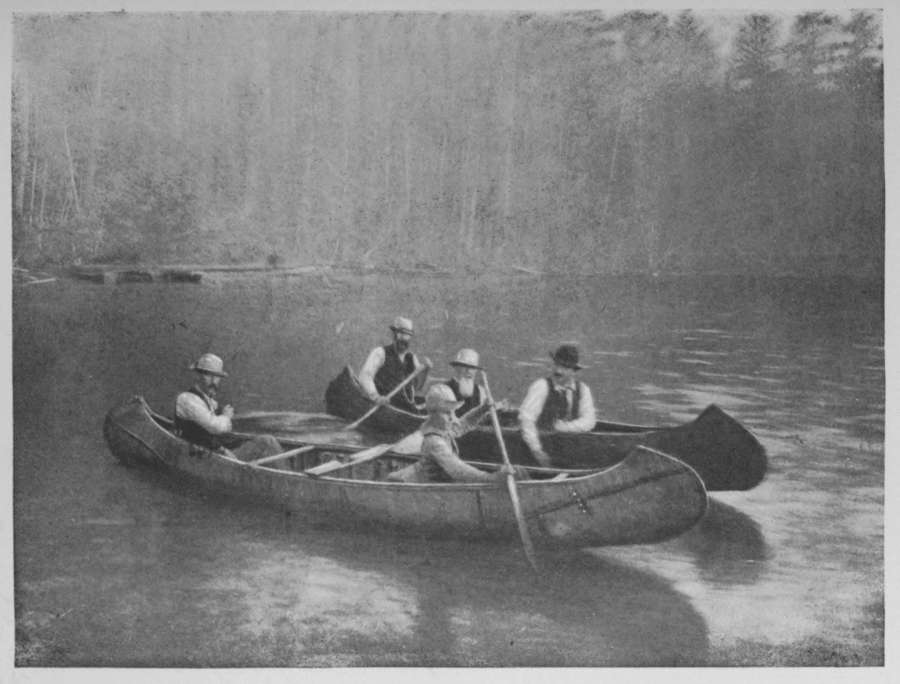
and I started in a birch canoe, and in
it, made the whole distance from our camp on
Bow String Lake to Aitkin, Minnesota, on the
Mississippi, the nearest railroad station. We
were in Minneapolis but two days, when we
returned, catching the steamer at Aitkin, and
going up the Mississippi to Grand Rapids, the
head of navigation for steamboats.
Captain John Martin of Minneapolis, the
well-known lumberman and banker, wished to
return with us for his final fishing trip in open
water, for that season. He fished successfully
for a number of days, and, at the end of each
day, personally prepared and cooked as fine a
fish chowder as anyone would ever wish to eat.
On the day of his departure, I took the Captain
in my canoe, and landed him on the four-mile
portage with an Indian escort who was to take
him to Grand Rapids, whence he would return
by steamer to Aitkin, a station on the line of
the Northern Pacific Railroad.
I was left alone in my canoe and must return
to camp, crossing the open water of Bow String
Lake. On my arrival at the main lake, the
wind had increased its velocity, and the whitecaps
were breaking. I hired an Indian, known
as "the hunter," to help me paddle across the
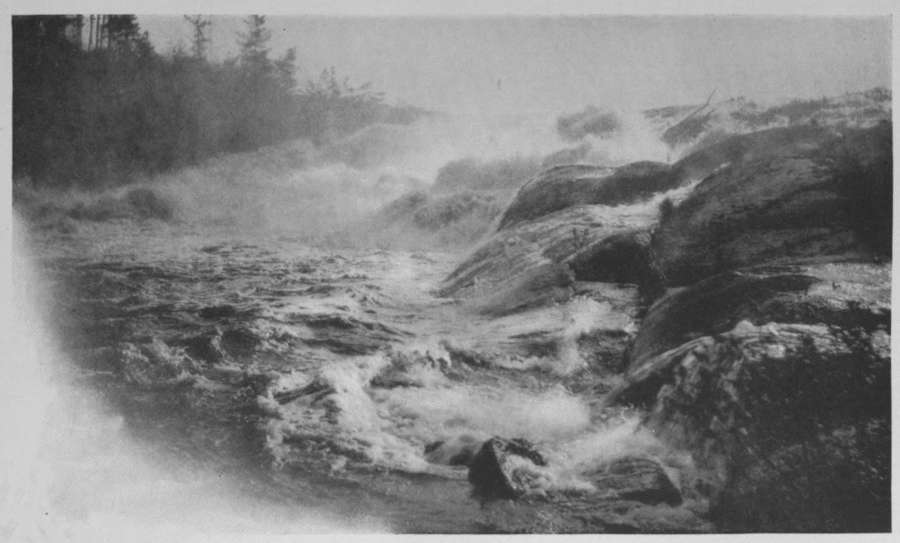
lake and up a rapid on a river flowing into Bow
String, up and over which it was not possible
for one man to push his canoe alone.
The annual payment to the Indians by the
United States government was to occur a few
days subsequently, at Leach Lake, and the Indians
were busy getting ready to leave, to attend
the payment. The hunter's people were
to start that day, and he seemed to realize when
half way across the lake, that, owing to our
slow progress, because of the heavy sea, he
would be late in returning to his people at
camp. He said so, and wished to turn back,
but I told him that he must take me above the
rapid, which was my principal object in hiring
him. After sitting stoically in the bow of the
canoe for a few moments, he suddenly turned
about, and, drawing his long knife, said in
Chippewa, that he must go back. I drew my
revolver and told him to get down in the canoe
and paddle, and that if he did not, he would get
shot. There was no further threat by the Indian,
and we made as rapid progress as possible
over the rapid, landing my canoe—his own
having been trailed to the foot of the rapid.
Both stepped ashore. Then he said in Chippewa,
"Me bad Chippewa; white man all
right"; and bidding me good-by, hurried off to
his canoe at the foot of the rapid.
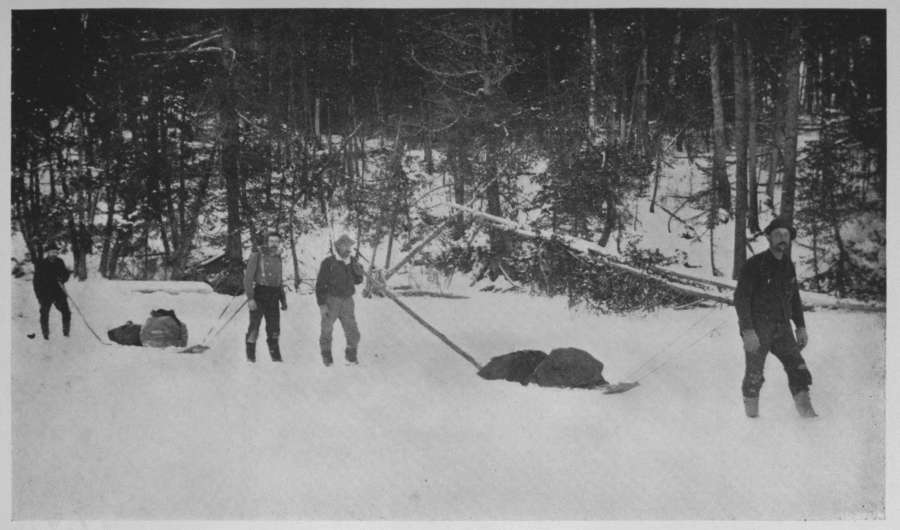
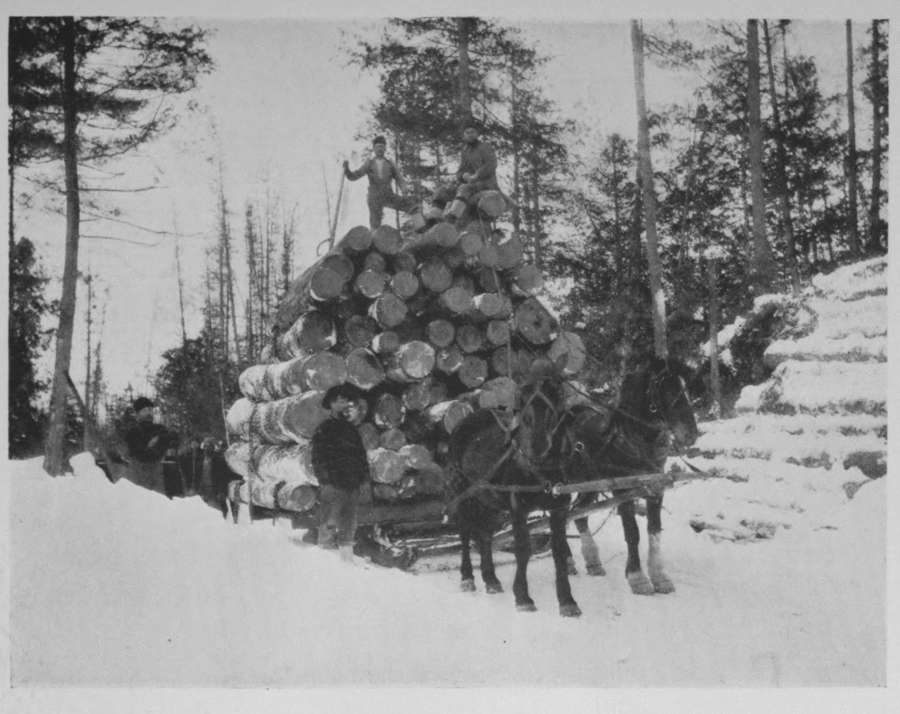
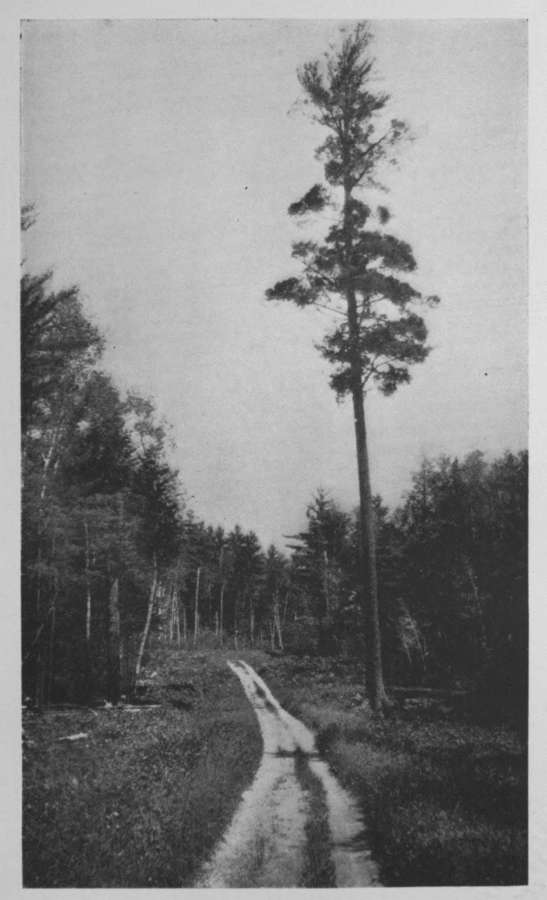
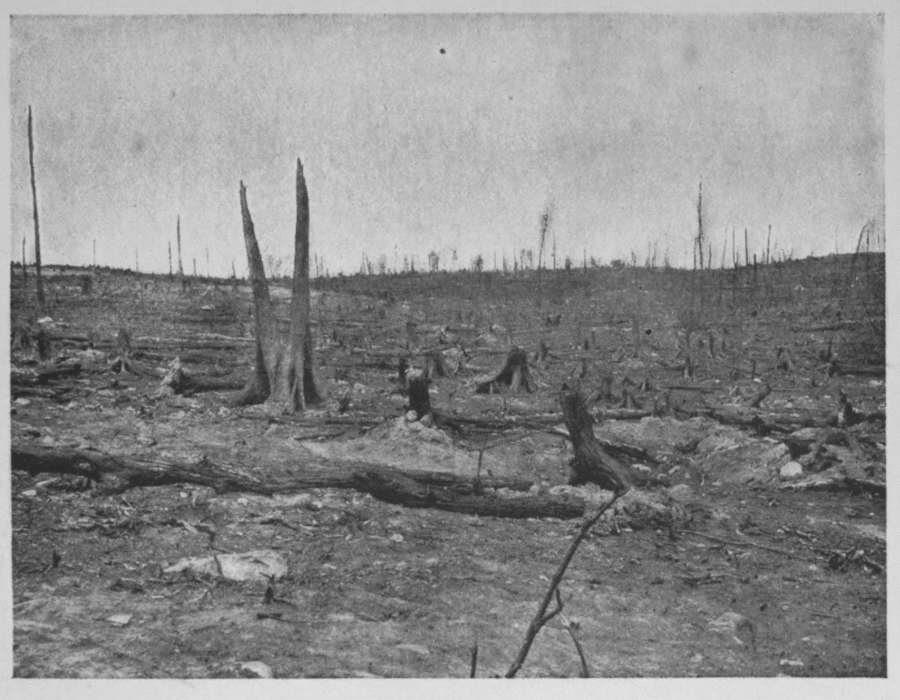 "The fire ... destroyed millions of dollars worth of
standing pine timber". (Page 160.)
"The fire ... destroyed millions of dollars worth of
standing pine timber". (Page 160.)
Once more, during the fall of 1874, I had to
reckon with this wily Indian, the hunter, as
will soon appear in this narrative.
Perhaps the most convenient pack strap used
by the woodsman when on an all day's tramp,
is one that is commonly known as the Indian
pack strap. It consists of a strap of leather
about three inches wide and about three feet
long, from each end of which, a tapering piece
of leather, either sewed or buckled to it, extends
finally to a narrow point no wider than
a whip-lash. Each of these added narrow
strips is from five to six feet in length, so that
the whole strap is about fourteen feet long
when straightened out. A blanket or a tent is
folded into shape, about four feet by six feet.
This is laid on the ground, and the strap is
folded double with a spread at the wide part,
of about three feet, which is the length of the
wide strap. The narrow ends are then drawn
straight back over the blanket, across its narrow
dimension, leaving the wide strap, which
in use becomes the head strap, at the outer
edge of the blanket. Then the blanket is folded
from each end over the narrow straps, the two
ends of which project out and beyond the
blanket at the opposite side from the head
strap. The articles to be placed within the
blanket, which generally consist of small sacks
of beans, flour, pork, sugar, coffee, and wearing
apparel, and blankets, are then carefully
stacked upon the blanket, within the spread
of the two narrow lines of the pack strap.
When this is done, the blanket is folded over,
and the two outer edges are brought as near to
the center of the pile of things to be carried
within it, as is possible. Then the two tapering
ends of the pack strap are brought up and
over, to meet the opposite ends of the narrow
straps, which, as has been explained, are either
sewed to, or buckled onto the wide head strap.
Drawing these ends firmly together puckers
the outer edge of the blanket on either side,
and draws the blanket completely over the contents
piled in the center, and makes, ordinarily,
nearly a round bundle. This load, or pack, the
man then throws over his shoulder, onto his
back, and brings the wide strap across his forehead,
or across his breast, or across the top of
his head, when he is ready to begin his journey.
Before he has traveled long with this load,
which weighs ordinarily from fifty to one hundred
pounds, according to the ability of the
man to bear the burden, he will be found shifting
that wide strap to any one of the three positions
named, and will have used all of those
positions many times before the party as a
whole, stops for a moment's rest.
I had taken with me, on going north on this
long campaign, an extra fine red leather pack
strap that I had had made to order at a Minneapolis
harness shop. I had kept it coiled up,
and carefully stored in my belongings, waiting
for an emergency when the more common
straps would no longer be of service. A number
of times the Indians had seen this strap
and had admired it, and, as it later proved, not
always without envy.
One day the strap was missing, and I could
find it, neither by searching, nor by open
inquiry of my fellow white men, nor of the Indians,
whom I occasionally met. On one occasion,
while portaging my canoe to another lake,
I found several families of Indians camping at
the end of the portage. Among them was the
hunter who has been previously mentioned.
While stopping a moment for a friendly talk
with the Indians, I saw protruding from under
the coat of the hunter, nearly two feet of one
end of my missing pack strap. I knew it so
well that I was sure that it was no other pack
strap. Nevertheless, I deliberated slowly what
action I should take to recover the strap, not
wishing by any possibility to make a mistake.
Having surely concluded that the strap was
mine, and that the hunter had not come into
possession of it honestly—he having previously
denied, when questioned, that he knew anything
of the whereabouts of the strap—I decided
upon a course of action. Going up
quietly behind the hunter, and twisting the end
of the protruding strap twice around my wrist,
and grasping it firmly in my hand, I started
with all my might to run with the strap. The
effect was to make a temporary top of my
friend, the hunter, who whirled about until the
other end of the pack strap was released from
his body. It was too good a joke, even for the
Indians to remain unmoved, and the majority
of them broke into merriment. The hunter at
first was disposed to take it seriously but soon
looked sheepish and ashamed, and tried to
smile with the rest of his tribe, as well as with
myself.
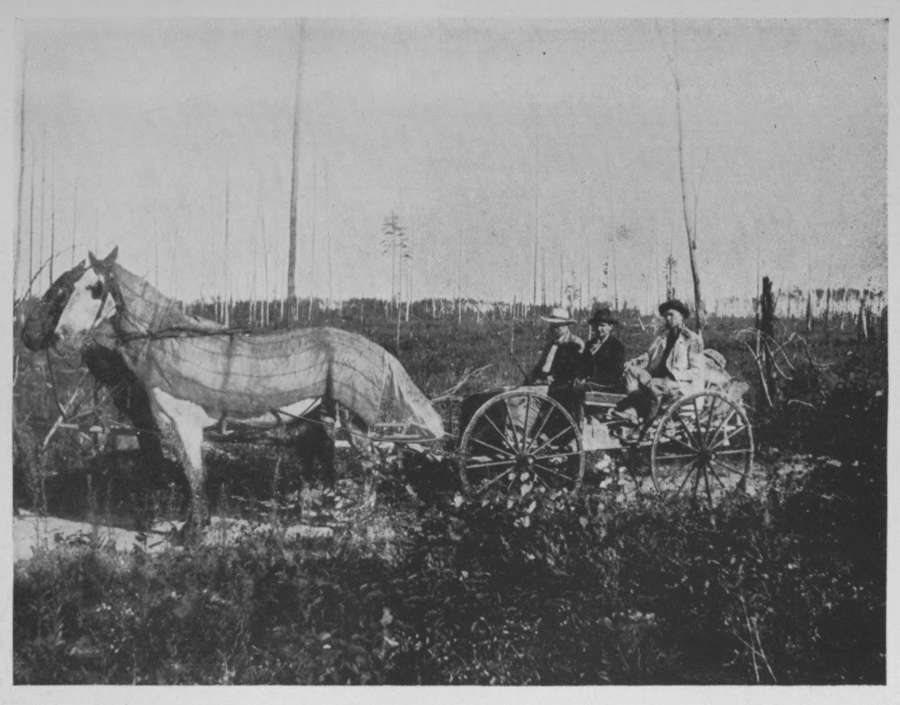 "One of the horses balked frequently".
(Page 167.)
"One of the horses balked frequently".
(Page 167.)
Having wound the strap carefully around my
own body, and having made sure that the ends
did not protrude, I bade my friends, including
the hunter, good day, got into my canoe and
pushed out into the lake. This proved to be the
last time I ever saw the hunter, but it was not
the last time that I ever thought of the incident.
In justice to the Indians as compared with
white men, I am glad to be able to say, that,
after mingling with them more or less for
many years, and becoming sufficiently familiar
with their language to be able to use it on all
necessary occasions, I believe that the Indians
are as honest and as honorable as the men with
whom they mingle, who have not a copper
skin.
Captain Martin was the last white man whom
any one of our party saw for four months.
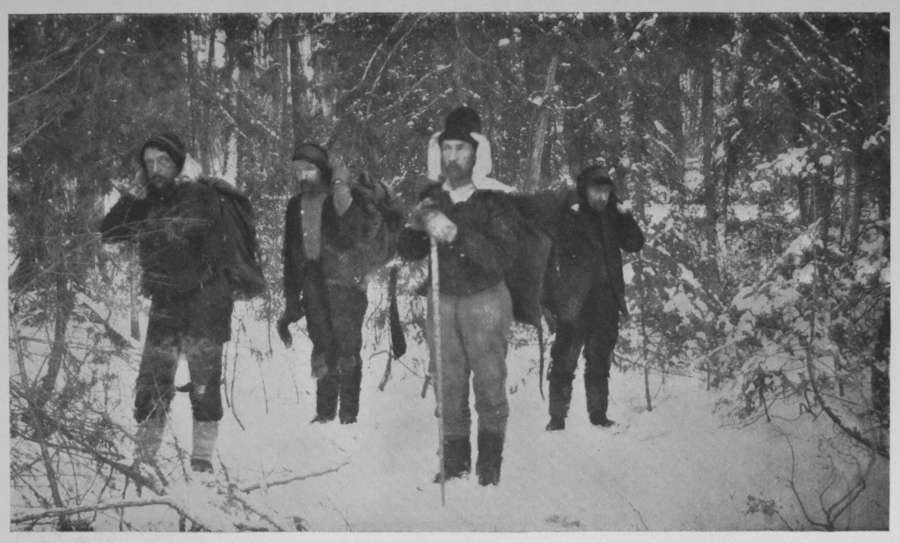
Winter closed in on us before the beginning of
November. The snow became very deep, so
that it was absolutely necessary to perform all
of our work on snowshoes. The winter of 1874
and 1875 is shown to have been the coldest
winter in Minnesota, of which there is any record,
beginning with 1819 up to, and including,
1913.
The party was mostly composed of men who
had had years of experience on the frontier,
and who were inured to hardship. With a few,
however, the experience was entirely new, and,
except that they were looked after by the more
hardy, they might have perished. As it was,
however, not one man became seriously ill at
any time during this severe winter's campaign.
All of the principal men of the party wore
light duck suits, made large enough to admit
of wearing heavy flannel underwear beneath
them. Either boot-packs or buckskin moccasins,
inside of which were several pairs of
woolen socks, composed the footwear. Boot-packs
or larigans, as they are commonly called
by the lumber-jack, are tanned in a manner
that makes them very susceptible to heat, and
the leather will shrivel quickly if near an open
fire. It cost one of the party several pairs of
boot-packs before he could learn to keep sufficiently
far away from the open fire, on returning
to camp from his work. It will be surmised
by the reader that he was one of the inexperienced
of the party.
Many incidents, amusing to others, happened
during the winter to this same man. He
had started on the trip in the summer months,
with a supply of shoe blacking and paper collars.
The crossing of one or two portages with
his loaded pack sack on his back was sufficient
to convince him that there was no need of
carrying either shoe blacking or paper collars,
and they were thrown out to reduce weight.
Each man carried a hank or skein of thread, a
paper of needles, and a supply of buttons. Soon
after winter set in, this man, who might ordinarily
be termed a tenderfoot, complained of
lameness in one of his feet. As the weather
became more severe, he added from time to
time, another pair of socks to those he already
had on, never removing any of previous service.
This necessitated, not infrequently, his
choosing a larger sized boot-pack. Before the
campaign was over, although he was a man of
low stature and light weight, his feet presented
the appearance of being the largest in the
party. Still he complained of lameness in the
hollow of his foot, and no relief came until
March, when the work was completed. Arriving
once more back in civilization, he removed
his much accumulated footwear. There, under
this accumulation of socks, and against the
hollow of his foot, was found his skein of
thread, the absence of which, from its usual
place, had necessitated his borrowing, whenever
he had need of it, from some one of his
companions. Before starting out on this campaign,
he had been one of the tidiest of men
about his personal appearance.
One evening in midwinter, when sitting
around the camp fire, by reason of the pile of
wood for the evening being largely composed
of dry balsam, we were kept more or less busy,
extinguishing sparks that are always thrown
out from this kind of wood when burning.
Sometimes one would light on the side of the
tent near by, and unless immediately extinguished,
would eat a large hole in the cloth.
That evening, Fendall G. Winston and I were
sitting side by side, when we saw a live spark
more than a quarter of an inch in diameter light
in the ear of our friend who sat a little way
from, and in front of us. It did not go out immediately,
neither did it disturb the tranquillity
of the young man. Mr. Winston and I exchanged
glances and smilingly watched the
ember slowly die. The time to clean up had
not yet arrived for at least one of the party.
The compassman's work that winter was
rendered very laborious from the fact that his
occupation made it necessary for him, from
morning until night of every day, to break his
own path through the untrodden snow, for it
was he who was locating the line of the survey.
I was all of the time running lines in the interior
of the sections, following the work of the
surveyors, and choosing desirable pine timber
that was found within each section. I had no
companion in this work, and thus was separated
most of each day from other members
of the party, but returned to the same camp at
night.
In the morning, each man was furnished by
the cook, with a cloth sack in which were
placed one or two or more biscuits, containing
within, slices of fried bacon and sometimes
slices of corned beef, also, perhaps, a doughnut
or two. This he tied to the belt of his
jacket on his back and carried until the lunch
hour. Ordinarily a small fire was then kindled,
and the luncheon, which generally was frozen,
thawed out and eaten. Under such mode of
living, every one returned at night bringing an
appetite of ample dimensions.
One of the most acceptable of foods to such
men at the supper hour was bean soup, of a
kind and quality such as a cook on the frontier,
alone, knows how to prepare. Plenty of good
bread was always in abundance at such time.
Usually there was also either corned beef or
boiled pork to be had by those who wished it;
generally also boiled rice or apple dumplings,
besides tea and coffee.
In a well-regulated camp, where men are living
entirely out of doors in tents, a bean hole
is pretty sure to be demanded. The bean hole
is prepared by first digging a hole in the
ground, sufficiently large, not only to make
room for the pail, but also for several inches of
live coals with which it must be surrounded.
After supper is over, the beans are put into a
large pail made of the best material, with ears
always riveted on, so that the action of heat
will not separate any of its parts. The beans
are first parboiled with a pinch of soda in the
water. As soon as the skins of the beans become
broken, the water is poured off; then the
beans are placed in the bean pail, a small quantity
of hot water is added together with a sufficiently
large piece of pork; and, when a tight
cover has been put on the pail, it is placed in
the bean hole. The live coals are placed around
it, until the hole is completely filled and the
pail entirely covered several inches deep. Then
ashes or earth are put on the top of it all, to
exclude the air. Thus the pail remains all
night, and, in the morning when the cook calls
the men to breakfast, the beans, thoroughly
cooked and steaming, are served hot and furnish
an acceptable foundation for the arduous
day's work about to begin.
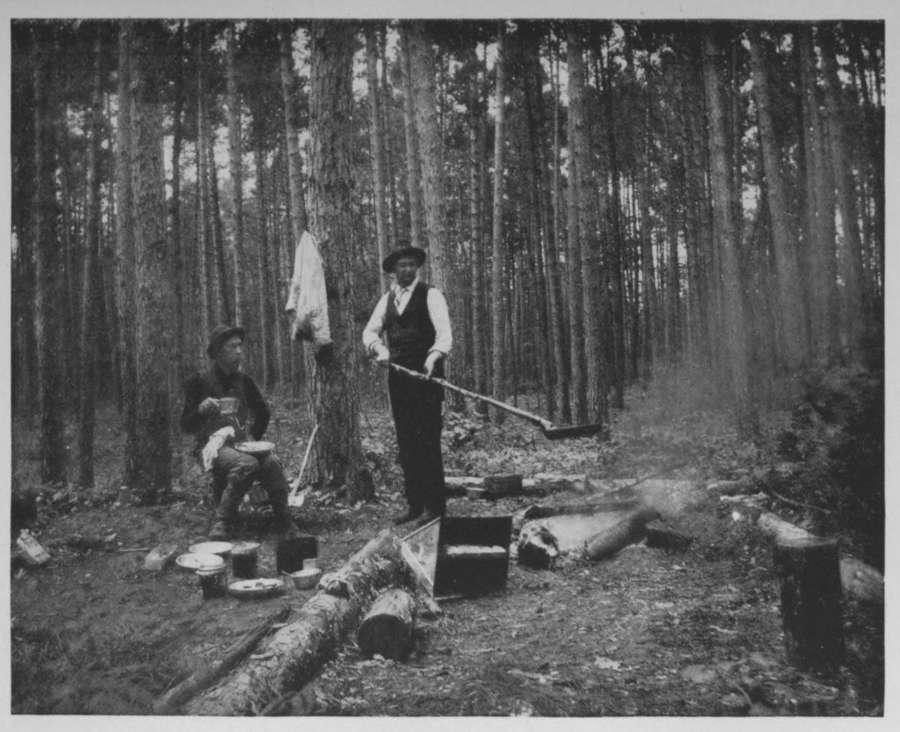
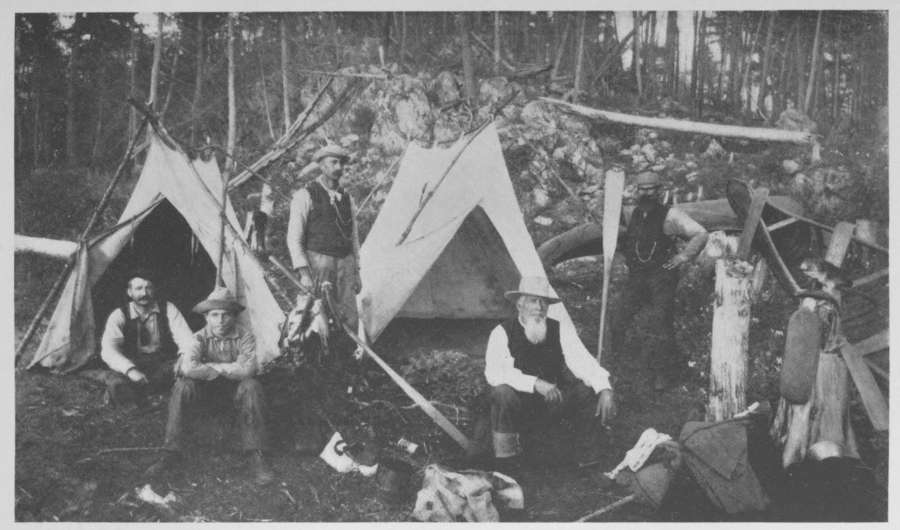
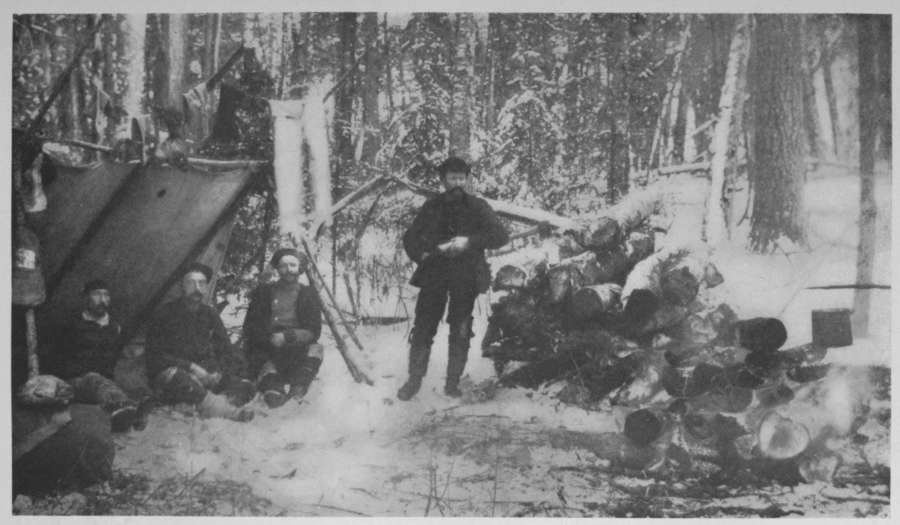
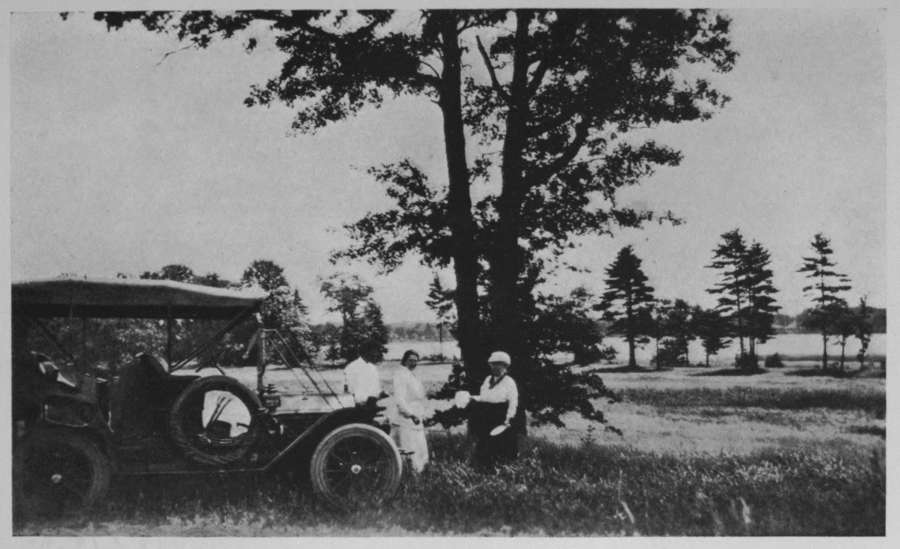
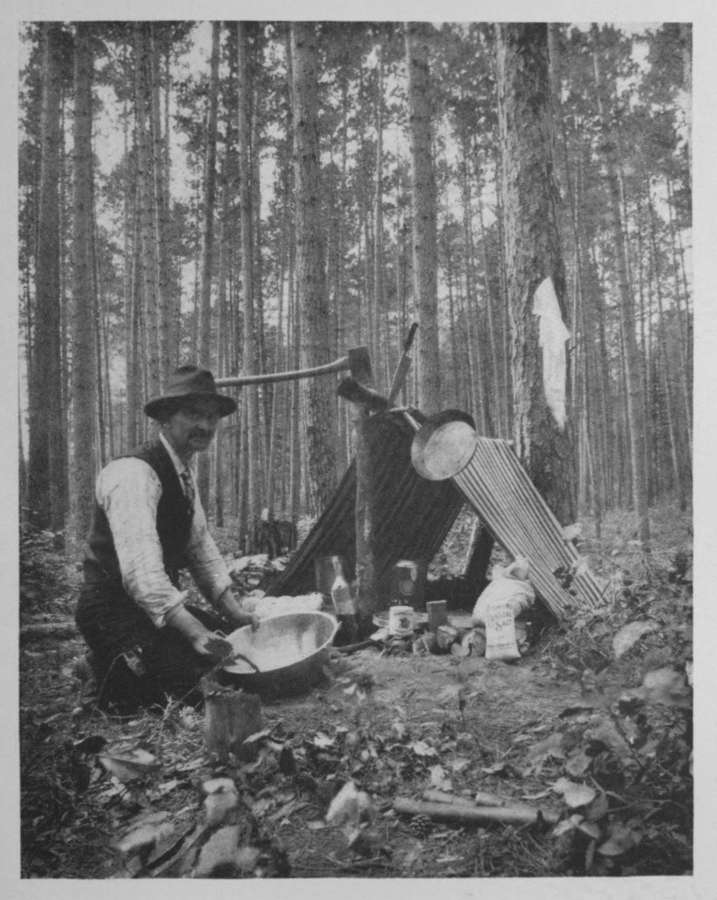 "Our camp was made in a fine grove of
pig-iron Norway". (Page 167.)
"Our camp was made in a fine grove of
pig-iron Norway". (Page 167.)
The work of the frontiersman is more or less
hazardous in its nature, and yet bad accidents
are rare. Occasionally a man is struck by a
falling limb, or he may be cut by the glancing
blow of an ax, though he learns to be very careful
when using tools, well knowing that there
is no surgeon or hospital near at hand. Sometimes
in the early winter, men unaccompanied,
yet obliged to travel alone, drop through the
treacherous ice and are drowned. Few winters
pass in a lumber country where instances of
this kind do not occur. One day, when alone,
I came near enough to such an experience. I
was obliged to cross a lake, known to have air
holes probably caused by warm springs. The
ice was covered by a heavy layer of snow, consequently
I wore snowshoes, and before starting
to cross, cut a long, stout pole. Taking
this firmly in my hands, I made my way out
onto the ice. All went well until I was near the
opposite shore, when suddenly the bottom
went out from under me and I fell into the
water, through an unseen air hole which the
snow covered. The pole I carried was sufficient
in length to reach the firm ice on either
side, which alone enabled me, after much labor,
impeded as I was by the cumbersome
snowshoes, to gain the surface. The next absolutely
necessary thing to do, was to make a
fire as quickly as possible, before I should become
benumbed by my wet garments.
The survey went steadily on, the snow and
cold increased, and rarely was it possible to
make an advance of more than four miles in a
day. Frank Hoyt remained at the warehouse
and watched the supplies which were steadily
diminishing. One day, Philip B. Winston, two
men of the crew, and I, set out to the supply
camp to bring some provisions to the cook's
camp. The first day at nightfall, we reached
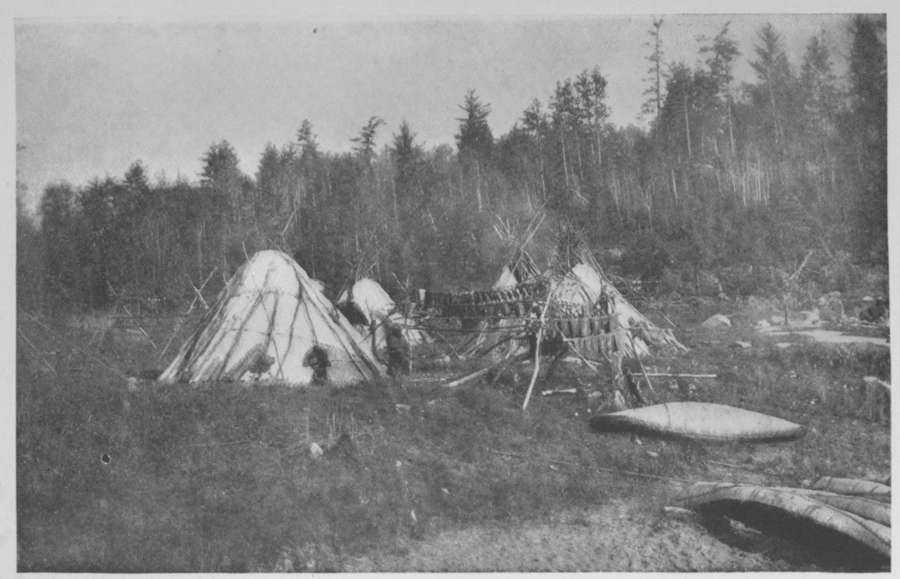
an Indian wigwam that we knew of, situated
in a grove of hardwood timber, near the shore
of a lake, directly on our route to the supply
camp. Our little party stayed with the Indians
and shared their hospitality. It was a large
wigwam, covered principally with cedar bark,
and there was an additional smaller wigwam
so close to it, that a passage way was made
from one wigwam to the other.
In the smaller wigwam lived a young Indian,
his squaw, and the squaw's mother; in the
larger wigwam lived the chief, his wife, his
daughter, son-in-law, and the hunter, his wife,
and two daughters, all of whom were present
except the hunter. There was an air of expectancy
noticeable as we sat on the mats around
the fire in the wigwam, after having made
some coffee and eaten our supper outside.
Presently the chief informed us that an heir
was looked for that evening in the adjoining
tent. Before nine o'clock it was announced
that a young warrior had made his appearance,
and all were happy over his arrival. The large
pipe was brought forth, filled with tobacco,
and, after the chief had taken the first smoke,
it was passed around to their guests, and all
the men smoked, as well as the married women.
The next morning, we continued our journey
across the lake and on to Hoyt's camp,
where, it is needless to say, he was glad to see
some white men. Their visits were rare at his
camp. Filling our packs with things the cook
had ordered, we started on our return journey,
arriving at the Indian camp at nightfall. As
we left the ice to go up to the wigwams,
we met the mother of the young warrior
who had made his first appearance the preceding
night, going down to the lake with a pail
in each hand to bring some water to her wigwam.
The healthy young child was brought
into the wigwam and shown to the members
of our party, who complimented the young
mother and wished that he might grow to be a
brave, worthy to be chieftain of their tribe.
That evening a feast had been prepared at
the chief's wigwam, in honor of the birth of
the child, to which our party was invited. The
menu consisted principally of boiled rice,
boiled muskrat, and boiled rabbit. The three
principal foods having been cooked in one
kettle and at the same time, it was served as
one course, but the guests were invited to repeat
the course as often as they desired. This
invitation was accepted by some, while others
seemed satisfied to take the course but once.
I have always found the hospitality of the
Chippewa Indian unsurpassed, and more than
once, in my frontier experiences, I have found
that hospitality a godsend to me and to my
party.
 To Doctor & Mrs. M. G. Slutter
with cordial greetings of the author,
To Doctor & Mrs. M. G. Slutter
with cordial greetings of the author,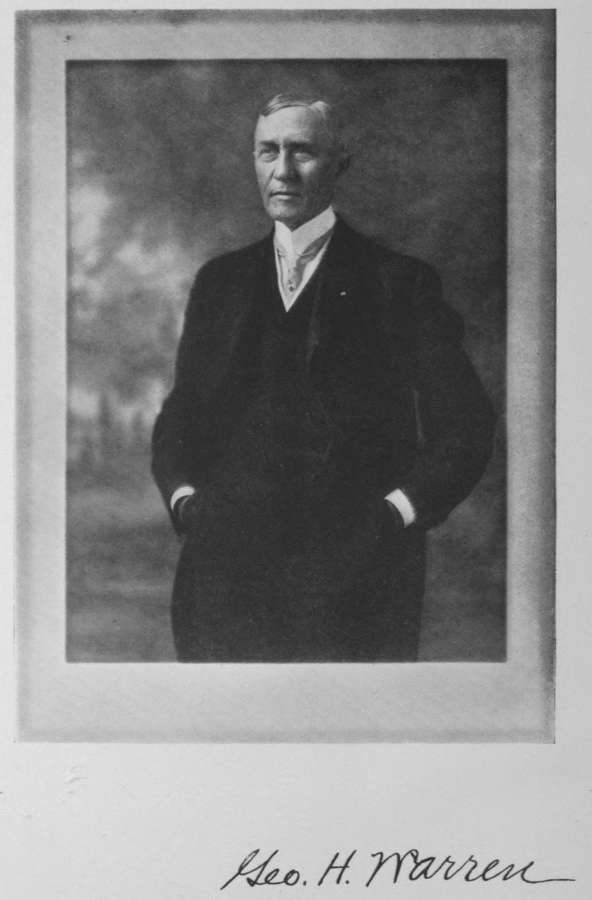 Geo. H. Warren