Some of the more impetuous among the settlers
began immediately to draw back the hammers
of their muskets; and one man even threw
his gun to his shoulder, as if eager to be the first
to fire at the Indians.
But David Armstrong immediately pushed
against him, so that his purpose was frustrated.
"What would you do, hothead?" demanded
Mr. Armstrong. "They are so far away that
your ammunition would only be wasted. Look
again, and you will see that there are only four
in all. Besides, they have their hands raised in
the air, with the palms extended toward us.
That means they would talk. It is the same as
if they carried a white flag in token of amity.
Let no one fire a shot."
"But at the same time be on your guard
against the treacherous hounds, men!" called
out Captain Brady, himself the most inveterate
hater of Indians in the entire colony, and never
willing to trust one who carried a copper-colored
skin.
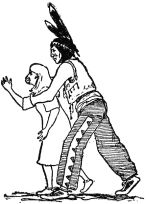
Slowly the four red men advanced, continuing
to hold up their hands. Evidently they wondered
at seeing so great a number of armed
whites clustered before the stockade. And the
clanging of the bell must have bewildered them,
since possibly it was the very first time such a
sound had ever been heard by any of the quartette.
"We should not allow them to come too
near," one man suggested, cautiously.
"True," called out Brady. "And an equal
number of our men should advance to meet
them. Armstrong, do you and Reuben, together
with Brewster and Lane, step out. We will
cover you with our guns. They have laid their
bows and tomahawks down on the ground; but
look out for treachery. Should you hear me
shout, drop down on your faces, for we will
sweep them out of existence with one volley!"
The two boys watched the little squad meet
the four Indians, and enter into a powwow with
them. Much of the conversation had to be carried
on through gesture, since only old Reuben
could understand the Indian tongue. But it was
evident that the newcomers meant to be
friendly, and were not the advance couriers of
a band bent on burning the post.
Presently David beckoned to Captain Brady,
and, as the other approached, he observed:
"They do not mean us any harm. On the
contrary this young chief, who says his name is
Black Beaver, wishes to trade some skins he
has for tobacco. They have been south in Kentucky
attending a grand council, and are on the
way home to their village. He also wished to
secure a small amount of meal if we can spare
it. And, Captain, since we wish peace with all
the tribes, I have promised to obtain these
things for him."
When they heard this the men set up a shout,
such was the great relief they experienced after
the recent scare. Still, the cautious Brady
warned them against being too positive.
"How do we know whether they are deceiving
us?" he said, coldly; for he could not bear
to be friendly with any Indian. "Perhaps they
are even now carrying the scalps of our neighbors,
the Bancrofts?"
"Not so, Captain, you wrong them," said
David, hastily; "for yonder come those you
mention, and apparently none the worse for
their delay in starting."
After that there was no reasonable excuse for
prolonging the matter; and so by degrees the
settlers made their way back to their various
homes. The Indians were treated well, and sent
on their way with a supply of tobacco and a
measure of meal, which latter David Armstrong
himself supplied.
But little work was done the balance of that
day. The result of the fright occasioned by
this, the very first ringing of the alarm bell,
made every one more or less nervous. Mrs.
Armstrong would not even hear of the two boys
starting out to hunt in the afternoon, as they
had planned.
"We'd better put it off till to-morrow,
Sandy," remarked Bob, when he saw how the
recent excitement had affected his mother's
nerves.
"I suppose so," replied the younger lad,
with regret in his voice. "But I had just set
my heart on trying to find that bee tree. We
saw the little fellows working in Kate's flower
garden, and flying off with their honey. Just
think what a fine thing it would be, Bob, if we
could learn where their storehouse is, and cut
down the tree! Wouldn't mother's eyes just
dance to see the piles of combs full of sweetness,
perhaps enough for the whole winter?"
"That's a fact," admitted Bob, his own eyes
shining with eagerness as Sandy thus painted
such a pleasant picture. "But it will keep, I
guess, till to-morrow. We ought to get done
with our task early in the day, and then for the
woods. You know there is not a great stock of
meat handy, except that jerked venison that
neither of us like very well. I'd enjoy something
like a saddle of fresh venison myself."
And so the more impulsive brother found
himself compelled to bow to circumstances, always
a difficult task with Sandy.
During the afternoon the young pioneers
busied themselves in various ways, for there
were always plenty of things to be done—water
to be carried from the spring, wood for
the fire to be cut and hauled close to the door,
some of the first pelts which the boys had taken
in their rusty traps to be attended to in the
curing; the garden to be weeded; and so it
went on until the descending sun gave warning
that another night was close at hand.
Sandy had taken an hour off to go fishing in
the near-by river. As usual he brought back
enough of the finny prizes to afford the Armstrong
family a bountiful meal that night.
From woods and waters they were accustomed
to take daily toll, as their needs arose; nor was
there likely to be any scarcity of food so long
as hostile Indians gave the new settlement a
wide berth.
Bob came upon his brother as he was returning
to the cabin with a bucket of water. Sandy
was almost through cleaning his fish, and the
older boy naturally stopped a minute to comment
on their fine size.
"I was just thinking, Bob," remarked the
worker, with a shake of his head, "that perhaps
we might see those same Indians again some
fine day."
"What makes you say that?" asked the
older lad, quickly; for he knew that Sandy
must have something on his mind to speak in
this strain.
"I think I feel a little like Captain Brady
does about Indians," Sandy replied, "and that
they are treacherous. Somehow, I just can't
trust them, and that's the truth of it."
"Oh! but how about Blue Jacket? Didn't
he prove that he was a true friend to us?" demanded
Bob.
The young Indian to whom he referred was
a Shawanee brave who had been wounded in the
fight the settlers had had just before arriving
at the river. The boys had found him desperately
hurt, and had cared for him, even saving
his life when the irate Captain Brady wanted
to have the "varment" killed as he would a
snake.
In return Blue Jacket had assisted in the rescue
of the Armstrong boys who had fallen into
the hands of the Indians.
"That's true, Bob," responded Sandy, readily
enough. "Blue Jacket is our friend, but
he's the only wearer of a red skin that I would
trust. Now, of course, you're wondering what
ails me. I'll tell you. I didn't like the way that
young Delaware chief looked at our pretty little
sister, Kate!"
"What's that you are saying?" demanded
Bob, frowning.
"I saw him, if you didn't," continued Sandy,
stubbornly. "He kept looking at her every
little while even as he talked; for, you know,
some of the women and girls came out of the
stockade to look at the Indians. I tell you
plainly that my finger just itched to touch the
trigger of my gun when I saw him staring at
Kate like that."
"But—he walked over here with us to get
the measure of meal father promised to give
him, without accepting any pay?" Bob went on,
as if hardly able to credit the grave thing his
brother was hinting at.
"Yes, and I kept just behind him all the
time," Sandy went on, "with my gun in my
hands. I think he noticed me after a while, for
he stopped looking. But I wouldn't trust that
heathen further than I could see him."
"Well, they have gone away," said Bob, as
though that settled it.
"How do you know that?" questioned
Sandy.
"Secretly, acting under orders from Captain
Brady, old Reuben followed them for three
miles, keeping himself hidden all the while. He
reported that they had surely kept straight on,
secured a canoe just where they said they had
hidden one, and paddled across the river, landing
on the other shore, and disappearing in the
forest."
"But Black Beaver plans to come back some
day," Sandy continued, as he arose; "I could
see it in his eyes. And I mean to warn mother,
so that she can keep Kate from wandering away
from home so much. If ever I see that Delaware
chief sneaking around here it will be a
bad day for him."
"We called them Delawares, but old Reuben
says now he made a mistake, and that they belong
to the Iroquois. He told me that Black
Beaver was a chief among the Senecas, and that
his home was far away toward the Great
Lakes."
"That may be so," remarked the unconvinced
Sandy, starting toward the cabin, for
evening was not far away, and he already inwardly
felt clamorous demands for the appetizing
supper that would soon be on the fire.
"But even if he lives hundreds of miles away
he can come back, can't he? He has made the
journey once, why not again?"
Bob knew that, when once his brother got an
idea into his head, argument was next to useless;
so he wisely let the matter drop. He himself
was not altogether convinced that they had
seen the last of the proud young chief, though
he hardly anticipated that it would be Kate's
pretty face that might draw Black Beaver south
again.
Many of the settlers passed an uneasy night;
but there was no alarm. Talking the matter
over among themselves, some of the men had
arrived at the conviction that these representatives
of the Iroquois may have been attending
one of those great meetings which were being
engineered by the Pottawottomi sachem, Pontiac,
looking toward a combination of most of
the various tribes, by means of which the
French in the far North would be assisted, and
the English settlements through Ohio, Kentucky,
and along the Great Lakes be wiped
out.
If this were indeed the truth, then Black
Beaver had professed a friendship that he
really did not feel, since he must have been
forming some league with the warlike and merciless
Shawanees, under such leaders as the
detested renegade, Simon Girty, of whose cruel
deeds history has told.
When the morning finally arrived without
any sign of trouble, even gentle Mary Armstrong
seemed to have recovered from her nervousness.
She assented to the wish of the boys
to go forth, and see what they could do in the
way of securing fresh food. Before leaving,
Sandy cautioned his mother about Kate, for he
could not forget the covetous looks which the
painted young chief had cast toward his pretty
little sister, child though she was, being not
more than twelve years of age.
"Be sure and fetch an ax along, Sandy,"
said Bob, just as they were ready to start forth,
with guns fastened over their shoulders by
means of straps. "But, if you can help it,
don't let mother see you. She would think it
strange that we carried such a thing on a little
hunt for a deer."
"But what if we succeed in locating the bee
tree, and cut it down; how are we to carry the
honey home?" asked Sandy.
"Time enough for that when we have won
out," replied Bob, with a laugh. "Besides, I
don't think we'll be more than a quarter, or at
most a third of a mile away from home, unless
the little insects are hunting at a longer distance
than they generally do, as Pat O'Mara
told me."
"Have you got the sugar and everything
along?" questioned Sandy.
"Of course. I'd be a pretty chap to go off
unprepared, wouldn't I? Now, watch your
chance, and sneak the ax off. We'll surely
need it to chop the tree down,—if we find it,"
Bob concluded.
But his sanguine brother never doubted in
the least that success was bound to attend their
efforts. He went into everything he did with
the same enthusiasm and confidence.
Ten minutes later the boys were in an open
glade not a great distance away from the Armstrong
cabin. Here flowers grew in profusion,
even at this late day in the season; and Kate
was in the habit of coming out to pick great
bunches of the pretty posies, for she loved to
see them around the humble cabin, brightening
things with their color, and sweetening the atmosphere
with their perfume.
Even in those days the methods of bee hunters
did not differ very much from those which are
in vogue in the woods to-day. The Irish trapper
had posted the Armstrong boys as to the way
in which a bee tree could be discovered, once
busy little workers were found loading up with
honey in the flowers or blossoms.
First of all the boys hunted until they discovered
where some of the wild bees were busily
engaged. Honey was not so plentiful at this
particular season of the year; and, when Bob
made a little sirup out of some yellow sugar he
had been wise enough to fetch along, a bee was
quickly attracted to the feast.
When he had loaded himself down with the
spoils, and was preparing to fly away, Bob
dextrously caught the little fellow. Taking care
not to be stung he succeeded in attaching a long
white thread to the bee's body, in such a way
that it would not interfere with his flying, yet
could be seen for quite a distance.
Then the captive was released. As is universally
the case, the bee arose in the air,
and made a straight fly for the hive!
That is where the phrase "a bee-line" originated.
"Watch him now, Sandy!" called Bob, as
he liberated the prisoner.
"All right," answered his brother, eagerly.
"I can see him still; and how he does spin
along. There, he has disappeared now, right
beyond that big poplar yonder. Do we go there
next time, Bob?"
"Yes," came the reply; "that gives us a
start, and will bring us just so much nearer
the hive. Then we must catch another bee, and
repeat the job. And, as we may not find as
many of them, once we enter the woods, we will
put several in this little bottle I've brought
along with me."
This was easily accomplished; after which
they walked over to where they had obtained
the very last glimpse of the laden worker.
"We've got the line now," remarked Bob;
"and can even go further into the woods, keeping
on a straight road. But, for fear that we
may overshoot the mark, suppose we make another
trial right here."
"Just as you say, Bob," returned Sandy.
"You got Pat to tell you lots of things he
wouldn't repeat for me. I wonder could it be
that leaning tree through there. Seems to me
that might be a fine old hive, for it looks hollow
enough."
"But you remember Pat said they don't
often select a dead tree. It might blow down,
and spoil their stock of honey," his brother
went on to say.
"But they do find a hollow, don't they?"
Sandy inquired.
"Yes; usually the top of a tree that has a
hole in it, or a big limb. They are wise enough
to know that the rain must be kept out, and also
that certain wild animals are mighty fond of
honey. Now, here goes, Sandy. Watch close—there!"
Again Bob cast the gorged prisoner free, and
the little insect, after several vain efforts, managed
to mount upward on sagging wings and
make off.
This time as before they marked the last appearance
of the laden honey bee, and then a
third trial was made. When a fourth and a
fifth drew them still deeper into the forest Sandy
began to grow much excited. He kept looking
all around him while his brother carried out the
important operation of coaxing the bee to accept
a cargo of sugar sirup in the place of the
scarce nectar in the flowers.
All at once Bob looked up.
"Hark!" he exclaimed.
Sandy at once made a move as though about
to sling his gun around from his back. Then he
saw the smile on his brother's face; and, suspecting
the truth, cocked his own head in a
listening attitude.
"I hear it!" he exclaimed, his whole face
lighting up. "Nothing but the hum of a hive
of bees could make that noise, Bob, could it?"
"Look up into that sycamore tree and tell
me if you can't see them flying around? Those
must be the young ones trying their wings. Pat
said they came out every fine day, and buzzed
about. He told me he had found more than one
bee tree just by tracing the sound. Once heard
in the quiet forest it can never be forgotten."
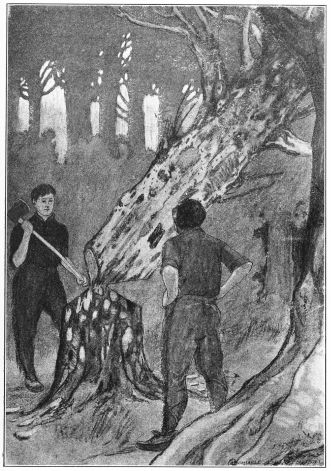
"Hurrah! then we've traced the little rascals
to their house!" cried Sandy, as he threw
his gun aside, and, clutching the ax, stepped
forward to strike the first blow toward cutting
down the big tree in which the bees had their
hive.
Bob did not try to discourage him, for he
knew that when some of this enthusiasm had
died away his turn at the chopping would
arrive.
And sure enough it did; for Sandy gave out
before a quarter of the task had been completed,
though later on he would recover his
breath and show a willingness to go at it again.
Both lads knew just how to chop a tree so as
to lay it where they wished, and, having chosen
the best place to throw the big sycamore, they
kept hacking away with steady strokes, making
the chips fairly fly in showers.

 PUBLISHERS