SELECTED FROM THE COLUMNS OF
THE READING TIMES, READING, PENNSYLVANIA
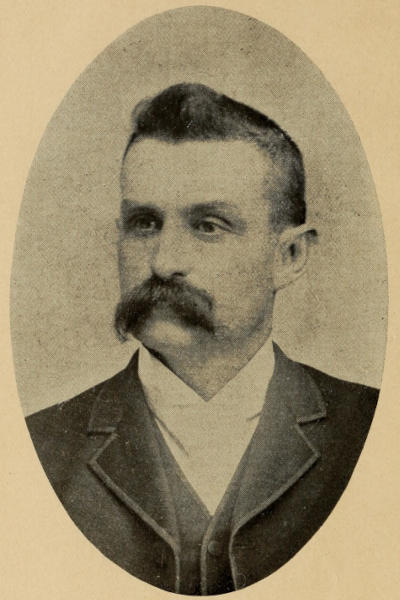
WITH A BIOGRAPHICAL APPRECIATION
BY HIS FRIEND Henry W. Shoemaker (President of Reading Times)
“A link is broken that bound us to the infinite.”
Copyright, 1911
The Reading Times Publishing Company
READING, PA. The Reading Times Publishing Company
Biographical Appreciation
Sudden death, in the midst of productive
work, throws into bolder relief a career
destined for immortality. The cessation
of a train of brilliant and helpful ideas
creates a want, and causes a careful examination
of all that has been previously
done, and a just estimate of its worth.
These alone can be the consolations
for the taking off of a genius like the late Jacob
K. Huff, known to his readers as “Jake Haiden,” “Faraway
Moses,” and “Finnicky Finucane.” After a long struggle
against obscurity and adverse circumstances he had emerged
into an open country where kind words of appreciation and
growing fame greeted him on every side. His message, which
the modern life in this country, with its growth of class distinctions,
a self-constituted aristocracy, a rapidly developing
governing class, a contempt for the lowly born, a forgetfulness
of gentleness, a striving for self-advancement, and the train of
kindred evils, rendered imperative, was checked, but its echoes
will be felt through the years. He seemed to be the one voice
strong enough and fearless enough to do battle with the injustices
of the big world, yet he viewed it all from the porch of a
modest cottage in a hamlet where there was no railroad, no
trolley, and few strangers ever penetrated. His vision entered
palaces of the supercilious rich, into the inner sanctums of capitalists,
of cringing editors; into the homes of neglectful parents,
undutiful children, designing wives, white slavers, and other
evildoers. His kindly words soothed the tired spirits of the
unfortunate, and as he never preached, and seldom condemned,
he offered a loophole for improvement, rather than promising
punishment to the so-called “wicked.” He was always ready to
forgive, to lend a helping hand, and though his infinite mind
grasped all the depths of sin and sorrow in the world, he believed
in the innate goodness of his fellow beings. The modern
world was learning to walk along cleaner and better pathways,
and he acted like the careful parent, assisting the unsteady
youngster in its course. His writings do not contain a single
word of rancor; it is amazing that a man who fought so much
oppression and crime could do so without descending to invective
or abuse. That was the secret of his success. If clergymen
could follow in his footsteps many an empty tabernacle
would be crowded on the Sabbath.
In a sense, the biography of a writer discloses the hidden
springs and motives for the development of his career. It
would be difficult for a writer not springing from the people
to fight the people’s battles with the pen. A man of the people
like Abraham Lincoln represented them thoroughly because he
was of them, and at no time in his life did his opportunities or
tendencies cause him to forget his original environment. Jacob
Huff was born among the “great mass of humanity” and his
development came like Lincoln’s through struggles and disappointments,
aided by perseverance and hard work, until his
voice, clear and sympathetic, was heard above the multitude.
Some day an appreciative state will seek out and mark the
lowly cabin in the Pennsylvania mountains where he first saw
the light. Like Plato and many another wise man of the past,
his message will live in his disciples, and grow brighter, and
more necessary with the advancement of time. It was in such
a cabin that Lincoln was born in the Kentucky wilds that Jacob
Huff was ushered into being in Clinton County, Pennsylvania,
on January 31, 1851. His father was John Huff, a typical
backwoodsman, sturdy, brave, and good natured. His mother
was a German girl, Eve Kalmbach, whose parents had left
the Rhine country and cleared a homestead high among lonely
Pennsylvania hills. His father’s mother was Elizabeth Walker,
of Scotch-Irish ancestry, and from her came the strain of
humor, and perseverance that did so much to weld his destiny
into a successful whole. His mother is described as kindly and
intelligent, with a mystic side to her nature, observable in her
distinguished son’s traits of sentiment and tenderness. From
earliest youth Jacob Huff knew little but the most grinding
toil. His first occupation, however, was rather pleasurable,
and he always liked to reminisce on the subject. In 1864,
Colonel James Williams Quiggle, of McElhattan, directly across
the Susquehanna from Jacob’s mountain home, had conceived
the idea of starting an “American Tea Industry.” It is a
known fact that the Pennsylvania mountains produce a tea
plant that rivals in flavor the choicest product of Japan.
Thousands of acres of wild lands were either bought or optioned,
and a tea house after a Japanese design was erected
on a plateau back of the smaller of the two McElhattan
mountains. Men and boys in considerable numbers were engaged
to pick, sort, and dry the leaves, and little Jacob hearing
of the work, tramped down from the high mountains and
started for the “tea camp,” his first situation away from home.
Darkness had come on soon after he reached McElhattan, and
he spent the night with a family who lived at the “X Roads,”
there meeting the black-haired, black-eyed young girl with the
cameo face who played such an important part in the life of
his dear, though older friend in years, the gifted poet, Montgomery
Quiggle. He was given a chance at the tea camp,
which was often visited by the genial Col. Quiggle. This was
probably the first man of education he had met at close range,
and his interest and politeness to the small tea-picker lingered
as one of the pleasantest of his earlier memories. Col. Quiggle,
it may be said, was a fine type of the old fashioned gentleman
of Scotch-Irish stock, always brimming over with good humor,
but with that undercurrent of seriousness inherent to his race.
Winter coming on, the work was suspended, and the merry
company back of McElhattan mountain was forced to separate.
Once on his own responsibility, the desire to earn money and
see the world led the young lad to occupations of various kinds.
Once he trudged many miles to Leetonia, having heard of work
in a lumber camp, but was rejected because he was too young.
He did not idle around the shanties, but immediately started
for home. A snowstorm began, and evening closed in on him.
He saw what he thought was a huge blackened stump, and
leaned against it for much needed rest. There was a grunt
and a growl, and a four hundred pound bear shook him off,
and he sprawled in the snow. Another time he had worked
in a logging camp at the head of Young Woman’s Creek, and
with his purse of savings, was on his way to Youngwomanstown,
now misnamed North Bend. It was sunset, and he
heard a screech like a tormented woman, far up on the steep
slope of one of the denuded mountains. His quick eye showed
it to come from a panther, skulking along in search of its
evening meal. Jacob walked faster, and as he did so the
animal quickened its pace. For miles it seemed to trail him,
but lacked the courage to come down from the ridge. Finally
with the lights of the settlement in sight, it uttered a despairing
yell, and was heard from no more. At other times
he worked in lumber camps, bark jobs, on railroads, highways,
farms, and gardens. Every man or woman he met had a life
story that interested him, these were the romances he read.
His retentive mind became stored with a mass of unusual facts
and impressions, which he thought over and over, figuring out
the whys and wherefores when his companions were asleep.
He had not gone to school a full term in his life, but his teachers,
Charles Hamilton and Benjamin Langdon, were worthy men
and he absorbed much from them. Despite his brief schooling he
could feel the harmonies of words and sentences like a trained
rhetorician. He longed to express himself, but he was too
shy for general conversation, and there seemed no opportunity
to write. In Lock Haven, the county seat of Clinton County,
was a local paper called “The Enterprise.” It had a correspondent
in Gallauher Township where Jacob was living, but
he fell sick, and the editor looked about for a substitute.
Jacob applied for the position, and in February, 1876, in his
twenty-fifth year he had the pleasure of seeing his first communications
in print. They were well done, even for an old
correspondent, and later he made bold to intersperse them
with jokes, and pathetic little verses. He was so satisfactory
that the regular correspondent never resumed the work, and he
continued with increasing reputation, until in 1880 he took up
the same task for the “Clinton Democrat,” a Lock Haven paper,
which is still a power in the county. About this time love
had entered his life, and he married Clara Bryan, a frail,
pretty girl of sixteen, of Scotch-Irish stock, the ceremony taking
place September 25, 1881. But the happy romance was to be
short-lived, a girl baby, whom they called Rena, was born on
April 7, 1883, and the young mother’s health failed rapidly
afterwards. She died on July 26, the same year, and the
motherless infant followed her to the grave on October 7.
Jacob Huff never spoke much of this early bereavement, but
some of his verses on taking Myron, his son, by his second
marriage, to the graves of the first wife and child, are as
beautiful and touching as exist in our language. In 1885 that
enterprising and widely-read newspaper “Grit,” published in
Williamsport, having long noted the humor and pathos of his
work, engaged him to write weekly articles. He adopted the
nom de plume of “Faraway Moses,” and the results were
overwhelmingly successful.
He was a clever artist, like so many writers, and drew
the sketches each week for the illustrations. These were
“worked up” by the staff illustrators and engravers, and became
an important feature of the stories. Jacob Huff as a
humorist was inimitable, but his immortality will rest with
his serious work, his “human interest” articles. The popularity
of “Faraway Moses” soon passed the bounds of the
State, and his trite and witty sayings were quoted by staid
farmers in their shacks in Kansas and the Dakotas. Meanwhile
he established a modest “syndicate” and furnished short
stories, verses, and jokes to a number of rural publications
under various pen names. He conceived the idea of going
West, and his travels took him into many States, where his
experiences were varied, though he finally settled in Colorado.
The results of this change of abode, which did not last long,
found immortality in a small book of verses, published in 1895,
by the Grit Company, entitled “Songs of the Desert.” Unfortunately
the little book was not fully appreciated at the
time, though it is destined to rank with the choicest productions
of Eugene Field or James Whitcomb Riley. Meanwhile
a great and ennobling influence had come to him, his
romance and marriage with Charlotte Crawford, the brilliant
daughter of Captain William H. and Priscilla Brown Crawford,
of Chatham Run, Clinton County, who also for a short while
resided in Colorado. The Crawfords were among the earliest
settlers in the West Branch Valley, where they ranked high in
social and political life. They had intermarried with the
Whites, Allisons, Stewarts, and Quiggles, and each generation
had added fresh lustre to the name. Jacob Huff’s marriage
to Charlotte Crawford occurred at Grand Junction, Colorado,
on October 11, 1892, and soon afterwards the happy couple
returned to their beloved Pennsylvania. The influence of his
devoted wife was broadening and inspiring, leading him into a
wider sphere, and to the association with persons of distinction
and rank. He had tasted life in all its bitterness, had mingled
with the lowly, henceforth he was to see the brighter phases
of existence. He never forgot the past, it had burned itself
in too deeply. He saw the injustices and wrongs with an even
clearer vision now that he understood how happily it was
possible to live.
One son, Myron Reed Huff, named after the great liberal
preacher, Myron Reed, whom Jacob warmly admired, was born
on June 22, 1895, to bless the union. This boy, who is a happy
blend of his talented parents, is himself an artist and author,
and now contributes articles to the Reading Times under the
name of Jake Haiden, Jr. And now comes the story of his
connection with the Reading Times, the last important event
of his life, in whose service he was at the time of his untimely
demise. Early in May, 1908, the writer of this article received
an autograph copy of “Songs from the Desert,” and it
quickened the desire, which he later learned was mutual, to
meet the famous philosopher. At McElhattan on Memorial
Day, of that year, he waded across a muddy road in front of
the home of a mutual friend, Mrs. Anna S. Stabley, since deceased,
and shook the hand of “Faraway Moses,” Jacob
Huff. A long conversation ensued, and they became warm
friends. The writer at that time was President of the Daily
Record, at Bradford, Pa., and soon after his new associate
began contributing short articles of timely interest to that paper.
In September of that year, he assumed the same position with
the Times, of Reading, and with the first issue under the new
management began the celebrated “Jake Haiden” articles.
They were instantly successful, and their appeal to all classes,
their liberality, their toleration, their humanity, their pathos,
made them noted and quoted all over the State. It is pleasant
to recollect that Jacob Huff paid several visits to Reading
while contributing to the Times. He was there on New Year’s
Eve, 1909, and for New Year’s Day prepared an exceptionally
strong editorial, for he also wrote many editorials, called
simply “1910,” which attracted widespread attention. His
last visit was late in January, 1910, when the management of
the Times entertained him as guest of honor at a dinner at the
Wyomissing Club. The guests included the Times staff, the
publishers of the Reading Telegram, Capt. Henry D. and
Herbert R. Green, who were always appreciative of his work,
John D. Mishler, and others of equal note. There were after
dinner speeches of a brief character, and the guest of honor
closed the evening with a few remarks which seemed to come
directly from his heart. With the early summer, the Times
conceived the idea of sending “The Reading Times Philosopher,”
as he was becoming generally known, to the far west in order
to gain fresh impression for his powerful articles. Accompanied
by his loving wife and son, and a close friend Prof.
Betts, he started away gaily. From letters and postcards he
must have enjoyed himself, and his note-book shows he had
jotted down ideas for five hundred and fifty new articles or
editorials. The party returned to Chatham Run on July 20,
where the philosopher maintained a comfortable home, and on
the night of July 31, 1910, he was seized with heart failure and
died a few hours later. Prompt medical aid from Dr. Joseph M.
Corson, his friend and neighbor, was of no avail, and the giant
intellect and friendly spirit returned to its original source. His
funeral was the occasion of a tremendous outpouring of people,
interment being made at Jersey Shore. The press of the entire
State echoed the grief of his relatives and friends and the
great loss to the literary world. The religious beliefs of such
a man are always interesting. His can be summed up in the
final sentence of the little speech he delivered at Reading,
“We look around and in everything we see God.” It was the
religion of humanity, the creed of helpfulness and good
cheer. He lived up to the letter of his faith, for when he
died he left a host of friends and no enemies. He had
steered his bark through the perilous waters of life without
hurting anyone, or sullying himself. It was a beautiful life,
but to those who knew him comes the ever recurring regret
“Why could not he have been spared a few years longer?”
There was so much to do, the world was crying for his help.
Maybe the publication of this book containing some of his most
characteristic opinions will give renewed energy to his disciples
and send them into the thickest of the fight for the betterment
of mankind. If he had a motto it must have been “I want
to leave the world a little brighter, a little better, a little
happier than when I came in it.” Who knows, to what extent
he succeeded! Time alone will measure the fulness of his
fame, but he should rank as a nature lover with Henry D.
Thoreau, as a humanitarian with Theodore Parker, and as a
poet with Eugene Field.
It is hoped his friends will get together and erect a
memorial fountain or statue to his memory in Lock Haven,
Jersey Shore or Williamsport, in the West Branch Valley whose
people and scenery he loved so well.
Henry W. Shoemaker.
September 4, 1911.
I PLEAD GUILTY
Before the law I stand a confessed criminal; before God
I am only a weak man trying to do good toward my fellow
man. I am guilty of helping a convicted man escape the
clutches of man-made law. I couldn’t help it. The love I
bear humanity welled up, when the young man told his
story, and flooded my reason with the sunshine of sympathy; and I
helped him get away.
Early one morning I went to my wood shed to get kindling to build
the kitchen fire. In the dim light I thought I saw a man crouching in one
corner. A second look convinced me that it was true—there was a man
crouching there.
At first I was frightened, and thought of flight. It’s the first impulse
that comes over me at sight of possible danger. And a strange man, in
a strange place for that man to be, is danger enough to startle even a
brave man, like my wife, for instance.
But on looking closer, and catching a full glance of the startled
eyes, that looked up to me in fear and wild, beseeching hunger for something
his heart yearned for, I changed my mind. Fear gave way to
curiosity and sympathy. I said, “Good morning, brother—can I do anything
for you this morning?”
At the sound of friendly words he stood up, and I recognized in
him the young man who was tried and found guilty of forgery, and
sentenced to 15 years in prison.
“I’ve escaped from jail, you see,” he said with a quiver in his voice,
while his boyish blue eyes looked away down into my soul (if I still had
it with me).
“So I see,” I replied. “And now, what are you going to do?”
“You heard me telling my story on the witness stand last week,
didn’t you?” I nodded in the affirmative, and he went on. “Well,
nobody believed me. They thought I was lying to save myself from
prison. I told the court that in my confession, when first arrested and
sent to jail, I had plead guilty to the charge of forgery, to save another
man, because the father of that other man promised to get me out of
prison if I would assume the crime and save the honor of his family.
“Before God that story is true. But the family I was bribed to save
has no honor. From the moment that confession was wheedled out of
me, I was forsaken, and left to the mercy of a jury whom I could not
convince that I was innocent. Not one amongst them would believe
that I had honor enough in my soul to assume the crime of another,
because I am a cobbler’s son. Neither could I convince them that the
rich merchant on B—d street had played false to me.
“I do not blame them. I could not believe it of that merchant
myself, were I not the victim of his perfidy.
“This morning I concealed myself in a barrel of ashes and other
trash and was hauled out of the jail yard by the darkie who drives the
refuse cart. When we got safely away from the jail I rose up out of the
trash barrel and scared that black man half to death. I took advantage
of his fright and told him if he informed the officials of my escape I
would swear that he was guilty of helping me away, for a price, and
because I couldn’t pay him he would not let me off. He promised to
keep quiet, so I ran through the fog and came here.”
“Why did you come here?”
“Because I know you appreciate life and love humanity. I knew
you would believe my story, or at least believe enough of it to awaken
your sympathy and think of the long time fifteen years must be—fifteen
years taken out of my life! The time is too long, even if I were guilty.
Won’t you try to think of how long fifteen years must seem to one so
young as I, and then hide me for a day, and then help me get away
tonight? Won’t you, for the love you bear humanity? Won’t you do
so for my mother’s sake?”
“For God’s sake, stop!” I cried; and then I sat down on the chopping
block and buried my face in my arms and tried to think. “Fifteen
years is a long, long time to take out of a boy’s life! Fifteen years,
without sight of a mother’s face, without flowers or the songs of birds;
without sunshine and the dews that fall from heaven for all. Fifteen
years shut up between black walls, and away from the smiles of women
and little children. God, the sentence is too hard, the punishment too
great! We can’t reform men by treating them as wild animals.”
I looked into his frank blue eyes and asked: “Tell me once more,
truthfully, are you innocent?” And he answered: “Before God I swear
that the story I told you is true!”
I plead guilty to helping a prisoner escape, and I feel no pangs of
regret. Fifteen years between black walls is a long, long time, and the
boy had a mother.
RELIGION OF HUMANITY
Near my home lived a poor, hard-working, but improvident
man. He had a wife and seven children. The oldest was
thirteen, and the baby but ten months old. They were
poor. The husband and father was working only half
time. There is a cause for the dull times, but the man did
not know what it was. Those who do know are afraid to tell, for fear
it may injure their business. “Great is Diana!”
One month ago the wife and mother was taken suddenly ill, and
died in less than twenty-four hours. Everybody was shocked. It
seemed so cruel and hard of Providence to remove that poor woman at
a time when she was needed most. Many would have blamed Providence
of cruelty, but they are afraid to do so.
No one knew the reason why this death was ordered. Some thought
it was even a sin to make a study of the case, “lest they offend Providence.”
I was made to feel very sad when I heard of the sudden bereavement.
Little eyes of helpless children looked out of the night shadows
and made my sleep a nightmare. I looked down a long dark vista
leading out into future years, and I saw barefooted and ragged children
plodding hopelessly along, bearing burdens that should be carried by
full grown men and women. I saw cruel winter lurking only a few
weeks off, generating chill blasts of wind to pinch little brown legs and
chapped hands, and I wondered what the people would do about it.
While I was wondering what was to be done, my wife and her near
neighbor were already solving the problem. Old chests and boxes were
ransacked for cast-off clothing—for clothes the children had outgrown,
but which were almost as good as new. Neighbors were set to work
ransacking chests and boxes and bureau drawers, and many little dresses
and pantaloons that brought back tender memories were dug up and
cast into the common fund of collected goods.
To this collection was added a few dollars’ worth of new goods,
and thread, and the work of reconstruction began. The work was done
in my home, while I worked in an adjoining room, and I never heard a
more cheerful and happy set of women. Their hearts, their charity,
their mother love were all in the work, and these are the tender forces
that give inspiration to men and women who believe in the religion of
humanity.
In my mind’s eye I could see those orphan children feasting their
eyes on the warm flannel petticoats, the bright gingham dresses, the soft
underwear and little aprons. I felt that it was good to be near this
working gang in the great cause of living humanity, and I seemed to
share the inspiration that gave such happiness to the ladies.
The minister’s wife came out and joined the workers, but suggested
that they open each sewing session with prayer; to which a majority
objected, saying they only had limited time to spare, and they believed
the children would be clothed much sooner if the sewing continued
uninterrupted.
These good women worked all day cheerfully, and reconstructed a
big pile of children’s clothes, and when the meeting was about to break
up the minister’s wife suggested that they kneel and return thanks.
“God will accept my weariness of body and contentment of soul,”
replied the busiest woman in the bunch. “Prayer is a private business
between two—between God and the worshipper; and between these
two there are no secrets,” she continued. “Public prayer is the work we
do in public, and for the people—for God’s creatures. We have been
praying, tenderly and seriously all afternoon, while many who could
have joined us in the good work, but refused, will be offering up worded
prayers tonight and thanking their God—for what? for escaping real
work? for the squandering of a few hours that might have been spent
with religious profit in this work of charity? So long as I believe in the
religion of humanity, just so long will I believe that a work for the bettering
of humanity goes ahead of worded prayer.”
“You may be right, Mary,” replied the minister’s wife. “If all
women prayed as cheerfully and willingly with their hands, as you have
done this afternoon, humanity would be the better for it. Perhaps, after
all, the uplifting of the human race is the greatest work we can perform.
Perhaps the bringing of joy and happiness to hearts that have been
filled with hopelessness and gloom, is the dearest work we can do for
God. I am not a bigot, Mary; only I believe in both work and prayer.”
For a long time after the women left I sat and pondered. The little
hungry eyes of the shivering orphans looked out of the gloaming, and I
knew what their decision would be. Their hearts would go out to the
workers. When the warm skirts and petticoats and little trousers shut
out the winter’s blast, the work of the workers would be appreciated.
JOE BAILEY’S RIDE
People who enjoy all the great improvements of the age
have not the least idea of the inconvenience and the hardships
people endured previous to the discoveries of the
telegraph and the telephone. As an illustration of the
conditions prevailing previous to the above discoveries, I
will relate the story of Joe Bailey’s dangerous trip down the river on an
ice floe, and his brother’s exciting ride on horse back from Jersey Shore,
Pa., to Northumberland, a distance of fifty miles, to alarm the people
and bring them to the rescue of his brother Joe.
The Baileys owned the island just southeast of Jersey Shore, which is
still in the hands of the descendants of the Bailey family—Mrs. John S.
Tomb, and Mrs. Carrothers. I do not know whether McGinnis, the
historian of the West Branch Valley, mentioned this famous ride or not.
I got the story from Captain William H. Crawford, who died several years
ago at the age of seventy-seven years, and who was a boy at the time Joe
Bailey went adrift on the ice floe. Crawford then lived with his father,
Hon. George Crawford, two miles west of Jersey Shore.
It was in the spring, when a sudden rise in the river threatened to
take the ice out of the streams. The Baileys had a small flat boat in the
river which they plied between the island and Jersey Shore. It was still
in the river when the early spring freshet came, and was in danger of
being carried away with the heavy floe of ice. To save the flat, Joe
Bailey and another man took a team of oxen and went to haul the flat
out of the stream. While Joe was on the flat fastening a chain to a
ring the ice suddenly broke up and crowded down upon the place, tearing
the boat from the landing and sending the young man adrift on the
ice.
His brother on the Jersey Shore side of the river stood horrified for
a moment, and then fully realizing the importance of imminent action,
borrowed a fast running horse and set out for Williamsport on a dead
run. It was a race for life. Night was setting in and the weather turned
suddenly bitter cold.
With horse and rider panting for breath, young Bailey reached
Williamsport and alarmed the town. Many rushed to the bridge, but
none were prepared to render service to the man going adrift on the
ice. They could hear him shouting for assistance, but the flood bore
him down upon them before they could secure a rope to drop down for
Bailey to lay hold of and be lifted to the bridge.
Knowing that rescue was impossible, one thoughtful man removed
his overcoat and dropped it down into the rushing boat, and received
the freezing man’s grateful thanks.
Nothing daunted, young Bailey secured a fresh horse and struck out
for Muncy, where another bridge spanned the Susquehanna river.
Again young Bailey reached the long bridge too late to secure help.
Joe passed under the bridge before the men could lower a rope. But
the undaunted brother would not give Joe up to the horrible death that
awaited him somewhere down the roaring, rushing, grinding gorge. No
human aid could reach him until he came to the bridge at Northumberland,
so the brother secured a third horse and dashed away to the rescue
again. No other ride through darkness and danger equalled that ride,
except the ride of Paul Revere. And poor Joe’s awful ride in the rushing
ice gorge could not be surpassed for danger and loneliness by any
of the dangerous rides noted by historians and sung of by the poets.
During the ice floe in the West Branch of the Susquehanna river the
current is extremely rapid and the brother dashing away on horseback
knew full well that no time must be lost if he reached the Northumberland
bridge in time to save Joe. This was the last chance. No other
bridge could be reached on horseback in time for a rescue. There was
no railroad then, no telegraph line, and the most rapid means of communication
was by horseback.
Can you blame young Bailey then for urging the horse to the utmost
speed? When the animal slowed up young Bailey laid on the lash and
urged it to even faster speed. He and the horse could alone rescue the
frantic man adrift on the ice floe. All those who knew of Joe Bailey’s
peril were left far behind. The people of Northumberland would know
nothing until young Bailey arrived. On and on he dashed, arriving at
the town exhausted and sore from his long, hard ride.
The town was alarmed, and a score of boatmen and old river men
rushed to the bridge, but not forgetting long ropes with nooses prepared
at the end. Thank God he had not passed yet! They could hear him
calling for help far up the stream. When near the bridge they called
to him to be ready and slip the nose of the rope under his arms. Quick!
Joe Bailey is safely tied in the loop! Up with the poor fellow! Safe!
Thank God! The two brothers clasp each other in their strong arms,
the one softly whispering: “Joe! Oh, Joe!”
THE OTHER MAN’S BABY
It’s a very easy matter to give away the other man’s baby,
but not so easy when it comes to parting with our own.
Organized charity does a whole lot for the unfortunate, but
often does it in the wrong way. The mothers who are
active in organized charity are too ready to separate parents
from their children, never thinking for a moment what a loss it is to
both parents and children to be thus separated. The only excuse for
separating parents from charity children, is the economy. It is cheaper.
Charity using painful economy to a painful extent.
I believe it is better, where it is possible, to allow parents the society
of their children, and children the society of their parents, even if charity
is asked to step in and keep the wolf from the door. It’s better for the
parents, I’m sure. If anything will make a man or woman better, the
society of their own children must surely come first in the elevating
influence.
In my own individual case I can notice the self-improvement since
I have a child to look up to me with trusting eyes and feel the tight
clasp of his little hand. “A child shall lead them.” The man who wrote
this line had the love and power of a child’s influence in his mind. We
are all benefitted and made kindlier and more loving in the society of
children—and especially our own children.
Only a few weeks ago an old school-mate of mine lost his wife,
leaving him with a family of seven small children, including a baby girl
of only ten months. The charitable mothers of the neighborhood took
an interest in the poor man’s affairs, and began to collect clothing for
the little motherless orphans and fit them out for school. They all
thought the bereaved man could get a housekeeper much easier if the
baby were out of the way, and they began to look around to secure a
good home for her. They all agreed on that point—it was to be a good
home for the baby, with kind people.
I was present when the committee of charitable women met at the
poor man’s house to inform him that they had found a home for Baby
Ruth. I shall never forget the look of pain that flashed into his eyes at
the mention of finding a home for his baby. He was too full for words,
but he picked the baby up from where she was playing at his feet with
a yarn ball and string, and as he pressed her to the bosom of his coarse
blouse I saw the tears overflow from his grief stricken eyes and run unrestrained
down his rough cheeks.
After a few moments of silence he mastered his feelings and thanked
the ladies for taking an interest in his children, but hugged the baby
again and said: “But little Ruth is my baby! She was Mary’s baby!
The last kisses and caresses of my poor dead wife were given to our
baby—her baby. How can I put her away so soon after Mary’s death?
She’s so small and dependent—must I begin the separation of my family
away down at the bottom—away down with the weakest and smallest—with
the baby—the one dearest to the mother who is now dead?”
The spokeswoman of the crowd told him how it would be best for
the baby, and for him, to find it a good home, with kind people, who
would care for it “and give it all the comforts of life.”
“Yes, yes,” he interrupted, “I know you mean it all for the best, and
I could agree with you if—if it were some other father’s baby we were
discussing, and not my baby—Mary’s baby—the last of our family to feel
the loving caress of her embrace.
“Is it a crime that I am poor and wifeless, and my children are
orphans? Can I cease to love my children because I am poor and they
are motherless? They have been a great comfort and pleasure to me.
I love their prattling voices; the sound of the little toy cart, as baby drags
it across the floor, is sweeter music than the tones of the pipe organ
down in the fashionable church.
“Shut your eyes to the squalor and rags you see here, and let your
minds go back to your own homes, and recall the sound of the little tin
wagon, loaded with tin soldiers and rag dolls, your own children used
to pull through the house; and picture yourself standing at the gate
after parting with your favorite child. Picture the scene, as the strange
person carries your baby away, with her child face turned appealingly
towards you, and you make no effort to bring her back to your arms and
your heart.
“Would you, my good and kind women, who mean only good
towards me and my children—would you call this a picture of civilization—a
scene amongst enlightened people, or would you dream of it
forever afterward as a picture of hell?”
THE PATHOS OF HUMOR
The average reader of newspapers and magazines imagines
that humorous writers are always funny, and always
saying funny things. Nothing could be farther from the
real facts. The humorous side of humanity while wading
through every day events, likewise sees the pathetic
side. The pathos of life makes the shade and shadow of life’s picture,
while the funny features make the humorous pictures—the cartoons and
exaggerations.
I know a little story connected with the work of a humorous writer,
so full of pathos that one can but wonder how he could write of the
humorous side of life while sitting in the very presence of death.
During the days of his severest struggles for recognition (and bread)
his wife’s aged father was taken ill, and the doctor said it was only a
matter of a few weeks or days with the kind old man, and then his
struggles on the earth would be over. And through all the nursing and
watching the young author was obliged to grind out his “stuff” for the
publishers who kept the wolf from his door.
One night the faithful daughter could endure the strain and loss of
sleep no longer, and was obliged to go to bed, leaving only her author
husband to watch at the bedside of the dying father, and to grind out
his sketch for the next issue of the paper.
It was hard to forget the man who was passing over the dark stream
and concentrate his mind on some ridiculous phase of life, but this he
must do, for he needed yet a humorous anecdote to round out the line
of argument he was introducing—that men are more truthful than their
dreams. He was attempting to prove that men, while in the act of
dreaming a lie, would tell the truth, if subject to speaking out loud in
their sleep.
But humorous ideas were slow about coming, and he leaned over,
with his face buried deep in his hands, and tried to think. All of a
sudden he recalled an incident of real life, that would serve to complete
his story, but before he could take up his pencil the sick man brightened
up and remarked:
“Pretty hard to write scenes from the funny side of life, while waiting
on some one to die!”
“’Tis that, father,” replied the young man tenderly; “but I just now
recall an incident from the life of old Jim McGrabber that will finish the
sketch.”
“Poor fellow!” softly exclaimed the dying man. “I pity you, my
boy. It is more than most men are obliged to do. But don’t mind me.
Even if I pass away while you are working, I will know that you are
only doing your duty. Besides, my boy, it softens death to me to feel
that others can forget it while it hovers so near. And in encouraging
you to go on with your work, I hope to leave the impression behind
that dying men can remain interested in the triumphs and achievements
of life, even though they are old and feeble and their heart liable to stop
forever without a moment’s warning. Go on with your work, and I will
try to sleep.”
And then, after giving the old man a cool sip of water, and fixing
his pillow more comfortable, he sat down and wrote the anecdote that
was to complete his sketch.
“Timothy McGrabber always kept a private jug in his cellar, but
was only allowed two jiggers of whiskey a day. If detected in taking a
third or fourth drink, by his good old wife, she proceeded at once to
pull his gray hair vigorously until he would promise to do so no more.
“One Sunday morning in mid-summer the good old wife went to
church very early, leaving Tim to follow when ready to do so. This
was Tim’s opportunity, so instead of two jiggers from the beloved jug,
he took four—four big ones, and then followed the old lady to the
church, singing softly and gleefully to himself as he walked cheerfully
along.
“Arrived at church he sat down near the open window, and his
system cleared of waste material and a painful conscience, he soon
dropped off to sleep. A young kitten climbed in the window, took an
exploring expedition out along the back of the seat, climbed up Tim’s
passive arm and began to smell his whiskers. Scenting nothing dangerous,
the kitty jumped to the top of his bald head and sat down to
observe the house.
“A wasp flew by, and kitty attempted to catch it, lost her equilibrium
and was falling backwards when she grabbed at Tim’s straggling
locks of hair with both front feet and began to climb back to her lofty
perch again; then the congregation was startled by Tim’s loud expostulations:
“‘Hey, Nora! that’s anuff! Pon me sowl oi only tuck four little nips
from th’ joog, and bedad yee’r pulling all th’ hair out av me head! And
how the divil did yee’s foind it out, anyhow, because oi wint down
cellar in th’ dark and drank wid me oyes shut!’”
The author smiled at the bit of humor, and turned to the bed with
a sigh of relief—only to discover that the old man had died while he
wrote.
THE PINE CREEK TRAGEDY
Love in a lumber camp is as full of romance as love in a
king’s court; for wherever love sets up her throne the world
must bow down and recognize the Queen of Hearts. Jack
Cleveland had been Rhoda Carson’s accepted lover ever
since she came to be cook’s assistant in the big camp run
by Reuben Harris, and this was her second winter in the camp. They
expected to get married when they went back to civilization in the
spring.
In January Walter Jackson, of Maine, came to work on the job, and
Rhoda was fairly hypnotized by his manly beauty and robust health.
Before the first week was out Jack saw how things were going, but still
hoped Rhoda would get over her infatuation and come back to her old
love. But Rhoda quarreled with Jack deliberately and after due meditation.
She even insinuated that she would be happier if he left the job.
Poor Jack was awfully broken up over the affair, and would have
gone away with his broken heart, but he was foreman and couldn’t
leave his employer until after the drive was out of the creek. For two
months previous to the spring flood Rhoda did not speak to Jack, but
spent a great many Sundays playing checkers with Walter in the big
dining room, and her merry laughter went straight to poor Jack’s
heart. He had given her up, but his love for her was greater than ever
before.
The day the flood came, and they were starting the big jams of logs
far up the creek, Rhoda stood on the high bank near the camp to watch
the logs sluice through the narrow channel; for at this point the creek
cut through a rise of ground, with banks of red clay on both sides rising
as much as twelve feet above the water. It was very exciting to watch
the great logs dart through this narrow channel and pitch over the falls
200 feet further down the stream.
While she watched, a great mass of logs came sweeping down
the stream and jammed at the head of the narrow channel. Other logs
piled up against the jam. Then the men came and boldly walked out
on the tumbled jam and tried to pry it loose with their cant hooks. All
at once the great jam started, and the men ran back over the logs to a
low place in the bank and came ashore. No, not all the men came
ashore, for Walter Jackson made a mis-step and fell with one leg pinned
between two logs.
It was lucky for Walter that the jam stopped before reaching the
falls, for he was unable to extricate himself, and would surely have gone
over and lost his life. Even now he must have assistance before the jam
started again, which was sure to occur, for the water was rising so fast
behind the logs that it must surely break loose in a few minutes. The
danger was so great that none of the men would venture on the jam
again, and Walter was given up by those who stood helplessly on the
bank and waited for the end.
At this moment Jack Cleveland came upon the scene and saw his rival
lying helplessly out on the logs. Did a gleam of triumph flash through
his heart? No one will ever know, for Rhoda came up to him and
shouted in his ear: “Can you save him, Jack?” Ah, did he catch a
gleam of the old time love in her blue eyes? And was it this that urged
him on?
Taking a cant hook from one of the men, he leaped down upon the
creaking and surging logs and carefully walked down to where Walter
lay. With a strong pry on the log that pinned his rival fast, he parted
the logs, then took hold of the prostrate man and lifted him to his feet.
But his leg was injured so badly that Walter could not walk. Dropping
his cant hook, Jack picked Walter up and staggered with his heavy load
toward the bank. The men reached down and took Walter by the arms
and were lifting him to safety when the great jam started. They saved
Walter, but Jack was moving on with the logs!
Rhoda saw his danger and ran a few rods further down the stream,
threw herself on the ground and reached far down to give Jack her
hands. In his desperation he lay hold of them with a firm grasp and
Rhoda braced herself for a mighty pull. But she was now too far over
the bank to gain her poise again, and, with a scream that sounded above
the roar of the water, she pitched down upon the head of her jilted
lover, and together they went over the falls. He was holding her in
his arms when they went over, and then the terrible jam of logs dashed
down upon them, while the horrified men on the bank looked helplessly
into each other’s eyes and groaned with mental pain.
In the village graveyard there are two stones standing side by side, where
an old woodsman, now bent with age, visits every spring and places a bunch
of flowers between the two. It is Walter Jackson. When he goes away
the curious people go to the spot and read the card attached to the
flowers: “Jack and Rhoda—They died for me. Even the gods could
do no greater thing.”
THE HOMESICK BOY
“Way down upon de Suanee river,
Far, far away.
Dah’s whar my heart am turning ebber,
Dah’s whar de ole folks stay.”
Foster surely knew what it was to be homesick when he
wrote those lines. He knew the heart-aches of a homesick
boy. What difference whether the homesick boy is white or
black? The heart-aches are just the same; the longings
just as sad, the memories just as sweet, the absent parents
just as sacred, the absent brothers and sisters just as dear. That song
makes the greatest appeal to human hearts for sympathy of any song
ever sung—sympathy for the black or white boy obliged to go away
from home and leave those he loves best on earth.
In my mind’s eye I see Foster’s little black boy who is sold into
slavery and driven far away from the banks of the Suanee river to the
cotton fields of the Southwest. Perhaps not one soul in all the world,
besides his mother and little brothers, ever gave the poor slave boy a
single thought after he was driven out of sight of the old cabin home.
Other boys going away from home—white boys of those days, had all
the world before them; but the poor slave boy had only his chains and
his broken heart.
I see him lying in his hard bed of straw at night, with the storms
howling around the cabin and the fading fire sending out only a few
feeble rays of light—I see the homesick lad lying with his face buried in
his hands and threading the old paths that lead up to his mother’s
cabin through his mind. He sees the dear old river and the wild fowls
resting on the bosom of the water. He sees his dear old mother sleeping
in the old familiar bed where he lay when a baby. He sees his
younger brother sleeping on the bed of straw near the hearth, his black
face turned up for the moon beams to write lines of tenderness and love
on each well remembered cheek. Outside the humble door the shaggy
watchdog watches over the family that owns nothing but their wrongs.
And, with my mind on that homesick boy, I hear him sobbing, while
the coarse sleeve of his soiled shirt absorbs the bitter tears that are
known only to the great God who has commanded every one to love
his neighbor as himself. In his ears the hum of the bees is still heard,
and the music of his father’s banjo comes back on the wings of memory,
like the odor of funeral-smelling flowers coming back from the grave of
his buried hopes. The darkie boy at his saddest best.
The homesick boy of Foster’s song is not the bad nigger, full of
nigger gin and hatred and evil intentions. The slave boy in whom you
see only centuries of wrongs and oppressions is the picture in Foster’s
immortal song.
Oh, the world would be better if every one had experienced a
season of homesick longings, and cried themselves to sleep with the
image of absent loved ones painted on their mind with the brush of
tenderness. Better if all had wrongs to remember, and oppressions to
leave scars on their souls that would make them feel kinship towards all
the unfortunate who must suffer and bear their burdens alone.
It is a well known sociological fact that those who suffer hardships
and privations have more tender feelings for the poor and unfortunate,
than those who were born with a silver spoon in their mouth, and never
intermingled with the people of the lower world. Of course, there are
exceptions, but they are few. When you find a wealthy person who
feels charitable and kind towards all the world, that person has suffered
heart-aches, too. He wants the sympathy of those who have suffered
like he has. There is a fraternal feeling in his heart for the unfortunate,
planted there by his own heart-aches and watered with his own tears.
A man who has never known a heart-ache, never gives a single thought
to the homesick boy who longed for his Suanee river home.
FRIENDS WHO PASS IN THE DARK
Of late I have found a very good and sincere friend who has,
since then been an actual inspiration to me. For many
years we knew of each other’s existence, but we did not
move in the same orbit, one might say, so we never met to
touch and smile as we passed each other in the busy pursuits
of life. We seemed to pass each other in the dark, and so far apart
that our binnacle lights could only be dimly seen away off in the gloom
of the night.
And all the time we were dreaming the same dreams, cultivating
the same love, nourishing the same hope, fanning the same laudable
ambition, admiring the same poems, worshipping the same God of
Nature. And we continued to pass in the dark. I had my struggles
and deferred hopes and pinching poverty and unsatisfied desires, mellowed
and made smooth, however, with the love of friends and companions
who lived with me in the broad daylight of recognition and
mental appreciation; and he had his friends and hopes and dreams and
slights and heart-affecting episodes and burning ambition and love of
humanity—and thus we continued to pass and repass in the dark.
Dimly and intermittingly the thought began to develop and dangle
before our mental eyes that some day the lights would grow brighter in
our binnacles, the shadows become less opaque and the distance
diminish when passing by. The thought waves we were setting
in motion as we moved around in our orbits, came together and intermingled
and blended in mutual harmony, and moved us together in our
wake, drawing us closer together, even when passing in the dark. And
our binnacle lights grew brighter and finally dispelled the darkness so
much that we no longer passed unrecognized, but too far apart to hail
each other on the social sea.
What strange and subtle influence was it that planted the seeds of a
mutual desire in each heart, that some day in passing, we could call
across the narrow sea and hear the sound of each other’s voice? Was
it caused by the thought waves that came over the mysterious dream
sea and beat softly on the sides of our spiritual ship? Mutual confessions
afterwards revealed the fact that our final meeting was not by accident,
but through the individual, independent, unknown designs of
each other. We felt the approach of each other’s frail boat while still
in the dark distance, and realized that we were soon to meet and touch,
with a hand-shake and a heart-ache that would never cease nor diminish
until we have accomplished something to light the darkness where other
poor mariners on the stormy sea of life pass each other, with no binnacle
lights shining out over the troubled water, and no friendly call
coming out of the darkness to those in distress.
No man can do successful work alone. We need the help and the
moral support and the sincere appreciation of all those whom we know
to be in sympathy with souls who are still pulling against the stream and
through the darkness of obscurity and neglect. Every one of us have
friends who pass us in the dark—friends that we could sincerely love and
respect, and who could aid us and cheer us as we pull against the streams of
life with the sad realization that sooner or later, we shall all be washed away.
Let us get closer together. Let us flash the binnacle light of love
and God speed and good cheer as we pass in the dark. Too often we
turn down the light at the approach of an unknown ship, and use our
utmost endeavors to pass unseen and unknown. Is it because our
mutual thoughts are out of tune?
And would it be thus if we were all mutually working for the uplifting
of humanity? Would it be thus if we were all willing to throw
out a line to the human boats drifting, without a rudder, down the rapids
of poverty and want?
We are all ultimately going out on the unknown sea—why not sail
closer together on the sea of life? Soon we will drift so far apart that
absolute darkness will hide us from the living world; so, while we live
let us avoid passing friends without calling to them over the water.
VOICE OF THE STONE — HOW MANY HOPES LIE BURIED HERE
Passing through a country graveyard one day last summer,
and reading the sad stories engraved on the many head
stones, I was attracted by the silent voice of one particular
stone, erected over the grave of a six-year-old boy: “How
Many Hopes Lie Buried Here!” Was it an exclamation, or
an interrogation? How many hopes? Only the fathers and mothers
can truly tell who have buried hopes in similar graves.
These bereaved parents had pictured their baby boy as a man, going
out into the world to accomplish great things and fill their declining
years with pleasure and delight.
Often they had pictured their boy in his manly beauty, able to defend
himself from the enemies that always cross the path of the successful,
and attempt to retard their progress. They had pictured him
on the stage of life swaying men with the power of his logic and his
persuasive voice. Men were cheering at the bare mention of his name,
for he had taught the people to love him and believe in him.
They saw him holding high positions in the social and political
world, and always going higher, always gaining more and more, always
accomplishing greater things—ah, perhaps holding the highest office in
the land—President of the United States!
Or they may have been more modest in their hopes. They may
have seen their boy, grown to sturdy manhood, following the plow and
reaping the golden grain; and, instead of going out into the world to
win glory and fame, they may have pictured him contented in the old
home, sitting with them in the evening under the vine clad porch and
discussing the modest hopes of the village people.
Great hopes are not always dreams of future glory and fame. The
modest life and unostentatious efforts of the humble worker bring greater
joys to some hearts than all the glories of political success. So the hopes
that are buried with a favorite child are as many and as varied as the
flowers of the hills and meadows.
But, whatever the hopes, the heart-aches are ever as deep and
pathetic, and the tears as bitter with regret.
How many hopes lie buried here
With our darling, we loved so dear!
When his dear life ended,
The shadows blended
With the darkness so cold and drear.
And the sad refrain,
Again and again,
Tells of a mother’s tears and pain,
Year after year, year after year.
How many hopes? Ah, God alone
Knows how many lie under this stone!
Of the mind well directed,
Of the man they expected—
Death ended all, the spirit has flown.
And that sad refrain,
Again and again,
Tells of a father’s great heart pain,
Always yearning for the boy that is gone.
How many hopes? The breezes sigh,
Softly whispering while passing by:
Fondest hopes of a mother’s breast,
Hopes that pleased the father best,
Reaching from earth to the sun-lit sky.
Now the sad refrain,
Again and again,
Tells of the father’s and mother’s pain—
A great heartache that will never die.
Ask the mother how many tears
To wash that memory from the years?
Ask the gloomy father why
Comes that half-unconscious sigh?
As the sound of a lov’d voice disappears.
Ah, that sad refrain,
Again and again.
Tells the story of grief and pain,
Which the mellow-hearted reader hears.
INGRATITUDE
Ingratitude is the crime of weak, inferior intellects. The
man who will eagerly accept favors of another, and not
feel grateful towards the donor afterwards, displays the
coarse inferiority of the brute. The savages and barbarians
are noted for their spirit of gratitude. They never
forget a kindness. The genuine superlative ingrate is generally the
spectacular white man. The man in whom vanity and self-interest predominates
all the finer feelings of the soul.
Very often he is a self-sainted molder of public opinion, standing
high in the church and political circles, with an inordinate appetite for
public position where he can be observed by the passing world. He is
the self-stuffed hypocrite who pretends to love humanity—for the profit
it will bring him.
I have in my mind a parasitical vampire in human form who had a
friend moving in political circles where railroad passes where supposed to
be gifts of friendship. This was before the anti-free pass law came into
effect. The parasite begged his friend to secure a pass for him, and it
was secured and given to him, midst a shower of profound thanks and
pledges of eternal gratefulness. The pass was used to a gluttonous
extent, and renewed at its expiration, and again accepted with many
obsequious bows and renewed pledges of everlasting friendship.
A few years ago the friend died, and his relatives expected words
of kindly remembrance from the parasite. Even the dead man’s enemies
spoke kindly of him after death had silenced his tongue and put
the eternal chill upon his warm heart. It is one feature of our higher
civilization to always speak well of the dead—to overlook the dead man’s
faults and remember only his good qualities. To spurn the dead body
of one’s fellow man is considered cowardly, dastardly and inhuman.
But when a supposed friend turns on the body of one whom he made a
victim of his hypocrisy and deceit while living, and stings the dead with
the venom of a treacherous viper, the world looks on and blushes for
very shame.
This was the case with the parasite I have referred to. No sooner
had the breath left the body of the man who had so often befriended
him, than he began circulating stories that told how corrupt his dead
friend had always been during life.
Did the public applaud the ungrateful parasite? Did he gain favor
from even the dead man’s most bitter enemies? Far from it! Those
who remembered how the fawning sycophant had groveled at the
feet of the dead man for the favors so lavishly bestowed while life lasted,
had only feelings of contempt for the cowardly traducer of a dead
friend’s character.
The world said: “If the dead man was as bad and corrupt as this
false friend paints him, why did he wait until after death has sealed his
tongue with the lock of eternal silence? Why did he court the dead
man’s society as long as there was a favor within reach? Was it not
his sacred duty to reform the corrupt man, instead of sharing gluttonously
all the good things with him, with the greed of a vampire sucking
the life’s blood from a sleeping child?”
The story he now tells of his dead friend is but the flapping wings
of the vampire fanning his new victims to sleep while he sucks favors
from the veins of their unsuspecting generosity. Once a parasite, always
a parasite, and the attempt to build a character out of abuse heaped
upon the memory of a dead friend, is but wasted energy. The public
is a pretty good judge of humanity, and the human vampire can not
paint his wings and pass for a dove, no odds how saint-like he may
“coo” to the other birds of prey.
Another case of ingratitude came to me just the other day: One
man asked another for a loan of $200. It was taking great risks to loan
the fellow anything, but the friend took chances and loaned him half as
much as he asked for. Now the fellow hasn’t a single kind word to
speak of the generous lender. This is not only injuring the man who so
kindly befriended him, but the abuse may sour the lender against humanity
in general, as some day some other honest but unfortunate man
may be turned away empty handed, on account of the wound made by
the ingratitude of the human parasite.
Those who are not thankful for small favors, are absolutely barren
of gratitude, and deserve no favors at all. And where there is no gratitude
there are no generous impulses, no spirit of charity, no love for
humanity, either dead or alive. And the world is full of them. I have
only referred to two cases—two of the most common cases—every reader
knows of a dozen other cases. Ingratitude is the white man’s great sin
against humanity.
ORPHAN EVA
Sitting at the window one cold frosty morning I saw little
Eva Yarnell passing the house with a bundle of clothes
under each arm. Eva is a girl of twelve years, and an
orphan. Her mother died when she was but six years old.
I’ve always been interested in the child because she had been
shifted from pillar to post, as the saying goes, one relative keeping the
little girl as long as their means lasted, when she would be moved on
to another aunt or uncle or cousin or grandmother. Her relatives were
all poor, and it seemed as though Providence was forcing little Eva to
share all the poverty and want of her relatives.
She has at times been a schoolmate of my boy, so when he came
into the room I asked him where little Eva was moving to.
“Oh, she’s all right now, papa!” the boy exclaimed. “She’s going
to live with Bingman’s, just above town, on a farm. She’s such a good
worker, and I believe Mrs. Bingman will appreciate Eva and make it
pleasant for her. The poor child is just about naked, and I’m sure Mrs.
Bingman will dress her better than she was ever dressed in her life.”
I caught my boy’s hopeful feeling and inwardly rejoiced over little
Eva’s good fortune. But after sitting for a time thinking about the life
of orphan Eva, it struck me forcibly about the child’s recommendation.
“She’s such a good worker,” my boy said. Working her way through
life “at the age of twelve.” “What an age! What a stern life for a girl
of twelve! God help you, child, and send you a kind mistress!” I said
aloud, as I turned to my desk with a queer sad feeling tugging at my
heart.
Lately I had written a sketch describing the heart-aches of Foster’s
colored boy, of whom he sang in the tender words of “The Old Folks
at Home,”—the far off home on the Suanee river; and I had cried over
the boy I had pictured in my mind, because I, too, have suffered with
heart-aches and loneliness and soul hunger. But here was a little homeless
girl who could never more dream of a mother back in the old home.
There was no one at home to wish her back again, not even a home.
There was no one waiting with heart-aches to see her, unless there are
heart-aches beyond the grave.
I opened the door to catch a last glimpse of the little orphan and
saw her bravely trudging up the wet street, occasionally shifting the
bundles from one arm to the other, for one of the bundles was much
larger than the other—so large that it cramped her chubby arm while
holding it close to her body.
“Such a good worker!” The words persisted in coming back to
me, leaving a sadness at my heart that could not be shaken off. How
long has she been a good worker? When did she first learn how to
work? Such an age for such a grand reputation!
I thought of the drones all over the country who never win such a
reputation, though they live on the fat of the land, and feel as far above
little Eva Yarnell as the gods are supposed to feel above a toad. In
whom, I wonder, do the gods feel the most interest—in Eva Yarnell, or
in the fat and sleek drones who sit in upholstered chairs and try to mold
the opinions of the world.
I do not know—I can not believe that this world is ruled by the hand
of love, no odds whether that hand is divine or not. Law is stern,
severe and unrelenting; the one side padded with the down of mercy,
but the reverse side rough with cruel thorns and painful projections.
And the reverse side seems always turned towards the weak and the
helpless—towards the motherless orphan I had in my mind—little Eva
Yarnell.
“Such a worker!” Such an age! God send her kind mistress and
a sheltering home!
LOVING THE WORLD
There is a difference between loving the world for the
world’s wealth’s sake, and loving the world for the sake of
humanity. There is often this difference between the
patriotism of men. Some patriots love the surface of the
world where they are located far more than they love the
people who share it with them. Some patriots love the wealthy of
their neighboring countries, while they are totally indifferent towards
the toiling poor of that same country. In America the people
who love humanity for humanity’s sake, give their sympathies to the
plundered and outraged peasantry of Russia, while those who love the
world for wealth’s sake give their sympathies to Emperor Nicholas and
the parasitical royalty of that unhappy country.
This is why the United States are not unanimously in sympathy with
the oppressed people of all other countries—the reason why the people
of this country are not unanimously in sympathy with the toilers of our
own land—the difference between loving the world’s wealth, and the
world’s people. “Love your neighbor as yourself,” is possible only
where worldly interests are mutual and agreeable. Where two men are
striving for the dirty dollar in sight, love is sure to dodge out of sight
and silently steal away.
Even where men love the world for humanity’s sake, there is a
difference in the intensity of that love. Some men love with a hopeful
optimistical fervor, dreaming of a day when there shall be no oppression
or plundering of the weak by the powerful. They see the millennium
of earthly tranquillity and peace in the near future, when all men shall
be brothers, and co-operation shall take the place of bitter competition,
and motherhood and childhood shall be the great care and protection
of the nation, and no one shall go to bed and cry themselves to sleep to
forget the pangs of hunger and drown the memory of personal wrongs.
In most cases these hopeful altruists never suffered real hunger or
bitter wrongs. They have always had enough of the world’s material
wealth to drive the wolf of hunger away from their door, and only see
the real poor through their dreams. Once in my life I cried for bread
when there was not a crumb in my mother’s house, nor even a single
penny to buy bread. It was only for one day, but the horror of that
one day pictured poverty to my youthful mind in all its horrible and unrelenting
want and squalor. And the old gloom-blistered memory of
that one day of unsatisfied hunger haunts me still, like the recollections
of the most poignant pain.
I firmly believe that that recollection of absolute poverty in my childhood
days is what makes my love for humanity so hopeless and moist
with despondent tears. I can not even dream of a day when love and
justice will rule the world. Greed, greater than all else, human greed
predominates over all the world. “For what will a man not give in exchange
for his own life?” This can be carried still lower and made to
read, “For what will a man not sacrifice for his own comfort?” And
when it comes to a sacrifice, who so easy to offer up as the “helpless
poor?”
Abraham hadn’t the remotest idea of offering himself up on the
altar he had built. Helpless Isaac would have been the victim, had not
the more helpless ram appeared tangled in the bushes, and was substituted
for the lad.
The primitive originators of the sacrificial altar had only the weak
and helpless and defenseless in mind as the intended sacrifice to their
God. The innocence of the lamb and the dove did not appeal to their
calloused hearts. They were intent on saving themselves, even though
the whole world must be sacrificed.
That spirit is still prevailing where the weak and the strong meet
in the struggle for existence, and the weak and innocent do not appeal
to sympathetic hearts when they ask for mercy. The business and commercial
altars must have a sacrifice for the benefit of the strong. This
picture is always before me. My love for the world is like the love of a
despondent mother for her sick child.
LOST IN THE SNOW
No one who has never lived near an Indian school has any
idea of the loneliness and homesickness that fills the poor
little hearts of the Indian youths who have been torn away
from the rude Indian home and herded together between
gloomy brick walls, so different from the teepee of their
semi-savage parents. The government department in charge of these
schools talk of abolishing the schools located at a distance from the
reservations, and building school houses right in the village, retaining
only four such schools as that of Carlisle, Pa., to serve as high schools
for the larger youths.
I believe there is much sense and good judgment in this. Civilization
should not force painful conditions upon the children of our copper-skinned
wards.
I recall to mind the desertion of five little Indian boys from a school
near which the writer spent several years, and a more pathetic tale
never was told. Like the instinct of bees and animals, these Indian
boys knew that their native village lay to the southwest of the school,
and when homesickness felt so unbearable that it could not be endured,
they stole from their dormitory one dark night in November, swam the
river and started to climb the rugged side of the great Rocky Mountains.
Little Jake Hargison was but six years old, and the baby of the
deserters, but he struggled through the dark and up the rocky side of
the towering mountain with courage stimulated by the hope of seeing
home and parents within a few days. Being only boys, they had not
provided food for the journey, each lad carrying only a small lunch in
his pockets.
At daylight they were far up on the mountain side, half frozen; for
they had come to an impassable cliff and so were obliged to wait until
the daylight came, not daring to build a fire lest it be seen from the
valley where the school buildings were located.
It was past noon when they finally reached the top of the mountain
and struck out boldly to cross the broad mesa extending far to the
southwest. Far in the distance they could see the mountain range at
whose foot nestled the Indian village they called home. They knew it
was seventy-five long miles away, but they never flinched or thought of
turning back.
Late in the afternoon the sky grew gray with bleak clouds, and the
northeast wind chilled them to the bone. There were already four
inches of snow on the mesa, and the eldest of the boys knew instinctively
that another snow storm was in the air. But they had on stout
government shoes, and did not fear the snow.
By dark the snow storm burst on them in all the fury of a Rocky
Mountain blizzard, and the boys began to search for a sheltering rock.
Fortunately they came to the brow of a great range of mountains, and
down below the rim rock they knew there would be shelter from the
storm and the winds. Slowly and tortuously the boys climbed down
through a crevice in the great rim rock, and 200 feet below they came to
a level plateau, where they gathered wood and built a fire close up to
the perpendicular wall.
Sitting by the warm fire they ate their lunch, having saved it all
through the weary day, and they could hear the storm king howling
through the spruce trees and shrieking through the canyons on either
side.
And where they had camped the snow was drifting over the cliff
and falling upon them very fast. They knew the history of these snow
drifts—knew that the snow sometimes stacked up to the depth of fifty
feet on the lee side of the rim rock, but it was too late to retreat now.
At midnight their fuel became exhausted, and the snow drift was
so deep that they could not get more. Little Jake complained of being
sleepy, and his older brother sang an Indian song to keep him awake.
The little fellow began to repeat the prayer his teacher taught him, and
fell asleep with the words still on his lips. The others soon followed
him into dreamland, and all night long the merciless snow drifted over
the tall rock and buried them under many feet of spotless robes. The
winds howled, the storm shrieked and groaned and higher the snow
drift grew upon them.
Late in July a prospecting party found them, the elder brother holding
little Jake in his stiffened arms.
A PLEA FOR CHILDHOOD
In the name of humanity, in the name of civilization, and in
the name of Him who died for men, I would make a plea
for the little children who are born into the world to be
landless and homeless through life. Does it seem possible
to the thickest headed thinker that a just God would send
children into a world already privately owned by previous generations?
Are God’s laws similar to the European laws of primogeniture, giving
the best of all to the first born—to the first generations, and to be handed
down from father to son, to hold and own forever?
I can’t believe that there is any priority handed down to a special
few from the God of All. Every sense of common justice rebels at such
an idea. If it is our God, and our heaven, and our eternity, it must then
surely be our earth, our land, and our oceans, and our mountains, and
our air. Will a higher civilization recognize this picture of simple
justice? And will we reach a higher state of civilization without giving
all an equal share in God and the earth?
I do not know. It might create serious complications to remove the
priority claim of the selected few who now claim the natural wealth of
the world. The present state and condition of the social world and the
industrial world may be exactly as God wishes it to be. Every one
must answer this question for himself; for while it is true that God
created man, every individual creature has a peculiar way of forming
the character and attributes of his God. Men still quote scripture to
prove that God believed in human slavery. If this is true, then God
surely allowed little innocent babes to be born into slavery, and to be
driven by the lash from the cradle to the grave.
If this is true, then child labor in our mills and factories for wages,
is not nearly so horrible as chattel slavery, and God must look with approbation
at the little consumptive boy or girl dying by inches while
watching the shuttles fly back and forth in the loom, of which they are
part of the machinery.
These questions each one must settle for himself; but doesn’t it
seem more natural and human to decide in favor of the children?
When you look into the innocent eyes of the child sitting in its mother’s
arms, can you consign that child to the slavery of the factories and mills,
and then wash your conscience clean with the wet sponge of tearful
prayer? Sit right up straight in your chair at this very minute and decide
the case between yourself and the children and your God—did
God, or did he not send these helpless and dependent children into the
world to become mere slaves, and to live landless and homeless until he
calls them hence? Yes?
Within the eyes of each trusting child
That look straight into mine,
There is a plea, so meek and mild,
So humble and supine—
A plea for mercy and human love,
For justice and for right,
For a share in the earth and the God above,
And all the blessings in sight.
Perhaps it was God who planted there
This plea, ere they were born;
This innate plea for an equal share
Of all the meat and corn,
How can men rob them of their right?
And hear their loud demands,
When they see the wealth of the world in sight,
And their father’s empty hands.
I know the sigh of each full grown breast
For a home and an acre of soil;
A vine and a fig tree; to sit and rest,
When weary of work and toil.
Did the God of Nature plant that sigh
In the babe, long ere it smiled?
And this plea, like a rainbow, in the eye
Of the trusting, yearning child?
May the God of heaven pity us all!
But pity the children now!
Let us kiss the spot hurt in each fall
And smooth the troubled brow;
For how shall we, as a little child,
Win back a place in heaven,
If the child is robbed, long ere it smiled
Of the part Great God has given?
THOUGHTS ON IMMORTALITY
I do not know; yet the longings and yearnings of my soul
cry out always for immortality. I seem to hope always
that somewhere in the universe there is stored away a great
pity that responds to the longings and yearnings of my
soul, and stands ready to help me when the earth fades
away from sight and the shadows fall thick and deep around me. I do
not know. The desire in my soul is father to my trembling hope, and
hope may pass away when life goes out into the unknown and my body
of clay is left to crumble and decay and disintegrate and go back to the
original elements.
There will be a physical change, the light and heat and movement
will go out of my body, like the light blown out in a vacant house when
the inhabitants move away. But whither goes the inhabitants that now
dwell within me when the lights are blown out and the doors locked and
sealed with the eternal lock that will not open to the key of time, I do
not know.
In my sober contemplation of all that lies before, it seems to me
that love and justice and mercy and hope are of ephemeral existence if
they last only while the light is in the body. And I ask myself: “Is
there no life and light and mercy and hope and pity beyond these
things we feel and hear and see? Are we to suffer injustice during
life that will never be righted for us? Are we to love, and lose the
object of our love, and never find it again? Are these bright minds of
ours, so capable of dreaming such beautiful dreams, to be brought to
the very highest possible heights of intelligence, and then suddenly be
snuffed out, like blowing the lighted flame from a candle, leaving all
in darkness and gloom?”
I do not know. The prophets and philosophers were only men,
with yearnings and longings like my own, and as weak and helpless to
pull aside the curtains and peep into the future as I find myself. And
yet I am not satisfied to die forever; for I do know that there is an
eternity for all these things existing in space. Space is eternity itself.
The human mind can not picture a condition when worlds and planets
and space will be no more. Nothing can come from nothing, neither
can matter pass into nothing and leave no trace behind. The length of
the universe is eternity, and so is the width and the breadth. It can not
pass away and leave but a hole, for even a hole must have sides and
dimensions.
I do not know; perhaps the ox in the field knows more about immortality
than man, perhaps less, perhaps nothing at all. It would not
need to know much about it to outstrip me in knowledge on this one
particular subject. He may have longings and yearnings, the same
as me, for how shall the ox receive his share of justice and equity if he
passes away with this life and is known no more?
I do not know; justice must surely mean the same rewards for the
ox as it means for man, for how can simple justice discriminate between
animals, and still remain simple justice? And the man who is willing
to grasp an immortality that discriminates between him and the ox, is
neither merciful, charitable, nor just. Immortality must surely embrace
all the living creatures, or part of life would be left behind, and immortality
would be incomplete and imperfect. God must be the God of all.
If the ox is an inferior creature, the fault lies with the creator and not
with the created thing. If there is no justice and mercy for the ox, then
justice and mercy have limits, and God is not so powerful to save his
creatures as he is to create them.
I do not know; my faith in immortality may be the child of my
hopes and longings. If I am always to be I always was in existence
somewhere. I am positively certain that I know of no evidence to prove
a past existence, for hope does not lead backward. Hope points always
ahead, from where the winds of the future are always blowing. I know
that I desire to live always, to think always, to hope always, to love on
and on forever and ever.
TEACH SENTIMENT
Sentiment is a creature of education. A child will naturally
imitate its parents. If they are unfeeling and cruel, the
child will be the same, at least until it falls under a different
influence. Sentiment is not inherited. The average child is
cruel and heartless until old enough to imitate the sentimental
spirit of old people. Therefore, it should be the first lesson
impressed upon the child mind that cruelty and wanton heartlessness
is brutal, and does not belong to civilized man.
In my own case I have always been opposed to keeping pet animals
or birds confined in a cage—no, not always: When a boy I was always
catching birds and squirrels and rabbits to start a menagerie. I remember
one time of keeping a red squirrel in a cage for two years. I
hadn’t then learned that kindness to the weakest of God’s creatures
shows a largeness of the human heart. I was then a lad of fifteen years.
But one day while watching the red squirrel leaping from one side
of the cage to the bottom, then bounding to the other side and back
again, and on to the opposite side and back again, over and over again,
all through the day, and day after day, for the exercise it needed to
keep its health—one day while watching the poor imprisoned animal at
its daily exercise, the thought came to me that the little animal would be
so much happier outside the cage. Then it dawned on me that I was
simply keeping the poor thing imprisoned to gratify my own selfish
pleasure. Simply to look at and enjoy its efforts to make life tolerable
under such distressing conditions. I had actually been enjoying the
restless efforts of the squirrel to make prison life healthful; for had the
animal sat down to mourn and pout and sorrow for the freedom it once
enjoyed, it would have died in a few weeks.
My heart smote me. I saw what a cruel jailor I had been. It’s bad
enough to imprison bad men and shut them away from the sunlight and
flowers and the smiles of good women and children, just as though
darkness and heartaches and misery would make a human being better.
But here I was imprisoning an innocent animal simply for the selfish
pleasure that comes from the possession of things not justly my own.
Like the millionaire who gets a monopoly on the necessaries of life, and
forces the people to pay tribute into his coffers for the sole and only
pleasure of possessing more dollars than his neighbors.
If he has sentiment enough to use those dollars for the benefit of
civilization and to relieve the distress of the people, it is not so bad, but
hoarding up for the pleasure that comes from sheer possession, is worse
than brutal—it is maniacal.
Well, my conscience smote me on the educated end of my sentiment,
and one day I opened the cage and let the squirrel go back to
the woods. I had learned a lesson I never forgot. The awakened
sentiment in my soul never slumbered again.
Sentiment is contagious. My boy caught the happy mental disorder
much earlier than his father did. A few weeks ago, he, too, started a
menagerie. He caught two mice and put them in a cage. At the end
of two weeks his young heart felt the sentimental pangs of conscience,
and he liberated his unwilling prisoners.
The world is growing better. The boy’s sentiment did as much for
him in two weeks as mine did for me in two years. The two liberated
mice may do me a trifle of damage while at large, but when I consider
that the boy let his heart out at the same time he liberated the mice, I
knew the world would be the gainer in the end.
THE SOUL OF SORROW
Sorrow is not always gruesome and heart-breaking. It has
a lifetime influence, providing the fiber of the soul is strong
enough to withstand the strain. Not long ago there was a
musical contest in a Pennsylvania city, and one of the
young ladies to take part in it had given up the thought of
going into the contest, because her mother lay at the point of death the
day previous to the departure of the companies who were going to the
distant city to show what their town could do in a musical way.
But during the night the mother’s condition changed for the better,
and she urged her daughter to go; for on her the town depended to
bring back some of the prizes to be given to the sweetest singers of the
state.
And so she went, her heart very much lighter since the happy
change in her mother’s condition. Anyhow, going out into the world to
compete for a prize, with some hope of winning, has a buoyant effect
on the heart. Oh, if all the world could but feel a slight hope of winning
a prize when starting out in the world, how much happier the
world would be! But to most of the average people the world’s prizes
are hanging up so distressingly high that only the well prepared have
any chance of winning them.
The parents who carelessly or helplessly send their children out
into the world uneducated, to compete with college graduates, are sending
them into a hard proposition. And the state government that will
sleep while one portion of the people are being educated to take care
of themselves, and a larger number are growing up in helpless ignorance
and sent out into the world to compete with the few educated
ones—the state or public that can sleep while such an injustice is being
perpetrated on the weakest and most helpless of its subjects, needs to
have its conscience touched with the awakening finger of justice. The
boasting cry that in this country everybody’s child has an equal opportunity
to gain a livelihood, is as false as hell. There are colleges in our
so-called free land where the son of a ditch digger or a washerwoman
could no more enter than a miserly rich man can enter the kingdom of
heaven.
But I have drifted. I can’t help but drift. Every time I try to paint
a picture, the injustice of the unjust crowd in and fill the distant perspective,
and get painted into the sunset and change the gold into
blackened lead.
Just one hour before the young lady was to go on the stage to sing
her solo, a dispatch brought the sad and shocking news that her mother
was dead. Nobody who knew of the sad news thought for a moment
that the bereaved and heartbroken girl would attempt to sing. They
were all disappointed, of course, but who could ask her to go on the
stage with a sorrow as deep as hers? But she did not break down. Oh,
she had been so confident of winning the prize, and her town’s people
would be so greatly disappointed if she failed!
She told the manager she would try, providing he would tell the
audience of her great sorrow. She wanted the sympathy of the people—it
would give her strength, while it would give them patience and
tolerance.
After the manager had gone before the footlights and told the sad
story the people waited in silence for the young singer to appear. There
was no applause. The people felt the presence of death, or sorrow and
heart aches. The accompanist struck the first note and the brave girl
commenced to sing. The song was suitable for a sad heart to sing.
She could sing her sorrow from the depths of her soul.
The crowded house sat spellbound. That song from her soul of
sorrow thrilled every heart as it had never been thrilled before. The
notes, clear and sweet, came laden with the tears her brave soul was
holding back. The people sat in deep silence, but with beating and
throbbing hearts and active minds. They pictured the dead mother in
that distant town, sleeping silence—ah, never again, never to awaken to
greet her daughter on her return.
And the singer pictured that angeled mother listening from that far
off shore, and she sang to her while the audience listened. For as much
as a minute the people sat in silence after the singer had left the stage,
and then the cheers and tears told of the prize she had won.
VISITING THE OLD HOME
My last visit to the home of my childhood filled me with
gloomy thoughts. Nothing remained of the old home
but the ruins of the cellar walls. The house had been
torn down and removed from the spot. I had expected to
wander through the deserted rooms and try to recall the
old hopes and memories that filled my soul when I lived in the old log
cottage. These memories came back but slowly, because the old landmarks
had been removed and there was nothing to suggest the old incidents
that filled my life when a boy.
The location of the house was in a deep, narrow valley, with hills
on three sides and a dense woods in front, with no other human habitation
in sight. It was in this secluded spot I dreamed the dreams of dissatisfied
youth. And yet these dreams are very dear to me now, as I
dig them out of memory, clothed in their old rags and hunger and famished
ambition. The memories of the pain I suffered in this dreamy
spot came back to me like old friends who suffered with me in those
days.
It was here that I held my dear old father’s hand while he passed
over the bar and drifted out on the Sea of Death. How plainly the
scene comes back to me as I stand on the crumbling walls and recall
every feature of the room in which he passed away. He asked for me
in the last hour and requested me to stay with him. Perhaps he understood
me better than the older boys, or he may have believed that I understood
him best of all the family.
It was not his desire to go. He had hoped for ten more years of
life, but now he realized that the end was near at hand. He spoke not
a word of being prepared to go nor did he ask me to meet him in heaven.
He belonged to the class of thinkers who do not know, and, realizing
that he knew nothing of the future, did not speculate on possibilities.
The last words he said were: “You may look upon men when dying,
but ah, my son, you will never know what death is until you come to
die yourself!”
These words have haunted me all through life, and I often think of
the dreaded experience he prophesied for me. At that hour I could
have gone away with him contentedly, and I really wished then, while
I held his hand, that we two could go out together, and I never, never
return.
But I could not keep my mind on death even then; for I noted the
droning of a bumble bee that beats its head against the window and
tried to escape from the room. And while looking at the bee I noted
the voice of a catbird out in the orchard, singing his sweetest notes. I
tried to locate him, and did finally detect him sitting on the branch of
an apple tree father had planted for me when I was yet a child. Then
a bluebird lit on a tall weed just outside the window: the weed bent and
the winds caused the bird to dance and sway up and down, and from
right to left.
And there was sobbing and crying in the outer room. My
old mother was heartbroken at the parting and my older brother
was trying to console her. When the catbird flew away, followed by
the blue one—the bumble bee found the raised window and flew away.
Then I turned to the bed—father had likewise gone away. Only the
cold clay remained.
Standing on the ruins of the old home I recalled it all once more as
vividly as though it happened but yesterday.
How strangely we live, how strangely we die, how strangely we live
on after loved ones have gone from us. How strangely we recall the
old scenes when they are suggested to us by a chain of memories passing
through our mind. Ah, many of my old hopes and ambitions lie
now in ruins more complete than the old walls of my childhood’s home.
Many of the people I met in this old home were closely connected with
those old hopes that have crumbled into gloomy dreams. Still I live on
and hope on—new hopes and a new life.
THE WAYWARD BOY
Today I want to talk to the boys who neglect their mother.
They are not all bad boys, but all are careless and thoughtless
boys. At an early age these wayward boys go away
from home and leave a fond mother to worry and fret and
grieve over their absence. Some times they neglect to
write home for years and years, leaving the dear old mother to nurse her
lonely and hungry heart and hug the old, old memories when her boy
was but a child. If any wayward and wandering young man should
chance to read these lines—any wayward boy who knows of a mother
waiting at home—won’t he sit down this very day and write her a few
lines?
I have for a neighbor a loving mother who is wasting her life in
grieving for her wayward son. He went away two years ago, and has
never written her a single line. He is a wanderer on the earth, working
a few weeks at one place, then jumps a freight train and rides to new
scenes. About a year ago the mother dreamed an awful dream about
her boy. In that vision she was in a strange land sitting under a large
tree on a sloping hill, around whose base a railroad curved and stretched
out for miles on either side. She looked away to the east, and saw the
smoke of an approaching train. It was coming like the wind.
Then she heard the whistles of a locomotive in the west, and looking
in that direction she beheld another train sweeping down the track
to meet the one coming from the east.
There was only a single track. One of the trains must pull into a
switch, or there would be a collision. The trainmen could not see
around the curve, and were not aware of the other train’s existence.
She rushed to the brow of the hill where she could look down upon the
track and took off her skirt and waved it aloft to signal the on-coming
trains. Neither engineer saw her, and the trains came rushing onward
to their inevitable doom. As the train from the east passed where she
stood she saw a man sitting on the bumpers between two red cars. He
looked up and waved his hand to her. She recognized the face—it was
her son Edward!
Then came the shrill whistles of the two locomotives. The engineers
had discovered their danger when too late to save the trains. She
stood fascinated and watched the two iron monsters come together with
an awful crash. They stood up on end like two angry animals in deadly
combat, and the sound of crashing, tumbling cars drowned the noise
of the escaping steam. The two locomotives tumbled over, tearing and
wrenching iron bars from each other as they fell and then lay with heads
together like two giants of the woods who had fought to the death and
lay with tooth and claws imbedded in each other’s body. A few freight
cars that were standing on end fell over with a crashing sound, a cloud
of dust arose from the awful wreck, a hissing sound of escaping steam
continued for a few minutes, and then all was still. The hand of death
seemed to grasp trains and crews, and silence settled down with an
awful significance. She felt herself fainting, just as the moans and cries
of human beings in distress reached her ears.
When she came to and looked down upon the wreck it was night,
but lanterns flitted here and there on both sides of the dead engines,
and a voice asked: “Have we found all the men belonging to the ill-fated
crews?” and a voice just below where she stood replied: “Yes, all
of the two crews, and the body of a hobo besides—they are all dead
but two brakemen, and they are still unconscious.”
She looked down the embankment and saw the dead stretched out
upon the ground and at the east end of the line she recognized her son
Edward—dead and covered with his own blood.
She screamed aloud and her daughter came into the room to see
what was the cause of her alarm. That was a year ago. Her boy has
never written since, and she firmly believes her Edward was killed just
as she saw in her dream. If he is still alive somewhere in the world,
think of the joy he could send her in just a short letter—just enough to
show her that he is still alive. Boys, write to your mother. She may be
dreaming of you.
A WASTED LIFE
Across the river from where I now live stands the old, old
house where the man of the wasted life was born. I did
not know him as a boy, but the old people of the neighborhood
spoke of him as the handsomest boy on the McElhattan
side, and the place was noted for handsome people.
He was a full grown man when I first saw him, while I was yet a boy.
How handsome he was, standing six feet tall, with eyes and hair coal
black and a face that showed the brain force seething behind the beautiful
mask.
His discontent was transparent to every reader of the human face.
Even the droop of his dark mustache reminded one of the weeping
willow branches hanging disconsolate over the tomb where sleeps the
beloved dead.
When I first met him I was only just awakening to the hopeless
condition of my future life. Weak of body and with an untrained intellect,
his broad education and power of deep meditation made him to
tower above me like a mountain towering above a mouse; but he
stooped to meet me half way, showing me the interior of his disappointed
soul and receiving my sincere sympathy in exchange. At the
hotel, where we many nights slept together in the same bed, the people
complained of us talking all night long, to the annoyance of the other
lodgers. And it was true. Many the night we lay in the dark and discussed
everything on top of the earth, even going out of our sphere to
discuss the orthodox dream of heaven.
One night he spoke of the words that should some time decorate
his tomb, and I still regret that I never mentioned his request to his
relatives and family, and that now his marker does not display these
solemn words:
“I am what was, what is, and what is to be; and no living man shall
ever roll away the stone that closes the door to the mystery into which
I go. What is, is right or else the whole universe is wrong. I am not
lost or wasted, for the economy of Nature hoards all the wealth of the
world in a grasp that crushes life to get back her own.”
What made this sublime thinker a bit of flotsam on the sea of
Time? He told me once when in a confidential mood that the loss of
the one woman he loved darkened his life and drove him to drink. The
woman married another, and was still living when he told me his story,
but he did not tell me who she was, nor whose fault it was that she became
lost to him.
How I pitied the big man, whose heart was as tender as that of a
refined woman. What a power he could have been in the intellectual
world if mated to the one woman he loved. When he lost her his grasp
on ambition and enthusiasm weakened and he folded the desires of his
soul into a shapeless mass and sat down upon them to brood over his
loss.
Poor M——! Chained to his early disappointment, and intellectually
so far removed from his plodding neighbors that none thought it necessary
to offer him their sympathy. How little the average man knows
the average human heart. Education only strengthens the soul’s hunger
for sympathy, love and fellowship, and because I sympathized with the
man of the wasted life, and he sympathized with me in my almost hopeless
struggles, a warm friendship grew up between us, and he allowed
me to see farther into the shadows that shrouded his disappointed soul
than any of his family ever penetrated.
He was one of those retentive minds that could not forget, and he
tried to dull the pain at his heart with drink. Sometimes he would
make a strong effort to reform and rebuild his wasted resolutions, and
for several months he would toil on the farm like a hired man. But his
mind was too active for such a vegetable existence, and his books would
take him out of the fields of physical labor. Then the old discontent,
the memory of the old love would fill his soul and again he would drown
everything in liquor, like a second Edgar Allen Poe. In one of these
sprees he died, and his wasted life ended in a death that shocked his
many friends.
GARRET MEMORIES
My boy expressed a fear to go up on to the attic one day recently,
and when I asked him what he found to fear up in
a dusty old garret, he said there was so much old stuff up
there that belonged to people who were dead, and if these
old things had memories they must surely be thinking of
the old days and the old friends, and had no welcome for the boys of
the present generation.
Well, wife and I know the old garret has many memories, or at
least articles that suggest old memories, and we seldom make a trip to
the old store house of family heirlooms without coming away with a
queer feeling of loneliness tugging at our hearts. No doubt the boy has
often detected the subdued and solemn expression on our sobered faces;
and learned his lesson of awe and veneration from reading the lines and
shadows he has so often seen there.
The last time we were up on the garret, the three of us, we set
about digging up old memories, because a lady’s side saddle hanging to
a rafter started us to digging up some old family lore. The saddle belonged
to wife’s great-grandmother, and is almost a century old. It was
on this saddle her great-grandmother made the ride of nine miles
through the dark to warn her father that burglars were trying to break
into their house.
It seems her father sold some cattle and hogs a few days previously
and had the money locked up in the bureau of his room. It was for
this reason that the daughter and the hired girl were told to take the
twins, and the four of them sleep in this particular room every night,
while the parents attended camp meeting. Some great revivalist on the
style of Peter Cartright was stirring up the people and everybody for
miles around flocked to the camp meeting and pitched their tents and
were prepared to spend several days on the camp ground.
There were several bad characters in the neighborhood and they
knew the old squire had money in the house because he hadn’t been to
town since selling the cattle and would hardly carry it with him to camp
meeting. On the second night after the squire and his wife had left
home three men broke through a kitchen window and began a search
of the first floor rooms, knowing the hired man and the boys slept up
stairs.
When they discovered that some one inside the squire’s room was
holding the bolt in place they threatened to kill everybody inside the
room if they didn’t let them in. The twins (girls of six) screamed aloud
on hearing this threat, and their older sister called to the hired man up
stairs to come to their assistance. But no answer came from the upper
precincts. The hired man and the boys were too much scared to even
make any reply.
Then it was that the sister unbolted the window and crawled
through and dropped to the ground, ran quietly to the stable and saddled
her horse, with this very saddle, and rushed off to the distant
camp ground through a darkness that would frighten women of less
nerve. Almost breathless she reached the camp meeting just when
the shouting hilarity was the highest, and was told that her father was
at the altar seeking salvation.
Without stopping to ask permission of anybody she walked swiftly
up the aisle to where her father was kneeling, recognizing him by the
green coat he wore, stooped and whispered in his ear: “Come home,
father, at once; there are burglars trying to break into the house!”
“Hell!” he exclaimed loud enough to be heard by the mourner on
either side of him, and said no more until he had saddled his own horse
just back of the camp ground, and the two galloped back home in time
to prevent the robbery. The burglars had taken their own good time to
cut a hole through the door, through which they could reach a hand and
pull back the wooden bolt; but the brave hired girl had stabbed the
hand with a pair of scissors every time it was thrust through, and thus
protected the house until the arrival of the squire and his fearless
daughter.
The burglar on watch outside the house heard the approaching
horses, and warning his two pals inside, they all escaped. Next day the
burglar with the scissors wounds on his hands was arrested, and finally
confessed and gave the names of his pals, and the trio served two years
in prison.
No, the family history doesn’t enlighten us as to whether the old
squire went back to camp meeting to resume his prayers for salvation,
or not. Quite likely the saving of his cattle and hog money satisfied
him for that particular season. Men weren’t as greedy in those days
as they are now, and he may have left the great supply of saving grace
for others to enjoy.
YOUR BABY STILL
A short time ago an old schoolmate friend wrote me that
they had lost their darling—a baby boy of ten months, and
the mother was grieving herself sick over her great loss.
“Couldn’t you write something to console her—something
to make a bright spot out in the future to look ahead to
with hope?” he wrote. How easy to ask this, but how hard to comply.
How impossible to wipe away the sorrow from a bleeding heart and
persuade the heart to cease bleeding and the bereaved soul to cease its
grieving.
After a little thought it struck me forcibly that the memories and
recollections of a dead child must always picture the child as it was
when death took it away. And I sat down and put myself in that
mother’s place and wrote as though I were writing the words of hope
that sometime would surely fill her loving soul. I print them now for
the hundreds of other sorrowing mothers who see before them, day and
night, the dear face of their darling who sleeps out in the church yard,
the land where babies never grow old.
I could write out of that mother’s heart, because I, too, have a baby
sleeping in the land of perpetual youth. Had she lived she would now
be a grown woman—perhaps today weeping over a little grave where her
own darling lay sleeping.
Weeping over his little bier,
Kissing the lips of her baby dear,
Touching the eyes in their endless sleep—
Dreaming, I see a mother weep.
Mother, he’ll be your baby still,
Let the changes bring whate’er they will;
When the coming years silver your hair,
You will dream of your baby fair;
Other sorrows your heart may fill—
He’ll be your darling baby still.
Tho’ he may lie in the churchyard cold,
In your dreams he’ll never grow old;
In your slumbers you’ll kiss his brow,
Sweet and pure as you see him now.
Ah, for ever your baby will
Be, in fond mem’ry, your baby still!
Other mothers are happy today
Kissing their darling’s tears away,
Looking far out in the world so wide,
Swelling their mother-heart with pride;
For they see their child to manhood grown—
Proud are they to call him their own;
Dreaming dreams of all he shall be—
The man they picture—the man they see;
Proud and defiant, leader of men,
Making history with tongue and pen.
Surely their baby must change to be
The full grown man of the picture they see.
Ah, better for her and her mother pride,
Better, ah, better that child had died
With innocent smile on his baby face,
Than live to manhood and disgrace.
“What news is this? Oh, tell me true!
What did the boy of my fond hopes do?
Murdered his sweetheart? Oh, loving God!
This comes from the wicked path he trod.
A drunken quarrel? She led him on!
And he’s a murderer! my son, my son!”
Mother, when bidding your child farewell,
With heartaches more than tongue can tell,
When laying him low in the cold, cold ground,
And tenderly heaping the little mound—
There’s a land of hope just over the hill,
Where your baby will be your baby still.
No news of him will ever pain
Your aching, loving heart again.
Silent he sleeps in the earth’s cool breast,
And when life’s sun has set, in the west,
And you lie down at his side, he will
Be your darling baby still.
Only a little while ahead—
A little nap for the silent dead—
A little trouble, and sorrow, and pain,
And you will be with your child again.
Safer with you is the child you find
Than the full-grown man you leave behind.
And tho’ the promised future is dim,
’Tis enough to know—you shall sleep with him,
And all through eternity your baby will
Be your darling baby still.
WISH I WERE A JEW
I wish I were a Jew. The more I study the situation, the more
I wish to be a Jew. I have found fault with the Jews, from
the Christian point of view, and I would like to turn around
and fire a few broadsides into my delinquent Christian
friends from the Hebrew standpoint. Not that I would
condemn Jesusism, but to show the Christian world how far they are
off the track of the meek and lowly Jesus, when he commanded his
followers with a new commandment. Did Jesus mean anything when he
said: “A new commandment I give unto you; that ye love one another;
as I have loved you, that ye also love one another.”
If I were a Jew I would ask my fellow Christians whether they believe
that Christ only loves them after the style and fashion of their love
for one another? I would ask them if these great navies and mighty
armies of armed men, trained to kill each other in new and improved
style, are imitations of Christ’s great love for men? Are England and
Germany and France and Russia and the United States and Spain and
Italy and all the South American republics loving each other as Christ
loved the world? If these are truly Christian nations, then the Jews
must take it for granted that they are imitating the love of Jesus, as
ordered in the “New Commandment.” If these so-called Christian nations
are not obeying the “New Commandment,” then they are not
Christian nations, and their pretense is sheer hypocrisy.
Loving your neighbor as you love yourself is poorly displayed in
taxing him to build navies for the purpose of killing a lot of other people
Christ loved and died for. Christ died to establish universal peace, but
to judge him through the work of those who pretend to be his followers,
he died for the purpose of ordaining priests and preachers to bless the
armies and navies of civilization.
As a boy I was taught to look upon the Jews as the rejecters, betrayers
and crucifiers of Christ, the man sent of God to establish peace
and good will. I was taught to look upon Judas Iscariot as the meanest
of all men—the man who pretended to love Jesus, but who betrayed him
for thirty pieces of silver. If I were a Jew, I would point to the Christian
churches, pretending to love the people as Christ loved them, but
openly turning the blessings of Christ from their natural channels of
peace, to blessing the armies and navies that go out to do violence.
Judas only betrayed Christ once, and was sorry for it, while the Christians
betray him every day in the year, and boast of it. They boast of
their armies and navies and sing their praises, feeling more secure in
the ability of their armed forces than they do in the love of their Christ.
Did the Jews do worse in rejecting Christ, then the Christians do in
accepting him, and then disobey the newest commandment that came
from his lips? They preach his gospel of peace and then organize for
the purpose of destroying peace. If the Christian church turned against
militarism, and abandoned the war departments in their efforts to enforce
commercialism and the extension of trade, the war-loving people
would not contribute their thirty pieces of silver.
If I were a Jew I would set up the character of Judas against the
work of the Christians in the betrayal of business.
Judas was part of the original plan—to establish a living example of
the perfidy attached to the work of treachery. Have the Christians
profited by the example? Have they not deceitfully handed the gospel
of Christ over to the enemies of peace? Have they loved one another
similar to the love Christ died for? Are the slums of our large cities
examples of Christ’s love for the lowly and the oppressed? Is the
treatment of the Jews in Christian Russia an example of “Love your
neighbor as yourself?” The more I think over the situation, the more I
regret that I am not a Jew.
MEMORIES
The old people had been living in their village home long
before I went there to become their neighbor. They had
reared their family of five children in the old house, and
they had all married and gone elsewhere to live. The old
people were now past 65, and rather old for transplanting
in a new home, but the death of a relative brought to their door a small
fortune, and the children insisted that they must remove to the city and
live in better style, as becomes people in affluent circumstances.
We called on them in the evening of their last day in the old home
and found them sitting on the front porch, resting and dreaming after a
day of packing up goods for the removal. The old lady had been
silently weeping, and her heart was so full of going away that she broke
down and tearfully assured us that going away was breaking ties that
affect her heart for all time to come.
“Jim and me are too old to be torn up by the roots and transplanted
to a town lot. We’ve lived here so long that we can’t ever make ourselves
believe that a grander house and a stylish lot of neighbors is to
become our home for all time.
“Why, every nook and corner of this old place is peopled with
loving memories. The house seems to be a store-house filled with the
echoes of our children’s happy voices and their merry laughter. I sometimes
even imagine that I hear the prattling echo of little Ruth’s baby
voice, the child who died when four years old.
“It may be foolish, Mr. Haiden, but no other house can ever produce
the same pleasant illusions. I hear them all, when I listen, just as
I heard their real voices in the long ago. But it won’t be so in the new
home. They ain’t going to let me take any of the old furniture along—the
chairs and the sideboard and the bureau that are all scratched with
the hands of the children. And the old pictures of George Washington
crossing the Delaware, and the surrender of Lord Cornwallis at Yorktown,
and the Soldier’s Dream, and the Soldier’s Farewell—they say
they’re out of date, and must be packed away on the garret.
“If these old things are out of date, what’s to be said of Jim and
me? We love those old pictures and scratched pieces of furniture
better than anything that’s new and has no history connected with it.
We don’t want to be separated from the past so ruthlessly and violently.
It’s bad enough to be torn away from our old friends and acquaintances,
and taken so far away and stored away in such a grand house
that none of the old neighbors will ever come to see us, and will finally
grow indifferent toward us, and blame us for being stuck up and proud,
and declare we were glad and willing to move away and sever the ties
of love and friendship between us and our rustic neighbors.
“And if our money leaves us as suddenly as it came, and we are
obliged to come back here, it will be like a spirit forced to come back
to its dead and deserted body. For all these old memories and childish
echoes must surely die after we are no longer here to hear them,
and the house will become as dead to us as the memories that died of
loneliness after we went away.
“For memories live on our love, Jim,
On the heartstrings tied to them;
They’ll die when we once remove, Jim,
And break them off love’s stem;
For they lie on my breast,
Like children at rest,
And nurse at love’s fountain brim.
And all have a beautiful head, Jim,
With faces upturned for a kiss;
I feel in my heart they’re not dead, Jim,
But living in innocent bliss;
But when we depart;
They’ll die in my heart—
And, oh, their presence I’ll miss!
They are echoes of voices so dear, Jim,
They are whispering now in my heart.
Come closer, and put your ear, Jim,
Just over the place—don’t start!
Ah, you hear the song,
That is all the day long
Singing the mournful part.”
SWEETENED WITH SORROW
People who suffer in the slow fire of sorrow are purified
from many of the weaknesses and faults of humanity.
Perfection comes only after we have paid the price. Men
are always better and kinder to their second wife than
they were to their first, for in the loss of the first wife
sorrow opened the door to a wider vision and a broader view. Sorrow
is part of our education. The giddy young have not yet been purified
in sorrow’s flames, and they are blind to many things that must be
learned before they win the hearts of the people.
The kindest man I ever knew was the saddest looking when his face
was in repose. He had a good word for everybody. He seemed to
know why men and women go wrong and could find an excuse for all
their short-comings and evil doings. He came into our village life as
though by accident, setting up housekeeping with his white-haired
mother and two hired servants on the little farm just west of the town.
They farmed only a little bit, keeping but one horse and two cows.
The postmistress said he sent some large packages of first-class mail
matter to a certain publishing house in the city, and we guessed that
the man was an author or journalist.
I met him afterwards when we sat together at the old stone bridge
fishing in the deep pool at the mouth of the little creek. It was a good
place to catch the fish when gathering there previous to their migrating
up the creek for the season. Bit by bit, I learned his story, for he was
hungry for sympathy. A woman had broken his heart. She had married
him for his money. He had been a business man in the big city—a
banker, but occasionally writing for a newspaper in which he held
some stock.
A family moved into the neighborhood where the bank was
located, and he met the daughter at the house of a friend. A mutual
admiration began from the first. She was of a literary turn, and was in
sympathy with his ambition and hopes, and showed in many ways that
she admired him. She was pretty and intelligent, and he was recovering
from a love disappointment and was hungry for love and sympathy.
He proposed, was accepted, and in a few months after the first meeting
they were married. He was only twenty-five then, frivolous and happy
and without a care.
Six weeks after the wedding he discovered by sheer accident that
the woman had a living husband from whom she was not divorced, and
whom she met clandestinely and gave him money with which to gamble.
She wasn’t his wife at all, but an unscrupulous adventuress who
associated with criminals.
He sold out his interest in the bank and came out into the country
with his widowed mother to live a quiet life and try to forget.
That same summer a strange woman came to the village to spend a
few months in this quiet retreat, and one night I sat with my melancholy
friend in church when the strange lady sang a solo. She had the
sweetest voice I ever heard—mournfully sweet, with a peculiar cadence
that filled one’s eyes with moisture and sent thrills of unknown feelings
tingling through every nerve. And oh, how beautiful was her face when
she sang. I turned to my companion at the conclusion of the song and
remarked: “God only bestows a voice like that upon a very few
women.”
“Yes,” he replied sadly, “upon the few women who involuntarily
pay the great price.”
“What do you mean?” I asked.
“No woman can sing so sweetly who has not suffered. Somebody
has broken that frail woman’s heart. She has suffered in the slow fire
of deep sorrow. A man is driven into great philanthropy; music, or
literary work that touches the heart, through deep sorrow, but the woman
who has a voice for singing pours all her sorrow out through the channel
of sweetened song.”
I glanced at him and knew he had learned the story that can only
come to a man whose heart has been broken; and I knew that he had
guessed whence came the sweet cadence in the singer’s voice. Somehow
it struck me forcibly that these two people who had been made
sweet and lovable in the fire of sorrow would make life companions, if
they could be brought together. I told my wife all I had on my mind
and she fell in with my views at once. She is a chronic matchmaker.
She courted the woman’s society and learned her story. Her husband
had been a defaulter, embezzler, bigamist and scoundrel. He had
since been killed by a woman. She was making her living singing on
the stage. I told her, when better acquainted, of how my friend had
guessed of her sorrow, and she became greatly interested in my sad
friend’s history. We finally brought the two strangers together. She
sang for us and he read his latest poem. The sweetness of sorrow
touched us all. She sang again and we all cried together. The charm
of sorrow was over us all—over the entire house.
That was two years ago. They are now happily married. The
sweetness of sorrow is in their love for each other, and life is filled with
love’s sweet song.
IN HER DREAMS
In the lonesomest road I travelled while homeward bound
from Reading, I stopped at a little faded cottage to inquire
the way and the distance to the nearest town. An old
white haired woman came to the door and gave as much
information as she possessed, but she confessed she hadn’t
been to town for more than sixteen years.
“And do you live all alone in this dreary place the year ’round?” I
inquired. “No, not always alone,” she replied, with a peculiar smile.
“Once a month the groceryman sends the boy out with my store goods
and flour, and a neighbor living just over the hill comes over every
week to see if I have any wood chopped, and to fix the pasture field
fence so that my cow can’t get away. Besides this one or two neighbor
women call sometimes and do their sewing while telling me the news
from the outside world.”
“But at night you are alone, and that is the dreariest time of all,” I
suggested.
“No, I’m not alone even during the night, stranger. I have very
realistic dreams while I sleep. During the year I am visited by all of
my old friends and schoolmates. Not all at one time, to be sure, but
every night one or the other of them will call on me, and we’ll all be
young again and play the dear old games we loved so well when we
were boys and girls. And the boy who was killed in the mines away
back in ’78 comes back once a week and in my dreams I mend his
clothes and wash his shirts, the same as I used to do in the long ago.”
“Sort of a sad dream,” I remarked.
“No, not at all! Why should it make one sad to dream of those
we loved, and who loved us long ago? Last night my husband
came back to see me, and he was killed in the mines away back
in ’67. He was just like he appeared to me the morning he went to
the mine and to his death.”
“Were you glad to see him?” I asked, for she stopped short and
was looking out toward the wooded hills with a glad smile on her face.
“Glad to see him? Why, I was just as glad as I was when he used
to come courting me down in Lebanon a half century ago! He always
puts his arms around me and gives me a gentle embrace, and kisses me
on the lips, just as he did when he was my lover and I was his girl
sweetheart. And then he sits at the chimney and lights his pipe and
smokes in silence, and I mend his clothes. By and by I fill his dinner
pail, and before he starts away he asks me to the door, where he embraces
me once more, and I hold up my lips for his farewell kiss; and
then I stand there in the early morning light and watch him pass down
the road and around the bend and disappear behind the bunch of
laurels, just as I used to watch him long ago.”
“And your dreams make you feel happy during the next day, I suppose,”
I remarked, for she was again looking dreamily towards the hills.
“Not always,” she sadly replied. “For when my dead baby comes back
in the night and begins to feel with his dead hands all over my bosom,
and with his dead mouth tries to find my breast, I then recall that many
and many the time that same baby groped for my breast when he was
starving for the want of proper food; for in those days John was drinking
hard; and did not provide for his family, and my half-starved body
furnished but poor watery food for my baby boy; and all night long
his baby hands reached for the fountain that had run dry. The doctor
said he was so nearly starved that he could not stand the pneumonia
and recover, so he died.”
“Could you forgive your husband after baby died?” I asked.
“Yes, after a manner. You see he straightened up for a time after
baby died, and wasn’t drinking so very hard when he was killed. And
he is always young and sober and industrious in my dreams, the same
as he was when we were married, but baby is always hungry and groping
with his dead mouth for my shriveled breast.”
THE MORTGAGED MOTHER
The home was located in an isolated and lonely spot, with
hills on two sides of it and a ragged woodland in the rear,
and the front side leading into a deep ravine that grew
wider as it neared the valley far below. The road came up
the steep ravine, passed the house and wound over the hill
in the rear. It was so steep that few people traveled the road unless
going to call on the owner of the home, Jack Wier.
Jack was sitting on the porch as we drove up to the house, and
looked the picture of despair. Children came running out of the house
to see who was coming, and the open doorway was filled with frowsy
heads, besides the bolder ones who hung over the rail of the porch and
gazed at us like so many startled rabbits. We counted nine, and Jack
said the youngest was sleeping in the cradle.
“Ten children, after a marriage of twelve years!” he said, with a
melancholy tinge in his voice.
“Surely there is no race suicide here!” I exclaimed.
“No, there is no race suicide, but there has been a mother sacrificed,”
he said, and there was a sob in his throat. “Two days after the
birth of our last baby girl the poor worn-out mother died. Nature could
not sustain her frail body after so many years of torture. Common sense
should have taught me that my wife was making a sacrifice of herself,
but I was blind. Suddenly I was awakened. I was left with a family of
ten children, and the eldest only eleven years old. Of course, I am fond
of the children, but the price paid was too much—twelve years of painful
sacrifice, and then an eternal rest in the bosom of mother earth.
“And what am I to do with my children? We have been getting
along, after a manner, but the children are now showing the effects of
neglect. It may require another sacrifice before the children are all
pulled through. Bessie, my eldest girl, has never had any childhood.
She has been forced into womanhood before she fairly tasted the joys
of happy girlhood, and she is growing into that peculiar condition where
the overburdened body takes on the appearance of age, and the dream-light
no longer shines in the hopeless eyes.”
“You take things too seriously,” I said, by way of cheering him up.
“That may be,” he replied, “but God knows how seriously things
are taking me! I love my children and would educate them all, if possible,
but it looks now as though I will never be able to educate any of
them. This poor hillside farm is all I have in the world, and debts accumulate
much faster than crops grow. When a man gets so far in
debt that release seems hopeless, the future looks uninviting to that man.
“And it’s all owing to my blind ignorance! So long as my wife lived I
was proud to be called the father of ten children. It put me in a class
with those patriarchs of old, who gloried in their many offspring. I forgot
that these same old patriarchs gloried in their many wives, as well.”
Then pointing down the valley he asked: “Do you see that white
house over yonder? That man has two children. They are now attending
high school over in the city. He is able to give them both a
good education, and no doubt the two will accomplish more good in
the world than my ten, who must grow up in ignorance and be fit to
only perform menial and poorly paid labor.
“And that’s not all, nor the worst: Growing up without a mother’s
care and loving hand to guide them, I often tremble for their safety.
The pitfalls and traps set to catch the unsophisticated girls are numerous
and temptations lurk in every dark corner. Race suicide may be a sin,
but mother sacrifice is a barbarous outrage. Outraged nature is taking
revenge out of me. I painted this picture myself, with living pictures,
but the face of a martyred mother is in the background.”
THE TOY MAKER
Just across the river lives the old toy maker, an old bachelor
who has been living the life of a hermit for many years.
He is now almost seventy years old, but works at his bench
as vigorously as he did when I first knew him. He will not
discuss his past life, but avoids it as though old memories
give him pain. But his relatives say he was once disappointed in love—jilted
on what was to be his wedding day. Some pretend to know of
a wedding suit still preserved and packed away in a trunk, but never to
be worn by a bridegroom while the old toy maker lives and has the
clothes in his possession.
He avoids women, and doesn’t want to be bothered with children,
yet he devotes his life to making wagons and sleds for boys. Somewhere
down in his unsatisfied heart there is a love for the children still,
though it was denied him to have children to bear his name.
There is something tender and affectionate about the picture of a
toy maker, and how could this be so, unless the toy maker himself is
tender and affectionate? It is safe to say that this particular toy maker
can weave more heartaches into the toy he is making for some happy,
careless boy, than he could pound into a large farm wagon for men.
There is a peculiar sentiment in working for the children, which people
feel, even though their education is so barren that they do not know
what the word “sentiment” means. The old toy maker may think he
hates boys, but his work contradicts him. He does not manufacture his
wagons for profit, for the price is so low that he scarcely earns fifty cents
a day at the work.
The truth is, the old toy maker loves children in spite of his studied
seclusion. He avoids them because they are so closely in touch with
women, and to a woman he owes his cheerless life. How foolish to
turn against the whole world because one woman proved false. There
are true women all around us, and a man should be strong enough to
pull the false woman out of his heart and forget her in the society of
the good and true. The strong man is made wiser and better through
disappointment and the deception of a false woman, and it teaches him
how to value a true woman when he finds her waiting to be loved.
The man who gives up at one defeat is to be pitied. His acknowledgment
of defeat shows that he is a man of tender nature, preferring
to go out of the crowd and live alone, to renewing the contest and do
battle with the false and cruel. Every time I see the old toy maker
bending over his work, which he does so carefully and perfect, I realize
that a loving, trusting heart throbs under his soiled coat. Somehow I
can’t help but love the toy makers, because they unconsciously love
children. They can’t help it. They may scold and frown and threaten
punishment for any trifling offense, but deep down in their soul they do,
and can not help but love children.
During the last fifteen years of President Cleveland’s life I was not
his friend. I believed that he had gone back on the common people
and given his support to plutocracy. I said many bitter things about
him, and called him a Judas and a betrayer of his friends. But soon
after his death I saw a picture of the ex-President sitting at a table
mending toys for his little son.
When I looked upon that picture I could not believe the man was
false to his friends. I had only misunderstood him and his motives
while serving his country. A false leader of men, or a tyrant, would not
stoop to become a toy mender.
He would have no time for sentiment and tender paternal feelings.
Here was a man upon whom the eyes of the world had rested,
whose name was familiar to millions, sitting at a table mending broken
toys. I was won back to him before I had looked upon the picture two
minutes. I could overlook all his faults, because his faults were human,
just the same as his love for children was human. The simplicity
of the picture showed the man and the father and the
companion, mutely telling the story of his great love for the boy whom
he never hoped to see when grown to manhood. He fully realized that
when the boy became a full-grown man he would not be there to see
him and help him and guide him with his great love.
THE MOTHER-IN-LAW
There never was a woman who made a more loving mother,
nor a mother more proud of her son than Mrs. Taylor.
Tom was a boy that any mother might be proud of, so
obedient and affectionate. But Tom was going to get married
and bring his wife to the old home, and the widow
Taylor assured me that she was going to be such a model mother-in-law
that there would be never a cloud of discontent hover over the Taylor
home. Tom’s girl was such a sweet little soul that anybody could get
along with her; and even if she was not, Tom would not let his mother
be abused or slighted or made discontented in her own home.
I didn’t return to the Taylor home for ten years, but I noticed at
once a change in the Widow Taylor. There was a look of sadness in
her white face and she seemed to have grown old very fast since I saw
her last. I knew she couldn’t be more than sixty, but she looked to be
easily seventy-five years old. When I found myself alone on the wide
porch with the sad faced woman I made bold to inquire: “Well, Mrs.
Taylor, did you succeed in playing the part of a model mother-in-law?”
She smiled at me with a look of pain in her face, and slowly said:
“I don’t believe there could be such a thing. Perhaps a mother could
be a model mother-in-law to a son-in-law, but she couldn’t be one to her
son’s wife, and live in the old home. When Tom brought Bessie to this
house it was my home. My word was law. You well know that I
couldn’t be a tyrant if I tried, yet it was a satisfaction to arrange the
house to suit my taste and run things after the style I had practiced for
years.”
Then, in answer to my startled look, she continued: “No, Bessie
and I have never quarreled. I wouldn’t allow myself to do so. She is
Tom’s wife, and he loves her to devotion. If I quarreled with Bessie
Tom would have to take one side or the other. I wouldn’t want him
to decide against his wife, and if he turned against me it would break
my heart. So I try to bear my lot without complaining, but I can hardly
help the feeling that I am a stranger in my own home. I have no longer
any authority about the house. The pictures are no longer arranged as
they were ten years ago. The portraits of the family no longer grace
the walls of the downstairs rooms. Bessie says it is not fashionable, so
the pictures of Tom’s father and my own, are banished to the narrow
confines of my own bed room.
“And my bedroom has been changed, too. I no longer sleep over
the parlor, facing the public road. Bessie thought it would make such
a pleasant spare room for visitors, so I was removed to the east room
over the kitchen. When Bessie’s mother visits her she occupies my old
room, while I must go off to my den over the kitchen. I may be selfish,
though I pray God to keep me from thoughts that are narrow; but it
does hurt an old woman to be thus set aside in her own home.
“And no longer any callers or visitors come to see me. I’m a back
number. Even you came to see Tom, and not me. I am a deposed
ruler. My kingdom has been handed over to another and my own son
is a subject of the new ruler. I never complain to Tom, because he
does not understand. He thinks that I ought to be satisfied with things
as they are, and maybe I should, for I have nothing to do. Well, nothing
to do is the hardest life a person can live. I can go and come at
will, but that is not enough to satisfy a woman. I long for the old home
in which I was once an entity, a moving force, a working energy.
“Where nothing is expected of the mother-in-law, she can expect
nothing in return. I am reduced to an eating, drinking, sleeping non-entity.
I once overheard Bessie tell a caller that I was getting queer.
Maybe I am, for I certainly feel queer under present conditions. Neither
responsibility nor authority rests on me. I am on the scrap pile, an unwilling
supernumerary.
“But oh, Mr. Haiden, I am so much more fortunate than some
mothers-in-law I know of! I know a poor old mother who is obliged to
live with her son’s wife in the home that belongs to the daughter-in-law.
And the poor old mother is told of this every day. The daughter-in-law
is an unnatural, ungrateful tyrant, and she plays tyrant all the year
’round. And the son is obliged to take sides with his wife, for the sake
of peace. When I talk to that poor old mother I feel that I ought to be
thankful, and that my daughter-in-law is a saint; but she ought to consult
me now and then on household matters. She ought to give me
some of the responsibilities and cares. She should at least make me
vice-president of the home, since she usurped the presidency. Two
women can not live happily in the same house unless they share the
cares and responsibilities, and the honors. Every young woman going
into her mother-in-law’s home should be taught this fact. It would save
many a tear and heartache on the part of the poor old mothers.”
BOB WHITE
Passing by a country graveyard one day last summer I
noticed an old man throwing stones at a bird. When I
asked him why he did so he stammered: “I—I thought it
was a Bob White, but it was only a thrush. There is a Bob
White comes here every day through the summer time and
calls the one name I so bitterly despise, and I chase him away. I don’t
want the dead to hear him call that name.”
I passed on, but at the first house west of the old country graveyard,
where I stopped to get a drink, a woman told me the old man’s
story. He was engaged to a beautiful young girl, but an Englishman
came into the neighborhood, pretending to be very wealthy, and turned
the girl’s head. She was attracted by his supposed wealth, and eloped
with him to New York. Less than a year afterward her dead body was
sent home for burial in the old home graveyard, her husband having
deserted her a few months after their unholy marriage.
The Englishman’s name was Robert White. The old man I saw
stoning the birds, had never married after losing his promised bride,
and the neighbors say he acted very queerly from the day the girl ran
away with the Englishman, and has been watching her grave ever since
her body was brought home for burial. He imagines the quail is mocking
him, or taunting the dead woman with the repetition of the man’s
name who wronged both in the long ago.
Hark, I hear the Bob White call!
I wonder where he can be?
Ah, sitting on the old stone wall
Under the maple tree—
The maple tree in the graveyard old,
Where my sweetheart is sleeping,
Clasped in the arms of the earth so cold,
While the rain drop tears are seeping.
Bob White, Bob White!
The man who bought a bride;
Bob White, Bob White!
With a broken heart she died;
I sing this song
The whole day long—
Bob White, Bob White!
She married a man for his gold and land,
After plighting her troth, you see;
He turned her head, and she gave her hand,
But her soul was in love with me.
He proved a brute from the very start,
And in one short year, she died;
He beat her body and broke her heart—
She was only a purchased bride.
Bob White, Bob White!
The man who received her life;
Bob White, Bob White!
The man who bought a wife;
That spiteful call,
From the old stone wall—
Bob White, Bob White!
And the name of the man was Robert White,
A Britain, from over the sea—
A man with a heart as black as night,
And he stole my sweetheart from me.
The bird comes back to the grave each year,
And sits on the old stone wall,
And seems to say to the dead, My dear,
Do you love the man I call?
Bob White, Bob White!
The man who broke your heart!
Bob White, Bob White!
Does it make your mem’ry start?
Oh, I love to shout
This vile name out—
Bob White, Bob White!
I must go and chase the bird away,
So the woman I love may sleep—
The woman still dear to me today,
Tho’ the world must not see me weep.
I hate the name of the man he calls,
And the dead, tho’ buried from sight,
Must curse each note that spitefully falls,
And the name of the man—Bob White.
Bob White, Bob White!
My curse be on your head!
Bob White, Bob White!
Go, leave in peace the dead;
Her soul is mine,
Tho’ her body was thine,
Bob White, Bob White!
Go away, you bird of spiteful song,
My sweetheart is at rest;
But through your calling the whole day long
Sad memories might pain her heart.
And my own heart still bleeds anew
While you call, from mourn to night,
That name, so spitefully sung by you—
That hated name—Bob White!
Bob White, Bob White!
Be gone, you evil bird!
Bob White, Bob White!
My soul is within me stirred;
Call not in shame
That dastard’s name—
Bob White, Bob White!
WHIPPING A CHILD
In spite of the fact that Solomon advised whipping the child,
I question the benefits of giving pain. I never struck my
boy but once, and that was when he was a child in kilts.
God forgive me, I was angry at the time. We were out in
the fields gathering dandelions for greens, and the lad persisted
in throwing clods into the vessel in which the dandelions were.
I told him several times to desist, but he laughed in childish glee and
did it again and again. He did not intend to be bad. It was a child’s
estimation of fun—to have somebody scolding. I do not know what
ailed me that morning, but I soon became so angry that I broke off an
elder sprout and struck the child a cruel blow across his little back.
One blow—that was all, and then my heart smote me. When I felt the
little form writhing in pain, as I held him by one arm, it dawned on me
that I was a brute.
I can shut my eyes still and see that little child sitting on a bank of
coarse grass and weeping bitter tears. How I despised myself! I
would have taken him in my arms and begged his forgiveness, but I
felt sure the child would not think my remorse sincere, and might think
me a hypocrite. No, I thought it best to let the child think me a brute,
rather than believe me a hypocrite. He must have faith in my honesty,
even though I was an honest brute.
I resolved right then and there that I never would strike my child
again. My paternal heart told me that Solomon was wrong—that if he
had but one boy he would try love, and not the lash. Solomon had so
many children and so many wives, that he couldn’t love any of them
truly and sincerely. I would not take advice from any man who made
women slaves to his animal passion, and who encouraged the brutal act
of inflicting pain on the tender flesh of a helpless child. The child that
is beaten must surely grow hard of heart, as well as calloused of back,
where the rod leaves welts and scars.
I asked my boy only the other day—he is fourteen now—whether
he still remembered the cruel blow I struck him, and when he replied
that he did, my head fell and my heart felt a peculiar pain. Oh, to
recall that one brutal blow, or have it forgotten by the boy who was
once that quivering, sobbing child!
I am certain that the boy is just as obedient as any other boy in the
neighborhood, and would be just the same if never struck that one blow.
I still tell him how sorry I am that I once lost my head and beat a child.
I want him to feel and know that love is a better ruler than the rod.
And after I am gone, and the boy recalls my face, I want him to think
kindly of me and realize how that one blow has pained me all through
life, and made one shadow of paternal shame.
Not long ago I heard a mother boasting of how she conquered her
thirteen-year-old daughter. For some trivial disobedience she struck
the child with a rod, which stung the child to anger, and roused her
rebellious spirit. She refused to beg her mother’s pardon until deep red
scars and seams lined her back, through which the red blood was seeping,
and then pain forced her to break down and ask pardon. But was
the girl sincere? Was she conquered, subdued? Was her spirit broken?
I hope not. A child with a broken spirit is a pitiable object. Her
pride is forever injured. And the child that fears her mother can never
love her in the true sense of filial affection. And if she was not sincere
in begging her mother’s pardon, if it was only to escape the awful pain,
then the first seeds of hypocrisy have been sown, and the child will
never be truthful again.
I know a father who imagines that it is his paternal prerogative to
punish his child whenever required, and he is to be the judge and jury
to decide when the child needs punishment, and the extent of that punishment.
He quotes Solomon to prove his position.
Not long ago his boy of five years refused to repeat a word dictated
by his father, and for this disobedience the boy was made to stand on
the floor erect, until conquered. The father didn’t try moral suasion or
coaxing or petting. He was not in favor of arbitration between father
and child. It was war to the finish. The boy’s rebellious spirit must be
broken, at any cost. It was the father’s duty to conquer the child. The
big strong man must triumph, because might is right. Solomon advised
this.
It was 7 P. M. when the boy was first stood up on the floor. The
father demanded obedience of the child when anger filled the child’s
heart. It aroused the rebellious spirit—the boy would not be conquered.
It was the courage and will that is to make the man a doer and a worker
when childhood is gone, but the father didn’t realize it. At 10 o’clock
the child fell over in a faint—unconquered and unsubdued—and was
critically ill for many days.
That father may be right, but I do not believe it. I would give
much to recall the one cruel blow I struck when my boy was a helpless
child.
NOT A CLINGING VINE
Some men fail to win the woman they love, because they are
physically too strong and powerful. Some women love to
cling, as a vine, to the man who resembles the sturdy oak,
but not all of them do—not even half the women do the
clinging act. I know of a case where a strong man proposed
to a beautiful girl who had entered a hospital to become a nurse.
She did not appear quite strong enough to endure the strenuous duties
of a nurse, but she insisted that she loved the work and would stick to
it. Her lover sought to turn her from her chosen profession and become
his wife, but she frankly told him that she did not love him enough to
become his wife.
People without imagination and without a proper conception of
what true love really is, wondered why the girl did not marry the man,
for he was quite wealthy, handsome, and of good character. Some
even alluded to his good family, but the nurse declared that a man was
good through education, and not through inheritance. She referred to
the case of a child taken from a large family of children and placed in
the home of a rich man who gave her many educational advantages.
She outgrew the daughter even in intelligence and beauty, while all the
other brothers and sisters left in the home nest grew up in ignorance
and immoralities and did not resemble their educated sister at all. It
was all the effect of education and not of blood or inheritance.
And the strong man gave up the girl and went away to a distant
town to go into business. Bad investments swept his fortune away and
he fell ill. His last dollar was gone and his health so bad that he no
longer resembled the physical giant of former years.
At last he became so ill that he was taken to the hospital for treatment,
where in his delirium he called for “Agnes, Agnes!” all the time.
The physician declared that this Agnes must be found, or the man
would surely die. His old town was located and old acquaintances
consulted, and the Agnes called for was the girl in the hospital learning
to become a trained nurse.
When told who it was that was calling for her she said she would
go to him. All her nature seemed changed. Harry was no longer the
physical giant inviting her to cling to his sturdy frame for support. He
was now lying helpless on his back, his fortune and physical strength
all gone. She would be the strong uplifter and the inspiration that
would bring him back to health. She was now in her proper sphere.
She was all woman, all sympathy and affection. She who could not
cling to the strong man, now gave her strength to assist the weak.
“Agnes, Agnes!” he called one night, and when she went to him
and placed her cool hand on his feverish brow and asked tenderly:
“What is it, Harry? I am your Agnes—don’t you know me?” He
looked up with a world of joy in his eyes and exclaimed: “Thank God,
Agnes! I have wanted you so badly! I was going to die. I shall now
get well!”
And he fell asleep while she watched. Was it strange that she
now loved the man better than her own life? How weak and helpless
he was; only the shadow of his former physical strength and beauty.
And yet, as she looked upon his helplessness, and realized that his fortune
was gone, and that he was now even poorer than herself, her heart
and soul went out to him, and all missions in life narrowed down to a
resolve to nurse him back to health and happiness.
When he recovered sufficiently to sit up, and noticed the changed
look in her beautiful eyes, he one day asked: “Agnes, dear Agnes, is it
possible that since my health and wealth are gone you can love me?”
She dropped her head and remained silent. “Forgive me,” he said sadly,
“I was foolishly mistaken in what I saw in your eyes. I was looking
through my love. Nobody could love a wreck like me.”
She looked up with a world of love in her eyes and cried: “You
were not mistaken, Harry! I do love you! and all the more because
you need me now. I could not be a vine, but I can be your support and
guide!”
THE SALOON IN OUR TOWN
I simply judge from what I’ve seen. When I moved to this
backwoods village, six years ago, the hotel was the only industry
in town—turning out “skates.” One of the daily
patrons of the hotel bar was brother to a millionaire of
Central Pennsylvania. I asked him one day if he didn’t
envy his brother the great wealth he had piled up, but “Uncle Enoch”
gave me a little dance on the flag stone in front of the post office and
remarked: “Phil never had the good time in life that I am having.
Besides this, he’s twenty years older than I am, which are good for at
least five hundred jolly times. Without a sou or a picayune in my
pockets, I’m as happy as a king, so long as I can work the crowd for a
drink.”
Well, who can say how much “Uncle Enoch’s” light-hearted manner
cheered the plodding people, who worked year in and year out for
a bare existence? I have seen men laugh at his drunken pranks who
hadn’t given birth to a pleasant smile for weeks.
But somewhere in the world a deserted wife ekes out her own living
at slavish toil, because of Enoch’s love of the cup that cheers. And
in his sober hours I have heard “Uncle Enoch” lament the loss of his
companion, declaring that she was a good wife, and that the fault was
all his own.
This country hotel made a splendid stopping place for the sporting
lawyers and business men of the nearest city, and no questions were
asked when several automobile loads of sports and loudly dressed females
stopped and engaged the ball room for a dance. “Uncle Enoch”
would join them and dance in a corner, while the set was going through
the whirling waltz, and sometimes stop the dance while he sang “My
Bonny Black Bess.”
Several other local characters patronized the bar and thought they
were having a good time, but when seen next day in their homes, where
poverty and squalor and ragged children predominated, one could easily
see that their “good time” for one night cut a great gash into the bare
comforts of life during the next two weeks. And the wife and children,
who had no good time at all, were obliged to share in his regrets and
poverty even longer than he; for he went out to work amongst the
farmers, and was well fed, while the children and mother ate the scant
supply of food in the neglected home.
The second year after my arrival in the village the new Methodist
minister took sick and his wife ran over to my house to borrow some
brandy. I had none, but said I would go down to the hotel and get my
private bottle filled, and lend it to them. The landlord said he was out
of brandy, but had some extra good whiskey for fifty cents a pint.
Knowing the minister had severe cramps, I took the substitute and hurried
home, leaving the bottle at the minister’s house, and telling his wife
to use all the liquor she needed, and when the bottle was empty, I would
have it refilled.
Next day the minister was up and around again, and his wife
brought the flask home. It was almost full. The new minister was, no
doubt, a good judge of whiskey, and preferred to take chances with
death, rather than drink much of the vile stuff masquerading as whiskey.
After that time I was not very friendly to the hotel man. I had gone
on his petition to the court for a license to sell whiskey and beer, and
the stuff he sold me to save the minister’s life was neither. Afterwards
a neighbor’s wife took sick and we doped her with the contents of that
bottle, and she got well. Being no judge of liquor, she thought it was
all right, and her faith cured her.
Towards fall business became slack, the stock of whiskey became
so low in the jugs that there was spontaneous combustion, the insurance
policy took fire, and the hotel, with all its contents, except the most valuable
things which were stored in trunks and left near the door,
were consumed by fire.
Since then the town has been dry; “Uncle Enoch” is satisfied with
an occasional jag on hard cider, the wives and mothers look happier,
the children are better clothed, and we buy our medicinal liquor at the
city drug stores and pay five times more than it is worth.
My honest belief is, that the saloon could be easily dispensed with,
if the government would place on sale sealed bottles of genuine rye
whiskey for medicinal purposes, at a fair price. I do not believe in prohibition
to the full letter of the law. Whiskey is a medicine, and we
need it just as badly as we need any other poisonous drug. I am subject
to chills, and whiskey is the best remedy I ever discovered for chills.
The only bad effect is that the more whiskey I have in the house, the
more frequent are my attacks of chills. I use more caution, too—I take
a jigger occasionally to prevent the very first symptoms of a chill.
THE HOMESICK CHILD
It was in the cool of a summer evening that I saw the child
leaning over the railing of the river bridge and looking
through her tears toward the opposite side of the stream.
I knew intuitively that the tears in her eyes were sad ones,
because sorrowful tears seem to stand in pools and only
gush out at intervals. Tears of joy well out as fast as generated, for the
eyelids stiffen under the influence of gladness and eject the tears automatically.
In sorrow the eyes seem to recede and the eye-lids grow
flabby and helpless, and the tears stand in pools around the corners of
the eyes, as though lacking the courage to gush out and part with the
aching heart beneath.
“Are you sick, little girl?” I asked. She tried to answer, but the
words would not come. She only sobbed, and the pool of tears gushed
out under the new disturbance and ran down her pale cheeks. “Don’t
talk, if you don’t care to, child, but if you are in trouble I may be able to
assist you. Have you a home?”
“Oh yes, sir!” she burst out, as though the word “home” opened
the door to her heart. “My home is far out over this river and beyond
those hills you see in the west!”
“And why are you here?” I asked kindly.
“Oh, I’m out at service. I’m working in Sheriff Barker’s kitchen,
helping the misses with her work. I’m earning my own living, besides
giving some money to papa for the other children. There’s so many of
us, you see.”
“How old are you?” I asked, not out of curiosity, but out of sympathy.
“Oh, I’m twelve years old! There are four younger than me, and
three older. We all go out at ten years and rustle for ourselves.”
“Dear God, what an age! What trials for such little bodies! But
what were you crying about when I first came here?” I asked.
“Oh, sir, I was so homesick! I often get that way through the day,
and at evening I come out here to the bridge and look out toward the
dear old home and cry to see the children, and it really makes me feel
better. It takes that heavy feeling out of my heart and I can look away
ahead and feel hopeful.”
“What is your father’s name?” I asked.
“Papa’s name is John Deer—I’m Jennie. Mamma calls me Jean,
and the boys call me Jen. The Barkers call me Jane. I like to be
called Jean, because that’s what mamma calls me. I love my mamma
so well, so well! and my heart is aching to see Willie and Bessie and
the others tonight!”
“Why, Jean, I know your father well, and I remember your mother.
I worked in the lumber woods with your father in 1884. He would write
letters to his sweetheart every Sunday, and every Wednesday he would
always get one from his girl. How glad he would be after reading her
letters. She was a little school teacher in those old days.”
“Go on,” she cried. “Oh, I love to hear you talk of my papa and
mamma as they were before they were married! I wonder if they
loved each other like the people we read about in the story books?”
“I believe they did, Jean. At least your father loved Carrie Green
just as fondly as young men love in story books. I had a best girl, too,
in those days, and we often spoke of them, and what we would do
after we got married.”
“And did you marry your best girl, too?” she eagerly inquired.
“No, Jean,” I said, and a wave of memory flashed over my mind
and I paused to look down through that memory to the vista away off
in the distance.
“Did you quarrel?” she asked, her eyes showing how much she
was interested.
“No, Jean—she died.”
“You poor man!” she cried. “Did it almost break your heart? Oh,
I can feel all you felt when your sweetheart died, for there can be no
greater sorrow than to be homesick—to wish so earnestly for the ones
you love best on earth—to long for your mother’s breast—that you may
lay your aching head down and close your eyes and think only of how
dear she is to you. Oh, I’m so glad you told me of your dead sweetheart,
for you know how it feels to be sad and sorrowful, and can sympathize
with a homesick girl!”
WHY HE QUIT HUNTING
My friend Stevenson visited me a few weeks ago, and during
our conversation I asked him what luck he had during the
last hunting season. He looked at me shame-faced and
said: “I don’t hunt any more. I gave it up two years ago.
I don’t believe it’s the kind of pleasure a civilized man
needs. I prefer to live for other things—for joys that give pain to no
other living thing. I’ll tell you about that last hunt. We were out on
the Hogback mountain and three of us had been standing at the head
of the Cramer Hollow while one went down along the point and drove
the game into the ravine. While we were standing there looking down
the hollow I noticed something moving through the brush far down the
ravine. I whispered to the others and we all watched the thicket closely
with eager, alert eyes.
“Pretty soon two small deer stepped into view—a spike buck and a
little doe. Silently we drew up our guns and all aimed at the unsuspecting
little creatures. How eager we were to kill. Every man tingled
with eagerness and excitement. Not a shadow of mercy flitted across
our souls. We were savages and barbarians eager for blood! Why?
We had gone hunting for the pleasure of killing something. We needed
a change. We had been tied to our business for several months and
felt worn-out and low spirited, so we went out to the woods to take on
new life by taking the life of some innocent creature that loved life as
well as we. The sight of blood would appeal to the old savage nature
that still lingers in the human heart like typhoid germs in an old well.
“‘Crack, crack, crack!’ went the three rifles, and our victim fell to his
knees. He struggled to his feet and started to run up the hill. We
could see that he was wounded badly. How our souls rejoiced and exalted.
Some one’s bullet had gone tearing through his little body and
his life’s blood was flowing away. Again our guns cracked and belched
forth the death dealing lead, and the animal fell to the earth without a
cry or appeal for mercy. Did instinct, or reason, teach the poor creature
that it need not appeal to man for mercy?
“We all rushed down the hollow to where our victim lay. There
was no more mercy in our hearts than there is charity in the heart of a
rattle snake. The deer had tried to get up again and was on its knees
when we came upon it. I was in the lead. As I approached, the dying
animal turned its hopeless eyes full upon me, and the pain and the fear
and the horror, all mingled into one last dying appeal, went straight to
my heart. I stopped dead still and allowed the others to pass me.
They grabbed the animal by the head with eager, cruel hands and
turned it over on its side. I shut my eyes, but I could hear the ugly
rasping sound of the knife as it was drawn viciously back and forth
across that helpless throat, and heard the life blood gushing out upon
the dead leaves.
“I felt sick at heart. A wave of regret and remorse swept over
me—of guilt and shame and humiliation, and the sweat stood on my
forehead like animated grains of corn. I had helped kill the innocent
creature for pleasure—for the mere pleasure of killing; for I did not
even like the taste of venison.
“I was too sick to assist in the job, but the others cut through the
abdominal walls and tore out the steaming entrails like savages. Not a
thought entered their mind that this poor animal loved life as well as
they. They came to kill, and they were exultant over the killing. The
life blood went coursing through their veins in a happy, exultant stream,
and their hearts beat in tune with the song of their souls. And on the
ground the stains of red showed where the innocent blood had seeped
into the earth. If the earth is part of God, then God was absorbing the
evidence of our guilt.
“We shouldered our victim and struggled down the ravine. We
tied the animal’s legs together and had a pole between them, and put
the ends on our shoulders. I managed to take the lead, so that I
need not look upon the body of our slain friend. But with all my care
I got blood on my hands and on my clothes! While my companions
took delight in displaying the dried blood stains on their hands when
we reached home, I felt guilty of mine and washed them several times
before I went to bed.
“But I couldn’t sleep for many hours after I had gone to bed—not
until I made a solemn vow that I would never willingly shed innocent
blood again.”
THE HARD-LUCK SHOWMAN
Few people pity the circus people when they are in hard
luck. So long as they can amuse and entertain they are
applauded, but when they fail to do this, people turn from
them as they would from a bundle of old clothes, forgetting
that heartaches and sorrows and disappointments sink as
deep into their hearts as they do into the hearts of the unsuccessful
people in any other calling or profession. Dyke Dingleman had been
a successful clown and funny man for ten years. The audience had
fairly whooped and yelled at some of his funny sayings and antics, and
the managers paid his salary cheerfully and praised him for his successful
work. But one night in a large city he failed to win a smile from the
large audience. He went through his stunts in such a stiff and listless
way that nobody could see any fun in him or his bad attempts at humor.
After the show was out the senior proprietor of the show scolded him
for his poor playing and threatened to discharge him if it ever occurred
again. He said nothing, but pulled a telegram from his pocket and
handed it to the proprietor. It read: “Bessie is dying—can’t you come
home?—Edith.”
“Why didn’t you tell me you had trouble, Dyke? Forgive me for
what I have said to you. Go home to your wife and dying child at
once. Billings can take your place until you join us again.”
Dyke didn’t seem like his old self after Bessie died. He joined the
show at Lima, Ohio, but he was no good as a clown. All the fun had
gone out of his soul, and the audience hissed him. The people did not
understand. He had to give up the situation and take the part of assistant,
and wear a red coat. Carrying mats and other fixtures into the
ring was very humiliating, and the wages were very low for such work.
He couldn’t support his wife on the salary, and she went home to her
folks and refused to write to him. She thought there was a chance to
please his other women, or for booze.
One day the man who gave the outside entertainment was ill, and
the proprietor wanted a substitute. Dyke used to perform on the tight
rope, and he thought here was a chance to please his employer. He
felt that he could do the clown stunts again, if he had another trial.
Sorrow had sweetened his bitter life, and he thought he knew better
what genuine humor should be than ever before. He would perform
the old stunts on the high rope in a more ridiculous manner than any
man dared. It was all pantomime, and he need not use his broken voice
at all.
And the audience did enjoy the performance. They never saw
such a daring, desperate man before. He was playing for reputation and
his wife’s love and sympathy. The last jump on the rope was higher
and wilder and more daring than any before. When he landed on the
rope something gave away, the rope slipped through the pulley so rapidly
that Dyke couldn’t grasp any of the stays in his fall. He landed
with one leg on a stake and the bone was snapped above the knee. His
poor shoulder was also dislocated and his head bruised. The roustabouts
picked him up and carried him into the tent, and the crowd
jammed closer to see his blood on the ground. A few women had
screamed when they saw him fall, and several men groaned, but he was
only a showman, and they all went away and soon forgot him.
The afternoon performance was just as good, and the clowns were
just as funny, as though poor Dyke Dingleman did not lie unconscious
at the hospital. In the morning the circus left town, but not before the
proprietors of the circus had made arrangements at the hospital for the
care of the injured actor.
Two weeks after the accident Dyke told his nurse all about his
misfortunes and about his wife leaving him. He said he had nothing to
live for and might as well die. The nurse was a romantic soul and set
about to win Dyke’s wife back to him. She wrote a long letter, telling
her husband’s story of hard luck just as he had told it to her, and begged
her to come at once to his bed and give him love and hope and sympathy,
so that he would have something to live for.
There never was a happier set of hospital nurses than there was in
that particular hospital when Dyke’s wife came to his bed and threw her
loving arms around his wasted body and asked him to forgive her for
leaving him when his heart was heavy with sorrow from grieving over
Bessie’s death.
And then she embraced the nurse who had told Dyke’s story so
beautifully and pathetically, and the doctor assured them all that the
patient was going to recover rapidly now. He could see signs of health
and love of life coming back to the haggard face of the hard-luck
showman.
The story was written up by the same romantic nurse and sent to a
paper, and the whole town was in sympathy with Dyke Dingleman and
his wife. Next day when another big circus came to town the nurse
wrote the manager, inclosing Dyke’s story, and advised a benefit exhibition.
The city turned out and Dyke’s share of the net profits was $300.
PLAYING WITH HEARTS
He was a cripple, without education or any accomplishments,
and it was wrong in Mary Mackey to encourage the boy in
falling head over heels in love with her, but she was only a
school girl, with a desire for romance and excitement, and
Lyndal Mason, with his boyish adoration and loyalty was
just what she wanted to make life tolerable. In a way she liked Lyndal,
because he was full of romantic and heroic tales of adventure, most of
the tales being coined to suit the occasion.
I often wonder why boys, without future prospects or opportunity
to make life a success, are always falling seriously in love, with thoughts
of matrimony in the near future.
Looking back to my own early boyhood days, I can see myself in
love with girls who only laughed at my grotesque aspirations. I never
once thought of the responsibilities that go with matrimony. I only
knew that there was one girl on earth I could not live without possessing
her love. But I did live through it all, after discovering that she did
not care a fig for me. I always took consolation by falling in love with
some other girl. By the time I was eighteen years old, I had been
slighted and jilted so often that I began to realize my worth—or worthlessness,
rather.
It was different with Lyndal, because Mary encouraged him and led
him on. She even sent him an invitation to her graduation at the high
school where she attended, and where Lyndal often called on her. I
remember now that he came to me and asked for a job to earn some
money to buy Mary a graduation present. I remember still how hard
he worked and how pleased he was at sight of the money he had
earned. He bought her a pretty little pin, and the superstitious told
him it would prick the love bubble and let out all her affections.
He sent his present by mail, for Mary’s parents were trying to break
up the youthful flirtation, and had forbidden her to encourage the young
man any longer. He sat away back in the school room on the commencement
night, but not too far back to notice the fact that she was
not wearing the pin he gave her as a graduation present. No, but at
her throat she wore the gold pin Oliver Birdsall had given her. He
knew the pin because he saw young Birdsall buy it. This young man
was the son of wealthy parents, and would be very acceptable to Mary’s
parents. Lyndal saw his rival throw a bouquet of carnations at the feet
of Mary at the conclusion of her address. She picked it up and smiled
her thanks back to Oliver, and Lyndal read his fate in that smile—Mary
Mackey was forever out of his reach.
Oh, the agony of the moments that followed that revelation. Had
Mary ever dreamed of the sorrow she was creating for the poor boy
when she led him on, would she have done so?
Playing with human hearts is a very dangerous game, yet some
heartless, thoughtless people take great delight in love conquests. They
find a morbid pleasure in the pain suffered by others. To have some
one plainly longing to possess them, satisfies their vanity. Youth is cruel
and heartless. To feel that hearts are aching for their smiles is food for
their ambition. They want to be heart breakers and the destroyers of
peace. The triumphant look Mary glanced at Lyndal as she passed out
of the school room on Birdsall’s arm, brought comfort to her giddy soul.
Did she ever regret it? It is hard to tell. Some people love notoriety
and to have some one die for them is the climax to earthly triumph.
I have often tried to picture in my mind the feelings of poor crippled
Lyndal Mason as he walked home through the darkness of the night,
with a denser darkness falling like a pall of gloom all around his throbbing
heart.
In the morning he did not come downstairs at the usual hour, and
when his mother went to his room, she noticed a peculiar odor of
laudanum on the air. With a wail of injured mother love she fell upon
his stiffened form and kissed his white face in a frenzy of despair.
Could Mary Mackey have seen this sad picture, would she have been
sorry? I do not know. They say she looked stunned when presented
with the message written by Lyndal on that fatal night. It was written
with an unsteady hand, and said: “Good-bye Mary—your plaything is
at rest.”
TRUE FRIENDSHIP
True friendship never changes, never grows weary of serving,
never dies. I have in my mind two men I once knew in
Colorado, Barney Kennedy and Fred Gordon—“Little Fred
Gordon.” Kennedy was a big, robust son of the Emerald
Isle, standing six feet in his shoes, and strong as an ox;
Gordon a puny little fellow, born in Iowa, and weighing scarcely 140
pounds. I expected everything of Kennedy, but Gordon was only a
little, common place man who would not attract attention.
When the gold excitement in Alaska was raging in 1897 these two
men left home together, for they had been both friends and companions
for many long years, and struck out for the promised land in hopes
of finding the delusive metal. But hunting gold in Alaska is full of
danger, privations and hardships, and before the first year had passed
away these two friends found themselves 200 miles from a doctor, and
Kennedy dying of scurvy. The giant was helpless, and dependent on
his little friend. Gordon tried to get some one to assist him in taking
his sick friend back to Skagway, but these men had come out to dig for
gold, and had no time to waste on dying men who were strangers to
them.
But Gordon’s friendship was of the true sort—the kind that never
fails, and only dies with the possessor. He started out alone to drag his
friend 200 long, weary, horrible, soul-depressing miles through the
trackless snow to a physician.
Think of such an undertaking, for friendship’s sake—to drag a 200-pound
man on a sledge, with provisions enough to feed them for fifteen
days.
Kennedy was unable to stand alone, and was awed by his comrade’s
bravery and daring courage. Could he succeed? The sick man was
frightened at the gloomy prospect. Two hundred miles over the virgin
snow, and dragging three times his weight on a clumsy sled. All day
trudging along, and at night camping on the dreary waste of unfriendly
ice and snow. How far it seemed back to civilization and a warm room.
How cold the moon and the stars appeared away up in the blue sky.
God was supposed to be up there, too, but he seemed to be farther
away than the remotest star on these lonely nights. But the undaunted
Gordon refused to give up. His optimism never failed. He must reach
civilization and a physician, for Kennedy’s sake.
One hundred miles are successfully, though painfully trudged over;
then twenty added—140 traversed, when one night Gordon camped to
await the morning. Weary and worn out with many days of exertion,
he slept soundly, dreaming of home and friends, wife and children.
When he awoke the stillness of the frozen north seemed more depressing
than ever before. There were many weary miles to travel yet; but
he got up with resolutions as strong as ever. He prepared the morning
meal before he attempted to wake Kennedy. But Kennedy would
never awaken again.
Gordon was shocked and heart-broken on making the awful discovery.
His big-hearted Irish friend was beyond the aid of an earthly
physician.
Perhaps it was the loneliness and the utter helplessness of the big
man that took away his courage and caused him to give up and die; for
he had seemed very much depressed before Gordon went to sleep that
night.
But Gordon’s friendship did not die, and for four wearisome days
he tugged at the sledge dragging the dead body of his friend over the
crunching snow, too true a friend to desert an old companion even after
death had robbed the body of all that was loving and lovable, and the
generous Irish heart was silenced forever.
Who but Gordon could picture those last days and lonely
nights, when he labored so hard at his task, and camped alone on the
dreary snow at the side of his friend. He must sleep close to the body
at night to prevent the hungry wolves from devouring all that was left
of his friend.
Alone with the dead and the awful dreariness and bitter cold, and
the realization that the trip had been a failure. Friendship had done all
that friend could do for the living, and all that friend could do for the
dead. The town was reached and Kennedy given decent burial, and
Gordon returned to the States.
Little Fred Gordon. To look at him one would never dream of
such friendship and courage. When I knew him he was keeping a feed
store at the corner of Fifth and Main streets, Grand Junction, Colorado,
with no thought of that awful experience in the land of delusive gold.
SIGHING OF THE PINES
To me there is something fascinating about an old deserted
house standing near a lonely country road. The sashless
windows and open doorways always remind me of some
strange animal gasping in the agonies of death. And I fall
to wondering whether the people were happy who once
occupied the home when it was new. What were their hopes and ambitions?
Did they love some one, and were they loved in return? Did
children once play around that damaged door and look out through
those windows and long to go out in the world and accomplish great
things?
A few Sundays ago I rode out over the country roads near my
home, and finally came to a road on which I had never traveled before.
It led down a valley that extended to the creek a few miles below. We
drove down this road after inquiring and learning that it connected with
the creek road. We knew our bearings when safely on the creek highway.
We had not driven a mile before we came to the ideal fascinating
deserted house. All around it rank weeds and briars were growing.
The one door facing the road was very low, and on closer examination
we discovered that two of the lower logs had rotted away, allowing the
house to settle down two feet or more. The windows were small and
warped out of shape, and not a single sash in place. The mortar and
packing were gone from the crevices between the logs, and the old stone
chimney was ragged and battered at the top.
But the wonder was that the shingles were in pretty good condition.
They had been hewn from the virgin pine and shaved by the man who
built the house some eighty years ago.
It was a story-and-a-half house, the upper half-story consisting of
the garret only. The upper floor was missing and one could see to the
rafters when looking in the open door.
While we were sitting in the buggy and looking with a peculiar awe
upon the old home, an old man came along and we asked him who had
built the house. He stopped and walked over to the fence, put one
foot on the second rail to rest his leg, and pointing to the old ruins with
his crooked cane, said:
“This is the Fred Beaver home. He came here from Germany in
1824, and settled on this piece of land. He had only been married six
weeks before he sailed for the new world. He had barely enough
money to bring him and his young wife to America. He had a cousin
living near here at the time, and that is how he came to locate here in the
woods. His wife was never contented, but kept longing and longing
for the dear old home across the sea. They were very poor, so my
father told me, often not having enough to eat, and this made life still
more dreary for the homesick wife.
“At the end of five years, they had two children—Frederick and
Elizabeth—Elizabeth is still living down in the town, a very old woman.
After the children were born, Mrs. Beaver realized that she could never
go back to her home across the sea. She would never have the money
to pay her passage. She felt like a caged lion pining behind iron bars.
Before the babies came she hoped to save money enough to go back
and take her husband along—providing he would go. If not, she would
go alone. He was a hunchback and not really kind to her, though he
loved her after the manner of a wild animal loving its mate.
“One day Beaver came home and found the children crying with
hunger. They were only four and two years old. The boy could talk
enough to inform his father that his mother had gone up to the loft and
would not come down. The man climbed up the ladder and was horrified
to find his wife hanging to a rafter—dead. She had taken the
rope out of the bed to hang herself with. Her longing and longing for
the home across the sea had ceased forever. If you will come to the
door I can show you the rafter on which she was hanging. No? Don’t
care to?
“Yes, the father lived right here with the children after that. He got
a house keeper from somewhere in the neighborhood. He was young
and the love of life was still in his soul, but he never married another
woman. Years afterward the children would find him sitting under the
rafter on which his wife died, weeping like a child.
“Yes, the son, young Fred, built the new house over yonder, after
he got married, and took his father there to live. But the old man
would come back daily and sit in the open door and sing the German
hymn that was the favorite with his wife when they were courting across
the sea.
“Yes, they say the house is haunted, since the old man died. People
passing on moonlight nights insist that they see Beaver and his wife
sitting in the open door, and hear a low crooning song. Me? Oh, I
think the noise is the sighing of the pines over yonder.”
THE HOME-SICK HORSES
“Do horses think?” asked a lady of my acquaintance, and I
hastened to assure her that they did. I told her of the
horse my boy drives every Saturday evening to sell newspapers
to the farmers near our home. Just so soon as the
horse sees that the boy is delivering papers he turns into
the gate of every regular customer and stops. If strangers get into the
buggy old “Vinci” turns his head to see who it is and what they look
like.
“Yes,” replied the woman, “and they have melancholy thoughts,
and become home-sick, like human beings, too. The saddest thing I
recall from my farm life happened when I was a girl of twelve years.
We had a little team of bay horses named Colonel and Rock. When
they were seven years old father sold them to a man who lived away
back on the mountains. I cried when the man drove them away—cried
because I hated to part with them, and because the poor horses did not
realize that they were sold and were being driven away, never to return
to the old barn and eat from the old manger. And every time I met
the horses on the road I noticed how lean they were getting, and how
melancholy and dejected they appeared. I could see sorrow written all
over their faces.
“I used to lie in bed and think of the long weary trips they were
obliged to make out over the rough mountain roads, and always pictured
them leaning in their collars and drawing the heavy load to their new
home. I don’t believe they were ever satisfied and contented with their
new master, but always dreamed of returning to the old home some glad
day.
“Two years after they were sold they were turned out into the pasture
field for the night. Somehow I went to sleep thinking of Colonel
and Rock that same night. Were they thinking of me? Some believe
in the transmission of thought waves, and if this is true, why not the
transmission of animal thoughts, as well as human thoughts that go out
unspoken to distant friends?
“At midnight a storm came up and the fence surrounding the pasture
field was blown down in several places. After the storm was over
both horses found a broken panel in the fence and walked out of the
inclosure. It was ten miles back to their old home. I can see them
look a ray of intelligence into each other’s eyes, and then mutually start
southward over the lonely mountain road. They could hear the sound
of the locomotive whistle coming out through the night air, and they
knew that near the old barn there was a railroad track where these iron
monsters passed many times every day.
“And I was at home dreaming of just such a trip as they were making,
only I dreamed that I was with them and talking to them and telling
them how much I missed them since they were taken away.
“Early in the morning I awoke from my dreams and rushed to the
back window and looked toward the barn. ‘Mother!’ I shouted, ‘out
yonder at the barn stand dear old Colonel and Rock! They have come
back home!’ She came to the window and looked and gave a glad
shout of surprise, for she, too, felt sorry ever since the horses were driven
away. How glad I was to see them! but how my heart smote me when
I saw how lean and dejected they looked. I would put on my clothes
and go out to feed them out of their old manger.
“But while I looked a man came dashing up on a big black horse.
It was the owner of Colonel and Rock. He had gone out early in the
morning and saw that the horses were gone. He found the place where
they left the field and saw that their tracks turned toward the river. Did
he, too, realize that Rock and Colonel were never satisfied, and were
always longing for the old home?
“Mother went out and begged that the horses might be fed in their
old stalls before taken away, but the man was angry, and cursed Rock
and Colonel, and jerked at their bridles viciously and cut them severely
with a wicked whip as he lashed them into a trot and started back over
the old home-sick mountain road. At the bend of the road both horses
turned and looked back longingly, and I burst into bitter tears.”
THE BLIND CIGARMAKER
Riding into the city one day on the overland stage I looked
far ahead and there I saw a man coming down the middle
the road. The highway was ankle deep with dust, and
I surely thought the man was drunk. I remarked to the
stage driver: “There comes a blind man;” and then I
laughed, for I still thought the man was intoxicated.
As we drew near I could see the man feeling his way with a heavy
cane. He was blind, and I had laughed at his blindness! But, as God
is my judge, I did not know it until after we drew so near to him that I
could see his cane.
The blind man heard the stage approach and stepped to the side
of the road for us to pass. And then I recognized the poor fellow—it
was Peter Paul. I knew him thirty years ago, when his diminishing eyesight
warned him that total blindness was near at hand.
Mentally Peter is far below the average, but he realizes that society
owed him sufficient brotherly love to make an attempt to save him
from the awful calamity of total blindness. He was a poor cigarmaker,
and barely earned a livelihood. He had no money to pay for treatment
that would help his poor eyes.
Think of it, in a land of Christian civilization a man is left to walk
in literal darkness right at our door, while zealous men and women
send thousands of dollars to so-called heathen lands, to save the people
there from so-called mental blindness. Justice and common sense should
teach us to save the literally blind man at our door first, and then go
out to enlighten the blinded mental eyes of the heathen. Charity begins
at home: if charity jumps over human suffering at home, and goes far
abroad to do spectacular work in the name of religion, both charity and
religion are misplaced.
I spoke to the blind man as the stage passed, and the response came
so very promptly that any one could see how gladly he received the
greetings of a human voice. And then came the words that showed so
plainly that the blind always feel a sense of danger when walking alone:
“Am I near the river bridge?” I told him how far it was to the bridge
as the stage whirled by, and then I turned and watched the poor fellow
feeling his way down the dusty road.
He carried a big box strapped to his shoulders in which he took
cigars to the town to sell, or trade for goods. He long ago married a
widow who lived in a village twenty miles north of the city, where he
had been born and reared. He still manufactured a poor variety of
domestic cigars, and when a stock accumulated beyond the local trade he
would load a dozen boxes on his back and start for the city, stopping
to peddle his goods in every little hamlet along the road.
Many good people ridiculed the idea of Peter Paul enjoying the
society of a wife. They thought it an extravagant idea. He should be
denied all this, because of his calamity. Men who value woman’s love
next to nothing, simply laughed at Peter. He could get along so easily
without such a luxury. But I tell you, dear reader, the man who puts no
value on woman’s love has more of the animal in him than true manhood.
He makes the poorest citizen of all men. And Peter Paul, though
stone blind, has as much right to value woman’s love as any other living
man. His world is dark enough, God knows, without denying him the
one ray of light and happiness that falls across his midnight road.
Perhaps the stage driver wondered why I was so silent during the
rest of the ride into town, but I could not erase blind Peter Paul from
my mind. Not only Peter, but in the city he had a brother and sister
who were blind. These two lived and kept house, being assisted by good
neighbors to obtain the necessaries of life. They inherited weak eyes
from their maternal parent, and through poverty and neglect they were
allowed to drift into absolute blindness without a single effort on the
part of society to save them from the awful calamity.
Seems to me that whatever knowledge science has gained in the
treatment of human eyes should be a free gift to humanity. If ever a
public fund was needed to save the unfortunate from such a calamity of
darkness, surely the treatment of the eyes should be as free as the salvation
of Jesus Christ.
I shut my eyes and see poor old Peter feeling his way down the
dusty road, with a big box strapped to his back, and I can not help but
believe that God is holding society guilty of brutal neglect. Seems to me
that when blind Peter Paul goes feeling his way to the gates of heaven
many of his sins will be taken from his back and charged up to society.
THE THREE CLASSES
Montgomery Quiggle once said: “The world’s population
is divided into three classes—those who have forged
ahead of accepted theories, those who have only
reached the level of accepted theories, and those who are
slowly trudging along behind the march of progress without
any theories at all. And the strange thing of it all is, the middle class
rule, instead of those in advance.”
In fact, those in advance are punished for their advanced ideas, are
ostracised, maligned, mobbed and often imprisoned at the dictates of
the middle class, while the rear class of mere thoughtless plodders cheer
the proceedings when an advanced thinker is thus caught and punished.
It has always been thus. Galileo was an early victim, so was Bruno,
Savanarola, and a thousand other bright mental lights who threw beams
of illumination far in advance of the thick-headed middle class. The
thinker has always been a martyr to truth and justice. The man who
would remove the mental fetters that chain the human mind, has always
been treated as a heretic and traitor to good government and morality.
And the mobs that are chained to the old fogyism are always ready
to crucify the thinker who would dare devise means of setting them at
liberty.
The middle class are always insisting that they have arrived at the
top of advanced ideas, and that it is an unpardonable sin to advance
one single step farther. Whatever form of government is accepted by
them is the right form, and the “crank” who would suggest anything
different, is a bad man.
And the unthinking plodders take up the cry and shout “Bad man!”
at everybody who accepts the new theory. In fact, the plodding mob is
used as a tail to the middle class kite, and as of material assistance in
helping to hold the kite in proper position to catch the breeze. And it
is because the advanced class refuse to serve as a tail to the conservative
kite that they are persecuted. They may in time persuade the mob
of plodders to cease playing tail-piece to the middle class kite, and let
the kite come down with a bang and break up its stock of old exploded
theories and decayed ideas, and so leave them floundering in the mud
of mental stagnation.
Read up the history of the old martyrs, men who died on the scaffold
and at the stake for truth’s sake, and you will find in every instance
that they were men of advanced ideas—men who had broken
away from conservative fogyism and had made some attempt to break
the fetters that bind the minds of men and set them free.
In the eyes of the middle class there can be no greater crime than
to make an attempt to break the fetters of the mental slaves and stir the
minds of the plodding, unthinking mob and set them to thinking real
thoughts and evolving new theories.
Go back a few years previous to the abolition of human slavery and
notice how the advanced thinkers were treated. History tells how
Thompson narrowly escaped the mob at Concord, for teaching that
human slavery is a crime against God and man. Whittier was pelted
with mud and stones, and Garrison was often mobbed in Boston.
At one time a subscription to a fund was asked of the Norfolk people
to pay for the heads of Thompson, Garrison and Zappan, and many
Southern cities threatened to boycott all cities in the North that allowed
men to teach the abolition of slavery. And the plodding mob who were
little better than slaves themselves were ready to cast the first stone or
brickbat at the advanced thinkers who could see human slavery from
the human side.
I know a woman in Colorado who had once been a Mormon. She
had been born and reared in Mormondom. But she began to doubt the
whole institution when asked to become the fourth wife of a wealthy
Mormon elder. Her ideas had advanced beyond the pagan idea of such
gross immorality. It was lucky for this woman that just outside of Utah
there were thousands of people advanced beyond pagan morals. She
fled from home one night in a covered wagon, and outside the city she
met her lover, the young Gentile who had taught her the sham and
pretentions of her father’s religion.
In Colorado they found safety and happiness. She was an old
woman when I met her, but she said she still trembled when she looked
back to her early experience. Had all the world believed in Mormonism
she could not have escaped the lust of the Mormon elder and a life
of misery.
HISSED AND HOOTED
I saw him when he first came out of the Sisters’ hospital. He
had been with the Sells Brothers’ Circus, but was taken with
mountain fever while the show was in Grand Junction,
Colorado. His wife was a tight rope dancer and trapeze
performer, and went on with the show. She may have
regretted to go, and she may not have cared at all. She had never
written to him after she went away. He told me confidentially that he
suspected her of being infatuated with one of the acrobats, but hoped
to win her back when he got on his feet again.
Somehow or other, every man with a pain at his heart came to me
in that faraway town. Was it because I was homesick and kept longing,
longing for the valleys of old Pennsylvania, and the unfortunate
could read something in my face that encouraged them to unburden
their souls to me? Even my wife was drawn into some of the unfortunate
love affairs of the young men and women, and we listened to the
tales of woe, like martyrs, and gave advice which we knew would never
be followed; for who can advise a young man or woman in love?
One poor fellow had been jilted by a young woman who visited at
our home very often, and he came around almost every evening to try
and have a last interview with her. But she never came back after
treating the young man so badly, for she knew our feelings in the matter.
The man she jilted was a handsome boy—a young French Canadian,
and the man she intended to marry was a boasting Yankee from
Michigan.
Finally we persuaded George to go over into Wyoming, as he intended
to do if the girl married him; where he fell in love with a Western
girl and was happily married in less than a year. Emma married
young Lane, and deserted him in less than two years, and we never saw
her again.
And the poor showman came likewise to me and told his tale of
sorrow and financial troubles. A relative of mine was organizing a little
circus in the town, and proposed going on the road after the summer
fair. I secured a situation for my new friend, but when the opening
day came the poor fellow had not gained sufficient strength to perform
on the bars, or ride bareback, as he had been doing before he was taken
down with fever.
But he could sing a song, so on the first night he came out before
an unappreciative and unsympathetic audience and tried to sing. He
did not know that weakness of the body interfered with the voice. The
audience laughed at first, for they thought he was imitating an old man;
but when they discovered that the poor emaciated fellow was giving
them the best he had, they hooted him and hissed him, and called to
him to take the frog out of his throat, and to get more wind, and to go
and hire out as a nurse and sing to the baby.
Oh, how I pitied the poor fellow. The refrain of his song was:
“But I will say nothing, not I!” I went around to the dressing room to
console the poor man, for there was a look on his face when
he left the ring which I did not like to see. He had been
despondent and dejected before, but when he left the ring there was a
look of desperation on his thin face. I found him sitting on a trunk
taking a fond look at the photo of his absent wife. I tried to start a
conversation with him, but he only looked at me and asked: “Did you
catch the refrain of the song I tried to sing? Well ‘I will say nothing—not
I’ tonight. You have been kind to me, and some day it will come
back to you, like bread cast upon the waters, but nothing will ever come
back to me. My heart is broken—I am no good. I am deserted and
alone. The woman I loved has left me, and my luck will go with her—good
bye—I’m going out.”
He shook hands and I said, “Wayne, I will see you in the morning.”
“Yes, in the morning,” he replied, as he lifted the flap of the tent
and passed out into the night, while I returned to the big tent and tried
to become interested in the performance.
Next morning the body of my despondent friend was found in the
Grand river, just below the bridge, lodged on the middle island.
When the ringmaster announced to the audience that the man who
had been hissed from the ring on the previous night had drowned himself,
there were a few “Oh’s!” from the women, but the men who hissed
him were not there. One man said if they had known the real facts,
they would not have hissed; but when people do not know the real
facts, is when they should be merciful—always.
THE WAR WITH SELF
If all wars were once abolished, and universal peace established,
don’t think for a moment that the age of conquests and
triumphs would be absolutely past forever. Those who
argue that war and conquest bring out man’s best energy
and build up strong manhood, can turn their guns against
themselves and find all they care to fight. A man at war with his appetite
and passions and human frailties and weakness finds his match.
The man will not always be on top. At some careless hour a man will
forget his vigilance and watchfulness and will fall before the onslaught
of his passion or appetite, and it will require many days for him to regain
his former position and place human weakness under his feet.
I have seen strong men bowed down to the lowest notch of humiliation,
with all their courage and hope gone, yet no one did them a
wrong. It was only their own appetite and passion that dealt them the
crushing blow. No use to sit down and grieve over the fall. Grieving
only adds to the first defeat. A man’s own appetite and passion and
lust and hate and fear and weakness are his worst enemies, if once they
get the upper hand. And in our youth we are apt to receive our first
defeat; before we know the subtle strength of our weakness, we often
become its victim.
Ninety per cent. of all the suicides come through man’s battle with
self, and his defeat. After a man has become a slave to appetite and
passion there isn’t much in life worth living for, and he falls a victim to
the worst of all weaknesses—the fear to go on with life to its natural
end. And how often the criminal, against whom every hand is raised
in condemnation, is only the victim of his own weakness.
Theodore Radden became the victim of self before he was sixteen
years old. His appetite began to rule him before he was twenty, and
passion began to ruin him at the same time. He found congenial company
in the lowest dives of his native town, where the fallen men and
women collected, like buzzards, to feast on each other’s fallen condition.
Several times he fought successfully with himself and broke away from
his evil associates, only to fall back again when temptation laid her
snares to catch his uncertain feet.
Once he held out for two years, and during that time he met and
loved and married a beautiful girl. In her eyes he found a new world,
and for over a year he lived in the only earthly paradise known to man—the
world of love.
How proud his wife was when she contemplated his physical
strength and manly beauty, never dreaming that the moral man within
had been many times conquered by temptation, and was absolutely unqualified
to conquer himself. She was but a weak and frail body, but
morally she was a giant of strength, while he was but a pigmy in the
grasp of former defeats. She was a country girl, and in marrying her
he, too, lived out in God’s beautiful country and far away from the influence
of old associates.
But one unfortunate day he was obliged to go to the city. By chance
he met an old associate and was invited to take a social glass. And
while in the saloon he met a bad woman who had much influence over
him in past days. She knew that he had married and left the gang, and
she set about to bring him back. It was her weakness to lead men
astray. She was not all bad, nor had she always been bad. Once she
had been a good girl, full of hope and happy dreams; but her own
weakness gained a victory over her, and she fell. Even then she was
not all bad. Many the poor woman and half starved hobo had eaten
at her expense, and on many occasions she stooped and kissed a weeping
child on the street and tried to soothe its sorrowing heart.
Did she love Theodore Radden? No one will ever know, but many
thought she did, and that her love knew no moral code of honor, nor
cared anything for public opinion. She already knew what opinion the
world entertained for her—what need she care for public opinion?
And Theodore Radden fell a victim to his own weakness. He
blamed the woman for it all, just the same as Adam did; but nobody
took Adam seriously, nor will they take Theodore Radden’s word for it.
A week later the woman crawled to the street from a tenement house,
bleeding from several ugly wounds in her breast. Before she died she
told them that Theodore Radden had shot her in a drunken brawl, accusing
her of parting him from his wife; to which accusation she confessed
her guilt, and said she deserved to die at his hands.
Inside the house the police found Theodore Radden—dead. He
had shot himself through the head, after shooting the woman who
tempted him from the paradise where now only a brokenhearted woman
was leaving to go out into the shadows of sorrow and live her lonely
life to the end. She had never fallen, and she knew not how to
forgive the woman who had led her husband to his death.
CRIPPLE JOE AND THE SHOWMAN
Returning home from Reading on a Sunday not long ago,
I was forced to lie over at Pottsville for three long hours.
I was angry with myself for leaving Reading on Sunday, for
the trains are so infernally chaotic and uncertain on this
day of mental distress. I must reach Williamsport in time to
catch the evening train on the Pennsy at 7.10, or be obliged to lie over
until Monday morning. Everybody in the station was feeling about as
blue as I was, for we were all travelers, and opposed to three hours of
monotonous delay. I walked the station outside and inside for about
an hour, and once as I passed the door leading into the toilet room I
heard a plaintive voice at my feet. I looked down and beheld a small
body—a wee boy sitting flat on the floor. He was looking up to me
and speaking, but I could not distinguish the words. I stooped down
and asked the boy to repeat his words: “Won’t you help a poor
cripple?”
“Sure!” I exclaimed, as I caught sight of the poor twisted legs
doubled up under his body, and I reached into my pocket and handed
him a couple of coins. He reached out his hand and took my donation,
and while he was looking at them I sat down in a nearby seat. He
then looked up into my face with gratitude in his eyes and exclaimed:
“Oh, thank you!” Then he caught the arms of the seat and pulled himself
into the adjoining seat with his stout arms, looked into my face
again and repeated: “Oh thank you.”
I was interested in the boy, so I asked: “How did you become so
helplessly crippled?” “Born that way,” he replied carelessly, and then
whistled to a boy across the station room. The boy shouted back:
“Hello Joe, what luck today?” “Good!” the cripple replied, jingling
several coins in his pocket. Just then a red faced man came in through
the south door and Joe caught sight of him and called: “Hello, Charley!”
Charley didn’t turn his face our way, so the boy gave a shrill little
whistle, and the man turned toward us. “Hello, Charley! Come over
here.”
The red faced man crossed the room hurriedly and Joe held out his
hand, pulled it back and removed his soiled glove, then extended the
hand again, saying: “It’s awfully muddy, and I get my gloves soiled
crawling around on the floor.”
The red faced man took Joe’s hand in his and greeted the cripple
warmly, but was called away before he could say more. While the red
faced man was talking to the man who called him away from us, I turned
to Joe and inquired: “Is he your brother?” The boy laughed and replied:
“Oh, no; he’s a showman—gave a show here last night—a good
one, too—I met him up at the opera—”
He stopped talking and whistled in a high key, like steam escaping
under high pressure. The red faced man came back to us again and the
boy said, in accusing tones: “Say, Charley, you went back on me—you
weren’t as good as your word. You promised to pass me into the
show, and you didn’t show up, so I had to cough up fifteen cents of my
money.”
“Well, that’s too bad!” the man said. “I’ll just pay you back right
here.”
He began to search through his pockets carefully, and finally exclaimed:
“I haven’t got a cent of change in my pockets now, but you
wait here until I buy my ticket, and I’ll have some change then. I’m
going away on the 1.50 train.”
“You’re foolin’, ain’t you, Charley? You’re goin’ away without
livin’ up to your promise, ain’t you, Charley?”
“Bet your life I ain’t Joe! I’m going to get change when the ticket
window opens and then——”
He went off to talk to his friend again at the opposite end of the
room, but every five minutes lame Joe would just whistle to him and
say, “You won’t forget, Charley!”
I became interested. Would the showman prove true to his promise?
He surely would. No man who could deliberately deceive a poor
little cripple like Joe could possibly possess enough sentiment in his soul
to please an audience. Once when Joe wasn’t looking, Charley winked
at me and smiled. What did he mean? Was he amused at Joe’s doubts,
or was he tasting the joke he was going to play on the poor boy later
on? So certain was I of this that I began to look at the man more closely.
His face was a puzzle. Not a bad face, but no doubt a lover of a practical
joke. Maybe he thought it a great joke that any one should expect
to have his entrance money refunded after the show was over.
I began to hate the man for what he intended to do, and pitied the
boy more and more, as so many people passed by unheeding his petition,
“Won’t you help a poor cripple?” They couldn’t help but hear,
but so many people have grown calloused to the appeals of the unfortunate
that they can pass through a shower of appeals without even putting
up an umbrella.
One man even declared to me, on the side, that Joe’s begging should
be prohibited. He said it encouraged begging in other boys who were
not cripples. He said the town of Pottsville should support the boy in
comfort, and not drive him to begging for a living. In his own city he
paid an annual poor tax for the support of the indigent people, and
stopped at this. He was opposed to begging.
I suggested that maybe the sound of a beggar’s voice kept our hearts
mellow and our charity warm toward the world and God’s miserable
poor. He gave me a look of contempt and passed on. I do not know
his profession. He might have been a lawyer or a minister or a doctor.
Anyhow, he was no worse than the showman who was going to fool
poor Joe.
Then the ticket window went up and there was a rush of people. I
heard Joe’s voice above the noise of tramping feet: “Don’t forget, Charley!”
I felt like crying. Poor crippled Joe! The crowd was rushing for
the train. I saw Charley stop and drop several coins into Joe’s outstretched
hand, and heard his “Oh, thank you, Charley! I’ll go to your
show every time you come back to Pottsville.”
RACE SUICIDE
During the last ten years race suicide has been one of the
leading problems of life, and on several occasions I have
written my views on this subject. I have not changed my
views at all after hearing the many arguments of the old
conservative “stand patters” who try to imitate Solomon and
the other prolific polygamists of long ago. There is no such a thing as
race suicide. When big families are necessary, the big family will be
fashionable. There is an ebb and flow to everything. Just now the
pendulum of progress is swinging out toward the small, healthy, educated
family of two to six children.
In pioneer days in this country, when it was desirable to have many
children born to the new soil, and thus populate the wild country with
people who knew of no other land, and would more likely live contented
in the American wilderness than in the over-populated, lord-laden countries
beyond the seas, the big family was a safeguard against the encroachments
of the Indian and was desirable.
So, too, when Mormonism was a weak doctrine, and grown men
would not accept it as a religion, the pioneers of that faith removed to
Utah and built a city on the parched desert by the inland sea known as
Salt Lake. From here they sent out missionaries to foreign countries,
making converts among the women and families that were prolific in
bearing children. It shows the wisdom of Brigham Young.
He preached to the women that every child born to them added a
new star to their crown of glory. Those who believed the doctrine were
anxious to add to the population of Utah and add a few stars to their
future crown. This is one reason why the unmarried women accepted
polygamy. The one great desire, fired by religious enthusiasm, was to
bear children who would fight for the new doctrine.
It was a matter of wisdom on one side and sheer deception on the
other. It was cheaper to rear Mormon recruits than to secure them full
grown. And the child Mormon would never renounce the faith imbibed
at the mother’s knee.
And thus you will find the situation in all cases where the race was
made to believe that God loved the prolific woman better than the barren
maid. Women will submit to anything, if made to believe it is their
religious duty to do so. But men now realize that there is a psychological
problem connected with the rearing of children, and the question is
asked: Is it the wisest thing to bring into the world many children who
cannot obtain a practical education, and therefore over-populate the
nation with ignorant and dependent creatures? Do we not need quality
rather than quantity?
Is Germany any better off with its prolific families than France with
reduced numbers? Or take your own village or town—who is the best
prepared for the battles of life, the child belonging to a family of fifteen
members, or the child who is one of three or four offsprings?
In my own neighborhood the small families are the best educated
or at least have the best opportunities to educate the children. I know
of two families within a day’s travel of my home that have fifteen children
each. Thirty children in two poor families! And not a single
child obtained a common school education. They were obliged to go
out to service before they were fifteen years old, and many at even a
younger age. They are good citizens for the single reason that they
were raised in the country, where few temptations are found. Had they
been born in the city slums, what could have saved them from a life of
crime? As it is, not a single child will stand any chance to make the
world better for their having lived in it; for they belong to parents who
came from prolific families, and where education was only a luxury to
be handed over to the wealthy.
If Nature intended men and women to be as helpless in the reproduction
of their kind as the fruit tree or the wild animals, the knowledge
of reducing the crop would have been withheld from them. And until
men gained this knowledge Nature was obliged to step in and reduce
the population by famine, disease or earthquake and flood. It was an
object lesson against over-population, and to show men that there was
no hurry about God’s work. If God is love, he certainly does not desire
the job of removing an over-population through the means of some
awful calamity or a visitation of disease.
Don’t you suppose the God of nature loves to see men live in comfort
and plenty? The Meat Trust and the Kaiser want large families,
but the Meat Trust and the Kaiser have motives far removed from bringing
happiness into the world. The one wants children to consume more
benzoated meat, and the other wants to turn children into soldiers and
human butchers.
The man who cries for overgrown families of children, to be brought
up in rags and ignorance and slavery, has not the happiness of the race
in his heart. He wants them for a selfish, barbarous purpose—for profit
and for plunder.
FOR A STAGE CAREER
She was a beautiful woman and her costumes were magnificent,
but there seemed to be a lack of soul in her acting.
There was applause from the house every time she came
on the stage, and seldom she escaped after singing a song
in her entrancing voice without returning and singing to an
encore. There was the sweetness of despair in her voice, but made a
trifle harsh by a spirit of defiance. A trained ear could distinguish the
lack of harmony in her soul. The man at my side turned to me as she
left the stage and said:
“That poor girl has a history, and a sad one. It is one thing to have
a sorrow or an adventure that is absolutely located in the past, but still
another thing to have a sorrow and a regret that follows one through
life like a shadow.”
I looked at him in wonderment and he continued: “I have met her
and she told me of her mistaken life. She was so full of her sorrow and
regret that she simply had to talk of it to some one, and I am always a
willing listener when a troubled soul opens the secret door and invites
me to walk in and sit in the shadow.
“She told me that from the time she first took a leading part in a
school entertainment she had a desire for a stage career. She grew up
with this desire burning in her soul, at which fire she toasted her mental
shins every night before going to sleep. She never missed an opportunity
to take part in any entertainment given by the local talent of her
village. At seventeen she fell deeply in love with a young carpenter
and they became engaged to marry. Of course, the wedding was not
to take place for several years, since her young man was poor and must
first set aside a few hundred dollars to start with.
“After this engagement she went to attend school in the city, where
she met the son of a very wealthy business man. He fell desperately in
love with her, though many years older. One evening while out riding
he proposed to her, and she told him of her ambition. ‘Promise me a
stage career, and I will marry you,’ she told him. He readily agreed to
this, and the engagement and contract was entered into at that hour. He
sent her to a training school immediately, from where she wrote to her
village lover that their engagement must be declared a thing of the past,
since she had resolved to go on the stage, and give up the old life and
the old friends.
“The year following her debut on the professional stage she married
the man who made a stage career possible, but the face of the young
carpenter looked out of the shadows and reproached her as the train
that took her on her wedding tour went flying through the night. Only
then it dawned on her that she did not love the man who was to give
her a stage career—did not love him enough to become his bride, because
her heart was still back in the village with the broken-hearted
carpenter to whom she gave her most sincere and innocent love.
“And ever since this ambitious marriage there is the ghost of a wrong
follows her and looks with reproachful eyes from the dark corners of
every opera house. Her husband is kind to her, and follows her wherever
she goes, and is proud of her success; but always this truth is before
her—she sold her body to secure a stage career, but her heart was
never a partner in the deal. How much happier she could be in the
humble home of the poor carpenter, had not ambition so blinded her
unsophisticated soul.
“What is life and success and the applause of the world when love’s
first and only idol lies broken at one’s feet? Happiness must be shared
with those we love best, and when we are obliged to share everything
the heart holds sacred with some one we can never love, the pleasures
of life crumble in our hands like an image that has been reduced to
ashes. And the ashes are always being blown into our eyes, and into
our mouth, and the taste is bitter, bitter; and the unloved lips that touch
ours are tainted with the bitterness of all life’s regrets and mistakes,
though we are tied to them with pledges and promises that must never,
never be broken.”
THE DEAD OF THE LAND AND SEA — OH, LET THEM SLEEP!
Below I publish some verses I wrote thirty years ago, and
while I worked as a common laborer in the lumber woods
of Tioga County, Pennsylvania. In a religious discussion
with a pious comrade he quoted Scripture to prove that the
earth and sea shall ultimately give up their dead, and each
individual shall be punished, or blest, according to the deeds committed
while they lived. The more I thought over this horrible picture, the
more I doubted that a God of Love would be so revengeful toward any
of his poor creatures, who are born into ignorance and superstition, and
must go mentally creeping through a life of hunger and pain.
They tell me that the earth and sea
Will some day give up all their dead.
Oh, what a strange day that will be
To happen thus, as has been said:
Clothed in power a God will stand—
With outstretched hands this God will be—
With one foot on the sea-washed sand,
The other buried in the sea,
And loudly call: “Come forth, ye dead,
No matter where in death you fell;
Come with a sentence on your head—
You’ll make good fodder for my hell!
Come with the heartaches that died with you,
With ashes of hope within your hand:
You died as all earth’s creatures do—
Foreclosure, at Death’s demand.
Come before me for sentence now—
Come ev’ry one—I know you all:
A few shall wear the glory brow,
But many, many must go to hell!”
“Oh, stay your hand, revengeful God,
And let us all sleep where we lie!
You know that man is but a clod—
Was born to suffer and to die:
And life is but chaotic dreams;
With human love our one reward;
We drifted down life’s midnight streams
To stem the tide we found too hard.
“Oh, let us sleep, revengeful God,
Oblivion seems to fit us well;
Here, mingled with the friendly clod,
Is better far than pagan hell.”
But this strange God will pay no heed
To all the bitter cries that well—
Cold as a rock, with savage greed,
He’ll cast them into scorching hell!
* * * * *
A savage giant captured men,
And took their wives and children, too,
And put them in a dismal pen,
And asked himself what he must do.
He ne’er had eaten human flesh—
His soul revolted at the thought;
The clothes they wore were only trash,
By their own hands they had been wrought.
“I’ll torture them,” the giant said,
“To see them writhe and twist with pain;
I’ll watch them in their torture bed,
And hear them weep and wail in vain.”
And, while he planned, the pris’ners slept.
A mother drew close to her breast
The babe that had so loudly wept,
And soon they both had sunk to rest.
And now the giant loudly called;
“Come forth, ye creatures of the damn’d
And in this pit, so strangely walled,
I’ll torture you, as I have planned,
Forever you shall weep and cry—
’Twill be sweet music in my ears—
For you shall never, never die
While eternity winds up the years!”
* * * * *
I made this giant—who made this God,
To do the work my giant schemed?
For spirit ne’er this cold world trod
With such a heart as brute man dreamed.
The God who loves the blooming flower,
Who tuned the voice of child and bird,
Would never use his God-like power
To conjure tortures so absurd.
No! No! and when the earth and sea
Give up the dead they’re holding fast,
A God of love and life there’ll be
Forgiving man his painful past;
For, would a God who can forgive,
Call back the dead from where they sleep,
And take delight to have them live,
Where they eternally must weep?
If this be true, then keep your dead,
Oh, tear-washed earth and troubled sea!
And let them sleep within their bed
To rest throughout eternity.
WHERE DREAMS COME TRUE
Are dreams but idle things, or is there a land where all our
happy dreams come true? Dreams are queer freaks of the
intellect. We dream of the dead whom we have not seen
for so long, that we can scarcely recall the picture of their
face in our wakeful hours, but in our dreams we walk with
them and talk with them and see them just as they were while living.
The picture printed on our brain cells never fades away, and when the
brain is held under the proper light, the old picture comes to view. Do
these pictures fade away absolutely at death, or is there a land where all
these brain pictures are stored away, to be given to us when we are
called back?
I do not know; but it is a pleasant dream to half-believe that this is
true; for without these memory pictures being restored to us, how shall
we know our loved ones in the beyond when we meet them again? If
the grave swallows all our happy visions and dreams, the new life will
find us as babes, beginning to learn the very things we forgot at death.
Then all our present individuality would be lost, and the immortal part
of us would be a stranger to the mortal creature that died. God might
as well call new beings into existence, as an unknown and unknowable
part of the original creature. Without a memory we would not be able
to recognize our own soul, should we meet him in the spirit world.
Hence a recollection of our dreams and our visions must go with us
into the spirit world, or we must go as strangers without knowledge or a
consciousness of the past. No use to be of immortal material, if the
changes squeeze out memory pictures, for they are the tender chords
that bind the two conditions together. Heaven must be a land where
our dreams come true, or it would have no connection with this earth
and this life.
I once wrote a few verses on this subject, that have never yet been
published. They fit in here very nicely:
Is there a land where our dreams come true,
The dreams that we dream when asleep;
A land of love that is always new,
Where the joyous never weep?
And the dreams that we dream when wide awake,
When the silence is on our soul,
When we look far out where the shadows break,
And the Dead sea billows roll.
Oh, is there a land where we shall awake,
From a dream that is full of sighs,
In a land where the boughs of the green trees shake
In the breezes that sweep the skies;
And behold the faces we loved so dear—
Who bade us the long adieu—
And see them smile without sigh or tear,
Oh, will ever our dreams come true?
I dreamed last night my mother came
And sang with the old-time charms,
And called me “darling” just the same
As when I slumbered in her arms.
The vision changed; I was a man,
A baby’s hand was on my face,
Its warm breath on my cheek, and then
I felt the baby’s warm embrace.
It was my baby, long since dead,
Her dreamy eyes were good to see;
Its baby tongue moved, and it said:
“Oh, isn’t it sweet to dream of me!
Oh, papa dear, your cheeks are wet,
Just like the flowers are wet with dew,
But soon you’ll wake, and you’ll forget
The land where all our dreams come true!”
Oh, is there a land where our dreams come true—
The dreams we are dreaming all day long?
And do they almost come into our view
When our souls are carried away with song?
Will all our visions and day-dreams return
The same as the seasons and song birds do?
Will we meet the dear ones for whom we yearn
In the land of immortals, where dreams come true?
IT MIGHT HAVE BEEN
“No,” said my companion, as the train dashed on, “it is not true
that men love but once. I believe that a man loves more
sensibly and truly after he has had two or three infatuations
and suffered as many disappointments. I believe, too, it is
the same with the sensible woman, only she sometimes does
not have the opportunity to love so often as a man.
“The other day I met an old sweetheart on the train in company
with her mother. Once I would have married the woman, for I thought
she was the only one in the world, but her mother objected to the match.
My blood wasn’t blue enough. She was a good, warm-hearted girl, but
she lacked courage. Had she been a girl of spirit, she would have married
me in spite of all opposition. But she gave me up and broke her
own heart over the affair.
“I’ll admit that I was pretty well broken up at first, but my pride
came to my rescue. I made up my mind that I needed a wife of more
individuality and character, and I soon found her. In a little while I was
deeper in love than ever before. She was brighter, deeper and more
resolute. Her parents objected at first to her choice, but she told them
it was not they who were making the match. She said if a girl had no
choice in selecting a husband, the natural selection of sex was ignored,
and love was seen only from a financial view.
“Honest and true, I believe now it would have been very unfortunate
had the first sweetheart married me, though I believe I could have loved
her always, had her mother not broken up the match. Truly, I believe
her life has been blighted by that disappointment. She never
married. Perhaps she never had another chance. I do not know. They
are poor now, and her mother has lost much of her pride. She has
confessed lately that she made a mistake when she broke up Mary’s
love affair.
“The day I met them on the train they were going to ignore my
presence, but I would not have it that way. I respect them too much to
drop absolutely out of their world. I simply took a seat behind them
and called their attention to my presence. It was the first time in twenty
years we had met. The mother was greatly confused at first, and Mary
blushed like a school girl; but after the ice was broken, we had a very
pleasant two hours’ ride. Mary asked all about my wife and children,
and expressed a desire to see them.
“I pitied the woman I once loved, for she looked very unhappy and
discontented with life. Her mother is growing quite feeble and she is
devoting her life to her parents. I pitied her. This was all there was
left of my love. As I looked at the disappointed woman, I thought of
how I once held her in my arms and we both swore eternal loyalty to
each other. How we had lied to each other. She cast me off as a duty
and I forgot her in retaliation. How foolish it would be then to cork
ourselves up and never love another.
“Once she was the idol of all my youthful dreams, the queen of my
children. Now I love another woman more fondly than I ever loved
before, because she is worthy of it. She gave up home and friends for
me, and proved her great love for me, and, after all, this is the true test
of our love. A man can’t long love a woman who has not the courage
to love him in spite of the oppositions of friends. She sinks out of sight
and some one else is sure to take her place, if he only waits. There is
no occasion to commit suicide if jilted by one woman. She never was
worthy of the fellow’s love, or she would not have jilted him. She never
loved him. The woman who loves a man truly will give up all the world
for him.
“Still, I pity Mary. I would feel just a little more happy if she were
married to a good man. A man can’t help but pity any woman he once
loved, if he thinks her unhappy. His mind will insist on going back
occasionally to the days when that woman was the only woman in the
world to him; when it might have ended just as he had dreamed. It
might have been otherwise than it has turned out to be. His present
love is a flower of a later growth, even though of sweeter odor.”
A MISGUIDED MOTHER
It was no fault of his own that caused a separation between
Walter Clark and his young wife. She took a dislike to
him after a short matrimonial voyage, simply because she
had never sincerely and truly loved him. She was one of
those impulsive girls who are determined to have their own
way in everything, and when they can’t have things just as they want
them, they become unreasonable. They never admit that they are in
the wrong. They are always right, and all the world is wrong. Walter
Clark’s demonstrations of love and affection became disagreeable to his
cold and frivolous wife. She preferred to sit down and pout rather
than go with her husband to the theatre, or on an excursion. Perhaps
there had been a previous lover whom she lost, and no man could fill
his place in her heart.
When Walter discovered that his wife was determined to disagree
with him in everything, and to grow more disagreeable every day, he
let her pass the time as best she could without his presence, which had
become so annoying to her. One day she bundled up her belongings
and went home to her mother. Maybe she thought Walter would come
after her and plead with her to go back to the old life. But, God knows,
Walter had enough of the old life and felt relieved when the change
came into his life. Every tender feeling he had once felt toward his
wife had been destroyed, and by her own disagreeable conduct. In his
heart he had deified the girl he married, but she proved to be an idol of
miserable clay. Three years after the separation he went on a visit to
the Middle West. He met a beautiful young woman and felt himself
drawn toward her by her loveliness and most charming manner. He
was hungry for the love of a good and true woman, and in his heart he
believed he had found her at last. His attentions were encouraged, and
he felt love growing deeper and fonder every day.
He despised traveling under false colors, and frankly went to the
girl’s mother and told her that he was a married man, but hoped to be
freed from his wife before long. He told of everything that led up to
the separation, and confessed that he loved her daughter fondly and
truly, and would try to make her a good husband.
The mother was shocked. A married man making love to her
daughter! All her orthodox prejudice and provincial suspicion rebelled
against Walter, and she turned him out of the house, as though he were
a criminal of the lowest type. She could not see that he had played
fair—that he sailed under his true colors and could give her references
as to his good character from the people of his own home city. No,
she didn’t want references—a married man was an outlaw in the realms
of love and courtship. In her eyes Walter was forever damned.
The honorable, but heart-broken young man left the town, and the
incident was closed. He would not tread on that mother’s rights, even
though he realized that she was playing tyrant, and wrecking her
daughter’s happiness.
Dazed and unhappy, the young girl could not realize whether she
had been wronged by the mother’s decision, or by the presumption of
Walter Clark, who won her love while he was married to another. The
whole world seemed to be deceptive and false.
She was aroused from this condition of despair a few months later
when a young “unmarried” traveling man came to town. He had all
the dash and brilliancy of the gay world, and the disappointed girl, and
her misguided, ambitious and unsuspecting mother were captivated. He
spent many of his evenings at the girl’s home, and the mother was
pleased to see her daughter sitting in the parlor with such a promising
young man. The daughter had been in disgrace since her love affair
with a horrid married man, but now the mother was pleased.
Soon after captivating the mother the young man persuaded the girl
to elope with him. Having lost the love of one man she was willing to
listen to any proposal the lover might make, so she consented. There
could be nothing wrong about the elopement, for her mother believed
the young man was perfect. It was only a bit of romance, and every
girl is romantic when in love.
Six months later the agonized mother received a tear-stained letter
from her daughter, written in the city of San Francisco. The daughter
was deserted, penniless and without a friend, and must end it all in
suicide unless her mother forgave her and took her back home.
Reluctantly the disillusioned mother sent money to bring her
daughter back to the old home, but she did not know all until the
daughter’s return in charge of a trained nurse. She was suffering from
a loathsome disease contracted from the libertine who had dragged
her from her home; and is today a miserable invalid in her mother’s
house, scolded and abused daily for her miserable condition. The
misguided mother will not confess that she ruined her daughter’s life
when she turned the honorable lover away, and took the human vampire
into her parlor. No, she blames everything on the poor, ruined girl.
Poor, blind mother—your prejudice drove the honorable lover away.
THE WORLD IS BLIND
So many of the world’s inhabitants are going through life
mentally blind. The greatest education does not always
guarantee mental sight. It takes real wisdom to open the
human intellect, and education is not always wisdom. A
man may be able to solve great mathematical problems,
diagram an intricate sentence in grammatical form, name all the capitals
and great cities of the big world geographically and historically—but
still be blind to human justice.
Without geological knowledge a man goes blindly through the
world, stepping on valuable specimens of minerals and precious stones
without realizing their value or worth.
And just so, in like manner, do men who are blind to the justice
that belong to their neighbors, go tramping on human hearts and human
principles without knowing the real value and worth of the objects on
which they tread.
It is painful to see a blind man go feeling his way with a cane, but
he never creates the sorrows that are created by the man who is blind
to human justice and the rights of the people below his station.
I know a man who loves a beautiful woman. He was once engaged
to marry her, but friends who are blind to the rights of humanity, no
odds how poor or rich the individuals may be, interfered and separated
the loving couple. They trampled on their young hearts and crushed
them until they bled from the bruises, and made love appear as a criminal
and outlaw.
They love each other still, though both are married to another.
There is a pain in each heart that will never cease aching, but the wealthy
friends who separated them are blind to the wrong they perpetrated
against these disappointed souls. They crushed two ideals in the soul
of two loving people, but the ideals will never die in their souls. That
first dream of love will ever remain the sweetest, dearest dream that
ever took possession of their young souls—a dream that died and was
buried there and left a grave that is always bleeding.
And yet the blind friends do not realize that the ghost of a great
wrong stalks through their hearts during the silent hours of the night,
when the world imagines they are sleeping without a shadow to obscure
the sunlight of human happiness and hope.
And this is only one case out of a million. And through the blindness
of friends and relatives our divorce courts do a big business. Young
people who are denied the companionship of the one they love best,
and are induced to marry some one else for convenience sake, soon find
the matrimonial bands galling, and a separation is inevitable. This is
the main cause of so many divorces amongst the rich. They marry for
convenience when they find it impossible to marry the one they love.
How unfortunate for parents who no longer care for each other to
bring unwelcome children into a loveless world. The children find their
environment one of cold speculation and fashionable hypocrisy, and
they grow up believing that all the world is like their own domestic relations.
Where there is no display of affection between the parents, the
child grows up believing that love and affection are unnecessary, and
passion is cultivated as a substitute. These are the sons who make the
white slave business prosperous. They come from loveless homes, and
do not realize that there is any such thing as genuine companionship
love. Father and mother lived so independently of each other, spending
most of their time at their clubs and at card parties, or visiting abroad
with strangers, that the name of wife does not suggest a companion, nor
does the name mother suggest the dearest friend on earth to the child.
And thus the fashionable world goes staggering blindly on, grasping
at wealth and power and notoriety as the only prizes worth winning.
WRONG ON THE THRONE
As far back as the mind of man can trace the history of the
race we see bleeding Right on the scaffold and triumphant
Wrong sitting on the throne. If this is contrary to God’s
plan, he is slow to correct error. Cain slew his brother
Abel because he was the stronger and most brutal. The
meek and humble Abel gave up his life to the violence of wrong, and
Cain’s punishment was rather mild. He was allowed to hunt a wife and
marry her and raise a family, while the name of his victim was wiped
from the face of nature.
Again, was it right that Jesus Christ should be crucified on a cross?
This is the most horrible death any living animal can die—nailed alive
to a cross of wood with cruel nails driven through feet and hands, and
left to die of terrible pain and anguish of soul. The good book says God
planned it. If so, then God himself indorses the rule of wrong and the
sufferings of right.
Socrates was forced to drink the deadly hemlock, for the crime of
teaching men the right. Socrates knew that the system taught by the
ruling spirits of his country was a wrong theory. It kept the people in
darkest ignorance and darkest slavery. He strove to lift them up and
free them from their mental and physical slavery. The men who fattened
on the spoils of the wrong system realized that Socrates would
ultimately rob them of their slaves and half-fed servants, by teaching
them the truth, and their natural rights, so they put Socrates to death.
God did not interfere or intervene; so he must surely indorse the violent
rule of wrong.
Almost every one knows of King Leopold’s cruelty to the natives of
the Congo Free State. It is said of him that he had instructed his agents
to inflict terrible punishment on the natives if they failed to bring in the
required quantity of rubber. Many of the poor, god-forsaken creatures
have had a hand cut off, or a foot removed, for failing to bring in wealth
to the agents of this monstrosity of a ruler. If I stood on the banks of
the crater known as the bottomless pit and saw such deeds of brutality
inacted in hell, I could not believe my own eyes; and to hear of such
things being done on top of ground, makes one’s soul groan in utter
despair of Right ever being able to dethrone Wrong and usher in the
rule of peace and love.
And the latest outrage Wrong has perpetrated against the world
was the murder of Ferrer, the Spanish reformer. And they tell me it
was done in the name of religion! The shameless idea of that half-idiot,
Alfonso, King of Spain, ordering the death of a man towering intellectually
so far above the pigmy dummy who ornaments the Spanish
throne, insults the very fiber of my soul.
Ferrer was teaching the men the science of human rights, just as
Socrates had done centuries ago. The crime is always the same, and the
excuse for killing the reformer is always the same. The world is made
to believe that the killing is done to protect religion, and to defend God.
The plot is dark and deep—deeper than orthodox hell itself; for hell is
said to be the everlasting abode of wrong, and wrong doers.
Will the mists ever clear away from men’s eyes, so that they can
recognize Wrong on the throne and Right hanging by the neck on the
scaffold erected by the willing tools of Wrong? Will they? I very
much doubt it. The world’s history has been written by the sword of
the tyrant, dipped in the blood of the many victims who died for the
cause of human liberty, and the sleeping world has been made to
believe that it was all done in the name of religion.
Does God care? Go to the graves of the millions slain by Wrong;
go to the stake where the thousands were burned and left their ashes to
cry to high heaven for human liberty; go to the prison dungeons where
the thousands of martyrs wasted their lives and died in filth and misery—and
ask there if God cares that this monster, Wrong, shall longer rule
the destinies of men. I cannot see a single ray of hope. These insects
we call men, are brutal as the beasts of the field. They glory in bloodshed.
THE VOICES WE UNDERSTAND
Even child life is full of tragedy. In their helplessness they
stand in the way of advancing events, a mother or a father
taken away while yet they need their helping hand, and
often the mother is stricken down while the child has no
other means of existence but the milk that flowed from the
maternal breast of the dead woman. If this is by design, who can justify
the designer while looking through the orphan’s tears? No, the designer
of all these heartaches and sorrows does not ask to be justified by those
who suffer most. The same God who created conditions that give pain
to his creatures, also gave the suffering creature voice to protest and cry
out against the treatment they receive. Tears and sobs are also a protest
against the pangs of sorrow and pain.
Yes, tragedy is forced into each life at the hour of birth. Show me
a child a year old, and I can write of its history in a way to bring tears
to your eyes, and to my own. Its little tiny wail at the hour of birth is
a protest against the pains of the world, and only when it sleeps does
instinct cease to cry out for mercy and assistance. For this is a cruel
world to be born into. Nature has provided a thousand sources of
torture to direct the child mind into choosing the proper way through
life. God does not temper the hot stove to the tender hand of a child,
and when one falls into the fire Nature does not halt to pull it out and
pour a soothing balm upon the blisters. No, Nature moves on as unrelentingly
as the cogs of two great wheels in a mill crushing all that falls
between the meshing cogs.
I know an orphan boy who was one of several children when his
mother died, and was sent from the western home to the grandparents
in the East. They were kind to him and did all they could to make
him happy, but often in the silent hours of the night, they could hear
him sobbing and crying as though his little heart were breaking. They
were the sobs of a homesick child, for when they would ask him why
he was crying so bitterly, he would say: “Oh, I fear I will never see my
little brothers nor my papa again. They are so far away, and I am so
small, and they will forget me.”
Something had gone out of his life when his mother died which no
human love could replace. He lost something that would never, never
be found and restored to the child; and in my blind way I can never
reconcile the death of a loving mother with the work of a loving God.
Does he love to hear the bitter cries and heart-broken sobs of a homesick
child?
Who knows how much influence these bitter cries have over the
designs of the great Creator? If God listens to prayer, is he deaf to the
sobbing cries of a homesick orphan? Is not the pathetic music sweeter
than all other strains of harmonious sound? Perhaps God loves the
pathetic and the heart-cries of children far better than the coarser songs
of the full-grown people.
We do not know, but there must be some reason for all these sad
causes and effects. The child outgrows its many distresses, and the
orphan soon lives down its sorrows, and happiness blooms in the ashes
of child memories. A loving God would not send all these afflictions
for sport. They all mean something in the universal design. Perhaps
to soften older hearts and to water the tender plant of love with a child’s
tears.
These sobs and tears may be necessary as the sunshine and showers
of rain, else why do they exist? It may be as impossible to run this old
sphere without human sorrow and heartaches as it is to run a living
world without an atmosphere and clouds. Who knows that the clouds
do not suffer afflictions when they pour out their raindrops, or the wind
feel pain and heartache when it wails at our doors?
Do the trees feel sad when they droop their leaves, or the vines and
shrubs feel melancholy when their flowers wither and die on their
stems? They have a language of their own, no doubt, and one that we
can not understand. Man can only listen and have his sympathies
awakened by the voices he can understand. If he knew all the pain
and the suffering the other things are obliged to endure, he might hesitate
to cut a tree or to plow up the bosom of the earth and force it to
produce vegetables and grain.
We are in the midst of a great mystery, and only the songs and
laughter, the sermons and the tears of others are evidence that we are
all human creatures.
CHASING THE COWS UP
I want to talk today to the boys on the farm, and the old
gray-haired boys who were raised on the farm. I think the
old boys will appreciate my talk the most because they
have had the experience I shall talk about. The farm boy
nowadays knows nothing of the old experience that used
to come to us older farm boys who were obliged to go barefooted the
greater part of the summer and autumn. Say, you old gray-headed farm
hand, do you remember how you used to chase the cows up on a cold,
frosty morning, and use the warm spot to warm your half-frozen feet?
I do. Often when obliged to go to the fields for the cows on a frosty
October morning I would chase the cows up and then stand in the warm
spot to thaw out my red feet.
Well, that game has been reversed on me a hundred times since
that day, and I have been chased up from my bed that others might
warm their feet at my expense. Once in particular I owned, or thought
I owned, a tract of mountain land. I was saving the timber for a future
day. It was all the property I had in the world. The man who owned
the tract adjoining mine sold it to my neighbor. This neighbor was an
amateur surveyor, and spent much time running old lines through the
woods. I thought it was for the practice he was getting out of the work,
but I soon learned differently.
He had discovered an old line running through the centre of my
tract of mountain land. It was two years older than the line between
his new possessions and my land. He jumped the tract and said that
all above the old line he found was his—that it belonged to the tract he
had purchased. He began at once to cut down the timber I had been
saving for a future day, and laughed at me when I protested and told
him I had bought the land in good faith, and it belonged to me.
I employed a surveyor, who counted the growths of the trees since
the blazes were made, and he agreed with my surveying neighbor that
he was right—the line to which he claimed was two years older than the
line to which I had purchased land. I was obliged to get up and let
him warm his feet in the one spot on earth I had warmed.
It all came back to me how I used to chase the cows up to warm
my bare feet. It wasn’t exactly bread coming back on the water, but it
was the cold coming back to my feet. I was taken with cold feet and
gave up the land.
Since then I learned that the old line that served so well to swindle
me out of my mountain land was an old township line, and had nothing
to do with dividing the tracts of privately owned land. Did my surveying
neighbor know this to be a fact at the time? I fear he did, for he
had previously gone over that same township line from the starting
point at the river, and had learned the truth about the line through the
woods. With this knowledge he chased me out of my warm spot and
proceeded to warm his feet.
Strange to say, we are friends today. I wouldn’t do him an injury
for any price, and I don’t think he would injure me—any more than to
chase me out of a warm spot again, and warm his feet at my expense;
for this seems to be the game of life with most business people. Some
of them prosper and some of them do not. My neighbor has gained
but little. He took all I had in the world, but it didn’t prosper in his
hands. I would not trade positions or future prospects with him today.
It doesn’t always pay to chase a man up to get possession of the
warm spot he occupied.
It didn’t pay me at all when I used to chase the cows up for the
same purpose. The intermittent moments of cold and warm feet made
the cold feel all the more chilly when I left the warm spot and stepped
into the frost-laden grass.
No doubt my neighbor realizes the same truth now. He would be
far happier if he had never wronged me—if he had never chased me up
to get possession of the spot I had warmed. We all feel that way, dear
readers, no odds how hard we try to hide the fact from the world. We
are far happier in occupying only the small spot we have warmed ourselves;
for it is not natural to treat human beings the same as we sometimes
treat the inoffensive cows.
FLOWERS FOR THE LIVING
Sending flowers to the dead is a beautiful tribute to their
worth while living. Some day I shall lie in my coffin with
closed lips and folded hands, looking through dead and
expressionless eyes into the great eternity that opens to
receive me; and those who loved me will bring sweet
flowers and lay them near my hard bed and drop a tear to mark the
place of our parting. But I will not be able to smell the flowers, nor to
see the tear, nor to look into their beloved faces and catch the gleam of
friendship and the glory of human love. It will then be too late for a
responsive smile and hand squeeze and a tender word of recognition;
for I will be far away from the touch of friendship, and only the cold
clod of the senseless mortal will be there to receive the gift of love.
Below I publish a bouquet that was sent to me while my heart is
hungry for appreciation, and my soul longs for congenial companionship;
for we are all groping our way through this jungle of theory and blindfolded
guess work, and we are glad to know that others are going our
way:
Reading, Pa., January 7, 1910.
Jake Haiden, Esq.,
Chatham Run, Pa.
My Dear Sir—Permit me to introduce myself for the purpose of
expressing my appreciation of the beautiful sentiments contained in your
“philosophy,” appearing in the “Reading Times” daily. I was particularly
impressed with the article in today’s issue, and thank you sincerely
for same. I am looking forward to the time when the citizens of this
community will become better and more generally acquainted with you
personally and with your writings, and I assure you that if my recommendation
to my friends and neighbors will in any measure help to call
attention to the increasing value and attractiveness of the “Times,” I
unreservedly give it, for I feel that if our merchants, business men and
men in all walks in life, should spend a few moments each day in silent
communion with you, we will all feel better and accomplish more for
the philosophy of “Jake Haiden.”
With my very best wishes, I am,
Yours truly,
JENKIN HILL.
These are the bouquets that give new life to the living, new hope to
the despondent, new inspiration to the writer who has often doubted
the value of his work. For any one who treads on new paths and
leaves the old beaten tracks where the thoughtless millions have trod
for centuries, is so likely to be misunderstood. When the independent
thinker finds himself away from the old ruts where the heavy chariots
of plodding thought have left deep gutters for the millions to follow, he
feels that he is traveling alone, and is ever reaching out to grasp some
friendly hand and feel the warmth of a congenial living body and a
progressive mind.
Some day Mr. Hill will carry a bouquet to a dead friend, but the
flowers will not be able to bring new hope and new inspiration and new
courage, like his letter has brought to me. And yet, I have never met Mr.
Hill, to touch his hand and look into his face and express pleasure in
meeting him. Our bodies are total strangers to each other, but out on
the sea of thought we met and touched each other’s boat, and now go
floating down the storm-tossed stream toward the land of God knows
where—out beyond these shadows that hide our faces and our motives
from our neighbors and cause us to misjudge our fellow man, and to
throw him thorns and thistles instead of the sacred flower of human love.
If you are out on the sea of thought, drifting before the winds that
are ever blowing us away from the land of knowledge, and making life
an endless pull against wind and current—and you meet others out there
in the shadow—don’t go off quietly and hide until they are past. Hail
them—call to them in friendly tones and tell them you are going the
same way and would enjoy their companionship. Don’t wait until the
storms of life have wrecked their boat and you find their dead body on
the shore, beyond the reach of your flowers and love and appreciation.
After all is said, the religion of humanity comes nearest to our hearts.
We need no towering church spires, nor cold stone walls to make our
place of worship a secluded spot. The world is our book, and humanity
our altar, on which we may lay our white rose of love and our pale
lily of charity, and reach out to the Great Jehovah, through the responsive
heart-throbs of our friends and neighbors.
THE HOBO’S STORY
Looking down the new road that leads up to the church and
my own humble home, my wife and I saw a strange man
approaching. We thought he was deformed at first glance,
for he seemed to be out of proportion in many ways. As
he drew nearer the window we noticed that he wore three
or more coats, and the same number of inseparable pants—at least each
pair was inseparable.
At the church he hesitated, glancing at the parsonage, and then back
to our back door. He was rather an old man, past sixty, judging from
his hair and whiskers. At last he decided to try our house.
I did not ask him, but I suspect that he mistook our house for the
Methodist parsonage, since the church and our house are painted the
same colors. I went to the door myself, and when he asked, “Could
you give a hungry man something to eat?” I replied by inviting him inside
and giving him a chair.
“Traveling?” I inquired, not from idle curiosity, but to start a conversation
and make the stranger feel that I took an interest in him.
“A little,” he replied, “I came down from Erie last night on a freight
train, and I ’most froze to death. No work up that way, except in the
coke regions, and there they have Poles and Slavs and Finlanders and
Hitalians and niggers.”
I knew he was English by the way he pronounced Italian.
“Did you use to work at the coke ovens?” I asked.
“No, but I use to work in the hard coal mines—at Nanticoke and
Shamokin; knocked off thirteen years ago, when the foreigners cut down
wages. It was at Nanticoke I had the narrow escape with my life. I’ll
tell you while I’m getting warmed up. It was all the mistake of the
engineer. We were putting a tunnel from the new drifts up into the old
abandoned workings, in order to drain the old workings down into the
lower level, and then pump it out through the great pump that was
pumping out the lower level.
“The engineer calculated to strike the old drift several feet above
the great body of water lying there, and then pump it up into the tunnel
and let it flow down to the lower level. The engineer made a grave
error in his calculations, for instead of entering the old drift above the
water, the tunnel was almost on a level with the bottom of the old drift.
There was a large quantity of water in the drift. When the men put in
the last blast it tore the intervening wall down and the river of water
came bursting into the tunnel. There were eleven men working there
besides Ed Evans and me. We had gone back to the shaft to get some
powder and were back as far as the big slope when we heard the mighty
roar of the rushing waters.
“We could not tell at first what the noise meant, but we felt there
was danger in the pitchy darkness. Ed and I ran up the slope, calling
to big Billy Beck to follow us, who was then working at something near
the foot of the slope. He waited to learn what the cause of the noise
was. We looked back and saw him start in our direction. We could
see the light waving rapidly up the slope behind us. Suddenly his light
went out. We soon learned why, for a moment later the water came
rushing up the slope and soon submerged our legs up to our knees.
“Luckily we had reached an elevation on the slope almost as high
as the flood could ascend when the level was filled, and we soon found
ourselves on dry ground. This slope had not been worked for over a
year, and no one else was penned up in the horrible trap but Ed
and me.
“We felt confident that all the men who were cutting the tunnel into
the old drift had been drowned. The terrific flood came in so suddenly
that none could escape. Then we began to think of our own situation.
It would require months to pump all the water out of the level. In the
meantime we would starve. We had even lost our dinner pails. We
looked into each other’s eyes through the dim light, and Ed said, ‘We’re
in a hell of a fix now, old man! I wonder if the people outside will
still think we poor miners demand too much pay? Will they be good
to my wife and the babies?’
“At the word ‘babies’ poor Ed broke down and wept as only a brave
man can weep when facing despair. Then we remembered the old
abandoned air shaft, and we went up the slope as fast as we could go
until we found it. We called up the shaft to where we could see a speck
of light, but there was nobody there to hear us. Then we both sat down
and cried in utter despair.
“Yes, we were rescued. Men came to the old shaft next day intending
to go down and see if anybody had found safety in the old
slope. We were rescued thirty hours after the accident. Our wives and
Ed’s children were on hand to receive us. But, dear God, I can never
forget the wail of the poor wives whose dear ones lay drowned down
in the lower level. Big Bill Beck’s poor old wife had to be carried home
when she saw that Bill was not among the rescued.
“Yes, thank you very much for the food and your kindness. No, I’ll
never go back to the mines again. It’s a hard life, and the operators
have made the world believe that the miners are asking too much for
their work and their lives. Say, did you ever notice? Two days after
a mine accident the widows and orphans need help! Too much pay?
Oh, the shame of it all!”
IN THE LOOKING GLASS
It seems to be a human impossibility for us to see ourselves
as others see us. We never know exactly how we appear
to our neighbors. Men are like moving pictures—it requires
some distance from the picture to see the moving figures to
the best advantage. We know that our nearest neighbor
knows less of our true character than the people living at a distance.
When Henry D. Thoreau built a little log cabin, with his own hands, on
the banks of Walden Pond, Massachusetts, his neighbors saw the man
at close range, and failed to notice the strength of mind and character.
It was the people at a long distance who saw the real Thoreau at fitful
glances, and anxiously magnified the man until he became a thing unnatural—a
genius.
The too-appreciative public called Thoreau a genius—a man to whom
thought came without an effort. He himself didn’t think so. He lamented
his own weakness and ignorance of things. It required so much
time to learn a simple truth: to cull out the true from the false. Half
the thinkers of the world are thinking out a plan to live without menial
labor. They are thinking out a plan to fool and deceive the unthinking
into buying knowledge and secret keys to science. And the deceived
people look at them from a distance and put a false estimate on their
ability, and pay them well to be fooled and humbugged.
I have seen sick people ignore their home physician and go a hundred
miles to consult a quack; and for a long time imagine that his
knowledge of the healing art was almost divine. The quack’s nearest
neighbors looked on in disgust, and repeated the immortal words of
Shakespeare, “What fools these mortals be!”
But even Shakespeare is seen at a distance in greater lustre than
around his own home. There is an old saying that “the king is never
great to his own valet.” But often this is because of the mental gulf
between the two men. The valet often judges only the physical man, or
the moods of the mental man. Men are great only when they go into
the silence and apply their entire force of mind to solving the problems
of life. The great speech you heard your favorite orator deliver was
not gathered spontaneously while standing before you. The speech was
but the fruit of many, many hours of struggle and study and worry and
of painful effort. Did you but know the late hour when he blew out
the lamp and lay his aching, throbbing head on his pillow, and only
slept to dream over again his struggles, you would not call him a genius,
but a plodding student.
The man who stands looking into the mirror and beholds his own
face, without finding weak spots and flaws and lack of character, is too
vain to be judge of himself. The serious, sincere man is always finding
flaws in himself, and seeking to find a remedy to cure them. The man
or woman who “gets stuck” on the face they see in the glass are mental
quacks—they are humbugging themselves. They see a genius in the
reflection of an asinine mug. They go away from the glass, and a moment
later cannot describe the manner of face they carry on their shoulders.
If they were ever so good an artist and painter, they could not
paint a picture of themselves from memory.
And if we cannot judge ourselves correctly, how can we expect
our own neighbors to judge us even charitably. And our mental face
flits before us and out of reach of our grasp as rapidly as the reflection
of our physical countenance. We seem to sit in the midst of moving
pictures, our mind the curtain on which the pictures are flashed. If we
stop the machine and retain the same picture for any great length of
time on our mental curtain, we become insane. The machine must be
kept in motion, one scene following after the other all day long. True,
we can repeat the passing scenes daily, but they must be in motion,
passing swiftly on.
When we apply ourselves to any particular study we learn to ignore
all the other passing scenes and fasten our mental eye on the screen at
a point where our favorite figures appear as they flash by, but our subconscious
mental eye realizes all the time that the entire picture show is
in progress. The truth is, dear reader, we haven’t time to see our
neighbor as he really is, nor even see ourself in all our many phases.
Our face is passing through the mirror too rapidly for us to estimate
the strength or force of character. In the great economy of nature we
are only shadows cast upon the curtain of eternity and passing rapidly
away. Our short life makes a film of limited length, the different scenes
passing before us so rapidly that even in our sensitive memory only one
per cent of all that transpires leaves a trace that can be recalled in after
years.
What need we care what people think of us, when we cannot judge
or estimate ourselves. If we can practice charity toward each other and
forget our neighbor’s faults, as we forget our own face, we do well. The
moving pictures of life will not stop long enough for us to “get stuck on
ourself.” If we do so, we are left behind. The rushing crowd cannot
see us as we see ourselves in the glass.
UNGRATEFUL YOUNG GIRLS
Girls are so prone to over-estimate their usefulness and greatness
and social prestige. The average girl of eighteen or
twenty is always “It” in her own estimation. And if she is
a city-bred girl she sets a very low estimation on the young
man from the country. “He is too slow,” or “too much of
a jay,” no odds how sincere he may be. She prefers the flashy, dashing,
frivolous city-bred bubble who is always bursting with light wit and
shady insinuations. The traveling man is her ideal, whether she knows
anything about his character or not.
A story just reached me through a mysterious channel about two
rather pretty, well-dressed but flippant school teachers, who went from a
Pennsylvania city to a nearby country village to teach in the local school.
They felt country life a bore at first because traveling men seldom came
that way. So, by way of making country life more tolerable, they began
to cultivate the acquaintance of the neighborhood boys. Some of these
they flattered and smiled upon and encouraged, and in return were
treated often to candies, fruits, and were escorted to card parties and
country dances and given a good time. When sleighing season came
two of the rustic swains, who earned the munificent sum of three dollars
per week, chipped in and hired a two-horse outfit at the cost of four
dollars, and invited the two young teachers to take a ride with them and
eat supper at a famous chicken and waffle resort at the far end of the
valley.
The girls pretended to be delighted, and the party drove off gaily
amid cheers and the jingle of bells. When the hotel was reached, where
an elaborate and expensive supper had been ordered in advance, the
gay, giddy teachers jumped out of the sleigh and ran into the warm
parlor, while the unsuspecting young men drove around to the stable to
see that the horses were properly attended to. In the parlor the girls
met a gay party of young folks, of aristocratic tastes and manners, from
their home city, who knew the two teachers. “Who brought you here?”
inquired one of the city girls, to which one of the deceitful and shameless
teachers responded: “Oh, a couple of country prunes—a pair of dubs
brought us. Gee, but they are slow and jayish.”
But at the supper table these same shameless marms made an awful
fuss over the country boys, thoroughly disgusting their city friends. Their
hypocrisy and duplicity and deceitfulness was actually sickening to those
city people who expected far greater honor and more stability of character
in women capable of teaching school. How much better for these
deceitful girls to have remained silent on the subject of their escorts,
after receiving and accepting favors from them, and pretending that they
were delighted with their society. They have now lowered themselves
in the estimation of those friends who witnessed their hypocrisy to such
an extent that they can never reinstate themselves again. Nobody likes
a hypocrite, no difference how handsome or brilliant they may be. The
honest, sincere and truthful girl is always respected and admired and
loved.
Twenty years ago a young school teacher of my acquaintance was
teaching out on the mountain, and to get taken home and back again to
her boarding house, she pretended to be very fond of a young mountaineer
who owned a horse and sleigh and buggy. The poor fellow fell
desperately in love with her and she encouraged him, but when the
school term was ended she took advantage of the first opportunity to
insult him and throw him over, with as little feeling as though he had
been a worn-out shoe.
She afterwards married a young man not half so honorable as the
young mountaineer, whom she jilted so cruelly. He deserted her ten
years ago, leaving her a family of helpless children and a broken heart.
“As you sow, so shall you reap.” There is no more dangerous game to
play than to play hypocrite. No one means to become hardened in the
game, but it grows on a person and poisons all the nobler impulses of
the soul, and as age advances, the face hardens and every line in the
countenance tells the secret thoughts that have always haunted the mind.
The hypocrite cannot hide her sins from the trained eye of the observer,
and the world is unforgiving toward the deceptive soul.
THE GIANT PINE
Standing on a gentle slope
With outstretched arms,
With an air of vanished hope
But still retaining charms
Of glories past and gone;
Of beauty most divine,
Standing there alone—
The giant pine.
No companion tree is near
Of the dead and vanished past;
They have fallen, year by year—
This giant is the last;
And it wears a look of age
Ten times the sum of nine;
Of trees it is the sage—
This giant pine.
Around its feet there stands
The modern scrubby trees,
Looking up to outstretched hands,
That tremble in the breeze
Like priest who offers prayer
To heaven’s throne divine,
With outstretched arms so bare,
The giant pine.
Grandfather saw this tree,
Years and years gone by,
When but a boy was he,
And, towering in the sky,
This mighty giant stood,
With fragrance like old wine—
The guardian of the wood—
This giant pine.
Long centuries ago
This giant pine was here,
And bending to and fro,
And growing, year by year,
When England’s tyrant yoke
Lay heavy on this land
The maple and the oak
Reached up their feeble hand.
To ask this tree to bow
Its proud and lofty head,
That they might kiss its brow
Before their strength had fled.
They’re dead these many years—
The saw-mill carved each bone,
And the giant, left in tears
And outstretched arms—alone.
But now the axmen come,
With no respect for years,
And the giant, standing dumb,
Drops needles, as though tears
To it were long denied.
Then heavy body blows
Chop deep into its side,
While the deep wound deeper grows.
And still each outstretched limb,
Above the axmen grim
Asks of the clouds that swim
Before the face of Him
Who made the sky and earth,
A blessing on each foe
Who toil in savage mirth
To lay the giant low.
And now a spasm of pain,
From base to topmost bough,
Passes again—again—
The lofty head must bow.
Great giant, with all those charms,
A violent death has found,
And those strong, loving arms,
Lie broken on the ground!
And the echo of the roar,
Caused by the giant’s fall
Comes back from river shore:
The giant pine so tall
Lies prostrate on its face,
Broken in branch and spine;
The last of his giant race—
Farewell, giant pine!
Nothing is sacred to greedy man
That can be changed to gold;
Nothing is sacred of all God’s plan
That can be bought and sold.
Barren our mountains stand today,
Their giant trees all gone;
Their wondrous glories passed away—
All but their rock and stone.
This lone giant might have been
Spared as a relic of the past;
With lofty branches, ever green,
Outstretched until the last.
But ruthless hands have slain
This giant—half divine;
To say farewell gives pain—
Farewell, oh, Giant Pine!
THE LITTLE HOUSEKEEPER
A child of seven, with her mission marked out for her, and
her future predestined to fall in hard places. Her childhood
was to end at the age of ten, and she was to enter into the
duties of a woman. Poor little Bernice, how my heart ached
for her. But she was as happy as a child of seven could
be. She had not forgotten the caresses of her dead mother, but they
now seemed to be a long way back in the gloomy past—a year ago.
There were four children younger than she: Albert, Lottie, Addie
and Mary; and Leonard was a year older. But he was only a boy, and
boys are no good at keeping house. Little Bernice had heard her father
tell her Aunt Maud that Bernice would soon be old enough to keep
house, and then he would gather all the children in again and keep them
together. Aunt Maud took little Addie and baby Mary to care for, and
Bernice was sent to live with her grandmother, who had lately become
a widow in very poor circumstances.
Bernice seemed to realize the situation and was perfectly satisfied.
Her father was working in the lumber woods, and her brothers and
sisters were scattered like autumn leaves. She was so anxious to become
ten years old and gather them all under her little wings. What a laudable
ambition!
Dear God, what an age to feel such motherly cares! Where would
there be room to crowd in a few years of innocent childhood?
I wish this was only a story. I wish the child I am writing about
was only a creature of my imagination. But it is all too painfully true.
She sat in that chair over yonder only yesterday, and told me all about
it. Told of it all in gladness and with the sunshine of hope beaming on
her little child soul. But every word sent a pang of regret to my heart.
This child was giving herself as a willing sacrifice to love and duty. Dear
God, what an age to entertain such great resolutions—only seven years!
“Yes,” she said, childishly, “I must not lose a day at school, ’cause
I’m goin’ to quit at ten and go to keepin’ house for papa. I kin read
now, and kin write purty good, only I forgit how to spell the big words.
But I kin learn a hull lot before I’m ten. It’s three long years off. I wish
it wasn’t so long, ’cause I want to git the children all together and be
their little mother. Mary isn’t quite two years old yit, but she’ll be five
when I git to be her mother, and she’ll know how to do a hull lot of
work for me. We’re going to live out in the country—out on a mountain
farm, and there’ll be cows to milk and pigs and chickens to feed, but
the children will all help. Maybe we’ll take grandma along, but she
says she’ll have to keep house for Uncle Jim and Uncle Herman, unless
they git married and set up for themselves.
“Yes, I must be goin’. Grandma will be waitin’ supper for me. No,
sir, I haven’t seen brother Albert and Leonard and sister Lottie for over
a year. But it won’t be long until we all git together. Grandma is goin’
to teach me how to bake next summer. She talks to me about keepin’
house for papa, and she cries about it, and kisses me and says, ‘God
bless you, child!’ Do you s’pose God will?”
She took her books and went off, singing as happily as though she
were the child of a millionaire father; and I sat and looked out of the
east window to where the ice lay gorged along the banks of the river,
and I tried to think about the ways of Providence. I knew of scores of
children twice the age of little Bernice, who never took a single thought
of tomorrow, who never expected to keep house until they grew to full
womanhood and married a rich husband, who would employ servants
and furnish everything the heart could desire. But this child of seven
already had her life mapped out for her—a life of toil and care and
hardships, and her only pay was to be with those she loved.
And down the road hurried the child, skipping hipperty-hop, her
soul as happy as a blue-bird in May, her little red hood tilted to one
side and a lock of escaped hair dancing in the wind. Unconsciously
the tears welled into my eyes as I looked after her, and the words came
again into my mouth: “Dear God, what an age to give up child-life for
those she loves!”
THE MALE FLIRT
The fickle man was coming to have a last meeting with the
girl whose heart he had broken—whose heart was still breaking.
They had been engaged for two years, and he came
out to the farm to visit her every time his business allowed
him to visit the town near to the girl’s home. He had always
lived in this particular country town, but had been traveling for an
educational institution for several years. He had always written to Lizzie
once a week while away, but of late he had often skipped a week, and
now his letters were growing colder and more unfeeling. It had been
rumored that he had another girl in town to whom he wrote almost
daily, and with whom he had been seen riding on the day he promised
to call on Lizzie and failed to appear.
It had been rumored that he was engaged to the other girl, but Lizzie
could not believe the rumor. She knew there was something wrong,
but hoped it would all be straightened out when he came. Again he
disappointed the girl and failed to come. He wrote her a formal letter
telling her that he had been detained in a distant town. But the following
day a gossipping neighbor said she had seen him in town the previous
night. She had gone into an ice cream parlor and saw him eating
ice cream with the girl whom it had been said he was going to marry.
For several nights her sister Maggie, who roomed with Lizzie, heard
her sobbing silently late in the night, sobbing as though her heart was
breaking. Maggie longed to console her, but was it time yet to speak?
Poor Lizzie still had hopes that the fickle lover would return and set
everything straight.
Two weeks later the flirt made another appointment to call at eight
o’clock. Maggie and her father retired, but Maggie did not undress.
She wanted to know how serious the matter stood, for Lizzie was simply
dying of a broken heart. If her sister broke down during the interview,
Maggie fully intended to go down and take part in dismissing the false-hearted
man.
At half-past eight there were sounds of horse steps and buggy wheels
in the road. Maggie heard a sob and smothered cry downstairs. Had
her poor sister broken down? But it was a firm step that walked to the
door to let the caller in. They greeted each other coldly, and for a moment
there was silence. Would Lizzie fail to defend herself? A moment
longer and the injured girl began:
“Do I understand from your neglect of me that you wish our engagement
broken?”
“Lizzie,” the man began coldly, “our engagement was all a mistake.
I am not suited to make you an ideal husband. I am not good enough
for you——”
The girl interrupted:
“If so, then how dare you marry another woman? Don’t try to defend
yourself, sir. I know all. You tired of me because you met another
girl who suited you better, and you neglected me to anger me and
induce me to break the engagement. This I will never do. You must
say the words yourself. I loved you truly and sincerely—I still love you.
It is not a child’s love that will be forgotten in a few months or years. I
am a woman and love as a woman. I will love you after all the sunlights
have gone out of my life and my heart is dead within me. I can
not help it. You taught me how to love, and I learned the lesson too
well. Now you cast me off, but you can’t take the love out of my heart.
I will still love the man I once thought you were. I will love you always.
You take joy and sunshine from me and fill my life with shadows, but
you can’t take back the love you planted in my soul.”
“Lizzie, for God’s sake hear me through! Our engagement was all
a mistake——”
“Yes, a sad mistake—a cruel, wicked mistake,” she interrupted. “But
I wish you no harm, no ill luck. God will punish you for your cruel
work, I fear. I will even pray for you that you may be spared the punishment
that goes to the man who ruins a woman’s life—who steals the
sincerest sentiments of her soul and then throws them away, when he
sees a new heart that can be won.”
Once again he attempted to explain, but she requested him to go
and leave her alone, and he went. No one but himself will ever know
the guilt and shame he felt at that hour as he slunk from the house. Maggie
could hear her sister sobbing in the room below. She waited an
hour and then went down quietly and led her up to bed. She helped
to undress the drooping form and put her in the bed, and then got in
herself and held the weeping girl in her arms during the night.
Oh, it was sad, sad, sad. Do these men flirts ever dream of the
heartaches they bring to those who learn to love them and are then cast
aside like broken toys? And think of the sadness this heart tragedy
brought to the other members of Lizzie’s family. They watched her day
after day, seeing the lines of despair grow deeper and deeper every
week. And oh, how her sad, sweet face appealed to their love and
sympathy. After the announcement of the fickle man’s wedding appeared in
the local press, the sadness seemed to deepen for a few months, and
then the poor girl slowly came out of the shadows. But any one who
knew her could see that her poor heart was buried in the ashes of her
early hopes, and that her never-dying love still sat sighing in the ashes.
MEMORIES OF THE OLD TRUNK — THE SEVERED CURLS
The other day while searching through an old trunk for a lost
paper, I came across a little pasteboard box. Inside the box
I found a photo of a three-year-old boy with Fontleroy curls,
and in the same box I found those curls of beaten gold. I
called to my wife, and together we examined the relics of a
bygone day. This was the picture of our baby boy, and I recalled how,
twelve years ago, we took him to the photographer and posed him for
his picture; and from there we took him to the barber’s and had his
curls cut off. He could not always remain our baby. We had postponed
the sad day for several months, and when we brought him back home
and his grandmother caught sight of the shorn boy, she took him in her arms
and cried: “Oh, where is my baby? You have traded him off for a
boy!”
Strange how these things affect us. Strange how these babies grow
out of childhood and go exploring through boyhoodland. Our baby
disappeared the moment his last curl was severed, and a boy took his
place in our affection. Now that boy is passing from us. He is growing
tall and stout, and his voice is changing. The moment we put long
trousers on him and hide those sturdy legs he will be a young man. The
boy will pass away as did the baby in curls, leaving a peculiar sadness
at our hearts. That baby did not die, and yet he passed away from us
as completely as though we had placed him in a little grave. And
some day soon the boyish face will change to that of a man, and the
boy will be gone forever.
I still recall the first evening we saw the boy sleeping on his bed,
after shorn of his curls, and his mother said to me: “No one can tell
how sadly I feel at this great change.” “I believe I do,” I replied; “and
I will try to put down on paper some of the emotions passing through
your heart. They are in mine too.”
And so I did try to write of her emotions, and the lines were still
in the old trunk, tied up with the photo and
My baby boy was three years old,
His curls were a joy to see;
Their color was that of beaten gold,
But of far more value to me.
They hung in clusters about his head,
And shaded his baby brow;
Surrounding his dimpled cheeks so red—
But they’re gone forever now!
The neighbors all laughed at me, and said:
Don’t make him a Fontleroy;
So I kissed the curls on the darling head
Of my own dear baby boy.
And told the barber to go ahead,
In a voice made sad with tears;
And none will know how my poor heart bled
When I heard the swish of the shears.
I watched him through till the task was done,
And gathered the severed curls.
Then clasped to my heart my plundered son—
Still more to me than worlds.
But he was no longer my baby now;
He seemed to have grown in years.
I kissed his cheeks and plundered brow,
And struggled with my tears.
And now in a little box I keep
These treasures I loved so dear,
And when the household is still in sleep,
And the breath of slumber I hear,
I take those curls from their little nest
And live o’er the past again;
And hug them close to my aching breast,
To smother a strange, sad pain.
Yes, new curls may grow again, but oh,
They never will be like these!
For time is passing, and babies grow,
And travel over seas;
And mothers remain at home through years,
While the early memories die,
And I bathe those curls once more in tears,
And go to bed with a sigh.
And on the day we found those curls, and read these lines aloud,
we could look through the window and see our boy coming home from
school. “In a little while,” I said, “the boy will disappear with the baby,
and the man will grow out of the ashes. Oh, this is a strange world,
and were it not for our memories, life would be short indeed! How
sad, how sweet, how full of sentiment, how inspiring to live over the
past.”
THE AUCTION BLOCK
The old negro was past seventy years, hostler at a country
hotel. Some of the young men were drinking, and they
persuaded “Uncle Andy” to sing us a song. He willingly
sang several of his jolliest negro songs, and then wound up
with Nellie Gray. When he came to that part which concluded
the song, I saw tears stealing down his old wrinkled cheeks. I
asked him to sing the chorus over again, and when he looked into my
eyes and saw the sympathy I knew was welling up from my heart, he
began again in that peculiar cadence which belongs to the negro race
alone:
“Oh, my darling Nellie Gray,
Up in heaven, there they say,
That they’ll never take you from me any more;
I’s a comin’, comin’, comin’, as the angels clear the way,
Farewell to the old Kentucky shore!”
He covered his old eyes with his black hands and sobbed aloud at
the conclusion of the song, but the noisy young men who had persuaded
him to sing were lined up against the bar for another drink, and had
forgotten all about Uncle Andy and his song. I laid my hand on his
shoulder and said:
“It was an awful thing to happen in a so-called civilized country—to
separate two loving souls and sell the woman into damnable slavery, by
a race of men who pretended to worship God and love their neighbors
as themselves. I have never suffered such a thing, and I cannot even
imagine the feelings of the man who saw his beloved wife torn from his
bosom and sold like a horse in the market.”
“You should thank God, sah, dat you-all nevah ’sperienced sich a
great sorrow,” he said, looking toward me through his tears. “I has.
When I was twenty I was married to Clarissa Beckon. Master died, and
we all was sold on de block de nex’ year. I saw her taken away and I
fainted dead off. She wor strongah than me. She walked away with
her head up in defiance. De las’ words she spoke to me was like de
song, dat up in heaven we all shud meet again, where dey cud nevah
take her away any more.”
Ah, what a mockery to tell the poor, broken-hearted slaves that up
in heaven their wrongs would all be righted. If the slave wife should
be restored to her husband up in heaven, why did not those old brutalized
slave-owners restore the broken-hearted wife to her husband on
earth? How would they picture a just heaven, full of love and mercy
and beauty, and then turn around and make a cruel hell out of this
world? Ah, yes, and even asked God daily to shower his divine blessings
upon this hell of their own making.
I went to bed thinking of the outrages and violent cruelties of the
old slavery days, and fell asleep with the horrible picture of slavery in
my mind. And sleeping I dreamed that God had reversed the conditions
and changed the white men to colored slaves, and the old black
slaves were now their masters. Even in that dream I said to myself that
the proceedings were just and fair. If the black slave had been sold for
the sake of profit long ago, it was fair that he should take advantage of
the reversed order of things, and sell his old tormentors into slavery.
Suddenly the scene changed. I stood in a market place, a lad of
fourteen. The auctioneer was selling a woman. Her back was toward
me, but I could see that she was weeping. I caught the sound of her
voice and it was familiar to my ears. I had heard that voice before.
Could it be the one woman I had loved from birth—the woman whose
first embrace was my first lesson in human love? In heart-broken tones
I called to her, “Mother.”
She turned and raised her face to look over the crowd. “Great
God!” I cried, “it is my own mother! And she is being sold into
slavery!”
I rushed through the crowd toward the auction block, calling her
name aloud as I went. Strong men tried to catch and hold me, but I
wiggled from their grasp. I reached the block and caught hold of her
dress, but she could not stoop down to pick me up and hug me to her
heart, because her hands were tied behind her back. I could see her
struggle in a mighty effort to break the cords that bound her. Sorrow
gave her the strength of a giantess, and I saw the cords break and fall
to the ground. The next moment she had clasped me to her breast and
made an attempt to run away with me through the crowd. Blood
hounds caught her by the throat and she fell to the ground.
I was torn from her bosom by the cruel hands of the man who had
bought her, and when she reached her hands toward me the brutal man
struck her loving hands with the butt-end of his whip. Then he raised
the whip to strike me in the face, and as the blow descended I awoke.
I was wet with perspiration, and tears of agony stood on my cheeks.
Think of this—less than fifty years ago such scenes were common—to
other mothers and other sons.
THE OLD YARD MASTER
I was waiting on the ten o’clock train to leave the depot at
Williamsport, Pa., when a vigorous old man came into the
waiting room, accompanied by four children. It was an
hour yet before train time, and I happened to be the only
waiting passenger up to this time. I had come down from
Lock Haven on the early morning train, and had two hours on my
hands before the Reading train pulled out for Philadelphia. I had
passed some of the time away talking to the vigorous scrub woman, who
had mopped up the entire floor space of the station since daylight. She
had gathered up her buckets and brooms and mops, and was leaving
when the vigorous old man and the four children arrived.
He bade me good morning and then seated the children, but he did
not sit down himself. He walked to the south window and looked out
over the frozen river for several minutes, then turned to me and said:
“The old river looks tame under her lid of ice, but some day she’ll get
up and shove the lid off, and if the lid refuses to go, there will be a
scene along here. I’ve seen her get her back up in my time and shove
ice up on the tracks, right here in front of the station.”
“I wonder how deep the flood in 1889 was in the station,” I ventured.
He put his finger on a spot a few inches up the window facing
and said: “About here somewhere, I think. I was here at the time.
You see, I was yard master here up to sixteen years ago. The boys
went out on a strike, and I went out along and I never came back. I
went into business and gave up railroading.”
“Do you never intend to railroad again?” I asked, by way of keeping
up the conversation.
“Oh, no; the roads have no use for us old fellows any more. They
want younger blood.”
“But you are not so old,” I said.
“Older than I look, sir. These are my grandchildren. We are off
on a little trip together. You see, my youngest daughter is getting
married today, and we are going along with the bridal party for a short
distance. These grandchildren are very dear to me now since my own
children are all married and gone off to build homes of their own.”
As the train drew near he took the children into the ladies waiting
room, and other people came in and attracted my attention. Pretty
soon a carriage drove up to the station. The horses were decorated
with white ribbons and a few white bows on the carriage. Even the
driver’s whip was decorated with a white bow. I knew by these signs
that it was a wedding party. Two ladies and two gentlemen got out of
the carriage, and I found myself guessing which couple were the bride
and groom. They entered the ladies waiting room, and other young
people appeared on the scene and began to throw rice and raise a great
noise. They were having a great time, a jolly, happy time.
In a few minutes the old train master came back to me, and jerked
his thumb over his shoulder and said: “They’re having their fun in
there, as young people will. The bride in there is my youngest daughter,
going off on her wedding trip.”
I could see that his voice was trembling and that his feelings were
getting the better of him, but he walked to the window and looked out
over the river and let the tears run quietly down his brave old face. He
had escaped from the merry crowd to look out over the frozen river.
What did he see? What was the fascination?
Intuitively I knew that the vision out there on the river was another
wedding party of long years ago. I knew that the fair bride he saw out
yonder was leaning on his own strong arm, and that they were going
off on that journey this world and this life only gives but once to men
and women—that journey which comes so near to making this world a
heaven. Was that bride still alive? No, the tears in the old man’s eyes
were silent witnesses to proclaim the sad news that she had gone on
another journey—and gone alone.
The train pulled up and the crowd rushed out to get on board, and
the old train master, with his untold story, drifted away from me, and
I never saw him again.
BOOKS THAT MADE ME THINK
A reader writes me to learn what books did me the most good.
This is hard to tell. As a boy we had but few books in
our home, the Bible being the leading book, and a Lutheran
catechism being the next in importance. My boyhood
work was to watch cows. Our farm was small, and we
raised patches of grain and hay, instead of whole fields. When we
pastured one of these patches, I was obliged to keep them away from
the patches of grain. It was during this time that I read the entire
Bible, and tried in vain to grasp the meaning of many passages. The
chapters devoted to love and charity and honesty, were within the grasp
of any boy, but when it came to treating of sacrifices to please a God
of love, I was getting in too deep to wade through, and was obliged to
back out and sit down and contemplate the situation. I still hold the
subject under deep contemplation.
The next book I can remember was “Great Expectations,” by
Dickens. It filled my boyish mind with a love of literature. Since then
I have read all of Dickens’ books, and he is my favorite author. In
spite of his exaggerations and impossible characters, he is nearer in
touch with all manner of humanity than any other author I have read.
I think still that “David Copperfield” is the best book of fiction ever
written, with “Little Dorrit” a close second.
I never liked Scott. There was too much war and fantastic thunder
about him. His heroes were of the royalty, while Dickens found his
among the common people—my kind of people—the people I love.
I read a few of Thackeray’s best stories and liked them, only they
lacked the humor and the child sympathy I found in Dickens. He
could never touch me in the tender spot as Dickens could.
Then comes Mark Twain’s early stories—not for instruction alone,
but for amusement. His most humorous book is the most instructive,
as well. “Huckelberry Finn,” to my idea of humor, is the most humorous
book I ever read, providing one sees the pathetic and human
qualities. The characters of the story are not trying to make sport or
act ridiculous—they are serious all the time. It is this feature that brings
out the humor. “Huckelberry Finn” looks upon the subject of human
slavery with the eyes and soul of a southern boy fifty years before the
great rebellion and the emancipation of the negro slaves. It was part
of his religion to believe in the institution of human slavery, and he had
to make up his mind to go to hell for the sin of it, before he dared
assist a black slave to escape to a free state.
Never did any book give me as deep insight into human character
as did this one. A man can be trained to harmonize almost any outrage
against his weaker neighbor, if he can find a single verse of Scripture
to uphold his actions.
Of our more modern writers, I can get more thought food from
Elbert Hubbard, and this is what a reader wants. The writer who can
make you think thoughts of your own, is the one who draws out the
truth and the faith that is in you. Some can amuse and instruct without
making you think along new lines. Unless you do some original
thinking, after reading a book or a story, or a poem, you have not gained
anything of lasting effect. The thoughts that do you the most good are
the thoughts you can claim as your own. We are all looking at the
world and into the mysteries of life from different view points. Others
can tell us of a peep hole that brings to view many unknown things, but
we must do the peeping ourselves. We must see things with our own
mental eyes before we can size them up and grasp them and call them
our own.
However, it all depends on the trend of one’s mind. The books
that gave me the most instruction and entertainment might have no
value at all in the judgment of another. Each individual must read until
he discovers the trend of his mind, and then read books that satisfy.
Even the much abused ten cent novel whetted my taste for higher literature.
Occasionally one would make me think.
FORGOTTEN GRAVES
During the seven years I lived in my present home, I have
sat on the front porch and looked across the Susquehanna
river to a bluff just beyond the P. & E. Railroad. White
tombstones, looming up above the weeds, like the great
white teeth of Death, indicated that human bodies had been
laid there to rest, while the struggle with others continued for a little
while longer. Mrs. Haiden often spoke of going over to visit the spot.
To her an old graveyard appeals with stronger force than the most
beautiful garden of flowers. Three years ago, when we visited Washington,
the wise old faces of the Senators and Representatives of the
people did not appeal to her. Neither did the political stench of the
Capitol. Arlington cemetery and the Egyptian mummies in the National
Museum took her fancy. They were flowers handed down to us from
a former generation, as they say in the Declaration of Independence.
Well, Mrs. Haiden’s curiosity to visit the old Quiggle cemetery overcame
my laziness, and one fine Sunday we persuaded Professor Stevenson
to accompany us, and we crossed the river at the ferry and walked
through the fields to the place of interest. The cemetery is quite an old
burial ground for this neighborhood. We could not determine how old,
because the first graves made there were marked only with mountain
sand stones, and only a few of them bore an inscription.
One of the graves was marked with a granite monument and surrounded
with an iron fence, and inside the enclosure was an iron bench,
just as though some loved one left behind would often come there and
sit in the solitude and commune with the dead man under the sod. It
was a beautiful and tender suggestion, and if the dead could really send
back a message to the waiting ones, how much of death’s mystery could
be cleared away. But aching hearts and the longings of yearning souls
have failed to bring back even a whispered message from the land
beyond the shadow line. The dead cannot talk to us any more than
the living can talk to the dead. The wires are all down between the
living and the dead—all down and out of use, and when we sit at the
graves of our loved ones, all we can do is to recall the past; if time is
a circle, then heaven lies in the past, as well as in the future, and the
needle of our mental compass always points into the great beyond, no
difference where we look.
On one mountain stone we found the figures 1803, and the name,
Andrew K. Rinder. He had been buried one hundred and seven years—before
the war of 1812 was fought between our country and Great
Britain. The roar of the cannons could not disturb his rest. The big
trains on the “Pennsy” go thundering by only two hundred feet away,
but Rinder does not hear them. He never saw a steam locomotive nor
a railroad track. These modern inventions have crowded in upon his
resting place, but he is done with the world—he does not care. He
lived his little life and lies in his little grave on this lonely little hill.
Perhaps we will be as thoroughly forgotten in a century from now as
Andrew K. Rinder. It has been over a hundred years since that name
was set up in printed letters—perhaps it will never appear again. Did
some mysterious force lead me there to resurrect that long forgotten
name? Who can say? Life is a plan and a purpose; we move as the
wheels in a clock, urged by a power to which we are attached by
unseen hands.
On our return, we ran across a private burial ground we had known
nothing about. Here lie the two generations of Stech’s. John Stech
was buried in 1815. His sons and daughters lie sleeping at his side.
The sons never married, and the name of Stech died out of the neighborhood.
Not a man bearing that good old German name is known in
this county. The valuable farm has fallen into the hands of strangers,
and the private burial place is overgrown with briars and trees, and the
top of the marker fallen to the ground. Nobody cares. These two
bachelor brothers should have married and left some one to carry their
name and to care for their graves.
I do not advocate Rooseveltian families—the age for large families
has passed away—but I do believe every sane man should have a life
behind in place of the one he takes away when he steps out. These
forgotten and neglected graves in the Stech burial ground show that the
Stechs neglected their duty during life. “As ye sow, so shall ye reap,”
is true in all phases of earthly existence.
In less than a century ninety-nine per cent of the world’s dead are
forgotten on earth. We, too, will be forgotten. Is there a record kept
elsewhere? Are there more durable tablets than these rough mountain
stones and granite?
IN THE OPEN DOOR
While out driving during the summer days of last season, I
passed a little whitewashed cottage many times while
returning in the evening, and noticed that on clear sunset
days, an old woman stood in the open door and looked
out toward the sunset, where the light lay like golden sheets
upon the distant hilltops. When I spoke to her and bade her “good
evening,” she lowered her eyes for a moment and returned my salute,
and then raised them to study the sun set beauties. At last I stopped
one September evening and remarked: “You seem to take great pleasure
in the glories of a Pennsylvania sunset, grandmother. Were you ever
an artist or painter?”
“Bless your heart, no. I’ve always been a plain housekeeper. My
husband used to make and repair shoes in that little shop across the
road, and I married him to keep house and cook his meals. I love the
sunset for the sake of old memories. It was a bright sunset evening
when Albert and I drove up the road to the gate yonder, and the farmer’s
son came and took the horse and buggy home. We walked down
this gravel path hand in hand and passed in through this door. We
had been married only two hours, and we came here to begin our
married life.
“The cottage was new then, for Albert built it for our home when
we first became engaged. Previous to that he had lived in the shop.
He came here a journeyman shoemaker, but the journeyman business
had changed to the village shoe shop. He bought the little shop from
the shoemaker who was removing to Ohio. And there he worked for
two years and prospered. He was an orphan boy and had no relatives
he knew of. Had been brought up in a foundling, which they called a
“poor house,” in those days. Albert and I met at the country dances,
for he could play the fiddle lovely. Nowadays they call it a violin, but
Albert was only a fiddler on a fiddle.
“Sixty-two years ago and better, we walked down this gravel path
hand in hand, and we were chums for over forty years. The old shop
is falling into decay and the door does not close tight any more, but the
cottage has been repaired since Albert died. But I don’t think of his
death on these bright sunset evenings. I only remember and think of
our wedding day, and of the other bright, sunny evenings when he and
the children sat on this bench after working hours, and I sat in the door
with my knitting.
“You only see a poor, old, lonely woman standing in the open door
of her humble home, but I see the happiest little family circle in all the
world—a proud father and three healthy, laughing children. Albert
would always come out here on a summer evening to smoke his pipe,
and the children would bring toys to be mended by his dear, loving
hands.”
She wiped a tear from her dim old eyes, and continued: “We were
so very happy while the children lived; but one winter diphtheria broke
out in the village and swept all our darling loved ones from our grasp.
Poor Albert was heartbroken for several years, and every Sunday we
would walk over to the little graveyard in yonder hill and talk of the
children as though the cemetery were a school and we had come to
visit the children and bring them flowers.
“But I do not see this sad picture as I stand in the open door and
look to the sunset sky. I only see the wedding party for a moment, and
then Albert and the children sitting on the porch. Sometimes I talk to
them while the sun is setting, and when the shadows fall, they bring
back the faces of those I love. It is then that I can hear Albert’s voice
as he sings the children to sleep out here on the porch, and sometimes
I go out to bring the sleeping baby in and lay it on the bed, as I used to
do sixty years ago.
“And I am not disappointed when I awake from my delusion, for
I know that over yonder, beyond the sunset, Albert is singing to the
children, and it is the echo of his voice that comes to me through the
open door. You only see a poor, old, gray-haired woman standing
here alone in the open door, but I am surrounded with dreams and
visions and memories which no others can behold.”
THE JUDGE’S TEARS
One of the nice things people tell of Judge Mayer, who served
the counties of Clinton, Cameron and Elk as president
judge for almost forty years, is of the deep sympathy he
showed when Attorney Henry Harvey fell dead in the
court room. Harvey had been a law student in the judge’s
office, and he felt a fatherly interest in the young man. He was proud
of his achievements and successes at the bar, and was pleased when the
local Republicans spoke of Harvey as a candidate for the high office of
Governor of the great State of Pennsylvania. The judge much regretted
the conditions that robbed his pupil of the high honor, but still looked
ahead and hoped the honor might still hover near and select Mr. Harvey
later on.
The judge knew what disappointment tasted like, for, being a Democrat
in a Republican state, is what barred him from the Supreme bench.
But he deemed the honor, at the expense of his honest political convictions,
to be hollow and empty.
But one unfortunate day the man for whom he had seen such a
brilliant future was fatally stricken in court. Harvey was addressing the
jury in an important case, and was even more brilliant than usual, when
suddenly he threw up his arms and staggered backward into the arms
of R. C. Quiggle, calling to a physician sitting near him: “Doctor, I am
sick.”
These were the last words uttered by the man of whom such a
brilliant future had been predicted. When all was over, and the dead
attorney lay cold in front of the jury, the venerable judge broke down
and wept like a tender-hearted woman.
People who had come to look upon Charles A. Mayer as a stern
and relentless judge, never dreamed of such a display of affection and
sympathy. The judge had revealed his humane and tender side to the
people, and they admired the new man far above the old one. After
adjourning court, he stood with a bunch of attorneys and court officials
discussing the tragical end of his friend, and out on the streets the people
were discussing the affair, and to each new man who joined the crowds
of startled citizens, some one would say: “The judge wept like a child
when Harvey died.”
The writer of these lines was attending a relative’s funeral on that
day, and when a man came to the funeral who had been in court when
the tragical death occurred, and was telling a bunch of men standing
outside the home and waiting for the services to begin, he did not forget
to add: “Judge Mayer cried like a loving father when he saw that his
friend was dead.”
And all over the country the news of Attorney Harvey’s death was
whispered in awed tones, and always in connection with the death of
Harvey was told the story of the judge’s tears.
It gave the people a peep into the real man behind the legal mask,
and they admired the real man far above the legal sternness which the
profession forced upon the judge. A man always gains in power and
admiration when he shows evidence of a sympathetic heart. Abraham
Lincoln’s tears of sympathy stand out as liquid diamonds upon his official
record, never to be washed away while his beloved name remains on
the pages of American history. The world may malign him and wrongly
accuse him of many things, but those tears of sympathy are out of reach
of human hands or slanderous tongues, and the crown of his earthly
glory will always sparkle in the light of his illustrious name as indelible
stars, forever polished by the love the American people retain for the
man.
So, too, do the judge’s tears stand out above all his other good
qualities, and command respect and admiration from his bitterest enemies.
They can never be forgotten. Though he is dead and in his
grave, the tears shed by loving friends will be forgotten by the world,
while yet his own tears of sympathy remain like drops of dew to keep
his memory fresh and green in the hearts of all those who know of the
tender and sympathetic side of the judge.
THE DOG’S KISS
It was a bleak morning in April, the country roads being
muddy and heavy and discouraging, and as the young man
trudged along, his mind wandered back to the day he started
as a tramp. His parents had become suddenly wealthy,
through an oil strike on their mountain farm. They immediately
moved to the city and purchased a fine home. The boy was
sent to college. He was then eighteen years old. On the second year
term Walter was progressing in his studies rapidly, and the teachers
were proud of their bright pupil. They told him so. Their words of
praise came back in memory whispers as he trudged along, footsore,
sick, weary and hungry.
It was a bitter recollection to recall the day when the news was
brought to him of his father’s and mother’s death. They had been
killed in a railroad wreck. After the funeral it was discovered that good
fortune had given Aaron Burfield the big head, and he started to gamble
in stocks. He knew as much about it as a cow knows about Latin. He
was a lamb to be easily fleeced. All the fortune had been lost and the
big house was mortgaged. Walter was a beggar when twenty years of
age.
He realized that he had no rich relatives or friends to help him.
His foolish father had deserted all his old friends and many poor relatives
the hour he found himself wealthy. Walter’s pride barred him
from going back to these deserted friends and relatives. He went back
to school, but the news of his change of fortune reached the ears of the
young aristocratic friends with whom he had associated, and they cut
him short. His tuition was paid in full, but he could not remain at
school and be the outcast and beggar. News reached him that the big
house was sold, and did not satisfy the creditors. He had nothing left
but his clothes and a gold watch.
Now he regretted, as he walked along, that he had not remained at
school and graduated. The sting of becoming an outcast was painful.
Had he to do it all over again, he might do just as he had done—jumped
a freight train one night with ten dollars in his pocket and left the college
town forever. This was two years ago. He had harvested in the
Dakotas, worked on the lakes, tried packing-house drudgery and tried
his hand at work on a farm. He was now too sick and discouraged to
beat his way by rail. He had lost his old-time courage, and felt like a
whipped child. He must give up the careless, worthless life he was
leading, and secure a permanent job.
He came to a large farm-house and went around to the back door
to ask for a bite of breakfast. A tired woman told him to go away. He
asked permission to sit on the porch step and rest. The old farm dog
came up and licked his hand. His heart leaped in a glad response to
even the friendship of a dog. He put one arm around the dog’s neck
and unconsciously spoke aloud:
“Do you know how heart-sick and friendless I am, old doggie?”
“Do you like dogs?”
It was a girl’s voice. Walter Burfield looked up and saw it was a
pretty red-cheeked girl addressing him. My, but she looked pretty and
wholesome. A sinner standing outside of heaven and looking in through
the open gate and beholding an angel would feel as Walter felt on beholding
that pretty country girl.
“Do you like dogs,” she asked again, for the tramp sat dumb before
her. His eyes dropped. He had reached that point in the life of a
vagabond where the frank, honest eyes of some one in whom hope
burns brightly, makes the hopeless soul recoil and seek to hide away
from questioning eyes.
“I just feel like hugging the old dog,” he said, “because he offered
to be my friend, and I am so hungry for friendship. I would like to secure
a position, and find a home and settle down in the ways of peace
once more. I am without a friend in all the wide world. The touch of
the dog’s tongue on my hand is the first friendly touch I have felt for
two years. The woman inside allowed me to sit down and rest here,
but she refused me a bite to eat. I guess the old dog knows how hungry
and friendless and despondent I am, so he came up and gave me the
kiss of loving friendship.”
“Wait,” said the girl, “I’ll bring you something to eat, poor man.”
She sat and talked to him while he ate. She had never found any
one so interesting, and he had never seen any one so beautiful. He
could touch her heart as never any one had touched it before. He
knew so much of life and was so discouraged and hopeless with it all.
His talk opened up a new world to her. Her life had been so tame and
commonplace, and she had longed for news from the outside world. He
did not look like a tramp, though he was ragged and dirty and unshaven.
The girl went to her father and persuaded him to give the poor tramp
a job.
Walter Burfield stayed. He worked hard and faithfully. He resolved
to give up roaming forever and try to make a man of himself,
though obliged to begin down at the bottom. The old dog followed
him through the fields day after day, as though he felt that it was his
influence that had called Walter back to a life of usefulness. And Walter
well knew that it was old Hector’s warm kiss on his hand that
brought out the heart talk that morning with Adaline Blair.
Two years afterward, as he sat under a shade tree while resting his
team of horses, he hugged the old dog and said to him:
“Dear old Hector, that first kiss of yours opened the door to a brand
new world for me. God, but I must have been sick and lonely on that
morning I sat resting on the porch, and you and Adaline found me and
took me into your affections. Your kisses are still warm and affectionate,
old doggie, but I felt a warmer one last night on my lips. Do you
know that your little mistress has promised to be my wife? She says
she was drawn toward me when she saw me hugging her dog. It was
your loving kiss, old Hector, that has brought all this new love and hope
and sunlight into my life. She would never have caught me hugging
you, were it not for your friendly kiss.”
LOVE LETTERS
Through an almost fatal accident, an old lady of seventy-five
years lay at death’s door for many long weeks. She
had not been as prosperous during the last twenty-five
years of her life as she had been in her early married life,
and many of her old time friends had drifted out of her
life, and she drifted out of theirs. She thought of all this as she lay on
her bed of affliction, too weak to move more than one arm. It was sad
to think of the old friends who had forgotten her so completely. They
must all know of her illness, for her daughter Mary had read several
notices to her from the local papers concerning her serious accident,
and more serious condition since the accident occurred.
Somehow she felt so lonely and isolated and neglected. Better die
and be out of this painful existence than to lie sick in bed for weeks
and weeks and be absolutely forgotten by the old-time friends, whose
society she once enjoyed so delightfully.
When her daughter came in she had hard work to turn her feeble
head to the wall, so the tears on her lashes could not be seen. She even
felt one on her thin cheek, but had not the physical power to wipe it
away. As the daughter went about the room, tidying things up, and
dusting off the stand on which the medicine bottles stood, she listened
carefully to see if her mother was sleeping. A slight cough from the
bed convinced her that the invalid was awake, and she broke the silence
by saying:
“I hope the mail today will bring a letter from brother John. He
knows of your accident, and I feel sure he will reach us today with his
answer.”
The finger on the bed moved slightly and a weak voice answered;
“I hope so, Mary. It’s nice to receive a letter from our absent ones, at
such times like this.”
Mary knew how it exhausted her mother to talk, so she said no more,
but pulled down the blind to shut out the light, and left the sick room
with a pain at her heart. Her keen eye had seen the tears on her
mother’s eye lashes, and she felt certain that the poor invalid had been
weeping over confinement and isolation from society and her friends.
In an hour the morning mail arrived, and she was agreeably surprised
to find five letters, addressed to her mother, besides the one from
John. She opened John’s letter and read it over carefully, to make sure
that he had said nothing to hurt his mother’s feelings. John was so
careless at times, and would bring up business problems that should not
be spoken of when the mother was not in condition for such matters.
Then Mary went up to the sick room and read John’s letter aloud.
“I’m glad to hear he’s well,” the invalid said laboriously, and closed
her eyes again from sheer weakness.
“But mother,” exclaimed Mary, “here’s a letter from Mrs. Moore—your
old friend, Mrs. Moore, of whom you spoke only yesterday.”
The invalid opened wide her eyes and listened until the letter was
finished. It spoke of the old time friendship, and expressed hope that
the invalid would soon recover, and be in condition to enjoy a visit
from her friend, just so soon as the weather was settled.
“How kind of Mrs. Moore to think of me in my affliction,” exclaimed
the invalid in much stronger tones. “It’s better than medicine to hear
from her. Old friends are so dear to the heart, for they bring up old
memories.”
“But here are letters from more of your old friends, mother. Here
is one from Mrs. Bridgens, and one from Mrs. Jones, and one from old
Miss Christie, and from Mrs. Cook.” And Mary sat for almost an hour
reading the messages from old friends to the invalid of whom the
writers spoke so tenderly, and wrote of old-time adventures and scenes
from their girlhood days.
Mary was delighted to see the change these messages of love had
worked in her invalid mother. The faded old eyes were lighted with a
new illumination, and a little color had struggled back to her cheeks.
She asked to have the letters given to her, and she brought both hands
together to receive them, holding them as tenderly as a little girl would
hold her first doll. Mary went downstairs, leaving the invalid holding
her love letters so fondly, and when she returned in half an hour, she
found her sleeping sweetly, and fondly holding those letters in one
feeble hand. And Mary whispered:
“If they only knew how much pleasure and hope their letters brought
to my dear old mother, they would never neglect writing to their old
friends when affliction is upon them. God bless them for the hope and
happiness they brought to this home.”
AT THE POOL OF LIFE
The unsatisfied hunger we experience during this life, creates
a longing in every human heart for another trial at living
after this life has been lived to the end. Once out on a
desert, some travelers were perishing from thirst. The man
came to a small oasis amidst a few gnarled and twisted
trees. The sight of the trees was evidence that water was near, so he
hurried his steps and came near to the desired spot. He found water
there, but it was stagnated and foul, wild animals had been drinking
and wading and wallowing in the pool until it looked sickening and
disgusting to the traveler.
The hopes that filled his heart as he approached the promising
oasis began to ooze out through his fingers, and a sickly sensation filled
his soul. Yet this was all the available water to be had. His wife joined
him a few minutes later, bringing two children. They remained over
night at the pool, finding that the foul water had revived them in spite
of the filth. They did not know which way to go to find the inhabited
country, so they erected an improvised tent and thought to live there
until some traveling caravan came that way, when they would follow it
back to the green earth.
They could secure flesh to eat from the fowls that came to the trees
and the young of wild animals brought there to get a drink of water.
And so days passed into weeks and months and years, and the longing
to be rescued became as a dead hope. None were satisfied with the
befouled water, nor the narrow life, but the wife and children were
afraid to again brave the desert and go in search of inhabited land. One
night the husband and father became so sick and disgusted with the
water that he arose and stole away by the light of the moon determined
to find a better place of existence or become lost and perish out on the
burning sands.
Next morning there was deep sorrow at the pool. The mother and
children mourned him as one dead. They tried to follow him, but his
tracks were soon lost in the shifting sands, so they returned to the pool
and the friendly trees, resolved to wait until some one came to take
them away.
This is a good illustration of man’s life on earth. He is never satisfied
nor contented. The shallow pool of stagnated water never satisfies
his longings for a deeper and broader life. And finally he goes away
into the night of darkness, and the winds of mystery blow the sands of
oblivion over his tracks, and no one knows whither he went. And the
living sit at the pool and look out over the desert of life and wonder,
and wonder, and grow more and more dissatisfied and say to themselves:
“This life is so unsatisfactory and barren of real pleasure—there must be
sweeter and purer water away over yonder.”
A PALACE WITHOUT LOVE
The divorce trial of a handsome young woman and her wealthy
husband, brings up the story of her early environment and
her unfortunate mother’s disappointed life. The woman
now seeking a divorce was reared in the midst of matrimonial
unrest and social misery—what other ending could the
world expect in her own case? Where the union is not purely a union
of heart and soul, a harmony of taste and temperament, where the souls
are not tuned to respond to the same vibrations, conjugal happiness is
simply impossible.
The mother of this woman in the divorce court was once a beautiful
Irish girl, the daughter of a man who kept a small crockery store in
Philadelphia. His store was located around the corner from the aristocratic
neighborhood, where the scions of the old Quaker families reside
in magnificent palaces. Sometimes a few of them would condescend to
stop at the modest shop and make a purchase, but the liveried negro
servants came more frequently to make the purchases desired by their
masters. At such times they would sit and gossip with the Irish merchant
and his wife about their aristocratic and proud employers.
These conversations with the servants revealed the great social
chasm existing between the humble shop people and the wealthy aristocrats
living just around the corner. The shopman’s eldest daughter, a
beautiful girl of sixteen, listened to the tales told by the liveried servants
of the rich, and a longing grew daily stronger in her humble soul to
become rich and aristocratic some day, too. She cared not by what
means. She only thought of the glorious end of the road leading up to
one of these magnificent palaces, and gave no thought to the mud and
the mire and the dangerous chasms to cross before arriving at the end
of all this golden glory and glitter of gilded gladness. She dreamed of
it night and day. Her pure soul became sordid and hard with an ambition
that was ever in her dreams. On the street where the shop was
located, students bound for the University of Pennsylvania would pass
daily, and among them were a number of young aristocrats, exquisitely
attired, with their coats thrown back to display their jeweled fraternity
pins. As time went on, the daughter of the shop man developed into a
tall, slender, beautiful girl, with violet eyes and chestnut brown hair, and
a complexion of lovely pink. In the morning she would go outside the
store to put the goods on display, and was noticed by the wealthy
university students. One of them in particular fell desperately in love
with the bewitching girl. They began to slyly flirt as the students passed.
It would not be fair nor true to put all the blame upon the student. The
ambitious shop girl was just as anxious to make a conquest as was the
young man. She knew he was rich and could see that he was handsome.
She felt only hatred toward the rich people who ignored her, and her
humble parents. She could never love this young man sincerely, but
she would sell herself for the grand position he could give her. He
would always hold himself at an elevation far above her parents, and
this would always be a sting in her soul, but she was too ambitious to
hesitate at this.
One day he stopped at the shop to buy a shaving mug, and she
waited on him. They became acquainted. She was fascinated with his
beauty and fine clothes and polite manners. He made love to her from
that day with ardor, and she was in the heaven of glory she had dreamed
of as she attended to the shop. One day he proposed to her, and she
gladly accepted his offer. Her ambition was to be gratified. Oh, the
fascination and the wild ambition and magnificent hopes! But all the
time she knew she did not love him with a sincere heart. Her humble
origin, and his proud and aristocratic parents, made a chasm that could
not be bridged in so short a time. Her parents thought it a fine bargain
and sale, and encouraged the courtship. Love would come later on.
A woman must learn to love where love pays the largest dividends in
gold.
So the beautiful, ambitious Irish girl and the aristocratic youth were
quietly married. When he told his proud mother that he had married
the girl from the crockery store, the last happy smile died on her lips,
and she never smiled again. She had such high ambitions for her boy,
and he had spoiled them by a rash marriage.
Is it any wonder the marriage proved a failure? They had six
children, yet the mother never loved her husband as a woman should
love the father of her babies. She was ever conscious of the social
chasm between them, and it was a thorn that never ceased to give pain.
She had reached the place her ambition craved, but it did not reward
her with happiness. There was more pleasure in slowly falling from it,
than trying to go higher. The home and money and position were not
satisfying. Her popular young husband and the social distinction he
gave her were not satisfying. She was not happy.
She filled the aching void with lovers. One was a society man in
her husband’s set, and one other was a big, dark, much-married actor.
She broke her husband’s heart, she broke the heart of his adoring
mother, and she grew more wretched herself every year. She then took
to drink, and soon after to drugs. Coming home one night from a party
she fell on the icy pavement and broke both lower limbs. She never
saw a well day after the accident, and died at the age of thirty-four.
She had starved her heart for wealth and position. She went without
love to a high position and found it a bitter mockery. She had outraged
her own soul. Then began the work of turning to ruin the palace in
which she tried to live without love.
THE SOLDIER’S DIARY
In an old trunk, up in the garret where the family letters were
deposited for more than half a century, I found the diary
of a soldier, in which the following notes attracted my attention:
“August 14, 1864. Yesterday was a terrible day for
me. The battle at Deep Bottom, near Richmond, took the
last of my messmates. Andrew Brown was wounded early in the engagement—shot
through the thigh. Comrade Charles Pepperman assisted
him to the rear. While they were gone, the man at my side, Amos
Friedel was shot through the head and died instantly. Thus three of
my messmates left my side within fifteen minutes. Pepperman joined
the ranks an hour later, and a few minutes after was shot and fatally
wounded. This morning Henry Traveler was found on the battle field,
with his arm shattered horribly, and was taken to the hospital.
“In noting these fatalities and injuries, I cannot help but recall Comrade
Shoemaker, the first of my messmates to pass out. His was the
most pitiable death of all. He died three months ago of nostalgia. This
is simply a melancholy growing out of homesickness. Shoemaker had
married a pretty girl only a few weeks before he enlisted and went to
the front. The army lay in supine idleness for several weeks, and Shoemaker
had nothing to do but brood over his separation from the one
he loved so fondly. A deep melancholia settled down upon his soul
and we could not awaken an interest in his heart. Hour after hour his
mind dwelt upon the scenes of his Pennsylvania home, and his deserted
wife’s sad face looked out of the shadows and smiled the lonely smile
of a forsaken woman.
“They took him to the hospital, but the doctors could find no
organic disease in his body. He was simply dying of loneliness and a
longing, longing to be with the people he loved. He was a large man,
standing six feet in his bare feet, and this made his death all the more
pathetic. We tried to get him a furlough and send him to his family at
home, for thirty days, but the officers laughed at us, and said the man
would come out of his melancholia in a few days and go to eating hard-tack.
They were men without heart or sentiment, and they did not
know the depth of Shoemaker’s gloom.
“Three weeks after being taken to the hospital, he died, and was
buried in Virginia, and the longing wife never saw his face again.
“August 25th. Was to see Comrade Brown today, before they removed
him to the hospital at Washington. He is very badly wounded,
the bone being shattered and there is danger of gangrene. He gave me a
letter to read which he received the previous day from home, written by
his sister, Barbara. Among the many things she wrote was this: ‘On
the night of the 15th and about two o’clock in the morning I dreamed
that you came home. I could see you walking up to the door as plainly
as I ever saw your familiar face. Your knock on the door wakened me
out of a troubled sleep, and so sure was I that you were down at the
door waiting to be admitted, that I insisted on some one going down to
let you in. Of course it was all a dream, but so realistic, that I was
sorely troubled until father read in the Tribune that you were wounded.
Surely you must have been thinking of home at that hour.’”
There the diary ended. For it was only a portion of the book in
which this unknown comrade had been jotting down the events of his
army life. The hand that put those written pages in the old trunk has
been dead for many years, and we can only guess who the writer was.
He, too, may have left his bones to decay in Virginia soil, and his diary
sent back to Northern friends. But I knew this Samuel Shoemaker, and
I still remember of hearing my parents talking about his sad death.
No doubt there were many thousands of young men taken from
their mountain homes and rushed to the front, and the change
was so great that they could not prevent their hearts from longing
for the dear old scenes of home—for the dear old mother, wife
or sweetheart. And then came the hopelessness and melancholia and
the loss of courage, and finally death.
And yet that war settled nothing. The negro question is still the
overshadowing problem calling for a solution. Burning negroes at the
stake marks America as one of the barbarous nations.
TWO MEN WHO TOUCHED MY SOUL
When I was a young man I had occasion to write something
for the local paper, published near my home. The late
Girard Wright, brother of Theodore, editor-in-chief of the
Philadelphia Record, was managing the paper at the time.
He sent for me. Timidly I called at the office, for I was an
awkward country youth and afraid of men who were established in the
business world. There did not seem to be any place in the world for
me outside of a barren hillside farm, and I always felt like a thief stealing
off in the dark when I looked out over the world for something better.
Mr. Wright was a revelation and an inspiration to me. Why, he
was just as approachable as a boy. A handsome man, with the kindliest
and most sympathetic face I had ever seen. I can shut my eyes and see
that intelligent face, with those sympathetic eyes, into which the hopeless
could look and find hope and courage.
He wanted me to write for his paper. I told him frankly that I
lacked education and vocabulary, and could write only in a crude style.
And he replied:
“Why, that is what the people want. The world is tired of rounded
phrases and poetical lines and erudite sentences. What the people
want is original thought, new ideas—a new and original way of looking
at every-day events, without prejudice or superstition or cant. You can
do this, for there is an originality about your ideas—an independent
peephole, through which you observe the world, without fear or favor.
All you want is practice. You do not ape or copy after any writer I
ever heard of, and practice will polish your original style to a surprising
extent. If your style was borrowed, practice would do you little good.
It might add to your ability to ape and copy after others, but the
style would never be your own.”
Something happened soon after this, and Mr. Wright went back to
Philadelphia before I could send in my contributions. Then my old
mother was taken very ill, and I had no time for literature. Mr. Wright
kept in touch with the country paper, and when my contributions no
longer appeared, he wrote me to know the reason why. I told him that
I was nursing my dying mother, and was obliged to drop literature until
all was over. He wrote me again and extended his sympathy, and
what was of still more material benefit—a bank note. It came when
poverty and sorrow were sweeping over me, and it gave me courage.
It was so pleasant to know that this big-hearted man was thinking
of me, away down in the big city. He was the first educated man to
find any merit in my feeble attempts at writing for publication. His
appreciation came like rain to a famishing flower. It was something I
had been hungering for through the miserable years when all the future
looked like a narrow horizon, that dipped down into a coming storm of
hopelessness.
I never saw Mr. Wright but that one time, and never heard directly
from him again. I never had the opportunity to tell him how much
good his kind words of appreciation had done for me. He died while
I was living in Colorado, and my soul was filled with sorrow and regret.
I had always hoped to meet him again and thank him for the good he
had so unconsciously imparted to me. I knew that an inspiration had
gone out of my life when he died, though he never dreamed of the
great uplift he had given me.
I am writing these lines to show the reader how much good one
man’s appreciative words can do for another. We all have a subtle
force within ourselves for doing good or harm to our fellow men. The
thought pebble we carelessly toss into the intellectual stream of our
neighbor may start little waves to vibrating and extending into a circle
around him, which will greatly influence his future life.
After Mr. Wright’s death there was a space of fifteen years in which
no man could transmit an inspiration to my soul and give my mind a
new impetus. Then, outside a little country church, I met for the first
time the other man who touched a vibrating chord in my soul, and a
new world of hope opened up, like the lifting of a dense fog often
reveals the distant mountains.