INTRODUCTION.
The object of the present work is to give a brief
and plain account of the structure and functions
of the body, chiefly with reference to health and
disease. This is intended to be introductory to
an account of the constitution of the mind, chiefly
with reference to the development and direction of
its powers. There is a natural connexion between
these subjects, and an advantage in studying them
in their natural order. Structure must be known
before function can be understood: hence the
science of physiology is based on that of anatomy.
The mind is dependent on the body: hence an
acquaintance with the physiology of the body
should precede the study of the physiology of the
mind. The constitution of the mind must be understood
before its powers and affections can be
properly developed and directed: hence a knowledge
of the physiology of the mind is essential
to a sound view of education and morals.
In the execution of the first part of this work,
that which relates to the organization of the body,
a formidable difficulty presents itself at the outset.
The explanation of structure is easy when the
part described can be seen. The teacher of anatomy
finds no difficulty in communicating to the
student a clear and exact knowledge of the structure
of an organ; because, by the aid of dissection,
he resolves the various complex substances, of
which it is built up, into their constituent parts,
and demonstrates the relation of these elementary
parts to each other. But the case is different with
him who attempts to convey a knowledge of the
structure of an organ merely by the description of
it. The best conceived and executed drawing is
a most inadequate substitute for the object itself.
It is impossible wholly to remove this difficulty:
what can be done, by the aid of plates, to lessen
it, is here attempted. A time may come when the
objects themselves will be more generally accessible:
meanwhile, the description now given of
the chief organs of the body may facilitate the
study of their structure to those who have an
opportunity of examining the organs themselves,
and will, it is hoped, enable every reader at once
to understand much of their action.
Physical science has become the subject of
popular attention, and men of the highest endowments,
who have devoted their lives to the cultivation
of this department of knowledge, conceive
that they can make no better use of the treasures
they have accumulated, than that of diffusing
them. Of this part of the great field of knowledge,
to make "the rough places plain, and the crooked
places straight," is deemed a labour second in
importance only to that of extending the boundaries
of the field itself. But no attempt has hitherto
been made to exhibit a clear and comprehensive
view of the phenomena of life; the organization
upon which those phenomena depend; the physical
agents essential to their production, and the
laws, as far as they have yet been discovered, according
to which those agents act. The consequence
is, that people in general, not excepting
the educated class, are wholly ignorant of the
structure and action of the organs of their own
bodies, the circumstances which are conducive to
their own health, the agents which ordinarily produce
disease, and the means by which the operation
of such agents may be avoided or counteracted;
and they can hardly be said to possess
more information relative to the connexion between
the organization of the body and the qualities of the
mind, the physical condition and the mental state;
the laws which regulate the production, combination,
and succession of the trains of pleasurable
and painful thought, and the rules deducible from
those laws, having for their object such a determination
of voluntary human conduct, as may
secure the pleasurable and avoid the painful.
Yet nothing would seem a fitter study for man
than the nature of man in this sense of the term.
A knowledge of the structure and functions of the
body is admitted to be indispensable to whoever
undertakes, as the business of his profession, to
protect those organs from injury, and to restore
their action to a sound state when it has become
disordered; but surely some knowledge of this
kind may be useful to those who have no intention
to practise physic, or to perform operations in
surgery; may be useful to every human being, to
enable him to take a rational care of his health, to
make him observant of his own altered sensations,
as indications of approaching sickness; to give
him the power of communicating intelligibly with
his medical adviser respecting the seat and the
succession of those signs of disordered function,
and to dispose and qualify him to co-operate with
his physician in the use of the means employed to
avert impending danger, or to remove actual
disease.
But if to every human being occasions must
continually occur, when knowledge of this kind
would be useful, the possession of it seems peculiarly
necessary to those who have the exclusive
care of infancy, almost the entire care of childhood,
a great part of the care of the sick, and whose
ignorance, not the less mischievous because its activity
is induced by affection, constantly endangers,
and often defeats, the best concerted measures of
the physician.
The bodily organization and the mental powers
of the child depend mainly on the management of
the infant; and the intellectual and moral aptitudes
and qualities of the man have their origin in
the predominant states of sensation, at a period
far earlier in the history of the human being than
is commonly imagined. The period of infancy
is divided by physiologists into two epochs; the
first, commencing from birth, extends to the seventh
month: the second, commencing from the
seventh month, extends to the end of the second
year, at which time the period of infancy ceases,
and that of childhood begins. The first epoch of
infancy is remarkable for the rapidity of the development
of the organs of the body: the processes
of growth are in extreme activity; the formative
predominates over the sentient life, the chief object
of the action of the former being to prepare
the apparatus of the latter. The second epoch of
infancy is remarkable for the development of the
perceptive powers. The physical organization
of the brain, which still advances with rapidity,
is now capable of a greater energy, and
a wider range of function. Sensation becomes
more exact and varied; the intellectual faculties
are in almost constant operation; speech commences,
the sign, and, to a certain extent, the
cause of the growing strength of the mental
powers; the capacity of voluntary locomotion is
acquired, while passion, emotion, affection, come
into play with such constancy and energy, as to
exert over the whole economy of the now irritable
and plastic creature a prodigious influence for
good or evil. If it be, indeed, possible to make
correct moral perception, feeling, and conduct, a
part of human nature, as much a part of it as any
sensation or propensity—if this be possible for
every individual of the human race, without exception,
to an extent which would render all more
eminently and consistently virtuous than any are
at present (and of the possibility of this, the conviction
is the strongest in the acutest minds which
have studied this subject the most profoundly),
preparation for the accomplishment of this object
must be commenced at this epoch. But if preparation
for this object be really commenced, it
implies, on the part of those who engage in the
undertaking, some degree of knowledge; knowledge
of the physical and mental constitution of
the individual to be influenced; knowledge of the
mode, in which circumstances must be so modified
in adaptation to the nature of the individual
being, as to produce upon it, with uniformity and
certainty, a given result. The theory of human
society, according to its present institutions, supposes
that this knowledge is possessed by the
mother; and it supposes, further, that this adaptation
will actually take place in the domestic
circle through her agency. Hence the presumed
advantage of having the eye of the mother always
upon the child; hence the apprehension of evil
so general, I had almost said instinctive, whenever
it is proposed to take the infant, for the purpose
of systematic physical and mental discipline, from
beyond the sphere of maternal influence. But
society, which thus presumes that the mother will
possess the power and the disposition to do this,
what expedients has it devised to endow her with
the former, and to secure the formation of the
latter? I appeal to every woman whose eye may
rest on these pages. I ask of you, what has
ever been done for you to enable you to understand
the physical and mental constitution of that
human nature, the care of which is imposed upon
you? In what part of the course of your education
was instruction of this kind introduced?
Over how large a portion of your education did
it extend? Who were your teachers? What have
you profited by their lessons? What progress
have you made in the acquisition of the requisite
information? Were you at this moment to undertake
the guidance of a new-born infant to
health, knowledge, goodness, and happiness, how
would you set about the task? How would you
regulate the influence of external agents upon its
delicate, tender, and highly-irritable organs, in
such a manner as to obtain from them healthful
stimulation, and avoid destructive excitement?
What natural and moral objects would you select
as the best adapted to exercise and develope its
opening faculties? What feelings would you
check, and what cherish? How would you excite
aims; how would you apply motives? How would
you avail yourself of pleasure as a final end, or
as the means to some further end? And how
would you deal with the no less formidable instrument
of pain? What is your own physical, intellectual,
and moral state, as specially fitting you
for this office? What is the measure of your own
self-control, without a large portion of which no
human being ever yet exerted over the infant
mind any considerable influence for good? There
is no philosopher, however profound his knowledge,
no instructor, however varied and extended
his experience, who would not enter upon this
task with an apprehension proportioned to his
knowledge and experience; but knowledge which
men acquire only after years of study, habits which
are generated in men only as the result of long-continued
discipline, are expected to come to you
spontaneously, to be born with you, to require on
your part no culture, and to need no sustaining
influence.
But, indeed, it is a most inadequate expression
of the fact, to say that the communication of the
knowledge, and the formation of the habits which
are necessary to the due performance of the duties
of women, constitute no essential part of their
education: the direct tendency of a great part of
their education is to produce and foster opinions,
feelings, and tastes, which positively disqualify
them for the performance of their duties. All
would be well if the marriage ceremony, which
transforms the girl into the wife, conferred upon
the wife the qualities which should be possessed
by the mother. But it is rare to find a person
capable of the least difficult part of education,
namely, that of communicating instruction, even
after diligent study, with a direct view to teaching;
yet an ordinary girl, brought up in the ordinary
mode, in the ordinary domestic circle, is
intrusted with the direction and control of the
first impressions that are made upon the human
being, and the momentous, physical, intellectual,
and moral results that arise out of those impressions!
I am sensible of the total inadequacy of any
remedy for this evil, short of a modification of our
domestic institutions. Mere information, however
complete the communication of it, can do
little beyond affording a clearer conception of the
end in view, and of the means fitted to secure it.
Even this little, however, would be something
gained; and the hope of contributing, in some
degree, to the furtherance of this object, has supplied
one of the main motives for undertaking the
present work. Meantime, women are the earliest
teachers; they must be nurses; they can be neither,
without the risk of doing incalculable mischief,
unless they have some understanding of the subjects
about to be treated of. On these grounds I
rest their obligation to study them; and I look
upon that notion of delicacy, which would exclude
them from knowledge calculated, in an extraordinary
degree, to open, exalt, and purify their
minds, and to fit them for the performance of
their duties, as alike degrading to those to whom
it affects to show respect, and debasing to the mind
that entertains it.
Though each part of this work will be made as
complete in itself as the author is capable of rendering
it, and to that extent independent of any
other part, yet there will be found to be a strict
connexion between the several portions of the
whole; and greatly as the topics included in the
latter differ from those which form the earlier
subjects, the advantage of having studied the former
before the latter are entered on, will be felt
precisely as the word study can be justly applied
to the operation of the mind on such matters.
In the expository portion of the work I have
not been anxious to abstain from the employment
of technical terms, when a decidedly useful purpose
was to be obtained by the introduction of
them; but I have been very careful to use no
such term without assigning the exact meaning of
it. A technical term unexplained is a dark spot
on the field of knowledge; explained, it is a clear
and steady light.
In order really to understand the states of health
and disease, an acquaintance with the nature of
organization, and of the vital processes of which it
is the seat and the instrument, is indispensable: it
is for this reason that the exposition of structure
and function, attempted in this first part of the work,
is somewhat full; but there cannot be a question
that, if it accomplish its object, it will not only
enable the account of health and disease in the
subsequent part of it to be much more brief, but
that it will, at the same time, render that account
more intelligible, exact, and practical.
S. S.
CHAPTER I.
THE
PHILOSOPHY OF HEALTH.
Characters by which living beings are distinguished from
inorganic bodies—Characters by which animals are distinguished
from plants—Actions common to plants and
animals—Actions peculiar to animals—Actions included
in the organic circle—Actions included in the animal
circle—Organs and functions defined—Action of physical
agents on organized structures—Processes of supply,
and processes of waste—Reasons why the structure of
the animal is more complex than that of the plant.
The distinction between a living being and an
inorganic body, between a plant and a stone, is,
that the plant carries on a number of processes
which are not performed by the stone. The
plant absorbs food, converts its food into its own
proper substance, arranges this substance into
bark, wood, vessels, leaves, and other organized
structures; grows, arrives at maturity, and decays;
generates and maintains a certain degree of
heat; derives from a parent the primary structure
and the first impulse upon which these varied
actions depend; gives origin to a new being similar
to itself, and, after a certain time, terminates
its existence in death.
No such phenomena are exhibited by the stone;
it neither absorbs food, nor arranges the matter
of which it is composed into organized structure;
nor grows, nor decays, nor generates heat, nor
derives its existence from a parent, nor gives
origin to a new being, nor dies. Nothing analogous
to the processes by which these results are produced,
is observable in any body that is destitute of life;
all of them are carried on by every living creature.
These processes are, therefore, denominated
vital, and, being peculiar to the state of life, they
afford characters by which the living being is
distinguished from the inorganic body.
In like manner the distinction between an animal
and a plant is, that the animal possesses properties
of which the plant is destitute. It is
endowed with two new and superior powers, to
which there is nothing analogous in the plant;
namely, the power of sensation, and the power of
voluntary motion; the capacity of feeling, and the
capacity of moving from place to place as its feeling
prompts. The animal, like the plant, receives
food, transforms its food into its own proper substance,
builds this substance up into structure,
generates, and maintains a certain temperature,
derives its existence from a parent, produces an
offspring like itself, and terminates its existence in
death. Up to this point the vital phenomena exhibited
by both orders of living creatures are alike:
but at this point the vital processes of the plant
terminate, while those of the animal are extended
and exalted by the exercise of the distinct and
superior endowments of sensation and voluntary
motion. To feel, and to move spontaneously, in
accordance with that feeling, are properties possessed
by the animal, but not by the plant; and
therefore these properties afford characters by
which the animal is distinguished from the plant.
The two great classes of living beings perform,
then, two distinct sets of actions: the first set is
common to all living creatures; the second is peculiar
to one class: the first set is indispensable to life;
the second is necessary only to one kind of life,
namely, the animal. The actions included in the
first set, being common to all living or organized
creatures, are called ORGANIC; the actions included
in the second class, belonging only to one
part of living or organized creatures, namely, animals,
are called ANIMAL. The ORGANIC actions
consist of the processes by which the existence of
the living being is maintained, and the perpetuation
of its species secured: the ANIMAL actions
consist of the processes by which the living being
is rendered percipient, and capable of spontaneous
motion. The ORGANIC processes comprehend
those of nutrition, respiration, circulation, secretion,
excretion, and reproduction; the first five
relate to the maintenance of the life of the individual
being; the last to the perpetuation of its
species. The ANIMAL processes comprehend those
of sensation and of voluntary motion, often denominated
processes of relation, because they put
the individual being in communication with the
external world. There is no vital action performed
by any living creature which may not be
included in one or other of these processes, or in
some modification of some one of them. There
is no action performed by any inorganic body
which possesses even a remote analogy to either
of these vital processes. The line of demarcation
between the organic and the inorganic world is,
therefore, clear and broad; and the line of demarcation
between the two great divisions of the
organic world, between the inanimate and the
animate, that is, between plants and animals, is
no less decided: for, of the two sets of actions
which have been enumerated, the one, as has just
been stated, is common to the whole class of
living beings, while the second set is peculiar to
one division of that class. The plant performs
only the organic actions: all the vital phenomena
it exhibits are included in this single circle; it is,
therefore, said to possess only organic life: but
the animal performs both organic and animal
actions, and is therefore said to possess both
organic and animal life.
Both the organic and the animal actions are
accomplished by means of certain instruments,
that is, organized bodies which possess a definite
structure, and which are moulded into a peculiar
form. Such an instrument is called an organ,
and the action of an organ is called its function.
The leaf of the plant is an organ, and the conversion
of sap by the leaf into the proper juice of the
plant, by the process called respiration, is the
function of this organ. The liver of the animal
is an organ; and the conversion of the blood that
circulates through it into bile, by the process of
secretion, is its function. The brain is an organ;
the sentient nerve in communication with it is
also an organ. The extremity of the sentient
nerve receives an impression from an external
object, and conveys it to the brain, where it becomes
a sensation. The transmission of the impression
is the function of the nerve; the conversion
of the impression into a sensation is the
function of the brain.
The living body consists of a congeries of these
instruments or organs: the constituent matter of
these organs is always partly in a fluid and partly
in a solid state. Of the fluids and solids which
thus invariably enter in combination into the composition
of the organs, the fluids may be regarded
as the primary and essential elements, for they
are the source and the support of the solids. There
is no solid which is not formed out of a fluid; no
solid which does not always contain, as a constituent
part of it, some fluid, and none which is
capable of maintaining its integrity without a
continual supply of fluids.
Whatever be the intimate composition of the
fluids out of which the solids are formed, the investigation
of which is more difficult than that of
the solids and the nature of which is therefore
less clearly ascertained, it is certain that all the
matter which enters into the composition of the
solid is disposed in a definite order. It is this
disposition of the constituent matter of the living
solid in a definite order that constitutes the
arrangement so characteristic of all living substance.
Definite arrangements are combined in
definite modes, and the result is what is termed
organization. From varied arrangements result
different kinds of organized substances, each endowed
with different properties, and exhibiting
peculiar characters. By the recombination of
these several kinds of organized substances, in different
proportions and different modes, are formed
the special instruments, or organs, of which we
have just spoken; while it is the combining, or
the building up of these different organized substances
into organs, that constitutes structure.
In the living body, not only is each distinct
organ alive, but, with exceptions so slight that
they need not be noticed here, every solid which
enters into the composition of the organ is endowed
with vital properties. This is probably the
case with the primary substances or tissues which
compose the several organs of the plant; but that
the animal solids are alive is indubitable; nay,
the evidence is complete, that many even of the
animal fluids possess vitality. The blood in the
animal is as truly alive as the brain, and the bone
as the flesh. The organized body, considered as
a whole, is the seat of life; but life also resides
in almost every component part of it.
Yet the matter out of which these living substances
is formed is not alive. By processes of
which we know nothing, or, at least, of which we
see only the first steps,—matter, wholly destitute of
life, is converted into living substance. The inorganic
matter, which is the subject of this wonderful
transformation, is resolvable into a very
few elementary substances. In the plant, these
substances consist of three only, namely, oxygen,
hydrogen, and carbon. The first two are aëriform
or gaseous bodies; the last is a solid substance,
and it is of this that the plant is chiefly composed:
hence the basis of the plant is a solid.
The elementary bodies, into which all animal substance
is resolvable, are four, namely, azote,
oxygen, hydrogen, and carbon. Into every animal
fluid and solid this new substance azote enters
so largely, that it may be considered as the fundamental
and distinctive element of the animal organization:
hence the basis of the animal is an
aëriform or gaseous fluid. The animal is composed
of air, the plant of solid matter; and this
difference in their elementary nature gives origin
to several distinctive characters between the plant
and the animal, in addition to those which have
been already stated.
Thus the characters of the plant are solidity,
hardness, fixedness, and durability; while the
animal is comparatively fluid, soft, volatile, and
perishable; and the reason is now manifest. The
basis of the animal being an aëriform fluid, its
consistence is softer than that of the plant, the
basis of which is a firm solid; and, at the same
time, the component elements of the animal being
more numerous than those of the plant, and the
fluidity of these elements, and of the compounds
they form, greatly favouring their action and reaction
on each other and on external agents, the
animal body is more volatile and perishable during
life, and more readily decomposed after death.
It has been stated, that the object of every
structure or organ of the living body, is the performance
of some special action or function,—the
ultimate object of the fluids being the production
of the solids; the ultimate object of the
solids being the formation of organs; the ultimate
object of organs being the performance of actions
or functions; while it is in the performance of
actions or functions that life consists. Functions
carried on by organs; organs in action; special
organs performing definite actions, this it is that
constitutes the state of life. Every particle of
matter which enters into the composition of the
living body has thus its own place, forming, or
destined to form, a constituent part of some organ;
every organ has its own action; all the organs of
the body form the body; and all the actions of all
the organs constitute the aggregate of the vital
phenomena.
Every organ is excited to action, or its function
is called into operation by means of some
external body. The external bodies capable of
exciting and maintaining the functions of living
organs, consist of a definite class. Because these
bodies belong to that department of science which
is called physical, they are termed physical agents.
They are air, water, heat, cold, electricity, and
light. Without the living organ, the physical
agent can excite no vital action: without the physical
agent, the living organ can carry on no vital
process. The plant cannot perform the vital process
of respiration without the leaf, nor, with the
leaf, without air. The physical agent acts upon
the living organ; the living organ reacts upon
the physical agent, and the action between both is
definite. In the lung of the animal a certain
principle of the air unites, in definite proportions,
with a certain principle of the blood; the oxygen
of the air combines with the carbon of the blood;
the air is changed by the abstraction of its oxygen;
the blood is changed by the abstraction of
its carbon. Atmospheric air goes to the lung,
but atmospheric air does not return from the lung;
it is converted into a new substance by the action
of the organ: it is changed into carbonic acid by
the union of a given quantity of oxygen, which
it transmits to the organ, with a given quantity
of carbon which the organ conveys to it. Venous
blood goes to the lung, but venous blood does not
return from the lung; it is converted, by the instrumentality
of the organ, into a new substance,
into arterial blood, by giving to the air carbon,
and by receiving from the air oxygen. In this
manner the change in the physical agent is definite
and uniform; and the change in the living
substance is equally definite and uniform.
It is this determinate interchange of action
between the living organ and the physical agent
that constitutes what is termed a vital process.
All vital processes are carried on by living organs;
the materials employed in all vital processes are
physical agents; the processes themselves are
vital functions. All the changes produced by all
the organs of the plant upon physical agents, and
all the changes produced by all physical agents
upon the organs of the plant, constitute all the
vital processes of the plant—comprehend the
whole sum of its vital phenomena. The root, the
trunk, the woody substance, the bark, the ascending
vessels bearing sap, the descending vessels
bearing secreted fluids, the leaves, the flowers,
these are the living organs of the plant. Air,
water, heat, cold, electricity, light, these are the
physical agents which produce in these organs definite
changes, and which are themselves changed
by them in definite modes; and the whole of these
changes, taken together, comprehend the circle of
actions, or the range of functions performed by
this living being.
In the state of life, during the interchange of
action which thus incessantly goes on between
physical agents and vital organs, the laws to
which inorganic matter is subject are resisted,
controlled, and modified. Physical and chemical
attractions are brought under the influence of a
new and superior agency, with the laws of which
we are imperfectly acquainted, but the operation
of which we see, and which we call the agency
of life. Air, water, heat, electricity, are physical
agents, which subvert the most intimate combinations
of inorganic bodies, resolving them into their
simple elements, and recombining these elements
in various modes, and thus forming new
bodies, endowed with totally different properties;
but the physical and chemical agencies by which
these changes are wrought in the inorganic, are
resisted, controlled, and modified by the living
body: resisted, for these physical agents do not
decompose the living body; controlled and modified,
for the living body converts these very agents
into the material for sustaining its own existence
Of all the phenomena included in that circle of
actions which we designate by the general term
life, this power of resisting the effects universally
produced by physical agents on inorganic matter,
and of bringing these very agents under subjection
to a new order of laws, is one of the most
essential and distinctive.
All vital processes are processes of supply, or
processes of waste. By every vital action performed
by the organized body, some portion of its
constituent matter is expended. Numerous vital
actions are constantly carried on for the sole purpose
of compensating this expenditure. Every
moment old particles are carried out of the system;
every moment new particles are introduced
into it. The matter of which the organized, and
more especially the animal, body is composed, is
thus in a state of perpetual flux; and in a certain
space of time it is completely changed, so that of
all the matter that constitutes the animal body at a
given point of time, not a single particle remains
at another point of time at a given distance.
All the wants of the economy of the plant are
satisfied by a due supply of air, water, heat, cold,
electricity, and light. Some of these physical
agents constitute the crude aliment of the plant;
others produce in this aliment a series of changes,
by which it is converted from crude aliment into
proper nutriment, while others act as stimulants,
by which movements are excited, the ultimate
object of which is the distribution of the nutriment
to the various parts of the economy of the
plant.
The same physical agents are indispensable to
the support of the animal body; but the animal
cannot be sustained by these physical agents
alone; for the maintenance of animal life, in
some shape or other, vegetable or animal matter,
or both in a certain state of combination, must be
superadded: hence another distinction between the
plant and the animal,—the necessity, on the part
of the animal, of an elaborated aliment to maintain
its existence. By the vital processes of its economy,
the plant converts inorganic into organic
matter; by the vital processes of its economy, the
animal converts matter, already rendered organic,
into its own proper substance. The plant is thus
purveyor to the animal: but it is more than purveyor
to it; for while it provides, it also prepares
its food; it saves the animal one process, that of
the transmutation of inorganic into organic matter.
The ultimate end, or the final cause of the vital
processes performed by the first class of living
beings, is thus the elaboration of aliment for the
second: the inferior life is spent in ministering,
and the great object of its being is to minister to
the existence of the superior.
At the point at which organization commences
structure is so simple that there is no manifest distinction
of organs. Several functions are performed
apparently by one single organized substance. The
lowest plants and the lowest animals are equally
without any separate organs, as far as it is in our
power to distinguish them, for carrying on the vital
actions they perform. An organized tissue, apparently
of an homogeneous nature, containing fluid
matter, is all that can be made out by which the
most simply-constructed plant carries on its single
set, and by which the most simply-constructed
animal carries on its double set, of actions. But
this simplicity of structure exists only at the very
commencement of the organized world. Every advancement
in the scale of organization is indicated
by the construction of organs manifestly separate
for the performance of individual functions; and,
invariably, the higher the being, the more complete
is this separation of function from function,
and, consequently, the greater the multiplication
of organs, and the more elaborate and complex
the structure;—and hence another distinction between
the plant and the animal. The simplicity
of the structure of the plant is in striking contrast
to the complexity of the structure of the
animal; and this difference is not arbitrary; it is
a matter of absolute necessity, and the reason of
this necessity it will be instructive to contemplate.
The plant, as has been shown, performs only
one set of functions, the organic; while the animal
performs two sets of functions, the organic and
the animal. The animal, then, performs more
functions than the plant, and functions of a higher
order; it carries on its functions with a greater
degree of energy; its functions have a more extended
range, and all its functions bear a certain
relation to each other, maintaining an harmonious
action. The number, the superiority, the
relation, the range, and the energy of the functions
performed by the animal are, then, so many conditions,
which render it absolutely indispensable
that it should possess a greater complexity of
structure than the plant.
1. To build up structure is to create, to arrange,
and to connect organs. Organs are the instruments
by which functions are performed, and
without the instrument there can be no action.
With as many more organs than the plant possesses
the animal must, therefore, be provided, as
are necessary to carry on the additional functions
it performs. Organs, for its organic functions, it
must have as well as the plant; but to these must
be superadded organs of another class, for which
the plant has no need, namely, organs for its animal
functions. Two sets of organs must, therefore,
be provided for the animal, while the plant
requires but one.
2. Some functions performed by the animal are
of a higher order than any performed by the plant,
and the superior function requires a higher organization.
The construction of an organ is complex
as its action is elevated; the instrument is
elaborately prepared in proportion to the nobleness
of its office.
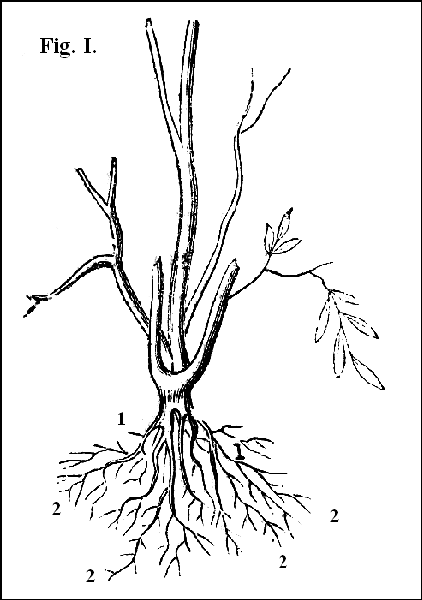
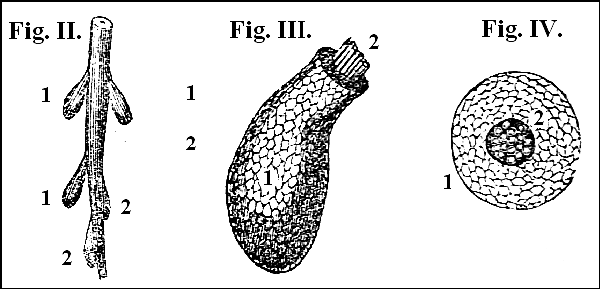
3. But this is not all; for the addition of a
superior function requires not only the addition of
an organ having a corresponding superiority of
structure, but it requires, further, that a certain
elevation of structure should be communicated to
all the organs of all the inferior functions, on account
of the relation which it is necessary to establish
between function and function. Unless the
organ of an inferior function be constructed with
a perfection corresponding to that of the organ of
a superior function, the inferior will be incapable
of working in harmony with the superior. Take,
for example, the inferior function of nutrition:
nutrition is an organic function equally necessary
to the plant and to the animal, and requiring in
both organs for performing it; but this function
cannot be performed in the animal by organs as
simple as suffice for the plant. Nutrition, in the
plant, is carried on in the following mode:—The
root of the plant is divided, like the trunk, into
numerous branches (fig. I. 1). These branches
divide and subdivide into smaller and smaller
branches, until at last they reach an extreme degree
of minuteness (fig. I. 2 2). The smallest of
these divisions, called, from their hair-like tenuity,
capillary (fig. I. 2 2), are provided with a peculiar
structure, which is endowed with a specific
function. In most plants this peculiar structure
is found at the terminal point of the rootlet (fig. I.
2 2); but in some plants the capillary branches
of the rootlets are provided with distinct bodies
(fig. II. 1 2), scarcely to be discerned when the
root has been removed some time from the soil,
and has become dry (fig. II. 2 2); but which, in a
few minutes after the root has been plunged in
water, provided the plant be still alive, become
turgid with fluid, and, consequently, distinctly
visible (fig. II. 1 1 1). These bodies, when they
exist, or the terminal point of the rootlet when
these bodies are absent, are termed spongeolæ, or
spongeoles; and the structure and function of the
organ, in both cases, are conceived to be precisely
the same. In both the organ consists of a minute
cellular structure. Fig. III. 1, shows this structure
as it appears when the object is magnified.
The office of this organ is to absorb the aliment of
the plant from the soil; and so great is its absorbing
power, that, as is proved by direct experiment,
it absorbs the colouring molecules of liquids,
though these molecules will not enter the ordinary
pores, which are of much greater magnitude.
With the spongeoles are connected vessels which
pass through the substance of the stem or trunk
to the leaf. Fig. III. 2, shows these tubes
springing from the cellular structure of the spongeole,
and passing up to the stem or trunk. Fig.
IV. 2, exhibits a magnified view of the appearance
of the mouths of these tubes on making an
horizontal section of the spongeole. Fig. V.
1 1 1, exhibits a view of these tubes passing to
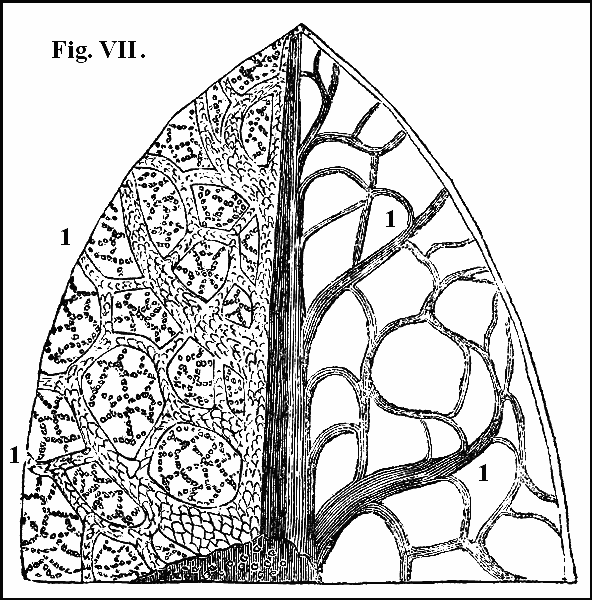
the leaf. Figs. VI. and VII. 1 1 1 1, show these
vessels spread out upon, and ramifying through,
the leaf. The crude aliment, borne by these tubes
to the leaf, is there converted into proper nutriment;
and from the leaf, when duly elaborated,
this proper nutriment is carried out by ducts to
the various organs of the plant, in order to supply
them with the aliment they need.
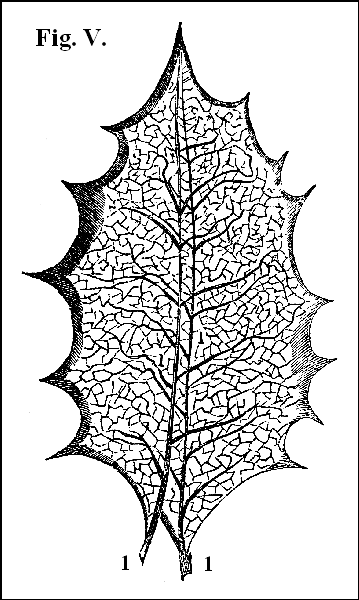
Now, for carrying on the process of nutrition in
this mode, there must be organs to absorb the
crude aliment, organs to convey the crude aliment
to the laboratory, the leaf, in which it is converted
into proper nutriment; and, finally, organs for
carrying out this proper nutriment to the system.
Complication of structure, to this extent, is indispensable;
and, accordingly, with spongeolæ, with
sap-vessels, with leaves, with distributive ducts,
the plant is provided. Without all the parts of
this apparatus it could not carry on its function:
any further complication would be useless.
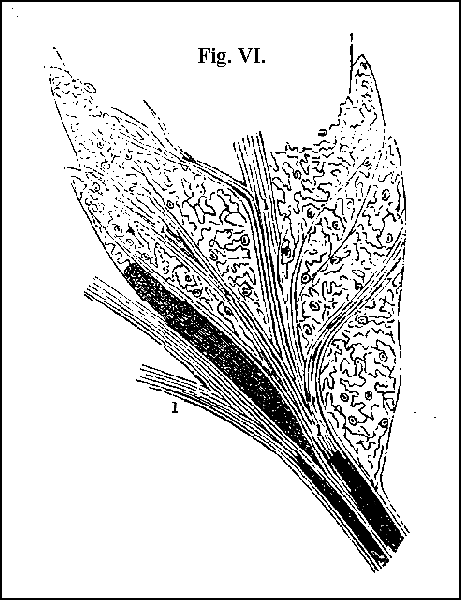
But, suppose a new and superior function to
be added to the plant; suppose it to be endowed
with the power of locomotion, what would be the
consequence of communicating to it this higher
power? That its former state of simplicity would
no longer suffice for the inferior function. Why?
because the exercise of the superior would interrupt
the action of the inferior function. Nutrition
by imbibition, and the exercise of locomotion, cannot
go on simultaneously in the same being. The
plant is fixed in the soil by its roots; and from
this, its state of immobility, results this most important
consequence, that its spongeolæ are always
in contact with its food.
But we may imagine a plant not fixed to the
soil; a plant so constituted as to be capable of
moving from place to place; such a plant would
not be always in contact with its food, and therefore,
as it exercised its faculty of locomotion, it
could not but interrupt or suspend its function of
nutrition. In a being capable of carrying on these
two functions simultaneously, the entire apparatus
of the function of nutrition must then be modified.
Instead of having spongeolæ fixed immovably
in the earth, and spread out in a soil adapted
to transmit to these organs nutrient matter in a
state fitted for absorption, it must be provided with
a reservoir for containing its food, in order that it
may carry its aliment about with it in all its changes
of place. And such is the modification uniformly
found in all animals: an internal reservoir for
containing its food is provided, perhaps, for every
animal without exception. Even the simplest and
minutest creatures with which the microscope has
made us acquainted, the lowest tribes of the Infusoria
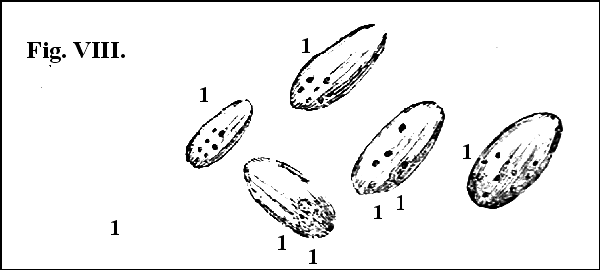
(fig. VIII.), the sentient, self-moving cellules,
placed at the very bottom of the animal scale, possess
this modification of structure. For a long
time it was conceived that these minute and simple
creatures were without distinction of parts, that
they had no separate organs for the reception and
digestion of their food; that they absorbed their
aliment through the porous tissue of which their
body is composed; that thus, instead of having a
separate stomach, their entire body is a stomach,
and instead of having even as much as a separate
organ for absorption, like the more perfect plant,
the whole body might be considered as a single
spongeole.
But, by a simple and beautiful experiment, a
German physiologist has shown the incorrectness
of this opinion, and has established the fact, that
the distinction between the plant and the animal,
here contended for, is found even at the very lowest
point of the animal scale. Like other physiologists,
conceiving that the difficulty of discovering
the structure of the lower tribes of the
animalculi might be owing to the transparency or
the tissues of which they are composed, it struck
Ehrenberg, that if he could feed them with coloured
substances, he might obtain some insight into
their organization. In his first endeavours to accomplish
this object he failed, for he employed
the pigments in ordinary use; but either the animals
would not touch aliment thus adulterated, or
those that did so were instantly killed. It then
occurred to him, that these colours are adulterated
with lead and other substances, in all probability
noxious to the little subjects of his experiment.
"What I require," said he, "is some vegetable or
animal colouring matter perfectly pure." He then
tried perfectly pure indigo and perfectly pure
carmine. His success was now complete: in a minute
or two, after mixing with their food pure vegetable
colouring matter, he observed in the interior of the
body of these creatures minute spots of a definite
figure, and of the colour of the pigment employed
(fig. VIII. 1 1 1 1). The form and magnitude of
these spots were different in different tribes, but the
same in the same individual, and even in the same
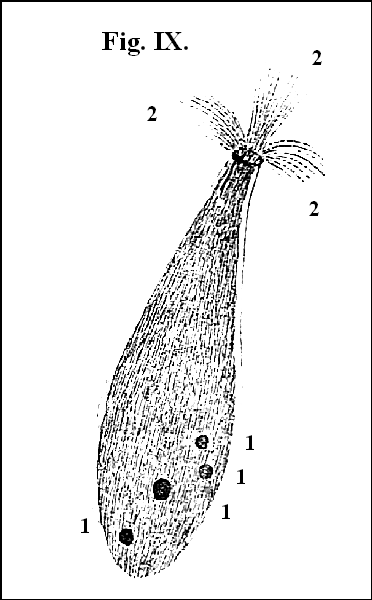
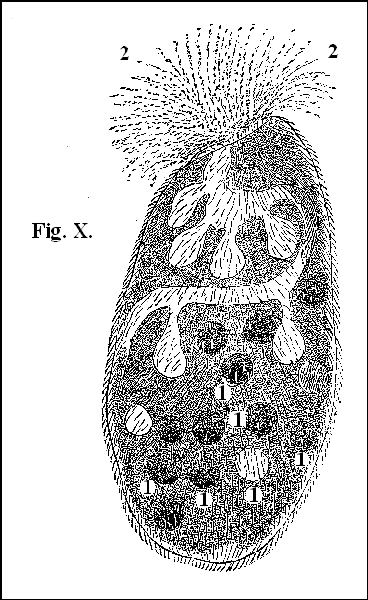
species (fig. IX. 1 1, fig. X. 1 1). No other parts
of the body were tinged with the colour, though
the animals remained in the coloured fluid for days
together. This was decisive. This physiologist
had now obtained an instrument capable of revealing
to him the interior organization of a class
of beings, the structure of which had heretofore
been wholly unknown. On applying it to the
Monas Termo (fig. VIII.), the animated point, or
cellule, which stands at the bottom of the animal
scale, he discovered, in the posterior portion of its
body, several coloured spots which constitute its
stomachs (fig. VIII. 1 1 1 1). The different situations
and different forms of the stomach in different
tribes of these creatures, are represented by the
coloured portions (fig. VIII. 1, fig. IX. 1, fig. X.
1), in which the currents of fluid flowing to their
mouths are seen (fig. IX. 2, fig. X. 2). These experiments
go far towards establishing the fact,
that every animal, even the very lowest, has an external
mouth and an internal stomach, and that it
takes its food by an act of volition.
But if the proof of this must be admitted to be
still imperfect with regard to the lowest tribes of
animals, it is certain that, as we ascend in the
scale of organization, the nutritive apparatus is
uniformly arranged in this mode. Every animal of
every class large enough to be distinctly visible,
and the structure of which is not rendered inappreciable
by the transparency of its solids and
fluids, is manifestly provided with a distinct internal
reservoir for containing its food. On the
internal surface of this reservoir open the mouths
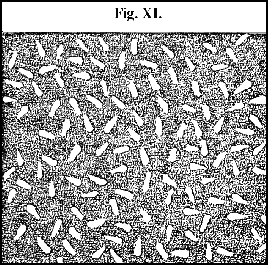
of vessels, minute in size but countless in number,
which absorb the food from the stomach.
Fig. XI. shows these vessels opening on the inner
surface of the stomach, the white points representing
their mouths, turgid with the food they have
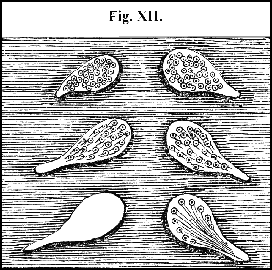
absorbed. Fig. XII. exhibits magnified views of
the same vessels, the points representing their open
mouths, and the lines the vessels themselves in
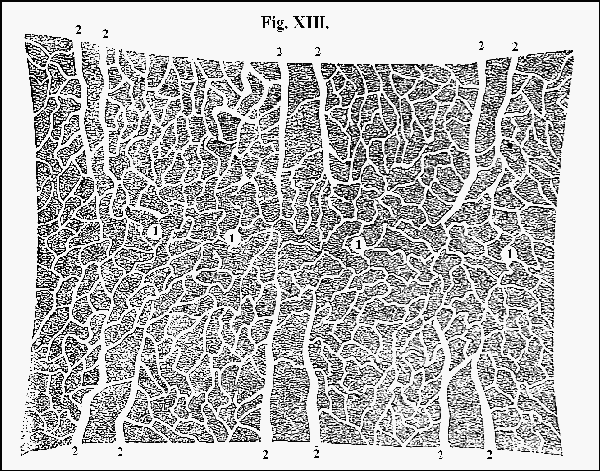
continuation with their mouths. Fig. XIII. shows
the appearance of the inner surface of the intestine
soon after the animal has taken food; the
smaller white lines (1 1 1 1) representing the absorbent
vessels full of digested food, and the larger
lines (2 2 2 2) the trunks of the absorbent vessels
formed by the union of many of the smaller.
From this account, it is clear that the absorbing
vessels of the stomach perform an
office precisely analogous to that of the spongeoles
of the root. What the soil is to the
plant, the stomach is to the animal. The absorbing
vessels diffused through the stomach, as long
as the stomach contains food, are in exactly the
same condition as the spongeoles of the root spread
out in the soil; and the absorbing vessels of the
stomach are as much and as constantly in contact
with the aliment, which it is their office to take
into the system, as the spongeoles of the root.
Such, then, is the expedient adopted to render the
function of nutrition compatible with the function
of locomotion. A reservoir of food is placed in the
interior of the animal, provided with absorbent
vessels which are always in contact with the aliment.
In this mode, contact with aliment is not
disturbed by continual change of place; the organic
process is not interrupted by the exercise of
the animal function.
But the more elaborate organization which it is
necessary to impart to the apparatus of the inferior
function, in consequence of the communication of
a superior faculty, is not completed simply by the
addition of this new organ, the stomach. Other
complications are indispensable; for if food be
contained in an isolated organ, placed in the interior
of the body, means must be provided for conveying
the food into this organ; hence the necessity
of an apparatus for deglutition. Moreover,
the food having been conveyed to the stomach,
and having undergone there the requisite changes,
means must next be provided for conveying it from
the stomach to the other parts of the body; hence
the necessity of an apparatus for the circulation.
But food, however elaborately prepared by the
stomach, is incapable of nourishing the body, until
it has been submitted to the action of atmospheric
air; hence the necessity of an additional apparatus,
either for conveying food to the air, or for
transmitting air to the food, or for bringing both
the food and the air into contact in the same
organ. And, when structure after structure has
been built up, in order to carry on this extended
series of processes, the number of provisions required
is not even yet complete; for of the most
nutritious fond the whole mass is not nutritive;
and even the whole of that portion of it which is
actually applied to the purpose of nutrition, becomes,
after a time, worn out, and must be removed
from the system; hence the necessity of a
further apparatus for excretion.
That nutrition and locomotion may go on together,
it is clear, then, that there must be provided
a distinct apparatus for containing food, a distinct
apparatus for deglutition, a distinct apparatus for
circulation, a distinct apparatus for respiration,
a distinct apparatus for excretion, and so on;
and that, in this manner, the communication of a
single function of a superior order renders a modification
not merely of one but of many inferior
functions absolutely indispensable, in order to
adjust the one to the other, and to enable them
to act in harmony.
But the necessary complication of structure
does not stop even here; for the communication of
one function of a superior order imposes the necessity
of communicating still another. Locomotion
cannot be exercised without perception; sensation
is indispensable to volition, and volition, of
course, to voluntary motion. A being endowed
with the power of moving from place to place,
without possessing the power of perceiving external
objects, must be speedily destroyed. The
communication of sensation to a creature fixed
immovably to a single spot, conscious of the approach
of bodies, but incapable of avoiding their
contact, would be not only useless but pernicious,
since it would be to make a costly provision for
the production of pain, and nothing else; but the
communication of locomotion without sensation
would be as unwisely defective, as the former
would be perniciously expensive; since it would
be to endow a being with a faculty, the exercise
of which would be fatal to it for the want of a
second faculty to guide the first. Nor could the
possession of locomotion, without the further possession
of sensation, be otherwise than fatal, for
another reason. Consciousness is not necessary to
nutrition as performed by the plant, but it is
indispensable to nutrition as performed by the
animal: for if the food of the animal be not always
on the same spot with itself; if it be under the
necessity of searching for it, and of conveying it,
when found, into the interior of its body, it must,
of course, possess the power of perceiving it when
within its reach, and of apprehending and appropriating
it by an act of volition, of none of which
actions is it capable without the possession of sensation.
Again, then, we see that, in order to
secure harmonious action, function must be put in
relation with function. In order to prevent jarring
and mutually-destructive action, function
must be superadded to function, and throughout
the animal creation the complication of structure,
which is necessary for the accomplishment of these
ends, is given without parsimony, but without
profusion: nothing is given which is not needed,
nothing is withheld which is required.
4. As we ascend in the scale of organization,
numerous functions being carried on, and numerous
organs constructed for performing them, it is
obvious that the range of each function must be
proportionally extended; the range necessarily increasing
with the multiplication of organ and function:
and this is another cause of the unavoidable
complication of structure. Slight consideration
will suffice to show the necessary connexion between
an extended range of action and complication
of structure. Take, as an example, the organic
function of respiration: respiration is the function
by which air is brought into contact with food; it
is the completion of digestion. The sole end of
all the apparatus that belongs to this function is
to bring the air and the food into a certain degree
of proximity. Now, when all the substances that
enter into the composition of the body of an animal
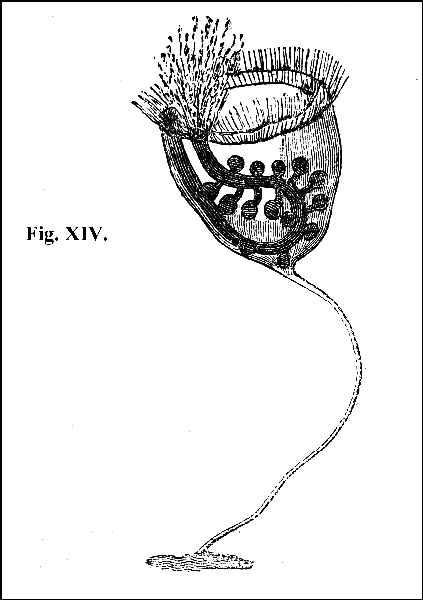
are slight, delicate, and permeable to air (as
in fig. XIV.), and when the body is always surrounded
by air, air must at all times be in contact
with the particular organ that contains the food,
no less than with the general system to which the
food is distributed. In this case, to construct a
separate apparatus for containing air would be
useless, because wherever food is, there air must
be, since it constantly permeates every part of the
body.
When, on the other hand, the tissues are so firm
and dense as to be impermeable; when they are
folded into bulky and complex organs, and when
these organs are placed in situations to which the
external air cannot reach, the construction of a
separate apparatus for respiration is indispensable.
The respiratory apparatus consists either of organs
for carrying air to the food, or of organs for carrying
food to the air. The one or the other is
adopted, according to the nature of the body. If
the size of the animal be small; if the tissues
which form the solid portion of its body be delicate
in texture; if, at the same time, the wants
of its economy require that its food should be
highly aërated (for there is the closest connexion
between energy of function and perfect aëration of
the food), an apparatus of sufficient magnitude to
aërate the food in a high degree would occupy
the entire bulk of the body. In such a case, it is
easier to carry air to the food than food to the air;
it is better to make the entire body a respiratory
organ, than to construct a respiratory organ disproportioned
to the magnitude of the body. Air-tubes
diffused through every part of the body, and
opening on its external surface, would obviously
afford to every point of the system an easy access
of air. By an expedient of this kind the system
might be highly aërated, while the respiratory
apparatus would occupy but a comparatively small
space; the function might be performed on an extended
scale, while there would be no necessity for
encumbering a minute body with a bulky organ.
And this is the mode in which respiration is carried
on in large tribes of creatures, whose body is
small in size and delicate in texture, and the functions
of whose economy are performed with energy
(fig. XV.).
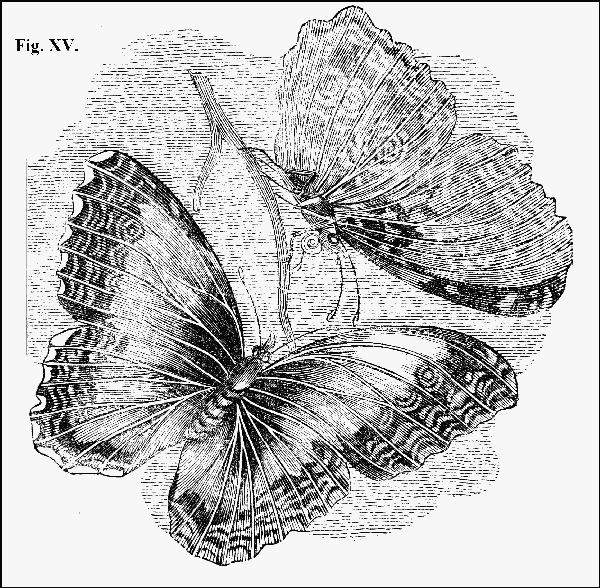
The Achilles Butterfly of South America (Papilio Achilles),
showing the tracheæ on the upper and under side of the
wings.
But this contrivance will not do when the animal
is of large magnitude; when its body is
divided into numerous compartments; when these
compartments extend far beneath the external
surface; when important organs are placed in
deeply-seated cavities; and when the substances
that compose the organs are dense, hard, thick,
and convoluted. To construct air-tubes of the
requisite diameter and length, always open, always
in a condition to permit the ingress and egress of
an adequate current of air to and from the remotest
nook and corner of a body such as this, would be
difficult, if not impossible. At all events, it is
easier, in such a case, to carry the food to the air,
than the air to the food. But, for the accomplishment
of this purpose, what is necessary? An organ
for containing food; an organ for containing air;
vessels to carry food to and from the receptacle of
the aliment; vessels to carry air to and from the
receptacle of the air; expedients to expose a stream
of food to a current of air; and, finally, tubes to
carry out to the system the product of this complicated
operation. Accordingly, a reservoir of food
and a reservoir of air; an apparatus by which both
are conveyed to their respective receptacles; and an
apparatus by which both are brought into contact
sufficiently close to admit of their mutual action,
are all combined in the lung of the animal, and in
the mechanism by which its movements are effected.
The object is accomplished, but the apparatus by
which it is effected is as complex in structure as
it is efficient in action; the result simple; the
means by which the result is secured, highly complicated.
And if this be true of an inferior or organic
function, it is still more strikingly true of a superior
or animal function. The relation is still
stricter between the complexity of the apparatus
of sensation and the range of feeling, than between
the complexity of the apparatus of respiration and
the range of the respiratory process. The greater
the number of the senses, the greater the number
of the organs of sense; the more accurate and
varied the impressions conveyed by each, the more
complex the structure of the instrument by which
they are communicated; the more extended the
range of the intellectual operations, the larger the
bulk of the brain, the greater the number of its
distinct parts, and the more exquisite their organization.
From the point of the animal scale, at
which the brain first becomes distinctly visible,
up to man, the basis of the organ is the same;
but, as the range of its function extends, part after
part is superadded, and the structure of each part
becomes progressively more and more complex.
The evidence of this, afforded by comparative
anatomy, is irresistible, and the interest connected
with the study of it can scarcely be exceeded.
5. In the last place, structure is complex in
proportion to the energy of function. The greater
the power with which voluntary motion is capable
of being exerted, the higher the organization of
the apparatus by which it is performed; the more
compact and dense the shell, the cartilage, the
bone, the firmer the fibre of the muscle, and, in
general, the greater its comparative bulk. The
wing of the eagle is as much more developed than
the wing of the wren, as its flight is higher, and
its speed swifter. The muscles which give to the
tiger the rapidity and strength of its spring possess
a more intense organization than those which
slowly move on the tardigrade sloth. The structure
of the brain of man is more exquisite than
that of the fish, as his perceptions are more acute,
and capable of greater combination, comprehension,
and continuity.
Thus we see that the organization of the animal
is more complex than that of the plant, not from
an arbitrary disposition, but from absolute necessity.
The few and simple functions performed by
the plant require only the few and simple organs
with which it is provided: the numerous and
complicated functions performed by the animal
require its numerous and complicated organs: the
plant, simple as it is in structure, is destitute of
no organ required by the nature of its economy;
the animal, complex as it is in structure, is in
possession of no organ which it could dispense
with: from the one, nothing is withheld which is
needed; to the other, nothing is given which is superfluous:
in the one, there is economy without
niggardliness; in the other, munificence without
waste.
CHAPTER II.
Two distinct lives combined in the animal—Characters of
the apparatus of the organic life—Characters of the
apparatus of the animal life—Characteristic differences
in the action of each—Progress of life—Progress of
death.
Of the two sets of functions carried on by living
beings, it has been shown, that the plant performs
only one, while the animal exercises both. The
two lives thus in continual play in the animal
differ from each other as much as the process of
vegetation differs from that of thought, yet they
are united so closely, and act so harmoniously,
that their existence as distinct states is not only
not apparent to ordinary observation, but the very
discovery of the fact is of recent date, and forms
one among the splendid triumphs of modern physiology.
Their action is perfect, yet their separate
identity is so distinctly preserved, that each has its
own apparatus and its own action, which are not
only not the same, but, in many interesting circumstances,
are in striking contrast to each other.
1. In general the organs that belong to the
apparatus of the organic life are single, and not
symmetrical; the organs that belong to the apparatus
of the animal life are either double, or
symmetrical, or both. As will be shown hereafter,
the heart, the lungs, the stomach, the
intestines, the liver, the pancreas, the spleen, the
instruments by which the most important functions
of the organic life are carried on, are single organs.
(Chap. 5.) The figure of each is more or less irregular,
so that if a line were carried through their
centre, it would not divide them into two equal
and precisely corresponding portions. On the
contrary, the organs of the animal life are symmetrical.
The brain and the spinal cord are
divisible into two perfectly equal parts. (Chap.
5.) The nerves which go off from these organs
for the most part go off in pairs equal in size and
similar in distribution. (Ibid.) The trunk, so
important an instrument of voluntary motion,
when well formed, is divisible into two perfectly
corresponding portions. (Ibid.) The muscular
apparatus of one half of the body is the exact
counterpart of that of the other; while the arms,
the hands, and the lower extremities are not only
double, but the organization of the one is precisely
similar to that of its fellow.
2. In general, the apparatus of the organic life is
placed in the interior of the body, while that of the
animal life is placed on the external surface. The
organic organs are the instruments by which life is
maintained. There is no action of any one of them
that can be suspended even for a short space of time
without the inevitable extinction of life. But the
animal organs are not so much instruments of life
as means by which a certain relation is established
between the living being and external objects. And
this difference in their office is the reason of the
difference in their position. Existence depending
on the action of the organic organs, they are placed
in the interior of the body; they are fixed firmly in
their situation in order that they may not be disturbed
by the movements of locomotion; they are
enveloped in membranes, covered by muscles,
placed under the shelter of bones, and every possible
care is taken to secure them from accident and
to shield them from violence. Existence not being
immediately dependent on the action of the organs
of the animal life, they do not need to be protected
from the contact of external objects with extraordinary
care, but it is necessary to the performance
of their functions that they should be placed at the
exterior of the body. And there they are placed, and
so placed as to afford an effectual defence to the
organic organs. Thus the groundwork of the animal
is made the bulwark of the organic life. The
muscles, the immediate agents by which voluntary
motion is effected, and the bones, the fixed points
and the levers by which that motion acquires the
nicest precision and the most prodigious rapidity
and power, are so disposed that, while the latter accomplish,
in the most perfect manner, their primary
and essential office in relation to the muscles, they
serve a secondary but scarcely less important office
in relation to the internal viscera. As we advance
in our subject, we shall see that a beautiful illustration
of this is afforded in the structure and action
of the trunk; that the trunk is moveable; that
it is composed of powerful muscles, and of firm and
compact bones; and that while its movements are
effected by the action of the muscles which are
attached to the bones, these bones enclose a
cavity, in which are placed the lungs, the heart,
the great trunks of the venous system, the great
trunks of the arterial system, and the main trunk
of the thoracic duct, the vessel by which the
digested aliment is carried into the blood. (Chap.
5.) Thus, by these strong and firm bones, together
with the thick and powerful muscles that
rest upon them, is formed a secure shelter for a
main portion of the apparatus of the organic
functions of respiration, circulation, and digestion.
The bones and muscles of the thorax,
themselves performing an important part in the
function of respiration, afford to the lungs the
chief organ of this function, composed of tender
and delicate tissues, easily injured, and the
slightest injury perilling life, a free and secure
place to act in. The fragile part of the apparatus
is defended by the osseous portion of it, the play
of the latter being equally essential to the function
as that of the former. In like manner the tender
and delicate substance of the brain and spinal
cord, the central seat of the animal life, with
which all the senses are in intimate communion,
is protected by bones and muscles which perform
important voluntary movements while the organs
of sense which put us in connexion with the external
world, which render us susceptible of pleasure,
and which give us notice of the approach of objects
capable of exciting pain, are placed where external
bodies may be brought most conveniently and completely
into contact with them; and where alone
they can be efficient as the sentinels of the system.
For this reason, with the exception of the sense of
touch, which, though placed especially at the extremities
of the fingers, is also diffused over the
whole external surface of the frame, all the senses
have their several seats in the head, the most elevated
part of the body, of an ovoid figure, capable
of moving independently of the rest of the fabric,
and which, being supported on a pivot, is enabled
to describe at least two-thirds of a circle.
Such is the difference in the structure and position
of the apparatus of the two lives, but the
difference in their action is still more striking.
1. The action of the apparatus of the organic
life when sound is without consciousness; the
object of the action of the apparatus of the animal
life is the production of consciousness. The final
cause of the action of the apparatus of the organic
life is the maintenance of existence; the final
cause of the action of the apparatus of the animal
life is the production of conscious existence.
What purpose would be answered by connecting
consciousness with the action of the organic
organs? Were we sensible of the organic processes;
did we know when the heart beats, and
the lung plays, and the stomach digests, and the
excretory organ excretes, the consciousness could
not promote, but might disturb the due and orderly
course of these processes. Moreover they would
so occupy and engross our minds that we should
have little inclination or time to attend to other
objects. Beneficently therefore are they placed
equally beyond our observation and control.
Nevertheless, when our consciousness of these
processes may be of service; when they are going
wrong; when their too feeble or too intense action
is in danger of destroying existence, the animal
life is made sensible of what is passing in the
organic, in order that the former may take beneficial
cognizance of the latter, may do what experience
may have taught to be conducive to the
restoration of the diseased organ to a sound state,
or avoid doing what may conduce to the increase
or maintenance of its morbid condition.
But while the action of the organic organs is
thus kept alike from our view and feeling, the sole
object of the action of the animal organs is to produce
and maintain a state of varied and extended
consciousness. We do not know when the heart
dilates to receive the vital current, nor when it
contracts to propel it with renewed impetus
through the system; nor when the blood rushes
to the lung to give out its useless and noxious particles;
nor when the air rushes to the blood
to take up those particles, to replace them by
others, and thus to purify and renovate the vital
fluid. Many processes of this kind are continually
going on within us during every moment of our
existence, but we are no more conscious of them
than we are of the motion of the fluids in the blade
of grass on which we tread. On the contrary
when an external object produces, in a sentient
nerve, that change of state which we denote by
the words "an impression;" when the sentient
nerve transmits this impression to the brain; when
the brain is thereby brought into the state of perception,
the animal life is in active operation, and
percipient or conscious existence takes place. Consciousness
does not belong to the organic, it is the
animal life.
2. The functions of the organic life are performed
with uninterrupted continuity; to those of
the animal life rest is indispensable. The action
of the heart is unceasing; it takes not and needs
not rest. On it goes, for the space of eighty or
ninety years, at the rate of a hundred thousand
strokes every twenty-four hours, having at every
stroke a great resistance to overcome, yet it continues
this action for this length of time without intermission.
Alike incessant is the action of the
lung, which is always receiving and always emitting
air; and the action of the skin, which is always
transpiring and always absorbing; and the action of
the alimentary canal, which is always compensating
the loss which the system is always sustaining.
But of this continuity of action the organs and
functions of the animal life are incapable. No
voluntary muscle can maintain its action beyond a
given time; no effort of the will can keep it in a
state of uninterrupted contraction; relaxation must
alternate with contraction; and even this alternate
action cannot go on long without rest. No organ
of sense can continue to receive impression after
impression without fatigue. By protracted exertion
the ear loses its sensibility to sound, the eye
to light, the tongue to savour, and the touch to
the qualities of bodies about which it is conversant.
The brain cannot carry on its intellectual operations
with vigour beyond a certain period; the
trains of ideas with which it works become, after
a time, indistinct and confused; nor is it capable
of reacting with energy until it has remained in a
state of rest proportioned to the duration of its preceding
activity.
And this rest is sleep. Sleep is the repose of the
senses, the rest of the muscles, their support and
sustenance. What food is to the organic, sleep is
to the animal life. Nutrition can no more go on
without aliment, than sensation, thought, and
motion without sleep.
But it is the animal life only that sleeps: death
would be the consequence of the momentary slumber
of the organic. If, when the brain betook
itself to repose, the engine that moves the blood
ceased to supply it with its vital fluid, never again
would it awake. The animal life is active only
during a portion of its existence; the activity of
the organic life is never for a moment suspended;
and in order to endow its organs with the power
of continuing this uninterrupted action, they are
rendered incapable of fatigue: fatigue, on the
contrary, is inseparable from the action of the
organs of the animal life; fatigue imposes the
necessity of rest, rest is sleep, and sleep is renovation.
3. Between all the functions of the organic life
there is a close relation and dependence. Without
the circulation there can be no secretion; without
secretion, no digestion; without digestion, no nutrition;
without nutrition, no new supply of circulating
matter, and so through the entire circle. But
the functions of the animal life are not thus dependent
on each other. One of the circle may be
disordered without much disturbance of the rest; and
one may cease altogether, while another continues
in vigorous action. Sensation may be lost, while
motion continues; and the muscle may contract
though it cannot feel. One organ of sense may
sleep while the rest are awake. One intellectual
faculty may be in operation while others slumber.
The muscle of volition may act, while there is no
consciousness of will. Even the organs of the
voice and of progression may perform their office
while the sensorium is deeply locked in sleep.
4. The two lives are born at different periods,
and the one is in active operation before the other
is even in existence. The first action observable
in the embryo is a minute pulsating point. It is
the young heart propelling its infant stream. Before
brain, or nerve, or muscle can be distinguished,
the heart is in existence and in action;
that is, the apparatus of the organic function
of the circulation is built up and is in operation
before there is any trace of an animal organ.
Arteries and veins circulate blood, capillary
vessels receive the vital fluid, and out of it form
brain and muscle, the organs of the animal, no
less than the various substances that compose the
organs of the organic life. The organic is not only
anterior to the animal life, but it is by the action of
the organic that existence is given to the animal life.
The organic life is born at the first moment of
existence; the animal life not until a period comparatively
distant; the epoch emphatically called
the period of birth, namely, the period when the
new being is detached from its mother; when it
first comes into contact with external objects;
when it carries on all the functions of its economy
by its own organs, and consequently enjoys independent
existence.
5. The functions of the organic life are perfect
at once. The heart contracts as well, the arteries
secrete as well, the respiratory organs work as well
the first moment they begin to act as at any subsequent
period. They require no teaching from
experience, and they profit nothing from its lessons.
On the contrary, the operations of the
brain, and the actions of the voluntary muscles,
feeble and uncertain at first, acquire strength
by slow degrees, and attain their ultimate perfection
only at the adult age. How indistinct
and confused the first sensations of the infant!
Before it acquire accuracy, precision, and truth,
how immense the labour spent upon perception!
Sensations are succeeded by ideas; sensations
and ideas coalesce with sensations and
ideas; combinations thus formed suggest other
combinations previously formed, and these a third,
and the third a fourth, and so is constituted a
continuous train of thought. But the infantile
associations between sensation and sensation, between
idea and idea, and between sensations and
ideas, are, to a certain extent, incorrect, and to a
still greater extent inadequate; and the misconception
necessarily resulting from this early imperfection
in the intellectual operations is capable of
correction only by subsequent and more extended
impressions. During its making hours, a large portion
of the time of the infant is spent in receiving
impressions which come to it every instant from
all directions, and which it stores up in its little
treasury; but a large portion is also consumed in
the far more serious and difficult business of discrimination
and correction. Could any man, after
having attained the age of manhood, reverse the
order of the course through which he has passed;
could he, with the power of observation, together
with the experience that belong to manhood, retrace
with perfect exactness every step of his sentient
existence, from the age of forty to the moment
that the air first came into contact with his body
at the moment of his leaving his maternal dwelling,
among the truths he would learn, the most
interesting, if not the most surprising, would be
those which relate to the manner in which he
dealt with his earliest impressions; with the mode
in which he combined them, recalled them, laid
them by for future use; made his first general
deduction; observed what subsequent experience
taught to be conformable, and what not conformable,
to this general inference; his emotions on
detecting his first errors, and his contrasted feelings
on discovering those comprehensive truths,
the certainty of which became confirmed by every
subsequent impression. Thus to live backwards
would be, in fact, to go through the analysis of the
intellectual combinations, and, consequently, to
obtain a perfect insight into the constitution of the
mind; and among the curious results which would
then become manifest, perhaps few would appear
more surprising than the true action of the senses.
The eye, when first impressed by light, does not
perceive the objects that reflect it; the ear, when
first impressed by sound, does not distinguish the
sonorous body. When the operation for cataract
has been successfully performed in a person born
blind, the eye immediately becomes sensible to
light, but the impression of light does not immediately
give information relative to the properties of
bodies. It is gradually, not instantaneously; it is
even by slow degrees that luminous objects are
discerned with distinctness and accuracy. To
see, to hear, to smell, to taste, to touch, are processes
which appear to be performed instantaneously,
and which actually are performed with
astonishing rapidity in a person who observes them
in himself; but they were not always performed
thus rapidly: they are processes acquired, businesses
learnt; processes and businesses acquired
and learnt, not without the cost of many efforts
and much labour. But the senses afford merely
the materials for the intellectual operations of memory,
combination, comparison, discrimination,
induction, operations the progress of which
is so slow, that they acquire precision, energy,
and comprehensiveness only after the culture of
years.
And the same is true of the muscles of volition.
How many efforts are made before the power of
distinct articulation is acquired! how many before
the infant can stand! how many before the child
can walk! The organic life is born perfect; the
animal life becomes perfect only by servitude, and
the aptitude which service gives.
6. The organic life may exist after the animal life
has perished. The animal life is extinguished when
sensation is abolished, and voluntary motion can
be performed no more. But disease may abolish
sensation and destroy the power of voluntary motion,
while circulation, respiration, secretion, excretion,
in a word, the entire circle of the organic
functions continues to be performed. In a single
instant apoplexy may reduce to drivelling fatuity
the most exalted intellect, and render powerless
and motionless muscles of gigantic strength; while
the action of the heart and the involuntary contractions
of the muscles may not only not be weakened,
but may act with preternatural energy.
In a single instant, apoplexy may even completely
extinguish the animal life, and yet the organic may
go on for hours, days, and even weeks; while catalepsy,
perhaps the most singular disease to which
the human frame is subject, may wholly abolish
sensation and volition, while it may impart to the
voluntary muscles the power of contracting with
such unnatural energy and continuity, that the
head, the trunk, the limbs may become immoveably
fixed in whatever attitude they happen to be at
the moment the paroxysm comes on. In this extraordinary
condition of the nervous system, however
long the paroxysm last, and however complete
the abolition of consciousness, the heart continues
to beat, and the pulse to throb, and the lungs to
respire, and all the organic organs to perform
their ordinary functions. Dr. Jebb gives the following
description of the condition of a young
lady who was the subject of this curious malady.
"My patient was seized with an attack just as
I was announced. At that moment she was employed
in netting; she was in the act of passing
the needle through the mesh; in that position she
became immoveably rigid, exhibiting, in a pleasing
form, a figure of death-like sleep, beyond the
power of art to imitate, or the imagination to conceive.
Her forehead was serene, her features perfectly
composed. The paleness of her colour, and
her breathing, which at a distance was scarcely
perceptible, operated in rendering the similitude to
marble more exact and striking. The position of
her fingers, hands, and arms was altered with difficulty,
but preserved every form of flexure they
acquired: nor were the muscles of the neck exempted
from this law, her head maintaining every
situation in which the hand could place it, as
firmly as her limbs."
In this condition of the system the senses were
in a state of profound sleep; the voluntary muscles,
on the contrary, were in a state of violent action;
but this action not being excited by volition, nor
under its control, the patient remained as motionless
as she was insensible. The brain was in a
state of temporary death; the muscle in a state of
intense life. And the converse may happen: the
muscle may die, while the brain lives; contractility
may be destroyed, while sensibility is perfect;
the power of motion may be lost, while that of
sensation may remain unaffected. A case is on
record, which affords an illustration of this condition
of the system. A woman had been for some
time confined to her bed, labouring under severe
indisposition. On a sudden she was deprived of
the power of moving a single muscle of the body;
she attempted to speak, but she had no power to
articulate; she endeavoured to stretch out her
hand, but her muscles refused to obey the commands
of her will, yet her consciousness was perfect,
and she retained the complete possession of
her intellectual faculties. She perceived that her
attendants thought her dead, and was conscious of
the performance upon her own person of the services
usually paid to the dead; she was laid out,
her toes were bound together, her chin was tied
up; she heard the arrangements for her funeral
discussed, and yet she was unable to make the
slightest sign that she was still in the possession
of sense, feeling, and life.
In one form of disease, then, the animal life,
both the sensitive and the motive portions of it,
may perish; and in another form of disease, either
the one or the other part of it may be suspended,
while the organic life continues in full operation:
it follows that the two lives, blended as they are,
are distinct, since the one is capable of perishing
without immediately and inevitably involving the
destruction of the other.
7. And, finally, as the organic life is the first
born, so it is the last to die; while the animal
life, as it is the latest born, and the last to attain
its full development, so it is the earliest to decline
and the first to perish. In the process of natural
death, the extinction of the animal is always anterior
to that of the organic life. Real death is a
later, and sometimes a much later event than apparent
death. An animal appears to be dead when,
together with the abolition of sensation and the loss
of voluntary motion, respiration, circulation, and
the rest of the organic functions can no longer be
distinguished; but these functions go on some
time after they have ceased to afford external indications
of their action. In man, and the warmblooded
animals in general, suspension or submersion
extinguishes the animal life, at the latest,
within the space of four minutes from the time that
the atmospheric air is completely excluded from the
lung; but did the organic functions also cease at
the same period, it would be impossible to restore
an animal to life after apparent death from drowning
and the like. But however complete and protracted
the abolition of the animal functions, re-animation
is always possible as long as the organic
organs are capable of being restored to their usual
vigour. The cessation of the animal life is but the
first stage of death, from which recovery is possible;
death is complete only when the organic
together with the animal functions have wholly
ceased, and are incapable of being re-established.
In man, the process of death is seldom altogether
natural. It is generally rendered premature by
the operation of circumstances which destroy life
otherwise than by that progressive and slow decay
which is the inevitable result of the action of organized
structure. Death, when natural, is the
last event of an extended series, of which the first
that is appreciable is a change in the animal life
and in the noblest portion of that life. The higher
faculties fail in the reverse order of their development;
the retrogression is the inverse of the progression,
and the noblest creature, in returning to
the state of non-existence, retraces step by step
each successive stage by which it reached the
summit of life.
In the advancing series, the animal is superadded
to the organic life; sensation, the lowest
faculty of the animal life, precedes ratiocination,
the highest. The senses called into play at the
moment of birth soon acquire the utmost perfection
of which they are capable; but the intellectual
faculties, later developed, are still later perfected,
and the highest the latest.
In the descending series, the animal life fails
before the organic, and its nobler powers decay
sooner and more rapidly than the subordinate.
First of all, the impressions which the organs of
sense convey to the brain become less numerous
and distinct, and consequently the material on
which the mind operates is less abundant and perfect;
but at the same time, the power of working
vigorously with the material it possesses more than
proportionally diminishes. Memory fails; analogous
phenomena are less readily and less completely
recalled by the presence of those which
should suggest the entire train; the connecting
links are dimly seen or wholly lost; the train itself
is less vivid and less coherent; train succeeds
train with preternatural slowness, and the consequence
of these growing imperfections is that, at
last, induction becomes unsound just as it was in
early youth; and for the same reason, namely,
because there is not in the mental view an adequate
range of individual phenomena; the only
difference being that the range comprehended in
the view of the old man is too narrow, because
that which he had learnt he has forgotten; while
in the youth it is too narrow, because that which
it is necessary to learn has not been acquired.
And with the diminution of intellectual power
the senses continue progressively to fail: the eye
grows more dim, the ear more dull, the sense of
smell less delicate, the sense of touch less acute,
while the sense of taste immediately subservient to
the organic function of nutrition is the last to
diminish in intensity and correctness, and wholly
fails but with the extinction of the life it serves.
But the senses are not the only servants of the
brain; the voluntary muscles are so equally; but
these ministers to the master-power, no longer kept
in active service, the former no longer employed to
convey new, varied, and vivid impressions, the
latter no longer employed to execute the commands
of new, varied, and intense desires, become
successively feebler, slower, and more uncertain in
their action. The hand trembles, the step totters,
and every movement is tardy and unsteady. And
thus, by the loss of one intellectual faculty after
another, by the obliteration of sense after sense,
by the progressive failure of the power of voluntary
motion; in a word, by the declining energy
and the ultimate extinction of the animal life,
man, from the state of maturity, passes a second
time through the stage of childhood back to that
of infancy; lapses even into the condition of the
embryo: what the fœtus was, the man of extreme
old age is: when he began to exist, he possessed
only organic life; and before he is ripe for the
tomb, he returns to the condition of the plant.
And even this merely organic existence cannot
be long maintained. Slow may be the waste of
the organic organs; but they do waste, and that
waste is not repaired, and consequently their functions
languish, and no amount of stimulus is
capable of invigorating their failing action. The
arteries are rigid and cannot nourish; the veins
are relaxed and cannot carry on the mass of blood
that oppresses them; the lungs, partly choked up
by the deposition of adventitious matter, and partly
incapable of expanding and collapsing by reason of
the feeble action of the respiratory apparatus, imperfectly
aërate the small quantity of blood that
flows through them; the heart, deprived of its
wonted nutriment and stimulus, is unable to contract
with the energy requisite to propel the vital
current; the various organs, no longer supplied
with the quantity and quality of material necessary
for carrying on their respective processes, cease
to act; the machinery stops, and this is death.
And now the processes of life at an end, the body
falls within the dominion of the powers which preside
universally over matter; the tie that linked all
its parts together, holding them in union and keeping
them in action, in direct opposition to those
powers dissolved, it feels and obeys the new attractions
to which it has become subject; particle after
particle that stood in beautiful order fall from their
place; the wonderful structures they composed
melt away; the very substances of which those
structures were built up are resolved into their
primitive elements; these elements, set at liberty,
enter into new combinations, and become constituent
parts of new beings; those new beings in
their turn perish; from their death springs life,
and so the changes go on in an everlasting circle.
As far as relates to the organized structures in
which life has its seat, and to the operations of
life dependent on those structures, such is its history;
a history not merely curious, but abounding
with practical suggestions of the last importance.
The usefulness of a familiar acquaintance with the
phenomena which have now been elucidated will
be apparent at every step as we proceed.
CHAPTER III.
Ultimate object of organization and life—Sources of pleasure—Special
provision by which the organic organs
influence consciousness and afford pleasure—Point at
which the organic organs cease to affect consciousness,
and why—The animal appetites: the senses: the intellectual
faculties: the selfish and sympathetic affections:
the moral faculty—Pleasure the direct, the ordinary, and
the gratuitous result of the action of the organs—Pleasure
conducive to the development of the organs, and to
the continuance of their action—Progress of human
knowledge—Progress of human happiness.
The object of structure is the production of function.
Of the two functions combined in the living
animal, one is wholly subservient to the other.
To build up the apparatus of the animal life, and
to maintain it in a condition fit for performing its
functions, is the sole object of the existence of the
organic life. What then is the object of the animal
life? That object, whatever it be, must be
the ultimate end of organization, and of all the
actions of which it is the seat and the instrument.
Two functions, sensation and voluntary motion,
are combined in the animal life. Of these two
functions, the latter is subservient to the former:
voluntary motion is the servant of sensation, and
exists only to obey its commands.
Is sensation, then, the ultimate object of organization?
Simple sensation cannot be an ultimate
object, because it is invariably attended with an
ultimate result; for sensation is either pleasurable
or painful. Every sensation terminates in a
pleasure or a pain. Pleasure or pain, the last
event in the series, must then be the final end.
Is the production of pain the ultimate object of
organization? That cannot be, for the production
of pain is the indirect, not the direct,—the extraordinary,
not the ordinary, result of the actions of
life. It follows that pleasure must be the ultimate
object, for there is no other of which it is possible
to conceive. The end of organic existence is animal
existence; the end of animal existence is sentient
existence; the end of sentient existence is
pleasurable existence; the end of life therefore is
enjoyment. Life commences with the organic
processes; to the organic are superadded the animal;
the animal processes terminate in sensation;
sensation ends in enjoyment; it follows, that enjoyment
is the final end. For this every organ is constructed;
to this every action of every organ is subservient;
in this every action ultimately terminates.
And without a single exception in the entire
range of the sentient creation, the higher the
organized structure the greater the enjoyment,
mediately or immediately, to which it is subservient.
From its most simple to its most complex
state, every successive addition to structure, by
which function is rendered more elevated and perfect,
proportionally increases the exquisiteness of
the pleasure to which the function ministers, and
in which it terminates.
Pleasure is the result of the action of living organs,
whether organic or animal; pleasure is the
direct, the ordinary, and the gratuitous result of
the action of both sets of organs; the pleasure
resulting from the action of the organs is conducive
to their complete development, and thereby to the
increase of their capacity for affording enjoyment;
the pleasure resulting from the action of the organs,
and conducive to their development, is
equally conducive to the perpetuation of their
action, and consequently to the maintenance of
life; it follows not only that enjoyment is the end
of life, but that it is the means by which life is
prolonged. Of the truth of each of these propositions,
it will be interesting to contemplate the
plenitude of the proof.
1. In the first place, pleasure is the result of the
action of the organic organs. It has indeed been
shown that the very character by which the action
of these organs is distinguished is that they are
unattended with consciousness. Nevertheless, by
a special provision, consciousness is indirectly
connected with the processes of this class, limited
in extent indeed, and uniformly terminating at a
certain point; but the extent and the limitation
alike conducing to the pleasurableness of its nature.
And this is an adjustment in the constitution
of our frame which is well deserving of attention.
Organic processes are dependent on a peculiar
influence derived from that portion of the nervous
system distinguished by the term organic. The
organic nerves, distributed to the organic organs,
take their origin and have their chief seat in the
cavities that contain the main instruments of the
organic life, namely, the chest and abdomen (see
chap. v.). As will be fully shown hereafter,
these nerves encompass the great trunks of the
blood-vessels that convey arterial blood to the
organic organs. In all its ramifications through
an organic organ, an arterial vessel is accompanied
by its organic nerve; so that wherever the capillary
arterial branch goes, secreting or nourishing,
there goes, inseparably united with it, an organic
nerve, exciting and governing.
Among the peculiarities of this portion of the
nervous system, one of the most remarkable is,
that it is wholly destitute of feeling. Sensibility
is inseparably associated with the idea commonly
formed of a nerve. But the nervous system consists
of two portions, one presiding over sensation
and voluntary motion, hence called the sentient
and the motive portions; the other destitute of
sensation, but presiding over the organic processes,
hence called the organic portion. If the communication
between the organic organ and the organic
nerve be interrupted, the function of the
organ, whatever it be, is arrested. Without its
organic nerves, the stomach cannot secrete gastric
juice; the consequence is, that the aliment is undigested.
Without its organic nerves, the liver
cannot secrete bile, the consequence is, that the
nutritive part of the aliment is incapable of being
separated from its excrementitious portion. The
organic organ receives from its organic nerve an
influence, without which it cannot perform its
function; but the nerve belonging to this class
neither feels nor communicates feeling, and hence
it imparts no consciousness of the operation of any
process dependent upon it. Yet there is not one
of these processes that does not exert a most important
influence over consciousness. How? By
a special provision, as curious in its nature as it is
important in its result.
Branches of sentient nerves are transmitted from
the animal to the organic system, and from the organic
to the animal; and an intimate communication
is established between the two classes. The
inspection of fig. XVI. will illustrate the mode in
which this communication is effected. A B represents
a portion of the spinal cord (one of the
central masses of the sentient system), covered
with its membranes. The part here represented
is a front view of that portion of the spinal cord
which belongs to the back, and which is technically
called the dorsal portion.
1, 2, 3, 4, 5, 6, 7, 8, 9, the second, &c. ribs with
the corresponding dorsal (sentient) nerves, a, b,
c, d, e, f, g, h, going out to supply their respective
organs with sensation.
C D E, a portion of the main trunk of the
organic (non-sentient) nerve, commonly called the
Great Sympathetic.
F G H, the membrane of the spinal cord cut
open and exposing I K, the spinal cord itself,
L, the anterior branch of one of the dorsal
nerves, arising from the anterior surface of the
spinal cord by several bundles of fibres.
M, the posterior branch of the same nerve,
arising in like manner from the posterior surface
of the spinal cord by several branches of fibres.
The anterior and posterior branches uniting to
form one trunk N.
Two branches, P Q, sent off from the spinal
(sentient) trunk to unite with the organic (non-sentient)
trunk.
R S T U V W, other branches of the sentient,
connected with the branches of the non-sentient
nervous trunks in the same mode.
X Y, the main trunk of the sympathetic (non-sentient)
nerve cut across and turned aside, in
order that the parts beneath it (P N) may be more
distinctly seen.
From this description, it is apparent that each
sentient nerve, before it goes out to the animal
organs, to which it is destined to communicate
sensation, sends off two branches to the organic or
the non-sentient. These sentient nerves mix and
mingle with the insensible nerves; accompany
them in their course to the organic organs, and
ramify with them throughout their substance. It
is manifest, then, that sentient nerves, that nerves
not necessary to the organic processes, having, as
far as is known, nothing whatever to do with those
processes, enter as constituent parts into the composition
of the organic organs. What is the result?
That organic organs are rendered sentient;
that organic processes, in their own nature insensible,
become capable of affecting consciousness.
What follows? What is the consciousness excited?
Not a consciousness of the organic process.
Of that we still remain wholly insensible.
Not simple sensation. The result uniformly produced,
as long as the state of the system is that of
health, is pleasurable consciousness. The heart
sends out to the organs its vital current. Each
organ, abstracting from the stream the particles it
needs, converts them into the peculiar fluid or solid
it is its office to form. The stomach, from the
arterial streamlets circulating through it, secretes
gastric juice; the liver, from the venous streamlets
circulating through it, secretes bile. When these
digestive organs have duly prepared their respective
fluids, they employ them in the elaboration of the
aliment. We are not conscious of this elaboration,
though it go on within us every moment; but is
consciousness not affected by the process? Most
materially. Why? Because sentient mingle with
organic nerves; because the sentient nerves are
impressed by the actions of the organic organs.
And how impressed? As long as the actions of
the organic organs are sound, that is, as long as
their processes are duly performed, the impression
communicated to the sentient nerves is in its nature
agreeable; is, in fact, THE PLEASURABLE
CONSCIOUSNESS WHICH CONSTITUTES THE FEELING
OF HEALTH. The state of health is nothing but
the result of the due performance of the organic
organs: it follows that the feeling of health, the
feeling which is ranked by every one among the
most pleasurable of existence, is the result of the
action of organs of whose direct operations we are
unconscious. But the pleasurable consciousness
thus indirectly excited is really the consequence of
a special provision, established for the express
purpose of producing pleasure. Processes, in their
own nature insensible, are rendered sentient expressly
for this purpose, that, over and above the
special object they serve, they may afford enjoyment.
In this case, the production of pleasure
is not only altogether gratuitous, not only communicated
for its own sake, not only rested in as
an ultimate object, but it is made to commence at
the very confines of life; it is interwoven with
the thread of existence: it is secured in and by
the actions that build up and that support the
very framework, the material instrument of our
being.
But if the communication of sensibility to processes
in their own nature incapable of exciting
feeling, for the purpose of converting them into
sources of pleasurable consciousness, indicate an
express provision for the production of enjoyment,
that provision is no less exemplified in the point at
which this superadded sensibility is made to cease.
Some of the consequences of a direct communication
of consciousness to an organic process
have been already adverted to. Had the eye, besides
transmitting rays of light to the optic nerve,
been rendered sensible of the successive passage of
each ray through its substance, the impression excited
by luminous bodies, which is indispensable to
vision, the ultimate object of the instrument, if
not wholly lost, must necessarily have become obscure,
in direct proportion to the acuteness of this
sensibility. The hand of the musician could
scarcely have executed its varied and rapid movements
upon his instrument, had his mind been
occupied at one and the same instant with the
process of muscular contraction in the finger, and
the idea of music in the brain. Had the communication
of such a twofold consciousness been possible,
in no respect would it have been beneficial,
in many it would have been highly pernicious;
and the least of the evils resulting from it would
have been, that the inferior would have interrupted
the superior faculty, and the means deteriorated
the end. But in some cases the evil
would have been of a much more serious nature.
Had we been rendered sensible of the flow of the
vital current through the engine that propels it;
were the distension of the delicate valves that
direct the current ever present to our view; by
some inward feeling were we reminded, minute by
minute, of the progress of the aliment through the
digestive apparatus, and were the mysterious operations
of the organic nerves palpable to sight, the
terror of the maniac, who conceived that his body
was composed of unannealed glass, would be the
ordinary feeling of life. Every movement would
be a matter of anxious deliberation; and the approach
of every body to our own would fill us with
dismay. But adjusted as our consciousness actually
is, invariably the point at which the organic
process begins is that at which sensation ends.
Had sensation been extended beyond this point, it
would have been productive of pain: at this point
it uniformly stops. Nevertheless, by the indirect
connexion of sensation with the organic processes,
a vast amount of pleasure might be created: a
special apparatus is constructed for the express
purpose of establishing the communication. There
is thus the twofold proof, the positive and the negative,
the evidence arising as well from what they
do, as from what they abstain from doing, that the
organic processes are, and are intended to be,
sources of enjoyment.
But the production of pleasure, commencing at
this the lowest point of conscious existence, increases
with the progressive advancement of organization
and function.
The appetite for food, and the voluntary actions
dependent upon it, may be considered as the first
advancement beyond a process purely organic.
The function by which new matter is introduced
into the system and converted into nutriment, is
partly an animal and partly an organic operation.
The animal part of it consists of the sensations of
hunger and thirst, by which we are taught when
the wants of the system require a fresh supply of
aliment, together with the voluntary actions by
which the aliment is introduced into the system.
The organic part of the function consists of the
changes which the aliment undergoes after its introduction
into the system, by which it is converted
into nutriment. Sensations always of a pleasurable
nature arise indirectly in the manner already
explained, from the due performance of the organic
part of the function; but pleasure is also directly
produced by the performance of the animal part of
it. Wholesome food is grateful; the satisfaction
of the appetite for food is pleasurable. Food is
necessary to the support of life; but it is not indispensable
to the maintenance of life that food should
be agreeable. Appetite there must be, that food
may be eaten; but the act of eating might have
been secured without connecting it with pleasure.
Pleasure, however, is connected with it, first directly,
by the gratefulness of food, and secondly
indirectly, by the due digestion of the food. And
the annexation of pleasure in this twofold mode
to the performance of the function of nutrition is
another case of the gratuitous bestowment of pleasure;
another instance in which pleasure is communicated
for its own sake, and rested in as an
ultimate object. Pleasures of this class are sometimes
called low; they are comparatively low; but
they are not the less pleasures, because they are
exceeded in value by pleasures of a nobler nature.
Man may regard them with comparative indifference,
because he is endowed with faculties which
afford him gratifications superior in kind and larger
in amount; but it is no mark of wisdom to despise
and neglect even these: for they are annexed to
the exercise of a function which is the first to exalt
us above a merely organic existence; they are the
first pleasures of which, considered merely as sentient
creatures, we are susceptible; they amount
in the aggregate to an immense sum; and they
mark the depth in our nature in which are laid the
fountains of enjoyment.
Organs of sense, intellectual faculties, social
affections, moral powers, are superadded endowments
of a successively higher order: at the same
time, they are the instruments of enjoyment of a
nature progressively more and more exquisite.
An organ of sense is an instrument composed of a
peculiar arrangement of organized matter, by which
it is adapted to receive from specific agents definite
impressions. Between the agent that produces and
the organ that receives the impression, the adaptation
is such, that the result of their mutual action
is, in the first place, the production of sensation,
and, in the second place, the production of pleasure.
The pleasure is as much the result as the sensation.
This is true of the eye in seeing, the ear in
hearing, the hand in touching, the organ of smell
in smelling, and the tongue in tasting. Pleasure
is linked with the sense; but there might have
been the sense without the pleasure. A slight difference
in the construction of the organ, or in the
intensity of the agent, would not merely have
changed, it would even have reversed the result;
would have rendered the habitual condition of the
eye, the ear, the skin, not such as it now is in
health, but such as it is in the state of inflammation.
But the adjustment is such as habitually to
secure that condition of the system in which every
action that excites sensation produces pleasure as
its ordinary concomitant; and the amount of enjoyment
which is thus secured to every man, and
which every man without exception actually experiences
in the ordinary course of an ordinary life,
it would be beyond his power to estimate were he
always sensible of the boon; but the calculation is
altogether impossible, when, as is generally the
case, he merely enjoys without ever thinking of the
provisions which enable him to do so.
But if the pleasures that arise from the ordinary
operations of sense form, in the aggregate, an incalculable
sum, how great is the accession brought to
this stock by the endowments next in order in the
ascending scale, namely, the intellectual faculties!
There is one effect resulting from the operation of
the intellectual faculties on the senses that deserves
particular attention. The higher faculties elevate
the subordinate in such a manner as to make them
altogether new endowments. In illustration of
this, it will suffice to notice the change wrought,
as if in the very nature of sensation, the moment it
becomes combined with an intellectual operation,
as exemplified in the difference between the intellectual
conception of beauty, and the mere perception
of sense. The grouping of the hills that bound
that magnificent valley which I behold at this moment
spread out before my view; the shadow of
the trees at the base of some of them, stretching
its deep and varied outline up the sides of others;
the glancing light now brightening a hundred different
hues of green on the broad meadows, and
now dancing on the upland fallows; the ever-moving,
ever-changing clouds; the scented air;
the song of birds; the still more touching music
which the breeze awakens in the scarcely trembling
branches of those pine trees,—the elements of
which this scene is composed, the mere objects of
sense, the sun, the sky, the air, the hills, the
woods, and the sounds poured out from them, impress
the senses of the animals that graze in the
midst of them; but on their senses they fall dull
and without effect, exciting no perception of their
loveliness, and giving no taste of the pleasures they
are capable of affording. Nor even in the human
being, whose intellectual faculties have been uncultivated,
do they awaken either emotions or ideas;
the clown sees them, hears them, feels them no
more than the herds he tends: yet in him whose
mind has been cultivated and unfolded, how numerous
and varied the impressions, how manifold
the combinations, how exquisite the pleasures produced
by objects such as these!
And from the more purely intellectual operations,
from memory, comparison, analysis, combination,
classification, induction, how still nobler
the pleasure! Not to speak of the happiness of
him who, by his study of natural phenomena, at
length arrived at the stupendous discovery that the
earth and all the stars of the firmament move, and
that the feather falls to the ground, by the operation
of one and the same physical law; nor of the
happiness of him who sent his kite into the cloud,
and brought down from its quiet bed the lightning
which he suspected was slumbering there; nor of
the happiness of him who concentrated, directed,
and controlled that mighty power which has enabled
the feeble hand of man to accomplish works
greater than have been feigned of fabled giant;
which has annihilated distance; created, by economizing
time; changed in the short space in which
it has been in operation the surface of the habitable
globe; and is destined to work upon it more and
greater changes than have been effected by all
other causes combined; nor of the happiness of
him who devoted a longer life with equal success
to a nobler labour, that of REARING THE FABRIC
OF FELICITY BY THE HAND OF REASON AND OF LAW.
The intellectual pleasures of such men as Newton,
Franklin, Watt, and Bentham, can be equalled
only by those who possess equal intellectual power,
and who put forth equal intellectual energy: to be
greatly happy as they were, it were necessary to be
as highly endowed; but to be happy, it is not necessary
to be so endowed. In the ordinary intellectual
operations of ordinary men, in their ordinary
occupations, there is happiness. Every human
being whose moments have passed with winged
speed, whose day has been short, whose year is
gone almost as soon as it seemed commenced, has
derived from the exercise of his intellectual faculties
pleasures countless in number and inestimable
in value.
But the sympathetic pleasures, out of which
grow the social, are of a still higher order even than
the intellectual. The pleasures that result from
the action of the organic organs, from the exercise
of the several senses, and from the operation of the
intellectual faculties, like the sensations in which
they arise, belong exclusively to the individual being
that experiences them, and cannot be communicated
to another. Similar sensations and pleasures
may be felt by beings similarly constituted; but
the actual sensations and pleasures afforded by the
exercise of a person's own organs and faculties are
no more capable of becoming another's than his
existence. These, then, are strictly the selfish
pleasures; and the provision that has been made
for securing them has been shown.
But there are pleasures of another class, pleasures
having no relation whatever to a person's
own sensation or happiness; pleasures springing
from the perception of the enjoyment of others.
The sight of pleasure not its own affects the human
heart, provided its state of feeling be natural and
sound, just as it would be affected were it its own.
Not more real is the pleasure arising from the gratification
of appetite, the exercise of sense, and the
operation of intellect, than that arising from the
consciousness that another sentient being is happy.
Pleasures of this class are called sympathetic, in
contradistinction to those of the former class, which
are termed selfish.
There are then two principles in continual operation
in the human being, the selfish and the sympathetic.
The selfish is productive of pleasure of a
certain kind; the sympathetic is productive of pleasure
of another kind. The selfish is primary and
essential; the sympathetic, arising out of the selfish,
is superadded to it. And so precisely what the animal
life is to the organic, the sympathetic principle
is to the selfish; and just what the organic life gains
by its union with the animal, the mental constitution
gains by the addition of the sympathetic to the
selfish affection. The analogy between the combination
in both cases is in every respect complete.
As the organic life produces and sustains the animal,
so the sympathetic principle is produced and
sustained by the selfish. As the organic life is
conservative of the entire organization of the body,
so the selfish principle is conservative of the entire
being. As the animal life is superadded to the
organic, extending, exalting, and perfecting it, so
the sympathetic principle is superadded to the selfish,
equally extending, exalting, and perfecting it.
The animal life is nobler than the organic, whence
the organic is subservient to the animal; but there
is not only no opposition, hostility, or antagonism
between them, but the strictest possible connexion,
dependence, and subservience. The sympathetic
principle is nobler than the selfish, whence
the selfish is subservient to the sympathetic; but
there is not only no opposition, hostility, or antagonism
between them, but the strictest possible
connexion, dependence, and subservience. Whatever
is conducive to the perfection of the organic,
is equally conducive to the perfection of the animal
life; and whatever is conducive to the attainment
of the true end of the selfish is equally conducive
to the attainment of the true end of the sympathetic
principle. The perfection of the animal life
cannot be promoted at the expense of the organic,
nor that of the organic at the expense of the animal;
neither can the ultimate end of the selfish
principle be secured by the sacrifice of the sympathetic,
nor that of the sympathetic by the sacrifice
of the selfish. Any attempt to exalt the animal
life beyond what is compatible with the healthy
state of the organic, instead of accomplishing that
end, only produces bodily disease. Any attempt
to extend the selfish principle beyond what is compatible
with the perfection of the sympathetic, or
the sympathetic beyond what is compatible with
the perfection of the selfish, instead of accomplishing
the end in view, only produces mental disease.
Opposing and jarring actions, antagonizing and
mutually destructive powers, are combined in no
other work of nature; and it would be wonderful
indeed were the only instance of it found in man,
the noblest of her works, and in the mind of man,
the noblest part of her noblest work.
No one supposes that there is any such inharmonious
combination in the organization of his
physical frame, and the notion that it exists in his
mental constitution, as it is founded in the grossest
ignorance, so it is productive of incalculable mischief.
In both, indeed, are manifest two great
powers, each distinct; each having its own peculiar
operation; and the one being subservient to the
other, but both conducing alike to one common end.
By the addition of the apparatus of the animal to
that of the organic life, a nobler structure is built up
than could have been framed by the organic alone:
by the addition of the sympathetic to the selfish part
of the mental constitution, a happier being is formed
than could have been produced by the selfish alone.
And as the organic might have existed without the
animal life, but by the addition of the animal a
new and superior being is formed, so might the
selfish part of the mental constitution, and the
pleasures that flow from it, have existed alone;
but by the addition of the sympathetic, a sum is
added to enjoyment, of the amount of which some
conception may be formed by considering what human
life would be, with every selfish appetite and
faculty gratified in the fullest conceivable degree,
but without any admixture whatever of sympathetic
or social pleasure. Selfish enjoyment is not common.
If any one set himself to examine what at
first view might seem a purely selfish pleasure, he
will soon be sensible that, of the elements composing
any given state of mind to which he would
be willing to affix the term pleasurable, a vast preponderance
consists of sympathetic associations.
The more accurately he examine, and the farther
he carry his analysis, the stronger will become
his conviction, that a purely selfish enjoyment, that
is, a truly pleasurable state of mind, in no degree,
mediately or immediately, connected with the
pleasurable state of another mind, is exceedingly
rare.
But if the constitution of human nature and
the structure of human society alike render it
difficult for the human heart to be affected with a
pleasure in no degree derived from—absolutely and
totally unconnected with sympathetic association,
of that complex pleasure which arises out of social
intercourse, partly selfish and partly sympathetic,
how far sweeter the sympathetic than the selfish
part; and as the sympathetic preponderates over
the selfish, how vast the increase of the pleasure!
And when matured, exalted into affection—affection,
that holy emotion which exerts a transforming
influence over the selfish part of human nature,
turning it into the sympathetic; affection, which
renders the happiness of the beloved object inexpressibly
dearer to the heart than its own; affection,
among the benignant feelings of which as
there is none sweeter so there is none stronger
than that of self-devotion, nay, sometimes even of
self-sacrifice; affection, which is sympathy pure,
concentrated, intense—Oh how beautiful is the
constitution of this part of our nature, by which
the most transporting pleasures the heart receives
are the direct reflection of those it gives!
Nor ought it to be overlooked, that, while nearly
all the selfish, like all the sensual pleasures, cannot
be increased beyond a fixed limit, cannot be protracted
beyond a given time, are short-lived in proportion
as they are intense, and satiate the appetite
they gratify, the sympathetic pleasures are capable
of indefinite augmentation; are absolutely inexhaustible;
no limit can be set to their number,
and no bound to their growth; they excite the
appetite they gratify; they multiply with and by
participation, and the more is taken from the fountain
from which they flow, the deeper, the broader,
and the fuller the fountain itself becomes.
But not only is the mental state of affection in
all its forms and degrees highly pleasurable, but
the very consciousness of being the object of affection
is another pleasure perfectly distinct from that
arising immediately from the affection itself. It
has been said of charity, that it is twice blessed,
that it blesses alike him that gives and him that
receives; but love has in it a threefold blessing:
first, in the mental state itself; secondly, in the
like mental state which the manifestation of it produces
in another; and thirdly, in the mental state
inseparable from the consciousness of being the
object of affection. And this reflex happiness,
this happiness arising from the consciousness of
being the object, is even sweeter than any connected
with being the subject of affection.
In like manner there is pleasure in the performance
of beneficent actions; in energetic, constant,
and therefore ultimately successful exertions to
advance the great interests of human kind, in art,
in science, in philosophy, in education, in morals,
in legislation, in government; whether those exertions
are put forth in the study, the school, the
senate, or any less observed though perhaps not
less arduous nor less important field of labour.
Exertions of this kind beget in those for whom, towards
those by whom, they are made, benignant
feelings—respect, veneration, gratitude, love. With
such feelings the philosopher, the instructor, the
legislator, the statesman, the philanthropist, knows
that he is, or that, sooner or later, he will be regarded
by his fellow men; and in this consciousness
there is happiness: but this is another source
of happiness perfectly distinct from that arising
from the performance of beneficent actions; it is
a new happiness superadded to the former, and, if
possible, still more exquisite. Thus manifold is the
beneficent operation of the sympathetic affection:
thus admirable is the provision made in the constitution
of our nature for the excitement and extension
of this affection, and, through its instrumentality,
for the multiplication and exaltation of
enjoyment!
In affections and actions of the class just referred
to, and in the pleasures that result from them,
there is much of the nature which is commonly
termed moral. And the power to which the moral
affections and actions are referred is usually and
justly considered as the supreme faculty of the
mind; for it is the regulator and guide of all the
others; it is that by which they attain their proper
and ultimate object. Of whatever pleasure human
nature is capable in sensation, in idea, in appetite,
in passion, in emotion, in affection, in action;
whatever is productive of real pleasure, in contradistinction
to what only cheats with the false hope
of pleasure; whatever is productive of pure pleasure,
in contradistinction to what is productive
partly of pleasure and partly of pain, and consequently
productive not of pure, but of mixed pleasure;
whatever is productive of a great degree of
pleasure in contradistinction to what is productive
of a small degree of pleasure; whatever is productive
of lasting pleasure, in contradistinction to
what is productive of temporary pleasure; whatever
is productive of ultimate pleasure, in contradistinction
to what is productive of immediate
pleasure, but ultimate pain; this greatest and most
perfect pleasure it is the part of the moral faculty
to discover. In the degree in which the operation
of this faculty is correct and complete, it enables
the human being to derive from every faculty of
his nature the greatest, the purest, the most enduring
pleasure; that is, the maximum of felicity.
This is the proper scope and aim of the moral
faculty; to this its right exercise is uniformly conducive;
and this, as it is better cultivated and
directed, it will accomplish in a higher degree, in
a continual progression, to which no limit can be
assigned. But if the operation of this faculty be
to render every other in the highest degree conducive
to happiness, conformity to the course of
conduct required by it, must of course be that
highest happiness. Conformity to the course of
conduct pointed out by the moral faculty as conducive
in the highest degree to happiness is moral
excellence, or, in the definite and exact sense of
the word, virtue. And in this sense it is that virtue
is happiness. It is because it discriminates the
true sources of happiness, that is, directs every
other faculty into its proper course, and guides it
in that course to the attainment of its ultimate object,
that the moral faculty is ranked as the highest
faculty of the mind. Supposing the operation of
this faculty to be perfect, it is but an identical
expression to say, that to follow its guidance implicitly
is to follow the road that leads to the most
perfect happiness. But, over and above the happiness
thus directly and necessarily resulting from
yielding uniform and implicit obedience to the
moral faculty, there is, in the very consciousness of
such conformity, a new happiness, as pure as it is
exalted. Thus, in a twofold manner, is the moral
the highest faculty of the mind, the source of its
highest happiness; and thus manifest it is, from
every view that can be taken of the constitution of
human nature, that every faculty with which it is
endowed, from the highest to the lowest, not only
affords its own proper and peculiar pleasure, but
that each, as it successively rises in the scale, is
proportionately the source of a nobler kind, and a
larger amount of enjoyment.
And the pleasure afforded by the various faculties
with which the human being is endowed is the
immediate and direct result of their exercise.
With the exception of the organic organs, and the
reason for the exception in regard to them has been
assigned, the action of the organs is directly pleasurable.
From the exercise of the organs of sense,
from the operation of the intellectual faculties,
from appetite, passion, and affection, pleasure
flows as directly as the object for which the instrument
is expressly framed.
And pleasure is the ordinary result of the action
of the organs; pain is sometimes the result, but it
is the extraordinary not the ordinary result. Whatever
may be the degree of pain occasionally produced,
or however protracted its duration, yet it is
never the natural, that is, the usual or permanent
state, either of a single organ, or of an apparatus,
or of the system. The usual, the permanent, the
natural condition of each organ, and of the entire
system, is pleasurable. Abstracting, therefore,
from the aggregate amount of pleasure, the aggregate
amount of pain, the balance in favour of pleasure
is immense. This is true of the ordinary
experience of ordinary men, even taking their physical
and mental states such as they are at present;
but the ordinary physical and mental states, considered
as sources of pleasure of every human being,
might be prodigiously improved; and some attempt
will be made, in a subsequent part of this work, to
show in what manner and to what extent.
It has been already stated that there are cases
in which pleasure is manifestly given for its own
sake; in which it is rested in as an ultimate object:
but the converse is never found: in no case
is the excitement of pain gratuitous. Among all
the examples of secretion, there is no instance of a
fluid, the object of which is to irritate and inflame:
among all the actions of the economy, there is
none, the object of which is the production of pain.
Moreover, all such action of the organs, as is
productive of pleasure, is conducive to their complete
development, and consequently to the increase
of their capacity for producing pleasure;
while all such action of the organs as is productive
of pain is preventive of their complete development,
and consequently diminishes their capacity
for producing pain. The natural tendency of
pleasure is to its own augmentation and perpetuity.
Pain, on the contrary, is self-destructive.
Special provision is made in the economy, for
preventing pain from passing beyond a certain
limit, and from enduring beyond a certain time.
Pain, when it reaches a certain intensity, deadens
the sensibility of the sentient nerve; and when it
lasts beyond a certain time, it excites new actions
in the organ affected, by which the organ is either
restored to a sound state, or so changed in structure
that its function is wholly abolished. But change
of structure and abolition of function, if extensive
and permanent, are incompatible with the continuance
of life. If, then, the actions of the economy,
excited by pain, fail to put an end to suffering by
restoring the diseased organ to a healthy state, they
succeed in putting an end to it by terminating life.
Pain, therefore, cannot be so severe and lasting as
materially to preponderate over pleasure, without
soon proving destructive to life.
But the very reverse is the case with pleasure.
All such action of the organs as is productive of
pleasure is conducive to the perpetuation of life.
There is a close connexion between happiness and
longevity. Enjoyment is not only the end of life,
but it is the only condition of life which is compatible
with a protracted term of existence. The
happier a human being is, the longer he lives; the
more he suffers, the sooner he dies; to add to enjoyment,
is to lengthen life; to inflict pain, is to
shorten the duration of existence. As there is a
point of wretchedness beyond which life is not desirable,
so there is a point beyond which it is not
maintainable. The man who has reached an advanced
age cannot have been, upon the whole, an
unhappy being; for the infirmity and suffering
which embitter life cut it short. Every document
by which the rate of mortality among large numbers
of human beings can be correctly ascertained
contains in it irresistible evidence of this truth. In
every country, the average duration of life, whether
for the whole people or for particular classes, is
invariably in the direct ratio of their means of
felicity; while, on the other hand, the number of
years which large portions of the population survive
beyond the adult age may be taken as a certain
test of the happiness of the community. How
clear must have been the perception of this in the
mind of the Jewish legislator when he made the
promise, that thy days may be long in the
land which the Lord thy God hath given
thee—the sanction of every religious observance,
and the motive to every moral duty!
Deeply then are laid the fountains of happiness
in the constitution of human nature. They spring
from the depths of man's physical organization;
and from the wider range of his mental constitution
they flow in streams magnificent and glorious.
It is conceivable that from the first to the last moment
of his existence, every human being might
drink of them to the full extent of his capacity.
Why does he not? The answer will be found in
that to the following question. What must happen
before this be possible? The attainment of clear
and just conceptions on subjects, in relation to
which the knowledge hitherto acquired by the most
enlightened men is imperfect. Physical nature,
every department of it, at least, which is capable
of influencing human existence and human sensation;
human nature, both the physical and the
mental part of it; institutions so adapted to that
nature as to be capable of securing to every individual,
and to the whole community, the maximum
of happiness with the minimum of suffering—this
must be known. But knowledge of this kind is of
slow growth. To expect the possession of it on
the part of any man in such a stage of civilization
as the present, is to suppose a phenomenon to
which there is nothing analogous in the history of
the human mind. The human mind is equally
incapable of making a violent discovery in any
department of knowledge, and of taking a violent
bound in any path of improvement. What we call
discoveries and improvements are clear, decided,
but for the most part gentle, steps in advancement
of the actual and immediately-preceding state of
knowledge. The human mind unravels the great
chain of knowledge, link by link; when it is no
longer able to trace the connecting link, it is at a
stand; the discoverer, in common with his contemporaries,
seeing the last ascertained link, and
from that led on by analogies which are not perceived
by, or which do not impress, others, at
length descries the next in succession; this brings
into view new analogies, and so prepares the way
for the discernment of another link; this again
elicits other analogies which lead to the detection
of other links, and so the chain is lengthened.
And no link, once made out, is lost.
Chemists tell us that the adjustment of the component
elements of water is such, that although
they readily admit of separation and are subservient
to their most important uses in the economy of nature
by this very facility of decomposition, yet that
their tendency to recombination is equal, so that
the quantity of water actually existing at this present
moment in the globe is just the same as on
the first day of the creation, neither the operations
of nature, nor the purposes to which it has been
applied by man, having used up, in the sense of
destroying, a single particle of it. Alike indestructible
are the separate truths that make up the
great mass of human knowledge. In their ready
divisibility and their manifold applications, some of
them may sometimes seem to be lost; but if they
disappear, it is only to enter into new combinations,
many of which themselves become new truths, and
so ultimately extend the boundaries of knowledge.
Whatever may have been the case in time past,
when the loss of an important truth, satisfactorily
and practically established, may be supposed possible,
such an event is inconceivable now when
the art of printing at once multiplies a thousand
records of it, and, with astonishing rapidity, makes
it part and parcel of hundreds of thousands of
minds. A thought more full of encouragement to
those who labour for the improvement of their
fellow beings there cannot be. No onward step
is lost; no onward step is final; every such step
facilitates and secures another. The savage state,
that state in which gross selfishness seeks its object
simply and directly by violence, is past. The
semi-savage or barbarous state, in which the grossness
of the selfishness is somewhat abated, and the
violence by which it seeks its object in some degree
mitigated, by the higher faculties and the gentler
affections of our nature, but in which war still
predominates, is also past. To this has succeeded
the state in which we are at present, the so-called
civilized state—a state in which the selfish principle
still predominates, in which the justifiableness
of seeking the accomplishment of selfish purposes
by means of violence, that of war among
the rest, is still recognized, but in which violence
is not the ordinary instrument employed by selfishness,
its ends being commonly accomplished
by the more silent, steady, and permanent operation
of institutions. This state, like the preceding,
will pass away. How soon, in what precise mode,
by what immediate agency, none can tell. But
we are already in possession of the principle which
will destroy the present and introduce a better
social condition, namely, the principle at the basis
of the social union, THE MAXIMUM OF THE AGGREGATE
OF HAPPINESS; THE MAXIMUM OF THE
AGGREGATE OF HAPPINESS SOUGHT BY THE PROMOTION
OF THE MAXIMUM OF INDIVIDUAL HAPPINESS!
CHAPTER IV.
Relation between the physical condition and happiness, and
between happiness and longevity—Longevity a good, and
why—Epochs of life—The age of maturity the only one
that admits of extension—Proof of this from physiology—Proof
from statistics—Explanation of terms—Life a
fluctuating quantity—Amount of it possessed in ancient
Rome: in modern Europe: at present in England among
the mass of the people and among the higher classes.
Life depends on the action of the organic organs.
The action of the organic organs depends on certain
physical agents. As each organic organ is
duly supplied with the physical agent by which it
carries on its respective process, and as it duly
appropriates what it receives, the perfection of the
physical condition is attained; and, according to
the perfection or imperfection of the physical condition,
supposing no accident interrupt its regular
course, is the length or the brevity of life.
It is conceivable that the physical condition
might be brought to a high degree of perfection,
the mind remaining in a state but little fitted for
enjoyment; because it is necessary to enjoyment
that there be a certain development, occupation,
and direction of the mental powers and affections:
and the mental state may be neglected, while attention
is paid to the physical processes. But the
converse is not possible. The mental energies
cannot be fully called forth while the physical condition
is neglected. Happiness presupposes a certain
degree of excellence in the physical condition;
and unless the physical condition be brought to a
high degree of excellence, there can be no such
development, occupation, and direction of the mental
powers and affections as is requisite to a high
degree of enjoyment.
That state of the system in which the physical
condition is sound is in itself conducive to enjoyment;
while a permanent state of enjoyment is
in its turn conducive to the soundness of the physical
condition. It is impossible to maintain the
physical processes in a natural and vigorous condition
if the mind be in a state of suffering. The
bills of mortality contain no column exhibiting the
number of persons who perish annually from bodily
disease, produced by mental suffering; but every
one must occasionally have seen appalling examples
of the fact. Every one must have observed
the altered appearance of persons who have sustained
calamity. A misfortune, that struck to the
heart, happened to a person a year ago; observe
him some time afterwards; he is wasted, worn,
the miserable shadow of himself; inquire about
him at the distance of a few months, he is no more.
It is stated by M. Villermé, that the ordinary
rate of mortality in the prisons of France, taking
all together, is one in twenty-three—a rate which
corresponds to the age of sixty-five in the common
course of life. But in the vast majority of cases
the unfortunate victims of the law are no older than
from twenty-five to forty-five years of age. Taking
them at the mean age of thirty-five, it follows that
the suffering from imprisonment, and from the
causes that lead to it, is equivalent to thirty years
wear and tear of life. But this is not all; for it is
found that, during imprisonment, the ordinary
chances of death are exactly quadrupled.
In regard to the whole population of a country,
indigence may be assumed to be a fair measure of
unhappiness, and wealth of happiness. If the rate
of mortality in the indigent class be compared with
that of the wealthy, according to M. Villermé, it
will be found in some cases to be just double.
Thus it is affirmed that, in some cases in France,
taking equal numbers, where there are one hundred
deaths in a poor arrondissement, there are
only fifty in a rich; and that taking together the
whole of the French population, human life is
protracted twelve years and a half among the
wealthy beyond its duration among the poor:
consequently, in the one class, a child, newly
born, has a probability of living forty-two and a
half years; in the other only thirty years.
In the great life-insurance establishments in
England, a vast proportion of the persons who
insure their lives are persons compelled to do so
by their creditors; while three-fourths of those
who voluntarily insure their lives are professional
men, living in great towns, and experiencing the
anxieties and fatigues, the hopes and disappointments
of professional life. In one of these establishments
in London, out of 330 deaths that
happened in twenty-six years preceding the year
1831, it was found that eleven died by suicide,
being one in thirty, implying the existence of an
appalling amount of mental suffering. The number
of persons belonging to an insurance office who
perish by suicide is sure to be accurately known,
death by suicide rendering the policy void. It
would be most erroneous to suppose that these
persons put an end to their existence under the
mere influence of the mental states of disappointment
and despondency. The mind reacted upon
the body: produced physical disease, probably inflammation
of the brain, and under the excitement
of this physical disease, the acts of suicide were
committed. More than one case has come to my
knowledge in which inflammation of the brain
having been excited by mental suffering, suicide
was committed by cutting the throat. During the
flow of blood, which was gradual, the brain was
relieved; the mind became perfectly rational; and
the patient might have been saved had a surgeon
been upon the spot, or had the persons about the
patient known where and how to apply the pressure
of the finger to staunch the flow of blood, until
surgical aid could be procured.
By a certain amount and intensity of misery
life may be suddenly destroyed; by a smaller
amount and intensity, it may be slowly worn out
and exhausted. The state of the mind affects the
physical condition; but the continuance of life is
wholly dependent on the physical condition: it
follows that in the degree in which the state of the
mind is capable of affecting the physical condition,
it is capable of influencing the duration of life.
Were the physical condition always perfect, and
the mental state always that of enjoyment, the
duration of life would always be extended to the
utmost limit compatible with that of the organization
of the body. But as this fortunate concurrence
seldom or never happens, human life seldom
or never numbers the full measure of its days.
Uniform experience shows, however, that, provided
no accident occur to interrupt the usual
course, in proportion as body and mind approximate
to this state, life is long; and as they recede
from it, it is short. Improvement of the physical
condition affords a foundation for the improvement
of the mental state; improvement of the mental
state improves up to a certain point the physical
condition; and in the ratio in which this twofold
improvement is effected, the duration of life increases.
Longevity then is a good, in the first place, because
it is a sign and a consequence of the possession
of a certain amount of enjoyment; and in
the second place, because this being the case, of
course in proportion as the term of life is extended,
the sum of enjoyment must be augmented. And
this view of longevity assigns the cause, and shows
the reasonableness of that desire for long life which
is so universal and constant as to be commonly
considered instinctive. Longevity and happiness,
if not invariably, are generally, co-incident.
If there may be happiness without longevity,
the converse is not possible: there cannot be longevity
without happiness. Unless the state of the
body be that of tolerable health, and the state of the
mind that of tolerable enjoyment, long life is unattainable:
these physical and mental conditions no
longer existing, nor capable of existing, the desire
of life and the power of retaining it cease together.
An advanced term of life and decrepitude are
commonly conceived to be synonymous: the extension
of life is vulgarly supposed to be the protraction
of the period of infirmity and suffering,
that period which is characterized by a progressive
diminution of the power of sensation, and a consequent
and proportionate loss of the power of enjoyment,
the "sans teeth, sans eyes, sans taste, sans
every thing." But this is so far from being true,
that it is not within the compass of human power
to protract in any sensible degree the period of old
age properly so called, that is, the stage of decrepitude.
In this stage of existence, the physical
changes that successively take place clog, day by
day, the vital machinery, until it can no longer
play. In a space of time, fixed within narrow
limits, the flame of life must then inevitably expire,
for the processes that feed it fail. But though,
when fully come, the term of old age cannot be
extended, the coming of the term may be postponed.
To the preceding stage, an indefinite number of
years may be added. And this is a fact of the
deepest interest to human nature.
The division of human life into periods or epochs
is not an arbitrary distinction, but is founded on
constitutional differences in the system, dependent
on different physiological conditions. The periods
of infancy, childhood, boyhood, adolescence, manhood,
and old age, are distinguished from each
other by external characters, which are but the
outward signs of internal states. In physiological
condition, the infant differs from the child, the
child from the boy, the boy from the man, and
the adult from the old man, as much in physical
strength as in mental power. There is an
appointed order in which these several states succeed
each other; there is a fixed time at which
one passes into another. That order cannot be
inverted: no considerable anticipation or postponement
of that fixed time can be effected. In
all places and under all circumstances, at a given
time, though not precisely at the same time in all
climates and under all modes of life, infancy passes
into childhood, childhood into boyhood, boyhood
into adolescence, and adolescence into manhood.
In the space of two years from its birth, every infant
has ceased to be an infant, and has become a
child; in the space of six years from this period,
every male child will have become a boy; add eight
years to this time, and every boy will have become
a young man; in eight years more, every young
man will have become an adult man; and in the
subsequent ten years, every adult man will have
acquired his highest state of physical perfection.
But at what period will this state of physical perfection
decline? What is the maximum time
during which it can retain its full vigour? Is
that maximum fixed? Is there a certain number
of years in which, by an inevitable law, every adult
man necessarily becomes an old man? Is precisely
the same number of years appointed for this
transition to every human being? Can no care
add to that number? Can no imprudence take
from it? Does the physiological condition or the
constitutional age of any two individuals ever advance
to precisely the same point in precisely the
same number of years? Physically and mentally,
are not some persons older at fifty than others are
at seventy? And do not instances occasionally
occur in which an old man, who reaches even his
hundredth year, retains as great a degree of juvenility
as the majority of those who attain to eighty?
If this be so, what follows? One of the most
interesting consequences that can be presented to
the human mind. The duration of the periods of
infancy, childhood, boyhood, and adolescence, is
fixed by a determinate number of years. Nothing
can stay, nothing retard, the succession of each.
Alike incapable of any material protraction is the
period of old age. It follows that every year by
which the term of human existence is extended is
really added to the period of mature age; the
period when the organs of the body have attained
their full growth and put forth their full strength;
when the physical organization has acquired its
utmost perfection; when the senses, the feelings,
the emotions, the passions, the affections, are in
the highest degree acute, intense, and varied; when
the intellectual faculties, completely unfolded and
developed, carry on their operations with the
greatest vigour, soundness, and continuity; in a
word, when the individual is capable of receiving
and of communicating the largest amount of the
highest kind of enjoyment.
A consideration more full of encouragement,
more animating, there cannot be. The extension
of human life, in whatever mode and degree it may
be possible to extend it, is the protraction of that
portion of it, and only of that portion of it, in
which the human being is capable of RECEIVING
AND OF COMMUNICATING THE LARGEST MEASURE
OF THE NOBLEST KIND OF ENJOYMENT.
Considerations, purely physiological, establish
this indubitably; but it is curious that a class of
facts, totally different from those of a physiological
nature, equally prove it; namely, the results obtained
from the observation of the actual numbers
that die at different ages, and the knowledge consequently
acquired of the progressive decrement
of life. Mortality is subject to a law, the operation
of which is as regular as that of gravitation. The
labours of my valued friend Mr. Finlaison, the
actuary of the National Debt, have not only determined
what that law is in relation to different nations
at different periods of their history, but this
celebrated calculator has also invented a striking
mode of expressing and representing the fact. He
constructed a chart on which 100 perpendicular
lines, answering to the respective ages of human
life, are laid down and numbered in succession.
These are crossed at right angles by 500 horizontal
lines; so that, in the manner of musical notation,
a point may be laid down either on the horizontal
line, or on the space between any two of them:
and thus, 1000 points may be laid down on each
of the perpendicular lines. The horizontal lines
are in like manner numbered from 1 to 1000,
ascending from the base. Taking any observation
which shows the number of living persons that
commence, and in like manner the number that
die in each particular year of human life, the calculator
reduced by the rule of three every such
actual number of living persons for every separate
year to 10,000: he next showed the corresponding
proportion of deaths out of such 10,000. These
proportions he represented on the chart by a point
inserted on the horizontal line or space for the
number of deaths, and on the perpendicular line
for the particular age. He then connected all the
points so laid down, and the result is a curve, representing
the track of death through an equal
number of human beings existing at each age of
life. As the curve rises on the perpendicular line,
at any given age, it indicates by so much an increase
of the mortality at that age; and as the
curve falls, the reverse is denoted.
Now, it is a highly interesting fact, that the
curves on this chart drawn upon it before the physiological
phenomena were known to the operator,
placed there because such he found to be the actual
path along which death marshals his course,
exactly correspond to the epochs which physiology
teaches to be determinate stages of human existence.
The infant, the child, the boy, the adolescent,
the man, the old man, are not exposed to the
same danger. The liability of each to death is not
merely different; it is widely different; the liability
of each class is uniformly the same, the circumstances
influencing life remaining the same;
and under no known change of circumstances does
the relative liability of the class vary; under no
change does the liability of the adolescent become
that of the infant, or the liability of the adult that
of the aged. Take from any statistical document
any number of persons; observe out of this number
the proportion that dies at the different stages
just enumerated; and the period of human life
which admits of extension will be strikingly manifest.
Take with this view the Prussian statistical
tables, the general correctness of which is admitted.
From these tables it appears, and the correctness
of the result is confirmed by a multitude of other
tables, that out of a million living male births,
there will die in the first year of life 180,492 infants,
and out of the like number of living female
births, there will die 154,705 infants. Let us follow
up the decrement of life through the different
epochs of human existence, confining our observations
to the male sex, in which the development is
more emphatically marked.
In Mr. Finlaison's report, printed by the House
of Commons on the 30th of March, 1829, there are
six original observations on the mortality of as
many separate sets of annuitants of the male sex.
From an examination and comparison of these
observations, it appears—1st. That the rate of
mortality falls to a minimum at the close of the
period of childhood. 2d. That from this point
the mortality rises until the termination of adolescence
or the commencement of adult age. 3d.
That from the commencement of adult age the
mortality again declines, and continues to decline
to the period of perfect maturity. And 4th. That
from the period of perfect maturity, the mortality
rises, and uniformly, without a single exception,
returns, at the age of forty-eight, to the point at
which it stood at the termination of adolescence.
These results clearly indicate that certain fixed
periods are marked by nature as epochs of human
life; and that at the date of the recorded facts
which furnish the data for these observations, and
as far as regards the class of persons to which they
relate, the age of forty-eight was the exact point
at which the meridian of life was just passed, and
a new epoch began. The following table exhibits
at one view the exact results of each of the observations.
For example,
| According to the observation No. |
The mortality is at a minimum at the age of |
From whence it rises until the age of |
From this point it declines to the age of |
And from this age it again rises but is not equal to mortality
in the 2d column until the age of |
| 15 |
13 |
23 |
34 |
48 |
| 16 |
13 |
23 |
35 |
48 |
| 17 |
14 |
22 |
33 |
48 |
| 18 |
13 |
23 |
33 |
48 |
| 19 |
13 |
24 |
34 |
48 |
| 20 |
13 |
24 |
34 |
48 |
The observation, No. 15, is founded on the large
mass of 9,347 lives and 4,870 deaths. From this
observation, it appears that, at the age of thirteen,
the mortality out of a million is 5,742, being
174,750 less than in the first year of infancy
At the age of twenty-three, it is 15,074, being
9,332 more than at the close of childhood. At the
age of thirty-four, the period of complete manhood,
it falls to 11,707, being 3,367 less than at the
close of adolescence. At the age of forty-eight,
the mortality returns to 14,870, all but identically
the same as at twenty-three, the adult age. From
the age of forty-eight, when, as has been stated,
life just begins to decline from its meridian, the
mortality advances slowly, but in a steady and
regular progression. Thus, at the age of fifty-eight
it is 29,185, being 14,315 more than at
the preceding decade, or almost exactly double.
At the age of sixty-eight, it is 61,741, being
32,556 more than at the preceding decade, or
more than double. At the age of seventy-eight,
it is 114,255, being 52,514 more than at the preceding
decade. At the age of eighty-eight, it is
246,803, being 132,548 more than at the preceding
decade.
During the first year of infancy, as has been
shown, the mortality out of a million is 180,492.
At the extreme age of eighty-four, it is 178,130,
very nearly the same as in the first year of infancy.
Greatly as the mortality of all the other epochs of
life is affected by country, by station, by a multitude
of influences arising out of these and similar
circumstances; yet the concurrent evidence of all
observation shows that at this and the like advanced
ages the mean term of existence is nearly
the same in all countries, at all periods, and among
all classes of society. Thus, among the nobility
and gentry of England, the expectation of life at
eighty-four is four years; among the poor fishermen
of Ostend, it is precisely the same. M. De Parcieux,
who wrote just ninety years ago, establishes
the expectation of life at that time in France, at
the same age, to have been three and a half years;
and Halley, who wrote 120 years ago, and whose
observations are derived from documents which go
back to the end of the seventeenth century, states
the expectation of life at eighty-four to be two
years and nine months.
From these statements, then, it is obvious, that
from the termination of infancy at three years of
age, a decade of years brings childhood to a close,
during which the mortality, steadily decreasing,
comes to its minimum. Another decade terminates
the period of adolescence, during which the mortality
as steadily advances. A third decade changes
the young adult into a perfect man, and during
this period, the golden decade of human life, the
mortality again diminishes; while, during another
decade and a half, the mortality slowly rises, and
returns at the close of the period to the precise
point at which it stood at adult age. Thus the
interval between the period of birth and that of
adult age includes a term of twenty-three years.
The interval between the period of adult age and
that when life just begins to decline from its meridian,
includes a term of twenty-four years: consequently,
a period more than equal to all the other
epochs of life from birth to adult age is enjoyed,
during which mortality makes no advance whatever.
Now the term of years included in the several
epochs that intervene between birth and adult
age is rigidly fixed. Thus the period of infancy
includes precisely three years, that of childhood
ten years, and that of adolescence ten years.
Within the space of time comprehended in these
intervals, physiological changes take place, on
which depend every thing that is peculiar to the
epochs. These changes cannot be anticipated,
cannot be retarded, except in a very slight degree.
In all countries, among all classes, they take place
in the same order and nearly in the same space of
time. In like manner, in extreme old age, or the
age of decrepitude, which may be safely assumed
to commence at the period when the mortality
equals that of the first year of infancy, namely, the
age of eighty-four, physiological changes take place,
which, within a given space of time, inevitably
bring life to a close. That space of time, in all
countries, in all ranks, in all ages, or rather as far
back as any records enable us to trace the facts,
appears to be the same. As within a given time
the boy must ripen into manhood, so within a given
time the man of extreme old age must be the victim
of death. Consequently, it is the interval between
the adult age and the age of decrepitude,
and only this, that is capable of extension. During
the interval between adult age and the perfect meridian
of life, comprehending at present, as we
have seen, a period of twenty-four years, the constitution
remains stationary, mortality making no
sensible inroad upon it. But there is no known
reason why this stationary or mature period of life
should, like the determinate epochs, be limited to
a fixed term of years. On the contrary, we do in
fact know that it is not fixed; for we know that
the physiological changes on which age depends
are, in some cases, greatly anticipated, and in
others, proportionately postponed; so that some
persons are younger at sixty, and even at seventy,
than others are at fifty; whereas, an analogous
anticipation or postponement of the other epochs of
life is never witnessed. So complete is the proof,
that the extension of human life can consist in the
protraction neither of the period of juvenility, nor
in that of senility, but only in that of maturity.
Were it necessary to adduce further evidence of
this most interesting fact, it would be found equally
in the statistics of disease as in those of mortality.
Indeed, the evidence derived from both these
sources must be analogous, because mortality is
invariably proportionate to the causes of mortality,
of which causes, sickness, in all its forms, may be
taken as the general or collective expression.
We do not possess the same means of illustrating
the prevalence of disease through all the epochs
of life as we do of showing the intensity of mortality;
yet the report of Mr. Finlaison, already
referred to, enables us to show its comparative prevalence
at several of those stages. Thus, from
this document, it appears, that among the industrious
poor of London, members of benefit societies,
out of a million of males, the proportion constantly
sick at the age of twenty-three, is 19,410; at the
age of twenty-eight, it is 19,670; at the age of
thirty-three, it is 19,400; at the age of thirty-eight,
it is 23,870; at the age of forty-three, it is
26,260; at the age of forty-eight, it is 26,140; at
the age of fifty-three, it is 27,060; at the age of
fifty-eight, it is 36,980; at the age of sixty-three,
it is 57,000; at the age of sixty-eight, it is 108,040;
at the age of seventy-three and upwards, it is
317,230. The prevalence of sickness is not an
exact and invariable measure of the intensity of
mortality; but there is a close connexion between
them, as is manifest from the progressively increasing
amount of sickness, as age advances.
Thus, in the first ten years from the age of twenty-three
to that of thirty-three, there is no increase of
sickness, its prevalence is all but identically the
same; in the next ten years from the age of thirty-three
to that of forty-three, the increase of sickness,
as compared with that of the preceding
decade, is 6,860; in the next ten years from the
age of forty-three to that of fifty-three, the increase
is only 800; in the next ten years from the age of
fifty-three to that of sixty-three, the increase is
29,940, while from the age of sixty-three to seventy-three,
it is 260,230.
Such are the results derived from the experience
of disease considered in the aggregate, all its varied
forms taken together. I am enabled further to present
an exact and most instructive proof, that one
particular disease which, in this point of view, may
be considered as more important than any other,
because it is the grand agent of death, namely fever,
carries on its ravages in a ratio which steadily and
uniformly increases as the age of its victim advances.
Having submitted the experience of the
London Fever Hospital for the ten years preceding
January 1834, an observation including nearly
6,000 patients affected with this malady, to Mr.
Finlaison, it was subjected by him to calculation.
Among other curious and instructive results to be
stated hereafter, it was found that the mortality of
fever resolves itself into the following remarkable
progression. Thus suppose 100,000 patients to
be attacked with this disease between the ages of
5 and 16, of these there would die - 8,266
and of an equal number
| between |
15 and 26 |
there would die |
11,494 |
| |
25 and 36 |
""" |
17,071 |
| |
35 and 46 |
""" |
21,960 |
| |
45 and 56 |
""" |
30,493 |
| |
55 and 66 |
""" |
40,708 |
| |
65 and upwards |
""" |
44,643 |
Thus the risk of life from this malady is twice as
great at the age of thirty-one as it is at eleven. It
is also nearly twice as great at forty-one as it is at
twenty-one. It is five times as great at sixty-one
as it is at eleven, and nearly four times as great
above sixty-five as it is at twenty-one.
From the whole of the foregoing statements, it
is manifest that life is a fluctuating quantity. In
order to compare this fluctuating quantity under
different circumstances, writers on this branch of
statistics use several terms, the exact meaning of
which it is desirable to explain. It is, for example,
very important to have a clear understanding of
what is meant by such expressions as the following:
the expectation, the probability, the value,
the decrement of life, and the law of mortality.
1. The Expectation of Life. It is important
to bear in mind that several expressions in common
use have a signification perfectly synonymous with
this: namely, share of existence; mean duration of
life; la vie moyenne.
By these terms is expressed the total number of
years, including also the fractional parts of a year,
ordinarily attained by human beings from and
after any given age. Suppose, for example, that
one thousand persons enter on the eighty-sixth
year of their age: suppose the number of years
and days which each one of them lives afterwards
be observed and recorded; suppose the number
ultimately attained by each be formed into a sum
total; suppose this total be divided equally among
the thousand, the quotient of this division is said
to be each one's share of existence, or his mean
duration of life, or his expectation of life. Thus,
of the thousand persons in the present case supposed
to commence the age of eighty-five, suppose
the number of years they collectively attain amount
to 3,500 years: the one-thousandth part of 3,500
is three and a half: three years and a half then is
said to be the expectation of life at the age of
eighty-five, because, of all the persons originally
starting, this is the equal share of existence that
falls to the lot of each.
2. Probability of Life; or the probable duration
of life, la vie probable. These are synonymous
terms, in use chiefly among continental
writers as an expression of the comparative duration
of life. The tabular methods of setting forth
the duration of life consist, for the most part, in
assuming that 10,000 infants are born; and that
at the age of one, two, three, and each successive
year of life, there are so many still remaining in
existence. Fix on any age; observe what number
remain alive to commence that age; note at what
age this number decreases to one-half; the age at
which they so come to one-half is called the probable
term of life; because, say the continental
writers, it is an equal wager whether a person shall
or shall not be alive at that period. Thus, suppose
one thousand males commence together the age of
eighty-four; suppose the table indicate that there
will be alive at the age of eighty-five, 817; at the
age of eighty-six, 648; at the age of eighty-seven,
493; at the age of eighty-eight, 357, and so on.
In the present case, the probable duration of life
at eighty-four is said to be very nearly three years,
because, at the age of eighty-seven there are left
alive 493, very nearly one-half of the thousand that
originally started together.
3. Value of Life. This term, when used accurately,
expresses the duration of life as measured
by one or other of the methods already expounded.
But it is sometimes popularly used in a loose and
singularly inaccurate sense. Thus it is very commonly
said—"Such a man's life is not worth ten
years' purchase," which is the same thing as to
say, that an annuity, suppose a hundred pounds a
year, payable during the life of the person in question,
is not worth ten times its magnitude, that is
one thousand pounds. If a thousand pounds be
put into a bank at some rate of interest to be agreed
upon, and if a hundred pounds be drawn every
year from the stock, the expression under consideration
affirms that the person in question will be
dead before the principal and interest are exhausted.
For instance, at four per cent., the value of an annuity
of one hundred pounds to a man of the age
of twenty-five is 1694l., which is 16-9/10 years' purchase;
whereas, his expectation of life at that age
is 35-9/10 years.
4. Law of Mortality. By this term is expressed
the proportion out of any determinate
number of human beings who enter on a given
year of age, that will die in that year. Every observation
on the duration of life presents certain
numbers, which, by recorded facts, are found to
pass through each year of age, and also shows how
many have died or failed to pass through every
year of age. Those numbers, by the rule of three,
are converted into the proportions who would die
at each age out of one million of persons, if such
a number had commenced it. Suppose, then, a
million of persons to be in existence at the first
year of age; suppose a million to be in existence
at the second year of age; suppose a million to be
in existence at the third year of age; and in this
manner suppose an equal number to be in existence
at the commencement of each and every year to
the extreme term of human life. Now, the proportions
that by actual observation are found to
die at each and every year out of the million that
were alive at the commencement of it, form separately
the law of mortality for each year, and collectively
for the whole of life.
5. Decrement of Life. Assuming, as before,
that a million of male children are born alive (for
the still-born must be excluded from the calculation)
if it be found that 180,492 would die in the
first year, it follows that the difference, namely,
819,508, will enter upon the age of one year.
Suppose the law of mortality indicate that the proportion
that will die, out of a million, between the
age of one and two, is 30,000; it is plain that the
number who would die out of 819,508 will by the
rule of three be 27,863, and consequently that
the residue, namely, 791,615, will remain alive,
and so enter on the age of two years. This method
being pursued through each and every age to
the extreme term of life, when none of the original
million survive, the result is a table of mortality
in the form in which it is commonly presented in
the works of writers on this branch of science. In
the table thus constructed there is a column containing
the number of living persons who, out of
the original million, lived to enter upon each and
every year. Of this rank of numbers the difference
between each term and its next succeeding one, is
the number who die in that particular interval:
that number is the measure of what is technically
called the decrement of life for that particular
year, and the whole of the decrements for each
and every year taken collectively is termed the decrement
of life. The decrement of life, then, is
not only not the same as the law of mortality, but
is carefully to be distinguished from it. The law
of mortality is derived from observing the number
who die out of one and the same number which is
always supposed to enter on each and every year.
The decrement of life constitutes a rank of numbers
arising out of the successive deaths; that is,
out of the original million in the first year; out of
the survivors of that million in the second year;
out of the survivors of those survivors in the third
year, and so on. In the first case the number of
the living is always the same; the number that
die is the variable quantity: in the second case
the number of the living is the variable quantity,
while the number that die may remain pretty much
the same for a succession of years; and on casting
the eye on the tables constructed in the ordinary
mode, it will be seen that the number often does
remain the same for a considerable series of years.
We have said that life is a fluctuating quantity.
It fluctuates in different countries at the same period;
in the same country at different periods; in
the same country, at the same period, in different
places; in the same country, at the same period,
in the same place, among different classes; in the
same country, at the same period, in the same
place, among the same class, at the different determinate
stages of life. Some few of these fluctuations,
and more especially the last, depend on the
primary constitution of the organization in which
life itself has its seat, over which man has little
or no control. The greater part of them depend
on external and adventitious agencies over which
man has complete control. Human ignorance,
apathy, and indolence, may render the duration of
life, in regard to large classes and entire countries,
short; human knowledge, energy and perseverance,
may extend the duration of life far beyond what is
commonly imagined. It will be interesting and
instructive to select a few of the more striking examples
of this from the records we possess, few and
imperfect as they are, in relation to this subject.
Of the duration of life in the earlier periods of
the history of the human race we know nothing
with exactness, though there are incidental statements
which afford the means of deducing with
some probability the rate of mortality in particular
situations. There has come down to us one document
through Domitius Ulpianus, a judge, who
flourished in the reign of Alexander Severus, which
enables us to form a probable conjecture at least
of the opinion of the Roman people of the value of
life among the citizens of Rome in that age. It
happened at Rome as in other countries, that when
an estate came into the possession of an individual
it was burthened with a provision for another
person during the life of the latter, a younger brother,
for example. This provision was called by
the Romans an aliment. No estate, burthened
with such a provision, could be sold by the heir in
possession, unless the purchaser retained in his
hands so much of the price as was deemed adequate
to secure the regular and continuous payment of
the aliment. This imposed upon the Romans the
necessity of considering what the term of life would
probably be from and after any given age. What
they did conceive that term to be is stated in a
document of Ulpianus, recorded by Justinian, and
given in the note below.[1] This document imports
that from infancy up to the age of
| |
20, |
there should be allowed |
30 |
years |
| From |
20 to 25 |
""
"" |
28 |
" |
| |
25 to 30 |
""
"" |
25 |
" |
| |
30 to 35 |
""
"" |
22 |
" |
| |
35 to 40 |
""
"" |
20 |
" |
| |
———— |
|
|
|
| From |
50 to 55 |
""
"" |
9 |
" |
| |
55 to 60 |
""
"" |
7 |
" |
| And at all ages |
above 60 |
""
"" |
5 |
" |
But between 40 and 50, as many years were to be
allowed as the age of the party fell short of 60,
deducting one year.
No clue has hitherto been obtained to the discovery
of the real meaning of this document. It is,
however, highly probable that the Romans had
fallen on one of the two methods of measuring the
value of life already explained; namely, that termed
the Probability of Life. Of the two modes of determining
the value of life, the probability was
more likely to occur to a Roman judge than the
expectation. He had no tables, no registers to guide
him. What course, then, would he be likely to
take? Probably he would form a list of his own
school-fellows and others within his own knowledge,
of the age, say, of twenty. By prevailing on
persons of his own age, on whose correctness he
could rely, to draw out similar lists, he might accumulate
some thousand names. In this list it is
probable that the male sex alone would be included,
on account of the greater ease of ascertaining both
their exact age and the exact date of their death.
For the same reason, it is probable that the list
would consist only of the nobility and the inhabitants
of towns. Having thus completed his list,
the next step would be to frame another list of all
who died at the age of twenty-one; and next, another
list of all who died at the age of twenty-two, and so
on through each and every year of life. Now by subtracting
the number in the list, No. 1, that is, those
who died between twenty and twenty-one, from the
number who originally started at twenty, which, in
other words, would be to find the decrement of life,
in the mode already explained, he would see how
many lived to commence the age of twenty-one, and
so on, through each year of life. But this would be
to construct a table, showing the probable duration
of life; that is, a table from which he could observe
at what advanced age the number originally starting
at twenty, and so on, came to diminish to one-half,
when it would naturally occur to him that it is an
equal wager whether such younger life would or
would not be in existence at the advanced age so
ascertained. If we suppose this to have been the
method actually adopted by the Roman judge, and
apply it to the table of Ulpianus, the result obtained
is consistent in an extraordinary degree, and
is highly interesting.
There is reason to believe that the mortality at
present throughout Europe, taking all countries
together, including towns and villages, and combining
all classes into one aggregate, is one in
thirty-six. Süssmilch, a celebrated German writer,
who flourished about the middle of the last century,
estimated it at this average at that period.
The result of all Mr. Finlaison's investigations is
a conviction that the average for the whole of
Europe does not materially differ at the present
time. He has ascertained by an actual observation,
that in the year 1832 it was precisely this in
the town of Ostend. Taking this town, then, as
the subject of comparison, it is found that the probable
duration of life among the male sex at
Ostend exceeds the Roman allowance by the following
number of years; namely,
At the age of 17, the excess in round
| |
numbers is |
5 |
years. |
| 22 |
"" |
5 |
| 27 |
"" |
5 |
| 32 |
"" |
5 |
| 37 |
"" |
3 |
| 42 |
"" |
3 |
| 47 |
"" |
5 |
| 52 |
"" |
5 |
| 57 |
"" |
4 |
| 62 |
"" |
4 |
| 67 |
"" |
2 |
| 72 |
"" |
1 |
| 77 |
"" |
0 |
But it is not improbable that the Romans made
some deduction from what they knew to be the
real value of life among the citizens of Rome, on
account of the use of the money appropriated to
the aliment, which the purchaser of the estate
retained in his own hands. It has been shown
that the average mortality at present at Ostend is
one in thirty-six; which is the same thing as to
assert that a new-born child at Ostend has an expectation
of thirty-five and a half years of life. The
Roman allowance from birth, à primâ ætate, was
thirty years. If we suppose the Romans deducted
from the real value of life five and a half years for
the interest of money, it would bring the Roman
allowance and the duration of life at Ostend to the
same. The like deduction at the age of seventeen
would likewise bring the probability of life in both
cases to the same. It is not likely that the Romans,
without any record of the individual facts, and
acting only on a general principle of utility, the
best they could find, would make any variation for
the intermediate years of childhood and youth:
consequently the presumption is, that the duration
of life at Rome, 1300 years ago, was very much the
same as it is throughout Europe at the present day.
This estimate, however, for the reasons already
assigned, includes only the resident citizens of
Rome, the male sex, and the higher classes.
What the mortality was at Rome among the lower
class, including the slaves—what it was in the
Roman provinces, and in the less civilized countries
of that age—we have no means of forming even a
conjecture. What it was in Europe during the
succeeding ages of barbarism we do not know. In
civilized Rome, the value of life had probably
reached a very high point; in barbarian Europe
we may be sure it fell to an exceedingly low point.
From that low point, in civilized Europe, it has
been slowly but gradually rising, until, in modern
times, the whole mass of the European population
has, to say the very least, reached the highest
point attained by the select class in ancient Rome.
But in some favoured spots in Europe, the whole
mass has advanced considerably beyond the select
class in ancient Rome. In England, for example,
the expectation of life, at the present day, for the
mass of the people, as compared with that of the
mass at Ostend, which, as has been shown, is the
same as that of the whole of Europe, is as follows:—
| At |
birth |
41½ |
years. |
| At |
12 |
46¾ |
|
| |
17 |
41½ |
|
| |
22 |
38⅜ |
|
| |
27 |
35¼ |
|
| |
32 |
32 |
|
| |
37 |
28¾ |
|
| |
42 |
25½ |
|
| |
47 |
22¼ |
|
| |
52 |
19 |
|
| |
57 |
16 |
| |
62 |
13 |
|
| |
67 |
10½ |
|
| |
72 |
8 |
|
| |
77 |
6 |
|
It should be borne in mind that the females of
the mass exceed in duration the lives of the males
at every age by two or three years.
The earliest statistical document bearing on the
rate of mortality, in any European nation, emerging
from the state of barbarism, appears to be a manuscript
of the fourteenth century, relating to the
mortality of Paris, from which M. Villermé has
calculated that the mortality of Paris at that period
was one in sixteen. How the individual facts
contained in this manuscript were collected, from
which M. Villermé's calculation is made, does not
appear; and it makes the mortality so excessive
as to be altogether incredible. Yet a statement
scarcely less extraordinary is made with regard to
Stockholm, in the middle of the last century.
From a table given by Dr. Price, vol. ii., p. 411,
it appears that, for all Sweden, between the years
1756 and 1763, the expectation of life
Of males at birth, was Females,
33¼ years.35¾ years.
while at the same time it was at Stockholm,
For males at birth,Females,
14¼ years.18 years.
Whereas, for the twenty years preceding 1800, it
was, for all Sweden, at birth,
MalesFemales,
34¾37½ years.
Hitherto, in all places which man has made his
abode, noxious agents have been present which act
injuriously upon his body, tending to disturb the
actions of its economy, and ultimately to extinguish
life. All these noxious agents, of whatever name
or quality, may be included under the term Causes
of Mortality. Inherent in the constitution of the
body are conservative powers, the tendency of
which is to resist the influence of these causes
of mortality. The actual mortality at all times
will of course be according to the relative strength
of these destructive agents, and the relative weakness
of these conservative powers. There are
states of the system tending to enfeeble these conservative
powers. Such states become tests, often
exceedingly delicate, of the presence and power of
the destructive agents to which the body is exposed;
and such, more especially, are, the states
of parturition, infancy, and sickness. During
the prevalence of these states, in which the conservative
powers of the body are weak, life is
destroyed by causes which do not prove mortal in
other conditions of the system. Accordingly, in
every age and country, the rate of mortality among
its lying-in women, its infants and its sick, may be
taken as a measure of the degree in which the state
of the whole population is favourable or unfavourable
to life.
The change that has taken place in the condition
of lying-in women during the last century in all
the nations of Europe cannot be contemplated
without astonishment. The mortality of lying-in
women in France, at the Hôtel Dieu of Paris, in
1780, is stated to have been one in 15. In
1817, for the whole kingdom of Prussia, including
all ranks, it was one in 112. In England, in the
year 1750, at the British Lying-in Hospital of
London, it was one in 42; in 1780, it diminished
to one in 60; in the years between 1789
and 1798, it further decreased to one in 288; in
1822, at the Lying-in Hospital of Dublin, it was
no more than one in 223; while during the last
fifteen years at Lewes, a healthy provincial town,
out of 2410 cases there have been only two deaths,
that is, one in 1205. There is no reason to suppose
that the mortality in the state of parturition
is less at Lewes than in any other equally healthy
country-town in England.
Equally striking is the proof of the diminished
violence of the prevalent causes of disease and death
derived from the diminished mortality of children,
the vital power of resistance being always comparatively
weak in the human infant, and consequently,
the agents that prove destructive to life
exerting their main force on the new born, and on
those of tender age. From mortuary tables, preserved
with considerable accuracy at Geneva since
the year 1566, it appears that at the time of the
Reformation one-half of the children born died
within the sixth year; in the seventeenth century,
not till within the twelfth year; in the eighteenth
century, not until the twenty-seventh year; consequently,
in the space of about three centuries, the
probability that a child born in Geneva would
arrive at maturity has increased fivefold. In the
present day, at Ostend, only half of the new-born
children attain the age of thirty; whereas, in England,
they attain the age of forty-five.
No less remarkable is the progressive diminution
of mortality among the sick of all ages. Hippocrates
has left a statement, which has come down
to our times, of the history and fate of forty-two
cases of acute disease. Out of this number, thirty-seven
were cases of continued fever; of these thirty-seven
febrile cases twenty-one died, above half of
the whole. The remaining five were cases of local
inflammation, and of these four were fatal; thus,
of the whole number of the sick (forty-two),
twenty-five were lost. Now, even in the Fever
Hospital of London, to which, for the most part,
only the worst cases that occur in the metropolis
are sent, and even of these many not until so late
a period of the disease that all hope of recovery is
extinct, the mortality ranges in different years from
one in six to one in twelve; and for a period of ten
consecutive years, it is no more than one in seven;
while, in the Dublin Fever Hospital, where most
of the cases are sent very early, the average mortality
from 1804 to 1812 was one in twelve. At
the Imperial Hospital at Petersburg, the average
mortality for fourteen years, ending in 1817, was
one in four and a half. In the Charité of Berlin,
on an average of twenty years, from 1796 to 1817,
it was one in six. At Dresden, it was one in seven;
at Munich, it was one in nine, the lowest of any
hospital of equal size in Germany. In the year
1685, the average mortality at St. Bartholomew's
and St. Thomas's Hospitals was from one in seven
to one in ten. During the ten years from 1773 to
1783, it decreased to one in fourteen. From 1803
to 1813, it was one in sixteen. The average for
fifty years from 1764 to 1813, was one in fifteen.
In the smaller towns, the mortality is still less. It
is less in Edinburgh and Dublin than in London;
while in the hospital at Bath during 1827, even
among the physician's patients, the mortality was
only one in twenty. In the German provincial
towns, the diminution is still more remarkable.
In the hospital at Gottingen, for example, it is
only one in twenty-one.
If the accuracy of these statements could be
relied on, they would not only afford striking illustrations
of the well-known fact that extraordinary
differences prevail in the rate of mortality in different
places, at different periods, and under different
circumstances; but they would further prove
that, during the last century, a steady and progressive
diminution of mortality has taken place in all
the countries of Europe. But of the truth of this
there is much more certain evidence than can be
derived from calculations, the trustworthiness of
the data of which is not established, and the correctness
of the calculators not known. Both the
fluctuations of mortality and the increase in the
value of life in the different countries of Europe,
from the earliest period when statistical facts began
to be collected and compared, are exhibited in a
striking point of view in the following table, drawn
up by Mr. Finlaison. The facts relating to selected
lives and to the mass of the people are distinguished
from each other, in order that they may be contrasted.
The data are derived from the most authentic
sources, and the calculations are made by
men of the highest authority.
| Let it be conceived, that at each of the following ages, viz. |
|
│ |
50│ |
55│ |
60│ |
65│ |
70│ |
75│ |
80│ |
85│ |
| |
|
│ |
Yrs.│ |
Yrs.│ |
Yrs.│ |
Yrs.│ |
Yrs.│ |
Yrs.│ |
Yrs.│ |
Yrs.│ |
| The average duration of Human Life of both sexes collectively |
|
│ |
│ |
│ |
│ |
│ |
│ |
│ |
│ |
│ |
| may thenceforward be assumed at a maximum of[2] |
|
│ |
23│ |
19│ |
16│ |
13│ |
11│ |
8│ |
6│ |
3│ |
| |
|
– |
——— |
——— |
——— |
——— |
——— |
——— |
——— |
——— |
|
| By how many weeks does the average duration which results |
| from the most authentic Tables at present known fall short of the |
| maximum Term thus assumed? |
| |
| Answer. |
Name of the |
|
|
|
|
|
|
|
|
|
| |
Observer. |
│ |
Wks.│ |
Wks.│ |
Wks.│ |
Wks.│ |
Wks.│ |
Wks.│ |
Wks.│ |
Wks.│ |
| Among the higher classes of people exclusively. |
|
│ |
│ |
│ |
│ |
│ |
│ |
│ |
│ |
│ |
| |
|
│ |
│ |
│ |
│ |
│ |
│ |
│ |
│ |
│ |
| In England—Among the Government Annuitants, |
|
│ |
│ |
│ |
│ |
│ |
│ |
│ |
│ |
│ |
| between 1775 and 1822 |
John Finlaison. |
│ |
35│ |
1│ |
7│ |
10│ |
47│ |
11│ |
14│ |
53│ |
| |
|
│ |
│ |
│ |
│ |
│ |
│ |
│ |
│ |
│ |
| Among the Lives assured at the Equitable |
|
│ |
│ |
│ |
│ |
│ |
│ |
│ |
│ |
│ |
| Office, between 1760 and 1834 |
Arthur Morgan. |
│ |
119│ |
83│ |
87│ |
81│ |
96│ |
33│ |
10│ |
27│ |
| |
|
│ |
│ |
│ |
│ |
│ |
│ |
│ |
│ |
│ |
| Among the Nominees of the Tontine of 1693 |
|
│ |
│ |
│ |
│ |
│ |
│ |
│ |
│ |
│ |
| —between that year and 1775 |
John Finlaison. |
│ |
269│ |
195│ |
170│ |
141│ |
157│ |
110│ |
90│ |
89│ |
| |
|
│ |
│ |
│ |
│ |
│ |
│ |
│ |
│ |
│ |
| In France — Among the Nominees of the Tontine of 1693 |
|
│ |
│ |
│ |
│ |
│ |
│ |
│ |
│ |
│ |
| —between that year and 1745 |
M. de Parcieux. |
│ |
133│ |
88│ |
87│ |
86│ |
118│ |
70│ |
55│ |
65│ |
| |
|
│ |
│ |
│ |
│ |
│ |
│ |
│ |
│ |
│ |
| In Holland — Among the Public Annuitants, between 1615 and 1740 |
|
│ |
│ |
│ |
│ |
│ |
│ |
│ |
│ |
│ |
| and 1740 |
M. Kersseboom. |
│ |
186│ |
118│ |
104│ |
75│ |
96│ |
61│ |
48│ |
84│ |
| |
|
│ |
│ |
│ |
│ |
│ |
│ |
│ |
│ |
│ |
| In regard to the mass of the people. |
|
│ |
│ |
│ |
│ |
│ |
│ |
│ |
│ |
│ |
| |
|
│ |
│ |
│ |
│ |
│ |
│ |
│ |
│ |
│ |
| In Breslau in Silesia, between 1700 and 1725, |
Dr. Halley. |
│ |
275│ |
211│ |
181│ |
150│ |
166│ |
100│ |
36│ |
137│ |
| In Sweden, between 1775 and 1795, |
M. Nicander, |
│ |
│ |
│ |
│ |
│ |
│ |
│ |
│ |
│ |
| |
and Mr. Milne. |
│ |
207│ |
161│ |
164│ |
146│ |
156│ |
94│ |
60│ |
60│ |
| In Northampton, in England, between 1735 and 1780, |
Dr. Price. |
│ |
209│ |
178│ |
145│ |
110│ |
125│ |
76│ |
65│ |
85│ |
| In Carlisle, in England, between 1779 and 1787, |
Dr. Heysham, |
│ |
│ |
│ |
│ |
│ |
│ |
│ |
│ |
│ |
| |
and Mr. Milne. |
│ |
98│ |
74│ |
86│ |
63│ |
94│ |
52│ |
26│ |
46│ |
| In all England and Wales, between 1811 and 1831, |
John Finlaison. |
│ |
100│ |
59│ |
65│ |
58│ |
87│ |
48│ |
37│ |
49│ |
| In the town of Ostend, in Flanders, between 1805 and 1832, |
John Finlaison. |
│ |
276│ |
210│ |
184│ |
146│ |
143│ |
76│ |
50│ |
75│ |
| In all Belgium, between 1725 and 1832, |
M. Quetelet. |
│ |
183│ |
133│ |
133│ |
117│ |
112│ |
84│ |
50│ |
61│ |
Let us trace from this table the differences that
have taken place, in different countries at different
periods, in the duration of life at a given age. Let
us take the age given in the first column, namely,
fifty. Assuming, then, the highest degree of longevity
hitherto attained at the age of fifty to be
twenty-three years, it appears that, between the
years 1700 and 1725, the mass of the people in
Breslau, in Silesia, fell short of reaching this period
by 275 weeks; the inhabitants of the town of
Ostend in Flanders, between 1805 and 1832, by
276 weeks; the nominees of the tontine of England,
between the years 1693 and 1775, by 269
weeks; the inhabitants of the town of Northampton
in England, between 1735 and 1780, by 209
weeks; the mass of the people in Sweden, between
1775 and 1795, by 207 weeks; the public annuitants
of Holland, between 1615 and 1740, by 186
weeks; the inhabitants of all Belgium, between
1725 and 1832, by 183 weeks; the persons assured
at the Equitable Office, between 1760 and 1834,
by 119 weeks; the inhabitants of all England and
Wales, between 1811 and 1831, by 100 weeks;
the English government annuitants, between 1775
and 1832, only by 35 weeks.
From these statements, it appears that, towards
the close of the seventeenth century, the duration
of life in England was considerably less than in
France: less even than in Holland nearly a century
earlier. Thus, the nominees of the tontine of
France, between the years 1693 and 1745, at the
age of fifty, according to M. De Parcieux, fell short
of the maximum longevity by 133 weeks; the public
annuitants of Holland, seventy-eight years before,
namely, between the years 1615 and 1740,
according to M. Kersseboom, fell short of the
maximum longevity by 186 weeks; whereas, the
nominees of the tontine of England, between the
years 1693 and 1775, according to Mr. Finlaison,
fell short of it by 269 weeks; a difference nearly
double that of Holland, and quite double that of
France in persons of the corresponding rank in
society.
Since that period, surprising changes have taken
place in all the nations of Europe; but in none has
the change been so great as in England. From
that period, when its mortality exceeded that of
any great and prosperous European country, its
mortality has been steadily diminishing, and at
the present time the value of life is greater in
England than in any other country in the world.
Not only has the value of life been regularly increasing
until it has advanced beyond that of any
country of which there is any record; but the remarkable
fact is established, that the whole mass
of its people now live considerably longer than its
higher classes did in the seventeenth and eighteenth
centuries. Thus, by inspecting the preceding table,
it will be seen that between the years 1693 and
1715, the nominees of the tontine of England, at
the age of fifty, fell short of the maximum longevity
by 269 weeks; whereas, the mass of the people
in all England and Wales, between the years
1811 and 1831, fell short of it only by 100 weeks;
the entire mass having not only reached the select
class, but absolutely advanced beyond it by 169
weeks.
There cannot be a more interesting and instructive
thing than to connect these facts with their
causes. This will be attempted in a subsequent
part of this work; but the reader will be incomparably
better prepared for the investigation when
the processes of life have been explained, and the
influence of physical and moral agents upon them
traced. And with this exposition we now proceed.
CHAPTER V.
Ultimate elements of which the body is composed—Proximate
principles—Fluids and solids—Primary tissues—Combinations—Results—Organs,
systems, apparatus—Form of the body—Division into head, trunk, and extremities—Structure
and function of each—Regions—Seats
of the more important internal organs.
1. The ultimate elements of which the human
body is composed are azote, oxygen, and hydrogen
(gaseous fluids); and carbon, phosphorus, calcium,
sulphur, sodium, potassium, magnesium,
and iron (solid substances). These bodies are
called elementary and ultimate, because they are
capable of being resolved by no known process
into more simple substances.
2. These elementary bodies unite with each
other in different proportions, and thus form compound
substances. A certain proportion of azote
uniting with a certain proportion of oxygen, hydrogen,
and carbon, forms a compound substance possessing
certain properties. Another proportion of
azote uniting with a different proportion of oxygen,
hydrogen, and carbon, forms another compound
substance possessing properties different from the
former. Oxygen, hydrogen, and carbon, uniting
in still different proportions without any admixture
of azote, form a third compound possessing properties
different from either of the preceding. The
compounds thus formed by the primary combinations
of the elementary substances with each other
are called PROXIMATE PRINCIPLES.
3. Each proximate principle constitutes a distinct
form of animal matter, of which the most
important are named gelatin, albumen, fibrin, oily
or fatty matter, mucus, urea, pichromel, osmazome,
resin, and sugar.
4. By chemical analysis it is ascertained that
all the proximate principles of the body, however
they may differ from each other in appearance and
in properties, are composed of the same ultimate
elements. Gelatin, for example, consists (in 100
parts) of azote 16-988/1000, oxygen 27-207/1000, hydrogen
7-914/1000, carbon 47-881/1000 parts. The elementary
bodies uniting in the above proportions form an
animal substance, soft, tremulous, solid, soluble in
water, especially when heated, and on cooling,
which may be considered as its distinctive property,
separating from its solution in water into
the same solid substance, without undergoing any
change in its chemical constitution.
5. Again, albumen consists of azote 15-705/1000,
oxygen 23-872/1000, hydrogen 7-540/1000, carbon 52-888/1000,
parts. The elementary bodies uniting in these
different proportions, there results a second proximate
principle, an adhesive fluid, transparent,
destitute of smell and taste, miscible in water, but
when subjected to a temperature of about 165°,
converted into a solid substance no longer capable
of being dissolved in water. This conversion of
albumen from a fluid, which is its natural state,
into a solid, by the application of heat, is called
coagulation. It is a process familiar to every one.
The white of egg is nearly pure albumen, naturally
a glary and adhesive fluid: by boiling, it is
coagulated into a white and firm solid.
6. In like manner, fibrin consists of azote
19-934/1000, oxygen 19-685/1000, hydrogen 7-021/1000, carbon
53-360/1000 parts, forming a solid substance of a pale
whitish colour and firm consistence, the peculiar
character of which is its disposition to arrange
itself into minute threads or fibres.
7. On the other hand, fat or oil, which is a fluid
substance of a whitish yellow colour, inodorous,
nearly insipid, unctuous, insoluble in water and
burning with rapidity, consists of a larger proportion
of hydrogen, a small proportion of oxygen,
and a still smaller proportion of carbon, without
any admixture of azote.
8. From this account of the composition of the
proximate principles, which it is not necessary to
extend further, it is manifest that all of them consist
of the same ultimate elements, and that they
derive their different properties from the different
proportions in which their elements are combined.
9. The ultimate elements that compose the
body are never found in a separate or gaseous
state, but always in combination in the form of
one or other of the proximate principles.
10. In like manner, the proximate principles
never exist in a distinct and pure state, but each
is combined with one or more of the others. No
part consists wholly of pure albumen, gelatin, or
mucus, but albumen is mixed with gelatin, or both
with mucus.
11. Simple or combined, every proximate principle
assumes the form either of a fluid or of a
solid, and hence the most general and obvious
division of the body is into fluids and solids. But
the terms fluid and solid are relative, not positive;
they merely express the fact that some of the substances
in the body are soft and liquid compared
with others which are fixed and hard; for there is
no fluid, however thin, which does not hold in
solution some solid matter, and no solid, however
dense, which does not contain some fluid.
12. Fluids and solids are essentially the same
in nature; they differ merely in their mode of
aggregation; hence the easy and rapid transition
from the one to the other which incessantly takes
place in the living body, in which no fluid long
remains a fluid, and no solid a solid, but the fluid
is constantly passing into the solid and the solid
into the fluid.
13. The relative proportion of the fluids in the
human body is always much greater than that of
the solids; hence its soft consistence and rounded
form. The excess, according to the lowest estimate,
is as 6 to 1, and according to the highest,
as 10 to 1. But the proportion is never constant;
it varies according to age and to the state of the
health. The younger the age, the greater the preponderance
of the fluids. The human embryo,
when first perceptible, is almost wholly fluid:
solid substances are gradually but slowly superadded,
and even after birth the preponderance is
strictly according to age; for in the infant, the
fluids abound more than in the child; in the child,
more than in the youth; in the youth, more than
in the adolescent; in the adolescent, more than in
the adult; and in the adult, more than in the aged.
Thus, among the changes that take place in the
physical constitution of the body in the progress of
life, one of the most remarkable is the successive
increase in the proportion of its solid matter:
hence the softness and roundness of the body in
youth; its hard, unequal, and angular surface in
advanced life; its progressively increasing fixedness
and immobility in old age, and ultimate inevitable
death.
14. The fluids are not only more abundant than
the solids, but they are also more important, as
they afford the immediate material of the organization
of the body; the media by which both its
composition and its decomposition are effected.
They bear nourishment to every part, and by them
are carried out of the system its noxious and useless
matter. In the brain they lay down the soft
and delicate cerebral substance; in the bone, the
hard and compact osseous matter; and the worn-out
particles of both are removed by their instrumentality.
Every part of the body is a laboratory
in which complicated and transforming changes
go on every instant; the fluids are the materials
on which these changes are wrought; chemistry is
the agent by which they are effected, and life is
the governing power under whose control they
take place.
15. The fluids, composed principally of water
holding solid matter in solution, or in a state of
mechanical division, either contribute to the formation
of the blood, or constitute the blood, or
are derived from the blood; and after having
served some special office in a particular part of
the system, are returned to the blood; and according
to the nature and proportion of the substances
they contain, are either aqueous, albuminous, mucous,
gelatinous, fibrinous, oleaginous, resinous, or
saline.
16. When the analysis of the different kinds
of animal matter that enter into the composition
of the body has been carried to its ultimate point,
it appears to be resolvable into two primitive forms:
first, a substance capable of coagulation, but possessing
no determinate figure; and secondly, a
substance having a determinate figure and consisting
of rounded particles. The coagulable substance
is capable of existing by itself; the rounded particles
are never found alone, but are invariably
combined with coagulated or coagulable matter.
Alone or combined with the rounded particles, the
coagulable matter forms, when liquid, the fluids,
when coagulated, the solids.
17. When solid, the coagulable substance is
disposed in one of two forms, either in that of
minute threads or fibres, or in that of minute
plates or laminæ; hence every solid of the body
is said to be either fibrous or laminated. The
fibres or laminæ are variously interwoven and interlaced,
so as to form a net-work or mesh; and
the interspaces between the fibres or laminæ are
commonly denominated areolæ or cells (fig. XVII).
18. This concrete substance, fibrous or laminated,
is variously modified either alone or in combination
with the rounded particles. These different
modifications and combinations constitute
different kinds of organic substance. When so
distinct as obviously to possess a peculiar structure
and peculiar properties, each of these modifications
is considered as a separate form of organized
matter, and is called a PRIMARY TISSUE.
Anatomists and physiologists have been at great
pains to discriminate and classify these primary
tissues; for it is found that when employed in the
composition of the body, each preserves its peculiar
structure and properties wherever placed, however
combined, and to whatever purpose applied, undergoing
only such modification as its local connexions
and specific uses render indispensable.
Considering every substance employed in the construction
of the body, not very obviously alike, as
a distinct form of organized matter, these primary
tissues may be said to consist of five, namely, the
membranous, the cartilaginous, the osseous, the
muscular, and the nervous.
19. The first primary tissue is the peculiar
substance termed MEMBRANE. It has been already
stated (16) that one of the ultimate forms of animal
matter is a coagulable substance, becoming concrete
or solid under the process of coagulation.
The commencement of organization seems to be
the arrangement of this concrete matter into
straight thready lines, at first so small as to be imperceptible
to the naked eye. Vast numbers of
these threads successively uniting, at length form a
single thread of sufficient magnitude to be visible,
but still smaller than the finest thread of
the silkworm. If the length of these threads
be greater than their breadth, they are called
fibres; if, on the contrary, their breadth exceed
their length, they are termed plates or laminæ.
By the approximation of these fibres or plates in
every possible direction, and by their accumulation,
combination, and condensation, is constituted
the simplest form of organized substance, the primary
tissue called membrane.
20. Membrane once formed is extensively employed
in the composition of the body: it is indeed
the material principally used in producing, covering,
containing, protecting, and fixing every other
component part of it. It forms the main bulk of
the cartilaginous tissue; it receives into its cells
the earthy matter on which depend the strength
and hardness of the osseous tissue; it composes
the canals or sheaths in which are deposited the
delicate substance of the muscular, and the still
more tender pulp of the nervous tissue; it gives
an external covering to the entire body; it lines
all its internal surfaces; it envelopes all internal
organs; it enters largely as a component element
into the substance of every organ of every kind; it
almost wholly constitutes all the internal pouches
and sacs, such as the stomach, the intestines, the
bladder; and all tubes and vessels, such as arteries,
veins, and lymphatics; it furnishes the common
substance in which all the parts of the body
are, as it were, packed; it fills up the interstices
between them; it fixes them in their several situations;
it connects them all together; in a word,
it forms the basis upon which the other parts are
superinduced; or rather the mould into which
their particles are deposited; so that were it possible
to remove every other kind of matter, and to
leave this primary tissue unaltered in figure and
undiminished in bulk, the general form and outline
of the body, as well as the form and outline of all
its individual parts, would remain unchanged.
21. The properties which belong to membrane
are cohesion, flexibility, extensibility, and elasticity.
By its property of cohesion, the several parts of
the body are held together; by its combined properties
of cohesion, flexibility, and extensibility,
the body in general is rendered strong, light, and
yielding, while particular parts of it are made
capable of free motion. But elasticity, that property
by which parts removed from their situation
in the necessary actions of life are restored to their
natural position, may be regarded as its specific
property. The varied purposes accomplished in
the economy by the property of elasticity will be
apparent as we advance in our subject. Meantime,
it will suffice to observe that it is indispensable
to the action of the artery in the function of
the circulation; to the action of the thorax in the
function of respiration; to the action of the joints
in the function of locomotion: in a word, to the
working of the entire mechanism by which motion
of every kind and degree is effected. All these
properties are physical, not vital; vital properties
do belong even to this primary form of animal
matter; but they are comparatively obscure. In
the tissue with which organization commences,
and which is the least removed from an inorganic
substance, the properties that are prominent and
essential are merely physical.
22. By chemical analysis, membrane is found
to contain but a small proportion of azote, the
peculiar element of animal matter. Its proximate
principles are gelatin, albumen, and mucus. In
infancy and youth, gelatin is the most abundant
ingredient; at a more advanced period, albumen
predominates[3]. Gelatin differs from albumen in
containing a less proportion of azote and a greater
proportion of oxygen; on both accounts it must be
regarded as less animalized. Thus animalization
bears a certain relation to organization. The
simplest animal tissue is the least animalized, and
the least of all at the earliest period of life. Not
only are the physical and mental powers less developed
in the young than in the adult, but the
very chemical composition of the primary tissue of
which the body is constructed is less characteristic
of the perfect animal.
23. Membrane exists under several distinct
forms; a knowledge of the peculiarities of which
will materially assist us in understanding the composition
of the body. The simplest form of membrane,
and that which is conceived to constitute
the original structure from which all the others
art produced, is termed the cellular. When in
thin slices, cellular membrane appears as a semi-transparent
and colourless substance; when examined in thicker masses,
it is of a whitish or
greyish colour. It consists of minute threads,
which cross each other in every possible direction,
leaving spaces between them, and thus forming a
mesh or net-work (fig. XVII.), not unlike the
spider's web. The term cells, given to these interspaces,
is employed rather in a figurative sense
than as the expression of the fact; for there are
no such distinct partitions as the term cell implies.
The best conception that can be formed of the
arrangement of the component parts of this structure
is, to suppose a substance consisting of an
infinite number of slender thready lines crossing
each other in every possible direction (fig. XVII.).
The interspaces between these lines during life,
and in the state of health, are filled with a thin
exhalation of an aqueous nature, a vapour rather
than a fluid, rendering and keeping the tissue
always moist. This vapour consists of the thinner
part of the blood, poured into these interstitial
spaces by a process hereafter to be described,
termed secretion. When occupying those spaces, it
makes no long abode within them, but is speedily
removed by the process of absorption. In health,
these two operations exactly equal each other; but
if any cause arise to disturb the equilibrium, the
vapour accumulates, condenses and forms an
aqueous fluid, which distends the cells and gravitates
to the most depending parts. Slightly organized
as this tissue is, and indistinct as its vita
functions may be, it is obvious that it must be
the seat of at least two vital functions, secretion
and absorption.
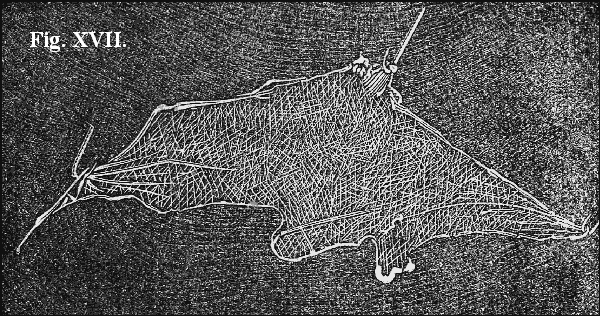
A single film of the cellular tissue lifted up and
slightly distended.
24. It is certain that the interspaces or cells of
this membrane have no determinate form or size,
that they communicate freely with each other, and
that this communication extends over the whole
body; for if a limb which has been infiltrated be
frozen, a thousand small icicles will be formed,
assuming the shape of the containing cells, some
of which are found to be circular and others cylindrical,
and so on. If air or water escape into any
particular part of the body, it is often effused over
the whole extent of it, and butchers are observed
to inflate animals by making a puncture in some
part where the cellular tissue is loose, and from
this one aperture the air is forced to the most
distant parts of the body.
25. Cellular membrane, variously modified and
disposed, forms the main bulk of all the other
solid parts of the body, constituting their common
envelope and bond of union, and filling up all their
interstices. It is dense or loose, coarse or fine,
according to its situation and office. Wherever it
is subject to pressure, it is dense and firm, as in
the palm of the hand and the sole of the foot;
around the internal organs it is more loose and
delicate, and it becomes finer and finer as it divides
and subdivides, in order to envelope the soft and
tender structures of the body.
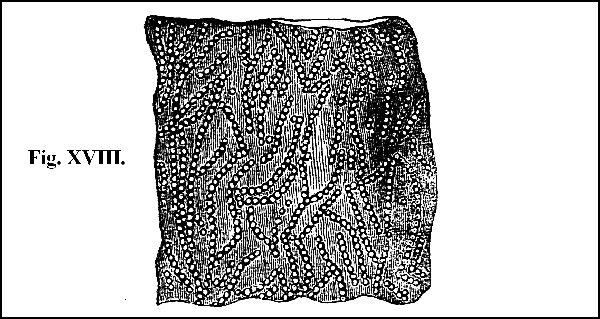
A portion of cellular tissue, very highly magnified, showing
the strings of globules of which its ultimate fibres are by
some supposed to consist.
26. According to some who have carefully examined
with the microscope its component threads,
they consist of minute particles of a globular figure
(fig. XVIII.); other microscopical observers regard
the cellular threads as coagulated or condensed
animal substance, perfectly amorphous
(without form).
27. Every part of this tissue is penetrated by
arteries, veins, absorbents, and nerves, endowing
it with properties truly vital, though in a less degree
than any of the other primary tissues; and
varied and important as the uses are which it
serves in the economy, the most manifest, though
certainly not the only ones, are those which depend
upon its physical properties of cohesion,
flexibility, extensibility, and elasticity.
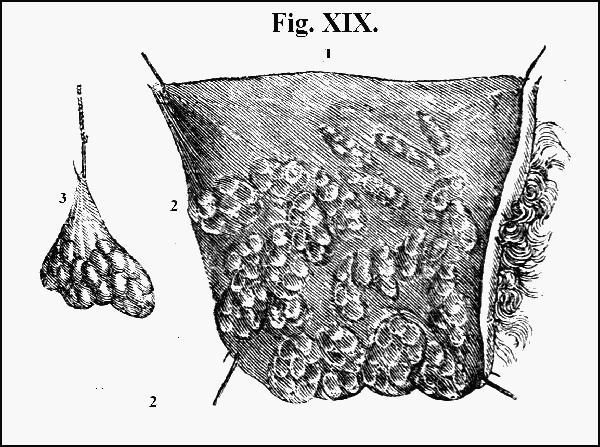
1, A portion of adipose tissue; 2, minute bags containing
the fat; 3, a cluster of the bags, separated and suspended.
28. The tissue which contains the fat, termed
the adipose, is the second form of membrane; it is
obviously a modification of the cellular, from
which it differs both in the magnitude of its fibres,
whence it constitutes a tougher and coarser web,
and in their arrangement; for it is so disposed as
to form distinct bags in which the fat is contained.
Adipose tissue consists of rounded packets, separated
from each other by furrows (fig. XIX. 2,
2); each packet is composed of small spheroidal
particles (fig. XIX. 2, 2); each particle is again
divisible into still smaller grains, which, on minute
inspection, present the appearance of vesicles filled
with the adipose matter (fig. XIX. 3).
29. The cells of the cellular tissue, as has been
shown (24), are continuous over the whole body;
but each adipose vesicle is a distinct bag, having no
communication whatever with any other (fig. XIX.
2, 2). The cellular tissue is universally diffused;
but the adipose is placed only in particular parts of
the body; principally beneath the skin, and more
especially between the skin and the abdominal
muscles, and around some of the organs contained
in the chest and abdomen, as the heart, the kidneys,
the mesentery, and the omenta. In most of
these situations some portion of it is generally
found, whatever be the degree of leanness to which
the body may be reduced; while in the cranium,
the brain, the eye, the ear, the nose, and several
other organs, there is none, whatever be the degree
of corpulency. The uses of the fat, which
are various, will be stated hereafter.
30. The third form of membrane is termed the
serous. Like the adipose, serous membrane is a
modification of the cellular, and, like it also, it is
limited in its situation to particular parts of the
body, that is, to its three great cavities, namely,
the head, the chest, and the abdomen. To the
two latter it affords an internal lining, and to all
the organs contained in all the three cavities, it
affords a covering. By its external surface it is
united to the wall of the cavity or the substance
of the organ it invests; by its internal surface it
is free and unattached; whence this surface is in
contact only with itself, forming a close cavity or
shut sac, having no communication with the external
air. Smooth and polished (fig. XX.), it is
rendered moist by a fluid which is supposed to be
exhaled in a gaseous state from the serum of the
blood; and from this serous fluid the membrane
derives its name.
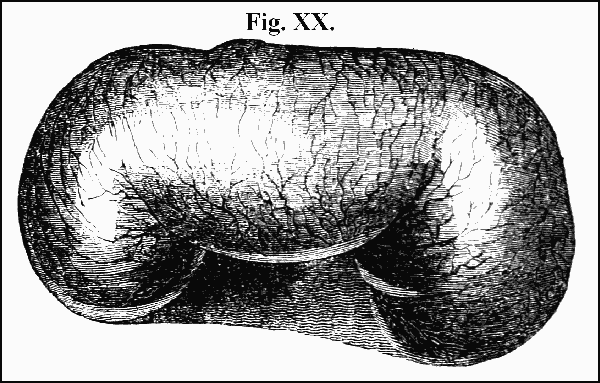
A portion of intestine, showing its external surface or
serous coat.
31. Though thin, serous membrane is dense,
compact, and of great strength in proportion to
its bulk: it is extensible and elastic; extensible,
for it expands with the dilatation of the chest
in inspiration; elastic, for it contracts with the
diminished size of the chest in expiration. In
like manner, it stretches with the enlargement of
the stomach during a hearty meal, and contracts
as the stomach gradually diminishes on emptying
itself of its contents. It is furnished with no
blood-vessels large enough to admit the colouring
matter of the blood; but it is supplied with
a great number of the colourless vessels termed
exhalents, with the vessels termed absorbents,
and with a few nerves. It indicates no vital properties,
but those which are common to the simple
form of the primary tissue. Its specific uses are
to afford a lining to the internal cavities; to furnish
a covering to the internal organs; by its
polished and smooth surface, to allow a free motion
of those organs on each other, and by the moisture
with which it is lubricated, to prevent them from
adhering together, however closely, or for however
long a period they may be in contact.
32. The fourth form of membrane, the fibrous,
named from the obvious arrangement of its component
parts, consists of longitudinal fibres, large
enough to be visible to the naked eye, placed
parallel to each other, and closely united. Sometimes
these fibres are combined in such a manner
as to form a continuous and extended surface,
constituting a thin, smooth, dense, and strong
membrane, such as that which lines the external
surface of bones termed PERIOSTEUM, or the internal
surface of the skull (dura mater). At other
times, they form a firm and tough expansion
(aponeurosis) which descends between certain
muscles, separating them from each other, and
affording a fixed point for the origin or insertion
of neighbouring muscles; or which is stretched
over muscles, and sometimes over even an entire
limb, in order to confine the muscles firmly in
their situation, and to aid and direct their action
(fig. XXVII.). Fibrous membrane also constitutes
the compact, strong, tough, and flexible
bands used for tying parts firmly together, termed
LIGAMENTS, principally employed in connecting
the bones with each other, and particularly about
the joints; and lastly, fibrous membrane forms the
rounded white cords in which muscles often terminate,
called TENDONS (fig. XXV., XXVI.), the
principal use of which is to connect the muscles
with the bones, and to serve as cords or ropes to
transmit the action of the muscle to a distant
point, in the accomplishment of which purposes
their operation appears to be entirely mechanical.
33. The fifth form of membrane, the mucous
(fig. XXI.), derives its name from the peculiar fluid
with which its surface is covered, called mucus,
and which is secreted by numerous minute glands,
imbedded in the substance of the membrane. As
serous membrane forms a shut sac, completely excluding
the air, mucous membrane, on the contrary,
lines the various cavities which are exposed to the
air, such as the mouth, the nostrils, the wind-pipe,
the gullet, the stomach, the intestines, the urinary
organs, and the uterine system. Its internal surface,
or that by which it is attached to the passages
it lines, is smooth and dense; its external surface,
or that which is exposed to the contact of the air,
is soft and pulpy, like the pile of velvet (fig. XXI.).
It bears a considerable resemblance to the external
surface of the rind of the ripe peach.
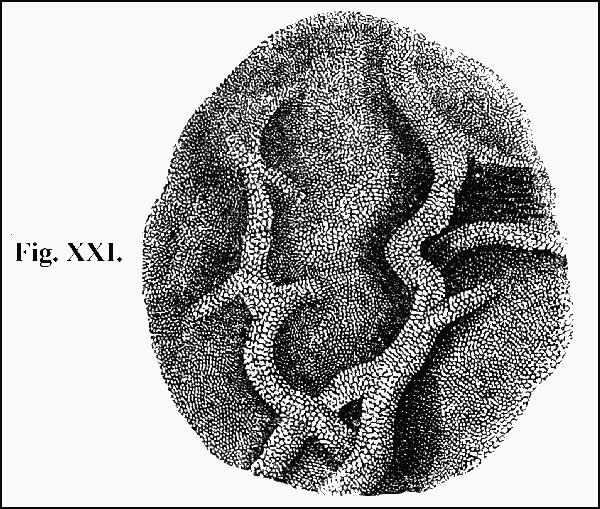
A portion of the stomach, showing its internal surface
or mucous coat.
Unlike all the other tissues of this class, the mucous
membranes are the immediate seat of some of the
most important functions of the economy; in the
lung, of respiration; in the stomach, of digestion;
in one part of the intestine, of chylification; in
another, of excretion; while in the mouth and
nose, they are the seat of the animal functions of
taste and smell; and they are highly organized in
accordance with the importance of the functions
they perform.
34. The last form of membrane which it is necessary
to our present purpose to particularize, is
that which constitutes the external covering of the
body, and which is called the skin. The skin is
everywhere directly continuous with the mucous
membranes that line the internal passages, and its
structure is perfectly analogous. Both the external
and the internal surface of the body may be said
therefore to be covered by a continuous membrane,
possessing essentially the same organization, and
almost identically the same chemical composition.
The skin is an organ which performs exceedingly
varied and important functions in the economy, to
the understanding of which it is necessary to have
a clear conception of its structure; some further
account of it will therefore be required; but this
will be more advantageously given when the offices
it serves are explained.
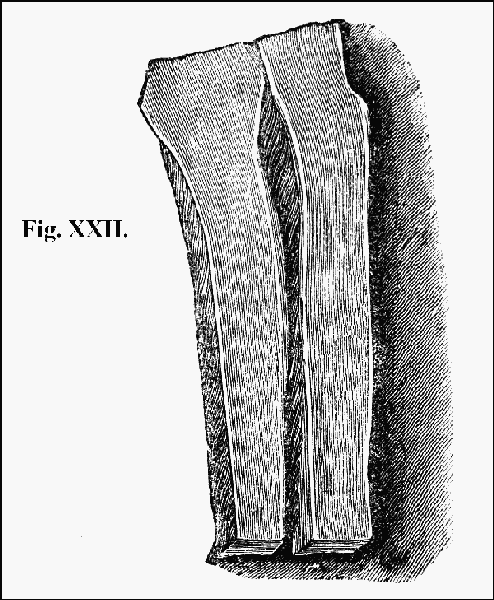
Portions of cartilage, seen in section.
35. Such is the structure, and such are the properties,
of the first distinct form of organized matter.
The second primary tissue, termed the CARTILAGINOUS
(fig. XXII.), is a substance intermediate
between membrane and bone. The nature of its
organization is not clearly ascertained. By some
anatomists, it is regarded as a uniform and homogeneous
substance, like firm jelly, without fibres,
plates, or cells; others state that they have been
able to detect in it longitudinal fibres, interlaced
by other fibres in an oblique and transverse direction,
but without determinate order. All are agreed
that it is without visible vessels or nerves: not that
it is supposed to be destitute of them, but that they
are so minute as to elude observation. Its manifest
properties are wholly mechanical. It is dense,
strong, inextensible, flexible, and highly elastic.
It is chiefly by its property of elasticity that it
accomplishes the various purposes it serves in the
economy. It is placed at the extremities of bones,
especially about the joints, where, by its smooth
surface, it facilitates motion, and, by its yielding
nature, prevents the shock or jar which would be
produced were the same kind and degree of motion
effected by a rigid and inflexible substance.
Where a certain degree of strength with a considerable
degree of flexibility are required, it supplies
the place of bone, as in the spinal column,
the ribs and the larynx.
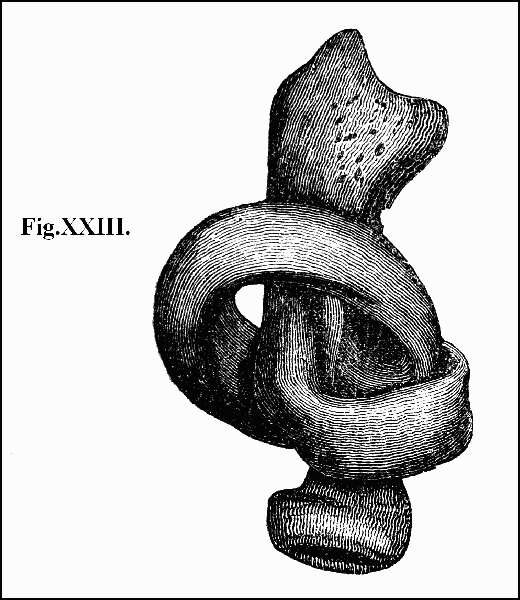
Membranous portion of bone; the osseous portion being
so completely removed, that the bone is capable of being
tied in a knot.
36. The third distinct form of organized matter
is termed the OSSEOUS tissue. Bone is composed
of two distinct substances, an animal and an
earthy matter: the former organic, the latter inorganic.
The animal or organic matter is analogous
both in its nature and in its arrangement to cellular
tissue; the earthy or inorganic matter consists
of phosphoric acid combined with lime, forming
phosphate of lime. The cellular tissue is aggregated
into plates or laminæ, which are placed one
upon another, leaving between them interspaces
or cells, in which is deposited the earthy matter
(phosphate of lime). If a bone, for example, the
bone called the radius, one of the bones of the
fore-arm, be immersed in diluted sulphuric, nitric,
muriatic, or acetic acid, it retains its original bulk
and shape; it loses, however, a considerable portion
of its weight, while it becomes so soft and
pliable, that it may be tied in a knot (fig. XXIII.).
In this case, its earthy matter is removed by the
agency of the acid, and is held in solution in the
fluid; what remains is membranous matter (cellular
tissue). If the same bone be placed in a charcoal
fire, and the heat be gradually raised to
whiteness, it appears on cooling as white as chalk;
it is extremely brittle; it has lost much of its
weight, yet its bulk and shape continue but little
changed. In this case, the membraneous matter is
wholly consumed by the fire, while the earth is left
unchanged (fig. XXIV.). Every constituent atom
of bone consists, then, essentially of animal and
earthy matter intimately combined. A little more
than one-third part consists of animal matter
(albumen), the remaining two-thirds consist of
earthy matter (phosphate of lime); other saline
substances, as the fluate of lime and the phosphate
of magnesia, are also found in minute quantity, but
they are not peculiar to bone.
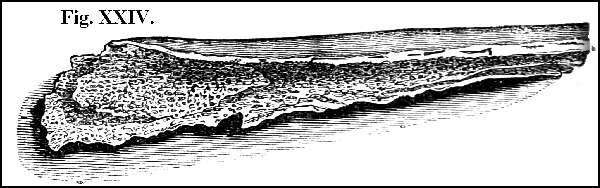
Earthy portion of bone.
37. In general, the osseous tissue is placed in
the interior of the body. Even when bone approaches
the surface, it is always covered by soft
parts. It is supplied with but few blood-vessels,
with still fewer nerves, with no absorbents large
enough to be visible, so that though it be truly
alive, yet its vital properties are not greatly developed.
The arrangement of its component particles
is highly curious; the structure, the disposition,
and the connexion of individual bones afford
striking examples of mechanism, and accomplish
most important uses in the economy; but those
uses are dependent rather upon mechanical than
vital properties. The chief uses of bone are—
1. By its hardness and firmness to afford a support
to the soft parts, forming pillars to which the more
delicate and flexible organs are attached and kept in
their relative positions. 2. To defend the soft and
tender organs by forming a case in which they are
lodged and protected, as that formed by the bones
of the cranium for the lodgment and protection of
the brain (fig. XLVII.); by the bones of the spinal
column for the lodgment and protection of the spinal
cord (fig. XLVIII.); by the bones of the thorax
(fig. LIX.), for the lodgment and protection of the
lungs, the heart, and the great vessels connected
with it (fig. LIX.). 3. By affording fixed points
for the action of the muscles, and by assisting in
the formation of joints to aid the muscles in accomplishing
the function of locomotion.
38. All the primary tissues which have now
been considered consist of precisely the same
proximate principles. Albumen is the basis of
them all; with the albumen is always mixed more
or less gelatin, together with a minute quantity of
saline substance: to the osseous tissue is superadded
a large proportion of earthy matter. With
the exception of the mucous, the organization of
all these tissues is simple; their vital properties
are low in kind and in degree; their decided properties
are physical, and the uses they serve in the
economy are almost wholly mechanical.
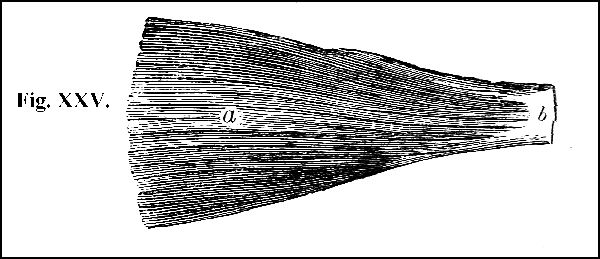
Portion of a muscle; showing (a) the muscular fibres
and their parallel direction; and (b) the termination of
the fibres in tendon.
39. But we next come to a tissue widely different
in every one of those circumstances, a tissue
consisting of a new kind of animal matter, and
endowed with a property not only peculiar to itself,
but proper to living substance, and characteristic
of a high degree of vital power. Muscular tissue,
the fourth distinct form of animal matter, commonly
known under the name of flesh, is a substance
resembling no other in nature. It consists
of a soft and pulpy substance, having little cohesive
power, arranged into fibres which are distinctly
visible to the naked eye, and which are
disposed in a regular and uniform manner, being
placed close and parallel to each other (fig. XXV.).
These fibres are every where pretty uniformly the
same in shape, size, and general appearance, being
delicate, soft, flattened, and though consisting only
of a tender pulp, still solid (fig. XXV.). When
examined under the microscope, fibres, which to
the naked eye appear to be single threads, are seen
to divide successively into smaller threads, the
minutest or the ultimate division not exceeding,
as is supposed, the 40,000th part of an inch in
diameter. On the other hand, the fibres which
are large enough to be visible to the naked eye,
are obviously aggregated into bundles of different
magnitude in different muscles, but always of
the same uniform size in the same muscle (fig.
XXV.).
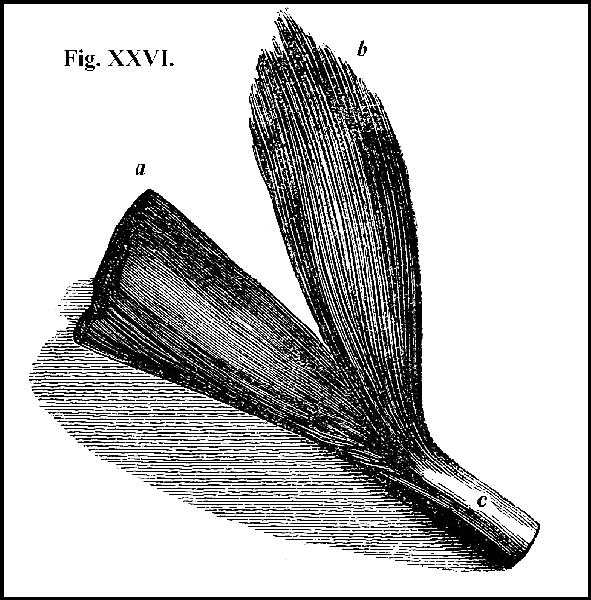
Two portions of muscle; one of which, a, is covered with
membrane; the other, b, is uncovered; c, the muscular
fibres terminating in tendon.
40. The ultimate thread, or the minutest division
of which the muscular fibre is susceptible,
is called a filament; the smallest thread which
can be distinguished by the naked eye is termed a
fibre (fig. XXVI.); and the bundle which is
formed by the union of fibres is denominated a
fasciculus. The proper muscular substance is
thus arranged into three distinct forms progressively
increasing in size,—the filament, the fibre,
and the fasciculus. The filament, the fibre, the
fasciculus, as well as the muscle itself, formed by
the aggregation of fasciculi, is each inclosed in its
own distinct sheath of cellular membrane (fig.
XXVI. a).
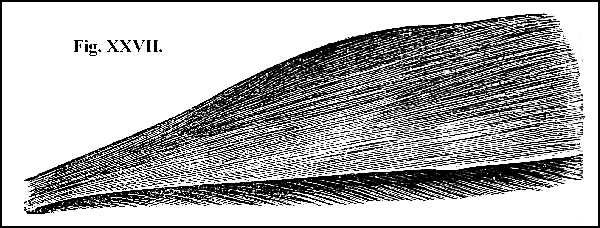
Portion of a muscle enclosed in a sheath of fascia
or aponeurosis.
41. The composition of the ultimate filament has
been very carefully examined by many distinguished
physiologists with microscopes of high magnifying
power. Under some of these microscopes the filament
appears to consist of a series of rounded particles
or globules of the same size as the particles of
the blood when deprived of their colouring matter, so
that it looks like a string of pearls (fig. XXVIII.),
each globule being commonly stated to be about
the 2000th part of an inch in diameter. But it is
now pretty generally agreed that this globular appearance
of the ultimate muscular fibre vanishes
under the more improved microscopes of the present
day, and, as viewed by the latter, appears as
a peculiar pulpy substance arranged into threads
of extreme minuteness, placed close and parallel
to each other, intersected by a great number of
delicate lines passing transversely across the muscular
threads (fig. XXIX.),
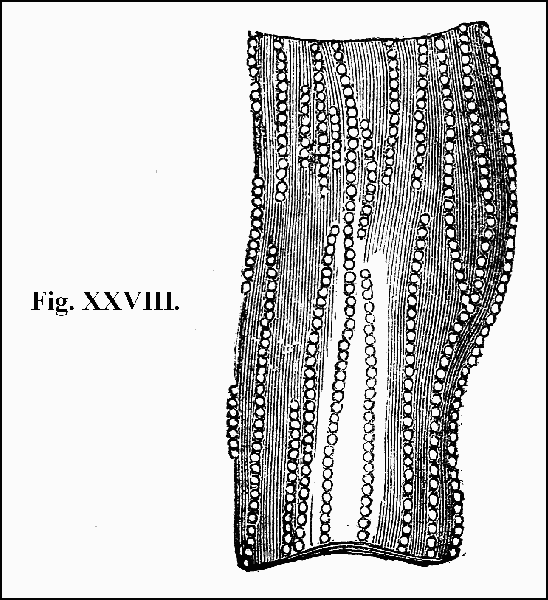
Ultimate fibres of muscle, very greatly magnified; showing
the strings of globules of which they are supposed by
some to consist.
42. With the exception of the organs of sense,
the muscular tissue is more abundantly supplied
with arteries, veins, and nerves, than any other
substance of the body. Every ultimate thread or
filament appears to be provided with the ultimate
branch of an artery, vein, and nerve. These
vessels are seen ramifying on the surface of the
delicate web of membrane that incloses the pulp,
but cannot be traced into it.
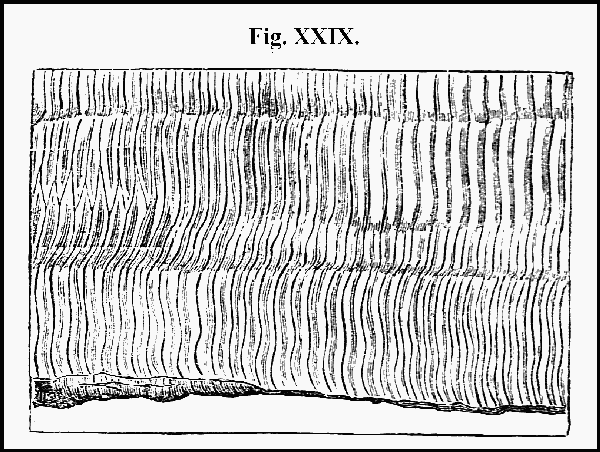
The appearance of the ultimate muscular fibres and of
their transverse lines, as seen under the microscope of Mr. Lister,
when the object is magnified 500 diameters.
43. The proximate principle of which the muscular
pulp is composed is fibrin. From the pulp,
when inclosed in its sheath of membrane, albumen,
jelly, various salts, and a peculiar animal extract
called osmazome, are also obtained; but these
substances are probably derived from the membranous,
not the muscular, matter. Fibrin contains
a larger proportion of azote, the element peculiar
to the animal body, and by the possession of which
its chemical composition is distinguished from that
of the vegetable, than any other animal substance.
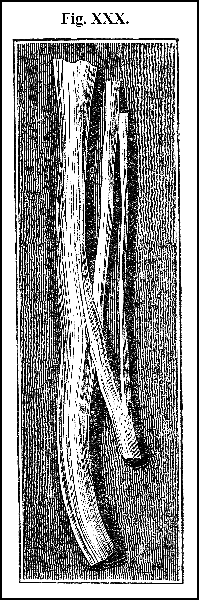
Portion of the trunk of
a nerve; dividing into branches.
44. Muscular tissue possesses a slight degree of
cohesion, a high degree of flexibility and extensibility,
but no degree of elasticity; for although
muscle, considered as a compound of muscular
substance and membrane, be highly elastic, yet
this property is probably altogether
owing to the membranous
matter in which it
is enveloped. Its peculiar
and distinctive property is
vital, not physical, and consists
in the power of diminishing
its length, or of
contracting or shortening
itself on the application of
a stimulus. This property,
which is termed contractility,
is the great, if not
the sole source of motion in
the body. Without doubt,
elasticity and gravity, under
the generating and controlling
powder of contractility,
aid in accomplishing
various kinds of motion.
Thus membranes, tendons,
ligaments, cartilages, and
bones, by their physical
and mechanical properties,
modify, economize, facilitate,
concentrate and direct
the motive power generated by the pure muscular
substance; but still the only real source of motion
in the body is muscular tissue, and the only mode
in which motion is generated is by contractility.
This will be more fully understood hereafter.
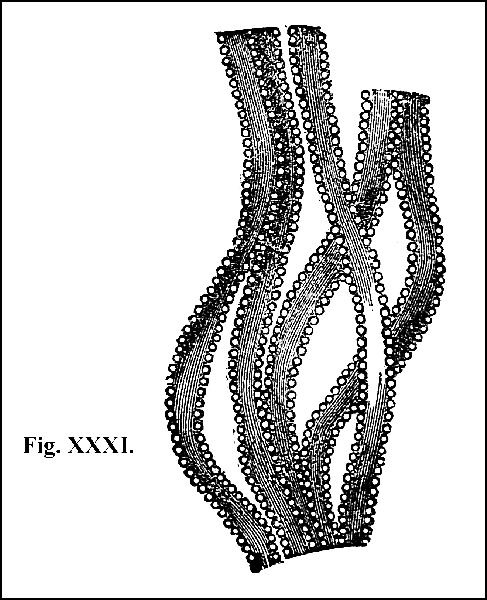
Ultimate fibres of nerve, very highly magnified; showing
the strings of globules of which they consist.
45. The last primary tissue, termed the NERVOUS,
is equally distinct in nature and peculiar in property.
It consists of a soft and pulpy matter, of a brownish
white colour (fig. XXX.). According to some, the
nervous, like the muscular pulp, is composed of
minute globules, arranged in the same manner like a
string of pearls (fig. XXXI.); according to others,
it consists of solid elongated threads, of a cylindrical
form, differing in thickness from that of a hair
to the finest fibre of silk. The pulp, whatever its
form of aggregation, is inclosed in a sheath of
delicate cellular tissue. This external or containing
membrane is called the neurilema, or the
nerve-coat; the internal or contained substance,
the proper nervous matter, is termed the nerve-string.
The nerve-string, enveloped in its nerve-coat,
constitutes the nervous filament. As in the
muscle, so in the nerve, many filaments unite to
form a fibre, many fibres to form a fasciculus, and
many fasciculi to form the large cord termed
a nerve. Moreover, as in the muscle, so in the
nerve, the filament, the fibre, the fasciculus, the
nervous cord itself, are each enveloped in its own
distinct sheath of cellular membrane; but the
arrangement of the nervous fibres differs from that
of the muscular in this, that though the nervous
fibres are placed in juxtaposition, yet they do not,
like the muscular, maintain through their entire
course a parallel disposition, but cross and penetrate
each other, so as to form an intimate interlacement
(fig. XXXII.).
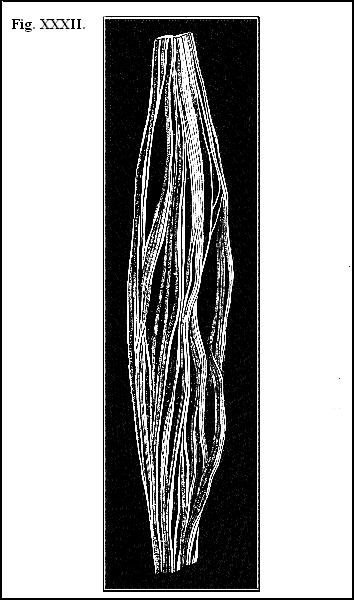
Nervous fibres, deprived of their neurilema and unravelled,
showing the smaller threads, or filaments, of which
the fibres consist.
46. The nervous pulp is at least as liberally
supplied with blood-vessels as the muscular; the
vessels are spread out upon the nerve-coat, in
which they divide into innumerable branches of
extreme minuteness, the distribution of which is
so perfect, that there is not a particle of nervous
matter which is not supplied both with an arterial
and a venous vessel. Hence the neurilema is not
merely a sheath containing and protecting the
nervous pulp, but it affords an extended mechanical
surface for sustaining the arterial vessels, from
which the pulp is probably secreted, and certainly
nourished.
47. Albumen, in conjunction with a peculiar
fatty matter, constitutes the chief proximate principles
of which the nervous tissue is composed.
To these are added a small proportion of the animal
substance termed osmazome, a minute quantity
of phosphorus, some salts, and a very large
proportion of water; for out of one hundred parts
of nervous substance, water constitutes as much as
eighty. Its peculiar vital property is sensibility;
and as all motion depends on the contractility of
the muscular fibre, so all sensation depends on the
sensibility of the nervous substance.
48. Such are the primary tissues, or the several
kinds of organized matter of which the body is
composed; and from this account it is obvious that
they consist of three only—namely, the concrete
matter forming the basis of membrane, the pulpy
matter forming the proper muscular substance, and
the pulpy matter forming the proper nervous substance.
Of these three kinds of animal matter the
component parts of the body consist. In combining
to form the different structures, these primary
substances are intermixed and arranged in a great
variety of modes; and from these combinations
and arrangements result either an organ, a system,
or an apparatus.
49. As filaments unite to form fibres, and fibres
to form tissues, so tissues unite to form organs:
that is, bodies having a determinate size and figure,
and capable of performing specific actions. The
cellular, the muscular, and the nervous tissues
are not organs; membranes, muscles, and nerves
are organs. The tissue, the simple animal substance,
is merely one of the elements of which the
organ is composed; the organ is compounded of
several of those simple substances, arranged in a
determinate manner, and moulded into a given
shape, and so constituting a specific instrument.
The basis of the muscle is muscular tissue; but
to this are added, invariably, membrane, often tendon,
and always vessels and nerves. It is this
combination that forms the specific instrument
called a muscle, and that renders it capable of
performing its specific action. And every such
combination, with its appropriate endowment,
constitutes an organ.
50. Organs are arranged into groups or classes,
according as they possess an analogous structure,
and perform an analogous function; and this assemblage
constitutes a SYSTEM. All the muscles
of the body, for example, whatever their size, form,
situation, or use, have an analogous structure, and
perform an analogous function, and hence are
classed together under the name of the muscular
system. All the bones, whatever their figure,
magnitude, density, position, or office, are analogous
in structure and function; and hence are classed
together under the name of the osseous system.
For the same reason, all the cartilages, ligaments,
vessels and nerves, form respectively the cartilaginous,
ligamentous, vascular and nervous systems.
51. An APPARATUS, on the contrary, is an assemblage
of organs, it may be differing widely from
each other in structure, and exercising various and
even opposite functions; but all nevertheless concurring
in the production of some common object.
The apparatus of nutrition consists of the organs
of mastication, deglutition, digestion, absorption,
and assimilation. Among the individual organs
which concur in carrying on these functions may
be reckoned the lips, the teeth, the tongue, the
muscles connected with the jaws, the gullet, the
stomach, the duodenum, the small intestines, the
pancreas, the liver, the lacteal vessels, the mesenteric
glands, and the lungs. Many of these organs
have no similarity in structure, and few have any
thing analogous in function; yet all concur, each
in its appropriate mode and measure, to the conversion
of the aliment into blood. In the apparatus
of respiration, in that of circulation, of secretion,
of excretion; in the apparatus of locomotion, in
the apparatus of sensation, and more especially in
the apparatus of the specific sensations,—vision,
hearing, smell, taste, touch, organs are combined
which have nothing in common but their concurrence
in the production of a common end: but
this concurrence is the principle of their combination;
and the individual organs having this conjoint
operation, taken together, constitute an apparatus.
52. A clear idea may now be affixed to the
terms structure and organization. Structure may
be considered as synonymous with arrangement;
the disposition of parts in a determinate order;
that which is constructed or built up in a definite
mode, according to a determinate plan. The
arrangement of the threads of the cellular web into
areolæ or cells; the combination of the primary
threads into fibres or laminæ; the disposition of
the muscular pulp into filaments, placed parallel
to each other; the investment of the filaments in
membraneous sheaths; the combination of the filaments,
included in their sheaths, into fibres; the
aggregation of fibres into fasciculi; and the analogous
arrangement and combination of the nervous
pulp, are examples of structure. But when those
structures are applied to particular uses; when
they are so combined and disposed as to form a
peculiar instrument, endowed with a specific function;
when the cellular fibres, for example, are so
arranged as to make a thin, dense, and expanded
tissue; when to this tissue are added blood-vessels,
absorbents, and nerves; when, in a word, a membrane
is constructed, an organ is formed; when,
in like manner, to the muscular and the nervous
fibres, arranged and moulded in the requisite mode,
are added blood-vessels, absorbents, and nerves,
other organs are constructed capable of performing
specific functions: and this is organization—the
building up of organs—the combination of definite
structures into special instruments. Structure is
the preparatory process of organization; the one
is the mere arrangement of the material; the other
is the appropriation of the prepared material to a
specific use.
53. The term organization is employed in reference
both to the component parts of the body,
and to the body considered as a whole. We speak
of an organized substance and of an organized
body. An organized substance is one in which
there is not only a definite arrangement of its
component parts (structure), but in which the
particular arrangement is such as to fit it for accomplishing
some special use. Every organized
substance is therefore essentially a special organ;
limited in its object it may be, and perhaps only
conducive to some further object; but still its distinctive
character is, that it has a peculiar structure,
fitting it for the accomplishment of some
appropriate purpose. On the other hand, an organized
body is a congeries of organs—the aggregate
of the individual organs. Attention was directed
in the early part of this work to one peculiar
and essential character, by which such an organized
is distinguished from an unorganized body.
Between the individual parts of the organized body
there is so close a relation, that no one of them
can be removed or injured, or in any manner
affected without a corresponding affection of the
whole. The action of the heart cannot cease without
the cessation of the action of the lung; nor that
of the lung without that of the brain; nor that of
the brain without that of the stomach; in a word,
there is no organ in whatever distant nook of the
system it be placed, or however apparently insignificant
its function, that is not necessary to the
perfection of the whole. But into whatever number
of portions an unorganized body may be divided,
each portion retains the properties of the
mass, and constitutes in itself a perfect existence;
there being no relation between its individual
parts, excepting that of physical attraction: on
the contrary, each component part of an organized
body, being endowed with some appropriate and
specific power, on the exercise of which the powers
of all the other parts are more or less dependent,
the whole must necessarily suffer if but one part
fail.
54. From the whole, then, we see that the human
body is a congeries of organs; that those organs are
constructed of a few simple tissues; and that all
its parts, numerous, diversified, and complex as
they are, are composed of but three primary forms
of animal matter variously modified and combined.
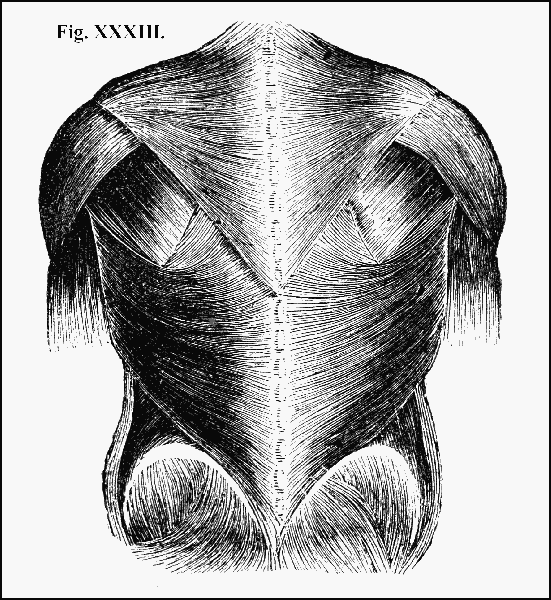
Muscles of the back and shoulders; showing their symmetrical
disposition.
55. But though by the analysis of its component
parts, this machine, so complex in its construction,
and so wonderfully endowed, may be reduced to this
state of simplicity; and although this analytical
view of it be highly useful in enabling us to form
a clear conception of the nature of its composition;
yet it is only by considering its individual parts
such as they actually are, and by studying their
situation, connexion, structure, and action, that
we can understand it as a whole, and apply our
knowledge of it to any practical use.
56. Viewing then the human body as a complicated
whole, as a congeries of organs made up of
various combinations of simple tissues, it may be
observed, in reference to its external configuration,
that it is rounded. This rounded form is principally
owing to the large proportion of fluids which
enter into its composition. The roundness of the
face, limbs, and entire surface of the child, are in
striking contrast to the unequal and irregular surface
of the old man, whose humours are comparatively
very much smaller in quantity.
57. The length of the human body exceeds its
breadth and thickness; the degree of the excess
varying at different periods of life, and according
to the peculiar constitution of the individual. In
the extremities, the bones, muscles, vessels, and
nerves, are especially distinguished by their length.
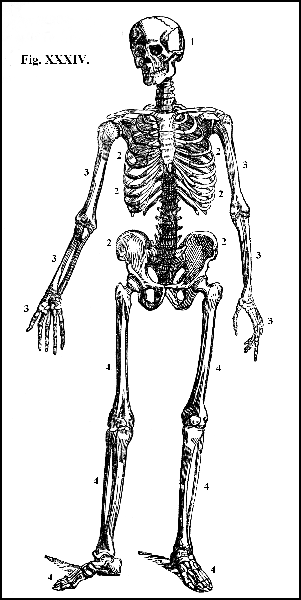
Front view of the skeleton. 1. the head; 2. the trunk;
3. the superior extremities; 4. the inferior extremities.
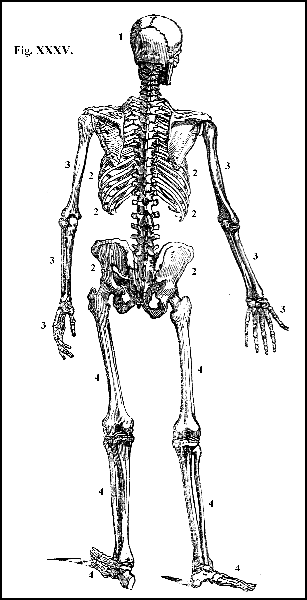
Back view of the skeleton. 1. the head; 2. the trunk;
3. the superior extremities; 4. the inferior extremities.
58. The form of the human body is symmetrical,
that is, it is capable of being divided into two lateral
and corresponding halves. Suppose a median
line to pass from the vertex of the head through the
centre of the spinal column (fig. XXXIV. 1, 2);
if the body be well formed, it will be divided by this
line into two exactly equal and corresponding portions
(fig. XXXV. 1). This symmetrical disposition
of the body is not confined to its external
configuration. It is true of many of the internal
organs; but principally, as has been already stated,
of those that belong to the animal life. The brain
and the spinal cord are divisible into two exactly
equal halves (figs. XLVIII. d, and XLIX. 1, 2, 3);
the organs of sense are double and symmetrical:
the muscles of one side of the body exactly correspond
to those of the other (fig. XXXIII.); the
two hands and arms and the two lower extremities
are alike (figs. XXXIV., XXXV.); but for the
most part, the organs of the organic life, the
stomach, the intestines, the liver, the spleen,
for example, are single, and not symmetrical.
59. The human body is divided into three great
portions, the head, the trunk, and the extremities
(figs. XXXIV. and XXXV. 1, 2, 3, 4).
60. By the head is meant all that part of the
body which is placed above the first bone of the
neck (fig. XXXIV. 1). It is of a spheroidal
figure, broader and deeper behind than before,
somewhat like an egg in shape, with the broad end
behind; it is flattened at its sides (figs. XXXV. 1,
and XXXVI. 2, 4). Its peculiar figure renders it
at once stronger and more capacious than it could
have been had it possessed any other form. It is
supported by its base on the spinal column, to
which it is attached by the peculiar structure
termed a joint (fig. XXXIV.), and fastened by
ligaments of exceeding strength.
61. The head contains the central organ of the
nervous system; the organs of the senses, with
the exception of that of touch; and the organs of
mastication. It comprehends the cranium and the
face. Both are composed partly of soft parts, as
the teguments, namely, skin, fat, &c., and muscles;
and partly of bones.
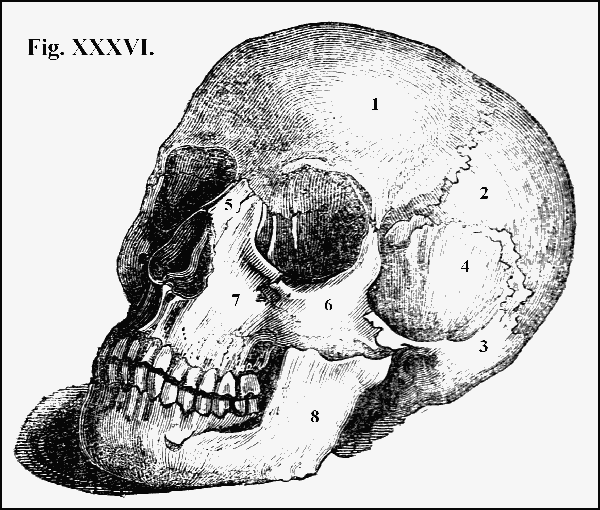
1. Frontal bone; 2. parietal bone; 3. occipital bone;
4. temporal bone; 5. nasal bone; 6. malar bone; 7. superior
maxillary bone; 8. inferior maxillary bone.
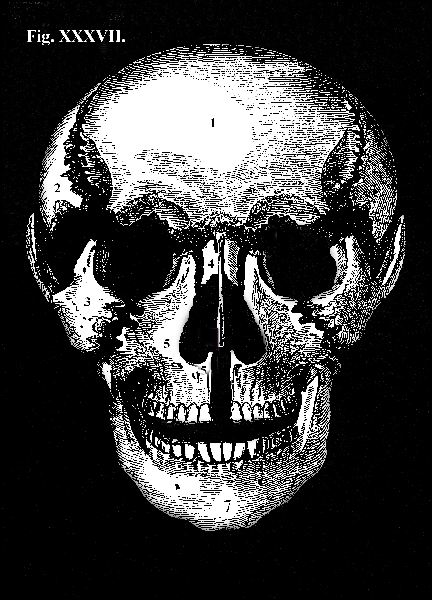
Bones of the skull, separated; front view. 1. Frontal
bone; 2. portions of the parietal bones; 3. malar or cheek
bones; 4. nasal bones; 5. superior maxillary or bones of
the upper jaw; 6. the vomer; 7. the inferior maxillary or
bone of the lower jaw.
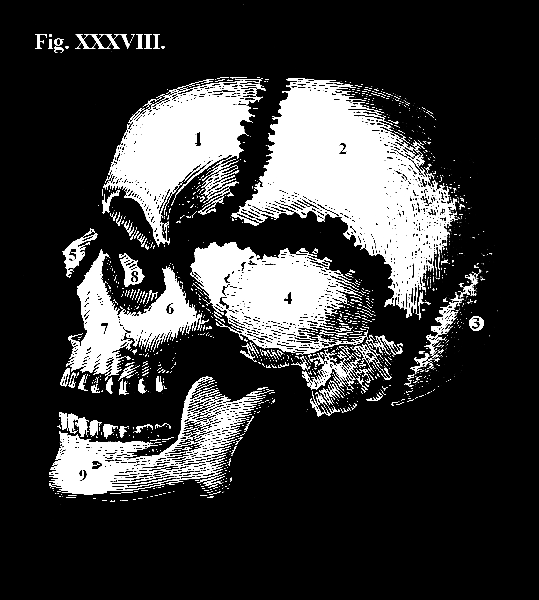
Bones of the skull separated; side view. 1. Frontal
bone; 2. parietal bone; 3. occipital bone; 4. temporal
bone; 5. nasal bone; 6. malar bone; 7. superior maxillary
bone; 8. the unguis; 9. the inferior maxillary bone.
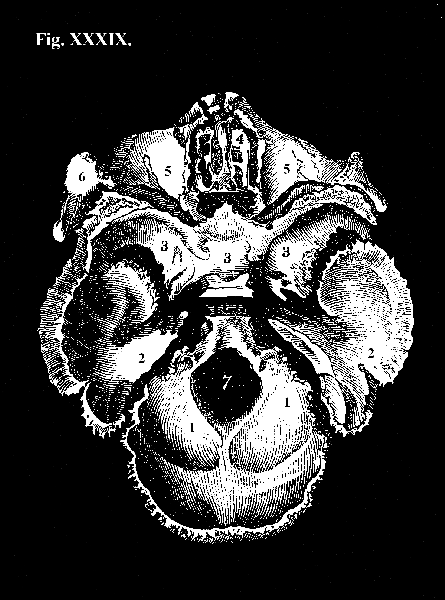
Bones forming the base of the skull; viewed from the
inside. 1. Occipital bone; 2. temporal bones; 3. sphenoid
bone; 4. ethmoid bone; 5. superior maxillary bones, or
bones of the upper jaw; 6. malar or cheek bones; 7. foramen
magnum.
62. The bones of the cranium are eight in number,
six of which are proper to the cranium, and
two are common to it and to the face. The six
bones proper to the cranium are the frontal (fig.
XXXVII. 1), the two parietal (fig. XXXVI. 2),
the two temporal (fig. XXXVIII. 4), and the
occipital (fig. XXXVIII. 3); the two common to
the cranium and face are the ethmoidal (fig.
XXXIX. 4), and the sphenoidal (fig. XXXIX.3).
The frontal bone forms the entire forepart of
the vault (fig. XXXVII. 1); the two parietal form
the upper and middle part of it (fig. XXXVIII. 2);
the two temporal form the lower part of the sides
(fig. XXXVIII. 4); the occipital forms the whole
hinder part, together with a portion of the base
(figs. XXXVIII. 3, XXXVI. 3, XXXIX. 1);
while the ethmoidal forms the forepart, and the
sphenoidal the middle part of the base (fig.
XXXIX. 3, 4).
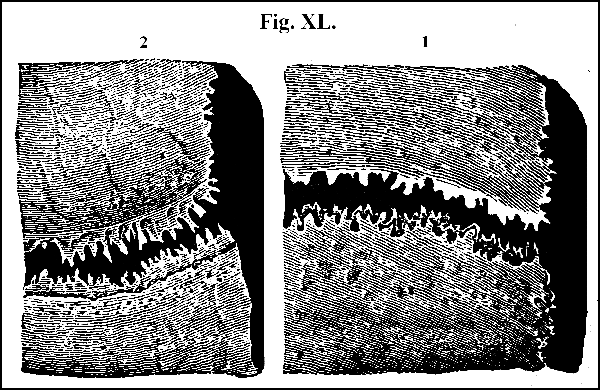
Portions of the bones of the cranium; showing the corresponding
inequalities in their margins: which margins,
when in apposition, constitute the mode of union termed
suture. 1. External surface of the bone; 2. internal surface.
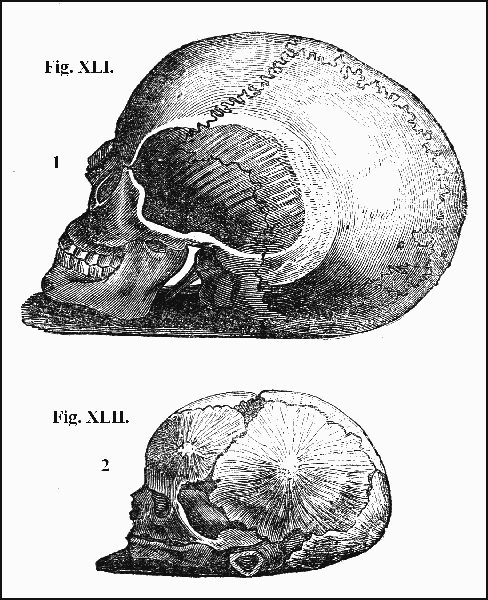
1. Side view of the adult skull, showing the several bones
united by suture; 2. side view of the fœtal skull, showing
the bones imperfectly ossified, separated to some extent
from each other, the interspace being occupied by membrane.
The small size of the face compared with that of
the cranium is strikingly apparent.
63. These bones are firmly united together.
The union of bones is technically called an articulation
or joint. All joints are either immoveable or
moveable. The union of the bones of the cranium
affords an example of an immoveable articulation.
Prominences and indentations, like the teeth of a
saw, are formed in the margins of the contiguous
bones (figs. XXXVIII. and XL.). At these
inequalities of surface, which are exactly adapted
to each other (figs. XXXVIII. and XL.), the
two bones are in immediate apposition in such
a manner as to preclude the possibility of motion,
and even to render the separation extremely difficult.
This mode of articulation is termed a suture.
There are certain advantages in constructing the
cranium of several distinct bones, and in uniting
them in this peculiar mode. 1. The walls of the
vault are stronger than they could have been had
they been formed of a single piece. 2. In the
fœtus, the bones are at some distance from each
other (fig. XLII.); at birth, they yield and overlap
one another; and in this manner they conduce to the
security and ease of that event. 3. Minute vessels
pass abundantly and securely through the interstices
of the sutures to and from the interior of the
cranium; in this manner, a free communication is
established between the vessels within and without
this cavity. 4. It is probable that the shock produced
by external violence is diminished in consequence
of the interruption of the vibration occasioned
by the suture; it is certain that fracture is
prevented by it from extending as far as it would
do in one continued bony substance.
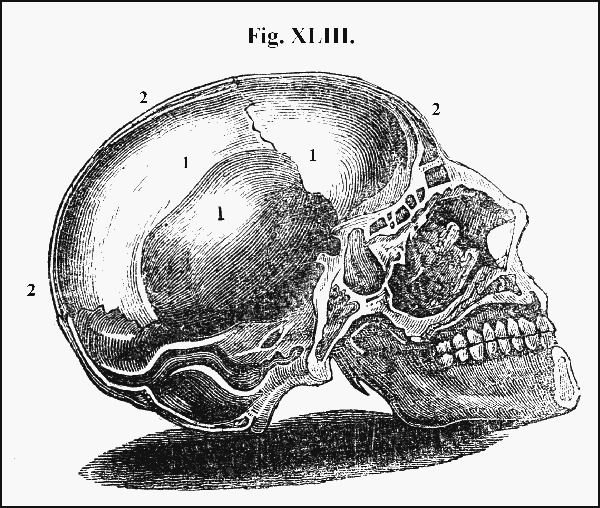
Section of the skull. 1. Cavity of the cranium occupied by
the brain; 2. cut edge of the bones of the cranium, showing
the two tables of compact bone and the intervening spongy
texture called diploë.
64. The vault of the cranium forms a cavity
which contains the brain (fig. XLIII.and XLVIII.)
The size of this cavity is invariably proportioned to
that of the organ it lodges and protects. The form
and magnitude of the cavity, and consequently the
shape and size of the cranium, depend upon the
brain, and not of the brain upon the cranium.
The soft parts model and adapt to themselves the
hard, and not the hard the soft. The formation
of the brain in the fœtus is anterior to that of the
case which ultimately contains it; and the hard
bone is moulded upon the soft pulp, not the pulp
upon the bone. At every period of life, on the
inner surface of the cranium there are visible impressions
made by the convolutions of the brain, and
the ramifications of the arteries (figs. XXXIX. 1,
2, and XL. 2), and on its external surface are
depressions occasioned by the action of the external
muscles. Nor does the modifying power of the brain
over the bones of the cranium terminate at birth.
The formation of bone, always a slow process, is
never completed until the child has attained its
third or fourth year, and often not until a much
later period. At this tender age, the bones, which in
advanced life are hard and rigid, are comparatively
soft and yielding, and consequently more readily
receive and retain the impression of the convolutions
and of the other projecting parts of the brain,
by which they are sometimes so deeply marked,
that an attentive examination of the inner surface
of the cranium is of itself sufficient to determine
not only that some part, but to indicate the very
part of the brain which has been preternaturally
active. At this tender age, pressure, internal or
external, general or partial, may readily change
the form of the cranium. If, by a particular posture,
the head of a child be unequally balanced on
the spine, the brain will press more on that side of
the cranium than on the other; the organ will expand
in the direction to which it inclines; that
portion of it will become preternaturally developed,
and consequently the balance of its functions will
be disturbed. An awkward way of standing or
sitting, perhaps contracted inadvertently and kept
up by habit; a wry neck; any cause that keeps
the head constantly inclined to one side, may produce
this result, examples of which and of its consequences
will be given hereafter.
65. Tracing them from without inwards we see,
then, that the various coverings afforded to the
brain, the central organ of the animal life, seated
in its vaulted cavity, are: 1. The tegument, consisting
of the skin and of cellular and adipose
membrane. 2. Beneath the tegument, muscles,
in the forepart and at the vertex, comparatively
slender and delicate; at the sides and posteriorly,
thick, strong, and powerful (fig. XLIV.). 3. Beneath
the muscles, a thin but dense membrane,
termed the pericranium, lining the external surface
of the cranial bones. 4. Beneath the pericranium,
the bony substance of the cranium, consisting of
two firm and hard bony plates, with a spongy, bony
structure, called diploë, interposed between them
(fig. XLIII. 2). 5. Immediately in contact with
the inner surface of the bony substance of the
cranium, and forming its internal lining, the dense
and strong membrane, called the dura mater, not
only affording a general covering to the brain, but
sending firm partitions between individual portions
of it (fig. XLVIII. c.). 6. A serous membrane
lining the internal surface of the dura mater, and
reflected over the entire surface of the brain, termed
the arachnoid tunic. 7. A thin and delicate membrane
in immediate contact with the substance of
the brain, descending between all its convolutions,
lining all its cavities and enveloping all its fibres,
called the pia mater. 8. An aqueous fluid, contained
between the arachnoid membrane and the
pia mater. Skin, muscle, pericranium, bone, dura
mater, arachnoid membrane, pia mater, and aqueous
fluid, superimposed one upon another, form,
then, the covering and defence of the brain; so
great is the care taken to protect this soft and
tender substance.
66. The bones of the face consist of fourteen,
namely, the two superior maxillary or jaw-bones
(fig. XXXVII. 5), the two malar or cheek bones
(fig. XXXVII. 3), the two nasal bones (fig.
XXXVII. 4), the two palate bones, the two ossa
unguis (fig. XXXVIII. 8), the two inferior turbinated
bones, the vomer (fig. XXXVII. 6), and
the inferior maxilla or the lower jaw (fig. XXXVII.
7.) This irregular pile of bones is divided into the
superior and inferior maxilla or jaws; the superior
maxilla being the upper and immoveable portion of
the face; the inferior maxilla being the lower and
moveable portion of it. Besides these bones, the
face contains thirty-two teeth, sixteen in each jaw.
The bones of the upper jaw are united together by
sutures, and the union is so firm, that they have no
motion but what they possess in common with the
cranium. The lower jaw is united by a distinct
articulation with the cranium (figs. XXXIV. and
XXXV.).
67. Besides the bones and the teguments, the face
contains a number of muscles, which for the most
part are small and delicate (fig. XLIV.), together
with a considerable portion of adipose matter; while,
as has been stated, the face and head together contain
all the senses, with the exception of that of
touch, which is diffused, more or less, over the entire
surface of the body.
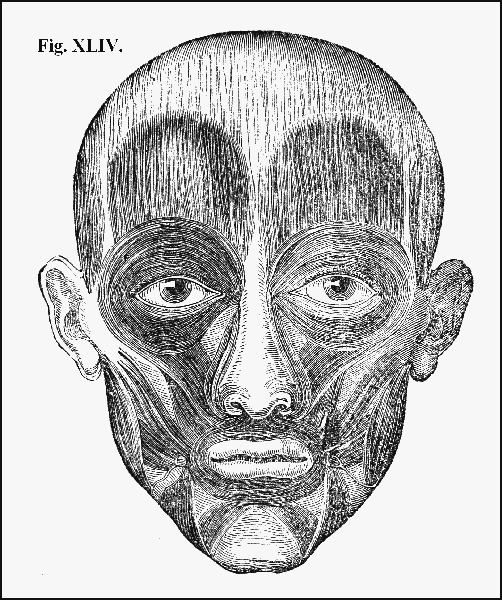
Muscles of the face.
68. The second great division of the body,
termed the TRUNK, extends from the first bone of
the neck to that called the pubis in front, and to
the lower end of the coccyx behind (fig. XXXIV. 2).
It is subdivided into the thorax, the abdomen,
and the pelvis (fig. XLV.).
69. The thorax or chest extends above from the
first bone of the neck, by which it is connected
with the head, to the diaphragm below, by which
it is divided from the abdomen (figs. XLV. and
LXI.). It consists partly of muscles and partly
of bones; the muscular and the osseous portions
being in nearly equal proportions. Both together
form the walls of a cavity in which are placed the
central organs of circulation and respiration (fig.
LX. 2, 5). The chief boundaries of the cavity
of the thorax before, behind, and at the sides, are
osseous (fig. XLV.); being formed before, by the
sternum or breast-bone (fig. XLV. 6); behind,
by the spinal column or back bone (fig. XLV.
2, 4); and at the sides, by the ribs (fig. XLV.
7). Below, the boundary is muscular, being
formed by the diaphragm (fig. LXI. 2), while
above the thorax is so much contracted (fig.
XLV.), that there is merely a space left for the
passage of certain parts which will be noticed immediately.
70. The figure of the thorax is that of a cone,
the apex being above (fig. XLV.), through the
aperture of which pass the tubes that lead to the
lungs and stomach, and the great blood-vessels
that go to and from the heart (fig. LX.). The
base of the cone is slanting, and is considerably
shorter before than behind, like an oblique section
of the cone (fig. XLV.).
71. The osseous portion of the walls of the
thorax is formed behind by the spinal column, a
range of bones common indeed to all the divisions
of the trunk; for it constitutes alike the posterior
boundary of the thorax, abdomen, and pelvis (fig.
XLV. 2, 4, 6). It is composed of thirty distinct
bones, twenty-four of which are separate and moveable
on one another, and on this account are called
true vertebræ (fig. XLV. 2, 4); the other five,
though separate at an early period of life, are subsequently
united into a single solid piece, called
the sacrum (fig. XLV. 5). The bones composing
this solid piece, as they admit of no motion
on each other, are called false vertebræ (fig.
XLV. 5). To the extremity of the sacrum is
attached the last bone of the series, termed the
coccyx (fig. XXXV.).
72. From above downwards, that is, from the
first bone of the neck to the first bone of the sacrum,
the separate bones forming the column progressively
increase in size; for this column is the
chief support of the weight of the head and trunk,
and this weight is progressively augmenting to this
point (fig. XLV. 2, 4). From the sacrum to the
coccyx, the bones successively diminish in size,
until, at the extremity of the coccyx, they come to
a point (fig. XXXV.). The spinal column may
therefore be said to consist of two pyramids united
at their base (fig. XLV. 4, 5). The superior
pyramid is equal in length to about one third of
the height of the body, and it is this portion of
the column only that is moveable.
73. The two surfaces of the spinal column, the
anterior and the posterior, present a striking contrast
(figs. XXXIV. and XXXV.). The anterior
surface, which in its whole extent is rounded
and smooth, is broad in the region of the neck,
narrow in the region of the back, and again broad
in the region of the loins (fig. XLV. 2, 4.). It
presents three curvatures (fig. XLV. 2, 4); the
convexity of that of the neck being forwards, that
of the back backwards, and that of the loins again
forwards (fig. XLV. 2, 4).
74. From the posterior surface of the column,
which is every where irregular and rough, spring,
along the median line, in regular series, strong,
sharp, and pointed projections of bone (fig.
XXXV.), which from being sharp and pointed,
like elongated spines, are called spinous processes,
and have given name to the whole chain of bones.
These processes afford fixed points for the action
of powerful muscles. Extending the whole length
of the column, from the base of the skull to the
sacrum, on each side of the spinous processes, are
deep excavations, which are filled up with the
powerful muscles that maintain the trunk of the
body erect.
75. From the lateral surfaces of the column
likewise spring short but strong projections of
bone, termed transverse processes, which also give
attachment to powerful muscles (fig. XLVI.).
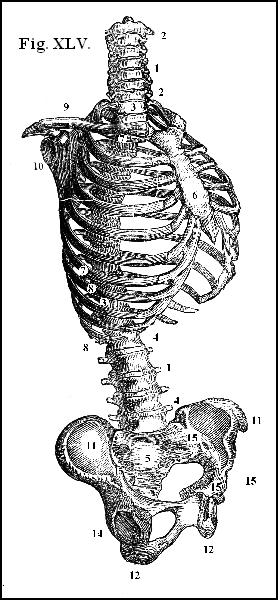
Bones of the trunk. 1. Spinal column; 2. the seven cervical
vertebræ; 3. the twelve dorsal vertebræ; 4. the five
lumbar vertebræ; 5. the sacrum; 6. the sternum; 7. the
true ribs; 8. the false ribs; 9. the clavicle; 10. the scapula;
11. the ilium; 12. the ischium; 13. the pubes;
14. the acetabulum; 15. the brim of the pelvis.
76. The separate bones of the series have a kind
of turning motion on each other; hence each is
called a vertebra, and the name of vertebral column
is often given to the entire series, as well as
that of spinal column. That portion of the column
which forms the neck consists of seven distinct
bones, called cervical vertebræ (fig. XLV. 2);
that portion which forms the back consists of
twelve, called dorsal vertebræ (fig. XLV. 3);
that portion which forms the loins consists of five,
called lumbar vertebræ (fig. XLV. 4). Between
each of these classes of vertebræ there are
specific differences, but they need not be described
here: all that is necessary to the present purpose
is an account of the structure which is common
to every vertebra.
77. By inspecting fig. XLVI. 1, it will be seen
that the upper and under edges of each vertebra
consist of a ring of bone, of a firm and compact
texture, rendering what may be called the body of
the vertebra exceedingly strong (fig. XLVI. 3).
This ring of bone forms a superficial depression
(fig. XLVI. 2), for the reception of a peculiar
substance, immediately to be described, which is
interposed between each vertebra (fig. XLVII. 2).
78. The anterior surface of the body of the vertebra
is convex (fig. XLVI. 3); its posterior surface
is concave (fig. XLVI. 4); from the posterior surface
springs a bony arch (figs. XLVI. 5 and LIII. 1),
which, together with the posterior concavity, forms
an aperture of considerable magnitude (fig. XLVI.
6), a portion of the canal for the passage of the
spinal cord (figs. XLVII. 3, and XLIX. 3).
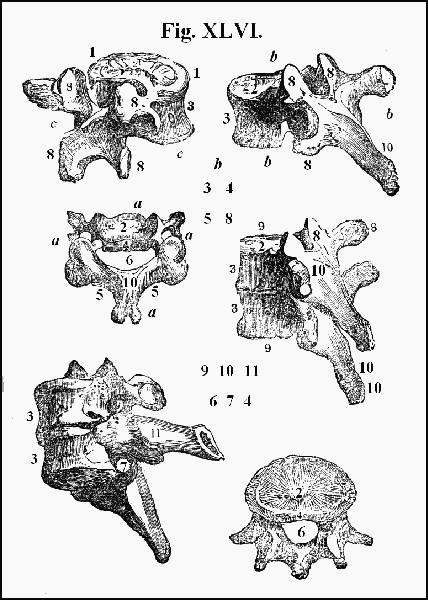
View of some of the vertebræ, which by their union form
the spinal column.
a. A vertebra of the neck;
b. a vertebra of the back;
a vertebra of the loins.
1. Ring of compact bone forming, 3, the body of the
vertebra; 2. superficial depression for the reception of the
intervertebral cartilage; 3. anterior surface of the body of
the vertebra; 4. posterior surface; 5. bony arch; 6. opening
for the passage of the spinal cord; 7. opening for the passage
of the spinal nerves; 8. articulating processes by
which the vertebræ are joined to each other; 9. two dorsal
vertebræ united, showing the arrangement of, 10, the spinous
processes; 11. a portion of a rib articulated with the side
of the vertebra.
79. Both the upper and under edges of the arch
form a notch (fig. XLVI. 7.), which, together with
a corresponding notch in the contiguous vertebra,
completes another aperture rounder and smaller
than the former, but still of considerable size (fig.
XLVI. 7.), the passage of the spinal nerves (fig.
XLVII. 3).
80. From both the upper and under sides of the
arch proceed two short but strong projections of
bone (fig. XLVI. 8.), termed the articulating processes,
because it is chiefly by these processes that
the vertebræ are connected together. From the
beginning to the end of the series, the two upper
processes of the one vertebra are united with the
two lower processes of the vertebra immediately
above it (fig. XLVI. 9), and around the edges of
all the articulating processes are visible rough
lines, which mark the places to which the articulating
ligaments are attached.
81. No vertebra, except the first, rests immediately
upon its contiguous vertebra (fig. XLV.
2, 4). Each is separated from its fellow by a
substance of a peculiar nature interposed between
them, termed the intervertebral substance (figs.
XLVII. 2, and L. 2). This substance partakes
partly of the nature of cartilage, and partly of
that of ligament. It is composed of concentric
plates, formed of oblique fibres which intersect
each other in every direction. This substance,
for about a quarter of an inch from its circumference
towards its centre, is tough, strong,
and unyielding; then it becomes softer, and is
manifestly elastic; and so it continues until it
approaches the centre, when it becomes pulpy, and
is again inelastic. The exterior tough and unyielding
matter is for the firmness of the connexion
of the several vertebræ with each other; the interior
softer and elastic matter is for the easy play of
the vertebræ upon each other; the one for security,
the other for pliancy. And the adjustment of the
one to the other is such as to combine these properties
in a perfect, manner. The quantity of the
unyielding substance is not so great as to produce
rigidity; the quantity of the elastic substance is
not so great as to occasion insecurity. The firm
union of its solid matter renders the entire column
strong; the aggregate elasticity of its softer substance
renders it springy.
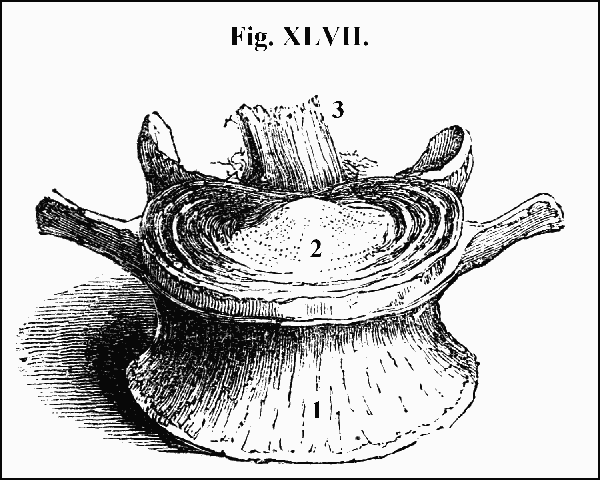
1. One of the Lumbar vertebræ. 2. Intervertebral substance.
3. A portion of the spinal cord in its canal.
82. The column is not constructed in such a
manner as to admit of an equal degree of motion
in every part of it. Every thing is contrived to
give to that portion which belongs to the neck
freedom of motion, and, on the contrary, to render
that portion which belongs to the back comparatively
fixed. In the neck the mechanism of the
articulating processes is such as to admit of an
equal degree of sliding motion forwards, backwards,
and from side to side, together with a turning motion
of one bone upon another; at the same time,
the intervertebral substance between the several
vertebræ is thick. In consequence of this mechanism,
we can touch the breast with the chin,
the back with the hind head, and the shoulders
with the ear, while we can make the head describe
more than a semicircle. But, in the back, the
articulating processes are so connected as to prevent
the possibility of any motion, either forwards
or backwards, or any turning of one vertebra upon
another, while the intervertebral substance is comparatively
thin (fig. XLV. 2, 4). That portion of
the column which belongs to the back is intended
to afford a fixed support for the ribs, a support
which is indispensable to their action in the function
of respiration. In the loins, the articulating
processes are so connected as to admit of a considerable
degree of motion in the horizontal direction,
and from side to side, and the intervertebral substance
here progressively increases in thickness to
the point at which the upper portion of the column
is united to the sacrum (fig. XLV. 2, 4), where
the degree of motion is extensive.
83. The canal for the spinal cord, formed partly
by the concavity in the posterior surface of the vertebra,
and partly by the arch that springs from it
(fig. XLVI. 6.), is lined by a continuation of the
dense and strong membrane that constitutes the
internal periosteum of the cranium, the dura mater
(fig. XLVIII. c), which, passing out of the opening
in the occipital bone, called the foramen magnum
(figs. XXXIX. 7, and XLIX. 3), affords a
smooth covering to the canal throughout its whole
extent.
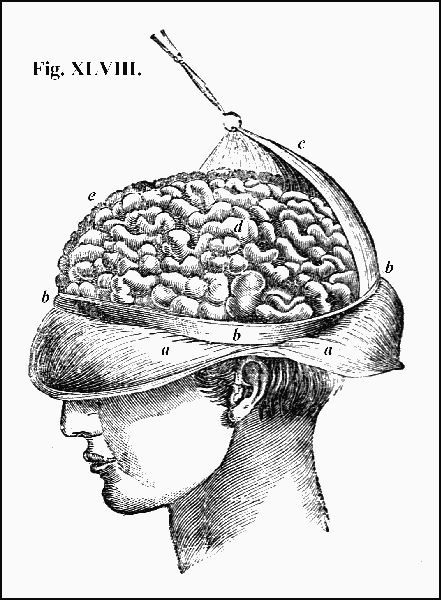
a. The scalp, turned down.
b. The cut edge of the bones of the skull.
c. The external strong membrane of the brain (Dura Mater)
suspended by a hook.
d. The left hemisphere of the brain, showing its convolutions.
e. The superior edge of the right hemisphere.
f. The fissure between the two hemispheres.
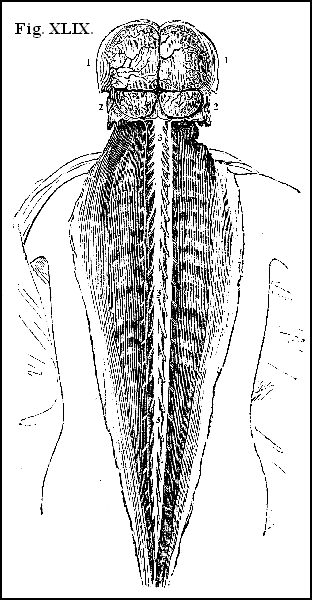
1. Hemispheres of the brain proper, or cerebrum;
2. hemispheres of the smaller brain, or cerebellum; 3. spinal
cord continuous with the brain, and the spinal nerves proceeding
from it on each side.
84. The spinal cord itself, continuous with the
substance of the brain, passes also out of the cranium
through the foramen magnum into the spinal
canal (fig. XLIX. 3), enveloped in the delicate
membranes that cover it, and surrounded by the
aqueous fluid contained between those membranes.
The size of the spinal canal, accurately adapted to
that of the spinal cord, which it lodges and protects,
is of considerable size, and of a triangular
shape in its cervical portion (fig. XLIX. 3),
smaller and rounded in its dorsal portion (fig.
XLIX. 3), and again large and triangular in its
lumbar portion (fig. XLIX. 3).
85. The spinal column performs several different,
and apparently incompatible, offices.
First, it affords a support and buttress to other
bones. It sustains the head (fig. XXXIV. 1); it
is a buttress to the ribs (fig. XLVI. 7); through
the sternum and ribs it is also a buttress to the
superior, and through the pelvis, to the lower,
extremities (fig. XXXIV. 2, 3, 4).
Secondly, it affords a support to powerful muscles,
partly to those that maintain the trunk of the
body in the erect posture against the force of gravitation,
and partly to those that act upon the superior
and inferior extremities in the varied, energetic,
and sometimes long-continued movements
they execute.
Thirdly, it forms one of the boundaries of the
great cavities that contain the chief organs of the
organic life. To the support and protection of those
organs it is specially adapted; hence the surface
in immediate contact with them is even and
smooth; hence its different curvatures, convexities,
and concavities, have all reference to their accommodation;
hence in the neck it is convex (fig.
XLV. 2), in order to afford a firm support to the
esophagus, the wind-pipe, the aorta, and the great
trunks of the venous system (fig. LX. 3, 4); in
the back it is concave, in order to enlarge the space
for the dilatation of the lung in the act of inspiration
(figs. XLV. 3, and LX. 5); in the loins
it is convex, in order to sustain and fix the loose
and floating viscera of the abdomen (figs. XLV.
4, and LX. 6, 7, 8, 9); in the pelvis it is concave,
in order to enlarge the space for lodging the
numerous delicate and highly-important organs
contained in that cavity (fig. XLV. 5).
Fourthly, it forms the osseous walls of a canal
(figs. XLVI. 6, and XLVII. 3) for the lodgment
and protection of the soft and tender substance of
the spinal cord, one of the great central masses of
the nervous system, the seat of the animal life (fig.
XLIX. 3).
Fifthly, it affords in its osseous walls secure
apertures for the passage of the spinal nerves (figs.
XLVI. 7, and XLIX. 3), by which impressions are
transmitted from the organs to the spinal cord and
brain, in the function of sensation; and from the
spinal cord and brain to the organs in the function
of volition.
86. For the due performance of these offices, it
is indispensable that it should be firm, rigid, strong,
and yet to a certain extent readily flexible in every
direction. By what mechanism is it endowed with
these apparently incompatible properties?
87. By means of the ring of compact bone,
which forms so large a part of its body (fig. XLVI.
1) it is rendered firm, rigid, and strong. By means
of its numerous separate pieces, exactly adjusted to
each other, and dove-tailed into one another, an
increase of strength is gained, such as it would not
have been possible to communicate to a single solid
piece. By the same mechanism, some degree of flexibility
is also obtained; each separate bone yielding
to some extent, which, though slight in a single
bone, becomes considerable in the twenty-four.
88. But the flexibility required is much greater
than could be obtained by this expedient alone.
A rigid and immoveable pile of bones, in the position
of the spinal column, on which all the other
parts of the body rest, and to which they are
directly or indirectly attached, would necessarily
have rendered all its movements stiff and mechanical;
and every movement of every kind impossible,
but in a given direction. That the movements of
the body may be easy, free, and varied; that it
may be possible to bring into play new and complex
combinations of motion at any instant, with
the rapidity of the changes of thought, at the command
of the impulses of feeling, it is indispensable
that the spinal column be flexible in every direction,
forwards, backwards, and at the sides: it is
equally indispensable that it be thus capable of
yielding, without injuring the spinal cord; without
injuring the spinal nerves; without injuring the
thoracic and abdominal viscera; and without injuring
the muscles of the trunk and extremities.
The degree in which it possesses this power of
flexibility, and the extent to which, by the cultivation
of it, it is sometimes actually brought, is exemplified
in the positions and contortions of the
posture-master and the tumbler. It is acquired by
means of the intervertebral substance, the compressible
and elastic matter interposed between the
several vertebræ. So compressible is this substance,
that the human body is half an inch shorter
in the evening than in the morning, having lost
by the exertions of the day so much of its stature;
yet, so elastic is this matter, that the stature lost
during the day is regained by the repose of the
night. The weight of the body pressing in all
directions upon the spinal column; muscles, bones,
cartilages, ligaments, membranes, with all their
vessels and all the fluids contained in them; the
weight of all these component parts of the head,
trunk, and extremities, pressing, without the cessation
of an instant, during all the hours of vigilance,
upon the intervertebral substance, compresses
it; but this weight, being taken off during
the night, by the recumbent posture of the body,
the intervertebral substance, in consequence of its
elasticity, regains its original bulk, and of course
the spinal column its original length.
89. But the flexibility acquired through the combined
properties of compressibility and elasticity
is exceedingly increased by the action of the pulpy
and inelastic matter in the centre of the intervertebral
substance; this matter serving as a pivot
to the vertebræ, facilitating their motion on each
other. Its effect has been compared to that of a
bladder partly filled with water, placed between
two trenchers; in this case, the approximation of
the circumference of the two trenchers on one side,
would instantly displace a portion of the water on
that side, which would occupy the increasing space
on the other, with the effect of facilitating the
change, in every possible direction, of the position
of the two trenchers in relation to each other. To
this effect, however, it is indispensable that the
matter immediately around this central pivot should
be, not like itself, rigid and unyielding, but compressible
and elastic. It is an interesting fact, that
since this illustration was suggested, it has been
discovered that this very arrangement is actually
adopted in the animal body. In certain animals,
in the very centre of their intervertebral substance,
there has been actually found a bag of water, with
a substance immediately surrounding the bag, so
exceedingly elastic, that when the bag is cut, the
fluid contained in it is projected to the height of
several feet in a perpendicular stream.
90. But besides securing freedom and extent of
motion, the intervertebral substance serves still
another purpose, which well deserves attention.
Firmness and strength are indispensable to the
fundamental offices performed by the column; and
to endow it with these properties, we have seen
that the external concentric layers of the intervertebral
substance are exceedingly tough and that
they are attached to the bodies of the vertebræ,
which are composed of dense and compact bone.
But than dense and compact bone, nothing can be
conceived better calculated to receive and transmit
a shock or jar on the application of any degree of
force to the column. Yet such force must necessarily
be applied to it in every direction, from
many points of the body, during almost every moment
of the day; and did it actually produce a
corresponding shock, the consequence would be
fatal: the spinal cord and brain would be inevitably
killed; for the death of these tender and
delicate substances may be produced by a violent
jar, although not a particle of the substances themselves
be touched. A blow on the head may destroy
life instantaneously, by what is termed concussion;
that is, by the communication of a shock to the
brain through the bones of the cranium. The
brain is killed; but on careful examination of
the cerebral substance after death, not the slightest
morbid appearance can be detected: death is
occasioned merely by the jar. A special provision
is made against this evil, in the structure of
the bones of the cranium, by the interposition between
its two compact plates of the spongy substance
called diploë (fig. XLIII. 2); and this is
sufficient to prevent mischief in ordinary cases.
A great degree of violence applied directly to the
head is not common: when it occurs it is accidental:
thousands of people pass through life
without ever having suffered from it on a single
occasion: but every hour, in the ordinary movements
of the body, and much more in the violent
movements which it occasionally makes, a degree
of force is applied to the spinal column, and through
it transmitted to the head, such as, did it produce
a proportionate shock, would inevitably and instantly
destroy both spinal cord and brain. The
evil is obviated partly by the elastic, and partly by
the non elastic properties of the matter interposed
between the several layers of compact bone. By
means of the elastic property of this matter, the
head rides upon the summit of the column as upon
a pliant spring, while the canal of the spinal cord
remains secure and uninvaded. By means of the
soft and pulpy portion of this matter, the vibrations
excited in the compact bone are absorbed point by
point as they are produced: as many layers of this
soft and pulpy substance, so many points of absorption
of the tremors excited in the compact
bone; so many barriers against the possibility of
the transmission of a shock to the delicate nervous
substance.
91. Alike admirable is the mechanism by which
the separate pieces of the column are joined together.
If but one of the bones were to slip off
its corresponding bone, or to be displaced in any
degree, incurable paralysis, followed ultimately
by death, or instantaneous death, would happen;
for pressure on the spinal cord in a certain part of
its course is incompatible with the power of voluntary
motion, and with the continuance of life for
any protracted term; and in another part of its
course, with the maintenance of life beyond a few
moments. To prevent such consequences, so great
is the strength, so perfect the attachment, so unconquerable
the resistance of that portion of the
intervertebral substance which surrounds the edge
of the bodies of the vertebræ, that it will allow the
bone itself to give way rather than yield. Yet such
is the importance of security to this portion of the
frame, that it is not trusted to one expedient alone,
adequate as that might seem. Besides the intervertebral
substance, there is another distinct provision
for the articulation of the bodies of the vertebræ.
Commencing at the second cervical vertebra, in its
fore part, and extending the whole length of the
column to the sacrum, is a powerful ligament,
composed of numerous distinct longitudinal fibres
(fig. L.), which are particularly expanded over
the intervals between the bones occupied by the
intervertebral substance (figs. L. 1, and LI.
2, 2). This ligament is termed the common
anterior vertebral, beneath which, if it be raised
from the intervertebral substance, may be seen
small decussating fibres, passing from the lower
edge of the vertebra above, to the upper edge of
the vertebra below (fig. L. 3), from which circumstance
these fibres are termed crucial.
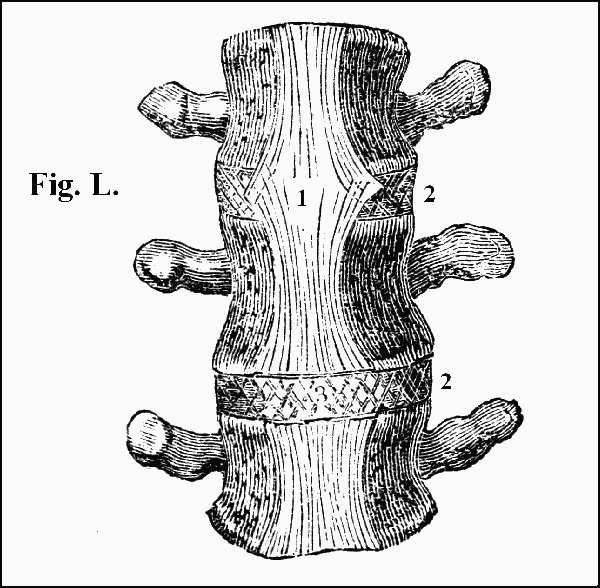
1. Common anterior ligament; 2. intervertebral substance.
The anterior ligament is removed to exhibit (3.)
the crucial fibres passing over it.
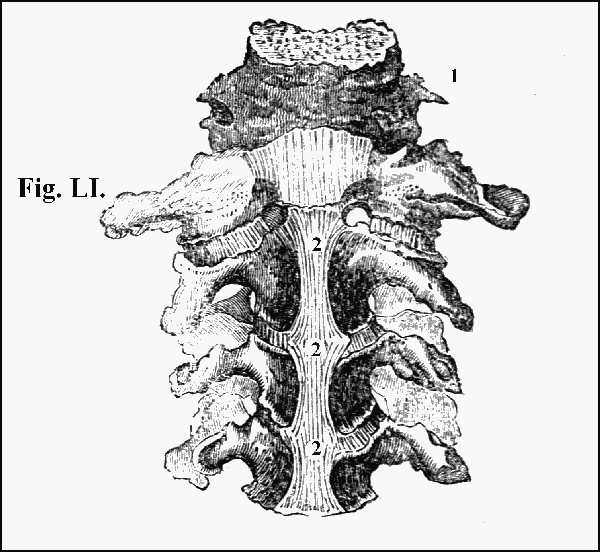
1. Portion of the occipital bone; 2. common anterior
ligament.
92. Corresponding with the ligament on the
anterior, is another on the posterior part of the
spine (fig. LII. 1), which takes its origin from the
foramen magnum (fig. LII. 1); descends from
thence, within the vertebral canal, on the posterior
surface of the bodies of the vertebra (fig. LII. 1),
and extends to the sacrum. This ligament is
termed the common posterior vertebral, which,
besides adding to the strength of the union of the
bodies of the vertebræ, prevents the column itself
from being bent too much forward.
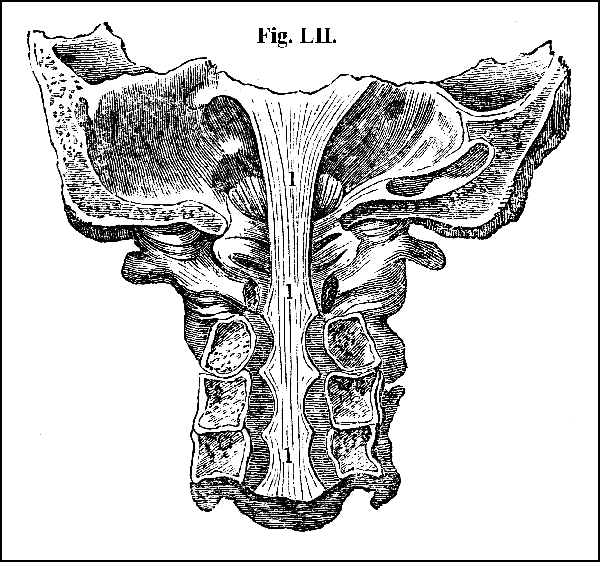
1. Posterior vertebral ligament.
93. Moreover, the bony arches of the vertebræ
(fig. LIII. 1) are connected by means of a substance
partly ligamentous, and partly cartilaginous
(fig. LIII. 2), which, while it is extremely elastic,
is capable of resisting an extraordinary degree of
force.
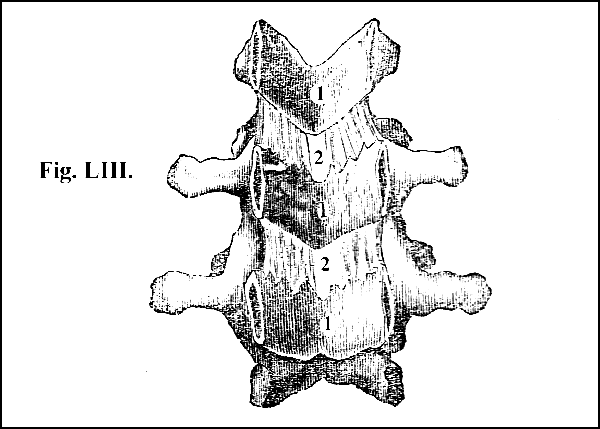
1. Arches of the vertebræ seen from within;
2. ligaments connecting them.
94. And in the last place, the articular processes
form so many distinct joints, each being
furnished with all the apparatus of a moveable
joint, and thus possessing the ordinary provision
for the articulation of bones, in addition to the
whole of the foregoing securities.
95. "In the most extensive motion of which the
spinal column is capable, that of flexion, the common
anterior ligament is relaxed; the fore part of
the intervertebral substance is compressed, and its
back part stretched; while the common posterior
ligament is in a state of extension. In the extension
of the column the state of the ligaments is
reversed; those which were extended being in their
turn relaxed, while the common anterior vertebral
is now put upon the stretch. In the lateral inclination
of the column, the intervertebral substance
is compressed on that side to which the body is
bent. In the rotatory motion of the column, which
is very limited in all the vertebræ, but more particularly
in the dorsal, in consequence of their
attachment to the ribs, the intervertebral substance
is contorted, as are likewise all the ligaments. All
the motions of the column are capable of being
aided to a great extent by the motion of the pelvis
upon the thighs."
96. "The number and breadth of the attachments
of these bones," says an accomplished anatomist
and surgeon,[4]
"their firm union by ligament,
the strength of their muscles, the very inconsiderable
degree of motion which exists between
any two of them, and lastly, the obliquity of their
articular processes, especially in the dorsal and
lumbar vertebræ, render dislocation of them, at
least in those regions, impossible without fracture;
and I much doubt whether dislocation even of the
cervical vertebræ ever occurs without fracture,
either through their bodies or their articular processes.
The effects of each of these accidents
would produce precisely the same injury to the
spinal marrow, and symptoms of greater or less
importance, according to the part of the spinal
column that is injured. Death is the immediate
consequence if the injury be above the third cervical
vertebra, the necessary paralysis of the parts
to which the phrenic and intercostal nerves are
distributed causing respiration instantly to cease.
If the injury be sustained below the fourth cervical
vertebra, the diaphragm is still capable of action,
and dissolution is protracted. The symptoms, in
fact, are less violent in proportion as the injury to
the spinal marrow is further removed from the
brain; but death is the inevitable consequence,
and that in every case at no very distant period."
97. So the object of the construction of the
spinal column being to combine extent and freedom
of motion with strength, and it being necessary to
the accomplishment of this object to build up the
column of separate pieces of bone, the connecting
substances by which the different bones are united
are constituted and disposed in such a manner as
to prove absolutely stronger than the bones themselves.
Such is the structure of this important
portion of the human body considered as a piece
of mere mechanism; but our conception of its
beauty and perfection would be most inadequate
if we did not bear in mind, that while the spinal
column performs offices so varied and apparently
so incompatible, it forms an integrant portion of a
living machine: it is itself alive: every instant,
blood-vessels, absorbents and nerves, are nourishing,
removing, renewing, and animating every part
and particle of it.
98. The anterior boundary of the thorax is
formed by the bone called the sternum, or the
breast-bone, which is broad and thick at its upper,
and thin and elongated at its lower extremity (figs.
XLV. 6, and LIV.), where it gives attachment
to a cartilaginous appendix, which being pointed
and somewhat like a broadsword, is called the
ensiform cartilage.
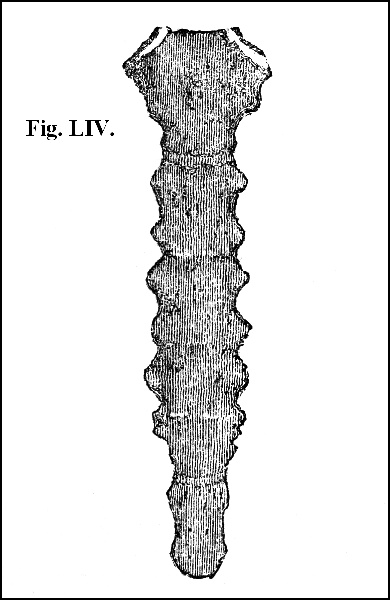
Anterior view of the sternum.
99. Its position is oblique, being near the vertebral
column at the top, and distant from it at
the bottom (fig. XLV. 6). Its margins are thick,
and marked by seven depressions, for the reception
of the cartilages of the seven true ribs (fig. LIV).
Its anterior surface is immediately subjacent to the
skin, and gives attachment to powerful muscles,
which act on the superior extremities: its posterior
surface is slightly hollowed in order to enlarge the
cavity of the thorax (fig. LV.).
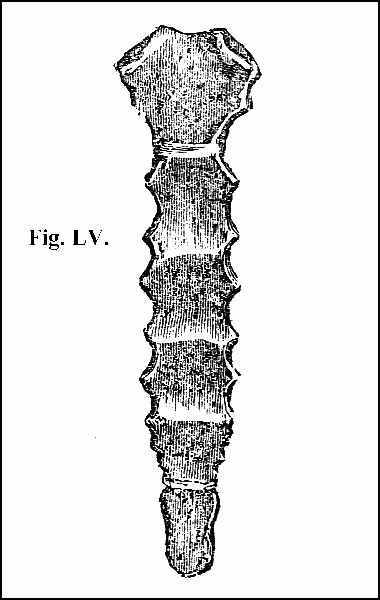
Posterior view of the sternum.
100. The thorax is bounded at the sides by the
ribs, which extend like so many arches between
the spinal column and the sternum (fig. XLV. 7,
8). They are in number twenty-four, twelve on
each side, of which the seven upper are united to
the sternum by cartilage, and are called true ribs
(fig. XLV. 7); the cartilages of the remaining
five are united with each other and are not attached
to the sternum; these are called false ribs (fig.
XLV. 8): all of them are connected behind to
the spinal column (fig. XXXV.).
101. The ribs successively and considerably increase
in length as far as the seventh, by which
the cavity they encompass is enlarged; from the
seventh they successively diminish in length, and
the capacity of the corresponding part of the cavity
is lessened. The direction of the ribs from above
downwards is oblique (fig. XLV. 7, 8). Their
external or anterior surface is convex (fig. XLV.
7, 8); their internal or posterior surface is concave:
by the first their strength is increased; by
the second the general cavity of the thorax is enlarged
(fig. XLV. 7, 8). Their upper margin is
smooth and rounded, and gives attachment to a
double layer of muscles, called the intercostal,
placed in the intervals that separate the ribs from
each other (fig. LIX.). Along the lower margin
is excavated a deep groove, for the lodgment and
protection of the intercostal vessels.
102. The ribs are connected with the spinal
column chiefly by what is termed the anterior
ligament (fig. LVI. 1), which is attached to the
head of the rib (fig. LVI.), and which, dividing
into three portions (fig. LVI. 1), firmly unites
every rib to two of the vertebræ, and to the intervertebral
substance (fig. LVI. 1). This articulation
is fortified by a second ligament (fig. LVI.
2), also attached to a head of the rib, termed the
interarticular (fig. LVI. 2), and by three others,
one of which is attached on the fore part, and the
two others in the back part, to the neck of the
rib (fig. LVII. 1).
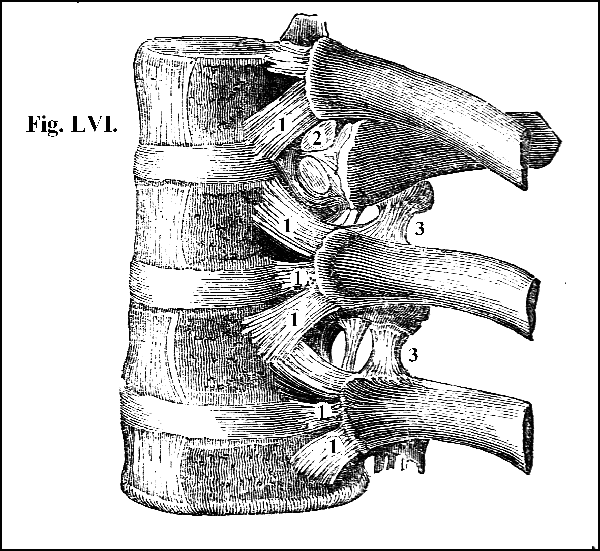
Ligaments connecting the ribs to the spinal column.
1. anterior ligaments; 2. interarticular ligament; 3. ligaments
of the necks of the ribs.
The cartilages of the seven superior ribs are
attached to the sternum by a double layer of ligamentous
fibres, termed the anterior and the posterior
ligaments of the sternum (fig. LVIII.). So
strong are the bands which thus attach the ribs
to the spinal column and the sternum, that the
ribs cannot be dislocated without fracture. "Such
at least is the case in experiments upon the dead
body, where, though the rib be subjected to the
application of force by means of an instrument
best calculated to detach its head from the articulation,
yet it is always broken."
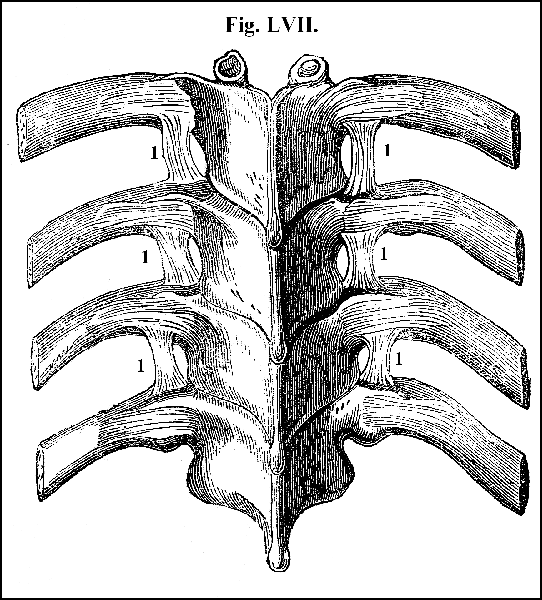
1, &c. Ligaments connecting the ribs to the vertebræ
behind.
While thus firmly attached to their points of
support, the ligaments, which fix them, are so
disposed as to render the ribs capable of being
readily moved upwards and downwards: upwards
in inspiration; downwards in expiration; and it
is by this alternate action that they enlarge and
diminish the cavity of the thorax in the function
of respiration.
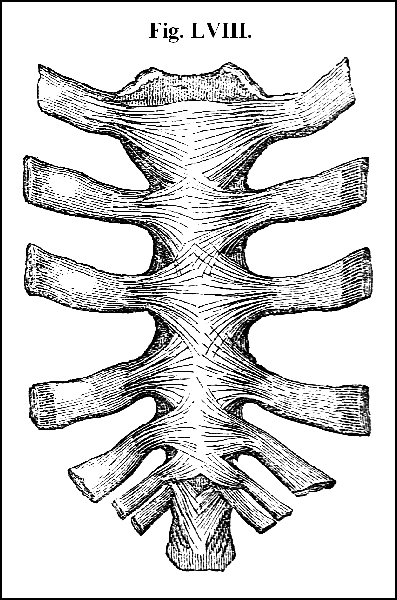
Ligaments joining the cartilages of the ribs to the sternum.
103. Such are the boundaries of the cavity of
the thorax as far as its walls are solid. The interspaces
between these solid portions at the sides are
filled up by muscles, principally by those termed
the intercostal (fig. LIX.); below, the boundary
is formed by the diaphragm (fig. LXI. 2); while
above, as has been already stated (69), the cavity
is so contracted as only to leave an opening for the
passage of certain parts to and from the chest.
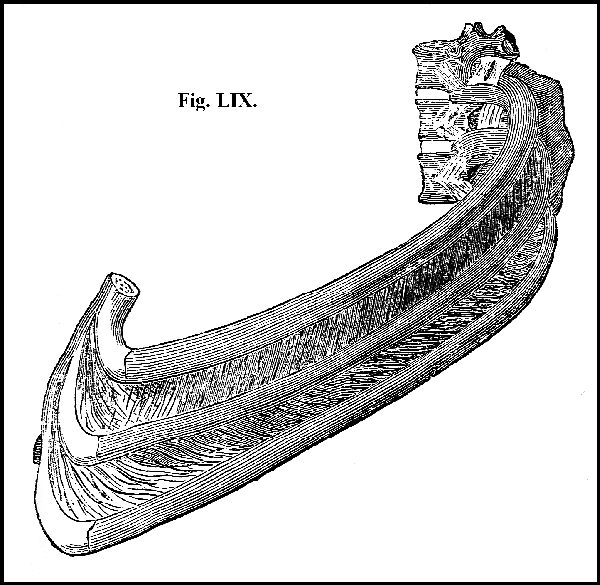
A view of the muscles called Intercostals, filling up the
spaces between the ribs.
104. The inner surface of the walls of the thorax,
in its whole extent, is lined by a serous membrane,
exceedingly thin and delicate, but still firm, called
the pleura. The same membrane is reflected over
the organs of respiration contained in the cavity,
so as to give them an external coat. The membrane
itself is every where continuous, and every
where the same, whether it line the containing or
the contained parts; but it receives a different
name as it covers the one or the other: that portion
of it which lines the walls of the cavity being
called the costal pleura (fig. LXI. a), while that
which covers the organs contained in the cavity
is termed the pulmonary pleura (fig. LX. 5, 1).
105. A fold of each pleura passes directly across
the central part of the cavity of the thorax; extending
from the spinal column to the sternum, and
dividing the general cavity into two. This portion
of the pleura is called the mediastinum, from its
situation in the centre of the thorax, and it so
completely divides the thoracic cavity into two,
that the organs on one side of the chest have no
communication with those of the other; so that
there may be extensive disease in one cavity (for
example, a large accumulation of water,) while the
other may be perfectly sound.
106. The main organs contained in the cavity of
the thorax are the lungs with their air tube; the
heart with its great vessels; and the tube passing
from the mouth to the stomach (fig. LX.).
107. The two lungs occupy the sides of the chest
(fig. LX. 5). They are completely separated
from each other by the membranous partition just
described, the mediastinum. Between the two
folds of the mediastinum, namely, in the middle
of the chest, but inclining somewhat to the left
side, is placed the heart, enveloped in another
serous membrane, the pericardium (fig. LX.
2, 1).
108. The lungs are moulded to the cavities they
fill; whence their figure is conical, the base of the
cone being downwards, resting on the diaphragm
(fig. LX. 5, b); and the apex upwards, towards
the neck (fig. LX. 5).
109. That surface of each lung which corresponds
to the walls of the chest is convex in its
whole extent (fig. LX. 5); on the contrary, that
surface which corresponds to the mediastinum is
flattened (fig. LX. 5). The basis of the lung is
concave, adapted to the convexity of the diaphragm
on which it rests (fig. LX. 5).
110. The air-vessel of the lungs, termed the
bronchus, together with the blood-vessels and nerves,
enter the organ at its flattened side, not exactly in
the middle, but rather towards the upper and back
part. This portion is termed the root of the lung.
111. The lungs are attached to the neck by the
trachea (fig. LX. 4), the continuation of which
forms the bronchus; to the spinal column by the
pleura, and to the heart by the pulmonary vessels
(fig. LX. 3, d): their remaining portion is free
and unattached.
112. In the living body, the lungs on each side
completely fill the cavity of the chest, following
passively the movements of its walls, and accurately
adapting themselves to its size, whether its
capacity enlarge in inspiration, or diminish in expiration,
so that the external surface of the lung
(the pulmonary pleura) is always in immediate
contact with the lining membrane of the walls of
the cavity (the costal pleura); consequently,
during life, there is no cavity, the chest being
always completely full.
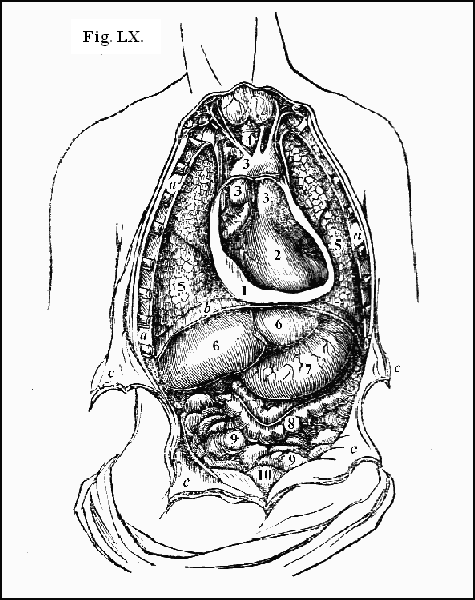
a. The cut edges of the ribs, forming the lateral boundaries of the
cavity of the thorax.
b. The diaphragm, forming the inferior boundary of the thorax, and
the division between the thorax and the abdomen.
c. The cut edges of the abdominal muscles, turned aside, exposing
the general cavity of the abdomen.
1. The cut edge of the pericardium
turned aside.
2. The heart.
3. The great vessels in immediate
connexion with the
heart.
4. The trachea, or wind-pipe.
5. The lungs.
6. The liver.
7. The stomach.
8. The large intestine.
9. The small intestines.
10. The urinary bladder.
113. The anterior surface of the pericardium,
the bag which envelopes the heart, lies immediately
behind the sternum, and the cartilages of the
second, third, fourth, and fifth ribs, covered at its
sides by the pleura, and firmly attached below to
the diaphragm (fig. LX. 1).
114. Surrounded by its pericardium, within the
mediastinum, the heart is placed nearly in the
centre of the chest, but its direction is somewhat
oblique, its apex being directly opposite to the interval
between the fifth and sixth ribs on the left
side (fig. LX. 2); while its basis is directed upwards,
backwards, and towards the right (fig.
LX. 2). That portion of its surface which is
presented to view on opening the pericardium is
convex (fig. LX. 2); but its opposite surface,
namely, that which rests upon the part of the pericardium
which is attached to the diaphragm, is
flattened (fig. LX. 1). It is fixed in its situation
partly by the pericardium and partly by the great
vessels that go to and from it. But under the
different states of expiration and inspiration, it
accompanies, in some degree, the movements of
the diaphragm; and in the varied postures of the
body, the heart deviates to a certain extent from
the exact position here described.
115. The second division of the trunk, the abdomen,
is bounded above by the diaphragm (fig.
LXI. 2), below by the pelvis (fig. LXI. 3), behind
and at the sides by the vertebræ and muscles of
the loins (fig. LXIII.), and before by the abdominal
muscles (fig. LXIII. 9).
116. The organ which forms the superior boundary
of the abdomen, the diaphragm (midriff), is
a circular muscle, placed transversely across the
trunk, nearly at its centre (fig. LXI. 2). It forms
a vaulted partition between the thorax and the
abdomen (fig. LXI. 2). All around its border it
is fleshy (fig. LXI. 2); towards its centre it is
tendinous (fig. LXI. 2); the surface towards the
abdomen is concave (fig. LXI. 2); that towards
the thorax convex (fig. LXI. 2); while its middle
tendinous portion ascends into the thorax as high
as the fourth rib (fig. LXI. 2).
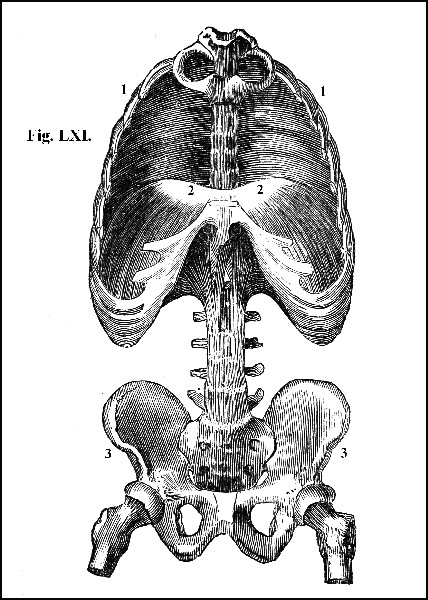
View of the diaphragm. 1. Cavity of the thorax;
2. diaphragm separating the cavity of the thorax from that of
the abdomen; 3. cavity of the pelvis.
117. The diaphragm is perforated by several
apertures, for the transmission of tubes and vessels,
which pass reciprocally between the thorax and
abdomen (fig. LXII.).
1. A separate aperture is formed to afford an
exit from the thorax of the aorta, the common
source of the arteries (fig. LXII. 2), and an entrance
into the thorax of the thoracic duct, the tube that
bears the digested aliment to the heart. 2. A little
to the left of the former, there is another aperture,
through which passes the esophagus or gullet (fig.
LXII. 3), the tube that conveys the food from the
mouth to the stomach. 3. On the right side, in
the tendinous portion of the diaphragm, very carefully
constructed, is a third aperture for the passage
of the vena cava (fig. LXII. 4), the great vessel that
returns the blood to the heart from the lower parts
of the body.
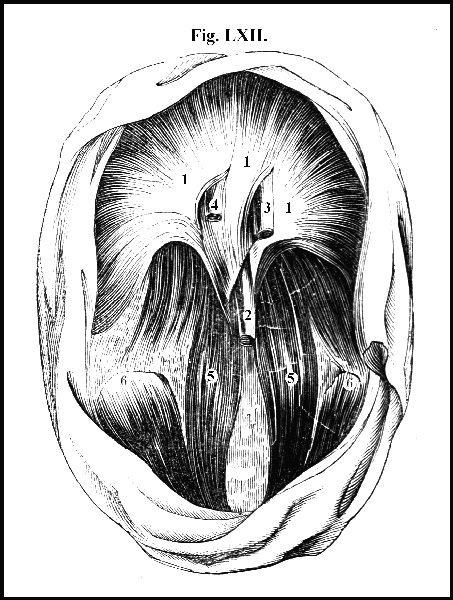
View of the diaphragm with the tubes that pass through
it. 1. Arch of the diaphragm; 2. the trunk of the aorta
passing from the chest into the abdomen; 3. the esophagus
passing from the chest through the diaphragm to the stomach;
4. the vena cava, the great vein that returns the
blood to the heart from the lower parts of the body, passing
from the abdomen, into the chest, in its way to the right
side of the heart; 5. 6. muscles that arise in the interior of
the trunk and that act upon the thigh; 5. the muscle called
psoas; 6. the muscle called iliacus.
118. The partition formed by the diaphragm between
the thorax and abdomen, though complete,
is moveable; for as the diaphragm descends in inspiration
and ascends in expiration, it proportionally
enlarges or diminishes the cavities between
which it is placed; consequently, the actual magnitude
of these cavities varies every moment, and
the size of the one is always in the inverse ratio of
that of the other.
119. Between the abdomen and the pelvis there
is no separation; one cavity is directly continuous
with the other (fig. LXI. 3); but along the inner
surface of the expanded bones, which form a part
of the lateral boundary of the abdomen, there is a
prominent line, termed the brim of the pelvis (fig.
XLV. 15), marking the point at which the abdomen
is supposed to terminate and the pelvis to
commence.
120. Behind and at the sides the walls of the
abdomen are completed partly by the lumbar portion
of the spinal column and partly by the lumbar
muscles (fig. XLV. 4), and before by the abdominal
muscles (fig. LXIII. 9).
121. The inner surface of the walls of the abdomen
is lined throughout by a serous membrane,
termed the peritoneum (fig. LXIII.). From the
walls of the abdomen, the peritoneum is reflected
upon the organs contained in the cavity, and is
continued over them so as to form their external
coat. The peritoneum also descends between the
several organs, connecting them together, and
holding them firmly in their situation; and it likewise
forms numerous folds, in which are embedded
the vessels and nerves that supply the organs. It
secretes a serous fluid, by which its own surface
and that of the organs it covers is rendered moist,
polished, and glistening, and by means of which
the organs glide smoothly over it, and over one
another in the various movements of the body,
and are in constant contact without growing together.
In structure, distribution, and function,
the peritoneum is thus perfectly analogous to the
pleura.
122. Like the thorax, the abdomen is always
completely full. When the diaphragm is in
action, it contracts. When the diaphragm is in
the state of contraction, the abdominal and lumbar
muscles are in the state of relaxation. By the
contraction of the diaphragm, the organs contained
in the abdomen are pushed downwards, and the
anterior and lateral walls of the cavity being at
this moment in a state of relaxation, they readily
yield, and, consequently, the viscera are protruded
forwards and at the sides. But the abdominal and
lumbar muscles in their turn contract, the diaphragm
relaxing; and, consequently, the viscera,
forced from the front and sides of the abdomen,
are pushed upwards, together with the diaphragm,
into the cavity of the thorax. A firm and uniform
pressure is thus at all times maintained upon the
whole contents of the abdomen: there is an exact
adaptation of the containing to the contained parts,
and of one organ to another. No space intervenes
either between the walls of the abdomen and the
organs they enclose, or between one organ and
another: so that the term cavity does not denote
a void or empty space, but merely the extent of the
boundary within which the viscera are contained.
123. The contents of the abdomen consist of the
organs which belong to the apparatus of digestion,
and of those which belong to the apparatus of
excretion.
124. The organs which belong to the apparatus
of digestion are—1. The stomach (fig. LXIII. 2)
2. The duodenum (fig. LXIII. 4). 3. The jejunum
(fig. LXIII. 5). 4. The ilium (fig. LXIII. 5). The
three last organs are called the small intestines,
and their office is partly to carry on the digestion
of the aliment commenced in the stomach, and
partly to afford an extended surface for the absorption
of the nutriment as it is prepared from the
aliment. 5. The pancreas (fig. LXIV. 5). 6.
The liver (fig. LXIV. 2). 7. The spleen (fig.
LXIV. 4). The three last organs truly belong
to the apparatus of digestion, and their office is to
co-operate with the stomach and the small intestines
in the conversion of the aliment into nutriment.
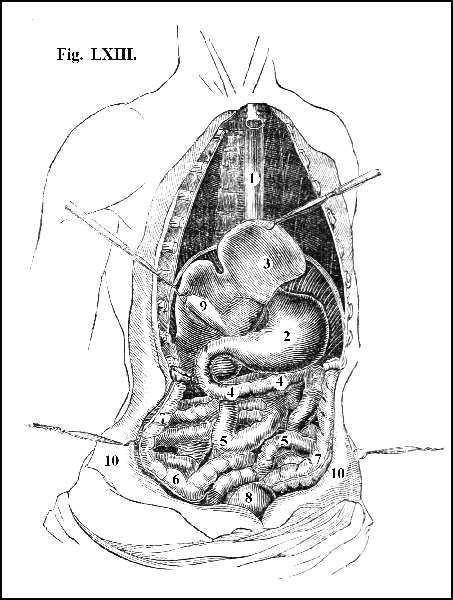
1. Esophagus; 2. stomach; 3. liver raised, showing its
under surface; 4. duodenum; 5. small intestines; 6. cæcum;
7. colon; 8. urinary bladder; 9. gall bladder;
10. abdominal muscles divided and reflected.
125. The organs which belong to the apparatus
of excretion are—1. The large intestines consisting
of the cæcum (fig. LXIII. 6). 2. The
colon (fig. LXIII. 7). 3. The rectum (fig.
LXIV. 10). It is the office of these organs, which
are called the large intestines, to carry out of the
system that portion of the alimentary mass which
is not converted into nourishment. 4. The kidneys
(fig. LXIV. 6), the organs which separate in
the form of the urine an excrementitious matter
from the blood, in order that it may be conveyed
out of the system.
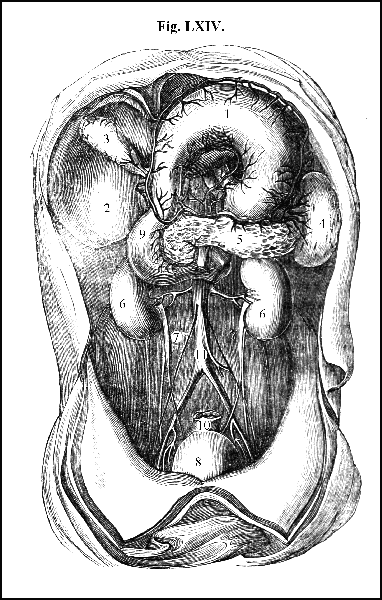
General view of the viscera of the abdomen. 1. Stomach
raised; 2. under surface of liver; 3. gall bladder; 4. spleen;
5. pancreas; 6. kidneys; 7. ureters; 8. urinary bladder;
9. portion of the intestine called duodenum; 10. portion of
the intestine called rectum; 11. the aorta.
126. The last division of the trunk, called the
pelvis (fig. LXI. 3), consists of a circle of large
and firm bones, interposed between the lower
portion of the trunk and the inferior extremities
(fig. XLV.). The bones that compose the
circle, distinct in the child, are firmly united in
the adult into a single piece; but as the original
separation between each remains manifest, they
are always described as separate bones. They are
the sacrum (fig. XLV. 5), the coccyx (fig.
XXXV.), the ilium (fig. XLV. 11), the ischium
(fig. XLV. 12), and the pubis (fig. XLV. 13).
127. The sacrum, placed like a wedge between
the moveable portion of the spinal column and the
lower extremities, forms the posterior boundary of
the pelvis. The figure of this bone is triangular
(fig. XLV. 5); its anterior surface is concave
and smooth, for enlarging the cavity of the pelvis
and sustaining the organs contained in it (fig.
XLV. 5); its posterior surface is convex,
irregular, and rough (fig. XXXV.), giving origin to
the great muscles that form the contour of the
hip, and to the strong muscles of the back and
loins that raise the spine and maintain the trunk
of the body erect.
128. The base or upper part of the sacrum receives
the last vertebra of the loins on a large and
broad surface (fig. XLV. 4), forming a moveable
joint; and the degree of motion at this point is
greater than it is at the higher points of the spinal
column. Firmly united at its sides with the
haunch bones, it admits there of no degree of
motion.
129. The coccyx, so named from its resemblance
to the beak of the cuckoo, when elongated
by a succession of additional bones, forms the tail
in quadrupeds; but in man it is turned inwards to
support the parts contained in the pelvis, and to
contract the lower opening of the cavity. By
means of a layer of cartilage, the medium by
which this bone is connected with the sacrum, it
forms a moveable articulation, continuing moveable
in men until the age of twenty-five, and in
women until the age of forty-five; continuing
moveable in women thus long, in order that by
yielding to the force which tends to push it backwards
during the period of labour, it may enlarge
the lower aperture of the pelvis, and so facilitate
the process of parturition and diminish its suffering.
130. The lateral boundaries of the pelvis are
formed by the ilium, the haunch bone (fig. XLV.
11), and by the ischium, the hip bone (fig. XLV.
12). The ilium forms the lower part of the
abdomen and the upper part of the pelvis (fig.
XLV. 11); its broad expanded wing supports
the contents of the abdomen, and gives attachment
to the muscles that form the anterior portion of its
walls (figs. XLV. 11, and LXIII. 9); its external
convex surface sustains the powerful muscles that
extend the thigh; and along its internal surface
is the prominent line which marks the brim of the
pelvis (fig. XLV. 15), and which divides this
cavity from that of the abdomen.
131. The ischium or hip bone is the lower part
of the pelvis (fig. XLV. 12); at its undermost
portion is a rounded prominence called the tuberosity
(fig. XLV. 12), in its natural condition
covered with cartilage, upon which is superimposed
a cushion of fat. It is this part on which the body
is supported in a sitting posture.
132. The pubis or share bone forms the upper
and fore part of the pelvis (fig. XLV. 13), and
together with the two former bones, completes the
large and deep socket, termed the acetabulum (fig.
XLV. 14), into which is received the head of the
thigh-bone (fig. XXXIV. 4). The margin of the
acetabulum and the greater part of its internal
surface is lined with cartilage, so that in its natural
condition it is much deeper than it appears to be
when the bones alone remain.
133. The lower aperture of the pelvis, which
appears large when all the soft parts are removed,
is not really large, for in its natural state it is filled
up partly by muscles and partly by ligaments,
which sustain and protect the pelvic organs, leaving
only just space enough for the passage to and from
those which have their opening on the external
surface.
134. The cavity of the pelvis, together with all
the organs contained in it, are lined by a continuation
of the membrane that invests the abdomen
and its contents.
135. The organs contained in the pelvis are the
rectum (fig. LXIV. 9), which is merely the termination
of the large intestines, the urinary bladder
(fig. LXIV. 8), and the internal part of the apparatus
of reproduction.
136. The large and strong bones of the pelvis
not only afford lodgment and protection to the
tender organs contained in its cavity, but sustain
the entire weight of the body, the trunk resting on
the sacrum as on a solid basis (fig. XLV. 5),
and the lower extremities being supported in the
sockets in which the heads of the thigh-bones play,
in the varied movements of locomotion (fig.
XXXIV. 4).
137. The last division of the body comprehends
the superior and the inferior extremities.
138. The superior extremities consist of the
shoulder, arm, fore-arm, and hand.
139. The soft parts of the SHOULDER are composed
chiefly of muscles; its bones are two, the
scapula or the blade bone, and the clavicle or
the collar bone (fig. LXV. 2, 4).
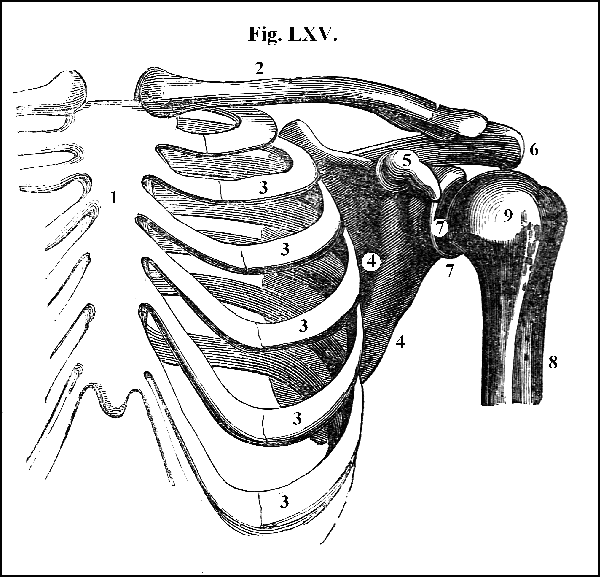
1. Sternum; 2. clavicle; 3. ribs; 4. anterior surface of
scapula; 5. coracoid process of scapula; 6. acromion process
of scapula; 7. margin of glenoid cavity of scapula;
8. body of the humerus or bone of the arm; 9. head of the
humerus.
140. The SCAPULA is placed upon the upper and
back part of the thorax, and occupies the space
from the second to the seventh ribs (fig. LXV. 4)
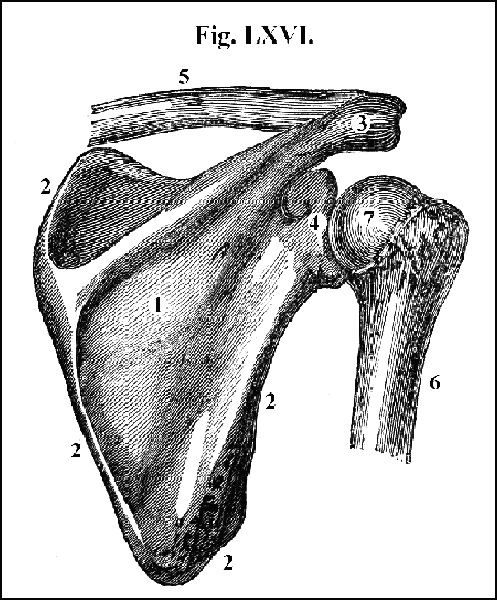
1. Posterior surface of scapula; 2. margin of scapula;
3. acromion process; 4. margin of glenoid cavity; 5. clavicle;
6. body of humerus; 7. head of humerus.
Unlike that of any other bone of the body, it
is embedded in muscles, without being attached
to any bone of the trunk, excepting at a single
point. From the bones of the thorax it is separated
by a double layer of muscles, on which
it is placed as upon a cushion, and over the smooth
surface of which it glides. Originally, like the
bones of the skull, it consisted of two tables of
compact bone, with an intermediate layer of spongy
bony substance (diploë); but, by the pressure of
the muscles that act upon it, it gradually grows
thinner and thinner, until, as age advances, it becomes
in some parts quite transparent and as thin
as a sheet of paper.
141. The figure of the scapula is that of an
irregular triangle (fig. LXVI.). Its anterior surface
is concave (fig. LXV. 4), corresponding to the
convexity of the ribs (fig. XLV. 7); its posterior
surface is very irregular (fig. LXVI. 1), being in
some parts concave and in others convex, giving
origin especially to two large processes (figs. LXV.
5, and LXVI. 3); one of which is termed the
acromion (fig. LXVI. 3), and the other the coracoid
process of the scapula (fig. LXV. 5). The
margins of the bone, whatever the thinness of
some portions of it, are always comparatively thick
and strong (fig. LXVI. 2), affording points of
origin or of insertion to powerful muscles. At
what is called the anterior angle of the bone there
is a shallow oval depression covered with cartilage
and deepened by a cartilaginous margin, called
the glenoid cavity of the scapula (figs. LXV. 7,
and LXVI. 4), which receives the head of the
humerus or bone of the arm (figs. LXV. 9, and
LXVI. 7, 6).
142. The clavicle, the second bone of the shoulder,
is a long and slender bone, of the form of an italic
 ,
projecting a little forwards towards its
middle, so as to give a slight convexity of outline
to the top of the chest and the bottom of the neck
(fig. LXV. 2). It is attached by one extremity
to the sternum (fig. LXV. 2) and by the other to
the scapula (fig. LXV. 2), by moveable joints.
The nature of an immoveable joint has been explained
(63). In the connexion of the bones
of the trunk, while the main object is to secure
firmness of attachment, some degree of motion is
at the same time obtained (81 et seq.): but the
mode in which the several bones of the extremities
are connected with each other and with the trunk,
admits of so great a degree of motion, that these
articulations are pre-eminently entitled to the name
of moveable joints. The component parts of all
moveable joints are bone, cartilage, synovial membrane,
and ligament. The great character of a
moveable joint is the approximation of two or more
bones; yet these bony surfaces are never in actual
contact, but are invariably separated from each
other by cartilage. The cartilage either covers the
entire extent of the articulating surface of the
bones, as in the shoulder-joint, where both the head
of the humerus and the cavity of the scapula that
receives it are enveloped in this substance (fig.
LXV. 7. 9), or a portion of it is placed between
the articulating surfaces of the bones, as in the
joint between the clavicle and sternum (fig. LXVII.
a); which, when so placed, is termed an interarticular
cartilage (fig. LXVII. a). By its
smooth surface cartilage lessens friction; while by
its elasticity it facilitates motion and prevents concussion.
Slightly organized cartilage is provided
with comparatively few blood-vessels and nerves.
Had it been vascular and sensible like the skin
and the muscle, the force applied in the movements
of the joint would have stimulated the blood-vessels
to inordinate action, and the sensibility of the
nerves would have been the source of constant
pain: every motion of every joint would have been
productive of suffering, and have laid the foundation
of disease. The facility and ease of motion
obtained by the smoothness, elasticity, and comparative
insensibility of cartilage are still further
promoted by the fluid which lubricates it, termed
synovia, secreted by a membrane called synovial,
which lines the internal surface of the joint, and
which bears a close resemblance to the serous
(30). Synovia is a viscid fluid of the consistence
of albumen (5). It is to the joint what
oil is to the wheel, preventing abrasion and facilitating
motion; but it is formed by the joint
itself, at the moment when needed, and in the
quantity required. The motion of the joint stimulates
the synovial membrane to secretion, and
hence the greater the degree of motion, the larger
the quantity of lubricating fluid that is supplied.
The several parts of the apparatus of moveable
joints are retained in their proper position by ligamentous
substance, which, as has been shown (96
and 97), is oftentimes so strong that it is easier
to fracture the bone than to tear the ligament, and
in every case the kind and extent of motion possessed
by the joint are dependent mainly on the
form of the articulatory surfaces of the bones and
on the disposition of the ligaments.
143. In the joint formed by the clavicle and
the sternum (fig. LXVII. a) an interarticular cartilage
is placed between the two bones which are
united, first by a strong fibrous ligament, which
envelops them as in a capsule (fig. LXVII. 1);
by a second ligament, which extends from the
cartilage of the first rib to the clavicle (fig.
LXVII. 4), by which the attachment of the clavicle
to the sternum is materially strengthened;
and by a third ligament which passes transversely
from the head of one clavicle to that of the other
(fig. LXVII. 3). The joint thus formed, though
so strong and firm that the dislocation of it is exceedingly
rare, yet admits of some degree of motion
in every direction, upwards, downwards, forwards,
and backwards; and this articulation is the
sole point by which the scapula is connected with
the trunk, and consequently by which the upper
extremity can act, or be acted upon, by the rest of
the body.
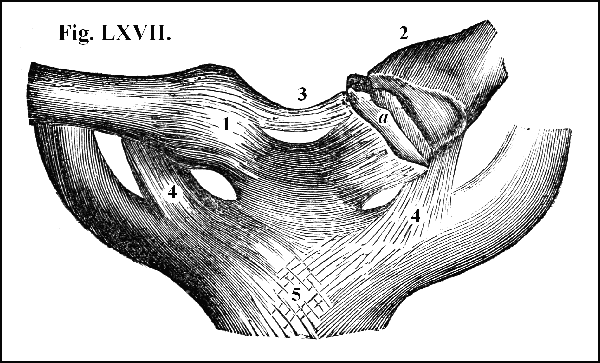
1. The fibrous capsule of the sternum and clavicle; 2. the
same laid open, showing a, the interarticular cartilage;
3. the ligament connecting the two clavicles; 4. the ligament
joining the clavicle to the first rib; 5. ligaments
passing down in front of the sternum.
144. The scapular extremity of the clavicle
(fig. LXVIII. 6) is attached to the processes of the
scapula (fig. LXVIII. 4. 3) by several ligaments
of great strength (fig. LXVIII. 7, 8, 9). First
by very strong fasciculi which pass from the upper
surface of the clavicle to the acromion of the scapula
(fig. LXVIII. 6); and secondly by two ligaments
which unite the clavicle with the coracoid
process of the scapula (fig. LXVIII. 8, 9). These
ligaments are so powerful that they resist a
force capable of fracturing the clavicle; and they
need to be thus strong, for the clavicle is a shaft
which sustains the scapula, and through the
scapula the whole of the upper extremity; and the
main object of the joint by which these bones are
united, is to afford a firm attachment of the scapula
to its point of support.
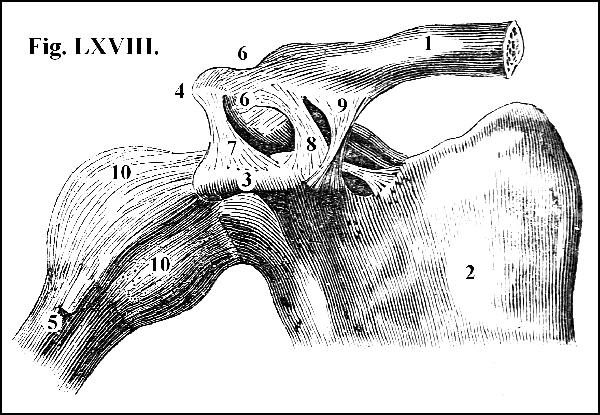
1. The clavicle; 2. the anterior part of the scapula;
3. the coracoid process; 4. the acromion process; 5. the humerus;
6. ligaments binding the scapular end of the clavicle
to the acromion; 7. 8. 9. ligaments passing from one
process of the scapula to the other; 10. the fibrous capsule
of the shoulder-joint.
145. The clavicle serves the following uses:
it sustains the upper extremity; it connects
the upper extremity with the thorax; it prevents
the upper extremity from falling forwards upon
the thorax; and it affords a fixed point for steadying
the extremity in the performance of its various
actions.
146. The glenoid cavity of the scapula (fig.
LXV. 7) receives the head of the humerus, the bone
of the arm (fig. LXV. 9), and the two bones being
united by ligament form the shoulder-joint (fig.
LXVIII.). This joint is what is termed a ball
and socket joint, the peculiarities of which are two:
first, beyond all others this mode of articulation
admits of free and extensive motion; in the present
case, there is the utmost freedom of motion in
every direction, upwards, downwards, backwards,
and forwards. In the second place, this mode of
articulation admits of the motion of the limb without
that of the body, or of the motion of the body
without that of the limb. When at rest, the arm
may be moved in almost any direction without
disturbing the position of any other part of the
frame; the manifold advantages of which are obvious.
On the other hand, by careful management,
very considerable variations in the posture
of the body may be effected without the communication
of any degree of motion to the limb; an
unspeakable advantage when the limb has sustained
injury, or is suffering from disease.
147. It does not seem possible to construct a
joint of great strength, capable, at the same time,
of the degree of motion possessed by the joint of
the shoulder. So shallow is the socket of the scapula,
and so large the head of the humerus, that
it seems as if the slightest movement must dislodge
it from its cavity (fig. LXVI. 4. 7). For sustaining
heavy weights or resisting a great amount
of pressure, applied to it suddenly and in various
directions, the arm is obviously unfitted. But this
is not its office. The superior extremities are the
organs of apprehension—the instruments by which
the mind executes the commands of the will. They
do not need the strength required by the organs
that sustain the weight of the body and that perform
the function of locomotion; but they do need
freedom and extent of motion: to this strength
may be sacrificed, and so it is; yet what can be
done to combine strength with mobility is effected.
Large and strong processes of bone, proceeding
as has been shown (141), from the convex surface
of the scapula (figs. LXV. and LXVI.),
overhang, and to a considerable extent surround,
the head of the arm-bone, especially resisting the
force that would dislodge it from its socket and
drive it upwards, inwards, and backwards (fig.
LXV.), the directions in which force is most commonly
applied to it. By these processes of bone
the joint is greatly strengthened, especially in those
directions. Moreover, a strong ligament, termed
the fibrous capsule (fig. LXVIII. 10) envelops the
joint. This ligament, arising from the neck of the
scapula (fig. LXVIII. 10), expands itself in such
a manner as completely to surround the head of
the humerus (fig. LXVIII. 10); and then again
contracts in order to be inserted into the neck of
the bone (fig. LXVIII. 10). This ligament is
strengthened by the tendons of no less than four
muscles which are expanded over it, as well as by
the powerful substance termed fascia which is reflected
upon it from both the processes and ligaments
of the scapula. In addition to all these expedients
for fortifying the joint, it receives a further
security in the position of the scapula, which is
loose and unattached; which slides easily over the
ribs upon its cushion of flesh; which thus obtains,
by its facility of yielding, some compensation for
its want of strength, eluding the force which it
cannot resist.
148. The arm consists of numerous and powerful
muscles, and of a single bone, the humerus,
which belongs to the class of bones termed cylindrical
(185).
149. The upper end of the humerus terminates
in a circular head (fig. LXV. 9), which is received
into the socket of the scapula (fig. LXV. 9. 7)
termed, as has been stated (141), its glenoid
cavity. The middle portion of the bone, or what is
termed its shaft (fig. LXV. 8), diminishes considerably
in magnitude, and becomes somewhat
rounded (fig. LXV. 8), while its lower end again
enlarges, and is spread out into a flattened surface of
great extent (fig. LXIX. 1, 3, 2, 4). Of this broad
flattened surface, the middle portion is grooved
(fig. LXIX. 2): it is covered with cartilage; it forms
the articulating surface by which the arm is connected
with the fore-arm. On each side of this
groove there is a projection of bone or tubercle,
termed condyle (fig. LXIX. 3, 4), the inner (fig.
LXIX. 3) being much larger than the outer (fig.
LXIX. 4). The inner condyle gives origin to the
muscles that bend, the outer to those that extend
the fore-arm and the fingers (figs. LXXXIV.
1, 2, and LXXXV. 1).
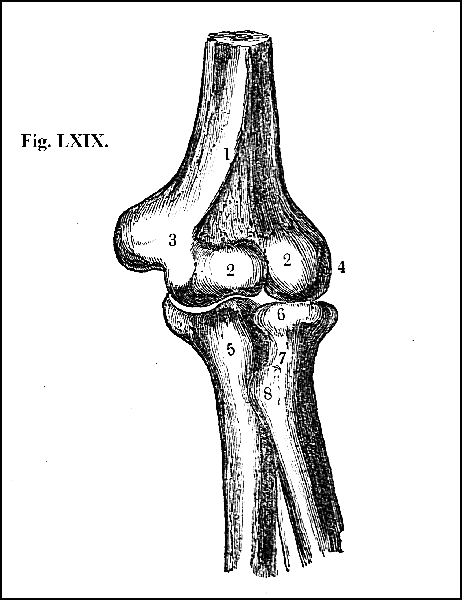
1. Lower extremity of the humerus; 2. grooved surface;
3. internal condyle; 4. external condyle; 5. the upper part
of the ulna; 6. the head; 7. the neck; 8. the tubercle of
the radius.
150. The muscles that act upon the arm arise
from the back (fig. LXXII. 2), the chest (fig.
LXXI. 1), the clavicle (fig. LXXI. 1), and the
scapula (fig. LXXI. 3); and they move the arm
with freedom and power upwards, downwards, forwards,
backwards, inwards, and outwards. The
chief muscle that raises the arm is the deltoid (fig.
LXXI. 3), which arises partly from the clavicle
and partly from the scapula (fig. LXXI. 3). It has
the appearance of three muscles proceeding in different
directions, the different portions being separated
by slight fissures (figs. LXXI. 3, and
LXXII. 3). The fibres converging unite and form
a powerful muscle which covers the joint of the
humerus (fig. LXXI. 3). It is implanted by a short
and strong tendon into the middle of the humerus
(fig. LXXI. 4). Its manifest action is to pull the
arm directly upwards. Its action is assisted by the
muscles that cover the back of the scapula, which
are in like manner inserted into the humerus, and
which, at the same time that they elevate the arm,
support it when raised.
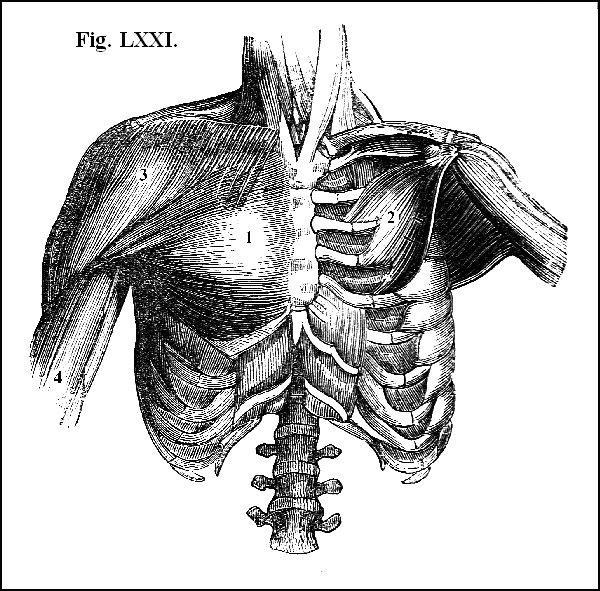
View of the muscles on the fore part of the chest that
act upon the arm. 1. The muscle called the great pectoral;
2. the small pectoral; 3. the deltoid; 4. the humerus.
151. The principal muscle that carries the arm
downwards is the latissimus dorsi (fig. LXXII. 2),
the broadest muscle of the body, which, after having
covered all the lower part of the back and loins,
terminates in a thin but strong tendon which
stretches to the arm, and is implanted into the humerus
(fig. LXXII. 2), near the tendon of a
muscle immediately to be described,—the great
pectoral. When the arm is raised by the deltoid
and its assistant muscles, the latissimus dorsi carries
it downwards with force, and its powerful action
is increased by that of other muscles which arise
from the scapula and are inserted into the arm.
152. The principal muscle that carries the arm
forwards towards the chest, is the great pectoral
(fig. LXXI. 1), which, arising partly from the clavicle
(fig. LXXI. 1), partly from the sternum (fig.
LXXI. 1), and partly from the cartilages of the
second, third, fourth, fifth, and sixth ribs (fig.
LXXI. 1), covers the greater part of the breast
(fig. LXXI. 1). Its fibres, converging, terminate
in a strong tendon, which is inserted near the
tendon of the longissimus dorsi into the humerus,
about four inches below its head (fig. LXXI. 1).
These two muscles form the axilla or armpit,
the anterior border of the axilla consisting of the
pectoral muscle. Though each of these muscles
has its own peculiar office, yet they often act in
concert, thereby greatly increasing their power, and
the result of their combined action is to carry the
arm either directly downwards or to the side of the
chest.
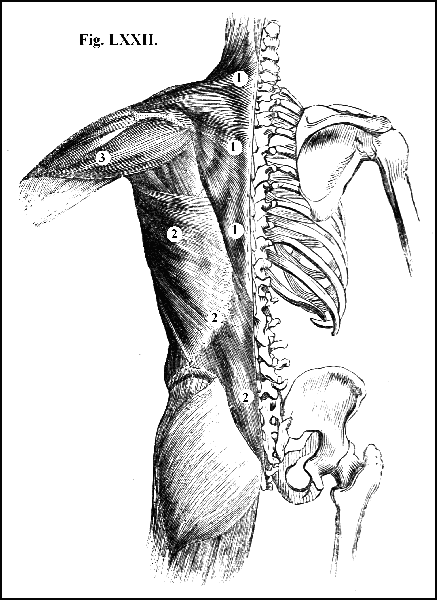
View of the muscles seated on the back part of the trunk
that act upon the shoulder and arm. 1. The muscle called
the trapezius; 2. the latissimus dorsi; 3. the deltoid.
153. Some of the muscles that elevate the arm
carry it inwards, and others outwards; the muscles
that carry it forwards likewise carry it inwards;
while of the muscles that pull it downwards, some
direct it forwards and inwards, and others backwards
and outwards (151 and 152).
154. It has been already stated that the shoulder-joint
is completely surrounded by the muscular
fibres or the tendinous expansions of several of
these powerful muscles, which have a far greater
effect in maintaining the head of the humerus in
its socket than the fibrous capsule of the joint;
the latter being necessarily loose, in order to allow
of the extended and varied motions of the arm,
whereas the muscles that encompass the joint adhere
closely and firmly to it. Moreover, by virtue
of their vital power these muscles act with an
efficiency which a mere ligamentous band is incapable
of exerting; for they apportion the strength
of resistance to the separating force, and react
with an energy proportioned to the violence
applied.
155. The bones of the fore-arm are two, the
ulna and the radius (figs. LXIX. and LXXIII.).
The ulna is essentially the bone of the elbow (figs.
LXIX. 5, and LXXIII. 3); the radius that of the
hand (fig. LXXV.). Supposing the arm to hang
by the side of the body, and the palm of the
hand to be turned forwards, the ulna, in apposition
with the little finger, occupies the inner; and the
radius, in apposition with the thumb, occupies the
outer part of the fore-arm (fig. XXXIV. 3).
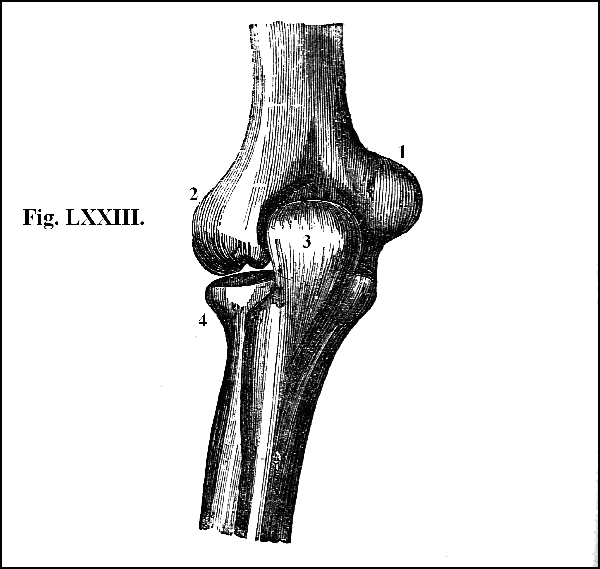
1. The internal condyle of the humerus; 2. the external
condyle of the humerus; 3. the olecranon process of the
ulna; 4. the head of the radius.
156. The upper end of the ulna belonging to
the elbow is large (figs. LXIX. 5, and LXXIII. 3).
It sends backwards the large projection commonly
named the elbow or olecranon (fig. LXXII. 3),
in the centre of which there is a smooth and
somewhat triangular surface (fig. LXXIII. 3)
which is always covered by skin of a coarse texture,
like that placed over the lower part of the
knee-pan, as if nature intended this for a part
on which we may occasionally lean and rest.
Large at the elbow, the ulna gradually grows
smaller and smaller as it descends towards the
wrist, where it ends in a small round head (fig.
LXXXII. 2), beyond which, on the inner side, or
that corresponding to the little finger, it projects
downwards a small rounded point, termed the
styloid process (fig. LXXXII. 3). As the styloid
process and the olecranon, the two extremities of
the ulna (figs. LXXIII. 3, and LXXII. 3), are
easily and distinctly felt, the length of this bone
was primitively used as a measure, called a cubit,
which was the ancient name of the bone.
157. The radius, the second bone of the fore-arm,
placed along its outer part next the thumb, is
small at its upper end (figs. LXIX. 6, and
LXXIII. 4); but its body is larger than that of
the ulna; while its lower end, next the wrist to
which it properly belongs, is very bulky (fig.
LXXXII. 1). Its upper end is formed into a small
circular head, which is united by distinct joints
both to the humerus and to the ulna (fig. LXIX. 6).
The top of its rounded head is excavated into
a shallow cup (figs. LXIX. 6, and LXXIII. 4)
which receives a corresponding convexity of the
humerus (fig. LXIX. 2), and its lower extremity
is excavated into an oblong cavity, which receives
two of the bones of the wrist (fig. LXXXIII. 1. 4).
158. The joint of the elbow is composed above
of the condyles of the humerus (fig. LXIX. 3. 2),
and below by the heads of the ulna and radius
(fig. LXIX. 5. 6).
159. The upper surface of the ulna is so accurately
adapted to the lower surface of the humerus
that the one seems to be moulded on the other
(figs. LXIX. 5, and LXXIII. 3), and the form of
these corresponding surfaces, which are everywhere
covered with cartilage, is such as to admit of free
motion backwards and forwards, that is, of extension
and flexion; but to prevent any degree of motion
in any other direction. The joint is therefore
a hinge-joint, of which the two motions of flexion
and extension are the proper motions. This hinge
is formed on the part of the humerus by a grooved
surface, with lateral projections (fig. LXIX. 2,
3, 4), and on the part of the ulna by a middle projection
with lateral depressions (fig. LXIX. 5): the
middle projection of the ulna turning readily on the
grooved surface of the humerus (fig. LXIX. 2).
160. The bones are held in their proper situation,
first, by a ligament on the fore part of the arm,
called the anterior (fig. LXXIV. 6), which arises
from the lower extremity of the humerus, and is
inserted into the upper part of the ulna and the
coronary ligament of the radius (fig. LXXIV. 6.
8); secondly, by another ligament on the back part
of the arm, called the posterior ligament (fig.LXXV.
8), placed in the cavity of the humerus that receives
the olecranon of the ulna (fig. LXXV. 8); and
thirdly, by two other ligaments at the sides of the
ulna (fig. LXXV. 6, 7). The ulna and radius are
united, first, by a ligament called the coronary,
which, arising from the ulna, passes completely
around the head of the radius (fig. LXXVI. 3),
and the attachment of which, while sufficiently
close to prevent the separation of the two bones, is
yet not adherent to the radius, for a reason immediately
to be assigned; secondly, by another ligament
which passes in an oblique direction from one
bone to the other (fig. LXXVI. 4); and thirdly,
by a dense and broad ligament, termed the interosseous
(figs. LXXIV. 10, and LXXVI. 5), which
fills up the space between the two bones nearly in
their whole extent. This ligament serves other
offices besides that of forming a bond of union,
affording, more especially, a greater extent of surface
for the attachment of muscles, and separating
the muscles on the anterior from those on the posterior
part of the limb.
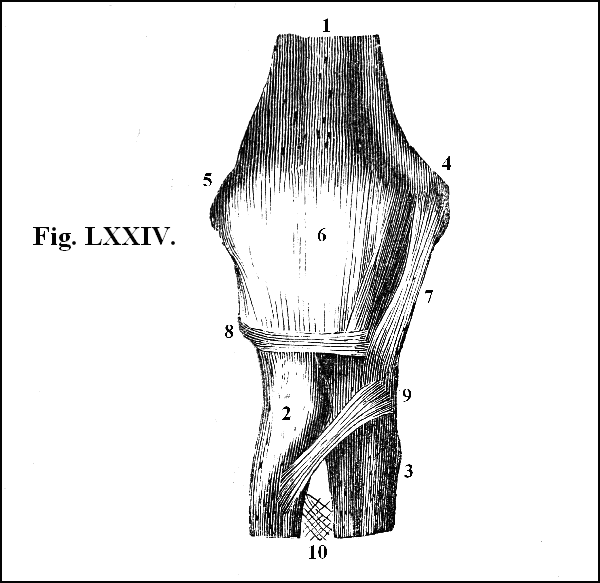
Anterior view of the ligaments of the elbow-joint. 1. The
lower portion of the humerus; 2. the upper portion of the
radius; 3. the upper portion of the ulna;
4. the internal condyle; 5. the external condyle; 6. the anterior
ligament; 7. portion of the internal lateral ligament;
8. portion of the coronary ligament; 9. the oblique ligament;
10. upper portion of the interosseous ligament.
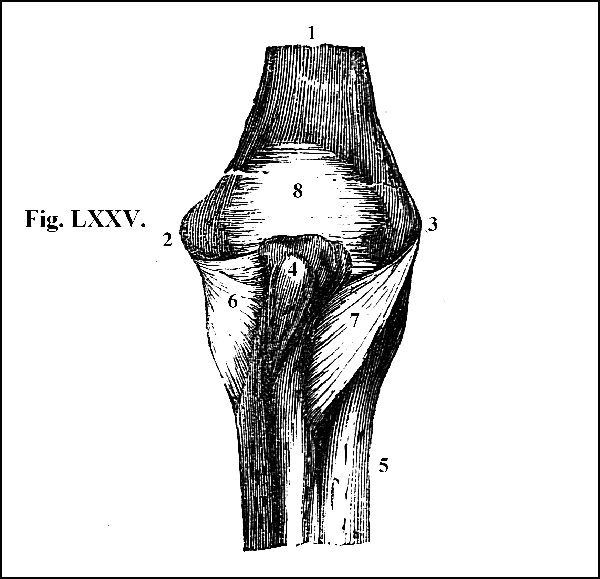
Posterior view of the ligaments of the elbow-joint.
1. Lower end of the humerus; 2. internal condyle; 3. external
condyle; 4. the olecranon process of the ulna;
5. the upper portion of the radius; 6. the internal lateral ligament;
7. the external lateral ligament; 8. the posterior
ligament.
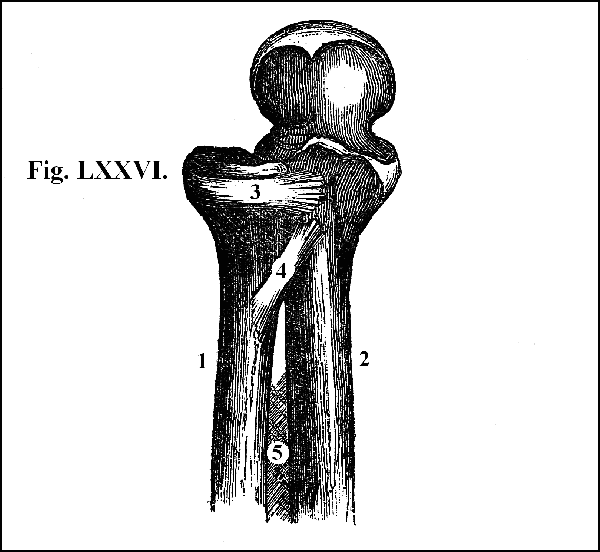
View of the ligaments connecting the ulna and radius at
their upper part. 1. The radius; 2. the ulna; 3. the coronary
ligament surrounding the head of the radius; 4. the
oblique ligament passing from the ulna to the tubercle of
the radius; 5 the upper portion of the interosseous ligament.
161. At their inferior extremities the ulna and
radius are united partly by the interosseous ligament
(fig. LXXVII. 1) and partly by ligamentous
fibres which pass transversely from one bone to
the other (fig. LXXVII. 2) on the anterior and
the posterior surface of the fore-arm.
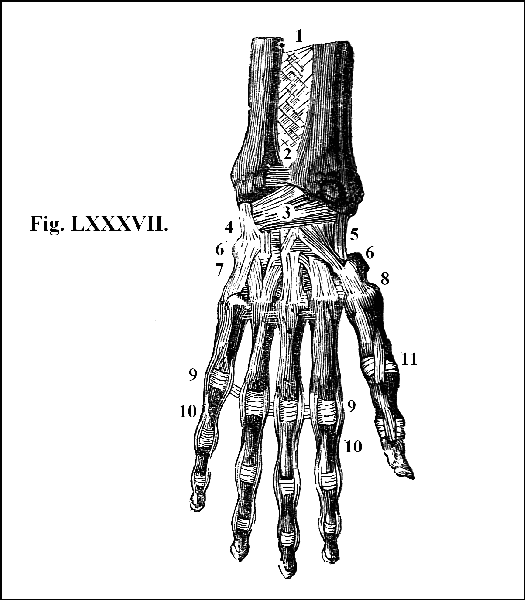
1. Interosseous ligament; 2. transverse fibres passing
between the radius and ulna, and uniting the two bones;
3. 4. 5. posterior and lateral ligaments of the wrist joint;
6. ligaments uniting the bones of the wrist with one another;
7. 8. ligaments which attach the metacarpal to the
carpal bones; 9. transverse ligaments for the attachment
of the phalanges of the fingers; 10. lateral ligaments for
the attachment of the phalanges of the fingers 11. ligaments
of the thumb.
162. The lower extremity of the radius is also
united to the wrist; and the hand being attached
to the wrist, the junction of the hand and the fore-arm
is effected by the articulation of the wrist with
the radius (fig. LXXVII.). The ligaments which
connect the bones of the wrist with the radius are
bands of exceeding strength (fig. LXXVII. 3).
163. The muscles that act upon the fore-arm are
placed upon the arm (fig. LXXVIII.). The joint of
the elbow being a hinge-joint, the fore-arm can admit
only of two motions, namely, flexion and extension.
The muscles by which these motions are effected
are four, two for each; the two flexors being
placed on the fore part (fig. LXXVIII. 2. 4), and
the two extensors on the back part of the arm
(fig. LXXIX. 5).
164. The two flexor muscles of the fore-arm are
termed the biceps and the brachialis (fig. LXXVIII.
2, 4). The biceps is so called because it has two
distinct heads or points of origin (fig. LXXVIII.
2), both of which arise from the scapula (fig.
LXXVIII. 2). About a third part down the humerus
the two heads meet, unite and form a bulky
muscle (fig. LXXVIII. 2), which, when it contracts,
may be felt like a firm ball on the fore part
of the arm, the upper part of the ball marking the
point of union of the two heads (fig. LXXVIII. 2).
The muscle gradually becoming smaller, at length
terminates in a rounded tendon (fig. LXXVIII. 3),
which is implanted into the tubercle of the radius
a little below its neck (fig. LXXVIII. 3). It is
an exceedingly thick and powerful muscle, and its
manifest action is to bend the fore-arm with great
strength. But since its tendon is inserted into the
radius, besides bending the fore-arm, it assists other
muscles that also act upon the radius in the performance
of a function to be described immediately
(168).
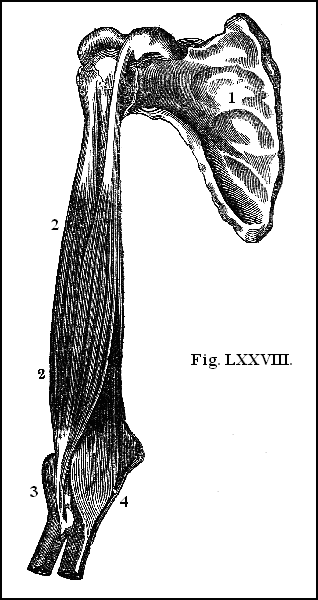
View of the flexor muscles of the fore-arm. 1. The anterior
surface of the scapula; 2. the muscle called biceps;
3. tendon of the biceps passing to the tubercle of the radius;
4. the muscle called brachialis.
165. The second flexor of the fore-arm, termed
the brachialis, is placed immediately under the
biceps, and is concealed by it for a considerable
part of its course (fig. LXXVIII. 4). Arising from
the humerus, on each side of the insertion of the
deltoid, it continues its attachment to the bone all
the way down the fore part of the humerus, to
within inch of the joint; it then passes over
the joint, adhering firmly to the anterior ligament
(fig. LXXVIII. 4), and is inserted by a strong
tendon into the ulna (fig. LXXVIII. 4). It is a
thick and fleshy muscle, powerfully assisting the
action of the biceps.
166. The two extensor muscles are named the
triceps and the anconeous (fig. LXXIX.). The
triceps, seated on the back part of the arm, derives
its name from having three distinct points of origin,
or three separate heads (fig. LXXIX. 5); one of
which arises from the scapula and two from
the humerus (fig. LXXIX. 5). All these heads
adhere firmly to the humerus, as the brachialis
does on the fore part of the arm, down to within
an inch of the joint (fig. LXXIX. 5), where they
form a strong tendon, which is implanted into the
olecranon of the ulna (fig. LXXIX. 3); the projection
of which affords a lever for increasing the action
of the muscle. In all animals that leap and bound,
this process of the ulna is increased in length
in proportion to their power of performing these
movements. The triceps forms an exceedingly thick
and strong muscle, which envelops the whole of
the back part of the arm (fig. LXXIX.); its
action is simple and obvious; it powerfully extends
the fore-arm. The anconeous, a small muscle of a
triangular form, arising from the external condyle
of the humerus, and inserted into the ulna a little
below the olecranon, assists the action of the
triceps.
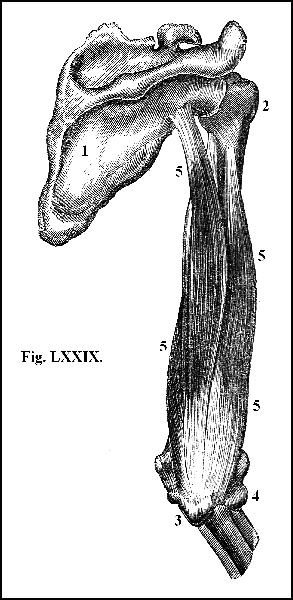
View of the extensor muscles of the fore-arm. 1. The
scapula; 2. the upper part of the humerus; 3. upper end
of the ulna; 4. upper end of the radius; 5. the muscle
called triceps, the extensor of the fore-arm.
167. Such are the motive powers which act
upon the fore-arm, and which produce all the
motions of which the hinge-joint of the elbow
renders it capable. But besides flexion and extension,
the fore-arm is capable of the motion of
rotation, which is accomplished by means of the
radius. It has been shown (157) that the top of
the rounded head of the radius is excavated into
a shallow cup (figs. LXIX. 6, and LXXIII. 4)
which receives a corresponding convexity of the
humerus (figs. LXIX. 2, and LXXIII. 2). In
consequence of this articulation with the humerus,
the radius, like the ulna, can move backwards
and forwards in flexion and extension, the proper
movements of the hinge-joint; but that portion of
the margin of the hinge of the radius which is
in apposition with the ulna is convex (fig. LXIX.
6), and is received into a semilunar cavity hollowed
out in the ulna (fig. LXIX. 5). In this
cavity the rounded head of the radius revolves,
the two bones being held together by the ligament
already described (160), which surrounds
the head of the radius (fig. LXXVI. 3), and
which holds it firmly without being adherent to
it, and without impeding in any degree the rotatory
motion of the radius. Below, the surface
of the radius next the ulna is hollowed out into a
semilunar cavity (fig. LXXXII. 1), which receives
a corresponding convex surface of the ulna (fig.
LXXXII. 2), upon which convex surface the radius
rolls (fig. LXXXII. 1). Thus, by the mode in
which it is articulated with the ulna above, the
radius turns upon its own axis. By the mode in
which it is articulated with the ulna below, the
radius revolves upon the head of the ulna; and, in
consequence of both articulations, is capable of
performing the motion of rotation. Moreover, the
hand being attached to the radius through the
medium of the wrist (figs. LXXXII. 1. 4. and
LXXXIII. 1. 4) must necessarily follow every
movement of the radius; the rotation of which
brings the hand into two opposite positions. In
the one, the palm of the hand is directed upwards
(fig. LXXXII.); in the other, it is turned
downwards (fig. LXXXIII.). When the hand is
turned upwards, it is said to be in the state of
supination (fig. LXXXII.); when downwards,
in that of pronation (fig. LXXXIII.). A distinct
apparatus of muscles is provided for effecting
the rotation of the radius, in order to bring the
hand into these opposite states: one set for producing
its supination, and another its pronation.
168. The principal supinators arise from the
external condyle of the humerus (fig. LXXX.),
and are called long and short (fig. LXXX. 4, 5).
The long supinator extends as far as the lower end
of the radius, into which it is inserted (fig. LXXX.
4): the short supinator surrounds the upper part
of the radius, and is attached to it in this situation
(fig. LXXX. 5.). Moreover, the triceps,
being inserted into the radius (164), often cooperates
with the supinators and powerfully assists
their action.
169. The principal pronators are also two, called
the round and the square (figs. LXXXI. and
LXXXVI. 1). The round pronator arises from the
internal condyle, and passing downwards, is inserted
into the middle of the radius (fig. LXXXI.
4); the square pronator is a small muscle between
the radius and ulna, at their lower extremities
being attached to each (fig. LXXXVI. 1).
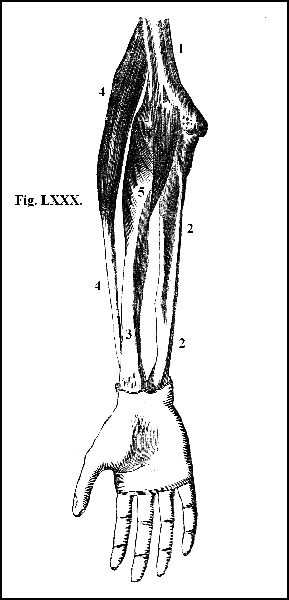
View of the supinators of the radius and hand. 1. The
humerus; 2. the ulna; 3. the radius; 4. the muscle called
the long supinator passing to be inserted into the lower portion
of the radius; 5. the muscle, called the short supinator,
surrounding the upper part of the radius.
170. The action of these muscles in producing
the rotation of the radius, and so rendering the
hand supine or prone, is sufficiently manifest from
the mere inspection of the diagrams (fig. LXXXI. 4).
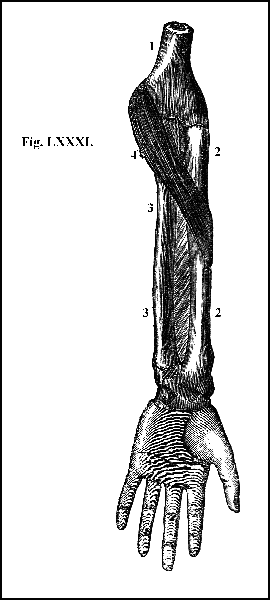
View of the pronators of the hand. 1. Lower end of the
humerus; 2. the radius; 3. the ulna; 4. the muscle called
the round pronator, one of the powerful pronators of the hand.
171. The hand is composed of the carpus, metacarpus,
and fingers.
172. The carpus (fig. LXXXII. 4) consists of
eight small wedge-shaped bones, placed in a double
row, each row containing an equal number, and
the whole disposed like stones in an arch (fig.
LXXXII. 4). They do in fact form an arch, the
convexity of which is upwards, on the dorsal surface
(fig. LXXXIII. 4); and the concavity downwards,
on the palmar surface (fig. LXXXII. 4).
But they differ from the stones of an arch in this,
that each bone is joined to its fellow by a distinct
moveable joint, each being covered with a smooth
articulating cartilage. At the same time all of
them are tied together by ligaments of prodigious
strength, which cross each other in every direction
(fig. LXXVII. 6), so that the several separate
joints are consolidated into one great joint. The
consequence of this mechanism is that some
degree of motion is capable of taking place between
the several bones, which, when multiplied
together, gives to the two rows of bones such an
extent of motion, that when the wrist is bent the
arch of the carpus forms a kind of knuckle. By
this construction a facility and ease of motion, and
a power of accommodation to motion and force,
are obtained, such as belong to no arch contrived
by human ingenuity.
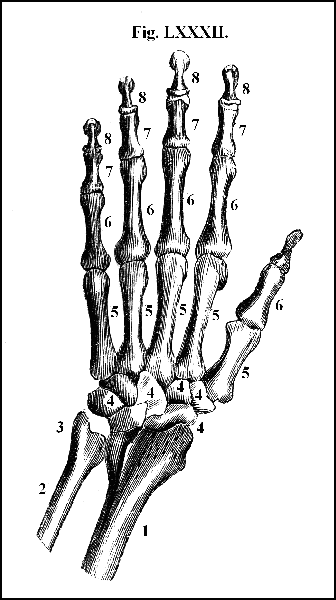
1. Lower extremity of the radius; 2. lower extremity of
the ulna; 3. styloid process of the ulna; 4. bones of the
carpus or wrist; 5. metacarpal bones; 6. first phalanges
of the fingers; 7. second phalanges of the fingers; 8. third
phalanges of the fingers.
173. The metacarpus (fig. LXXXII. 5), the
middle portion of the hand, interposed between
the wrist and the fingers, is composed of five
bones, which are placed parallel to each other (fig.
LXXXII. 5). They are convex outwardly, forming
the back (fig. LXXXIII. 5), and concave inwardly,
forming the hollow of the hand (fig.
LXXXII. 5). They are large at each end, to form
the joints by which they are connected with the
wrist and fingers (figs. LXXXII. and LXXXIII.):
they are small in the middle, in order to afford
room for the lodgment and arrangement of the
muscles, that move the fingers from side to side (fig.
LXXXVI. 2). Their ends, which are joined to the
carpus, are connected by nearly plane surfaces (figs.
LXXXII. and LXXXIII.): their ends, which
support the fingers, are formed into rounded heads,
which are received into corresponding cup-shaped
cavities, excavated in the top of the first bones
of the fingers (fig. LXXXII. 5.). The powerful
ligaments that unite these bones pass, both on the
dorsal and the palmar surface, from the inferior
extremity of the second row of the carpal to the
bases of the metacarpal bones (fig. LXXVII, 7, 8).
The ligaments are arranged in such a manner as
to limit the motions of the joints chiefly to those
of flexion and extension, allowing, however, a
slight degree of motion from side to side.
174. Each of the fingers is composed of three
separate pieces of bone, called phalanges; the
thumb has only two (fig. LXXXII. 6, 7, 8): the
phalanges are convex outwardly (fig. LXXXII. 6,
7, 8) for increasing their strength, and flattened
inwardly (fig. LXXXIII. 6, 7, 8) for the convenience
of grasping. The last bones of the fingers,
which are small, terminate at their under ends,
in a somewhat rounded and rough surface (fig.
LXXXIII. 8), on which rests the vascular, pulpy,
and nervous substance, constituting the special
organ of touch, placed at the points of the fingers,
and guarded on the upper surface by the nail (fig.
LXXXII. 8).
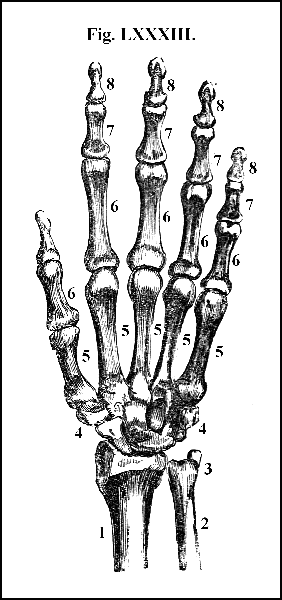
1. Lower extremity of the radius; 2. lower extremity of
the ulna; 3. styloid process of the ulna; 4. bones of the
carpus; 5. metacarpal bones; 6. 7. 8. first, second, and
third phalanges of the fingers.
175. The round inferior extremity of the metacarpus
is admitted into the cavity of the superior
extremity of the first phalanx of the five fingers
(figs. LXXXII. and LXXXIII.), and their joints
are connected by lateral and transverse ligaments
of great strength (fig. LXXVII. 9). The situation
and direction of the ligaments which unite the
several phalanges of the fingers (fig. LXXVII. 9)
are precisely the same as those of the articulation of
the phalanges with the metacarpus (fig. LXXVII.
7, 8); and the articulation of these bones with one
another is such as to admit only of the motions of
flexion and extension.
176. The muscles which perform these motions
are seated for the most part on the fore-arm. Independently
of the supinators and pronators which
have been already described (167 et seq.), there
are distinct sets of muscles for bending and extending
the wrist and the fingers. The flexors
arise from the internal, and the extensors from the
external, condyle of the humerus (fig. LXIX. 3,
4). The internal condyle is larger and longer
than the external (fig. LXIX. 3, 4); for the
flexors require a larger point of origin and a
longer fulcrum than the extensor muscles; because
to the actions of flexion, such as grasping,
bending, pulling, more power is necessary than to
the action of extension, which consists merely in
the unfolding or the opening of the hand previously
to the renewal of the grasp.
177. For the same reason, two muscles are provided
for flexing, while only one is provided for
extending the fingers. The flexors, bulky, thick,
and strong, are placed on the fore part of the fore-arm
(fig. LXXXIV.). The first, named the
superficial flexor (fig. LXXXIV. 1), about the
middle of the arm, divides into four fleshy portions,
each of which ends in a slender tendon (fig.
LXXXIV. 1). As these tendons approach the
fingers they expand (fig. LXXXIV. 1), and when
in apposition with the first phalanx, split and form
distinct sheaths for the reception of the tendons
of the second flexor (fig. LXXXIV. 3). After
completing the sheath, the tendons proceed forward
along the second phalanx, into the fore part
of which they are implanted, and the chief office
of this powerful muscle is to bend the second joint
of the fingers upon the first, and the first upon
the metacarpal bone. Its action is assisted by a
second muscle, called the deep or profound flexor
(fig. LXXXIV. 2), because it lies beneath the
former; or the perforans, because it pierces it.
Bulky and fleshy, this second flexor, like the first,
about the middle of the arm, divides into four tendons,
which, entering the sheaths prepared for
them in the former muscle (where the tendons are
small and rounded for their easy transmission and
play), pass to the root of the third phalanx of
the fingers into which they are implanted (fig.
LXXXIV. 3).
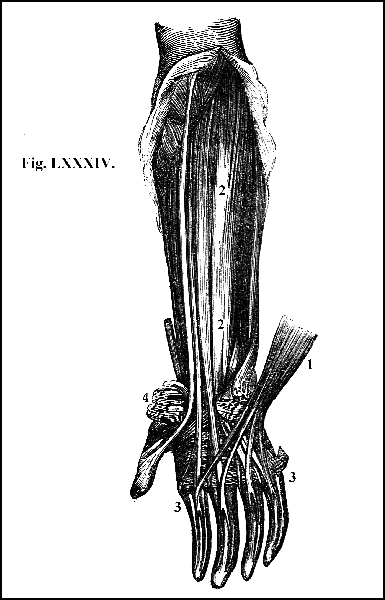
View of the flexor muscles of the fingers. 1. The superficial
flexor, divided and turned aside, to show, 2. the deep
flexor; 3. sheaths for the tendons of the deep flexor,
formed by the splitting of the tendons of the superficial
flexor; 4. the anterior annular ligament, divided and turned
aside.
118. The muscle that extends the fingers, called
the common extensor, is placed on the back part of
the fore-arm (fig. LXXXV.), about the middle of
which it divides into four portions which terminate
in so many tendons (fig. LXXXV. 2). When
they reach the back of the metacarpal bones, these
tendons become broad and flat, and send tendinous
expansions to each other, forming a strong tendinous
sheath which surrounds the back of the
fingers (fig. LXXXV. 2). These tendinous expansions
are inserted into the posterior part of the
bones of the four fingers (fig. LXXXV. 2); and
their office is powerfully to extend all the joints of
all the fingers (fig. LXXXV. 2).
179. On both the palmar and dorsal regions of
the wrist are placed ligaments for tying down these
tendons, and preventing them from starting from
their situation during the action of the muscles
(figs. LXXXIV. and LXXXV.). On the palmar
region an exceedingly strong ligament passes
anteriorly to the concave arch of the carpus (fig.
LXXXIV. 4) for the purpose of tying down the
tendons of the flexor muscles. On the dorsal surface
(fig. LXXXV.), a similar ligament, passing
in an oblique direction from the styloid process of
the radius to the styloid process of the ulna (fig.
LXXXV. 3), performs the same office in tying
down the tendons of the extensor muscle. Both
these ligaments are called annular.
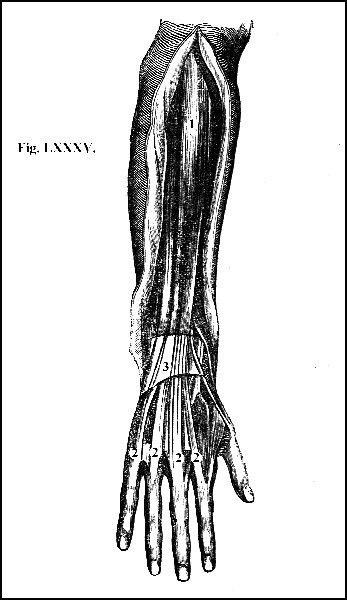
View of the extensor muscles of the fingers. 1. The
common extensor, sending (2 2 2 2) tendons to each
finger; 3. the posterior annular ligament.
180. In the palm of the hand are placed additional
muscles which assist the flexors of the
fingers (fig. LXXXVI. 2), being chiefly useful in
enabling the fingers to perform with strength and
precision short and quick motions. There are
especially four small and rounded muscles (fig.
LXXXVI. 2), resembling the earth worm in form
and size, and hence called lumbricales; but as
their chief use is to assist the fingers in executing
short and rapid motions, they have also received
the better name of the musculi fidicinales.
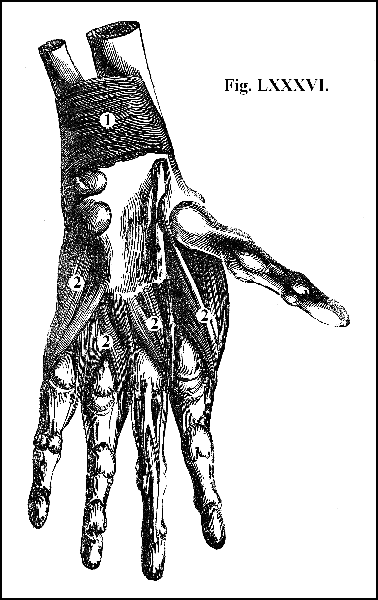
1. The muscle called the square pronator; 2. muscles
seated in the palm of the hand, by which, chiefly, the
fingers execute short and rapid motions.
181. The thumb, in consequence of the comparative
looseness of its ligaments, is capable of a
much greater extent of motion than the fingers, and
can be applied to any part of each of the fingers, to
different parts of the hand, and in direct opposition
to the power exerted by the whole of the fingers and
hand, in the act of grasping. The muscles which
enable it to perform these varied motions, and
which act powerfully in almost every thing we do
with the hand, form a mass of flesh at the ball of
the thumb (fig. LXXXVII. 1), almost entirely surrounding
it. The little finger is also provided with
a distinct apparatus of muscles (fig. LXXXVII. 2),
which surrounds its root, just as those of the
thumb surround its ball, in order to keep it firm
in opposition to the power of the thumb in the act
of grasping, and in various other motions.
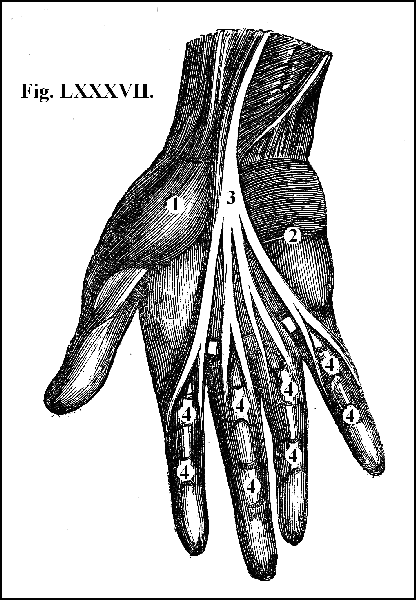
1. The mass of muscles forming the ball of the thumb;
2. the mass of muscles forming the ball of the little finger;
3. tendons of one of the flexor muscles of the fingers;
4. sheaths formed by the tendons of the superficial flexor
for the reception of the tendons of the deep flexor.
182. The upper extremity is covered by a tendinous
expansion or fascia which envelopes the whole
arm, encloses its muscles as in a sheath, and affords
them, in their strong actions, "that kind of support
which workmen feel in binding their arms with
thongs." This fascia likewise descends between
many of the muscles, forming strong partitions between
them, and affording points of origin to many
of their fibres, scarcely less fixed than bone itself.
183. From the whole, it appears, that the
first joint of the upper extremities, that of the
shoulder, is a ball and socket joint, a joint admitting
of motion in every direction; that the second
joint, that of the elbow, is partly a hinge-joint,
admitting of flexion and extension, and partly a
rotation joint, admitting of a turning or rotatory
motion; and that the joints of the wrist and of the
fingers are likewise hinge-joints, admitting at the
same time of some degree of lateral motion. When
these various motions are combined, the result is
that the hand can apply itself to bodies in almost
every direction, in any part of the area described
by the arm, when all the joints are moved to their
utmost extent. There is thus formed an instrument
of considerable strength, capable of a surprising
variety and complexity of movements,
capable of seizing, holding, pulling, pushing and
striking with great power, yet at the same time
capable of apprehending the minutest objects, and
of guiding them with the utmost gentleness, precision,
and accuracy, so that there are few conceptions
of the designing mind which cannot be executed
by the skilful hand.
184. The lower extremities consist of the thigh,
leg, and foot.
185. The osseous part of the thigh consists of
a single bone, called the femur (fig. XXXIV. 4),
the longest, thickest, and strongest bone in the
body. It sustains the entire weight of the trunk,
and occasionally much heavier loads superimposed
upon it. It is constructed in such a manner as
to combine strength with lightness. This is
effected by rendering the bone what is technically
called cylindrical; that is, a bone in which the
osseous fibres are arranged around a hollow cylinder.
There are two varieties of osseous matter,—the
compact, in which the fibres are dense and solid
(fig. LXXXVIII. 1), and the spongy, in which
the fibres are comparatively tender and delicate
(fig. LXXXVIII. 2). Both varieties are, indeed,
combined, more or less, in every bone, the compact
substance being always external, and the spongy
internal; but in the cylindrical bones the arrangement
is peculiar. Every long or cylindrical bone
consists of a body or shaft (fig. LXXXVIII. 4.),
and of two extremities (fig. LXXXVIII. 5). The
body is composed principally of compact substance,
which on the external surface is so dense
and solid, that scarcely any distinct arrangement
is visible; but towards the interior this density
diminishes; the fibres become distinct (fig.
LXXXVIII. 5), and form an expanded tissue
of a cellular appearance (fig. LXXXVIII. 5), the
cells being called cancelli, and the structure cancellated.
In the centre of the bone even the cancelli
disappear; the osseous fibres terminate; and a
hollow space is left filled up, in the natural state,
by an infinite number of minute membranous bags
which contain the marrow (fig. LXXXVIII. 3).
In the body of the bone, to which strength is requisite,
that part being the most exposed to external
violence, the compact matter is arranged around a
central cavity. By this means strength is secured
without any addition of weight; for the resisting
power of a cylindrical body increases in proportion
to its diameter; consequently the same number of
osseous fibres placed around the circumference of a
circle produce a stronger bone than could have been
constructed had the fibres been consolidated in the
centre, and had the diameter been proportionally
diminished. The hollow space thus gained in its
centre, renders the bone lighter by the subtraction
of the weight of as many fibres as would have gone
to fill up that space; while its strength is not only
not diminished by this arrangement, but positively
increased. On the other hand, at the extremities
of the bone, space, not strength, is required; required
for the attachment and arrangement of the
tendons of the muscles that act upon it, and for the
formation of joints (fig. LXXXVIII. 5). Accordingly,
at its extremities the bone swells out into
bulky surfaces; but these surfaces are composed,
not of dense and solid substance, but of spongy
tissue, covered by an exceedingly thin crust of
compact matter, and so, as by the former expedient
strength is secured without increase of weight, by
this, space is obtained without increase of weight.
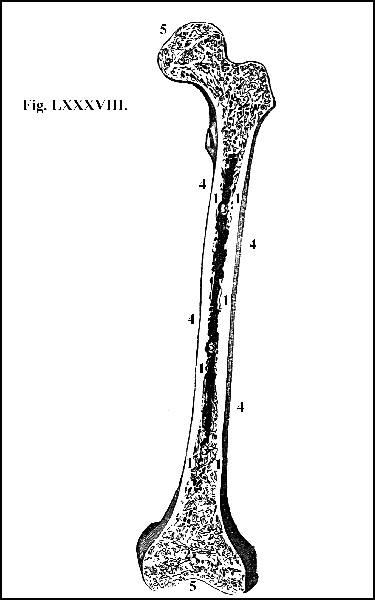
A section of the femur, showing, 1. the compact bony
substance; 2. the spongy or cancellated structure; 3. the
internal cavity containing the marrow; 4. body; 5, extremities
of the bone.
186. The thigh-bone, placed at the under and
outer part of the pelvis, has an oblique direction,
the under being considerably nearer its fellow than
the upper end (fig. XXXIV. 4), in order to afford
space for the passages at the bottom of the pelvis,
and also to favour the action of walking. The
body of the bone, which is of a rounded form (fig.
XXXIV. 4), is smooth on its anterior surface
(fig. XXXIV. 4), where it is always slightly convex,
the convexity being forwards (fig. XXXIV.
4), while its posterior surface is irregular and
rough, and forms a sharp prominent line, termed
the linea aspera (fig. XXXV. 4), giving attachment
to numerous muscles.
187. The superior extremity of the femur terminates
in a large ball or head, which forms nearly
two-thirds of a sphere (fig. LXXXIX. 4.). It
is smooth, covered with cartilage, and received into
the socket of the ilium called the acetabulum,
which, deep as it is, is still further deepened by the
cartilage which borders the brim (fig. LXXXIX.
3). The brim is particularly high in the upper
and outer part, because it is in this direction that
the reaction of the ground against the descending
weight of the trunk tends to dislodge the ball from
its socket.
188. Passing obliquely downwards and outwards
from the ball, is that part of the femur which is
called the neck (fig. LXXXIX. 5). It spreads
out archlike between the head and the body of the
bone, and is more than an inch in length (fig.
LXXXIX. 5). It is thus long in order that
the head of the bone may be set deep in its socket,
and that its motions may be wide, free, and unembarrassed.
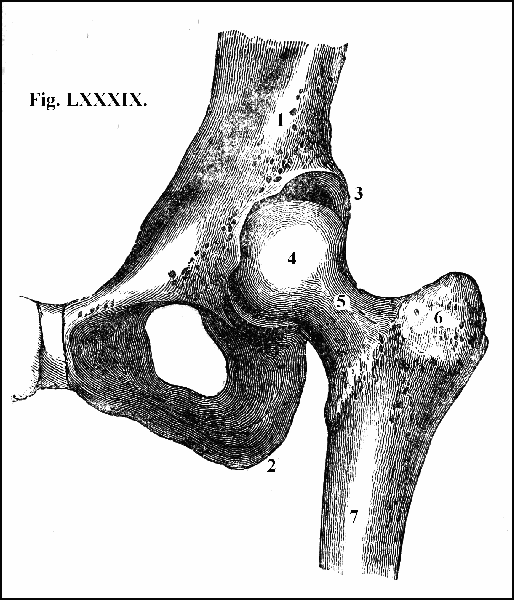
1. Lower portion of the ilium; 2. tuberosity of the
ischium: 3. socket for the head of the femur, or thigh-bone;
4. head of the femur; 5. neck of the femur; 6. the
great process of the femur called the trochanter major;
7. the body of the femur.
189. From the external surface of the femur,
nearly in a line with its axis, proceeds the largest
and strongest bony process of the body which gives
insertion to its most powerful muscles, namely,
those that extend the thigh and that turn it upon
its axis (fig. LXXXIX. 6). Because, from its
oblique direction, it rotates the thigh, this process
is called the trochanter, and, from its size, the
trochanter major. At the under and inner part of
the neck on the posterior surface of the bone, is
a similar process, but much smaller, called the
trochanter minor (fig. XXXV. 4), into which are
inserted the muscles that bend the thigh.
190. The inferior extremity of the femur, much
broader and thicker than the superior (fig.
XC. 1), is terminated by two eminences, with
smooth surfaces, termed condyles (fig. XC. 2),
which, articulated with the tibia, and the patella,
form the joint of the knee (figs. XC. 2, 4, 5, and
XCI. 1, 2, 3).
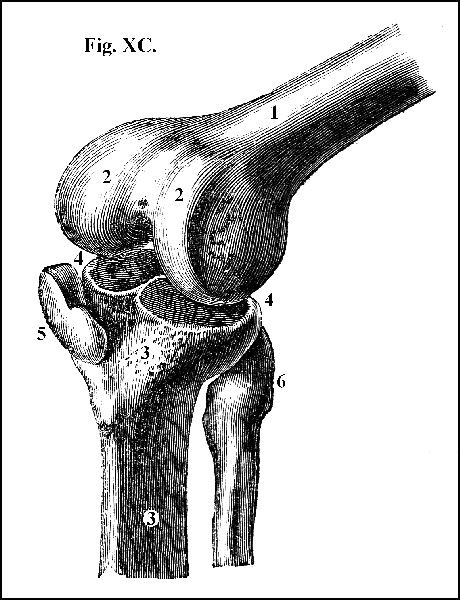
1. Lower end of the femur; 2. condyles of the femur;
3. upper end of the tibia; 4. articular surfaces on the head
of the tibia on which the thigh-bone plays; 5. the patella,
or knee-pan; 6. upper end of the fibula, not entering into
the knee-joint.
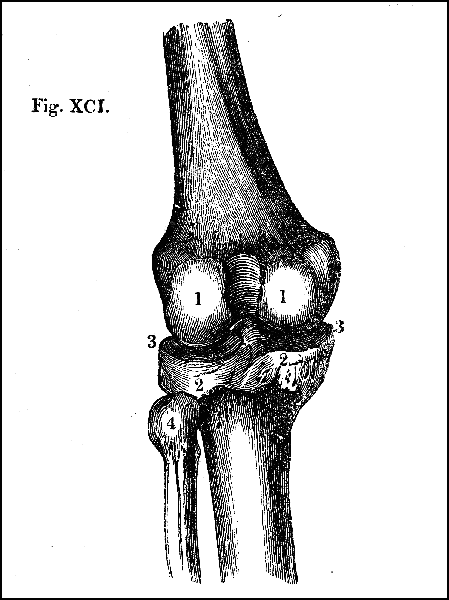
Posterior view of the bones forming the knee-joint.
1. Lower end of the femur; 2. upper end of the tibia;
3. articular surfaces on the head of the tibia, on which
the thigh-bone plays; 4. upper end of the fibula, not entering
into the knee joint.
191. The bones of the leg, two in number,
consist of the tibia (fig. XC. 3) and fibula (fig.
XC. 6). The tibia, next to the femur, the longest
bone in the body, is situated at the inner side of
the leg (fig. XC. 3). Its superior extremity is
bulky and thick (fig. XC. 3). The top of it forms
two smooth and slightly concave surfaces, adapted
to the convex surfaces of the condyles of the femur
(fig. XC. 4, 2). On its outer side there is a smooth
surface, to which the head of the fibula is attached
(fig. XC. 6). Its lower extremity, which is small,
forms a concavity adapted to the convexity of the
bone of the tarsus, called the astragalus, with which
it is articulated (fig. XCII. 4.) Its inner part is
produced so as to form the inner ankle (figs. XCII.
2, and XCIII. 3): its outer side is excavated into
a semilunar cavity, for receiving the under end of
the fibula, which forms the outer ankle (figs. XCII.
3, and XCIII. 4).
192. The fibula, in proportion to its length
the most slender bone of the body, is situated at
the outer side of the tibia (fig. XC. 6). Its
upper end formed into a head, with a flat surface
on its inner side (figs. XC. 6, and XCI. 4), is
firmly united to the tibia (fig. XC. 4). Its lower
end forms the outer ankle, which is lower and
farther back than the inner (fig. XCII. 3, 2).
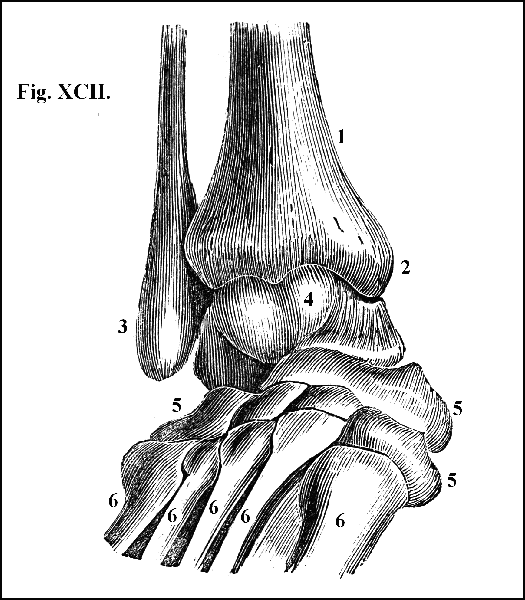
Anterior view of the bones forming the ankle-joint.
1. Lower end of the tibia; 2. production of the tibia, forming
the inner ankle; 3. lower end of the fibula, forming the
outer ankle; 4. upper part of the astragalus: these three
bones form the ankle-joint; 5 5 5, other bones of the tarsus;
6 6 6 6 6 metatarsal bones.
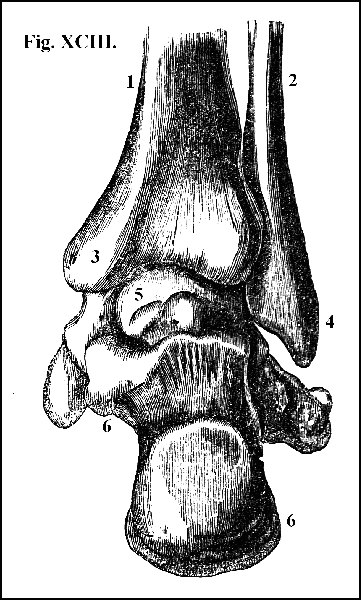
Posterior view of the bones forming the ankle-joint.
1. Lower end of the tibia; 2. lower end of the fibula; 3. internal
malleolus or ankle; 4. external malleolus or ankle;
5. one of the tarsal bones, called the astragalus, with which
the tibia and fibula are articulated; 6. the os calcis or heel.
193. The patella, or knee-pan (fig. XC. 5), is
a light but strong bone, of the figure of the heart
as painted on playing-cards, placed at the fore part
of the joint of the knee, and attached by a strong
ligament to the tibia, the motions of which it
follows (fig. XC. 5). It is lodged, when the
knee is extended, in a cavity formed for it in the
femur (fig. XC.); when bent, in a cavity formed
for it at the fore part of the knee (fig. XC. 5).
194. The foot consists of the tarsus, metatarsus,
and toes.
195. The tarsus, or instep, is composed of seven
strong, irregular-shaped bones, disposed like those
of the carpus, in a double row (fig. XCII. 4, 5).
The arrangement of the tarsal bones is such as to
form an arch, the convexity of which above, constitutes
the upper surface of the instep (fig. XCII.
4, 5): in the concavity below are lodged the
muscles, vessels, and nerves that belong to the sole.
196. The metatarsus consists of five bones,
which are placed parallel to each other (fig. XCII.
6), and which extend between the tarsus and the
proper bones of the toes (fig. XCII. 6). Their extremities,
especially next the tarsus, are large, in
order that they may form secure articulations with
the tarsal bones (fig. XCII. 6). Their bodies are
arched upwards (fig. XCII. 6), slightly concave
below, and terminate forwards in small, neat,
round heads, which receive the first bones of the
toes, and with which they form joints, admitting
of a much greater degree of rotation than is ever
actually exercised, in consequence of the practice
of wearing shoes. The natural, free, wide-spreading
form of the toes, and the consequent security
with which they grasp the ground, is greatly
impaired by this custom. Taken together, the
bones of the metatarsus form a second arch corresponding
to that of the tarsus (fig. XCVIII. 2).
197. Each toe consists of three distinct bones,
called, like those of the fingers, phalanges (fig.
XCVIII.), but the great toe, like the thumb, has
only two (fig. XCVIII.). That extremity of the
first phalanges which is next the metatarsal bones
is hollowed into a socket for the head of the metatarsal
bones.
198. Besides the bones already described, there
are other small bones, of the size and figure of
flattened peas, found in certain parts of the extremities,
never in the trunk, called sesamoid,
from their resemblance to the seed of the sesamum.
They belong rather to the tendons of the muscles
than to the bones of the skeleton. They are
embedded within the substance of tendons, are
found especially at the roots of the thumb and of
the great toe, and are always placed in the direction
of flexion. Their office, like that of the
patella, which is, in truth, a bone of this class,
is to increase the power of the flexor muscles by
altering the line of their direction, that is, by removing
them farther from the axis of the bone on
which they are intended to act.
199. The ligaments which connect the bones of
the lower extremities are the firmest and strongest
in the body. Of these, the fibrous capsule of the
hip-joint (fig. XCIV. 1), which secures the head
of the femur in the cavity of the acetabulum (fig.
XCIV.), is the thickest and strongest. It completely
surrounds the joint (fig. XCIV. 1). It
arises from the whole circumference of the acetabulum,
and, proceeding in a direction outwards
and backwards, is attached below to the neck of
the femur (fig. XCIV. 1). It is thicker, stronger,
and much more closely attached to the bones than
the fibrous capsule of the shoulder-joint (144),
because the hip-joint is formed, not like the shoulder-joint,
for extent of motion, but for strength.
Its internal surface is lined by synovial membrane,
and its external surface is covered and
strengthened by the insertion of muscles that
move the thigh-bone. The joint is strengthened
by another ligament, which passes from the inner
and fore part of the cavity of the acetabulum (fig.
XCV.) to be inserted into the head of the femur
(fig. XCIV.), called the round ligament, the office
of which obviously is to hold the head of the
femur firmly in its socket.
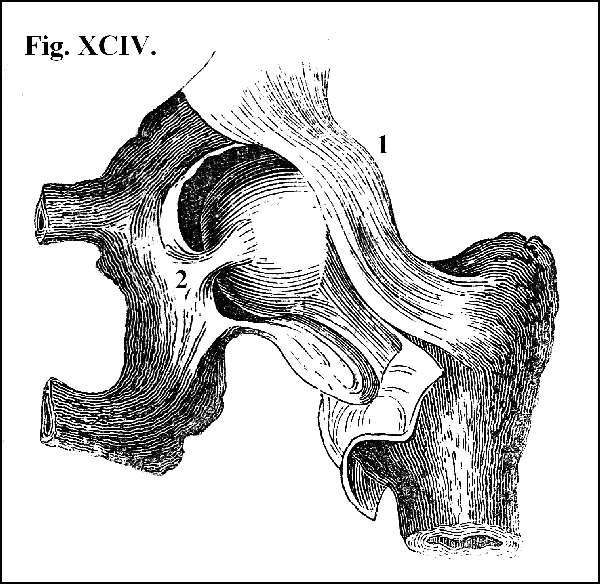
1. The fibrous capsule of the hip-joint, laid open and
turned aside to show, 2. the round ligament in its natural
position.
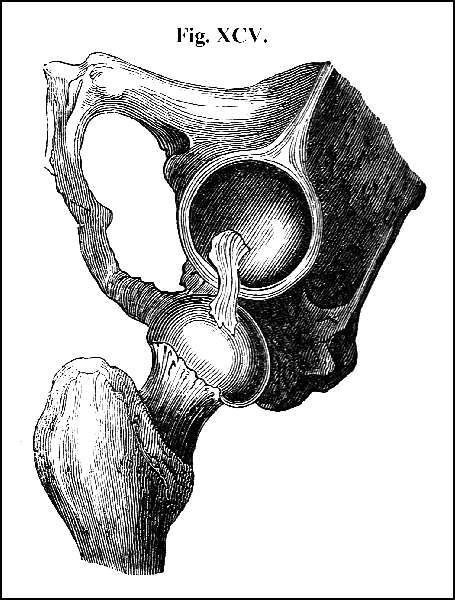
A view of the head of the femur drawn out of its socket,
and suspended by the round ligament, to show more clearly
the action of the ligament in retaining the head of the
femur in its socket.
200. Numerous and complicated ligaments connect
the bones that form the knee-joint (fig.
XCVI.), and the strength of these powerful bands
is greatly increased by the tendons that move the
leg (fig. XCVI. 5), which pass over, and more or
less surround, the joint.
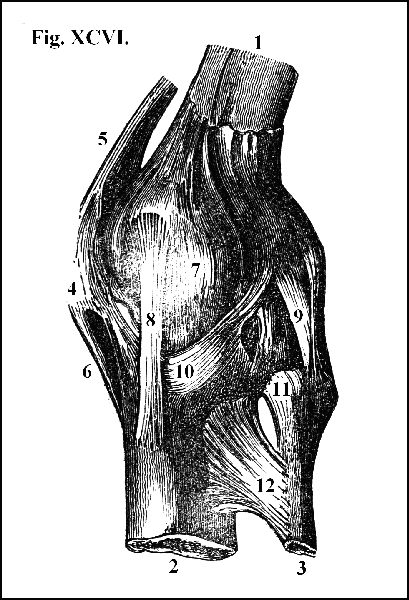
General view of the ligaments of the knee-joint. 1. Lower
end of the femur; 2. upper end of the tibia; 3. upper end
of the fibula; 4. the patella; 5. united tendons of the
extensor muscles; 6. ligaments of the patella; 7. the capsular
investment of the knee; 8. the internal lateral ligament;
9. the external lateral ligaments; 10. the posterior
ligament; 11. the ligament connecting the tibia and fibula;
12. a portion of the interosseous ligament.
201. Strong ligaments maintain in their proper
position the bones that form the ankle-joint (fig.
XCVII.), connect the bones of the tarsus and metatarsus
with one another (fig. XCVIII. 1), and
articulate the several phalanges of the toes (fig.
XCVIII. 2).
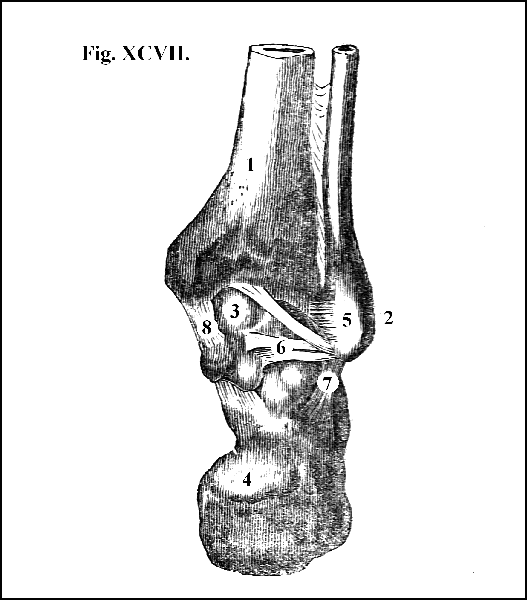
General view of the posterior ligaments of the ankle-joint.
1. Lower end of the tibia; 2. lower end of the
fibula; 3. astragalus; 4. os calcis; 5. ligament between
the tibia and fibula; 6. ligament passing from the fibula
to the astragalus; 7. ligament passing from the fibula to
the os calcis; 8. ligament passing from the tibia to the
astragalus.
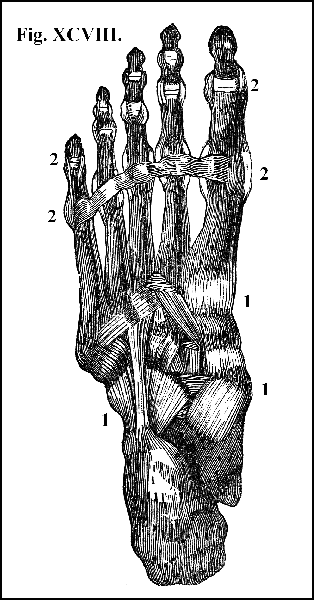
General view of the ligaments of the sole of the foot.
1. Ligaments connecting the bones of the tarsus; 2. ligaments
connecting the bones of the toes.
202. The joint of the hip, like that of the
shoulder, is capable of flexion, extension, and
rotation; but its rotatory motions are to a much
less extent, on account of the greater depth of the
acetabulum and the stronger and shorter fibrous
capsule. When the femur is flexed, the thigh is
bent upon the pelvis, and its inferior extremity is
carried forwards. When it is extended, the thigh
is carried backwards. The two thighs may be
separated from each other laterally (abduction),
or brought near to each other (adduction), or the
one may be made to cross the other, and they may
be rotated outwards or inwards.
203. The apparatus of muscles that produces
these varied motions is seated partly on the trunk
and partly on the pelvis. Thus, the powerful
muscle that flexes the thigh, or that carries it forwards,
termed the psoas (fig. XCIX. 1), arises
from the last vertebra of the back, and successively
from each vertebra of the loins (fig. XCIX. 1),
and is inserted into the lesser trochanter of the
femur (fig. XCIX. 3). Its action is assisted
first by a large and strong muscle named the
iliacus (fig. XCIX. 2), which occupies the whole
concavity of the ilium (fig. XCIX. 2), and which,
like the psoas, is inserted into the lesser trochanter
of the femur (fig. XCIX. 3).
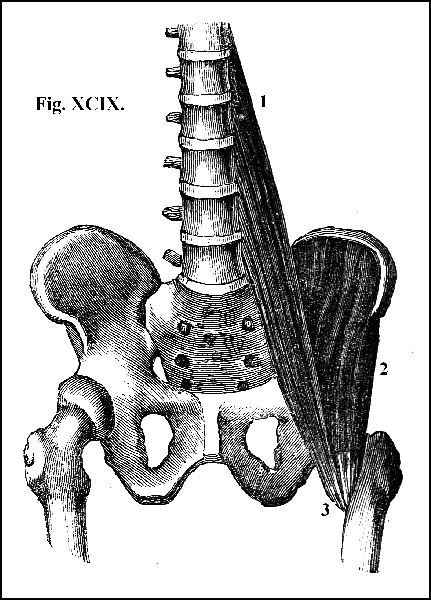
View of the muscles that bend the thigh. 1. The
muscle called psoas; 2. the muscle called iliacus; 3. tendons
of these muscles, going to be inserted into the trochanter
minor of the femur.
204. The muscles that extend the thigh, or that
carry it backwards, named the glutæi, the most
powerful muscles of the body, are placed in successive
layers, one upon the other, on the back
part of the ilium (fig. C. 1, 2, 3), and are inserted
into the linea aspera of the femur. They constitute
the mass of flesh which forms the hip, and
their powerful action in drawing the thigh backwards
is assisted by several other muscles (fig.
C. 4, 5, 6). Their action is never perfectly simple
and direct; for those which move the thigh forwards
sometimes carry it inwards, and sometimes
outwards; and in like manner, those which move
it backwards, at one time carry it inwards and at
another outwards, according to the direction of the
fibres of the muscle and the position of the limb
when those fibres act; while some of them, and
more especially those which carry it backwards, at
the same time rotate it, or roll it upon its axis.
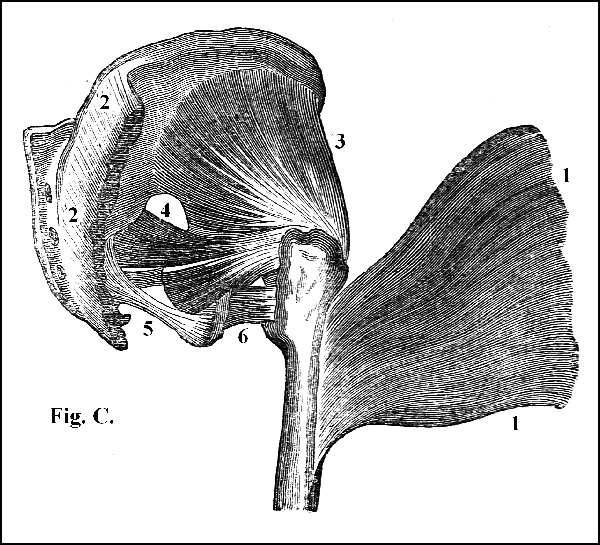
View of the muscles that extend the thigh. 1. The
muscle called glutæus maximus, removed from its origin,
2, 2, to show the muscles which lie beneath it; 2. cut edge
showing the origin of the same muscle; 3. the muscle
called glutæus medius; 4, 5, 6. smaller muscles, assisting
the action of the glutæi.
205. The knee is a hinge-joint, admitting only
of flexion and extension, and is therefore provided
only with two sets of muscles, one for bending and
the other for extending the leg. The flexors of
the leg arise from the under and back part of the
pelvis, are seated on the back part of the thigh,
and are inserted into the upper part either of the
tibia or of the fibula (fig. CI). They consist for
the most part of three muscles, named the semi-tendinosus,
the semi-membranosus (fig. CI. 3), and
the biceps of the leg (fig. CI. 1). The tendons of
the two former muscles, in passing to be inserted
into the leg, form the inner, and that of the latter
the outer, hamstrings (fig. CI. 4, 5).
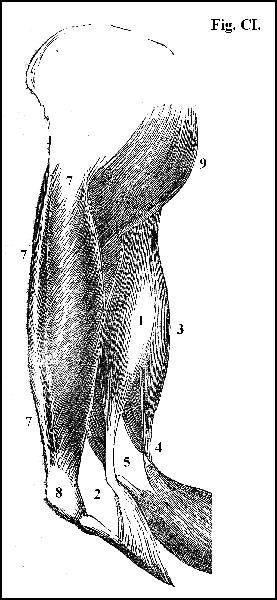
View of the flexor and extensor muscles of the leg.
1. The biceps of the leg; 2. tendon of the biceps, inserted
into the head of the fibula; 3. the semi-membranosus,
passing to be inserted into the head of the fibula; 4. tendon
of the semi-membranosus forming the inner, and
5. tendon of the biceps forming the outer, hamstring;
6. upper part of the gastrocnemius muscle; 7. the four large
muscles which unite to form the great extensor muscle of
the leg, inserted into 8. the patella; 9. a portion of the
glutæus maximus concealing the other muscles of the hip.
206. Four large muscles, blended together in
such a manner as to form one muscle of prodigious
size, termed the quadriceps cruris (fig. CI. 7),
occupying nearly all the forepart and the sides,
and a considerable portion of the back part of the
thigh, constitute the great flexor of the thigh.
This enormous mass of muscle arises partly from
the ischium, and partly from the upper part of the
femur (fig. CI. 7), and is all inserted into the
patella (fig. CI. 8), which constitutes a pulley for
the purpose of assisting the action of these powerful
muscles.
207. The muscles which bend the toes and extend
the foot, termed the gastrocnemii (fig. CII.
1, 2), are placed on the back part of the leg, and
form the mass of muscle which constitutes the calf
of the leg (fig. CII. 1, 2). They arise partly from
the lower extremity of the femur (fig. CII.) and
partly from the upper and back part of the fibula
and tibia; and they form the largest and strongest
tendon in the body, termed the tendo achillis (fig.
CII. 3), which is implanted into the heel (fig.
CII. 4).
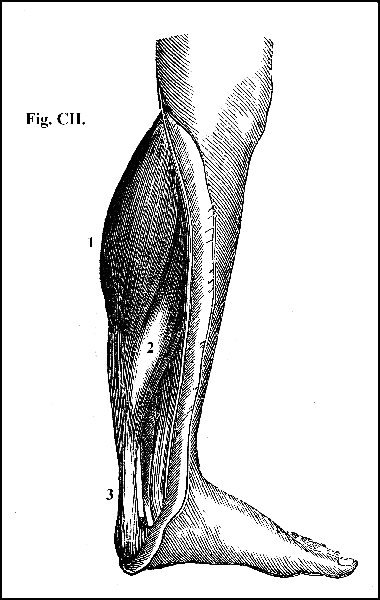
View of the muscles which bend the toes, and which, by
lifting the heel, extend the foot. 1. The muscle called
gastrocnemius externus, which, uniting with 2. the gastrocnemius
internus, forms 3. the tendo achillis, which is inserted
into 4. the heel.
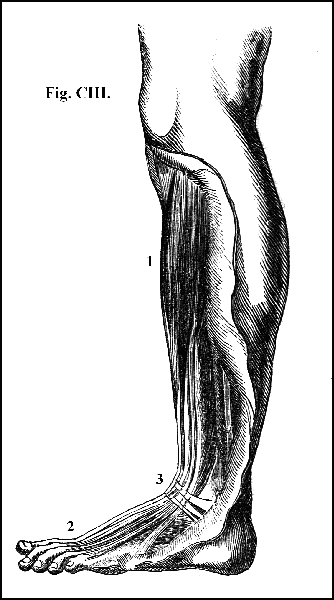
View of the muscles which extend the toes and bend the
foot. 1. The common extensor; 2. the tendons of the same
muscle inserted into the toes; 3. the anterior annular
ligament of the foot.
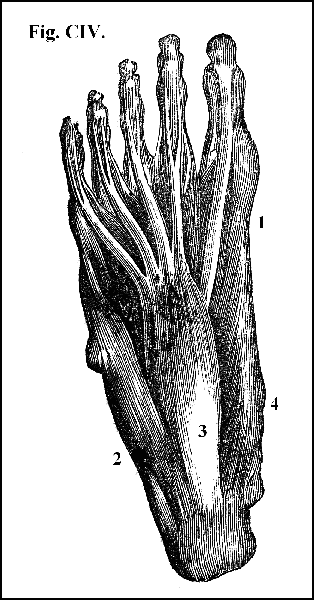
View of the muscles in the sole of the foot. 1 The
muscle which draws the great toe from the other toes; 2. the
muscle which draws the little toe from the other toes;
3. the muscle called the short flexor of the toes, which
assists in bending the four smaller toes.
208. The muscles which extend the toes and
bend the foot are seated on the fore part of the leg
(fig. CIII.); split into tendons like the analogous
muscles of the fingers (fig. CIII. 2); and are
bound down by a ligament (fig. CIII. 3), exactly
the same in name, disposition, and office, as that
which belongs to the hand (fig. CIII. 3). Numerous
minute muscles are placed in the sole of the
foot (fig. CIV.), which act on the toes as the
small muscles in the palm of the hand act on the
fingers (fig. LXXXVI.).
209. Such are the moving powers which put in
action the complicated mechanism provided for
the function of locomotion. And these powers
are adequate to their office; but they are what
may be termed expensive powers; agents requiring
a high degree, of organization and the utmost resources
of the economy to support and maintain
them. Hence in the construction of the framework
of the machine which they have to move,
whatever mechanical contrivance may economize
their labour, is adopted. The construction, form,
and disposition of the several parts of that framework
have all reference to two objects: first, the
combination of strength with lightness; and secondly,
security to tender organs, with the power
of executing rapid, energetic, and, sometimes, violent
motions. The combination is effected and
the object attained in a mode complicated in the
detail, simple in the design, and perfect in the
result. The weight of the body transmitted from
the arch of the pelvis to a second arch, formed by
the neck of the thigh-bone, and from this, in a
perpendicular direction, to a third arch formed
by the foot, is ultimately received by the heel
behind, and by the metatarsal bones and the first
phalanges of the toes before, and more especially
by the metatarsal joints belonging to the great
and little toe, which have a special apparatus
of muscles, for the purpose of preserving steadily
their relative situation to the heel. The weight
of the body is thus sustained on a series of arches,
from which it is, in succession, transmitted to
the ground, where it ultimately rests upon a
tripod: forms known and selected as the best
adapted to afford support, and to give security
of position. Columns of compact bone superimposed
one upon another, and united at different
points by bands of prodigious strength, form the
pillars of support. But these bony columns never
touch each other; are never in actual contact; are
all separated by layers of elastic matter which, while
they assist in binding the columns together, enable
them to move one upon another, as upon so many
pliant springs. The layers of cartilage interposed
between the several vertebræ; the layer of cartilage
interposed between the vertebral column and the
pelvis; the layer of cartilage that lines the acetabulum
and that covers the head of the femur; the
layer of cartilage that covers the lower extremity
of the femur and the upper extremity of the
tibia and fibula and the tarsus; the successive
layers of cartilage interposed between the
several bones of the tarsus; and finally, the layer of
cartilage that covers both the tarsal and the digital
extremities of the metatarsal bones; are so many
special provisions to prevent the weight of the
body from being transmitted to the ground with a
shock; and, at the same time, so many barriers
established between the ground and the spinal
cord, the brain and the soft and tender organs
contained in the thoracic and abdominal cavities,
to prevent these organs from being injured by the
reaction of the ground upon the body. The excellence
of this mechanism is seen in its results;
in contemplating "from what heights we can
leap—to what heights we can spring—to what
distances we can bound—how swiftly we can run—how
firmly we can stand—how nimbly we can
dance—and yet how perfectly we can balance
ourselves upon the smallest surfaces of support!"
210. It is necessary, in order to complete this
general view of the structure of the human body,
and of the combination and arrangement of its
various parts, to denote the several regions into
which, for the purpose of describing with accuracy
the situation and relation of its more important
organs, the body is divided. It is not needful to
the present purpose to describe the regions of the
head, because its internal cavity contains only one
organ, the brain, and its external divisions do not
differ materially from those which are common
and familiar; but the chest, the abdomen, and the
upper and lower extremities are mapped out into
regions, of which it is very important to have an
exact knowledge, which may be acquired by the
study of the annexed diagrams.
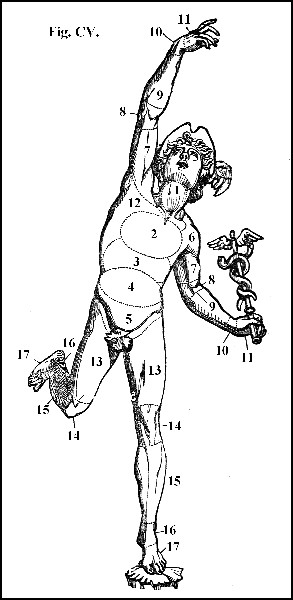
Anterior view of the regions of the body. 1. Region of the neck;
2. region of the chest or thorax. Abdominal regions: 3. epigastric;
4. umbilical; 5. hypogastric region. Regions of the upper extremities.
6. shoulder; 7. arm; 8. elbow; 9. fore-arm; 10. wrist; 11. ball of
thumb; 12. the axilla or armpit. Regions of the lower extremities:
13. thigh; 14. knee; 15. leg; 16. ankle; 17. instep and foot.
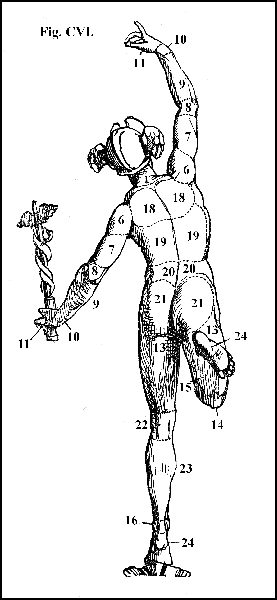
Posterior view of the regions of the body: 18. region to
the scapula; 19. of the back; 20. of the loins; 21. of the
hips; 22. of the ham; 23. of the calf of the leg; 24. of the
heel and foot.
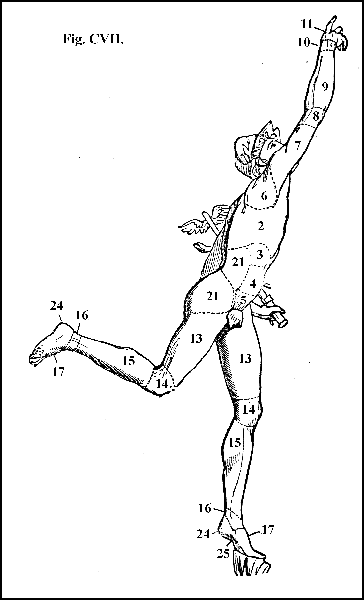
Lateral view of the regions of the body: 25. arch of
the foot.
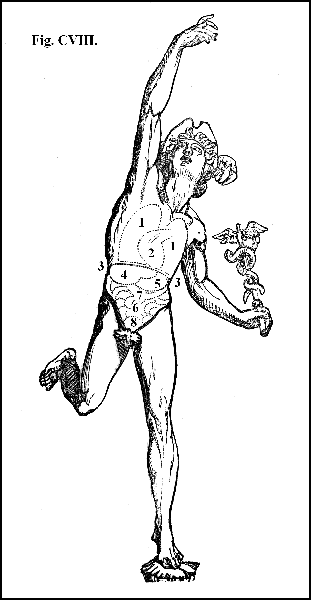
Anterior view of the situation of the more important internal
organs: 1. lungs, right and left; 2. heart; 3. line
representing the edge of the diaphragm; 4. liver; 5. stomach;
6. small intestines; 7. colon; 8. urinary bladder.
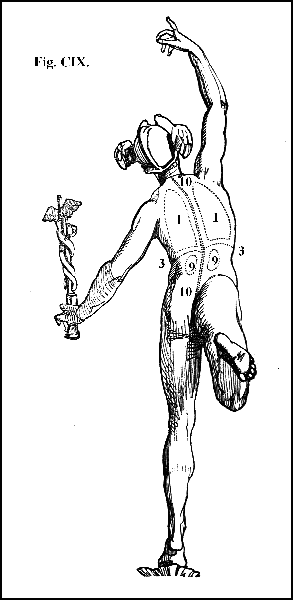
Posterior view of the situation of the more important
internal organs: 9. kidnies, right and left; 10. the course
of the spinal cord.
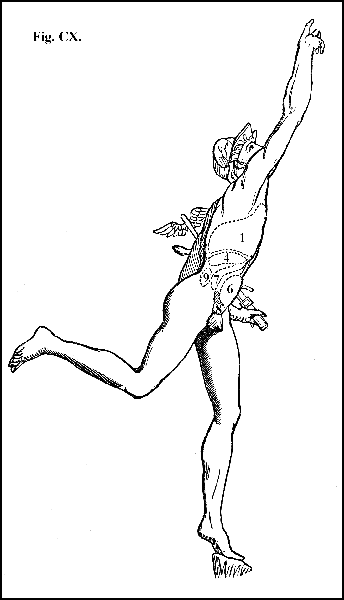
Lateral view of the situation of the more important
internal organs.
CHAPTER VI. OF THE BLOOD.
Physical characters of the blood: colour, fluidity, specific
gravity, temperature: quantity—Process of coagulation—Constituents
of the blood: proportions—Constituents of
the body contained in the blood—Vital properties of the
blood—Practical applications.
211. Supposing the human body to have been
built up in the manner now described, and to be
in the full exercise of all its functions, the integrity
of its various structures is maintained, and their
due action excited by the blood. Out of this substance
is formed the blandest fluid, as the milk,
and the firmest solid, as the compact bone. The
heart, capable of untiring action, as long as the
blood is in contact with its internal surface, becomes
immovable soon after the supply of this
fluid is withdrawn; and in less than one minute
from the time it ceases to flow in due quantity
and of proper quality through the vessels of the
brain, the eye is no longer capable of seeing, nor
the ear of hearing, nor the brain of carrying on
any intellectual operation.
212. At the moment, and for some time after it
has issued from its vessel, the appearance of the
blood is that of a thick, viscid, and tenacious fluid;
yet it is essentially a solid, composed of several
substances, each possessing its own distinct and
peculiar properties, the relation and combination
of which cannot be considered without exciting the
feeling that our admiration of the structure of the
animal frame ought not to be confined to the mechanism
of its solid parts, but that the whole is
admirable, from the common material of which it
is composed, to its most delicate and elaborate
instrument.
213. The colour of redness is universally associated
with the idea of blood; but redness of
colour is not essential to blood. There are many
animals with true, yet without red, blood; and
there is no animal in which the blood is red in all
the parts of its body. The blood of the insect is
transparent; that of the reptile is of a yellowish
colour; that of the fish, in the greater part of its
body, is colourless. Even the red blood of the
human body is not equally red in every part of it,
there being two distinct systems of blood-vessels,
distinguished from each other by carrying blood
of different colours.
214. In the state of health, the specific gravity
of human blood, water being 1000, is 1080; from
which standard it is capable of varying from 1120,
the maximum, to 1026, the minimum.
215. The natural temperature of the human
blood is 98°. From this it is capable of varying
from 104°, the maximum, to 86°, the minimum;
these changes being always the effect of disease.
216. It is estimated that the fluids circulating
in the adult man amount to about fifty pounds; of
these it is calculated that twenty-eight consist of
red blood.
217. Fluid and homogeneous as the blood
appears while flowing in its vessel, when a mass of
it is collected and allowed to stand at rest, it soon
undergoes a very remarkable change. First, a thin
film is formed upon its surface; this is followed
by the conversion of the whole mass into a soft
jelly: this jelly separates into two portions, a fluid
and a solid portion. The solid portion again separates
into two parts, into a substance of a yellowish-white
colour, occupying the upper surface,
and into a red mass always found at the under
surface.
218. The process by which the constituents of the
blood are thus spontaneously disunited, and afforded
in a separate form, is denominated COAGULATION;
the fluid portion separated by the process is termed
the SERUM; the solid portion the COAGULUM or
CLOT; the white substance forming the upper part
of the clot, the FIBRIN; and the red mass forming
the under part of it, the RED PARTICLES.
219. Probably the process of coagulation commences
the moment the blood leaves its living
vessel. In three minutes and a half it is visible
to the eye; in seven minutes the mass is formed
into a jelly; in from ten to twelve minutes the
serum separates from the clot; in about twenty
the clot is divided into fibrin and red particles,
when the coagulation is complete; but occasionally
the clot continues to grow firmer and firmer for
the space of twenty-four hours.
220. As soon as the coagulation commences, and
during all the time the blood preserves its heat, an
aqueous vapour arises from it, termed the HALITUS.
The halitus consists of water holding in solution a
small quantity of animal and saline matter, which
communicate to it a fœtid odour of a strong and peculiar
nature, manifest on approaching a slaughter-house,
and still more manifest in the slaughter-house
of human beings, a field of battle.
221. During the process of coagulation, as in
every other in which a fluid is converted into a
solid, caloric is evolved.
222. During the process of coagulation carbonic
acid is also extricated.
223. The process of coagulation affords three
distinct substances, the chief constituents of the
blood, namely, serum, fibrin, and red particles.
224. The serum, the fluid portion of the blood,
when obtained perfectly pure, is of a light straw
colour, tinged with green. Its taste is saline, and
its consistence adhesive. It is composed principally
of water holding in solution animal and saline
matter. The animal matter gives it its adhesive
consistence, and the saline its peculiar salt
taste. The chief animal matter contained in it is
the proximate principle termed albumen, which
may be separated from the water that holds it in
solution by the application of heat and by certain
chemical agents. Heat being applied, when the
temperature reaches 160°, fluid serum is converted
into a white opaque solid substance of firm consistence.
This is found to be albumen, which may
be also separated from the watery portion by the
application of spirits of wine, acids, oxymuriate of
mercury, and several other chemical substances.
The quantity of albumen contained in 1000 parts
of serum varies from about 78, the maximum, to
58, the minimum.
225. If the albumen yielded by the serum be
subjected to pressure, or be cut into small pieces,
there flows from it a watery fluid which is termed
the serosity. In meat dressed for the table, the
serum of the blood contained in the blood-vessels
is converted by the heat into solid albumen, from
which, when cut, the serosity flows in the form of
gravy.
226. Besides albumen, serum holds in solution
both a fatty and an oily matter, in the proportion
of about one part of each to 1000 parts of serum.
The proportion of its saline substances is about
ten in 1000 parts. According to M. le Canu,
who has made the most recent chemical analysis
of serum, 1000 parts contain, of
| Water |
906·00 |
| Albumen |
78·00 |
| Animal matter, soluble in water |
| and alcohol |
1·69 |
| Albumen combined with soda |
2·10 |
| Crystallizable fatty matter |
1·20 |
| Oily matter |
1·00 |
| Hydrochlorate of soda and |
| potash |
6·00 |
| Subcarbonate and phosphate of |
| soda, and sulphate of potash |
2·10 |
| Phosphate of lime, magnesia, |
| and iron, with subcarbonate |
| of lime and magnesia |
·91 |
| Loss |
1·00 |
227. All the animal and saline matter held in
solution in the serum being removed, the fluid
that remains is water, the proportion of which in
1000 parts varies from 853, the maximum, to 779,
the minimum.
228. The second constituent of the blood, the
fibrin, is the most essential portion of it, being
invariably present, whatever other constituent be
absent. While circulating in the living vessel,
fibrin is fluid and transparent; by the process of
coagulation, it is converted into a solid and opaque
substance of a yellowish white colour, consisting
of stringy fibres, disposed in striæ, which occasionally
form a complete net-work (fig. CXI.).
These fibres are exceedingly elastic. In their
general aspect and their chemical relations they
bear a close resemblance to pure muscular fibre,
that is, to muscular fibre deprived of its enveloping
membrane and of its colouring matter, and they
form the basis of muscle. According to M. le
Canu, the proportion of the fibrin varies from
seven parts in 1000, the maximum, to one part in
1000, the minimum, the medium of twenty experiments
being four parts in 1000.
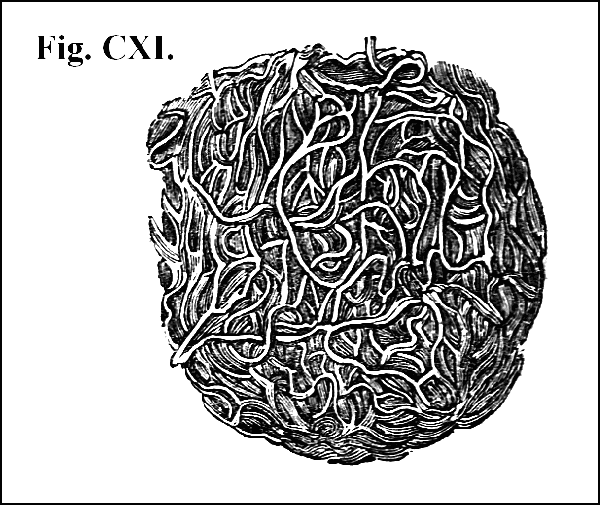
A portion of the fibrin of the blood, showing its fibrous
structure and the striated or net-like arrangement of its
fibres.
229. The third constituent of the blood, the
matter upon which its red colour depends, though,
as has been stated, entirely absent in certain classes
of animals, and in all animals in some parts of
their body, seems to be essential, at least to the
organic organs, whenever they perform their functions
with a high degree of perfection. Thus in
the lowest class of vertebrated animals, the fish,
while the principal part of its body receives only a
colourless fluid, its organic organs, as the heart,
the gills, the liver, are provided with red blood.
230. The red matter, wherever present, is invariably
heavier than the fibrin, and consequently,
during the process of coagulation, it gradually subsides
to the lower surface, and is always found
forming the bottom of the clot. Its proportion to
the other constituents varies very remarkably, the
maximum being 148, the minimum 68, and the
medium 108, in 1000 parts of blood.
231. All observers are agreed that the red matter
of the blood consists of minute particles, having a
peculiar and definite structure; but in regard to
the nature of that structure, there is considerable
diversity of opinion, which is not wonderful, since
the particles in question are so minute that they
can be distinguished only by the microscope, and
since, of all microscopical objects, they are perhaps
the most difficult to examine, because, being soft
and yielding, their figure is apt to change, and
because there is reason to suppose that their substance
is not uniform in its refractive power.
232. The earlier observers describe the red particles
as being of a globular figure, and accordingly
name them globules. They conceive that each
globule consists of a central solid particle, enveloped
in a transparent vesicle. Recently, Sir Everard
Home and Mr. Bauer in this country, and MM.
Prevost and Dumas on the continent, have revived
this opinion, and describe the red particle as consisting
of a central solid white corpuscle contained
in an external envelop of a red colour. When the
blood is observed with the microscope in a living
animal, flowing in its vessels, only two substances
can be distinguished, namely, a transparent fluid
and the red corpuscles. MM. Prevost and Dumas
contend that these two substances are the only
component parts of the blood. When the blood
coagulates, they conceive that the red envelop
separates from the central white corpuscle; that
these white corpuscles unite together; that the
aggregates resulting from this combination are disposed
in the form of filaments, which filaments
constitute the fibrin, while the red matter at the
bottom of the clot is nothing but the disintegrated
envelops of the central particle. But this view is
not the common one. In general, physiologists
conceive the fibrin to be one constituent and the
red particles to be another constituent of the blood.
Mr. Lister, who has successfully laboured to improve
the microscope, and who, together with his
friend Dr. Hodgkin, have very carefully examined
with their improved instrument the red particles,
contend that the figure of these bodies is not globular,
although they state that the instant the
particles are removed from the living blood-vessels
many things are capable of making them assume
a globular appearance; such, for example, as the
application of water. With a rapidity which, in
spite of every precaution, the eye in vain attempts
to follow, the particles change their real figure for
a globular form on the application of the smallest
quantity of pure water; while, if the water contain
a solution of saline matter, little alteration is occasioned
in the figure of the particles. According to
these observers, the red particles are flattened cakes,
having rounded and very slightly thickened margins
(fig. CXII. 1). The thickness of the margin
gives to both surfaces the appearance of a slight
depression in the middle (fig. CXII. 1), so that
the particles bear a close resemblance to a penny
piece. There is no appearance of an external
envelop. The circular and flattened cake is transparent;
when seen singly it is nearly if not quite
colourless (fig. CXII. 1); it assumes a reddish
tinge only when aggregated in considerable masses.
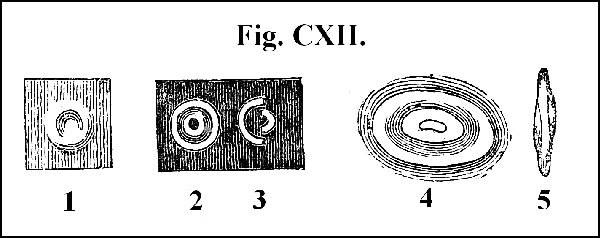
1. A particle of the human blood as it appears when
transparent and floating; 2. the same dry, seen as opaque,
illuminated by a leiberkuhn; 3. the same as it appears
when half the leiberkuhn is darkened; 4. a particle of the
frog's blood floating; 5. the same seen on its edge. All
the above objects are magnified 500 diameters
[5]
233. The red particle of the human blood is circular (fig. CXII. 1, 2, 3).
It is circular also in all
animals belonging to the class mammalia; but in
the three lower classes of vertebrated animals, the
bird, the reptile, and the fish, it is elliptical (fig.
CXII. 4, 5).
234. The magnitude of the red particle of the
human blood is variously estimated from the two-thousandth
to the six-thousandth part of an inch
in diameter. Bauer estimates it at the two-thousandth,
Hodgkin and Lister at the three-thousandth,
Kater at the four-thousandth, Wollaston
at the five-thousandth, and Young at the six-thousandth
part of an inch. Its magnitude is
uniformly the same in all individuals of the same
species, but differs exceedingly in the different
classes. The elliptical particles are larger than the
circular, but proportionally thinner; larger in fishes
than in any other class of animals, and largest of
all in the skate.
235. When perfect and entire, the red particles
indicate a disposition to arrange themselves in a
definite mode. They combine spontaneously into
columns of variable length (fig. CXIII.). In
order to observe this tendency, a small quantity
of blood, the moment it is taken from its
living vessel, should be placed between two strips
of glass or covered with a bit of talc and placed
under the microscope. When thus arranged, a
considerable agitation at first takes place among
the particles. As soon as this motion subsides, the
particles apply themselves to each other by their
broad surfaces, and thus form piles or columns of
Considerable length (fig. CXIII.). The columns
often again combine one among another, the end
of one being attached to the side of another,
sometimes producing very curious ramifications
(fig. CXIII.). In like manner, the elliptical particles
apply themselves to each other by their
broad surfaces, but they are not so exactly matched
as the circular, one particle partially overlapping
another, so that they form less regular columns
than the circular.
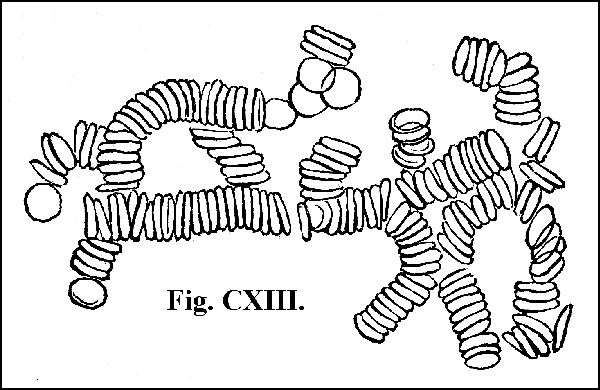
Columnar arrangement which the particles of the human
blood assume immediately after it is drawn from its vessel.
236. The red particles, as far as is known, constitute
a distinct and peculiar form of animal matter:
the red colour, according to some, depending
on an impregnation of iron; according to others, on
an animal substance of a gelatinous nature.
237. The exact proportion of the different substances
contained in the blood, according to the
most recent analysis of it, that by M. le Canu, is
as follows, namely,
| Water |
786·500 |
| Albumen |
69·415 |
| Fibrin |
3·565 |
| Colouring matter |
119·626 |
| Crystallizable fatty matter |
4·300 |
| Oily matter |
2·270 |
| Extractive matter, soluble in |
| alcohol and water |
1·920 |
| Albumen combined with soda |
2·010 |
| Chloruret of sodium and potassium, |
| alkaline phosphate, |
| sulphate, and subcarbonates |
7·304 |
| Subcarbonate of lime and magnesia, |
| phosphates of lime, |
| magnesia and iron, peroxide |
| of iron |
1·414 |
| Loss |
2·586 |
| |
———— |
| |
1000· |
238. From the results of this analysis it is manifest
that all the proximate principles of which the
different tissues are composed exist in the blood,
namely, albumen, the proximate principle forming
the basis of membrane; fibrin, the proximate principle
forming the basis of muscle; fatty matter,
forming the basis of nerve and brain; and various
saline and mineral substances, forming a large part
of bone, and entering more or less into the composition
of every fluid and solid.
239. The blood, which contains all the proximate
constituents of the body, and which, by distributing
them to the various tissues and organs, maintains
their integrity and life, is itself alive. The vitality
of the blood is proved,—
240. i. By its undergoing the process of death,
which it does just as much as the heart or the
brain, every time it is removed from the body.
While flowing in its living vessel, the blood is
permanently fluid. Its fluidity depends on a force
of mutual repulsion exerted by its particles on each
other. That repulsive force is a vital endowment,
probably derived from the organic nerves so abundantly
distributed to the inner coat of the blood-vessels.
When this vital influence is withdrawn,
which happens on the removal of the blood from its
vessel, the mass is no longer capable of remaining
fluid; the fibrin is converted into a solid; the red
particles, instead of repelling, attract each other,
forming the crude aggregate at the bottom of the
clot; coagulation is thus a process of death; its
commencement indicates a diminution of the vital
energy of the blood; during its progress that energy
is constantly growing less and less; the blood is
dying; and when complete, the blood is dead.
241. Hence in every state of the system in which
the vital energy of the blood is preternaturally
increased, coagulation is proportionably slow; in
every state in which its energy is diminished,
coagulation is rapid. By copious and repeated
blood-letting, the vital energy is rapidly exhausted.
The effect of blood-letting on coagulation is determined
by experiments instituted for the express
purpose of ascertaining it. Blood was received
from a horse at four periods, about a minute and a
half intervening between the filling of each cup.
| |
|
|
Minutes. |
Seconds. |
| In cup No. |
1. |
coagulation began in |
11 |
10 |
| " |
2. |
""" |
10 |
5 |
| " |
3. |
""" |
9 |
55 |
| " |
4. |
""" |
3 |
10 |
242. In like manner three cups were filled with
the blood of a sheep, at the interval of half a
minute.
| |
|
|
Minutes. |
Seconds. |
| In cup No. |
1. |
coagulation began in |
2 |
10 |
| " |
2. |
""" |
1 |
45 |
| " |
3. |
""" |
0 |
55 |
The same result was obtained in blood taken
from a human subject. A pound and a half of
blood was removed from the arm of a woman
labouring under fever, a portion of which, received
into a tea-cup on the first effusion, remained fluid
for the space of seven minutes; a similar quantity,
taken immediately before tying up the arm,
was coagulated in three minutes thirty seconds.
These experiments demonstrate that coagulation
is rapid or slow as the vital energy of the blood is
exhausted or unexhausted, or that in proportion
to the degree of life possessed by the blood is the
space of time it takes in dying.
243. This result is referable to the principle
already shown to be characteristic of living substance,
—namely, the power of resisting, within a
certain range, the ordinary influence of physical
agents. The operation of this power is illustrated
in a beautiful manner in a series of experiments
performed by Mr. Hunter on the egg and on blood.
This physiologist exposed a live, that is, a fresh
egg to the temperature of the 17th and the 15th
degrees of Fahrenheit; it took half an hour to
freeze it. The egg was then thawed and exposed
to 10° less cold, namely, to the 25th degree of
Fahrenheit; it was now frozen in a quarter of an
hour. A living egg and one that had been killed
by having been first frozen and then thawed, were
put together into a freezing mixture at 15°: the
dead was frozen twenty-five minutes sooner than
the living egg. The undiminished vitality of the
fresh egg enabled it to resist the low temperature
for the space of twenty-five minutes; the vitality
of the frozen egg having been destroyed, it yielded
at once to the influence of the physical agent. On
subjecting blood to analogous experiments, the
result was found to be the same. Blood immediately
taken from the living vessel, and blood
previously frozen and then thawed, being exposed
to a freezing mixture, a much shorter period and
a much less degree of cold were required to freeze
the latter than the former.
244. ii. The vitality of the blood is proved by the
change it undergoes in becoming a constituent
part of an organized tissue. The blood conveys
to the several tissues the constituents of which they
are composed; each tissue selects from the mass
of blood its own constituents and converts them
into its own substance, in which conversion, since
the blood always goes to the tissue in a fluid form,
the blood must necessarily pass from a fluid into a
solid. In the vessels the vital endowment of the
blood maintains it permanently fluid; in the structures
the same power makes it and keeps it solid.
One and the same substance in one and the same
body, in one part is always fluid, in another
always solid; the fluid is every moment passing
into the solid and the solid into the fluid, without
intermixture and without interference. Nothing
analogous to this is ever witnessed in inorganic
matter, in physical mechanism; it is peculiar to
the organized body and distinctive of the mechanism
of life. Sometimes in physical mechanism
we can perceive the mechanical arrangements and
distinctly trace them from beginning to end: in
vital mechanism, even when we can discern the
mechanical arrangements, we can seldom trace
them beyond a step or two, and never from beginning
to end; but arrangement and adaptation we
know there must be in that which goes beyond,
no less than in that which keeps within, our perception,
and we ought scarcely to question the
existence of adjustments, because they elude our
sense, when probably the very reason why they do
so is that their delicacy and perfection immeasurably
exceed any with which sense has made us
acquainted.
245. iii. The vitality of the blood is proved by
the process of organization. We can trace only a
few steps of this process, but these are sufficient
to establish the point in question. Blood effused
from living vessels into the substance, or upon the
surface of living organs, solidifies without losing
vitality. If a clot of blood be examined some
time after it has thus become solid, it is found to
abound with blood-vessels. Some of these vessels
are obviously derived from the surrounding living
parts. The minute vessels of these parts, as can
be distinctly traced, elongate and shoot into the
clot. The clot thus acquires blood-vessels of its
own. By degrees a complete circulation is established
within it. The blood-vessels of the clot
act upon the blood they receive just as the vessels
of any other part act upon their blood, that is
transform it into the animal matter it is their office
to elaborate. In this manner a clot of blood is
converted into a component part of the body, and
acquires the power of exercising its own peculiar
and appropriate functions in the economy.
246. But while, in this process, some of the
vessels of the clot can be distinctly traced from the
surrounding living parts, others appear to have no
communication with those parts, at all events no
such communication can be traced. These vessels,
the origin of which cannot be found external to the
clot, are supposed by some physiologists to be
formed within it. Within the living egg, during
incubation, certain motions or actions are observed
spontaneously to arise, which terminate in the
development of the chick. Analogous motions
arising within the clot terminate, it is conceived,
in the development of blood-vessels. According to
this view, a simultaneous action takes place in the
clot, and in the living part with which it is in
contact; each shooting out vessels which elongate,
approximate, unite, and thus establish a direct
vital communication. Whether this view of the
process of organization be the correct one or not
does not affect the present argument. It is certain
that a clot of blood surrounded by living parts
becomes organized; it is certain that no dead substance
surrounded by living parts becomes organized;
it follows that the blood possesses life.
247. Health and life depend on the quantity,
quality, and distribution of the blood. The chief
source from which the blood itself is derived is the
chyle: hence too much or too little food, or too
great or too little activity of the organs that digest
it, may render the quantity of the blood preternaturally
abundant or deficient; or though there be
neither excess nor deficiency in the quantity of
nourishment formed, parts of the blood which
ought to be removed may be retained, or parts
which ought to be retained may be removed, and
hence the actual quantity in the system may be
superabundant or insufficient.
248. The relative proportion of every constituent
of the blood is capable of varying; and of course
in the degree in which the healthy proportion is
deranged, the quality of the mass must undergo
a corresponding deterioration. The watery portion
is sometimes so deficient, that the mass is obviously
thickened; while at other times the fluid preponderates
so much over the solid constituents, that
the blood is thin and watery. The albumen, the
quantity of which varies considerably even in
health, in disease is sometimes twice as great, and
at other times is less than half its natural proportion.
In some cases the fibrin preponderates so
much, that the coagulum formed by the blood is
exceedingly coherent, firm and dense; in other cases
the quantity of fibrin is so small, that the coagulation
is imperfect, forming only a soft, loose and
tender coagulum, and in extreme cases the blood
remains wholly fluid. When the vital energy of
the system is great, the red particles abound;
when it is depressed, they are deficient. In the
former state, they are of a bright red colour; in
the latter, dusky, purple, or even black. When
the depression of the vital energy is extreme, the
power of mutual repulsion exerted by the particles
would seem to be so far destroyed as to admit of
their adhering to each other partially in certain
organs; while in other cases they seem to be
actually disorganised, and to have their structures
so broken up, that they escape from the current of
the circulation as if dissolved in the serum, through
the minute vessels intended only for the exhalation
of the watery part of the blood. This fearful change
is conceived to have an intimate connexion with a
diminution of the proportion of the saline constituents.
Out of the body, as has been shown, the
red particles change their figure instantaneously,
and are rapidly dissolved when in contact with pure
water; while they undergo little change of form if
the water hold saline matter in solution. It would
seem that one use of the saline constituents of the
blood is to preserve entire the figure and constitution
of the red particles. It is certain that any
change in the proportion of the saline constituents
produces a most powerful effect on the condition of
the red particles. It is no less certain that changes
do take place in the proportion of the saline constituents.
In the state of health, the taste of the
blood is distinctly salt, depending chiefly on the
quantity of muriate of soda contained in it. In
certain violent and malignant diseases, such, for
example, as the malignant forms of fever, and
more especially that form of it termed pestilential
cholera, this salt taste is scarcely, if at all, perceptible;
and it is ascertained that, in such cases,
the proportion of saline matter is sensibly diminished.
249. The quality of the blood may be also essentially
changed by the disturbance of the balance
of certain organic functions: digestion, absorption,
circulation, respiration, are indispensable to the
formation of the blood and to the nourishment of
the tissues. Absorption, nutrition, secretion, circulation,
render the blood impure, either by directly
communicating to it hurtful ingredients, or by
allowing noxious matters to accumulate in it, or
by destroying the relative proportion of its constituents.
Organs are specially provided, the main
function of which is to separate and remove from
the blood these injurious substances. Organs of
this class are called depurating, and the process
they carry on is denominated that of depuration.
The lungs, the liver, the kidneys, are depurating
organs, and one result at least of the functions they
perform is the purification or depuration of the
blood. If the lung fail to eliminate carbon, the
liver bile, the kidney urine, carbon, bile, urine, or
at least the constituents of which these substances
are composed, must accumulate in the blood,
contaminate it, and render it incapable of duly
nourishing and stimulating the organs.
250. But though the blood be good in quality
and just in quantity, health and life must still
depend upon its proper distribution. It may be
sent out to the system too rapidly or too slowly.
It may be distributed to different portions of the
system unequally; too much may be sent to one
organ, and too little to another: consequently,
while the latter languishes, the former may be oppressed,
overwhelmed or stimulated to violent and
destructive action. In either case health is disturbed
and life endangered.
251. Of the mode and degree in which food,
air, moisture, temperature, repletion, abstinence,
exercise, indolence, influence the quantity, quality,
and distribution of the blood; of the mode in
which the condition of the blood modifies the actions
both of the organic and the animal organs;
of the reason why health and disease are wholly
dependent on those states and actions, a clear and
just conception may be formed when the several
functions have been described, and the precise
office of each is understood.
CHAPTER VII. OF THE CIRCULATION.
Vessels connected with the heart: chambers of the heart—Position
of the heart—Pulmonic circle: systemic circle—Structure
of the heart, artery, and vein—Consequences
of the discovery of the circulation to the discoverer—Action
of the heart: sounds occasioned by its different
movements—Contraction: dilatation—Disposition and
action of the valves—Powers that move the blood—Force
of the heart—Action of the arterial tubes: the pulse: action
of the capillaries: action of the veins—Self-moving
power of the blood—Vital endowment of the capillaries:
functions—Practical applications.
252. The blood, being necessary to nourish the
tissues and to stimulate the organs, must be in
motion in order to be borne to them. An apparatus
is provided partly for the purpose of originating
an impelling force to put the blood in motion,
and partly for the purpose of conveying the blood
when in motion to the different parts of the body.
253. The heart is the impelling organ; the great
vessels in immediate connexion with it are the
transmitting organs (fig. CXIV. 1, 2). The heart
is divided into two sets of chambers (fig. CXIV.
3, 4, 10, 11), one for the reception of the blood
from the different parts of the body (fig. CXIV.
3, 10); the other for the communication of the
impulse which keeps the blood in motion (fig.
CXIV. 4, 11). The chamber which receives the
blood is termed an auricle (fig. CXIV. 3, 10), and
is connected with a vessel termed a vein (fig. CXIV.
1, 2, 9); that which communicates impulse to the
blood is termed a ventricle (fig. CXIV. 4, 11),
and is connected with a vessel termed an artery
(fig. CXIV. 7, 12). The vein carries blood to the
auricle; the auricle transmits it to the ventricle;
the ventricle propels it into the artery; the artery,
carrying it out from the ventricle, ultimately sends
it again into the vein, the vein returns it to the
auricle, the auricle to the ventricle, the ventricle
to the artery, and thus the blood is constantly
moving in a circle; hence the name of the process,
the circulation of the blood.
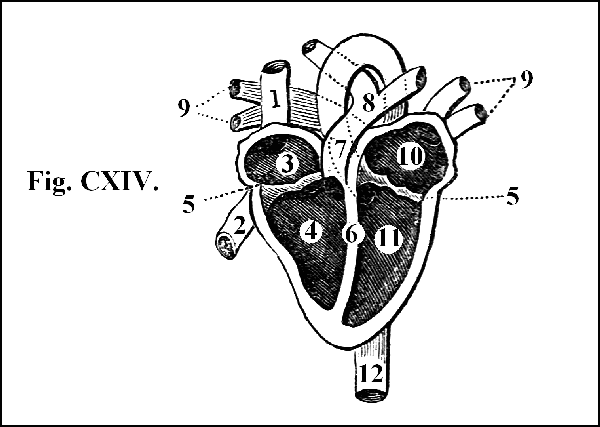
View of the heart with its several chambers exposed, and
the great vessels in connection with them. 1. The superior
vena cava; 2. the inferior vena cava; 3. the chamber called
the right auricle; 4. the chamber called the right ventricle;
5. the line marking the passage between the two chambers,
and the points of attachment of one margin of the valve;
6. the septum between the two ventricles; 7. the pulmonary
artery arising from the right ventricle, and dividing at 8, into
right and left for the corresponding lungs; 9. the four pulmonary
veins bringing the blood from the lungs into 10,
the left auricle; 11. the left ventricle; 12. the aorta arising
from the left ventricle, and passing down behind the heart
to distribute blood, by its divisions and subdivisions, to
every part of the body.
254. In nourishing the tissues and stimulating
the organs, the blood parts with its nutritive and
stimulating constituents, and receives in return
some ingredients which can no longer be usefully
employed in the economy, and others which are positively
injurious. An apparatus is established for
its renovation and depuration; this organ is termed
the lung (fig. LIX. 5), and to this organ the
blood must in like manner be conveyed. Thus the
blood moves in a double circle, one from the heart
to the body and from the body back to the heart,
termed the systemic circle; the other from the
heart to the lung and from the lung back to the
heart, termed the pulmonic circle. Hence in the
human body the heart is double, consisting of two
corresponding parts precisely the same in name,
in nature, and in office; the one appropriated to
the greater, or the systemic, and the other to the
lesser, or the pulmonic circulation (fig. CXIV.).
255. There is a complete separation between
these two portions of the heart (fig. CXIV. 6),
formed by a strong muscular partition which prevents
any communication between them except
through the medium of vessels.
256. The heart is situated between the two lungs
(fig. LIX. 2, 5), in the lower and fore part of
the chest, nearly in the centre, but inclining a
little to the left side. Its position is oblique (fig.
LIX. 2, 5). Its basis is directed upwards, backwards,
and towards the right (fig. LIX. 2); its
apex is directed downwards, forwards, and towards
the left, opposite to the interval between the cartilages
of the fifth and sixth ribs (fig. LIX. 2).
It is inclosed in a bag termed the pericardium
(fig. CXV.), which consists of serous membrane.
The pericardium is considerably larger than the
heart, allowing abundant space for the action of
the organ (fig. CXV.). One part of the pericardium
forms a bag around the heart (fig. CXV.);
the other part is reflected upon the heart so as
to form its external covering (fig. CXV.), and is
continued for a considerable distance upon the
great vessels that go to and from the heart in
such a manner that this bag, like all the serous
membranes, constitutes a shut sac. Both that
portion of the pericardium which is reflected upon
the heart, and that which forms the internal surface
of the bag around it, is moistened during life
by a serous fluid, which, after death, is condensed
into a small quantity of transparent water. That
portion of the pericardium which rests on the
diaphragm (fig. LXX. 1) is so firmly attached to
it that it cannot be separated without laceration,
and by this attachment, together with the great
vessels at its base, the heart is firmly held in its
situation, although in the varied movements of the
body it is capable of deviating to a slight extent
from the exact position here described.
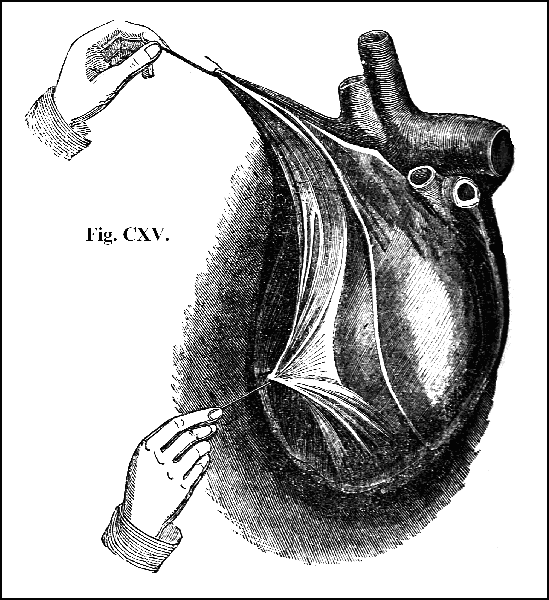
View of the heart enveloped in its pericardium, the fore part
of the latter being cut open and reflected back.
257. When the interior of the heart is laid
open there are brought into view four chambers
(fig. CXIV. 3, 4, 10, 11), two for each circle.
Those belonging to the pulmonic circle are on the
right (fig. CXIV. 3, 4), those to the systemic on
the left side of the body (fig. CXIV. 10, 11);
hence the terms right and left are applied to these
respective parts of the heart.
258. The veins which carry the blood to the right
or the pulmonic chambers are two, one of which
brings it from the upper, and the other from the
lower parts of the body: the first is called the superior
and the second the inferior vena cava (fig.
CXIV. 1, 2). Both pour their blood into the first
chamber, termed the right auricle (fig. CXIV. 3);
from the right auricle the blood passes into the
second chamber, denominated the right ventricle
(fig. CXIV. 4): from which springs the artery
which carries the blood from the heart to the lung,
the pulmonary artery (fig. CXIV. 7). This is
the pulmonic circle. From the lung the blood is
returned to the heart by four veins, termed the
pulmonary veins (fig. CXIV. 9), which pour
the blood into the third chamber of the heart, the
left auricle (fig. CXIV. 10). From the left auricle
it passes into the fourth chamber, the left ventricle
(fig. CXIV. 11), from which springs the artery
which carries out the blood to the system, termed
the aorta (figs. CXIV. 12, and CXVII. 11).
This is the systemic circle. In the system the
minute branches of the aorta unite with the minute
branches that form the venæ cavæ, which return
the blood to the right auricle of the heart, and thus
the double circle is completed.
259. The two chambers called the auricles
occupy the basis of the heart (fig. CXIV. 3, 10).
The right auricle is situated at the basis of the
right ventricle (figs. CXIV. 3, and CXVI. 4). It
is partly membranous and partly muscular. At its
upper and back part is the opening of the vena
cava superior (fig. CXVI. 1), which returns the
blood to the heart from the head, neck, and all
the upper parts of the body. At its lower part is
the opening of the vena cava inferior (fig. CXVI.
2), which returns the blood from all the lower
parts of the body.
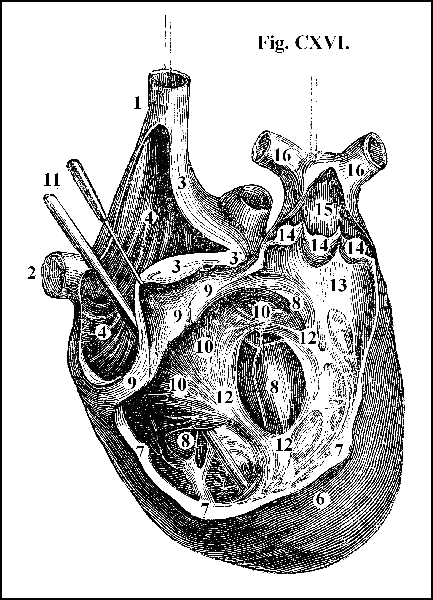
View of the heart with the great vessels in connection
with it, on the right side, its different chambers being laid
open and its structure shown. 1. The vena cava superior;
2. the vena cava inferior; 3. cut edge of the right auricle
turned aside to show, 4. the cavity of the right auricle into
which the two venæ cavæ pour the blood returned from all
parts of the body; 5. hook suspending the reflected portion
of the wall of the auricle; 6. the right ventricle; 7. cut
edge of the wall of the ventricle, a portion of which has
been removed to show 8. the cavity of the ventricle; 9.
situation of the opening between the auricle and ventricle,
called the auricular orifice of the ventricle; 10. valve placed
between the auricle and ventricle, one margin being firmly
attached to the auriculo-ventricular opening in its entire
extent, the other lying loose in the cavity of the ventricle;
11. probe passed from the auricle into the ventricle underneath
the valve, showing the course of the blood from the
former chamber to the latter; 12. the columnæ carneæ
attached by one extremity to the walls of the ventricle, the
other extremity ending in tendinous threads attached to the
loose margin of the valve; 13. passage to the pulmonary
artery; 14. the three semilunar valves placed at the commencement
of 15. the pulmonary artery; 16. the two great
branches into which the trunk of the pulmonary artery
divides, one branch going to each lung.
260. The auricle communicates with its corresponding
ventricle by a large opening, termed the
auricular orifice of the ventricle (figs. CXIV. 5,
and CXVI. 9). All around the opening is placed
a thin but strong membrane (fig. CXVI. 10), one
margin of which is firmly attached to the wall of
the ventricle (figs. CXIV. 5, and CXVI. 9), while
the other is free (fig. CXVI. 10). This membrane
receives the name, and, as will be seen
immediately, performs the office of a valve.
261. The ventricle is much thicker and proportionally
stronger than the auricle (fig. CXVI. 3,
6). It is composed almost entirely of muscular
fibre. Over nearly the whole extent of its internal
surface are placed irregular masses of muscular
fibres, many of which stand out from the wall of
the ventricle like columns or pillars (fig. CXVI.
12); hence they are called fleshy columns (columnæ
carneæ). Some of these fleshy columns are
adherent by one extremity to the wall of the ventricle,
while the other extremity terminates in tendinous
threads which are attached to the membrane
that forms the valve (fig. CXVI. 12).
262. From the upper and right side of this
chamber springs the pulmonary artery (fig. CXVI.
15); at the entrance of which are placed three
membranes of a crescent or semilunar shape,
termed the semilunar valves (fig. CXVI. 14).
263. The structure of the left side of the heart is
perfectly analogous to that of the right. Its auricle,
like that on the left side, is placed at the base of
the ventricle (figs. CXIV. 10, and CXVII. 2), and
like it also is thin, being composed chiefly of membrane.
At its upper and back part (figs. CXIV.
9, and CXVII. 1) are the openings of the four
pulmonary veins, two from the right, and two from
the left lung.
264. At the passage of communication between
the left auricle and ventricle is placed a valve analogous
to that on the right side (fig. CXVII. 7).
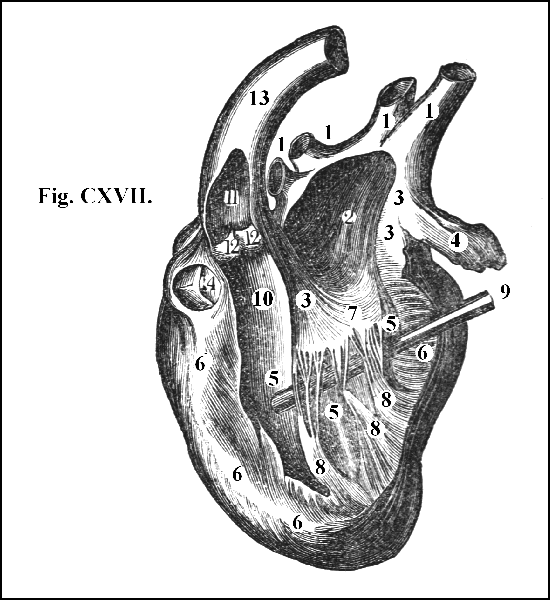
View of the heart with the great vessels in connection
with it, on the left side, its chambers being laid open as in
the preceding figure. 1. The four pulmonary veins opening
into, 2. the cavity of the left auricle; 3. the cut edge of the
wall of the auricle; 4. the appendix of the auricle; 5. the
cavity of the left ventricle; 6. the cut edge of the wall of
the ventricle, the greater portion of the wall having been
removed to show the interior of the chamber; 7. valve
placed between the auricle and ventricle; 8. columnæ carneæ
terminating in tendinous threads attached to the loose
margin of the valve; 9. probe passed underneath the valve
and its tendinous threads, raising them from the wall of
the ventricle similar to a refluent current of blood; 10.
passage to 11. the aorta; 12. two of the semilunar valves
placed at the mouth of the aorta, the third having been cut
away; 13. arch of the aorta; 14. the three semilunar valves
at the commencement of the pulmonary artery seen in
action, completely closing the mouth of the vessel.
265. The walls of the left ventricle are nearly
as thick again as those of the right, and its fleshy
columns are much larger and stronger. From the
upper and back part of this fourth chamber (fig.
CXVII. 11) springs the great systemic artery, the
aorta, around the mouth of which are placed three
semilunar valves (fig. CXVII. 12), similar to those
at the mouth of the pulmonary artery.
266. The partition which divides the two sets
of chambers from each other (fig. CXIV. 6) is
wholly composed of muscular fibres, and is called
the septum of the heart.
267. The external surface of the heart is covered
by a thin but strong membrane continued over it
from the pericardium. Between this membranous
covering and its fleshy substance is lodged, even
when the body is reduced to the greatest degree of
thinness, a quantity of fat. Immediately beneath
this fat are the fleshy fibres that compose the main
bulk of the organ. These fibres are arranged in a
peculiar manner. The arrangement is not perceptible
when the heart is examined in its natural
state, but after it has been subjected to long-continued
boiling, which, besides separating extraneous
matters from the fibres, hardens and loosens without
displacing them, the manner in which they are
disposed is manifest. Just at the point where the
muscular fibres that constitute the septum of the
auricles are set upon those which form the septum
of the ventricles, and parallel with the origin of the
aorta, the heart is not muscular but tendinous.
The substance called tendon, it has been shown,
is often employed in the body to afford origin or
insertion to muscular fibres, performing, in fact, the
ordinary office of bone, and substituted for it in
situations where bone would be inconvenient.
From the tendinous matter just indicated most of
the fibres that constitute the muscular walls of the
heart take their origin. From this point the fibres
proceed in different directions: those which go to
form the wall of the auricles ascend; those which
form the wall of the ventricles pursue an oblique
course downwards, and the arrangement of the
whole is such, that a general contraction of the
fibres must necessarily bring all the parts of the
heart towards this central tendinous point. The
object and the result of this arrangement will be
manifest immediately.
268. The internal surface of the chambers of the
heart, in its whole extent, is lined by a fine transparent
serous membrane, which renders it smooth
and moist; and, like all other organs which have
important functions to perform, it is plentifully
supplied with blood-vessels and nerves.
269. Such is the structure of the organ that
moves the blood. The artery, the tube that
carries it out from the heart, is a vessel composed
of three distinct layers of membrane superimposed
one upon another, and intimately united
by delicate cellular tissue. These layers are termed
tunics or coats. The external coat (fig. CXVIII.
3), which is also called the cellular, consists
of minute whitish fibres, which are dense and
tough, and closely interlaced together in every direction.
They form a membrane of great strength,
the elasticity of which, especially in the longitudinal
direction, is such that, in addition to its
other names, it has received that of the elastic
coat.
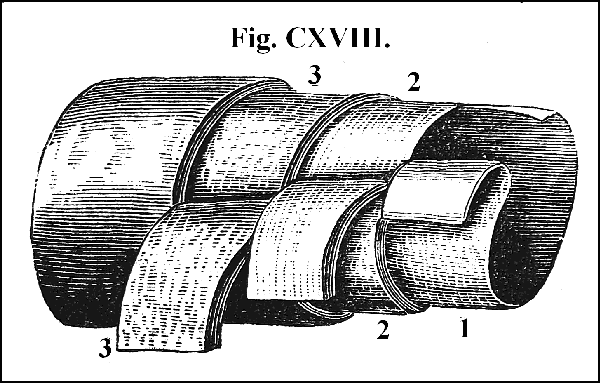
Portion of an artery, showing the several coats of which
it is composed separated from each other. 1. The internal
or serous coat; 2. the middle or fibrous coat; 3. the external
or cellular coat.
270. The middle or the fibrous tunic is composed
of yellowish flattened fibres which pass in an
oblique direction around the calibre of the vessel,
forming segments of circles, which, uniting, produce
complete rings (fig. CXVIII. 2). This tunic
is thick, consisting of several layers of fibres which
it is easy to peel off in succession. They form a
firm, solid, elastic, but, at the same time, brittle
membrane.
271. The inner tunic, thin, colourless, nearly
transparent, and perfectly smooth, is moistened by
a serous fluid, and is thence called the serous
coat (fig. CXVIII. 1). To the naked eye it presents
no appearance of fibres, yet notwithstanding
its extreme delicacy, it is so strong that, after the
other coats of the artery have been entirely removed
in a living animal, it is capable of resisting the impetus
of the circulation, and of preventing the dilatation
of the artery. The arteries themselves are
supplied with arteries, vessels that nourish their
tissues, and which are sent to them from neighbouring
branches, seldom or never from the vessel
itself to which they are distributed. Each individual
part of an artery is supplied by its own appropriate
vessels, which form but few communications
above and below, so that if care be not
taken in surgical operations to disturb these nutrient
arteries very little, the vessel will perish for
want of sustenance.
272. The vein, the tube that carries back the
blood to the heart, is composed of the same number
of tunics as the artery, which, with the exception
of the middle, are essentially the same in structure,
but they are all much thinner. The external
tunic consists of a less dense and strong cellular
membrane; the middle tunic, instead of being
formed of elastic rings, is composed of soft and
yielding fibres, disposed in a longitudinal direction;
while the inner coat, which is still more delicate
than that of the artery, is arranged in a peculiar
manner. The inner coat of most veins, at slight
intervals, is formed into folds (fig. CXX. 5), one
margin of which is firmly adherent to the circumference
of the vessel, while the other margin is free
and turned in the direction of the heart. These
membranous folds are termed valves. In all veins
the diameter of which is less than a line the valves
are single; in most veins of greater magnitude
they are placed in pairs, while in some of the
larger trunks they are triple, and in a few instances
quadruple, and even quintuple. The veins, like
the arteries, are supplied with nutrient vessels and
nerves.
273. All the arteries of the body proceed from
the two trunks already described; that connected
with the pulmonic circle, the pulmonary artery, and
that connected with the systemic circle, the aorta.
These vessels, as they go out from the heart and
proceed to their ultimate termination, are arborescent,
that is, they successively increase in number
and diminish in size, like the branches of a tree
going off from the trunk (fig. CXIX. 1, 2, 3).
Each trunk usually ends by dividing into two or
more branches (fig. CXIX. 1, 2), the combined
area of which is always greater than that of the
trunk from which they spring, in the proportion
of about one and a half to one. As the branch
proceeds to its ultimate termination it divides and
subdivides, until at length the vessel becomes so
minute, that it can no longer be distinguished
by the eye. These ultimate branches are called
capillary vessels, from their hair-like smallness
(fig. CXIX. 4); but this term does not adequately
express their minuteness. It has been stated
(234) that the red particle of the blood, at the
medium calculation, is not more than the three-thousandth
part of an inch in diameter; yet vast
numbers of the capillary vessels are so small that
they are incapable of admitting one of these particles,
and receive only the colourless portion of
the blood.
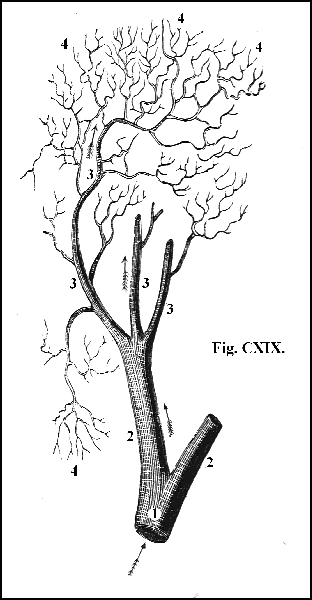
View of the manner in which an artery divides and subdivides
into its ultimate branches. 1. Trunk of the artery;
2. large branches into which it subdivides; 3. small
branches, successively becoming smaller and smaller until
they terminate in 4. the capillary branches.
274. Every portion of an artery, by reason of the
elasticity of its coats, preserves nearly a cylindrical
form, and as the area of the branches is greater
than that of the trunks, the blood, in proceeding
from the heart to the capillaries, though passing
through a series of descending cylinders, is really
flowing through an enlarging space.
275. The disposition of the veins, like that of
the arteries, is arborescent, but in an inverse order;
for the course of the veins is from capillary vessels
to visible branches, and from visible branches to
large trunks (fig. CXX. 1, 2, 3). In every part
of the body where the capillary arteries terminate
the capillary veins begin, and the branches uniting
to form trunks, and the small to form large trunks,
and the trunks always advancing towards the heart,
and always increasing in magnitude as they approach
it, form at length the two veins which it
has been stated (258) return all the blood of the
body to the right auricle of the heart.
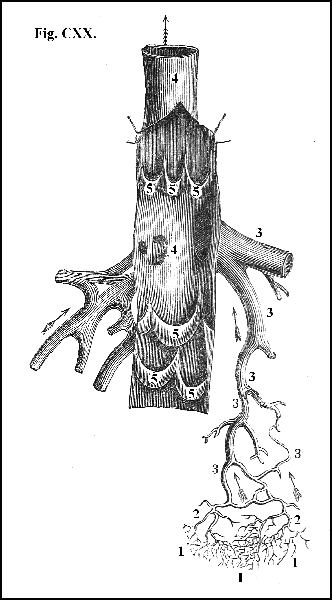
View of the manner in which the minute branches of the
vein unite to form the larger branches and the trunks.
1. Capillary venous branches; 2. small branches formed by
the union of the capillary; 3. larger branches formed by
the union of the smaller and gradually increasing in size,
to form the great trunk, 4. a portion of which is laid open
to show its inner surface and the arrangement of 5. the
valves formed by its inner coat.
276. The veins are very much more numerous
than the arteries, for they often consist of double
sets, and they are at the same time more capacious
and more extensible. Reckoning the whole of the
blood at one-fifth of the weight of the body, it is
estimated that, of this quantity, about one-fourth
is in the arterial and the remaining three-fourths
in the venous system. The combined area of the
branches of the veins is much greater than that of
the two trunks in which they terminate (fig. CXX.
1, 2, 3, 4): the blood, therefore, in returning to
the heart, is always flowing from a large into a
smaller space.
277. The divisions and subdivisions of the artery
freely communicate in all parts of the body by
means of what are called anastomosing branches,
and this communication of branch with branch
and trunk with trunk is termed anastomosis. The
same intercommunication, but with still greater
freedom and frequency, takes place among the
branches of veins. In both orders of vessels the
communication is frequent in proportion to the
minuteness of the branch and its distance from
the heart. It is also more frequent in proportion
as a part is exposed to pressure; hence the minute
arteries and veins about a joint are distinguished
for the multitude of their anastomosing branches;
and above all, it is frequent in proportion to the
importance of the organ; hence the most remarkable
anastomosis in the body is in the brain. By
this provision care is taken that no part be deprived
of its supply of blood; for if one channel
be blocked up, a hundred more are open to the
current, and the transmission of it to any particular
region or organ by two or more channels,
instead of through one trunk, is a part of the same
provision. Thus the fore-arm possesses four principal
arteries with corresponding veins, and the
brain receives its blood through four totally independent
canals[6].
278. That the blood is really a flowing stream,
and that it pursues the course described (258),
is indubitable. For,
(1.) With the microscope, in the transparent
parts of animals, the blood can be seen in motion
(fig. CXXI.); and if its course be attentively
observed, its route may be clearly traced.
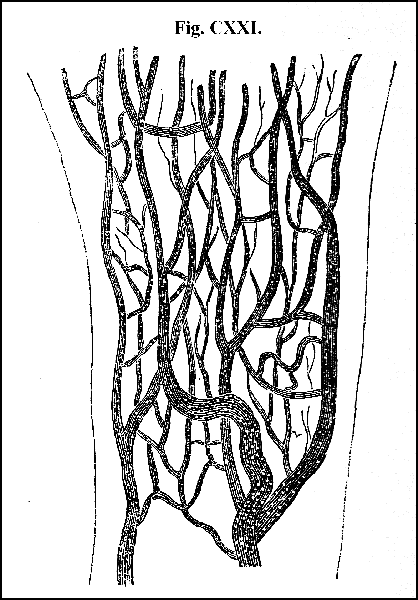
View of the circulation of the blood as seen under the
microscope in the web of the frog's foot.
(2.) The membranes termed valves are so
placed as to allow of the freest passage to the
blood in the circle described, while they either
altogether prevent or exceedingly impede its movement
in any other direction.
(3.) The effect of a ligature placed around a
vein and an artery, and of a puncture made above
the ligature in the one vessel and below it in the
other, demonstrate both the motion of the blood
and the course of it. When a ligature is placed
around a vein, that part of the vessel which is
most distant from the heart becomes full and
turgid on account of the accumulation of blood in
it; while the part of the vessel which is between
the ligature and the heart becomes empty and
flaccid, because it has carried on its contents to
the heart, and it can receive no fresh supply from
the body. When, on the contrary, a ligature is
placed around an artery, that portion of the vessel
which lies between the ligature and the heart
becomes full and turgid, and the other portion
empty and flaccid. This can only be because the
contents of the two vessels move in opposite directions,—from
the heart to the artery, from the
artery to the vein, and from the vein to the heart.
At the same time, if the vein be punctured above
the ligature, there will be little or no loss of blood;
while if it be punctured below the ligature, the
blood will continue to flow until the loss of it
occasions death, which could not be unless the
blood were in motion, nor unless the direction of
its course were from the artery to the vein and
from the vein to the heart.
(4.) If fluids be injected into the veins or
arteries, whether of the dead or of the living body,
they readily make their way and fill the vessels, if
thrown in the direction stated to be the natural
course of the circulation; but they are strongly
resisted if forced in the opposite direction.
279. Such is the description, and with the exception
of the first proof, such the evidence of the
circulation of the blood in the human body, pretty
much as it was given by the discoverer of it, the
illustrious Harvey. Before the time of Harvey, a
vague and indistinct conception that the blood was
not without motion in the body had been formed
by several anatomists. It is analogous to the
ordinary mode in which the human mind arrives
at discovery (chap. iii., p. 103), that many minds
should have an imperfect perception of an unknown
truth, before some one mind sees it in its completeness
and fully discloses it. Having, about
the year 1620, succeeded in completely tracing the
circle in which the blood moves, and having at
that time collected all the evidence of the fact,
with a rare degree of philosophical forbearance,
Harvey still spent no less than eight years in re-examining
the subject, and in maturing the proof
of every point, before he ventured to speak of it in
public. The brief tract which at length he published
was written with extreme simplicity, clearness,
and perspicuity, and has been justly characterised
as one of the most admirable examples of
a series of arguments deduced from observation
and experiment that ever appeared on any subject.
280. Cotemporaries are seldom grateful to discoverers.
More than one instance is on record
in which a man has injured his fortune and lost
his happiness through the elucidation and establishment
of a truth which has given him immortality.
It may be that there are physical truths
yet to be brought to light, to say nothing of new
applications of old truths, which, if they could
be announced and demonstrated to-day, would be
the ruin of the discoverer. It is certain that there
are moral truths to be discovered, expounded, and
enforced, which, if any man had now penetration
enough to see them, and courage enough to express
them, would cause him to be regarded by the
present generation with horror and detestation.
Perhaps, during those eight years of re-examination,
the discoverer of the circulation sometimes
endeavoured in imagination to trace the effect
which the stupendous fact at the knowledge of
which he had arrived would have on the progress
of his favourite science; and, it may be, the hope
and the expectation occasionally arose that the
inestimable benefit he was about to confer on his
fellow men would secure to him some portion of
their esteem and confidence. What must have
been his disappointment when he found, after the
publication of his tract, that the little practice he
had had as a physician, by degrees fell off. He
was too speculative, too theoretical, not practical.
Such was the view taken even by his friends. His
enemies saw in his tract nothing but indications
of a presumptuous mind that dared to call in
question the revered authority of the ancients;
and some of them saw, moreover, indications of a
malignant mind, that conceived and defended doctrines
which, if not checked, would undermine the
very foundations of morality and religion. When
the evidence of the truth became irresistible, then
these persons suddenly turned round and said,
that it was all known before, and that the sole
merit of this vaunted discoverer consisted in having
circulated the circulation. The pun was not fatal
to the future fame of this truly great man, nor
even to the gradual though slow return of the
public confidence even during his own time; for
he lived to attain the summit of reputation.
281. It is then indubitably established that the
whole blood of the body in successive streams is
collected and concentrated at the heart. The
object of the accumulation of a certain mass of it
at this organ is to subject it to the action of a
strong muscle, and thereby to determine its transmission
with adequate force and precision through
the different sets of capillary vessels.
282. In the accomplishment of this object the
heart performs a twofold action; that of contraction
and that of dilatation. The auricles contract
and thereby diminish their cavities, then dilate and
thereby expand them, and the one action alternates
with the other. There is the like alternate
contraction and dilatation of the ventricles. The
first action is termed systole, the second diastole,
and both are performed with force.
283. When the heart is laid open to view in a
living animal, and its movements are carefully observed,
it is apparent that the two auricles contract
together; that the two ventricles contract together;
that these motions alternate with each other, and
that they proceed in regular succession. The interval
between these alternate movements is, however,
exceedingly short, and can scarcely be perceived
when the heart is acting with full vigour;
but it is evident when its action is somewhat
languid.
284. When the ventricles contract, the apex of
the heart is drawn upwards, and at the same time
raised or tilted forwards. It is during this systole
of the ventricles, and in consequence of this result
of their action, that the apex of the heart gives
that impulse against the walls of the chest which
is felt in the natural state between the fifth and
sixth ribs, and which just perceptibly precedes the
pulse at the wrist.
285. When the ear is applied to the human
chest, over the situation of the heart, a dull and
somewhat prolonged sound is heard, which precedes
and accompanies the impulse of the heart against
the chest. This dull sound is immediately succeeded
by a shorter and sharper sound: after this
there is a short pause; and then the dull sound
and impulse are again renewed. The duller sound
and stronger impulse are ascribed to the contraction
of the ventricles, and the sharper sound and
feebler impulse to that of the auricles.
286. The movement of the heart is effected by
the contraction of its muscular fibres. Those
fibres rest, as upon a firm support, on the tendinous
matter to which they are attached, from which
they diverge, and towards which their contraction
must necessarily bring all the parts of the heart
(267). The result of their contraction is the
powerful compression of all the chambers of the
heart, and thereby the forcible ejection of their
contents through the natural openings.
287. But the chambers, alternately with forcible
contraction, perform the action of forcible dilatation.
This movement of dilatation is effected by
the reaction of the elasticity of the tendinous
matter on which the muscular fibres are supported
(267). This highly elastic substance, by the contraction
of the fibres, is brought into a state of
extreme tension. The contraction of the fibres
ceasing, that moment the tense tendon recoils with
a force exactly proportionate to the degree of
tension into which it had been brought. Thus the
very agent that is employed forcibly to close the
chamber is made the main instrument of securing
its instantaneous re-opening. A vital energy is
appointed to accomplish what is indispensable,
and what nothing else can effect, the origination
of a motive power; a physical agent is conjoined
to perform the easier task to which it is competent;
and the two powers, the vital and the physical,
work in harmony, each acting alternately, and
each, with undeviating regularity and unfailing
energy, fulfilling its appropriate office.
288. When the chambers of the heart which open
into each other, and which as freely communicate
with the great vessels that enter and proceed from
them, are forcibly closed, and the blood they contain
is projected from them, how is one uniform forward
direction given to the current? Why, when
the right ventricle contracts, is the blood not sent
back into the right auricle, as well as forward into
the pulmonary artery? There is but one mode of
preventing such an event, which is to place a flood-gate
between the two chambers; and there a flood-gate
is placed, and that flood-gate is the valve. As
long as the blood proceeds onwards in the direct
course of the circulation, it presses this membrane
close to the side of the heart, and thereby prevents
it from occasioning any impediment to the current.
When, on the contrary, the blood is forced backwards,
and attempts to re-enter the auricle, being
of course driven in all directions, some of it passes
between the wall of the ventricle and the valve.
The moment it is in this situation it raises up the
valve, carries it over the mouth of the passage,
and shuts up the channel. There cannot be a
more perfect flood-gate.
289. This is beautiful mechanism; but there
is another arrangement which surpasses mere mechanism,
however beautiful. It has been shown
(260) that one edge of the membrane that forms
the valve is firmly adherent to the wall of the ventricle,
while the other edge, when not in action,
appears to lie loosely in the ventricle (fig. CXVI.
10). Were this edge really loose the refluent
current would carry it back completely into the
auricle, and so counteract its action as a valve;
but it is attached to the tendinous threads proceeding
from the fleshy columns that stand along
the wall of the ventricle (fig. CXVI. 12). By
these tendinous threads, as by so many strings,
the membrane is firmly held in its proper position
(fig. CXVI. 10, 12); and the refluent current
cannot carry it into the auricle. Thus far the
arrangement is mechanical. But each of these
fleshy columns is a muscle, exerting a proper muscular
action. Among the stimulants which excite
the contractility of the muscular fibre, one of the
most powerful is distension. The refluent current
distends the membrane; the distension of the membrane
stretches the tendinous threads attached to
it; the stretching of its tendinous threads stretches
the fleshy column; by this distension of the column
it is excited to contraction; by the contraction of
the column its thread is shortened; by the shortening
of the thread the valve is tightened, and that
in the exact degree in which the thread is shortened.
So, the greater the impetus of the refluent blood,
the greater the distension of the membrane; and
the greater the distension of the membrane, the
greater the excitement of the fleshy column; the
greater the energy with which it is stimulated to
act, the greater, therefore, the security that the
valve will be held just in the position that is required,
with exactly the force that is needed. Here,
then, is a flood-gate not only well constructed as
far as regards the mechanical arrangement, but so
endowed as to be able to act with additional force
whenever additional force is requisite; to put
forth on every occasion, as the occasion arises, just
the degree of strength required, and no more.
290. The contraction of the heart is the power
that moves the blood; and this contraction generates
a force which is adequate to impel it through
the circle. From experiments performed by Dr.
Hales it appears that if the artery of a large animal,
such as the horse, be made to communicate with
an upright tube, the blood will ascend in the tube
to the height of about ten feet above the level of
the heart, and will afterwards continue there rising
and falling a few inches with each pulsation of the
heart. In this animal, then, the heart acts with a
force capable of maintaining a column of ten feet.
Now a column of ten feet indicates a pressure of
about four pounds and a half in a square inch of
surface. Suppose the human heart to be capable
of supporting a column of blood eight feet high,
this will indicate a pressure of four pounds to the
square inch; but the left ventricle of the heart,
while it injects its column of blood into the aorta,
has to overcome the inertia of the quantity of blood
projected; of the mass already in the artery, and of
the elasticity of the vessel yielding to a momentary
increase of pressure: it is probable, therefore, that
the heart acts with a force of six pounds on the
inch. The left ventricle, when distended, has about
ten square inches of internal surface; consequently
the whole force exerted by it may be about sixty
pounds. According to the calculation of Hales, it
is fifty-one and a half. Now, it is proved by numerous
experiments, that, after death, a slight impulse
with the syringe, certainly much less than
that which is acting upon the blood in the same
artery during life, is sufficient to propel a solution
of indigo, or fresh drawn blood, from a large artery
into the extreme capillary. If, therefore, after
death, a slight force will fill the capillaries, a force
during life equal to sixty pounds must be adequate
to do so.
291. The heart, with a force equal to the pressure
of sixty pounds, propels into the artery two
ounces of blood at every contraction. It contracts
four thousand times in an hour. There passes
through the heart, therefore, every hour, eight
thousand ounces or seven hundred pounds of
blood. It has been stated (216) that the whole
mass of blood in an adult is about twenty-eight
pounds: on an average the entire circulation is
completed in two minutes and a half; consequently
a quantity of blood equal to the whole
mass passes through the heart from twenty to
twenty-four times in an hour. But though the average
space of time requisite to accomplish a complete
circulation may be two minutes and a half, yet
when a stream of blood leaves the heart, different
portions of it must finish their circle at very different
periods, depending in part upon the length of the
course which they have to go, and in part upon the
degree of resistance that obstructs their passage. A
part of the stream, it is obvious, finishes its course
in circulating through the heart itself; another
portion takes a longer circuit through the chest;
another extends the circle round the head; and
another visits the part placed at the remotest
distance from the central moving power. Such is
the velocity with which the current sometimes
goes, that, in the horse, a fluid injected into the
great vein of the neck, on one side, has been detected
in the vein on the opposite side, and even
in the vein of the foot, within half a minute.
292. It has been shown (282) that the different
chambers of the heart have a tendency to perform
their movements in a uniform manner, and in a successive
order; that they contract and dilate in regular
alternation, and at equal intervals; but, moreover,
they continue these movements equally without
rest and without fatigue. On go the motions,
night and day, for eighty years together, at the rate
of a hundred thousand strokes every twenty-four
hours, alike without disorder, cessation, or weariness.
The muscles of the arm tire after an hour's exertion,
are exhausted after a day's labour, and can
by no effort be made to work beyond a certain
period. There is no appreciable difference between
the muscular substance of the heart and
that of the arm. It is true that the heart is
placed under one condition which is peculiar.
Muscles contract on the application of stimuli;
and different muscles are obedient to different
stimuli,—the voluntary muscles to the stimulus
of volition, and the heart to that of the blood.
The exertion of volition is not constant, but
occasional; the muscle acts only when it is excited
by the application of its stimulus: hence
the voluntary muscle has considerable intervals of
rest. The blood, on the contrary, is conveyed to
the heart without ceasing, in a determinate manner,
in a successive order; and this is the reason why
through life its action is uniform: it uniformly
receives a due supply of its appropriate stimulus.
But why it is unwearied, why it never requires
rest, we do not know. We know the necessities
of the system which render it indispensable that it
should be capable of untiring action, for we know
that the first hour of its repose would be the last
of life; but of the mode in which this wonderful
endowment is communicated, or of the relations
upon which it is dependent, we are wholly ignorant.
293. The force exerted by the heart is vital. It
is distinguished from mechanical force in being
produced by the very engine that exerts it. In
the best-constructed machinery there is no real
generation of power. There is merely concentration
and direction of it. In the recoil of the
spring, in the reaction of condensed steam, the
energy of the expansive impulse is never greater
than the force employed to compress or condense,
and the moment this power is expended all capacity
of motion is at an end. But the heart
produces a force equal to the pressure of sixty
pounds by the gentlest application of a bland fluid.
Here no force is communicated to be again given
out, as in every mechanical moving power; but it
is new power, power really and properly generated;
and this power is the result of vital action, and is
never in any case the result of action that is not
vital.
294. The heart projects the blood with a given
force into the arterial tubes. The arteries in the
living body are always filled to distension, and
somewhat beyond it, by the quantity of blood that
is in them. It has been shown that the elasticity
of their coats is such as to give to them, even after
death, the form of open hollow cylinders (274).
During life they are kept in a state of distension by
the quantity of blood they contain. By virtue of
their elasticity they react upon their contents with
a force exactly proportioned to the degree of their
distension, that is, with a force at least adequate
to keep them always open and rigid.
295. These open and rigid tubes, already filled
to distension, and somewhat beyond it, receive at
every contraction of the heart a forcible injection
of a new wave of blood. The first effect of the injection
of this new wave into a tube previously full
to distension, is to cause the current to proceed by
jerks or jets, each jerk or jet corresponding to the
contraction of the heart. And, accordingly, by this
jet-like motion, the flow of the blood in the artery
is distinguished from that in the vein, in which
latter vessel the current is an equal and tranquil
stream.
296. The second effect of this new wave is to
occasion some further distension of the already
distended artery, and accordingly, when the vessel
is exposed in a living animal, and its action carefully
observed, a slight augmentation of its diameter
is distinguishable at every contraction of the
heart. This new wave while it distends must at
the same time slightly elongate the vessel; cause
its straight portions to bend a little, and its curved
portions to bend still more; and, consequently, in
some situations, to lift it a little from its place,
giving it a slight degree of locomotion;—and these
two causes combined produce the pulse. When
the finger is pressed gently on an artery, at the instant
of the contraction of the heart, the vessel is
felt to bound against the finger with a certain
degree of force: this, as just stated, is owing to
a slight distension of the vessel by the new wave
of blood, together with a slight elongation of it,
and a gentle rising from its situation.
297. The blood, in flowing through the arterial
trunks and branches to the capillaries, through
the arterial to the venous capillaries, and through
the venous branches and trunks back to the heart,
is exposed to numerous and powerful causes of
retardation: such, for example, as the friction
between the blood and the sides of the vessels, the
numerous curves and angles formed by the branches
in springing from the trunks, the tortuous course
of the vessels in many parts of the body, and the
increasing area of the arterial branches as they
multiply and subdivide. Yet the extraordinary
fact has been recently discovered, that the blood
moves with the same momentum or force in every
part of the arterial system, in the aorta, in the
artery in the neck which carries the blood to the
head (the carotid artery), in the artery of the arm
(the humeral artery), in the artery of the lower
extremity (the femoral artery); in a word, in the
minute and remote capillary, and in the large trunk
near the heart. Having contrived an instrument
by which the force of the blood as it flows in its
vessel could be accurately indicated by the rise of
mercury in a tube, M. Poiseuille found that the
elevation of the mercury is uniformly the same in
the different arteries of the same animal, whatever
the size of the artery and its distance from the
heart. This tube was inserted, for example, into
the common carotid artery of a horse: the diameter
of the vessel was 34/100ths of an inch; its distance
from the heart was thirty-nine inches; the height
to which the mercury rose in the graduated tube
was accurately marked. The tube was then inserted
into a muscular branch of the artery in
the thigh: the diameter of this vessel was 7/100ths
of an inch, and its distance from the heart 67½
inches. According to the mean of nine observations,
the mercury rose in both tubes to precisely
the same elevation. Here is another instance of
the beautiful adjustments everywhere established
in the living economy. The blood is sent by a
living engine, moving under laws peculiar to the
state of life, into living vessels, which in their turn
acting under laws peculiar to the state of life, so
accommodate themselves to the current as absolutely
to offer no resistance to its progress; so
accommodate themselves to the moving power, as
completely and everywhere to obviate the physical
impediments to motion inseparable from inorganic
matter.
298. That the arterial tubes do possess and exert
a truly vital power, modifying the current of the
blood they contain, is indubitably established.
1. If in a living animal the trunk of an artery be
laid bare, the mere exposure of it to the atmospheric
air causes it to contract to such a degree, that its
size becomes obviously and strikingly diminished.
This can result only from the exertion of a vital
property, for no dead tube is capable in such a
manner of diminishing its diameter.
2. If during life an artery be opened and the
animal be largely bled, the arteries become progressively
smaller and smaller as the quantity of
blood in the body diminishes. If the bleeding be
continued until the animal dies, and the arteries of
the system be immediately examined, they are
found to be reduced to a very small size; if again
examined some time after death, they are found to
have become larger, and they go on growing successively
larger and larger until they regain nearly
their original magnitude, which they retain until
they are decomposed by putrefaction.
3. M. Poiseuille distended with water the artery
of an animal just killed. This water was urged by
the pressure of a given column of mercury. The
force of the reaction of the artery was now measured
by the height of a column of mercury which
the water expelled from the artery could support.
It was found that the artery reacted with a force
greater than that employed to distend it, and
greater than the same artery could exert some
time after death; but since mechanical reaction
can never be greater than the force previously
exerted upon it (293), it follows that the excess of
the reaction indicated in this case was vital.
4. If an artery be exposed and a mechanical or
chemical stimulus be applied to it, its diameter is
altered, sometimes becoming larger and sometimes
smaller, according to the kind of agent employed.
299. Any one of these facts, taken by itself,
affords a demonstration that the arterial trunks
and branches are capable of enlarging and diminishing
their diameter by virtue of a vital endowment.
There is complete evidence that the exertion
of this vital power on the part of the arterial
trunk is not to communicate to the blood the
smallest impulsive force; the engine constructed
for the express purpose of working the current
generates all the force that is required; but the
labour of the engine is economized by imparting
to the tubes that receive the stream a vital property,
by which they wholly remove the physical
obstructions to its motion.
300. Driven by the heart through the arterial
branches into the capillaries, the blood courses
along these minute vessels urged by the same
power. The most careful observers, from Haller
and Spalanzani down to the present time, concur
in stating that the pulsatory movement communicated
by the heart to the blood in the great arteries
is distinctly visible under the microscope in
the capillaries. "I have often observed in frogs
and tadpoles, and once in the bat," says Wedemeyer,
"that when the circulation was becoming
feeble, the blood in the finest capillaries advanced
by jerks, corresponding with the contractions of the
heart. I remarked the same appearance in the
fine veins several times in the toad and tadpole,
and once in the frog." If an experimenter so dispose
the circulation of the limb of an animal that
the flow of blood be confined to the branches of a
single artery, and a corresponding vein, it is found
that the blood stagnates in the vein whenever the
current in the artery is stopped by a ligature, but
no sooner is the ligature removed from the artery,
than the blood begins again to flow freely along
the vein, the capillaries of the artery which have
to send on the current to those of the vein being
now again within the influence of the heart. And
if the impulse of the heart be removed from the
capillary system, by placing a ligature around the
aorta, the capillary circulation is uniformly and
completely stopped.
301. It was found by Dr. Hales, that, under
ordinary circumstances, the blood rises in a tube
connected with a vein to the height only of six
inches, while it has been shown (290) that in the
artery it ascends as high as ten feet. This prodigious
difference between the venous and the
arterial tension led to the conclusion that the impulsive
force of the heart was all but exhausted
before the blood reached the veins, and set physiologists
on the search for other powers to carry on
the venous circulation. It was overlooked that
the blood has an open and ready escape from the
great trunks of the veins through the right
chambers of the heart, and that in consequence of
this free escape of their fluid, these vessels indicate
no greater tension than is just sufficient to lift the
blood to the heart, and to overcome friction[7].
M. Magendie having laid bare the chief artery and
vein of a living limb, and having raised the vessels
in such a manner that he could place a ligature
around the former, without including the latter,
found that the flow of blood from a puncture made
below a ligature on the vein, was rapid or slow,
according as the heart was allowed to produce a
greater or less degree of tension in the artery,
which tension was regulated by compressing the
artery between the fingers. After a similar preparation
of a limb, a ligature was placed around the
vein; a tube was then inserted into it; it was
found that the blood ascended in the tube from
the obstructed vein just as high as from the
artery.
302. Thus we are able to trace the action of the
heart from the beginning to the end of the circle.
Of this circle it is the sole moving power; but it
is a living engine acting in combination with living
vessels. The force it exerts is a vital force, economized
by the agency of a vital property communicated
to the vessels, by virtue of which they spontaneously
and completely remove all physical obstruction
to the progress of the stream through its
channels.
303. Some German physiologists of great eminence,
after a careful and patient observation of
the blood, have satisfied themselves that in addition
to the contraction of the heart, it is necessary
to admit a second original and independent motive
force, namely, a self-moving power inherent in
the particles of the blood itself. The blood we
know is a living substance. No reason can be assigned
why the power of originating motion should
not be communicated to such a substance as well
as to the muscular fibre, of which, indeed, one constituent
of the blood affords the basis. Such a
power, if found to be inherent in the particles of the
blood, would explain some phenomena connected
with the circulation not yet clearly elucidated; but
the proof of the self-moving power of the blood
does not yet seem to be complete. It is, however,
impossible to explain the phenomena of the circulation,
or to obtain a satisfactory view of some of
the other functions of the economy, without supposing
the particles of the blood to be endowed
with a vital power of repulsion, in consequence
of which they are prevented from uniting when
in contact, and the fluidity of the mass is maintained.
In this account of the powers that move the
blood, no notice has been taken of the physical
agents supposed to act as auxiliaries to the heart,
in carrying on the circulation, such as the suction
power of the thorax, and of the auricles of the
heart, and the capillary attraction of the vessels;
because, without questioning the existence of such
agents, or denying that advantage may be taken of
them, it seems pretty clear that their influence is
but trivial, and they assumed importance only
when the vital endowments of the tissues were
not well understood.
304. The ultimate end for which the apparatus
of the circulation is constructed, and for which all
its action is exerted, is to convey arterial blood to
the capillary arteries. These vessels are totally
distinct in structure and in office from the larger
arterial tubes. All the tunics of these minute
vessels diminish in thickness and strength as the
tubes lessen in size, but more especially the middle
or the fibrous coat; which, according to Wedemeyer,
may still be distinguished by its colour in
the transverse section of any vessel whose internal
diameter is not less than the tenth of a line; but
that it entirely disappears in vessels too small and
too remote to receive the wave of blood in a manifest
jet. But while the membranous tunics diminish,
the nervous filaments distributed to them
increase: the smaller and thinner the capillary,
the greater the proportionate quantity of its nervous
matter; and this is most manifest in organs of the
greatest irritability. The coats of the capillaries
successively becoming thinner and thinner, at
length disappear altogether, and the vessels ultimately
terminate in membraneless canals formed
in the substance of the tissues. "The blood in the
finest capillaries," says Wedemeyer, "no longer
flows within actual vessels; it is not contained in
tubes whose parietes are formed by a membranous
substance distinguishable by its texture and compactness
from the adjoining cellular tissue: it is
contained in the different tissues in channels which
it forms in them for itself; and, under the microscope,
the stream is seen easily and rapidly to
work out for itself a new passage in the tissues
which it penetrates."
305. Some of these fine capillaries, before they
entirely lose their membranous tunics, communicate
directly with veins. Of the capillaries which
terminate by direct communication with veins,
some are large enough to admit of three or four
of the red particles of the blood abreast; the
diameter of others is sufficient to admit only of
one; while others are so small that they can transmit
nothing but the serum of the blood. As long
as the capillary is of sufficient magnitude to receive
three or four of the particles abreast, it is evident
that it possesses regular parietes; but by far the
greater number, before they communicate with
veins, lose altogether their membranous coats.
There are no visible openings or pores in the sides
or ends of the capillaries by means of which the
blood can be extravasated, preparatory to its being
imbibed by the veins. There is nowhere apparent
a sudden passage of the arterial into the venous
stream; no abrupt boundary between the division
of the two systems. The arterial streamlet winds
through long routes, and describes numerous turns
before it assumes the nature and takes the direction
of a venous streamlet. The ultimate capillary
rarely passes from a large arterial into a large
venous branch.
306. The vital power which it has been shown
(298) is possessed by the arterial trunks and
branches, is still more intense in the minute capillaries.
If alcohol, strong acetic acid, naphtha,
and other stimulating fluids, be injected into the
arteries of a living animal, it is found that they
are not transmitted through the capillaries at all,
or, at all events, that they make their way through
them with extreme difficulty; whereas mild,
unirritating fluids pass with rapidity and ease.
Wedemeyer exposed and divided the main artery
in the fore-leg of a horse, together with the corresponding
vein in the shoulder. Several syringes-full
of tepid water were now injected into the
lower end of the artery. The gentlest pressure
was sufficient to force the fluid through the capillaries.
At each injection the water issued in a
full stream from the aperture of the vein, the flow
of the fluid ceasing as soon as the injection was
stopped. Next, instead of water, four syringes-full
of pure cold brandy were injected. To propel
this fluid through the capillaries, so as to render its
smell and taste perceptible at the aperture of the
vein, required a great degree of pressure; and
when at last the fluid issued from the vein, it
merely trickled in a feeble stream.
The experiment being repeated on another horse
with vinegar, six syringes-full of which being injected
in rapid succession, at first this fluid passed
as easily as water, afterwards it flowed with greater
difficulty and in a small stream; before long
the force required to propel it was extreme, and
at last the obstruction to its passage became
complete, so that no fluid whatever issued from
the vein.
These experiments, whenever repeated, afforded
the same result, and they demonstrate that the
capillaries are capable of being stimulated to contract
upon their contents, and that they can contract
with such force as to stop the current. It is
manifest that the power by which they do this is
vital, because after death all fluids, the mildest
and the most acrid, pass through them with equal
facility.
307. Drs. Thompson, Philip, Hastings, and
others in this country, have applied stimulants of
various kinds to the capillary arteries, in order to
observe with the microscope the changes which
the vessels undergo. The results of these experiments,
performed independently, agree with each
other; and all the observers concur in stating that
those results are so obvious and decisive as to
admit of no question. Wedemeyer, fully aware
of all that had been done on this subject by the
English physiologists, repeated their experiments
with his usual patience and care, vigilantly watching
the effects with his microscope. His observations
completely coincide with those of our
countrymen. The circulation being observed in
the mesentery of the frog and in the web of its
foot, it was apparent that no change whatever took
place in the diameter of the small arteries, nor in
that of the capillaries, as long as the circulation
was allowed to go on in its natural state; but as
soon as stimulants were applied to them, an alteration
of their diameter was visible. Alcohol,
without much apparent contraction of the vessels,
stopped the flow of the blood. Muriate of soda,
in the course of three or four minutes, caused the
vessels to contract one-fifth of their calibre, which
contraction was followed by dilatation and gradual
retardation and stoppage of the blood. Ammonia
caused immediate and direct dilatation, and the
effect of galvanism was still more striking. In a
space of time varying from ten to thirty seconds,
nay, sometimes immediately after the completion
of the galvanic circle, the vessels contracted, some
a fourth, others half, and others three-fourths, of
their calibre. The flow of the blood through the
contracted vessels was accelerated. The contraction
sometimes lasted a considerable time, occasionally
several hours; in other instances the contraction
ceased in ten minutes, and the vessels
resumed their natural diameter. A second application
of galvanism to the same capillaries seldom
caused any material contraction.
308. The evidence, then, is abundant that stimulants
are capable of modifying to a great extent
the action of the capillary arteries, sometimes
causing them to contract, at other times to dilate;
sometimes quickening the flow of blood through
them, at other times retarding it, and frequently
altogether arresting its motion. This contractile
power of the capillaries must be a vital endowment,
for no such property is possessed by any
substance destitute of life, and there is satisfactory
evidence that it is communicated, regulated, and
controlled by the organic nerves, which, as has
been shown, increase as the size of the vessels and
the thickness of their membranous tunics diminish.
The powerful influence of these nerves upon the
capillary vessels is placed beyond doubt or controversy
by the obvious local changes produced in
the capillary circulation by sudden, and even by
mental, impressions, by the flush of the cheek
and the sparkle of the eye, at a thought conceived
or a sound heard; changes which can be effected,
as far as we have any knowledge, by no medium
excepting that of the nerves. The part performed
by electricity, the physical agent by which it is
conceived the nerves operate, will be considered
hereafter.
309. Exerting upon each other a vital force of
repulsion, under a vital influence derived from the
organic nerves, urged by the vital contraction of
the heart, the particles of the blood reach the extreme
capillaries. Most of these capillaries terminate
(304) in canals, which they work out for
themselves in the substance of the tissues. The
tissues are endowed with a vital attractive force,
which they exert upon the blood—an elective as
well as an attractive force: for in every part of
the body, in the brain, the heart, the lung, the
muscle, the membrane, the bone, each tissue
attracts only those constituents of which it is
itself composed. Thus the common current, rich
in all the proximate constituents of the tissues,
flows out to each. As the current approaches the
tissue, the particles appropriate to the tissue feel its
attractive force, obey it, quit the stream, mingle
with the substance of the tissue, become identified
with it, and are changed into its own true and
proper nature. Meantime, the particles which are
not appropriate to that particular tissue, not being
attracted by it, do not quit the current, but passing
on, are borne by other capillaries to other tissues,
to which they are appropriate, and by which they
are apprehended and assimilated, When it has
given to the tissues the constituents with which it
abounded, and received from them particles no
longer useful, and which would become noxious,
the blood flows into the veins to be returned by
the pulmonic heart to the lung, where, parting
with the useless and noxious matter it has accumulated,
and, replenished with new proximate
principles, it returns to the systemic heart, by
which it is again sent back to the tissues.
310. Particles of blood are seen to quit the
current and mingle with the tissues; particles are
seen to quit the tissues and mingle with the
current. But all that we can see, with the best
aid we can get, does but bring us to the confines
of the grand operations that go on, of which we
are altogether ignorant. Arterial blood is conveyed
by the arteries to the capillaries; but before
it has passed from under the influence of the capillaries
it has ceased to be arterial blood. Arterial
blood is conveyed by the carotid artery to the
brain; but the cerebral capillaries do not deposit
blood, but brain. Arterial blood is conveyed by its
nutrient arteries to bone, but the osseous capillaries
do not deposit blood, but bone. Arterial
blood is conveyed by the muscular arteries to
muscle, but the muscular capillaries do not deposit
blood, but muscle. The blood conveyed by the
capillaries of brain, bone, and muscle is the same,
all comes alike from the systemic heart, and is alike
conveyed to all tissues; yet in the one it becomes
brain, in the other bone, and in the third muscle.
Out of one and the same fluid these living chemists
manufacture cuticle, and membrane, and muscle,
and brain, and bone; the tears, the wax, the fat,
the saliva, the gastric juice, the milk, the bile, all
the fluids, and all the solids of the body.
311. And they do still more; for they are architects
as well as chemists; after they have manufactured
the tissue, they construct the organ. The
capillaries of the eye not only form its different
membranes and humours, but arrange them in
such a manner as to constitute the optical instrument;
and the capillaries of the brain not
only form cerebral matter, but build it up
into the instrument of sensation, thought, and
motion.
312. The practical applications of these phenomena
are numerous and most important; but
they can be clearly and impressively stated only
when the operation of the physical agents which
influence the circulation, and which proportionally
affect life and health, has been explained.