The Philistine: a periodical of protest (Vol. II, No. 5)
Whole book · 15 sections
THE PHILISTINE. — CONTENTS FOR APRIL, 1896. — ONLY A VERY FEW COPIES OF THAT NOBLE BOOK, THE SONG OF SONGS: WHICH IS SOLOMON’S, REMAIN UNSOLD. THE PRICE FOR THESE IS NOW FIVE DOLLARS EACH. THE ROYCROFT PRINTING SHOP, EAST AURORA, N. Y.
The Philistine
A Periodical of Protest.
Let there be gall enough in thy ink.—Twelfth Night.
Printed Every Little While
for The Society of The Philistines
and Published by
Them Monthly. Subscription,
One Dollar Yearly
Subscriptions can begin with the current number
only. A very limited quantity of back numbers can
be supplied. Vol. 1, No. 1, 75 cents. Nos. 2, 3,
4 and 5 at 25 cents each.
Mr. Collin’s Philistine poster in three printings
will be mailed to any address on receipt of 25 cents
by the publishers. A few signed and numbered
copies on Japan vellum remain at $1.00 each.
Entered at the Postoffice at East Aurora, New York, for transmission
as mail matter of the second class.
COPYRIGHT, 1896, by B. C. Hubbard.
THE CONSERVATOR
Printed Monthly
in Philadelphia.
HORACE L. TRAUBEL, Editor.
Annual Subscription Price One Dollar.
All communications intended for the
Editor should be addressed to Horace
L. Traubel, Camden, New Jersey.
The attention of persons interested in Walt Whitman
is directed to The Conservator, in which,
along with the presentation of other views, affecting
freedom, democracy, ethics, solidarity, there appear
special studies treating of the significance of Walt
Whitman’s appearance in history, written in part by
men whose personal relations to Whitman, often
whose genius, give their utterances great importance
and offer special reasons why readers of books and
lovers of man cannot afford to ignore or neglect their
contributions.
Grouped here following are some names of recent
writers aiding in this synthesis.
John Burroughs,
Miss Helen A. Clarke,
Richard Maurice Bucke,
Miss Helena Born,
Oscar Lovell Triggs,
Edward Payson Jackson,
Hamlin Garland,
Edgar Fawcett,
Daniel G. Brinton,
Laurens Maynard,
Thomas B. Harned,
Francis Howard Williams,
Kelley Miller,
William Sloane Kennedy,
Isaac Hull Platt,
John Herbert Clifford,
Miss Charlotte Porter,
Wayland Hyatt Smith,
Horace L. Traubel.
The Bibelot.
MDCCCXCVI
Those authors and subjects that many
readers are glad to come at in a brief
way, (and who may be thereby quickened to
direct their studies anew to the sometimes
surface hidden beauties of literature,) will continue
to find ample presentation in The Bibelot
for 1896.
The typework that has made so many
friends among bookmen, will also be fully
sustained; in a word, The Bibelot still proposes
to remain something quite by itself, and out
of the highway and beaten track of every-day
book-making.
Subscriptions for 1896 at the regular
price, 50 cents in advance, postpaid, are
taken for the complete year only. After
March 1, the rate will be 75 cents, which will,
on completion of Volume II, be advanced to
$1.00 net.
It is desirable that renewals for 1896
should be forwarded Mr. Mosher early that
no vexatious delays may occur in mailing.
All subscriptions must begin with January
and end with December of each year.
THOMAS B. MOSHER, Publisher.
Portland, Maine.
THE LOTOS.
A High Class Monthly Magazine
of Art and Letters.
Cover and Poster by Arthur W. Dow.
CONTENTS FOR MARCH.
The Nature of Fine Art,
Ernest Francisco Frenollosa.
As to Stephen Crane,
Elbert Hubbard.
O Sada San, the Bride,
Mary McNeil Scott.
A Patron of Art,
Diana Archer.
Hawthorne, a character sketch,
May Alden Ward.
Altruism,
Emily S. Hamblen.
Etc., Etc.
Fifteen Cents a Number.
One Dollar a Year.
THE LOTOS.
No. 156 Fifth Avenue, New York.
MEDITATIONS IN MOTLEY.
By WALTER BLACKBURN HARTE
Meditations in Motley reveals a new American
essayist, honest and whimsical, with a good deal of
decorative plain speaking. An occasional carelessness
of style is redeemed by unfailing insight.—I.
Zangwill in The Pall Mall Magazine for April, 1895.
Philip Hale, the well known and brilliant literary
and musical critic, writes: “Walter Blackburn
Harte is beyond doubt and peradventure, the leading
essayist in Boston to-day. For Boston, perhaps you
had better read “The United States.” His matter is”
original and brave, his style is clear, polished when
effect is to be gained thereby, blunt when the blow
should fall, and at times delightfully whimsical,
rambling, paradoxical, fantastical.”
Mr. Harte is not always so good in the piece as in
the pattern, but he is a pleasant companion, and I
have met with no volume of essays from America
since Miss Agnes Repplier’s so good as his Meditations
in Motley.—Richard Le Gallienne, in the
London Review.
PRICE, CLOTH, $1.00.
Address THE PHILISTINE,
East Aurora, N. Y.
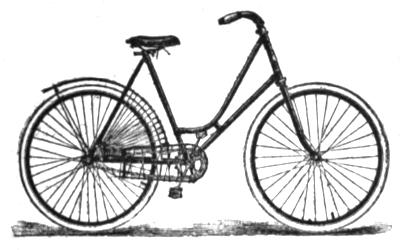
Why Not Win One of These Wheels?
“LA DELICATESSE” COMPANY,
EXCLUSIVE MAKERS OF
“LA DELICATESSE,”
A “CONFECTION IN CHEESE,”
OFFER EITHER THE “SWELL NEWPORT”
OR THE “NEWPORT BELLE,”
$100 “S. & F.” WHEELS, TO THE
PERSON WHO SHALL COIN THE
GREATEST NUMBER OF ENGLISH
WORDS FROM THE WORD “DELICATESSE.”...
Enclose stamp for conditions and booklet describing
the wheels. Please mention the Philistine.
“LA DELICATESSE” COMPANY,
Herkimer, N. Y.
ANNOUNCEMENT.
The Society of the Philistines
has made an
arrangement with Mr.
Walter Blackburn Harte,
the Editor and Publisher
of The Fly Leaf, Boston, Massachusetts,
to acquire and incorporate The
Fly Leaf with The Philistine.
Under this arrangement the services
of Mr. Harte will be retained by
the Society, and he will henceforth
devote his time and efforts to furthering
the interests of The Philistine and
The Roycroft Printing Shop.
After April 1st Mr. Harte’s address
will be East Aurora, N. Y.
All unexpired subscriptions to The
Fly Leaf will be filled by
THE PHILISTINE,
East Aurora,
New York.
THE PHILISTINE.
NO. 5.April, 1896.VOL. 2.
TO A FRIEND IN TIME OF TROUBLE.
Believe the word our gentle augur spake:
Sweet are the uses of adversity.
Sweet ever, and in naught so sweet as this:
That tho’ the heavens be barred, if we but hold
An equal, tranquil, will-illumined mind,
Such greatness in us, laborless, must earn
Great answers; cheer from all created things,
And interchange of love by natural right
With the high few; a kinship not of clan.
Be these thy present comfort. Like a man
Who tends a watchlight on the hills alone,
At Childermas, (and thro’ a night so cold
The red dots of the rowan-berry twirl,
Incorporate with a small, stiff cone of ice,
And the wind breaks his flail and swineherds hear
Outside the pine-boles crack with frost in the heart,)
Thou shalt, ere long, upon a distant peak
Descry a doubted smoke, a likelier spark,
A shadow shot across a glare, and then
A spurt of flame that bares the under sea;
And climb by much and more of certitude
To praising God some other even as thou
Beneath his natal star himself maintains,
And in salute of souls co-ordinate,
There, till he perish, guards his lineal fire.
Louise Imogen Guiney.
THE GOLD THAT GLITTERS.
There lived once in the East, a great king; he
dwelt far away, amongst the fragrant fields of
roses, and in the light of suns that never set.
He was young, he was beloved, he was fair of face
and form; and the people, as they hewed stone, or
brought water, said amongst themselves, “Verily,
this man is as a god; he goes where he lists, and he
lies still or rises up as he pleases; and all fruits of all
lands are called for him; and his nights are nights of
gladness, and his days, when they dawn, are all his
to sleep through or spend as he will.”
But the people were wrong. For this king was
weary of his life.
His buckler was sown with gems, but his heart beneath
it was sore. For he had been long bitterly
harassed by foes who descended on him as wolves
from the hills in their hunger, and he had been long
plagued with heavy wars and with bad harvests, and
with many troubles to his nation that kept it very
poor, and forbade him to finish the building of new
marble palaces, and the making of fresh gardens of
delight, on which his heart was set. So he, being
weary of a barren land and of an empty treasury,
with all his might prayed to the gods that all he
touched might turn to gold, even as he had heard had
happened to some magician long before in other ages.
And the gods gave him the thing he craved; and his
treasury overflowed. No king had ever been so rich
as this king now became in the short space of a single
summer day.
But it was bought with a price.
When he stretched out his hand to gather the rose
that blossomed in his path, a golden flower scentless
and stiff was all he grasped. When he called to him
the carrier-dove that sped with a scroll of love-words
across the mountains, the bird sank on his breast a
carven piece of metal. When he was athirst and
called to his cupbearer for drink, the red wine ran a
stream of molten gold. When he would fain have
eaten, the pulse and the pomegranate grew alike to
gold between his teeth. And lo! at eventide, when
he sought the silent chambers of his home, saying,
“Here at least I shall find rest,” and bent his steps
to the couch whereon his beloved was sleeping, a
statue of gold was all he drew into his eager arms,
and cold shut lips of sculptured gold was all that met
his own.
That night the great king slew himself, unable any
more to bear this agony; since all around him was
desolation, even though all around him was wealth.
Now the world is like that king, and in its greed of
gold will barter its life away.
Look you—this thing is certain—I say that the
world will perish even as that king perished, slain as
he was slain, by the curse of its own fulfilled desire.
The future of the world is written. For God has
granted their prayer to men. He has made them
rich, and their riches shall kill them.
When all green places have been destroyed in the
builder’s lust of gain; when all the lands are but
mountains of bricks, and piles of wood and iron;
when there is no moisture anywhere, and no rain
ever falls; when the sky is a vault of smoke, and all
the rivers reek with poison; when forest and stream,
the moor and meadow, and all the old green wayside
beauty are things vanished and forgotten; when
every gentle timid thing of brake and bush, of air
and water, has been killed because it robbed them
of a berry or a fruit; when the earth is one vast city,
whose young children behold neither the green of
the field nor the blue of the sky, and hear no song
but the hiss of the steam, and know no music but the
roar of the furnace; when the old sweet silence of
the country-side, and the old sweet sounds of waking
birds, and the old sweet fall of summer showers,
and the grace of a hedgerow bough, and the glow of
the purple heather, and the note of the cuckoo and
cushat, and the freedom of waste and of woodland,
are all things dead, and remembered of no man; then
the world, like the Eastern king, will perish miserably
of famine and of drought, with gold in its stiffened
hands, and gold in its withered lips, and gold
everywhere; gold that the people can neither eat nor
drink, gold that cares nothing for them, but mocks
them horribly; gold for which their fathers sold peace
and health, and holiness and beauty; gold that is one
vast grave.
Ouida.
MOODS.
To give my aching spirit ease
Yestreen I wandered out alone;
The mourner wind among the trees
Made its reiterant moan.
I hailed him. “Brother mine,” I said,
“Near kinsman in distress and dole,
Thou art, in all thy drearihood,
The echo of my soul.”
Then sudden from the boughs broke forth
Mad mirth as though from pipes at play;
Meseemed that East and West and North
Were out for holiday.
And laughter bubbled up behind
My dolefulness and over-ran;
As shifting as the freaksome wind
The many moods of man!
Clinton Scollard.
A SONG OF SOLOMON.
Love, I have wandered a weary way,
A weary way for thee,
The East is wan with the smile of the day,
Open thy door to me.
My hair is wet with the dew of the night,
That falls from the cedar tree,
The shadows are dark, but the East is light,
Open thy door to me.
The stones of the road have bruised my feet,
The hours till morn are three,
Thou that hast spikenard, precious, sweet,
Open thy door to me.
Stay not thy hand upon the lock,
Nor thy fingers on the key,
In the breeze before morn the tree tops rock,
Open thy door to me.
My love is the fairest, the only one,
The choice of her house is she,
The height of the heav’n hath seen the sun,
Open thy door to me.
The holy kiss of my lips and thine
Shall the sun have the grace to shine,
The hours foregone of the night are mine,
Open thy door to me.
H. C. Bunner.
[This dainty poem first published in Scribner’s
has been set to music by that brilliant woman, Mary
Knight Wood. The Oliver Ditson Company are the
publishers.]
AFTER DARK.
Central Park on Saturday afternoon and the
Tenderloin district on Saturday night give one
different ideas of New York. Rather different ideas,
too, of New York society, if one happens on a night
when any of the Four Hundred bring up in the
Thirtieth Street Police Station. Then you see him
whom tailors do not bully as they do ordinary men,
but bow down to as one whose whims are to set
fashions, brought in, covered with mud, by some
cab-driver who has failed to get his due from the
drink-befuddled brain and the drink-emptied pocket.
Those who come into the station of their own
accord act differently. They take off their hats and
tiptoe across the room to ask if they may go upstairs
to the sleeping room; and if it is full they tiptoe
meekly out again. Misery is very unostentatious.
Worst of all are the old women, with their repulsiveness
which almost prevents one from pitying
them. I wondered, the other day, what became of
all the pretty girls who walk Broadway and Sixth
Avenue at night. I think I saw in the police station
what became of some of them.
With the proud scions of aristocracy there is no
humbleness. In some stages there is jocularity and
affability; in some, haughtiness; but the end of both
is the same. When the scion understands that he is
to spend a night in jail the horror of it appears to
him something the gods cannot allow. He remonstrates
with the police captain; he mentions his
pride of birth and the shame that incarceration
would be to such as he; he appeals to all the police
captain’s higher feelings one after the other; he
speaks to him as one gentleman to another. His
ignorance of the vulgar world leads him into strange
mistakes. And the policeman laughs and encourages
him to talk, if the night has been dull, and finally
putting him into a cell, examines the inside cover of
his watch to see if he has given his right name.
About an hour after midnight Detective Dugan
brought in a pretty, fair-haired girl.
“What is your name?” asked the sergeant.
The girl leaned forward and her lips moved, but
they trembled so she could not answer for a moment.
“Fanny Kellogg,” she said faintly at last.
“Kelly?” asked the sergeant.
“No; Kel—Kel—”
“Kellogg,” said the detective for her.
“What’s your age, Fanny?” asked the sergeant.
“Twenty-five.” She did not look more than
twenty; so I suppose she spoke the truth.
“Your occupation?”
There were two or three reporters near her. She
looked straight ahead and did not answer at all.
The sergeant waited a minute; then he asked:
“The same old thing?”
She nodded, still looking straight before her.
“Married?”
Her eyes filled with tears. She shook her head.
“That’s too bad, Fanny, you ought to get married.”
He finished writing in his book, and then
rang for the matron. The bell was out of order, so
he sent a messenger. While waiting he said to the
girl jokingly:
“Couldn’t you see that Dugan was a copper?”
She turned and looked at the detective, smiling.
She looked at him from top to toe, as if to see
whether her judgment had been at fault, or whether
she had merely had a case of hard luck. Dugan
began to blush and Fanny smiled still more. She
had a pleasant face, but in the smile one could see
things that the face in repose did not reveal.
There was some delay before the matron came.
After the little joke on the detective had passed,
Fanny’s eyes again filled with tears, which she
furtively wiped away with the tips of her fingers.
Then the little plump matron appeared in the doorway,
beckoned to Fannie with a stiff little finger of
rectitude, and they went out of the room together.
“It’s a pity she shouldn’t marry; she’s a nice
girl,” said the sergeant.
“She’s pretty, too,” said a reporter.
“Her figure isn’t good enough for me,” said
another.
“Oh, I guess you’d take her fast enough,”
answered the sergeant.
The talk was slipping down very rapidly. Few
men consider chivalry a thing to be worn all the
time.
Kenneth Brown.
THE MONK.
A Monk who belonged to a very Wealthy Order
went forth to beg, pleading great poverty and
distress to those from whom he asked alms. He
met a Butcher and a Baker to whom he said he had
eaten nothing for many days, and that he was almost
starved.
“How is it thou art so fat?” said they as they
drove on their wagons.
He met a Tradesman and said he had not had any
money for years, even from his youth, as he had long
been a Monk.
“I have no money to give thee,” said the Tradesman,
at the same time jingling a handful of gold
coins in his pocket.
“I pray Jesus to forgive thee that lie,” said the
Monk, “for I hear the coins jingling in thy
pockets.”
“If thou hast seen so little money in thy life,”
said the Tradesman, “how dost thou so well know
its jingle?”
He met a Fishmonger carrying a basket of fish,
coming from attending his nets, to whom he said:
“I and my brothers are perishing for want of fish.
Pray give us thy basket of fish and go thou and
catch others.”
“Go and catch thy own fish,” said the Fishmonger,
“the waters of the earth are as free for
thee to fish in as for me.”
He met a Woman at her door, to whom he bowed
low and made the sign of the cross:
“Kind Madam,” said he, “I and my brothers
are perishing for want of food and money. I pray
you give unto us according as the Lord hath prospered
thee.”
“Come in, poor Monk,” said she, “we have not
much except my husband’s wages, but to share with
thee is to give unto the Lord.”
So saying she gave him half her savings, and
when he made ready to depart she craved his
blessing.
“You may kiss my Big Toe,” said he. Which
being done he departed, and with a shrug of his
shoulders said to himself:
“Ah, if Women were not so easily beguiled, we
should be compelled to work.”
John Bryan of Ohio.
THOUGHTS.
FREEDOM.
“No bonds at all! Give me sweet freedom,” cried the youth,
But freedom dwells in naught save bondage to the truth.
SUFFICIENCY.
With self and God, a cave may still be Paradise;
With God and self unknown, the world cannot suffice.
UNSELFISHNESS.
Work thou for self alone, and life shall die at death;
For others live, and lo! death shall be God’s own breath.
PRAISE.
The praise of some is manna from on high,
But when all praise, ’tis time for one to die.
Charles P. Nettleton.
THE PASSING OF CLANGINGHARP.
And so old Clangingharp passed out. He
did not die, and his case was not like Elijah’s
or Enoch’s. Enoch left a spoor, while Clangingharp
calmly and peacefully passed away, without striking
a discord. Nobody had any idea where Clangingharp
was. Frostembight had seen him the night
before and they had drunk and been drunk; but
where Clangingharp was Frostembight could not or
would not say.
The Knittenpin woman, of course, acted like an
idiot and went around to Frostembight’s house in
the morning and threatened to kill Frostembight.
Nothing prevented her but Frostembight. She
afterwards told Shiningstar and Shiningstar’s little
girl Eva, that Frostembight was not safe for dependence,
even as a victim. Eva leered proudly
and said she guessed it made very little difference
anyway.
Eva was one of those frail, delicate little girls,
happy for their years, who grow up into frail, delicate
women, wretched for theirs. Sometimes they
have blue eyes, sometimes black. Eva’s were green.
Championoar liked green-eyed women, and half
promised to wait till Eva was old enough to be
married to him, when he could get her off the
stage. Shiningstar was his stepdaughter’s stepfather.
By the second night after Clangingharp had passed
away the editor of The Evening Coat had gone back
into society again, and was the center of a jostling
cluster at the Opera. Madame Frustra, the prima
donna, seemed to incline toward the editor, and
when his flowers reached her in her dressing room
she was heard to murmur, “Poor Clangingharp!”
That was really all there was to connect The Evening
Coat with the affair, and, indeed, Frustra wrote
the editor a note saying that nowadays a successful
actress had to forego wine suppers and skip to her
hotel directly after the opera. She got out of town
with her luggage before the stranding was discovered.
Charmingbland, the hotel clerk, got himself into a
devil of a fix, it was said, for hinting foul play and
collusion between Little Eva and Uncle Tom.
Uncle Tom was a good enough fellow, though pale
at times, and made a dramatic exit when the Chinaman
lost his cue. Of course there was a tremendous
sensation, and speculation of all sorts over what
Clangingharp’s son would have done if Clangingharp
had had one. That led Padmarx, dramatic editor of
The Evening Coat, to put on a copy and go behind
the scenes to interview Ellen Squigs.
“Say, Squigsy,” he wheedled, “where’s Clangingharp?”
Squigsy went right on frizzing her hair with a curling-iron,
and said she wasn’t no slouch and wasn’t
going to be bluffed by Championoar nor any other
dude. That made Padmarx curious, and he asked
Squigsy if she really thought she could act. Squigsy
rushed at Padmarx and ran the hot curling-iron all
over his dress shirt, making long, irregular scorches
on the bosom. Padmarx buttoned up his ulster and
went out after the ball. Late that night a stranger
walked up to Charmingbland, pulled off a false mustache
and said furtively:
“There, you idiot—dyuh recognize meh now?”
“Strings Clangingharp, by Gawd,” remarked
Charmingbland, “where you been?”
Clangingharp put his mustache on crooked, and
they sat down at a table in the bar-room from
which Charmingbland could see anybody that tried
to steal the silver card-platters off the desk. Clangingharp
drank eleven cocktails before he said a word,
then he put his finger to his mustache to enjoin
maudlin secrecy upon Charmingbland and said:
“Shay, ol’ man. Want t’ know w’er I been?
Been zh’ gol’ cure, ol’ man. Zhay wouldn’ take me.
Gimme some pepper there!”
And he spread himself, like a green bay tree.
Frank W. Noxon.
TO THE MAIDEN
THE SEA WAS BLUE MEADOW
ALIVE WITH LITTLE FROTH-PEOPLE
SINGING.
TO THE SAILOR, WRECKED,
THE SEA WAS DEAD GREY WALLS
SUPERLATIVE IN VACANCY
UPON WHICH NEVERTHELESS AT FATEFUL TIME,
WAS WRITTEN
THE GRIM HATRED OF NATURE.
Stephen Crane.
DEATH THE DOORWAY.
Let not your soul be saddened by dread of darksome death;
Immortal life depends not upon the mortal breath.
Behold this worm; no creature more helpless can be found,
Yet this, too, has a future, by death upraised, unbound.
It crawls its brief existence till Summer’s sun has fled;
Then lies in cocoon shrouded and, as a worm, is dead.
But when the warmth of Spring-time breaks through its silent tomb,
On radiant wings it floats on air, and sips the flower’s perfume.
And yet the self-same spirit that moved the creeping thing,
Now flutters in this moth’s light form and on its rainbow-wing.
...
Out of the acorn’s foulness that now lies here decayed,
Shall rise the giant oak-tree, with broadly spreading shade:
And every seed that’s buried and seems to rot away,
But proves that death is doorway unto a higher day;
But proves that death is needful to loose the spirit’s wings,
And that all life is only the germ of better things.
Alexander Jeffrey.
SIDE TALKS WITH THE PHILISTINES: BEING SOUL EASEMENT AND WISDOM INCIDENTALLY.
I observe that the New Woman still sharpens her
lead pencil with the scissors.
The Chicago Times-Herald, realizing that owing
to emanations from the Stock Yards, the Pierian
Spring might need a drainage canal, is making an
effort to dam the obnoxious flow, by offering prizes
for the very best machine-made prose and verse. The
literary editor who was selected to do the damning
has recently, in a marked manner, proved his competency
for the “job.” He awarded the prize for
the best original poem on the romantic subject, “Chicago,”
to a young lady from Indianapolis who sent
him a copy of B. F. Taylor’s Fort Dearborn, which
was an original and a favorite twenty years ago.
When the editor’s attention was called to the prehistoric
flavor of the prize poem, he treated the
matter with fine scorn, admitting that it was true,
that there had been a “writer of some local reputation
named Taylor who had originally written the
poem.” He then intimated that any plumber’s
daughter from Indianapolis, who would thus attempt
to deceive a guileless Chicago editor, ought to be
well spanked. And straightway he impaled her on
the turnspit of public opinion and “roasted” her
like an articled literary chef, and in fact the girl
deserved it for wasting her time in copying poetry
when she could have employed it more profitably in
making out her father’s bills. The literary editor
handled this matter so diplomatically that the proprietors
of the journal rewarded him with an order
on McClurg for a copy of B. F. Taylor’s Old Time
Pictures which contains the poem.
In China there is no copyright law. An author’s
reward consists in the thought that he has expressed
his idea and thereby benefitted mankind. My
reward so far for good work has been the pure
Chinese article.
Walter Blackburn Harte has engaged board at the
Widow Blannerhassett’s, second door east of the
blacksmith shop. At Johnson’s grocery last night
Harte beat old Si Emery three straight games at
checkers—and that is no small matter.
Aunt Polly, of the old school, lives with a niece
who is a modern of the moderns. Hearing the
expression “decadent” used in connection with
sundry articles in The Yellow Book and The Chip-Munk,
she looked into the matter herself when left
alone after dinner and the young folks had gone to
see and hear The Scarlet Letter.
She read until her spectacles began to quiver and
her cap strings heaved upon her breast like signals of
distress in a brooding tempest.
The books suddenly fell with a dull thud.
“Decayed! well, I should say so!” groaned
Aunt Polly, as she began rocking in her chair at the
rate of a mile in two forty. What could she have
been reading?
It’s a curious comment on our civilization that a
priest in the Catholic Church should (or could) make
himself obnoxious to a very large number of his
townsmen by advocating total abstinence from strong
drink. Yet this is exactly what the Rev. Father
George Zurcher of Buffalo has done. It seems some
merry brewers have been playing pranks on the good
Father by sending him cases of bottled lager with
four-horse teams, brass bands and decorated vehicles.
It was awfully funny to see the big wagons rattle up
to the little house that stands beside the church and
then behold fat men with faces like full moons and
noses like glowing oriflammes lug in the lager and
deposit it on the priestly steps. Then other jokers
took the matter in hand and sent hurry-up telephone
orders for wet goods to be delivered at the Rectory.
But Father George is a bit of a joker himself and at
the same time is dead in earnest as the true humorist
always is. And now when invoices of “Old Tom,”
or “Triple XXX,” or “Monongahela” arrive
Father George walks out in sight of the people who
have gathered to see the fun, solemnly crosses himself,
murmurs a prayer and proceeds to slam the
bottles against the side of the pretty brick church.
Slap-dash, spang, bang, zipp they go! Corks fly,
red moisture flows and glass covers the sidewalk like
hail after a Kansas blizzard. Some of the assembled
citizens laugh, some cheer, others look solemn and
deprecate the waste of valuable goods that might be
sold and the proceeds given to the poor. Still
others, sadder still, with sensitive spirits, deem it
sacrilege to throw things at a sacred edifice, and ask
for Bible justification.
But Father George, being a most unreasonable
man, and a perverse, says that the best use a church
can be put to is that of a barricade on which to
smash bottles of Extra Triple XXX. In fact, he
earnestly declares that his church was built with this
special idea in mind and that the foundation is so
deep and the walls so solid that if all the demijohns
in Buffalo were banged plumb against it, it would
still stand secure.
And the upstart of it all is that over a hundred
bicycle tires have been punctured in that block during
the last month and no wheelman feels safe from
broken glass within a mile limit in any direction of
St. Joseph’s church. So the police have notified the
Father that he must smash no more bottles in the
street on penalty. And furthermore, on the statute
books of the State of New York is a law known as
“The Bottlers’ Protective Act.” This law makes
it a misdemeanor to wilfully break a beer bottle in
the great Empire State. The Beer Bottlers’ Association,
in order to uphold its dignity, is about to
bring action against Father George under this law,
all as legally provided, and the end is not yet.
We now have the Lotus, the Lotos and the Lettuce.
The latest is The Prairie Dog. Its hole is in Lawrence,
Kansas, and it is patterned after the Chip
Munk. Verily, like begets like.
The Drumtochty folks are both good and witty.
And it looks a bit as if that old idea that a joke cannot
be gotten into the head of a Scotsman without
trepanning is a mistake. Some say, though, that
there is no such place as Drumtochty; yet the same
remark has been made about East Aurora. But
Dodd, Rott & Company declare that Drumtochty
exists, and in their last Price List they insert this
poem, which they say fitly describes the Land of
parritch:
Land of chivalry and freedom,
Land of old traditional fame,
May thy noble sons and daughters
Long uphold thy honored name.
Land of simple-hearted kindness,
Land of patriotic worth,
May thy virtues ever flourish,
Hardy clansman of the north.
No Scot has arisen so far to deny the allegations
set forth; but an Englishman has, and he winds up
with this:
Land of ancient bloody tyrants,
Sneaking traitors, deep and sly,
Land of thieving “Heelen teevils,”
Kilted rogues and stolen kye.
Land o’ canny carefu bodies,
Foes to a’ ungodly fun,
Those who sum up man’s whole duty,
Heaven, hell and number one.
And now Mr. H. O. Mac Arthur, who edits The
Bookman, has offered a reward of seven dollars and
fifty cents for the name and address of the Englishman
aforesaid.
If Rider Haggard had been Lew Wallace what
would She have been?
Conan Doyle used to print good things before he
made a success; but now that he has found a market,
what’s the use!
I have wrestled patiently and mightily with a volume
called A Study of Death, by H. M. Alden, and
have been worsted. Any man who will chase Mr.
Alden into a corner and get a plain simple answer
to anything shall be crowned with honor.
“You may talk of all subjects save one, namely,
your maladies,” said Emerson. Yet in each issue of
the Cosmopolitan Andrew Lang takes the public
into his confidence concerning his bodily ills.
The tendency to play flim-flam with their names
is a penchant of the Inklings. No sooner does a
mortal have a bit of manuscript accepted than he
gives himself a middle name if he hasn’t one, and
drops it out if he has. Some in fact petition the
legislature for brand new handles and have themselves
rechrisumed by a priest, as recently was the
case in Boston; the man’s age being thirty-six.
Others add a hyphen and join two names with a
philological integument that makes one think of the
Siamese twins.
The queerest freak of this kind perhaps is the
case of the Gilder-Family-Robinson. The name as
it first appears on the Parochial Register is Gildersleeve.
But when Judge Gildersleeve shot in the
American Rifle Team and made a bad score at Wimbledon,
the sleeve was cut off in certain instances. In
other words, the name was raveled and worn with
short sleeves—or no sleeves at all, like a bodice or
stomacher.
Now that William Watson has been knighted we
see it is spelled Watson-Guilder. But the latest development
in this peculiar evolution is a letter from
Sir William Watson disclaiming all relationship with
the Watsons of America. The closing paragraph of
this epistle is worthy of note: “It is true that I was
caught and knighted by the Queen, as a certain flippant
American paper has put it; but any American
who hopes to add lustre to his name by claiming
kinship with me should be caught and knouted.”
The London Graphic thinks that Judge Grant is
not so great a man as his father, the General. That’s
a matter of opinion.
The Frederick A. Stokes Company has issued a
pretty book, written by Mrs. Walford, entitled A
Bubble. I will prick it in my next number.
If literature does not pay, we can still beg—if to
dig we are ashamed!
Union Down by Mr. Scott Campbell is not an imitation
of Thistle Down, as has been sometimes stated.
And furthermore is the Boston Library right in classing
Thistle Down as light literature?
The Lynx-Eyed being yet on a journey the Chip-Munk
spells it “Carlysle.” Or is it only a pricking
of conscience for quoting in dead earnest from
the works of Carlisle, who now is only spoken of by
scholars in connection with Imogen Such, Abe Slupsky,
Thomas Collins and Wigelow Vorse?
William Marion Reedy, who holds The St. Louis
Mirror up to Nature, is one of the strongest writers
that this glorious Republic contains. He has wit
and better still he has humor. He writes with a pen
that does not scratch; and in his ink there is a
goodly dash of Attic salt but no vitriol. Yet when
Reedy declined the Ph. D. offered him by the Chicago
University, and said in his letter “I hardly
consider myself worthy to be so honored by Chicago’s
great institution of learning,” was it tincture of iron
or what? Anyway, Rockefeller’s mad.
A Boston paper describes Mr. Hornaday’s book,
The Man Who Became a Savage, as “an artistic
romance, penned by a man who believes in art for
art’s sake.” From other sources I hear it spoken of
as “a novel with a purpose, written by a crank with
a tandem hobby.” The National Brewer’s Gazette
calls it “a musty piece of bombastic fustian, written
by a ranting Methodist preacher.”
I understand that a movement is on foot in Chicago
to treat divorce as a sacrament. And as a straw
that tells which way the wind blows in the Windy
City, please note that Judge Gibbons has recently
issued an order that a certain man shall be paid
twenty-five dollars per week alimony by his former
wife.
Last week all of the Boston papers contained a
large picture of J. Stilman Smith, secretary to Dr.
Edward Everett Hale. It was explained that Dr.
Hale is the author of etc., etc., etc., and the reason
that Smith is shown to the world is because he had
a severe attack of influenza coupled with poster-mania,
and was cured by taking two boxes of Dr.
Muckyroot’s pills. Great is Dr. Hale! Great is
Dr. Muckyroot! Great is Smith!
I warn the public against a book called Youth: A
Poem of Soul and Sense, by Mr. Michael Monahan.
It is dedicated to “The True and the Chaste,” which
evidently was an attempt to flatter me. But I’m not
for sale. Still, I read the book—read it to Her—read
it through, and we two voted that it could not
be safely recommended: for many people on reading
it would be very much shocked and the dear public
shall not be shocked if I can help it. Portions of the
book are addressed to the poet’s wife, and several of
the poems (the best) I believe were written by her.
Now a man who is not enough of a man to do his
work without calling in his wife to help him is not
much of a man after all—that’s just what I mean and
I don’t care who knows it!
And here comes from Emma Eggleson, Sumner,
Iowa, something that is too choice even for my
Waste Basket:
Hail to thee, Neith Boyce! Suffering makes a
sisterhood and I embrace thee.
The desire to “edit” every article printed in its
columns is often a ruling force in the career of
the Presiding Elder of a Newspaper. Especially is
this illustrated in the walk and conversation of sundry
publications that pour out chronic sweetness at
stated periods on the classic air of the Hub.
It is meat and drink to the modest Literary Aspirant
to see himself in type, even if his “effort” is
served with a few modifications in style, but when
he beholds the offspring of his genius scalped on the
crown, shorn on each side, and whittled down to a
sickly wedge of small talk at the close, the swift flow
of interesting narrative converted to a sluggish bayou
with the cream ideas carefully skimmed from its surface
and discarded, he stares helplessly at the title
and signature, which are all the recognizable features
left, and resolves to become—a kicker.
Yet this is Boston, that sits upon her throne of
Baked Beans sandwiched between hills of Brown
Bread, and discourses to hungry souls on the occult
sciences of philosophical research, and the inscrutable
never-the-less-ness of the More-over.
Boston, the mystic sea-kine, wearing horns of
pearl, a ring in her nose whereby Wisdom leads her,
and a board before her placid countenance on which
is printed “Inquire Within,” so that even the ships
in the harbor may read the sign and profit thereby!
Farewell, thou Press of a traditional city! Smitten
on both cheeks by the blade of thy pruning knife, I
withdraw my MS. from thy sanctum and seek for it
a field where its individuality is not thrown aside
like a worthless banana-peel. The world is wide,
and if a publisher offends in this manner, though he
may have been like one’s right hand, he should be
cut off and cast away entirely. The blue pencil has
many privileges, but when it rides too high on the
wave of editorial presumption, a halt must be called.
Better the comforting printed slip that offers thanks
to the obliging contributor for submitting unavailable
matter for consideration and announces it
“returned herewith,” (probably unread).
I welcome David B. Hill to the ranks of the
Philistines. There are some things about the more
or less disingenuous David that I don’t like, but
when he slings a pebble at the gluttony that calls itself
public life in Washington, he strikes twelve.
It was Emerson who spoke of “the riot of the senses
to be seen in American Hotels,” and when Mr. Hill
stands in the gilded bar-room of the Ebbitt House
and asks “Are we a Christian people?” the question
is in order.
My brother Anthony’s little girl calls all medicine
Nasty Stuff. The little girl much resembles her
uncle. Not many grown-ups know as much as she.
She is very smart, which surely is better than to be
big, for instance like Conan Doyle, who was described
by that Barnum of Art, James B. Pond, in
his catalogue as “a large man, weighing full two
hundred and twenty pounds.” Now the distinguished
Veterinary, just named, besides lecturing, also
writes on medical topics, putting his theses in form
of novels. He just grovels in pathology and wallows
in therapeutics. He is ever administering boluses to
his heroes and emetics to his heroines—and readers.
In that story of a box-stall, The Stark-Monroe Letters,
he displays vials, bottles, droppers, corks,
iodoform gauze, trepanning tools, silver treacheas,
catgut thread, antiseptic cotton and scalpels. The
man who can read two of the Stark-Monroe Letters
without being salivated shall have The Philistine
gratis for a year. I beg of Dr. Doyle that he will
read Science and Health by Mrs. Mary Baker G.
Eddy, and forever eschew Nasty Stuff in literature.
Brander Matthews’ little tinkle is heard again in
Harper’s this month. He arrives with a belated
Vignette, in which he tells as usual all about Many
Things. The Maverick’s plan is simple. It doesn’t
tax the inventive powers and at the same time it is
capable of almost infinite extension, for it consists
merely in describing the places of amusement and
the familiar parks and street corners of the metropolis.
Slight variations in the attenuated love story
are necessary and care must be taken to work in
something appropriate to the season or that has a
newspaper vogue, but all the rest is purely topographical.
There is absolutely no end to it, for the
hero can be made to have his emotion of triumphant
or disappointed love at the football game, at the
opening night at the opera, at a chrysanthemum
show, at St. Thomas church or at the Duke’s wedding,
and in each case there is material for a separate
story. It is a limitless sausage with link added to
link so it can go clear around the world, and the
Maverick’s world is small, anyway. The scheme is
glorious; it is limitless. All up and down Fifth
Avenue bits of romance can be woven into every
block. A case of disappointed affection at Washington
Square for story No. 1; true love at the Brevoort
House for No. 2; hopeless longing at the corner of
Tenth street for No. 3, and so on up to Harlem.
Call these Vignettes of Fifth Avenue. They would
be the first of The Avenue Series, which when completed,
would be followed by The Side Street Series,
and this in turn by a set of sketches arranged according
to wards or voting precincts in the lower
part of the city. Then take up all the parks
in order, the theaters, the hotels, the music halls.
You see, the breezy Brander is doing in fiction
what has so often been done with success in our
recent drama. His description of Carmencita’s
dancing, of a Broadway cable car, or Macy’s by
moonlight, corresponds exactly to the introduction
on the stage of a live baby, or a really and truly fire
engine, or a genuine puddle of water into which
one of the characters falls with a bona fide splash,
to the great delight of the galleries. The reader’s
simple heart rejoices at the recognition of familiar
lamp posts and L stations as the hero walks through
Twenty-third street and takes the Sixth avenue car
to Herald Square. He loves to hear how the electric
lights flicker and sputter, how the clock on the
Herald Building strikes nine and how the cabs drive
up and down, for sakes alive! he has seen these very
things with his own eyes.
He is clever—is the unbranded Maverick—to have
hit on this method. It is a mine that can be worked
without effort. To twaddle lucratively and prattle
with profit, ah! that is an art worth knowing! It
brings the Harper smiles and the soft sinecures of
literature.
Of this issue there have
been printed, in addition
to the regular edition, one
hundred copies of The Philistine
on Ruisdael hand-made
paper, with the advertising
pages on Japanese Vellum. These
numbers are stitched with silk, have
extra wide margins and are bound in
a special Holland paper, purposely
imported by John Dickinson & Company,
Limited, for this issue. Each
copy will be numbered and signed by
one of the editors. The price of these
de luxe numbers is one dollar each.
Address
THE PHILISTINE,
East Aurora,
New York.
THE AMERICAN.
The Leading Exponent of Bimetallism
and Protection in the United States.
A national weekly journal, Truthful, Fearless
and Aggressive in the discussion of Public Affairs
and other events of general interest, in which
those who are literary, as well as those who
desire to be fully informed on current events
of Public Importance will find what they want.
WHARTON BARKER, Editor.
The American is fighting the battle of the
masses against those who would fix the gold
standard permanently upon the country; holding
that the supreme duty of the American People is
to conserve, protect and fortify the interests of the
United States. $2.00 per annum. Sample copies
free.
$3.00 for $2.00.
JUST THINK OF IT! For $2, the regular
price of subscription, we will send The American
and any one of these well-known periodicals:
To Date.
Munsey’s.
Cosmopolitan.
The Black Cat.
McClure’s.
Peterson’s.
Book Buyer.
Godey’s.
Romance.
American Sentinel.
Farm Journal.
American Agriculturist.
Rural New Yorker.
Art in Advertising.
Ladies’ Home Journal.
Sunday School Times.
American Gardening.
National Temperance Advocate.
American Woman’s Magazine.
The name of the subscriber must be one not
now on our list. Mention this advertisement.
THE AMERICAN,
No. 119 SOUTH FOURTH St., PHILADELPHIA.
Little Journeys
SERIES FOR 1896
Little Journeys to the Homes of American
Authors.
The papers below specified were, with the exception
of that contributed by the editor, Mr. Hubbard,
originally issued by the late G. P. Putnam, in 1853,
in a book entitled Homes of American Authors. It
is now nearly half a century since this series (which
won for itself at the time a very noteworthy prestige)
was brought before the public; and the present publishers
feel that no apology is needed in presenting
to a new generation of American readers papers of
such distinctive biographical interest and literary value.
No. 1,
Emerson, by Geo. W. Curtis.
” 2,
Bryant, by Caroline M. Kirkland.
” 3,
Prescott, by Geo. S. Hillard.
” 4,
Lowell, by Charles F. Briggs.
” 5,
Simms, by Wm. Cullen Bryant.
” 6,
Walt Whitman, by Elbert Hubbard.
” 7,
Hawthorne, by Geo. Wm. Curtis.
” 8,
Audubon, by Parke Godwin.
” 9,
Irving, by H. T. Tuckerman.
” 10,
Longfellow, by Geo. Wm. Curtis.
” 11,
Everett, by Geo. S. Hillard.
” 12,
Bancroft, by Geo. W. Greene.
The above papers will form the series of Little
Journeys for the year 1896.
They will be issued monthly, beginning January,
1896, in the same general style as the series of 1895,
at 50 cents a year, and single copies will be sold for
5 cents, postage paid.
G. P. PUTNAM’S SONS, NEW YORK AND LONDON
Quarterly. Illustrated.
“If Europe be the home of Art, America can at
least lay claim to the most artistically compiled publication
devoted to the subject that we know of.
This is Modern Art.”—Galignani Messenger (Paris).
“The most artistic of American art periodicals. A
work of art itself.”—Chicago Tribune.
Fifty Cents a Number. Two Dollars a Year.
Single Copies (back numbers) 50 Cents in Stamps.
Illustrated Sample Page Free.
Arthur W. Dow has designed a new poster for
Modern Art. It is exquisite in its quiet harmony
and purely decorative character, with breadth and
simplicity in line and mass, and shows the capacity
of pure landscape for decorative purposes.—The
Boston Herald.
Price, 25 Cents in Stamps,
Sent Free to New Subscribers to Modern Art.
L. Prang & Company, Publishers.
286 ROXBURY STREET, BOSTON.
RUSSIAN FAIRY TALES: Translated by
R. Nisbit Bain. Illustrated by C. M. Gere.
8vo., Ornamental Cloth, gilt top, $1.50.
OLD ENGLISH FAIRY TALES: By S.
Baring Gould. With illustrations by F. D.
Bedford. Octavo. Cloth, $2.00.
London: Methuen & Co.
SHELLEY’S TRANSLATION OF THE
BANQUET OF PLATO: A dainty reprint of
Shelley’s little-known translation of “The
Banquet of Plato,” prefaced by the poet’s fragmentary
note on “The Symposium.” Title-page
and decorations by Mr. Bruce Rogers.
16mo., $1.50. Seventy-five copies on hand-made
paper, $3.00 net.
HAND AND SOUL: By Dante Gabriel
Rossetti. Printed by Mr. William Morris at
the Kelmscott Press.
This book is printed in the “Golden” type, with
a specially designed title-page and border, and
in special binding. “Hand and Soul” first
appeared in “The Germ,” the short-lived magazine
of the Pre-Raphælite Brotherhood. A few
copies also on Vellum.
For sale by all booksellers, or mailed postpaid by the
publishers, on receipt of price.
WAY & WILLIAMS,
Monadnock Block. Chicago.
1. RUBAIYAT OF OMAR KHAYYAM.
RENDERED INTO ENGLISH VERSE
BY EDWARD FITZGERALD.
This is not a mere reprint of “The Bibelot” edition,
but has been edited with a view to making
FitzGerald’s wonderful version indispensable in its
present OLD WORLD shape.
The following are special features that as a whole
can only be found in THE OLD WORLD edition:
I. An entirely new biographical sketch of Edward
FitzGerald by Mr. W. Irving Way of Chicago.
II. Parallel texts of the First and Fourth editions,
printed the one in Italic and the other in Roman
type on opposite pages, the better to distinguish
them.
III. Variorum readings giving all textual changes
occurring in the Second, Third and Fourth
editions.
IV. The omitted quatrains of the rare Second Edition
of 1868. To the student of literature these
cancelled readings are of the greatest interest
and value.
V. A bibliography of all English versions and editions
revised to date.
VI. Finally, three poems upon Omar and FitzGerald,
not generally known, are here given,
just as in The Bibelot Edition, two poems
were there reprinted as fitting foreword and
finale.
925 copies on Van Gelder’s hand-made paper at
$1.00 net.
100 ”” Japan Vellum (numbered) at
$2.50 ”
Address THOMAS B. MOSHER,
Portland, Maine.
A SHELF OF BOOKS.
LITTLE JOURNEYS.
To the Homes of Good Men and Great.
By Elbert Hubbard. Series 1895, handsomely
bound. Illustrated with twelve portraits, etched and
in photogravure. 16mo., printed on deckle-edge
paper, gilt top. $1.75.
THE ELIA SERIES.
A Selection of Famous Books, offered as specimens
of the best literature and of artistic typography
and bookmaking. Printed on deckle-edge paper,
bound in full ooze calf, with gilt tops, 16mo.,
(6½ x 4½ inches), each volume (in box), $2.25.
⁂ There are three different colors of binding—dark
green, garnet and umber.
First group: The Essays of Elia, 2 vols. The
Discourses of Epictetus. Sesame and Lilies. Autobiography
of Franklin. Thoughts of Marcus
Aurelius.
NO ENEMY: BUT HIMSELF.
The Romance of a Tramp. By Elbert Hubbard.
Twenty-eight full-page illustrations. Second edition.
Bound in ornamental cloth, $1.50.
EYES LIKE THE SEA.
By Maurus Jokai. (The great Hungarian Novelist.)
An Autobiographical Romance. Translated
from the Hungarian by Nisbet Bain. $1.00.
G. P. PUTNAM’S SONS,
NEW YORK AND LONDON.
FOOTLIGHTS,
that weekly illustrated paper published in Philadelphia
(pity, isn’t it?), is a clean (moderately so)
paper, chock full of such uninteresting topics as interviews
with actor and actress (bless ’em); book gossip,
news from Paris and London, (dear, old Lunnon),
woman’s chatter, verse and lots more of idiocy that
only spoils white paper. It sells for five cents a copy,
or $2.00 a year.
VERY SPECIAL: Send two dollars and Footlights
and The Philistine will be sent you for one
year. Address
THE PHILISTINE,
East Aurora, N. Y.
THE ROYCROFT
PRINTING SHOP
at this time desires to
announce a sister book
to the Song of Songs:
which is Solomon’s.
It is the Journal of
Koheleth: being a Reprint of the
Book of Ecclesiastes with an Essay
by Mr. Elbert Hubbard. The same
Romanesque types are used that
served so faithfully and well in the
Songs, but the initials, colophon and
rubricated borders art special designs.
After seven hundred and
twelve copies are printed the types
will be distributed and the title page,
colophon and borders destroyed.
In preparation of the text Mr. Hubbard
has had the scholarly assistance of
his friend, Dr. Frederic W. Sanders, of
Columbia University. The worthy pressman
has also been helpfully counseled by several
Eminent Bibliophiles.
The seven hundred copies that are printed
on Holland hand-made paper are offered at
two dollars each, and the twelve copies on
Japan Vellum at five dollars. Every book
will be numbered and signed by Mr. Hubbard.
Orders are now being recorded, but
Book Lovers are requested not to send remittances
until the volume is in their hands.
THE ROYCROFT PRINTING SHOP,
East Aurora, New York.


 MEDITATIONS IN MOTLEY.







 This book is printed in the “Golden” type, with
a specially designed title-page and border, and
in special binding. “Hand and Soul” first
appeared in “The Germ,” the short-lived magazine
of the Pre-Raphælite Brotherhood. A few
copies also on Vellum.