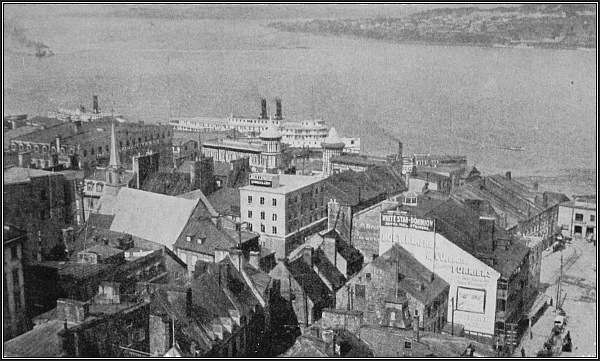
Before the dawn, metropolitan New York is astir.
As a matter of far more accurate fact she never
sleeps. You may call her the City of the Sleepless Eye
and hit right upon the mark. For at any time of the
lonely hours of the night she is still a busy place. Elevated
and subway trains and surface cars, although
shortened and reduced in number, are upon their ways
and are remarkably well filled. Regiments of men are
engaged in getting out the morning papers—in a dozen
different languages of the sons of men—and another
regiment is coming on duty to lay the foundations of
the earliest editions of the evening papers. There are
workers here and there and everywhere in the City of
the Sleepless Eye.
But before the dawn, New York becomes actively
astir. Lights flash into dull radiance in the rows of
side-street tenement and apartment houses all the way
from Brooklyn bridge to Bronx Park. New York is
beginning to dress. Other lights flash into short brilliancy
before the coming of the dawn. New York is
beginning to eat its breakfast. And right afterwards
the stations of the elevated and the subway, the corners
where the speeding surface cars will sometimes hesitate,
become the objects of attack of an army that is marching
upon the town. Workaday New York is stretching its
arms and settling down to business.
Nor is the awakening city to be confined to the narrow
strip of island between the North and East rivers. Over
on Long island are Brooklyn, Long Island City, Flushing,
Jamaica and a score of other important places now
within the limits of Greater New York. Some folk
find it more economical to live in these places than in the
cramped confines of Manhattan, and so it is hardly dawn
before the great bridges and the tubes over and under
the East river are doing the work for which they were
built—and doing it masterfully.
The Brooklyn bridge is the oldest of these and yet it
has been bending to its superhuman task for barely
thirty years. In these thirty years it has been constantly
reconstructed—but the best devices of the engineers,
doubling and tripling the facilities of the original structure,
can hardly keep pace with the growth of the communities
and the traffic it has to serve. So within these
thirty years other bridges and two sets of tunnels have
come to span the East river. But the work of the first
of all man's highways to conquer the mighty water highway
has hardly lessened. The oldest of the bridges, and
the most beautiful despite the ugliness of its approaches,
still pours Brooklynites into Park Row, fifty, sixty,
seventy thousand to the hour.
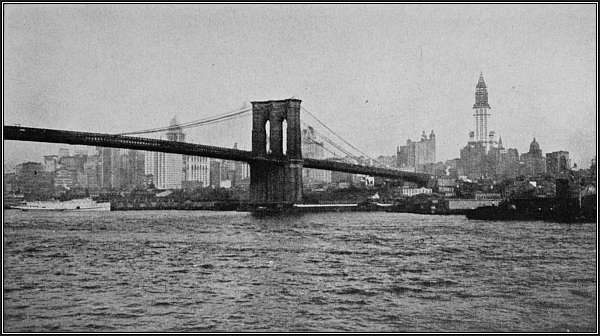 The Brooklyn Bridge is the finest of transportation structures
The overloading of the Brooklyn bridge is repeated
in the subway—that hidden giant of New York, which
is the real backbone of the island of Manhattan. Built
to carry four hundred thousand humans a day, that busy
railroad has begun to carry more than a million each
working day. How it is done, no one, not even the engineers
of the company that operates it, really knows.
The riders in the great tube who have to use it during
the busiest of the rush hours are willing to hazard a
guess, however. It is probable that in no other railroad
of the sort would jamming and crowding of this sort be
tolerated for more than a week. Yet the patrons of the
subway not only tolerate but, after a fashion, they like
it. You can ask a New Yorker about it half an hour
after his trip down town, sardine-fashion, and he will
only say:
"The subway? It's the greatest ever. I can come
down from Seventy-second street to Wall street in sixteen
minutes, and in the old days it used to take me
twenty-six or twenty-seven minutes by the elevated."
There is your real New Yorker. He would be perfectly
willing to be bound and gagged and shot through
a pneumatic tube like a packet of letters, if he thought
that he could save twenty minutes between the Battery
and the Harlem river. No wonder then that he scorns
a relatively greater degree of comfort in elevated trains
and surface cars and hurries to the overcrowded subway.
But New York astir in the morning is more even than
Manhattan, the Bronx and the populous boroughs over
on Long island. Upon its westerly edge runs the Hudson
river—New Yorkers will always persist in calling
it the North river—one of the masterly water highways
of the land. The busy East river had been spanned
by man twice before any man was bold enough to suggest
a continuous railroad across the Hudson. Now
there are several—the wonderful double tubes of the
Pennsylvania railroad leading from its new terminal in
the uptown heart of Manhattan—and two double sets
of tunnels of a rapid-transit railroad leading from New
Jersey both uptown and downtown in Manhattan. This
rapid transit railroad—the Hudson & Manhattan, to
use its legal name, although most New Yorkers speak
of it as the McAdoo Tubes, because of the man who
had the courage to build it—links workaday New
York with a group of great railroad terminals that line
the eastern rim of New Jersey all the way from Communipaw
through Jersey City to Hoboken. And the
railroads reach with more than twenty busy arms off
across the Jersey marshes to rolling hills and incipient
mountains. Upon those hills and mountains live nearly
a hundred thousand New Yorkers—men whose business
interests are closely bound up in the metropolis of
the New World but whose social and home ties are laid
in a neighboring state. These—together with their fellows
from Westchester county, the southwestern corner
of Connecticut and from the Long island suburban
towns—measure a railroad journey of from ten to
thirty miles in the morning, the same journey home at
night, as but an incident in their day's work. They form
the great brigade of commuters, as a rule the last of the
working army of New York to come to business.
The commuter has his own troubles—sometimes.
By reason of his self-chosen isolation he may suffer certain
deprivations. The servant question is not the least
of these. And the extremes of a winter in New York
come hard upon him. There are days when the Eight-twenty-two
suddenly loses all that reputation for steadiness
and sobriety that it has taken half a year to achieve,
days when sleepy schooners laden with brick and claiming
the holy right-of-way of the navigator get caught
in the draw-bridges, days when the sharp unexpectedness
of a miniature blizzard freezes terminal switches and
signals and tangles traffic inexplicably—days, and nights
as well, when the streets of his suburban village are
well-nigh impassable. But these days are in a tremendous
minority. And even upon the worst of them he
can put the rush and turmoil of the city behind him—in
the peace and silence of his country place he can
forget the sorrows of Harlem yesteryear—with the
noisy twins on the floor below and the mechanical piano
right overhead.
*****
For nearly four hours the steady rush toward work
continues. You can gauge it by a variety of conditions—even
by the newspapers that are being spread wide
open the length of the cars. In the early morning the
popular penny papers—the American and the World
predominating, with a sprinkling of the Press in between.
Two hours later and while these popular penny
papers are still being read—they seem to have a particular
vogue with the little stenographers and the shopgirls—the
more staid journals show themselves. Men
who like the solid reading of the Times, with its law
calendars and its market reports; men of the town who
frankly confess to an affection for the flippancy of the
Sun, or who have not lost the small-town spirit of their
youth enough to carry them beyond the immensely personal
tone of the Herald. And in between these, men
who sniff at the mere mention of the name of Roosevelt,
and who read the Tribune because their daddies
and their grand-daddies in their turn read it before
them, or frankly business souls who are opening the
day with a conscientious study of the Journal of Commerce
or the Wall street sheets.
New York goes to work reading its newspaper. And
before you have finished a Day of Days in the biggest
city of the land you might also see that it goes to lunch
with a newspaper in its hand, returns home tired with
the fearful thoughts of business to delve comfortably
into the gossip of the day in the favorite evening paper.
Just as you stand at the portals of the business part
of the town and measure the incoming throng by its
favorite papers so can you sieve out the classes of the
workers almost by the hours at which they report for
duty. In the early morning, in the winter still by
artificial light, come those patient souls who exist literally
and almost bitterly by the labor of their hands
and the sweat of their brows. With them are the
cleaners and the elevator crews of the great office-buildings—those
tremendous commercial towers that New
York has been sending skyward for the past quarter
of a century. On the heels of these the first of the
workers in the office-buildings, office-boys, young clerks,
girl stenographers whose wonderful attire is a reflection
of the glories that we shall see upon Fifth avenue
later in this day. It is pinching business, literally—the
dressing of these young girls. But if their faces
are suspiciously pinky or suspiciously chalky, if their
pumps and thin silk stockings, their short skirts and
their open-necked waists atrocious upon a chill and nasty
morning, we shall know that they are but the reflection
of their more comfortable sisters uptown. Not all of
this rapidly increasing army of women workers in business
New York is artificial. Not a bit of it. There
are girls in downtown offices whose refinement of dress
and deportment, whose exquisite poise, whose well-schooled
voices might have come from the finest old
New York houses. And these are the girls who revel
in their Saturday afternoons uptown—all in the smartness
of best bib and tucker—at the matinee or fussing
with tea at Sherry's or the Plaza.
An army of office workers pours itself into the business
buildings that line Broadway and its important
parallel streets all the way from Forty-second street to
the Battery—that cluster with increasing discomfort
in the narrow tip of Manhattan south of the City Hall.
Clerks, stenographers, more clerks, more stenographers,
now department heads and junior partners—finally the
big fellows themselves, coming down democratically in
the short-haul trains of the Sixth avenue elevated that
start from Fifty-eighth street or even enduring the discomforts
of the subway, for it takes a leisurely sort of
a millionaire indeed who can afford to come in his motor
car all the way downtown through the press and strain
of Broadway traffic. After all these, the Wall street
men. For the exchange opens at the stroke of ten of
Trinity's clock and five brief and bitter hours of trading
have begun.
For four hours this flood of humans pouring out of
the ferry-house and the railroad terminals, up from the
subway kiosks and out from the narrow stairways of
the elevated railroads. The narrow downtown streets
congest, again and again. The sidewalks overflow and
traffic takes to the middle of the streets. But the great
office buildings absorb the major portion of the crowds.
Their vertical railroads—eight or ten or twenty or
thirty cars—are working to capacity and workaday New
York is sifting itself to its task. By ten o'clock the
office buildings are aglow with industry—the great machine
of business starting below the level of the street
and reaching high within the great commercial towers.
New York is the City of the Towers.
Sometimes a well-traveled soul will arise in the
majesty of contemplation and say that in the American
metropolis he sees the shadowy ghost of some foreign
one. Along Madison square, where the cabbies still
stand in a long, gently-curving, expectant line he will
draw his breath through his teeth, point with his walking
stick through the tracery of spring-blossoming
foliage at Diana on her tower-perch and whisper
reverently:
"It is Paris—Paris once again."
And there is a lower corner of Central Park that
makes him think of Berlin; a long row of red brick
houses with white trimmings along the north shore of
Washington square that is a resemblance to blocks of
a similar sort in London.
But he is quite mistaken. New York does not aim
to be a replica of any foreign metropolis. She has her
own personality, her own aggressive individualism; she
is the City of the Towers as well as the City of the Sleepless
Eye—and no mean city at that. Take some clever
European traveler, a man who can find his way around
any of the foreign capitals with his eyes shut, and let
him come to New York for the first time; approach our
own imperial city through her most impressive gateway—that
narrow passage from the sea between the ramparts
of the guarding fortresses. This man, this traveler,
has heard of the towers of the great New World
city—they have been baldly pictured to him as giant,
top-heavy barracks, meaningless compositions of ugly
blank walls, punctuated with an infinity of tiny windows.
That is the typical libel that has gone forth about New
York.
He sees naught of such. He sees a great city, the
height of its buildings simply conveying the impression
from afar that it is builded upon a steep ridge. Here
and there a building of still loftier height gives accent
to the whole, emphasis to what might otherwise be a
colorless mass; gives that mysterious tone and contrast
which the artist is pleased to call "composition." Four
of these towers already rise distinct from the giant skyscrapers
of Manhattan. Each for this moment proclaims
a victory of the American architect and the American
builder over the most difficult problem ever placed
before architect or builder.
The European traveler will give praise to the sky-line
of New York as he sees it from the steamer's deck.
"It is the City of the Towers," he will say.
*****
In this, your Day of Days in New York, come with
us and see the making of a skyscraper. This skyscraper
is the new Municipal Building. It is just behind the
tree-filled park in which stands New York's oldest bit
of successful architecture—its venerable City Hall. A
long time before New York dreamed that she might
become the City of the Towers they builded this old
City Hall—upon what was then the northerly edge of
the town. So sure were those old fellows that New
York would never grow north of their fine town hall that
they grew suddenly economical—the spirit of their
Dutch forbears still dominated them—and builded the
north wall of Virginia freestone instead of the white
marble that was used for the facings of the other walls.
"No one will ever see that side of the building," they
argued. "We might as well use cheap stone for that
wall."
Today more than ninety-nine per cent. of the population
of the immensely populated island of Manhattan
lives north of the City Hall. That cheap north wall,
hidden under countless coats of white paint, is the
one acute reminder of the days that were when the
Hall was new—when the gentle square in which it
stood was surrounded by the suburban residences of
prosperous New Yorkers and when the waters of the
Collect Pond—where the New York boys use to skate
in the bitterness of old-fashioned winters—lapped its
northerly edge. There was no ugly Court House or even
uglier Post Office to block the view from the Mayor's
office up and down Broadway. New Yorkers were
proud of their City Hall then—and good cause had they
for their pride. It is one of the best bits of architecture
in all America. And an even century of hard
usage and countless "restorations" has only brought to
it the charm of serene old age.
But the City Hall long since was outgrown. The municipal
government of New York is a vast and somewhat
unwieldy machine that can hardly be housed within a
dozen giant structures. To provide offices for the
greater part of the city's official machinery, this towering
Municipal Building has just been erected. And
because it is so typical of the best form of the so-called
skyscraper architecture, let us stop and take a look at
it, listen to the story of its construction. In appearance
the new Municipal Building is a gray-stone tower
twenty-five stories in height and surmounted by a tower
cupola an additional fifteen stories in height. In plan
the structure is a sort of semi-octagon—a very shallow
letter "U," if you please. But its most unusual feature
comes from the fact that it squarely spans one of the
busiest crosstown highways in the lower part of the
city—Chambers street. The absorption of that busy
thoroughfare is recognized by a great depressed bay
upon the west front—the main façade of the building.
And incidentally that depressed bay makes interior
courts within the structure absolutely unnecessary. So
much for the architectural features, severe in its detail,
save for some ornate and not entirely pleasing sculptures.
You are interested in knowing how one of these
giants—so typical of the new New York—are fabricated.
This young man—hardly a dozen years out of a big
technical school—can tell you. He has supervised the
job. Sometimes he has slept on it—in a narrow cot
in the temporary draughting-house. He knows its
every detail, as he knows the fingers of his hands.
"Just remember that we began by planning a railroad
station in the basement with eight platform tracks for
loading and unloading passengers."
"A railroad station?" you interrupt.
"Certainly," is his decisive reply. "Downstairs we
will soon have the most important terminal of a brand
new subway system crossing the Manhattan and the
Williamsburgh bridges and reaching over Brooklyn like
a giant gridiron."
He goes on to the next matter—this one settled.
"There was something more than that. We had to
plant on that cellar a building towering forty stories
in the air; its steel frame alone weighing twenty-six
thousand tons—more than half the weight of the heaviest
steel cantilever bridge in America—had to be
firmly set."
The young engineer explains—in some detail. To
find a foothold for this building was no sinecure. Tests
with the diamond drill had shown that solid rock rested
at a depth of 145 feet below street level at the south end
of the plat. At the north end, the rock sloped away rapidly
and so that part of the building rests upon compact
sand. The rock topography of Manhattan island
is uncertain. There are broad areas where solid gneiss
crops close to the street level, others where it falls a hundred
feet or more below water level. There is a hidden
valley at Broadway and Reade street, a deep bowl farther
up Broadway. Similarly, the north extremity of
the Municipal Building rests upon the edge of still another
granite bowl—the sub-surface of that same Collect
Pond upon which the New York boys used to skate
a century or more ago.
"That bothered some folks at first," laughs the engineer,
"but we met it by sinking the caissons. We've
more than a hundred piers down under this structure
hanging on to Mother Earth. You don't realize the holding
force of those piers," he continues. He turns quickly
and points to a fourteen story building off over the trees
of City Hall park. Out in one of the good-sized towns
of the Middle West people would gasp a little at sight
of it—in New York it is no longer even a tower.
"Turn that fellow right upside down into the hole
we dug for this building," says the engineer, "and the
rim of his uppermost cornice would about reach the
feet of our own little forest of buried concrete piers."
That was one detail of the construction of the building.
Here is another; the first six stories of the new
structure involved elaborate masonry, giant stones, much
carved. From the seventh story the plain walls of the
exterior developing into an elaborate cornice were of
simple construction. If the setting of these upper floors
had waited until the first six stories of elaborate stonework
had been made ready there would have been a
delay of months in the construction work. So the contractor
began building the walls—which in the modern
steel skyscraper as you know form no part of the real
structure but act rather as a stone envelope to keep
out hard weather—from the seventh story upward.
Eventually the masons working on the first six stories,
working upwards all the time, reached and joined the
lower edge of the masonry that had been set some weeks
before. Time had been saved and you know that time
does count in New York. Remember the Wall street
man who preferred to have his ribs crushed and his hat
smashed down over his nose in the subway rather than
lose ten minutes each day in the elevated.
Now you stand with the young engineer at the topmost
outlook of the tower in the Municipal Building and
look down on the busy town. Before you is that mighty
thoroughfare, Broadway—but so lined with towering
buildings that you cannot see it, save for a brief space
as it passes the greenery of the City Hall Park;
behind you is that still mightier highway—the East
river. Over that river you see the four bridges—the
oldest of them landing at your very feet—and
crawling things upon them, which a second glance shows
to be trains and trolley-cars and automobiles and wagons
in an unending succession. Beyond the East river and
its bridges—the last of these far to the north and
barely discernible—is Brooklyn, and beyond Brooklyn—this
time to the south—is a shimmering slender
horizon of silver that the man beside you tells you is
the ocean.
You let your gaze come back to the wonderful view
which the building squarely faces. You look down upon
the towers of New York—big towers and little towers—and
you lift your eyes over the dingy mansard of the
old Post Office and see the greatest of all the towers—the
creamy white structure that a man has builded from
his profits in the business of selling small articles at five
and ten cents apiece. It is fifty-five stories in height—exquisitely
beautiful in detail—and the owner will
possess for a little time at least, the highest building in
the world. You can see the towers in every vista, puffing
little clouds of white smoke into the purest blue air
that God ever gave a city in which to spin her fabrications.
To the north, the south, the west, they show
themselves in every infinite variety and here and there
between them emerge up-shouldering rivals, steel-naked
in their gaunt frames. If your ears are keen and the
wind be favorable perhaps you can hear the clatter of
the riveters and you can see over there the housesmiths
riding aloft on the swinging girders with an utter and
immensely professional indifference, threading the slender,
dizzy floor-girders as easily as a cat might tread
the narrow edge of a backyard fence.
Off with your gaze again. Look uptown, catch the
faint patch of dark green that is Central Park, the spires
of the cathedral, the wonderful campanile at Madison
square. Let your glance swing across the gentle Hudson,
over into a New Jersey that is bounded by the
ridges of the Orange mountains, then slowly south and
even the great towers that thrust themselves into almost
every buildable foot of Broadway below the City Hall
cannot entirely block your view of the wonderful upper
harbor of New York—of the great ships that bring to
an imperial city the tribute that is rightfully hers.
Now let your vision drop into the near foreground—into
the tracery of trees about the jewel-box of a City
Hall. Let it pause for a moment in the broad-paved
street at your feet with the queer little openings through
which humans are sweeping like a black stream into a
funnel; others from which the human streams come
crawling upward like black molasses and you are again
reminded that some of the greatest highways of New
York are those that are subterranean and unseen. The
sidewalks grow a little blacker than before.
"It's lunch-time," laughs the young engineer.
Bless you, it is. The morning that you gave to one
of the most typical of the towers has not been ill-spent.
Thirty minutes before the big bell of Trinity spire
booms out noon-tide New York's busiest grub-time begins.
A few early-breakfasting clerks and office-boys
begin to find their way toward the shrines of the coffee-urns
and the heaped-up piles of sandwiches.
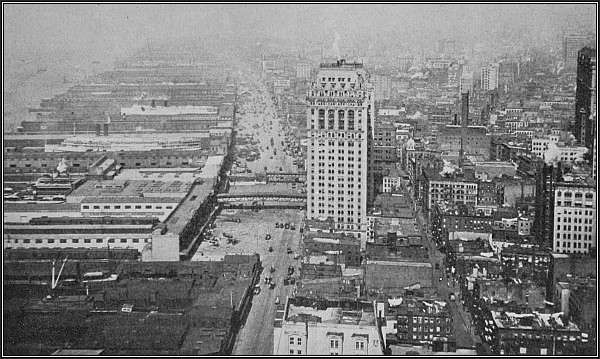 The view of New York from the lunch club in the skyscraper
Of course, in New York breakfast is an almost endless
affair—generally a fearfully hurried one. But
lunch is far more serious. Lunch is almost an institution.
Fifteen minutes after it is fairly begun it is gaining
rapid headway. Thin trails of stenographers and
clerks are finding their ways, lunch-bound, through the
canyon-like streets of lower Manhattan, streams that
momentarily increase in volume. By the time that
Trinity finally booms its twelve stout strokes down into
Broadway there is congestion upon the sidewalks—the
favorite stools at the counters, the better tables in the
higher-priced places are being rapidly filled. At twelve-thirty
it begins to be luck to get any sort of accommodations
at the really popular places; before one o'clock the
intensity of grubbing verges on panic and pandemonium.
And at a little before three cashiers are totaling their
receipts, cooks, donning their hats and coats to go uptown,
and waiters and 'buses are upturning chairs and scrubbing
floors with scant regard for belated lunchers who
have to be content with the crumbs that are left after
the ravishing and hungry army has been fed. Order
after pandemonium—readiness for the two hours of
gorge upon the morrow. The restaurants and lunch-rooms
are as quiet as Trinity church-yard and something
like three quarters of a million hungry souls have
lunched in the business section of Manhattan south of
Twenty-third street—at a total cost, according to the
estimate of a shrewd restauranteur of a quarter of a
million dollars.
*****
You may pay your money and take your choice. The
shrewd little newsboys and office-boys who find their
way to the short block of Ann street between Park Row
and Nassau—the real Grub street of New York—are
proving themselves financiers of tomorrow by dickering
for sandwiches—"two cents apiece; three for a nickel."
They always buy them in lots of three. That is business
and business is not to be scorned for a single instant.
Or you can pay as high prices in the swagger
restaurants downtown as you do in the swagger restaurants
uptown—and that is saying much. When
lunch-time comes you can suit the inclinations of your
taste—and your pocket-book. But the average New
Yorker seems to run quite strongly to the peculiar form
of lunch-room in which you help yourself to what you
want, compute from the markers the cost of your midday
meal, announce that total to the cashier, who is
perfectly content to take your word for it, pay the
amount and walk out. It seems absurd—to any one
who does not understand New Yorkers. The lunch-room
owners do understand them. New York business
men and business boys are honest, as a general thing—particularly
honest in little matters of this sort.
"It is all very simple," says the manager of one of
these big lunch-rooms, who stands beside you for a
moment at the entrance of one of his places—it boasts
that it serves more than two thousand lunches each business
day between eleven and three. "I've been through
the whole mill. I've been check boy and oyster
man, cashier—now I'm looking out for this particular
beanery. Honor among New York business men?
There's a lot of it."
"And you don't run many risks?" you venture.
"Not many here," he promptly replies. "But there
was a man in here yesterday, who runs a cafeteria out
in Chicago. I was telling him some of the rules of the
game here—how when a customer comes in and throws
his hat down in a chair before he goes over to the sandwich
and coffee counters that chair is his, until he gets
good and ready to go. My Chicago friend laughed at
that. 'If we were to do that out in my neck-o'-the-woods,'
says he, 'the customer would lose his hat.' And
the uptown department stores don't take any chances,
either. At one of the biggest of them they make the
women decide what they will eat, but before they can
start they must buy a check—pay in advance, you
understand. They've tried the downtown way—and
now they take no chances."
The floor manager laughs nervously.
"It's different with the girls downtown. We've
started one quick buffet lunch on the honor plan, same
dishes and prices and service as the men's places, but
this one is for business girls. They said at first that
we wouldn't make good with them—but we're ready
to start another within the month. The business girls
don't cheat—no matter what their uptown sisters may
try to do."
*****
As a matter of fact downtown business girls in New
York eat very sensibly. Sweets are popular but not
invariable. They prefer candy, with fruit as a second
choice, to be eaten some time during the afternoon. In
big offices, where many girls are employed, "candy
pools" are often made, each girl contributing five cents
and getting her pro rata, one member of the staff being
delegated to make the purchases. Eaten in this way
the candy acts as a stimulant during the late afternoon
hours, in much the same way as the invariable tea of
the business man in London.
The business girl in New York takes her full hour for
luncheon. It is seldom a minute more or a minute less.
She is willing as a rule to stay overtime at night but she
feels that she must have her sixty minutes in the middle
of the day. A part of the lunch hour is always a stroll—unless
there be a downpour. Certain downtown
streets from twelve to one o'clock each day suggest the
proximity of a nearby high school or seminary. There
is much pairing off and quiet flirtation. This noon-day
promenade of girls—for the most part astonishingly
well-dressed girls and invariably in twos and threes—is
one of the sights of downtown New York. Some of the
girls gather in the old churchyards of Trinity and St.
Paul's—in lower Broadway—on pleasant days. They
sit down among the tombstones with their little packages
of food and eat and chat and then stroll. No one molests
them and the church authorities, although a little flustered
when this first began, have seen that there is no harm in it
and let the girls have their own way. There is always
great decorousness and these big open-air spaces in the
midst of the crowded street canyons are enjoyed by the
women who appreciate the grass and winding paths
after the hard pavements.
All the business girls downtown are not content with
sitting after lunch among the tombstones of St. Paul's
churchyard or of Trinity. He was indeed a canny
lunch-man who took note of all the girls strolling in the
narrow streets of downtown Manhattan, who remembered
that all New York, rich or poor, loves to dance
and who then fitted up an unrentable third floor loft
over his eating place as a dancing hall. Two violins and
a piano—a gray-bearded sandwich man to patrol the
streets with "DANCING" placarded fore and aft upon
his boards—the trick was done. Mamie told Sadie and
Sadie told Elinor and Elinor told Flossie and the lunch-man
began to grow famous. He made further study of
the psychology of his patrons. There were the young
fellows—shipping and file clerks and even ambitious
young office-boys to be considered. There were the
after-lunch smokes of these young captains of industry
to come into the reckoning. The lunch-man placed a
row of chairs along one edge of his dancing-hall and
over them "Smoking Permitted at This End of the
Room." After that Mamie and Sadie and Elinor and
Flossie had partners and the lunch-man was on the highway
to a six-cylinder motor car. He has his imitators.
If you were in business in lower New York and your
stenographer began to hum the "Blue Danube" along
about half an hour before noon you would very well
know she was gathering steam for the blissful twenty
minutes of dancing that was going to help her digest
her lunch.
*****
You, yourself, are going to lunch in still another sort
of restaurant. It is characteristic of a type that has
sprung up on the tip of Manhattan island within the
past dozen years. You reach this grubbing-place by
skirting the front doors of unspeakably dirty eating-houses
in a mean street of the Syrian quarter. Finally
you turn the corner of a dingy brick building, which was
once the great house of one of the contemporaries of the
first of the Vanderbilts and which has managed to escape
destruction for three quarters of a century and face—the
only skyscraper in congested New York which
stands in a grass-platted yard—the whim of its wealthy
owner. A fast elevator whisks you thirty stories to the
top of the building and you step into the lobby of what
looks, at first glance, to be the entrance hall of some
fine restaurant in uptown's Fifth avenue. But this
is a lunching-club—one of the newest in the town as
well as one of the most elaborate.
Elaborate did we say? This is the elaboration of perfect
taste—unobtrusive rugs, hangings, lighting fixtures
and furniture—great, broad rooms and from their
windows there comes to you another of the spectacular
views that lay below the man-made peaks of Manhattan.
To the south—the smooth, blue surface of the
upper bay—in the foreground a nine hundred foot ship
coming to the new land, her funnels lazily breathing
smoke at the first lull in her four-day race across the
Atlantic; to the east, a mighty river and its bridges,
Brooklyn again and on very clear days, visions of Long
island; to the north the most wonderful building construction
that man has ever attempted, Babylonic in
its immensity; to the west the brisk waterway of the
North river and beyond it, Jersey City, sandwiched in
between the smoky spread of railroad yards. This is
the sort of thing that Mr. Downtown Luncher may have—if
he is willing to pay the price. On torrid summer
days he may ascend to the roof-garden, may glance
lazily below him at the activities of the busiest city in
the world and sip up the cool breezes from the sea, while
folk down in the bottom of the Broadway chasm are
sweltering from heat and humidity. And in winter he
will find a complete gymnasium in operation on another
floor of the club, with a competent instructor in charge.
The "doctor," as they call him, will lay out a course
of work. And that course of work, calling for a half-hour
of exercise each day just before lunch will make
dyspeptic and paunchy old money-grubbers alike, keen
as farmhands coming into dinner.
And yet this club, typical of so many others in the
downtown business heart of Manhattan, is but a cog
in the mighty machine of the lunching of the workaday
multitudes of downtown. Its doors are closed and lights
are out at six o'clock in the evening, save on extraordinary
occasions; while most of its hundred or more well-trained
waiters go uptown to assist in the dinner and
the late supper rushes of the fashionable restaurants in
the theater and hotel district. Like most of its compeers,
it is an outgrowth of the wonderfully comfortable
old Lawyers' Club, which was completely destroyed in
the great fire that burned the Equitable Building in January,
1912. From that organization, famed for its noon-day
hospitality and for the quality of the folk you might
meet between its walls, have sprung many other downtown
lunch clubs—the Whitehall, the Hardware, the
Manufacturers, the Downtown Association, the new
Lawyers—many, many others; almost invariably occupying
the upper floors of some skyscraper that has
been planned especially for them. These clubs are not
cheap. It costs from sixty to a hundred dollars to enter
one of them and about as much more yearly in the form
of dues. Their restaurant charges are far from low-priced.
They are never very exclusive organizations
and yet they give to the strain of the workaday New
Yorker his last lingering trace of hospitality—the hospitality
that has lingered around Bowling Green and
Trinity and St. Paul's church-yards since colonial days
and the coffee houses.
*****
Even the hospitality of the genial host seems to end—with
the ending of the lunch-hour. As he takes his
last sip of café noir he is tugging at his watch.
"Bless me," he says, "It is going on three o'clock.
I've got that railroad crowd due in my office in fifteen
minutes."
That is your dismissal. For ninety minutes he has
given you his hospitality—his rare and unselfish self.
He has put the perplexing details of his business out of
his mind and given himself to whatever flow of talk
might suit your fancy. Now the hour and a half of
grace is over—and you are dismissed, courteously—but
none the less dismissed. With your host you descend
to the crowded noisome street. He sees you to the
subway—gives you a fine warm grasp of his strong
hand—and plunges back into the great and grinding
machine of business.
Lunch in your Day of Days within the City of the Towers
is over. Three o'clock. Before the last echoes of
Trinity's bell go ringing down through Wall street to
halt the busy Exchange—the multitude has been fed.
Miss Stenographer has had her salad and éclair, two
waltzes and perhaps a "turkey trot" into the bargain,
and is back at the keys of her typewriter. Mr.
President has entertained that Certain Party at the
club and has made him promise to sign that mighty important
contract. And the certain Party and Mr. President
rode for half an hour on the mechanical horses in
the gymnasium. What fun, too, for those old boys?
Three o'clock! The cashiers are totaling their receipts,
the waiters and the 'buses are upturning chairs
and tables to make way for the scrub-women, some are
already beginning to don their overcoats to go uptown;
but the three-quarters of a million of hungry mouths
have been fed. New York has caught its breath in
mid-day relaxation and once more is hard at work—putting
in the last of its hours of the business day with
renewed and feverish energy.
You had planned at first to walk up Broadway.
You wanted to see once again the church-yards around
Trinity and St. Paul's, perhaps make a side excursion
down toward Fraunces' Tavern—just now come
back into its own again. Some of the old landmarks
that are still hidden around downtown New York seemed
to appeal to you. But your host at luncheon laughed
at you.
"If you want to spend your time that way, all right,"
he said, "but the only really old things you will find
in New York are the faces of the young men. You can
find those anywhere in the town."
And there was another reckoning to be figured.
Three o'clock means the day well advanced and there is
a vis-à-vis awaiting you uptown. Of course, there is
a Her to enjoy your Day of Days with you. And just
for convenience alone we will call her Katherine. It
is a pretty name for a woman, and it will do here and
now quite as well as any other.
Katherine is waiting for you in the Fourteenth street
station of the subway. She is prompt—after the
fashion of most New York girls. And it is a relief to
come out of the overcrowded tube and find her there at
the entrance that leads up to sunshine and fresh air.
She knows her New York thoroughly and as a prelude
to the trip uptown she leads you over to Fifth avenue—to
the upper deck of one of those big green peregrinating
omnibuses.
"It's a shame that we could not have started at Washington
square," she apologizes. "When you sweep
around and north through the great arch it almost seems
as if you were passing through the portals of New York.
It is one of the few parts of the town that are not changing
rapidly."
For Fifth avenue—only a few blocks north of that
stately arch—has begun to disintegrate and decay.
Not in the ordinary sense of those terms. But to
those who remember the stately street of fifteen or
twenty years ago—lined with the simple and dignified
homes of the town—its change into a business
thoroughfare brings keen regrets. Katherine remembers
that she read in a book that there are today
more factory workers employed in Fifth avenue or
close to it, than in such great mill cities as Lowell
or Lawrence or Fall River, and when you ask her the
reason why she will tell you how these great buildings
went soaring up as office-buildings, without office tenants
to fill them. They represent speculation, and speculation
is New Yorkish. But speculation in wholesale
cannot afford to lose, and that is why the garment manufacturers
and many others of their sort came flocking
to the great retail shopping district between Fourth and
Seventh avenues and Fourteenth and Thirty-fourth
streets, and sent the shops soaring further to the north.
It has been expensive business throughout, doubly expensive,
because absolutely unnecessary. Some of the
great retail houses of New York built modern and elaborate
structures south of Thirty-fourth street within
the past twenty years in the firm belief that the retail
shopping section had been fixed for the next half century.
But the new stores had hardly been opened before
the deluge of manufacturing came upon them.
Shoppers simply would not mix with factory hands upon
lower Fifth avenue and the side streets leading from it.
And so the shop-keepers have had to move north and
build anew. And just what a tax such moving has been
upon the consumer no one has ever had the audacity
to estimate.
"They should have known that nothing ever stays
fixed in New York," says Katherine. "We are a restless
folk, who make a restless city. Stay fixed? Did
you notice the station at which you entered today?"
Of course you did. The new Grand Central, with its
marvelous blue ceiling capping a waiting-room so large
that the New York City Hall, cupola, wings and all
could be set within it, can hardly escape the attention
of any traveler who passes within its portals.
"It is the greatest railroad station in the world," she
continues, "and yet I have read in the newspapers that
Commodore Vanderbilt built on that very plat of ground
in 1871 the largest station in the world for the accommodation
of his railroads. He thought that it would
last for all time. In forty years the wreckers were pulling
it down. It was outgrown, utterly outgrown and
they were carting it off piece by piece to the rubbish
heaps."
She turns suddenly upon you.
"That is typical of our restless, lovely city," she tells
you. And you, yourself, have heard that only two
years ago they tore down a nineteen story building at
Wall and Nassau streets so that they might replace it
by another of the towers—this one thirty stories in
height.
*****
The conductor of the green omnibus thrusts his green
fare-box under your nose. You find two dimes and drop
it into the contrivance.
"You can get more value for less money and less
value for much money in New York than in any other
large city in the world," says Katherine.
She is right—and you know that she is right. You
can have a glorious ride up the street, that even in its
days of social decadence is still the finest highway in
the land—a ride that continues across the town and up
its parked rim for long miles—for a mere ten cents of
Uncle Sam's currency and as for the reverse—well you
are going to dinner in a smart hotel with Katherine in
a little while.
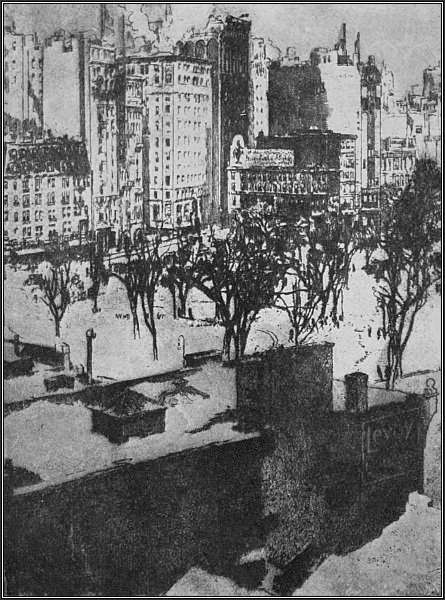
You swing across Broadway and up the west edge of
Madison square, catch a single, wondering close-at-hand
glimpse of the white campanile of the Metropolitan tower
which dominates that open place and so all but replaces
Diana on her perch above Madison Square Garden—a
landmark of the New York of a quarter of a
century ago and which is apt to come into the hands
of the wreckers almost any day now. Now you are at
the south edge of the new shopping district, although
some of the ultra places below Thirty-fourth street have
begun to move into that portion of the avenue just south
of Central Park. In a little while they may be stealing
up the loveliest portion of the avenue—from Fifty-ninth
street north.
The great shops dominate the avenue. And if you
look with sharp eyes as the green bus bears you up this
via sacre, you may see that one of the greatest ones—a
huge department store encased in architecturally superb
white marble—bears no sign or token of its ownership
or trade. An oversight, you think. Not a bit of
it. Four blocks farther up the avenue is another great
store in white marble—a jewelry shop of international
reputation. You will have to scan its broad façade
closely indeed before you find the name of the firm in
tiny letters upon the face of its clock. Oversight? Not
a bit of it. It is the ultra of shop-keeping in New York—the
assumption that the shop is so well known that
it need not be placarded to the vulgar world. And if
strangers from other points fail to identify it—well
that is because of their lack of knowledge and the shopkeeper
may secretly rejoice.
But, after all, it is the little shops that mark the character
of Fifth avenue—not its great emporiums. It is
the little millinery shops where an engaging creature in
black and white simpers toward you and calls you, if
you are of the eternal feminine, "my dear;" the jewelry
shops where the lapidary rises from his lathe and
offers a bit of craftsmanship; the rare galleries that
run from old masters to modern etchers; specialty shops,
filled top to bottom with toys or Persian rugs, or
women's sweaters, or foreign magazines and books, that
render to Fifth avenue its tremendous cosmopolitanism.
These little shops make for personality. There is something
in the personal contact between the proprietor and
the customer that makes mere barter possess a real fascination.
And if you do pay two or three times the real
value in the little shop you have just so much more fun
out of the shopping. And there are times when real
treasures may come out of their stores.
"Look at the cornices," interrupts Katherine. "Mr.
Arnold Bennett says that they are the most wonderful
things in all New York."
Katherine may strain her neck, looking at cornices
if she so wills. As for you, the folk who promenade
the broad sidewalks are more worth your while. There
are more of them upon the west walk than upon the east—for
some strange reason that has long since brought
about a similar phenomenon upon Broadway and sent
west side rents high above those upon the east. Fifth
avenue thrusts its cosmopolitanism upon you, not alone
in her shops, with their wonderfully varied offerings,
but in the very humans who tread her pavements. The
New York girl may not always be beautiful but she is
rarely anything but impeccable. And if in the one instance
she is extreme in her styles, in the next she is
apt to be severe in her simplicity of dress. And it is
difficult to tell to which ordinary preference should go.
These girls—girls in a broad sense all the way from trim
children in charge of maid or governess to girls whose
pinkness of skin defies the graying of their locks—a
sprinkling of men, not always so faultless in dress or
manner as their sisters—and you have the Fifth avenue
crowd. Then between these two quick moving files of
pedestrians—set at all times in the rapid tempo of New
York—a quadruple file of carriages; the greater part
of them motor driven.
Traffic in Fifth avenue, like traffic almost everywhere
else in New York is a problem increasing in perplexity.
A little while ago the situation was met and for a time
improved by slicing off the fronts of the buildings—perhaps
the most expensive shave that the town has ever
known—and setting back the sidewalks six or eight
feet. But the benefits then gained have already been
over-reached and the traffic policeman at the street
corners all the way up the avenue must possess rare wit
and diplomacy—while their fellows at such corners as
Thirty-fourth and Forty-second are hardly less than field
generals. And with all the finesse of their work the
traffic moves like molasses. Long double and triple files
of touring cars and limousines, the combined cost of
which would render statistics such as would gladden
the heart of a Sunday editor, make their way up and
down the great street tediously. If a man is in a hurry
he has no business even to essay the Avenue. And occasionally
the whole tangle is double-tangled. The
shriek of a fire-engine up a side street or the clang of an
ambulance demanding a clear right-of-way makes the
traffic question no easier. Yet the policemen at the street
corners are not caught unawares. With the shrill commands
of their own whistles they maneuver trucks and
automobiles and even some old-fashioned hansom cabs,
pedestrians, all the rest—as coolly and as evenly as if
it had been rehearsed for whole weeks.
*****
New York is wonderful, the traffic of its chief show
street—for Fifth avenue can now be fairly said to
have usurped Broadway as the main highway of the
upper city—tremendous. You begin to compute what
must be the rental values upon this proud section of Fifth
avenue, as it climbs Murray Hill from Thirty-fourth
street to Forty-second street, when Katherine interrupts
you once again. She knows her New York thoroughly
indeed.
"Do you notice that house?" she demands.
You follow her glance to a very simple brick house,
upon the corner of an inconsequential side street. Beside
it on Fifth avenue is an open lot—of perhaps fifty feet
frontage, giving to the avenue but a plain brown wooden
fence.
"A corking building lot," you venture, "Why don't
they—"
"I expected you to say that," she laughs. "They have
wanted to build upon that lot—time and time again.
But when they approach the owner he laughs at them
and declines to consider any offer. 'My daughter has
a little dog,' he says politely, 'It must have a place for
exercise.' We New Yorkers are an odd lot," she laughs.
"You know that the Goelets kept a cow in the lawn of
their big house at Broadway and Nineteenth street until
almost twenty years ago—until there was not a square
foot of grass outside of a park within five miles. And
in New York the man who can do the odd thing successfully
is apt to be applauded. You could not imagine
such a thing in Boston or Baltimore or Philadelphia,
could you?"
You admit that your imagination would fall short of
such heights and ask Katherine if you are going up to
the far end of the 'bus run—to that great group of
buildings—university, cathedral, hospital, divinity
school—that have been gathered just beyond the northwestern
corner of Central Park.
"No, I think not," she quickly decides, "You know
that Columbia is not to New York as Harvard is to
Boston. Harvard dominates Boston, Columbia is but
a peg in the educational system of New York. The
best families here do not bow to its fetich. They are
quite as apt to send their boys to Yale or Princeton—even
Harvard."
"Then there's the cathedral and the Drive," you venture.
"We have a cathedral right here on Fifth avenue that
is finished and, in its way, quite as beautiful. And as
for the Drive—it is merely a rim of top-heavy and
expensive apartment houses. The West Side is no
longer extremely smart. The truth of the matter is
that we must pause for afternoon tea."
You ignore that horrifying truth for an instant.
"What has happened to the poor West Side?" you demand.
Katherine all but lowers her voice to a whisper.
"Twenty years ago and it had every promise of success.
It looked as if Riverside Drive would surpass the
Avenue as a street of fine residences. The side streets
were preëminently nice. Then came the subway—and
with it the apartment houses. After that the very nice
folk began moving to the side streets in the upper Fifties,
the Sixties and the Seventies between Park and Fifth avenues."
"Suppose that the apartment houses should begin to
drift in there—in any numbers?" you demand.
"Lord knows," says Katherine, and with due reverence
adds: "There is the last stand of the prosperous
New Yorker with an old-fashioned notion that he and
his would like to live in a detached house. The Park
binds him in on the West, the tenement district and Lexington
avenue on the East—to the North Harlem and
the equally impossible Bronx. The old guard is standing
together."
"There is Brooklyn?" you venture.
"No New Yorker," says Katherine, with withering
scorn, "ever goes publicly to Brooklyn unless he is
being buried in Greenwood cemetery."
*****
Tea for you is being served in a large mausoleum of
a white hotel—excessively white from a profuse use of
porcelain tiles which can be washed occasionally—of
most extraordinary architecture. Some day some one
is going to attempt an analysis of hotel architecture in
New York and elsewhere in the U.S.A. but this is not
the time and place. Suffice it to say here and now that
you finally found a door entering the white porcelain
mausoleum. What a feast awaited your eyes—as well
as your stomach—within. Rooms of rose pink and
rooms of silver gray, Persian rooms, Japanese rooms,
French rooms in the several varieties of Louis, Greek
rooms—Europe, the ancients and the Orient, have been
ransacked for the furnishing of this tavern. And in
the center of them all is a great glass-enclosed garden,
filled with giant palms and tiny tables, tremendous
waiters and infinitesimal chairs. A large bland-faced
employé—who is a sort of sublimated edition of the
narrow lean hat-boys who we shall find in the eating
places of the Broadway theater districts—divests you
of your outer wraps. You elbow past a band and arrive
at the winter garden. A head waiter in an instant
glance of steel-blue eyes decides that you are fit and
finds the tiniest of the tiny tables for you. It is so far
in the shade of the sheltering palm that you have to
bend almost double to drink your tea—and the orchestra
is rather uncomfortably near.
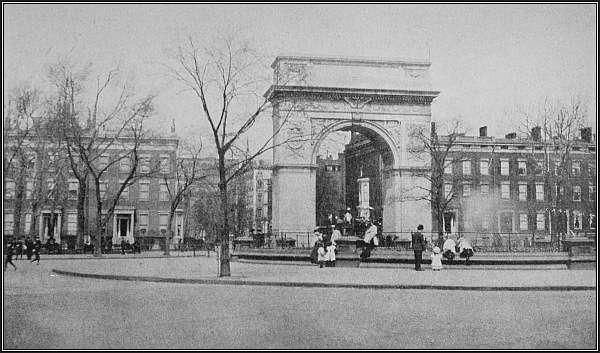 Washington Square and its lovely Arch—New York
Katherine might have taken you to other tea dispensaries—an
unusual place in a converted stable in
Thirty-fourth street, another stable loft in West Twenty-eighth—dozens
of little shops, generally feminine to an
intensified degree, which combine the serving of tea
with the vending of their wares. But she preferred the
big white hotel.
"Tea at the Plaza is so satisfactory and so restful,"
she says, as you dodge to permit two ladies—one
in gray silk and the other in a cut of blue
cloth that gives her the contour of a magnified frog—to
slip past you without knocking your tea out of your
untrained fingers. "We might have gone to the Manhattan—but
it's so filled with young girls and the chappies
from the schools—the Ritz is proper but dull, so
is Sherry's—all the rest more or less impossible."
She rattles on—the matter of restaurants is always
dear to the New York heart. You ignore the details.
"But why?" you demand.
"Why what?" she returns.
"Why tea?"
You explain that afternoon tea in its real lair—London—in
a sort of climatic necessity. The prevalence of
fog, of raw damp days, makes a cup of hot tea a real
bracer—a stimulant that carries the human through
another two or three hours of hard existence until the
late London dinner. The bracing atmosphere of New
York—with more clear days than any other metropolitan
city in the world—does not need tea. You say so
frankly.
"I suppose you are right," Katherine concedes, "but
we have ceased in this big city to rail at the English.
We bow the knee to them. The most fashionable of our
newest hotels and shops run—absurdly many times—to
English ways. And afternoon tea has long since
ceased to be a novelty in our lives. Why, they are beginning
to serve it at the offices downtown—just as
they do in dear old London."
You swallow hard—some one has recommended that
to you as a method of suppressing emotion—for polite
society is never emotional.
Dinner is New York's real function of the day. And
dinner in New York means five million hungry stomachs
demanding to be filled. The New York dinner is as
cosmopolitan as the folk who dwell on the narrow island
of Manhattan and the two other islands that press
closely to it. The restaurant and hotel dinners are as
cosmopolitan as the others. Of course, for the sake of
brevity, if for no other reason, you must eliminate the
home dinners—and read "home" as quickly into the cold
and heavy great houses of the avenue as into the little
clusters of rooms in crowded East Side tenements where
poverty is never far away and next week's meals a real
problem. And remember, that to dine even in a reasonably
complete list of New York's famous eating places—a
new one every night—would take you more than
a year. At the best your vision of them must be desultory.
Six o'clock sees the New York business army well on
its way toward home—the seething crowds at the
Brooklyn bridge terminal in Park Row, the overloaded
subway straining to move its fearful burden, the ferry
and the railroad terminals focal points of great attractiveness.
To make a single instance: take that division
of the army that dwells in Brooklyn. It begins its march
dinnerward a little after four o'clock, becomes a pushing,
jostling mob a little later and shows no sign of
abatement until long after six. Within that time the
railroad folk at the Park Row terminal of the old bridge
have received, classified and despatched Brooklynward,
more than one hundred and fifty thousand persons—the
population of a city almost the size of Syracuse.
And the famous old bridge is but one of four direct
paths from Manhattan to Brooklyn.
Six o'clock sees restaurants and cafés alight and ready
for the two or three hours of their really brisk traffic of
the day. There are even dinner restaurants downtown,
remarkably good places withal and making especial appeal
to those overworked souls who are forced to stay
at the office at night. There are bright lights in Chinatown
where innumerable "Tuxedos" and "Port Arthurs"
are beginning to prepare the chop-suey in immaculate
Mongolian kitchens. But the real restaurant
district for the diner-out hardly begins south of Madison
square. There are still a very few old hotels in Broadway
south of that point—a lessening company each
year—one or two in close proximity to Washington
square. Two of these last make a specialty of French
cooking—their table d'hôtes are really famous—and
perhaps you may fairly say when you are done at them
that you have eaten at the best restaurants in all New
York. From them Fifth avenue runs a straight course
to the newer hotels far to the north—a silent brilliantly
lighted street as night comes "with the double row
of steel-blue electric lamps resembling torch-bearing
monks" one brilliant New York writer has put it. But
before the newest of the new an intermediate era of
hotels, the Holland, the nearby Imperial and the Waldorf-Astoria
chief among these. The Waldorf has been
from the day it first opened its doors—more than
twenty years ago—New York's really representative
hotel. Newer hostelries have tried to wrest that honor
from it—but in vain. It has clung jealously to its reputation.
The great dinners of the town are held in its
wonderful banqueting halls, the well-known men of New
York are constantly in its corridors. It is club and more
than club—it is a clearing-house for all of the best
clubs. It is the focal center for the hotel life of the
town.
There is an important group of hotels in the rather
spectacular neighborhood of Times square—the Astor,
with its distinctly German flavor, and the Knickerbocker
which whimsically likes to call itself "the country club
on Forty-second street" distinctive among them. And
ranging upon upper Fifth avenue, or close to it, are other
important houses, the Belmont, the aristocratic Manhattan,
the ultra-British Ritz-Carlton, the St. Regis, the
Savoy, the Netherland, the Plaza, and the Gotham. In
between these are those two impeccable restaurants—so
distinctive of New York and so long wrapped up in
its history—Sherry's and Delmonico's.
Over in the theatrical brilliancy of Broadway up and
down from Times square are other restaurants—Shanley's,
Churchill's, Murray's—the list is constantly changing.
A fashionable restaurant in New York is either
tremendously successful—or else, as we shall later see,
they are telephoning for the sheriff. And the last outcome
is apt more to follow than the first. For it is a
tremendous undertaking to launch a restaurant in these
days. The decorations of the great dining-rooms must
rival those of a Versailles palace while the so-called minor
appointments—silver, linen, china and the rest must be
as faultless as in any great house upon Fifth avenue.
The first cost is staggering, the upkeep a steady drain.
There is but one opportunity for the proprietor—and
that opportunity is in his charges. And when you come
to dine in one of these showy uptown places you will
find that he has not missed his opportunity.
All New York that dines out does not make for these
great places or their fellows. There are little restaurants
that cast a glamour over their poor food by thrusting
out hints of a magic folk named Bohemians who dine
night after night at their dirty tables. There are others
who with a Persian name seek to allure the ill-informed,
some stout German places giving the substantial cheer
of the Fatherland, beyond them restaurants phrasing
themselves in the national dishes and the cooking of
every land in the world, save our own. For a real
American restaurant is hard to find in New York—real
American dishes treats of increasing rarity. A
great hotel recently banished steaks from its bills-of-fare,
another has placed the ban on pie; and as for strawberry
short-cake—just ask for strawberry short-cake. The
concoction that the waiter will set before you will leave
you hesitating between tears and laughter—ridicule for
the pitiful attempts of a French cook and tears for your
thoughts of the tragedy that has overwhelmed an American
institution. Some day some one is going to build
a hotel with the American idea standing back of it right
in the heart of New York. He is going to have the
bravery or the patriotism to call it the American House
or the United States Hotel or Congress Hall or some
other title that means something quite removed from the
aristocratic nomenclature that our modern generation
of tavern-keepers have borrowed from Europe without
the slightest sense of fitness; and to that man shall
be given more than mere riches—the satisfaction that
will come to him from having accomplished a real
work.
The truth of the matter is that we have borrowed more
than nomenclature from Europe. We have taken the
so-called "European plan" with all of its disadvantages
and none of its advantages. We have done away with
the stuffy over-eating "American plan" and have made
a rule of "pay-as-you-go" that is quite all right—and
is not. For to the simple "European plan" has recently
been added many complications. In other days the generosity
of the portions in a New York hotel was famous.
A single portion of any important dish was ample for
two. Your smiling old-fashioned waiter told you that.
The waiter in a New York restaurant today does not
smile. He merely tells you that the food is served "per
portion" which generally means that an unnecessary
amount of food is prepared in the kitchen and sent from
the table, uneaten, as waste. And a smart New York
restauranteur recently made a "cover charge" of
twenty-five cents for bread and butter and ice-water.
Others followed. It will not be long before a smarter
restauranteur will make the "cover charge" fifty cents,
and then folk will begin streaming into his place. They
don't complain. That's not the New York way.
They do not even complain of the hat-boys—bloodthirsty
little brigands who snatch your hat and other
wraps before you enter a restaurant. The brigands are
skillfully chosen—lean, hungry little boys every time,
never fat, sleek, well-fed looking little boys. They are
employed by a trust, which rents the "hat-checking
privilege" from the proprietor of the hotel or restaurant.
The owner of the trust pays well for these privileges
and the little boys must work hard to bring him
back his rental fees and a fair profit beside.
Leave that to them. Emerge from a restaurant, well-fed
and at peace with the world and deny that lean-looking,
swarthy-faced, black-eyed boy a quarter if you can—or
dare. A dime is out of the question. He might insult
you, probably would. But a quarter buys your self-respect
and the head of the trust a share in his new motor
car. The lean-looking boy buys no motor cars. He
works on a salary and there are no pockets in his uniform.
There is a stern-visaged cicerone in the background
and to the cicerone roll all the quarters, but the
New Yorker does not complain—save when he reaches
Los Angeles or Atlanta or some other fairly distant
place and finds the same sort of highway brigandage
in effect there.
After the dinner and the hat-boy—the theater. You
suggest the theater to Katherine. She is enthusiastic.
You pick the theater. It is close at hand and you
quickly find your way to it. A gentleman, whose politeness
is of a variety, somewhat frappé, awaits you in the
box-office. A line of hopeful mortals is shuffling toward
him, to disperse with hope left behind. But this anticipates.
You inquire of the man in the box-office for two seats—two
particularly good seats. You remember going to
the theater in Indianapolis once upon a time, a stranger,
and having been seated behind the fattest theater pillar
that you could have ever possibly imagined. But you
need not worry about the pillars in this New York playhouse.
The box-office gentleman, whose thoughts seem
to be a thousand miles away, blandly replies that the
house is sold out.
"So good?" you brashly venture. You had not
fancied this production so successful. He does not even
assume to hear your comment. You decide that you will
see this particular play at a later time. You suggest as
much to the indifferent creature behind the wicket. He
replies by telling you that he can only give you tickets
for a Monday or Tuesday three weeks hence—and then
nothing ahead of the seventeenth row. Can he not do
better than that? He cannot. He is positive that he
cannot. And his positiveness is Gibraltarian in its immobility.
A faint sign of irritation covers his bland
face. He wants you to see that you are taking too much
of his time.
Katherine saves the situation. She whispers to you
that she noticed a little shop nearby with a sign "Tickets
for all Theaters" displayed upon it.
"You know they abolished the speculators two years
ago," she explains.
You move on to the little shop with the inviting sign.
The gentleman behind its counters has manners at least.
He greets you with the smile of the professional shopkeeper.
"Have you tickets for 'The Giddiest Girl'?" you inquire.
He smiles ingratiatingly. Of course he has, for any
night and anywhere you wish them.
"What is the price of them?"
You are not coldly commercial but, despite that smile,
merely apprehensive. And you are beginning to understand
New York.
"Four dollars."
Not so bad at that—just the box-office price. You
bring out four greasy one-dollar bills. His eyes fixed
upon them, he places a ticket down upon the counter.
"There—there are two of us," you stammer.
He does not stammer.
"Do you think that they are four dollars a dozen?"
he sallies.
You give him a ten dollar bill this time. You do not
kick. Even though the show is perfectly rotten and the
usherette charges you ten cents for a poorly printed program
and scowls because you take the change from her
itching palm, do not complain. You would not complain
even if you knew that the man in the chair next
to you paid only the regular prices, because he happened
to belong to the same lodge as the cousin of the treasurer
of the theater, while the man in the chair next to
Katherine paid nothing at all for his seat—having a
relative who advertises in the theater programs. You
do not kick. Complaint has long since been eliminated
from the New York code and you have begun to realize
that.
*****
After the theater, another restaurant—this time for
supper—more hat-boys, more brigandage but it is the
thing to do and you must do it. And you must do it
well. Splendor costs and you pay—your full proportion.
If up in your home town you know a nice little
place where you can drop in after the show at the local
playhouse and have a glass of beer and a rarebit—dismiss
that as a prevailing idea in the neighborhood of
Long Acre square. The White Light district of Broadway
can buy no motor cars on the beer and rarebit trade.
Louey's trade in his modest little place up home is sufficient
to keep him in moderate living year in and year
out, but Louey does not have to pay Broadway ground
rent, or Broadway prices for food-stuffs or Broadway
salaries—to say nothing of having a thirst for a
bigger and faster automobile than his neighbor. And
as we have said, the opportunity for bankruptcy in the
so-called "lobster palaces" of Broadway runs high. As
this is being written, one of the most famous of them has
collapsed.
Its proprietor—he was a smart caterer come east
from Chicago where he had made his place fashionable
and himself fairly rich—for a dozen years ran a prosperous
restaurant within a stone-throw of the tall white
shaft of the Times building. And even if the heels were
the highest, the gowns the lowest, the food was impeccable
and if you knew New York at all you knew who
went there. It was gay and beautiful and high-priced.
It was immensely popular. Then the proprietor listened
to sirens. They commanded him to tear down the simple
structure of his restaurant and there build a towering
hotel. He obeyed orders. With the magic of New
York builders the new building was ready within the
twelvemonth. It represented all that might be desired—or
that upper Broadway at least might desire—in
modern hotel construction.
But it could not succeed. A salacious play which
made a considerable commercial success took its title
from the new hotel and called itself "The Girl from
R——'s." That was the last straw. It might have been
good fun for the man from Baraboo or the man from
Jefferson City to come to New York and dine quietly
and elegantly at R——'s, but to stop at R——'s hotel,
to have his mail sent there, to have the local paper report
that he was registered at that really splendid hostelry—ah,
that was a different matter, indeed. Your Baraboo
citizen had some fairly conservative connections—church
and business—and he took no risks. The new
hotel went bankrupt.A
Beer and rarebits, indeed. Sam Blythe tells of the
little group of four who went into a hotel grillroom not
far from Forty-second street and Broadway, who mildly
asked for beer and rabbits.
"We have fine partridges," said the head-waiter, insinuatingly.
"We asked for beer and rabbits," insisted the host of
the little group. He really did not know his New York.
"We have fine partridges," reiterated the head-waiter,
then yawned slightly behind his hand. That yawn settled
it. The head of the party was bellicose. He lost
his temper completely. In a few minutes an ambulance
and a patrol wagon came racing up Broadway. But the
hotel had won. It always does.
*****
One thing more—the cabaret. We think that if you
are really fond of Katherine, and Katherine's reputation,
you will avoid the restaurants that make a specialty of
the so-called cabarets. Really good restaurants manage
to get along without them. And the very best that can
be said of them is that they are invariably indifferently
poor—a mélange contributed by broken-down actors or
actresses, or boys or girls stolen from the possibilities
of a really decent way of earning a living. As for the
worst, it is enough to say that the familiarity that begins
by breeding contempt follows in the wake of the
cabaret. It may be very jolly for you, of a lonely summer
evening in New York and forgetting all the real
pleasures of a lonely summer night in the big town—wonderful
orchestral concerts in Central Park, dining on
open-air terraces and cool quiet roofs, motoring off to
wonderful shore dinners in queer old taverns—to hunt
out these great gay places in the heart of the town.
Easy camaraderie is part and parcel of them. But you
will not want such comrades to meet any of the Katherines
of your family. And therein lies a more than subtle
distinction.
It has all quite dazed you. You turn toward Katherine
as you ride home with her in the taxicab—space forbids
a description of the horrors and the indignities of
the taxicab trust.
"Is it like this—every night?" you feebly ask.
"Every night of the year," she replies. "And typical
New Yorkers like it."
That puts a brand-new thought into your mind.
"What is a typical New Yorker?" you demand.
"We are all typical New Yorkers," she laughs.
It is a foolish answer—of course. But the strange
part of the whole thing is that Katherine is right. Either
there are no typical New Yorkers—as many sane folk
solemnly aver—or else every one who tarries in the city
through the passing of even a single night is a typical
New Yorker. How can it be else in a city who is still
growing like a girl in her teens, who adds to herself each
year in permanent population 135,000 human beings,
whose transient population is nightly estimated at over
a hundred thousand? They are all typical New Yorkers.
Here is Solomon Strunsky who has just arrived
through Ellis Island, scared and forlorn, with his scared
and forlorn little family trailing on behind, Solomon
Strunsky all but penniless, and the merciless home-sickness
for the little faraway town in Polish hills tearing at his
heart. Is Solomon Strunsky less a typical New Yorker
than the scion of this fine old family which for sixty
years lived and died in a red-brick mansion close by
Washington square? For in four years Solomon Strunsky
will be keeping his own little store in the East
Side, in another year he will be moving his brood up to
a fine new house in Harlem, an even dozen years from
the entrance at Ellis Island and you may be reading the
proud patronymic of Strunsky spelled along a signboard
upon one of the great new commercial barracks, which,
not content with remaining downtown, began the despoliation
of Fifth avenue and its adjacent retail district.
Can you keep Solomon Strunsky out of the family of
typical New Yorkers? We think not.
We think that you cannot exclude the man who through
some stroke of fortune has accumulated money in a
smaller city, and who has come to New York to live
and to spend it. There are many thousands of him
dwelling upon the island of Manhattan; with his families
they make a considerable community by itself.
They are good spenders, good New Yorkers in that they
never complain while the strings of their purses are
never tightly tied. They live in smart apartments uptown,
at tremendously high rentals, keep at least one
car in service at all seasons of the year, dine luxuriously
in luxurious eating-places, attend the opera once a week
or a fortnight, see the new plays, keep abreast of the
showy side of New York. They are typical New
Yorkers. In an apartment a little further down the
street—which rents at half the figure and comes dangerously
near being called a flat—is another family. This
family also attends the new plays, although it is far more
apt to go a floor or even two aloft, than to meet the speculator's
prices for orchestra seats. It also goes to the
opera, and the young woman of the house is in deadly
earnest when she says that she does not mind standing
through the four or five long acts of a Wagnerian matinee,
because the nice young ushers let you sit on the floor
in the intermissions. But this family goes farther than
the drama—spoken or sung. It is conversant with the
new books and the new pictures. That same young
woman swings the Phi Beta Kappa key of the most difficult
institution of learning on this continent. And she
knows more about the trend of modern art than half of
the artists themselves. And yet she "goes to business"—is
the capable secretary of a very capable man downtown.
These are typical New Yorkers. So are a family over
in the next block—theirs is frankly a flat in every sense
of that despised word. They have not been in the
theater in a dozen years, never in one of the big modern
restaurants or hotels. Yet the head of that family is a
man whose name is known and spoken reverently through
little homes all the way across America. He is a
worker in the church, although not a clergyman, a militant
friend of education, although not an educator, and
he believes that New York is the most thoughtful and
benevolent city in the world. And if you attempt to
argue with him, he will prove easily and smilingly, that
he is right and you—are just mistaken. He and his
know their New York—a New York of high Christian
force and precept—and they, too, are New Yorkers.
So, too, is Bliffkins and the little Bliffkins—although
Bliffkins holds property in a bustling Ohio city and votes
within its precincts. To tell the truth baldly, the Bliffkinses
descend upon New York once each year and
never remain more than a fortnight. But they stop at
a great hotel and they are great spenders. Floor-walkers,
head-waiters, head-ushers know them. Annually,
and for a few golden days they are part of New
York—typical New Yorkers, if you please. And when
they are gone other Bliffkinses, from almost every town
across the land, big and little, come to replace them.
And all these are typical New Yorkers.
What is the typical New Yorker?
Are the sane folk right when they say that he does not
exist? We do not think so. We think that Katherine
in all her flippancy was right. They are all typical New
Yorkers who sojourn, no matter for how little a time,
within her boundaries. We will go farther still. You
might almost say that all Americans are typical New
Yorkers. For New York is, in no small sense, America.
Other towns and cities may publicly scoff her, down in
their hearts they slavishly imitate her, her store fronts,
her fashions, her hotel and her theater customs, her
policemen, even her white-winged street cleaners. They
publicly laugh at her—down in their hearts they secretly
adore her.