When the time Mr. Micawber had appointed so mysteriously, was within
four-and-twenty hours of being come, my aunt and I consulted how we
should proceed; for my aunt was very unwilling to leave Dora. Ah! how
easily I carried Dora up and down stairs, now!
We were disposed, notwithstanding Mr. Micawber’s stipulation for my
aunt’s attendance, to arrange that she should stay at home, and be represented
by Mr. Dick and me. In short, we had resolved to take this course,
when Dora again unsettled us by declaring that she never would forgive
herself, and never would forgive her bad boy, if my aunt remained behind,
on any pretence.
“I won’t speak to you,” said Dora, shaking her curls at my aunt.
“I’ll be disagreeable! I’ll make Jip bark at you all day. I shall be
sure that you really are a cross old thing, if you don’t go!”
“Tut, Blossom!” laughed my aunt. “You know you can’t do
without me!”
“Yes, I can,” said Dora. “You are no use to me at all. You never
run up and down stairs for me, all day long. You never sit and tell me
stories about Doady, when his shoes were worn out, and he was covered
with dust—oh, what a poor little mite of a fellow! You never do anything
at all to please me, do you, dear?” Dora made haste to kiss my
aunt, and say, “Yes, you do! I’m only joking!”—lest my aunt should
think she really meant it.
“But, aunt,” said Dora, coaxingly, “now listen. You must go. I
shall tease you, ’till you let me have my own way about it. I shall lead
my naughty boy such a life, if he don’t make you go. I shall make myself
so disagreeable—and so will Jip! You’ll wish you had gone, like a good
thing, for ever and ever so long, if you don’t go. Besides,” said Dora,
putting back her hair, and looking wonderingly at my aunt and me,
“why shouldn’t you both go? I am not very ill indeed. Am I?”
“Why, what a question!” cried my aunt.
“What a fancy!” said I.
“Yes! I know I am a silly little thing!” said Dora, slowly looking
from one of us to the other, and then putting up her pretty lips to kiss us
as she lay upon her couch. “Well, then, you must both go, or I shall not
believe you; and then I shall cry!”
I saw, in my aunt’s face, that she began to give way now, and Dora
brightened again, as she saw it too.
“You’ll come back with so much to tell me, that it’ll take at least a
week to make me understand!” said Dora. “Because I know I sha’n’t
understand, for a length of time, if there’s any business in it. And
there’s sure to be some business in it! If there’s any thing to add up,
besides, I don’t know when I shall make it out; and my bad boy will look
so miserable all the time. There! Now you’ll go, won’t you? You’ll
only be gone one night, and Jip will take care of me while you are gone.
Doady will carry me up stairs before you go, and I won’t come down
again till you come back; and you shall take Agnes a dreadfully scolding
letter from me, because she has never been to see us!”
We agreed, without any more consultation, that we would both go, and
that Dora was a little Impostor, who feigned to be rather unwell, because
she liked to be petted. She was greatly pleased, and very merry; and we
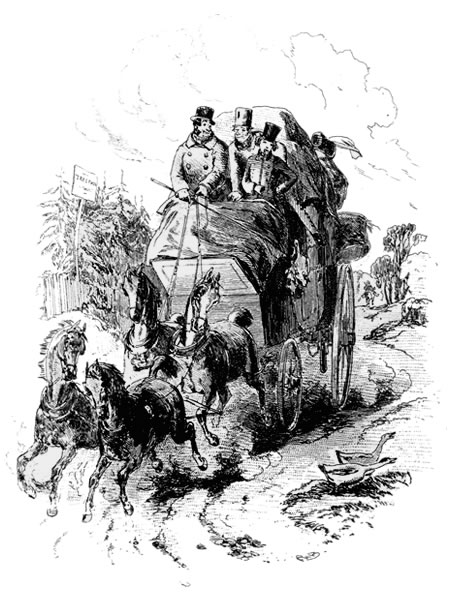
four, that is to say, my aunt, Mr. Dick, Traddles, and I, went down to
Canterbury by the Dover mail that night.
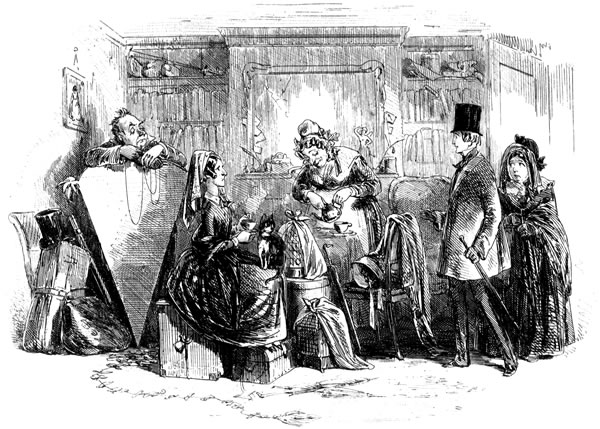
At the hotel where Mr. Micawber had requested us to await him, which
we got into, with some trouble, in the middle of the night, I found a
letter, importing that he would appear in the morning punctually at half-past
nine. After which, we went shivering, at that uncomfortable hour, to
our respective beds, through various close passages; which smelt as if they
had been steeped, for ages, in a solution of soup and stables.
Early in the morning, I sauntered through the dear old tranquil streets,
and again mingled with the shadows of the venerable gateways and
churches. The rooks were sailing about the cathedral towers; and the
towers themselves, overlooking many a long unaltered mile of the rich
country and its pleasant streams, were cutting the bright morning air, as
if there were no such thing as change on earth. Yet the bells, when they
sounded, told me sorrowfully of change in everything; told me of their
own age, and my pretty Dora’s youth; and of the many, never old, who had
lived and loved and died, while the reverberations of the bells had hummed
through the rusty armour of the Black Prince hanging up within, and,
motes upon the deep of Time, had lost themselves in air, as circles do in
water.
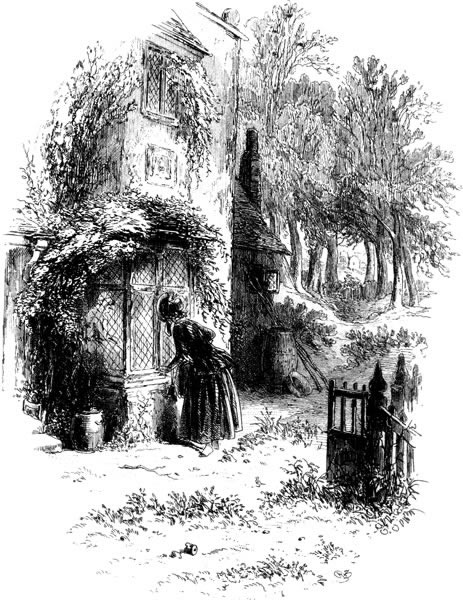
I looked at the old house from the corner of the street, but did not go
nearer to it, lest, being observed, I might unwittingly do any harm to the
design I had come to aid. The early sun was striking edgewise on its
gables and lattice-windows, touching them with gold; and some beams
of its old peace seemed to touch my heart.
I strolled into the country for an hour or so, and then returned by the
main street, which in the interval had shaken off its last night’s sleep.
Among those who were stirring in the shops, I saw my ancient enemy the
butcher, now advanced to top-boots and a baby, and in business for himself.
He was nursing the baby, and appeared to be a benignant member of society.
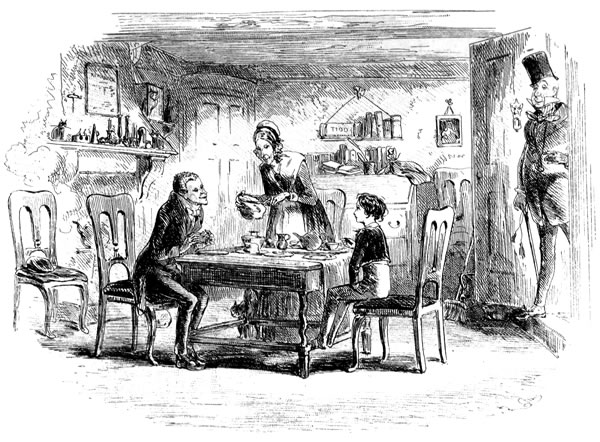
We all became very anxious and impatient, when we sat down to breakfast.
As it approached nearer and nearer to half-past nine o’clock, our restless
expectation of Mr. Micawber increased. At last we made no more pretence
of attending to the meal, which, except with Mr. Dick, had been a
mere form from the first; but my aunt walked up and down the room,
Traddles sat upon the sofa affecting to read the paper with his eyes on
the ceiling; and I looked out of the window to give early notice of Mr.
Micawber’s coming. Nor had I long to watch, for, at the first chime of
the half hour, he appeared in the street.
“Here he is,” said I, “and not in his legal attire!”
My aunt tied the strings of her bonnet (she had come down to breakfast
in it), and put on her shawl, as if she were ready for anything that was
resolute and uncompromising. Traddles buttoned his coat with a determined
air. Mr. Dick, disturbed by these formidable appearances, but feeling
it necessary to imitate them, pulled his hat, with both hands, as firmly over
his ears as he possibly could; and instantly took it off again, to welcome
Mr. Micawber.
“Gentlemen, and madam,” said Mr. Micawber, “good morning! My
dear sir,” to Mr. Dick, who shook hands with him violently, “you are
extremely good.”
“Have you breakfasted?” said Mr. Dick. “Have a chop!”
“Not for the world, my good sir!” cried Mr. Micawber, stopping him
on his way to the bell; “appetite and myself, Mr. Dixon, have long been
strangers.”
Mr. Dixon was so pleased with his new name, and appeared to think it
so very obliging in Mr. Micawber to confer it upon him, that he shook
hands with him again, and laughed rather childishly.
“Dick,” said my aunt, “attention!”
Mr. Dick recovered himself, with a blush.
“Now, sir,” said my aunt to Mr. Micawber, as she put on her gloves,
“we are ready for Mount Vesuvius, or anything else, as soon as you
please.”
“Madam,” returned Mr. Micawber, “I trust you will shortly witness
an eruption. Mr. Traddles, I have your permission, I believe, to mention
here that we have been in communication together?”
“It is undoubtedly the fact, Copperfield,” said Traddles, to whom I
looked in surprise. “Mr. Micawber has consulted me, in reference to
what he has in contemplation; and I have advised him to the best of my
judgment.”
“Unless I deceive myself, Mr. Traddles,” pursued Mr. Micawber,
“what I contemplate is a disclosure of an important nature.”
“Highly so,” said Traddles.
“Perhaps, under such circumstances, madam and gentlemen,” said
Mr. Micawber, “you will do me the favor to submit yourselves, for the
moment, to the direction of one, who, however unworthy to be regarded in
any other light but as a Waif and Stray upon the shore of human nature, is
still your fellow man, though crushed out of his original form by individual
errors, and the accumulative force of a combination of circumstances?”
“We have perfect confidence in you, Mr. Micawber,” said I, “and will
do what you please.”
“Mr. Copperfield,” returned Mr. Micawber, “your confidence is not,
at the existing juncture, ill-bestowed. I would beg to be allowed a start
of five minutes by the clock; and then to receive the present company,
inquiring for Miss Wickfield, at the office of Wickfield and Heep, whose
Stipendiary I am.”
My aunt and I looked at Traddles, who nodded his approval.
“I have no more,” observed Mr. Micawber, “to say at present.”
With which, to my infinite surprise, he included us all in a comprehensive
bow, and disappeared; his manner being extremely distant, and his
face extremely pale.
Traddles only smiled, and shook his head (with his hair standing
upright on the top of it), when I looked to him for an explanation;
so I took out my watch, and, as a last resource, counted off the five
minutes. My aunt, with her own watch in her hand, did the like. When the
time was expired, Traddles gave her his arm; and we all went out together
to the old house, without saying one word on the way.
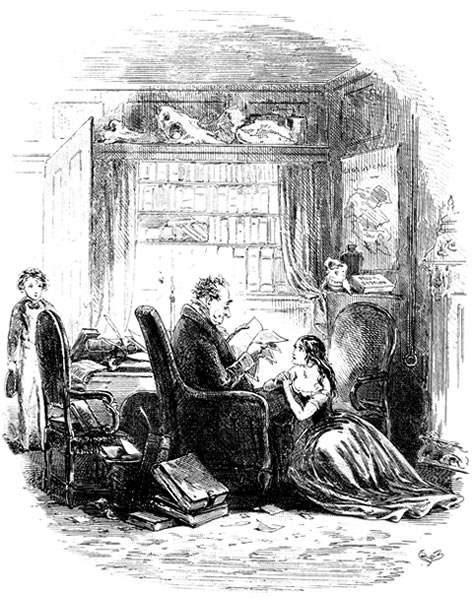
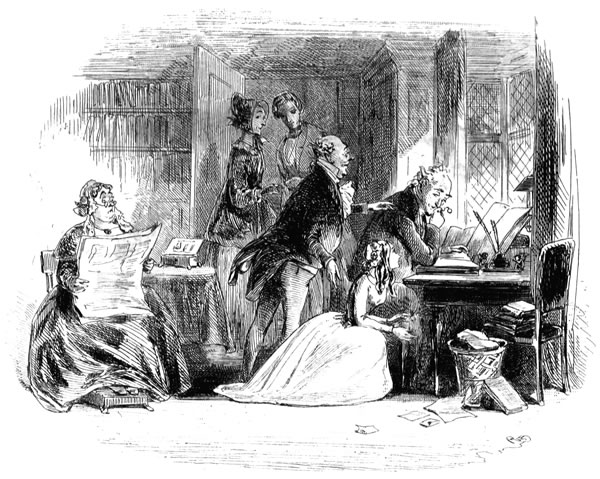
We found Mr. Micawber at his desk, in the turret office on the ground
floor, either writing, or pretending to write, hard. The large office-ruler
was stuck into his waistcoat, and was not so well concealed but that a
foot or more of that instrument protruded from his bosom, like a new kind
of shirt-frill.
As it appeared to me that I was expected to speak, I said aloud:
“How do you do, Mr. Micawber?”
“Mr. Copperfield,” said Mr. Micawber, gravely, “I hope I see you well?”
“Is Miss Wickfield at home?” said I.
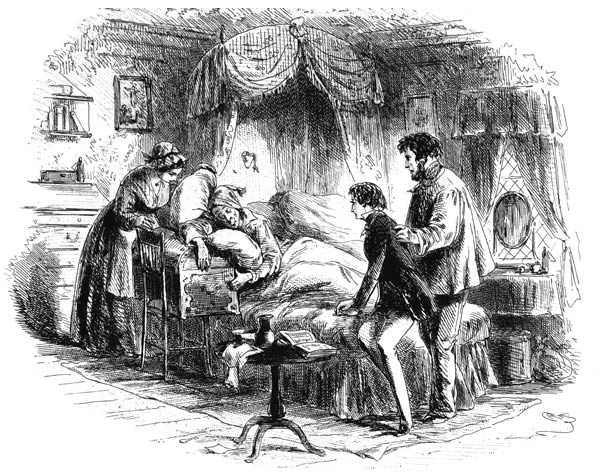
“Mr. Wickfield is unwell in bed, sir, of a rheumatic fever,” he returned;
“but Miss Wickfield, I have no doubt, will be happy to see old friends.
Will you walk in, sir?”
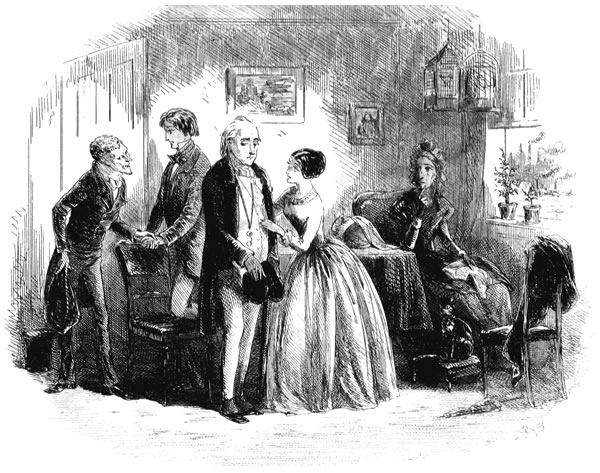
He preceded us to the dining-room—the first room I had entered in
that house—and flinging open the door of Mr. Wickfield’s former office,
said, in a sonorous voice:
“Miss Trotwood, Mr. David Copperfield, Mr. Thomas Traddles, and
Mr. Dixon!”
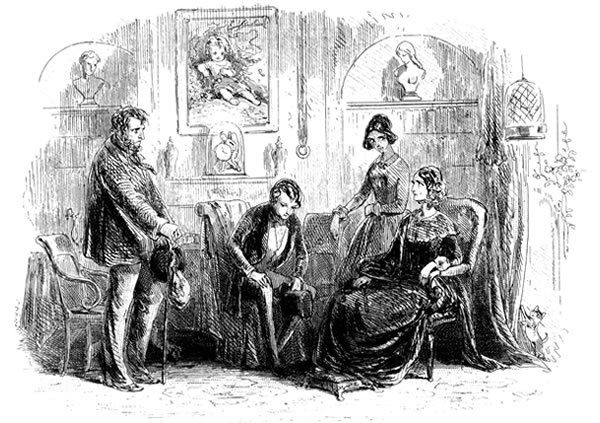
I had not seen Uriah Heep since the time of the blow. Our visit
astonished him, evidently; not the less, I dare say, because it astonished
ourselves. He did not gather his eyebrows together, for he had none
worth mentioning; but he frowned to that degree that he almost closed his
small eyes, while the hurried raising of his grisly hand to his chin betrayed
some trepidation or surprise. This was only when we were in the act of
entering his room, and when I caught a glance at him over my aunt’s
shoulder. A moment afterwards, he was as fawning and as humble as ever.
“Well, I am sure,” he said. “This is indeed an unexpected pleasure!
To have, as I may say, all friends round Saint Paul’s, at once, is a treat
unlooked for! Mr. Copperfield, I hope I see you well, and—if I may
umbly express self so—friendly towards them as is ever your friends,
whether or not. Mrs. Copperfield, sir, I hope she’s getting on. We have
been made quite uneasy by the poor accounts we have had of her state,
lately, I do assure you.”
I felt ashamed to let him take my hand, but I did not know yet what
else to do.
“Things are changed in this office, Miss Trotwood, since I was a numble
clerk, and held your pony; ain’t they?” said Uriah, with his sickliest
smile. “But I am not changed, Miss Trotwood.”
“Well, sir,” returned my aunt, “to tell you the truth, I think you are
pretty constant to the promise of your youth; if that’s any satisfaction
to you.”
“Thank you, Miss Trotwood,” said Uriah, writhing in his ungainly
manner, “for your good opinion! Micawber, tell ’em to let Miss Agnes
know—and mother. Mother will be quite in a state, when she sees the
present company!” said Uriah, setting chairs.
“You are not busy, Mr. Heep?” said Traddles, whose eye the cunning
red eye accidentally caught, as it at once scrutinised and evaded us.
“No, Mr. Traddles,” replied Uriah, resuming his official seat, and
squeezing his bony hands, laid palm to palm, between his bony knees.
“Not so much so, as I could wish. But lawyers, sharks, and leeches, are
not easily satisfied, you know! Not but what myself and Micawber have
our hands pretty full, in general, on account of Mr. Wickfield’s being
hardly fit for any occupation, sir. But it’s a pleasure as well as a duty, I
am sure, to work for him. You’ve not been intimate with Mr. Wickfield,
I think, Mr. Traddles? I believe I’ve only had the honor of seeing you
once myself?”
“No, I have not been intimate with Mr. Wickfield,” returned Traddles;
“or I might perhaps have waited on you long ago, Mr. Heep.”
There was something in the tone of this reply, which made Uriah look
at the speaker again, with a very sinister and suspicious expression. But,
seeing only Traddles with his good-natured face, simple manner, and hair
on end, he dismissed it as he replied, with a jerk of his whole body, but
especially his throat:
“I am sorry for that, Mr. Traddles. You would have admired him as
much as we all do. His little failings would only have endeared him to you
the more. But if you would like to hear my fellow-partner eloquently spoken
of, I should refer you to Copperfield. The family is a subject he’s very
strong upon, if you never heard him.”
I was prevented from disclaiming the compliment (if I should have
done so, in any case), by the entrance of Agnes, now ushered in by Mr.
Micawber. She was not quite so self-possessed as usual, I thought; and had
evidently undergone anxiety and fatigue. But her earnest cordiality, and
her quiet beauty, shone with the gentler lustre for it.
I saw Uriah watch her while she greeted us; and he reminded me of
an ugly and rebellious genie watching a good spirit. In the meanwhile,
some slight sign passed between Mr. Micawber and Traddles; and
Traddles, unobserved except by me, went out.
“Don’t wait, Micawber,” said Uriah.
Mr. Micawber, with his hand upon the ruler in his breast, stood erect
before the door, most unmistakeably contemplating one of his fellow-men,
and that man his employer.
“What are you waiting for?” said Uriah. “Micawber! Did you hear
me tell you not to wait?”
“Yes!” replied the immovable Mr. Micawber.
“Then why do you wait?” said Uriah.
“Because I—in short choose,” replied Mr. Micawber, with a burst.
Uriah’s cheeks lost colour, and an unwholesome paleness, still faintly
tinged by his pervading red, overspread them. He looked at Mr. Micawber
attentively, with his whole face breathing short and quick in every feature.
“You are a dissipated fellow, as all the world knows,” he said, with an
effort at a smile, “and I am afraid you’ll oblige me to get rid of you. Go
along! I’ll talk to you presently.”
“If there is a scoundrel on this earth,” said Mr. Micawber, suddenly
breaking out again with the utmost vehemence, “with whom I have already
talked too much, that scoundrel’s name is—Heep!”
Uriah fell back, as if he had been struck or stung. Looking slowly
round upon us with the darkest and wickedest expression that his face
could wear, he said, in a lower voice:
“Oho! This is a conspiracy! You have met here, by appointment!
You are playing Booty with my clerk, are you, Copperfield? Now, take
care. You’ll make nothing of this. We understand each other, you and
me. There’s no love between us. You were always a puppy with a
proud stomach, from your first coming here; and you envy me my rise, do
you? None of your plots against me; I’ll counterplot you! Micawber,
you be off. I’ll talk to you presently.”
“Mr. Micawber,” said I, “there is a sudden change in this fellow, in
more respects than the extraordinary one of his speaking the truth in one
particular, which assures me that he is brought to bay. Deal with him
as he deserves!”
“You are a precious set of people, ain’t you?” said Uriah, in the
same low voice, and breaking out into a clammy heat, which he wiped
from his forehead, with his long lean hand, “to buy over my clerk, who
is the very scum of society,—as you yourself were, Copperfield, you know
it, before anyone had charity on you,—to defame me with his lies?
Miss Trotwood, you had better stop this; or I’ll stop your husband
shorter than will be pleasant to you. I won’t know your story professionally,
for nothing, old lady! Miss Wickfield, if you have any love for
your father, you had better not join that gang. I’ll ruin him, if you do.
Now, come! I have got some of you under the harrow. Think twice,
before it goes over you. Think twice, you, Micawber, if you don’t want
to be crushed. I recommend you to take yourself off, and be talked to
presently, you fool! while there’s time to retreat. Where’s mother!”
he said, suddenly appearing to notice, with alarm, the absence of Traddles,
and pulling down the bell-rope. “Fine doings in a person’s own
house!”
“Mrs. Heep is here, sir,” said Traddles, returning with that worthy
mother of a worthy son. “I have taken the liberty of making myself
known to her.”
“Who are you to make yourself known?” retorted Uriah. “And
what do you want here?”
“I am the agent and friend of Mr. Wickfield, sir,” said Traddles, in a
composed business-like way. “And I have a power of attorney from him
in my pocket, to act for him in all matters.”
“The old ass has drunk himself into a state of dotage,” said Uriah,
turning uglier than before, “and it has been got from him by fraud!”
“Something has been got from him by fraud, I know,” returned
Traddles quietly; “and so do you, Mr. Heep. We will refer that question,
if you please, to Mr. Micawber.”
“Ury—!” Mrs. Heep began, with an anxious gesture.
“You hold your tongue, mother,” he returned; “least said, soonest
mended.”
“But my Ury—.”
“Will you hold your tongue, mother, and leave it to me?”
Though I had long known that his servility was false, and all his pretences
knavish and hollow, I had had no adequate conception of the
extent of his hypocrisy, until I now saw him with his mask off. The
suddenness with which he dropped it, when he perceived that it was useless
to him; the malice, insolence, and hatred, he revealed; the leer with
which he exulted, even at this moment, in the evil he had done—all
this time being desperate too, and at his wits’ end for the means
of getting the better of us—though perfectly consistent with the
experience I had of him, at first took even me by surprise, who had known
him so long, and disliked him so heartily.
I say nothing of the look he conferred on me, as he stood eyeing us,
one after another; for I had always understood that he hated me, and I
remembered the marks of my hand upon his cheek. But when his eyes
passed on to Agnes, and I saw the rage with which he felt his power over
her slipping away, and the exhibition, in their disappointment, of the
odious passions that had led him to aspire to one whose virtues he could
never appreciate or care for, I was shocked by the mere thought of her
having lived, an hour, within sight of such a man.
After some rubbing of the lower part of his face, and some looking at
us with those bad eyes, over his grisly fingers, he made one more address
to me, half whining, and half abusive.
“You think it justifiable, do you, Copperfield, you who pride yourself
so much on your honor and all the rest of it, to sneak about my place,
eaves-dropping with my clerk? If it had been me, I shouldn’t have
wondered; for I don’t make myself out a gentleman (though I never was
in the streets either, as you were, according to Micawber), but being you!
—And you’re not afraid of doing this, either? You don’t think at all of
what I shall do, in return; or of getting yourself into trouble for conspiracy
and so forth? Very well. We shall see! Mr. What’s-your-name, you
were going to refer some question to Micawber. There’s your referee.
Why don’t you make him speak? He has learnt his lesson, I see.”
Seeing that what he said had no effect on me or any of us, he sat on the
edge of his table with his hands in his pockets, and one of his splay feet
twisted round the other leg, waiting doggedly for what might follow.
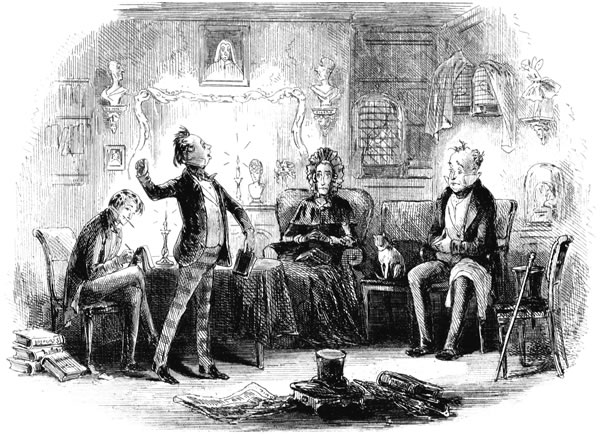
Mr. Micawber, whose impetuosity I had restrained thus far with the
greatest difficulty, and who had repeatedly interposed with the first syllable
of Scoun-drel! without getting to the second, now burst forward, drew
the ruler from his breast (apparently as a defensive weapon), and produced
from his pocket a foolscap document, folded in the form of a large letter.
Opening this packet, with his old flourish, and glancing at the contents,
as if he cherished an artistic admiration of their style of composition,
he began to read as follows:
“‘Dear Miss Trotwood and gentlemen——’”
“Bless and save the man!” exclaimed my aunt in a low voice. “He’d
write letters by the ream, if it was a capital offence!”
Mr. Micawber, without hearing her, went on.
“‘In appearing before you to denounce probably the most consummate
Villain that has ever existed,’” Mr. Micawber, without looking off the
letter, pointed the ruler, like a ghostly truncheon, at Uriah Heep, “‘I ask
no consideration for myself. The victim, from my cradle, of pecuniary
liabilities to which I have been unable to respond, I have ever been the sport
and toy of debasing circumstances. Ignominy, Want, Despair, and Madness,
have, collectively or separately, been the attendants of my career.’”
The relish with which Mr. Micawber described himself, as a prey to
these dismal calamities, was only to be equalled by the emphasis with
which he read his letter; and the kind of homage he rendered to it with a
roll of his head, when he thought he had hit a sentence very hard indeed.
“‘In an accumulation of Ignominy, Want, Despair, and Madness, I
entered the office—or, as our lively neighbour the Gaul would term it,
the Bureau—of the Firm, nominally conducted under the appellation of
Wickfield and—Heep, but, in reality, wielded by—Heep alone. Heep,
and only Heep, is the mainspring of that machine. Heep, and only
Heep, is the Forger and the Cheat.’”
Uriah, more blue than white at these words, made a dart at the letter,
as if to tear it in pieces. Mr. Micawber, with a perfect miracle of dexterity
or luck, caught his advancing knuckles with the ruler, and disabled
his right hand. It dropped at the wrist, as if it were broken. The blow
sounded as if it had fallen on wood.
“The Devil take you!” said Uriah, writhing in a new way with pain.
“I’ll be even with you.”
“Approach me again, you—you—you Heep of infamy,” gasped Mr.
Micawber, “and if your head is human, I’ll break it. Come on, come on!”
I think I never saw anything more ridiculous—I was sensible of it,
even at the time—than Mr. Micawber making broad-sword guards with
the ruler, and crying “Come on!” while Traddles and I pushed him
back into a corner, from which, as often as we got him into it, he persisted
in emerging again.
His enemy, muttering to himself, after wringing his wounded hand for
some time, slowly drew off his neck-kerchief and bound it up; then, held it
in his other hand, and sat upon his table with his sullen face looking down.
Mr. Micawber, when he was sufficiently cool, proceeded with his letter.
“‘The stipendiary emoluments in consideration of which I entered into
the service of—Heep,’” always pausing before that word, and uttering it
with astonishing vigor, “‘were not defined, beyond the pittance of twenty-two
shillings and six per week. The rest was left contingent on the value of
my professional exertions; in other and more expressive words, on the baseness
of my nature, the cupidity of my motives, the poverty of my family,
the general moral (or rather immoral) resemblance between myself
and—Heep. Need I say, that it soon became necessary for me to solicit
from—Heep—pecuniary advances towards the support of Mrs. Micawber, and
our blighted but rising family! Need I say that this necessity had been
foreseen by—Heep? That those advances were secured by I. O. U.’s and
other similar acknowledgments, known to the legal institutions of this
country. And that I thus became immeshed in the web he had spun for
my reception?’”
Mr. Micawber’s enjoyment of his epistolary powers, in describing this
unfortunate state of things, really seemed to outweigh any pain or anxiety
that the reality could have caused him. He read on:
“‘Then it was that—Heep—began to favor me with just so much of his
confidence, as was necessary to the discharge of his infernal business. Then
it was that I began, if I may so Shakespearianly express myself, to dwindle,
peak, and pine. I found that my services were constantly called into
requisition for the falsification of business, and the mystification of an
individual whom I will designate as Mr. W. That Mr. W. was imposed upon,
kept in ignorance, and deluded, in every possible way; yet, that all this while,
the ruffian—Heep—was professing unbounded gratitude to, and unbounded
friendship for, that much abused gentleman. This was bad enough; but, as
the philosophic Dane observes, with that universal applicability which distinguishes
the illustrious ornament of the Elizabethian Era, worse remains
behind!’”
Mr. Micawber was so very much struck by this happy rounding off
with a quotation, that he indulged himself, and us, with a second reading
of the sentence, under pretence of having lost his place.
“‘It is not my intention,’” he continued, reading on, “‘to enter on a
detailed list, within the compass of the present epistle (though it is ready
elsewhere), of the various malpractices of a minor nature, affecting the individual
whom I have denominated Mr. W., to which I have been a tacitly
consenting party. My object, when the contest within myself between
stipend and no stipend, baker and no baker, existence and non-existence,
ceased, was to take advantage of my opportunities to discover and expose
the major malpractices committed, to that gentleman’s grievous wrong
and injury, by—Heep. Stimulated by the silent monitor within, and by a
no less touching and appealing monitor without—to whom I will briefly
refer as Miss W.—I entered on a not unlaborious task of clandestine
investigation, protracted now, to the best of my knowledge, information,
and belief, over a period exceeding twelve calendar months.’”
He read this passage, as if it were from an Act of Parliament; and
appeared majestically refreshed by the sound of the words.
“‘My charges against—Heep,’” he read on, glancing at him, and
drawing the ruler into a convenient position under his left arm, in case of
need, “‘are as follows.’”
We all held our breath, I think. I am sure Uriah held his.
“‘First,’” said Mr. Micawber. “‘When Mr. W.’s faculties and memory
for business became, through causes into which it is not necessary or
expedient for me to enter, weakened and confused,—Heep—designedly
perplexed and complicated the whole of the official transactions. When
Mr. W. was least fit to enter on business,—Heep—was always at hand to
force him to enter on it. He obtained Mr. W.’s signature under such circumstances
to documents of importance, representing them to be other
documents of no importance. He induced Mr. W. to empower him to draw
out, thus, one particular sum of trust-money, amounting to twelve six
fourteen, two, and nine, and employed it to meet pretended business charges
and deficiencies which were either already provided for, or had never really
existed. He gave this proceeding, throughout, the appearance of having
originated in Mr. W.’s own dishonest intention, and of having been accomplished
by Mr. W.’s own dishonest act; and has used it, ever since, to
torture and constrain him.’”
“You shall prove this, you Copperfield!” said Uriah, with a threatening
shake of the head. “All in good time!”
“Ask—Heep—Mr. Traddles, who lived in his house after him,” said
Mr. Micawber, breaking off from the letter; “will you?”
“The fool himself—and lives there now,” said Uriah, disdainfully.
“Ask—Heep—if he ever kept a pocket-book in that house,” said Mr.
Micawber; “will you?”
I saw Uriah’s lank hand stop, involuntarily, in the scraping of his chin.
“Or ask him,” said Mr. Micawber, “if he ever burnt one there. If
he says yes, and asks you where the ashes are, refer him to Wilkins
Micawber, and he will hear of something not at all to his advantage!”
The triumphant flourish with which Mr. Micawber delivered himself of
these words, had a powerful effect in alarming the mother; who cried out,
in much agitation:
“Ury, Ury! Be umble, and make terms, my dear!”
“Mother!” he retorted, “will you keep quiet? You’re in a fright, and
don’t know what you say or mean. Umble!” he repeated, looking at me,
with a snarl; “I’ve umbled some of ’em for a pretty long time back,
umble as I was!”
Mr. Micawber, genteelly adjusting his chin in his cravat, presently
proceeded with his composition.
“‘Second. Heep has, on several occasions, to the best of my knowledge,
information, and belief’”—
“But that won’t do,” muttered Uriah, relieved. “Mother, you keep
quiet.”
“We will endeavour to provide something that WILL do, and do for
you finally, sir, very shortly,” replied Mr. Micawber.
“‘Second. Heep has, on several occasions, to the best of my knowledge,
information, and belief, systematically forged, to various entries, books,
and documents, the signature of Mr. W.; and has distinctly done so in
one instance, capable of proof by me. To wit, in manner following, that
is to say:’”
Again, Mr. Micawber had a relish in this formal piling up of words,
which, however ludicrously displayed in his case, was, I must say, not at
all peculiar to him. I have observed it, in the course of my life, in numbers
of men. It seems to me to be a general rule. In the taking of legal
oaths, for instance, deponents seem to enjoy themselves mightily when
they come to several good words in succession, for the expression of one
idea; as, that they utterly detest, abominate, and abjure, or so forth; and
the old anathemas were made relishing on the same principle. We talk
about the tyranny of words, but we like to tyrannise over them too; we
are fond of having a large superfluous establishment of words to wait
upon us on great occasions; we think it looks important, and sounds
well. As we are not particular about the meaning of our liveries on state
occasions, if they be but fine and numerous enough, so, the meaning or
necessity of our words is a secondary consideration, if there be but a great
parade of them. And as individuals get into trouble by making too great
a show of liveries, or as slaves when they are too numerous rise against
their masters, so I think I could mention a nation that has got into many
great difficulties, and will get into many greater, from maintaining too
large a retinue of words.
Mr. Micawber read on, almost smacking his lips:
“‘To wit, in manner following, that is to say. Mr. W. being infirm,
and it being within the bounds of probability that his decease might lead
to some discoveries, and to the downfall of—Heep’s—power over the W.
family,—as I, Wilkins Micawber, the undersigned, assume—unless the
filial affection of his daughter could be secretly influenced from allowing
any investigation of the partnership affairs to be ever made, the said
—Heep—deemed it expedient to have a bond ready by him, as from
Mr. W., for the before-mentioned sum of twelve six fourteen, two and
nine, with interest, stated therein to have been advanced by—Heep—to
Mr. W. to save Mr. W. from dishonor; though really the sum was never
advanced by him, and has long been replaced. The signatures to this
instrument, purporting to be executed by Mr. W. and attested by Wilkins
Micawber, are forgeries by—Heep. I have, in my possession, in his
hand and pocket-book, several similar imitations of Mr. W.’s signature,
here and there defaced by fire, but legible to any one. I never attested
any such document. And I have the document itself, in my possession.’”
Uriah Heep, with a start, took out of his pocket a bunch of keys, and
opened a certain drawer; then, suddenly bethought himself of what he
was about, and turned again towards us, without looking in it.
“‘And I have the document,’” Mr. Micawber read again, looking
about as if it were the text of a sermon, “‘in my possession,’—that is to
say, I had, early this morning, when this was written, but have since
relinquished it to Mr. Traddles.”
“It is quite true,” assented Traddles.
“Ury, Ury!” cried the mother, “be umble and make terms. I know
my son will be umble, gentlemen, if you’ll give him time to think. Mr.
Copperfield, I’m sure you know that he was always very umble, sir!”
It was singular to see how the mother still held to the old trick, when
the son had abandoned it as useless.
“Mother,” he said, with an impatient bite at the handkerchief in which
his hand was wrapped, “you had better take and fire a loaded gun at me.”
“But I love you, Ury,” cried Mrs. Heep. And I have no doubt she
did; or that he loved her, however strange it may appear; though, to be
sure, they were a congenial couple. “And I can’t bear to hear you
provoking the gentlemen, and endangering of yourself more. I told the
gentleman at first, when he told me up-stairs it was come to light, that
I would answer for your being umble, and making amends. Oh, see how
umble I am, gentlemen, and don’t mind him!”
“Why, there’s Copperfield, mother,” he angrily retorted, pointing his
lean finger at me, against whom all his animosity was levelled, as the
prime mover in the discovery; and I did not undeceive him; “there’s
Copperfield, would have given you a hundred pound to say less than you’ve
blurted out!”
“I can’t help it, Ury,” cried his mother. “I can’t see you running
into danger, through carrying your head so high. Better be umble, as
you always was.”
He remained for a little, biting the handkerchief, and then said to me
with a scowl:
“What more have you got to bring forward? If anything, go on with
it. What do you look at me for?”
Mr. Micawber promptly resumed his letter, only too glad to revert to a
performance with which he was so highly satisfied.
“‘Third. And last. I am now in a condition to show, by—Heep’s—false
books, and—Heep’s—real memoranda, beginning with the partially
destroyed pocket-book (which I was unable to comprehend, at the time of
its accidental discovery by Mrs. Micawber, on our taking possession of our
present abode, in the locker or binn devoted to the reception of the ashes
calcined on our domestic hearth), that the weaknesses, the faults, the very
virtues, the parental affections, and the sense of honor, of the unhappy Mr.
W. have been for years acted on by, and warped to the base purposes of—Heep.
That Mr. W. has been for years deluded and plundered, in every
conceivable manner, to the pecuniary aggrandisement of the avaricious,
false, and grasping—Heep. That the engrossing object of—Heep—was,
next to gain, to subdue Mr. and Miss W. (of his ulterior views in reference
to the latter I say nothing) entirely to himself. That his last act, completed
but a few months since, was to induce Mr. W. to execute a relinquishment
of his share in the partnership, and even a bill of sale on the
very furniture of his house, in consideration of a certain annuity, to be
well and truly paid by—Heep—on the four common quarter-days in each
and every year. That these meshes; beginning with alarming and falsified
accounts of the estate of which Mr. W. is the receiver, at a period when
Mr. W. had launched into imprudent and ill-judged speculations, and
may not have had the money, for which he was morally and legally
responsible, in hand; going on with pretended borrowings of money at
enormous interest, really coming from—Heep—and by—Heep—fraudulently
obtained or withheld from Mr. W. himself, on pretence of such
speculations or otherwise; perpetuated by a miscellaneous catalogue of
unscrupulous chicaneries—gradually thickened, until the unhappy Mr. W.
could see no world beyond. Bankrupt, as he believed, alike in circumstances,
in all other hope, and in honor, his sole reliance was upon the
monster in the garb of man,’”—Mr. Micawber made a good deal of this,
as a new turn of expression,—“‘who, by making himself necessary to
him, had achieved his destruction. All this I undertake to show.
Probably much more!’”
I whispered a few words to Agnes, who was weeping, half joyfully,
half-sorrowfully, at my side; and there was a movement among us, as if
Mr. Micawber had finished. He said, with exceeding gravity, “Pardon
me,” and proceeded, with a mixture of the lowest spirits and the most
intense enjoyment, to the peroration of his letter.
“‘I have now concluded. It merely remains for me to substantiate
these accusations; and then, with my ill-starred family, to disappear from
the landscape on which we appear to be an incumbrance. That is soon
done. It may be reasonably inferred that our baby will first expire of
inanition, as being the frailest member of our circle; and that our twins
will follow next in order. So be it! For myself, my Canterbury Pilgrimage
has done much; imprisonment on civil process, and want, will
soon do more. I trust that the labor and hazard of an investigation—of
which the smallest results have been slowly pieced together, in the pressure
of arduous avocations, under grinding penurious apprehensions, at rise of
morn, at dewy eve, in the shadows of night, under the watchful eye of one
whom it were superfluous to call Demon—combined with the struggle
of parental Poverty to turn it, when completed, to the right account, may
be as the sprinkling of a few drops of sweet water on my funereal pyre.
I ask no more. Let it be, in justice, merely said of me, as of a gallant
and eminent naval Hero, with whom I have no pretensions to cope, that
what I have done, I did, in despite of mercenary and selfish objects,
For England, home, and Beauty.
“‘Remaining always, &c. &c., Wilkins Micawber.’”
Much affected, but still intensely enjoying himself, Mr. Micawber folded
up his letter, and handed it with a bow to my aunt, as something she
might like to keep.
There was, as I had noticed on my first visit long ago, an iron safe in
the room. The key was in it. A hasty suspicion seemed to strike Uriah;
and, with a glance at Mr. Micawber, he went to it, and threw the doors
clanking open. It was empty.
“Where are the books!” he cried, with a frightful face. “Some thief
has stolen the books!”
Mr. Micawber tapped himself with the ruler. “I did, when I got the
key from you as usual—but a little earlier—and opened it this morning.”
“Don’t be uneasy,” said Traddles. “They have come into my possession.
I will take care of them, under the authority I mentioned.”
“You receive stolen goods, do you?” cried Uriah.
“Under such circumstances,” answered Traddles, “yes.”
What was my astonishment when I beheld my aunt, who had been
profoundly quiet and attentive, make a dart at Uriah Heep, and seize him
by the collar with both hands!
“You know what I want?” said my aunt.
“A strait-waistcoat,” said he.
“No. My property!” returned my aunt. “Agnes, my dear, as long
as I believed it had been really made away with by your father, I wouldn’t—and,
my dear, I didn’t, even to Trot, as he knows—breathe a syllable
of its having been placed here for investment. But, now I know this fellow’s
answerable for it, and I’ll have it! Trot, come and take it away from him!”
Whether my aunt supposed, for the moment, that he kept her property
in his neck-kerchief, I am sure I don’t know; but she certainly pulled at
it as if she thought so. I hastened to put myself between them, and to
assure her that we would all take care that he should make the utmost
restitution of everything he had wrongly got. This, and a few moments’
reflection, pacified her; but she was not at all disconcerted by what she
had done (though I cannot say as much for her bonnet) and resumed her
seat composedly.
During the last few minutes, Mrs. Heep had been clamoring to her
son to be “umble;” and had been going down on her knees to all of us
in succession, and making the wildest promises. Her son sat her down in
his chair; and, standing sulkily by her, holding her arm with his hand,
but not rudely, said to me, with a ferocious look:
“What do you want done?”
“I will tell you what must be done,” said Traddles.
“Has that Copperfield no tongue?” muttered Uriah. “I would do a
good deal for you if you could tell me, without lying, that somebody had
cut it out.”
“My Uriah means to be umble!” cried his mother. “Don’t mind
what he says, good gentlemen!”
“What must be done,” said Traddles, “is this. First, the deed of relinquishment,
that we have heard of, must be given over to me now—here.”
“Suppose I haven’t got it,” he interrupted.
“But you have,” said Traddles; “therefore, you know, we won’t suppose
so.” And I cannot help avowing that this was the first occasion on
which I really did justice to the clear head, and the plain, patient, practical
good sense, of my old schoolfellow. “Then,” said Traddles, “you
must prepare to disgorge all that your rapacity has become possessed of,
and to make restoration to the last farthing. All the partnership books
and papers must remain in our possession; all your books and papers; all
money accounts and securities, of both kinds. In short, everything here.”
“Must it? I don’t know that,” said Uriah. “I must have time to
think about that.”
“Certainly,” replied Traddles; “but, in the meanwhile, and until
everything is done to our satisfaction, we shall maintain possession of
these things; and beg you—in short, compel you—to keep your own
room, and hold no communication with any one.”
“I won’t do it!” said Uriah, with an oath.
“Maidstone Jail is a safer place of detention,” observed Traddles;
“and though the law may be longer in righting us, and may not be able
to right us so completely as you can, there is no doubt of its punishing
you. Dear me, you know that quite as well as I! Copperfield, will you
go round to the Guildhall, and bring a couple of officers?”
Here, Mrs. Heep broke out again, crying on her knees to Agnes to interfere
in their behalf, exclaiming that he was very humble, and it was all
true, and if he didn’t do what we wanted, she would, and much more to the
same purpose; being half frantic with fears for her darling. To inquire
what he might have done, if he had had any boldness, would be like
inquiring what a mongrel cur might do, if it had the spirit of a tiger. He
was a coward, from head to foot; and showed his dastardly nature through
his sullenness and mortification, as much as at any time of his mean life.
“Stop!” he growled to me; and wiped his hot face with his hand.
“Mother, hold your noise. Well! Let’em have that deed. Go and fetch it!”
“Do you help her, Mr. Dick,” said Traddles, “if you please.”
Proud of his commission, and understanding it, Mr. Dick accompanied
her as a shepherd’s dog might accompany a sheep. But, Mrs. Heep gave
him little trouble; for she not only returned with the deed, but with the
box in which it was, where we found a banker’s book and some other
papers that were afterwards serviceable.
“Good!” said Traddles, when this was brought. “Now, Mr. Heep,
you can retire to think: particularly observing, if you please, that I declare
to you, on the part of all present, that there is only one thing to be
done; that it is what I have explained; and that it must be done without
delay.”
Uriah, without lifting his eyes from the ground, shuffled across the
room with his hand to his chin, and pausing at the door, said:
“Copperfield, I have always hated you. You’ve always been an
upstart, and you’ve always been against me.”
“As I think I told you once before,” said I, “it is you who have been,
in your greed and cunning, against all the world. It may be profitable
to you to reflect, in future, that there never were greed and cunning in the
world yet, that did not do too much, and over-reach themselves. It is as
certain as death.”
“Or as certain as they used to teach at school (the same school where
I picked up so much umbleness), from nine o’clock to eleven, that labor
was a curse; and from eleven o’clock to one, that it was a blessing and a
cheerfulness, and a dignity, and I don’t know what all, eh?” said he with a
sneer. “You preach, about as consistent as they did. Won’t umbleness
go down? I shouldn’t have got round my gentleman fellow-partner without
it, I think.—Micawber, you old bully, I’ll pay you!”
Mr. Micawber, supremely defiant of him and his extended finger, and
making a great deal of his chest until he had slunk out at the door,
then addressed himself to me, and proffered me the satisfaction of “witnessing
the re-establishment of mutual confidence between himself and
Mrs. Micawber.” After which, he invited the company generally to the
contemplation of that affecting spectacle.
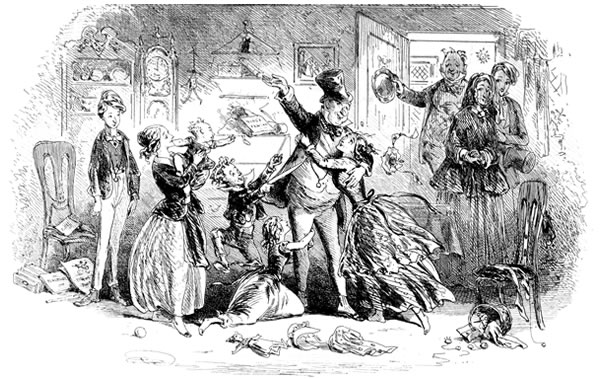
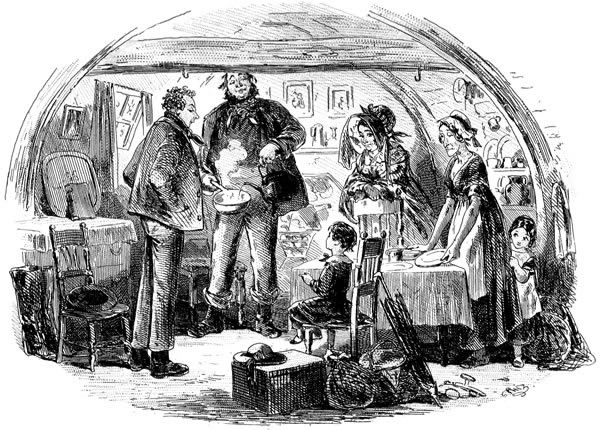
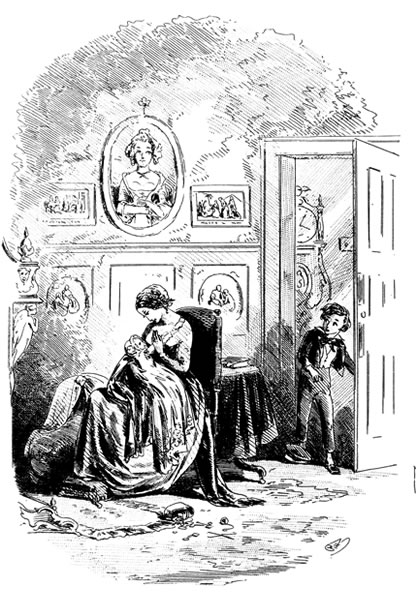
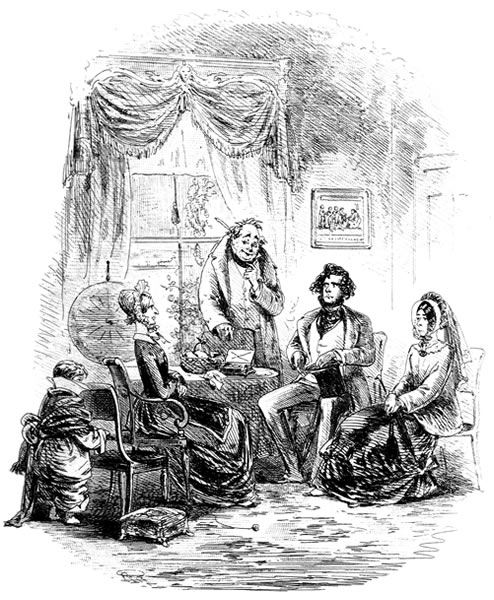
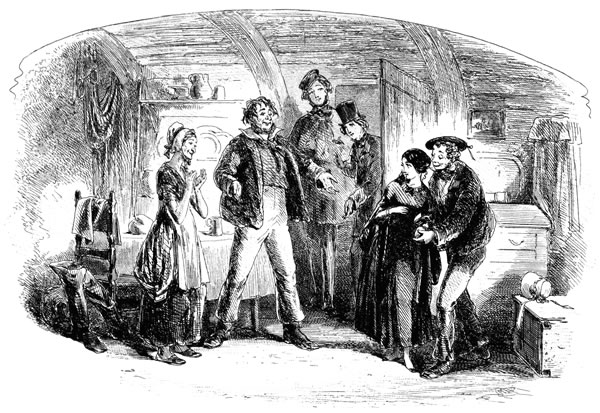
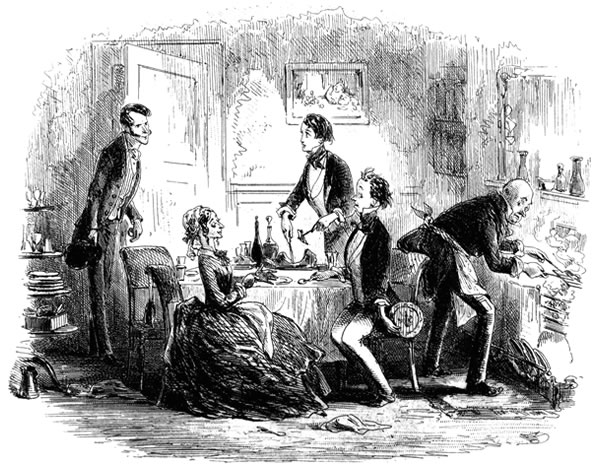
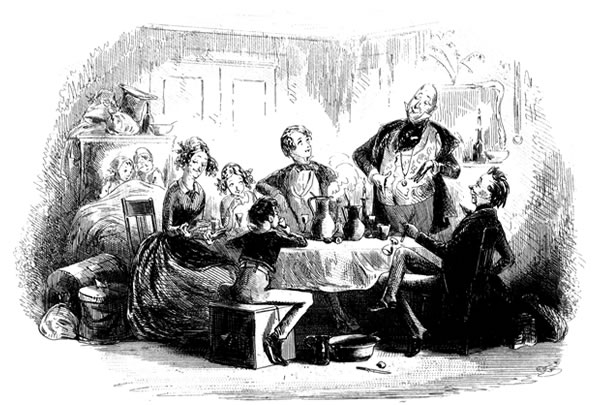
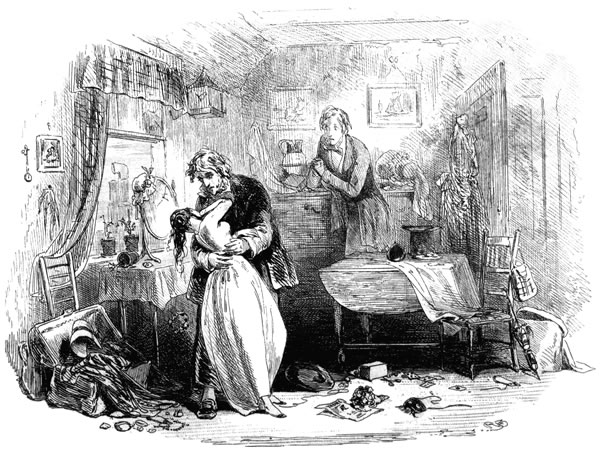
Restoration of mutual confidence between Mr. and Mrs. Micawber.
“The veil that has long been interposed between Mrs. Micawber and
myself, is now withdrawn,” said Mr. Micawber; “and my children and
the Author of their Being can once more come in contact on equal terms.”
As we were all very grateful to him, and all desirous to show that we
were, as well as the hurry and disorder of our spirits would permit, I dare
say we should all have gone, but that it was necessary for Agnes to return
to her father, as yet unable to bear more than the dawn of hope; and
for some one else to hold Uriah in safe keeping. So, Traddles remained
for the latter purpose, to be presently relieved by Mr. Dick; and Mr. Dick,
my aunt, and I, went home with Mr. Micawber. As I parted hurriedly
from the dear girl to whom I owed so much, and thought from what she
had been saved, perhaps, that morning—her better resolution notwithstanding—I
felt devoutly thankful for the miseries of my younger days
which had brought me to the knowledge of Mr. Micawber.
His house was not far off; and as the street-door opened into the
sitting room, and he bolted in with a precipitation quite his own, we
found ourselves at once in the bosom of the family. Mr. Micawber exclaiming,
“Emma! my life!” rushed into Mrs. Micawber’s arms. Mrs.
Micawber shrieked, and folded Mr. Micawber in her embrace. Miss
Micawber, nursing the unconscious stranger of Mrs. Micawber’s last
letter to me, was sensibly affected. The stranger leaped. The twins
testified their joy by several inconvenient but innocent demonstrations.
Master Micawber, whose disposition appeared to have been soured by
early disappointment, and whose aspect had become morose, yielded to his
better feelings, and blubbered.
“Emma!” said Mr. Micawber. “The cloud is past from my mind.
Mutual confidence, so long preserved between us once, is restored, to know
no farther interruption. Now, welcome poverty!” cried Mr. Micawber,
shedding tears. “Welcome misery, welcome houselessness, welcome
hunger, rags, tempest, and beggary! Mutual confidence will sustain us
to the end!”
With these expressions, Mr. Micawber placed Mrs. Micawber in a chair,
and embraced the family all round; welcoming a variety of bleak prospects,
which appeared, to the best of my judgment, to be anything but
welcome to them; and calling upon them to come out into Canterbury and
sing a chorus, as nothing else was left for their support.
But Mrs. Micawber having, in the strength of her emotions, fainted
away, the first thing to be done, even before the chorus could be considered
complete, was to recover her. This, my aunt and Mr. Micawber did;
and then my aunt was introduced, and Mrs. Micawber recognised me.
“Excuse me, dear Mr. Copperfield,” said the poor lady, giving me her
hand, “but I am not strong; and the removal of the late misunderstanding
between Mr. Micawber and myself was at first too much for me.”
“Is this all your family, ma’am?” said my aunt.
“There are no more at present,” returned Mrs. Micawber.
“Good gracious, I didn’t mean that, ma’am,” said my aunt. “I mean
are all these yours?”
“Madam,” replied Mr. Micawber, “it is a true bill.”
“And that eldest young gentleman, now,” said my aunt, musing.
“What has he been brought up to?”
“It was my hope when I came here,” said Mr. Micawber, “to have
got Wilkins into the Church: or perhaps I shall express my meaning
more strictly, if I say the Choir. But there was no vacancy for a tenor in
the venerable Pile for which this city is so justly eminent; and he has—in
short, he has contracted a habit of singing in public-houses, rather than
in sacred edifices.”
“But he means well,” said Mrs. Micawber, tenderly.
“I dare say, my love,” rejoined Mr. Micawber, “that he means particularly
well; but I have not yet found that he carries out his meaning,
in any given direction whatsoever.”
Master Micawber’s moroseness of aspect returned upon him again, and
he demanded, with some temper, what he was to do? Whether he had
been born a carpenter, or a coach painter, any more than he had been
born a bird? Whether he could go into the next street, and open a
chemist’s shop? Whether he could rush to the next assizes, and proclaim
himself a lawyer? Whether he could come out by force at the opera, and
succeed by violence? Whether he could do anything, without being brought
up to something?
My aunt mused a little while, and then said:
“Mr. Micawber, I wonder you have never turned your thoughts to
emigration.”
“Madam,” returned Mr. Micawber, “it was the dream of my youth,
and the fallacious aspiration of my riper years.” I am thoroughly persuaded,
by the bye, that he had never thought of it in his life.
“Aye?” said my aunt, with a glance at me. “Why, what a thing
it would be for yourselves and your family, Mr. and Mrs. Micawber, if you
were to emigrate now.”
“Capital, madam, capital,” urged Mr. Micawber, gloomily.
“That is the principal, I may say the only difficulty, my dear Mr.
Copperfield,” assented his wife.
“Capital?” cried my aunt. “But you are doing us a great service—have
done us a great service, I may say, for surely much will come out
of the fire—and what could we do for you, that would be half so good as
to find the capital?”
“I could not receive it as a gift,” said Mr. Micawber, full of fire and
animation, “but if a sufficient sum could be advanced, say at five per cent.
interest, per annum, upon my personal liability—say my notes of hand,
at twelve, eighteen, and twenty-four months, respectively, to allow time
for something to turn up——”
“Could be? Can be, and shall be, on your own terms,” returned my
aunt, “if you say the word. Think of this now, both of you. Here are
some people David knows, going out to Australia shortly. If you decide
to go, why shouldn’t you go in the same ship? You may help each
other. Think of this now, Mr. and Mrs. Micawber. Take your time,
and weigh it well.”
“There is but one question, my dear ma’am, I could wish to ask,”
said Mrs. Micawber. “The climate, I believe, is healthy.”
“Finest in the world!” said my aunt.
“Just so,” returned Mrs. Micawber. “Then my question arises.
Now, are the circumstances of the country such, that a man of Mr.
Micawber’s abilities would have a fair chance of rising in the social scale?
I will not say, at present, might he aspire to be Governor, or anything of
that sort; but would there be a reasonable opening for his talents to
develop themselves—that, would be amply sufficient—and find their own
expansion?”
“No better opening anywhere,” said my aunt, “for a man who conducts
himself well, and is industrious.”
“For a man who conducts himself well,” repeated Mrs. Micawber, with
her clearest business manner, “and is industrious. Precisely. It is evident
to me that Australia is the legitimate sphere of action for Mr. Micawber!”
“I entertain the conviction, my dear madam,” said Mr. Micawber,
“that it is, under existing circumstances, the land, the only land, for
myself and family; and that something of an extraordinary nature will
turn up on that shore. It is no distance—comparatively speaking; and
though consideration is due to the kindness of your proposal, I assure
you that is a mere matter of form.”
Shall I ever forget how, in a moment, he was the most sanguine of
men, looking on to fortune; or how Mrs. Micawber presently discoursed
about the habits of the kangaroo! Shall I ever recall that street of
Canterbury on a market day, without recalling him, as he walked back
with us; expressing, in the hardy roving manner he assumed, the unsettled
habits of a temporary sojourner in the land; and looking at the
bullocks, as they came by, with the eye of an Australian farmer!