Footnotes have been collected at the end of each chapter, and are
linked for ease of reference. Full-page illustrations have been
moved to a paragraph break.
Minor errors, attributable to the printer, have been corrected. Please
see the transcriber’s note at the end of this text
for details regarding the handling of any textual issues encountered
during its preparation.
The cover image, which had no text, has been provided with the basic
data from the title page.
Any corrections are indicated using an underline
highlight. Placing the cursor over the correction will produce the
original text in a small popup.
Any corrections are indicated as hyperlinks, which will navigate the
reader to the corresponding entry in the corrections table in the
note at the end of the text.
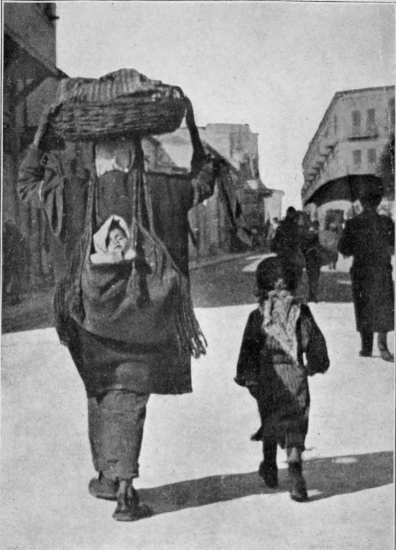
A SILOAM WOMAN, HER INFANT ON HER BACK AND PRODUCE ON HER HEAD
BIBLE LANDS AND PEOPLES—MODERN
BEING A COMPANION VOLUME TO “THE ORIENT IN BIBLE TIMES”
AN ENLARGED EDITION OF
“THE PEASANTRY OF PALESTINE, LIFE,
MANNERS AND CUSTOMS OF THE VILLAGE”
BY
ELIHU GRANT
PROFESSOR OF BIBLICAL LITERATURE IN HAVERFORD COLLEGE
ILLUSTRATED
PHILADELPHIA AND LONDON
J. B. LIPPINCOTT COMPANY
COPYRIGHT, 1907, BY ELIHU GRANT
COPYRIGHT, 1921, BY J. B. LIPPINCOTT COMPANY
PRINTED BY J. B. LIPPINCOTT COMPANY
AT THE WASHINGTON SQUARE PRESS
PHILADELPHIA, U. S. A.
TO THE MEMORY OF
HINCKLEY GILBERT MITCHELL
PREFACE TO SECOND EDITION
We thought that Palestine had passed into ancient
history, but it has been a centre of modern events.
No country in the world has a more continuously
interesting and profitable story. Its present population
is made of sturdy and able people. Three great
religions call it Holy Land. It presents to view three
distinct types of human society, the desert nomad
who dwells in the tented encampment, the peasant
villager who reminds us in so many ways of the
people of the Bible, and the more foreign looking
and mingled folk of the large cities.
We have picked the village life as most suggestive
of the quaint customs of the past. It has been gratifying
to have those who know this life best, including
villagers themselves, praise the accuracy and sympathy
of the descriptions.
The volume has not been compiled from books,
but drawn from life. An additional chapter seeks
to sum present conditions.
Life has changed even in the East but much remained
in Palestine, especially under the Turkish
régime, that is suggestive of Bible Times. We trust
that we have provided here a cross-section of a most
interesting period. We hope for even more, that the
reader with dramatic imagination may be able to fill
the places and figures of the biblical past with life.
E. G.
Haverford, Pa.,
February 24, 1921.
A few words that are pretty well fixed in popular usage, as Beirut,
Jaffa, Jerusalem, etc., are not changed in spelling, but for most Arabic
words the following alphabet has been used in transliteration:
—
r
gh
y
b
z
f
a
t
s
ḳ
u
th
sh
k
i
j
ṣ
l
â
ḥ
ḍ
m
û
kh
ṭ
n
î
d
ḍh or ẓ
h
dh
w
The use of y final and of ô as aids to pronunciation will be of obvious
import. When a foreign word occurs in the book for the first time
it is put in italics.
CONTENTS
7
Chapter I
Introductory. Remarks on the country of Western Palestine: historical, topographical and geological; distances, levels, rock composition, hills, valleys, caves, soil, etc. The waters: rivers, lakes, the watershed, the Shephelah, ponds, springs, cisterns, reservoirs and pools. The seasons: wet and dry, the rainfall, sun, drought, the weather according to the months, effect on health and on food supply, harvest. The winds. Flora: trees and flowers. Fauna: wild animals, birds. Scenery: appearance of cities and villages in Palestine. Sites, buildings, gardens, roads, paths, wilderness, agricultural matters, ripening fruit, vineyards, care of the soil, walls, watch-towers, terraces, orchards, olives, figs, pomegranates, etc.
General characteristics of the population of Palestine. The Bedawîn or nomads. The village and its people. Moslems and Christians: their distribution, their mutual relations. Description of the peasant man and the peasant woman.
Village Life. Introductory. The tribe: how constituted, its fellowship and significance. The family within the tribe. Importance of a strong family. Marriage in family and tribe: marriage settlement, qualities of a good wife, customs and ceremonies preliminary to marriage, wedding festivities and the celebration. The status of the new wife. An anomalous state of affairs. A disappointed lover. Children: boyhood and girlhood, importance of sons, birth, announcing the newly-born, naming the child. The midwife, care of babies, attention to children in health and in sickness, clothing, growing up, play, amusements and work, training. Family and personal names.
8Village Life. The houses of the peasants: structure, arrangement, conveniences, utensils and furnishings. Foods: their preparation and storing, eating customs. Costumes; male attire, female attire. Household industry: division of labor between members, women’s work, house, oven, field and wilderness. Health data: poverty and superstition as foes to health, treatment of the sick, common ailments, diseases, hospitals and medical assistance. The dumb and the blind. Treatment of the insane, the leprous. Death, mourning, burial, graves. The cholera and its ravages in Palestine in 1902, attendant evils, famine and quarantines.
Village Life. Religion. The religious basis of the peasant life. Country shrines venerated by the peasantry, saints, tombs, lamps, ruined churches, mosks, reverence for patriarchs and prophets, sacred trees. Superstitions concerning localities, minor superstitions, hair, doorways, food, evil eye. Prayer of women. Fatalism. Moslem prayer. Neby Mûsâ procession. Ramaḍân, Bairam. Eastern and Western Churches, organization, priesthood. Fasts, feasts, proselyting. The Samaritans and their Passover.
Village Life. Business. The Palestine peasant as a worker. Farming the first business of the village. The transition from the life of the nomad to the life of the peasant. Fellaḥîn. Land holdings and titles. Farming rights. Crops and sowing, work animals and their management, care of the standing crops, tares, mists, simultaneous reapings, harvest-time, threshing and cleaning. Grape season, vineyard districts, use of the fruit, raisins, export trade in raisins, care of vineyards, watch-towers in vineyards and orchards. The olive crop and its care. Flocks of sheep and goats, the young, varieties, the shepherd. The wool business and kindred industries, spinning and weaving. Undeveloped agricultural possibilities. The village market, shops, stores, bargaining and trade customs, measures and weights, currency, accounts, money-lending, village crier, the go-between, the shaykhs in business capacity. Transport and travel in the country, roads and vehicles. Stone and building trades, the materials and the tools. Miscellaneous trades, peasants in the city for business or for hire, dealers in antiquities and their ways.
Village Life. Social privileges and customs. The elements that contribute to these, kinship, religious association, party traditions, proximity. Predominance of kinship as a factor. The influence of religion as a factor. Diversions of the peasant, conversation and the amenities, calling and calls. Greetings, salutations, colloquial address, business talk and discussion. Guest-house and its uses, coffee-making, food for guests. A roofing-bee. Play, games, celebrations. Hunting. Gipsies. Quarrels as an anti-social and social factor. Revenge, etc.
Village Life. Intellectual matters. The state of learning, revival, services of the press in the Levant. Education, schools, missionary influence. Languages heard in the country, native and foreign. The peasant’s pride in his mother tongue. The Arabic language, its beauty and symmetry, literature, dialects, idioms, colloquialisms, exclamatory remarks, gestures, curses, proverbs.
Village life in the concrete, continued, with some village environs. Eṭ-Ṭîreh, Khullet el-‛Adas, ‛Ayn ‛Arîk, Kefr Shiyân, ‛Ayn Ṣôba, Baytîn, Khurbet el-Moḳâtîr, Dayr Dîwân, eṭ-Ṭayyibeh, Jifnâ, ‛Ayn Sînyâ, Bîr ez-Zayt, ‛Âbûd, Mukhmâs.
The village in its external relations. Attitude of villagers to the city and city people, now and formerly. Administration of the village from the city. The peasant and the government, taxes, private and official settlement of disputes. Postal service, native and foreign, telegraph. Passage of news and rumor. Travel, hindrances, quarantines, coastwise shipping, railway travel, peasant travel, pilgrimage travel, Russian pilgrims and the peasantry, other European pilgrim parties, tourists, traveling passes, transference of parcels, baggage, money, banking, consular service, the desire of the natives to emigrate.
Recent events. Effects of the revolution. Syrians and the World War. Syrian ability. Schools and education. The new administration; certain functions and methods. Archæological interests. The Arabian problem. Arabia and its people, social customs, politics, poets, prophet and religion.
CHAPTER I INTRODUCTORY. THE COUNTRY OF WESTERN PALESTINE. GENERAL FEATURES
This little book will make no attempt to tell all
that could be said of its subject, but we hope that
its selection of things to tell will be gratifying to
you. Our wish is that not many of its pages may be
condemned as dry, but that most of them may have interest
and refreshment. If sometime when you are tired
you can sit down and be pleased with some of these
pages, here or there, you will know a little of how the
trudging peasant of the village feels as, going over hill
after hill, from each top he gazes off towards the west and
sees the evening mists thickening and looking like good,
cool mountains in the sea. It is pleasant to see the face of
the native light up as he catches sight of the clouds heavy
with blessings of moisture. Perhaps fierce sirocco days have
followed one another for some time, longer than usual. Such
days are usually looked for in trios at least, but often they
hold for a longer time. Their peculiarly enervating heat is
very trying, and when they have passed one welcomes
eagerly an evening that brings the heavy mist. This announces
that the succession of hot days is broken and that
some days of respite are coming. The welcome moisture
blesses the vineyards, the fig orchards, the tomatoes,
squashes and melons, and it is sure to bring out ejaculations
of blessing from the fervent peasant, praising the Father of
all, whose favoring mercy he feels.
12Look out on a morning early and you will see the mists[1]
scudding, drifting, veiling and dissevering like masses of
gauze, like streamers of truant hair. Perhaps some near
mountain may be cut off from the little hill half-way down
by a moat filled with billowing fog. Soon the sun cuts it
and scatters it away and the hot, dry day sets in. The roads
and rocks are powdered with lime dust, the somber morning
tones on the hills are touched with whitening brightness.
Here and there is the dusty gray of an olive-orchard or the
bright green of vineyards. Overhead, the brightest blue is
set with one yellow gem of fire that creeps up and up until
noon, and then the toiling peasantry, who have watched this
timepiece of the heavens, sit down in the nearest shade to
eat their food and chat. That done, they roll over for the
luxury of a nap and forget a hot, dry hour in a healthy doze.
The click of the chisel in the quarry ceases, the hoe is cast
aside, the driver is lying on his face, fast asleep, while the
donkey nibbles and rolls his load-sore back deliciously in
the dust. The camel sits like a salamander, apparently
minding no change of weather. Little birds pant for breath.
All is very still and hot.
But work-time comes again before the heat goes, and the
workmen half sit up, looking around, perhaps playfully
tossing a stick or clod on the head of a lazier comrade. The
work-saddles are roped on the backs of the animals. The
camel, long habituated to complaining, whether made to
kneel or rise again, utters grating gutturals from his long
throat. He is the Oriental striker, objecting, vocally, at least,
to every new demand upon him. Well waked, the countryside
begins to be busy again and work goes on until sundown.
As the afternoon slips into the evening you will see traveling
peasants hastening to make their villages. The hills are
touched with pinks and purples that shade into dark blue.
The gray owl calls, the foxes reconnoiter the fields, the village
13dogs bark, lights straggle out from the settlements. One
may hear the song of a watcher in a vineyard or the bang
of his musket as he shoots at a dog or fox meddling with
the vines. As we hastened one evening through a village
two hours distance from our own, the people, sitting about
the doors and in the alleys, seemed astonished and urged
us to stop overnight, not understanding our preference to
travel on in the growing dusk. But we went on, passing
possible sites for Ai, then Bethel and Beeroth, and so to
our own Râm Allâh. The way was precarious and stony,
with only the starlight to help us, and the evening was
chilly.
We might call Palestine, even the western part of it, which
is more familiar to us, a world in little, so much has been
packed into this little space between the Jordan and the
Mediterranean. Sometimes it has been a kingdom and sometimes
kingdoms. As a province or provinces it has acknowledged
masters on the south, east, north and west.
Far back in time the country was the range of numerous
unruly tribes. To-day it contains several districts within
the Asiatic holdings of the Turkish Empire. As one looks
inland from the Mediterranean on the Judean country, first
comes the straight unindented coast line of sand, then a
fertile strip of land parallel to it in which the orange and
the grains flourish. Next comes the secondary ridge of
Judean hills; then its primary ridge of mountains. These
latter are thirty-five miles from the sea and three fifths of a
mile above its level. Now, as we stand on the mountain
range, we have only twenty miles between us and the country
of the Dead Sea, but a rapid fall in levels which, in so short
a distance, makes the sand-hills seem to drop down and
away from us in a precipitous stairway to one of the lowest
spots on earth, the basin in which the Jordan River and the
Dead Sea lie, the so-called Ghôr. This depression is a
quarter of a mile below sea-level and hence three quarters
14of a mile below the high country in the neighborhood of
Jerusalem.
Western Palestine is a limestone country that is, geologically
speaking, new. Faulting, erosion and earthquake
as well have been hard at work in comparatively recent
geological times to make a most diversified surface in a land
of short distances. Its rocks are peppered with nodules of
flint. The weather wear on the country rocks of some
districts allows the flint nodules to drop out, thus leaving a
peculiar worm-eaten look in the stones and cliffs. In other
localities the cherty material runs in ribbon-like bands
within the limestone. The lime rock is often beautified by
geode-like recesses of lime crystal, and the slabs of lamellar
stone so much used for flooring, window-seats and roofing
are frequently penciled with exquisite dendritic markings.
Often the face of cleavage between blocks of building
material is glazed with a native pink. There are a few
houses in the villages whose external walls are constructed
of regular blocks so arranged as to alternate in a manner
resembling checkerwork of pink and white squares.
One thought that may occur to an American or European
as he looks at the numerous hills and mountains up and
down the middle and back of Western Palestine is that never
before has he had such a fine opportunity to see the shapes
of hills and valleys. For at home he seldom sees the whole,
real shape of a hill or a mountain, so covered is it with trees
or smaller growth. But here there is very little clothing
on the hills. Their knobs and shoulders, cliffs and ribs, are
almost as naked of trees as the blue skies above them. The
rock layers stand out at the worn edges very plainly. Some
hills are banded round and round horizontally with successive
layers of rock. Others are made up of layers slightly inclined,
and some look like giant clam-shells set down on the
land. In yet other hills the twistings and heavings have
given the sedimentary layers a vertical position up and
15down over the mountains, as if they had been tipped over.
These bands of rock are usually of limestone interspersed
with chunks of chert. Ordinarily the tops of the hills assume
a long, sloping, rounded shape because of the soft nature
of the rock and the wearing power of the deluging rains.
All around the highland country of Western Palestine are
mellow plains and fertile valleys. Up and down the western
border between the highlands and the Mediterranean is the
Maritime Plain, from eight to fifteen miles wide. Along the
eastern edge is the great depression of the Ghôr, the low
fertile basin that separates Western from Eastern Palestine
and provides a bed for the plunging current of the Jordan
and a sink for the Dead Sea. These two fertile strips are
barely connected toward the north by an arm of the Ghôr,
formerly called the Valley of Jezreel, that reaches to the
site of ancient Jezreel, and a succession of plains formerly
called the Plain of Esdraelon, that touch the Maritime Plain
around the nose of Carmel. The highland country is pierced
by many a cut called, in the language of the country, wâd,
or wâdy, the equivalent ordinarily of our valley, though the
climate of Palestine is such as to make it almost always the
case that a wâdy is a brook in the rainy weather of winter
and a dry gully during the rest of the year.[2] Some of these
wâdys are of considerable breadth and offer arable lands;
others are narrow, deep gorges. Into some of these gorges
the débris from the hillsides has tumbled so as to make it
impossible to use the valley bed as a road even in dry
weather.
Many of the passes mentioned in the literature of Palestine
are really highland paths. Valleys must often be avoided
as impassable during the winter rains and as stiflingly hot
in summer. Invading armies would seldom risk using narrow
valleys for their approach, as they would be easily
assailable from the hillsides.
16The limestone is full of holes and caves varying in size
from a pocket to a palace. The caves may be near the
surface or far in the secret places of the deep-chested
mountains. They make reservoirs for the catching of the
rain from the surface and hold it through the long dry
season, giving some of it in springs[3] and probably losing
floods of it in lower and lower caverns. Sometimes the
caves are like small rooms,[4] let into the sides of the cliffs,
as at ‛Ayn Fâra in the Wâdy Fâra, a few hours northeast
of Jerusalem, where there is a suite of four connecting rooms
in the side wall of the valley, thirty feet above the path.
In front of the rooms is a narrow ledge overhanging the
path, and up through this natural platform is a manhole
which offers the one way of access from below. All up and
down this wâdy are caves, some having been improved,
probably for purposes of hermit dwelling. In Wâdy es-Suwaynîṭ,
that is, the valley of Michmash, there are a good
many such cliff dwellings[5] which seem to be approachable
only by a rope let down from the top of the precipice
above. All through the wild gorges of the country one is apt
to come upon these caves with signs of use in some previous
age by troglodytes and hermits. When possible they are
now used as goat-pens, and thus offer unclean but dry
quarters to any one caught in a rain. At the cave near
Kharayṭûn the entrance is difficult to reach, up in the side
of a precipitous mountain. It is a narrow passage leading
to a large, high, vaulted room, a sort of natural cathedral,
with a large side chamber. Thence one may go through a
low, tortuous passage to other smaller rooms as far as most
of the adventurous care to go, the natives say to Hebron,
but the guide-books, something over five hundred feet.
About Jeba‛, east of er-Râm, the ground sounds hollow under
foot because of caves to which one may descend, in some
17cases by cut stairs, to find that the caves have been enlarged
and cemented. About two thirds of the way from el-Bîreh
to Baytîn, on the left of the path, is a cave which has been
made to do service as a catch-basin for the water from the
spring above. The mouth of the spring has been enlarged
artificially and connected by a rock-cut channel with the
cave. This channel has little grooves branching from it and
there seem to be here the conveniences of an ancient laundering
or fulling place. In the cave are two supporting columns
cut from the rock. The interior is well adorned to-day with
a pretty growth of delicate maidenhair ferns.
There are many caves in the hillsides of what is called the
Samson Country,[6] through which the railway from Jaffa to
Jerusalem passes. In and about Jerusalem are caves the
discussion of which does not belong here, though they can
hardly have failed, in their long association with the history
of that city, of having much significant connection with the
political and religious history of the people of the country.
Such are the caves about the Church of the Holy Sepulcher,
the little one under the great rock beneath the Dome
of the Rock, the artificially enlarged caves on the south
side of the Valley of Hinnom, the huge cave of Jeremiah,
north of the city, under the hill where the Moslems have
a cemetery, not to mention its counterpart across the road
and under the city, called Solomon’s Quarry or the Cotton
Grotto.
Near the village of Ḳubâb, but nearer the tiny village of
Abu Shûsheh, is a large cave now used as a sheep and goat
pen. It is called by the neighboring Moslems Noah’s Cave.
The top of it has evidently at some time fallen in, thus diminishing
its size, but giving it an immense mouth, quite conspicuous
all about the neighboring country to the north.
The peasantry, in their double desire to account for it and
also to say something against the Jews, tell this story about
18the cave. They say that Noah was making war against the
Jews who, being hard pressed, ran into this cave for shelter.
Thereupon Noah brought up his heavy guns and bombarded
the cave with such effect as to crush in the top, which fell
on the Jews, killing them all.
In connection with caves the peasants tell certain stories
of hyenas. To the peasant any story that has to do with
these creatures is gruesome. The hyena, they say, will
accost a lone pedestrian, rub up against him and cast a
spell over him until, in a dazed way, the man follows the
animal to its cave, where the hyena will despatch him. The
tale is continued to describe how the hyena is captured.
They say that a man strips himself naked and crawls into
the cave of the hyena, carrying one end of a rope which is
held by his companions outside. Once inside, his condition
deceives the hyena, as does also a cajoling tone which he
uses until the creature, quite unsuspecting, begins to fawn
and roll over. The man at once secures a leg of the hyena
with his rope, whereupon the men outside draw out the
beast and kill it with their clubs.
New graves are usually loaded with heavy stones and
watched at night to prevent the hyenas from exhuming the
dead bodies.
As the rock of the country is of a quickly dissolving kind,
the torrential force of the winter rains greatly facilitates
soil-making. The ground is strewn with loose stones, in
some places so thickly that the soil cannot be seen a few
rods away. Soil is carried rapidly about, so that where
there are no terraces or pockets to catch it the shelving rock
is soon denuded and the only deep earth is found in the
valleys or hollow plains.
The Jordan and the ‛Aujâ (Crooked) are the two largest
rivers of Palestine; Ḥûleh (Merom), Tiberias (Galilee) and
Baḥret Lût (the Dead Sea), its three lakes. There are many
streams, brooks and winter ponds that disappear with the
19rainy season. In a few deep-cut beds, where strong springs
supply the brooks, water flows in a current all the year.
The watershed of Western Palestine is considerably nearer
to the Jordan than to the Mediterranean, being about thirty-five
or forty miles from the Sea, but scarcely more than
twenty miles on the average from the river. The valley
courses of the streams generally take a southeasterly direction
from the watershed to the Jordan basin, and a northwesterly
direction towards the Mediterranean Sea. Those on the east
are narrower and more precipitous, since they have on that
side of the country the shorter distance and the more
remarkable fall in levels.
Fertility and population have generally favored the western
side of the watershed, with some notable exceptions.
This western slope is flanked by the low-lying hills of the
Shephelah and comes gradually down to the Maritime Plain.
The hills and plain on this side have very great historical
interest and have formed the bridge of the civilizations to
the north and to the south of Palestine. At the present
time, when travel comes by sea from the Western world,
this country is a threshold to the shrines and ancient sites
of Syria and the East.
The only ponds in the country are the winter ponds called
by the native name, balû‛a. These are formed by the winter
rains. They stand for about five months in low places, and
then disappear until the next rainy season.[7] Robinson, in
1838, passed by one of these on his way from el-Bîreh to
Jifnâ. As his journey that way was on June 13, the pond
was then dry. But this same pond may now be seen every
winter and spring full of water. The new carriage road cuts
the eastern end of it at a point a little over a mile north
of el-Bîreh. Another of these ponds may be seen just under
the village of Baytûnyeh, towards Râm Allâh. Were it not
for such short-lived ponds many of the country people would
20have little idea of any body of water larger than a rainwater
cistern. The Dead Sea may be seen from the high
hills to the east of these ponds and the Mediterranean from
those to the west, but only a small proportion of the peasantry
ever get to see either one of them. A distant view
gives the unexperienced no adequate notion of their size.
People living in Jaffa, on the sea, have been known to poke
fun at the upland folk and bewilder them with yarns about
the sea. One story that they impose on the credulous
countryman is that every night, at dark, a cover is put over
the sea, as one would cover over a jar of water, or a bowl of
dough. One man, on reaching Jaffa late in the afternoon
for his first visit, hastened down to the beach in order to see
the water before the cover should be put on for the night.
Perhaps the best known winter ponds are in the extensive
sunken meadows of the Plain of Esdraelon, athwart the way
from Jenîn to Nazareth.
The springs of Palestine are its eyes, as the Arabs put it,
and when they are sparkling with life the whole face of the
country lights up with a wholesome expression.[8] In places
where the springs are remote from the present settlements,
and now used only for the flocks or by travelers, there are
often to be seen remains of former buildings. Sometimes
villas or even villages may be traced; old aqueducts also, and
ruined reservoirs, showing how great pains were once taken
to utilize the water supply. At ‛Ayn Fâra is a copious supply
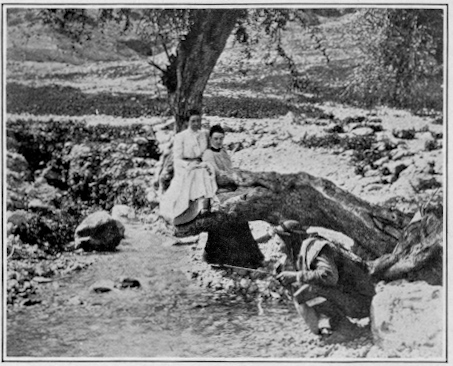
of water forming one of the few perennial brooks. In its
deeper pools the herdsmen water and wash their flocks.[9]
There is a very feeble attempt at gardening in the vicinity,
but for the most part the precious treasure flows away
unused. The valley sides show ancient masonry belonging
to more thrifty times. On the hill ‛Aṭâra, a mile south of
el-Bîreh, are ruined reservoirs to which the waters of the
spring now called ‛Ayn en-Nuṣbeh were carried by stone
21conduits, of which only small pieces remain. So may similar
indications be seen at ‛Ayn Ṣôba, at ‛Ayn Jeriyût, ‛Ayn
Kefrîyeh, all of which are west of Râm Allâh. Present-day
villages are often a considerable distance from the spring
on which they depend for drinking water. Many large
places are provided with but one spring. Nazareth and
Jerusalem are thus limited to one good spring each. Around
the Sea of Galilee and the Dead Sea are warm, even hot,
springs once much prized as watering-places. They are
generally sulphurous in character. Those at Tiberias, on the
Sea of Galilee, are used now as baths.
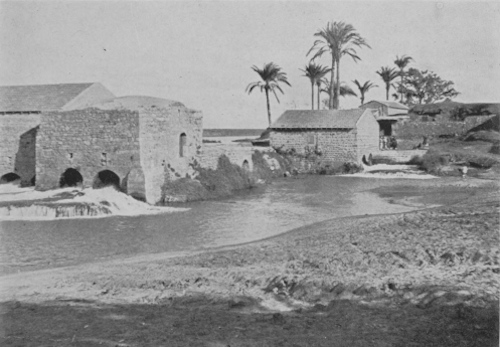
RIVER AUJA NORTH OF JAFFA
Of wells Palestine has but few. Some of those mentioned
in the Bible still remain, though not all are in use.[10] It
comes more naturally to the mind of an Oriental to devote
the labor and expense that it would take to dig a well to the
construction of something in which to catch a portion of the
rainfall. It is quite essential to the prosperity of Palestine
that its water resources be husbanded through the long dry
season.[11] As has been suggested, there is plenty of evidence
that formerly this was done in a very painstaking manner,
but at the present time far less care is given to this very
important matter. Numerous cisterns and reservoirs were
made to catch rain-water and the overflow of the fountains.
The large number of these ancient devices for saving water,
in contrast with the few made and used in these days, offers
one basis for a comparison of the condition of the country
in old and new Palestine. Rain-water was caught in
cemented pits not very unlike huge pear-shaped bottles.
Such water was used for all household purposes where
spring water failed; also for watering the animals. It was
drawn up as from a well. Occasionally these old cemented
cisterns are still in use. But all through the country there
are vast numbers of them that are no longer used. All
about Jerusalem, especially north of the city, among the
22olives, they may be seen; also about the district of Râm
Allâh, at Teḳû‛a and at Jânyeh.
The overflow of springs was provided for by more pretentious
structures,—the great rectangular box pools built
of solid masonry. The most noteworthy of these reservoirs
are the so-called Pools of Solomon, three in number, south
of Bethlehem, by the road that leads to Hebron. These
three immense reservoirs, each of which, when full, would
float a battleship, have a combined capacity of over forty
million gallons. Formerly stone aqueducts conveyed the
waters to Jerusalem. Remains of these are still to be seen.
The water is conveyed now through iron pipes, fully eight
miles, to the city. Jerusalem itself has the famous Pool of
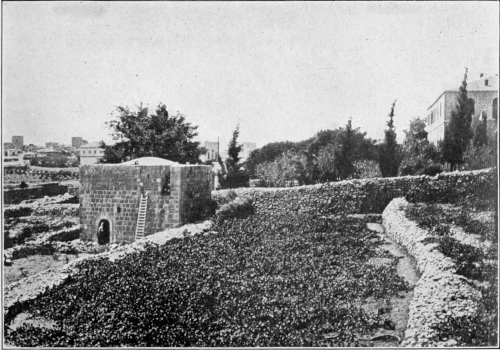
Siloam,[12] the Sultan’s Pool and the Pool of Mâmilla. The
last one mentioned feeds a large reservoir within the city
walls, sometimes called the Patriarch’s Pool and sometimes
Hezekiah’s Pool.[13] At Bethel (Baytîn) the spring is surrounded
by an old reservoir larger than the Pool of Mâmilla.
It is now dry and its bottom is used as a threshing-floor.
And so all about the country are found the remains of
costly works designed for the saving and proper use of the
water supply. With such means of irrigation the productiveness
of the country must have been much greater than
at the present day.
Sometimes, in speaking of the seasons in Palestine, we say
summer and winter,[14] and sometimes we mention the four
seasons. Perhaps if we should say wet season and dry
season it would be less misleading, but even then one would
have to bear in mind that the wet season is not a time of
general downpour but simply the season in which the rains
of the year come.
The wet season, or winter,[15] as it is more generally called,
ought to provide, for the welfare of the country, from twenty-five
to thirty inches of rainfall in the highlands. Sometimes
23it is as low as sixteen inches, and it occasionally exceeds
thirty-five or even forty inches. Roughly speaking, the
wet season claims the five months, November to March.
In a very wet winter, perhaps, the rains will reach over a
period of nearly six months, but, on the other hand, the
rainy period may shrink to four. The most frequent and
heavy falls of rain in an ordinary season are looked for near
the beginning and at the close of the wet season. Many
pleasant days,[16] and even some entire weeks of rainless
weather, may be expected during this wet season. Now and
then there may be a winter during which the water will be
glazed over in the puddles a few times, or there may be
several falls of snow.[17] Driving, raw, chilling rains and
winds may prevail for a week at a time, or longer, and be
less easy to bear than the stronger cold of a more northerly
climate.[18]
The dry season is more in keeping with its name throughout
its control of nearly seven months, although rain in May has
been experienced and a slip in one of the summer months
is not unknown. At the end of September or at the beginning
of October a slight shower is expected. One scarcely
expects rain, however, until well into November. Despite
the very hot days in the dry summer season, the nights in
the Palestine highlands are generally cool. The Syrian sun
is a synonym for piercing, intense heat, and foreigners are
more apt to be thoughtless of its power than to overdo
caution. During the midsummer months it is hard to take
photographs except very early or very late, or with very
slow-acting lenses and plates. Then, too, the poorest light
for distant views may be in summer, when the intense heat
fills the air with a haze. Those who have seen the dead,
brown look that comes on a district of country which has
suffered an unusual period of drought may partly imagine
the appearance of Palestine after a six months’ absence of
24rain unrelieved except for the night-mists that may prevail
during some of that time.
After the drought the peasant, like the country, is pantingly
ready for the first rains of the autumn. He never
hesitates to choose between rain and sunshine. It is always
the former. Even if rain comes in destructive abundance
he has only to think of the terrors of a scanty rainfall to
repress all complaints. As we say in a complimentary way
to a guest, “You have brought pleasant weather,” so the
Syrian will say, “Your foot is green,” that is, “Your coming
is accompanied by the benedictions of rain.” Rains usually
begin with an appearance of reluctance,[19] but sometime in
November or December they ought to come down heavily
for most of a fortnight. Sometimes there are several weeks
of delightfully balmy weather between the drenching rains.
During an unusually dry winter, when the rainfall is below
twenty inches, much of the winter will be pleasant, at the
expense of the crops and of the general welfare. At such
times the price of wheat goes up and the scantily supplied
cisterns give no promise of holding out through the succeeding
summer. Springs dry down until the best of them offer
but a tiny stream, and hours must be spent at some of the
fountains to fill a few jars. Much of January is apt to be
rainy. February is strange and fickle, and because it is
especially trying to the vital forces of the aged and weak is
called Old Woman’s Month. We remember a very pleasant
February, but such are rare. Honest March is pretty much
its boisterous self even in Palestine. April is sunny and a
charming month for a journey. If the latter rains have been
delayed they may come even in April, though that is late.
But the needed rain has been known to come as late as
middle May, with unusually cold weather. Then the peasants
deemed such weather portentous.[20] The latter rains—how
familiar a phrase to the ears of many who may not
25know just why they are so called![21] The downpour of
November or December washed out the ground, made the
heat flee, brought back health to the succulent plants,
hastened the ripening of the oranges and did pretty well for
the cisterns, but this latter rain is the key of the situation.
If it does not come, wheat may sell at famine prices and all
the pains of a drought take hold of the land.[22] But if it
only will come, then wealth and comfort and a healthy
summer.[23]
Harvest begins in the springtime. May brings the yellow
heads on the grain, and it must be gathered or soon the
summer will be ended and the harvest past.[24] The grain on
the hills is a few weeks later than that in the valleys and
plains. A little donkey coming in from the hill terraces
with a back-load of sheaves looks very porcupiny. The
reaper grasps the stalks of wheat or barley with one hand
and cuts a long straw with the sickle in the other hand. If
he is hungry he starts a little fire and holds some of the
wheat heads over it until well parched, and then, rubbing
off the husks between his palms, he has a feast of the new
corn of the land. Thus treated, new wheat is called frîky
(rubbed).
During the time of ripening wheat one may see in the
fields, close to the ground, the heavy green leaves and yellow,
shiny apples of the mandrake.[25] The natives say that if one
eats the seeds of the fruit they will make him crazy. The
pulp has a pleasant, sweetish flavor and an agreeable smell.[26]
The only dreadful wind in Palestine is the east wind,[27]
because it blows from the inland desert and brings excessive
heat. The Arabic word for east is sherḳ, and so for east wind
26the Arab says Sherḳ-îyeh. From this we get, by corruption,
our word sirocco (or sherokkoh), which has come to mean
simply a hot, enervating blast from any direction. To the
Arab it is that wearing east wind whose coming can be felt
in the early morning before a breath of air seems stirring.
There is a certain chemical effect on the nervous system of
those who are particularly sensitive to the blighting touch of
the Sherḳîyeh. Sometimes this wind goes away suddenly
after a short day, but almost always its coming means that
it will run three days at least, and often more. There is a
similar wind in Egypt known to residents of Cairo as the
Khumsûn (fifty), from the likelihood that it will remain
fifty days. Such an unbroken period of hot winds must be
exceedingly rare in Palestine, though in the early autumn
of 1902 there was an almost continuous Sherḳîyeh for five
weeks. The east wind of winter is usually as disagreeably
cold as its relative in summer is hot and suffocating. The
only good thing that I ever knew the summer sirocco to do
was to cure quickly the raisin grapes spread on the ground
in September.
The west wind prevails a generous share of the time and
brings mists and coolness from the sea during the summer.
In the rainy season a northwest wind brings rain.[28] The
showers are often presaged by high winds from the west
and north.
September, with its trying siroccos, is often hotter than
May. The pomegranates ripen in this month. In the
country districts it is very hard to get goats’ milk from this
time onward for several months. The flocks are too far
distant, having been driven away to find pasture and water,
and a little later on the milk is all needed for the young.
During these days, too, it is not thought good to weaken the
goats by milking them any more than is quite necessary.
In the cities milk is always to be had.
27The Greek Feast of the Cross, about the end of September,
is looked forward to as marking the date for an early shower
which may be sufficiently strong to cleanse the roofs. After
that the rain may come in a month, or it may wait two.
The people notice a period of general unhealthiness just preceding
the autumn rains. Their advent usually puts an end
to it, bringing healthier conditions. Sometime along in the
autumn there is often noticed a warm spell of weather which
the natives call Ṣayf Ṣaghîr, or Ṣayf Rummân, that is, Little
Summer, or Pomegranate Summer.
The cement in the paved roofs cracks under the fierce heat
of summer and the early showers help to discover the bad
places which must be patched before the heavy winter rains.
In the case of earth-covered roofs the first shower ought to
be followed by a good rolling, the owners going over and over
them with stone rollers rigged with wooden handles that
creak out upon the clear air after the rain as they work
in the sockets. From the peculiar noise thus made the
Râm Allâh people have a local name of zukzâkeh for the
wooden handles of these stone rollers. In the northern part
of the country the name nâ‛uṣ is given to the roller handles
for a similar reason. The roofs of rolled earth can be kept
very tight. The covering of such roofs is made by mixing
sandy soil with clay and with the finest grade of chaff, called
mûṣ, from the threshing-floor. On old earth roofs patches
of grass[29] grow, and even grain has been seen springing up in
such places.
The Syrian peasant divides trees into classes by pairs.
There are those that are good to sit under and those that are
not. Then there are those that yield food and those that do
not. Finally there are those that are holy, and therefore
cannot be cut for charcoal or fuel, and those that are not
thus tabooed.
The fig-tree is a very useful food producer and is much
28cultivated. As elsewhere mentioned, the irritating effect of
the juices of the broken fig branch or leaf makes it less
desirable as a shade tree, but because of its dense shade it
must be resorted to in hot weather. The olive-tree gives
rather a thin shade. The carob-tree is a fine shade-giver.
The pine is a favorite in this respect, though few pines are
left. The needly cypress shades only its own central mast.
One might as well snuggle up to one’s own shadow for protection
as to expect it from a cypress. Pomegranate, lemon
and orange-trees, when large enough, afford shade, but they
are often in low, miasmatic places. The apple-tree does not
do well except in parts of northern Syria, as at Zebedâny,
near Damascus. Some fine pear-trees are to be seen above
Bîr ez-Zayt, though as a rule they are as difficult to cultivate
as apple-trees. At ‛Ayn Sînyâ are flourishing mulberry-trees
of great size. The opinion is held that the mulberry and the
silk culture usually associated with it would thrive peculiarly
well in Palestine. Mount Tabor is thinly studded with trees
except on the southeast side. Mount Carmel also has yet
some remains of its one-time forest. The oak is found in a
number of varieties, but is a great temptation to the charcoal
burner, as it affords the most desirable coal. The zinzilakt
is a favorite for shade. The best substitute for a shade tree
in the land is a large rock, the cool side of which helps one
to forget the burning glare of the noon sun.[30]
We shall have to call winter the season of rain, flowers and
travel. Rain ushers in the winter and also closes it. To
the middle and latter part of that season is due the bursting
of the blossoms and a push that sends flowers scattering into
the first months of the dry season.[31] Travel might find a
better time than much of the winter, but then it is cool and
if it rains, why, that is the way of the country, and this
explanation often suffices.
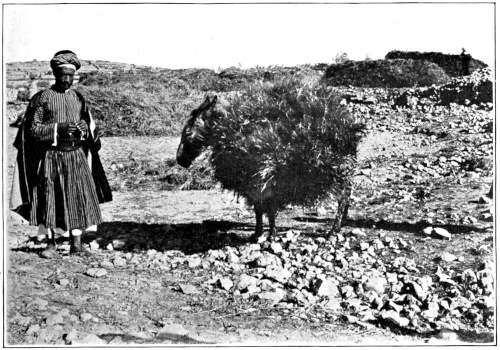
DONKEY AT THE THRESHING FLOOR WITH A LOAD OF WHEAT
On the flowers of the country Dr. Post’s book offers a
29mine of information for those skilled enough in the elements
of botany to make use of it. The little booklets of pressed
specimens offered for sale, when fresh, give an excellent idea
of the variety of wild-flower life in Palestine. Mrs. Hannah
Zeller, a daughter of former Bishop Gobat of Jerusalem, and
the wife of the late Rev. John Zeller of Nazareth and Jerusalem,
has been most successful in reproducing in color many
of the flowers of Palestine. Mrs. Zeller’s book of color plates,
published some years ago, is now hard to secure. She still
has the originals and an even larger collection which awaits
a publisher. Until some such publication in color is attempted
it will be difficult to describe in writing the unusual
splendor and variety of Palestine’s wild flowers.
The flower season really begins in what we should call
midautumn with the little lavender-colored crocus called by
the natives the serâj el-ghûleh or the lamp of the ghoul. A
better name for it would be serâj esh-shugâ‛ which would
mean the lamp of courage, as it thrusts its dainty head up
through the calcined earth, scarcely waiting for a drop of
moisture. After this brave little color-bearer of Flora’s
troop there follow the narcissus, heavily sweet, and the
cyclamen, clinging with its ample bulb in rocky cracks as
well as nestling in moist beds. But of all the flowers the
general favorite is the wild anemone, especially in its rarer
varieties, white, pink, salmon, blue and purple. The most
common is the red anemone, which is seen everywhere and
sometimes measures four or five inches across. Near Dayr
Dîwân we once rode through an orchard where the ground
was covered with a cloud of these red ones, so voluptuous, so
prodigally spread in a carpet of crimson beauty that one
almost held one’s breath at the charming scene. The red
ranunculus, which comes later, is almost as large, but it
looks thick and heavy in comparison, and the flaunting red
poppy, which comes still later, looks weak and characterless
beside the anemone. Even the wild red tulip suffers beside
30it. The colors of the anemone other than red are more rare,
but usually come earlier. About Jaffa they appear shortly
after Christmas. White ones and some of delicate shades
are found between there and the river ‛Aujâ. White ones
abound near Jifnâ, and are found east of Ḳubâb and east
of Sejed station. Purple, pink and blue ones are plentiful
in Wâdy el-Kelb and the Khullet el-‛Adas near Râm Allâh.
The large red ranunculus mentioned is found in large patches
between Jericho and the Dead Sea in early February. Considerably
later there is an acre-patch east of Dayr Dîwân
near the cliff descent towards eṭ-Ṭayyibeh. The red tulip is
rarer and follows soon. The red poppy is very abundant.
It has the delicacy of crêpe. It is scarcely welcome as it betokens
the close of the flower season. But one may for
some time yet gather flowers that blaze forth as brilliantly
in middle spring as do the autumn flowers in America: the
adonis, gorse, flax, mustard, bachelor’s button, anise, vetch,
everlasting, wild mignonette and geranium. In the vineyards,
about pruning time, the ground is covered with a rich
purple glow. The sweet-scented gorse abounds in the valleys
towards Ṭayyibeh. The vetches come in many colors, and
there are scores of other scarcely noticed little blossoms.
When the season has been especially rainy, as may occur
about every fifth or sixth year, the valleys such as ‛Ayn Fâra
will be knee-deep with the abundant flowering herbs and
weeds. The scented jasmine and the tall waving reeds over
the watercourse will add their charm to this favored spot.
Later, yellow thistles abound.
One of the oddities of the flower family is the black lily
of the calla order, which the natives call calf (leg) of the negro.
In the moist, shady caves, and sometimes in old cisterns,
masses of maidenhair fern grow in the cool shelter throughout
the year.
On the shores of Tiberias (Galilee) oleanders and blue
thistles are seen in May.
31In speaking of the wild animals of Palestine one is almost
led to include the dog and the cat. They are, however, on
the edge of domesticity and may fairly be omitted. Wolves,
hyenas, jackals and foxes are the troublesome wild beasts.
The last two are often about vineyards seeking to feed on
the grapes.[32] The jackal cry at night is very mournful and
sure to start up the barking of the dogs, who are themselves
often grape thieves.
The beautiful little gazels are started up in the wilderness
and go bounding off like thistle-down in a breeze, turning
every now and then, however, to look with wonder at the
traveler. Once, near eṭ-Ṭayyibeh we saw four together, and
once, east of Jeba‛, we saw a herd of nine gazels.
Among the smaller creatures met with are the mole-rat,
the big horny-headed lizard, called by the natives ḥirdhôn,
the ordinary lizard about the color of the gray-brown rocks
among which it speeds, the little green lizard that darts
about, and the pallid gecko, climbing on house-walls. The
beautiful and odd chameleon must also be mentioned.
Snakes are not commonly seen by the traveler. Scorpions,
black beetles, mosquitoes, fleas and a diabolical little sand-fly,
called by the natives ḥisḥis, are among the less agreeable
creatures noticed.
At Haifa, in the house of the Spanish vice-consul, we saw
the skin of a crocodile caught in the river Zerḳâ in 1902.
They spoke also of one which had been caught fourteen
years before in the same waters.
One of the showiest birds of Palestine is the stork, which
is mostly white, but has black wings, a red bill and red legs.
Its eyes, too, have a border of the latter color. The natives
call it abu sa‛d. Flocks of them may be seen frequently.
Now and then a solitary bird is seen in a wheat-field. Crows
with gray bodies and black wings are plentiful. Ravens,
vultures, hawks and sparrows are common. Twice I saw
32the capture of a sparrow by a hawk. Once, after having
started his victim from a flock, the hawk dashed after him
and caught him in a small tree but six feet from my head.
It was done with such terrific quickness as to surprise the
spectator out of all action. Gray owls (bûmeh), partridges
(shunnar), wild pigeons (ḥamâm) and quails (furri) are seen.
It seemed quite appropriate to see doves on the shores of
Galilee. On the surface of the same lake water-fowls were
observed. At Jericho we saw the robin redbreast; in the
gorge at Mâr Sâbâ, the grackle. Starlings in clouds haunt
the wheat-fields in harvest. Meadow-larks, crested, are very
common. Goldfinches, bulbuls, thrushes and wagtails are
also noticed.
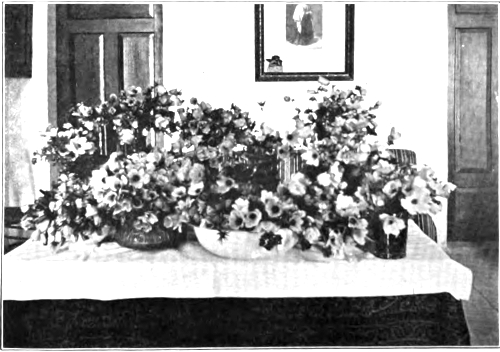
WILD ANEMONES FROM WADY EL-KELB
The scenery of Western Palestine lacks the charm that
woods and water provide. Yet one grows to like it. The
early and late parts of the day are best for the most pleasing
effects. Then the views out across the vineyards and off on
the hills are very restful. The rolling coast plain backed by
the distant hills of the Judean highlands makes a pleasing
prospect, especially when decked with the herbage that
follows the rains. Quiet tastes are satisfied with such
pastoral scenes as those in the valley at Lubban or in the
plain of Makhna. Excellent distant views are afforded from
the hills near Nazareth, from which are seen the rich plains
of Esdraelon, Haifa, Mount Carmel and the Mediterranean.
The Sea of Galilee is delightfully satisfying. From Tabor
one gets a glorious sight of Hermon, snow-white, whence the
natives call it Jebel esh-Shaykh (Old Man Mountain). The
views from Mount Carmel of sea and coast-line and much
of the interior, the glimpse of the Mediterranean from the
hill of Samaria and the sweeping prospect from Gerizim are
all good. An easily attained and little known view-point
is Jebel Ṭawîl (Long Mountain) east of el-Bîreh. From here
of a late afternoon the country lies open in sharp, clear lines
throughout the central region. Jerusalem is seen lying due
33south in beautiful silhouette; the Mount of Olives is a little
east of it. The Dead Sea is southeast, eṭ-Ṭayyibeh north
of east, Bethel (Baytîn) northeast, Gibeon southwest, near
which is Neby Samwîl. Near at hand, to the south, are
el-Bîreh and Râm Allâh. Only one thing is lacking in this
view; that is the Mediterranean Sea. But this can be seen,
as well as Jaffa, Ramleh and Ludd from Râm Allâh. The
mountain east of the Jordan is plainly visible from all the
high points up and down the middle of the country. Other
good view-points are Neby Samwîl, Jeba‛, Mukhmâs, the hills
about Jerusalem, especially from the tower on the Mount of
Olives and from Herodium. Heroic scenery may be found in
the so-called Samson Country through which the railroad
from Jaffa to Jerusalem runs, in the Mukhmâs Valley, the
Wâdy Ḳelt and gorges around Mâr Sâbâ. Crag, ravine,
precipice and cave make such places memorable.
The approach to cities and villages is as characteristic as
any other aspect of them. There is a look from afar peculiar
to the settlements of different countries. As seen from a
distance American settlements are chiefly noticeable for the
chimneys, the sharp spires of churches, the long, monotonous
lines of factory buildings and mills and often the pointed
shape of house roofs. Add to these enormous bridges, miles
of railroad yards and cars, a nimbus of smoke and you have
the elements from which to make a view of any good-sized
town. For the smaller, sweeter, country places you must
subtract some of the above features and substitute some
woodsy and meadowy effects. In Syria the contrasts with
our more familiar scenes are plain to us in the distant view
of its cities and villages. Instead of the triangular shape is
the square look of the buildings. Instead of chimneys and
spires are the huge domes resting on square substructures,
and the pencil-like minarets rising up among them. The
distant view of Jerusalem is one of the most pleasing in the
entire country. It has been one of the standard charms of
34Palestine, delighting warrior, poet and pilgrim, and more
lately student, missionary and tourist. There she sits with
her feet in deep valleys, her royal waist girdled with the
crenelated wall and her head crowned with the altar sites of
ancient time. There are about her the things that charm
the poetic sense,—age, chivalry, religion. Not even eternal
Rome can be so rich in these and so equally possessed of
them all.
Though it is not always the case, yet the greater number
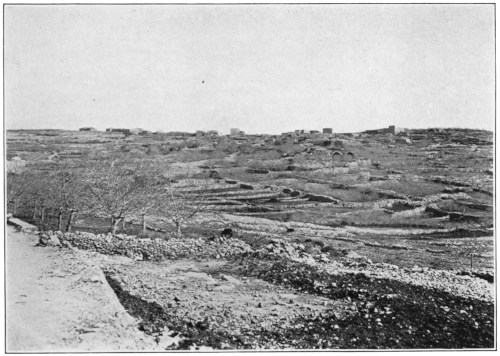
of Syrian cities and villages seek hilly sites.[33] The
ports cannot always do this, though Jaffa does. Damascus
spreads out over a low flat area. Ramleh and Ludd, being
plain dwellers, must live in lowlands. But defense is very
commonly sought by settling on the sides or top of a hill
and building the houses close together, if not one above
another, as if in steps.
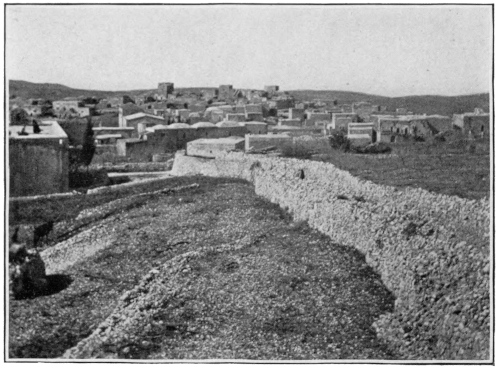
Garden plots and vineyards are fenced in with hastily-constructed
walls of the loose stone picked up on the inside.[34]
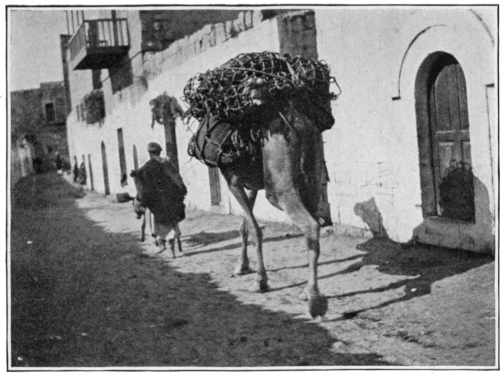
Between these curving walls run sinuous lanes[35] into the villages
from the paths and roads outside.
It would be very easy to make a pocket-edition of a book
of all the roads in the country, no matter how small the
pocket. Some roads are planned for, taxed for and looked
for a great many years before the semblance of road-making
begins. But never mind that; Orientals enjoy a road in
prospect and in retrospect much longer than in fact. Where
the government does put through a road it is usually good
traveling. The highlands afford the best of road-making
materials and, if often enough repaired, no better roads
could be asked for. Many carriageways are over favoring
bits of country where the frequent passing has marked out
the only road. The Romans were the greatest road-makers
in Palestine. The remains of their work may even now be
seen in various places. Many of their old roads are indicated
35on the best maps. Roman roads at this day of decay do not,
as a rule, offer easy travel. The washings of a millennium or
two of rain have made them of the corduroy order.
Of paths one may make as many as one pleases in a country
where no barbed wire and few walls prevent. The permanency
of the old well-worn paths[36] is very noticeable, the
best one always leading to a village or to a spring. There is
such a thing as the tyranny of the path. It is very evident
where railroads rule, and even in a country where the travel
must be on the backs of animals, the little bridle-paths impose
on one and, taking advantage of the inertia of human
mentality, mark out one’s way with arbitrary exclusiveness.
When one’s time is limited to just a sufficient number of
days to allow one to see all the more notable places in the
country, it is scarcely to be expected that one will sacrifice
the surety of seeing a noted place for the chance of stumbling
on a place of less popular interest. The paths and time required
for seeing most places are almost as clearly indicated
as any schedule of trips in countries possessed of time-tables.
This accounts for the fact that, although thousands of
travelers pass over the beaten paths, and scores of students
go over the rarer paths, not one in the twenty or the thousand
is likely to get off the paths.
One of the bits of country thus scantily known to foreigners
is northern Judea, especially to the northwest of Jerusalem.
Most travelers passing through it on the way to Jerusalem
are in haste to reach the city, and once there, the fact that
any place is a few hours farther distant than a day’s trip
would allow forbids easy investigation.
One does not have to go far to reach the wilderness.[37] It
is any uncultivated place. It is the pasture for flocks,[38] the
wild of rocks and short, thorny bushes. The thorns[39] are
gathered every other year to build fires in the lime-kilns,
where the abundant lime-rock of the country is burned.
36When the men gather them for the lime-kilns the thorns are
piled in great heaps with heavy stones on them to hold them
down. When needed the heap is pierced with a long pole
and carried over the shoulder as on a huge pitchfork. During
the late winter and in spring only may one see green
fields in anything like a Western sense. The Plain of el-Makhna
presents a very lovely prospect from the height
above it. Something like a small prairie effect is had in the
Maritime and Esdraelon plains. Pasture privilege is commonly
had anywhere if the land be not under actual cultivation.
In the uplands the custom of leaving great tracts idle
in alternate years[40] in lieu of dressing the ground permits
wide pasturage. As the dry season advances the herdsmen
seek the deep valleys with their flocks. There is little opportunity
for new trees or shrubs to survive this universal
browsing. So it comes about that, except where orchards
are set out or scraps of ancient woods remain, trees are
seldom seen.
A VINEYARD AT RÂM ALLÂH
Summer is the time of fierce heat, and yet through it all
the grape-vines keep green and the luscious clusters grow
larger and ripen under their heavy armor-plate of leaves.
The peasants enjoy the tart taste of green fruit. Half-grown
grapes are sometimes eaten with salt on them. Green almonds
are eaten in the same way. Often it is hard to get
ripe peaches, melons and other fruits because of the tendency
of the peasants to pick them before they are ripe. But the
time of the ripe grapes is the glad time of the year. Instead
of saying “August” the peasants often use the expression
“In grapes.” It is a season by itself to them. The vineyard
owners build summer booths among the vines and sleep there
through the season. In large vineyards it is common to
employ a black man, perhaps a Moroccan, as a watcher.
The Syrian peasant stands in peculiar awe of the black
stranger. The watchers are provided with shotguns, for
37foxes and dogs like to eat grapes. All fruit must be guarded
against thievishly disposed neighbors. One who knows his
vineyard watches the progress of the choicest clusters, having
covered some of them early to keep them from drying and
to allow them to develop unplucked. Should any grapes be
stolen he quickly notices the loss. He sets a thin row of
fine stones along the top of his wall in such a way that a
night marauder must necessarily rattle them down and thus
awaken him. One of the heartless bits of meanness that a
hostile peasant can perpetrate in order to pay a grudge is to
cut the vine stocks of his enemy’s vineyard. Since it takes
three years for a new vineyard to bear, such an act is a
serious damage.
The finest grapes within reach of Jerusalem are those from
Hebron and Râm Allâh. Large white clusters similar to
the Malaga grapes are the favorites, though purple grapes
are also grown. At Râm Allâh the vines lie flat on the
ground. The vine is pruned back to leave three joints on
every small branch that is spared in the rigorous treatment.[41]
At Jifnâ the vines may be seen trained on stakes. At
Zaḥleh, in the Lebanon, the growers have a way of propping
up the main vine a few inches above the ground, so that a
vineyard has the look of waves of green. In Jerusalem some
of the grapes at the Greek Hospital and at the White Fathers’
near St. Stephen’s Gate are raised on arbors, and the clusters
are covered with little bags. Thus protected the grapes
ripen slowly and are enjoyed until late in the season. Vast
quantities of fresh grapes are consumed as an article of daily
food during August, September and October. The price,
when cheap, is a cent a pound, and it gradually creeps up
to the fancy price of six cents a pound late in the season.
Grapes have been provided from the country vineyards as
late as the first of December.
Trees need considerable soil, but the grape-vine will thrive
38with very little and will penetrate with its rootlets all the
fissures of the lime-rock for yards about. Then, too, the
luscious bunches lying on a pebbled ground do better than
those on clear soil. Most of the grass and wild, weedy
growth of the country is bulbous and clings in scanty soil,
gathering as in a reservoir all the available moisture.
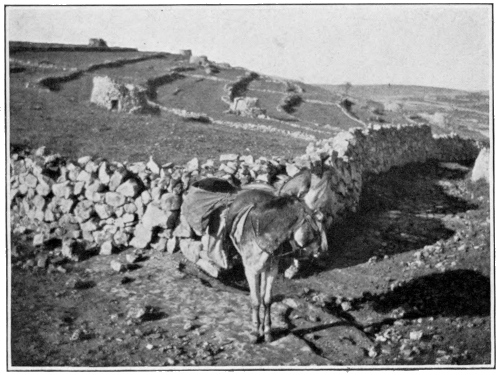
When the crop demands clear ground the native farmer
piles the stones into walls, watch-towers or a huge heap in
a less fertile spot of the field.[42] It is often a problem to find
room for the waste stones. They may be tossed out into
the roads and paths. A stranger says, “I don’t see why
these people don’t clear these paths of stone; surely it would
pay.” But the farmers prefer stones in the paths to stones
in the garden patch. With their bare feet, or on their
donkeys, they are able by a lifetime of practise to pick their
way over such paths. Moreover, peasants are not nervous
in Palestine. Stones always furnish a handy weapon,[43] or
a reminder on the heels of a slow donkey. In going about
through the country one often sees piles of little stones set
up one on another. Sometimes these little piles are meant
for scarecrows; sometimes they are used to mark a boundary;
but there is a wider and more constant use for such loosely
built little columns. They are set up in sight of holy spots.
Apparently they are not only set up in the vicinity of shrines,
wilys, etc., but also in places whence a distant view may be
had of some holy place, as Jerusalem, which the natives call
“el-Ḳuds esh-Sharîf” (The Noble Holy) or, for short, el-Ḳuds,
which is practically equivalent to our expression
“The Holy City.”[44] These little columnar piles may also
be met in sight of the hill or mount called Neby Samwîl,
which we usually identify with the Mizpeh of Samuel.[45]
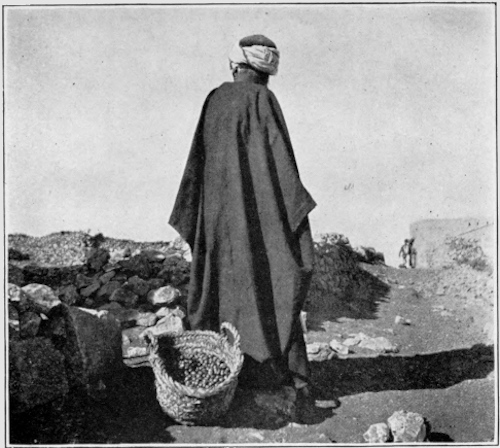
RÂM ALLÂH MAN AND A BASKET OF OLIVES
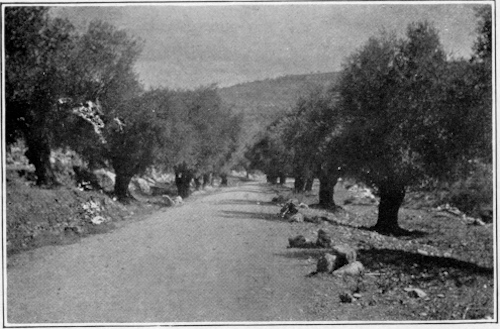
STRETCH OF OLIVE TREES ON ROAD TO AYN SÎNYÂ
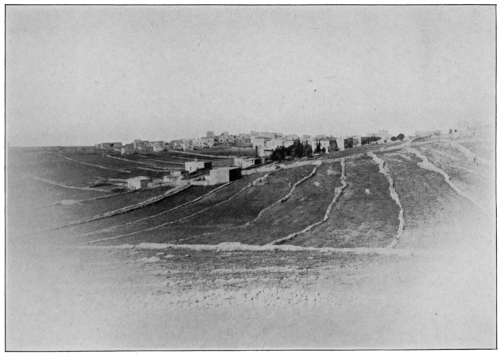
The terrace is a thing of great utility to the hill farmer of
Palestine. To the traveler it is a thing of beauty as it climbs
39the hills with its artistically irregular breaks in what would
be otherwise a rather monotonous slope. But with terraces
and some water the earth is caught and filled with
many possibilities of fruit and vegetables. A hill well
terraced and well watered looks like a hanging garden.
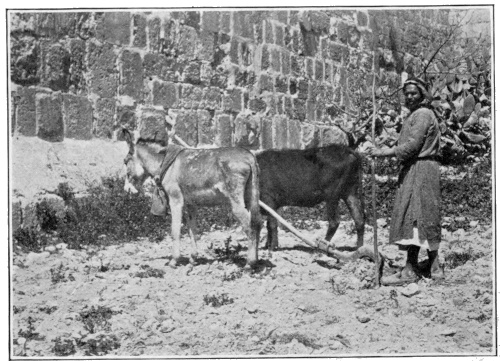
Much of the farming in Judea is on the sides of hills. The
little iron-shod wooden plow is run scratching along the
terraces. Sometimes one of the oxen will be on a lower level
than the other. To go forward without slipping down the
hillside is not easy. What cannot be plowed is dug up
with the pickax, and wheat or barley will find lodgment in
every pocket of soil. As all the reaping is done by hand it
offers no especial difficulty, and the monotony of which
some people complain on prairie land is never experienced
on such a pitched-roof farm. Even where the made terrace
is allowed to decay there are many natural terraces where
the horizontal layers outcrop from the hillsides. Were the
country well kept up, all these terraces would be guarded
artificially, for in time a natural terrace loses its protecting
edge and the soil and rain come down cascading over the
hill stairs until the bed of the stream is reached.
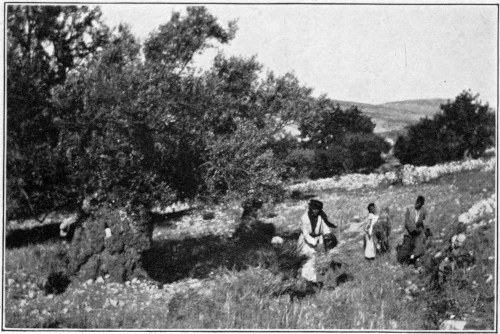
Of food trees the olive is probably the most valuable. It
takes ten or fifteen years to bring it to the state of bearing
much fruit, but it may go on bearing heavy crops for a
century. The oil is freely used in cooking, for salads, for
lighting and for anointing. A hard-pressed peasant will
occasionally yield to the temptation to cut down some of
his olive-trees, selling the finest pieces of wood to the makers
of the olive-wood articles[46] which are prized by tourists,
and disposing of the rest as fire-wood.[47] A hundredweight
of such fire-wood sells for from twelve to twenty-five cents,
according to the season and the market, the city price being
considerably higher than the country price. A good olive-orchard
is a sure source of income, unless the taxes are too
40harshly and arbitrarily imposed. The cutting them down is
a real calamity to the country, but it is done only too frequently
in a poor year to avoid taxes. The trunk of an aged
olive-tree attains a great girth and a gnarled, knobby look.
Sometimes a large part of one of these huge trunks will be
quite hollowed out by decay, in which case the peasants
often fill up the cavities with a core of stones. The tree goes
on bearing with chief dependence on the state of the bark
for its healthy condition. The heavy crops and light crops
follow each other in somewhat the same relation as the
apple crops in our New England country. Women and
children gather up those olive berries that fall to the ground
early in the season. Whenever it is desired to gather the
crop of a tree or orchard the men beat the branches with
very long light poles and the women and the children pick
up the fallen fruit from the ground. Of course this is a poor
way to gather the best olives, but inasmuch as the chief
use of the olive in Palestine is to express the oil, it makes
less difference. The berries do not ordinarily grow to the
larger sizes so often seen in our markets. Perhaps one of
the very handsomest stretches of olive-orchards in the East
is at what is called the Ṣaḥrâ, near Beirut, between that city
and Shwayfât. Other smaller but excellent orchards are to
be seen between Bethlehem and Bayt Jâlâ, at Mâr Elyâs,
Bîr ez-Zayt and to the south of eṭ-Ṭayyibeh.
The fig in Judea ripens in August and its fruit may be
had for several months, as new fruit keeps maturing. There
are several varieties of this valuable tree. A few ripe figs
are often found as early as June and are luxuries.[48] The
natives sometimes hasten the ripening of a few early figs
by touching the ends with honey. The natives declare that
the fig-tree will not thrive near houses but will become
wormy. The action of the milk of fig branches and leaves
on the tissues of the eyes, lips and mouth is very disagreeable,
41sometimes making them very sore. The eyes of children in
the fig season are often very repulsive. For this reason the
people prefer other shade, if obtainable, than that of fig-trees.
Most fig-trees are small, about the size of an ordinary
plum-tree, but the large green varieties may grow to a considerable
size. When small fig-trees have sent up two
pliable trunk-shoots these are usually twisted together to
strengthen each other. They look like a suggestion of that
ugly taste in architecture that delighted in twisted columns.
The appearance of the branches of a leafless fig-tree is not
unlike that of the horse-chestnut in winter time. Large
quantities of the black figs and some of the white figs are
dried in the orchards, being spread out on the ground under
the strong sun-rays.
The pomegranate-tree looks more like an unkempt shrub.
The beautiful red bell-like blossoms are very attractive.
Lemons and oranges grown for profit are often small trees.
The sour marmalade orange grows into a larger, statelier tree.
At Urṭâs, near Solomon’s Pools, the largest and most
beautifully colored apricots grow. Peaches, plums, quinces
and almonds are plentiful, and the cherry, mulberry and
walnut thrive.
Concerning trees about the shrines and wilys and all the
so-called sacred trees there will be a more appropriate place
to speak later on.
In a land where fruit grows and flourishes one may have
far less fruit than in some fruitless city in a colder climate
but favored with ample facilities for transportation. Right
here within a few miles of the finest orange groves in the
land, near the vineyards, under the olive and fig-trees, with
peaches, pomegranates, apricots and plums, we probably find
shorter seasons for each than is the case in some Anglo-Saxon
city of the middle temperatures. Here fruit will be
much cheaper while it lasts, and some fruits, which must be
found near the trees, if enjoyed at all, such as the fig, will
42be available nowhere else as here. The peach, plum, orange,
apricot and grape go to the London, Liverpool, New York,
Chicago and Boston markets from the place producing the
earliest crops, and the trains and steamships continue bringing
from various markets as the season shifts from one garden
spot to another. But right here, under this particular orange-tree
or by this grape-vine, we usually wait for the ripening of
the local crop, knowing that lack of carrying facilities forbids
us eating from a tree that yields earlier fruit some hundred
miles away, or from a tree that yields when our tree is bare.
And so while people who never saw an orange-tree may buy
oranges ten months in the year, we who have an orange-tree
in sight may have to be content with the orange season of
our district. But they will be cheap while they last. Fifty
cents is a very ordinary price for a hundred of the best
oranges, and one dollar a hundred is pretty dear.
The large raised map of Palestine in fibrous plaster, over
seven feet by four, published by the Palestine Exploration
Fund, London, and the smaller one help in the study of
the physical features of the country.
An excellent small Relief Map of Palestine is edited by
Ernest D. Burton and published by the Atlas Relief Map
Co., Chicago.
READING LIST
Wilson, C. T.: “Peasant Life in the Holy Land.” (Dutton.)
The population of Palestine is divided into three parts,
desert, village and city. The desert population is the
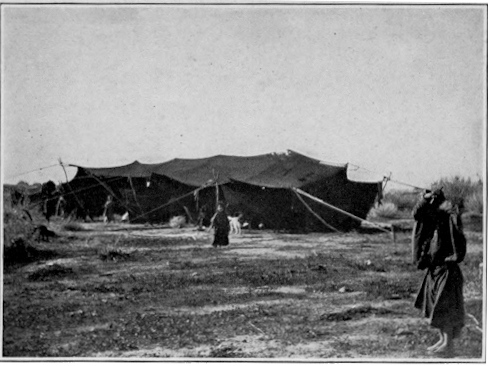
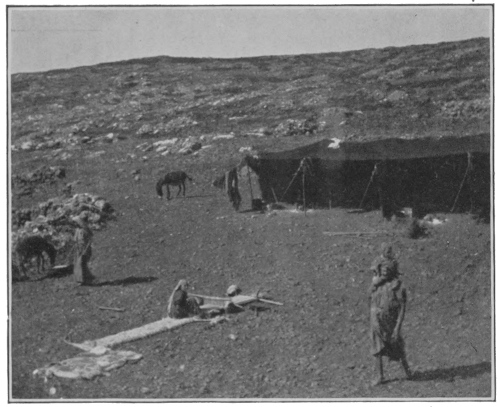
original Arab stock of pastoral nomads.[49] The village population
is the agricultural society of the country, and the cities
are the meeting places of these two with the population of
other countries. The Bedawy population of the desert is the
subject of much praise on the part of all writers. All who
speak of the Bedawîn use a certain tone of respect, even
though occasion is taken to poke fun at them for their rude
ways as viewed by the dwellers in towns. The religion of
the Bedawîn is a simplified Islâm, or, as it may perhaps be
styled, a Moslemized simplicity. The encampment and the
march, herding and the raid, mark the features of a roving
life over some thousands of square miles of wild land. The
different tribes have their general boundaries in the great
Syrian and Arabian deserts in about the same way that the
North American Indian once kept within certain regions of
the continent according to nations.
The cities and villages of Palestine, so far as appearance
is concerned, vary in size merely. The houses of a small
village are oftentimes just as closely packed as the buildings
in a city, so that a village will look like a fragment knocked
off a city. With us Westerners a village may have as much
land area as some cities, only the dwellings will be far apart,
the difference being in comparative density as well as in
size. In Palestine the density is about the same and the
difference is in the area. This compactness of the village
became a fashion in times of insecurity, when feuds between
44villages led to raids and reprisals. The village was built as
solidly as possible on rising ground. In the middle of the
core of original houses was the chief’s house, with a lofty
roof from which watch could be kept of all the surrounding
country and approaches.[50] If you wish to trace the growth
of a village, inquire for the burj, and probably you will be
directed to the highest spot in the village, at least to the
highest house, around which the early village clustered. If
this be on top of a hill, as is frequently the case, the growing
village creeps down the slopes, the roof of one house being
the dooryard of the house above it, until the effect of a
pyramidal structure of children’s building-blocks results.
In troublesome times a watcher on the burj of the village
could warn his fellows working in the outlying fields of the
approach of an enemy by the firing of a musket or by a
shrill cry. All fled to the nest on the height, and a successful
attack was difficult against the heavy stone houses and
narrow lanes of the village.
Just as among the cities there are those mostly or altogether
Moslem and others mostly or altogether Christian,
so with the villages. While the Moslem population greatly
outnumbers the Christian, yet there is a very considerable
Christian population. Râm Allâh, Bayt Jâlâ, eṭ-Ṭayyibeh
and Jifnâ are Christian villages. In Bîr ez-Zayt, ‛Ayn ‛Arîk
and ‛Âbûd the Christians exceed the Moslems. In el-Bîreh and
Ludd the Christians are comparatively few. A Christian village
is known from afar by its more prosperous look, and
the Christian quarters of a mixed village are also distinguishable
by the same favorable marks.
PEASANTS ON WAY TO MARKET WITH PRODUCE
BEDAWÎN HORSEMAN
Christian villages have powerful ecclesiastical establishments
behind them which work energetically to secure rights
for their constituents. Church life in the country is political
life, and church dignitaries are adepts in politics. The
wealth and cleverness of the church are employed to hold
45fast all traditions and all concessions which favor the Communion
and to hinder excessive injustice from overtaking
the members. There results a firm bond of union between
the native membership and the ecclesiastical establishment.
The Communion is a religious nation, as it were.
The Christian native is not subject to army service, as
only Moslems are thus eligible. This disability works to the
industrial advantage of the Christians, who pay an extra tax
or tribute in lieu of service. Centuries of this condition of
things have developed the industrial abilities of the Christian
population in spite of discriminations against them in the
courts and in administration. A kind of religious status is
now recognized in the relations between the Moslem and the
Christian peasants. The Moslem stands hard by his faith
and the Christian of the Greek Orthodox Church will scorn
the thought that Christ and the Bible may be for Moslems.
Religious sects in the East remind one of volcanic islands;
they are either ablaze with the fierce fires of an eruption or
else they are overlaid with the ashes of an extinct fire.
Between crazy fanaticism and cold inanition there are no
warm impulses of unselfish evangelism.
The Semitic peasant has always been a conservative. In
many ways he is to-day much like what the Canaanite occupier
of the land must have been. Each wave of conquest
or shower of civilization has left its effect, but underneath
the Palestine peasant is a primitive Semite. Until within a
few score years religion of one sort or another has usually
come to him at the point of the sword. He has often adopted
the veneer of a new faith in order to escape death. So it was
when Joshua and the Hebrew host swept into the land,
Bedawy fashion; so when Maccabean, Roman, Moslem,
Crusader, and Moslem again took control. The Palestine
peasant has worshiped the Baalim, Yahweh, Moloch, the
God of Israel, the Son of God, the God of Islâm. All the
time he has kept a certain core of Semitic custom and
46superstition, a sort of basic religion that has been much the
same all through these changes. But it is ofttimes impossible
to distinguish between a survival of the old and a reversion
or degeneration.
The native Christian is a shrewd business man. He is
courteous even to self-effacement. He can work hard, bargain
shrewdly, save much, take disappointment and persist.
He loves his family dearly. He is humorous, philosophic, a
voluble fellow, non-secretive. He respects the Western style
of education, largely perhaps because it seems to lift people
into an easy life. Ease and grace are Eastern ideals of
superiority.
If the Moslem and the Christian could be put on the same
political footing and justice done to each impartially in court
practise and taxation, I firmly believe that they would draw
together, that Palestine would in time be a country with a
people and that it would be well equipped from among its
own with men of ability, competent to do its political and
social work.
In general it may be said that where the Palestine peasant
has not come into relationship with the tourist business in
any form, and where he is some little distance from any city,
he is naturally simple in his tastes and requirements, interested
in novelty, sociable, hospitable, fun-loving, hard-working,
though not steady in effort.
A lone walker on the road will often sing. Whistling is
almost unknown. Peasants make a twenty-mile journey on
foot with considerable ease, and half that distance is done
very commonly. Distances are always reckoned by them
in hours or days, never in miles. They often walk behind
their laden animals. Sometimes it is a donkey, bearing the
plow and seed-bag or loaded with fagots, grain, sheaves,
dried figs or grapes, according to the season. Or it may be
a camel similarly laded or carrying stone; or a mule. Seldom
are horses used, except by a village shaykh or a city official
47on the highway. When groups of peasants are on the road
there is much talk, often laughter, horse-play, joking, chaffing;
sometimes bickering and quarreling.
The peasant stands in awe of learning, especially of learning
in the Arabic language. He is sensitive to ridicule, and
therefore loath to make such a change in customs as would
bring it on him. He is eager in discussion, inquisitive,
strong in memory and at imitating, but slow to adopt strange
ways not tested by the conditions of life to which he is accustomed.
You seldom or never find him nervous, fretful or
discontented. He never questions the wisdom of Providence.
He seldom mentions weather probabilities. He, like
his Old Testament countryman, refers all things to a First
Cause. Divine cause or permission is prominent in his
explanation of any phenomena.
The personal appearance of the villagers and the look of
their houses vary with the country level at which they live.
In the plains and lowlands, where thatch and earth are more
commonly used in building, there is a population noticeably
different from the dwellers in the stone villages in the highlands.
The inhabitants lower down are darker and smaller
than the hill villagers. These latter are often of good size
and development and, especially among the Christians, are
frequently of lighter color. It is not very uncommon to see
sandy complexions among them.[51] The women and girls in
the best villages are often handsome. The men are lithe of
body and finely formed. Both men and women are usually
supple, slow-motioned, strong. They have dark, expressive
eyes, neutral mouths, medium foreheads, heavy features
with curving lines, browned skins and black hair. Fair
complexions are admired, especially the so-called wheat-colored
complexion (ḳumḥeh). Eyes are distinguished by the
epithets ‛asaliyeh (honey-colored), koḥli (kohl-colored), ghuz-laniyeh
(gazel-like) and so on.
48Different villages and their inhabitants get reputations for
doing one or another kind of work especially well. Or they
are distinguished according to disposition, as harsh and
fanatical, or as courteous and reasonable. Some villages get
a name for dulness and others for sharpness. The villagers
are known about the country by slight variation in dress, by
differing casts of countenance and peculiarities of speech.[52]
We must not magnify too much the differences between
civilizations and peoples, or between this people of whom
we speak and our own people. The difference is often but
quantitative. They emphasize some qualities which we
possess, though in quieter color or in less distinctive marking.
Oftentimes the differences would not be apparent except
that, as we have passed rapidly from place to place, our eyes
have synchronized phenomena of different stages of culture.
We see really among these strangers many practises and
notions of our own distant forebears.
WOMAN’S WORK 1. At the Cistern. 2. In the Market. 3. Bringing Brush.
Western people are so in the habit of pitying all the women
of Asia that they will probably go on doing so until the end
of time in spite of the facts. To our Western idea woman in
the East is a pitiable, miserable abstraction. The Turkish
harem, the Indian child-widow and the deformed Chinese
foot stand for all Asia to many of us. There is probably a
large, free area of life open to thousands of the women of
Asia that does not seem cramped by comparison with the
total civilization of which they are a part. The Bedawy
woman would not change places with any of us, and the
village peasant woman of Palestine enjoys life fully as well
as the male villagers. She is not supposed to enter the field
marked out by custom for male members of society, nor will
the field she occupies be intruded upon by them. She shares
with the man a preference for male children. Her position
in this regard is only an exaggeration of the condition that
prevails in all modern society. She, like her brothers and
49sisters the world over, is influenced by customs to which she
yields obedience a little more gracefully than do many of
us. She goes about her work cheerfully if she is well. Too
often she is not well, and in a few years drudging toil and
frequent childbearing age her. Like her sisters in other
countries, she is sometimes tidy and sometimes not. She
loves her children. Whether she loves her husband or not
is not easy to discover, but she pays him proper respect and,
if kind, she probably cherishes real esteem for him. The
marriage was probably not of her choosing, and very likely
not of his. Marriage is a state entered into dutifully by all
sons and daughters. It builds the tribe or great family
which is at bottom the object of a Syrian’s greatest devotion
next to himself, and often before himself.
If you awake in the early hours of morning you will hear
the monotonous rumble of the stone mills, telling that the
day’s work for the women has begun. When the spring is
very small or low, and it takes a long time to fill a jar, the
women and young girls will sometimes go out before it is
light to get the first turn at the trickling stream. Long
journeys are made into the waste places to secure headloads
of brush or grass-fodder. A woman usually wears a dark
blue crash dress while at work. Her legs and feet are bare;
perhaps she carries a rough pair of shoes such as the men
wear, but they are for the briers and stones outside the
village. Should she put them on within the village the
other women would laugh at her and call her proud or
citified.
Unmarried women are very scarce among the peasantry.
Marriage usually comes at an early age for girls. One of the
owners of a house that we had to hire for the work of the
new boys’ training school had as wife such a mere slip of a
girl that we were curious to know her age. She couldn’t tell
us how old she was, but said that she had been married five
years. A companion with her ventured the guess that her
50age was thirteen years. The little wife seemed happy and
was the only peasant wife I ever saw receiving any affectionate
attentions from her husband. She was a pretty girl
and seemed to be a pet in the family. She had her own
little ways of enjoying her little life. One day, when some
much poorer women from el-Bîreh were toiling on the house
which her husband’s family was building, bringing stone and
mortar on their heads, Mrs. Thirteen-years put on her best
dress of blue with some Bethlehem needlework on the breast,
adorned her fingers with the rings of cheap nickel and glass,
commonly worn, and taking a piece of embroidery, stood
thus, plying her needle genteelly, where the other women
were toiling at their severer task. Many were the glances
they threw at her, but when they looked her eyes were on
her handiwork.
Several statements on page 45f., especially the one on
army service, need modification now. See Chapter XII.
The classical work in English on the modern life of the
Bedawin is Charles M. Doughty’s Arabia Deserta which
has recently come out in a new and expensive edition.
When our sons shall be as plants grown up in their youth,
And our daughters as corner-stones hewn after the fashion of a palace;
When our garners are full, affording all manner of store,
And our sheep bring forth thousands and ten thousands in our fields;
When our oxen are well laden;
When there is no breaking in, and no going forth,
And no outcry in our streets:
Happy is the people that is in such a case;
Yea, happy is the people whose God is Jehovah.
Psalm 144: 12–15.
The above bit of ancient expression would describe the
ideal of happiness of a village people in Palestine to-day.
In a village there may be few or many tribes. In a village
tribe there may be scores of families. The tribe is a great
family and goes by the Arabic name Dâr (court or house).
In el-Bîreh, for instance, there are four tribes among its
eight hundred Moslems and one tribe of Christians numbering
less than a hundred. The Moslem tribes are Dâr Ṭawîl,
Dâr Ḳurân, Dâr Hamayil and Dâr ‛Abid. The Christian
tribe goes by the name Rafîdya, because originally the members
came from a village of that name, near Nâblus. Dâr
Ṭawîl is by far the most influential and supplies two of the
three shaykhs of the village recognized by the general government.
The other shaykh comes from Dâr Ḳurân. These
three shaykhs are the intermediaries between the general
government and the village. Sometimes the tribe will become
so large as to have subordinate divisions within it.
In Râm Allâh there are five original tribes, the Ḥadadeh, the
Dâr Ibrahîm, the Dâr Jurjus, the Ḥasâsineh and the Shaḳara.
But the tribe of Ḥadadeh is nearly the equal in numbers of
52the other four, and has been divided into four sub-tribes, the
Sharaḳa, the Dâr Awâd, the Dâr Yûsuf and the Dâr Abu
Jaghab. The result is that there are practically eight tribes
in the village. The four branches of the Ḥadadeh feel a
kinship and importance from their common source and
present size. The other four tribes go by the common
designation of the Hamayil.
Birth is the usual mode of entering a tribe, but outsiders
are sometimes admitted. A man from another part of
Syria had occasion to live in one of the large Christian villages
of Palestine and wished to be counted as a citizen
there. He decided to join a certain tribe in that village.
As much as he was permitted, he fellowshippedfellowshipped with that
tribe, went to their guest-house occasionally and contributed
to expenses by sharing in their provision of food for visiting
strangers and soldiers. He then had the government at
Jerusalem change his kushan or paper of residence and
citizenship so that it should now declare him a resident of
such and such a village. When he had spoken to the elders
of the tribe that he sought to join, and they in turn to the
members of the tribe, he was admitted to membership with
them by common consent. Thenceforth he paid his military
tribute through the chief men of this tribe. The elders
mentioned are the heads of families and are called the
ukhtiyarîyeh. They are the tribal chiefs and representatives.
Ordinarily friendship is confined to this tribal relationship,
and marriage is usually restricted to its limits. As an
Arabic proverb expresses it, “I am against my cousin, but
my cousin and I are against the world.” People outside
this tribal family are strangers and possible foes.[53] If, contrary
to what they expect of outsiders, we should show ourselves
kindly disposed to them by continual helpful acts,
very likely they might set up a hypothetical relationship
53between themselves and us, at least in conversation, in order
to gloss over the anomaly.
Closer yet is the relationship within the immediate family.
As long as the size of the family permits, it occupies the one
house, or extensions of it, but if it is prosperous and growing,
new households are set up and by such a process the tribe
develops. Where friendship is practically confined to the
family and tribe the importance of family membership and
numerous family connections will be appreciated.[54] The
larger and more influential one’s family, the more secure are
its fortunes.[55] And influence depends on the number of the
men.
A Moslem was killed and it was several months before his
slayers were detected and brought to punishment. The
family of the deceased was large and worked together to
ferret out the secret. A smaller family might never have
been able to accomplish the object. Outsiders or the government
would have made no such persistent effort.[56]
Marriages in the country are usually with some kindred
family.[57] Marrying outside one’s tribe is comparatively
rare. Marriage is the one important subject among parents
of boys and girls. Girls are sometimes married as early as
seven years. They are betrothed at much tenderer ages.
A mother brought a little child in arms to one of the village
day-schools and urged its acceptance, doubtless to have
relief from the care of it for a part of the day. The child
was a girl, and the teacher of the girls’ school refused to take
her, exclaiming, “Why, she’s a mere baby. We cannot
teach her to read now.” The mother argued and finally
said, “If you don’t take her now she will be betrothed
soon.” The introduction of school privileges into the
country, for girls as well as for boys, has resulted, in many
cases, in lengthening the childhood of those who otherwise
54would have been betrothed and married early in life. Parents
are generally unwilling to allow a younger daughter to
be married before an elder daughter.[58]
A marriage settlement in money is expected from the
bridegroom and paid to the father of the bride. Parents
often attempt to avoid cash payments by an exchange of
brothers and sisters. A family with a boy and a girl make
overtures to an eligible family having a girl and a boy, and
the young people are paired off at more advantageous terms
all round than would be the case if the families were strangers,
that is, if they were out of tribal relations with each other.
Sometimes, of course, this matter of exchange causes people
of very different ages to be joined, but then the years heal
that, and the theory is that if the bride is considerably
younger than the groom the husband as he comes to old
age will have a comparatively strong and able housekeeper
and caretaker in his wife.
The usual wedding payment to the father of the bride
is about two hundred twenty-five dollars in this village.
From this sum the father may make his daughter
such presents as he pleases of jewels and head-coins.
The wedding costume of the bride is the gift of the groom’s
family.
Where a widowed woman is remarried, the marriage portion
paid her father is less than in the case of a first marriage,
and she is apt to receive a larger share of it in presents from
her father, since she cannot, in this case, be made to marry
except by her own consent.
To get the business of marriage settled at the earliest date
and in the most advantageous way possible is the aim of
guardians and parents. The wife will have done her part
well if she bears children, mostly boys,[59] sees that no unnecessary
losses of money or food occur in the house and holds
her tongue. If she fails in any of these points she may dim
55the felicities of the married state, that is, of her husband
and his father and brothers.
BRINGING HOME THE BRIDAL TROUSSEAU
GIRLS AT PLAY. CARRYING HEADLOADS OF GRASS IN IMITATION OF THE WOMEN
There are three occasions preceding the actual marriage of
the man and woman on which public celebration is made.
The first is the engagement. This is arranged between the
fathers of the young people. The initiative is taken by the
father of the young man working through friends, who approach
the father of the girl and make a proposition of
betrothal. If all is favorable the bargain may be bound
by money paid to the father of the young woman. A
betrothal party is arranged for friends of both the contracting
young people at the home of the prospective bride. The
young man prepares a feast for the invited guests, a sheep
is killed, a priest may be present and the betrothal made
public. The agreement is but a little less strong than the
marriage contract itself.[60] The second public manifestation
is the purchase by the groom of the marriage outfit of garments,
including the bridal trousseau, and the procession that
carries the articles home. The bridegroom’s party goes to
some large near-by village or the nearest city for these purchases.
One day we were apprised of such a trousseau
party by shouting and the firing of arms, and later a procession
of women went by on their way to their own village,
carrying with them the bundle of wedding garments. One
of their village chiefs was with them. At another time a
group returning from Jerusalem on a similar errand was met
by a crowd of women on the outskirts of the village and
accompanied into it with singing and dancing. This time
the women had a stick dressed up with the bridal costume.
There was the red striped dress and gay jacket on a cross-stick
frame to hold out the sleeves. There were also a
girdle, the heavy coin head-dress and three small mirrors,
one on each arm and one on the breast. The Bethlehem
costume is very commonly used for gala occasions by people
56of other sections, as it is one of the showiest costumes of
the country. The bridegroom is expected to provide wedding
garments for relatives of the bride, though they in
turn may be expected to return a wedding gift of equal
value to him. The third celebration may last two or
three days. Towards the close of it the wedding itself
takes place.
We went one Saturday evening to see the jollification that
preceded a wedding to be solemnized the next day. Outside
the house of the groom there were two lines of young men,
their number varying from forty to sixty as they shifted
places, some dropping out and others falling into line from
time to time. These two lines were facing each other and a
bright brush fire was blazing in the middle. As more men
crowded in to participate a line was formed at one end, thus
making a third side of a parallelogram. The men on either
side were singing back and forth to each other, in antiphonal
fashion, while they kept up a sort of swaying dance in line
called the mil‛ab. By pressing their shoulders, neighbor to
neighbor, the line moved as one mass. The left foot was
made the base of movement for each singer. The right foot
was swayed and then lifted high and forward until the whole
body swung forward in a sweeping bow or duck. The hands
were also keeping time, rubbing up and down the forearms
from the elbows to the finger-tips, the head meanwhile swaying
from side to side, all to the native peasant singing of the
same simple tune over and over again. Certain fixed verses
were made the basis and were finished out with impromptu
verses for the occasion. Some of these were, “We are glad
to see your faces.” “We have come to you; if it were not
for love we should not be here.” “Love is sweet.” “We
hope for good large dishes.” “Did you see any Bedawîn
coming up from the East?” “Such and such (naming
them) villages will help you against the enemy.” “Fear
not, delicate young women, our young men will protect you,”
57and so on, passing compliments, singing the praises of love
and acknowledging its power in bringing them together, or
mingling snatches of war sentiment, anticipation of generous
servings of the wedding-feast and assurances of alliance,
friendship, defense and security in the strength and equipment
of their young men. The bridegroom mingled joyfully
with the others, sometimes performing in the line and
sometimes replenishing the brush fire. All around, on the
roofs of the neighboring houses, in the darkness that was
black by contrast with the brilliant fire, the women of the
tribe were seated. Every now and then, at any seeming lull
in the excitement, some woman would set up the peculiar
trilling cry called the zaghârût or zaghârît, at which the men
would fairly leap into a renewal of the dance and song.
Pistols and muskets were shot off occasionally. Although
this was all taking place in a Christian village, a good
number of Moslem youths from a neighboring village came
over to join in the fun. They had brought two sheep which
had been slaughtered and were now simmering in immense
kettles for a feast. The father of the groom acted as an
overseer of the gayeties and was trying, apparently, to curb
the zeal of those who had firearms to discharge.
On the wedding-day in a Christian village the bride and
groom with their attendant friends form two parties and
approach the church from different quarters. If obtainable,
horses are provided for the bride and groom to ride on and
she is completely covered over with a mantle,[61] a feather being
stuck in the top of it over her head. Inside the church the
bridal party, consisting of groom, bride, best man, bridesmaid,
the mothers and some other relatives, stand in the
middle of the church facing the altar. The groom stands at
the bride’s right hand; she is heavily veiled. Guests and
spectators, in the case of the wedding mentioned above,
filled the church on either side of the bridal party and a large
58concourse filled the yard outside. Four priests and a censer
boy entered the church. Tapers were provided for those
guests nearest the young people, while candles were given to
the bride and groom. These were lighted. The censer was
swung. The ritual, hymns and Scripture were read or intoned,
partly in Arabic and partly in Greek. The head
priest, who was a Greek by blood, read the Greek portions,
while his assistants, natives of the village, read the Arabic
parts. Rings which had been touched on the head and lips
of bride and groom were placed on their hands and afterwards
changed about. Wreaths of artificial flowers were
placed on their heads. The book to which most respect had
been shown, the Bible, was brought down between them,
dividing their joined fingers. Then, headed by the priests,
the bridal party marched around in a circling course with all
the attendant relatives. Some old women, following closely
behind the bride and groom, caught at their robes and, joining
them, went through the motions of sewing them with
threadless needles. After this the final pronouncement was
made by the head priest and the ceremony was over. Immediately
the best man grabbed the groom in a sort of
ecstasy of congratulation and lifted him into the air twice, and
would have done so a third time had not the priest interfered,
probably thinking that these demonstrations were out
of place in the church. A gun was fired outside the church
as soon as it was known that the ceremony was complete.
After some hearty felicitations the party moved off in
procession with priests and guests.
WASHING A CHILD
A SWADDLED INFANT
The groom, with the men, went to the guest-room[62] of
the tribe, where they enjoyed conversation, coffee and cigarettes.
The bride and her party of women went to the home
of the groom. As she was about to enter the house a water-jar
was placed on her head and her hand was assisted to
plaster a piece of bread-dough on the jamb of the doorway.
59These signs were in token of good housewifely qualities.
After the bride had been seated for some time inside the
house her women friends were granted their entreaty and she
allowed them to uncover her face. Then she consented to
exhibit her jewelry,[63] silver bracelets, bangles, head-coins,
ear-jewels, etc. She seemed very sad, as is expected when
a young girl leaves her mother, and quite exhausted. Her
hands and nails were stained with ḥennâ. It is said that the
hands, wrists and lower limbs are always stained thus on the
night before the wedding. Outside the house five kettles
filled with mutton were set on stones over wood fires. They
were seething and bubbling, getting into readiness for the
wedding-feast in the evening.[64]
At the guest-house assembly, where the groom and his
men friends are gathered, some one calls out the names of
those who have given money presents to the bridegroom and
the amount in each case.
If there are reasons for a less public wedding celebration
than usual, the ceremony is performed on a week-day. Such
is the case when some near relative has died recently, where
haste is desired, or where the man or the woman has been
married previously.
One Sunday we saw a double wedding celebration. But
one was in the Greek Orthodox Church and the other was in
the United Greek Church, which is papal in allegiance. The
contracting families were so closely related as to allow of but
one of the marriages planned between them, according to
Greek Church law. But as each family had a son and
daughter to marry off to the daughter and son of the other
family and considered their own interests in the matter as
of more importance than church law, one bridal party was
sent to one church and one to the other.
The party of one of the bridegrooms was provided with
sword dancers, and as they reached any open place of sufficient
60size, as at the street corners, a space was cleared and a
dancer with a short curved sword in one hand and a waving
cloth in the other, went through the graceful movements,
leaping and crouching.
AN INTRODUCTION TO A WEDDING-SONG
This bride is clothed with silk from Damascus:
Her hair is perfumed sweetly.
When the bridegroom goes to greet her,
Goes to press on her forehead the golden coin,[65]
Let the bridegroom sit on the cushion with his dear one.
O pair of gazels, how you are marked with ḥennâ!
May you two rejoice each other.
By marriage the wife becomes a member of her husband’s
family. She assists her mother-in-law in the household
duties. One of the reasons given for some of the very early
marriages is that the young woman may be trained into a
suitable wife for the son by his mother.
It is counted an affliction[75] if the new wife is not a mother
in due time, and it is a joyous occasion when a male child is
born. There are many parents who love their girl babies
tenderly, but they are almost sure to be partial to boys, and
the majority of parents are greatly disappointed if boys do
not make up the larger part of the children.
One day I stumbled into a house where an anomalous condition
of things existed for a Christian village. On coming
away I learned that the man was a bigamist. He was
reputed to have become rich through thieving, and his fine
house was childless. What did he do but bring home another
wife! The laws of his country were not against such
a practise, but the law of his church, with the sentiment and
practise of his fellow villagers, was sternly against it. He
defied all, even though he was cut off from communion. He
became an object of reproach and abhorrence to the pious
64and the superstitious of the whole village, who looked for
terrible consequences. A long time afterwards, some mention
of this man having occurred in conversation, I learned
that he was without any children by his second wife also,
and that his childlessness was considered by the villagers as
a token of the wrath of God. Although rich, his lot was
considered miserable by the neighbors. He was said to be
worth about fifteen thousand dollars. He was accused of
having made a business of stealing wedding finery from
festive and sleepy bridal parties.
Disappointed lovers are not unknown among the peasantry.
One young man of a prominent family fell in love
with the daughter of the owner of a fig orchard next to his
father’s orchard. For some reason, possibly the fact that
they belonged to different tribes (though of the same village),
the father of the girl was unwilling that these two young
people should marry each other. He gave his daughter in
marriage to another youth, a member of her own tribe. The
disappointed young man has never been consoled, refuses to
marry any other or even to enter into the social affairs of
his own family. He lives, a recluse, at some distance from
his village in one of the valleys. The villagers think that
in time he may become a priest.
Boyhood and girlhood are shorter in Palestine than in
America, but often merry. Stories illustrating the preference
for boys among Oriental parents are plentiful, but no
one who examines the society of the Orient will fail to find
that it could not well be otherwise without very great
changes. Boys increase the size, force, wealth and importance
of the family. When they marry they bring home
their wives and the children perpetuate the house of the
father. Should the husband die, the wife and her boy
children may be assisted by her husband’s relatives, the boys
certainly. Should the mother of the boys marry again, the
boys go from her to be brought up by her former husband’s
65family. Boys increase the house, girls decrease it. The
earnings of the father and the sons go to provide a substantial
family dwelling and to defend the house against adverse circumstances.
Girls are sure to marry and, although they
bring in a money payment to their fathers, yet in every
other respect they are a disadvantage, as they go to strengthen
another house, not the house where they were fed and reared.
But there is not an iron-clad observance of an inhuman rule
here as some seem to imagine. All customs strange to
our Western ideas may surely be supposed to be grounded in
very human causes and to be very natural after all. Many
parents are very fond of their girls. Relations through the
mother’s family and through sisters are often highly
esteemed.
One evening two fatherless little girls belonging to a
Moslem tribe in el-Bîreh were going home from Râm Allâh
and were caught in a heavy hail and thunder-storm just
behind our house. Knowing that they would be endangered
we went out to bring them into the house until the storm
should pass. We found them very frightened and cowering
in the poor defense of a wall. They were soon quite happy
after we had dried and fed them.
But, just as in any other country, there were anxious
mother-hearts a mile away in el-Bîreh, and soon those
mothers were out in the storm, having enlisted two men and
two boys in their eager search for the little girls. Their
terror was changed to keen pleasure when they found the
children safely sheltered from harm.
As the demands of the tribal life become less imperative,
following the improvement of social and general governmental
conditions, the customs of the people approach more
nearly those of other nations.
At the time of the baby’s birth one of the neighboring
women goes with the good news to the father. For her
welcome news she may receive a gift from him. The father
66also provides fruit and other dainties for those who come to
congratulate him on the birth of a child. All this happens
in case the child is a boy. Quieter times ensue on the birth
of a little girl. The father and mother are known after the
birth of the first son as the father of so and so and the mother
of so and so. For instance, Abu Fâris and Umm Fâris are
the new titles and practically the names of the father and
mother of the boy Fâris. The child adds its father’s first
name after its own. Simon Bar Jona (Simon, Son of Jona)
was the style of name among the ancient Jews. In modern
times the Arab omits the word son in common usage, thus
making the name simply Simon Jona.
The midwife attends to the dressing of the baby. She
rubs the little body with salt and oil and swaddles it tightly.
This woman attendant comes every day for forty days to
cleanse and wrap the child. Woe betide the mother or any
other meddler who interferes with the wrapping and other
peculiar functions of the midwife, who is very jealous of the
dignity of her profession. She is mistress of her department
and brooks no interference.
The Christian baby is ordinarily baptized after the fortieth
day. The occasion is celebrated with a dinner. Babies are
not weaned early. Some are nursed for two years, while
the last baby may be weaned only after it is four or five
years old. Dainties are brought to sweeten the little gums
and cause the weaning child to forget its mother’s milk.[76]
One day we stepped into a near neighbor’s to see a newborn
boy. He was fast asleep, wound and dressed in his
tight little wraps, and lying on one of those circular straw
mats of the kind used to cover the wooden bread bowl. The
mat in this case was put on top of a round shallow straw
basket such as the peasant woman uses to carry wheat. The
whole was about six inches high. The mother lay on a
pallet on the floor beside it. Considerable interest was felt
67in the health of this baby boy. There were three girl children
in the family, no boys, two other boy babies having
died. Their death illustrated the saying, “Killed with kindness.”
Being boys they received more attention, that is
to say, more pampering, than they would have received had
they been girls. This consisted in heeding their every wish
in the matter of food, which was especially harmful in times
of sickness.
Children are the rulers of most houses in the country
villages. They exceed in number and dirtiness. If they are
well they run in and out in all kinds of weather, barefooted,
bareheaded. If they are unwell, not overmuch attention is
paid to them at first except to bring them extras to eat. If
they become dangerously ill, all the medical help within
reach is summoned in a frenzy of helplessness. If they recover,
their convalescence is retarded by the same excessive
generosity that seeks to stuff them with whatever edibles
they may call for. An ordinary country parent is simply
unable to resist the crying demands of a sick child, and
scarcely of a well one. The more ignorant parents are
fond of encouraging the precocity of their children, even
teaching them to utter baby curses against the members of
their families, and laughing and patting the little swearers in
encouragement.
The poorer children are seldom bothered with more than
one garment, unless it be a skull-cap. If the parents are
more prosperous a little cloth cap embroidered, and with a
few bangles or blue beads sewed on the front, is provided.
As they grow older the children may gain a jacket over the
little shirt. The little girls may have a row of coins on their
head-dresses and a little shawl or sash about them. On
festivals the little girl may be allowed to wear her mother’s
holiday jacket or shawl. The shawl has to be folded several
times for the girl’s use. The Bethlehem jacket, so commonly
sought for festivals, is never meant to be an exact fit for
68any one. Its beauty is in its surface, embroidered with
yellow, red and green silk.
The little girls begin very early to bring water in a jar on
the head, first beginning with a tiny jar which they steady by
the hands, and progressing until able to carry the heavy full-sized
jar without the touch of a hand, yes, even to carry such
a jar, weighing thirty pounds, tilted forward on the head.
Of such a one, having a strong muscular neck, and swinging
forward gracefully and easily, the others may say as they
point, “See, she is strong, she can carry her jar tipped like
the comb of a cock.”
When very little, boys and girls play together in the
streets and around the ovens, sometimes even on the roofs.
By the time they are six years old they are very apt to separate
and play with their own kind and to differ a little in
their choice of games. The older girls in the families have to
care for the little children a great deal, and have to carry
and amuse them. Boys and girls are soon able to help in
the vineyards, or in picking up olives, or gathering grass and
brush, or carrying things for older members of the family.
The receipt for making men and women in Palestine is the
same as elsewhere: Take boys and girls and give them a few
years of responsibility and you have men and women. The
result of these few years of responsibility is to take away the
freedom of play and innocency and to add the reserve of
work and insight.
The following story is sometimes told to children to warn
them against foolish pride and to inculcate obedience to
fathers.
THREE KINDS OF HOUSES—MUD, DRY-STONE, STONE-AND-MORTAR
A young tiger who had heard about the ability of men,
though he had never seen one, felt so eager in his strength
to have a combat that he expressed to his father a wish to
go out and find a man and have a fight with him. The
father tiger advised against such an undertaking, saying,
“Even I who am older and stronger than you should not
69think of seeking a fight with a man, for I could not prevail
against him.” But the proud young tiger, not heeding his
father’s advice, went to seek a man. He journeyed until
he came to a road much frequented by travelers and lay
down under a tree to await a foe. While waiting there he
noticed a camel running down the road, although loaded
heavily. The camel was running away from his master.
The young, inexperienced tiger got up and said to the
camel, “Are you a man?” The camel answered hastily,
“I am not a man, but I am running away from a man,
because he loads such heavy burdens on me.” The young
tiger thought to himself, “How strong must the man be if
he causes so much distress and fear in this great creature.”
Next a horse passed, and the tiger thought, “Maybe this is
the man,” but received a negative reply to his question as he
had from the camel. Then there came along a weak little
donkey, loaded with wood and driven by a man. The tiger
asked his question of the man, “Are you a man?” “Yes,”
the man answered. Then the young tiger said, “I have
come to have a fight with you.” “All right,” replied the
man, “but I am not quite ready now. May I tie you
with my rope to the tree until I can come back?” The
tiger allowed the man to tie him, which the man did very
securely, and then cut a strong, thick club from the tree, with
which he beat the young tiger cruelly. The tiger cried out
in pain, “Oh, please let me go; I’ll never try to fight with a
man again.” Then the man let him go and the young tiger
went to his father and told his experience.
A bit of current fiction regarding Asiatics is that the
children are chronically unhappy. Moslem children are the
especial victims of this Christian species of prevarication.
To such people “children playing in the streets of Jerusalem”
belong to the good time coming and are the sign of fulfilled
prophecy,[77] despite the probable fact that children have been
70playing in Jerusalem’s streets for some thousands of years,
whether tourists have seen them or not. Doubtless, as the
tourist appears in any street, playing ceases and small children
flee or stand in mute amazement. The child will probably
be happy again when the apparition vanishes. Along
the tourists’ route the children are too often taught to cry
out for gifts (bakshîsh) and to show themselves at a disadvantage
in order to excite pity. Moslem children sometimes
curse or even attempt to stone travelers.
A matter of wonderment to us is the apparent immunity
from harm with which children play on unprotected places,
such as roofs and about empty pits and cisterns. Now and
then we hear of some accident, but rarely. A neighbor’s
little girl, playing on the flat housetop, fell over into the
street and died.[78]
One day I saw some little girls five or six years of age
playing at carrying head bundles of grass in imitation of
women. Boys make and play with slings (miḳlâ‛) for throwing
stones. When quarreling, the first impulse is for them
to reach for a stone to throw. We noticed severe burns on
some of the boys, near the wrist. Some of them made huge
sores which roused our pitying concern. We found out that
the wounds were self-inflicted, however, the superstitious
scamps having a boyish notion that burning the wrist or
forearm would insure for them greater accuracy in throwing.
The boys play horse vigorously. They have a game played
with pegs of wood very similar to our peggy, in which one
strikes a double-pointed peg on one end with a stick and
tries to gain ground with an opponent. Another game is
played in a soft, spongy spot of ground with longer pegs
sharpened on one end only. It is something like playing
stick-knife. The object is so to drive the peg by a throw into
the soft space in the ground as to dislodge an opponent’s
pegs, previously thrown, and made to stick in the same place.
71A game among the boys, called ‛alâm, is very similar to
the game of roll to the bat. The privileged player strikes a
ball with a stick and drives it out into a field of other players.
The boy who secures the ball tries to throw or roll it so as to
hit a stone marker (‛alâm) set up by the first player. The
one thus aiming at the stone marker warns the others to
stand aside and allow him to play by saying “Dustûr,”
signifying, “By your leave.”
The boys in our school played a game called wolf. A
circle of boys joined hands and went dancing around while
one outside the moving circle, called the wolf, kept trying
to snatch one from the circle of boys who represented sheep.
But whenever a boy in the dancing circle came anywhere
near the hovering wolf he let fly his heels to prevent capture.
As boy after boy was snatched successfully by the outside
boy the circle grew smaller until but one was left, who was
to be the wolf in the next game.
Boys play about the threshing-floor and are often in the
vineyards and gardens. They play many games that are
either the same or very similar to those played by boys
elsewhere. Such are marbles, duck-on-the-rock, seesaw,
swinging, blindman, leap-frog and hide-and-seek. In Râm
Allâh there is a variation of this last game called khurrak,
played by sides. There is a game called ilkûrat which
might well be considered a primitive relative of golf.
There is as much difference between the training of the
children of the better class of peasants and the poorer in
Palestine as obtains in the differing grades of homes in other
countries. Most youths come to exhibit a very admirable
respect for their elders and their teachers. They are taught
to kiss the hand of their father[79] or of any guest who is
visiting him. They seldom interject their own conversation
or ideas into the current of talk going on about them, but
listen with keen though modest attention. They are proud
72of the standing of the family in the respect of the neighborhood
and eager to learn their part in the business of life.
One father, a shaykh in his village, on sending away a son
to another village to attend school, was gruff in manner for
some days before the boy’s departure and treated the boy
so unhandsomely that the mother protested and said that
it was wrong to let the boy go away feeling badly. In
explanation of his treatment of his son the father said, “Do
you love the boy more than I do? I am acting so that he
will not be homesick.”
A boy was noticed who had a fiery temper. When in a
passionate fit of anger he seemed to lose control of himself
and wished to harm other boys, being restrained only by force.
An experienced mother in the village who was related to the
family explained the lad’s disposition to sudden fits of anger
by saying that when the child was very young the mother’s
milk was scanty and the baby had to be fed from the breasts
of several different women to help out a little now and then,
and that this variety of breasts for feeding accounted for the
violent temper of the boy.
Few families, comparatively, have what we should call a
family name. The nearest to it for the generality would be
the name of the tribe to which the family belongs. The
tribal name is not used except in a formal or legal designation.
Generally a child bears two names, his own, or, as we should
say, a Christian or first name, followed by the name of his
father. Thus the child is given the personal name Yakûb
(Jacob), and if his father’s personal name is Ibrahîm (Abraham),
he goes by the two names, Yakûb Ibrahîm, which is
equivalent to saying, “This is Yakûb, the son of Ibrahîm.”
If Ibrahîm had a daughter, he might name her ‛Azîzeh, and
she would be ‛Azîzeh Ibrahîm. Ibrahîm’s own father’s
name may have been Dâûd (David), so Ibrahîm’s full name
would be Ibrahîm Dâûd, that is, Ibrahîm, the son of Dâûd.
But more likely Ibrahîm’s father’s name was Yakûb, the
73same names being used often in a family with the omission
of a generation, so that grandfather and grandson may have
the same name.[80] In such a case the list of names would run:
(Grandfather)
Yakûb Ibrahîm.
(Father)
Ibrahîm Yakûb.
(Son)
Yakûb Ibrahîm.
If this boy should have a son he probably would be called
Ibrahîm Yakûb. Sometimes one of these names, say Ibrahîm,
is kept as a continuous family name, and so ordinary
names become stiffened into family or house names. Occasionally
the name thus taken may have been that of a
mother rather than a father. There is the very pretty
custom, already mentioned, that is quite general, of calling a
man and his wife after the name of their first-born son. So
in the above case the father would seldom be called Ibrahîm
Yakûb, but Abu Yakûb, that is, father of (the little) Yakûb,
and the mother, Umm Yakûb, the mother of Yakûb. Even
though the child die the parents will be called henceforth by
these designations, which are esteemed titles of honor. In
other cases family names are derived from trades, as Ḥadâd,
blacksmith; Bannâ, mason; Bustâny, gardener or orchard-keeper;
Ḥajjâr, stone worker. Or, it may be from a former
place of residence, as Rafîdya (a village near Nâblus). If a
member of the family has been a priest the name of all the
family and descendants is apt to be Khûry. Some family
names are hard to interpret. One of the most frequently
heard names in the Lebanon district is that of Ma‛lûf. The
word itself means a fatted sheep, but the history of the
application of the name is obscure unless it was given to
families possessing such animals. Another family name,
possibly of modern origin, is Baṭâṭô, or Baṭâṭâ, the second
form being the same as the word now used for the new
vegetable, potato, which fact may explain the name, or it is
possible that another significance attaches to the term.
74Some names are indicative of the religion to which the
bearer belongs. ‛Abd er-Raḥman, Muḥammad, Maḥmûd,
Ḥasan, Zayd, would be understood as being Moslem names.
A woman with the name Ḥâjar (Hagar) would be a Moslem.
On the other hand, Ḥannâ (John) for a man (feminine,
Ḥannâh), would be pretty sure to mark a Christian. Such
masculine names as Khalîl, Mûsâ, Dîâb, ‛Azîz, Ghânim and
Farîd would not betray the religion of the bearer, nor such
feminine names as Ḥelweh, Anîseh, Ḥabîbeh and Ṣabḥah.
Many of the above names and others are very significant
when translated.[81] Miladeh means that the little girl bearing
it was born at Christmas, which is known as the “Feast
of the Birth” (‛Aîd el-Mîlâd). Needless to say, this little
girl was born in a Christian family. Tufâḥah, apple, makes
a pretty feminine name. So also Farḥâ, joy, and Nijmeh,
star. Not so pleasant are the names Tamâm, complete, and
Kâfyeh, enough, which mean that girl babies are not welcome
in the homes where such names are given.
Nicknames are often bestowed and often stick fast to
individuals and families.[82] We knew a dumb man whose
family went by the name Akhras, dumb. A trickster whose
cleverness was really admired and honored by his fellows was
dubbed esh-Shayṭân, Satan. No more enviable compliment
can be paid a sharp business man than this same designation,
Shayṭân. We knew a little girl who, in common with the
family, shared the nickname that the villagers had given to
her father, Ṣarṣûr (or Ṣurṣur), cricket.
Many customs and much lore of the people have been
described from time to time during the past twenty-five
years by Baldensperger in the Quarterly Statements of the
Palestine Exploration Fund.
CHAPTER IV HOME AFFAIRS
75
The houses of the peasants show at a glance the grade of
well-being in the different villages. There are many in the
lowlands made of mud, or a worse material, with thatch and
straw. But in the hills stone is so plentiful that even the
poorest builder may use it. The low, hutlike, sḳîfeh cabin
is made of loose stone piled up without mortar. The roof is
constructed of boughs, on which clay and straw are laid to
make it water-tight. The usual stone house is called, in
contrast to the above, ḥajjar-wa-tîn, that is, stone and mortar,
and is more or less substantial according to the hardness of
the stone, the care in dressing the blocks and the proportion
of lime in the mortar. The arch for the roof of such a house
is usually so high as to be able to support itself by its own
weight. The result, in the typical house, is a square box
room with a lofty ceiling, the walls being unrelieved in most
instances even by whitewash. But as this must serve in
many cases for the family and also for such animals as are
possessed, or for a living-room and a store cellar combined, an
extra floor is put in, over most of the room, from four to
six feet higher than the ground. This platformed portion
may be supported by small stone arches and paved with
beaten clay, or lime, or flat stones. From the door stone
steps ascend to this living floor. In former times these steps
were so constructed that any shot from a firearm sent
through the wooden door would strike them and thus fail of
reaching either the people on the platform above, or the
animals sheltered underneath. Sometimes there is excavated
under the house a cistern to which the rain-water
from the roof is conducted. As the family prospers and outgrows
76the accommodations of a single room, others may be
built at right angles on either side around a little court on
which all the doors open. Still more rooms may be added
above as a second story, with stairs leading up outside. By
such a process of agglutination the house grows, looking like
a miniature fort or castle, where father, brothers and sons
with their families live in patriarchal unity. Rooms with
inner connecting doors come as a later refinement of the more
wealthy.
In summer-time a little shady booth of boughs may be
made in the court or on the roof. Many of the peasants
sleep out-of-doors fully half the year.
Within the house the floor of the living-room will be
covered in part with straw mats. Grain and food-bins made
of clay stand along one side. Large jars stand back against
the wall or in corners. One jar is to hold spring water
brought for drinking; another will hold olives; and a third,
olive-oil. There are also wooden bread-bowls, straw covers,
the stone flour-mill, some baskets, a clay brazier, copper
cooking vessels whitened, sieves, a wooden chest or two,
gaudily painted, utensils for grinding, roasting and cooking
coffee, a clay fire-pot set in a fire-nook, and on pegs in the
wall a brass-bound flint-lock and a water-bottle made from
a goat’s skin. A recess in the wall, across which a curtain
is drawn, holds the bedding. At night the pallet bed
is spread on the floor,[83] the chief covering being a quilt
enclosed in a cotton case.
In a two-room house one room will be the kitchen and
women’s apartment and the other the place of entertainment,
where the men chat and eat together. This extra
room may have divan couches and perhaps an Oriental rug
on the floor. Glass nârjîlehs (often pronounced ârjîleh)
stand ready for the guests who smoke. This glass smoking-bottle
and pipes, an outfit which foreigners sometimes call
77the hubble-bubble, is used by men and some women of the
well-to-do classes. The common name for it among the
peasants is shîsheh.
HOUSEHOLD UTENSILS
1. Woman’s wardrobe and treasure box. 2. Rough straw basket. 3. Wheat basket. 4. Vegetable basket. 5. Chair. 6. Groups of baskets. 8 and 9. On this shelf are coffee utensils, wooden spoons, a wooden lock and a gourd bottle. 11. A cooking vessel on top of a wooden cutting-board. 12. Bellows. 13. Wooden mortar and pestle for pounding coffee berries. 14. Short-handled broom. (From the Hartford Theological Seminary Collection.)
Below is a list of the utensils and furnishings commonly
found in houses of Palestinian peasants.
Khâbyeh, a large store-bin made of clay.
Ṣandûḳ, a small box used by the women as a chest for clothing and personal
treasures.
Ṭâḥûn, a stone mill for grinding wheat.
Môḳadeh, an earthen fire-pot.
Kânûn, a clay brazier on which charcoal is burned. Coffee is roasted and
cooked over this brazier.
Jurun, a mortar.
Mahbâsh (mahbâj), the pestle.
Maḥmaṣeh, a rotary coffee-roaster of tin, turned by a handle.
Ibrîḳ, a small pitcher or pot.
Ḥaṣîreh, a straw mat for the floor.
Mikniseh, a short-handled broom.
Ḳuda‛ (or ḳudah), a large basket, wide and shallow.
Ḳuba‛, a tiny basket of the same shape.
Ṣînîyeh, a plain straw mat used as a tray or as a cover for the
bâṭeyeh.
Ṭubuḳ,[84] a fancy straw mat used in the same way as the ṣînîyeh.
Hanâbeh, a small clay eating-dish.
Kirmîyeh, a trencher.
Bâṭeyeh, a dough-bowl (of wood).
Ṭôs, an earthen bowl.
Zibdîyeh, a larger bowl.
Ṭunjereh, a copper cooking vessel, whitened, sometimes used as a
serving-dish.
Dist, a very large ṭunjereh for serving food to guests; also used as a pan
in which to wash clothes.
Maftûlîyeh, a special dish for making maftûl, a paste that looks
like buckshot. The dish has a perforated bottom like a colander.
Jarreh, a general name for a jar.
Ghuṭâh, a cover of a jar (a general name for a cover).
Mughṭâs, a dipper.
Ḍharf, a goat skin for fetching water.
‛Aslîyeh, a slender jar.
Sifl, a jar for oil.
78Sherbeh, a drinking jar.
Ghurbâl, a wheat sieve.
Minkhul (corrupted into mûkhil), a flour sieve made of hair.
Sirâj, a lamp.
Misrajeh, a lamp shelf.
Khûṣeh, a knife.
Sikkîneh, a knife.
Finjân, a cup.
Mughrafeh, a ladle.
Mua‛laḳah, a spoon.
Watad, a peg driven into the wall.
Ḳûseh, an alcove for stowaway.
Khurraḳeh, a poke-hole in the wall.
Firâsh, a bed.
Ilḥâf, a quilt.
Mukhaddeh (or wasâdeh), a pillow, often filled with tibn.
Wheat, the most important item of the well-to-do peasants’
food, has been spoken of elsewhere. It offers a scheme for
classification in welfare. Those on the level of wheat bread
and those below that level in life form very readily distinguishable
classes. Bread made of barley or of millet is
used by the poorest people. The flour used for most of the
wheat bread is of graham quality. A lump of dough is
saved from the mixture for the next batch. This leaven[85]
goes by the name khamîreh. After the early morning grindings
the dough is mixed in a wooden bowl, the woman generally
sitting outside her door on the ground. When the
dough has been mixed the bowl is covered with a straw mat
called the ṣînîyeh. When ready for baking, the whole, surmounted
by a tiny little basket, ḳuba‛, filled with dry flour
for the hands when the loaves are formed, is carried on the
woman’s head to the nearest oven. One oven is shared by
several neighboring families. The oven is within a stone
hut, or cabin, not much unlike the sḳîfeh, or loose stone
house, mentioned elsewhere. The woman may have to wait
her turn at the oven, as other women may be baking before
79her. She sits at one side and chats with the women and
girls about her as she plies her needlework, sewing or embroidery.
Being at work and unobserved, she generally has
her head-shawl thrown one side. The oven is a domed pit.
Inside the pit are little stones on which the cakes of bread
are baked. The clay dome has a cover which may shut the
baking bread within. The fire of grass[86], refuse from the olive
presses, twigs or caked dung, is built outside the dome, and
therefore does not come in contact with the interior when
the oven is heated for baking. The cakes of bread are from
a quarter to a half-inch thick and of the shape and size of a
medium dessert plate. The hot stones give a hubbly surface
to the loaves, and as the dough is not very stiff a delicious
warm, spongy, graham bread results. The bread baked for
sale in the shops is generally made of lighter flour and the
loaves are smaller and sometimes thicker.
In buying wheat for burghul we sought the best grade of
white wheat, paying three piasters a ruṭl for it, that is, about
eleven cents for six and a quarter pounds. Burghul is prepared
as a winter food. The wheat, after cleansing, is boiled
until it is partly cooked. It is spread in the sun and dried
and finally crushed in the hand-mill to the required fineness.
The favorite size is about like broken rice. The chaff-like
refuse is then blown off and, after another cleansing, the
burghul is ready for a winter supply. Crushed wheat, called
jerîsheh, may be prepared and used as a breakfast cereal
would be with us. Smîd is the name given to the unground
portions of wheat, called with us semolina, separated from
the flour by the bolting-machine of a modern mill.
The lentil,[87]‛adas, is considered by the native peasant a
very nourishing food. The little seeds are reddish or brown
and are shaped like tiny eyestones. When made into soup
the taste is similar to that of dried peas. For the winter
supply they are sifted, washed and given a treatment with
80olive-oil to prevent the attack of a little fly called sûs, which
eats out the inside of the seeds, leaving only the shells.
Rice is consumed in large quantities, but, as it is an imported
food, it is bought as needed. A sack weighing two
hundred twenty-five pounds may sometimes be bought for
five dollars. A brand called Japanese rice, harder and
cleaner, supposed to swell better and absorb less semen in
cooking, costs considerably more. In the markets one often
sees rice which has been colored with a red powder. Pine-nuts
from the cones of the ṣnôber-pine, which are very
toothsome, are often cooked with rice.
The olive fruit as it comes from the tree is exceedingly
puckery in flavor. For early eating the people put the berries
into a strong brine, cracking them somewhat with stones to
hasten the curing process. For late use the cracking of
the berries is dispensed with and they are simply set away
in the salt water. It takes several months to extract all the
bitter taste of the whole berries and render them pleasant
in flavor. The peasant much prefers ripe olives to green
ones for eating. Most people who learn to eat ripe olives
share in this preference for them. Usually the ripe olive is
black, though some varieties are not so. They are very
nourishing and full of oil, while green olives are a mere relish.
Olive-oil is used very commonly as a food. The purest grade
may be purchased as low as the rate of six cents a pound
when bought by the jar. It is usually measured out in a
heavy copper vessel shaped like a water jar of the zarawîyeh
type, holding seven ruṭls, or about forty-four pounds, of oil.
These copper jars are always very bright in color, as the
action of olive-oil on copper is sufficient to keep it perfectly
clean from corrosion. Those who make olive-oil have large
cemented cisterns in which to store it, and as the cisterns
are not cleaned very often, and the different grades are put
in promiscuously, the flavor becomes disagreeable to the
European palate, though the peasants do not mind if it
81acquires even a sting in taste. This defect in flavor is increased
when the heaps of berries are left too long before
pressing them. They become heated and more or less rancid,
and acquire the sting which we think so unpleasant. But
if one is painstaking, one will learn where and how to secure
some of the first-grade oil which comes from the early berries
and direct from the press. This early oil is often so delicate
as scarcely to have any distinctive flavor. It is of a light
greenish color.
Much of the inferior grades of oil is made into a soap very
soft to the touch. The Mount Carmel soap is especially
well liked. A great deal of soap is made in Nâblus.
As has been suggested, the grape is the choicest fruit of
the country. With bread and grapes many hundreds are
daily content. The native people do not wait until August,
when the first ripe grapes are to be had, but enjoy eating
green grapes, ḥiṣrim, with salt. Grape molasses, dibs, and
grape marmalade and jam, ṭoṭleh, are prepared for winter
by the more prosperous households.
Figs are next in general favor and are dried in large
quantities for winter use.[88] Some are strung on strings, but
most of them are pressed in bins. The black variety is
preferred, as it is somewhat richer than the white and green
kinds. Figs make a hearty food. Nothing more delicious
in the line of fruit can be found than large, fresh figs with the
morning dew yet on them. Fresh, ripe figs are often brought
into the village in the little home-made, wheat-straw baskets,
covered with the strong-smelling marâmîyeh leaves. The
very early fruit that precedes the regular crop by two months
is called dâfûr and is esteemed a luxury. A cooked dish
of dried figs flavored with anise is called khubayṣeh.
This list of the most common staples for the peasants’ use
would not be complete without coffee, which, while it might
appear more in the light of a luxury, is yet so essential in a respectable
82household as to be classed here with the necessities.
It must be on hand for guests, whether afforded for daily
use or not, and wherever men meet for business or ceremony
coffee is expected. It is purchased in the raw berry at about
eleven cents a pound for a good grade, and the preparation
of it becomes a matter of personal accomplishment. Men
often carry some coffee berries in their pockets for use at
gatherings with their friends. In drinking coffee, one cup
is frequently passed about among a company of men, being
replenished for another drinker when one has had some.
The beverage is drawn into the mouth with a noisy sip that
both cools it, if hot, and testifies to the drinker’s satisfaction
with the quality. When done properly the business of
coffee-making includes roasting on an iron spoon, pulverizing
in a wooden mortar with a wooden pestle, and boiling in a
tiny copper or tin pot from which it is poured into a handleless
coffee-cup, finjân, of about the size of an egg.
To continue the list of foods. Tomatoes, though comparatively
new to the country, have become a favorite vegetable.
Tomatoes are a summer crop, and acres of them may be
seen. A cooked tomato sauce is boiled down and then
evaporated in the sun until of considerable density, when it
is set away as a winter seasoning for soups, stews and rice.
Sliced tomatoes are dried in the sun for preservation. The
fresh tomato is enjoyed in salads. The price per pound is
something less than one cent.
The seed pods of okra or gumbo, or, as the peasants call it,
bâmyeh, are strung on twine and dried for the winter stores.
It is cultivated in the plains near Ludd.
BREAD-MAKING UTENSILS
1. Wheat bin. 2. Stone mill. 3. Fine sieve. 4. Wooden bread-bowls. 5. Straw
mat used as a tray or as a bread-bowl cover. 6 and 7. Ovens made of clay, fire is to be
built around the outside. 8. Metal cooking plate. 9. Tiny basket for dry flour.
(From the Hartford Theological Seminary Collection.)
Many of the villages fail to cultivate garden vegetables
in any considerable variety or quantity. They submit to a
more monotonous diet than seems necessary. Other villages
go into gardening extensively. They are villages with
superior facilities for irrigating the crops. The vegetables
are retailed in the less favored villages, or, more often, taken
83to the surer market of the nearest city. Squash, pumpkin,
cabbage, cauliflower, lettuce, turnip, beet, parsnip, bean, pea,
chick-pea, onion, garlic, leek, radish, mallow and eggplant
are common varieties. Of the eggplant it is said that, since
there are so many ways of preparing it, should a woman say
to her husband, during the eggplant season, “I know not
what to provide for dinner,” he has a sufficient cause for
divorcing her. Doubtless, if he were hungry and sensible at
the same time, he would at least try the expedient of getting
a dish of the savory vegetable before discharging the cook.
But, on the other hand, one might quote the Arabic proverb,
“Minds are lost with stomachs.” There are two kinds of
cucumber. The one like our own goes by the name khîyâr.
The other, called faḳûs, is thinner, longer and fuzzy, and is
eaten without peeling. The buds of the artichoke when
boiled make a delicious dish. Potatoes are getting to be
quite common now. Most of them are still imported, but
probably more and more success will be met in raising a
native crop.
A pleasant little story is told of how potatoes may have
first come to Jerusalem. Sister Charlotte, a Kaiserswerth
deaconess, was for fifty years in mission work in Jerusalem.
At the time of her death in 1903 she was the revered head
of the German Orphanage for girls in the city. When the
Emperor Frederick, then Crown Prince, visited Jerusalem,
he accepted an invitation to dine with Sister Charlotte and
the other German sisters. He asked them what, of all
things, they would like from Germany. They said that they
thought potatoes would be their choice. Two barrels of
potatoes were the result of this incident, and Sister Charlotte
thought that these were the first potatoes in Jerusalem. It is
to be regretted that this is not the place to go into a thorough
appreciation of the work of these blessed women who, in hospital,
school and other Christian service in the East have
performed a most gracious ministry of Christian womanliness.
84The milk of the flocks is made into butter, and that in
turn is often cooked down into what we should call clarified
butter, but which the Arabs call semen. It will keep a year
and is much used in cooking, especially in preparing rice.
There is a very pleasant, cooling preparation of milk called
leben,[89] which is thick and has a slightly acid taste. It looks
like junket. A little of it, when put into slightly warmed
milk and set away in a warm place for a few hours, will make
leben of the milk. The process is one of partial digestion
and makes a wholesome food for invalids, particularly for
those suffering from fevers. Lebbeneh is strained leben to
which a little salt has been added. It is a sort of compromise
between butter and cheese. A cream cheese, jiben,
is made in square cakes averaging the size of a man’s hand.
These cakes are put away in brine for keeping and, when
needed, are soaked in hot water. Many meals are made of
wheat bread and cheese. Hard, dried leben, pressed into
little balls, may be kept for months. It is then called kishk.
When they are to be used the balls are cracked into little
fragments and soaked in water.
Eggs, mutton and goat’s meat are obtainable in most
villages. For game, the gazel, pigeon, quail and partridge,
as well as smaller birds, are shot and used by a few of the
peasants. For those who live near the Sea of Tiberias
(Galilee), the fish there found add to the variety.[90] In
parts of Palestine locusts are eaten.[91] They are usually
dried or roasted. A story and a proverb are mentioned
concerning the vigor and spryness of these insects. A man
who was in great haste and yet wished something to eat
caught a locust and, holding it by the legs, roasted it over a
fire. He didn’t wait to do it very thoroughly before he put
it in his mouth. Fearing that it would burn him he delayed
shutting his teeth together on it. The moment he loosened
the grasp of his fingers, therefore, away went the locust.
85Now for the proverb: “Âflat min jarâdeh,” which means,
“Better at escaping than a locust.”
Baked dishes are not common among the peasantry.
Boiling, roasting and frying are the common modes of preparing
food. Kibbeh is a mixture of meat and burghul,
bruised together in a mortar until it becomes a jellied mass,
when it is pressed into pans, scored off into cakes and fried
with semen. Maḳlûbeh is a preparation of rice and eggplant
cooked in a deep dish, and, when served, turned out,
upside down; whence the name, which means “turned over.”
Keftah is a meat cake fried in semen, not very different from
Hamburg steak. Mujedderah, or ‛aṣîdeh, is a mixture of
rice and lentils. Sometimes fried onion scraps are served
with it.
A favorite vegetable called kûsâ, which looks like a cucumber
and tastes like our summer squash, is often hollowed
out, stuffed with meat and rice and boiled. Here is
a combination of fruit, flesh and vegetable worth trying: A
roll of tender grape-leaves stuffed with rice and meat and
then boiled. It makes a little sausage-like affair of which a
Scotch professor said that, if there were sausages in Paradise,
they would be of this kind. The natives call all stuffed
dishes of these sorts maḥshy, stuffed. A maḥshy made of
eggplant is called shaykh el-maḥshy, the chief of the maḥshys.
Kids, lambs and chickens also are stuffed. With some of
these maḥshys, leben sauce is served and with others lemon-juice.
Salads of all kinds are enjoyed by the people. Ḥumuṣ
b’ṭeḥîneh is made from dried chick-peas boiled, mashed with
olive-oil and flavored with ṭeḥîneh. Ṭeḥîneh is a mixture of
olive-oil, serej and some sour substance, either vinegar or
lemon-juice.
Caraway, anise, thyme and mint are used as seasonings.
The common cooking fats are semen, olive-oil and serej,
the latter being a rich cooking oil made from simsim seeds.
86An out-of-door luxury is the new parched wheat,[92] called
frîḳy, when immature heads are roasted, and kalîyeh, when
ripe grain is roasted. The peculiar milk of a fresh goat or
sheep, curdled a little, by being placed over the fire, and
sweetened, is considered a dainty. Cooked sheep’s brains
are a delicacy and very nourishing.
The fruits of Palestine are many. The better known
varieties are the grape, orange, lemon, apricot, plum, pomegranate,
quince, citron, watermelon, cantaloup, date, mulberry
and medlar. This last mentioned fruit is known by
the Turkish name akydunya, literally, the next world. The
cherry and peach find a congenial climate in the country.
The apple and pear do not thrive so well in Palestine as in
the neighborhood of Damascus. Of apricots there are several
varieties. A large sweet kind, of which the seed pit
has a taste similar to the almond nut, is called for that
reason lôzeh. Another kind is called klâby, and yet another
mestkâwy. Apricot leather is displayed in large sheets in
the markets. From pomegranates, of which there are at
least three flavors, sweet, medium and sour, and from
lemons, drinks are prepared. Distilled orange-flower water
is esteemed as a flavoring extract. A little of it in water
is good for a sour stomach.
Of nuts there are the almond, pistachio and walnut. The
almond is frequently eaten green, when the kernel is in a
milky state and the whole nut with its shell is tender.
Chestnuts and peanuts are imported. Melon and pumpkin
seeds are eaten. Sesame, or simsim, seeds are sprinkled over
cakes. Partially ripened chick-peas, roasted on the stems,
are very much liked. Mulabbas, which simply means covered,
generally refers to sugar-coated, roasted chick-peas.
These roasted peas without the sugar are called iḳḍâmeh, or
ḳâḍâmeh.
Jellies are called ṭoṭleh. They are often served to guests,
87in such cases being offered before the coffee, which must
always be the last of any number of refreshments. A dish
of jelly or jam, with several spoons and a tumbler of water, is
passed around. Each guest takes a spoon and helps himself
to a taste of jelly, then puts the soiled spoon into the vessel
of water.
The people are very fond of honey. Many kinds of pastes,
cakes and confections have honey as a prominent ingredient.
Some of them seem very cloying to the unaccustomed
Western taste. Ḥelâweh and mulabbas are the very
common confections in the villages. The first looks like
light-colored molasses candy and comes in bulk. It is used
as a food with bread. It is made from the root of the simsim
plant, the oil of which imparts to it its peculiar flavor.
There is a local hit to the effect that “the people of Nâblus
eat their sweets first.” The word used to express satisfaction
with a flavor is zâky, which is equal to our colloquialism, “it
tastes fine,” or the German, “grossartig.” A rebuke of an
inordinate appetite is apparent in the proverb, “Let a dog
take a taste, but not a son of Adam [i. e., a man].”
The list of foods should include some of the many varieties
of edible wild growths.[93]
Khurfaysh is a plant with a little notched leaf having
milk-white veins. The edible stalk that grows up from the
center is very delicious and refreshing when tender.
Murrâr, a bitter herb, looks, during its early growth, a
little like the dandelion. Later it develops a thorn.
Ḳurṣ‛anneh bears a small leaf suitable for salad.
Ḥumayḍeh has a leaf with red veins and a red back. It is
used less commonly than the others.
Dhanbat faras (tail of a mare) looks like young onion
leaves.
Ḥasak is used more especially for cows, and ḥalîbet es-sukûl
is fed to the kids when milk is scarce. It yields, when
88broken, a thick milky juice. The fruit of the cactus or
prickly-pear is yellow, seedy and sweetish. For some reason
or other the name for this plant, in Arabic, and the word for
patience are the same, ṣubr. This cactus fruit is much esteemed.
A story is told of a man with a prodigious appetite
for it who was going along by the hedges of prickly-pear near
Ludd and followed by some cows which ate up the peelings
of the fruit as he dropped them. The story says that the
cows had to stop eating the peelings before the man’s appetite
for the fruit had been fully gratified. This is only a sample
of the many stories told about great eaters.
The carob-pod is chewed.[94] It has a flavor like that of
sweetened chocolate. Green carob-pods may be cooked in
a toothsome way with milk.
A receipt for making “Turkish Delight.” The first essential
is a perfectly clean cooking dish, as the secret of good
Turkish Delight is to prevent burning or sticking. One-half
pound of corn-starch, three pounds of sugar and ten cups of
water are to be used. The corn-starch is to be dissolved in
two cups of water and strained. The remaining eight cups
of water, hot, and the sugar are to be made into a syrup.
When the syrup is almost at the boiling point, clear with the
white of an egg, skim off, add the juice of a half lemon and
strain through a cloth. Pour the corn-starch solution into
the hot syrup, stirring continually, and allowing the mixture
to boil until very thick, an hour if necessary, stirring all the
time to prevent sticking to the bottom. This constant stirring
during the cooking is very important. Blanched almonds
and the flavoring (generally mistkâ gum) are put in
just before taking the dish from the fire. The whole is then
poured into a large shallow tin into which fine sugar has been
sifted. When the paste has cooled it may be scored and cut.
There is almost no drinking of alcoholic liquors among the
peasantry. On the feast-days the convents offer ‛araḳ, a
89native grape brandy, to callers. The increasing influence of
foreigners tends to an increase of drinking customs in the
cities and the extension of such habits into the country villages.
This influence comes through the foreign ecclesiastics
in the convents, monasteries and patriarchates, business and
travel, and sometimes the example of missionaries. Among
Moslems the habit of using ardent liquors is supposed not to
exist, but an aged official of wide experience told me that he
knew of two hundred fifty Moslems in Jerusalem who were
hard drinkers, and that the Turkish officials as a class were
taking up the custom rapidly. Said a poor Moslem girl in
Hebron despairingly of her brother, who had taken up with
the drinking habit, “Why, my brother drinks like a Christian!”
Of an inveterate and shameless toper the Arabs say
that “he would drink from his shoe.”
The custom among the country people is to eat out of a
common dish.[95] If it contains rice the food is rolled into
balls and put into the mouth with the fingers. The bread
is held on the knee, as one sits in squatting posture, and bits
are torn from it. With these bits of bread the food may be
dipped up, especially if it be oil or leben. Portions of meat
are taken with the fingers. A wooden spoon is sometimes
used. When guests are eating, the women of the family are
not present, but often eat in another place and use the remains
of the men’s feast. In the field the workers gather
around the dish that has been brought from the village.
They may be sitting in the broiling sun. It is customary to
invite the passer-by to the repast.
The first meal of the day is not usually taken until the
middle of the forenoon, and is a light one. The second one,
at or after noon, may be heartier. The evening meal is the
best. Meat is almost a luxury, the increase in its use denoting
progress in prosperity.
Almost any discriminating person will decide for the native
90peasant costume as more modest, graceful and artistic than
the European styles. One feels disappointed and defrauded
at sight of a villager togged in European trouserings. The
village woman descends in the scale of attractiveness just so
far as she submits to the fashion of Western dressmaking.
Stockings are seldom worn by the country people when they
are in vigorous health. At best the stocking is an unsanitary
snare. Men generally wear the roomy shoe having buffalo
rawhide from India for the soles and a red or brown goat-skin
for the uppers. Women seldom wear shoes inside the
village for fear of ridicule. When they are out in the rough
places they wear the same kind of shoe as the men.
The fully dressed fellâḥ, (peasant) has in his outfit the
following articles:
Dîmâyeh, or ḳumbâz, a long dress or tunic.
Shirîhah, a girdle studded with the razât, which are ornaments like
little silver buttons.
Ṣadrîyeh, a vest.
Ṭuḳṣîreh, a small blue jacket made of jûkh, a blue cloth. Sometimes
a European jacket is worn or a sheepskin is used.
‛Abâh (colloquial, ‛abâyeh), a homespun woolen overcoat, striped.
Ṣirmâyeh, a shoe, heavy or light according to the season.
Leffeh, a general name for the entire head-dress.
The leffeh consists of the following parts:
Ṭuḳîyeh, a cotton skull-cap.
Libbâd, a skull-cap of woolen felt put on over the cotton one.
Ṭarbûsh, a hat proper, usually a red fez-like head-covering, broad and flat,
put on over the ṭuḳîyeh and libbâd.
Scarfs are wound around the rim of the ṭarbûsh so as to make a
very heavy border (a thin scarf helping to pad out a heavier one).
Mendîl, a thin scarf used under a heavier one.
Maḥrameh, a white heavy scarf.
Kefîyeh, a yellow and fancy variety of scarf.
In the leffeh or head-dress are tucked, for convenience in carrying,
the following articles:
Mirât, a mirror (a tiny glass).
Mishṭ, a comb for the beard.
Maṣṣâṣat, a cigarette holder.
91Dukhân, tobacco.
Khalḳat (aṣfat), a ring (yellow) for the thumb (bahim).
Khâtim (fuḍat), a seal[96] ring (silver) for the little finger
(khanaṣet).
Dubleh, a guard.
All these small articles following are in or about the girdle or belt:
Ghâb, a cartridge-belt.
Shibrîyeh, a dirk carried in the belt.
Ṣifn, tow.
Zinâreh, a steel for igniting the tow in striking a light.
Ṣuwâneh, a flint.
Mûs, a clasp knife.
Zaradeh, a chain to which the knife is attached.
The fellâḥah (peasant woman) wears the Khurḳeh, an embroidered
dress of linen crash, with silk stitching. Over this
dress she wears the Khalaḳ, or Tôb, a long veil of the same
material as the Khurḳeh. But she is mostly distinguished
by the
Uḳâ, a head-dress which is a snug little bonnet of cloth embroidered and
heavily decorated with coins.
Ṣaffeh, a row of coins over the top of the head on the bonnet.
Shakeh, a row of coins or bangles across the forehead.
Iznâḳ, a coin of especial value which hangs by a chain from the head-dress,
under the chin.
This head-dress is bound into the hair by strings and is
worn night and day.
In the division of household labor the man goes to the
market, field or on the road with the animals, leaving almost
all the work about the house to be done by women and
children. Indeed, these may often be called upon to assist
in carrying to or from the market, in watching on the
threshing-floor or in the vineyard and orchard, in helping
harvest the crops or in gleaning, sifting and cleaning grain.
Children sometimes carry food to the workers who are at a
distance. The man may make repairs about his house, if
skilful enough to do so. He drives the bargains and settles
92business matters. Upon the woman falls most of the work
of the household. It is often hard and long because of
primitive methods and scanty means.[97] The older girls may
help considerably, especially by taking much of the care of
the children. The woman’s day begins early with the grinding
of flour for bread.[98] She probably cleaned the wheat on
the previous afternoon while there was light. Grinding can
be done in the early morning before daylight. The woman
sweeps and cleans and cooks food for the family. She makes
long trips into the uncultivated country about the village to
bring home head-loads of brush, thorns or grass. She must
make daily trips at least, and sometimes several a day, to
the spring, or possibly to a cistern, for the water supply.
She often keeps chickens. Gardening is the man’s work,
though the woman must often help in the little plot if there
be one. Now and then a woman may find time to attend
to her personal appearance. If her dress of linen crash be
soiled she may take it with other washing to the spring or
cistern. She first soaks her clothes and then laying them on
a rock pounds out the dirt with a short club. If the silk
embroidery on the dress makes it unadvisable to wet the
cloth, she rubs off the dirt with bread-crumbs. She occasionally
gets an opportunity to take off her head-dress of
coins, clean the coins and comb out and wash her hair, or
she may do the similar service of washing and head-cleaning
for her children.
The peasant women are sometimes skilful in embroidering
in silk, with a cross-stitch, on linen and on cotton. They
make a good deal of basketwork from wheat straw, which
they dye a brilliant blue, green, red, purple and brown.
Cooking dishes, platters, bowls and jars are made of clay by
the women. The women of any village keep to the making
of such vessels and shapes as they have learned best. The
Râm Allâh women make a reddish jar of huge size ornamented
93with a brown painted band of a basketwork pattern.
This jar is known colloquially as jarreh. The smaller size
goes by the same name or else by the term hisheh. Hish is a
kind of red stone that is pulverized to make jar material.
The long jar that is used for carrying water from the spring
to the house is called zarawîyeh. The zarawîyeh zerḳa is a
product of Gaza, and the zarawîyeh bayḍeh of Ramleh and
Ludd. Another large variety of jar is called zîr. Any tiny
jar used as a drinking vessel or for cooling drinking water
may be called sherbeh. The little milk jars with a very wide
mouth are called kûz or, by the fellaḥîn, chûz.
The peasant, when well fed, clothed and sheltered, is a
fine specimen of physical humanity. When ill he is miserable
indeed, and greatly to be pitied. Hospitals and other
European helps are assisting of late where but a short time
ago there was nothing but native ingenuity. Even now the
very poor can hardly be said to be supplied with adequate
assistance. In the more backward villages, farther from
centers where physicians and dispensaries are available, the
most curious shifts are made to drive off disease and win
health. Among Moslems and Christians similar means are
taken. Mothers pray at shrines and sacred trees, tying up
bits of rag to keep the prayers in the minds of the saints who
have been invoked. It takes kindliness and patience to win
over the poorest and most suspicious of the sick peasantry.
And it will take more than that to secure suitable nursing
for invalids.
One child of Christian parents wore a bone from a wolf’s
snout about the neck as a charm. It was the gift of the
paternal grandmother. A wolf’s jaw-bone is a potent charm.
A Moslem said that the wolf was a friend of his family and
that if one killed a wolf with a knife and then wrapped the
knife in a handkerchief or other cloth it would prove efficacious
in time of sickness. For instance, if a child were ill
with a cough it was only necessary to draw the back of the
94knife-blade across the throat in imitation of cutting and say,
“Allâh and the wolf,” “Allâh and the wolf,” then make a
noise like the growl of a wolf and the child would be well.
The many superstitious remains of primitive religious notions
are usually preserved among the women of the land.
Slips of paper, with verses from the Ḳurân written on them,
are soaked in water and the drink administered to patients
by the very ignorant. Burning and bleeding are frequently
resorted to. More nauseating practises are the utilization
for medicinal purposes of the froth that forms at the mouth
of a maniac, or of a derwîsh (dervish) who, in the excitement
of his exercises, has fallen down insensible. It is considered
proper for the friends of the sick to call, and sometimes the
room where the patient is lying is full of talking neighbors.[99]
Fortunate is it if some of them be not smoking as well as
making a noise. Figs are used as drawing plasters.[100] For
soreness of the gums or teeth a dry fig is heated and laid on
the spot. A relic of the days of quacks is found in the
proverb, “Ask one who will try and not a doctor.” Doubtless
the next proverb in order would be the one running,
“Patience is the key of relief.” Of palsy the peasants say,
“Palsy, then don’t doctor it.”
IN A DOORYARD. WOMEN CLEANING WHEAT
ON TOP OF AN OVEN. WOMEN SIFTING WHEAT
The following data, taken from accounts of medical assistance
rendered to inhabitants of a score of villages in the
country about Râm Allâh for a year are suggestive of the
distribution of ailments. Leaving out of the account
wounds, the chief ailments were classified under fevers,[101]
malaria and typhus, with gastric troubles nearly akin. Then
comes the second group of troubles, with influenza and
pneumonia. Third in frequency was rheumatism. Enteric
troubles were rarely mentioned. Eye troubles are common,
but the physician is not resorted to as frequently as would be
supposed. A few cases of abscess, dropsy and eczema were
mentioned. May and June, October and November, brought
95numerous cases of fevers. January and March exceeded in
pulmonary affections, though they were pretty generally met
with throughout the year. Autumn is a very unhealthy
season. The dust blowing about the villages in the high
winds is laden with abundant filth in pulverized form.
Sunstroke is not unknown among the natives.[102] The reapers
in the Ghôr are often stricken with deadly fever, probably
because of the poor water supply, hot sun, cold nights and
irregular meals. Contagious skin, scalp and eye diseases are
to be dreaded. Because of the lack of facilities and knowledge
in the care of children convalescing from measles,
ḥuṣbeh, that disease is much feared, and the mortality among
the young is great. The typhoid cases in the country are
long and tedious, though not perhaps so violent as with us.
Leben makes an ideal food for the patient.
Certain of the fountains of the country are provided with
a more or less capacious catch-basin from which animals as
well as people may drink. The fastidious are not to be
blamed if they insist on seeing their own drinking water
taken from the actual flow of the spring and under such conditions
as shall not subject them to the washings of other
people’s mouths. Often at such places leeches thrive in the
water, and where they are known to abound the natives
seldom let their animals drink if other available water be
near. People, too, are often bothered by the leeches lodging
in the sides of the mouth or throat. Those that are swallowed
cause no inconvenience, but when tiny leeches lodge
in the side of the throat and grow to an uncomfortable size
they have to be extracted. One day I was lunching with the
local physician, Dr. Philip Ma‛lûf, when a poor woman from
el-Bîreh, not finding him at the dispensary, sought him at
his home. She was troubled with a leech which had grown
to uncomfortable size in her throat and was using up too
much of the blood needed in her system. After the
96parasite was removed she haggled about the price of the
operation.
At another time I saw a little girl sitting on a chair in the
sun in front of the doctor’s dispensary. The doctor said that
her leech was too difficult of observation and approach with
his tweezers, but that in the warm sun it would be tempted
within reach.
Medical assistance in the form of hospital or dispensary
facilities is now offered at Hebron, Jaffa, Gaza, Jerusalem,
Nâblus, Nazareth, Tiberias, Ṣafed, Haifa, es-Salṭ and Kerak.
To these places the peasantry come from the country about,
bringing their ills for treatment at the hands of foreign
physicians. From the country around Nâblus, for instance,
many patients come to receive the skilful attention of the
surgeon at the Church Missionary Society Hospital in the
city. Among these cases are many suffering with diseased
bones.
The medical department of the American College at Beirut
is an exponent of modern medical science for all Syria.
There native physicians are trained in medicine and pharmacy
and go to all parts of the Turkish empire, Egypt and
the Sudan. The European hospitals in the country are in
charge of expert physicians assisted by well-trained nurses.
Here and there one meets dumb people. In Râm Allâh
is a dumb man, the well-to-do father of a considerable family.
He is keen, alert and very skilful at making himself understood
by motions.
The blind are receiving some attention. Schneller’s school
in Jerusalem makes provision for them. Miss Lovell, an
English woman, has a small school for blind girls where she
works assiduously for their welfare. The French Roman
Catholic Sisters care for some.
The first hospital asylum in all Syria for the humane and
scientific treatment of the insane was founded a few years ago
and first opened to patients August 9, 1900. It is just a
97short drive out of Beirut, at a place called ‛Aṣfûrîyeh, within
the Lebanon government district. Its founders are Mr. and
Mrs. Theophilus Waldemeier. Mr. Waldemeier was for over
twenty years the superintendent of the English Friends’
Mission at Brummana and other stations in Mount Lebanon.
Advancing years seemed to make it wisest that he should
relinquish the many-sided mission work. With his wife he
planned a world tour in the interests of a work which he had
thought over for many years. While friends were advising
and expecting him to take a deserved rest he began to plan
for this new enterprise, which he sweetly calls his “evening
sacrifice”; a hospital for the right treatment of the insane,
of which the country has many. The Waldemeiers visited
successfully in Europe and America and returned with funds
to build. They found a fine property of over thirty acres
belonging to one of the effendîyeh class of natives, a Moslem
who was in need of funds and good enough not to make too
hard terms with these philanthropists. In the first two
years the institution treated two hundred twenty-seven
patients and sent away thirty-six patients recovered.
Mr. Waldemeier and his gifted wife treated us with the
greatest cordiality, when we called on them, and showed us
detail after detail of the work, the new building and so on,
just as if they were enthusiastic devotees of an interesting
new game; and so they are devotees of the old, the ever new
game, of doing good. A large, well-equipped administration
building, another for women patients and still another one
for men were already up and fully used, forty patients at a
time being the capacity. A new building was being erected
to be used for the most violent cases. The story of some
cases is a sad one. A surgeon of the Egyptian army was
with us as we inspected the wards where the women patients
are kept, filled mostly with young girls. He said, “I never
saw anything so sad. The wounded and the dying on the
battle-field do not make me feel like this.” The causes of the
98troubles of these sufferers are various. Ten distinct kinds
of mania are recorded on the books, among them cases resulting
from alcoholic excess, from typhoid fever and those
that are hereditary. No patients are received unless
there is reasonable expectation of their recovery under
treatment.
The nurses and attendants in the women’s ward seemed
to be much interested in their charges and to develop a
real affection for them. There are no bonds in the whole
institution. The severe cases are put to bed. As soon as
their condition will warrant it they are set to work at something
that will keep them busy, laundering or helping in
various ways about the institution, always with ample
supervision. One bright-faced patient possessed with the
notion that the devil was in her nose made that member
the object of her constant thought, keeping it always
covered.
We saw a large, powerfully-made man standing behind the
iron grating of one of the men’s windows. He was an alcoholic
case who was sent away from the hospital at one time
apparently cured, but fell into the old ways again and now
is hopeless, incurable.
Some of the patients come to the hospital in a most
wretched state of filth. Some come loaded with the chains
that the ignorant country people have put on them. Some
have been isolated in caves and scantily fed, some have been
beaten. Some have been made to drink water in which
written texts of the Ḳurân have been soaked. Many are the
ways with which the superstitious natives would treat these
unfortunates. Sometimes the insane are looked upon with
superstitious awe as of an order other than ordinary human
beings and to be invoked. At other times the people are said
to beat them in order to drive out the demon, but more often,
according to their own saying, they let them pretty much
alone. “For,” say they, “God has touched him; that is
99enough; leave him alone.”[103] All through the country this
unconscious fraternity lives its life apart from men. Only
their bodies are in contact with the world of reality. They
are fed or beaten, caged or prayed to, in turn. We saw one
of these unfortunates who had been groveling in a fit on the
street in Jerusalem near the Jaffa Gate. He had a small
cord drawn through a fleshy place in his abdomen, by working
which back and forth well-meaning spectators had caused
considerable blood to flow, thinking to relieve him. We have
seen them wandering in the streets of Damascus with the
freedom of the city, all making way for them; and well they
might; we did, too, for I’ve never seen human beings more
unutterably filthy. In the village of ‛Ayn ‛Arîk there was
a dumb maniac who went about naked.[104] He was credited
with being a wily, or holy man. Families having a sick
person among them would sometimes send him presents of
roast stuffed fowls and secure from the wily some of his
hairs, which they would burn near the patient, hoping thereby
to effect a cure.
The leprous generally congregate outside the cities and
follow the trade of begging. Hospitals and asylums are
provided for them, but many of them prefer the freedom
which puts them obnoxiously in the way of those who can
be teased for alms.
Death among the peasantry is an occasion for long mourning.
The body is wrapped, and placed in the ground and
protected from the falling earth as well as may be by the use
of stones. On the top of the grave the heaviest stones obtainable
are packed to make it difficult for the hyenas to
secure the body. It is customary to watch the grave many
100nights to keep these creatures away.[105] The more advanced
peasantry try to secure a wooden coffin for the body about
to be buried. The natives are capable of much tenderness
and consideration at these sad times. The many bearers
take turns assisting in the carrying of the body on the way
to the grave. Visitors from other villages come to assist in
the mourning for the deceased. They are provided with
food and shelter while they remain. The public mourning
lasts as long as visitors continue coming to offer condolences,
which may be for many days. At weddings the singers are
men, but at funerals the women perform the part. The
same native melody is used on both occasions. The death
of a young man is an occasion for especial grief, since so
many family hopes and prospects are thereby disappointed.
A prop and stay in the tribe is withdrawn and the calamity
is very severe. The women are sometimes seen on the
threshing-floor marching slowly round and round, wailing
out the dirge. One of the saddest cases that came under
my observation was that of a young man who, leaving his
family, emigrated to America in search of fortune. While in
Monterey, Mexico, he heard of the death of an uncle in the
home village and grieved over it. He was taken ill, probably
with yellow fever, went to the hospital and died there in a
short time. When the news reached Râm Allâh the grief
was keen. It is customary at such a time for the women
to go either to the threshing-floor or the cemetery to mourn.[106]
But in this case, as the man was buried far away, the women
assembled on a small piece of ground that was owned by
some of the tribe where there was a fig-tree. They sat under
this talking until the company increased to over forty women.
They had all left their head-dresses, ornamented with coins,
at home, and their hair fell in disheveled condition over
their necks and shoulders. Some of them had daubed their
101faces with soot. Some were dressed in their oldest and
poorest clothing; one had on a fancy Bethlehem costume,
but her disordered hair was bound with crêpe. A circle was
formed and the women marched to the accompaniment of
the mourning song. Now and then a few would break from
the circle into the middle and, tossing their arms above
their heads, perform a funeral dance. The name of the
deceased was Butrus (Peter) and the widow’s name was
Na‛meh (Naomi). The following is a translation of the
words which the women sang at the time:
O door of the house, fall down
For one who went and did not return;
For one who left his wife,
A trust remaining with me.
Butrus in the distant country calls,
“O, Ḥanna, take me back to my country.”
The gun appears, but the lion appears not;
Lo, the strap of the gun is damp with mist.
The gun appears, but the lion comes not;
Lo, the strap of the gun is dripping with mist.
(At the time of the burial)
O my sorrow, there are his people;
Early were they at the burial place.
Early rose the sexton for the burial,
And the ḥarîm is soiled with dust.
The women of his kindred rend their finery
For Butrus who sank into the grave.
The women of his kindred tear their coverings,
Because Butrus is left in America.
(Impersonating Butrus)
Don’t take me down into the ships,
My sister on the seashore is grieving.
Don’t take me down to the foreign ships,
My sister on the seashore is calling.
102(The mourners)
O my sorrow, they went on the seas and remained:
Oh, I wonder how they are, have they changed?
O my sorrow, they went on the seas and stayed the night:
Oh, I wonder how they are, or are they dead?
Bring me knowledge, O great bird, O little one;
America, is it far away and without a wall?
Bring me knowledge, O bird, O birds;
America, is it far away and without measure?
Greet them, O bird, O pigeon,
In their far country setting up the tents.
(Impersonating Butrus)
On the shore of the sea the gazels are browsing;
Oh, the descent to the ship, it is bad.
On the shore of the sea the gazels are airing;
Oh, the descent to the ship, it is bitter.
On the seashore, wondering whither to turn,
Appear, O Na‛meh! the ship goes.
At the hospital I am thirsty, I want to drink;
Bid me good-by, my brother, the ship goes.
(The mourners)
Write on the flat slate,
“Thy time came; what could we do, my spirit?”
Write on the flat marble,
“Thy time came; what could we do, my precious one?”
O scribe, writing with a costly pencil,
Greet the absent one and clasp hands.
(Impersonating Butrus)
Thy robe is long, Na‛meh, cut from it;
Have slight regard for fine appearance when we are gone.
Thy robe has a long trail;
Have little care for fine style when we are gone.
103(The mourners)
The tassel on his head-gear dangles;
Tell his mother to continue mourning.
The tassel on his head-dress droops;
Tell Na‛meh to quit fine dressing.
(Introducing the refrain at the mill)
Say to us, O Na‛meh, in the night,
“How often have I worn the best of silk!”
Say to us, O Na‛meh, in the afternoon,
“How often have I worn Egyptian silk!”
(Closing)
O ye strangers bearing the coffin,
Wait until his family arrive.
O ye strangers bearing the coffin,
Wait until his kinsfolk come.
The grave of Butrus by the road is in neglect;
He wants a guide to lead him home.
This beginning of public mourning was on November 23.
On December 14 the funeral services were held in the village
church, just as if the deceased were there. But the public
mourning did not cease as long as visiting mourners from
other villages came to condole with the family. It is customary
for women in mourning to forbear changing or
washing their dresses for months.
Graves are usually bordered with heavy broken stone
partly sunken into the earth. For shaykhs and notables an
oblong, box-like structure of stone and mortar is built over
the grave, and perhaps a headstone erected, with an inscription
in Arabic. The variety in the ornamentation of
graves is very considerable, especially in different districts of
the country.
Egypt was suffering from an epidemic of cholera in the
summer of 1902. The news of cholera in Egypt makes one
104apprehensive lest through carelessness the disease should be
brought into Palestine, although the quarantines are supposed
to be enforced strictly on all lines of communication
by sea or land. Toward the last of September the rumor
got about that cholera was in the country and that cases
had appeared as near as Hebron, twenty miles south of
Jerusalem. By the middle of October rumor was persistent
that Ludd and Jimzû were affected by the fell disease.
English physicians in Jaffa published and circulated a poster
instructing the people as to means of prevention. The
Jerusalem government issued orders to the villages to clean
the village streets and burn up the refuse. This would be
a boon under any circumstances. The city streets were put
into an excellent condition of cleanliness. Whitewash was
freely used on the walls of the buildings, especially in the
Jewish quarter. In a day or two Jaffa was reported to be
infected by the cholera and, as the days went by, rumors
came from one after another village that it was attacked by
the scourge, which the natives call the yellow air. They give
it this name because of their belief that it is a pestilential
breath traveling in the air. One day, when the refreshing
west wind was blowing up from the sea, a peasant in our
village expressed the hope that the wind would change soon,
as he feared that it might bring up the yellow air from the
infected villages down in the Mediterranean plain. This
ignorance of the real nature of the disease accounts, together
with a fatalistic carelessness about observing the right precautions,
for the awful hold that it gets on an Eastern country.
It thrives best in the lowland country and least in the highlands,
not being supposed to ascend over two thousand feet
with any likelihood of persistence. But it was often carried
to greater heights, causing much anxiety. Hebron, for instance,
is over three thousand feet above sea-level. The
bacillus has its greatest opportunity in running water, as at
springs. In order to attack the human being it must enter
105the alimentary canal, usually, of course, by the mouth. A
weakened constitution, excessive fear, nervousness and
chills from great or sudden changes of temperature, make
favorable conditions for its seizure of the individual. It
usually begins with a diarrhea, which, if unchecked, is
rapidly succeeded by the peculiar cholera discharges and a
physical collapse that is as complete as the weakness induced
by days and weeks of other severe diseases. Relief
has to be prompt, the temperature restored and the discharges
checked very soon in order to afford any reasonable
hope of recovery. Most foreigners escape attack by attending
very strictly and conscientiously to the proper precautions
and heeding early indications, without allowing
themselves to be disturbed by unnecessary fears. But they
should be personally sure that only cooked food is eaten,
no raw fruit or vegetables; that all water, for whatever purpose
destined, be boiled, whether it is to be drunk or used to
wash the person, hands, face, teeth or body, or used to wash
clothing or dishes. When cholera is in the vicinity unboiled
water should not be used for any purpose.
The people in our own village prohibited the approach of
any persons from the village of Ludd. These local prohibitions
through the country multiplied, making a set of quarantines
that prevented travel and trade in many of the
country districts. Our native village physician was taken
by the government and placed in charge of the quarantine
station at Bâb el-Wâd, which is on the Jerusalem-Jaffa carriage
road. The railroad trains between Jaffa and Jerusalem
were forbidden to stop anywhere between Bittîr and
Jaffa. Some friends in Jerusalem feared to come out to
visit us, only ten miles away, for fear that quarantine might
be imposed at any moment, thus preventing their return to
the city. However, that necessity did not arise during the
whole time the disease was in the country. But to the north
of us we were cut off from Nâblus, to the east from the
106Jordan country, to the west from the villages and cities in
the plain. Jerusalem was cut off from Hebron on the south.
To have cut us off from Jerusalem would have made a very
tiny island of our neighborhood. So long as we were part
of the large island of which Jerusalem was the center, and
our district remained free of the scourge, we were in a very
happy case compared with what might happen any day. The
peasantry in the villages west of Jerusalem depend a good
deal on the sale of vegetables, fruit, bread and milk in the
city, but soldiers prevented them from coming in to pursue
their usual business.
October closed with very conflicting reports as to the
nature of the sickness that was taking the people off, some
declaring that it was not cholera, but only similar; that it
was this and that other thing. The governor called together
the merchants of Jerusalem and urged them to maintain
regular prices, but they replied that this was their
opportunity. He forbade any rise in wheat. However,
prices on most foodstuffs and imported supplies began to
rise. The train service on the Jaffa-Jerusalem line was discontinued.
People rushed to the shops in the city and bought
up canned goods and groceries. Camphor rose in price also,
as the natives bought it to make little camphor-bags, which
they would smell frequently. Men were stationed out on
the paths leading to our village to prevent the entrance of
people from suspected districts. In Jaffa some deaths were
reported in the dirty section about the boat landings. Gaza
reported the highest mortality, forty a day. Some of the
inhabitants of Gaza moved out on the seashore and lived
in tents. No deaths occurred among them. Ramleh set
about providing its own cordon, and although it was very
near some of the worst of the afflicted places, it kept itself
free from the epidemic. Some Gaza men who essayed to
reach Jerusalem were put under arrest.
By November 5 the general impression was that the
107cholera was lessening its violence. The people of Ludd
were getting straitened for food. The hospital and medical
service of Miss Newton of Jaffa were a great blessing.
She sent medical assistance to the people in Ludd also
and was very prompt in getting in food supplies to the
quarantined villagers. The dearth of food in Hebron
threatened to cause a rise of prices beyond the reach of the
poor. But some of the officials wishing to come to Jerusalem,
the quarantine was lifted for a day to accommodate
them, when some wheat slipped into Hebron from Jerusalem.
In Jaffa the English church was open twice a day for special
prayers for the cessation of the cholera.
We were greatly saddened toward the middle of November
by the news that Mrs. Torrance, wife of the physician in the
Scotch Mission at Tiberias, had fallen a victim to the cholera.
Some travelers who were having hard work getting through
the country on account of the crisscrossing of the quarantines,
were in a hotel in Nazareth when, during the night, a
man came up to that hotel from Tiberias and developed a
case of cholera. The hotel guests found in the morning that
they were quarantined in the house. By the earnest use of
talk and money they got the privilege of passing the time
of their quarantine in some tents. They feared that, if they
remained in the hotel and more cases developed, their detention
might be lengthened indefinitely.
Some Jifnâ men who had been in Jaffa for weeks evaded
the quarantine regulations and returned to their village,
which was one hour north of us. Their own relatives were
the first to drive them back with stones. The neighbors
reported the facts to the police in Jerusalem and soldiers
came out and shut up the quarantine jumpers in caves until
they could be returned to the quarantine station at Bâb
el-Wâd to pass the legal number of days.
On November 18 we heard of a man who had come from
es-Salṭ to Jerusalem and died, of cholera apparently, in
108Khan es-Sulṭân. This was the cause of some worry, but no
cases resulted. On the 19th, as we were thinking that the
colder weather would check the disease, we heard that it
had increased considerably in Jaffa. On November 20 our
village physician returned for a short visit to disprove to
his family the report that he had succumbed to the cholera.
He had about a dozen or fourteen people in quarantine at
Bâb el-Wâd, who were taking that tedious way of journeying.
The government provided tents at two and a half or three
francs per day. Each person secured his own food by post
carrier from Jerusalem or elsewhere. The claim is now
made that the cholera got into the country through the
faithlessness of the quarantine official south of Gaza. He is
accused of having let through seven thousand persons at a
bishlik (eleven cents) apiece. The story of how the cholera
entered Ḳubâb is illustrative. That village and the village
of Barrîyeh use the same fountain for water, the ‛Ayn
Yerdeh. Cholera was in Barrîyeh, and one mother who had
lost a little child wished to keep its garments. She took
them to the ‛Ayn Yerdeh to wash them. Very soon a score
of Ḳubâb people were victims of cholera, and three hundred
in all died in that village. The doctor reported the people
in the villages as very eager for instructions and obedient in
observing them when the disease was at its height. He says
that there were no tears, only great desire to escape the
dreadful enemy. He went to the different villages near his
station and, standing outside, summoned the shaykhs and
chief villagers within hearing distance, where he exhorted
them to use the necessary precautions. The Moslems have
the custom of washing the corpses of their dead. This contributed
much to the spread of the disease, as the flushings
of water, vile from the body of the cholera victim, carried
the germs all about the house floor and infected a considerable
space. The physician’s orders were to bury the deceased,
clothing and all, and cover with six baskets of dry
109lime. Then all articles used or defiled by the sufferer were
to be burned.
Friday evening, November 21, some Jaffa Christians
sought to flee from their city and come to Râm Allâh, but
the Râm Allâh people drove them back with threats and
stones. Some of the Râm Allâh people recommended a
cordon for all roads about the village, but the poorer inhabitants
declared that they could not stand the increased
price of living that would ensue. December 3 we heard
that some Constantinople physicians had visited Jaffa and
declared the disease not cholera but malignant typhoid fever.
It made little difference to the generality what they chose to
call it. By December 6 cholera was reported at Jericho. It
was reported at an end in Ḳubâb but continuing in Jaffa
with a very variable death-rate. By the middle of December
six thousand deaths had been reported in Gaza. The reports
from Jaffa always minified the number of victims. One
physician stated that, when the reports said fifteen a day, he
knew there were from fifty to seventy a day. It was said
that Moslems were evading the government’s orders regarding
instant disposal of the corpses and secreting their dead,
in order that they might carry out the custom of washing
and otherwise preparing the body for burial. Hunger probably
played an important part in the death-rate. The outside
world never knew the facts. By the middle of January
the cholera was announced at Turmus ‛Âyâ, a little south
of ancient Shiloh. But the disease had done its worst for
the country for that season.
The work of Miss Newton in Jaffa and vicinity was very
effective and impressed the Moslems greatly. One leading
Moslem in Jaffa tried to collect money for the suffering, but
met with no very generous response. He exclaimed of this
English woman, “Do you mean to tell me that the Moslems,
all of them, will go to heaven and this noble young woman
will go to hell? Her shoe is purer than their souls.”
65. In the evening of the wedding-day when the bridegroom is allowed
a glimpse of his wife’s face before he goes to join his friends in the
merrymaking, he presses a gold coin on her forehead. It is his gift,
and falls into her lap.
66. The two songs on this page are from eṭ-Ṭayyibeh.
103. Cf. 1 Sam. 21: 12–15; Matt. 8: 28. There is now a Hebrew asylum
for the treatment of the insane patients of that race in Jerusalem
called ‛Ezraih Nashim. It is supported by the Woman’s Aid Society.
See description of it by the American consul at Jerusalem, Dr. Selah
Merrill, in The Christian Herald, New York, January 10, 1906.
The chief business of Palestine is religion. There is a
religious instinct which must be reckoned with all the time.
Its importance in Eastern life can scarcely be over-estimated.
In Syria, there is, first of all, a Semitic core enshrouded
by the specific religious faith and ritual of the
time. In the peasantry, of whatever faith, this racial element
is strikingly constant. Eastern life simply cannot
be understood apart from religion. And yet the natives of
the country are not, strictly speaking, theological in their
way of thinking. They have little conscience as to doctrine.
Church-membership is to them what citizenship is to us.
Their great desire at present is, not to seek true doctrine, but
to escape the persecutions of government and as many as
possible of the uncertainties of life, by getting into official
relation with a convent or other ecclesiastical establishment,
a foreign consulate or a business under the protection of
foreigners. Connection with such institutions affords a
measure of immunity not enjoyed by the unattached native.
Just so any member of a Christian church has the patronage
of those at the head of his church, who are jealously alert to
withstand state encroachment. In the treacherous waters
of Eastern life ecclesiastical trappings are as life-belts, not
to be discarded. There is little opportunity for the higher
ethical considerations and religious growth so long as the
solid footing of fair conditions of life and industrial freedom
is denied. So long as the most lucrative and the securest
positions are those of clients of some ecclesiastical establishment,
so long will a religion of loaves and fishes, whatever
the sect, prevail. When entering on a study of religious
111conditions in Palestine or in any other Asiatic country the
Westerner should seek the equipment of a sensibly poised
sympathy and unfailing courtesy.
Just as in the cities the mosks and minarets (properly
called mâdhaneh) are the most notable religious objects presented
to view, so in the country the eye is first caught by
the white domes[107] and clustered trees of the shrines called
maḳâms and generally designated by the peasantry as wilys
or shaykhs. The holy place of the wily or shaykh of Ḳaṭrawâny
will illustrate the significance of these places, which
are usually situated on hills.[108] The shrine of Ḳaṭrawâny is
a two-domed building, surrounded with trees, north of the
village of BÎr-Zayt. A shaykh from the village of ‛Aṭâra‛Aṭâra,
north of Jifnâ, went down toward Gaza. He lived, died and
was buried in a place called Ḳaṭrawâny (or Ḳaṭrah). But
the belief came about that his spirit came back to this place
near ‛Aṭâra. So a sepulcher was built for him there on the
hill where his spirit was supposed to be, and the place is
now a shrine. On a ride to the north of this spot we passed
two Moslem pilgrims who were, apparently, from middle
Asia. They seemed to be making a tour of the shrines.
Other holy places are the reputed tombs of ancient
worthies, as en-Neby Samwîl, the prophet Samuel, a mosk
on the top of the hill of that name, which is about two easy
hours from Jerusalem to the northwest. The tomb of
Samuel is shown within, and the country of his activity is
in view from the lofty tower above the mosk. Abandoned
churches and mosks are resorted to as shrines.
Little oil lamps are often seen about specially revered
places. These are made of clay in the shapes sometimes
designated as virgins’ lamps, though it is the general style
of thousands of years back. It was originally a little saucer
to hold oil, in which a wick was laid with one end on the edge.
In making the saucer the sides were first pinched up a little;
112then more and more, until they covered the top, leaving two
openings, one in a sort of spout for the wick, and one behind,
through which the oil could be fed. A handle at the other
end was sometimes added. Taste and ingenuity then varied
the details of shape and decoration through the historical
periods. These little lamps may be used as night-lamps in
the houses, but are sure to be the kind employed at country
shrines. Some of the poorest people make very crude little
clay lamps somewhat after the ancient pattern. Sometimes
they take the cover from a little tin box and pinch it into the
customary shape.
In the walls of the vestibules of some of the larger and
more famous ancient tombs are niches cut for the placing
of lamps by devotees. At Tibneh the reputed tomb of
Joshua has a vestibule which is twenty-nine and a half feet
wide and over ten feet high. Its roof was supported originally,
on the front, by four squared columns twenty-five
inches through, cut from the rock of the place. Two of the
columns, the one at either end, are engaged, and two are free.
The three walls of the vestibule resemble those of a columbarium,
having two hundred seventy lamp-niches, all
fairly uniform, in even rows and with sloping tops. A little
entrance two feet high and nineteen inches wide leads into
the tomb chamber, which is thirteen feet eight inches by
thirteen feet two inches in dimensions and has fifteen kokim.
At the tomb of Joseph, shown near Nâblus, there is a
well-kept modern room enclosing the tomb. A dumb man
was in charge when we visited the place. On receiving a
bishlik, as we were leaving, he emitted the most weird
sounds of anger and flung the coin on the pavement in pretended
disgust.
Places once consecrated to holy purposes are apt to retain
their sanctity. This is seen in the regard that the peasants
have for the shrines and places of religious significance to
any former people. The old church at Sebasṭîyeh (Samaria)
113is now a mosk. The ruin of the Crusaders’ Church at el-Bîreh
is venerated by Moslem and Christian. A man
essayed, the story goes, to build a house out of blocks taken
from this ruin, but his house fell, not once, but twice, a sign
according to the native interpretation of the impiety of the
man’s act in taking those stones. In one of the apses of the
church at eṭ-Ṭayyibeh there was a chromo picture on a board
before which some Christians of that village burned oil in the
little lamps. In the old Greek church at Râm Allâh, no
longer in ecclesiastical use, are seen the lamps used by worshipers
who reverence the old site superstitiously. In
another part of the village there is a room, evidently once a
mosk, which is now a shrine known as el-Khalîl. It is at the
left of the west end of the long market street. It is fronted
by a little courtyard in which are a mulberry-tree and the
capitals of a couple of columns. The door of the room is at
the northwest corner; at the northeast corner is an outside
stairway by which one may go up to the roof. Over the door,
serving as a lintel, is a piece of worked stone, evidently a
small column. It is ten inches wide and forty-three inches
long, including a round stone ball cut on the right-hand end,
which measures six and a half inches. A raised panel design,
twenty-nine inches long and three inches wide, is carved on
the side. Into the right side of the doorway is built a voussoir
of an arch. There are two pieces of fluted stone built into
the wall of the building. In the northeast corner of the wall
the corner-stones are of good size, the largest being twenty-seven
by fourteen by eleven inches. The next stone under
this largest is bossed. The upper part of the door works in
a stone socket. Inside, the room is well plastered, the ceiling
rather low, perhaps fifteen feet from the floor. A column is
built into the east wall near the southeast corner. It is nine
feet and four inches tall. There is a ḳibleh or prayer-niche
in the south wall of the room. It is about thirty-nine inches
deep and fifty-eight and a half inches wide. The outer facing
114of the ḳibleh is two feet wide on each side. In the west wall is
a squarish recess like a closet. In the east wall are three little
boards thrust in endwise and projecting to hold lamps. A
large jar with a broken top contained some water. There
were eighty-nine lamps in the room, of the little virgin-lamp
style, for holding oil. The women of Râm Allâh are responsible
for these, as it is their custom to go to this room
and light lamps and offer a prayer to Ibrahîm Khalîl Allâh
(i. e., Abraham, the friend of God[109]) for the recovery of a
sick child. Some say that Thursday, late in the afternoon,
is the favorite time for women to go there and pray to el-Khalîl
(i. e., the friend or confidant, abbreviated from the
above title). The building and yard are supposed to belong
to Abraham. If a child too young or too ill-bred to observe
the proprieties should molest the mulberries on the tree in
the yard any passer-by would be apt to cry out to it to
desist lest el-Khalîl should destroy it. Anything placed
within the mosk or yard is considered as under the protection
of el-Khalîl and perfectly safe from theft. Sometimes a
quantity of lime is left in temporary store in this safe place.
Perhaps the large jar that we saw with water in it had been
left there by some one who had been working in lime.
POTTERY
1. Jar for storing oil, olives, molasses or vinegar. 2. Style of water jar made in Sinjil.
3. Style of jar made in Râm Allâh for holding water or other liquids. 4 and 5. Smaller
varieties of No. 3. 6 and 7. Jars for carrying water on the head. The next jar to the
right of No. 7 is the kind commonly used for leben. 8, 9 and 10, and the three jars
suspended by cords in the middle of the picture are all drinking jars; the two having
neither spouts nor handles are for cooling water. 11, 12 and 15. Clay dishes for butter,
jelly or milk. 13. Cooking vessel. 14. Charcoal braziers. 17. Salad dishes. (From
Hartford Theological Seminary Collection.)
All Râm Allâh pertains ecclesiastically to Hebron, which
goes by the name el-Khalîl in Arabic geography, and to the
famous mosk of that ancient city. In keeping with this the
inhabitants of Râm Allâh, all Christians, look upon el-Khalîl
(Abraham) as their patron saint.[110] Invocations are frequently
directed to him in fear or distress. When it thunders
the old-fashioned peasantry say that Abraham and St.
George are racing their horses over the heavens and that
the thunder is the noise of the hoofs. The peasants’ invocation
muttered on such occasions is, “Yâ Khalîl Allâh Salâm
Allâh,” which some interpret as a prayer that Abraham’s
horse may not slip. The other saint mentioned is Mâr Jurjus
115el-Khuḍr (St. George the Ever-living), to whom many Palestine
peasants look for protection, and to whom considerable
ecclesiastical property is dedicated. Mâr Elyâs and many
other saints are spoken of, but perhaps the two above mentioned
are as popular as any. Comparatively few Greek
Christian foundations bear the name of the Virgin Mary
(es-Sitti Maryam el-‛Adhrâ). But to return to our little
mosk, el-Khalîl. Report has it that the people of the village
are much afraid that Moslems will lay claim to it sometime,
and they are debating whether it would not be well to destroy
the ḳibleh and with it all evidence of its once having been
a mosk. The Râm Allâh people are much averse to possible
encouragement of the introduction of Moslems or their customs
into the village. The curious question remains, How
can this mosk in a Christian village be accounted for? We
might as well add that the Jews also, at Abraham’s mosk in
Hebron, pray to Abraham.
At the right of the entrance to the yard of el-Khalîl in
Râm Allâh is a living-house that runs along the west side of
the court and joins the mosk at the corner. This used to be
the common muḍafya or guest-house for the entire village.
The poor and strangers were entertained here. Families
took turns supplying the food requisite for its maintenance.
It was given up some years ago and there is no common
guest-house now. Each of the different tribes has its own
guest-room.
The reverence for sacred trees is another of the indigenous
superstitions not essentially connected with any of the more
modern faiths. Three hours out from Tiberias, toward
Mount Tabor, a tree was observed with rags tied on its
branches at the trunk. Large chunks of wood lay about
under the tree. Some graves of Moslems were near at hand.
A fine large sacred tree stands near Ṣurdah, the little village
(ancient Zereda) between Râm Allâh and Jifnâ. Between
Jifnâ and ‛Ayn Yebrûd, shortly after passing Dûrah, the
116path goes by two fine oaks. The spot is known by the name
Umm Barakât, the mother of blessings. Rags were tied
to the branches of the older of the two trees. This tree
was decaying, while the other was young and flourishing.
Some curious pulpit-shaped rocks near the trees doubtless
helped to give the place its sacred character. We saw
remains of fires near by. In a crevice of a rock there was
a broken black jar with fragments of charcoal in it.
The locality of a murder has a sort of fascination for the
peasantry. Less than an hour out from Bayt ‛Ur eṭ-Ṭaḥta
(the lower Beth Horon), on the road to Ramleh, there is
shown a fig-tree near which, fifty years ago, a Râm Allâh
man was killed by a Moslem. A pile of stones covers the
actual spot.[111] Near the path from ‛Ayn Yebrûd to eṭ-Ṭayyibeh,
east of the Nâblus road, is a stony, barren tract
called the Wastîyeh. Into one of the cisterns found here
the body of a murdered man was once thrown; consequently
those who have to pass the place do so with trepidation.
There is a notion current that the sins of a slain man come
upon the slayer. Sometimes, therefore, they say of one who
persists in wrong-doing that at last he will get some one to
kill him and so escape the consequences of his own sins.
Superstitions by the score, common to those of different
faiths, might be discovered among the people, such as the
cutting of the hair and the hanging of an egg and garlic, and
perhaps also blue glass bracelets, over the doorway of a new
house. Some peasants will not eat food which another man
has desired lest harm might come of it. “For,” they say,
“the soul of the man who wished the food has entered into
it.” If a man takes food in his hands to eat, and the food
falls, he will say that it was not meant that he should eat it.
Fear of evil spirits or, more specifically, of the evil eye, is an
ever-present dread. It seems to arise from the notion that
too much prosperity, health, pleasure or any good thing, or
117the signs of such, may arouse malignant activity on the part
of some jealous spirit. An appearance of poverty, of forlorn
misery, even of uncleanness, especially in a child, is thought
to lessen the likelihood of unwelcome attention from the
evilly-disposed spirit. Blue beads and blue tattoo marks on
the face are utilized to avert the evil eye. The evil eye may
be in the steady gaze or stare of a stranger, or in his photographic
camera, which the more ignorant dodge fearsomely.
It is common for women to pray for offspring, and there
is great faith in visits to certain shrines and localities for
this object.[112] The warm springs at Tiberias on Lake Galilee
are looked upon as peculiarly efficacious bathing places for
barren women.
It may be said of every site of Old Testament times, that
is known or supposed to be known, and of many later sites,
including crusading remains, that the superstitious reverence
of the peasantry clings to them. Add to these the shrines of
modern origin, departed Moslem shaykhs and holy men,
dervishes and the insane, which are often revered as devoutly
by Christians as by Moslems, and one begins to recognize the
existence of powerful religious influences quite independent
of the teachings of Christianity or Islâm.
Even that temper of mind known as fatalism, and ascribed
particularly to the Moslems, is a common characteristic of
all the peasantry. The belief in a set and immutable time
to die, for example, is as firmly held by many Christian
peasants as by Moslems. One also meets the conviction that
early death is the special mark of heaven’s disfavor, and that
the pious need not expect it. After the death of a young
man who had emigrated to America, and while gloom hung
over the village because of it, I was talking with an old man,
a Greek Christian, whose sons contemplated going to America.
He said that as he, with all his family, was devout, he had no
fear that his sons would die in America. He believed that
118no harm could befall those who did right and observed
prayers.[113]
Among the Moslems of a country population in villages
where no pretentious buildings can be erected, and on the
desert where no such building would be of any avail, the one
thing that holds the daily attention of the faithful is the
institution of prayer. Five times in the twenty-four hours
this ought to be performed, with preliminary bathing, the
formulated utterances and the prescribed prostrations. This
is the tie that binds. At the appointed time the horseman
dismounts, spreads his cloak for a rug and upon it performs
his devotions.[114] Soldiers go a little way from the barracks
and in some open space offer their prayers. Dignified
effendis proceed to pray, whoever may be about.[115] At large
springs, as at el-Bîreh and Lubban, small stone platforms
are provided for those who are near at hand when the hour
of prayer comes upon them. The apparent oblivion which
overtakes a devotee at any of his exercises seems impenetrable.
Riding out northward from Jerusalem in a carriage
with Moslem passengers, I had an opportunity to note the
sort of spell that came over one of them, a dervish, during
his devotions. He wore a pointed cap of quilted felt and a
green kefîyeh. He interrupted his conversation at sunset
to begin a singsong of certain offices, his memory being
assisted by a note-book. He half closed his eyes and, turning
his head now this way and now that, in utter unconcern
about his appearance or surroundings, he wailed out his cry
as the carriage rolled along. Afterward he resumed the conversation.
Once on the same road a dervish, apparently a
simple fellow, ran a considerable distance behind our carriage.
He was armed with a sort of javelin. The peasants
chaffed him as they would a child. The stated hours of
prayer for Moslems are just a little after the sun has set, two
119hours after sunset, a little before dawn, just at the turn of
noon and in the afternoon about midway between noon and
dark. These five regular times for prayer are denominated
respectively, maghrib, ‛asheyeh, ṣubḥ, ḍuhr and ‛aṣr. There
may be extra or supererogatory prayer seasons, but these
are the stated ones. Wherever there are mûadhdhins (muezzins),
as in all the larger places, they ascend their towers
and call out the hour of prayer. At Jenîn our room was near
the mosk and mâdhaneh (minaret). The call of the mûadhdhin
there between three and four o’clock in the morning was
the most varied and melodious intonation that I heard in
the land. It was peculiarly rich and sweet, and I felt instinctively
that the man’s soul was in an ecstasy of religious fervor.
The complicated prayer of the Moslems, in a characteristic
form, has received classic description in the superb work of
the great Orientalist, Lane, in his “Manners and Customs
of the Modern Egyptians.” People interested in Arabic
civilization do themselves an injustice if they omit the careful
reading of that book.
An occasion of keen interest to all the villages where
Moslems dwell is the annual Neby Mûsâ (prophet Moses)
pilgrimage in April to the hill reputed among Moslems to be
the place of the burial of Moses.[116] It lies due east from
Jerusalem and southwest from Jericho. From Jebel Nâblus
and Jebel el-Khalîl (Hebron and environs) and all the country
about contingents arrive in Jerusalem. Banners are carried
to denote the delegations. Dervishes are in attendance to
excite the religious emotions by dancing,[117] howling and self-mutilation.
Soldiers are there to represent the authority
of the government. All assembled at Jerusalem, the procession
starts from the Ḥarâm esh-Sherîf on Friday and,
proceeding out through the St. Stephen’s Gate (Bâb Sitti
Maryam), goes down into the Kidron Valley and off by the
120Bethany road. Spectators throng the hillside east of the
gate. Groups of women, huddled in out-of-door ḥarîms, sit
on the edge of the high embankments by the roadside.
Venders of toys and delicacies ply their trade. Some of the
dervishes have spikes, with filigree iron heads, thrust through
their cheeks.[118] Drummers and singers and the marching
pilgrims pass on, accompanied a part of the way by dignitaries
in carriages. As the banners pass between the high
embankments on the sides of the road the spectators sitting
there are apt to take hold of the floating folds and kiss them,
or rub their faces with them, afterward passing them on to
friends.[119] The pilgrims spend a week at Neby Mûsâ, where
they have a sort of camp-meeting and religious revival. It
is an opportunity for the venders of supplies. On the following
Friday the procession returns to the city with drumming,
shouting and shooting of firearms.
During the month of Ramaḍân a strict fast is observed by
Moslems in the daytime. They are allowed to fortify themselves
for it by indulging during the nights. As the Moslem
calendar, made on the basis of lunar months, shifts about the
seasons, Ramaḍân comes, through a course of years, in all
seasons, wet, dry and intermediate. It can readily be understood
that such hardships as there are in the observance of
the day-fast through Ramaḍân will fall to the lot of the poor,
the largest percentage of whom would be peasantry. In the
cities a signal is provided to warn the people of the approach
of daylight and of the close of the day. This allows them
time to provide for suitable observance of the day-fast and
the night-time indulgence. In Jerusalem, for instance, a
cannon is discharged for the signals. In Hebron both a gun
and a drum are used, but at different times. The gun is
fired at sunset. In the morning about two o’clock a man
goes about with a drum and sings out his warning to the
people to arise and prepare their meal before the coming of
121the light shall make eating unlawful. The devotees are not
supposed to eat or drink anything after the time when the
coming light allows them to distinguish between a white
thread and a black one. This time is usually a little later
than 4 A.M. Many of the peasants hear the signals from
afar, but to those unable to do so their best judgment must
be the warning.
One evening as we journeyed homeward from the city we
saw a group of Moslems squatting around in a circle on the
ground eating their first meal for that day. They had been
overtaken by the proper time while on a journey. We made
a visit to Teḳû‛a and Herodium on the last day of Ramaḍân.
We were gone from 7 A.M. until late evening. Our Moslem
guide fasted all day. On the way back, after dark, as we
passed through Bethlehem, he took a small quantity of food.
Later, as we were going up the road from Bethlehem to
Jerusalem, the guide broke out joyfully, “Ramaḍân finished;
not a day left,” and soon after we heard the Jerusalem guns
ushering in the feast of Bairam.
Doubtless the strongest visible cord of union among the
native Christians is the priesthood. Most priests feel themselves
to be soldiers of the faith as well as expounders of its
doctrines. They are exceedingly jealous of prerogatives.
The hand-to-hand fights between Greek and Latin priests at
the Church of the Holy Sepulcher, the feuds and wars between
Maronites and Druzes in the Lebanon, the tireless
rivalry all through the country of those who represent the
native churches, witness to a sense of rights and also of a
commission in a militant order. Any newly discovered
ancient site of especially religious significance, such as the
ruins of a church or a monastery, is seized, if possible, with
avidity. The Orthodox Greek Church is easily the master
of the situation in Christian Palestine. The wealth and influence
of this church are great and its presumptive rights are
unquestionable, since it is the church that was in possession
122of the land before the Moslem conquest and the church with
which the conquerors have dealt. On the other hand, the
Roman Catholic Church represents the faith of the Crusaders,
who held power for over a century in the country, and to-day
the interests of this church are upheld by French, Italian and
Austrian influence. Wealth has poured in and a secure place
has been won for this Western church in the cities. In the
village progress for it is difficult. The Roman Catholic organization
is closer than the Greek, and their representatives
in Palestine are well educated, as a rule.
For the Orthodox Greek Church the patriarchate at Jerusalem
is the ecclesiastical center in Palestine. The chief
ecclesiastical positions are filled by foreigners speaking Greek.
In any village the church, if large, is under the care of a
foreign head priest, called raîs, assisted by native priests
called khûrys. These khûrys must know a little, presumably,
about reading and writing, in order to read the services
in Arabic; but, as a matter of fact, some of them would be
put to it if handed a bit of sight reading in their own tongue.
In Râm Allâh, when a vacancy occurs in the number of these
native assistants, each tribe nominates one candidate and the
village elders choose one from the number. The chosen one
goes to the patriarch in Jerusalem for his authority, regalia
and induction into office. Each khûry assists in the prayers
for a week in turn. They receive a monthly stipend from the
patriarchate paid through the raîs. This may amount to
between six and ten dollars. The Râm Allâh people pay
into the church a fee of one and a half or two dollars for a
marriage, forty cents for a funeral and about twenty-two
cents for a baptism. A khûry may have been a tradesman
before being chosen to office and have no special preparation
for his work. He may be a married man when chosen and
in such a case would retain his wife. The patriarchate in
Jerusalem is possessed of great revenues from rentals and
business interests and is disposed to be generous to its members
123and to make sure of their loyal adherence. Free quarters,
provisions and other assistance are granted when such
concessions will do good in cementing the allegiance of the
communicants.
The native Greek Christian has no zeal for the conversion
of a Moslem to Christianity. Some abhor the thought of
giving the Christian gospel to the unbeliever, and some
believe that the nature of the Moslem is irredeemable. Most
of the natives, however, believe in a division or allotment[120]
of religions to the peoples, that the gospel is for Christians
and the Ḳurân for Moslems and that this is a very proper
arrangement. The lack of interest on this subject is probably
the result of centuries of habit and sentiment. Certain
it is that few, if any, Moslem renegades would be allowed to
live in Palestine. Two converted Moslems have been baptized
in recent years and shipped to Egypt for safety. Moslems
now and then convert Christians. In the mixed village
of ‛Âbûd some Christians have turned Moslem.
The Christian year in Palestine, among the Greek Church
peasantry, is according to the Julian style. Whenever a
fast is the order of the Greek Church calendar those who
heed it refuse resolutely any animal food, or food that is
cooked in fat or that contains any amount whatever of
butter, milk or other animal substance. Once while out
traveling, during Greek Lent, we wished to share our lunch
with a Christian native who attended to the riding animals.
Among other supplies were some cookies. These were, of
course, a new style of food, but sufficiently near to what the
natives call “ka‛k,” cake. Being a little uncertain as to how
such a thing might be made, the conscientious man had to
inquire, and on our confessing that there was some animal
substance in the article, he felt it necessary to decline it.
Easter goes by the name of the “Great Feast” among
Oriental Christians, and its approach and occurrence arouse
124the keenest ecclesiastical activity during the year. Weddings,
not being allowed during the Lenten fast, come in rapid
succession after Easter Day. On a Palm Sunday we saw
girls dancing on the threshing-floor of the village.[121] In the
week preceding Easter come the ceremonial of feet-washing[122]
before the Church of the Holy Sepulcher in Jerusalem, and
the descent of the Greek fire at the Sepulcher, inside the
same church. Good Friday evening is such a time of general
attendance at church for prayer that it offers opportunities
to those not of the faith to break into the village houses and
steal.
The feasts constitute a convenient calendar, marking the
seasons for the peasantry. For instance, in the autumn
three of the feasts are connected in the minds of the peasantry
with the coming of the rain. At the Feast of the
Cross, towards the end of September, the peasants say there
is rain on one hand and summer weather on the other. At
the later Feast of St. George (el-Khuḍr), observed especially
at Ludd, it is expected that the rain will come in an amount
sufficient to enable the farmer to sow and plow. At the
Feast of Burbâra (Barbara), in December, they say the rain
will come in through every mouse-hole in the house, that is,
in an exceptionally heavy downpour. On the first and last
of these feasts, The Cross and St. Barbara, parents like to
make for their children dishes of boiled wheat with little
candies stuck around the top.
The Roman Catholic priests are zealously cultivating the
native Christian population, and trying to increase in influence,
though the feeling against them on the part of the
Greeks is one of bitter hostility. They are forced to adopt
a missionary policy and their growth in the country villages
is very slow. They have established excellent monastery
accommodations for the shelter of such of their pilgrims as
pass through the country.
125The United Greek Church, which is so important in the
north, is making a small beginning in Palestine. It uses the
Arabic language in the service. It is that section of the old
Greek Orthodox Church which was won over to papal allegiance,
and is being used as a sort of bridge between the Greek
Church and the Roman. Protestants find the Greek Orthodox
Christians much less hostile than the Roman Catholics.
However, a priest of the United Greeks (Roman Catholic)
has been known to bring boys to one of the Protestant boarding-schools
for entrance for the sake of the training there
afforded.
The Greek monasteries in the lonely country districts are
often penal establishments, such as those in the Wâdy Kelt,
on Mt. Quarantana (the traditional site of the temptation of
Jesus), and at Mâr Sâbâ.
Though they are so small a sect as scarcely to be counted
in the enumeration of present-day religious bodies in Palestine,
yet the Samaritans, because of their historical connection
with the country and its religious genius, have a significance
for us and a description of their great feast may be
interesting.[123]
About 5.30 o’clock in the afternoon of May 1, 1901, a
small party of us who had been riding all day through the
hill-country of Ephraim, came in sight of Jacob’s Well,[124] or
rather in sight of the walled enclosure about the premises,
which the Greek Church has secured. For the first time in
some weeks we saw also a line of telegraph poles and wires,
that from Nâblus to the east of Jordan. We rounded the
lower slopes of Mount Gerizim and in a short time were going
down the valley, having Gerizim on our left and Ebal on our
right. This valley, in which modern Nâblus, ancient
Shechem, lies, runs east and west. The city of over twenty
thousand inhabitants is about eighteen hundred feet above
the sea-level, picturesquely lodged between the two mountains.
126The valley is narrow, so that a few minutes’ ride from
the center of the city would lead one to the slopes of either
mountain, and an hour’s climb to the top of either. The
ascent of Gerizim is a simple matter; that of Ebal would be
less pleasant on account of the prickly-pear (cactus) which
grows very thickly on its sides. Approaching the city as
we did from the east end of the valley, one sees an attractive
group of cheerfully tinted buildings, some quite high for a
Palestinian city, built rather towards the Gerizim side of the
valley. Several tall palm-trees stand among the buildings.
A little to the right, and quite prominent, is a Moslem
cemetery, its graves covered with stones set up to look like
small sarcophagi. The first building reached contains the
barracks of the soldiers who do the police duty of the country
round. Presently we join the road from Jacob’s Well, which
forms a V with our own. Rooms were secured at the Latin
monastery. We had timed our visit so as to be present at
the Passover celebrations of the Samaritans. The once
powerful sect, constantly diminishing, is now confined to
this one city. Friends living in Nâblus report it as numbering
but one hundred and twenty souls. The next day, as we
rode up the mountain to the Passover, we passed the little
graveyard that receives the different members as they fail
from the congregation. It looks like a bit of plowed ground,
with its simple broken surface. The Samaritans we found
near the top of the mountain. There they were at their
great camp-meeting of the year, living in tents near the
place of sacrifice, which is just below and a little west of the
very summit of Gerizim. Moslem and Christian spectators
were sitting or walking about the encampment, and here and
there among these were Moslem soldiers, the inevitable
accompaniments of Eastern religious celebrations.
ON THE WAY TO JERUSALEM FOR THE NEBY MUSA PROCESSION
A NEBY MUSA CONTINGENT ARRIVING WITHIN THE JAFFA GATE, JERUSALEM
As there was time before sunset, we went to the summit, a
few minutes’ walk above the camp. It is a good situation for
a citadel and fortification, and we found the ruins of one
127strewn all over the cap of the mountain. As one stands at
the northeast end of the very summit, near a Moslem wily
(small memorial building to some saint), the view is superb;
mountains on every hand, among them Hermon, farthest yet
grandest of them all. Just below us, like a velvet carpet of
regular pattern, is the fertile plain of Makhna, running north
and south. True to Syrian religious custom, according to
which every sect or religion makes a convenient grouping
of all its holy places, we have only to look around to see the
celebrated places of sacred writ. Here, the Samaritans
claim, is the true Shiloh, the true Bethel, and also Mount
Moriah. Over there to the southeast, across the Makhna,
is the little village of Rûjib, which they say is Ai, while the
village of ‛Awarta is the burial-place of the sons of Aaron.
Not accuracy, but convenience and monopoly, seem to guide
Eastern religionists in identifying holy places. Near this the
northeast end of the mountain is a portion of the foundation
of the ancient Samaritan temple. A little to the south, on
the east side, is a large expanse of rock, sloping westward.
Here, they claim, was the true site of the tabernacle, the
altar being the rock, the slope of which allowed the blood of
victims to flow into the pit at the lower end. At the west
end of the ruined castle are shown twelve huge stones which,
they say, are the ones that Joshua took from the bed of the
Jordan.[125] At the northwest side is an old pool.
Returning now to the encampment, which was in excitement
over the coming ceremony, we found a sunken space
about three feet deep and about twenty by forty feet in
area. It ran north and south and was enclosed by a wall.
A tent had been standing in the southerly end as we went by
on the way up the hill. This was now taken down and
allowed to lie flat on the ground, affording a good-sized
space for the priests, who came into the enclosure with some
twenty other men with their prayer-rugs. These Samaritans
128were fine-looking people. I think that they had the
finest faces I ever saw in such numbers in the East. They
had well-formed heads, and there was quite a variety of
facial types, some round and chubby, others long, some dark
and others light. They all, old men as well as little boys,
had clear, delicate skins. The high priest was tall and slight.
His beard was gray and his countenance very pleasing. The
second priest was a larger man, heavy and well proportioned,
with a brown beard. In the middle of the enclosure was a
little pit with fire over which were three large kettles of
boiling water. Near it were seven lambs ready for the
sacrifice, nosing around and chewing contentedly. The enclosure
soon filled up with the Samaritans. The high priest
and the men with him took their places on the canvas facing
the east, towards the rock of sacrifice just mentioned and
began the ritual of the Passover. The high priest wore a
long green robe. The others were dressed in white. The
rest of the men and children stood about, inside the enclosure,
taking part in the service. When about half through with
the service the high priest turned and faced the two irregular
rows of worshipers behind him and began the prayers,
among them one for the Sultan. We noticed on the breast
of the high priest a badge said to be the gift of the Sultan.
After the prayers all except the high priest went to the other
end of the enclosure while he began reading the twelfth
chapter of Exodus. The sun was about to set. The Passover
moon, like a silver globe, came over the top of
Gerizim in front of us. Just as the priest came to the word
kill, at a certain place in the chapter, the eager look on the
faces of the Samaritans gathered about the animals became
very intense, and as the fatal word was pronounced with
unusual emphasis the knives of those in readiness were set
to the throats of the sacrificial victims and the high priest
turned his face again towards the east in supplicatory prayer.
The blood was caught and a little of it was daubed on the
129faces of some of the children. Then hot water was used to
help pull off the wool from the sheep, as they were to be
roasted in their skins over the large fiery pit, which all this
time had been in preparation just outside the enclosure to
the southeast corner. Men had been continually replenishing
it with fuel until the rocks were very hot. A rustic frame
of crossed sticks was provided to cover it when all was ready.
Long wooden spits were brought and the lambs, with heads
on but the right fore limbs removed, were fixed for roasting.
The refuse parts were destroyed by fire. Unleavened bread,
a sort of thin, rolled pastry, was passed about in little bits
with bitter herb rolled inside. As it was late and the ritual
over, the actual consumption of the lambs, which comes
along towards midnight, being said to be a very ordinary
affair, we started down the mountain for Nâblus. The
moon, now golden, flooded the beautiful valley with its
light. Such a night! We soon reached our rooms in the
town and said “good night” all around.
READING LIST
Curtiss, Samuel Ives: “Primitive Semitic Religion Today.”
Jessup, H. H.: “Women of the Arabs.” N. Y., 1874.
Masterman, E. W. G.: “Studies in Galilee.”Galilee.”
Mitchell and Hanauer: “Tales Told in
Palestine.”
Finn, James: “Stirring Times.” (C. Kegan Paul & Co., 1878.)
Hogarth, D. G.: “The Penetration of Arabia.”
Muir, Sir William: “The Caliphate, Its Rise, Decline and
Fall.”
Smith, W. Robertson: “Kinship and Marriage in Early Arabia.”
The Palestine peasant can do hard work. When half
starved, anemic, hounded and terror-stricken he naturally
enough fails to be as brisk and as inventive as he might
otherwise be, but with half a chance he is industrious and
thrifty. There are the lazy and the active as in other
countries. As a general rule it might be said that the Palestinian
is accustomed to work hard, but not steadily; liking
to rest occasionally, not understanding, nor benefiting by, a
system of sharp espionage or, more properly, “nagging.”
This latter frets him and destroys his efficiency, and ought
not to be practised on him. A good-natured firmness that
holds him to the letter of agreements in simple, plainly
understood terms is much better.
FARMING IMPLEMENTS
1. Plow. 2. Threshing sledge, showing the under side. 3 and 4. Grain forks. 5. Wooden shovel or fan. 6. Seed-tube.
7. Sieve. 8. Dung basket. 9. Goad and share cleaner, the iron-shod end being used as the latter. 11. Yokes. Pruning
knives and sickles are also seen in the picture. (From the Hartford Theological Seminary Collection.)
The country life of Western Palestine to-day is organized
on the basis of farming. The original estate of the Arab is
to own flocks and tents, with the auxiliary pastimes of
raiding and hunting. This life is represented to-day by the
nomad tribes of the Syrian desert and of Arabia. They still
roam over Eastern Palestine and penetrate into Western
Palestine, but their range is being narrowed in these regions
by the pressure of the Turkish government, which is organizing
the country more closely in favor of its own authority.
The transition stage between herding and agriculture may
be seen in the Jordan Valley and eastward, where the nomads
and the village peasants go into partnership together to
raise grain. Ordinarily a desert nomad scorns the farmer
and villager, but there are Bedawîn farmers who are a sort
of industrial bridge between the civilization of the villagers
and the primitive freedom of the dwellers in tents farther
131east and south.[126] The breeding of horses and camels falls
to the nomad, while the rearing of sheep, goats and cattle
is the vocation of the villager. It is hardly necessary to say
that a scattered farm life, with dwellings far apart, as in
Europe and America, is not known in Palestine, since the
country is not yet secure enough to encourage it.
The farmers (fellaḥîn) are the foundation of the village
population. Their lands lie out around the village and may
extend a considerable distance from it.[127] It will be well to
understand the system of landholdings in Palestine. There
are three kinds of landholdings to be distinguished, wakf,
mulk and mîreh. Wakf land is land that is held in perpetual
and inalienable right by some ecclesiastical establishment, as,
for instance, the properties of the Jerusalem Mosk, “The Dome
of the Rock,” or the landed properties of the Hebron Mosk,
which is a very wealthy foundation. Or wakf land may
belong to a school or other institution, or to a family. Wakf
land is supposed never to change its character. If it belongs
to a family there is an elder of the family or some representative
who is the wakf administrator.
Mulk land is absolutely free and transferable land. It is
usually in a city or a village, or it may be in a certain border
around such a place of, say, forty yards in width. This is
house and garden property for the actual needs of city or
village life. It can be sold or otherwise transferred at the
pleasure of its owners. Such a piece of property pays an
extra tax where a house is built on it, as the occupancy of
the land by a building prevents that land from yielding
taxable produce.
Mîreh land is domanial or state land. The ultimate title
is with the state, to whom it reverts in the event of the failure
of proper heirs. There are nine degrees of heirs eligible as
owners of such land, children, grandchildren, brothers’ children
and grandchildren and so on; lastly the wife of the
132owner, if all the other degrees fail. If the land is sold, then
the degrees count from the new owner and go right through
the nine degrees from him. So it is very possible that
mîreh land may be in continuous ownership other than the
state’s.
Village cultivable lands are mîreh lands. In cases where
they are village lands they are held as communal lands. In
villages like Râm Allâh and el-Bîreh the land that is held
thus in common as cultivable land is divided into three
grades according to quality. Then each grade is divided
into feddâns. A feddân is, in the first instance, a team or
yoke; in Râm Allâh, four yoked cattle. Feddân then comes
to mean the amount of land apportioned to the owner of
such an equipment, which amount is presumably as much as
the feddân of cattle could plow in a day. Finally the term
feddân is used by the peasants to indicate the acknowledged
right of a village farmer to own and work his plow and team
and participate in the annual divisions of the arable land
of the farming community. The feddân is the unit, but one
feddân may be shared by several owners, each partner contributing
his share to the outfit and being recorded as entitled
to privileges in the feddân. These legal fellaḥîn, then,
receive by lot as their assignment for the year some of each
quality of land. Hence the man, or family, or company
interested in one feddân may have land here, there and in a
third place. A deep furrow, the width of a plow, marks the
boundary between the different strips. Or a succession of
small heaps of stones may mark the line.[128] The workers on
such a strip or strips pay the government taxes or tithes on
the produce of their land.
A SOWER
CHILDREN GLEANING
To obtain a place in the list of such fellaḥîn and share in
the use of the communal lands is a matter of some complexity
and difficulty and, perhaps, of serious discussion amounting
to a quarrel. A stranger coming to the village to live cannot
133ordinarily enter into the land privileges. A newcomer may
occasionally be worked into a privileged family by marriage.
The old families of the villages, having had these land rights
for years, hold them tenaciously. Newcomers are ordinarily
compelled to turn to some other business, to open a shop or
go into some kind of manufacture. By a difficult procedure,
eased with money, communal land may become the private
property of one person and be made into a vineyard or an
orchard.
It is customary, under intelligent management, to let the
village grain lands rest every other year.[129] Dressing the
land is not resorted to. The limestone in the soil supplies
to some extent this lack. Distinctively farm-buildings, such
as barns, etc., are scarcely to be seen unless it be at some
farm-school or foreign colony.
Wheat and barley are the common grains. The peasant
knows nothing of oats. Of hay, as the Western farmer
raises it, he is likewise ignorant. Large quantities of dhurah
are raised. This is a kind of millet. The early part of the
winter is the time for sowing wheat, or, as the natives say,
“When the thirst of the land is quenched.”[130] Barley,
which matures quicker, is sown a little later than wheat.
In broadcast sowing of grain the farmer sows first and plows
afterward.[131] He starts early with his companions for the
field, a little donkey carrying the plow and the seed-bags.
The plow animals are usually unencumbered while going to
and from the fields. Arrived at the field the donkey is
turned loose to browse,[132] the men throw aside their upper
garments and tuck the corners of their skirts into their
belts. The sower[133] goes ahead, tossing the grain as evenly as
possible over the ground, while the plowman follows and turns
it under. There is generally a good deal of shouting on the
part of the plowman in directing or stimulating his animals.
134This talk to the domestic creatures is interesting. Here
are some samples: To start a mule the expression used is
dîh; to stop it, hûs. To start a donkey, ḥe, and to stop, hîsh.
An ox is encouraged to go by imshi or iṭla, and commanded
to stand by huwwa. So there are appropriate words or
sounds for the different creatures. To make a camel kneel
the driver says ikh; to make him rise, ḥawwil, and to walk,
ḥay. A horse is stopped by hûs and started with a sucking
sound of the tip of the tongue back of the front upper teeth.
Dogs are called with kity and sent away with wisht. Cats
are called by bis, bis, as one rubs thumb and finger, and
scared away with a rough biss. Hens are gathered with
tî‛ah, chickens with sîs; both are driven off with kish.
If the rains be fairly good the wheat springs up soon,
varying as to luxuriance with the richness and depth of the
soil. Sometimes one will see a donkey nibbling at the tender
tops of new grain or animals walking through it without
rebuke from the owners. They seem to think that such
things will not materially hurt the crop if done during the
early weeks of newly springing growth, but that more rain
and the later growth will make up for the slight setback.
But when the grain is fairly up more care is exercised. The
peasants are fairly respectful of the rights of the owners of
the grain that grows near the paths and roads.[134] One seldom
sees a passing native allowing animals to disturb the green
grain, though sometimes an insolent soldier will ride his
horse right into an unreaped field. For wheat, especially,
the peasant has great regard, considering it a sin to damage
the growing wheat or to waste the kernels and flour. His
respect for this breadstuff is almost awe. A donkey-boy
in attendance on a party of tourists who were going to
the Valley at Mukhmâs (Michmash) was greatly perturbed
because one of the forward animals in the cavalcade began
to nibble some green wheat by the wayside. The boy
135shouted out Ḥarâm Allâh, Ḥarâm Allâh (forbidden of God)
and stopped the creature as quickly as possible. Many
peasants are so poor that they have to substitute barley
bread for wheat, but ordinarily wheat is the food of the
properly fed peasant and barley the choicest food for horses,
donkeys and mules. Chopped straw is also fed to these
animals.[135] For other animals, kursenneh, a grain resembling
lentils in appearance, is a common food. Tares[136] (zawân)
often make their appearance in the grain, especially if the
seed is not carefully separated before sowing. If the tare
seeds are not taken out of the wheat before it is ground, any
considerable proportion of it in the flour is apt to cause
dizziness and nausea. The tares are of some use, being
sought as food for young chickens.
It is especially favorable for the farmers if mists prevail
at night during the time just preceding the harvest. The
moisture keeps the heads of the grain from becoming brittle
and so allowing the kernels to rattle out too easily. Then,
too, the work of reaping, hard at best, is much pleasanter if
the cooler weather is on for a few days. It is commonly
ordered that the farmers shall proceed to reap simultaneously,
and it is often forbidden to go out to the fields to reap
until all are ready. By this arrangement the assessment
of the tax on the crop may be made with more uniformity
and thieving is rendered difficult. In all these matters, requiring
the regulating authority of recognized overseers, it is
the so-called ukhtiyarîyeh, or as we should say, selectmen,
the chiefs of the tribes, who decide questions from the day
that the land was parcelled out to the feddâns until the crop
is gathered. The beginning of the harvest is a time of
merry singing and industrious work.[137] Women as well as
men go to the fields[138] and often the babies are taken along
in cradles. Some of the reapers sleep in the field. The
136barley harvest always precedes the wheat harvest by a few
weeks.[139] In reaping, the stalks are grasped and cut low
down with a sickle.[140] A bunch is tied with a straw and
thrown into a heap to make a shock. The grain is carried
to the threshing-floor by donkeys, mules or camels.[141] The
animals have much hard work during this season. The
threshing-floor is usually a smooth plot of ground near the
edge of the village, beaten hard. Very often a natural rock
floor may be utilized. At Baytîn (Bethel) the immense
ancient pool, now dry, at the southwest of the village, makes
an excellent threshing-floor. On the floor the grain is piled
up in what look like huge walls, each family’s crop by itself.[142]
Watchers sleep on the floor at night to prevent theft[143] and
fire. When all is ready the families owning grain on the
threshing-floor throw down circular beds of the shocks and
drive the animals around upon it. In the middle highland
country the hoofs of the animals are depended on alone as
threshing instruments.[144] But in the north, and in some
other sections, a sledge is drawn about by the animals. In
the bottom of the sledge teeth of iron or stone are inserted,
which tear the straw.[145] At Samaria we saw threshing being
done with the sledge and animals on the third of May. In
Râm Allâh, where they use animals only, and where the
season is later, it may be observed in June and possibly in
July. Even down on the plain between the Shephelah and
Jaffa we saw the peasants at work on the thirtieth of June,
sometimes with a camel and a donkey hitched together.
The animals generally used are the plow cattle, but all
animals available are liable to be drafted into the service.
Horses, donkeys, cattle and mules are to be seen hitched
together promiscuously.[146] The mouths of the animals are
often muzzled with sacking.[147] Their drivers follow them
137up with a kind of basket on the end of a pole to catch the
manure and prevent its falling into the grain. When threshing
begins the heap of stalks and heads may be four feet high
and fifteen or more feet across. Midday is the best time for
threshing, as the stalks are then brittle. When thoroughly
ground and beaten by the hoofs of the threshing animals the
heap may be but a foot deep. When the process of threshing
is completed the resulting mixture of chaff and grain is
tossed into the air so that the wind may carry off the chaff,[148]
while the heavy grain falls directly under the fan or wooden
fork which the laborer is using. The women then sift and
clean the grain with different grades of sieves[149] and the men
put it into sacks. Another more thorough sifting and cleaning
is necessary before it is ground. The chopped straw,
called tibn, is used as a fodder for animals. Some of the
worst of the refuse is burned in the ovens. The fine dust-like
chaff, called mûṣ, is also swept up and used in a mixture
with clay with which the roofs are covered. A camel-load
of wheat-tibn, two huge sacks, may cost from fifteen piasters
to twenty-three according to cleanness and the size of the
sacks. The lowest price that we ever paid was thirteen and
one-half piasters. This is the Jerusalem market piaster,
which equals about three and four-sevenths cents. The
great wheat-field of the country continues to be the Haurân,
east of the Sea of Galilee. From that region caravans of
camels bring the sacked wheat into Western Palestine as far
south as Jerusalem. The local wheat supply is entirely
inadequate for the needs of the large villages, to say nothing
of the cities, and must be supplemented from the fields of
Esdraelon, the Maritime Plain, the Ghôr and the Haurân.
When quarantine cuts off district from district, as in cholera
times, the suffering is considerable. The ordinary country
store-place for grain is a cemented cistern underground.
Lentils, kursenneh and chick-peas, ḥummuṣ, are subjected
138to threshing in a way similar to that in which wheat and
barley are treated.
The grape season is the happiest of the year. It begins
late in July and reaches well on towards the rainy season,
the first of November, or possibly even to the first of December.
It includes the time for ripe figs, pomegranates,
quinces and almonds. Comparatively few of the grapes
are turned into wine except on foreign initiative. The Jewish
colonies that have come into the country make considerable
wine. A native spirit called ‛araḳ is made from refuse
grapes. A grape molasses, dibs, is made. The fresh fruit
is consumed in large quantities. Donkeys loaded with box
panniers of grapes go as far as Jaffa, thirty-five miles from
the grape regions. Hebron and Râm Allâh are famous for
their grapes. Râm Allâh is ten miles north of Jerusalem,
and Hebron (el-Khalîl) nearly twice as far south of the
city. The Jerusalem market is kept abundantly supplied
with fresh grapes from these two places. Whole families go
to live in the vineyards during the season of ripening grapes.
A very important manufacture from grapes is the raisin.
The business is growing and the raisins are exported from
the country through Jaffa. The grapes, when picked from
the vines, are washed, given a bath in a mixture of lye-water
and olive-oil, and then spread out on a cleanly swept space
of ground. The lye makes the skins tender and the oil tends
to keep off insects. The siroccos of September are of great
assistance in raisin making, though not at all good for the
unpicked grapes, as they are apt to turn them into raisins on
the vines. The favorite raisin of the country is that made
from the little seedless variety of grapes from es-Salṭ, east
of the Jordan. These grapes go by the name banât eshshams,
that is, daughters of the sun. The next in favor are
those of Hebron, where the larger varieties of grapes, reddish
and white, are raised, and where the raisin making has been
carried on for some time. Third in quality, perhaps, come
139the raisins of the Râm Allâh district, including Jifnâ, Bîr ez-Zayt,
Silwâd, etc., where the industry has but made a beginning.
In this district the grapes are usually greenish
white or white, that is, somewhat similar to the Malaga
variety. Native business men of Râm Allâh go about the
district paying from two cents to three cents a pound for
the raisins, subject to a discount of ten per cent for waste.
The German contractors provide wooden boxes for packing
the raisins. Women and girls are engaged to sort them, as
they are brought into Râm Allâh from the country around,
at a daily wage of from seven to twelve cents. Something
less than a third of a cent a pound is paid for camel transport
to Jaffa, to which must be added the charges at that port.
On board ship the German contractors pay for the completed
consignment about three cents a pound, possibly
a little more. The native vine owners think that they
are discovering that the early picking of the grapes for
raisin making prevents waste and saves the strength of
the vines.
After the season the vines should be pruned and the
vineyards plowed and dug over, once in early and once in
late winter.[150]
In vineyards and fig-orchards one will notice the stone
huts called ḳaṣr,[151] plural ḳuṣûr. Between seasons, when
they are not in use, they swarm with hungry fleas. Near
each of them is a tiny sunken pit, walled on three sides,
which makes a little fireplace. A similar pocket makes a
hiding-place for dry figs which are left here under slight
pressure beneath a flat stone. The latter place is made to
look like the ground about by covering with small stones
so as to mislead thieves. Such a hiding-place is called a
mikhba. Most of the fig crop is dried for later use. The
smaller varieties are most suitable for this purpose. The
fruit is picked into small baskets and spread out on
140the ground. Sometimes the fruit is crushed by the hand
to hasten the drying.
The olive crop is ready late in the autumn. The trees are
beaten[152] with long poles by the men, while women and children
gather up the berries from the ground. Seldom is care
exercised to select and sort the best of the berries. They are
piled in heaps inside the house, where they often become
heated through, thus producing an inferior quality of oil.
The berries are first put into a circular stone bed, where they
are crushed, seed and all, by a sort of millstone set on edge
and run like a wheel around a central pivot by a shaft. The
crushed mass is then put into gunny sacking or coarse baskets
and carried to the press. The oil-presses have always
been very primitive, bungling affairs, but of late iron screws
are being introduced.
When the grapes have all been picked from a vineyard the
sheep and goats[153] are turned in to eat the leaves from the
vines. The flocks are allowed to feed in the wheat and barley-fields,
also, after the harvest. Goats and sheep are very
often seen together in flocks.[154] Their keepers, who are
their inseparable companions through the day, take care to
secure safe folds for them at night. A party of us were at
Teḳûa on the 30th of December, 1902. After examining
the ruins we turned our attention to the modern aspect of
the place. The caves and recesses about the ruins were used
by shepherds, who were living there and caring for large
flocks. As the sheep and goats came home late in the
afternoon, the little lambs and kids, whose tender days forbade
their accompanying their mothers to pasture, were hungrily
awaiting them. There were about sixty of these young
ones skipping about. When the plaintive cries of the little
ones were answered by the motherly calls of the returning
elders there was considerable excitement and motion on both
sides, until by some mysteriously hidden sense families were
141united and all was quiet again as supper progressed. A few
days later, on our way in from Mâr Sâbâ, we saw the newborn
of the flocks in the desert places where animals were
browsing. The shepherd usually carries the newly-born in
from the fields.[155] Very rarely is one missed. Once, in the
valley called Wâdy el-‛Ayn, between eṭ-Ṭayyibeh and Dayr
Dîwân, I traced a little kid by its bleat, and seeing no flock
about carried it home in my saddle-bags, hoping to rear it;
but, missing the peculiar quality of the new milk of its
mother, it did not survive many hours. Sometimes, in
order to curb the inordinate appetite of a young kid for the
milk, the shepherd puts a little bit in its mouth, made by two
pencil-like sticks and secures the ends by cords crisscrossed
over the sprouting horns.
THRESHING
A THRESHING SCENE IN THE OLD POOL AT BETHEL
The sheep of Palestine have immense tails, which often
weigh fifteen pounds and more. In the Lebanon this weight
is doubled on the sheep that are specially fattened for the
winter supply of meat. These sheep, called ma‛lûf, are fed
on the remains of the mulberry leaves not devoured by the
silkworms. As the worms eat only the tender parts of the
leaves, the sheep are given what is left. When the animal
is so surfeited as to refuse more food, an attendant makes
it her business to roll it up in leaves and force it into the
unwilling creature’s mouth. The sheep attains an almost
incredible size under this treatment.
The goats have very long flapping ears, which often get
torn in the briers as they hold their heads down to feed.
On some breeds the ears nearly, if not quite, touch the
ground as the goats walk along. Goats and sheep are
allowed to overrun all the wild places for pasture, so that
any shoots of trees or shrubs that start are nibbled off. They
browse upon some of the driest and least promising ground.
They flourish best in the time of the rains. As the country’s
surface is burned over with the hot summer and autumn, the
142flocks are driven to the few moist valleys.[156] Most frequently
a boy is in charge of a smaller flock.[157] He whiles away
some of his time on a reed flute.[158] If his animals get too
far from him, or go in the wrong direction, he heads them
off with a call and by dropping a stone from his sling,[159] or
hand, just beyond them in the forbidden direction. The
shepherd’s usual weapon is a heavy oaken club, called
locally dibbûsy from its resemblance in shape to a pin, the
long handle being ended in a round, heavy knob. This club
is under three feet in length and weighs from one to two
pounds. It is a powerful weapon. Often, too, a shepherd
will carry one of those long, rickety, brassbound muskets
that look very dangerous,—for the manipulator. A leathern
pouch, flint and steel, a knife and a sling of woolen yarn
complete the outfit, except the actual clothing. The main
garment is a long cotton shirt that comes to the knees,
belted with a leathern belt. For sleeping and for rainy
weather the homespun woolen overcoat, called an ‛abâyeh,
is worn. Shoes and head-dress finish off the man, who is the
loneliest of Syrians, though he sings and plays and talks to
his animals. Sometimes, as you see him in silhouette against
the sky-line, he seems to be transfixed on the club or musket
on which he leans, so long does he stand unchanged. When
he moves it is with singularly slow movements.
1.—HAND SPINNING 2.—REELING 3.—STRAIGHTENING THREADS FOR THE LOOM
Besides meat and milk, which both goats and sheep provide,
the sheep produce wool. Considerable raw wool is
bought by the weavers of the village. A man in Râm
Allâh, whose house abuts unpleasantly on more valuable
property, refuses to sell it to a well-to-do neighbor[160] because
it is on the outskirts where he is in a position to get first
chance at those who come into the village from that direction
to sell fleeces. The wool is washed, combed, dyed and spun
into thread by the villagers. We had occasion to purchase
143a lot of wool in fleeces for mattresses. We bought five hundred
and ten pounds at eleven cents per pound, but after a
thorough cleansing we found that the lot weighed four hundred
and twenty-six. Having purchased ticking for mattresses,
quilts and pillows, and cotton for filling the quilts,
our next step was to engage the services of the mattress-maker
from Jerusalem. His name was Baruch, a Spanish or
Sephardim Jew, tall, wiry and dark, with stooping shoulders
and remarkably successful in getting hold of one’s hand and
planting on it a reverential kiss before his object was discovered.
The kiss felt and sounded like the bursting of a
smoke-ball. He came for a few days’ stay, bringing his tools
and a boy helper with him. The most novel of the implements
was one shaped like a huge bow which is used in fluffing
up cotton or wool. It might be compared to an attenuated
single-stringed harp. It is held in the hand by the wooden
part, the string resting in the cotton. By striking the cord
with a wooden mallet, a vibration is set going that twangs
musically and throws the cotton into a light, billowy mass.
He is very skilful with his needles. He would sew and quilt
nearly twenty hours out of the twenty-four in his haste to
complete the task and get back to Jerusalem. We were put
to it to feed him properly, as certain things were unlawful
for him to receive and eat from our hands. But eggs, olives,
bread and tomatoes were acceptable. In case of a doubt concerning
an article of food we simply asked him whether it
was lawful or not. He was very gentle and pleasing. We
had to be careful to see that he did not go to sleep among
his inflammable materials and leave the lamps burning
according to Oriental practise.
When otherwise unemployed a villager will spin off a ball
of yarn by hand. Two sticks, like thick pencils, are laid
one across the other at right angles. This makes the bobbin.
The upright one is notched at the top to catch the thread
when needful. A hank of clean wool is disposed over the
144left forearm. A little of this is started through the fingers
of the two hands. It is then caught on the notched end of
the bobbin, which is given a whirl and allowed to hang
down, while the hands play out the twisting yarn to govern
the thickness. When the bobbin carrying the spinning yarn
has reached the ground, the amount of yarn already made is
wound up on it and caught at the notch. The whirling,
feeding out and spinning go on until a ball of yarn is
produced.
The looms are primitive and heavy. They are constructed
in the dark room which serves as the weaver’s house. A pit
is made for him to sit in, and only the light from the door
falls on his work. Cotton and wool fabrics of heavy texture
are produced. The heavy woolen ‛abâyeh is the chief garment
made by the peasant weavers. The light-weight cloth
for the other garments is purchased from the city shops.
Coarse rugs are made on a still more primitive loom, which is
often seen out-of-doors, especially among the Bedawîn.
The land of Palestine bears abundant evidence of a higher
state of cultivation once upon a time than that of the present
day. Remains of villas, terrace walls and numerous cemented
cisterns to catch rain-water are observable. The
soil lacks only water to produce abundantly. For the most
part the list of things grown has narrowed to those requiring
the least care and capital. Where springs are plentiful, and
where the people have a little ambition, a variety of vegetables
and fruits are cultivated. But because of the uncertainty
of the amount and incidence of the tax there is little
incentive. In the neighborhood of Jaffa some of the finest
oranges in the world are raised. The Sidon oranges come
next in desirability. The Jordan Valley is one of the richest
garden spots imaginable. The vine is perfectly at home in
the lime country of the highlands, as are the fig and the
olive.[161] This same region is excellently well adapted to silk
145culture, and might exceed the Lebanon in this respect, though
scarcely a dream of such a possibility is indulged in Palestine.
The gardens of Urṭâs, near Solomon’s Pool, of ‛Ayn Kârim,
of Silwân (Siloam) and of Jenîn might with encouragement
be matched hundreds of times. Around Haifa, and on the
way to ‛Athlît, the Germans have shown what improvements
are possible. There is also the fine agricultural farm
at Jaffa, called Mikweh Israel, or Natur’s, under French
management. By pools and cisterns, conduits and irrigation,
the peasant farmers could make garden spots where
now to the eye of the stranger all looks hopeless. The
peculiar powdery effect of lime rock, and the countless tons
of small stones constantly breaking up and showing on the
surface of the ground, look, but are not necessarily, forbidding.
The market of a village is usually its chief street, in which
the buyers and sellers meet each other, where the laden
animals from the country about come with goods, and where
people bent on business are most apt to meet those who can
serve them. Shops and storerooms line the market street.
The Arab name for this interesting locality is sûḳ. Thither
the gardener takes such of his produce as he cannot himself
use, and if he be not a merchant himself, puts it into the care
of one who is, on commission. Venders of fabrics, pottery,
breadstuffs and meats assemble here and display their goods.
The shopkeepers naturally seek localities in the market street
and, when space fails there, in the adjacent streets. If
there are a number of tribes in the village, each tribe, in its
own section, may have stores for the supply of the simple
stock of foodstuffs required. A shop or store is a little room
from six to a dozen feet square, with a door, seldom a window,
a counter and the necessary bins and shelves. What we
should call a grocery store will keep in stock sugar, flour,
oil, matches and possibly grain. Some simple candies, some
spice, starch, dried fruit, coffee and rice may complete the
146list. The scales will be on the counter. No wrapping-paper
need be used, as the purchaser brings his own dish if he be
purchasing a liquid, and if not, carries his purchases in the
skirt of his dress or in a handkerchief. The sugar comes in a
huge loaf covered with blue paper. Salt is heavily taxed by
the government. Tobacco is a government monopoly and
to be sold only by a specially authorized merchant, who wears
a brown coat as a sort of uniform designating him and his
rights. Such a shop as has been described may add cotton
cloth and thread to its stock. Shoe shops confine themselves
to the making and displaying of peasant shoes. The
weaver of cloth and ‛abâyehs ordinarily has no separate place
of sale, but sells from the loom-room or else makes a journey
to the villages about and displays the goods in their market
streets. The shops have their regular customers, to whom
they sell on credit, with some favor and less haggling than is
customary with other purchasers. The butcher hangs his
freshly-slaughtered sheep on hooks in the side wall of the
market street and sells at a uniform price per ruṭl or oḳḳîyeh
any part of the creature. Perhaps he has not killed until
there is a likelihood of demands enough for meat to warrant
the venture. If local restrictions do not hinder, the butcher
may kill and dress his animals right in the market street.
The traders are keen and allow no points of advantage to
escape their notice. In fact, the conversation of the common
people of the country is in terms of the currency and concerns
the ins and outs of bargaining, loss and gain. Sometimes,
in the heat of trading, the parties appear to rise into
a frenzy of altercation. But nothing is ever settled at this
high tension. After a few seconds of comparative calm the
haggling and controversy begin again and an attempt is
made to find a common basis of argument in which neither
party may yield too much. The difference between wholesale
and retail business is not very clearly recognized in the
villages. Few peasant producers know what their own
147expense has been in the production of their commodities.
Striking a bargain is a tedious process to the stranger, but
an exercise of great interest to the native and full of possibilities.
He declares that the business arrangement shall be
as you like, utterly. He is a servant of God, he seeks not
money but your happiness, your good-will. Is not that the
sweetest possession, the love and favor of brothers? If it is
a house that you are trying to rent at a decent price, he says,
“What is such a thing as that between us? Take it for
nothing.”[162] An utter stranger once came to my door with
a young gazel which he had found in the wilderness. He
declared that it was a present to me. I offered him forty
cents for it and he demanded sixty. I gave him the forty,
however, promising the other twenty if the little creature
lived.
Measures and weights vary as between villages. In the
cities the French system prevails, but in the country the
peasantry persist in the use of the variable weights and
measures. Many things are weighed which with us are
measured, as, for example, olive-oil and vegetables. The
oḳḳîyeh approximates a half pound. Six of these oḳḳîyehs
equal an oḳḳa, and two oḳḳas equal a ruṭl. One hundred
ruṭls equal a ḳonṭâr. The linear measure of one dhrâ‛ or drâ‛
equals about twenty-seven inches. The grain measure,
called ṣâ‛, is the least regular of all. The Râm Allâh ṣâ‛,
for example, is a little larger than the Jerusalem ṣâ‛ and
more than double that of Ṭayyibeh.
In theory the coinage of the country consists of the Turkish
gold pound of one hundred piasters, the silver mejîdeh of
twenty piasters, the half and quarter silver mejîdeh, the
silver double piaster, piaster and half piaster. There are
also coins of nickel and copper alloy, one called bishlik, which
equals two and a half piasters, a double bishlik, called wazary
in Jerusalem and zahrâweh at Haifa, a half bishlik, a half
148piaster and a quarter piaster. There are some copper coins
of small value. This list and these values are according to
the government standard, which is called ṣâgh, and they
hold for all payments of taxes, for the post and telegraph
and for legal business. For ordinary trade in the country,
though these same coins are used, different values are assigned
to them. Thus Hebron, Jerusalem and other places
have their own systems of reckoning. In Jerusalem the
tariff sherk, or market, as it is called, makes the mejîdeh
twenty-three piasters instead of twenty as in government
reckoning. The result is a diminution of the piaster and an
increase in the number of them in each of the coins mentioned
above. The Turkish gold pound is not seen in the
country, but the gold twenty-franc pieces of the Latin
Monetary Union are frequently seen and go by the name
lîreh fransaweh or nubalyôn (Napoleon). This coin equals one
hundred and nine piasters according to the Jerusalem
market rate.
Change is seldom made for the large coins except in the
better city shops, but must be purchased of the money-changers
who sit behind their little tables at different points
on the main streets. A very common rate for change is the
charge of a piaster and a half for changing the Napoleon into
small money. In the villages the storekeepers sell change.
The peasants refuse to accept damaged coin or any coins
that arouse their suspicions as to genuineness or weight. A
few coins are less acceptable in some sections than in others.
The big copper coin called the ḳobbuḳ, worth five paras in
Jerusalem, is not used in Beirut, and conversely the neḥâsy
of Beirut and vicinity is not used at Jerusalem. When the
new style metlik had been issued by the government and
had been in use in Constantinople for some time, it was
slowly gaining favor in Beirut and was being refused in
Palestine except in a few places, where it was taken at a
discount of one-fifth from its legal value.
149A primitive method of keeping a record was seen at the
village of eṭ-Ṭayyibeh. A small bow was made from a twig
and on the cord was strung a lot of paper slips. Every slip
contained the names of five Ṭayyibeh men. The whole village
was thus divided up into groups of five. Whenever
soldiers coming from Jerusalem were quartered on the villagers
one of these groups was responsible for feeding the
soldiers. Each group took its turn. Another bow, string
and bunch of written slips represented the order of turns of
the citizens for feeding the soldiers’ horses.
Money lending is common among the country people and
often the rates are very high. Seldom is the rate less than
ten per cent, and more often it is twenty. A clever man
possessed of a small capital multiplies it rapidly by judicious
loans, though it must be confessed that the gambling element
enters pretty largely into the business. Some possessors of
ready money invest it in the form of advances to owners of
future crops, taking their pay in the crop when harvested.
This is often done when soldiers, representing the government,
descend on a village and demand the taxes. The
peasants in seeking the ready money with which to pay are
compelled to dispose of barley and other produce cheap.
Often of an evening one will hear the crier publishing
something of general concern to the villagers. In Râm
Allâh this officer, called nâṭûr, and chosen by the shaykhs,
receives a yearly allowance of seventy mejîdehs. The tribal
elders decide upon some matter for general observance and
the crier makes it known. For instance, when an especially
dry season was on, the village crier was heard proclaiming
that no woman should draw more than one jar of water
from the springs at a time. If any woman were caught
offending the extra jar would be broken and a fine of a
bishlik (eleven cents) imposed. At another time it was forbidden
the people to harvest the olives until a certain date.
Lost articles are advertised by the criers, and those lounging
150about in the evening are kept in touch with business news,
as the voice penetrates all quarters of the village.
The go-between, or wasîṭ, is a familiar figure in Syrian
business matters. A merchant from Nazareth explained to
me the popularity of this intermediary thus: “If there are
two men, each wanting something of the other and neither
wishing to express his whole mind before the other has done
so, they can avoid the difficulty by employing a third person
to whom each unbosoms freely, and this third person, possessing
the secrets of both, knows how to approach either
one with the business of the other.”[163]
The village shaykhs are agents in many business matters.
The shaykh is chief of his family or tribe in all matters needing
a representative. The position often goes from father
to son, if the ability which secured the position for the father
be a characteristic of the son. Or it may go to some other
near of kin to the former shaykh. The shaykhs are sometimes
chosen by acclamation or by general consent and are
recorded by the general government. The shaykh is in
charge of the guest-room of his tribe. Here it is that out-of-town
business men are taken, especially if they have come
to buy commodities of the village. When the soldiers are
sent by the government to a village with a levy they are
entertained at the guest-house. The shaykhs of the different
tribes in the village deal with the soldiers. The amount of
money asked of the village is apportioned between the
shaykhs representing the tribes. Each shaykh distributes
his apportionment to the members of his own tribe. If any
man prove obstinate in meeting his obligations he is turned
over by the shaykh to the soldiers, who may beat him or
carry him off to prison. If the government seeks an offender
in the village it does so through the shaykh of the offender’s
tribe.
VARIOUS ARTICLES MADE OF SKIN: BOTTLES, BAGS, POUCHES AND BUCKETS
The background is formed by a large straw floor mat, such as used in the guest rooms.
(From the Hartford Theological Seminary Collection.)
Where there are a number of shaykhs, in dealings with the
151government, the village is represented by one or more of the
number who go by the name mukhtâr. So in Râm Allâh
there are three of these mukhtârs, one for the Greeks, one for
the Roman Catholics and one for the Protestants of the
village. The last two are a concession to the interests of
those who might not be fairly represented by the first
mukhtâr.
The stone and building trades are highly respected industries
among the peasants. In a typical peasant house
there is scarcely any woodwork to be done except to set up a
heavy door. The windows, if there are any, are small light-holes
merely. Quarrying, stone-dressing and construction
are carried on in every large village. The highlands have
yielded inexhaustible supplies of building material from time
immemorial. Limestone may be found and burned anywhere.[164]
The kilns are usually built in valleys or on their
sides, where it is possible to dig a good-sized pit before
building up the circular stone walls, and where the draft
will be good.
A ḳonṭâr of lime is one hundred twenty ruṭls (seven hundred
fifty pounds) instead of the usual one hundred ruṭls, and
costs about a dollar delivered. The master workers in lime
and stone and cement receive from seventy-five cents to a
dollar and ten cents per day in the villages. Their helpers
receive from twenty-five cents upwards, according to the
grade of work.
As the common name for stone is ḥajar, the place where
stone is found, the quarry, is called maḥjar, the prefix m
conveying the sense of locality. Rough, undressed stone
blocks are called debsh. Those roughly squared, but undressed,
are called khâmy. Dressed building-stones are
called ḥajar. Flat flagstones are called balâṭ. Stone cut for
arches goes by the name maḳâdam (singular, maḳdum).
The limestone of the country is found in several grades of
152hardness and desirability for different kinds of building. The
very best stone for house building is a hard white limestone
which holds well with lime cement and is known as mizzy
ḥulu. Mizzy aḥmar is very similar, but of a brownish-red
color. The softer limestone is called kûkûly. The stronger
kind is yellowish, kûkûly aṣfar; the other kind, a white stone,
kûkûly abyaḍ. Malakeh is a pretty, brilliant, white stone
used decoratively in finishing over doors and windows. The
very hard flint ṣuwwân would ordinarily be unmanageable
for building purposes. Nâry is a soft, easily crumbled stone
that cements together in a compact mass with lime and is
used in filling in the core of house walls and in arches
supporting the house floors (muṣṭaby) above the cellars.
Hethyân is similar to nâry, but even softer and reddish. Huwârah
is really decomposed stone, very soft, used as a top
dressing in building roads, where it settles into a natural
cement, mingling with broken rock and soil. Soil is called
trâb and a derivative from it, trâby, is used colloquially to
designate clay and wet earth as materials in building.
Lime is known as shîd and mortar as ṭîn. Cement goes by
an imported name shementu, or ḥomrah, literally the red dust
of pounded pottery. The hard cement, called kaḥly, used in
pointing the house walls, is made of lime, ḥomrahḥomrah, that is,
pounded pottery, and nehâteh, the dust that falls from the
work of the stone-dressers’ tools. Plaster is called ḳaṣâreh or
iḳṣâreh, and whitewash, trâsheh. Tile and brick go by
the name ḳermîd. The heavy iron hammer with which
rough stone is squared into workable shape is called the
shaḳûf. The râs is a heavy sort of iron hammer with pointed
ends of steel used as a pick. The hammer used to drive the
chisels and occasionally to do slight dressing by pounding
the edges of a stone is called muṭraḳeh and is quite unique in
shape. Its two faces are set obliquely on the central part
of the head and a short handle supplied. By this adjustment
of the faces a downward stroke is more easily effected.
153It is of steel and about three pounds in weight. The
shâḥûṭeh is a heavy double steel hammer toothed at both
ends. One edge may have more, and the other edge less,
than twenty teeth. Two grades of face dressing may be
given to a block of stone with this one tool. The maṭabbeh
is a very heavy hammer made of a rectangular bar of steel
with ends about two inches or less square. These ends or
faces are supplied with numerous points, making anywhere
from eighty-one to one hundred and forty needlelike teeth,
according to the grade of work required. The shôkeh is a
pointed round steel chisel and comes in various sizes. The
izmîl is a flat, bladelike steel chisel of differing sizes used
in dressing the sides of stone where, in building, a close joint
is desired. Stone is gotten out of the quarries with wedges,
heavy hammers and the râs. The shâkûf is then brought
into play. Mizzy stone may be dressed with the shôkeh
(chisel), then with the shâḥûṭeh and lastly with the maṭabbeh.
Kûkûly may be pounded with the râs and then
dressed with the shôkeh and shâḥûṭeh, or, when quite soft,
the shôkeh’s work may be done by the preliminary dressing
with the râs. The trade of stone dressing is known as
daḳâḳeh and the workmen as daḳḳîḳ, both terms being connected
with the verbal root daḳḳ. The builder or mason is
known as the bannâ. The more pretentious title muhandis
or muhandis bannâ is given to those competent to undertake
and judge of immense works. Such are often foreigners,
resident in cities, who are called out on jobs demanding
expert opinion and advice. The muhandis is highly respected
as a master of the whole art of construction.
Foot travel is the rule among the peasants. Those whose
business takes them away from the home village walk the
entire day with about the same endurance that they work
in the fields at home.[165] The few who own donkeys or mules
walk behind their loaded animals, carrying produce between
154the villages. Hence it comes about that donkey paths make
up by far the great majority of the paths and that the transport
of bulky and heavy articles is difficult in the interior.
The government roads increase slowly, but are very great
conveniences when constructed. The road at present under
construction from Jerusalem to Nâblus (Shechem) is being
made in sections by contract. The contractor hires the
natives to bring the materials, broken rock, lime dust and
pulverized stone, and an excellent carriage road results.
The natives along the way then begin an irregular carriage
service which creates a business. Seats for citizens range
about twenty cents apiece for a ten-mile journey, though the
price depends somewhat on the number of passengers clamoring
for, or indifferent to, accommodations, and the apparent
ability of the applicant. As in many other kinds of bargaining,
the engaging of a carriage seat is made more sure by
receiving a pledge from the owner that he will keep his word
with you. This ‛arrabôn is frequently demanded by the
party to a business arrangement who has the greater interest
in its fulfilment and would suffer the greater inconvenience
in the event of default. In the case in question perhaps half
a fare will be demanded from the carriage driver as a pledge
that he will perform the required service, and if he wants
business badly enough he will entrust the sum to the keeping
of his prospective passenger. Now and then, when a family
is carrying a quantity of bedding and other household goods,
copper vessels, baskets, boxes, their chickens and children,
the carriage may seem a little crowded, but usually for
men travelers the accommodations are fairly comfortable.
Frequently some of the peasant passengers will become
nauseated by the motion of the carriage and hang their
white faces out the carriage door. The carriage will continue
to be a luxury for some time in the country districts.
Sick people and children are greatly convenienced by a
carriage service, since in rainy weather it saves unnecessary
155exposure. Now and then a lone pedestrian will succumb
to the raw chill of the rainy days and die on the road. During
heavy rains the Russian pilgrims, if caught out in the
dismal weather, suffer and lose some of their number by
death.
A MARKET SCENE: PEASANTRY NEAR DAVID’S TOWER, JERUSALEM
Camel trains are used in transporting grain. Camels can
be used only in dry weather, as their large, spongy feet slip
on the muddy ways and they are apt to fall spread-eagle
fashion and be hurt fatally.
In the village of Râm Allâh the customary width of a road
is but three meters.
A case has been known where a man, who owned land on
both sides of the road, desired to consolidate his properties,
and accomplished it by building in the road and deflecting
traffic to such an extent that it left him on one side of its
course.
The trades that need a large patronage for support are
usually carried on in the cities, though the craftsmen go on
tours through the villages, doing such work in their line as
has accumulated since their last visit. So carpenters,
glaziers, tinsmiths, cleaners and whiteners of the copper
cooking vessels (ṭungerer), sellers of ready-made garments,
etc., itinerate among the villages. The gipsies are the
country blacksmiths. In the cities native blacksmiths are
found. In shoeing a horse the custom is to place the foot
to be shod on a small block and have an attendant hold up
the other foot of the same side to prevent kicking.
Ready money is scarce enough to be a very strong influence
in favor of any occupation that can offer it. Many
men and women from the villages about Jerusalem go into
the city to sell their produce or their labor. Sitting about
the streets near David’s Tower may be seen the Silwân
women with vegetables, milk and eggs. Some men who own
donkeys or mules act as messengers between their villages
and the city, carrying produce into the markets and returning
156with purchases for the village. Some Râm Allâh men go
into the city as mechanics, but more go for domestic service
in the houses and convents. When women servants are
needed they are usually secured from Bethlehem, which is
only five miles from the city.
The peasants use the word antîky (plural, antîkât) for any
antique object, such as a bit of carving, an inscription, an
old coin or a piece of glass or pottery. Indeed, some friends of
ours met an extension of the use of the term in Egypt. A
girl, very eager to sell them some oranges, after following the
carriage a long way and being continually refused, hit on
what she thought would be a successful method. Thrusting
the fresh fruit close to the Americans she cried, “Antîky,
antîky.” Seldom can the peasants really comprehend the
strange delight that foreigners take in ancient objects, unless
perchance the material be precious metal or stone, but they
have learned that antiquities command a price. So with a
money stimulus the mischief is augmented. Certain of the
country people go hunting for old objects, rifling ancient
tombs and scattering the contents far and wide in order to
gratify the hideous taste of curio purchasers. Fearing lest
they may be traced in their philistinism the peasants give
wrong information as to the places from which the articles
came so that their “finds” lose much of their value as
historic data. Could the place and conditions of their age-long
burial be known they might give archeological information
more precious than the intrinsic value of the objects
themselves. Sometimes a “find” is more or less injured
because it is supposed to be valueless.
The provisions of the Turkish law regarding antiquities are
very strict and operate to make scientific research difficult
when not impossible. But the administration of these laws
is not skilful enough to prevent an immense amount of sly
pilfering from old tombs and suspected localities. Ancient
tombs are completely covered from observation by soil.
157After heavy rains these sealed tombs are often betrayed by
a slight sinking of the earth about them, and thus possibly
a whole series of tombs will be discovered and their contents
disposed of in the distant city.[166] These opened tombs may
be seen all through the country, staring from the hillsides and
among the terraces like ghastly eye-sockets. In the house
which we hired for a boys’ school the builders had placed
in one room as a floor stone an antîky of which they were
proud. It was an ornamented and inscribed slab which they
claimed to have found at Dayr Dîwân.[167] The inscription
in Greek read
167. Described in P. E. F. Quarterly, October, 1904, page 382.
CHAPTER VII THE SOCIAL LIFE OF THE VILLAGE
158
Kinship, religious association, party traditions and proximity,
these four influences are important in the order
named in helping to form society. Among the people whom
we are considering the fact of kinship is the first determining
cause of social relations. In fact it is so important that the
farther we get away from a city the more does it tend to
become the sole basis of friendly association. In the villages
kinship overshadows all other considerations. In the desert
there is practically no other bond in which is the possibility
of society. The law of hospitality is really an invention of
necessity, the guest becoming by a fiction a temporary
kinsman.[168]
As men come to live more closely together they are compelled
to heed other considerations than blood relationship,
and so in the village, while kinship dominates everything, yet
there must be some regard to other claims. One might live
in a village a long time without realizing the fact, but a little
inquiry would elicit it, that any happy social group of people
is almost certain to be a group of kindred. The village will
have as many distinct sections, or, as we should say, wards,
as there are tribes. One does not discover much that is comparable
to society existing between members of different
divisions of the village.
Religious association counts for something, however, in
making society for the villager, though this is less the case
than in the cities. The celebration of feasts, pilgrimages and
ecstasies gives the Moslem not only society but a deal of entertainment.
The Christian population finds an important
159social center in the church, and in the festivals and celebrations
of the church much of its pleasantest entertainment.
Party traditions, such as those which have divided the
villages of Palestine into Yemen and Ḳays, have besides
their divisive effect a social significance in an interest which
is engendered between the villagers the country over belonging
to the same party. As the old enmities die out this
broader social spirit may persist and even offer a basis for
wider interests.
Proximity might seem at first thought to offer only added
occasion for hostility between those whose family or religious
differences keep them apart, and so, no doubt, it
often does have this effect. But it was noticeable that,
when a squabble arose between Christians living in el-Bîreh
and others in Râm Allâh, the Bîreh Moslems threw themselves
into the question in favor of the Bîreh Christians, and
the united Bîreh populace came over in a rage to take
vengeance on the Râm Allâh people. It was not that Bîreh
Moslems welcomed an opportunity to fight Christians even
to the extent of assisting other Christians, but it was a pure
case of neighborliness with the nearer neighbor. Ordinarily
Râm Allâh and el-Bîreh are neighborly enough, both being
of the Ḳays faction.
The diversions of the Syrian peasant are extremely simple.
Doubtless conversation is the chief social delight. Pictures,
books and formal entertainment are out of the question. It
takes most of the time to earn the sustenance of the
family. The idea of spending money for pure amusement
is scarcely to be dreamed of by a sane person. Young men
often take pleasure in the possession of a silk head scarf or
a black, thin overgarment, articles of dress which are not
strictly necessary, and yet sufficiently useful luxuries. The
children play merrily if they are healthy. The old men sit
about and talk in the shops and market. Visiting in each
other’s houses is almost unknown unless the persons be near
160of kin. The men see each other in the market. The women
see each other at the springs and at the ovens. News goes
about with extraordinary rapidity from lip to lip. The entertainment
of visitors and guests is a matter of honor.
Conversation is lively and the little points of etiquette much
regarded. Among the well-to-do the visitor is served with
preserves, fruit, lemonade and, lastly, coffee. Before the
serving of the coffee the visitors are hardly at liberty to withdraw.
If an early departure be imperative the coffee will be
hurried and served early. It is said that among the Bedawîn
a full cup of coffee is a sign of enmity. So the cups are not
quite filled to the brim. The coffee-cup (finjân) is a tiny
affair, usually without handle or saucer. Sugar is not commonly
added, milk never. When sugar is used it is ordinarily
cooked with the coffee.
It is customary to make calls of courtesy upon the occasion
of any gala day or feast day of special significance. For
instance, the leading men in a village may call on the government
representative, say the mudîr, on the occasion of the
Sultan’s birthday. Or Moslems may call upon the church
officials in honor of the great church days. The natives
honor foreigners by calls if they learn that some day of great
significance to the foreigner’s home country is at hand. It
is customary to call upon a neighbor who has returned from
a journey immediately and felicitate him and hear of his
experiences. Upon entering a house for a call, if it be
among their own neighbors, little formality is indulged.
The burden of that is on the host, who should greet the
comers with “Fût” (enter), or “Foḍḍel” (welcome). Among
the more pretentious visitors the preliminaries of calls are
smoothed through the medium of servants. The passing
over the threshold may be made the occasion of the expression
of much hospitality and courtesy. The seat of
honor is the one farthest from the door, but modesty dictates
that one should sit down in the humblest place, that nearest
161the door, until expostulation and entreaty prevail on one to
take the place of honor. The first questions are concerning
the health of the host and his family. In a Moslem’s house
it is not customary to ask concerning the man’s wife. The
conversation may be made sprightly by the keenness of the
interest shown in these objects of inquiry, or it may be
disagreeably dull on account of the perfunctory manner in
which they are mentioned. A matter of business, if there
be such, is kept back until other subjects of conversation
fail. The introduction and carrying on of a conversation
may be a very graceful and interesting thing, but if either
party be boorish,[169] and the purpose be to demand some
advantage, as when official business brings together those
of different religious beliefs, the meeting can be a very
strained and uncomfortable affair. Such an occasion would
be the meeting of a proud city Moslem with a Christian
peasant, or even with a Moslem peasant. But between village
peasants themselves, though of different faiths, there
is more real courtesy than elsewhere. Not many of the
people like trouble and hard feeling. Most of them like the
atmosphere of good-will and at least the externals of good
fellowship and generous treatment.
Invitations to a hospitable meal or feast are often sent out
shortly before the actual hour, if not just at the very time.[170]
It is commonly the case that a courteous host seeks to dissuade
the guest from bringing the call or visit to a close.[171]
The departing guest usually says something like “A khâṭrak,”
“By your leave,” to which the host answers, “Ma‛ Salâmeh,”
“[Go] with peace.”[172] The first speaker responds to this with
“‛Ala selmâk,” or “Selimt.”
[173]Greetings in the market-place and on the road are formal
but graceful. The common greeting of “Salâm ‛alaykum,”[174]
“Peace be on you,” is replied to by “‛Alaykum es-salâm,”
162“May the peace be on you.” In strictness this is the salutation
of Moslems, though it is commonly used indiscriminately.
Now and then one may hear of a bigoted Moslem
who would not return this salutation to a Christian, but
would mumble out “Peace be on the faithful ones,” in which
class he would include, of course, none but his coreligionists.[175]
More characteristic are the rustic salutations, “Marḥabâ,”
“Welcome”; “Mîyet marḥabâ,” “A hundred welcomes”;
“Kayf ḥâlak,” “How are you?”; “Ḥumdillâh,” “Praise
God”; “Allâh yofathak,” “May God preserve you”; “Ḥumdillâh
salâmeh,” “Praise God, you are well,” or, “I see you
well”; “Salâmtak,” “Your peace.” The peasant’s early
good morning salutation is “Ṣubâḥkum b’l-khayr,” to which
the response is, “Yâ ṣubâḥ el-khayr.” When the day is
well on the pleasant greeting is, “Nahârak sa‛îd,” “May
your day be happy,” to which the gracious reply is, “Nahârak
umbârak,” “May your day be blessed.” The evening
salutation is, “Mesâîkum b’l-khayr,” answered by, “Yâ
mesâ el-khayr.” At night it is, “Layltak sa‛îdeh.”
An evasive answer to one asking a question as to another’s
destination in traveling is to reply, “A(la) bâb Allâh,” “To the
gate of God.”
In addressing foreigners the peasants use the term khawâjah
for a man and sitt for a woman. In speaking to a
superior of their own race they employ the term sayyid,
lord, or sir, or effendy. Among themselves they use the word
shaykh for an elderly, a learned or a holy man. To their
equals in age and station the peasant’s titles of address are
numerous. “Yâ shaykh” to such is used in expostulation
or derision. “‛Ammy,” “My uncle”; “Ḥabîby,” “My
dear”; “Mu‛allim,” “Master” or “Teacher,” or the first
name of the one addressed are used in conversation. If the
talkers are uncertain of each other’s name they may say,
“Hayû, shu ismak?” “Eh, there, what’s your name?”
163though this is rather contemptuous. In rough conversation
the speakers may grace each other with such address as
“Yâ bârid,” literally, “Thou cold one,” meaning foolish one;
“Shu ente,” “Who are you anyway?”; “Majnûn, ente?”,
“Are you mad?”; “Ana ḥamâr?”, “Am I a donkey?” i. e.,
“Do you take me for a donkey?” or, sarcastically,
“Shâṭrak,” “You are clever.” To boys, “Yâ ṣuby,” or
“Yâ weled,” and to girls or any unmarried woman, “Yâ
bint,” are the simple forms of address. “‛Amty,” “My
aunt,” is often used to middle-aged or elderly matrons.
A father will often call his child by the relation which he
himself sustains to the child, “Yâ aba,” literally, “O
father!” A maternal aunt has been heard to call her
niece or her nephew by the relationship which she holds to
either, viz., “Yâ khâlty,” meaning literally, “My
maternal aunt.”
A very graceful salute is executed with the right hand
touching lightly first one’s breast, then the lips and then the
forehead. The one saluted answers by the same set of
gestures. In Damascus I once saw a group of citizens who
had gathered in a tiny room for conversation executing
simultaneously a similar salute, except that they first swept
the right hand downward towards the ground in lieu of the
touch on the breast. This variation is more elegant or more
humble than the former way, according to circumstances.[176]
I once saw a villager presenting a paper to be read to one
of the official class. The peasant made a sweeping motion
toward the ground with the hand holding the document.
In meeting, the native seizes the hand of his superior
and endeavors to bring the back of the hand to his lips
and forehead. The other, however, generally succeeds in
withdrawing his hand before more than a touch of hands
has been accomplished. On meeting, especially after a
separation, the custom has obtained among women friends
164of kissing each other first on the right cheek and then on
the left. Men salute each other in the same way in some
localities. Strangers enter into amiable conversation with
each other without the necessity of introductions.
The guest-house of the tribe makes a place of rendezvous
for men, where congenial companions may be met in a
social way. Song and story are much enjoyed by the men.
Those who have a knack for story-telling, or who can sing
to their own accompaniment on the rabâb, a kind of fiddle,
or on the ‛ûd, a kind of lute, are assured an appreciative
audience. The social and kindly amenities may be seen here
at the guest-house after a funeral. The nearest of kin to the
deceased among the men is constrained by his men friends
to accompany them to the guest-house where, by preparing
food and supplying a stream of conversation, they try to
divert his mind from his grief. They may seek to entertain
him thus for several days. I accompanied one such group
of mourners and sympathizers to the guest-house where we
sat cross-legged upon the floor. A man and his wife who
lived in the same house and kept the guest-room in order
prepared coffee. Green coffee berries were roasted in a long-handled
iron ladle over the coals in a clay brazier. The
roasted berries were put into a wooden mortar and pounded
with a long wooden pestle. When they were quite fine the
odor was very pleasant. The coffee was then put into a
tin pot having a long handle and allowed to cook over the
brazier until it swelled up in the pot several times, when it
was served in handleless cups, of which there were but two
in the company. They handed me the first cup, but I
passed it on, refusing to drink before the old men had partaken.
The cup that I used was washed after my predecessor
had drunk from it, but I noticed that for the others
the cups were refilled without washing. It was most delicious
coffee. Some of the men had previously refreshed
themselves with cigarettes. The talk had been general and
165lively and an air of comfort and good-will had filled the place.
I admired those good-hearted men and their simple and
sensible way, as with the fumes of coffee and the interest of
their talk they beguiled their friend and themselves for
several hours. The female friends of a woman in grief
assemble at the house where she lives with the object of
comforting her. So with all the great events of life, birth,
marriage, death, a feast, a return from a journey, the friends,
who are usually related, distantly at any rate, gather together
for the pleasure of conversation and discussion, to
drink coffee and, as they say in the native idiom, to “drink
tobacco,” for they always describe smoking as drinking.
WOMEN AT THE SPRING
FOUNTAIN AT NAZARETH
Often in a conversation where there seems to be a likelihood
of ill feeling, as, for instance, in business matters, the
one who is leading the conversation will pronounce the opening
salutations and addresses all over again. So in the middle
of a conversation that does not appear to be “getting anywhere,”
he may break in suddenly with “Good morning, sir;
how are you?” This repeated several times during a long
talk has the effect of a fresh start with the erasure of what
has passed. Sometimes a man who is being pressed, as he
thinks, unduly, will break out into vituperation, pass his
hand over his brow in sign of weariness and the unreason of
his opponents, even weep a little with vexation. Meanwhile
all the other talkers about him observe him soberly and
silence may rest on them for some minutes before the subject
is resumed. All these things make little difference with the
results of the business in hand, however. He who has the
advantage holds it unmoved, though he may be as diplomatic
as possible in forcing the conclusion. Any exhibition
of passion or impatience usually betrays the weaker side in
the discussion. Such conversations may be continued at
odd times through days.
When there are visitors at the guest-house who are to be
fed, the people take one of the huge dishes known as the
166minsaf, fill it with food, generally rice and mutton, and
several help to carry it to the guest-chamber, supporting it
in a large piece of sacking, which they hold by the four
corners.
One of the gala times to which the neighbors look forward
is what might be called a roofing-bee. When a house which
is in the course of building has been finished except the
roof, the master mason in charge becomes practically the
head of an open-air festival, for besides his usual helpers
the whole neighborhood turns out to assist. The women
bring stone and mortar, the men stand in line to pass it,
and amid shouting, singing and the firing of guns the work
goes on merrily to completion, when the mason is supposed
to receive as a present a new robe and the merrymakers are
feasted on rice.
Among the rich, women as well as men smoke the nârjîleh,
which is supplied with tumbâk, a Persian variety of tobacco.
A great deal of entertainment must be afforded the natives
who come in contact with foreigners, as these latter attempt,
and mangle, the language. But with imperturbable and polite
deference the native listeners betray no sense of our blunders,
even declaring our gift in acquiring the tongue remarkable.
The eager learner is fortunate indeed if the natives do not
answer back in the same broken Arabic which he is perpetrating.
Such an excess of accommodation hinders advance
in the difficult idiom. A missionary friend told me of the
amusing experiences of herself and another worker in their
early attempts to force their ability at talking in Arabic.
They were almost totally ignorant of the language, but
they went to a garden where there was a group of women
and boldly essayed to tell the story of the rich man and
Lazarus. One of them knowing a word for man, zelameh,
said it, and was followed by the other, who said the word
for poor, fakîr, and pointed upwards. The first then said
zelameh again, when the second, who also knew the word for
167rich, ghany, said that and pointed downwards. That was
the extent of their exposition. Some one, hearing of it, asked
our friend if she thought any impression was made upon her
hearers. She laughingly replied that she didn’t know, but
that some one had stolen her pocket-handkerchief during the
performance.
There is play for all ages. The feasts, the weddings and
even the funerals are practically occasions of play for the
adults. The young men often play a game similar to our
duck-on-the-rock. The old men sitting in the streets about
the doorways are often seen playing a game called sîjeh or
lîwan. In the dust or on the flat surface of a stone slab
forty-nine or twenty-five squares are marked off, as on a
checker-board. The markers or men are, perhaps, small
stones. The one suggesting the game says, “I’ll take the
lîwan” (hall), which is the central square of all, and places
one of the markers in a space next to the lîwan. Then
each player in turn places a marker in a vacant square
anywhere on the diagram, the central lîwan excepted, until
all but that one are filled. The first player then, he who
claimed the lîwan, moves his nearest marker into it. The
player next in turn jumps the marker which the first
player moved. The third player moves into the lîwan and
is jumped by the following player. Jumping must always
be towards the lîwan and is allowable whenever there is a
marker in the lîwan, one or more empty spaces between the
jumper and the lîwan and an empty space beyond the
lîwan into which to jump. The game continues until there
is but one marker left on the board, and that in the lîwan.
The more vigorous game called dôsh is played with pitching
stones. The two players try for the first turn by seeing
which one can come nearest, with a throw of his stone, to
some mark. Keeping the positions in which they land in
this trial-toss, the first player (the one nearest the mark)
throws his stone at the stone of the other, trying to drive
168it as many feet as possible. He continues until he fails to
drive his opponent’s stone, measuring with his feet the
ground over which he has driven it and adding up the score.
The other then tries to drive his opponent’s stone in the
same fashion. The one first driving his opponent’s stone a
total distance of forty feet is the winner and is entitled to
be given a ride on the back of the defeated player.
The village men greatly enjoy motion songs, with dancing,
swaying, clapping of hands, etc. Many of these exercises
are combined in the mil‛ab[177] at wedding celebrations. When
clapping of hands is the prominent motion, the song may go
by the designation ṣaḥjeh.[178] When a sort of dance, which consists
chiefly in stamping the foot forward, characterizes the
motion, the accompanying song is designated as dabkeh.[179]
In this latter the dancer or dancers, for there may be one or
several in line, hold handkerchiefs fluttering in the hands and
stamp forward first with one foot and then with the other
in groups of three stamps or steps with each foot, changing
gracefully from one foot to the other.
There are strolling gipsies who go about entertaining by
dancing and thrumming on instruments. Sometimes a man
with a baboon or a bear comes to a village.
The native enjoys hunting. Gazels, partridges and wild
pigeons are the chief game, but he does not despise smaller
birds.[180] He seldom has anything like modern arms, and
therefore unless hunting is his business often misses the
object of his aim. Still he enjoys the noise of his gun.
Quarrels are of too painful frequency among villagers.
They are always costly affairs, for the officials mulct both
sides, unless the trouble has been hushed up before soldiers
are sent to investigate. There has been considerable improvement
lately in the general order and security of the
country. Even within ten or fifteen years, it is said,
169the roads have become more safe, outrages much less common
and villagers more peaceable. Formerly the peasants
went heavily armed and altercations were likely to lead to
bloodshed. As I am rewriting these notes there come letters
from friends in Palestine bringing news of a quarrel of
serious proportions in one of the large villages. A score or
more of the men have been put into the nearest city prison
and great expense and continued ill-will are inevitable. A
marriage had been arranged to unite young people of two
different tribes. This unusual event was not allowed to
proceed without very great jealousies and some disagreement
as to minor terms among the relatives. The trouble
culminated on the day of the wedding; and for some hours
a battle raged. From housetops, windows, doors and in the
alleys of the quarter of the village where the tribes lived
stones were hurled and wounds inflicted.
To take revenge is known as akhadh ith-thâr, or astad ith-thâr.
The blood-revenge is called ith-thâr id-dam. A family
or tribe feels that it has been humiliated when any of its
members have been assailed by outsiders. If blood has been
drawn or a fatality has ensued the disgrace must be wiped
out. The accomplishment of this is expressed as nafy il-‛âr.[181]
The state of learning in Syria and the Levant seems to have
been steadily on the decline for some centuries. At the beginning
of the nineteenth century it must have been at a very
low ebb. Once flourishing literary centers were dead to
scholarly impulses. Famous institutions and foundations
for learning had vanished. The French campaign in the
Levant, the assiduity of German and French scholars, but
even more effectively of late the presence of the Western
missionaries, have all been stimulative to a renewed literary
activity in the Arabic language. One of the most noteworthy
names in this nineteenth century revival is that of the poet
Yâzijy (Shaykh Nâṣîf ibn ‛Abdallâh al-Yâzijy) of the Lebanon,
who is much esteemed as a sort of modern Hariri.
His “Majma‛ al Baḥrain” (“Where the Two Seas Meet”) is
a great favorite. He wrote on literature, logic and grammar.
His works are used as text-books in the Syrian schools and
his poems are available to readers. The presses of Beirut
and Cairo have put forth a large number of works within the
last century by both old and new authors. The services of
the American Press in Beirut have been of very great value
and influence in the near East. Excellent work is done also
by the Jesuit and other presses in the same city. The press
is not so restricted in Egypt as in Syria; hence the activity
in journalism in the former country as compared with the
latter. The periodical press of Egypt is quite varied.
Though some of the journals there published are under the
ban of the censor in the Turkish domains, yet subscribers in
Palestine receive them by the French post. Beirut is the
171intellectual hub of Asiatic Turkey as it is also a chief center of
trade. American and English educational enterprises have
done much for Turkish subjects. Among the Syrians their
influence has been very conspicuous. In Palestine proper
the educational missionary work is largely in the hands of
the English people and their church societies. Wherever
missionary effort has been put forth it has stimulated local
effort and lifted the educational standard. The old system
of village boys’ schools under the care of the khaṭîb is about
as weak as it can be and not actually vanish. The Greek
Church schools in the Christian villages are in about the same
condition. In such places only a few leading men will
ordinarily be found able to read and write. But where
missionary schools have entered the native schools have
multiplied and improved. Robinson mentions a straggling
school for boys in Râm Allâh, in 1838, where five or six boys
were considered educated when they could read the Arabic
Psalter. To-day things are considerably different, for some
hundreds of the Râm Allâh children are in school, being
educated in all branches of elementary education and some
of the studies of secondary grade. The most notable difference,
however, between then and now is that there are
almost as many girls as boys in the schools of the village
mentioned. Stimulated by the provision of the American
Friends for the education of girls, the native Greek Church
also has opened a school for the village girls.
We are reminded here of a story of the American scholar
and missionary, Dr. Van Dyck, who, while on his way to a
village in the Lebanon, was accosted by a Moslem, who
asked after his errand. Dr. Van Dyck replied, “I am going
to the village of A—— to introduce three schools.” “Three
schools,” said the surprised questioner; “why, that is a good
many for so small a village.” “Well,” said Dr. Van Dyck,
“I am to open a school, but if I do that the Greeks will open
one and the Roman Catholics another, so that I consider that
172I shall really be responsible for three schools.” At Schneller’s
school for orphan children in Jerusalem are some hundreds
of boys. They are divided into families of from twenty to
thirty, with a monitor or group-father over each. The forenoons
are taken up with schoolroom exercises and most of
the afternoons are devoted to learning trades. Shoemaking,
carpentry, pottery, printing, wood-carving and dairying are
taught. Blind boys are taught to seat chairs and weave
straw mats. The chief hindrances in the promotion of
school enterprises in Palestine are all reducible to legal
disabilities, which are the occasion and encouragement for
many other petty annoyances. It is at times very
difficult to secure valid titles to purchased property and
more difficult to accomplish safely the erection of suitable
buildings.
Of foreign tongues there are many to be heard in the
country. Some friends in Jerusalem were one day discussing
the numerous tongues and dialects used in a conversational
way in and about the city. They began to count them
up and reached something over fifty. Not all of these are
heard by the country people, but many of them are heard
occasionally as pilgrims and other travelers pass. Until
comparatively recently the leading foreign tongue was
French, but lately its influence has been lessened in favor
of English and German.
The language of the people is Arabic. It is a virile tongue
and destined to increase in use rather than diminish, though
it may never again have the ascendency enjoyed in the days
of the caliphates. One is tempted to say that the Syrian
finds his nationality in his faith and his politics in his church
only. But it would also be true to say that, to many, their
clearest bond of national feeling is in their boasted language
and in the masters of their old literature. The Arabic
classics hold an equal sway over Christian and Moslem
natives. If there is any possible place or condition in which
173the bitterness of the rival faiths can be assuaged it is in the
discussion of Arabic lore. The language and its masterpieces
are the source of much intellectual and esthetic
delight to the people. In these they must find all the gratification
that in Western societies is realized in the pursuit
of the liberal sciences and arts.
A HOUSE-ROOFING BEE (ET TAYYIBEH)
The country and desert folk of Palestine and Arabia are
justifiable in much of their pride in their really beautiful
language. Some of the gutturals may seem unduly harsh,
and when fully pronounced the word endings may at times
seem monotonous; but rightly rolled and molded there is
nothing more beautiful and clear than a well-spoken chain
of Arabic sentences. One must prefer the country to the
city speech. There are twenty-eight distinct letters in the
Arabic alphabet. The first two letters alif and bay correspond
to the aleph and beth of the Hebrew, also to the
alpha and beta of the Greek, from which comes our word
“alphabet.” The two letters lam and aleph written together
are sometimes reckoned an extra letter. Many of the other
letters are variants of each other phonetically, such as different
kinds of t’s, h’s, d’s, s’s and k’s. Dialectical variations
account in part for these numerous sounds and for others
which were not given a distinguishing sign after the alphabet
stiffened into its classical form. For instance, there is a
character pronounced to-day by some ḍha, by others za.
Another is pronounced koff, but by others aff, and by the
Bedawîn, goff. In Egypt the sound for the fifth letter of
the alphabet is hard g, while in Syria it is j. The fourth
letter th tends to become a plain t, as in katîr for kathîr, or
in talât for thalâth.
There is a historical instance of such dialectical variance
among Palestine country people (Judges 12: 6) where s and
sh in sibboleth and shibboleth are the sounds in question.
Both of these are represented in Arabic, the language of
modern Palestine, in the letters sîn and shîn. This instance
174helps to suggest how close are the tongues of ancient and
modern Palestine, Hebrew and Arabic. Aramaic was the
historical bridge between the two.[182]
Many of the place names to-day in use are probably not
Arabic at all, though sounding very much like it, but old
Aramaic or Hebrew names adapted to Arabic-speaking
mouths. One of the adaptations thus made to render the
ancient tongue palatable to the modern pronunciation is the
change of final l to n. So Israel becomes Israin. Similarly,
Gabriel is frequently heard in Arabic as Jibran. Instead of
Bethel the modern Palestinian says Baytîn, there being in
Arabic no softening of the letters b, g, d, etc., after a vowel
as in Hebrew. The Arabic language early lent itself to the
grammarians who, with great skill, wrought out its inherent
symmetry and logical possibilities. To look at the language
as they have developed it and systematized it is quite a
novel experience for one who has known only the European
family of tongues. Stress is laid upon the substantial
quality of almost every word except the mere particles, exclamations,
etc. But the tendency is grammatically to refer
the words to triliteral verbs. In the arrangement of verbs
in paradigms the third person singular of the past or, rather,
completed action or state of the verb, is made prominent.
Inflection is managed by preformatives and afformatives denoting
the person, number or gender; also by infixes and
significant vowels to assist in determining voices and modes
of action. The noun is similarly modified to denote gender
and number. Verbs and nouns both take pronominal suffixes.
There is a tendency to pleonasm in the use of pronouns
and prepositions in connection with such suffixes.
The dual is in constant daily use in the language.
What to us would seem like very picturesquely figurative
tendencies in common speech are the relationships introduced
by the use of such words as ab, father; umm,
175mother; dhû, master or possessor; ibn, son;[183] and bint,
daughter. This is carried to such an extent as really to
include nicknaming.
Arabic has a large vocabulary and permits considerable
further expansion. In remoter regions the borrowed words
are few, but among those who hear other tongues they are
numerous. In this respect the tongue has had an experience
not different from others. Still it retains considerable independence,
as languages go, and covers a wide empire.
Even where Arabic is not actually spoken, its influence has
been considerable. It has loaned large numbers of words
and its script has covered many other languages, as, for
example, Turkish, Persian, Hindustani, Malay, the African
dialects, etc. The influence of the Ḳurân and Islâm has been
the real force in this expansion of idiom and script. Prominence
in the written language is given to the consonants.
Owing to its easily cursive form and the customary omission
of vowels it can be written with great rapidity. For these
very reasons it easily degenerates into a scrawl scarcely
legible, but perhaps no worse than English or any language
carelessly written. A piece of writing is called
basîṭ when the vowels are left out, and mûshakil when
they are written.
The vowel signs are three, a, i, u, but according as these
are preceded by a heavy or light consonant, or followed by
such or by one of the semivowels, they admit of considerable
modification. The vowel sounds in Arabic, therefore, are
numerous. As the consonants are prominent in writing, so
are the vowels very significant in speaking. Especially in
speaking long distances in the wild country, across ravines
from hillsides, etc., a peculiar and effective stress is placed
on the vowels.
There are dialectical variations between the common
spoken language of the peasantry and that of the city; also
176between both of these and what is termed church or high
language, which is really a near approach to the classical
Arabic; finally between the language of women and children
on the one hand and men on the other.
One very peculiar custom is that in the use of the personal
pronouns the order is always first, second and third. Not as
with us, you and I, but I and you, or I and he, would be
Arabic usage.
More closely significant in a study of the Palestinian peasant
are those local turns of the language which we find in
his colloquialisms, exclamations, etc. There is also a very
fruitful field in the proverbs, songs and stories of the peasantry.
A choice collection of stories as gathered by a lifelong
resident of the country, Rev. J. E. Hanauer, has been
edited by Dr. H. G. Mitchell.[184]
The word hôl is used in Râm Allâh and its environs to
mean very or very much, that is, as a colloquialism for
kathîr. Hôl means, literally, frightful, so its use is equivalent
to the analogous use of awful as a superlative in English.
The Râm Allâh peasants would say Shughal hôl, “An awful
lot of work”; tîn hôl, “very many figs.”
The Bîreh people use fôḳ el-fôḳ, which means, literally,
the up of the up, to express first-rate or excellent, instead of
the customary ‛âl.
In Palestine the word shellaby is very commonly used to
mean excellent; also to signify assent, like all right, instead
of the still more common ṭayyib, literally, good. Syrians in
America, when conversing in Arabic, sometimes use instead
of either of the above words the English all right, which they
clip into orrite.
Shu b‛amal fîh? equals “What shall I do about it?” or,
literally, “What shall I do in it?”
Yâ abayyeh, literally an intensification of “O my father!”
177is used in the face of difficulty as a sort of expression of
dismay. Yâ ibn Âdam, is used in expostulation, son of
Adam, equalling man.
Of an exclamatory nature are the following as samples of
peasant usage: Hayû, “There you are,” as we might say in
answer to a question as to the whereabouts of a tool or other
article. ‛Un is a sort of grunt to express proof of one’s own
efficiency or honesty. If you infer that a workman is not
doing his work well or skilfully, he will put in stroke after
stroke under your eye, each stroke accompanied by a self-approving
‛Un, ‛un, as if to say, “See that and that. Don’t
I know how?” Or if one complain to the man who is bringing
a load of fire-wood that it is filled with dirt and is not well
dried (it is sold by weight), he will throw out piece after
piece of choicer wood with a grunt at each one, as much as
to say, “Look at that, and that and that!” If you wish to
convince him, you pick out piece after piece of the inferior
wood and hold it up before his very eyes with a ‛Un, ‛un in
each case. Eḥ is a sort of aspirated e which means, “Yes,
that’s the way,” or better, “That’s it, so.” For instance,
if a boy or any one else is told to do a thing and he seems to
be interpreting his instructions well, the one who is directing
him will say encouragingly, Eḥ, e[h.], the equivalent of the
colloquial Arabic Ay na‛am (or aywa) hayk, “That’s it,” or
“That’s right,” or “Now you’ve got it.” A long-drawn
‛Um is used to mean “I comprehend,” or “Is that the way
of it? Yes, I see now,” after an explanation has been given.
Uff is sometimes expressive of astonishment, but often of
contempt in the sense of “What a fibber you are!” or “I
can’t express my opinion of you.” Uḥ is used in some
such case as this. I ask a native, “Are the apples of Zebedâny
(near Damascus) good?” He, knowing that they are famous
for quality, will preface his affirmative with a breathy Uḥ,
as if to say “Nice? Well, I should say!” “Of course they
are,” or, “Better than they do not exist.” Then, perhaps,
178he will show their size by the circumference of a circle which
he makes with all the fingers of one hand held up. Shi or
Hiḥ is expressive of a little surprise or weak objection; or it
may be merely a gratuitous exclamation thrown in where we
should expect no expression, or might even think it saucy.
It is used much like our “Humph.” If a child is set a task
or a lesson and wishes to say, “It is very hard,” he is very
apt to slat the fingers of the hand together and exclaim,
E-e-ee with much the same force as Yâ abbayeh above. Thk,
a sort of suck with the tongue and teeth means, “No.”
Sometimes it is joined with Mâ fîsh, “There is not,” or “I
have nothing,” and the speaker may snap his thumb under
the edge of his upper teeth in emphasis. Thk is very often
given with an upward toss of the chin to mean, “No.” Hiss
is used by a mother or older person to hush a child. It
equals “Keep still” or “Enough of foolishness.”
In beckoning children the hand is held about as high as
and near the shoulder, the palm downwards and the fingers
shutting back and forth to the palm while “Come, come”
is said. To hold all the fingers together and the hand, palm
upward, about the height of the hip, means a threat like
“You’ll see.”
Of curses[185] there is a very great variety, expressive of animosity,[186]
disgust[187] and impatience.[188] Many of the formulæ
are shortened until only the direction and object of the curse
are left in the expression. So, should you hear some one say
impetuously to another, “Your father,” “Your eyes,”
“Your breast,” or “Your faith,” you might know that a
curse was intended with these as the objects. The verb
la‛ana, yal‛anu, which signifies cursing, is generally understood.
The curses are sometimes very indirectly aimed at
the victim, as, for instance, when a donkey driver cursed a
stumbling donkey with Abu jiddak, literally, “Cursed be the
father of your grandfather.” The curser may in this circular
179way of attack reach even himself without apparently minding
the implication, as when a man driving donkeys along the
road became angry at one of them and shouted, “May your
owner go into the grave.”
Colloquialisms and stories tend to pass into proverbs.
The East is very rich in proverbial expressions, and the
Arabic language has been used for the utterance of many
thousands of them. The apt introduction and quotation of
proverbs is considered an elegant accomplishment by conversationalists.
Some of the proverbs are accompanied by
explanatory stories telling how the proverb in each instance
arose. Then there are expressions that are tending to the
proverbial form. Some of these latter will be mentioned
first.
Moslems are accredited with the saying that the bobbing
ḥirdhôn (lizard) is praying.
When three or more persons in one place are found to have
the same name the people say, “There must be a treasure
about.”
Of the kind of young man slangily known among us as a
masher the Palestinian says, “He has a heavy shadow.”
Of a miscellaneous pocketful of things, such as a boy might
carry, they say, Mithl jerab il-ḳurdy, “Like the Kurd’s
pocket.” This is from the story told of a Kurd who had lost
his wallet-pocket by theft. When the thief was found the
Kurd was asked in court to describe the pocket and its contents.
He described the pocket accurately enough, but in
telling the contents he named over thing after thing until
he had mentioned a catalogue of much that the world
contains.
With reference to the infection of yawning the story is told
of a man who was riding a camel in the desert. The camel
yawned and then the rider yawned. The rider said to the
camel, “I took my yawn from you; from whom did you take
yours?”
180In a class of native youth learning the English language
one of the boys lost his bearings and was unable to follow
what the rest of the class was saying, so he mumbled Mithl
akhras fy zeffeh. He meant, “I am like a dumb man at a
wedding procession.” On such occasions a ready tongue is
quite necessary.
When one does a foolish or witless thing, another is apt to
say impatiently to him, Kathîr minnâk thîrân, that is, freely,
“There are many oxen of your kind.”
When one shows lack of grace, they quote, “The bear stood
up to dance and killed seven or eight persons.”
An ignorant or dull person is accused of not knowing his
elbow from his wrist.
A rather cynical and unsentimental way of describing the
effect on a man of the loss of his wife is that, “It is like
knocking his funny-bone.”
Of course rain would never be expected in July. Such a
thing would be called zelket fyt tammûz, “a slip in July,” and
this expression is used proverbially to describe any prodigy
or any very surprising occurrence.
That good actions may be spoiled is expressed by the
statement, “If a cow yields a large quantity and then kicks
over the milk-pan she is not praised.”
An obstinate person is described by râs-hu yâbis or râs-hu
ḳawy, “His head is dry or hard.”
Gift-taking, that is, bribery,[189] is described as a sickness to
which all officials are proverbially subject. Such a man is
described by Butnhu wâsi‛a, byokul kathîr,[190] “He has an
expansive stomach, he eats a great deal.”[191] Of an official
whose power is limited they say, “His arm is short.”[192]
Orders from headquarters in Constantinople not carried out
by an under-official are said to have been “put under the
carpet.”
181“When the salt blossoms” denotes improbabilities, for
which the following is also heard, though I should not want
to vouch for its absolute impossibility, “When the goat
climbs to the top of the minaret.” I have seen goats in
very unlikely places.
The following list of proverbs gives a sample of expressions
in common use among the peasantry of central Palestine.
Abu Ḥashîsh fy ḥâlat ghalbân: “Abu Ḥashîsh is overcome
of his own matters.” This is used when a man already
crowded with duties is asked to do something more.
Ḥabîby bḥibhu walau kân ‛abd âswad: “I would love my
love even though he were a black slave,” illustrating constancy.
Lâ taḳul lil mughanny ghanny walâ lil raḳâṣ yarḳuṣ:
“Never tell a singer to sing nor a dancer to dance,” signifying
natural obstinacy.
Tub il-jarreh ‛ala fimhâ, taṭla‛ il-bint mithl imhâ: “Turn
the jar on its mouth, the daughter comes up like her mother.”
The first part of the saying is put in for rhythm, and the whole
is one way of expressing family resemblances.
Labis el-‛ûd yajûd: “Clothe a stick of wood and it will
do well (or look well).” The ‛ûd is the wooden frame on
which the bridal trousseau is rigged and carried in procession
when the wedding garments are purchased for the bride.
The proverb compares the clothing with the man who wears
it and rather insinuates that clothing makes the man.
Idhkur idh-Dhîb wahayay lahu il-ḳaḍîb: “If you think of
the wolf, get the stick ready for him.”
Il-harîbeh thulthay il-marâjal: “Running away is two-thirds
of strength.” (Notice the dual, without ending n, in
the colloquial.)
Yâmâ kassar hâ il-jamal baṭṭîkh: “Oh, how often the camel
broke melons.” It is said of one who, having done well, ends
by spoiling all. It is also applied to one who, in making
purchases, at last buys something quite beyond his means.
182Or it is used to indicate that the man is well known as a
blunderer and that no one ought to be surprised at a fresh
sample of his failing.
Ḳallil il-ḥaky tirtâḥ wakuththirahu faḍḍâḥ: “Diminish
the talk and you will have rest; increase it [and have] disgrace.”[193]
Mâl ḳalîl majmû‛a khayr min mâl kathîr mubaddad: “A
little wealth in hand (gathered) is better than much wealth
scattered abroad [i. e., on loan].”
Kul shay ‛ind il-‛aṭâr illâ min ḳûl ḥabbany: “Everything
may be found at the spice-sellers’ except the saying ‘love
me.’” This is to the effect that real love is the one thing
that cannot be purchased.[194]
Ish-sharaf aḥsan min khazâyn mâl: “Nobility is better
than treasure-chests of wealth.”
Âb iḳṭa‛ il-ḳuṭf walâ tahâb: “In August cut the bunch
[grapes] and fear not [its being unripe].” Everything in its
proper season.
Id-dâr ḳafrat wal-mazâr ba‛îd: “The house is empty and
the visiting place is far,” meaning we are out of whatever it
is that is needed and the place where more may be had is
far off.
Iṭlab il-jâr ḳubl id-dâr war-rafîḳ ḳubl iṭ-ṭarîḳ: “Seek the
neighbor before the house and the company before the
route.” Make sure of good neighbors and companions, as
they are more necessary to your welfare than the mere
house or road.[195]
Ta‛allam il-bayṭarah fy ḥamîr il-âkrâd: “He learned to shoe
horses among the donkeys of the Kurds.” This is a contemptuous
way of indicating that one’s preparation for the
trade or profession followed was inadequate.
‛Ala ḳadar firâshak midd rijlayk: “According to the measure
of your bed stretch your legs.” This is quoted in favor of
living within one’s means.
183Il-ghâib jihathu ma‛hu: “The absent one has his excuse
with him.”
Fâlij la tu‛âlij: “Palsy, don’t doctor it.” This one has a
hopeless touch.
Ish-shay matta zâd nuḳṣ: “Anything carried to excess
diminishes.” This proverb advises against overdoing.
Mâ fy kabîr illâ il-jamal: “Nothing is large except the
camel.” Compare this with “Comparisons are odious.”
Il-walad walad walau kân kâḍy balad: “The boy is a boy
though he be judge of the country.”
In kân râyḥ kaththir min il-ḳabâyḥ: “If one be going away,
increase the mischief.” This may refer to an official who
becomes reckless on the eve of his discharge, or possibly to
the people who, in view of the near departure of their superior,
take advantage of the fact to perpetrate mischief. Compare,
“When the cat’s away the mice will play.”
Mâl il-majânîn lil-‛aḳâl: “The wealth of the crazy is for
the wise.”
Kalb hâmil khurj mâl: “A dog carrying a saddle-bag of
wealth.” This refers to an unworthy owner of wealth.[196]
In râḥat ghannat wan jât ghannat: “Whether it goes or
comes I shall sing.” The one so saying declares that he will
be joyous despite circumstances.
Bayn hânâ wamânâ râḥat lihânâ: “Between this and that
the beard went.” In case a man is given conflicting orders he
quotes the above to the effect that between coming and
going one’s beard is in danger of flying off. The syllable na
on the end of the last word is added for euphony merely.
Hâfitha ‛ala iṣ-ṣadîḳ walau fil-ḥarîḳ: “Succor your friend
though he be in fire.”
Khayr il-âmûr l-wasṭ: “The good of things is in moderation.”[197]
Ziyâdeh il-khayr khayr: “Increase makes good better.”
Iṣ-ṣubr miftâh il-faraj: “Patience is the key of relief.”
184‛Allamnâk ish-shiḥdeh sabaḳthanâ ‛ala il-bâb: “I taught you
begging and you got to the door before I did.” This was a
beggar’s proverb originally and illustrates the fact that the
pupil may outdo his teacher.
Mithl azîmeh il-ḥamar lil-‛urs: “Like the invitation of a
donkey to a wedding.” This is applicable when one who is
invited as a guest is asked to work. The donkey’s function
on festive occasions is to fetch and carry.
SONG OF THE ṢAḤJEH
Good evening, all ye who are present;
In the middle of the garden is a green bird chirping to you.
O mother of the only one, bless thee for what thou didst for him.
On his wedding day thou didst grind his flour at Zerḳâ.
Were it not for love we’d not come walking,
Nor would we tread on your ground.
Good evening, thou owner of a silver rosary!
After starting lovingly, why is there this hatred?
Good evening, O possessor of an amber rosary!
After starting lovingly, why dost thou fight?
The sand cannot be kneaded, nor thorns trodden,
Nor the secret displayed to all the people.
How many palms have we climbed without ladder,
And how many offenses of friends have we overlooked!
O sweet, O beautiful, thy letter came to us;
As we read it how our tears flowed.
O excellent, sweet, moving thy lips,
Thou hast wounded hearts; we beg thee let us come to thee.
For my friend, friendship should abide;
As for the disloyal the day of judgment shall find him.
For what reason dost thou close thine eyes without sleepiness?
Thou pleasest not me but other people.
I shall rush on you at noon, you who are in my mind;
With the sword shall I [over] throw you with high windows.
185With the sword shall I charge you in the darkness of the night;
I’ll take my sword and cause the blood to flow.
O beloved, O beloved, thou whom the heart desires,
Since the day of thy departure my heart counts the nights.
Thou oughtest to be sorry for leaving us,
Thou wilt weep tears of grief when thou seest us.
I passed by their house and said not a word;
The tears of my eyes dropped before me on the stone.
The tree of love is cast out by the gate of Damascus;
I was dying and my friend came not to me.
The tree of love at the gate of Damascus is swaying;
I was dying and my friend did not come to ask.
O tree of love, at the gate of Damascus, it is green;
I was near to dying and my friend came not once.
Do not think that good style consists in ample clothes;
Good style is providing dishes for the men.
Do not think that good style consists in elegant robes;
Good style consists in large trenchers, in kindness and generosity.
O Egypt, O how far off art thou, in whom is the beloved!
If I live another year I must surely live in thee.
O sweet one, bring thy bottle and we’ll drink and fill it;
Thy people are far and thy country’s water is scarce.
What brought thee forth, O gazel, to roam?
To look on thy country, O sweet, and return.
What brought thee from thy country, single, alone?
I want to look on thy country and I want a friend.
Our dear ones, because of their ambition, they left us;
Because of scarcity of money they traded among us.
O heart, leave them, count them as dead;
I put them in my eye and they did not fit.
O seller of coffee, I want a ruṭl of thy coffee;
Yesterday afternoon I saw the woman who bought of thee.
O daughter of the Arab shaykh, O wearer of the blue mantle,
Thy father is an Arab shaykh ruling o’er the Belḳâ.
186O daughter of the Arab shaykh, O wearer of the black mantle,
Thy father is an Arab shaykh ruling o’er the ‛Aujâ.
O daughter of the Arab amîr, O Turcomany,
Untie the fastenings of the shoes and walk.
O daughter of the Arab amîr, we can find no fault in thee;
Thy father is a pasha and thy uncle is an Arab shaykh.
The eyebrow of the eye deserves burning,
Of that one who winks at a low fellow.
SONG OF THE DABKEH
O man with the forelock tossing,
Thy speech is very choice.
The love of thee o’ercame me!
My strength cannot [resist].
The love of thee o’ercame me;
May the Lord of Heaven establish thee.
O graceful one, wear thy robe
With the knot turned behind.
O beautiful, O father of Shôrâ,
Thy cheeks are as crystal.
Thy love into my very heart
Dug [its way] and made a pit.
O beautiful, holder of a handkerchief,
Thy signs burned my very heart.
O beautiful, I am not thy equal;
Thy price is that of precious wood.
I’ve never seen so excellent among the Arabs,
O beautiful one of sweet manners.
Thy breast is as the tablet of the Khaṭîb;
O that fate would bestow thee on me!
Thy breast is as the tablet of the Khaṭîb;
Upon it are the letters unknown.
Thou causest me worriment and suffering,
Thou who art to me unlawful.
A RÂM ALLÂH MATRON AT HER OWN DOOR (From the collection at the Semitic Museum, Cambridge, Mass.)
CHAPTER IX THE LIFE TO-DAY AS ILLUSTRATED BY ACTUAL VILLAGES
187
Such tourists as have a student’s interest in addition to a
desire for mere sightseeing will find the value of their Palestine
visit doubled if they will allow some days for visiting
villages. If one will go in as quiet and unobtrusive a way as
possible, and with the aid of an introduction to some householder
of the village, one will be able to learn much. Certain
of the missionaries in Jerusalem as elsewhere devote themselves
to itinerating among the villages and are fully acquainted
with conditions of which it would be well for a
novice to be informed. The village of Râm Allâh is one of
the most satisfactory places accessible from Jerusalem for the
purpose of seeing well-developed Syrian village life. It is
ten miles north of Jerusalem and is now reached by an excellent
carriage road. It is one mile from the much smaller
village of el-Bîreh, which lies on the main carriage road from
Jerusalem, northwards toward Nâblus (Shechem). This
slight remove from the main line of tourist travel, its considerable
size and the superior intelligence of its inhabitants
have joined to produce a good, wholesome sample of a
native village, neither so metamorphosed as some of the
larger places nor so squalid and degenerate as many of the
smaller villages.
It was in May, 1901, that the road mentioned was opened
up for use from Jerusalem to el-Bîreh, a distance of fifteen
kilometers. From the Damascus Gate, where the Bîreh and
Râm Allâh carriage owners stand, the route leads out past
the Dominican Compound, within which is a church of St.
Stephen and a theological school conducted by the eminent
French scholars of the order. On the left, opposite, is the
188large milling property leased for many years by Mr. Bergheim.
Next on the left is an olive grove, and a little way
farther on the pleasant garden and large square building of
the English Church Mission, where the society conducts a
collegiate institute. Next on the right, beyond an olive
grove, is the costly and well-built compound of the High
Church Anglican bishop for Jerusalem and the Near East.
On the left opposite are the new school buildings under his
auspices. Just beyond the Anglican Compound, at the
fountain known as Bîr el-Kelb, a street coming from Herod’s
Gate, Jerusalem, intersects the main road. Just up this
street a few steps on the left is the entrance to the so-called
Tombs of the Kings, one of the places well worth looking at.
The next largest building on the right before coming to the
minaret is occupied by the community of “The Overcomers.”
They control property on both sides of the highway. A
little beyond this point the road makes a long loop to the
right in order to save a steep climb by the old bridle-path
which goes straight on past the houses of some Moslem
officials of Jerusalem who prefer the more ample and comfortable
liberty of suburban building sites. Here one has a
pretty view of the upper part of the Kidron Valley. On
up a slight hill and then down a long easy descent, and one
is brought to the foot of another steep bridle-path, which the
road avoids by another curve to the right toward the Mount
of Olives and a loop to the left on to the top of Mount
Scopus. From Scopus there is a charming view of Jerusalem.
Beginning at the far right (north) of the suburbs, one sees
the black, formerly blue, dome of the Abyssinian Church;
then to the left the delicate, shapely, blue cupolas of the
church in the Russian Compound; then just inside the northwest
corner of the city wall, the sharp spire of the Roman
Catholic Church, the low black dome of the Church of the
Holy Sepulcher, the whitish tower of the German Church
and the domes, red and blue, of the great synagogues. To
189the left and farther over is the large dome and symmetrical
building of the Ḳubbet eṣ-Ṣakhra (sometimes called the
Mosk of Omar) in the southeastern corner of the city. Turning
now from the city one will see some six miles northwest
of Jerusalem the lofty minaret of Neby Samwîl, on the hill
thought to be the Mizpeh of Samuel. This place can be seen
from many points of old Judea. The village in the foreground
almost due north and by the side of the carriage
road is Sha‛fât. The name is thought to be the last two
syllables of the name Jehoshaphat. Nearly opposite Sha‛fât
some find the site of Nob, the city of the priests of Saul’s
time. If one had time to go to the top of the hill between
Scopus and the Mount of Olives, where the large buildings
are placed, one could see the peculiar formation of the hill-country
that leads down back of Jerusalem to Jericho and
the Dead Sea. The Dead Sea and the table-land the other
side of the Jordan would be visible. In fact, but a few
minutes north of Scopus, on the carriage road, one may see
the bluish Moab hills looming up in an even line beyond the
Jordan River, whose bed is hidden because it lies over three-fifths
of a mile lower than the level of this spot though less
than twenty miles away. That is a very considerable drop in
levels for so short a distance, as one realizes when one goes by
carriage from Jerusalem down to Jericho and the Dead Sea.
But to return to the village of Sha‛fât already mentioned,
one sees beyond it on the right a peculiarly shaped hill with
an artificial look about its incised top which is regarded as the
site of Gibeah of Saul. Off to the left is the village of Bayt
Ḥanînâ. After a long curve or two one begins to descend
more swiftly. From this point one can see far to the right
on the northeast a prettily situated village on a sharp hilltop.
It is eṭ-Ṭayyibeh, of which more later on. To the left as
one proceeds appear remains of an old Roman road. It is
noticeable all the way from Scopus and from here to el-Bîreh,
though at times as now it takes a short cut where
190the present road makes a curve. The old road intersects the
new where the latter crosses the bridge at the bottom of the
valley. This bridge is called the half-way bridge between
Jerusalem and el-Bîreh. There is a good stream under the
bridge in rainy weather. The small village that rises on a
hill just beyond the half-way bridge to the north is er-Râm,
possibly the Ramah of Samuel, though Râm and Ramah
mean simply an elevated site. Just by the left (west) side
of the road as one comes opposite the village is an arched
ruin. About it are other evidences of decay. After the
ruin comes a long level stretch and another little bridge.
Along here of an evening one sometimes sees a fox. The
village to the left (west) is Ḳulundyeh. To the right (east)
runs a path that will take one past er-Râm to Jeba‛, and so
to Wâdy Mukhmâs (Michmash) or to ‛Ayn Fâra and the
Jordan. At the place where the road bends to the right
around the truncated hill of ‛Aṭâra there is a dismantled
lime-kiln and a rough donkey path leading off to the left
(north). This rude path is the old road to the village of
Râm Allâh. It goes to the west of the hill of ‛Aṭâra, while
the carriage road goes to the east of it. The carriage road
allows one to reach el-Bîreh easily in twenty minutes. It
passes between ‛Aṭâra and another hill on the right (east)
of it along a pretty stretch of valley. At least it is pretty
toward evening, when perhaps one will see a little owl
among the rocks. The stream of ‛Ayn Nuṣbeh is trickling
or splashing, according to the season, down the side of
‛Aṭâra near a little bridge. One evening I rode out towards
this place from Râm Allâh on our saddle animal “Daisy” to
meet the carriage. Daisy was very loth to travel away
from home, but very glad whenever I turned her head about.
The evening was lovely. As the light went out over the hills
toward the western sea the changing color on the horizon on
the near hills, on the rocks all about, and the quietness cast
a spell of peace unique to these surroundings. After the
191reds had faded out of the soil and rocks, a somber ink color,
dark purple, black, came on. A clump of dry brush topping
a little watch-tower on a near hill seemed to belong to a
farther hill behind it and, as I rode along, to be a human
figure moving on that far hill. I met the carriage after dark
near ‛Aṭâra and came back in front of it.
At the top of the next long slope one has the vineyards
of Râm Allâh on the left and el-Bîreh on the right. The
little village of el-Bîreh, rich in shrubbery and the choicest
spring for many miles around, lies on a gentle slope facing
the south. First among its trees are some figs, then come
gardens, walls and the spring with the little domed building.
Beyond on the right are the ruins of its ancient khân and
then the straggling village houses of stone. Pomegranates,
figs, etc., are scattered through the place. The new khân
is on the carriage road at the top of the village. The
little shanty on the left of the road across from the spring
is a sort of coffee khân merely and a lounging place for
passers-by. Half-way up the road before it swings to the
right towards the new khân with stables, the Râm Allâh road
goes off to the left (west) over the rising ground that hides
the village from view. It is less than a mile to Râm Allâh,
and the path to it traverses a different part of the country
from that which is seen on the carriage road. All along the
highway one feels that but a few paces anywhere would take
one to views of the deep cut of the Jordan Valley and the
Dead Sea region, with the ever-enticing blue and hazy line
of Moab’s hills beyond. But here is another side of the
country of Palestine. This rise in the ground between el-Bîreh
and Râm Allâh is on the watershed of Western Palestine.
On the outskirts of the village is the land for the Boys’
School, the property of the (American) Friends (Quakers),
who for many years have done most significant and practical
work in the training of youth.
The inhabitants of Râm Allâh are industrious and thrifty,
192and most of the village land is under excellent cultivation
in choice grape vineyards and orchards of figs and olives.
The needs of Râm Allâh are so much in excess of the lands
which are legally recorded as belonging to it that its people
have bought tracts here and there all about the country.
The lands right around the village are so much more valuable
as vineyards and orchards than for raising the grains that
the farmers have pushed out and acquired these outside
fields from the lands of a dozen or more villages as far as
‛Ayn Ḳânyeh, Mukhmâs and Dayr Dîwân. For such outside
lands the Râm Allâh people have no government deeds
(kushân, plural kuwashîn), the title resting, so far as the
government records are concerned, with the original village
owners, and so the taxes are collected from them. But it is
perfectly understood among the people in whom the ownership
in fact rests, and these actual owners pay the yearly
taxes for the land to the former owners. The government
collects land taxes directly from Râm Allâh for those lands
only which are within Râm Allâh’s legal boundaries, which
are much narrower than its acquired boundaries. A kind
of private deed suffices as part of the evidence of transfer
between the peasants.
On the east of Râm Allâh as one enters the village the
legal or, better, original boundary corner is marked by an
underground cistern known as Bîr esh-Sherḳeh (The East
Cistern). It is on one’s left in approaching the village, some
rods before the property of ‛Abdullâh Ṭoṭah, which is on the
other or right-hand side. The next house and property are
those of ‛Isâ Shaṭâra. Then comes a small vineyard, opposite
which is the Ḥarb house on the left. From the top of this
building one has a view of the Mediterranean on one side and
of the Moab hills on the other. Next on the right is the
large monastery property of the Franciscans, on the left the
house and chapel of the Church Missionary Society. Then
(left) is passed the house of a dumb man, father of a considerable
193family and owner of a well-cultivated garden plot.
He is quite ingenious at a pantomime method of talking and
story-telling. His trade is that of roof-mender, which craft
is in demand, as the cemented joints between the flat stones
of the native roofs have to be kept in good repair against the
soaking rains of winter. Next on the left is one of the entrances
to the Friends’ Girls’ School property. The particular
bit of their land that touches the road here goes in all
the neighborhood by the name el-Khums, that is, The Fifth,
because in some past division of the land it represented that
fraction of a larger lot. Next by turning the bend to the
left one comes into a street about three hundred twenty-five
feet long and a trifle less than thirteen feet wide, in
which are seven houses on the south (left) side and eight
houses on the north (right) side. Among their tenants are four
weavers and one dyer. The dyer is a tall, strapping fellow
from the north, a Moslem who came to the village in 1901.
At that time he was the only Moslem in the place. By a
little jog to the left at the end of the street one avoids running
into a building which for years has been used by the
Friends’ Mission as a primary schoolroom and a Sunday
meeting place of the congregation that attends the Friends’
meetings for worship and the Bible School. Nearly opposite
this building is the dispensary of the native physician, Dr.
Ma‛lûf, a graduate of the College of Medicine in Beirut. Thence
one may go southeast to the front entrance of the Girls’
Training Home (Friends’) or west along the main axis of
the village, the market street, which is a continuation of the
street by which we just entered the village, except for the
slight jog to the left in coming down hill. These very jogs,
of which many may be seen about the village, are illustrative
of a principle, or the lack of one, in the community life.
Streets and paths grow up by common consent of the householders,
who feel the need of such conveniences for egress or
ingress, but they are allowances from private property or,
194better, communal property. Sometimes a builder finds it
convenient to set his house somewhat into the road, thus
destroying the alignment of the street. Walls of stone and
mortar are permanent structures, and the line cannot be
corrected by any legal means.
The main part of the market street runs between the
property of the village church on one side (south) and a
row of shops and houses on the other (north). There are
ten provision shops, five shoe shops and two weaving-rooms
along this street. A great deal of local marketing is done in
the open street. Here the wheat-laden animals from the
country northeast of Râm Allâh bring their burdens. Huge
camels, with a back load of clay jars held in a rope net, or
carrying sacks of melons or grain, are made to saunter in
and kneel. Women with head loads of vegetables, eggs,
snails and other food products, and men from Nâblus with
ready-made kinabîz and other articles of men’s wear, stand
ready for customers. Fruit venders, buyers and sellers from
all the villages about are apt to be found here, for Râm
Allâh is what might be called a county-seat. Some one
from eṭ-Ṭayyibeh or from Kefr Mâlik will come to sell oil
or other produce, and buy some necessities, perhaps a pair
of shoes, to take home. This main market street of the
village is about three hundred feet long (from Dr. Ma‛lûf’s
curb to the entrance of the Greek Church yard) and for the
most part about fifteen and a half feet wide. About two-thirds
of the distance down there opens from it on the right
(north) the entrance to the village khân.
Owners of camels, mules or donkeys buy up supplies of oil,
dried figs and wheat from the villages and sell them in the
village markets, or carry them to Jerusalem and Jaffa. From
Jaffa they may bring up rice, sugar, kerosene, oranges and
wood to supply the Râm Allâh merchants. Such articles in
bulk are very apt to come from the seashore direct, but
others are brought out from Jerusalem.
CAMEL CARRYING A ROPE NET FILLED WITH CLAY JARS
RÂM ALLÂH, AS ENTERED BY THE SINUOUS, WALLED LANE, FROM THE EAST
195There are something over two scores of shops in Râm
Allâh, counting eight shoemakers’, a dozen weavers’ and
several butchers’ stands. There are a good many quarriers,
stone-masons and stone-dressers, plasterers and roof-menders.
Most of the people have work of some kind on the small
farming plots, vineyards and orchards. There are a few
presses for making the oil and several cisterns for storing it.
A few public carriages have been introduced since the opening
of the way to Jerusalem for vehicles.
A butcher’s fixtures consist of some iron hooks in the wall
at the street side. Sheep have for years been killed right
in the streets, the carcasses being hung up against abutting
buildings, dressed quickly and divided to waiting customers.
Perhaps a little girl is waiting to carry home some scraps in
her sleeve. A member of a larger or richer household buys
a larger piece, which is held in a scrap of brown paper or,
more likely, a vessel brought from home. Sometimes, however,
the purchase is carried off as it is. The matter of price
is a simple one; it is the same for any part of the creature.
Haggling may vary it a trifle, unless the demand for meat on
a given day is unusual. Ordinarily the killing of a sheep is
deferred until a market for the meat is fairly well assured.
The price in Râm Allâh ranges from eight to twelve cents a
pound, according to the season of the year and the scarcity
of sheep. Goat meat is cheaper. Sometimes beef is offered,
but one usually suspects the health of a cow that has been
killed and prefers lamb. In Jerusalem fair beef can be obtained,
but seldom can it be had in the country.
From a point a little beyond the end of the market proper
a street turns to the left (south), passes the back entrance to
the Greek Church property and goes off towards the largest
village threshing-floor. On this road there are twenty-two
houses, one store and one silversmith’s shop. Seven hundred
eighty feet along this way is the threshing-floor. Not quite
half-way to the threshing-floor is an open space used as a
196sort of secondary market for such things as would take up
too much room in the main street. From the beginning of
the threshing-floor one hundred thirty feet onward brings
one opposite an interesting place. It is a little sanctuary in
a cave and is about a short stone’s throw to the right (west),
under a large tree which can be seen from the road.
After passing a few more houses one is well out of town on
the road which leads between vineyards towards Baytûnyeh,
‛Ayn ‛Arîk and Ramleh. Most of the vineyards are to the
southwest and south of the village. The Khulleh, or
valley, at the southwest has the best stretch of vineyard
land. Most of the fig-orchards are to the west of the village
and most of the olives are on the northwest. Lately some
fine vineyards have been made to the northwest near ‛Ayn
Miṣbâḥ, and there are some to the northeast around the
‛Audy property and east of the Latin (Franciscan) monastery.
From the watershed Râm Allâh slopes away in a westerly
direction, draining towards the Mediterranean. North of
the village is a deep valley that heads on the east at the
watershed and falls away on the west toward Kefrîyeh.
The country falls gradually towards ‛Ayn ‛Arîk to the northwest
and to the Balû‛a or sunken meadow, where a winter
pond stands near Baytûnyeh to the southwest. To the
south, southeast and south-southwest the land rises into
hills towards ‛Aṭâra and Khurbet Suwaykeh.
LITTLE GIRLS OF THE VILLAGE
Our first visual impressions of Râm Allâh were received
on an afternoon early in April, 1901, before the completion
of the carriage road, as we approached it by the old bridle-path
already mentioned. By this path Râm Allâh is hidden
from sight until one rises to the summit just to the south of
the village, where many of the villagers have vineyards
planted. Between this hill and the village lies a soft depression
which, beginning at the watershed to the east of
the village, dips away to the southwest towards the little
village of Râfât and beyond, disclosing a beautiful view
197of ancient Gibeon (el-Jîb) and Mizpeh of Samuel (Neby
Samwîl). There the village of Râm Allâh rested partly in
the edge of the valley, but mostly spread along the opposite
ridge. The gentler rays of the afternoon sun brought out
the creamy tints of the stone houses standing in their cubical
solidity. Here and there rose a taller building; at the left
was the red-tiled roof of the Greek Orthodox Church. But
by far the choicest bit of the panorama was the house and
grounds of the Friends’ Mission property. The house had
one of the rare, tiled roofs evidencing Western influence
among the flat and domed structures of the truly Oriental
style. The well-constructed stone building was the home of
the Girls’ Training Home, a boarding-school for young
Syrian women, supported by the New England Yearly Meeting
of Friends, and named after two of their honored members,
“The Eli and Sybil Jones Mission.” I had seen pictures of
the place and so knew it at once, though there was now
added the charm of colors. The building sat in sweet
Quakerly composure among numerous trees and vines.
Tall, pointed cypresses, pines and various fruit trees
abounded, which once so delighted the gaze of a little girl
in the village that she boldly declared that she knew
where heaven was. She thought she had seen it when she
looked through the Mission Gate on the well-kept grounds
filled with beautiful green. Such gardens could be
duplicated all over the country at a small price beyond
patience.
Just above the Friends’ grounds is the house owned by
the English Church Missionary Society, who make Râm
Allâh headquarters for their work in different villages of
this region. For more than a quarter of a century the
agents of the society had been Mr. and Mrs. George Nyland,
who, in their early years, went out from Holland to Egypt
as missionaries, but after a few years entered the Church
Missionary Society work in Palestine.
198The nearest neighbor at the front was the so-called “Old
Man at the Gate.” He had earned this title, suggestive of
unpleasant nearness, by a certain ability to introduce himself
when no one else did so. It was a practise of his to
come up through the grounds into the house once or twice
each year to ask for an envelope and paper. The sensation
was like the imposition of a tax. He assured us of his
great friendliness and his usefulness to the Mission. He
often spoke of the piece of land near the south gate where
the small cistern was as an evidence of his goodness to us,
in that he had sold it to us for a very small price, though the
traditions of the mission were that he had received a very
good price for it. I recollect the way in which one of his
sons disappointed us. We had as guests over night some
missionaries who depended for their start the next morning
at five o’clock on our promise to secure the animals to take
them on to Nâblus. We bargained with one of the old
man’s sons to provide us a saddled animal and considered
our business done, but about nine o’clock that night he
came around and calmly repudiated the bargain, demanding
better terms. We ought to have been thankful that
his impatience to get the better of us had prevented his
saving this bit of annoyance until the last moment before
starting. As it was, we still had some hours of night to
provide ourselves.
Across the street from the schoolyard was a family which
some of our people had dubbed “The Clean Family.” Our
butcher lived directly in front of us. He was an honest,
burly fellow who usually wore a sheepskin coat, wool side
in. He had been a friend of the mission inmates for many
years and an attendant and helper in the mission congregation.
To the north of us were some Protestant natives who
were pleasant neighbors, and across the street from them
dwelt some English women, mission workers, who gave their
time to works of mercy among the women of near-by Moslem
199villages. We were to become much indebted to them for
comfort and society.
Just south of the Friends’ property is the little chapel of
the Greek Catholic body which claims a few people of Râm
Allâh, and just south of that runs a little path, through the
vineyards, called the Ṭarîḳ el-Majnûny, The Road of the Crazy
One. One of the old men told how in former years along that
road the oak woods were so thick that a cat could not pass,
and that if a piece of bread were dropped from above, the
thickness of the foliage would prevent it from reaching the
ground. This is interesting as pointing to traditions and to
the kind of figures used by the natives in descriptions.
And so our neighborly resources continued. We gratefully
acknowledge that the best lesson that we learned during
our intimate acquaintance with the village community was
that, joined with varying accidents of speech, dress and
advantages, human beings are much alike everywhere and
possess many admirable traits.
To the westward of Râm Allâh there begins with an abrupt
head the Wâdy Ṭarafîdya, which runs nearly north and
south and leads to Wâdy el-Kelb. One of the paths to
‛Ayn ‛Arîk bends around it. Just under this path to the
eastward, between it and the wâdy, is a little spring, ‛Ayn
Ṭarafîdya. Most of the land hereabouts has been purchased
by Râm Allâh people of Baytûnyeh, the latter reserving the
spring and some olive land. The taxes are paid through
Baytûnyeh. Forty-two feet down from ‛Ayn Ṭarafîdya is a
reservoir with thick, heavy stone walls, the corners being at
the four main points of the compass. The northeast wall is
ninety-seven inches thick and the northwest wall sixty-six
inches thick. The reservoir is nearly forty feet square.
The southeast wall inside is forty feet long and the northeast
wall lacks three inches of the same measurement. There is
a broken descent into the old dry pool at the west corner. I
was here on a soft, gray December morning when the sky
200was hung with ready clouds. There was a sweet quiet under
the olive-trees. The earth was red beneath. The black wet
trunks and moss-covered branches showed through the gray-green
mantle of the trees like a core through filigree. On
one side of the valley the steep wet cliffs were decked with
Christmas green. On the other side were terraces holding
leafless fig-trees that stretched up their many fingers like
candelabra to the mist. Down through the valley were seen
round, stone watch-towers with brush tops. Pink daisies,
narcissus, the little white and lavender crocuses and creepers
were already showing. In the tiny scrub-oaks were twining
green leaves.
Wâdy el-Kelb has two heads, the one to the north
being called Shayb ed-Dars, the one to the east going by
the name Baṭn el-Hawâ. Wâdy el-Kelb and Khullet el-‛Adas
are favorite grounds for anemones of various colors.
Every little cut or crest of the surface hereabouts has its
local name given or continued by the peasants, who spend
many hours in these orchards, vineyards and pasture-grounds.
The next depression beyond Baṭn el-Hawâel-Hawâ is WâdWâd Karom
Shutâ, which rises in Karom Shutâ and between the two
wâdys thrusts out the little headland known as Ḳurnet
Mûsâ. Above the Karom Shutâ are the Karûm Senâsil,
named from the terraces that characterize the piece of
vineyard there.
The burj, or tower, of Râm Allâh is in the southeast of
the village near the very high house that is so prominent
to one viewing Râm Allâh from the eastern hills. It is said
that here was the former stronghold, and that under the
place is a powerful spring called ‛Ayn el-Burj. The property
over it is owned by Ab ul-BâbâAb ul-Bâbâ, of the tribe of Shaḳara, who,
when he built there three or four years ago, found a good
cemented canal coming from what was evidently a strong
spring. Over the canal was a flat stone covering. The
owner filled in the place at night, concealing it with masonry
201for fear that the government, if aware of such a spring,
might open it to the public and he receive less than its value
or nothing at all. Here, if the story be true, is the treasure
that Râm Allâh lacks to make it a well-watered village.
This ‛Ayn el-Burj is said to be the source of the water that
flows into the reservoirs near the property of the United
Greeks’ (Roman Catholic) Chapel.
The chief fountains about Râm Allâh are known as ‛Ayn
Miṣbâḥ (spring of the lamp), ‛Ayn Minjid (spring of help),
‛Ayn Mizrâb (spring of the conduit or channel) and ‛Ayn
Umm el-Kerzam. The spring at el-Bîreh, though a mile
away, is in frequent use by Râm Allâh people. ‛Ayn el-Ḳaṣr,
towards Kefrîyeh and three miles away, is almost too
far to be reckoned with the Râm Allâh water supply.
One October afternoon we went to ‛Ayn Minjid, where
there is a well-like structure built down into the ground.
The little trickling stream of the spring at that time was
about as thick as the tendril of a grape-vine. In winter the
water rises high up in the well-like reservoir. A child of the
neighborhood was once drowned by falling into it over the
unprotected edge in the time of full water. Thence we went
to the spring of ‛Ayn Mizrâb, where there is a similar well-like
place, built up of hewn stone and cemented on the inside,
making a shaft, with the spring at the bottom. This spring
was even weaker than ‛Ayn Minjid. There was a tiny depression
in one side of the bottom which held a little water.
Some girls were trying to scrape up some of it with their
skin-buckets. The well was fully twelve feet deep. The
leather bucket was let down by a rope. The top of the
bucket was held open by a stick stretched across its mouth.
There was hardly a basin of water in the bottom of the well,
and the most skilful casting of the bucket could gather very
little. From one side of the well at the bottom was a canal
leading out into some vineyards. To ‛Ayn Mizrâb the women
are said sometimes to bring their jars at midnight and set
202them about the fountain, the first one placing a jar thus
claiming the right to draw first when it becomes light
enough. If the moon is out they can draw water in the
moonlight.
When we first reached Râm Allâh the country was suffering
an unusual drought. For the preceding thirty days, during
which there ought to have fallen some of the heaviest
showers of the season, there had been no rain. The natives
were praying for it. The country looked parched and brown
at the time when it is usually beautifully decked with
flowers. Food prices were high and the outlook for the poor
was unpromising. Shortly after we arrived a short, sharp
shower fell, but no more came until the middle of May,
when the unusual again happened and a heavy downpour
shut us in a day or two. We had some cool, blustering
weather at a time when the hot days are expected and the
dry season well begun. In times of such strange climatic
anomalies the natives think they see portents of heavenly
significance, that possibly the Messiah may be returning.
Rain is the great blessing of nature, as fondly looked for as
sunny weather is with us.[198]
Slight earthquakes are experienced now and then in
Palestine. A severer one than usual came in the early
morning of March 30, 1903, about ten minutes before one
o’clock. On awakening my first thought was that people
outside were trying our door and then shaking it violently.
Then the movement seemed to possess the whole room,
as if some mighty force were rocking it strongly and persistently.
The bed was jostled. It was this persistent
shaking, with the continual and uniform rattling of the
203articles on the wash-stand, that soon brought me to my
senses with the exclamation, “It’s an earthquake.” Mrs.
Grant was first awakened by the shaking bedstead. Her
next thought was that the house walls were falling. We
both felt a sense of nausea. I rose and lighted the candle.
The floor was well sprinkled with fallen whitewash that
had cracked off from the plastering. A few bottles were
tipped over in the room. At first I said that it lasted
a minute, but shortly after I reduced my estimate to ten
seconds, and now I suppose that it must have been but a
third of that duration. The rattling on our wash-stand was
as uniform as if the things were on a railroad-train. It was
a weird and unpleasant though tuneful jar. Mrs. Grant ran
into the far part of the house, where were the dormitories of
the Girls’ School, and found the girls a little excited but not
much frightened. Some of the smaller girls wanted to know
what made their beds shake so. One girl said that she
thought that Jesus had come. After we had been up a
while we heard a wall falling in the vineyards to the southwest
of us. In the Boys’ School one boy tumbled out of
bed. The teacher had taken a strong dose of quinine the
night before and accounted thus for the fact that he slept
pretty soundly and was awakened only when the flakes of
whitewash from the ceiling fell on his face. One or two
boys at the Boys’ School and one girl at the Girls’ School
slept right through it all. The woman cook at the Boys’
School was much startled and began to cry out and pray,
“My Lord, my Lord, there is no other but thee” (Yâ rubby,
yâ rubby, mâfîsh ghayrak).[199] Niḳola, the man on the place,
who slept in a little house in the yard, went back and forth
to his family who lived in the village to assure himself that
they were well. One stone in the gable end of the house
where he slept was tumbled to the ground. The well-constructed
204Girls’ Training Home showed cracks, while in the
poorly built Boys’ House, the roof, flooring and walls on the
long south side were cracked the entire length. Our neighbor
Nyland’s house suffered somewhat, so that afterwards he felt
it necessary to bind the walls with iron girders, which were run
through the house and clamped on the outside walls at the
ends. Other effects were noticed in a morning walk through
the village. In the western part of the village the damage
seemed greater than in the central or eastern. One small
house on the east and several on the west side had lost a wall
apiece. These were the so-called sḳîfeh dwellings, or loosely
constructed stone huts. In each case the front wall had fallen
outward. Quite a number of larger, stronger houses were
slightly cracked along a side or on top. One house wall
bowed out threateningly. In one fine new house, not quite
completed, there were laterally running cracks on the two
longer sides of the roof. Word was brought to us that a
man in Baytîn was killed by a falling stone from a house.
A large party of Russian pilgrims on their way up through
the country, who had been quartered in the village the
night of the earthquake, took up the customary march to
Nâblus soon after. They always start northward from Râm
Allâh before light.
THE VILLAGE OF RÂM ALLÂH AND OUTLYING VINEYARDS
The dominant religious influence in Râm Allâh is the
Greek (Orthodox) Church. It is customary all through the
near East, the field of the Greek Church, to admit to the
chief ecclesiastical positions priests of Greek blood only. The
head priest of the Râm Allâh Church was a Cretan who had
come to this village in 1899. He spoke the Arabic language
but lamely. He was very affable and rather good looking.
All Greek priests wear the hair long though they knot it up
for convenience. The ordinary dress is a long black gown
and rimless, cylindrical black hat. When we called on the
priest he conversed courteously and treated us to preserves
and coffee. His attendant was a lad from the Greek islands
205whom he also used as his censer boy at church functions.
This head priest goes by the title raîs, that is, head-one
among the people. He is unmarried, as are all the superior
clergy. There are four other priests for the church, who are
natives of the place, speak the Arabic language, of course,
and are married. The title for such a priest is Khûry.
Whenever there is such a one in a family of Syrians the
entire family is apt to adopt the word Khûry as a family
name. The names of the four khûrys of the Râm Allâh
Greek Church during my acquaintance with the village were
Ḥanna, Ayûb, Ḳustandy and Salîm. These under priests
have most of the intercourse with the people, intermeddle
with all sorts of affairs, like any native villager, and are a
visible bond between the common and the ecclesiastical life
of the village. One of these four, who is reputed to be
wealthy, acts as a sort of private banker in his parish, lending
money about at the enormous rates which obtain among the
peasants. The government rate is nine per cent, but this
legal percentage is often more than doubled in practise,
while for small, short-time loans the charges mount to huge
proportions. One day as I walked out into the village I saw
this khûry sitting in front of the dispensary. He had been
consulting the physician about some ailment and had received
the advice to take a sitz bath, but he lacked the very
important aid of a bath-tub. He applied to me, as he saw
me, to lend him a bath-tub, but I had nothing of the kind
that was portable. He next heard that I was buying some
articles for a new boarding-school for boys and suggested
that if I bought some of the large copper vessels called
ṭunjerehs, one of the variety used for washing clothes would
suit his purpose. But again I had to disappoint him, as I
told him I was just then short of money and decided to buy
only the smaller cooking ṭunjerehs at present. He looked
surprised at my confession of temporary poverty, but followed
up his lead affably by declaring that I was very welcome
206to come to his bank. It was some minutes before I
saw the line of thought the thrifty fellow was following, that
I should borrow money of him (the rate was then about
twenty per cent) to buy bathing facilities which he might
borrow of me. This will help to illustrate the unembarrassed
egotism with which some of the people deal with one after
the “heads-I-win, tails-you-lose” order. They are as unimaginative
as children in setting your interests at naught
and complacently securing all for themselves. And they
will do it with all the dramatical touches of idealism and an
unselfish air.
The village tradition of the founding of Râm Allâh is told
by the peasants as follows: A certain Christian shaykh living
in Shôbek, down towards Wâdy Mûsâ, became the father
of a little girl. A Moslem shaykh, visiting the father, spoke
in a complimentary way of the little child and was courteously
answered, as in all cases where praise is bestowed on
any possession, whether a new article or a new child, the
owner or father usually replying, “It is for you.” So in
this case the father replied, “She is for you,” meaning, of
course, nothing by it except the usual courtesies. Years
passed by and the little baby girl became an attractive
maiden, when the Moslem shaykh came and claimed her for
his bride. The father protested, but was reminded of the
visit of years before and the reply of the father, which had
been taken in real earnest by his visitor. Consternation fell
on the Christian family at the impending fate of the little
daughter claimed by a Moslem. They would rather that the
girl should die than marry thus, but they were in no condition
to resist the demand. During the night the Christian
shaykh took the only course possible, the desperate one of
flight to other parts. Accompanied by his four brothers and
their families he fled. No members of the large family
could be left behind lest vengeance should be executed on
them for the disappointment. They journeyed northward
207and were joined by certain Moslems who also had reasons for
seeking a change of home. The two parties traveled together,
probably for greater safety. They all came into the
country north of Jerusalem and the Christians, being
blacksmiths, chose what were then wooded hills, the present
site of Râm Allâh, though now there is no growth to evidence
the early conditions. The Moslems settled about el-Bîreh.
To-day when the Bîreh people laugh at Râm Allâh people
and say, “Your fathers must have been foolish not to choose
lands near the good Bîreh spring, but over there in that
thirsty country,” some of the Râm Allâh people answer,
“Our fathers were blacksmiths, and in their days the hills
here were covered with woods which supplied them with
charcoal.” To-day, as has been noted elsewhere, the largest
section of Râm Allâh’s people is called the Ḥadadeh, that is,
“the blacksmiths.”
Another version of the story has it that the Christians
settled at el-Bîreh and the Moslems at Râm Allâh, but
because the Christians were blacksmiths they arranged with
the Moslems to exchange sites since there was so much
material for charcoal around Râm Allâh. If this version
could be credited it might help to account for the old mosk
in Râm Allâh.[200]
The villagers of Râm Allâh are often hard workers. Their
hours of labor are from sunup to sunset. They often sing
happily while they are digging the vineyards in lieu of plowing
them where the vines are close. Twenty-five cents a day
is fair pay for unskilled labor of this sort, though for skilled
labor, such as that of a first-class mason and builder, the
price may run to a dollar, or a little over. Women and boys
work hard for from twelve to fifteen cents a day. From four
to eight dollars a month secures a man servant who, if he
is a clever one, will do countless services and become almost
indispensable. He will try hard to meet the foreigners’
208ideas and wishes and improve in his ability to anticipate
them.
It does not do to nag and annoy the native helper by too
close and nervous application of Western ideals of work,
accuracy and punctuality, for one gets oneself into a very
unlovely state of nervous irritability and often wears out a
really valuable servant by unnecessary trifles of supervision.
The peasant is used to a certain ease and generosity of judgment
and if wisely watched will accomplish a good deal of
work in a very fair way.
One fresh from Europe or America is tempted to supercilious
airs, as if everything native to the country were
inferior and vastly so. But a longer acquaintance emphasizes
the fact that, the world over, our virtues, superiorities
and so forth are put on in spots rather than in a consistent
through and through grain. And one soon finds plenty of
occasion in Palestine to blush for occurrences which must
make a sensible native think us a very unlikely set of people
to be receiving so many gifts from a kind Providence. The
conditions under which they see most foreigners persuade
them that lack of money does not exist in America and
possibly that it is not very common in Europe. Then, too,
they see so many childless married couples, these naturally
being the freest to travel, or to undertake missions, that the
contradiction of this apparent curse upon us mystifies them.
And as to sanity of mind and clearness of religious doctrine
or practise, foreigners in Jerusalem must often be on the
defensive in order to keep even self-respect.
El-Bîreh, with its eight hundred inhabitants, lies on the
southeast side of a curve in the carriage road, fifteen kilometers
almost due north from Jerusalem. From it Jerusalem
may be seen. North of it on the opposite side of the
carriage road is an unusually prominent watch-tower by
which el-Bîreh can be located from afar. Local tradition
says that Ibrahîm Basha (Pasha) camped near here. The
209people of el-Bîreh are all Moslems, except one family named
Rafîdya, who number about eighty and are related to a
household of the same name in Râm Allâh. These Rafîdyas
take their name from a town near Nâblus, whence they
migrated some years ago when their lot there become unbearable.
They are now among the most prosperous
dwellers in the village, managing the large new khân, the
little store in it and the carriage business that runs a service
between el-Bîreh and Jerusalem daily. They worship in the
Greek Church in Râm Allâh. One member of the family is
being trained in the Greek school in Jerusalem. One goes by
the complimentary business epithet of esh-Shayṭân (Satan),
equivalent to clever. This family, or tribe, dwell in the
northern part of the village, not far from the carriage road.
Their khân is a typical country caravanserâi. Thousands of
people pass it: messengers going up and down the country,
village priests or teachers going to Jerusalem to get their
monthly pay, sellers and buyers, caravans of wheat carriers
from the Haurân, tourists, pilgrims, missionaries, mokaries,
camping outfits, mounted Turkish soldiers sent to some village
to bring in offenders wanted by the Jerusalem government
or to collect taxes.
The chief pride of el-Bîreh is the copious spring of excellent
water at the southwest of the village, where the
carriage road begins to ascend the hill. The new mudîr of
the district in 1903 caused some improvements in masonry
to be constructed over the Bîreh fountain. A busy scene can
often be observed there. Women and girls come and go,
chattering and scolding, eager for the first turn to put a jar
under the flow. The women are seen washing on the smooth
stones near the spring, pounding with a short stout club the
well-soaked garments. The water from the spring at its
flood and the rains have gullied the paths hereabouts and
left the pebbles like hobnails, so that to walk about the place
is like using the stepping-stones of a dry brook.
210From a point a little to the east of the fountain a path to
the right (south) leads in a few steps under a picturesque
little ruin in stone, the inner rim of an arch which spans the
path with airy grace. Just beyond it on the right there is a
long, low stone building, an old khân in good preservation.
There are ruins all about under the trees. Continuing on
the left after a turn one comes to an immense old khân in ruin,
of which four sections or rooms still remain. It has a quadruple
arched roof and fine columns. Masons’ marks are to
be seen on some of the heavy old stones and Arab graffiti
on others. Some of these scratchings are very good. A
horseman lifting a long spear is one of the best. This great
khân would still shelter several scores of camels and their
loads if inclement weather necessitated a resort to it.
South of the fountain are some old reservoirs built of heavy
stone and meant to treasure up the overflowings of the brook
in its downward course through the valley from the spring.
Further southward of these reservoirs, which are now out of
repair, one goes through fig-orchards towards the little
Moslem shrine of Shaykh Sâliḥ, around about which one
often sees numerous little piles of stones on the tops of the
stone walls, reminders of the pious and their petitions to the
departed shaykh or wily. The course of the brook from
the spring continues down the valley to Wâd es-Suwaynîṭ
and thence, by the way of the Wâdy Ḳelt, to the Jordan.
Along the sides of Jebel Ṭawîl, the long ridge to the southeast
of el-Bîreh, one sees the walls of a quarry, whence huge
blocks must have been taken long ago, as the smooth, unbroken
surface remaining measures many yards. Northeast
of el-Bîreh the hillsides show similar quarrying.
In the northern part of the village is the ruin of a Crusaders’
Church, one of the better preserved specimens of that
kind of building in Palestine. A considerable part of the
east end, with its triple apse and most of the north wall,
though this latter bulges ominously, are still standing. The
211south wall, too, is pretty well preserved. A low passage
through it leads to the site where the old convent used to be,
now the home of a Moslem boys’ school taught by a white
turbaned urbane khaṭîb. Several visitors of late years
searched in vain for an inscription that M. Clermont Ganneau
mentions as having seen. Among the ruins of the church
several masons’ marks of the crusading style may be seen
on the building stone. The church is some eight centuries
old. The cement in these old structures is exceedingly
strong. Though the north wall seems in such imminent
danger of falling, the earthquake of 1903 did not accomplish
its overthrow. Cows and donkeys wander about the weedy
interior, and the neighbors spread out there heaps of gathered
dung to dry for fuel.
There are many signs of squalor in el-Bîreh. The level of
the floor in many of the huts is below the threshold. In
fact, a large number of the houses, excluding those of the
shaykhs and the Christian tribe of Rafîdya, are of the very
old style of sḳîfeh dwellings, a few of which were mentioned
in describing Râm Allâh, the style of buildings made with
stones bedded in earth, or at best held together by poor
mortar and having dirt roofs supported upon heavy boughs.
The village, though possessed of wide lands, a good situation
on the traffic route of the country and the best spring for
many miles around, compares very poorly with Râm Allâh,
just twenty minutes away and possessed of none of these
advantages. The very marked superiority of the Christian
village and its rapid development in the last century is a
matter of significant observation. A study of the house
structure already suggested in the two villages shows the
typical development of village building. There are in Râm
Allâh some of the sḳîfeh-huts of the same style and age
apparently as the larger number of that kind proportionately
in el-Bîreh. Others of this same order were pulled down long
ago in Râm Allâh and replaced by houses made with dressed
212stone and mortar and having rolled dirt roofs, similar to
some of the better grade of houses in el-Bîreh to-day. But
this kind is already counted inferior in Râm Allâh, where the
larger number of dwellings have the heavy, arched, dome
roofs of stone, of which there are but few in el-Bîreh. An
improvement even upon these is gaining ground in Râm
Allâh, and much better houses, having several rooms,
modern window openings and paved floors and provided in
some cases with cisterns for oil or water, are being constructed
by the wealthier villagers. The development of several centuries
in highland peasant homes may thus be traced. A
significant change in the interior structure is the doing away
of the elevated living platform in the room reached by stairs
that command the doorway.
EL-BIREH (FROM THE SOUTH)
198. In the Palestine Exploration Fund Quarterly for July, 1906, page
163, Dr. E. W. G. Masterman, of Jerusalem, writes of unusual weather
in May preceding. Speaking of a severe hail-storm in Urṭâs and
Bethlehem, he quotes the local report among the peasantry which was
that “each hailstone was the size of a pigeon’s egg and had St.
George’s image pictured on it.”
199. Compare with the exclamation of this Christian, the Moslem attribution
of uniqueness to God in the well-known formula.
About a mile northwest of Râm Allâh on the Jânyeh road
is a region which goes by the name of eṭ-Ṭîreh, a name
commonly met in Syria. There is a question as to what
it may mean. If the localities thus named were always, as
they more usually are, lofty places, the suggestion has been
made that eṭ-Ṭîreh might be derived from the root meaning
to fly, and so such a place might be dubbed The Flyer, in the
sense of a high place, but Prof. E. H. Palmer derives the name
from a root meaning fort.[201] At this eṭ-Ṭîreh there are many
remains of former buildings, the central one being the Ṣalâ‛t
eṭ-Ṭîreh, the ruin of a Christian church. A large tract of
ground including it has been walled in by the ecclesiastical
owners. The oil of the olive-trees in the enclosure is said to
be used for church purposes. The remains of the old church
are very scanty compared with those at el-Bîreh, Burj
Baytîn, eṭ-Ṭayyibeh or even at Khurbet el-Moḳâṭir. Some
of the remaining stones have been reset in an attempt to
restore the line of the wall, and the result is a smaller space
enclosed than originally. At present the main enclosure is
roughly fifty-two feet long by twenty-six feet wide. The
line of the apse is marked by one course of stones standing
loosely together. Plenty of tiny white cubes, remains of
tessellated pavement, are scattered around. There are bases
of four columns, many blocks and some pieces of columns.
Northeast of the ruin is a little inclined path that leads
underground, where there is a fine old olive-press. It is of
214the kind generally used, though recently some screw-presses
have been introduced into Râm Allâh.
There are two sorry-looking fig-trees in the grounds, the
fruit of which is said to be free to all comers. Here and
there in the country these traditionally free fruit-trees are
seen. I remember one on the valley road to Bayt ‛Ur et-Taḥtâ.
The whole property, otherwise, is ḥarâm, that is,
sacrosanct. The dwellers in Palestine have a very vivid
sense of that ecclesiastical or religious quality that attaches
to a place once acknowledged as devoted to religious purposes.
Despite all encroachments, persecutions of hostile governments
or religions, the mind of the people persists in returning
again and again to the subject of the sacred nature of any
such spot, and this obstinate tradition sooner or later gets
that piece of property back under the care of the church.
The Râm Allâh people tell a story which illustrates how the
powers assist in preserving devoted things. “One day a
man was digging in the ground when his pickaxe (fass)
struck against the lid of a copper vessel (ṭunjereh) containing
treasure,[202] but as he began to clear away the soil so as to
come at the find, his hands became, as it were, bound together
with cords and his feet were likewise powerless.”
Out beyond the enclosing walls of the Greek property are
fine olive-trees and many heaps of old building stone, with
other evidences of a former habitation of men. The land
and olives west of the Ṣalâ‛t eṭ-Ṭîreh are owned by a well-to-do
Râm Allâh family, Dâr Abu Firmand. The view of Râm
Allâh from this place is very good, impressing one with the
fact that it is indeed situated on a rise of ground, which
effect one does not get in coming to it from the higher ground
to the south and east of the village. A vague story is told
of a former prosperous settlement of Christians at eṭ-Ṭîreh
and of their massacre.
The road from Râm Allâh toward the northwest runs just
215under one of the walls of the enclosure at Ṣalâ‛t eṭ-Ṭîreh,
having that wall for its left-hand boundary. After passing
the walled grounds thus on the left a little valley begins,
branching off from the main path and running down to the
right. It is called the Khullet el-‛Adas and in the late
winter is well filled with varicolored anemones. On the
right side of the valley, up in the terraces, are tombs, five
or six of which I have seen and three of which I have measured.
The first one is the farthest from the path that runs
down into the Khulleh, but it is not more than two stones’-throw
from the nearest corner of eṭ-Ṭîreh enclosure. About
the entrance to the tomb the rock has been scarped to a
width of eight feet two inches and to a height of five feet.
There is the usual low entrance to the tomb-chamber. In
this case the doorway is about two feet high. It is eighteen
inches wide and is bordered with a cut facing five inches
wide. The inner chamber, ten feet wide and eight feet
eight inches deep, has five vaulted niches, one opposite the
chamber entrance and two on each side. Just within the
chamber, at the right of the entrance, in the corner, is
a tiny niche, like those in a columbarium, probably for a
lamp. The second of these tombs is nearer the path, a
little way down the valley. Its door measurements are
similar to those given for number one, except that the width
is one inch more. The inner chamber has but three niches,
each one with rounded top as before, but with a squared
facing at the entrance. The third tomb is yet nearer the
path. The facing, cut about the entrance to the chamber,
is seven inches on each side. The width of the entrance is
eighteen inches. In the chamber, as in those mentioned
above, there are three vaulted niches, but they are very
high and considerably deeper than in tombs numbers one and
two. The remaining tombs mentioned are higher up the
hillside and still farther away. Numbers two and three of
those described are easily seen from the valley path.
216The little village of ‛Ayn ‛Arîk, about an hour and a quarter
north-of-west of Râm Allâh, is occupied by a mixed population
of Greek Christians and Moslems. The situation is on
the side of a very fertile valley amply supplied with water.
Pomegranate orchards in abundance, gardens and a few
olive, fig and lemon-trees make a running patch of green
for about a mile down the valley. Our first visit to the
village was on September 26 in 1901. We passed on the
way the ruined village called Kefr Shiyân or Kefr Shiyâl.
Probably the older form is the one with l, the later usage
favoring the ending in n. This place is mentioned by Dr.
J. P. Peters in the Journal of Biblical Literature as a Byzantine
ruin. Some of the ‛Ayn ‛Arîk people have sufficient
antiquarian interest to try to make out that this ruin
represents ancient Shiloh. One path to ‛Ayn ‛Arîk goes to
the right of Kefr Shiyân and keeps to the left of the venerable
tree called Abu ‛Aynayn (father of two fountains), which is
perched on a hilltop. Another path to ‛Ayn ‛Arîk goes to
the left of Kefr Shiyân, between that ruin and another
smaller ruin on an opposite hillside, the ruin of ‛Ayn Ṣôba.
Down this path we have seen camels, loaded with boxes of
raisins from Râm Allâh, making their way towards Jaffa
via ‛Ayn ‛Arîk. The more usual route to Jaffa, however,
leaves the ‛Ayn Ṣôba ruin on the right instead of on the
left, as we do now in going on down to ‛Ayn ‛Arîk. Before
reaching this latter place we pass a spring with a reservoir
to catch its overflow. It is about fifteen minutes this side
of the village, in the valley, near the beginning of the olive-grove.
The spring and place about are called Umm el-Khuruḳ
(the mother of rags). From here to the village the
path runs through olive orchards. The pomegranate orchards
begin below the village. The other springs which
may be said to be at or near ‛Ayn ‛Arîk are:
‛Ayn el-Jâmi‛ (The Spring of the Mosk), in the village;
217‛Ayn Râs el-Bîr (The Spring, the Head of the Well), near
the village;
‛Ayn‛Ayn esh-Shaykh (The Spring of the Shaykh), near the
village;
‛Ayn eṭ-Ṭoreh, near the village;
‛Ayn el-‛Azâb, ten minutes away from the village;
‛Ayn el-‛Aṣfûr (The Spring of the Bird), fifteen minutes’
distance.
The people of ‛Ayn ‛Arîk are greatly favored with the
natural conditions of prosperity and ought to develop considerably.
The most helpful influence exerted in the village
is that of the day-school for children maintained as an out-station
of the Râm Allâh Friends’ Mission and taught by one
of their trained native women.
From el-Bîreh to Baytîn (Bethel) the distance is about two
miles. The path leaves the carriage road a little north of the
former village and strikes off to the right through a small
patch of boulders, stirrup high, to a level stretch of ground
that rises a little as one comes to an interesting group of
remains clustered about a spring, ‛Ayn el-Kusa‛.[203] Some
well-worn rock-cut steps lead up to a rock-platform seven
or eight feet above and alongside the bridle-path. The
spring starts from the hillside, a little distance away, the
outlet being artificially improved and a connection made
with a system of trenches and pan-shaped hollows cut in
different places over the top of the rock platform. Down by
the path-side, under this platform, is a rock-cut chamber or
cave with two heavy supporting columns hewn from the
rock. The water system above is connected with it. All
around the interior walls and clustering at the foot of the
columns are beautiful maidenhair ferns growing out of the
ooze in the bottom of the cave. A few yards farther on is
another smaller cavelike room or reservoir which was never
finished or connected with the spring and chamber above.
218Between these two caves there is a connection by a sort of
trough cut in the wall-side. The intention may have been
to connect the two caves as catch-reservoirs with a lower
cistern or pool. This latter is suggested by a circular-shaped
line of dressed stone in the very path. Many have asked
what it was, whether a former pool, the top of a cistern or a
shallow basin trough. The path must once have avoided
it, though it now stumbles over it. Below the path little
gardens catch the drainings of the spring.
A few rods beyond this the bridle-path to Dayr Dîwân
and Jericho diverges to the right (east) from the main
caravan road to Baytîn and Nâblus. This main road continues
to the ‛Ayn el-‛Aḳabeh (The Spring of the Descent, or,
of the Steep Place) and on up the steep path to the top of
the hill before Baytîn (Bethel). There are small gardens
near the spring and a few old tombs in the vicinity. The
people of Baytîn are Moslems. They are apt to be rude to
small parties of foreigners. Though few, about half as many
as in el-Bîreh, they have a name among the near-by villages
for strength and fearlessness. In going into the village one
passes the cemetery and the large ancient pool. North of
the village is a field of large rocks that have never lacked
notice since the records of history began. Shortly beyond
the big rocks, which lie in the road to Nâblus, a branching
path takes one towards eṭ-Ṭayyibeh, seen at good advantage
from this fork in the paths on a prominent hill a little north
of east. Due east from Baytîn is Burj Baytîn, five minutes
away, a picturesque ruin among some fig-trees.
From Burj Baytîn we may bear to the right to Dayr
Dîwân, going through the extensive fig-orchards of the latter
or take a straighter road which leads one by a very rocky hill
Tell el-Ḥajar (right) and another (left) that looks like a
rampart of pebble with flattened top, called et-Tell and
identified by some with ancient Ai. West of Dayr Dîwân
are a lot of boulders with flat table tops that would be the
219delight of picnickers desirous of a place to spread a cloth.
The distinguishing thing about the appearance of Dayr
Dîwân is that the houses stand quite apart from each other,
one story high, each with its own little space about it.
The entrance to the village from the west is a little precarious
for horses because of the slippery rock surface that
abounds. The people of the place are Moslems. They are
quiet folk. A while ago a Râm Allâh man (Christian) kept
a grocery shop in the village.
From Jifnâ to eṭ-Ṭayyibeh the way leads by Dûrah and
through ‛Ayn Yebrûd. Part of the route is low and hot, so
that the natives have dubbed it the Ghôr. Dûrah is a small,
healthfully located Moslem village. Its inhabitants have a
good reputation for peaceful relations with the Jifnâ Christians.
The Dûrah people raise many vegetables. A little
beyond Dûrah the path goes by the sacred oak-trees, Umm
Barakât. Here one turns to the left (north),—in the distance
are the brown cliffs and cave holes of the Wâdy
Khulleh; also the village of ‛Ayn Sînyâ,—then up a steep
hill path to ‛Ayn Yebrûd (a Moslem village) and past the
little mosk and more big ballûṭ (oak) trees to the Nâblus-Jerusalem
road.
From the south side of the village ‛Ayn Yebrûd, near its
spring, there is a way through the Wâdy ‛Arâḳ el-Kharûf
(Valley of the Sheep Rocks) which comes out on the Bîreh-Baytîn
path just a little southwest of the pillared cave mentioned
on page 217. The end of the valley nearer ‛Ayn
Yebrûd has ancient tombs. The deepest part of the valley
is bordered with pinnacled cliffs. Where the way broadens
out toward the south we once saw a mile of dhurah (millet)
under cultivation. Thence the path leads over a little tableland
to the road from el-Bîreh.
As we proceed easterly from ‛Ayn Yebrûd across the Nâblus
road we go through a very stony, sunken, basin-like piece of
ground called Wastîyeh, between the stones of which some
220rich soil seems to lie. The path through here may be easily
lost. There are some old cisterns along the way. Into
the big one north of the path they say that a murdered
man was once thrown, and so a fear has been cast over
the neighborhood. Beyond the Wastîyeh the road goes
across the Wâdy Sha‛b el-Ḳassîs. Thereafter one is soon
at eṭ-Ṭayyibeh.
The path from Dayr Dîwân to eṭ-Ṭayyibeh takes one out
through the northeast part of the former village and then in
about ten minutes to one of the sheerest descents attempted
by a Palestinian bridle-path. It zigzags down into a deep
valley, faced by Wâdy el-‛Ayn, which leads up towards eṭ-Ṭayyibeh,
and is crossed (left to right) by the long wâdy that
comes down from the north of Baytîn and extends towards
the Ghôr (Jordan and Dead Sea region). Going up or down
this steep hill one usually prefers to walk, seeing to it that
one’s animal takes no unnecessary risks, for there are many
little deviations from the plainer path which a donkey may
attempt but a horse had better leave untried. The natives
sometimes help a loaded donkey going down such paths as
this by holding on to the animal’s tail and allowing it to
balance itself by the help of the caudal tug. But beware of
offering such help to Palestine mules. I believe they could
kick at any angle.
Once at the bottom of this hill one goes right on up the
valley facing northward, past the little spring, crossing the
brook bed again and again to keep the path. There is one
corner where one had better walk if on a horse which is afraid
of smooth rock. Sometimes this part of the valley is called
Wâd eḍ-Ḍab‛a (the valley of the hyena). Half-way up the
valley there joins it on the left (west) another valley, with a
path which is the more usual one from Râm Allâh or Baytîn
to eṭ-Ṭayyibeh, and which may be used in returning. Just
at the junction of these valleys we saw once on the hillside
four gazels together. On up the valley to its head one goes
221under some sheer straight cliffs. Arrived at the head of the
valley, eṭ-Ṭayyibeh is at the right.
VINEYARDS AND STONE WATCH TOWERS
PEASANT PLOWING
The Christian village of eṭ-Ṭayyibeh, three hours northeast
of Râm Allâh, is perhaps a little less than half the size
of Râm Allâh but exhibits similar marks of advantage over
its Moslem neighbors. The village is on the back (east) of
the central ridge of Palestine and its lands slope, in consequence,
towards the warm regions of the Ghôr. This situation
also tends to place it on the frontier between the hill
villages and the Bedawîn tribes. The people are a jaunty,
fine-looking set. The men wear the Bedawîn head-dress and,
in general, the population seems to combine some characteristics
and manners of both the nomads and villagers. Robinson
visited eṭ-Ṭayyibeh in 1838. The population was then
between three and four hundred souls belonging to the Greek
Orthodox Church. It has probably increased fourfold since
his day and the allegiance of part of the people is now given
to the Roman Catholic faith. The English Church Mission
holds Sunday services and maintains a day-school for boys.
The Râm Allâh Friends’ Mission sustains a day-school for
girls.
After Dr. Robinson’s visit to the village he met some of the
inhabitants with their wives and children and their priest
down in the Ghôr near Jericho, where they were gathering
in the wheat-harvest on shares with the inhabitants of the
low country. The Ṭayyibeh people had sown the crop as
partners of the Jericho folk. The custom then mentioned
continues to this day. Every year large numbers of the
villagers of eṭ-Ṭayyibeh go down into the Ghôr and work the
fertile lands on shares with the lowlanders. Some of them
even penetrate the east-Jordan country and make similar
arrangements with the nearer Bedawîn. I have in mind one
family from eṭ-Ṭayyibeh that goes on this business as far as
‛Ammân, Jerash and es-Salṭ.
The views from eṭ-Ṭayyibeh are extensive. The east-Jordan
222hills confront one there. On the south is the little
Moslem hamlet Rammûn (Rimmon) and, far away, Frank
Mountain. A sweep of olive-trees to the southeast leads
the eye on down to the Dead Sea, which shines, when the
air is clear, like silver. Often a haze disguises it. Hard
desert hills, hot and bare, fall away to the east towards the
Jordan.
The tendency to perch villages on hills had full effect in
the placing of eṭ-Ṭayyibeh, for it has one of the most picturesque
of the many hill sites. It is easily seen from the roads
north of Jerusalem. In times of country feuds an enemy
would have to fight the entire village at once, so compactly
are the houses coned over the hilltop and so narrow are the
streets. The finest possible watch-tower is provided by the
old castle on the summit. The village has its cisterns within
itself, where the rain-water from the roofs is caught. Of
course, whenever feasible, spring-water is brought from a
distance for drinking. The winds are sometimes very strong
in this region and in summer there is very little defense
against the beating rays of the sun.
Jifnâ (Gophna), about an hour and a half north of Râm
Allâh, is a Christian village of about six hundred people.
The place is full of evidences of ancient structures, old
dressed stones, columns, rosettes and carving. The locality
is fertile and orchards and vineyards are cultivated. The
vinedressers here stake up the grape-vines, contrary to the
general fashion in Palestine. There are day-school privileges
provided by the Friends for girls, and by the English Church
Mission for boys.
The path from Râm Allâh to Jifnâ, goes near the wily
Shaykh Yûsuf and past the little Moslem village of Ṣurdeh
(Zereda), where there is a large sacred tree. In the hill
south of Shaykh Yûsuf, within a few feet of the path through
the olive-trees, is a large ancient tomb, the vestibule being
thirteen and a half feet wide by nine and three-quarters deep
223and six feet high. The door leading from the back of the
vestibule into the tomb-chamber measures five feet six
inches in width and, so far as visible, measures five feet high.
It is choked with earth. The view of the valley filled with
olive-trees as it falls toward the Mediterranean is very
pleasant.
The tiny Moslem village of ‛Ayn Sînyâ, is about a mile due
north from Jifnâ. It will be well served by the new carriage
road, which sweeps around here in one of the prettiest
stretches on the route. Indeed, the section from the hills
above Jifnâ to ‛Ayn Sînyâ is one of the pleasantest which the
new Jerusalem-Nâblus road provides. The village of ‛Ayn
Sînyâ is practically the property of an influential native
official in Jerusalem. It is said that his influence prevailed
to have the carriage road constructed this way, north from
el-Bîreh, instead of by the more usual tourist route via
Bethel and ‛Ayn Yebrûd. There is consolation in the thought
that the ancient Bethel country is left to be reached by the
ancient paths and its modernizing may be delayed a century
more, so far as roads are concerned. ‛Ayn Sînyâ is a natural
garden spot. Mulberry and walnut-trees are plentiful
about it. Its natural advantages, reenforced by the government
road, may now be more fully developed than in the past.
In the country near Jifnâ and Bîr ez-Zayt are quite a number
of old tombs. One leaves Jifnâ on the right in going to
Bîr ez-Zayt. The two places are near, and in plain sight of
each other. There is a small community of Moslems in Bîr
ez-Zayt, but most of its people are Christians. The English
Church Mission is represented by a good work, a boarding-school
for girls and a church whose congregation has a native
Protestant pastor. The ruins on top of a high hill to the
west of the modern village are supposed to be those of old
Bîr ez-Zayt. The olive-trees of the village are very fine and,
what is more rare, pear trees of considerable size, in the
224season so loaded with blossoms as to look like huge bouquets,
are to be seen north of the place.
Two hours and a half northwest of Bîr ez-Zayt is the little
village of ‛Âbûd, with four hundred Christians and three
hundred Moslems. The English Church Mission sustains
work there. The road thither passes the tiny hamlet of
Umm Ṣuffah, the houses of which seem to be made with a
core of tiny stones and cement, faced with larger stones.
The ruin Khurbet Jîbya is near by. The road then passes
near Neby Ṣâliḥ, where it enters the little Wâdy Rayyâ,
following which one comes to the tombs of Tibneh within
forty minutes of ‛Âbûd.
Northwest of ‛Âbûd is a place called Muḳâṭ‛a, evidently
an old quarry, the working of which had disturbed a still
older cemetery of rock-cut tombs, some of them painted.
The carving in some of these is elaborate. One tomb, with a
vestibule twenty-one and three-quarters feet wide and ten
feet deep is ornamented at the top with a grape cluster suspended
between two wreaths. Another vestibule twenty-six
feet two inches wide shows gate sockets on each side. This
vestibule served two tomb-chambers, one directly in front
as one enters and the other in the right wall. The entrance
to the former has been crushed open, leaving a large irregular
hole. Within are nine full-sized kokim with smaller, shallow
cuttings in the tier above them which looked like embryo
kokim. The right-hand tomb-chamber has three kokim on
the left side and three opposite the entrance, one of the latter
having been broken or cut through to the daylight, probably
in the process of quarrying from the other side. This smaller
tomb shows a fresco in black and red and perhaps yellow
paint. The design is in large, diamond-shaped figures, with
a rope border over it. There are many scratchings on the
walls.
CHAPTER XI THE VILLAGE AND THE OUTSIDE WORLD — APPENDIX — THE CALENDAR — TIME
225
As one becomes acquainted with Palestine life to-day one
is impressed with the submissive attitude of the villagers
towards the city dwellers, especially towards the Moslem
official class, the effendîyeh. But we are assured by those
within whose lifetime the period falls, that half a century or
more ago things were not so well ordered as now. For some
years before that time, according to veracious writers, there
was a state of internal turbulence in which the fellaḥîn were
often in the ascendency and the city people glad to treat with
them. In those days the walls of Jerusalem were of practical
use in resisting the power of the country folk. Two great
parties divided the allegiance of the villages. They were
called Yemen and Ḳays. Headed by shaykhs and aided by
Bedawîn, these partisan villages waged feuds and rendered
commerce and travel precarious or impossible. Abu Ghôsh
and his sons from their vantage of Ḳuryet el-‛Anab held
much of the country in terror of his raids.[204] He levied toll
on travelers and was too powerful to be curbed by the
government, such as it was, at Jerusalem. ‛Abd er-Raḥman
and other shaykhs held certain districts. The troops were
few and the Turkish hold on the country weak. The province
came near to a condition of anarchy. Every man did
that which was right in his own eyes.[205] To this day any
intelligent peasant will tell the inquirer which of the villages
are of the Yemeny and which of the Ḳaysy party. The lines
of division are still plain though the feuds are dormant.
The Turkish government has strengthened its position in the
interior affairs of Palestine steadily for forty or fifty years
226back. To-day there is not a murmur that avails nor the
disposition to antagonize the centralizing authority of the
ruler. Even the east-Jordan country appears to be growing
tame. Within a few years a firmer hold on the village situation
has been taken by the establishment of extra mudîr-ships,
so that instead of governing the village districts from
Jerusalem and other large centers by a squad of soldiers sent
out occasionally to do police duty or to bring in taxes, now
a local official called a mudîr is placed in the most important
village of a small district. He is a subordinate of the governor,
muteṣarrif, of Jerusalem. By the appointment of such
as he a closer observation and administration are secured.
At Râm Allâh in 1903 a mudîr was appointed to have charge
in that and a score of other villages in a district thereabouts.
Jerusalem is still the head of those villages, but a compacter
administration is effected.
To the country peasant the chief functions of the government
seem to be those of restriction and oppression. The
fear of imprisonment, fines and confiscations keeps the peasants
down. The imprisonment of a peasant leaves no taint
of dishonor, having as purely unfortunate an aspect as confinement
in a hospital. There is no such thing as successful
complaint unless it can assume such influence as would
procure the removal of the official involved. The peasants
look suspiciously on every movement of every officer, refusing
to believe that any government representative can have
good intentions or do worthy actions. Government provisions
or improvements are looked upon as gloves for the
hand that is stretched out for more of the means of the villager.
The taxes are farmed out to tax-collectors whose
approach is dreaded extremely.[206] Every dozen years or so a
new schedule of valuation is made by the assessors, who
travel about the country revaluing businesses and properties.
Their progress from village to village is the signal for
227feasting, treating and bribing. The cost of the many attempts
to persuade these assessors to reduce valuations or
readjust them in favor of the briber must be considerable.
There is a possibility that all such attempts may be defeated
by the revision of the entire list at headquarters. The visits
of the soldiers to a village are always occasions of dread, and
much relief is felt when they leave. On the frontiers and in
out-of-the-way places, where the task of the government is
less easy, a more conciliatory spirit is shown. In the Ghôr,
for instance, the tax may be paid in kind, and this always
makes it easier than the practise into which the collectors
have fallen with the villages. They drop in upon the villagers
at odd times through the year, long after the crop is
out of the way, and demand money payment in cash. This
helps to make the fortunes of the local money lenders, but it
causes a double damage to the peasants, who are forced to
sacrifice their stores for low prices in ready money, or to
mortgage their crop expectations for the coming season.[207]
At Bîr es-Seba‛ and all such places where the government is
seeking to strengthen its hold upon a district, the early steps
are taken courteously and softly and the later with a nailed
heel. At points east of the Jordan, where the problem of
every government that ever sought to control the country
has been to withstand, and finally to render impossible, the
raids of the desert tribes of nomads, the present government
is slowly reclaiming the country to authority. In some
places colonies of Circassians have been introduced as buffers
on the frontiers.
The tendency among the villagers is to settle their disputes
so far as possible without resort to the government.
If quarreling arises and the government gets information of
it, soldiers are sent out to investigate and compel order, and
incidentally to secure as much money as possible. To avoid
these dreaded quarterings of soldiers on themselves, and to
228escape the money-making ingenuity of city officials, who
seem to welcome quarrels and litigation for the profit ensuing,
the disagreements and even bitterer issues may be submitted
to councils of neighbors. Sometimes eight or ten
men from a village will be asked to act as arbitrators in the
quarrel of another village. We know of one such case where
a quarrel of some years’ standing was settled by the assistance
of men from another village. The case had been complicated
by the heavy claim for damages put in by a man whose
finger had been shot off by his enemy. Very often, even
after the government has apparently settled a case, the
parties concerned will come to an additional settlement,
through their representatives and friends, to wipe out all old
scores and the sense of personal resentment. Sheep, rice,
semen, garments and such country articles are used as
presents back and forth until good-will and satisfaction seem
established by mutual consent.
The attitude of the local government to the people may be
gathered from the following incident. A Râm Allâh man,
going back to his village from Jerusalem, was entrusted by a
friend in the city with the sum of four napoleons, partly in
gold and partly in change, to be taken to Râm Allâh. The
man put the money in a handkerchief, knotted it up and
tucked it into the bosom of his dress. It slipped out and
fell to the ground without his knowledge. A woman from
Silwân picked it up, but was noticed by a Jew, who demanded
it, asserting that it was his. Then a third, who was passing,
put in a claim for the money. An officer coming upon the
party, seized the handkerchief with the money, saying that
he would have the public crier announce the find. The man
who had lost the money did not notice his loss until the afternoon.
He went to the Serâi to claim it. He described the
handkerchief, the gold pieces and the small change, but the
officer denied the accuracy of the description. The man
begged to be allowed to see the find, declaring that if everything
229did not agree with the description already offered the
money was not his. The officer, thus pressed, said, “Look
here, no money goes out of the Serâi when it once gets in,”
and turned the peasant away. The loser made an outcry and
sought the help of one of his village’s shaykhs who happened
to be in the city. The poor have very scanty legal resources,
but they have an almost preternatural persistence and a
genius for making themselves disagreeable. Witnesses of the
finding were brought and other measures taken, despite repeated
rebuffs. Finally the officer of the Serâi acknowledged
having the man’s money and gave him a receipt for
four napoleons which could be presented in lieu of payment
of future taxes to that amount. Further satisfaction it was
impossible to obtain.
Those who ought to know claim that the body of Turkish
law is excellent and that impartial administration of it
would be all that could be asked. But administration is
lamed by the refusal of the courts to recognize in any practical
way the testimony of those who are not Moslems and,
among the Moslems, of those who are not rich. The court
performs merely a formal function, the cases being determined
in most illegal ways. No case is taken to court when
there is any possible way of keeping it out and settling it.
If a case must come up in court one seeks out among the
influential official class of the city the most powerful help
he can afford to pay for and forestalls his opponent, if possible,
the court being a mere incident in the problem. Does a
squabble take place in a village and is some one injured with
an ever-ready stone? The families of the participants would
fain patch up the matter themselves, but they know very
well that the news will soon reach the city and that soldiers
will be sent out to investigate. The result will be arrests
and heavy fines all around. To anticipate this, representatives
of either side may be seen hastening along the road to
Jerusalem. The first one in tells his story and buys up
230friends among the officials. The most money counts, but
the officials take care that each side of the matter is made
profitable to themselves. The case may drag on for months,
scores of dollars being reaped by the officials, who may then
consent to an amicable agreement among the principals.
And yet, the fear of such pecuniary consequences acts as a
restraining influence in many villages in which there is not a
single official representative of the government. Such villages
are controlled through an abundance of talebearing.
On the other hand, who can blame an underpaid class of influentials
for welcoming lucrative disturbances? Those who
hold office have to pay largely for the privilege, and the salary
being merely nominal, they have to reimburse themselves
and live in the only way that Turkish practise encourages.
The officials in charge of the important posts are usually
sent from Constantinople and are not generally citizens of
Palestine.
The levies of troops are sent for service to parts of the
empire distant from their homes, so that the local soldiery
in Palestine has little in common with the people.
One will be pained to miss the spirit of public weal, the
commiseration of the unfortunate or the willingness to undertake
enterprises that would be for the general good.
Absolutism means individualism only relieved by the wonderful
tie of kinship and family among the common people.
There is a local Turkish postal service, with offices at all
the large centers and in some of the inland villages of importance.
Mail destined to points without the empire must
bear postage stamps of a different issue from those affixed
to domestic matter. The readiest way to distinguish these
two issues is to notice that the stamps allowed to go out of the
country are provided with the emblem of the crescent at
each of the upper corners, while the stamps restricted to
domestic use have but one crescent at the top, and that in
the middle of the top line.
231
PRIMITIVE RUG WEAVING (BEDAWIN)
STRAW MAT AND BASKET MAKING: JIFNA WOMAN
Besides the Turkish postal facilities there are also, by
special rights of extraterritoriality, offices and services by the
posts of other countries. At Jerusalem and Jaffa there are
Austrian, French, German and Russian post-offices. The
Germans have one at Ramleh also. The telegraph service is
in charge of the government and connects a number of towns
east and west of the Jordan with each other and the outside
world. The service is reasonable in price, but precarious in
results. I once telegraphed from Beirut to Jerusalem and
asked the operator if the message would reach its destination
by noon, then several hours away, and was answered, “If
God wills.” During the unquiet times in Beirut in the summer
of 1903 some one in Jerusalem, anxious concerning
friends in the disturbed city, essayed to send the simple
inquiry, “Are you well?” but the message was refused at the
office. No reference, inquiry or information is ever allowed,
officially, concerning any troubles in any part of the empire.
Nevertheless, news has a remarkable way of sifting into the
country and passing from lip to lip very rapidly. When the
Ottoman Bank was dynamited in Salonîka the news quickly
reached the ports on the Syrian coasts and went as a rumor
all through the country. For some reason or other, messages
by telegraph and cable for European and American destinations,
and messages from those places, often take three or
four days in transmission, and sometimes longer, if, indeed,
they “come through” at all.
Travel to and from Palestine is often impeded by the
imposition of quarantines against certain ports. Very much
of the time a quarantine of from five to ten days is ordered
against vessels from Egyptian ports, and sometimes from
other directions. The excuse for the discrimination against
Egypt is usually the bubonic plague, sometimes cholera.
All vessels from Egypt must proceed to Beirut, or some other
port provided with a quarantine station, and pass the required
time. If, in returning to Jaffa after the quarantine,
232severe storms should hinder a landing, and the vessel should
proceed southward to touch an Egyptian port again, the
quarantine would again be enforced on the ship and passengers,
and the same procedure as before be necessary.
Passengers have thus been carried by Jaffa more times than
once and greatly hampered, even though they had joined the
ship at Beirut only, with Jaffa as their destination. These
inconveniences are overshadowed by the crippling effect on
trade and travel when a state of panic has resulted in the
enforcement of quarantine back and forth between different
ports, and even different towns and villages within the
country itself.
The coastwise traffic is carried on by means of several lines
of steamships: the Khedevieh Line, under English control;
the Russian, the Austrian Lloyd, the French, “Messageries,”
and sometimes the German Lloyd. Some of these touch at
Haifa as well as at Jaffa and Beirut. There is a little coasting
steamboat that plies between Haifa and Beirut, touching
at Acre, Tyre and Sidon. This is called the Jolly Boat, but
unless one is an extraordinarily good sailor I should advise
him not to be beguiled by that name. On the other lines
mentioned there are generally three classes of passage tickets.
The deck passage is taken by many Orientals, who travel with
ample equipment of bedding, food and bottle-pipes, and
camp out on the decks day and night. Much of their time
is spent in the routine of family duties and religious
observances. The rest is devoted to music, stories and
games. Mohammedans, Jews, Greeks, Copts, Abyssinians
and Armenians are seen at their devotions. Their object
may be trade, migration, military service or a religious
mission. Many are pilgrims, saving long and tedious land
travel by the swifter, safer and healthier journey on sea.
The railway service actually working in Syria consists of
the line between Jaffa and Jerusalem, the service between
Beirut and Damascus, the extension from Reyâḳ on the
233Damascus line through Ba‛albek, and the line from Damascus
southward to Mezayrîb and the east-Jordan country, destined
ultimately to reach Mekka. A line from Haifa to
connect with this latter line is under way. Two classes of
passage are provided. The cars generally have compartments,
though some, as the second class on the Jaffa-Jerusalem
line, have one-room cars with seats running along
both sides and a bench through the middle. Even in the
second-class cars a separate section is often provided for the
use of women. This section is known as the ḥarîm. In the
seclusion of the ḥarîm apartment the women may put off
their veils and have the freedom of the place. When the
conductor comes for the tickets he raps sharply on the
door of the ḥarîm to give the women warning. After
sufficient time has been allowed them for veiling their faces
the conductor may step inside if necessary for the collection
of fares. The word ḥarîm signifies any place reserved for
the exclusive use of women. It may be in a dwelling, a
mosk or a railway-train, or it may apply to the group of
women sitting under a tree or on the roadside or in the
cemetery. This term, generally spelled harem in English,
has no polygamous connotation in itself whatever. A man’s
wife, mother, sisters and daughters, as we should say collectively,
the women of the family, are denoted by the
analogous expression ḥarîm.
The great majority of travelers go afoot or astride the
backs of animals. Pilgrimage opens connection with the
outside world and makes the road travel take on a cosmopolitan
look. The largest contingent of foreign pilgrims is
that from Russia, made up of peasants, who number sometimes
as high as ten thousand in one season. These are,
of course, members of the Greek Orthodox Church. They
are assisted by a pilgrimage society in Russia and by a system
of escort and hospices within the country of Palestine.
Montenegrin kawasses (cavasses) and other officers guide the
234parties. Arrived at Jaffa by Russian steamships, they undertake
long marches afoot and show every sign of religious
ecstasy at beholding the land of their desire. A few asses
are provided for the infirm. Young people, particularly
very young women, are not usually allowed to come. The
pilgrims are for the most part middle-aged or old peasants.
They live very humbly and visit the holy places with great
zeal. They often march through the country singing, picking
flowers and decorating with them their pilgrim staffs.
The observance of Easter at the shrine in Jerusalem is the
climax of such a pilgrim’s errand, but additional journeys of
devotion are undertaken to Nazareth, Bethlehem; also the
Jordan, where the pilgrims bathe in the waters. At the
Church of the Holy Sepulcher in Jerusalem all the traditions
are observed and many objects of piety, as they are called,
pictures, crosses and souvenirs of the Holy City, are purchased
to be taken back to Russia. Some of these are carried
within the tomb and laid on the venerated slab, where, for
a few cents, an attendant of the church sprinkles the articles
with holy water, thus giving them a permanent value as
sacred treasures.
These Russian pilgrims often suffer severely when caught
on the road in raw, inclement weather. Such as die in the
land are counted as favored, especially if they die at Jerusalem.
They thus secure burial near its sacred shrines. A
large caravanserâi is provided at Jerusalem, where they set
up housekeeping while in the city. On the road, hospices
and the Greek churches are open to them. One’s general
impression is that they are well protected. They usually
change their money into metliks, small Turkish coins valued
at a little over a cent. In Jerusalem a number of shops
cater especially for their trade. These are arranged in the
sides of the street leading to the gates of the Russian Compound,
within which the lodging quarters, a fine church and
the administration buildings are found. They are thus enabled
235to hear their own language and buy tea, bread and
other articles of food somewhat familiar to them.
The pilgrim business brings Russian interests to the
notice of the country people. The result has generally been
a favorable attitude on the part of Palestinians towards
Russians. This has been helped by a generous expenditure
of money for courtesies as well as in the purchase of land
and the construction of buildings. Churches, schools and
hospices have been erected and much land has been transferred
to the Russian agents.
Other pilgrim parties arrive from different countries of
Europe. The Roman Catholics from France and Austria are
most numerous after the Russians. For a quarter of a century
past, a large French party of tourist pilgrims has been
made up each year to start from Marseilles and make the
Palestine visit. The round trip costs about two hundred
fifty dollars. We saw the party in May, 1901, when it
numbered one hundred ninety-four. They entered the
country at Haifa, drove by carriage to Nazareth and to the
Sea of Galilee. Thence they rode to the top of Mount
Tabor, where there is a Roman Catholic as well as a Greek
monastery, and so on down through the country via Dôtân
(Dothan), Samaria, Shechem, etc., to Jerusalem. The Franciscan
monasteries and the hospices of other foundations give
ample accommodations. The Armenians, Copts and Abyssinians,
also, as well as the Greeks other than Russians, make
ample provision for the entertainment of the religious pilgrims.
Whenever the rightful claimants on the hospitality
of these various houses do not take all the accommodations,
any foreign traveler may find shelter and assistance at them.
In some cases letters of introduction from the Jerusalem
patriarchates are required, but these are not difficult to
secure. The German hotels in the country are excellent
providers for the wants of tourists.
The companies of tourists, if they are to be distinguished
236from the pilgrim parties, are generally made up of Americans,
English and Germans, the first mentioned being the more
numerous. Tourists go in parties under the care of a director
and his corps of assistants, or sometimes singly or in very
small parties with a native guide. Sometimes the travelers
depend on the shelter of hotels, monasteries and native
houses by the way; sometimes they take a complete outfit
for a tenting party. Horses are provided for the travelers,
and mules for carrying baggage and equipment. Supplies
are usually purchased at such starting-points as Jerusalem,
Damascus, Beirut and Haifa. The peasants along the route
are on the alert to sell services or beg favors.
For any extensive travel through the country an official
certificate is required. Foreigners and natives must have
these official papers, called teskerehs, which describe the
bearer’s person, residence and destination. They must be
produced, when required, and at the destination must be
stamped as a sort of permit for the return journey. Without
this authorization delays are apt to occur and fines may be
imposed before the defect can be remedied.
The Turkish coinage alone is sure of general acceptability
in the back districts.
The different posts register parcels and sell money-orders
at very reasonable rates. For sending small sums to and
from the country the money-orders on the Austrian, French
or German post-offices have proved the safest and cheapest
way. There are forwarders whose business it is to assist in
the passage of goods through the ports, and to see to customs,
freights and insurance on the same. Mr. K. U. L.
Breisch and the Messrs. Singer, of Jaffa and Jerusalem, do a
great deal of this business for Europeans and Americans.
Baggage should always be in trunks; never, if it is avoidable,
cased up in boxes, as it is then very difficult to explain to
the officials the difference between personal effects and merchandise.
Most of the leading tourist agents, forwarders and
237dragomans have an understanding by which trunks are
passed through the customs without opening, on payment
of a small fee, especially if a considerable number of people
are traveling together.
The Credit Lyonnaise and the Deutsche Palestina Bank
are very much used by foreigners. Drafts on London and
letters of credit are in constant use.
The consulates are retreats of great comfort in Asiatic
Turkey. The complaints that are so often heard against
such service in other countries are changed to praise in Syria.
One may expect intelligence and consideration on the part
of the official of one’s own race and tongue, but one should
not make unreasonable demands upon even a countryman.
The United States of America and Great Britain are nobly
represented by men who understand both the Western and
Eastern points of view.
One traveling in the country and getting at all familiar
with the people will be sought pretty surely by persons who
wish to be helped to emigrate to America or some other
Western country. The first impulse will be the generous one
to assist such in their ambitions. But on second thought
one will often reflect that it would be a doubtful kindness.
The Syrian peasant, especially the Christian, who is most
apt to wish to go, is surrounded by family interests and a
respect that he could seldom, if ever, enjoy anywhere else.
If he emigrates he usually goes alone and has chiefly in mind
the earning of money. While in America he acquires little
culture, being a sort of exile here, endeavoring to make and
save money to take him back to live comfortably where he
was born, or immersing himself for life in one of the foreign
colonies of our great cities. A visit to the Syrian colonies in
the American cities will convince many that the Syrian there
is less attractive than in his proper and unique setting in the
Holy Land. That land is to be redeemed by the vigor of its
own people, not by their absence. One will notice that
238many of the would-be emigrants are of the best stock of
Syria, very often skilful, wide-awake people, who are very
valuable at home in the development of the country and
among their families, but are of negligible quality and importance
in another country, where foreigners are at a discount.
I have in mind a strong, capable young man whose
desire for emigration to America has been very earnest. He
gave up a good position and made ready to start, but his
wife interposed firmly. She said that she had been widowed
once, having lost her first husband. According to the custom
of the country, when she married again her children by the
first husband had to be separated from her. She objected
to losing her second husband and being left with his children,
helpless to provide for them except by giving them up. So
she said that if her husband would take their children along
with him she would submit, but she objected to his going off
on a venture of so uncertain issue and leaving his family in
such a precarious condition. She prevailed, and the man
remained, being fortunate enough to secure his old position.
He is a respected, capable young man of large and fond
family connections. His wife is industrious and skilful, his
children young, healthy and favored. He has the advantage
of being a somebody in his village and tribe and of setting an
excellent example. Anywhere else he would be cut off from
all his advantages and introduced to an appalling list of
disadvantages and limitations. He would be homesick, for
he loves his family. Money alone would explain his absence
from them, and that would not be a sufficient cause for the
unnatural condition which would be brought about. It is
these good people whom their country cannot spare and
whom no Western country especially needs who are most apt
to have the emigration fever. Those who do not come up
to this high standard are of questionable value anywhere.
239
In 1904, January 1, according to our Gregorian calendar,
came on Friday. The Julian calendar, the one used by the
Greek Orthodox Church, made this same day the nineteenth
of December. According to the Moslem calendar it was the
thirteenth day of the month Shawwâl, and by the Hebrew
calendar, as it is read in Arabic by the Jews in Palestine, it
was the thirteenth day of the month Ṭebet. For the year
1904 the correspondences of the four calendars were as
given on the next page.
The following list shows the names of the months, as used
by the native Arabic-speaking Christians (first column), by
the Moslems (second column), and by the Jews (third
column):
Kânûn ith-thâny
Shawwâl
Ṭebet
Shibâṭ
Dhû il-ḳa‛dat
Shabâṭ
Âdhâr
Dhû il-ḥajjat
Âdâr
Nîsân
Muḥarram
Nîsân
Âyyâr
Ṣafar
Âyyâr
Ḥazîrân
Rabî‛a il-âwwal
Sîwân
Tammûz
Rabî‛a il-âkhir
Tammûz
Âb
Jumâdâ il-ûlâ
Âb
Aylûl
Jumâdâ il-âkhirat
Aylûl
Tishrîn il-âwwal
Rajab
Tishry
Tishrîn ith-thâny
Sha‛bân
Ḥishwân
Kânûn il-âwwal
Ramaḍân
Kislû
The Oriental churches use the Julian calendar, while
Protestants and Roman Catholics use the Gregorian. The
Moslem year is a lunar year. Thus it can be understood
readily that the variety of designations for any given day is
considerable. Moreover, the Copts and the Armenians have
methods peculiar to themselves.
240
Gregorian
Julian
January
1
Kânûn ith-thâny
1
Kânûn il-âwwal
19
14
14
Kânûn ith-thâny
1
18
18
5
February
1
Shibâṭ
1
19
14
14
Shibâṭ
1
17
17
4
March
1
Âdhâr
1
17
14
14
Âdhâr
1
17
17
4
18
18
5
April
1
Nîsân
1
19
14
14
Nîsân
1
16
16
3
17
17
4
May
1
Âyyâr
1
18
14
14
Âyyâr
1
15
15
2
16
16
3
June
1
Ḥazîrân
1
19
14
14
Ḥazîrân
1
15
15
2
July
1
Tammûs
1
18
13
13
30
14
14
Tammûs
1
August
1
Âb
1
19
12
12
30
13
13
31
14
14
Âb
1
September
1
Aylûl
1
19
10
10
28
11
11
29
14
14
Aylûl
1
October
1
Tishrîn il-âwwal
1
18
10
10
27
11
11
28
14
14
Tishrîn il-âwwal
1
November
1
Tishrîn ith-thâny
1
19
9
9
27
14
14
Tishrîn ith-thâny
1
December
1
Kânûn il-âwwal
1
18
9
9
26
14
14
Kânûn il-âwwal
1
Moslem
Hebrew
January
1
Shawwâl
13
Ṭebet
13
14
26
26
18
Dhû il-ḳa‛dat
1
Shabâṭ
1
February
1
15
15
14
28
28
17
Dhû il-ḥajjat
1
Âdâr
1
March
1
14
14
14
27
27
17
30
Nîsân
1
18
Muḥarram
1
2
April
1
15
16
14
28
29
16
30
Âyyâr
1
17
Ṣafar
1
2
May
1
15
16
14
28
29
15
29
Sîwân
1
16
Rabî‛a il-âwwal
1
2
June
1
17
18
14
30
Tammûs
1
15
Rabî‛a il-âkhir
1
2
July
1
17
18
13
29
Âb
1
14
Jumâdâ il-ûlâ
1
2
August
1
19
20
12
30
Aylûl
1
13
Jumâdâ il-âkhirat
1
2
14
2
3
September
1
20
21
10
29
Tishry
1
11
Rajab
1
2
14
4
5
October
1
21
22
10
30
Ḥishwân
1
11
Sha‛bân
1
2
14
4
5
November
1
22
23
9
Ramaḍân
1
Kislû
1
14
6
6
December
1
23
23
9
Shawwâl
1
Ṭebet
1
14
6
6
241
In Palestine villages the time of day is reckoned with
reference to sunset, which is called twelve o’clock. If the
sun should set at six o’clock, European time, then seven
o’clock in the evening, as we should say, would be called the
first hour of the night by the Arabs, and seven o’clock the
next morning by our watches would be the first hour of the
day according to Arab time. The two methods of keeping
the time are termed, respectively, Arabi and Franji.
201. טירה, see preface to Arabic and English Name List in Palestine
Exploration Fund Memoirs.
During fifteen years, Syrian migration to western countries
grew apace. Whereas the Lebanon district had been
the chief loser before, Palestine now sent large quotas.
Among these latter were many men from the Ramallah
region. There was no freedom at home. The political,
religious and economic pressure became heavier. Release
in foreign countries proved enticing to thousands. Besides
the itinerating venders of dry goods and the operatives in
mills, there were a number of students and graduates in
arts, sciences, theology, law, medicine and engineering.
Syrian artists and poets as well as prosperous merchants
were known. From the time that Joseph went to Egypt,
Syrians of ability have prospered in foreign countries.
When the Turkish revolutions promised enfranchisement,
numbers of Syrians returned to the home land only
to find, after the first enthusiasm and manifestations of
brotherhood, the old oppressions in new forms and an increased
feeling of suspicion. The army service now became
compulsory upon Christians as well as upon Moslems and
certain of its conditions were odious to the newly drafted
men. The government required that all schools should
introduce Turkish into the course of study, but it was very
difficult to find suitable teachers and to introduce them into
the lower schools.
When the War came on and Turkey disallowed the capitulations
matters grew worse. The Arab, always hostile
to the Turk, had the sympathy of those Syrians who had
any trace of Arab blood and others of more mixed race.
A Syrian was loyal to his country but found it difficult to
243be loyal to the course of his government. He felt drawn
to the Allies but was often drafted against them. After
the Arab revolt there followed in due course, the deliverance
of Palestine and much of Syria from thraldom to the
Turk. The Turkish genius is not appropriate for Syria.
The culture suitable there is one sincerely tolerant, yes
better than tolerant, appreciative of the various faiths
represented in the land. This culture, so far as it is schooled,
should be based upon classical and scientific preparations.
Syrian education has for a long time been under the guidance
of western thought, whether at home or abroad, and
the Syrian mind is of the character to fellowship with the
West. Those who think otherwise, recalling the peculiar
conditions of tyranny and corruption that have been forced
on the country for a thousand years, should remember that
the larger part of all the educational enterprise in Syria
and Palestine, for nearly a century, has been the work of
missionaries from the West. It is Syria’s destiny to be
practically a western country, or better, to absorb the best
intellectual inheritance of the modern world. It has the
physique and the brains. Has it the humility and teachableness
requisite for this destiny? Has it the courage to
be idealistic in the midst of the solid realistic achievements
to be gained? One thing within them the past has
crushed. Magnanimity must be restored in them before
they can become great. If they can learn to lose themselves
they will find themselves forever.
Syrians are often clever with their hands in mechanical
work. Such schools as the old Schneller’s orphanage for
boys did a great deal of good along much needed lines.
They are keen in literary and philosophical pursuits. Born
linguists, excellent in such studies as law and economics,
they could adorn an era of peace when once they are persuaded
of a generous spirit of fair play.
Schools of all grades are needed and there is no reason,
244except the slender resources of the people, why they may
not be gradually established. Such schools as the Men’s
Training College in Jerusalem among the newer and the
Ramallah Friends’ (Quakers) Schools among the long
established have a great opportunity. They know the problems
and have good methods. But the poverty of the people
would keep the vast majority of the children of the country
from such institutions. Scholarships and more substantial
aid is needed to help such schools accept a larger proportion
of those applying for entrance. It has long been the
writer’s thought that such fine finishing schools as those at
Ramallah, for example, should be supplemented by many
elementary schools which would keep close to native customs,
dress, food, etc., in the numerous small villages and
which could send their choicer pupils to the advanced
schools. A two or three branched scheme of education and
training should take the children at twelve into classical,
scientific, and technical or trade lines of development. The
temptation to hasten expansion faster than the supply of
good Syrian teachers can be provided, should be resisted.
The teachers should be more than formally trained. They
should be picked with a view to their personal character,
loyalty, common sense and vision.
The British civil administration in Palestine may be said
to have been fairly launched by the arrival and pronouncements
of Sir Herbert Samuel in July, 1920. The first six
months of his official presence have given a good impression
among citizens, villagers and Arab tribes. His Excellency
outlined his plans and hopes in an address on July 6.
The policy of the British government in Palestine “safeguards
the rights of all sections of the inhabitants of
Palestine in relation to the Holy Places, to the ownership
and cultivation of lands, and to all other matters in accordance
with the dictates of justice.” An Administrative
Council with advisory functions met on October 6. Various
245sections of the population are represented as will be seen
from this list taken from The Palestine Weekly.
Mr. J. B. Barron, Mr. Ben Zwi, M. Norman Bentwich,
Michel Effendy Berouti, Mr. W. H. Deedes, Mr. R. A.
Harari, Ismail Bey El Husseini, Colonel G. W. Heron,
Colonel R. Holmes, Abdel Haj Effendy El Khatib, Mr. K.
M. Kalvaresky, Mr. R. J. Legge, Sheikh Ferieh Abu
Middein, Suleiman Bey Nassif, Colonel F. J. Postlethwaite,
Dr. Habib Yateen Salim, Mr. E. R. Sawer, Suleiman Abdul
Razzak Effendy Toukan, Mr. R. Storrs, Mr. David Yellin.
All but three of this list were present and their substitutes
were provided. The list was made in an effort to represent
the various interests of the land, regional, religious, and
economic by the best persons available for the service.
The railways are under the administration of the government.
Duties connected with education, banking, land
transfer, health, post-office, customs, courts, town planning,
afforestation and antiquities have already been attempted
by the new régime. The government schools are, so far,
attended by Moslem children chiefly, since the Christians
seek to safeguard religious instruction and the Jews wish
to cultivate their ancient language and the national ideals.
But even as things stand the government schools reach but
ten or twelve thousand Moslem children out of an estimated
total of over a hundred thousand. Probably the proportion
of Christians and Jews in school is much better, but it will
be seen how serious a problem the educational need presents.
A plan for loaning money will probably be adopted which
will provide for loans on real property by the government
banks. A new ordinance for land transfers has been made
which is explained as follows:
“The general principle of the Ordinance is that all
transactions, other than leases for a term of not more than
three years, must be carried out through the Land Registry,
and must receive the consent of the administration; otherwise
246they will be null and void, and persons disposing of,
or acquiring land illegally, will be liable to fine and forfeiture
of the property. The restrictions on transfers have
been introduced purely in the interests of the people. The
principle reason for requiring the consent of the Administration
is to prevent speculation in land which will cause
an excessive rise of prices and prevent development.
Transactions will only be allowed if the person requiring
the land will cultivate it, supposing it is agricultural land,
or develop it immediately supposing it is urban land.
“Another object of the control of the Administration is to
protect the small farmer in his holding. If he is the owner
of land he will be unable to sell such part as is necessary
for the maintenance of himself and his family; and if he is
the tenant the landlord will be unable to sell without leaving
sufficient land for him. The amount to be left for the
small landowner will differ in various parts in the country,
and will be determined according to the quality of the land
by the District Governor.
“Every disposition of land will be commenced by a petition
to the Governor which will be presented through the
Land Registry of the District, setting out the proposed
transactions. A disposition includes a sale, a mortgage, a
gift, a constitution of wakf, and any lease for more than
three years. The petition will be accompanied by a certificate
from the Mukhtars as to the title of the transferer and
by his documents of title.
“The Registrars in the district registries will give all persons
desiring to dispose of their land full details as to what
is required, and will furnish them with the necessary forms.
If the application for the transaction is made by an agent
or by nominee, the proposed purchaser must be disclosed
and registration must take place in his name. Registration
in the name of other persons will be invalid and will make
the parties liable to penalties. The Registrar will see if the
247conditions of the Ordinance are satisfied and will examine
the title of the transferer. If the transaction is found to be
in order, it will be referred to the District Governor for
his consent.
“The District Governor will give his consent only if the
person acquiring the land fulfils the following conditions:
(1) He must be a resident of Palestine; (2) he must not
acquire land exceeding either L.E. 3000 in value or a certain
area; (3) he must prove that he intends to cultivate or
develop the land immediately.
“These restrictions are introduced to prevent the land
being bought by speculators from outside the country and
also to prevent the increase of large areas of land in a
few hands. In order to prevent speculation, a further
restriction is introduced, that if the land has been disposed
of within a year the Governor shall not give his consent to
a further disposition unless the transferer gives a satisfactory
reason for wishing to dispose of it again. It would
be a satisfactory reason if the original purchaser had died
during the year and his heirs had to sell the property. But
the restriction will prevent people from buying land simply
in order to sell to others at a profit.
“The High Commissioner can consent to land transactions
without any restriction, provided that he is satisfied that
they will be for the public benefit. And all transactions
which cannot be passed by the District Governor either
because of the value and area of the land to be disposed
of, or because the person acquiring is not a resident will
be referred to him.” Taken from The Palestine Weekly
for October 1, 1920.
Within a few months of its inauguration the civil
administration was able to report fifteen government hospitals
with 293 beds, twenty-one dispensaries, eight clinics,
five epidemic-posts and plans projected for combating
malaria scientifically.
248The new plans drawn for the suitable preservation and
adornment of Jerusalem, provide that the walled city shall
be safeguarded, that a parked space outside the walls shall
be assured and that the most sacred spots beyond that space
shall be protected in a region largely open. This last region
will include Scopus, Olivet and Bethany. Expansion of
suburbs beyond those preserves will be allowed in an attractive
system of streets and dwellings to the north, west
and south.
A new broad gaugegauge railroad has been constructed between
Jaffa and Lydda. A few tractors have been introduced
for use on the better agricultural land. Strikes have
not been unknown. In one reported from Jaffa the government
told its officers to preserve a neutral attitude in time
of labor disputes, to preserve order and not to interfere with
peaceful picketing.
The difficulties of the telephone service in a polyglot town
may be suggested by this caricature from the “Weekly.”
“Our office boy has just repeated to us the kind of conversation
he hears when our telephone bell happens to ring.
‘Hello; that The Palestine Weekly?—Bukra subeh? Tayeb!—Ken,
gevereth, ani rotzeh—Hello! Exchange! Exchange!
I say, miss—aywa, aywa—buzz—aywa—Have you
got them yet?—Have I the—Je vous prie, mademoiselle,
tachez—shalom, mayesh == Righto, kiddie, but I don’t leave
till five—La, la, moush awez. Enta—alors, monsieur, demain
matin, mais vous savez bien que—Oh, ring off, Please!
I’m not asking for—m’a salaami—Finished yet?—I say
miss, do give them another—Sapristi, mais cet instrument—Y’allah—What
the—click!’
“At present we find it quicker and more private to send
a postcard.”
Palestine is like a sealed museum of historical lore.
In the hills are stored many antiquities. It is hoped that
systematic excavation will bring many of them to the surface.
249The Palestine Exploration Fund of London, England,
is the veteran society for digging and publishing the many
treasures still lying beneath the soil of the Holy Land.
British and American supporters have in spite of their
small number made a brave and continuous effort to gather
the archæological materials which will illuminate the Bible.
The Quarterly periodical of the Fund and its annual
volume keep subscribers informed of the discoveries and
discussions. Since 1900, The American School of Oriental
Research in Jerusalem has endeavored to make the most
of opportunities to explore, study and teach the interesting
data for biblical and Semitic research. It has experts in
residence at Jerusalem and offers a fellowship to graduate
students. It needs a budget of from twenty to twenty-five
thousand dollars to make the best use of its rare opportunity
to advance religious and scientific research. The new government
has taken the matter of antiquities in hand in a
way which will probably insure a better treatment of those
who conduct research and a better disposition of the treasures
as they are unearthed.
The test offered the new order by neighboring Arabia
and the Arabs will be a critical one. Let us take a quick
survey of this field of interest and consider some of those
conditions past and present which make the Arab.
Arabia, the great south-central part of which is unknown
to civilized man, is an immense peninsula hanging between
the mass of the Asian continent and Africa, two spheres
which have been greatly influenced by the forces issuing
from the land of the Arab. The huge rectangular mass of
sand and rock and tropical coasts, larger than India, slants
easterly and south from the Mediterranean to the Indian
Ocean and is bounded on the sides by the Red Sea and the
Persian Gulf. The country has never been easily accessible
to any but Arabs and it is even now a question how
250much of the inland territory is easily traversible by them.
The desert region of North Arabia receives some rain, after
which a succulent growth appears which lasts but a short
time, say from a few weeks to a few months. This is probably
true of some other less well known parts of Arabia.
We know that oases exist, where palm-trees, wells and a
settled population contrast with life on the freer steppe-land.
Broadly speaking, the people fall into two great groups,
the Northern and Southern Arabs whose struggles through
the centuries are based upon the two incompatibles, rapid
increase and scanty sustenance. The pastures and springs
do not suffice for them all. Certain tribes pay chief attention
to camel breeding, others to sheep and goats, others who
live near the agricultural lands even go so far as to strike
bargains with the peasants to protect the crops which the
latter have prepared. Certain tribes are in the transport
business, using camels as carriers. Still others, not so highly
regarded, are skilled in the cruder work in metal and
leather, as smiths and tanners. Of all these, the camel-breeding
Arab is considered the type of the true sons of
the desert.
Petty war (raiding) is the ideal occupation of the best
young manhood of the desert. This follows upon the mode
of nomadic life. The property of a bedawy tribe is all
movable and with subsistence too scanty for growing populations
the nomads crowd upon each other insistently for
the use of the springs and pastures. In the springtime of
a good year there may be enough for all, but for most of
the year the supplies of food would not go around if the
population grew unchecked. No such multiplication of
resources is possible as in agricultural and manufacturing
countries. The produce of the herds and flocks, milk, butter,
cheese, hair, and wool and a few simple fabrics made
from them are used by the tribes or exchanged for the
251products of the oases and the towns, dates, grain, implements,
ammunition, cloth and garments.
The basis of family prosperity is found in those qualities
of a vigorous stock which insure success in war and the
accumulation of wealth. To have many sons is, therefore,
an ideal and to have them leagued together in the interest
of family strength is in some degree a necessity. The
simple government required is exercised by the patriarch
of the family. Such a strong, growing family will be
joined by other families in self-defence and will rapidly
develop into a strong tribe if no untoward accident befalls
it. These different families are only theoretically of
one blood, though by marriage the original differences may
be minimized. They are known by some common tribal
name and brand their camels with a common tribal mark,
or “wasm.” Their greatest need, practically their religion,
is the existence for which they strive. A kind of morale
ensues which is the tribal convention. According to it the
women have their work, often very hard, the men their
duties of brotherhood, raid and revenge. Even the children
have their sphere into which they fit according to sex
and into which the stranger may not come at all except by
the fiction of relationship. It will be readily seen that, in a
land of wastes where groups only can exist and no mere
individual, to be excluded by the judgment of the tribe from
its membership would mean death. Such outlawing is the
ultimate treatment of the serious offender. Patriotism is
that higher form of self-interest which makes an Arab the
devotee of his tribe’s welfare. The successes, failures,
quarrels and fate of the tribe are his own. The results of
the raid, whether gain or loss, are shared.
The shaykh of the tribe is its leading man, not a legislator.
He exerts authority by personal influence and moral
suasion and cannot constrain otherwise, in theory at least,
252any member of his tribe. The preëminence is likely to
remain in his family if it continues noble and well-to-do, a
useful object of pride to the tribe. If a higher organization
of the tribal life should follow upon extension of power,
the leading man may become a prince or emir or even a
conqueror and ruler, as on several occasions in history.
The passions of the Arab are intense. His hungry life
for so large a part of the year, his picturesque imagination,
and simple demands join with a chivalry born of the tribal
manners to make him cultivate at once ideals of generosity
and vengeful hate. To be a noble host of the wayfarer and
the implacable foe of the one who has harmed him are
equally demanded by his code. ‛Abd al-Malik the son of
‛Abd ar-Rahim, a poet of the Sons of Dayyan, sang:
“Like rain of the heaven are we; there is not in all our line
One blunt of heart, nor among us is counted a niggard.
We say nay whenso we will to the words of other men:
But no man to us says nay when we give sentence.
When passes a lord of our line, in his stead there rises straight
A lord to say the say and do the deeds of the noble.
Our beacon is never quenched to the wanderer of the night
Nor has ever a guest blamed us where men meet together.”
(Lyall’s trans.)
In a poem by Al-Fadl (Lyall XIII) occurs the following:
“Each of us has his ground for the loathing his fellow moves,
A grace it is from the Lord that we hate you, ye us.”
Kurait, son of Unaif, poured scorn upon the people who
weakly fail to avenge wrongdoing and holds up to contempt
their softness in the words:
253“They requite with forgiveness the wrong of those that do them wrong,
And the evil deeds of the evil they meet with kindness and love.”
(Lyall I.)
Poets form the most renowned class of men among the
Arabs. Great enterprises were led by the word of the poet.
To him they looked for stimulus and guidance in their
raids, encampments, aspirations, disputes, loves and hates.
The Arab is exceedingly sensitive to the spoken word of
praise or blame. There is in him also a primitive response
to the oracular, the mysterious and the magical. Speech is
probably the most pretentious and commanding gift of
man in early stages of culture. Even among highly civilized
people it is the vehicle of the profoundest intellectual possessions
and abilities. Human nature is impatient for the
goods of the world. The slow process of causes has been
brushed aside and resort has been had to magical means.
Besides this there is the human hunger for the fairy-tale.
We slip the leash of the real that we may run riot in the
delights of a care-free world of the imagination. In that
world the old time non-democratic spirit prevails and
princes and powers and gorgeous effects are barbarously
indulged. The poet is one of those who minister to us of
this world of imagination.
A strong reason for the veneration which was felt for
the spoken word in Arabia, as elsewhere in Semitic lands,
is the innate conviction that the burden or message of the
word is an entity for good or ill, independent of the human
personality which serves as a medium. For it is thought
that in the utterance of blessings or cursings supernatural
powers seize upon the mind or the organs of speech of
possessed personalities and speak effectively through them.
Thus if a curse can be held back, or a blessing restrained,
254there is a non-existence of that fact instead of its existence
to be reckoned with. The sting of satire set free by a poet’s
eloquence is a veritable wound more serious than a physical
stab. The humiliation and despair of an early Arab who
fell under the shafts of a real poet were without remedy
unless there was a superior poet to wreak adequate revenge.
Certain of the old poets were warriors as well and represented
the complete ideal. They were hardy rangers of
the desert wastes, patient, chivalrous, vindictive, devotees
of the claims of blood-kinship. The flourishing period of
classical Arabian poetry was during the century and a half
preceding the death of Muhammad.
Muhammad was born in Mecca and spent the last ten
years of his life at Medina. Both cities are in the rough
highland, between the district of Nejd and the coast. This
highland ridge goes by the name of the Hijaz or Barrier
and is near the route of the traders’ caravans from South
Arabia to Syria and the Mediterranean. Mecca and
Yathrib (original name of Medina) on account of this
caravan route rose to be cities of prominence. Mecca was
specially important because it was also a place of resort for
pilgrims long before the rise of Islam. At first this may
have been because of the presence there of a remarkable
meteoric stone, which still remains, sheltered by the Ka’ba
and venerated by the whole Moslem world. Moslem tradition
began early to elaborate the traditions of Mecca and
has put them beyond the disentanglement of criticism. To
the Moslem, Mecca was the city of Abraham who, with all
the good saints of old, was a Moslem. The Moslems claim
that the Jews and Christians have so perverted the original
sacred scriptures of the Old Testament and the original
faith, which was the Moslem faith, that not until
Muhammad’s time were things seen in their true light.
However, there were in Arabia in the period a little earlier
than Muhammad forerunners, who were essentially monotheists,
255the so-called haneefs. Muhammad was, therefore,
the renewer, not the inventor of Islam, the prophet to
destroy the idolatries of Arabia which had accumulated in
the jahiliyya, or uncivilized period. Certain members of
Muhammad’s own household and tribe were among his
earliest converts. His wife may have been the first. He
seemed, to many of his own kinsfolk and townspeople, to
be a dangerous innovator. They must have feared the
effect of his iconoclastic teaching on the preëminent position
of their city and on the incomes derived from the
pilgrimages to its shrines.
The Ka‛ba itself, within which were ranged many idols,
was in the special care of the prophet’s tribe, the Kuraysh,
which was the leading tribe of Mecca. Before the birth of
the prophet a city to the south of Mecca, called Sana, had
been a competing shrine but had lost prestige in favor of
Mecca. All Arabs had felt a thrill of triumph in the defeat
inflicted on the forces of Persia at the battle of Dhu Qar in
610 A.D. Just as the ancient Greeks had felt an increased
sense of solidarity when they discovered the decline of the
supposedly powerful Persia of their day through the campaign
of the younger Cyrus, so now the Arabs felt relief and
gathered encouragement from the revelation of Persia’s
weakness. Thus in the early lifetime of the prophet a
number of forces, linguistic, religious and political, had
joined with his sense of revelation and mission to make
him an invincible leader. He was a thoroughly representative
Arab, superior in mental power and religious fervor,
sincere, of the order of Semitic prophets, the man for
the hour in Arabia. He shrank at first from his call but
was encouraged by his wife and by the devotion of a few
friends and converts to go forward. He summoned the
Meccans to renounce idols and to worship the one god. He
was persecuted severely and would doubtless have lost his
life except for his powerful family connections, which
256made it unsafe for his enemies to risk a blood feud. At
last he took the step that made him the non-partisan apostle
to Arabia and in 622 A.D., accepting the invitation of
the citizens of Yathrib, he fled from his own house, where
he was enduring a state of siege, and made his way to the
town that was henceforth to be known as Medinet en-Neby,
the Prophet’s City, or in its shorter form, Medina, The
City. There he waxed prosperous and used the sword of
vengeance as well as of conquest. Converts came individually
and in groups. He campaigned against his own home
city, Mecca, conquered it and purged it of many of its
grosser abuses, including the idols. He sent letters to the
sovereigns of Persia and Constantinople demanding submission.
In 632 A.D. he died and was buried in Medina,
where his tomb is the principle treasure of the great mosk.
Within seventy years of Muhammad’s death his Arabs had
conquered the whole of Egypt, North Africa to the Atlantic,
the Spanish peninsula, and parts of India. Surely this
was no ordinary man or influence that could thus turn the
desert ranger into a citizen of Europe, Africa, and Asia,
and turn so many provinces and kingdoms to the speech
and doctrine of the Arab. Native populations in the conquered
countries secured exemptions and brotherhood if
they accepted the faith of Islam. Otherwise they paid
tribute or were harried by the sword.
Four caliphs (successors) followed Muhammad at Medina.
They kept close to the primitive ideal of the warring
prophet of Islam. They were Abu Bakr, ‛Umar, ‛Uthman
and ‛Ali. They fall within the thirty years after the death
of the prophet. They were followed by a dynasty of
rulers of less Muhammadan characteristics which established
the government at Damascus. (661–750 A.D.) They
were succeeded by still a different type of rulers, the princes
of the House of Abbas at Bagdad. The Damascus House,
known as the Umayyads, had wrested the power from ‛Ali
257and the Prophet’s family, but their success was always
resented by the more southerly Arabs and fought especially
by Iraq (Mesopotamia) and the Arabs near Persia. Thus
the political unity of Islam was early broken up and is less
and less likely to be restored. The real strength of Islam
was abroad where Arabian soldiers were quartered in camp
cities or were engaged in victorious armies and where their
fateful fighting qualities and intense loyalty to the missionary
idea of Islam made a distinctly contrasted class
as against the populations they overcame by the sword
or by conversion.
In all historic times desert Arabia has been a political
hollow between the great powers. It was empty of the
things for which civilization fought, but it was the home
of a virile stock of nomads who possessed comparative freedom
at least. In the deserts the type of life has not changed
for thousands of years. Such a life is free because the outsider
does not covet it. The native will relinquish it only
gradually. The roaming Arab is bound by the inexorable
natural conditions of his world and the social conventions
which those conditions impose. His treasures are his family,
his horse, and his instruments of petty warfare. Before
Muhammad’s time, there were on the Eastern borders of
Arabia princes who were practically subsidized by the
Persian emperors. On the Western side were other princes
under the protection of the Byzantine rulers, while in the
far South were still other kingdoms and loyalties to political
patrons, influenced at times by the kingdom of Abyssinia.
Muhammad and his four successors gave this divided
Arabia the completest unity it has ever known. At present
it is reaching vaguely for something approaching that same
unity. During the World War the Shereef of Mecca, with
his sons, threw off the control of Turkey and made the
Hijaz, which includes the sacred cities of Mecca and
Medina, a free kingdom. Into this sacred land no Christian
258or other non-Moslem is supposed to step. Lawrence the
intrepid went there to counsel with Emir Faysal, third
son of the shereef, by special and dangerous arrangement.
He found the Arabs resting after their initial campaign
and stirred them to aggressive action, northward, to destroy
the Turkish communications and to stir the more northerly
Arabs to combine and to furnish support on the East and
right of the operations under Allenby who was working up
from Egypt through Palestine.
READING LIST
The Encyclopædia of Islam.
Nicholson: “A Literary History of the Arabs.”
Browne: “The Literary History of Persia.”
Freeman, E. A.: “History and Conquests of the Saracens.”
Margoliouth, D. S.: “Mohammed and the Rise of Islam.”
The transliteration list provided by the author at the
beginning of the text follows the Arabic alphabetical order. The
ayn (‛) and hamza (’) would appear at the bottom of
the second and fourth columns, as printed, where there are apparent
gaps.
On p. 240, a wide landscape-oriented table has been divided into
two parallel tables.
Errors deemed most likely to be the printer’s have been corrected, and
are noted here. The references are to the page and line in the original.
The following issues should be noted, along with the resolutions.