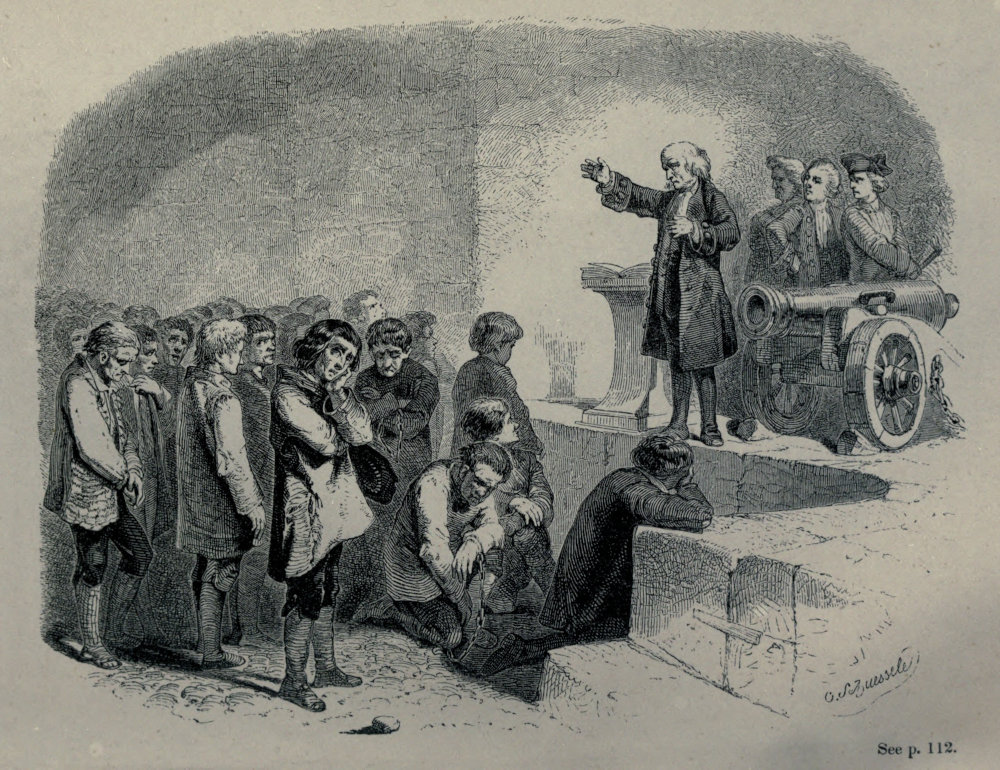
Art. I. —THE FORMER TIMES AND THESE.
THE
PENNSYLVANIA JOURNAL
OF
PRISON DISCIPLINE.
Vol. VIII.—JULY, 1853—No. 3.
It is said that every man has his niche. Of course there is a niche
for every man, and among others one for croakers, and it is
very desirable that they should never be seen out of it. We presume we
have none of this sort among us, inasmuch as they would instinctively
shun the council-chamber of those who look with a hopeful eye upon any
and every legitimate project for human improvement. It is excusable in
doting age to dwell with a sort of childish satisfaction on the scenes
and associations of youth, but no man who is living in good earnest,
can fail to be impressed and excited by the vast advance which has been
made within an age or two in the condition of the human race.
If there were nothing else to look at but the single institution known
as the Pennsylvania Hospital for the Insane, with all its
wonderful agencies and appointments for ministering to the relief of
the direst of all the ills that flesh is heir to, we should exclaim
with gratitude to the Author of all good—How marvellous the change!
It seems but yesterday that Pinel, with an intrepidity seldom
equalled, ordered the restraints to be removed from fifty-three
confirmed lunatics who had been bound in chains and fetters—some for
half a lifetime—and proved, to the amazement of their incredulous
keepers, that kindness and confidence would assuage a calamity which
restraint and violence only serve to aggravate. It was a signal triumph
of humanity over ignorance and selfishness, and opened the way for a
series of efforts, the benign results of which have scarcely a parallel
in the annals of benevolence.
If we imagine, for a moment, thousands of men and women, some confined
like wild beasts in dens or cages, enduring the most cruel tortures
at the hands of their nearest earthly friends, and doomed, for the
remnant of their lives, to hopeless and unmitigated suffering; others
wandering about half clothed and loathsome in their persons, exposed
by night and by day to burning heat or the pitiless storm, teazed and
pelted by the thoughtless and cruel, and shunned, from fear, by the
considerate and humane; and others, still, the subjects of constant
anxiety and commiseration to loving friends, who sought in vain for
some alleviation of their grievous burden,—we have a picture of what
was.
Then, if we turn our eyes to any of the noble institutions which, in
these latter times, have been founded and furnished for the reception
and treatment of these unhappy beings, and consider how large a
proportion of them are entirely relieved of their malady and restored
to sound health, and to the ordinary duties and enjoyments of life; and
to how large an extent the sufferings of others are alleviated, and
their comforts and enjoyments multiplied, we have a picture of what
now is, and surely no one can suppress an exclamation of gratitude
and wonder at the contrast. This item of human ills once looked upon
as so terrific, has been divested of its most appalling features, and
reduced, like other diseases, to the control of medical skill, and let
the Giver of all good be praised for it.
A sketch, not unlike this in its general features, may be given of the
change in the treatment of public offenders. The man is now living in
Philadelphia who could describe to us a spectacle which his own eyes
might have beheld, in what was then nearly the centre of the population
of our beautiful city. It was a prison-house at the corner of Market
and Third streets, where all grades of offenders, without distinction
of sex, color or age, might be seen mingling together, day and night,
as one common herd of vagabonds and outcasts! The most flagrant and
thrice convicted offender is here associated with one who is presumed
to be innocent, because not proved to be guilty; the old and practised
thief with the novice in dishonesty—the forger and counterfeiter with
the poor but honest debtor—while, at short intervals, there creep
into this motley crowd, “the disgusting objects of popular contempt
besmeared with filth from the pillory—the victim of the whipping post,
with blood streaming from his lacerated body, the half naked vagrant
and the loathsome drunkard.”
If we survey the exterior, the scene is not less offensive. The
miserable tenants are thrusting poles through the windows with bags
or baskets suspended at the end, to catch the eye and the gifts of
passers, while shouts of mirth or passion, mingled with profane and
brutal execrations assail their ears.
It was to such a sink of corruption and iniquity that the attention of
benevolent men was turned, and it was to alleviate miseries such as
these, that they associated together, some seventy years ago, under the
title which they still hold, and which is seen on each number of this
Journal. And what has been accomplished by that and kindred agencies?
The eye of a stranger who passes along Coates’ street towards the
Schuylkill, is arrested by an imposing structure, giving the impression
of strength, permanence and security. But no sound meets his ear, nor
is any sign of its use at all visible. Let him enter and survey the
interior. In a spacious area he sees long corridors radiating from a
common centre, divided into apartments of suitable size, clean and
wholesome, and provided with light and air and furniture needful for
the tenant. In these corridors are confined at constant and useful
labor, three or four hundred men, but it is as quiet as a well
regulated workshop, each is unknown to the other, but all known to the
officers and authorized visitors. Their food, lodging and attendance in
sickness and in health, are good and sufficient. Their understandings
are cultivated, and the voice of kindness and sympathy is heard by many
there, who have seldom heard it elsewhere all their lives long.
Who does not exclaim, at the sight of such a contrast. How wonderful
the transformation, and all too, within the memory of living men!
But let us brace up our nerves and protect our senses while we return
for a moment to the prison-scenes of a former day. It is the Lord’s
day. The streets of the city are thronged with people wending their way
to the various places of public worship, but who thinks or cares for
the “gaol-birds?” Shut out from the light and air of heaven, polluted
in body and mind, and given over to work all manner of wickedness
greedily, the day which brings repose to the care-worn, and peace to
the troubled in heart, is fraught with no good to them.
Yet stay a moment. The sympathy of a disciple and minister of
Christ—“that friend of publicans and sinners”—is awakened
for them. He calls upon the keeper, and proposes to address the
prisoners occasionally, in a religious discourse, and to begin on
the following Lord’s day. The keeper is amazed at so preposterous a
proposition, and expresses his conviction that the attempt would be
extremely hazardous, involving not only peril to the preacher himself
and to the officers in attendance, but the possible escape of the
prisoners, and the consequent pillage and murder of the citizens!
Whether this was the result of timidity, or of a design to obstruct all
efforts at reformation, is not known; but these and all other scruples
were so far overcome, that permission was given to make the trial.
“At the appointed time the clergyman[1] repaired to the prison, and was
received with a reserve bordering on incivility. The keeper reluctantly
admitted him through the iron gate to a platform at the top of the
steps leading to the yard, where a loaded cannon was placed, and a man
beside it with a lighted match! The motley concourse of prisoners were
arranged in a solid column extending to the greatest distance which the
hall could allow, and in front of the instrument prepared for their
destruction in the event of the least commotion.”
This was literally preaching at the cannon’s mouth. The service
was attended, however, with entire decorum throughout, many of the
prisoners giving respectful attention, and all of them behaving
with unexpected propriety. This was as late as 1786-7. Who of our
readers has ever attended the religious service on the Lord’s day at
the Eastern State Penitentiary, without being impressed with the
propriety—we might almost say, the solemnity of the occasion. Each
prisoner, separated from his fellows, is able to give undiverted
attention to the word spoken, and in the seclusion of his own
apartment, with the written Scriptures in his hand, may “read, mark,
learn, and inwardly digest” the truth that is able to make him wise
unto salvation. He joins in the supplication that ascends to the throne
of the heavenly grace, and in the hymns of praise and thanksgiving for
the many mercies that are mingled in his cup of suffering; and who
will say that this is not a marvellous spectacle to the eye of one who
witnessed the delivery of Dr. Rogers’ first sermon in the prison yard!
But another scene opens. Groups of men are laboring in the streets of
the city, cleaning and repairing them. Their heads are shaven, and
they wear parti-colored clothing, and of course attract the gaze of
passers-by. These are prisoners! Goaded to desperation by the taunts
and jibes of idle and vicious boys, they have sometimes attempted to
revenge their injuries, and to prevent this, they are loaded with iron
collars on their necks, and cannon balls or bomb shells “are fastened
to their feet by chains to be dragged after them, while they pursue
their degrading labor under the eye of keepers armed with swords,
blunderbusses, and other weapons of destruction.”
It was such a revolting sight as this that prompted our Prison Society
to call for a radical reformation—not only for the withdrawal of these
wretched men from the public gaze, injurious alike to the public and
to themselves, but for their withdrawal from each other’s presence
too, intimating very clearly their conviction that “MORE
PRIVATE OR EVEN SOLITARY OR SECLUDED LABOR WOULD MORE SUCCESSFULLY TEND
TO RECLAIM THE UNHAPPY OBJECTS, AS IT MIGHT BE CONDUCTED MORE STEADILY
AND UNIFORMLY, AND THE KIND AND PORTION OF LABOR BETTER ADAPTED TO THE
DIFFERENT ABILITIES OF THE CRIMINALS.”
We have put this memorable language in conspicuous letters, as we find
in it the germ of all philosophical and truly philanthropic schemes for
improvement of prison discipline, which have been devised in the sixty
years’ interval.
It was an intimation more broadly given in about a twelve-month after,
when fifteen of our most distinguished and benevolent citizens, then in
active life, with the venerable Bishop White at their head, “thought
it their duty to declare, as a matter of the utmost moment to the
well being, safety and peace of society, as well as of the greatest
importance to the criminals, that from a long and steady attention to
the real practical state, as well as the theory of prisons, it was
their unanimous opinion that solitary confinement to hard labor, and a
total abstinence from spirituous liquors will prove the most effectual
means of reforming these unhappy creatures.”
From that time, though by slow degrees, the penal discipline of the
State has advanced in efficiency as well as humanity, and to see
prisoners toiling in irons in our streets now, would be as incongruous
to all our feelings and habits, as to see the most imposing mansions
in our city converted into Indian wigwams, and savage council fires
kindled in Independence Square.
But there is work of vast magnitude still to be done, even within the
borders of our own Commonwealth. County prisons come into the line of
improvement at long intervals, and too often with a reluctant step. The
guiltless are not seldom corrupted by the associations which are here
allowed, (and which are, perhaps, inevitable,) and the novice in crime
is made reckless and incorrigible before he becomes the subject of
penitentiary discipline.
And it is to be borne in mind, too, that our society is not
restricted in its interests or sympathies, to the penal institutions
of Pennsylvania. We would contribute all in our power to the
“alleviation of the miseries of public prisons,” the country and world
over. And it would probably surprise most of our readers to know how
many and how aggravated these “miseries” are, even in prisons which
boast of eminent superiority. Since we commenced this article, a case
has been brought to our knowledge, on indisputable authority, which
will serve as an example. A convict was brought from a State-prison to
the Lunatic Asylum. He was heavily chained, and the examining physician
noticed a circular bruise on his temple, as if made by the nails in the
heel of a boot or shoe! The officer in charge of the man represented
him as being very violent and unmanageable. Two and a half barrels of
water had been showered upon him, he said, but it did not subdue him.
It made him pale and cold, but he was obstinate still. He was malicious
too, and had secreted a pair of shears, with the intent (as it was
believed) to take the life of his keeper, but fortunately the keeper
was aware of it, and knocked him down, and by putting his foot on his
head, held him till help came, and hence the bruise which had arrested
the doctor’s attention. He had been kept in a dungeon but without any
good effect, and they had authority at last to take him to the Asylum.
The unhappy creature heard this story, but made no reply. The physician
of the Asylum ordered his chains to be removed. He was admitted to the
ward, like other patients, and had not given them the least trouble!
It seems that prisoners, paupers and pay-patients are intermingled in
some Asylums. And we are credibly informed, that since the present
year came in, not less than thirty-six insane convicts were
at one time in the State Asylum at Utica. They are removed from the
prison and received at the Asylum as insane, and this is often the end
of the sentence. An elopement from the Asylum may perhaps answer all
the purposes of a pardon, without the responsibility of it. In one
instance, where a convict escaped from the Utica Asylum, notice was
given to the authorities of the prison from whence he was received,
but no effort was made to re-arrest him, and the fellow was found soon
after, following a respectable business in New York city, at $22 a
month and board, and was doing well! The Empire State itself could not
probably have done better for him.
Our readers have not probably forgotten the fate of four out of five
prisoners in a cell, not a cannon’s shot distance from the City Hall
in New York. That such an event could occur in any prison which is
located, constructed and superintended with ordinary regard to the laws
of humanity, is scarcely credible.
In view of such statements, we must admit that the work of prison
reform is indeed not yet accomplished. Great ignorance still prevails
on the subject. Strong prejudices exist (nurtured, if not engendered by
local, personal or professional pride,) against some of the essential
features of any true and effective system. Much effort is required
to diffuse right opinions, and correct popular errors. Among these
last, none is more prevalent or mischievous than that the difference
of a few thousand dollars, in the first cost of the structure, should
turn the scale in favor of a system which is not, on other accounts,
most approved. The true principle which should rule in all questions
of this nature, is very obvious. No reasonable expense or pains should
be spared in the employment of means to convert a single idler into a
worker, or a single rogue into an honest citizen. The mischief which a
contemner of laws may do, single-handed, to society, is so indefinite,
and, we may almost say, boundless, that we can scarcely conceive of
a greater public benefit than his reformation, unless, indeed, it be
such a training of his children or his neighbor’s children, or both,
as shall prevent their following his example. To confine a convict
three or five or seven years with a chafed and irritated temper during
all that interval, and then dismiss him, a settled and irreconcileable
enemy to himself and all about him, is the worst policy a State can
pursue. We do not advocate any course that shall mitigate, in the
slightest degree, the legitimate severity of punishment. But we urge
it as a matter of public economy, as the dictate of a sound policy,
that where two methods of dealing with offenders are at the State’s
election, one of which gives better promise than the other for the
correction of the vicious dispositions and for the restoration to
honest society of a single culprit, it should be chosen, whatever claim
the other may show on the score of present expense.
We are aware, that in these times, when so many private and party
considerations are allowed to mingle with questions of public interest,
it will be no easy matter to secure a safe and liberal policy on such
a subject as we are considering. But if so great achievements have
been made by the good and wise who have lived and acted before us, it
ill-becomes us in the light of their example, and with facilities for
the work which were unknown to them,—it ill-becomes us to relax our
efforts or to refuse any reasonable service or sacrifice, which will
complete what they so nobly begun.
Art. II. —INSPECTORS OF PRISONS.
Much of the efficiency and success of any system of prison discipline,
depends on the characters and dispositions of those who occupy the post
of Inspectors. As it is out of the question for the most judicious
and vigilant inspectors to make a prison what it should be, while
incompetent persons are employed to execute the discipline, so it is
equally out of the question for the most energetic and thoroughly
qualified officers to administer successfully the affairs of such an
institution, so long as they are subject to the control of incompetent
Inspectors. To secure the desired results, there must be marked
confidence between these parties, and such a coincidence of opinion and
counsel as shall give unity and strength to the administration.
In cases where the appointment of the principal officers of a prison is
in the hands of the Inspectors, there is danger that the independence
which is so essential to faithful and efficient action, will be put
in jeopardy. It requires no ordinary degree of courage to pursue a
measure which is likely to involve a sacrifice of one’s livelihood,
and especially where no moral principle is concerned. It may happen,
for instance, that some indulgences are allowed or winked at by the
Inspectors, which are in violation of the discipline established by
law. If the warden remonstrates against the practice, it may be at the
risk of losing his place, and it is easy for him to persuade himself
that the responsibility is on the Inspectors, whose servant he is,
and that the most discreet course for him is to hold his peace and
his place. But we think a wise Board of Inspectors would see to it,
that the warden is put at his ease on that point, and that the utmost
freedom is enjoyed by him, not as a matter of grace, but of right, in
the utterance of all his suggestions and objections.
There is no uniformity in the several States, either as to the
appointment of Inspectors or the relations they shall sustain to the
public on one side, and to the prison and its inmates and resident
officers on the other. In some States they are appointed by the
Executive, in others by the Legislature. In some they are popularly
elected, and in others (as in Pennsylvania) they are appointed by the
judiciary. Our own impression is, that the appointing power of this
class of officers is most properly lodged in the executive department
of the government. It is, in its nature, analogous to other duties of
this department. It is in the exercise of purely executive authority
that the convict is committed, and it would seem fitting that this
same power should exercise a suitable control over him, directly or by
agents of its own appointment. If the Legislature has exercised its
functions in the enactment of the law, with adequate penalties, and
the Judiciary has past upon the guilt of a transgressor and fixed the
measure of his punishment, one would think the remaining part of the
work is peculiarly appropriate to the Executive.
There may be some advantages in giving the Inspectors the appointment
of warden and other principal officers, but it is clear that we thereby
lose an important check on both parties. There have been many instances
of gross official misconduct by Inspectors of prisons, which would
probably never have been revealed, had the appointing and removing
power been lodged in their hands. It is obviously undesirable to place
official parties in such a relation that each should be interested in
concealing or palliating the neglects or misdeeds of the other. If each
is made responsible to a third and superior power, the opportunity to
practice collusion, as well as the temptation to it, is essentially
diminished.
But leaving this question for future discussion if need be, we propose
to set forth briefly a few considerations which should weigh in the
selection of prison Inspectors, let who will appoint them: And
I. They should be men of unquestioned probity. There is scarcely
any public office which an ill-disposed incumbent may not prostitute to
base or selfish purposes, if he is so disposed; and in the distribution
of patronage, the execution of contracts and the furnishing of
supplies, it would not be difficult for a prison Inspector to overstep
at least the bounds of propriety. There have been not a few cases in
which the official demeanor of such bodies or of individual members
of them, has been made the subject of public investigation to the
great discredit of those concerned, and to the manifest depravation
of public morals. To put a man into such an office, whose character
and standing are open to reproach, or even reasonable suspicion, is a
gross dereliction of duty, and ought to subject the appointing power
to severe animadversion. It should moreover be a provision in every
law touching the appointment and duties of Inspectors, that they shall
not be directly or indirectly concerned or interested in any contract
or negotiation connected with the prison, from which any emolument can
be derived; and the use of their official position for the purposes
of self-aggrandizement or other sinister end, should be punished with
exemplary severity.
II. Prison Inspectors should be intelligent men. Not only
should they be well-informed upon matters more immediately connected
with their official duty, but they should have some general knowledge
of the various methods of managing penal institutions. There are
radical differences in the theories which prevail on this subject
and in the systems founded on them. It would be very difficult for
the Inspectors of a separate prison, for example, to administer its
affairs discreetly and efficiently, if they were not familiar with the
points in which it differs from all other prisons, with the dangers
and deficiencies which have been ascribed to it, and with the methods
of obviating these dangers and supplying these deficiencies, if they
really appear. In the selection and distribution of occupations, and
in adapting them to the habits, constitution and capacity of convicts,
as well as in making the pursuit of these conducive at once to the
welfare of the prisoner and to the legitimate ends of punishment, good
judgment is required. The warden and other officers of the institution
should see enough in their intercourse with the Inspectors to command
their respect and confidence. True it is that in the minor details
of prison economy, the warden and heads of departments may have most
knowledge and tact, but in a comprehensive view of the principles of
the institution, and of the most eligible methods of bringing them into
efficient and harmonious development from day to day, the Inspectors
should take the lead. The proper discipline of a prison population
of three or four hundred men, combining employment, instruction,
encouragement, subordination, economy, moral influence, and physical
and mental improvement, with the privation and pain which constitute
the penal element of the institution, is not a work for uninformed or
narrow-minded men.
How often has a shrewd business man taken in charge the financial and
economical interests of some of our prisons that have, year after
year, made a fair report, and shown well to superficial observers, and
exposed to public rebuke gross negligencies, if not outrageous frauds
which the Inspectors—“good easy men,” had neither eyes to see nor
ears to hear, nor capacity to understand? If we desire our prisons to
answer the true ends of their organization, we must put them under
the supervision of active, intelligent men, who have an opinion and
responsibility of their own.
III. Prison Inspectors should be humane men. Though the direct
care and management of the convicts must of necessity be entrusted to
the resident officers, the Inspectors, and not the resident officers,
are the true representatives of the government in the administration
of the discipline. In the character of those who are appointed to the
immediate charge of the convicts, there should be a general guaranty
that every office of humanity, that does not relax or neutralize the
rigor of punishment, will be observed. It is not difficult for an
officer of severe or violent temper to abuse a convict shamefully,
and conceal the act from the ordinary observation of Inspectors. And
hence no man of such temperament should be entrusted with the custody
of prisoners. On the other hand, a weak and effeminate officer may
become the tool or plaything of a convict, and lose all influence and
authority over him. It is, moreover, possible that an officer—even
the chief officer—of a prison may, by indolence and carelessness,
inflict a negative wrong on prisoners, which is quite as intolerable
and inexcusable as positive inhumanity.
A neglected prescription of the medical officer—a delay to attend
to a reasonable request—a harsh repartee or an undeserved denial
of confidence may be more cruel than the douche or the
cat-o’-nine-tail—and yet how easily every thing of this character
would escape the superficial observation of Inspectors, in their weekly
circuit. Their humanity must not only be evinced in the discharge of
their own duties, but it must prompt them to interpose every needful
barrier to the positive and negative inhumanity of others. The power
being all on one side, the utmost care will not always prevent its
abuse.
IV. Prison Inspectors should be hopeful men. We need not
disclaim all sympathy with those (if such there are) who take a demure
look, a whining confession or a flippant utterance of religious
phrases, as indications of reformed habits or reliable principles.
No one who has been familiar with the course of this Journal, will
suspect us of any undue leaning in that direction. But we are equally
indisposed to fall in with the views of an opposite class, whose maxim
is, “once a convict, always a convict,” and who instinctively distrust
every profession of repentance, and of a desire to lead a different
life.
We have known inspectors who, from long official intercourse with
convicts, and familiar knowledge of their cunning and hypocrisy, seem
to feel as if it is not safe to give heed for a moment to any thing
they may say, or that may be said for them. Let them be approached in
the most respectful manner, and by persons who can have no interest in
misleading or deceiving them, and the moment the errand is found to
be in behalf of a convict, they seem to regard the bearer of it as a
little better than an accomplice, or, at least, a dupe.
It cannot be denied that well-meaning but credulous persons are
oftentimes quite officious on such subjects, and through ignorance or
indiscretion, are induced to urge upon Inspectors very injudicious
measures. This annoyance must be borne by public functionaries as a
part of the price of their “blushing honors,” and set off against
the privileges and prerogatives of office. If a man is presumed to
be innocent till he is proved guilty, why should not a guilty man be
regarded as a hopeful subject of reforming influences, till he is
proved incorrigible? What would be the condition of every member of the
human family, if conviction of sin works a forfeiture of all claim to
sympathy and confidence?
There is a wide difference between a seasonable encouragement of
attempts to amend one’s life, and a blind confidence in professions and
promises. A kind look or word at a propitious moment, in the progress
of penal suffering, changes the whole influence of it. A frown or a
repulse will freeze into impenetrable hardness a heart that might be
melted into penitence by timely compassion and sympathy. If prisoners
are treated with less tenderness by Inspectors than is shown to the
wild beasts of a menagerie, we must expect them to resemble wild beasts
in ferocity when they are let loose. The true light in which Inspectors
should regard themselves is, as protectors of the public against
danger from such a source. They are appointed to superintend a process
by which the ferocious passions of a man may be subdued—his vicious
inclinations changed and right moral feelings and habits implanted. If
the highest and best object of penitentiary discipline is attained, he
who is received under it as a tiger, is discharged from it as a lamb.
The infrequency of such a transformation might not be so striking if
Inspectors executed their functions in a proper spirit. Not only would
their personal and official influence contribute more directly to this
result, but the whole economy and discipline of the prison under their
charge would take the same direction.
V. We have only to add, that no political influences or
considerations should be allowed weight in the appointment of
prison-inspectors. We need not say that this remark has no local
application, though we have no doubt that it would receive the hearty
concurrence even of those who may regard the avoidance of such
influences as quite impracticable. Political parties live by power and
patronage. Offices of honor or emolument are the bribes that tempt men
into the strife for party-supremacy, and upon a due distribution of
these depends its maintenance, when it has been attained. But there are
some posts which involve labor rather than honor. The emoluments of
them but poorly compensate for the pains and self-denials they impose,
and the duties require qualifications so peculiar and so rare, that we
cannot afford to restrict the field of selection to any party. It is
difficult enough to fill them properly, “with the world before us where
to choose,” but the difficulty is rendered almost insuperable when a
large portion of the community, and possibly an actual majority, are
excluded, as out of political caste.
The choice of Prison Inspectors and School Commissioners and overseers
of education and reformation should uniformly fall on those who are,
on the whole, best qualified to serve, irrespective of all political
relations and considerations. If we must have a new set of officers
introduced into our prisons, and a new set of teachers and text-books
into our schools, whenever a revolution occurs in the position of
political parties, neither our prisons nor our schools will prove to be
of much value. When we can trace all the ignorance and all the crime of
the community to the door of one political party, we may be disposed
to charge on them the burden of taking care of dolts and rogues; but
so long as both are common to all political parties, it seems more
wise and equitable to draw from all the best skill in the greatest
force they can yield to enlighten the one and punish or (if possible)
extirpate the other.
VI. There is another negative qualification of prison Inspectors—not
mentioned last because we esteem it of the least consideration—and
that is the absence of all morbid and whimsical philosophy about the
origin of criminal acts. There are some people who may, with
comparative harmlessness, indulge their fancy in framing theories
to account for crime, without involving criminality. They may amuse
themselves by analogies between the irregularities of the skull and
the proclivities to particular crimes, or by tracing a disposition to
larceny, robbery and murder to some physiological mal-formation, for
which the offending party is no more responsible than for his stature
or complexion. Or they may discover a process by which to lay the
blame of all crime on society, and show to their own satisfaction that
when a foul murder is committed, “Society” should be hung as the real
offender, and not the poor wretch whom (as they would say) the “state
of society” has betrayed into the commission of the deed!
This is not an imaginary supposition. Our own ears have heard a man of
much repute for active philanthropy, and sharing quite generously in
the confidence of the community, assert in an address to a large public
assembly, concerning a woman who was then under sentence for the wilful
murder of her child, that she was not the blame-worthy party—“She
went,” he said, “from door to door, and sought work. All objected to
employing her because she was incumbered with a child. Finding this
incumbrance a bar to her success, she threw it into the Schuylkill
river, and who would blame her?” asked the popular orator. “Those who
turned her from their doors are the guilty ones, and should now be
where she is, and in her place suffer the extreme penalty of the law!”
Now, a prison Inspector needs to be free from all such fancies. He has
nothing to do with the origin of crime or the blameworthiness of those
who are under his inspection. All these points were settled before the
convict came under his notice. All he has to do is to see that the
sentence awarded by legal authority is duly executed. He has a share in
the oversight of an institution established for that purpose, and his
simple duty is to see to it, that the penal purpose of his confinement
is fulfilled with due regard both to the dignity of the Commonwealth
and the rights of the convict—for a convict has rights as well as a
freeman—and the Inspectors stand between the parties, not to theorize
or speculate, but to oversee the process of punishment, that it may be
conformed in all respects to the provisions of law.
Art. IV. —PRISON MATTERS AT THE WEST, AND POLITICAL MANAGEMENT IN GENERAL, AFFECTING PRISONS AND PRISONERS.
We have naturally regarded, with special interest, the movements in
our new States and Territories, on the subject of prisons. A system of
discipline once introduced, (no matter how defective the information,
or false the principles on which its adoption is based,) cannot be
changed without difficulty. And hence our desire that such deductions
as can be fairly made from past experience and observation, should
be familiar to those who are entrusted with the responsible task
of founding the penal institutions of a State, in order that the
superstructure may be safe and permanent.
It was with this view that in our last number we briefly commented
on the recent report to the Governor of Missouri, by a Commissioner
appointed to examine the various prevailing systems of discipline.
Knowing, as we do, that its positions are totally indefensible, and
that those who may be persuaded to rely upon them, will be sadly
misled, we felt bound to say so. We are led to suppose there is
some current of political or local interest or influence, which our
plain-spoken comments unfortunately crossed, for we have been favored,
by some friendly hand, with a cutting from a Missouri paper, endorsing
to the letter—yea, and beyond the letter—the discreditable document
of the Commissioner, as “containing all the information necessary to
the proper re-organization of the Penitentiary”—“replete with the most
valuable and reliable amount of information”—“a valuable accession to
our knowledge on the subject,” &c., &c.
Now, we have not the slightest desire to detract an indivisible
particle of credit from the Missouri Commissioner, or his
investigations or his report, except so far as the best interests of
the people of Missouri are likely to be injuriously affected by what
we truly believe to be unfounded statements and erroneous opinions. We
have no doubt that if the whole subject were fairly presented to the
people and calmly considered, the policy of the State would be directly
the reverse of what the Commissioner proposes; and we do not feel
like seeing a powerful and highly influential community duped on such
a subject, though the agent of the mischief may be unconscious of its
perpetration, and may even have the most upright and honest intentions.
As we said before, so we say now, the Rev. Mr. Hamilton’s report
does not present to the Executive, the Legislature, or the public of
his State, such a view of the subject to which it relates, as can
possibly secure wise and beneficial legislation; and inasmuch as crime
and convicts are peculiar to no latitude, soil, or climate, but are
common stock all the world over, we are interested in the disposition
that is made of them, and must have the liberty to speak as we think.
A horse-thief or house-breaker, who may serve his time out in a
congregate State prison in Missouri, and, by association there, become
an adept in his depredating vocation, is as likely to pursue it in
Pennsylvania as in Missouri or in Philadelphia as in St. Louis. If
he plunders a steamboat passenger on the Mississippi, he will not be
very careful to inquire beforehand whether his victim is a citizen of
Missouri, where he received his convict-education, or a citizen of
Pennsylvania, where his education would have been on a different plan,
and we trust with a different result; and hence it is that we make
common cause of this penitentiary-question, and insist upon it that of
all public questions it is the last that should be sucked into any of
the political eddies.
We took occasion, in our last number also, to comment freely on the
condition of the New Jersey State Prison. We were totally
ignorant of all local questions, as well as of the political relations
and bearings of the subject. We simply stated that while the statute
positively required individual separation and interdicted convict
intercourse for any purpose, and under any pretence, except in cases
of sickness and by order of the physician, there were, in fact, 232
prisoners occupying 182 cells! We ventured to say that this infraction
of the fundamental law of the institution should not be tolerated, but
that measures should be taken without needless delay to provide against
its continuance.
But behold “how great a matter a little fire kindleth!” No sooner did
our gentle and peaceful suggestions find their way to Trenton,
than they were drawn into the furnace of political strife. On one
side the faulty state of the prison is ascribed to the desire of the
ruling party to keep in popular favor by spending as little money
as possible! This insinuation is thrown back by the dominant party
with indignation, but at the same time the omission of the Executive
to recommend an enlargement of the accommodations, is vindicated
on the ground, that “the finances of the State did not warrant any
extraordinary expenditure, nor was the exigency of the case so great
as to justify the imposition of a State tax.” Now this is matter of
opinion. We think that no more urgent exigency of the kind could
possibly arise, to demand prompt and efficient action at any sacrifice,
than the association of convicts in a prison which is required by
law to keep them separate. The minority paper retorts with no little
spirit, and raises the general issue, whether the Democrats are a whit
more economical than the Whigs, and concludes with the sad confession
that the “leading politicians of all parties often sacrifice the public
weal unnecessarily upon the popularity-seeking pretext of economy”—and
here the subject closes, and the New Jersey convicts are left to pursue
their system of mutual instruction, as workers of iniquity!
Perceiving from the legislative journal of one of our youngest and
most thriving Western States, that steps were about to be taken
towards the adoption of a general penitentiary system, we made some
modest inquiries as to the probable result, and in reply received the
following information: “The Commissioners by whom the plan was got
up, were a set of politicians. One of them went East to get a plan,
and in talking with him, I found he was loud in his condemnation of
the separate system, though he admitted he had never seen a prison
on that plan, and was without the slightest knowledge of its nature
and operation! His own greatest objection to it was on the ground
of expense—nor would he believe that the whole resources of the
State were adequate to the building of a secure prison on the separate
system for one hundred convicts.” At this point we concluded to send,
by return mail, a copy of the number of our Journal for January,
1850, containing the plans and estimates for a separate prison, for
the reception of one hundred prisoners; but we were estopped by the
very next paragraph of our correspondent’s letter. “He would neither
receive information nor listen to reason on the subject. A large wooden
building was put up, and about forty convicts are in it, cutting stone
for the permanent building, which, at the rate they now work, will be
finished in about fifty years!”
“The office of prison Commissioner (the incumbent of which was
originally appointed by the Executive) was last winter made elective on
joint ballot of the Legislature. An applicant for the office succeeded,
by dint of a close siege, to induce the Legislature to appoint him.
But the Governor, knowing that this same man had been guilty of
extravagance and corruption in the same post before, exercised the
power of removal which was left to him; and when the newly elected
Commissioner came to the prison with the certificate of his election
in his pocket, he was met by the incumbent with a document from the
Governor, removing him from the office, and appointing the old one to
fill the vacancy!” “What will become of the convicts while politicians
are fighting for the custody of them,” says our correspondent, “is more
than we can tell.”
Now it might seem very idle in us to counsel those whose interests
are thus trifled with, to take the matter into their own hands,
inasmuch as those who now have it in hand, are their true and lawful
representatives. But with a free press and cheap postage, we have
a plain duty to discharge. As a society—we know no party sect or
section—we go for wholesome laws and for a prompt, even, and rigid
execution of them. We look upon crime as a public calamity. To prevent
it, and to counteract the temptations and provocatives to it, is a
most wise and philanthropic work, in which we gladly co-operate. Where
crime is consummated, however, and the guilty party is condemned in due
course of law, it is a question of deep public interest, what shall
be done with him? If he can be reformed and restored to a reputable
position in society, common humanity would dictate the use of all
practicable measures to secure this result.
One of the most reliable aids in this process, is the modicum of self
respect which may remain to the convict. The wreck is not total so long
as this single piece of timber is preserved. To cherish this where it
exists, or at least to avoid every thing that shall extinguish it, is
of the utmost importance. Will the separation of the unhappy man from
his fellow-convicts, and from the curious gaze of others, conduce to
this end. We think it will, in an eminent degree, and therefore we make
this a prominent feature of our plan. Will separation be better, on
the whole, even if the hope of reforming the culprit is but very faint
and remote? Yes; under all ordinary circumstances, and at all times,
it is best for a convict to be separated from other convicts. But
does not this feature of separation involve, in the prison structure,
great expense to the State? Not half so much as the absence of it.
Once settle the principle, that the separation of convicts, each one
from the other, is more likely to give the desired effect to their
punishment than association, and the question of expense becomes very
insignificant.
We are aware that if the bugbear of extraordinary expense were disposed
of, it would be urged forthwith, that separation, if it were as cheap,
is more hazardous to health and reason, and therefore inhuman. We deny
the position, and challenge the production of a single case in which
the mental powers of a convict have been destroyed or deranged, or
even weakened, as the necessary and unavoidable result of the most
rigid separation. The truth is, that statements on this subject
have been made with an inconsiderateness and flippancy which would be
unwarrantable in any connection, but are absolutely reprehensible here.
We do not question the soundness of the opinion of Dr. Evans and other
intelligent professional men, that seclusion in a prison cell, too long
continued, will be quite likely to terminate in the prostration of the
human intellect. But separation from convict society is not seclusion.
For the few hundred rogues with whom they are forbidden intercourse,
there are millions of honest people who may have access to them. We
admit farther, that separation may become seclusion by neglect, in
the same way that a clean prison may become a filthy one, or a humane
discipline inhuman, viz: by want of due oversight and care on the
part of those who are entrusted with the government of it. And when
this neglect or abuse occurs, we must not be surprised to find its
legitimate effects follow.
But we shall greatly err if we attribute all the insanity in a separate
prison (or indeed in any prison) to a peculiarity in its system of
discipline. There will always be those who take ground against a
system, no matter for what cause, and who, in their eagerness to
maintain it, will press into the service not only whatever bears the
semblance of truth, but many things which a little honest inquiry would
show, have not even this to justify the use that is made of them.
Insanity is found in a prison. There are (say) twenty victims of it.
Five of the sufferers are placed there on this very account, for safe
keeping. Three others were insane when committed, and were known to be
so by the committing tribunals. Three have been subject, for years, to
periodical returns of insanity, from which a prison-life is not likely
to exempt them. Six have an hereditary tendency to insanity, which any
irksome constraint would almost necessarily develope. And three are
insane from various causes “not ascertained,” as are scores in our
lunatic asylums.
Suppose now one who is hostile to the system of discipline pursued
in that particular prison, (whether congregate or separate,) should
group all these together, and affirm that the system was evidently
subversive of the reason of convicts, and ought to be abandoned
forthwith—“twenty-four of our fellow-creatures,” they would say, “have
already fallen a sacrifice! Who can justify the infliction of this
calamity, worse than death!” and so on.
Now, without denying that imprisonment of all sorts is an unnatural
state for any man to be in, and therefore likely to bring to light
whatever latent proclivities to physical or mental infirmity may exist;
or that there may be a neglect of hygienic laws, and a disregard of
those precautions, which professional skill or common prudence may
suggest for the counteraction of morbid agencies;—we confidently
affirm that the separation of a convict from his fellows, has no
tendency in that direction to make it an objectionable feature
of prison discipline. On the contrary, we believe its legitimate
influence, when administered by humane and intelligent men, (and no
prison should be governed by any other,) is highly favorable to moral
and intellectual and physical improvement, and more likely to answer
the ends of punishment, than any other system now known.
But to return to the political nuisance. It is not only into these more
imposing and expensive institutions (the patronage of which may be
supposed to avail something in political struggles) that the baneful
influence of party spirit intrudes itself. It was but lately that the
project of a House of Refuge in a neighboring State, fell through
between political parties. If we are not misinformed, one of the most
useful and successful institutions for the reformation of juvenile
offenders in our country, has been sadly embarrassed by the same cause,
and another of like character, all completely furnished and ready for
occupation, remains with closed doors till the appointing powers can
settle some political squabble.
If the influence of State politics is thus baneful, we need not say
how much more disastrous must be the intrusion of Church politics.
We deeply regret the attempt which, we understand, has been made in
some quarters to excite religious prejudices against these valuable
institutions for the reformation of youthful vagrants. A volume
has recently been published in one of our northern cities, (under
a fictitious title,) for the obvious purpose of engendering such
prejudices, and we have understood, from a source entitled to some
confidence, that any youth of the particular religious denomination,
(whose interests the author espouses) who reads the book, will be
likely to give trouble to the master who takes him under indenture!
Now, as American citizens, we are surely all alike concerned in
giving every child a good education, and in correcting as soon and
as effectually as possible every vicious habit and propensity. Hence
our common schools are public property, and should be not only out
of sight, but out of hearing of the din of political strife or the
roll of the “drum ecclesiastic.” Our institutions for the correction,
reformation and punishment of those who from neglect, perverseness or
incorrigible depravity become present or prospective pests of society,
should be elevated above all political or sectarian connections.
We cannot have a school, a refuge, or a prison for each of the
legion of parties in Church and State, and hence the impolicy and
unreasonableness of making existing institutions subservient to any
political or sectarian end. Away with all such suicidal schemes! The
ground these institutions occupy, or ought to occupy, is too sacred to
be entered by such unhallowed feet.
With these views we cannot but deplore the intermingling of political
interests or considerations, with the subject of prisons and
prison-discipline. The only effect of their introduction is to endanger
all the benevolent, public and permanent interests that ought to be
regarded, and to advance those that are purely selfish and temporary.
There is something utterly revolting to every human sympathy, in the
idea that a hospital for poor lunatics must be delayed till some
political party has strength enough to venture on the expense, or that
the adoption of a system of prison-discipline, or the establishment
of a House of Refuge for juvenile offenders and vagrants, should be
governed by so narrow a consideration, as its tendency to promote
or defeat a transient political end! Concerning all public men who
entertain such views, we say, “Oh my soul! come not thou into their
secret. Unto their assembly, mine honor! be not thou united.”
Miscellaneous. — OFFICERS FOR 1852-3. — Transcriber’s Notes
Indiscriminate Almsgiving.—Great is the glory of benevolence;
it outshines that of wealth and war. Hence, the wide and lasting fame
of John Howard. All men revere his memory. The story of his life
thrills the soul. None can read it without learning to admire the
beauties of his goodness, and the moral gorgeousness of his charity.
We enshrine his name in our heart of hearts. But John Howard was not
benevolent only—he was wise; his insight into remedies was consummate.
He sought to understand the sources of crime, and the character of
criminals. He was prudent, methodical, firm; his wisdom and his
love went hand in hand. Both his spirit and his understanding were
consecrated to the great work which formed his mission.
Many wish to do good; they long to repress crime; they wish to diminish
human sorrow; the poor look to them for help. Ready are their hearts
to pity and their hands to bestow an alms. But they do not give
wisely. Like Howard, they are full of compassion; unlike him,
they have no system, no principle of action, no wise mode of dealing
with the criminal, the ignorant, and the poor. They give profusely;
they do not give thoughtfully; the fruits of their deeds are therefore
corrupt and full of evil.
Let us explain. To bestow money, soup, blankets, and Bibles, is an
easy duty; plenty of people will come for them; the demand is always
equal to the supply. Society abounds with mean, lazy, drunken persons
who do not wish to sweat and toil. There are men redolent of strong
drink, tobacco, and filth, who “take the liberty of waiting upon your
honor” to narrate tales of woe. They cannot get work; they owe five
weeks rent; their wives are ill; their children have no bread. They are
“poor fellows who wouldn’t come, but hunger is a sharp thorn,” and so
on. There are women who knock at the door, and send in little, cramped,
flattering, lying notes. Their husbands are in the hospital; they are
going to be confined of their sixth child; they have four children ill
of the small-pox; they have nothing to eat; they smell of whiskey, but
that is of no consequence. A leetle drop they say, is a comfort, and
they don’t get drunk.
There are little girls who call upon us to say that their father fell
from a scaffold, and greatly needs some money to get him a morsel of
fresh meat—the said father being then waiting round the corner for the
anticipated gift. There are boys who follow us from square to square
with a wretched whine, and telling a score of details about their daily
sufferings, but taking care not to whisper a word of the short pipe,
the smoking pudding, the pot of ale, and the visit to the Circus or
Theatre, with which they solace themselves after the public labors and
sufferings of the day. And there are the dramatic beggars—men who
crouch behind a scroll, on which is written STARVATION; the
pathetic beggars—women who sit on door-steps, with cold tears rolling
down their cheeks; the rural beggars—picturesque beggars—and all
other kinds of beggars.
Who is to be held responsible for this army of beggars? To a large
extent, (we reply) careless alms-givers. People who give to any and to
all that ask, create pauperism. They bribe the feeble and the wicked to
adopt the disgraceful profession of a mendicant. In saying this we do
not depreciate, nor do we seek to hinder that charity which God loveth.
To bestow an alms is often a duty; when well bestowed it is pleasing to
God. Not so with almsgiving as it is. That is a moral blight; it has
produced a generation of liars, thieves, drunkards, and prostitutes;
it is a demon in the garb of an angel; idleness, falsehood, dirt,
ignorance, and crime, are its foul results.
We appeal to facts and witnesses. Mendicants, paupers, and thieves
abound; they are of all nations. We have them from Ireland, from
Africa, from India, and from amongst ourselves. They are of all ages;
old and young, parents and children come before us. They are of all
kinds; some in silk, some in broad-cloth, some in fustian, and some in
rags. Their sores are artificial; their tales are got up; their lives
are most unholy shams.
The evil influence of indiscriminate almsgiving is not confined to our
own country. The continent is also the sphere of their operations.
“It happened that on two occasions, (says Fraser’s Magazine,)
at the interval of about eighteen months, we travelled from Paris to
Boulogne, and stopped for a few minutes at a village on the road, of
which we have now forgotten the name. An Englishwoman, in an agony
of supplication, and with her cheeks wet with tears, rushed to the
window of the diligence, and inquired whether there was any Englishman
inside. We owned the soft impeachment, when, with an earnestness of
manner which would have done honor to an accomplished actress, she
stated that her husband, a week before, had broken his leg, and was
now lying dangerously ill in the village. Of course, it was impossible
to verify her statement, but, we confess to our shame, that we
received it without hesitation, and dropped into her hand a five-franc
piece. At the same town, eighteen months afterwards, the same woman,
with the self-same story, appeared at the window with the old inquiry.
We threw ourselves forward with the sudden impulse of surprise; the
trickstress recognised us, and fled in confusion.”
Time would fail us in attempting a complete exposition of the manifold
evils of this system, and we will therefore confine ourselves to its
influence on the education of destitute children. Now it is plain
that whatever depraves the parent injures the child. Make the parents
indolent, false, and drunken by reckless benevolence, or by anything
else, and you peril the future welfare of their offspring. What do
they care about the ignorance, the rags, and filthy aspect of their
little ones? Ignorance will excite compassion—rags will induce all
kind people to bestow shoes, linen, bonnets, and gowns. Dirt draws
money—vermin bear interest. These—brutish ignorance, fluttering rags,
uncombed hair, shoeless feet, an unwashed body, a dramatic cast of the
eye, and a voice carefully attuned to utter the true whine—“wot tells
upon old gemmen and wimmen,” are the stock-in-trade and fixtures of the
mendicant; take these away, and you rob him of his capital. What does
he or his children want with Ragged Schools? They would bring him no
money by going there, therefore he will not send them.
In all such cases as these, and in a thousand more, the children,
though awfully ignorant, are wilfully kept from school. They make
money; they bring beef to the pot, tobacco to the pipe, cards to the
fingers, and rum to the lips. Send them to church! Not so. “Sunday is
our best day.” Send them to school! “We cannot afford that,” said a
father. “How much will you pay us?” said a drunken mother. Send them
to work! “Bedad! we knows better than that!” said a son of ——, we
shall not say where. Nay, so profitable is begging that children are
hired for the purpose. Hence, the difficulty which many a missionary
experiences when he tries to get the right sort of children for the
Ragged or Mission School.
“A spirit-dealer in High street informs me that he draws £10 more
on the pay days of the Glasgow poor than on any other days of the
week. Another spirit-dealer says that the paupers regularly come to
him and spend in drink what they receive. I asked him how he knew
they were paupers? He replied, that they made no secret of it; he
heard them talk about what they got, and how long they had to wait
for it. They go in hundreds from the long closes in High street. An
inspector informs me, that he observed a lame pauper, not two hours
after he had received 8s., carried to the police office drunk
on a barrow. He also found a pauper, aged eighty years, so drunk that
she was not able to rise from her chair, and singing, ‘The world is
bound to maintain me, sing yo, sing yo, sing yo,’ to some other jovial
paupers who joined in her revels. He frequently finds paupers drunk on
their beds after they have received their aliment; and having spent
all in a single night, they live in a starving condition, or beg,
or steal, until next pay-day comes round.... Widows, left with
children under ten years of age, receive a great deal of out-door
relief from this Board, to bring them up. A large proportion of these
are dissipated characters, who drink the money which is intended for
the benefit of their children, whom they send out to beg, and thus
grow up uneducated, and become, if they survive the bad treatment
to which they are subjected, pests to society, like their mothers.”
Mr. Bishop, of the Liverpool Domestic Mission Society, in his annual
report for 1852, speaks as follows:—
“As long as people will give to little children in the streets and to
beggars at their doors, without the trouble of inquiring into their
character and circumstances, so long shall we have a continual supply
of juvenile criminals, and numbers of idle, worthless people, living
on their wits, to the injury of honest industry, and the perversion
of true views of charity. The polite heaps of rags that accost us at
our doors and in the streets are, for the most part, tricksters in
disguise. One little merry fellow, who has followed the begging trade
for dissolute parents ever since I have been in Liverpool, and is
particularly successful with the softer sex, will, sometimes, knowing
that I am up to the secrets of his business, show me what he calls
‘the crying face,’ which, when necessary, he puts on to the ladies.
He is a clever, sharp boy, but I have in vain endeavoured to reclaim
him from his Arab life. It is far too profitable to his parents, and
has become, I fear, too pleasant to himself. But to show the ill
consequences of encouraging such lads—I was lately remonstrating
with a man who lives near this family, because of an ungrateful and
dishonest trick he had attempted to pass on a benevolent lady, when he
said to me, as if the wholesale trickery of his neighbors justified
his smaller practices—‘Why, there’s little Ned,’ referring to the boy
in question, ‘he brings home every day more than any labouring man can
earn, and sure we are worse off than they.’”
“The charity of the metropolis is too indiscriminate, says a London
coroner, and thus the deserving poor are unheeded, and drunken,
reckless characters are well provided for, either by private
munificence or work-house relief, which enables them to lead an idle
merry life. The money they get is squandered in drink, and at night
for a few pence they obtain a bed in a wretched stinking hovel, where
all ages, all sexes, and all diseases are crowded together, forming
so many plague factories and disease depots. So long as a vagrant
can live without working, he will do so. So convinced am I of the
consequence of the evil that I have ceased to be a vice-president
to the Soup Kitchen. In fact, begging has become a regular trade. A
few years ago, one of the fellows who followed that avocation was
examined before a committee of the House of Commons, and stated that
he had travelled over the kingdom for nine years as a beggar; that
he was treated as a gentleman in prison, but most disgracefully
in workhouses, especially in Lambeth, where he had to work before
breakfast; that a slouched hat and smock-frock, with a bundle of
herbs in his hand, formed the best garb for a London beggar; and that
there were not ten out of one hundred vagrants worthy of relief. Such
(continued the coroner) are the disclosures made by him regarding
the begging trade. I am, however, happy that the press has taken up
the subject, and trust that it will not cease its efforts until this
monster evil is completely put down, and thus prevent charitable
institutions being abused, and their funds wasted, upon lazy worthless
characters. The jury expressed their fullest concurrence with the
opinions and observations of the coroner.”
The opinions of such witnesses more than corroborate our statements,
and the force of these opinions will not, we trust, be unfelt by our
readers. They may ask, what should be done when application is made to
them for pecuniary relief? We would suggest—
1. That no money be given to street beggars without inquiry into their
cases and an unexpected visit to their abodes.
2. That persons who are acquainted with the tricks of the vagrant
class, such as tradesmen, City Missionaries, Ragged School teachers,
and others, be applied to on such occasions.
3. That societies whose business it is to afford systematic and
well-timed relief in cases of distress, such as the Union Benevolent
Society, be more liberally supported, and cases sent to them instead of
being personally attended to. The adoption of these or similar rules
would tend much to prevent imposture, to add scores of children to our
Mission Schools, to increase our power of doing real good, and to rid
us ere long of the nuisance and abominable annoyance in our streets of
“confirmed vagrants and sturdy beggars.”
Shooting with Red Paint.—A work has lately been published,
called “Notes and Narratives of a Six Years’ Mission, principally
among the Dens of London.” By R. W. Vanderkiste.
The title gives a correct idea of the contents of this volume. The
writer, for six years, was an agent of the London City Mission, and
labored in one of the most unhealthy and morally depraved localities
of that great metropolis, known as the “Cow Cross District.”
The volume presents an interesting exhibition of what can be effected,
under God, by an earnest and self-sacrificing man. The most romantic
narratives are occasionally introduced. The following is one of them:
“An Old Bow Street officer, who yet lives in the neighborhood, has
detailed strange and terrible scenes to me. One I will give as nearly
as possible in his own words, omitting some unpleasant vulgarities:
‘One of my mates come to me, as near as I can guess, it might be two
o’clock in the afternoon. Says he, ‘P——, you must come up to the
office directly.’ It was in Hatton Garden then, sir, close by. ‘What
for?’ says I. ‘Oh!’ says he, ‘there’s the Irish murdering one another
on Saffron Hill, and the place is blocked up with the mobs.’ So I
takes my staff, and my cutlass, and my pistols, and away I went up to
the office. It wasn’t a minute’s walk scarce, you know. Well, sir,
there they was, breaking one another’s limbs on Saffron Hill, hundreds
of Irish with great sticks and pokers; ever so many had been taken off
to the hospitals wounded; they was so spiteful, the shopkeepers put up
their shutters, and the place was full of Irish, cutting and slashing
like mad, and coming from all parts, taking sides and fighting one
against another. Well, sir, there was only six of us, and we found we
must turn out. ‘My lads,’ said the head constable—and he didn’t like
it at all, he didn’t—says he, ‘this is a queer job, but go we must!’
Well, sir, away we went, but it warnt no use at all; the mob didn’t
mind our cutlasses a bit; great big fellows come up to us with their
pokers, and we warnt in no pleasant situation in no respect. Well, I
saw there’d be murder very shortly, and suddenly a thought struck me,
and away I went round the corner—may be you knows the shop—it was
a shop where they sold almost every thing then. Well, I knocked, but
they were afraid to open the door. Says I, ‘It’s me, Mrs. ——, and
do let me in;’ so they let me in. Says I, ‘Let me have some red paint
of some sort immediately;’ so they gave me some rouge or carmine,
I don’t know which it was. So I took out my pistols and put in a
charge of powder, then some paper, then I wetted a lot of this paint
and put it in, and some paper loose over it, and off I went. Well,
there was my mates hemmed in, but no lives lost, thank God; they was
fighting away; well, a great chap come up to me with a poker or a
fender a-fighting with, so I outs with a pistol, and, says I, ‘Stand
back!’ and presents it at him. Well, he didn’t stand back, so I fired
at him. Well, sir, you may depend on it, (I shall never forget it,)
the force of the powder and wadding knocked him right off his legs.
It caught him in the forehead, and the red paint made his face look
just as if it was all covered with blood. They made sure he was a
dead man, and some carried him off to St. Bartholomew’s Hospital, and
the mob got frightened at us and dispersed. They didn’t know whose
turn might come next. Well, sir, when they came to examine my man, at
the hospital, and washed his face, it set ’em a wondering, for they
found there wasn’t no wound at all. The man was partly stunned, and
soon walked home. Well, sir, the story got wind, and them Irish was
so pleased with it afterwards, (when they come to their proper reason
and sobriety, they could see it had perhaps prevented real murder,
for they was getting terrible spiteful when I let fly)—they was so
pleased many of ’em would have done anything for me afterwards. The
housekeepers in the neighborhood, too, made us a handsome present, and
I was told about that red paint job a long while afterwards, you may
depend on it, sir.’”
If this hint could be taken by our war-makers, it might save a large
portion of the miseries which past generations have endured, and which
ours may not otherwise escape.
New Work on the Effects of Separate Confinement.—We regret
that want of space forbids us to insert in the present number of our
Journal a notice of a volume of 300 pages, published a few weeks since
by Longman & Co., London, entitled, “Results of the System of
Separate Confinement, as administered at the Pentonville Prison. By
John Burt, B. A., Assistant Chaplain, formerly Chaplain to the Hanwell
Lunatic Asylum.” The positions taken in this volume, and the facts
and arguments by which they are maintained, are such as the opponents
of separation will find it difficult to controvert or rebut.
Suffice it for the present to say, that in the author’s view every
departure from the principle of rigid, individual separation in that
prison, has been attended with evil consequences.
The Elizabeth Fry Refuge—Instituted in London for affording
a Temporary Asylum for Destitute Females on their release from the
Metropolitan and other Gaols, their moral and religious improvement,
and the arranging for their future destination and welfare, was founded
as a memorial to the late Mrs. Elizabeth Fry. It has been in operation
three years, and has admitted above 200 cases, varying in ages from 12
to 35, most of whom have been either provided with situations, restored
to their friends, or sent, after a probationary term, to other asylums;
and it is gratifying to state that comparatively but few cases of
disappointment have occurred.
Ohio Lunatic Asylum.—The Lunatic Asylum at Columbus, (O.,)
is now full, containing upwards of five hundred patients. In 14 years
there have been admitted 2,116 patients, of which 1,038 were discharged
recovered. What is very singular, it is stated that of the number
admitted, 505 were farmers, being more than twelve times the number of
any other occupation, except laborers, of which there were one hundred
and sixty! The next highest on the list is teachers, being 40.
Perhaps the opponents of convict separation will account for this
phenomenon on the ground that farmers are isolated, and have so little
intercourse with any body or thing except oxen, horses or ploughs; but
this would not account for the still more extraordinary proportion of
teachers who (as others might contend) lost their wits for want
of seclusion.
Connecticut State Prison.—The number of prisoners in the
Connecticut State Prison at the close of the fiscal year, March 31, was
181; received from July 1, 54; discharged, 40. The balance gained to
the Institution during the nine months, ending as above, was $1,247.
The Directors say that, under a resolution of the General Assembly,
twenty of the convicts have been employed in the manufacture of
school-apparatus, and the report very properly advises that these sets
be sold to the School Societies 25 or even 50 per cent. below their
actual cost.
What a pity it is they could not have taken the advantage of some
school apparatus to fit themselves to obtain an honest livelihood. A
strange anomaly this—convicts working for schools!
Not my Mother!—Well, do you see, at night we used to amuse
each other by telling our tricks, urging one another on in daring vice
and wickedness. Amongst us we had one uncommon bright girl—a first
rate mimic, and she used to make us roar with laughter. Well, this
fun had been going on for weeks; she had gone through most of her
characters, from the governor to the turnkey, when she starts on a new
tack, and commenced taking off Parson Cowper and Father Therry: some
way it did not take, so she went back to Newgate and took off Mrs.
Fry to the very life, but it would not do; we did not seem to enjoy
it—there was no fun in it for us. So then, she began about the ships
leaving, and our mother’s crying, and begging of us to turn over a new
leaf; and then, in a mimicking, jesting sport she sobbed, and bade us
good-bye.
Well, how it happened I know not, but one after the other we began
to cry and say, “Stay, not my mother! Not my mother!” Said one: “Let
Mrs. Fry alone; Father Therry must not be brought here, nor Parson
Cowper—stay, stay!” Well she did stop, but tears were shed the
whole of that night. Every thing had been tried with me; good people
had sought in vain to convince me of my evil ways; but that girl’s
ridicule of my mother I could not stand! Her grief was brought home
to me, and not to me alone, but to many. I do believe that night was
a great blessing to many. I was so unhappy, that the next day I tried
to get out of sight to pray; and when I got to a hiding place I found
three girls on their knees. We comforted each other, and then how we
spoke of our mothers! Mine was dead; she left this world believing
me past hope—but the picture of her grief made me earnest in search
of that peace which endureth for ever.
President—James J. Barclay.
Vice-Presidents—Townsend Sharpless, Charles B. Trego.
Treasurer—Edward Yarnall.
Secretaries and Committee of Correspondence—
William Parker Foulke, Edward Townsend.
Counsellors.
Job R. Tyson, Garrick Mallery.
Acting Committee.
James J. Barclay, Townsend Sharpless, Charles B. Trego, Edward Yarnall,
William Parker Foulke, Edward Townsend, Job R. Tyson, Garrick Mallery,
F. A. Packard, Jeremiah Hacker, William Shippen, Charles Ellis, A. T.
Chur, Morris Wickersham, M. W. Baldwin, Mark Balderston, Joshua L.
Baily, Thomas Latimer, Josh. T. Jeanes, John M. Wetherill, Horatio C.
Wood, John Lippincott, John J. Lytle, Henry M. Zollickoffer, William S.
Perot, Benjamin J. Crew, Isaac G. Turner, William U. Ditzler.
⇒ Quarterly Meeting of the Society, 2nd second day (Monday) of January,
April, July and October.
Inspectors of the State Penitentiary for the Eastern District of
Pennsylvania.
John Bacon, Richard Vaux, Hugh Campbell, Singleton A. Mercer, Andrew
Miller.
Warden—John S. Halloway.
Resident Physician—D. W. Lassiter, M. D.
Moral Instructor—Thomas Larcombe.
Clerk—William Marriott.
Teacher.—George Neff.
Visiting Committee of the Eastern Penitentiary.
Townsend Sharpless, Edward Townsend, James J. Barclay, A. Theodore
Chur, Joshua J. Jeanes, Matthias W. Baldwin, Joshua L. Baily, John
Lippincott, John J. Lytle, Horatio C. Wood, Isaac G. Turner, Benjamin
J. Crew.
Inspectors and Officers of the Philadelphia County Prison.
President.—Jesse R. Burden, M. D.,
Treasurer.—T. C. Bunting, M. D.,
Secretary.—E. A. Penniman,
Edward C. Dale, Samuel Palmer, Robert O’Neill, Hugh O’Donnell, Thomas
E. Crowell, Godfrey Metzger, Charles T. Jones, Joseph K. Howell, Joshua
S. Fletcher, William Elliott, Samuel McManemy, John T. Smith.
Superintendent.—Anthony Freed.
Deputy Superintendents.—William B. Perkins, John Mirkil.
Clerk.—Wm. J. Crans.
Matron—E. McDaniel.
Physician—Dr. J. C. Wall.
Moral Instructor.—Rev. Wm. Alexander.
Assistant Keepers—C. Stagers, William Sharp, H. C. Snyder,
Alexander Campbell, F. Laird, J. B. Haines, A. Morrison, Alexander
Burden, J. Watt, G. Kirkpatrick, William McGrath.
Visiting Committee on the County Prison.
William S. Perot, Dr. William Shippen, Jeremiah Hacker, H. M.
Zollickoffer, Thomas Latimer, Paul T. Jones, Morris S. Wickersham, John
M. Wetherill, Charles Ellis, B. B. Comegys, William U. Ditzler.
Punctuation errors have been fixed.
In the Notices at the start, “arranged and expresse” changed to
“arranged and expressed”
Article IV has been renumbered from III in the original.
Page 114: “to known how many” changed to “to know how many”
Page 140: “cir-circuitous process” changed to “circuitous process”
Page 154: “and my cutlash” changed to “and my cutlass”
The text from the inside back cover, which was a continuation of the
Recent Notices section, has been relocated to the start so the section
is complete.