A Mistake—Road to Llanrwst—Gwydir
Castle—Llanrwst Shaking Bridge—Inn—The
Theatre—Town Hall—Free Schools—Alms
Houses—Rhaiadr y Parc Mawr—Llynn
Giwionydd—Taliesin—Trefriw—Slate
Quarries—Conway—The Suspension Bridge—The
Castle—Local Customs—A Phrenologist—Excursion
to the Ormes’ Head—The Smuggler—The Bump of
Order.
“On a rock whose haughty brow
Frowned o’er old Conway’s foaming flood,
Rob’d in a sable garb of woe,
With haggard eye, the poet stood.”
GRAY.
As I stood taking a farewell look of this beautiful village,
with my knapsack on my back, and fishing rod in my hand, I was
suddenly roused from my reverie, by a slap on the shoulder, and,
on turning my head, I perceived an old woman, who held out to me
some half dozen, much soiled, silver tea spoons, addressing me at
the same time in Welsh: she might as well have spoken
to me in the language of the ancient Chaldees. However, I
took the spoons in my hands, and, after turning them over and
over for some time, and endeavouring to elicit her meaning
without success, I shook my head as gravely as my Lord Burleigh
is made to do, in Sheridan’s entertainment of the Critic,
and returned them to their venerable owner. Disappointment
made the wrinkles of her aged forehead deeper than usual, and I
was turning to resume my journey, when a flash of intelligence
crossed her smoke-dried visage, and, making a sign for me to
stop, she ran into her cottage, and presently returned, her face
glowing like a hot coal, with an old umbrella in her hand, which
she displayed fantastically in every way she thought likely to
attract my notice, making use of sundry pantomimic gestures, none
of which could I understand; and I began to think myself in
company with some unhappy creature escaped from Bedlam. I
again attempted to proceed with more earnestness than before,
when, to my astonishment, a pair of grey, much worn,
inexpressibles were held up to my eyes, while the gesticulations
of the old woman became stronger and stronger, and I at length
discovered, that I had been mistaken for a
travelling pedlar by the old beldam, who wished to exchange the
articles she produced for something with which she imagined my
knapsack was furnished!
Within half a mile from the town of Llanrwst is
the property of Lord Willoughby d’Eresby, a family
mansion of no very attractive appearance. It is situated on
the right of the road, which winds between it and a lofty
wood-clad precipice, called Carreg-y-Gwalch, or the Rock of the
Falcon. It was built by John Wynne ab Meredydd, in 1555,
and has lately undergone some alteration. The breakfast
parlour contains a curious carving of the arms of the Gwydir
family, supported by Julius Cæsar and Augustus; the former
holding his commentaries in one hand, and his sword in the other;
the latter, his sword only. The dining-room has some
specimens of carving, that are worthy of observation; but
throughout the mansion there is very little of what belonged to
it originally. The chairs, panelling, and even tables,
being coloured for the purpose of giving the
apartments the appearance of antique splendour, which, until
lately, they wanted.
The drawing-room is spacious and lofty, and is lighted by a
double row of windows, which gives it a heavy look: this unusual
arrangement was caused by the removal of the dormitory, to give
height to this room. Over the fire place is a finely
executed carving of Julius Cæsar in oak. At the N.W.
end of the room, a piece of tapestry represents a vintage, and at
the S.E. another specimen of needlework commemorates the landing
of Charles V at Grenada.
The coronation chair of George II is shewn in this apartment,
and the footstool used by Queen Caroline on her trial at
Westminster Hall. There is a centre table, very richly
ornamented with carved work; and another, which in shape exactly
resembles the slab and pedestal of a tombstone, so that the
visitor, naturally enough walks up to it, expecting to see the
customary, “Hic jacet” etc.
The cradle of Sir Richard Wynne, bearing the date 1634,
completes the list of curiosities contained in this room.
The garden, which is extensive, contains some valuable plants
and shrubs, and the terrace is a pleasant promenade, sloping from
which are beds of exceedingly beautiful flowers, of various
classes and descriptions. After satisfying the housekeeper
with a trifling gratuity, I proceeded to Llanrwst, but halted
upon the bridge to take a view of the Conway (over which
beautiful river its arches expand), and the town to which it
leads. I was here accosted by an old man, who asked me,
“if I should like to feel the bridge shake?” As
I answered in the affirmative, he desired me to place my back
against the side over the centre arch, and striking the opposite
parapet rather heavily with his own, a tremulous motion was
distinctly felt; on this account, it is called the Shaking
Bridge. It was built in 1636, from a plan of the celebrated
Inigo Jones, and cost £1000, which was defrayed by the
counties of Denbighshire and Caenarvonshire, which it unites.
is built upon the Denbighshire side of the river. The
Three Eagles is the most commodious inn in the town; and, being
rather fatigued, I threw my limbs upon a sofa, and resigned
myself to the drowsy god, first taking especial care to order a
substantial repast to be in readiness for me on my
return from the land of Nod. My last waking recollection
was the words of Mr. Lover’s favourite song,
“There’s no use at all in my going to
bed,
For it’s dhrames and not sleep, that comes into my
head.”
Dreams, however, did not picture my slumbers, and I awoke to
the unrivalled delight of a weary and hungry traveller—an
excellent hot dinner. While the waiter cleared the table,
and put on the desert, I took a glance from the windows at the
market-place and town-hall; against the latter were pasted sundry
bills, some of which bore, I thought, a strong resemblance to the
dramatic announcements.
“What bills are those?” said I to the waiter, as
he placed my pint of port before me.
“Play bills, sir.”
“What, have you a theatre here?” said I, opening
my eyes with astonishment.
The man stared, appeared confused and stammered, and,
supposing me shocked at the immoral announcement, proceeded to
assure me, that although the players were tolerated, they had
very little patronage, “Indeed, sir,” continued he,
“such vagabonds do a great deal of harm to
business; we feel it, sir. Now to-night there is a bespeak,
which will do us a serious injury, for we have no less than six
visitors who are going!”
“A bespeak, eh! and who bespoke the play?”
“Oh, sir, ’tis Mr. —.”
“Mr. —!” I exclaimed, with a sort of
inquiring glance, which occasioned the waiter to look more
ridiculous than ever.
“Do you mean Mr. —, of Belmont?”
“Yes, sir, that’s the gentleman.”
No sooner had I received this information, than filling my
glass, “His honored health!” I cried, adding the
words of the bard,
“May never-fading laurels flourish round
him,
And consecrate his name ev’n to Time’s
end!”
“Bring me a bill of the play,” said I. The
man withdrew with much apparent reluctance, but shortly returned
with one, which, snatching from his hand, I began eagerly to
peruse, until perceiving the increasing wonderment which
stupified the eyes of the waiter, I followed up the foregoing
quotation with another, which I addressed to him in seeming
wrath.
“The Devil damn thee black, thou cream-faced
loon!
Where got’st thou that goose look?”
which had the desired effect, and relieved me from his
presence.
A month had passed away since I had visited a temple dedicated
to Thalia or Melpomene, and, with all the enthusiasm such
divinities inspire, I hastened to arrange my dress in the best
manner possible, to pay them my devoirs.
The play was announced to begin at half past seven
o’clock. The time had nearly arrived, and fully
anticipating much gratification I reached the Town Hall. A
staircase, not of the cleanest, led to the theatre on the first
floor, and passing some hanging of green-baize, which formed a
narrow passage to the pit and gallery, I was ushered into the
former, which being set apart for the gentry, consisted of
about six forms, such as are used in schools, and ranged behind
each other. A barrier of the most unostentatious fabric
stretched across the room from wall to wall, behind which were
about the same number of forms, arranged in like manner, this
back portion being denominated the gallery. As I entered, I
perceived a fine portly gentleman, seated in a large elbow chair
at the extremity of the first form, whose countenance was lighted
up by half a dozen candles, that flared magnificently within
three feet of the front row, and divided the stage from the
audience. “There needed no ghost” to tell me
that this was the gentleman who had honored the theatre by his
patronage on that occasion, and to whom I was the bearer of a
letter of introduction, then in my pocket-book. The
proscenium was of painted canvass, and a green curtain of the
same material scantily screened the mysteries which were
preparing on the stage. Upon the right of the room, a
temporary box contained the band. Those who have heard the
burst of melodious sounds thunder forth from the orchestra of the
opera, which startles the uninitiated, in an overture of
Mozart’s, or in the wild and stormy grandeur which
characterizes the compositions of Weber, may have some idea of
the overpowering effect produced by a violin, played by a boy
about twelve years of age, who was leader of the band, consisting
of one old man of sixty, who rasped fearfully on a violincello,
and an enthusiastic trombone player, who successfully drowned the
unskilful efforts of the other two with the tremendous roar of his
elongating distracter. The front of the house was
illuminated by three tallow candles, one on each side, stuck in
tin candlesticks and nailed against the wall, and one at the
extremity of the room. The first piece to be acted was the
Mid’ night Hour; after which, I thought it high time
to retire.
The following morning I employed in paying my respects to the
different gentlemen to whom I had letters, and in gaining what
information I could respecting the objects most worthy of notice
in the town, and surrounding neighbourhood.
The church and chapel adjoining, were the first subjects to
engage my attention. In the former there is nothing
interesting, excepting an oaken screen, exquisitely carved, which
was taken from the Abbey of Maenan, the gallery for the singers
being above it. On the opposite side is the
This beautiful structure was erected in the year 1633, by Sir
Richard Wynne, of Gwydir, from a design of Inigo Jones, and was
for many years the burial place of the illustrious family of
Gwydir. At the sides of the chapel, fixed in panels of
wood, are several engravings on brass, illustrative of the
personages who are interred below; and in the east corner is a
tablet of white marble, containing the following remarkable
pedigree, comprising a period of 500 years.
“This chapel was erected A.D. 1633, by Sir Richard Wynne of
Gwydir, in the county of Carnaervon, Knight and Baronet,
Treasurer to the High and Mighty Princess Henrietta Maria, Queen
of England, Daughter of Henry the Fourth, King of France, and
Wife to our Sovereign Lord King Charles; where lyeth buried his
father Sir John Wynne, of Gwydir, Knight and Baronet, son and
heir to Morris Wynne, son and heir to John Wynne, son and heir to
Meredith Wynne, which three lie buried in the Church of
Dolwyddelen, with tombs over them. This Meredith was son
and heir to Evan, son and heir to Robert, son and heir to
Meredith, son and heir to Howell, son and heir to David, son and
heir to Griffith, son and heir to Cradock, son and heir to
Roderick, Lord of Anglesea, son to Owen Gwynedd, Prince of Wales, and
younger brother to David, Prince of Wales, who married Emma
Plantaginet, sister to King Henry the Second. There
succeeded this David three princes; His nephew Leolinus Magnus,
who married Joan daughter to King John,—David his son,
nephew to King Henry the Third,—and Llewelyn the last
Prince of Wales of that House and line, who lived in King Edward
the First’s time. Sir John Wynne married Sydney, who
lyeth buried here, daughter of Sir William Gerrard, Knight, Lord
Chancellor of Ireland, by whom he had issue, Sir John Wynne, who
died at Lucca, in Italy, Sir Richard Wynne now living, Thomas
Wynne who lyeth here, Owen Wynne now living, Robert Wynne who
lyeth here, Roger Wynne who lyeth here, William Wynne now living,
Maurice Wynne now living, Ellis Wynne who lyeth buried at
Whitford, in the county of Flint, Henry Wynne now living, Roger
Wynne who lyeth here, and two daughters, Mary now living, married
to Sir Roger Mostyn, in the county of Flint, Knight, and
Elizabeth now living, married to Sir John Bodville, in the County
of Carnaervon, Knight.”
Beneath this is a superb engraving of Dame Sarah
Wynne, one of the daughters of the old Chevalier Sir Thomas
Middleton of Chirk Castle, and wife of the above mentioned Sir
Richard Wynne; she died June 16th, 1671. This piece of
engraving was executed by one William Vaughan, in a style of
elegance hardly to be met with, and may be justly reckoned among
the first productions of the age in which he lived.
On the south side are two stately pyramidical columns of
variegated marble, decorated with martial insignias; one to the
memory of Meredith Wynne, the other to Sir John Wynne and Sydney
his wife; on their pedestals are Latin inscriptions on black
marble, which have been thus translated:
“To the Memory of Meredith Wynne, a
descendant of Owen Gwynedd, Prince of Wales, who, under happy
auspices, founded the House of Gwydir, removed and endowed the
Church of Sant Gwyddelen, during the third tournean expedition,
in the fifth year of Henry the Eighth. He died in the month
of March 1525.”
“To the Memory of John Wynne of Gwydir, Knight and
Baronet, with Sydney the daughter of William Gerrard, Knight,
Chancellor of the Kingdom of Ireland, the wife of his youth, to
whom she
bore eleven sons, and two daughters; they lie here waiting the
appearance of Christ in Glory.”
Between the above Monuments is a small Tablet of white marble
to the Memory of John Wynne ap Meredith, with a Latin inscription
to the following effect:
“John Wynne ap
Meredith, an Inheritor of his
Father’s virtues, a just and pious Man, to
whom Euna his wife brought five sons
and two daughters. He died the
9th of July 1559.”
On the floor is a stone effigy in armour, with the feet
resting on a lion couchant, of Howell Coetmore ap Griffith Vychan
ap Dafydd Gam, alias Gôch, natural son to David, Prince of
Wales, from whose descendants, according to tradition, Gwydir was
purchased by the Wynnes.
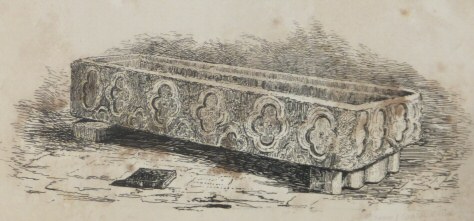
Near to the effigy of Howell Coetmore is the underpart of a
stone coffin in which Llewelyn ap Iorwerth, surnamed the Great,
the son-in-law of King John, was buried at the Abbey of Conwy; to
the coffin is fixed a piece of brass with this inscription:
“This
is the coffin of Leolinus Magnus, Prince
of Wales, who was buried at the Abbey of
Conwy, which upon the dissolution
was removed thence.”
On going from the chapel to the church, you pass over a large
square flag of free stone, having on its sides a Latin
inscription thus translated:
“To the Memory of the Sons of John Wynne of
Gwydir, Knight and Baronet, who died during their father’s
life time: John Knight, was buried at Lucca, in the free State of
Italy, in the year of his age 30, of our Lord 1613. Robert,
who had entered into holy orders, in the year of his age 24, of
our Lord 1617. Thomas, Roger, Thomas, in their
minority.—Death! a vapour! Behold! we have
existed.”
In the chancel, between the reading desk and the communion
table, is a flag of freestone on the remains of Margaret Vaughan,
heiress of Caergai; she was esteemed the Sappho of her age; many
of her poetical productions are still extant.
The gallery over the reading desk is said to have been
removed here from the Abbey of Aberllechog or Maenan Abbey, upon
the dissolution of that religious house.
Under the reading desk in the Church, in a pew belonging to
Kyffdy, is a Latin epitaph to the memory of Griffith Lloyd, of
Bryniog, Rector of this parish; this is said to have been written
by himself, and has been much admired for its
singularity:—it runs thus:
“Once
the undeserving School-master,
Then the more
undeserving Lecturer,
And last of all, the most undeserving Rector of this Parish.
Do not think, speak, or write any thing evil of the
Dead.”
There is a Market Hall, Town Hall, free schools and alms
houses. The latter were erected by Sir John Wynne, in 1610,
and received the name of Jesus Hospital. He endowed them
for the reception of twelve poor men, by ceding the rectorial
tithes of Eglwys Fach, which are valued at £200 per
annum. Within a mile of Llanrwst there is a spring, which
is much esteemed for its healthful qualities. The water is
soft, and a drop of sal-volatile mixed with a cup of it, turns it
white as milk, while oil of tartar causes it to assume a pearl
colour. If during the tourist’s visit to Llanrwst
there should chance to fall much rain, I would advise him by
all means to view the cataract called
in the valley of Nant Bwlch yr Haiarn, near Gwydir, but
otherwise the minuteness of the stream occasions no extraordinary
effect from this fall, which is about one hundred feet in
height. The chief object of interest, however, in this
vicinity, is the celebrated lakes, called
upon the borders of which once lived the chief of the Welsh
bards, Taliesin. At the eastern side of the lake is
a mound, upon the summit of which there is a kind of hollow, and
in it are the remains of an ancient edifice, which was probably
the residence of Taliesin, in the reign of Maelgwn Gwynedd, king
of Britain. Taliesin when an infant was found by Prince
Elphin by the side of a wear belonging to his father Gwyddno
Garanhir, lord of Cantrev Gwaelod. The prince fostered the
infant, and had it liberally educated; and, at a proper age,
introduced him to the court of his father Gwyddno. Upon
this occasion, Taliesin presented the king with a poem, the subject
of which was his own history, and another to the prince, which he
called Dyhuddiant Elphin, or the consolation of Elphin, a
translation of which is in Evan’s specimens of Welsh
poetry.
Taliesin had an opportunity of being serviceable to his
benefactor; for once, when the prince was imprisoned by his uncle
Maelgwn, in the castle of Tejanwy, the magic of his muse effected
his release.
This celebrated bard was the preceptor of Myrddin ap Merfryn,
and to him the lovers of poetry are indebted for five new metres,
while the historian and antiquary are equally benefitted by his
accurate description of the manners and customs of the ancient
Britons.
I quitted Llanrwst on the following morning, and took the road
to Conway: two miles and a half brought me to the pretty village
of
which presents an animated scene. It is situated upon
the banks of the beautiful river Conway, which is navigable up to
this point for vessels of fifty tons burthen, that supply the
town and neighbourhood with coals, lime, groceries, &c.
&c. and return laden with slate, supplied from the adjacent
mines and quarries.
A number of small boats, called coracles, used by the
fishermen, are seen studding the delightful stream, while the
larger vessels, towed against the wind or sailing before it,
present a pleasing picture.
From this place to Conway there is nothing particularly to
attract attention, until you arrive within a mile of that
celebrated town, when from the brow of a hill, is obtained a view
of the venerable fortress erected by the first Edward, and the
strongly fortified walls, completely encompassing the town, and
strengthened by massive towers. They are coeval with the
castle, and are built in the form of a Welsh harp, like those of
Caernarvon; but here there are no environs, and the town presents
the same appearance as when the chivalric monarch first fortified
it.
The town derives its name from Cyn (chief) and Wy (river).
The principal inn is the Castle, which affords every
accommodation the traveller can desire. The Wynnes
are celebrated here, as in all parts of North Wales. In the
interior of the town stands Plas Mawr, which was erected
in 1585, and is still a remarkable structure; its founder was
Robert Wynne of Gwydir, the uncle of Sir John Wynne the
historian. Over the grand entrance is inscribed, in Greek
characters, “bear and forbear,” over which in
Roman characters, “J. H. S. X. P. S.” (Jesus
Hominum Salvator et populi salus). The old college is in
Castle Street, and the church is built from the remains of the
ancient Cistercian Abbey, which was founded here by Llewellyn ap
Jorwerth, 1185. It contains a rich baptismal font of gothic
structure, with a tablet to the memory of Nicholas Hookes of the
town of Conway, who was the forty-first child of William and
Alice Hookes, and who was himself the father of twenty-seven
children.
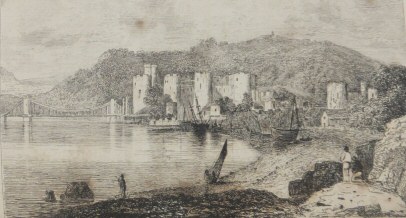
During my short stay in Conway, I endeavoured to discover the
best view of the town, which I think is from the eastern side of
the river, about midway between the chain bridge and the mansion
of Sir John Hilton. Nothing can be more interesting.
The variety of small craft, sailing and anchored, before its
warlike screen; the castle, with its towers and turrets, rising in
hostile grandeur upon its rocky base; the bridge, and lovely
scenery beyond of purple hills and thriving villages; and the
bright waters sporting with the luxuriant foliage of its woody
margin, create a sensation of delight in the pursuer of
picturesque scenery, which he has probably seldom before
experienced.
Another delightful view may be obtained by ascending the rock,
which overhangs the lodge of the bridge upon its eastern
side. A flight of steps conducts to the summit, where a
seat is most conveniently placed for the accommodation of the
lovers of romantic beauty; and the bridge, although inferior in
magnitude to the stupendous work of art which stretches over
Bangor Ferry, commands the admiration of the spectator. But
the chief object of interest is the castle, which surpasses in
picturesque grandeur any building of the kind I ever
beheld. I thought Carnaervon Castle the most beautiful of
ruins, but it is not, in my opinion, to be compared with
Conway. The solidity of its structure, and its expansive
site, resembling the fortresses of Syria and the Holy Land, give
to its exterior all that the most romantic imagination could
desire. Its foundation is a rock of slate, and its works
are impregnable. Nothing but famine could, at the time it was
erected, have had power to subdue it. Its walls are from
ten to twelve feet in thickness, and it had formerly a deep and
broad moat, on the west and north west sides; which with the sea
washing its base on the east and south, formed insurmountable
barriers to the assailants.
It was evening when I first entered this noble ruin. The
porteress very ungraciously left me to my meditations after
admitting me, locking the gate after her, and leaving me like a
state prisoner in the royal fortress. I confess I was
little pleased with the manners of my conductress and the
solitary situation in which I was placed, and sensations arose
within me like those which a school boy feels when passing a
churchyard at midnight.
The sun had set, and the deep shadows of eve were darkening
into night, as I stood alone in the court yard, and flitting
visions arose before me of those who crossed its space in distant
bygone ages—“the plumed troops,” and courtly
dames, and all the glitter of the olden times. As I thus
stood amongst the ruins, a deep drawn sigh, close by my ear, made
my heart leap into my throat, as I turned to discover from whence
it proceeded. But all was solitude around. The huge festoons of ivy, unruffled by a
breath of air, hung heavily in funereal grandeur on the
walls. As I passed into what had been the banqueting hall,
the darkness increased. It was a noble apartment, and
measured 130 feet in length, and thirty in breadth, in height
twenty. Nine windows looked southward, up the river, and
two into the courtyard. In the recesses were stone seats,
capable of accommodating twelve persons; and, as I seated myself
in one of these, my delusion of other days came over me.
Here sat the first Edward, the hero of Palestine; here was the
monarch besieged, and almost reduced by famine; here Hotspur and
King Richard held a conference; and the latter, putting himself
into the power of Northumberland, was betrayed by him, and sent a
prisoner to the usurper Bolingbroke.
“Life’s but a walking shadow—a
poor player,
That struts and frets his hour upon the stage,
And then is heard no more!”
As I made this apt quotation, another deep and heavy sigh, and
a rustling in the ivy, startled me, and the bird of solitude, the
lonely owl, flapped his heavy wings, and flew past me to a remoter
corner of the ruined hall. I arose, and walked to a small
chamber, where there was an open ornamented casement, and which,
as I was afterwards informed, bears the name of the queen’s
oriel; from which there is a pleasant prospect of part of the
ruin and scenery beyond.
I then proceeded to the terrace, at the south western
extremity, which is on the surface of the rock; and the prospect
from this spot, interesting at all times, is doubly so by
moonlight. The suspension bridge beneath, the ocean on the
left, and this fertile valley on the right, with the sparkling
Conway meandering through it, compose a scene of unexampled
beauty.
In the year 1290, when Edward was engaged in a dispute with
the King of France, and was determined to revenge himself upon
that potentate, in order to obtain supplies, he made the
experiment of taxing his newly acquired Welsh subjects; which
they resented by hanging Roger de Pulesdon, who had been
appointed to collect the tax; and by defeating the English
forces, who attempted to enforce them.
Alarmed at a revolt, which was now rising into importance, and
which threatened to wrest from him his new dominions, Edward
entered North Wales, to conduct the war in person.
Having proceeded in his march to Conway, he crossed
that arm of the sea with a part of his forces, and retiring into
the castle with them, awaited the arrival of the remainder.
In his passage he lost many waggons, and other carriages, loaded
with provisions, which were intercepted by the Welsh, who came
down in multitudes from the mountains, and invested the castle,
upon the land side, while a sudden rise in the Conway, which
prevented his troops from crossing the river and rendering him
assistance, made his situation extremely alarming. He was
surrounded by water and the enemy, cut off from his army, and
threatened with famine.
The good fortune of Edward, however, returned to him in the
hour of need. The river subsided, and his forces being able
to cross to his relief, the Welsh again retired to the mountains,
and the English monarch passed his Christmas holidays without
interruption at the castle.
In 1665, the Earl of Conway, under pretence of its being for
his majesty’s service, stripped the castle of all its
furniture, iron and lead, and shipped them off to Ireland,
otherwise it might have remained as firm and entire at the
present day, as when it was first erected.
If
these Goths were aware of the ignominy they attached to their
shields by acts so disgraceful, they might perhaps have permitted
beauty and grandeur to remain undefiled by their sacrilegious
touch.
The young men still keep up many of the ancient local customs;
amongst which, on Nos Calanmai, or, the eve of the first of May,
they hang on the houses of their sweethearts bunches of rosemary
and ribbons.
At the door of a prude they tie a penglog, or part of a
horse’s skeleton. There is likewise a custom
preserved called Stocsio. Upon Easter Sunday, a great
number of boys and men assemble on Pentwthil, with wands of
gorse, to proclaim the laws and regulations which are to be
observed upon the following morning. The last married
person is sought to perform this office, who, mounted on a heap
of stones, issues his mandate, while the rest listen with silent
attention. He decrees that all men under sixty years of age
are to appear in the street before six o’clock on the
following morning; and all under forty, before four; and all
under twenty are commanded not to go to bed at all, under penalty
of being put into the stocks.
The
orator then descends, amidst loud cheering, and the assembled
parties separate; the younger branches to form plans of
amusement, and the graver to secure their carts, waggons, and
wheelbarrows, with chains and locks, to prevent their being
seized upon the following day; a very necessary precaution, as
every vehicle, unmanacled, or otherwise unsecured, is sure of
being pressed before dawn of day into the service of the
light-hearted youths, who are not over careful of their
neighbour’s property during the uproarious period of their
festivity.
Early in the morning, the stocks are placed at one end of the
street, and a party, marching to the inspiring music of a drum
and fife, parade the town, in order to convey to the place of
punishment all seceders from this ancient law of custom.
When they arrive at a house where a rebel resides, the storming
party endeavour by all practicable means to gain admittance; such
as climbing in at the windows, forcing open the back door,
&c., and they generally secure the culprit; who, if he be
caught in bed, is allowed sufficient time to dress himself, and
then hurried away to the stocks, amid the exulting shouts of the
assembled multitude.
His
feet being secured, one of the party gives him a severe lecture
upon the sin of idleness, and of breaking old established
customs. Then taking his right hand, he puts questions to
him; such as, whether he would rather kiss the mistress or the
maid?—whether he prefers buttermilk or strong
ale?—and the more satisfactory his answers are to the
party, the more thickly his hand is plaistered with mud, until at
length he is released, and, with loud cheering, permitted to join
the forces, as they march off in search of another rebel.
There is a pearl fishery at Conway, and many poor families are
supported by gathering the muscles, which contain these gems.
The fish is called by Linnæus myd
margaritefera. The produce is transmitted to London in
the pure natural state, and easily finds a market amongst the
jewellers, who purchase them by weight, but in the neighbourhood
of Conway the purposes they are appropriated to are unknown.
It was my good fortune to meet with a brother tourist at the
Castle Inn; who, after acquainting me with the above facts,
offered to conduct me in the morning to Llandudno, which offer I
thankfully accepted; and, before the sun had finished his draught
of mountain dew, we had crossed the bridge, and were pursuing our
course to the appointed spot. The tide was at low ebb, and
a pleasant walk of three quarters of a mile upon the hard sand
brought us to
“The fort of the Conway.” By the English, it
is called the Gannoc and by the common people in the
neighbourhood “Y Faer dre.”
The ruins of an ancient castle are to be seen at a short
distance, situated upon two hillocks, near the shore. From
thence we crossed by Eglwy’s Rhôs, where Maelgwn
Gwynedd is said to have taken refuge to avoid the yellow fever,
which was committing great havoc in all parts of Europe.
Gloddaeth, the residence of Lady Mostyn Champneys, is sweetly
situated near this place. It was built by her ancestors in
the reign of Elizabeth, and is celebrated for the Welsh
manuscripts contained in the library. The grounds are most
tastefully laid out, and the tourist will find himself amply
rewarded for his pains while viewing the extreme beauty of the
scenes around.
is built upon a huge mass of rock which projects into the sea,
called The Great Orme’s Head; a small village, where
formerly a great deal of smuggling was carried on; and, as we
stood gazing upon the frightful precipice beneath us, at the base
of which the ocean breaks its mighty bulk, and foams as if
enraged at opposition, my companion related a story of a
fisherman’s daughter and her lover, the circumstances of
which took place within view of the position we then
occupied.
“It was my fortune, or rather my misfortune,” said
my companion, “some forty years ago, to take up my quarters
at a fisherman’s hut in the village, who was a widower with
one child, a lovely girl of about sixteen years of age. She
performed all the household duties for her father with the
greatest neatness and cheerfulness, and at evening
was looked upon by the youth of the surrounding neighbourhood, as
the gayest and handsomest lass that tripped upon the hard sands
to the music of a blind harper, who lived in the vicinity.
Many a time as I stood and saw her light feet moving in the
inspiring dance, have I said to myself, it would be a pity now if
so light a foot should ever carry a heavy heart. Poor Jane!
she was the sweetest wild flower of the cliff—nursed in
storm and tempest, yet in her simplicity more winning to the
heart and eye than the proudest exotic luxury could
produce. I took a pleasing interest in her; and for the
attention she paid me, resolved upon improving her education to
the extent of my ability, which I considered an easy task, for
the organ of veneration, I observed, was large, which induced me
to think she respected those who took an interest in her
welfare. Benevolence and hope were equally prominent, and,
when this happy association appears, the leading feature of such
persons’ characters may be perceived in the religious
obedience they pay to all those who are anxious to instruct their
minds and purify their thoughts. I felt notwithstanding,
considerable anxiety for her future welfare; for at the lower
part and back of the head, between the mastoid processes
and the
occipital bone, I had noticed an enlargement, which I
knew, combined as it was with the moral sentiments and the organs
of adhesiveness, strongly developed, would either prove the
blessing or the bane of her existence, as these opposites
depended not only upon the man’s disposition to whom she
might yield her affections, but to the destiny of that man,
successful or disastrous. And I had frequent opportunities
of observing that she had a strong partiality for a youth who was
possessed of personal and mental qualifications far beyond those
of his associates, but who was wild, with the bump of
marvellousness extremely prominent.”
“Zounds,” said I, “if you cover your story
with so many excrescences, I shall never be able to remember one
half of it.”
My companion smiled benevolently, as he replied, I perceive
you lack the organ of individuality; and then resumed the
thread of his discourse. After remaining with them nearly
three months, during which I may give myself credit for having
made good use of my time in improving the manners and intellect
of my docile pupil, I took leave of the fisherman and his
daughter, promising to pay them a visit in the course of a month,
before I returned to merry England. Tears stood in
the eyes of poor Jane as I turned to quit the cottage, and the
old father squeezed my hand with a cordiality that effectually
stopped the circulation of my blood in that extremity.
Mark, her lover, seemed neither sorry nor pleased, but leaning
his broad back against the white-washed wall of the cottage,
whistled with the greatest composure, “The jovial
fellow’s farewell.”
After a month’s ramble, I returned to this spot on a
dark, stormy day in October;—it was indeed a dreary
evening. The rain fell in torrents, and the hoarse sound of
the surge came heavily upon my ear as I approached the cottage of
my late worthy host; when suddenly, as I lifted my eyes from the
ground, I perceived a number of persons walking in slow
procession, as from a funeral, and a cold shudder came over me as
I recognised the father of Jane; his white locks exposed to the
beating rain, his head bent to the ground, and his hands clasped
upon his breast, in the action of mental agony.
Thinking my visit would prove ill-timed, I proceeded to a
small public-house, and, while my garments were drying at the
fire, I managed to extract from the landlord, that the funeral of
Jane Morgan had just taken place. Astonishment and sorrow
chained my tongue for some time; I shall never forget the
sensations I experienced at this mournful relation. I sat
motionless in my chair, without uttering a syllable for a full
hour, or noticing anything that transpired around me during that
time. I could think of nothing but Jane Morgan; I could see
nothing but her young blooming face and yellow locks, which used
to glitter like threads of gold in the sunbeams, as the fresh sea
breeze blew them into a thousand fantastic waves; her airy form,
as it flew along the sand on which her light foot scarcely left a
print; her simple dress; all this I brought to my
“mind’s eye,” and afterwards the church-yard
where she was laid a corpse—I burst into tears.
Her lover, Mark Bratts, who had for more than a twelvemonth
paid courtship to poor Jane, had obtained her father’s
consent to their union, whenever he could realize a sufficient
sum to begin the world with in a prudent and respectable
way. The precarious life of a fisherman, however, appeared
to Mark to hold out but little prospect of wealth enough either
to gain or to support a wife; and he resolved upon obtaining the
object of his wishes as speedily as possible in some other
way.
A man
named Simpson, a notorious smuggler in the neighbourhood, was
known to have amassed a considerable property, and Mark resolved
to offer himself to serve as one of the crew on board his lugger;
hoping, that in a trip or two, he might earn sufficient to claim
his promised bride. He was accepted aboard; and the day
following the little vessel spread her light sails to the breeze,
and took her course for Holland. Mark possessed a little
money which he laid out in a venture, trusting thereby to clear
so much as would enable him to claim as his bride the object of
his love.
It was a stormy day when the inhabitants of Llandudno were
roused by the report of guns from seaward, the wind blowing
furiously right on shore. It was about the time that the
smuggler’s vessel was expected, and those interested in her
safe arrival hastily ran to this promontory to ascertain if she
was in sight, or in danger, for a king’s cutter was known
to be cruising on the coast. It was just dawn; the sea was
running mountains high; and within a league of the rocks they
perceived two vessels within half a mile of each other. The
first was a small lugger, carrying a press of canvass that seemed
to run her hull under as she made directly for the
headland, and her masts bent like reeds to the fury of the
tempest. As she approached the headland, a number of kegs
piled one upon another on the decks, were observed to vanish into
the deep by dozens, being flung overboard by the busy crew.
They were within a mile of the shore, when the revenue cutter,
hauling her wind, poured a broadside of grape shot into the
smuggler, so well directed that several were seen to fall from
their stations in various parts of the vessel. Still they
carried every stitch of canvass, knowing that there was water
enough for the light lugger to cross the bar after they had
rounded the point, and that the revenue cutter would be sure to
strike upon the sands if she attempted to follow them half a mile
further, being of much heavier tonnage. Besides, she was
already in some peril, by venturing so far in shore, with a gale
blowing heavily from the north east.
She was soon within hail of the head, and the cliffs were
covered with human beings, gazing eagerly upon the little craft
beneath it, when suddenly, a chain shot from the cutter carried
away her mainmast, which fell over the side. To cut away
the stays and clear the wreck, was the work of a minute, and the
smuggler’s bark swept like a sea bird round the
great Ormes head into the Bay of Conway, but not until their
pursuers had sent another broadside into her hull as they stood
off shore. As the Typhon, the name of the king’s
vessel turned from the pursuit; the daring outlaws sent up a
shout of triumph, which was echoed from those upon the rocks, and
after a slight shock which the lugger received, as she crossed
the sand-bank, they floated safely in smooth water.
But where was Jane? Foremost of that crowd which
gathered on the rocks, when the firing was first heard, flew the
light form of the loving maiden, like a young eagle glaring for
its mate. She stood upon the extreme verge of the cliff,
unconscious of every thing, save the peril of her lover, her eyes
fixed upon the vessels, straining as they would crack their
strings, to discover the form of him who had her heart in
keeping; and, as the vessel glided under the headland, she hung
over the brink of the precipice, gazing upon the dead and dying,
with whom the decks were strewed. But she saw him
not. With the swiftness of the seamew, she followed the
course of the smuggler along the shore; and when at last she saw
the white sails gathered to the yards, and the vessel riding
safely at anchor in the rocky bay, she leaped into a boat,
and rowed herself to its side. A moment, and she jumped
upon the deck, calling wildly for poor Mark. But no one
answered her. With hair dishevelled, and eyes glancing
fire, she turned each dead man’s face up to the sky.
At length, a headless trunk met her distracted gaze. A
bright gold ringlet of hair, tinged with the smuggler’s
blood, and fastened to the breast of his shirt, the blue
pea-jacket she gave Mark at his departure, and the brass buckles
which her father wore, and presented to him as a pledge of future
favour, all flashed conviction on her mind, that it was the
mutilated form of her lover. A wild scream, which struck
terror into the hearts of the daring crew, proclaimed her heart
was broken; and falling on his mangled corse she instantly
expired.
This was the melancholy end of the lovers. And you may
remember that I said her happiness or misery would depend not
only on the disposition of the man she loved, but upon his future
destiny; the organs of amativeness and adhesiveness being so
largely developed.
Here an object attracted his attention at a short distance,
and he suddenly left off speaking to examine the scull of a melancholy
donkey, which stood gazing upon the waste of waters.
Having carefully examined the animal’s pericranium, on
which he made some scientific remarks, elaborately pointing out
the distinguishing characteristics of the quadruped and biped
race, I reminded him that it was high time to retrace our steps
to Conway, and, as we trudged along, he related a story of rather
a whimsical nature, which, as it tended to illustrate his
favorite science, afforded me much amusement.
He lived, he said, at one time opposite to a house where
resided a newly married couple. The house had the
appearance of particular neatness, the flag stones before the
door being white as snow, as were those supporting the railing of
the area. The ledges of the windows were in keeping with
the rest, and the windows themselves were perfectly
unstained. The curtains below were of green damask, and
above of elegant chintz, with pink linings. A variety of
plants bloomed in the balcony, and the pots were ranged in
precise order.
It
greatly excited his curiosity, that every week, for upwards of a
twelvemonth, he saw one or two new servants. It appeared
that one week was the longest period the lady ever permitted any
menial to remain in the house.
This circumstance created some surprise, as, during the time,
he had never observed a single gentleman or lady knock at their
door.
He had an opera glass, through which he took every opportunity
of examining their heads across the street. At length, his
bump of curiosity over-mastering every other consideration,
determined him to seek an occasion of becoming acquainted with
the lady of the house. For this purpose, he dressed himself
with peculiar nicety, and stepping over, intimated by a
rat-tat-tat that he was at the door. A female servant
answered the summons, and ushered him into the parlour, where the
lady was seated gazing with a vacant stare upon some pots of
geraniums, which occupied a niche in the apartment. When a
lady receives a visit from a gentleman she has never been
introduced to, it is natural for her to look in his face, and an
opinion is too frequently formed by the Lavater-loving sex, of
the character, at first sight, of the being before them.
But Mrs. — took a very different view of my philosophical friend; for her eyes fell from the
geraniums to the toes of her visitor, as if she had the art of
discovering the character of a man by the state of his boots.
“I hope you will excuse the appearance of a stranger
at”—
The lady interrupted him with, “None of the cleanest,
indeed, Mr. Thingumbob. Good God, Susan, why did’nt
you tell him to wipe his feet on the mat!”
“I beg you will excuse,”—continued my
friend, apologizing.
“Well, I suppose I must excuse. My gracious! what
are you doing, sir? you’ve put your nasty wet hat upon my
beautiful rose-wood table! Why, Susan, I say, bring a
cloth—who could ever believe that any man would bring his
hat into a parlour! you stupid girl, is that the way to rub a
table? use a little elbow grease, you intolerable slow
coach—there, get away and let me do it myself!” and
with that the lady snatched the cloth from the hands of her
domestic, and began rubbing and puffing in a style which
sufficiently proved she was capable of giving, if not
receiving a polish.
After ten minutes’ exercise, the lady returned the
rubber to the servant, and with a face ruddy as the full
moon at its rising, seated herself upon the chair, and cast a
look of satisfaction round the room at the peculiar neatness of
its appearance.
“I perceive, madam,” said my friend, “you
take particular delight in seeing your apartments kept clean and
neat, and the arrangement of this room does honour to your
taste;” he had touched the string that vibrated to her
heart.
“I confess, sir, I feel a pride in seeing every thing in
its place, and cleanliness is an indispensable qualification in
the servant I engage. Will you believe me, sir, when I tell
you that this girl you just saw, is the forty-ninth I have had in
the last twelvemonth, and I have no more idea of keeping her than
I have of taking back any of her predecessors.”
“Ah madam, servants are sad plagues!”
“Plagues, sir, they are devils. Why, it was but
yesterday, when I thought my house, from the attic to the
kitchen, was so clean, that not a speck of dirt could be visible
to a fly, I was obliged to upset a whole boiler full of the most
delicious pea-soup into the middle of the kitchen!”
The phrenologist lifted up his legs, by instinct, as if he
felt the sprinkling of it upon them, and exclaimed, “How
unfortunate!”
“Unfortunate, sir, it was insupportable,” cried
the lady; “but I made her clean it up again!”
My learned friend was then put to a nonplus; he could not for
the life of him, make out why Mrs. — should have taken the
trouble to upset a boiler of pea-soup into the middle of the
clean kitchen; and this he politely requested her to explain.
“Why, I’ll tell you, sir, it is my pleasure to see
every thing in its place, and a grease spot to me is as bad as a
plague spot to many. Now, sir, although the kitchen looked
better, I’ll be bound to say, than any other kitchen in
town, yet I was anxious to see if my servant had obeyed my orders
in taking a spot of grease out of the boards, which by accident
fell upon them the day before; so lifting up the
oil-cloth—judge of my horror and dismay to find it
untouched! I inquired the reason. The servants had
the impudence to tell me, they had not time, at which, I made no
more ado, but threw the boiler of soup upon it, which took them a
good two hours to clean up again. I will have every
thing done, and in order.”
“Indeed, madam,” said my friend, “I
perceive the admirable effects of your system—this room is
in admirable order.”
“This room, sir! have the goodness to walk into my
bed-room up stairs!”
My phrenological friend, although he had passed the meridian
of life, could not help thinking this invitation rather
extraordinary, more particularly so, when the lady desired him to
take off his shoes.
“For,” said she, “I never allow even my
husband to come up stairs in his shoes.”
Now it so happened that my friend had a particular reason for
wishing to avoid this ceremony, having walked a hole in one of
his stockings the day before, and the laundress was in possession
of his other pair. Nothing, however, could alter her
determination of exhibiting her cleanliness. She protested
he should see her bed-room, and insisted on his taking off his
shoes!
With a shrug à la française, he
submitted, but had not ascended half way up the stair-case before
the lady who followed, perceived the injury his hose had
sustained, and with a cry of horror exclaimed, “Susan!
bring up a needle and thread!” the words were scarcely
uttered, when the girl appeared, and without hesitation (without
asking him to draw off his hose) seizing him by the foot,
compelled him to submit to her needle’s operation; blushing
and confounded at the awkward position his unjustifiable
curiosity had drawn him into; having completed her orders, the
girl descended to the kitchen, while he ascended to a square
landing place on the first floor. On the outside of the
window was a veranda filled with the choicest plants and flowers;
the casement being open a delightful breeze entered the house,
bringing with it the odours of the little garden; and he was
about making a complimentary observation upon the admirable
arrangement of her bough-pots, when, helter-skelter, in, through
the casement, bolted a large tabby cat, and with a spring,
clearing my friend’s shoulders, alighted upon the elegantly
laced cap of the precise Mrs. —. They had not time to
recover from their first alarm, when down tumbled all the roses,
lignum vitæs, rhododandrums, geraniums and myrtles, being
dislodged by a huge tom-cat rushing in, in pursuit of the
aforesaid timid feline intruder. Crash, crash! went the
bough-pots—squall, squall, went the lady. Damnation!
exclaimed the gentleman. The lady’s foot slipped, and
she slid and bumped to the bottom of the stairs; the
phrenologist, endeavouring to save her, blundered completely over
the lady. The two cats scampered round and athwart the
elegantly arranged parlour, dislodging every ornament from the
chimney-piece; and at length, my friend, having recovered his
shoes, hastily snatched up his hat and cane, and made a
precipitate escape from the house of a lady, who was unfortunate
in having the bump of order too strongly developed.
We arrived at the castle in Conway greatly fatigued, and
equally delighted with our day’s ramble.


