O Kahiki, land of the far-reaching ocean,
Land where Olopana dwelt!
Within is the land, outside is the sun!
Indistinct are the sun and the land when approaching.
Perhaps you have seen it?
I have seen it.
I have surely seen Kahiki.
We lived on the coast of California, on the Spanish
grant my grandfather had purchased from the
mission which still stands, deserted and crumbling,
in the Santa Brigida Valley. Our house, built
long before the Civil War, overlooked the lower end
of the valley, from a knoll above the salt marshes at
the river-mouth. The house was built in the form of a
hollow square, surrounding a paved court. The walls
were of adobe,—sun-dried bricks of clay, mixed
with a little straw,—four feet thick, and pierced
by small grated windows, designed for loopholes
more than for the admittance of light and air.
The beams and rafters were of roughhewn pine,
carried down from the mountains by the Santa
Brigida Indians, a tribe long since extinct, and the
same patient workers had moulded and baked
the old red tiles of the roof.
My father and my uncle Harry Selden had been
brought up to the half-Spanish life of old
California. For ten miles along the coast and six miles
inland the land was theirs, and in those days three
thousand head of cattle, bearing my grandfather's
brand, grazed on the mesas and filed down in long
lines to drink. When the brothers were young,
the grizzly still lingered in the hills, the tracks
of deer and mountain lion were everywhere, the
quail trotted in thousands along the river-bottom,
and in the winter months the plains along the
seacoast were clamorous with flocks of wild geese,
feeding on the rich grass. But times were changing,
and little by little, civilization was creeping in.
A church and a schoolhouse were built in the
township north of us; taxes were raised; and finally a
party of surveyors appeared, running a line for
the new railway. My grandfather abhorred the idea
of a railway passing through his land; he made
a bitter fight and would not give in till his own
lawyer showed him that if he refused to accept
what was offered for the right of way, the law
would force him to do so for the public good. He
died a short time after the trains began to run.
The brothers were young men at that time, and
as their mother had been dead for many years,
their friends supposed that they would carry on
the ranch in a sort of family partnership. But
Uncle Harry, in his love of a wild and independent
life, was my grandfather over again. He
announced that he had had enough of civilization,
persuaded my father to buy out his share of
the Santa Brigida, and bade his brother and his
friends good-bye. I remember, when I was very
small, how eagerly we looked forward to the letters
my father used to read aloud to us: accounts of
African gold-mining; of wanderings in Central
America and Mexico; of great cattle-ranches—estancias,
Uncle Harry called them—in the Argentine;
of voyages along the barren Chilean coast:
of storms and shipwrecks among distant archipelagoes.
In the end he settled as a trader, a buyer
of copra and pearl-shell, in the South Seas.
As for my father, he was content to marry
and to stay at home, but he clung to his cattle
stubbornly, refusing to farm or to sell an acre
of his land and growing poorer with each year
that passed. He often said that we would never
starve and that our land was constantly increasing
in value, but at such times my mother used to rise
from her chair with a sigh and walk out alone
among her roses in the court. She was a patient
woman and she loved my father dearly, but I
knew that the sale of only a few acres among all
our thousands would have provided her with many
things she craved. What with dry years and low
prices, our taxes ate up nearly all the profits from
the cattle. We could never afford a motor-car or
the occasional trips to San Francisco of which
our neighbors' children gave me glowing accounts,
yet outside of such luxuries, I must own that we
had little need of ready money. Our own fat steers
provided us and our men with beef; my mother
was superintendent of a garden which furnished
more vegetables than we could eat; and in the fall
and winter game was still plentiful enough to be
a real resource.
Our circumstances had made me a rather serious
boy, fond of solitude and given to endless
day-dreams—dreams of returning from vague
gold-mines or speculations in land with a fortune, to
be invested in the ranch and to provide my mother
with travel, and rest, and pretty clothes. On my
rides to school along a five-mile stretch of coast,
where the pearly fog billowed about the hills and
the Pacific broke lazily beyond the dunes, I lived
in a world of pure fancy, from which the sight of
San Isidro, with its single dusty street, its stores,
and hideous frame schoolhouse, recalled me daily
with an unpleasant start. All through the week
I lived only for the coming Saturday, when I
would be free to shoot, or fish in the surf, or ride
out with our men to track down some band of
half-wild steers, hidden in the thick oak scrub of
the foothills.
It was on a Saturday that my uncle came. I
was fifteen that winter, and ten years had gone
by since he had visited us last, but I had not
forgotten his lean powerful figure, or the black eyes
lighting up a face tanned to an unfading brown,
or the stories he had told a wondering youngster
of five, sitting on his knee by the fireplace.
The month was February, as I remember it, for
the wild mustard was tall and green on the hills
and scattered cock-quail were perched on the
fence-posts, filling the air with the long sweet whistle
of their mating-time. We were early risers, all of
us, and at dawn, as I was eating the breakfast my
mother had prepared, she asked me if I would take
my gun and try for some wild duck on the marshes.
There would be guests from San Isidro to-morrow,
and a few brace of duck would be a treat for people
from the town. I assented joyfully, for such a
request meant that ammunition would be furnished
from my father's store, and I loved nothing
more than the long lazy hours in a blind, where one
could watch the strings of wild fowl trailing across
the sky.
I had good sport that morning, hidden close to
a shallow pool behind the dunes. As I waded
across the marsh, carrying my gun and half-a-dozen
wooden decoys, a cloud of teal rose quacking
from the grass and headed seaward on beating
wings. The redhead were beginning to fly
northward from their wintering grounds on the lonely
Mexican lagoons; small flocks of them, led by
drakes with heads glinting like burnished copper in
the sunlight, rose from the creeks ahead of me
and sped away, low over the sand hills. At the
place that I had chosen for my shooting, I
unwound the anchor-lines of the decoys, tossed them
far out into the pool, and built myself a rough
shelter of pickle-weed, strung on stakes pounded
into the mud. I found an old piece of board for a
seat, loaded my gun, laid out a box of cartridges
within easy reach, and settled myself luxuriously
to wait.
Next moment I glanced upward and crouched
down lower than before, cocking my old-fashioned
hammer-gun. High in the air above the marsh, a
flock of sprig was descending in great spiral curves,
the wind humming musically through the rigid
flight-feathers of their wings. Lower and lower
they swung, while my pulse raced as I peeped over
the edge of the blind. I could see the snowy breasts
of the drakes, the feathers of their long forked
tails, and their heads turning this way and that as
they scanned the marsh warily for signs of danger.
They had seen the decoys, and as they swept past
me, still out of range, I called to them, imitating
the feeble quack of the hen bird. Then, while I
held my breath, they turned again, low over the
pool, and came sailing straight at me—necks up
and feet dropping to settle among the decoys.
My hands were trembling a little, but I took careful
aim at the old white-breasted leader, pulled the
trigger, and saw him crumple and strike the water
with a mighty splash. Wild with alarm, another
drake came towering above my head, and leaning
backward till I nearly fell off my seat, I let drive
with the left barrel and watched him fold his wings
and come down plunging to the grass.
I can recall that warm winter morning as if it
were yesterday: the steady thunder of the breakers,
the perfume of the salt marsh, the wisps of cloud
drifting across a soft blue sky. Flock after flock
of wild fowl came speeding in from the sea, circled
the marsh, set their wings to alight, bounded
upward, scattering, at the reports of my gun, and
headed back for the ocean—fast-vanishing dots
above the dunes. Once a wedge of geese passed at a
great height overhead, flying northward with slow
steady wing-beats, thrilling me with the hoarse
music of their voices. My life seemed cramped
and narrow as I gazed at these free rovers of the
sky, travelers beyond the far rim of the horizon
north and south.
The warm sun and the drowsy chirping and
buzzing of insects in the grass brought on a nap
that caught me unaware. It must have been mid-day
when I awoke with a little start, to sit up and
rub my eyes, wondering for an instant where I was.
Unloading my gun, I waded out after the decoys
and strung my dead birds on a thong of leather.
Then, yielding to a habit of those days, I climbed
to the top of a sand hill, for a look at the beach.
Next moment I nearly shouted aloud in the
excitement of what I saw.
Close inshore, not far beyond the outer line of
breaking seas, a two-masted schooner was
rounding into the wind. She was painted white and
her sails shivered crisply in the light air. One
needed small knowledge of ships to appreciate
the beauty of the little vessel: the high sharp bows,
the graceful sweep of sheer, the slender masts,
the taut lines of shroud and stay. The sight of
a ship was rare along our stretch of coast. At long
intervals we saw a trail of smoke far out to
sea,—the steamer trading between San Francisco
and the west coast of Mexico,—but this was
the first time within my memory that a vessel
of any kind had passed so close to shore. And
she was not merely passing, for I saw now that
her crew was sliding a long double-ended boat
over the rail. Three men sprang into the
whaleboat: a pair of oarsmen who seated themselves
and began to pull toward shore, and a man in blue,
who stood in the stern, holding a steering-sweep
with one hand and waving good-bye to a gigantic
figure at the schooner's wheel. The giant raised
his hand in an answering wave; the schooner bore
off, her sails filled, and she headed out to sea,
heeling gracefully to the breeze.
There had been a storm in the north and the
swell was high that day. Even from my perch
on the dune, the approaching boat was invisible
each time it swung down into the trough. It was
just beyond the breakers now, and as it rose on
the crest of a wave I saw that the oarsmen had
ceased to pull and that the man with the steering-sweep
had turned his head and was watching the
rearing seas astern. The ground swell, as I have
said, was very high, rolling shoreward a good ten
feet from trough to ridge, and I began to wonder
how these three men would win the beach through
the turmoil of white water ahead of them. Rearing
and tossing as the water shoaled, three or four
great waves passed under the boat and crashed
forward, racing toward the beach in walls of foam.
Then, clear above the thunder of the surf, I heard
a vibrant shout—a command in some strange
foreign tongue. The men on the seats tugged with
a sudden desperate effort at their oars; the man
astern, with a single heave of his sweep, turned
the boat straight in toward where I lay. He was
smoking a cigar, and I felt a thrill of admiration
at the easy, careless way he stood at his post. A
tremendous comber, with patches of foam beginning
to appear along its crest, lifted the boat high
in air and swept it forward tilting on the brink
of a foaming wall. The wave tumbled and crashed
and came rushing far up the beach.
The boat grounded with a gentle shock and the
two oarsmen leaped overboard to hold her against
the strong backwash. They were brown men, I
saw: great brawny fellows more than six feet tall,
with handsome, good-natured faces and teeth that
flashed when they smiled. The steersman sprang
out on the damp sand and gave an order, at which
his men dropped a pair of light rollers on the beach
and began to drag the boat up beyond highwater
mark. Then he came strolling toward the sand
hill where I lay hidden in the grass.
He was dressed in blue serge—a double-breasted
coat with brass buttons—and a blue yachting-cap
with a white crown. His age must have been
forty or forty-five, but he was straight as an
Indian and carried himself like a boy. His face,
of a humorous and rather reckless cast, was tanned
almost to the shade of the brown sailors toiling
with the boat, and his black eyes were the most
brilliant I have ever seen.
His eyes betrayed him. He tossed away the
burned-down cigar, folded his arms, and came
walking slowly toward my hiding-place, gazing
about him with a half-smile on his lips, as if this
lonely beach recalled a train of pleasant memories.
I was peering down over a clump of rank salt
grass when he glanced up and looked directly into
my eyes.
"Uncle Harry!" I shouted as I came sliding
and tumbling down the steep face of the dune.
His strong hands seized me and lifted me to my
feet.
"You're Charlie, eh?" he said, when he had
looked me up and down with a smile that took
me back to evenings by our fireside, ten years
before. "You've done well to remember me all
this time! By Jove! I'd never have known you
in the world! Here, let's have another look. A
chip of the old block, I reckon—you're going
to have your grandfather's mouth. Well, I never
liked a soft man. How are you all? Did you sight
me from the house? Been shooting, eh—let's
see your birds."
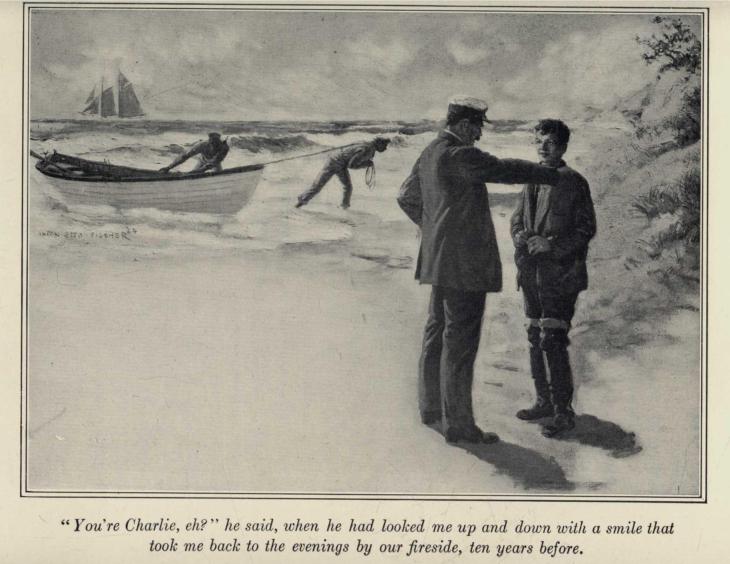
"You're Charlie, eh?" he said, when he had looked me up and down with a smile that took me back to the evenings by our fireside, ten years before.
I led him across the dunes to where I had left
my gun and string of duck. At his request I undid
the thong about their necks and laid them out
on the sand, while he took them up one by one,
spreading a wing to admire the changing colors
of the speculum, or smoothing the feathers of a
glossy head. At last he sighed, as he cut the end
of a fresh cigar and looked up at me.
"Ah, Charlie, it takes me back," he remarked.
"Many and many a time I've shot over this pond!
I had an old muzzle-loader, twice the weight of
that gun of yours. On a Friday night your
grandfather used to say: 'Which one of you is going
down to the marsh to-morrow to get me a mess
of duck?' and I always landed the job. Your
daddy liked to work with the cattle; he reckoned
shooting was a chore, like splitting kindling, or
driving the milk-cows in from pasture. But it's
time for kaikai, and I'm keen to see Ben and Mary
after all these years. And Marion—she'll be
seventeen now, eh? I'll bring my boys up to the
house for a bite; the swell was too high to drop
anchor, so I told the mate to stand off and on till
I came out."
He turned toward the beach and called the sailors
in his strong vibrant voice: "E Ivi! E Ofai e!"
A moment later I saw the two brown men trotting
across the dunes. Their feet were bare and
they wore sailor jackets and trousers of dungaree.
Their round caps bore the schooner's name, Tara,
woven in silver thread upon the bands.
"Good lads," remarked my uncle, as they drew
near. "Paumotu boys from Rangiroa—they've
been with me since the Tara was built. Shake
hands with them before we start." He spoke to
the sailors in their own tongue, telling them that
I was his brother's son, and they smiled as they
gazed at me with the frank curiosity of savages.
At a word from Uncle Harry, one of them picked
up my gun and birds, and I led the way around
the marsh to the Santa Brigida road.
We had not walked more than half a mile when
we met my father, who had sighted the schooner
and was now riding down to the beach.
"Harry!" he exclaimed, his bearded face
transformed by an expression I had never seen; and in
an instant he was off his horse and wringing my
uncle's hand. "It's like you to drop in this way,
without an hour's warning, but your welcome will
be all the warmer for that! It's good to see you,
old fellow! You're looking well—your cannibal
islands must agree with you. What do you think
of this uncle of yours, eh, Charlie? He wouldn't
for the world drop me a wire a day or two ahead,
or arrive by train or motor-car, like a civilized
man. Nothing will do but to come in a schooner
and land like a pirate on the beach! But come
along to the house and bring your men; I can't
offer them missionary, if that's their usual diet,
but we killed a steer yesterday, and there's plenty
of fresh beef."
"Well, Ben," said Uncle Harry, still clasping
my father's hand, "ten years haven't changed
you, after all! I can't tell you how good it is to be
back on the Santa Brigida again! Your boy says
that Mary and Marion are well—come, I want
to see them; let's be getting along. I'll bring my
sailors, if I may. No need to ask how you
are—rugged as an old grizzly, eh?"
At sight of Uncle Harry my mother forgot her
cares, and only the joy of preparing dinner for
him persuaded my sister Marion to leave his side.
We dined at midday in the old-fashioned manner,
and that afternoon we lingered long at table, until
a whispering buzz of talk from the courtyard told
us that the news had spread—that my grandfather's
old retainers were assembling to greet the
boy they had known so many years before. Motioning
us to keep our places, Uncle Harry rose from
his chair with a smile and walked out through the
door to the sunny court beyond.
I heard a chorus of exclamations in Spanish:
"Don Enrique! Patroncito! Ay, Dios Mio!" and
the voice of old Juana, the white-haired woman
who had nursed him as a child, sobbing aloud as
she murmured over and over: "My child, my
child—you have not forgotten old Juana, no?" He
had an almost uncanny faculty for winning
people's love.
We sat late that evening about the fire of oak
logs in the living-room. Even to-day the scent of
wood smoke brings back the picture of that long,
dim-lit room, with its ceiling, so lofty that parts
of it were lost in shadow, crossed by great
roughhewn beams, blackened by half a century of smoke.
The heads of antelope and deer and bighorn looked
down from the walls, and close to the chimney my
grandfather's silver-mounted spurs and old Sharp's
rifle hung from a peg. The floor was covered with
the skins of animals that he had shot: wildcat
and mountain lion; grizzlies from San Gorgonio
and Temescal; a moth-eaten buffalo-robe from
the days when he had crossed the plains.
At last we rose to bid my mother and Marion
good-night. Eager to hear what my uncle would
have to say, I seated myself inconspicuously in a
high-backed chair, and at that moment my father
turned and noticed me. "Bedtime, Charlie," he
said in his firm, kindly way. But Uncle Harry
was of a different mind.
"Let him sit up for once," he put in, with a
twinkle in his dark eyes; "I want to have a yarn
with you, and I want Charlie to hear what I have
to say. Don't complain if I keep you up the best
part of the night, for this is my only chance. I
am going to tell you a story, which will explain
why I must leave to-morrow, and why I ask you
to let Charlie go with me when I sail."
"Sailing to-morrow!" exclaimed my father,
sitting up suddenly in his chair; "and you want to
take Charlie away! That's a deuce of a thing to
tell me the first time I've seen you for ten years!
Why in the world must you rush away so fast?"
My uncle smiled a wry smile.
"It's hard to leave so soon," he said. "I wish I
could spend a month or two with you, wandering
over the old place and having a bit of sport. But
I'm short of time. I've been in San Francisco,
having a motor installed in the Tara, and the
people at the shipyard were slow. I would have
communicated with you, but I didn't want to make
any rash promises, and it began to look as if I
wouldn't have time to put in here at all. I'll be up
next year for a real visit—on my word; but
to-morrow I must sail; I'm going to take Charlie with
me if I have to sit up all night persuading you."
Uncle Harry gave me one of his brilliant glances,
tempered with a wink, and I felt my heart beat
with excitement at the prospect opening suddenly
before me. He rose to his feet, took a pair of long
thin cigars from his case, offered one to my father,
and sank back into his chair, cocking his heels high
against the rough stone of the fireplace.
"Now," he went on, blowing a cloud of smoke
toward the ceiling, "if you're not too sleepy, I'm
going to tell you how I came to hear of the pearls
in Iriatai Lagoon."
"Iriatai," my uncle began, "is an atoll in the
Paumotus—a narrow ring of land nowhere more
than a few yards high, surrounding a lagoon ten
or twelve miles across. The island has a curious
history, for its people were the last to remain
savages among all the eighty islands of the group. It
is a lonely place, far out to the eastward where
trading-schooners seldom pass, and long after the
missionaries had civilized the other atolls, Iriatai
remained unknown—no white man had landed
on its beaches, or laid eyes on the wild people
whose village was screened by the dense bush
along the shore.
"In those days there was a famous Catholic
school on Mangareva in the Gambier group, and
one year, at Christmas time, a brig set sail from
Tahiti for the South, with a cargo of trade, and
half a dozen children of wealthy half-caste families,
sent to be educated by the Church. A week after
the brig's departure, a gale came roaring down out
of the northwest—a storm so fierce and
long-continued that old men speak of it to this day. On
Tahiti there was great anxiety for the vessel's
safety, and no one was surprised when many months
later a schooner came north from Mangareva,
with word that the brig had never arrived. It was
an old story,—another ship lost somewhere in the
lonely spaces of the South Pacific,—but there was
one woman on Tahiti who refused to believe that
the vessel was lost. She was a rich widow whose
only child, a flaxen-haired girl of eight, was missing
with the others, and she offered great rewards to
anyone who could bring her news of the ship.
"One day a trading skipper came to her with a
clew. On his last trip through the Paumotus he had
been blown far out of his course, and while hove-to
in a heavy sea, he had raised an island only vaguely
marked on the charts. He ran in to take shelter in
the lee, and as they stood off and on, close to the
leeward reef, the lookout had reported people
ashore. Taking up his glass, the captain made out
a crowd of savages standing on the beach. They
brandished spears and were dressed in girdles of
pandanus leaf, but two or three of them wore about
their shoulders pieces of cloth which the skipper
took to be of European make. He was an old-timer
in the islands, and he was certain that no trader
had ever visited the place.
"The widow lost no time in fitting up an
expedition at her own expense. The skipper who had
seen the savages on Iriatai was given command;
the old man is living in Papeete to-day—I had
the yarn from him. He picked up half a dozen
Rangiroa boys and armed them with rifles in case
of trouble, though they were instructed not to
shoot unless attacked.
"After a fortnight of beating about, they raised
the palms of Iriatai, sailed in through the pass,
dropped anchor a stone's throw off the village,
and went ashore. There were canoes hauled up
on the beach, fishing tackle lay about as it had
been dropped in haste, and the thatched huts
seemed to have been inhabited within an hour
past, but saving a dog or two and a few half-wild
pigs, no living creature was in sight. The captain
heard a shout from one of his men who was exploring
the far end of the village, and the others
hastened to the place where the Christian boy was
pointing with horror to the ground. There, close
to the temple of the islanders,—a long platform
of rude coral blocks,—was the umu tagata: the
oven in which human bodies were roasted whole.
The bones of men, clean-picked by the cannibals
of Iriatai, were scattered on all sides, and
hundreds of Chilian silver dollars—current throughout
the Pacific in those days—were arranged in neat
patterns about the cooking-place. A few yards off,
mounted on sharpened stakes along the coral wall,
a row of heads was drying in the sun, and one of
them—a small head from which hung wisps of
long flaxen hair—made the whole story clear.
The widow's daughter had been found.
"The skipper was sickened—if he had caught
the people then, he told me, he would have slaughtered
them like sheep. Calling to his men, he set
off recklessly through the bush, resolved to shoot
down the savages at sight. Hour after hour the
searchers struggled through the dense green bush,
scratched by thorns, streaming with perspiration,
stumbling over the sharp coral underfoot. It was
a hot still day, and the jungle was lifeless and
strangely quiet. No leaf stirred, no bird sang, and
the drooping fronds of palms hung motionless
overhead. Nothing moved anywhere saving the
small white sea-birds which circled eerily, high
above the tree-tops. The oppression of the bush
cooled the skipper's anger and lowered the spirits
of the searching-party; no word had been spoken
for half an hour when they sat down in silence to
rest, close to a pile of jagged coral blocks.
Leaning against a tree-trunk, with his rifle between
his knees, the captain was in the act of filling a
pipe when one of the men touched his arm, signing
him to make no sound. To one side of them,
in the bleached mass of coral, there was a faint
scratching noise, and presently, as they watched, a
brown hand and arm appeared for an instant in a
crevice of the rocks.
"'That is their hiding-place,' the native breathed
into the skipper's ear; 'I have heard my own people
speak of such caverns, where they took refuge in
the old wars.'
"The captain thought for a moment before he
spoke. 'Go alone to the mouth of the cave,' he
whispered to the boy beside him; 'our rifles will
protect you. See if you can talk to the savages.
and if they understand you, try to persuade one
or two of the men to come out.'
"The native rose and stole away, and soon they
heard his voice calling softly in the Paumotan
tongue. He seemed to be in conversation with
the people underground. When he returned there
was an odd smile on his lips. 'It is strange,' he
said, 'those people speak a tongue such as our old
men use. They are like beasts or cruel children,
killing because they know no better, or are afraid.
I do not believe that they are evil men. There is
no entrance to the cave—only a little hole in
the rock, through which a man may thrust his
hand and arm. The place is sacred in these people's
eyes and on the ground close to the hole there is
an offering of food. They feared it might betray
their hiding-place; the man we saw was trying to
reach it from within. There is another way out,
they said, knowing that I could never find the
place. To reach it, they swim beneath the water
of the lagoon. We cannot get in from above; all
our strength would not suffice to move the rocks.
They are afraid to come out, but perhaps I might
persuade them if I could show gifts such as they
have never seen.'
"The captain collected a few bright trifles among
his men: a mirror or two, a gaudy bandanna
handkerchief, a clasp knife with a glittering blade. The
native returned to parley with the savages, and
while he was gone the skipper gave instructions
to his men—they were to scatter a little and lie
hidden; if the wild people found courage to leave
their cave, and they were not too many, they were
to be seized and bound at once.
"An hour passed. Then, without the warning
crackle of a twig, two savages stepped from the
bush and came toward the native who awaited
them, holding out gifts and speaking encouragingly.
They were naked save for light girdles of
grass, and their shocks of hair were tied in high
knots upon their heads. The captain whistled,
and a moment later the two men of Iriatai lay
triced and helpless on the ground.
"The schooner sailed for Tahiti the same night,
carrying the prisoners, whose evidence—the story,
freely told, of how the wrecked brig had been
plundered before she broke up, and how every soul
aboard had been massacred—was placed before
the French authorities. A few months later a
man-of-war was sent to Iriatai, with one of the
prisoners as interpreter, and the people of the island
were carried off to Tahiti to be civilized. In the
end, the chief was executed in reprisal for the
island's crime, and his people were taken away to
distant atolls of the group.
"Only one of them, so far as I know, ever
returned to Iriatai—Turia, the chief's daughter,
a girl of eleven or twelve when she was carried off
aboard the man-of-war. Her beauty and intelligence
attracted the notice of a half-caste Tahitian,
who adopted her and gave her an education at
the Sisters' School. At seventeen she married the
Baron von Tesmar—an Austrian nobleman, a
man of wealth and taste, brought up among the
capitals of the Old World. He was well known in
all the outlandish ports of the Pacific; for reasons
of his own, of which he never spoke, he had chosen
to shut the door on the past. He traveled on his
own yacht with a Kanaka crew, and during a visit
to Tahiti he ran across Turia, the girl from Iriatai.
A month later she sailed away with him, with a
marriage certificate, all legal and shipshape, stowed
away in her camphorwood box. I suppose she
must have been the Baroness von Tesmar—By
Jove, a funny world!
"The natives have a quality I like: each one of
them loves his own island in a way that we can
scarcely understand. Turia was no exception, but
unlike the rest of her people, she ended her days
on Iriatai. A short time after he married her the
Baron became interested in pearl-culture and—at
her suggestion, no doubt—they settled on the
island where her savage forefathers had lived and
died.
"To give you an understanding of the story
from now on, I must tell you one or two things
about pearl-shell, which furnishes the mother-of-pearl
used all over the world for buttons and ornaments
and the handles of knives. In the Paumotus
where I trade, the pearl-oysters are of a kind called
'black-lipped,' valuable as mother-of-pearl but
rather barren so far as real pearls are concerned.
Out to the west, about Celebes and in the Sulu
Sea, there is another variety, richer in pearls and
far more valuable as shell, called 'gold-lipped,'
because the edges of the shell are golden-tinted.
Von Tesmar was a man of some scientific
attainments, and he suspected, far ahead of his time,
that the growth of a pearl in the oyster was caused
by a parasite, which it might be possible to
transmit by artificial means. In order to carry out his
experiments, he had his schooner fitted with a
kind of well, through which the sea water was
allowed to circulate, and brought shipments of
live oysters from distant parts, to be transplanted
in Iriatai Lagoon. He may have had an idea that
the gold-lipped oysters, in this new environment,
would prove more susceptible to infection—to
the little-known parasite believed to cause the
pearl.
"The Baron's career, his studies of the pearl,
and his new settlement on Iriatai were all ended
by the hurricane of 1881. The island had been
one of the finest of the Paumotus, with dense
groves of coconuts and a deep soil on the higher
spots, but when I first landed there, in ninety-six,
it was a waste of sand and tumbled coral-blocks,
clean-swept from end to end by breaching seas.
On an islet, far down the lagoon, a small clump
of palms remained—the only living things, save
Turia and her child, to survive the fury of the sea.
"The settlement was at the weather end, and
when the seas began to breach across into the
lagoon, von Tesmar's schooner was anchored fifty
yards offshore. Both cables snapped and she
disappeared in an instant among the driving clouds
downwind. She must have piled up at the leeward
end, or perhaps she was carried clean over into
the open sea beyond. At any rate, no man of her
crew was ever seen again. The people of the
settlement—a dozen natives with their wives, brought
by von Tesmar to labor in the oyster-beds—had
no time to chop off the tops of the palms in which
they took refuge. A pair of old palms, eighty feet
high, flexible and tough as whalebone, stood close
beside the house. High up on the bole of one, the
Baron tied himself, and Turia swarmed up the
other, her three-year-old boy lashed to her back.
"It is useless to try to describe a South Sea
hurricane. One after another, the houses were
carried away. Each frothing comber seemed to
rush over the land more fiercely than the last; the
wind came in gusts that bent the palms like reeds.
With a sound audible above the uproar of the
hurricane, a palm-bole snapped, and its top, with
two human beings clinging among the fronds, sped
off to vanish in the wrack. Turia's was the last
to withstand the wind; she watched the others
go,—men, women, and babies at their mothers'
breasts,—and finally a faint, splitting report close
by told her that von Tesmar's palm had given
way. Next moment her own refuge went, and still
clinging to the upper bole, she was sailing above
the torn white surface of the lagoon. How she
survived the impact, disentangled herself from the
wreckage, and lived through miles of angry water
is a thing that I have never understood. When
she struggled ashore on the islet which was the
only land above the sea, her child was still alive.
No one but a Paumotan could have done it, and
no woman of any other race could have lived and
supported her child—as Turia did for many
weeks—on coconuts and the fish she was able to catch
with her bare hands. In the end, the lookout of a
passing schooner saw her signal-smoke."
My uncle's cigar had gone out and he rose for a
moment to scratch a match against the fireplace.
The lamp was turned low; the glowing logs on the
andirons sent waves of light flickering among the
shadows of the room. My father stood up to stretch
his legs. Standing with hands clasped behind his
back, he gazed quizzically at his brother, seated
in the deep old leather chair.
"That's a good story of yours, as far as it goes,"
he observed; "but what has all this to do with
you, or with the fact that you can spend only one
day with us?"
"No wonder you're growing impatient," said
Uncle Harry, with a smile; "it must seem an
interminable yarn, but it's all linked together, as
you will see. I came into it about ten years ago,
when I took a lease on Iriatai. It was just after
my last visit here. A friend suggested that I have
a look at the island with a view to planting
coconuts—they thrive wonderfully in the coral of the
atolls. I had heard half-legendary accounts of
von Tesmar and his pearls, but such experiments
are not taken seriously in the islands, where so
many cranks have tried this scheme or that, and
failed. The lagoon had never been a place for shell.
"I met Turia when I landed there. Von Tesmar
had left her a little money in the Papeete bank,
and after a year of civilization, she had been
overpowered by the homing instinct of her race. Her
husband had relatives in German Samoa—the
directors of a great Apia trading-house—and she
took her child to them before she set out to end
her days on Iriatai. Then she chartered a small
schooner and sailed away with a couple of poor
native families and a stock of provisions and
seed-coconuts. I found her happy in a lonely sort of
life, settled in a one-room cottage, surrounded by
groves of fine twelve-year-old palms. The place
was furnished with a bed, an accordion, and a
chest of camphorwood; a portrait of von Tesmar,
in the uniform of an officer of dragoons, hung on
the wall. There must have been a human side of
this man's character, for his widow remembered
him with a devotion hard to match.
"She was the only claimant to rights in the
island, and I had no difficulty in gaining her
consent. Within a year I obtained from the French
Government a long lease on Iriatai and now there
are sixty thousand young palms on the island,
some of them already beginning to bear. Another
hurricane? We can't afford to think of that—they
strike an island not more than once in every
hundred years. During the visits when I carried
labor and supplies to Iriatai, Turia used to spin
me yarns about the hurricane. She was an
interesting woman, as those of the pure old blood are
apt to be. When I knew her she was straight and
handsome still—no darker than a woman of
southern Spain. Sometimes she showed me letters
from her boy, growing up in far-off Samoa with
his relatives. I did not meet him till after she was
dead.
"I needed a rest last year, and as I didn't have
time for a run up to see you all, I decided to take
a vacation among the islands—a short cruise
through the Tongan and Samoan groups. One
night in Apia, the German port, I had been dining
at the consulate, and as I walked along the moonlit
beach to where my boat's crew awaited me, I was
stopped by a young half-caste, dressed in soiled
white duck. He spoke English, and he looked so
miserable, so poor and ill that it needed a thicker
skin than mine to pass him without a word. His
body was no more than skin and bones, and when
he turned in the moonlight, I saw the wreck of
what had been a handsome face, ravaged by quick
tropical tuberculosis. He spoke in abrupt sentences,
gasping for breath and stopping at intervals to
cough.
"'You English?' he asked. 'No? American,
eh? I speak German, French—not much English.
That Tara your schooner? They tell me you go
Tahiti to-morrow. Give me passage, eh? I
cook—wash dishes—cabin boy—anything! I want
go Tahiti too much!'
"He turned away from me and leaned over with
a hand to his chest, coughing frightfully; when
the paroxysm had passed he stood gasping and
unable to speak. It was impossible not to be sorry
for the poor devil.
"'I'll let you know to-morrow,' I told him.
'I'm sailing at sundown. Come to the beach at four
or five o'clock.'
"Next morning, strolling with the American consul,
I pointed out the half-caste, asleep in the shade of
a beached canoe. 'Oh, that fellow,' said the consul;
'Yes, I know him; von Tesmar's his name. Doesn't
look much like a nobleman, does he? As a matter of
fact, he's a baron of the Austrian Empire—when
he's drunk enough he'll show you the papers to prove
it! Odd story. His father married a Paumotu woman
years ago and was lost in a hurricane, back in the
eighties. The mother brought her child out here—old
Madame Lichtenstein, of the Hamburg Concession,
was the youngster's aunt. The old lady was
good to him, sent him to the Protestant school and
finally shipped him off to Europe with plenty of
money to spend. But the cold winters were too
much for his native blood, I guess; t.b. got him
after the second year, and as happens so often in
the islands, consumption led to drink. Then one
day he turned up here, a yellow skeleton with a
craving for alcohol. The Germans took pity on
him and pensioned him off for a time, but he was
sinking rather low, and finally they cut off the
money and ceased to recognize him at all. One
can't really blame them much!'
"I didn't say anything, but I was interested,
I'll admit. So this was Turia's son—the child of
the hurricane on Iriatai! He had traveled a long
road since those days; but I suspected that the end
was near. Why should he want to go to the eastern
islands? The old instinct of his mother's blood,
perhaps, calling the wanderer home at last to die.
"I gave him a passage, at any rate. He was
willing enough, but it was absurd to talk of
working his way—when we'd been out three days I
knew that his eyes would never see another landfall.
I put him in a berth in the spare stateroom.
He'd picked up his English on the beach, but in
French you'd have been surprised to hear the
fellow talk. With the interest one cannot help
feeling in a dying man, I spent a good deal of time
yarning with him, and finally told him that I had
heard something of his story and had known Turia
on Iriatai. He was in a steady low fever by this
time, and our talks seemed to excite him; he asked
endless questions about his mother and her life—the
island—the lagoon.
"One night, when I was at the wheel, the cabin
boy came on deck, rubbing the sleep from his eyes,
to say that von Tesmar wanted to see me at once.
There was something of great importance to tell
me, it seemed. We were in the middle of the wide,
lonely reach of sea that stretches from Rose Island
to the Leeward group. The moon had risen about
eleven o'clock; there was not a cloud in the sky,
and a steady breeze blew warm and fair from the
northwest. I had taken the wheel at moonrise
and I hated to go below, but the half-caste's
message seemed so urgent that I called the man on
watch to take my place.
"I found von Tesmar gasping in his berth. He
had gotten up to undo a bundle he carried with
him, wrapped in a piece of native cloth, and when
I pulled the curtain aside, he held out to me a
tattered sheet of cheap ruled notepaper.
"'For you,' he whispered breathlessly, in the
French he had picked up during an edifying year
in Paris. 'Ah, mon ami, this is the end—now I
must die, and a glass of your excellent rum would
help me to die gracefully. Merci bien—you are
kindness personified! I wonder why: there is so
little, in your eyes, that I can do. Yes, this is the
end. I cannot complain—I have had my fun
and paid for some of it, at least. Never again shall
I watch the faces passing my table on the boulevard,
nor sit with the brown people in a bush-clearing
far from the church, while the drums
throb and the sleek young girls twist and flutter
their hands in the torchlight. No doubt you are
thinking that I am a drôle de type, and so I am, by
training and by birth—half savage, half
boulevardier. But the time is short and I weary you
with idle reflections; allons, to business! You can
read the native Tahitian, eh? It is difficult for one
who knows only the Samoan dialect. I had hoped
to keep that paper to myself; the doctors say that
men with my malady are always optimists. But
you have treated me as one white man treats
another—keep it, read it, and do as you please.
Perhaps it is worth another glass of rum, n'est-ce
pas? Another rum for Monsieur le Baron! They
called me that in Paris, at the Grand Hotel—Ha,
ha! Noble on both sides, bon Dieu!—my mother
a cannibal Princess—Monsieur le Baron von Tesmar,
Prince of Iriatai! How's that for a title, hein?'
"At five o'clock, when the moonlight paled
before the first flush of dawn, he turned his face
away from me and died. I blew out the light and
went on deck to give orders for his burial. Then,
when I had my coffee, I lay down in my berth and
unfolded the paper he had given me. It proved a
quaint document—a letter in the native language
from Turia to her son, written a few days before
her death. Here it is—it is worth translating for
your benefit:—
This from your dear mother, who loves you and prays
that God's blessing may bring you prosperity and health.
Amen. I am ill, and though the woman who tends me has
made medicine, I think that I shall soon die. Do not weep
for me—I shall be happy to be again with your father,
whom I have always loved. Now pay attention, for there
is a thing that I must tell you. Your father was a wise
man, and his work was to bring pearl oysters from foreign
seas to this lagoon. After the hurricane, when I swam so
far with you clinging to my back, I believed for many
years that the oysters must all be dead, but that was not
true. In the far end of the lagoon, where no one goes
to-day, I have found where the strange shells with edges
like gold lie on the coral in thousands, not more than
fifteen fathoms deep. Many times I have gone alone in
my canoe to dive for them, and I have found fine pearls,
great and small. These are true words. The white man
called Seroni, who brings people to plant coconuts on
Iriatai, is a good man and my friend, but I have said
nothing of the pearls to him. They were your father's work,
and you will want them, since you live in the white man's
land. The oysters are on coral bottom, midway between
the islet and the reef. Beware of a great brown shark when
you come here to dive; he comes sometimes to that end
of the lagoon, and twice he has nearly had me when I was
intent upon my work. I think he is the old god of my
people, worshiped when I was a child. Farewell, my dear
son—I shall not see you again.
On Iriatai, from Turia, to her son, Arno von Tesmar
"Somehow, as I read this letter, I was convinced
that what the woman said was true. There are
nearly a hundred square miles in Iriatai Lagoon,
and though my men did a good deal of fishing, a
shell-patch of the largest size might have escaped
their notice for years. No one in the Eastern
Pacific had ever succeeded in acclimatizing the
gold-lipped shell, but that did not prove that it could
not be done. If Turia's words were true, von
Tesmar's eagerness to reach the group was justified.
It might prove a rare chance, and I resolved to
investigate at once.
"Fatu, my big mate, is a man that I can always
trust. He is a first-class diver, and when the Tara
was anchored at Iriatai, I told him the story and
explained that he must hold his tongue. We took
a big canoe and made camp on the islet at the far
end of the lagoon. Even with Turia's directions,
it took us four days to find the shell, but when
Fatu began to bring up the gold-lipped oysters in
both hands, I saw that the dead half-caste had
paid his passage a thousandfold.
"My man reported the bottom covered with shell
for acres on either side—a little fortune in
mother-of-pearl alone. And pearls—By Jove, I could
scarcely drag Fatu away!
"I didn't dare to linger—there was danger of
causing talk. It would need a dozen or fifteen
divers to work the patch properly; the news would
travel like a whirlwind, and I hadn't the shadow
of a claim on the shell. The open lagoons—I
must explain—with passes through which a vessel
can enter from the sea are Government property,
and during the legal season any native may dive
and keep what he obtains. Unless I did some careful
planning, half the schooners in the South Pacific
would soon be anchored at Iriatai. Well, I headed
for Tahiti and did my thinking on the way. The
Governor of French Oceania is a friend of mine.
When we reached Papeete my plans were made and
I put the matter up to his common-sense: By pure
chance, in one of the atolls under his administration
I had discovered a brand-new patch of shell.
(I said nothing, of course, about von Tesmar, or
the fact that the shell was golden-lipped.) If
properly preserved and worked, this patch might in
the future prove a valuable asset to the Government.
As things were, I could not legally profit
by my discovery—any Kanaka diver had as
much right as I to exploit the new lagoon. If I
held my tongue, a hundred years might pass before
another man stumbled on the place. In view of all
this, therefore, wouldn't it be fair to give me one
season's exclusive rights, in return for adding a
new pearl-lagoon to the five or six already under
French control?
"It struck me as a fair thing to ask, and I had
little difficulty with the Governor. Within a month
the papers were delivered to me all signed and
sealed: a year's rights to the shell and pearls of
Iriatai. I had always wanted an engine for the
Tara and now I felt that I could afford one. In
the Paumotus, with reefs and five-knot currents
and frequent calms, a motor is better than a dozen
insurance policies. Now the engine's installed and
I am heading back without a day to waste. It will
take time to find the men, to build canoes, and
get the diving under way."
As he finished his story, my uncle rose and began
to pace back and forth before the fireplace. My
father lay in his chair, smoking and making no
comment; I fancy that the glimpse of an adventurous
life on the other side of the world had set his
thoughts to wandering. Though it was long past
midnight, I was wide awake.
All at once my uncle stopped beside his brother's
chair and stood looking down at him, with a
half-apologetic smile.
"See here, Ben," he said, "I want you to let
Charlie come along. A few months out of school
will do no harm and I'll give you my word to have
him back in the fall. I've come to the age when a
man feels the need of youngsters, and yours are all
I have. There'll be plenty of work—I need someone
I can really trust. He'll have his share in what
we get, of course, and he'll earn it—I'll see to
that. Be a good fellow, and let him come!"
My father looked up and sighed before he spoke.
"Ah, Harry," he remarked, "you're a lucky man!
All your life you've been a rainbow-chaser and
now you seem to have caught up with one at last.
It's hard not to envy you when I hear a story like
the one you've told! I didn't realize what a dull
old stay-at-home I had become. As for the boy,
I'm tempted to let him go; but you're asking a
good deal! You live in a rough part of the world,
if the stories one hears are true. There must be
men down there who would make it hot for you
if the news of your pearl-lagoon leaked out. Even
in California we used to hear of the exploits of
Bully Hayes."
My uncle smiled and shook his head.
"Those days are past," he said. "Pease and
Hayes are dead, and they've left no successors in
the Eastern Pacific. So far as I know, there's
only one scoundrel of that type left in Polynesia
and he operates far out to the west: 'Thursday
Island Schmidt'—ever hear of him? I don't
know him myself, and I'm not hankering to make
his acquaintance until this job is done. But he's
never been east of Samoa, and even old Thursday
Island would hesitate to tackle a barefaced
hold-up nowadays. Warships and the wireless have
ended all that. Let the boy come—I'd be the last
man to drag him into any scrapes."
"He can go, then," said my father, rising from
his chair. "I only wish I'd had such a chance
when I was a youngster. But you'll have to talk
his mother around—I wash my hands of that!
We'll leave that for tomorrow, eh? Come, you
must be tired; we'd better turn in, all three of us."
And so the matter was left, while I wandered in
a daze to my room and lay down to spend a night
made sleepless by mingled anxiety and happiness.
It must have taken a deal of talking to win my
mother's consent, but Uncle Harry proved equal to
the task. When we had breakfasted he sat with
her for an hour in the courtyard, and afterward,
when I saw her alone, she kissed me and told me
that I was to go.
We had guests that day—old friends who had
known my uncle when he was a boy. I sat at
dinner with the others, but all I can remember of the
meal is that Uncle Harry praised my ducks. I was
still dazed at my good fortune: my dreams of
adventure and of distant wanderings were to come
true at last! A cruise on the Tara in the South
Seas—a quest for pearls in a tropical lagoon—a
part in the sequel of my uncle's tale—indeed,
the prospect was enough to intoxicate any boy of
fifteen. Iriatai! There was magic in the word
alone, and I repeated it under my breath while
the older people about me spoke of commonplace
things.
The sun was low over the Pacific when we said
good-bye. The others accompanied us to the beach:
my father and mother, Marion, and our guests;
and in a little group of people from the Santa
Brigida I saw old Juana sobbing, with a shawl
pulled over her head. The two sailors rolled the
whaleboat into the wash of the sea; after the final
handclasps, Uncle Harry and I took our places in
the stern. The ocean was calmer than on the day
before. Ivi and Ofai watched their time, ran the
boat out in a lull, leaped in to seize their oars,
and pulled seaward through the gentle surf. The
mate of the Tara had seen us with his glasses and
the schooner was headed toward the land. Presently
we came alongside, scrambled over the rail,
and helped the sailors haul the boat on deck. My
uncle shouted a command; the sheets were slacked
away, and the Tara bore off to the southwest.
I turned for a last look at the watchers on the
beach, already so far distant that they were no
more than a patch of color against the dunes.
There was a lump in my throat—it was the first
time that I had been away from home.
"I hate to leave," remarked Uncle Harry, who
was standing at my side, "but we're off now; in
the morning we'll be out of sight of land. Come
below and have a look at your quarters. I think
you'll like the Tara; she's my only child!"
The Tara, as I have said, was schooner-rigged—a
vessel of a hundred tons, fast, comfortable, and
designed to ride out any sea. A glance convinced
me of her owner's love. The sides were snowy with
fresh paint; the decks of white pine were
holystoned till they gleamed spotless against their
seams of pitch; the masts and spars were newly
varnished, and no spot of mildew stained the sails.
On the after deck a shallow cockpit contained the
wheel and binnacle. Forward of the cockpit, the
companionway led down to the saloon, where a
pair of curtained doors gave on staterooms to
starboard and to port. The woodwork was of bright
mahogany. On either side of the saloon there was
a leather-upholstered lounge, and half a dozen
chairs were screwed fast to the floor about a
handsome dining-table. Forward of the saloon was the
engine-room, shut off by a bulkhead from the
main hold where burlapped bales and packing-cases
were piled high between decks. The galley
was on deck, and the forecastle was placed far up
in the bows, furnished with a deal-table and berths
made of piping on which lengths of heavy canvas
had been stretched.
My uncle's was the larger of the two staterooms.
It was fitted with a washstand and a single berth;
a few framed photographs hung on the walls, a
large porthole gave a view of the sea outside, and
a steel safe was built into one corner of the room.
The cabin opposite was assigned to me—it was
here that the half-caste son of von Tesmar had
breathed his last.
"You're not afraid of ghosts, eh?" my uncle
asked me with a smile. "The poor devil died in
that very bunk, but he's never troubled us since,
and if he did appear, he'd be harmless enough.
Come—I want you to know my boys; excepting
the cook I shipped in 'Frisco, I've known them all
for years."
They were Kanakas—brown Polynesians of the
islands, akin to the Hawaiian people and to the
Maoris of far-away New Zealand. Ivi and Ofai I
already knew. Fatu, the mate, was a huge silent
fellow with a smile in his quick dark eyes—a
nobly proportioned giant. The engineer, Pahuri,
was an elderly Rarotongan with a passion for
fishing: a small man, gray, wrinkled, and talkative.
He had followed the sea since boyhood and had
visited many parts of the world on whaling vessels
and on merchant ships. His heart was kind, but he
possessed a biting tongue and his travels had made
him cynical. Then came Rairi, the half-caste cook
my uncle had found stranded in San Francisco
after a voyage before the mast. He was a shade
lighter than the others, with a handsome, sullen
face: a tall man and powerfully built, though
dwarfed in the presence of the mate. Rairi spoke
a little English, picked up along the waterfront,
and had a pleasant manner when he wished to make
himself agreeable, but at other times his features
were of a forbidding cast. He cooked, and cooked
well, in his box of a galley, set on the forward deck
above the hold. Outside of his duties he had little
to do with the men, as if his strain of white blood
caused him to hold aloof. Last of all came Marama
the cabin boy, who served our meals, polished
brasses, and made himself useful whenever there
was an odd job on hand. He was a brown lad of
my own age, though larger and much stronger
than I, and I liked him from the moment we met.
He was a cheerful worker, his black eyes were
bright with humor and intelligence, and he never
lost his temper when a lurch of the deck threw a
potful of hot coffee over his feet. His father, Uncle
Harry told me, was a chief on Raiatea.
"We're heading straight for Raiatea," said my
uncle as we sat at dinner that night. "I want you
to stop there while I run across to unload my cargo
at Tahiti. It's a fine island and the chief of
Faatemu is a great friend of mine. You can put up at
his house; I'll leave young Marama to keep you
company. He knows a bit of English—that will
help you at first. By the way, you'll need to pick
up the native as fast as you can; the man who
can't speak with them is handicapped. It's easy to
learn; why not work at it during our passage
South? I'll help you and so will any of the men;
it always pleases them to find one of us interested
in their language. Try memorizing a few words
a day at the start, then the simple phrases will
come to you, and before you know it, you'll be
yarning with the crew.
"The quieter we keep this business the less
trouble we'll have, and for that reason I'm going
to pick up my men on Raiatea. There's a Paumotan
colony on the island—we'll have no trouble in
getting all the divers we need. They work two in
a canoe, and we'll want fifteen canoes to be on the
safe side. They'll have to be built specially; I want
you to stay in Faatemu to see that they are ready
when I return. It's a great place for fishing and
pig-hunting—you'll have a lot of fun!"
When dinner was over we sat on deck for a time,
while my uncle smoked one of his slender black
cigars. The sails were furled, for the wind had
died away an hour after sunset. An oily swell was
running from the west and the pulsing of the Tara's
engine drove us steadily away from land. By the
dim light of the binnacle I could see that Ofai,
at the wheel, was shivering. Finally he called to
Ivi, and the other came aft with a thick woollen
jacket on his arm. Uncle Harry tossed the stump
of his cigar overboard; I heard it hiss for an instant
as it struck the sea.
"Come," he said; "let's turn in before we're
both frozen. My blood's too thin for these chilly
winters of yours!"
Next day we left the zone of coastwise calms and
ran into the northeast trade. The engine was
stopped and the Tara headed southward with all
sails set, running almost free. It is a brave wind,
the trade, and it blew strong and fair, making the
whitecaps dance on the dark blue swells, and
driving us southward day after day till we were within
a few degrees of the Line. Each day, at noon, my
uncle fetched his sextant on deck to observe the
sun, and I watched him afterward, bending over
the chart in his stateroom, marking off our position
with dividers and scale. Finally, with a very sharp
pencil, he made a tiny cross, and I knew that this
mark on the great blank spaces of the mid-Pacific
was where the schooner had been at twelve o'clock.
Sometimes the wind fell away at sunset and the
engine chugged steadily throughout the night;
once, when the trade blew day and night without
abating, the Tara reeled off two hundred knots
from noon to noon.
The weather grew warmer day by day. Shoes,
stockings, and warm clothing were stowed away,
and the men went about their work in waistcloths,
with brown chests bare. One morning Uncle Harry
called me into the trade-room at the after end of
the hold, and handed me half a dozen pareus—strips
of cotton print, dyed in barbaric patterns of
scarlet and white, a yard wide and two yards long.
"If I were you," he said, "I'd put away my
trousers from now on—shirts too, if you're not
afraid of the sun. My friends call me a savage,
but aboard my own schooner I dress as I please.
The natives invented the pareu, and it's the most
sensible dress for this part of the world. It's cooler
than pyjamas at night, and in the morning you
have merely to hitch a fresh one around your
waist and you're dressed for the day. Let me show
you the trick of putting it on." He wrapped the
cloth about my waist, tucked in the ends and
made a tight roll at the top. "There," he remarked
with a smile, "that's quick dressing, eh?"
From that day we went barefoot and bare-chested
as the sailors did, and I was soon burned
to a uniform deep ruddy brown, only a shade paler
than the native crew.
We were in the tropics now. The ocean was of a
vivid blue that I had never seen. Shoals of flying
fish rose before the Tara's cutwater to skim off
above the waves, and sometimes the water about
us was alive with the predatory fish which rove the
open sea. One afternoon Marama showed me how
to catch my first albicore in native fashion.
We were standing by the rail, on the after deck.
Suddenly, close to the schooner's side, a dozen great
steel-blue fish flashed into the air, leaping like
porpoises. "Albicore!" exclaimed my companion,
as he darted away toward the forecastle. A
moment later he was back, brandishing a twelve-foot
pole of heavy bamboo. To the small end of it he
made fast a length of strong cotton line,
terminating in a lure of mother-of-pearl tinted in
iridescent shades of yellow and green and fitted with
a barbless hook of brass. The shell was cut and
polished to resemble a six-inch flying-fish, with a
tuft of white horsehair projecting on either side to
represent the wings.
The albicore were still leaping and flashing
alongside, now darting ahead, now circling to follow in
our wake. Marama tossed his lure overboard and
allowed it to skitter on the waves, holding the butt
of the rod strongly with both hands. There was
a flash of blue in the sea; the lure disappeared; the
line snapped taut; the bamboo bent with the
struggles of a powerful fish. A yell burst from my
companion's lips. He braced himself to heave with all
his strength, and a thirty-pound albicore, vibrant
and flashing in the sunlight, broke from the water,
sailed over the rail, and thudded to the deck.
"Quick!" shouted Marama. "You try! I kill
this one—take him forward—Seroni no like blood
on deck."
My own blood was up and the hint was enough.
In an instant the lure was overboard and I was
doing my best with unskilled hands to make it
skitter as the native boy had done. The fish had
circled and were following astern; I could see the
spray of their leaping in the schooner's wake.
Then, as I gazed into the clear water, I saw a single
monstrous albicore rushing at my hook. His jaws
gaped wide—there was a mighty wrench; I found
myself doubled over the rail, clinging to the rod
with all my strength and shouting for help.
Marama had turned to come aft and his quick eye took
in the situation at a glance. He bounded to the
forecastle and came running along the deck, holding
aloft a long, four-pointed spear. "Tapea maitai!"
he shouted—"Don't let go!" At that moment,
Seroni himself—for that was my uncle's native
name—appeared on deck. He seized the spear
from Marama's hand and sprang to the rail. I
was beginning to learn that Uncle Harry prided
himself on excelling the natives in their own
pursuits. His arm shot out in a swift dexterous thrust
which transfixed the wallowing fish, so heavy that
we could not lift it till a noose had been thrown
over its tail.
That night, for the first time in my life, I tasted
the characteristic dish of Polynesia: raw fillets of
fish, soaked in vinegar and served as an appetizer.
The trade wind held for sixteen days, and when
it died away at last we were only four hundred
miles north of the Line. Then the Tara's sails were
furled and for three days and three nights the
engine drove us southward over a sea ruffled by light
airs from the west. I shall never forget those
equatorial nights, when all the others, saving the
steersman and myself, were asleep on deck—the steady
pulsing of the Tara's motor; the calm sea, heaving
gently as a sleeper's breast; the Southern Cross,
low down among the blazing constellations. Each
day at dawn the air cooled and freshened;
presently the sky to the east began to pale, the little
clouds on the horizon grew luminous with rosy
light, and the sun appeared above the rim of the
sea, a disk of dazzling brightness, glaring like
burnished brass. The sunsets, on evenings when masses
of cloud were piled along the western sky, were
still more beautiful. Long after the sun had sunk
beyond the slope of the world the clouds were
tinted with opal and rose, and pierced by lofty
shafts of golden light.
We crossed the Line and met the southeast trade,
blowing from the far-off Chilean coast. Then the
sheets were close-hauled and the Tara began to
beat southward, pitching and bucking into the
head sea. Marama brought racks to hold the dishes
on our table; we moved about the deck in short
runs, grasping at the rail or a convenient stay;
and for the first time I felt a landsman's seasick
qualms. The constant tossing made all hands
irritable, and brought on the trouble between
Pahuri and the cook.
I heard from Marama how the affair began.
Fatu and the engineer ate their meals forward
with the men, old friends and natives like
themselves, with whom there was no occasion to enforce
strict discipline. Pahuri, the little Rarotongan
engineer, was the oldest man and the recognized
story-teller of the crew. He had seen many strange
parts of the world, and no doubt, like other story-tellers
I have known, he was quite ready to describe
other places he had never seen. No matter how
often the story had been told, nor how obviously
embellished by a resourceful imagination, the men
always listened eagerly when Pahuri began his tale.
Rairi, the half-caste cook, was the only skeptic of
the lot, and his comment on the engineer's
accounts of Sydney and Wellington and Singapore,
coupled with his own white blood and pretense of
superiority, caused daily friction between the two.
There was soup on the day of the trouble, scalding-hot
soup, carried to the forecastle by Rairi's own
hands, and a plate of it, poured down the
engineer's neck when the Tara gave a sudden violent
lurch, brought Pahuri raging to his feet. Rairi was
Paumotan on the native side; to a man of his kind
no epithet could have been more offensive than
the engineer's angry: "Uri Paumotu!—Paumotan
dog!" But the mate's presence tied his hands and
he retired sullenly to the galley, trembling with
rage. The sequel came late that night.
Pahuri had been working on his engine and he
came on deck, a little after midnight, for a breath
of air. He was leaning on the rail by the shrouds
when strong hands seized his throat and he heard
a fierce whisper in his ear:—
"Ah!—Pig of a Rarotongan!"
Pahuri was a wiry little man and he struggled
frantically in the other's grasp, for he realized at
once that the cook intended to strangle him into
silence and heave him overboard. He twisted his
body about, gripped the shrouds like a monkey,
doubled up his knees and drove both heels into
Rairi's stomach. The cook relaxed his hands for a
moment with a grunt of pain, and Pahuri managed
to give a stifled shout. But the half-caste's fingers
tightened once more, and the engineer felt his senses
leaving him. His hands fell from the shrouds to
which he had clung, his body was lifted to the
height of the rail, and he thought numbly that the
end was near. Then, suddenly as he had been
seized, he was dropped to the deck, where he lay
gasping for a time before he realized what had
occurred.
The giant mate was standing over him, gazing
down with an expression of concern. There was a
waning moon, and by its light Pahuri saw that
Fatu held the cook with one huge outstretched
hand, the thumb and fingers sunk in the half-caste's
corded neck. He held him easily as one lifts
a puppy by the scruff.
"What is this?" the mate asked mildly, in his
soft deep voice. "Has this man tried to do you
harm?"
The man at the wheel had given the alarm, and
my uncle came on deck a moment later, dressed
only in a pareu, his chest and powerful shoulders
bare. I had been sleeping, but the noises of the
scuffle awakened me, and I followed close behind.
Pahuri was able to speak when we arrived and he
told a story that left out no detail of the affair.
For a moment, no one thought of the half-caste,
struggling weakly in Fatu's mighty grip. Even in
the moonlight, I could see that his face was
blackening—I pointed and touched my uncle's arm.
"Let him go, Fatu!" he ordered sharply. "You'll
kill the man!"
The mate had been listening intently to Pahuri's
tale, and at Uncle Harry's words he dropped Rairi
with an air of surprise, as if he had forgotten him.
The cook had fainted; we could not revive him
until a bucket of sea water had been dashed over
his face. At that he sat up feebly, groaning as his
hands went up to feel his neck. My uncle glanced
down, his dark eyes burning with a glitter that
made Rairi turn away his face.
"Feel better now?" asked my uncle in a hard
vibrant voice. "I'm glad of that, for I've
something to say to you. You understand English, eh?
You needn't do any talking—I know all about
this affair. You tried to kill Pahuri—an old man
half your size and your superior on board. These
boys would like to heave you into the sea; I fancy
they're right, it would be a riddance of damned
poor trash. The only difficulty is that I need a
cook. We're going to Raiatea first, and if you value
your skin, you'll stick close aboard. Then I'm
going to Tahiti and I'll drop you there. If you
behave yourself from now on, I'll say nothing to
the authorities; but if you try any more tricks, if
any member of the crew goes overboard accidentally
at night, or if anyone so much as falls ill before
we reach Tahiti, I'll feel it my duty to turn you
over to the French, who know me well. They
guillotine their murderers down there—it's not a
pleasant way to die! Think it over. You can go
forward now."
Rairi struggled to his feet and tottered forward
with a hand on the rail. At that moment, moved
by a boy's emotion, I felt almost sorry for him, but
as he passed me I caught a glimpse of his face in
the moonlight—dark handsome features distorted
by passion. I drew back as if he had raised his hand
to strike me, but the others had not seen what I
had seen, and I stifled the cry of warning which
rose to my lips.
There was no more trouble with Rairi while he
remained aboard the Tara; he went about his duties
in silence, ignored by the sailors and sitting alone
in his galley during the slack hours of the day.
But I know now that it would have been better for
us, and better for him, perhaps, in the long run, if
my uncle had given his men their way—had let
them throw the revengeful half-caste to the sharks.
On the morning after the trouble we raised our
first land—the western islands of the Marquesas.
At sunset we had seen flocks of birds flying steadily
southeast, and my uncle told me that if we followed
them they would lead us to the land. At dawn,
when I came on deck, I heard the ringing shout of
landfall from aloft, and gazing eastward, I made
out the high silhouette of Hatutu, a faint outline
against the flushing sky. An hour later we drew
abreast of Eiao, a saw-toothed ridge, falling away
gently at either end; and toward midday we raised
the rock of Motu Iti, and the long highlands of
Nukuhiva, veiled in masses of black thundercloud.
At nightfall, in the darkling east, the pinnacled
skyline of Uapou faded and disappeared.
"A beautiful group," remarked my uncle, standing
by the rail. "When I was trading there I knew
every bay from Hanavave to Tai-O-Hae. The
larger islands have a fascination—a gloomy beauty
that gets into one's blood. The people, though they
were cannibals, were a fine savage race, who had
developed, during the course of centuries in their
isolated group, an interesting culture of their own.
But their blood was too wild to stand contact with
our civilization, and when the white man came they
died off, as the Indian and the buffalo disappeared
from our American plains. Now the valleys where
people once dwelt in thousands are silent and
deserted, the lonely burial-places of a vanished race.
I suppose I'm a heathen, but I can see the savage's
point of view—he asked no more than to be left
in peace, a favor we white men have never been
willing to grant...."
Two days afterward I had my first glimpse of
the coral islands. The moon was bright that
evening as we passed through the twelve-mile channel
separating the atolls of Rangiroa and Tikehau. I
climbed to a perch in the shrouds and lingered
there as we coasted the western end of Rangiroa;
the night-breeze blowing off the land brought to
my nostrils a faint sweet perfume, the odor of
pandanus blossoms. The line of palms, growing
on the low ring of land, stood out sharply in the
moonlight, and at times, when we passed a region
of sparser vegetation, I had glimpses of the great
lagoon beyond, silvered by the moon and stretching
away to the horizon without land in sight.
It was close to midnight when the atoll dropped
away astern and I climbed down to the deck, stiff
from my long vigil aloft. I found Uncle Harry
busy over some papers at the little desk in his
stateroom. He swung about in his chair and lit
a cigar as I sat down on the berth.
"Been having a look at Rangiroa, eh," he
remarked. "There's a kind of beauty about the
atolls, especially on a moonlight night. Iriatai is
the same sort of place, though on a much smaller
scale. There's no other group in the world like
the Paumotus: eighty lagoon islands, some of them
of immense size, strung out northwest and
south-east in a cluster a thousand miles long. Darwin
believed that they were the peaks of a submerged
mountain-range, on which the coral polyps have
built, as the mountains sank little by little beneath
the sea. The lagoons are accounted for on the
ground that the polyps tend to die in calm water,
and thrive best in the froth and spray of breaking
seas. As time went on, you see, the ones on the
outside would build higher and higher, while the
ones inside would die. Then, as the island
continued gradually to sink, with the live polyps all
working in the wash of the sea along the outer run,
a deepening lagoon would form inside—and there
you have your atoll. The passes are believed to
be caused by fresh water, the heavy rainfall of
these latitudes, finding an outlet to the sea.
Running out at low tide over the lowest portion of the
reef, it kills the coral-builders and causes the slow
formation of a pass, often deep enough to allow
large vessels to enter the lagoon.
"There was a day, perhaps, two thousand years
ago, when the Paumotus lay lonely and uninhabited,
spread out like a vast net, a thousand
miles long and four hundred miles across, to catch
the canoes of wanderers who had missed the higher
and richer islands to the west. The Polynesians
were daring seamen, but their methods of navigation
were of the most primitive sort—by the stars,
the clouds, the trade wind, and the flight of birds.
Hundreds of their great double canoes with clumsy
sails of matting must have left Samoa for the
eastern groups, and some of them, missing the Cook
Islands or Tahiti, of which they had only
half-legendary accounts, fetched up along this chain of
atolls. The Paumotan people of to-day are their
descendants. The names of the islands still show
the wonder of those ancient wanderers at the
strange sea in which they found themselves, and
the joy and relief the landfalls brought—'The
Spread-out Heavens'; 'The Place of Rejoicing';
'The Windward Rainbow'; 'The Land of Great
Beacon-Fires.' But perhaps this doesn't interest
you very much—I have a way of preaching when
I start on the subject of the islands!" My uncle
tilted his chair and smiled at me through a cloud
of smoke.
"The wind is shifting toward the north," he
went on, "and with a little luck we'll sight Raiatea
before dark to-morrow night. As I said, I'll leave
young Marama with you; you're getting on well
with the language, but you'll need an interpreter
for the present. I'll be gone a month, at least,
and when I return I'd like to be able to start at
once for Iriatai. You'll stop with Marama's father,
the chief of Faatemu Bay. I'll be careful to explain
what I want to the old man, but remember that
a native hasn't the least notion of the passage of
time. I'm leaving this to you—if you don't keep
after old Taura every day, the canoes may not
be finished for months. I want fifteen strongly
made canoes of hibiscus wood, about twenty feet
long, and complete with outriggers, cinnet for
lashings, and a pair of paddles with each. Then
we'll need twenty-five or thirty pairs of
diving-goggles, with the glass set in wood or horn. Some
of the men will have their own, but they're always
losing them, and once his goggles are lost, a diver
is no more use. I'll leave you the glass and the
diamond to cut it with; Marama will find you men
who understand this work. I have a store at
Faatemu; you can take the keys and advance a certain
amount of goods to the canoe-builders, but don't
let them get too far ahead of you! Old Taura, the
chief, is as good a native as I know, and he'll see
that you enjoy your stay on the island. You'll be
swimming, and spearing fish, and hunting wild
pig in the mountains—I only wish that I were
stopping over, myself!"
The north wind blew all night with sudden fierce
gusts and squalls of rain. The day broke wild
and gray, but toward noon the sun shone out, and
presently the clouds were left behind, sinking
along the horizon to the north. At four bells land
was in sight—the peaks of Huahine, bearing a
little west of south, minute irregularities on the
line where sea met sky. It was an afternoon such
as one sees rarely in the tropics: a cloudless horizon
and an atmosphere clear as the air above our
deserts at home. An hour before sundown the
Leeward Islands were all in view, strung out in
the shape of a great half-moon on the sea ahead
of us. The tall mountain rising abruptly in the
north was Bora Bora; Tahaa and Raiatea, sheltered
within the same circling barrier-reef, lay
straight before the Tara's bows; and Huahine
made the southern horn—beautiful as some land
remembered from a dream.
At midnight we saw the torches of fishermen on
the Raiatea reef, and dawn found us off Faatemu
Bay. The sails were furled, Pahuri started the
engine, and we glided in through the Nao Nao
passage, past the green islet of Haaio, past Tuuroto
Point, and into the deep inlet where the thatched
roofs of the village clustered beneath the palms.
I wish that I had space to tell more of the month
I spent at Faatemu—the story of all that
happened in those days would fill a thicker volume
than this one. I was young, keenly alive, and set
down among strange and kindly people in a brand-new
world. When the Tara set sail at nightfall I
felt a little lonely and forlorn, but before another
day had passed I was beginning to enjoy one of
the happiest periods of my life. No matter how
far I wander, or how remote those dreamy island
days, I shall never forget the kindness of my friends,
the brown Faatemu villagers.
We had been sighted offshore and canoes were
thick about the Tara when her anchor dropped.
Taura was the first man aboard—a stately,
gray-haired native, of a type not common nowadays.
He was barefoot, but his suit of drill was spotless
and he wore a beautifully plaited hat. His fat old
wife Hina came behind him, her kindly face working
and her eyes full of tears; and Tetua, Marama's
little sister, stood shyly at her mother's side. Hina
made straight for her son and clung to him for a
time, sobbing gently; Tetua kissed her brother
bashfully; and finally the chief, after he had shaken
hands with the rest of us, sat down beside Marama
for the silent greeting of their race.
"Come ashore with me," called my uncle, as
the ship's boat went over the side; "there's some
copra here and I still have room for a bit of deck
cargo. We must hurry if I'm going to get away
to-night!"
The boat plied back and forth all morning, laden
with bags of copra, while Uncle Harry unlocked
his store, showed me how to keep account of the
goods, and explained to Taura that I was to stop
over and that the canoe-building must be hurried
as much as possible. The chief promised to have
the canoes ready in a month's time. As for divers,
he believed we could pick up all we needed on
Raiatea—Paumotu men who had settled in the
Leeward group. My bag and light blanket were
brought ashore and installed in Taura's house, and
toward evening my uncle bade us good-bye and
was pulled out to the schooner. It was dusk when
she stole out through the pass, before the gentle
night-breeze which comes down from the hills.
I lay awake long that night, in my bed in a
corner of Taura's great single room. The others had
spread a mat on the floor and set a turned-down
lamp near by. Father, mother, and sister lay in a
circle about Marama while he recounted, in a low
voice and with many gestures, the story of his
adventures in the north. I lay staring up at the
rafters under the lofty thatch, thinking of all that
had happened since Uncle Harry had steered his
boat in through the California surf; of the von
Tesmars, father and son; of Iriatai, and what the
future held in store. The lamp flickered when the
land breeze found its way through the thin
bamboo walls, causing the shadows above me to deepen
and retreat; Marama's rapid flow of words droned
on monotonously; and at last sleep closed my eyes.
Early next day, when Taura came to demand
half a dozen axes for his men, I did my first bit of
trading. Then I closed the store, and Marama
and I went with the canoe-builders to select
their trees in the valley far up among the
mountains. We followed the river up from the
bay toward Faaroa, the great central valley of the
island. A dim path, along which we walked in
single file, led through the jungle, winding about
the trunks of fallen trees, across the rushing,
waist-deep stream, high along the mountain-side, at a
place where the valley became a gorge. I saw
thickets of fei, the wild plantain, bearing great
bunches of its reddish fruit; jungle cock crowed
shrilly among the hills; and once a troop of wild
pig, led by a gray old boar, crashed off, grunting,
through the undergrowth. It was strange to think
that only three generations had passed since
Marama's ancestors, fierce brown warriors armed with
rude ironwood clubs and spears, had stolen along
this same path on forays against neighboring clans.
The wild hibiscus seldom grows large enough
to furnish a log for a twenty-foot canoe, and it
took us the best part of the day to choose our trees.
All were close enough to be dragged to the river
and floated down to Faatemu, and while the work
was going on Marama and I went out every day
with the men. First of all, the tree was felled and
the branches chopped off smoothly, flush with the
trunk. Then a twenty-foot length was measured
along the straightest part of the tree and the ends
cut off, before the log was rolled and dragged to
the riverside. Finally, when our fifteen logs were
ready, it took a strenuous day's work, pushing
over shallow reaches and swimming through deep
pools, to float them to the beach.
Once our logs were at Faatemu, Taura was for
giving a feast and resting for a day or two. But
I urged haste, recalling my uncle's words to the
chief. Then the logs were laid out in the shade,
close to the village, and one man set to work on
each, fashioning a canoe with axe and adze. Day
after day the builder chopped, while the chips flew
and the form of the canoe emerged—the curve
of sheer, the rounded bilge, the sharp lines of bow
and stern. Sometimes a man stood off, squinting
at his handiwork with one eye closed—judging
the symmetry of the slender hull. When the
outside was roughly chopped to shape, the log was
turned over and the builder began to hollow out
the inside with his adze. At last, when the walls
of wood were of the required thickness, the process
of finishing began: a slow and laborious rubbing
with hard bits of coral, and a final smoothing with
the rough skin of a stingray's tail, tacked to a
wooden block. Then a pair of narrow planks of
hibiscus were sawn out to make the raised
gunwales, six inches high and of the same thickness
as the sides of the canoe. After long scraping and
repeated trials, these gunwales were made to fit
so perfectly that no crack of light appeared when
they were set in place. At intervals of about a
foot, holes were drilled in the gunwales and
corresponding holes in the dugout-sides beneath. The
planks were joined at stem and stern and lashed
to the canoe with cinnet—strong cording made
of the braided fibre of the coconut. Now, save
for its outrigger, the canoe was finished.
Round-bottomed and very narrow for their
length, the native canoes would capsize at once
were it not for their outriggers—light slender
logs which float in the water alongside at a distance
of four or five feet, attached to the hull by a pair
of transverse poles. When Captain Cook first
sailed among the islands, the natives marveled
at the great canoe which remained upright without
an outrigger—more wonderful by far, in their
eyes, than the white man's cannon, or muskets,
or axes of steel. "Aué!" they exclaimed, in
astonishment. "E vaa ama oré!"—a canoe without
an outrigger!
We made our outriggers of light purau wood,
twenty feet long, five or six inches thick, and pointed
at the forward end. The attaching poles were of
iron wood—casuarina is the name of the beautiful,
pale-foliaged tree—lashed across the gunwales
fore and aft, the bow pole rigid, the rear one
curved and flexible. At Taura's suggestion, I gave
orders that all the outriggers and their fittings be
assembled, and the canoes tested in the water
before they were taken apart to be loaded aboard
the Tara. Thanks to the chief, they were ready
some days before the schooner came in sight, and
our diving-goggles, made in the evenings by the
old men of the village, were finished and waiting
at the store.
To the native fisherman, these goggles are nearly
as important as his spear. They are not unlike
the goggles used by motorists at home: a pair of
glasses, set in wooden rims which fit tightly about
one's eyes, and held in place by an elastic around
the head. With such glasses, well fitted and
water-tight, one can see nearly as well in the clear
sea-water as in the air above.
I kept two pairs for Marama and myself, and
we went out often, on afternoons of leisure, to
spear fish inside the reef. Paddling to a place where
the water was from five to ten feet deep, we moored
our canoe to a coral mushroom and set out,
swimming for long distances or wading as the water
shoaled. Little by little I learned one of the most
difficult of native arts: to swim gently with my
face under water, holding the spear between my
toes. I learned to distinguish the good fish from
the bad, the wholesome from the poisonous; to
recognize the holes where the fat black maito hide;
to see the octopus dart into his cranny; to transfix
my quarry with a well-aimed thrust. Sometimes
we were in the water for three hours at a stretch,
but I never wearied of admiring the strange beauty
of this underwater world. The sunlight, filtering
through the clear lagoon and reflected from the
bottom in delicate tints of blue and green, revealed
shoals of fish, colored like jewels and of fantastic
shapes, gliding among the branches of the coral
forest. In deeper water a gleam of vivid blue showed
where the tridacna—the giant clam—lay in his
hole with jaws agape, and I learned to swim down
with a bar of steel and pry him from the rock.
Sometimes, on moonless nights, we took torches
and went out spearing on the reef. The Raiatea
barrier-reef, about a mile offshore, is no more than
a low dyke of coral, half awash and breaking the
landward run of the swell. By night, when the
torches flicker and flare, and mighty combers,
bursting on the outer edge, come foaming waist-deep
across the jagged rock, the reef is an eerie
place, not without dangers of its own. Under cover
of darkness, strange monsters have been known to
crawl up from the depths on the seaward side—the
huge decapods on which the sperm whale feeds,
and nameless creatures of which the natives speak
with whispered dread. There were tales of
fishermen who had paddled out at nightfall, never to
return.... Nothing would have tempted me to
fish on the reef alone at night, though when several
of us went out together, armed with machetes and
heavy spears, there was a wild charm about the sport.
We walked abreast in a line that reached from
lagoon to sea, each man bearing in his left hand a
torch of dry bamboo. At times, a cry from the
seaward man caused us to brace ourselves for the big
sea he had seen rearing in the torchlight. Then
with a roar and a crash the wave would break,
sending a wall of white water across the barrier.
Sometimes a shark came thrashing across with
the wave, to be speared before he could reach the
deep water of the lagoon. Sometimes a series of
shouts went up as a great silver cavally swept by
us so fast that man after man missed his thrust.
When the wave receded there were spiny crayfish
to be caught in the pools, and enormous
pink-spotted crabs to be held down with a spear-shaft
till one could take a safe grip, out of reach of the
menacing claws.
One day, when the sun was bright and the
current in the pass was slack, Marama showed me a
pleasanter and lazier kind of fishing. He had caught
a great quantity of hermit crabs the night before,
and at daybreak I found him on the beach, picking
up the pebbles used for sinkers and tossing them
into the bottom of the canoe. He had brought a
line fitted with strong hooks on wire leaders, and
his water glass—a small wooden box, open at the
top and with a bottom made of a pane of clear
glass. We paddled to the passage and anchored
the canoe on one side, where she could swing out
over the wall of coral, shelving almost vertically
into deep blue water. Then Marama began to
crack the shells of his crabs, smash the claws and
bodies between two stones, and toss this ground
bait over the side of the canoe. I took the glass
and watched the fragments of crab-meat eddying
down beside the seamed and crannied wall. The
water was so clear that every detail of the scene
was visible: the strange fish drifting along the face
of the cliff; the mouths of the caverns from which
larger fish looked out; the sandy bottom beneath
us, scoured clean by the current of the pass. At
first, only a shoal of small fry gathered to gobble
up the bait, but suddenly they scattered in terror
as a pair of parrot fish, bright blue and a yard long,
with horny beaks instead of mouths, moved leisurely
from their hiding-place. There was so little
wind that my companion had seen them without
his glass. He baited his hook with the soft body
of a hermit crab, tied a pebble to his line with the
curious hitch that allows the sinker to be released
by a jerk, and dropped hook and stone over the
side. I watched the pebble rush down toward the
bottom; saw it halt below the drifting bait; saw
the line jerk and the sinker drop off and disappear;
watched the baited hook rise slowly to the level of
the parrot fish, that were beginning to feed in their
deliberate way.
Now Marama's bait was eddying among the
other morsels of crab, and I almost shouted as I
saw it disappear in the beak of the larger of the
big blue fish. The native boy struck sharply and
began to haul in his line, cutting the water in crisp
zigzags this way and that. A final heave brought
the twenty-pound fish tumbling into the canoe, a
blow of a short club ended its struggles, and I
examined it at leisure while Marama baited his
hook once more. It was the first that I had
seen—a strange and beautiful creature, covered with
scales larger than a fifty-cent piece, scales of a vivid
iridescent blue with a green spot at the base of
each. A nip of its horny beak would have severed
a man's finger clean. Later that day when I ate
my share of it, steaming-hot from the oven, I
understood why the parrot fish was prized so highly.
When Taura's family assembled for a meal, all
of their cooked food came from the native oven,
under the shed behind the house. Their method of
cooking seemed to me—and still seems, when I
think of those dinners at Faatemu—the finest in
the world, preserving as it does all the juices and
flavor of fish or fowl or meat. The native cook's
equipment consists of a heap of waterworn
pebbles, picked up along the beach, a pile of large
green leaves, and a supply of firewood. Fish and
chicken and pork are cut into pieces of convenient
size and made into little leaf-wrapped packages.
Yams, sweet potatoes, plantains, and bananas are
selected for cooking and laid out beside the
packages of meat. Then a shallow hole is scraped out
in the earth—perhaps a foot deep, and two feet
across—and a hot fire is built inside. When the
fire is blazing well, the pebbles are heaped on the
wood and left till they are heated almost to a glow.
At this stage the hole is raked out clean, the food
put in and covered with hot pebbles, and the whole
overlaid with a thick layer of leaves and earth.
An hour later the oven may be opened, the baked
vegetables peeled, and the packages of fish and meat
removed from their clean leafy wrappings.
As time went on, it seemed to me that my friend
Marama possessed more useful accomplishments
than any lad of his age at home. The fishing
excursions in which I was always eager to join were in
reality his work, for we supplied more than half of
the household's food. My friend could read and
write, but otherwise he had no education in our
sense of the word. He knew nothing of history,
algebra, or geometry, but his mind was a
storehouse of complex fishing-lore, picked up
unconsciously since babyhood and enabling him to provide
himself and his family with food. And when you
come to think of it, that is one of the purposes of
all education.
The habits of the fish in the South Pacific are
regulated by the moon, and Marama knew what
kinds were to be found on any night of the native
lunar month. On nights of bright moonlight we
cast a white fly for the small rockfish which
frequent patches of live coral; on dark nights we
gathered the mollusks abounding in the lagoon.
During the week of the new moon's first appearance,
we went out at dawn to fish for tunny in the
pass. Sometimes Tetua, the twelve-year-old sister
of Marama, took me with her to spear prawns in
the Faatemu River. Carrying torches and armed
with small barbless spears, we slipped and clambered
over the wet rocks, scanning the pools for the
little fresh-water lobsters which soon filled our pail.
Sometimes I took a paddle in one of the long
narrow bonito-canoes and went with the men on trips
that took us far offshore, following the birds above
the leaping schools. I grew hard and browned
by the sun, and the native language came to me
surprisingly.
Once on a Saturday, when my uncle's work was
done, Taura took us to the mountains to hunt
for pig. The chief's two lean dogs ranged ahead,
and far up in the Faaroa Valley they started a
bristling gray boar, fierce, old, and fleet of foot. He
led us a long chase over the rough stream-bed and
through dense thickets of tree-fern and hibiscus.
In the end we heard a fierce uproar of snarls and
yelps and grunting, and knew that he had turned
at bay. Taura was too old to run as we did, and by
this time the chief was a good half-mile behind.
We had no weapons, and when I saw the angry
brute, foam dripping from his jaws as he faced
the dogs with his back to a great tree-trunk, I
wondered what we were to do, now that we had
come up with him. But Marama did not share
my hesitation.
"Take care!" he warned me—unnecessarily, I
thought. "He is a bad pig! If he runs at you,
jump into a tree!"
He took a clasp knife from the tuck of his pareu,
cut a limb of hibiscus, and peeled off a length of
the tough bark—the strongest of natural cord.
Then he shouted encouragingly to the dogs, and
while their attack diverted the boar's attention,
he stole quickly around the sheltering tree-trunk.
I saw his brown hands shoot out to seize the boar's
hind legs, and the next moment—grunting and
struggling ferociously—the old brute was thrown
heavily upon his back. I rushed to lend a hand and
our combined strength was enough to hold him
while we tied his legs with strips of bark. Taura
found us lying exhausted beside our captive, while
the dogs lay in the cool stream, with heaving flanks
and tongues lolling in the water.
That evening, when Marama had recounted the
details of our hunt, his mother told us one of her
tales of heathen days—the story of how the first
pigs were given by the ancient gods to mankind.
Many of her words I understood; at times her son
whispered a translation in rapid broken English.
We were lying on a wide mat, spread under the
palms close to the beach. A new moon was setting
behind the point and the evening was so calm that
only the faintest of murmurs came from the reef.
There was a time—so the story ran—many
years ago, when there were no pigs on any of these
islands. In those days men ate only fish, and
sometimes, in seasons of famine, the flesh of rats. The
clans of the different valleys were constantly at
war, for there was no one government over the
island—no family of Raiatean chiefs. Men lost
heart for the planting when villages were destroyed
and crops burned on every hand, and many of the
people left their lands to live in hidden caves among
the hills.
In this bay of Faatemu lived a feeble old man,
blind with age and weeping, for his wife and all but
one of his children had been slaughtered in the wars.
He was called Vatea, and the name of his young son,
who cared for him, was Tamatoa. They lived in
a rude thatch-shelter the boy had built. It was
a time of famine; a war-party from Tahaa had
burned the village, and there were no plantations
of yams or sweet potatoes. The men of Tahaa,
as was their custom, had chopped down all the
coconut palms, and Tamatoa feared to go after
plantains. By day the father and son kept to their
hidden shelter, and each night the boy came
cautiously to the seaside, to catch what fish he could.
Since he dared not use a torch, that was not much;
on many occasions his patience was rewarded by no
more than one small fish. Then he would make for
himself a poor dish of scraped banana-stalks, not
fit to keep the life in a man, and after preparing
his single fish, he would carry the food to where
blind old Vatea awaited him. "I have caught
only two small fish," he told the old man at these
times; "one for you, and one for me. Now let us
eat!" And while the hungry father devoured his
fish, the son would make a great noise of smacking
his own lips over the wretched scrapings of banana
stalk.
Each day the fish were smaller and more difficult
to catch, and finally the old man was starving,
though Tamatoa gave him all the real food that he
could find. As happens at such times, Vatea grew
suspicious of his son, thinking that the boy was
taking advantage of his blindness to save the best
morsels for himself. One day, when the son brought
a small raw fish and his own dish of grated banana-stalk,
the old man spoke. 'Fetch me a calabash of
cool water from the stream,' he said; and when the
boy was gone, he felt his way across to where his
son's food lay in a wooden bowl. Then his tears fell,
and his heart was heavy with remorse.
That night, as they lay side by side on their mats,
old Vatea spoke to his son. "Listen carefully to
my words," he said, "and forget nothing that I
say. To-morrow I shall die; when I am dead, bury
me by the great rosewood tree yonder in the valley.
Then, every morning, you shall go to my grave at
the hour when the sun first strikes the ground.
Watch closely; take what you find and use it
wisely—it will make you a powerful man."
Next morning old Vatea died, and his son, who
was a dutiful lad, did as the father had instructed.
For two days, when the first rays of sunlight
touched his father's grave he was watching by the
rosewood tree, and on the third morning his eyes
saw a strange thing. The earth cracked and heaved,
and he heard a new sound, the sound of grunting,
as a pair of pigs came up out of the dust—the first
pigs that any man had seen. Marveling greatly,
Tamatoa took them home and cared for them, and
only a day or two later, peace was made among the
clans, and a bountiful run of fish entered the lagoon.
Litters of young pigs were born as time went on,
and the fame of Tamatoa went abroad among
the islands—to Huahine, to Bora Bora, and even
to distant Maupiti. Then the high priest of Oro,
at the Opoa temple, was seized with a frenzy, and
through his lips the chiefs learned that Tamatoa,
the favored of the gods, was to be made ruler of
the island. Thus Tamatoa became king, and the
race of swine was given to furnish food for men.
As she finished the story, Marama's mother
heaved herself to her feet and led the way to
Taura's steep-roofed house. The moon had set,
and as I followed through the warm darkness, I
thought drowsily of my uncle and wondered when
the Tara would return. I might have slept less
soundly if I had known that she was then within
twenty miles, and that in the morning she would
anchor in Faatemu Bay.
I was awakened at daybreak by a noise of shoutings
and running out of the house, my eyes still heavy
with sleep, I saw the Tara standing in through
the Nao Nao Pass. I called to Marama. We
launched our canoe and paddled out as the schooner
rounded to and dropped anchor with a prolonged
rattle of chain. My uncle was standing at the
wheel—a tall bronzed figure in a scarlet
waist-cloth; he called out a jovial greeting as we
paddled alongside. Ivi and Ofai were busy with the
whaleboat; Fatu waved an enormous hand at us;
I saw Pahuri standing by the rail, smiling his
cynical and wrinkled smile.
"Come aboard, boys," my uncle shouted. "Eh,
Charlie, the islands agree with you, I see! You're
brown as a native and an inch broader than when
I saw you last! Hello, Marama! Mai ai oe? How's
the work coming on? All the canoes ready?"
It seemed like returning home, to breakfast once
more in the Tara's saloon. Uncle Harry was in
high spirits at the prospect of an early start.
Everything had been arranged in Tahiti; the Tara's
cargo had been unloaded, and a fresh cargo—all
our supplies for the diving-season on Iriatai—taken
aboard.
"An odd thing happened," remarked my uncle
as we sat down. "I lost a lot of papers from my
desk. Remember the letter I translated to you
at home—the one about Iriatai, from the old
native woman to her son? Well, that was among
them; it's of no use to anyone, of course, now
that we have the lagoon tied up. A piece of
spite-work, I think. Rairi, that precious cook of ours,
boarded the schooner one day while I was ashore—said
he'd forgotten a bundle of his things.
"I wish you'd been with me," he went on,
"you'd have had a look at a famous schooner and
the most picturesque scoundrel in the South Seas.
Ever hear of Thursday Island Schmidt? Oh yes,
I remember—I mentioned him that night at the
ranch. Well, this was my first glimpse of him,
and I'll own that I was interested. A week ago he
brought his little schooner into Papeete with a load
of shell from the Gambier Islands. She's as pretty
as her reputation is black, and the way he handled
her was a treat to watch. She's flying the tricolor
now; he transferred her to French registry in
Noumea, last year. They know less than the British
about her past! She's dodged Russian gunboats
when Schmidt was seal-poaching in the foggy
North Pacific; she's kidnapped wild bush-niggers,
out in the Solomons and New Hebrides; she's
posed as an Australian revenue-boat to hold up
the Malay pearlers in Torres Straits, where her
skipper got his name. I saw Schmidt in the club
that afternoon—he's a big German, with a full
beard and a pair of cold blue eyes. They say he's a
cashiered naval officer—a great talker at any rate,
and speaks English like a professor.
"Papeete's a gossipy place! After Schmidt had
left the club, I heard some queer yarns. There's
a rumor that he has a prisoner aboard the
Cholita—someone who's never allowed ashore and whom
visitors are never allowed to see! The traders have
nothing to think about but the price of copra, and
other men's affairs!
"One night on the water-front I saw Schmidt
walking with a man I thought was Rairi, but the
native turned away before I was close enough to
make sure, and old Thursday Island gave me a
long stare as I passed under a street lamp. By
Jove! It set me to thinking, you know! Suppose
Rairi has the letter—he may be cooking up some
deviltry with the master of the Cholita! I'll be
nervous as an old woman till I get that shell safely
stowed away! But that's nonsense—we're living
in the twentieth century, and even if Rairi knows
more than is good for him, Thursday Island
wouldn't dare try any of his old tricks nowadays.
"Come," concluded Uncle Harry, who had been
talking as I breakfasted, "we must be getting
ashore. Fatu can bring the canoes out and stow
them away while we have a yarn with the chief.
I hope he has found me some divers."
Taura had sent word to the small Paumotan
settlements scattered around the island, and for
a week past the divers had been drifting in to
Faatemu, traveling by cutter or sailing-canoe with
their women, their children, and their household
goods. My uncle went to their camp to select his
men, and soon the bay was a lively place, echoing
with laughter and shouts as the laden canoes plied
between the schooner and the beach. The Tara,
once smart as a yacht, took on the aspect of a
floating menagerie: pigs grunted disconsolately on deck;
dogs barked; hens clucked; roosters crowed. A
swarm of Paumotans lay about, smoking, chattering
in high-pitched voices, playing accordions. The
decks were littered with their mats and bedding,
on which small brown babies lay asleep,
unconscious of the uproar of departure.
Late in the afternoon Marama and I made our
parting gifts to his family and paddled out to where
the Tara lay, her engine going and her anchor up.
We clambered over the rail; old Taura stood in the
canoe, waving his hat while the schooner got under
way and glided out toward the pass. Months were
to pass before we saw the gray-haired chief again.
My uncle laid his course due east, to pass
between the great atoll of Fakarava and Faaite, the
smaller island to the south. The fair weather held
while the Tara threaded her way through the
strange Sea of Atolls—the dangerous archipelago,
dreaded by mariners since the Pacific was first
explored. We passed the southern end of Fakarava, a
lagoon like an inland sea, surrounded by a narrow
ring of palms, passed Katiu and Tuanake, turned
south to skirt the treacherous reefs of Makenio,
were swept eastward by the current racing between
Nihiru and Marutea, and breathed freely once
more as we turned north, past Reka Reka, the
Island of Good Hope. Sometimes a low smudge of
palms lay along the horizon; sometimes, with no
land in sight, the Tara battled with the fierce
uncharted currents of this maze of reefs; and there
were days when a green glimmer in the sky told of
the presence of some huge lagoon, hidden from our
eyes by the curving slope of the world. In the open
sea to the east of Reka Reka, the bad weather
began.
The wind veered to the northwest—the storm
wind the natives call the toerau. Black clouds
closed above the Tara like a canopy; for two days
and two nights she made heavy weather through
squalls of wind and rain. My uncle spent much of
his time at the rail, binoculars raised to scan the
empty horizon east of us.
"We must be close to Iriatai," he said to me on
the morning of the last day, "but in these shifting
currents, and without a chance for a shot at the
sun, it's hard to say just where we are! Risky
business, this knocking about at night—if we
don't raise the land to-day, I'm going to heave to."
I had been gazing idly at the clouds drifting
overhead, and had noticed several flocks of sea
birds, passing high above us, all heading
southward. As my uncle spoke, another flock appeared
in the north. He saw them, too, and shouted a
command to alter the schooner's course.
"That's the third lot of birds I've seen this
morning," he remarked; "there's a chance that
they are coming from Iriatai. We'll beat up to the
north a bit, and have a look."
An hour later I heard a long-drawn cry from
the crosstrees, and soon from the deck I made out
the familiar atoll-landfall—a level dark line of
palm-tops, low on the northern horizon. It was
Iriatai.
The island differs from most of the atolls in that
the pass is on the weather side. The lagoon is nearly
circular, ten miles long and about eight across, and
the surrounding land is composed of three long
curving islands, separated by short stretches of reef
over which the sea washes no more than knee-deep
on a calm day. A dense growth of young
palms—planted by my uncle—covered the islands, and
just inside the pass, where von Tesmar's settlement
had stood before the hurricane, I saw the
loftier tops of the trees planted by Turia, the dead
Paumotan woman. From a perch high up in the
shrouds, gazing with the glasses toward the far
end of the lagoon, I could make out the tall old
palms of the islet where the woman and her child
had fetched up in that long-ago storm. We were
at the end of our voyage: somewhere between the
islet and the reef lay the patch of gold-lipped shell
planted by the strange Austrian wanderer!
That night we anchored the Tara off the village
of my uncle's laborers, natives established on the
island to plant and to make copra as the trees
began to bear. Next morning, with a dozen fresh
helpers gossiping on deck and a man at the masthead
to give us warning of shoals, the Tara sailed
the length of the lagoon and found a berth close to
the high islet at the farther end. Our divers made
their camp on that ten-acre dot of land, shaded by
old palms which had survived the hurricane.
While the divers floated their canoes ashore and
set to work to lash on the outriggers, the other men
launched the boats to transfer the schooner's cargo
to the beach. The women and children went ashore
at once, stacked their belongings in individual
heaps, and busied themselves with plaiting the
palm-fronds with which their houses would be
thatched.
The younger women and some of the boys
swarmed up the trees like monkeys, machete in
hand, and soon the green fronds were crashing to
the ground on every side. Their older companions
chopped off the heavy butts and split each rib down
the middle, making a pair of tough strips of fibrous
wood, fringed along one side with the narrow
leaves of the coconut. Squatting on their heels,
while their fingers worked with marvelous rapidity
and skill, the women braided these leaves together
to form strips of coarse green matting, a foot wide
and eight feet long. As each piece was finished it
was stacked on the growing family pile. By nightfall
the last of the canoes was assembled and they
were hauled up in a line on the beach. The men
were now ready for their task of housebuilding.
In two days our village on the islet was complete.
They began by clearing the chosen site, a couple
of acres in extent. There was a dense growth of
wild hibiscus under the coconut palms, and as
they chopped this away with axe and bush-knife,
they took care to save the long straight poles which
would be of use. Then each man selected the place
for his house and set to work by himself. With the
help of his wife and children he dug four holes and
set the corner-posts, forked at the top to receive
the long poles corresponding to plates. Midway
between the corner-posts at each end of the house,
a much taller post was set, to support the ridgepole.
Then plates and ridgepole were laid on their forked
supports and lashed in place with strips of tough
hibiscus-bark. Next, the rafters were made fast
at a steep pitch, laid at intervals of about a foot,
and a similar light framework was lashed to the
gable ends. At this stage the house was ready to
be thatched.
Now the entire family went to the far end of the
islet to cut armfuls of bark for tying on their thatch,
and when a supply of this natural cord was on
hand, they set up light temporary scaffoldings of
poles and took their places,—the woman outside,
the man inside the roof,—to lay the thatch
of plaited fronds. Working from the eaves toward
the ridgepole, the strips were laid on like shingles,
each one overlapping by four or five inches the one
beneath, with the split midrib tied firmly to each
rafter that it crossed. After the roof, the gable
ends were thatched; a doorway was framed on the
leeward side, and a rustic siding of hibiscus wands,
placed vertically as close together as they would
go, was set up from ground to plates. Then the
family gathered the snowy coral gravel on the
beach and spread it several inches deep to make a
floor. The house was finished—cool, airy, and
weatherproof, beautifully adapted to an environment
where lumber and corrugated iron were out
of place.
But lumber and iron were necessary for our water
supply, and while the natives were busy with their
housebuilding, we set to work to build a long low
shed, with a gutter along the lower edge of the roof,
from which tin piping would conduct the rain water
to a series of large connected tanks. The drinking-nuts
would never suffice for such a gathering, and
fresh water was the one important thing the islet
lacked. We relied on the rains to furnish our
supply, and the shed was to serve as a store, and as a
warehouse for our shells when that had been cleaned
and sacked.
The building was finished on a Saturday, and
that night the men went out in their canoes to fish.
They were all Christians and they kept the
Sabbath more religiously than most of us at home.
The missionaries who had converted them were of
the strict old Calvinist school, which taught that it
was sinful to fish, or plant, or to do any kind of
work on the day of rest. My uncle respected the
divers' beliefs, but he had communicated his own
restless energy to the members of the Tara's crew,
and on that Sunday, while the Paumotans dozed in
the shade of their new houses, we took the whaleboat
on an excursion to explore the diving-grounds.
When we returned at sunset the others shook their
heads—in their eyes we had reaped the reward
of sacrilege, for our boating-party had come near
to ending tragically.
The lagoon was calm that morning, calm as an
inland lake, its surface ruffled at intervals by faint
catspaws from the north. Looking back toward
the pass, there was no land in sight—the blue
water met the sky in an unbroken line. Ahead of
us, at the northern end of the atoll, the seabeach
was little more than a mile away, and the thunder
of the breakers was borne to our ears, now loud,
now soft, on flaws of air. My uncle stood in the
stern and I sat beside him; Fatu was in the bow,
Ivi and Ofai at the oars. Once or twice Fatu
motioned my uncle to change his course, to avoid the
coral mushrooms rising to within a few inches of
the surface, but in general the depth of the lagoon
varied from six to twenty fathoms. Gazing down
through the blue translucent water, I could see the
strange forms of growing coral far beneath us; and
sometimes, as the bottom turned sandy and the
water shoaled, the lagoon shaded to purest emerald
green. Clad only in a scarlet pareu, with his
bronzed back and shoulders bare, Uncle Harry was
leaning over the side, gazing intently at the bottom
through a water glass. He had given the word to
go slowly, and the men were resting on their oars.
"This is the place," he said; "we'll anchor here
and let Ofai go down for a look."
While Fatu was paying out the anchor line, I
took the glass and leaned over to see what I could
make out. The water was about twelve fathoms
deep, and far down beneath the whaleboat's keel
I could distinguish the purple coral on the floor
of the lagoon. Ofai, the Rangiroa boy, was
preparing himself to dive. He coiled a long cotton
line in the bottom of the boat, and made fast to
one end of it a thirty-pound bulb of lead, like an
enormous sinker. Then he adjusted his goggles
and went over the side. While he lay in the water,
drawing a series of deep breaths, Fatu passed him
the weight. He allowed it to sink a yard beneath
him, seized the rope between the toes of one foot,
and took a grip, high up on the line, with his left
hand.
"A haere!" ordered Fatu—"Go ahead!"
The diver filled his lungs with air, grinned at us
like some goggle-eyed creature of the sea, and let
go the gunwale. Coil after coil of line flew
over the side, and a train of bubbles rose to the
surface, hissing faintly. When the line ceased to
run out, Fatu pulled in the slack till it stood taut
from the bottom, and made it fast to a cleat.
Gazing downward through the water glass, I found
that I could see Ofai dimly, in the twilight of the
depths. He was swimming close to the bottom,
with strange slow motions of his arms and legs; at
times he stopped as if examining something, and
finally—after what seemed a longer time than any
man could hold his breath—I saw him approach
the rope, pull himself upright, and heave strongly
with one hand. He seemed to shoot upward faster
than he had gone down; an instant later his head
broke water and he was expelling his breath with
the eerie whistling sound I was to know so well.
Then he shouted—the long-drawn yodeling cry
which announces a lucky dive.
"Never have I seen shell of such a size!" he
exclaimed, as he handed up a great coral-encrusted
oyster and came clambering over the side. "It
grows everywhere—the bottom was covered as
far as my eyes could see!"
My uncle was opening the oyster with the blade
of his clasp knife. It was a rough, roundish thing,
uncouth to the eye, and a full eight inches across.
He cut the muscle, felt skillfully but vainly for
pearls under the fringe, tossed the soft body
overboard, and handed the shells—still attached at the
hinge—to me. Craning their necks to see, the
natives exclaimed with wonder. When closed, the
oyster might have been mistaken for an ugly lump
of coral, picked up at random on the floor of the
lagoon; when open, it displayed the changing
opalescent shades of mother-of-pearl, fringed with a
band of gold.
"Get up the anchor," ordered Uncle Harry;
"we'll try again, a hundred yards farther on."
"There would be a sensation on Tahiti," he
went on, turning to me, "if you showed the traders
that shell! It's worth twenty dollars a ton
more than the black-lipped variety, and the books
say that it produces a great many more pearls.
We'll do a bit of prospecting to-day, mark the
best places, and let the men begin diving in the
morning."
We wandered on for several hours, examining
the bottom at each halt and marking the more
likely spots with a small buoy, moored to the coral
with a few fathoms of line. By mid-afternoon, our
work seemed finished—we had found more shell
than our men could bring up in all the months
ahead of us. Our final halt was close to the reef,
and there, in about ten fathoms of water, Ofai went
overboard for the last time that day.
The coral was light-colored at this place and I
could see every motion of the diver beneath us.
Suddenly, when he had been about a minute under
water, I saw him crouch and disappear in a crevice
of the rock, and an instant later a long moving
shadow passed beneath the boat.
"E mao!" exclaimed Fatu. "A shark!" My
uncle sprang to the side.
I leaned over with the rest, watching with acute
suspense to see if the shark would move away.
No—he had seen Ofai and was turning back toward
the deep crevice in which the diver had taken
refuge. Then the shark rose toward us and we saw
him clearly—longer than our boat, livid-brown
and hideous. An exclamation of horror went up
from the men. There seemed nothing we could do.
Thirty seconds passed; Ofai had been under water
a minute and a half. My uncle had reached the
limit of his endurance. He spoke to Fatu sharply:
"Your goggles! That knife! The other weight!"
The shark had approached the surface again,
and as he turned to go down, before any of us could
utter a cry of protest Uncle Harry went over the
side, plunging downward with all the impetus of
the heavy leaden bulb. It was an act of the most
reckless courage; for in spite of the stories one
reads, men do not attack the great sharks of the
South Pacific in their own element.
Half sickened with suspense, I watched what
followed: a drama played out in the limpid water
beneath our boat. Grasping in his right hand a keen
broad-bladed knife, my uncle shot down so fast
that half-way to the bottom he overtook his
monstrous antagonist. The shark was still intent upon
Ofai; I saw him start and turn with a sweep of his
tail as the man's body struck him and the thrust
of a powerful arm sent the knife deep into his side.
A pink cloud of blood gushed from the wound, and
at that moment I saw Ofai emerge from his
hiding-place, seize the rope, and bound toward the
surface of the lagoon. The diver's lungs must have
been nearly bursting, and he mounted the rope
with desperate speed. Now he was close to my
uncle. The shark had circled, turning on his side
with a livid gleam of his under parts, and was
coming straight at the native. The monster
reared—again I saw Uncle Harry raise his arm, saw the
long knife sink home and the water reddened by a
cloud of blood. The respite had been enough for
Ofai; his head broke water with a gasp, and before
a hand could be raised to help him he had seized the
gunwale and was over the side of the boat.
My uncle was in desperate straits. He had been
under water nearly a minute and was still eighteen
or twenty feet beneath the surface. Fatu and Ivi
were brave men and devoted to him, but it would
have been insanity to think of going to his rescue
now. I heard Fatu's voice, unreal and far-off,
shouting to the men to move to the other side of the
boat; I felt the boat list, and saw, out of the corner
of my eye, the gigantic figure of the mate standing
on the seat beside me, bent almost double as he
watched the scene below.
Uncle Harry had dropped the weight at the first
attack, and now, still grasping his knife, he made
for the rope and seized it with his left hand. The
shark had darted away as he felt the steel for the
second time, but now he was returning straight for
the antagonist he seemed to recognize at last.
Moving with horrid deliberation, he reared almost
vertically beneath the swimmer, and opened his
great jaws. My uncle stopped himself with his
left hand on the rope, gathered his body together,
and drove the knife into the broad rounded snout
beneath him—the shark's most vulnerable point.
For a moment the monster lay stunned and
motionless, and in that moment Uncle Harry nearly
reached the surface of the lagoon. Fatu was bent
double, his hands already in the water. Then the
shark seemed to regain his senses and came rushing
upward grimly. I saw the muscles of the mate's
arms standing out as though cast in bronze, I saw
the swimmer's goggled face within a yard of the
surface, and the great fish charging with open
jaws, fearfully close behind. Then the whaleboat
lurched as Fatu plunged his arms deep into the
water, seized my uncle and swung him up and
inboard with a single mighty heave.
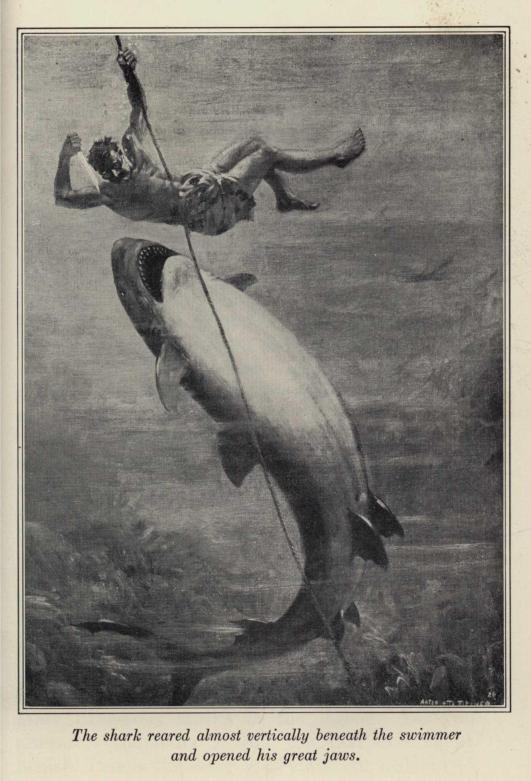
The shark reared almost vertically beneath the swimmer and opened his great jaws.
The shark came crashing against the side of the
boat—a blow that nearly stove in the planking
and started a dozen seams.
A minute passed before my uncle sat up and
lifted the goggles from his eyes. "Get the oars
out," he gasped, "and pull for the shallow water
yonder. Bale, you two, and look lively—that
fellow means mischief!"
The shark was at the surface now, swimming in
swift zigzags like a hound at fault. While Ofai and
I baled and the others began to row, I glanced over
my shoulder and saw the tall dorsal fin heading
straight for us, so swiftly that the water rippled
away on either side.
"Pull hard—he's after us!" shouted my uncle,
standing in the stern with a twelve foot oar in his
hand.
We were making for the shallows over a large
coral mushroom, a hundred yards away, and the
men were rowing at top speed, for they realized
that our light cranky boat gave little protection
against such an enemy. The shark drew rapidly
abreast of us and as his head ranged alongside
Uncle Harry raised the oar and thrust down with
all his strength. The blow was a glancing one,
and before he recovered his weapon the three-inch
shaft of tough wood was between a pair of
formidable jaws. My uncle's eyebrows went up as
he raised what was left of the oar, sheared off as
a child bites through a stick of candy. Next
moment Ivi cried out, as the monster seized his sweep
and wrenched it from his hands. I saw it float to
the surface with a splintered blade—felt our boat
shaken violently as the shark took the keel in his
teeth. Then the bow grated on coral, and we leaped
out in the shallows to pull the boat into the safety
of a foot of water.
After a time the ominous fin tacked away toward
the reef and disappeared. We were not anxious
for another encounter and allowed our enemy
plenty of time to go. The men were talking
excitedly in high-pitched voices, when my uncle lit
one of his long cigars and turned to me.
"What a brute!" he remarked. "I thought he
had me that last time! By Jove! When Fatu took
hold of me I could fairly feel those teeth sinking
into my legs! Well, our work is cut out for
us—there'll be no diving till that fellow is dead. The
men are saying that in all probability there are no
other dangerous sharks in the lagoon. Do you
remember the letter I read you that evening at
home? This is the same shark, without a
doubt,—he may have been here for a hundred years. He's
of a rare kind, by good luck; so rare that I know
only his Latin name: Carcharodon. They are relics
of prehistoric times and seem to be nearly extinct
to-day, though a few of them still linger in the
warm waters close to the Line. Remember the big
fossil teeth, from Florida, on the mantel at the
ranch? They came from one of this fellow's
ancestors who grew to be ninety feet long and swarmed
in the Tertiary seas."
"But won't he die?" I asked. "I saw you stab
him three times."
My uncle laughed. "No more than you will,"
he replied. "A shark of that size takes a lot of
killing. But he's going to die to-morrow, if we have
to sit up all night hammering out a lance and a
harpoon. Our fish-spears would only tickle his ribs.
Come, he seems to have given us up—let's be
getting back to the Tara."
That Sunday night, while the crew of the Tara
told to their friends the story of Ofai's rescue, my
uncle and I labored with forge and anvil and
grindstone under the shed of corrugated iron. From the
schooner's trade-room we took a couple of the
whale-spades used throughout the islands as
agricultural tools, and removed the wooden hafts from
their sockets. While I pumped the bellows, Uncle
Harry heated one of these in the forge and
hammered it into the shape of a harpoon, welding on
a piece of steel to make the socket into which the
hinged barb would fit. Then, gripping a morsel
of steel in the tongs, he forged out the barb,
punched a hole through it, and riveted it in place,
so that it folded into its socket when the harpoon
was thrown and opened to prevent the iron's
withdrawal from the wound. When the harpoon was
finished to his satisfaction, I turned the grindstone
while he ground it to a razor-edge. After that he
heated the other spade and forged out a lance for
killing: a slender, double-edged blade, two inches
wide and eighteen long—a murderous weapon in
skilled hands. We fixed the lance on a twelve-foot
pole of hibiscus, and whittled out a short stout shaft
for the harpoon, tapered to fit loosely in the socket.
Then my uncle fetched from the storeroom a coil
of heavy cotton line. Passing one end of it through
a screw eye halfway up the shaft of the harpoon
he lashed it firmly to the small of the iron. It was
long past midnight.
"We won't get much sleep," he remarked, as we
paddled out to the schooner in a canoe. "We must
kill that shark to-morrow—to-day, rather—without
fail! The natives are superstitious as children;
they used to worship sharks, you know, before the
missionaries came, and if any ghost-talk starts, we
may have to go back for another lot of men. I'll
wake you at five o'clock."
I dreamed strange dreams that night, for my
mind was feverish with the excitement of the day.
I was diving, and like Ofai, I had taken refuge in
the coral while a great shark nosed at me from
above. But the crevice was too narrow for his
head, and I crouched there with bursting lungs,
praying that the monster would leave me to reach
the air before I drowned. At last I could stand it
no longer; I sprang out from my retreat—past
the shark gazing at me with fierce green eyes,
upward toward the surface, so far off that I gave
myself up for lost. The water weighed on me like
lead; I seemed to sink instead of rising; I saw the
monster approaching, grimly and deliberately. Then
he seized my shoulder in his jaws. I felt the sharp
teeth tear the flesh and crunch the bone—and I
awoke with a strangled shout.
The stateroom was lit by the first gray light of
dawn, and my uncle's hand was on my shoulder
as he shook me awake.
"Time for coffee," he said, smiling at my
bewildered face. "The men have killed a pig for bait,
and they're getting the surfboat ready. We'll be
off in half an hour."
We left before sunrise, in the broad heavy boat
used for landing cargo from the schooner. I sat aft
with Fatu, who held the steering-sweep; Ivi and
Ofai pulled, and my uncle stood forward in the
bows. The morning was calm, and as we reached
the line of buoys we kept a close lookout for the
shark, but no fin cut the water and no long shadow
passed beneath the boat. Finally, at the place
where we had sighted our enemy the day before,
we cut open the carcass of the pig, tied it to a buoy,
and pulled off a little way to watch.
An hour passed; the sun rose, and the lagoon
began to shimmer in the heat. I heard the
booming of the breakers where the ring of land was
broken north of us and saw the smoke rising
vertically from the ovens at our island camp. The
natives were half dozing, but my uncle had not
relaxed his watch.
"There he is!" he exclaimed suddenly. "Quick—pull
over there—don't make a noise with your oars!"
I glanced up as he spoke and saw the dead pig
rise and disappear in a circle of ripples. Then the
head and forelegs came to the surface again—the
carcass of our pig had been bitten in two.
"Row faster," my uncle whispered in the native
tongue. "Make haste, or he will eat the pig and go."
Our boat glided toward the feeding monster.
Without turning his head, Uncle Harry motioned
to the men to cease their rowing, and it was then
I caught sight of the huge brownish body of the
shark, rising to finish what was left. My uncle
brandished the harpoon above his head—hurled
it with all the strength of his arm. The water
swirled and coil after coil of line flew out through
the chock. We were fast.
As he felt the iron, the shark turned with a
mighty sweep of his tail and rushed off swiftly to
the south. Fatu swung the boat around to follow,
and before half the line had streaked overboard
we were gathering way. Then my uncle got his
hands on the line, paying it out more gradually
until our full weight was on the fish; the oars came
in and we foamed along at a faster gait, perhaps,
than the clumsy surfboat had ever known. The
shark seemed tireless—we passed the islet, where
the people stood on the beach, waving in answer
to our shouts, and sped on toward the southern
end of the lagoon. We were following a deep
channel in the coral, which turned westward halfway to
the pass and approached the long island that formed
the atoll's western side. At the end of an hour I
could see the village of the copra-makers and the
distant pass, a gap in the low ring of wooded land.
The channel had brought us close to the inner
beach and our pace was slowing appreciably. My
uncle was beginning to haul up, when all at once
the fish turned at right angles toward the
submarine cliff of coral, close at hand. The line went
slack; the boat drifted quietly for a few yards, and
came to a halt. My uncle turned his head.
"Look," he said, "he's gone into that hole
yonder! See the mouth of it a couple of fathoms down?
This must be his den."
Holding the line with one hand, he took up the
lance and ordered the rowers to back water—to
keep a steady galling strain on the fish. "The iron
is tickling him," he remarked when five minutes
had passed. "I can feel him twitch. Look lively
now! He'll be out in a moment—Ah! Here he
comes!"
Far in beneath the coral the cave must have
broadened, for the shark had turned to face the
entrance of his lair. He came out with a rush,
maddened by the pain of his wound, open-mouthed and
at bay. Before Ofai could pull in his oar the monster
had wrenched it from his hands and turned to sink
his teeth in the cutwater of the boat. But my uncle
was ready with the lance. Again and again his arm
rose and thrust downward, and at each stroke the
keen blade bit deep. The water reddened; the jaws
relaxed their hold; the tail ceased its lashing and
lay quiet. The huge carcass turned belly-upward
and sank in the clear blue channel beneath us.
Uncle Harry laid down the lance and came aft to
light a cigar. "That's a good day's work," he said.
"No diving with that fellow about! He's sinking
now; we'll have the boys cut the line and make
the end fast to the coral. To-morrow he'll float
high—I'll send a couple of men to cut out the jaws.
They'll make you a fine souvenir of Iriatai."
There was rejoicing when we arrived at camp,
for the native regards a large shark with a peculiar,
superstitious dread. There had been much talk
among the divers since the night before, but now
their fears were at an end and they busied
themselves with preparations for the ensuing day.
That night, when dinner was over and we sat
talking on the Tara's deck, my uncle explained
to me the terms of the agreement under which his
divers worked. "Ordinarily," he said, "when the
Government opens the lagoons the men are free
to keep everything they bring up: the shell and
the pearls are theirs to do with as they please.
The traders keep track of all the better men and
do their best to get them as deeply as possible in
debt before the season begins. You can imagine
what happens when credit is offered to simple
fellows like these Paumotans: they run up bills for
all sorts of useless trash—guitars; silk dresses and
high-heeled shoes for their women; cheap perfume
at five or six dollars a bottle; every kind of fancy
white-man's food in tins. They load up with this
sort of stuff till they are over their heads in debt.
By the time he begins to dive, each native is safe in
the clutches of some trading-house—Chinese, more
often than not—and every pearl and every pound of
shell must be sold to the creditor at the creditor's price.
"It is different here on Iriatai, for the men know
that I have a year's monopoly of the lagoon. But
there is more shell, and it lies in shallower water
than in the lagoons which have been worked for
a generation, so the divers are glad to accept my
terms. Ever since I came to the islands I have
tried to deal honestly with the people, for I have a
theory that the savage appreciates a square deal
as well as a civilized man. It has paid me, too.
As you know, I am furnishing the canoes and
advancing a reasonable amount of food and goods.
The men have agreed, on their side, to work every
day the weather permits and to let me make the
first offer on their catch. Half of the shell goes to
me; all of the pearls and the other half of the shell
will be theirs. At the end of the season I'll make
each man an offer on his shell—cleaned, sacked,
and loaded aboard the Tara. As for the pearls,
they will be brought out every night and offered
for sale to me. Those I do not care to buy, or for
which the owners think they can get a higher price
in Tahiti, will be sold in the open market when we
go North. But I'll get all the really fine ones—I
can pay good prices and still double my money in
every case!"
In the morning I had my first sight of pearl-diving
as it is practised among the atolls of the
Paumotus.
The men we had brought with us from Raiatea,
reënforced by a few volunteers from the copra-makers
of Iriatai, made up fifteen crews of two men
each. I say men, but one of the best of the lot was
an elderly brown woman, and there was not a man
who could dive deeper than old Maruia, or bring
up more shell in a day.
Each canoe was equipped with its paddles, an
anchor at the end of thirty fathoms of line, a
five-gallon kerosene-tin, a stout knife, and two coils of
light rope—one attached to the diving-weight,
the other to a large openwork basket of bamboo.
The two members of the crew shared equally in the
catch, though almost without exception one man
did all the diving while his partner remained at
the surface, raising and lowering the basket,
cleaning the shell roughly, opening the oysters and
inspecting them for pearls.
As they worked no more than five hours a day,
we did not leave camp till the sun was well up,
illuminating the bottom of the lagoon. I went out
with a pair of middle-aged Paumotans whose
acquaintance I had made during the passage from
Raiatea. It was about half a mile from the islet
to the patch of shell on which work was to begin.
Uncle Harry had gone out ahead of us in the whaleboat
and as the little fleet of canoes drew near, he
pointed out to the paddlers the two acres of lagoon
in which they were to work. The bow-man in our
canoe dropped anchor in about seventy feet of
water, and began to prepare himself to dive.
First of all, he stripped off the cotton shirt he
had been wearing and hitched the pareu tight about
his waist. Then he polished his water goggles,
adjusted them carefully over his eyes, and thrust
his right hand into a heavy working-glove. A pile
of coral lumps, picked up on the beach the night
before, lay in the bottom of the canoe; the
stern-man placed a couple of these in the basket and
lowered it into the lagoon till it came to rest on the
bottom. Then the diver went over the side and lay
in the water with a hand on the gunwale of the
canoe, while his partner coiled the diving-line and
lowered the leaden weight till it hung a few feet
beneath the surface. The man in the water gripped
the line with his left hand and the toes of his left
foot; he took two or three long breaths before he
jerked his head upward in a sudden gesture that
meant: "Let go!" Coil after coil of line went
leaping overboard, as the diver sank like a stone,
leaving a trail of bubbles in his wake. When the
lead touched bottom the stern-man hauled it up at
once, coiling the line in readiness for the next dive.
A minute passed—a minute and a quarter—a
minute and a half. The canoe lurched to a sudden
strain on the taut basket-line. I looked over the
side. Far down in the green water I could see the
shadowy figure of the diver, mounting the rope
with leisurely movements of his arms. He came to
the surface, exhaling the breath from his lungs
with the strange shrill whistle I had heard before.
Then, raising the goggles from his eyes, he gave
the exultant whoop of the diver who has brought
up a rich haul—a cry that was beginning to ring
out on all sides, where the canoes lay at anchor.
He lay resting alongside while his companion pulled
up the basket, loaded with six or seven great
gold-lipped oysters; and craned his neck to watch as
the other opened the shells with a twist of his knife
at the hinge, felt for pearls under the soft mantle,
and tossed the body of each mollusk into the open
kerosene-tin. My companions seemed excited.
"Aué!" exclaimed the diver. "There is no other
island like this! It is as Seroni told us—the
bottom is covered with shell, and the water is not
overdeep: twelve fathoms, by the knots on my line.
Last year, at Hikueru, I worked at twenty till my
head ached all through the night. And this shell—the
size, the weight, the color of the lip—think
of what it must be worth a ton! No man in all
these islands has ever seen its like! I would still
dive if there were fifty sharks instead of the one
Seroni killed yesterday. But watch carefully, and
if a shark comes, move the basket up and down a
little so that I may be warned. Now pass me the
weight, for I am ready to go down again."
At the end of three hours the diver clambered
stiffly into the canoe; even in this water, only a few
degrees below the temperature of one's blood, a
man grows chilled and must come out to rest and
warm himself in the sun. He had averaged a minute
and a half to two minutes under water, and five
minutes' rest at the surface between dives, and I
noticed that he sent up five or six oysters each
time he went down. We had brought along a bottle
of water and a package of cold food done up in
leaves. When lunch was over and the diver lay
basking in the sun, I asked him how he could stay
under water so long, and how a man could stand
the pressure of the depths. At home in California
I had excelled my friends by bringing up sand from
the bottom at thirty feet, and my ears had ached
for an hour afterward. These natives thought
nothing of working at seventy feet, and from what they
said, I knew that one hundred and twenty feet was
not considered an extraordinary depth.
"It is not difficult," the diver remarked, smiling
at my efforts to question him in his own tongue.
"If he would take the trouble, the white man could
learn as well as we. But one must know how.
You say that at six fathoms your head ached and
your lungs were bursting. That was because you
tired yourself by swimming down instead of letting
a weight pull you to the bottom. And perhaps you
held all of your breath until you rose—that is
wrong. First of all, you must learn never to tire
yourself beneath the water, and not to fill your
lungs too full before you start. When your time is
half up, you must begin to let the air out of your
lungs, little by little,—a few bubbles now and
then,—so that, as you reach the top, there will be
scarcely any air left in you. If your ears ache,
swallow; or hold your nose and blow—this will
clear the little passages between your nose and
ears, and stop the pain. That is all, except that in
deep water you must never look up, nor bend your
body backward. As for the sharks, there is little
danger—not one in a hundred will do you harm.
When that one comes, you will know him by the
way he swims, and if there is sand or mud on the
bottom, you can escape by throwing it up to cloud
the water while you pull yourself quickly up the
basket-rope. Otherwise you can only take refuge
in a crevice of the coral, hoping that the shark will
leave you before your lungs go flat. Conger eels
are more to be feared; you must watch sharply as
you pass the holes where they lie hidden. The big
eel's jaws are like the jaws of a dog! If a conger
seizes wrist or ankle, it is useless to struggle—ten
strong men could not drag one from his hole. Three
times, when I was young and careless, I have felt
the teeth of the eel; see—my ankles bear the scars
to this day. But I remembered what the old men
had told me and lay quietly without struggling,
till the conger relaxed his jaws to dart forward for
a better hold. Each time I tore my ankle free and
reached the surface with only the loss of a little
blood. But we must get to work—the others are
beginning to dive."
The canoes returned to camp in mid-afternoon.
The women were waiting to begin their task of
cleaning shell, and there were exclamations of
wonder as the day's catch was brought ashore. While
the men went off to rest, their wives and daughters
sat gossiping in little groups, hammering, chipping,
and washing the mother-of-pearl. Half of the catch
of each canoe had been set aside as my uncle's
share, and some of his own people—Ivi, Ofai, and
a few men and women from the settlement on
Iriatai—set to work to clean it in a space reserved
for them. I saw a number of women along the
beach, filling the tins from the canoes with sea
water, mashing the soft meat between their fingers,
and pouring off the mess little by little, as they
searched for any pearls that might have been
overlooked. My uncle was delighted with the first
day's work.
"It is going better than I had hoped," he said,
as we sat in his stateroom that evening. "They
brought in about two tons of shell to-day, and the
quality is superb—nothing like it has ever been
seen in this part of the Pacific. Your canoe had no
luck, but the others netted four handsome pearls
and a number of small ones for the day. That
alone proves that there must be something in von
Tesmar's theory. I've seen thousands of black-lipped
oysters opened without a pearl. Old Maruia
found a beauty to-day, with her usual luck. I gave
her a thousand dollars for it, and any jeweler in
Paris would jump at a chance to offer twice as much.
You are smiling, eh, to think of that funny old
woman having a thousand dollars, all at once?
Why, in the eyes of her people Maruia is a
millionaire! Twenty years of diving have made her the
owner of a fine plantation, and one of the prettiest
villas on Tahiti. Ah—I almost forgot to show
you our first pearls."
He leaned over to twirl the knob of the safe,
swung open the door, and took from the shelf a
small tobacco-tin, which he opened and handed to
me. It was lined with cotton and there, lying side
by side like tiny eggs in a nest, were four pearls,
pale, lustrous, and without a flaw. Three of them
were like peas in size and the other was larger than
the three together,—I had never seen a pearl of
such size and beauty,—shimmering with a soft
opalescence in its bed. My uncle took it in his hand,
turning it to admire the perfection of its shape.
"You won't see a pearl like this five times in a
season," he remarked. "There are many larger
ones of greater value, but there is nearly always
something wrong with them—a flattened spot, a
flaw on the surface, a dullness in orient. Though
not of great size, this is a really perfect pearl. If I had
a mate for it I could ask my own price for the pair!
"I wish now that I had brought a few more
men," he went on, "but I think we can make out
by shutting down the copra-making and putting
everyone at work. I am going to put Fatu and
Ofai to diving, with a couple of stern-men from
the village; they say we can find trees to build two
or three more canoes. The others will have to work
at cleaning shell, and from now on I'm counting on
you and Marama to feed us. Tins are all right in an
emergency, but it would be absurd to make ourselves
ill on canned stuff in a place swarming with
excellent fish. There are eight of us on board,
counting the new cook, and I want you to supply us with
fish. You can begin to-morrow—I'll give you
the small canoe and whatever gear you need."
I have always loved fishing since I was old enough
to hold a rod and cast out into the surf at home,
and now, as I look back on the months spent with
my uncle in the South Seas, I know that my happiest
memories of Iriatai are of the long hours in a
canoe with Marama in the lagoon or on the open
sea beyond the reef. It was fishing in unspoiled
waters—fishing to dream about in after years.
Our primitive tackle, much of which was fashioned
by our own hands, did not detract from the charm
of the sport, and the background—the land, the
sea, the sky—was hauntingly and strangely
beautiful.
Some of those nights were unforgettable—calm
nights when we lay off the reef from sunset till
dawn began to brighten in the east. In all that
solitude our lantern was the only light, the only sign of
man. Iriatai lay like a shadow on the sea, stretching
off vaguely to the south, and the heavens above
us were powdered with stars of a brilliance I had
never known before. The native boy was a better
astronomer than I; he had names for many of the
constellations, and strange old stories to tell of
them. Castor and Pollux, the Twins, sinking on
the horizon to the west, he called Pipiri-Ma—a
boy and a girl, he told me, who had lived in very
ancient times and who, because of their unkind
parents, had fled away to the skies. The Southern
Cross was Tatauro; the Scorpion was a great fishhook,
flung into the sky after a god had used it to
pull up the islands of the Paumotus; the Pleiades,
visible in the east an hour before the dawn, he called
Matarii—the Little Eyes, and told me a pretty
story of their origin.
Much of our fishing was done at night, when we
fished offshore for the great bottom-feeders of the
South Pacific: the deep-water albicore, the
castor-oil fish, and the manga—a long black creature
shaped like an enormous pickerel, with
goggle-eyes and rows of formidable teeth.
Our custom was to start an hour before sunset
and paddle north to a break between the two long
islands, where we dragged our canoe through the
ankle-deep wash of the barrier, waited our moment,
and slipped out through the surf. The outer face
of the reef shelved off steeply, and our line, which
reached the bottom at two hundred fathoms, would
have reached the reef as well. Marama usually
took the stern, paddling gently, while I did the
fishing forward. Our bait was fish, saved from the
previous day's catch and salted. I chose a morsel
large as a man's fist and tied it with strong thread
to the point of one of the great wooden hooks used
in this deep-sea fishing: a fork of ironwood, six
inches from tip to tip, and barbed with a cod-hook
lashed on to point down and inward. It was useless,
I learned, to fish with an ordinary hook for these
dwellers on the bottom. Their habit of swimming
down vertically, to seize the bait from above, made
necessary the use of our barbaric implement. When
my hook was baited, I fastened a large pebble to
the line, with a special hitch that Marama had
taught me. Coil after coil ran out as the pebble
sank, until at last I felt the slackening which told
me that it had touched bottom. Hauling up a yard
or two, I gave the jerk which freed my coral sinker,
and settled myself to wait. Sometimes an hour
passed without a strike, and then, when I was least
prepared for it, some monster of a hundred pounds
seized my hook with a rush that carried my arm
elbow-deep into the black water alongside. Hand
over hand I brought him slowly to the surface till
he lay wallowing beside the canoe, eyes bulging
with the release from the pressure of his deep-sea
haunts. A blow with the blunt side of our whale-spade
ended his struggles, and taking hold by the
gills, we tilted the canoe and slid the quivering
body inboard.
Sometimes, as my fish neared the surface, I felt
a sudden slackening of the line—one of the small
sharks that prowled along the reef at night had
helped himself, leaving only a bodiless and gaping
head upon the hook. Once or twice, when the
marauder rose close to our canoe, Marama sprang
to his feet in a rage—keen-bladed spade in hand—and
ended the shark's life with a cutting blow
forward of the eyes. At those times we seized our
paddles and made off swiftly for new
fishing-grounds; for the scene of the ensuing feast was no
place for our light canoe.
Fishing by night meant sleeping through the
warm hours of the day. Sometimes, when we
wearied of this, the order was reversed and we went
out at daybreak to pursue the schools of bonito far
offshore. The lures for bonito are made of
mother-of-pearl, and the fisherman must carry six or seven
different shades to suit the varying conditions of
sea and sky. Marama selected half a dozen large
pearl-shells, shading from light to dark, and marked
with a pencil on the thickest part of each the
outline of a small fish. When this was done we took
our shell to the shop my uncle had set up ashore,
and set to work with vise and hacksaw to cut out
the lures. Then came the grinding and polishing,
and finally a barbless hook of brass was attached to
each, the line made fast to the forward end, and a
tuft of coconut fibre bound on across the rear. We
tied the lines to a stiff pole of bamboo, ten or twelve
feet long and equipped with a ring at the butt end,
in which to hook the lures when not in use.
Bonito-fishing was hard work and not unspiced
with danger,—the risk of being swamped or blown
offshore in a squall,—but it had a fascination of
its own. We used to paddle half a mile out to sea
and wait in the morning calm, on the lookout for
birds. At sunrise the boobies and noddy terns left
their roosting-places by hundreds and cruised about
over the sea, singly or in little bands, in search of
breakfast. We watched them flying this way and
that until at last, perhaps a mile away, a dozen
noddies began to circle and dive. Then it was time
to seize our paddles and strain our backs to make
for the birds at top speed. Keener eyes than ours
had been on the watch, and before a minute had
passed hungry sea-birds were flapping from all
directions toward the school of fish. The small fish,
pursued by both bonito and birds, were far from
remaining stationary; sometimes they sounded and
disappeared altogether; sometimes, when our backs
were aching with an hour's chase, they swept off to
windward at a pace that made us lay down our
paddles in despair. There were days when we went
home worn out and empty-handed, but there were
other days when luck was with us and we drove the
canoe into the midst of ravenous schools. Then,
while the man forward paddled with all his might,
the stern-man faced about, long rod in hand and
lure skittering over the waves behind us. A hasty
trial proved which shade of mother-of-pearl was
most attractive, and next moment fish after fish
came tumbling aboard—fat, steel-blue, and vibrant.
There were days when we hooked and landed thirty
fish in half as many minutes, before we sank down
exhausted to rest, leaving the birds to circle off
above the foaming sea.
Sometimes, when we could get bait, we enjoyed
a sport even more thrilling than bonito-fishing—trolling
along the reef at daybreak for tunny, barracuda,
and the giant cavally of the Pacific. A
silvery species of mullet proved the best lure for the
fish that lay in wait in the caverns along the outer
edge of the reef, and many of our afternoons were
spent in mullet-catching. First of all we prepared a
mass of paste, made of flour or arrowroot, and with
this for bait, we paddled to a place in the lagoon
where the water shoaled to three or four feet over
a coral bottom. Our tackle was a stick of light wood
eighteen inches long, attached by a trace to twenty
feet of line, and fitted with a small hook on a leader
at either end. One of us baited the hooks with bits
of paste and stood ready to cast the stick, while
the other threw pieces of our dough ahead of the
motionless canoe. Presently the water would dimple
and swirl with rising mullet—it was time to cast.
The float lay quietly for a moment—bobbed—jerked
disappeared under water, with a pair of
fat mullet, as often as not, fast on the hooks. We
kept them alive in an openwork basket floating
alongside, and towed our catch back to the Tara,
in readiness for the morning's fishing.
An hour before sunrise we dragged our canoe over
the reef, shot out through the breakers, and
paddled to our favorite trolling-grounds—a shoal
which ran out a quarter of a mile to sea. Our hook
for this kind of fishing was equipped with a leader of
piano-wire, which was passed lengthwise through
the body of a mullet and pulled through the mouth
until the shank of the hook was out of sight. Then
the lips were lashed to the wire with a bit of thread
and the leader made fast to the end of a hundred
yards of heavy line. Arranged in this way and
towed at a good pace behind the canoe, the mullet
flashed and zigzagged through the water in imitation
of a living fish—an imitation so perfect that
many a wary old dweller on the reef was deceived
and came rushing upward to his death.
The handling of these powerful fish required all
our skill, and Marama, being more experienced than
I, usually took the stern on trolling-expeditions.
Making the line fast to the outrigger-pole which
crossed the canoe behind his seat, he gave the word,
and we began to paddle our hardest, following the
edge of the shoal. As the sun rose, one could look
down and see the changing colors of the coral—every
fold and crevice clearly visible ten fathoms
beneath us. There were certain crannies and caverns
where we knew the big fish lay, and as we passed
above them we increased our efforts to make speed.
In this kind of sport there was no holding the line
to feel for a bite; we were never in doubt when a
monster tunny or barracuda struck. The canoe
quivered with the shock. Sometimes we fought for
half an hour while the hooked fish towed us in rushes,
this way and that. One old barracuda, I remember,—seven
feet long and with the jaws of a shark,—pulled
us more than a mile before he lay exhausted
at the surface.
We seldom returned from trolling till the trade
wind came up at eight or nine o'clock, for a good
catch, sufficient for two or three days, meant rest
and time for other amusements. The weather was
hot of course, and we had no ice, but the native
method of cooking—baking over and over again,
which improves the flavor with each succeeding
day—permitted fish to be kept for as long as a week.
On days of leisure we rested, overhauled our tackle,
or went in search of the shellfish which abounded
at Iriatai.
There were lobsters, crabs, and sea snails on the
reef, clams and mussels in the lagoon, and best of
all,—to be found on patches of shallow sandy
bottom,—there were varos, creatures whose
repulsive English name is "sea centipede." They look
like the tail of a lobster, with rows of legs along the
sides and a small head, armed with a pair of wicked
nippers, said to inflict a poisoned wound. The varo
is no beauty, but if it is broiled over a charcoal fire
and eaten hot with melted butter, I agreed with my
uncle that the sea produced nothing half so good.
One calm morning, when there was a plentiful
supply of fish aboard, Marama suggested that we
try our luck at varo-fishing and showed me the
tackle he had made the afternoon before. It
consisted of half a dozen slender sticks of wood to which
rows of small fishhooks were lashed, points out.
Each stick was provided with a few feet of line and
a light float, made fast to the upper end. While I
was examining these curious snares, my uncle passed
along the deck and stopped at sight of us.
"Going after varos, eh?" he remarked. "The
men used to say there were plenty of them here.
Good luck to you—we'll have a feast here tonight
if you can get some!"
The native boy threw his snares and a few pieces
of smelly fish into our canoe and we paddled to the
western shore of the lagoon, where a bottom of mud
and sand ran out from shore. He allowed the canoe
to drift over the shoal while he scanned the bottom
through the calm water, clear as glass. Here and
there I saw that the sand was pitted with holes,
the burrows of various marine creatures; and
presently Marama pointed down to one, smaller than
the rest and surrounded by a little mound of sand.
"That is the dwelling of the varo," he said, "I can
tell by its freshness and the smallness of the opening
that he is at home."
I held the canoe in place while he took up one of
the snares, tied a bit of fish to the upper end, and
unwound the short line attached to the float. Then
he tucked up his pareu and went overboard. Taking
a long breath and working with head and shoulders
submerged, he enlarged the mouth of the
burrow until its full size was exposed and inserted
the baited stick—gently, so as not to alarm the
creature inside. Varos were plentiful at this place;
we set all our snares within a radius of fifty
yards and sat at leisure in the canoe, watching the
floats for the first signs of life. We had not long
to wait; Marama pointed to one of the floats
which was beginning to bob and twitch; a few
strokes of the paddle brought us alongside and he
went overboard again.
The fishhooks on the snares were lashed on in
tiers of three, pointing out and up. The bait was
tied to the upper half of the stick, so that in order to
get at it, the varo was obliged to pass the uppermost
tier of hooks. As it tore the fish with its nippers
and crammed the pieces into its mouth, its hard
back was against the wall of the burrow and its
more vulnerable under-parts in range of the barbs.
Marama put his head under water again, seized the
end of the stick and held the varo against the side
of its hole; then, with a quick pull, he sank his
hooks into the creature's under joints and held up
the snare with a triumphant shout, the captive
struggling and waving its claws. "Take care you
are not hurt," he told me as he broke off the
nippers. "They cut like scissors and they are
poisoned—the wounds will fester and swell for weeks!"
At ten o'clock, when the breeze came up, we
paddled back to the schooner with a score of varos in
the bottom of our canoe, a feast for all hands.
As we crossed the lagoon Marama spoke to me
suddenly at the end of a long silence. "Listen,
Tehare," he said,—"Tehare" was as near as he
could come to pronouncing my name,—"let us
speak together, for there is a plan in my mind. I
dare not ask Seroni myself. Fishing is the work he
gave me, but he is your father's brother and if you
desire to do the thing that I propose, perhaps you
will speak to him. You have learned much about
our fishing and you see how easy it is to provide for
the Tara's needs: two or three nights each week
give us more fish than we can use. It is in my mind
that on days when there is fish in plenty we might
take this canoe and go out with the others to dive.
I can dive deeper than one need go in this lagoon,
and you can pull up the basket and open shell, since
men are not accustomed to diving in your land.
We shall get much shell, and perhaps a great pearl
like the one Maruia found. What say you—will
you ask Seroni?"
My chance came the same afternoon, as we were
finishing lunch. At last Uncle Harry lit a cigar and
called for coffee. "By Jove!" he remarked as he
blew out a cloud of fragrant smoke, "those varos
were wonderfully good. I reckon the best restaurant
in San Francisco couldn't produce a finer dish!" The
moment seemed opportune.
"We can always get plenty when the weather is
calm," I said, "in fact it only takes a third of our
time to catch more fish than the Tara can use. We
were speaking of this to-day and wondering if you
wouldn't let us go out with the divers in our spare
time; Marama says he has often been down to
twelve fathoms, and offers to do the diving if I will
open shell. I wish you could let us go—it would
be fun and somehow I feel sure that we'd be lucky.
Of course, if you'd let me, I'd like to try a little
diving myself." My uncle looked at me with a
twinkle in his dark eyes.
"I knew you'd ask me that sooner or later," he
said. "As a matter of fact I ought not to let you
do it—I'm responsible to your father, after all,
and old Taura's a good friend of mine. Diving is
always a dangerous business, though I don't believe
there are any more bad sharks in the lagoon. Still,
the other men do it every day, and you two are old
enough to take the same risks. If I had youngsters
of my own, they'd have to take their chances with
the rest—otherwise they'd miss their share of good
times and hard knocks, and become the helpless
sort of men and women who are no use in the world.
Yes, you may go, and dive too, if you wish. But,
for my sake, keep your eyes open and be as careful
as you can!"
That evening, when the day's work was over and
the people lay on mats before their houses, smoking
and gossiping in the brief twilight, we went ashore.
My uncle led the way to where old Maruia lived
with one of her nephews: Teura, a pleasant and
amusing boy, who paddled her canoe to the
diving-grounds and opened the shell that she brought up.
Her house was surrounded by a fence of stakes,
inside which a pair of pigs wandered, rooting up
the earth. As we opened the gate, I heard her
voice give the hospitable shout of "Haere
mai!—Come in!"
"I have come to talk with you about Tehare, my
nephew," said Uncle Harry, when a mat had been
spread and we had taken our places on it,
native-fashion. "He and Marama have become so clever
at the sea fishing that we are glutted with fish and
time hangs heavy on their hands. To-day they
have asked me if they might go out and dive for
shell with you others; they are strong boys and
well grown—it is in my mind to let them go.
What think you of the plan? Is Iriatai a lagoon
overdangerous for boys?"
The old woman shook her head as she replied.
"There is little danger here," she said. "Ten
fathoms would not hurt a child, and the great shark
you killed was the only evil shark in the lagoon.
And he was not a shark, as I and all the others
know! For the rest, we have seen neither tonu nor
conger eel in all the days we have been diving,
though it is well to watch closely, for a tonu is an
ill thing to meet! But let them go—they will
come to no harm; perhaps they will find a pearl
like mine, and in any case the white boy will have
strange tales to tell when he returns to his own land.
I myself will show them where there is shell in seven
fathoms of water—not so much as where we dive,
but a good place to begin. Let them beware of the
clefts and crevices where an eel might lurk, and
avoid the dark caverns in the coral, for it is in such
places that the tonu lies in wait. There seems little
to fear in Iriatai, but one is never sure. As for
pearls, watch always for the great lone oysters
crusted with coral and misshapen with old age—parau
tahito, we call them, and every diver knows
that they contain the finest pearls."
When the divers went out next morning Marama
and I went with them, our canoe equipped like the
others with basket and weight and line. Maruia,
smoking a cigarette in the bow of her canoe while
Teura paddled, showed us the way to a patch of
shell she had found in shallow water, a quarter of a
mile east of where the others were diving. "Drop
your anchor here," she said, bending over the
gunwale to examine the bottom. "The depth is seven
fathoms and there is enough shell to keep you busy,
though not so much nor of such great size as in the
deeper water where we work. Now I must leave—stay
here, you two!"
I weighted the basket with a heavy stone and
lowered it till it rested on the bottom, while Marama
tucked up his pareu, adjusted his goggles, and
fastened the glove on his right hand. Then he went
overboard, a grin on his brown good-natured face.
I passed him the weight; at the signal, I let go the
line and watched him shoot down into the blue and
green of the depths. After all, seven fathoms were
more than forty feet. I pulled up the lead, coiled
the line for the next dive, and waited, watching the
figure of my companion, seen dimly in the twilight
beneath the canoe, as he moved along the bottom
with deliberate motions of the arms and legs. Once
I thought I saw him place something in the basket,
and finally, when more than two minutes had
elapsed, he seized the upright line and pulled
himself to the surface. But he gave no shout of
exultation as he raised the goggles from his eyes.
"Aué!" he exclaimed, shaking his head, "it is
more difficult than I had thought! The oysters are
there, but I have not the eyes to see them, nor the
art to twist them off the rocks. There is no need to
pull up the basket; I got only two oysters, though
in all my life I have never stayed longer beneath the
water. But I shall learn!"
All through that morning Marama dove with
increasing success. It was well for me that he did
not send up as much shell as the older divers, for I
was clumsy at opening it and so afraid of missing
a pearl that I wasted a great deal of time in useless
fumbling under the fringes of the oysters. At
mid-day I had found no pearls, but the shell Marama
had brought up was opened and neatly stacked
amidships, and the soft bodies of the oysters were
thrown into our kerosene-tin for inspection in the
evening.
"I am going to dive this afternoon," I announced
to Marama, as we lay resting after lunch.
"That is well," he answered. "I am not accustomed
to being so long in the water—my bones are
chilled! I will open the shell and you can try your
hand as I have done. It is strange down there, and
very beautiful, with the coral colored like flowers
and the great fish passing close at hand. At first I
was a little afraid. Do not let yourself grow
discouraged; the shell is hard to see and harder still to
wrench off until you learn the trick. Remember
that the old divers never look upward—to gaze
into the blue water overhead gives one a horror of
the depth!"
At last, with a beating heart, I made ready for
my first dive. I loved the sun, which had burned
my back and shoulders to the color of mahogany,
and I wore nothing but a pareu. This savage
garment I hitched about my waist as I had seen the
others do, before I polished my glasses and fastened
the glove tightly on my wrist. Once in the water,
I held the lead-line with my left hand and the toes
of my left foot, adjusted the goggles to my eyes and
gave the signal to let go. I saw Marama's answering
grin—felt the water close over my head. Then,
gripping the line tightly, I plunged down into a
strange purple twilight.
An instant later there was a gentle shock and the
line slackened in my hand. I had reached the
bottom. My ears ached and the pressure on my chest
and stomach made my body feel as if it were being
squeezed flat. I could understand now the curiously
deliberate movements of the divers, for my limbs
seemed weighted with lead—the same feeling I
have had in dreams, when to my horror I have
found myself unable to avoid the attack of some
nightmare monster. I swallowed as I had been
instructed, then held my nose and blew. The pains
in my head ceased at once.
Frightened and ill at ease, I let go the line and
saw the weight ascending through the deep bluish
purple of the sea above me, which seemed, like the
earth's atmosphere, to extend upward into infinity.
There was no sign of the surface—nothing to catch
the eye in the break between sea and air. For a
moment I was in a panic; it seemed to me that I
should never reach the air again, never feel the
friendly warmth of the sun nor see the bright
sun-lit world above. Then I saw the bottom of the
canoe, close over my head. Fifteen or twenty
seconds had passed, and though far from feeling at
home, I had gained enough assurance to gaze with
interest at the strange new world in which I found
myself.
Though not so dark as the greater depths I visited
later on, there was far less light than I had supposed.
The floor of the lagoon, here at seven fathoms, was
bathed in a sort of purplish twilight which enabled
me to see as clearly, I should say, as on an average
moonlight night ashore. But instead of being silvery,
like moonlight, the light was purple, and tinged
with changing shades of green and blue. The
bottom was of dense reef-coral, which dies when
sheltered from the breaking sea, but a hundred fantastic
varieties of still-water coral grew on the dead
madrepore, as vegetation grows on the inanimate
earth, and its forms were those of vegetation.
Close beneath me I saw little coral plants, fragile
as violets or anemones; on a level with my head
were leafless shrubs, marvelously colored and
perfect in trunk and limb and twig; yonder a giant
mushroom, ten feet across and growing on a tall
thick stalk, towered above the undergrowth. Shoals
of small fish, gay as the bird life of the tropics,
drifted through the coral foliage or darted into the
shelter of the mushrooms when larger fish passed
overhead.
The floor of the lagoon was irregular, seamed by
gullies and rising in rough hillocks here and there,
and my weighted basket lay at the edge of one of
these ravines. By swimming slowly in a horizontal
position I could move from place to place without
great effort, and hoping to find at least one oyster
before I was forced to rise for air, I swam along the
brink, scanning the coral sharply for the pearl
oysters I knew to be plentiful at this place. A great
silver cavally, four feet long and with goggle-eyes
as large as dollars, darted out of a gloomy cleft,
halted to gaze at me for an instant, passed within a
foot of my face, and disappeared in the shadows.
The fish gave me a start; in the flurry I let go a
good half of my breath, which rose in a string of
bubbles toward the air. My lungs were cramped.
I had reached the limit of endurance.
I made for the line, seized it with both hands,
heaved strongly and felt myself bounding upward
like a cork. When my head broke water and I
raised the goggles from my eyes, I saw that the
native boy was bending over me with an air of
concern.
"Another moment," he said, "and I would have
gone down after you. You were long on the bottom—I
feared that you had been seized with cramps."
"It is strange down there," I answered, a little
apologetically, "the pressure—the dim light—I
was so interested that I nearly forgot to look for
shell and when I did look there was none to be seen."
"It was the same with me at first," declared
Marama, smiling, "but if you look closely in the
rough places, on piles of coral and along the edges
of the gullies, you will see the oysters there by
hundreds. It is easy to mistake them for lumps of
rock—coral and barnacles grow on them as on
the rock itself. They lie open like the pahua (the
tridacna clam), but that helps you little, for their
fringes are not blue and yellow like the clam's
tongue."
I did not waste my strength by climbing into the
canoe, but lay in the water resting as I had seen
the natives do. When five minutes had passed I
put down my glasses and went to the bottom again,
and this time I saw two pearl-oysters. I found them
at the edge of the gulley, when I was on the point
of giving up in despair of seeing the elusive things.
They looked for all the world like irregular lumps
of coral, projecting like hundreds of other lumps
from the rocky wall, and I would have passed
without a second glance if one of them had not moved.
Though they have no eyes, in our sense of the
word, all bivalves which do not habitually lie buried
in sand or mud seem to possess a subtle sense of
light. As my body passed over the oyster, shutting
off the light, the creature was thus mysteriously
warned, and instantly its shells closed with a smooth
swiftness. Looking more closely, I recognized the
outlines of the margaritifera, the pearl oyster,
beneath a protective growth of parasites, and
grasping it with my gloved hand, I endeavored to
wrench it from its fibrous moorings. As I struggled
to free it from the coral, the water must have been
agitated, for another rough lump closed with the
same smooth swift movement, revealing a second
great oyster. By this time I had been under nearly
a minute, and though I tugged with all my might I
was unable to wrench the shell free before I rose.
"I have seen the oysters," I told Marama, as I
lay resting in the sunlight, "but try as I would, I
could not tear one loose!"
He picked up an opened shell from the bottom of
the canoe.
"Take hold thus," he instructed me, "and turn
the oyster with a sudden wrench. It is useless to
pull. Ah—your left hand is bleeding—take care
to use the gloved hand only, for the coral cuts like
a knife, and oftentimes the wounds are poisoned."
By the third time down I had gained confidence
and was beginning to feel at home on the bottom.
Now I remembered the trick of which the Paumotan
diver had told me, and when I had been half a
minute under water I began to let the air out of
my lungs. The native had spoken truly; each little
string of bubbles brought its moment of relief and
enabled me to go about my work more calmly.
I was beginning to see the oysters now: my eyes
were growing accustomed to the dim light. This
time I managed to tear off a couple of oysters and
put them in the basket before I rose for air. Three
dives filled the basket, and when Marama pulled
it from the water with its coral-encrusted load, I
gave an imitation of the exultant native shout—a
cry which brought a grin to my companion's face.
"We are learning," he said mockingly, "but it
will be time to shout when we can fill the basket at
one dive!"
That afternoon, when we joined the little fleet of
canoes to paddle home, Maruia stood up, craning
her neck for a look at our catch. "You have done
well," she remarked, a smile wrinkling her brown
face, "not badly for the first day's diving! I have
seen grown men do worse. No pearls? Never
mind—you will find them surely. Beginners always
have the luck!"
From that day onward the fishing occupied less
than a third of our time, and the balance was put in
on the lagoon. We learned fast, as boys do, and
gradually worked our way into deeper water till we
were diving with the rest. Within a few weeks we
were bringing in as much shell as the Paumotans,
and my uncle was enthusiastic over our success!
He could dive with any native, and once or twice,
when he had leisure, he sent Marama out alone to
fish and accompanied me to the diving-grounds.
On those days my uncle's share of the shell went to
the native boy's account—growing into a round
little sum.
As for me, the diving fascinated me more each
day: the beauty and strangeness of the underwater
world; the spice of danger—small, but a reality,
nevertheless; the thought of the money I was
earning; the daily, even hourly, hope of finding a rich
pearl, perhaps worth a small fortune. From time to
time we found a few small pearls, but when at last
good fortune came to us, it came hand in hand
with tragedy.
As the nearer shell-patches became worked out,
the canoes moved gradually northward, taking the
cream of the shell without diving enough to exhaust
the beds at any one place. One morning, in the
latter part of July, Marama and I anchored close
beside Maruia's canoe, on new and very promising
grounds. It was my turn to open shell. The
Paumotan woman, not ten yards away from me, was
loafing that day—letting her nephew dive, for
once. Teura was a boy of twenty or twenty-one, a
favorite among the natives because of his skill as a
musician and his jokes. I had grown fond of him
since we had been thrown with the divers, and often
went ashore in the evening to chat with old Maruia
and listen to her nephew's songs, accompanied by
wild native airs on his accordion.
I remember that morning as if it were yesterday.
The bottom was at about eleven fathoms, rougher
than any part of the lagoon that we had seen. Here
and there pinnacles of coral rose to within a few
yards of the surface; in the shadowy depths below,
the bottom was seamed with crannies and pitted
with the mouths of caves. The look of the place,
in fact, was by no means reassuring, but the men
sent out to survey the bottom reported that the
lagoon there was fairly paved with shell.
It had become my habit to take a water glass in
the canoe, for by now I was expert at opening the
shell, and I found it interesting, in leisure moments,
to watch my companion at his work. The depth
was too great to see clearly, but I watched Marama
plunge feet-first into the shadows, and a moment
later, a second string of bubbles told me that
Maruia's nephew had followed him down. Vaguely
in the depths I could see Marama moving about,
a dim moving shadow when his body passed above
a patch of sand. Then, before half a minute had
passed, the canoe lurched suddenly and sharply—the
native boy was pulling himself up the line in
desperate haste.
His head broke water. With a heave and a spring
that nearly capsized us, he threw himself into the
canoe.
"Ah, the great tonu—he nearly had me!" he
panted, trembling with excitement. "Aué! Teura!
Where is he?"
I snatched up the water glass, and side by side,
with our heads close together, we gazed down into
the blue water. Hearing the boy's words, Maruia
had seized her own glass. Next moment a sudden
sharp wail came from her lips. Then I saw the
figure of her nephew, mounting his line with great
heaves of both hands—and rising deliberately
beneath him a monster hideous as a nightmare
memory. It was a huge fish, eight or nine feet long
and of enormous bulk. Its great spiny head, four
feet across and set with a pair of eyes like saucers,
terminated in jaws larger than a shark's; its rough
body was spotted and brindled in a way that
rendered it almost invisible against the coral; its
pectoral fins, frilled and spiny as the fins of a sculpin,
spread out like wings on either side. It had the look
of an incredibly old and gigantic rock-cod—to
which family, indeed, I have been told that the
tonu belongs.
We watched in terrible suspense, all three of us,
Teura was nearing the surface; in another moment
he would be safe. The tonu seemed undecided, as
if it were following the man out of curiosity rather
than pursuing him. I began to breathe more freely.
Then when the diver was within twenty feet of us.
the fish reared itself suddenly and came rushing up,
huge jaws agape.
In a twinkling it was beneath us, so close that the
water beneath the canoes swirled with its passage.
The next instant the monster flashed downward
and the man was gone.
The tonu halted, four or five fathoms down, and
lay with gently moving fins. It was then I saw, to
my unutterable horror, that Teura's feet and the
calves of his legs hung from the creature's twitching
jaws.
Another spectator was close at hand. "Aué!"
cried old Maruia bitterly, in a choking voice. "Teura
is gone! But I shall kill that devil as he has killed
my boy!"
She had been baptized—she was a churchgoer
and a keeper of the Sabbath day; but now I heard
her half chanting a strange invocation, in loud and
solemn tones. "She prays to the heathen gods,"
muttered Marama in an awed whisper, "to Taiao,
and to Ruahatu, the old shark-god of her people!"
I glanced up. The woman was standing in the
stern of her canoe. She wore her usual diving-dress,
a loose gown of cotton over a pareu worn as the men
wore theirs. The goggles were on her eyes and she
had taken up a heavy fish-spear from its place on
the outrigger-poles of the canoe. It was a formidable
weapon, a haft of tough black wood tipped with
a yard of steel: a tapering lance sharpened to a
needle-point. I turned my head to look into the
water glass. The great fish lay beneath us, a
monstrous vision in the blue twilight below; but now the
man's legs had disappeared.
Maruia's canoe came alongside. I heard the
outrigger knock softly against our own. Then both
canoes rocked violently, and we started at the
sound of a heavy plunging splash.
Without a word to us or an instant's hesitation,
Maruia had leaped overboard. One hand held a
leaden diving-weight and the other gripped the
spear, point downward. The fish scarcely moved
at the turmoil in the water; the hideous lord of the
lagoon was making his meal. Our hearts beat fast
as we watched what followed, gazing through our
little pane of glass. Swift and straight, the woman
went down head-first till she was within two yards
of the tonu's back. She let go the weight, which
plunged down out of sight among the shadows; she
drew herself together and struck—struck squarely
where the head joined the misshapen body, a foot
behind the monstrous goggle eyes. I saw the steel
strike deep—saw Maruia raise herself upright in
the water to drive the spear home with both hands
on the shaft. The fish started; its jaws gaped
wide—the sprawled and mangled body of Teura eddied
down toward the coral forty feet below. The
wounded monster turned on his side, the shaft of
the spear protruding from his spiny back, and swam
feebly and aimlessly to the surface, where the divers,
now gathering from all sides, put a quick end to his
struggles.
Then I heard the eerie diver's whistle close beside
our canoe and the voice of Maruia calling to us.
"I am going home," she said. "Lend me a hand to
put Teura in the canoe." She had been nearly four
minutes under water and had brought up with her
the body of her boy.
The natives did no more diving that day. Anchors
came up, gear was stowed away, and one after
another the canoes fell in behind old Maruia, while
the wailing of the tangi, the native mourning for
the dead, floated across the lagoon. I reached for
our own anchor-line, but Marama stopped me with
a gesture.
"Wait," he said seriously, "we will go back soon,
but first there is something I must tell you."
"Let us go to the Tara," I answered, "and tell
Seroni what has happened. This place makes me
shudder. I have no more heart for diving to-day."
The native boy looked at me solemnly.
"Like you, I am afraid," he confessed, "but I
have seen what moves me more strongly than fear.
And I know that our fears are baseless, for my
grandfather, who was the most skilled fisherman of
Raiatea, has told me many times that where one
tonu lives, another is never to be found close by.
"Watch well," he went on, "and move the basket
if there is danger, for I am going down once more.
In the cave where I first saw the tonu, are two
parau tahito—the old oysters of which the divers
speak. They are covered with barnacles, very old
and huge, and perhaps they hold pearls—great
pearls that will make rich men of you and me. But
that cave is an evil place! Teura went down with
his back to me, and I saw him reach the bottom
close to the entrance of the cavern, which he did not
see. Then I looked in, and my heart beat fast as I
saw that pair of old oysters, just inside. I looked
more closely, and there in the shadows were the eyes
of the tonu watching me, and his great jaws opening
as he made ready to rush out. For a moment my
limbs were paralyzed! The rest you saw."
I was becoming infected with my companion's
excitement. Ever since we had begun to dive I had
heard stories of famous pearls, taken throughout the
group in years gone by, and the pearls which fetched
the greatest sums and made immortal the names of
their finders had always come from these huge, old, and
sickly-looking oysters, growing apart from the rest.
Marama had picked up his goggles and was making
ready to go over the side, when a saying of my
uncle's flashed across my mind. "Never let one of
your men do a job you're afraid to do yourself!" Then
all at once I knew that I should have no peace
unless I acted quickly.
"Stop," I said—a little shakily, at the prospect
of the task before me. "You have been down
once. Now it is my turn!"
All my life I have found that the more one fears a
thing, the quicker it should be done. Without
heeding Marama's protests, I snapped on my glasses,
tucked up my waistcloth, and went overboard.
Next moment I seized the lead-line and signaled
Marama to let go.
Never, before or since, have I been more afraid
than on that day, as the weight took me plunging
down into a bluish gloom. The bottom, as I have
said, was at about eleven fathoms,—close to
seventy feet,—and since the coral was of the
dark-purple kind, the light was very dim. When my
weight struck the coral my heart was beating so
that I nearly choked; I lost my bearings and wasted
half a minute before I found the entrance of the
tonu's cave. Suddenly, five yards ahead of me, I
perceived the dark mouth of the cavern, like a low
wide doorway, fringed with pink coral and gently
waving weeds. As I stared into the darkness which
seemed to fill a vast chamber, I felt a prickling at
the roots of my hair—what if the tonu had a mate.
Then, dimly in the gloom, I made out the forms
of the two great oysters, their barnacled and crusted
shells agape. I moved forward to wrench them
from the rock. With one in each hand I swam
toward the basket, glancing back fearfully as
went. There was no shout of triumph when I
reached the surface—I flung myself into the canoe
and lay there while Marama pulled up the basket.
"You got them?" he inquired eagerly, without
turning his head in my direction.
"They are In the basket," I said, "but if I had
not found them, I would not have gone down again!"
"My stomach was cold at the thought of it.
Come—let us open the shell and leave this evil
place. I can scarce wait to see what is inside!"
"You take one," I suggested, "and I will open
the other."
"Yes!" he answered, with a boy's eagerness to
prolong the moment of suspense, "I will open mine
first, and when we have seen what it contains, you
can look into the other one."
He inserted his knife close to the hinge, severed
the muscle connecting the shells, and laid the great
oyster open on the bottom of the canoe. His fingers,
skilled with long practice, went under the fringing
mantle where nearly all pearls are found, searching
rapidly and in vain. He felt more carefully—uttered
an exclamation of disgust.
"There is nothing," he said mournfully, "not so
much as a blister pearl!"
I took my knife and opened the oyster he had
handed me. It was very old and diseased; the shells
seemed half rotten, pierced with the holes of borers,
and the flesh of the creature inside had a sickly,
greenish look. My forefinger went under the
mantle—felt something hard and smooth, which moved
loosely at the touch. Next moment I laid in
Marama's hand a magnificent pearl, the size of a
marble, round, flawless, and glimmering with the
sheen of perfect orient.
We gazed at it, awed by our good fortune. A man
might spend years among the atolls without laying
eyes on a pearl one half so beautiful! My fingers had
gone back to the oyster to complete the habitual
inspection when Marama found his voice.
"With such a pearl," he said softly, "a man could
buy a schooner like the Tara, or an entire island for
himself! Not one of the divers has ever seen its
match, nor—"
I interrupted him with a frenzied shout, as I laid
in the palm of his hand, beside the first pearl, a
second one—its twin in size, in color, in lustre, and
perfection of form.
"Marama," I said when we had grown a little
calmer, "we must say nothing of this to anyone
except Seroni. I know little of pearls, but the value
of this matched pair is too great to be made known.
The sight of them would tempt a man to things he
might regret."
Our mood of exultation was quenched by the
wailing of mourners as we passed the islet, and the
sight of my uncle's sober face when he met us at the
Tara's rail. "I'm glad you came in," he said.
"This has been a bad day and I'm feeling anxious
and depressed. Teura—poor devil; he was one of
the best of the lot; I've known him since he was a
lad at school. This business won't stop the diving,
of course,—it's all part of the day's work to
them,—but it's a pity that such a tragedy has come to
spoil our season at Iriatai. I've been jumpy as an
old woman since the canoes came in—a silly idea
that you might have gone on diving and that there
might have been another of those damned tonus
about!"
"We want to have a talk with you, Uncle Harry,"
I said. "Can we go down to your stateroom—all
three of us?"
I followed my uncle and Marama into the
stateroom and closed the door behind me. Then I
unrolled the tuck of my pareu, opened a knotted
handkerchief and laid on the table the twin pearls
of the tonu's cave. My uncle's dark brilliant eyes
opened wide, his eyebrows went up, and he whistled
a soft and long-drawn note. Without a word he took
up first one pearl and then the other, turning them
in his fingers and letting the light play over their
gleaming and flawless surfaces.
"By Jove!" he exclaimed at last, "you take my
breath away! I reckon this is the most beautiful
matched pair that ever came out of the Paumotus—by
long, long odds! In Paris, on the Rue de la
Paix, the jewelers would fight one another for a
chance to bid on them! You can't set a price on a
pair of pearls like these. One of them by itself
would make you independent in a small way; the
fact that they're matched probably doubles the
value of each." He turned to the native boy. "Eh
Marama," he said to him, in his own tongue; "you
are a lucky boy! This morning's work will make
you the richest man of Raiatea, with a fine house,
a cutter, and plantations enough to keep all your
relatives in plenty. But say nothing of this, for not
all men are good at heart."
"Of course they are yours," he went on in
English, "to do with as you wish; but I advise you two
to let me handle this matter for you. They must
be sold as a pair, and I know a Jew on Tahiti who
will give us the top of the market. He is buyer for
one of the largest firms in Paris, and in a case like
this, something more than money is involved.
These pearls will make history, you will see; I
haven't a doubt they'll end among the jewels of
some European court. Sikorsky knows me and
knows that I know the game; it will be a matter of
naming our own price, within reason, for the acquisition
of such a pair of pearls would be a tremendous
feather in his cap. Come, we must christen them,
for pearls of real importance are always named.
What do you say to calling them the Marama
Twins? Marama means the moon, and their orient
has the pure, pale glimmer of moonlight. What
beautiful things! If I were a rich man I'd take
them off your hands myself!
"See—we'll put them in cotton-wool in this
tobacco-tin, and stow it away in the safe. The less
said the better, I fancy, even among ourselves.
Such a temptation might prove too much for almost
any man! But tell me about Teura—his aunt was
too much cut up to talk."
Marama left us to go on deck while I told my
uncle the story of the morning's happenings. He
shook his head when I told of how the canoes had
gone home, and of our resolution to go down after
the two old oysters Marama had seen. Then I
spoke of my feeling that I must be the one to dive,
and how I had gone down to bring up the oysters
from the tonu's cave.
"I know what you mean," he remarked, as I
concluded, "and you did the right thing; but don't
take such chances very often! You'll have to keep
on diving for a few days, if only for the sake of
public morale, but I wish you'd slack off gradually and
give it up altogether in a week or two."
I went on deck that night and lay alone in the
warm darkness, building castles in Spain. Every
lad has dreamed of all that he would do for his
parents when he had gone out into the world and
made his fortune, and now my dreams seemed to
have come true at last. I thought of my mother,
and the things I might do to brighten the dullness
of her life; of Marion, and how my good fortune
would send her to the Eastern school she longed for;
of my father, who had dreamed for years of improving
and restocking the ranch. The old Santa Brigida
where I had been born and where I hoped to end
my days—a sudden understanding came to me, a
rush of gratitude for my father's determined clinging
to our land. I realized as never before how I loved
the valley, the brown hills, the lonely stretch of
coast. A home to go back to—that was the best
thing in life!
Teura was to be buried in the morning, and no
man on the islet slept that night. After the native
fashion the divers were assembled at Maruia's
house, and all night long their wild and melancholy
songs floated out across the water. The hymns of
the islanders have a power to stir one strangely:
the voices of the women wailing in a minor key,
the deep, chanting refrain of the men—gradually,
under the influence of their music, my thoughts
wandered, and I fell asleep.
The natives observe Sunday with a strictness
unknown among more civilized Christian races.
Saving a few unavoidable tasks like cooking, no
work of any kind is done on that day, and the man
bold enough to break the rule would make an outcast
of himself. If he went fishing, they believe that
his fishing would be accursed; if by any chance he
caught a fish, its flesh would be poisonous; and in
all probability a shark would be sent to overturn his
canoe and make an end of the impious Sabbath-breaker.
White men are a law unto themselves, of
course, but my uncle had warned me long since
that it would be a mistake to urge Marama to break
the rules of his religion. Our Sundays, therefore,
were what Sundays should be—days of rest and
change from the occupations of the week.
Marama and I often persuaded the cook to put up
a cold lunch for us, and set out in our canoe to
explore the distant portions of the lagoon. To amuse
ourselves, and for easier traveling on these occasions,
we had rigged a sail—a bamboo mast, a big
leg-of-mutton sail of unbleached cotton, and a spar of
tough light wood. We selected from the Tara's
stock of lumber a long two-inch plank, and when we
set out for a day's sailing this plank was lashed to
the canoe—one end to the outrigger, the middle
to the gunwales, and the other projecting up and
out, six feet on the starboard beam. We carried a
tremendous spread of sail for so small a craft, and
the long narrow canoe, with a fresh breeze astern or
on the beam, skimmed the lagoon at a speed that
delighted our hearts. One of us managed the sheet
and steered with an oar from the whaleboat; the
other took his place on the plank, changing sides
when we tacked, and crawling out on the weather
beam when the wind freshened and the canoe lay
over—bounding forward to rush through the water
with a tearing sound.
On the Sunday after Teura's burial, we took our
lunch and set out for an all-day sail, and toward
the middle of the afternoon the trade wind fell away
and died. We were on the west side of the lagoon, a
mile or two north of the village of the copra-makers,
built on the site of the ancient Paumotan settlement.
It was the first time that we had passed close to the
place where the shark had met his death, and as we
paddled slowly along the coral cliffs rising almost to
the surface, we watched for the opening of the cave.
Finally, through the calm blue water, not more
than ten or twelve feet down, we saw the mouth of
the cavern where the monster had taken refuge.
The palms alongshore almost overhung the lagoon
at this place. The fringing reef which fell away in a
line of submarine cliffs was only a few yards wide,
and beyond it lay the highest land on Iriatai, the
path of an ancient hurricane where the breaching
seas of centuries ago had piled great blocks and
masses of coral to a height of eight or ten yards
above the sea. Marama dropped his paddle and
took up a pair of water goggles.
"Hold the canoe here a moment," he said; "I
am going overboard for a look. There was only
one shark and I do not believe that a tonu would
live so close to the surface."
Next moment he was over the side and swimming
down toward the cave-mouth, into which I saw his
body disappear. Presently, with leisurely strokes,
he swam into sunlit water and rose to take breath,
with a hand on the gunwale of the canoe. "Have
patience a little longer," he said with a smile, as he
pulled down his goggles for the second time. "I
am going down once more."
Again he disappeared, and again I waited idly
for his reappearance. A minute passed; a minute
and a half; two minutes. I began to be alarmed.
Three minutes were gone. I knew that never before
had my friend stayed down so long. Four minutes—I
hauled up the canoe in the shallows, snapped
on my glasses and plunged down to the entrance of
the cavern. As I peered in anxiously, I saw that
there was a strange glimmer of light where only
darkness should have been. Suddenly the light was
blotted out, and Marama emerged from the tunnel
and rose with me to the surface of the lagoon.
When we had taken breath, his hand went up to
interrupt my hasty demand for an explanation.
"Aué!" he exclaimed in an excited voice, "but
that is a strange place! The hole in the coral rises as
it runs inward, and seeing light ahead I thought
that I would swim in a little way. The light grew
stronger; all at once my head was out of water and
I was breathing air. When I pushed up my glasses
to look about me, I found that I was swimming in
the midst of a great pool, arched over with a low
ceiling of rock. At the farther end a single ray of
sunlight shines through a crack between two wedged-in
boulders, and beneath the light I saw a broad
ledge, sandy and high above the water. On that
ledge, where a hundred might stand together, are
things of the old times: a heathen god, spears, stone
axes, the whitened heads of men. I am afraid, but
I will go back if you desire to see."
A sudden memory flashed into my mind—the
scent of wood-smoke; the long, shadowy living
room at home; my uncle lying in a rawhide chair
with his feet against the stones of the fireplace;
the missing brig; the savages of Iriatai; the story
of the searching-party—beyond doubt we had
stumbled on the cave where the cannibals took
refuge on that day so long ago!
"There is nothing to fear in old bones," I said.
"Lead the way, if you are not weary, and I will
follow close behind."
Marama ducked under like a rolling porpoise, to
swim down the face of the cliff with long easy
strokes, and I swam after him down the cliff and
into the faintly luminous gloom. The light grew
stronger as we advanced; twenty yards from the
entrance my head came out of water and I breathed
the welcome air again. We were swimming in a
black pool which half filled a long shadowy cavern,
illuminated by a beam of sunlight filtering in through
a cranny in the rocks. Stalactites of fantastic
shape hung from the low roof, and I saw the broad
ledge of which the native boy had spoken. We
were in the hidden refuge of the savages, the
lurking-place of the terrible carcharodon, the shark which
had come so near to making an end of my uncle
during our early days on Iriatai!
It was an eerie place. We swam to the far end,
and my heart was beating faster than usual when
my feet touched bottom and we walked out, side
by side, upon the ledge. A glance showed me that
the place had been a heathen temple of some sort.
Under the hole which admitted light stood a small
platform of roughhewn coral blocks, a kind of marae,
like others to be found throughout the Polynesian
islands. On the platform, with his misshapen back
to the ray of afternoon sunlight, squatted a hideous
little god of stone, leering and monstrous, with hands
folded on his belly and with a grinning mouth. A
semicircle of crumbling skulls lay about the idol,
and leaning against the rocky wall I saw carved
war-clubs, beautifully fashioned spears, and axes of
polished stone. Marama touched my arm.
"Let us go," he whispered. "This is an ill place,
indeed! I have heard the old men's tales of the days
when there were still wild people in the Paumotus;
without doubt that tiki is Ruahatu, to whom you
heard old Maruia pray. These heads are the heads
of men slain here in sacrifice—their bodies were
offered to Atua Mao, the shark god. Let us go!"
That night, when I was telling my uncle of the
cavern, Maruia came aboard to show him a pearl
that she had found. Her eyes gleamed as he
translated to her the story of our adventure, and she
nodded her head violently in confirmation of each
fresh detail.
"Aye," she remarked at the end; "It was thus in
the old days among the Paumotan people. On my
island, Matahiva, we had such a place; my father
has told me how in his childhood the women took
refuge there when the warriors went out to meet the
men of Rangiroa, raiding in their great canoes.
And that stone god was Ruahatu, the Lord of
Sharks. For know that the shark you killed was
not a shark, nor would you have killed him had you
not been a white man! You smile—but I am speaking
true words. For a hundred years, two hundred,
since time beyond reckoning, perhaps, he has lived
in that cave and fattened on the bodies of men, cast
to him by the priests. Yet his own people might
swim about him fearlessly, for he knew them, and
they were of his clan. One of my own ancestors,
after his death, took on the semblance of a shark!"
"You'll have an interesting yarn to tell at home,"
said my uncle, when the woman was gone. "I've
heard of these Paumotan refuge-caves, but I never
knew a man who had laid eyes on one. Some
Sunday we'll run down for a look. I'd like to get
those weapons for my collection in Tahiti."
In those days Marama and I were accounted among
the skilled fishermen of the island, and a few weeks
after we explored the shark's cave, we decided to
make an expedition after a fish seldom captured in
the South Seas—the dolphin, or dorado, which
the natives called mahimahi. He is a noble fish,
swift, predatory, and difficult of approach, a rover
of the open sea, where his pursuit requires no small
degree of hardihood and skill. And the dolphin's
flesh is delicate above all other fish—a feast for
island kings before the white man came. Pahuri,
the Tara's wrinkled engineer, gave us the idea of
dolphin-fishing: we were listening to his yarns one
night when he chanced to speak of the mahimahi.
"Aye," he said, as he twisted a bit of tobacco in a
pandanus-leaf, "there is one fish that you have
never caught! How many men on this island have
tasted of the dolphin? Not you—nor you?" We
shook our heads.
"When I was a boy in the Cook Islands," he went
on reminiscently, "that fish was often in the oven
at my father's house. In those days the men had
not grown lazy and timid, clinging to the land. For
it needs a man to bring the dolphin home: he is not
to be found in a few fathoms of water close to shore!
The mahimahi is the swiftest of all fish and the
most beautiful, with his colors of blue and green,
changing like flame. He ranges far out to sea in little
bands—three or four males and as many females
together. You will know them apart easily, for the
male will often weigh a hundred pounds, while his
mate is never more than half his size. How can
you find the dolphin? Listen and I will tell
you—I have forgotten more of fishing-lore than these
others will know in all their lives!
"Paddle offshore a mile, two miles, three miles,
and wait in the early morning calm, when the birds
fly out to feed. When you see the itatae, the small,
pure white tern, watch carefully! Remember that
the brown noddy-tern, which follows the bonito,
never circles above the mahimahi. But if you see
four or five white birds circling low and fast above
the waves, hasten to that place and make ready for
the dolphin-fishing. As for bait, flying-fish is good,
but I will tell you a secret. Above all other food,
the mahimahi loves the lobster! Take with you the
white meat from the tails of the lobsters, and when
your canoe is close to the birds throw this bait into
the water directly under them. Then watch closely
and you will see the dolphin dart up from the depths
like a living flame! Let your baited hook sink
slowly and presently a fish will seize it, but you
must handle him gently, for he is very swift and
strong. If one is taken, the others will stay about
the canoe, and you will catch them all. You are
going to try? I would go with you if I had
time—it is work from daybreak to darkness!"
That night we made torches of dried coconut-leaves,
bound in long bundles, and paddled out to
the reef separating the two islands north of camp.
There was a new moon, by good luck—the best
time of the month for lobsters and other dwellers
on the barrier. We wore rope-soled shoes to protect
our feet from the sharp spines of sea urchins, and
when we had anchored the canoe in shallow water
we walked abreast along the outer edge of the reef,
brightly illuminated by our torches. When a comber
toppled and crashed, sending a foaming rush of
water across the coral, we halted and waited till
the water cleared in the interval before the next
breaker came rolling in. Then we walked slowly,
bending to scan each weedy crevice and hole.
Sometimes a lobster darted like a flash from his refuge
and was gone; sometimes the torchlight reflected
from a pair of stalk-eyes betrayed our quarry in
time for us to press a foot down on the lobster's
back, seize him warily from behind, and toss him
into the gaping sack. In an hour we had more than
we could use.
The stars were shining and there was only the
faintest glimmer of dawn, when we dragged our
canoe over the reef and shot out seaward through
the breakers. Gradually, as we left Iriatai behind
us, the eastern sky paled, grew luminous, flushed a
rosy pink. The sea changed from black to gray,
and from gray to blue—a new day had begun.
Around the vast circle of the horizon, saving in the
west, where masses of dark cloud towered to a great
height, light scattered trade-wind clouds hung above
the line where sea met sky.
"I do not like the look of the weather," remarked
Marama, glancing westward; "there is wind in
those clouds, and if they draw nearer we must
return in haste. But the sea is calm, so let us go
about our fishing for an hour or two."
We were perhaps four miles offshore. The palms
of Iriatai lay like a low smudge along the horizon
to the south of us. Singly and in twos and threes,
the birds had left their roosting-places ashore and
were flying this way and that over the sea, on the
lookout for schools of fish. There were boobies and
noddy terns in plenty, and a few of the small
snow-white terns on which we kept a special watch.
Suddenly, a quarter of a mile from us, a pair of noddies
began to circle and dive; other birds came flapping
hastily from all directions, and soon hundreds of
them were wheeling and plunging through the air.
"Bonito," said my companion, heading the
canoe toward the school. "Let us make sure of not
returning empty-handed!"
It was an old game to me, but one of which I
never wearied. We bent our backs and dug our
paddles into the sea. The light canoe flew over the
swells at a pace that left a wake of foam. I heard
Marama drop his paddle; knew that he had turned
to face the stern and taken the long bamboo pole
from its place on the outrigger-supports. "Hoe!
Hoe!" he cried. "Paddle your hardest—the school is
turning, and in a moment we shall be among them!"
Now the birds were all about us, and the sea was
alive with the small fish on which birds and bonito
feed, leaping and flashing by thousands in a frenzy
of fear. A bonito leaped with a heavy plunge, close
to the canoe—another—another; next moment
an acre of sea was churned into foam as they fell
upon their prey like wolves. I was in the bow place,
and now my efforts were redoubled, for everything
depended on keeping the canoe in rapid motion.
Marama was seated on the stern thwart, facing the
rear. In his right hand he held the butt of the rod,
braced against the thwart. As the sun was bright,
he had selected a dark lure,—a piece of greenish-black
mother-of-pearl, fashioned in the shape of a
four-inch minnow,—and it skittered along behind
us in an extraordinary lifelike way. Cupping his
left hand, Marama leaned over the side and began
to throw water over the lure, five yards astern—a
custom believed to attract the fish. I heard a
shout—a fat bonito came tumbling through the air and
thumped into the bottom of the canoe. Next instant
the hook was free and over the side again, and the
native boy was calling: "Paddle! Paddle! You are
letting them draw away from us!" For a quarter of
an hour, with aching muscles and a dry throat, I
held the canoe on the outskirts of the school. At
last the pace became too much for me, and I dropped
my paddle as the rearmost birds left us in their wake.
We sank into the bottom of the canoe and lay
there panting. Marama was worn out, for bonito-fishing
is a strenuous sport. In fifteen minutes, after
paddling five hundred yards at racing speed, he
had hooked and swung into our canoe nearly a score
of fish, averaging seven or eight pounds each! It
was still calm, and the dugout rose and fell gently
on the swell as we lay there resting. The bank of
black clouds was moving imperceptibly toward us,
blotting out the horizon with an ominous violet
gloom. It was time that we went home and I was
about to speak when I saw Marama was pointing
eastward.
"The dolphin!" he exclaimed, as my eye caught
the glint of half a dozen small white birds circling
rapidly above the sea. "Shall we paddle out
yonder for a try, or shall we leave the mahimahi for
another day?"
"Let us chance it," I suggested. "Pahuri knows,
and from what he said there must be dolphin yonder.
It may be a long time before we see the white birds
circle again!"
We were young and far from prudent. In spite of
the approaching squall, we headed the canoe away
from land and strained at our paddles anew. When
first sighted, the birds were not more than half a
mile distant, but they were moving slowly away
from us, and twice, before we caught up, the fish
must have sounded, for the terns ceased their feeding
and flew about uncertainly till they fell to circling
again. At last the birds were diving fearlessly about
the canoe—beautiful little creatures, smaller than
a pigeon, with pointed wings and dark, incurious
eyes. Remembering Pahuri's advice, I baited my
hook and stood up in the bow to throw out morsels
of lobster. Then I swung the line around my head
and cast far out in front of the canoe.
"Te mahimahi!" cried Marama excitedly; and I
saw a great fish, gleaming with the colors of a fire
opal, dart up from the depths, seize a morsel of bait,
and disappear. At that instant the line tautened
with a jerk that cut the skin of my hand: I was fast
to my first dolphin.
He seemed strong as a wild horse. Fathom after
fathom of line hissed over the gunwale and into the
sea, at a speed that brought a shout to Marama's
lips. Then the fish turned and shot up to the
surface, rushing this way and that—a streaking flame
of azure in the sea. As the line shortened, Marama
leaned over the side, long-handled gaff in hand. The
dolphin was growing weary; still fighting, but at a
slowing pace, he passed close to the side of the
canoe—and the native boy's arm shot out. The dugout
lurched and nearly capsized as he brought the fish
alongside, the gaff deep-buried in the gleaming back.
A stroke of the club, a dying quiver, and we seized
gills and tail to drag the fish aboard, exclaiming in
excited admiration at the play of gorgeous color on
his sides.
I had forgotten the impending squall, and now,
as I glanced back toward Iriatai, I saw that there
was no land in sight. Sea and sky were merged in
a thick gloom; the air stirred uneasily; the black
clouds were almost overhead. Marama was cutting
short lengths of fishline to make fast the loose
articles in the canoe; the fish-blub, the baler, the
gaff. He passed me a bit of line. "Tie one end to
the thwart and the other to your paddle," he said,
"and remember that if we swamp there will be no
cause for fear—there is small chance that the
sharks will find us. Three times have I been
swamped at sea, and each time we lay in the water
till the waves had calmed, and reached the land
without mishap. Look well to the outrigger-lashings
forward there—a turn of line might make them
more secure."
I doubt if any other type of craft as small and
light would have weathered what our canoe went
through in the half hour that followed. Long before
the wind reached us we could hear the moaning
sound of it and see an unbroken line of white
advancing across the face of the sea. Then, after a
sharp preliminary gust, the squall was on us,
shrieking and raving out of the west.
A spume of torn salt water, white and stinging
like sleet, drove from crest to crest of the seas,
mingling with horizontal sheets of rain which
blinded us as we fought desperately to hold the
plunging canoe bow-on. It was then that I began
to realize the wonderful seaworthiness of the
Polynesian canoe—light, sharp, and high-sided,
balanced by its outrigger of hibiscus wood, buoyant as
cork. In riding such a sea there were sudden fierce
strains on outrigger and outrigger-poles—strains
which would have snapped the tough wood in an
instant, save for its strong and flexible
cinnet-lashings. Each time a sea came rearing high above
us the bow tossed up to meet the slope of broken
water—rose up and up, surmounted the wave,
and plunged into the seething trough beyond.
"Bale!" Marama was shouting in a voice that
came to me faintly above the screaming of the
wind. "Bale, or we shall be swamped!"
As I leaned back to take up the baler I saw that
the canoe was a third full of water—mingled
sea water and rain. I set to work in a panic, while
Marama fought to hold us head-on to the seas,
with clenched teeth and a steady eye ahead. Working
at top speed to throw the water out, I perceived
with a sinking heart that the task was beyond his
strength; we had done our best, but in another
moment the canoe would fill and swamp. Three
times, with a sweep of the paddle that knotted his
muscles as though cast in bronze, Marama saved us
by a miracle. A white-crested roller seized us with
a fierce caprice, spinning the canoe about.
Marama's paddle dug deep to swing our bows to meet
the oncoming sea and then, with a crackling sound
audible above the wind, the haft of hard black
wood snapped clean in two.
Next moment the wave burst over the gunwale,
and we were struggling in the sea.
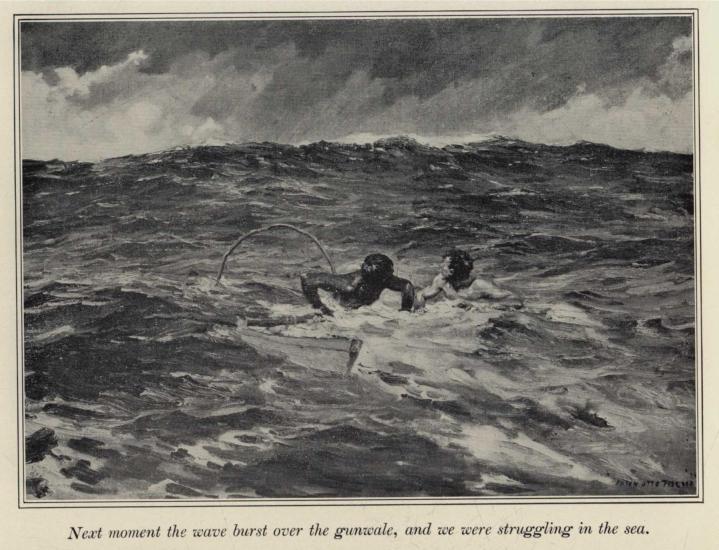
Next moment the wave burst over the gunwale, and we were struggling in the sea.
For a time I felt that the end was near. The
water was warm and I was clinging to the outrigger-pole,
but it seemed impossible to breathe. I think
I should have suffocated, without my long experience
of diving at Iriatai. My eyes were filled with
water, and each time I strove to get a breath, the
sea broke over me to fill my nose and mouth. Little
by little I learned to watch my chance, to fill my
lungs hastily at moments when I could get a gulp
of air.
Marama worked his way along the gunwale of
the swamped canoe and took hold beside me, on
the forward outrigger pole. The buoyant wood
supported our bodies in the water, and our weight
at the forward end held the long hull bow-on. The
clouds were breaking to the west; the squall was
passing suddenly as it had come. The ocean was
calming rapidly, steep breaking seas giving place
to a long swell, though for the time being there
could be no thought of baling the canoe. Before
long we were able to speak of our predicament,
and I remember that neither of us mentioned
sharks, the subject uppermost in both our minds.
It is curious that the white man, like his savage
cousins, brown or black, is still the prey of an ancient
instinct of the race: Never speak of the evil thing
you dread!
If the sharks had found us that day, our end
would have been a sudden and a ghastly one.
Toward noon the sun shone out through the
last of the storm clouds and the sea had gone down
so much that Marama made ready for an attempt
to get the water out of our canoe. "You have
seen it done at Faatemu," he said; "I will watch
the waves carefully till our chance comes—and
then you must do your best!"
We swam aft and took our places on either side
of the stern, holding the canoe head-on while two
or three long swells rolled by. Then, at the
beginning of a lull, the native boy gave the signal, and
we put all our weight on the stern, sinking it deep.
"Now!" cried Marama, and we dove down, pushing
it still deeper and thrusting forward as our
hands let go their hold. The canoe shot into the
air, leaping forward as the light wood bounded to
the surface; the hull smacked down on the sea,
and a rush of water tumbled forward and poured
in a cascade over the bows. Piloted by Marama's
skilled hands, she took the next swell without
shipping a cupful, her gunwale four or five inches
clear of the sea.
"Hold on with one hand and bale with the other,"
ordered my companion, "and I will swim forward
to keep her head-on till she is dry."
There were still a good fifty gallons of water and
my task was a weary one, but at last she floated high
and one after the other we clambered in gingerly
over the stern. Without a word Marama stood up,
balancing himself with one bare foot on either
gunwale as he gazed out intently to the west.
"There is no land in sight," he said.
I felt no great concern at his words, for I believed
the squall could not have carried us many miles
offshore and though we had only one paddle between
us, a few hours would bring us within sight of the
palms of Iriatai. I learned afterward that we were
in the clutch of one of the uncharted currents of
the Paumotus—a current which swept around the
north end of Iriatai and was carrying us farther and
farther into the vast stretch of ocean between the
coral islands and the South American coast.
Toward three o'clock, while I paddled and Marama
scanned the empty line of the horizon from his
perch in the bows, he gave a sudden shout. "E pahi!—a
ship!" he cried, and presently I made her out,
a two-masted schooner, hull down in the north.
Could it be the Tara, come out in search of us? But
no—this was not the first time we had spent a day
away from camp; by evening my uncle would begin
to feel anxiety, but for the present he would think
we had been caught in the squall and forced to
land—a stove-in canoe, perhaps, and a weary journey on
foot through thorny bush and over sharp and broken
rocks.
A light steady breeze ruffled the sea that
afternoon, and anxious minutes passed before we made
certain that the schooner was heading south. When
she was still miles away I saw that she was not the
Tara. She carried a pair of lofty topsails, a rare
sight in these seas; and unlike the schooners in the
island trade, the stranger's mainsail sported a gaff,
cocked at a jaunty yachting angle. As she came
closer, her towering canvas drawing every ounce of
power from the air, she made a picture to delight
more critical eyes than mine. The Tara had a
sturdy beauty of her own, but she was a "bald-headed"
schooner, without topmasts, and she would
have had the look of a barge beside the tall,
graceful vessel approaching us, skimming the sea
like a cup-defender under her press of sail.
Presently she was within hailing-distance and we
saw her native crew along the rail. The brown men
began to shout questions at us, after the fashion of
their race: Who were we—whence did we come—where
were we going? Then I heard a command,
in a roaring voice that made the sailors spring to
their posts. The schooner shot into the wind with
a crisp shiver of canvas, bobbing and ducking into
the head sea as she moved forward and lost way
close alongside. Lines were passed down, strong
hands came out to help us; the next moment our
canoe lay on deck and we were standing beside it,
surrounded by good-natured islanders who were
chattering, gesticulating, grinning with flashes of
their white teeth.
Again the roaring voice boomed out from astern:
"Back the fore-staysail! Eh, Tua! Send the Kanaka
forward and bring the white boy aft to me!"
Tua, the mate, a tall native with a handsome
determined face, touched my arm. Walking aft while the
schooner filled away again, I had my first look at
the helmsman, a white man of herculean build. He
wore a suit of drill, freshly starched and ironed,
snowy yachting-shoes, and a Panama of the finest
weave. The lower part of his face was concealed
by heavy moustaches and a thick blond beard,
but the skin above his cheek-bones was smooth
as a woman's. His eyes were of a blue I have never
seen before nor since: dark and sparkling when his
humor was good—in anger, glittering with the cold
glare of ice. In some subtle way the eyes reflected
the man's whole personality, at once virile, magnetic,
daring, unscrupulous, and cruel. But I was young
and his cordial manner disarmed me; for the time,
my eyes were not open to the evil in our rescuer. He
smiled and stretched out a hand to me—an
enormous hand with fingers like so many bananas.
"Well, young man," he said, his deep voice and
the order of his words carrying a foreign hint,
"from where are you come? In that direction, South
America is the nearest land!"
I had asked for water as I stepped aboard, and
now a black man with a great shock of hair came aft
to hand me a pitcher and a glass. The captain
watched me, smiling behind his beard as I drank the
water to the last drop. Finally I set down the glass.
"Excuse me, sir," I said, "I was very thirsty! It
was lucky for us that you happened to pick us up.
We went fishing this morning and our canoe was
swamped in a squall. Afterward, when the clouds
passed, the land was out of sight, and we've been
paddling ever since." He glanced down at a chart
unrolled before him on the cockpit floor.
"From Iriatai you are come, then," he remarked.
"That is strange, for the island is marked as
uninhabited. Well, it is not far out of my course—I am
bound for Mangareva to load shell."
His courteous manner and lack of curiosity made
me feel that it would be boorish to be reticent. I
had no suspicion that he was feeling me out for
information. And my uncle had nothing to conceal.
"My name is Selden," I told him, "and I have
been on the island several mouths. My uncle, Henry
Selden, has leased Iriatai from the Government
and planted coconuts. Last year he discovered a
patch of shell in the lagoon, and the French have
granted him a season's diving-rights."
I was going to say more, but a sudden sound interrupted
my words. The ship's bell rang out two sharp
and measured beats, paused, and sounded twice
again. It was six o'clock. The watch was changing,
and at a word from the captain the tall mate came
aft to take the wheel.
"Keep a man aloft," the skipper said. "It grows
dark, but within half an hour you will raise the
land." He turned to me. "Come below," he suggested,
"you will be hungry after your day at sea. When
we have dined, I shall be interested to hear more
of your island."
He followed me down to the saloon, where the
table was set with shining glass and porcelain. A
young woman rose as we appeared, a slender, graceful
girl, with sullen eyes and a great bruise disfiguring
one pale brown cheek. She wore a loose gown
of scarlet silk; crescents of gold were in her ears;
and her dark hair, dressed in a single braid thick as
a man's arm, hung to her knees. I learned afterward
that she was a half-caste from the Carolines.
The captain spoke to her and glanced at me.
"Madame Schmidt," he said in introduction;
and as I took her hand, I realized suddenly how I
must have appeared. It was months since scissors
had touched my hair, which stood on my head like
a Fijian's, tangled and bleached by the sun. My skin
was tanned to a sort of saddle-color, and I was naked
save for the torn and faded pareu about my waist.
The captain seemed to divine my thought.
"Eh, Raita!" he ordered, "get out for our guest
some clean clothes. He will feel more at ease."
I slipped into a stateroom to put on the garments
the woman laid out for me: an enormous pair of
trousers I rolled up at the bottom, and a coat in
which Marama and I could have buttoned ourselves
with room to spare. The meal was served by the
captain's body servant, the black, shock-headed
savage I had seen on deck. He was an evil-looking
creature, like some fierce ape masquerading in a
sailor's clothes. Several times during the meal
Schmidt gave him orders in an outlandish jargon I
had never heard, and once, when the captain told
him to fetch wine, he asked his master a question in
a shrill chatter, grimacing with his eyebrows like a
monkey. The woman ate sullenly, without once
raising her eyes; when she had finished, she rose and
left us without a word.
It was still daylight outside, but the swinging
lamp above the table was lit, and under its light I
had an opportunity to study the features of my host.
I began to change my first opinion of him, for the
scrutiny was not reassuring: the more I looked, the
more he puzzled me and the less I trusted him.
When the black man set cups of coffee before us
Schmidt began to question me. How long had we
been on Iriatai? How many divers were at work?
Was there plenty of shell? Was its quality good?
Had we been lucky with pearls? But by now I was
on my guard, and returned evasive answers, feigning
the stupidity of weariness—a deception which
did not require much acting on my part. A
long-drawn shout from above brought us suddenly to our
feet.
"Land ho!"
When I came on deck the western sky was glowing
with a fiery sunset, and under the crimson clouds
I could make out the long dark line of Iriatai.
Puzzled and vaguely uneasy in my mind, I was
leaning on the rail when my eye fell on a handsome
dinghey, slung on davits close to where I stood.
Her stern was toward me, and there, neatly lettered
on the bright varnished wood, I saw the word,
"Cholita." So Schmidt's vessel was called Cholita—a
pretty name for a pretty schooner—and then
I remembered with a sudden start. My thoughts
flashed back to the morning when I had paddled
out to breakfast with my uncle in Faatemu Bay—to
his account of Thursday Island Schmidt. My
uncle's words came back to me: "His schooner's as
pretty as her reputation is black, and the way he
handled her was a treat to watch."
So this was the Cholita, and I was the guest of
the famous Thursday Island Schmidt!
I felt a touch on my shoulder, Marama was
beside me, a serious expression on his face. "Listen!"
he said in a hurried whisper; "I must go forward
before the captain returns. If we approach the
land to-night, let us slip overboard and swim ashore.
Seroni must be warned, for I think that there is
evil afoot. Do you remember Rairi, the Tara's
cook who tried to kill old Pahuri that night on our
passage south? He is aboard—I have seen him,
though his face was turned away from me. He has
been ordered to keep out of your sight. This
schooner was bound for Iriatai before she picked
us up. The mate, who is a good man and beginning
to fear for himself, has told me as much."
The captain was approaching with a noiseless
step; when I glanced up he was not four yards off.
He halted and looked at Marama in angry
astonishment. "Get forward," he bellowed, in a voice
that made the sailors turn their heads, "verdammt
Kanaka cheek!" He turned to me, the former
suavity gone from his manner. "And you," he
ordered—"go below!"
I obeyed him, choking with anger and a sense of
impotence. The half-caste girl was sitting on the
lounge, she had been sewing, but now her hands
were clenched and her work lay where it had dropped
to the floor. There was a look of apprehension in
her eyes. When she saw that I was alone she
beckoned me with a swift gesture.
"Come here, boy—me want talk with you,"
she whispered in quaint broken English. "Me hear
Schmidt say 'Go below'—he too much bad man!
Guk! Me hate him!—Suppose we go near land
tonight, me jump overboard, swim ashore. You
come too—we go hide in bush."
Her fierce eyes blazed as she pointed to the
bruise on her cheek.
"Schmidt do that yesterday," she went on.
"Me like kill him, but too much 'fraid! Before, me
think him good man. My father white man—same
you. Me, my mother, live Ponape, Caroline Island.
One day Cholita come—everybody think Schmidt
good man—spend plenty money—have good time.
Every day he come my house. By and by he say:
'To-morrow I go 'way; you my friend—give me
orange, pig, drinking-coconut. To-night you bring
old woman aboard—we have big kaikai.' My
mother think he good man—we go. Schmidt
bring us aboard schooner—we eat, play accordion,
have good time. Pretty soon hear noise on deck.
My mother stand up. 'What that?' she say. Then
Kwala hold old woman—Schmidt throw me in
stateroom—lock door. Outside reef he throw my
mother in canoe—tell her go ashore. Porthole
open—me hear old woman crying—Guk! Schmidt
never let me go ashore. In Tahiti—Noumea—me
'fraid—he say suppose me swim ashore, send
police fetch."
Her quick ear caught the sound of a footstep on
deck and she signaled me hurriedly to move away.
Next moment Schmidt came down the companionway,
glancing at the woman sharply. Without
a word he motioned me into the stateroom,
slammed the door behind me, and turned the key.
I heard Raita's voice raised in protest, and the
captain's gruff reply. Then the companionway
creaked under his weight as he went on deck again.
Until now I had viewed the Cholita and her
master in an adventurous light; but as I lay there
in the dark behind a locked door I began to feel
anxious and a little afraid. Little by little, as
realization grows at such a time, I put together the
scattered recollections in my mind: what my uncle
had said of Schmidt; the half-caste girl's story; the
presence aboard the Cholita of Rairi, our former
cook; the old letter, telling of the gold-lipped shell
in Iriatai lagoon; Rairi's stealthy visit to the Tara
after his discharge; Schmidt's treatment of me;
Marama's words, and the brutal stopping of our
conversation. There was small room for doubt—each
detail fitted perfectly into the story taking
form in my mind.
While the schooner lay alongside the Papeete
wharf (I thought), discharging the load of shell of
which my uncle had spoken, Rairi must have made
the acquaintance of Schmidt. Our one-time cook
had looked through the papers snatched up in hope
of doing my uncle an injury, and had come upon
Turia's letter, written to her son. It was a chance
in a thousand, but how was Rairi to make use of it?
Then, meeting Schmidt and knowing something
of his character from gossip along the waterfront,
the vengeful Paumotan must have seen his
opportunity. A few cautious questions to feel out his
man, increasing confidence, the final disclosure
of Turia's old letter—and the compact made.
It would be a daring bit of robbery in these modern
days; I wondered how Schmidt could hope to keep
out of trouble in the long run. He might scuttle
the Tara, of course, and leave us marooned on
Iriatai, but our whereabouts was known to many
people, and before many months had passed
someone was bound to set out with a schooner to see
what had become of us. But he was a resourceful
scoundrel, from all I had heard; he must have
weighed his chances before embarking on such a
piece of barefaced piracy. And robbery was the
Cholita's errand. I knew it now as surely as if
Schmidt had disclosed his plans to me.
As I lay there in the berth, tired and frightened,
I began to blame myself for not having played a
more cunning game. Now that my chance had
gone, I saw that I might have played the part of a
talkative and unsuspecting lad, answered Schmidt's
questions freely, and perhaps have kept my liberty
until we drew near the land. Then I might have
gone overboard in the darkness, made my way to
my uncle and given him warning of the Cholita's
approach. Now it was too late. They would take
the Tara by surprise. There might be bloodshed.
A terrible thought flashed into my mind—Uncle
Harry stretched out on his schooner's deck—
I sat up in the berth, clenching my hands. I
had no dearer friend in the world. But at last
excitement and weariness overcame my anxious
thoughts, and I fell into a dreamless sleep.
When I awoke the morning sun was shining
through my porthole, and looking out, I saw that
we lay close to the beach, just inside the pass of
Iriatai. A noise of thumping and scrubbing
overhead told me that the decks were being washed
down. We were at anchor, I knew, for the schooner
lay motionless, though the current at this place
was strong. An hour passed and as I craned my
neck out the port I saw the Cholita's dinghey
approaching us from the north. The handsome
little boat drew near and I saw Rairi in the stern,
a Winchester across his knees and a bandolier of
cartridges over one shoulder. Schmidt's shock-headed
black was at the oars and at his feet a man
lay in the bottom of the dinghey—an elderly
native, bound hand and foot, his gray head matted
with blood and unsheltered from the sun. It was
Pahuri—I knew with a sudden breathlessness
that they had taken the Tara and that Rairi was
enjoying a savage's revenge.
The dinghey passed out of my sight around the
schooner's stern. I heard the thump of a body
flung down roughly on the after deck, Rairi's voice
raised in a sharp command, and the creak of the
davit-blocks as the boat was hoisted to the rail.
Then, for a long time, all was quiet. Rairi had gone
below for a rest and a nap, leaving the black on
guard, for most of the crew were new men whom
neither Rairi nor Schmidt would trust too far.
Finally the silence was broken by a weak voice—old
Pahuri begging monotonously for water. Heavy
steps came aft over my head and I heard the mate
order the black man to give water to his prisoner.
But the savage chattered a refusal in his own
uncouth tongue; he had a rifle and he was under
orders from Rairi, so Tua strode forward angrily,
muttering to himself. Then suddenly I heard a
rapid whispering at the keyhole of my door. It
was Raita.
"Eh, boy!" she said, "listen—you asleep?"
"No," I whispered back.
"Last night," she went on, "Schmidt take your
schooner—Rairi bring back old man he no like.
I sorry that man—head hurt—too much blood.
Rairi leave him in sun—no give water. Schmidt
stop aboard your schooner—suppose wind come
up, Cholita go there. Native boy, your friend, swim
ashore last night. Me think go too, then think
no—me stop aboard, maybe help you. Ah—me
hear Rairi—me go!"
I heard her move away, quickly and softly,
from the door. Her words added little to my
anxiety, for Pahuri's presence told me that Schmidt
had captured the Tara, but the thought of my
uncle tortured me: Where was he—captured,
wounded, perhaps dead? I glanced out the
porthole. The palms were swaying to the first of the
trade wind, heralded by long blue streaks outside
the pass. Presently there were sounds of activity
on deck; shouting and creaking of blocks as they
hoisted the foresail, the deep-voiced chant of the
sailors at the windlass. Then, heeling a little to
the freshening breeze, the Cholita filled away on
the port tack, turned to leeward as she gathered
way, and slacked off for the long run across the
lagoon.
When we drew near the islet, toward midday, I
saw that the Tara's anchorage had been changed:
she was lying fully a quarter of a mile off shore.
Eight bells struck as we rounded into the wind
beside her; I heard the anchor plunge overboard
and the prolonged rattle of the chain. Then the
bellowing voice of Schmidt hailed us, shouting orders
and instructions. A moment later the key turned
in the lock of my door and Rairi entered to grasp
me by the arm.
"Come," he said roughly, "Schmidt want you
aboard Tara!"
He half dragged me up the companionway and
across the deck, where I had a glimpse of our
engineer lying bound in the sun, his gray hair clotted
with blood. Rairi motioned me into the dinghey
alongside, sprang in after me and signed to the
oarsman to pull us across to the Tara. Schmidt was
standing by the rail.
"Where's the Kanaka boy?" he asked.
"Swim ashore last night; maybe shark take
him—no matter."
"Let him go—no harm can he do us. Wait for me."
I clambered over the rail in obedience to Schmidt's
gesture, and he followed me below. My uncle's
stateroom was open and in great disorder. We
halted opposite the door of my own cabin. The
German drew from his belt a heavy Colt's revolver,
cocked it, unlocked the door quickly, and pushed
me inside. As I stood there, dazzled by the bright
light of the porthole, I heard the key turn behind
me, and then my uncle's quizzical voice.
"Well, old fellow," he remarked, "it's good to
see you safe and sound. We seem a bit down on
our luck, eh?"
He was lying in my berth, quietly puffing one of
his long, thin cigars.
For a moment I was overcome by astonishment
and relief; my mouth half opened and tears came
into my eyes. My uncle stretched out his hand.
"Cheer up!" he said, smiling at my long face.
"We're not beaten yet! Before I tell you my side
of the yarn, let's hear how our friend Thursday
Island happened to pick you up."
Speaking in a low voice, I told him of our fishing,
of the squall, how the canoe was swamped, how we
had baled her, and how Schmidt had picked us up.
His only comment was a soft whistle when I spoke
of how I had nearly drowned before the sea went
down. Then I told him of the Cholita: her captain,
the half-caste girl, Rairi, and the story I had pieced
together. As I finished, Uncle Harry nodded his
head.
"That's it," he remarked—"not a doubt! That
scoundrel Rairi—I wish I'd handed him over to
the authorities as I was tempted to do! I wish also
that I hadn't built my stateroom doors so well;
they're solid oak, an inch and a half thick, with
hinges and locks to match! And Schmidt took care
to clear away everything movable: even the water-bottle's
gone! But I must tell you about last night.
"You know the family next door to Maruia's
house—their baby died yesterday, and when dinner
was over I gave the men permission to go ashore for
the singing. It was careless, of course, but we've
never stood an anchor watch since we've been here.
Pahuri stopped aboard—he was asleep up forward—and
I was in a pareu, working on my ledger. I
keep the books in the safe, you know, and the door
of the safe, like the stateroom door, was open. At
about eleven o'clock I heard a boat bump softly
against the Tara's side, but Fatu was due to bring
the men aboard and I paid no attention to the
sound. I glanced up from my work a moment later,
and there was Mr. Thursday Island Schmidt in
the doorway, with a big revolver cocked and aimed
at my chest. He requested me, very politely, to
hold up my hands and keep them there, and as my
own gun was in a drawer behind me, I could see
no way of refusing him!
"The only men with Schmidt, I believe, were
Rairi and some sort of outlandish nigger. All I saw
of the black man was a glimpse of his fuzzy head
outside the door, but Schmidt still keeping me
covered, ordered Rairi in to go through the contents of
the safe. He wanted to get me out of the way, but
he saw that the safe was open and he was too wise
to turn his back on his partner, even for a moment.
He's a cheeky devil, Rairi: he gave me a sour grin
that must have done him good. First he pulled out
the little drawer where I keep my loose money for
emergencies—about a thousand dollars in gold.
He laid it on the table, and as Schmidt glanced
down I was tempted to have a go at him. But I
knew his reputation, and I knew that Rairi was
aching for a chance at me. At that moment, when
I was half decided to try to knock Schmidt out, I
was distracted by a glimpse of something that
escaped him altogether. Out of the corner of my
eye I saw Rairi's hand shoot out suddenly behind
his back and come up to his waist, where he seemed
to fumble for an instant with the tuck of his pareu.
I looked more closely—one of the small round
tobacco-tins was missing from the row on the shelf!
Rairi stooped down as though he had just perceived
them, gathered the little boxes in a double handful,
and stepped across the room to lay them on the
table beside the drawer of gold. 'Pearls, perhaps,'
he said.
"Schmidt showed signs of interest at that. He
ordered Rairi to open them, and gave each lot a
glance, one after the other, but he never relaxed his
watch on me. Thursday Island is not a man to
trifle with—he's proved that over and over again!
'A nice lot of pearls, Mr. Selden,' he observed,
grinning behind his beard; 'there will be a sensation on
Tahiti when they learn that the gold-lipped shell
has been acclimatized. The Government will owe
you a debt for the discovery.'
"I'd been keeping an eye on the pearls and when
the last tin was opened I saw that the Twins were
missing: by the purest chance, Rairi's thieving hand
had landed on their box. I was on the point of
telling Schmidt that the pearls he had seen were not
bad, but that the finest of the lot were in the tuck of
his partner's waistband. I don't know why I didn't
speak,—they might have had a row which would
have given me my chance—but for some reason I
kept my mouth shut. When Rairi had made a
bundle of my papers and made sure that there was
nothing else of value in the safe, Schmidt told him
to clear all the loose stuff out of the stateroom
across the way. Then he invited me to make
myself at home here until his business was done. He
spent some time in assuring himself that the door
and lock were strong. 'It may ease your mind,'
he said, polite as a dancing-master, 'to know that
your nephew is safe; I picked him up yesterday at
sea; he'll join you presently.'
"They must have overlooked Pahuri when they
first came aboard. As the German left my door I
heard a racket up forward: that half-caste, mauling
the old man in a way that made me see red. I was
fool enough to try to break down the door until
Schmidt bellowed out something that stopped the
noise."
My uncle held up his hands to show me the
knuckles, bruised and clotted with blood.
"The noise must have given the alarm to Fatu,"
he went on, "for a few minutes afterward he put off
with Ivi and Ofai in the boat. The current had
swung the Tara around so that I could see what
followed out of the porthole. Schmidt heard them
launching the boat and called his men. He had a
powerful electric torch and when he flashed it toward
the land I saw my boys taking their places at the
oars, Fatu in the stern, and ten or a dozen divers
on the beach. Schmidt growled out an order to his
partner and I heard Rairi's voice raised to warn the
boat away. But our men paid no attention; the light
showed them making for the Tara at top speed.
"'Let them have it, then!' bawled Thursday
Island. I heard two rifles crack, the snap and click
of the levers, and two more quick shots. Ivi dropped
his oar and sank down on the grating with a hand to
his shoulder. Fatu sprang to his feet, snatched up
the oar, and took the wounded man's place, to pull
straight for the schooner. Rairi and the nigger
would have slaughtered them like sheep, but they
held their fire when I shouted through the porthole,
telling my men to go back; that a strange schooner
was in the lagoon, that her skipper had made me
prisoner, and that they had best leave the affair in
my hands. There isn't a gun of any sort ashore and
I don't want to be rescued at the cost of half a dozen
lives! Well, they obeyed me and went ashore.
The sound of the shooting roused the whole
camp—things have been humming ever since. Perhaps
Fatu has some scheme for setting me free; Schmidt
seems to think so at any rate, for he and his men
went to work on the windlass, got the anchor off
the bottom, and allowed the Tara to drift offshore
with the current before they anchored her again.
As for the fix we're in, the worst that can happen is
that we'll lose our pearls. I doubt if even Schmidt
has the audacity to load a hundred tons of shell
under the noses of the men ashore—I wonder if
he would dare? What sort of crew has he—many
men he can trust for this sort of villainy?"
I said that I believed most of Schmidt's men
were newly shipped, that aside from Rairi and the
black they seemed an average lot of natives, not
particularly bad. From Marama's words and what
I had seen of the man himself, I judged that Tua,
the mate, was a first-class fellow, beginning to feel
qualms about the company in which he found himself.
"Tua," remarked Uncle Harry, musingly, "Tua—that's
not a common name! Did he ship in
Papeete? He isn't by any chance a youngish chap,
rather light brown and more than six feet tall?
That's the man? By Jove! I'd like fifteen minutes
alone with him—he's Maruia's foster son!"
A sound of voices put an end to our talk. Schmidt
and the black man had come across in the dinghey
and were making her fast alongside. Raita was
with them, for I heard the captain order her roughly
to climb aboard. There was a step on the deck
overhead; a sound made me look up and I saw
that a basket of food had been lowered to our
porthole. Schmidt hailed us.
"I am sorry, Mr. Selden," he said, "that your
lunch comes late. For me, these are busy days!" He
spoke with a kind of cool politeness he had not
troubled to affect toward me. I never heard any
man speak rudely to my uncle; even now, while
he lay helpless to resent an injury, Schmidt chose
to address him courteously. Water was to be had
at the tap, and we ate with good appetites while
Schmidt conversed with my uncle through the
stateroom door. He had come below for a yarn,
he said, and he seemed in a communicative mood.
"My friend Rairi," he began abruptly, "does
not love that old man of yours. Last night, when
he tied his hands, he hurt him more than I thought
necessary—I believed that he was taking him
back to the schooner that he might bind up his
wounds. To-day I found that old man delirious in
the sun, and I was forced to speak plainly. Ach!
A savage—I have had more than enough of the
native—It would be good if business did not
deprive me of your company."
"See here, Schmidt," remarked my uncle
good-naturedly, "do you realize that this business of
yours is apt to deprive you of all company except
your own, for a good many years to come? You
have brains, man—use them! So far, you've played
your cards well: we'll grant that you are able to
get away from Iriatai with the pearls. You know
pearls. I'll be frank: they're worth forty or fifty
thousand at least. But think of the future—you
can't do this sort of thing nowadays. Matters
were different twenty years ago. Sooner or later
this affair will be the talk of the Pacific. Think of
the wireless, man—they'll be looking for you in
every port in the world! Don't mistake me,—I'm
not telling you this for your own good,—but
the lawyers have a very unkind name for what
you are doing. Think it over, Schmidt. If you're
wise, you'll return what you've taken and clear
out of Iriatai. As a matter of fact I rather admire
your nerve. If you'll turn over Rairi to me, I'll let
the matter drop at that."
The answer to my uncle's words was a rumbling
chuckle; I could fancy the ironical glint in the
German's cold blue eyes. "A handsome offer,"
he said mockingly. "You are more than kind!
Since you are good enough to be frank, I will be
frank as well. As for thinking, mine was done long
ago. I do not fear all the warships and all the
wireless in the world! There can be no harm in telling
you, for that matter; in estimating my chances
of escape, you can amuse yourself for the next day
or two.
"This morning I took my glasses and had a look
ashore. A nice stack of shell you have made ready
for me, under the shed! That I must have. If there
is trouble in loading it and any of your men are
hurt, they will have themselves to blame. Bloodshed
I do not like: it is always foolishness! Without
an axe you will not break out of your stateroom.
Matches I have left you and you could set fire to
the schooner, but that would be for you unpleasant
and would only save me trouble in the end. If you
should succeed in breaking out, always there will
be one of my men to deal with. Kwala, the black,
is a Malaita boy—not a man to trifle with. And
Rairi I do not trust overmuch myself; he is a
primitive, and he bears you an old grudge. I was nervous
last night when he brought me in through the pass;
did you know that long ago he lived on this island?
Yes—his mother was one of the savage women
deported by the French. So you see, I put you out
of my mind."
"Well," said my uncle in an amused voice, "suppose
you do load the shell and get away from Iriatai.
Can't you see that your troubles would only
be beginning then?"
"Ach, Mr. Selden," said Schmidt with reproachful
irony, "you do me injustice! Remember, please,
I am a man of resource. There can be no harm in
it: I shall open my heart to you and tell the
truth—what my vulgar Australian friends used to call,
in their picturesque way, the 'straight griffin,' or
the 'dinkum oil.' First of all, much though I regret,
I must scuttle your pretty Tara. When I am ready
to leave and the holes are bored, the key will be
given you through the porthole in time, that you
may swim to land before the schooner goes down.
Your boats I shall tow to sea with me. I hope you
are not foolhardy enough to venture to sea in the
native canoe. Many months will pass before
information can be laid against me. One chance I
take—that a schooner might put in here soon after I
leave; but that chance is small. Like your schooner,
the Cholita is of French registry now; on paper,
my mate, Tua, is her captain; I am cleared for the
Paumotus, to pick up copra and shell. What shall
I do? The simple thing, which all my life I have
found the wisest: go straight to Tahiti, sell my
cargo to the highest bidder, and clear once more
for the Paumotus within a week. As for the gold-lipped
shell, there will be a hint of a discovery in a
remote lagoon; I can see now the wise ones among
the traders hastening to a place five hundred miles
from Iriatai! My men may talk, but two things
will close their mouths, I think—love of money
and fear of me. Clear of Tahiti, my beard and
my schooner's topmasts will come off; she will have
a new name and a new set of papers. At filling them
out, I am clever—you would be surprised! Then,
one fine day, long before they have come to look
for you on Iriatai, a strange schooner will put into
a far-away port, South America, perhaps, or among
the Dutch East Indies—Ach—who knows? There
is a Chinaman in Gillolo who would gladly take
the schooner off my hands. It is a sad thing to grow
old, my friend; I am tired of the Pacific and of this
wandering life. Much is forgotten in twenty years;
it is my dream to settle quietly in the German
village where I was born—But you must excuse
me—I hear my good Rairi calling!"
I heard Rairi's voice and the sound of Schmidt's
footsteps as he climbed on deck. Then all was silent
for an hour or more, while my uncle and I spoke
in low tones of our predicament. Suddenly there
was a whispering at our door—the voice of Raita.
the half-caste girl.
"Eh, boy," she said rapidly, "you hear me? No
talk loud—Kwala, that black man, on deck!
Schmidt, Rairi, they go aboard Cholita. You got
kaikai—got water? Good—me 'fraid you hungry.
Listen: Raita tell you what they do. Schmidt go
Cholita tell that mate, Tua, go ashore. Tua tell
people on island stop in bush to-morrow; suppose
they come on beach, they get shot! When Tua
come back, Schmidt, Rairi come aboard this schooner
sleep. Keep pearls here. When dark, maybe me
swim ashore hide in bush."
"Raita," I called softly, as a sudden idea came
to me, "wait by the door for a minute. I want to
speak to you when I've talked with my uncle."
I climbed into the upper berth and squeezed my
head and shoulders through the porthole. It was as
I thought; no man could have passed through such
a narrow aperture, but the feat was possible for a
slender boy. "Listen, Uncle Harry," I whispered
as I climbed down to his side, "you heard what
that woman said; now see what you think of the
plan I have in mind. Schmidt has sent Tua ashore
to warn the people to keep away from the beach
while he loads our shell. Tua, you say, is Maruia's
foster son, and I feel sure that he and most of the
crew are uneasy in their minds. This is my plan:
we can see the shore from our porthole, and if, by
the time it is dark, Tua has not returned to the
Cholita, I will wriggle through the port and swim
ashore. It will be easy, I think, to explain the
situation to Tua and to our divers. Tua can go off to
the Cholita and tell his crew what kind of venture
they are engaged in. Once they understand, I'm
sure there won't be a hand raised to help Schmidt
to-night. Then, in the darkness after the moon
has set, I'll swim off quietly with Fatu, Ofai, and a
few of the divers, climb aboard and take the Tara
by surprise. Once we have Schmidt and his two
followers, there'll be no trouble with the others, I
think. We must decide quickly—let me try!"
For a moment, while I waited in suspense, my
uncle puffed meditatively at his cigar. His eyes were
half closed and he seemed scarcely to have heard
what I had said. Suddenly, with a shrug of his
shoulders, he spoke.
"Very well, Charlie—see what you can do.
But take care of yourself. Remember that I'd
rather lose the Tara and all the shell than have
anything happen to you! It's the devil to have to
sit here helpless while those scoundrels sail away
with our property. I was beginning to believe they
held the winning cards! You've a level head, old
man; this plan of yours has a chance of working
out, I should say. Can you really squeeze through
that porthole? By Jove! I'd give something to
have the laugh on our friend Herr Schmidt!"
Before he had finished I was at the door.
"Raita!" I whispered; and when I heard her answering
voice, I told her that I planned to escape through
the porthole and swim ashore. Knowing her hatred
of Schmidt, I confided the fact that we were going
to attack the schooner that night, and begged her
to leave a rope's end hanging over the stern. The
girl was all eager excitement. The blood of a fierce
and vengeful people ran in her veins.
"Guk!" she exclaimed. "Maybe you kill Schmidt,
eh? Me too much happy! Stop aboard now. That
other man—tell him when plenty dark me get axe
from galley. He watch porthole, eh? Suppose you
come aboard—he break door, go help kill Schmidt!
Guk! Me like see that!"
"It's lucky you made friends with her," remarked
my uncle quizzically, when Raita was gone; "I
should dislike to have that young lady for an enemy!
Well, if she doesn't forget that axe, I'll do my best
to entertain her!"
The sun went down that night behind banks of
crimson clouds, which grew black as twilight gave
place to darkness and blotted out the young moon
sinking in the west. The evening was calm, but the
night promised to be a stormy one. The Tara still
lay broadside to the beach and a close watch informed
us that Tua had not left the islet. My time
had come.
Our chief concern was to make no sound which
might give the alarm to the sharp ears of the savage
on watch. Pulling together the curtains of the lower
berth and muffling the operation in blankets to avoid
the slightest noise, we tore a sheet into strips and
braided a length of clumsy cord. Then in the upper
berth my uncle knotted our rope to one of my
ankles, and very gently and cautiously I began to
squirm my way out through the porthole. It was a
tighter fit than I had supposed; after a twist or two
it seemed to me that I could neither move forward
nor go back. I was naked save for a pair of
swimming trunks, and several square inches of my skin
remained on the porthole's sharp brass rim, but at
last I was through, hanging by one leg with my
head and arms in the water. Knowing that the
least splash would bring Kwala instantly to the
side, my uncle lowered me little by little into the
lagoon, until I lay motionless in the black water
and the end of the cord fell into my outstretched
hand. I undid the knot, heard Uncle Harry's
faintly breathed "Good luck!" and dove without
a sound. It was not yet fully dark and I feared that
the black man's eyes might discern my head in the
reflections of the sunset. Thirty yards nearer the
shore I rose to the surface and expelled the breath
gently from my lungs. All was quiet aboard the
Tara. I had neither been seen nor heard.
I landed under an overhanging thicket of hibiscus,
in a little cove where Marama and I kept our
canoe hauled up. There were no lights in the
doorways that I passed, but when I came to Maruia's
house I found the population of the islet assembled
there, women and children outside and the divers
in the house, surrounding Maruia and Schmidt's
mate who sat in earnest conversation on the floor.
The light of a lamp shone on the pair and I saw that
Tua's face wore an expression of dejection and
perplexity. A murmur of astonishment went up as I
arrived, and indeed I must have presented a strange
appearance—wet, nearly naked, bleeding in a
dozen places. Maruia rose and put an arm about
me, patting my bare shoulder softly.
"Ah, Tehare," she said, "you have escaped from
that wicked man—that is good. And Seroni, your
uncle?" I told her how we had been imprisoned in
the stateroom, and how I had escaped through the
porthole, too small for the broader shoulders of a
man. Then I asked for news of Marama.
"He is here," she answered, leading me to her bed,
screened off with mats in a corner of the spacious
room; "see, he sleeps, and we must not wake him.
He followed the western shore on foot, hastening to
warn Seroni, but when he came here it was too late.
His feet are cut to ribbons by the coral and the sun
has given him a fever; I have bandaged his wounds
and brewed a tea of herbs. But come—there are
other things of which we must speak." She led me
back through the crowd and pointed to Tua.
"This man is my foster son," she said, "a good
man, but he serves an evil master. He brings us a
message from that German that we must go to the
far end of the islet while our shell and Seroni's is
carried away. Tua is greatly troubled in his mind.
He has signed papers and the white man's laws are
strict. Furthermore those men are fierce and wary;
they are armed with rifles, while we have none.
What are we to do?"
I turned to the mate. "Saving Schmidt and the
black and Rairi," I asked him, "are the others of the
Cholita's crew good men?"
"I know them all," he replied, "and they are
like others of their kind, neither good nor bad.
But like me, they are in fear of Schmidt and of
the white man's prison."
"Listen, then," I went on, "and I will show
you how to act the part of honest men. Schmidt
is indeed an evil captain and to stand by him
means prison in the end. My own ears have heard
him say that after he has stolen our pearls and our
shell he plans to sell the schooner and leave you
deserted and friendless in a foreign land. Take
warning, therefore, while there is time. You have
heard of Seroni—Maruia will tell you whether
he or Schmidt is the more to be trusted. Give
heed to my words, then. Schmidt and that dog
Rairi await your coming on the Cholita. Go to
them now and tell them that you have delivered
their message; that the people will obey, being
unarmed and in fear of the rifles. In a little while
those two men will go to the Tara, where they will
sleep this night. Once they are gone, arouse the
crew softly without showing lights, and talk to
them in the forecastle, telling them what I have
said. Remember that you on the Cholita need
run no risks: only lie quietly if there are noises
from the other schooner. In the morning the Tara
will be ours and those three men our prisoners.
Seroni will see to it that no man of you is wrongly
accused. The truth is that the Government will
praise you for having refused to aid a captain who
is no better than a robber. Think of old Pahuri,
whose blood is on your decks—is that the work
of honest men?"
"Aye, and this!" A deep voice rang out as
Fatu rose from the dark corner where he had been
lying, and pointed downward with a gigantic
outstretched arm. Then for the first time I saw
Ivi, grinning at me over a shoulder done up in
blood-soaked rags. "It is well said that Rairi is
a dog," Fatu went on. "If I had my hands on
his throat once more, I would not let go so soon!" An
angry murmur went up from the divers; I perceived
that the moment was ripe for my proposal.
"Who will come with me this night," I asked—"who
will follow Fatu to capture the Tara and to
set Seroni free?" Ofai sprang from his seat at Ivi's
side. The divers crowded about me eagerly to
hear my plan.
"We shall need only six or seven of the strongest,"
I told them. "Let us give Tua time to return
and deliver his message, and then, when Rairi
and the bearded captain have gone back to the
Tara to sleep we will swim out without noise,
climb softly on deck, and take them by surprise.
Only one man will be on watch; Seroni waits our
coming to break down the door with an axe that
will be given him."
While I lay on a mat, discussing our plan with
Maruia and the others, Tua took leave of us. I
felt a reasonable confidence that he would play
his part and keep his men from interfering on
behalf of Schmidt. Maruia's blood was up; she
was keen to go with us and it was not easy to
persuade her to stay behind. An hour dragged
by—another—another—it was nearly midnight when
I gave the word to set out. Each man was naked
save for a breechclout; our bodies were well rubbed
with coconut oil, and we carried the long keen
knives used for clearing bush.
The moon had set long since, and black clouds
blotted out the stars. A stir of air from the south
caused the palms to rustle and sigh uneasily. We
were in for a squall. I saw that unless the wind
grew strong enough to rouse the sleepers on the
Tara, the weather was in our favor: the squall
would put the watcher off his guard and drown the
slight noises of our approach. Presently the wind
was sweeping in gusts across the lagoon, driving
a fine rain into our faces. The schooner must be
facing the south, with her stern toward shore.
"I think there will be a line astern," I told the
men crouching beside me under the dripping
hibiscus trees, "and Fatu and I will go aboard that
way. You others must swim to the bow without
a sound and climb up by the chain or by the
jib-boom stay. We will allow you time to get aboard.
Wait by the forecastle till you hear the alarm
given and then come aft to take them by surprise.
As I told you, there will be only one man on watch,
and Fatu alone can handle him. We must not
use our knives unless they drive us to it. Come—it
is time we set out—this squall will drown the
noise of our approach."
"Yes," put in Fatu, whose closest friend was
Pahuri, the old engineer, "let us go quickly! My
hands yearn for the feel of Rairi's throat!"
I led the way into the water, deeper and deeper,
till we were swimming in the black lagoon. We
seemed an hour in reaching the Tara, anchored
no more than four hundred yards offshore. The
little waves slapped against my face and the rain
stung my eyes. At last, when I was wondering
if we had taken the wrong direction, the clouds
broke and the stars shone out, disclosing the dim
outlines of the Tara close ahead and Schmidt's
schooner, riding at anchor a hundred yards away.
At that moment a man appeared on deck,—whether
Schmidt or Rairi I could not make
out,—carrying a lantern in his hand. He made
the lantern fast to the main boom and left it
hanging there. Then he drew a deck-chair into
the circle of faint light, and sat down, facing the
schooner's bow.
With Fatu close behind, I swam under the
overhang of the stern, and next moment my hand
touched a heavy rope, trailing overboard from
the rail. The half-caste girl had kept her word.
The others were clustering about us, and as the
wind was still strong I ventured to whisper fresh
instructions there in the schooner's lee. "The
rope is here," I told them softly; "do not hurry
about getting aboard. Give that man time to
settle down quietly in his chair. Be ready to come
running aft in five minutes."
I had not reckoned on Fatu's impatience, nor
on the native vagueness about time. My
companion was roused as I had never seen him before.
For a little while, with the greatest difficulty, I
restrained his eagerness, but finally he shook my
hand off his shoulder and began to pull his huge
body up the rope, hand over hand. I followed:
there was nothing else to do. The wind was still
blowing strongly from the south.
Fatu reached the rail in an instant, heaved
himself aboard with uncanny agility, and dropped to
the deck without a sound. I was desperately slow
in following, for I was tired and chilled, and my
arms were not trained to sailors' work. When at
last my head rose above the rail, I saw that the
giant was stealing toward the unconscious man
in the deck-chair, creeping forward with a stealthy
swiftness in the shadow of the binnacle. The
lantern, flickering in gusts of wind, cast a dim yellow
light on the scene. Then my hand slipped on the
wet rail, and I fell thumping to the deck.
I was on my feet in an instant, but the man in
the chair was quicker still. It was Schmidt, and
his senses must have been keen as those of a
savage, for his eye was on me before I had taken a
step, and the rifle came to his shoulder with a
snap. In the same instant Fatu leaped at him from
behind the binnacle, springing like a monstrous
cat—but the spring was a breath too late. I saw
a bright tongue of flame, heard a crashing report,
and felt a great blow on my leg—a shock that
spun my body about and sent me sprawling to the
deck. I lay there sick and numb, yet keenly alive
to every detail of the scene that followed: a swift
drama stamped indelibly on my memory.
Fatu seized the rifle with a single mighty wrench,
tore it from Schmidt's hands and sent it flying
overboard, then his arms closed about the German's
body. Schmidt was a very strong and active
man. His foot went out behind the leg of his
antagonist; he twisted his body with the movement
of a skilled wrestler, and the pair came crashing
to the deck. But Fatu's grip never relaxed and I
knew that in the hug of those mighty arms
Schmidt's moments of consciousness were
numbered. He seemed to realize it too, and his right
hand, free from the elbow down, began to move
painfully toward the holster at his belt, where I
saw the gleam of an ivory pistol-butt. Then I
heard my uncle's axe thundering at the stateroom
door, and the shouts of the divers, climbing over
the bows.
I raised my eyes, hoping to see the natives
running aft. I glanced back at the wrestlers and saw
Raita there beside them—a slender, crouching
figure in white, her face framed in waves of dusky
hair. She had drawn Schmidt's revolver in the
nick of time, and held it cocked in her hand.
But Kwala, the black savage, who must have
been sleeping on the forward hatch, still had a
part to play. In the second while Raita crouched
there, fiercely seeking her chance to kill, there
was another streak of flame, and the report of
another rifle-shot. The girl sank down on the
deck. I saw the shock-headed savage blinking in
the lamplight while a wisp of smoke eddied from
the muzzle of his Winchester. Then, with fierce
shouts and a rush of bare feet on deck, the divers
were on him, and he went down in a smother of
brown arms and legs.
For an instant, Raita lay where she had fallen,
but though she was dying, hatred of the German
gave strength for the last act of her life. "Guk!"
I heard her exclaim with a weak fierceness, as
her hand went out to take up the pistol a second
time. By chance it had not gone off when she
had dropped it. With a wavering hand she aimed
it at Schmidt's temple and pulled the trigger. A
third shot rang out above the tumult—Schmidt's
body quivered and relaxed—Fatu rose slowly to
his feet.
Out of the corner of my eye I saw a man standing
at the companionway. It was Rairi, an expression
of angry astonishment on his handsome, sullen face.
He glanced swiftly about him, seemed to arrive
at a decision, and bounded across the deck. Before
I could cry out, he was over the rail and into the
lagoon.
The appearance of my uncle, dressed in a scarlet
waistcloth and brandishing an axe, smothered the
shout on my lips.
"Eh, Fatu!" he cried, as his eye fell on the
gigantic figure of the mate. "Have you got them
safe? Where's Charlie?"
"Here!" I said in a weak voice, and next
moment he was bending over me. "Schmidt shot
me in the leg. He's dead, I think, and so is that
poor girl. Ofai and the divers have the black
man—look—they're tying him now! And
Rairi—he dove over the side a second before you
came on deck! Quick! Send someone after him!"
At my words Fatu sprang away to lower a boat.
When my uncle had made sure that Schmidt and
the woman were dead and that the black was
safely bound, he took me in his arms and carried
me below to dress my wound. He laid me on the
lounge in the saloon, turned up the lamp and bent
over my wounded leg, his face wearing an expression
I had never seen. Then he straightened his
back with a great sigh of relief.
"Well, old fellow," he said, patting my bare
shoulder, "you've given me a scare! But you're
not badly hurt: the bullet has passed through the
muscle of your thigh without touching the bone.
Hurts like the deuce, eh? That won't last
long—we'll have you on foot within a month!"
He made me drink a glass of brandy, the first
I had tasted: burning stuff that made me cough
and ran through my veins like fire. I was weak
from loss of blood, and when he had staunched
the bleeding and bandaged the wound with wet
compresses, I fell into an uneasy sleep.
It was later that I was told of the happenings
of that night: how one of the divers swam ashore
to tell the people that Seroni was free; how a great
fire was built on the beach and a fleet of canoes
put off to swarm about the Tara; and how her
decks were crowded with brown men and their
women and children, all eager to shake my uncle's
hand. It was a night of rejoicing. A fire was built
in the galley to brew huge pots of tea, and cases of
bully beef and ship biscuit were opened on deck.
The morning found me feverish and in pain with
the stiffening of my wound. Old Maruia had
installed herself in my stateroom. The season was
over, she declared; she had earned enough for one
year, and now she was going to nurse me till I
was well. I was eating the gruel she had prepared,
when I looked up and saw my uncle standing in
the splintered doorway, a long cigar in his mouth.
"It's tough luck to be laid up this way!" he
remarked, "Hurts, eh? It will for a few days.
But you've a first-class nurse; I reckon she'll
have you in a steamer-chair inside of a fortnight!
I didn't know how many friends you had ashore—the
whole lot of them were asking after you last
night—Eh, Maruia, don't let him move that leg!
"About Rairi," he went on—"he got clean
away. A Paumotu boy in the water on a dark
night is a hard proposition to catch! We don't
know which way he swam, of course; we'll search
the two islands on the east side of the lagoon
to-day. I'm leaving now; the boats will follow along
the beach to the pass and meet us there to-night.
With fifteen men we'll be able to comb the bush
so that a dog couldn't pass us! If we don't get
him to-day, we'll try the west side to-morrow—You've
guessed why I'm going to so much trouble?
Yes, he's gotten away with your pearls!
"This morning, when the excitement was over,
I made an inventory of the things in the safe.
The door was open; Schmidt had left everything
in place, only taking the precaution to lock the
inner door. I found the key in his pocket. He
never knew about the Twins—I told you how
I saw Rairi steal them under his eyes. I was
losing hope of coming out of this affair so well. I owe
you a lot, old man; I'll try to repay part of it by
getting your pearls for you. We'll catch Rairi,
never fear! Schmidt and the girl were buried
this morning. He was a man, that German, though
he had the morals of a wolf! It's odd—but there
was something I almost liked about him—It takes
courage to play a game like his, and he might
have succeeded if he'd been a little less
contemptuous of the natives he's abused so long.
I wonder who he really was! I'm sorry the girl
was killed—I would have sent her home. She
couldn't have been more than twenty, poor
child—a forlorn way to die. The black is in irons
aboard the other schooner, where he's not popular
with the crew!"
When my uncle had gone I sent a man ashore
for Marama, and presently he was installed in
the upper berth, a mass of bandages about his
swollen feet. It was good to see my friend once
more.
"I do not know where Rairi is now," he said,
when Maruia had left us to smoke her cigarette on
deck, "but if he was barefoot when he went
overboard, he will be in no shape to run away! Aué!
That dry coral is sharp underfoot! When I escaped
from the Cholita, I had one thought in mind; to
get to Seroni quickly, to warn him and bring help
to you. I landed close to the village of the
copra-makers and there was an old canoe on the beach,
but when I took thought, I saw that the day would
break before I reached the Tara, and that I would
run a risk of being picked up again by that bearded
captain who is now dead, so I traveled the length
of the western island afoot. The sun was high when
the time came to swim, and I was faint with pain
and loss of blood—the coral cuts deep! If I had
been stronger I would have gone directly to the
Tara, for I had no suspicion that Rairi's boat had
come to her in the night. Fatu was the first man I
saw on shore; he told me of the shooting, of Ivi's
wound, and how Seroni was a prisoner on his own
schooner. All that day I lay in great pain, and my
head was light with the sun."
At midday Maruia dressed our wounds and
brought up food, and we dozed through the long
warm afternoon. It was evening when my uncle
returned with his weary men. They had scoured
the eastern islands from end to end without finding
so much as a footprint.
Next day, when they searched the long island on
the western side of the lagoon, the story was the
same, though one of the divers claimed to have
found the half obliterated tracks of a man on a
stretch of muddy beach. That night my uncle
went to bed with scarcely a word; I could see that
he was discouraged, mystified, and very tired.
Marama and I were silent for a long time after the others
had gone to bed. Finally the native boy spoke.
"Are you asleep?" he asked in his own tongue.
"No," I whispered back; "I lie here thinking."
"And I too. Listen, for there is something in my
mind. First of all, know that Rairi is not a stranger
on this land of Iriatai. His mother was a woman
of the island—one of the wild people the French
soldiers came to take away. And when he was a
boy he came here to labor at the copra-making,
with the woman who lived here before Seroni's
coming. There are true words! Knowing all this,
I have tried to put myself in his place. He has our
pearls—pearls of great value, for which a man
would endure hardships and long months of
waiting. The question in his mind must be: 'Where
shall I hide myself till the schooners are gone and
I can steal a canoe to chance a passage to the
nearest land?' Where, indeed? The three islands about
the lagoon are long, but they are flat and narrow.
The bush is thick in places, but not too thick to be
searched as one searches for a dropped fishhook in
a canoe. Where, then? Listen, and I will tell
you—in the Cave of the Shark! Is it not possible that
in his boyhood Rairi found the cavern even as we
found it, or that the woman Turia showed it to
him as an ancient sacred place? He would believe
that no other man on the island knew of it; that
he might lie hidden there for months, stealing out
by night to catch fish and to gather coconuts for
food and drink. I tell you that the thought of
losing our pearls has weighed like a lump of lead
on my stomach, but now I feel hope!"
When my uncle had returned that evening,
discouraged and empty-handed, I had felt the full
bitterness of disappointment—the hopeless
collapse of all my dreams. After all, our hopes had
been absurd; a three or four mile swim at night
was a risky business, even for a native. Perhaps
Rairi had been seized with cramps; perhaps a roving
shark had picked him up. In reality, the chances
were against his being alive. But now, as the
possibility of the cave grew large in my mind, I could
scarcely wait for the morning, to tell my uncle of
Marama's idea. Eight bells struck. It was
midnight, and the soft breathing in the upper berth
told me that Marama was asleep. He had a
wholesome lack of nerves, and to him the loss of the
pearls meant no more than a passing disappointment.
In his eyes, money was not a thing that
mattered greatly—if one had none of it, one did
without; if one's pockets were full, it was pleasant
to spend. I envied him, for with me it was far
different.
Hour after hour I lay there, wakeful with anxiety
and the fever of my wound, while the round ship's
clock in the saloon struck off the bells. The
glimmer of dawn was in the stateroom when at last I
fell asleep.
Maruia woke us with a tray of breakfast, steaming
hot from the galley. The sun was high, and
glancing through the door, I could see my uncle,
bending over some papers at his table. My head
was heavy with lack of sleep, but the fever seemed
gone and the pain in my leg diminished. I called
to Uncle Harry and he rose at the sound of my
voice.
"Well, boys," he said, smiling in at us, with a
hand on either side of the doorway, "had a good
night? I was for letting you sleep, but the old
lady thought it was time you were eating
breakfast." I told him what Marama had suggested the
night before, and his eyes lit up with a brilliant
gleam of interest.
"I believe you've hit it!" he exclaimed. "That's
the one place we haven't searched. I remember
now Schmidt's saying that, as a boy, Rairi had
lived on Iriatai. I lay awake half the night puzzling
over this business—I was beginning to believe that
the man must have been taken by a shark. But we
must waste no time; I'm off now for a look at this
cave of yours. Wish me good luck!"
The hours of that day dragged past with
interminable slowness. I grew depressed as time went
on: perhaps we had been unduly sanguine the night
before; the thread supporting our hopes was a
slender one, after all. Even if Rairi were found, he
might have lost the pearls or hidden them. Marama
laughed at my fears, refusing to share in my
renewed depression. At noon the old woman brought
us lunch and we ate with good appetites, for by
now we were on the way to recovery. Afterward,
when she had cleared the things away, I fell into
a dreamless and refreshing sleep.
It was late afternoon when I awoke. There was
a hail from the deck and the sound of a boat,
bumping against the schooner's side. Next moment my
uncle ran down the companionway and burst into
our stateroom, a smile on his lips and in the dark
brilliance of his eyes. Without a word he placed
in my hands a small tin box—a box that I had
seen before. I opened it with a beating heart, and
there, side by side in their nest of damp cotton-wool,
were the Marama Twins! The native boy,
gazing down over the side of his berth, gave a shrill
whoop of joy.
"It was a tame affair," remarked my uncle,
when he had answered our first rapid questions,
but your cave is certainly a curious place. We
had no difficulty in finding the entrance. I led the
way in, with Fatu, Ofai, and a couple of others
close behind. Whew! That's a bit of a swim before
you can come up to blow! I had warned the men
to make no noise; it was possible that Rairi might
have clung to the six-shooter I had seen at his belt,
and good ammunition is almost waterproof.
Presently, as my eyes grew accustomed to the dim
light, I made out the idol and the heathen altar,
and then, on the ledge a little to one side, the
huddled figure of a man. It was Rairi—his eyes
were open and he had been watching us all the
time. He's a plucky scoundrel; when I was
standing over him wondering why he had not moved,
he shook his head and grinned at me as he made
an effort to hold up his right arm, blackened and
horribly swollen out of shape. 'I glad you come!'
he said in a weak voice. He was burning with fever.
"Then he told me what had happened. Swimming
across the lagoon in the dark, he had run
squarely on a patch of the purple coral, the
poisonous kind that cuts like a razor-edge. He
managed to get to the cave before the wounds stiffened,
but next morning, when daylight began to appear
through the cranny in the rock, he realized that it
was all up with him unless help came. Both legs
and his right arm are frightfully infected—I'm
not sure that we can pull him through. Well, if he
dies, it will save the Government from supporting
him in jail! The pearls were in the pocket of his
dungarees—he handed them to me of his own
accord. We had the deuce of a time getting him
out to the boat; he'd have been drowned if Fatu
hadn't been along!"
There is little more to tell of our days at Iriatai.
For a fortnight, while I lay bored and convalescent
in a steamer-chair, the diving went on. Then
each man's share of the shell was laid out for my
uncle's inspection, sacked, weighed, and loaded
in the Tara's hold. There were a hundred and
twenty tons of it, of a quality unknown in the
lagoons of the Eastern Pacific, and Uncle Harry
was jubilant over our good luck. His safe held a
little fortune in pearls, and the divers had others
they were keeping to sell on their own account.
A day came at last when the village on the islet
was dismantled; when the people crowded our
decks, noisy and gay with the joy of being
homeward-bound; when the Tara, deeply laden, turned
her sharp bows toward the pass, away from the
anchorage which had been our home so long.
Pahuri was at his accustomed place in the
engine-room—the old man had soon recovered from
the rough handling he had endured. Ivi, with his
left arm in a sling, was the hero of the forecastle;
the divers never tired of discussing the memorable
night when he had received his wound, and I could
see that in the future the story would be passed
from island to island, growing to epic proportions
as the years went by. Marama and I had thriven
under Maruia's care; his feet were healed by now,
and I was able to get about the deck, though my
leg still gave me an occasional twinge.
The Cholita, with Tua in command and our
two prisoners stowed away below, followed us
southward toward the pass. Rairi was out of
danger at last, after days of raging fever when
there seemed small chance that he would live.
The copra-makers had been on Iriatai for more
than a year, and Schmidt's schooner halted off
their village to take them aboard and load the
twenty tons of copra stacked under the shed on the
beach.
Outside the pass, when the Tara dipped her
nose into the long Pacific swell, I lay alone on the
after deck, gazing back at the line of palm-tops
that was Iriatai, fast disappearing beyond the
slope of the world. I thought of Schmidt, sleeping
forever under a wooden cross on the deserted islet;
of the woman in the shallow coral grave beside him,
the half-savage girl he had stolen from her home
in the far-off Carolines—Raita, who had been
my friend, and whose hand, at the last, had ended
his strange life. I felt a lump in my throat, as I
realized that in all probability my eyes would
never again rest on Iriatai, this dot of land,
immeasurably lonely and remote.
A week later we dropped anchor in Faatemu
Bay. The other schooner had gone on to Tahiti
and would await us there. The village hummed
with the excitement of our arrival; there were long
stories to be told, friends and relatives to be greeted,
and good fortune to be shared. Forty pigs were
killed for the feast that Taura, the gray-haired
chief, gave in our honor. Fat old Hina welcomed
me like a mother, with easy native tears. I had
not forgotten her kindness, and on the last day
I tendered my parting gift: two handsome
pearls—one for her, and one for my former playmate,
Marama's little sister. When the Tara sailed
out through the Nao Nao Passage and I went
below, I found my stateroom littered with their
presents—fans, hats, baskets, wreaths of
bright-colored shell.
Marama and his father accompanied us to
Tahiti. At dawn of the second day I was awakened
by my uncle's voice, calling me on deck to see the
land. The schooner was slipping through a calm
gray sea, running before a light breeze from the
north, and a glimmer along the horizon told of
the approaching day. Close on our starboard beam,
and so unreal that I half-expected the vision to
fade before my eyes, I saw the fantastic pinnacles
of Eimeo. Tahiti lay straight before the Tara's
bows—faint, lofty outlines rising from the sea to
disappear in veils of cloud. We were standing
side by side at the rail, and at last my uncle spoke.
"This is my home-coming," he said quietly.
"To me, that island is the most beautiful thing in
all the world."
At ten o'clock we were opposite the pass, and
I saw for the first time the little island port of
Papeete: the masts of trading-schooners rising
along the docks; the warehouses and the line of
sheds for freight; the narrow, shaded streets
running inland from the waterfront; the background
of green, jagged mountains, cleft by the Fautaua
Gorge.
A crowd gathered while the Tara docked. There
were shouted greetings in native, in English, and
in French. As the schooner was warped alongside
and the gangplank came out, the people began
to stream aboard. The Cholita had brought news
of our coming, with the story of our gold-lipped
shell and Schmidt's attempted piracy. My uncle
had given Tua a letter to the authorities, turning
over the schooner and the prisoners to the
Government, exonerating the crew, and giving a detailed
account of the affair. The news had caused a stir
in this peaceful and remote community; we refused
a dozen invitations to lunch, and Uncle Harry
was forced to tell the story twenty times—to
traders, to officials, to his own agents in
Papeete—before his friends would give him peace. And
through it all I heard a chorus of exclamations at
the gold-lipped shell.
I spent the afternoon wandering about the town.
It was all new and strange to me: the strolling
bands of sailors, the Chinese shops, the houses
with their deep, cool verandas shaded by exotic
trees. At four o'clock I met my uncle by appointment
at the bank. He took me to a private room
upstairs, and as he opened the door a man rose and
came toward us with outstretched hand. He was
small and dapper—a shade too well dressed. His
nose was long, and his black eyes bright and beady
as shoe-buttons; his radiant smile, under a little
waxed moustache, disclosed teeth like the pearls
in which he dealt.
"Monsieur Sikorsky," murmured my uncle, "my
nephew, Charles."
"It is a pleasure," said the Jew, shaking my
hand warmly, "to meet the nephew of my old
friend. I have been aboard the Tara this afternoon
and have heard much of you! They told me you
had been diving with the natives—a wonderful
experience, young man, but dangerous, hein? Ah,
those sharks—those great man-eating fish—it is
épouvantable!" He shuddered delicately, offered
my uncle a cigarette from a case of tortoise-shell,
and blew out a cloud of perfumed smoke.
"Yes," he went on, "Monsieur Selden has told
me how old Maruia's kinsman was taken by the
tonu, and how you dove down to the cave for the
old oysters your native boy had seen. And he
said that if I came here this afternoon you might
show me the matched pearls you found that day."
"I have them here," put in my uncle, drawing
the familiar tobacco-tin from his pocket. "We'll
show them to Sikorsky, eh? Perhaps he'll want
to make you an offer." He drew up three chairs
about a table close to the window, and pulled
back the blinds to admit the afternoon sunlight
into the room. Then he opened the little box and
laid the pearls side by side on the green tablecloth.
"Well, what do you think of them?" he asked.
"You've never seen a finer matched pair, eh?"
For a moment Sikorsky lost his urbane composure.
His black eyes glittered and his hand
trembled a little as he reached out to take up the
pearl nearest him. As he turned it over and over
in his palm, admiring the perfection of its form
and the play of light on its flawless surfaces, he
muttered to himself in a language I had never
heard. Presently he laid down the first pearl and
took up the other for examination; rose to fetch a
black leather case from a corner of the room; laid
out his jeweler's scales and measuring instruments.
Without a word to us, he weighed and measured to
his satisfaction, took out writing-materials and
covered a sheet of paper with the figures of a
complex calculation. Then he took up the pearls for
a last glance, and leaned back, lighting another
of his perfumed cigarettes.
"There is no need of beating about the bush,"
he said. "You know pearls, Selden—such a pair
does not turn up twice in a lifetime. They would
make a gift for an empress! It has been a
privilege to see them, even though nothing comes of
it. If they were mine, I would go hungry before
I would part with them!"
"What are they worth?" asked my uncle.
"Ah, that is hard to say—they are for sale?"
"Yes, at a price; I would buy them myself if I
could afford to own such luxuries."
"I will make you an offer, then, though the
responsibility is more than I am authorized to
take. They are matched almost to the weight of
a hair—Let me see—for one of them, alone,
I could safely offer you twelve thousand dollars.
Double that for the matching—forty-eight
thousand for the pair—Yes—I will make my offer
fifty thousand."
He raised his hand as my uncle was about to
speak.
"That is a fair offer," went on the Jew, "I
assure you, a long time might elapse before my
firm could find a purchaser. I would not make it
except that they love fine pearls as I do. But if
you think that this is not enough, name your own
price and give me time to wire my people in Paris.
One thing I ask of you as an old friend: show
them to no one else till I have had my chance!"
"A fair enough offer, I should say," remarked
my uncle, as he put the pearls in their box and
rose to leave. "I must go down to the schooner
now; my nephew and I will talk over your price
to-night. Can you meet us here after breakfast
to-morrow? We'll let you know our decision in
the morning."
The pearl-buyer ushered us to the door and
bowed us out with another radiant smile.
That evening, when we were sitting alone on
the balcony of our hotel, Uncle Harry told me
something of the Jew. "If you met Sikorsky at
home," he said; "you'd think he was a little
counter-jumper, but as a matter of fact there's
no squarer or more decent fellow in this part of the
world. I've known him for years. He speaks
half a dozen languages and has been in most of
the odd corners of the earth. What do you think
of his offer? In your place I'd be inclined to accept.
I doubt, in fact, if the Twins would fetch much
more. One might take them abroad, of course,
and find some rich fancier who would pay twice
as much, but peddling jewels is not in our line.
What do you say?"
"Oh, let's accept his offer!" I exclaimed. I had
been thinking of nothing else since our visit to
the bank. Half of fifty thousand dollars seemed
a tremendous sum to me.
"Very well," said Uncle Harry with a smile.
"To-morrow will be a great day for Marama and
the old man!"
He drew from his pocket the familiar case of
worn brown leather and selected a cigar. When
it was drawing to his satisfaction he tossed the
match into the street and cocked his feet against
the railing of the balcony.
"I've good news," he remarked. "We have a
week before your steamer sails. I want you to
see my place in the country. When does your
school begin? The first of October? That's
good—you'll be home in plenty of time. Now about
the money; it's yours to do with as you like, of
course, but let me give you a bit of advice. If I
were you, I'd turn the bulk of it over to your
father—he's in need of cash, and a few
thousands would put the Santa Brigida on its feet.
It will be yours eventually; stick by the land,
old fellow—it doesn't pay to knock about the
world as I have done. By the way, there'll be
something coming to you from your lay in the
season's work, though it will look small beside
Sikorsky's check. Well, it's getting late—time
we were turning in."
In the morning, when we had finished breakfast,
we met the pearl-buyer at the bank. Half
an hour later, as we shook hands and strolled out
the door, I carried in the inner fold of my
pocketbook a draft for twenty-five thousand dollars, on
a San Francisco banking house. We found Marama
and his father aboard the schooner. Their eyes
were bright with wonder when my uncle told them
of the bargain he had made, and they were glad
to accept his offer to look after the money for
them, letting them draw on him whenever they
were in need of funds.
"I'm having some friends to dinner to-morrow,"
he told me as we walked down the gangplank.
"We must be getting out to Fanatea now. My
boat got in early this morning—come along and
have a look at her."
She was lying a quarter of a mile down the
beach, moored to the sea-wall under the old trees
bordering the avenue. On her narrow stern I saw
the word "Marara" lettered in gold, and her lean
lines and the six great exhaust-pipes standing in
a row left no doubt that she could show the speed
of her namesake, the flying fish. A native in a
suit of oily overalls sprang ashore to greet us and
smiled when I spoke to him in his own tongue.
"What do you think of her?" asked my uncle.
"Isn't she a beauty? I built her myself—every
plank. That's a French engine—ninety
horsepower—and it drives her at better than twenty
knots!"
The mechanician fetched our bags from the
hotel. We took our places in the cockpit, the
spray-hood was raised, the anchor came up, and
the stern line was cast off. The deep-throated
roar of the exhaust brought a little crowd to the
quay while the man turned up grease cups and
oiled a bearing here and there. He raised his head
and glanced at my uncle with the odd native lift
of the eyebrows which means "All ready!" The
motor burst into a deeper and a fiercer roar; my
uncle took the wheel and pulled back the lever
of the clutch. The boat quivered and sprang
forward swiftly, heading for the docks where the
stevedores were dropping their wheelbarrows to
watch. She swept around the harbor in a great
curve, turned seaward, and headed out through
the pass, her bows parting the waves in sheets
of spray. Outside the reef we swung southward
toward Fanatea, twenty miles off.
An hour later I saw a break in the white line
of the reef. As we sped in through the gap, the
huge blue combers, with spray whipping back
from their crests, raced in on either side of us to
topple and crash in thundering foam.
"There's Fanatea!" shouted my uncle, pointing to
a long white house at the end of an avenue of pahns.
A path, bordered by ornamental palms, led from
the pier to my uncle's house, set on a rise of land
a quarter of a mile beyond. The plantation had
a long frontage on the beach and extended inland,
across the rich alluvial flat, up into the hills. More
than two hundred acres were planted with
coconuts,—stately young palms in rows ten yards
apart,—and lines of fencing divided the land into
paddocks, where I saw fat cattle grazing
belly-deep in grass.
The house was long and low, plastered with
burned coral from the lagoon. The veranda
overlooked a matchless view of dark-green foreshore,
placid lagoon, white reef, and sparkling sea. Far
off across the channel the horizon was broken
by Eimeo's jagged peaks. Deep, cool, and airy,
the veranda was my uncle's living-room, and at
the windward end, in a great glassed-in bay, I
found his collection of idols, weapons, and native
implements. That night, when the Chinese houseboy
rang the gong, I scarcely knew Uncle Harry in
pumps, flannel trousers, and a smart white
dinner-coat. It was his custom to potter about all day
on the plantation, bush-knife in hand and clad
only in a cotton pareu; but when evening came
and he had had his bath, he never failed to appear
immaculate at the dinner hour.
"This is the only home I have," he remarked
as we sat down, "and when I'm here I make a
little effort to keep up appearances. It saves me
from becoming a savage. I have a good many
friends scattered about the island—I visit them
sometimes and they often come here. As I told
you, a few of them will be out to-morrow:
Sikorsky is coming and a couple of Government men.
Old Jackson said he would come, too—he's my
agent here; by the way, he's reserved a deck cabin
for you on the steamer. Maruia is the most famous
cook on the island—she's promised to come out
to superintend the kitchen."
Maruia arrived early the next afternoon, and
when she had shaken hands with us she went
straight to the back of the house, where the
Fanatea people, who stood in awe of such a rich and
celebrated character, sprang this way and that to
do her bidding.
The motor-boat had gone to town, and just
before sunset I heard the hoarse bellow of her
exhaust and saw her moving swiftly across the
lagoon toward the pier. When he had presented
me to his guests, my uncle took the Frenchmen
in charge and left me with old Mr. Jackson and
Sikorsky. The gold-lipped shell and his adventure
with Schmidt had made Uncle Harry the hero of
the hour, and since the Jew had showed the
Marama Twins to several of his friends, I found
myself an object of interest to these older men.
But Mr. Jackson, a gaunt old Englishman with
friendly eyes and an enormous white moustache,
knew how to put me at my ease.
"A beautiful pair of pearls," he remarked when
we were walking into the dining-room; "they'll
make a sensation in Paris! Sikorsky showed them
to me last night; he's planning to take the next
boat north, on his way to France. Told me how
you found them, too—the tonu and all the rest
of it. Bad brutes, those tonus—one nearly had
me when I was a lad. Forty years ago, that
was—I'm getting old, eh? In those days I was
supercargo aboard a schooner of the Maison Brander.
We were lying becalmed inside the pass at
Mangareva, and in spite of what the natives said, I
thought I'd have a bit of a swim. In the nick of
time I saw the brute coming up at me—a great
spiny, mottled beast, with a mouth like an open
door. We were towing a boat, by good luck—I
went over her stern so fast I scraped half the skin
off my chest!"
"He's off!" said my uncle, at the other end of
the table. "Mr. Jackson's our champion spinner
of yarns, Charlie; he's a true artist, and you
mustn't believe everything he says!"
The old man chuckled—they were friends of
many years standing. "I'll promise not to do any
more talking," he said. "I'm hungry, and I can
tell by that salad of shrimps that old Maruia is
somewhere about. Lucky man! How did you
persuade her to officiate?"
An hour later, when the Chinese boy had
brought coffee, one of the Frenchmen pushed back
his chair and rose. He was the treasurer of the
colony, a stout, middle-aged man, with keen dark
eyes and a close-cropped beard.
"First of all," he said, with a friendly smile at
my uncle, "permit me to thank you for an
excellent dinner, such as I know how to appreciate.
Nor must we forget Maruia, whose skill in her art
I have known for so many years. And now let me
propose the health of our host, whose discovery
of gold-lipped shell in the Paumotus marks an
addition to the resources of the colony. To
Monsieur Selden, then, whose enterprise has earned
the Government's warm thanks!"
My uncle rose as the Treasurer sat down.
"Monsieur Durand has been more than kind,"
he said. "And speaking of Maruia, she has been
good enough to offer to entertain us this evening.
You all know the old-time native songs, and how
rarely one hears them nowadays. She has
composed an uté on our diving-season at Iriatai. I
think she is waiting for us on the veranda—bring
your coffee along."
We found her in the bay-window, examining
a piece of tapa cloth. She seemed known to
all the company and perfectly at ease, addressing
Mr. Jackson in native and the others in fluent
French. Her hair, which was brushed back loosely,
was fastened with a pearl-studded clasp at the
nape of her neck; golden earrings were in her
ears, and she wore a flowing gown of thin black
silk. I could scarcely believe that this was the
old savage beside whom I had dived day after day,
the fierce creature who had leaped overboard,
spear in hand and muttering a heathen prayer,
to avenge her nephew's death.
I sat down between Mr. Jackson and Sikorsky,
on a long lounge covered with a scarlet-bordered
mat. Beyond the railing of the veranda a score
of natives squatted on the grass.
Maruia took her place cross-legged on the floor,
and a boy placed in her hands a great piano-accordion,
inlaid with mother-of-pearl. In the silence
which proved the interest of her audience, she
drew out the bellows and let her fingers play over
the stops. Then I heard for the first time the music
of the uté—a wild minor melody, stirring,
exultant, heathen, and profoundly sad. Suddenly she
began to sing, in a high-pitched wail, a song such
as our ancestors must have sung in the firelight,
centuries before history dawned. Here and there
I could catch a word,—enough to piece together
the story the verses told,—but the language was
full of imagery and many of the words were of the
ancient tongue which only a few of the older people
understood. She sang of how the Tara came to
Faatemu and sailed away to Iriatai; of how Seroni
killed the old god in the form of a shark; and of
the temple in the cave; of the strange shell with
lips like gold, such as no man in the Paumotus
had seen; of her nephew's death, and how Teura
had been avenged; of Schmidt and the fight aboard
the schooner, when the woman from a far land was
killed.
All this sounds commonplace enough, as I read
over the words I have set down, but there was
something far from commonplace in the quality
of the woman's voice, in the wild imagery of her
words, in the primitive and stirring cadences of
her song. At last the music died away, and Maruia
leaned back with a sigh as she snapped the hooks
of her accordion.
We were silent for a time, and then my uncle
spoke. He turned to Mr. Jackson.
"It's curious," he observed—"the spell of those
old songs!" The trader looked up at him, raising
his snowy eyebrows in the native gesture of assent.
"Either there's real art in a thing of that kind,"
he answered, "or I've become a savage after forty
years!"
The Jew had not moved once while Maruia sang.
The perfumed cigarette, forgotten between his
fingers, had burned out. The old man's words
seemed to rouse him from a reverie.
"Ah, gentlemen," he said, more seriously than
I had heard him speak before, "make no mistake—the
essence of all art is in such a song! So our old
Hebrew minstrels sang, long before my people's
captivity in Egypt! So, perhaps, the Greek bards
sang of the fall of Troy!"
As the next day was Sunday, we persuaded our
guests to stop over, and it was late afternoon when
we took our places in the motor-boat, slipped out
through the pass, and headed north along the reef.
The breeze had died away and the Marara drove
through a long, gentle swell, running in from the
west. I was beginning to understand my uncle's
love of the island: on such an evening, it was
impossible to believe that any part of the world
could be more beautiful. Beyond the line of breakers
the lagoon lay like a mirror in the sunset calm,
and I saw the smiling coastal land, with its coconut
and breadfruit groves, sheltered at the mouths
of valleys which pierced the lofty wooded hills.
Out to the west, half hidden in clouds all rosy and
edged with gold, Eimeo rose from unruffled waters.
A long spit of land ran out to sea ahead of us.
"Point Venus," remarked my uncle, leaning
over to speak in my ear. "The speck of white at
the end is the lighthouse, the only one in this part
of the world. It is built on the site of Captain
Cook's observatory; he came here, you know, to
observe the transit of Venus in 1769. He was a
wonderful man—have you read the account of
his voyages? Ah, you've a treat ahead! His ship
anchored in Matavai Bay, this side of the point,
and he named the group the Society Islands, in
honor of the Royal Society, which sent him out.
Sometimes I wish I could have lived in those days,
when there were still islands left to discover—"
We were turning into the pass. Half an hour
later we had bidden our guests good-night, and
the Marara was speeding homeward in the dusk.
My week at Fanatea passed with the swiftness
of a dream, and the day came all too soon when I
said good-bye to the people of the plantation and
stepped aboard the boat for the last time. As we
entered the pass at Papeete, I saw the mail steamer
from New Zealand lying alongside the dock, hideous
and huge beside the trim sailing vessels of the port.
She was to carry me to San Francisco.
We went aboard at once to look up my stateroom
and inquire at what hour the steamer would
sail. The captain, a gray-haired Englishman, with
a red face and a great jutting stomach, tightly
buttoned in a double-breasted coat of drill, was an
old friend of my uncle's. He called us to his quarters
by the bridge.
"Hello, Selden," he said, "they tell me you've
had a row with old Thursday Island. He was done
in, eh? Good job, to my way of thinking! An odd
bloke; gentleman born, I should say, but a hard
case, and crook as they make 'em! I knew him
out in the Solomons, in ninety-eight." He turned
to me, holding out an enormous hairy hand.
"I've heard about you, young man," he rumbled.
"You're the lad who found Sikorsky's pearls, eh?
He's going north with us. They're aboard now,
safe in the purser's strongbox. I'll tell the chief
steward to put you at my table. We'll be sailing
by three o'clock."
We lunched aboard the Tara that day, and when
the meal was finished my uncle and I sat talking
in steamer-chairs on deck. "It's hard to see you go,
old fellow," he said, "I'll be lonely without you;
but don't forget that you're coming down again.
I wish I could go north with you now—I'd give
something to be there when your father hears of
our good luck, and sees how tall and strong you've
grown! But I'll be up next year without fail;
perhaps I'll bring the Tara, and you'll see Marama
and the rest of them again. I've always wanted a
cruise down the Lower Californian coast, to have
a look at those Mexican islands and bays. Give
my love to your father and mother, and to
Marion—tell them how glad I am that they let you come
with me. This is for your sister, by the way; take
good care of it—perhaps you'd better put it in
the purser's safe." He handed me a little plush-lined
jewel-case, opening it to display a string of
beautifully graduated pearls.
"I've been collecting them for several years,"
he went on with a smile. "Marion is the only niece
I have, and I hope this will give her pleasure for a
long time to come. But it's time you were getting
aboard—the men are up forward, waiting for you
to say good-bye."
I felt a lump in my throat as I shook hands with
them, one after the other: Ofai, Ivi with his
bandaged arm, Pahuri, Fatu, and the cook. Marama
and the chief of Faatemu were standing with
Maruia on the dock.
"My heart is heavy to-day," said Marama, as I
took his hand, "but Seroni has promised that
shall go with him when next he sails away to your
land. Perhaps it will not be long before we meet."
"Come back to us one day," said the old woman.
"Your welcome will be warm, for your friends are
many in these islands!"
"E, parau mau," put in Taura, in his deep voice.
"Those are true words!"
The ship was whistling for the last time. Half
laughing and half vexed at the delay, my uncle
seized my arm to drag me away from the group of
kind native friends. As we pushed our way through
the crowd about the gangplank, the sailors were
casting off the lashings. Uncle Harry grasped my
hand.
"Time you were aboard," he said. "Good-bye, old man."
The gangplank came up, lines were cast off, and
the propeller began to churn. I stood by the rail,
gazing down at the faces of friends among the
crowd ashore, while the steamer backed, turned,
and headed for the open sea. A handkerchief
fluttered on the Tara's deck; her ensign dipped
gracefully in a farewell salute. All at once a feeling of
sadness came over me—I turned my eyes away
from the land, walked blindly to my stateroom,
and closed the door.
That evening, when the bugle announced the
dinner hour, I went on deck and gazed back across
the calm sea astern. The far-away peaks of Tahiti
and Eimeo stood like faint blue clouds on the line
where sea met sky—lands of enchanted memory,
fast disappearing in the fading light.