The pearl fisheries of the Red Sea are at
Lohia. At the lower end of the Red Sea, at
Massawa on the African side, and at Lohia on
the Arabian side, are a number of small barren
islands; the banks lie in shallow water between
them. The industry is financed by merchants,
principally natives of Bombay, India, who in
partnership with the Bedouin boat-owners,
control the fishing. The Bedouin captain takes
with him a few Arabs to man the boat and a
number of black slaves as divers. The shells
have a market value for mother-of-pearl but
the quality is inferior. They have a greenish-gray
edge and are fairly heavy and formerly
they were much in demand.
Of late years the fresh-water unio shells have
replaced them to a certain extent for cheap
material but the shells are yet about ninety
per cent. of the value of the fishings. Returns
show exports of pearls averaging one hundred
thousand dollars per annum but as a large
number go direct to Bombay and are not
reported, this does not fairly represent the
extent of the industry.
The beds vary in depth, thirty to forty feet
being the maximum depth fished. Naked
native diving is the rule, but the Italian government
has lately farmed out concessions at
Dahlak and Farsan where they are experimenting
with helmets. The fishing season is from
the beginning of March to the end of May.
The arm of the Arabian sea lying between
Arabia and Persia known as the Persian Gulf,
has always been rich in pearl oysters and is a
prolific source of supply to-day. These banks
are fished chiefly for the pearls. The shell,
though larger than the Ceylon, is of the
"Lingah" class as it is called, and is of little
value for mother-of-pearl.
Though pearl oysters are found all along the
coast of Arabia, the most productive shoals are
between the Islands of Halool and Katar.
These shoals commence at the Island of Bahrein
immediately off the Arab coast near the centre
of the gulf and continue east and south along
the district of Katar for nearly two hundred
miles after which the banks are lost in deep
water. The chief centre of the pearl trade is
Lingah, hence the name given to the shells of
this district. Most of the pearls go to Bombay
and are known as Bombay pearls, many of
them having a distinctly yellow tint. The
whitest and finest go to Bagdad and eventually
the best go to Europe. India takes the irregular
ones and China gets the seed-pearls.
The principal banks are at Bahrein. This
island is the most important one of a group
situated in an indentation of the Arabian coast
and is about seventy miles long and twenty-five
broad.
Small boats carrying from five to fifteen men
fish the shallows near the coast, but larger boats,
manned by from twenty to fifty men, put out
for the banks further from shore into deep
water. These remain out during the entire
season coming into port once or twice only for
supplies. The owners of the boats are generally
poor. They depend upon the dealers for
advances at the beginning of the season for
supplies, and many of them are therefore
practically in a state of bondage.
When the deep-water boats reach the fishing
grounds, half the crew is selected for diving.
The diver uses a small braided mat basket as a
receptacle for the shells and has a long line
attached to him by which he can signal to the
man in the boat who manages it. There is a
man to each diver's line. Except for the short
intervals at the surface necessary for air and
rest, the divers remain in the water for hours.
The oyster-beds vary in depth from six to
eighteen feet in the shallows, to forty feet at
the banks.
The duration of the fishing season depends
on the temperature of the water. It lasts
usually through July, August, and September,
though some of the larger boats remain out
from the end of June until the beginning of
October.
The pearls are sold by weight, sales being
made sometimes while at sea and a duty
equalling about twenty per cent. is levied on the
spot. A large number of Hindu traders come
during the season to buy, returning to India
at the close as they have done for centuries.
No exact statistics of the output of these
fisheries are to be had but the yield is said to
average well; some authorities placing the
value of the fisheries of the entire district in
the sixties at nearly two millions of dollars per
annum, and the number of boats engaged at
4,000 to 5,000.
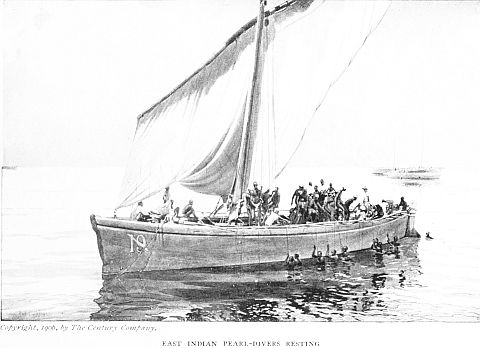
Copyright, 1906, by The Century Company.
EAST INDIAN PEARL-DIVERS RESTING
As ancient as those of the Arabian sea and
even more important are the pearl fisheries of
India. These are also fished for the pearls, the
shells of these waters being smaller than those
of the Persian Gulf and valueless for mother-of-pearl.
The pearls however average whiter than
those of the Red Sea and the Persian Gulf.
Although equally fine pearls are found in other
waters the Ceylon, or Madras pearls as they
are called, have long been esteemed the best
because of their good average color and quality.
These banks are situated in the Gulf of Manaar
between the southern point of India and the
island of Ceylon.
On the Madras (India) side the banks are off
Tinnevalli and Madura at Tuticorin. The
Indian revenue realized a profit of £13,000
from a fishing here in 1822, and £10,000
from another in 1830. Examinations showed
that there were not sufficient oysters for profitable
fishing after that until 1860, when the
government netted £20,000, and a fishing the
following year, 1861, was equally successful.
The banks failed in 1862 and there was no
fishery until 1874. Pollution of the water from
the Indian shores has been detrimental to these
banks and they are now of little importance.
On the Ceylon side, the banks lie six to eight
miles off the west shore and a little south of the
island of Manaar. Fishing has been an industry
from early times before history began. There
are records of these fisheries under the kings
of Kandy and later by the Portuguese after
they took possession of Ceylon about 1505, to
1655 when the island passed into the hands of
the Dutch. In old times they were called the
fisheries of Aripo after a fort on the coast. Not
until the English gained control were the
fisheries so managed that definite knowledge of
the results could be obtained.
After the Dutch gave way to the English,
until 1903, these fisheries had yielded a net
income to the government of over £1,000,000.
This covered a period of over one hundred
years, as the British occupied Ceylon in 1796.
In the early years of this period and prior to
that, the fishings, or rights to fish, were sold to
the highest bidders, usually Hindu merchants.
In 1796 the fishing brought £60,000. The
year after the British took possession, 1797, it
realized £110,000 that amount having been
paid by Candappa Chetty, a native of Jaffna
for the fishery right, and for that of 1798, the
same renter paid £140,000.
These fishings, which were prolonged, so
exhausted the banks that the fishery of 1799
yielded but £30,000. From 1799 to 1802 the
yearly product ranged from £12,000 to £55,000.
In 1804 they were leased for £120,000 but
from that time on declined so that in 1828
they brought only £30,612. There were no
fishings from 1820 to 1827, nor in 1834 and
after 1837, until 1855. The supply failed in
1864 and for several succeeding years, and again
for a decade, after five successful fishings from
1887 to 1891. The average yearly profit up to
1891 was about £34,000.
The Ceylon and Madras fisheries are now in
charge of a government officer, who spends a
part of each year inspecting the various banks
so as to be informed as to the whereabouts of
mature oysters, and the location and progress
of the young and immature. They keep a
record of their condition at different periods,
and regulate the fisheries by permitting fishing
only when they consider the banks to be ripe
for it.
The oysters mature in from four to six years
so that ordinarily a bank may be fished once in
that period, but it sometimes happens that the
young oysters are swept away by violent storms
or crowded out by natural enemies. In 1901
the Ceylon banks were found to be in a bad way,
there were plenty of young oysters but none
full-grown. The government officers could not
account for the condition, and in response to a
report of the facts the government sent Prof.
W. A. Herdman to Ceylon in 1902. He examined
the whole of the bottom of the Gulf of
Manaar and discovered banks on which were
full-grown oysters, so that a fishing was fixed
for the 23rd of February 1903. Weather prevented
commencement until the second of
March, when fishing began and lasted forty-two
working days until April the fourteenth.
The fishings take place in March and April
because the sea is usually calm at that period.
The banks lie in five to ten fathoms over a
shallow area nearly fifty miles long by twenty
miles broad, opposite Aripo. A steep declivity
on the western edge gives the sea a depth of one
hundred fathoms in a few miles. In the centre
of the southern part of the Gulf of Manaar,
west of the Chilaw pearl-banks, the sea is one
to two thousand fathoms deep.
Of all the paars, or oyster-beds (paar means
rock or hard bottom) the Periya paar is the
largest. It is about eleven nautical miles long
and from one to two miles broad. Situated in
about five to ten fathoms close to the top of
the western slope of the shallows, and running
north and south about twenty miles from land,
it is exposed to the southwest monsoon which
runs up toward the Bay of Bengal for about
six months of the year. The natives call this
the mother-paar, believing that the young
oysters are carried from it to the other paars,
which are thus stocked at its expense.
Between 1880 and 1902 twenty-one examinations
showed that the Periya paar had been
naturally stocked eleven times with enormous
quantities of young oysters, which as regularly
disappeared before they were old enough to
yield a fishing. The most reliable paars are in
the Cheval district and it is probable that the
government, acting on the suggestion of Prof.
Herdman, will hereafter dredge the breeding
Periya paar of its young oysters and plant them
where they will be able to mature. It is estimated
that many millions of millions of oysters
have been lost from this paar during the last
twenty-five years.
A fishing is not only a matter of commercial
importance, but of wide-spread interest among
the natives of Ceylon and India. The romance
of the situation, the hope of gain, the great
gathering of people from many and far-off
countries, the opportunities for barter, the
possibilities of securing priceless gems for little,
and for making money quickly, all appeal to
the oriental mind.
For this they will endure the discomforts of
long and painful journeys and the dangers of
crowded camp life with a recklessness that contrasts
curiously with the wild panics into which
they are sometimes thrown, as for instance in
1889, when the Ceylon fishing collapsed on
account of cholera. In a few hours a fleet of
200 boats disappeared, the camp was burned,
and the multitude gone.
Great precautions are taken by the government
officials in every direction. When they
have decided that there are banks in condition
to be fished, notice of a fishing is advertised.
The following notification of the fishery for
1904 is an illustration.
"Government Notification.
Pearl fishery of 1904.
Notice is hereby given that a pearl fishery
will take place at Marichchikaddi, in the Island
of Ceylon, on or about March 14, 1904.
1. The bank to be fished is the southwest
Cheval Paar which is estimated to contain
13,000,000 oysters.
2. It is notified that the first day's fishing
will take place on the first favorable day after
March 13.
3. Marichchikaddi is on the main land, eight
miles by sea south of Sillavaturai and supplies
of good water and provisions can be obtained
there.
4. The fishery will be conducted on account
of the Government, and the oysters put up for
sale in such lots as may be deemed expedient.
5. The arrangements of the fishery will be
the same as have been usual on similar occasions.
Persons attending the fishery camp from
India will be permitted to travel to Ceylon by
either of the following routes: (1) Tuticorin
to Colombo or (2) Paumben to Marichchikaddi
and by no other. Arrangements will be made
as at the last fishery, for travellers to proceed
from Paumben direct to the camp. The only
restriction imposed on travellers by the Paumben
route will be inspection by the medical
officers at Paumben.
6. All payments to be made in ready money
in Ceylon currency.
7. Drafts on the banks in Colombo or bills
on the agents of this Government in India, at
ten days sight, will be taken on letters of credit
produced to warrant the drawing of such drafts
or bills.
8. For the convenience of purchasers, the
treasurer at Colombo and the different Government
agents of provinces will be authorized
to receive cash deposits from parties intending
to become purchasers, and receipts of these
officers will be taken in payment of any sums
due on account of the fishery.
9. No deposit will be received for a less sum
than Rs. 250.
By His Excellency's command.
Everard Im Thurm, Colonial Secretary.
Colonial Secretary's Office, Colombo, Feb. 27,
1904."
The sanitary precautions are of the utmost
importance, for a plague stricken Hindu, if he
were dying, would still endeavor to go where he
might "get rich quickly."
As the time draws near, thousands of speculators
and sightseers from farther and nearer
India arrive. Berbers, Arabs, Persians, and
Burmese, mingle with the Singhalese and Tamil
divers. A town of huts to accommodate perhaps
50,000 springs into existence. Steamer
service to Colombo is started, post and telegraph
service is established and sanitary measures put
in force. Conjurors employed by the divers go
through incantations to preserve them from the
sharks which abound in these waters.
This shark-charming power is believed to be
hereditary and not dependent on the religion
of the conjuror and he can, if ill or absent, convey
the power to a substitute so that it will be
respected by the sharks. To make matters
doubly sure the divers arm themselves with a
short, pointed piece of ironwood. This however
is not their main reliance for a "wise
woman" was able to avert a panic which was
well under way, after one of the divers was
bitten at the Tuticorin fishing of 1890. Excepting
the loss of a limb occasionally not much
damage is done by the sharks, a fact which
sustains the implicit faith of the natives in their
shark-charmers.
When the day set by the Government officials
arrives, the fleet puts to sea after numerous
ceremonies. The boats, which range from ten
to fifteen tons, are grouped in fleets of sixty
to seventy. Beside the divers they are manned
by ten or more sailors, a steersman, and if
possible by a shark-charmer (pillal karras).
The boats leave at midnight in order to be
ready on the banks at sunrise. At the firing of
a signal gun diving commences. A stone of
granite, shaped like a pyramid and weighing
about thirty to forty pounds, is attached
through a hole at the smaller end to the cord
by which the diver is lowered. Some divers
prefer a half-moon stone fastened to the waist.
Above the stone when attached to the line is a
loop for the diver's foot. The divers work in
pairs, one going down and the other remaining
in the boat to attend to the line, and in some
cases exchanging positions as the diver becomes
exhausted. Naked divers stay below fifty to
eighty seconds on an average, though some can
remain under water longer. Each man makes
forty to fifty descents a day and brings up fifteen
to thirty oysters each time. As a rule the
maximum depth in these waters is about forty-two
feet though fishing at twelve and thirteen
fathoms is reported. The divers work from
sunrise to noon, which allowing for shifts gives
each man four hours diving for a day's work.
A gun is fired as a signal for the day's fishing to
cease and the fleet starts at once for shore.
Upon arriving there the oysters are immediately
landed by coolies who carry them in baskets,
on their backs, to the "Kottu," or government
stockade. There they are counted and each
boat-load is divided into three equal parts;
Two of these are chosen by officials for the
government and the remaining heap is the
boats' share. Formerly the catch was divided
into four parts of which the government took
three. Of the boats' share the divers get in
some cases two thirds. As soon as the division
is made, those belonging to the boat are quickly
traded or sold to the numerous small speculators
which abound in the camp. Six evenings in
the week the government auctions off the
catch in lots of one thousand.
While each day's catch is being counted the
average run is carefully watched by experts
who judge by the size, weight and general
appearance of the oysters as to the probable
yield of pearls. Opinions so formed are usually
quite correct and bidding at the auctions are
based on them to a great extent. The principal
buyers are from Madras, Bombay, and other
cities on the Coromandel and Malabar coasts
of India, though local speculators buy many.
The catch runs about one million per day.
In 1903 forty-four million oysters were taken,
but they realized much less than the catch of
1904, when the number was not quite twenty-six
and three-quarter millions, though it netted
the government $350,000; 1905, however, will
be the record year as it is claimed the profits
will reach the large sum of $830,000. These
figures represent the government's share only.
The price realized at these sales varies not
only with the season but from day-to-day. Ten
to fourteen dollars per thousand is a fair average,
though there are days when as much as twenty-four
dollars is realized. Prices have ranged
from $7.50 to $40.00 per thousand in one season.
The net proceeds go to the revenue of Ceylon.
This has been the system under which the
Ceylon fisheries were managed until lately.
For some reason unknown to the public, the
government, after a season of unequalled profit
in 1905, leased the fisheries to a company, the
Pearl Fishers of Ceylon (Limited), for a period
of twenty years from January 1, 1906. The
company is to pay the government $103,333
per annum and is to expend annually upon the
improvement of the fishery not less than
$16,666, or more than $50,000, at the discretion
of the government. The expenses of supervision
and protection by the government must
also be borne by the company.
As a result of the first fishery (1906), the
company after setting aside $49,628 for depreciations
and reserve and carrying forward
$77,382, show a profit of $256,960 which affords
dividends of 36 cents on ordinary shares and
18 cents on deferred shares, a remarkably good
beginning. The government revenue from the
fishery of 1905 was $801,882 after the expenses,
$73,510 were deducted; over $111,000 more
than the profit of 1904 which was the most successful
up to that time.
The inspector of pearl-banks anticipated a
good fishery in 1906 but was of the opinion that
after a small fishery in 1907 and probably 1908
the banks would fail for some years as they have
done in the past.
After the pearls are taken from the dead
oysters they are first sorted for size. This is
done by passing them through a series of ten
small brass sieves known as baskets, containing
from twenty to one thousand holes. The
sieves have twenty, thirty, fifty, eighty, one
hundred, two hundred, four hundred, six
hundred, eight hundred and one thousand
holes respectively. The pearls are then sorted
for color and quality, weighed and valued. As
with all things, really fine pieces are rare, the
great mass being ordinary or poor. Herein lies
the attraction and excitement of the business
for some will find great gems. One may imagine
the keen interest of the swarthy buyer who has
parted with his hoards, hoping to find a "pearl
of great price" when he washes the lustrous
spheres from the putrid mass of decaying fish:
the eager search; the joy when his eye lights
upon a big, white, shining sphere rising up
among the heap of little ones; the growing
exultation as he picks it out and with feverish
interest rolls it about between his fingers to find
it without flaw or blemish, or the keen disappointment
should his inspection show, as it
most frequently does, that it is full of imperfections.
Hovering about are the buyers for the great
Hindu merchants, agents of far-off princes and
Europeans, all watching sharply for great finds
and ready to enter into the combat of wits which
marks an oriental trading.
If one remembers that there are probably
twenty-five thousand traders congregated on
the hot sands of this far-off shore, the fair dame,
whose neck is clasped by a string of these
precious globules, may conjure from their
lustrous skins, scenes as wild and weird as any
fairy tale that set her youth to dreaming.
The pearls are sorted into a number of
grades. Those perfect in sphericity and luster
are called "ani." Anitari meaning "followers"
or "companions," are of the same general
character, but poorer in those important
qualities. Masanku are somewhat irregular in
shape and faulty, especially in luster and color.
The poorest of this class, lacking the essential
qualities, are separated into another grade and
called "kallipu." Next come "kural," double
or twinned, and "pisal," are misshapen or
clustered. Folded or bent pearls are "madanku,"
and what we would call "rejection," a mixed
lot of all sorts and sizes too poor to include in
any of the regular classifications, are termed
"vadivu." Seed-pearls, the very small pearls of
which there are great quantities, are known as
"tul." Many of these are ground to "chunam"
or shell-lime, and used as an ingredient in a
favorite masticatory.
The assortments being made, they are
weighed and recorded in kalanchu (kalungy)
and manchadi (manjaday). The kalanchu is a
brass weight equal to 67 grains troy, and the
manchadi is a small red berry that is of very
even weight when full sized, and is reckoned
twenty to a kalanchu.
In the valuation of ani, anitari and vadivu,
the individual size, form, and color is considered,
but the others are simply valued by weight.
The modus operandi of these fisheries like
all others managed by Orientals continues much
the same from fishing to fishing. Experiments
have been made at the Tuticorin fishery with
helmeted divers but their catch compared
unfavorably with that of the naked natives,
who will sometimes under favorable circumstances
bring up two thousand in a day. It
is said that the X-ray is being used to some
extent in the examination of shells and that
those found to be without pearls are thrown
back into the sea, but it is doubtful if the general
use would be practical or advantageous while
oysters remain abundant; so far, the use of it
has been experimental only.
Fine pearls are found in Dutch India among
the Molucca Islands. Fishing is done by the
natives, and as they seldom go deeper than ten
or twelve feet the probability is that they do
not get the finest shells or pearls, for it seems to
be quite well established that the shells taken
from deep water are larger and more likely to
contain large pearls. Whether this arises from
deep water being more favorable to growth,
or an unmolested opportunity to grow, has not
been determined.
Hitherto the Netherlands Indian government
has opposed encroachment upon the rights of
the natives and colonists, and has patrolled
the waters with small gunboats to prevent any
attempt by Europeans to fish. But lately concessions
have been made to British firms so that
shell is being shipped direct to London, and
it is now thought that these fisheries will
soon rival the Australian. The pearls were
formerly bought from natives, principally of
the Island of Aroe, by Chinese and Arabs
who took them to Macassar. From there they
were sent first to Singapore and then to London,
Paris, and Amsterdam. Most of the pearls
brought to Macassar are baroques, though fine
specimens of more regular shape arrive there
occasionally. The mother-of-pearl from these
shells is of good quality.
Some pearls are found at the Bazaruto
Islands, Portuguese East Africa, a few miles
from the coast, midway between Inhambane
and Beira. A concession was granted to a company
about 1892, but bad management, lack
of funds and political difficulties, killed the
enterprise.
General reports indicate that it is very
difficult for any enterprise subject to the officials
of this district to succeed. The Bazaruto
Kaffirs still fish, but without system or intelligence.
They are wasteful and damage many
of the pearls by cooking the oyster. The
few found are shipped by Indian traders to
Bombay and Zanzibar.
Pearl fishing has been attempted on the
coast of German East Africa at Zanzibar Island
and south, between the Island of Mafia and the
main coast. Mother-of-pearl is abundant but
few pearls have been found and there has been
no sustained effort. There are large coral
banks about the islands of the coast favorable
for the growth of mother-of-pearl and there is
shallow water over large areas.
Good white pearls have been taken from a
red mussel found there. South of the Island of
Mafia are beds of large pinna shells which yield
black seed-pearls. There are pearl-shell fisheries
in the Merguian Archipelago and in the government
of Burmah and some pearls are found.
The banks, scattered over an area of eleven
thousand square miles, are rented from the
government and rights to fish are sublet on
royalty. The fishing is nearly all done by
helmeted divers.
Avicula and meleagrina margaritifera are
taken off the west coast of New Caledonia.
From the former large numbers of pearls are
taken, and from the latter, very beautiful white
pearls. Fine colored pearls pink, yellow, gray
and black are often found in this district. A
variety of oyster commonly called shoulder of
mutton, and another shell-fish called jamboneau
(pinna) of which the pearl is very fine, are also
found in these waters.
A syndicate was formed in Paris to exploit
these beds and obtained concessions covering
one hundred and thirty miles. Owing to the
difficulty of getting divers, the waters had not
been exploited to any great depth up to 1898,
the regular fishings being confined to the shallows
of six to seven feet, though larger shells
were known to be in deeper water. More
systematic work with modern appliances and
in deeper waters has since been done with good
success, but late reports show an accumulation
of shell and indications that the industry has
not been profitable.
In 1904 the price of shell (black-edge mother-of-pearl)
fell to $250, U. S. gold per ton of
2240 pounds, from $700, the former price, with
six hundred tons stored in London, Paris, Berlin,
New York and San Francisco, making a prospective
loss of $270,000 for 1904. There was an
attempt to limit the production by a return to
native diving. With dress the output would be
about 500 tons for the year, with naked-diving
200 tons less. This would operate against the
local government, as it not only levies $38.60
U.S. gold per metric ton as an export duty, but
makes a large profit on the diving machines
by way of license. The pearl fisheries of French
Oceanica therefore face a grave situation.
Pearls are found occasionally on the western
coast of Nicaragua at San Juan del Norte. The
Panama coast still yields great quantities of
pearls as it has done for many years. When
Spain controlled the northwestern section of
South America with the Isthmus to the borders
of Guatemala, under the name of Colombia,
immense quantities of pearls were sent home by
the colonists.
It is recorded that 697 pounds of pearls were
imported into Seville from Colombia in 1587.
A large proportion of these undoubtedly came
from the coasts of what is now Venezuela. The
Panama or bullock shell as it is called, is not of
the finest quality and the pearls are apt to be
dark and inferior to the Indian pearls in luster
as well as in color; nevertheless fine pearls are
found there and the fisheries yield a greater
average of black pearls than any other. Beautiful
iridescent pearls are also found there.
The Pearl islands are on the east side of the
Bay of Panama about forty miles from the city.
The banks there may only be fished by divers
but between Chiriqui and Veragua dredging is
allowed. Since the United States government
has become interested in this section there is a
tendency here to exploit the Panama coasts
and companies have been formed in the States
for that purpose. The pearl fisheries formerly
carried on along the coast of Ecuador about two
hundred miles north of Guayaquil, are no longer
operated.
On the Atlantic coast of South America the
most fruitful pearl-banks lie along the coast of
Venezuela and west to Rio Hacha on the
Colombian coast. This was the first part of the
American mainland sighted by Columbus and
the quantities of pearls owned by the natives
did much to draw the tide of adventurers which
set this way in the sixteenth century.
The oysters are taken from reefs and bars
about one mile from shore and about the
islands. The principal beds are at El Tirano,
north-east, and Macanao, north-west of the
island of Margarita. There are fisheries also at
the neighboring Islands of Coche and Cubagua.
About four hundred sail-boats of from three to
fifteen tons, employing two thousand men, are
constantly at work in these fisheries.
A French company purchased a concession
about the year 1900 from a Venezuelan to fish
in this neighborhood. It was to pay the
Venezuelan government 10 per cent. of the profits
as royalty and use divers and diving apparatus
so as to select the oysters and avoid waste
of the immature. Fishing by natives is done
mostly by dredging with metal scoops. It is estimated
that upwards of $600,000 worth of pearls
are found about the island of Margarita per
annum, most of them going to the Paris market.
Exclusive rights have been granted a Venezuelan
citizen by the local government lately
to exploit the Gulf of Cariaco for pearls and
other sea products. The contract is for twenty-five
years. Certain advantages are guaranteed
by the government which is to receive fifteen
per cent. of the net profits of the enterprise.
About forty or fifty years ago several English
companies conducted profitable fisheries in the
lower Gulf of Maracaibo and on the coasts of
the Goajira territory and Paraguana. They
employed Indians as divers. Revolutionary
troubles during the last twenty-five years so
demoralized the Indians, that the industry was
finally broken up. Reports from authoritative
sources indicate, that not only could paying
fisheries be established here, but that the
interior is rich in minerals and precious stones.
Until lately there have been few restrictions
upon fishing along the Venezuelan coast beyond
a tax of fifty dollars imposed by local authorities
upon the buyers and the payment of fifteen
bolivars ($2.90) by each boat for a fishing permit
at Margarita.
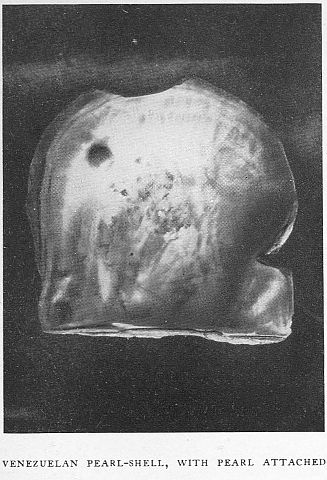
The oysters of this coast mature rapidly and
like those of Ceylon live but six or seven years.
They are small and the shells are so thin that
they can be crushed between the fingers. They
are of the Lingah type and are named by some
avicula squamulosa. The nacreous lining is
also very thin, but lustrous and beautifully
iridescent. The pearls run small and very many
of them are quite yellow.
Many fine white pearls are found however,
though they incline frequently to a waxy
luster and are often marred by chalky spots.
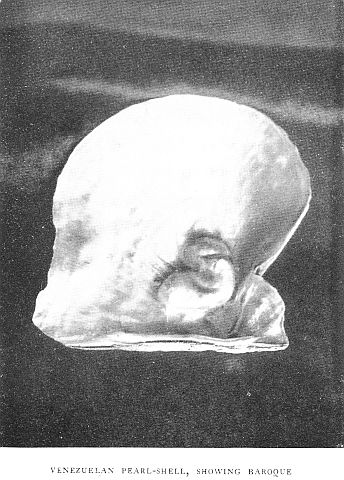
Great quantities of baroques, notably beautiful
for color and orient, are found. Round pearls
with a china-like skin in many colors are also
quite common. The average size and quality
is not equal to those of the Indian waters,
though it is much better than is generally
credited, as the traders in this country for some
inexplicable reason have an idea that Venezuelan
pearls are necessarily poorer than
others.
This notion has probably been fostered among
American buyers by the Parisian dealers who
at present well nigh control the output of these
fisheries and naturally fear the diversion to a
neighboring market which now pays a heavy
toll to Paris on pearls taken from this continent.
It is true an unusually large percentage of
cracked pearls is found among Venezuelans,
and they lose perceptibly in weight after being
brought from the fisheries the loss averaging
fully one-eighth of one per cent., nevertheless
many pearls of the finest quality are taken from
these fisheries. All pearls are subject to slight
variations in weight.
It was from the fisheries of Colombia that
Philip II. of Spain received the large pearl of
250 carats, about the size and shape of a
pigeon's egg, so often mentioned in the chronicles
of precious stones.
The management of the pearl fisheries of the
Colombia of to-day is in the hands of the central
bank of Colombia which is empowered to
transact business pertaining to property belonging
to the government. This institution holds a
public auction and awards the lease of the rights
to fish for pearls, coral, etc., on the Colombian
coasts of the Atlantic and Pacific oceans, to
the most desirable bidder. The lessee must be
governed by the rules and regulations laid
down by the bank. The lease is for five years
and went into effect August 1st, 1906.
New pearl oyster-beds were discovered in
1903 in the Gulf of Campèche near Coatzacoalcos
and application was made by a Mexican
to the Mexican government for a concession to
work them. There are extensive beds, which
are constantly fished, along the eastern coast of
Lower California from its junction with the
United States to Cape San Lucas. La Paz is
the principal centre of the fisheries. An English
syndicate has a concession from the Mexican
government which was lately renewed, for
fishing about La Paz. Pearls worth $350,000,
among them many fine black pearls, and five
thousand tons of shells valued at $1,250,000,
were taken in 1904. This syndicate employs
all the modern appliances.
Beds are known and worked from La Paz
to and about the island of Loreto on the east
coast, and at the island of Tiburon over on
the East side of the gulf, and from Mazatlan
all along the coast of Mexico proper to the
boundary line of Guatemala. These beds were
discovered by Cortez in 1536 and were worked
spasmodically for two centuries; then for a
period they were fished so constantly and
thoroughly that the market was over-loaded
with pearls and the supply of oysters seriously
diminished. Of late years fishing has been again
carried on systematically and with sufficient
judgment to prevent the immediate destruction
of the beds as before.
A pearl oyster-bed ten miles long has lately
been located at the Punta de Santa Cristoval.
The Mexican season for fishing varies in localities
from May to November, or June to December.
The day's work of the diver commences at
near the ebb tide and ends shortly after the
beginning of the flood tide, about three hours
in all. Much fishing is done by independent
naked native divers, in a manner similar to
that of the Hindus and Arabs, but some of the
large concessionaires supply their divers with
helmets and other modern appliances.
Schooners of various sizes having several
boats, carry the fishing parties to the banks
and the men live on them through the entire
season. The daily catches are delivered to an
armed boat which carries the oysters ashore,
where they are at once searched for pearls.
These when found are immediately sorted and
valued, a percentage going to the diver in
addition to his wages, if he is a regular employee
of the Company.
The oysters are found adhering to rocks by
the byssus, generally in bunches, hinge-side
down, curved side up and the shells slightly
parted. The diver cuts them loose with a knife
and deposits them in his basket or net. One
hundred to a hundred and fifty is a good day's
work for a naked diver, but with the appliances
now being introduced, a diver in dress can raise
fully double that number. It should be remembered
that there are elements of uncertainty and
irregularity in the catch of the meleagrina. As
compared with the enormous and crowded beds
of the small varieties as they exist in the Gulf
of Manaar and at the island of Margarita,
Venezuela, where they can be literally scooped
up, the scattered bunches of the meleagrina do
not afford easy data for reckoning averages.
On the coasts of China, Japan, Korea, some
of the South Sea Islands, the English Channel
islands, the Canary islands, about St. Malo on
the coast of France, at Queen Charlotte's island
and along the coast of California from north
of San Francisco to the border of Lower
California, at the Cape of Good Hope, India,
Australia and New Zealand, a shell-fish is taken
which has considerable commercial value and
yields pearls to a limited extent.
It is called in this country abalone. In the
Channel islands it is known as the ormer. It
is the Haliotis or Ear-shell. The Greeks called it
venus ear-shell and used it as a food, considering
it most nutritious. Old English writers praised
it as a delicious morsel under the name of
ormond saying that it was bigger and infinitely
better than the oyster. This shell-fish attaches
itself to the rocks by a flat, disk-shaped foot
and must be taken when the tide is low. The
fisherman can then insert a knife by stealth
under the foot and taking the fish unawares,
destroy the suction. Otherwise the hold of the
fish could not be broken without destroying
the shell. New Zealanders call the fish itself
the mutton fish.
The Japanese, Chinese and Indians of the
Pacific coast have long used it as an article of
food. The shells are valuable on account of the
very beautiful nacreous lining which is exceptionally
good material for buttons and various
ornamental purposes. The lining has an
exquisite play of colors in the richest tones of
peacock greens and reds. There are about
seventy species of the Haliotis and the shells
vary greatly in size. The British ormer (H.
tuberculata) is of small size, about six inches
long and is silvery. The shells are sometimes
called in trade aurora shells. After being well
beaten to make them tender the animals are
used for food.
The ormer or auris marina was esteemed by
the ancients as a very sweet and luscious dish.
The people of the Channel islands ornament
their houses with the shells and farmers use
them to frighten the birds from their corn-fields.
They string several together and suspend them
from the end of a slender pole stuck in the
ground. The wind swaying them, makes a
constant clatter. The Haliotis iris of New
Zealand is green and brilliantly iridescent. A
Cape of Good Hope species (H. Mida), under the
epidermis is tinged with color, principally
orange.
Some of the more beautiful species were
formerly very abundant on the coasts of China
and Japan, but the constant use of the animal
for many years as a food stuff has made them
less common there and the Chinese and Japanese
now obtain a large part of their supply from
California, where the haliotis or abalone, as it
is called is taken in great quantities. The two
most beautiful species found on this coast are,
the Haliotis splendens, a magnificent shell of
rainbow coloring in which peacock green predominates,
and H. rufescens, the lining of which
is red. When found, the latter is usually
thickly incrusted and coated with vegetation.
The green and red range from seven to ten
inches, the latter being generally the larger.
Another variety, H. cracherodii, very dark
green or black without, and with no apparent
beauty, has a small opalescent bit inside the
shell which is cut out and made into articles of
jewelry. This is common in crevices of rocks.
A variety called bluebacks has a bright clayey
blue exterior. The Indians of the Pacific coast
have used these shells as material for jewelry
and decoration for centuries, but not until the
button-makers of Europe and New York began
to utilize them did they become an item of
importance among the exports of the Pacific
coast.
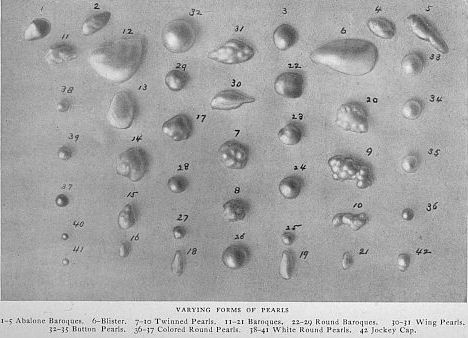
Few pearls are found in the abalone but they
yield a considerable number of large rounded
baroques and excrescences, rich and beautiful
in color and of fair luster, also odd-shaped
pieces like blisters matched and joined at the
edges. The greens have a bronze appearance
and the reds and pinks are often iridescent.
Quite a number of good "peelers" are found
among them. These are pearly formations
which can be improved by taking off one or
more of the outer skins.
Pearl-fishing, principally by Greeks, has been
carried on about the west and south coast of
Haiti, but lately the government has granted a
concession to four of its citizens covering nine
years with the privilege of renewal at the end
of that period. This will prohibit all others
from fishing unless they rent the privilege from
the concessionaires.
To the south of the Philippines, pearl fisheries
were worked by the natives before the
arrival of the Spaniards, and the industry is
still carried on, chiefly by antiquated methods.
The coasts of the Sulu islands, at Jolo and elsewhere
and about the island of Mindanao, have
yielded many fine pearls and continue to do so.
The shells from these waters furnish very fine
mother-of-pearl.
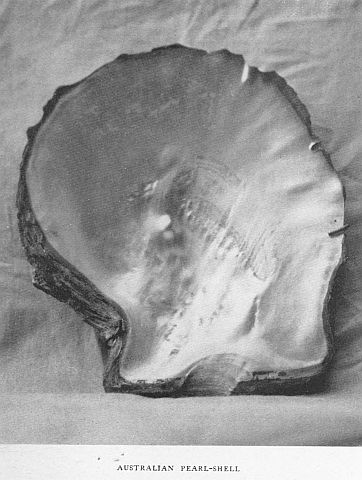
All things considered, the largest and best
equipped fisheries in the world to-day are those
on the coast of Australia. Not as many pearls
are found as at Ceylon. The main object of
fishing is the shell, which is large, heavy, and
furnishes the best quality of mother-of-pearl of
the white variety. From Charlotte's Bay on
the north-eastern coast, all along the northern
coast and around to Exmouth Gulf on the
western coast, pearl oysters are abundant.
Farther south at Sharks Bay, the oysters are
smaller and the pearls, though of good shape
and luster, run yellow. Shells from the coast of
Queensland are sold as Sydney shell; those from
the northern territory of South Australia, as
Port Darwin shell, and from there to Exmouth
Gulf on the western coast, they are marketed
as West Australian shell.
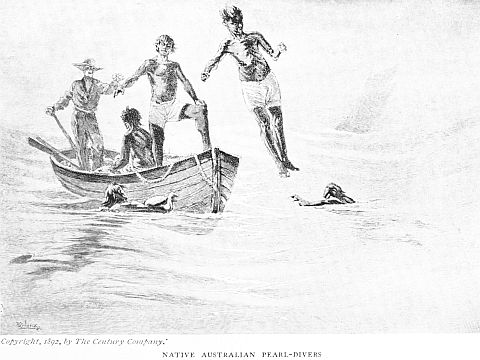
The fishing is carried on by organized companies
having capital, and every modern
appliance of practical value is utilized. The
divers fish with the dress. The usual method
of fishing is for a schooner of eighty to one
hundred tons to put out with a number of
luggers of from eight to ten tons. Each lugger
is manned by a captain, a cook, one man at the
life-line, two men at the air-pumps and one
diver. Each lugger will average half a ton of
shells per month ranging from 1600 to 2000
to the ton. The pearls like the shells run white.
The Australians are not only pushing this
industry along their own coast, but are extending
operations along the islands north toward
the equator, wherever it is possible. And
wherever they go they carry with them the best
modern appliances and methods. Lately however
operations have been considerably curtailed
in the Torres straits owing to the enforcement
of laws for the protection of divers.
Lack of men for diving caused some of the
operators to use questionable means to obtain a
supply. Boats were sent through the South Sea
among the islands and aborigines, Chinese,
and even European sailors, were kidnapped and
held in practical slavery. Many lives have been
lost in these fisheries and the evils connected
with the industry became so notorious that the
government took action. It is probable that
the business will be reorganized and either
conducted by the state or under government
supervision. Natives are now being trained
to use the dress.
Few pearls are found and it not infrequently
happens that as many as fifteen to twenty tons
of shells are raised without finding a single
pearl of value. At this time shells from these
fisheries bring from $500 to $750 per ton in the
New York market. Helmets have been used
to some extent throughout the Pacific for a
number of years, but many were crude affairs,
carelessly managed and the loss of life was as
great as by naked-diving. The training of the
natives to the use of the more modern appliances
will however engender confidence and the
probability is that dress-diving will become
general in the south seas wherever the industry
is organized.
As a rule the largest oysters and pearls, where
there is a calcareous foundation for the bed, are
taken from the deeper waters, and it is probable
that as modern appliances are more generally
used by the larger organizations now taking hold
of the industry, the fisheries will be extended
with good results in many localities to waters
beyond the shallows now fished. More systematic
methods will prevent waste and the
destruction of the beds.
The English Colonial governments of India
are doing much in this direction. By keeping
experts upon the ground, they have learned
how to fish without destroying the beds, and
to fish when it is possible for the oysters to
contain pearls. Strict supervision and protection
of the beds result in more frequent fishings
and greater returns to both the government
and the fishermen.
This example is being followed, and pearl
fisheries are gradually coming either under
governmental supervision or into the hands of
concessionaires, whose large investment makes
the preservation of the beds a business necessity,
whether they fish mainly for pearls or
shells.
The best pearls and the largest number are
found usually in mature shells which are distorted;
it has been stated as a possibility, that
in the future some of the new rays will be used
in fisheries where the pearl is the main object
of the fisher, to ascertain if the oyster contains
any before destroying it. M. Dubois of Lyons
has experimented with Roentgen rays for that
purpose.
As the fish is enormously prolific it is more
probable however that effort will be directed
instead toward the preservation of the mollusk
from the enemies and accidents which are
occasionally greater than its productiveness.
One of the greatest dangers in Indian waters
to a bed of young oysters is a little mollusk
known locally in Ceylon as suran (Modiola).
These cluster in masses on the sea bottom
and spreading over the surface of the coral,
crowd out the delicate young of oysters
recently deposited.
The Japanese fisheries suffer from the occasional
infection of the waters by a weed,
dinoflagellata gonyaulax. It accumulates in
immense quantities, causing a wide discoloration
of the sea water and is very destructive to
an oyster-bed. It is called the red current or
red tide. So far no preventive or remedy has
been found.
Hitherto the most general and fatal danger to
oyster-beds has been the ungoverned extravagance
of irresponsible fishers who seek to harvest
in the present regardless of the future, but these
are gradually being made amenable to restrictive
laws as authorities awake to the value of
the industry. A greater danger which threatens
the unio of American streams, is the pollution
of the water by the discharge of the refuse of
factories and the sewage of cities into them. A
mussel bed will recover in time when denuded
by fishers, but sewage and poison kills it out
entirely.
Although fresh-water pearl-bearing mussels
are found in the streams of many countries,
only in the United States are they taken in
sufficient quantities to make the fishings
important as an industry. They are to be found
throughout the Mississippi drainage area and
in part of that of the St. Lawrence. Few exist
on the Pacific coast and those of the Atlantic
coast are generally inferior as pearl-mussels.
There are many varieties of the unio which
yield pearls. Latin names are given by different
writers to distinguish them, but as scientists
differ in their classifications, the names are not
always uniform and are not sufficiently well
established to be useful, descriptively, to the
general reader. In treating of the various kinds
of pearl-bearing unios of the United States
therefore in these pages, the common names by
which they are known will as a rule be used with
the scientific names appended, as revised by
the department of mollusks of the United States
National Museum.
From the times of Roman colonization until
now, pearls have been taken from the mussels
of British streams. There are three varieties
of pearl-bearing mussels in Great Britain:
Painter's mussel (U. pictorum), the Swollen
River mussel (U. tumidus) and the Pearl
mussel (U. margaritifera).
The first two occur only in the streams and
ponds of England and Wales and the pearls
found in them are of inferior quality. The
latter inhabits the streams of Scotland and the
northern counties of England and to some extent
are found in Ireland and Wales also. The shell
is oblong, rather flat and heavy and about five
and one-half inches long. The exterior surface
is rough, and blackish-brown; the pearly
interior has a tint of flesh color mottled by
stains of dull green. It was from this variety
the Perthshire Tay pearls were taken, which
gained so much notoriety in the middle of the
eighteenth century when some fifty thousand
dollars worth were sent to London from this
stream in three years.
Scotch pearl-fishing was revived in 1860 and
some fine ones were sold to Queen Victoria,
the Empress of the French, the Duchess of
Hamilton and others. Pearl-mussels have been
found in Lochs Rannoch, Tay, Lubnaig and
Earn, also in the Don, the Leith and other
streams. Some are found in the Welsh streams,
and the river Bann in Ireland was noted for
the fine pearls found in it. Many years ago
there was a pearl fishery at Omagh in the north
of Ireland. An old writer claims that Cæsar
obtained pearls of such bigness in Britain that
he tried the weight of them by his hand.
The fishers wade for them in shallow pools,
or thrust sticks between the open valves, or
drag branches over them, for as soon as anything
enters between the two shells they close
upon it at once. The mussels are found generally
set up in the sand of the river-bed with
the open side, if the current is very strong,
turned away from it. The custom of the
peasantry is to fish for them in the autumn after
harvest.
Pearl-mussels are found also in Saxony,
Bavaria, Bohemia, Mesopotamia, Lapland,
Canada, Labrador, the Hawaiian Island Oahu,
Japan (especially the anodonta japonica),
China, the United States and Italy, in the
Gwaai and Shangani rivers of Southern
Rhodesia, South Africa. Nowhere are they
found however in such quantities or in so many
varieties as in the United States. The number
taken from the streams here of late years has
been so great that the shells have largely displaced
the marine Egyptian and have affected
the demand for the better qualities of South
Sea mother-of-pearl. The pearls found in them
also have been of such quality and quantity
that they now have an important place among
the jewels of the world.
Old records and the contents of Indian
mounds show that the unio was taken from the
rivers by the aborigines for the pearls they
sometimes contained; but no wide interest in
this possible wealth of the rivers appears to
have developed among their white successors
until the finding in 1857 of a large pearl weighing
ninety-three grains at Notch Brook near
Paterson, N. J. It was afterwards sold to the
Empress Eugénie of France for $2500. This
became noised abroad and immediately multitudes
began to search for pearls.
Mussels were gathered and destroyed by the
million, few pearls being found. The excitement
subsided as the searchers learned how
few got adequate reward for their time and
labor. They soon began to realize that the
finding of a pearl of value is usually preceded
by the opening of hundreds or thousands of
shells containing none, and that in the aggregate,
the shells thrown away were worth more
than the few pearls found.
Another pearl hunt developed along the
Little Miami River in Ohio from the finding of
several fine pearls near Waynesville in 1876.
This reached its height in 1878. In 1880, pearls
began to come into the New York market from
the West and South. Immense beds have been
fished in the White, Wabash and Ohio Rivers
in Indiana. In the summer of 1889 a number
of fine pearls were found in the south-western
corner of Wisconsin, in Crawford, Grant,
Lafayette and Green counties. Not only were
they notable for extraordinary luster, but many
were of beautiful color. The sale of some at
prices which seemed fabulous to the people of
that section, when it became generally known,
caused such a scramble for them by the natives
that the streams were rapidly denuded of
mussels, and that section has become of much
less importance than others since developed.
Prairie du Chien is the center of the Wisconsin
market, from which point the shells are distributed
to the button factories.
The following year (1890) pearl-bearing
mussels were found in several of the central
counties of Illinois—McLean, Tazewell and
Woodford, in the Mackinaw river and tributaries,
but no discovery equalling that of Wisconsin
occurred until 1897 when the Arkansas
beds were discovered. A peculiarity of this
district is that whereas the unio is usually
most abundant in swift clear water having a
sandy or gravelly bottom, many are found
here in the mud.
They have been taken over a wide territory
from the rivers and streams of the eastern half
of the state, including the Black, White, Cache,
St. Francis, Ouachita, Saline and Dorcheat
rivers, and in the valley of the Arkansas. Following
this were finds in Indian Territory,
Missouri, Georgia and Tennessee, the latter being
the most prolific. The finest pearls in Tennessee
are found in the fluter, or lake shell, which is
the same as the mussel known on the Wabash
as the wash-board. A yellow shell is found in
the Clinch River similar to the mucket of
Arkansas, from which pearls are taken.
Unlike the pearl oyster, the unio seems to be
more prolific of pearls in the shallows and
riffles near the edges of the rivers. Most of the
fine pearls are found between the pallial line
and the lip in the free portion of the mantle.
Those found within the pallial line, where the
mantle is attached to the shell, are seldom as
lustrous or perfect.
Pearls are found in many States besides those
mentioned, but the fishing is done quietly and
in some cases the sources of supply are known
to only a few who in the marketing of their
pearls carefully avoid giving any information.
This is particularly true of some of the eastern
states. Streams in the Northwestern section
of New York State are regularly fished, but
without excitement. The large fisheries of the
Mississippi and West are fished principally for
the mother-of-pearl in the shells. As with some
of the marine fisheries, the pearl is regarded
as an extra.
The mussels are taken in various ways. In
Canada, boats drag brush and the branches of
trees over the river bottoms, gathering the
mussels into the boat as the twigs become
clogged. In the large beds often found in our
Western Rivers, fishing is done wherever
possible by dredging. Metal scoops, hand,
shoulder and scissor-rakes are used and the
mollusks, taken in immense quantities are
cooked to open them, then cleaned of the meat
which is afterwards examined for pearls. This
method is used where the mussels lie in great
masses or on sandy bottoms. Where there
are boulders or large stones, a great number
of hooks are dragged over the beds.
The mussels, partially buried, lie lip-end up
and the shell slightly parted. Should anything
come within this gaping aperture, the mussel
at once closes upon it, nipping on with such
tenacity that the hold is not loosed until the
fisher draws it into the boat and forcibly
releases the hook. It is said the mollusk's shell
would remain thus tightly closed for ten or
twelve hours. After dragging the hooks over
the bed, the mussels are taken off and the process
repeated.
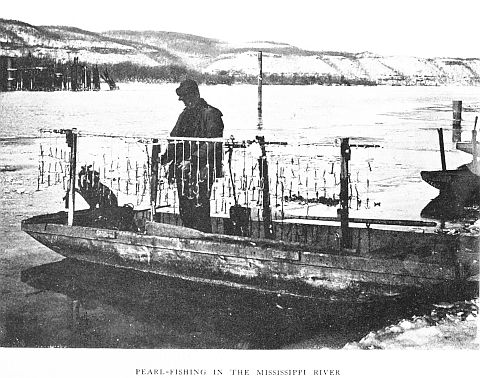
PEARL-FISHING IN THE MISSISSIPPI RIVER
Various rough devices are used, the principle
in all being the same. One, illustrative, consists
of a piece of lead pipe or an iron bar
several feet long, from which depend a number
of double or triple hooks several inches apart.
This is dropped overboard, the rope on which it
is hung is fastened to the stern of the boat, and
the boatman rows over the mussel bed dragging
it after him. Men who dredge for the mollusks
are called clammers. Pearlers are those who
at odd times fish for the mussels with pearls as
the main object. This class is composed of the
backwoods natives who live about the streams
in which the mussels are found. They are
people who usually follow their inclinations as
nearly as they can, working only as it becomes
requisite to obtain the few coarse necessities
of their lives. With them also are small farmers
who at seasons when farm work is not pressing,
seek the excitement and possible profit of the
hunt for pearls.
For all such persons the occupation has a
great fascination. The difficulties of following
the streams through almost impenetrable surroundings,
the coarse fare of bacon, meal and
coffee; the long tramps back and forth to
their mountain huts, or the exposure to night
in the tangle of the woods, have no terrors for
them; they are but common experiences.
Few pearls of value are found, but the occasional
pearl which each one does get, makes
expectation tingle, and hope recounts again
and again the great finds which others have
made. There are curious happenings which
illustrate the uncertainties of the work.
It is told on the Clinch river in East Tennessee
that a pearler, having patiently fished all day,
examining the fish from time to time as little
heaps of them were gathered, without finding
even a small pearl, finally decided to quit.
He was about to examine his last small heap
when a man standing by offered him fifty cents
for the lot. The offer was accepted. From the
first shell opened, the buyer extracted a ball
pearl which was afterwards sold for one thousand
dollars. Two of the finest pearls taken
one season from the same section were obtained
from a heel-splitter, carelessly dug out of the
sand by a man wading in the shallows of the
river. The heel-splitter is a large thin-shelled
variety, so named by the natives because of
the sharp, cutting quality of the shell which
protrudes from the sand of the river. They
rarely contain pearls, but when they do, the
pearls are usually fine.
The largest proportion of fine pearls to the
yield of any section since discoveries have been
recorded, came from Wisconsin, and many of
the best of these, especially of the fancy colored
ones, were taken from Sugar river. Many of
these were exceptionally beautiful in both color
and luster and a good proportion of them were
also round.
Much is written and told of the marvellous
pearls found in our streams worth large sums
of money. Such pearls are found undoubtedly
but not in such quantities as one might think
from the enthusiastic reports current in daily
papers. Finds are written up by reporters who
know nothing of pearls and prefer to write a
readable story of wondrous gems and great
values to a statement of plain unvarnished
facts. In this the news-gatherer is assisted by
some simple native with an eye single to a good
price and a capacity for exaggerated ideas of
value impossible to Maiden Lane.
It is no uncommon trick when buyers are
present, to find again, a pearl, which has been
to New York and back and the ruse often succeeds.
Pearls are frequently sold at the fisheries
for much more than they would bring in the
east. In fact it is difficult to buy ordinary
pearls at a reasonable price. The natives
will sometimes sell a really fine pearl for less
than it is worth because they do not understand
the relative values of quality; but they usually
over-estimate pieces of poor quality.
A large majority of those found in our fresh-water
mussels fail in some essential quality.
Many are chalky, or lustrous at one or two
points only. Others are faulty in shape, or if
spherical, deeply pitted. Really fine pieces are
usually small or button, and when large, are
baroques. Some of the latter are magnificent.
Weighing fifty to over one hundred grains, with
skins of extraordinary luster and iridescence;
white, or of a beautiful pink tint, these strawberry
or rose pearls, as they are called, frequently
excel, by every standard of beauty,
the imperfect spheres which command a greater
price in the market because they are round.
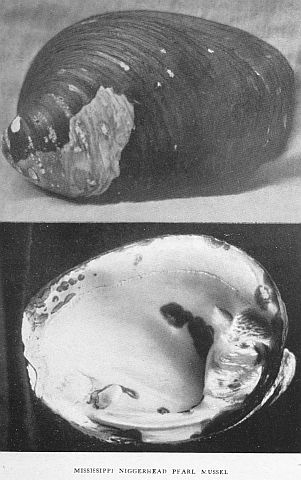
The most common variety of unio in American
rivers, especially in the Mississippi river, is
that known as the nigger-head (Quadrula
ebena). It is also the principal species used
for button-making.
Similar is the warty-back (Quadrula pustulosa)
so called because the shell has a number
of warts or excrescences on the outside of the
valves. The "bull-head" (Pleurobena Aesopus)
is found in abundance with the nigger-head.
It has a blackish-brown exterior, presenting
several radiating ridges, and a white lining.
The two latter are inferior as material for
buttons as the shells are brittle. The mucket
(Lampsilis ligamentinus) is a large shell, average
size 4 inches, has a dark brown exterior
and cream-white lining. It is too thin and
brittle to make first class material for buttons
though fine pearls are sometimes found in
them.
The sand-shells furnish good material for
buttons. They are long, sometimes six inches,
and narrow. They are usually found on sandy
bottoms and are said to move from the channel
toward the shores in the morning and back in
the evening. The most abundant is the yellow
sand-shell (Lampsilis anodontoides) so called
from its bright yellowish brown exterior.
Another kind, the black sand-shell (Lampsilis
rectus) has a black epidermis. A smaller
variety, less abundant now than formerly, is
the slough sand-shell (Lampsilis fallaciosus).
These are generally found in coves or the mouths
of rivulets.
The deer-horn or buckhorn (Tritigonia verrucosa)
is a large variety, sometimes attaining
a length of nine inches in the Iowa river, though
the average in the Mississippi is about five
inches. The shell, as the name indicates, has
a rough, warty exterior. The supply is small
and uncertain.
Another rare species is the butterfly (Plagiola
securis). It is a small, flat, thick shell of fine
color, and the valves are butterfly in shape
with a reddish-brown epidermis striped by
darker radiating lines. It is abundant only in
the Illinois and Ohio rivers.
The hatchet-back, hackle-back, or heel-splitter
(Symphynota complanata), is a large
black mussel having a thin sharp-edged shell,
one valve-edge projecting. It yields few pearls
though fine specimens are occasionally found in
this variety.
The blue-point (Quadrula undulata) has a
large, thick shell, with ridges on the exterior,
curving round the umbones and extending to
the edge. Like the black-edge meleagrina, the
nacre at the edge is discolored. In this case by
a bluish or purplish tint.
Some idea of the enormous quantities of
mussels contained in some of these beds in our
western rivers may be gained from the reports
of the fisheries in the first years of their discovery.
Ten thousand tons of shells were
taken in three years near New Boston, Ill.,
from one bed. Reckoned by the usual average
this would mean not less than 100,000,000
shells. In some beds, the mussels have been
found several feet deep, the bottom layers being
dead.
Notwithstanding the enormous numbers,
these beds are often completely exhausted in
a few seasons. When the beds are first discovered,
men will take as much as 1500 to
2000 pounds of shell each, in a day's fishing.
In one hundred pounds of shells as they are
taken, the average number of valves or half
shells will be, nigger-heads, about one thousand;
sand-shells, nine hundred; muckets, eight
hundred, which would be an average of nine
thousand mussels per ton.
The meat in a ton of nigger-heads weighs
over three hundred pounds. This is usually
removed by the fishermen by boiling the
mussels for ten or fifteen minutes in crude sheet
iron tanks when the shells open and the fleshy
part falls out or may be easily removed by
hand. To show how little the pearls they may
contain enter into the calculations of these
fishermen, it may be stated here that the shell-buyers
pay about twenty-five per cent. less
for the mussels as taken from the river than
they do for the shells when cleaned.
On the Californian coast when the divers
worked independently, they preferred to sell
the oysters unopened. They received about
$4.50 per thousand on an average for the shells
and double for the oysters complete.
The fishing season for pearlers is from August
to December. The large operations for shell,
in the early days of the industry, were confined
to the same period, but of late, fishing is carried
on throughout the year, immense quantities
being taken through the ice. The shells are
better in cold weather, being less brittle than
when exposed in the boats during warm weather.
Fishing through the ice is very wasteful however,
as the undersized, which are dropped back
from the scoops and rakes in the summer, when
thrown out on the ice are allowed to remain
there and die.
The price of shells varies considerably from
season to season. An average price for nigger-heads
is about ten dollars per ton; sand-shells
bring about twice as much, muckets half that
price, and the other varieties together will
average about twenty-five per cent. more than
nigger-heads, though among these the deer-horn
is worth about four times as much as the
nigger-head.
In the first six months of 1898 nearly four
thousand tons of mussel shells were sold by
mussel fishermen on the Mississippi. They
brought about thirty-nine thousand dollars,
94 per cent. of these were nigger-heads.
The spawning time of the unio varies with
different species. In the central Mississippi
basin it is normally February, March and April
for nigger-head, and summer and early fall for
the mucket and sand-shell.
The unio is a slow growing animal. Under
normal conditions it takes ten years for a nigger-head
to reach a size of three inches; fifteen
to eighteen years to attain a shell diameter of
4-1/2 inches. This corresponds very closely with
the life of the meleagrina, though the shell of
the latter ceases to grow in size at about eight
or ten years. After that it continues to lay on
thickness up to eighteen or twenty years.
Although the discoveries so far in Africa are
unimportant, it is possible, now that the unio
is known to exist there, that the streams of
that wonderful land of precious things may
add a companion gem to the vast natural
hoards there of the diamond. In two years
succeeding his first find, the discoverer secured
one hundred and fifty pearls at an average of
one pearl to eight hundred shells.
Authorities tell us that the nucleus of a
mussel-pearl is usually the larva of a distoma.
Nuclei of pearls vary according to the circumstances
surrounding the beds of the shell-fish
and those circumstances have much to do with
the occurrence of the pearl.